Exhibition: ‘French Twist: Masterworks of Photography from Atget to Man Ray’ at the Delaware Art Museum, Wilmington, DE

Exhibition dates: 29th June – 15th September 2013


Ilse Bing (German, 1899-1998) 'Cancan Dancers' Moulin Rouge 1931


Ilse Bing (German, 1899-1998)
Cancan Dancers

Moulin Rouge 1931
Gelatin silver print
6 1/4 × 9 in. (15.9 × 22.9cm)
Collection of Michael Mattis and Judith Hochberg
© Estate of Ilse Bing. Courtesy Edwynn Houk Gallery, New York


C’est magnifique!

Marcus


Many thankx to the Delaware Art Museum for allowing me to publish the photographs in the posting. Please click on the photographs for a larger version of the image.


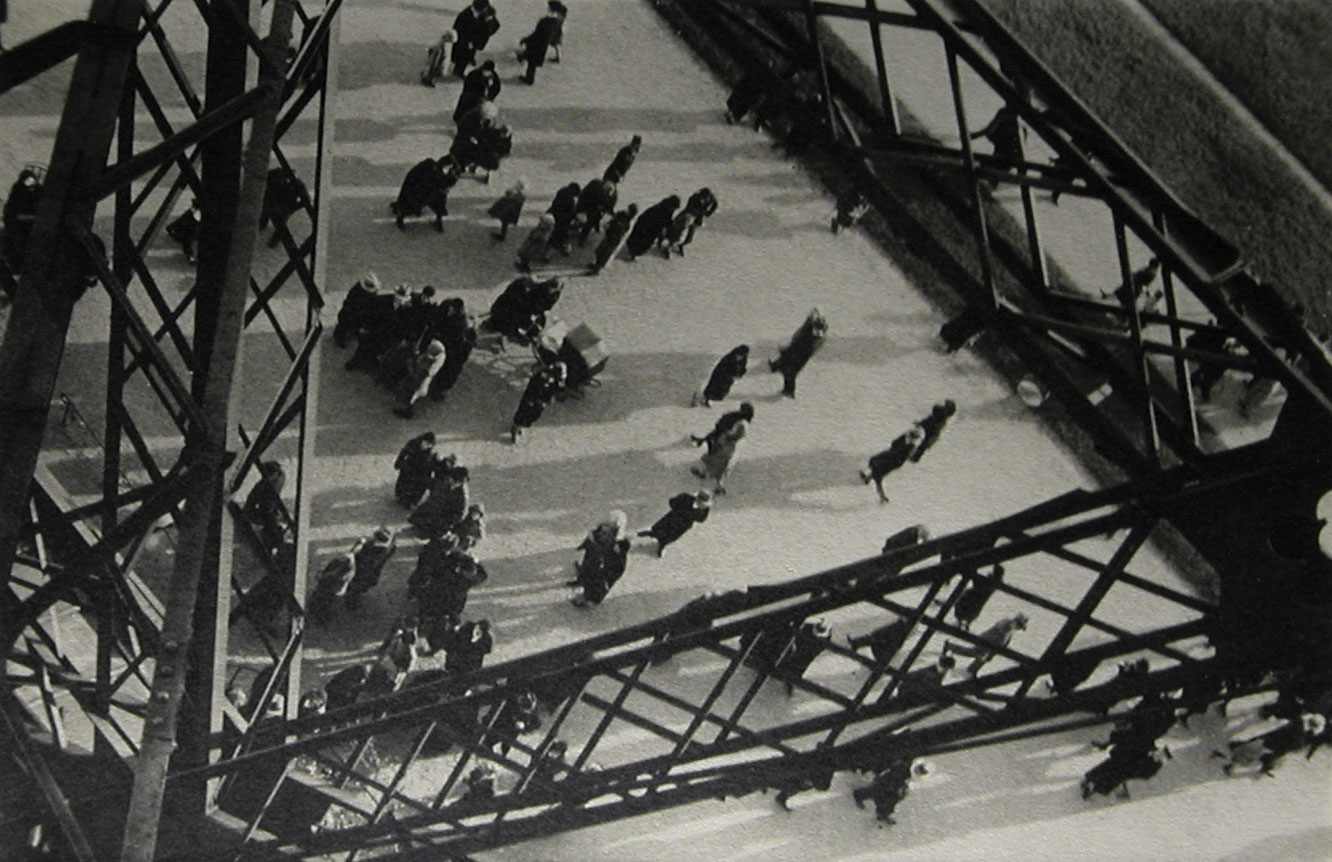
Ilse Bing (German, 1899-1998) 'Champ-de-Mars from the Eiffel Tower' 1931


Ilse Bing (German, 1899-1998)
Champ-de-Mars from the Eiffel Tower
1931
7 1/2 x 11 inches
Collection of Michael Mattis and Judith Hochberg
© Estate of Ilse Bing, Courtesy Edwynn Houk Gallery, New York


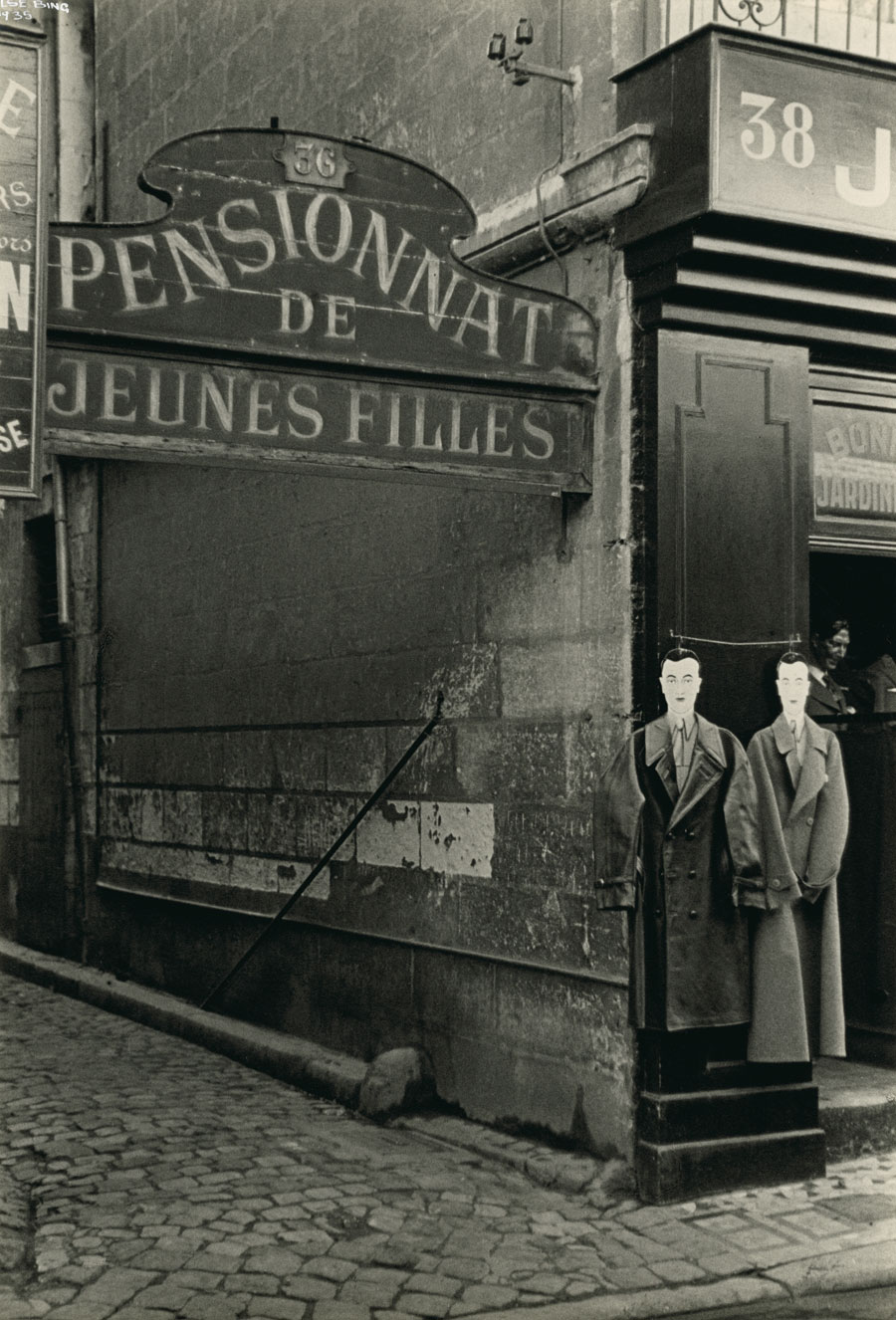
Ilse Bing (German, 1899-1998) 'Boarding House for Young Women, Tours' 1935


Ilse Bing (German, 1899-1998)
Boarding House for Young Women, Tours
1935
Gelatin silver print
11 1/8 × 7 1/2 in. (28.3 × 19.1cm)
Collection of Michael Mattis and Judith Hochberg
© Estate of Ilse Bing. Courtesy Edwynn Houk Gallery, New York


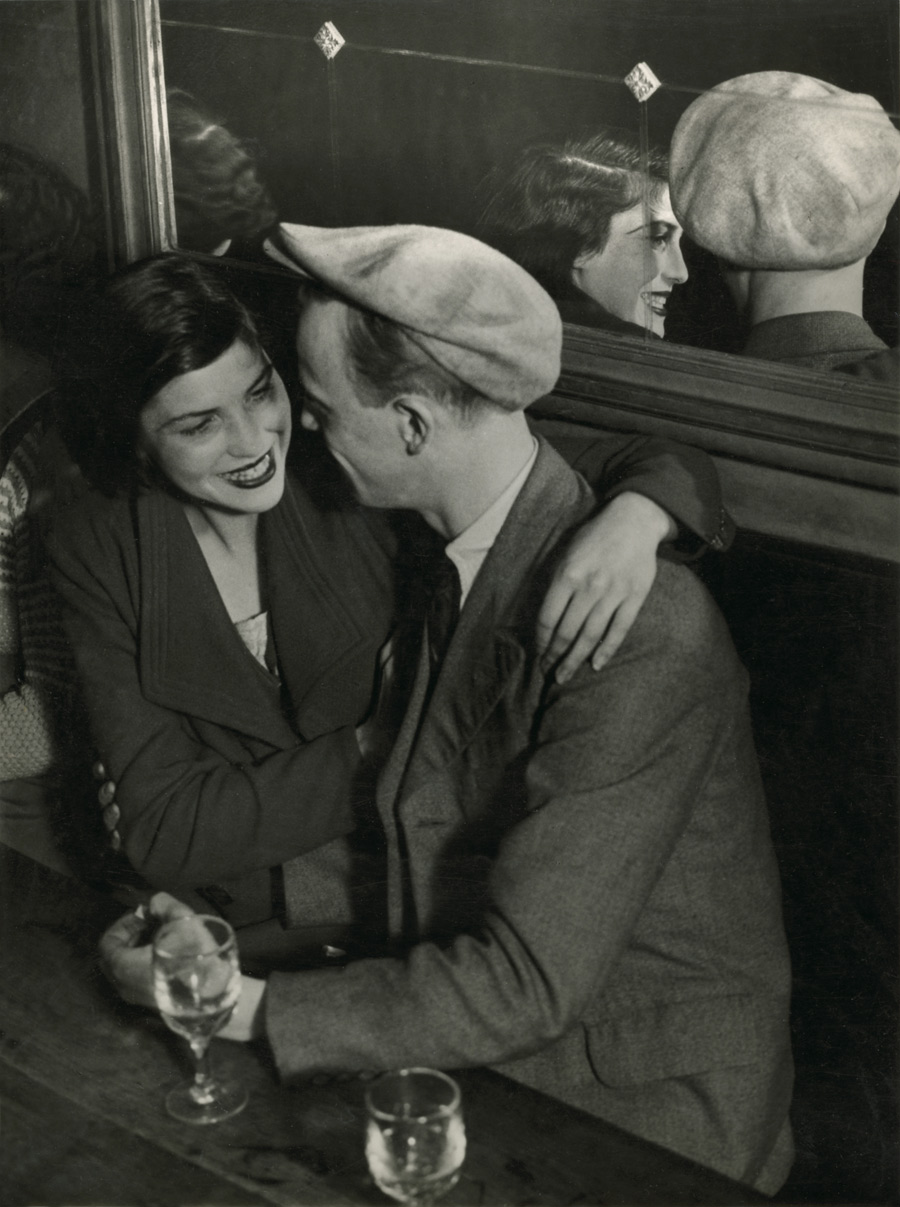
Ilse Bing (German, 1899-1998) 'Lovers, Bal Musette des Quatre Saisons, rue de Lappe' c. 1932


Brassaï (French, 1899-1984)
Lovers, Bal Musette des Quatre Saisons, rue de Lappe
c. 1932
9 3/8 x 7 inches
Collection of Michael Mattis and Judith Hochberg
© The Brassaï Estate-RMN


In the early 20th century, between the two world wars, Paris saw a fervour of change. From 1910 to 1940, the city became a creative epicentre for artistic exploration, attracting international avant-garde artists – including photographers experimenting with Surrealism, Modernism, and the new reportage. French Twist: Masterworks of Photography from Atget to Man Ray, on view at the Delaware Art Museum from June 29, 2013 through September 15, 2013, features 100 vintage prints from this golden age of French photography and explores the variety and inventiveness of native and immigrant photographers working in France in the early 20th century.

This exhibition presents a number of themes that capture the flavour and nightlife of Paris at this exciting moment. “Life of the Streets,” “Diversions,” and “Paris by Night” are just some of the topics that these masterful photographs explore. Visitors will experience Eugène Atget’s lyrical views of Paris streets and gardens, Man Ray’s surrealist experiments, and Henri Cartier-Bresson’s pioneering photojournalism, as well as works by Ilse Bing, Brassaï, Jacques-Henri Lartigue, André Kertész, and Dora Maar. Many of these artists settled in France for life, while others, fleeing the Nazis, brought their Paris‐trained sensibilities and influences to America.

Eugène Atget

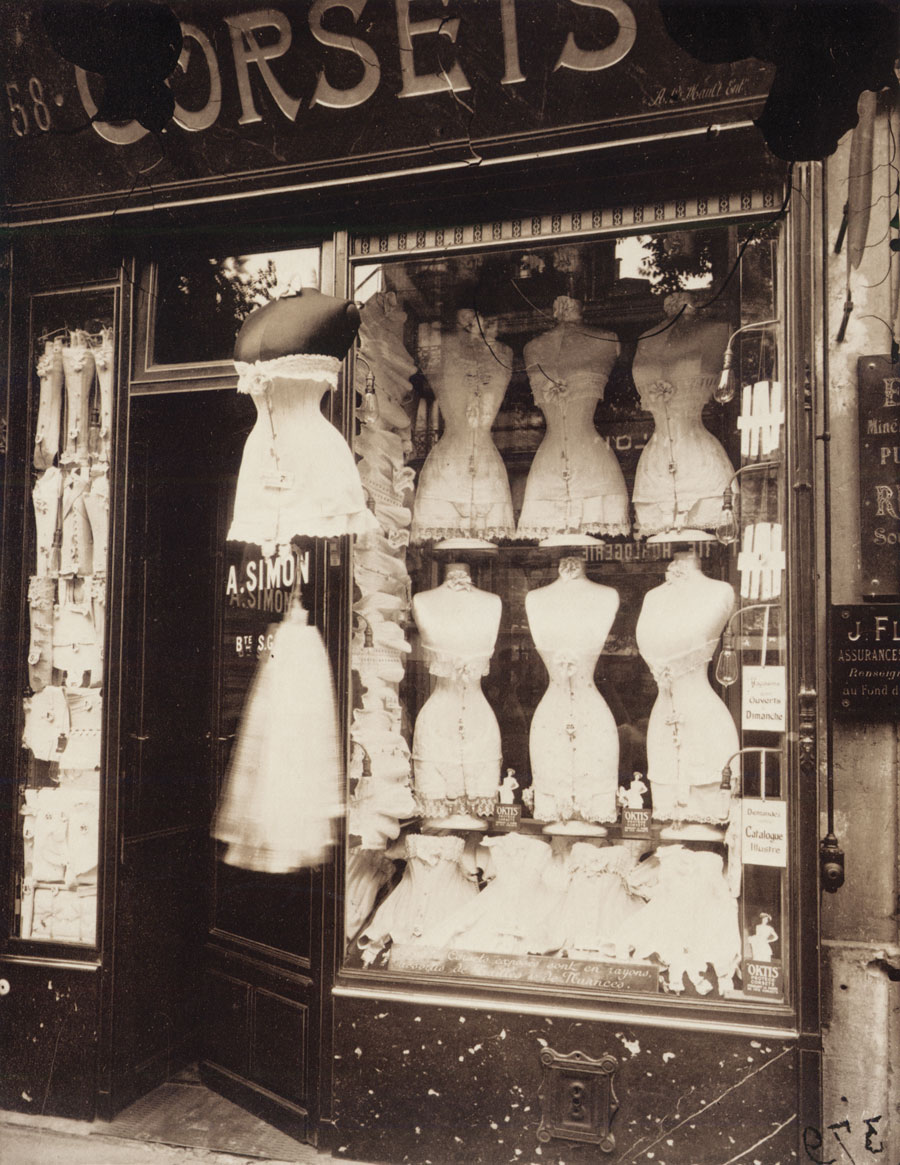
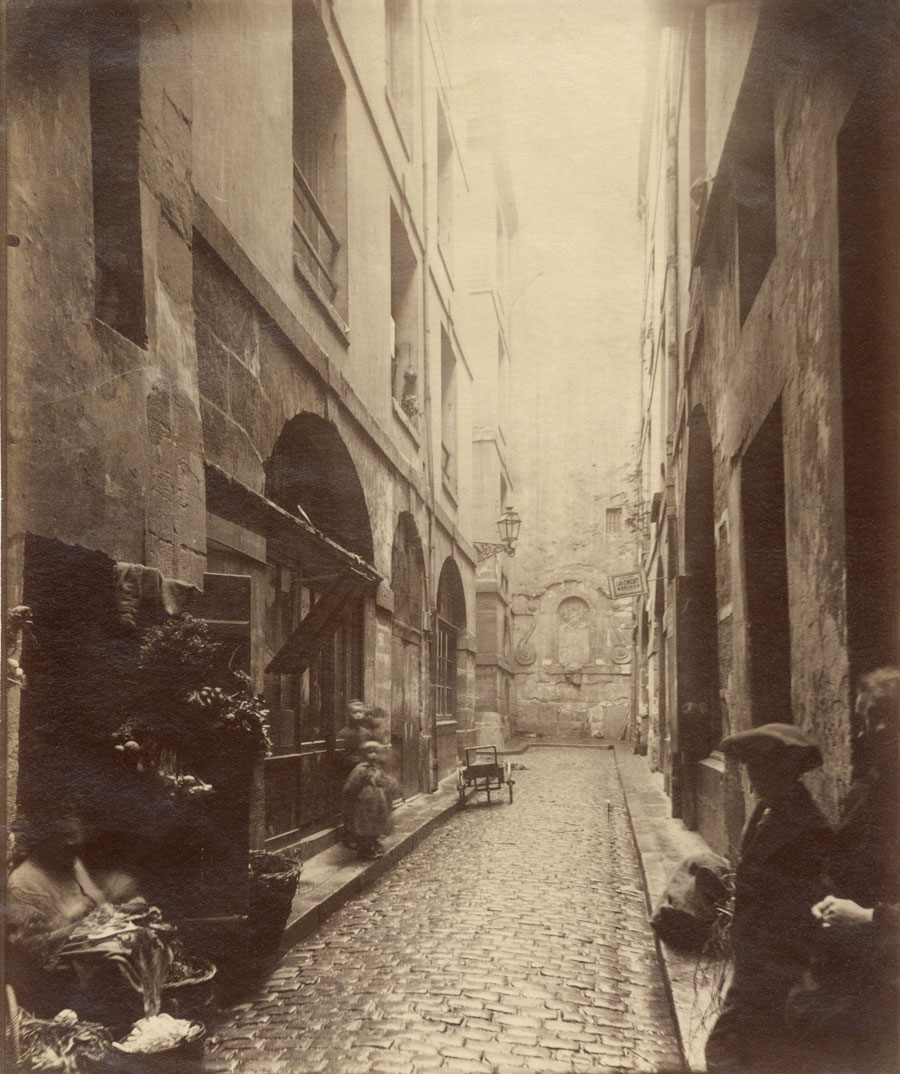
The exhibition opens with one of the most significant figures in the history of photography, Eugène Atget, whose work influenced a range of artists from Surrealists to documentary photographers. This selection encompasses pictures of city streets, architectural details, and the gardens at Versailles and includes one of his most famous photographs, Boulevard de Strasbourg, Corsets (1912).

La vie de la rue (Life of the Street)

This section includes images of the streets and buildings of Paris – of the bustling Champ-de-Mars and the deserted Avenue du Maine – and features a large selection of photographs by Ilse Bing. In her modernist views of urban architecture, Bing provides a modern take on the old city through unexpected angles and dramatic cropping.

Divertissement (Diversions)

Divertissement focuses on the myriad amusements available in the City of Lights. Lartigue provides an insider’s view of upper-class life in the Belle Epoque, while Bing and Brassaï chronicle the attractions of the dance hall, the theatre, and the street.

Henri Cartier-Bresson

The master of the “decisive moment” and one of the most significant photojournalists of the 20th century, Henri Cartier-Bresson is featured along with 17 famous photographs from his travels around the world. This section includes his stellar images of the Spanish Second Republic and his iconic view of the coronation of George VI in London.

Les basses classes (The Lower Classes)

Between the wars, photographers from Ilse Bing to Andre Kertész to Brassaï chronicled lives of poor Parisians, often bringing a Modernist sensibility, rather than a reformer’s eye, to scenes of urban poverty.

Paris de nuit (Paris by Night) 

In 1933 Brassaï released his photo book Paris by Night, which chronicled the city’s streets and amusements after dark. The book became an immediate success and Brassaï became famous as the foremost photographer of the city’s bars and brothels, performers, and prostitutes.

L’art pour l’art (Art for Art’s Sake)

This section focuses on the technical experimentation and virtuoso technique of photographers including Pierre Dubreuil, Edward Steichen, and Pal Funk Angelo. It features examples of unusual techniques like cliché-verre, solarisation, and oil printing.

Cliché verre is a combination of art and photography. In brief, it is a method of either etching, painting or drawing on a transparent surface, such as glass, thin paper or film and printing the resulting image on a light sensitive paper in a photographic darkroom. It is a process first practiced by a number of French painters during the early 19th century. The French landscape painter Jean-Baptiste-Camille Corot was the best known of these. Some contemporary artists have developed techniques for achieving a variety of line, tone, texture and colour by experimenting with film, frosted Mylar, paint and inks and a wide assortment of tools for painting, etching, scratching, rubbing and daubing.

Cliché verre is French. Cliché is a printing term: a printing plate cast from movable type; while verre means glass. (Text from Wikipedia)

Andre Kertész, Dora Maar, Man Ray

These three important photographers – all immigrants to Paris between the Wars and all involved in Surrealist movement – are featured in individual sections that highlight their most famous works. Kertész is represented by his photographs of the painter Piet Mondrian’s studio. Maar’s Surrealist street photographs capture her dark humor, and a full complement of Man Ray’s experimental and psychologically charged images summarize his photographic interests.

La figure (Portraits and Nudes)

La Figure showcases experimental approaches to the classic subject of the female nude, including a cameraless photograph and a solarisation by Man Ray and a distortion created with fun-house-type mirrors by Kertész.

Ilse Bing (German, 1899-1998), nicknamed the “Queen of the Leica” after her camera of choice, moved to Paris in 1930 and immersed herself in its cultural milieu, interacting with painters like Pavel Tchelitchev and fashionistas Elsa Schiaparelli and Carmel Snow. The decade she spent in France is considered the high point of her artistic career.

Dora Maar (French, 1907-1997) created startlingly imaginative Surrealist photographs under the tutelage of Man Ray. However, she is best known as Picasso’s lover, muse, and “Weeping Woman” from 1936 to 1943. Her photographs documenting Picasso’s creation of Guernica hang alongside the painting in the Reina Sofía museum in Madrid.

JacquesHenri Lartigue (French, 1894-1986), considered by many to be a child prodigy, received his first camera as a gift when he was six years old and immediately set to work documenting the activities of his energetic family and circle of friends. Lartigue’s light‐hearted snapshots capture the essence of France’s Belle Époque, the halcyon period before World War I when it seemed that modernity would bring nothing but progress and delight.


Eugène Atget (French, 1857-1927) 'Boulevard de Strasbourg Corsets' 1912


Eugène Atget (French, 1857-1927)
Boulevard de Strasbourg Corsets
1912
Printing-out paper
8 3/4 x 7 inches
Collection of Michael Mattis and Judith Hochberg


Eugène Atget (French, 1857-1927) 'Rue Egynard' 1901


Eugène Atget (French, 1857-1927)
Rue Egynard
1901
Albumen print
8 1/4 × 7 in. (21 × 17.8cm)
Collection of Michael Mattis and Judith Hochberg


Man Ray (American, 1890-1976) 'Solarized nude' 1930


Man Ray (American, 1890-1976)
Solarized nude
1930
11 5/8 x 8 7/8 inches
Collection of Michael Mattis and Judith Hochberg
© 2013 Man Ray Trust / Artists Rights Society (ARS), NY / ADAGP, Paris


Edward Steichen (American, 1879-1973) 'Three Pears and an Apple, Voulangis, France' 1921


Edward Steichen (American, 1879-1973)
Three Pears and an Apple, Voulangis, France
1921
Gelatin silver print
14 x 11 inches
Collection of Michael Mattis and Judith Hochberg


Man Ray (American, 1890-1976) 'Kiki de Montparnasse' 1923


Man Ray (American, 1890-1976)
Kiki de Montparnasse
1923
11 x 8 3/4 inches
Collection of Michael Mattis and Judith Hochberg
© 2013 Man Ray Trust / Artists Rights Society (ARS), NY / ADAGP, Paris


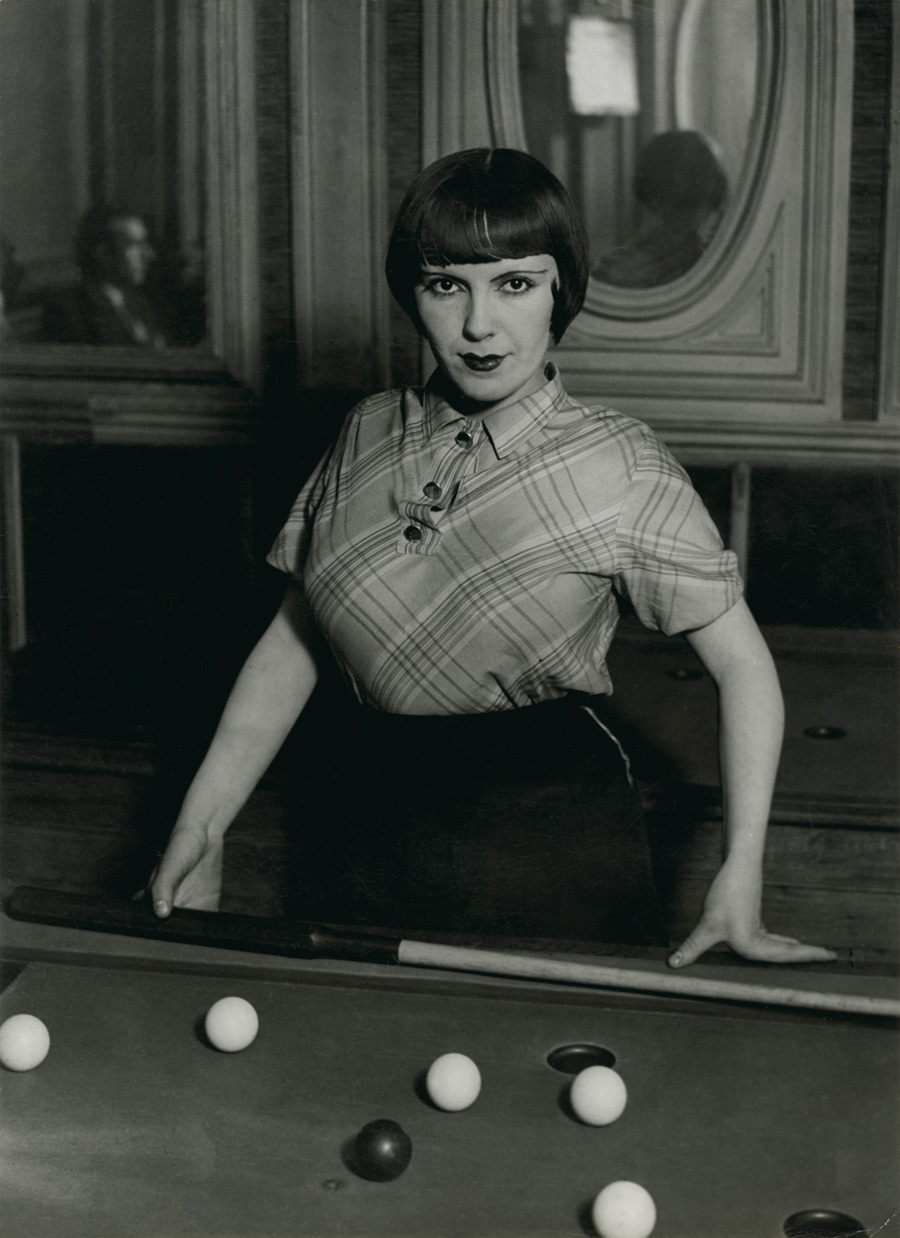
Brassaï (French, 1899-1984) 'Fille de Montmartre playing Russian billiards, Blvd Rochechouart' 1932-33


Brassaï (French, 1899-1984)
Fille de Montmartre playing Russian billiards, Blvd Rochechouart
1932-1933
11 1/4 x 8 1/4 inches
Collection of Michael Mattis and Judith Hochberg
© The Brassaï Estate-RMN


Delaware Art Museum
2301 Kentmere Parkway
Wilmington, DE 19806

Opening hours:
Wednesday – Sunday 10am – 4pm
Closed Monday and Tuesday

Delaware Art Museum website

LIKE ART BLART ON FACBEOOK

Back to top

Exhibition: ‘Sensuous Steel: Art Deco Automobiles’ at The Frist Center for the Visual Arts, Nashville, TN

Exhibition dates: 14th June – 15th September 2013
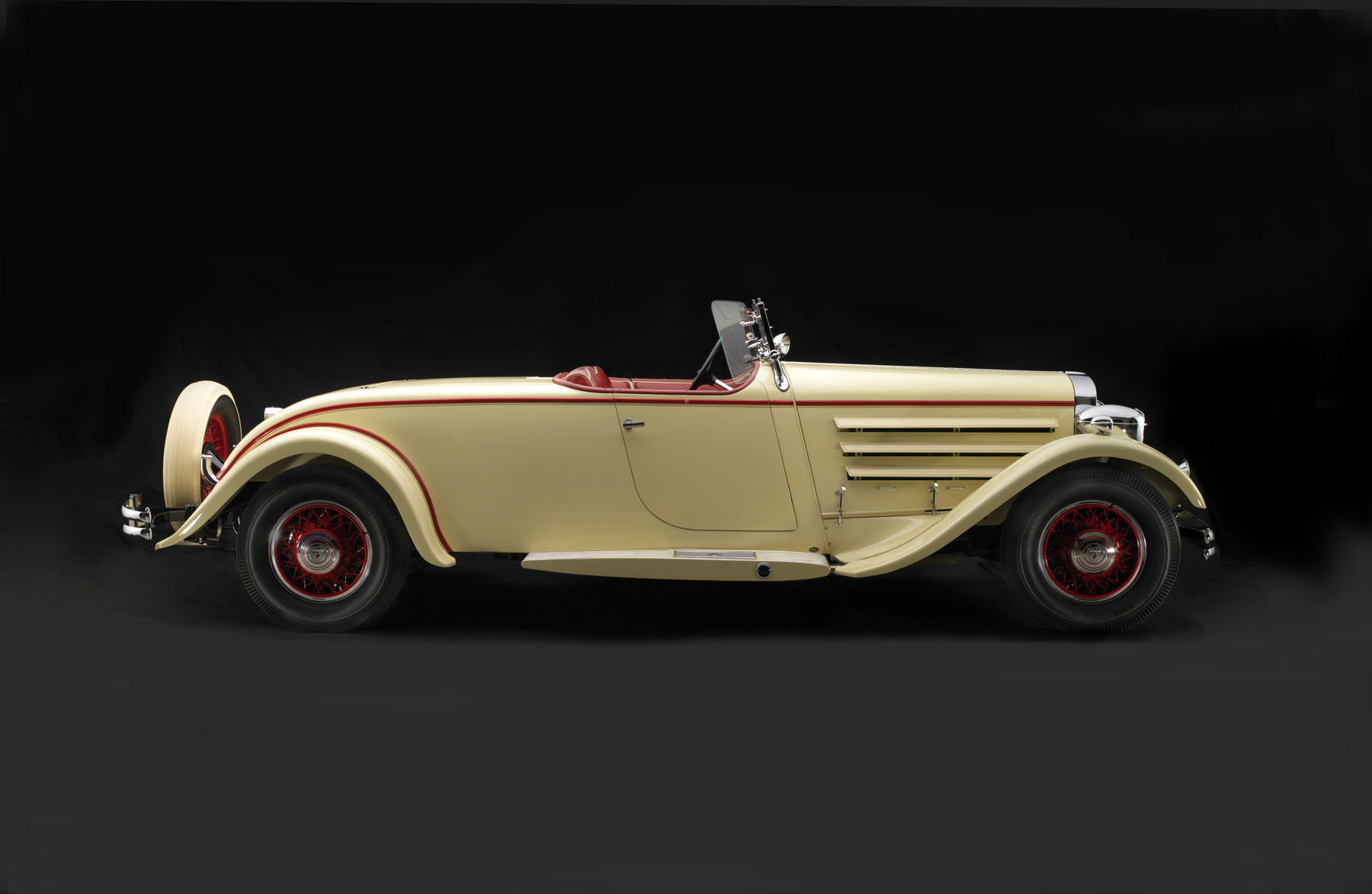
 

'Jordan Model Z Speedway Ace Roadster' 1930


Jordan Model Z Speedway Ace Roadster
1930
Collection of Edmund J. Stecker Family Trust
Photograph © 2013 Peter Harholdt


OMG, OMG, OMG a bumper posting of car porn!

Some of these are just ravishing (my favourite is the Hispano-Suiza H6B Dubonnet “Xenia” Coupe, 1938) and the elegant, eloquent photography (including some wonderfully framed detail shots), highlights the sensuousness of these objects of desire. Also, notice the almost negligible rear view windows in most of the cars…

What happened to this kind of style detail in today’s cars?

Dr Marcus Bunyan


Many thankx to The Frist Center for the Visual Arts for allowing me to publish the photographs in the posting. Please click on the photographs for a larger version of the image.


'Bugatti Type 46 Semi-profile Coupe' 1930


Bugatti Type 46 Semi-profile Coupe
1930
Collection of Merle and Peter Mullin
Photograph © 2013 Peter Harholdt


Ettore Bugatti lived on a baronial estate in Alsace-Lorraine in eastern France. His father Carlo created elegant, Art Deco style furniture. His younger brother Rembrandt was an accomplished sculptor of animals. Although he was trained as an apprentice engineer, Ettore possessed the dreamy soul of an artist. From 1911 to 1939, he built hand-crafted automobiles of sporting competence, which, thanks to the styling talents of Ettore’s young son Jean, were also hauntingly beautiful.

Working with factory designer Joseph Walter, Jean Bugatti initially designed an Art Deco Superprofile coupe with rakish, valance-free fenders, a steeply canted windscreen, a roof with a perfect radius, and dramatic sweep panels. This has been called by Paul Kestler, author of Bugatti: Evolution of Style, “one of the landmarks in coach building history, made at the moment when classic lines were yielding to something more aerodynamic.” Only a few Superprofile coupes were built. One original survives in the Louwman Collection, Netherlands.

Inspired by the earlier Superprofile design, Walter and Bugatti’s Semi-profile coupes like the one in this exhibition had a more practical and equally attractive notchback rear treatment and twin exposed spare wheels. The chassis of this Bugatti Type 46 was made in 1929 and bodied in 1934 in Czechoslovakia by coach builder Oldřich Ulik. Originally a two-door sedan, it was re-bodied by Barry Price, with period-perfect coachwork in the exact style of Jean Bugatti’s Semi-profile coupe. The interior is elephant hide leather. In Bugatti circles, a magnificent re-creation like this one is welcomed, when it is done so beautifully.

valance-free fenders: this type of motor vehicle wheel covering did not make use of the then popular valance, a piece of metal added to the side of the fender that prevented splashing along the body
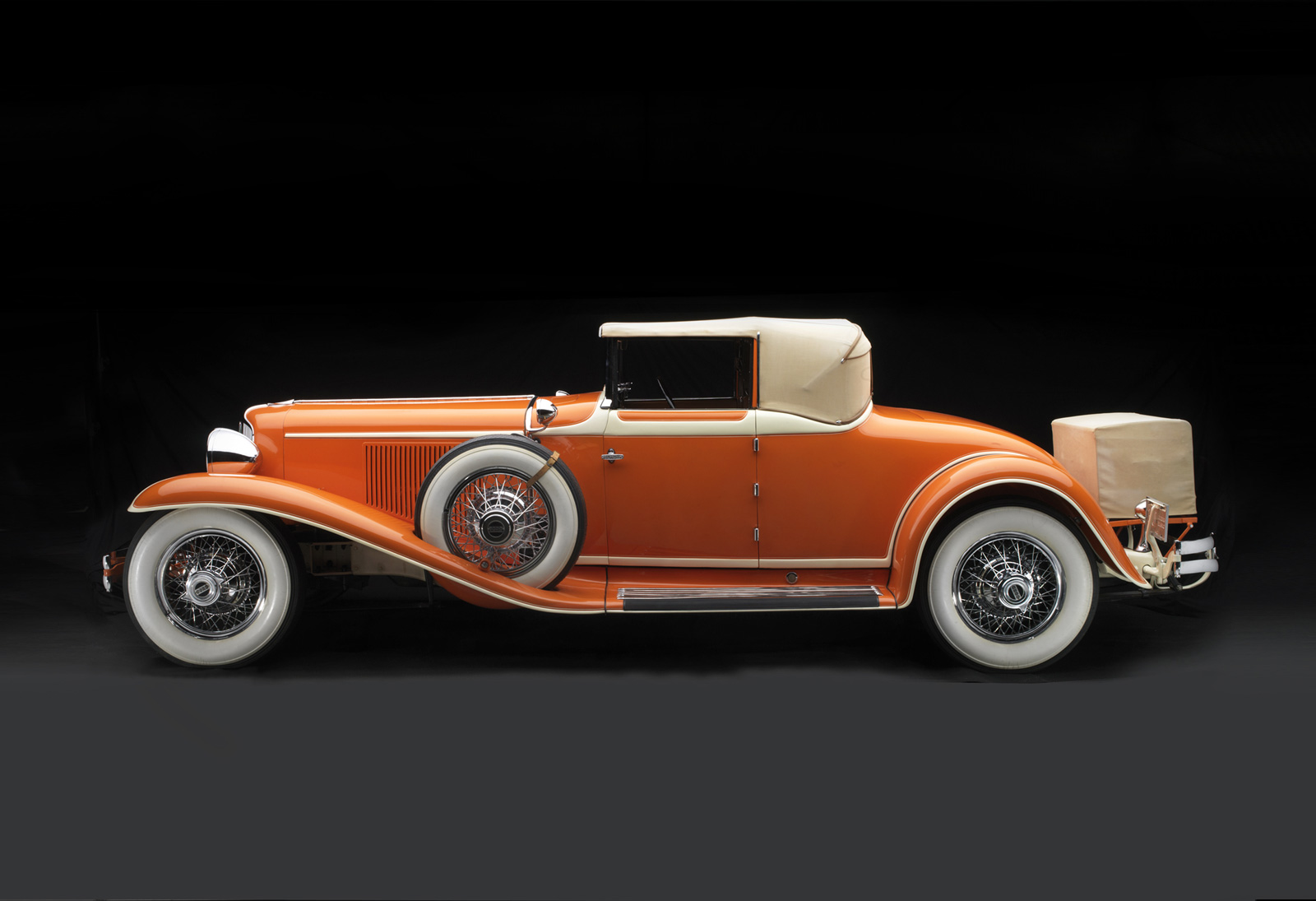
 

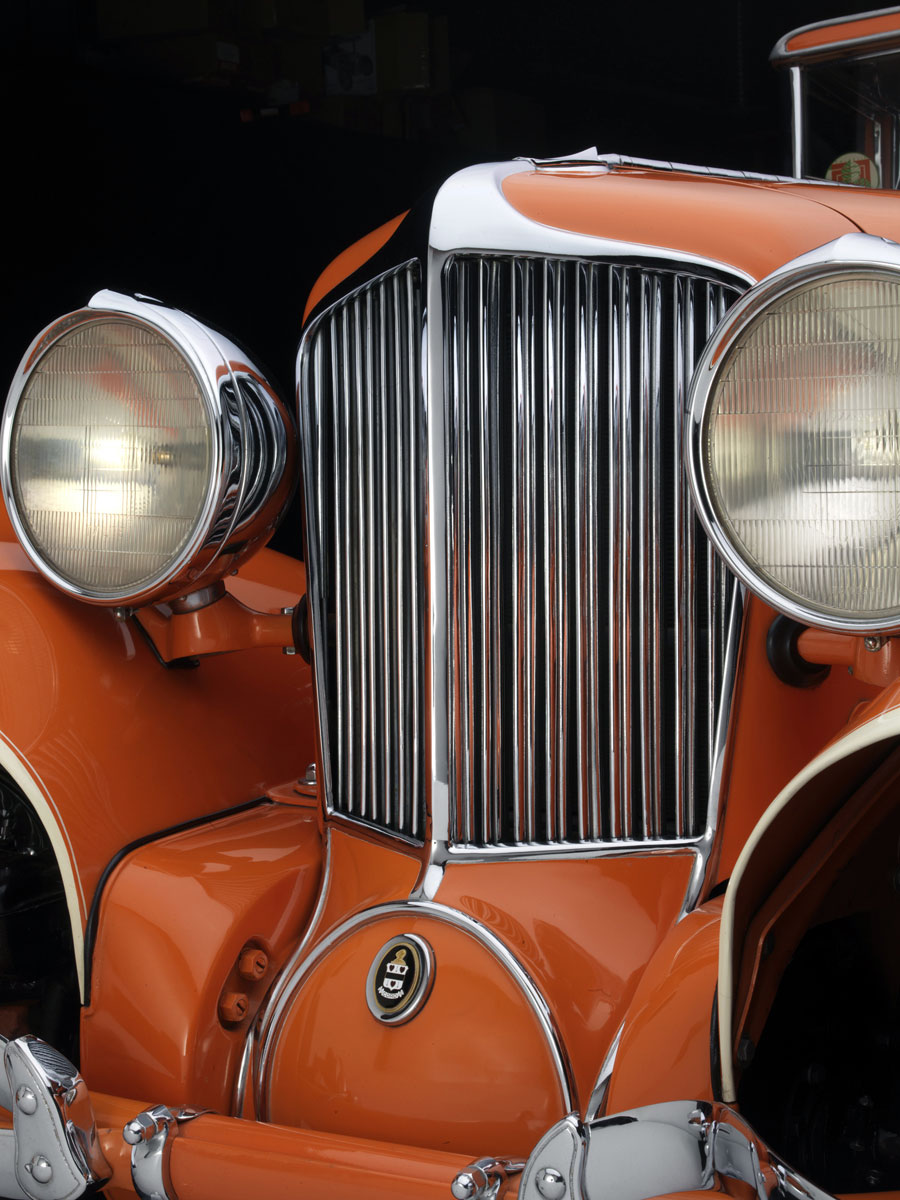
'Cord L-29 Cabriolet' 1929

'Cord L-29 Cabriolet' 1929

'Cord L-29 Cabriolet' 1929

'Cord L-29 Cabriolet' 1929


Cord L-29 Cabriolet
1929
Collection of Auburn Cord Duesenberg Automobile Museum
Photograph © 2013 Peter Harholdt


Errett Lobban Cord rose to national prominence after rescuing the Auburn Automobile Company of Auburn, Indiana, in 1928. Seeing an opportunity for a uniquely engineered luxury automotive brand, Cord encouraged Fred and August Duesenberg to build what he envisioned as America’s finest motorcar.

Noted race car constructor Harry A. Miller and his associates were retained by Cord to engineer a radical front-drive chassis. The innovative and luxurious L-29 Cord, unfortunately introduced just as the New York Stock Market crashed, combined its engine, transaxle, and clutch into one co-located assembly, eliminating a conventional driveshaft. This permitted a 10-inch lower chassis and necessitated a lengthy hood that appeared even longer because the designer, Al Leamy, surrounded the radiator with an integrated sheet-metal assembly, finished to match the car’s colour.

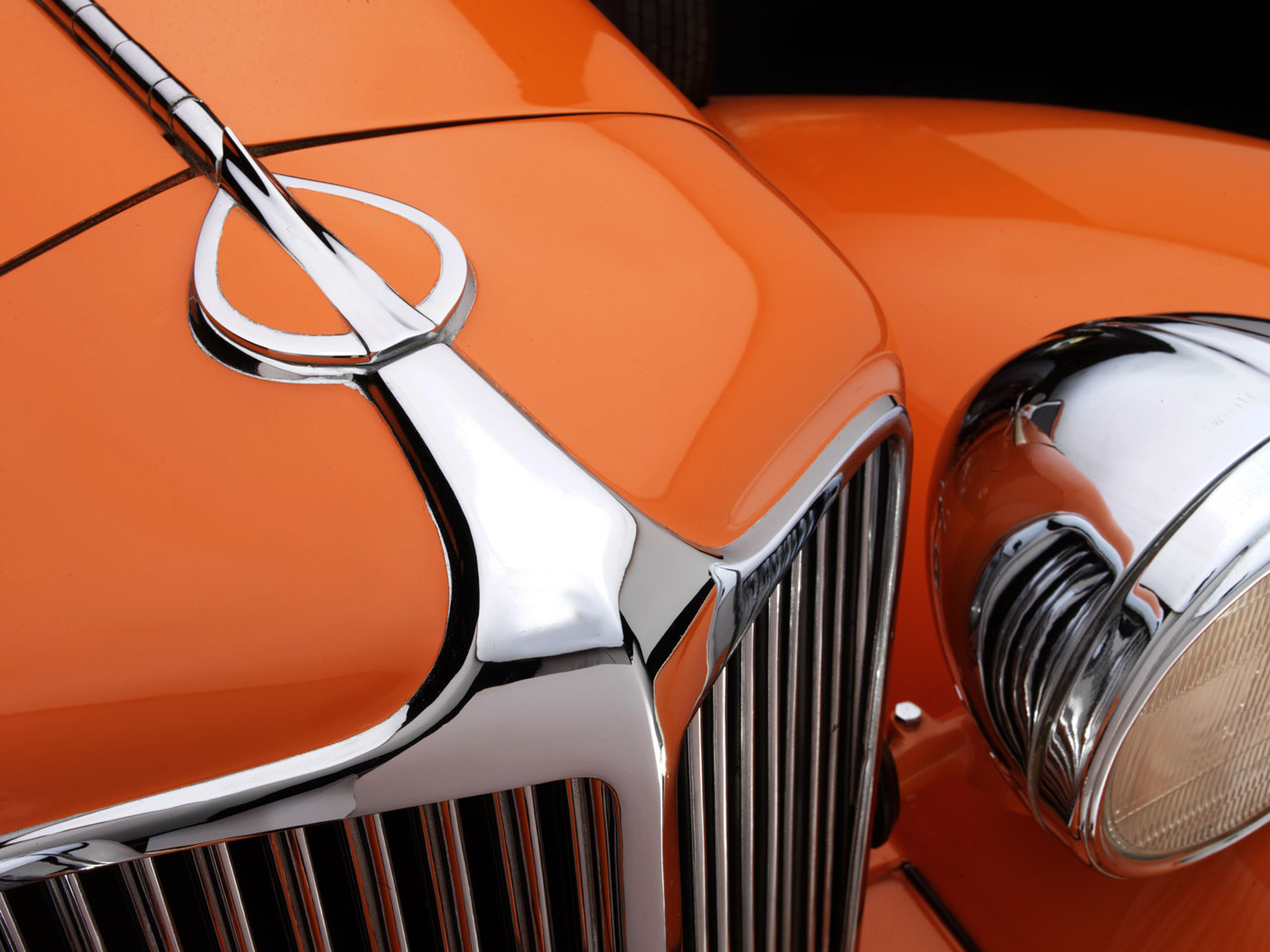
The lowslung Cord’s bodylines were exquisite. Features include an Art Deco styled transaxle cover, an elegant streamlined grille that evoked the styling of Harry Miller’s racing cars, sweeping clamshell fenders, sleek body side reveals which accentuated the car’s length, and a low roofline. These are embellished by myriad Art Deco styled details ranging from accented fender trim, tapered headlamp shapes, etched door-handle detailing and tiny, but exquisite instrument panel dials.

The L-29 Cord’s art moderne styling and engineering prowess attracted buyers of taste and style who were not afraid to try something different. Owners included the era’s most prominent and controversial architect, Frank Lloyd Wright, who bought a new L-29 Convertible Phaeton in 1929 and drove it for many years. This stunning cabriolet, was purchased in the 1950s by the Frank Lloyd Wright Foundation, Wright’s legal caretaker until his death in 1959. Wright had many of his cars painted in a bright hue called Taliesin orange. The finish of this Cord is a close approximation.
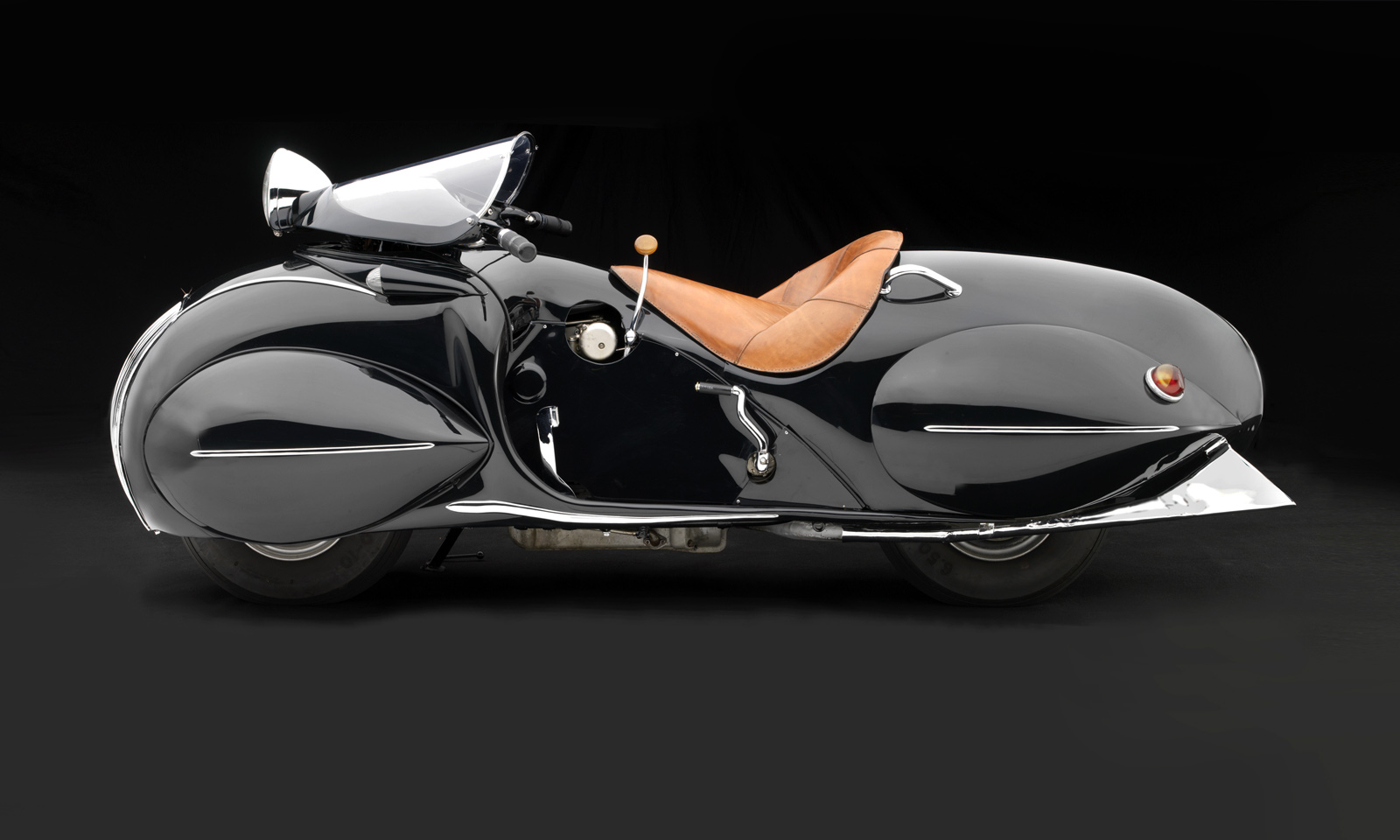
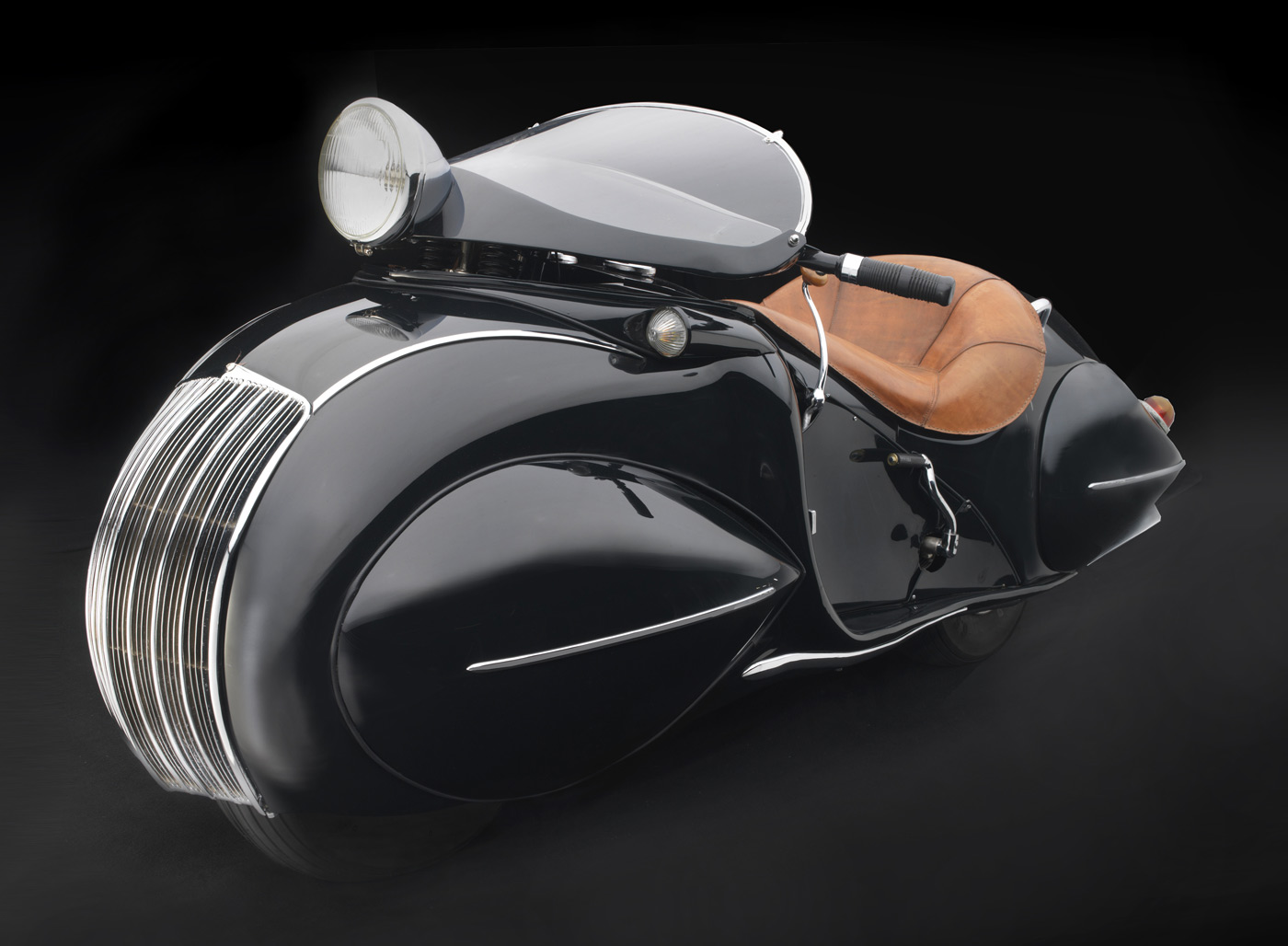
 

'Henderson KJ Streamline' 1930

'Henderson KJ Streamline' 1930

'Henderson KJ Streamline' 1930

'Henderson KJ Streamline' 1930


Henderson KJ Streamline
1930
Collection of Frank Westfall
Photograph © 2013 Peter Harholdt


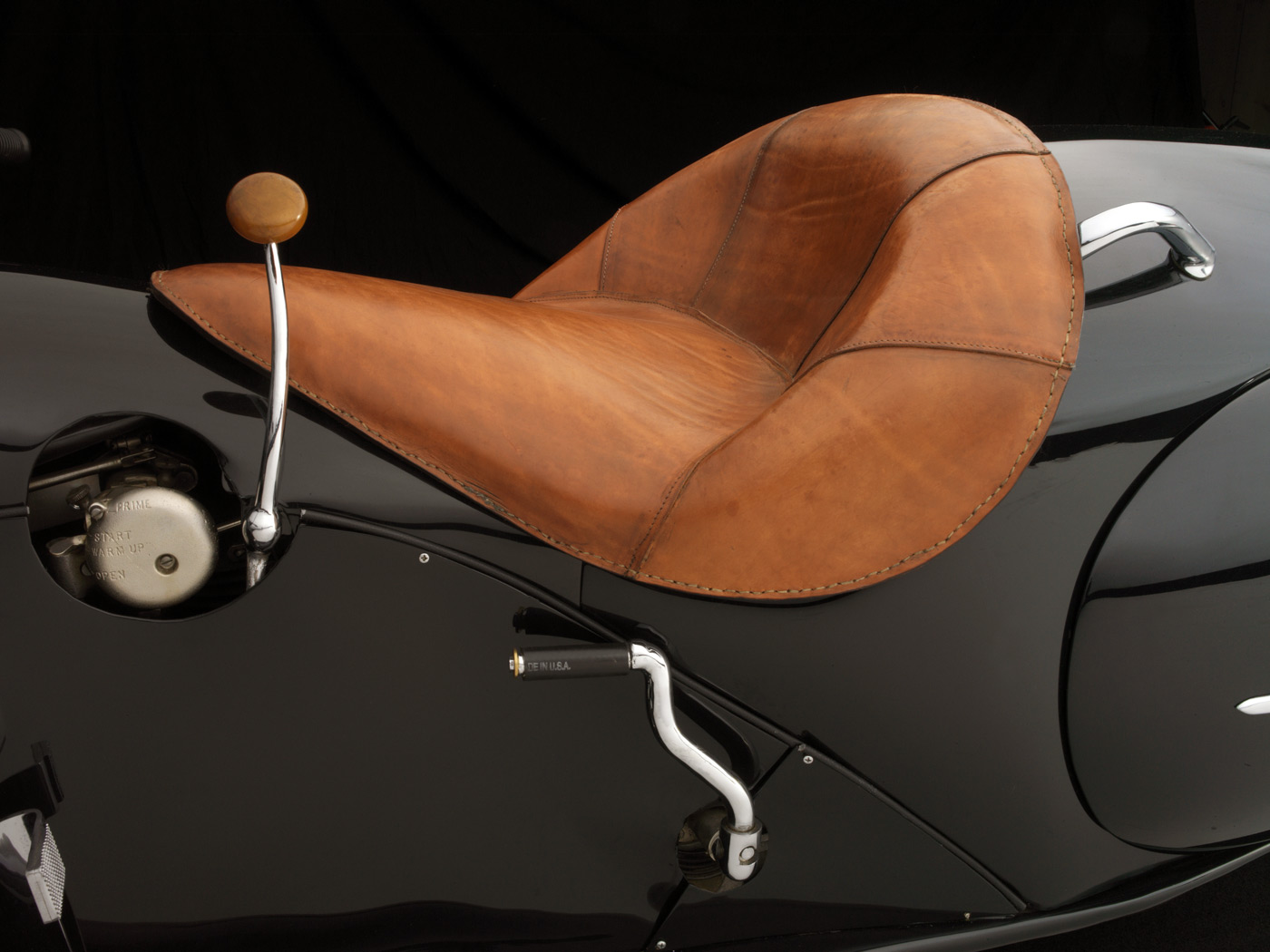
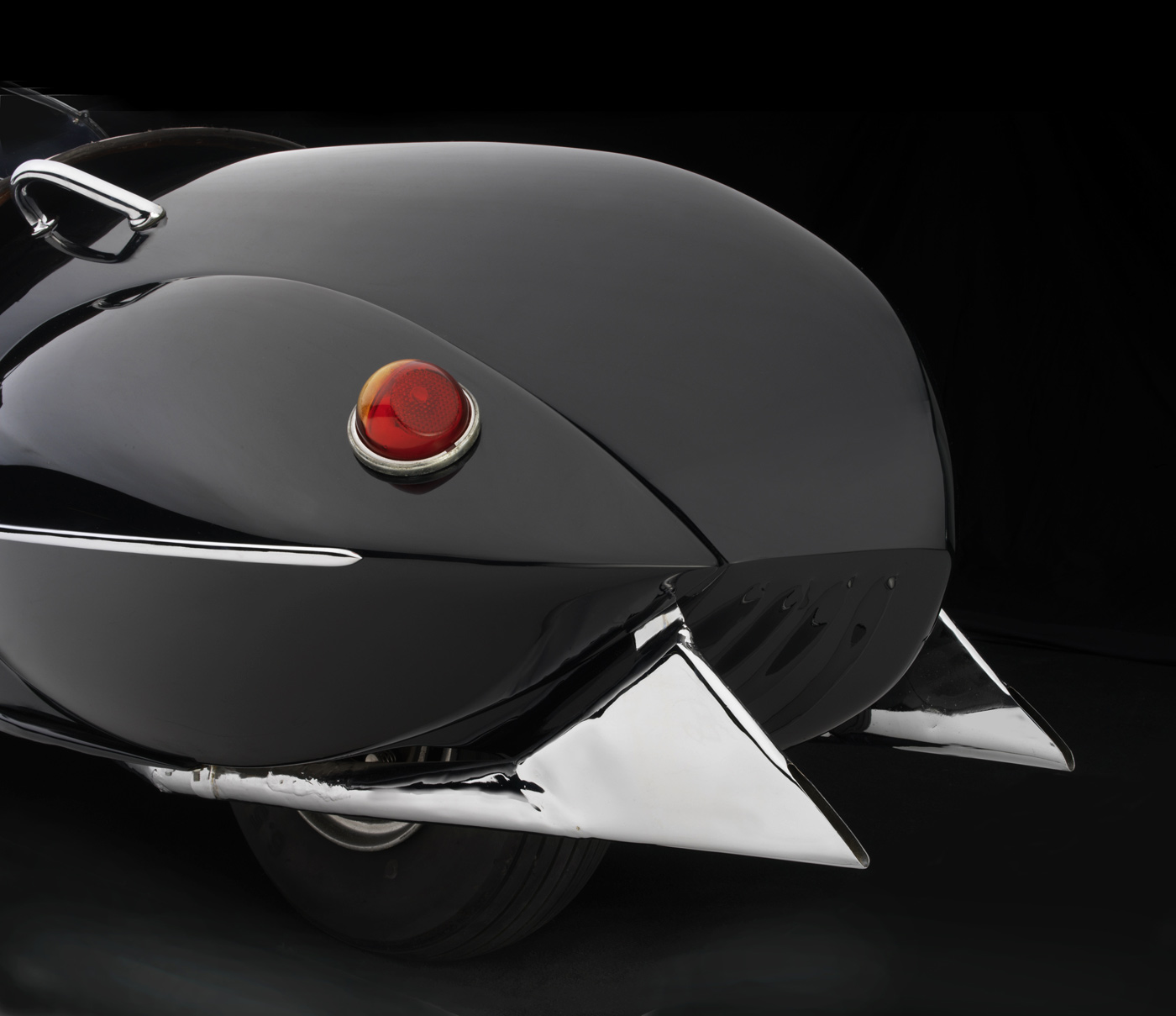
With its 1,200-cc, 40-brake horsepower, in-line four-cylinder engine, the 1930 Henderson Model KJ Streamline could exceed 100 mph. In an era when streamlining was used sparingly in motorcycle design, American Orley Ray Courtney’s enclosed bodywork was virtually unknown on production two-wheelers (except for a few racing machines), making the KJ an unusual and beautiful example of Art Deco design.

Courtney believed that the motorcycle industry failed to provide weather protection and luxury for its riders. His radically streamlined KJ body shell was unlike anything ever done on two wheels. The sleek vehicle had a curved, vertical-bar grille, reminiscent of the Chrysler Airflow, and the rear resembled an Auburn boat-tail speedster. The panels were hand-formed of steel with a power hammer.

Stunningly beautiful but impractical and hard to ride, the Streamline’s complex curved body was heavy and was difficult to make. In 1941, Courtney filed for a patent for a second motorcycle design with fully enclosed fenders. Perhaps he was influenced by the fact that the Indian Motocycle Company had introduced its partially skirted fenders in 1940, and that motorcyclists were becoming more accepting of this trend.*

* In 1923, Indian Motorcycle Company became Indian Motocycle Company and retained that name until the company closed in 1953.

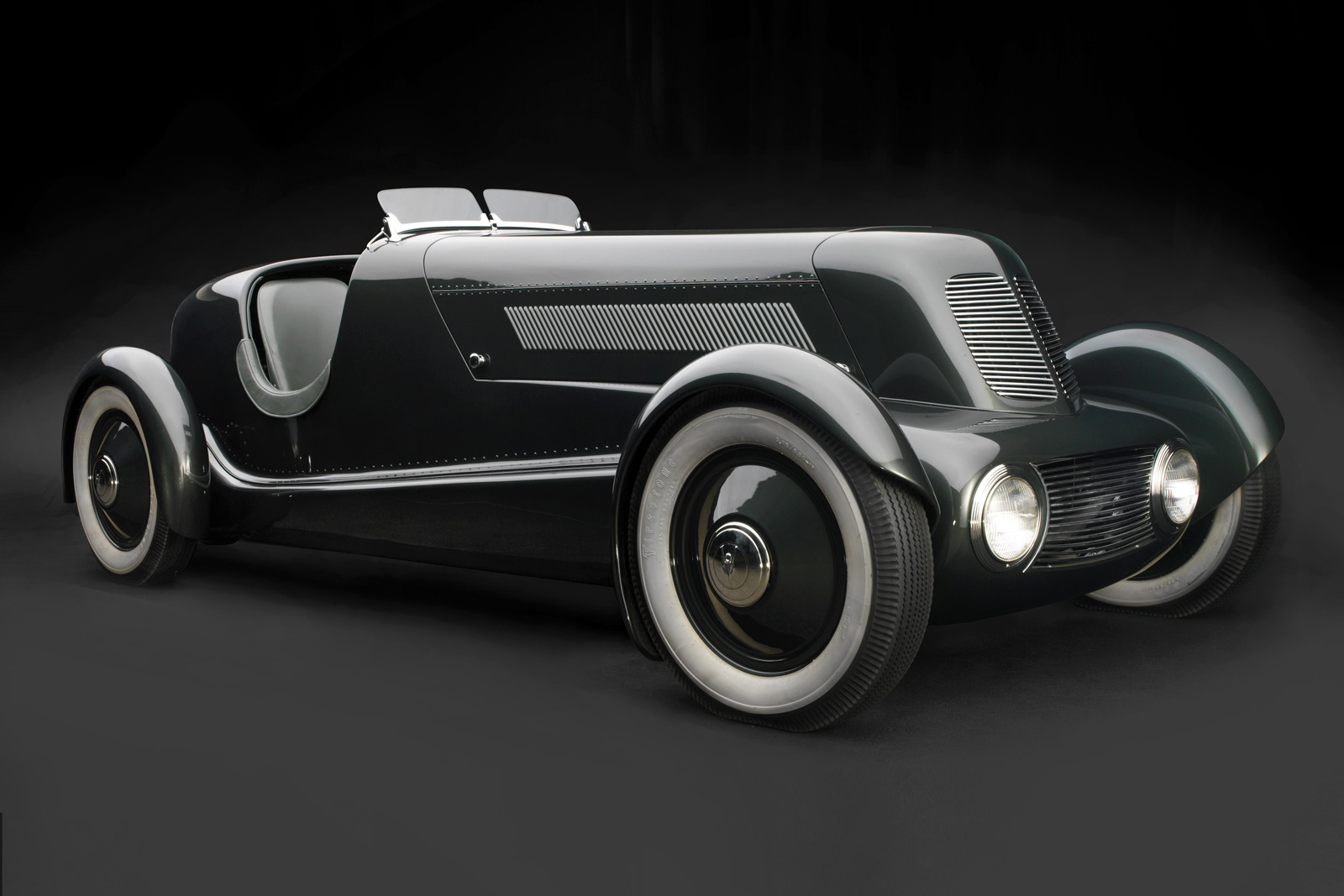
 

'Model 40 Special Speedster'™ 1934

'Model 40 Special Speedster'™ 1934

'Model 40 Special Speedster'™ 1934

'Model 40 Special Speedster'™ 1934


Model 40 Special Speedster
1934
Owned and restored by Edsel & Eleanor Ford House, Grosse Pointe Shores, Michigan
Photograph © 2013 Peter Harholdt


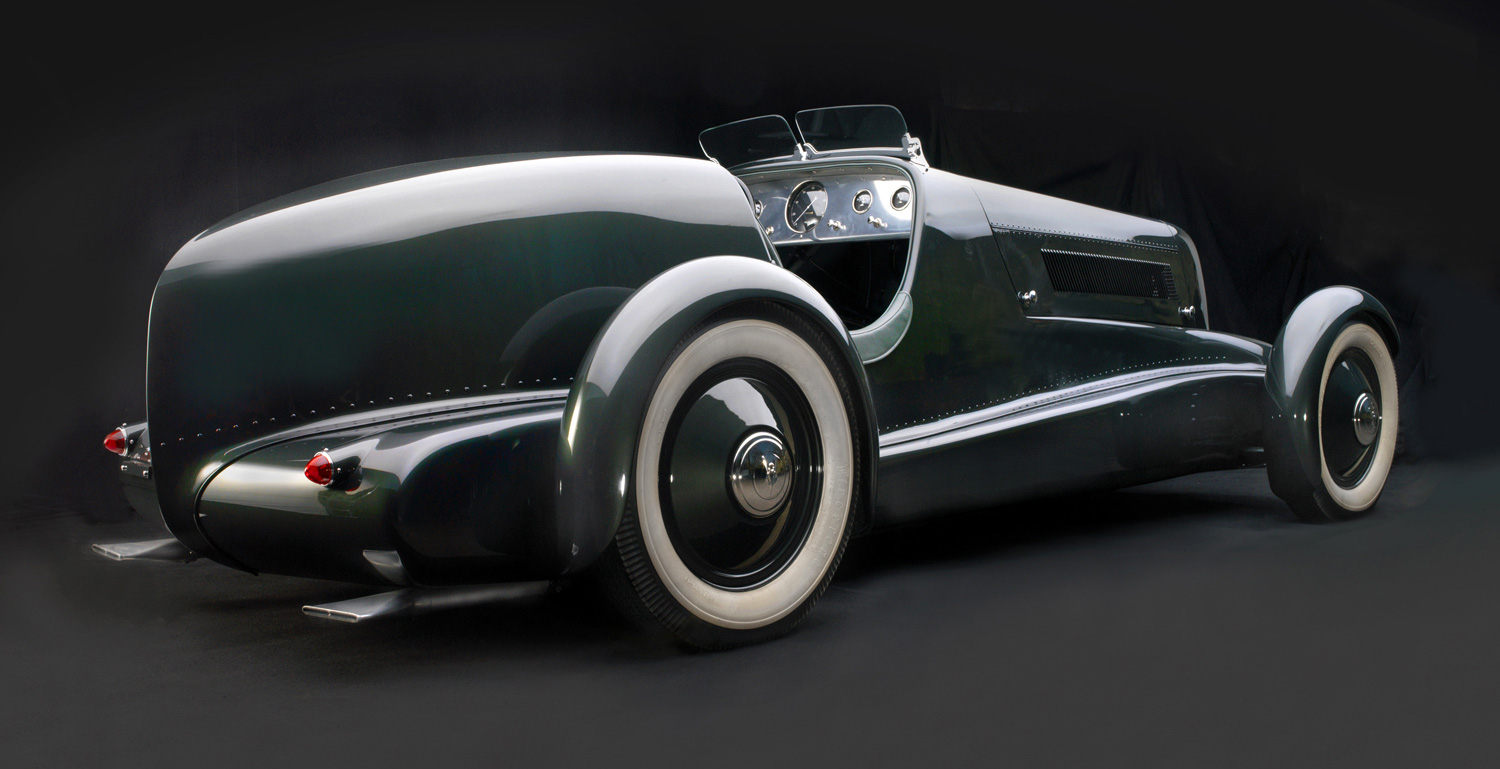
Edsel B. Ford, President of Ford Motor Company of Dearborn, Michigan, asked his styling chief, Eugene T. “Bob” Gregorie, to build a “continental” roadster that could have limited production potential. Gregorie sketched alternatives and then built a 1/25th scale model that he tested in a small wind tunnel. Because of its 1934 Ford (also known as Model 40) origins, the roadster became known as the Model 40 Special Speedster.

Assisted by Ford Aircraft personnel, Gregorie’s team fabricated a taper-tailed aluminium body, mounted over a custom welded tubular structural framework. This car resembles the 1935 Miller-Ford Indianapolis 500 two-man race cars, but it was designed and built prior to their construction. This car’s long, low proportions were unlike anything Ford Motor Company had ever built. The Speedster weighs about 2,100 pounds. Its engine is now a 100-brake horsepower Mercury flathead V-8.

This Model 40 was one of Edsel Ford’s personal vehicles. After his death in 1943, the Speedster passed through several owners. Bill Warner, founder of Florida’s Amelia Island Concours d’Elegance, read an article that mentioned that the Model 40 Special Speedster was owned by a fellow Floridian. Warner tracked the Speedster down, bought it, and later sold it to Texas mega-collector John O’Quinn. After O’Quinn died in 2009, Edsel Ford II arranged for the speedster’s purchase. In August 2010, this car was restored by RM Restorations, Blenheim, Ontario, Canada.


Sensuous Steel: Art Deco Automobiles is an exhibition of Art Deco automobiles from some of the most renowned car collections in the United States. Inspired by the Frist Center’s historic Art Deco building, this exhibition features spectacular automobiles and motorcycles from the 1930s and ’40s that exemplify the classic elegance, luxurious materials, and iconography of motion that characterises vehicles influenced by the Art Deco style.

Fascination with automobiles transcends age, gender, and environment.  While today automotive manufacturers often strive for economy and efficiency, there was a time when elegance reigned.  Influenced by the Art Deco movement that began in Paris in the early 1920s and propelled to prominence with the success of the International Exposition of Modern Decorative and Industrial Arts in 1925, automakers embraced the sleek new streamlined forms and aircraft-inspired materials, creating memorable automobiles that still thrill all who see them. The exhibition features 18 automobiles and two motorcycles from some of the most important collectors and collections in the United States.

While today automotive manufacturers often strive for economy and efficiency, there was a time when elegance reigned.  Like the Frist Center’s historic building, the automobiles included in Sensuous Steel display the classic grace and modern luxury of Art Deco design. An eclectic, machine-inspired decorative style that thrived between the two World Wars, Art Deco combined craft motifs with industrial materials and lavish embellishments. The movement began in Paris in the early 1920s and was propelled to prominence in with the success of the International Exhibition of Modern Decorative and Industrial Arts in 1925. Automakers embraced the sleek iconography of motion and aircraft-inspired materials connotative of Art Deco, creating memorable automobiles that still thrill all who see them.

“Sensuous Steel is the first major museum auto exhibition devoted entirely to Art Deco automobiles, and there could be no more fitting a venue than the Frist Center’s landmark historic Art Deco building, which was completed in 1934,” notes Frist Center Executive Director Dr. Susan H. Edwards. “Art Deco styling influenced everything from architecture to sleek passenger trains and luxury liners, furniture, appliances, jewellery, objets d’art, signage, fashionable clothing and, of course, automobiles. The works in this exhibition convey the breadth, diversity, and stunning artistry of cars designed in the Art Deco style.”

“Rapidly changing and ever-evolving, the automobile became the perfect metal canvas upon which industrial designers expressed the vital spirit of the interwar period,” explains Guest Curator Ken Gross. “To give the illusion of dramatic movement and forward thrust, cars of the 1930s and ’40s merged gentle curves with angular edges. These automobiles were made from the finest materials and sported beautifully crafted ornamentation, geometric grillwork, and the elegant miniature statuary of hood ornaments. The classic cars of the Art Deco age remain today as among the most visually exciting, iconic and refined designs of the twentieth century.”

Press release from The Frist Center for the Visual Arts website


'Voisin Type C27 Aérosport Coupe' 1934


Voisin Type C27 Aérosport Coupe
1934
Collection of Merle and Peter Mullin
Photograph © 2013 Peter Harholdt


Pioneer French aeronautical expert Gabriel Voisin was an eccentric visionary whose aircraft greatly benefited his country during World War I. He later became an automobile manufacturer, achieving, in the words of designer Robert Cumberford, “sometimes… amazing results.”

Voisin’s chief designer, André “Noël-Noël” Telmont, who was trained as an architect, based the style of this Type C27 Aérosport after the earlier Voisin Aérodyne’s radical new look. Telmont was inspired by aviation and architecture, whereas other French coach builders such as Joseph Figoni turned to the female form and imitated its soft curves. Gabriel Voisin unveiled the Aérosport at the 1935 Madrid Auto Salon. With the Aérosport, Telmont presented wonderfully balanced Art Deco coachwork that featured new, modern, and aerodynamic themes. The Aérosport’s profile outlined the cross-section of an imaginary wing. The semi-circular roof line traced the contours of a cockpit, and the larger surfaces simulated a fuselage.

A lack of funds meant the factory was unable to fully develop this model. Telmont sold the car to Moïse Kisling, a leading European artist. After a front-end crash, the coupe was kept in a disassembled state at the Saliot garage near Paris for years. With the information provided by period photos of the Type C27, this renovated body was built in France to match the original in every detail. The car has its original chassis, a correct Voisin engine and transmission parts, and accessories from one of the two original Type C27s.


'Packard Twelve Model 1106 Sport Coupe by LeBaron' 1934


Packard Twelve Model 1106 Sport Coupe by LeBaron
1934
Collection of Robert and Sandra Bahre
Photograph © 2013 Peter Harholdt


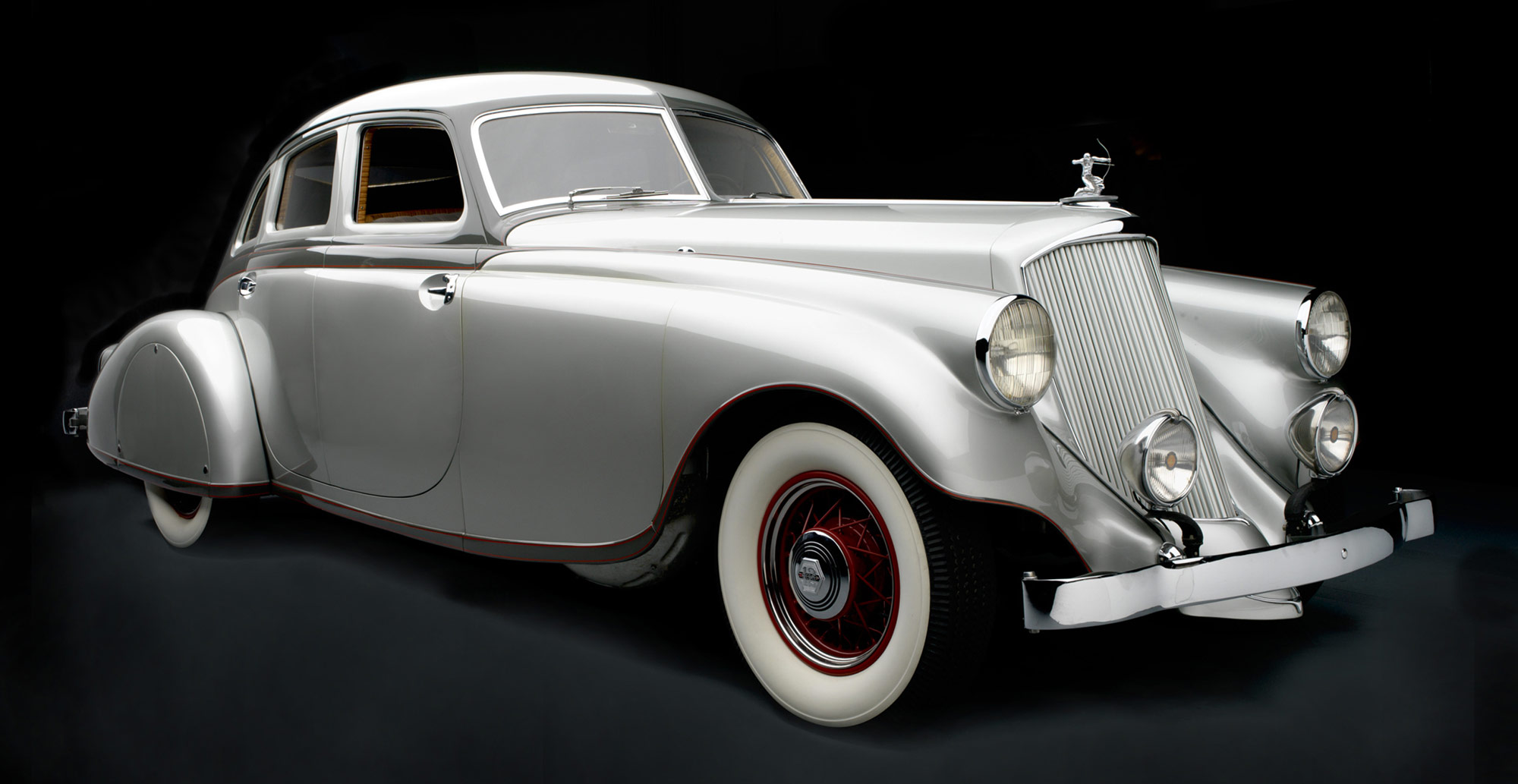
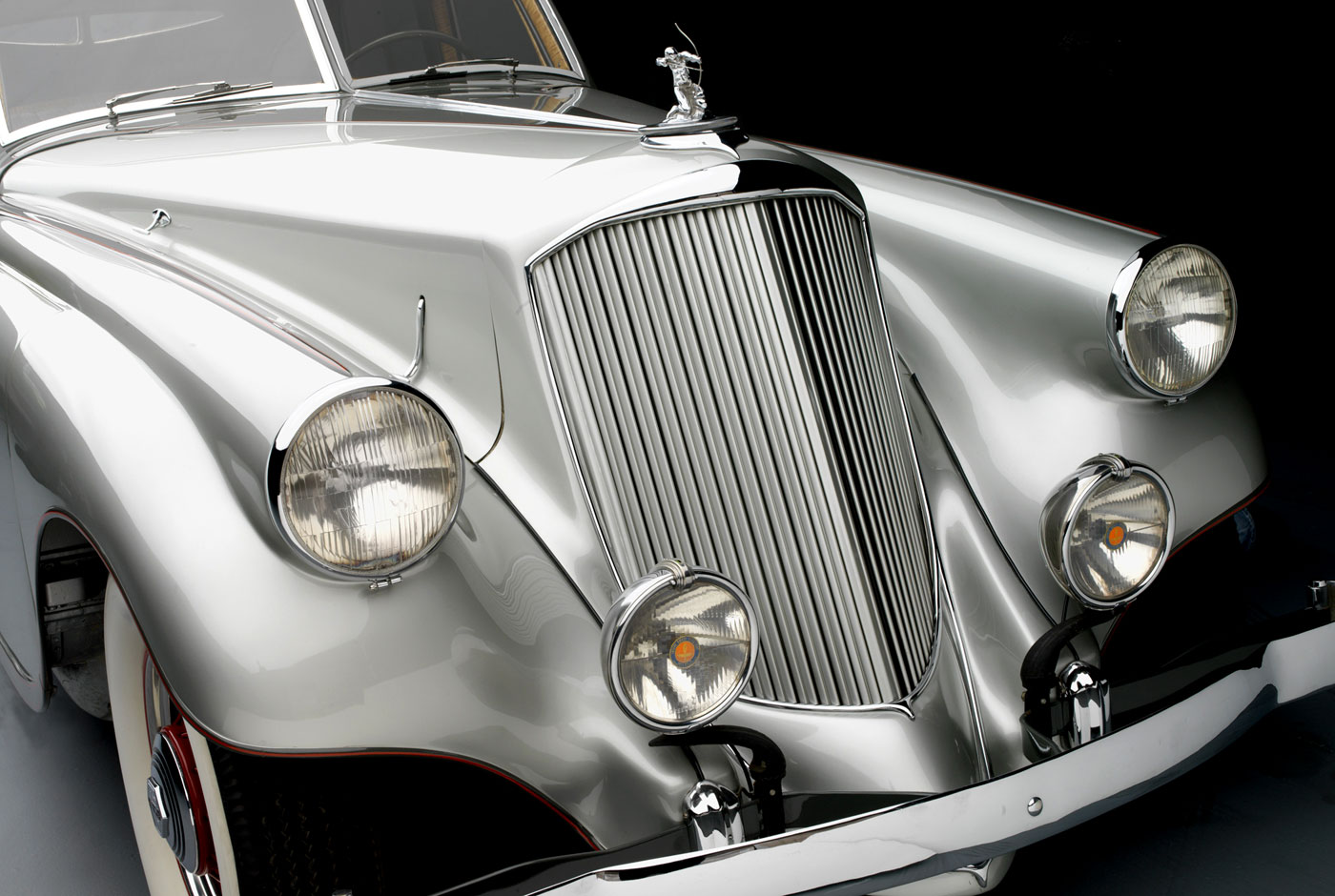
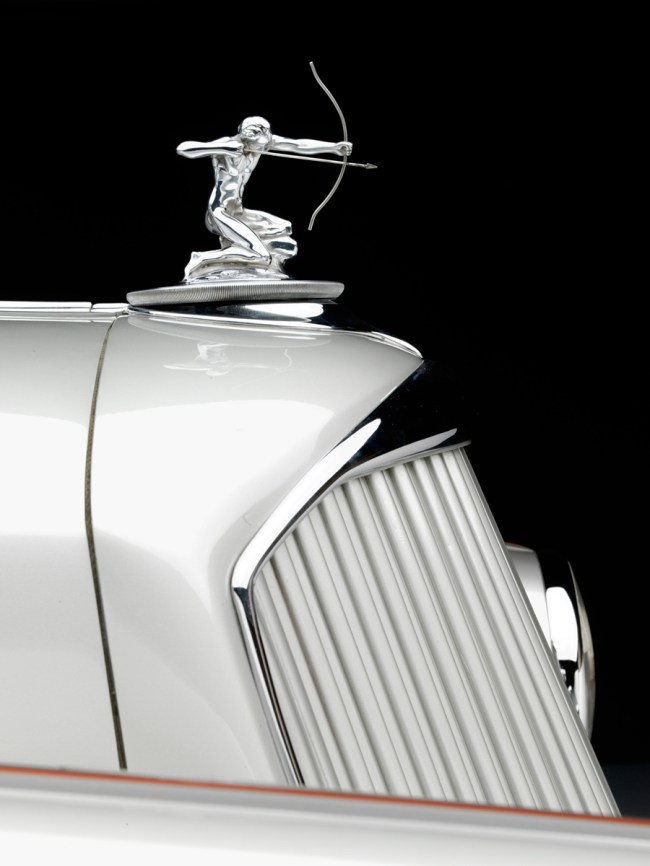
Pierce-Arrow Silver Arrow Sedan 1933

Pierce-Arrow Silver Arrow Sedan 1933

Pierce-Arrow Silver Arrow Sedan 1933

'Pierce-Arrow Silver Arrow Sedan' 1933

Pierce-Arrow Silver Arrow Sedan 1933


Pierce-Arrow Silver Arrow Sedan
1933
Collection of Academy of Art University Automobile Museum, San Francisco
Photograph © 2013 Peter Harholdt


With its dignified advertising, elegant styling, and respectable dealers, Buffalo, New York-based Pierce-Arrow rivalled Packard for prestige. The staunchly conservative Pierce-Arrow clung to six-cylinders long after Packard and Cadillac introduced V-8s. Facing tough competition, sales slumped and Pierce merged with Studebaker in 1926.

In 1932, Phillip O. Wright designed a streamlined fastback coupe on the Pierce-Arrow V-12 chassis. He moved to Studebaker headquarters in South Bend, Indiana, where his rakish design evolved into a sporty sedan with a low roofline, envelope front and skirted rear fenders, and faired-in headlamp nacelles. With its 175-brake horsepower V-12, a Silver Arrow could top 115 mph. In a sea of boxy sedans, the sleek Pierce-Arrow show car was the height of modernity. Five hand-built Silver Arrows toured 1933 auto shows, where they caused a sensation. At the Chicago Century of Progress, the Silver Arrow upstaged Cadillac’s Aero-Dynamic coupe, Duesenberg’s “Twenty Grand,” and Packard’s “Car of the Dome,” with its audacious, aircraft-like shape.

Priced at a then-expensive $10,000, the Silver Arrow was one of thirty-eight different 1933 Pierce-Arrow models. Sales slipped to just 2,152 units in total. After succumbing in mid-1938, Pierce-Arrow is best remembered for its magnificent Silver Arrow. This is one of three survivors.

faired-in headlamp nacelles: a fairing, primarily found on aircraft, is a streamlined structure used to create a more aerodynamic outline; a nacelle refers to any streamlined housing or enclosure; in this instance, the forward facing headlamps are enclosed within a housing and placed with a fairing that does not extend beyond the curvilinear profile of the overall design
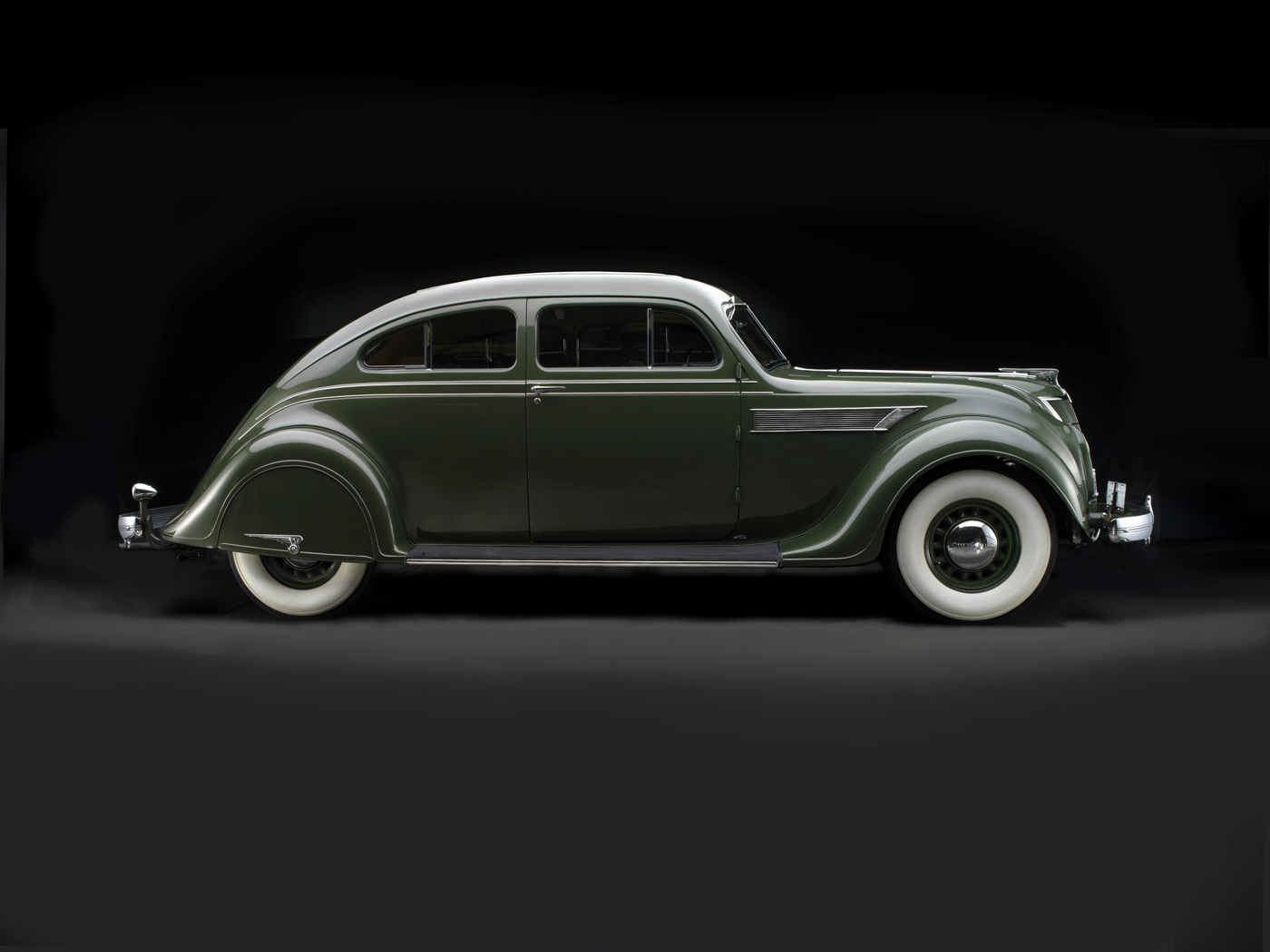
 

'Chrysler Imperial Model C-2 Airflow Coupe' 1935


Chrysler Imperial Model C-2 Airflow Coupe
1935
Collection of John and Lynn Heimerl, Suffolk, VA
Photograph © 2013 Peter Harholdt


'Cord 810 "Armchair" Beverly Sedan' 1936


Cord 810 “Armchair” Beverly Sedan
1936
Collection of Richard and Debbie Fass
Photograph © 2013 Peter Harholdt

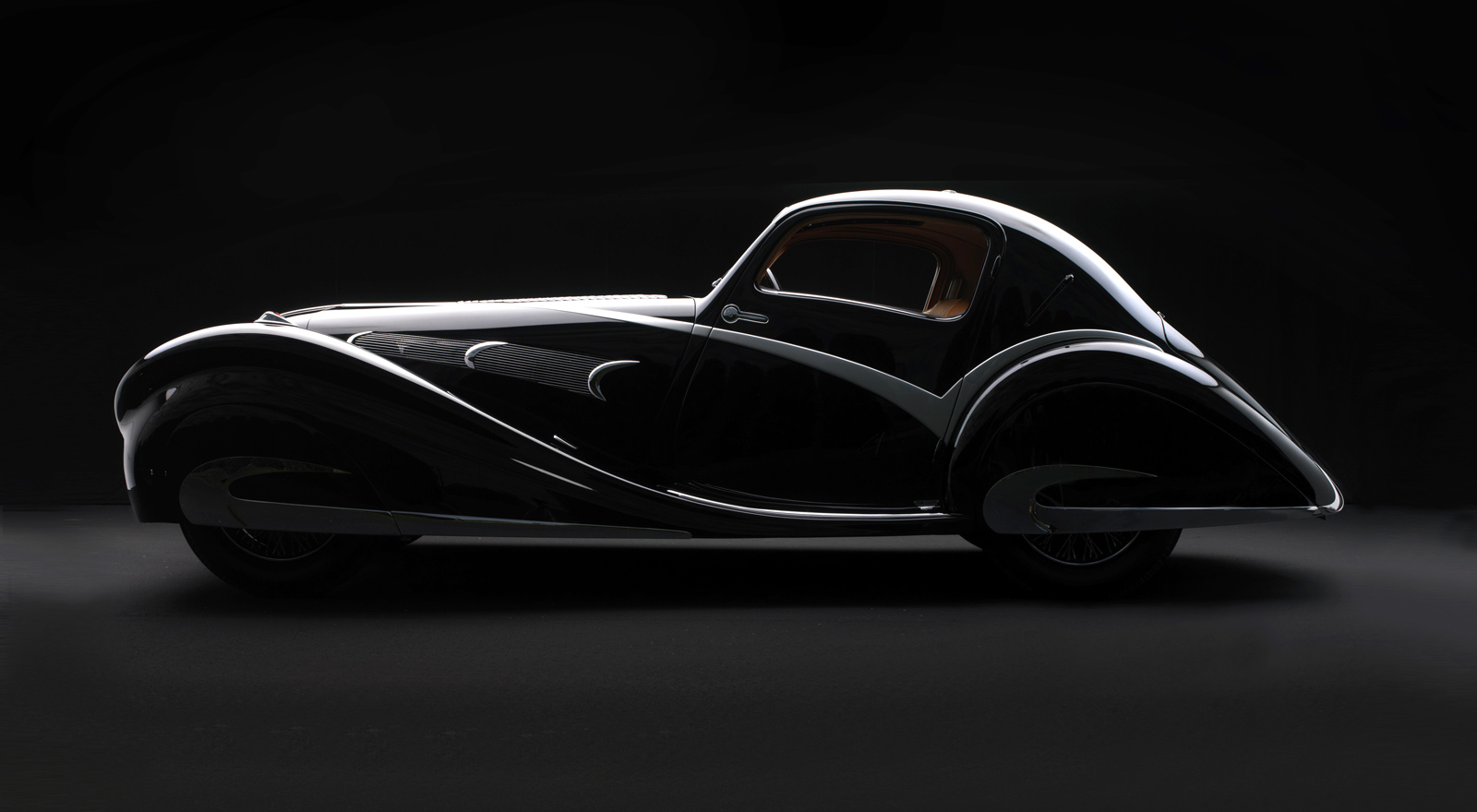
 

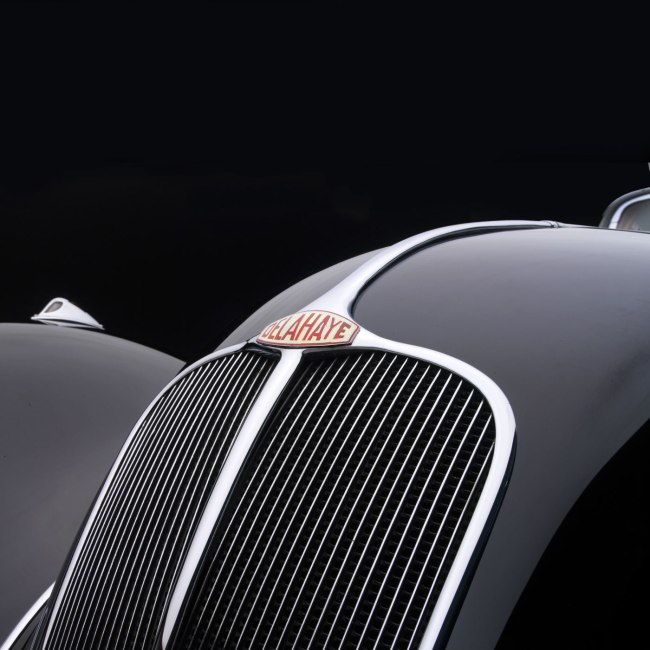
'Delahaye 135M Figoni & Falaschi Competition Coupe' 1936

'Delahaye 135M Figoni & Falaschi Competition Coupe' 1936

'Delahaye 135M Figoni & Falaschi Competition Coupe' 1936

'Delahaye 135M Figoni & Falaschi Competition Coupe' 1936


Delahaye 135M Figoni & Falaschi Competition Coupe
1936
Collection of Jim Patterson/The Patterson Collection
Photograph © 2013 Peter Harholdt


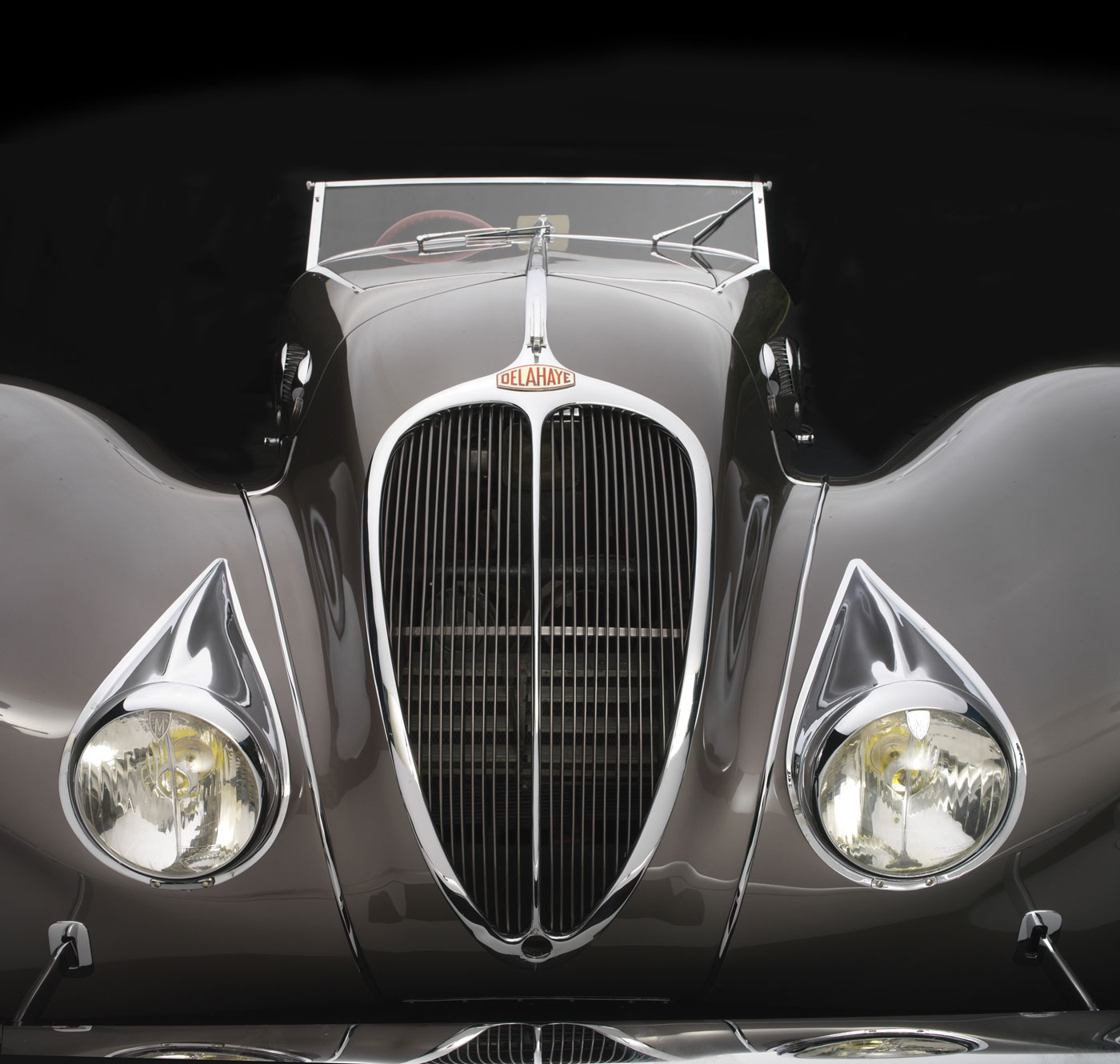
This stunning Delahaye was one of French coach builders Joseph Figoni and Ovidio Falaschi’s first aerodynamic coupe designs. With its dramatic enclosed fenders and hand-crafted aluminium body, it was built on one of the fifty short chassis designed by the Delahaye Company for sporty two-seater models. It was equipped with a four-speed competition-style manual transmission, appropriate to a sporty coupe intended for rally competition. The dashboard included a Jaeger rally clock, and the trunk had only enough room to carry a spare tire. The engine was a highly reliable 4-litre Delahaye six with three downdraft Solex carburettors.

The coupe’s striking design emphasised flowing lines with teardrop-shaped chrome accents on the hood and the front and rear fenders. The door handles and headlights were flush with the body. The dashboard was made of rich, golden wood, a Figoni & Falaschi signature. A sliding metal sunroof and a windshield that opened outward at the bottom afforded ventilation.

A French racing driver named Albert Perrot commissioned this coupe. The Comtesse de la Saint Amour de Chanaz displayed it at a concours d’elegance in Cannes. It was successfully hidden from the Germans during World War II. After the war, it reportedly belonged to actress Dolores del Rio, a well-known owner of exotic cars who lived in Mexico City and Los Angeles.

After several more owners, Don Williams, of the Blackhawk Collection, purchased the coupe in the late 1990s. Some time earlier, the Delahaye’s original engine had broken down; it was replaced with a postwar model, and the old engine was retained. In 2004, the Delahaye became the property of Mr. James Patterson, who re-installed the original engine and had the car beautifully restored.

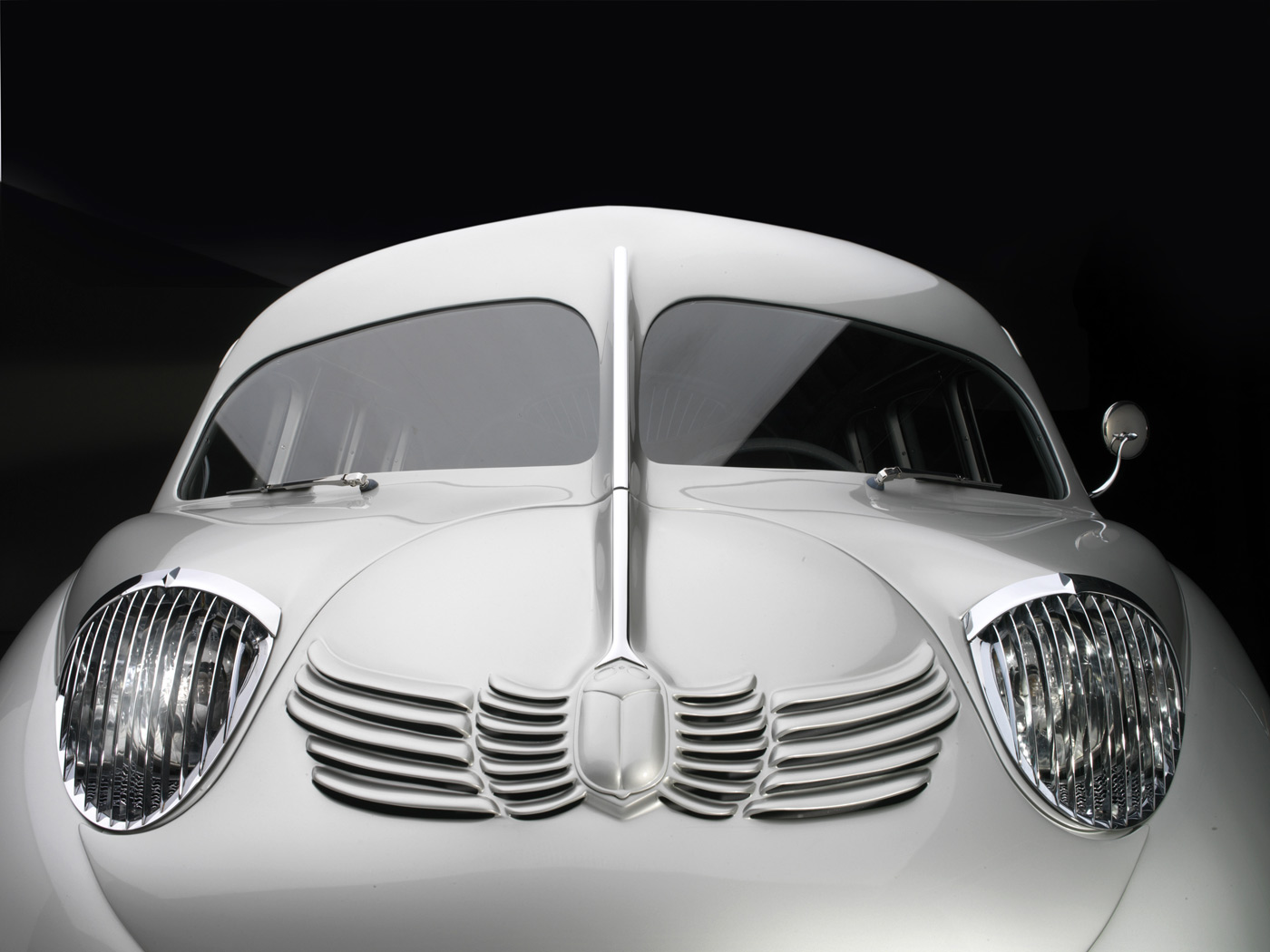
 

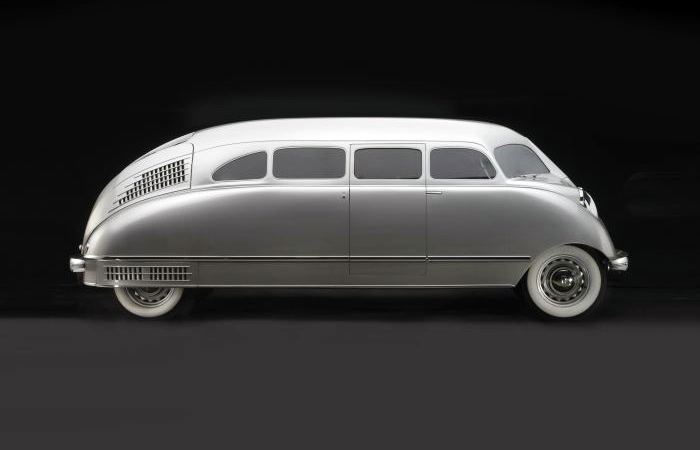
'Stout Scarab' 1936

'Stout Scarab' 1936

'Stout Scarab' 1936

'Stout Scarab' 1936


Stout Scarab
1936
Collection of Larry Smith
Photograph © 2013 Peter Harholdt


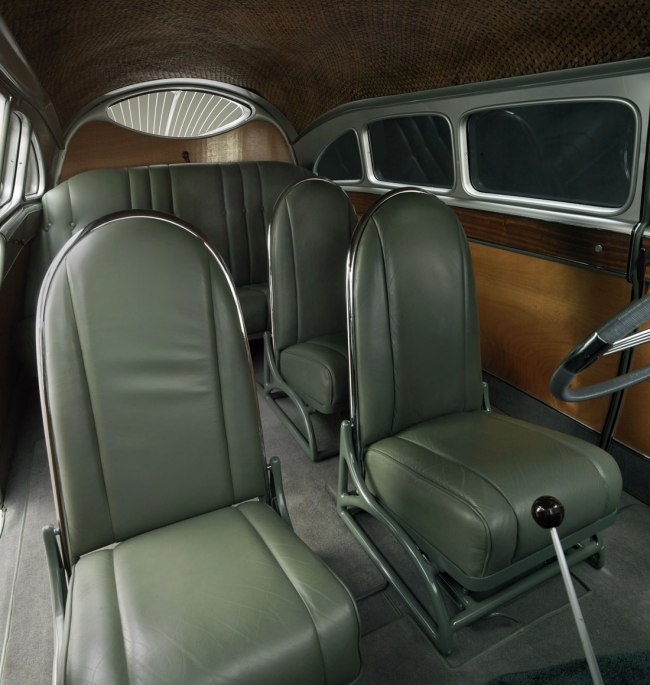
American aeronautical designer William Bushnell Stout modelled this sturdy Ford Tri-Motor after his own 3-AT aircraft. The futuristic Scarab (named for the Egyptian symbol based on a beetle) has a smooth and startling shape, with a tubular frame covered with aluminium panels surrounding a rear-mounted Ford flathead V-8. The Scarab’s passenger compartment is positioned within the car’s wheelbase. Access to the interior is through a central door on the right side, and there is a narrow front door on the left for the driver. This unusual configuration anticipated the first minivan.

The “turtle-shell” styling celebrated the Art Deco influence, beginning with decorative “moustaches” below the split windshield. It continues to be evident in the headlamps covered with thin grilles, and culminates in fan-shaped vertical fluting, framing the elegant cooling grilles. The Scarab’s design was even more radically different than other cars of the era like the ill-fated Chrysler Airflow. At $5,000, it was very expensive, and the Depression-wracked buying public did not recognise its many advantages.

Stout’s investors, like William K. Wrigley, the chewing gum magnate, and Willard Dow of Dow Chemical, purchased Scarabs, as did tire company owner Harvey Firestone and Robert Stranahan of Champion Spark Plug. At least six cars were built; some sources say nine. Scarab number five was shipped to France for the editor of Le Temps, a Paris newspaper. In the early 1950s, this Scarab was offered for sale on a Parisian used car lot and returned to America.

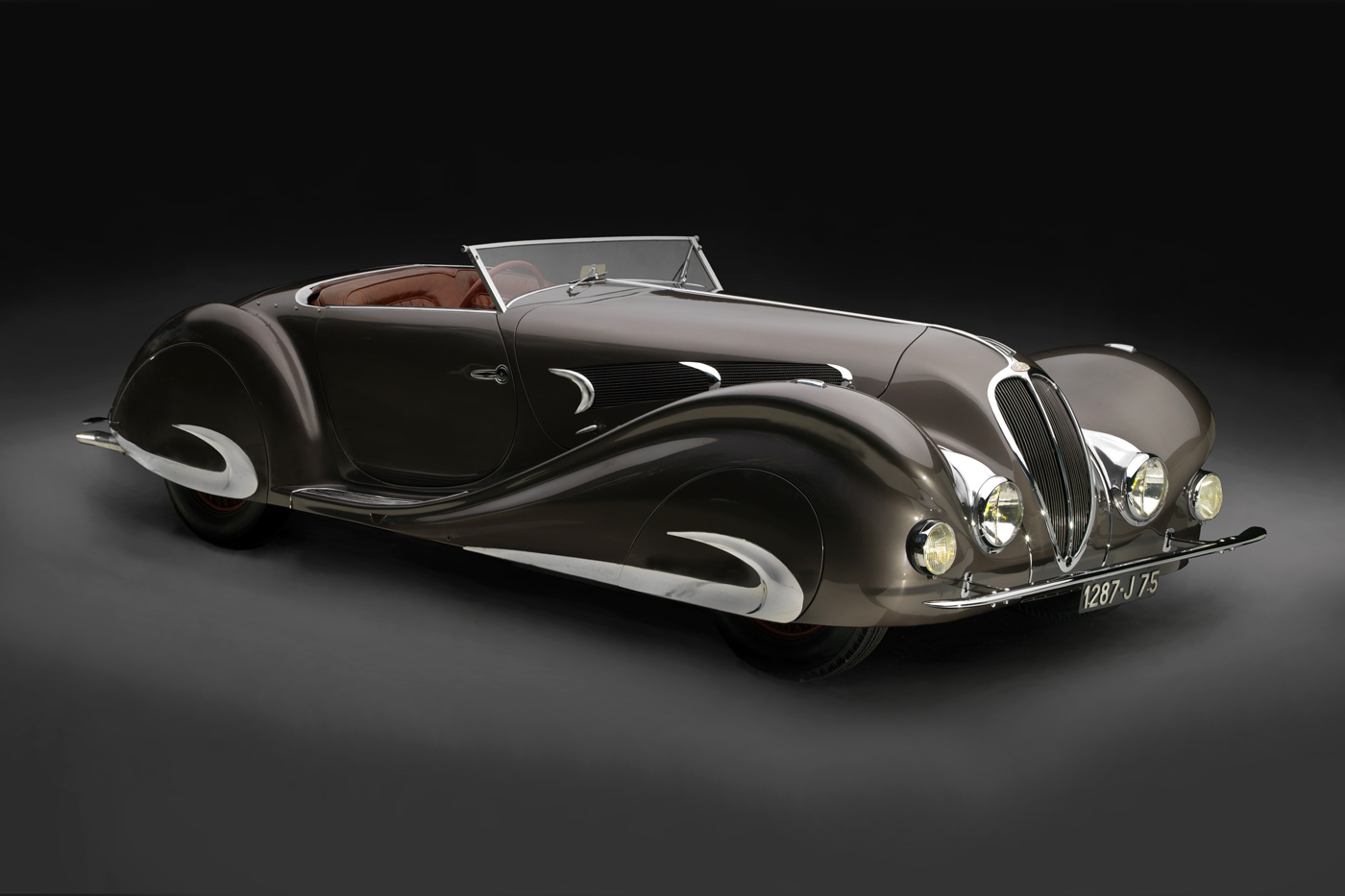
 

'Delahaye 135MS Roadster' 1937

'Delahaye 135MS Roadster' 1937

'Delahaye 135MS Roadster' 1937

'Delahaye 135MS Roadster' 1937


Delahaye 135MS Roadster
1937
Courtesy of The Revs Institute for Automotive Research @ the Collier Collection
Photograph © 2013 Peter Harholdt


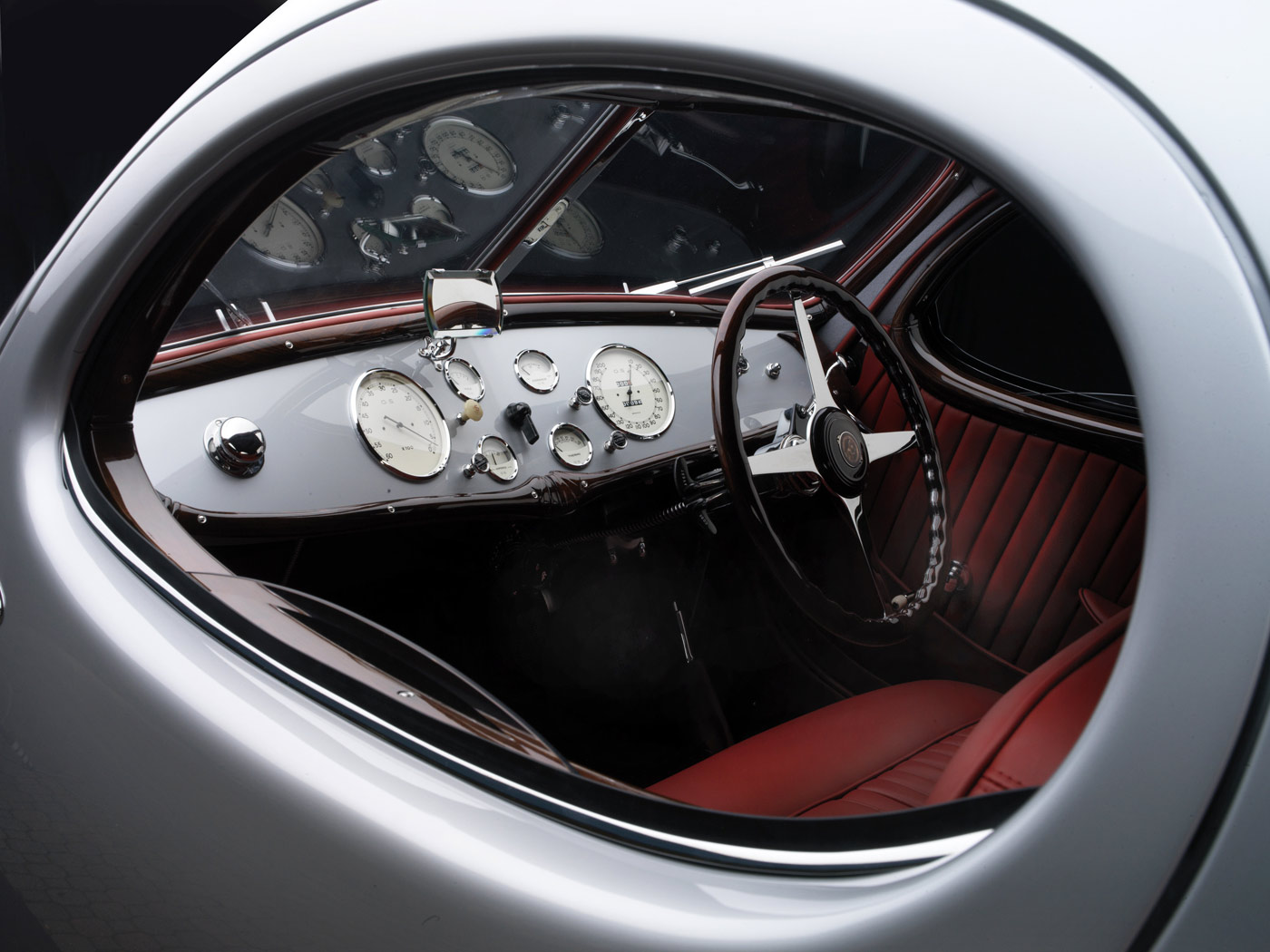
Parisian coach builders Joseph Figoni and Ovidio Falaschi produced this very special Delahaye 135MS Roadster for the 1937 Paris Auto Salon. Instead of conventional pontoon fenders that protruded from the car’s body, Figoni incorporated them into the body, heightening the impression of a singular, flowing form. Using Art Deco ornamentation, he punctuated the car’s hood with scalloped chrome trim that accentuated the curves of the fenders. Its all-aluminium body is built on a short 2.70-meter competition chassis. The dark red leather interior and matching carpets were provided by Hermès, a French company begun in the eighteenth century and known for its fine carriage building.

This low, sleek car appears to be moving when it is standing still. The avant-garde design caused a sensation at the Paris Auto Salon, and its completion provided Figoni & Falaschi with the opportunity to file four new patents: for the aerodynamic design that stabilised the front fenders; for the disappearing front windshield; for the special lightweight competition tubular seats; and for the disappearing convertible top. The original design also featured a central light mounted in the front grille. The door handles were mounted flush to the body surface, augmenting the roadster’s modern, clean look. In early 1938, this roadster returned to the Figoni & Falaschi shop, where the central headlight was removed, and front and rear bumpers were installed to protect the car from daily driving hazards.
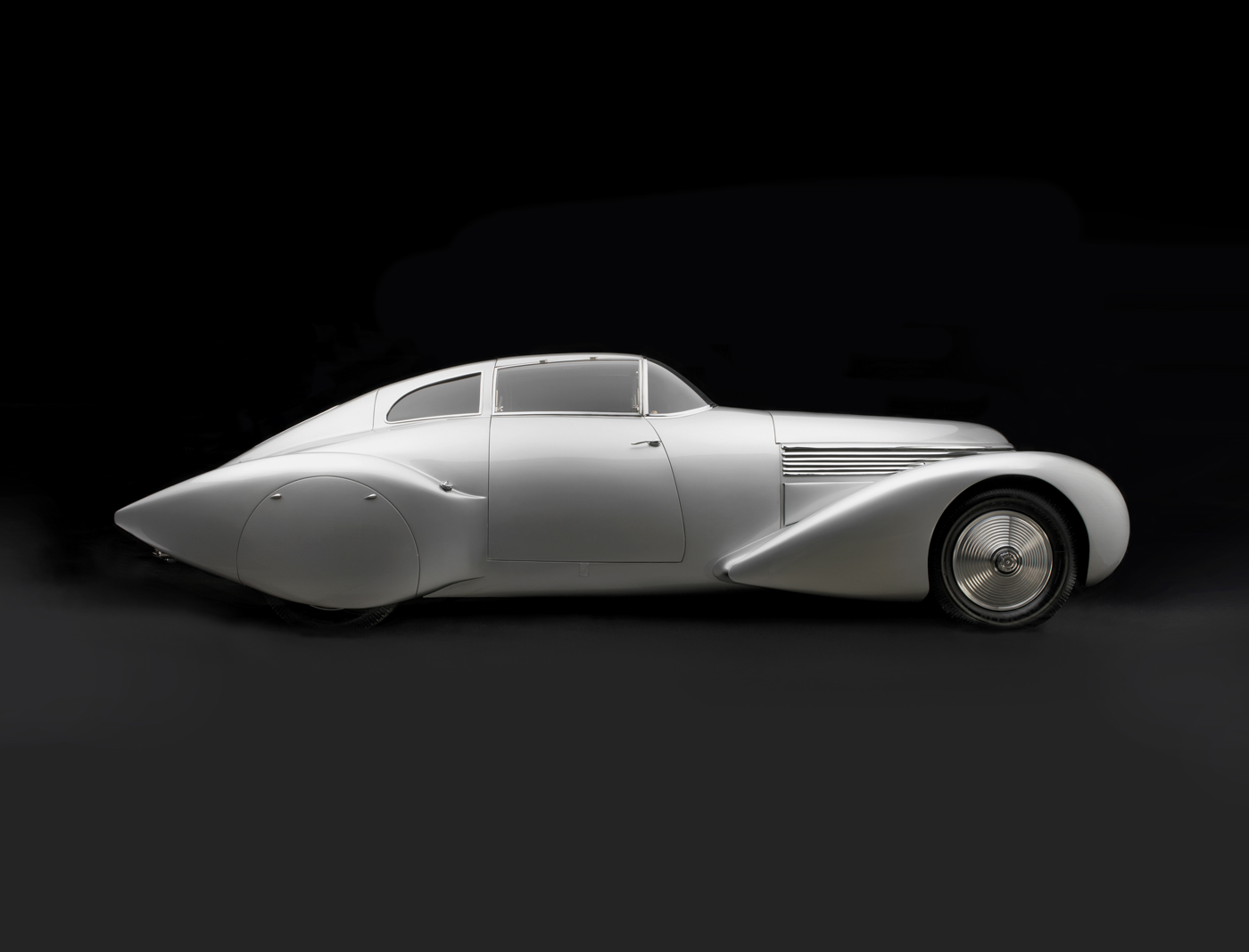
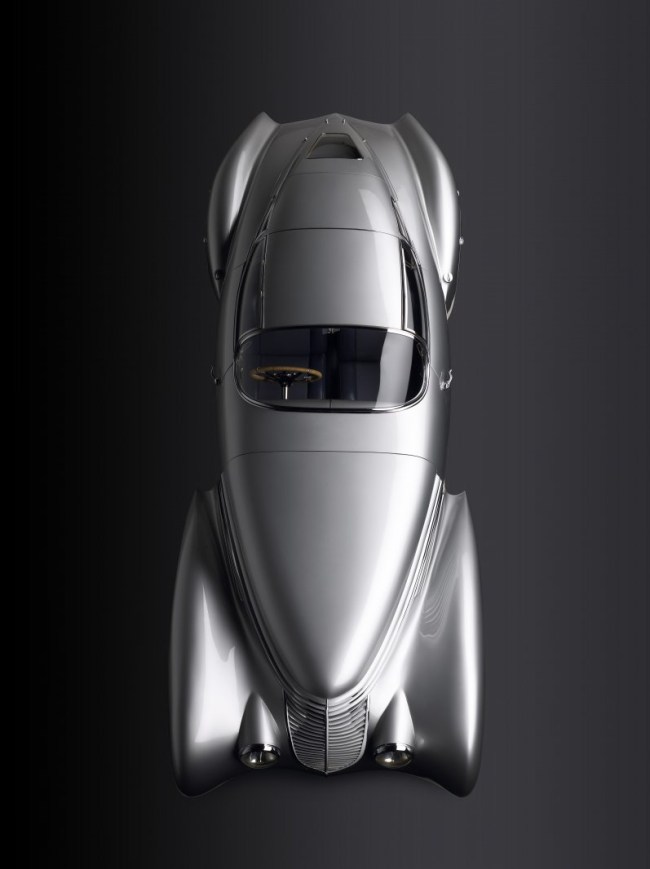
 

'Hispano-Suiza H6B Dubonnet “Xenia” Coupe' 1938

'Hispano-Suiza H6B Dubonnet “Xenia” Coupe' 1938


Hispano-Suiza H6B Dubonnet “Xenia” Coupe
1938
Collection of Peter Mullin Automotive Museum Foundation
Top photo: Photograph © 2013 Peter Harholdt
Overhead photo: Anonymous from the internet


André Dubonnet was France’s aperitif baron as well as an amateur racing driver and inventor. Dubonnet worked with engineer Antoine-Marie Chedru to develop and patent an independent front-suspension system in 1927 that was used by General Motors and Alfa Romeo. Following the 1932 Paris Auto Salon, Dubonnet acquired a French built Hispano-Suiza chassis, which he used to create a rolling showcase for his ideas. This car was designed by Jean Andreau, known for avant-garde streamlined aircraft and automotive creations, and hand-built in the coach building shop of Jacques Saoutchik.

The body resembled an airplane fuselage. Curved glass was used, including a panoramic windscreen (not seen again until General Motors cars of the 1950s), and Plexiglas side windows that opened upward in gullwing fashion. The side doors, suspended on large hinges, opened rearward in “suicide” fashion. A tapered fastback was crowned with a triangular rear window. The car featured Dubonnet’s hyperflex independent front suspension system.

The original Hispano-Suiza chassis sat high off the ground, and the “Xenia” – named for Dubonnet’s deceased wife, Xenia Johnson – was built atop the frame, so while its overall appearance is sleek and elegant, it is a comparatively tall and heavy car. Dramatically different from its contemporaries, the “Xenia” appears far more modern than almost any other 1930s-era automotive design.

.
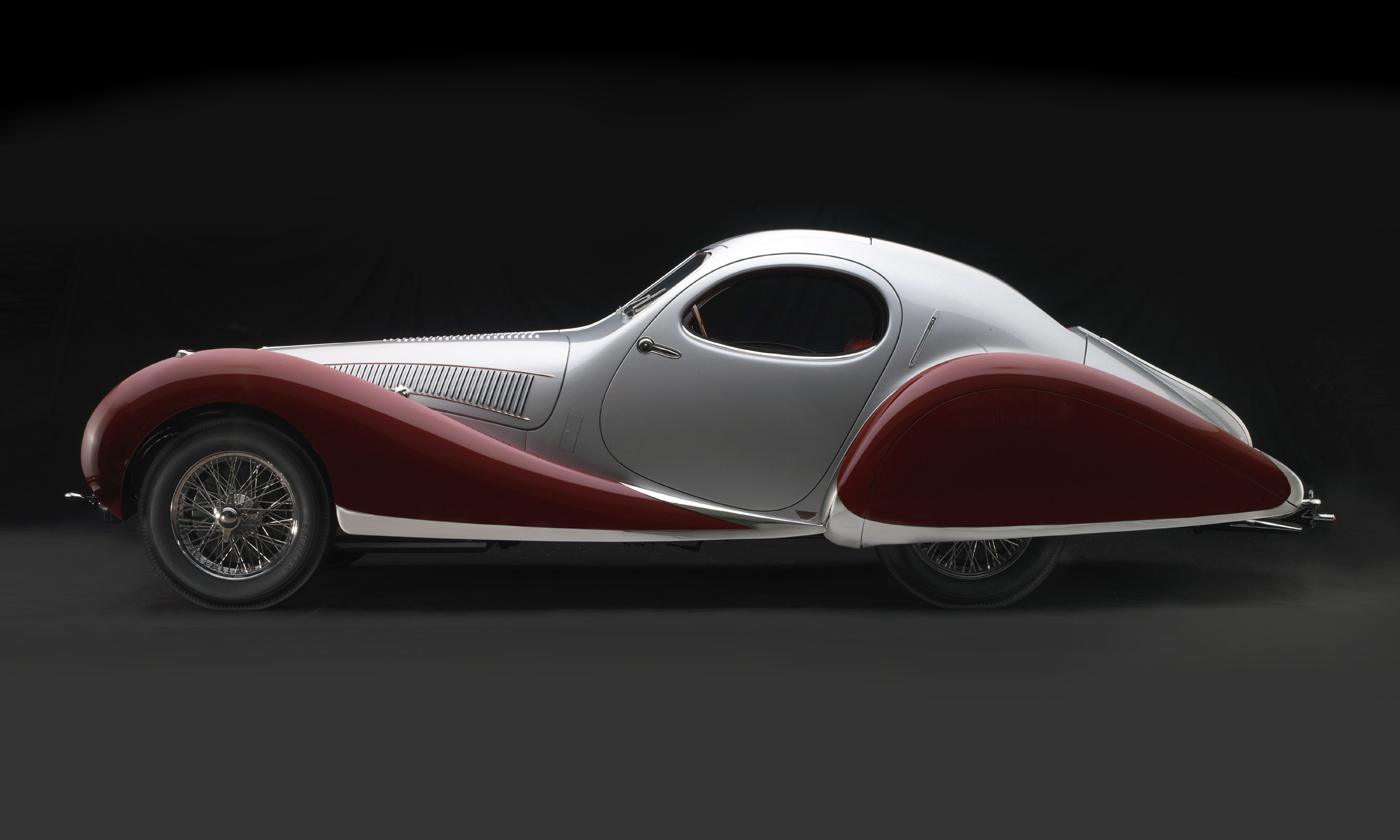
'Talbot-Lago T-150C-SS Teardrop Coupe' 1938

'Talbot-Lago T-150C-SS Teardrop Coupe' 1938

'Talbot-Lago T-150C-SS Teardrop Coupe' 1938


Talbot-Lago T-150C-SS Teardrop Coupe
1938
Collection of J. Willard Marriott, Jr.
Photograph © 2013 Peter Harholdt


The sporting Talbot-Lago T-150-C chassis inspired the design of many open roadsters and closed cars, most notably a series of curvaceous custom coupes. Sensational in their heyday, the French-produced Talbot-Lagos remain highly valued today. Streamlined, sleek, and light enough to race competitively, they were called Goutte d’Eau (drop of water), and, in English, they quickly became known as the Teardrop Talbots. Famed Parisian coach builders Joseph Figoni and Ovidio Falaschi patented the car’s distinctive aerodynamic shape.

Figoni & Falaschi built twelve “New York-style” Talbot-Lago coupes between 1937 and 1939, so-called because the first was introduced at the 1937 New York Auto Show at the Grand Central Palace. Five more cars, built in a notchback Teardrop style, were named “Jeancart” after a wealthy French patron. It took Figoni & Falaschi craftsmen 2,100 hours to complete a body. No two Teardrop coupes were exactly alike.

Talbot’s president, Antony Lago, offered a top-of-the-line SS (Super Sport) version with independent front suspension. The competition engine, a 4-litre six cylinder topped with a hemi head, could be fitted with three carburettors for 170-brake horsepower. Some cars were equipped with an innovative Wilson pre-selector gearbox, with a fingertip actuated lever that permitted instant shifts without the driver having to take his hand off the steering wheel. In 1938, a racing model T-150C-SS Coupe finished third at the 24 Hours of Le Mans.

This car was the first “New York-style” Teardrop coupe. Its first owner was Freddie McEvoy, an Australian member of the 1936 British Olympic bobsled team. A prominent player on the Hollywood scene, McEvoy’s ready access to celebrities made him an ideal concessionaire for luxurious automobiles.

hemi head: an internal combustion engine that is designed with hemispherically shaped chambers that optimised combustion and permitted larger valves for more efficiency

pre-selector gearbox: a type of manual gearbox or transmission that allows a driver to use levers to “pre-select” the next gear to be used, and with a separate foot pedal control, engage the gear in one single operation
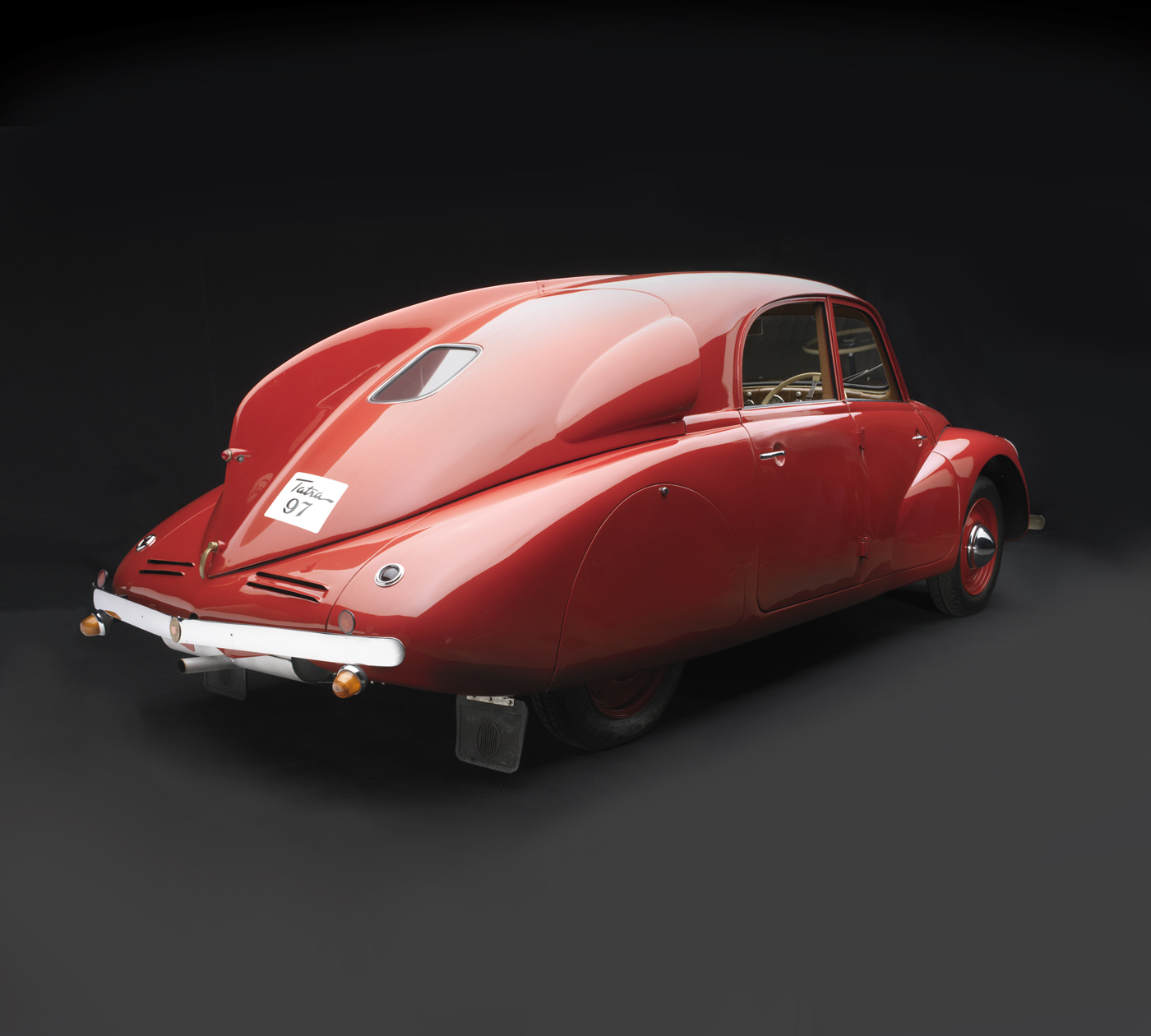
 

'Tatra T97' 1938


Tatra T97
1938
Collection of Lane Motor Museum
Photograph © 2013 Peter Harholdt


One of the most advanced designs of the pre-World War II era came from Czechoslovakia. Czech-based Koprivnicka vozovka evolved into Nesseldorfer Waggonfabrik and was renamed Tatra in 1927 after the country’s prominent mountain range. Tatra vehicles became known for innovative engineering and high quality. The engineer largely responsible was Hans Ledwinka, who had worked under automotive and aircraft pioneer Edmund Rumpler. Ledwinka was an early proponent of air-cooled engines, a rigid backbone chassis, and independent suspension.

The Tatra was a perfect platform for the new emphasis on streamlining being pioneered by aircraft and Zeppelin designer Paul Jaray. A short front end flowed to a curved roofline that gracefully sloped into a long fastback tail. When integrated fenders and a full undertray were added, wind resistance was dramatically reduced. A prominent rear dorsal fin ensured high-speed stability.

Tatra was arguably the first production car to take advantage of effective streamlining. The T97 used a horizontally opposed, rear-mounted, four cylinder engine with a rigid backbone chassis, four-wheel independent suspension and hydraulic drum brakes. Four were built in 1937, followed by 237 in 1938, and 269 in 1939. Top speed was 80.78 mph, which was truly remarkable for a 40-hp car at the time.

According to automobile designer Raffi Minasian, “The Tatra T97 was one of the most interesting and well-developed engineering and design intersections of the Deco period.” It may have lacked the usual flamboyance of the traditional French coach builders of the period, but it manifested the expression of Art Deco design as a merger of science and industry where form was dictated by function.


'Bugatti Type 57C by Vanvooren' 1939


Bugatti Type 57C by Vanvooren
1939
Collection of Margie and Robert E. Petersen, Courtesy of the Petersen Automotive Museum, Los Angeles
Photograph © 2013 Peter Harholdt


The Great Depression was slow to impact France, due to that country’s high tariffs and restricted trade, but by the early 1930s, sales of luxury automobiles dwindled. Ettore Bugatti and his brilliant son Jean understood that a special model was imperative to help their company survive. The resulting new Type 57’s styling was at once contemporary and affordable, with custom coachwork available for the very wealthy.

For racing, a normally-aspirated, 3.3-litre straight 8-powered Type 57, on an ultra-low “S” chassis, was fitted with streamlined open coachwork. The factory successes included averaging 135.45 mph for one hour, 123.8 mph for 2,000 miles, and 124.6 mph for 4,000 kilometres. An avid horseman, “Le Patron,” as Bugatti was known, was convinced automobile competition improved the breed, as it did with thoroughbred racing.

The greatest coach builders of France: Gangloff, Saoutchik, Letourneur & Marchand, and Vanvooren, as well as Britain’s Corsica, and Graber of Switzerland, all built custom coachwork on the Type 57 chassis. This special Type 57C was the property of Mohammed Reza Pahlavi, Prince of Persia and future Shah of Iran.

When Pahlavi married Egypt’s Princess Fawzia, many nations sent extravagant wedding presents. A gift from France, this cabriolet’s drophead coachwork – a study in sweeping lines and fluid Art Deco ornamentation – was constructed by coach builder Vanvooren of Paris, in the style of Figoni & Falaschi. The windscreen can be lowered into the cowl for an even racier appearance.
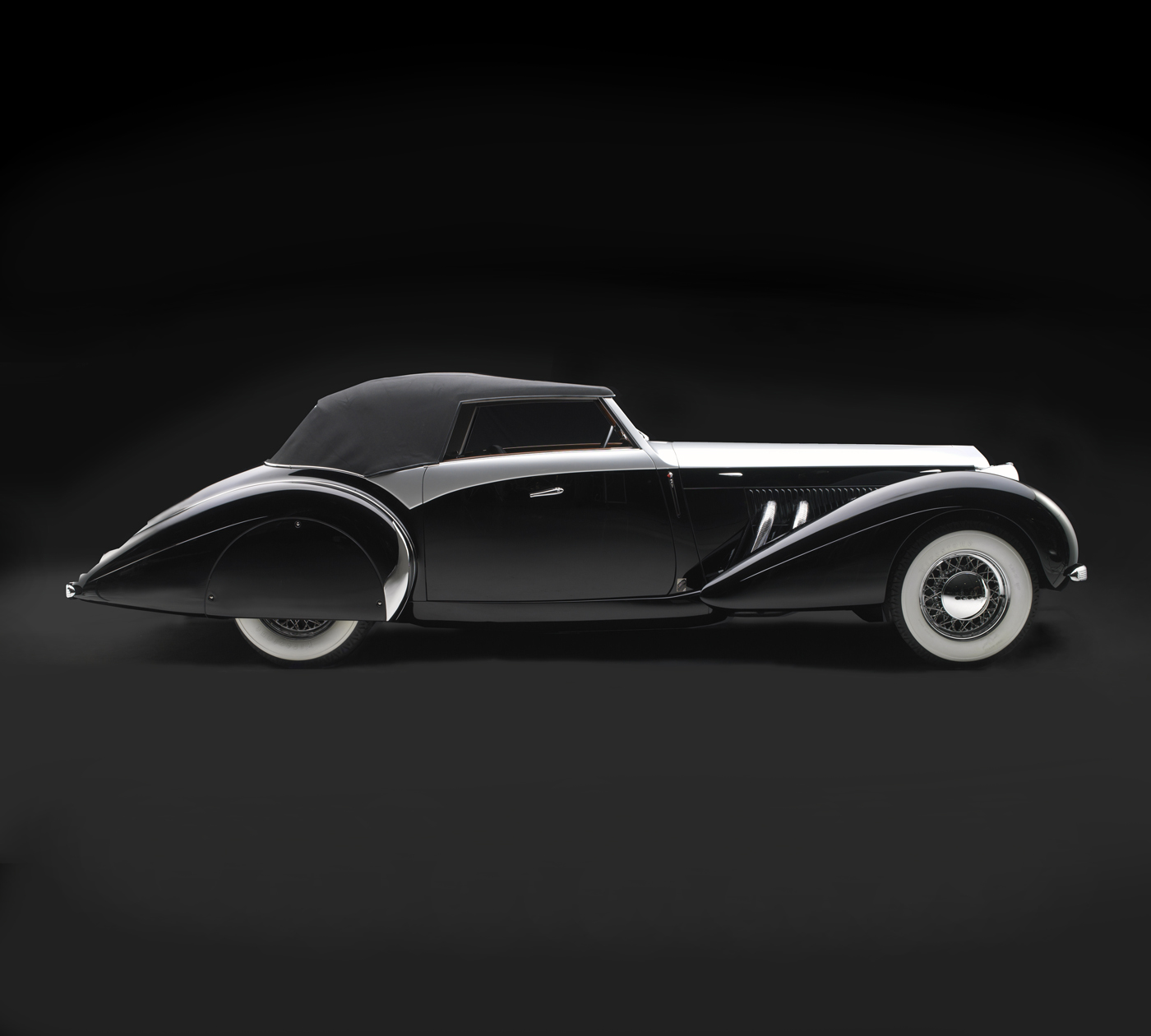
 

'Delage D8-120S Saoutchik Cabriolet' 1939


Delage D8-120S Saoutchik Cabriolet
1939
Collection of John W. Rich, Jr.
Photograph © 2013 Peter Harholdt


La Belle Voiture Francaise: The Beautiful French Car. Coined by the French public to describe the automobiles created by Louis Delage, these words became the slogan for one of France’s oldest and most renowned automobile companies. Coach builders favoured the Delage chassis to showcase their designs, winning numerous concours d’legance.

The Delage D8-120S, a new model for 1938, offered a lowered chassis, (“S” stood for Surbaisse) and the 3.5-litre straight 8’s output was increased. The bare chassis could be purchased for 105,000 French francs. The custom coachwork is estimated to have cost an additional 45,000 French francs, making the D8-120S one of France’s most expensive luxury cars. This car was commissioned for the 1939 Paris Auto Salon by the French government, which was promoting French cars in Europe and the United States. Jacques Saoutchik, one of France’s premier coach builders, created its coachwork, which includes patented sliding parallel doors that opened outward with a pantograph mechanism, then slid rearward, permitting easy access.

The completed cabriolet was hidden away by the workshop prior to the German invasion of France. After World War II, the D8-120S was used by the Provisional Government of the French Republic for official duties. It was sold in 1949 and the buyer installed faired-in headlights and a postwar Delage grille. The D8-120S passed through several more owners before it was restored to its original condition, with the exception of its modern faired-in headlights.
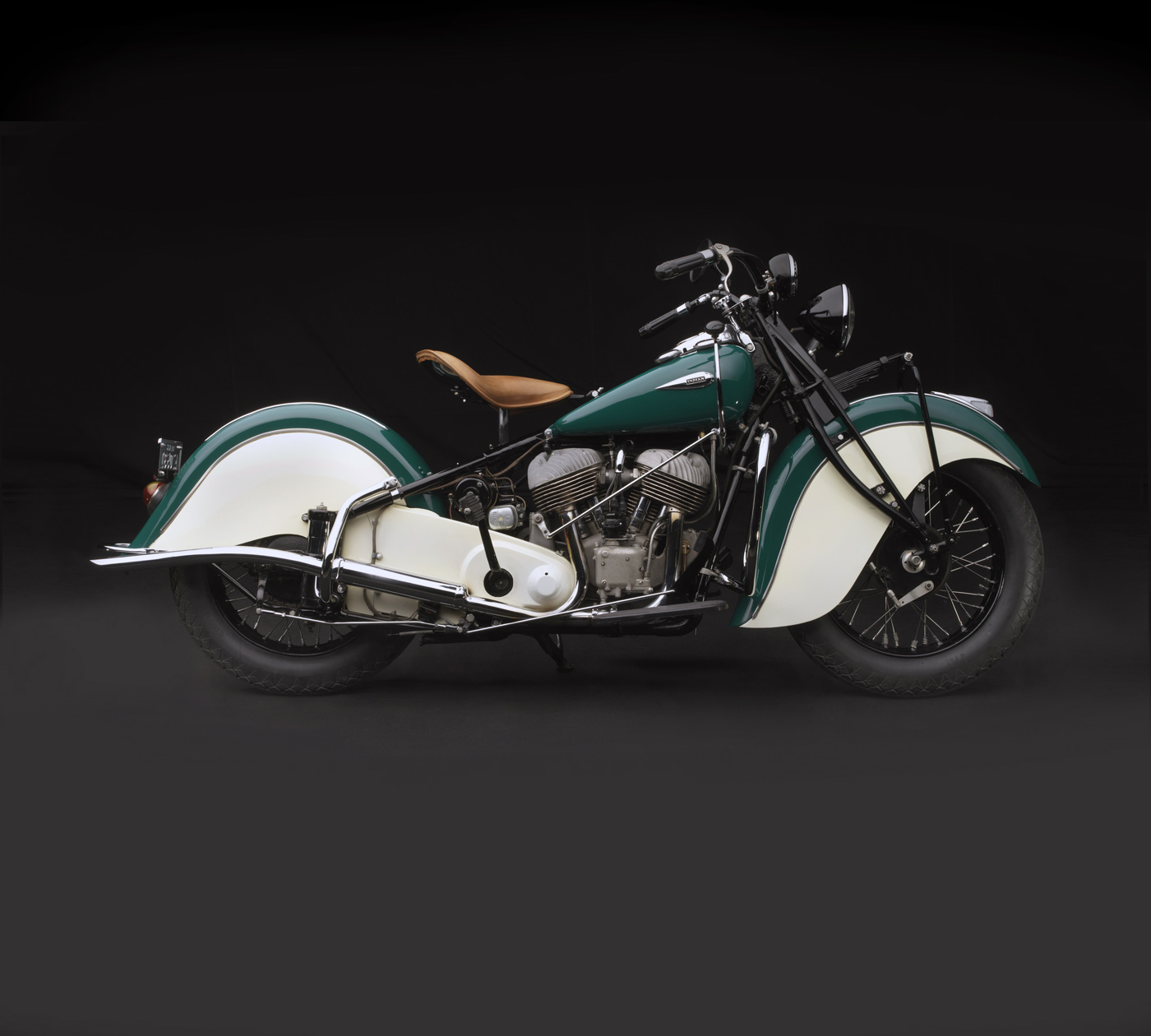
 

'Indian Chief' 1940


Indian Chief
1940
Collection of Gary Sanford
Photograph © 2013 Peter Harholdt


'Chrysler Thunderbolt' 1941

'Chrysler Thunderbolt' 1941


Chrysler Thunderbolt
1941
Collection of Chrysler Group, LLC
Photograph © 2013 Peter Harholdt


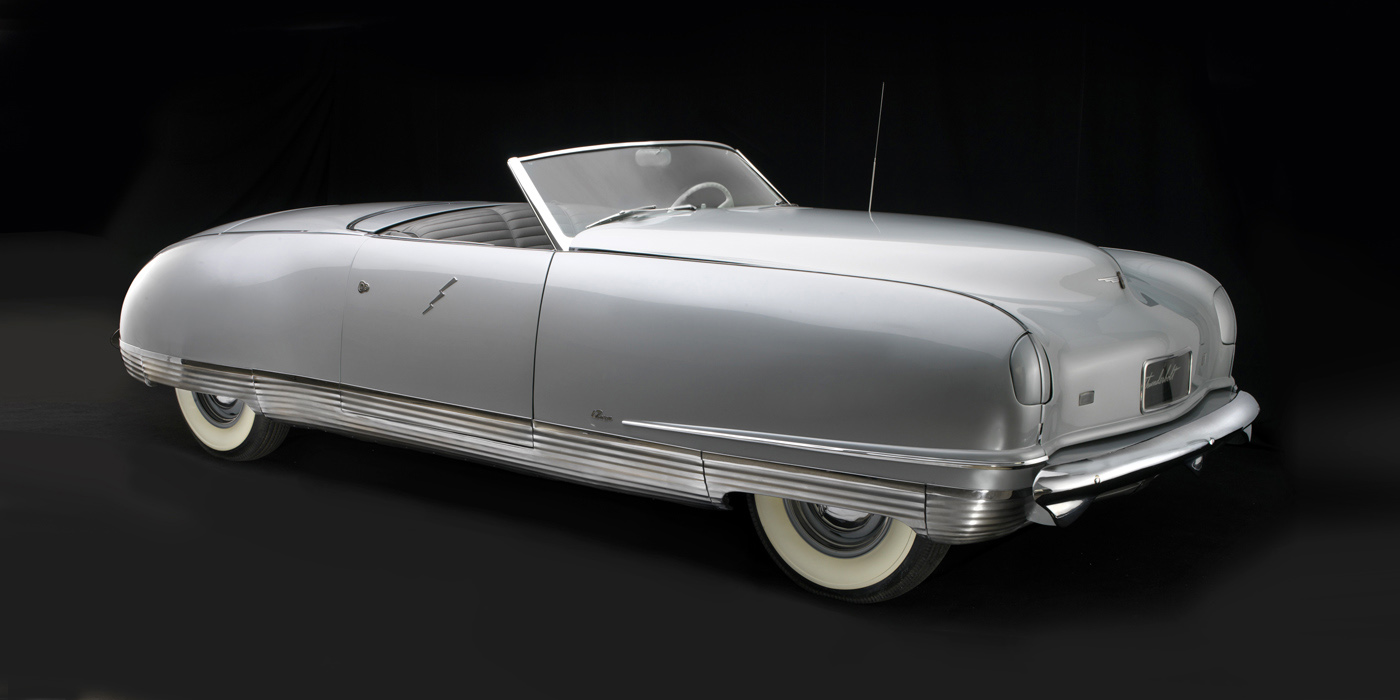
Detroit-based carmaker Chrysler touted the Thunderbolt and its companion, the Newport Phaeton, as cars of the future. With its aerodynamic body shell, hidden headlights, enclosed wheels, and a retractable one-piece metal hardtop, the sensational Thunderbolt conveyed the message that tomorrow’s Chryslers would leave more prosaic rivals in the dust.

Following the design of Chief Designer Ralph Roberts, both the Thunderbolt and the Phaeton models were built by LeBaron, an American coach building company. Associate designer Alex Tremulis suggested these cars be promoted as “new milestones in Airflow design,” hinting that without the 1934 Airflows, Chrysler styling might not have evolved so far. The Thunderbolt’s full-width hood, which flowed uninterrupted from the base of the windshield to the slender front bumper, and its broad decklid, were made of steel, as was the folding top, a feature designed and patented by Roberts not previously seen on an American car. Fluted, anodised aluminium lower body side trim ran continuously from front to rear. Removable fender skirts covered the wheels, which were inset in front, so they could turn.

Priced at $8,250, eight Thunderbolts were planned, but only five were built, of which four survive. World War II’s interruption meant that while a few features found their way onto production Chryslers, these unique cars were not replicated when hostilities ceased.


Frist Center for the Visual Arts
919 Broadway, Nashville, Tennessee, 37203

Opening hours:
Monday: 10.00am – 5.30pm
Tuesday: Closed
Wednesday: Closed
Thursday: 10.00am – 8.00pm
Friday: 10.00am – 5.30pm
Saturday: 10.00am – 5.30pm
Sunday: 1.00 – 5.30pm

Frist Center for the Visual Arts website

LIKE ART BLART ON FACEBOOK

Back to top

Exhibition: ‘This Is Not A Silent Movie: Four Contemporary Alaska Native Artists’ at Craft Contemporary, Los Angeles

Exhibition dates: 26th May – 8th September 2013

Curator: Dr Julie Decker, Chief Curator at the Anchorage Museum


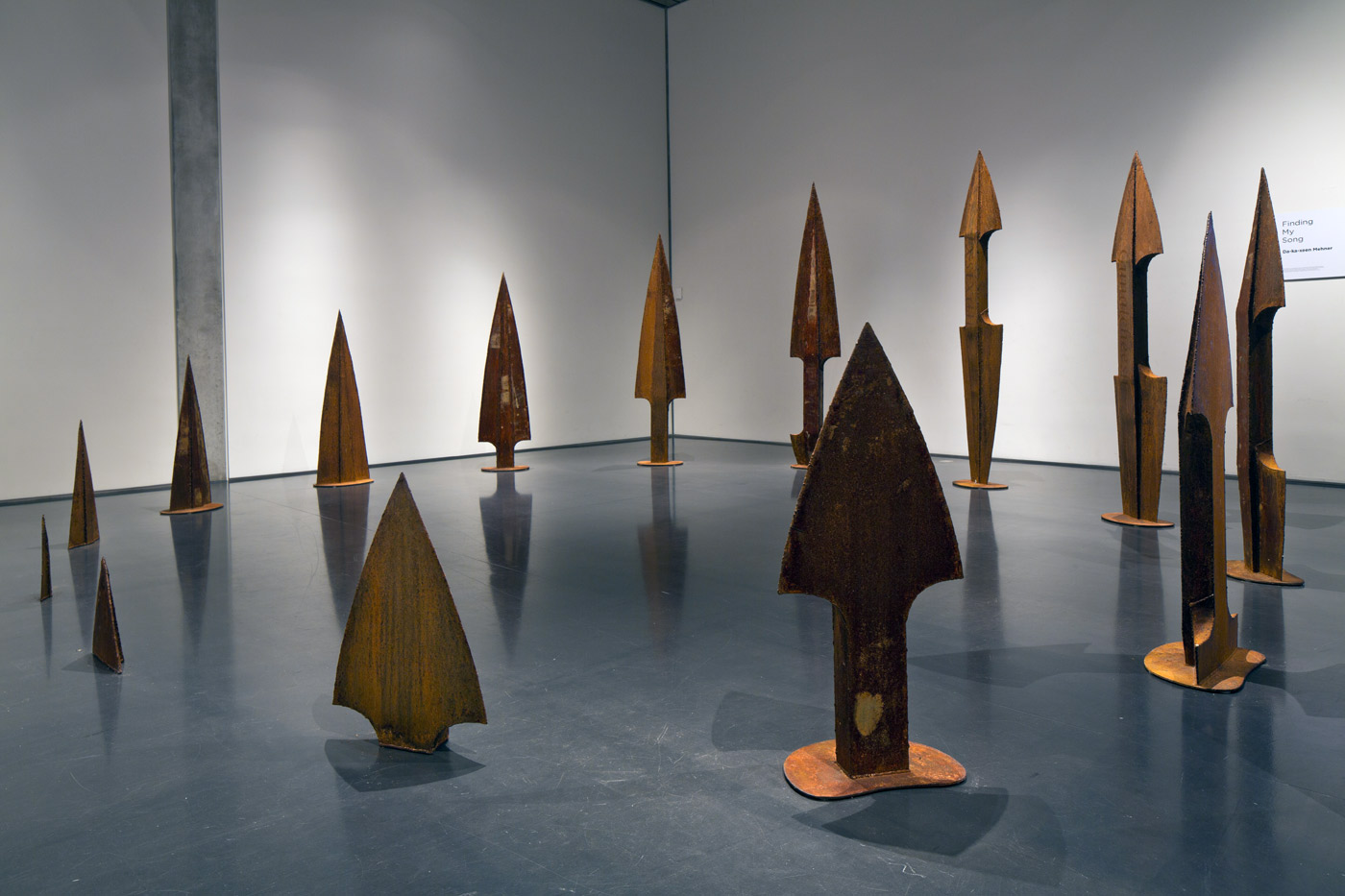
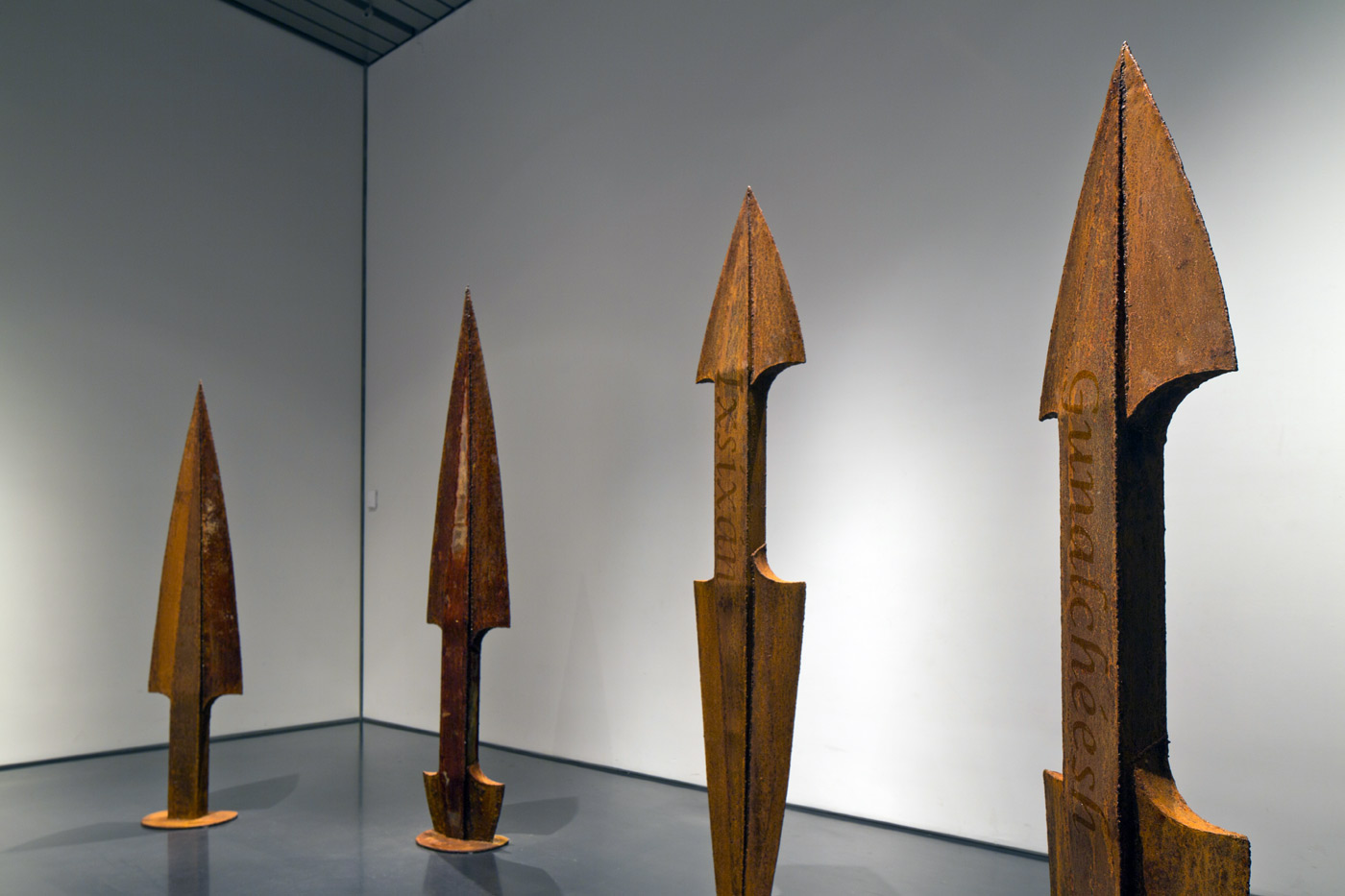
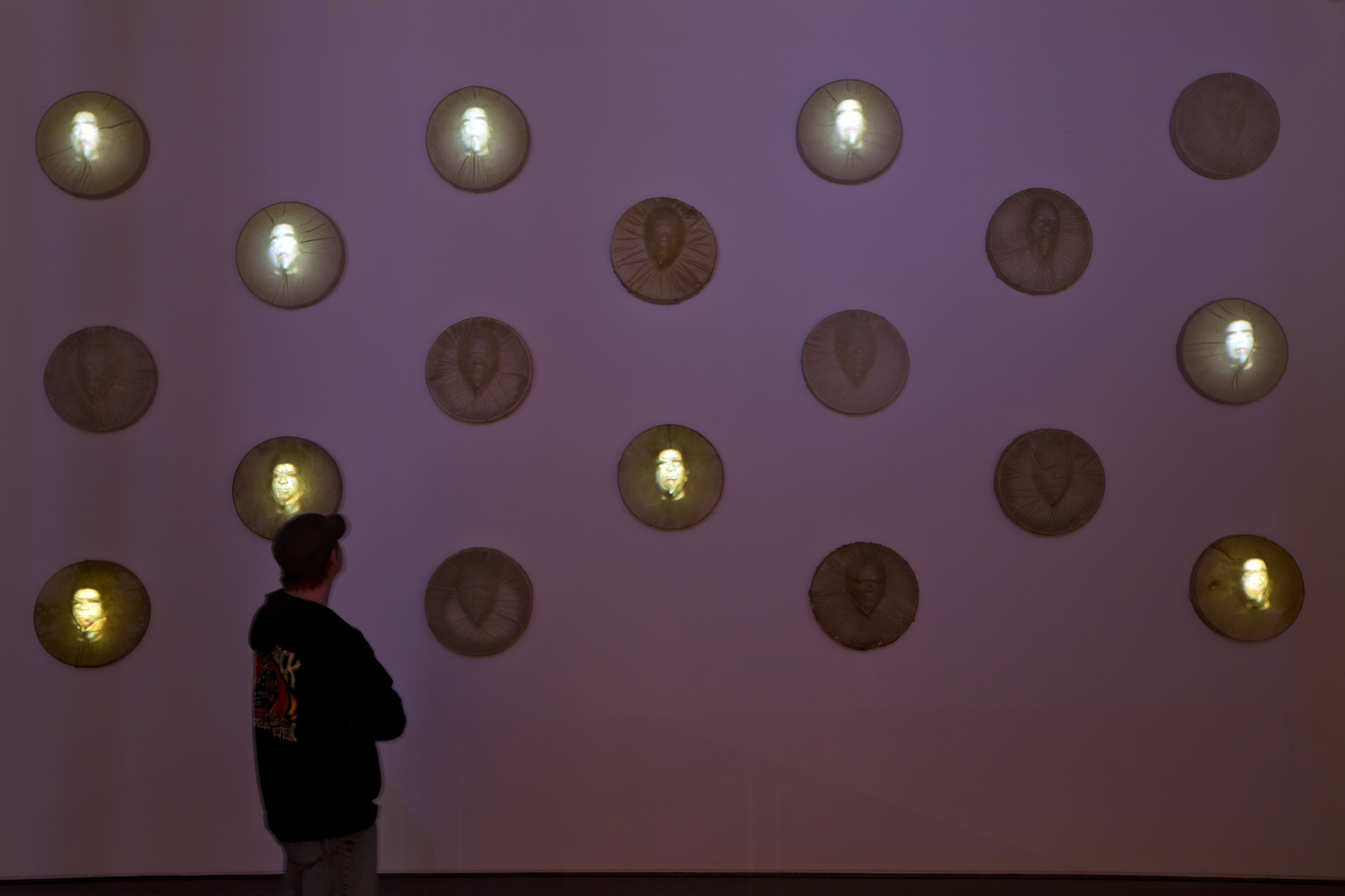
Da-ka-xeen Mehner (Tlingit/N'ishga - American) 'Finding My Song Weapons' 2012


Da-ka-xeen Mehner (Tlingit/N’ishga – American)
Finding My Song Weapons
2012


Another interesting exhibition that this archive likes promoting, this time about mixed-race identity.

Dr Marcus Bunyan


Many thankx to The Craft & Folk Art Museum for allowing me to publish the art work in the posting. Please click on the images for a larger version of the art.


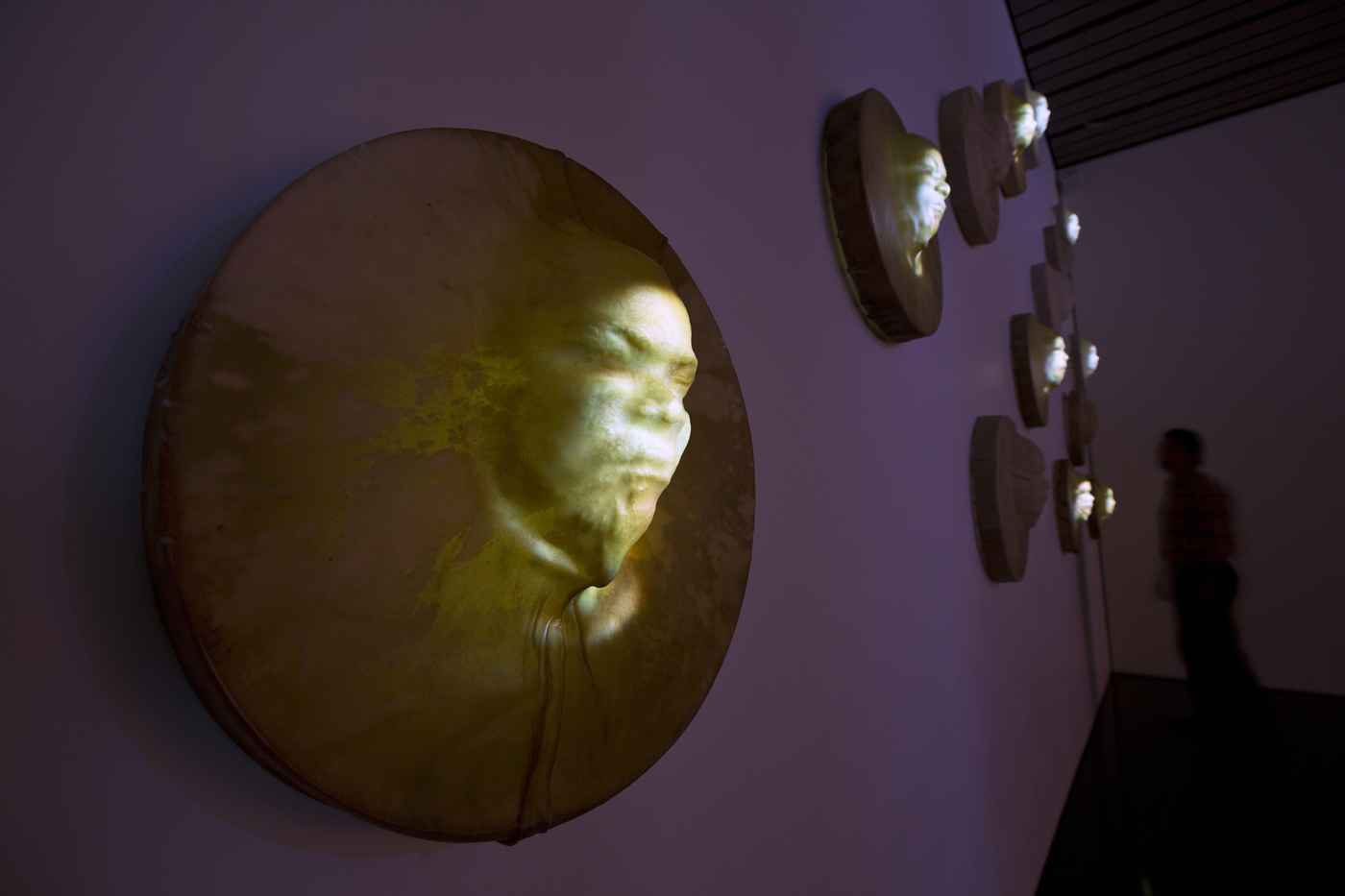
Da-ka-xeen Mehner (Tlingit/N'ishga - American) 'Finding My Song Weapons' 2012 (detail)


Da-ka-xeen Mehner (Tlingit/N’ishga – American)
Finding My Song Weapons (detail)
2012


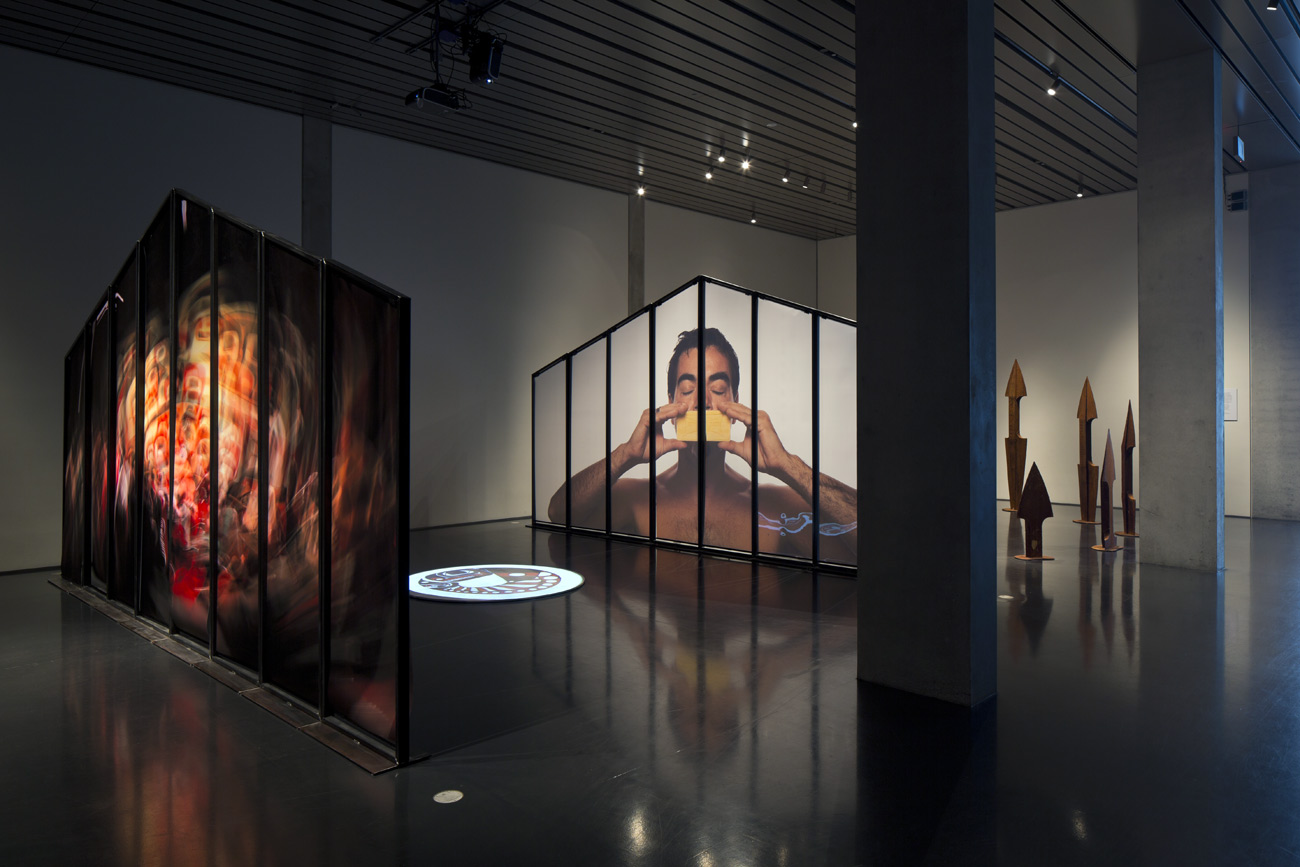
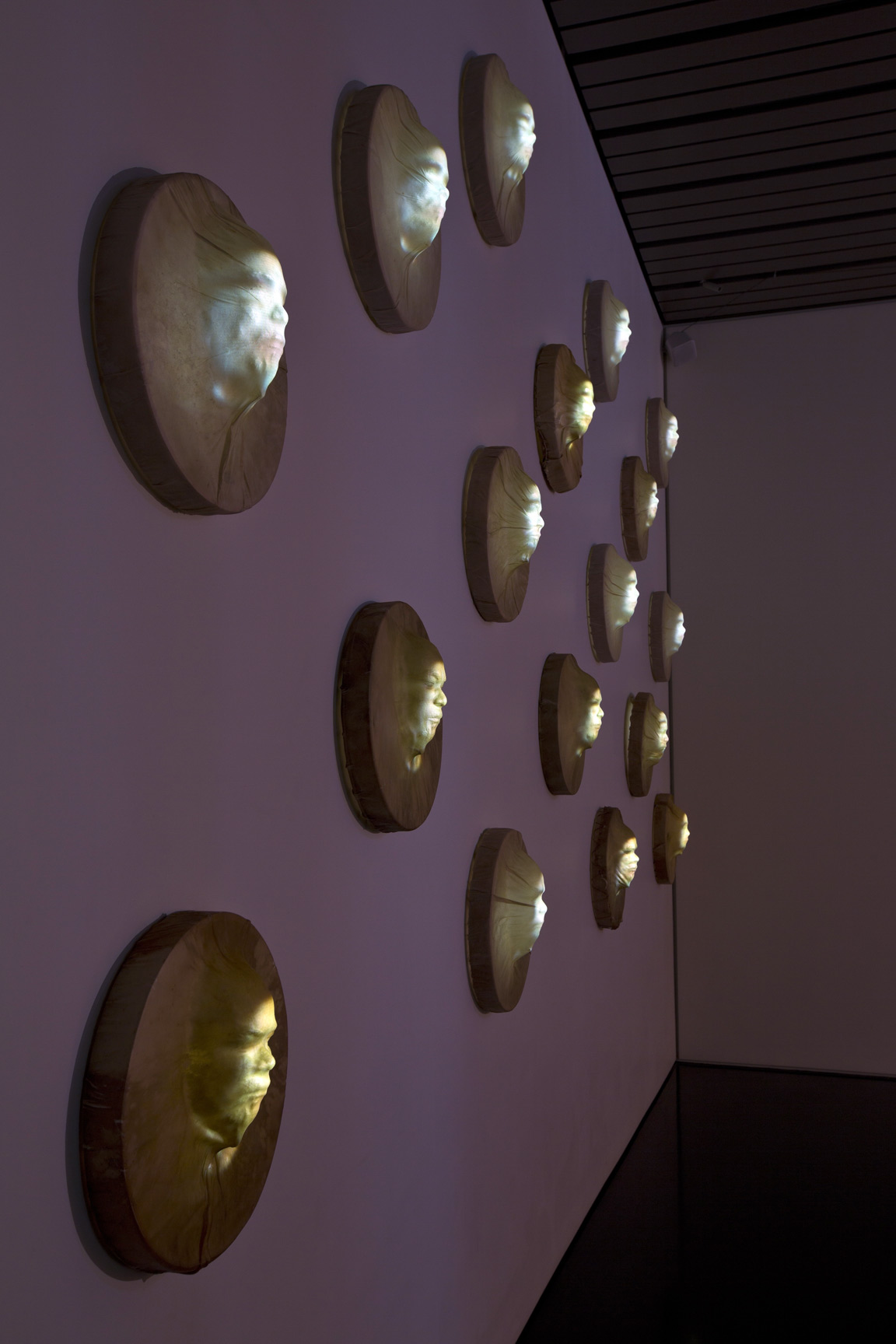
Da-ka-xeen Mehner (Tlingit/N'ishga - American) 'Finding My Song' 2012


Da-ka-xeen Mehner (Tlingit/N’ishga – American)
Finding My Song
2012


Da-ka-xeen Mehner (Tlingit/N'ishga - American) 'Finding My Song' 2012


Da-ka-xeen Mehner (Tlingit/N’ishga – American)
Finding My Song
2012


Da-ka-xeen Mehner (Tlingit/N'ishga - American) 'Finding My Song' 2012


Da-ka-xeen Mehner (Tlingit/N’ishga – American)
Finding My Song
2012
Projections on rawhide
Courtesy of the Anchorage Museum


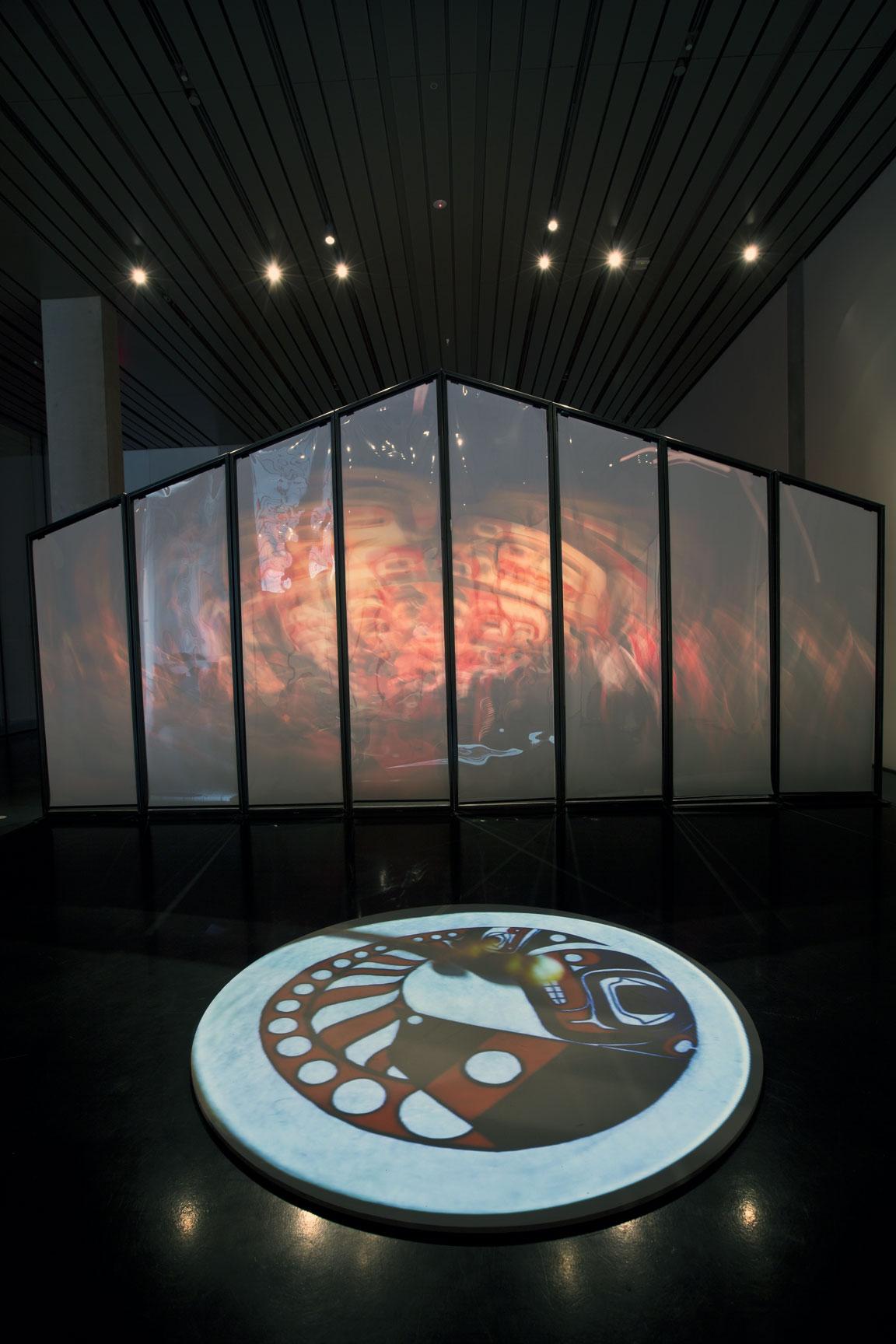
Da-ka-xeen Mehner (Tlingit/N'ishga - American) 'Finding My Song' 2012


Da-ka-xeen Mehner (Tlingit/N’ishga – American)
Finding My Song
2012
Projections on rawhide
Courtesy of the Anchorage Museum


Da-ka-xeen Mehner (Tlingit/N'ishga - American) 'Finding My Song' 2012


Da-ka-xeen Mehner (Tlingit/N’ishga – American)
Finding My Song
2012
Projections on rawhide
Courtesy of the Anchorage Museum


Nicholas Galanin (Tlingit/Aleut - American, b. 1979) 'There is No "I" in Indian' Nd


Nicholas Galanin (Tlingit/Aleut – American, b. 1979)
There is No “I” in Indian
Nd
Digital photograph


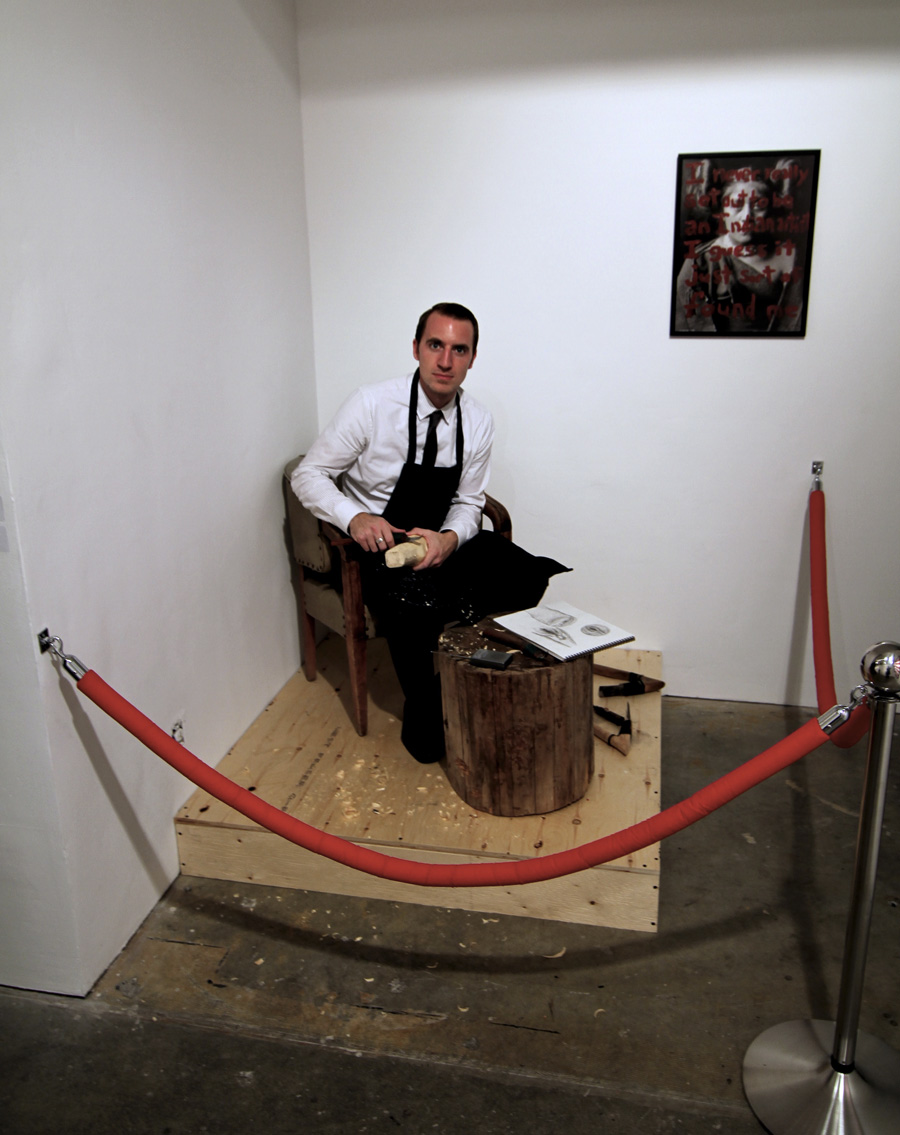
Nicholas Galanin (Tlingit/Aleut - American, b. 1979) 'White Carver' Nd


Nicholas Galanin (Tlingit/Aleut – American, b. 1979)
White Carver
Nd
Performance and installation


Nicholas Galanin (Tlingit/Aleut - American, b. 1979) 'Indian Land' 2012


Nicholas Galanin (Tlingit/Aleut – American, b. 1979)
Indian Land
2012
Digital photograph
Courtesy of the artist


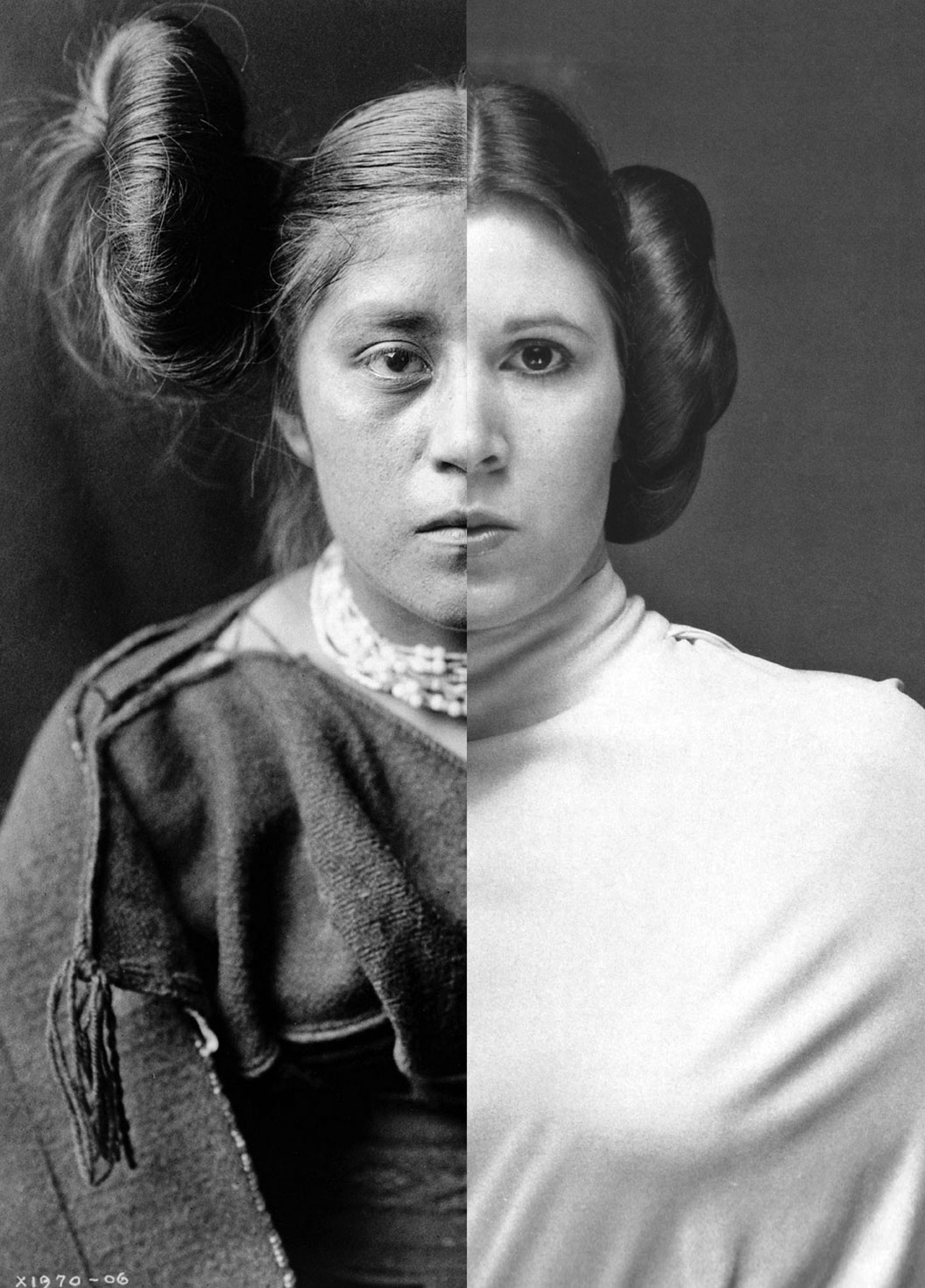
Nicholas Galanin (Tlingit/Aleut - American, b. 1979) 'Things Are Looking Native, Native's Looking Whiter' 2012


Nicholas Galanin (Tlingit/Aleut – American, b. 1979)
Things Are Looking Native, Native’s Looking Whiter
2012
Digital photograph
Courtesy of the artist


The Craft & Folk Art Museum (CAFAM) in collaboration with the Anchorage Museum presents This Is Not A Silent Movie: Four Contemporary Alaska Native Artists, an exhibition centred around four acclaimed Alaska Native artists whose groundbreaking contemporary works question institutional methods of identifying Native heritage, examine their own mixed-race identities, and challenge perceptions and stereotypes about indigenous peoples. It will be on view from Sunday, May 26 through Sunday, September 8, 2013.

Through the language of contemporary visual art, Sonya Kelliher-Combs, Susie Silook, Da-ka-xeen Mehner, and Nicholas Galanin seek new and distinct ways to speak of tradition and mediate the serious and sometimes ironic conditions of art, identity, and history in the late 20th and early 21st century. Though each artist’s work is rooted in a lifelong immersion in their respective Alaska Native craft traditions, their multi-media installations dissolve the boundaries between contemporary and traditional arts.

Sonya Kelliher-Combs (Iñupiaq/Athabascan) utilises media such as polyurethane, Beluga intestine, and walrus stomach into her paintings, sculptures, and labor-intensive installations. These works often simulate skin, which is a point of investigation into her struggle for self-definition and identity. Nicholas Galanin’s (Tlingit/Aleut) video and photography installations object to the cultural appropriation and categorisation of indigenous peoples by popular culture. In Things are Looking Native, Native’s Looking Whiter, Galanin creates a split image that is a composite of one of photographer Edward Curtis’ Native American models with actress Carrie Fisher as Princess Leia in Star Wars. The image references the cross-pollination of the traditional butterfly whorl hairstyle that was worn by unmarried Hopi girls and the popular culture image. In 2013, Galanin received a major award from United States Artists.

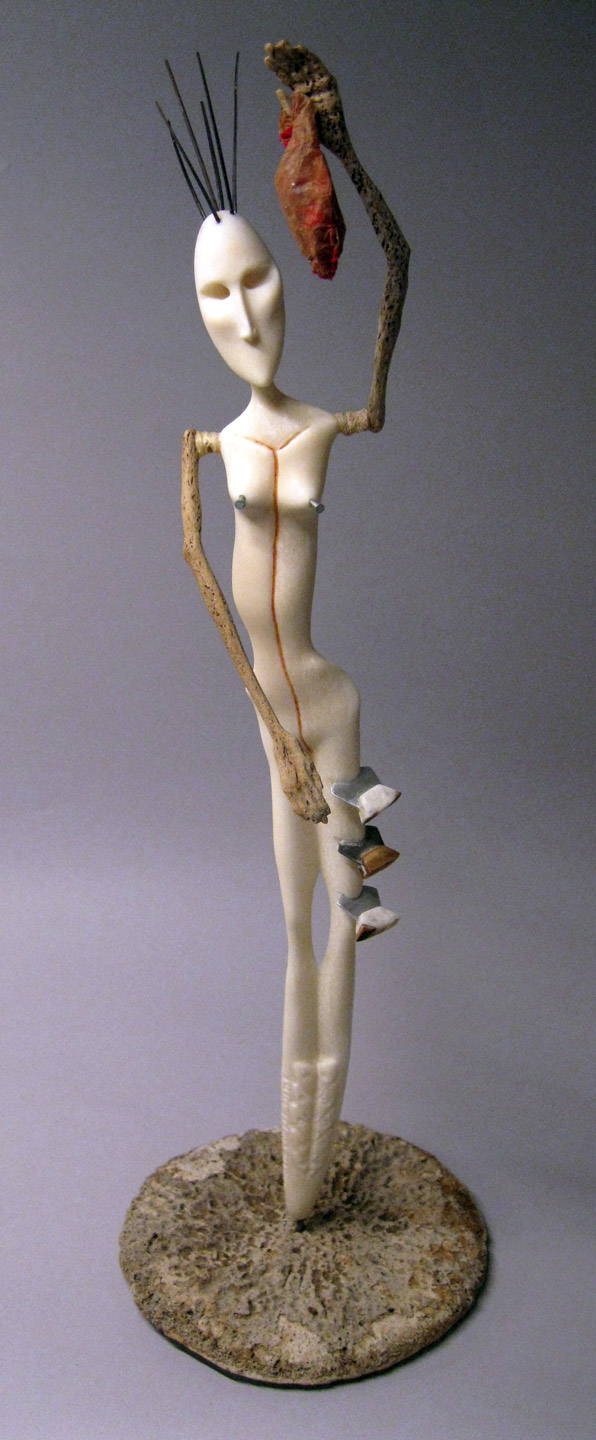
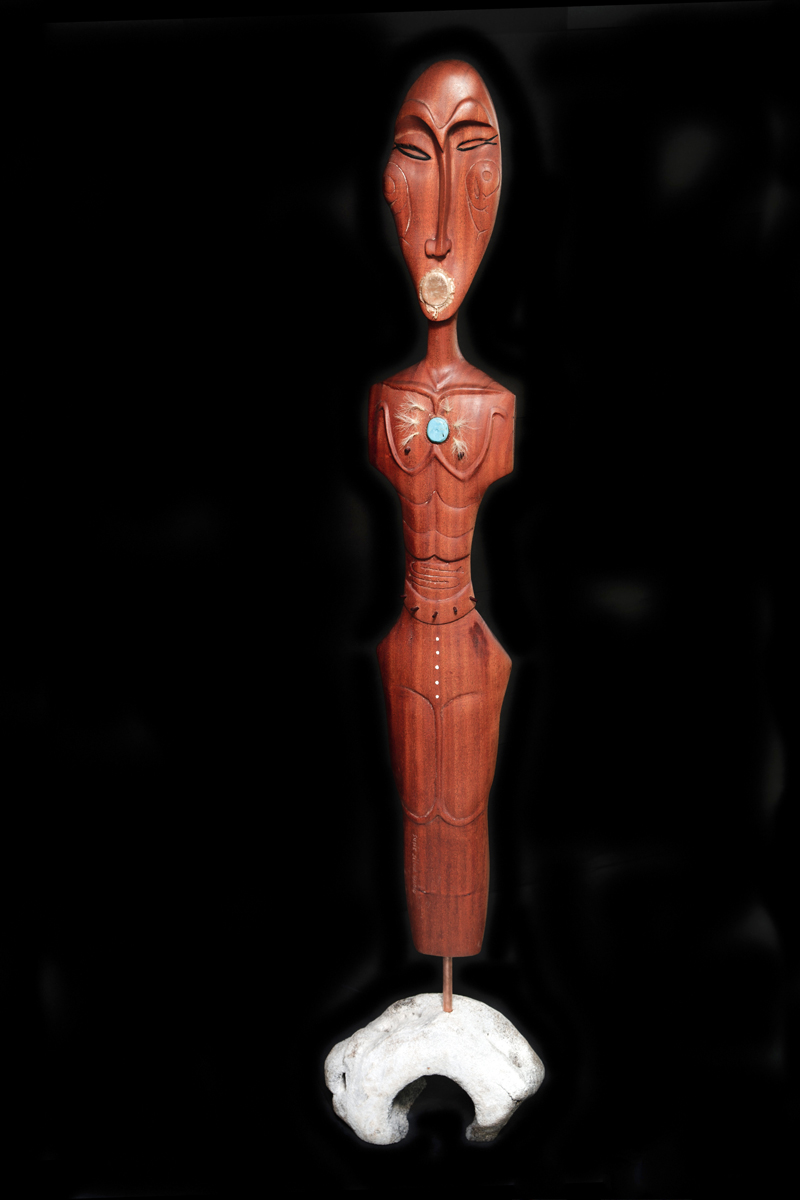
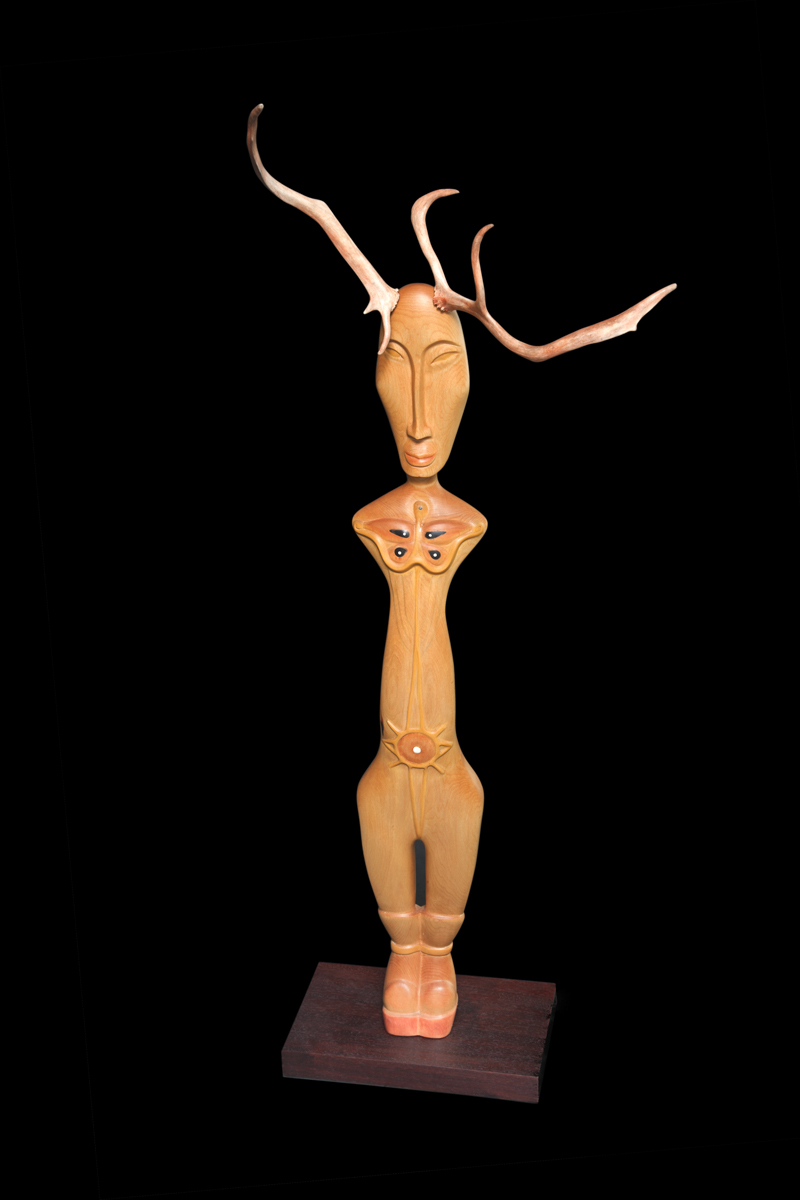
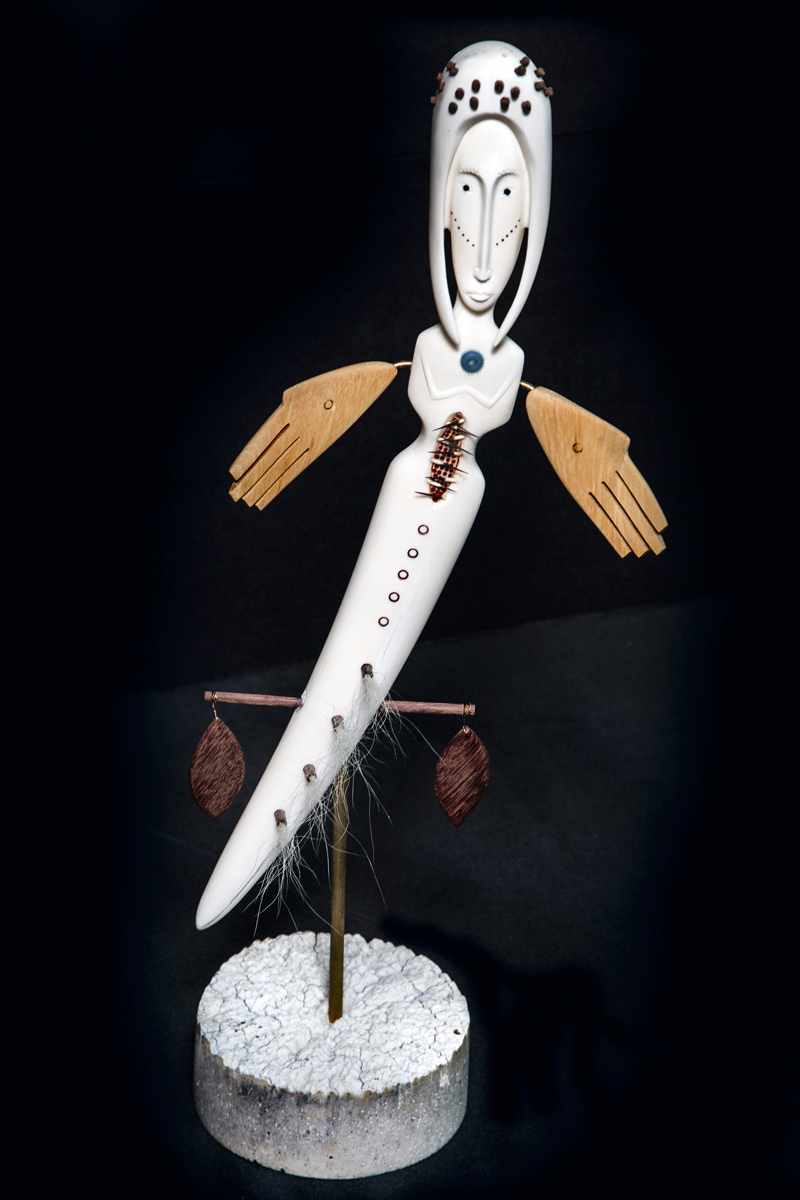
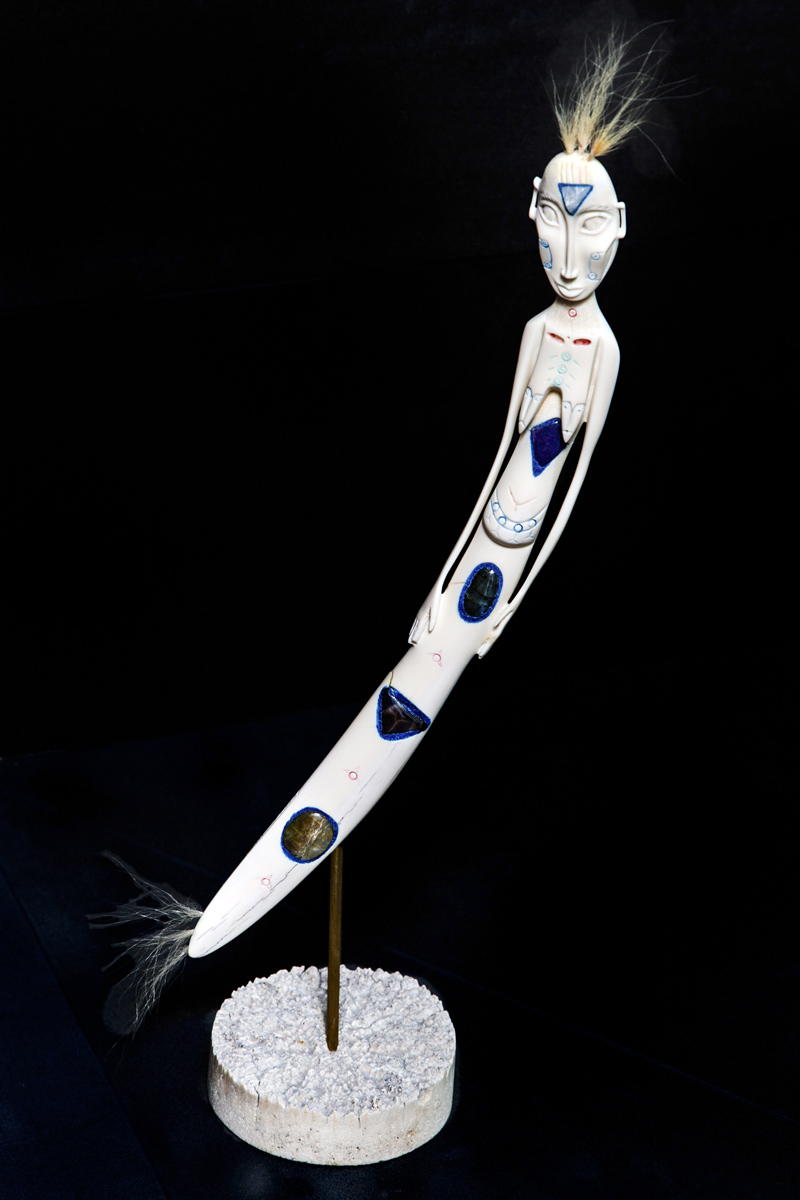
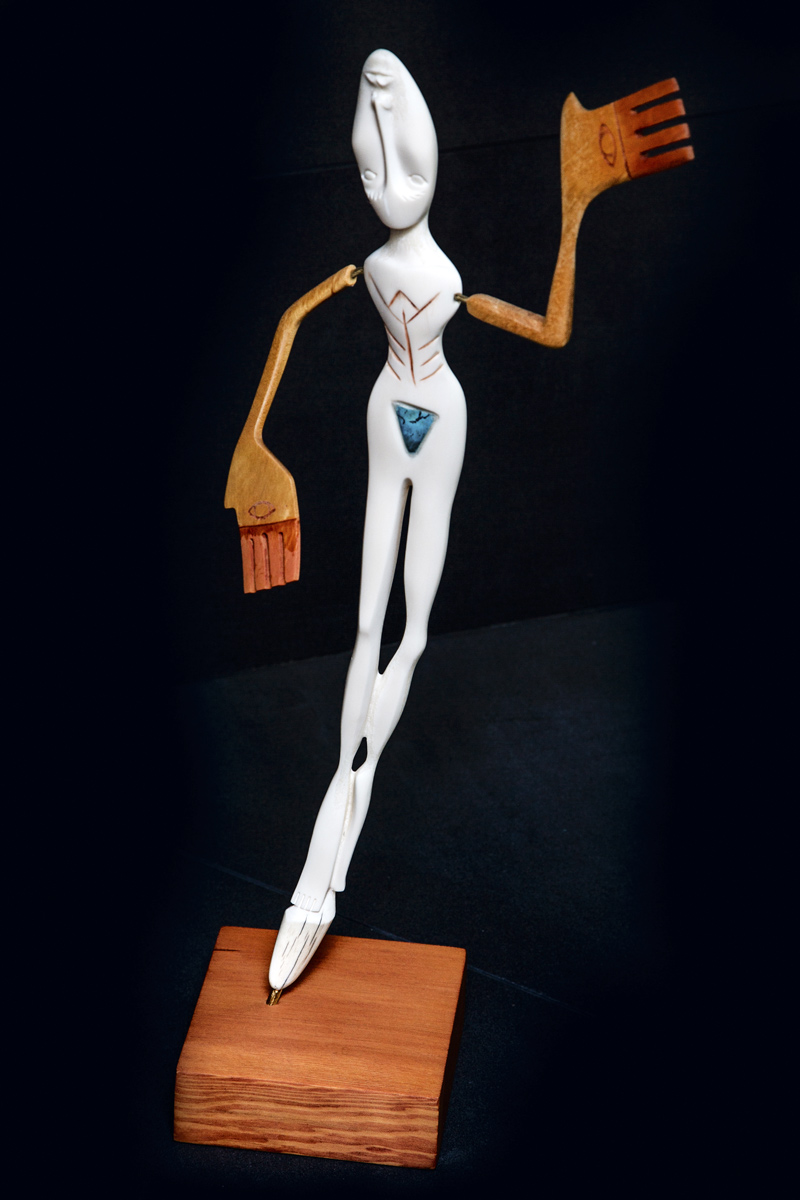
Carver Susie Silook (Yupik/Iñupiaq) is a writer and sculptor. The ancestral ivory dolls of Saint Lawrence, traditionally carved by men, are the basis of her work. Silook also departs from tradition by depicting women in her carvings rather than the animals most commonly rendered by men. Her walrus tusk carvings add a distinctly feminist perspective to an otherwise male-dominated art form as they address the widespread incidence of sexual abuse and violence perpetrated against Native women. Silook received a United States Artists Fellowship in 2007. Da-ka-xeen Mehner’s installation Finding My Song (Tlingit/N’ishga) draws upon his family’s stories to take a personal look at the retention and reclamation of language. The installation is inspired partially by his grandmother, whose mouth was washed out with soap whenever she spoke her Tlingit language in school in order to “encourage” her to speak English. Mehner’s work examines his own multicultural heritage – and the social expectations and definitions that accompany each aspect of it.

The title This is Not A Silent Movie comes from a quote by Native American writer and filmmaker Sherman Alexie, who works to move audiences away from narrow and stereotypical views of Native people – a view that Native people had very little influence in shaping. The exhibition has been curated by Julie Decker, Ph.D., Chief Curator at the Anchorage Museum.

Press release from The Craft & Folk Art Museum website


Susie Silook (Yupik/Iñupiaq - American, b. 1960) 'Keeping My Heart' 2008


Susie Silook (Yupik/Iñupiaq – American, b. 1960)
Keeping My Heart
2008
Courtesy of Anchorage Museum Collection


Susie Silook (Yupik/Iñupiaq - American, b. 1960) 'Aghnaghpak (Great Woman)' Nd


Susie Silook (Yupik/Iñupiaq – American, b. 1960)
Aghnaghpak (Great Woman)
Nd
African Mahogany, whalebone, polar bear, turquoise, baleen, ivory, ink, walrus stomach membrane, brass


Susie Silook (Yupik/Iñupiaq - American, b. 1960) 'The Healer' Nd


Susie Silook (Yupik/Iñupiaq – American, b. 1960)
The Healer
Nd
Basswood, caribou antler, ivory, baleen, seal whiskers, purple heart, red ocher


Susie Silook (Yupik/Iñupiaq - American, b. 1960) 'Ice Incantation' Nd


Susie Silook (Yupik/Iñupiaq – American, b. 1960)
Ice Incantation
Nd
Walrus ivory, purple heart, porcupine quills, polar bear, blue bead, baleen, red ocher, whalebone, wood


Susie Silook (Yupik/Iñupiaq - American, b. 1960) 'Mighty Elder' Nd


Susie Silook (Yupik/Iñupiaq – American, b. 1960)
Mighty Elder
Nd
Ivory, natural stones, polar bear, whale bone, brass, pastels


Susie Silook (Yupik/Iñupiaq - American, b. 1960)


Susie Silook (Yupik/Iñupiaq – American, b. 1960)


Craft Contemporary
5814 Wilshire Blvd.,
Los Angeles, CA 90036

Opening hours:
Wednesday – Sunday 11am – 5pm
Closed Mondays and Tuesdays

Craft Contemporary website

LIKE ART BLART ON FACEBOOK

Back to top

Exhibition: ‘Max Ernst’ at Fondation Beyeler, Riehen, Switzerland

Exhibition dates: 26th May – 8th September 2013


Many thankx to the Fondation Beyeler for allowing me to publish the images in the posting. Please click on the images for a larger version of the art.


Max Ernst (German, 1891-1976) The Entire City La ville entière 1935/36


Max Ernst (German, 1891-1976)
The Entire City
La ville entière
1935-1936
Oil on canvas
60 x 81cm
Kunsthaus Zurich
© 2013, ProLitteris, Zurich
Photo: Kunsthaus Zurich


Max Ernst (German, 1891-1976) Nature at Dawn (Evensong) La nature à l’aurore (Chant du soir) 1938


Max Ernst (German, 1891-1976)
Nature at Dawn (Evensong)
La nature à l’aurore (Chant du soir)

1938
Oil on canvas
81 x 100cm
Private collection
© 2013, ProLitteris, Zurich


Max Ernst (German, 1891-1976) 'Painting for Young People' 1943


Max Ernst (German, 1891-1976)
Painting for Young People
1943
Oil on canvas
60.5 x 76.5cm
The Ulla and Heiner Pietzsch Collection, Berlin
© 2013, ProLitteris, Zurich
Photo: Jochen Littkemann, Berlin


Max Ernst (German, 1891-1976) Woman, Old Man, and Flower Weib, Greis und Blume 1924


Max Ernst (German, 1891-1976)
Woman, Old Man, and Flower
Weib, Greis und Blume
1924
Oil on canvas
97 x 130cm
The Museum of Modern Art, New York
© 2013, ProLitteris, Zurich
Photo: © 2013, Digital image, The Museum of Modern Art, New York / Scala, Florence


Max Ernst (German, 1891-1976) 'Oedipus Rex' 1922


Max Ernst (German, 1891-1976)
Oedipus Rex
1922
Oil on canvas
93 x 102cm
Private collection
© 2013, ProLitteris, Zurich


This work is innately Freudian just in name, let alone in content. The Oedipus complex is one of the most well recognised components of Freudian theory and it is seen in this work names after it in many ways. The first is through the process of condensation. This can be seen as the bird headed man, which shows up in many of Ernst’s images: the association in this image between the man and the bird is the desire of man to be free from the inhibitions imposed upon him by society, and despite the fact that these two still retain their separate identities, they are consistent with Freud’s ideas. In the case of this work, the head is removed from the body, showing a detachment from true feeling and true understanding of life. Another Freudian idea is the use of the joke, which is seen in the treatment of several of the objects in this work. Such as the contrast and juxtaposition of the wall, the over-sized fingers, upside down eyes on the birds, and the balloon in the aft of the painted collage. Several other associations relating this work to Freud can be drawn as well.

This work has intense sexual undercurrents. The nut represents the female and the crack in the nut is a symbol for the vulva. The cracking of the nut by the hands of a male is a metaphor for sexual intercourse and also gender roles in traditional patriarchal cultures. The idea of the treatment of woman and of her place within society is also visible in another piece by Ernst, The Tottering Woman. In this piece, he addresses the constraints in which woman are held in the world and the patriarchy that she must deal with on a daily basis. It also touches upon the objectification of woman as well. Hoffman also theorises that the squeezing of the nut has implications of sadomasochistic roles as the nut is being dominated and crushed, the spike is punishing the hand equally and finally, once forced open, the “nut” could always snap back shut, injuring the index finger and thereby is a signifier of neurotic sexual attachment. The bird head towards the back of the picture plane is tethered by some sort of rope, which could be seen as societal restrictions on deviant sexuality and possibly is a reaction to the taboo associated with incest. Additionally, the arrow as it pierces the shell of the nut could be seen as a phallic signifier or also as a representation for the idea of love and then a refutation of the existence of love within the constraints of sexual desire and sexuality. The imagery in this piece by Ernst is intensely psychosexual in nature and content and can be seen mostly in those terms.

In defence of picking Oedipus Rex to write about in the context of collage, it is true that it is an oil painting, but its imagery was taken from print sources and then was transposed into the work by the act of painting them. The nut squeezing image was taken from an article entitled “Experience sur l’elasticite, faite avec une noix,” from the popular 19th century French Magazine La Nature.

Anonymous. “Ernst: Chance, Collage and the Study of Freud,” on the Center for Biological Computing, Indiana State University Department of Life Sciences website [Online] Cited 12/12/2020. No longer available online


Max Ernst (German, 1891-1976) The Fireside Angel (The Triumph of Surrealism) L’ange du foyer (Le triomphe du surréalisme) 1937


Max Ernst (German, 1891-1976)
The Fireside Angel (The Triumph of Surrealism)
L’ange du foyer (Le triomphe du surréalisme)
1937
Oil on canvas
114 x 146cm
Private collection
© 2013, ProLitteris, Zurich


This is one of the rare pictures by Max Ernst which refer directly to a political incident. He commented on this: “The Fireside Angel is a picture I painted after the defeat of the Republicans in Spain. This is, of course, an ironical title for a kind of clumsy oaf which destroys everything that gets in the way. That was my impression in those days of the things that might happen in the world. And I was right.” The Fireside Angel is depicted as an avenging character from the Bible. Its destructive potential is stressed by its aggressive colouring. In the figure of the angel, blind traumatising force is expressed, against which mankind is defenceless. Since there is no hope for negotiations with an inhuman force, the blind aggressor seems even more frightening.


With the exhibition of over 160 of his works at the Fondation Beyeler in cooperation with the Albertina, Vienna, the “artist of the century” Max Ernst (1891-1976) will be given the first comprehensive retrospective in Switzerland since his death as well as the first held in a German-speaking country since 1999.

Max Ernst is one of Modernism’s most versatile artists. After his beginnings as a rebellious Dadaist in Cologne, he moved to Paris in 1922, where he soon became one of the pioneers of Surrealism. He was interned twice as an enemy alien during the Second World but was released thanks to the intervention of the poet Paul Éluard, who was his friend. In 1941 Max Ernst fled to the USA, where he found new stimuli for his work as well as providing new impulses for the generation of young American artists. A decade later he returned to a Europe that had been devastated by the war and where the once highly esteemed Max Ernst seemed to have been forgotten, only to be rediscovered as one of the 20th century’s most multifaceted artists. In 1958, having renounced his German nationality in 1948 in order to take US citizenship, Max Ernst eventually became a French citizen.

Ernst was indeed one of the “artists of the century” – not only because of the high quality and wide range of his oeuvre but also because of the length of his creative career, which lasted around 60 years from 1915 to 1975. Active at a time of tremendous artistic, social, political and technical upheaval, he knew how to integrate these changes into his oeuvre, which therefore reflects key characteristics of the 20th century. The pleasure Max Ernst took in experimenting with different techniques made him a pioneer of multimedia expression. With no apparent effort, he combined in his work the themes, styles and techniques that were important to successive generations. His ceaseless quest for new forms of expression, questions and subjects is emblematic of modern man. Max Ernst appears to us as the artist who never wanted to find himself, as he once said: “A painter is lost when he finds himself”.

With his early Dadaist experience, his key position among the Surrealists and his prelude to action painting, Max Ernst travelled between worlds and cultures, moving to Paris from Cologne and from New York back to France. At a time of political unrest, he maintained his critical, creative gaze, seeking refuge in a country, the USA, which he scarcely knew but to which he nonetheless responded with curiosity and which provided him with important impulses for his late work. With exhibitions in New York, projects in Arizona and Touraine, participation in the Venice Biennale and Documenta, Max Ernst was an early 20th century example of the kind of “cultural and artistic nomad” who only later became a customary figure.

Collage

As early as 1919, Max Ernst started working with the technique of collage, which he used to design or simulate new pictorial realities. He created his collages from illustrations taken from various novels, textbook catalogues, natural science journals and 19th century sales catalogues. He excised the fragments from wood engravings, using a scalpel in order to achieve cut edges that were perfectly exact and smooth. In around 1929 / 1930 Max Ernst created his most famous collage novels La femme 100 têtes (Hundred-Headed Woman / Headless Woman) and Rêve d’une petite fille qui voulut entrer au Carmel (A little Girl dreams of taking the Veil), which are among Surrealism’s most fascinating, enigmatic works.

Frottage

In around 1925, Max Ernst began his Natural History series, in which he used the technique of frottage for the first time (the French word frotter means “to rub”) as a semi-automatic procedure. He placed objets trouvés he found outdoors, such as leaves and wood, under a sheet of paper and rubbed over them with a pencil. Then he took the structures that emerged and transformed them into fantastic pictures. In his frottages, Ernst breathes new life into lifeless objects, giving them another, to some extent uncustomary, significance. Max Ernst developed frottage while he was staying in Brittany. In his essay Beyond Painting he describes a kind of visionary revelation that caused him to use the wooden floor and other objects in his guest-house room as objects for his frottages.

Grattage

Grattage is an artistic technique used by Max Ernst in painting that he developed in around 1927 as an extension of frottage. In a first phase, he applied several superimposed layers of paint to a canvas. Underneath the painting ground that he prepared in that way, he placed objects such as metal grids, wooden boards and string, the relief of which could be seen through the canvas. In order to transfer those structures to the picture, he scratched away the top layers of paint (gratter is the French word for “to scratch”). In a subsequent phase, he reworked the patterns that had become visible, transforming them into forests, shellflowers, birds and petrified cities.

Decalcomania

Decalcomania is a transfer technique in which the damp pigment on a piece of glass or a sheet of paper is pressed against a canvas, leaving behind fine streaks, bubbles or marbled traces of paint when they are removed. In a subsequent phase, the artist reworks the complex surface structure. This artistic technique had already been developed in the 18th century and was used by other Surrealist artists too. Max Ernst adopted the technique in the late 1930s, using it to represent mysterious landscapes peopled by eery faces, figures and animals hiding in the thickets of nature.

Oscillation

In around 1942, while an exile in the USA, Max Ernst started developing the technique of oscillation. He let paint drip out of a tin perforated with a number of holes, which he attached to a long string and swung to and fro over the canvas. This largely uncontrollable and, once again, semi-automatic procedure created reticulated compositions of circles, lines and points on the surface that were reminiscent of planets’ orbits. Oscillation was an innovative technique that not only extended the range of Surrealism’s artistic repertoire but also heralded Jackson Pollock’s Drip Painting.

Press release from the Fondation Beyeler website


Max Ernst (German, 1891-1976) At the First Limpid Word Au premier mot limpide 1923


Max Ernst (German, 1891-1976)
At the First Limpid Word
Au premier mot limpide
1923
Oil on plaster, transferred to canvas
232 x 167cm
Kunstsammlung Nordrhein-Westfalen, Düsseldorf
© 2013, ProLitteris, Zurich
Photo: Walter Klein, Düsseldorf


At the First Limpid Word is one such puzzle. A monumental work, it formed part of the decoration of the house that Max Ernst shared with Paul Éluard and his wife Gala (who later became Dalí’s muse). It was only in the 1960s that the wall painting, which had been painted over, was rediscovered. This painting, “an allegory of seduction,” is such a simple composition but is filled with symbolism in colour and subject.


Max Ernst (German, 1891-1976) 'Ubu Imperator' 1923


Max Ernst (German, 1891-1976)
Ubu Imperator
1923
Oil on canvas
100 x 81cm
Musée national d’art moderne, Centre Georges Pompidou, Paris
© 2013, ProLitteris, Zurich
Photo: © Centre Pompidou, MNAM-CCI, Dist. RMN-Grand Palais / Philippe Migeat


Like many of Ernst’s paintings during his Paris period (1922-1941), Ubu Imperator resembles a collage in painted form. The artist’s knowledge of Freudian theories, familiarity with myth and extreme wit are reflected in this early painting, which is now considered proto-Surrealist due to its strange juxtapositions.

In Ubu Imperator (1923), an anthropomorphic top dances in a vast, empty landscape. Such works captured early on the surrealist notion of estrangement and commitment to the subconscious, but also they seem surprisingly contemporary. The red Ubu Imperator marked the entry of Ernst in the articulated stage of surrealism by his use of a literary narrative that was sometimes personal, sometimes political. In this seminal work a spinning top, a red carcass with iron reinforcement, and human hands express an astonishing image of the Ubu Father, a grotesque symbol of authority invented by Alfred Jarry. Other paintings suggest Ernst’s impressions of ancient Buddhist temples (à la Angkor Wat) as inspired from his trip to Asia following the breakup of his famous ménage à trois with Gala and Paul Eluard. This structure and thickly overgrown plants appear in many of his engravings and grattage [Grattage is a surrealist painting technique that involves laying a canvas prepared with a layer of oil paint over a textured object and then scraping the paint off to create an interesting and unexpected surface (Tate)] oil paintings, such as The Entire City (1935-1936) and The Petrified City (1935).

Valery Oisteanu. “Max Ernst: A Retrospective,” on the The Brooklyn Rail website, May 2005 [Online] Cited 12/12/2020


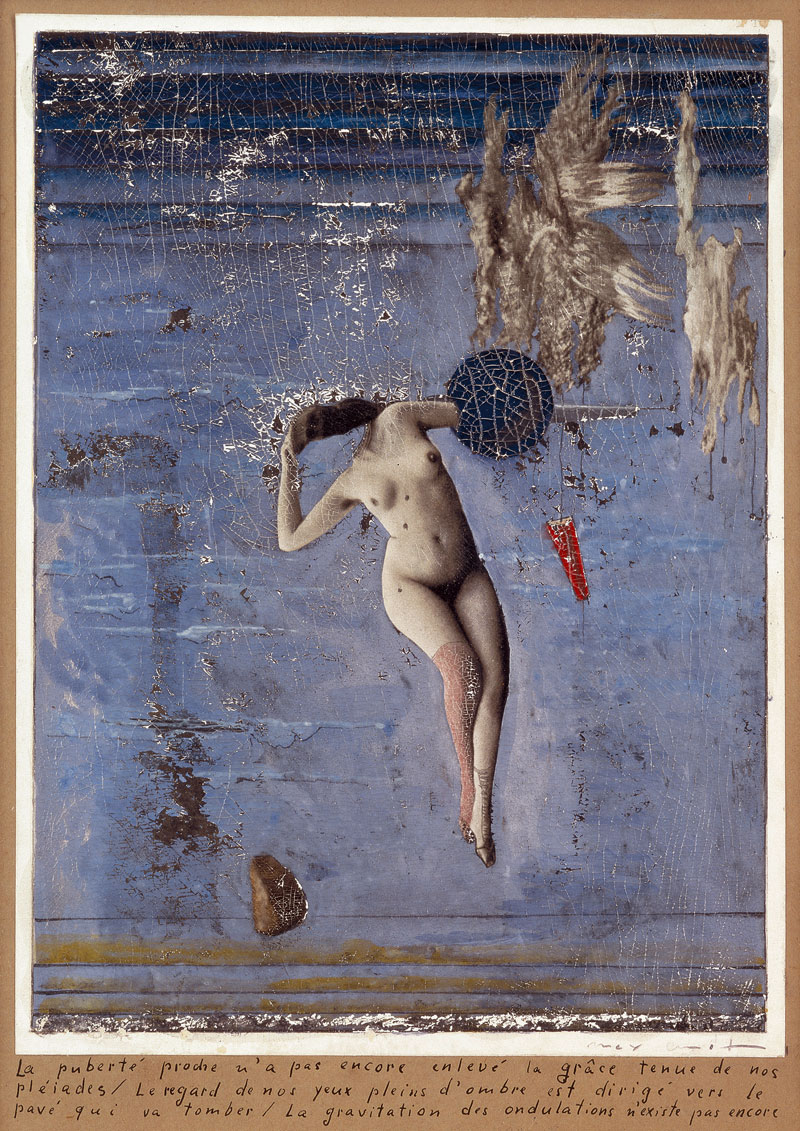
Max Ernst (German, 1891-1976) 'Approaching Puberty… (The Pleiades)' La puberté proche... (les pléiades) 1921


Max Ernst (German, 1891-1976)
Approaching Puberty… (The Pleiades)
La puberté proche… (les pléiades)
1921
Collage, gouache, and oil on paper, mounted on cardboard
24.5 x 16.5cm
Private collection
© 2013, ProLitteris, Zurich


The Pleiades, companions of Artemis, were the seven daughters of the titan Atlas and the sea-nymph Pleione born on Mount Cyllene. They are the sisters of Calypso, Hyas, the Hyades, and the Hesperides. The Pleiades were nymphs in the train of Artemis, and together with the seven Hyades were called the Atlantides, Dodonides, or Nysiades, nursemaids and teachers to the infant Bacchus. There is some debate as to the origin of the name Pleiades. Previously, it was accepted the name is derived from the name of their mother, Pleione. However, the name Pleiades may derive from πλεῖν(to sail) because of their importance in delimiting the sailing season in the Mediterranean Sea. (Wikipedia)

For Ernst eroticism was another way of entering the unconscious, of escaping from convention, and possibly of tweaking bourgeois taste. But he was aware that adult sexuality had its limits, as is apparent in the exquisite Approaching Puberty… (1921). A photograph of a nude, faceless girl floats in a blue space stratified by horizontal lines, suggesting water or the sky. A few strangely disparate forms surround the girl, and the short text at the bottom ends, “The gravitation of the undulations does not yet exist.” The title, this line, and the fact that the girl floats in space rather than standing on the ground – as most of Ernst’s figures do – suggests that he sees in pubescence a kind of weightless freedom. In a related but nonsexual image, an Untitled c. 1921 collage, four schoolboys peer out of their classroom (from which a wall is missing) at a vast blue sky in which a hot-air balloon floats. A schoolmaster stands alone and ignored at his desk; next to him one of the boys balances a giant pencil on a pointer. What’s learned in school, Ernst seems to say, is far less important than visions of the sky.

Fred Camper. “Max Ernst’s Theater of Reveries,” on the Chicago Reader website, November 1993 [Online] Cited 12/12/2020


Max Ernst (German, 1891-1976) 'Napoleon in the Wilderness' 1941


Max Ernst (German, 1891-1976)
Napoleon in the Wilderness
1941
Oil on canvas
46.3 x 38cm
The Museum of Modern Art, New York
© 2013, ProLitteris, Zurich
Photo: © 2013, Digital image, The Museum of Modern Art, New York / Scala, Florence


In Max Ernst’s painting Napoleon in the Wilderness (1941), a strange whimsical trumpet appears in the hand of a female figure that seems to have sprung from the sinister rock and coral formations of a world in ruin. This painting formed part of suite of decalcomania [A transfer technique, developed in the 18th century, in which ink, paint, or another medium is spread onto a surface and, while still wet, covered with material such as paper, glass, or aluminium foil, which, when removed, transfers a pattern that may be further embellished upon. The technique was adopted by the Surrealists to create imagery by chance rather than through conscious control (MoMA)] works, in which Carrington’s semi-naked figure haunts a series of eerie landscapes, richly textured and abundant with mythological hybrid forms. Between periods of internment during the war, Ernst had managed to continue painting, producing haunting images of his abandoned lover in works that evoke his own sense of loss and grief in macabre scenes that promise both decay and renewal.

Text from Natalya Lusty, Surrealism, Feminism, Psychoanalysis. Ashgate Publishing, 2007.


The exhibition is a chronological presentation of all the major creative phases and groups of themes in Max Ernst’s work, opening with Capricorn, his most important sculpture. Max Ernst, who was born on 2 April 1891 in Brühl (Germany), first learnt about painting from his father. He had a conservative, middle-class upbringing, against which he soon rebelled. Starting in 1910, he studied art history as well as psychology, Romance languages and philosophy. Initially influenced by Expressionism and Futurism, he soon came in contact with other artists and art movements.

His early work City with Animals demonstrates this unique combination of different styles, displaying both Cubist and Futurist features. His encounter with Hans Arp (also represented in the Beyeler Collection along with the Surrealists Dalí, Giacometti and Miró) came at a time full of turmoil. Dada is born; the years after the First World War are a time of radical change, protest and experimentation.

Dada brings Max Ernst into contact with Surrealist artists. He ceases to be just a German artist and becomes a leading figure in the Surrealist art movement in Paris. There his works begin to acquire enigmatic qualities, for the unconscious and dreams are important elements of Surrealism, which it took over from psychoanalysis. Max Ernst remains an innovator, experimenting with frottage from the mid-1920s onwards. Hybrid creatures are created from different natural species; his interest in the natural sciences finds expression in his works.

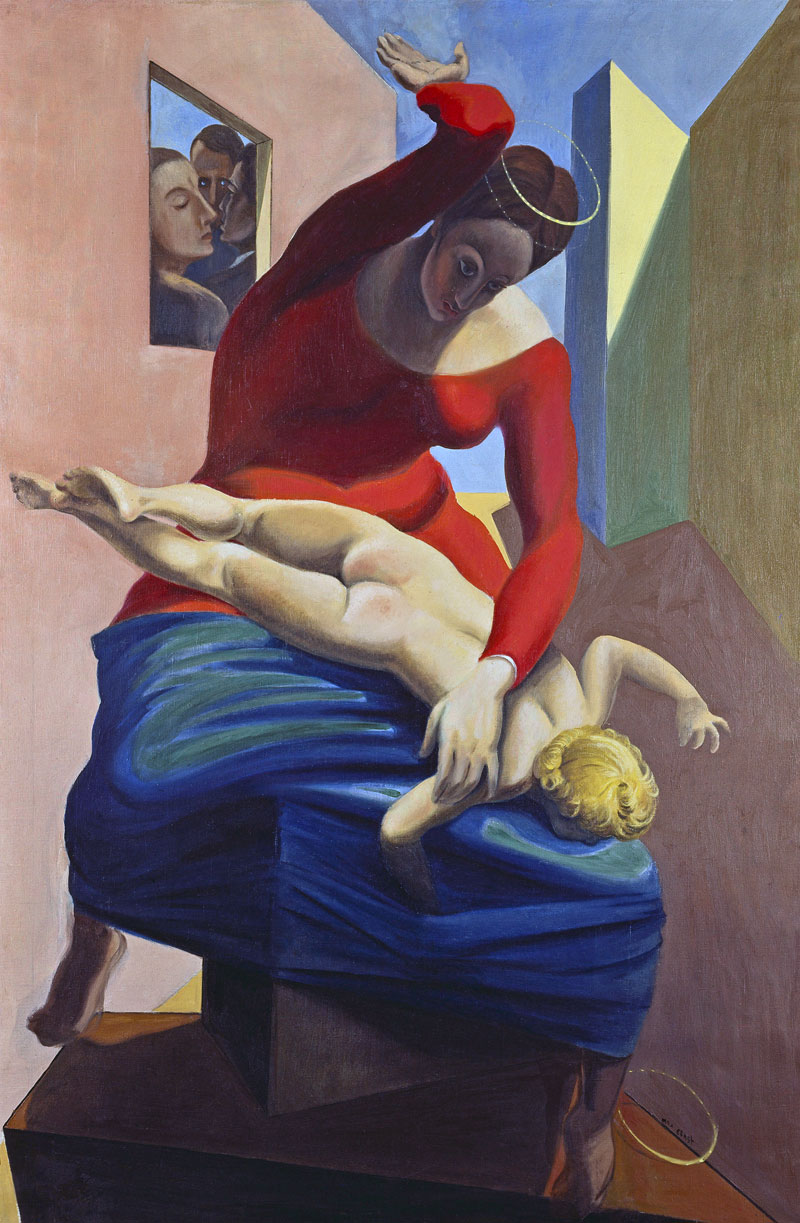
At the First Limpid Word is one such puzzle. A monumental work, it formed part of the decoration of the house that Max Ernst shared with Paul Éluard and his wife Gala (who later became Dalí’s muse). It was only in the 1960s that the wall painting, which had been painted over, was rediscovered. The Blessed Virgin Chastising the Infant Jesus is an equally spectacular work, a scandal-provoking painting with blasphemous elements that deconstructs the traditional sacred image of the Madonna, representing a radical liberation from Ernst’s middle class roots. One whole room in the exhibition is developed to the theme of the forest, with a number of masterpieces from that series. Considerable importance is also attached to the series of Horde paintings from the late 1920s; the metamorphosed figures convey the theme of transformation. With the Flowers and Cities series (which focus on the antitheses of nature and culture), other important groups of themes are also presented.

Room 11 will contain a number of key works with the jungle paintings from the second half of the 1930s including Nature at Dawn with its dark, sinister character. Different traditions are echoed here, ranging from borrowings from Henri Rousseau to the Romanticism of a painter like Caspar David Friedrich. With The Robing of the Bride there is not only an obvious reference to Renaissance art but also a more differentiated context. The transformation of a woman into an animal and vice versa is an erotic motif that the painting conveys through a number of details. The Fireside Angel, on the other hand, thematises the Spanish Civil War of the late 1930s, with which many artists and intellectuals concerned themselves. With the brightly coloured, mask-like, terrifying dimension of its figure, which seems to fly towards the viewer as an unstoppable whirlwind between aggression and mockery, Max Ernst prefigures the political catastrophe that was to befall Europe.

Ernst’s late work displays thematic caesura – on the one hand, a poetical and sensuous contemplation using over-painting in the refined, technically innovative work The Garden of France and, on the other, Birth of a Galaxy, a splendid late work in which air, water, earth and light all rise into a starry firmament. As a free spirit – ironical, elegant and rebellious – and a man of many different facets, Max Ernst today remains an artist whose work is both accessible and complex. His works speak to us, evoking uncharted depths and hidden mysteries, as well as prompting reflection. Like mercury – which continuously changes shape in a fascinating way, hence being impossible to grasp – Max Ernst is still an exceptional artist almost forty years after his death, exemplary in his artistic independence and possessing an urge for freedom and a bold readiness for innovation in his work and life that preserve his oeuvre from stylistic opportunism and conventionality.

Max Ernst’s creativity in handling sources of imagery and inspiration, the breaks between his many phases and types of subject matter, are still capable of astonishing viewers today. Like a revolutionary of vision, he rearranged images and elements, and as a Surrealist established links between pictures and the viewer’s unconscious mind. What remained a constant was the persistence of Ernst’s rebellion. Like his life, he once said, his work was “not harmonious in the sense of classical composers.” A master of metamorphosis, Ernst was a searcher and discoverer, an honorary doctor of philosophy who increasingly expanded his range of investigation to include astronomy, ethnology, ornithology, mathematics and psychoanalysis, following up his love of the natural sciences and creative chance.

Press release from the Fondation Beyeler website


Max Ernst (German, 1891-1976) The Robing of the Bride L'habillement de l’épousée / de la mariée 1940


Max Ernst (German, 1891-1976)
The Robing of the Bride
L’habillement de l’épousée / de la mariée
1940
Oil on canvas
129.6 x 96.3cm
Peggy Guggenheim Collection, Venice (Solomon R. Guggenheim Foundation, New York)
© 2013, ProLitteris, Zurich
Photo: Peggy Guggenheim Collection, Venice (Solomon R. Guggenheim Foundation, New York)


The Robing of the Bride (1939-1941; Venice, Guggenheim) employs Renaissance perspective devices and Cranach-like figures to represent a pagan marriage.


Max Ernst (German, 1891-1976) The Blessed Virgin Chastising the Infant Jesus before Three Witnesses: André Breton, Paul Éluard and the Artist La Vierge corrigeant l’enfant Jésus devant trois témoins: André Breton, Paul Éluard et le peintre 1926


Max Ernst (German, 1891-1976)
The Blessed Virgin Chastising the Infant Jesus before Three Witnesses: André Breton, Paul Éluard and the Artist
La Vierge corrigeant l’enfant Jésus devant trois témoins: André Breton, Paul Éluard et le peintre
1926
Oil on canvas
196 x 130cm
Museum Ludwig, Cologne
© 2013, ProLitteris, Zurich
Photo: Peter Willi / ARTOTHEK


Max Ernst (German, 1891-1976) The Immaculate Conception L'immaculée conception 1929


Max Ernst (German, 1891-1976)
The Immaculate Conception
L’immaculée conception
1929
Master illustration for La femme 100 têtes, chapter 1, plate 12
Collage on paper
14.2 x 14.5cm
Private collection
© 2013, ProLitteris, Zurich


La Femme 100 Têtes 1967 with English Subtitles


'Dorothea Tanning and Max Ernst with the cement sculpture Capricorne (Capricorn), Sedona, Arizona' 1948


Dorothea Tanning and Max Ernst with the cement sculpture Capricorne (Capricorn), Sedona, Arizona
1948
© 
2013, ProLitteris, Zurich
Photo: Max Ernst Documentation, Deutsches Forum für Kunstgeschichte, Paris / John Kasnetsis


Dorothea Margaret Tanning (August 25, 1910 – January 31, 2012) was an American painter, printmaker, sculptor and writer. She created ballet sets and costumes for George Balanchine’s Night Shadow, at the Metropolitan Opera House and others. She also appeared in Hans Richter’s avant-garde films. As an artist she was influenced by Dada and Surrealism and married fellow Surrealist Max Ernst.

As she recounts in her memoirs, Birthday and Between Lives, when Ernst visited her studio in 1942, they played chess, fell in love, and embarked on a life together that soon took them to Sedona, Arizona, and later to France. They met at a party in 1942 and after he would drop by Dorothea’s studio where she painted for a Surrealist movement exhibition of art by women for Peggy Guggenheim’s Art of This Century. In that exhibition, Tanning’s work showed along with the work of Louise Nevelson and Gypsy Rose Lee. Soon after this encounter Ernst moved in with her.

They married in 1946, in a double wedding with Man Ray and Juliet Browner in Hollywood, after Ernst’s divorce from Peggy Guggenheim. They remained married for 30 years until his death. In 1949, Tanning and Ernst moved to France, where they divided their time between Paris, Touraine and later Provence. They would often host guest such as Balanchine, Henri Cartier-Bresson, Marcel Duchamp, Pavel Tchelitchew and Dylan Thomas. In 1957 Tanning and Ernst moved to France again because Max Ernst was denied citizenship as a German during the McCarthy era. When speaking on her relationship with Ernst in an interview, Tanning said: “I was a loner, am a loner, good Lord, it’s the only way I can imagine working. And then when I hooked up with Max Ernst, he was clearly the only person I needed and, I assure you, we never, never talked art. Never.”

After Max Ernst died in 1979 Dorothea Tanning returned to the United States.

Text from the Wikipedia website


'Max Ernst with rocking horse, Paris' 1938


Max Ernst with rocking horse, Paris
1938
2013, ProLitteris, Zurich
Photo: Max Ernst Museum Brühl des LVR, Stiftung Max Ernst


Fondation Beyeler
Beyeler Museum AG
Baselstrasse 77, CH-4125
Riehen, Switzerland

Opening hours:
10 am – 6 pm daily, Wednesdays until 8 pm

Fondation Beyeler website

LIKE ART BLART ON FACEBOOK

Back to top

Exhibition: ‘Lorna Simpson’ at Jeu de Paume, Paris

Exhibition dates: 28th May – 1st September 2013


Lorna Simpson (American, b. 1960) 'Five Day Forecast (Prévisions à cinq jours)' 1988


Lorna Simpson (American, b. 1960)
Five Day Forecast (Prévisions à cinq jours)
1988
5 gelatin silver prints in a frame, 15 plates engraved plastic
24 1/2 x 97 in (62.2 x 246.4cm) overall
Lillian and Billy Mauer Collection
© Lorna Simpson


A fascinating practice!

Identity, memory, gender, representation, the body, the subject, felt, text, images, video, gesture, reenactment, concept and performance, all woven together seamlessly like a good wig made of human hair…

Dr Marcus Bunyan


Many thankx to Jeu de Paume for allowing me to publish the photographs in the posting. Please click on the photographs for a larger version of the image.


Lorna Simpson (American, b. 1960) 'Stereo Styles (Styles stéréo)' 1988


Lorna Simpson (American, b. 1960)
Stereo Styles (Styles stéréo)
1988
10 dye-diffusion black-and-white Polaroid prints, 10 engraved plastic plaques
57 3/4 x 125 1/4 x 1 3/8 in (146.7 x 318.1 x 3.5cm) overall
Collection of Melva Bucksbaum and Raymond Learsy
© Lorna Simpson


Lorna Simpson (American, b. 1960) 'Wigs II' 1994-2006


Lorna Simpson (American, b. 1960)
Wigs II
1994-2006
Serigraph on 71 felt panels (images and text)
98 x 265 in (248.9 x 673.1cm) overall
Courtesy the artist; Salon 94, New York; and Galerie Nathalie Obadia, Paris/Brussels
© Lorna Simpson


Lorna Simpson surprised her audiences in 1994 when she began to print her photographs on felt, inspired by its materiality after seeing an exhibition of the sculpture of Joseph Beuys in Paris “where the piano and walls were covered for a beautiful installation.” Simpson questioned whether the medium might be appropriate in a far different way for her work given the perspective afforded her by the passage of time. With the felt pieces, Simpson turned away from photography’s traditional paper support, magnified the already larger-than-life-size of the images within her large photo-text pieces to extremely large-scale multi-part works, and, most critically, absented the figure, in particular, the black woman in a white shift facing away from the camera for which she had received critical acclaim.

Ever-present, nevertheless, were her thematic concerns. The first felts offered surrogates for the body in a taxonomy of her own photographs of Wigs, with voicings “in and around gender,” and expanded upon the investigation of the role of coiffure in the construction of identity in Simpson’s photo-texts (such as Stereo Styles, Gallery 1). In the mid-1990s, such felts were succeeded by a series of photographs of interior and exterior scenes that were accompanied by long text passages printed on separate small felts. In these works the figure was replaced, as Okwui Enwezor wrote, “by the rumour of the body.”


Lorna Simpson (American, b. 1960) 'Please remind me of who I am' 2009 (detail)


Lorna Simpson (American, b. 1960)
Please remind me of who I am (detail)
2009
50 found photo booth portraits, 50 ink drawings on paper, 100 bronze elements
Overall installation dimensions variable
Collection of Isabelle and Charles Berkovic
© Lorna Simpson


For each multi-part photo-booth piece, Simpson sets in bronze frames these small inexpensive shots as well as her drawings of selected details of the photographs. Self-styled and performed, these photographs were used for a variety of purposes by their now anonymous sitters, ranging from sober, formal ID photos to glamorous, often theatrically playful mementos. Encompassing photo booth shots of different sizes from the 1920s to the 1970s (a few in colour), Simpson’s constellations of many images for each work offer a collective portrait of self-portraiture (Gather, 2009) and continue her ongoing explorations of identity and memory, explicitly phrased in the title of one of them: Please remind me of who I am (2009).


Lorna Simpson (American, b. 1960) 'Waterbearer [Porteuse d'eau]' 1986


Lorna Simpson (American, b. 1960)
Waterbearer (Porteuse d’eau)
1986
Gelatin silver print, vinyl letters
59 x 80 x 2 1/2 in (149.9 x 203.2 x 5.7cm) overall
Courtesy the artist; Salon 94, New York; and Galerie Nathalie Obadia, Paris / Brussels
© Lorna Simpson


Waterbearer shows a woman from the back, pouring water from an elegant silvery metallic pitcher in one hand and from an inexpensive plastic jug in the other, echoing art historical renderings of women at wells or in the domestic settings of Dutch still-life paintings. As if balancing the scales of justice, this figure also symbolically offers disjunctions of means and class. In the accompanying text, Simpson explicitly addresses memory and the agency of speakers: “She saw him disappear by the river, they asked her to tell what happened, only to discount her memory.”


For her first European retrospective, the Jeu de Paume presents thirty years of Lorna Simpson’s work. For this Afro-American artist, born in Brooklyn, New York, in 1960, the synthesis between image and text is profound and intimate. If one were to consider Lorna Simpson as a writer, the textual element of her works could have an autonomous life as prose poems, very short stories or fragments of scripts. And yet, her texts are inseparable from her images; there is a dynamic between the two that is both fragile and energising, which links them unfailingly. Lorna Simpson became known in the 1980s and 90s for her photographs and films that shook up the conventions of gender, identity, culture and memory.

Throughout her work, the artist tackles the complicated representation of the black body, using different media, while her texts add a significance that always remains open to the spectator’s imagination. In her recent work, Lorna Simpson has integrated archive images, which she reinvents by positioning herself in them as subject. As the artist underlines: “The theme I turn to most often is memory. But beyond this subject, the underlying thread is my relationship to text and ideas about representation.” (Lorna Simpson)

This retrospective reveals the continuity in her conceptual and performative research. In her works linking photography and text, as well as in her video installations, she integrates – while continually shaking them up – the genres of fixed and moving images, using them to ask questions about identity, history, reality and fiction. She introduces complexity through her use of photography and film, in her exploitation of found objects, in the processes she develops to take on the challenges she sets herself and to spectators.

The exhibition gathers her large format photo-texts of the mid 1980s, which brought her to the attention of the critics (Gestures / Reenactments, Waterbearer, Stereo Styles), her work in screenprints on felt panels since the 1990s (Wigs, The Car, The Staircase, Day Time, Day Time (gold), Chandelier), a group of drawings (Gold Headed, 2013), and also her “Photo Booths,” ensembles of found photos and drawings (Gather, Please remind me of who I am…). The exhibition is also an opportunity to discover her video installations: multivalent narratives that question the way in which experience is created and perceived more or less falsely (Cloudscape, 2004, Momentum, 2010), among them, Playing Chess, a new video installation made especially for the occasion.


About the exhibition

Joan Simon

In her critically acclaimed body of work spanning more than thirty years, Lorna Simpson questions identity and memory, gender and history, fact and fiction, playing eye and ear in tandem if not in synchrony to prompt consideration of how meaning is constructed. That she has often described herself as an observer and a listener informs an understanding of both her approach and her subjects. In her earliest black-and-white documentary street photographs (1978-1980), Simpson isolated gestures that bespoke an intimacy between those framed in her viewfinder, recording what was less a decisive moment than one of coming into relation. Some of these photographs seem to capture crossed glances, pauses in an ongoing conversation. Others are glimpses of occasions, transitional events identifiable by a white confirmation or wedding dress, which convey a sense of palpable silence in exchanges between people just out of earshot.

When Simpson began to stage her own photographs in 1985 and to write accompanying texts, she came in closer. She allowed us to see a carefully framed black body, abstracted in gesture and in white clothing, yet also permitted us to read seemingly overheard comments that redirected and recomplicated the view. While her images captured gestures, her narratives imbued these images frozen in a never-changing present with memory, a past. The title of her first photo-text work, made in 1985, and of the exhibition of that year in which it was first exhibited was Gestures / Reenactments, and one can argue that all Simpson’s work is built on the juxtaposition of gestures and reenactments, creating meaning in the resonant gap between the two. It is a gap that invites the viewer / reader to enter, all the while requiring an active reckoning with some inalienable truths: seeing is not necessarily believing, and what we might see is altered not only by our individual experiences and assumptions but also, critically, by what we might hear.

The exhibition

Whether for still or moving picture productions, Lorna Simpson (b. 1960) uses her camera as catalyst to question identity and gender, genres and history, race and class, fact and fiction, memory and meanings. Assumptions of photographic “truth” are challenged and qualified – indeed redirected – by the images she creates that are inseparable from the texts she writes to accompany them, by the soundings she chooses  for videos, or by her pairings of vintage photographs with newly made renderings. The Jeu de Paume presents lorna Simpson’s first large-scale exhibition in Europe beginning with her earliest photo-text pieces of the 1980s through her newest video installation, Chess, 2013, which makes its debut in Paris.

Works in the exhibition show the artist drawing on traditional photo techniques such as gelatin silver prints in an intimate synthesis with speakerly texts (Gallery 1). They also show Simpson’s creation of new combines, among them serigraphs on felt with writings and images invoking film noir (Gallery 2), a video installation of three projections based on historic photographs and her own prior still photos (Gallery 3), constellations of recuperated photo-booth photos with her drawings isolating details from them as well as vintage photographs together with those re-staged by the artist (Gallery 4), and a video focusing on performance as well as time itself and its reversal (Gallery 5).

The exhibition’s parcours [route] reveals turning points in Simpson’s oeuvre as well as thematic continuities. The earliest pieces in the show are Simpson’s performative proto-cinematic photo-texts, beginning with the 1985 Gestures/ Reeactments, a title literally evocative of the work’s visual / verbal aspect while also paradigmatically descriptive of what would be her conceptual practice for the next three decades. Simpson herself makes a rare appearance in her work in two related pieces in the show: the 2009 epic still photo work 1957-2009 (Gallery 4), for which the artist re-enacted scenes from vintage photos, and Chess, 2013, (Gallery 3), which features re-enactments of some of the same photos.

.
Gallery 1 introduces the artist’s signature, indeed iconic early images of the 1980s – a black figure in white clothing, face turned away from the camera or cropped out of the frame – accompanied by precisely crafted, allusive texts that recomplicate what is seen by what is heard in these voicings. The intention to deny a view of a face, as Simpson says, “was related to the idea that the one thing that people gravitate to in photography is the face and reading the expression and what that says about the person pictured, an emotional state, who they are, what they look like, deciphering and measuring. Who is being pictured, what is actually the subject? Photographing from the back was a way to get viewers’ attention as well as to consciously withdraw what they might expect to see.”

The performative photo-text works in Gallery 1 are Gestures / Reenactments, 1985 (created as part of her thesis project for her MFA at the University of California, San Diego), Waterbearer and Twenty Questions (A Sampler) (the first works that Simpson made when she moved to New York in 1986), as well as Five Day Forecast, 1988, and Stereo Styles, 1988. Beginning with Waterbearer, all of these except Gestures / Reenactments (which features a black male) show a black female in a white shift played by artist Alva Rogers, who was often mistaken for Simpson herself.

Gallery 2 marks important changes the artist made during the ’90s, most notably Simpson’s surprising shift to printing her photographs on felt and absenting the human figure. At first she used surrogates for the body, seen in the many and various wigs she photographed and which she accompanied with texts that continued to address ideas of identity and gender (Wigs, 1994-2006). She used photographs taken during her travels for the next series of felt works, which were interior and exterior scenes (The Car, 1995, The Rock, 1995, The Staircase, 1998) that in both imagery and texts invoked film noir. These works led almost inevitably to the start of Simpson’s film and video work in 1997. (Her earliest photo-texts will be recognised by the viewer as proto-cinematic with their multiple frames and conversational voices.)

This gallery also reveals how Simpson continues to use her felt medium and returns to her own archive of images   as well as found objects. Three related works, though no longer using text, nevertheless “comment” on each other:  a video of a performance (Momentum, 2010) inspired by an early 1970s performance at Lincoln Center generated felt works based on vintage photographs of this famous New York theatre – Chandelier, 2011, Daytime, 2011, and Daytime (gold), 2011 – as well as the Gold Headed (2013) drawings, based on the dancers costumed head to foot in gold. Drawings are perhaps the least known medium in Simpson’s practice, and while they reveal the fluid gestures of her hand, visitors will recognise in these gold heads turned from the viewer an echo of the position of the figures  in Gallery 1.

Gallery 3 is devoted to Simpson’s newest video, Chess, 2013, which is based on historic photos as well as her own earlier photographic piece, 1957-2009 (Gallery 4), in which she restaged found vintage photographs. Chess and 1957-2009 mark the rare instances in which Simpson has herself appeared in her work.

Gallery 4 presents reenactments that use quotidian photographic genres to explore constructions of identity and that offer a collective portrait of photographic portraiture over time. All of the works in this gallery are based on found photographs Simpson purchased on eBay and each depicts anonymous subjects performing for the camera. 1957-2009 is based on photographs in a vintage album; Gather and Please remind me of who I am are constellations of bronze-framed found photo-booth images (from the 1920s to the 1970s) accompanied by Simpson’s similarly framed drawings of details from the photographs.

Gallery 5 offers Simpson’s video installation Cloudscape, 2004, which focuses on performance itself and the soundings of a body, that of artist Terry Adkins whistling a hymn. Embodying memory (and the distortions of it) as she did in her earliest photo-works but playing also with the particularities of video, Simpson loops the video to play forward and backward. In this process a new melody is created even as the stationary figure appears same but different.


Lorna Simpson (American, b. 1960) 'Chess (Échecs)' 2013


Lorna Simpson (American, b. 1960)
Chess (Échecs)
2013
HD video installation with three projections, black & white, sound
10:25 minutes (loop)
Score and performance by Jason Moran
Courtesy the artist; Salon 94, New York; and Galerie Nathalie Obadia, Paris/Brussels
© Lorna Simpson


Lorna Simpson (American, b. 1960) 'Chess (Échecs)' 2013


Lorna Simpson (American, b. 1960)
Chess (Échecs)
2013
HD video installation with three projections, black & white, sound
10:25 minutes (loop)
Score and performance by Jason Moran
Courtesy the artist; Salon 94, New York; and Galerie Nathalie Obadia, Paris/Brussels
© Lorna Simpson


“Gestures” and “reenactments” could both be described as the underlying methods of Simpson’s practice for the decades to follow. Whether working with photographs she herself staged, found photographs, or archival film footage, her images captured gestures (as in her earliest documentary photographs of 1978-1980) while her series of multiple images, accompanied by texts, proposed simultaneous (if not synchronous) reenactments. This method also applied to works in which she replicated found images, whether turning images from her films into drawings, or using herself to re-play roles depicted by anonymous figures she had discovered in vintage photographs, either for staged still photographs (as in 1957-2009, 2009), or for moving pictures (as in the video Chess, 2013).

Chess, 2013, Simpson’s video installation made expressly for this exhibition, draws on images from 1957-2009, her still photograph ensemble of 2009 (on view in Gallery 4). For both, in a departure from her earlier videos and prior staged photographs, Simpson herself performs. In 1957-2009, by reenacting scenes from found vintage prints with which they are shown, Simpson is “mirroring both the male and  the female character, in dress, pose, expression, and setting. When I would mention the idea of working with mirrors [for the Chess video] people would often mention the famous portraits of Picasso and Picabia taken at a photo studio in New York by an anonymous photographer who placed the subject at a table in front of two mirrored panels at seventy-degree angles. The result is a five-way portrait that includes views that are not symmetrical and that offer slightly different angles: a surrealist trope of trick photography.”

Though the artist first rejected the idea of working with the mirror device used in these historic portraits, which she had seen many times, she decided to take it on fully and reconstruct it in her studio for this new video project after  art historian and sociologist Sarah Thornton sent her “a beautiful image of an unknown man of African descent in a white straw hat, which had been in an exhibition at MoMA [catalogue page 61]. It was a five-way portrait probably taken by the same photographer who had taken the portraits of Picasso and Picabia. I could no longer resist or dismiss this idea. I felt that it was demanding my attention.”

Shot in Simpson’s studio over the weekend of December 8, 2012, Chess is comprised of three video projections. For two of them Simpson again plays both female and male chess-players, and with the help of makeup and hair assistants, she now allows her characters to age. The third projection shows pianist Jason Moran performing his improvised score for this project, which was inspired by discussions between artist and composer about “mirroring in music,” especially “in the work of musician Cecil Taylor, who employs mirroring in his compositions.”


Lorna Simpson (American, b. 1960) 'The Car' 1995


Lorna Simpson (American, b. 1960)
The Car
1995
Serigraph on 12 felt panels with felt text panel
102 x 104 in (259.1 x 264.2cm)
Courtesy the artist; Salon 94, New York; and Galerie Nathalie Obadia, Paris/Brussels
© Lorna Simpson


Lorna Simpson (American, b. 1960) 'The Car' 1995 (detail)


Lorna Simpson (American, b. 1960)
The Car (detail)
1995
Serigraph on 12 felt panels with felt text panel
102 x 104 in (259.1 x 264.2cm)
Courtesy the artist; Salon 94, New York; and Galerie Nathalie Obadia, Paris/Brussels
© Lorna Simpson


Lorna Simpson (American, b. 1960) '1957-2009' 2009 (detail)


Lorna Simpson
1957-2009 (detail)
2009
299 gelatin silver prints, framed
5 x 5 in. (12.7 x 12.7cm) each (image size)
Rennie Collection, Vancouver
© Lorna Simpson


While collecting photo booth images on eBay, Simpson found the first of the vintage photographs – a woman in a tight sweater-dress leaning on a car – that would generate 19572009 (2009). The artist subsequently bought the entire album and in 2009 restaged these photographs of an anonymous black woman and sometimes a man performing for their camera between June and August 1957 in Los Angeles, which they may have done in the hope of gaining movie work in Hollywood or as an independent project of self-invention. For 1957-2009, Simpson reenacted both female and male roles, and the 299 images are comprised of both the 1957 originals and Simpson’s 2009 remakes. Simpson again reenacted a selection of these vignettes for her video installation Chess, 2013.


Lorna Simpson (American, b. 1960) 'Cloudscape (Paysage nuageux)' 2004


Lorna Simpson (American, b. 1960)
Cloudscape (Paysage nuageux)
2004
Video projection, black & white, sound
3:00 minutes (loop)
Centre national des arts plastiques, purchase in 2005
Photo courtesy the artist; Salon 94, New York; and Galerie Nathalie Obadia, Paris/Brussels
© Lorna Simpson/Centre national des arts plastiques


Lorna Simpson’s video installation Cloudscape (2004) isolates one man, Simpson’s friend, the artist and musician Terry Adkins, in a dark room, spotlighted as he whistles a hymn and is enveloped in fog. Focusing on the ephemerality of performance, the artist employs a technique afforded by her medium to play with time as well. Simpson runs the video forward and then also backward in a continuous loop, creating new visual and oral / aural permutations of gesture and reenactment. In the reversal of the time sequence, the image remains somewhat familiar while the tune turns into something else, a different melody.


Lorna Simpson (American, b. 1960) 'Momentum' 2010


Lorna Simpson (American, b. 1960)
Momentum
2010
HD video, color, sound
6:56 minutes
Courtesy the artist; Salon 94, New York; and Galerie Nathalie Obadia, Paris/Brussels
© Lorna Simpson


As Simpson explored new mediums, such as film and video starting in 1997 or found photographs in  the late 1990s, she continued to work in parallel with her felt serigraphs. In this gallery are three related sets of works that, unlike her earlier photo-text pieces, are all based on a personal memory: performing as a youngster, age 12, in gold costume, wig, and body paint in a ballet recital at New York’s Lincoln Center. Simpson re-staged such a performance for her video Momentum (2010).


Jeu de Paume
1, Place de la Concorde
75008 Paris
métro Concorde
Phone: 01 47 03 12 50

Opening hours:
Tuesday – Friday: 12am – 8pm
Saturday and Sunday: 11am – 7pm
Closed Monday

Jeu de Paume website

Lorna Simpson website

LIKE ART BLART ON FACEBOOK

Back to top

Exhibition: ‘Lewis Hine – Photography for a Change’ at Fotomuseum Winterthur, Zurich

Exhibition dates: 8th June – 25th August 2013


Lewis Hine (American, 1874-1940) 'Midnight at the Brooklyn Bridge' 1906


Lewis Hine (American, 1874-1940)
Midnight at the Brooklyn Bridge
1906
Gelatin silver print
12 x 17cm
© Collection of George Eastman House, Rochester


“While human truth may be ephemeral qualities like justice are not; the struggle is to define justice and to live it. And for artists to display it.”


Dr Marcus Bunyan


Here is one artist who certainly used photography for social good. Hine “represents the beginning of a long tradition of politically engaged, social documentary photography, so called “concerned photography”… He firmly believed that every person, every individual, was worthy of respect, and he believed photography to be the best tool for clearly and visibly expressing this view.” Bravo to him.

Unfortunately, like so many of these visionary and revolutionary artists, Hine died in 1940, completely impoverished. As a society, why is it that we don’t value these brave human beings until years after they have passed? Is it because of petty jealousies, the rush of life, people in positions of power too long or a lack of understanding of the visionary nature of their work? Or is it just that time passes them by. I would like to pose this question.

Dr Marcus Bunyan


Many thankx to Fotomuseum Winterthur for allowing me to publish the photographs in the posting. Please click on the photographs for a larger version of the image.


Lewis Hine (American, 1874-1940) 'Spinner in New England mill' 1913


Lewis Hine (American, 1874-1940)
Spinner in New England mill
1913
Gelatin silver print
12.6 x 10.1cm
© Collection of George Eastman House, Rochester


Lewis Hine (American, 1874-1940) 'Italian family looking for lost baggage, Ellis Island' 1905


Lewis Hine (American, 1874-1940)
Italian family looking for lost baggage, Ellis Island
1905
Gelatin silver print
33.4 x 27.2cm
© Collection of George Eastman House, Rochester


Lewis Hine (American, 1874-1940) 'Candy worker, New York' c. 1925


Lewis Hine (American, 1874-1940)
Candy worker, New York
c. 1925
Gelatin silver print
17.2 x 11.8cm
© Collection of George Eastman House, Rochester


To what extent can images effectively combat injustice and social inequity? The American photographer Lewis Hine (1874-1940) offered an early answer to this question through his work. Trained as a teacher and sociologist, he ardently wished that Americans would become conscious of the injustice of American labor laws. He also firmly believed that every person, every individual, was worthy of respect, and he believed photography to be the best tool for clearly and visibly expressing this view.

His work represents the beginning of a long tradition of politically engaged, social documentary photography, so called “concerned photography.” His photographs of immigrants from Ellis Island, child labor in American factories, and the construction of the Empire State Building high above Manhattan have become major icons of the 20th century. Simultaneously, the photographs also point to the fact, that the documented problems have not lost their currency, even one hundred years later. Today, even in Europe, we are experiencing intensive migrations, which will continue to increase in the future. Here we are not confronted with child labor, because we have transferred the kinds of industrial production that used child labor to distant countries. Accidents in non-European factories indicate the risky conditions under which our consumer goods are still produced today. Hine’s photographic eye and his black and white images form a trajectory that leads directly to the present.

Lewis Hine grew up in a family that owned a simple restaurant in the small town of Oshkosh, Wisconsin. He lost his father at age 18 due to an accident. He provided for himself and his family first as a factory worker in a furniture production company and then as a doorman, salesman, and bookkeeper. After training as a teacher and studying sociology at the University of Chicago, Hine moved to New York, where he first came in contact with photography while teaching at the Ethical Culture School. Using the camera in his lessons, he made portraits of immigrants on Ellis Island in conjunction with a research project. From then on Hine viewed his camera as a weapon for revealing social injustice and effecting change through the power of images. With this motivation he traveled some 75,000 km through the United States for the National Child Labor Committee (NCLC) and photographed children at work in the fields, mines, factories, mills, and on the streets. His photographs played no small part in raising awareness for child labor and instigating initial reforms. They also represented some of the earliest and most significant contributions to the social documentary genre of photography. During the construction of the Empire State Building Hine was commissioned with documenting the phases of construction over the course of six months in 1930/1931. In over one thousand photographs he recorded the perspective of the construction workers and their hard work on the ultimately 381 m high building. Despite his early success and the use of his images by many governmental agencies, Hine died in 1940, completely impoverished, after an operation.

Fotomuseum Winterthur presents this comprehensive retrospective including 170 images and extensive documentation material in cooperation with the Fundación MAPFRE (Madrid), the Fondation Henri Cartier-Bresson (Paris) and the Nederlands Fotomuseum (Rotterdam). All works come from the George Eastman House, International Museum of Photography and Film in Rochester, USA.

Press release from the Fotomuseum Winterthur website


Lewis Hine (American, 1874-1940) 'Paris gamin' c. 1918


Lewis Hine (American, 1874-1940)
Paris gamin
c. 1918
Gelatin silver print
24.4 x 19.4cm
© Collection of George Eastman House, Rochester


Lewis Hine (American, 1874-1940) 'Jewess at Ellis Island' 1905


Lewis Hine (American, 1874-1940)
Jewess at Ellis Island
1905
Gelatin silver print
24.1 x 19.1cm
© Collection of George Eastman House, Rochester


Lewis Hine (American, 1874-1940) 'Mechanic at steam pump in electric power house' 1920


Lewis Hine (American, 1874-1940)
Mechanic at steam pump in electric power house
1920
Gelatin silver print
16.9 x 11.7cm
© Collection of George Eastman House, Rochester


Lewis Hine (American, 1874-1940) '[Man on girders, Empire State Building]' c. 1931


Lewis Hine (American, 1874-1940)
[Man on girders, Empire State Building]
c. 1931
Gelatin silver print
12 x 9.2cm
© Collection of George Eastman House, Rochester


Lewis Hine (American, 1874-1940) '[Steelworker touching the tip of the Chrysler Building]' c. 1931


Lewis Hine (American, 1874-1940)
[Steelworker touching the tip of the Chrysler Building]
c. 1931
Gelatin silver print
16.9 x 11.9cm
© Collection of George Eastman House, Rochester


Lewis Hine (American, 1874-1940) 'Icarus atop Empire State Building' 1931


Lewis Hine (American, 1874-1940)
Icarus atop Empire State Building
1931
Gelatin silver print
9.3 x 10cm
© Collection of George Eastman House, Rochester


Fotomuseum Winterthur
Grüzenstrasse 44 + 45
CH-8400
Winterthur (Zürich)

Opening hours:
Tuesday to Sunday 11am – 6pm
Wednesday 11am – 8pm
Closed on Mondays

Fotomuseum Winterthur website

LIKE ART BLART ON FACEBOOK

Back to top

Exhibition: ‘Photographic Wonders: American Daguerreotypes from The Nelson-Atkins Museum of Art’ at the Taft Museum of Art, Cincinnati

Exhibition dates: 17th May – 25th August 2013


Unknown Maker (American) 'Three Lively Women' c. 1850
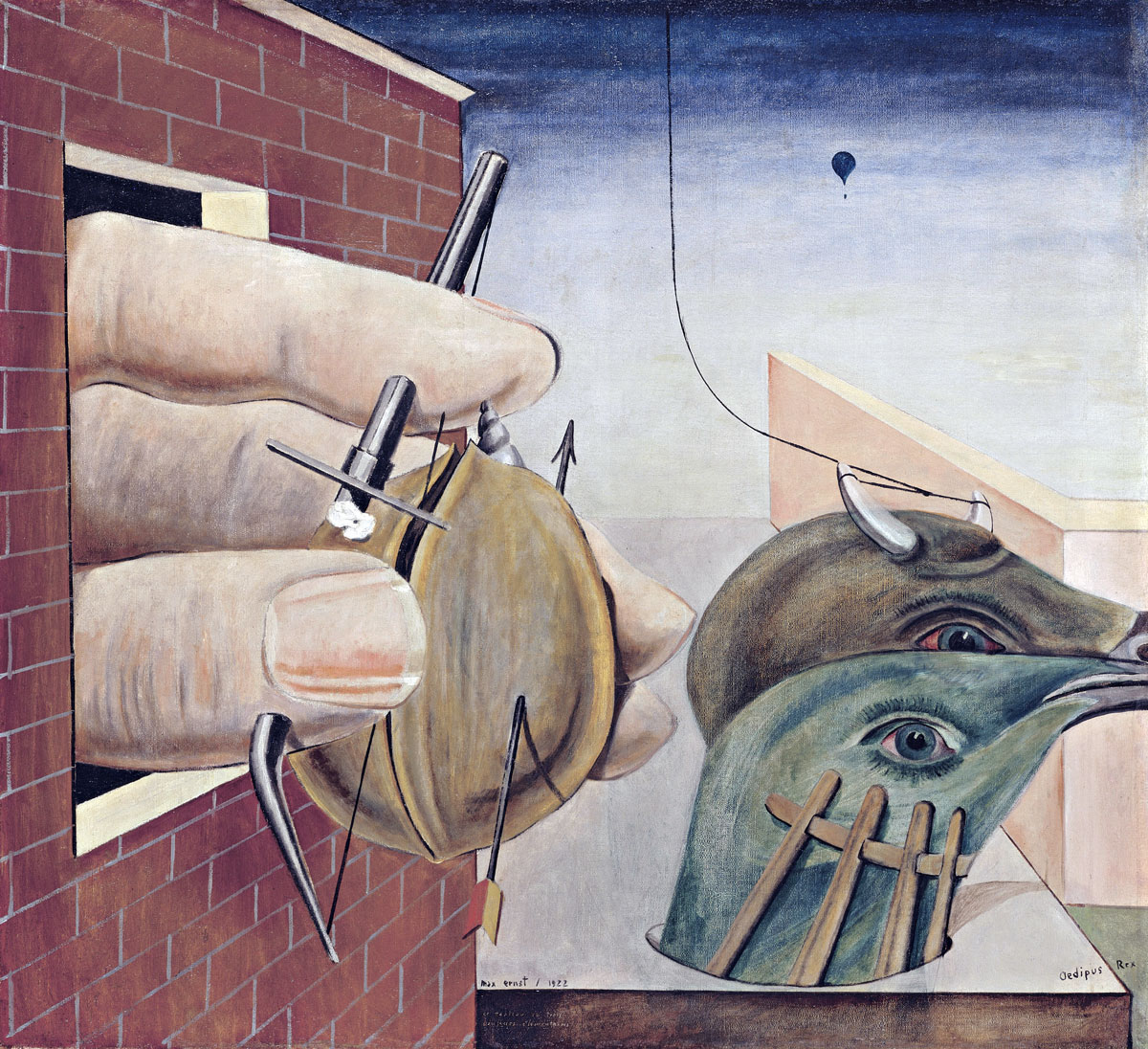
 

Unknown Maker (American)
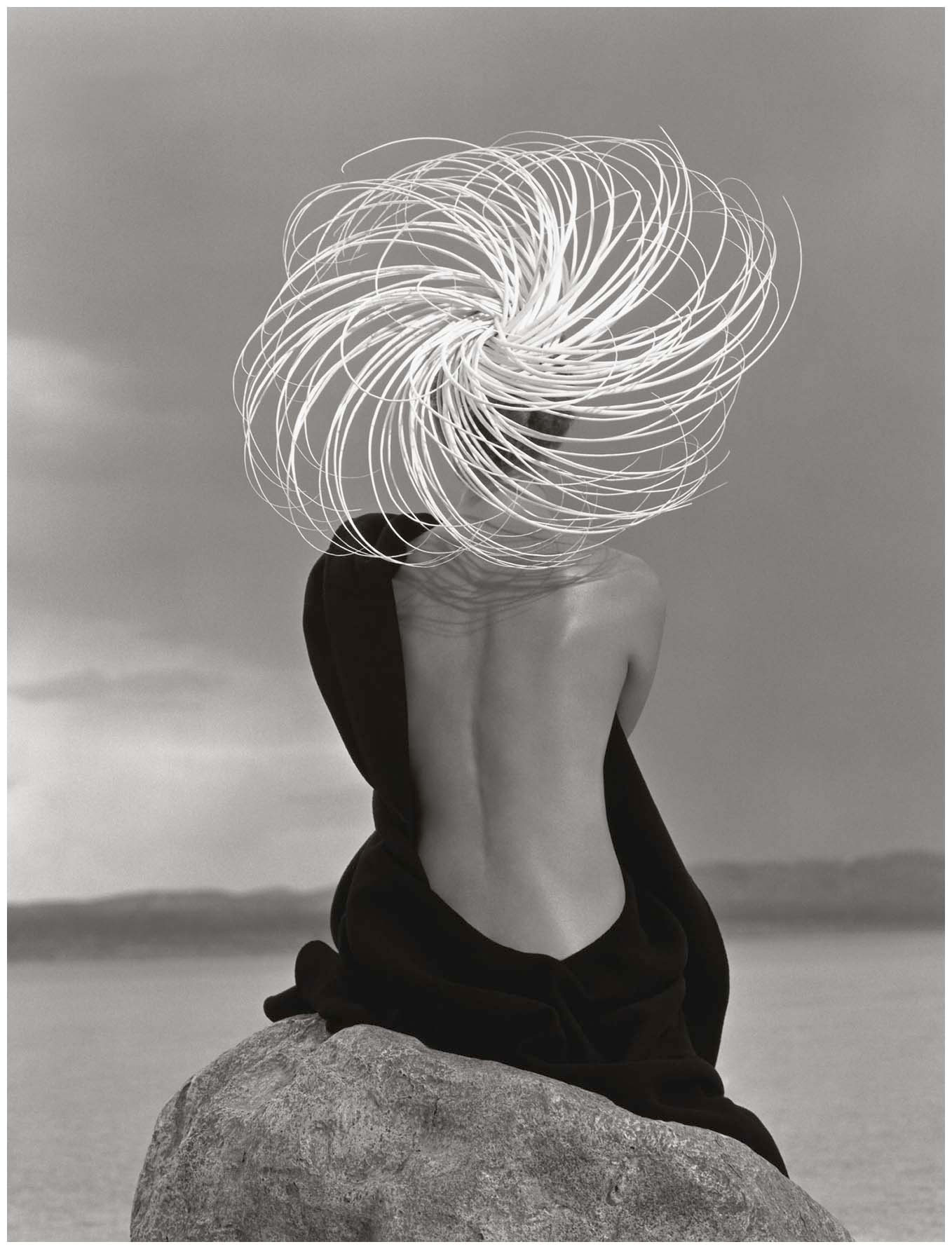
Three Lively Women
c. 1850
Daguerreotype, quarter plate
3 1/4 x 4 1/4 inches
The Nelson-Atkins Museum of Art, Gift of Hallmark Cards, Inc.,
© Nelson Gallery Foundation


I love the word “occupationals” to describe portraits of individuals with the hallmarks of their trade.

Marcus


Many thankx to the Taft Museum of Art for allowing me to publish the photographs in the posting. Please click on the photographs for a larger version of the image.


Thomas Easterly (American, 1809-1882) 'Man with Elephant' c. 1850


Thomas Easterly (American, 1809-1882)
Man with Elephant
c. 1850
Daguerreotype, quarter plate
3 1/4 x 4 1/4 inches
The Nelson-Atkins Museum of Art, Gift of Hallmark Cards, Inc.,
© Nelson Gallery Foundation


Thomas Martin Easterly

A sometime calligrapher and writing teacher, Vermont-born Thomas Martin Easterly (b. 1809 Guilford, Vermont, d. 1882) learned the daguerreotype process in New York between 1841 and 1844, possibly from Charles and Richard Meade. In 1844 Easterly sailed from New York City to New Orleans, where he made photographs before returning to Vermont the following year. He did not remain for long: by October, he had entered into a daguerreotype studio partnership in Iowa. He and his partner operated as traveling photographers working throughout Iowa and Missouri for several years. Some scholars have credited Easterly with making the first photographs of Plains Indians.

After the dissolution of the partnership, Easterly moved to Saint Louis and took over a studio in 1848. He had a successful career for ten years, but his loyalty to the daguerreotype process after the introduction of the ambrotype, tintype, and paper photograph processes caused his business to falter. By 1860 Easterly had begun to sell farm implements in addition to continuing his daguerreotype practice.

Text from the J. Paul Getty Museum website


Attributed to Ezekiel Hawkins (American, 1808-1862) 'The Jacob Strader at Wharf, Cincinnati' c. 1853


Attributed to Ezekiel Hawkins (American, 1808-1862)
The Jacob Strader at Wharf, Cincinnati
c. 1853
Daguerreotype, half plate
4 1/4 x 5 1/2 inches
The Nelson-Atkins Museum of Art, Gift of Hallmark Cards, Inc.,
© Nelson Gallery Foundation


This daguerreotype of the side-wheel packet Jacob Strader was taken at the Cincinnati boatyard where she was built in 1853. Owned by the U.S. Mail Line Co., this steamboat was named to honour Jacob Strader, the company’s first president. The Jacob Strader ran regularly between Cincinnati and Louisville, however during the Civil War, because her large cabin contained 310 berths, she was frequently used to transport sick and wounded soldiers. This boat was dismantled in 1866.

As steamboats replaced flatboats and keelboats as the major mode of river transportation, travel along the Ohio River became faster and easier. By the middle of the nineteenth century, more than 3,000 steamboats arrived each year at the port of Cincinnati. The city’s prominent location along the river contributed to its rapid growth, and by 1850 Cincinnati became the sixth largest city in the country. The development of railroads slowly led to the decline of steamboats. They continued to operate on the Ohio River, but their numbers dwindled.

Text from the Ohio Memory Collection website


Unknown Maker (American) 'A Showing of Daguerreotypes' c. 1850


Unknown Maker (American)
A Showing of Daguerreotypes
c. 1850
Daguerreotype, quarter plate
3 1/4 x 4 1/4 inches
The Nelson-Atkins Museum of Art, Gift of Hallmark Cards, Inc.,
© Nelson Gallery Foundation


Unknown Maker (American) 'Comic Dentist' c. 1850


Unknown Maker (American)
Comic Dentist
c. 1850
Daguerreotype, sixth plate
3 1/4 x 2 3/4 inches
The Nelson-Atkins Museum of Art, Gift of Hallmark Cards, Inc.,
© Nelson Gallery Foundation


American Daguerreotypes from The Nelson-Atkins Museum of Art, on display May 17 – Aug. 25, features 82 astonishing images of life in 19th-century America. The exhibition includes rare images of such well-known Americans as Harriet Beecher Stowe, Frederick Douglass, and Tom Thumb.

By the middle of the 19th century, Cincinnati was the Queen City of the West. A transportation hub, the city was home to industry, art, and even a professional baseball team. Though there are numerous written accounts of life in the big city at this time, we are also fortunate to have images of this era because of the earliest “photographic” works, known as daguerreotypes. In 1839 the American public first encountered this exciting new invention. By 1843, daguerreotypists had set up shop in every major city in the United States. Visitors to the Taft will have the opportunity to view these remarkable works. This exhibition features about 90 daguerreotypes of exceptional quality and variety, with the high degree of resolution typical of these rare, one-of-a-kind photographs. Works by both famed and anonymous makers provide a window into mid-19th-century America: its occupations, trades, urban and rural scenery, and racial and ethnic diversity.

In 1839 the American public encountered the exciting new invention of photography in its earliest form, the daguerreotype. Together, these two Taft exhibitions present an in-depth look at the art of early photography, as well as candid, touching, and sometimes humorous image of life in mid-19th century America and Cincinnati. A daguerreotype is a unique image crafted on a silvered copper plate, a surface that acts like a mirror. While sometimes hard to view, this exhibition presents the works under perfect lighting conditions. The earliest daguerreotypes required exposures of up to thirty minutes. Within a few years, however, portraits could be made in about ten to twenty seconds.

Among the exceptional daguerreotypes in Photographic Wonders are post-mortem images (portraits taken after death) that tell sorrowful stories, while The Comic Dentist and other humorous subjects still amuse today’s audiences. Portraits of individuals with the hallmarks of their trade (called occupationals), including a blacksmith with his tools, a woman ironing, and a clown in costume, show Americans’ pride in their work. Outdoor scenes reveal quaint towns and growing cities, while landscapes feature popular tourist destinations. The wide range of subjects offers something for every interest. The exhibited works in Photographic Wonders are part of an acclaimed collection that Hallmark Cards, Inc., donated in 2005 to The Nelson-Atkins Museum of Art.

The choice examples selected for the Taft date from about 1840 to about 1860, while Nicholas Longworth and his family lived in the historic house that is now the Taft Museum of Art. Local Exposures, a captivating “snapshot” of life in Cincinnati in the 1800s, will delight Cincinnati history enthusiasts. A rarely exhibited Cincinnati streetscape reveals what the city looked like in 1848, while business cards and advertisements for daguerreotype studios show the prominence of the industry in Cincinnati.

“These were the first photographs. Prior to this the only way you could preserve your image was through a painting or sketch. Imagine seeing yourself in a photograph for the first time – it would seem like magic, and that’s exactly the first reaction people had,” says installing curator, Tamera Muente. Taft Museum of Art Director/CEO, Deborah Emont Scott, says, “It’s an amazing experience to view these precious, one-of-a-kind photographs. The images are small and the viewing experience is an intimate one – you step back in time and share a rare mid-19th-century moment with the sitter.”

Press release from the Taft Museum of Art website


William C. North (American, 1814-1890) 'The Fisherman' c. 1850


William C. North (American, 1814-1890)
The Fisherman
c. 1850
Daguerreotype, half plate
5 1/2 x 4 1/2 inches
The Nelson-Atkins Museum of Art, Gift of Hallmark Cards, Inc.,
© Nelson Gallery Foundation


Unknown Maker (American) 'Clown' c. 1850-1855


Unknown Maker (American)
Clown
c. 1850-1855
Daguerreotype, sixth plate
2 1/4 x 2 3/4 inches
The Nelson-Atkins Museum of Art, Gift of Hallmark Cards, Inc.,
© Nelson Gallery Foundation


Unknown Maker (American) 'Tightrope Walker' c. 1855


Unknown Maker (American)
Tightrope Walker
c. 1855
Daguerreotype, half plate
5 1/2 x 4 1/2 inches
The Nelson-Atkins Museum of Art, Gift of Hallmark Cards, Inc.,
© Nelson Gallery Foundation


Unknown Maker (American) 'Tom Thumb and his Mother' c. 1850-1855


Unknown Maker (American)
Tom Thumb and his Mother
c. 1850-1855
Daguerreotype, quarter plate
4 1/4 x 3 1/4 inches
The Nelson-Atkins Museum of Art, Gift of Hallmark Cards, Inc.,
© Nelson Gallery Foundation


General Tom Thumb was the stage name of Charles Sherwood Stratton (January 4, 1838 – July 15, 1883), a little person who achieved great fame under circus pioneer P.T. Barnum.


Unknown Maker (American) 'Woman Ironing' c. 1850-55


Unknown Maker (American)
Woman Ironing
c. 1850-1855
Daguerreotype, sixth plate
3 1/4 x 2 3/4 inches
The Nelson-Atkins Museum of Art, Gift of Hallmark Cards, Inc.,
© Nelson Gallery Foundation


Unknown Maker (American) 'Profile Portrait of Frederick Douglass' c. 1858


Unknown Maker (American)
Profile Portrait of Frederick Douglass
c. 1858
Daguerreotype, sixth plate
3 1/4 x 2 3/4 inches
The Nelson-Atkins Museum of Art, Gift of Hallmark Cards, Inc.,
© Nelson Gallery Foundation


Frederick Douglass

Frederick Douglass (born Frederick Augustus Washington Bailey, c. February 1818 – February 20, 1895) was an African American social reformer, orator, writer and statesman. After escaping from slavery, he became a leader of the abolitionist movement, gaining note for his dazzling oratory and incisive antislavery writing. He stood as a living counter-example to slaveholders’ arguments that slaves did not have the intellectual capacity to function as independent American citizens. Many Northerners also found it hard to believe that such a great orator had been a slave.

Douglass wrote several autobiographies, eloquently describing his experiences in slavery in his 1845 autobiography, Narrative of the Life of Frederick Douglass, an American Slave, which became influential in its support for abolition. He wrote two more autobiographies, with his last, Life and Times of Frederick Douglass, published in 1881 and covering events through and after the Civil War. After the Civil War, Douglass remained active in the United States’ struggle to reach its potential as a “land of the free”. Douglass actively supported women’s suffrage. Without his approval, he became the first African American nominated for Vice President of the United States as the running mate of Victoria Woodhull on the impracticable and small Equal Rights Party ticket. Douglass held multiple public offices.

Douglass was a firm believer in the equality of all people, whether black, female, Native American, or recent immigrant, famously quoted as saying, “I would unite with anybody to do right and with nobody to do wrong.”(Text from Wikipedia)

“I have often been asked, how I felt when first I found myself on free soil. And my readers may share the same curiosity. There is scarcely anything in my experience about which I could not give a more satisfactory answer. A new world had opened upon me. If life is more than breath, and the ‘quick round of blood,’ I lived more in one day than in a year of my slave life. It was a time of joyous excitement which words can but tamely describe. In a letter written to a friend soon after reaching New York, I said: ‘I felt as one might feel upon escape from a den of hungry lions.’ Anguish and grief, like darkness and rain, may be depicted; but gladness and joy, like the rainbow, defy the skill of pen or pencil.”

Douglass, Frederick. Life and Times of Frederick Douglass. 1882, p. 170.


Taft Museum of Art
316 Pike Street at the east end of Fourth Street
across from Lytle Park, in downtown Cincinnati

Opening hours:
Wednesday – Sunday 11am – 4pm
Closed Mondays and Tuesdays

Taft Museum of Art website

LIKE ART BLART ON FACEBOOK

Back to top

Exhibition: ‘A World of Bonds: Frederick Sommer’s Photography and Friendships’ at the National Gallery of Art, Washington

Exhibition dates: 16th June – 4th August 2013


Frederick Sommer (American, 1905-1999) 'Moon Culmination' 1951


Frederick Sommer (American, 1905-1999)
Moon Culmination
1951
gelatin silver print
24.2 x 19.2cm (9 1/2 x 7 9/16 in.)
Gift of Frederick Sommer


Frederick Sommer is not as well known as others in the famous quintet (the others being Ansel Adams, Edward Weston, Minor White and Paul Strand). He is the (slightly) forgotten master. But for those that know his work, Frederick Sommer is the photographer’s photographer.

There is a visual and intellectual alchemy transmitted through his work. It is as if he was a magician, producing images out of thin air: paper cuts, smoke on glass, collage, found objects, rites, passages, cleavages, heroes, occultism (Paracelsus was a Renaissance physician, botanist, alchemist, astrologer, and general occultist). From the few photographs I have seen in the flesh his prints, like his thinking, have a volume to them that few other photographers can match. Here I must cede to the knowledge of my friend and photographer Ian Lobb who visited Sommer at his home in Prescott, Arizona.


“You will notice with FS prints that the only date given is the date of the negative. This is not unusual of course, but one of FS strengths is being interested in returning to a negative and print it with enthusiasm after looking at other versions for a very long time.

Another strength is a really simple strong way of working – according to Les Walkling, FS had a block of wood the same size as an 8 x 10 contact print. By placing the print on this base as he spotted, the print was always raised above his work environment and the chance of an accident was reduced. So simple – so elegant. I see this state of mind repeated – eg when he was out photographing with Siskind and he found a pile of X-rays and said that this was his work for the day.

Caponigro and Sommer are the ones that make their technical skill communicate in very unique ways. By chronology, Sommer is the first one who found that something beyond the f/64 Group vocabulary could be said. Whereas Edward Weston and Paul Strand are working at about 3/10 for their prints, Sommer is working at 9/10. He doesn’t always get there in every print but when he succeeds the results are beyond what any other classical photographer ever achieved in the physical presence of the photograph.

Venus, Jupiter and Mars was the first extended viewing of Sommer that arrived here (in Australia). It would have been at the Printed Image (bookshop) in 1981.”

Ian Lobb


Many thankx to the National Gallery of Art for allowing me to publish the photographs in the posting. Please click on the photographs for a larger version of the image.


Frederick Sommer (American, 1905-1999) 'Venus, Jupiter and Mars' 1949


Frederick Sommer (American, 1905-1999)
Venus, Jupiter and Mars
1949
Gelatin silver print
23.8 x 19.1cm (9 3/8 x 7 1/2 in.)
National Gallery of Art, Washington, Gift of Frederick Sommer


Frederick Sommer (American, 1905-1999) 'Valise d'Adam' 1949


Frederick Sommer (American, 1905-1999)
Valise d’Adam
1949
Gelatin silver print
23.9 x 18.9cm (9 7/16 x 7 7/16 in.)
National Gallery of Art, Washington, Gift of Frederick Sommer


Against a backdrop of rusting metal, Frederick Sommer arranged a grouping of found objects. A clipboard clamp represents a head and shoulders while dirty, cracking doll’s arms and legs provide more literal context, defining the object as a human body. Within that fragmented body, Sommer places a complete doll with its head pointed downward, as if ready to be born. The photograph’s French title, Valise d’Adam, or as Sommer translated it, Adam’s Traveling Case, is a sly reference to the idea that man travels through woman into the world, and perhaps, woman even carries man through life.


Frederick Sommer (American, 1905-1999) 'Manzanillo, Mexico' 1955


Aaron Siskind (American, 1903-1991)
Manzanillo, Mexico
1955
Gelatin silver print
35.6 x 27.8cm (14 x 10 15/16 in.)
National Gallery of Art, Washington, René Huyghe Collection
Image courtesy of the Aaron Siskind Foundation


Frederick Sommer (American, 1905-1999) 'Untitled' 1947


Frederick Sommer (American, 1905-1999)
Untitled
1947
Gelatin silver print
24.2 x 19.1cm (9 1/2 x 7 1/2 in.)
National Gallery of Art, Washington, Gift of Frederick Sommer


Frederick Sommer (American, 1905-1999) 'The Anatomy of a Chicken' 1939


Frederick Sommer (American, 1905-1999)
The Anatomy of a Chicken
1939
Gelatin silver print mounted on paperboard
24.1 x 19cm (9 1/2 x 7 1/2 in.)
National Gallery of Art, Washington, Gift of Frederick Sommer


Frederick Sommer (American, 1905-1999) 'Paracelsus' 1957


Frederick Sommer (American, 1905-1999)
Paracelsus
1957
Gelatin silver print
34.3 x 25.6cm (13 1/2 x 10 1/16 in.)
National Gallery of Art, Washington, Gift of Frederick Sommer


Paracelsus (1493/1494 – 24 September 1541), born Theophrastus von Hohenheim (full name Philippus Aureolus Theophrastus Bombastus von Hohenheim), was a Swiss physician, alchemist, lay theologian, and philosopher of the German Renaissance.

He was a pioneer in several aspects of the “medical revolution” of the Renaissance, emphasising the value of observation in combination with received wisdom. He is credited as the “father of toxicology”. Paracelsus also had a substantial impact as a prophet or diviner, his “Prognostications” being studied by Rosicrucians in the 1600s. Paracelsianism is the early modern medical movement inspired by the study of his works.

Text from the Wikipedia website


Frederick Sommer (American, 1905-1999) 'Cut Paper' 1980


Frederick Sommer (American, 1905-1999)
Cut Paper
1980
gelatin silver print
24.2 x 18.7cm (9 1/2 x 7 3/8 in.)
National Gallery of Art, Washington, Gift of Frederick Sommer


The National Gallery of Art explores the continuities in Frederick Sommer’s varied body of work and demonstrates the influence of his friendships with fellow artists in the exhibition A World of Bonds: Frederick Sommer’s Photography and Friendships, on view in the East Building from June 16 to August 4, 2013. Drawn from the Gallery’s significant holdings, which include a major 1995 gift from the artist himself, the exhibition showcases 27 works by Sommer, Edward Weston, Max Ernst, Man Ray, Aaron Siskind, and Charles Sheeler, including three pieces on loan from other museums and private collections.

“The Gallery is privileged to display this influential body of work, which illuminates Frederick Sommer’s interactions with his fellow artists,” said Earl A. Powell III, director, National Gallery of Art. “In addition to photographs drawn from our permanent collection, we are grateful to the lenders who have assisted us in revealing the continuities in Sommer’s broad range of work, as well as The Robert Mapplethorpe Foundation for its generous support.”

About the exhibition

The exhibition showcases the beauty and diversity of Sommer’s striking images and places them in the context of his formative friendships with such prominent contemporaries as Edward Weston, Max Ernst, Man Ray, Charles Sheeler, and Aaron Siskind.

As an artist, Frederick Sommer notoriously defies classification. Over the span of more than 60 years, he created paintings, drawings, and photographs, as well as collages, musical scores, poetry, and theoretical texts. Today, Sommer is best known for his photography, the medium in which he produced his most inventive visual experiments and which best suited the breadth of his visual interests. These ranged from disorienting desert landscapes to surrealistic arrangements of found objects, and to abstractions that brought together drawing and photography.

“All rare things should be lent away / and I have borrowed very freely,” Sommer wrote of his art. He also asserted that “the world is not a world of cleavages, it is a world of bonds.” This exhibition examines both claims, offering a glimpse into the ways in which Sommer shared ideas with his contemporaries while simultaneously creating a body of work uniquely his own.

About the artist

Just as he defied the bounds of medium and genre, Sommer, who lived in the small town of Prescott, Arizona, also never fully belonged to any artistic group or movement. His work reflects both wide-ranging personal interests and a broad scope of artistic affinities with artists as divergent as the surrealists and the members of the f/64 group of West Coast photographers.

Sommer’s circle of close artist-friends and mentors helps explain his idiosyncratic sensibilities. This circle included the photographer Edward Weston, whose precise attention to the details of the natural world inspired Sommer’s turn to photography. Equally important to Sommer, however, was his friendship with Max Ernst, the surrealist whose automatic painting techniques and uncanny imagery encouraged Sommer to reconfigure familiar objects into strange new creations. Aaron Siskind was yet another close friend and peer with whom Sommer shared a fascination with the abstract textures of everyday materials. Other artists represented in the exhibition who influenced Sommer’s approach to photographing assemblages and his exploration of photographic abstraction include Man Ray and Charles Sheeler.

Text from the National Gallery of Art website


Frederick Sommer (American, 1905-1999) 'Coyotes' 1945


Frederick Sommer (American, 1905-1999)
Coyotes
1945
Gelatin silver print mounted on paperboard
19 x 24.2cm (7 1/2 x 9 1/2 in.)
National Gallery of Art, Washington, Gift of Frederick Sommer


Frederick Sommer (American, 1905-1999) 'Man tracks #9R' from the 'Mantracks' series 1978-83


John Cato (Australian, 1926-2011)
Man tracks #9R
from the Mantracks series 1978-83
Gelatin silver photograph
42.9 x 35.2cm


Frederick Sommer (American, 1905-1999) 'Ondine' 1950


Frederick Sommer (American, 1905-1999)
Ondine
1950
Gelatin silver print mounted on paperboard
19.2 x 24.3cm (7 9/16 x 9 9/16 in.)
National Gallery of Art, Washington, Gift of Frederick Sommer


The nymph Ondine was an immortal water spirit who became human after falling in love for a man, marrying him, and having a baby. In one of the versions of the tale, when she caught her husband sleeping with another woman, she cursed him to remain awake in order to control his own breathing.


Frederick Sommer (American, 1905-1999) 'Taylor, Arizona' 1945


Frederick Sommer (American, 1905-1999)
Taylor, Arizona
1945
Gelatin silver print
19.2 x 24.2cm (7 9/16 x 9 1/2 in.)
National Gallery of Art, Washington, Gift of Frederick Sommer


Frederick Sommer (American, 1905-1999) 'Max Ernst' 1946


Frederick Sommer (American, 1905-1999)
Max Ernst
1946
Gelatin silver print
19.05 x 24.13cm (7 1/2 x 9 1/2 in.)
Collection of Susan and Peter MacGill
Frederick & Frances Sommer Foundation


Frederick Sommer (American, 1905-1999) 'Untitled' 1947


Frederick Sommer (American, 1905-1999)
Untitled
1947
Gelatin silver print
19 x 24cm (7 1/2 x 9 7/16 in.)
National Gallery of Art, Washington, Gift of Frederick Sommer


Frederick Sommer (American, 1905-1999) 'Coyotes' 1941


Frederick Sommer (American, 1905-1999)
Coyotes
1941
Gelatin silver print
19.1 x 24.1cm (7 1/2 x 9 1/2 in.)
National Gallery of Art, Washington, Gift of Frederick Sommer


Les Walkling (Australia, b. 1953) 'Flypaper' 1980


Les Walkling (Australia, b. 1953)
Flypaper
1980
Gelatin silver photograph
19.1 x 24.3cm
Gift of the Philip Morris Arts Grant 1982
© Les Walkling


Frederick Sommer (American, 1905-1999) 'Lacryma' 1992


Frederick Sommer (American, 1905-1999)
Lacryma
1992
Collage of photomechanical reproductions of lithographic, relief and intaglio prints on
heavyweight wove paper
36 x 42.4cm (14 3/16 x 16 11/16 in.)
National Gallery of Art, Washington, Gift of Frederick Sommer


Lacryma, alternative form of lacrima – a tear (drop of liquid from crying)


Frederick Sommer (American, 1905-1999) 'Drawing' 1948


Frederick Sommer (American, 1905-1999)
Drawing
1948
Tempera on black wove paper
30.4 x 46.9cm (11 15/16 x 18 7/16 in.)
National Gallery of Art, Washington, Gift of Frederick Sommer


Frederick Sommer (American, 1905-1999) 'The Queen of Sheba' 1992


Frederick Sommer (American, 1905-1999)
The Queen of Sheba
1992
Collage of photomechanical reproductions of relief and intaglio prints on heavyweight wove
paper
21.8 x 31.8cm (8 9/16 x 12 1/2 in.)
National Gallery of Art, Washington, Gift of Frederick Sommer


Fiona Hall (Australian, b. 1953) 'Envy, Seven Deadly Sins' 1985


Fiona Hall (Australian, b. 1953)
Envy, Seven Deadly Sins
1985
Polaroid photograph
61 × 50.8cm
© Fiona Hall


National Gallery of Art
National Mall between 3rd and 7th Streets
Constitution Avenue NW, Washington

Opening hours:
Daily 10.00am – 5.00pm

National Gallery of Art website

Frederick Sommer website

LIKE ART BLART ON FACEBOOK

Back to top

Exhibition: ‘Herb Ritts: Beauty and Celebrity’ at Oklahoma City Museum of Art, Oklahoma City

Exhibition dates: 9th May – 28th July 2013


Herb Ritts (American, 1952-2002) 'Fred with Tires - Bodyshop Series, Hollywood' 1984


Herb Ritts (American, 1952-2002)
Fred with Tires – Bodyshop Series, Hollywood
1984
Gelatin silver print
24 x 20 in. (60.9 x 50.8cm)
Gift of Herb Ritts. Museum of Fine Arts, Boston
© Herb Ritts Foundation


I admit that I went through a stage of disliking Herb Ritts photographs – no longer!

In contemplation, his formal aestheticism confirms a serene beauty – spare, refined, erotic.

Dr Marcus Bunyan


Fred with Tires became the archetypal photograph of the male body in the 1980s and made the world-wide reputation of its commercial photographer, Herb Ritts. Gay men flocked to buy it, myself included. I was drawn by the powerful, perfectly sculpted body, the butchness of his job, the dirty trousers, the boots and the body placed within a social context. At the time I realised that the image of this man was a constructed fantasy, ie. not the ‘real’ thing, and this feeling of having been deceived has grown ever since. His hair is teased up and beautifully styled, the grease is applied to his body just so, his body twisted to just the right degree to accentuate the muscles of the stomach and around the pelvis. You can just imagine the stylist standing off camera ready to readjust the hair if necessary, the assistants with their reflectors playing more light onto the body. This/he is the seduction of a marketable homoeroticsm, the selling of an image as sex, almost camp in its overt appeal to gay archetypal stereotypes.

Herb Ritts, whether in his commercial work or in his personal images such as those of the gay bodybuilders Bob Paris and Rod Jackson, has helped increase the acceptance of the openly homoerotic photograph in a wider sphere but this has been possible only with an increased acceptance of homosexual visibility within the general population. 
Openly gay bodies such as that of Australian rugby league star Ian Roberts or American diver Greg Luganis can become heroes and role models to young gay men coming out of the closet for the first time, visible evidence that gay men are everywhere in every walk of life. This is fantastic because young gay men do need gay role models to look up to but the bodies they possess only conform to the one type, that of the muscular mesomorph and this reinforces the ideal of a traditional masculinity. Yes, the guy in the shower next to you might be a poofter, might be queer for heavens sake, but my God what a body he’s got!”

Marcus Bunyan. “Historical Pressings,” from Pressing the Flesh: Sex, Body Image and the Gay Male (Phd thesis) 2001


Many thankx to Oklahoma City Museum of Art for allowing me to publish the photographs in the posting. Please click on the photographs for a larger version of the image.


Herb Ritts (American, 1952-2002) 'Djimon with Octopus, Hollywood' 1989


Herb Ritts (American, 1952-2002)
Djimon with Octopus, Hollywood
1989
Gelatin silver print
44.5 x 38.7cm (17 1/2 x 15 1/4 in.)
© Herb Ritts Foundation


Herb Ritts (American, 1952-2002) 'Tony with shadow, Los Angeles' 1988


Herb Ritts (American, 1952-2002)
Tony with shadow, Los Angeles
1988
Gelatin silver print
© Herb Ritts Foundation


Herb Ritts (American, 1952-2002) 'Jackie Joyner-Kersee, Point Dume' 1987


Herb Ritts (American, 1952-2002)
Jackie Joyner-Kersee, Point Dume
1987
Gelatin silver print
31.9 x 25.4cm (12 9/16 x 10 in.)
Gift of Herb Ritts. Museum of Fine Arts, Boston
© Herb Ritts Foundation


Herb Ritts (American, 1952-2002) 'Versace Dress, Back View, El Mirage' 1990


Herb Ritts (American, 1952-2002)
Versace Dress, Back View, El Mirage
1990
Gelatin silver print
137.2 x 109.2cm (54 x 43 in.)
Gift of Herb Ritts. Museum of Fine Arts, Boston
© Herb Ritts Foundation


The American photographer Herb Ritts produced a body of work in the 1980s and 1990s that seems to embody the outdoor lifestyle and glamour of the southern California beautiful set. This photograph, taken at El Mirage Dry Lake in California, appeared on the cover of Italian designer Gianni Versace’s September 1990 catalogue and incorporates a formalism and contemporary sensuality characteristic of Ritts’s aesthetic. Ritts’s photograph appeals through its boldly contrasting lights and darks.


Herb Ritts (American, 1952-2002) 'Versace Veiled Dress, El Mirage' 1990


Herb Ritts (American, 1952-2002)
Versace Veiled Dress, El Mirage
1990
55.8 x 44.6cm (21 15/16 x 17 9/16 in.)
Gift of Herb Ritts. Museum of Fine Arts, Boston
© Herb Ritts Foundation


Herb Ritts (American, 1952-2002) 'Now and Zen 1, El Mirage' 1999


Herb Ritts (American, 1952-2002)
Now and Zen 1, El Mirage
1999
Gelatin silver print
© Herb Ritts Foundation


Herb Ritts: Beauty and Celebrity will be on view at the Oklahoma City Museum of Art from May 9 through July 28, 2013. Organised by the Museum of Fine Arts, Boston with the support of the Herb Ritts Foundation and the Oklahoma City Museum of Art, this exhibition will feature over eighty large-scale black-and-white photographs by acclaimed photographer, Herb Ritts (American, 1952-2002). Ranging in scale from intimate portraits to ten foot murals, the exhibition will highlight the diversity of the artist’s work. Known for his innovative approach to fashion, intimate portraiture of celebrities, and the classical treatment of the nude, Ritts emerged in the 1980s to become one of the most successful celebrity and fashion photographers of the late twentieth century and an important part of the history of American photography.

Herb Ritts grew up in Los Angeles and maintained his studio in Hollywood. A self-taught photographer, Ritts first began taking photographs in the late 1970s after studying economics at Bard College. The intimate publicity images that he made of Richard Gere were among his first serious portraits and helped to launch his career. Throughout the 1980s and 1990s, Ritts built his reputation as a leading celebrity portraitist and fashion photographer, contributing regularly to publications such as GQ, Mademoiselle, Vogue, and Vanity Fair. From 1988, he also made music videos and commercials for which he won numerous awards.

The photographs included in the exhibition represent some of Herb Ritts’s most iconic works which incorporate the natural light of the California sun while emphasising shapes, unusual juxtapositions, and the beauty of the human form. Ritts celebrates nature and the human body in evoking the tactile appeal of surface textures of grains of sand, veiled fabric, drying mud, and cascading water seen in Waterfall 4 (1988), Backflip (1987), and Woman in Sea (1988). Fashion photographs on view include such as Versace Veiled Dress, El Mirage (1990), Stephanie, Cindy, Christy, Tatjana, Naomi, Hollywood (1989), and Djimon with Octopus (1989). Examples of celebrity portraiture include Richard Gere, Jack Nicholson, Madonna, Elizabeth Taylor, Johnny Depp, Bruce Springsteen, Drew Barrymore, David Bowie, Matthew McConaughey, and Mick Jagger. Also included in the exhibition are poetic and eternal images in Ritts’s Africa series, taken in 1993 when he traveled to East Africa, and examples from the rare Corps et Ames (1999) series of photographs, portraying dancers in motion.

This exhibition – drawn from the photography collection at the Museum of Fine Arts, Boston, and the Herb Ritts Foundation – present Herb Ritts’ style and the range of his career.

Press release from the Oklahoma City Museum of Art website


Herb Ritts (American, 1952-2002) 'Male Nude with Bubble, Los Angeles' 1987


Herb Ritts (American, 1952-2002)
Male Nude with Bubble, Los Angeles
1987
Gelatin silver print
© Herb Ritts Foundation


Herb Ritts (American, 1952-2002) 'Wrapped Torso, Los Angeles' 1989


Herb Ritts (American, 1952-2002)
Wrapped Torso, Los Angeles
1989
Platinum print
46.4 x 38.4cm (18 1/4 x 15 1/8 in.)
Gift of Herb Ritts. Museum of Fine Arts, Boston
© Herb Ritts Foundation


Herb Ritts (American, 1952-2002) 'Backflip, Paradise Cove' 1987


Herb Ritts (American, 1952-2002)
Backflip, Paradise Cove
1987
Gelatin silver print
90 x 70 in. (228.6 x 177.8cm)
© Herb Ritts Foundation


Herb Ritts (American, 1952-2002) 'Corp et Âmes - 14, Los Angeles' 1999


Herb Ritts (American, 1952-2002)
Corp et Âmes – 14, Los Angeles
1999
Gelatin silver print
14 x 11 in. (35.5 x 27.9cm)
© Herb Ritts Foundation


Herb Ritts (American, 1952-2002) 'Chrissy Turlington, Versace 3, Milan' 1991


Herb Ritts (American, 1952-2002)
Chrissy Turlington, Versace 3, Milan
1991
Gelatin silver print
© Herb Ritts Foundation


Herb Ritts (American, 1952-2002) 'Madonna (True Blue Profile), Hollywood' 1986


Herb Ritts (American, 1952-2002)
Madonna (True Blue Profile), Hollywood
1986
Gelatin silver print
24 x 20 in. (60.9 x 50.8cm)
Gift of Herb Ritts Foundation. Museum of Fine Arts, Boston
© Herb Ritts Foundation


Herb Ritts (American, 1952-2002) 'Matthew McConaughey, Palmdale' 1996


Herb Ritts (American, 1952-2002)
Matthew McConaughey, Palmdale
1996
Gelatin silver print
24 x 20 in. (60.9 x 50.8cm)
Gift of Herb Ritts Foundation. Museum of Fine Arts, Boston
© Herb Ritts Foundation


Herb Ritts (American, 1952-2002) 'Loriki with Spear, Africa' 1993


Herb Ritts (American, 1952-2002)
Loriki with Spear, Africa
1993
Gelatin silver print
45 x 41 in. (114.3 x 104.1cm)
© Herb Ritts Foundation


Herb Ritts (American, 1952-2002) 'Tony Ward' 1986


Herb Ritts (American, 1952-2002)
Tony Ward
1986
Gelatin silver print
© Herb Ritts Foundation


Herb Ritts (American, 1952-2002) 'Waterfall IV, Hollywood' 1988


Herb Ritts (American, 1952-2002)
Waterfall IV, Hollywood
1988
Platinum print
20 x 16 in. (50.8 x 40.64cm)
© Herb Ritts Foundation


Herb Ritts (American, 1952-2002) 'Woman in Sea, Hawaii' 1988


Herb Ritts (American, 1952-2002)
Woman in Sea, Hawaii
1988
Gelatin silver print
24 x 20 in. (60.9 x 50.8cm)
Gift of Herb Ritts. Museum of Fine Arts, Boston
© Herb Ritts Foundation


Herb Ritts (American, 1952-2002) 'Bill T. Jones VI, Los Angeles' 1995


Herb Ritts (American, 1952-2002)
Bill T. Jones VI, Los Angeles
1995
Gelatin silver print
© Herb Ritts Foundation


Herb Ritts (American, 1952-2002) 'Man with Chain, Los Angeles' 1985


Herb Ritts (American, 1952-2002)
Man with Chain, Los Angeles
1985
Gelatin silver print
47.8 x 38.4 cm (18 13/16 x 15 1/8 in.)
Gift of Herb Ritts. Museum of Fine Arts, Boston
© Herb Ritts Foundation


Oklahoma City Museum of Art
415 Couch Drive
Oklahoma City, OK 73102

Opening hours:
Tuesday – Saturday: 10am – 5pm
Sunday: noon – 5pm
Closed: Mondays and Major Holidays

Oklahoma City Museum of Art website

LIKE ART BLART ON FACEBOOK

Back to top

Exhibition: ‘At War with the Obvious: Photographs by William Eggleston’ at The Metropolitan Museum of Art, New York

Exhibition dates: 26th February – 28th July 2013

PLEASE NOTE: THIS POSTING CONTAINS AN ART PHOTOGRAPH OF MALE NUDITY – IF YOU DO NOT LIKE PLEASE DO NOT LOOK, FAIR WARNING HAS BEEN GIVEN


William Eggleston (American, b. 1939) 'Untitled' 1971


William Eggleston (American, b. 1939)
Untitled
1971
Dye-transfer print
31.1 x 47.7cm (12 1/4 x 18 3/4 in.)
The Metropolitan Museum of Art
Purchase, Louis V. Bell, Harris Brisbane Dick, Fletcher, and Rogers Funds and Joseph Pulitzer Bequest; Elizabeth S. and Robert J. Fisher, Jennifer and Philip Maritz, and Charlotte A. and William E. Ford Gifts; The Horace W. Goldsmith Foundation Fund, through Joyce and Robert Menschel, 2012
© Eggleston Artistic Trust


Eggleston photographs the obvious with such candour and vigour that simple things become something more: almost interior statements of his mind evidenced in the physicality of the photograph. He may be at war with the obvious, but these are complex thoughts told in simple, eloquent ways. They are only obvious if you know how to look for them.

The peaches thrown on the roof, the rusted speculum of ‘Wonder Bread’, the turned up shoes; the use of foreshortening, the low positioning of the camera (looking up or across at ground level), the formalism of colour, the light.

Eggleston understands the essence of each scene he photographs perfectly. The child’s eye-level view of the tricycle emphasising its gigantism will always be a favourite, as will the abstract expressionist colour field of Untitled (Greenwood, Mississippi) (1980, below). As with any virtuoso artist, Eggleston controls the tonality and mood of compositions beautifully: a case in point is Untitled (Memphis) (c. 1972, below) which will always remind me of a piece of Mozart piano music. It took me a while when I was growing up to like Mozart (as a concert pianist I loved the romantics such as Chopin and Debussy), but when you finally understand all the nuances contained in his music, when you finally grow to love him, you are just so full of admiration for his achievement.

Dr Marcus Bunyan


Many thankx to The Metropolitan Museum of Art for allowing me to publish the photographs in the posting. Please click on the photographs for a larger version of the image.


William Eggleston (American, b. 1939) 'Untitled (Mississippi)' c. 1970


William Eggleston (American, b. 1939)
Untitled (Mississippi)
c. 1970
Dye-transfer print
25.1 x 38.3cm (9 7/8 x 15 1/16 in)
The Metropolitan Museum of Art
Purchase, Louis V. Bell, Harris Brisbane Dick, Fletcher, and Rogers Funds and Joseph Pulitzer Bequest, and Jennifer and Philip Maritz Gift, 2012
© Eggleston Artistic Trust


William Eggleston (American, b. 1939) 'Untitled' (the artist's uncle, Adyn Schuyler Senior, with assistant Jasper Staples, in Cassidy Bayou, Sumner, Mississippi) 1969-70


William Eggleston (American, b. 1939)
Untitled (Sumner, Mississippi, Cassidy Bayou in Background)
1971 (printed 1999)
Dye-transfer print
36.8 x 55.5cm (14 1/2 x 21 7/8 in.)
The Metropolitan Museum of Art
Purchase, Louis V. Bell, Harris Brisbane Dick, Fletcher, and Rogers Funds and Joseph Pulitzer Bequest, and Elizabeth S. and Robert J. Fisher Gift, 2012
© Eggleston Artistic Trust


William Eggleston (American, b. 1939) 'Untitled, from the portfolio 14 Pictures' 1974


William Eggleston (American, b. 1939)
Untitled, from the portfolio 14 Pictures
1974
Dye-transfer print
33.1 x 48.5cm (13 1/16 x 19 1/8 in.)
The Metropolitan Museum of Art
Purchase, Louis V. Bell, Harris Brisbane Dick, Fletcher, and Rogers Funds and Joseph Pulitzer Bequest; Elizabeth S. and Robert J. Fisher, Jennifer and Philip Maritz, and Charlotte A. and William E. Ford Gifts; The Horace W. Goldsmith Foundation Fund, through Joyce and Robert Menschel, 2012
© Eggleston Artistic Trust


William Eggleston (American, b. 1939) 'Untitled (Louisiana)' 1980 (printed 1999)


William Eggleston (American, b. 1939)
Untitled (Louisiana)
1980 (printed 1999)
Dye-transfer print
30.2 x 45.3cm (11 7/8 x 17 13/16 in.)
The Metropolitan Museum of Art
Purchase, Louis V. Bell, Harris Brisbane Dick, Fletcher, and Rogers Funds and Joseph Pulitzer Bequest, Twentieth-Century Photography Fund, and Elizabeth S. and Robert J. Fisher Gift, 2012
© Eggleston Artistic Trust


William Eggleston (American, b. 1939) 'Untitled' 1974


William Eggleston (American, b. 1939)
Untitled
1974
Dye-transfer print
33.1 x 48.5cm (13 1/16 x 19 1/8 in.)
The Metropolitan Museum of Art
Purchase, Louis V. Bell, Harris Brisbane Dick, Fletcher, and Rogers Funds and Joseph Pulitzer Bequest, and Jennifer and Philip Maritz Gift, 2012
© Eggleston Artistic Trust


William Eggleston (American, b. 1939) 'Untitled (Greenwood, Mississippi)' 1980


William Eggleston (American, b. 1939)
Untitled (Greenwood, Mississippi)
1980
Dye-transfer print
29.6 x 45.5cm (11 5/8 x 17 15/16 in.)
The Metropolitan Museum of Art
Purchase, Louis V. Bell, Harris Brisbane Dick, Fletcher, and Rogers Funds and Joseph Pulitzer Bequest, and Jennifer and Philip Maritz Gift, 2012
© Eggleston Artistic Trust


The American photographer William Eggleston (born 1939) emerged in the early 1960s as a pioneer of modern colour photography. Now, 50 years later, he is arguably its greatest exemplar. At War with the Obvious: Photographs by William Eggleston at The Metropolitan Museum of Art presents the work of this idiosyncratic artist, whose influences are drawn from disparate if surprisingly complementary sources – from Walker Evans and Henri Cartier-Bresson in photography to Bach and late Baroque music. Many of Eggleston’s most recognised photographs are lush studies of the social and physical landscape found in the Mississippi delta region that is his home. From this base, the artist explores the awesome and, at times, the raw visual poetics of the American vernacular.

The exhibition celebrates the fall 2012 acquisition of 36 dye transfer prints by Eggleston that dramatically expanded the Metropolitan Museum’s collection of this major American artist’s work. It added the entire suite of Eggleston’s remarkable first portfolio of colour photographs, 14 Pictures (1974), 15 superb prints from his landmark book, William Eggleston’s Guide (1976), and seven other key photographs that span his career.

Eggleston wrote that he was “at war with the obvious,” a statement well-represented in works such as Untitled [Peaches!] (1970) – a roadside snapshot of rocks and half-eaten fruit thrown atop a sunlit corrugated tin roof capped with a sign announcing “PEACHES!” The exhibition features a number of the artist’s signature images, including Untitled [Greenwood, Mississippi] (1980), a study that takes full advantage of the chromatic intensity of the dye-transfer colour process that, until Eggleston appropriated it in the 1960s, had been used primarily by commercial photographers for advertising product photography; and Untitled [Memphis] (1970), an iconic study of a child’s tricycle seen from below. It was the cover image of the artist’s seminal book William Eggleston’s Guide, which accompanied his landmark show at the Museum of Modern Art in 1976.

As much as Eggleston was influenced by various sources, he, too, has proved influential. His inventive photographs of commonplace subjects now endure as touchstones for generations of artists, musicians, and filmmakers from Nan Goldin to David Byrne, the Coen brothers, and David Lynch.

Press release from The Metropolitan Museum of Art


William Eggleston (American, b. 1939) 'Untitled (Memphis)' 1970


William Eggleston (American, b. 1939)
Untitled (Memphis)
1970
Dye-transfer print
30.7 x 43.8cm (12 1/16 x 17 1/4 in.)
The Metropolitan Museum of Art
Purchase, Louis V. Bell, Harris Brisbane Dick, Fletcher, and Rogers Funds and Joseph Pulitzer Bequest; Louis V. Bell Fund; Elizabeth S. and Robert J. Fisher, Jennifer and Philip Maritz, and Charlotte A. and William E. Ford Gifts, 2012
© Eggleston Artistic Trust


William Eggleston (American, b. 1939) 'Untitled' 1974


William Eggleston (American, b. 1939)
Untitled
1974
Dye-transfer print
33.1 x 48.5cm (13 1/16 x 19 1/8 in.)
The Metropolitan Museum of Art
Purchase, Louis V. Bell, Harris Brisbane Dick, Fletcher, and Rogers Funds and Joseph Pulitzer Bequest, and Jennifer and Philip Maritz Gift, 2012
© Eggleston Artistic Trust


William Eggleston (American, b. 1939) 'Untitled' 1974


William Eggleston (American, b. 1939)
Untitled
1974
Dye-transfer print
33.1 x 48.5cm (13 1/16 x 19 1/8 in.)
The Metropolitan Museum of Art
Purchase, Louis V. Bell, Harris Brisbane Dick, Fletcher, and Rogers Funds and Joseph Pulitzer Bequest, and Jennifer and Philip Maritz Gift, 2012
© Eggleston Artistic Trust


William Eggleston (American, b. 1939) 'Untitled' 1974


William Eggleston (American, b. 1939)
Untitled
1974
Dye-transfer print
33.1 x 48.5cm (13 1/16 x 19 1/8 in.)
The Metropolitan Museum of Art
Purchase, Louis V. Bell, Harris Brisbane Dick, Fletcher, and Rogers Funds and Joseph Pulitzer Bequest, and Jennifer and Philip Maritz Gift, 2012
© Eggleston Artistic Trust


William Eggleston (American, b. 1939) 'Untitled' 1974


William Eggleston (American, b. 1939)
Untitled
1974
Dye-transfer print
33.1 x 48.5cm (13 1/16 x 19 1/8 in.)
The Metropolitan Museum of Art
Purchase, Louis V. Bell, Harris Brisbane Dick, Fletcher, and Rogers Funds and Joseph Pulitzer Bequest, and Jennifer and Philip Maritz Gift, 2012
© Eggleston Artistic Trust


William Eggleston (American, b. 1939) 'Untitled' 1983


William Eggleston (American, b. 1939)
Untitled
1983
Dye-transfer print
37 x 56cm (14 9/16 x 22 1/16 in.)
The Metropolitan Museum of Art
Purchase, Louis V. Bell, Harris Brisbane Dick, Fletcher, and Rogers Funds and Joseph Pulitzer Bequest, and Jennifer and Philip Maritz Gift, 2012
© Eggleston Artistic Trust


William Eggleston (American, b. 1939) 'Untitled' c. 1972 (printed 1986)


William Eggleston (American, b. 1939)
Untitled
c. 1972 (printed 1986)
Dye-transfer print
28.8 x 43.4cm (11 5/16 x 17 1/16 in.)
The Metropolitan Museum of Art
Purchase, Louis V. Bell, Harris Brisbane Dick, Fletcher, and Rogers Funds and Joseph Pulitzer Bequest, and Jennifer and Philip Maritz Gift, 2012
© Eggleston Artistic Trust


William Eggleston (American, b. 1939) 'Untitled' 1984


William Eggleston (American, b. 1939)
Untitled
1984
Dye-transfer print
55.9 x 37.1cm (22 x 14 5/8 in.)
The Metropolitan Museum of Art
Purchase, Louis V. Bell, Harris Brisbane Dick, Fletcher, and Rogers Funds and Joseph Pulitzer Bequest, and Jennifer and Philip Maritz Gift, 2012
© Eggleston Artistic Trust


William Eggleston (American, b. 1939) 'Untitled (Greenwood, Mississippi)' 1970 (printed 1999)


William Eggleston (American, b. 1939)
Untitled (Greenwood, Mississippi)
1970 (printed 1999)
Dye-transfer print
55 x 37.1cm (21 5/8 x 14 5/8 in.)
The Metropolitan Museum of Art
Purchase, Louis V. Bell, Harris Brisbane Dick, Fletcher, and Rogers Funds and Joseph Pulitzer Bequest, and Jennifer and Philip Maritz Gift, 2012
© Eggleston Artistic Trust


William Eggleston (American, b. 1939) 'Untitled (Memphis)' c. 1972


William Eggleston (American, b. 1939)
Untitled (Memphis)
c. 1972
Dye-transfer print
46 x 31cm (18 1/8 x 12 3/16 in.)
The Metropolitan Museum of Art
Purchase, Louis V. Bell, Harris Brisbane Dick, Fletcher, and Rogers Funds and Joseph Pulitzer Bequest; Louis V. Bell Fund; Elizabeth S. and Robert J. Fisher, Jennifer and Philip Maritz, and Charlotte A. and William E. Ford Gifts, 2012
© Eggleston Artistic Trust


William Eggleston (American, b. 1939) 'Untitled (Near Jackson, Mississippi)' c. 1970 (printed 2002)


William Eggleston (American, b. 1939)
Untitled (Near Jackson, Mississippi)
c. 1970 (printed 2002)
Dye-transfer print
60.3 x 48.9cm (23 3/4 x 19 1/4 in.)
The Metropolitan Museum of Art
Purchase, Louis V. Bell, Harris Brisbane Dick, Fletcher, and Rogers Funds and Joseph Pulitzer Bequest; Louis V. Bell Fund; Elizabeth S. and Robert J. Fisher, Jennifer and Philip Maritz, and Charlotte A. and William E. Ford Gifts, 2012
© Eggleston Artistic Trust


William Eggleston (American, b. 1939) 'Untitled (Memphis)' 1971 (printed 1999)


William Eggleston (American, b. 1939)
Untitled (Memphis)
1971 (printed 1999)
Dye-transfer print
55.4 x 36.8cm (21 13/16 x 14 1/2 in.)
The Metropolitan Museum of Art (2012.283)
Purchase, Louis V. Bell, Harris Brisbane Dick, Fletcher, and Rogers Funds and Joseph Pulitzer Bequest, Twentieth-Century Photography Fund, and Elizabeth S. and Robert J. Fisher Gift, 2012
© Eggleston Artistic Trust


The Metropolitan Museum of Art
1000 Fifth Avenue at 82nd Street
New York, New York 10028-0198
Phone: 212-535-7710

Opening hours:
Sunday – Tuesday and Thursday: 10am – 5pm
Friday and Saturday: 10am – 9pm
Closed Wednesday

The Metropolitan Museum of Art website

LIKE ART BLART ON FACEBOOK

Back to top