Exhibition: ‘The Staged Photograph’ at the Chau Chak Wing Museum at The University of Sydney

Exhibition dates: 22nd April, 2023 – 4th August, 2024

Curator: Jan Brazier


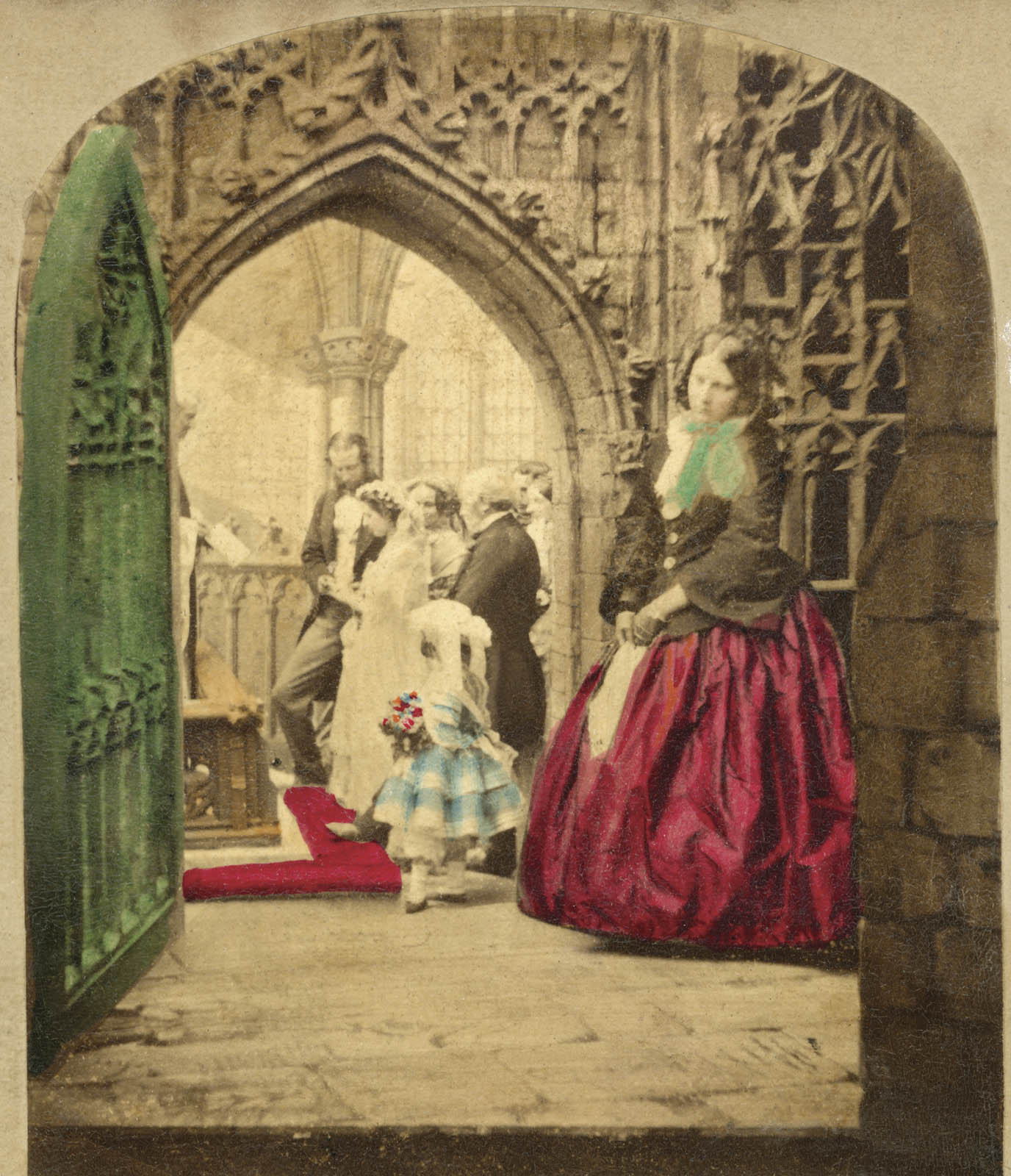
James Elliott (British) 'A Week after the Derby' c. 1855-1860 from the exhibition 'The Staged Photograph' at the Chau Chak Wing Museum at The University of Sydney, April 2023 - August 2024


James Elliott (British)
‘A Week after the Derby’
c. 1855-1860
Hand-coloured stereograph (single image)
Chau Chak Wing Museum, The University of Sydney
Donated by Sandra Savides, 2014


A short text this week as I’m not well.

What a delightful exhibition – a clean installation showcasing some beautiful, contemplative, witty and humorous images on an interesting subject.

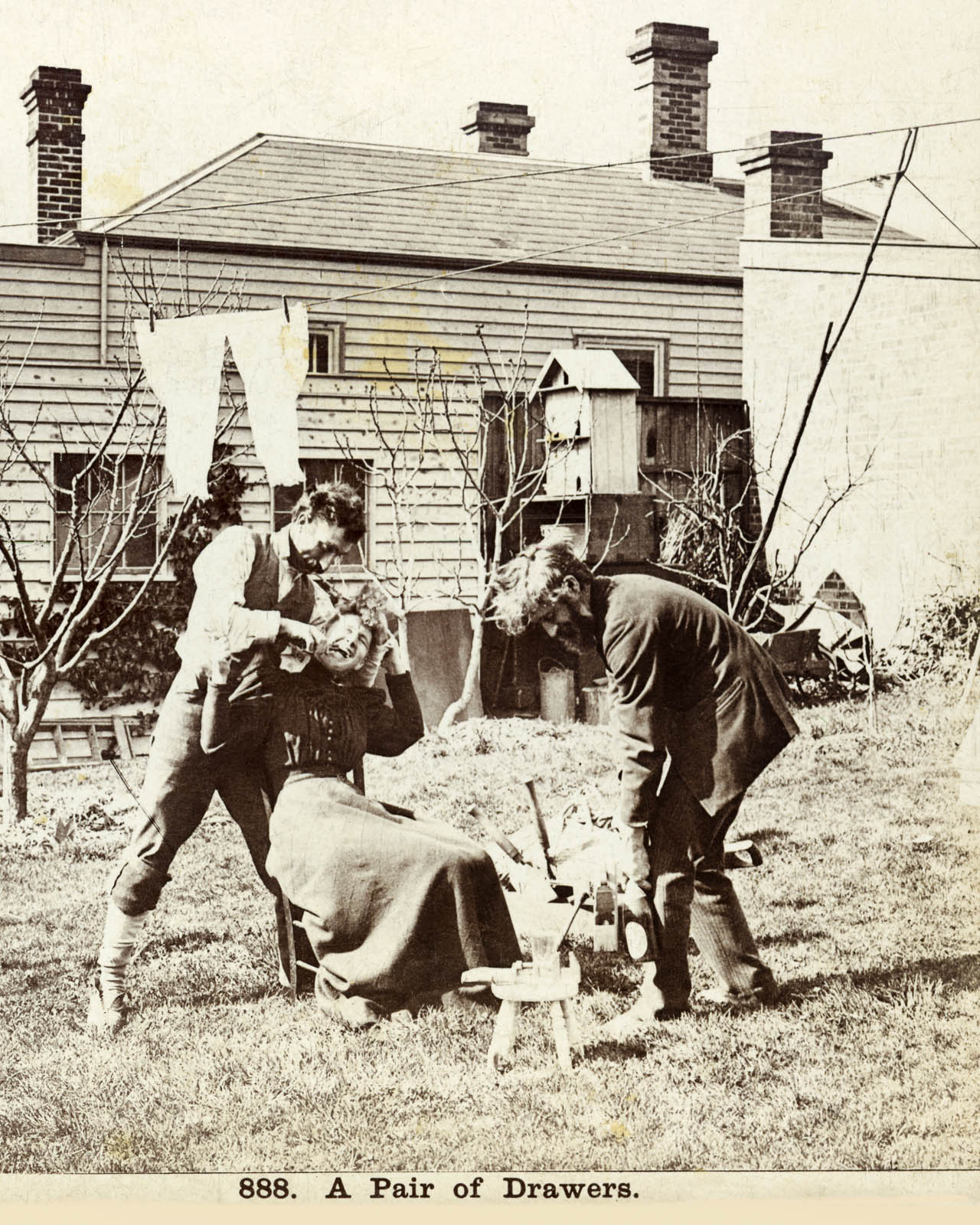
The pathos of A Week after the Derby (c. 1855-1860, above); the gruesome humour of A Pair of Drawers (c. 1895, below); the Australian humour of The Great Australian Bite (Bight) (c. 1895, below). Staged for the camera, posed for the viewer, possessed of innocence, national pride and the delightful joy of living.

To flesh out the posting I have added bibliographic information for the artists and publishers where possible.

Dr Marcus Bunyan


Many thankx to the Chau Chak Wing Museum for allowing me to publish the photographs in the posting. Please click on the photographs for a larger version of the image.


From costume portraits to comic and sentimental stereographs

This exhibition presents staged photographs taken between the mid-19th and early 20th centuries, illuminating the popular culture of the time.
These photographs were created in the photographic studio, with its painted backgrounds and props, where people came to have fancy dress or special outfits captured. Studio photographers also created tableaux, using posed models to stage scenes to tell stories, sentimental or comic. The most popular format was the stereograph. Even the home backyard became a stage for family portraits, posed in the manner of the studio.

Featuring enlarged reproductions, and original examples of glass negatives and stereographs from the historic photograph collection, The Staged Photograph is a fascinating delve into an unfamiliar photographic history.

Text from the Chau Chak Wing Museum website


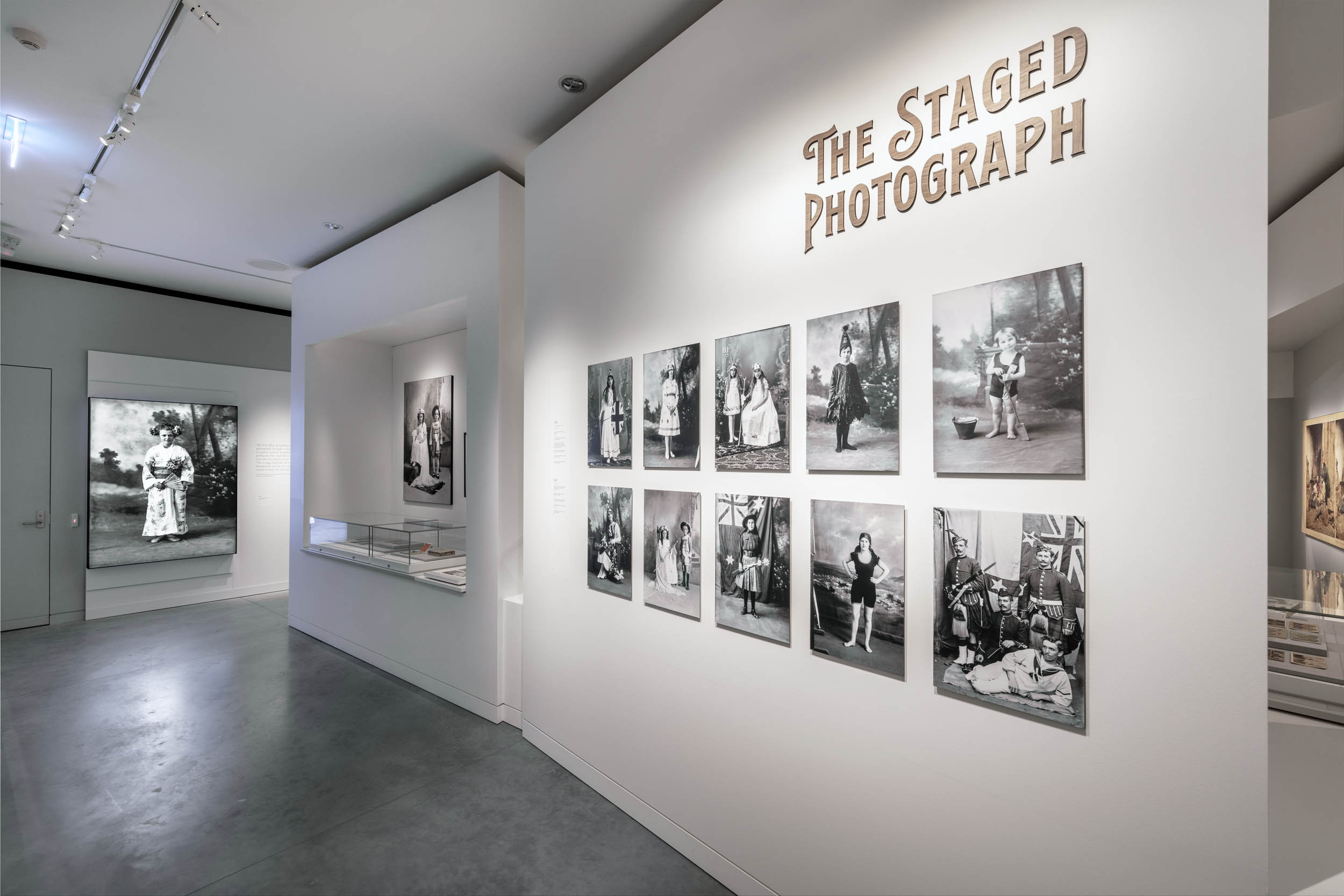
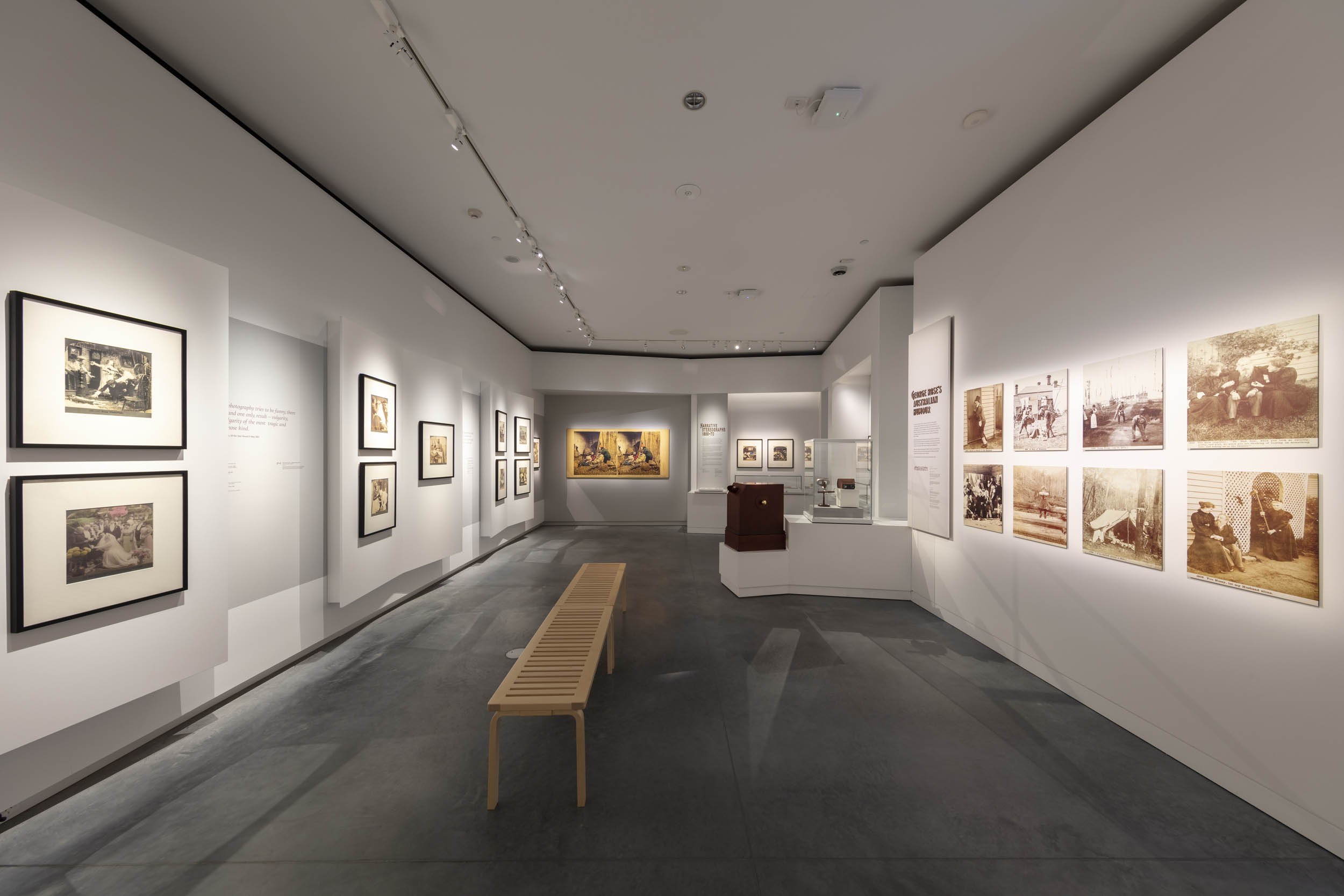
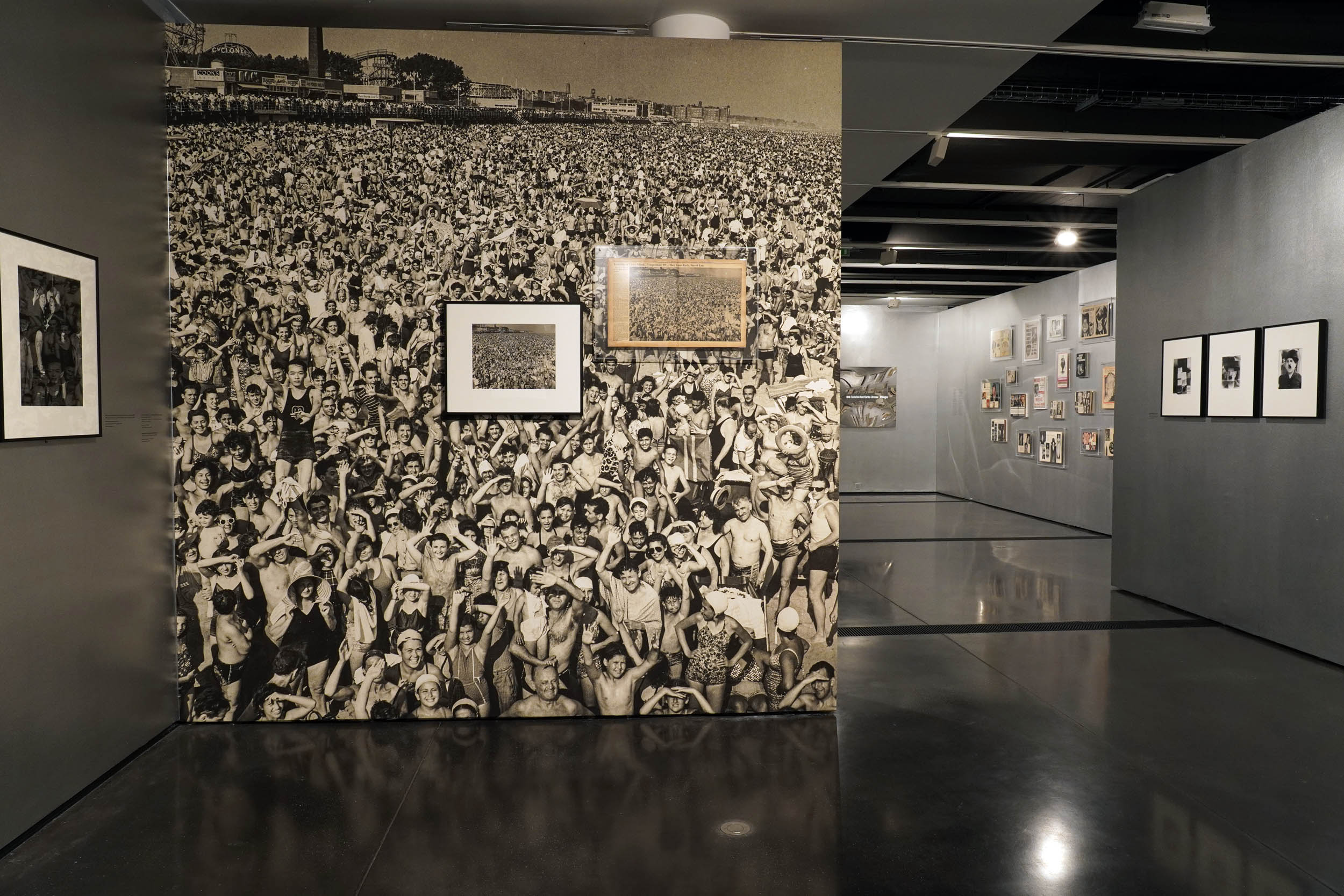
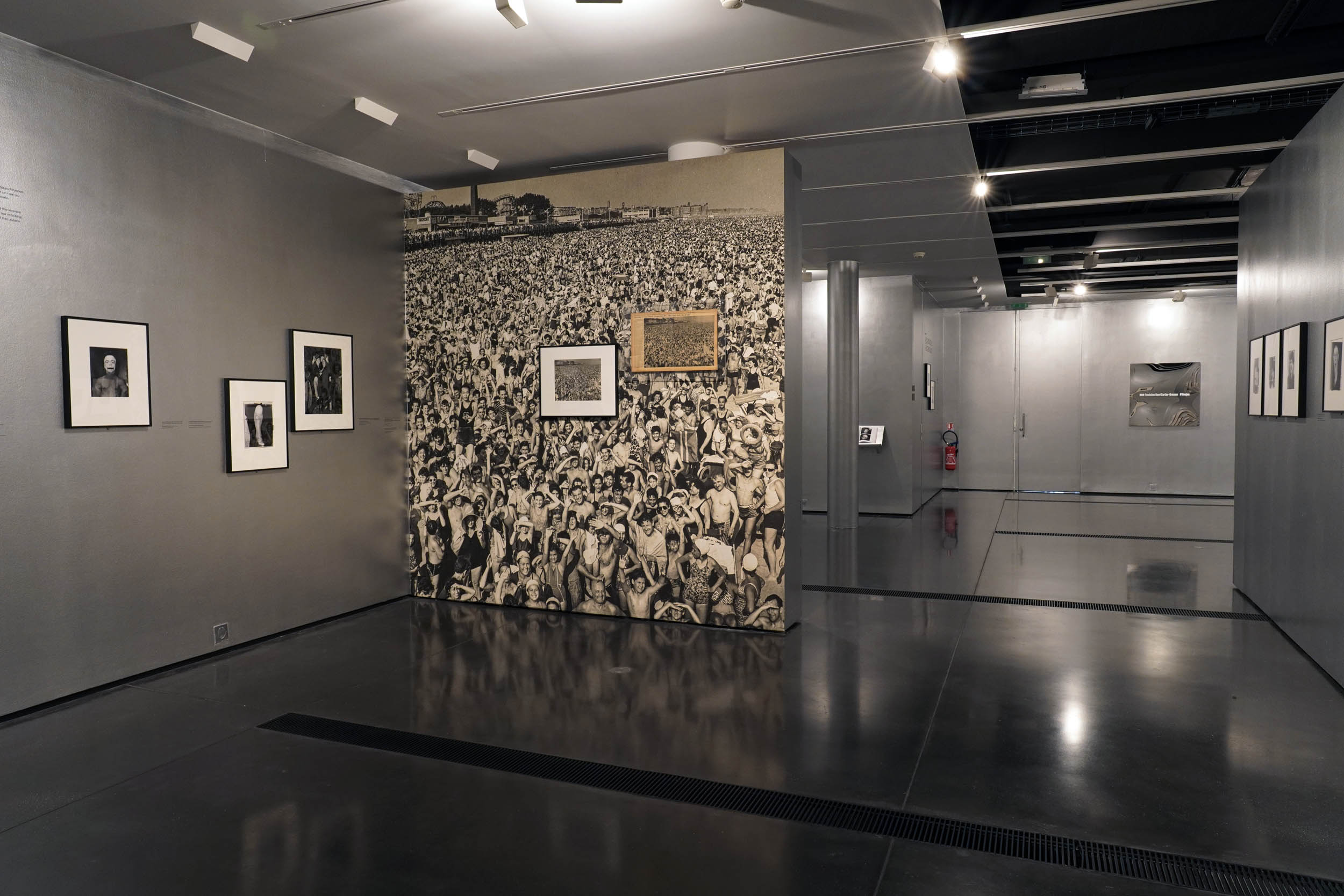
Installation view of the exhibition 'The Staged Photograph' at the Chau Chak Wing Museum at The University of Sydney

Installation view of the exhibition 'The Staged Photograph' at the Chau Chak Wing Museum at The University of Sydney

Installation view of the exhibition 'The Staged Photograph' at the Chau Chak Wing Museum at The University of Sydney

Installation view of the exhibition 'The Staged Photograph' at the Chau Chak Wing Museum at The University of Sydney

Installation view of the exhibition 'The Staged Photograph' at the Chau Chak Wing Museum at The University of Sydney

Installation view of the exhibition 'The Staged Photograph' at the Chau Chak Wing Museum at The University of Sydney

Installation view of the exhibition 'The Staged Photograph' at the Chau Chak Wing Museum at The University of Sydney

Installation view of the exhibition 'The Staged Photograph' at the Chau Chak Wing Museum at The University of Sydney


Installation views of the exhibition The Staged Photograph at the Chau Chak Wing Museum at The University of Sydney with the exhibition texts in the bottom photograph to be seen below…


The Staged Photograph

Created in the theatrical space of the 19th century photographic studio, a staged photograph used the artifice of painted backgrounds and props against which to pose costumed sitters or models arranged in a tableau.

Sitters often used this studio stage to capture a special fancy dress or other costume worn to be photographed either on the way to, or sometimes after, the ball. From the time of the popular cartes-de-visite of the 1860s into the early 20th century, these private memories, storied in albums or framed on walls, give us rare visuals of the costumes worn.

The studio photographer also found a business line in selling staged fictional scenes, which told a story or posed a humorous moment. The most popular were the genre or narrative stereographs, featuring scenes of everyday life, sentimental or comic. Beginning in the late 1850s, this market changed from a middle-class parlour entertainment to a broader popular entertainment, and the views depicted reflect this change as a new century began.

With the advent of easier amateur photography through the Kodak revolution, rather than visiting the studio, the home photographer found a stage in the backyard. Family members were posed in the manner of the studio, with a suspended curtain on the washing line or a pot plant on a stand, often still capturing a special fancy dress costume.

This exhibition explores a range of these staged photographs, a window into popular culture of the time, revealing cultural and social values.

Costume Portraits

Photographers’ studios were theatrical spaces, with props and backgrounds that could give context to a fancy dress or other costume. In Sydney in 1879, photographer E. Riisfeldt advertised that he had ‘specially painted 12 SCENES by one of the finest scenic artists, suitable for any fancy costume’. (Sydney Morning Herald, 24 February 1879)

Costume balls were a popular feature of Sydney life from the 1830s. Balls were held to raise money for charities, including children’s fancy dress balls and poster balls, popular from 1900 in Australia where costumes featured in advertisements.

While there are long accounts in newspapers of the attendees, with lists of names and costumes worn, photography offered the possibility of capturing what an outfit looked like.

Wall text from the exhibition


James Elliott (British) 'Broken Vows' c. 1857 from the exhibition 'The Staged Photograph' at the Chau Chak Wing Museum at The University of Sydney, April 2023 - August 2024


James Elliott (British)
‘Broken Vows’
c. 1857
Hand-coloured stereograph (single image)
Chau Chak Wing Museum, The University of Sydney
Donated by Sandra Savides, 2014


James Elliott operated in London from approximately 1856 to 1861 and produced stereocards. According to Michael Pritchard’s Directory of London Photographers 1841-1908 he operated from two London addresses simultaneously: 9, Albany Court Yard and 48, Piccadilly.

Most famous for several hundred outstanding genre, usually beautifully tinted, on SCMs; most were elaborate studio sets, with large casts and complex accessories; several were in sets, such as “The Eve of Waterloo”; “The Wedding”, etc.; made views of England, esp. London on SCMs, which are much rarer and fairly ordinary. Often but not always used label with his name, or blind-stamp; views were extensively pirated both in England and US; he also pub. photos by W.M. Grundy.

Credit: National Stereoscopic Association with corrections and additions by Alan Griffiths and others.

Text from the Luminous-Lint website


Mark Anthony (Marc Antoine Gaudin) (French, 1804-1880)(attributed) '[Staged scene featuring five women, their fingers pointing upwards]' England c. 1855-1865


Mark Anthony (Marc Antoine Gaudin) (French, 1804-1880)(attributed)
[Staged scene featuring five women, their fingers pointing upwards]
England c. 1855-1865
Half stereograph (single image)
Macleay Collections, Chau Chak Wing Museum
Donated by Alison Skeels, 1982


Freeman Brothers, Sydney (Australian) '[Portrait of two girls in fancy dress]' c. 1855-1865


Freeman Brothers, Sydney (Australian)
[Portrait of two girls in fancy dress]
c. 1855-1865
Carte-de-visite
Chau Chak Wing Museum, The University of Sydney


One of the largest and most celebrated Sydney photographic studios was run by the Freeman Brothers, whose skilful portraits were much admired. This pair of entrepreneurial photographers used the latest processes, building a large, well-appointed studio and actively promoting their work through display in international exhibitions. James Freeman was also extremely well versed in the potential uses of the medium, delivering a comprehensive lecture on the topic to a Sydney society in 1858.

Text from the exhibition Colony: Australia 1770-1861 at NGV Australia 2018


Freeman and Co was established by the professional photographers William and James who arrived in Sydney from London in 1853 and 1854 respectively. Trading as Freeman Brothers, the pair opened Freeman’s Sydney Gallery of Photographic Art in 1855, specialising initially in daguerreotype portraits. James Freeman is credited with introducing the ambrotype process to the colony in 1856, and the company adopted this medium after this date. By the 1860s, the studio was busy producing carte de visite portraits, amassing nearly 30,000 negatives by 1870. In 1866 the brothers collaborated with the renowned English photographer Victor Prout, capitalising on his fine reputation in the colony and advertising themselves as ‘photographers to their Royal Highnesses the Prince and Princess of Wales and His Excellency the Governor.’ After William Freeman retired around 1890, the company passed into the hands of employee William Rufus George. Under George’s management in the 1890s the firm targeted a wealthy clientele, producing expensive platinum prints. The company still operates in Sydney, specialising in corporate, wedding, architectural and portrait photography.

Text from the Art Gallery of New South Wales website


G.H. Nicholas, Sydney (Australian) '[Portrait of a child holding a stereoscope]' c. 1870


G.H. Nicholas, Sydney (Australian)
[Portrait of a child holding a stereoscope]
c. 1870
Carte-de-visite
Chau Chak Wing Museum, The University of Sydney
Donated by Judith Mackinolty, 1982


These unique photos offer an intriguing insight into pop culture history

The Chau Chak Wing Museum presents The Staged Photograph, an exhibition exploring images from the mid-19th and early 20th centuries from Australia, Britain and the United States.

Australians embraced photography long before smartphone cameras enabled us to capture and curate every moment of our lives.

A new exhibition of rarely seen images at the Chau Chak Wing Museum transports us to a time when costumes had to be captured in a studio, and when fictional photographs, posing models in a story or comic scene, were sold and bought for home entertainment.

The Staged Photograph presents images taken between the mid-19th and early 20th centuries, by professional and amateur photographers, from Australia, Britain and the United States.

Exhibition curator Jan Brazier said: “The Staged Photograph is a fascinating dive into an unfamiliar photographic history. Its images are a diverse and intriguing insight into the role staged photographs played in our lives and the popular culture of the time.”

Studio: from the ballroom to bath soap

Costume balls were immensely popular from the 1830s. From the 1860s, families in their fancy dress costumes or special outfits could be professionally photographed in a studio complete with props and a painted background.

“These photos were private memories kept in frames or the family album, where undoubtedly many are still to be found,” said Jan Brazier.

Communities held balls to raise money for good causes and from 1900 they included the ‘poster ball’ when businesses would pay fundraisers to have someone wear a costume festooned with advertisements for their products. These balls were as popular in high society as in country towns and suburbs. Costumes for Sunlight Soap, Silver Starch laundry powder, Jelline jelly crystals and Silver Drop self-raising flour can be seen in the exhibition.

Stereograph, mass home entertainment

The ‘online’ experience of the 19th century, the stereograph used two nearly identical photographs to create a 3D image when seen through a viewer called a stereoscope. Originally a middle-class activity, with the family gathering in the parlour to enjoy the images, it became more affordable by the 1890s and the mass home entertainment of its time. Its transformation saw millions of stereographs in use worldwide.

Views of exotic locations were by far the most popular stereographs for ‘armchair travelling’, but commercial photographers also created fictional s­­­­­­­­cenes using actors and props to tell highly theatrical stories. Sentimental and comical scenes were big sellers.

Some of the most popular themes are still familiar – love, courtship, marriage, children and drunkenness – but others are of their time, taken from vaudeville jokes or the prejudices of the age. Both Irish servant women and African American plantation workers were held up to racist ridicule. One popular genre was college girls taking part in dormitory ‘larks and pranks’. Another was financial ruin from horse racing.

“The visual humour revealed in these stereographs provides a way for us to understand and interrogate a previous era’s cultural and social values,” said Jan Brazier.

The Home Studio

Home photography took off when smaller, more portable cameras became available, and the Kodak revolution arrived in the early 20th century. Amateur photographers captured special family moments using the backyard as a set. Family members posed as if in a studio, with a suspended curtain on the washing line or a pot plant on a stand, often still capturing a special costume. There was also a practical reason to work outdoors: better light.

Our photographic collection

All photographs are drawn from the Macleay Collections of the Chau Chak Wing Museum. These photographs are some of the more than 60,000 in the University’s social history photograph collection. The majority were donated and cover the mid-19th to 20th century.

“It doesn’t surprise me the Museum’s historical photographic exhibitions are so popular as people make a direct connection with our past ways of seeing ourselves. Anyone interested in Australia’s photography, history and early pop culture will enjoy this current exhibition,” Jan Brazier said.

Text from the Chau Chak Wing Museum website


Rose Stereograph Company, Melbourne (Australian)(publisher) 'A Pair of Drawers' c. 1895


Rose Stereograph Company, Melbourne (Australian)(publisher)
‘A Pair of Drawers’
c. 1895
Stereograph (single image)
Chau Chak Wing Museum, The University of Sydney
Donated by Sandra Savides, 2014


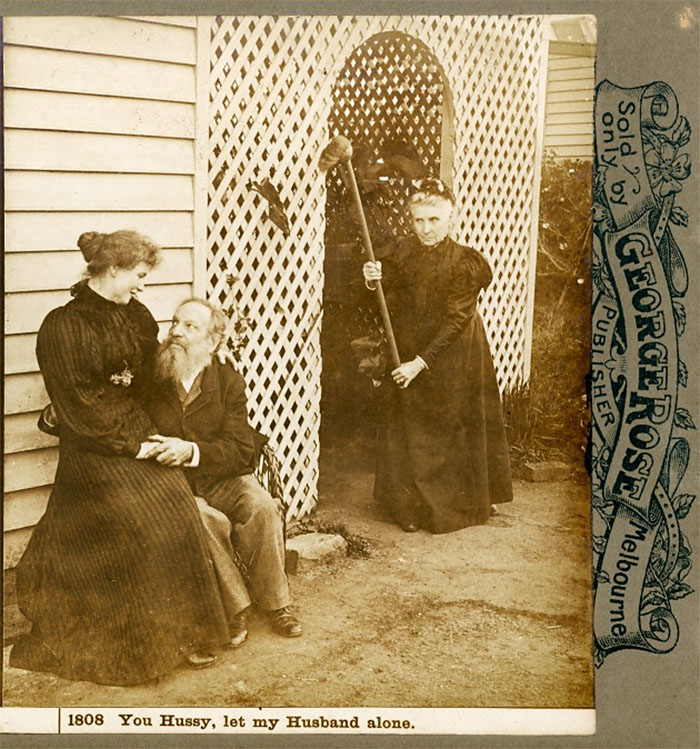
Rose Stereograph Company, Melbourne (Australian)(publisher) 'You Hussy, let my Husband alone' c. 1895


Rose Stereograph Company, Melbourne (Australian)(publisher)
‘You Hussy, let my Husband alone’
c. 1895
Stereograph (single image)
Macleay Collections, Chau Chak Wing Museum
Donated by Sandra Savides, 2014


The Rose Stereograph Company

The publishing output of this long-lived firm (which operated from about 1880 until it went into liquidation in 2017) was phenomenal, and when the remains of what must have been a vast photographic archive went on sale in June 2021 with Lloyds Auctions…

According to a brief history by postcard collector Leo Fitzgerald, the Rose story began when Cornish sea captain William Rose came to the Victorian Ballarat gold fields from California and married Grace Ash at Ballarat in 1861. The couple’s son, George, was born in 1862 at the town of Clunes. He worked in his father’s shoe shop in Chapel Street, Prahran, between 1877 and 1880 (apparently producing his earliest photos from those premises) and began spending his Sundays selling photos to picnic parties in the Dandenong hills. Finding his niche in photography, he moved to a new address at Armadale and founded his own firm publishing stereographic views. Over the years he travelled to many countries and recorded numerous important historic events with his stereographic camera equipment, opening offices in Sydney, Wellington and London. His images from Korea have become especially celebrated in Korea, where they represent an extremely rare glimpse of the nation in 1904, before the onset of the destruction wrought by the wars of the 20th century. …

Collector and researcher Ron Blum, whose excellent books built on Leo Fitzgerald’s work, wrote that George’s son Walter took over the business sometime before 1931, selling it in that year to long-time employees Edward Gilbert and Herbert Cutts… George’s wife, Elizabeth, died in 1929, and both George’s sons died before him. With no longer any legal interest in the company he had founded, George kept on taking photographs for the old firm, travelling around Australia in a mobile darkroom and camping along the way. He worked almost until his death in 1942, aged 80… The Rose Stereographic Company continued under the stewardship of Herbert “Bert” Cutts, who brought his son Neil into the business in the 1950s.

Greg Ray. “The Rose Stereograph Company: a snapshot,” on the Photo Time Tunnel website July 16, 2021 [Online] Cited 23/09/2023. Used under fair use conditions for the purposes of education and research


Rose Stereograph Company, Melbourne (Australian)(publisher) 'The Great Australian Bite (Bight)' c. 1895


Rose Stereograph Company, Melbourne (Australian)(publisher)
‘The Great Australian Bite (Bight)’
c. 1895
Stereograph (single image)
Chau Chak Wing Museum, The University of Sydney
Donated by Sandra Savides, 2014


George Rose was born in Clunes, Victoria, in 1861. He did not follow his father into boot-making, but was interested in astronomy and natural history. He was unconventional, of rather eccentric and Bohemian character. After moving to Melbourne in 1876, George developed his skills as a photographer, especially in the stereoscopic field – what is known as 3D photography today. He founded the Rose Stereographic Company in 1880. In 1901 George recorded the celebrations for the visit of the Duke and Duchess of York, and in the following years travelled across Australia and over 35 countries taking three-dimensional photos. By 1907 his business employed six people – two males and four females; at its peak, staff numbered around 20. In 1913 the Rose Stereographic Company began manufacturing “real photo” postcards. George’s son Walter managed the company, allowing his father to concentrate on taking the photographs. In 1931 the business was sold to two long-time employees, Edward Gilbert and Herbert (Bert) Cutts. George Rose died of cancer in 1942, having outlived both his sons, but the business remained in the Cutts family for many years before it finally closed down in March 2017.

Information from the book George Rose – The Postcard Era by Ron Blum.


C.H. Graves, Universal Photo Art Co (American) 'How Bridget served the POTATOES UNDRESSED. 'I'll not take off another STITCH if I lose me JOB'' c. 1897


C.H. Graves, Universal Photo Art Co (American)
‘How Bridget served the POTATOES UNDRESSED. ‘I’ll not take off another STITCH if I lose me JOB’ ‘
c. 1897
Stereograph (single image)
Chau Chak Wing Museum, The University of Sydney
Donated by Sandra Savides, 2014


The Universal Photo Art Company was one of several business titles under which photographer Carlton Harlow Graves sold his photographs late in his career. He was the son of Jesse Albert Graves, an important early worker who was based in the Delaware Water Gap area of Pennsylvania in the 1860-1880 time frame and produced some 500 generally fine scenic views of the western part of the state. Carlton learned the photographic art from his father and moved to Philadelphia to began producing on his own in about 1880. In his early years, he seems to have taken all the views which he published, but he soon began to buy or pirate images from others. Stereoviews issued under his own name are extremely rare.

At its peak, The Universal Photo Art Company seems to have been a rather substantial outfit. In addition to the headquarters offices and production facilities in Philadelphia, there was a western branch in Naperville, Ill., under F. A. Messerschmidt as general manager. There are numbers listed to almost to 5,000, although the number of individual photos actually used is only about 1,300. By the late 1890’s, C. H. Graves company became a major publisher offering “Art Nouveau Stereographs” on light gray curved mounts. His trade list offered excellent views of hunting scenes, Jamaica, Japan, Java, New York City, Palestine and others. To compete with low priced lithographs and copies, Graves offered his “Universal Series” or “Universal Views” on black mounts with no credit to himself. These have the number and the title in the negative and were sold at a reduced price from the regular “Art Nouveau” issues. Graves also offered boxed sets but they were not sold in the quantities of Underwood and Underwood, the Keystone View Company and H. C. White. The company seems to have been active until about 1910 when its stock of negatives were sold to Underwood & Underwood and presumably went from there to the Keystone View Company with the rest of the Underwood photos.

Paul Rubinstein. “Universal Photo Art Company,” on the Yellowstone stereoviews website Nd [Online] Cited 07/07/2024. Used under fair use conditions for the purposes of education and research


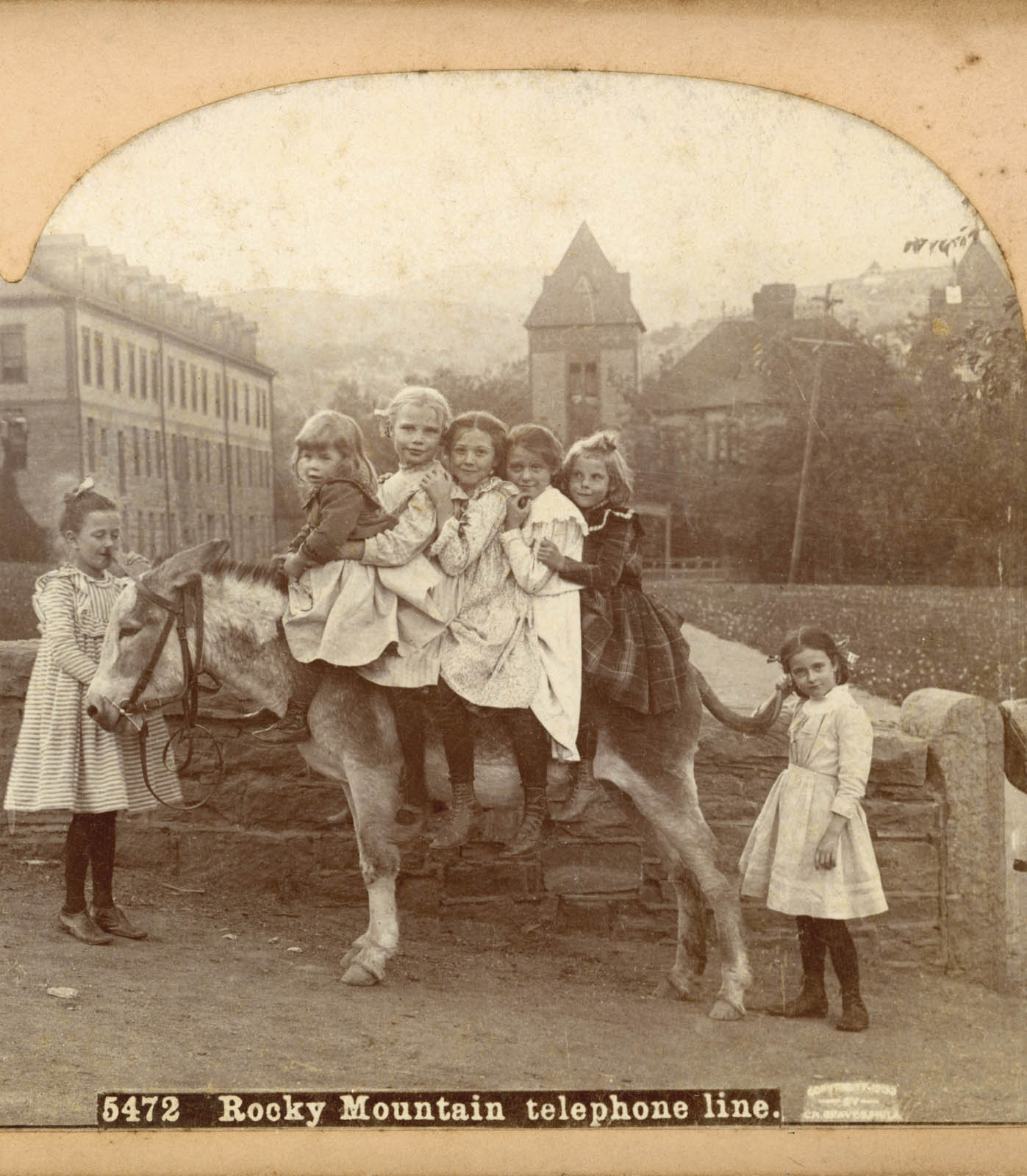
C.H. Graves, Universal Photo Art Co (American) 'Rocky Mountain telephone line' 1895-1905


C.H. Graves, Universal Photo Art Co (American)
‘Rocky Mountain telephone line’
1895-1905
Stereograph (single image)
Chau Chak Wing Museum, The University of Sydney
Donated by Sandra Savides, 2014


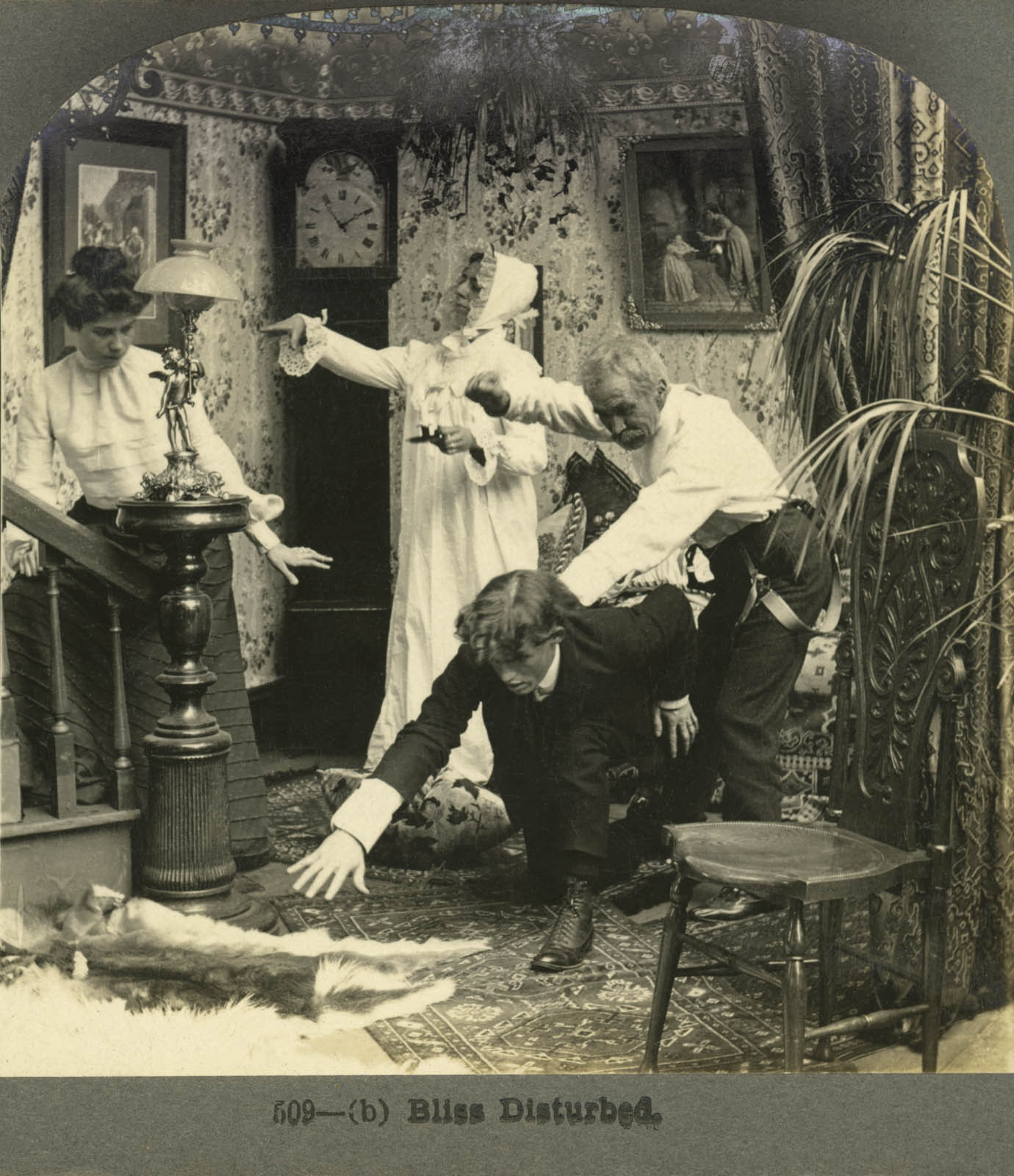
Keystone View Company (American) 'Bliss disturbed' c. 1903


Keystone View Company (American)
‘Bliss disturbed’
c. 1903
Stereograph
Chau Chak Wing Museum, The University of Sydney
Donated by Sandra Savides, 2014


The Keystone View Company was founded in 1892 in Meadville, Pennsylvania, U.S.A. by amateur photographer B. L. Singley (Benneville Lloyd Singley). The trade list at the end of 1892 consisted of only a hundred titles but by 1940 they had commercially produced more than 40,000 titles. …

The views sold by the company in the U.K. from 1898 to 1906 were distributed under the name ‘The Fine-Art Photographers’ Publishing Co.’ and included instructions on how to view them with a ‘Realistiscope’; the company were manufacturing and selling stereoscopes from 1898 onwards.

There was an increased popularity of stereographs between 1898 and 1906, during which Keystone (like Underwood & Underwood) entered the box-set market. Along with topographical, nature, events and genre-view scenes, Keystone also began an Educational department in 1898 which issued sets illustrating geography, commerce, technology, history and natural studies.

After 1920 the Keystone View Company was the major global publisher of stereoviews, between 1915 and 1921 they had bought the negatives of nearly all of their competitors. With offices all over the world at this time the company was successful, especially from the sales of World War I stereoview sets.

The Keystone View Company maintained regular production right up until 1939 but continued to manufacture views for optometric purposes, with individual orders for stereoviews being filled up until the early 1970s.

Rebecca. “Keystone View Company,” on The Stereoscopy Blog 3rd January 2021 [Online] Cited 07/07/2024. Used under fair use conditions for the purposes of education and research


Lorna Studios, Glebe (Australian) '[Sunlight Soap Girl]' 1905-1915


Lorna Studios, Glebe (Australian)
[Sunlight Soap Girl]
1905-1915
Cabinet card
Chau Chak Wing Museum, The University of Sydney
Donated from Lydia Bushell, 1983


George Henry Hawkins, Sydney (Australian) '[Four children in fancy dress featuring the products, Jelline and Silver Drop Flour]' 1910-1930


George Henry Hawkins, Sydney (Australian)
[Four children in fancy dress featuring the products, Jelline and Silver Drop Flour]
1910-1930
Glass negative, half-plate
Chau Chak Wing Museum, The University of Sydney
Donated by R. Hawkins, 1988


George Henry Hawkins, Sydney (Australian) '[Lily dressed in costume as 'Victoria']' 1910-1930


George Henry Hawkins, Sydney (Australian)
[Lily dressed in costume as ‘Victoria’]
1910-1930
Glass negative, quarter-plate
Chau Chak Wing Museum, The University of Sydney
Donated by R. Hawkins, 1988


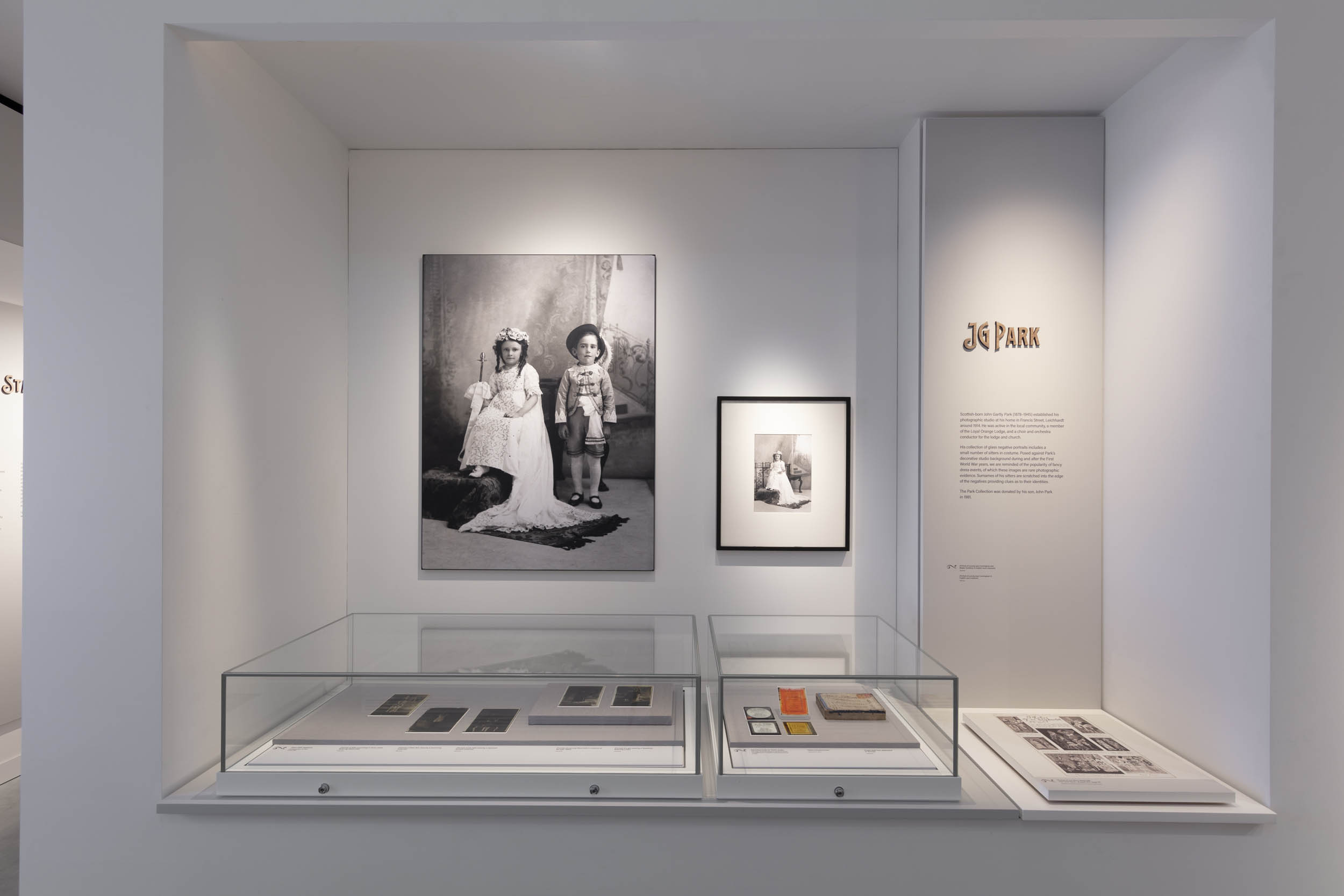
J.G. Park, Leichhardt (Australian) '[Portrait of a young Jean Cunningham and Master Hurlstone in English court costumes]' c. 1914-1920s


J.G. Park, Leichhardt (Australian)
[Portrait of a young Jean Cunningham and Master Hurlstone in English court costumes]
c. 1914-1920s
Glass negative
Chau Chak Wing Museum, The University of Sydney
Donated by J. Park, 1981


Scottish-born John Gartly Park (1878-1945) established his photographic studio at his home in Francis Street, Leichhardt around 1914. He was active in the local community, a member of the Loyal Orange Lodge, and a choir and orchestra conductor for the lodge and church.

His collection of glass negative portraits includes a small number of sitters in costume. Posed against Park/s decorative studio background during and after the First World War years, we are reminded of the popularity of fancy dress events, of which these images are rare photographic evidence. Surnames of his sitters are scratched into the edge of the negatives providing clues as to the identities.

The Park Collection was donated by his son, John Park in 1981.

Wall text from the exhibition


J.G. Park, Leichhardt (Australian) '[Portrait of Miss Orr in fancy dress as Britannia]' c. 1914-1920s


J.G. Park, Leichhardt (Australian)
[Portrait of Miss Orr in fancy dress as Britannia]
c. 1914-1920s
Glass negative
Chau Chak Wing Museum, The University of Sydney
Donated by J Park, 1981


J.G. Park, Leichhardt (Australian) '[Portrait of Miss Larsen wearing a Silver Star Starch costume]' c. 1914-1920s


J.G. Park, Leichhardt (Australian)
[Portrait of Miss Larsen wearing a Silver Star Starch costume]
c. 1914-1920s
Glass negative Chau Chak Wing Museum, The University of Sydney
Donated by J. Park, 1981


Oliver Emery, Sydney (Australian) '[Three boys posed outside against a makeshift backdrop]' c. 1914-1930


Oliver Emery, Sydney (Australian)
[Three boys posed outside against a makeshift backdrop]
c. 1914-1930
Glass negative, half-plate
Chau Chak Wing Museum, The University of Sydney
Donated by O. Emery, 1983


Chau Chak Wing Museum – The University of Sydney
Level 1, University Place, Camperdown, NSW 2006
Phone: 02 9351 2812

Opening hours:
Monday to Friday (until 9pm Thursdays) 9am – 5pm
Saturday and Sunday 12 – 4pm
Closed public holidays

Chau Chak Wing Museum website

LIKE ART BLART ON FACEBOOK

Back to top

Exhibition: ‘The Real Thing: Unpackaging Product Photography’ at the Metropolitan Museum of Art, New York

“These photographs awaken in the consumer a desire to possess the object of the camera’s attention, the aesthetisication of the object as a form of “readymade” available for immediate consumption.” Dr Marcus Bunyan

Exhibition dates: 11th March – 4th August, 2024

Curator: Virgina McBride, Research Associate in the Department of Photographs at The Met


Anton Bruehl (American born Australia, 1900-1982) 'Four Roses Whiskey: Worth Reaching For' 1949 from the exhibition 'The Real Thing: Unpackaging Product Photography' at the Metropolitan Museum of Art, New York, March - August, 2024


Anton Bruehl (American born Australia, 1900-1982)
Four Roses Whiskey: Worth Reaching For
1949
Laminated photomechanical printer’s proof
26.1 x 27.4cm (10 1/4 x 10 13/16 in.)
The Metropolitan Museum of Art, New York
Ford Motor Company Collection, Gift of Ford Motor Company and John C. Waddell, 1987
© Estate of Anton Bruehl


Meticulously staged by the pioneering colour photographer Anton Bruehl, this work was part of a series showing the whiskey in many exciting scenarios: the glass appeared to travel by train and cruise liner, as well as hot air balloon. Bruehl’s pictures ran as ads in LIFE and Newsweek, conjuring worldly associations for his client, the Kentucky distiller Four Roses.

Against all odds, these eye-catching scenes were not darkroom fabrications – Bruehl arranged them by hand, with the help of miniaturists, set dressers, and a celebrity florist.

Testing appetites for novelty, illusion, and abundance against the limits of good taste, he wagered that this crisp construction would quench your thirst, then melt into hot air.

Text from the Metropolitan Museum of Art Instagram page


Anton Bruehl was born in 1900 of German émigré parents in the small town of Hawker, Australia. By 1919, when he moved to the United States to work as an electrical engineer, he was a skilled amateur photographer. A show of student work from the Clarence H. White School of Photography at the Art Center, New York, in 1923 convinced Bruehl to quit his engineering job to become a photographer. White taught Bruehl privately for six months and then asked him to teach at his school, including its summer sessions in Maine. White’s sudden death, in 1925, prompted Bruehl to open a studio, at first partnering with photographer Ralph Steiner and then with his older brother, Martin Bruehl; it was immediately successful. Specializing in elaborately designed and lit tableaux, Bruehl won top advertising awards throughout the late 1920s and early 1930s. A favourite of Condé Nast Publications, he developed the Bruehl-Bourges colour process with colour specialist Fernand Bourges, which gave Condé Nast a monopoly on colour magazine reproduction from 1932 to 1935.

Text from the MoMA Object: Photo website


What a thoughtful, stimulating and well presented exhibition which contains some absolutely beautiful product photographs. These photographs awaken in the consumer a desire to possess the object of the camera’s attention, the aesthetisication of the object as a form of “readymade” available for immediate consumption.

It’s such a pity that for some of sections – such as “The Array”, “The Montage”, and “The Ideal user” – I only have one or two media image to illustrate the theme.

I have included in the posting a wonderful photograph from my own collection – a postcard with a real photograph on the front by an unknown photographer, showing a proprietor standing by the front door of his shop advertising the wares for “Howard, Watchmaker & Jeweller”, no date – probably British from 1890s-1910s due to his attire, the typeface on the front of the shop, and how “jewellery” is spelt. In the window there is an effusive display of clocks, watches, rings and Prince Albert watch chains.

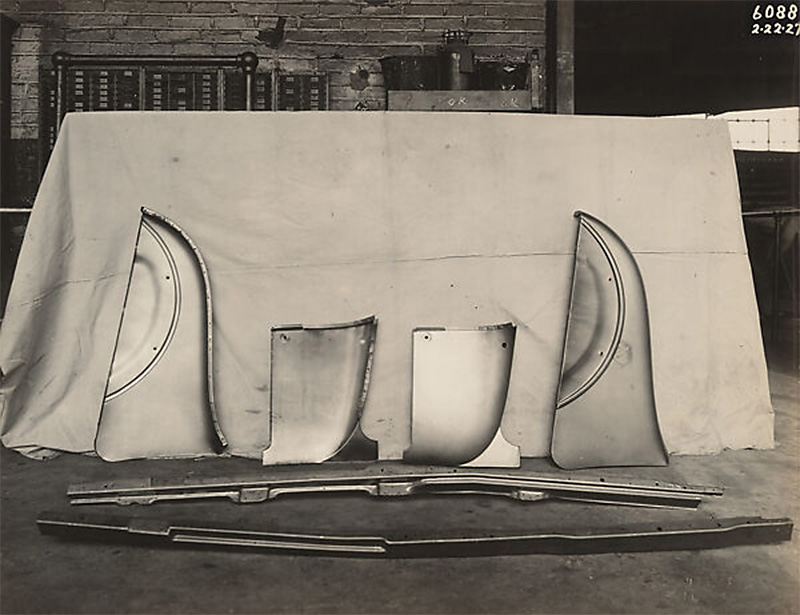
My favourite photographs in the posting are the portrait of The Silver Merchants (c. 1850, below); the photograph of a tombstone from the Vermont Marble Tombstone Catalogue (1880s, below); the hand-coloured photograph by the Schadde Brothers of High Grade Jelly Eggs, from a Brandle & Smith Co. Catalogue (c. 1915, below); and the sublime Edward G. Budd Manufacturing Co. photograph Automotive Component (February 22, 1927, below)

Through these product photographs we begin to understand how, “The conventions of the past inform these norms and explain the advertisements that we see in our daily lives.” And how we have lost that spark of creativity, use of colour and form and appreciation of beauty in product photography that was the essence of what has gone before.

For those that are interested, I have included some expressive quotations on the complexity of the relationship between the construction of the self, commodities and consumer culture at the bottom of the posting.

Dr Marcus Bunyan


Many thankx to the Metropolitan Museum of Art for allowing me to publish the photographs in the posting. Please click on the photographs for a larger version of the image.


“Consumer capitalism, with its efforts to standardise consumption and to shape tastes through advertising, plays a basic role in furthering narcissism. The idea of generating an educated and discerning public has long since succumbed to the pervasiveness of consumerism, which is a ‘society dominated by appearances’. Consumption addresses the alienated qualities of modern social life and claims to be their solution: it promises the very things the narcissist desires – attractiveness, beauty and personal popularity – through the consumption of the ‘right’ kinds of goods and services. Hence all of us, in modern social conditions, live as though surrounded by mirrors; in these we search for the appearance of an unblemished, socially valued self.”


Anthony Giddens. Modernity and Self-Identity: Self and Society in the Late Modern Age. California: Stanford University Press, 1991, p. 172.


Unknown photographer (British?) 'Howard – Watchmaker and Jeweller' 1890s-1910s?

Unknown photographer (British?) 'Howard – Watchmaker and Jeweller' 1890s-1910s? (verso)


Unknown photographer (Brtish?)
Howard – Watchmaker and Jeweller (front and verso)
1890s-1910s?
Silver gelatin photograph on postcard
Collection of Marcus Bunyan

This photograph is not in the exhibition


“”Product photography is, now, completely inescapable – it follows you around and stalks you on social media – and that condition is very interesting,” said [curator] McBride. The conventions of the past inform these norms and explain the advertisements that we see in our daily lives…

When I visited the exhibition, I was lucky enough to meet Drew, an advertisement photographer who spoke to me about her impressions of The Real Thing: Unpackaging Product Photography. “As someone who works in advertising photography, I find it quite interesting how I think we’ve lost some of the creativity that I see here in this imagery, as far back as the 1920s. It makes me wonder about how I could implement or think about new ways of composition or exploring basic objects in a more exciting way. I’m curious about how these objects were received as advertisements back then. Now, I think we see them more as fine art, so it is interesting to think about what our advertising images could look like twenty years from now.” Drew was strong in her belief that much of the beauty and wonder of advertisement photography has been lost over the decades.

In the 1920s, rising industrial output and consumer demand led executives to seek ways to make their products stand out in a crowded market. Applied psychology shifted managers’ focus to the consumer’s mind, emphasizing the need to persuade consumers that they could find individuality and personal meaning in standardized goods. Consumers “believe what the camera tells them because they know that nothing tells the truth so well.” …

The Real Thing: Unpackaging Product Photography exposes the truth in an entirely new way. It exposes the secrets of photography and how the truth shifted through years of capitalism and consumerism, demanding different sales strategies from producers… [By the 1950s] As the American capitalist market demanded printed ads and mass consumption increased, photographers lost their creative control, with advertisement directors taking up the mantle. There is a straightforward appeal and very little left to the imagination.”


Ayana Chari. “A Review of the Met Museum’s ‘The Real Thing: Unpackaging Product Photography’,” on The Science Survey website July 10, 2024 [Online] Cited 26/07/2024. Used under fair use conditions for the purposes of education and research


The photographs in this exhibition do not depict rare or special things. They show toothpaste, tombstones, and hats. But these familiar trappings of everyday life will be, at times, unrecognisable – so altered by the camera as to constitute something entirely new. Enticing consumers with increasingly experimental approaches to the still life genre, the photographs featured transform everyday objects into covetable commodities. The camera abstracts them from functional use, at times distorting them through dizzying perspectives and modulations of scale. Spanning the first century of photographic advertising, the exhibition will illustrate how commercial camerawork contributed to the visual language of modernism, suggesting new links between the promotional strategies of vernacular studios and the tactics of the interwar avant-garde. Corporate commissions by celebrated innovators, including Paul Outerbridge, August Sander, and Piet Zwart, will appear alongside obscure catalogues and trade publications, united by a common cause: to snatch the ordinary out of context, and sell it back at full price.

The exhibition is made possible by The Robert Mapplethorpe Foundation, Inc.

Text from the Metropolitan Museum of Art website


Installation view of the exhibition 'The Real Thing: Unpackaging Product Photography' at the Metropolitan Museum of Art, New York 

Installation view of the exhibition 'The Real Thing: Unpackaging Product Photography' at the Metropolitan Museum of Art, New York showing at right, introductory wall text to the exhibition (below) and F. D. Hampson's Panama Hats, from a Sloan-Force Co. Catalogue c. 1916 (below)


Installation views of the exhibition The Real Thing: Unpackaging Product Photography at the Metropolitan Museum of Art, New York showing at right in the bottom image, introductory wall text to the exhibition (below) and F. D. Hampson’s Panama Hats, from a Sloan-Force Co. Catalogue (c. 1916, below)


Introduction to the exhibition

The photographs in this exhibition do not depict rare or special things. They show toothpaste, tombstones, and hats. But here these familiar trappings of everyday life are, at times, unrecognisable – so altered by the camera as to constitute something entirely new. The Real Thing charts these tactics across the first century of photographic advertising.

If functional objects can be difficult to see, the camera is uniquely equipped to bring them into focus. Excised from mundane contexts and ushered into the studio, they assume new allure, independent of their value or means of production. For early retailers and ad agencies, photography bolstered consumer confidence; the medium offered unprecedented realism, and better still, an aura of truth. Beginning in the late 1850s, new demand for manufactured goods subsidised commercial photography, and the industry grew quickly, spurred by evolving technologies of image reproduction. In the decades that followed, photographers’ increasingly experimental still lives adapted modernism for the mass market.

In the spirit of early photo manuals and how-to guides, the exhibition unfolds thematically, exploring a range of approaches to what is today termed product photography. Pictures from across the commercial section – made in storerooms, corporate studios, and avant-garde ateliers – entice buyers and invent needs, transforming everyday objects into covetable commodities. Works by celebrated innovators appear here alongside obscure catalogues and trade publications, united by a common cause to snatch the ordinary out of context and sell it back at full price.

Wall text from the exhibition


Installation view of the exhibition 'The Real Thing: Unpackaging Product Photography' at the Metropolitan Museum of Art, New York 


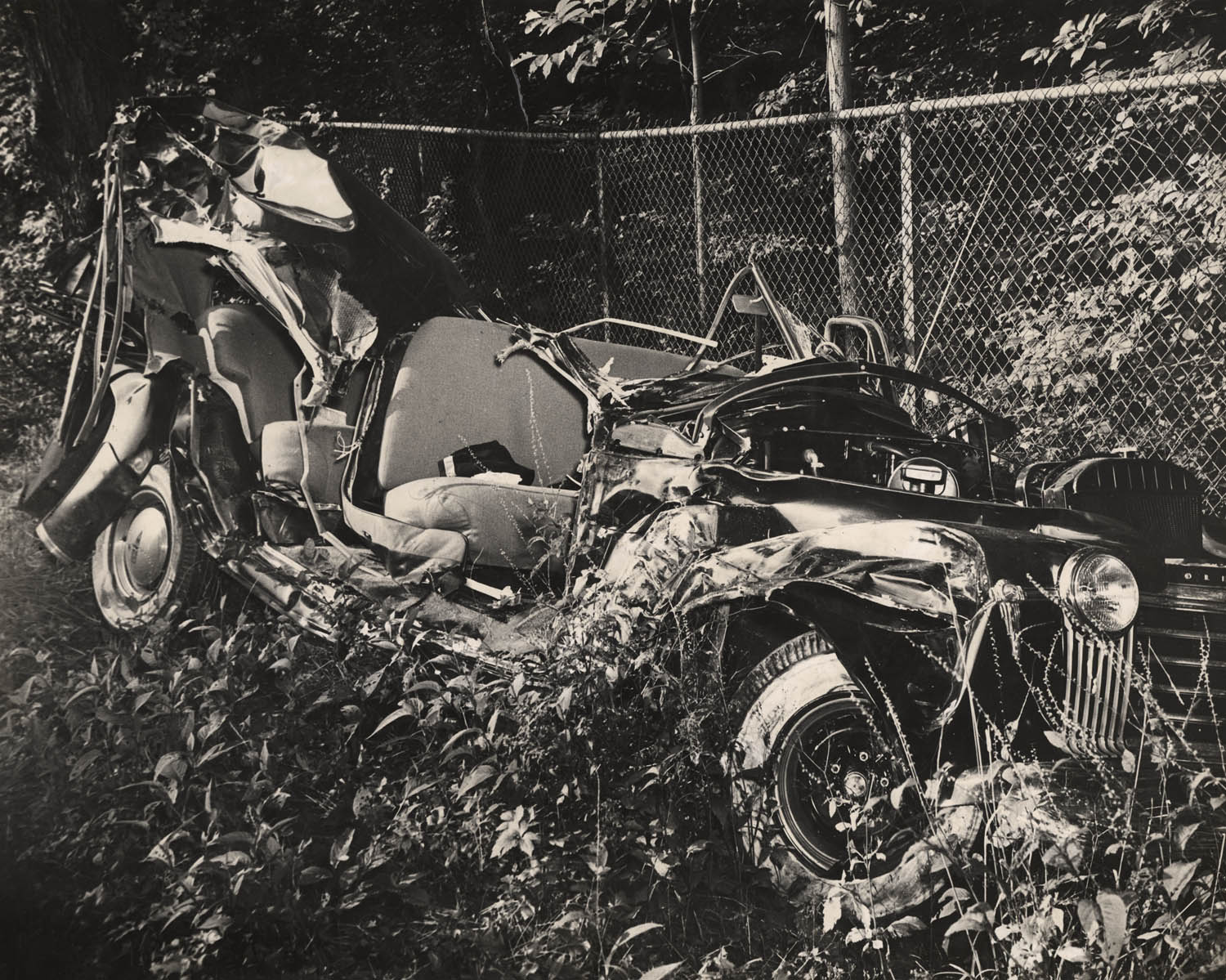
Installation views of the exhibition The Real Thing: Unpackaging Product Photography at the Metropolitan Museum of Art, New York showing at right, Irving Penn’s Theatre Accident, New York (1947)


The Inventory

Installation view of the exhibition 'The Real Thing: Unpackaging Product Photography' at the Metropolitan Museum of Art, New York showing the section 'The Inventory' including at second left, 'Fashions 1837-1887, by William Charles Brown' (1888); and at third right, 'Vermont Marble Tombstone Catalogue' (1880s)


Installation view of the exhibition The Real Thing: Unpackaging Product Photography at the Metropolitan Museum of Art, New York showing the section The Inventory including at second left, Fashions 1837-1887, by William Charles Brown (1888, below); and at third right, Vermont Marble Tombstone Catalogue (1880s, below)


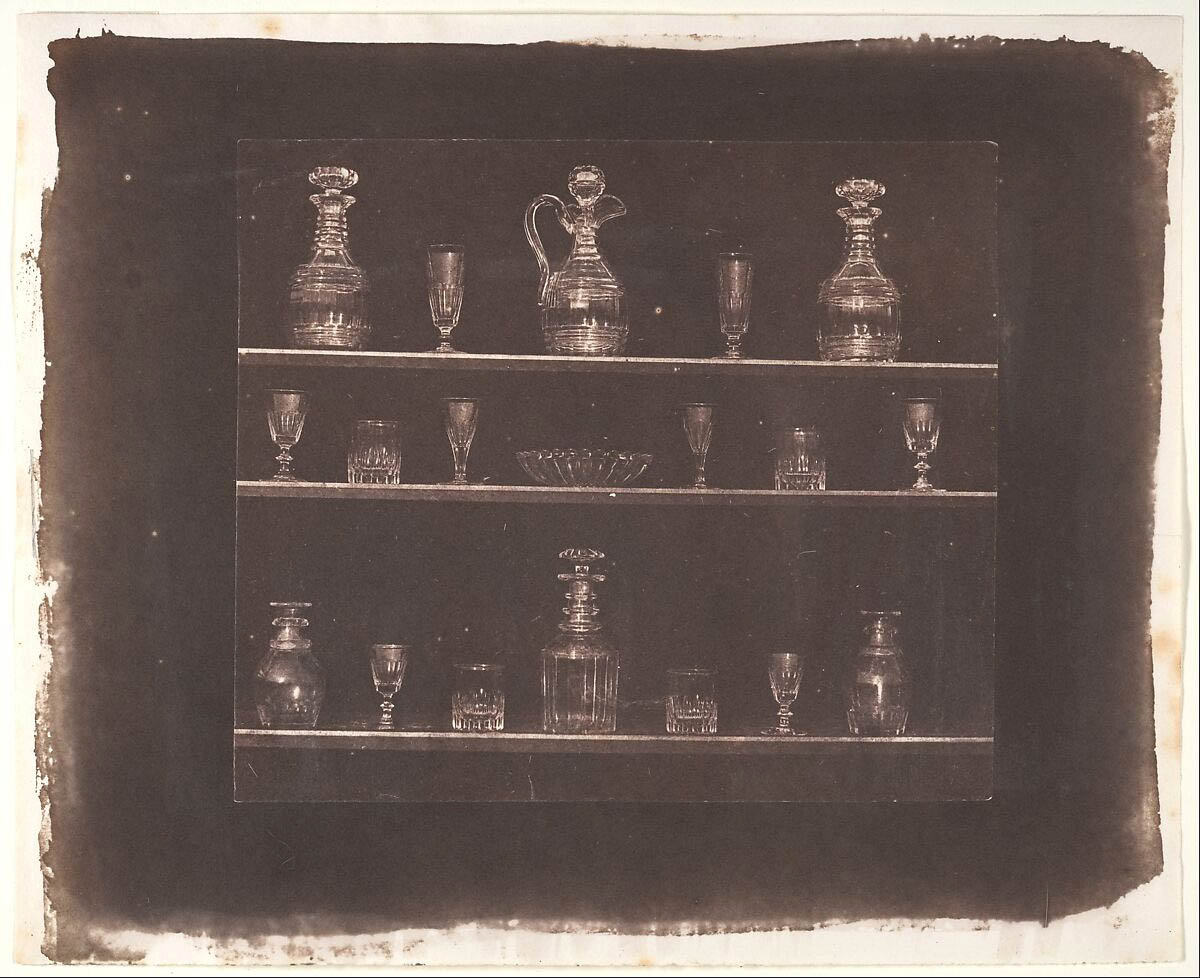
William Henry Fox Talbot (English, 1800-1877) 'Articles of Glass' before June 1844 from the exhibition 'The Real Thing: Unpackaging Product Photography' at the Metropolitan Museum of Art, New York, March - August, 2024


William Henry Fox Talbot (English, 1800-1877)
Articles of Glass
before June 1844
Salted paper print from paper negative
Image: 13.2 x 15.1 cm. (5 3/16 x 5 15/16 in.)
Frame: 14 3/4 x 14 3/4 in.
Metropolitan Museum of Art
Purchase, The Horace W. Goldsmith Foundation Gift, through Joyce and Robert Menschel, and Harrison D. Horblit Gift, 1988
Public domain


Talbot’s negative-positive photographic process, first made public in 1839, would change the dissemination of knowledge as had no other invention since movable type. To demonstrate the paper photograph’s potential for widespread distribution – its chief advantage over the contemporaneous French daguerreotype – Talbot produced The Pencil of Nature, the first commercially published book illustrated with photographs. With extraordinary prescience, Talbot’s images and brief texts proposed a wide array of applications for the medium, including portraiture, reproduction of paintings, sculptures, and manuscripts, travel views, visual inventories, scientific records, and essays in art.

This photograph and the plate preceding it, “Articles of China,” were offered as examples of photography’s usefulness as a tool for creating visual inventories of unprecedented accuracy. Talbot wrote: “The articles presented on this plate are numerous: but, however numerous the objects – however complicated the arrangement – the Camera depicts them all at once.”

Text from the Metropolitan Museum of Art website


Unknown photographer (American) Case manufactured by Hiram Studley (American, active 1840s) 'The Silver Merchants' c. 1850


Unknown photographer (American)
Case manufactured by Hiram Studley (American, active 1840s)
The Silver Merchants
c. 1850
Daguerreotype
Image: 2 3/16 × 2 3/4 in. (5.5 × 7cm)
Case: 3 1/8 × 3 11/16 × 9/16 in. (8 × 9.3 × 1.5cm)
Approx. 6 1/2 x 3 1/2 in. open
The Metropolitan Museum of Art
Purchase, Joyce F. Menschel Gift, 2017
Public domain


The first product photographs doubled as portraits. Posing with their wares, peddlers demonstrated a standard of work and an assurance of quality. The daguerreotype, a direct-positive image on silver-plated copper, offered all manner of workers an increasingly affordable likeness. Here, silver dealers make the most of the medium, modelling careful attention to their inventory. They examine pocket watches, pendants, and fobs splayed in a sales case. Plying their trade before the camera, they mirror the work of the era’s newest silver merchants: photographers themselves.

Text from the Metropolitan Museum of Art website


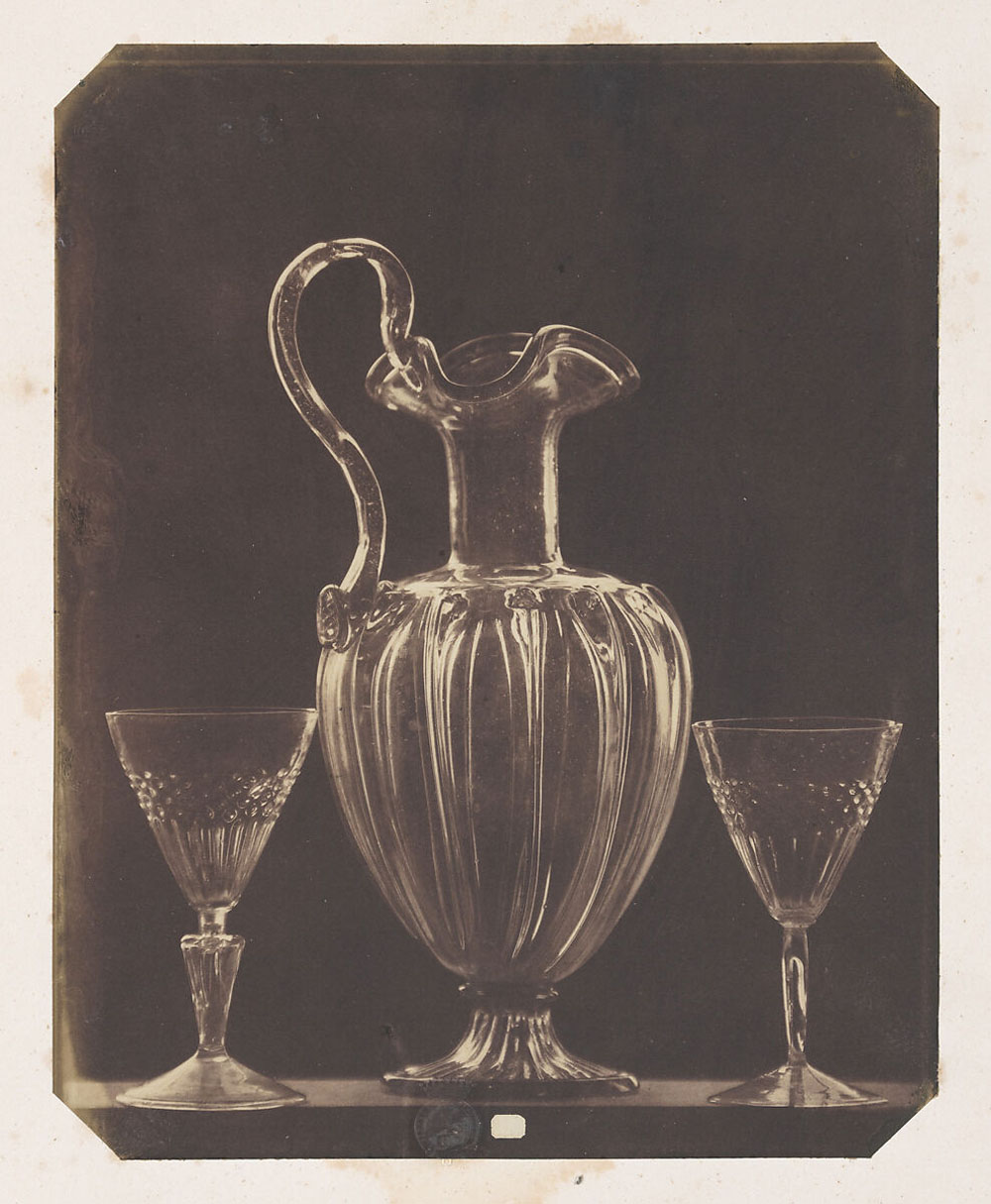
Ludwig Belitski (German, 1830-1902) 'Pitcher and Two Glasses, Venetian, 15th Century' 1854


Ludwig Belitski (German, 1830-1902)
Pitcher and Two Glasses, Venetian, 15th Century
1854
Salted paper print from glass negative
8 3/4 × 6 15/16 in. (22.2 × 17.7cm)
The Metropolitan Museum of Art
The Horace W. Goldsmith Foundation Fund, through Joyce and Robert Menschel, 2016
Public domain


Charles Nègre (French, 1820-1880) '[Plaster Casts of Bishops' Miters, South Porch, Chartres]' c. 1855


Charles Nègre (French, 1820-1880)
[Plaster Casts of Bishops’ Miters, South Porch, Chartres]
c. 1855
Salted paper print from paper negative
Image: 22 x 32.5cm (8 11/16 x 12 13/16 in.)
Frame: 18 1/2 x 22 1/2 in.
Metropolitan Museum of Art
Gilman Collection, Purchase, The Howard Gilman Foundation Gift, 2002
Public domain


When early photographers turned to the material world of things, it was often to document property or record cultural heritage. Their efforts reveal the camera’s remarkable capacity to abstract and transform the objects before its lens. In 1855, Charles Nègre accepted a commission to make architectural studies of Chartres Cathedral as part of a larger initiative to preserve and promote French patrimony. A complement to his sweeping views of sculpted facades, this still life monumentalises the site’s smaller details. It shows plaster replicas of ecclesiastical headgear, taken from the cathedral exterior. These are simulacra of simulacra, yet Nègre recasts them anew, registering their textured surfaces in a splendid study of shadow and mass.

Text from the Metropolitan Museum of Art website


Unknown maker (American) 'Man Demonstrating Patent Model for Sash Window' Late 1850s-1860s


Unknown maker (American)
Man Demonstrating Patent Model for Sash Window
Late 1850s-1860s
Tintype with applied colour
4.8 x 3.6cm (1 7/8 x 1 7/16 in.)
Metropolitan Museum of Art
Bequest of Herbert Mitchell, 2008
Public domain


Pine & Bell (photographic studio) (American, active 1860s, Troy, New York) William H. Bell (American born England, Liverpool 1831-1910 Philadelphia, Pennsylvania) George W. Pine (American, active 1860s, Troy, New York) '[Display of Hats and Accessories of 1868]' 1868


Pine & Bell (photographic studio) (American, active 1860s, Troy, New York)
William H. Bell (American born England, Liverpool 1831-1910 Philadelphia, Pennsylvania)
George W. Pine (American, active 1860s, Troy, New York)
[Display of Hats and Accessories of 1868]
1868
Albumen silver print from glass negative
Image: 3 9/16 × 2 1/8 in. (9 × 5.4 cm)
Mount: 3 11/16 in. × 2 3/8 in. (9.3 × 6 cm)
The Metropolitan Museum of Art
William L. Schaeffer Collection, Promised Gift of Jennifer and Philip Maritz, in celebration of the Museum’s 150th Anniversary


Unknown photographer. '[E. Adkins Gun Merchant]' c. 1874


Unknown photographer
[E. Adkins Gun Merchant]
c. 1874
Ambrotype
6.3 x 7.5cm (2 1/2 x 2 15/16 in.) visible
The Metropolitan Museum of Art
Gift of Charles Wilkinson, 1965
Public domain


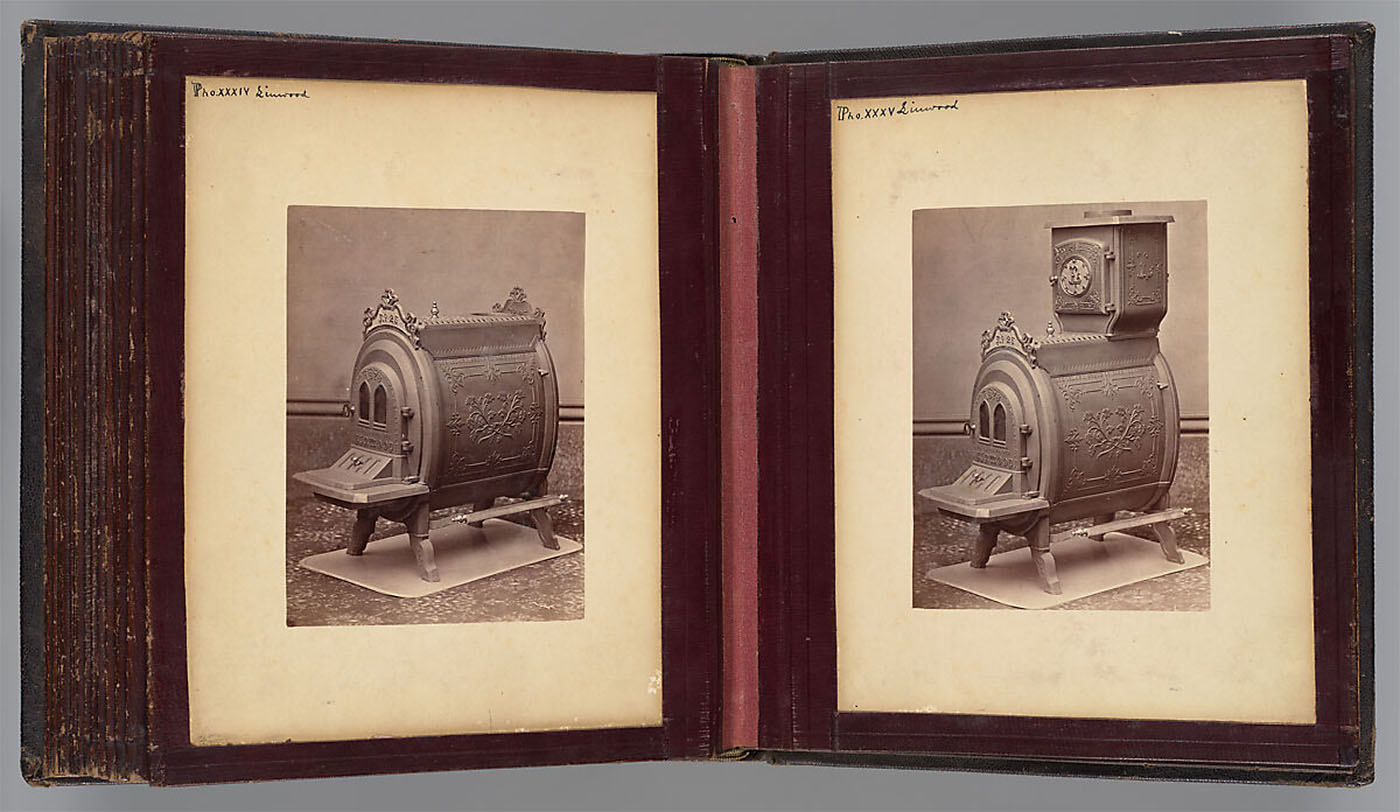
Unknown maker (American) 'Rock Island Stove Company Catalogue' 1878-1883


Unknown maker (American)
Rock Island Stove Company Catalogue
1878-1883
Albumen silver prints
The Metropolitan Museum of Art
Joyce F. Menschel Photography Library Fund, 2003
Public domain


Unknown maker (British) 'Fashions 1837-1887 by William Charles Brown (British, active late 19th century)' 1888


Unknown maker (British)
Fashions 1837-1887 by William Charles Brown (British, active late 19th century)
1888
Woodburytypes
22.5 x 17cm (8 7/8 x 6 11/16 in.)
Approx. 9 x 14 in. open
The Metropolitan Museum of Art
Joyce F. Menschel Photography Library Fund, 2011


In the back of this catalogue from Queen Victoria’s milliner, a disclaimer confirms that no British songbirds were sacrificed for its production. Nevertheless, a flock of hats in fine feather fills this page spread, flaunting designs fit for the royal family. The deluxe volume is illustrated with woodburytypes, an early photomechanical process with a rich tonal range to register varied velvets, silks, straws, and plumes. Hatstands and supports have been edited out of these images to suspend the specimens midair. Surreal to modern eyes, the effect accentuates the hats’ commodity status and implies inventory soaring out of stock.

Text from the Metropolitan Museum of Art website


Frank M. Sutcliffe (British, 1853-1941) '[Display of Whitby Seascape Photographs]' c. 1888


Frank M. Sutcliffe (British, 1853-1941)
[Display of Whitby Seascape Photographs]
c. 1888
Albumen silver print
Image: 4 1/4 × 5 1/2 in. (10.8 × 14 cm)
Sheet: 6 15/16 × 9 1/2 in. (17.7 × 24.1 cm)
Frame: 11 x 14 in.
Metropolitan Museum of Art
Purchase, Anonymous Gift, 2023
Public domain


“Choose one subject, anything will do,” Frank Sutcliffe advised aspiring photographers. If his career-spanning preoccupation with the British seaside town of Whitby seemed myopic to some peers, it allowed him to cultivate a distinctive brand. This typology of seascapes testifies to his years of work along the town harbour, where he weathered storms and punishing wind in pursuit of the perfect view. Pinned up for purchase at an exhibition, his photographs here become products. This rudimentary style of display seems to have served him well; at one such showcase, he counted the Prince of Wales among his customers.

Text from the Metropolitan Museum of Art website


Unknown (American) '[Vermont Marble Tombstone Catalogue]' 1880s


Unknown (American)
[Vermont Marble Tombstone Catalogue]
1880s
Albumen silver prints
Approx. 17 1/4 x 4 in. open
The Metropolitan Museum of Art
Jefferson R. Burdick Bequest, 1972
Public domain


“When you are met with a flood of tears, the best thing to do is politely say that you will call again,” advised one traveling salesman in the tombstone trade. For Cyrus Creigh, a thirty-something Virginian who sold stones from this annotated catalogue, such considerations were part of the job. In each new town, he might solicit names of bereaved families from undertakers and local cemetery staff. Slipped from a suit pocket and proffered door-to-door, his book of bluntly descriptive photographs sold surviving relatives a modicum of consolation. The stones, posed in a corporate studio and silhouetted in darkness, assume a solemn universality, as if any of their blank faces might soon bear a familiar name.

Text from the Metropolitan Museum of Art website


Schadde Brothers (American, active Minneapolis, 1890s-1910s) Alvin J. Schadde (American, 1872-1937) Herman T. Schadde (American, 1874-1937) '[High Grade Jelly Eggs, from a Brandle & Smith Co. Catalogue]' c. 1915


Schadde Brothers (American, active Minneapolis, 1890s-1910s)
Alvin J. Schadde (American, 1872-1937)
Herman T. Schadde (American, 1874-1937)
[High Grade Jelly Eggs, from a Brandle & Smith Co. Catalogue]
c. 1915
Gelatin silver print with applied colour
Image: 8 1/4 × 9 3/4 in. (21 × 24.8cm)
Frame: 18 x 20 in.
Metropolitan Museum of Art
Twentieth-Century Photography Fund, 2013


Schadde Brothers (American, active Minneapolis, 1890s-1910s) Alvin J. Schadde (American, 1872-1937) Herman T. Schadde (American, 1874-1937) '[Satinettes, Filled Confections and Ye Old Style Stick Candy, from a Brandle & Smith Co. Catalogue]' c. 1915


Schadde Brothers (American, active Minneapolis, 1890s-1910s)
Alvin J. Schadde (American, 1872-1937)
Herman T. Schadde (American, 1874-1937)
[Satinettes, Filled Confections and Ye Old Style Stick Candy, from a Brandle & Smith Co. Catalogue]
c. 1915
Gelatin silver print with applied colour
Image: 8 1/2 × 10 5/8 in. (21.6 × 27cm)
Frame: 18 x 20 in.
Metropolitan Museum of Art
Twentieth-Century Photography Fund, 2013


This trade catalogue tricks the eye to tempt the tongue. An artisan has coloured its black-and-white prints, illustrating each sugar stripe and speckled bean. Philadelphia confectioner Brandle & Smith understood that their candy was its own best advertisement, and at one point even induced a museum to accession it for display. Wider distribution was achieved by the salesmen who carried catalogues across the country, taking bulk orders from local shops. Here, the limitations of hand-colouring work to their advantage. Because sweets in jars proved too tricky to tint, the satinettes and candy sticks seem to burst into brilliant colour as they spill from their packaging, satiating the viewer and assisting the sale.

Text from the Metropolitan Museum of Art website


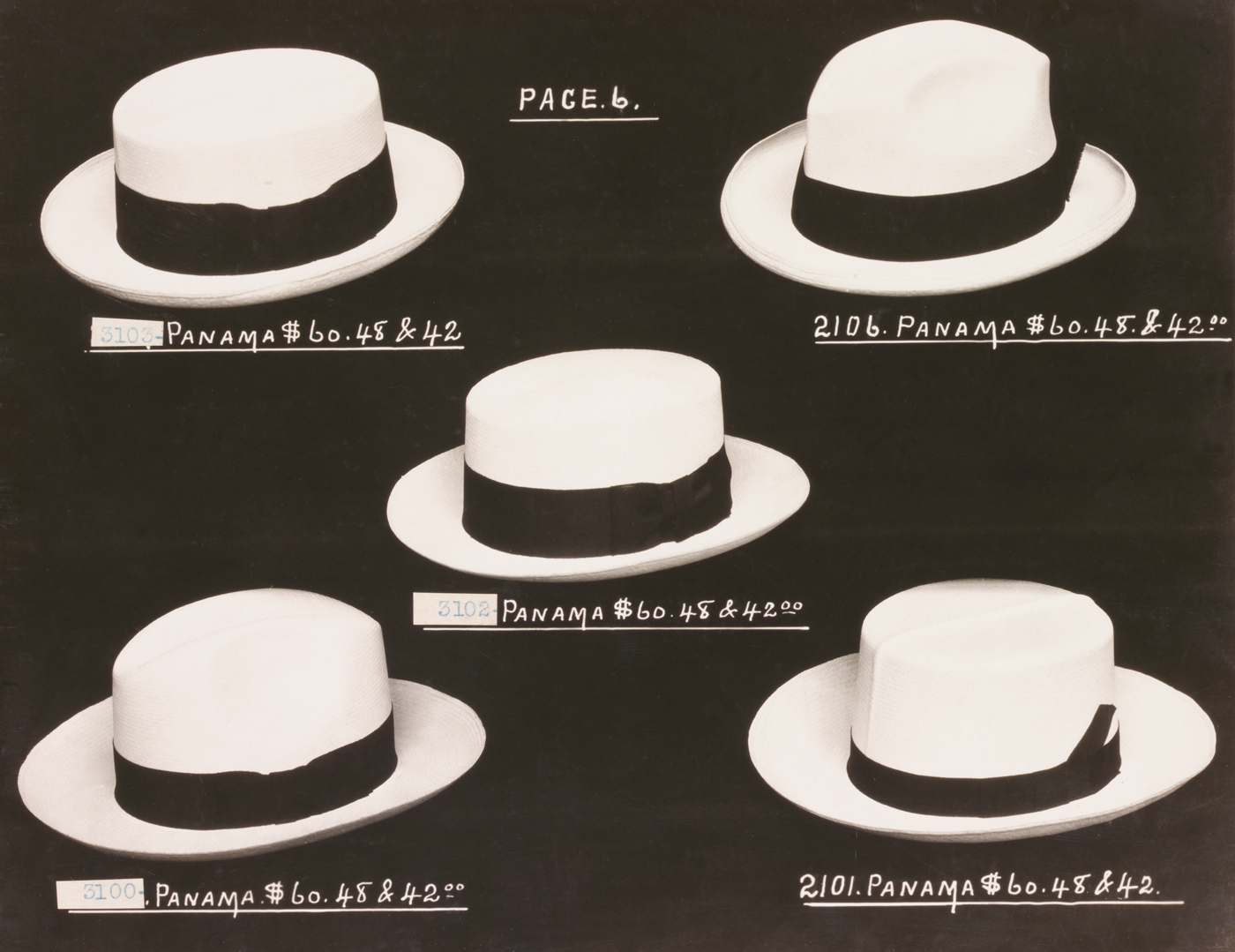
F. D. Hampson (American, 1871-1947) 'Panama Hats, from a Sloan-Force Co. Catalogue' c. 1916


F. D. Hampson (American, 1871-1947)
Panama Hats, from a Sloan-Force Co. Catalogue
c. 1916
Gelatin silver print
Image: 18.5 x 23.4 cm (7 5/16 x 9 3/16 in. )
Frame: 16 x 20 in.
Metropolitan Museum of Art
Purchase, The Horace W. Goldsmith Foundation Gift, through Joyce and Robert Menschel, 2001


Like satellites, these straw hats hover in a void. Their absence of context invites imaginative projection: how easy to envision this or that model touching down on one’s head. Popularised by association with the new Panama Canal, the hats were photographed for a St. Louis sales catalogue. Their spare, surreal configuration anticipates an avant-garde approach; in the coming years, disembodied hats would pop up in works by Max Ernst and Hans Richter, evoking the callous consumer – a bourgeois icon ripe for critique. Here, such premonitions of modernism serve practical ends. Suspended together, their varied brims and bands elicit comparison, demanding scrutiny. In an era of exponentially increasing consumer choice, such photographic displays could make anyone into a connoisseur.

Text from the Metropolitan Museum of Art website


Ralph Bartholomew Jr. (American, 1907-1985) '[Soap Packaging]' 1936


Ralph Bartholomew Jr. (American, 1907-1985)
[Soap Packaging]
1936
Carbro print
32.8 x 25.7cm (12 15/16 x 10 1/8 in.)
The Metropolitan Museum of Art
Ford Motor Company Collection, Gift of Ford Motor Company and John C. Waddell, 1987
© Estate of Ralph Bartholomew, Courtesy Keith de Lellis Gallery, NY


If mouthwatering soap seems a contradiction in terms, commercial photographer Ralph Bartholomew Jr. confounds the senses with eye candy to rival the confections nearby. Photographed two decades later, this work did not depend on paint for its delectable palette. It is an example of the early carbro process – a complex tricolor printing technique that gained popularity in the 1930s, as art directors courted Depression-era audiences. Brilliant colour is essential here, in a photograph likely commissioned to sell not the soap but its packaging. Marketed to producers in an array of trade publications (including Modern Packaging, and the industry-specific standby Soap), fine paper wrappers were a booming industry unto themselves. Here, Bartholomew parades his bedecked bars across a page of newsprint showing stock prices to suggest that in this market, even cleanliness was a commodity.

Bartholomew was a successful commercial photographer best known for his innovative use of stop-action and multiple exposure techniques in advertising and editorial work. He made this photograph while he was a student at the Clarence H. White School of Photography.

Text from the Metropolitan Museum of Art website


The Array

Margaret Bourke-White (American, 1904-1971) 'RCA Speakers' 1933


Margaret Bourke-White (American, 1904-1971)
RCA Speakers
1933
Gelatin silver print
Image: 33.3 x 23.3 cm (13 1/8 x 9 3/16 in.)
Frame: 22 1/2 x 18 1/2 in.
The Metropolitan Museum of Art
Warner Communications Inc. Purchase Fund, 1976


In a single voice, the assembled speakers broadcast the scope and influence of American radio. Commissioned by audio manufacturer RCA Victor, this photograph is one component of a monumental photomural for the NBC rotunda at Rockefeller Center. Amplified to a height of ten feet, this and other views of radio technology comprised a work of corporate propaganda to rival those public projects Margaret Bourke-White had recently seen on tours of the Soviet Union. She completed the mural at breakneck speed, often working through the night to photograph equipment at regional stations (lest she risk electrocution during daytime transmission hours). Seeking a visual analogue to audio, she captured the speakers in staccato sequence, their scalloped shapes reverberating beyond the frame.

Text from the Metropolitan Museum of Art website


On March 11, 2024, The Metropolitan Museum of Art opened The Real Thing: Unpackaging Product Photography, an exhibition exploring how commercial camerawork contributed to the visual language of modernism. The photographs featured depict the familiar trappings of everyday life – from toothpaste to tombstones to hats – but at times these subjects will be unrecognisable, so altered by the camera as to constitute an entirely new view.

Spanning the first century of photographic advertising, The Real Thing unites more than 60 works from across the commercial sector. In these photographs, artists – some famous, some forgotten – transform common objects into covetable commodities. Corporate commissions by celebrated innovators, such as Paul Outerbridge, August Sander, and Piet Zwart, appear alongside obscure catalogues and trade publications. Bringing these photographs together, the exhibition reveals links between the promotional strategies of vernacular studios and the radical tactics of the interwar avant-garde.

“This dynamic exhibition looks anew at the commercial history of photographs in the Museum’s collection,” said Max Hollein, The Met’s Marina Kellen French Director and Chief Executive Officer. “By embracing this discerning lens, we gain a renewed appreciation of the intricacies and aesthetics of our everyday surroundings.”

“Not many of the photographers in this exhibition would have identified as fine artists, but their inventive commercial work harnesses the artistic potential of the camera to persuade and enchant,” added the show’s curator, Virginia McBride, Research Associate in the Department of Photographs. “Now that photography’s place in museums no longer needs defending, The Real Thing considers how working photographers, in corporate studios and industrial storerooms, advanced modern art’s visual revolution.”

The first advertising photographs were published in albums and used to peddle products door to door. For early retailers and ad agencies, photography offered unprecedented realism and, better still, an aura of truth; the medium’s perceived objectivity bolstered consumer confidence. Beginning in the late 1850s, new demand for manufactured goods subsidised commercial photography, spurred by evolving technologies of image reproduction. In the decades that followed, increasingly inventive approaches to the still life, from dizzying perspectives to extreme modulations of scale, adapted modernism for the mass market. Historically framed as avant-garde experimentation, this work is rarely acknowledged in its original context of commercial enterprise. This exhibition resituates such innovation within the realm of advertising and investigate its unlikely origins.

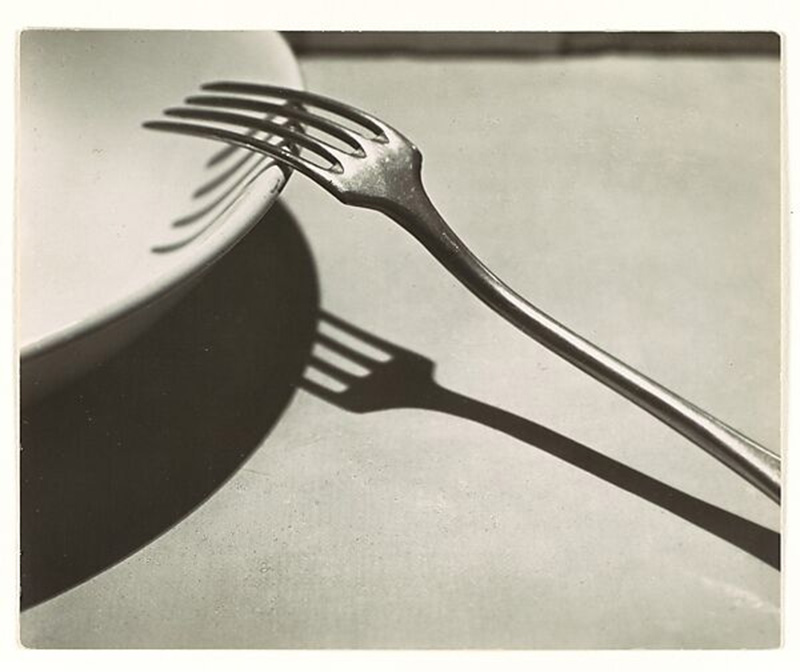
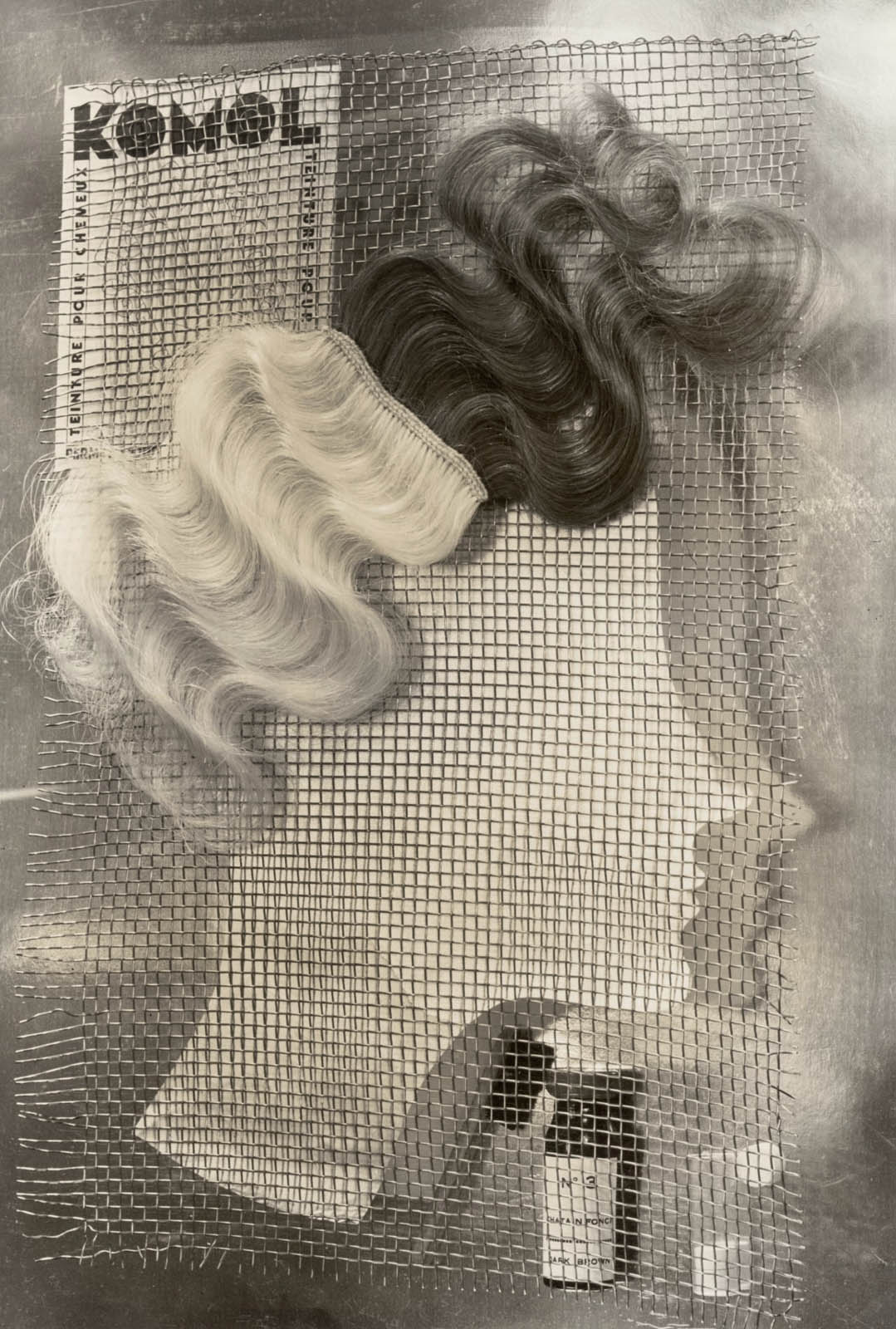
Drawn entirely from The Met collection and featuring many photographs from The Ford Motor Company Collection of modernist European and American photography, the exhibition brings together a wide range of photographic media. Included are proof prints, tear sheets, and sample books used by travelling merchants, along with photomontages and rare examples of early colour printing. Such masterworks as André Kertész’s elegant study of a fork and Grete Stern and Ellen Auerbach’s surrealist-inflected advertisements for hair dye and gloves are presented together with the projects of overlooked studios and anonymous makers. Debuting dozens of objects from the Department of Photographs that have never before been shown, and introducing timely new acquisitions, the exhibition considers photography in an expanded field of commercial practice.

The Real Thing: Unpackaging Product Photography is organised by Virgina McBride, Research Associate in the Department of Photographs at The Met.

Press release from the Metropolitan Museum of Art


Grit Kallin-Fischer (German, 1897-1973) 'KPM Ceramics' 1930


Grit Kallin-Fischer (German, 1897-1973)
KPM Ceramics
1930
Gelatin silver print
6 5/8 × 4 3/16 in. (16.8 × 10.7cm)
The Metropolitan Museum of Art
Funds from various donors, 2023


The Isolated Object

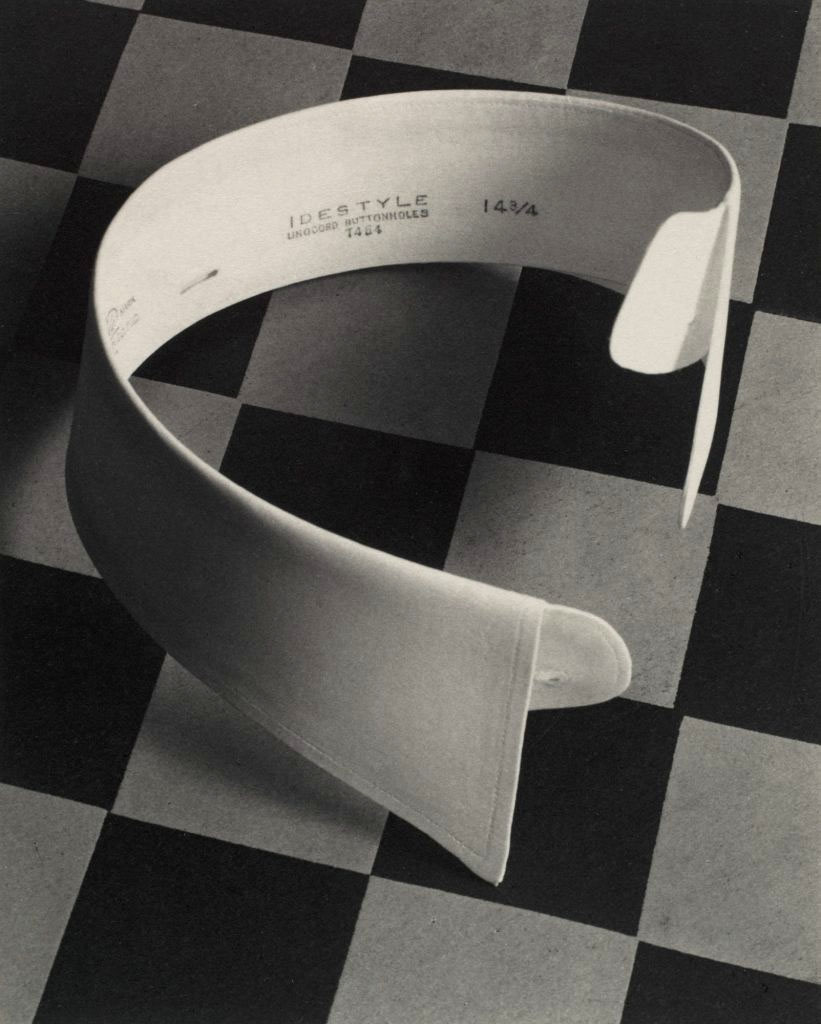
Paul Outerbridge Jr. (American, 1896-1959) 'Ide Collar' 1922


Paul Outerbridge Jr. (American, 1896-1959)
Ide Collar
1922
Platinum print
Image: 11.8 x 9.3 cm (4 5/8 x 3 11/16 in.)
Frame: approx. 14 x 17 in.
The Metropolitan Museum of Art
Ford Motor Company Collection, Gift of Ford Motor Company and John C. Waddell, 1987


“I have attempted to interpret the beauty of the simplest and humblest of objects,” Paul Outerbridge Jr. wrote in 1922. Inspired by his teacher Clarence H. White’s artistic vision for applied photography, Outerbridge regarded the aperture as a kind of canvas in which to arrange compositions with absolute balance. In this, his first commercial assignment, he achieved such equilibrium by custom-cutting a grid of linoleum squares to the scale of his subject. When published as an ad in Vanity Fair, the photograph was ensnared in a scrollwork frame. Such a Victorian flourish seems incongruous today, but at the time, a picture as stark as this seemed to need dressing up. Nevertheless, Marcel Duchamp was said to have clipped the ad and pinned it to his studio wall, apprehending the mass-market collar’s readymade style.

Text from the Metropolitan Museum of Art website


Edward G. Budd Manufacturing Co. (American) 'Automotive Component' February 22, 1927


Edward G. Budd Manufacturing Co. (American)
Automotive Component
February 22, 1927
Gelatin silver print
7 1/2 × 9 1/2 in. (19 × 24.1 cm)
The Metropolitan Museum of Art
Purchase, David Hunter McAlpin Fund, by exchange, 2024


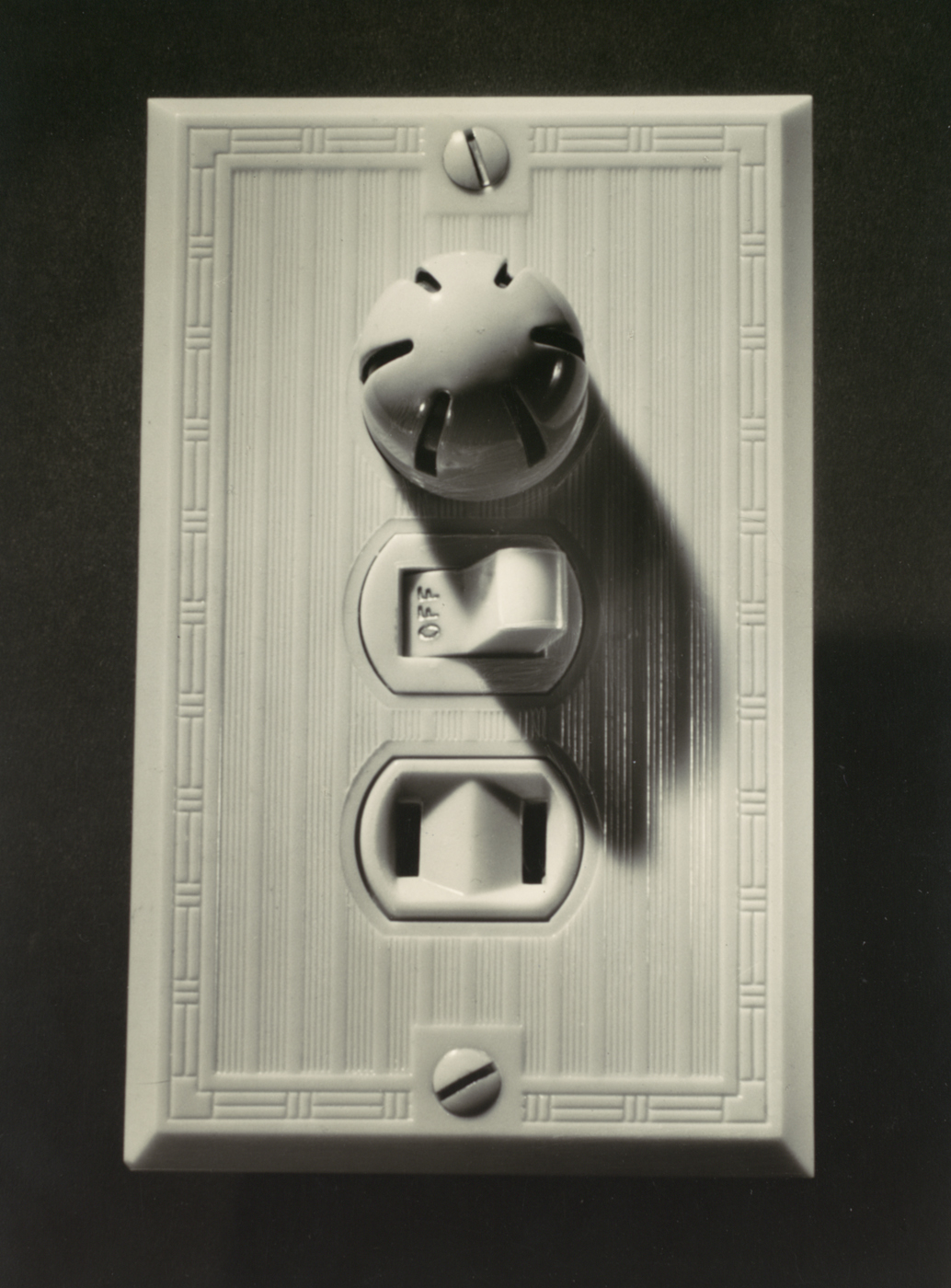
Fay Sturtevant Lincoln (American, 1894-1975) 'Pass & Seymour Switch Plate' c. 1949


Fay Sturtevant Lincoln (American, 1894-1975)
Pass & Seymour Switch Plate
c. 1949
Gelatin silver print
Image: 23.8 x 17.9 cm (9 3/8 x 7 1/16 in.)
Frame: approx. 20 x 16 in.
The Metropolitan Museum of Art
Ford Motor Company Collection, Gift of Ford Motor Company and John C. Waddell, 1987


Please resist the urge to flip this light switch. Photographed at close range, the switch plate is so crisply articulated that it tempts touch. Fay Sturtevant Lincoln captures the sculptural quality of this mundane fixture, revealing a keen eye for the texture and detail of domestic life. Now coveted for their retro cachet, molded Bakelite furnishings like this one were ubiquitous in the late 1940s. Though Lincoln was better known for views of glamorous art deco interiors, his attention to the vernacular architecture of homes and offices offers an intimate view of everyday design.

Text from the Metropolitan Museum of Art website


Murray Duitz (American, 1917-2010) 'A.S. Beck "Executive" Shoe' 1957


Murray Duitz (American, 1917-2010)
A.S. Beck “Executive” Shoe
1957
Gelatin silver print
Image: 12 1/2 x 9 1/2 in. (31.8 x 22.9cm)
Frame: 20 x 16 in.
The Metropolitan Museum of Art
Gift of the artist, 1975
© Estate of Murray Duitz


The Unfamiliar Thing

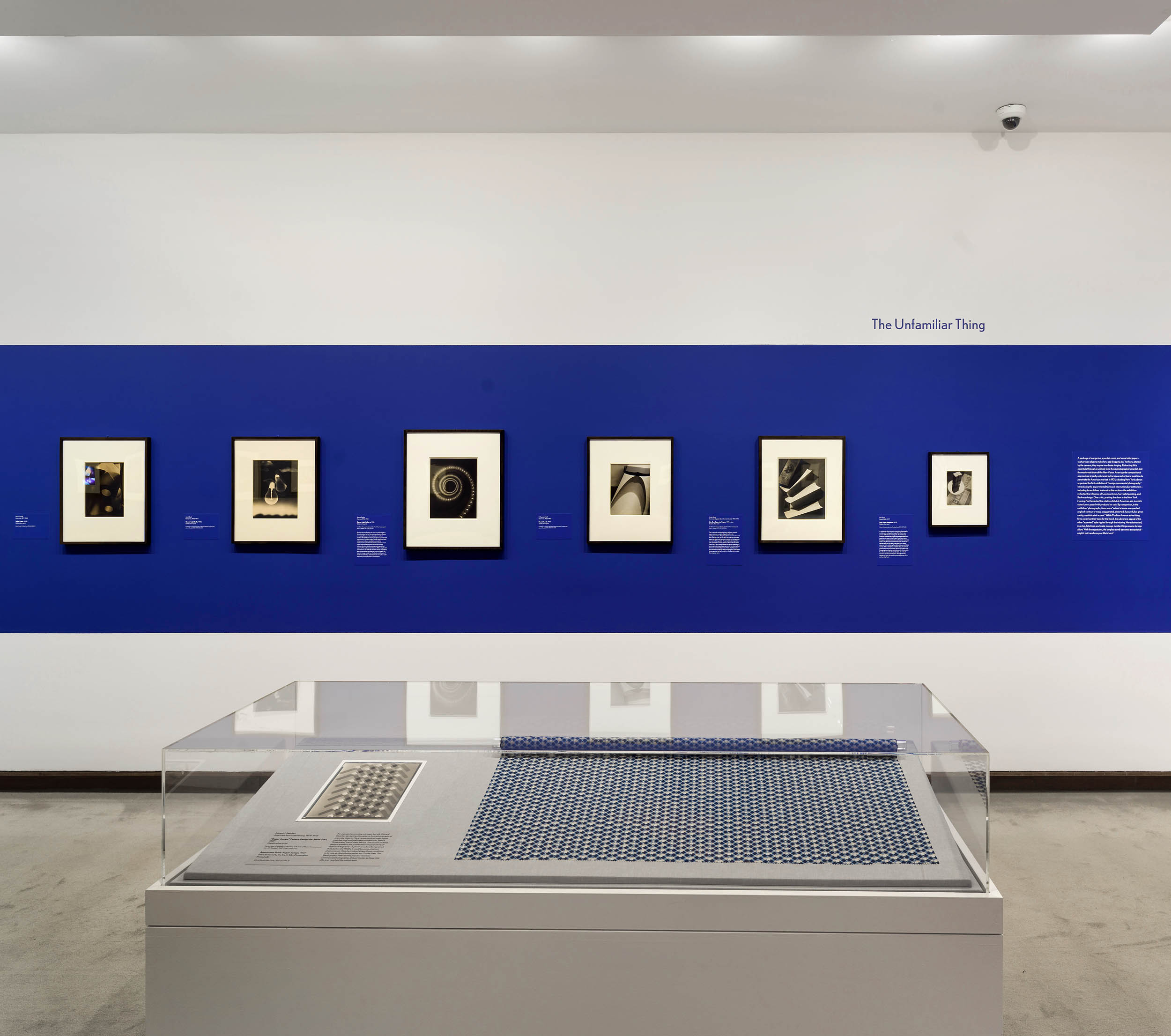
Installation view of the exhibition 'The Real Thing: Unpackaging Product Photography' at the Metropolitan Museum of Art, New York showing the section 'The Unfamiliar Thing' including at third left, August Sander's 'Osram Light Bulbs' (c. 1930); and at third right, H. Raymond Ball's 'Pocket Comb' (1930s)


Installation view of the exhibition ‘The Real Thing: Unpackaging Product Photography’ at the Metropolitan Museum of Art, New York showing the section The Unfamiliar Thing including at third left, August Sander’s Osram Light Bulbs (c. 1930, below); and at third right, H. Raymond Ball’s Pocket Comb (1930s, below)


Edward J. Steichen (American born Luxembourg, Bivange 1879 - 1973 West Redding, Connecticut) '["Sugar Lumps" Pattern Design for Stehli Silks]' 1927


Edward J. Steichen (American born Luxembourg, Bivange 1879 – 1973 West Redding, Connecticut)
[“Sugar Lumps” Pattern Design for Stehli Silks]
1927
Gelatin silver print
25.3 x 20.3cm (9 15/16 x 8 in.)
The Metropolitan Museum of Art
Ford Motor Company Collection, Gift of Ford Motor Company and John C. Waddell, 1987
© 2024 Artists Rights Society (ARS), New York


For a project promoting not sugar but silk, Edward Steichen devised textile patterns from photographs of everyday objects. His arrangements of sugar cubes, matches, and mothballs were printed onto Stehli’s “Americana” line of dress fabrics. The success of these designs speaks to the proliferation and popularity of object photography – a genre so culturally ingrained that, by the late 1920s, it could become a fashion phenomenon. Steichen helped shape these conditions in his influential role as chief photographer for Condé Nast. The Stehli project reflected his populist vision for commercial photography, at least insofar as these chic silks ever reached the mainstream.

Text from the Metropolitan Museum of Art website


August Sander (German, 1876-1964) '[Osram Light Bulbs]' c. 1930


August Sander (German, 1876-1964)
[Osram Light Bulbs]
c. 1930
Gelatin silver print
Image: 29.5 x 22.9 cm (11 5/8 x 9 in.)
Frame: 22 1/2 x 18 1/2 in.
The Metropolitan Museum of Art
Ford Motor Company Collection, Gift of Ford Motor Company and John C. Waddell, 1987
© 2024 Artists Rights Society (ARS), New York


Photography itself makes the case for artificial light in this commission for the German manufacturer Osram. Leveraging the camera’s codependence on their products, the lightbulb company sought out experimental practitioners, including August Sander, to promote the transformative potential of illumination. Sander is best known as the great portraitist of German society between the wars, but the commercial projects that supported his studio remain obscure. With a simple shift in perspective, he radically reorients viewer and subject, abstracting a spiral staircase into a swirl of pearls. His hypnotic image reveals how the shock and pleasure of modernist aesthetics – of looking for its own sake – could seamlessly convey the joys of consumption.

Text from the Metropolitan Museum of Art website


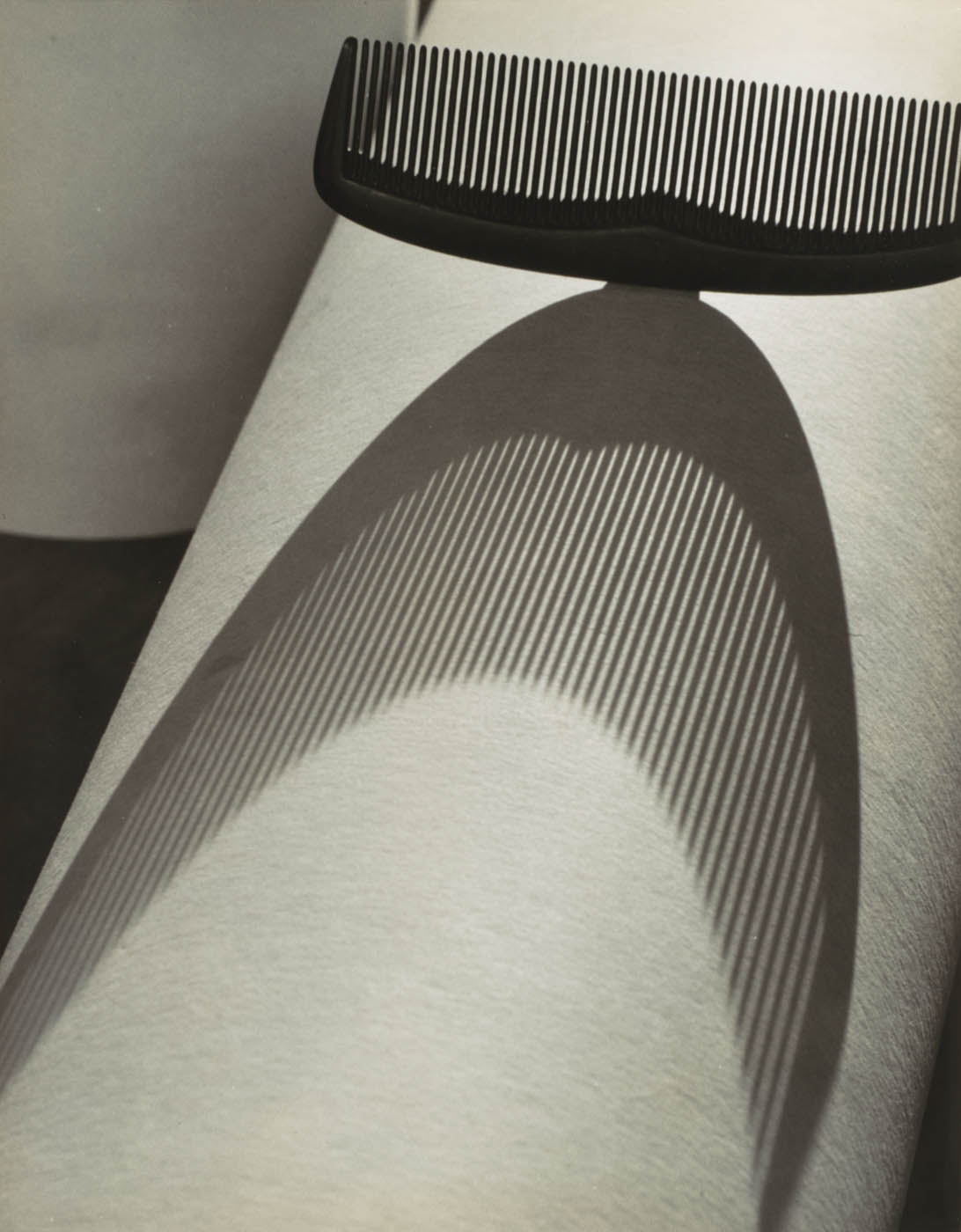
H. Raymond Ball (American, 1903-1983) 'Pocket Comb' 1930s


H. Raymond Ball (American, 1903-1983)
Pocket Comb
1930s
Gelatin silver print
Image: 25.2 x 19.8 cm (9 15/16 x 7 13/16 in.)
Frame: 20 x 16 in.
The Metropolitan Museum of Art
Ford Motor Company Collection, Gift of Ford Motor Company and John C. Waddell, 1987


The Montage

César Domela (Dutch, 1900-1992) '[Ruthsspiecher Tanks]' 1928


César Domela (Dutch, 1900-1992)
[Ruthsspiecher Tanks]
1928
Gelatin silver print
Image: 19.3 x 16.6 cm (7 5/8 x 6 9/16 in.)
Frame: 17 x 14 in.
The Metropolitan Museum of Art
Ford Motor Company Collection, Gift of Ford Motor Company and John C. Waddell, 1987
© 2024 Artists Rights Society (ARS), New York


Unknown (American) '[Montage for Packard Super Eight]' c. 1940


Unknown (American)
[Montage for Packard Super Eight]
c. 1940
Gelatin silver print
Image: 22.9 x 18.6 cm (9 x 7 5/16 in.)
Frame: 17 x 14 in.
The Metropolitan Museum of Art
Ford Motor Company Collection, Gift of Ford Motor Company and John C. Waddell, 1987


The Tableau

Installation view of the exhibition 'The Real Thing: Unpackaging Product Photography' at the Metropolitan Museum of Art, New York showing photographs from the section 'The Tableau' including at left, André Kertész's 'Fork' (1928); and at second and third right, ringl + pit's 'Dents' (c. 1934) and 'Komol' (1931)


Installation view of the exhibition The Real Thing: Unpackaging Product Photography at the Metropolitan Museum of Art, New York showing photographs from the section The Tableau including at left, André Kertész’s Fork (1928, below); and at second and third right, ringl + pit’s Dents (c. 1934) and Komol (1931, below)


André Kertész (American born Hungary, 1894-1985) 'Fork' 1928


André Kertész (American born Hungary, 1894-1985)
Fork
1928
Gelatin silver print
7.5 x 9.2cm (2 15/16 x 3 5/8 in.)
The Metropolitan Museum of Art
Ford Motor Company Collection, Gift of Ford Motor Company and John C. Waddell, 1987
© The Estate of André Kertész / Higher Pictures


As a dinner party wound down in his friend Fernand Léger’s Paris studio, André Kertész found an unlikely tableau left on the table. In this chance encounter between fork and plate, he locates an incidental elegance. The photograph was never intended as an ad – Kertész instead chose it to represent his work in a series of European photography shows. On the exhibition circuit, it came to exemplify a strain of New Vision photography characterised by its clear-eyed reassessment of ordinary things. Only after this did Kertész grant permission for its use in a German silverware campaign. In the ad layout, the photograph was credited and uncropped – atypically presented as a true work of art. The truth of the ad was another question: despite its German rebranding, this fork remained a French department-store product.

Text from the Metropolitan Museum of Art website


ringl+pit (German active 1930-1933) Grete Stern (German, 1904-1999) Ellen Auerbach (German 1906-2004) 'Komol' 1931


ringl + pit (German active 1930-1933)
Grete Stern (German, 1904-1999)
Ellen Auerbach (German 1906-2004)
Komol
1931
Gelatin silver print
Image: 35.9 x 24.4 cm (14 1/8 x 9 5/8 in.)
Frame: 20 x 15 5/8
The Metropolitan Museum of Art
Ford Motor Company Collection, Gift of Ford Motor Company and John C. Waddell, 1987
© ringl+pit, Courtesy Robert Mann Gallery


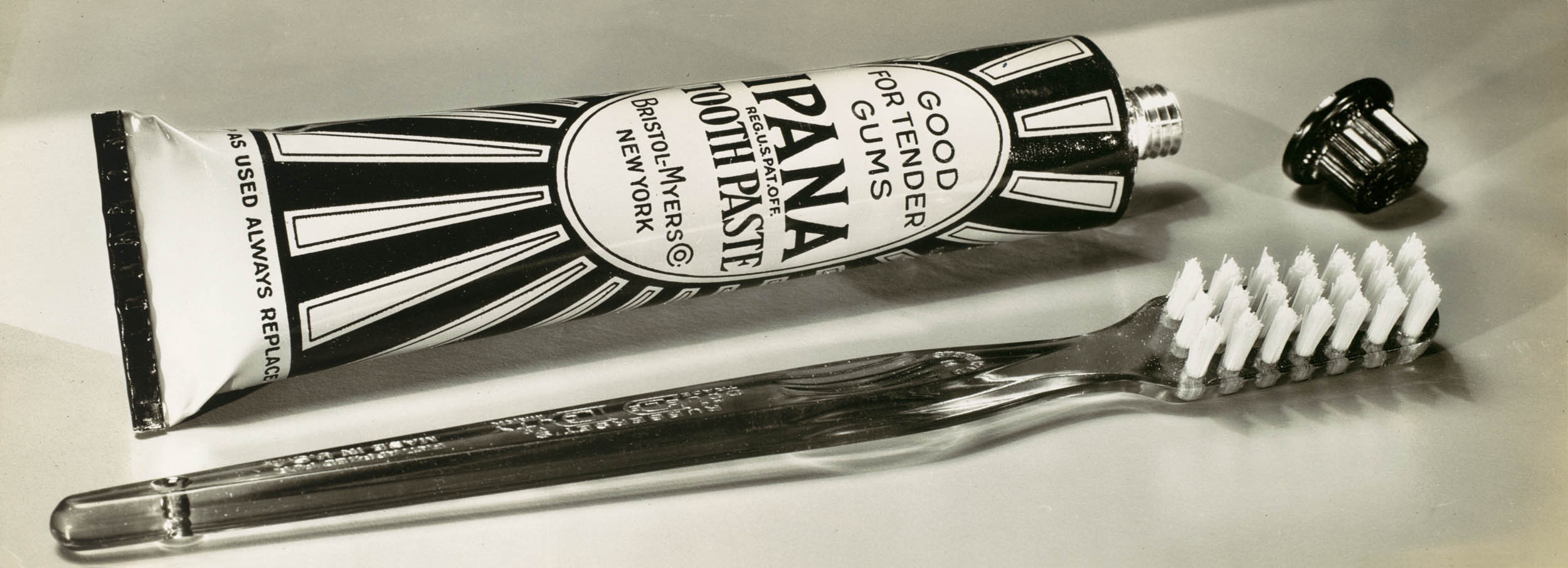
Grancel Fitz (American, 1894-1963) 'Ipana Toothpaste' c. 1937


Grancel Fitz (American, 1894-1963)
Ipana Toothpaste
c. 1937
Gelatin silver print
Image: 12.9 x 32.5cm (5 1/16 x 12 13/16 in.)
Frame: approx. 12 x 20 in.
The Metropolitan Museum of Art
Ford Motor Company Collection, Gift of Ford Motor Company and John C. Waddell, 1987


The Ideal User

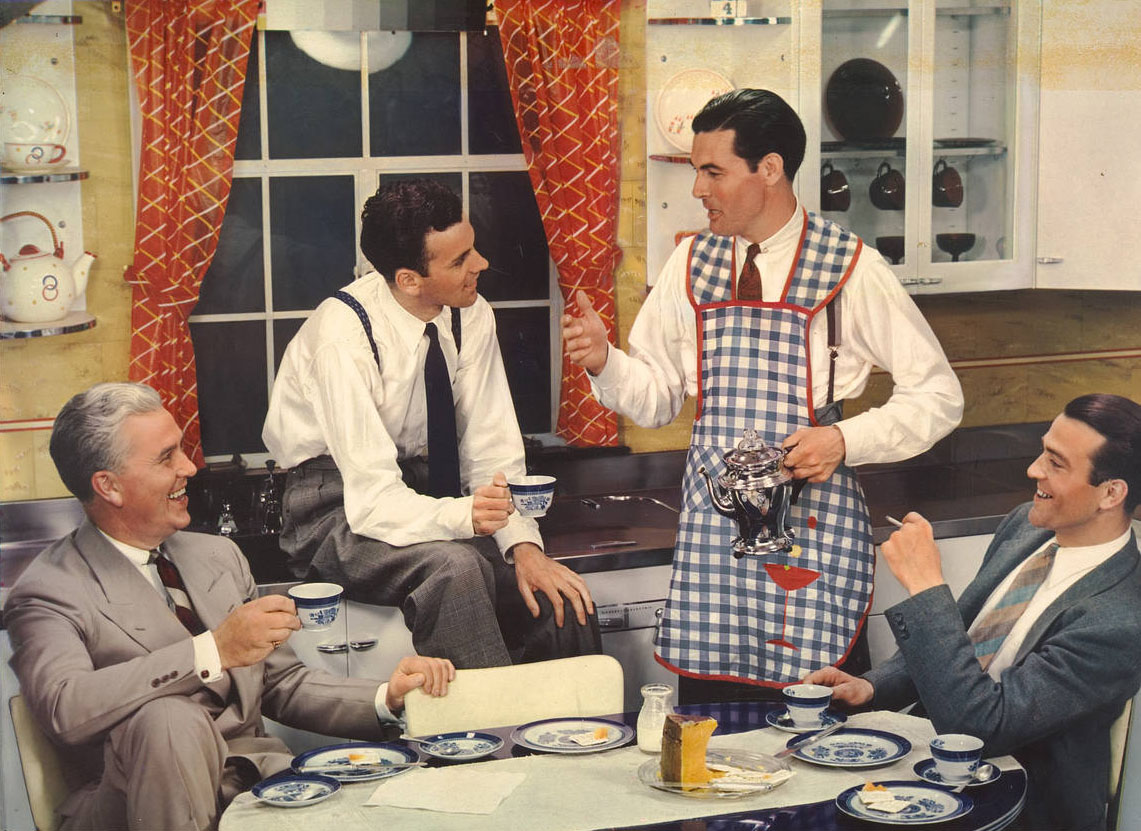
Paul Outerbridge Jr. (American, 1896-1959) 'The Coffee Drinkers' 1940


Paul Outerbridge Jr. (American, 1896-1959)
The Coffee Drinkers
1940
Carbro print
Image (overall): 27 x 38cm (10 5/8 x 14 15/16 in.)
Mount: 40.7 x 50.7cm (16 x 19 15/16 in.)
Frame: 18 1/2 x 22 1/2 in.
The Metropolitan Museum of Art
Ford Motor Company Collection, Gift of Ford Motor Company and John C. Waddell, 1987


With a background in staging and an unwavering belief in the power of images to inspire a better life, Paul Outerbridge Jr. was well suited to the directorial tasks of advertising photography. For A&P Grocery’s Eight O’Clock Coffee, he orchestrated this scene in the display kitchen of a department store, painstakingly diagramming the setup in advance.

“How’d you learn to make such swell coffee, Dick?” the copy teased, when the ad ran in LIFE magazine. Such work exceeds the sum of its parts, selling more than just a jolt of caffeine. The after-dinner air of repose courts camp, conjuring an intimate blend of leisure and power. With it, Outerbridge offers the consumer the chance to be a man among men, all for the price of a can of coffee.

Text from the Metropolitan Museum of Art website


Some expressive quotations about the construction of the self, commodities and consumer culture

 “Although the value of commodities is materially embodied in them, it is not visible in the objects themselves as a physical property. The illusion that value resides in objects rather than in the social relations between individuals and objects Marx calls commodity fetishism. When the commodity is fetishized, the labour that has gone into its production is rendered invisible.”

Rosemary Hennessey. “Queer Visibility in Commodity Culture,” Chapter 6 in Nicholson, Linda and Seidman, Steven (eds.,). Social Postmodernism – Beyond Identity Politics. Cambridge: Cambridge University Press, 1995, pp. 161-162.


“When the commodity is dealt with merely as a matter of signification, meaning, or identities, only one of the elements of its production – the process of image making it relies on – is made visible. The exploitation of human labour on which the commodities appearance as an object depends remains out of sight.”

Rosemary Hennessey. “Queer Visibility in Commodity Culture,” Chapter 6 in Nicholson, Linda and Seidman, Steven (eds.,). Social Postmodernism – Beyond Identity Politics. Cambridge: Cambridge University Press, 1995, p. 162.


“The processes of capitalist relationships reproduce themselves in the consciousness of man and, in turn, reproduce a society that reflects an image of man as the seller and buyer of work, talent, aspiration and fantasies.”

Frankl, G. The Failure of the Sexual Revolution. Hove: Kahn and Averill, 1974, p. 26 quoted in Evans, David. Sexual Citizenship, The Material Construction of Sexualities. London: Routledge, 1993, p. 47.


“What was achieved was unprecedented scientific and technical progress and, eventually, the subordination of all other values to those of a world market which treats everything, including people and their labour and their lives and their deaths, as a commodity.”

John Berger and Jean Mohr. Another Way of Telling. New York: Pantheon Books, 1982, p. 99.


“Consumption produces production … because a product becomes a real product only by being consumed. For example, a garment becomes a real garment only in the act of being worn; a house were no one lives is in fact not a real house; thus the product, unlike a mere natural object, proves itself to be, becomes, a product only through consumption. Only by decomposing the product does consumption give the product the finishing touch.”

Karl Marx and Frederick Engels. On Literature and Art. New York: International General, 1973, p. 91 quoted in Wolff, Janet. The Social Production of Art. Basingstoke: Macmillan, 1993, p. 95.


“… the propaganda of consumption turns alienation itself into a commodity. It addresses itself to the spiritual desolation of modern life and proposes consumption as the cure. It not only promises to palliate all the old unhappiness to which flesh is heir; it creates or exacerbates new forms of unhappiness – personal insecurity, status anxiety …”

Christopher Lasch. The Culture of Narcissism. New York: W.W.Norton and Company, 1978, p.73.


“Consumer culture is notoriously awash with signs, images, publicity. Most obviously, it involves an aestheticization of commodities and their environment …

Firstly, problems of status and identity … promote a new flexibility in the relations between consumption, communication and meaning. It is not so much that goods and acts of consumption become more important in signalling status (they were always crucial) but that both the structure of status and the structure of meaning become unstable, flexible, and highly negotiable. Appearance becomes a privileged site of strategic action in unprecedented ways.

Secondly, the nature of market exchange seems intrinsically bound up with aestheticization. As indicated above, commodities circulate through impersonal and anonymous networks: the split between producer and consumer extends beyond simple commissioning (where a personal relationship still exists) to the production for an anonymous general public … Haug (1986) theorizes this in the notion of ‘commodity aesthetics’: the producer must create an image of use value in which potential buyers can recognize themselves. All aspects of the product’s meaning and all channels through which its meaning can be constructed and represented become subject to intense and radical calculation.

This gives rise to some of the central issues of sociological debate on consumer culture. On the one hand, the eminently modern notion of the social subject as a self-creating, self-defining individual is bound up with self-creation through consumption: it is partly through the use of goods and services that we formulate ourselves as social identities and display these identities. This renders consumption as the privileged site of autonomy, meaning, subjectivity, privacy and freedom. On the other hand, all these meanings around social identity and consumption become objects of strategic action by dominating institutions. The sense of autonomy and identity in consumption is placed constantly under threat.”

Don Slater. Consumer Culture and Modernity. London: Polity Press, 1997, p. 31.


The Metropolitan Museum of Art
1000 Fifth Avenue at 82nd Street
New York, New York 10028-0198
Phone: 212-535-7710

Opening hours:
Thursday – Tuesday 10am – 5pm
Closed Wednesday

The Metropolitan Museum of Art website

LIKE ART BLART ON FACEBOOK

Back to top

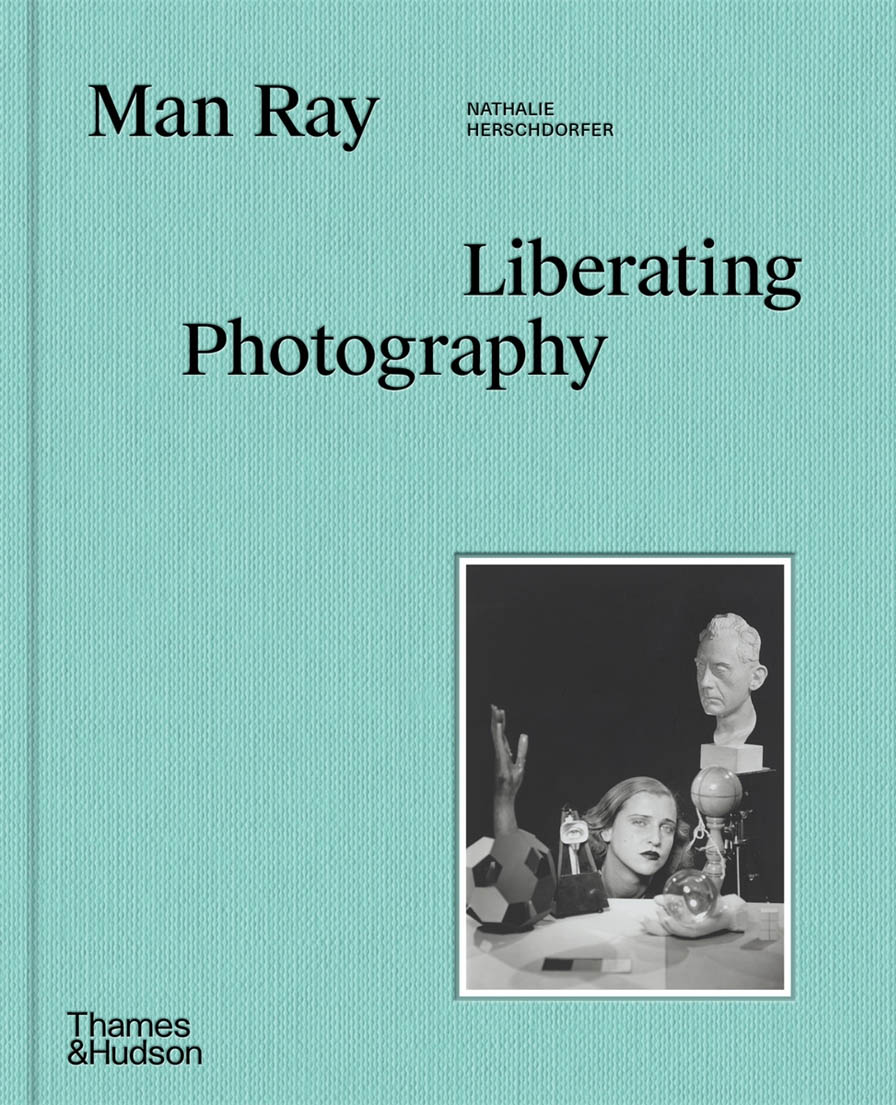
Exhibition: ‘Man Ray. Liberating Photography’ at the Photo Elysee, Lausanne

Exhibition dates: 29th March – 4th August, 2024

Curator: Nathalie Herschdorfer, Director of Photo Elysée, with contributions from independent scholar Wendy A. Grossman


Man Ray (American, 1890-1976) 'Dora Maar' 1936 from the exhibition Exhibition: 'Man Ray. Liberating Photography' at the Photo Elysee, Lausanne, March - August, 2024


Man Ray (American, 1890-1976)
Dora Maar
1936
Gelatin silver print
© Man Ray 2015 Trust / 2024, ProLitteris, Zurich. All rights reserved
Without permission from ProLitteris, the reproduction or any use of the individual and private consultation are prohibited


Henriette Theodora Markovitch (22 November 1907 – 16 July 1997), known as Dora Maar, was a French photographer, painter, and poet. Maar is very well known for her role as Picasso’s lover, subject, and muse. He abused her. Maar photographed the successive stages of the creation of Guernica. It is the gelatin silver works of the surrealist period that remain the most sought after by admirers: Portrait of Ubu (1936), 29 rue d’Astorg, black and white, collages, photomontages or superimpositions.


Man Ray is hailed as one of the greatest photographers of the 20th century, but I admit I have no real liking for most of his work.

I remember seeing the first large-scale exhibition of Man Ray’s photography to have been presented in Australia at the National Gallery of Victoria in 2004. In text about the exhibition the NGV states, “Man Ray produced some of the most iconic photographs of the 20th century: eloquent portraits, dreamy solarised nudes, divine fashion photography and enigmatic images that continue to delight and astonish… A superb technician and a highly inventive artist, Man Ray always denied that he had any ability with the camera or in the darkroom. However, as the exhibition reveals, this is clearly not the case. The exhibition emphasises Man Ray’s techniques of framing, cropping, solarising and use of the photogram to present a new ‘surreal’ way of seeing, which continues to fascinate audiences today.”1

I came away from that exhibition thinking what a great technician Man Ray was, almost like a photographic scientist, an alchemist from another world conjuring small, intense images of clinical focus, but where was the emotional power of the images, where was their … what am I trying to enunciate … where was their vibrational energy. They were ice cold.2

I feel that Man Ray’s greatest artistic expression, his greatest music, were his photograms, “which he coined “rayographs” after himself. He explained that working with light in the darkroom allowed him to free himself from painting.” (Press release) As Man Ray himself said of his rayographs, “Like the undisturbed ashes of an object consumed by flames these images are oxidised residues fixed by light and chemical elements of an experience, an adventure, not an experiment. They are the result of curiosity, inspiration, and these words do not pretend to convey any information.”3

“What the rayographs do not deny, however, is the subjectivity of the artist, his skill at placing the objects on the photographic paper, expressed in their dream-like nature, both a subjective ephemerality (because they could only be produced once) and an ephemeral subjectivity (because they were expressions of Man Ray’s fantasies, and therefore had little substance). Through an alchemical process the latent images emerge from the photographic paper, representations of Man Ray’s fantasies as embodied in the ‘presence’ of the objects themselves, in the surface of the paper.”4

(See a section of my paper “The Delicious Fields: Exploring Man Ray’s Rayographs in a Digital Future” (2004) below in the posting).

On a final note, while it is fantastic to see such a large group of Man Ray’s photographs together in one space I am amazed, flabbergasted even, at the blue and yellow colour scheme on the floor of the gallery. What were they thinking? How can you appreciate black and white images, which are never actually black and white but always have subtle colours of either brown and blue, warm and cool, which need to be appreciated in a neutral colour space … when throughout the gallery your eye is constantly overwhelmed (by reflection from the gallery lights or subconsciously, even) by a sea of blue and yellow tiles. It makes no sense aesthetically, empirically or emotionally.

Dr Marcus Bunyan


1/ Anonymous. “Man Ray,” on the National Gallery of Victoria website Nd [Online] Cited 18/07/2024

2/ This coldness can be seen in the photographs from the book at the bottom of the posting, where borders frame faces and are inverted, where objects in rayographs are paired opposite objective portraits, surface representations and human visage.

3/ Man Ray quoted in Janus (trans. Murtha Baca). Man Ray: The Photographic Image (London: Gordon Fraser, 1980), 213 quoted in Marcus Bunyan. “The Delicious Fields: Exploring Man Ray’s Rayographs in a Digital Future,” published in The University of Queensland Vanguard Magazine: ‘Man Ray: Life, Work and Themes’, 2004, Triad series #2, pp. 40-46. ISBN 0-9756043-0-9

4/ Bunyan, op cit.,


Many thankx to the Photo Elysee for allowing me to publish the photographs in the posting. Please click on the photographs for a larger version of the image.


“There is no eggshell, no thermometer or metronome, no brick, bread or broom that [Man Ray] cannot and does not change into something else. It is as if he discovers the soul of each conventional object by liberating it from its practical function…. [Man Ray] just cannot help to discover and reveal things because his whole person is involved in a process of continuous probing, of a natural distrust in things being “just so”.”


Hans Richter 1966


Installation view of the exhibition 'Man Ray. Liberating Photography' at the Photo Elysee, Lausanne

Installation view of the exhibition 'Man Ray. Liberating Photography' at the Photo Elysee, Lausanne
Installation view of the exhibition 'Man Ray. Liberating Photography' at the Photo Elysee, Lausanne showing at right, Man Ray's 'Nude, Kiki de Montparnasse' 1927; 'Artichokes in Bloom' 1934; and 'Still life Plaster Venus with Fruit' c. 1936


Installation views of the exhibition Man Ray. Liberating Photography at the Photo Elysee, Lausanne, showing in the bottom image at right, Man Ray’s Nude, Kiki de Montparnasse 1927; Artichokes in Bloom 1934; and Still life Plaster Venus with Fruit c. 1936
© Khashayar Javanmardi and Photo Elyse Plateforme


“To be totally liberated from painting and its aesthetic implications” was the first avowed aim of Man Ray (United States, 1890-1976), who began his career as a painter. Photography was one of the major breakthroughs of modern art and led to a rethinking of notions of representation. In the 1920s and 30s, the photographic medium came to the forefront of the avant-garde movement, and Man Ray soon made a name for himself with his virtuosity. As a studio portraitist and fashion photographer, but also as an experimental artist who explored the potential of photography with the people around him, Man Ray was a multi-faceted figure. Considered one of the 20th century’s major artists, close to Dada and then Surrealism, he photographed Paris’ artistic milieu between the wars.

Exhibition

Curated from a private collection, the exhibition explores the artist’s extensive social contacts while presenting some of his most iconic works. In addition to providing a dazzling who’s who of the Parisian avant-garde, the works also highlight the innovations in photography made by Man Ray in Paris in the 1920s and 30s.

Artist

He took his first photographs in New York in the 1910s, but it was in Paris that his career took off. Even before opening his studio in Montparnasse in 1922, Man Ray worked for a year in his hotel room. The photographer’s reputation grew, and before long, the artist’s studio was flourishing. Fashion photographs alternated with portraits of the artistic figures of the day who had made Paris’ notoriety: Marcel Duchamp, whom he met in New York in 1915 and who introduced him to the Parisian artistic elite, as well as Robert Delaunay, Georges Braque, Alberto Giacometti and Pablo Picasso, among others, who posed for the photographer. His portraits also included Ballets Russes dancers and guests at the Count de Beaumont’s ball.

As soon as he arrived in Paris in the summer of 1921, Man Ray immediately became part of the Parisian intelligentsia of the Roaring Twenties. He met Jean Cocteau, who was himself a fixture of the Parisian art scene, André Breton, Francis Picabia, Joan Miró, Salvador Dalí, Henri Matisse and Max Ernst. He also met Gertrude Stein, Virginia Woolf, Igor Stravinsky, Ernest Hemingway, Arnold Schoenberg and James Joyce, whom he photographed for the Anglo-American bookshop Shakespeare and Company. But Man Ray was not merely content to have celebrities pose in his studio or to explore the female nude genre by working with those he considered his muses, such as Lee Miller, Kiki de Montparnasse, Meret Oppenheim and Adrienne Fidelin.

Creative Process

Man Ray also experimented in the darkroom, transforming the photographic medium into a powerful tool of artistic expression, even going so far as to do away with the camera when, in 1921-1922, he began creating photograms, which he coined “rayographs” after himself. He explained that working with light in the darkroom allowed him to free himself from painting, so convinced was he of the visual power of his experiments. Also in the 1920s, he experimented with the moving image and produced four films. The rhythm and freedom offered by the cinema complemented his photographic work, in which he saw a close relationship between film and poetry. This is why he gave his film Emak Bakia (1926) the subheading of “cinépoème”. Without ever abandoning portraiture, he experimented with other techniques in the 1930s: solarisation, overprinting and other distortions.

From the outset, photography has been more than a simple process of reproduction. For him, images were not taken fleetingly, but meticulously realised indoors. Unlike Henri Cartier-Bresson who opted for the spontaneous gesture and saw the street as a privileged playground, Man Ray composed and staged his photographs. The studio provided him with a space in which to explore his imagination. Some of the themes dear to the Surrealists can be found in his work: femininity, sexuality, strangeness, the boundary between dream and reality. His nude studies were part of his artistic research, which he developed in close collaboration with his companions who were part of the Parisian art scene. Kiki de Montparnasse – the woman with the f-holes of a violin on her back – whose real name was Alice Prin, was a dancer, singer, actress and painter who posed for artists such as Chaïm Soutine and Kees van Dongen. Lee Miller, a fellow New Yorker like him, had begun a modelling career in the United States but wanted to move to the other side of the camera. She met the photographer in Paris in 1929 when she was 22-years old, and became active in the Surrealist movement. More than a muse, she became his collaborator, learning photography at his side. Together, they discovered the technique of solarisation. Another artist with whom Man Ray had a professional and romantic relationship was the Swiss artist Meret Oppenheim, who was close to the Surrealist scene before pursuing an independent career as an artist.

Man Ray loved the freedom his photographic creations afforded him, and portraits and fashion photography enabled him to earn a living. It was in his studio that he embarked on a series of visual experiments. His portraits, which are relatively classical in style, testify not only to his commercial success, but also to his great sociability. Artists from Montparnasse, Surrealists, fashion and nightlife celebrities, patrons of the arts, Americans in Paris – the entire artistic elite – passed through his studio, as was the case with Nadar in the 19th century. Almost 50 years after Man Ray’s death, his photographs continue to fascinate us. His impact on the history of the medium is undeniable, and he served as an inspiration to photographers of the caliber of Berenice Abbott, Bill Brandt and Lee Miller. Man Ray remains one of the most famous photographers of the 20th century. He never stopped creating, without prejudice or constraint.

Press release from the Photo Elysee


Man Ray (American, 1890-1976) 'Noire et blanche' 1926 from the exhibition Exhibition: 'Man Ray. Liberating Photography' at the Photo Elysee, Lausanne, March - August, 2024


Man Ray (American, 1890-1976)
Black and White
1926
Gelatin silver print
© Man Ray 2015 Trust / 2024, ProLitteris, Zurich. All rights reserved
Without permission from ProLitteris, the reproduction or any use of the individual and private consultation are prohibited


Man Ray (American, 1890-1976) 'Larmes' (Tears) 1930


Man Ray (American, 1890-1976)
Larmes (Tears)
1930
Gelatin silver print
© Man Ray 2015 Trust / 2024, ProLitteris, Zurich. All rights reserved
Without permission from ProLitteris, the reproduction or any use of the individual and private consultation are prohibited


Man Ray (American, 1890-1976) 'Head, New York' 1920


Man Ray (American, 1890-1976)
Head, New York
1920
Gelatin silver print
© Man Ray 2015 Trust / 2024, ProLitteris, Zurich. All rights reserved
Without permission from ProLitteris, the reproduction or any use of the individual and private consultation are prohibited


Man Ray (American, 1890-1976) 'Alice Prin, known as Kiki de Montparnasse' Around 1925


Man Ray (American, 1890-1976)
Alice Prin, known as Kiki de Montparnasse
Around 1925
Gelatin silver print
© Man Ray 2015 Trust / 2024, ProLitteris, Zurich. All rights reserved
Without permission from ProLitteris, the reproduction or any use of the individual and private consultation are prohibited


Man Ray (American, 1890-1976) 'Nancy Cunard' c. 1925


Man Ray (American, 1890-1976)
Nancy Cunard
c. 1925
Gelatin silver print
© Man Ray 2015 Trust / 2024, ProLitteris, Zurich. All rights reserved
Without permission from ProLitteris, the reproduction or any use of the individual and private consultation are prohibited


Nancy Clara Cunard (10 March 1896 – 17 March 1965) was a British writer, heiress and political activist. She was born into the British upper class, and devoted much of her life to fighting racism and fascism. She became a muse to some of the 20th century’s most distinguished writers and artists, including Wyndham Lewis, Aldous Huxley, Tristan Tzara, Ezra Pound and Louis Aragon – who were among her lovers – as well as Ernest Hemingway, James Joyce, Constantin Brâncuși, Langston Hughes, Man Ray and William Carlos Williams. MI5 documents reveal that she was involved with Indian diplomat, orator, and statesman V. K. Krishna Menon.

Text from the Wikipedia website


Man Ray (American, 1890-1976) 'Jacqueline Goddard' c. 1932


Man Ray (American, 1890-1976)
Jacqueline Goddard
c. 1932
Solarised gelatin silver print
© Man Ray 2015 Trust / 2024, ProLitteris, Zurich. All rights reserved
Without permission from ProLitteris, the reproduction or any use of the individual and private consultation are prohibited


Jacqueline Goddard (French, 1912-2003)

Jacqueline Goddard, née Barsotti (1912-2003), was a favourite model of the Surrealist artist and photographer Man Ray in Paris during the 1930s.

As Jacqueline Barsotti, she had arrived in Montparnasse at the age of 17, a tall beauty with unruly fair hair. She was soon frequenting La Coupole and other haunts of the fashionable artists of the day. Many years later, by which time she was living on the Isle of Wight, she wrote a personal memoir in which she recalled her experiences and offered some piquant observations about the personalities she had come to know. …

Jacqueline Barsotti became a close friend of Man Ray, and of his former mistress, Kiki de Montparnasse. Of Man Ray she reported, “He was not handsome, his nose had no opinion and went all over the place. He always seemed to be meditating, and was seldom light-hearted. It was a great pity that he did not smile a lot. That little grin of his changed him altogether.” Kiki, without makeup, “looked like a potato”.

Another of Man Ray’s mistresses was the American photographer, Lee Miller. On the night that Lee Miller left Man Ray, Jacqueline Barsotti walked with him in the rain through Montparnasse cemetery before they returned to his studio, where he arranged a table with a bottle of poison, a gun and a rope. Then, as Man Ray sat at the table, Jacqueline herself took the picture of the artist contemplating suicide.

When Man Ray presented her with a book of his photographs, he proposed the inscription, “To the most beautiful girl I have ever photographed”; she demurred. So he suggested, “To the only one I did not sleep with”; Jacqueline Barsotti said that this would compromise his other models. Likewise, she rejected “To the most inspiring one” as “a compliment for me, but rude to others”. In the end he had to settle for “With all my love, Man Ray”.

She insisted that she and Man Ray were never lovers: “He was 50 when I was merely 17. I was tall, he was short. I was supposed to be very nice to look at, he was not.” After his death, Man Ray’s wife Juliette gave Jacqueline a lithograph of his self-portrait, inscribing it, “To Jacqueline that did not”.

Anonymous. “Jacqueline Goddard,” obituary on The Telegraph website, 25 July 2003 [Online] Cited 01/05/2026. Used under fair use conditions for the purposes of education and research


Man Ray (American, 1890-1976) 'Paul Eluard and André Breton' 1939


Man Ray (American, 1890-1976)
Paul Eluard and André Breton
1939
Gelatin silver print
© Man Ray 2015 Trust / 2024, ProLitteris, Zurich. All rights reserved
Without permission from ProLitteris, the reproduction or any use of the individual and private consultation are prohibited


Few names in the history of photography are as illustrious at that of Man Ray, born Emmanuel Radnitzsky (1890-1976) in the United States. Studio portraitist, fashion photographer and experimental artist, he explored the many potentialities of photography at a time when the medium was asserting itself as the very expression of modernity. Mingling with the Paris art scene of the early 20th century, and a close friend of Marcel Duchamp and André Breton, he was one of the few photographers to be mentioned among the Dada artists and Surrealists.

When Man Ray decided to become a professional photographer, it was primarily because he saw it as a way to earn a living. His studio rapidly became a gathering place for the entire Parisian art scene of its day: Henri Matisse, Pablo Picasso, Robert Delaunay, Alberto Giacometti, Salvador Dalí and Max Ernst, among others. His work includes portraits of the artists, writers and intellectuals in his circle, including Coco Chanel, Paul Éluard, James Joyce, Elsa Schiaparelli, Igor Stravinsky and Virginia Woolf. Not just content to have celebrities pose in his studio, he tried his hand at staging and photographing his female models – Lee Miller, Kiki de Montparnasse and Meret Oppenheim – in a variety of different settings. Following his encounter with the famous fashion designer Paul Poiret, Man Ray also worked as a fashion photographer for French and American Vogue, as well as for Harper’s Bazaar.

Man Ray, whose career spanned more than 60 years, saw the medium as a creative tool that would allow him to go beyond the representation of reality. While always exploring abstraction, he also made relatively traditional portraits of the artists who surrounded him – a circle to which he was introduced by Marcel Duchamp just after he arrived in Paris. He is the creator of Violon d’Ingres [Ingres’s Violin] – the iconic photograph taken in 1924 that can be found in every art history book published in the 20th century. Man Ray remains an important name in the worlds of art, fashion and pop culture, with so many artists referring to the photographs of this iconic figure of modern art.

Curated from a private collection, the exhibition explores the artist’s extensive social contacts while presenting some of his most iconic works.

1. PROOF AND PRINT, A QUESTION OF VOCABULARY

The question of Man Ray’s prints has remained a source of fascination throughout the history of photography. His work went through a series of successive generations of prints over the course of the 20th century, starting with prints made shortly after the photograph was taken: contact prints and more refined prints that highlight his artistic choices. From the 1950s onwards, Man Ray reinterpreted certain photographs to produce new prints, sometimes changing the framing. He also enlisted the services of various photographic laboratories such as Picto, and, in particular, the renowned printer Pierre Gassman, whose lab produced many posthumous prints.

The prolific nature of Man Ray’s work is reflected by some 12,000 negatives from his studio archive that were added to the collections of the Centre Pompidou in Paris. The experimental and pioneering nature of Man Ray’s work raises a number of particular questions, especially in relation to the photograms that he produced and reproduced, contradicting their primary characteristics as unique works. All these elements make it more difficult to determine the artist’s intention as well as the aesthetic and historical value of his works, compared to other, more linear authors. The way we refer to Man Ray’s photographs is therefore important, and the notions of proof, print and original are paramount.

Proof

A term from the world of printmaking and sculpture, it was adopted at the birth of photography by François Arago in his 1839 lecture. It designates the object obtained from a matrix, in photography, from a negative.

Original proof

Any copy made under the control of the artist or the holders of his or her moral rights and whose history can be traced. In the absence of this relationship, the object is considered a reproduction and not an original work.

Contact print

A print obtained by placing the negative directly on photosensitive paper. It is generally for the photographer’s use only and is used as a reference for an archiving system and as a tool to read newly printed photographs for the first time. A distinction must be made between contact prints, which are the same size as the negative and on which Man Ray generally cropped his photographs, and contact sheets, which allow the viewer to see the entire photographic film.

Vintage print

A print made during the period when the photograph was taken, and whose formal characteristics (format, tonality, contrast, inscriptions) reflect the artist’s intention. Sometimes, authors – as in the case of Man Ray – revisit their archives and produce new prints from an old negative, years after it was produced. This is known as a late print, or even a posthumous print when made by the artist’s beneficiaries after his or her death. All the posthumous prints in this exhibition are by Pierre Gassman.

Countertype

Countertype is obtained by re-photographing a photographic image. Man Ray often countertyped his original photograms for distribution and even sale.

2. STUDIO

‘To be totally liberated from painting and its aesthetic implications’ was the first avowed aim of Man Ray, who began his career as a painter.

Photography was one of the major breakthroughs of modern art and led to a rethinking of representation. In the 1920s and 30s, the photographic medium came to the forefront of the avant-garde movement, and Man Ray soon made a name for himself with his virtuosity. His photographs were not taken fleetingly, but rather meticulously produced in the studio. Unlike some photographers who see the street as a privileged playground, Man Ray composed and staged his photographs. The studio provided him with a space in which to explore his imagination.

3. ELITE

From the moment he arrived in Paris in the summer of 1921, Man Ray was part of the Parisian intelligentsia of the Roaring Twenties. Even before opening his studio in Montparnasse in 1922, he worked from his hotel room. His reputation as a photographer grew rapidly. He photographed Marcel Duchamp, whom he had met in New York in 1915, and who introduced him to the Parisian artistic elite and to many other painters such as Robert Delaunay, Georges Braque, Alberto Giacometti and Pablo Picasso. He met Jean Cocteau, who was himself a fixture of the Parisian art scene, as well as André Breton, Francis Picabia, Joan Miró, Salvador Dalí, Henri Matisse and Max Ernst, plus many intellectual figures of his day, including Gertrude Stein, Virginia Woolf, Igor Stravinsky, Ernest Hemingway, Arnold Schönberg and James Joyce.

4. MUSES

Through photography, a medium with multiple possibilities, the Surrealists sought not to reproduce reality, but to sublimate it. Love, as seen primarily by men, was an example of this idea of transformation. An essential notion for Luis Buñuel and Paul Éluard, love was a means of escaping reality and evoking the extraordinary. Femininity, sexuality and the fine line between dream and reality were dominant themes in Man Ray’s work when he was exploring the female nude, having those he considered to be his muses pose for his camera. He photographed Lee Miller, a fellow New Yorker who had begun a career as a model but wanted to move to the other side of the camera; Alice Prin, known as Kiki de Montparnasse, the woman with the fholes of a violin on her back, dancer, singer, actress and painter; and the Swiss artist Meret Oppenheim, who was close to the Surrealist scene before pursuing an independent career as an artist, and with whom he also had a professional and romantic relationship. In the late 1930s, Man Ray had his partner, Adrienne Fidelin, known as Ady, a dancer from Guadeloupe, pose for him.

5. EXPERIMENTATIONS

Man Ray also experimented in the darkroom, transforming the photographic medium into a powerful tool of artistic expression, even going so far as to do away with the camera when, in 1921-1922, he began creating photograms, which he coined ‘rayographs’ after himself. He described this darkroom work as a way of freeing himself from painting, so convinced was he of the visual power of his experiments. By placing objects directly onto photosensitive paper, he could play with shadows and light, fascinated by the abstractions created by this technique and that produced a unique work of art. He experimented with other techniques in the 1930s: solarisation, double exposures and different forms of distortion.

6. CINEMA

For the Surrealists, cinema, an art form that had emerged 20 years earlier, represented a means of transcending reality. Silent, dreamlike and highly suggestive, it resisted interpretation. In the 1920s, Man Ray tried his hand at the moving image, making four films. The rhythm and freedom offered by cinema complemented his photographic production, in which he saw a close relationship between film and poetry. For this reason, he gave his film Emak Bakia (1926) the subheading of ‘cinépoème’.

Texts: Nathalie Herschdorfer, Sarah Bourget and Wendy A. Grossman
English translation: Gail Wagman
Proofreading: Hannah Pröbsting

Exhibition texts from the Photo Elysee


Man Ray (American, 1890-1976) 'Bottle-holder by Marcel Duchamp' c. 1920


Man Ray (American, 1890-1976)
Bottle-holder by Marcel Duchamp
c. 1920
Gelatin silver print
© Man Ray 2015 Trust / 2024, ProLitteris, Zurich. All rights reserved
Without permission from ProLitteris, the reproduction or any use of the individual and private consultation are prohibited


Man Ray (American, 1890-1976) 'Flowers' 1925


Man Ray (American, 1890-1976)
Flowers
1925
Gelatin silver print
© Man Ray 2015 Trust / 2024, ProLitteris, Zurich. All rights reserved
Without permission from ProLitteris, the reproduction or any use of the individual and private consultation are prohibited


In my early paper titled “The Delicious Fields: Exploring Man Ray’s ‘Rayographs’ in a Digital Future” published in The University of Queensland Vanguard magazine special edition ‘Man Ray: Life, Work & Themes’ (2004) I wrote:

The rayographs

After his arrival in Paris Man Ray started experimenting in his darkroom and discovered the technique for his rayographs by accident. With the help of his friend the Surrealist poet Tristan Tzara, he published a portfolio of twelve rayographs in 1922 called ‘Les champs délicieux’ (The delicious fields). “This title is a reference to ‘Les champs magnétiques’, a collection of writings by André Breton and Philippe Soupault composed from purportedly random thought fragments recorded by the two authors.”1 The rayographs are visual representations of random thought fragments, “photographic equivalents for the Surrealist sensibility that glorified randomness and disjunction.”2 Man Ray, “denied the camera its simplest joy: the ability to capture everything, all the distant details, all the ephemeral lights and shadows of the world”3 but, paradoxically, the rayographs are the most ephemeral of creatures, only being able to be created once, the result not being known until after the photographic paper has been developed. In fact, for Man Ray to create his portfolio ‘Les champs délicieux’ (The delicious fields), he had to rephotograph the rayographs in order to make multiple copies.4

Man Ray “insisted in nearly every interview that the rayograph was not a photogram in the traditional sense. He did something that a photogram didn’t; he introduced depth into the images,”5 which denied the images their photographic objectivity by depicting an internal landscape rather than an external one.6 What the rayographs do not deny, however, is the subjectivity of the artist, his skill at placing the objects on the photographic paper, expressed in their dream-like nature, both a subjective ephemerality (because they could only be produced once) and an ephemeral subjectivity (because they were expressions of Man Ray’s fantasies, and therefore had little substance). Through an alchemical process the latent images emerge from the photographic paper, representations of Man Ray’s fantasies as embodied in the ‘presence’ of the objects themselves, in the surface of the paper. …

Finally, within their depth of field the rayographs can be seen as both dangerous and delicious, for somehow they are both beautiful and unsettling at one and the same time. As Surrealism revels in randomness and chance these images enact the titles of other Man Ray photographs: ‘Danger-Dancer’, ‘Anxiety’, ‘Dust Raising’, ‘Distorted House’. The rayographs revel in chance and risk; Man Ray brings his fantasies to the surface, an interior landscape represented externally that can be (re)produced only once – those dangerous delicious fields.7

Marcus Bunyan. “The Delicious Fields: Exploring Man Ray’s Rayographs in a Digital Future,” in The University of Queensland Vanguard Magazine: ‘Man Ray: Life, Work and Themes’, 2004, Triad series #2, pp. 40-46. ISBN 0-9756043-0-9


Footnotes

1/ Greenberg, Mark (ed.,). In Focus: Man Ray: Photographs from the J. Paul Getty Museum. Los Angeles: The J. Paul Getty Museum, 1998, p. 28 quoted in Bunyan, op cit.,

2/ Perl, Jed (ed.,). Man Ray: Aperture Masters of Photography. New York: Aperture, 1997, pp. 11-12 quoted in Bunyan, op cit.,

3/ Ibid., pp. 5-6 quoted in Bunyan, op cit.,

4/ Greenberg, Mark (ed.,). In Focus: Man Ray: Photographs from the J. Paul Getty Museum. Los Angeles: The J. Paul Getty Museum, 1998, p. 28 quoted in Bunyan, op cit.,

5/ Ibid., p. 112 quoted in Bunyan, op cit.,

6/ Ibid., p. 28 quoted in Bunyan, op cit.,

7/ Marcus Bunyan. “The Delicious Fields: Exploring Man Ray’s Rayographs in a Digital Future,” in The University of Queensland Vanguard Magazine: ‘Man Ray: Life, Work and Themes’, 2004, Triad series #2, pp. 40-46. ISBN 0-9756043-0-9


Man Ray (American, 1890-1976) 'Fashion photograph' c. 1935


Man Ray (American, 1890-1976)
Fashion photograph
c. 1935
Gelatin silver print
© Man Ray 2015 Trust / 2024, ProLitteris, Zurich. All rights reserved
Without permission from ProLitteris, the reproduction or any use of the individual and private consultation are prohibited


'Man Ray. Liberating Photography' book cover


Man Ray. Liberating Photography book cover


Man Ray. Liberating Photography

Nathalie Herschdorfer, Wendy Grossman

Published in connection with an exhibition opening at Photo Elysée in spring 2024, this book presents more than one hundred and fifty of Man Ray’s portraits, primarily from the 1920s and ’30s.

Man Ray (1890-1976) was a man both of and ahead of his time. With his conceptual approach and innovative techniques, he liberated photography from previous constraints and opened the floodgates to new ways of thinking about the medium.

A close friend of Marcel Duchamp and André Breton, he was one of the few photographers to be mentioned among the Dada artists and surrealists. He also worked as a fashion photographer, first for Vogue and later for Harper’s Bazaar and Vanity Fair. Renowned as the creator of Ingres’s Violin – a photograph from 1924 that broke records when it was sold for $12.4 million in 2022 – Man Ray remains an influential figure in the worlds of art, fashion, and pop culture, with many other artists referencing his work.

Published in connection with an exhibition at Photo Elysée and in the centennial year of the publication of André Breton’s Surrealist Manifesto, Man Ray presents more than one hundred and fifty of Man Ray’s portraits, primarily from the 1920s and ’30s. It includes portraits of the leading lights of the Paris art scene, among them Marcel Duchamp, Robert Delaunay, Georges Braque, Alberto Giacometti, and Pablo Picasso, as well as a selection of his fashion work. As an innovator of photographic techniques and compositional form, Man Ray found the studio portrait – be it of the artists and writers with whom he had longstanding friendships or of the objects and sculptures he collected – to be the playground in which he could express the visual wit and experimentation for which he is renowned.

Format: Hardcover
Pages: 224
Artwork: 153 black-and-white illustrations
Size: 7.75 in x 9.5 in
Forthcoming: September 10th, 2024
ISBN-10: 0500028117
ISBN-13: 9780500028117

Buy the book now


'Man Ray. Liberating Photography'

'Man Ray. Liberating Photography'

'Man Ray. Liberating Photography'

'Man Ray. Liberating Photography'

'Man Ray. Liberating Photography'

'Man Ray. Liberating Photography'

'Man Ray. Liberating Photography'

'Man Ray. Liberating Photography'


Man Ray. Liberating Photography book pages


Photo Elysee
Place de la Gare 17
CH-1003 Lausanne
+41 21 318 44 00

Opening hours:
Monday : 10am – 6pm
Tuesday : closed (MCBA open)
Wednesday : 10am – 6pm
Thursday : 10am – 8pm
Friday : 10am – 6pm
Saturday : 10am – 6pm
Sunday : 10am – 6pm

Photo Elysee website

LIKE ART BLART ON FACEBOOK

Back to top

Exhibition: ‘Nineteenth-Century Photography Now’ at the J. Paul Getty Museum, Los Angeles

Exhibition dates: 9th April – 7th July, 2024

Curators: the exhibition is curated by Karen Hellman, former associate curator in the Department of Photographs. Carolyn Peter, assistant curator in the Department of Photographs, Getty Museum, served as organising curator with assistance from Claire L’Heureux, former Department of Photographs graduate intern and Antares Wells, curatorial assistant


At left, Julia Margaret Cameron (British born India, 1815-1879) 'Florence after the Manner of the Old Masters' 1872; and at right, Carrie Mae Weems (American, b. 1953) 'After Manet' 2003 from the exhibition 'Nineteenth-Century Photography Now' at the J. Paul Getty Museum, Los Angeles, April - July, 2024


At left, Julia Margaret Cameron (British born India, 1815-1879) Florence after the Manner of the Old Masters 1872; and at right, Carrie Mae Weems (American, b. 1953) After Manet 2003 from the ‘Identity’ section of the exhibition


Magdalene Keaney, curator of the exhibition Francesca Woodman and Julia Margaret Cameron: Portraits to Dream In, observes that the exhibition “poses questions about how we might think in new ways about relationships between 19th and 20th century photographic practice…”

As does this exhibition:

~ Everything emerges from something. One must be “mindful of the origins and essence of photography.” (Moriyama)

~ History often repeats itself in different forms.

~ Memory often returns in fragmentary form.

~ The wisdom and spirit of the past speaks to the practitioners of the future.

Dr Marcus Bunyan

NB: Transubstantiation, an un/explainable change in form, substance, or appearance (from the Latin roots trans, “across or beyond,” and substania, “substance”)


Many thankx to the J. Paul Getty Museum for allowing me to publish the photographs in the website. Please click on the photographs  for a larger version of the image.


“Ms. Hellman, a former associate curator, inspired by her work with the Bayard materials, conceived “Nineteenth-Century Photography Now” as a way to access the influence that early photographers still have. The exhibition includes work from the past by 23 named and three anonymous photographers plus an additional 16 included in an album; there are 21 present-day artists. It is organised around five themes: Identity, Time, Spirit, Landscape and Circulation. The picture that serves as an introduction to the show is “Untitled ‘point de vue'” (1827) by Joseph Nicéphore Niépce, a faded heliograph on pewter, that Daido Moriyama keeps a reproduction in his studio; the wall text quotes him saying, “it serves as a gentle daily reminder to be mindful of the origins and essence of photography.” There are two photographs by Mr. Moriyama prompted by Niépce’s bit of primitive technology.”


William Meyers. “Photography’s Past and Present at the Getty Center,” on The Wall Street Journal website May 29, 2024 [Online] Cited 16/06/2024


The earliest photographs – often associated with small, faded, sepia-toned images – may seem to belong to a bygone era, but many of the conventions established during photography’s earliest years persist today. Organised around five themes dating back to the medium’s beginnings, this exhibition explores nineteenth-century photographs through the work of twenty-one contemporary artists. These interchanges between the first decades of the medium and the most recent invite us to reimagine nineteenth-century photography while exploring its complexities.

Text from the J. Paul Getty Museum website


Julia Margaret Cameron (British born India, 1815-1879) 'Florence after the Manner of the Old Masters' 1872 from the exhibition 'Nineteenth-Century Photography Now' at the J. Paul Getty Museum, Los Angeles, April - July, 2024


Julia Margaret Cameron (British born India, 1815-1879)
Florence after the Manner of the Old Masters
1872
Albumen silver print
Image: 34 x 25.6cm (13 3/8 x 10 1/16 in.)
Mount: 43.3 x 32.4cm (17 1/16 x 12 3/4 in.)
The J. Paul Getty Museum, Los Angeles


Portrait of Florence Fisher posing with a rose stem with the leaves attached. She holds the rose in place with one arm folded across her chest.


Carrie Mae Weems (American, b. 1953) 'After Manet' 2003


Carrie Mae Weems (American, b. 1953)
After Manet
2003
From the series May Days Long Forgotten
Chromogenic print
Object: 84.3cm (33 3/16 in.)
The J. Paul Getty Museum, Los Angeles
© Carrie Mae Weems


The black and white photograph – one from the nine-part series May Days Long Forgotten – depicts four African American girls in summer dresses, with garlands in their hair, reclining on a lawn. The piece is mounted in a circular frame prepared by the artist, and is number five of an edition of eight.


Joseph Nicéphore Niépce (French, 1765-1833) 'Untitled 'point de vue'' 1827


Joseph Nicéphore Niépce (French, 1765-1833)
Untitled ‘point de vue’
1827
Heliograph on pewter
16.7 x 20.3 x .15cm


The invention of photography was announced simultaneously in France and England in 1839, dazzling the public and sending waves of excitement around the world. These astonishing breakthroughs depended upon centuries of developments in chemistry, optics, and the visual arts, accelerating in the decades after 1790. The Niépce Heliograph was made in 1827, during this period of fervent experimentation. It is the earliest photograph produced with the aid of the camera obscura known to survive today.

Text from the Harry Ransom Center website


At left, André Adolphe-Eugène Disdéri (French, 1819-1889) 'Uncut Sheet of Cartes-de-Visite Portraits', 1860s; and at right, Paul Mpagi Sepuya (American, b. 1982) 'Daylight Studio with Garden Cuttings (_DSF0340)' 2022


At left, André Adolphe-Eugène Disdéri (French, 1819-1889) Uncut Sheet of Cartes-de-Visite Portraits, 1860s; and at right, Paul Mpagi Sepuya (American, b. 1982) Daylight Studio with Garden Cuttings (_DSF0340) 2022


William Henry Fox Talbot (English, 1800-1877) '[A Stem of Delicate Leaves of an Umbrellifer]' probably 1843-1846


William Henry Fox Talbot (English, 1800-1877)
[A Stem of Delicate Leaves of an Umbrellifer]
Probably 1843-1846
Photogenic drawing negative
Image: 18.1 x 22.1cm (7 1/8 x 8 11/16 in.)
The J. Paul Getty Museum, Los Angeles


The exceptional boldness of this image conveys a visual impression that at first may seem quite unlike other of William Henry Fox Talbot’s pictures. He made it with the same photogenic drawing process he used for much of his work by placing the stem of leaves directly on top of the prepared paper and then exposing to sunlight without the aid of a camera. Although the original plant was delicate, its sharply delineated white shadow on the rich dark brown background creates a graphic, two-tone effect. The same specimen was used in a slightly different orientation to make a negative that is preserved in one of the family albums formerly at the Fox Talbot Museum in Lacock and now at the British Library, London.

Other visually similar works in Talbot’s oeuvre help us to understand what we are seeing here. Some of them show the interior structure of the plant specimens he photographed, proving that the negatives at first had fuller details. Because the most vulnerable sections of the silver-based images are those that are light in tone, these areas will fade disproportionately faster than the darker parts. In this case, the lightest tones would have been in the interior spaces of the plant, and these at some point faded. It is unlikely that Talbot saw the same picture we see today, at least not when he first made it, but the boldness of the present state reminds us that changes over time can create as well as destroy.

Adapted from Larry Schaaf. William Henry Fox Talbot, In Focus: Photographs from the J. Paul Getty Museum (Los Angeles: Getty Publications, 2002), 68. © 2002 J. Paul Getty Trust. Used under fair use conditions for the purposes of education and research


Hiroshi Sugimoto (Japanese, b. 1948) 'A Stem of Delicate Leaves of an Umbrellifer, circa 1843-1846' 2009


Hiroshi Sugimoto (Japanese, b. 1948)
A Stem of Delicate Leaves of an Umbrellifer, circa 1843-1846
2009
Toned gelatin silver print
Image: 93.7 × 74.9cm (36 7/8 × 29 1/2 in.)
The J. Paul Getty Museum, Los Angeles
Gift of the artist
© Hiroshi Sugimoto


“To look at Fox Talbot’s earliest experiments, the blurred and hazy images suffuse the excited anticipation of discovering how light could transfer the shape of things onto paper. … I decided to collect Fox Talbot’s earliest negatives, from a time in photographic history very likely before positive images existed, and print the photographs that not even he saw.”

~ Hiroshi Sugimoto (p. 349, in Hiroshi Sugimoto, Ostfildern-Ruit, 2005)


Hiroshi Sugimoto visited the Getty Museum in 2007 to study the earliest photographs in the collection. After photographing some of William Henry Fox Talbot’s photogenic drawing negatives, he produced large-scale prints and coloured them with toning agents to replicate the hues of the paper negatives. The scale of the enlarged prints reveals the fibers of the original paper, which create delicate patterns embedded in the images.


At left, Herbert Bell et al, '[Amateur World Tour Album, taken with early Kodak cameras, plus purchased travel photographs by various photographers]' (2 page spread); and at right, Stephanie Syjuco (American born Philippines, b. 1974) 'Herbaria' 2021 (detail)


At left, Herbert Bell et al, [Amateur World Tour Album, taken with early Kodak cameras, plus purchased travel photographs by various photographers] (2 page spread); and at right, Stephanie Syjuco (American born Philippines, b. 1974) Herbaria 2021 (detail)


Herbert Bell (English, 1856-1946) Frederick Nutt Broderick (English, about 1854-1913) Gustave Hermans (Belgian, 1856-1934) Anthony Horner (English, 1853-1923) Michael Horner (English, 1843-1869) C. W. J. Johnson (American, 1833-1903) Léon & Lévy (French, active 1864-1913 or 1920) Léopold Louis Mercier (French, b. 1866) Neurdein Frères (French, founded 1860s, dissolved 1918) Louis Parnard (French, 1840-1893) Alfred Pettitt (English, 1820-1880) Francis Godolphin Osborne Stuart (British born Scotland, 1843-1923) Unknown maker Valentine & Sons (Scottish, founded 1851, dissolved 1910) L. P. Vallée (Canadian, 1837-1905) York and Son J. Kühn (French, active Paris, France 1885 - early 20th century) '[Amateur World Tour Album, taken with early Kodak cameras, plus purchased travel photographs by various photographers]' (2 page spread)


Herbert Bell (English, 1856-1946)
Frederick Nutt Broderick (English, about 1854-1913)
Gustave Hermans (Belgian, 1856-1934)
Anthony Horner (English, 1853-1923)
Michael Horner (English, 1843-1869)
C. W. J. Johnson (American, 1833-1903)
Léon & Lévy (French, active 1864-1913 or 1920)
Léopold Louis Mercier (French, b. 1866)
Neurdein Frères (French, founded 1860s, dissolved 1918)
Louis Parnard (French, 1840-1893)
Alfred Pettitt (English, 1820-1880)
Francis Godolphin Osborne Stuart (British born Scotland, 1843-1923)
Unknown maker
Valentine & Sons (Scottish, founded 1851, dissolved 1910)
L. P. Vallée (Canadian, 1837-1905)
York and Son
J. Kühn (French, active Paris, France 1885 – early 20th century)
[Amateur World Tour Album, taken with early Kodak cameras, plus purchased travel photographs by various photographers] (2 page spread)
Albumen silver print
Closed: 35.4 x 28 x 3.5cm (13 15/16 x 11 x 1 3/8 in.)
The J. Paul Getty Museum, Los Angeles
Google Arts & Culture website


Includes amateur photographs taken with early Kodak cameras, including the original Kodak or Kodak no. 1, and Kodak no. 2 cameras, as well as commercially produced images.


Stephanie Syjuco (American born Philippines, b. 1974) 'Herbaria' 2021 (detail)


Stephanie Syjuco (American born Philippines, b. 1974)
Herbaria (detail)
2021
From the series Pileups
Hand-assembled pigmented inkjet prints on Hahnemühle Baryta
Framed [Outer Dim]: 121.9 x 91.4cm (48 x 36 in.)
The J. Paul Getty Museum, Los Angeles
© Stephanie Syjuco


A collage composed of diverse naturalist archival sources, including photographs of bones, foliage, and crystal formations.


At left, Paul-Marie-Léon Regnard (French, 1850-1927) 'Passionate Ecstatic Position/Expression' 1878; and at right, Laura Larson (American, b. 1965) 'The Mind Is a Muscle' 2019


At left, Paul-Marie-Léon Regnard (French, 1850-1927) Passionate Ecstatic Position/Expression 1878; and at right, Laura Larson (American, b. 1965) The Mind Is a Muscle 2019


Paul-Marie-Léon Regnard (French, 1850-1927) 'Passionate Ecstatic Position/Expression' 1878 Part of 'Iconographie Photographique de la Salpetriere' (Service de M. Charcot)


Paul-Marie-Léon Regnard (French, 1850-1927)
Passionate Ecstatic Position/Expression
1878
Part of Iconographie Photographique de la Salpetriere (Service de M. Charcot)
Photogravure
Image: 10.3 x 7.1cm (4 1/16 x 2 13/16 in.)
The J. Paul Getty Museum, Los Angeles


Laura Larson (American, b. 1965) 'The Mind Is a Muscle' 2019


Laura Larson (American, b. 1965)
The Mind Is a Muscle
2019
From the series City of Incurable Women
Inkjet print
The J. Paul Getty Museum, Los Angeles
Courtesy of and © Laura Larson


At first glance, photographs made in the 19th century may seem like faded relics of an increasingly distant and forgotten age, yet they persist in inspiring, challenging, and resonating with artists today.

Nineteenth-Century Photography Now, on view April 9 through July 7, 2024 at the Getty Center, offers new perspectives on early photography by looking through the lens of contemporary artists who respond directly to their historical themes and subject matter.

“This exhibition provides an opportunity to connect visitors with some of the earliest photographs in the Museum’s collection, now almost two centuries old, via the responses of contemporary makers,” says Timothy Potts, Maria Hummer-Tuttle and Robert Tuttle Director of the J. Paul Getty Museum. “The revelatory ability of early photography to capture images of the world around us still resonates with practitioners today, and bridges between past and present photography are as active and relevant as they have ever been.”

Organised around five themes, dating back to the medium’s beginnings, Identity, Time, Spirit, Landscape, and Circulation, this exhibition explores 19th-century photographs through the work of 21 contemporary artists. Reflecting the inventiveness of early practitioners as well as the more disturbing historical aspects of their era, these interchanges between the first decades of the medium and the most recent invite us to reimagine 19th century photography while exploring its complexities.

In their work, artists Daido Moriyama, Hanako Murakami, and Carrie Mae Weems look back to the invention of photography to convey a sense of how this revolutionary discovery changed people’s perceptions.

As is still the case today, the most popular subjects for the camera in the 19th century were people. In the galleries focused on Identity, Paul Mpagi Sepuya and Myra Greene respond to the complex history of photographic portraiture while Laura Larson, Stephanie Solinas, and Fiona Tan investigate the pseudosciences of the 19th century and how they reinforced stereotypes and identification systems that impact us today.

Photography and Time have been inextricably linked ever since early inventors struggled to permanently fix a fleeting moment on a sheet of paper. This section includes work by Lisa Oppenheim and Liz Deschenes exploring 19th-century photographers’ technical innovations and the ways in which the medium affects our perception of time.

The genre of Spirit photography emerged from the Victorian obsession with death in Europe and North America. Photographers exploited the ability to manipulate photographic images, employing multiple exposures and staged photography to create otherworldly scenes or to summon loved ones back from the dead. In this section, Khadija Saye and Lieko Shiga respond to the possibilities that spirit photography offers in rendering the unseen.

19th-century photographers went to great lengths to make images of remote Landscapes. Government-sponsored surveys and expeditionary programs employed the camera to justify the expansion and to record the resulting military conflicts. Mark Ruwedel, Michelle Stuart, and An-My Lê re-envision some of these same historical landscapes and offer up new ones that bring the past closer to our present.

By the middle of the 19th century, thousands of photographs were in Circulation worldwide, the result of photographers’ ability to reproduce the same image multiple times. Pictures of historical events, tourist destinations, and anthropological expeditions made the world seem more accessible, but with time and distance, they became disconnected from their original contexts. In this section, early photographs appear next to projects that make these historical absences present. Wendy Red Star, Stephanie Syjuco, Ken Gonzales-Day, and Andrea Chung recover what has been lost, calling out the residual effects of the 19th-century photograph on our present knowledge of global cultures and histories.

“Through the works of these visionary contemporary artists, 19th-century photography is not faded and dead but very much alive, an active material that enables us to rethink the medium and our relationship to it,” says Karen Hellman, curator of the exhibition.

Nineteenth-Century Photography Now is curated by Karen Hellman, former associate curator in the Department of Photographs. Carolyn Peter, assistant curator in the Department of Photographs, Getty Museum, served as organising curator with assistance from Claire L’Heureux, former Department of Photographs graduate intern and Antares Wells, curatorial assistant.

Related programming includes Who or What is Missing in Nineteenth-Century Photography?, a discussion featuring artists Laura Larson, Wendy Red Star, and Paul Mpagi Sepuya in a conversation about their artistic practices and how they are engaging with, and critiquing photography from the 19th century, and Art Break: The Precarious Nature of Photography, Society, and Life, June 6, 12pm. Artist Phil Chang talks with curator Carolyn Peter about his series “Unfixed” on view in Nineteenth-Century Photography Now and how an economic crisis and a pandemic inspired him to create photographs that will intentionally fade away to express the fragility of societal systems and life.

Press release from the J. Paul Getty Museum website


Introduction


At left, Maker unknown. 'Kuroda Yasaburo, 50 Years Old' January 6, 1882; and at right, Myra Greene (American, b. 1975) 'Undertone #10' 2017-2018


At left, Maker unknown Kuroda Yasaburo, 50 Years Old January 6, 1882; and at right, Myra Greene (American, b. 1975) Undertone #10 2017-2018


Introduction

The earliest photographs – often associated with small, faded, sepia-toned images – may seem to belong to a bygone era, but many of the conventions established during photography’s earliest years persist today. Organised around five themes dating back to the medium’s beginnings, this exhibition explores nineteenth-century photographs through the work of twenty-one contemporary artists. Reflecting the inventiveness of early practitioners as well as the more disturbing historical aspects of their era, these interchanges between the first decades of the medium and the most recent invite us to reimagine nineteenth-century photography while exploring its complexities.


Maker unknown. 'Kuroda Yasaburo, 50 Years Old' January 6, 1882


Maker unknown
Kuroda Yasaburo, 50 Years Old
January 6, 1882
Ambrotype
Closed: 11.5 x 9 x 1cm (4 1/2 x 3 9/16 x 3/8 in.)
The J. Paul Getty Museum, Los Angeles
Gift of Virginia Heckert in memory of Gordon Baldwin


Myra Greene (American, b. 1975) 'Undertone #10' 2017-2018


Myra Greene (American, b. 1975)
Undertone #10
2017-2018
Ambrotype
The J. Paul Getty Museum, Los Angeles
© Myra Greene


__________________________________________

Identity


At left, Various makers. 'Pickpockets at the Universal Exposition of 1889' 1889; and at right, Fiona Tan (Indonesia, b. 1966) 'Marie Thiriot' 2021


At left, Various makers Pickpockets at the Universal Exposition of 1889 1889; and at right, Fiona Tan (Indonesia, b. 1966) Marie Thiriot 2021


Fiona Tan (Indonesia, b. 1966) 'Marie Thiriot' 2021


Fiona Tan (Indonesia, b. 1966)
Marie Thiriot
2021
From the series Pickpockets
HD video installation, stereo, flat-screen monitor
Courtesy of the artist and Frith Street Gallery, London
© Fiona Tan
Photo: Frith Street Gallery CC


‘As an artist working almost entirely with time-based and lens-based media, time is one of my major tools … time is both tool with which to shape and chisel and material to fold, distort and configure.’

Fiona Tan (b. 1966, Pekanbaru) explores history and time and our place within them, working within the contested territory of representation. Deeply embedded in all of Tan’s works is her fascination with the mutability of identity, the deceptive nature of representation and the play of memory across time and space in a world increasingly shaped by global culture. She investigates how we represent ourselves and the mechanisms that determine how we interpret the representation of others. …

A testament to Tan’s passion for archives, her video installation Pickpockets (2020) stems from an album of photographs she came across when in residence at the Getty Research Center, Los Angeles. It contained early examples of mugshots taken of pickpockets apprehended at the World’s Fair in Paris in 1889. Fascinated by the subjects of these portraits, their names and countries of origin, and their unknown stories, she invited a group of writers to devise monologues from the point of view of these individuals, which were then performed and recorded by actors.

Anonymous. “Fiona Tan,” on the Frith Street Gallery website Nd [Online] Cited 29/04/2024


[The identity section] has “Affaire Alaux, Faubourg St. Honoré – L’Assassin” (Nov. 2, 1902), a print by Alphonse Bertillon, the inventor of the mug shot, showing the mustached villain full-face and in profile; it is accompanied by over 20 pictures of sites that played a significant role in Bertillon’s life taken in 2012 by Stéphanie Solinas employing a “crime scene” approach.

William Meyers. “Photography’s Past and Present at the Getty Center,” on The Wall Street Journal website May 29, 2024 [Online] Cited 16/06/2024


At left, Attributed to Alphonse Bertillon (French, 1853-1914) 'Affaire Alaux, Faubourg St. Honoré – L'Assassin' November 2, 1902; and at right, Stéphanie Solinas (French, b. 1978) 'Untitled (M. Bertillon) – Two Faces' 2012


At left, Attributed to Alphonse Bertillon (French, 1853-1914) Affaire Alaux, Faubourg St. Honoré – L’Assassin November 2, 1902; and at right, Stéphanie Solinas (French, b. 1978) Untitled (M. Bertillon) – Two Faces 2012


Identity

As is still the case today, the most popular subjects for the camera in the nineteenth century were people. Early commercial portrait photographers set up studios and established standards for posing and props, serving clients who eagerly shared these prized images with family and friends. Other portraits of the time, however, such as the mug shot and studies of female “hysterics,” reinforced questionable forms of objectification. Paul Mpagi Sepuya and Myra Greene respond to the complex history of photographic portraiture. Fiona Tan, Laura Larson, and Stéphanie Solinas investigate the nineteenth century pseudosciences that relied on the perceived accuracy of the new medium.


Attributed to Alphonse Bertillon (French, 1853-1914) 'Affaire Alaux, Faubourg St. Honoré – L'Assassin' November 2, 1902


Attributed to Alphonse Bertillon (French, 1853-1914)
Affaire Alaux, Faubourg St. Honoré – L’Assassin
November 2, 1902
Gelatin silver print
Image: 7.9 x 12.7cm (3 1/8 x 5 in.)
The J. Paul Getty Museum, Los Angeles


The mugshot of Henri-Léon Scheffer, the man who murdered Joseph Reibel.


CAUGHT BY A FINGER PRINT

A unique piece of detective work has been accomplished in Paris by a retiring scientist. A mysterious murder had been committed. The detectives arrested one wrong man dis charged him, and were preparing .to arrest another when to their chief came the quiet scientist, saying,

“The assassin’s name is Henri Léon Scheffor. Here is his photograph, his description and past record.” M. Cochefert, chief of the police hesitated. “My men know nothing of this person.” he said. “How shall we accuse him ?”

“Arrest him,” insisted the other, “and should he prove to innocent I will pay him 1,000 francs as an indemnity.”

“But what basis have you for your certainty of his guilt ?” asked M. Cochefert.

“Some finger prints he left on a piece of broken glass,” replied the man of science.

It was not necessary to pay the indemnity. He who was thus strangely accused was arrested and confessed his crime. The quiet man of science was M. Alphonse Bertillon, already celebrated as the founder and present chief of tho anthropometric service of tho Paris prefecture of police. Alphonse Bertillon has the gentle, weary smile of the over-worked and nervous student. He speaks mildly, moves softly, like one on his guard against strain and haste, until now and again, his thoughtful face will light up with enthusiasm as he lets himself go. Then his conversation becomes rapid and eloquent ; he runs through books and documents with ardour, pulls down boxes from high shelves, spreads out charts, explains them, performs experiments to illustrate his statements and darts back by a short cut to tho point where he had left off; tho whole man is transformed. Thus we heard the tale of the Accusing Finger Prints.

“A man named Joseph Reibel, porter to tho dentist Allaux, in his apartment and offices in the Rue du Faubourg Saint-Honore, was found choked to death and clumsily tied, lying in his master’s office,” began M. Bertillon. “The place had been looted hastily, closets and drawers being open and their contents tossed about. In particular a handsome cabinet holding a collection of coins was found with its glass door broken and its gold coins absent. There were- practically no clues to the identity of the assassin, the janitress at the street door, having a confused memory as to visitors, which set the detectives on more than one wrong scent. They arrested one man and the papers published his portrait. Then the newspapers at least began to suspect the innocent dentist himself.

“They had taken a flashlight photograph of the office,” continued M. Bertillon. “Looking at that photograph one day, I noticed two glittering little white marks on the edge of the broken glass of the coin cabinet. I asked my self what they could be. They might be defects in the printing ; but, on the other hand their situation suggested that they might be finger prints – and finger-prints are very much in my line ! The thought wore upon me until at last I jumped into a cab and drove to tho place. Examining the edge of the glass I found tho marks to be really finger-marks, and in spite of the thousand chances still in good condition.

“Being composed of tiny quantities of grease and dirt they made the glass slightly opaque, so that they came out bright by contrast in the photograph. Except when looked at in a favourable light they were practically invisible to the naked eye. There were marks of a right-hand thumb in one place and of the same thumb and four fingers in another. I had the two pieces of glass cut out with a diamond. I gave one to a policeman, instructing him to hold it just so, and saw him start off to my office with it in a cab. Then I gave tho other piece to a second policeman, with the same instructions, and started him off in a second cab, so that if an accident should happen to one of the pieces the other might be spared.

“In the workrooms of the anthropometric service I had the finger-marks immediately photographed. At first I admit I did not attach overmuch importance to them. They might be the prints of one of the detectives, or of the dentist Allaux – naturally solicitous of his broken cabinet – or even the finger-prints of M. Cochefert ! One by one I took their finger-prints for comparison. One by one I found that they did not at all correspond with those on the glass. This started me in earnest,” admitted M. Bertillon. “I began to ask myself, if among the thousands of criminals, swindlers and violent and suspicious characters photo-graphed, measured, and, finger-printed yearly by the anthropometric service the author of these finger-prints might not, at some time or other, himself have passed.” Here M. Bertillon called our attention to the thumb mark (“pouce”) of Scheffer, the assassin, Just below his full-face and profile photographs. Though small it was very distinct.

“Look at the central point of that thumb-print,” he exclaimed. “Look where the innermost loop moves up and over a single diagonal. Now jumping two loops from that interior diagonal, towards tho direct left you see a plain little fork in tho third loop. It is the exact reproduction of just such another in the thumb-mark on the broken glass ! Tho next thing was to arrest Scheffer though it took a little time to find him. Here, again, the information obtainable from his ‘fiche’ in the anthropometric service rendered service. It was seen that he had been a native of Aubervilliers (the Paris suburb and had worked in the government match factory. When arrested he confessed, at the same time trying to make out a case of extenuating circumstances. According to his story, Reibel planned that they should simulate a burglary of his master’s premises. They quarrelled over the division of the spoils and Scheffer says he thought he had merely choked his friend into un-consciousness and left him tied – according to original agreement. And all discovered through an accidental finger-print which the assassin had left as an index to the crime. “Science Siftings.”

Anonymous. “Caught by a Finger Print,” in the Balmain Observer and Western Suburbs Advertiser (NSW: 1884-1907), Sat 4 Mar 1905, Page 2 on the Trove website [Online] Cited 29/04/2024

__________________________________________

Time


Gustave Le Gray (French, 1820-1884) 'An Effect of Sunlight – Ocean No. 23' 1857-1858


Gustave Le Gray (French, 1820-1884)
An Effect of Sunlight – Ocean No. 23
1857-1858
Albumen silver print from glass negatives
12 5/8 x 16 7/16 in.
The J. Paul Getty Museum, Los Angeles


Lisa Oppenheim (American, b. 1975) 'An Effect of Sunlight – Ocean No. 23 (1857/2019)' 2019


Lisa Oppenheim (American, b. 1975)
An Effect of Sunlight – Ocean No. 23 (1857/2019)
2019
Gelatin silver print, exposed to sunlight and toned with silver
Framed [Outer Dim]: 35.6 x 47.7 x 3.7cm (14 x 18 3/4 x 1 7/16 in.)
The J. Paul Getty Museum, Los Angeles
© Lisa Oppenheim


Time

Photography and time have been inextricably linked ever since early inventors such as William Henry Fox Talbot struggled to permanently fix a fleeting moment on a sheet of paper. The development of the camera coincided with new discoveries about how we perceive an instant in time or an object in motion, and people praised photography for its ability to “stop time” and record what the unaided eye could not see. Lisa Oppenheim and Liz Deschenes respond to nineteenth century photographers’ technical innovations and the ways in which the medium affects our perception of time. Phil Chang and Hiroshi Sugimoto address the fate of photographs across minutes or even centuries.


At left, Étienne-Jules Marey (French, 1830-1904) and Michel Berthaud (French, active 1860s-1880s) 'Walking/Running' (La Marche/La Course Rapide) about 1890, published 1893; and at right, Liz Deschenes (American, b. 1966) 'FPS (120)' 2018-2021


At left, Étienne-Jules Marey (French, 1830-1904) and Michel Berthaud (French, active 1860s-1880s) Walking/Running (La Marche/La Course Rapide) about 1890, published 1893; and at right, Liz Deschenes (American, b. 1966) FPS (120) 2018-2021


Étienne-Jules Marey (French, 1830-1904) and Michel Berthaud (French, active 1860s-1880s) 'Walking/Running' (La Marche/La Course Rapide) about 1890, published 1893


Étienne-Jules Marey (French, 1830-1904) and Michel Berthaud (French, active 1860s-1880s)
Walking/Running (La Marche/La Course Rapide)
About 1890, published 1893
Collotype
Image: 11.3 x 17.6cm (4 7/16 x 6 15/16 in.)
The J. Paul Getty Museum, Los Angeles

__________________________________________

Spirit


At left, William H. Mumler (American, 1832-1884) 'Mrs. Swan' 1869-1878; and at right, Khadija Saye (Gambian-British, b. 1992) 'Nak Bejjen' [Cow's Horn] 2017-2018


At left, William H. Mumler (American, 1832-1884) Mrs. Swan 1869-1878; and at right, Khadija Saye (Gambian-British, b. 1992) Nak Bejjen [Cow’s Horn] 2017-2018


Spirit

The genre of spirit photography – which used photographic tricks to insert ghostly figures among the living – emerged during the nineteenth century from the Victorian obsession with death, séances, and mediums in Europe and North America and from the losses of the Civil War in the United States. Photographers exploited the ability to manipulate photographic images, employing multiple exposures and staged photography to create otherworldly scenes or to summon loved ones back from the dead. Khadija Saye and Lieko Shiga respond to the possibilities that spirit photography offers in rendering the unseen.


William H. Mumler (American, 1832-1884) 'Mrs. Swan' 1869-1878


William H. Mumler (American, 1832-1884)
Mrs. Swan
1869-1878
Albumen silver print
Image: 8.9 x 5.7cm (3 1/2 x 2 1/4 in.)
The J. Paul Getty Museum, Los Angeles
Public domain


Khadija Saye (Gambian-British, b. 1992) 'Nak Bejjen' [Cow's Horn] 2017-2018


Khadija Saye (Gambian-British, b. 1992)
Nak Bejjen [Cow’s Horn]
2017-2018
From the series in this space we breathe
Silkscreen print
The J. Paul Getty Museum, Los Angeles
Purchased with funds provided by the Photographs Council
© Estate of Khadija Saye


At left, Unknown maker (American) '[Seated Woman with "Spirit" of a Young Man]' about 1865-1875; and at right, Lieko Shiga (Japanese, b. 1980) 'Talking with Me' 2005 From the series 'Lilly'


At left, Unknown maker (American) [Seated Woman with “Spirit” of a Young Man] about 1865-1875; and at right, Lieko Shiga (Japanese, b. 1980) Talking with Me 2005 From the series Lilly


Unknown maker (American) '[Seated Woman with "Spirit" of a Young Man]' about 1865-1875


Unknown maker (American)
[Seated Woman with “Spirit” of a Young Man]
About 1865-1875
Tintype
Image: 8.7 x 6.4cm (3 7/16 x 2 1/2 in.)
The J. Paul Getty Museum, Los Angeles


Lieko Shiga (Japanese, b. 1980) 'Talking with Me' 2005


Lieko Shiga (Japanese, b. 1980)
Talking with Me
2005
From the series Lilly


‘Lilly’ is a photographic essay that was initiated in 2005 when Lieko Shiga was living in London. During that period she produced a series of images of her neighbours that lived alongside her in a block of East London council flats, drawing techniques and inspiration from paranormal photographs that were popular in the early days of photography. Haunting, mysterious, playful and captured in an array of muted colours, the photographs [are] grouped around different subjects…

Publisher’s Description

__________________________________________

Landscape


At left, Roger Fenton (English, 1819-1869) 'Plateau of Sebastopol II' 1855; and at right, An-My Lê (Vietnamese American, b. 1960) 'Security and Stabilization Operations, Iraqi Police' 2003-2004


At left, Roger Fenton (English, 1819-1869) Plateau of Sebastopol II 1855; and at right, An-My Lê (Vietnamese American, b. 1960) Security and Stabilization Operations, Iraqi Police 2003-2004


Roger Fenton (English, 1819-1869) 'Plateau of Sebastopol II' 1855


Roger Fenton (English, 1819-1869)
Plateau of Sebastopol II
1855
Albumen silver print
Image: 22.2 x 34.4cm (8 3/4 x 13 9/16 in.)
The J. Paul Getty Museum, Los Angeles
Public domain


An-My Lê (Vietnamese-American, b. 1960) 'Security and Stabilization Operations, Iraqi Police' 2003-2004


An-My Lê (Vietnamese American, b. 1960)
Security and Stabilization Operations, Iraqi Police
2003-2004
From the series 29 Palms
Gelatin silver print
The J. Paul Getty Museum, Los Angeles
Courtesy of the artist and Marian Goodman Gallery
© An-My Lê


Landscape

Nineteenth-century photographers went to great lengths to make images of remote landscapes, which required traveling with large format cameras, glass plates, and chemicals. Ideological forces drove many of these journeys, with the ultimate goal of imperial expansion through industrial development and war. Government sponsored surveys and expeditionary programs employed the camera to justify the expansion and to record the resulting military conflicts. Mark Ruwedel, Michelle Stuart, and An-My Lê re-envision some of these same historical landscapes and offer up new ones that bring the past closer to our present.


At left, Timothy O'Sullivan (American, about 1840-1882) 'Desert Sand Hills Near Sink of Carson, Nevada' 1867; and at right, Michelle Stuart (American, b. 1933) 'Timeless Land' 2021


At left, Timothy O’Sullivan (American, about 1840-1882) Desert Sand Hills Near Sink of Carson, Nevada 1867; and at right, Michelle Stuart (American, b. 1933) Timeless Land 2021


Timothy O'Sullivan (American, about 1840-1882) 'Desert Sand Hills Near Sink of Carson, Nevada' 1867


Timothy O’Sullivan (American, about 1840-1882)
Desert Sand Hills Near Sink of Carson, Nevada
1867
Albumen silver print
The J. Paul Getty Museum, Los Angeles
Public domain


Timothy O’Sullivan’s darkroom wagon, pulled by four mules, entered the frame at the right side of the photograph, reached the center of the image, and abruptly U-turned, heading back out of the frame. Footprints leading from the wagon toward the camera reveal the photographer’s path. Made at the Carson Sink in Nevada, this image of shifting sand dunes reveals the patterns of tracks recently reconfigured by the wind. The wagon’s striking presence in this otherwise barren scene dramatises the pioneering experience of exploration and discovery in the wide, uncharted landscapes of the American West.

O’Sullivan’s photographs from the 1867 Geological Exploration of the Fortieth Parallel expedition were intended to provide information for the purpose of expanding railroads and industry, yet they demonstrate his eye for poetic beauty.

Text from the J. Paul Getty Museum website


Michelle Stuart (American, b. 1933) 'Timeless Land' 2021


Michelle Stuart (American, b. 1933)
Timeless Land
2021
Ambrotypes
The J. Paul Getty Museum, Los Angeles
Purchased with funds provided by the Photographs Council
© Michelle Stuart


A.J. Russell (American, 1830-1902) 'Embankment No. 3 West of Granite Cannon [Wyoming]' April 1868


A.J. Russell (American, 1830-1902)
Embankment No. 3 West of Granite Cannon [Wyoming]
April 1868
Albumen silver print
Image: 21.9 x 29.4 cm (8 5/8 x 11 9/16 in.)
Mount: 34.1 x 43.1 cm (13 7/16 x 16 15/16 in.)
The J. Paul Getty Museum, Los Angeles


Mark Ruwedel (American/Canadian, b. 1954) 'Union Pacific #67 (after A.J. Russell)' 1996


Mark Ruwedel (American/Canadian, b. 1954)
Union Pacific #67 (after A.J. Russell)
1996
Gelatin silver print
Image: 18.9 x 23.9cm (7 7/16 x 9 7/16 in.)
The J. Paul Getty Museum, Los Angeles
© Mark Ruwedel


Mark Ruwedel’s statement in a wall text notes that “The legacy of nineteenth-century expeditionary photography was most important to me when working on my Westward series.” He cites Timothy O’Sullivan, Alexander Gardner and A.J. Russell. The Landscape section has a print by A.J. Russell, “Embankment No. 3 West of Granite Cannon. [Wyoming]” (April 1868), and seven pictures by Mr. Ruwedel: “Union Pacific #39 (After A.J. Russell)” and “Union Pacific #67 (After A.J. Russell)” (1994 and 1996, respectively) and five others with no specific acknowledgments but clearly influenced by his 19th-century mentors.

William Meyers. “Photography’s Past and Present at the Getty Center,” on The Wall Street Journal website May 29, 2024 [Online] Cited 16/06/2024


At left, Carleton Watkins (American, 1829-1916) 'Cathedral Spires – Yo Semite' 1861; and at right, Ken Gonzales-Day (American, b. 1964) 'At daylight the miserable man was carried to an oak…' Negative 2002; print 2021


At left, Carleton Watkins (American, 1829-1916) Cathedral Spires – Yo Semite 1861; and at right, Ken Gonzales-Day (American, b. 1964) At daylight the miserable man was carried to an oak… Negative 2002; print 2021


Carleton Watkins (American, 1829-1916) 'Cathedral Spires – Yo Semite' 1861


Carleton Watkins (American, 1829-1916)
Cathedral Spires – Yo Semite
1861
Albumen silver print
Image (Dome-Topped): 52.2 x 40.3cm (20 9/16 x 15 7/8 in.)
The J. Paul Getty Museum, Los Angeles


When Carleton Watkins photographed the remote Yosemite wilderness, America was not yet a century old. Conscious of their country’s lack of a national cultural identity, Americans adopted particularly dramatic geologic formations such as Cathedral Spires as their version of ancient ruins and soaring Gothic churches. The great pine tree in the foreground here became another form of this uniquely American history. Watkins’s images helped define America’s preference for landscape views depicting rugged wilderness and celebrating spectacular landforms on the grandest of scales.


Ken Gonzales-Day (American, b. 1964) 'At daylight the miserable man was carried to an oak…' Negative 2002; print 2021


Ken Gonzales-Day (American, b. 1964)
At daylight the miserable man was carried to an oak…
Negative 2002; print 2021
From the series Searching for California’s Hang Trees
Pigment print
Image: 92.7 × 117.5cm (36 1/2 × 46 1/4 in.)
© Ken Gonzales-Day

This print: Smithsonian American Art Museum, Museum purchase through the Luisita L. and Franz H. Denghausen Endowment


Through meticulous research, Gonzales-Day documented approximately 350 lynching incidents that occurred in California between 1850 and 1935, most of which involved victims of Mexican descent. To create the series Searching for California Hang Trees, the artist visited many of these sites and captured the likeness of trees that may have borne witness to these events. Gonzales-Day’s landscapes unearth traces of this little-known history.

Our America: The Latino Presence in American Art, 2013

__________________________________________

Circulation


Charles M. Bell (American, 1848-1893) 'Manulitó, Chief of the Navajos' 1874


Charles M. Bell (American, 1848-1893)
Manulitó, Chief of the Navajos
1874
Albumen silver print
Image (Arched): 18.4 x 14.9cm (7 1/4 x 5 7/8 in.)
The J. Paul Getty Museum, Los Angeles
Public domain


Wendy Red Star (American/Apsáalooke, b. 1981) 'Peelatchiwaaxpáash / Medicine Crow (Raven)' 2014


Wendy Red Star (American/Apsáalooke, b. 1981)
Peelatchiwaaxpáash / Medicine Crow (Raven)
2014
From the series Crow Peace Delegation
Inkjet print
Nasher Museum of Art at Duke University
Museum purchase with funds provided by Jennifer McCracken New and Jason G. New
© Wendy Red Star
Image courtesy of the Nasher Museum of Art


Artist-manipulated digitally reproduced photograph by C.M. (Charles Milton) Bell, National Anthropological Archives, Smithsonian Institution, 24 x 16 9/20 inches


Circulation

By the middle of the nineteenth century, thousands of photographs were in circulation worldwide, the result of photographers’ ability to reproduce the same image multiple times. Pictures of historical events, tourist destinations, and anthropological expeditions made the world seem more accessible, but with time and distance, they became disconnected from their original contexts. Many eventually ended up in archives (including at Getty). Early photographs appear next to projects that make these historical absences present. Wendy Red Star, Stephanie Syjuco, Ken Gonzales-Day, and Andrea Chung recover what has been lost, calling out the residual effects of the nineteenth-century photograph on our present knowledge of global cultures and histories.

Text from the J. Paul Getty Museum


At left, Anna Atkins (British, 1799-1871) possibly with Anne Dixon (British, 1799-1877) 'Ceylon/Fern' about 1854; and at right, Andrea Chung (American, b. 1978) 'Untitled' 2016


At left, Anna Atkins (British, 1799-1871) possibly with Anne Dixon (British, 1799-1877) Ceylon/Fern about 1854; and at right, Andrea Chung (American, b. 1978) Untitled 2016


Anna Atkins (British, 1799-1871) possibly with Anne Dixon (British, 1799-1877) 'Ceylon/Fern' about 1854


Anna Atkins (British, 1799-1871) possibly with Anne Dixon (British, 1799-1877)
Ceylon/Fern
About 1854
Cyanotype
Image: 34.8 x 24.7cm (13 11/16 x 9 3/4 in.)
Sheet: 48.3 x 37.5cm (19 x 14 3/4 in.)
The J. Paul Getty Museum, Los Angeles
Public domain


Cyanotypes of British and Foreign Flowering Plants

After completing the highly ambitious, decade-long project Photographs of Blue Algae: Cyanotype Impressions in the summer of 1853, Anna Atkins turned to new botanical subjects. She would eventually produce several unique presentation albums with cyanotypes of ferns and flowering plants. Atkins most likely collaborated on these albums with her dear friend, Anne Dixon. Dixon came to Halstead Place for an extended stay in the summer of 1852 to comfort Atkins who was deeply shaken by the death of her father and frequent scientific partner John George Children earlier that year. Photo historian Larry Schaaf suggests that it was during this stay or perhaps one the next summer that Dixon began assisting Atkins and creating her own cyanotypes. Thus, it becomes difficult to know whether surviving works from this time period were created by Atkins, Dixon, or both.1

These seven pieces in the J. Paul Getty Museum Collection (figs. 1-7) were extracted from an 1854 presentation album Cyanotypes of British and Foreign Flowering Plants given by Anna Atkins to Anne Dixon in 1854. The album remained intact until sometime around 1981, when it was broken up after being sold at auction.

Atkins and Dixon shared a deep interest in botany, a science that was considered well suited to women since it could be studied locally, even in one’s own garden. Serious “lady botanists” could join the Botanical Society in London, one of the first scientific organisations to admit women. Atkins joined in 1839. The two friends’ interest in botany is documented in a letter of 1851 from Children to Sir William Hooker in which he discussed the two women’s longtime plant collecting. Later, in a letter that Atkins wrote to Hooker in 1864, she extended an offer from Dixon to send him samples of any of the plants from her own collection.2

Carolyn Peter, J. Paul Getty Museum, Department of Photographs
2019
© J. Paul Getty Trust
Creative Commons Attribution 4.0 International License
Used under fair use conditions for the purposes of education and research

1/ Larry Schaaf, Sun Gardens: Cyanotypes by Anna Atkins (New York: The New York Public Library, 2018), 77

2/ Ibid, 80


Andrea Chung (American, b. 1978) 'Untitled' 2016


Andrea Chung (American, b. 1978)
Untitled
2016
From the series Anthropocene
Cyanotypes
The J. Paul Getty Museum, Los Angeles
© Andrea Chung


Anna Atkins was a 19th-century botanist who documented plant specimens to make the world’s first photo book.

Today, artist Andrea Chung makes images of lionfish. Invasive to the Caribbean, they stand as a metaphor for the impact of colonisation in the region.

Text and photograph from the Getty Museum X web page


The J. Paul Getty Museum
1200 Getty Center Drive
Los Angeles, California 90049

Opening hours:
Daily 10am – 5pm

The J. Paul Getty Museum website

LIKE ART BLACK ON FACEBOOK

Back to top

Exhibition: ‘Francesca Woodman and Julia Margaret Cameron: Portraits to Dream In’ at the National Portrait Gallery, London

“In both artist’s work the notion of materialisation (the process of coming into being) and transformation is a powerful creative tool.” Dr Marcus Bunyan

Exhibition dates: 21st March – 16th June, 2024

Curator: Magdalene Keaney


Julia Margaret Cameron (British born India, 1815-1879) 'The Dream (Mary Hillier)' 1869 from the exhibition 'Francesca Woodman and Julia Margaret Cameron: Portraits to Dream In' at the National Portrait Gallery, London, March - June, 2024


Julia Margaret Cameron (British born India, 1815-1879)

The Dream (Mary Hillier)

1869

Albumen silver print

Wilson Centre for Photography


Mary Ann Hilliar was born on the Isle of Wight, and as well as being Julia Margaret Cameron’s favourite model was employed by her as a house maid. She often poised in religious themed photos looking noble and melancholy. As well as modelling for Mrs Cameron she was painted by G F Watts.

She married Thomas Gilbert and had 8 children, descendants of whom still live on the Isle of Wight. Mary Ann lived to the age of 88, although in her later years she suffered badly from rheumatism and was almost blind due to cataracts. She is buried just a few feet away from the Tennyson grave.

Text from the National Portrait Gallery website


Otherworldy beings: the materialisations and transformations of Francesca Woodman and Julia Margaret Cameron

To pair these two artists together is curatorial inspiration from the gods!

In both artist’s work the notion of materialisation (the process of coming into being) and transformation is a powerful creative tool.

Cameron‘s photographs are exterior to the artist, outward facing creations which capture in the sitter an emanation of spirit. These ethereal creatures mainly based on biblical, mythological, or literary figures … these beautiful apparitions who seem to hover before us were, at the time, seen as radical photographs. Their striking presences and emotive sensibility create a psychological connection with the viewer, photographs imaged / imagined as if they were seen in a dream.

“Cameron’s portraits are famously a pictorialist stagecraft: a pantomime of Christian archetypes, Pre-Raphaelite aesthetics, and the influence of contemporary poets such as Shelley, Keats and Tennyson. What would be considered as potential subject matter for this nascent thirty-year-old medium was formative and cautious, and the conventions of beauty and gender, static” opines Stephen Frailey in an article commenting on the exhibition on the Aperture website (see below). Nothing could be further from the truth.

The artist envisions CHIMERICAL CREATURES. At the time of their production, Cameron’s shimmering portraits were seen as anything but cautious, they were seen as radical and ephemeral: a unique vision, different from everyone else: “directed light, soft focus, and long exposures that allowed the sitters’ slight movement to register in her pictures, instilling them with a sense of breath and life.”1 And, despite their soft focus, I believe that they are never “Pictorialist” photographs – they are “modern” photographs of a radical nature which may have later influenced the Pictorialist aesthetic. As I have commented before,

“She has, of course, been seen as a precursor to Pictorialism, but personally I do not get that feeling from her photographs, even though the artists are using many of the same techniques. Her work is based on the reality of seeing beauty, whereas the Pictorialists were trying to make photography into art by emulating the techniques of etching and painting. While the form of her images owes a lot to the history of classical sculpture and painting, to Romanticism and the Pre-Raphaelites, she thought her’s was already art of the highest order. She did not have to mask its content in order to imitate another medium. Others, such as the curator of the exhibition Marta Weiss, see her as a proto-modernist, precursor to the photographs of Stieglitz and Sander and I would agree. There is certainly a fundamental presence to JMC’s photographs, so that when you are looking at them, they tend to touch your soul, the eyes of some of the portraits burning right through you; while others, others have this ambiguity of meaning, of feeling, as if removed from the everyday life.”2

Contemporary commentators condemned Cameron’s photographs for sloppy craftsmanship (they were out of focus, the plates contained fingerprints, dust, debris, streak marks and swirls of collodion on her negatives). Others mocked her for claiming to have photographed a historical figure ‘from the life’. The kinds of images being made at the time did not interest Cameron. The artist would focus her lens until she thought the subject was beautiful “instead of screwing on the lens to the more definite focus which all other photographers insist upon.” (JMC) “Her photographic vision was a rejection of ‘mere conventional topographic photography – map-making and skeleton rendering of feature and form’ in favour of a less precise but more emotionally penetrating form of portraiture.”3


Woodman‘s photographs are interior to the artist, inward facing creations which capture her/self and the female form in space as a flux or metamorphosis of spirit.

“Francesca Woodman’s photographs explore issues of gender and self, looking at the representation of the body in relation to its surroundings. She puts herself in the frame most often, although these are not conventional self-portraits as she is either partially hidden, or concealed by slow exposures that blur her moving figure into a ghostly presence.”4

They promote in the attentive viewer a ghostly insistence that you could be her – in vulnerability, in presence, in fear of suffering, for our death. Who are we that is represented, what is our place in this lonely world, how do we interact with our shadow? They offer glimpses of another, dream-like world, the microcosm of a life focusing a lens on (her) infinite spirit.

“The artist is a CHIMERICAL CREATURE. Imaginary, visionary. Woodman’s transformations, her interior elements, become part of the wall or the house. She vanishes “from the room, out of the picture, at any given second.”5 A preoccupation with the body / her own body, and the dichotomy of subject-object, also adds multiple meanings and complexity to Woodman’s work. Her many angel images (and also images of umbrellas – Mary Poppins was released in 1964 when Woodman was growing up) suggest movement and the ability to fly, a fascination that found its ultimate expression when she jumped off a building in lower Manhattan at the age of 22.”6

Both Cameron, a woman taking photographs for just fifteen years within the first twenty five years of the birth of commercial photography, using rudimentary technology and chemicals – and Woodman, a woman taking photographs for just eight years, whose practice of staging her body and her face in interior spaces so influenced a later generation of female artists – have left an indelible mark on the history of photography and identity formation.

Working “at times when women were marginal in the history of art and photography” both women are now regarded as important artists, in the upper echelons of photographers who have ever lived. The unique quality of their work shines through, each materialising a distinctive handwriting  which could only ever be a Cameron or  a Woodman (the atmospheric radiance of the one and a sense of vulnerability in the other). In their photographs I feel the transformative potential of that vision (it rumbles through my body, it impinges on my consciousness). Their ability to see things not as others see them, away from the too-rough fingers of the world.

Oh how I would like to see this exhibition in the flesh, to observe the synergies and differences between both artist’s works, to listen to the conversations across time and space through centuries of art practice. I will just have to buy the catalogue instead, but that is no substitute  for physically standing in front of their “beautiful, subtle, intricate, and beguiling” prints.

To feel the vibrations of energy from these otherworldy beings…

Dr Marcus Bunyan


1/ Press release from the exhibition Julia Margaret Cameron at The Metropolitan Museum of Art, New York, August 2013 – January 2014

2/ Marcus Bunyan. “The road less travelled,” on the exhibition ‘Julia Margaret Cameron: from the Victoria and Albert Museum, London’ at the Art Gallery of New South Wales (AGNSW), Sydney on the Art Blart website 24th October 2015 [Online] Cited 11/06/2024

3/ Anonymous. “A Study of the Cenci,” on the V&A website Nd [Online] Cited 11/06/2024

4/ Text from the Scottish National Gallery of Modern Art website [Online] Cited 25/06/2009. No longer available online

5/ Anna Tellgren. Francesca Woodman: On Being an Angel (50kb pdf). 2015, p. 11

6/ Marcus Bunyan. “The artist as chimerical creature,” on the exhibition ‘Francesca Woodman. On Being an Angel’ at Moderna Museet, Stockholm on the Art Blart website 4th December 2015 [Online] Cited 11/06/2024

Other exhibitions on Julia Margaret Cameron and Francesca Woodman on Art Blart

~ Exhibition: ‘Victorian Giants: The Birth of Art Photography’ at the National Portrait Gallery, London Part 1, March – May 2018
~ Exhibition: ‘Julia Margaret Cameron’ at the Victoria and Albert Museum, London, November 2015 – February 2016
~ Exhibition: ‘Julia Margaret Cameron: from the Victoria and Albert Museum, London’ at the Art Gallery of New South Wales (AGNSW), Sydney Part 2, August – October 2015
~ Exhibition: ‘Julia Margaret Cameron: from the Victoria and Albert Museum, London’ at the Art Gallery of New South Wales (AGNSW), Sydney Part 1, August – October 2015
~ Exhibition: ‘Julia Margaret Cameron’ at The Metropolitan Museum of Art, New York, August 2013 – January 2014
~ Exhibition: ‘Francesca Woodman. On Being an Angel’ at Moderna Museet, Stockholm, September – December 2015
~ Exhibition: ‘Francesca Woodman’ at The Solomon R. Guggenheim Museum, New York, March – June 2012
~ Exhibition: ‘ARTIST ROOMS: Celmins, Gallagher, Hirst, Katz, Warhol, Woodman’ at the Scottish National Gallery of Modern Art, Edinburgh, March – November 2009


Many thankx to the National Portrait Gallery for allowing me to publish the photographs in the posting. Please click on the photographs for a larger version of the image.


The Dream Keeper

Bring me all of your dreams,
You dreamers,
Bring me all of your
Heart melodies
That I may wrap them
In a blue cloud-cloth
Away from the too-rough fingers
Of the world


Langston Hughes


Major exhibition at the National Portrait Gallery to showcase rare vintage prints by two of art history’s most influential photographers – Francesca Woodman and Julia Margaret Cameron

More than 160 rare vintage prints will be exhibited as part of Francesca Woodman and Julia Margaret Cameron: Portraits to Dream In, as the two photographers – who worked 100 years apart – are presented in parallel for the first time.

The exhibition will present a thematic exploration of the photographic work produced throughout both artists’ entire careers, including their best known and less familiar work. Artist’s books by Francesca Woodman, which have never been exhibited in the UK, will be on display.


Julia Margaret Cameron. 'The Dream' 1869


Julia Margaret Cameron (British born India, 1815-1879)
The Dream
1869
Albumen print from wet collodion glass negative
Given by Alan S. Cole, 19 April 1913
© Victoria and Albert Museum, London


John Milton’s poem On his deceased Wife (about 1658) tells of a fleeting vision of his beloved returning to life in a dream.


L-R: 'The Dream (Mary Hillier)' by Julia Margaret Cameron, 1869; 'Untitled', 1979 by Francesca Woodman; 'Annie (My very first success in Photography)', by Julia Margaret Cameron, 1864; 'Self Portrait' at Thirteen by Francesca Woodman, 1972


L-R: The Dream (Mary Hillier) by Julia Margaret Cameron, 1869. Wilson Centre for Photography; Untitled, 1979 by Francesca Woodman. Courtesy Woodman Family Foundation © Woodman Family Foundation / DACS, London; Annie (My very first success in Photography), by Julia Margaret Cameron, 1864. The J. Paul Getty Museum, Los Angeles; Self Portrait at Thirteen by Francesca Woodman, 1972. Courtesy Woodman Family Foundation © Woodman Family Foundation / DACS, London


This spring, the National Portrait Gallery in London has staged an unexpected pairing of Francesca Woodman and Julia Margaret Cameron, whose bodies of photographic work were made a hundred years apart. The lushly titled Portraits to Dream In, the result of a thoughtful and imaginative curatorial inquiry, provides a compelling guide to their posthumous resemblances and describes a cultural arc of Romanticism from the mid-nineteenth-century to the turn of the twentieth, from luminous and pastoral to haunted and opaque. Both artists were engaged with the past, and the exhibition places them in a shared classicism of figuration and myth – a revelatory insight for Woodman. Both practiced photography for less than fifteen years. Both of their biographies often eclipse their critical reception. At times their congruence feels magnetic; at times their differences are as illuminating as their similarities.

The exhibition is organised by curator Magda Keaney in tidy themes that support affinities between the two women, among them “Angels and Otherworldly Beings,” “Mythology,” “Doubling,” and “Nature and Femininity.” Much of this is informative and, indeed, suggests a universal lexicon beyond this survey of dual sensibilities. Some of the rhymes are less plausible: a section entitled “Men” fails to persuade that Cameron’s depictions of eminent male political and cultural figures mirror Woodman’s male portraits. Unclothed men make rare appearances in Woodman’s photographs, where they do little to diminish the images as self-portraits. Festooned with a seashell, egg, pomegranate, or dead bird, the men serve as playful surrogates for the photographer herself.

Portraits to Dream In is an occasion to revel in the sumptuous texture of the photographic print, born from technologies decades apart. For both photographers, darkroom manipulation and tactility contribute to the pictures’ emotional mood, however diametric. For Cameron, the shallow depth of field and long shutter speed of the glass plate negative and wet collodion process renders a picture that flutters as if provisional, a vision subject to light glinting off an immaterial surface. They are as ethereal and transparent as Woodman’s are submersed in shadow; a moth bounding away from flame. One body of work, despite its soft patina, feels rooted in a sense of presence, the other by absence: fraught and confessional without evident disclosure.

Extract from Stephen Frailey. “An Unexpected Pairing of Francesca Woodman and Julia Margaret Cameron,” on the Aperture website May 16, 2024 [Online] Cited 03/06/2024. Used under fair use conditions for the purposes of education and research


L-R: 'The Dream (Mary Hillier)' by Julia Margaret Cameron, 1869; 'Untitled', 1979 by Francesca Woodman


L-R: The Dream (Mary Hillier) by Julia Margaret Cameron, 1869. Wilson Centre for Photography; Untitled, 1979 by Francesca Woodman. Courtesy Woodman Family Foundation © Woodman Family Foundation / DACS, London


L-R: 'Annie (My very first success in Photography)', by Julia Margaret Cameron, 1864; 'Self Portrait at Thirteen' by Francesca Woodman, 1972


L-R: Annie (My very first success in Photography), by Julia Margaret Cameron, 1864. The J. Paul Getty Museum, Los Angeles; Self Portrait at Thirteen by Francesca Woodman, 1972. Courtesy Woodman Family Foundation © Woodman Family Foundation / DACS, London


Francesca Woodman (American, 1958-1981) 'Untitled' 1979


Francesca Woodman (American, 1958-1981)
Untitled
1979
Courtesy Woodman Family Foundation
© Woodman Family Foundation/DACS London


Julia Margaret Cameron (British born India, 1815-1879) 'Annie (My very first success in Photography)' 1864


Julia Margaret Cameron (British born India, 1815-1879)
Annie (My very first success in Photography)
1864
Albumen silver print
A photographic portrait of Annie Wilhemina Philpot (1857-1936)
The J. Paul Getty Museum, Los Angeles


A photographic portrait of Annie Wilhemina Philpot (1857-1936), taken by Julia Margaret Cameron (1815-1879) in 1864. This albumen print forms part of the Herschel Album, created by Cameron for her friend Sir John Herschel (1792-1871). Annie was the daughter of Rev. William Benamin Philpot, a poet and friend of Alfred Tennyson (1809-1892).

Julia Margaret Cameron is one of the most significant figures in nineteenth century photography. Born in Calcutta, she moved to Britain where she lived at Freshwater on the Isle of Wight. In 1863, aged forty-eight, she was given a camera by her daughter as a gift. From then on she took portraits of her family, friends and servants, as well as many eminent Victorians. Cameron was strongly influenced by classical art and many of her portraits are pictorial allegories based on religious or literary themes. In 1875 Cameron moved to Sri Lanka (Ceylon), where she died.

Text from the V&A website


Francesca Woodman (American, 1958-1981) 'Self Portrait at Thirteen' 1972


Francesca Woodman (American, 1958-1981)
Self Portrait at Thirteen
1972
Courtesy Woodman Family Foundation
© Woodman Family Foundation / DACS, London


L-R: 'Untitled', from the 'Caryatid' series by Francesca Woodman, 1980; 'House #3' by Francesca Woodman, 1976; 'Untitled' by Francesca Woodman, 1977-1978


L-R: Untitled, from the Caryatid series by Francesca Woodman, 1980. Courtesy Woodman Family Foundation © Woodman Family Foundation / DACS, London; House #3 by Francesca Woodman, 1976. Courtesy Woodman Family Foundation © Woodman Family Foundation / DACS, London; Untitled by Francesca Woodman, 1977-1978 Courtesy Woodman Family Foundation © Woodman Family Foundation / DACS, London


Francesca Woodman (American, 1958-1981) 'Untitled' 1980 From the 'Caryatid' series


Francesca Woodman (American, 1958-1981)
Untitled
1980
From the Caryatid series
Courtesy Woodman Family Foundation
© Woodman Family Foundation / DACS, London


Francesca Woodman (American, 1958-1981) 'House #3' 1976


Francesca Woodman (American, 1958-1981)
House #3
1976
Courtesy Woodman Family Foundation
© Woodman Family Foundation / DACS, London


Francesca Woodman (American, 1958-1981) 'Untitled' 1977-1978


Francesca Woodman (American, 1958-1981)
Untitled
1977-1978
Courtesy Woodman Family Foundation
© Woodman Family Foundation / DACS, London


From 21 March to 16 June 2024, the National Portrait Gallery will display a major retrospective exhibition of work by two of the most significant photographers in the history of the medium – Julia Margaret Cameron (1815-1879) and Francesca Woodman (1958-1981). Bringing their work together for the first time in an exhibition of this scale, it will showcase more than 160 rare vintage prints from galleries, museums and private collections, including 96 works by Woodman and 71 by Cameron, spanning the entire careers of both photographers – who worked 100 years apart.

Francesca Woodman and Julia Margaret Cameron: Portraits to Dream In will offer a new way to consider these two artists, by moving away from the biographical emphasis that has often been the focus of how their work is understood. The exhibition challenges this approach in its insistence on experiencing the physical print, taking the picture making of Woodman and Cameron as a starting point for consideration of their work. While neither artist aimed for technical perfection in their printing, for each it was a dynamic and essential aspect of their creative process used to explore and extend the possibilities of photographic image making.

After an extensive curatorial research period, works by Julia Margaret Cameron have been selected for loan from major museums internationally including the Getty, Los Angeles; the Metropolitan Museum, New York City; the Victoria and Albert Museum, London; the National Science and Media Museum, Bradford; the Ashmolean Museum, Oxford; and the National Portrait Gallery’s own Collection. Prints made by Francesca Woodman in her lifetime, nearly 20 of which have not been previously published or exhibited, have been loaned primarily from the Woodman Family Foundation in New York, who have collaborated closely on the making of the exhibition and accompanying publication, with further loans from Tate and the Rhode Island School of Design

The exhibition’s title, Portraits to Dream In, suggests that when seen side by side, both artists conjure a dream state within their work as part of their shared exploration of appearance, identity, the muse, gender and archetypes. The title of the exhibition comes from an observation made by Woodman that photographs could be ‘places for the viewer to dream in’. Both Woodman and Cameron produced work that was deeply rooted in mythology and storytelling and each made portraits of those close to them to represent these narratives. Further, both women explored portraiture beyond its ability to record appearance.

Following a thematic approach, visitors will experience the work of Woodman and Cameron moving forward and back in time between the nineteenth and twentieth century; and also within the relatively short span of years that each artist was active – neither worked for more than fifteen years. Themes on display will comprise: Declaring intentions & claiming space; Angels & Otherworldly Beings; Mythology; Doubling; Nature & femininity; Caryatids & the classical form; Men and Models & Muses.

Key works on display will include the first forays both artists made into the medium of photography, as they began to portray their unique perspectives and carve out distinctive styles. These include Cameron’s self-declared ‘first success’, a portrait of Annie Wilhemina Philpot in 1864, accompanied by Woodman’s ‘Self-portrait at thirteen’, taken during a summer holiday in Antella, Italy in 1972. Photographs depicting angelic and otherworldly figures will be presented in a dense constellation with pieces from Woodman’s evocative and often abstracted Angels series contrasted against Cameron’s more direct representations of cherubic beings and winged cupids. Not to be missed images by Francesca Woodman will include Polka Dots #5 and House #3 both made in 1976, seen alongside ethereal portraits of the British actress Ellen Terry made by Julia Margaret Cameron in 1864.

Other defining works by Woodman include Caryatid pieces from a major photographic project developed in the last year of her life in which she experimented with large scale diazotype prints, including depictions of herself and other models as caryatids – carved female figures which take the place of columns in ancient Greek temples. The exhibition will be the first to draw significant attention to Woodman’s portraits of men as well as exploring the importance of her ongoing photographs of friends. Providing additional insight into her practice, contact sheets and examples of Woodman’s artist’s books will be on display, exhibited in the UK for the first time.

The exhibition will include many of Julia Margaret Cameron’s most famous and much loved portraits, including those of her niece and favourite model, Julia Jackson, who would later be the mother to Bloomsbury artists Virginia Wolf and Vanessa Bell; her striking depiction of Alice Liddell as the goddess Pomona; her portraits of prominent Victorian men including John Frederick William Herschel who she captured as he posed dramatically in The Astronomer (1867); and her frequent muses, May Prinsep and Mary Ann Hillier.

“It is a great pleasure to bring together the work of Francesca Woodman and Julia Margaret Cameron for the first time in this innovative and imaginative exhibition at the National Portrait Gallery. Though, of course, Cameron could not have known Woodman, and Woodman did not explicitly reference Cameron, they shared thematic and formal interests uncovered through the exhibition. Paired in this way, we see their work – individually and together – in a new light; one that feels contemporary and timeless. We are immensely grateful to our lead curator Magdalene Keaney for conceptualising this exhibition with great expertise and for the team at the Woodman Family Foundation in New York who have been wonderfully collaborative partners.”

Dr. Nicholas Cullinan OBE
Director, National Portrait Gallery

“Both Francesca Woodman and Julia Margaret Cameron were utterly committed to the practice of photography and to their practice as artists without reservation. They both worked incredibly hard at times when women were marginal in the history of art and photography. I hope that visitors relish the physical experience of seeing such a large collection of prints that each artist made. They are beautiful, subtle, intricate, and beguiling. Then of course to come away knowing more about these two women artists who have defined the history of photography. I hope it poses questions about how we might think in new ways about relationships between 19th and 20th century photographic practice and what a portrait is and can be.”

Magdalene Keaney
Curator, Francesca Woodman and Julia Margaret Cameron: Portraits to Dream In

The exhibition will be accompanied by the publication, Francesca Woodman and Julia Margaret Cameron: Portraits to Dream In by curator Magdalene Keaney, which will include essays and contributions from the collections curator of the Woodman Family Foundation, Katarina Jerinic, and leading photography historian, Helen Ennis.

Press release from the National Portrait Gallery

All images National Portrait Gallery, London and © National Portrait Gallery, London unless otherwise stated


Julia Margaret Cameron (British born India, 1815-1879) 'I Wait (Rachel Gurney)' 1872


Julia Margaret Cameron (British born India, 1815-1879)
I Wait (Rachel Gurney)
1872
Albumen silver print
32.7 x 25.4cm (12 7/8 x 10 in.)
The J. Paul Getty Museum, Los Angeles


Francesca Woodman (American, 1958-1981) 'Untitled' 1977 From the 'Angels' series


Francesca Woodman (American, 1958-1981)
Untitled
1977
From the Angels series
Courtesy Woodman Family Foundation
© Woodman Family Foundation / DACS, London


Throughout her career, the young American photographer Francesca

Woodman revisited the theme of angels. In On Being an Angel (1976), she is

seen bending backward as light falls on her white body. A black umbrella is

in the distance. The following year she made a new version – an image with

a darker mood in which she shows her face. Woodman developed the angel

motif during a visit to Rome, where she photographed herself in a large,

abandoned building. In these images, she is wearing a white petticoat, but

her chest is bare. White pieces of cloth in the background are like wings. She

called these photographs From Angel series (1977) and From a series on

Angels (1977). There are also a number of pictures simply called Angels

(1977-1978), and among them is one where again she is bending backward, but this time in front of a graffitied wall. These angels are but a few examples of Francesca Woodman’s practice of staging her body and her face.

Anna Tellgren. Francesca Woodman: On Being an Angel (50kb pdf). 2015, p. 9


Julia Margaret Cameron (British born India, 1815-1879) 'Cherub and Seraph' 1866


Julia Margaret Cameron (British born India, 1815-1879)
Cherub and Seraph
1866
Albumen silver print
A photographic study of William Frederick ‘Freddy’ Gould (born 1861) and Elizabeth ‘Topsy’ Keown (born 1859)
National Science and Media Museum


A photographic study of William Frederick ‘Freddy’ Gould (born 1861) and Elizabeth ‘Topsy’ Keown (born 1859), taken by Julia Margaret Cameron (1815-1879) in 1866. This albumen print forms part of the Herschel Album, created by Cameron for her friend Sir John Herschel (1792-1871).


Julia Margaret Cameron (British born India, 1815-1879) 'Sadness (Ellen Terry)' 1864


Julia Margaret Cameron (British born India, 1815-1879)
Sadness (Ellen Terry)
1864
Albumen silver print
22.2 x 17.6cm (8 3/4 x 6 15/16 in.)
Albumen silver print
The J. Paul Getty Museum, Los Angeles


Dame Ellen Terry (English, 1847-1928)

Dame Alice Ellen Terry GBE (27 February 1847 – 21 July 1928) was a leading English actress of the late 19th and early 20th centuries.

Born into a family of actors, Terry began performing as a child, acting in Shakespeare plays in London, and toured throughout the British provinces in her teens. At 16, she married the 46-year-old artist George Frederic Watts, but they separated within a year. She soon returned to the stage but began a relationship with the architect Edward William Godwin and retired from the stage for six years. She resumed acting in 1874 and was immediately acclaimed for her portrayal of roles in Shakespeare and other classics.

In 1878 she joined Henry Irving’s company as his leading lady, and for more than the next two decades she was considered the leading Shakespearean and comic actress in Britain. Two of her most famous roles were Portia in The Merchant of Venice and Beatrice in Much Ado About Nothing. She and Irving also toured with great success in America and Britain.

In 1903 Terry took over management of London’s Imperial Theatre, focusing on the plays of George Bernard Shaw and Henrik Ibsen. The venture was a financial failure, and Terry turned to touring and lecturing. She continued to find success on stage until 1920, while also appearing in films from 1916 to 1922. Her career lasted nearly seven decades.

Text from the Wikipedia website


Francesca Woodman (American, 1958-1981) 'Polka Dots #5' 1976


Francesca Woodman (American, 1958-1981)
Polka Dots #5
1976
Courtesy Woodman Family Foundation
© Woodman Family Foundation / DACS, London


Julia Margaret Cameron (British born India, 1815-1879) 'Julia Prinsep Stephen (née Jackson, formerly Mrs Duckworth)' 1867


Julia Margaret Cameron (British born India, 1815-1879)
Julia Prinsep Stephen (née Jackson, formerly Mrs Duckworth)
1867
Albumen silver print
National Portrait Gallery, London


Julia Prinsep Stephen (née Jackson; formerly Duckworth; 7 February 1846 – 5 May 1895) was an English Pre-Raphaelite model and philanthropist. She was the wife of the biographer Leslie Stephen and mother of Virginia Woolf and Vanessa Bell, members of the Bloomsbury Group.

Julia Prinsep Jackson was born in Calcutta to an Anglo-Indian family, and when she was two her mother and her two sisters moved back to England. She became the favourite model of her aunt, the celebrated photographer Julia Margaret Cameron, who made more than 50 portraits of her. Through another maternal aunt, she became a frequent visitor at Little Holland House, then home to an important literary and artistic circle, and came to the attention of a number of Pre-Raphaelite painters who portrayed her in their work.

Married to Herbert Duckworth, a barrister, in 1867 she was soon widowed with three infant children. Devastated, she turned to nursing, philanthropy and agnosticism, and found herself attracted to the writing and life of Leslie Stephen, with whom she shared a friend in Anny Thackeray, his sister-in-law.

After Leslie Stephen’s wife died in 1875 he became close friends with Julia and they married in 1878. Julia and Leslie Stephen had four further children, living at 22 Hyde Park Gate, South Kensington, together with his seven-year-old mentally disabled daughter, Laura Makepeace Stephen. Many of her seven children and their descendants became notable. In addition to her family duties and modelling, she wrote a book based on her nursing experiences, Notes from Sick Rooms, in 1883.

She also wrote children’s stories for her family, eventually published posthumously as Stories for Children and became involved in social justice advocacy. Julia Stephen had firm views on the role of women, namely that their work was of equal value to that of men, but in different spheres, and she opposed the suffrage movement for votes for women. The Stephens entertained many visitors at their London home and their summer residence at St Ives, Cornwall. Eventually the demands on her both at home and outside the home started to take their toll. Julia Stephen died at her home following an episode of rheumatic fever in 1895, at the age of 49, when her youngest child was only 11. The writer Virginia Woolf provides a number of insights into the domestic life of the Stephens in both her autobiographical and fictional work.

Text from the Wikipedia website


Julia Margaret Cameron (British born India, 1815-1879) 'The Astronomer (Sir John Frederick William Herschel)' 1867


Julia Margaret Cameron (British born India, 1815-1879)
The Astronomer (Sir John Frederick William Herschel)
1867
Albumen silver print
Courtesy of the RISD Museum, Providence, RI


Sir John Frederick William Herschel, 1st Baronet KH FRS (7 March 1792 – 11 May 1871) was an English polymath active as a mathematician, astronomer, chemist, inventor, and experimental photographer who invented the blueprint and did botanical work.

Herschel originated the use of the Julian day system in astronomy. He named seven moons of Saturn and four moons of Uranus – the seventh planet, discovered by his father Sir William Herschel. He made many contributions to the science of photography, and investigated colour blindness and the chemical power of ultraviolet rays. His Preliminary Discourse (1831), which advocated an inductive approach to scientific experiment and theory-building, was an important contribution to the philosophy of science. …

Photography

Herschel made numerous important contributions to photography. He made improvements in photographic processes, particularly in inventing the cyanotype process, which became known as blueprints, and variations, such as the chrysotype. In 1839, he made a photograph on glass, which still exists, and experimented with some colour reproduction, noting that rays of different parts of the spectrum tended to impart their own colour to a photographic paper. Herschel made experiments using photosensitive emulsions of vegetable juices, called phytotypes, also known as anthotypes, and published his discoveries in the Philosophical Transactions of the Royal Society of London in 1842. He collaborated in the early 1840s with Henry Collen, portrait painter to Queen Victoria. Herschel originally discovered the platinum process on the basis of the light sensitivity of platinum salts, later developed by William Willis.

Herschel coined the term photography in 1839. Herschel was also the first to apply the terms negative and positive to photography.

Herschel discovered sodium thiosulfate to be a solvent of silver halides in 1819, and informed Talbot and Daguerre of his discovery that this “hyposulphite of soda” (“hypo”) could be used as a photographic fixer, to “fix” pictures and make them permanent, after experimentally applying it thus in early 1839.

Herschel’s ground-breaking research on the subject was read at the Royal Society in London in March 1839 and January 1840.

Text from the Wikipedia website


Julia Margaret Cameron (British born India, 1815-1879) 'Pomona (Alice Liddell)' 1872


Julia Margaret Cameron (British born India, 1815-1879)
Pomona (Alice Liddell)
1872
Albumen silver print
The Metropolitan Museum of Art., New York
David Hunter McAlpin Fund, 1963


Pomona was the goddess of fruit trees, gardens, and orchards. Unlike many other Roman goddesses and gods, she does not have a Greek counterpart, though she is commonly associated with Demeter. She watches over and protects fruit trees and cares for their cultivation.

Symbolically, Pomona and her fruit garden represent abundance, nurture and the simple pleasure derived from nature. She is often depicted in a garden full of life, colour and opulence, with her milky soft flesh on display and a cornucopia of fruit and flowers on her lap.


Julia Margaret Cameron (British born India, 1815-1879) 'The Gardener's Daughter' 1867


Julia Margaret Cameron (British born India, 1815-1879)
The Gardener’s Daughter
1867
Albumen silver print
A photographic study of Mary Ryan (1848-1914)
National Science and Media Museum


A photographic study of Mary Ryan (1848-1914), taken by Julia Margaret Cameron (1815-1879) in 1867. This albumen print forms part of the Herschel Album, created by Cameron for her friend Sir John Herschel (1792-1871).

‘The Gardener’s Daughter’ was the title of a poem by Alfred Tennyson (1809-1892). Cameron’s photograph was inspired by the lines: ‘Gown’d in pure white, that fitted to the shape, Holding the bush, to fix it back, she stood.’


Julia Margaret Cameron (British born India, 1815-1879) 'Iago – study from an Italian' 1867


Julia Margaret Cameron (British born India, 1815-1879)
Iago – study from an Italian
1867
Albumen silver print
A photographic portrait of the artist’s model, Angelo Colarossi (born about 1839)
National Science and Media Museum


A photographic portrait of the artist’s model, Angelo Colarossi (born about 1839), taken by Julia Margaret Cameron (1815-1879) in 1867. The print forms part of the Herschel Album, created by Cameron for her friend Sir John Herschel (1792-1871).

This is the only existing print known of ‘Iago’. The negative may have been destroyed intentionally by Cameron, and it is believed that the print was taken for George Frederic Watts (1817-1904) to work from for a painting.

Iago was the villain of Shakespeare’s play ‘Othello’.


'Francesca Woodman and Julia Margaret Cameron: Portraits to Dream In' book front cover


Francesca Woodman and Julia Margaret Cameron: Portraits to Dream In book front cover


'Francesca Woodman and Julia Margaret Cameron: Portraits to Dream In' book back cover


Francesca Woodman and Julia Margaret Cameron: Portraits to Dream In book back cover


'Francesca Woodman and Julia Margaret Cameron: Portraits to Dream In' book


Francesca Woodman and Julia Margaret Cameron: Portraits to Dream In book p. 11


'Francesca Woodman and Julia Margaret Cameron: Portraits to Dream In' book


Francesca Woodman and Julia Margaret Cameron: Portraits to Dream In book back cover pp. 70-71


Francesca Woodman and Julia Margaret Cameron: Portraits to Dream In

Magdalene Keaney (Editor), Katarina Jerinic (Contributor), Helen Ennis (Contributor)

Hardcover – 26 June 2024


Francesca Woodman and Julia Margaret Cameron: Portraits to Dream In draws parallels between two of the most significant practitioners in the history of photography, presenting fresh research, rare vintage prints, and previously unseen archival works.

‘I feel that photographs can either document and record reality or they can offer images as an alternative to everyday life: places for the viewer to dream in.’
~ Francesca Woodman, 1980

Living and working over a century apart, Julia Margaret Cameron (1815-1879) and Francesca Woodman (1958-1981) experienced very different ways of making and understanding photographs. Francesca Woodman and Julia Margaret Cameron: Portraits to Dream In accompanies the exhibition of the same name opening at the National Portrait Gallery, London, in March 2024. Spanning the careers of both artists, the beautifully illustrated catalogue includes their best-known photographs as well as less familiar images. The exhibition works are arranged into eight thematic sections with feature essays, offering an accessible, engaging opportunity to consider both artists in a new light.

This publication presents the artists’ exploration of portraiture as a ‘dream space’. It makes new connections between their work, which pushed the boundaries of the photographic medium and experimented with ideas of beauty, symbolism, transformation and storytelling to produce some of art history’s most compelling and admired photographs.

National Portrait Gallery Publications
208 pages

Text from the Amazon Australia website


National Portrait Gallery
St Martin’s Place
London, WC2H 0HE

Opening hours:
Open daily: 10.30 – 18.00
Friday and Saturday: 10.30 – 21.00

National Portrait Gallery website

LIKE ART BLART ON FACEBOOK

Back to top

Exhibition: ‘Weegee, Autopsy of the Spectacle’ at the Foundation Henri Cartier-Bresson, Paris

“Weegee’s photographs are an examination of a body (an autopsy) both external and internal.” Dr Marcus Bunyan

Exhibition dates: 30th January – 19th May, 2024

Exhibition curator: Clément Chéroux, director, Fondation Henri Cartier-Bresson


Weegee (American, 1899-1968) 'Self-Portrait, Weegee with Speed Graphic Camera' 1950 from the exhibition 'Weegee, Autopsy of the Spectacle' at the Foundation Henri Cartier-Bresson, Paris, January - May, 2024


Weegee (American, 1899-1968)
Self-Portrait, Weegee with Speed Graphic Camera
1950
Gelatin silver print
© International Center of Photography. Collection Friedsam


To see ourselves as others see us

This exhibition attempts to reconcile the two sides of the work of American photographer Weegee (Arthur Felig, 1899-1968) – “First are his stories for the New York press from 1935-1945. Then, photo-caricatures of public personalities developed during his Hollywood period, between 1948-1951, which he continued to produce for the rest of his life” – by showing that, beyond formal differences, the photographer’s approach is a critically coherent investigation into the omnipresence of the spectacle in modern society.

The spectacle is a central notion in the Situationist theory, developed by Guy Debord in his 1967 book The Society of the Spectacle:

“Debord traces the development of a modern society in which authentic social life has been replaced with its representation… The spectacle is the inverted image of society in which relations between commodities have supplanted relations between people, in which “passive identification with the spectacle supplants genuine activity”. “The spectacle is not a collection of images,” Debord writes, “rather, it is a social relation among people, mediated by images.””1


While both halves of Weegee’s photographic work picture the spectacle, I believe that they are a different but connected order of being. Like yin and yang, Weegee’s scenes of chaos “Murder is my business” and “photo-caricatures” emerge from the same psyche but image equal opposites which both repel, attract and complement each other.

Weegee’s photographs which tell stories for the New York press are external representations or emanations captured from the world around us, whereas his later photo-caricatures of public personalities feel to me to be internalised, dream-like representations of his own feelings towards the celebrity people he observed and photographed as much as they are offer insights into their personality.2 Thus, Weegee’s photographs are an examination of a body (an autopsy) both external and internal.

Personally I don’t think that it is necessary to reconcile both halves of Weegee’s work. The bodies exist for what they are: perceptive insights into the existence and spirit of the world and the human race, spec(tac)ular images that mirror a social relation among people which don’t necessarily have to be conflated one with the other.

Dr Marcus Bunyan


1/ Debord, Guy (1994)[1967] The Society of the Spectacle, translation by Donald Nicholson-Smith (New York: Zone Books), p. 4 quoted in “The Society of the Spectacle,” on the Wikipedia website [Online] Cited 10/05/2024

2/ “external exaggeration high-lights internal character and distortion offers surprising insights into personality”
“How your TV heroes look to Weegee’s magic camera” in Look magazine


Many thank to the Foundation Henri Cartier-Bresson for allowing me to publish the photographs in the posting. Please click on the photographs for a larger version of the image.


“The curious […], they’re always in a hurry […], but they still find the time to stop and look.


Weegee


“Crime was my oyster,” Weegee wrote in his 1961 memoir, Weegee by Weegee. “I was friend and confidant to them all. The bookies, madams, gamblers, call girls, pimps, con men, burglars and jewel fencers.” … Weegee’s photos from the 1930s and ’40s defined Manhattan as a film noir nightscape of gangsters, bums, slumming swells and tenement dwellers.”


John Strausbaugh. “Crime Was Weegee’s Oyster,” on The New York Times website June 20, 2008 [Online] Cited 13/04/2024


“Weegee is not the first nor the only person to have taken interest in people watching. Not long before him, in 1937, Henri Cartier-Bresson photographed spectators at the Coronation of George VI for Ce Soir. And a quarter century prior, in 1912, Eugène Atget photographed passers-by observing a solar eclipse at Place de la Bastille. But Weegee took the idea even further. He systematised it. He made it a principle he never shied from applying at the first opportunity. It’s a way of placing things at a distance, pushing the viewers to ask themselves about the manner in which they look, making them aware of the fact that they themselves, like the people watching in the photo, are in a voyeuristic position. It’s also a critique of how American society transforms news into spectacle.”


Clément Chéroux


The specular image, then, is accompanied by anxiety-anxiety that it will “soon dissolve like a cloud.” It is the nature of visions (apparitions) to dissolve before our very eyes without disclosing their secrets, just as dream-images are quickly forgotten upon awakening.


Craig Owens. “Posing,” in Difference: On Representation and Sexuality. New York: The New Museum of Contemporary Art, 1985, p. 12


There’s still a mystery to Weegee. The American photographer’s career seems to be split in two. First are his stories for the New York press from 1935-1945. Then, photo-caricatures of public personalities developed during his Hollywood period, between 1948-1951, which he continued to produce for the rest of his life. How can these diametrically opposed bodies of work coexist? Critics have enjoyed highlighting the opposition between the two periods, praising the former and disparaging the latter. This project seeks to reconcile the two parts of Weegee by showing that, beyond formal differences, the photographer’s approach is critically coherent.

The spectacle is omnipresent in Weegee’s work. In the first part of his career, coinciding with the rise of the tabloid press, he was an active participant in transforming news into spectacle. To show this, he often included spectators or other photographers in the foreground of his images. In the second half of his career, Weegee mocked the Hollywood spectacular, its ephemeral glory, adoring crowds, and social scenes. Some years before the Situationist International, his photography presented an incisive critique of the Society of the Spectacle.

Curator Clément Chéroux

Wall text from the exhibition


Installation view of the exhibition 'Weegee, Autopsy of the Spectacle' at the Foundation Henri Cartier-Bresson, Paris


Installation view of the exhibition Weegee, Autopsy of the Spectacle at the Foundation Henri Cartier-Bresson, Paris showing at left, Self-Portrait, Weegee with Speed Graphic Camera (1950, above); at second left, “Chevrolet”. Weegee in front of his typewriter, installed in the trunk of a 1938 Chevrolet, New York (c. 1943, below); at third left bottom, Weegee covering the morning line-up at police headquarters, New York (c.  1939, below); at fourth left, Self-portrait (1950,below); at fifth left, Frank Pape, Arrested for Homicide (1944, below); at sixth left, Charles Sodokoff and Arthur Webber Use Their Top Hats to Hide Their Faces (1942, below); and at eighth left, Man Arrested for Cross-Dressing, New York (Gay Deceiver) (1939, below)


Weegee (American, 1899-1968) '"Chevrolet". Weegee in front of his typewriter, installed in the trunk of a 1938 Chevrolet, New York' c. 1943 from the exhibition 'Weegee, Autopsy of the Spectacle' at the Foundation Henri Cartier-Bresson, Paris, January - May, 2024


Weegee (American, 1899-1968)
“Chevrolet”. Weegee in front of his typewriter, installed in the trunk of a 1938 Chevrolet, New York
c. 1943
Gelatin silver print
© Weegee Archive / International Center of Photography, New York / Collection Galerie Berinson, Berlin


Weegee Himself: “I have always been a doer and not a thinker.” Weegee enjoyed putting himself in front of the camera, re-enacting circumstances he was confronted with in his daily work. In the name of pedagogy, and probably a little out of narcissism and self-advertisement, he took pictures of himself writing captions for his photographs in the back of his car, in police wagons and behind bars, never without his camera.

Wall text from the exhibition


Unidentified photographer. 'Untitled [Weegee covering the morning line-up at police headquarters, New York]' c. 1939


Unidentified photographer
Untitled [Weegee covering the morning line-up at police headquarters, New York]
c.  1939
Gelatin silver print
© International Center of Photography


Weegee (American, 1899-1968) 'Self-portrait' 1950


Weegee (American, 1899-1968)
Self-portrait
1950
Gelatin silver print
© International Center of Photography


Weegee Tells How

Arthur Fellig, better known as Weegee, was a New York city freelance news photographer from the 1930s to the 1950s. Here he talks about his career and gives advice to those wanting to become news photographers.


Weegee (American, born Ukraine (Austria), Złoczów (Zolochiv) 1899 - 1968 New York) 'Frank Pape, Arrested for Homicide' 1944


Weegee (American, 1899-1968)
Frank Pape, Arrested for Homicide
1944
Gelatin silver print
© International Center of Photography


Weegee (American, 1899-1968) 'Charles Sodokoff and Arthur Webber Use Their Top Hats to Hide Their Faces' 1942


Weegee (American, 1899-1968)
Charles Sodokoff and Arthur Webber Use Their Top Hats to Hide Their Faces
1942
Gelatin silver print
© International Center of Photography. Louis Stettner Archives, Paris


Weegee (American, 1899-1968) 'Man Arrested for Cross-Dressing, New York (Gay Deceiver)' 1939


Weegee (American, 1899-1968)
Man Arrested for Cross-Dressing, New York (Gay Deceiver)
1939
Gelatin silver print
© International Center of Photography. Louis Stettner Archives, Paris


Installation view of the exhibition 'Weegee, Autopsy of the Spectacle' at the Foundation Henri Cartier-Bresson, Paris showing at second left, Weegee's 'Man Arrested for Cross-Dressing, New York (Gay Deceiver)' (1939); and at top right, a magazine print of his photograph 'Untitled [Young man smoking cigarette in crashed car while waiting for ambulance, New York]' (1941)


Installation view of the exhibition Weegee, Autopsy of the Spectacle at the Foundation Henri Cartier-Bresson, Paris showing at second left, Weegee’s Man Arrested for Cross-Dressing, New York (Gay Deceiver) (1939, above); and at top right, a magazine print of his photograph Untitled [Young man smoking cigarette in crashed car while waiting for ambulance, New York] (1941, below)


Off Road: “Sudden death for one… sudden shock for the other.” American culture is fascinated by twisted metal. In the 19th century, a railroad company staged public collisions between locomotives destined for the junkyard. Weegee photographed many traffic accidents introducing the “car crash” genre, later adopted by other figures, such as Andy Warhol, J.G. Ballard, David Cronenberg, etc.

Wall text from the exhibition


Weegee (American, 1899-1968) 'Untitled [Young man smoking cigarette in crashed car while waiting for ambulance, New York]' 1941


Weegee (American, 1899-1968)
Untitled [Young man smoking cigarette in crashed car while waiting for ambulance, New York]
1941
Gelatin silver print
© Photo Weegee/ICP New York


Installation view of the exhibition Weegee, Autopsy of the Spectacle at the Foundation Henri Cartier-Bresson, Paris showing at right, Weegee's photograph 'Henry Rosen (left) and Harvey Stemmer (centre) cover their faces with handkerchiefs after their arrest for bribery and conspiracy to fix a US college basketball match' (25 January 1945)


Installation view of the exhibition Weegee, Autopsy of the Spectacle at the Foundation Henri Cartier-Bresson, Paris showing at right, Weegee’s photograph Henry Rosen (left) and Harvey Stemmer (centre) cover their faces with handkerchiefs after their arrest for bribery and conspiracy to fix a US college basketball match (25 January 1945)


Weegee (American, 1899-1968) 'Holiday Accident in the Bronx' 1941


Weegee (American, 1899-1968)
Holiday Accident in the Bronx
1941
Gelatin silver print
© International Center of Photography


Exhibition

There’s a mystery to Weegee. The American photographer’s career seems to be split in two. One side includes his sensational photography printed in North American tabloids: corpses of gangsters lying in pools of their own blood, bodies trapped in battered vehicles, kingpins looking sinister behind the bars of prison wagons, dilapidated slums consumed by fire, and other harrowing documents on the lives of the underprivileged in New York from 1935 to 1945. Then come the festive photographs – glamorous parties, performances by entertainers, jubilant crowds, openings and premieres – to which we must add a vast array of portraits of public figures that Weegee delighted in distorting using a rich palette of tricks between 1948 and 1951, a practice he pursued until the end of his life.

How can these diametrically opposed bodies of work coexist? Critics have enjoyed highlighting the opposition between the two periods, praising the former and disparaging the latter. The exhibition Autopsy of the Spectacle seeks to reconcile the two parts of Weegee by showing that, beyond formal differences, the photographer’s approach is critically coherent.

The spectacle is omnipresent in Weegee’s work. In the first part of his career, which coincides with the rise of the tabloid press, he was an active participant in transforming news into spectacle. To show this, he often included spectators, or other photographers, in the foreground of his images. In the second half of his career, Weegee mocked the Hollywood spectacular: its ephemeral glory, adoring crowds and social scenes. Some years before the Situationist International, his photography presented an incisive critique of the Society of the Spectacle.

With a new perspective on Weegee’s oeuvre, Autopsy of the Spectacle presents the photographer’s iconic images beside lesser-known works, including images not-yet-exhibited in France.

Biography

Weegee was born Usher Fellig on June 12, 1899, to a Jewish family in Zolochiv, a small town in Galicia, then part of the Austro-Hungarian Empire, today in western Ukraine. At 11 years old, he joined his father who’d emigrated to the United States. At the immigration station Ellis Island, he became Arthur Fellig. Living in the slums of the Lower East Side, he left school at 14 to earn money to support his family. After working in different professions, he became a traveling photographer, worked for photographers Duckett & Adler, then in the lab of ACME Newspictures agency.

Starting in 1935, he was self-employed as photo-reporter. Towards 1937, he began using the pseudonym Weegee, and around 1941, started marking the backs of his prints with a stamp in the form of a self-fulfilling prophecy: “Weegee the Famous.” For 10 years, connected to Police radio, he took photographs, mainly at night, of crime, arrests, fires, accidents and other news items. Though the photographer most certainly had connections within the Police, without whom his work would not have been possible, he also frequented left-wing circles. He was very close to the Photo League, a group of independent photographers who firmly believed in emancipation through the image and fought for social justice. In 1945, he published his best photographs in a book entitled Naked City, which met with great success both in its reception and sales.

In the spring of 1948, he moved to Hollywood to work in cinema as a technical advisor, sometimes as an actor. He photographed the endless party and developed different photographic techniques used to create his caricatures of celebrities. In December of 1951, after four years on the West Coast, he returned to New York with no intention of resuming his former practice. Up until his death on December 26, 1968, the majority of his work involved taking advantage of his notoriety to publish other books, go on tour, and promote his photo-caricatures in newspapers.

Text from the Foundation Henri Cartier-Bresson website


Installation view of the exhibition 'Weegee, Autopsy of the Spectacle' at the Foundation Henri Cartier-Bresson, Paris showing at centre, 'Afternoon Crowd at Coney Island, Brooklyn' (1940)

Installation view of the exhibition 'Weegee, Autopsy of the Spectacle' at the Foundation Henri Cartier-Bresson, Paris


Installation view of the exhibition Weegee, Autopsy of the Spectacle at the Foundation Henri Cartier-Bresson, Paris showing at left, Performer Jimmy Armstrong (c. 1943, below); at second left, Ladies keep their money in their stockings… (1944, below); and at centre, Afternoon Crowd at Coney Island, Brooklyn (1940, below)


Weegee (American, 1899-1968) 'Performer Jimmy Armstrong' c. 1943


Weegee (American, 1899-1968)
Performer Jimmy Armstrong
c. 1943
Gelatin silver print
© International Center of Photography


Weegee (American, 1899-1968) 'Ladies keep their money in their stockings...' 1944


Weegee (American, 1899-1968)
Ladies keep their money in their stockings…
1944
Gelatin silver print
© International Center of Photography


“There is no cover charge nor cigarette girl, and a vending machine dispenses cigarettes. Neither is there a hat check girl. Patrons prefer to dance with their hats and coats on. But there is a lively floor show… the only saloon in the Bowery with a cabaret license.”


Weegee


Weegee (American, 1899-1968) 'Afternoon Crowd at Coney Island, Brooklyn' 1940


Weegee (American, 1899-1968)
Afternoon Crowd at Coney Island, Brooklyn
1940
Gelatin silver print
© International Center of Photography. Courtesy Galerie Berinson, Berlin


Weegee (American, 1899-1968) 'Sleeping at the Circus, Madison Square Garden, New York' 1943


Weegee (American, 1899-1968)
Sleeping at the Circus, Madison Square Garden, New York
1943
Gelatin silver print
© International Center of Photography


Installation view of the exhibition 'Weegee, Autopsy of the Spectacle' at the Foundation Henri Cartier-Bresson, Paris


Installation view of the exhibition Weegee, Autopsy of the Spectacle at the Foundation Henri Cartier-Bresson, Paris showing at centre left, Opening night at the Metropolitan Opera (1943); In the Lobby at the Metropolitan Opera, Opening Night (1943); and at centre right, The Critic (1943, below)


Weegee (American, 1899-1968) 'The Critic' November 22, 1942


Weegee (American, 1899-1968)
The Critic
November 22, 1942
Gelatin silver print
© International Center of Photography. Collection Friedsam


Even his most popular photograph was a set-up, says Wallis: “The Critic, which was taken in 1943, was surely staged and shows the wealthy Mrs George Washington Cavanaugh and Lady Decies arriving at the opera, greeted by a staggering drunk who seems to be mocking them and who Weegee reportedly rounded up at Sammy’s bar on the Bowery.

“This picture is a good example of how Weegee previsualized a scene, developed a punchy satirical narrative, and staged the picture. The Critic was widely reproduced at the time, and even shown at the Museum of Modern Art.”

Boo Paterson. “Big guns to big top: Weegee at circus,” on the Boo York City website [Online] Cited 13/04/2024. Used under fair use conditions for the purposes of education and research


In Weegee’s day similar culture clashes happened at Sammy’s Bowery Follies (267 Bowery, between East Houston and Stanton Streets), which from 1934 to 1970 attracted what The New York Times once described as a mixed crowd of “drunks and swells, drifters and celebrities, the rich and the forgotten.” …

Among the regulars, he wrote in his 1945 book, “Naked City,” was a woman they called Pruneface and a midget who walked the streets dressed as a penguin to promote cigarettes. When the midget got drunk, Weegee wrote, he “offered to fight any man his size in the house.”

Weegee held two book parties there. At the photography center Mr. George showed me silent-film footage taken in 1946 at the party for Weegee’s second book, “Weegee’s People.” Pretty uptown blondes and dowagers in pearls mingle with toothless crones and panhandlers, as models parade in their foundation garments, and a man with a flea circus puts his tiny performers through their paces.

John Strausbaugh. “Crime Was Weegee’s Oyster,” on The New York Times website June 20, 2008 [Online] Cited 13/04/2024. Used under fair use conditions for the purposes of education and research


Installation view of the exhibition 'Weegee, Autopsy of the Spectacle' at the Foundation Henri Cartier-Bresson, Paris showing Weegee's photographs in magazine layouts


Installation view of the exhibition Weegee, Autopsy of the Spectacle at the Foundation Henri Cartier-Bresson, Paris showing his photographs in magazine layouts


"Il Fotografo cattivo", Epoca, Vol. XIII, No. 636, December 1962


“Il Fotografo cattivo”, Epoca, Vol. XIII, No. 636, December 1962
© International Center of Photography. Collection privée Paris


"Weegee Looks At Dali"


Weegee Looks At Dali


Weegee spoofs the new spring hats 1957


Weegee spoofs
the
new spring hats

Custom milliners often go to extremes. This spring, the have outdone themselves by creating 1957 version of the most exaggerated hats of the last fifty years. Here again are the flapper cloche, the slouch had Garbo wore in the ’30’s, the heavy veiling of the early 1900’s, the turban of the World War I era, the perennial mad profusion of fruit and flowers. Look had Michael A. Vaccaro photograph examples of these hats as they really are. Then camera artist Weegee turned out satirical prints, with these startling results.

Look magazine 1957


"How your TV heroes look to Weegee's magic camera" in Look magazine


WAIT. Don’t reach for a drink. Don’t reach for your glasses. And don’t – please don’t – write us an indignant letter. What you think you see on these pages is there, all right. It’s the work of a zany photographer named Weegee (few know his first name) who has a wicked sense of caricature and an outrageous sense of humor.

The subjects were not photographed under water. Wedge simply prints his negatives through bubbles glass, wire screens, press, kaleidoscopes or whatever gives him the characterization he is after. It’s a sort of three-way-stretch technique in which Weegee is assisted by photographic color expert Mike Lavelle.

The results of Weegee’s impudent manipulation of reality are both perceptive and astonishing: Faces take on a certain ga-ga verity; external exaggeration high-lights internal character and distortion offers surprising insights into personality. Weegee calls this “Photo-Caricature.” There was a man who might have enjoyed revelations like these. His name was Bobbie Burns and he wrote in one of his poems: “O wad some Pow’r the giftie gie us to see oursels as others see us.”

“How your TV heroes look to Weegee’s magic camera” in Look magazine


Weegee Modern Women Aren't Human!


“”Modern Women Aren’t Human!’ … If You Don’t Believe It … This Man Tells Why” in the National Enquirer, 1967


There’s a mystery to Weegee. The American photographer’s career seems to be split in two. One side includes his sensational photography printed in North American tabloids: corpses of gangsters lying in pools of their own blood, bodies trapped in battered vehicles, kingpins looking sinister behind the bars of prison wagons, dilapidated slums consumed by fire, and other harrowing documents on the lives of the underprivileged in New York from 1935 to 1945. Then come the festive photographs – glamorous parties, performances by entertainers, jubilant crowds, openings and premieres – to which we must add a vast array of portraits of public figures that Weegee delighted in distorting using a rich palette of tricks between 1948 and 1951, a practice he pursued until the end of his life. How can these diametrically opposed bodies of work coexist? Critics have enjoyed highlighting the opposition between the two periods, praising the former and disparaging the latter. The exhibition Autopsy of the Spectacle seeks to reconcile the two parts of Weegee by showing that, beyond formal differences, the photographer’s approach is critically coherent.

The spectacle is omnipresent in Weegee’s work. In the first part of his career, which coincides with the rise of the tabloid press, he was an active participant in transforming news into spectacle. To show this, he often included spectators, or other photographers, in the foreground of his images. In the second half of his career, Weegee mocked the Hollywood spectacular: its ephemeral glory, adoring crowds and social scenes. Some years before the Situationist International, his photography presented an incisive critique of the Society of the Spectacle.

With a new perspective on Weegee’s oeuvre, Autopsy of the Spectacle presents the photographer’s iconic images beside lesser-known works, including images not-yet-exhibited in France.

Curator Clément Chéroux

Press release from the Henri Cartier-Bresson Foundation


Weegee (American, 1899-1968) 'Their First Murder' c. 1936


Weegee (American, 1899-1968)
Their First Murder
c. 1936
Gelatin silver print
© Weegee Archive / International Center of Photography


Weegee (American, 1899-1968) 'Drowning victim, Coney Island' c. 1940


Weegee (American, 1899-1968)
Drowning victim, Coney Island
c. 1940
Gelatin silver print
© Weegee Archive / International Center of Photography, New York / Collection Galerie Berinson, Berlin


Weegee (American, 1899-1968) 'Mrs Bernice Lythcott and her son Leonard looking through a window broken by stones thrown by thugs, Harlem, New York' October 18, 1943


Weegee (American, 1899-1968)
Mrs Bernice Lythcott and her son Leonard looking through a window broken by stones thrown by thugs, Harlem, New York
October 18, 1943
Gelatin silver print
© Photo Weegee/ICP New York


Weegee (American, 1899-1968) 'Untitled [Tenement sleeping during heat spell, Lower East Side, New York]' May 23, 1941


Weegee (American, 1899-1968)
Untitled [Tenement sleeping during heat spell, Lower East Side, New York]
May 23, 1941
Gelatin silver print
© Photo Weegee/ICP New York


Son of a Jewish immigrant from Ukraine, Weegee knew the slums, like those children seeking coolness on the fire escape ladder. He produced “real social documents” on the living conditions of the poor.


“In Central Park the lawns were crowded before darkness with family groups,” reported the July 10, 1936 New York Times; the temperature had reached an astounding 106 degrees the day before. “On the Lower East Side traffic was seriously impeded as small armies of persons emerged from tenement houses with chairs, boxes and even beds which they set up in the streets.”

And from the Times on August 4, 1938, when the mercury hit 93 degrees:

“More than 3,000 persons slept on the sand at Coney Island and Brighton Beach to escape the heat last night, the police estimated. Ten additional patrolmen were assigned to the area to prevent molestation of the sleepers, many of whom brought blankets and sheets.”

Anonymous. “How New Yorkers survived hot summer nights,” on the Ephemeral New York website Nd [Online] Cited 14/04/2024. Used under fair use conditions for the purposes of education and research


Weegee (American, 1899-1968) 'Untitled [Fire in loft building, New York]' 1947


Weegee (American, 1899-1968)
Untitled [Fire in loft building, New York]
1947
Gelatin silver print
© Photo Weegee/ICP New York


Weegee (American, 1899-1968) 'Simply adding boiling water' 1943


Weegee (American, 1899-1968)
Simply adding boiling water
1943
Gelatin silver print
© Photo Weegee/ICP New York


Weegee (American, 1899-1968) 'Lovers at the Palace Theater' c. 1953


Weegee (American, 1899-1968)
Lovers at the Palace Theater
c. 1953
Gelatin silver print
© Photo Weegee/ICP New York


Weegee (American, 1899-1968) 'Anthony Esposito, Booked on Suspicion of Killing a Policeman' 1941


Weegee (American, 1899-1968)
Anthony Esposito, Booked on Suspicion of Killing a Policeman
1941
Gelatin silver print
© International Center of Photography. Louis Stettner Archives, Paris


At noon Fifth Avenue was crowded. Alfred Klausman, middle-aged office manager of a linen firm, walked across the street from his office to the bank on the corner and drew the weekly pay roll: $649.

As the genial, round-faced Klausman walked back, two men silently threaded through the crowd behind him, two strange, grey-coated creatures washed up from the depths of New York City’s criminal world. One was Anthony Esposito, 35, a long-nosed, horse-faced hoodlum who had been in & out of New York’s prisons and reformatories for 16 years, had once been deported to Italy and sneaked back in. His brother William, 29, had robbed drunks, snatched pocketbooks, done a seven-year stretch in Sing Sing. Their father had served time for forgery. Their brother was in Clinton Prison, Dannemora, N. Y. for parole violation. Their lives had been spent in squalor, petty crime, prison and torpid, hard-eyed loafing.

Klausman entered the elevator to his office. The Esposito brothers stepped in after him. Between the second and third floors they drew revolvers from their overcoat pockets, ordered the operator to stop, face the door. He heard Klausman cry “No! No! No!” – then one of the gunmen put his revolver to Klausman’s head and pulled the trigger.

They ordered the operator to take the elevator down, ducked out into the street, disappeared into B. Altman’s big department store.

Out into the street the operator yelled “Holdup! Murder!” The cry spread. Two patrolmen raced from the corner, into the store, a long way behind.

Down the crowded aisles of the store darted the Espositos, through the block-long building. At the far entrance they climbed into a cab, put a gun at the driver’s head. But Madison Avenue was jammed with traffic; they were trapped. “Get going. Make it fast. Get moving or we’ll kill you.” Back in the store panic was spreading as police with drawn revolvers moved down the aisles shouting, “Get down!” The cab stalled behind a bus. Like men leaping over a cliff, the brothers jumped out into the traffic. At sight of the two running men, waving revolvers, people flattened themselves against the buildings or ducked to the sidewalk. A taxi driver ran to Patrolman Edward Maher, directing traffic on the corner, yelled “Stick-up!” and pointed at the fleeing men. Maher raced after them, only 20 feet behind, afraid to shoot into the crowd. Motorists left their cars and joined the chase. Maher saw a clear space, shot twice, and William Esposito staggered sideways, fell face downward, one arm outstretched, one twisted under him, apparently dead.

A little crowd collected around him. Patrolman Maher held the gunman by the overcoat, started to turn him over, turned to warn the crowd away. “Back up, please,” he said, “someone’s liable to get hurt.” As he rolled William over, the gunman’s .38 came up. William Esposito pulled the trigger and Patrolman Maher slumped over, dead.

The crowd surged back, then forward. A taxi driver named Leonard Weisberg leaped on the prone gunman. He grabbed for the revolver, missed. Esposito jerked it back a few inches, fired again. Weisberg, clutching his throat, gasping for breath, fell to the sidewalk.

Esposito, still lying down, drew another gun from his overcoat pocket. Two men leaped on him. Then the crowd closed in, kicking and beating.

Anthony ran on when his brother fell. Behind him the police fired into the air. He shot a few times, wildly, apparently to clear crowds out of his way on Fifth Avenue. He ducked into Woolworth’s, bowling over the women shoppers. He plunged to the basement, put away his guns, walked up again to hide in the crowd – and met six policemen at the head of the stairs, went down with revolver butts thudding on his skull.

The Espositos went to the hospital, to the lineup, to indictment for murder. Leonard Weisberg, recovering from his throat wound, was promised a new cab of his own, and won a hero’s praise. The Nazi press gleefully played up the crime as evidence of democratic depravity.

Anonymous. “National Affairs: SLAUGHTER ON FIFTH AVENUE,” in TIME Monday, Jan. 27, 1941 on the TIME website [Online] Cited 14/04/2024. Used under fair use conditions for the purposes of education and research


Weegee (American, born Ukraine (Austria), Złoczów (Zolochiv) 1899 - 1968 New York) '[Outline of a Murder Victim]' 1942


Weegee (Arthur Fellig) (American born Ukraine (Austria), Złoczów (Zolochiv) 1899 – 1968 New York)
[Outline of a Murder Victim]
1942
Gelatin silver print
33.9 x 27.4cm (13 3/6 x 10 13/16 in.)
Gift of Bruce A. Kirstein, in memory of Marc S. Kirstein, 1978
© Weegee / International Center of Photography


Weegee (American, 1899-1968) 'Harry Maxwell shot in a car' 1941


Weegee (American, 1899-1968)
Harry Maxwell shot in a car
1941
Gelatin silver print
© Photo Weegee/ICP New York


Weegee (American, 1899-1968) '"Hopper's Topper" Hedda Hopper Hollywood' c. 1948


Weegee (American, 1899-1968)
“Hopper’s Topper” Hedda Hopper Hollywood
c. 1948
Gelatin silver print
© Photo Weegee/ICP New York


Weegee (American, 1899-1968) 'Marilyn Monroe, Distortion' c. 1955


Weegee (American, 1899-1968)
Marilyn Monroe, Distortion
c. 1955
Gelatin silver print
© Weegee Archive / International Center of Photography, New York / Friedsam Collection, Frankfurt am Main


Weegee (American, 1899-1968) 'Charlie Chaplin, Distortion' 1950


Weegee (American, 1899-1968)
Charlie Chaplin, Distortion
1950
© International Center of Photography


Weegee (American, 1899-1968) 'Self-Portrait' 1963


Weegee (American, 1899-1968)
Self-Portrait
1963
Gelatin silver print
© International Center of Photography


This book accompanies the exhibition 'Weegee, Autopsie du Spectacle' presented from January 30, 2024 to May 19, 2024 at the Henri Cartier-Bresson Foundation


Weegee (author)
Textual, Henri Cartier-Bresson Foundation (editor)
January, 2024 (release)
ISBN 9782845979901
208 pages
55 euros

This book accompanies the exhibition Weegee, Autopsie du Spectacle presented from January 30, 2024 to May 19, 2024 at the Henri Cartier-Bresson Foundation.

There is a Weegee conundrum. His photographs fall into two distinct categories. On the one hand, there are his images of news items taken in New York during the 1940s, in a documentary, direct and raw approach. And on the other, photographs of starlets, politicians and other socialites taken in Hollywood in the following decade, for which he willingly resorted with special effects. Declaring himself “bewitched by the mystery of the murders,” Weegee stood out for his ability to arrive promptly at the crime scene or to wait for the salad baskets to arrive on the steps of the police stations to capture the defendants on the spot. Nevertheless, he strives to bring onlookers, often from the working classes, into his framework, or even to be interested only in them. Made up of around a hundred photographs – the best known, but also many images never highlighted – this book shows the coherence of Weegee’s work based on a radical and incisive critique of the Society of the Spectacle, borrowing from an unexpected empathy towards the disadvantaged.

Weegee (1899-1968) was an American photojournalist known for his images of a New York marked by crime. In 1941, New York’s Photo League dedicated an exhibition to him which was followed by that of MoMA in 1943. He published his first book Naked City in 1945 and his autobiography Weegee by Weegee in 1961.

Hardcover
20 x 26cm
Texts by Isabelle Bonnet, David Campany,
Clément Chéroux and Cynthia Young.
Texts in French

Translated from the French by Google Translate from the Foundation Henri Cartier-Bresson website


Fondation Henri Cartier-Bresson
79 rue des Archives
75003 Paris

Opening hours:
Tuesday – Sunday 11am – 7pm
Closed Mondays

Henri Cartier-Bresson Foundation website

LIKE ART BLART ON FACEBOOK

Back to top

Exhibition: ‘Consuelo Kanaga. Catch the Spirit’ at the KBr Photography Center KBr Fundación MAPFRE, Barcelona

“Kanaga is a story teller. Her photographs are strongly modernist, realist compositions.” Dr Marcus Bunyan

Exhibition dates: 15th February – 12th May, 2024

Curator: Drew Sawyer


Consuelo Kanaga (American, 1894-1978) 'Self-portrait' Nd from the exhibition 'Consuelo Kanaga. Catch the Spirit' at the KBr Photography Center KBr Fundación MAPFRE, Barcelona, February - May. 2024


Consuelo Kanaga (American, 1894-1978)
Self-portrait
Nd
Gelatin silver print
20 1/16 x 15 1/16 x 1 1/2 in. (51 x 38.3 x 3.8cm) framed
Brooklyn Museum, Gift of Wallace B. Putnam from the Estate of Consuelo Kanaga
© Brooklyn Museum
Photo: Brooklyn Museum


What have you got to say?

We must acknowledge the importance of Consuelo Kanaga, a strong, compassionate human being, an under recognised photographer. What a trailblazer for future female and male photographers such as Dorothea Lange, Imogen Cunningham, Berenice Abbott and Milton Rogovin.

Kanaga is a story teller. Her photographs are strongly modernist, realist compositions. The portraits are direct and revealing, no external flourishes necessary in capturing the essence of the person; her landscapes, dark and brooding atmospheric iterations of land and spirit.

Consuelo Kanaga:

~ one of the pioneers of modern American photography

~ one of the first women photojournalists on staff at a newspaper (1918)

~ a great supporter and a confidant for Imogen Cunningham, Louise Dahl-Wolfe, Dorothea Lange, Alma Lavenson, Tina Modotti, and Eiko Yamazawa, among many others

~ passionate about social justice … social marginalisation, poverty, racial harassment, inequality… especially in relation to the African-American population in the United States.

~ maintained a close relationship with avant-garde circles, in San Francisco with the f.64 Group and in New York with the Photo League

~ focused on marginal day to day and political motifs, including workers, African Americans, objects, and buildings that were often in a state of disrepair

~ interested in worker’s rights and the worker movement

~ became very active in civil rights and took part in and photographed many demonstrations and marches in the 1960s


Whatever type of photograph Kanaga took (and there are many) her photographs are always perceptive = having or showing sensitive insight.

The sensitivity of Hands (1930, below); the tired eyes and clasped hands of the Widow Watson (1922-1924 below) contrasting with the mannerist hands of the boy staring off camera; the stoicism of the mother in Tree of Life (1950, below) with her children’s faces in deep shadow coupled with the subconscious symbology of the unyielding, white brick wall behind; and the dark mesa of Landscape Near Taos, New Mexico (Nd, below) hello Georgia O’Keeffe … all reflect Kanaga’s superb handling of shadow and light, of energy and spirit.

“Her body of work, though comparatively small, is consistently exceptional.”1

Dr Marcus Bunyan

1/ Barbara Head Millstein. “A Pioneer of Realism,” in The New York Times October 9, 1993 on the New York Times website [Online] Cited 04/05/2024


Many thankx to the Fundación MAPFRE for allowing me to publish the photographs in the posting. Please click on the photographs for a larger version of the image.


“One of America’s most transcendent yet, surprisingly, least-known photographers.”


Barbara Head Millstein and Sarah M. Lowe (1992). Consuelo Kanaga, An American Photographer. Seattle: University of Washington Press. pp. 21-40.


“I could have done lots more, put in much more work and developed more pictures, but I had also a desire to say what I felt about life. Simple things like a little picture in the window or the corner of the studio or an old stove in the kitchen have always been fascinating to me. They are very much alive, these flowers and grasses with the dew on them. Stieglitz always said, “What have you got to say?” I think in a few small cases I’ve said a few things, expressed how I felt, trying to show the horror of poverty or the beauty of black people. I think that in photography what you’ve done is what you’ve had to say. In everything this has been the message of my life. A simple supper, being with someone you love, seeing a deer come around to eat or drink at the barn – I like things like that. If I could make one true, quiet photograph, I would much prefer it to having a lot of answers.”


Margaretta K. Mitchell (1979). Recollections: Ten Women of Photography. NY: Viking Press. pp. 158–160.


Consuelo Kanaga: Catch the Spirit is the first exhibition in Europe to present a comprehensive retrospective of the entire career of the American Consuelo Kanaga (Astoria, Oregon, 1894 – Yorktown Heights, New York, 1978). The exhibition covers six decades of her professional dedication to photography.

Passionate about social justice, Kanaga was more interested in people and their problems than in photography: social marginalisation, poverty, racial harassment, inequality…, especially in relation to the African-American population in the United States.

Consuelo Kanaga was one of the few women who became a professional photojournalist, and as early as the 1910s in the United States. She was also one of the few who maintained a close relationship with avant-garde circles, both in San Francisco and in New York, and whose friendship and professional support opened the way for important women photographers such as Imogen Cunningham and Dorothea Lange, among others.

Despite the fame she achieved during her lifetime, her work is still surprisingly little known. This exhibition aims to make a conclusive contribution to the recognition that Kanaga’s work undoubtedly deserves.

Exhibition organised by the Brooklyn Museum in New York in collaboration with Fundación MAPFRE and the San Francisco Museum of Modern Art.

Text from the Fundación MAPFRE website


Consuelo Kanaga (American, 1894-1978) 'Fire, New York' 1922 from the exhibition 'Consuelo Kanaga. Catch the Spirit' at the KBr Photography Center KBr Fundación MAPFRE, Barcelona, February - May. 2024


Consuelo Kanaga (American, 1894-1978)
Fire, New York
1922
Gelatin silver print
20 1/16 x 15 1/16 x 1 1/2 in. (51 x 38.3 x 3.8cm) framed
Brooklyn Museum, Gift of Wallace B. Putnam from the Estate of Consuelo Kanaga
© Brooklyn Museum
Photo: Brooklyn Museum


Consuelo Kanaga (American, 1894-1978) 'Untitled (Downtown New York)' 1922-1924


Consuelo Kanaga (American, 1894-1978)
Untitled (Downtown New York)
1922-1924
Gelatin silver print
20 1/16 x 15 1/16 x 1 1/2 in. (51 x 38.3 x 3.8cm) framed
Brooklyn Museum, Gift of Wallace B. Putnam from the Estate of Consuelo Kanaga
© Brooklyn Museum
Photo: Brooklyn Museum


Consuelo Kanaga (American, 1894-1978) 'Untitled' 1920s


Consuelo Kanaga (American, 1894-1978)
Untitled
1920s
Gelatin silver print
20 1/16 x 15 1/16 x 1 1/2 in. (51 x 38.3 x 3.8cm) framed
Brooklyn Museum, Gift of Wallace B. Putnam from the Estate of Consuelo Kanaga
© Brooklyn Museum
Photo: Brooklyn Museum


Consuelo Kanaga (American, 1894-1978) 'Untitled' c. 1925


Consuelo Kanaga (American, 1894-1978)
Untitled
c. 1925
Toned gelatin silver print with graphite
20 1/16 x 15 1/16 x 1 1/2 in. (51 x 38.3 x 3.8cm) framed
Brooklyn Museum, Gift of Wallace B. Putnam from the Estate of Consuelo Kanaga
© Brooklyn Museum
Photo: Brooklyn Museum


Consuelo Kanaga (American, 1894-1978) 'Louise Dahl-Wolfe' c. 1928


Consuelo Kanaga (American, 1894-1978)
Louise Dahl-Wolfe
c. 1928
Gelatin silver print, printed 2023
4 x 5 in. (10.2 x 12.7cm)
Brooklyn Museum, Gift of Wallace B. Putnam from the Estate of Consuelo Kanaga
© Brooklyn Museum
Photo: Brooklyn Museum


Louise Dahl-Wolfe (American, 1895-1989)

Louise Emma Augusta Dahl-Wolfe (November 19, 1895 – December 11, 1989) was an American photographer. She is known primarily for her work for Harper’s Bazaar, in association with fashion editor Diana Vreeland. At Harper’s Bazaar she pioneered a new standard in colour photography. …

Among the celebrated fashion photographers of the 20th century, Louise Dahl-Wolfe was an innovator and influencer who significantly contributed to the fashion world. She was most widely known for her work with Harper’s Bazaar. Dahl-Wolfe was considered a pioneer of the ‘female gaze’ in the fashion industry and credited for creating a new image of strong, independent American women during World War II.

From 1943, Dahl-Wolfe introduced the “New American Look” to fashion photography, which Vicki Goldberg describes as “all clean hair, glowing skin and a figure both lithe and strong”. Dahl-Wolfe was known for taking photographs outdoors, with natural light in distant locations from South America to Africa in what became known as “environmental” fashion photography. The outdoor settings helped to evoke “a mood of freedom and optimism” associated with women’s liberation. Her photographs brought a new naturalism to fashion photography which had previously been dominated by a stiff and haughty “European” or “Germanic” studio style. Dahl-Wolfe described it as “that heavy, heavy look, with everybody looking very clumsy”. Her methodology in using natural sunlight and shooting outdoors became the industry standard even now.

Her models appear to pose candidly, almost as if Dahl-Wolfe had just walked in on them. In fact the poses are highly, constructed with an “almost abstract formal perfection” which she credited partly to the influence of Diaghilev’s Ballets Russes. Dahl-Wolfe innovatively used colour in photography and mainly concerned with the qualities of natural lighting, composition, and balance. Compared to other photographers at the time who were using red undertones, Dahl-Wolfe opted for cooler hues and also corrected her own proofs, with one example of her pulling proofs repeatedly to change a sofa’s colour from green to a dark magenta.

Text from the Wikipedia website


Consuelo Kanaga (American, 1894-1978) 'House Plant' 1930


Consuelo Kanaga (American, 1894-1978)
House Plant
1930
Bromide print
20 1/16 x 15 1/16 x 1 1/2 in. (51 x 38.3 x 3.8cm) framed
Brooklyn Museum, Gift of Wallace B. Putnam from the Estate of Consuelo Kanaga
© Brooklyn Museum
Photo: Brooklyn Museum


Consuelo Kanaga (American, 1894-1978) 'Kenneth Spencer' 1933


Consuelo Kanaga (American, 1894-1978)
Kenneth Spencer
1933
Gelatin silver print
20 1/16 x 15 1/16 x 1 1/2 in. (51 x 38.3 x 3.8cm) framed
Brooklyn Museum, Gift of Wallace B. Putnam from the Estate of Consuelo Kanaga
© Brooklyn Museum
Photo: Brooklyn Museum


Kenneth Spencer (25 April 1913 – 25 February 1964), was an American operatic singer and actor. Spencer starred in a few Broadway musicals and musical films in the United States during the 1940s. Frustrated with the racial prejudice he experienced in the United States as a black man, Spencer moved to West Germany in 1950 where he had a successful singing career. He also appeared in a number of German films. His career was cut short when he died in the crash of Eastern Air Lines Flight 304.

Text from the Wikipedia website


Consuelo Kanaga (American, 1894-1978) 'Clapboard Schoolhouse' 1930s


Consuelo Kanaga (American, 1894-1978)
Clapboard Schoolhouse
1930s
Gelatin silver print
20 1/16 x 15 1/16 x 1 1/2 in. (51 x 38.3 x 3.8cm) framed
Brooklyn Museum, Gift of Wallace B. Putnam from the Estate of Consuelo Kanaga
© Brooklyn Museum
Photo: Brooklyn Museum


A Pioneer of Realism

Consuelo Kanaga (1894-1978) was one of America’s most important photographers. Yet largely because she disdained wealth, fame and self-promotion, her transcendent images have never received the acclaim they deserve. The photographs on this page appear in the first major retrospective of her work, “Consuelo Kanaga: An American Photographer,” which will open Friday at the Brooklyn Museum.

Born in Astoria, Ore., Kanaga was hired in 1915 as a reporter at The San Francisco Chronicle but quickly became more interested in the work of the paper’s photographers. She took a job in the darkroom and was eventually named a staff photographer.

Inspired by the images in Alfred Stieglitz’s magazine, Camera Work, she left the newspaper and moved to New York in 1922. She soon became closely associated with such photographers as Edward Weston, Imogen Cunningham, Dorothea Lange and Louise Dahl. In 1932, Miss Kanaga was represented in the landmark “f.64” exhibition in San Francisco, the first major photography show that stressed realism over romanticism.

Her talent was rooted in an almost mystical belief that photography was a sacred trust – she felt obligated to capture the true essence of her subject. Her drive to fulfill this trust helped Kanaga, who was white, to understand the lives of blacks and to produce some of the most moving works ever done in African-American portraiture. She was equally talented in still-life and landscape photography, and her feeling for urban architecture was stimulated by her involvement with the socially committed New York Photo League during the 1930’s.

She continued to work into her 70’s, despite suffering from emphysema and cancer, which were probably caused by the chemicals used in creating her prints. Her body of work, though comparatively small, is consistently exceptional. Consuelo Kanaga died virtually unknown in 1978, but her talent endures.

Barbara Head Millstein. “A Pioneer of Realism,” in The New York Times October 9, 1993 on the New York Times website [Online] Cited 04/05/2024. Used under fair use conditions for the purposes of education and research


Consuelo Kanaga (American, 1894-1978) 'Sargent Johnson' 1934


Consuelo Kanaga (American, 1894-1978)
Sargent Johnson
1934
Gelatin silver print
20 1/16 x 15 1/16 x 1 1/2 in. (51 x 38.3 x 3.8cm) framed
Brooklyn Museum, Gift of Wallace B. Putnam from the Estate of Consuelo Kanaga
© Brooklyn Museum
Photo: Brooklyn Museum


Sargent Claude Johnson (November 7, 1888 – October 10, 1967) was one of the first African-American artists working in California to achieve a national reputation. He was known for Abstract Figurative and Early Modern styles. He was a painter, potter, ceramicist, printmaker, graphic artist, sculptor, and carver. He worked with a variety of media, including ceramics, clay, oil, stone, terra-cotta, watercolour, and wood.

Text from the Wikipedia website


Consuelo Kanaga (American, 1894-1978) 'Untitled' 1930s


Consuelo Kanaga (American, 1894-1978)
Untitled
1930s
Toned gelatin silver print
20 1/16 x 15 1/16 x 1 1/2 in. (51 x 38.3 x 3.8cm) framed
Brooklyn Museum, Gift of Wallace B. Putnam from the Estate of Consuelo Kanaga
© Brooklyn Museum
Photo: Brooklyn Museum


Consuelo Kanaga (American, 1894-1978) 'Horse's Eye' 1930s


Consuelo Kanaga (American, 1894-1978)
Horse’s Eye
1930s
Gelatin silver print
4 x 3 1/2 in. (10.2 x 8.9cm)
Brooklyn Museum, Gift of Wallace B. Putnam from the Estate of Consuelo Kanaga
© Brooklyn Museum
Photo: Brooklyn Museum


Consuelo Kanaga (American, 1894-1978) 'The Bowery' 1935


Consuelo Kanaga (American, 1894-1978)
The Bowery
1935
Toned gelatin silver print
22 13/16 x 16 13/16 x 1 1/2 in. (57.9 x 42.7 x 3.8cm) framed
Brooklyn Museum, Gift of Wallace B. Putnam from the Estate of Consuelo Kanaga
© Brooklyn Museum
Photo: Brooklyn Museum


Consuelo Kanaga (American, 1894-1978) 'Angelo Herndon' 1936


Consuelo Kanaga (American, 1894-1978)
Angelo Herndon
1936
Gelatin silver print
20 1/16 x 15 1/16 x 1 1/2 in. (51 x 38.3 x 3.8cm) framed
Brooklyn Museum, Gift of Wallace B. Putnam from the Estate of Consuelo Kanaga
© Brooklyn Museum
Photo: Brooklyn Museum


Angelo Herndon (American, 1913-1997)

Angelo Braxton Herndon (May 6, 1913 – December 9, 1997) was an African-American labor organiser arrested and convicted of insurrection after attempting to organise black and white industrial workers in 1932 in Atlanta, Georgia. The prosecution case rested heavily on Herndon’s possession of “communist literature”, which police found in his hotel room.

Herndon was defended by the International Labor Defense, the legal arm of the Communist Party of America, which hired two young local attorneys, Benjamin J. Davis Jr. and John H. Geer, and provided guidance. Davis later became prominent in leftist circles. Over a five-year period, Herndon’s case twice reached the United States Supreme Court, which ruled that Georgia’s insurrection law was unconstitutional, as it violated First Amendment rights of free speech and assembly. Herndon became nationally prominent because of his case, and Southern justice was under review. By the end of the 1940s he left the Communist Party, moved to the Midwest, and lived there quietly.

Text from the Wikipedia website


Consuelo Kanaga (American, 1894-1978) 'Untitled' 1936


Consuelo Kanaga (American, 1894-1978)
Untitled
1936
Gelatin silver print, printed 2023
4 x 5 in. (10.2 x 12.7cm)
Brooklyn Museum, Gift of Wallace B. Putnam from the Estate of Consuelo Kanaga
© Brooklyn Museum
Photo: Brooklyn Museum


Consuelo Kanaga (American, 1894-1978) 'Two Women, Harlem' c. 1938


Consuelo Kanaga (American, 1894-1978)
Two Women, Harlem
c. 1938
Toned gelatin silver print
22 13/16 x 16 13/16 x 1 1/2 in. (57.9 x 42.7 x 3.8cm) framed
Brooklyn Museum, Gift of Wallace B. Putnam from the Estate of Consuelo Kanaga
© Brooklyn Museum
Photo: Brooklyn Museum


Consuelo Kanaga (American, 1894-1978) 'Untitled (New York)' c. 1940


Consuelo Kanaga (American, 1894-1978)
Untitled (New York)
c. 1940
Gelatin silver print
20 1/16 x 15 1/16 x 1 1/2 in. (51 x 38.3 x 3.8cm) framed
Brooklyn Museum, Gift of Wallace B. Putnam from the Estate of Consuelo Kanaga
© Brooklyn Museum
Photo: Brooklyn Museum


For the first time in Spain and Europe, Consuelo Kanaga. Catch the Spirit features the work of this North American photographer spanning her entire career. Kanaga (1894-1978) is considered today a key figure in the history of contemporary photography, both for her contribution toward the recognition of women in this field and for the intensity with which her images confront the spectator with the great social issues of our time, particularly the conditions of African Americans in the United States.

The exhibition

Consuelo Kanaga. Catch the Spirit features six decades of work by this key figure in the history of modern Photography. With this new project, Fundación MAPFRE renews its commitment to promote the work of women photographers. On this occasion, despite having garnered much notoriety in life, the artist’s work is today surprisingly little known. This exhibition aims to contribute conclusively toward the recognition that Kanaga’s oeuvre undoubtedly deserves.

Consuelo Kanaga (Astoria, Oregon, 1894 – Yorktown Heights, New York, 1978) was truly passionate about social justice. She was most interested in people and issues such as marginalisation, poverty, racial harassment, and inequality, particularly in relation to African Americans in the United States. These were some of the fundamental matters she addressed through her work. Likewise, she also defended the formal and poetic possibilities of photography as an art form.

An unconventional figure, Kanaga was able to become a professional photojournalist in the United States as early as the 1910s. She was also one of the few women involved in the avant-garde circles both in San Francisco with the f.64 Group and in New York with the Photo League, whose friendship and professional support paved the way for other important women photographers. However, gender inequalities and social conventions limited her ability to dedicate herself completely to her artistic work. Kanaga worked full time jobs during many years and was only able to practice her art on weekends. She repeatedly put her career on hold for her partners; these are but a few reasons why her work is not more recognised today.

Organised around the Brooklyn Museum’s collection – the institution that has preserved the artist’s archive – the exhibition features nearly 180 photographs and a wide range of documentary material; contextualising Consuelo Kanaga’s work while focusing on some of her most iconic images and her portrayal of African American life in the 1930s through her photography.

Exhibition organised by the Brooklyn Museum in New York in collaboration with Fundación MAPFRE and the San Francisco Museum of Modern Art. Curated by Drew Sawyer, former Phillip Leonian and Edith Rosenbaum Curator of Photography, Brooklyn Museum.

Keys

New Negro Movement

From the late 19th century, magazines and novels published by black men and women began to emerge as a response to the prevailing racism in cities such as San Francisco, Washington, and New York. This literary explosion was the precedent of what became known as the New Negro Movement, which developed in Harlem, New York, between 1920 and 1930; a movement that also lent its name to the most comprehensive anthology dedicated to said cultural renaissance, written by Alain Locke and considered at the time as “the fundaments of the black canon”. Not only did black artists flourish during this time, white artists were also encouraged to join this movement in defence of the freedom, rights, and equality of African Americans through culture.

Kanaga Photojournalist

In 1915, when she was only 21 years old, Consuelo Kanaga began to write for the San Francisco Chronicle, where she learned photography in order to illustrate her assignments: “For my articles requiring photographs, I went with the photographer to help make the pictures more interesting,” she later recalled. “The editor liked the results and encouraged me to learn photography, ‘from scratch’.” In 1918 she began to work as a photographer for the newspaper and was also hired by the Daily News the following year. Kanaga was undoubtedly one of the first women photojournalists on staff at a newspaper; as her friend Dorothea Lange remarked: “she was the first newspaper photographer I’d ever met. She was a person way ahead of her time.”

Kanaga and Women Photographers

Kanaga’s career was interwoven with a solid and broad circle of women photographers who she cultivated special relationships with over the course of five decades. She was a great supporter and a confidant for Imogen Cunningham, Louise Dahl-Wolfe, Dorothea Lange, Alma Lavenson, Tina Modotti, and Eiko Yamazawa, among many others, who she advised and shared her company and connections in the art world with. These women inspired her and likewise she was an inspiration for them. Despite the fact her accomplishments were as relevant as those of her colleagues, her oeuvre received much less attention. Kanaga spent little time self-promoting since she was always more interested in cultivating the affective bonds with the people closest to her.

Biography

Consuelo Delesseps Kanaga was born on May 15th, 1894, in Astoria, Oregon. The daughter of a lawyer who was interested in agriculture and of the writer Mathilda Carolina Hartwing, she helped her parents with tasks related to editing from a very young age, eventually leading her to study journalism. In 1915 she began writing for the San Francisco Chronicle. Three years later, she became staff photographer. Kanaga met Imogen Cunningham, Edward Weston, and Dorothea Lange at the California Camera Club and became interested in artistic photography thanks to Alfred Stieglitz’s Camera Work. Between 1927 and 1928 she travelled through Europe and northern Africa. Throughout her adult life, she lived both in San Francisco and New York, was married three times, and established her first portrait studio in San Francisco in 1932. She also participated in the f.64 Group and her images were exhibited for the first time at the M.H. de Young Memorial Museum in San Francisco in 1932. Kanaga participated in West Coast liberal politics. After returning from New York in 1935, she became associated with the Photo League in 1938. Edward Steichen defended her photography and included her work in the renowned exhibition The Family of Man in 1955. In 1974 Kanaga held a solo exhibition at the Lerner-Heller gallery in New York and in 1976 she produced a small yet relevant retrospective at the Brooklyn Museum. In 1977 she exhibited her work at Wave Hill in Riverdale, New York. She passed away at her Yorktown Heights (New York) home in 1978. One year later, Kanaga’s work was included in the exhibition Recollections: Ten Women of Photography at the ICP and was the subject of a retrospective at the Brooklyn Museum of Art in 1992, where most of her work is currently preserved.

Press release from the Fundación MAPFRE


Consuelo Kanaga (American, 1894-1978) 'After Years of Hard Work (Tennessee)' 1948


Consuelo Kanaga (American, 1894-1978)
After Years of Hard Work (Tennessee)
1948
Toned gelatin silver print
20 1/16 x 15 1/16 x 1 1/2 in. (51 x 38.3 x 3.8cm) framed
Brooklyn Museum, Gift of Wallace B. Putnam from the Estate of Consuelo Kanaga
© Brooklyn Museum
Photo: Brooklyn Museum


Consuelo Kanaga (American, 1894-1978) 'Young Girl in Profile' 1948


Consuelo Kanaga (American, 1894-1978)
Young Girl in Profile
1948
Toned gelatin silver print
22 13/16 x 16 13/16 x 1 1/2 in. (57.9 x 42.7 x 3.8cm) framed
Brooklyn Museum, Gift of Wallace B. Putnam from the Estate of Consuelo Kanaga
© Brooklyn Museum
Photo: Brooklyn Museum


Consuelo Kanaga (American, 1894-1978) 'Tennessee' 1950


Consuelo Kanaga (American, 1894-1978)
Tennessee
1950
Gelatin silver print
20 1/16 x 15 1/16 x 1 1/2 in. (51 x 38.3 x 3.8cm) framed
Brooklyn Museum, Gift of Wallace B. Putnam from the Estate of Consuelo Kanaga
© Brooklyn Museum
Photo: Brooklyn Museum


Consuelo Kanaga (American, 1894-1978) 'Barbara Deming' c. 1964


Consuelo Kanaga (American, 1894-1978)
Barbara Deming
c. 1964
Gelatin silver print
20 1/16 x 15 1/16 x 1 1/2 in. (51 x 38.3 x 3.8cm) framed
Brooklyn Museum, Gift of Wallace B. Putnam from the Estate of Consuelo Kanaga
© Brooklyn Museum
Photo: Brooklyn Museum


Barbara Deming (American, 1917-1984)

Barbara Deming (1917-1984) was one of the most dearly loved civil rights and feminist activists of her time. Born in New York City in 1917 and educated there at the Friends Meeting House Quaker School, she later studied literature and drama at Bennington College and earned a master’s degree in drama from Case Western Reserve University in 1941.

Deming began her career as a poet, professional writer, and film critic, and turned to political writing and human rights activism in the middle of her life. …

In the 1960s Deming joined demonstrations against Polaris submarines, took part in the 1962 San Francisco-to-Moscow walk for peace, and attended the International Peace Brigade in Europe. Protesting nuclear-weapons testing at the Atomic Energy Commission led to her first experience with being jailed for civil disobedience, this time at the Women’s House of Detention in New York City.

Acting on her belief that the struggles for racial equality and for peace were one effort, Deming marched in the bi-racial Nashville-to-DC walk for peace alongside SNCC members. In 1963 she joined black activists protesting segregation in Alabama and Georgia as well as attended the House Un-American Activities Committee hearings. In 1964 she participated in the 2800-mile Quebec-Guantanamo walk for peace and freedom, a racially integrated protest over US actions in Cuba. During this march, she was arrested and jailed in Albany, Georgia, an experience she describes in her book Prison Notes.

Deming participated in political actions whenever and wherever individual rights and human dignity were being threatened. In 1965-1967 Deming traveled to North and South Vietnam to protest the war. In the 1970s she demonstrated for gay rights and feminist causes. In 1983 she was arrested on the march through Seneca Falls, organised by the Women’s Peace Encampment to protest the deployment of cruise missiles in Europe. Despite failing health, she was once again jailed.

Anonymous. “Barbara Deming,” on the Barbara Deming Memorial Fund website Nd [Online] Cited 03/04/2024. Used under fair use conditions for the purposes of education and research


Photojournalism and the City

After having opted for journalism, influenced perhaps by her parents, Kanaga began to write for the San Francisco Chronicle in 1915, where she learned to produce photographs for her articles encouraged by the newspaper editor. In 1918 she became staff photographer, and the following year was hired by the Daily News, another San Francisco newspaper.

Between 1920 and 1950 she worked for newspapers and magazines in Denver and New York, capturing scenes of urban life and images of economic and racial inequality; as in The Widow Watson (1922-1924 below), which was taken while she was working for the newspaper New York American and depicts a woman suffering from tuberculosis next to her son.

Photojournalism led Kanaga to become aware of photography’s potential as an art form. Around 1918 she joined the California Camera Club in San Francisco. Not only did she gain access to a dark room and photographic equipment, but also books and magazines on the medium. The publication Camera Work by Alfred Stieglitz and the works of New York and San Francisco photographers, such as Arnold Genthe, who portrayed street scenes and urban architecture in their images, influenced her greatly.


Consuelo Kanaga (American, 1894-1978) 'The Widow Watson' 1922-1924


Consuelo Kanaga (American, 1894-1978)
The Widow Watson
1922-1924
Gelatin silver print
20 1/16 x 15 1/16 x 1 1/2 in. (51 x 38.3 x 3.8cm) framed
Brooklyn Museum, Gift of Wallace B. Putnam from the Estate of Consuelo Kanaga
© Brooklyn Museum
Photo: Brooklyn Museum


Portrait Gallery

Kanaga began to produce portraits for additional income as a complement to her journalistic work, initially in San Francisco and later in New York. She opened her first studio in the early 1920s and was able to support herself and her partners financially for the rest of her life by taking photographs of wealthy clients and friends who were part of the avant-garde movements in San Francisco and New York. Thus, the portrait became the main focus of Kanaga’s creative production. It is also important to note that while most of her work as a photojournalist was lost, her portraits remain well represented among the negatives and prints that have been preserved.

Influenced by Stieglitz, in her portraits Kanaga experimented with poses, cropping, lighting, and printing in order to highlight the expressive capabilities of her images. Aside from flash, she used dark room techniques such as over-and underexposure, manipulating exposure times in specific parts of a photographic print to accentuate the contrast between light and shade, which generated a theatrical effect. The artist also frequently toned her prints with metals such as gold, adding pencil or graphite to highlight certain features.


Consuelo Kanaga (American, 1894-1978) 'Portrait of a Woman' c. 1925


Consuelo Kanaga (American, 1894-1978)
Portrait of a Woman
c. 1925
Gelatin silver print
20 1/16 x 15 1/16 x 1 1/2 in. (51 x 38.3 x 3.8cm)
Brooklyn Museum, Gift of Wallace B. Putnam from the Estate of Consuelo Kanaga
© Brooklyn Museum
Photo: Brooklyn Museum


North Americans Abroad

One of the fundamental experiences in Kanaga’s formative development was her time in Europe and northern Africa between 1927 and 1928, made possible through the financial support of the patron Albert M. Bender. Kanaga spent close to a year travelling through France, Germany, Italy, Hungary, and Tunisia, taking photographs and visiting museums, monuments, and churches. The artist also sought opportunities to learn modern photographic techniques. In Kairouan (Tunisia) she came into contact with a community of ex-pat artists and produced three photo albums portraying the city and its people, consolidating her interest in portraiture.

Consuelo Kanaga began to express her opinions on racism in the United States during these trips. A subject she would explore in more depth through photography during the 1930s. “I am sick of seeing colored men and women abused by stupid white people.”

Photography and the American Scene

Beyond portraiture, Kanaga practiced numerous genres and styles throughout her career. Like other North American artists, she was attracted to what she encountered in the “American Scene”; naturalist and descriptive representations of national and regional heritage and everyday life. Kanaga mostly focused on marginal day to day and political motifs, including workers, African Americans, objects, and buildings that were often in a state of disrepair.

Her first portraits of African Americans were aligned with the New Negro Movement that arose in the 1920s and 30s. Black intellectuals and artists tried to redefine and celebrate African American identities through cultural self-expression, economic independence, and progressive policies. Likewise, they advocated for the creation of inspiring images of their community and of negritude at a time when lynchings and racial terror were some of the most pressing legal and ethical issues. Within this context, Kanaga’s photographs can be considered a true statement of intent: Hands (1930 below) is the first preserved photograph that captures her anti-racist ideals. She also portrayed the singer Kenneth Spencer, the poet Langston Hughes, and the painter and ceramist Sargent Johnson, among others.

Along with her interest in African American communities, Kanaga became interested in worker’s rights and the worker movement that emerged in the Soviet Union and Germany during the 1920s. After moving to New York in 1935, she took photographs for leftist publications and became involved with the Photo League. At a time marked by the will to promote solidarity among workers beyond race and gender, Kanaga focused on the experiences of African Americans and Workers in particular.


Consuelo Kanaga (American, 1894-1978) 'Hands' 1930


Consuelo Kanaga (American, 1894-1978)
Hands
1930
Gelatin silver print
23 1/16 x 29 1/16 x 1 1/2 in. (58.6 x 73.8 x 3.8cm) framed
Brooklyn Museum, Gift of Wallace B. Putnam from the Estate of Consuelo Kanaga
© Brooklyn Museum
Photo: Brooklyn Museum


Portraits of Artists

Throughout the 1930s and 40s, Kanaga produced portraits of artists, writers, actors, and musicians. She met many of them thanks to her relationship with several photography clubs and collectives, as well as during her trips through the United States and Europe. Her images include portraits of the photographers Alfred Stieglitz and W. Eugene Smith, the painters Milton Avery and Mark Rothko, and of designers such as Wharton Esherick.

Conversely, Kanaga’s career was especially linked to a solid and broad circle of women photographers whose relationships she cultivated throughout her time as an artist. She was a great supporter and confidant for a series of photographers who often photographed each other, such as Berenice Abbott, Imogen Cunningham, Louse Dahl-Wolfe, Dorothea Lange, Alma Lavenson, Tina Modotti, and Eiko Yamazawa.


Consuelo Kanaga (American, 1894-1978) 'Wharton Esherick' 1940


Consuelo Kanaga (American, 1894-1978)
Wharton Esherick
1940
Bromide print
20 1/16 x 15 1/16 x 1 1/2 in. (51 x 38.3 x 3.8cm) framed
Brooklyn Museum, Gift of Wallace B. Putnam from the Estate of Consuelo Kanaga
© Brooklyn Museum
Photo: Brooklyn Museum


Wharton Esherick (July 15, 1887 – May 6, 1970) was an American sculptor who worked primarily in wood, especially applying the principles of sculpture to common utilitarian objects. Consequently, he is best known for his sculptural furniture and furnishings. Esherick was recognised in his lifetime by his peers as the “dean of American craftsmen” for his leadership in developing nontraditional designs and for encouraging and inspiring artists and artisans by example. Esherick’s influence is evident in the work of contemporary artisans, particularly in the Studio Craft Movement. His home and studio in Malvern, Pennsylvania, are part of the Wharton Esherick Museum, which has been listed as a National Historic Landmark since 1993.

Text from the Wikipedia website


Trips to the Southern United States

Between the late 1940s and early 60s, Kanaga went on numerous trips through the southern United States where she continued to photograph black children and workers. While in Florida, she produced a series of photographs dedicated to black families and farmhands working in recovered swamp lands known as mucklands. During those trips, she took one of her most renowned photographs titled She is a Tree of Life (1950 below), which depicts a stoic mother with her son and daughter on either side. In 1950 she also photographed self-taught black artist William Edmondson next to his carved stone sculptures.

In 1964, amidst the struggle for freedom of Black Americans in the United States, the activist and writer Barbara Deming invited Kanaga to photograph the Quebec-Washington-Guantanamo Walk for Peace in protest of United States actions against Cuba. During the march, Deming and other activists were arrested for demanding that all demonstrators be allowed to walk together on a “white only” sidewalk. The book Prison Notes, published by Deming in 1966, includes photographs by Kanaga.


Consuelo Kanaga (American, 1894-1978) 'She is a Tree of Life' 1950


Consuelo Kanaga (American, 1894-1978)
She is a Tree of Life
1950
Gelatin silver print
22 13/16 x 16 13/16 x 1 1/2 in. (57.9 x 42.7 x 3.8cm) framed
Brooklyn Museum, Gift of Wallace B. Putnam from the Estate of Consuelo Kanaga
© Brooklyn Museum
Photo: Brooklyn Museum


Studies of Nature

In 1940 Kanaga and her husband, the painter Wallace Putnam, purchased a house outside the city, in Yorktown Heights, seventy kilometres north of Manhattan. They moved there permanently in 1950. Meanwhile, Kanaga continued taking photographs for household magazines in order to support herself and her husband financially. Perhaps this is one of the reasons why, after having her work exhibited in important exhibitions during the 1940s, Kanaga’s artistic output decreased during the following two decades. Nevertheless, she photographed the natural environment surrounding her house and in 1948 one of the pictures she took of the pond in their back yard was included in the exhibition In and Out of Focus: A Survey of Today’s Photography, held at the Museum of Modern Art in New York.

Catalogue

The catalogue that accompanies this exhibition has been published in English, Spanish, and Catalan by Fundación MAPFRE and the Brooklyn Museum. It features an essay by the show’s curator Drew Sawyer and texts by Shalon Parker, Ellen Macfarlane, and Shana Lopes. The publication includes a complete overview of the artist’s life and work.

Press release from the Fundación MAPFRE


Consuelo Kanaga (American, 1894-1978) '[Untitled] (Landscape Near Taos, New Mexico)' Nd


Consuelo Kanaga (American, 1894-1978)
[Untitled] (Landscape Near Taos, New Mexico)
Nd
Gelatin silver print
4 3/4 x 7 3/4 in. (12.1 x 19.7cm)
Brooklyn Museum, Gift of Wallace B. Putnam from the Estate of Consuelo Kanaga
© Brooklyn Museum
Photo: Brooklyn Museum


Consuelo Kanaga (American, 1894-1978) '[Untitled] (Landscape with Farmhouse)' Nd


Consuelo Kanaga (American, 1894-1978)
[Untitled] (Landscape with Farmhouse)
Nd
Gelatin silver print
3 5/8 x 4 3/4 in. (9.2 x 12.1cm)
Brooklyn Museum, Gift of Wallace B. Putnam from the Estate of Consuelo Kanaga
© Brooklyn Museum
Photo: Brooklyn Museum


KBr Photography Center
Avenida Litoral, 30 – 08005 Barcelona
Phone: +34 93 272 31 80

(Attention only during the opening hours of the exhibition hall)

Opening hours:
Mondays (except holidays): Closed
Tuesday to Sundays (and holidays): 11am – 8pm

Fundación MAPFRE website

LIKE ART BLART ON FACEBOOK

Back to top

Exhibition: ‘One Life: Frederick Douglass’ at the National Portrait Gallery, Washington

Exhibition dates: 16th June, 2023 – 21st April, 2024

Curator: John Stauffer, the Sumner R. and Marshall S. Kates Professor of English and of African and African American Studies, Harvard University


Unidentified photographer. 'Frederick Douglass' c. 1841 from the exhibition 'One Life: Frederick Douglass' at the National Portrait Gallery, Washington, June 2023 - April 2024


Unidentified photographer
Frederick Douglass
c. 1841
Sixth-plate daguerreotype
Collection of Gregory French


In this first known photographic image of Douglass, taken only one year after the first commercial daguerreotype studio opened in the United States, he appears somewhat dazed or “statue-like,” as he might have said. In 1841, the exposure time for a daguerreotype of this size could run up to fifteen seconds, depending on the time of day and the amount of available daylight in the daguerreotypist’s studio.

Text from the National Portrait Gallery website


I seem to be envisioning the nineteenth-century at the moment, which is a condition entirely more pleasurable than contemplating the dreadful state of the world at the moment with its environmental desecration, greed, killing of animal and human life and the unconscionable conduct of governments. Ego, greed, religion, power, masculinity, war, nationalism, possession. A toxic mix.

Here we have photographs of a majestic human being, a former slave, social reformer, abolitionist, orator, writer, and statesman – who fought for freedom, who fought against discrimination and racism. And still it goes on today…

“A new memorial to Emmett Till was dedicated on Saturday in Mississippi after previous historical markers were repeatedly vandalized. The new marker is bulletproof.

Till, 14, was kidnapped, beaten and killed in 1955, hours after he was accused of whistling at a white woman. His body was found in a river days later. An all-white jury in Mississippi acquitted two white men of murder charges…

This is the fourth historical marker at the site. The first was placed in 2008. Someone tossed it in the river. The second and third signs were shot at and left riddled with bullet holes. The new 500lb steel sign has a glass bulletproof front.”1

His mother, Mamie Till Mobley, held an open casket funeral in Chicago to let the world see how badly her son had been beaten and mutilated. “There was just no way I could describe what was in that box. No way. And I just wanted the world to see.”

At the end I’ll be glad when I have left this world because I am so disappointed with the human race. High hopes indeed.

Dr Marcus Bunyan


1/ Associated Press. “Emmett Till: new memorial to murdered teen is bulletproof,” on The Guardian website Sun 20 Oct 2019 [Online] 06/04/2024


Many thankx to the National Portrait Gallery for allowing me to publish the photographs in the posting. Please click on the photographs for  a larger version of the image.


The bullet-riddled historical sign for Emmett Till, the Chicago teenager whose 1955 slaying helped propel the civil rights movement


The bullet-riddled historical sign for Emmett Till, the Chicago teenager whose 1955 slaying helped propel the civil rights movement

Used under fair use conditions for the purposes of education and research


Unidentified artist (formerly attributed to Elisha Livermore Hammond) 'Frederick Douglass' c. 1845 from the exhibition 'One Life: Frederick Douglass' at the National Portrait Gallery, Washington, June 2023 - April 2024


Unidentified artist (formerly attributed to Elisha Livermore Hammond)
Frederick Douglass
c. 1845
Oil on canvas
National Portrait Gallery, Smithsonian Institution


Frederick Douglass became the most influential African American of the nineteenth century by turning his life into a testimony on the evils of slavery and the redemptive power of freedom. After he escaped from bondage in 1838, Douglass quickly emerged as an outspoken advocate for equality and abolition. Aware of the power of telling one’s own story, he frequently spoke about his life, published three genre-defining autobiographies, and founded the influential newspaper, The North Star, in 1847. Douglass also posed for countless photographs, which he considered less susceptible to artists’ racial prejudices.

This painting was likely based on the engraved frontispiece of Douglass’s first autobiography, Narrative of the Life of Frederick Douglass (1845), a gripping account of his struggle for freedom. In My Bondage and My Freedom (1855), Douglass went on to address the psychology of slavery and the racism that continued to define the lives of the newly free.

Text from the National Portrait Gallery website


Southworth & Hawes (active 1843–1862) 'Frederick Douglass' c. 1845


Southworth & Hawes (active 1843–1862)
Frederick Douglass
c. 1845
Whole-plate daguerreotype
Onondaga Historical Association Museum, Syracuse, NY


Douglass likely sat for this daguerreotype in the Boston studio of Southworth & Hawes before he left for England in August 1845. The Twelfth National Anti-Slavery Bazaar, held at Faneuil Hall in December 1845, offered for sale “an excellent Daguerreotype of Frederick Douglass,” according to The Liberator (January 23, 1846). The daguerreotype was “the gift of Mr. Southworth” and “elicited much attention.” John Chester Buttre created an engraving from the daguerreotype, which appeared in Autographs for Freedom (1854), a gift book edited by Douglass’s friend Julia Griffiths to raise money for his North Star newspaper.

Text from the National Portrait Gallery website


Southworth & Hawes (active 1843–1862) 'Frederick Douglass' c. 1845 (detail)


Southworth & Hawes (active 1843–1862)
Frederick Douglass (detail)
c. 1845
Whole-plate daguerreotype
Onondaga Historical Association Museum, Syracuse, NY


Augustus Washington (American, c. 1820–1875) 'John Brown 1800-1859' c. 1846-1847


Augustus Washington (American, c. 1820–1875)
John Brown 1800-1859
c. 1846-1847
Quarter-plate daguerreotype
National Portrait Gallery, Smithsonian Institution; purchased with major acquisition funds and with funds donated by Betty Adler Schermer in honor of her great grandfather, August M. Bondi


One of the nation’s first African American daguerreotypists, Augustus Washington was also a prominent abolitionist in Hartford, Connecticut, when he made this portrait of the militant abolitionist John Brown. At the time, Brown was working to establish a “Subterranean Pass Way,” a network of armed men in the Alleghenies for conducting fugitives to freedom in Canada.

In Washington’s daguerreotype, Brown apparently holds the Pass Way flag and pledges allegiance to his scheme, which never materialised. In 1853, Washington and his family emigrated to Liberia, the former West African colony founded by the American Colonization Society, which gained independence in 1847.

Text from the National Portrait Gallery website


Frederick Douglass (1818-1895), the preeminent African American voice of the nineteenth century, is remembered as one of the nation’s greatest orators, writers, and picture makers. Born on the Eastern Shore of Maryland in 1818, Frederick Augustus Washington Bailey was the son of Harriet Bailey, an enslaved woman, and an unknown white father. He escaped bondage in 1838 and changed his surname to Douglass.

Over six decades, Douglass published three autobiographies, hundreds of essays, and a novella; delivered thousands of speeches; and edited the longest-running Black newspaper in the nineteenth century, The North Star (later Frederick Douglass’ Paper and Douglass’ Monthly). During the Civil War, he befriended and advised President Abraham Lincoln and met every subsequent president through Grover Cleveland. He was also the first African American to receive a federal appointment requiring Senate approval (U.S. Marshal of the District of Columbia).

Douglass became the most photographed American of the nineteenth century and remains a public face of the nation. As an art critic, he wrote extensively on portrait photography and understood its power. He explained how this “true art” (as opposed to pernicious caricatures) captured the essential humanity of each subject. True art was an engine of social change, he argued, and true artists were activists: “They see what ought to be by the reflection of what is, and endeavour to remove the contradiction.”

Curatorial Statement

Organised into seven sections, this exhibition highlights the long arc and significance of Frederick Douglass’s life: from slave and fugitive to internationally acclaimed abolitionist, women’s rights activist, and statesman after the Civil War. We come to recognise his influences in the Civil War and postwar eras; and the significance of his afterlife, in which his portraits and writings continue to inspire people to seek “all rights for all,” one of his mottos. The range of objects shown here reflects Douglass’s openness to new forms of media and technology to advance the cause of human rights.

John Stauffer, the Sumner R. and Marshall S. Kates Professor of English and of African and African American Studies, Harvard University

Text from the National Portrait Gallery website


Douglass’ ascension into the most preeminent African American voice in the 1800s and one of the handful of most influential and famous Americans in the nation’s history owes itself equally to his merits and good fortune.

“Douglass had an extraordinary work ethic, he was immensely curious and dedicated,” Stauffer explained. “And physically strong and tall – over six feet, a half-foot taller than the average man – which helped him survive slavery.”

Size does matter. George Washington and Abraham Lincoln were also comparative giants for their day. American presidents, on average, stand a great deal taller, literally, than the average citizen.

Douglass’ physical size and strength allowed him to outlast a sadistic “slave breaker,” Edward Covey, in a protracted fight as a teen. After suffering numerous whippings, Douglass stood up to the man. As long as he lived, he referred to the fight as the turning point in his life as a slave.

“He was also lucky to have been born and raised in the upper South and not sold into the Deep South or murdered for his rebelliousness as a slave and his constant battles against slavery and racism as a free man,” Stouffer added. “Had he been born in the Deep South, where most enslaved people lived, his chances of escaping to free soil would have been almost nil.”

Douglass’ circumstances were hardly favourable, but he did win something of a genetic and geographic lottery at birth.

He also caught a rare break, learning to read and write as a young boy, skills most slaveowners prohibited.

“In Baltimore, Douglass asked his mistress, Sophia Auld, to teach him to read, which she did, having never overseen an enslaved person before,” Stouffer said. “Her husband, Hugh Auld, found out and told her in front of Douglass, ‘if you learn him to read, he’ll want to know how to write; and this accomplished, he’ll be running away from himself.’ Hearing this, Douglass ‘understood the direct pathway to freedom,’ as he said.”

Chadd Scott. “Art, Activism And Frederick Douglass At National Portrait Gallery,” on the Forbes website Aug 22, 2023 [Online] Cited 21/04/2024. Used under fair use conditions for the purposes of education and research


Unidentified photographer. 'Frederick Douglass' c. 1850 (after c. 1847 daguerreotype)


Unidentified photographer
Frederick Douglass
c. 1850 (after c. 1847 daguerreotype)
Sixth-plate daguerreotype
National Portrait Gallery, Smithsonian Institution


When sitting for a photograph, Douglass would pose as an artist or performer, forming part of a pas de trois with the photographer and the camera. He always dressed up and, as the activist Elizabeth Cady Stanton noted, often appeared “majestic in his wrath.”

Before the mid-1860s, Douglass typically stared into the camera lens with a dramatic look. He wanted the focus on himself. Here, he fills the frame, appearing as an accomplished, dignified activist, and projecting a visual voice of democracy. Through his images, voice, and writings, Douglass sought to “out-citizen” whites, many of whom questioned African American rights.

In the years following his escape from bondage in 1838, Frederick Douglass emerged as a powerful and persuasive spokesman for the cause of abolition. Douglass’s effectiveness as an antislavery advocate was due in large measure to his firsthand experience with the evils of slavery and his extraordinary skill as an orator whose “electrifying eloquence” astonished and enthralled his audiences. Convinced that a peaceful end to slavery was impossible, Douglass embraced the Civil War as a fight for emancipation and called for the enlistment of black troops. Throughout the decades that followed, he remained a tireless champion for civil rights.

In 1845, when the publication of his Narrative of the Life of Frederick Douglass revealed biographical details that could have led to his capture as a fugitive from slavery, Douglass left the United States for an extended stay in Great Britain. He was warmly welcomed by British abolitionists, who raised the funds to purchase his freedom, thereby enabling Douglass to return to the United States in 1847 as a free man. In this daguerreotype, believed to date from the time of his return, Douglass confronts the camera with an intensity that became the hallmark of his photographic portraits.

Text from the National Portrait Gallery website


Ezra Greenleaf Weld (American, 1801-1874) 'Fugitive Slave Law Convention, Cazenovia, New York' 1850


Ezra Greenleaf Weld (American, 1801-1874)
Fugitive Slave Law Convention, Cazenovia, New York
1850
Half-plate copy daguerreotype
Collection of Mr. and Mrs. Set Charles Momjian


On August 21, 1850, two days after the Senate passed the Fugitive Slave Act [Passed on September 18, 1850 by Congress, The Fugitive Slave Act of 1850 was part of the Compromise of 1850. The act required that slaves be returned to their owners, even if they were in a free state. The act also made the federal government responsible for finding, returning, and trying escaped slaves], about two thousand abolitionists convened near Gerrit Smith’s home. Douglass presided as president. Participants approved Smith’s “Letter to the American Slaves,” urging captives to avenge their enslavers. “You are prisoners of war in an enemy’s country,” Smith declared.

Here, Douglass sits at the edge of the table next to Theodosia Gilbert, the fiancée of William Chaplin, who was in prison for aiding fugitives. Behind Douglass stands Gerrit Smith [see photo below], in mid-speech, gesticulating. On either side of Smith, in checkered shawls and day bonnets, are Mary and Emily Edmonson, whose freedom had been orchestrated by Chaplin.

Text from the National Portrait Gallery website


Ezra Greenleaf Weld, known simply as “Greenleaf,” operated a daguerreotype studio in Cazenovia, New York, during a time of intense social and political turmoil. He opened his first studio in his home in 1845, when America began to witness the volatile events that led to the Civil War. At that time, instruction manuals on the daguerreotype process were widely available, and most small towns had at least one studio. In an 1850 advertisement in his local newspaper, Greenleaf offered “Miniatures executed in the finest style, and put in Rings, Pins, Lockets and cases, of great variety size and price.”

Greenleaf seems to have been very successful with his daguerreotype business. By 1851 he had leased new quarters on the top floor of a building, where he placed a skylight to receive northern light for his studio sessions. During the Civil War years, he made numerous pictures in and around Cazenovia.

Text from the J. Paul Getty Museum website


Southworth & Hawes (active 1843–1862) 'William Lloyd Garrison 1805-1879' c. 1851


Southworth & Hawes (active 1843–1862)
William Lloyd Garrison 1805-1879
c. 1851
Half-plate daguerreotype
National Portrait Gallery, Smithsonian Institution


After escaping enslavement, Douglass subscribed to William Lloyd Garrison’s newspaper, The Liberator, and read it as devoutly as his bible. “The paper became my meat and drink,” he recalled.

Garrison promoted Douglass’s 1845 autobiography, which made him famous and prompted him to flee to the British Isles to avoid capture and re-enslavement. British friends then purchased his freedom, and he returned to the United States in 1847, a free man. Wanting to launch his own paper, Douglass soon moved his family to Rochester, New York, a railroad and antislavery hub that lacked an abolitionist paper. The move ruptured his friendship with Garrison until after the Civil War.

Text from the National Portrait Gallery website


The Smithsonian’s National Portrait Gallery will present One Life: Frederick Douglass, an exhibition exploring the life and legacy of one of the 19th century’s most influential writers, speakers and intellectuals. Douglass was a radical activist who devoted his life to abolitionism and rights for all. This exhibition shows the intimate relationship between art and protest through prints, photographs and ephemera. One Life: Frederick Douglass is guest curated by John Stauffer, the Sumner R. and Marshall S. Kates Professor of English and African and African American Studies at Harvard University, and consulting curator Ann Shumard, the National Portrait Gallery’s senior curator of photographs.

“Frederick Douglass was the preeminent African American voice of the 19th century and among the nation’s greatest orators, writers and picture-makers,” Stauffer said. “Born into slavery, he became a leading abolitionist, civil rights activist and the most photographed American of the 19th-century, a public face of the nation. This comprehensive exhibition includes objects from all phases of his life as a way to highlight the power of his remarkable impact. It explores his friendship with President Abraham Lincoln, for example, as well as his enduring influence on artists and activists in the 20th and 21st centuries.”

Douglass was born on the Eastern shore of Maryland in 1818. Having escaped slavery in 1838, he traveled to New York, where he married Anna Murray. After the couple moved to Massachusetts, he began attending abolitionist meetings. Douglass went on to publish three autobiographies and a novella, deliver thousands of speeches and edit the longest continually running Black newspaper of the 19th century, The North Star (later Frederick Douglass’ Paper and Douglass’ Monthly). As a political insider and policy influencer during the Civil War, he befriended and advised President Abraham Lincoln. Douglass changed traditional rules of representation by explaining how “true art” could be an engine of social change.

The exhibition will showcase over 35 objects, including the ledger documenting Douglass’ birth in February 1818; a pamphlet of his “What to the Slave Is the Fourth of July?” oration; two of his three autobiographies – My Bondage and My Freedom and Narrative of the Life of Frederick Douglass, an American Slave, Written by Himself; a letter from Douglass to Lincoln; portraits of activists in Douglass’ circle, such as Harriet Tubman and Sojourner Truth; portraits by the prominent Black photographers Augustus Washington and Cornelius Marion Battey; and portraits of the Black leaders Ida B. Wells-Barnett, Booker T. Washington, W.E.B. Du Bois and Langston Hughes, all of whom carried on his legacy.

Press release from the National Portrait Gallery


Ezra Greenleaf Weld (American, 1801-1874) 'Gerrit Smith 1797-1874' c. 1854


Ezra Greenleaf Weld (American, 1801-1874)
Gerrit Smith 1797-1874
c. 1854
Two-thirds daguerreotype
National Portrait Gallery, Smithsonian Institution; gift of an anonymous donor 


Gerrit Smith, the upstate New York abolitionist and philanthropist, was a close friend of Douglass from the late 1840s to the Civil War. In 1846, Smith gave away 120,000 acres of land in the Adirondacks, known as “Timbuctoo,” to three thousand Black residents of New York State. Smith welcomed Douglass to New York with a deed for forty acres and provided crucial financial support to his newspaper. “You not only keep life in my paper but keep spirit in me,” Douglass wrote. Smith helped convert Douglass into a political abolitionist, one who interpreted the Constitution as an antislavery document.

Text from the National Portrait Gallery website


Unidentified photographer. 'John Brown 1800-1859' c. 1857 (after c. 1855 daguerreotype)


Unidentified photographer
John Brown 1800-1859
c. 1857 (after c. 1855 daguerreotype)
Salted paper print
National Portrait Gallery, Smithsonian Institution


Douglass described John Brown as someone who, “though a white gentleman, is in sympathy a black man, and as deeply interested in our cause, as though his own soul had been pierced with the iron of slavery.” They became friends, and in 1859, Brown urged Douglass to join him in raiding the federal arsenal at Harpers Ferry. Douglass, however, refused and told Brown he thought he was entering a “steel trap.” Brown and sixteen others were killed, either during the raid or after they were found guilty of treason. Douglass later credited Brown with starting the war that ended slavery.

Text from the National Portrait Gallery website


Frederick Douglass believed that Brown’s “zeal in the cause of my race was far greater than mine – it was as the burning sun to my taper light – mine was bounded by time, his stretched away to the boundless shores of eternity. I could live for the slave, but he could die for him.”

Douglass, Frederick (1881). John Brown. An Address at the Fourteenth Anniversary of Storer College, May 30, 1881. Dover, New Hampshire: Dover, N. H., Morning Star job printing house. p. 9. Retrieved March 9, 2022


Unidentified photographer. 'Frederick Douglass' c. 1860


Unidentified photographer
Frederick Douglass
c. 1860
Salted paper print
Image: 6 x 4.5cm (2 3/8 x 1 3/4″)
Sheet: 10.1 x 7.9cm (4 x 3 1/8″)
Mount: 17 x 13.6cm (6 11/16 x 5 3/8″)
Mat: 45.7 x 35.6cm (18 x 14″)
National Portrait Gallery, Smithsonian Institution


Douglass’s visual persona continually evolved, which undermined one of the key intellectual foundations of chattel slavery and racism that cast the self as fixed, unable to rise. Perhaps the most noticeable markers of Douglass’s continual evolution are his hairstyle and facial hair. In this salted paper print, he experiments with a mid-scalp part, unique among the 168 separate photographs. Five years later, in a carte de visite, he sports a ponytail, also distinct from his typical hairstyle.

Text from the National Portrait Gallery website


Douglass’ words were powerful; his image, arguably, more so.

“Douglass, along with most Americans, believed that photography was a ‘truthful’ representation and the great democratic art,” Stouffer explained. “He also recognised that the sitter had agency in the outcome of a photographic portrait. He understood his role as an artist or performer, part of a pas de trois with the photographer and the camera. He always dressed up. His photographic portraits, along with those of numerous other African Americans, starkly contrasted the racist caricatures of Blacks created by whites.”

A long American tradition of white artists caricaturing African Americans in prints and paintings influenced public perception. White painters in the antebellum era almost always cast the devil as a Black man. Monkeys and happy slaves were other tropes.

Douglass, meanwhile, always presented himself, in dress, pose, and expression, as a dignified and respectable citizen.

“Photography was a truth-telling medium he emphasised. It bore witness to African Americans, and all humans, essential humanity, and it countered the racist caricatures by whites drawing freehand,” Stouffer said. “Douglass argued that photography inspired people to eradicate the sins of their society. It led them to activism. It stemmed from the power of imagination, which allowed people to appreciate photographs as accurate representations of some greater reality. It encouraged them to realise their ideals in an imperfect world.”

As Douglass put it: “Poets, prophets, and reformers are all picture-makers – and this ability is the secret of their power and of their achievements. They see what ought to be in the reflection of what is, and endeavour to remove the contradiction.”

This is a key message of the exhibition.

“Poets, prophets, and reformers were artists and activists. Activism inspired art and vice versa. Poets, prophets, and reformers saw their community or nation as it was – with all its gross inequalities, injustices, and prejudices – and they contrasted it with what ought to be. The contradiction inspired them to remove structural inequalities, injustices, and prejudices,” Stouffer explained. “Douglass and most other abolitionists, along with many antislavery advocates, considered themselves poets, prophets, and reformers. As a group, they sat for their photographic portraits with greater frequency, distributed them more effectively, and were more taken with photography, than other groups.”

Douglass went so far as to say that “the moral and social influence of pictures” was more important than “the making of its laws.”

Chadd Scott. “Art, Activism And Frederick Douglass At National Portrait Gallery,” on the Forbes website Aug 22, 2023 [Online] Cited 21/04/2024. Used under fair use conditions for the purposes of education and research


Johnson, Williams &. Co. (active 1860s and 1870s) 'James McCune Smith 1813-1865' c. 1860


Johnson, Williams &. Co. (active 1860s and 1870s)
James McCune Smith 1813-1865
c. 1860
Albumen silver print
Schomburg Center for Research in Black Culture, Photographs and Prints Division; The New York Public Library, Astor, Lenox and Tilden Foundations


James McCune Smith (American, 1813-1865)

James McCune Smith (April 18, 1813 – November 17, 1865) was an American physician, apothecary, abolitionist and author. He was the first African American to earn a medical degree. His M.D. was awarded by the University of Glasgow in Glasgow, Scotland. After his return to the United States, he also became the first African American to run a pharmacy in the nation.

In addition to practicing as a physician for nearly 20 years at the Colored Orphan Asylum in Manhattan, Smith was a public intellectual: he contributed articles to medical journals, participated in learned societies, and wrote numerous essays and articles drawing from his medical and statistical training. He used his training in medicine and statistics to refute common misconceptions about race, intelligence, medicine, and society in general. He was invited as a founding member of the New York Statistics Society in 1852, which promoted a then new science. Later he was elected as a member in 1854 of the recently founded American Geographic Society. He was never admitted to the American Medical Association or local medical associations,[1] very likely as a result of the systemic racism that Smith confronted throughout his medical career.

He has been most well known for his leadership as an abolitionist: a member of the American Anti-Slavery Society, with Frederick Douglass he helped start the National Council of Colored People in 1853, the first permanent national organisation for blacks. Douglass called Smith “the single most important influence on his life.” Smith was one of the Committee of Thirteen, who organised in 1850 in Manhattan to resist the newly passed Fugitive Slave Law by aiding refugee slaves through the Underground Railroad. Other leading abolitionist activists were among his friends and colleagues. From the 1840s, Smith lectured on race and abolitionism and wrote numerous articles to refute racist ideas about black capacities.

Both Smith and his wife were of mixed African and European descent. As he became economically successful, Smith built a house in a mostly white neighbourhood; in the 1860 census he and his family were classified as white, along with their neighbours. (In the census of 1850, while living in a predominately African-American neighbourhood, they had been classified as mulatto.) Smith served for nearly 20 years as the physician at the Colored Orphan Asylum in New York. After it was burned down in July 1863 by a mob in draft riots in Manhattan, in which nearly 100 blacks were killed, Smith moved his family and practice to Brooklyn for their safety. Many other blacks left Manhattan for Brooklyn at the same time. The parents stressed education for their children. In the 1870 census, his widow and children continued to be classified as white.

Text from the Wikipedia website


Unidentified photographer. 'Sojourner Truth c. 1797-1883' 1864


Unidentified photographer
Sojourner Truth c. 1797-1883
1864
Albumen silver print
Image/Sheet: 8.7 x 5.6cm (3 7/16 x 2 3/16″)
National Portrait Gallery, Smithsonian Institution


Sojourner Truth was possibly more famous for her carte-de-visite photographs than for her actual presence at abolition meetings. Her carefully chosen images made her a familiar figure to millions of viewers. They depicted a respectable matron. Truth’s famous maxim that she included with her portrait, “I sell the shadow to support the substance,” links her image (shadow) to her actual self (substance) and to the growing demand for photographs during the war years.

Truth’s image becomes an extension of herself and her nation. The yarn forms the contours of the eastern United States, with Florida’s panhandle and Texas clearly visible. As a representative American woman, Truth’s piety, simplicity, and abolitionism were shaping the United States.

Text from the National Portrait Gallery website


L. Schamer (active c. 1870) Louis Prang Lithography Co. (active 1856-1899) 'Representative Women' 1870


L. Schamer (active c. 1870)
Louis Prang Lithography Co. (active 1856-1899)
Representative Women
1870
Lithograph
National Portrait Gallery, Smithsonian Institution


This portrait unites seven leading female suffragists. Clockwise from the top are portraits of Lucretia Mott, Elizabeth Cady Stanton, Mary Livermore, Lydia Maria Child, Susan B. Anthony, and Sara Jane Lippincott, who surround Anna Dickinson, the most popular woman on the lecture circuit; in a sense, Douglass’s counterpart. The visual power of the image stems from its ability to reveal both the cohesiveness of the movement and the strong personalities within it.

Douglass knew these women and, as a leading male advocate for women’s rights, often collaborated with them and attended their conventions. But when Congress passed the Fifteenth Amendment in 1869, granting suffrage to Black men but not to women, their cohesion crumbled. Anthony and Stanton argued that white women should have suffrage before Black men. Douglass supported the amendment but continued to advocate for women’s suffrage.

Between 1860 and 1880, it became common for American reformers to gather on stages – then called lyceums – to promote abolition, temperance, education reform, and women’s rights. Lyceum associations allowed suffragists to speak. In their lectures, suffragists addressed men and women of diverse backgrounds – across state, racial, and economic divides – and reached wider audiences than through women’s organisations alone.

Representative Women is a combinative portrait that brings together seven women who were active on the lecture circuit. The visual power of the image stems from its ability to reveal both the cohesiveness of the movement and the strong individual personalities within it. Clockwise from the top are portraits of Lucretia Coffin Mott, Elizabeth Cady Stanton, Mary Livermore, Lydia Maria Francis Child, Susan B. Anthony, and Sara Jane Lippincott, who surround the central figure of Anna Elizabeth Dickinson. At the time, Dickinson was more popular than Mark Twain and held the distinction of being the highest paid woman on the lecture circuit.

Text from the National Portrait Gallery website


NOT IN THE EXHIBITION BUT IN THE NATIONAL PORTRAIT GALLERY COLLECTION


Unidentified photographer. 'Frederick Douglass' 1856


Unidentified photographer
Frederick Douglass
1856
Quarter-plate ambrotype
Image/Sight: 8.8 x 6.7cm (3 7/16 x 2 5/8″)
Mat (brass): 10.8 x 8.3cm (4 1/4 x 3 1/4″)
Case open: 12 x 19.2 x 1.3cm (4 3/4 x 7 9/16 x 1/2″)
Case closed: 12 x 9.5 x 1.9cm (4 3/4 x 3 3/4 x 3/4″)
National Portrait Gallery, Smithsonian Institution; acquired through the generosity of an anonymous donor


In the years following his escape from bondage in 1838, Frederick Douglass emerged as a powerful and persuasive spokesman for the cause of abolition. His effectiveness as an antislavery advocate was due in large measure to his firsthand experience with the evils of slavery and his extraordinary skill as an orator. His “glowing logic, biting irony, melting appeals, and electrifying eloquence” astonished and enthralled his audiences. As this ambrotype suggests, Douglass’s power was also rooted in the sheer impressiveness of his bearing, which abolitionist and activist Elizabeth Cady Stanton likened to that of “an African prince, majestic in his wrath.”

Text from the National Portrait Gallery website


George Francis Schreiber (American, 1803-1892) 'Frederick Douglass' 1870


George Francis Schreiber (American, 1803-1892)
Frederick Douglass
1870
Albumen silver print
Image/Sheet: 9.4 x 5.9cm (3 11/16 x 2 5/16″)
National Portrait Gallery, Smithsonian Institution; gift of Donald R. Simon


George Kendall Warren (American, 1834-1884) 'Frederick Douglass' 1876


George Kendall Warren (American, 1834-1884)
Frederick Douglass
1876
Albumen silver print
Image/Sheet: 9.7 × 5.7cm (3 13/16 × 2 1/4″)
National Portrait Gallery, Smithsonian Institution


Smithsonian National Portrait Gallery
8th and F Sts NW
Washington, DC 20001

Opening hours:
11.30am – 7.00pm daily
Smithsonian National Portrait Gallery website

LIKE ART BLART ON FACEBOOK

Back to top

Exhibition: ‘Dorothea Lange: Seeing People’ at the National Gallery of Art, Washington Part 2

“Lange’s masterpieces such as ‘Dispossessed Arkansas farmers’ (1935) are truly avant-garde and experimental photographs for their time” Dr Marcus Bunyan

Exhibition dates: 5th November, 2023 – 31st March, 2024

Curator: Philip Brookman


Dorothea Lange (American, 1895-1965) 'Untitled (La Estrellita, "Spanish" Dancer), San Francisco, California' 1919


Dorothea Lange (American, 1895-1965)
Untitled (La Estrellita, “Spanish” Dancer), San Francisco, California
1919
Gelatin silver print
Image: 19.7 x 14.6cm (7 3/4 x 5 3/4 in.)
Mat: 16 x 14 in.
Frame (outside): 17 1/4 x 15 1/4 in.
Collection of the Oakland Museum of California, Gift of Estrellita Jones
© The Dorothea Lange Collection, Oakland Museum of California, City of Oakland. Gift of Paul S. Taylor


Stella Hurtig Jones was a famous American vaudeville performer who traveled the world as a flamenco and tango dancer during the late 19th and early 20th centuries. One of Lange’s earliest professional portraits, the composition uses the soft focus and diffused light that characterises pictorial photography, popular among celebrities. Lange photographed Hurtig Jones as herself, rather than as her stage persona La Estrellita (The Little Star), perhaps in recognition of her recent retirement. As European travel waned during World War I and movies replaced vaudeville as mass entertainment, the allure of traditional Spanish dance diminished. La Estrellita married, started a perfume business, and moved from Hollywood to the Bay Area.

Label text from the exhibition


Full of the world

Just when you think that you know the work of an artist photographs emerge that you have never seen before, photographs that challenge the canon of famous images on which the reputation of the artist rests. Such is the case in this two part posting on the work of social documentary photographer Dorothea Lange (American, 1895-1965). See Part 1 of the posting.

In this posting it is not the famous photographs such as White Angel Breadline, San Francisco, California (1933); Nettie Featherston, Wife of a Migratory Laborer with Three Children, near Childress, Texas, from The American Country Woman (June 1938); Near Coolidge, Arizona. Migratory cotton picker with his cotton sack slung over his shoulder rests at the scales before returning to work in the field (November 1940, printed c. 1965); and Human Erosion in California (Migrant Mother) (March 1936) which impress the senses, for their affect is known well enough.

Rather, it is the relatively unknown early Pictorialist photographs, the earthy photographs of Irish people, and photographs that challenge the formalist construction of images of the disintegration of families and communities during the Great Depression – images that are far more avant-garde and experimental than I would have expected from Lange – which shine in the mind’s eye (in one’s imagination or memory).

The ethereal Pictorialist portraits (this posting) with their asymmetrical construction, trembling? vibrational? negative space, luminous light and low depth of field are a delightful surprise… as are the 1950’s Irish portrait photographs (Part 1 of the posting) full of earthy, brooding darkness – with faces that are “pure Ireland.” What intensity in these images, clearly and empathetically seen.

But it is the abstract figurative studies in which I am most interested… images that disrupt Lange’s normative representation in her social documentary photographs of humanity and their resilience. In photographs such as On the Plains a Hat Is More Than a Covering (1938, below) and Jake Jones’s Hands, Gunlock County, Utah (1953) – taken fifteen years apart but which could have been taken the same day, on a theme the artist was obviously interested in – Lange dissects the body, closing in on gnarled hands, weatherbeaten hats as metaphor for a tough life, well lived. These are images in which we see very little (as opposed to Barthes assertion that in photography’s realism a photo is an image in which we see everything) … but implicitly understand the sublime blur of legend of these workers and their hats.

Other photographs dial up the figurative abstraction. Demonstration, San Francisco (1934, below) is a study of light, shape and form, an almost Constructivist image of fragments and negative space: hand, pole, amorphous mass of shoulder, face turned away, hat and declarative “FEED US!” banner; San Francisco Waterfront (1934) is a beautifully rendered abstract pictorial space evidencing the despair of humanity through light and form: witness, the clasped hands at rear like sentinels, the thumb pointing left… while below, covered head in hand, the thumb points vertically to the surmounted ear, which echoes the cropped ear and hair at the bottom of the photo, while to the right the two buttons of the jacket lead us to the ascending column of four buttons back to the portentous, clasping, guarding hands above. A masterpiece of photographic pictorial construction. Further, with their radical pictorial construction and cropping of the picture frame, masterpieces such as Dispossessed Arkansas farmers (1935) are truly avant-garde and experimental photographs for their time, something I don’t normally associate with the work of Dorothea Lange. As my friend Jonathan Kamholtz observes of the photographs I have been discussing, Lange “tended to lose interest in the backgrounds. The pictorial space is really very shallow. This contributes to their theatricality – not in the sense that they are false or artificial, but that each one displays character, costume, fate.”

Forearmed with this knowledge, I start looking at her well known images with fresh eyes… and its all there in more subtle form: the low angle of the camera looking up at the subject, the geometric shape of hands and arms, the solid blocks of bodies filling the picture frame, the sculptural, abstract shape of bodies in fields (Migratory Field Worker Picking Cotton in San Joaquin Valley1938), the flattening of bodies one against another (May Day, San Francisco, California, 1934) and the disassociation of human identity through the occlusion of faces (This man is a labor contractor in the pea fields of California 1936, below; Damaged Child, Shacktown 1936, below; Washington, Yakima Valley, near Wapato 1939, below).

Dorothea Lange was an incredibly intelligent and passionate artist who removed her ego from the act of taking photographs, who lost herself in the visual experience in order to take photographs to effect social change, who connected with the world in order “to experience love, hate, and passion in every form in one’s body.”1

“That the familiar world is often unsatisfactory cannot be denied, but it is not, for all that, one that we need abandon,” she argued. “We need not be seduced into evasion of it any more than we need be appalled by it into silence… Bad as it is, the world is potentially full of good photographs. But to be good, photographs have to be full of the world.”2

And full of the spirit of the artist.

Dr Marcus Bunyan


1/ Carl Jung quoted in Nicos Hadjicostis. Destination Earth: A New Philosophy of Travel by a World-Traveler. Bamboo Leaf Press, 2016, p. 42.

2/ Dorothea Lange and Daniel Dixon, “Photographing the Familiar,” Aperture 1, no. 2 (1952), 15.


Many thankx to the National Gallery of Art for allowing me to publish the photographs in the posting. Please click on the photographs for a larger version of the image. See Part 1 of the posting


“When you enter into the visual world, detaching yourself from all the holds on you… it is a mental disengagement so that you live, for maybe two or three hours, as completely as possible a visual experience, where you feel that you have lost yourself, your identity.”


Dorothea Lange quoted in Dyanna Taylor and Public Broadcasting Service (U.S.), directors. American Masters – Dorothea Lange: Grab a Hunk of Lightning. Kanopy Streaming, 2014.


“The researcher ought to hang up exact science and put away the scholar’s gown, to say farewell to his study, and wander with human heart through the world, through the horror of prisons, madhouses, and hospitals, through drab suburban pubs, in brothels, and gambling dens, through the salons of elegant society, the stock exchanges, the socialist meetings, the churches, the revivals and ecstasies of the sects, to experience love, hate, and passion in every form in one’s body.”


Carl Jung quoted in Nicos Hadjicostis. Destination Earth: A New Philosophy of Travel by a World-Traveler. Bamboo Leaf Press, 2016, p. 42.


During her long, prolific, and groundbreaking career, the American photographer Dorothea Lange made some of the most iconic portraits of the 20th century. Dorothea Lange: Seeing People reframes Lange’s work through the lens of portraiture, highlighting her unique ability to discover and reveal the character and resilience of those she photographed.

Featuring some 100 photographs, the exhibition addresses her innovative approaches to picturing people, emphasising her work on social issues including economic disparity, migration, poverty, and racism.


“Five years earlier I would have thought it enough to take a picture of a man, no more. But now, I wanted to take a picture of a man as he stood in his world.”


“A single photographic print may be “news,” a “portrait,” “art,” or “documentary” – any of these, all of them, or none.”


“The whole world is a museum. To walk through the streets, as though down a museum corridor. … To step into a supermarket as though setting forth in the National Gallery – is an experience and an exercise in vision.”


Dorothea Lange


Dorothea Lange (American, 1895-1965) 'Untitled (Fleishhacker Portrait)' 1920


Dorothea Lange (American, 1895-1965)
Untitled (Fleishhacker Portrait)
1920
Gelatin silver print
Image: 15.4 x 15.1cm (6 1/16 x 5 15/16 in.)
Mat: 16 x 14 in.
Frame (outside): 17 1/4 x 15 1/4 in.
Collection of the Oakland Museum of California, Gift of Paul S. Taylor


Dorothea Lange (American, 1895-1965) 'Maynard Dixon and Son Daniel' 1925


Dorothea Lange (American, 1895-1965)
Maynard Dixon and Son Daniel
1925
Gelatin silver print
Image: 13.8 x 10.8cm (5 7/16 x 4 1/4 in.)
Sheet: 15.1 x 11cm (5 15/16 x 4 5/16 in.)
Mat: 14 x 12 in.
Frame (outside): 15 1/4 x 13 1/4 in.
The J. Paul Getty Museum, Los Angeles
© The Dorothea Lange Collection, Oakland Museum of California, City of Oakland. Gift of Paul S. Taylor


Dorothea Lange (American, 1895-1965) 'Portrait of Adele Raas, San Francisco' 1927


Dorothea Lange (American, 1895-1965)
Portrait of Adele Raas, San Francisco
1927
Gelatin silver print
Image: 15.5 x 12.7cm (6 1/8 x 5 in.)
Mat: 14 x 12 in.
Frame (outside): 15 1/4 x 13 1/4 in.
San Francisco Museum of Modern Art, Gift of the Raas Family
© The Dorothea Lange Collection, Oakland Museum of California, City of Oakland. Gift of Paul S. Taylor


Dorothea Lange (American, 1895-1965) 'Untitled (Portrait of William)' 1929


Dorothea Lange (American, 1895-1965)
Untitled (Portrait of William)
1929
elatin silver print
Image/sheet: 25 x 20cm (9 13/16 x 7 7/8 in.)
Mat: 18 x 14 in.
Frame (outside): 18 1/4 x 15 1/4 in.
National Gallery of Art, Washington, Gift of Daniel Greenberg and Susan Steinhauser
© The Dorothea Lange Collection, Oakland Museum of California, City of Oakland. Gift of Paul S. Taylor


Dorothea Lange (American, 1895-1965) 'Hopi Man, Arizona' 1923, printed 1926


Dorothea Lange (American, 1895-1965)
Hopi Man, Arizona
1923, printed 1926
Gelatin silver print
Image: 18.4 x 19.7cm (7 1/4 x 7 3/4 in.)
Mount: 19.3 x 20.4cm (7 5/8 x 8 1/16 in.)
Mat: 15 1/4 x 15 in.
Frame (outside): 16 1/2 x 16 1/4 in.
The J. Paul Getty Museum, Los Angeles, 84.XP.912.4
© The Dorothea Lange Collection, Oakland Museum of California, City of Oakland. Gift of Paul S. Taylor


Lange embraced the chance to experiment outside her studio. In August 1923, she visited Walpi Village of the Hopi Nation with her then-husband Maynard Dixon, an avid outdoor painter. She had begun to crop some of her portraits to accentuate a gaze, hand, touch, or torso – a way of capturing the essence of a person, paradoxically showing less to reveal more.

When printing Hopi Man, Lange focused so closely on the subject’s face that his features resemble a map of his experience. She undercut her own effort to reach meaningfully across the cultural divide, however, because she did not record the man’s name or any other information about him. As a portrait, Hopi Man risks picturing a type or class of person rather than this individual’s character.

Label text from the exhibition


Dorothea Lange (American, 1895-1965) 'Clausen Child and Mother' c. 1930


Dorothea Lange (American, 1895-1965)
Clausen Child and Mother
c. 1930
Gelatin silver print
Image: 15.6 x 21cm (6 1/8 x 8 1/4 in.)
Mat: 14 x 17 in.
Frame (outside): 15 1/4 x 18 1/4 in.
The Museum of Modern Art, New York. Thomas Walther Collection. Gift of Henri Cartier-Bresson, by exchange


Lange frequently photographed the subject of mother and child, a long-standing Western art historical tradition rooted in depictions of the Virgin Mary and baby Jesus and modernised and secularised in high-end portrait studios. Here Frances Clausen stares directly at the camera while her mother, Gertrude, sits in shadow, looking away. Lange focuses on the child’s inquisitive gaze, as well as her affectionate bond to and emerging independence from her mother. Lange’s expertise photographing children – acquired from her early studio work – led to some of her most important photographs made during the Great Depression, displayed in the next galleries.

Label text from the exhibition


Dorothea Lange (American, 1895-1965) 'Maynard Dixon' c. 1930


Dorothea Lange (American, 1895-1965)
Maynard Dixon
c. 1930
Gelatin silver print
Image/sheet: 14.1 x 13.4cm (5 9/16 x 5 1/4 in.)
Mount: 16.4 x 14.2 cm (6 7/16 x 5 9/16 in.)
Mat: 14 x 11 in.
Frame (outside): 15 1/4 x 12 1/4 in.
National Gallery of Art, Washington, Alfred H. Moses and Fern M. Schad Fund
© The Dorothea Lange Collection, Oakland Museum of California, City of Oakland. Gift of Paul S. Taylor


Maynard Dixon (January 24, 1875 – November 11, 1946) was an American artist. He was known for his paintings, and his body of work focused on the American West. Dixon is considered one of the finest artists having dedicated most of their art to the U.S. Southwestern cultures and landscapes at the end of the 19th-century and the first half of the 20th-century. He was often called “The Last Cowboy in San Francisco.”

Through his work with the Galerie Beaux Arts, a cooperative gallery in San Francisco, Dixon played a pivotal role ensuring the West Coast supported the work of local, modern artists. He was married for a time to photographer Dorothea Lange, and later to painter Edith Hamlin.

Text from the Wikipedia website


Dorothea Lange (American, 1895-1965) 'Native American Girl, Taos, New Mexico' 1931


Dorothea Lange (American, 1895-1965)
Native American Girl, Taos, New Mexico
1931
Gelatin silver print
Image/sheet: 5.3 x 5.3cm (2 1/16 x 2 1/16 in.)
Mount: 13.2 x 10.5cm (5 3/16 x 4 1/8 in.)
Mat: 10 x 14 in.
Frame (outside): 11 1/4 x 15 1/4 in.
National Gallery of Art, Washington, Alfred H. Moses and Fern M. Schad Fund
© The Dorothea Lange Collection, Oakland Museum of California, City of Oakland. Gift of Paul S. Taylor


In summer 1931, escaping the Depression-era turmoil of San Francisco, Lange and Dixon bought their first car and drove to New Mexico with their children. Her few surviving photographs from this trip reveal significant steps in her transition away from studio portraiture and toward a more straightforward approach to photographing people. A series of pictures portrays this unidentified Indigenous girl in a direct documentary style. Although her expression reveals few emotions, she looks squarely at the lens in one photograph and seems comfortable in front of the camera.

Label text from the exhibition


Dorothea Lange (American, 1895-1965) 'Native American Girl, Taos, New Mexico' 1931


Dorothea Lange (American, 1895-1965)
Native American Girl, Taos, New Mexico
1931
Gelatin silver print
Image/sheet: 5.4 x 5.4cm (2 1/8 x 2 1/8 in.)
Mount: 13.3 x 10.4cm (5 1/4 x 4 1/8 in.)
Mat: 10 x 14 in.
Frame (outside): 11 1/4 x 15 1/4 in.
National Gallery of Art, Washington, Alfred H. Moses and Fern M. Schad Fund
© The Dorothea Lange Collection, Oakland Museum of California, City of Oakland. Gift of Paul S. Taylor


Dorothea Lange (American, 1895-1965) 'Dorothy Brett, Painter, Taos, New Mexico' 1931


Dorothea Lange (American, 1895-1965)
Dorothy Brett, Painter, Taos, New Mexico
1931
Gelatin silver print
Image/sheet: 8.6 x 8.2cm (3 3/8 x 3 1/4 in.)
Mat: 14 x 11 in.
Frame (outside): 15 1/4 x 12 1/4 in.
National Gallery of Art, Washington, Alfred H. Moses and Fern M. Schad Fund
© The Dorothea Lange Collection, Oakland Museum of California, City of Oakland. Gift of Paul S. Taylor


Lange met Dorothy Brett in 1931 when the photographer and her family spent several months in Taos. Born into an aristocratic British family, Brett rebelled against their expectations, attending art school and becoming a painter. In London she befriended writers associated with the Bloomsbury group, including D. H. Lawrence, who was recruiting people to go to New Mexico to form a utopian society. Brett was the only person who followed him, but she was so enchanted with the area that she lived there for the rest of her life.

Label text from the exhibition


Hon. Dorothy Eugénie Brett (10 November 1883 – 27 August 1977) was an Anglo-American painter, remembered as much for her social life as for her art. Born into an aristocratic British family, she lived a sheltered early life. During her student years at the Slade School of Art, she associated with Dora Carrington, Barbara Hiles and the Bloomsbury group. Among the people she met was novelist D.H. Lawrence, and it was at his invitation that she moved to Taos, New Mexico in 1924. She remained there for the rest of her life, becoming an American citizen in 1938.

Her work can be found in the Smithsonian American Art Museum in Washington D.C., in the Millicent Rogers Museum and the Harwood Museum of Art, both in Taos. Also at the New Mexico Museum of Art, Santa Fe, the Roswell Museum and Art Center, Roswell, New Mexico and in many private collections.

Text from the Wikipedia website


Dorothea Lange (American, 1895-1965) 'Demonstration, San Francisco' 1934


Dorothea Lange (American, 1895-1965)
Demonstration, San Francisco
1934
Gelatin silver print
Image: 12.1 x 14.3cm (4 3/4 x 5 5/8 in.)
Sheet: 12.1 x 14.3cm (4 3/4 x 5 5/8 in.)
Mount: 14.6 x 23.8cm (5 3/4 x 9 3/8 in.)
Lent by The Metropolitan Museum of Art, Gilman Collection, Purchase, Joseph M. Cohen Gift, 2005


In 1934, as Lange began to forge a new documentary practice, she sought “to take a picture of a man as he stood in his world.” With no clients to please, she drew on insights she had learned from modernism, especially its celebration of close-up studies and dramatic angles. Like other artists, she also found that signs – such as the protest poster declaring “… FEED US!” – could root a photograph in a specific time and place and give agency to those she depicted, allowing them to speak. With carefully composed pictures like this one, Lange was acknowledging the power of modernist photography to tell stories in simple, dynamic ways.

Label text from the exhibition


Dorothea Lange (American, 1895-1965) 'Andrew Furuseth' 1934


Dorothea Lange (American, 1895-1965)
Andrew Furuseth
1934
Gelatin silver print
Image: 20.5 x 19.6cm (8 1/16 x 7 11/16 in.)
Sheet: 21.1 x 20.3cm (8 5/16 x 8 in.)
National Portrait Gallery, Smithsonian Institution


Andrew Furuseth was an American labor leader known for organising seamen during the late 19th and early 20th centuries. He helped create the Sailors’ Union of the Pacific and the International Seamen’s Union, heading both as their president. Lange met 80-year-old Furuseth around the time of the San Francisco waterfront strikes of 1934. She had been photographing labor organisers and protesters at May Day events around the city while Furuseth was working to help moderate the seamen’s anger to avoid a damaging strike. Her portrayal of Furuseth in profile against a dark background – eyes closed, deep in thought – emphasises his years of experience and a weary strength.

Label text from the exhibition


Andrew Furuseth (March 17, 1854 – January 22, 1938) of Åsbygda, Hedmark, Norway was a merchant seaman and an American labor leader. Furuseth was active in the formation of two influential maritime unions: the Sailors’ Union of the Pacific and the International Seamen’s Union, and served as the executive of both for decades.

Furuseth was largely responsible for the passage of four reforms that changed the lives of American mariners. Two of them, the Maguire Act of 1895 and the White Act of 1898, ended corporal punishment and abolished imprisonment for deserting a vessel.

Furuseth was credited as the key figure behind drafting and enacting the Seamen’s Act of 1915, hailed by many as “The Magna Carta of the Sea” and the Jones Act of 1920 which governs the workers’ compensation rights of sailors and the use of foreign vessels in domestic trade. In his later years, he was known as “the Old Viking”.

Text from the Wikipedia website


Dorothea Lange (American, 1895-1965) 'Street Meeting, San Francisco' 1934


Dorothea Lange (American, 1895-1965)
Street Meeting, San Francisco
1934
Gelatin silver print
Image/sheet: 23.5 x 17.5cm (9 1/4 x 6 7/8 in.)
Mat: 16 x 13 in.
Frame (outside): 17 x 14 in.
National Gallery of Art, Washington, Gift of Daniel Greenberg and Susan Steinhauser
© The Dorothea Lange Collection, Oakland Museum of California, City of Oakland. Gift of Paul S. Taylor


Dorothea Lange (American, 1895-1965) 'Stenographer with Mended Stockings, San Francisco, California' 1934, printed 1950s


Dorothea Lange (American, 1895-1965)
Stenographer with Mended Stockings, San Francisco, California
1934, printed 1950s
Gelatin silver print
Image: 34 x 26.6 cm (13 3/8 x 10 1/2 in.)
Sheet: 35.2 x 27.8 cm (13 7/8 x 10 15/16 in.)
Mat: 20 x 16 in.
Frame (outside): 21 x 17 in.
National Gallery of Art, Washington, Gift of Daniel Greenberg and Susan Steinhauser
© The Dorothea Lange Collection, Oakland Museum of California, City of Oakland. Gift of Paul S. Taylor


Lange’s portrait of a Depression-era stenographer omits her face to focus on her dark, creased dress, tattered hosiery, and woven shoes. Her stockings are stitched up the front, mended to keep them – and her – going for another day or two. They reveal the grit and fortitude of San Francisco’s working women during a time when jobs were scarce and people had to conserve all their resources in the face of financial insecurity.

Label text from the exhibition


Dorothea Lange (American, 1895-1965) 'Wandering Boy, Camp Carlton, California' 1935


Dorothea Lange (American, 1895-1965)
Wandering Boy, Camp Carlton, California
1935
Gelatin silver print
Image: 34 x 25.1cm (13 3/8 x 9 7/8 in.)
Sheet: 35.3 x 28 cm (13 7/8 x 11 in.)
Mount: 38.1 x 28 cm (15 x 11 in.)
Mat: 20 x 16 in.
Frame (outside): 21 x 17 in.
National Gallery of Art, Washington, Gift of Daniel Greenberg and Susan Steinhauser
© The Dorothea Lange Collection, Oakland Museum of California, City of Oakland. Gift of Paul S. Taylor


Dorothea Lange (American, 1895-1965) 'Black sharecropper with twenty acres. He receives eight cents a day for hoeing cotton. Brazos river bottoms, near Bryan, Texas' June 1938, printed c. 1950


Dorothea Lange (American, 1895-1965)
Black sharecropper with twenty acres. He receives eight cents a day for hoeing cotton. Brazos river bottoms, near Bryan, Texas
June 1938, printed c. 1950
Gelatin silver print
Image: 24.1 x 19.2cm (9 1/2 x 7 9/16 in.)
Sheet: 25.3 x 20.5cm (9 15/16 x 8 1/16 in.)
Mat: 18 x 14 in.
Frame (outside): 19 x 15 in.
National Gallery of Art, Washington, Gift of Daniel Greenberg and Susan Steinhauser


American photographer Dorothea Lange (1895-1965) created some of the most groundbreaking portraits of the 20th century. Through pictures of labourers, demonstrators, refugees, migrant farmers, the unjustly incarcerated, and others, Lange captured the spirit of human endurance while recording some of the profound social inequities of the period. Her work expanded the boundaries of portraiture and helped spark the development of modern documentary photography.

Dorothea Lange: Seeing People reframes Lange’s art through the lens of portraiture and highlights her capacity to spotlight the humanity and resilience of those she photographed. She began her career as a studio portrait photographer, and even as she ventured far outside her studio people remained key to her mission. Focusing on Lange’s abiding concern for those in need, this exhibition reveals her lifelong investigation into how photography – and portraits in particular – could help bring about collective change.

One of the most important documentary photographers of her time, Lange sought to transform how we see and understand one another. Motivated by an ever-growing interest in social justice, she was also an intrepid reporter who traveled extensively in the United States and around the world to create indelible and influential photographs. This exhibition illuminates the centrality of portraiture in Lange’s career and its role in exposing the impacts of economic disparity, climate change, migration, and war – issues that remain equally urgent today.

Wall text from the exhibition


Dorothea Lange (American, 1895-1965) 'Unemployed Man, San Francisco, California' 1934, printed before 1950


Dorothea Lange (American, 1895-1965)
Unemployed Man, San Francisco, California
1934, printed before 1950
Gelatin silver print
Image: 24.8 x 19.1cm (9 3/4 x 7 1/2 in.)
Sheet: 25.2 x 19.6cm (9 15/16 x 7 11/16 in.)
Mat: 16 x 14 in.
Frame (outside): 17 x 15 in.
National Gallery of Art, Washington, Gift of Daniel Greenberg and Susan Steinhauser
© The Dorothea Lange Collection, Oakland Museum of California, City of Oakland. Gift of Paul S. Taylor


Dorothea Lange (American, 1895-1965) 'This man is a labor contractor in the pea fields of California. "One-Eye" Charlie gives his views. "I'm making my living off of these people (migrant laborers) so I know the conditions," San Luis Obispo County, California' February 1936


Dorothea Lange (American, 1895-1965)
This man is a labor contractor in the pea fields of California. “One-Eye” Charlie gives his views. “I’m making my living off of these people (migrant laborers) so I know the conditions,” San Luis Obispo County, California
February 1936
Gelatin silver print
Image: 24.1 x 19.7cm (9 1/2 x 7 3/4 in.)
Sheet: 25.4 x 20.3cm (10 x 8 in.)
Mat: 18 x 14 in.
Frame (outside): 19 x 15 in.
National Gallery of Art, Washington, Gift of Daniel Greenberg and Susan Steinhauser


Dorothea Lange (American, 1895-1965) 'Migratory Pea Pickers, Nipomo, California' March 1936


Dorothea Lange (American, 1895-1965)
Migratory Pea Pickers, Nipomo, California
March 1936
Gelatin silver print
Image: 19.4 x 24.5cm (7 5/8 x 9 5/8 in.)
Sheet: 20.3 x 25.7cm (8 x 10 1/8 in.)
Mat: 13 x 16 in.
Frame (outside): 14 x 17 in.
National Gallery of Art, Washington, Gift of Daniel Greenberg and Susan Steinhauser


Dorothea Lange (American, 1895-1965) 'Post Office and Postmistress, Widtsoe, Utah' April 1936


Dorothea Lange (American, 1895-1965)
Post Office and Postmistress, Widtsoe, Utah
April 1936
Gelatin silver print
Image: 24.4 x 19.3cm (9 5/8 x 7 5/8 in.)
Sheet: 25.4 x 20.3cm (10 x 8 in.)
Mat: 16 x 13 in.
Frame (outside): 17 x 14 in.
National Gallery of Art, Washington, Gift of Daniel Greenberg and Susan Steinhauser


When Lange photographed Widtsoe, Utah, for the Resettlement Administration, the town’s population had dwindled to 17 families. Cycles of drought devastated the region’s agricultural economy and the RA stepped in to buy out landowners and relocate them. Signs of desolation are evident in this portrait of the town’s postmistress at the post office. Perched on cinder blocks, surrounded by dusty earth, the building appears to teeter – an effect intensified by Lange’s skewed composition. The stoic presence of the postmistress, who is posed neatly within the doorframe, hints at the stabilising role women often play in Lange’s compositions.

Label text from the exhibition


Dorothea Lange (American, 1895-1965) 'Plantation Owner, Mississippi Delta, near Clarksdale, Mississippi' June 1936


Dorothea Lange (American, 1895-1965)
Plantation Owner, Mississippi Delta, near Clarksdale, Mississippi
June 1936
Gelatin silver print
Image: 18.7 x 24.1cm (7 3/8 x 9 1/2 in.)
The Art institute of Chicago, Purchased with funds provided by Vicki and Thomas Horwich


In 1938, a cropped version of this photograph was featured in the publication of Archibald MacLeish’s book-length poem Land of the Free. The cropped photograph focused attention on the “plantation owner” and erased four of the Black men, leaving just one silhouetted in the background. MacLeish’s poem proclaims, “All you needed for freedom was being American” – yet Lange’s original picture, and the subsequent cropped version, reveals the fallacy of this sentiment. Both point to how African Americans were barred from achieving the freedom that MacLeish claims was available to all Americans. Paul Taylor appears at the far left edge interviewing the owner.

Label text from the exhibition


Dorothea Lange (American, 1895-1965) 'Drought Refugees from Oklahoma Camping by the Roadside, Blythe, California' August 17, 1936


Dorothea Lange (American, 1895-1965)
Drought Refugees from Oklahoma Camping by the Roadside, Blythe, California
August 17, 1936
Gelatin silver print
Image: 24 x 19.1cm (9 7/16 x 7 1/2 in.)
Mount: 33.02 x 28.26 cm (13 x 11 1/8 in.)
Mat: 20 x 16 in.
Frame (outside): 21 x 17 in.
National Gallery of Art, Washington, Gift of Daniel Greenberg and Susan Steinhauser


As a result of droughts and erosion that destroyed tillable land and crops in Oklahoma and Arkansas, thousands of farmers moved west with their families to start their lives over in places such as Blythe. Zella, Jess, and Jesse Power were among these families. It is not clear when the Powers began their move to California, but Jesse was born in Blythe, so Zella may have been pregnant during their journey. Lange’s field notes indicate that the Powers were a family of seven; an older sibling’s foot may be glimpsed in the lower right. With her furrowed brow and slumped posture, Zella exemplifies the difficulties faced by migrant mothers seeking better lives for themselves and their families in places that did not promise immediate relief.

Label text from the exhibition


Dorothea Lange (American, 1895-1965) 'Child Living in Oklahoma City Shacktown [Damaged Child, Shacktown]' August 1936


Dorothea Lange (American, 1895-1965)
Child Living in Oklahoma City Shacktown [Damaged Child, Shacktown]
August 1936
Gelatin silver print
Image: 24.2 x 19.4cm (9 1/2 x 7 5/8 in.)
Mat: 17 x 14 in.
The Museum of Modern Art, New York. Purchase


This photograph of a bruised girl with a hollow gaze is one of many Lange made depicting the exploitation of migrant children during the Great Depression. The portrait suggests the range of emotional and physical harm children experienced as they, too, struggled to survive economic hardship.

Label text from the exhibition


Dorothea Lange (American, 1895-1965) 'Eighty-year-old woman living in squatters' camp on the outskirts of Bakersfield, California. "If you lose your pluck you lose the most there is in you – all you've got to live with"' November 1936


Dorothea Lange (American, 1895-1965)
Eighty-year-old woman living in squatters’ camp on the outskirts of Bakersfield, California. “If you lose your pluck you lose the most there is in you – all you’ve got to live with”
November 1936
Gelatin silver print
Image: 19 x 24.4cm (7 1/2 x 9 5/8 in.)
Sheet: 20.3 x 25.5cm (8 x 10 1/16 in.)
Mat: 13 x 16 in.
Frame (outside): 14 x 17 in.
National Gallery of Art, Washington, Gift of Daniel Greenberg and Susan Steinhauser


Dorothea Lange (American, 1895-1965) 'Young Cotton Picker, San Joaquin Valley, California' November 1936


Dorothea Lange (American, 1895-1965)
Young Cotton Picker, San Joaquin Valley, California
November 1936
Gelatin silver print
Image: 24.1 x 18.4cm (9 1/2 x 7 1/4 in.)
Collection of the Oakland Museum of California, Gift of Paul S. Taylor


Dorothea Lange (American, 1895-1965) 'Alabama Plow Girl, near Eutaw, Alabama' 1936


Dorothea Lange (American, 1895-1965)
Alabama Plow Girl, near Eutaw, Alabama
1936
Gelatin silver print
Image: 19.1 x 19.4cm (7 1/2 x 7 5/8 in.)
Lent by The Metropolitan Museum of Art, Purchase, Alfred Stieglitz Society Gifts, 2001


Lange travelled to the American South in 1936 while employed by the Resettlement Administration. Near Eutaw, Alabama, she photographed Black tenant farmers like this shoeless girl plowing a field in the punishing summer heat. In the South, Lange witnessed the oppressive working conditions endured by Black tenants, who farmed land predominantly held by white owners and often struggled to access New Deal resources. Southern Black farmers faced undue difficulty during the Depression as economic disaster exacerbated the oppression and poverty produced by the region’s racist agricultural system.

Label text from the exhibition


Dorothea Lange (American, 1895-1965) 'Migratory Workers Harvesting Peas near Nipomo, California' Spring 1937


Dorothea Lange (American, 1895-1965)
Migratory Workers Harvesting Peas near Nipomo, California
Spring 1937
Gelatin silver print
Image: 19.4 x 24.5cm (7 5/8 x 9 5/8 in.)
Sheet: 20.6 x 25.4cm (8 1/8 x 10 in.)
Mat: 13 x 16 in. frame (outside): 14 x 17 in.
National Gallery of Art, Washington, Gift of Daniel Greenberg and Susan Steinhauser


Dorothea Lange (American, 1895-1965) 'Country store on dirt road. Sunday afternoon. Note the kerosene pump on the right and the gasoline pump on the left. Rough, unfinished timber posts have been used as supports for porch roof. Black men are sitting on the porch. Brother of store owner stands in doorway, Gordonton, North Carolina' July 1939, printed later


Dorothea Lange (American, 1895-1965)
Country store on dirt road. Sunday afternoon. Note the kerosene pump on the right and the gasoline pump on the left. Rough, unfinished timber posts have been used as supports for porch roof. Black men are sitting on the porch. Brother of store owner stands in doorway, Gordonton, North Carolina
July 1939, printed later
Gelatin silver print
Image: 24.5 x 34.3cm (9 5/8 x 13 1/2 in.)
Sheet: 25.6 x 35.4cm (10 1/16 x 13 15/16 in.)
Mat: 16 x 20 in.
Frame (outside): 17 x 21 in.
National Gallery of Art, Washington, Gift of Daniel Greenberg and Susan Steinhauser


Rainey Curry Baynes II, the store owner’s brother, leans in the doorway conversing with five Black men. On the far right is Arthur Thorpe, and the man wearing overalls is Joe Carrington. The men appear relaxed in Baynes’s presence, but it is unclear whether their demeanour is genuine or for the benefit of Lange’s camera. They may have been sharecroppers or tenant farmers indebted to the Baynes brothers, or simply customers of the store.

Label text from the exhibition


Dorothea Lange (American, 1895-1965) 'Washington, Yakima Valley, near Wapato. One of Chris Adolph's Younger Children. Farm Security Administration Rehabilitation Clients' August 1939


Dorothea Lange (American, 1895-1965)
Washington, Yakima Valley, near Wapato. One of Chris Adolph’s Younger Children. Farm Security Administration Rehabilitation Clients
August 1939
Gelatin silver print
Image: 20.83 x 25.4cm (8 3/16 x 10 in.)
Collection of the Oakland Museum of California, Gift of Paul S. Taylor


Dorothea Lange (American, 1895-1965) 'End of Shift, Richmond, California' 1942, printed 1965


Dorothea Lange (American, 1895-1965)
End of Shift, Richmond, California
1942, printed 1965
Gelatin silver print
Image: 75.7 x 59.5cm (29 13/16 x 23 7/16 in.)
The Museum of Modern Art, New York. Purchase


Fortune magazine commissioned Lange to document the bustling shipyards in Richmond, north of Oakland, where newly desegregated defence firms were rapidly constructing transport, cargo, and warships for the United States Navy. With its tight cropping and dynamic configuration, End of Shift focuses on the rushing legs and torsos of shipbuilders leaving a wartime facility. Lange expressed the urgency of their work in defence production without showing their individual features. The angled composition and complex interplay of light and shadow demonstrate Lange’s understanding of how modern design techniques could convey the force and energy of a group working together on a project critical to the nation’s defence.

Label text from the exhibition


Dorothea Lange (American, 1895-1965) 'Street Encounter, Richmond, California' c. 1943


Dorothea Lange (American, 1895-1965)
Street Encounter, Richmond, California
c. 1943
Gelatin silver print
Image: 21.7 x 17.9cm (8 9/16 x 7 1/16 in.)
Frame (outside): 18 3/4 x 15 3/4 in.
The Nelson-Atkins Museum of Art, Kansas City, Missouri (Gift of Hallmark Cards, Inc.)


Dressed for work as a welder, this woman was one of thousands who moved to Richmond, California, during the early 1940s to seek employment in the expanding wartime shipbuilding yards. On assignment for Fortune magazine, Lange documented the upheaval wrought by Richmond’s rapidly growing population and diversifying workforce. Lange’s field notes described this picture as an “Item on race relations. Scene on main street. The girl was a taxi driver in New Orleans. She came to Richmond with her husband two years ago.” Recognising the power of words in her pictures, Lange included a sign that could be read as “Serve You” or “Serve Your Country,” but which actually says “Serve Yourself” – a wry comment on the national unity promoted by the era’s patriotic propaganda.

Label text from the exhibition


Early Portraits

Born in Hoboken, New Jersey, in 1895, Dorothea Lange learned photography in New York City before embarking in 1918 on a round-the-world trip. When forced to cut her journey short and find employment in San Francisco, she secured a position at the photo-finishing counter of a variety store. She soon opened her own portrait studio and worked among a cohort of bohemian artists and intellectuals including Imogen Cunningham, Consuelo Kanaga, Ansel Adams, Edward Weston, and the painter Maynard Dixon, who would become her first husband.

Bay Area high-society and cultural figures became Lange’s clients and the subjects of her studio portraits. These early pictures combine elements of the pictorial style in which she was trained, such as soft focus and diffused light, with an emerging modernist aesthetic that included dramatic cropping and unusual angles. She used light, shadow, and carefully constructed poses to articulate the character, attitude, and individuality of her models: “I really and seriously tried, with every person I photographed, to reveal them as closely as I could.”

Poverty and Activism

Although she had a highly successful studio practice, Lange in 1933 was compelled by the nation’s worsening economic conditions to rethink her occupation and carry her cameras into the city. “There in my studio I was surrounded by evidence of the Depression,” she said. “I remember well standing at that one window and just watching the flow of life. … I was driven by the fact that I was under personal turmoil to do something.”

Out in the streets during the early years of the Great Depression, Lange saw poverty, breadlines, strikes, and labor demonstrations. Her photographs from this period portray the unemployment and unrest that plagued San Francisco, and also document the activism of workers who organised to change their conditions. In 1934, Lange met the agricultural economist Paul Taylor. The two formed an important professional and personal partnership (they married the following year). Lange soon shifted her attention to the plight of migrant farmers, who were moving to California to seek work.

The Great Depression

As the Great Depression deepened, Dorothea Lange focused her lens on the families who had fled westward in the face of economic hardship caused by depleted land and failed farm tenancy in the South and Midwest. When she was working for government agencies, she documented the success of rural cooperatives and the unsanitary conditions in California migrant camps while striving to humanise the large numbers of people seeking shelter and employment. For Lange, portraiture offered a way to visualise the impacts of migration, racism, and environmental change, as well as the legacy of slavery, to gain public support for government aid programs.

During this period Lange cemented her style of documenting people. Her empathetic, highly detailed, and sharply focused depictions show labourers within their living and working environments. Some subjects are alone, but many are seen with family and other members of their communities. These photographs provided evidence of economic disaster and bore witness to the resulting human tragedy while underscoring her subjects’ strength and resilience. This powerful merging of portraiture and documentary photography expanded the boundaries of both traditions, transforming them in ways that resonate deeply today.

World War II

During World War II, Dorothea Lange focused on the impact of the war on Americans at home as well as the nation’s complicated racial dynamics. Nowhere is this seen more acutely than in her portraits of individuals of Japanese ancestry who were forced to abandon their homes in response to President Franklin D. Roosevelt’s executive order (see nearby panel).

Lange also recorded the epochal shifts in California’s social fabric sparked by the growing defence industries, which helped rebuild the economy. Hired by Fortune magazine, she documented the Kaiser Shipyards in Richmond, California, where well-paid jobs attracted African Americans, Native Americans, and women into what had previously been a white male-dominated workforce. Yet as the population of Richmond quickly swelled, and as these newly empowered groups began to assert themselves, the changes also provoked housing shortages and social unrest.

Postwar America

Despite frequent health struggles, in the 1950s Dorothea Lange pursued photographic stories about a variety of American communities in the western United States. These include a project about urban life, for which she roamed the Bay Area; Three Mormon Towns, a collaboration made with Ansel Adams and Paul Taylor in Utah for Life magazine; and an environmental critique produced with photographer Pirkle Jones about the flooding of a Northern California town to create a reservoir. Wide-ranging in subject matter, Lange’s photographs reveal an extraordinary ability to portray the continued transformation of the American West and shine a light on the environmental and human consequences of the postwar economic boom.

World View

Dorothea Lange began working globally in 1954. Her first trip overseas was to Ireland, where she documented the kinship and community of country villages for Life magazine. Her husband, Paul Taylor, began consulting on international economic development for the US State Department and, in 1958, they traveled abroad for eight months, visiting Korea, Indonesia, Vietnam, and other countries; in the early 1960s, the couple traveled to Venezuela and Egypt. Continuing to concentrate on portraiture, Lange found a new sort of beauty and serenity in these foreign environments as well as ties to the economic and social disparities she had photographed in the United States. While photographs taken during these trips confirm her ongoing creativity in the face of declining health, profound cultural differences made it more difficult for Lange to connect with people.

Lange devoted the last years of her life to her family and to organising a retrospective exhibition of her photographs at the Museum of Modern Art in New York. She passed away in late 1965, but her legacy continues in the enduring resonance of her photographs and the new generations of photographers who use portraiture and documentary styles to prompt social change.

Travel

Beginning in 1922, Lange traveled with her first husband, artist Maynard Dixon, to Arizona and New Mexico, where she produced portraits of Indigenous Americans. The few photographs that remain from these excursions show Lange testing new strategies. She started to experiment with portraits that featured just a fragment of a person – their hands or face, for example – perhaps inspired by the modernist work of photographer Alfred Stieglitz, whom she had met in 1923. She also shed the soft-focus pictorial style of her earlier studio portraits in favour of a more direct approach. Although Lange interacted only briefly with the Indigenous people she photographed, she witnessed some of the “harsh and unjust treatment” they faced. The sensitivity and experimentation seen in these early photographs helped establish Lange’s expansive concept of portraiture, which impacted her later work.

The Resettlement Administration and the Farm Security Administration

From mid-1935, Dorothea Lange worked for the federal government’s Resettlement Administration (RA), reorganised as the Farm Security Administration (FSA) in 1937. Created to revitalise the country’s faltering agricultural economy, the RA helped farmers acquire land through low interest loans, administered projects on soil conservation and reforestation, and supported resettlement for those who could no longer work their land.

To document and report on its efforts, the RA established a historical division. Led by economist Roy Emerson Stryker, it enlisted some of America’s finest documentary photographers, including Walker Evans, Russell Lee, Marion Post Wolcott, Arthur Rothstein, and Ben Shahn. Stryker hired Lange on the strength of her earlier photographs documenting agricultural conditions for the state of California. In pictures of migrant labourers in California, tenant farmers in Alabama, drought refugees from Oklahoma, and others, Lange recorded the work and aspirations of the agencies. She covered a wide range of socially engaged stories that highlighted themes of human struggle and resilience, but the federal agencies – eager to garner widespread public and congressional support – discouraged depictions of racial oppression.

Migrant Mother March 1936

Human Erosion in California depicts a mother and three children at a migrant labor camp. Lange carefully composed the portrait to capture the woman’s face – prematurely etched by years of labor and worry – and her daughters embracing her. Migrant Mother, as the photograph is commonly known, has been compared to a Renaissance-era Madonna and child and described as an icon of 20th-century art, revered for its empathetic portrayal. Lange did not record the mother’s name. Only in 1978 was she finally identified as Florence Owens Thompson, a woman of Cherokee descent from Oklahoma. At the time of the photograph, Owens Thompson and her family were driving back home from California, where her husband had been working in a sawmill. When their car broke down, they were stranded at a nearby pea pickers’ camp. First published in a newspaper editorial urging government aid for migrant labourers, Migrant Mother prompted support from the state and the picture become an emblem of the power of photography to bring about social change. It also raises questions about the ethics of documentary photography and the dynamics between photographer and subject. Lange recalled that Owens Thompson “seemed to know that my pictures might help her, and so she helped me. There was a sort of equality about it.” Owens Thompson, however, received little benefit and was never given a copy of the photograph.

Executive Order 9066

In February 1942, months after the Japanese attack on the Pearl Harbor naval base, President Franklin D. Roosevelt signed Executive Order 9066. The order paved the way for the removal of more than 120,000 individuals of Japanese ancestry – the majority of whom were American citizens – from the West Coast to inland incarceration camps. Denying individuals their civil liberties, the government registered and tagged people before loading them onto buses and transporting them to rudimentary “assembly centers” and, eventually, one of 10 detention camps spread across seven states. The last camp closed four years after Roosevelt issued the order.

Soon after the initial order, the government’s War Relocation Administration (WRA) hired Lange to document this process. Opposed to the government’s actions, Lange believed it was important to record for history “what we did.” Through poignant portraits, she also depicted the resilience of Japanese Americans forced to abandon the lives and businesses they had built and face incarceration. Fearing that Lange’s portraits would elicit too much sympathy, the WRA did not release the photographs during the war.

Documentary Portraiture

Lange’s work during the 1930s synthesised her ideas about portraiture and documentary photography. With new purpose, she used the techniques, compositional strategies, and social skills she had cultivated in her portrait studio to frame the people and events she recorded. By 1940 she had distilled her understanding of documentary photography as an art form that “records the social scene of our time. It mirrors the present and documents for the future.”

Yet these photographs were also documents that followed the government’s New Deal economic doctrine – they emphasised getting the country back on its feet through perseverance, hard work, regulatory reforms, and government relief. This mix of presumed objectivity, propaganda, and documentary storytelling in service of a critical national agenda proved to be particularly powerful. As photography historian Beaumont Newhall later wrote, Lange was “resolved to photograph the now, rather than the timeless; to capture somehow the effects on people of the calamity which overwhelmed America.”

Lange’s Titles

You will notice Lange’s varied approach to titles across her career. Sometimes she simply used someone’s name or the location where a picture was made. Other titles describe or poetically evoke what she saw. Lange also created elaborate captions, often taken from interviews or conversations with those whom she photographed. This was an experimental documentary technique, which relied on Lange’s memory and prolific note taking. These long captions are seen especially in work she made for government agencies during the 1930s and 1940s.

Lange and her editors frequently retitled photographs when exhibiting or publishing them. For this exhibition, we have used Lange’s original titles when known. In a few instances we have updated language in original titles to reflect contemporary usage.

Wall text from the exhibition


Dorothea Lange (American, 1895-1965) 'Migrant Agricultural Worker's Family, Nipomo, California' March 1936


Dorothea Lange (American, 1895-1965)
Migrant Agricultural Worker’s Family, Nipomo, California
March 1936
Gelatin silver print
Image: 26.67 x 34cm (10 1/2 x 13 3/8 in.)
Sheet: 27.94 x 35.56 cm (11 x 14 in.)
Mat: 18 x 22 in.
Frame (outside): 19 x 23 in.
National Gallery of Art, Washington, Gift of Daniel Greenberg and Susan Steinhauser


Florence Owens Thompson

Human Erosion in California (Migrant Mother) captures the worry, need, and insecurity of everyday Americans during the Great Depression. It is one of the most recognisable American photographs. And it almost wasn’t taken.

In spring 1935, Lange was driving home from a long trip photographing migrant worker camps when she passed a sign pointing toward a pea pickers camp. Lange had already taken many photographs of pea pickers. She tried to convince herself that she didn’t need any more. But about 20 miles later, she turned around.

We don’t know exactly what happened when Lange doubled back – this time, she didn’t take notes. And she didn’t ask many questions. Lange assumed that she had come upon a mother and her three children, there among the waves of workers coming to pick peas, California’s cash crop.

But that wasn’t true. Florence Owen Thompson was traveling with her family from elsewhere in California. The family had set up a camp on the side of the road while her husband and son went into town to resolve some car troubles. When they returned, she mentioned a photographer had taken some photos. Thompson never expected one of those photographs to immortalise her as the “Migrant Mother.” Decades later she wrote a letter to the editor of her local paper expressing irritation with her likeness being misused. In a later interview, Thompson expressed regret at ever allowing Lange to take the photo saying, “I wish she hadn’t taken my picture. I can’t get a penny out of it. [Lange] didn’t ask my name. She said she wouldn’t sell the pictures. She said she’d send me a copy. She never did.”

Anonymous. “The Real Lives of People in Dorothea Lange’s Portraits,” on the National Gallery of Art website November 03, 2023 [Online] Cited 25/02/2024. Used under fair use conditions for the purposes of education and research


Dorothea Lange (American, 1895-1965) 'Human Erosion in California (Migrant Mother)' March 1936


Dorothea Lange (American, 1895-1965)
Human Erosion in California (Migrant Mother)
March 1936
Gelatin silver print
Image: 34.1 x 26.8 cm (13 7/16 x 10 9/16 in.)
Mount: 34.8 x 27.1 cm (13 11/16 x 10 11/16 in.)
Frame (outside): 28 5/8 x 22 5/8 x 1 3/8 in.
The J. Paul Getty Museum, Los Angeles


Dorothea Lange (American, 1895-1965) 'Grandfather and Grandson of Japanese Ancestry at a War Relocation Authority Center, Manzanar, California' July 1942


Dorothea Lange (American, 1895-1965)
Grandfather and Grandson of Japanese Ancestry at a War Relocation Authority Center, Manzanar, California
July 1942
Gelatin silver print
Image: 26.4 x 33.7cm (10 3/8 x 13 1/4 in.)
Sheet: 28 x 35.3cm (11 x 13 7/8 in.)
Mat: 16 x 20 in.
Frame (outside): 17 x 21 in.
National Gallery of Art, Washington, Gift of Daniel Greenberg and Susan Steinhauser


Dorothea Lange (American, 1895-1965) 'Grandfather and Grandchildren Awaiting Evacuation Bus, Hayward, California' 1942


Dorothea Lange (American, 1895-1965)
Grandfather and Grandchildren Awaiting Evacuation Bus, Hayward, California
1942
Gelatin silver print
Image: 26.4 x 22.7cm (10 3/8 x 8 15/16 in.)
Sheet: 35.4 x 27.8cm (13 15/16 x 10 15/16 in.)
Frame (outside): 20 3/4 x 16 7/8 in.
The Nelson-Atkins Museum of Art, Kansas City, Missouri (Gift of Hallmark Cards, Inc.)


In the spring of 1942, Dorothea Lange requested another leave from her Guggenheim fellowship when she was hired to document the internment of Japanese Americans during World War II. Following the bombing of Pearl Harbor in December 1941, President Roosevelt signed Executive Order 9066 in February1942, which allowed military commanders to set up security zones wherever they thought necessary, with the full authority to remove anyone from these areas regardless of nationality or age. In March, Lieutenant General John L. DeWitt, head of the Western Defense Command, announced that all persons of Japanese ancestry would have to leave the Pacific Coast military zone, which included California, western Oregon and Washington, and southern Arizona. Though no specific charges were placed against any individuals, approximately 120,000 men, women, and children – more than two-thirds of them native-born American citizens – were ordered to abandon their homes and businesses and be relocated to internment camps established by the federal government. Two of the ten camps, Manzanar and Tule Lake, were in California as were twelve of the preliminary holding areas called assembly centers. The U.S. Army was responsible for gathering the Japanese Americans and retaining them in the makeshift assembly centers – race tracks, fairground exhibition halls, empty automobile showrooms – until the camps were ready. The War Relocation Authority (WRA) was established in March 1942 to oversee management of the camps. In a letter dated 1 April1942 to Moe, Lange requested a postponement of her Guggenheim fellowship explaining: the Japanese (aliens and citizens) are being evacuated from California. The War Relocation Authority has asked me to make photographic documentation of this situation. It’s too worth-while to refuse… It interrupts my fellowship, but is in line with my work.

For the next four months, Lange documented the internees as they were evicted from their homes and businesses, tagged and labeled, and then shuffled by trains and motor convoys to various assembly centers before they were incarcerated. She photographed at only one of the actual internment camps, Manzanar, in the desert of Owns Valley in Southern California. Although Lange was a government employee while recording what is now universally acknowledged as a gross violation of justice, her sympathies were with the Japanese Americans.

Scope and Content

Lange was hired by the San Francisco Regional Office of the War Relocation Authority (WRA) in early April 1942 as a photographer investigator to document the evacuation of Japanese Americans from Northern California. Lange completed her work at the end of July 1942. It has been estimated that of the approximately 13,000 existing photographs taken for the federal government, Lange made over 700. Because of the political nature of her relocation photography, she was required to turn over to the WRA all of her negatives, prints, and undeveloped film; thus, very little of this material is contained within the museum’s archive. Following the end of the war, a complete file of Lange’s WRA negatives and prints was placed in the National Archives in Washington, D.C., with a duplicate set of prints placed at the Bancroft Library of the University of California, Berkeley.

Anonymous. “Guide to the Lange (Dorothea) Collection 1919-1965,” on the Online Archive of California website Nd [Online] Cited 25/02/2024. Used under fair use conditions for the purposes of education and research


Dorothea Lange (American, 1895-1965) 'Japanese American-Owned Grocery Store, Oakland, California' March 1942


Dorothea Lange (American, 1895-1965)
Japanese American-Owned Grocery Store, Oakland, California
March 1942
Gelatin silver print
Image: 19 x 24.4cm (7 1/2 x 9 5/8 in.)
Sheet: 20.3 x 25.4 cm (8 x 10 in.)
Mat: 14 x 18 in. frame (outside): 15 x 19 in.
National Gallery of Art, Washington, Gift of Daniel Greenberg and Susan Steinhauser


On December 8, 1941, a day after Japan bombed Pearl Harbor, Tatsuro Masuda, the 25-year-old American-born owner of the Wanto Company store in Oakland, posted a sign on his building: “I AM AN AMERICAN.” Masuda’s bold assertion of his national identity did little good. In March 1942, Masuda, a University of California graduate, closed the store that his father had founded 26 years earlier. In August 1942, he and his family were incarcerated at the Gila River War Relocation Center in Arizona. They were not released until October 1944. They never returned to Oakland.

Label text from the exhibition


Tatsuro Masuda

After the bombing of Pearl Harbor in 1941, President Franklin D. Roosevelt issued Executive Order 9066 in 1942. The order forced the unjust incarceration of more than 120,000 Americans of Japanese descent (the majority of whom were American citizens). The War Relocation Authority hired Lange to document this process. Lange was horrified by what she witnessed. She chronicled her subjects in a sympathetic light, so much so that her photographs were censored during the war.

Lange began by photographing Japanese Americans as they prepared to abandon their homes. She took this picture of a grocery store on a street corner in Oakland, California, in March 1942, a month after the executive order was issued.

Tatsuro Masuda ran the Wanto Company store (look for its name on the windows), opened by his father in 1900. Fearful of growing anti-Japanese sentiments, Masuda paid for the “I AM AN AMERICAN” sign to be installed the day after Pearl Harbor. By the time Lange took the photograph, Masuda decided to close the store. Japanese Americans were forced to sell or relinquish any property they couldn’t carry with them. He moved to Fresno with his new wife, Hatsue Kuge. In August the couple (now expecting their first child) were incarcerated at Gila River War Relocation Center in Arizona. Their second child was born at Gila, as well. They weren’t released until October 1944.

Anonymous. “The Real Lives of People in Dorothea Lange’s Portraits,” on the National Gallery of Art website November 03, 2023 [Online] Cited 25/02/2024. Used under fair use conditions for the purposes of education and research


Dorothea Lange (American, 1895-1965) 'Richmond, California' 1944, printed 1950s


Dorothea Lange (American, 1895-1965)
Richmond, California
1944, printed 1950s
Gelatin silver print
Image: 17 x 16.8 cm (6 11/16 x 6 5/8 in.)
Sheet: 25.2 x 20.2 cm (9 15/16 x 7 15/16 in.)
Mat: 16 x 14 in.
Frame (outside): 17 x 15 in.
National Gallery of Art, Washington, Gift of Daniel Greenberg and Susan Steinhauser
© The Dorothea Lange Collection, Oakland Museum of California, City of Oakland. Gift of Paul S. Taylor


Dorothea Lange (American, 1895-1965) 'Richmond, California' from 'City Life' 1952


Dorothea Lange (American, 1895-1965)
Richmond, California from City Life
1952
Gelatin silver print
Image: 25 x 21cm (9 13/16 x 8 1/4 in.)
Sheet: 28.1 x 23.4cm (11 1/16 x 9 3/16 in.)
Mat: 17 x 14 in.
Frame (outside): 18 x 15 in.
National Gallery of Art, Washington, Gift of Daniel Greenberg and Susan Steinhauser
© The Dorothea Lange Collection, Oakland Museum of California, City of Oakland. Gift of Paul S. Taylor


Dorothea Lange (American, 1895-1965) 'Anne Carter Johnson, Saint George, Utah' 1953


Dorothea Lange (American, 1895-1965)
Anne Carter Johnson, Saint George, Utah
1953
Gelatin silver print
Image: 19 x 18.8cm (7 1/2 x 7 3/8 in.)
Sheet: 25.2 x 20.3cm (9 15/16 x 8 in.)
Mat: 14 x 14 in.
Frame (outside): 15 x 15 in.
National Gallery of Art, Washington, Gift of Daniel Greenberg and Susan Steinhauser
© The Dorothea Lange Collection, Oakland Museum of California, City of Oakland. Gift of Paul S. Taylor


Dorothea Lange (American, 1895-1965) 'Self-Portrait in Window, Saint George, Utah' 1953


Dorothea Lange (American, 1895-1965)
Self-Portrait in Window, Saint George, Utah
1953
Gelatin silver print
Image/sheet: 23.8 x 18.6cm (9 3/8 x 7 5/16 in.)
Mount: 24.2 x 19.1cm (9 1/2 x 7 1/2 in.)
Mat: 16 x 13 in.
Frame (outside): 17 x 14 in.
National Gallery of Art, Washington, Gift of Daniel Greenberg and Susan Steinhauser
© The Dorothea Lange Collection, Oakland Museum of California, City of Oakland. Gift of Paul S. Taylor


Among the places Lange visited for the Life magazine photo-essay Three Mormon Towns (produced with Ansel Adams and Paul Taylor) was Saint George, Utah. A formerly secluded pastoral community, the area had grown into a town with gas stations and motels to accommodate visitors to nearby Zion National Park. The town’s modernisation infringed upon the community’s prior isolation from mainstream American culture, and Lange feared that some of its early pioneer principles might be lost. Perhaps equating her own fragile health with the town’s vulnerability, Lange photographed her face and camera reflected in the window of a dilapidated building, calling the picture a self-portrait.

Label text from the exhibition


Dorothea Lange (American, 1895-1965) 'Jake Jones's Hands, Gunlock County, Utah' 1953


Dorothea Lange (American, 1895-1965)
Jake Jones’s Hands, Gunlock County, Utah
1953
Gelatin silver print
Image/sheet: 16.6 x 12.8cm (6 9/16 x 5 1/16 in.)
Mount: 17.1 x 13.7cm (6 3/4 x 5 3/8 in.)
Mat: 14 x 11 in.
Frame (outside): 15 x 12 in.
National Gallery of Art, Washington, Gift of Daniel Greenberg and Susan Steinhauser
© The Dorothea Lange Collection, Oakland Museum of California, City of Oakland. Gift of Paul S. Taylor


Dorothea Lange (American, 1895-1965) 'Annie Halloran's Hands' 1954


Dorothea Lange (American, 1895-1965)
Annie Halloran’s Hands
1954
Gelatin silver print
Image: 19.3 x 19.4cm (7 5/8 x 7 5/8 in.)
Sheet: 20.3 x 20.3cm (8 x 8 in.)
Mat: 15 x 14 in.
Frame (outside): 16 x 15 in. National Gallery of Art, Washington, Gift of Daniel Greenberg and Susan Steinhauser
© The Dorothea Lange Collection, Oakland Museum of California, City of Oakland. Gift of Paul S. Taylor


Dorothea Lange (American, 1895-1965) 'Family Portrait' from 'Death of a Valley' 1956


Dorothea Lange (American, 1895-1965)
Family Portrait from Death of a Valley
1956
Gelatin silver print
Image: 27.1 x 25.7cm (10 11/16 x 10 1/8 in.)
San Francisco Museum of Modern Art, Gift of an anonymous donor in memory of Merrily Page
© The Dorothea Lange Collection, Oakland Museum of California, City of Oakland. Gift of Paul S. Taylor


These family portraits were abandoned in a home in Monticello, California, when residents were forced to relocate. The Napa County town was destroyed and flooded in 1957 after the creation of Lake Berryessa, a reservoir formed by the new Monticello Dam. Lange made this photograph for the series Death of a Valley, a collaboration with photographer Pirkle Jones, reproduced in a 1960 edition of Aperture magazine. Lange’s “portrait” of forsaken family photographs communicates a sense of lost memories and the human costs of development. It demonstrates not only Lange’s prescient environmentalism but also her long-standing concern for the disintegration of families and communities.

Label text from the exhibition


Dorothea Lange (American, 1895-1965) 'Korean Child' 1958


Dorothea Lange (American, 1895-1965)
Korean Child
1958
Gelatin silver print
Image: 14.7 x 11.1cm (5 13/16 x 4 3/8 in.)
Sheet: 16 x 12.4cm (6 5/16 x 4 7/8 in.)
Mount: 19 x 14cm (7 1/2 x 5 1/2 in.)
Mat: 14 x 11 in.
Frame (outside): 15 x 12 in.
National Gallery of Art, Washington, Alfred H. Moses and Fern M. Schad Fund
© The Dorothea Lange Collection, Oakland Museum of California, City of Oakland. Gift of Paul S. Taylor


Lange and Taylor traveled to South Korea in 1958 and encountered people still reeling from a divisive war. When visiting a classroom, Lange focused on a group of excited students. But when she printed Korean Child for her 1966 retrospective exhibition, she radically cropped her negative to concentrate on one boy’s serene features. Since her early portraits of the 1920s, Lange had used dramatic cropping to shape the meaning of her photographs. Here, by isolating the boy’s calm face from the chaos surrounding him, she created a more universal exploration of the innocence of childhood in a nation then torn by war and poverty.

Label text from the exhibition


Dorothea Lange (American, 1895-1965) 'Indonesian Woman' 1958


Dorothea Lange (American, 1895-1965)
Indonesian Woman
1958
Gelatin silver print
Image/sheet: 12 x 9.5cm (4 3/4 x 3 3/4 in.)
Mat: 14 x 11 in.
Frame (outside): 15 x 12 in.
National Gallery of Art, Washington, Gift of Daniel Greenberg and Susan Steinhauser
© The Dorothea Lange Collection, Oakland Museum of California, City of Oakland. Gift of Paul S. Taylor


Dorothea Lange (American, 1895-1965) 'Bad Trouble over the Weekend, Steep Ravine, California' 1964, printed later


Dorothea Lange (American, 1895-1965)
Bad Trouble over the Weekend, Steep Ravine, California
1964, printed later
Gelatin silver print
Image: 24.3 x 15.2cm (9 9/16 x 6 in.)
Sheet: 25.1 x 20.4cm (9 7/8 x 8 1/16 in.)
Mat: 16 x 14 in.
Frame (outside): 17 x 15 in.
National Gallery of Art, Washington, Gift of Daniel Greenberg and Susan Steinhauser
© The Dorothea Lange Collection, Oakland Museum of California, City of Oakland. Gift of Paul S. Taylor


For years, Lange and Taylor spent many weekends with their children and grandchildren at a rented cabin on Steep Ravine above Stinson Beach, just north of San Francisco. Bad Trouble over the Weekend was made during one such stay near the end of Lange’s life – she had already been diagnosed with terminal cancer. She cropped the photograph to focus on her daughter-in-law Mia Dixon’s hands, which cradle her unseen face. The gesture and the caption suggest the emotional weight of Lange’s flagging health, although she provided few narrative details. The photograph communicates both a personal and a universal connotation of “trouble,” telling an ambiguous story for viewers to imagine and, perhaps, identify with.

Label text from the exhibition


Dorothea Lange (American, 1895-1965) 'Pledge to the Flag, San Francisco' 1942, printed c. 1965


Dorothea Lange (American, 1895-1965)
Pledge to the Flag, San Francisco
1942, printed c. 1965
Gelatin silver print
Image/sheet: 31.7 x 13.9cm (12 1/2 x 5 1/2 in.)
Mat: 22 x 16 in.
Frame: 23 x 17 in.
National Gallery of Art, Washington, Gift of Daniel Greenberg and Susan Steinhauser


National Gallery of Art
National Mall between 3rd and 7th Streets
Constitution Avenue NW, Washington

Opening hours:
Daily 10am – 5pm

National Gallery of Art website

LIKE ART BLART ON FACEBOOK

Back to top

Exhibition: ‘Casa Susanna’ at the Art Gallery of Ontario

Exhibition dates: 23rd December, 2023 – 14th April, 2024

Co-curators: Sophie Hackett, AGO Curator of Photography and photography art historian, writer and curator Isabelle Bonnet


Unknown photographer (American) 'Susanna at Casa Susanna' 1964-1969


Unknown photographer (American)
Susanna at Casa Susanna
1964-1969
Gelatin silver print
Collection Art Gallery of Ontario, Toronto.
Purchase, with funds generously donated by Martha LA McCain, 2015
Photo © AGO


This is me

There has been much written about these photographs of crossdressers at Casa Susanna and the issues surrounding them – for example, privacy of the individuals; gender roles in culture; oppression, criminalisation and anti-cross-dressing laws; how they were mainly white and from a higher socio-economic background (1950s stereotypes of white, middle-class womanhood); and celebrity adulation – to name but a few. I will let you read the text below to find out more.
What I will say is that it is a delight to see these intimate snapshot photographs of humans being who they want to be without prejudice… “the healthy expression of fun and joy.”

“Most guests at Casa Susanna were married, and considered themselves heterosexual men who enjoyed cross-dressing, but many others later identified as transgender and lived out their lives as women, including Virginia Prince and Susanna herself.” (Wikipedia)

“Photography was essential to them,” said Michel Hurst. “Photography was proof that they existed.”

The photograph Large group in the living room with Louise Lawrence (1963, below) shows a large group of crossdressers in a New York apartment. Attached to the photograph is a note: “This is me” with an arrow pointing to a crossdresser in the photo.

I find it poignant that “This is me” possesses a double meaning: being both a photographic representation of the person and also how they would like to be seen as a crossdresser, a declamation of the freedom to express themselves in the light of day … without the fear of being arrested or institutionalised, losing their jobs and being ostracised by their families and communities.

Dr Marcus Bunyan


Many thankx to the Art Gallery of Ontario for allowing me to publish the photographs in the posting. Please click on the photographs for a larger version of the image.


For the first time, three photography collections of Casa Susanna will be brought together, including the one from Cindy Sherman, Betsy Wollheim, and the AGO, which acquired the albums previously owned by Swope and Hurst. The show delves deeper into the narratives and ideals of the community’s protagonists, illuminating their radical approach to femininity and the importance of photography in sustaining identity and ideology.


From the mid-1950s until 1969, Susanna Valenti and her wife, Marie, operated two resorts for masculine-to-feminine cross-dressers in upstate New York: the Chevalier d’Eon Bungalows and Casa Susanna. The resorts provided a safe haven for visitors to explore alternative forms of gender expression. Guests spent weekends revelling in the freedom to dress in women’s clothing and accessories – something they could not do in day-to-day life – talking, performing skits, sharing fashion and makeup tips, and photographing one another. The snapshots, taken by the participants themselves, are typically candid and full of camaraderie: groups of friends at parties, enjoying a summer afternoon, celebrating birthdays. But many also feature individuals playing different female roles, including the femme fatale and the matron, highlighting a keen awareness of image, appearance, and gender roles in the culture.

The quiet banality of these scenes belies the violence and ridicule the subjects might have faced in the world at large. At the time, laws in Canada and the U.S. criminalized queer life. In New York, for instance, if an individual wore fewer than three items of clothing of their supposed gender, they could be arrested on charges of “sexual deviancy.” For decades, anti-cross-dressing laws were a flexible tool used by police to enforce normative notions of gender. These laws have now been repealed, human rights laws have been passed, and trans visibility has increased dramatically in recent years.

Anonymous. “Casa Susanna,” on the Contact Photography Festival website, May 2016 [Online] Cited 10/03/2024. Used under fair use conditions for the purposes of education and research


“The resort itself is secluded, way off the highway. The guests are never introduced to each other by their real names. Each gives a first name (a girl’s name of course) and that’s all. Discretion is a “must”… But to make things really fool proof, the management of the Resort maintains most cordial and friendly relations with the town’s chief of Police. He protects us!! ~ Susanna Says,” May 1960

“To take TV pictures it isn’t always necessary to stand in front of the camera making believe we are some sort of Rita Hayworth or Elizabeth Taylor… we decided to register on film the healthy expression of fun and joy that pervades a TV gathering… candid camera style… unposed and unexpected…these show the TV as she really looks to others.”


Susanna Says, December 1965


“Through these wonderfully intimate shots-perhaps never intended to see the light of day outside the sanctum of the “house”-Susanna and her gorgeous friends styled era-specific fashion shows and dress-up Christmas and tea parties. As gloriously primped as these documentary snaps are, it is in the more private and intimate life at Casa Susanna, where the girls sweep the front porch, cook, knit, play Scrabble, relax at the nearby lake and, of course, dress for the occasion, that the stunning insight to a very private club becomes nothing less than brilliant and awe inspiring in its pre-glam, pre-drag-pose ordinariness and nascent preening and posturing in new identities. It is not glamour for the stage but for each other, like other women who dress up to spend time with friends, flaunting their own sense of style. There is an evident pleasure of being here, at Casa Susanna, that is a liberation, a simplification of the conflicts inherent in a double life.”


Michel Hurst and Robert Swope. “About The Casa Susanna Book,” on the Simon & Schuster website Nd [Online] Cited 16/03/2024


But there was just one catch: no openly homosexual men were allowed. Living and working at a time when both gender expression and sexuality were criminalized, Tornell and Valenti restricted admittance to self-professed heterosexual men and their wives. The presence of wives signified deference to patriarchal notions of heterosexual gender roles, simultaneously averting unfounded fears of the presence of queer desires that upended the status quo. …

“Virginia Prince was a polarising figure in the queer and trans communities because she stuck to very rigid ideas of crossdressing: that you were a straight man who sometimes liked to wear women’s clothing,” says Sophie Hackett. “Her whole project was to normalise it but not everyone wanted to adhere to those dictates or the Ladies Home Journal kind of femininity that she and Susanna advocated.”


Miss Rosen. “Inside case Susanna,” on the Blind Magazine website July 12, 2023 [Online] Cited 14/03/2024


CASA SUSANNA | Trailer | AMERICAN EXPERIENCE | PBS

In the 1950s and ’60s, an underground network of transgender women and cross-dressing men found refuge at a modest house in the Catskills region of New York. Known as Casa Susanna, the house provided a safe place to express their true selves and live for a few days as they had always dreamed – dressed as and living as women without fear of being incarcerated or institutionalised. Told through the memories of those who visited the house, CASA SUSANNA provides a moving look back at a secret world where the persecuted and frightened found freedom, acceptance and, often, the courage to live out of the shadows.


Casa Susanna: An Inside Look

York University Professor, Michael Gilbert, also known as Miqqi Alicia, is a life-long cross-dresser who spoke with us about Casa Susanna, a safe haven and resort for cross-dressers in upstate New York during the ’50s and ’60s.


Susanna and Marie


Unknown photographer (American) 'Susanna in a pink, green and yellow dress, sitting with friends' 1960s


Unknown photographer (American)
Susanna in a pink, green and yellow dress, sitting with friends
1960s
Chromogenic print
Purchase, with funds generously donated by Martha LA McCain, 2015
Photo © AGO


Attributed to Andrea Susan. 'Susanna in black lingerie' 1960s


Attributed to Andrea Susan
Susanna in black lingerie
1960s
Chromogenic print
© Art Gallery of Ontario


Unknown photographer (American) 'Susanna looking in the mirror' 1955-1963


Unknown photographer (American)
Susanna looking in the mirror
1955-1963
Chromogenic print
8.9 x 12.8cm
Purchase, with funds generously donated by Martha LA McCain, 2015
Photo © AGO


Attributed to Andrea Susan. 'Susanna standing in the road' October 1964


Attributed to Andrea Susan
Susanna standing in the road
October 1964
Chromogenic print
Sheet: 13.5 x 9cm
Purchase, with funds generously donated by Martha LA McCain, 2015
© Art Gallery of Ontario


Unknown photographer (American) 'Susanna in a shiny gown on the stage at the Chevalier d'Eon, Hunter, NY' 1960-1963


Unknown photographer (American)
Susanna in a shiny gown on the stage at the Chevalier d’Eon, Hunter, NY
1960-1963
Gelatin silver print
14 x 9cm
Collection of Cindy Sherman


Unknown photographer (American) 'Susanna, Edith, and Marie with a man holding a cable release, Chevalier d'Éon, Hunter, NY' 1960-1963


Unknown photographer (American)
Susanna, Edith, and Marie with a man holding a cable release, Chevalier d’Éon, Hunter, NY
1960-1963
Gelatin silver print
11 x 8.5cm
Purchase, with funds generously donated by Martha LA McCain, 2015
Photo © AGO


Exhibition overview

From the mid-1950s to the late 1960s, a network of crossdressers found refuge in the Catskills region of New York State. Susanna with her wife Marie created safe spaces at two modest resorts for guests to freely crossdress en femme at a time of strictly defined gender roles. Guests used photography to build their femme identities and their network. These snapshots – candid, playful, and at times staged, blending family and fashion photography conventions – have since come to be known collectively as the Casa Susanna photographs.

Casa Susanna brings together for the first time three collections of photographs created by this network of crossdressers: from the AGO’s holdings, from the personal collection of artist Cindy Sherman, and from the collection of Betsy Wollheim. Seen together, these 250 images, provide insight into this historically significant crossdressing scene, allowing us to develop an understanding of this world and its connection to the lives of trans and crossdressing people today. These affirming photographs circulated among crossdressers by mail, as well as in the pages of Transvestia, a community magazine, copies of which will also be on view

The exhibition is accompanied by an illustrated publication that brings together recent research, an expansive selection of photographs, and pages of Transvestia, adding another important account of the ways photographs have served to build queer communities. Co-published by Editions Textuel, it includes essays by co-curators French photo historian, Isabelle Bonnet and AGO Curator of Photography, Sophie Hackett, as well as noted American scholar of trans history Susan Stryker.

Casa Susanna is coproduced by the Art Gallery of Ontario and the Rencontres D’Arles.


New York City / Parties


Unknown photographer (American) 'Large group in the living room with Louise Lawrence' 1963


Unknown photographer (American)
Large group in the living room with Louise Lawrence
1963
Chromogenic print
8.8 x 19cm
Purchase, with funds generously donated by Martha LA McCain, 2015
Photo © AGO


Unknown photographer (American) 'Gloria in Susanna and Marie's New York City apartment' 1960-1963


Unknown photographer (American)
Gloria in Susanna and Marie’s New York City apartment
1960-1963
Chromogenic print
8.9 x 9cm
Purchase, with funds generously donated by Martha LA McCain, 2015
Photo © AGO


Unknown photographer (American) 'Susanna and two friends showing some leg in Susanna and Marie’s New York City apartment' 1960s


Unknown photographer (American)
Susanna and two friends showing some leg in Susanna and Marie’s New York City apartment
1960s
Gelatin silver print
9 x 9cm
Purchase, with funds generously donated by Martha LA McCain, 2015
Photo © AGO


Attributed to Andrea Susan. 'Susanna and three friends on stage' July 1961


Attributed to Andrea Susan
Susanna and three friends on stage
July 1961
Chromogenic print
Sheet: 6.1 x 8.6cm (2 3/8 x 3 3/8 in.)
Art Gallery of Ontario. Purchase, with funds generously donated by Martha LA McCain, 2015
© Art Gallery of Ontario


Unknown photographer (American) 'Vicky in the living room in a white evening gown, New York City apartment' January 1962


Unknown photographer (American)
Vicky in the living room in a white evening gown, New York City apartment
January 1962
Chromogenic print
12.5 x 9cm
Purchase, with funds generously donated by Martha LA McCain, 2015
Photo © AGO


“If the photographs had been revealed 50 years prior, people like Susanna Valenti, Katherine Cummings and Diana Merry-Shapiro could have been arrested or institutionalized, lost their jobs and been ostracized by their families and communities. For more than a century, cross-dressing was criminalized in the United States through statutes like “masquerade laws,” which were used to persecute many forms of gender expression in public spaces under the guise of limiting prostitution and “immoral performances” – an echo of the drag-show bans currently being passed in Tennessee and other states. …

More recently, several states have introduced laws to limit or ban drag shows as part of a wider attack on LGBTQ+ rights around the country. Nearly 500 anti-LGBTQ+ bills have been filed in state legislatures this year, according to the American Civil Liberties Union, which is tracking legislation across the country. An Associated Press analysis showed lawmakers have been motivated to file these bills by a handful of conservative interest groups, not constituent demand.”

Maria M. Silva. “Casa Susanna, a onetime underground Catskills LGBTQ+ haven,” on the Times Union website June 15, 2023 [Online] Cited 05/03/2024. Used under fair use conditions for the purposes of education and research


“Some of these snapshots are black and white, some in colour. The photographer was often either the subject herself (using a self-timer or cable release, both relatively new at the time) or a trusted member of the community (easily obtainable in group settings). Initially, many would develop the pictures themselves rather than risk involvement of an external lab. As the Polaroid instant camera became more affordable it revolutionized photography for this community, which was a critical tool for them to image / imagine themselves for their own use or for sharing with others in their society. …

Some pictures were taken at home, or in a hotel room, with the curtains carefully drawn, to ensure privacy and create a little world where freedom was momentarily possible. They are typically deliberately posed, with a definite sense of happiness and an aura of breaking a constricting taboo. Other photographs were shot at one of the resorts, often outdoors. The joy here is quite evident, with a strong quality of relief. The pictures taken later on seem to become less performative, and show people simply being.

In constructing their female appearance and persona, the subjects here (who were almost all white) leaned heavily on 1950s stereotypes of white, middle-class womanhood. There would seem to be an irony in that they thereby leveraged a patriarchy that oppressed them. However, from my perspective, their goal (which I instinctively understand) was to externalize an inner truth in a way that was meaningful to them, that could be seen by select others, and by themselves in a mirror or in their photographs; and in this they were successful.

One display was a case containing a distinctive snapshot and a short biography for each of 18 different individuals who appear in the pictures. These are poignant reminders of the humanity of this community and the serious challenges that they faced. And it provided positive proof that my intuition from 2014 was correct, my personal sisterhood was indeed there. First, I hasten to stress that even without physical transition one can still be a woman, it is an internal identification; however, when someone assigned male at birth followed that path (especially during that era) it is very suggestive of a female gender. With that in mind, it was personally moving to find that one of the 18, whose name was Gloria, and who happened to be a millionaire, used her fortune to support women seeking (pioneering at that time) gender affirmation surgery in Mexico, before, during and afterwards; and that two others, Kate and Irène, successfully underwent the procedure.”

Jennifer Wenn is a trans-identified writer from London, Ontario, Canada.

Jennifer Wenn. “Casa Susanna, at the Art Gallery of Ontario,” on the Centred.ca website January 4, 2024 [Online] Cited 05/03/2024. Used under fair use conditions for the purposes of education and research


Casa Susanna


Attributed to Andrea Susan. 'Daphne sitting on a lawn chair with Ann, Susanna, and a friend outside, Casa Susanna, Hunter, NY' 1964-1968


Attributed to Andrea Susan
Daphne sitting on a lawn chair with Ann, Susanna, and a friend outside, Casa Susanna, Hunter, NY
1964-1968
Chromogenic print
8.9 x 10.8cm
Purchase, with funds generously donated by Martha LA McCain, 2015
Photo © AGO


Attributed to Andrea Susan. 'Photo shoot with Lili, Wilma, and friends, Casa Susanna, Hunter, NY' 1964-1967


Attributed to Andrea Susan
Photo shoot with Lili, Wilma, and friends, Casa Susanna, Hunter, NY
1964-1967
Chromogenic print
8.4 x 10.8cm
Purchase, with funds generously donated by Martha LA McCain, 2015
Photo © AGO


Unknown photographer. 'Lili on the diving board, Casa Susanna, Hunter, NY' September 1966


Unknown photographer
Lili on the diving board, Casa Susanna, Hunter, NY
September 1966
Chromogenic print
12.8 x 8.8cm
Purchase, with funds generously donated by Martha LA McCain, 2015
Photo © AGO


Unknown photographer. 'Lili on the diving board, Casa Susanna, Hunter, NY' September 1966


Unknown photographer
Lili on the diving board, Casa Susanna, Hunter, NY
September 1966
Chromogenic print
12.8 x 8.8cm
Purchase, with funds generously donated by Martha LA McCain, 2015
Photo © AGO


Unknown photographer. 'Lili on the diving board, Casa Susanna, Hunter, NY' September 1966


Unknown photographer
Lili on the diving board, Casa Susanna, Hunter, NY
September 1966
Chromogenic print
12.8 x 8.8cm
Purchase, with funds generously donated by Martha LA McCain, 2015
Photo © AGO


Chevalier


Unknown photographer (American) 'Susanna and Felicity in the kitchen, Chevalier d'Éon, Hunter, NY' 1960-1963


Unknown photographer (American)
Susanna and Felicity in the kitchen, Chevalier d’Éon, Hunter, NY
1960-1963
Chromogenic print
6.4 x 8.4cm
Purchase, with funds generously donated by Martha LA McCain, 2015
Photo © AGO


Unknown photographer (American) 'Halloween 1962: Virginia at left, Felicity at right at Chevalier D'Eon Resort' 1962


Unknown photographer (American)
Halloween 1962: Virginia at left, Felicity at right at Chevalier D’Eon Resort
1962
Photo © AGO


Of particular note is the gathering of 71 transvestites at the Chevalier D’Eon Resort for Halloween 1962, held a day after the New York police unusually raided the annual National Variety Artists costume ball and 30 cross-dressed “men” were arrested. The guests at Chevalier D’Eon Resort included Virginia Prince, Katherine Cummings, Felicity Chandelle, Darrell Raynor and Gail Wilde, and psychologists Hugo Beigel and Wardell Pomeroy. Raynor, Cummings and Beigel later wrote about the event.

Both Virginia and Susanna were upset by one guest who not only did not bother to shave, he also smoked a cigar. This brought Susanna closer to Virginia’s point of view that a cultivation of ‘inner femininity’ distinguished true transvestites from drag queens and fetishists. She expressed this opinion in her column several times. Initially ‘fetishism’ had been equated with partial dressing, but FPE increasingly identified as fetishistic those who fully dressed as female but failed or didn’t bother to fashion themselves as truly feminine. A few years later Sheila Niles would propose the term ‘whole girl fetishist’.

Anonymous. “Susanna Valenti (192? – 1996) translator, broadcaster, activist” on the A Gender Variance Who’s Who website 1st February 2012 [Online] Cited 11/03/2024. Used under fair use conditions for the purposes of education and research


Attributed to Andrea Susan. 'Carlene playing scrabble, Chevalier d'Éon, Hunter, NY' 1955-1963


Attributed to Andrea Susan
Carlene playing scrabble, Chevalier d’Éon, Hunter, NY
1955-1963
Gelatin silver print
10.7 x 8.6cm
Purchase, with funds generously donated by Martha LA McCain, 2015
Photo © AGO


Unknown photographer (American) 'Susanna by the Chevalier d'Éon sign, Hunter, NY' November 1960


Unknown photographer (American)
Susanna by the Chevalier d’Éon sign, Hunter, NY, November
1960
Chromogenic print
12.6 x 8.9cm
Purchase, with funds generously donated by Martha LA McCain, 2015
Photo © AGO


Edith Eden (American) 'Audrey, Edith, and Irene in the front yard, Chevalier d'Éon, Hunter, NY' 1960-1963


Edith Eden (American)
Audrey, Edith, and Irene in the front yard, Chevalier d’Éon, Hunter, NY
1960-1963
Gelatin silver print
8.8 x 11.2 cm
Purchase, with funds generously donated by Martha LA McCain, 2015
Photo © AGO


Attributed to Andrea Susan. 'Susanna and three friends on stage' July 1961


Attributed to Andrea Susan
Audrey, Edith, Susanna, and Doreen on stage at the Chevalier d’Éon, Hunter, NY
July 1961
Chromogenic print
6.1 x 8.6cm
Purchase, with funds generously donated by Martha LA McCain, 2015
Photo © AGO


Unknown photographer (American) 'Anita and Gloria on stage, Chevalier d'Éon' 1960s


Unknown photographer (American)
Anita and Gloria on stage, Chevalier d’Éon
1960s
Chromogenic print
12 x 8.2cm
Purchase, with funds generously donated by Martha LA McCain, 2015
Photo © AGO


This winter, the Art Gallery of Ontario and Rencontres D’Arles present Casa Susanna, an exhibition of snapshots taken by members of the earliest known American crossdressing network, which operated in upstate New York from the mid-1950s through the end of the 1960s. Co-curated by Sophie Hackett, the AGO’s curator of photography and Dr. Isabelle Bonnet, a photography historian and independent curator, this is the first museum exhibition dedicated to what are collectively known as the Casa Susanna photographs and features previously unseen images.

“These joyful snapshots provide insight into a historically significant crossdressing scene, allowing us to develop an understanding of this world and its connection to the lives of trans and crossdressing people today,” says Sophie Hackett, AGO Curator of Photography. “Looking at these snapshots, I am not only touched by their familial atmosphere and conviviality, but also reminded of the ways photography has been – and continues to be – used as a powerful tool for affirming personal identity and forging community.”

“At a time when trans people – and more broadly, 2SLGBTQ+ people – are attacked from many sides, I think that this exhibition and this book serve a public purpose: the story of the members of Casa Susanna, which is that of thousands of people across the world throughout the centuries, call for respect and tolerance,” says Dr. Isabelle Bonnet. “The personalities that gradually emerged during my research, notably those of Gloria, Kate, Vicky, Felicity, Gail, Susanna and Marie, filled me with admiration and I hope to pass it on to those who come to see the exhibition.”

Bringing together three collections of amateur photographs for the first time – from the AGO’s holdings, from the personal collection of artist Cindy Sherman, and from the collection of Betsy Wollheim, the exhibition tells the story of a community of men, including Wollheim’s own father, who regularly met at two upstate New York retreats organized by Susanna Valenti and her wife Marie, where they were free to safely dress as women and express their feminine identities. Organised thematically, the exhibition shines a spotlight on many of the community’s leading figures and describes how and where they came gathered and the feminine ideals they celebrated.

Snapshots of and by the community – all White, upper middle-class professionals – reveal days spent dressing up, swimming, playing cards, and generally enjoying life as women. The photographs bring to light the type of femininity they aspired to, drawn from images in their visual culture, for instance widely seen in magazines like Ladies Home Journal: traditional and appropriate, even as the crossdressers defied the strict gender prescriptions of their time. The exhibition includes copies of Transvestia magazine, a clandestine publication founded by Virginia Prince in 1960 that provided a vital forum for connection, information, and images to crossdressers across the United States and beyond. It also highlights the radical nature of this community, and the role photographs played in affirming and sustaining trans identities.

A leader in the presentation and research of vernacular photography, the AGO has acquired numerous collections showcasing historically underrepresented photographers, makers, and subjects, among them the Casa Susanna Collection. First discovered at the 26th Street flea market in New York City by furniture dealers Michel Hurst and Robert Swope in 2004, the AGO’s collection of 340 Casa Susanna photographs – acquired in 2015 – originally belonged to Susanna Valenti.

Accompanying the exhibition is a 480-page illustrated publication, edited by co-curators Sophie Hackett and Isabelle Bonnet. Bringing together recent research, an expansive selection of photographs, and pages of Transvestia, Casa Susanna was shortlisted for the Paris Photo – Aperture Foundation Photobook Awards 2023. Published by Editions Textuel in both English and French, Casa Susanna is available at shopAGO for $73.

Press release from the Art Gallery of Ontario


Feminine Identity


Attributed to Andrea Susan. '(Lee in white dress)' 1961


Attributed to Andrea Susan
Lee in a white dress, Chevalier d’Éon, Hunter, NY
October 1961
Chromogenic print
12.1 x 8.3cm
Purchase, with funds generously donated by Martha LA McCain, 2015
Photo © AGO


Attributed to Andrea Susan. 'Christmas card, Gloria in a red suit at home, Clarion, Michigan' 1962


Attributed to Andrea Susan
Christmas card, Gloria in a red suit at home, Clarion, Michigan
1962
Chromogenic print
17.7 x 9cm
Purchase, with funds generously donated by Martha LA McCain, 2015
Photo © AGO


Attributed to Andrea Susan. 'Gloria in a red suit at home, Clarion, Michigan' 1962


Attributed to Andrea Susan
Gloria in a red suit at home, Clarion, Michigan
1962
Chromogenic print
17.7 x 9cm
Purchase, with funds generously donated by Martha LA McCain, 2015
Photo © AGO


Attributed to Andrea Susan. 'Donna (Buff/Cynthia) in a navy dress in Susanna and Marie's New York City apartment' 1960s


Attributed to Andrea Susan
Donna (Buff/Cynthia) in a navy dress in Susanna and Marie’s New York City apartment
1960s
Chromogenic print
12.9 x 9cm
Purchase, with funds generously donated by Martha LA McCain, 2015
Photo © AGO


Unknown photographer (American) 'Beverly Holding a Copy of Vogue' 1960's


Unknown photographer (American)
Beverly Holding a Copy of Vogue
1960’s
Gelatin Silver Print
10.8 x 8.5cm
Collection of the Art Gallery of Ontario. Purchase, with funds generously donated by Martha LA McCain, 2015
© Art Gallery of Ontario


Attributed to Andrea Susan. 'Bobbie at the mirror' 1960s


Attributed to Andrea Susan
Bobbie at the mirror
1960s
Chromogenic print
12.7 x 9cm
Purchase, with funds generously donated by Martha LA McCain, 2015
Photo © AGO


Isabelle Bonnet, Sophie Hackett
Casa Susanna: The Story of the First Trans Network in the United States, 1959-1968
Thames and Hudson Ltd, January 2024
480 pp softback

[This book] Brings together a wealth of research and an expansive selection of photographs to create an enduring account of America’s first known trans network, Casa Susanna.

In the 1950s and 60s, an underground network of transgender women and cross-dressing men found refuge at a modest house in the Catskills region of New York. Known as Casa Susanna, the house provided a safe place to express their true selves and live for a few days as they had always dreamed – dressed as and living as women without fear of being incarcerated or institutionalised for their self-expression.

This book opens up that now-lost world. The photographs – mostly discovered by chance in a New York flea market in 2004 – chronicle the experiences of men who dressed as women, gender nonconforming people, and trans women in states of relaxation, experimentation, connection and joy. All of this was made possible by Susanna Valenti who – on her own journey toward womanhood – created Casa Susanna, a protected space where others could crossdress and live freely as women. Supplementing the images are excerpts from Transvestia, a magazine that allowed those who had been cast out by a rigidly binary society to connect in a different medium.

The people who came to Casa Susanna found a spot where they could explore and celebrate their own and each other’s femininity, as they could not do elsewhere. Their creations are also a reminder that there were, and still are, many ways to explore the boundaries of gender.

Isabelle Bonnet is an independent curator, currently completing a thesis in history / visual culture devoted to the crime scene in contemporary photography. Sophie Hackett is the Curator, Photography at the Art Gallery of Ontario, Toronto. Susan Stryker is professor of gender and women’s studies at the University of Arizona.

Text from the Thames & Hudson Australia website


'Casa Susanna: The Story of the First Trans Network in the United States, 1959-1968' book cover


Casa Susanna: The Story of the First Trans Network in the United States, 1959-1968 book cover


'Casa Susanna: The Story of the First Trans Network in the United States, 1959-1968' book cover


Casa Susanna: The Story of the First Trans Network in the United States, 1959-1968 book cover


'Casa Susanna: The Story of the First Trans Network in the United States, 1959-1968' book text


Casa Susanna: The Story of the First Trans Network in the United States, 1959-1968 book text


'Transvestia' magazine covers


Transvestia magazine covers, pp. 68-69 from the book Casa Susanna: The Story of the First Trans Network in the United States, 1959-1968


'Transvestia' magazine pages


Transvestia magazine pages, pp. 102-103 from the book Casa Susanna: The Story of the First Trans Network in the United States, 1959-1968


Art Gallery of Ontario
Musée des beaux-arts de l’Ontario

317 Dundas Street West
Toronto Ontario Canada M5T 1G4

Opening hours:
Tuesday – Sunday 10.30am – 5.00pm
Closed Mondays

Art Gallery of Ontario website

LIKE ART BLART ON FACEBOOK

Back to top