Exhibition: ‘Yousuf Karsh: American Portraits’ at the National Portrait Gallery, Washington

Exhibition dates: 2nd May – 2nd November 2014

Curator: National Portrait Gallery Senior Curator of Photographs Ann Shumard


Yousuf Karsh (Armenian-Canadian, 1908-2002) 'Muhammad Ali' 1970


Yousuf Karsh (Armenian-Canadian, 1908-2002)
Muhammad Ali
1970
Gelatin silver print
Image/Sheet: 50.2 x 40.3cm (19 3/4 x 15 7/8″)
National Portrait Gallery, Smithsonian Institution
© Estate of Yousuf Karsh


Decisive exposure

Whether there was, or he understood there to be, a “decisive” moment when Eugène Atget took a photograph is unknown… but I think that what he was trying to achieve was something different. In Atget there is a decisive exposure – or (seemingly extended) time – of the image. In Cartier-Bresson this perception has shrunk to a millisecond but it is still there. Not so different, just this intensity – COMPRESSED.

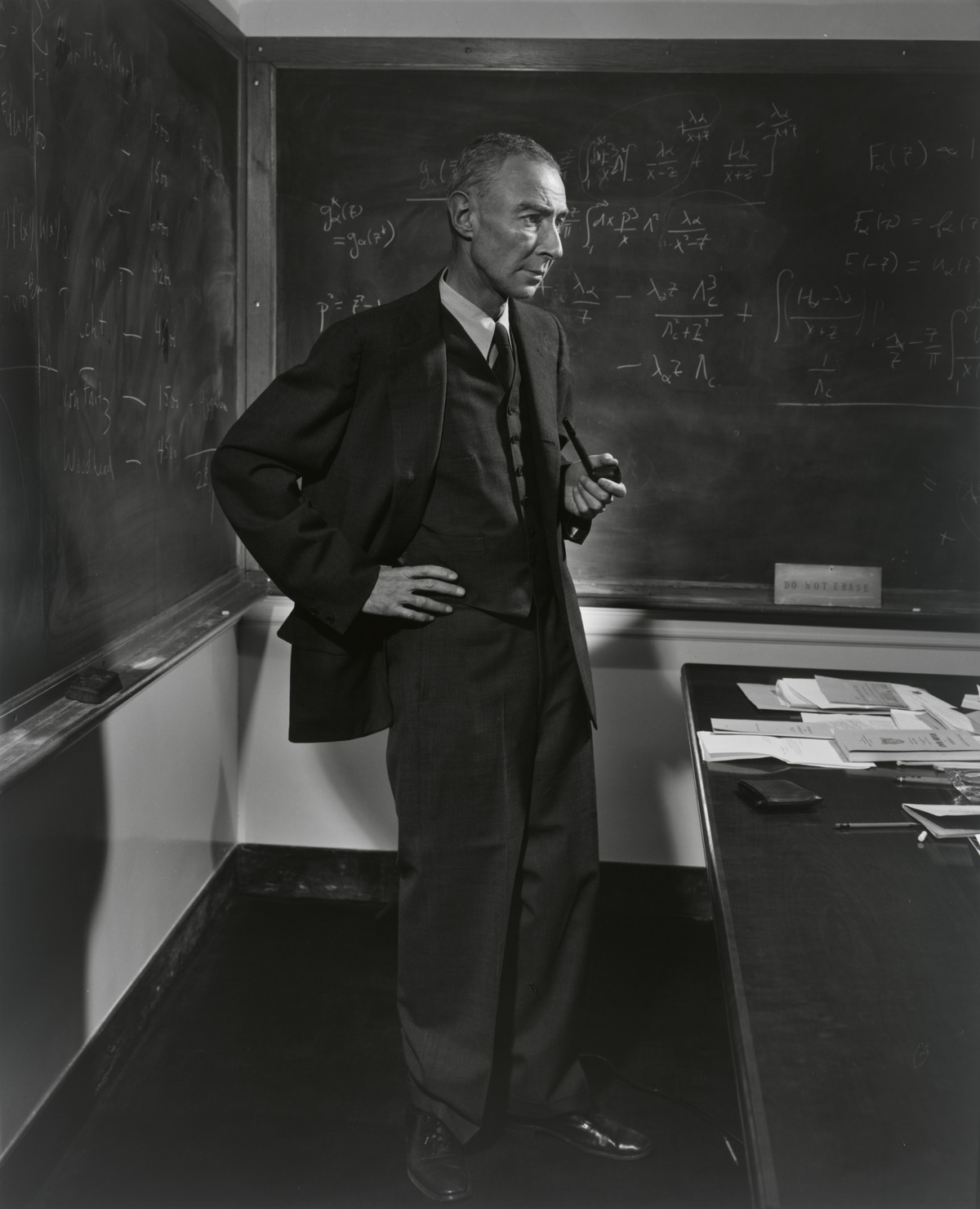
In Yousuf Karsh I believe that there is more an EXPANSION of time in the portraits – the decisive exposure is drawn out over the length of his engagement and dialogue with his sitters (with out seeing the caption you KNOW that is Robert Oppenheimer – I had not seen the image before but I sensed it instinctively, intuitively, it could be nobody else). He seems to ‘draw out’ some magical element in all of his sitters = they never just ‘sit’ for him, but actively engage in a dialogue that evidences some sense of being that is unique and timeless… an expansion of consciousness? an expansion of decisive exposure. Decisive – immediate; exposure – time / representation.

These are thoughts still forming in my head, a new way of looking at photography that relies less on instant gratification and more on intensities – of feeling, of thinking, of time, of representation.

Dr Marcus Bunyan


Many thankx to the National Portrait Gallery for allowing me to publish the photographs in the posting. Please click on the photographs for a larger version of the image.


In celebration of a major gift to its collection of more than 100 portraits created by renowned photographer Yousuf Karsh (1908-2002), this exhibition features iconic photographs of Americans who have distinguished themselves in fields as diverse as business, medicine, entertainment, politics and the arts. Among the portraits included are those of artist Georgia O’Keeffe, physician and virologist Jonas Salk, singer Marian Anderson, actress Grace Kelly, businesswoman Elizabeth Arden, architect I. M. Pei and first lady Eleanor Roosevelt. Yousuf Karsh: American Portraits is the museum’s first exhibition devoted entirely to the work of this internationally recognised portrait photographer, and it will be presented in two installations.


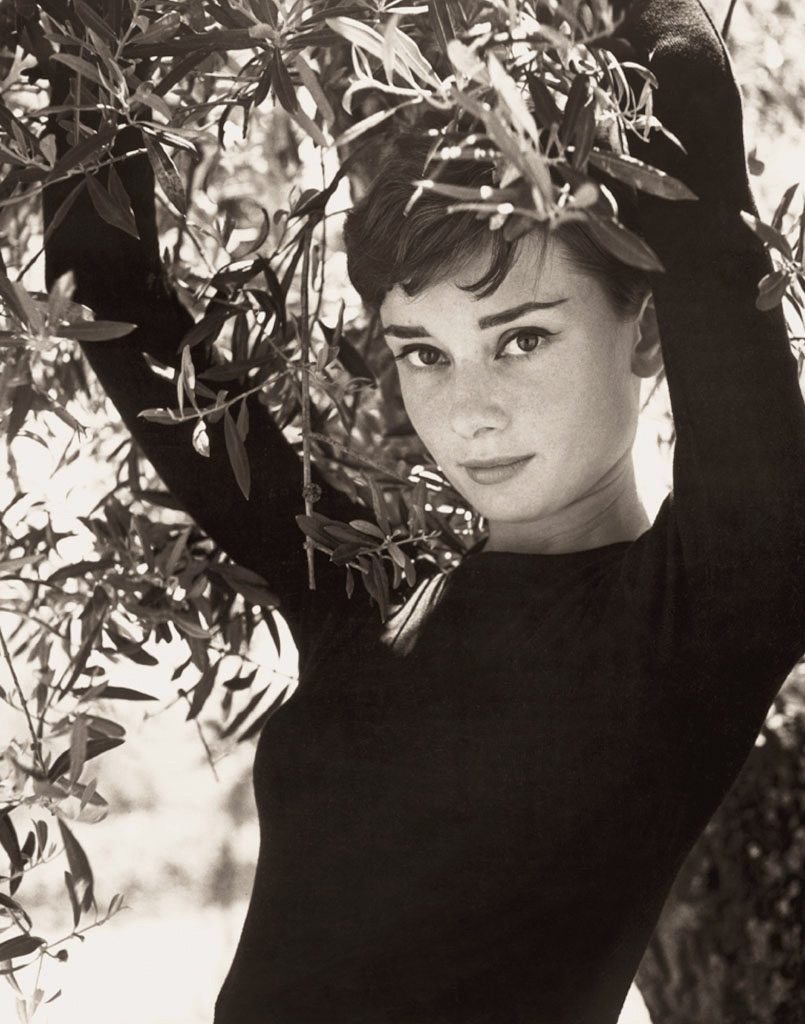
Yousuf Karsh (Armenian-Canadian, 1908-2002) 'Grace Kelly' 1956


Yousuf Karsh (Armenian-Canadian, 1908-2002)
Grace Kelly
1956
Gelatin silver print
Image: 24 x 19.4cm (9 7/16 x 7 5/8″)
National Portrait Gallery, Smithsonian Institution
© Estate of Yousuf Karsh


A luminous beauty whose film career spanned just six years (1951-1956), Grace Kelly left an indelible legacy with her performances in eleven motion pictures, many of which remain Hollywood classics. After her 1951 film debut in a minor role, she received wide notice for her performance opposite Gary Cooper in High Noon (1952). A year later, Kelly garnered her first Academy Award nomination for her work in Mogambo (1953). In 1954 she starred in four major releases, including the Alfred Hitchcock thrillers Dial M for Murder and Rear Window, and the drama The Country Girl, for which she won the Best Actress Oscar. Kelly scored additional hits with To Catch a Thief (1955) and the musical High Society (1956) before ending her Hollywood career to marry Monaco’s Prince Rainier in April 1956.

When Grace Kelly posed for Karsh’s camera, she was recently engaged and about to begin her new life as Monaco’s Princess Grace.

Text from the Smithsonian website


Yousuf Karsh (Armenian-Canadian, 1908-2002) 'Ernest Hemingway' 1957


Yousuf Karsh (Armenian-Canadian, 1908-2002)
Ernest Hemingway
1957
Gelatin silver print
Image: 24 x 19.1cm (9 7/16 x 7 1/2″ )
Sheet: 33.8 x 26.2cm (13 5/16 x 10 5/16 in.)
National Portrait Gallery, Smithsonian Institution
© Estate of Yousuf Karsh


In 1954, when Ernest Hemingway received the Nobel Prize in Literature, the committee cited his “mastery of the art of modern narration.” In fact, through his short stories and such novels as The Sun Also Rises (1926) and For Whom the Bell Tolls (1940), Hemingway had, with his terse, powerful prose, in large measure invented a new literary style as he chronicled the disillusionment of the post-World War I “lost generation.” Hemingway’s own experiences – reporting foreign wars, living the bohemian life in Paris, and adventuring in Africa, Spain, and Cuba – fuelled his imagination and helped foster his larger-than-life public persona.

When Karsh traveled to Cuba in 1957 to photograph Hemingway, he “expected to meet in the author a composite of the heroes of his novels.” Instead, the photographer recalled, “I found a man of peculiar gentleness, the shyest man I ever photographed – a man cruelly battered by life but seemingly invincible.”

Text from the Smithsonian website


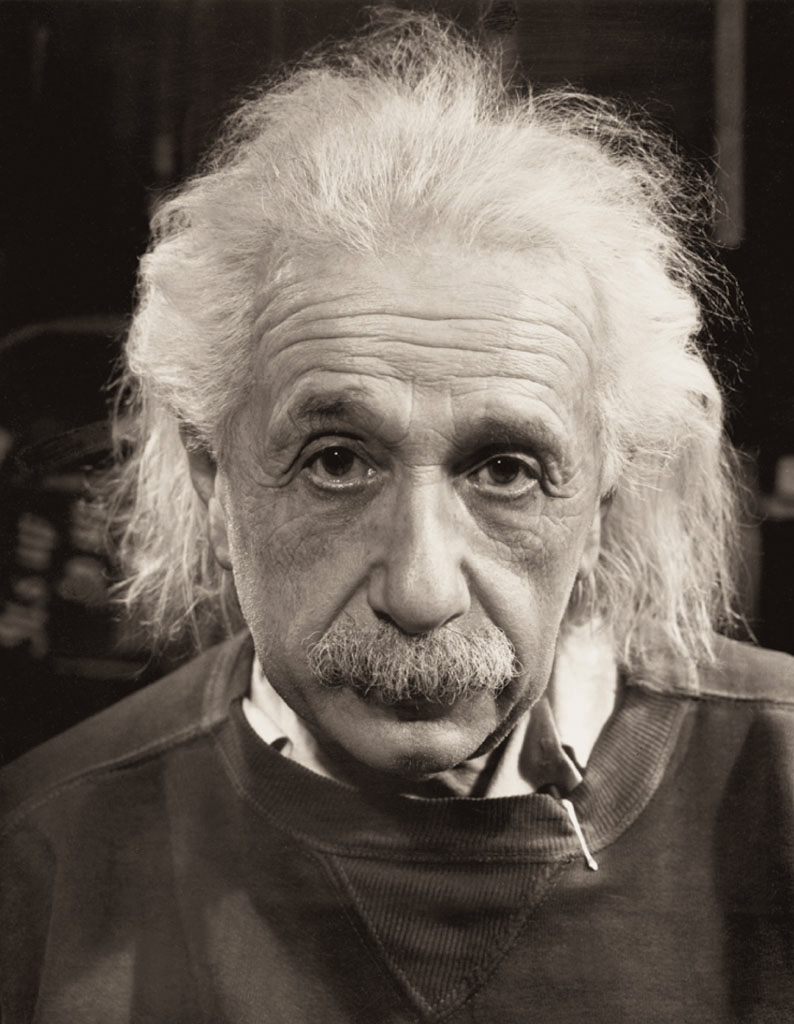
Yousuf Karsh (Armenian-Canadian, 1908-2002) 'Albert Einstein' 1948


Yousuf Karsh (Armenian-Canadian, 1908-2002)
Albert Einstein
1948
Gelatin silver print
Image: 27.3 x 26.1cm (10 3/4 x 10 1/4″)
National Portrait Gallery, Smithsonian Institution
© Estate of Yousuf Karsh


Albert Einstein transformed the world of physics with his groundbreaking theory of relativity, and in 1921 he received the Nobel Prize for “his services to theoretical physics” and “his discovery of the law of photoelectric effect.” The German-born physicist was visiting the United States when Hitler and the Nazis came to power in his homeland in 1933. Einstein never returned to Germany. Instead, he accepted a position at the Institute for Advanced Study in Princeton, New Jersey – the newly established academic institution that would become a major centre for research in theoretical physics. In residence at the institute for the remainder of his life, Einstein continued to publish, work on the interpretation of quantum theory, and wrestle without success on his unified field theory. He became a U.S. citizen in 1940.

Karsh relished the opportunity to photograph Einstein, whose face, “in all its rough grandeur, invited and challenged the camera.”

Text from the Smithsonian website


Yousuf Karsh (Armenian-Canadian, 1908-2002) 'Sir Winston Leonard Spencer Churchill' 1941


Yousuf Karsh (Armenian-Canadian, 1908-2002)
Sir Winston Leonard Spencer Churchill
1941
Gelatin silver print
Image/Sheet (Image/Sheet, Accurate): 34.3 x 26.8cm (13 1/2 x 10 9/16″)
National Portrait Gallery, Smithsonian Institution
© Estate of Yousuf Karsh


In 1941, as war raged in Europe and the Pacific, British prime minister Winston Churchill traveled to Washington for meetings with President Franklin Roosevelt before continuing on to Ottawa, where he delivered a rousing speech before the Canadian Parliament on December 30. Canada’s prime minister, Mackenzie King – an early admirer of Yousuf Karsh’s work – arranged for Karsh to attend Churchill’s address and to be in position to photograph the British leader as he later passed through the Speaker’s Chamber. Surprised to discover that he was to be photographed, Churchill grudgingly agreed to give Karsh two minutes for the shot but declined the photographer’s gentle entreaty to relinquish his freshly lit cigar. Undeterred, Karsh deftly removed the cigar from Churchill’s mouth and quickly made his exposure as Britain’s “roaring lion” glowered at the camera. The resulting image – one of the 20th century’s most iconic portraits – effectively launched Karsh’s international career.

In 1963, Churchill became the first foreign national to be granted honorary U.S. citizenship by the U.S. Congress.

Text from the Smithsonian website


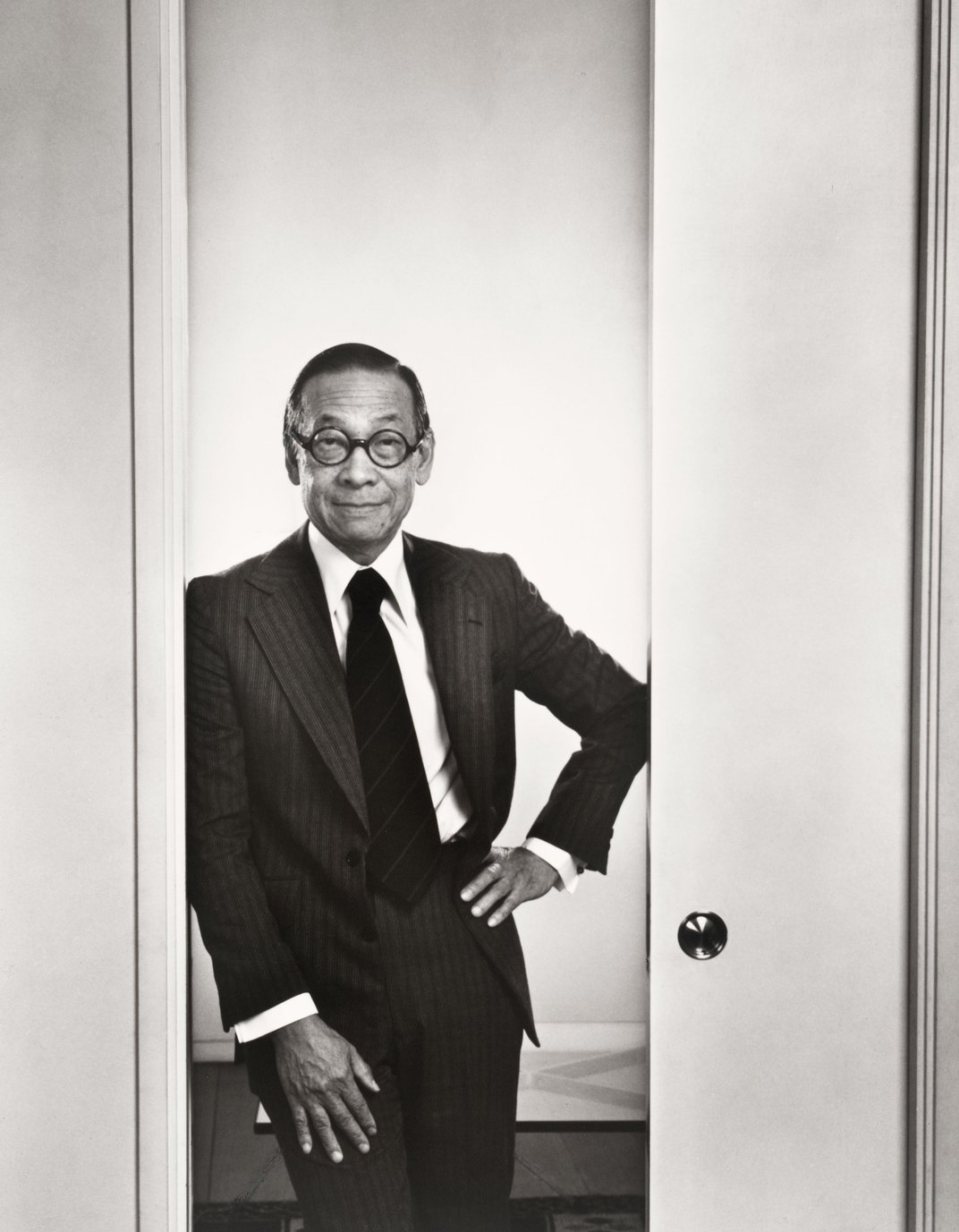
Yousuf Karsh (Armenian-Canadian, 1908-2002) 'I. M. Pei' 1979


Yousuf Karsh (Armenian-Canadian, 1908-2002)
I. M. Pei
1979
Gelatin silver print
Image: 28 x 21.5cm (11 x 8 7/16″)
National Portrait Gallery, Smithsonian Institution
© Estate of Yousuf Karsh


One of the most influential architects to emerge in the decades following World War II, I. M. Pei is recognised throughout the world for his striking, high-modernist designs. Drawn to the United States to study architecture in 1935, Pei earned his undergraduate degree from MIT and later completed graduate work at Harvard. After first directing the architectural division of a large real-estate concern, Pei founded his own architecture firm in 1955, one year after becoming a U.S. citizen. As his reputation grew, important projects – such as the 1964 commission for the John F. Kennedy Memorial Library – came his way. Pei went on to create such iconic structures as the critically acclaimed East Wing of the National Gallery of Art (1978) and the distinctive glass pyramid that forms the entrance to the Louvre (1988). He has received many major awards, including the coveted Pritzker Prize (1983).

Text from the Smithsonian website


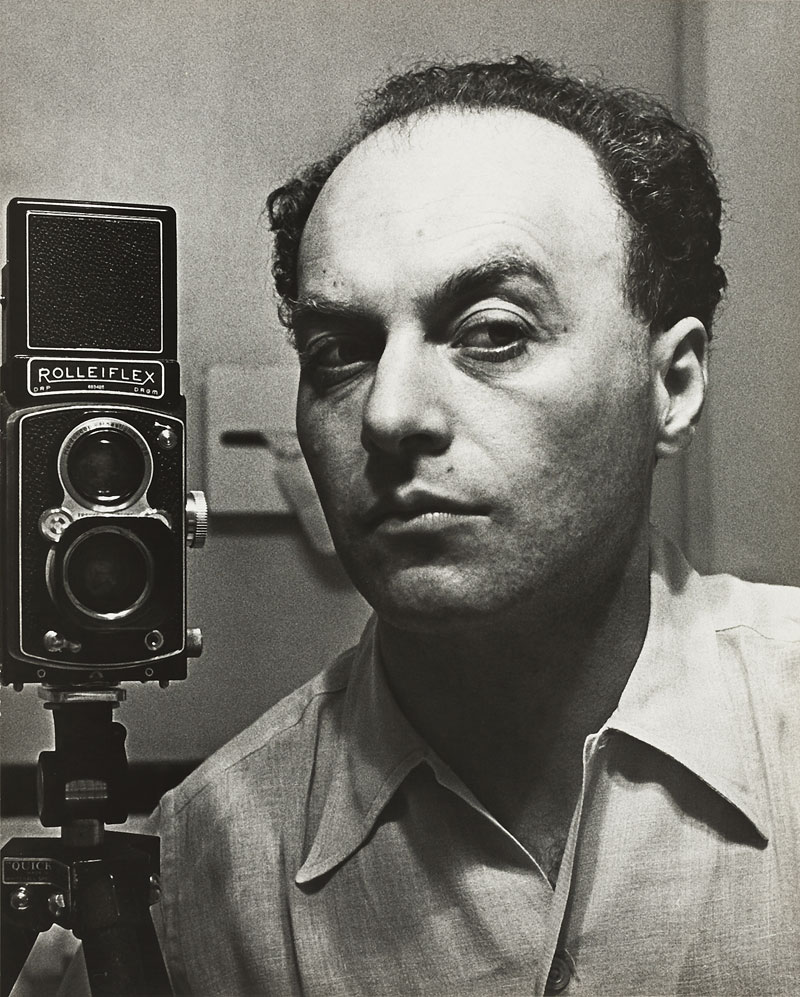
Yousuf Karsh (Armenian-Canadian, 1908-2002) 'Yousuf Karsh' c. 1946


Yousuf Karsh (Armenian-Canadian, 1908-2002)
Yousuf Karsh
c. 1946
Photo blow-up
Gelatin silver print
© Estate of Yousuf Karsh


In celebration of a major gift to its collection of more than 100 portraits created by master photographer Yousuf Karsh (1908-2002), the Smithsonian’s National Portrait Gallery is installing a special exhibition on the first floor of the museum, Yousuf Karsh: American Portraits. This is the second of two installations and will run from May 2 through Nov. 2. Yousuf Karsh: American Portraits is the museum’s first exhibition devoted entirely to the work of this internationally recognised photographer. Each phase of the installation displays 27 photographs. The photographs were a gift to the museum by Estrellita Karsh.

“Yousuf Karsh created some of the most iconic photographic portraits of our time,” said Kim Sajet, director of the National Portrait Gallery. “He not only had the uncanny ability to amplify a person’s character, but also offered everyday people the opportunity to glimpse into the private lives of the men and women who shaped the 20th century in a way that feels both personal and real. I am thrilled to have his important work play an integral part in building the nation’s collection of portraits.”

A refugee from persecution in his native Armenia, Karsh immigrated to Canada in 1925. His uncle, a professional photographer, facilitated Karsh’s apprenticeship with the renowned Boston portrait photographer John H. Garo in 1928. By the time Karsh returned to Canada, he had “set [his] heart on photographing those men and women who leave their mark on the world.” In May 1933, he opened his portrait studio in Ottawa.

Karsh developed his distinctive portrait style by drawing inspiration from a variety of sources. Introduced to stage lighting techniques through his association with the Ottawa Drama League, he experimented with artificial lighting to achieve the dramatic effects that became the hallmark of his portraiture. Believing that “the heart and mind are the true lens of the camera,” Karsh also developed a genuine rapport with his sitters and partnered with them to fashion portraits that were both revealing and respectful.

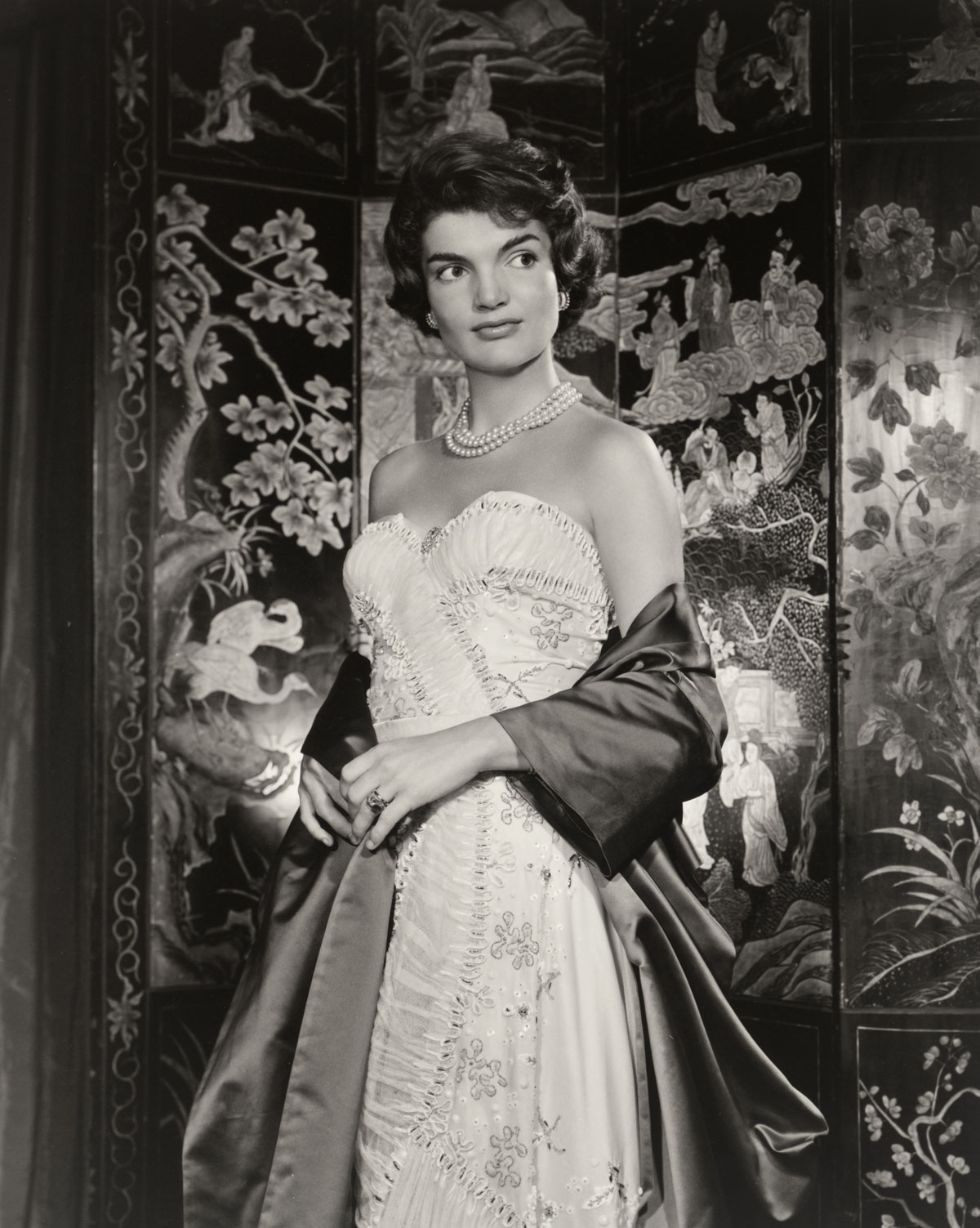
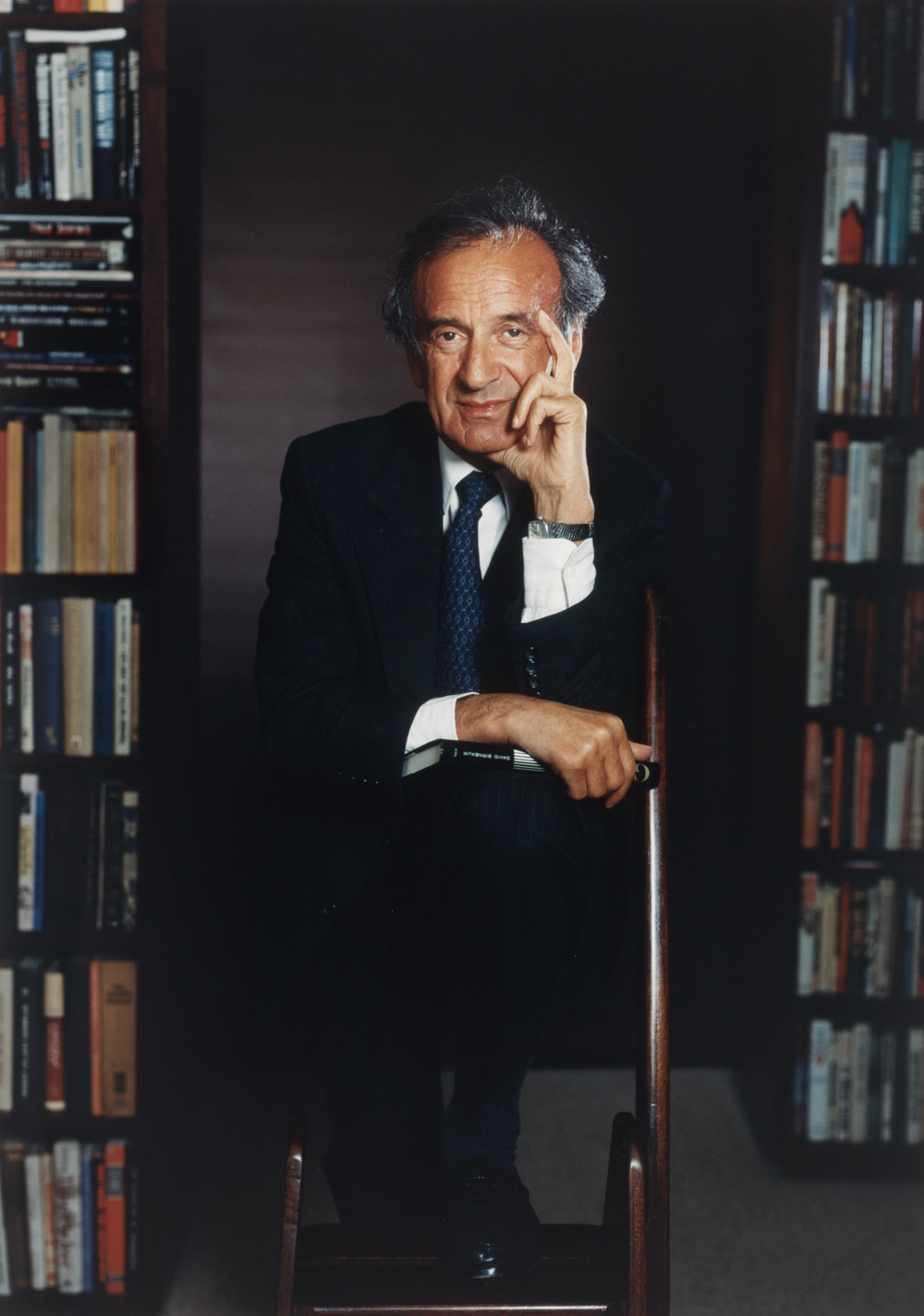
During a distinguished career that spanned more than six decades, Karsh believed that “the heart and mind are the true lens of the camera,” and he developed a genuine rapport with his subjects to fashion evocative and revealing portraits. This installation features Americans who have distinguished themselves in fields as diverse as business, medicine, entertainment, politics and the arts. Among the portraits included are Martha Graham, Helen Keller, Jackie Kennedy, Andy Warhol, Ellie Wiesel, Muhammad Ali and First Lady Eleanor Roosevelt. The museum has previously collected seven photographs by Karsh, including one of the most famous photographs of Winston Churchill, which became known as the “roaring lion,” and a colour photograph of the beloved creator of Peanuts, Charles Schultz. While the photographer is known for his work in black and white, the museum is also showing several works in colour.

Press release from the National Portrait Gallery website


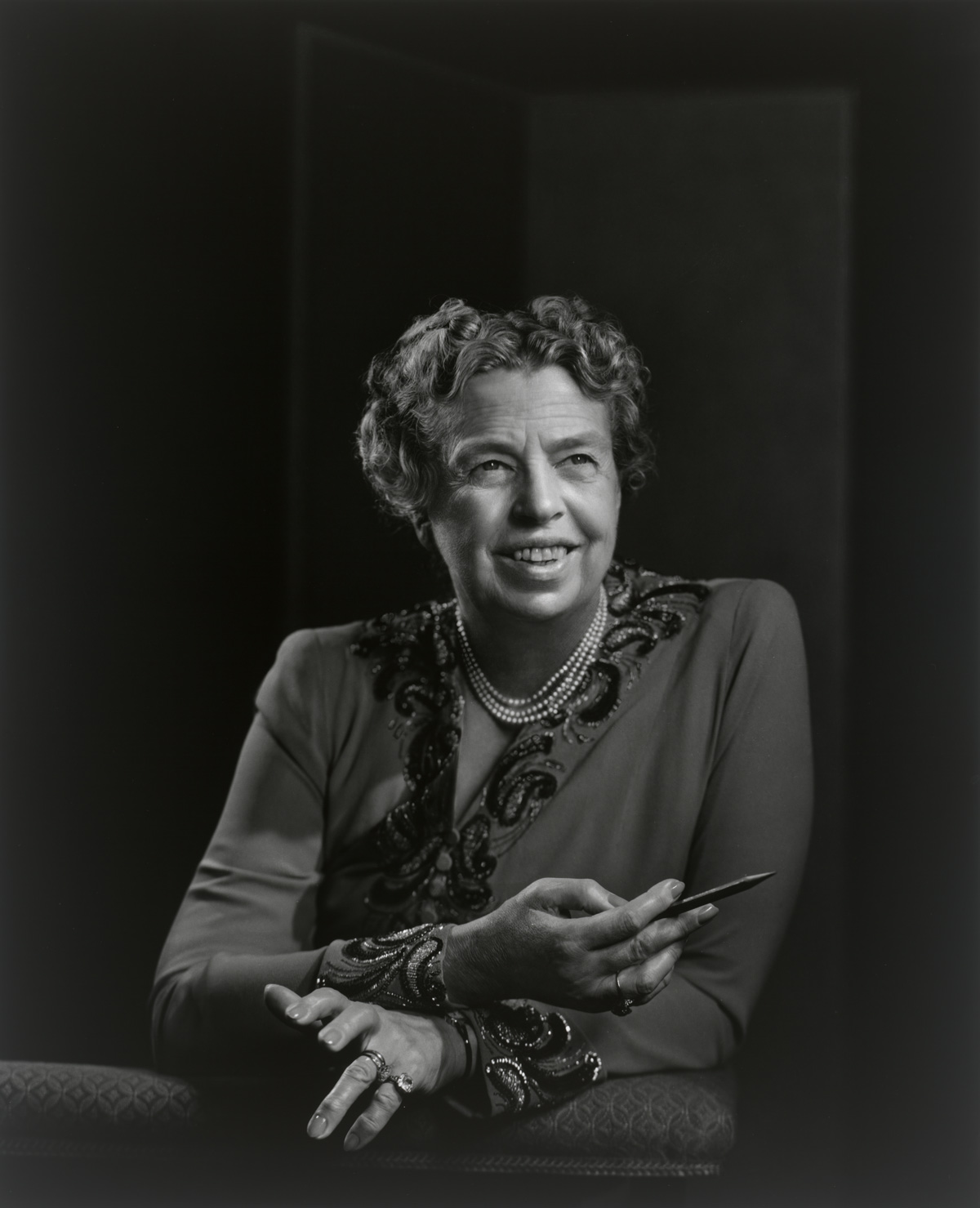
Yousuf Karsh (Armenian-Canadian, 1908-2002) 'Eleanor Roosevelt' 1944


Yousuf Karsh (Armenian-Canadian, 1908-2002)
Eleanor Roosevelt
1944
Gelatin silver print
Image: 31.5 x 25.5cm (12 3/8 x 10 1/16″)
National Portrait Gallery, Smithsonian Institution
© Estate of Yousuf Karsh


As the nation’s first lady, Eleanor Roosevelt rapidly expanded her role from hostess to advocate and emerged as a vital force in her husband Franklin’s administration. She took public stands on issues ranging from exploitative labor practices to civil rights, but more important, she often urged her husband toward measures he might otherwise have avoided. When the challenges of World War II drew the president’s attention from domestic affairs, she continued to be a strong voice for the New Deal’s social welfare policies. The activism that characterised Eleanor Roosevelt’s years as first lady did not end with her departure from the White House. As a U.S. delegate to the United Nations (1945-1953), she was instrumental in formulating the Universal Declaration of Human Rights and securing its ratification by the General Assembly in 1948.

Eleanor Roosevelt’s hands were seldom still, and Karsh captured their expressive qualities in this portrait.

Text from the Smithsonian website


Yousuf Karsh (Armenian-Canadian, 1908-2002) 'Ingrid Bergman' 1946


Yousuf Karsh (Armenian-Canadian, 1908-2002)
Ingrid Bergman
1946
Gelatin silver print
Image/Sheet: 33.7 x 26.3cm (13 1/4 x 10 3/8″)
National Portrait Gallery, Smithsonian Institution
© Estate of Yousuf Karsh


Yousuf Karsh (Armenian-Canadian, 1908-2002) 'Humphrey Bogart' 1946


Yousuf Karsh (Armenian-Canadian, 1908-2002)
Humphrey Bogart
1946
Gelatin silver print
Image: 35.5 x 27.9cm (14 x 11″)
National Portrait Gallery, Smithsonian Institution
© Estate of Yousuf Karsh


Yousuf Karsh (Armenian-Canadian, 1908-2002) 'Martha Graham' 1948


Yousuf Karsh (Armenian-Canadian, 1908-2002)
Martha Graham
1948
Gelatin silver print
Image: 28 x 21.6cm (11 x 8 1/2″)
National Portrait Gallery, Smithsonian Institution
© Estate of Yousuf Karsh


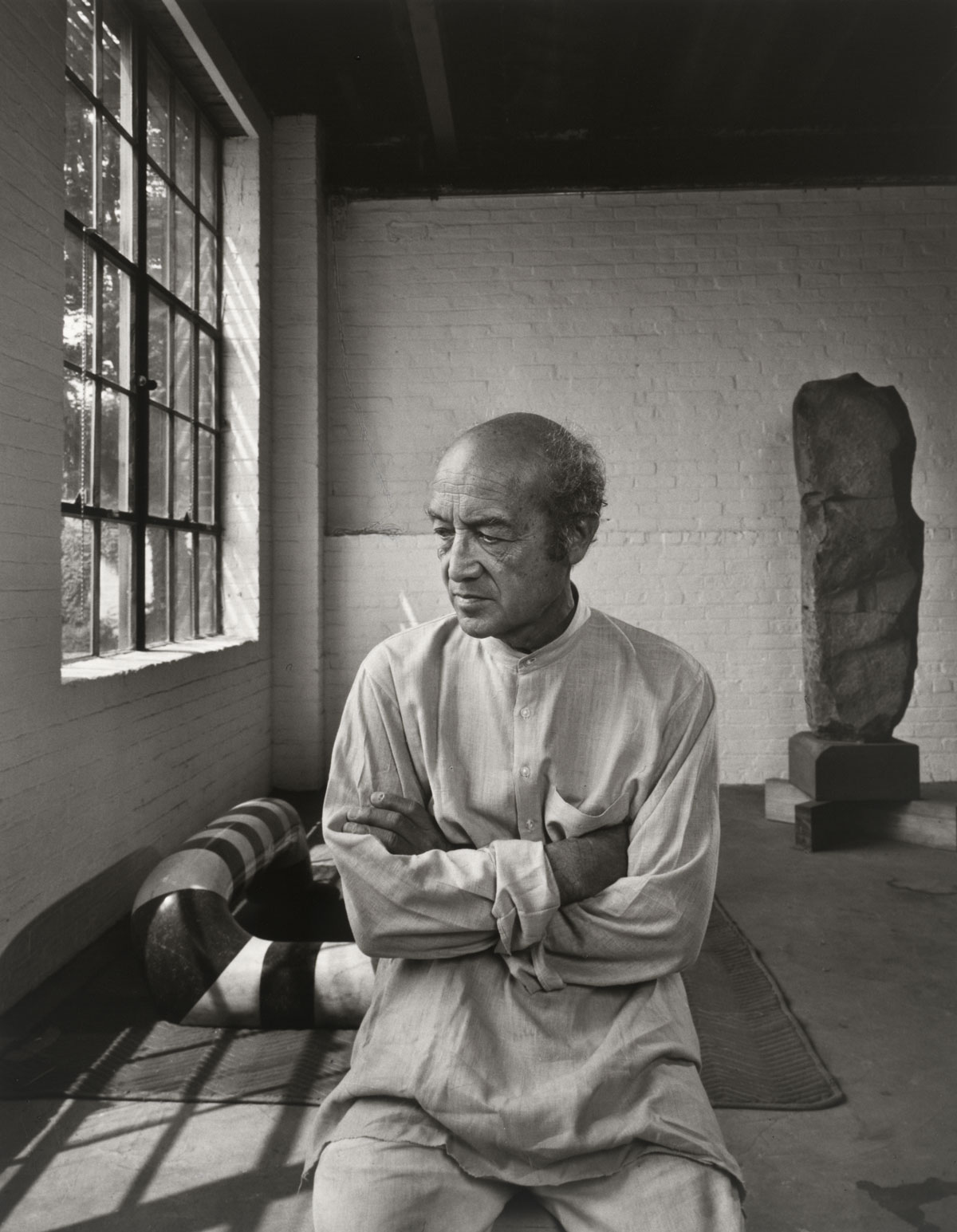
Yousuf Karsh (Armenian-Canadian, 1908-2002) 'Isamu Noguchi' 1980


Yousuf Karsh (Armenian-Canadian, 1908-2002)
Isamu Noguchi
1980
Gelatin silver print
Image: 28 x 21.6cm (11 x 8 1/2″)
National Portrait Gallery, Smithsonian Institution
© Estate of Yousuf Karsh


Yousuf Karsh (Armenian-Canadian, 1908-2002) 'Jacqueline Kennedy Onassis' 1957


Yousuf Karsh (Armenian-Canadian, 1908-2002)
Jacqueline Kennedy Onassis
1957
Gelatin silver print
Image: 24.1 x 19.1cm (9 1/2 x 7 1/2″)
National Portrait Gallery, Smithsonian Institution
© Estate of Yousuf Karsh


Yousuf Karsh (Armenian-Canadian, 1908-2002) 'Robert Oppenheimer' 1956


Yousuf Karsh (Armenian-Canadian, 1908-2002)
Robert Oppenheimer
1956
Gelatin silver print
Image: 31.6 x 25.5cm (12 7/16 x 10 1/16″)
National Portrait Gallery, Smithsonian Institution
© Estate of Yousuf Karsh


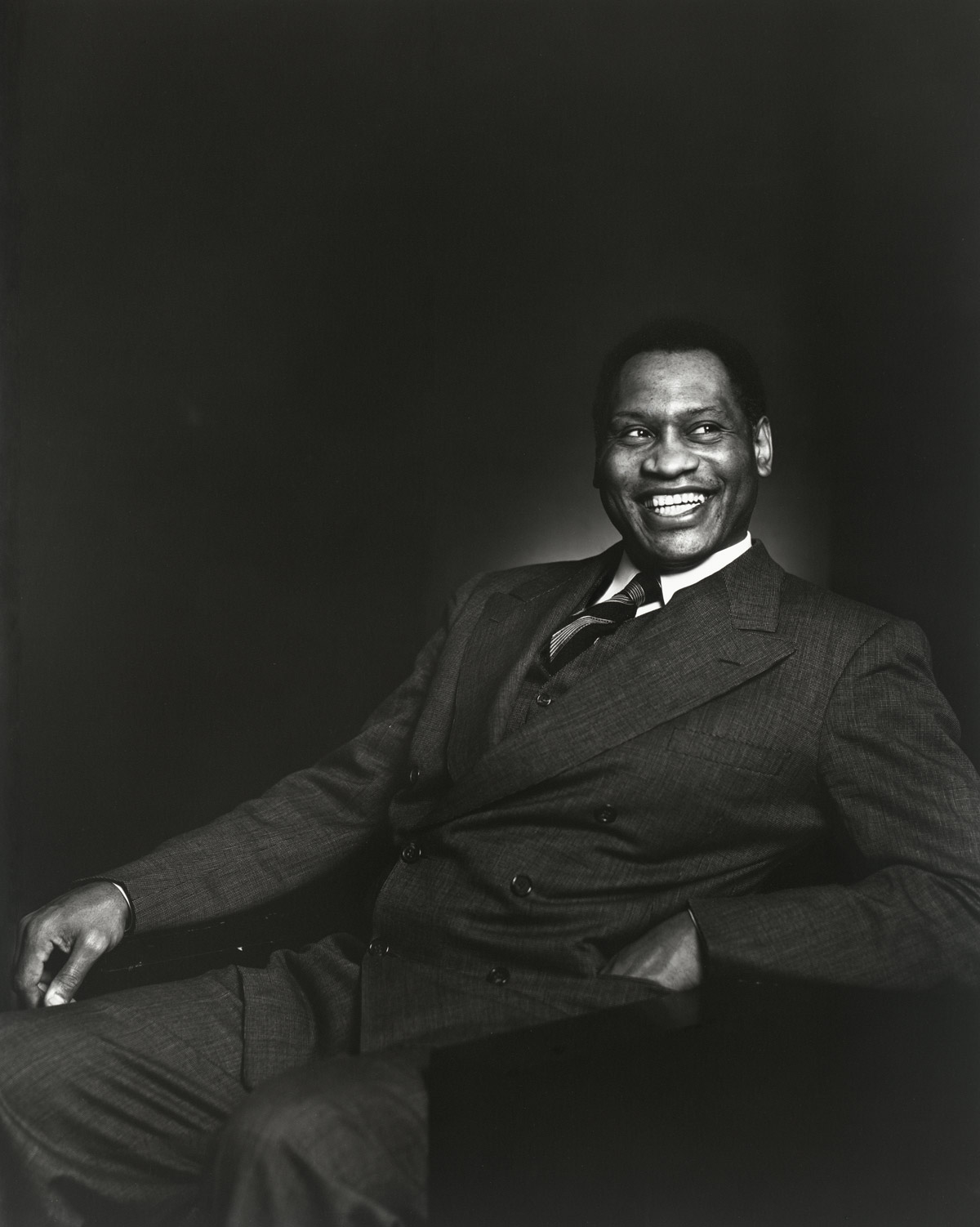
Yousuf Karsh (Armenian-Canadian, 1908-2002) 'Paul Robeson' 1941


Yousuf Karsh (Armenian-Canadian, 1908-2002)
Paul Robeson
1941
Gelatin silver print
Image: 49.2 x 39.5cm (19 3/8 x 15 9/16″)
National Portrait Gallery, Smithsonian Institution
© Estate of Yousuf Karsh


Yousuf Karsh (Armenian-Canadian, 1908-2002) 'Elie Wiesel' 1991


Yousuf Karsh (Armenian-Canadian, 1908-2002)
Elie Wiesel
1991
Chromogenic print
Image: 34.2 x 24cm (13 7/16 x 9 7/16″)
Sheet: 35.5 x 27.9cm (14 x 11″)
National Portrait Gallery, Smithsonian Institution
© Estate of Yousuf Karsh


Smithsonian National Portrait Gallery
8th and F Sts NW
Washington, DC 20001

Opening hours:
11.30am – 7.00pm daily

Smithsonian National Portrait Gallery website

LIKE ART BLART ON FACEBOOK

Back to top

Exhibition: ‘Christina Broom’ at the Museum of London

Exhibition dates: 4th April – 28th September 2014


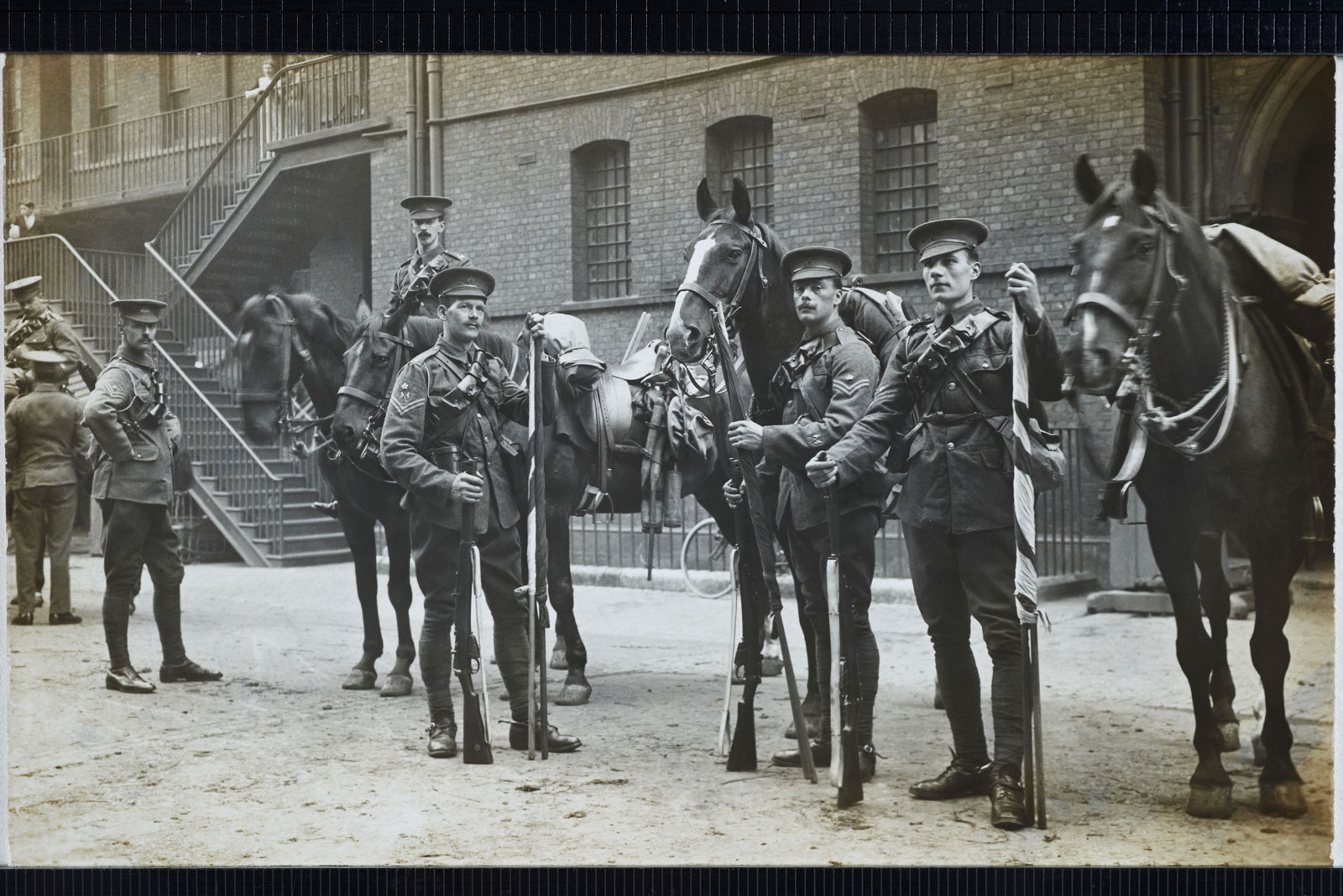
Christina Bloom (British, 1862-1939) 'The 1st Life Guards prepare to leave Hyde Park Barracks and head to war, on 15 August 1914'


Christina Bloom (British, 1862-1939)
The 1st Life Guards prepare to leave Hyde Park Barracks and head to war, on 15 August 1914. They were destined for the devastating Battle of Mons
1914
Christina Broom/Museum of London


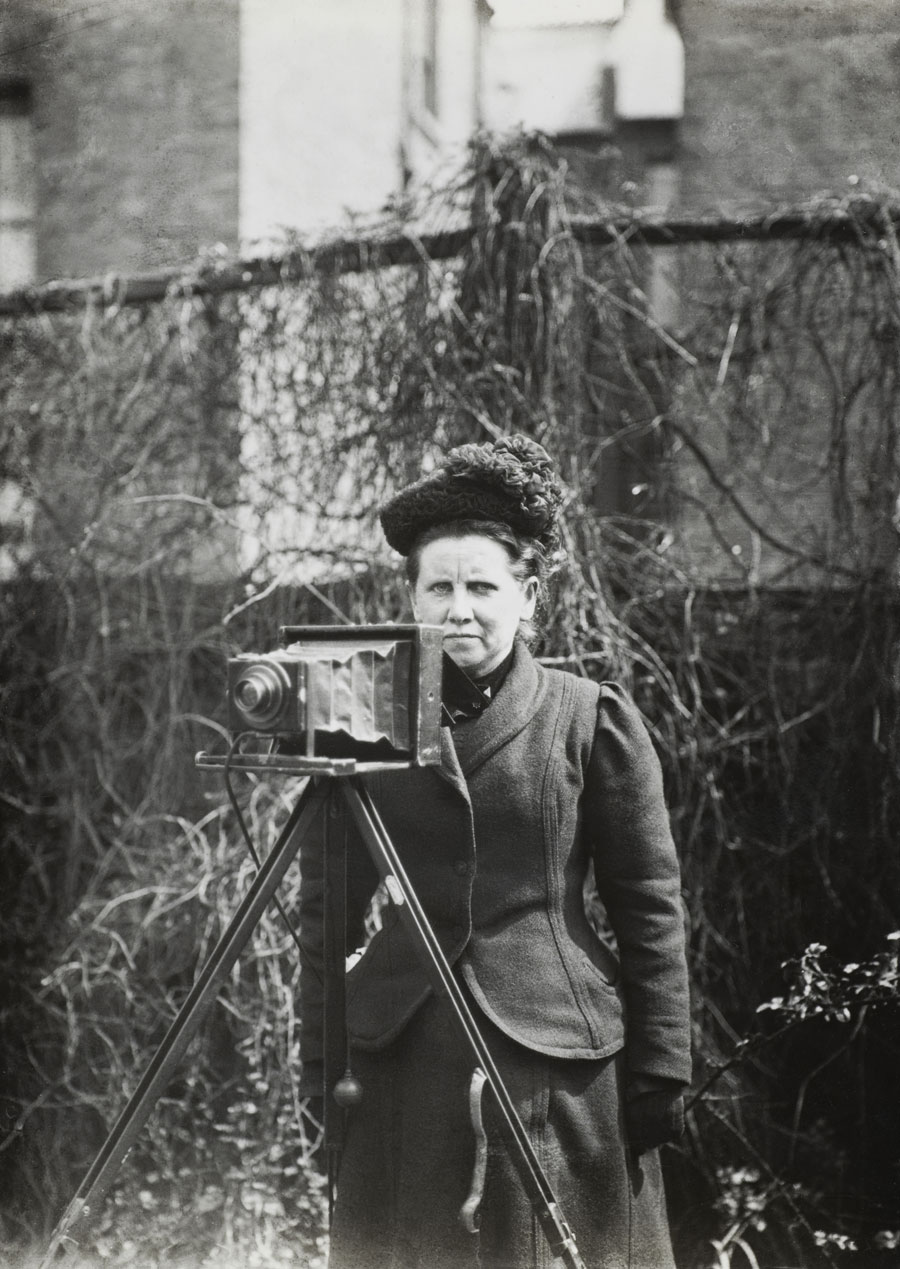
Look at the portrait of Christina Bloom at the bottom of the posting. Now there is a formidable human being. The look in the eyes shows determination and toughness, toughness to survive and succeed in a male dominated world.

Broom taught herself photography at the age of 40 – “to create and sell photographic postcards – a trade which was thriving. At work between 1903 and 1939, she gained exclusive access to leading London events from suffragette processions to King George V’s coronation and became photographer to the Household Brigade, forging a unique relationship with the Guards” – and became the UK’s first female press photographer. She must have had something special … and then you look at her photographs and you realise what: spontaneity, structure, spirit and the rest. Her tableaux vivant in this posting are almost sculptural in their construction, the photographer ordering the elements, posing the people but then evincing from them a warmth and intimacy in their engagement with the camera that is quite remarkable.

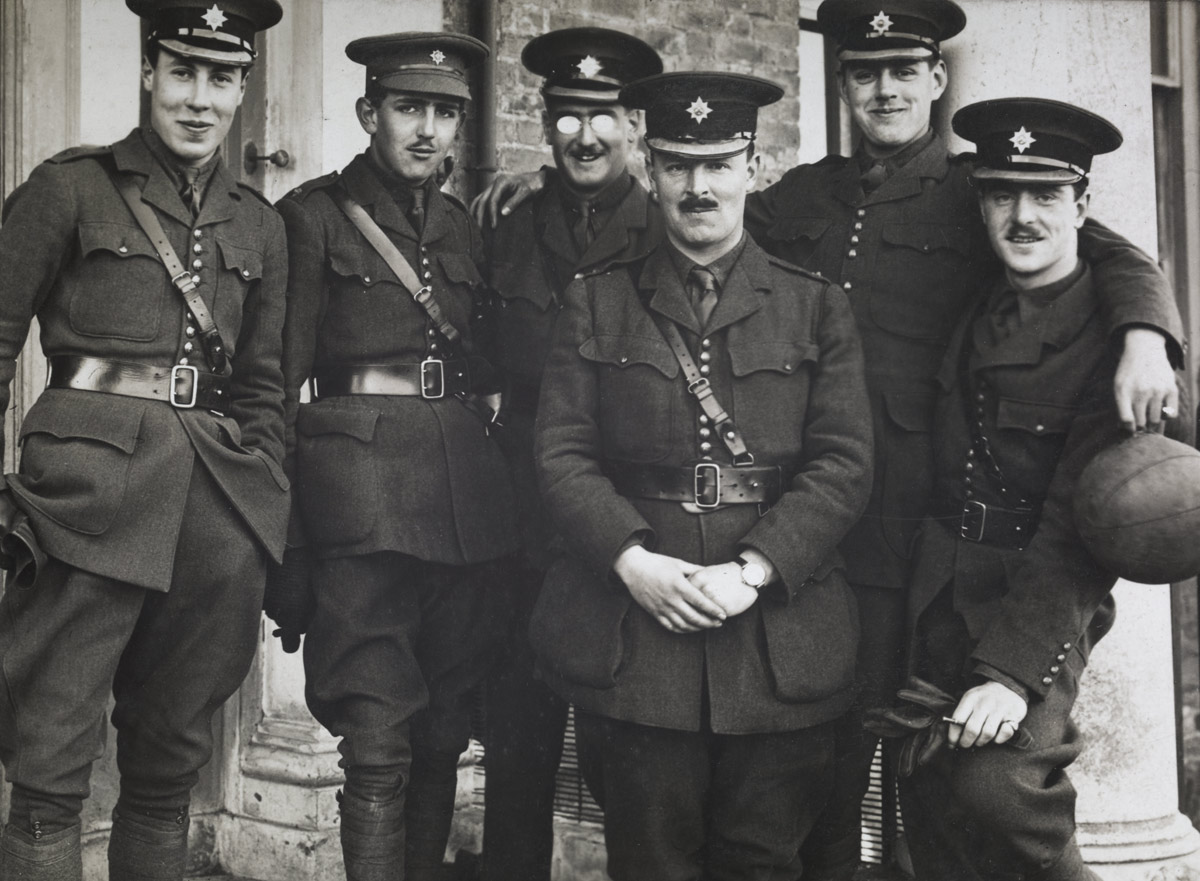
In terms of structure you need look no further than The 1st Life Guards prepare to leave Hyde Park Barracks (1914, top photo below) or Captain Greer of the 1st Irish Guards and his machine gun team (Nd, below) to see how Broom arranges her subject matter. In the 1st Life Guards photograph the man standing at left, the man seated on the horse and the man second right stare directly at the camera forming strong triangular sight lines. This triangle is then crossed by the man third from left who gazes out of the picture perpendicular to the camera’s gaze. His gaze is then “crossed” by the soldier standing at right staring away into the distance at 45 degree angle away from the camera. This image is a masterclass in sight lines and positioning, complemented by the intimacy of the gaze of the soldier second from the right staring directly into the camera (see detail), and the women positioned on the staircase in the background. Magic is happening here.

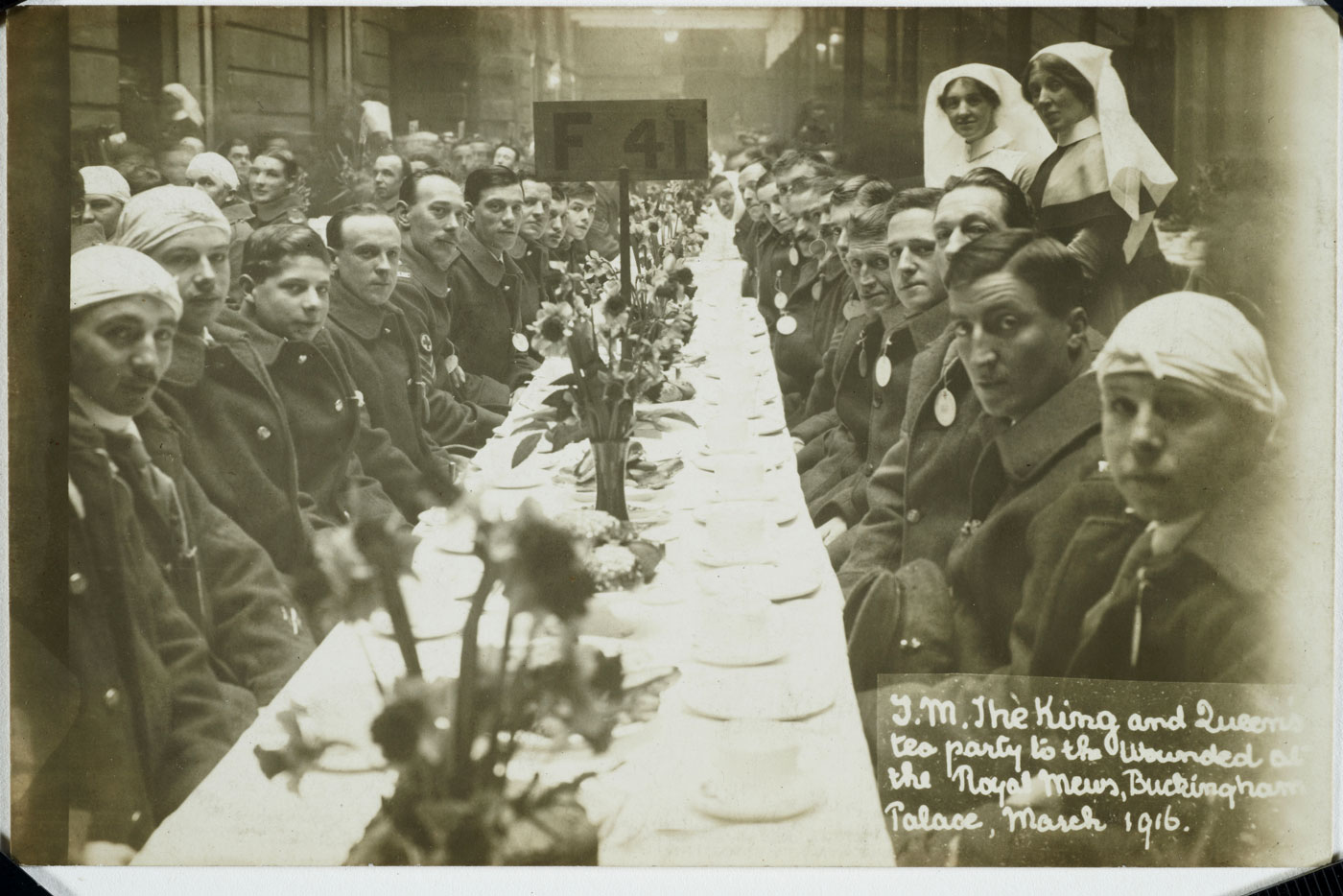
Again, in the second image of the machine gun team the photograph is eloquently and formally constructed – the symmetry of the twin doors and white squares behind echoed by the horseshoe arrangement of the men with the machine guns pointing in opposite directions. The stoic words ‘MACHINE GUN SHED. EAST’ are emblazoned above the men as though to press home their purpose, but upon detailed inspection the character of the men shines through – the stiff upper lip, the wicked sense of humour and the cheeky chappy can all be seen in this otherwise formally posed photograph. Added poignancy comes with the knowledge that every single person in the photograph was killed soon afterwards on the battlefields of the Western Front. Evidence of the stress of the war can be seen in the photograph King George V and Queen Mary host a tea party for wounded soldiers and sailors (1916, below). Gone are the jovial bonhomie smiles and comradeship, to be replaced by bandages and bouquets, and gaunt-looking, wary, young, scared looking soldiers staring out at the camera. Terrific photographs from a skilled and intuitive artist.

Dr Marcus Bunyan


Many thankx to the Museum of London for allowing me to publish the photographs in the posting. Please click on the photographs for a larger version of the image.


Christina Bloom (British, 1862-1939) 'The 1st Life Guards prepare to leave Hyde Park Barracks and head to war, on 15 August 1914' (detail)


Christina Bloom (British, 1862-1939)
The 1st Life Guards prepare to leave Hyde Park Barracks and head to war, on 15 August 1914 (detail)
1914
Christina Broom/Museum of London


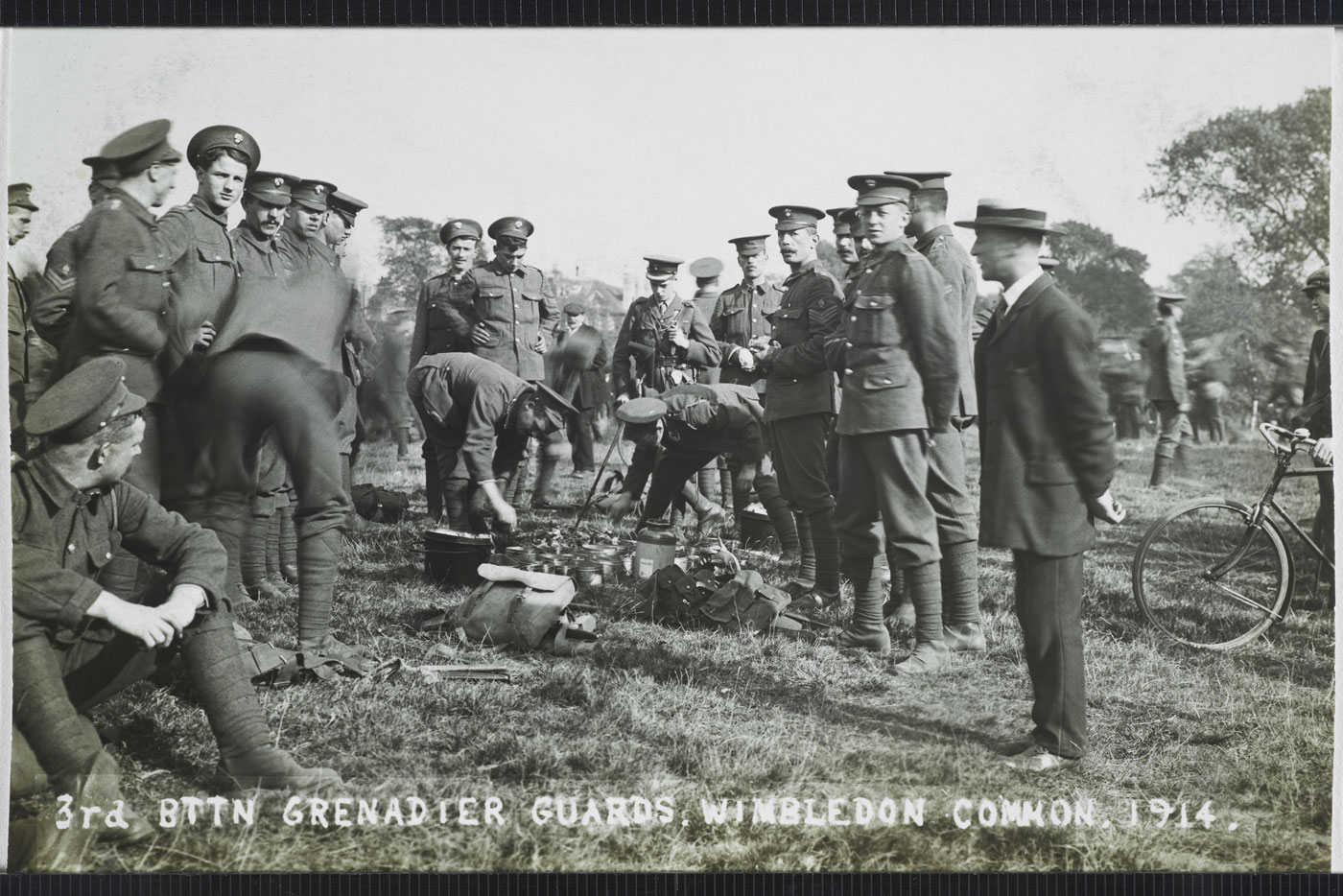
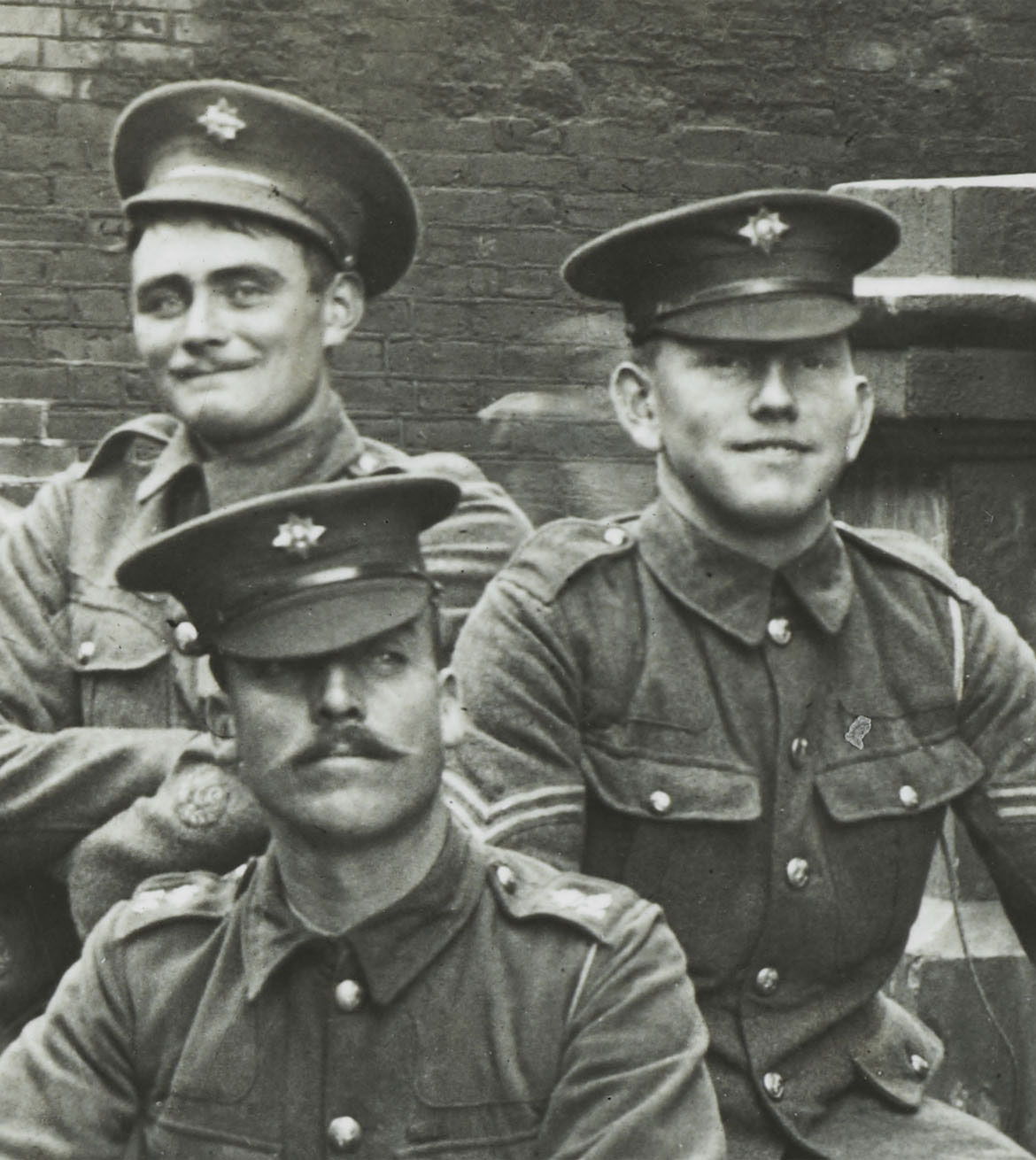
Christina Bloom (British, 1862-1939) 'The 3rd Battalion Grenadier Guards prepare for war at the Wimbledon Common training camp in 1914'


Christina Bloom (British, 1862-1939)
The 3rd Battalion Grenadier Guards prepare for war at the Wimbledon Common training camp in 1914. Lieutenant HRH the Prince of Wales can be seen inspecting the field kitchen, having marched there from Wellington Barracks
1914
Christina Broom/Museum of London


Christina Bloom (British, 1862-1939) 'The 3rd Battalion Grenadier Guards prepare for war at the Wimbledon Common training camp in 1914' (detail)


Christina Bloom (British, 1862-1939)
The 3rd Battalion Grenadier Guards prepare for war at the Wimbledon Common training camp in 1914 (detail)
1914
Christina Broom/Museum of London


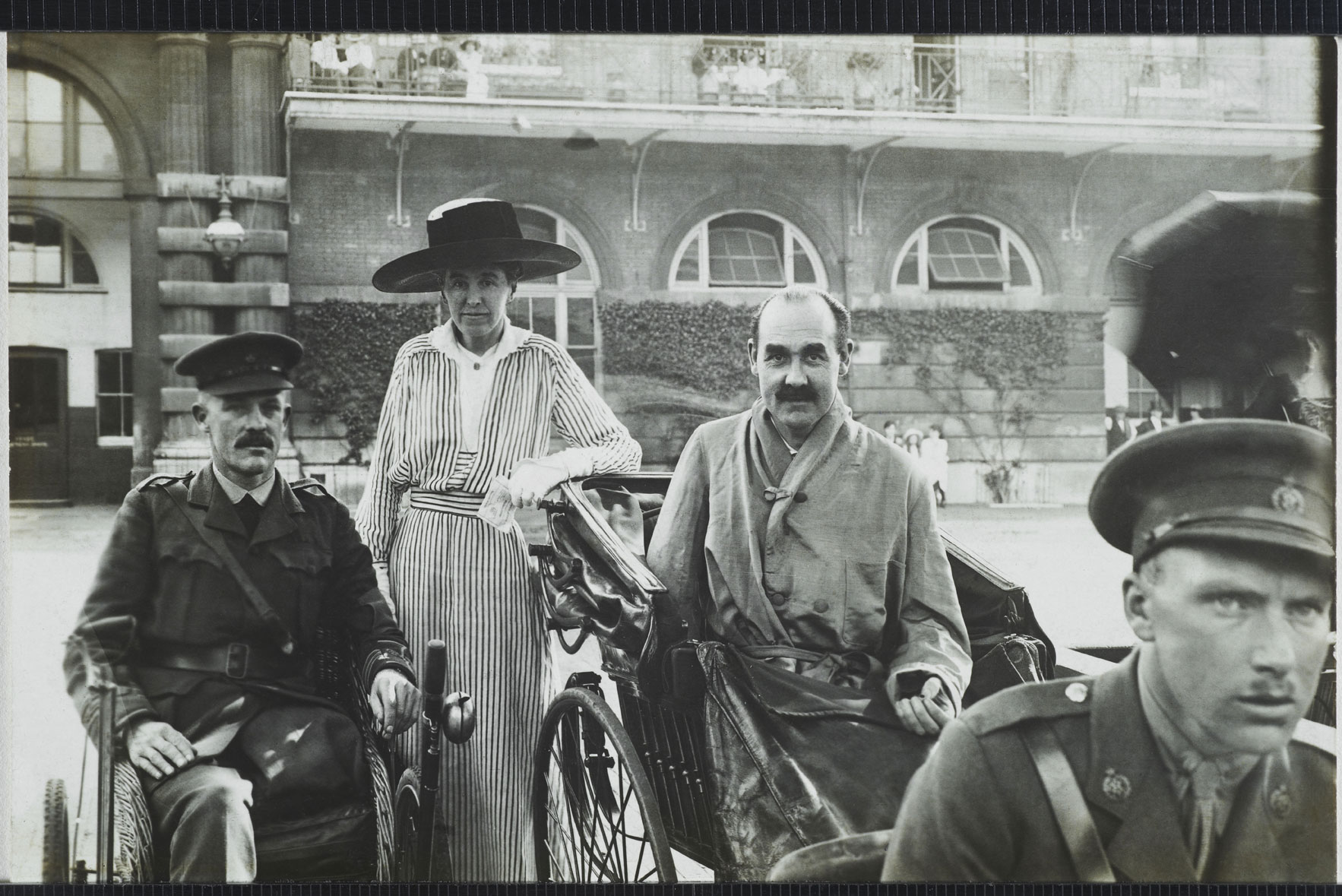
Christina Bloom (British, 1862-1939) 'Wounded patients from King Edward VII’s Hospital for Officers visit the Royal Mews in 1915'


Christina Bloom (British, 1862-1939)
Wounded patients from King Edward VII’s Hospital for Officers visit the Royal Mews in 1915. Originally set up after the Boer War by two sisters, the hospital treated injured officers during the First World War at its premises in Grosvenor Gardens
1915
Christina Broom/Museum of London


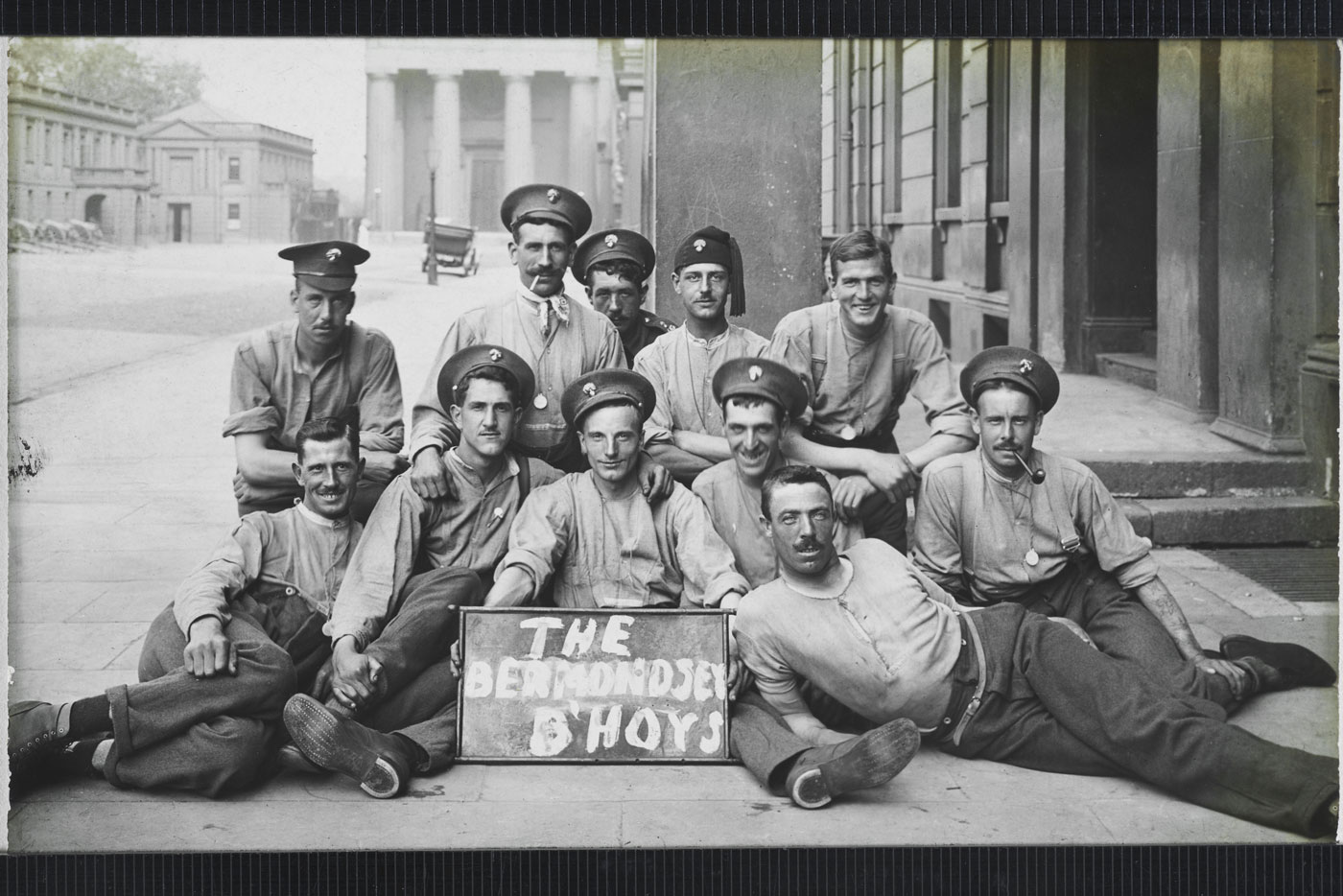
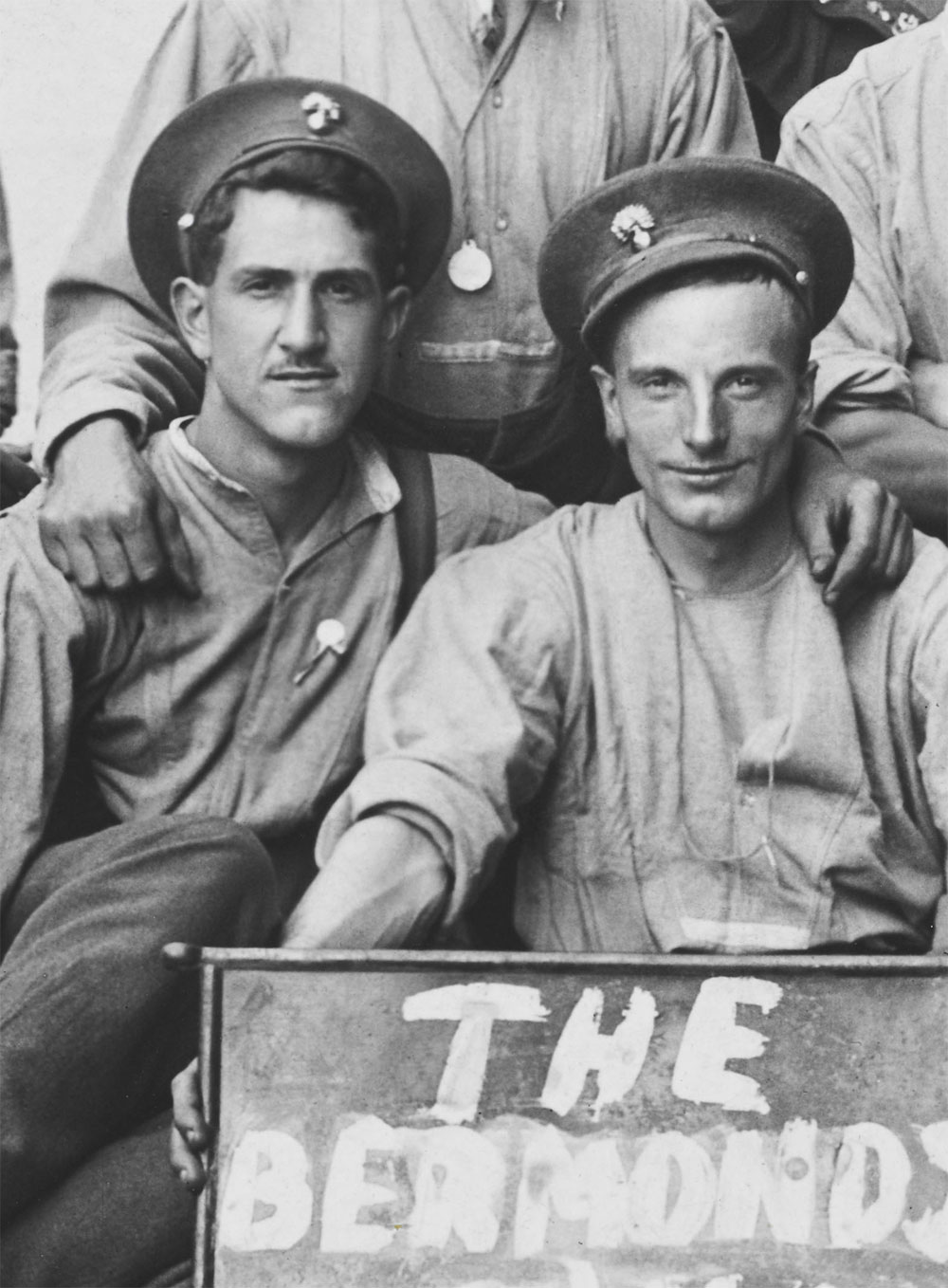
Christina Bloom (British, 1862-1939) 'The 'Bermondsey B'hoys' from the 2nd Grenadier Guards' c. 1914-1915


Christina Bloom (British, 1862-1939)
The ‘Bermondsey B’hoys’ from the 2nd Grenadier Guards appear at ease for this informal photograph taken inside their base at Wellington Barracks sometime during 1914 or 1915
c. 1914-1915
Christina Broom/Museum of London


Christina Bloom (British, 1862-1939) 'The 'Bermondsey B'hoys' from the 2nd Grenadier Guards' c. 1914-1915 (detail)


Christina Bloom (British, 1862-1939)
The ‘Bermondsey B’hoys’ from the 2nd Grenadier Guards appear at ease for this informal photograph taken inside their base at Wellington Barracks sometime during 1914 or 1915 (detail)
c. 1914-1915
Christina Broom/Museum of London


Today, the Museum of London announces a major new acquisition – the remaining photography collections of Christina Broom – the UK’s first female press photographer. The collection includes wartime photo of Rudyard Kipling’s son, Jack, who tragically died in the Battle of Loos, 1915.

Aged 40, Broom taught herself photography to create and sell photographic postcards – a trade which was thriving. At work between 1903 and 1939, she gained exclusive access to leading London events from suffragette processions to King George V’s coronation and became photographer to the Household Brigade, forging a unique relationship with the Guards.

Museum of London’s Curator of Photographs, Anna Sparham, said: “At over 2,500 photographs strong, this acquisition sees the museum add to its already significant collection of suffragette images by Christina Broom, with scenes documenting key moments of early 20th century London life. It also brings to light Broom’s diverse photographic oeuvre, traversing subjects such as royal celebration and occasion, the Oxford and Cambridge Boat Races, women’s work and predominantly London’s military activities before, during and in the aftermath of war. Whilst Broom’s images exude strength and relevance on their own, for me, it is the photographer’s own fascinating story of determination and entrepreneurialism that makes them truly come alive.”

The collection also includes a snapshot of Jungle Book writer, Rudyard Kipling’s son Jack, taken by Broom in 1915. Jack tragically died in the Battle of Loos later that year.

From Friday 4 April, highlights from this remarkable collection will be on show as part of a new, free display – Christina Broom. In this centenary year of the outbreak of the First World War, the display focuses on Broom’s portrayal of London’s military life. On show is a small, yet poignant selection of stills depicting soldiers in London mobilising for war and leaving for the Western Front. A major exhibition focused on Broom’s life and photography will follow in the near future.”

Press release from the Museum of London


Christina Bloom (British, 1862-1939) 'Captain Greer of the 1st Irish Guards and his machine gun team' Nd


Christina Bloom (British, 1862-1939)
Captain Greer of the 1st Irish Guards and his machine gun team group together for this rather formal photograph, just prior to leaving for the war. They were all killed in battle soon afterwards
Nd
Christina Broom/Museum of London


Eric Beresford Greer was the son of Sir Joseph Henry Greer and Olivia Mary Beresford of Grange, Moy. He was born in April 1892 at the Curragh, Co. Kildare. He was raised by his Grandmother Agnes Isabella Greer in Moy, County Tyrone. He was educated at Eton College from 1906-1910 and joined the Irish Guards in 1911. Eric B Greer married Pamela Fitzgerald around 13 Feb 1917. Lieutenant Colonel Eric Beresford Greer was commanding the 2nd Battalion of the Irish Guards when he was killed in action on 31 July 1917. Lieutenant Colonel Eric Beresford Greer was awarded the Military Cross.

His death near the village of Boezinghe on 31st July 1917 is recorded in Rudyard Kipling’s ‘The Irish Guards in the Great War’.

He had been in every battle in which the Guards were engaged since the opening of the war, including the fighting at Cuinchy, when Michael O’Leary performed the valorous deeds which won him, on the recommendation of Colonel Greer, the Victoria Cross. Enthusiastic in everything he took up, he interested himself much in athletics, and was the quarter mile champion of the army, and winner of the Irish Guards Cup each year from the time that he joined the regiment. While at Eton he also distinguished himself at the different sporting fixtures. He was awarded the Military Cross for conspicuous gallantry and devotion to duty in the field and was also mentioned in dispatches. His younger brother, Lieutenant Francis St Leger Greer, M.C., fell in action in February last, having previously been decorated for conspicuous gallant in action. The late Colonel Greer was married a few months ago to the younger daughter of the Honourable Eustace and Mrs Fitzgerald of 2 Manson Place, Queens Gate, London S.W.


Christina Bloom (British, 1862-1939) 'Captain Greer of the 1st Irish Guards and his machine gun team group together for this rather formal photograph, just prior to leaving for the war' Nd (detail)


Christina Bloom (British, 1862-1939)
Captain Greer of the 1st Irish Guards and his machine gun team group together for this rather formal photograph, just prior to leaving for the war (detail)
Nd
Christina Broom/Museum of London


Christina Bloom (British, 1862-1939) 'Soldiers from the Household Battalion leaving for the Front' 1916


Christina Bloom (British, 1862-1939)
Soldiers from the Household Battalion leaving for the Front bid farewell to their families from a platform at Waterloo Station in 1916. Broom made several similar photographs. For many relatives, they served as final mementos
1916
Christina Broom/Museum of London


Christina Bloom (British, 1862-1939) 'King George V and Queen Mary host a tea party for wounded soldiers and sailors' 1916


Christina Bloom (British, 1862-1939)
King George V and Queen Mary host a tea party for wounded soldiers and sailors at the Royal Mews in March 1916. The wounded, including many from British colonies, were brought to Buckingham Palace from nine London hospitals
1916
Christina Broom/Museum of London


Christina Broom. 'Jack Kipling'

Christina Broom. 'Jack Kipling'


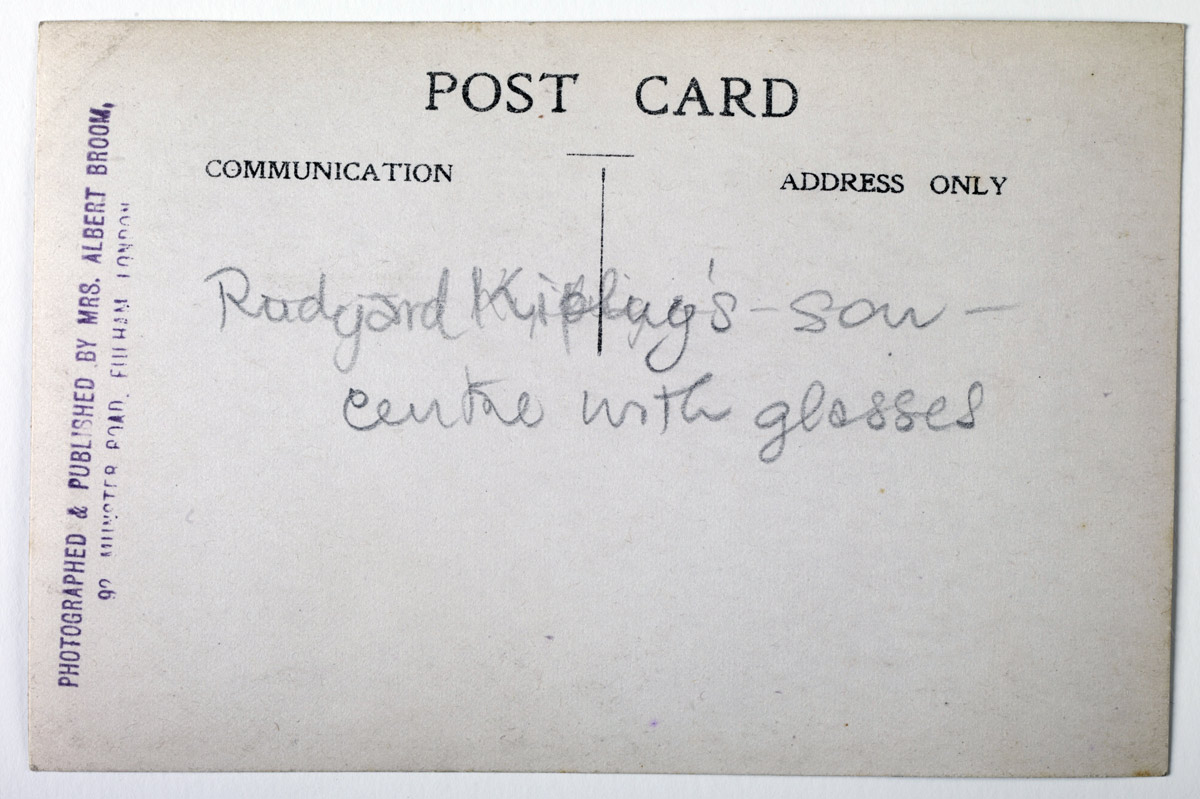
Jack Kipling suffered from incredibly poor eye-sight, and had to wear very thick glasses to be able to see anything at all. When the First World War broke out in August 1914, Jack (then only aged 17) was desperate to join up. When he tried to volunteer, he was turned down because of his poor vision. He turned to his father for help. Rudyard Kipling pulled strings amongst his military friends and Jack was enlisted as a trainee officer, still under age. (Officers were supposed to be at least 18 years old, in order legally to join up). Tragically, Jack was killed in the Battle of Loos in 1915 at the age of 18. Kipling felt the loss of his son keenly, harbouring a tremendous amount of guilt for the part he played in Jack’s journey to the Western Front.

On the back of the photographic postcard, the words “Rudyard Kipling’s son – centre with glasses” are written in pencil.

Christina Broom/Museum of London


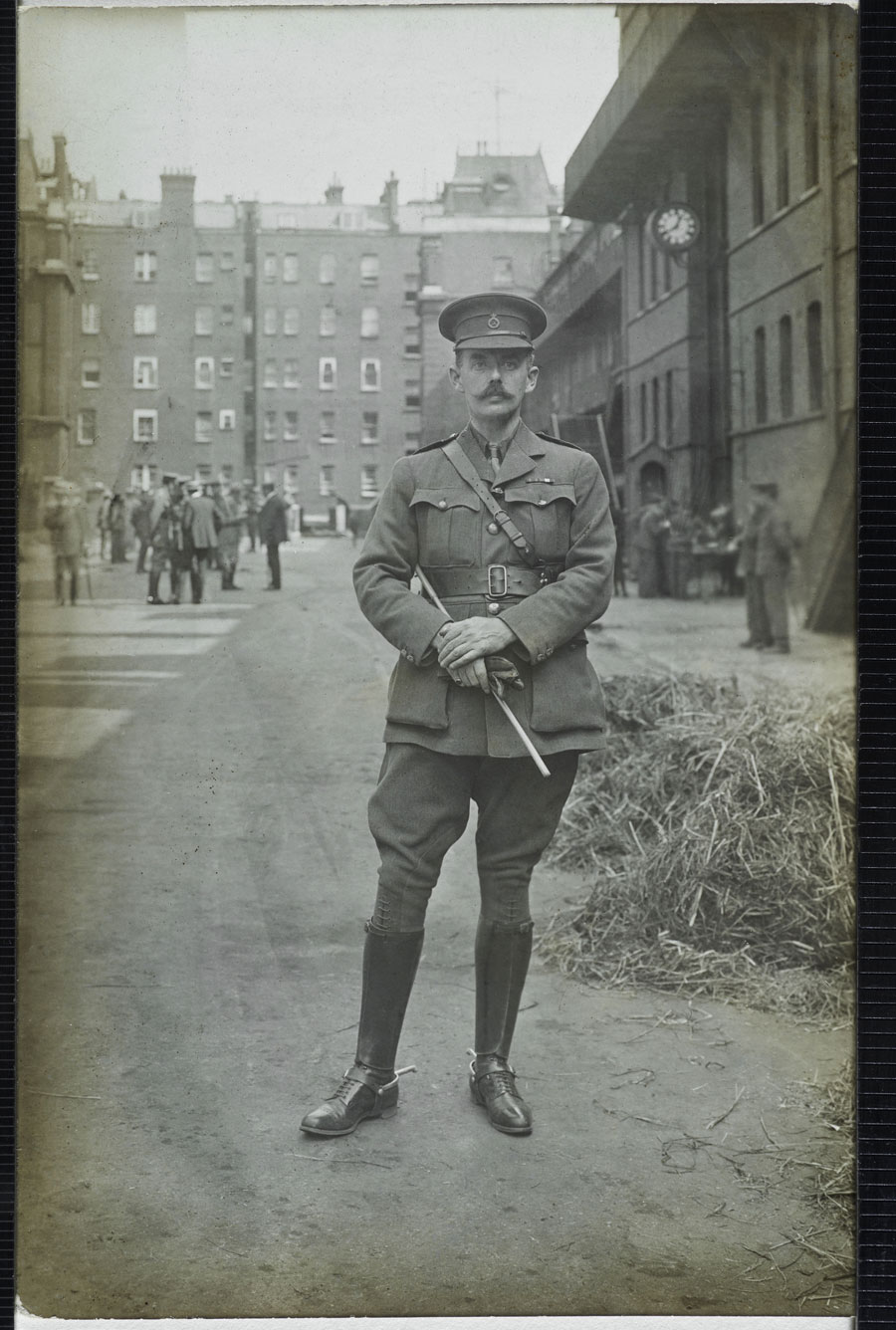
Christina Bloom (British, 1862-1939) 'A lieutenant from the 1st Life Guards poses for the camera in August 1914'


Christina Bloom (British, 1862-1939)
A lieutenant from the 1st Life Guards poses for the camera in August 1914. He was later recorded as missing presumed killed during the War. Christina Broom’s stall can be seen in the distance just beneath the clock
1914
Christina Broom/Museum of London


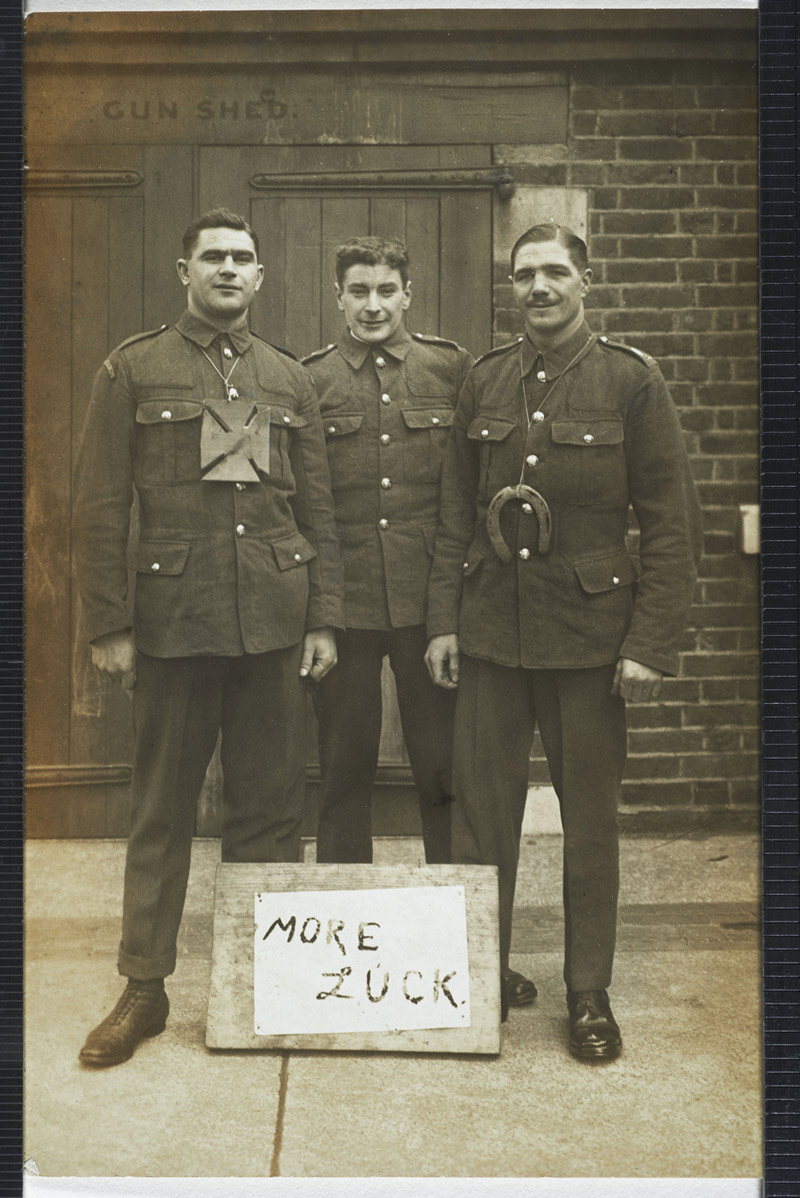
Christina Bloom (British, 1862-1939) 'A trio of soldiers' Nd


Christina Bloom (British, 1862-1939)
A trio of soldiers, including an Irish Guard on the left and a Scots Guard on the right, stand together with their hopeful message
Nd
Christina Broom/Museum of London


Anonymous photographer. 'Portrait of photographer, Christina Broom' Nd


Anonymous photographer
Portrait of photographer, Christina Broom
Nd
Christina Broom/Museum of London


Museum of London
150 London Wall
London EC2Y 5HN

Opening hours:
Daily 10am – 5pm

Museum of London website

LIKE ART BLART ON FACEBOOK

Back to top

Exhibition: ‘The Sievers Project’ at the Centre for Contemporary Photography (CCP), Fitzroy, Melbourne

Exhibition dates: 13th June – 31st August 2014

Artists: Jane Brown, Cameron Clarke, Zoë Croggon, Therese Keogh, Phuong Ngo, Meredith Turnbull, Wolfgang Sievers

Curators: Naomi Cass and Kyla McFarlane


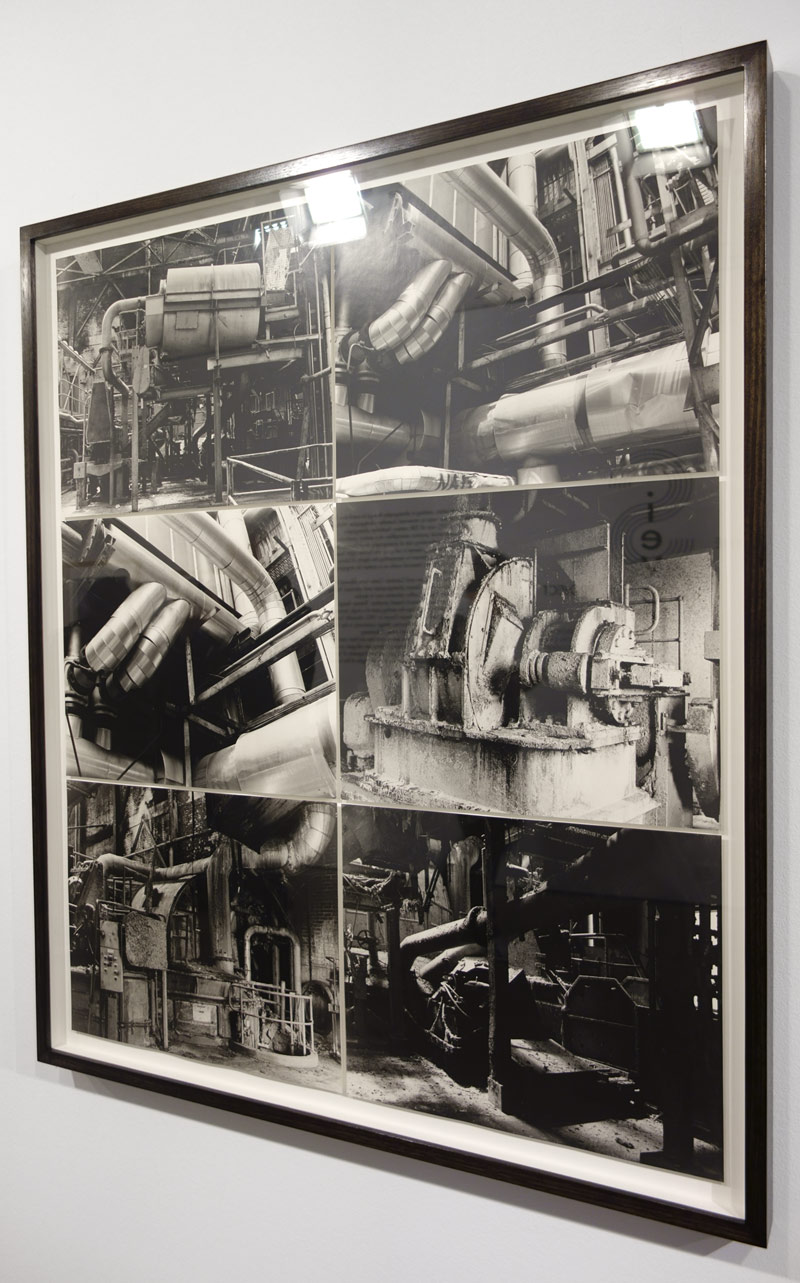
Jane Brown (Australian, b. 1967) 'Triptych. The Paper Mill (former Amcor and APM site), Fairfield' 2014 (installation view)


Jane Brown (Australian, b. 1967)
Triptych. The Paper Mill (former Amcor and APM site), Fairfield
2014
3 panels of 9, 6 and 6 selenium toned, fibre-based, gelatin silver prints


Curated by CCP Director Naomi Cass and Kyla McFarlane, this intelligent exhibition features the work of six early career artists who respond in diverse ways to renowned Australian photographer Wolfgang Sievers (1913-2007). It was a joy to see again the large vintage silver gelatin, almost clinically composed photographs by Sievers. The light, tonality and stillness of the images make them seem mythic, modern and monumental.

Each artist offers a unique “take” on Sievers influence on Australian photography and design, including his interest in refugees and human rights issues and the representation of the dignity of labour (although the machine is more often represented in Sievers work with a distinct lack of human presence and the act of work itself).

My personal favourites were Phuong Ngo’s intimate silver gelatin photographs in four groups of sweat shop workers in Vietnam, people on boats coming to Australia, photographs of textile workers in Australia and photographs of his mother. Phuong Ngo’s shared stories of young Vietnamese refugees and the journeys taken by their mothers told through photographs is very moving, but only after you are told what the four bodies of images are about. Positioned in the small Gallery Four it was also difficult to associate this installation with the rest of the exhibition. Initially I thought it was a separate exhibition until the linkages were told, the light dawned, and the connections were made.

While Cameron Clarke’s photographs of Ford factory workers and machinery are meticulously lit and digitally observed, producing a strong body of work, it is Jane Brown’s gridded analogue triptych which steals the show (see photographs above and below). These are superbly rich and textured photographs, beautifully seen and resolved within the shifting mise-en-scène. Brown’s images kinetically flow from one image to another even as they are self contained within a modernist grid. In some instances the artist has used the same photograph within the triptych but cropped in a different manner, which pushes and pulls the viewer into a different perspective on the subject matter. This is highly intelligent art making that observes the self contained nature and monumentality of Sievers work and reworks it, lucidly commenting on the dis/integration of these spaces and industries in the present day.

This series of work is the best sequence of photographs I have seen this year and any institution worthy of their salt should snap up these works for their collection.

Dr Marcus Bunyan


Many thankx to the Director Naomi Cass and the CCP for allowing me to publish the text and photographs in the posting. Please click on the photographs for a larger version of the image. All installation photographs © Marcus Bunyan 2014


Installation photographs of Jane Brown's 'Triptych. The Paper Mill (former Amcor and APM site), Fairfield' 2014 (installation view details) at the exhibition 'The Sievers Project' at the Centre for Contemporary Photography (CCP)

Installation photographs of Jane Brown's 'Triptych. The Paper Mill (former Amcor and APM site), Fairfield' 2014 (installation view details) at the exhibition 'The Sievers Project' at the Centre for Contemporary Photography (CCP)

Installation photographs of Jane Brown's 'Triptych. The Paper Mill (former Amcor and APM site), Fairfield' 2014 (installation view details) at the exhibition 'The Sievers Project' at the Centre for Contemporary Photography (CCP)

Installation photographs of Jane Brown's 'Triptych. The Paper Mill (former Amcor and APM site), Fairfield' 2014 (installation view details) at the exhibition 'The Sievers Project' at the Centre for Contemporary Photography (CCP)


Installation photographs of Jane Brown Triptych. The Paper Mill (former Amcor and APM site), Fairfield 2014 (details) at the exhibition The Sievers Project at the Centre for Contemporary Photography (CCP)


Jane Brown (Australian, b. 1967) 'Staircase. The Paper Mill (former Amcor and APM site), Fairfield, 2014' 2014


Jane Brown (Australian, b. 1967)
Staircase. The Paper Mill (former Amcor and APM site), Fairfield, 2014
2014
Fibre-based, gelatin silver print


Jane Brown (Australian, b. 1967) 'Mining machinery, Line of Lode Miners Memorial Complex, Broken Hill 2014-06-10' 2014


Jane Brown (Australian, b. 1967)
Mining machinery, Line of Lode Miners Memorial Complex, Broken Hill 2014-06-10
2014
Brown toned, fibre-based, gelatin silver print
Courtesy the artist


Installation photograph of Jane Brown's work at the exhibition 'The Sievers Project' at the Centre for Contemporary Photography (CCP)


Installation photograph of Jane Brown’s work at the exhibition The Sievers Project at the Centre for Contemporary Photography (CCP)


Wolfgang Sievers (Australian born Germany, 1913-2007) 'Gears for the Mining Industry, Vickers Ruwolt, Burnley, Victoria, 1967' 1967


Wolfgang Sievers (Australian born Germany, 1913-2007)
Gears for the Mining Industry, Vickers Ruwolt, Burnley, Victoria, 1967
1967
Gelatin silver photograph
49.6 x 39.3cm
National Library of Australia, Wolfgang Sievers Photographic Archive


Wolfgang Sievers (Australian born Germany, 1913-2007) 'Sulphuric Acid Plant Electrolytic Zinc, Risoon, Tasmania, 1959' 1959


Wolfgang Sievers (Australian born Germany, 1913-2007)
Sulphuric Acid Plant Electrolytic Zinc, Risoon, Tasmania, 1959
1959
Gelatin silver photograph


Installation photograph of the work of Meredith Turnbull (foreground) and Zoë Croggon (rear wall) at the exhibition The Sievers Project at the Centre for Contemporary Photography (CCP)


Installation photograph of the work of Meredith Turnbull (foreground) and Zoë Croggon (rear wall) at the exhibition The Sievers Project at the Centre for Contemporary Photography (CCP)


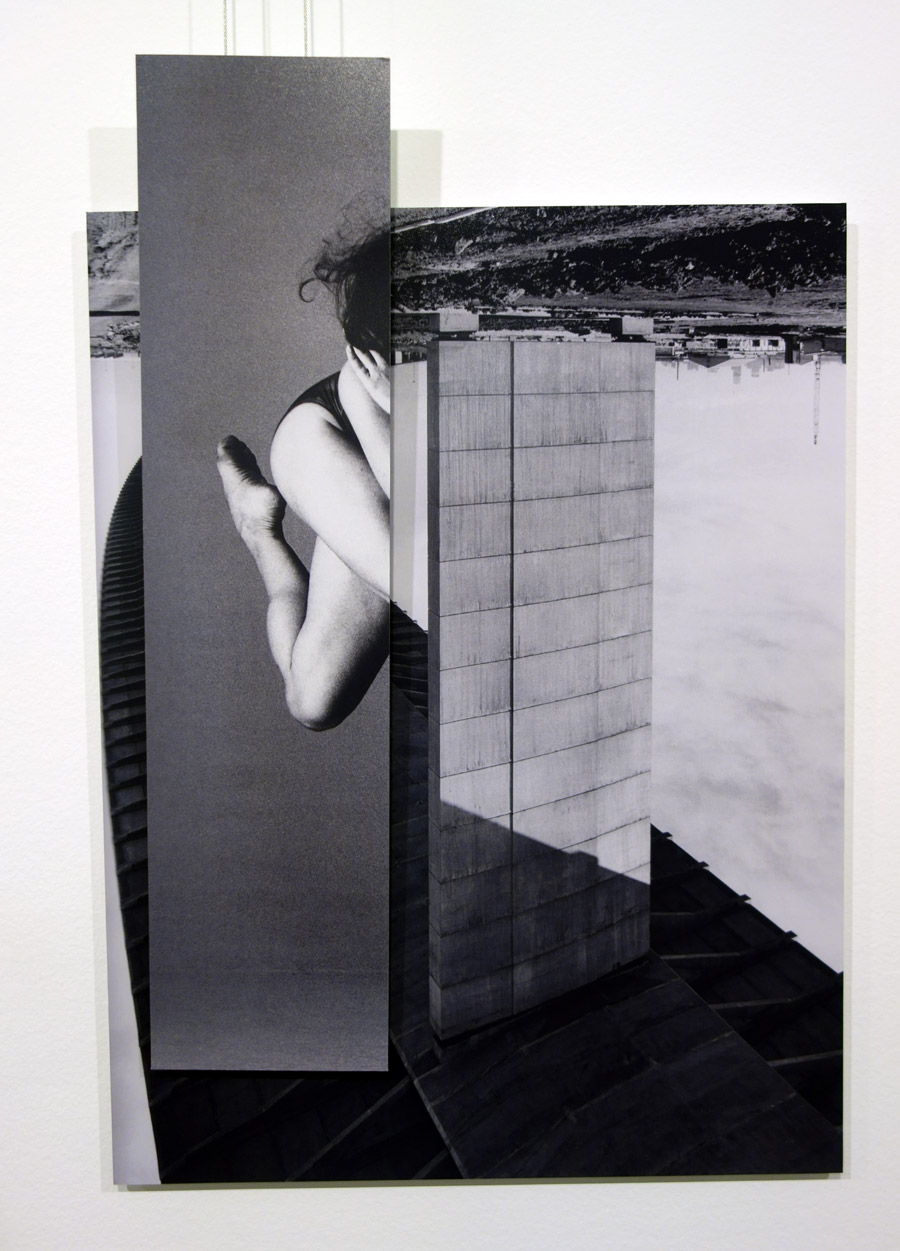
Zoë Croggon (Australian, b. 1989) 'John Holland Constructions, Ginninderra Bridge (after Wolfgang Sievers)' 2014


Zoë Croggon (Australian, b. 1989)
John Holland Constructions, Ginninderra Bridge (after Wolfgang Sievers)
2014
Photocollage
70 cm x 86cm
Courtesy the artist and Daine Singer, Melbourne


Zoë Croggon (Australian, b. 1989) 'Comalco Aluminium Used in the Construction of the National Gallery of Victoria [7] (after Wolfgang Sievers)' 2014


Zoë Croggon (Australian, b. 1989)
Comalco Aluminium Used in the Construction of the National Gallery of Victoria [7] (after Wolfgang Sievers)
2014
Photocollage
Courtesy the artist and Daine Singer, Melbourne


Zoë Croggon (Australian, b. 1989) 'Comalco Aluminium Used in the Construction of the National Gallery of Victoria [18] (after Wolfgang Sievers)' 2014


Zoë Croggon (Australian, b. 1989)
Comalco Aluminium Used in the Construction of the National Gallery of Victoria [18] (after Wolfgang Sievers)
2014
Photocollage
Courtesy the artist and Daine Singer, Melbourne


Zoë Croggon (Australian, b. 1989) 'Westgate Bridge (after Wolfgang Sievers)' 2014


Zoë Croggon (Australian, b. 1989)
Westgate Bridge (after Wolfgang Sievers)
2014
Photocollage
Courtesy the artist and Daine Singer, Melbourne


“Six early career artists, working in photography through to installation, have responded in diverse ways to renowned Australian photographer Wolfgang Sievers (1913-2007), icon of 20th century Australian photography. Sievers’ commercial practice exemplifies mid-century positivism and modernity, and the myth-making role of photography. As a German Jewish immigrant, he had a strong interest in refugees and human rights issues as well as an expressed commitment to representing the dignity of labour. The Sievers Project presents key historical works as a context for engaging the past through the present.

Photographers Jane Brown and Cameron Clarke have followed in his footsteps to industrial clients Sievers photographed and valorised, finding sites that are visually dynamic within industries now in decline. Through her intrepid, research-based practice, Therese Keogh has developed a materially-rich work from the starting point of a single, anomalous photograph Sievers took at the Roman Forum in 1953. Meredith Turnbull draws on his connections with Melbourne’s design community in the 1950s and 60s, including Gerard Herbst and Frederick Romberg. In Sievers’ photographs of industrial sewing machines and their machinists, Phuong Ngo finds shared stories of young Vietnamese refugees and the journeys taken by their mothers. Zoë Croggon positions fragments of Sievers’ iconic architectural photographs against found photographs of the human body in movement.”

Text from the CCP website


Foreword to the catalogue

The Sievers Project follows a number of exhibitions over the last five years where CCP has opened up a vista on contemporary practice by exhibiting early work by living artists such as Bill Henson, Kohei Yoshiyuki and Robert Rooney, as well as historical photography, alongside contemporary work. As a commissioning exhibition we have titled this a ‘project’ to point towards the year-long research period integral to the exhibition, capturing the curatorial gesture of inviting early career artists to engage with the past.

The Sievers Project represents a significant curatorial endeavour for CCP, the tale of which is recounted in the Introduction. It would simply not have taken place were it not for the willingness and generosity of Julian Burnside AO QC to participate, through allowing the artists research access to his Wolfgang Sievers collection and lending work from it for the exhibition, as well as contributing an essay for this catalogue.

I acknowledge the artists for setting out on this project and for returning with thoughtful and excellent work. It has been a pleasure to both engage with and exhibit the work of Jane Brown, Cameron Clarke, Zoë Croggon, Therese Keogh, Phuong Ngo and Meredith Turnbull.

The Sievers Project has been dignified by contributions by a number of experts and I wish to acknowledge Professor Helen Ennis, Australian National University School of Art who has also contributed a catalogue essay; Madeleine Say, Picture Librarian, Eve Sainsbury, Exhibitions Curator and Clare Williamson, Senior Exhibitions Curator, State Library of Victoria; Maggie Finch, Curator of Photography, National Gallery of Victoria and Professor Harriet Edquist and Kaye Ashton, Senior Coordinator, RMIT Design Archives, who all took time to speak about Sievers and share his work with the artists.

Opportunities to commission artists are relatively rare and funding through the inaugural Early Career Artist Commissions Grant from the Australia Council has enabled the project. CCP is pleased to acknowledge this recognition and support. We are delighted that Lovell Chen Architects & Heritage Consultants have provided further critical support to realise the project, for which we are grateful. We see a germane link between Lovell Chen and the premise of The Sievers Project.

The Besen Family Foundation are champions for enabling CCP to produce catalogues for selected exhibitions. I acknowledge the Foundation for their long-standing and generous engagement with CCP. We thank the National Library of Australia for providing permission to reproduce Sievers’ work in this catalogue.

The Sievers Project has provided a welcome opportunity for CCP to engage with colleagues in the fi eld of architecture and we are delighted to acknowledge a partnership with the Robin Boyd Foundation to present public programs. We are grateful to Tony Lee from the Foundation for his interest in the project.

Without doubt CCP’s ability to both present contemporary art well and look after artists is greatly enhanced through the longstanding and generous support of Tint Design and Sofi tel Melbourne on Collins. CCP is pleased to present a parallel exhibition of The Sievers Project at the 2014 Melbourne Art Fair and we thank the Melbourne Art Foundation for enabling CCP to bring the exhibition to broad new audiences. For the Art Fair exhibition we are also indebted to Christine Downer, previous CCP Board member and current supporter, for the loan of a major Sievers work.

The Sievers Project has been ably assisted by Philippa Brumby, curatorial intern. Co-curator Dr Kyla McFarlane and I thank Philippa for her wide-ranging skills over a substantial period of time. Lastly, I acknowledge Kyla for her excellent curatorial work and for the pleasure of collaborating with such a playful, dedicated and steely intellect.

Naomi Cass, Director, CCP


And what about his Legacy?

A response to this necessarily combines elements of certitude and speculation. Sievers himself was totally committed to ensuring his legacy as a photographer. He spent years meticulously cataloguing and documenting his work and was assiduous in placing as much of it as he could in major photography collections around the country – art galleries and libraries. The bulk of his archive, a staggering 65,000 negatives and prints, was acquired by the National Library where it has been digitised and is available online to users in perpetuity. But there is another aspect to his preoccupation with legacy that has troubled me over the years – his desire to control the readings of his work, to ensure that he ‘owned’ the contextualisation and interpretation of it. As I see it, some of the framing narratives he constructed were retrospective and are misleading because they are not borne out by the evidence, that is, by the photographs themselves. This is especially apparent in his insistence that the relationship between ‘man and machine’ was central to his industrial photography. In my assessment of his enormous archive, images that extol this interaction are actually relatively few in number. They are outweighed by thousands and thousands of other industrial scenes in which the worker is locked into the dreary, repetitive tasks associated with mass production, or is not present at all having been displaced by machines that are far more efficient than humans will ever be. In other words, the bulk of Sievers’ own photographs contradict his central tenet of the dignity of labour in the modern machine era. The most important aspect of his legacy is undoubtedly his photographs and the astonishingly vast, high quality body of architectural and industrial work he produced between 1938 and the early 1970s. My view is that his black and white photography is the best although he did not agree with me, arguing that his colour photography, with its expressive and dramatic qualities, was equally fine. For me, it is his black and white images that are visionary, their precision, clarity and drama embodying the belief in progress that underpinned modernity. I would also suggest Sievers’ legacy isn’t confined to his photography. As a man he cared deeply about the world and wanted it to be better. He was closely involved in the restoration of Karl Friedrich Schinkel’s buildings in Berlin in the 1990s and in the re-evaluation of his own father’s reputation (Professor Johannes Sievers was an expert on Schinkel and had used his young son’s photographs in his books on the architect in the 1930s). Wolfgang donated his photographs to fund-raising campaigns for human rights and remained a passionate antiwar activist until his death.

What would he have thought about this project?

I suspect that he would have been thrilled to know that his contribution to Australian life and photography is the touchstone for the six photographers involved in the project and that his work continues to be appreciated.

Professor Helen Ennis is Director of the Centre for Art History and Art Theory at ANU School of Art, Canberra.


Installation photographs of the exhibition 'The Sievers Project' at the Centre for Contemporary Photography (CCP)

Installation photographs of the exhibition 'The Sievers Project' at the Centre for Contemporary Photography (CCP)

Installation photographs of the exhibition 'The Sievers Project' at the Centre for Contemporary Photography (CCP)

Installation photographs of the exhibition 'The Sievers Project' at the Centre for Contemporary Photography (CCP)

Installation photographs of the exhibition 'The Sievers Project' at the Centre for Contemporary Photography (CCP)


Installation photographs of the exhibition The Sievers Project at the Centre for Contemporary Photography (CCP)


Installation photograph of the work of Therese Keogh (detail) in the exhibition 'The Sievers Project' at the Centre for Contemporary Photography (CCP)


Installation photograph of the work of Therese Keogh (detail) in the exhibition The Sievers Project at the Centre for Contemporary Photography (CCP)


Installation photograph of the work of Meredith Turnbull (detail) in the exhibition 'The Sievers Project' at the Centre for Contemporary Photography (CCP)


Installation photograph of the work of Meredith Turnbull (detail) in the exhibition The Sievers Project at the Centre for Contemporary Photography (CCP)


Therese Keogh. 'In the Forum Romanum (after Sievers)' 2013 (installation view)


Therese Keogh
In the Forum Romanum (after Sievers) (installation view)
2013
Graphite on paper
Courtesy the artist


Cameron Clarke. 'Loui Nedeski, Ford Motor Company, Geelong' 2014


Cameron Clarke
Loui Nedeski, Ford Motor Company, Geelong
2014
Archival inkjet print
50 x 63 cm
Courtesy the artist


Cameron Clarke. 'Küsters Washer, Bruck Textiles, Wangaratta' 2014


Cameron Clarke
Küsters Washer, Bruck Textiles, Wangaratta (detail)
2014
Archival inkjet print


Cameron Clarke. 'Theis Dye Jets, Bruck Textiles, Wangaratta' 2014


Cameron Clarke
Theis Dye Jets, Bruck Textiles, Wangaratta (detail)
2014
Archival inkjet print


Phuong Ngo (Australian, b. 1983) 'Untitled' 2014


Phuong Ngo (Australian, b. 1983)
Untitled
2014
from the Mother Vietnam series
Inkjet print
Courtesy the artist


Centre for Contemporary Photography

No permanent exhibition space at the moment

Centre for Contemporary Photography website

LIKE ART BLART ON FACEBOOK

Back to top

Exhibition: ‘Emmet Gowin’ at the Fondation Henri Cartier-Bresson, Paris

Exhibition dates: 14th May – 27th July 2014


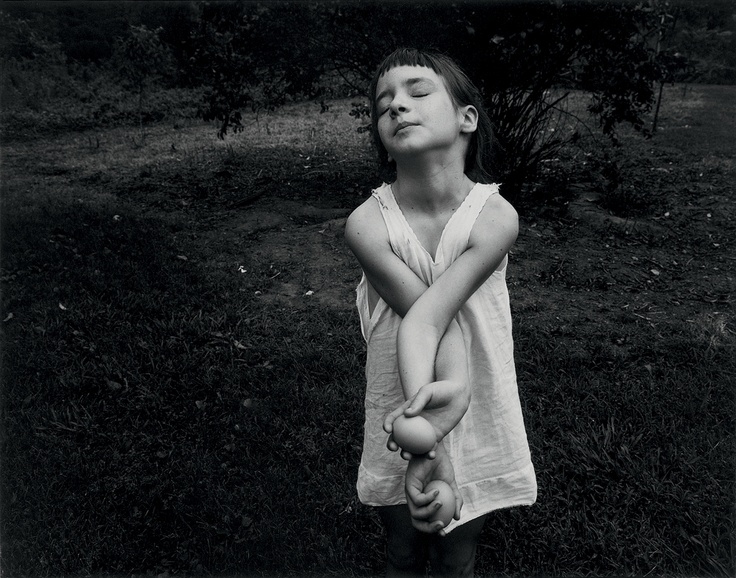
Emmet Gowin (American, b. 1941) 'Nancy, Danville (Virginia)' 1969


Emmet Gowin (American, b. 1941)
Nancy, Danville (Virginia)
1969
Gelatin silver print
© Emmet Gowin, cortesy Pace/MacGill Gallery, New York


Emmet Gowin is a superlative photographic artist. His images possess a unique sensuality that no other artist, save Frederick Sommer, dare approach.

His own family was an early significant subject matter, one to which only he had ready access. “I was wondering about in the world looking for an interesting place to be, when I realised that where I was was already interesting.”1 I feel that the photographs of his family are his strongest work for they image an intimate story, and Gowin is nothing if not a magnificent storyteller. Look at the beauty of images such as Nancy, Danville (Virginia) (1969, above) or Ruth, Danville (Virginia) (1968, below) and understand what awareness it takes – first to visualise, then capture on the negative, then print these almost mystical moments of time.

As Gowin observed in his senior thesis, which was predicated upon the necessary co-ingredients of art and spirituality, “Art is the presence of something mysterious that transports you to a place where life takes on a clearness that it ordinarily lacks, a transparency, a vividness, a completeness.”2 He complemented this understanding of art and spirituality with an interest in science. He was in harmony with the physicists and the scientists, finding them to be the most poetic people of the age.3 Inspired by Sommer, Gowin perfected his printing technique through a respect for the medium, respect for the materials and conviction as to what the materials were capable of doing.4

“Sommer freely shared with Gowin his knowledge of photographic equipment, materials, chemicals and printing techniques and Gowin often repeats Sommer’s admonition to him: “Don’t let anyone talk you out of physical splendour.” Over the years Gowin developed methods of printing born from patient experimentation and a love of craft. His background in painting and drawing taught him that there are many solution to making a finished work of art… which he often builds to achieve the most satisfying integration of elements: “The mystery of a beautiful photograph really is revealed when nothing is obscured. We recognise that nothing has been withheld from us, so that we must complete its meaning. We are returned, it seems directly, to the sense and smell of its origin… A complete print is simply a fixed set of relationships, which accommodates its parts as well as our feelings. Clusters of stars in the sky are formed by us into constellations. Perhaps I feel that this constellation has enough stars, and doesn’t need any more. This grouping is complete. It feels right. Feeling, alone, tells us when a print is complete.””5

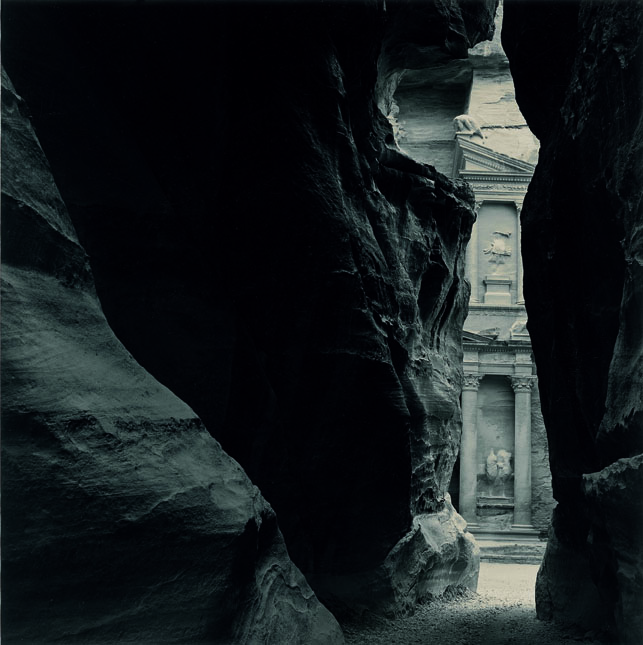
His later more universal work, such as the landscapes and aerial photographs, are no less emphatic than the earlier personal work but they are a second string to the main bow. The initial impetus of this work can be seen in the book Emmet Gowin Photographs as a development from still life photographs such as Geography Pages, 1974 (p. 62). This second theme took Gowin longer to develop but his photographs are no less powerful for it. His photographs of Petra possess the most amazing serenity of any taken at this famous site; his photographs of Mount St Helens after the volcanic eruption and the aerial photographs of nuclear sites and aeration ponds are among the strongest aerial photographs that I have ever seen. Gowin’s experimentation with the development of the negative, using different times and developers; his experimentation with the development of the print, sometimes using multiple developers and monotones or strong / subtle split toning (as can be seen in the photographs below) is outstanding. His poetic ability rouses the senses and is munificent but for me these photographs do not possess the “personality” or significance of his earlier family photographs. But only just, and we are talking fractions here!

“These photographs of the tracings of human beings reveal mankind not as a nurturer but as a blind and godlike power. Even his latest aerial agricultural landscapes made on route to nuclear sites have a magnificent indifference to human scale. For Gowin, confrontation of man’s part in the creation of ecological problems would seem to require the most transcendental point of view, and as his subjects have become more difficult and frightening, he has created his lushest and most seductive prints.”6

Gowin is an artist centred in a space of sensibility. An understanding of the interrelationships between people and the earth is evidenced through aware and clearly seen images. Gowin digs down into the essence of the earth in order to understand our habituation of it. How we fail to change the course we are on even as we recognise what it is that we are doing to the world. When the stimulus is constantly repeated there is a reduction of psychological or behavioural response and this is what Gowin pokes a big stick at. As he observes,

“We are products of nature. We are nature’s consciousness and awareness, the custodians of this planet… We begin as the intimate person that clings to our mother’s breast, and our conception of the world is that interrelationship. Out safety depends on that mother. And now I’m beginning to see that there’s a mother larger than the human mother and it’s the earth; if we don’t take care of that we will have lost everything.”7

I was luck enough to meet Emmet Gowin when he visited Australia in 1995. He had an exhibition in the small gallery in Building 2 in Bowens Lane at RMIT University, presented a public lecture and held a workshop with about 20 students. I remember I was bowled over by his intensity and star power and I admit, I asked a stupid question. The impetuousness of youth with stars in their eyes certainly got the better of me. Now when I look at the work again I am still in awe of the works sincerity, spirituality, sensuality and respect for subject matter. No matter what he is photographing.

Dr Marcus Bunyan


1/ Gowin, Emmet quoted in Chahroudi, Martha. “Introduction,” in Emmet Gowin Photographs. Philadelphia Museum of Art, 1990, p. 10.
2/ Ibid., p. 9.
3/ Ibid., p. 11.
4/ Ibid., p. 11.
5/ Gowin quoted in Kelly, Jain (ed.,). Darkroom 2. New York, 1978, p. 43 quoted in Chahroudi, Martha. “Introduction,” in Emmet Gowin Photographs. Philadelphia Museum of Art, 1990, p. 11.
6/ Chahroudi, Op. cit., p. 15.
7/ Ibid., p. 15.

Only two of the images are from the Fondation Henri Cartier-Bresson – the rest I sourced from the internet. Please click on the photographs for a larger version of the image.


“For me, pictures provide a means of holding, intensely, a moment of communication between one human and another.”

“There is a profound silence that whines in the ear, a breathless quiet, as if the light or something unheard was breathing. I hold my breath to make certain it’s not me. It must be the earth itself breathing.


Emmet Gowin


Emmet Gowin (American, b. 1941) 'Edith and Ruth, Danville (Virginia)' 1966


Emmet Gowin (American, b. 1941)
Edith and Ruth, Danville (Virginia)
1966
Gelatin silver print
© Emmet Gowin, cortesy Pace/MacGill Gallery, New York


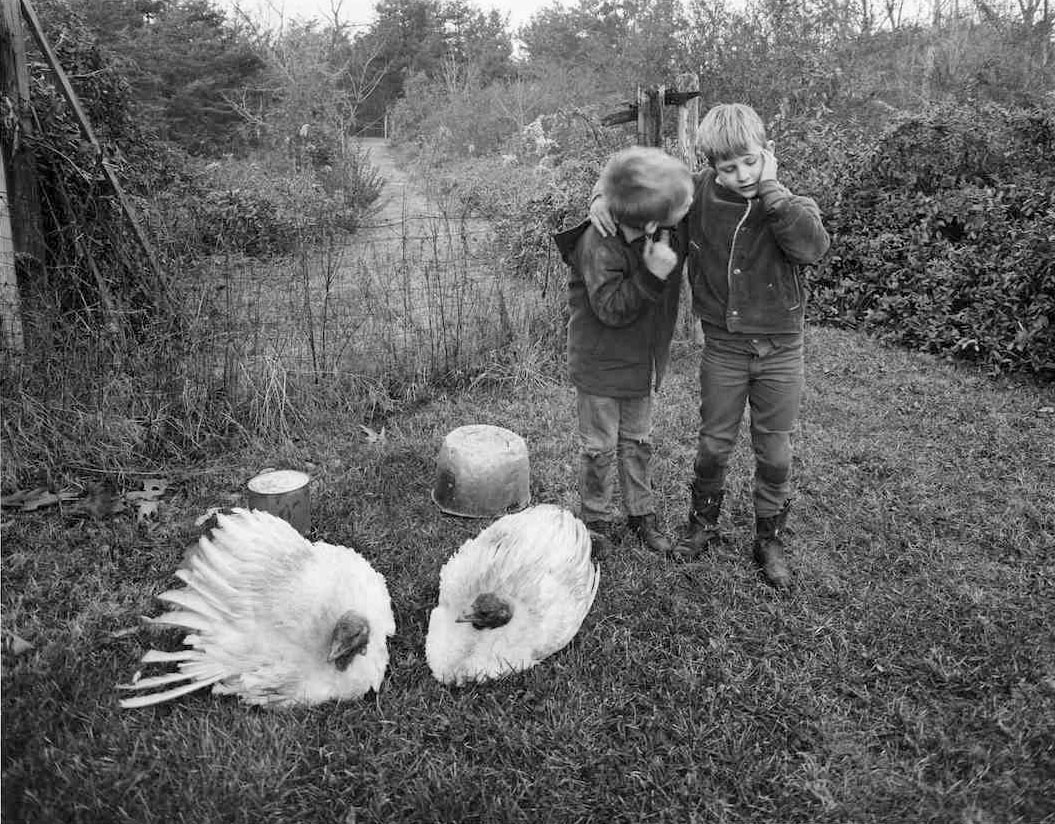
Emmet Gowin (American, b. 1941) 'Barry, Dwayne and Turkeys, Danville, Virginia' 1970


Emmet Gowin (American, b. 1941)
Barry, Dwayne and Turkeys, Danville, Virginia 
1970
Gelatin silver print
© Emmet Gowin, cortesy Pace/MacGill Gallery, New York


Emmet Gowin, the catalog accompanying a retrospective now touring in Spain, is a great introduction to the artist’s works and a great keepsake for a fan. The writings by Keith Davis, Carlos Gollonet and Gowin himself identify the photographer’s humanist and spiritual roots and detail his journey from 1960’s-era people pictures focused on his wife, Edith and family in Danville, VA, to aerial photographs of ravaged landscapes, like the nuclear test grounds in Nevada, and his most recent project  archiving tropical, nocturnal-moths.

While his disparate bodies of work may look like geologic shifts in subject matter, Gowin talks in the book about the spiritual quest he’s on, and his realisation that humankind inhabits the land, and that the land is a vital part of who we are. To my eye, what holds all the works together is Gowin’s never-ceasing focus on non-conventional beauty. His way of photographing both people and the wasted landscapes plays up the dark sublime. These are not traditional pretty pictures, but they are exquisitely beautiful. All Gowin photos smoulder with emotion and feel like they were snapped with a breath held, bated with desire.

Roberta Fallon. “Emmett Gowin – From family of man to mariposas nocturnas at Swarthmore’s List Gallery,” on The Artblog website, March 22, 2012 [Online] Cited 05/07/2014


Emmet Gowin (American, b. 1941) 'Edith, Noël, Danville (Virginia)' 1971


Emmet Gowin (American, b. 1941)
Edith, Noël, Danville (Virginia)
1971
Gelatin silver print
© Emmet Gowin, Courtesy Pace/MacGill Gallery, New York


Emmet Gowin (American, b. 1941) 'Edith, Danville (Virginia)' 1971


Emmet Gowin (American, b. 1941)
Edith, Danville (Virginia)
1971
Gelatin silver print
7 3/4 x 9 7/8″ (19.7 x 25.1cm)
Gift of Judith Joy Ross
© Emmet Gowin, Courtesy Pace/MacGill Gallery, New York


Emmet Gowin (American, b. 1941) 'Edith, Danville (Virginia)' 1970


Emmet Gowin (American, b. 1941)
Edith, Danville (Virginia)
1970
Gelatin silver print
© Emmet Gowin, Courtesy Pace/MacGill Gallery, New York


Emmet Gowin (American, b. 1941) 'Edith, Newtown (Pennsylvania)' 1974


Emmet Gowin (American, b. 1941)
Edith, Newtown (Pennsylvania)
1974
Gelatin silver print
© Emmet Gowin, cortesy Pace/MacGill Gallery, New York


Emmet Gowin (American, b. 1941) 'Ruth, Danville (Virginia)' 1968


Emmet Gowin (American, b. 1941)
Ruth, Danville (Virginia)
1968
Gelatin silver print
© Emmet Gowin, cortesy Pace/MacGill Gallery, New York


Emmet Gowin (American, b. 1941) 'Edith, Chincoteague Island (Virginia)' 1967


Emmet Gowin (American, b. 1941)
Edith, Chincoteague Island (Virginia)
1967
Gelatin silver print
© Emmet Gowin, Courtesy Pace/MacGill Gallery, New York


From May 14th to July 27th 2014, Fondation Henri Cartier-Bresson will hold an exhibition of the American photographer Emmet Gowin. This important retrospective is showing 130 prints of one of the most original and influential photographer of these last forty years. This exhibition shows on two floors his entire career: his most famous series from the end of the sixties, the moths’ flights and the aerial photographs. The exhibition organised by Fundación MAPFRE in collaboration with Fondation HCB is accompanied by a catalogue published by Xavier Barral edition.

Born in Danville (Virginia) in 1941, Emmet Gowin grows up in Chincoteague Island, in a religious family. His father, a Methodist minister gives him a righteous discipline and a strict education, while his mother, musician, was a gentle, nurturing presence. During his spare time, Emmet encounters the surrounding landscape and begins drawing.

He completes his high school education and enrols in a local business school in 1951 and works at the same time at the design department of Sears, the multinational department store chain. In 1961, Gowin enters in the Commercial Art Department at Richmond Professional Institute, where he studies drawing, painting, graphic design, and history of Art. After a few months, he realises that photography is the best mean of expression and gives him the possibility to seize the Fate and the Unexpected.

Gowin’s early photographic influences came in the form of books and catalogues such as Images à la Sauvette by Henri Cartier-Bresson, History of Photography by Beaumont Newhall or Walker Evans’s American Photographs. Emmet Gowin acquires his first Leica 35mm in 1962 and after two years spent observing the Masters of photography, he finally feels ready to affirm his own photographic style. In 1963, he goes for the first time in New York and meets Robert Franck who encouraged him.

The first Gowin’s portfolios realised in 1965, is technically simple in approach. While the subjects vary considerably, all are drawn from everyday life: kids playing outdoors, Edith’s family, adults in the streets or squares, cars and early pictures of Edith. They get married in 1964. Edith Morris and Emmet Gowin are born in the same city but they grew up in totally different families. Edith’s one, was more exuberant and emotionally close than Emmet’s. As we can discover in the first floor of the exhibition, Edith and her family are the heart of the photograph’s creative universe. As mentioned by Carlos Gollonet, curator of the exhibition, Gowin’s work, seen cumulatively, is a portrait of the artist.

In 1965, they move to Providence, and Emmet begins his studies with Harry Callahan at Rhode Island School of Design. He begins to consistently use a 4 x 5 inch view camera from this time on. This bigger negative produced prints with beautiful transparent details and correspondingly finer and smoother tonal scale.

Just before his first son’s birth, Elijah, in 1967, Emmet and Edith moved to Ohio, where he begins teaching at the Dayton Art Institute. This marks the start of a teaching career that spans more than four decades. He concentrates his work on Edith and let us going through his private life and proposes a very personal artistic vision of this work: I do not feel that I can make picture impersonally, but that I am affected by and involved with the situations which lead to, or beyond, the making of the pictures. In these years, he met Ralph Eugene Meatyard and Frederik Sommer, who would become his close friend and mentor.

At the end of the 1960’s, Gowin begins making circular images of Edith, her family, and their own household, both indoors and out. The Gowin’s second son, Isaac, born in 1974, was the subject – both before and after birth – of many of these circular 8×10 inch photographs, which give the impression of looking through a keyhole. At the beginning of the 1970’s, the exhibitions at the Light Gallery and MoMA mark a significant step toward his American success. In 1973, he’s appointed Lecturer at Princeton University. He is later appointed Full Professor, a position he will hold until his retirement in 2009. He inspired a new generation of photographers such as Fazal Sheikh, David Maisel or Andrew Moore.

From 1973, Gowin goes back to sources, nature and landscape and introduces the idea of Working Landscapes in which the contributions of many generations, overtime, shape the use and care of the land. He travels in Europe, Ireland and Italy, where he discovered the ancient Etruscan city of Matera. His first monograph, Emmet Gowin: photographs, is published in 1976. In 1982, the Queen Noor of Jordan, one of Gowin’s students at Princeton, invites him to photograph the archeological site of Petra. Some of these photos are exhibited on the second floor of the foundation. Later, he continues making views of nature and traveled overseas, reverting to a traditional rectangular format. His interest in gardens and the historical balance between nature and human culture stimulates a dedication to a larger landscape, recorded first from the ground and then from the air. He photographs the incredible destruction of the Mount St. Helens volcano, Washington, and spent years recording the inhabited – and often scarred – face of the American West. Gowin is not an environmental activist. Nonetheless, once he comes to know and experience these landscapes his acute moral and intellectual sense is also conveyed in his images. He wants to show the conflict that exists in our relationship with nature. “It is not a call for an action … It’s a call for reflection, meditation and consideration to be on a more intimate basis with the world.”

Over the past few years, Gowin has constantly photographed nocturnal moths. His scientific interest has led him to catalog thousands of species working alongside with biologists in tropical jungles. By chance, he traveled with a cutout silhouette of Edith in his wallet or luggage and produced a series of photographs in which Edith is once again the principal subject, in this case through her silhouette. They recall the instrument known as the physionotrace, a forerunner of the earliest photographs which was used to male silhouette reproducing the images of loved ones. Those images, printed on handmade paper with the silver image gold toned confirm that Emmet Gowin is one of the finest photographers of any period.

Press release from the Fondation Henri Cartier-Bresson website


Emmet Gowin (American, b. 1941) 'Old Handford City Site and the Columbia River, Handford Nuclear Reservation, near Richland (Washington)' 1986


Emmet Gowin (American, b. 1941)
Old Handford City Site and the Columbia River, Handford Nuclear Reservation, near Richland (Washington)
1986
Gelatin silver print
© Emmet Gowin, Courtesy Pace/MacGill Gallery, New York


The aerial photos, taken while flying over bomb test sites and waste water catchment basins and other scenes of industrial/military destruction are almost abstract to the eye. They are also very beautiful. Getting nose to nose with these works and reading the title card, however, allows the slowly-dawning realisation that you are looking at a full blown horror. This suite of works dates from 1980 when Gowin took to the air to view the aftermath of the Mt. St. Helens volcanic eruption in Washington state and was taken with the way things not visible from “human” space below revealed themselves from above. In 1986 he started exploring man-made industrial inroads into the land from the air, flying over Hanford Reservation, for one, where nuclear reactors and chemical separation plants made scars on the land like nothing nature had done. These are truly devastating pictures, and what makes them more so is the thought that this is the tip of the iceberg and that many other sites on earth bear the scars of man-made intrusion.

Roberta Fallon. “Emmett Gowin – From family of man to mariposas nocturnas at Swarthmore’s List Gallery,” on The Artblog website, March 22, 2012 [Online] Cited 05/07/2014


Emmet Gowin (American, b. 1941) 'Aeration Pond, Toxic Water Treatment Facility, Pine Bluff, AK (Arkansas)' 1989


Emmet Gowin (American, b. 1941)
Aeration Pond, Toxic Water Treatment Facility, Pine Bluff, AK (Arkansas)
1989
Toned gelatin silver print
© Emmet Gowin, Courtesy Pace/MacGill Gallery, New York


Emmet Gowin (American, b. 1941) 'Golf Course under Construction (Arizona)' 1993


Emmet Gowin (American, b. 1941)
Golf Course under Construction (Arizona)
1993
Gelatin silver print
© Emmet Gowin, Courtesy Pace/MacGill Gallery, New York


Emmet Gowin (American, b. 1941) 'Aerial view: Mt. St. Helens rim, crater and lava dome' 1982


Emmet Gowin (American, b. 1941)
Aerial view: Mt. St. Helens rim, crater and lava dome
1982
Gelatin silver print
© Emmet Gowin, Courtesy Pace/MacGill Gallery, New York


Every Time less than the pulsation of the artery

Is equal in its period & value to Six Thousand Years.


For in this Period the Poet’s Work is Done, and all the Great

Events of Time start forth & are conceiv’d in such a Period

Within an Moment, a Pulsation of the Artery. …


For every Space larger than a red Globule of Man’s blood,

Is visionary, and is created by the Hammer of Los:

And every Space smaller than a red Globule of Man’s blood opens

Into Eternity of which this vegetable Earth is but a shadow…


William Blake. From “Milton”


Emmet Gowin (American, b. 1941) 'The Khazneh from the Sîq, Petra (Jordan)' 1985


Emmet Gowin (American, b. 1941)
The Khazneh from the Sîq, Petra (Jordan)
1985
Gelatin silver print
© Emmet Gowin, Courtesy Pace/MacGill Gallery, New York


Emmet Gowin (American, b. 1941) 'Edith, Newtown (Pennsylvania)' 1994


Emmet Gowin (American, b. 1941)
Edith, Newtown (Pennsylvania)
1994
Gelatin silver print
© Emmet Gowin, Courtesy Pace/MacGill Gallery, New York


Emmet Gowin (American, b. 1941) 'Edith, Danville (Virginia)' 1963


Emmet Gowin (American, b. 1941)
Edith, Danville (Virginia)
1963
Gelatin silver print
© Emmet Gowin, Courtesy Pace/MacGill Gallery, New York


Emmet Gowin (American, b. 1941) 'Edith and Moth Flight' 2002


Emmet Gowin (American, b. 1941)
Edith and Moth Flight
2002
Digital ink jet print
19 x 19cm (7 1/2 x 7 1/2 in.)
National Gallery of Art, Washington, Charina Endowment Fund
© Emmet and Edith Gowin, Courtesy Pace/MacGill Gallery, New York


Fondation Henri Cartier-Bresson
79 rue des Archives
75003 Paris

Opening hours:
Tuesday – Sunday 11am – 7pm
Closed on Mondays

Fondation Henri Cartier-Bresson website

LIKE ART BLART ON FACEBOOK

Back to top

Exhibition: ‘Robert Mapplethorpe’ at the Grand Palais, Paris

Exhibition dates: 26th March – 13th July 2014

Grand Palais
Galerie sud-est, entrée avenue Winston Churchill


Many thankx to the Grand Palais for allowing me to publish the photographs in the posting. Please click on the photographs for a larger version of the image.


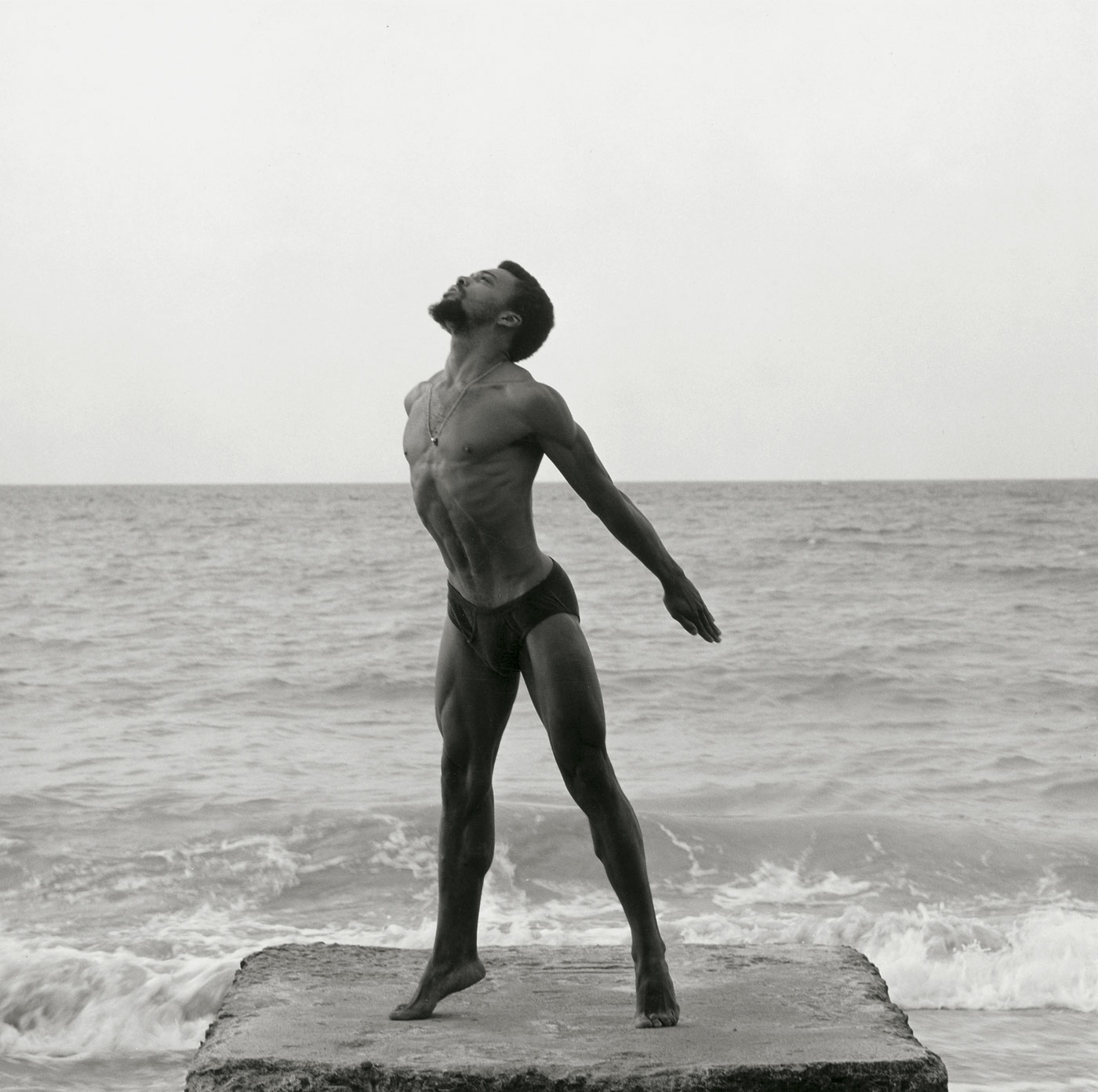
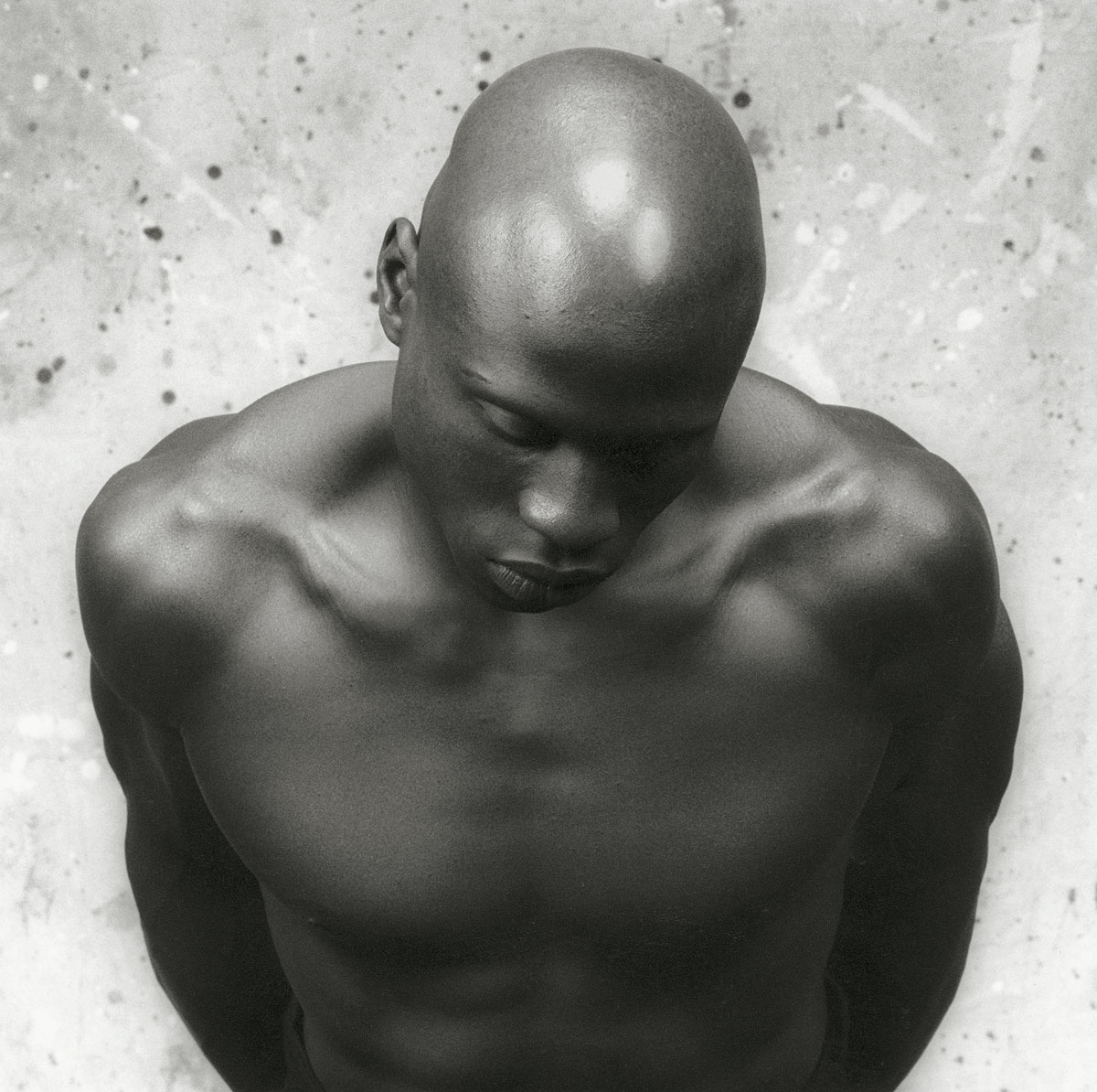
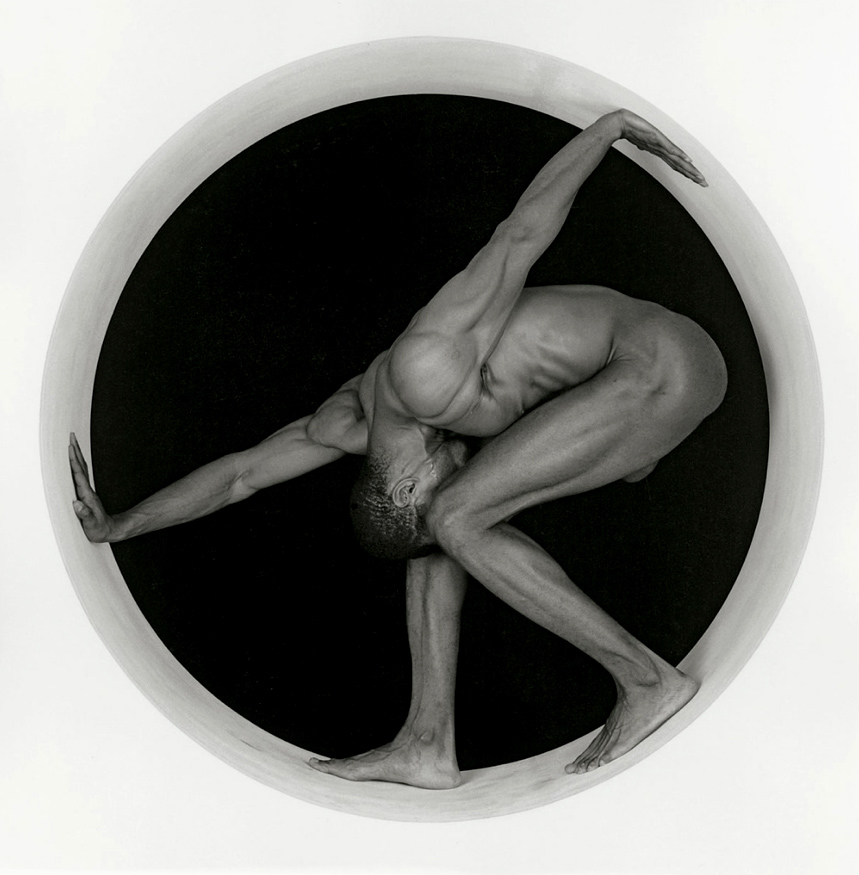
“I have boundless admiration for the naked body. I worship it.”

“I was a Catholic boy, I went to church every Sunday. A church has a certain magic and mystery for a child. It still shows in how I arrange things. It’s always little altars.”

“I am looking for perfection in form. I do that with portraits. I do it with cocks. I do it with flowers.”


Robert Mapplethorpe


Installation view of the exhibition 'Robert Mapplethorpe' at the Grand Palais, Paris 2014

Installation view of the exhibition 'Robert Mapplethorpe' at the Grand Palais, Paris 2014

Installation view of the exhibition 'Robert Mapplethorpe' at the Grand Palais, Paris 2014

Installation view of the exhibition 'Robert Mapplethorpe' at the Grand Palais, Paris 2014


Installation views of the exhibition Robert Mapplethorpe at the Grand Palais, Paris 2014
© Didier Plowy pour la Réunion des musées nationaux-Grand Palais, Paris 2014


The exhibition will present over 250 works making it one of the largest retrospective shows for this artist ever held in a museum. It will cover Mapplethorpe’s entire career as a photographer, from the Polaroids of the early 1970s to the portraits from the late 1980s, touching on his sculptural nudes and still lifes, and sadomasochism.

The focus on his two muses Patti Smith and Lisa Lyon explores the theme of women and femininity and reveals a less known aspect of the photographer’s work. The challenge of this exhibition is to show that Mapplethorpe is a great classical artist, who addressed issues in art using photography as he might have used sculpture. It also puts Mapplethorpe’s art into the context of the New York art scene in the 1970-1980s.

In his interview with Janet Kardon in 1987, Mapplethorpe explained that photography in the 1970s was the perfect medium for a fast-paced time. He did not really choose photography; in a way it was photography that chose him. Later in the same interview, he said “If I had been born one hundred or two hundred years ago, I might have been a sculptor, but photography is a very quick way to see, to make a sculpture. Lisa Lyon reminded me of Michelangelo’s subjects, because he did muscular women.”

Mapplethorpe positioned himself from the outset as an Artist, with a capital A. Unlike Helmut Newton, who as a teenager already wanted to be a fashion photographer, and imposed his vision of the world and photography, making it an art in its own right, Robert Mapplethorpe is a sculptor at heart, a plastic artist driven by the question of the body and its sexuality and obsessed by the search for perfect form.

Like Man Ray, Mapplethorpe wanted to be “a creator of images” rather than a photographer, “a poet” rather than a documentarist. In the catalogue for the Milan exhibition which compared the two artists, Bruno Cora recalls the parallels in their lives and works: “Before becoming masterly photographers, Man Ray and Mapplethorpe had both been painters and sculptors, creators of objects; they both lived in Brooklyn in New York; they both made portraits of the intellectuals of their time; and they were both incisive explorers of the nude form, its sculptural qualities and the energy emanating from it.”

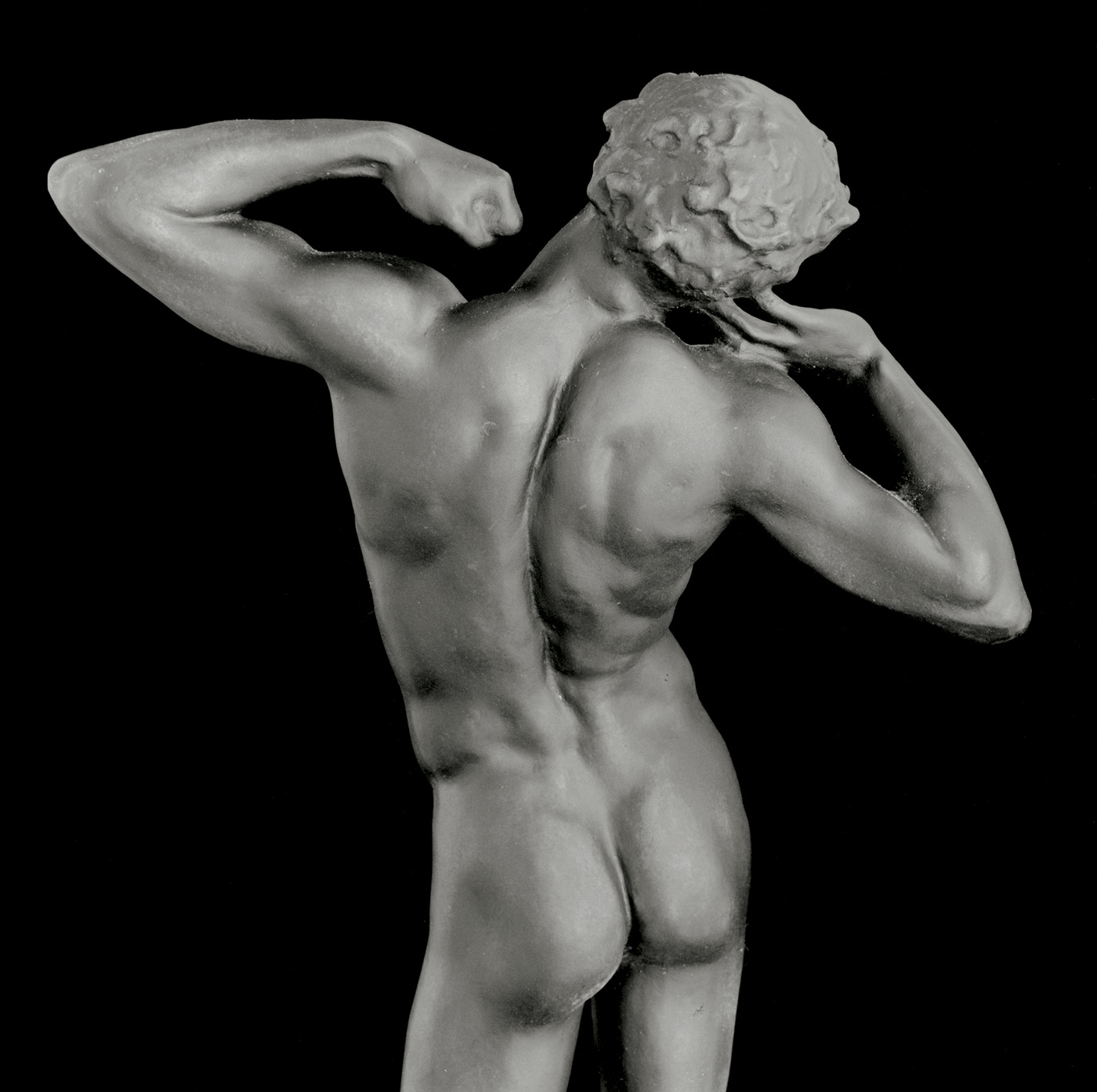
Mapplethorpe was an artist before being a photographer. His images come from a pictorial culture in which we find Titian (The Flaying of Marsyas / Dominick and Elliot), David, Dali, and even the great artists of the Italian Renaissance, Michelangelo, Piero della Francesca, Bernini …

As in Huysmans’s novel, the exhibition is a countdown for this other dandy from the end of another world, Robert Mapplethorpe. It starts with his self-portrait with a skull-headed cane, the image of a young man already old, the tragedy of a life cut down in full flight by AIDS. But his almost royal final posture, as if beyond death, still (just) alive but already in the posterity of his oeuvre, seems to beckon us with a gesture of his pastoral cane to follow him into the world that he constructed in twenty years of photography. The exhibition continues with statuary, a dominant theme in Mapplethorpe’s last years, photos of statues of the gods in his personal pantheon: Eros, of course, and Hermes … The artist always said he used photography to make sculptures, and he ended his oeuvre with photographs of sculptures. His nudes were already photographic sculptures.

Works are not created just anywhere. To be fully appreciated, Mapplethorpe’s art must be put into the socio-cultural context of arty New York in the 1970s and 80s, and the underground gay culture there at that time. Two permeable and equally radical worlds. To take the measure of the libertarian explosion of the time, we need to watch Flesh, Warhol’s film with Joe Dalessandro, which narrates 24 hours in the life of a young New York male prostitute. To understand the violence and passion of gay sexuality for young New Yorkers fighting for freedom in a repressive period, we must read Edmund White’s The Beautiful Room is Empty, the story of a young gay in the years of riots and demonstrations and extreme emancipation; and Andrew Holleran’s Dancer from the Dance (1978), to plunge into the sexual experiments of Fire Island in the 1970s.

Mapplethorpe is hailed as one of the world’s greatest photographers and the exhibition aims to give a broad view of his work.

Press release from the Grand Palais website


Robert Mapplethorpe (American, 1946-1989) 'Milton Moore' 1981


Robert Mapplethorpe (American, 1946-1989)
Milton Moore
1981
50.8 x 40.6cm / 50.8 x 40.6cm
Silver gelatin prints
New York, Fondation Robert Mapplethorpe
© Robert Mapplethorpe Foundation. Used by permission


Robert Mapplethorpe (American, 1946-1989) 'Milton Moore' 1981 (detail)


Robert Mapplethorpe (American, 1946-1989)
Milton Moore (detail)
1981
50.8 x 40.6cm
Silver gelatin print
New York, Fondation Robert Mapplethorpe
© Robert Mapplethorpe Foundation. Used by permission


Robert Mapplethorpe (American, 1946-1989) 'Ken Moody' 1983


Robert Mapplethorpe (American, 1946-1989)
Ken Moody
1983
50.8 x 40.6cm
Silver gelatin print
New York, Fondation Robert Mapplethorpe
© Robert Mapplethorpe Foundation. Used with permission


Introductory text

Robert Mapplethorpe was an artist with an obsessive quest for aesthetic perfection.

A sculptor at heart, and in his imagination, he wanted “people to see [his] works first as art and second as photography.”1 An admirer of Michelangelo, Mapplethorpe championed the classical ideal – revised and reworked for the libertarian New York of the 1970s – and explored sophisticated printing techniques to create unique works and mixed compositions, which he framed in unusual ways.

Like the novel by Joris-Karl Huysmans, this exhibition has been organised “À rebours” [against the nap] and examines the work of another dandy, living at the end of another world. It opens with Mapplethorpe’s self-portrait with the skull-head cane: the image of a young man, already old, tragically cut down in the prime of life by AIDS, it also reveals how the master of the realm of shadows – photography – gave free rein to his imagination. Like a modern day Orpheus, beyond death, he seems alive – although only just – yet already in the afterlife of his work, beckoning us with his satanic cane to follow him into the underworld of his life, in search of his desire.

“Photography and sexuality have a lot in common,” explains Mapplethorpe. “Both are question marks, and that’s precisely what excites me most in life.”2 Exploring the photography of the body, he pushed it to the limits of pornography, perhaps like no other artist before him. The desire we see in these images – often the photographer’s own desire – also reflects life in New York, as lived by some, in the 1970s and 80s, at the height of the sexual liberation movement. “I’m trying to record the moment I’m living in and where I’m living, which happens to be in New York. I am trying to pick up on the madness and give it some order.”3

This retrospective of Mapplethorpe’s work – the first in France since he passed away – features some two hundred and fifty images exploring a range of themes. They cover every aspect of Mapplethorpe’s art – bronze bodies and flesh sculptures, geometric and choreographic, still lives and anatomical details, bodies as flowers and flowers as bodies, court portraiture, night photography, and eroticism, soft and hard – interspersed with self-portraiture in all its forms. The works from the photographer’s early career, which close the exhibition, reveal how the path taken by his art was already mapped out in his first Polaroids. The sign of a great artist.

1/ Inge Biondi, “The Yin and the Yang of Robert Mapplethorpe,” in The Print Collector’s Newsletter, New York, January 1979, p. 11
2/ Mark Thompson, “Mapplethorpe,” in The Advocate, Atlanta, 24 July 1980
3/ Sarah Kent, “Mapplethorpe,” in Time Out, London, 3-9 November 1983


Robert Mapplethorpe (American, 1946-1989) 'Thomas' 1987


Robert Mapplethorpe (American, 1946-1989)
Thomas
1987
61 x 50.8cm
Silver gelatin print
New York, Fondation Robert Mapplethorpe
© Robert Mapplethorpe Foundation. Used with permission


Robert Mapplethorpe (American, 1946-1989) 'Calla Lily' 1986


Robert Mapplethorpe (American, 1946-1989)
Calla Lily
1986
92.7 x 92.7cm
Silver gelatin print
© Robert Mapplethorpe Foundation. Used with permission


Robert Mapplethorpe (American, 1946-1989) 'The Sluggard' (Le Paresseux) 1988


Robert Mapplethorpe (American, 1946-1989)
The Sluggard (Le Paresseux)
1988
61 x 50.8cm
Silver gelatin print
New York, Fondation Robert Mapplethorpe
© Robert Mapplethorpe Foundation. Used with permission


Robert Mapplethorpe (American, 1946-1989) 'Self-portrait (Autoportrait)' 1988


Robert Mapplethorpe (American, 1946-1989)
Self-portrait (Autoportrait)
1988
61 x 50.8cm
Platinum print
© Robert Mapplethorpe Foundation. Used with permission


Grand Palais, Galeries Nationales
3, Avenue du Général Eisenhower
75008 Paris

Opening hours:
Wednesday – Saturday 10am – 10pm
Monday and Sunday 10am – 8pm
Closed every Tuesday

Grand Palais website

LIKE ART BLART ON FACEBOOK

Back to top

Exhibition: ‘A Way of Life – Swedish Photography from Christer Strömholm until Today’ at Moderna Museet Malmö, Sweden

Exhibition dates: 1st February – 18th May 2014

Curator: Anna Tellgren, curator of photography, Moderna Museet

Featured photographers: Yngve Baum, Martin Bogren, Stina Brockman, Anna Clarén, Dawid, Ann Christine Eek, Agneta Ekman, JH Engström, Nan Goldin, Neil Goldstein, Catharina Gotby, Denise Grünstein, Kenneth Gustavsson, Walter Hirsch, Gerry Johansson, Rune Jonsson, Eva Klasson, Nina Korhonen, Tuija Lindström, Anders Petersen, Håkan Pieniowski, Marco Plüss, Inta Ruka, Ulf Simonsson, Gunnar Smoliansky, Christer Strömholm, Lars Tunbjörk, Odd Uhrbom, John S. Webb.


Kenneth Gustavsson (Swedish, 1946-2009) 'Berlin' 1983


Kenneth Gustavsson (Swedish, 1946-2009)
Berlin
1983
© Kenneth Gustavsson Estate


Gustavsson’s photographs are characterised by a strong personal expression. With tireless consistency, he sought his inner visions in urban environments such as New York, Berlin and Paris. His exceptional talent for creating everyday magic makes him timeless and always topical. The eighties were Gustavsson’s most creative period. His photographs from Belfast are an extraordinary visual interpretation of conditions in a city wracked by terror and violence.

Kenneth Gustavsson grew up in a suburb north west of Stockholm. Between 1964 and 1967 he studied photography at the Fotoskolan in Stockholm, where the photographer Christer Strömholm was head, at the same time as Anders Petersen. After graduation in 1967, he and Petersen co-founded the Saftra photo agency (Saftra Reportage Fotografi).

The Swedish photo magazine Foto published Gustavsson’s work in the 1960s. Together with Anders Petersen, Gustavsson portrayed the Stockholm slums in an exhibition at the Stockholm City Museum in 1969. After not working in photography for most of the 1970s, a feature in ETC magazine in 1983 revived Gustavsson’s career and he went on to complete assignments in Belfast, Chicago, Reykjavik and New York for ETC. In 1984 he was awarded FOTO magazine’s Photographer’s Price.

The critic Gerry Badger has said of Gustavsson’s work that “it certainly is very post-war, deeply existential and luminously poetic. And, like most good photography, it is a beguiling exploration of the human condition and our relationship with the world.”

Text from the Wikipedia website


Another posting on an eclectic subject that this archive likes to promote, this time on Swedish photography… a subject that I know very little about.

Marcus


Many thanks to the Moderna Museet Malmö for allowing me to publish the photographs in the posting. Please click on the photographs for a larger version of the image.


Tuija Lindström (Finnish-Swedish, 1950-2017) 'Pia' 1983


Tuija Lindström (Finnish-Swedish, 1950-2017)
Pia
1983
© Tuija Lindström


Tuija Lindström belongs to the great legends of Swedish photography. Her images gained great recognition when exhibited in a group show at Camera Obscura. Lindström’s work was at this time centred on a narrative with focus on a female experience where the male gaze and patriarchal structures were investigated. This theme also characterised the photographic series ‘The Girls at Bull’s Pond’ (1991), which can be counted as Tuija Lindstrom’s real breakthrough. Other subject matters in her work revolves around memories and recollections, time and social issues.

Tuija Lindström’s work is characterised by material experiments inherent to the medium and the darkroom becomes a place for meditative, alchemical operations. Here the presences of the darkroom functions as a kind of performance art. A place of evasion where the craftsmanship evoke the sometimes coarse images soft shades, deep blacks and contrasts.

In 1992 Lindström was appointed professor at the Photo Academy, now the School of Photography at the Academy of Fine Arts in Gothenburg, where she came to teach until 2002. As the first woman on record Tuija Lindström is significant for the introduction of a more artistic and theoretical photography where philosophy and art history were incorporated in the training. An achievement that meant a step away from the documentary tradition that for a long time had characterised Swedish photography.

Text from the Female Artists in History Facebook page [Online] Cited 19/03/2021.


Martin Bogren (Sweden, b. 1967) 'No title'. From the series 'Lowlands' 2011


Martin Bogren (Sweden, b. 1967)
No title
2011
From the series Lowlands
© Martin Bogren


In the 1990s, Martin Bogren developed a personal approach of documentary photography by following Swedish musicians and artists on stage, tour, and studio. His first book “The Cardigans – Been It”, published at the top of the group’s success in 1996 , reveals his work and launches his career. Martin Bogren however aims at going beyond assignments and music field : he focuses on more personal photographic work.

Travels encounters, (Notes, 2008, Italia, 2016), joy of first discoveries (Ocean, 2008), or teenage spleen (Lowlands, 2011, Tractors boys, 2013, Embraces, 2014) : his works reveal a vivid desire to avoid boredom and to reach an elsewhere. He gets in contact with his subjects as a silent witness, as a subtle and caring observer. Through grainy black-and-white and highly grey nuanced photographs, he succeeds in combining a documentary approach with a sensitive affirmation of his subjective vision.

Martin Bogren “manages not to disrupt the world into which he immerses himself, with decency, with attention and acuity, and with respect, without judging – holding his breath (…) One thinks, of course, of all those photographers who – from Robert Franck onwards, from Anders Petersen to Michael Ackerman – have known how to give us the gift of their way of looking, telling us that they wanted to show nothing more than what they needed to show and to say.” (Christian Caujolle, Foreword to Tractor Boys, 2013)

Text from the Vu website [Online] Cited 19/03/2021.


Martin Bogren (Sweden, b. 1967) 'No title'. From the series 'Lowlands' 2011


Martin Bogren (Sweden, b. 1967)
No title
2011
From the series Lowlands
© Martin Bogren


Christer Strömholm (1918-2002) is a predominant figure of Nordic photography and has inspired generations of young photographers. His images of the transsexuals of Place Blanche in Paris is some of his most known work. Included in the exhibition are photographers that have followed in the footsteps of Strömholm. Works, taken from the Moderna Museet collection, by photographers such as Yngve Baum, Agneta Ekman, Ann Christine Eek, Gunnar Smoliansky and not least Anders Petersen, who has most prominently carried on the Strömholm legacy.

“This is an exciting exhibition not only due to its extensive selection but also because we are experimenting with intersecting three separate exhibitions into one entirety,” says John Peter Nilsson, Director, Moderna Museet Malmö. The exhibition also highlights three contemporary photographers. J.H. Engström (b. 1969) has been seen as a successor to Christer Strömholm and Anders Petersen, his Tout va bien is the newest series to be featured. Anna Clarén (b. 1972) is just like Engström part of a generation of photographers that emerged in the late 1990’s. In her bright colour photos we meet people and spaces close to the photographer. Martin Bogren (b. 1967) is the third contemporary photographer, he is active in Limhamn and his series Lowlands (2011) tells a personal tale, in black and white, about a small village in the Skåne countryside.

“It’s fantastic to be able to show an important part of Swedish modern photography history using the Moderna Museet collection. Martin Bogren, Anna Clarén and J. H. Engström are all three contemporary photographers that are good examples of how strong and exciting the Nordic photography scene is right now,” says Anna Tellgren, curator of the exhibition.

The title of the exhibition comes from a quote taken from a lecture by Christer Strömholm. He explains that “… for me, working with photographic images is a way of life. When I think of it, and when I look carefully at my images, all of them, each in its particular way, are nothing but self-portraits, a part of my life.” That approach has shaped all photographers represented in the exhibition. Several self-portraits, portraits of friends and some portraits of Christer Strömholm can be found in the selection.

Press release from the Moderna Museet Malmö website


Anna Clarén (Swedish, b. 1972) 'No title'. From the series 'Holding' 2006


Anna Clarén (Swedish, b. 1972)
No title
2006
From the series Holding
© Anna Clarén


This work might be regarded as a diary documenting my life during a period when I took pictures 24/7, even in the night I let the shutter be wide open, exposing while I was asleep. The people in the pictures are persons that are close to me; parents, my sister, my closest friends, my self and also some people I only met by accident on the street.

In this work I use external, concrete attributes, things and events to describe interior associations, an imaginary reality. A reality which for me is entirely real.

The title of the book is a term derived from psychiatry, which means that each and every child should be entitled to a loving and caring environment by her or his parents. This child will enter life with the feeling of being held. Held by her parents, her self and by life itself.

The one child that for any reason grows up in a family where this love is not possible, will, as an adult, constantly find herself in an endless, desperate search for holding. And in some cases will experience a feeling of falling.

The search for somewhere to hold on to will express itself in various ways; symbiotic love affairs, destructiveness, escaping, a constant feeling of alienation, of being outside.

The book’s story is, in many ways, a self portrait, but deep down inside, human beings are very alike. In our searching, the questions, confusions, we may find a universal strand of humanity; the difference between us lies often in the answers. And therefore, this work is a self portrait with universally human questions / stories.

Anna Clarén. “Holding,” on the Josef Chladek website [Online] Cited 19/03/2021.


Anna Clarén (Swedish, b. 1972) 'No title'. From the series 'Holding' 2006


Anna Clarén (Swedish, b. 1972)
No title
2006
From the series Holding
© Anna Clarén


Christer Strömholm (Swedish, 1918-2002) 'Hotel Central, Paris' 1951/1981


Christer Strömholm (Swedish, 1918-2002)
Hotel Central, Paris
1951-1981
© Christer Strömholm/Strömholm Estate


Christer Strömholm is one of the great personalities of Swedish photography. Born in Stockholm, he discovered photography via graphic art in the late 1940s. His photographs from this period are hard black-and-white compositions featuring walls, shadows and minimalist settings. During his sojourns in Paris in the 1950s and 60s, he developed a style reminiscent of street photography, and this is also where he produced his famous portraits of transsexuals at Place Blanche. Strömholm also went on numerous photographic expeditions to places around the globe in the early 1960s, including Spain, Japan, India and the USA. Early in his career, he began teaching at Kursverksamheten in Stockholm, and his classes eventually became the legendary Fotoskolan, from which some 1,200 students graduated between 1962 and 1974. Strömholm’s photographs and methods have inspired many generations of Swedish photographers, but he did not become known to the broader public until 1986, with the major exhibition 9 Seconds in My Life at Moderna Museet.

Text from the Lens Culture website [Online] Cited 19/03/2021


Christer Strömholm (Swedish, 1918-2002) 'Hotel Central, Paris (Self-portrait)' 1951/1981


Christer Strömholm (Swedish, 1918-2002)
Hotel Central, Paris (Self-portrait)
1951-1981
© Christer Strömholm/Strömholm Estate


Christer Strömholm (Swedish, 1918-2002) 'No title' 1963/c. 1985


Christer Strömholm (Swedish, 1918-2002)
No title
1963 – c. 1985
© Christer Strömholm/Strömholm Estate


Anders Petersen (Swedish, b. 1944) 'Marlene' from the series 'Café Lehmitz' 1967-1970/1986


Anders Petersen (Swedish, b. 1944)
Marlene
1967-1970/1986
From the series Café Lehmitz
© Anders Petersen


“To me, it’s encounters that matter, pictures are much less important.”

“I can’t describe reality; at the most, I can try to capture things that seem to be valid, the way I see them.”


Anders Petersen


J. H. Engström (Swedish, b. 1969) 'No title' from the series 'Tout va bien' 2014


J. H. Engström (Swedish, b. 1969)
No title
2014
From the series Tout va bien (Everything is fine)
© JH Engström


Swedish artist JH Engström (born 1969) is an inveterate bookmaker. Most recently, his published works have explored ideas of place and home, including “Sketch of Paris” (Aperture, 2013), “La Résidence” (2010), “From Back Home” (2009) and “CDG/JHE” (2008). After more than a decade of such thematic projects, “Tout Va Bien” returns to the looser, more associative approach of Engström’s critically acclaimed volume “Trying to Dance” (2003). The source for these photographs is nevertheless strongly autobiographical, as well as vividly metaphorical; a reemphasis of the artist’s belief in photography’s potential as visual poetry. The sequencing is highly charged with contrasts: black-and-white images mix with colour; the gentle beauty of coastal rocks clashes with a flash-lit image of the bright, blood-red placentas from the birth of his twins. The book leaves it to the viewer to map his or her own network of meaning from image to image, page to page.

Text from the Aperture website [Online] Cited 19/03/2021


J. H. Engström (Swedish, b. 1969) 'No title' from the series 'Tout va bien' 2014


J. H. Engström (Swedish, b. 1969)
No title
2014
From the series Tout va bien (Everything is fine)
© JH Engström


Moderna Museet Malmö
Gasverksgatan 22 in Malmö

Moderna Museet Malmö is located in the city centre of Malmö. Ten minutes walk from the Central station, five minutes walk from Gustav Adolfs torg and Stortorget.

Opening hours:
Tuesday – Sunday 11 – 17
Mondays closed

Moderna Museet Malmö website

LIKE ART BLART ON FACEBOOK

Back to top

Exhibition: ‘Philippe Halsman, Astonish Me!’ at The Musée de l’Elysée, Lausanne

Exhibition dates: 29th January – 11th May 2014


Philippe Halsman (American, 1906-1979) 'The Versatile Jean Cocteau' 1949


Philippe Halsman (American, 1906-1979)
The Versatile Jean Cocteau
1949
Musée de l’Elysée
© 2013 Philippe Halsman Archive / Magnum Photos


He “photographed a little bit of everything: animals, Paris, the homeless, underwater, nudes, advertising, fashion and, above all, celebrities portraits, from Ali, Einstein, Churchill, Hepburn, Warhol, Hitchcock and, of course, Marilyn Monroe.”

You could say that he was a versatile photographer, doing everything to pay the bills and anything to make interesting images. He never stopped experimenting with the image, but it is the “straight” portraits that I find are his strongest work. Not the “jump” photos, Monroe, or the surreal experiments with Dalí, much as they delight, but the portraits of Hepburn, Einstein and Churchill for example.

Look at the photograph of Winston Churchill (1951, below). What a way to portray the great man. The bulk of the overcoat, the slope of the shoulders (evincing a certain weariness), the famous Homburg hat pulled down on the head, the leader staring into the tranquil landscape. But what makes the image is the seam down the back of the overcoat which speaks to history itself – the backbone of the country, the never say die spirit, stiff upper lip, the rock of the British empire which Nazism could not defeat – epitomising the British bulldog spirit. Cometh the hour, cometh the man. Solid. Immovable. What a glorious photograph to capture that essence.

Dr Marcus Bunyan


Many thankx to the Elysée Lausanne for allowing me to publish the photographs in the posting. Please click on the photographs for a larger version of the image.


“Shortly before World War I, the greatest sensation in Paris was the Russian Imperial Ballet under Serge Diaghilev. The divine Nijinsky and Pavlova were dancing for him, Stravinsky composed, Picasso, Bakst, and Chagall were painting scenery for him. To work for Diaghilev was the highest accolade for an artist. Jean Cocteau approached Diaghilev and asked: ‘What can I do for you?’ Diaghilev looked at him and answered: ‘Etonne-moi!’ (‘Astonish me!’) These two words can be considered as a motto, as a slogan for the development of the modern art which followed.”


Philippe Halsman


“Photography is a separate form of expression since it falls between two art forms… It’s not only trying to give us a visual impression of reality, like painting and graphic arts, but also to communicate and inform us the way writing does. No writer should be blamed for writing about subjects that exist only in his imagination. And no photographer should be blamed when, instead of capturing reality, he tries to show things that he has only seen in his imagination.”


Philippe Halsman


Philippe Halsman (American, 1906-1979) 'Folle Iseult' 1944


Philippe Halsman (American, 1906-1979)
Folle Iseult
1944
Musée de l’Elysée
© 2013 Philippe Halsman Archive / Magnum Photos


“In my serious work I am striving for the essence of things and for goals which are possibly unobtainable. On the other hand, everything humorous has great attraction for me, and a childish streak leads me into all kinds of frivolous endeavour.”

Photographer Philippe Halsman had an exemplary career. Over a forty-year period, in Paris during the 1930s and in New York from 1940 on, he developed a broad range of activities (portraits, fashion, reportage, advertisements, personal projects, commissions from individuals and institutions). The Musée de l’Elysée presents the first study dedicated to his entire body of work, with a selection of over 300 pieces.

This project, produced in collaboration with the Philippe Halsman Archive, includes many exclusive unseen elements of the photographer’s work (contact sheets, annotated contact prints, preliminary proofs, original photomontages and mock-ups). The exhibition shows Philippe Halsman’s creative process and reveals a unique approach to photography: a means of expression to explore.

Born in 1906 in Riga, Latvia, Halsman studied engineering in Dresden before moving to Paris, where he opened a photographic studio in 1932. His years in Paris already heralded the approach he was to develop throughout his long career. A studio and reportage photographer, Halsman took inspiration from the contemporary art scene and participated in promoting it. Though he specialised in portraiture, he also branched out into advertising and publishing, which were thriving at the time. In 1940, the German invasion brought Halsman’s prosperous career to a halt, leading him to flee with his family to New York. Though initially unknown, he succeeded in establishing himself on the American market in under a year, and his studio soon became successful. Halsman stood out for his “psychological” approach to portraiture.

He distinguished himself in this area with his vast portrait gallery of celebrities (actors, industrialists, politicians, scientists, writers). Some of these images, such as Audrey Hepburn, Marilyn Monroe, Winston Churchill or Albert Einstein, became icons. He produced the largest number of covers (101) for Life magazine, the first weekly magazine to be illustrated only by photographs.

Halsman’s photography is characterised by a direct approach, masterful technique and a particular attention to detail. His work testifies to his constant research and his interest in all forms of technical and aesthetic experimentation, which he applied to a wide variety of subjects. For Halsman, photography was an excellent way of giving his imagination free reign. He was especially interested in mises en scène – in the form of single images or fictional series. He met Salvador Dalí in 1941 and the artist turned out to be the ideal accomplice. Their fruitful collaboration lasted 37 years. Philippe Halsman also introduced innovations through more personal creations such as the “photo-interview book” or ‘jumpology’.

Press release from the Musée de l’Elysée Lausanne website
 

Philippe Halsman (American, 1906-1979) 'Winston Churchill' 1951


Philippe Halsman (American, 1906-1979)
Winston Churchill
1951
Musée de l’Elysée
© 2013 Philippe Halsman Archive / Magnum Photos
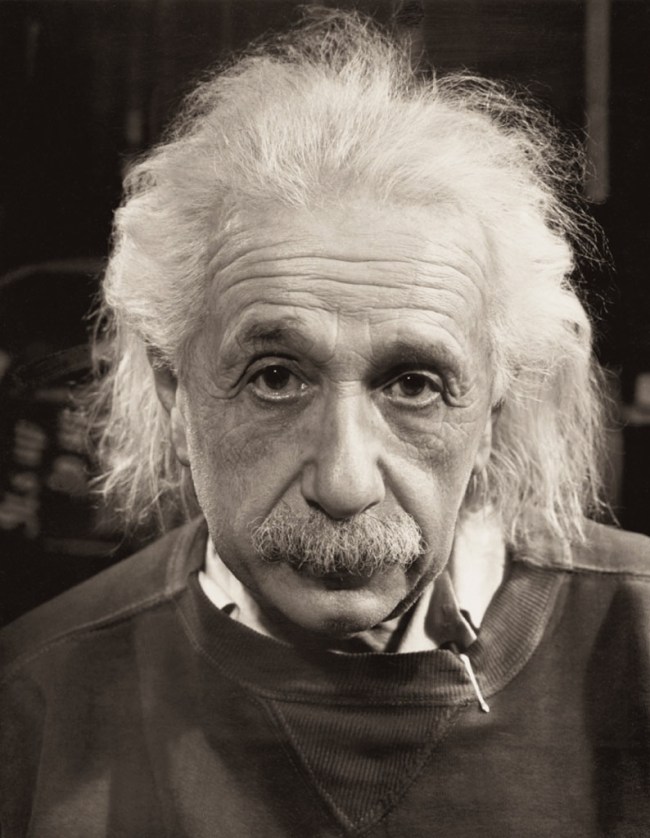
 

Philippe Halsman (American, 1906-1979) 'Albert Einstein' 1947


Philippe Halsman (American, 1906-1979)
Albert Einstein
1947
Musée de l’Elysée
© 2013 Philippe Halsman Archive / Magnum Photos
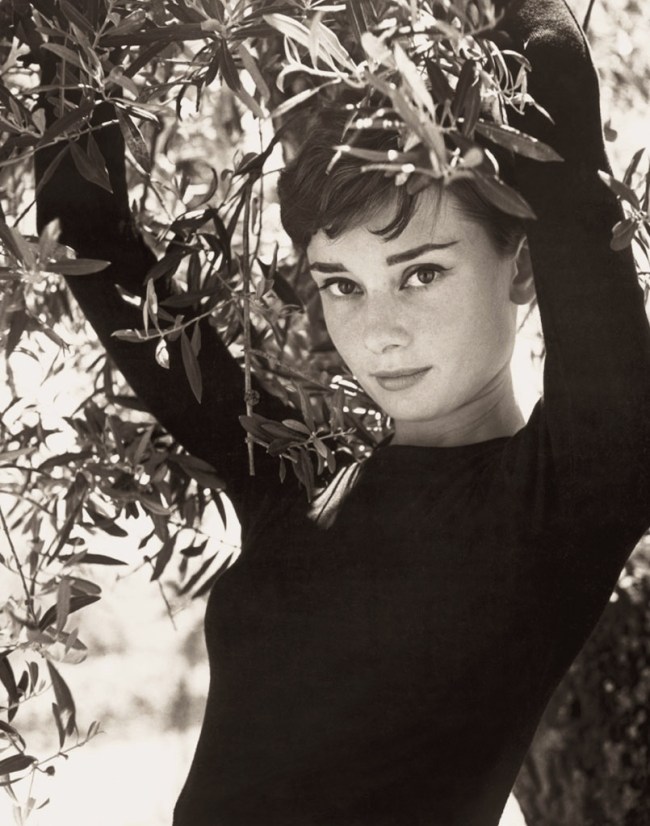
 

Philippe Halsman (American, 1906-1979) 'Audrey Hepburn' 1955


Philippe Halsman (American, 1906-1979)
Audrey Hepburn
1955
Musée de l’Elysée
© 2013 Philippe Halsman Archive / Magnum Photos
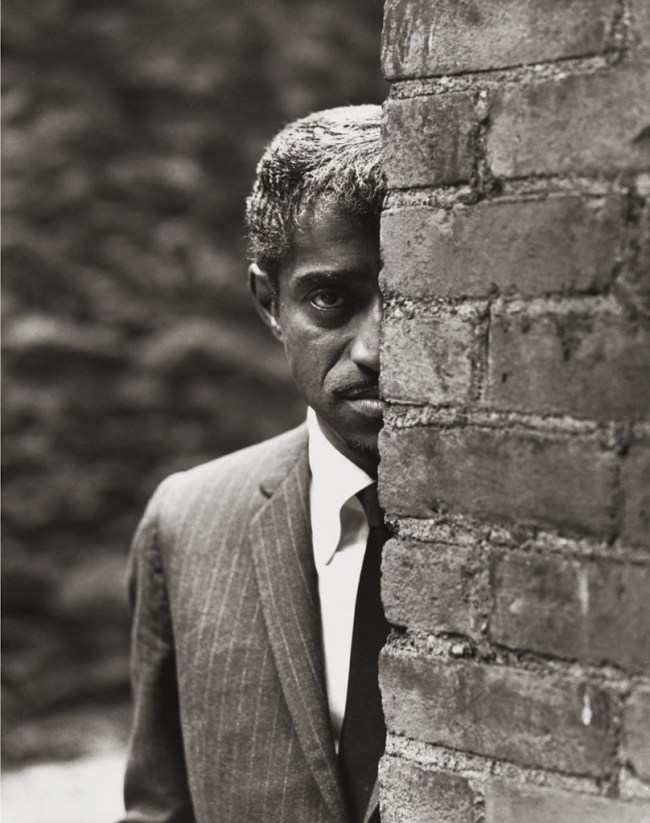
 

Philippe Halsman (American, 1906-1979) 'Sammy Davis Jr' 1965


Philippe Halsman (American, 1906-1979)
Sammy Davis Jr
1965
Musée de l’Elysée
© 2013 Philippe Halsman Archive / Magnum Photos


Presentation of the exhibition

In 1921, Philippe Halsman found his father’s old camera, and spoke of a “miracle” when he developed his first glass plates in the family’s bathroom sink. He was 15 years old, and this was the first encounter with photography of someone who was to become one of the leading photographers of the 20th century. This exhibition, produced by the Musée de l’Elysée in collaboration with the Philippe Halsman Archive, showcases the American photographer’s entire career for the first time, from his beginnings in Paris in the 1930s to the tremendous success of his New York studio between 1940 and 1970.

Halsman was able to go to Paris thanks to the support of French minister Paul Painlevé – whose son Jean, a scientific filmmaker, gave him one of the best cameras of the time upon his arrival. He remained in Paris for ten years, until 1940. Over that period, he collaborated with the magazines Vogue, Vu and Voilà and created portraits of numerous celebrities like Marc Chagall, Le Corbusier and André Malraux. He exhibited his work several times at the avant-garde Pléiade gallery, alongside photographers like Laure Albin Guillot, whose work was exhibited at Musée de l’Elysée in 2013.

Fleeing Nazism, he left Paris in 1940 and moved to New York. There, he worked for many American magazines including Life, which brought him into contact with the century’s top celebrities – Marilyn Monroe, Rita Hayworth, Duke Ellington, the Duke and Duchess of Windsor, Richard Nixon, Albert Einstein to name only a few. Halsman shot 101 covers for Life magazine. Far from restricting himself to photographing celebrities, throughout his whole life Halsman never stopped experimenting and pushing the limits of his medium. He collaborated with Salvador Dalí for over thirty years and invented ‘jumpology’, which consisted in photographing personalities in the middle of jumping, offering a more natural, spontaneous portrait of his subjects.

The exhibition Philippe Halsman, Astonish me! is divided into four sections illustrating memorable periods, collaborations and themes in the photographer’s work and life.
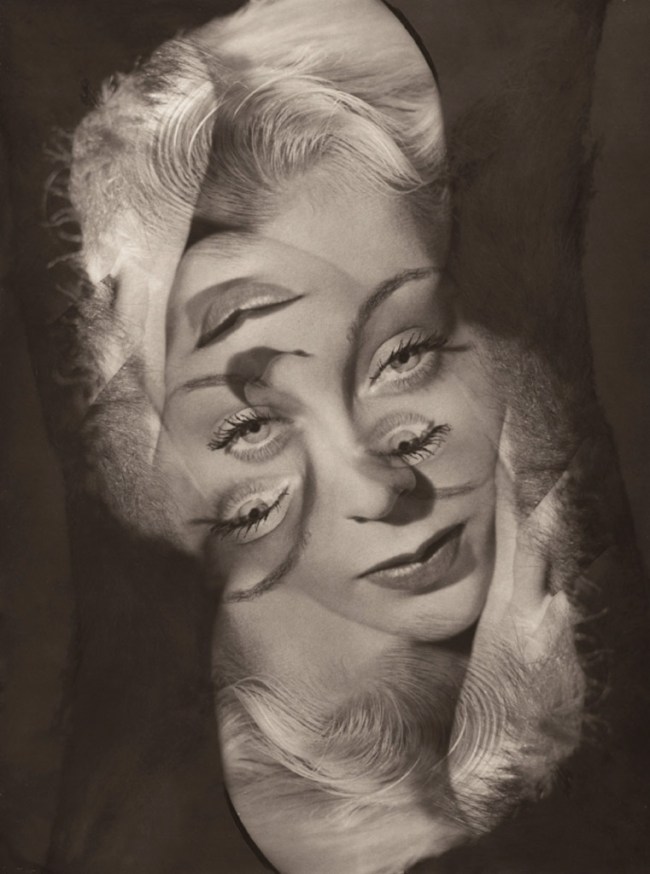
 

Philippe Halsman (American, 1906-1979) 'Expérimentation pour un portrait de femme (Experimentation for a portrait of a woman)' 1931-1940


Philippe Halsman (American, 1906-1979)
Expérimentation pour un portrait de femme (Experimentation for a portrait of a woman)
1931-1940
Musée de l’Elysée
© 2013 Philippe Halsman Archive / Magnum Photos


Philippe Halsman (American, 1906-1979) 'Affiche exposition Pleiade (Poster for exhibition at La Pléiade gallery)' 1936


Philippe Halsman (American, 1906-1979)
Affiche exposition Pleiade (Poster for exhibition at La Pléiade gallery)
1936
Musée de l’Elysée
© 2013 Philippe Halsman Archive / Magnum Photos


“When I arrived in America in 1940 I had to adapt to the American style, that is to say, produce photographs that were technically perfect, clear, precise and properly modelled by the light without being distorted. Once, to accentuate the coldness of a rainy landscape I added a blue gelatin to my transparent film. Wilson Hicks took this gelatin off saying: ‘You’re cheating, Philippe’. Any hint of artifice was considered dishonest.”


Philippe Halsman


Paris in the 1930s

Philippe Halsman was born in Riga, Latvia in 1906. When he was 22, his father died in a hiking accident in Austrian Tyrol, and Philippe Halsman was wrongly convicted of his murder in a highly anti-Semitic climate. He was freed thanks to his sister’s support; she organised the support of prominent European intellectuals, who endorsed his innocence.

He went to Paris, where he began his career as a photographer, quickly distinguishing himself through his portrait technique. He explored various genres, such as views of Paris, nudes and fashion. His work was exhibited three times at the La Pléiade gallery, a famous avant-garde gallery where artists like Man Ray, André Kertész and Brassaï presented their works.

Focus on La Pléiade gallery

Founded by publisher Jacques Schiffrin in the spring of 1931 and located in the heart of the Latin Quarter, this art gallery was one of the first to present photographic exhibitions, and it started specialising in this field in April 1933 under directorship of Rose Sévèk. Dedicated to contemporary photography, the program incorporated its new practices and applications. It was one of the places where New Photography was promoted in the form of solo, group or thematic exhibitions.

It was probably through his friend Jean Painlevé that Halsman entered in contact with La Pléiade gallery. He was given a first solo exhibition, Portraits and Nudes, which ran from March 28 to April 30, 1936. The following year, his name became associated with the New Vision movement in the context of two group exhibitions: Portraits of Writers (April 17 to May 14, 1937) which included Emmanuel Sougez, Rogi André, Roger Parry and others; La Parisienne de 1900… à 1937 (June 4-30, 1937), which included photographs by Florence Henri and Maurice Tabard. It was one of the last exhibitions at the gallery, which was sold a few months later in October, to Paul Magné.

Having initially been unable to flee wartime Paris, Halsman finally received an emergency visa in 1940 thanks to a letter from Albert Einstein to Eleanor Roosevelt, making it possible for him to join his family, who had left six months earlier.
 

Philippe Halsman (American, 1906-1979) 'Marilyn Monroe jump' 1959


Philippe Halsman (American, 1906-1979)
Marilyn Monroe jump
1959
Musée de l’Elysée
© 2013 Philippe Halsman Archive / Magnum Photos
 

Philippe Halsman (American, 1906-1979) 'Marilyn Monroe jump' 1959


Philippe Halsman (American, 1906-1979)
Marilyn Monroe jump
1959
Musée de l’Elysée
© 2013 Philippe Halsman Archive / Magnum Photos


“Of the group of starlets only Marilyn emerged. Still photographers discovered her natural talent for flirting with the camera lens, and her blond looks of instant availability made her America’s most popular pin-up girl. Marilyn felt that the lens was not just a glass eye, but the symbol of the eyes of millions of men. She knew how to woo this lens better than any actress I ever photographed.”


Philippe Halsman


Portraits

Champion of the direct approach, Philippe Halsman also experimented with a wide range of techniques in order to capture the essence of his subjects and express their individuality. Many portraits became iconic images such as his 101 Life magazine covers.

Focus on Marilyn Monroe

Philippe Halsman photographed Marilyn Monroe on several occasions between 1949 and 1959. This important corpus traces the actress’s career and reveals the photographer’s varied approach during this period. In the autumn of 1949, Halsman was sent to Hollywood by Life magazine to do a report on eight young models embarking on acting careers. Halsman photographed them in four scenes he imposed (the approach of a monster, embracing a lover, reacting to a funny story and drinking a favourite drink). He quickly noticed the talents of the young Marilyn Monroe.

This opinion was confirmed three years later when Life commissioned him to do a feature on the actress entitled “The Talk of Hollywood”. These shots, some in colour and some in black and white, illustrated the actresses’s everyday life and talents. She acted out a series of scenes, humorously presenting the different stages of the strategy she used when being interviewed for roles. Most importantly, Halsman created several emblematic images of the actress and helped promote her by giving her a chance to have her first Life magazine cover.

In 1954, Halsman welcomed Marilyn Monroe to his New York studio. Halsman’s photographs reflect the ‘sex symbol’ image she cultivated. However, he managed to shoot a more natural portrait of the actress by asking her to jump in the air. There was only a few images of this type because when Halsman explained his ‘jumpology’ concept, Marilyn Monroe, frightened by the idea of revealing her personality, refused to repeat the experiment.

It took five years before she agreed to go along with ‘jumpology’. Marilyn Monroe had become a star by the time Life magazine offered to feature her on its cover in 1959 to illustrate a major article on Philippe Halsman’s ‘jumpology’. She treated it as a request for a performance. Over the course of three hours, the actress jumped over 200 times in front of Halsman’s lens, in order to achieve the “perfect jump”.

Several times Halsman suggested to Marilyn Monroe that they continue this collaboration, but without success. The actress was then at a turning point in her life that was foreshadowing her decline. However, Halsman continued his photographic work on the actress by creating new images, or more precisely variations of portraits he had previously shot. These compositions – montages of prints cut out and rephotographed together expressing the idea of movement, or reworked images transposed in negative format are characteristic of Halsman’s approach in the 1960s. Ten years later, he created a portrait of Marilyn Monroe as Chairman Mao, as requested by Salvador Dalí during his guest editorship of the French edition of Vogue magazine (December 1971 – January 1972).
 

Philippe Halsman (American, 1906-1979) 'Alfred Hitchcock for the promotion of the film 'The Birds'' 1962


Philippe Halsman (American, 1906-1979)
Alfred Hitchcock for the promotion of the film ‘The Birds’
1962
Musée de l’Elysée
© 2013 Philippe Halsman Archive / Magnum Photos
 

Cover of 'Life' magazine with a portrait of Marilyn Monroe jumping by Philippe Halsman, November 9, 1959


Cover of Life magazine with a portrait of Marilyn Monroe jumping by Philippe Halsman, November 9, 1959
Musée de l’Elysée
© 2013 Philippe Halsman Archive / Magnum Photos


Mises en scène

Halsman was often commissioned to photograph the contemporary art scene for magazines including dance, cinema and theatre. Collaborations with artists were important in Halsman’s career and inspired performances resulting in picture stories or striking individual images.

Focus on ‘Jumpology’

In 1950, Halsman invented ‘jumpology’, a new way of creating spontaneous, authentic portraits: “When you ask a person to jump, his attention is mostly directed toward the act of jumping and the mask falls so that the real person appears”. Over a period of ten years, Halsman created an extraordinary gallery of portraits of American society.

Containing over 170 portraits, Philippe Halsman’s Jump Book illustrated a new “psychological portrait” approach developed by Philippe Halsman in the 1950s. His method was systematic. During commissioned work, at the end of shooting sessions Halsman would ask his subjects if they would agree to take part in his personal project, and then the jumps were done on the spot. In this way he managed to photograph hundreds of jumps. Producing these shots was in fact simple: his equipment was limited to a Rolleiflex camera and an electronic flash, and as he pointed out, the only constraint was the height of the ceiling.

Although these portraits are characterised by their lightheartedness, Halsman viewed ‘jumpology’ as a new scientific tool for psychology. While the subject was concentrating on his jump, “the mask” fell, and it was this moment that the photographer needed to capture. Over the time that he was conducting this experiment, Halsman noticed the great diversity of the various participants’ postures, and discerned in these gestures – leg positions, arm positions, facial expressions and other details revealing signs of their character, expressed unwillingly.

The arrangement of the portraits in Philippe Halsman’s Jump Book illustrated these views. Halsman made a distinction in the form of two corpuses. First he presented influential personalities from different fields (political, industrial, scientific, theological, literary, etc…) resulting in a gallery of unexpected portraits that contrasted with their official image. For this project, Halsman also enjoyed the collaboration of actors, singers, dancers, etc… Conscious of the special character of their performances, Halsman assembled their images in a second part, categorised by discipline. This organisation was punctuated by various themes like American flamboyance, British reserve, and the eloquence of actresses’ legwork. The layout played with different photograph formats and assemblages.

Although it only presented well-known personalities, the publication nevertheless encouraged the democratisation of this practice: it ended with a photograph of Philippe Halsman jumping on a beach, with a caption asking: “How do you jump?”
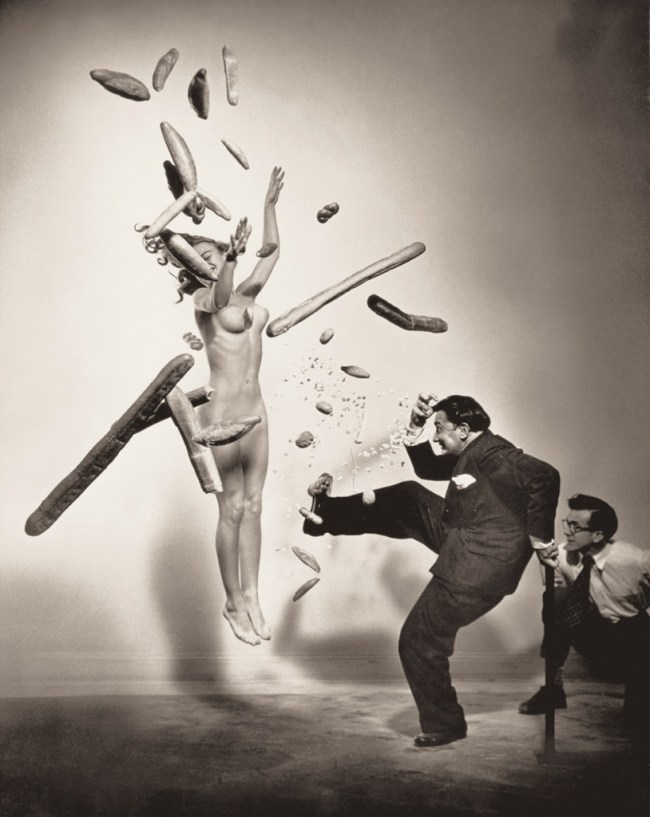
 

Philippe Halsman (American, 1906-1979) 'Nu au pop-corn (Popcorn nude)' 1949


Philippe Halsman (American, 1906-1979)
Nu au pop-corn (Popcorn nude)
1949
Musée de l’Elysée
© 2013 Philippe Halsman Archive / Magnum Photos
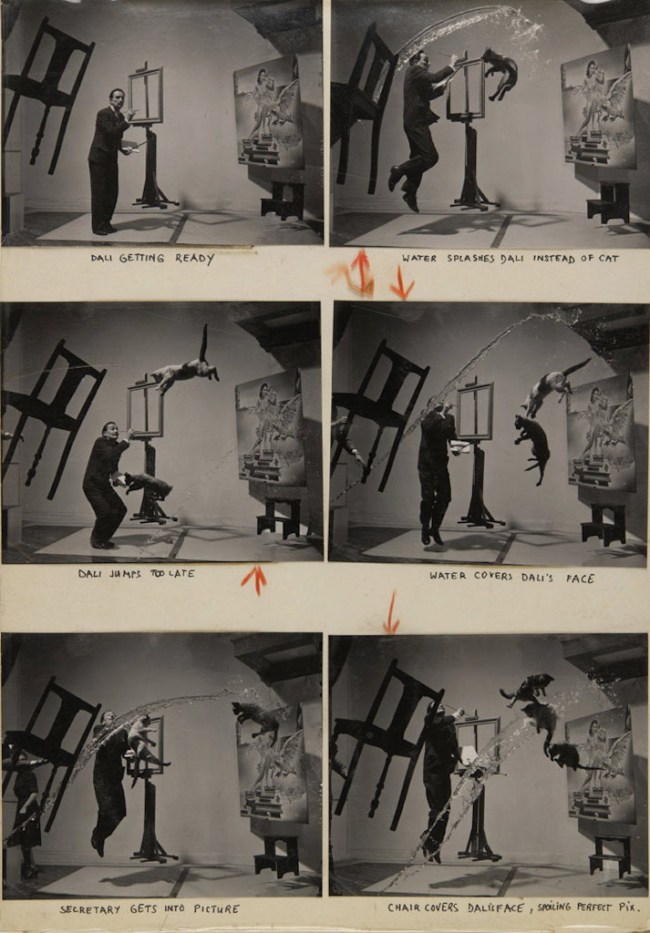
 

Philippe Halsman (American, 1906-1979) 'Dalí Atomicus' 1948 contact sheet


Philippe Halsman (American, 1906-1979)
Dalí Atomicus
1948
Contact sheet
Musée de l’Elysée
© 2013 Philippe Halsman Archive / Magnum Photos
Exclusive rights for images of Salvador Dalí: Fundació Gala-Salvador Dalí, Figueres, 2014
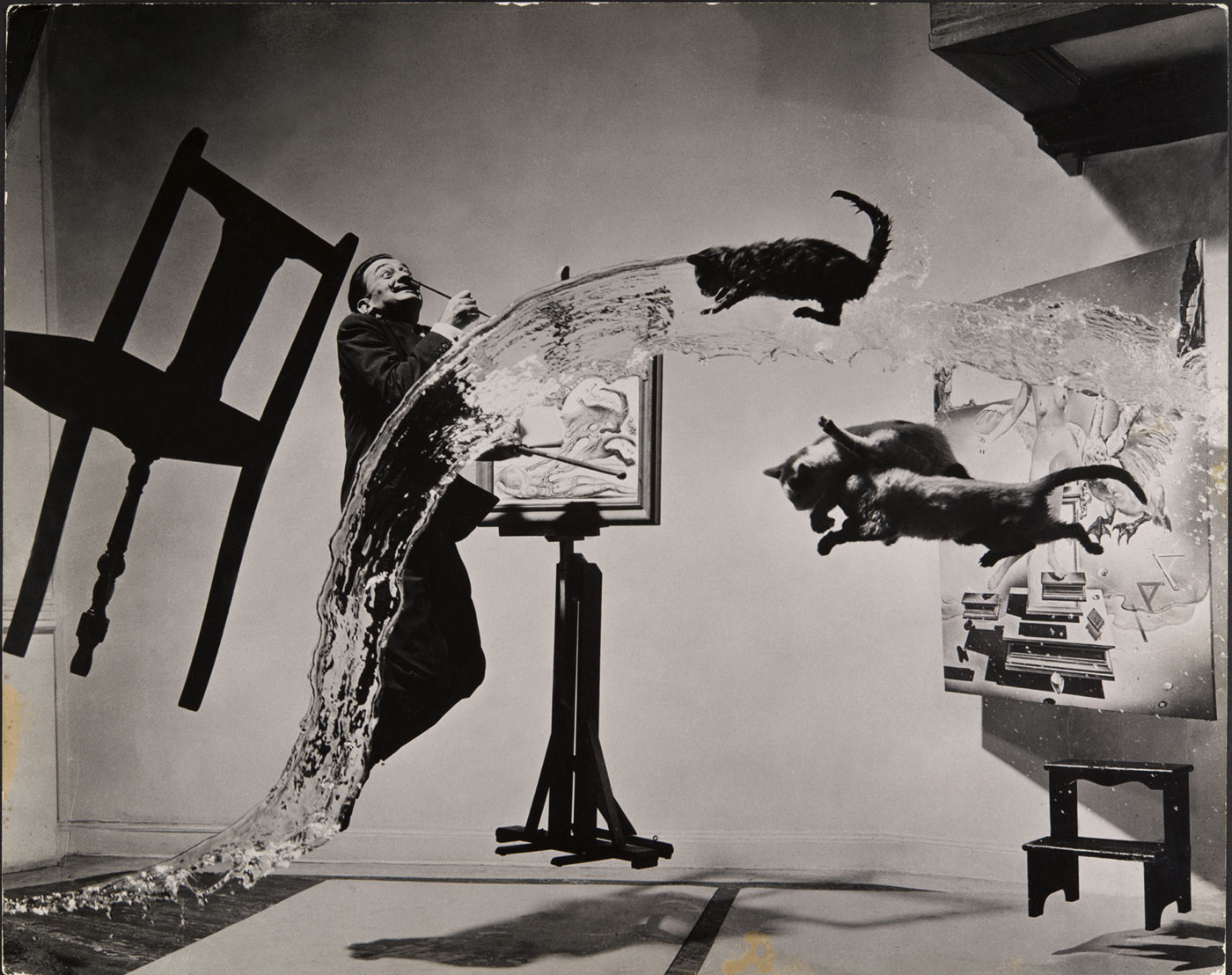
 

Philippe Halsman (American, 1906-1979) 'Dalí Atomicus' 1948


Philippe Halsman (American, 1906-1979)
Dalí Atomicus
1948
Musée de l’Elysée
© 2013 Philippe Halsman Archive / Magnum Photos
Exclusive rights for images of Salvador Dalí: Fundació Gala-Salvador Dalí, Figueres, 2014
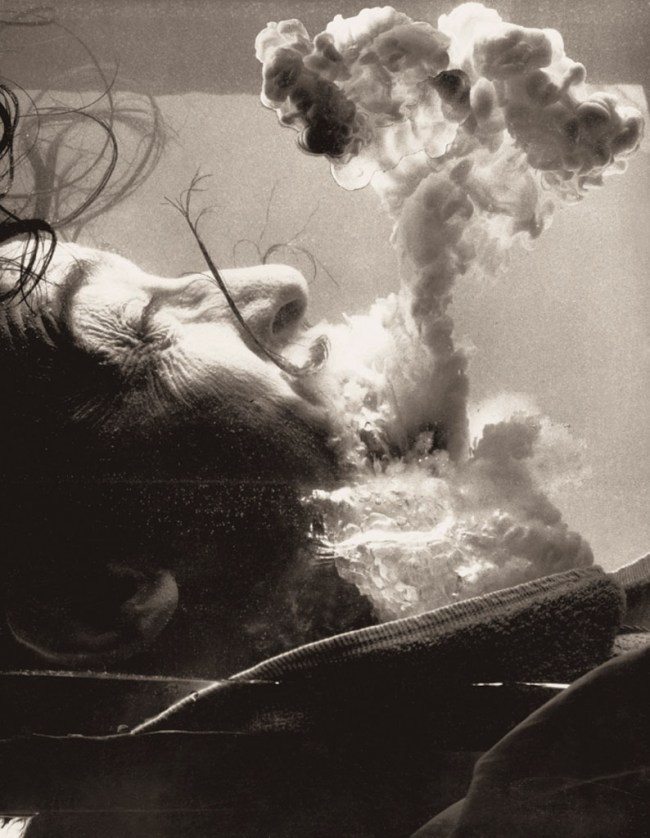
 

Philippe Halsman (American, 1906-1979) 'Épreuve préparatoire pour "Certainement. Je m'adonne personnellement à des explosions atomiques," Dalí's Mustache (Test event for "Certainly. I personally engaged in atomic explosions," Dalí's Mustache)' 1953-1954


Philippe Halsman (American, 1906-1979)
Épreuve préparatoire pour “Certainement. Je m’adonne personnellement à des explosions atomiques,” Dalí’s Mustache
(Test event for “Certainly. I personally engaged in atomic explosions,” Dalí’s Mustache)
1953-1954
Musée de l’Elysée
© 2013 Philippe Halsman Archive / Magnum Photos


Philippe Halsman (American, 1906-1979) 'Portrait de Salvador Dalí avec casque de footballeur américain (Portrait of Salvador Dalí with American football helmet)' 1964


Philippe Halsman (American, 1906-1979)
Portrait de Salvador Dalí avec casque de footballeur américain (Portrait of Salvador Dalí with American football helmet)
1964
Musée de l’Elysée
© 2013 Philippe Halsman Archive / Magnum Photos
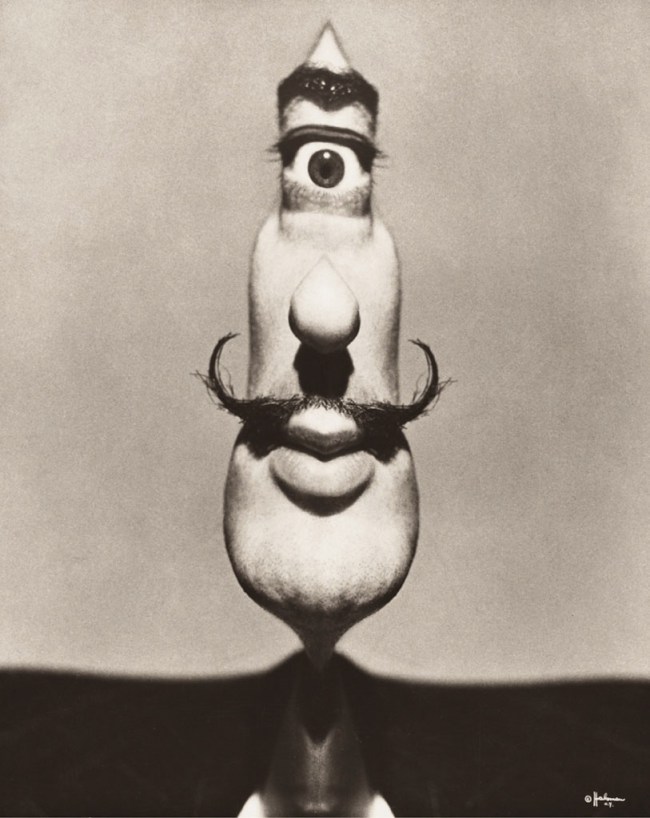
 

Philippe Halsman (American, 1906-1979) 'Dalí Cyclops' 1949


Philippe Halsman (American, 1906-1979)
Dalí Cyclops
1949
Musée de l’Elysée
© 2013 Philippe Halsman Archive / Magnum Photos


“In the thirty years of our friendship I have made countless photographs showing the surrealist painter in the most incredible situations. Whenever I needed a striking or famous protagonist for one of my wild ideas, Dalí would graciously oblige. Whenever Dalí thought of a photograph so strange that it seemed impossible to produce, I tried to find a solution. ‘Can you make me look like Mona Lisa?… Can you make a man one half of whom would look like Dalí and the other half like Picasso?’ I could and I did.”


Philippe Halsman


Halsman/Dalí

One of Halsman’s favourite subjects was Salvador Dalí with whom he shared a unique collaboration that spanned 37 years. Their 47 sittings, combining Dalí’s talent for performance and Halsman’s technical skill and inventiveness, resulting in an impressive repertoire of “photographic ideas”.

Focus on Dalí’s Mustache

As Halsman explains, Dalí’s Mustache is the fruit of this marriage of the minds. They conceived this book entirely dedicated to Dalí’s moustache, and created over thirty portraits of the painter absurdly answering Halsman’s questions. In 1953 Halsman realised that Salvador Dalí’s expanding moustache gave him the “chance to fulfil one his most ambitious dreams yet and create an extraordinarily eccentric work”. Dalí was enormously fond of his own person and of his mustache in particular, which he saw as a symbol of the power of his imagination, and was immediately thrilled at the idea. To create a “picture book” containing an interview with Salvador Dalí, Halsman reused an editorial concept he had introduced five years earlier with French actor Fernandel: a question asked of the artist was printed on one page, and the answer appeared on the following page in the form of a captioned photograph.

For this project, it was no longer just a matter of photographic expression, but of genuine mise en scène, combining Dalí’s theatrical character with Halsman’s impressive inventiveness and technical skill. Halsman presented the book as a genuine collaboration between two artists, representing their mutual understanding.

Halsman photographed Dalí with his 4×5 camera and his electronic flash through many sessions over a period of two years. Most of the plates in the book are portraits of the artist posing in a variety of positions, playing with his moustache in various ways, accentuated by light and framing effects. Dalí was ready to go along with any whim to create the scenes: he styles his precious moustache with the help of Hungarian wax, and agrees to take part in incongruous mises en scène, pressing his head behind a round of cheese to put the ends of his moustache through its holes, or plunging his head into a water-filled aquarium, his mouth full of milk.

As for Halsman, he put a lot of his effort into the post-production work in order to give concrete expression to their ideas. It sometimes took a laborious process to achieve images like the Mona Lisa portrait, inner conflicts, surrealism or the essence of Dalí, which not only required work on the print or negative (cutting, enlargement, deformation, double exposure) but also a montage and a new shot to create a negative of the final image. For the portrait of the artist in the form of a “soft watch”, Halsman worked around one hundred hours. He photographed Dali close up, then tacked a wet print of the image onto the edge of a table and re-photographed it at an angle that matched the angle of the original painting. He then cut it out, made a collage, and re-photographed it again – creating an image of Dali’s melted face. For the photographer, it was a genuine technical challenge, which he seized with patience and success.
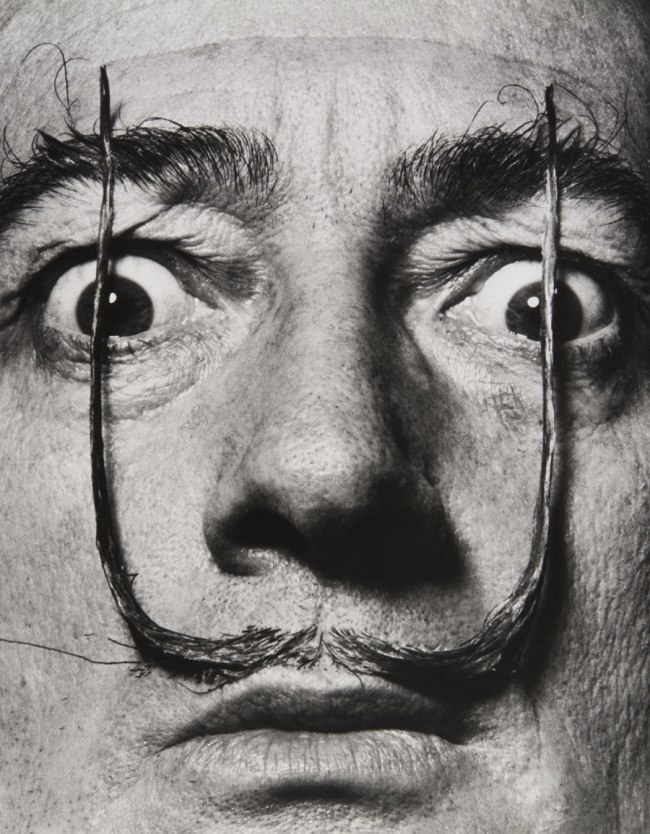
 

Philippe Halsman (American, 1906-1979) 'Like Two Erect Sentries, My Mustache Defends the Entrance to My Real Self, Dalí’s Mustache' 1954


Philippe Halsman (American, 1906-1979)
Like Two Erect Sentries, My Mustache Defends the Entrance to My Real Self, Dalí’s Mustache
1954
Philippe Halsman Archive
© 2013 Philippe Halsman Archive / Magnum Photos
Exclusive rights for images of Salvador Dalí: Fundació Gala-Salvador Dalí, Figueres, 2014


The Musée de l’Elysée
18, avenue de l’Elysée
CH - 1014 Lausanne
Phone: + 41 21 316 99 11

Opening hours:
Wednesday – Monday 10am – 6pm
Closed Tuesday

The Musée de l’Elysée website

LIKE ART BLART ON FACEBOOK

Back to top

Review: ‘Stephen Dupont / The White Sheet Series No. 1’ at Edmund Pearce Gallery, Melbourne

Exhibition dates: 2nd April – 3rd May 2014


Stephen Dupont (Australian, b. 1967) 'Untitled #16' 2010


Stephen Dupont (Australian, b. 1967)
Untitled #16
2010
Silver gelatin print and ink
20 x 16″ (51 x 40.5cm) / edition of 5 + 2 AP’s


This is a wonderful exhibition by Stephen Dupont at Edmund Pearce Gallery. Using a 4″ x 5″ Polaroid type 55 and striping away the emulsion, Dupont is left with a fine grain large format black and white negative (which he can use in an enlarger) with the “Polaroid frame look”, which he incorporates into the silver gelatin prints.1

Most of the photographs are glorious, notably the ones where Dupont pulls back from his subject to reveal the context of the sitter (much like taking the mat of a Daguerreotype to reveal more of the studio hidden underneath). I particularly like where you can see two hands poking over the top of the white sheet hiding the person behind (see Untitled #08 2010, below). The spontaneity and improvisation of this act is very appealing. As Dupont observes this allows him “to reveal the audience gathering and the environment around the sheet. This is meant to give the viewer a real sense of place and time, and a window onto the streets of Haridwar.” This technique gives the images real presence, they fairly “sing” to me from the gallery wall. And then! to surround the silver with hand printed Indian textile stamps in red ink… these images are really something.

Dupont’s incisiveness at the coal face of the pictorial plane is also exemplary. Notice the construction of Untitled #14 (2010, below), and observe the arms of the protagonists. An arm is raised aloft mirroring the arm of the swami in the photograph behind and also the supporting pole of the tent at top right. His other arm points to the earth but this is crossed by the arm of an out of focus man at left, which forms a strong diagonal intervention into the image as he reaches out. The money and mobile phone, at bottom left, add to the incongruity of the scene.

I am less enamoured with Dupont’s riff on Richard Avedon’s contextless background portraits. They don’t really possess the power or presence of the photographs mentioned above or of Avedon’s portraits from the series In The American West. I would have also liked to have seen the field journal (the small images at the bottom of the posting) in the exhibition. It would have been fascinating to read the text and view the other textile stamp designs. Finally, a couple of prints at a much larger size would have been good to see, to break the regularity of the series.

Having said that, you really have to see these images in the flesh for they look so much better than when reproduced online. The red is luminous and it is a joy to see good silver gelatin prints instead of so-so digital failures (Polly Borland I hope your ears are burning). This exhibition is a perfect example of what Bill Henson was talking about in his recently curated exhibition Wildcards: Bill Henson shuffles the deck at Monash Gallery of Art (MGA) where he states that his interest “is in the photograph as an object, in the physical presence of the print or whatever kind of technology is being used to make it…”2 where the images appeal not just to the eye but to the whole body, “because photographs are first and foremost objects, their size, shape grouping and texture are as important as the images they’re recording.”3

These photographs have, as Henson notes of some photographs, “the ability to suggest some other thing and that’s what draws you in.”4 You stand in front of the best of these images and contemplate them with a sense of wonder, for they suggest to the viewer – through the hand and eye of the artist in the analogue process, through the hand of the artist when applying the wood block printing which was made with much spontaneity and feeling – other worlds of which we know very little brought close to our imagination. Through their inherent textures and tonalities, their physical presence, there is a sense of the people who populate that place, but more than that, there is a sense of our own fragility and mortality.

A feeling of anOther existence for our life if we had been born into such worlds.
And that is what makes these images so compelling.

Dr Marcus Bunyan


Footnotes

1/ According to Wikipedia, “Type 55 negatives are the famous source of the “Polaroid frame look” … the Polaroid reagent / gel is squeezed between the negative and positive. Some of the reagent is trapped underneath the onion-skin-like frame that crops the print into a perfect 4 x 5 image. This reagent however creates an impression of that frame on the negative, which is not protected. The result is a perfect negative, but with imperfect frame-like image surrounded 3 of the four sides, while the 4th side shows the impression of the connective mesh that controls aspects of the Polaroid packet’s sleeve functionality.”

2/ Interview with Bill Henson by Toby Fehily posted 01 Feb 2014 on the Art Guide Australia website [Online] Cited 18/02/2014. No longer available online

3/ Fiona Gruber. “Review of Wildcards, Bill Henson Shuffles the Deck” on the Guardian website, Wednesday 12 February 2014 [Online] Cited 16/03/2014

4/ Fehily op. cit.,


Many thankx to Edmund Pearce Gallery for allowing me to publish the photographs in the posting. Please click on the photographs for a larger version of the image.


Stephen Dupont (Australian, b. 1967) 'Untitled #08' 2010


Stephen Dupont (Australian, b. 1967)
Untitled #08
2010
Silver gelatin print and ink
20 x 16″ (51 x 40.5cm) / edition of 5 + 2 AP’s


Stephen Dupont (Australian, b. 1967) 'Untitled #14' 2010


Stephen Dupont (Australian, b. 1967)
Untitled #14
2010
Silver gelatin print and ink
20 x 16″ (51 x 40.5cm) / edition of 5 + 2 AP’s


Stephen Dupont (Australian, b. 1967) 'Untitled #04' 2010


Stephen Dupont (Australian, b. 1967)
Untitled #04
2010
Silver gelatin print and ink
20 x 16″ (51 x 40.5cm) / edition of 5 + 2 AP’s


Edmund Pearce is excited to present a solo exhibition by legendary Australian photographer Stephen Dupont, entitled The White Sheet Series Number 1. This new series was shot during India’s most important Hindu Festival, Kumbh Mela, and features portraits of pilgrims and visitors combined with hand printed Indian textile stamps.

Stephen Dupont has produced a remarkable body of visual work throughout his career; hauntingly beautiful photographs of fragile cultures and marginalised peoples. He captures the human dignity of his subjects with great intimacy and his images have received international acclaim for their artistic integrity and valuable insight into the people, culture and communities that have existed for hundreds of years, yet are fast disappearing from our world.

Mark Feeney of the Boston Globe states, “Inevitably, Dupont is an outsider; yet he’s an engaged outsider, full of calm, clear-eyed curiosity. There’s not just a sense of place in his work but also something that matters even more: a sense of the people who populate that place.”

Stephen’s work has earned him a number of photography’s most prestigious prizes, including a Robert Capa Gold Medal citation from the Overseas Press Club of America. His work has featured in influential publications such as The New Yorker, Aperture and The New York Times Magazine; and he has had major exhibitions in London, Paris, New York, Sydney, Canberra, Tokyo, and Shanghai. His photographic artist books and portfolios are held in numerous private collections and by prestigious institutions such as the National Gallery of Australia, the National Library of Australia, the British Library and the Library of Congress in Washington DC to name but a few.

Press release from the Edmund Pearce Gallery website


Stephen Dupont (Australian, b. 1967) 'Untitled #07' 2010


Stephen Dupont (Australian, b. 1967)
Untitled #07
2010
Silver gelatin print and ink
20 x 16″ (51 x 40.5cm) / edition of 5 + 2 AP’s


Stephen Dupont (Australian, b. 1967) 'Untitled #13' 2010


Stephen Dupont (Australian, b. 1967)
Untitled #13
2010
Silver gelatin print and ink
20 x 16″ (51 x 40.5cm) / edition of 5 + 2 AP’s


Stephen Dupont (Australian, b. 1967) 'Untitled #12' 2010


Stephen Dupont (Australian, b. 1967)
Untitled #12
2010
Silver gelatin print and ink
20 x 16″ (51 x 40.5cm) / edition of 5 + 2 AP’s


Stephen Dupont (Australian, b. 1967) 'Untitled #18' 2010


Stephen Dupont (Australian, b. 1967)
Untitled #18
2010
Silver gelatin print and ink
20 x 16” (51 x 40.5cm) / edition of 5 + 2 AP’s


Richard Avedon at work


Richard Avedon at work


Richard Avedon (American, 1923-2004) 'Bill Curry, drifter, Interstate 40, Yukon, Oklahoma, 6/16/80' 1980


Richard Avedon (American, 1923-2004)
Bill Curry, drifter, Interstate 40, Yukon, Oklahoma, 6/16/80
1980
from In the American West, 1979-1984


Stephen Dupont artist book


This body of work is a selection of portraits I made in 2010 at India’s most important Hindu festival called the Kumbh Mela. In one of four locations every four years Hindu pilgrims and visitors descend into the holy waters of the Ganges River to purify the soul in a spiritual ritual considered the largest peaceful gathering in the world. The photographs were taken in Haridwar of pilgrims and sadhus I chose randomly during that festival.

Inspired by an earlier series I made of anonymous portraits of Afghans in Kabul titled Axe Me Biggie, or Mr Take My Picture, but instead of an existing Afghan outdoor studio backdrop I chose the white sheet this time for its purity and simplicity. My subjects were asked to simply stand and pose before my camera. I use a white bed sheet to create an outdoor studio that not only captures my subject but also allows me to reveal the audience gathering and the environment around the sheet. This is meant to give the viewer a real sense of place and time, and a window onto the streets of Haridwar. Had I used the backdrop in a conventional way, to solely isolate a person, you’d have the impression that they were taken anywhere – New York, Sydney, or in a studio. This process is a creative choice and allows me with some control over my sitter but brings with it the spontaneity and surprise of what may take place around the zone I am working in: the gaze of someone holding the sheet that has no idea they are in the frame, or a hand holding the sheet or something else that crops up in front or behind. In the end my portraits are environmental or even landscapes.

Over many years of travel throughout India I have been collecting textile stamps and I decided to use them on my photographs. The research and experiments started in my field journal and then to the final hand printed images in this show. I wanted to create a relationship with Indian design and cloth, the Polaroid borders and the people in my pictures. Much like my photographic practice here the wood block printing was made with much spontaneity and feeling. The photographs have been handcrafted by Chris Reid at Blanco Negro using warmtone paper and processed in a specialised developer for unique tonality.

Stephen Dupont
Sydney, February 28, 2014


Edmund Pearce Gallery

This gallery has now closed.

LIKE ART BLART ON FACEBOOK

Back to top

Exhibition: ‘Hermann Landshoff: A Retrospective Photographs 1930-1970’ at the Münchner Stadtmuseum

Exhibition dates: 29th November 2013 – 21st April 2014


Hermann Landshoff (American-German, 1905-1986) 'The Bicyclers' Published in 'Junior Bazaar' August 1946


Hermann Landshoff (American-German, 1905-1986)
The Bicyclers
Published in Junior Bazaar August 1946


Another artist who was lucky to escape Europe in the first years of the Second World War. I would like to see the whole exhibition. At the moment I can’t make a judgement on his work for I have not seen enough of it, but on the evidence of the images presented in this posting, I am not entirely convinced. However, the photograph of Lauren Bacall in 1945 is ravishing…

Marcus


Many thankx to the Münchner Stadtmuseum for allowing me to publish the photographs in the posting. Please click on the photographs for a larger version of the image.


Hermann Landshoff (American-German, 1905-1986) 'Max Ernst at Peggy Guggenheim’s home, New York, fall 1942' 1942


Hermann Landshoff (American-German, 1905-1986)
Max Ernst at Peggy Guggenheim’s home, New York, fall 1942
1942
Gelatin silver print
Münchner Stadtmuseum Photography Collection


Hermann Landshoff (American-German, 1905-1986) 'Photographer Irving Penn' 1948


Hermann Landshoff (American-German, 1905-1986)
Photographer Irving Penn
1948
Gelatin silver print
Münchner Stadtmuseum Photography Collection


Hermann Landshoff (American-German, 1905-1986) 'Children in a Spanish village' 1957


Hermann Landshoff (American-German, 1905-1986)
Children in a Spanish village
1957
Gelatin silver print
Münchner Stadtmuseum Photography Collection


Hermann Landshoff (American-German, 1905-1986) 'Model Cora Hemmet on the Grand Versailles Staircase' 1934-1938


Hermann Landshoff (American-German, 1905-1986)
Model Cora Hemmet on the Grand Versailles Staircase
1934-1938
Gelatin silver print
Münchner Stadtmuseum Photography Collection


In the spring of 2012, the Münchner Stadtmuseum’s Photography Collection received a sensational addition to its archives. The complete artistic estate of German-American photographer Hermann Landshoff (1905-1986), featuring 3,600 original prints from between 1927 to 1970, were generously donated to the museum on behalf of the family by Andreas Landshoff.

Landshoff grew up in Munich-Solln as the son of a well-to-do Jewish family that was very much involved in the city’s art, literature and music scenes. His father, Ludwig Landshoff, was an internationally acclaimed musicologist and composer who was director and head of Munich’s Bach Society from 1917 to 1928. His mother, Philippine Wiesengrund, was a singer with the Royal Court Opera, while his sister Ruth Landshoff, better known by her married name of Vollmer, would become one of the founders of the conceptual art movement in the United States. In addition, writers such as Thomas Mann, Christian Morgenstern, Joachim Ringelnatz, Rainer Maria Rilke, Karl Wolfskehl and Franziska zu Reventlow were frequent visitors to his parents’ home. Another family member, the author Ruth Landshoff-Yorck, was the muse of Otto Umbehr and Paul Citroen and ran an art salon in Berlin that had a reputation as one of the most exciting meeting places for avant-garde artists in the whole of the Weimar Republic.

Other more distant relations of the family included important figures from the world of publishing such as Samuel Fischer, the founder of the S. Fischer Verlag publishing house, and Fritz H. Landshoff, who, from 1933, ran the Querido publishing house in Amsterdam which would become the most important forum for German exile literature, publishing novels by authors including Heinrich Mann, Klaus Mann, Hermann Kesten, Joseph Roth, Alfred Döblin, Lion Feuchtwanger, Anna Seghers, Ernst Toller and Arnold Zweig.

Even in his early years, Hermann Landshoff attracted attention with his cartoons and a photo reportage on Albert Einstein that was published in the Münchner Illustrierte Zeitung magazine. After training at Munich’s Kunstgewerbeschule (School of Arts and Crafts), he became a member of the circle of well-known typographer and book illustrator Fritz Helmuth Ehmcke. It was here that Landshoff met the Nuremberg illustrator Richard Lindner alongside whom he would subsequently work as part of the creative team at the Knorr & Hirth publishing house. When the Nazis seized power in 1933, Landshoff was forced to emigrate, initially settling in Paris where he worked as a fashion photographer. Between 1936 and 1939, his images were published in the popular Femina magazine and in the French edition of Vogue. He was then forced to flee France and, after an eventful journey spanning 1940 and 1941, he eventually pitched up in New York. Landshoff soon became one of the most fascinating fashion photographers to collaborate with legendary art director Alexey Brodovitch for fashion magazines such as Harper’s Bazaar, Junior Bazaar and latterly also Mademoiselle. He developed his own style as a fashion photographer, portraying the models in life-like everyday situations. American fashion photographer Richard Avedon considered himself to have been profoundly inspired by Landshoff, even being moved to claim that ‘I owe everything to Landshoff’.

There is little doubt that Hermann Landshoff is one of the last great unsung heroes in (the history of) 20th century photography. Having been quite wrongly consigned to oblivion for all these years, the time has now come for him to be rediscovered. His multi-layered works show us various sides to the age in which he lived and the lives of artists who had settled in the United States having been exiled from Europe. The exhibition offers the first chance to see Landshoff’s portraits of European artists such as Max Ernst, Richard Lindner, Leonora Carrington or Frederick Kiessler who found a new artistic home in New York under the auspices of art collector Peggy Guggenheim. It also features a number of stunning group and individual portraits of members of the New York surrealist community centred around André Breton and Marcel Duchamp.

Finally, we also have Hermann Landshoff to thank for a unique cycle of around 70 portraits of different photographers that he created between 1942 and 1960. These striking images feature old masters like Walker Evans, Paul Strand, Alfred Stieglitz, Ansel Adams, Berenice Abbott, Margaret Bourke-White, Alfred Eisenstaedt, Andreas Feininger or WeeGee alongside young, up-and-coming photographers still at the start of their careers, such as Robert Frank, Irving Penn and Richard Avedon. This pantheon of eminent photographers occupies a unique place in the history of the medium.

Other collections of images tackle the urban architecture and people of New York, focusing particularly on those on the fringes of society. The exhibition also includes several portraits of prominent physicists such as Albert Einstein as well as some of the Los Alamos scientists such as Robert Oppenheimer and his cousin Rolf Landshoff involved in building the world’s first nuclear bomb. The exhibition will show a selection of more than 250 of Landshoff’s fascinating photographs for the first time, with subjects drawn from across the entire spectrum of his work, from fashion to portraits and architecture.

Press release from the Münchner Stadtmuseum website


Hermann Landshoff (American-German, 1905-1986) 'Tennis balls' with models Wanda Delafield and Peggy Lloyd c. 1945


Hermann Landshoff (American-German, 1905-1986)
Tennis balls with models Wanda Delafield and Peggy Lloyd
c. 1945
Gelatin silver print
Münchner Stadtmuseum Photography Collection


Hermann Landshoff (American-German, 1905-1986) 'Model Beth Wilson at Rip Van Winkle Bridge spanning the Hudson River, New York 1946' 1946


Hermann Landshoff (American-German, 1905-1986)
Model Beth Wilson at Rip Van Winkle Bridge spanning the Hudson River, New York 1946
1946
Gelatin silver print
Münchner Stadtmuseum Photography Collection


Hermann Landshoff (American-German, 1905-1986) 'Self-portrait, New York' c. 1942


Hermann Landshoff (American-German, 1905-1986)
Self-portrait, New York
c. 1942
Gelatin silver print
Münchner Stadtmuseum Photography Collection


Hermann Landshoff (American-German, 1905-1986) 'Actress Lauren Bacall, New York, 1945' 1945


Hermann Landshoff (American-German, 1905-1986)
Actress Lauren Bacall, New York, 1945
1945
Gelatin silver print
Münchner Stadtmuseum Photography Collection


Hermann Landshoff (American-German, 1905-1986) 'On the roof of Saks Fifth Avenue Building, New York, 1942' 1942


Hermann Landshoff (American-German, 1905-1986)
On the roof of Saks Fifth Avenue Building, New York, 1942
1942
Gelatin silver print
Münchner Stadtmuseum Photography Collection


Münchner Stadtmuseum
St. Jakobs Platz 1
80331 München
Phone: +49-(0)89-233-22370

Opening hours:
Tuesday – Sunday 10am – 6pm
Closed on Mondays

Münchner Stadtmuseum website

LIKE ART BLART ON FACEBOOK

Back to top

Exhibition: ‘Julia Margaret Cameron’ at The Metropolitan Museum of Art, New York

Exhibition dates: 9th August 2013 – 5th January 2014


Julia Margaret Cameron (British born India, Calcutta 1815 - 1879 Kalutara, Ceylon) 'King Lear and his Three Daughters' 1872


Julia Margaret Cameron (British born India, Calcutta 1815 – 1879 Kalutara, Ceylon)
King Lear and his Three Daughters
1872
Albumen silver print from glass negative
Bequest of Maurice B. Sendak, 2013
The Metropolitan Museum of Art


The three Liddell sisters – Lorina, Elizabeth, and Alice – posed with the photographer’s husband playing the tragically deceived King Lear in one of Cameron’s few Shakespearean compositions. Goneril and Regan whisper false flattery in the ageing king’s ear while the truly devoted but disinherited Cordelia – here unadorned and dressed in white – stands before him, an embodiment of disillusioned innocence.


The first posting of a new year, and finally I get to do a posting on one of the greatest photographers of all time. Nobody has ever taken portraits like JMC before or since. What a unique vision, different from everyone else: “directed light, soft focus, and long exposures that allowed the sitters’ slight movement to register in her pictures, instilling them with a sense of breath and life.”

The portrait of Sir John Herschel (April 1867, below) is one of the most famous portraits in the history of photography. What a magnificent achievement, to capture the spirit of this human being on a glass plate… “Our Julia” as my friend Joyce Evans lovingly calls her. It’s funny how everyone takes her to their heart.

Dr Marcus Bunyan


Many thankx to the The Metropolitan Museum of Art for allowing me to publish the photographs in the posting. Please click on the photographs for a larger version of the image.


Julia Margaret Cameron (British born India, Calcutta 1815 - 1879 Kalutara, Ceylon) 'Sappho' 1865


Julia Margaret Cameron (British born India, Calcutta 1815 – 1879 Kalutara, Ceylon)
Sappho
1865
Albumen silver print from glass negative
The Rubel Collection, Purchase, Jennifer and Joseph Duke and Anonymous Gifts, 1997
The Metropolitan Museum of Art


Mary Hillier, a beautiful young house servant at Dimbola, Cameron’s home in Freshwater, was often pressed into photographic service, frequently in the role of the Virgin Mary. She managed to assume her various guises in a remarkably unselfconscious way, projecting both gentleness and strength of character. Hillier is also the model for Cameron’s Sappho, a profile portrait in the Florentine Quattrocento style, perhaps inspired by the chromolithographic reproductions of Italian paintings distributed by the Arundel Society, of which Cameron was a member. The image has great presence, so much so that Cameron decided to print it even though she broke the negative. Precisely what the picture has to do with the Greek poet of Lesbos is unclear, especially since Cameron inscribed another print of the same image Adriana. The titles of two close variants reveal that, by looking left instead of right, Hillier was apparently transformed from Sappho into Dora or, when photographed from one step further back, Clio. Although Cameron often set out to portray a certain ideal, she also titled pictures after the fact, sometimes because the image seemed to embody the character of a certain literary or biblical figure, but sometimes, one suspects, quite simply because there was more of a market for images of the Virgin, Sappho, or Christabel than for portraits of the photographer’s niece or a parlour maid from the Isle of Wight.


Julia Margaret Cameron (British born India, Calcutta 1815 - 1879 Kalutara, Ceylon) 'The Mountain Nymph Sweet Liberty' 1866


Julia Margaret Cameron (British born India, Calcutta 1815 – 1879 Kalutara, Ceylon)
The Mountain Nymph Sweet Liberty
1866
Albumen silver print from glass negative
Harris Brisbane Dick Fund, 1941
The Metropolitan Museum of Art


In Cameron’s The Mountain Nymph Sweet Liberty, Miss Keene, an arresting model about whom we know nothing but her last name, stares directly at the camera (and, by extension, at the viewer), her hair loose and her eyes open wide. Filling the frame, she seems to step out of the picture. The photograph takes its title from John Milton’s poem L’Allegro, a celebration of life’s pleasures:

Come, and trip it as you go
On the light fantastic toe;
And in thy right hand lead with thee
The mountain nymph, sweet Liberty.

Cameron sent the photograph to her friend, the renowned scientist Sir John Herschel, who wrote back, “That head of the ‘Mountain Nymph Sweet liberty’ (a little farouche & égarée [timid and distraught] by the way, as if first let loose & half afraid that it was too good to last) is really a most astonishing piece of high relief. She is absolutely alive and thrusting out her head from the paper into the air. This is your own special style.” Herschel seized upon the photograph’s most striking quality, its startling sense of presence and of psychological connection with the viewer.


Julia Margaret Cameron (British born India, Calcutta 1815 - 1879 Kalutara, Ceylon) 'Zoe, Maid of Athens' 1866


Julia Margaret Cameron (British born India, Calcutta 1815 – 1879 Kalutara, Ceylon)
Zoe, Maid of Athens
1866
Albumen silver print from glass negative
The Rubel Collection, Purchase, Lila Acheson Wallace, Ann Tenenbaum and Thomas H. Lee, and Muriel Kallis Newman Gifts, 1997
The Metropolitan Museum of Art


Here Cameron photographed May Prinsep, her sister’s adopted daughter. By allowing Prinsep’s slight movement and by intentionally softening the focus, Cameron instilled a sense of breath and soul in this living apparition, for the true subject of her photograph was a poetic evocation of love and longing. “Maid of Athens, ere we part, / Give, oh, give me back my heart!” begin the verses composed by Lord Byron as he departed Greece in 1810. In the poem that inspired Cameron, Byron swore “By those tresses unconfined, / Wooed by each Aegean wind; / By those lids whose jetty fringe / Kiss thy soft cheeks’ blooming tinge; / By those wild eyes like the roe, / Zoë mou sas agapo [My life, I love you].”


Julia Margaret Cameron (British born India, Calcutta 1815 - 1879 Kalutara, Ceylon) 'Christabel' 1866


Julia Margaret Cameron (British born India, Calcutta 1815 – 1879 Kalutara, Ceylon)
Christabel
1866
Albumen silver print from glass negative
Harris Brisbane Dick Fund, 1941
The Metropolitan Museum of Art (41.21.26)


“Yea, she doth smile, and she doth weep,
Like a youthful hermitess,
Beauteous in a wilderness.”


Samuel Taylor Coleridge


Coleridge’s unfinished poem “Christabel” (1816) tells the story of a young woman debased by sorcery. A dark poem, full of rolling fog and lesbian innuendo, “Christabel” was the kind of tale that appealed to the Victorian palate – a soup of sexual transgression and moral repair. Cameron rarely made portraits of women; rather, when she photographed them, they appeared as representations of some biblical, mythological, or literary figure. Cameron’s niece, May Prinsep, who would later marry Hallam Tennyson, son of the poet laureate, appears here as the ethereal Christabel before her corruption. Cameron’s long exposure time and distinct soft-focus technique lend the work its idealising gravitas even while, paradoxically, intensifying the realistic presence of the individual before the lens. For all her “high art” aspirations, Cameron was always quick to note that her images were “from life.”


Julia Margaret Cameron (British born India, Calcutta 1815 - 1879 Kalutara, Ceylon) '[Kate Keown]' 1866


Julia Margaret Cameron (British born India, Calcutta 1815 – 1879 Kalutara, Ceylon)
[Kate Keown]
1866
Albumen silver print from glass negative
Gilman Collection, Purchase, Jennifer and Joseph Duke Gift, 2005
The Metropolitan Museum of Art


In spring and summer 1866, having purchased a new, larger camera capable of making twelve-by-fifteen-inch negatives, Cameron produced a series of twelve “life-sized heads,” including this angelic study of tender sorrow somewhat in the style of Botticelli. Throughout her work, poetic truth was valued above photographic truthfulness. She conveyed a sense of life and breath and of honest emotion through careful lighting, her models’ slight movement during long exposures, a shallow depth of field, and softness of focus. “My first successes in my out-of-focus pictures were a fluke,” Cameron wrote. “That is to say, that when focusing and coming to something which, to my eye, was very beautiful, I stopped there instead of screwing on the lens to the more definite focus which all other photographers insist on.” In so doing, she gave the feeling of both flesh and spirit without, in Rejlander’s words, “an exaggerated idea of the bark of the skin.”


Julia Margaret Cameron (British born India, Calcutta 1815 - 1879 Kalutara, Ceylon) 'Mrs. Herbert Duckworth' 1867


Julia Margaret Cameron (British born India, Calcutta 1815 – 1879 Kalutara, Ceylon)
Mrs. Herbert Duckworth
1867
Albumen silver print from glass negative
32.8 x 23.7cm (12 15/16 x 9 5/16 in.)
Gilman Collection, Purchase, Alfred Stieglitz Society Gifts, 2005


This portrait of Julia Jackson, which is usually trimmed to an oval, suggests an antique cameo carved in deep relief. Its success lies partly in its subject’s actual beauty and partly in the way the photographer modelled it to suggest Christian and classical ideals of purity, strength, and grace. The photograph was made the year Julia married Herbert Duckworth. Three years later she was a widow and the mother of three children.

Her second marriage, in 1878, to the great Victorian intellectual Sir Leslie Stephen, produced the painter Vanessa Bell and the writer Virginia Woolf. In her novel To the Lighthouse (1927), Virginia portrayed her mother as the searching, sensitive Mrs. Ramsay, ever suspended in thought. “She bore about with her, she could not help knowing it, the torch of her beauty; she carried it erect into any room that she entered.”


Julia Margaret Cameron (British born India, Calcutta 1815 - 1879 Kalutara, Ceylon) 'Alice Liddell / Pomona' 1872


Julia Margaret Cameron (British born India, Calcutta 1815 – 1879 Kalutara, Ceylon)
Alice Liddell / Pomona
1872
Albumen silver print from glass negative
David Hunter McAlpin Fund, 1963
The Metropolitan Museum of Art


Alice Liddell (1852-1934) – who, as a child, was Lewis Carroll’s muse and frequent photographic model – posed for Cameron a dozen times in August and September 1872. Against a dense background of foliage and bedecked with flowers, the twenty-year-old Liddell was photographed by Cameron as the embodiment of fruitful abundance, Pomona, Roman goddess of gardens and fruit trees.


One of the greatest portraitists in the history of photography, Julia Margaret Cameron (1815-1879) blended an unorthodox technique, a deeply spiritual sensibility, and a Pre-Raphaelite-inflected aesthetic to create a gallery of vivid portraits and a mirror of the Victorian soul. Julia Margaret Cameron, on view at the Metropolitan Museum of Art beginning August 19, 2013, is the first New York City museum exhibition devoted to Cameron’s work in nearly a generation and the first ever at the Met. The showing of 35 works is drawn entirely from the Metropolitan’s rich collection, including major works from the Rubel Collection acquired in 1997 and the Gilman Collection acquired in 2005. The exhibition is made possible by The Hite Foundation, in memory of Sybil Hite.

When she received her first camera in December 1863 as a Christmas gift from her daughter and son-in-law, Cameron was 48, a mother of six, and a deeply religious, well-read, somewhat eccentric friend of many notable Victorian artists, poets, and thinkers. “From the first moment I handled my lens with a tender ardour,” she wrote, “and it has become to me as a living thing, with voice and memory and creative vigour.” Condemned by some contemporaries for sloppy craftsmanship, she purposely avoided the perfect resolution and minute detail that glass negatives permitted, opting instead for carefully directed light, soft focus, and long exposures that allowed the sitters’ slight movement to register in her pictures, instilling them with a sense of breath and life.

The exhibition features masterpieces from each of her three major bodies of work: portraits of men “great thro’ genius” including the poet Alfred, Lord Tennyson, scientist Sir John Herschel, and philosopher Thomas Carlyle; women “great thro’ love” including relatives, neighbours, and household staff, often titled as literary, historical, or biblical subjects; and staged groupings such as her illustrations for Tennyson’s Idylls of the King, her Annunciation in the style of Perugino, or her depiction of King Lear and his daughters. Julia Margaret Cameron is organised by Malcolm Daniel, Senior Curator in the Department of Photographs at The Metropolitan Museum of Art.”

Press release from The Metropolitan Museum of Art website


Julia Margaret Cameron (British born India, Calcutta 1815 - 1879 Kalutara, Ceylon) 'Philip Stanhope Worsley' 1866


Julia Margaret Cameron (British born India, Calcutta 1815 – 1879 Kalutara, Ceylon)
Philip Stanhope Worsley
1866
Albumen silver print from glass negative
Gilman Collection, Purchase, The Horace W. Goldsmith Foundation Gift through Joyce and Robert Menschel, 2005
The Metropolitan Museum of Art


On February 21, 1866, Cameron wrote to Henry Cole, director of the South Kensington Museum, “I have been for 8 weeks nursing poor Philip Worsley on his dying bed… The heart of man cannot conceive a sight more pitiful than the outward evidence of the breaking up of his whole being.” An Oxford-educated poet who translated the Odyssey and part of the Iliad into Spenserian verse, Worsley died of tuberculosis at the age of thirty the following May. Cameron’s portrait, made the year of his death, vividly conveys the intensity of Worsley’s intellectual life and something of its tragedy. To her subject’s hypnotic gravity she added intimations of sacrifice, engulfing the dying poet in dramatic darkness.


Julia Margaret Cameron (British born India, Calcutta 1815 - 1879 Kalutara, Ceylon) 'Alfred, Lord Tennyson' July 4, 1866


Julia Margaret Cameron (British born India, Calcutta 1815 – 1879 Kalutara, Ceylon)
Alfred, Lord Tennyson
July 4, 1866
Albumen silver print from glass negative
The Rubel Collection, Purchase, Lila Acheson Wallace, Michael and Jane Wilson, and Harry Kahn Gifts, 1997
The Metropolitan Museum of Art


When Cameron’s husband retired in 1848 from the Calcutta Council of Education and the Supreme Council of India, they moved to England, settling first in Tunbridge Wells, near Charles’s old friend the poet Henry Taylor, and later in Putney Heath, near the poet laureate Alfred, Lord Tennyson and his wife. For Cameron, these men were not merely friends and neighbours, but also intellectual, spiritual, and artistic advisors. In 1860, while her husband was in Ceylon checking on the family coffee plantations, Cameron visited the Tennysons’ new home at Freshwater on the Isle of Wight and promptly purchased two cottages next door, which she joined together as the new family home. Cameron’s friendship and determination knew no bounds – indeed, her kindness could be overbearing at times. It took three years of pleading before Cameron convinced Tennyson (who jokingly referred to her models as “victims”) to sit for his portrait.


Julia Margaret Cameron (British born India, Calcutta 1815 - 1879 Kalutara, Ceylon) 'Sir John Herschel' April 1867


Julia Margaret Cameron (British born India, Calcutta 1815 – 1879 Kalutara, Ceylon)
Sir John Herschel
April 1867
Albumen silver print from glass negative
The Rubel Collection, Promised Gift of William Rubel
The Metropolitan Museum of Art


No commercial portrait photographer of the period would have portrayed Herschel as Cameron did here, devoid of classical columns, weighty tomes, scientific attributes, and academic poses – the standard vehicles for conveying the high stature and classical learning that one’s sitter possessed (or pretended to possess). To Cameron, Herschel was more than a renowned scientist; he was “as a Teacher and High Priest,” an “illustrious and revered as well as beloved friend” whom she had known for thirty years. Naturally, her image of him would not be a stiff, formal effigy. Instead, she had him wash and tousle his hair to catch the light, draped him in black, brought her camera close to his face, and photographed him emerging from the darkness like a vision of an Old Testament prophet.


Julia Margaret Cameron (British born India, Calcutta 1815 - 1879 Kalutara, Ceylon) 'A Study' 1865-66


Julia Margaret Cameron (British born India, Calcutta 1815 – 1879 Kalutara, Ceylon)
A Study
1865-66
Albumen silver print from glass negative
34.4 x 26.4cm (13 9/16 x 10 3/8 in.)
Bequest of James David Nelson, in memory of Samuel J. Wagstaff Jr., 1990


This image, also titled After Perugino / The Annunciation, is one of more than 130 religiously themed images inspired by Cameron’s deep Christian devotion and her artistic admiration of Italian painting of the early Renaissance. Such photographs adhere to traditional iconography only in the broadest sense. Here, for example, Cameron follows the precedent of paintings of the Annunciation in which the angel Gabriel presents a lily – symbol of purity – to the Virgin Mary. More important, however, Cameron’s sincerity of sentiment imbues her work with an aura of devotion and claims for it a place equal to sacred art of the past.


Julia Margaret Cameron (British born India, Calcutta 1815 - 1879 Kalutara, Ceylon) 'The Parting of Lancelot and Guinevere' 1874


Julia Margaret Cameron (English, 1815-1879)
The Parting of Lancelot and Guinevere
1874
Albumen silver print from glass negative
David Hunter McAlpin Fund, 1952
The Metropolitan Museum of Art


In 1874 Tennyson asked Cameron to make photographic illustrations for a new edition of his Idylls of the Kings, a recasting of the Arthurian legends. Responding that both knew that “it is immortality to me to be bound up with you,” Cameron willingly accepted the assignment. Costuming family and friends, she made some 245 exposures to arrive at the handful she wanted for the book. Ultimately – and predictably – she was unhappy with the way her photographs looked reduced in scale and translated into wood engravings, and she chose to issue a deluxe edition, at her own risk, that included a dozen full size photographic prints in each of two volumes.


The Metropolitan Museum of Art
1000 Fifth Avenue at 82nd Street
New York, New York 10028-0198
Phone: 212-535-7710

Opening hours:
Thursday – Tuesday 10am – 5pm

The Metropolitan Museum of Art website

LIKE ART BLART ON FACEBOOK

Back to top