Exhibition: ‘Still Performing: Costume, Gesture, and Expression in 19th Century European Photography’ at the Nelson-Atkins Museum of Art, Kansas City

Exhibition dates: 24th August, 2024 – 12th January, 2025
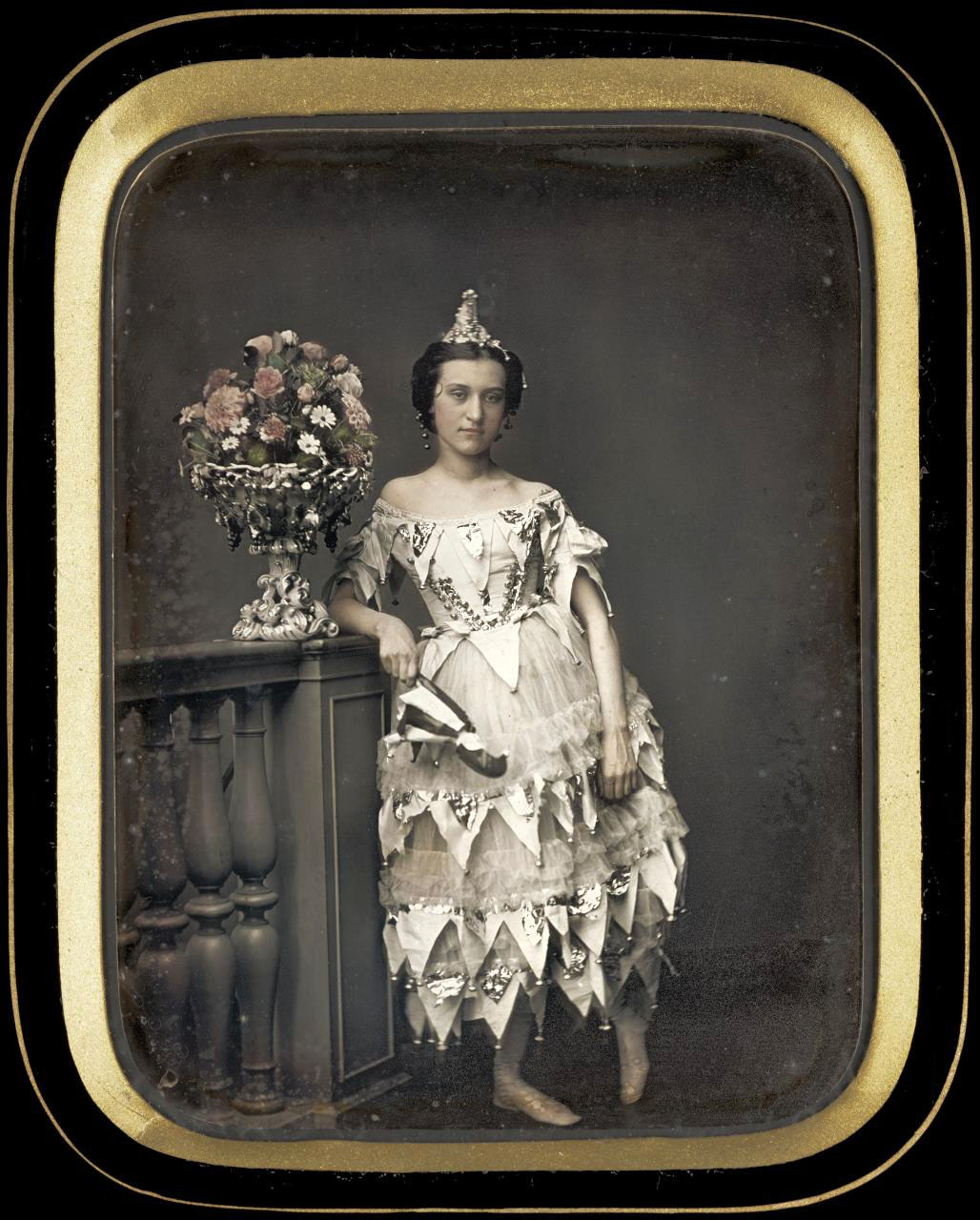
 

Victor Plumier (Belgian, 1820-1878) 'Lady in Costume' About 1850 from the exhibition 'Still Performing: Costume, Gesture, and Expression in 19th Century European Photography' at the Nelson-Atkins Museum of Art, Kansas City


Victor Plumier (Belgian, 1820-1878)
Lady in Costume
About 1850
Daguerreotype, half plate
5 1/2 × 4 1/2 inches
The Nelson-Atkins Museum of Art
Gift of the Hall Family Foundation


Past present

Magnificent photographs that bring past presence into present consciousness.

Costume. variedly, the term “costume,” indicating clothing exclusively from the eighteenth century onward, can be traced back to the Latin consuetudo, meaning “custom” or “usage.”

Gesture. late Middle English: from medieval Latin gestura, from Latin gerere ‘bear, wield, perform’. The original sense was ‘bearing, deportment’, hence ‘the use of posture and bodily movements for effect in oratory’.

Expression. the action of making known one’s thoughts or feelings. a look on someone’s face that conveys a particular emotion. late Middle English: from Latin expressio(n- ), from exprimere ‘press out, express’.


The emotions and the sentiments, the gestures and the expressions.

The actor and the stage, the photographer and the sitter.

The staged photograph and the tableaux vivant.

The Self and the Other.


Today, something happens when we look at these photographs. Today, the social spaces, gestures and expressions in these photographs are not fixed, monological re-presentations or presences. Our experience of the photographs enables them to be seen as nodes within a network caught up in a system of social and cultural references, whose unity is variable and relative.1

Thus,

” …in my reading (of the photograph), I relied upon a number of semiological systems, each one being a social / cultural construct: the sign language of clothes, of facial expressions, of bodily gestures, of social manner, etc. Such semiological systems do indeed exist and are continually being used in the making and reading of images. Nevertheless the sum total of these systems cannot exhaust, does not begin to cover, all that can be read in appearances.”2

The intertextuality of images.

Dr Marcus Bunyan


1/ Roland Barthes. “From Work to Text” and Michel Foucault. The Order of Things: An Archeology of the Human Sciences in Kurt Thumlert. Intervisuality, Visual Culture, and Education. [Online] Cited 10/08/2006. No longer available online

2/ John Berger and Jean Mohr. Another Way of Telling. New York: Pantheon Books, 1982, p. 112


Many thankx to the Nelson-Atkins Museum for allowing me to publish the photographs in the posting. Please click on the photographs for a larger version of the image.


“There is no perfection, no infinite completeness. But always, there is a way to move toward being whole. The capital letter, the Self is a wholeness that does not and will never exist. It is a direction that I move toward no matter the meanders of my feet.”


Kendrick VanZant
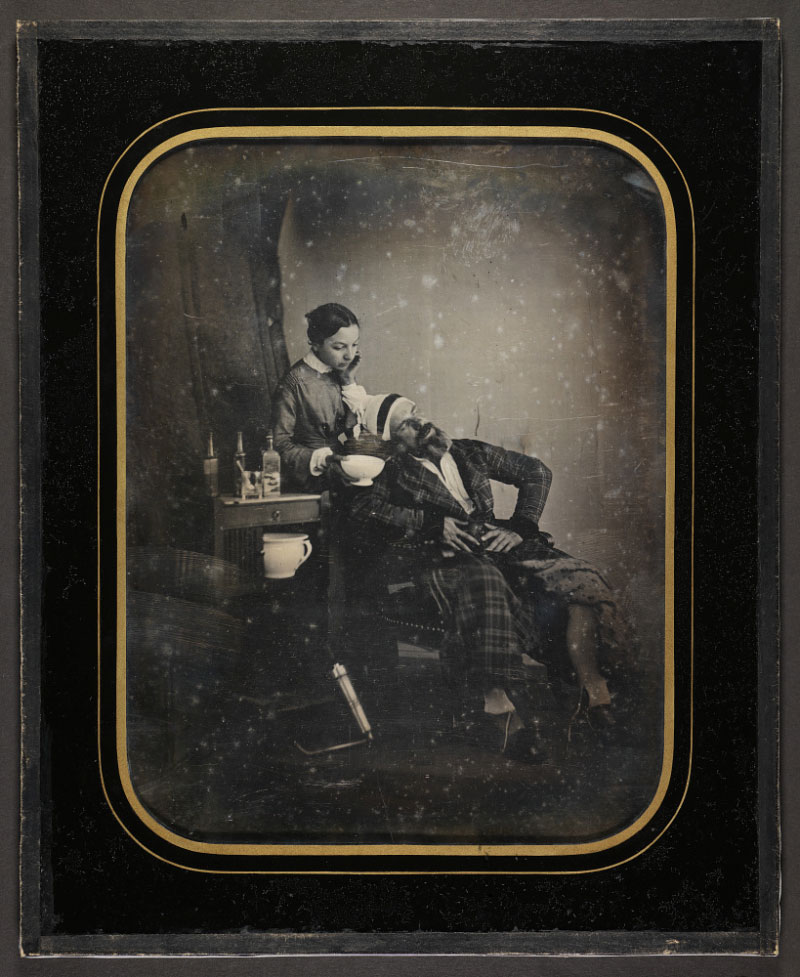


Camille Dolard (French, 1810-1884) 'Self-portrait as ailing man' c. 1843-1845


Camille Dolard (French, 1810-1884)
Self-portrait as ailing man
c. 1843-1845
Daguerreotype
Plate (whole): 8 1/2 × 6 1/2 inches (21.59 × 16.51cm)
Mat: 10 3/8 × 8 3/8 inches (26.37 × 21.29cm)
The Nelson-Atkins Museum of Art
Gift of the Hall Family Foundation


French painter Camille Dolard briefly embraced photography in the 1840s as an innovative creative tool. This daguerreotype, and the one in the next case, are from a group of three theatrical self-portraits created by Dolard in his studio. Here, the artist performs for the camera, posing with props and costumes as a patient in the care of his attentive wife. In the other plate, he uses a similarly theatrical approach, depicting himself smoking a hookah (a water pipe used to smoke tobacco) while lounging on a patterned rug.

Text from the Nelson-Atkins Museum website
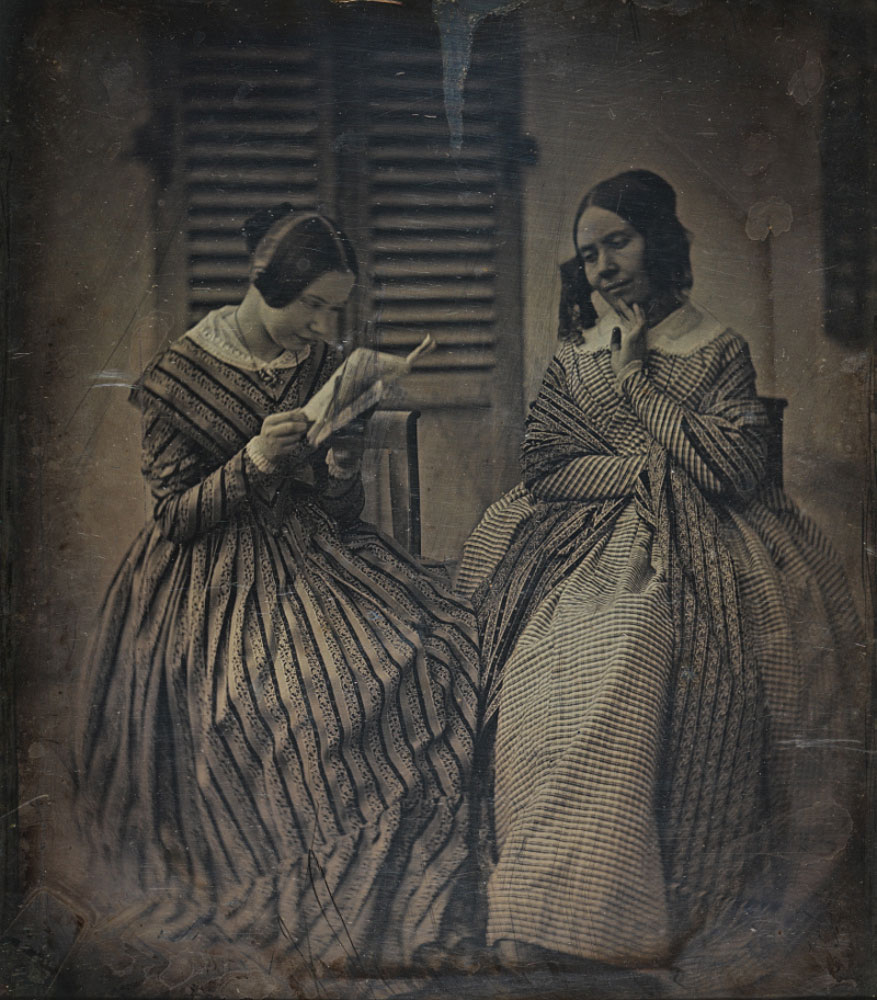
 

Jean-Pierre Thierry (French, 1810-1870) 'Two ladies reading a letter' c. 1845


Jean-Pierre Thierry (French, 1810-1870)
Two ladies reading a letter
c. 1845
Daguerreotype
Plate (quarter): 4 1/4 × 3 1/4 inches (10.8 × 8.26 cm)
Mat: 6 1/16 × 5 1/8 inches (15.39 × 13.03 cm)
The Nelson-Atkins Museum of Art
Gift of the Hall Family Foundation
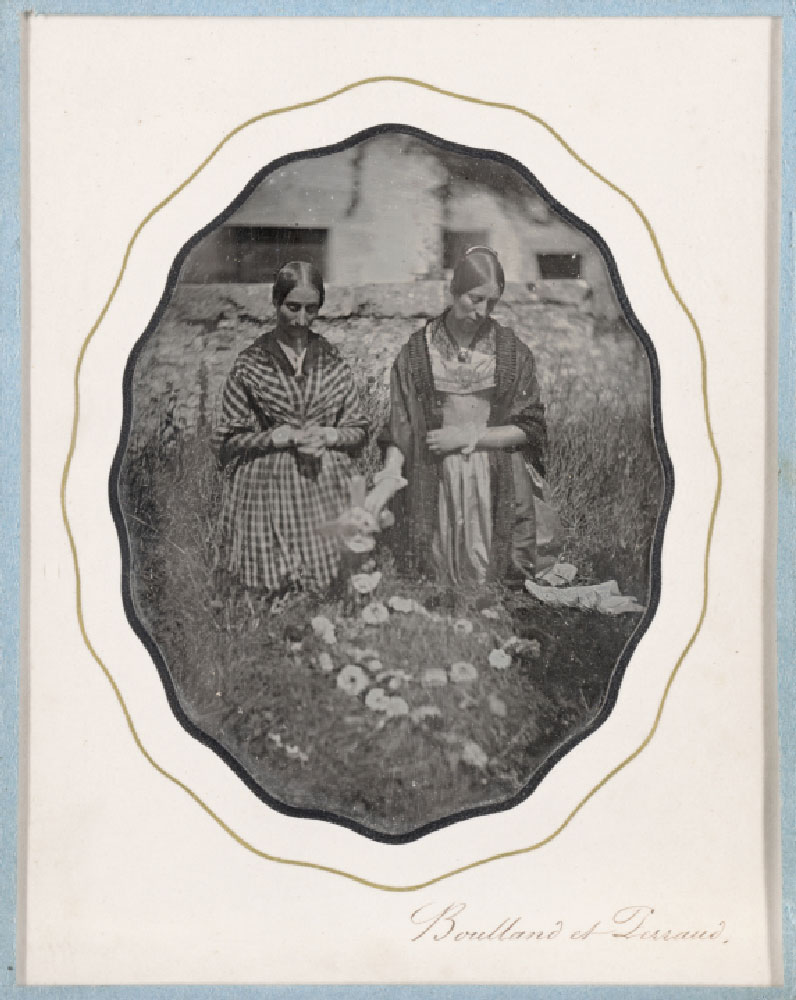
 

Philibert Perraud (French, 1815 - after 1863) 'Deux femmes se recueillent sur la tombe d'une etre cher ...' (Two women at the grave of a loved one) c. 1845


Philibert Perraud (French, 1815 – after 1863)
Deux femmes se recueillent sur la tombe d’une etre cher … (Two women at the grave of a loved one)
c. 1845
Daguerreotype
Plate (quarter): 4 1/4 × 3 1/4 inches (10.8 × 8.26cm)
 Mount: 5 1/8 × 4 1/8 inches (13.02 × 10.48cm)
The Nelson-Atkins Museum of Art
Gift of the Hall Family Foundation
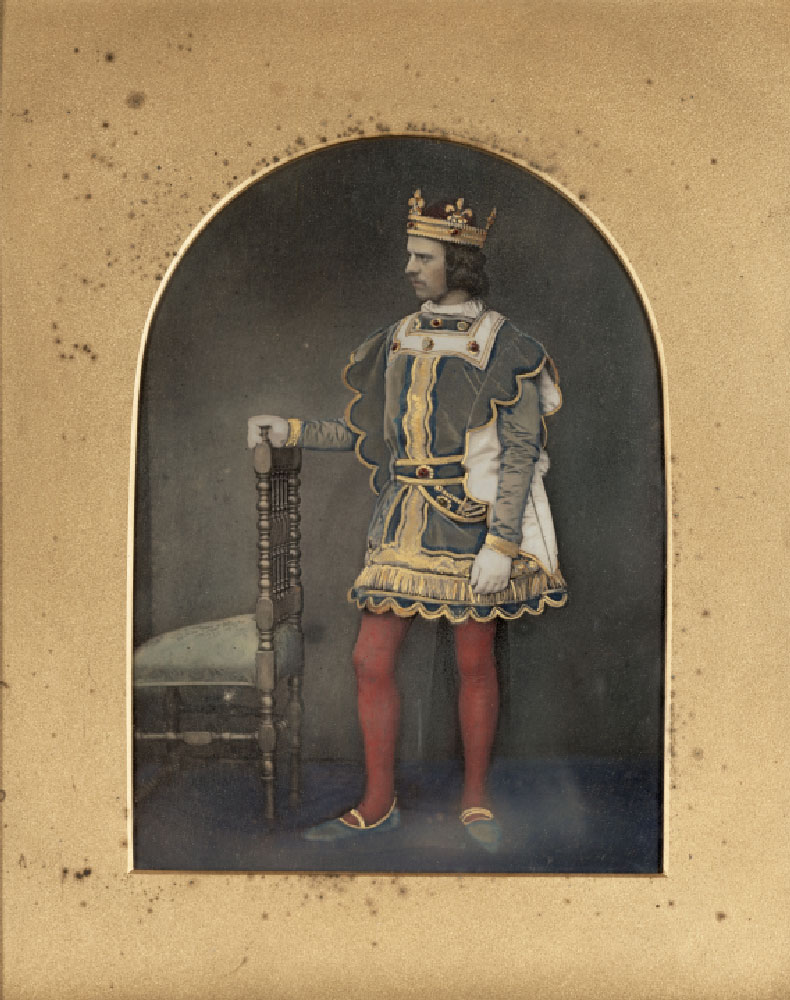
 

Unknown photographer. 'Actor in Costume' c. 1850 from the exhibition 'Still Performing: Costume, Gesture, and Expression in 19th Century European Photography' at the Nelson-Atkins Museum of Art, Kansas City


Unknown photographer
Actor in Costume
c. 1850
Daguerreotype
Plate (three-quarter): 6 × 4 1/2 inches (15.24 × 11.43 cm)
Case (open): 8 1/8 × 13 1/4 × 3/8 inches (20.64 × 33.66 × 0.95 cm)
Case (closed): 8 1/8 × 6 5/8 × 5/8 inches (20.64 × 16.83 × 1.59 cm)
The Nelson-Atkins Museum of Art
Gift of the Hall Family Foundation


Though the pose and expression in this photograph are stiff, the extensive hand-colouring enlivens the portrait, drawing attention to the fine details in the actor’s costume. Sitting for a daguerreotype portrait in the 1850s required patience and a certain degree of stamina. Photographic exposure times – which varied according to plate sensitivity and studio lighting – typically ranged from three to 30 seconds. Studio props, such as chairs and head braces, were used to help sitters remain as motionless as possible for the duration of the exposure.

Text from the Nelson-Atkins Museum website
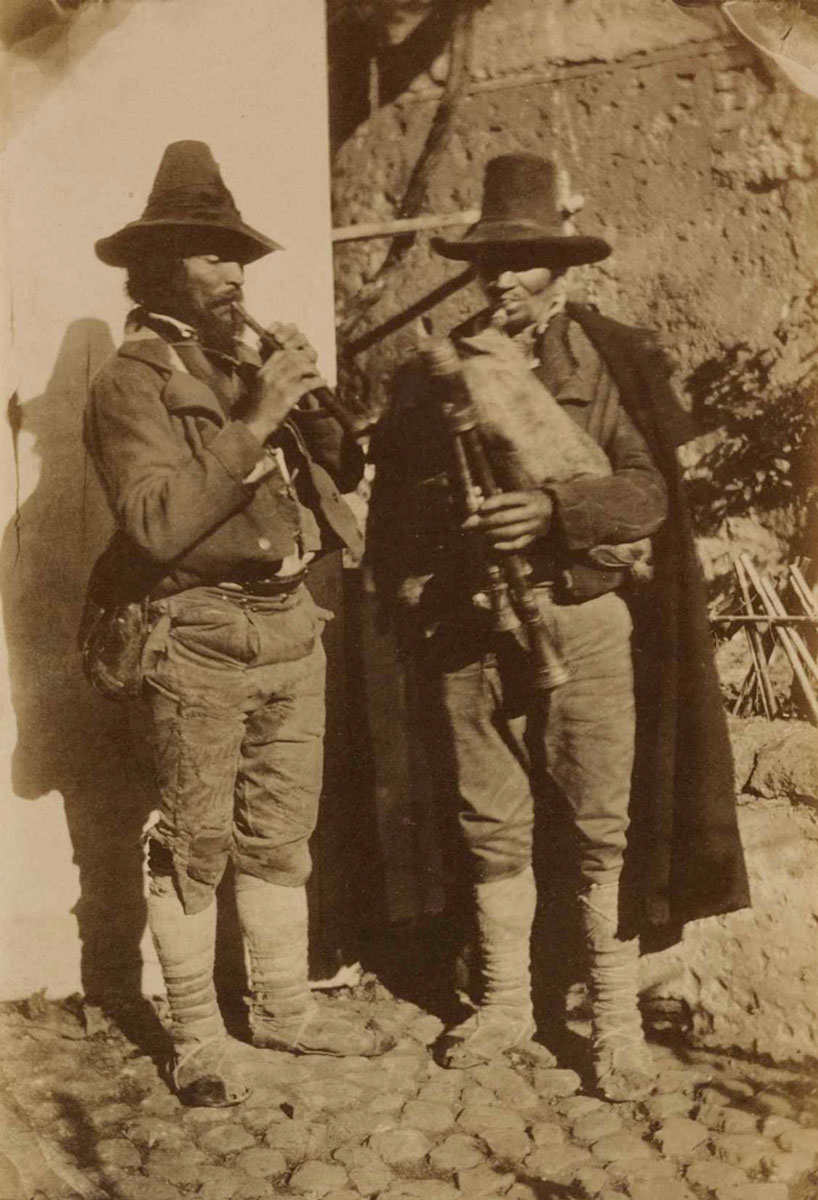
 

Giacomo Caneva (Italian, 1813-1865) 'Two Pifferari' c. 1850s


Giacomo Caneva (Italian, 1813-1865)
Two Pifferari
c. 1850s
Salt print
Image: 8 3/8 × 5 11/16 inches (21.27 × 14.45cm)
Sheet: 11 3/16 × 5 11/16 inches (28.42 × 14.45cm)
The Nelson-Atkins Museum of Art
Gift of the Hall Family Foundation


Nothing summed up picturesque modern Italy as well as the Pifferari; described by Hector Berlioz (1803-1869) in 1832: ‘These are strolling musicians who, towards Christmas, come down from the mountains in groups of four or five, armed with bagpipes and ‘pifferi’ (a sort of oboe), to play in homage before statues of the Madonna. They are generally dressed in large brown woollen coats and the pointed hats that brigands sport, and their whole appearance is instinct with a kind of mystic savagery that is most striking’. He admits that close to the music is ‘overpoweringly loud, but at a certain distance the effect of this strange ensemble of instruments is haunting and few are unmoved by it’.

Text from the Royal Collection Trust website
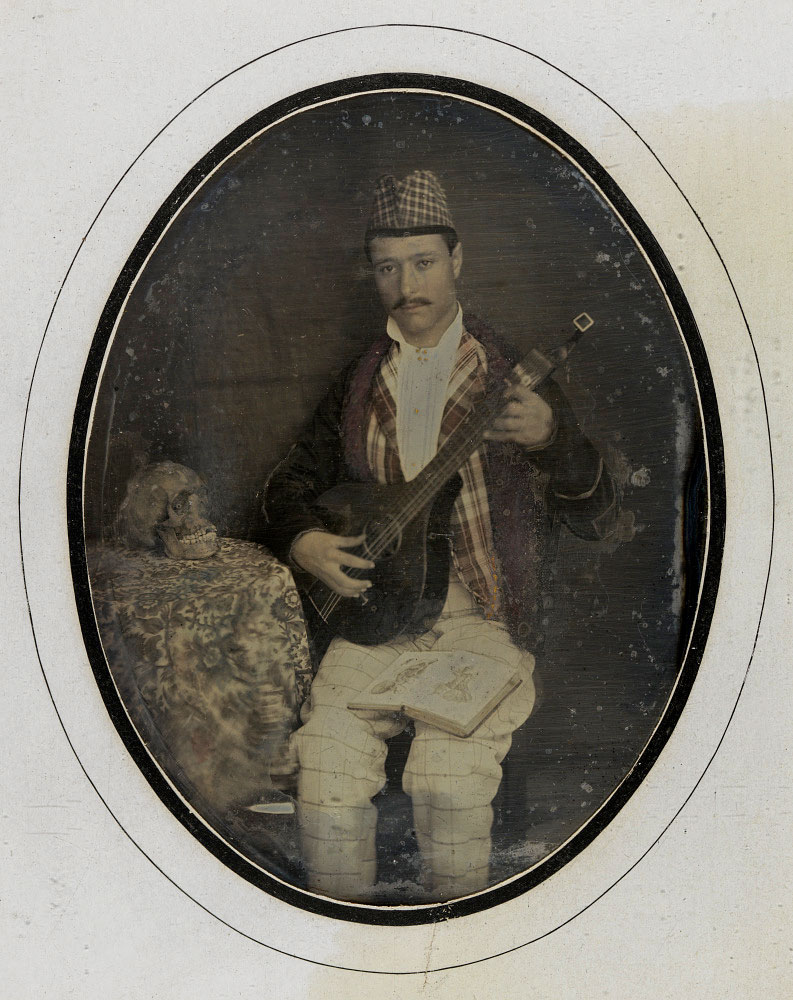
 

José Maria Blanco (Spanish, active c. 1850) 'Man with mandolin' 1851 from the exhibition 'Still Performing: Costume, Gesture, and Expression in 19th Century European Photography' at the Nelson-Atkins Museum of Art, Kansas City


José Maria Blanco (Spanish, active c. 1850)
Man with mandolin
1851
Daguerreotype
Plate (quarter): 4 × 3 1/4 inches (10.16 × 8.26cm)
Mat: 5 5/8 × 4 7/8 inches (14.29 × 12.38cm)
The Nelson-Atkins Museum of Art
Gift of the Hall Family Foundation
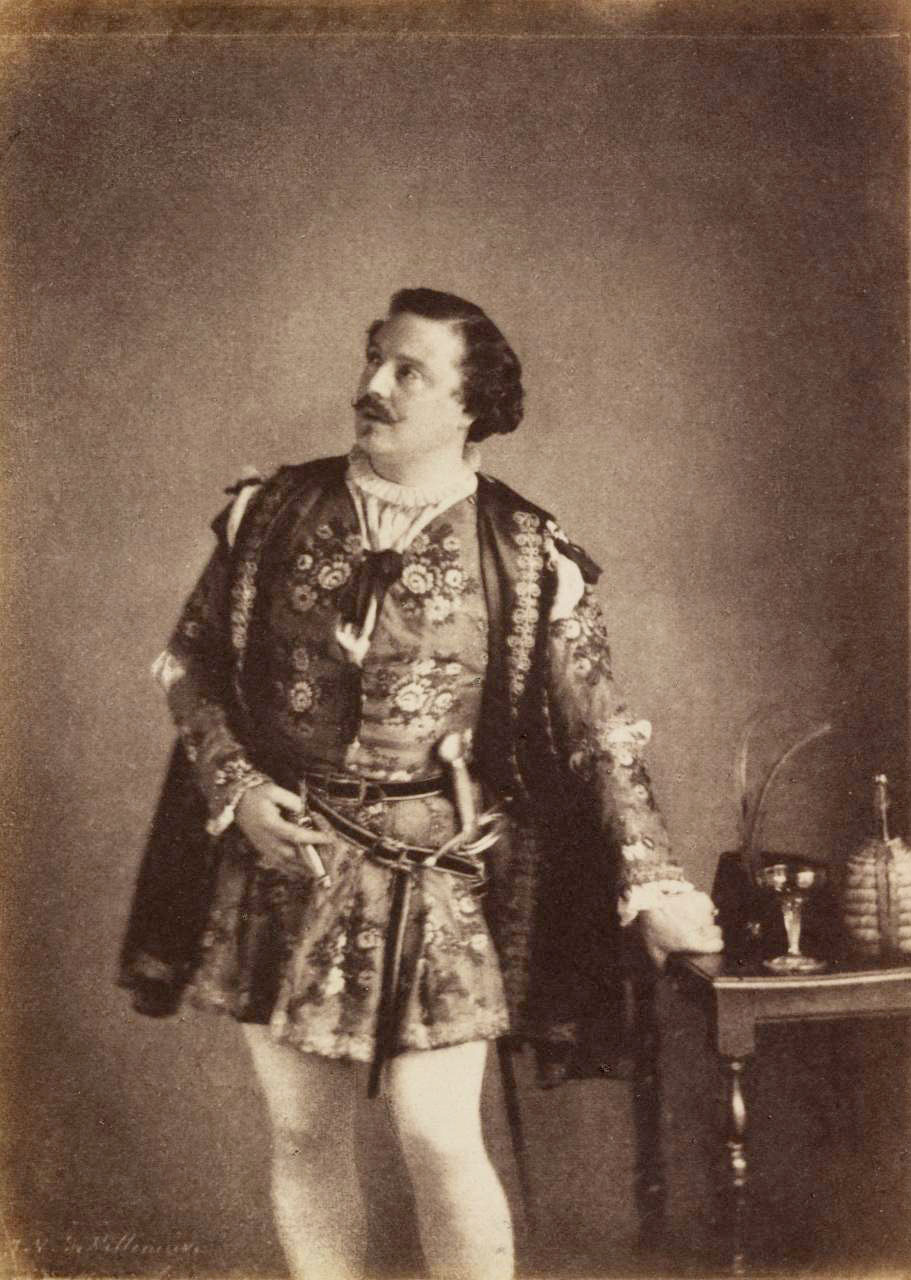
 

Julien Vallou de Villeneuve (French, 1795-1866) 'Portrait of Edouard Brindeau' 1853


Julien Vallou de Villeneuve (French, 1795-1866)
Portrait of Edouard Brindeau
1853
Salt print
6 1/4 × 4 5/8 inches
The Nelson-Atkins Museum of Art
Gift of the Hall Family Foundation
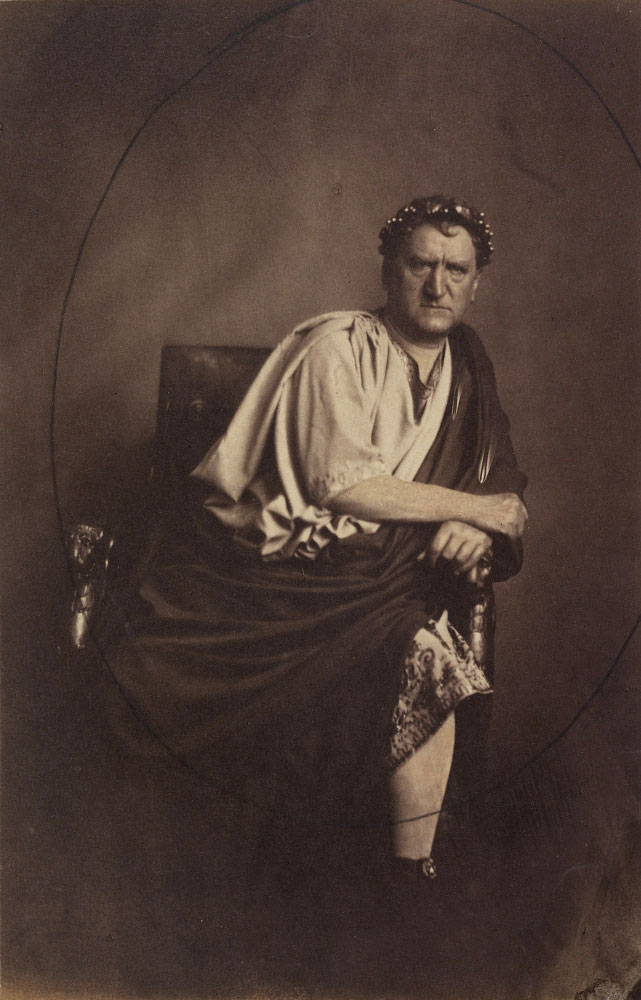
 

Julien Vallou de Villeneuve (French, 1795-1866) 'Portrait of Jean-Baptiste Provost, in the role of the emperor Claude in the play Valeria' 1853


Julien Vallou de Villeneuve (French, 1795-1866)
Portrait of Jean-Baptiste Provost, in the role of the emperor Claude in the play Valeria
1853
Portraits of Actors from the Comédie Française
Salt print
Image and sheet: 6 7/16 × 4 1/8 inches (16.35 × 10.48cm)
The Nelson-Atkins Museum of Art
Gift of the Hall Family Foundation
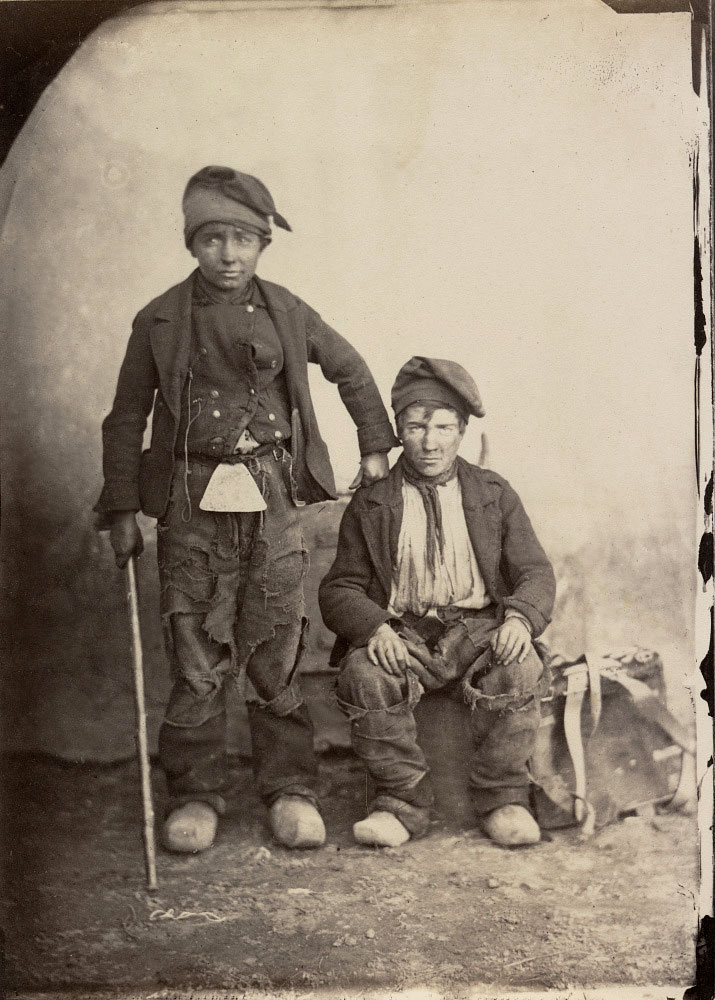
 

Charles Nègre (French, 1820-1880) 'Two Small Savoyards' c. 1853 from the exhibition 'Still Performing: Costume, Gesture, and Expression in 19th Century European Photography' at the Nelson-Atkins Museum of Art, Kansas City


Charles Nègre (French, 1820-1880)
Two Small Savoyards
c. 1853
Albumen print
Image and sheet: 7 × 5 3/16 inches (17.78 × 13.12cm)
Mount: 17 × 15 inches (43.18 × 38.1cm)
The Nelson-Atkins Museum of Art
Gift of the Hall Family Foundation


Charles Nègre refers to the threadbare young men in this photograph as “Savoyards” (originating from the Savoy region of France). Impoverished, migrant Savoyards have appeared in European art since the 1700s, and Nègre’s title could be shorthand for a certain type of person seen in the streets of Paris, regardless of the two boys’ actual place of origin. A painter and a photographer, Nègre practiced the two mediums side-by-side. Like other artists of his time, he ascribed nobility to the poor, seeking to convey their “truth, warmth, and life.”

Text from the Nelson-Atkins Museum website


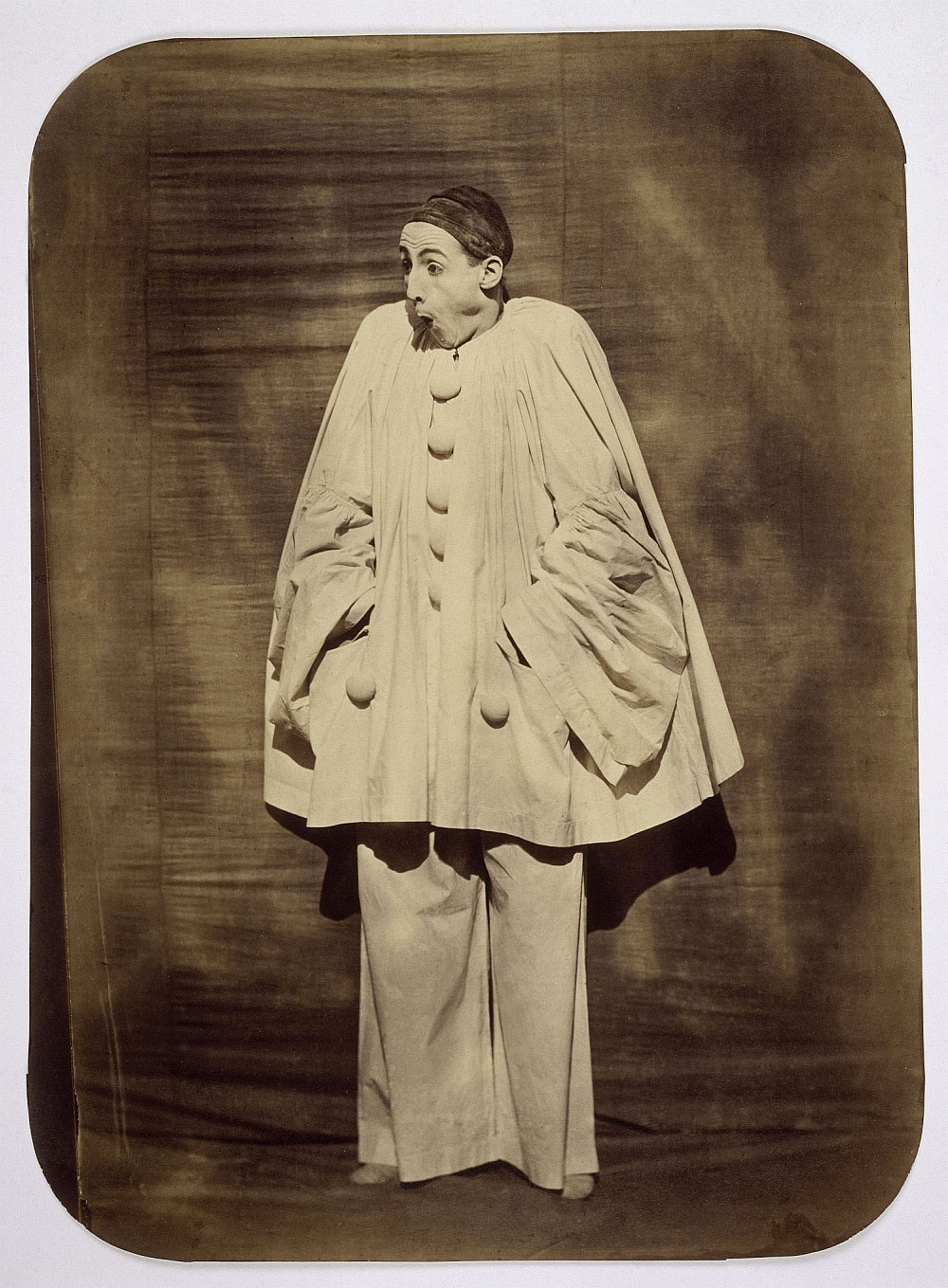
Alban-Adrien Tournachon (French , 1825-1903) and Nadar [Gaspard Félix Tournachon] (French, 1820-1910) 'Pierrot Yawning' 1854 from the exhibition 'Still Performing: Costume, Gesture, and Expression in 19th Century European Photography' at the Nelson-Atkins Museum of Art, Kansas City


Alban-Adrien Tournachon (French , 1825-1903) and Nadar [Gaspard Félix Tournachon] (French, 1820-1910)
Pierrot Yawning
1854
Salt print
11 1/4 × 8 1/2 inches
The Nelson-Atkins Museum of Art
Gift of the Hall Family Foundation
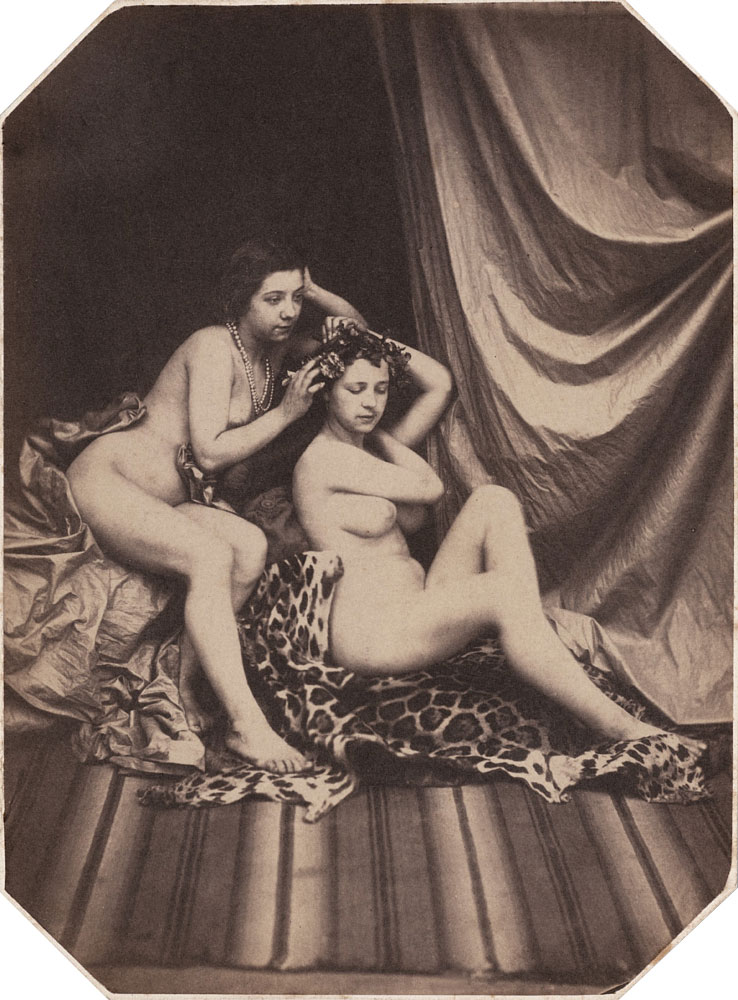
 

Auguste Belloc (French, 1805 -1873) 'Une étude de nu de deux femmes' c. 1855


Auguste Belloc (French, 1805 -1873)
Une étude de nu de deux femmes
c. 1855
Salt print
Image and sheet: 8 5/16 × 6 1/8 inches (21.11 × 15.56cm)
The Nelson-Atkins Museum of Art
Gift of the Hall Family Foundation


A masterful printer, Auguste Belloc created nudes that surpassed the typical erotic fare found in Parisian markets. In this scene, Belloc strategically positions the models and surrounding drapery to make the photograph appear more artistic than pornographic. Though nude paintings, drawings, and sculptures were immensely common, at this time photography was treated far more harshly by censors. In October 1860, the French government seized some 5,000 of Belloc’s photographs, declaring them obscene, and by 1868 he had abandoned his photographic studio.

Text from the Nelson-Atkins Museum website
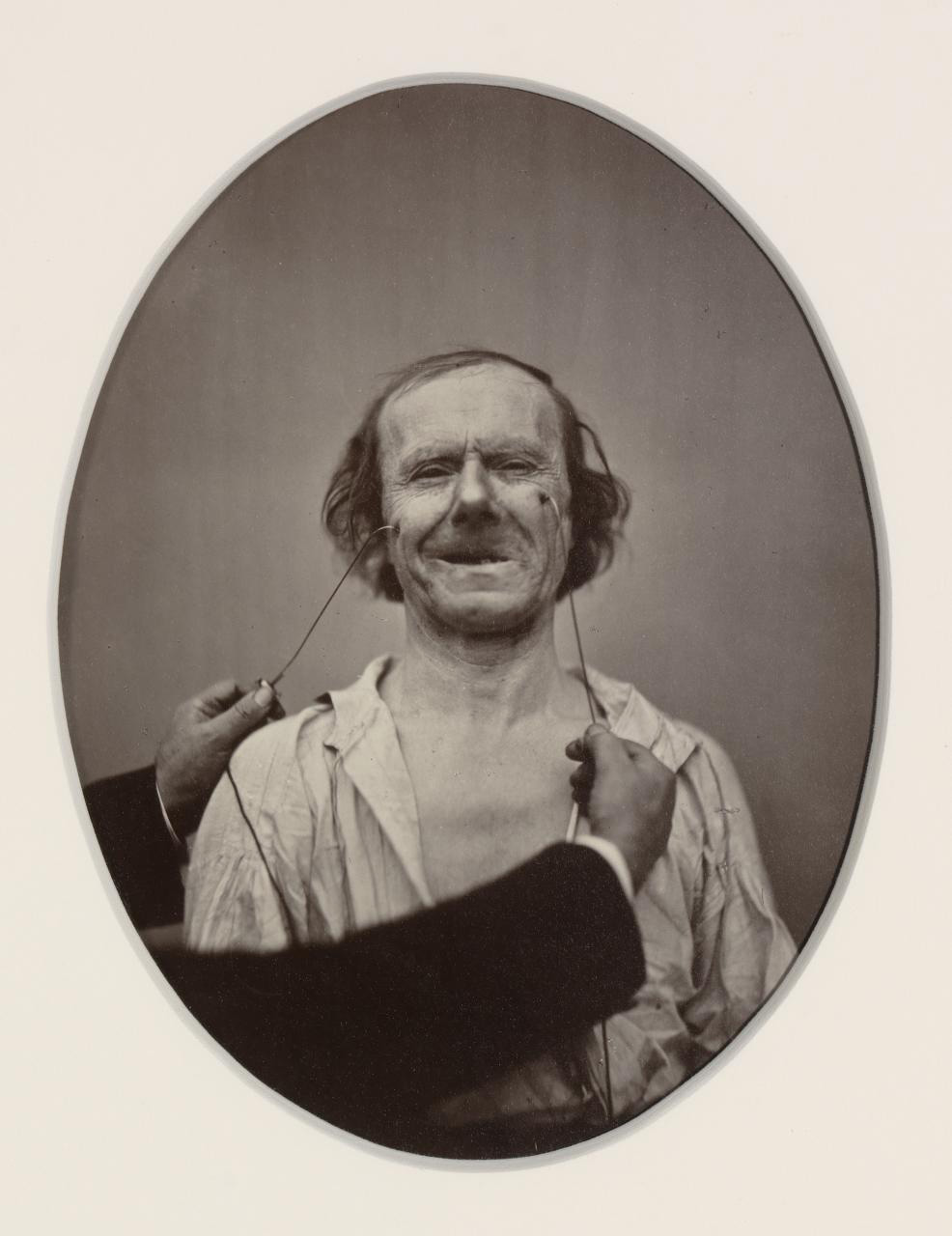
 

Guillaume-Benjamin-Amand Duchenne de Boulogne (French, 1806-1875) and Alban-Adrien Tournachon (French, 1825-1903) 'The Muscles of Weeping and Whimpering' About 1855-1857


Guillaume-Benjamin-Amand Duchenne de Boulogne (French, 1806-1875) and Alban-Adrien Tournachon (French, 1825-1903)
The Muscles of Weeping and Whimpering
About 1855-1857
Albumen print
9 1/16 × 6 15/16 inches
The Nelson-Atkins Museum of Art
Gift of the Hall Family Foundation


Facial expressions and their corresponding emotions have been studied by artists for centuries. In the 1850s, Dr. Guillaume-Benjamin-Amand Duchenne de Boulogne used photography to document the facial expressions produced by localised electric shock. Working in partnership with photographer Adrien Alban Tournachon, Duchenne felt these photographs truthfully recorded his experiments and that “none shall doubt the facts presented here.” Praising photography for its accurate rendering of the subject’s deep wrinkles, he wrote, “the distribution of light is in perfect harmony with the passions represented by these expressive lines. Thus, the face depicting the dark, concentric passions – aggression, wickedness, suffering, pain, dread, torture mixed with fear – gain an uncommon amount of energy.”

Text from the Nelson-Atkins Museum website
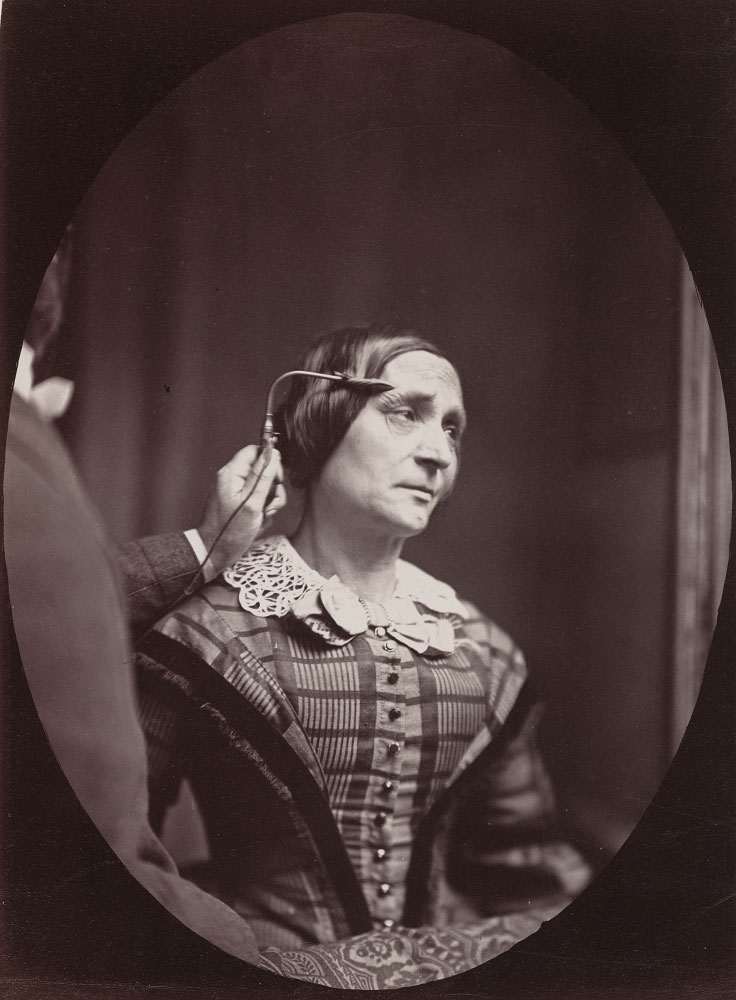
 

Guillaume-Benjamin-Amand Duchenne de Boulogne (French, 1806-1875) and Alban-Adrien Tournachon (French, 1825-1903) 'The Muscle of Pain' c. 1854-1857


Guillaume-Benjamin-Amand Duchenne de Boulogne (French, 1806-1875) and Alban-Adrien Tournachon (French, 1825-1903)
The Muscle of Pain
c. 1854-1857
Figure 27, plate 63 from The Mechanism of Human Facial Expression
Albumen print
Image and sheet: 9 1/16 × 6 5/8 inches (23.01 × 16.84cm)
Mount: 16 1/16 × 10 13/16 inches (40.79 × 27.51cm)
The Nelson-Atkins Museum of Art
Gift of the Hall Family Foundation


In this uncanny double portrait, the physiologist Dr. Guillaume-Benjamin-Amand Duchenne de Boulogne holds a mechanical device to the face of a 52-year-old, Italian-born woman believed to have been institutionalised in a Parisian asylum. Duchenne asserted that localised electric shock could force facial muscles to “contract to speak the language of the emotions and the sentiments.” “Armed with electrodes,” he wrote, “one would be able, like nature herself, to paint the expressive lines of the emotions of the soul on the face of man.”

Text from the Nelson-Atkins Museum website


Roger Fenton (English, 1819-1869) 'Self-portrait as a Zouave' 1855


Roger Fenton (English, 1819-1869)
Self-portrait as a Zouave
1855
Salt print:
Image and sheet: 7 13/16 × 6 7/16 inches (19.84 × 16.35cm)
Mount: 22 1/8 × 16 1/8 inches (56.2 × 40.96cm)
The Nelson-Atkins Museum of Art
Gift of the Hall Family Foundation


Cocking a rifle and smoking a pipe, with alcohol by his side, Roger Fenton poses for his camera with bravado. Wearing the distinctive baggy uniform of a Zouave (skilled infantry soldiers from the French army in Algeria), Fenton fashions himself as a hardened, glowering soldier, though he never fought in any war. Fenton did, however, photograph the Crimean War (1853-1856) from a great distance. The war brought together an alliance of soldiers from England, Croatia, Algeria, Turkey, Egypt, and France whom Fenton encountered while photographing the conflict.

Text from the Nelson-Atkins Museum website
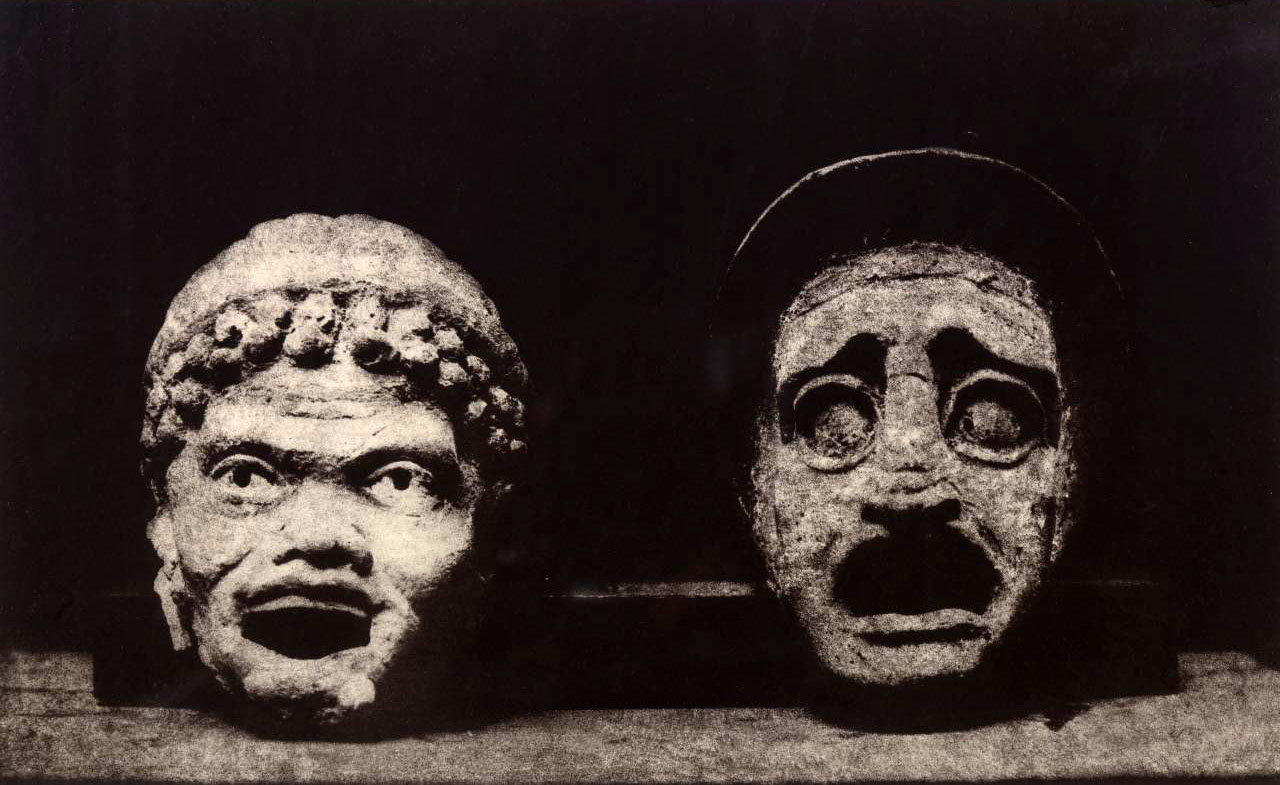
 

Marcel Gustave Laverdet (French, 1816-1886) 'Masks from the album Selection of Ancient Terra Cotta from the Collection of M. Le Vicomte H. de Janzé' 1857


Marcel Gustave Laverdet (French, 1816-1886)
Masks from the album Selection of Ancient Terra Cotta from the Collection of M. Le Vicomte H. de Janzé
1857
Photolithograph
8 15/16 × 14 9/16 inches
The Nelson-Atkins Museum of Art
Gift of the Hall Family Foundation
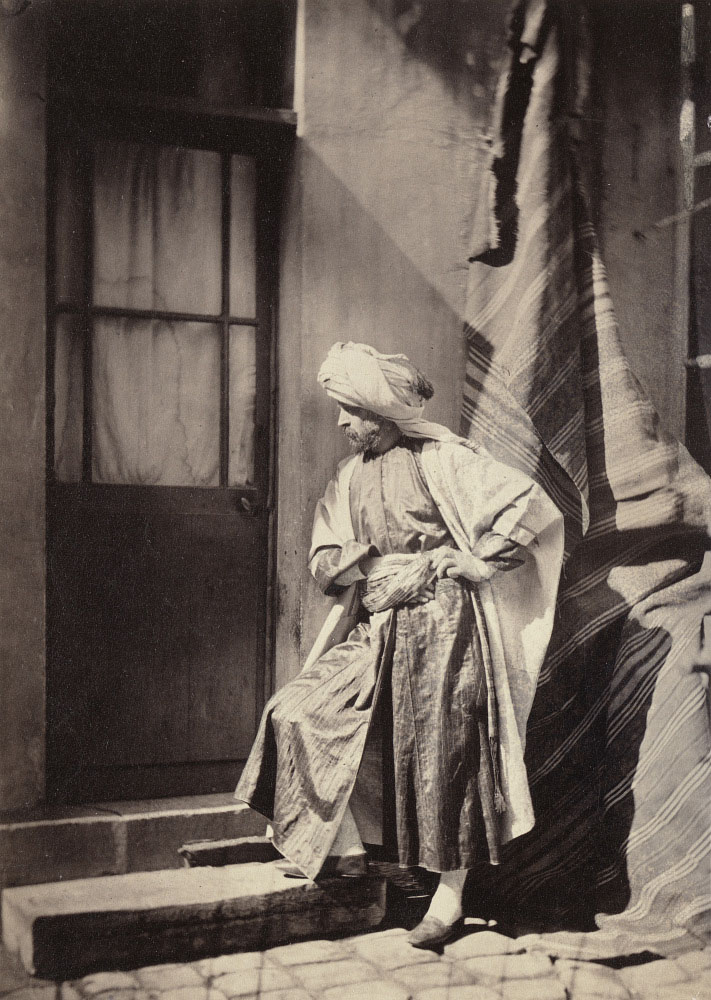
 

Charles Nègre (French, 1820-1880) 'Self-portrait' About 1855-1860


Charles Nègre (French, 1820-1880)
Self-portrait
About 1855-1860
Salt print
7 5/8 × 5 7/16 inches
The Nelson-Atkins Museum of Art
Gift of the Hall Family Foundation


Early photography is ripe with creative fictions. Actors, children, aristocrats, models, artists, psychiatric patients, maids, and all manner of the working class posed in front of cameras and were transformed into figures from history, literature, the Bible, or into an idealised version of themselves. Still Performing: Costume, Gesture, and Expression in 19th Century European Photography, which opens at The Nelson-Atkins Museum of Art in Kansas City Aug. 24, celebrates the unique and compelling ways 19th century European photographers used the medium to explore and document performance, transforming the photographer’s studio into a theatrical stage. The exhibition runs through Jan. 12, 2025.

“The subjects in this exhibition were highly influenced by popular entertainment – live theatre, tableaux vivant, and dioramas – as well as tastes and trends in painting, drawing, and sculpture,” said Julián Zugazagoitia, Director & CEO of the Nelson-Atkins. “These works were made in a time of anxiety about photography’s relationships to the fine arts and reflect a close intermingling between the worlds of the ‘high’ and the ‘low’.”

Visiting a photographer’s studio in Europe in the mid to late 1800s was like going behind the scenes of a theatrical production. Props, backdrops, costumes, curtains, and controlled lighting converted otherwise ordinary portrait sessions into staged productions. Whether working in their homes or commercial studios, photographers cast themselves, friends, actors, models, and strangers in their photographs, transforming them into all types of characters, from young pickpockets to ancient Greek gods.

“These portraits are so fascinating, and I think our guests are going to be amazed at the rich creative complexity found in European photography’s first 50 years,” said Marijana Rayl, Assistant Curator, Photography.

Deliberately made, not casually taken, these staged photographs are often the result of collaborative efforts between photographer and sitter, such as with a series of portraits of Virginia Oldoini, the Countess of Castiglione. A prodigious narcissist, or perhaps just ahead of her time, the countess collaborated with the photographer Pierre-Louis Pierson to produce hundreds of portraits, directing every aspect of the picture-making process. Included in Still Performing is a very rare, hand-coloured portrait of the countess.

The resulting photographs are an outstanding array of complex and compelling fictions showcasing the medium’s early creative potential.

Press release from the Nelson-Atkins Museum
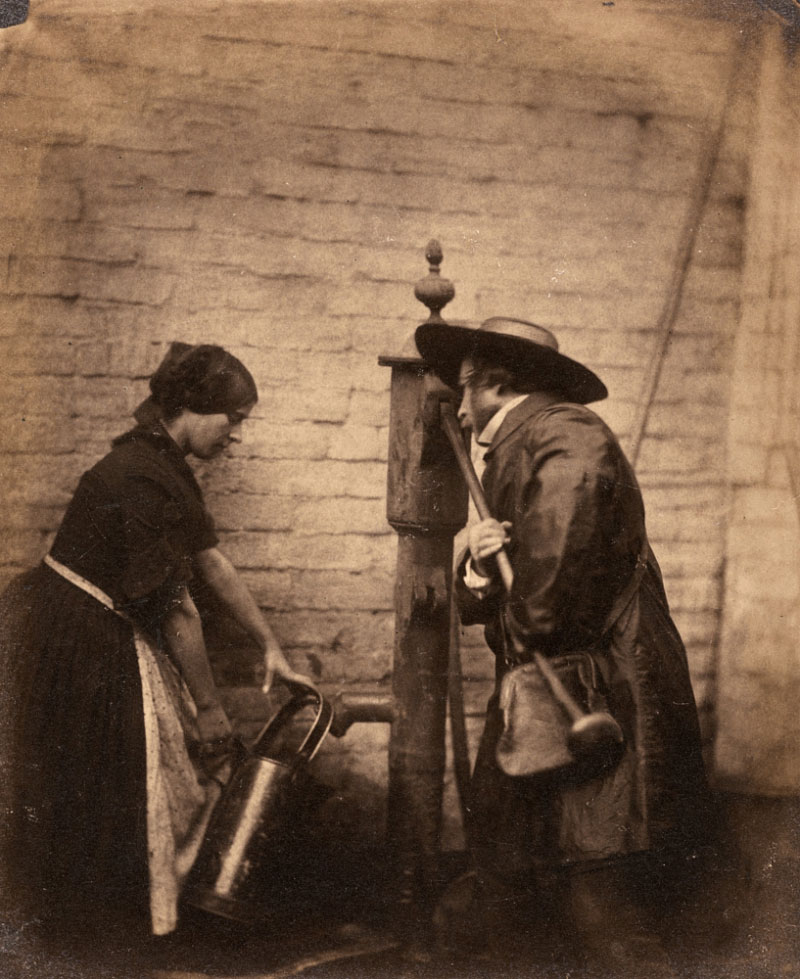
 

Oscar Gustav Rejlander (English born Sweden, 1813-1875) 'Drawing Water from a Well (O.G. Rejlander and model)' c. 1858


Oscar Gustav Rejlander (English born Sweden, 1813-1875)
Drawing Water from a Well (O.G. Rejlander and model)
c. 1858
Salt print
Image and sheet: 7 15/16 × 6 1/2 inches (20.16 × 16.51cm)
Mount: 14 1/16 × 11 5/16 inches (35.72 × 28.73cm)
The Nelson-Atkins Museum of Art
Gift of the Hall Family Foundation


Oscar Rejlander occasionally cast himself in staged photographs like this one, which was made to appear like a candid image of ordinary people going about their daily lives. Here he poses, turned away from the camera, as though he is helping a peasant woman retrieve water from a well. These kinds of genre scenes were immensely popular in the 1800s across painting, drawing, printmaking, and photography. Rejlander passionately advocated for photography to be treated as a fine art, believing that it must emulate painting.

Text from the Nelson-Atkins Museum website
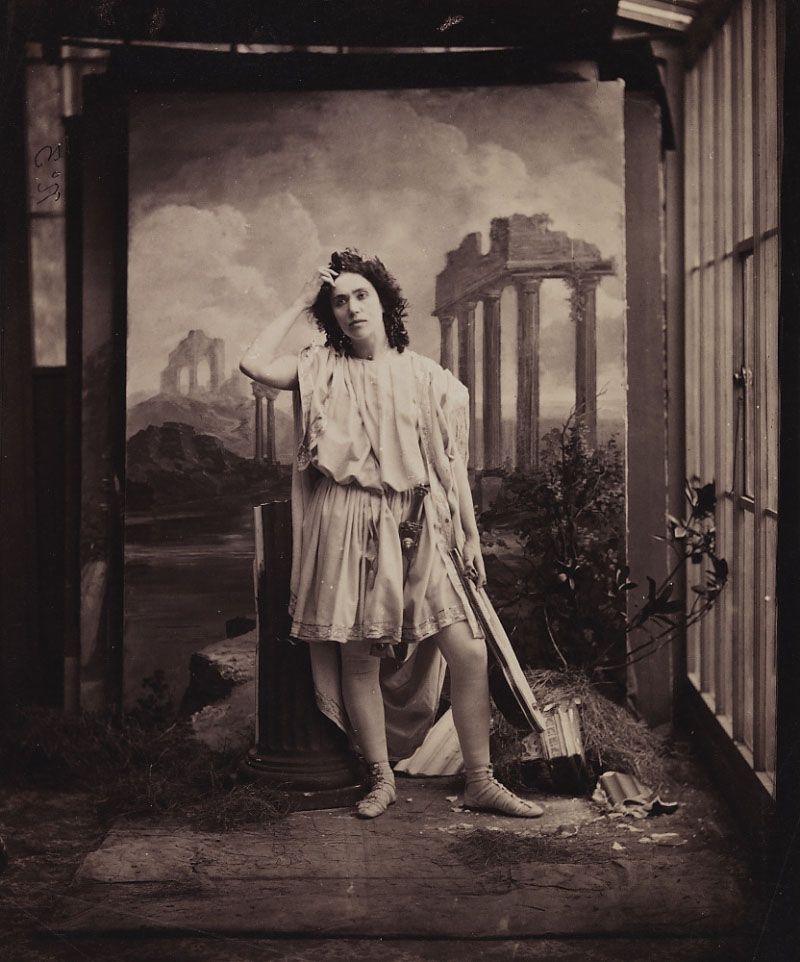
 

Camille Silvy (French, 1834-1910) 'Actress Rosa Csillag in the Role of Orpheus' 1860


Camille Silvy (French, 1834-1910)
Actress Rosa Csillag in the Role of Orpheus
1860
Albumen print
9 3/16 × 7 5/8 inches
The Nelson-Atkins Museum of Art
Gift of the Hall Family Foundation
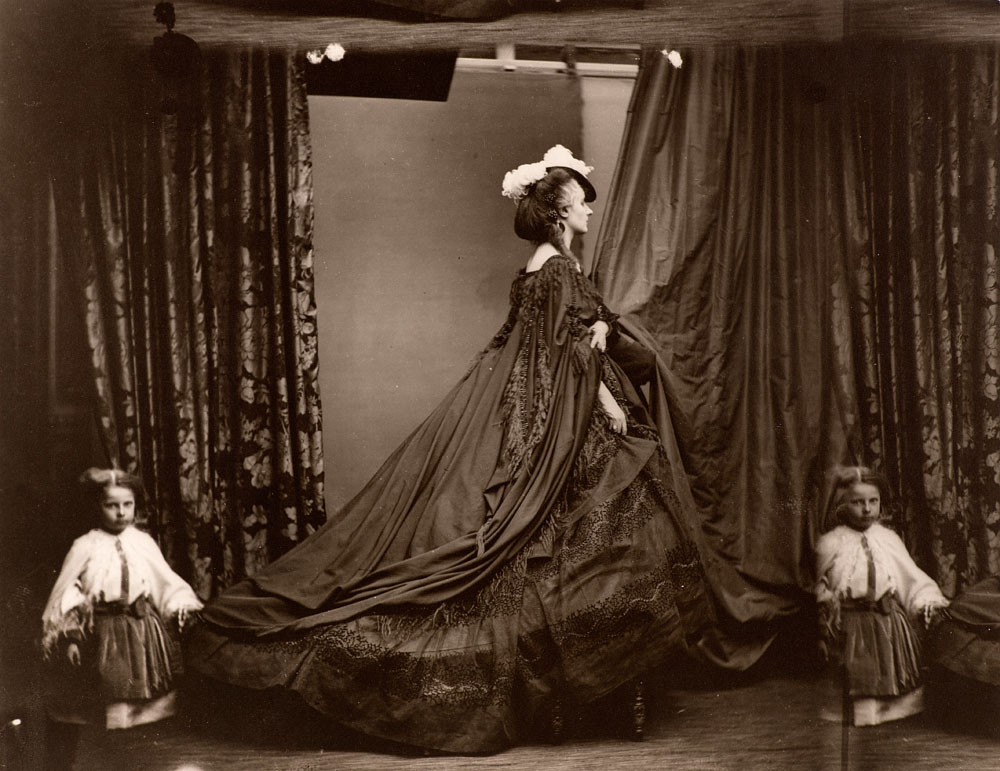
 

Pierre-Louis Pierson (French, 1822-1913) 'The Countess de Castiglione' 1860s


Pierre-Louis Pierson (French, 1822-1913)
The Countess de Castiglione
1860s
Gelatin silver print (printed about 1930)
10 15/16 x 14 1/8 inches
The Nelson-Atkins Museum of Art
Gift of the Hall Family Foundation
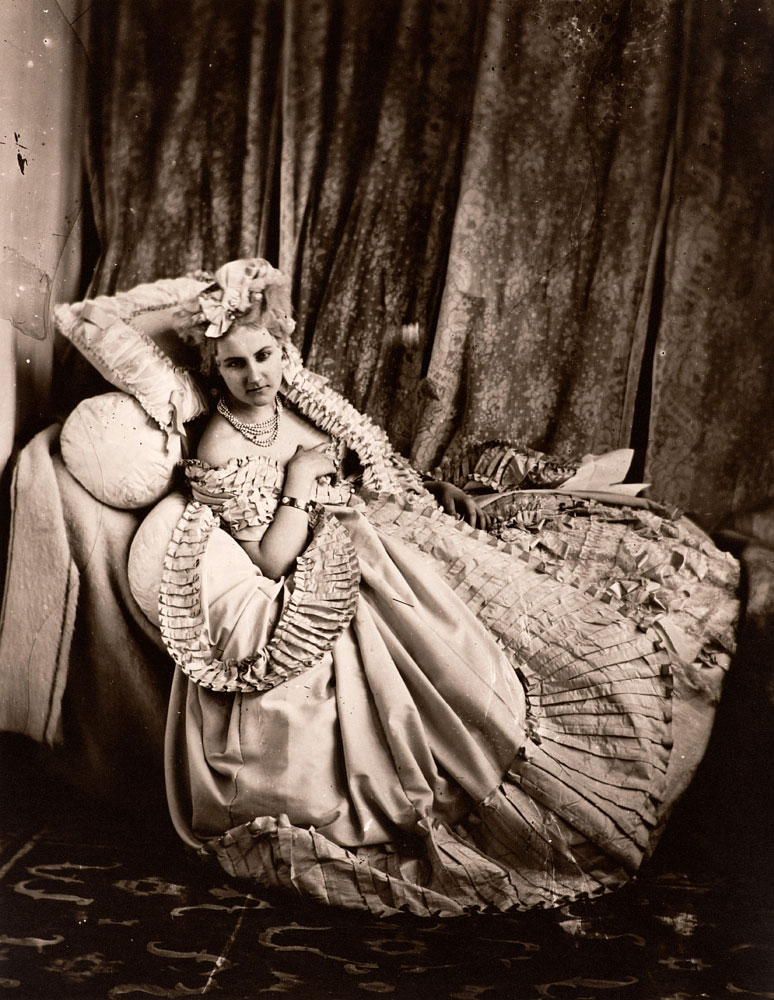
 

Pierre-Louis Pierson (French, 1822-1913) 'The Countess de Castiglione' 1860s


Pierre-Louis Pierson (French, 1822-1913)
The Countess de Castiglione
1860s
Gelatin silver print (printed about 1930)
Image: 14 3/16 x 11 inches (36.04 x 27.94cm)
Sheet: 14 3/16 x 11 inches (36.04 x 27.94cm)
The Nelson-Atkins Museum of Art
Gift of the Hall Family Foundation
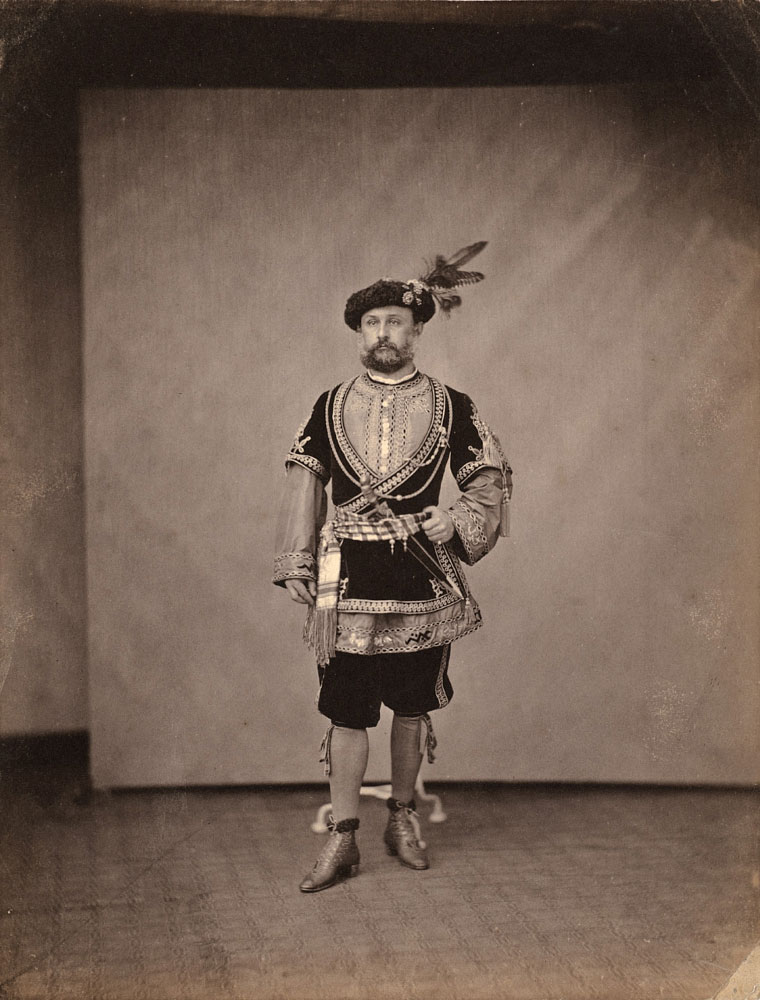
 

Pierre-Louis Pierson (French, 1822-1913) 'Bal en Costume, Royaume de Belgique' c. 1860


Pierre-Louis Pierson (French, 1822-1913)
Bal en Costume, Royaume de Belgique
c. 1860
Salt print
Image and sheet: 11 1/2 × 8 3/4 inches (29.21 × 22.23cm)
The Nelson-Atkins Museum of Art
Gift of the Hall Family Foundation
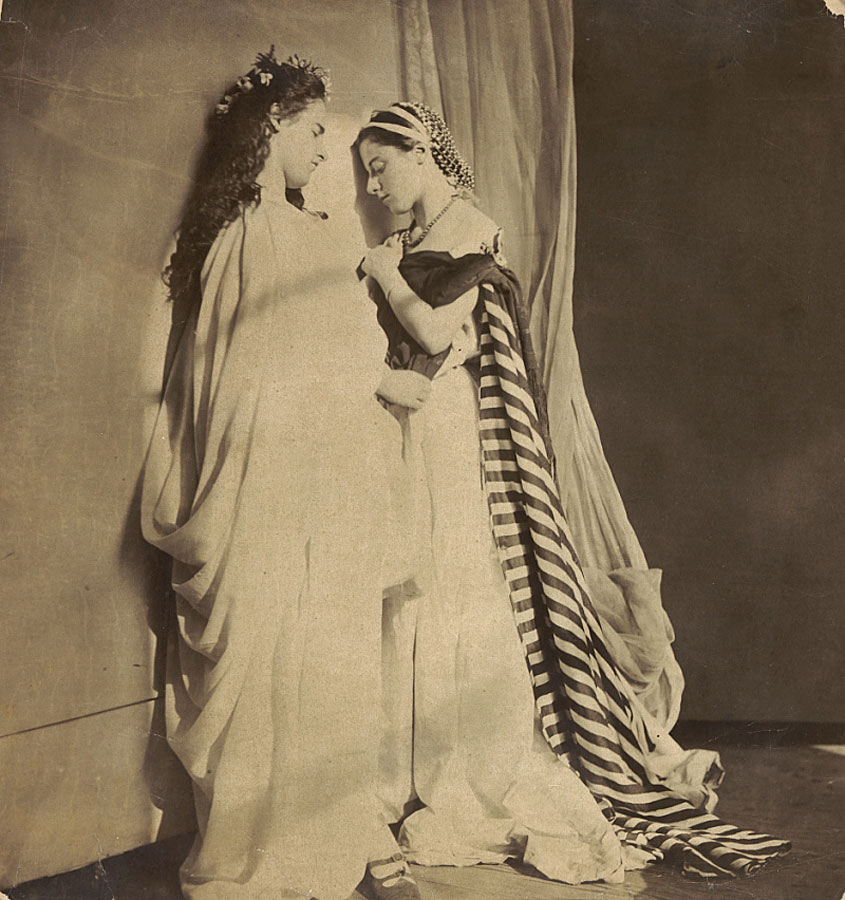
 

Lady Clementina Hawarden (English, born Scotland, 1822-1865) 'Clementina Maude and Isabella Grace' c. 1863


Lady Clementina Hawarden (English, born Scotland, 1822-1865)
Clementina Maude and Isabella Grace
c. 1863
Albumen print
Image and sheet: 9 13/16 × 9 11/16 inches (24.97 × 24.61cm)
The Nelson-Atkins Museum of Art
Gift of the Hall Family Foundation
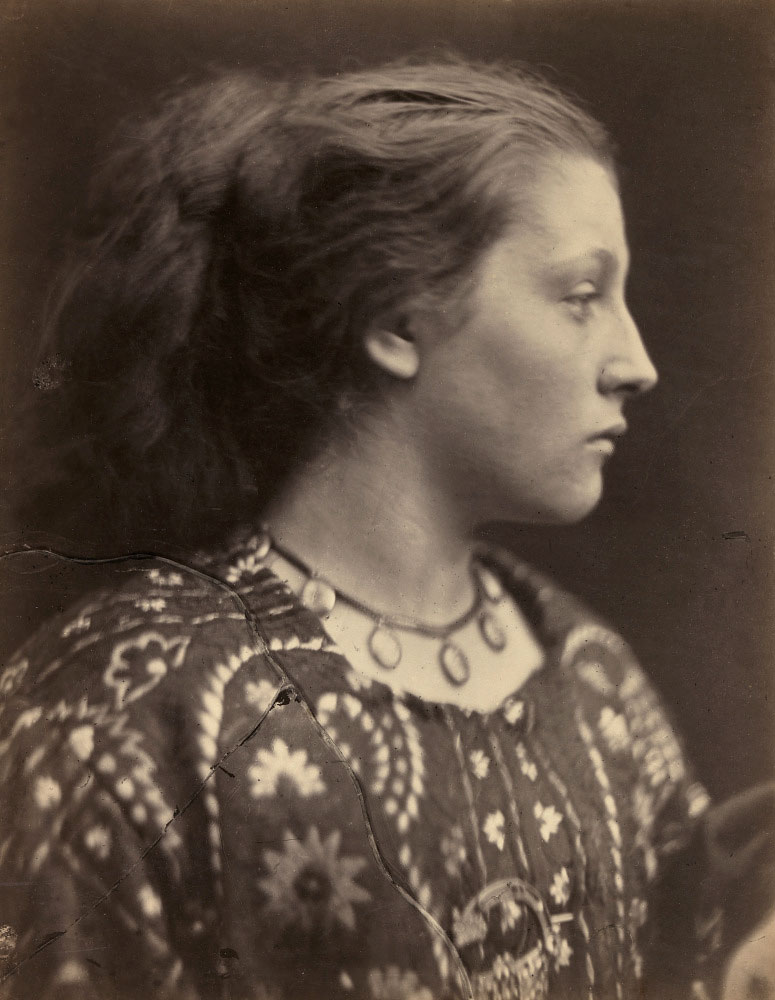
 

Julia Margaret Cameron (English, born India, 1815-1879) 'Sappho (Mary Hillier)' 1865


Julia Margaret Cameron (English, born India, 1815-1879)
Sappho (Mary Hillier)
1865
Albumen print
Image and sheet: 12 15/16 × 10 1/8 inches (32.86 × 25.72cm)
Mount: 20 13/16 × 16 13/16 inches (52.86 × 42.7cm)
The Nelson-Atkins Museum of Art
Gift of the Hall Family Foundation
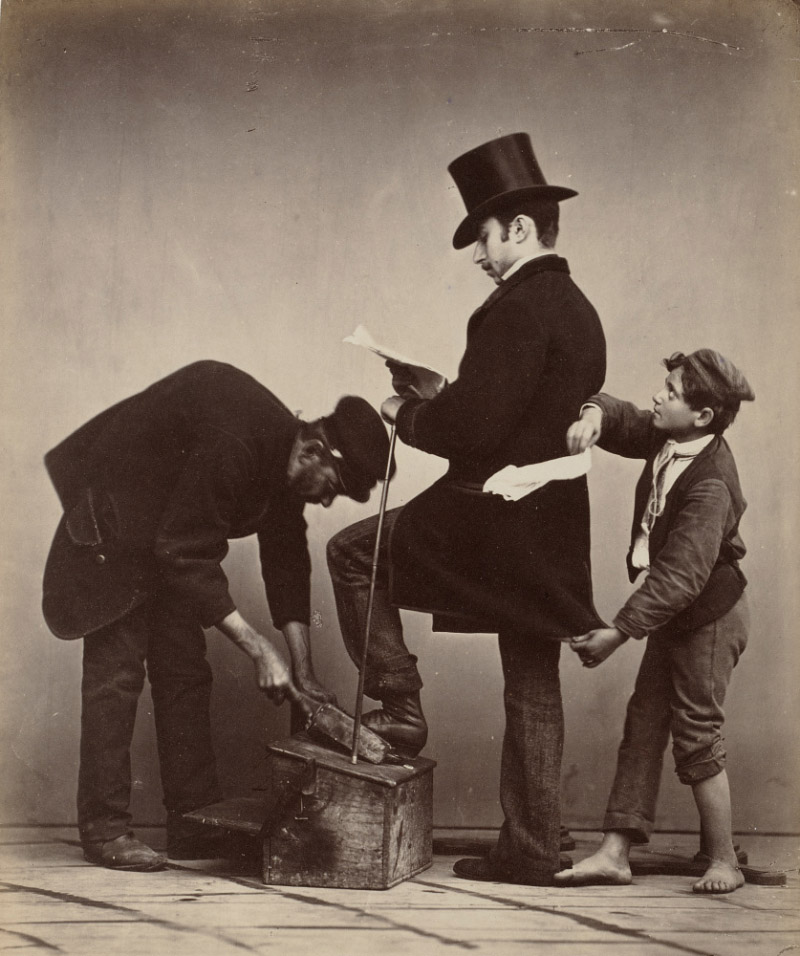
 

Giorgio Sommer (Italian born Germany, 1834-1914) 'The Pickpocket' About 1865


Giorgio Sommer (Italian born Germany, 1834-1914)
The Pickpocket
About 1865
Albumen print
9 3/8 × 7 5/8 inches
The Nelson-Atkins Museum of Art
Gift of the Hall Family Foundation
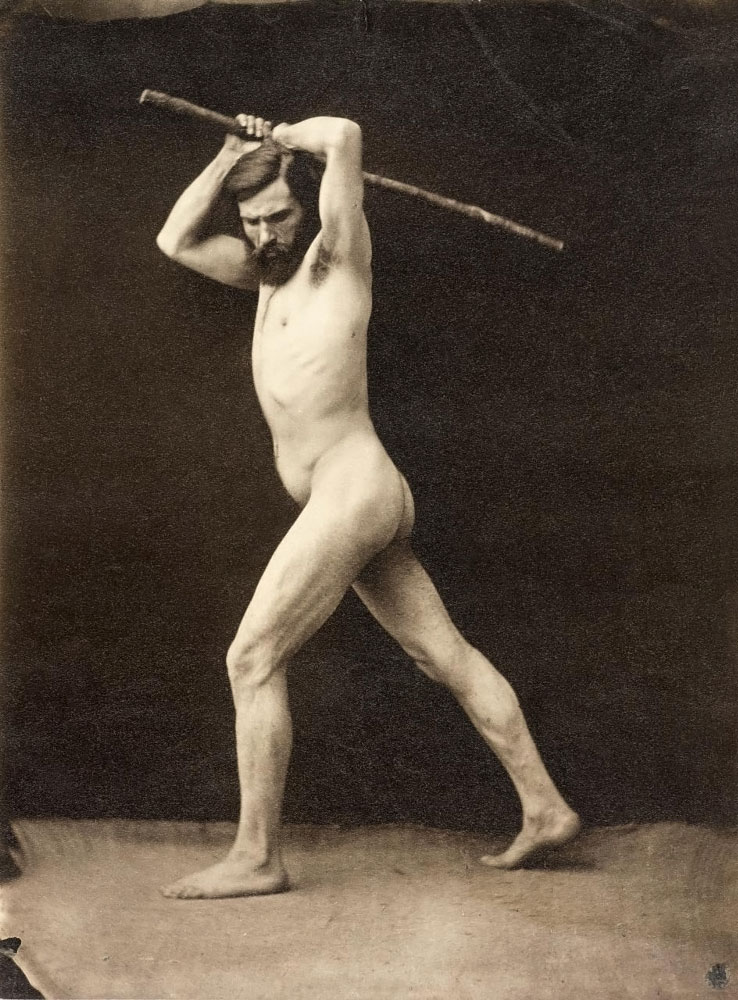
 

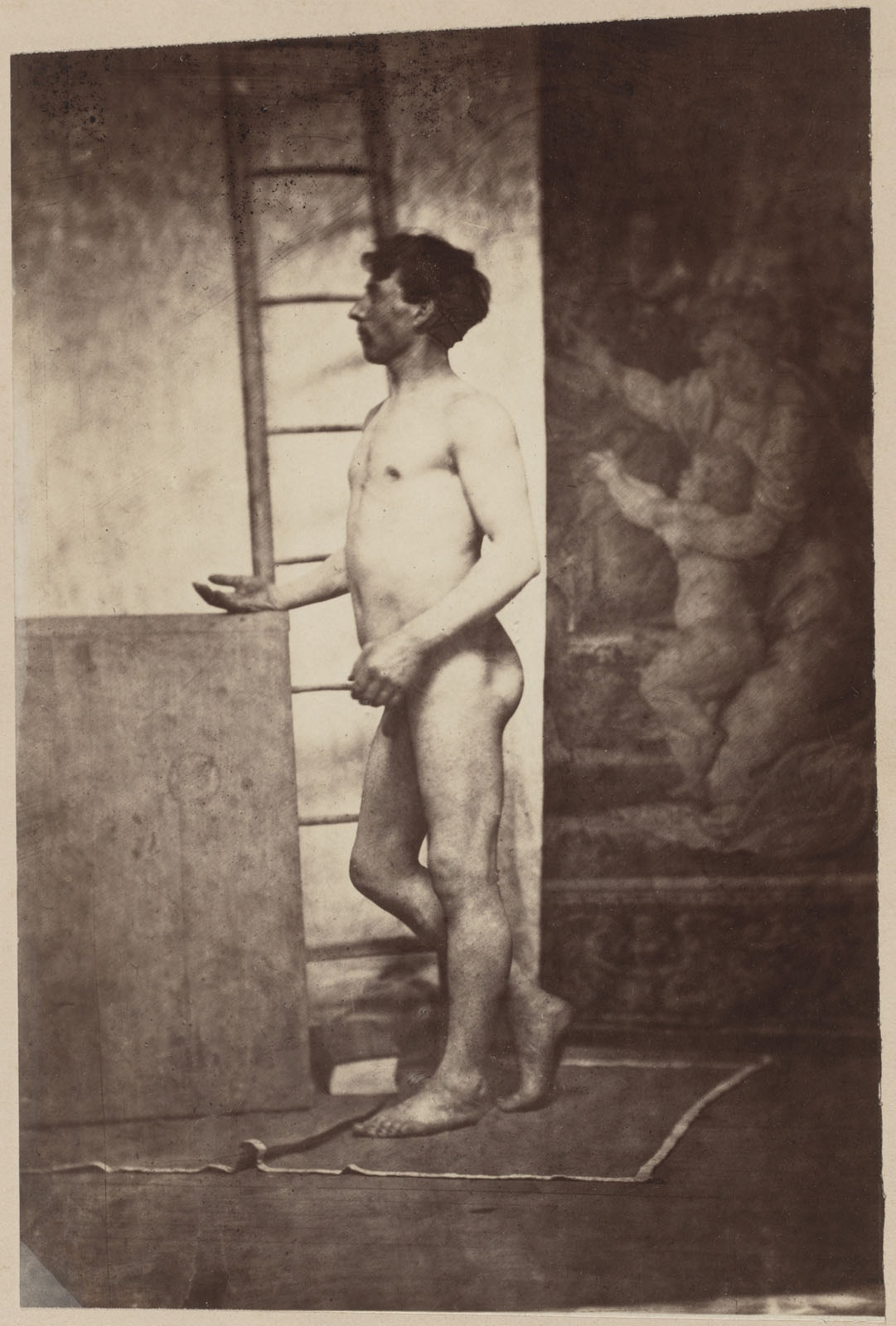
Gaudenzio Marconi (French born Switzerland, 1842-1885) 'Male nude for artist' c. 1870


Gaudenzio Marconi (French born Switzerland, 1842-1885)
Male nude for artist
c. 1870
Albumen print
Image and sheet: 8 5/8 × 6 3/8 inches (21.91 × 16.19cm)
Mount: 12 9/16 × 9 3/4 inches (31.91 × 24.77cm)
The Nelson-Atkins Museum of Art
Gift of the Hall Family Foundation
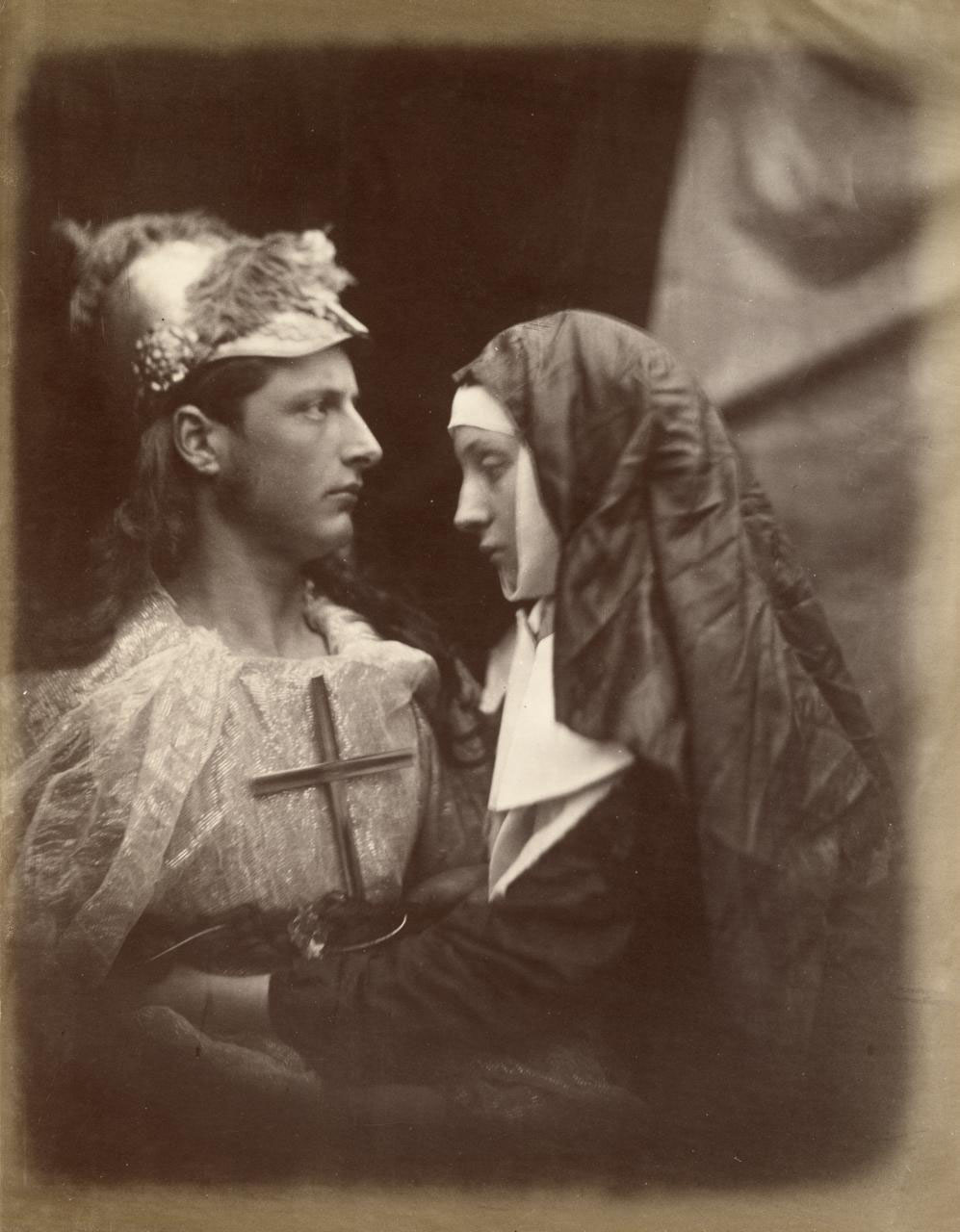
 

Julia Margaret Cameron (English born India, 1815-1879) 'Sir Galahad and the Pale Nun' 1874


Julia Margaret Cameron (English born India, 1815-1879)
Sir Galahad and the Pale Nun
1874
Albumen print
13 7/16 × 10 1/2 inches
The Nelson-Atkins Museum of Art
Gift of the Hall Family Foundation
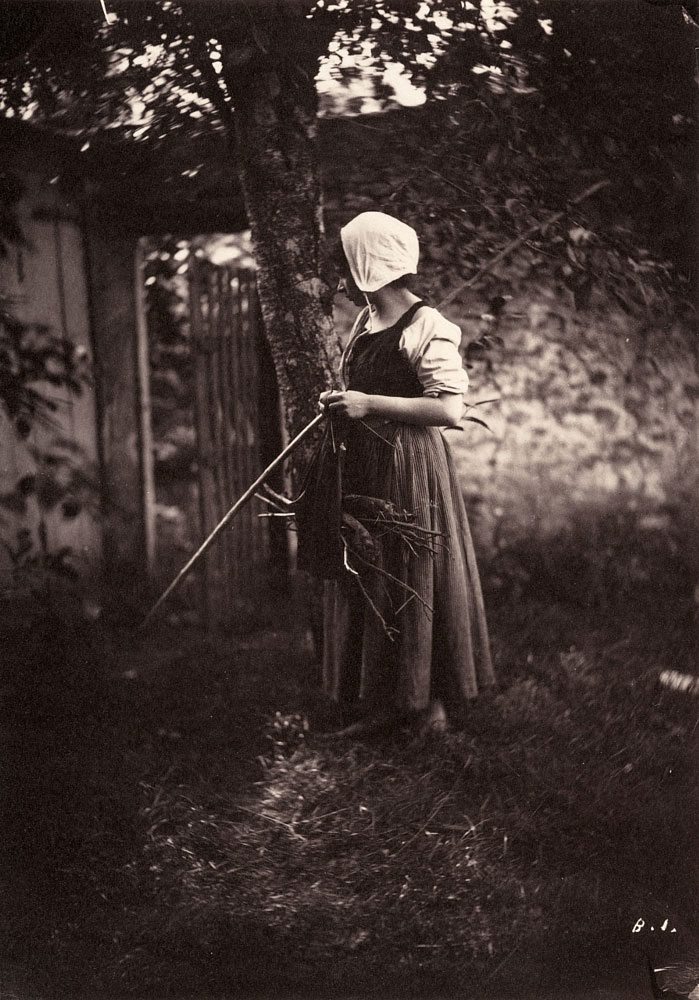
 

Giraudon's Artist (French, active c. 1875) 'Woman with bundle of twigs' c. 1875-1880


Giraudon’s Artist (French, active c. 1875)
Woman with bundle of twigs
c. 1875-1880
Albumen print
Image and sheet: 6 5/8 × 4 11/16 inches (16.83 × 11.91cm)
The Nelson-Atkins Museum of Art
Gift of the Hall Family Foundation
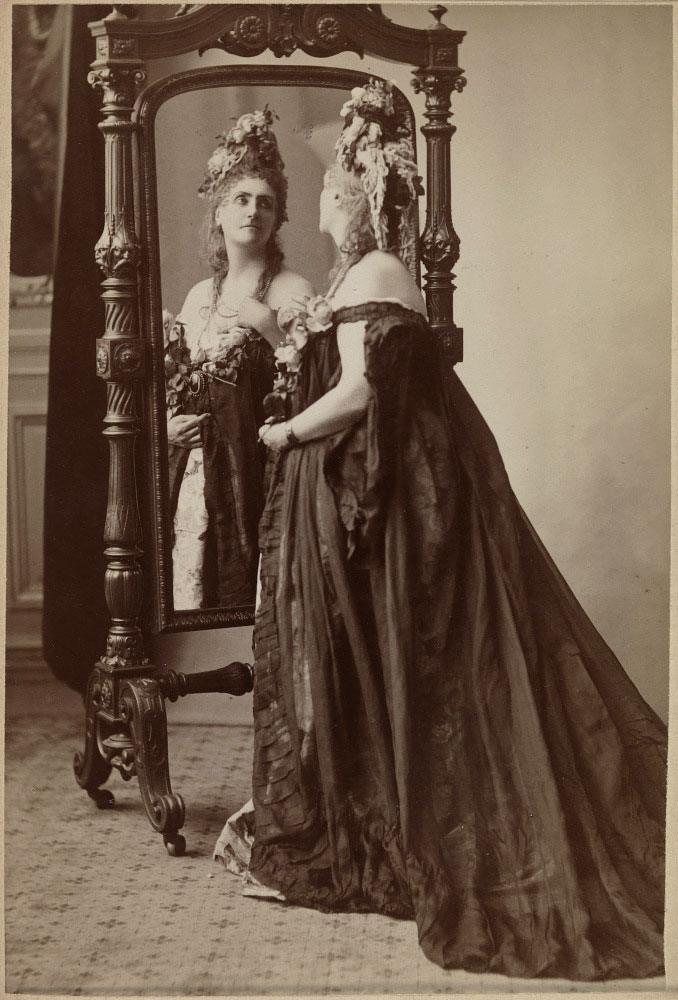
 

Pierre-Louis Pierson (French, 1822-1913) 'Portrait of the Countess of Castiglione from Série des Roses' 1895


Pierre-Louis Pierson (French, 1822-1913)
Portrait of the Countess of Castiglione from Série des Roses
1895
Albumen cabinet card
Image and sheet: 5 15/16 × 3 15/16 inches (15.06 × 9.98cm)
Mount: 6 3/8 × 4 1/4 inches (16.21 × 10.8cm)
The Nelson-Atkins Museum of Art
Gift of the Hall Family Foundation


The Countess of Castiglione became reclusive with age, rumored to only leave her home at night, hidden behind veils. Social chroniclers of the time claimed that she removed all mirrors from her home to avoid her appearance; however, this portrait seems to contradict her alleged displeasure. Taken toward the end of her life, the countess admires her reflection in the mirror, donning a youthful blond wig elaborately decorated with roses.

Text from the Nelson-Atkins Museum website


The Nelson-Atkins Museum of Art
4525 Oak Street
Kansas City, MO 64111

Opening hours:
Thursday – Monday 10am – 5pm
Closed Tuesdays and Wednesdays

The Nelson-Atkins Museum of Art website

LIKE ART BLART ON FACEBOOK

Back to top

Exhibition: ‘Photography and the Performative’ at the Chau Chak Wing Museum at The University of Sydney

Exhibition dates: 29th April 2023 – 4th August 2024

Curator: Katrina Liberiou


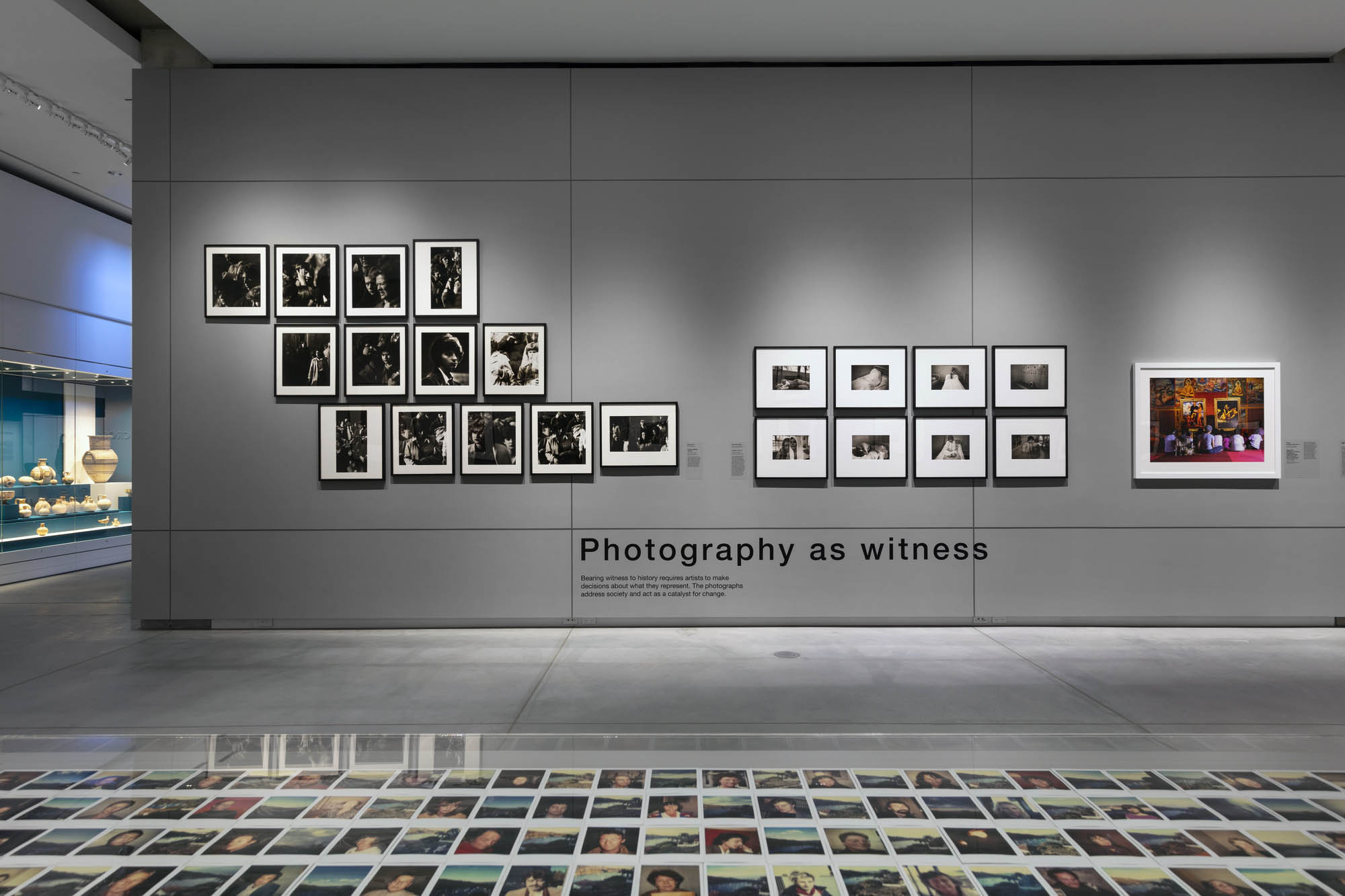
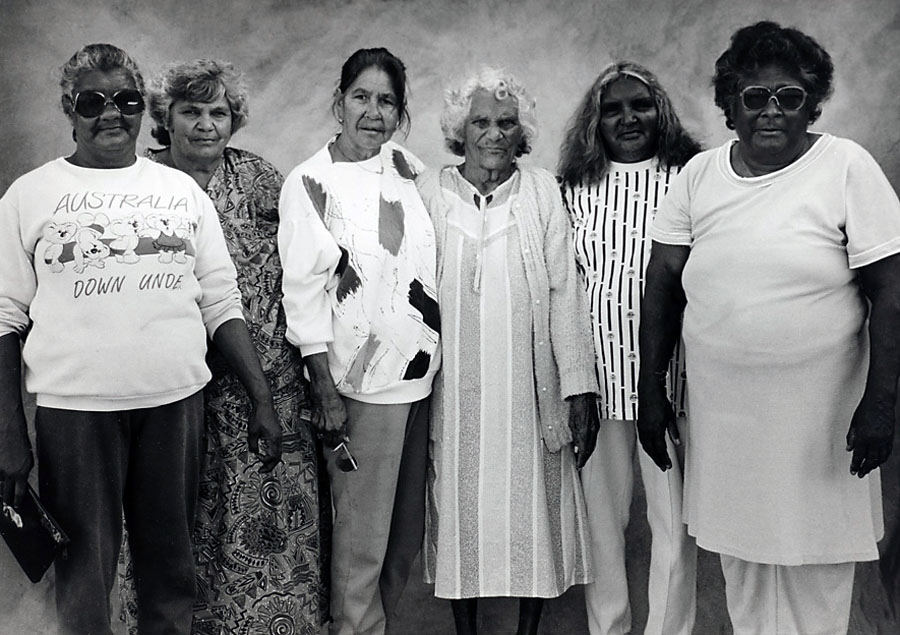
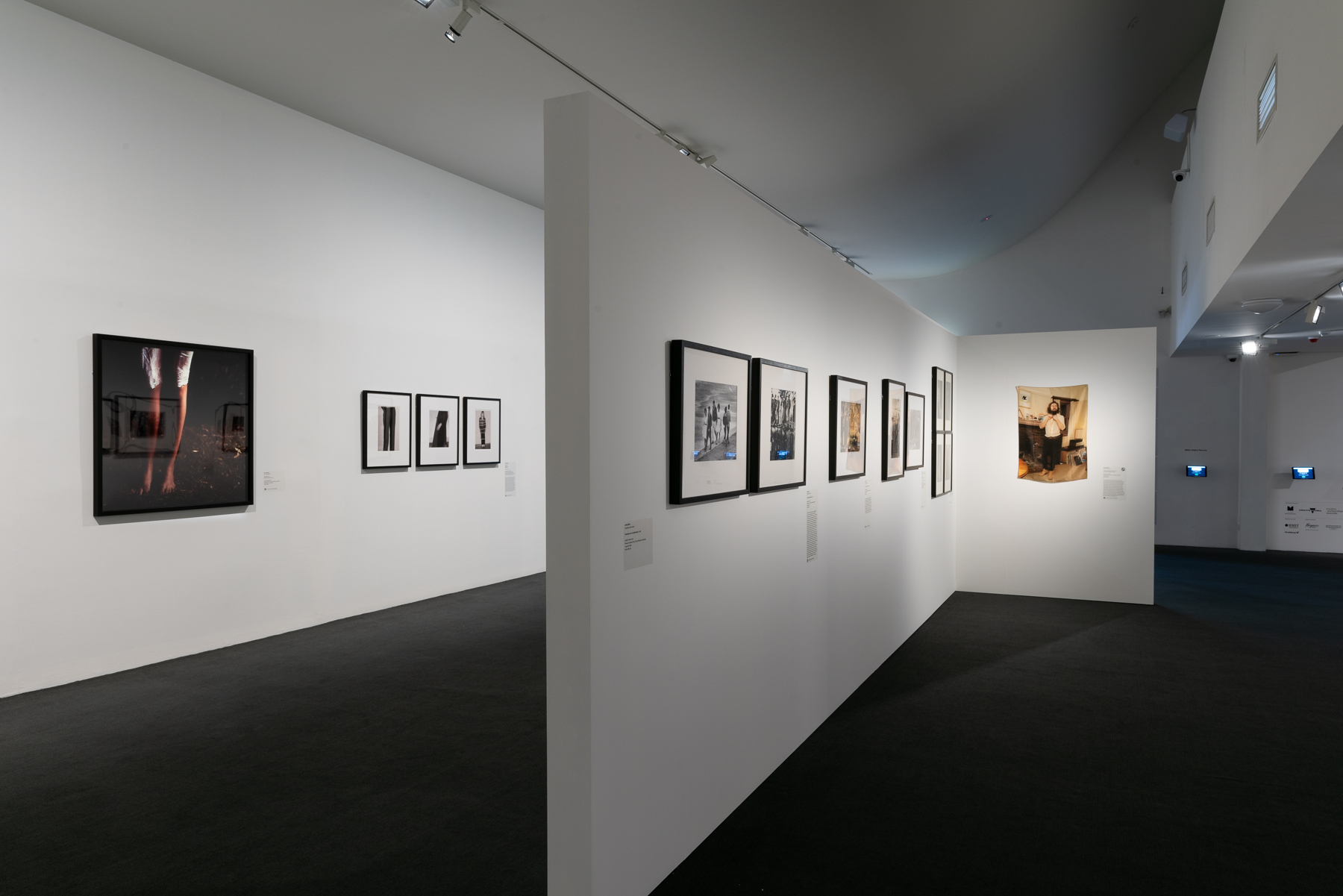
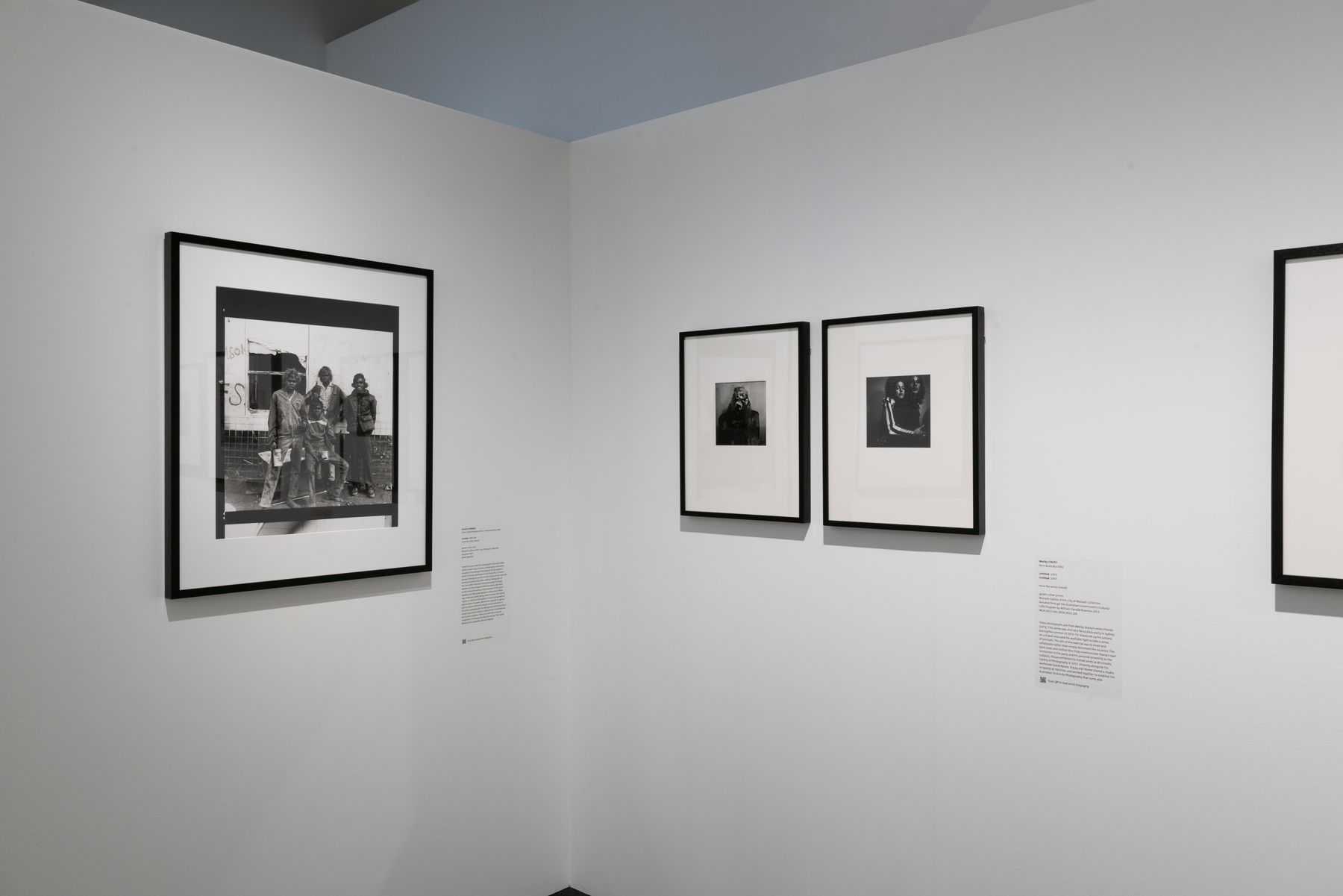
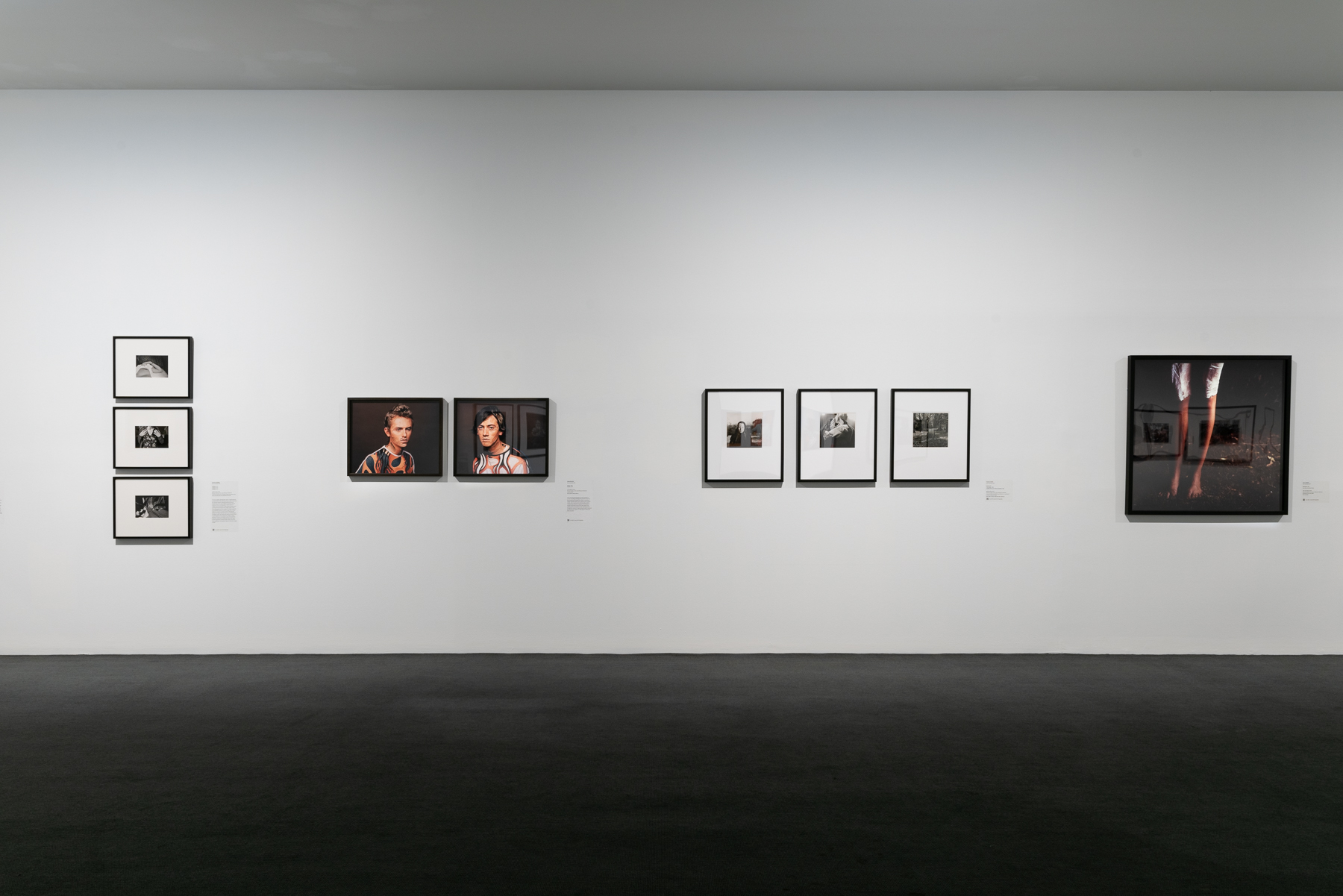
Installation view of the exhibition Photography and the Performative at the Chau Chak Wing Museum at The University of Sydney showing at left, photographs by Michael Riley including at second left bottom, 'Moree women' (1991)


Installation view of the exhibition Photography and the Performative at the Chau Chak Wing Museum at The University of Sydney showing at left, photographs by Michael Riley including at second left bottom, Moree women (1991, below)


It’s great to see another Australian museum taking up the mantle of staging challenging photography exhibitions after the ball has been so gloriously dropped by both national and state galleries in recent years.

Of course, photography and performance have been associated with each other since the birth of photography. The very act of posing for the camera is a performative act. Indeed, one of the earliest self-portraits in the history of photography, Hippolyte Bayard’s famous Le Noyé [The Drowned Man] (1840) is a performance by the artist protesting against the lack of recognition for him as one of the inventors of photography. His humorous, yet biting text read:

“The corpse of the gentleman you see here…. is that of Monsieur Bayard, inventor of the process that you have just seen…. As far as I know this ingenious and indefatigable experimenter has been occupied for about three years with perfecting his discovery…. The Government, who gave much to Monsieur Daguerre, has said it can do nothing for Monsieur Bayard, and the poor wretch has drowned himself. Oh! The precariousness of human affairs!” (Text from the J. Paul Getty Museum website)


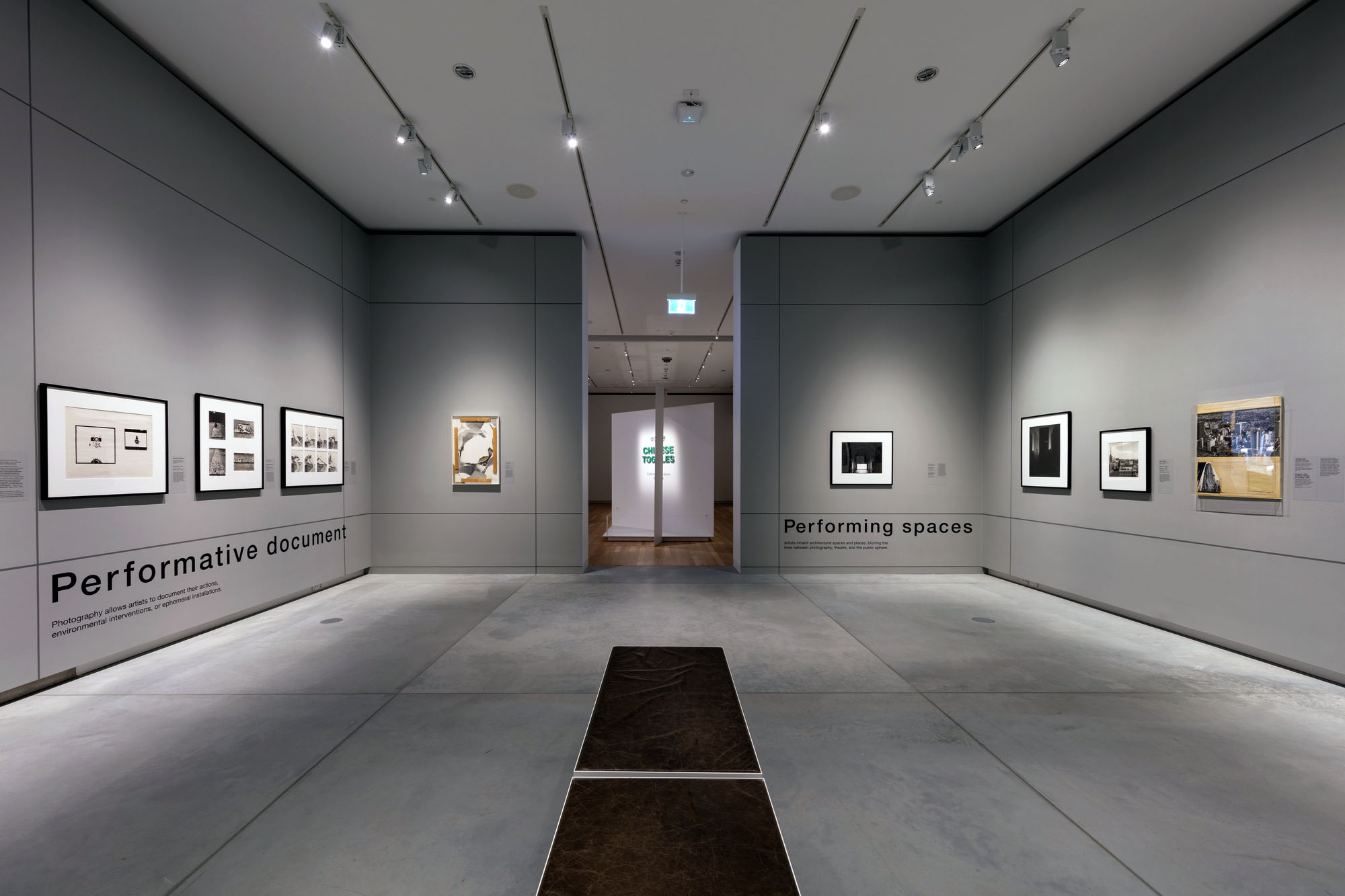
With interesting sections such as ‘Photography as witness’, ‘Performative document’ and ‘Performing spaces’ – any one of which could have provided the basis of a large exhibition in their own right – the only problem with this exhibition is that it’s too small, particularly in the limited number of works that illuminate each section. For example, having a small body of early Bill Henson Untitled crowd photographs (1980/82), a small body of Mark Ellen Mark’s photographs of Ward 81 (1979), and one Araya Rasdjarmrearnsook photograph to illustrate the section ‘Photography as witness’ is barely adequate to begin a conversation on the subject.

Even as the exhibition tries to cover too much ground with too little resources one must congratulate the museum for even attempting such an insightful examination of how photography records performative actions in fields such as visual, architectural, spatial, gestural and gendered. The problem is that it needed to be either a/ focused on one section, or b/ much larger with more resources in order to encompass the breadth of the subject being investigated.

Having said that, I wish other galleries around Australia had such get up and go, such inquisitiveness vis a vis the history of photography and its place and influence in the modern world. I’ve not heard of any recent photographic exhibitions in Australia which attempt such a complex visual and intellectual investigation into one subject, which says a lot about the state of photographic exhibitions in Australia.

I have added hopefully interesting referenced texts to provide information on some of the art works and artists in the posting.

The exhibition is held at the same time as the exhibition The Staged Photograph at Chau Chak Wing Museum at The University of Sydney (finishes 4th August 2024). A posting on this exhibition to follow soon.

Dr Marcus Bunyan


Many thankx to the Chau Chak Wing Museum for allowing me to publish the photographs in the posting. Please click on the photographs for a larger version of the image.


An exhibition exploring the intersection between photography and performance.

This exhibition examines recent ideas and theories that frame performance as a phenomenon that is everywhere. Performative actions may include the manifestation of ideas, whether literal, oral, spoken, or written. Such forms can be visual, architectural, spatial, gestural and gendered. This exhibition looks at how these different modes may be ‘recorded’ via the medium of photography.

Since the 1960s, photography and performance have experienced a shared history. Artists have embraced the possibilities of this time-based medium by deploying a documentary mode – capturing the fleeting, the happening, the ephemeral. The camera becomes an extension of the artist’s body, documenting their actions and interventions.

Text from the Chau Chak Wing Museum website


Installation view of the exhibition Photography and the Performative at the Chau Chak Wing Museum at The University of Sydney showing at front, Polaroids from Imants Tillers' 'If I close my eyes' (2021)


Installation view of the exhibition Photography and the Performative at the Chau Chak Wing Museum at The University of Sydney showing at front, Polaroids from Imants Tillers’ If I close my eyes (2021)


Installation view of the exhibition Photography and the Performative at the Chau Chak Wing Museum at The University of Sydney showing at left photographs from Bill Henson's 'Untitled 1980/82' (1980/82); at centre, photographs from Mary Ellen Mark's 'Ward 81' (1979); and at right, Araya Rasdjarmrearnsook's 'Village and Elsewhere: Artemisia Gentileschi's Judith Beheading Holofernes Jeff Koons's Untitled and Thai Villagers' (2011)


Installation view of the exhibition Photography and the Performative at the Chau Chak Wing Museum at The University of Sydney showing at left photographs from Bill Henson’s Untitled 1980/82 (1980/82, below); at centre, photographs from Mary Ellen Mark’s Ward 81 (1979, below); and at right, Araya Rasdjarmrearnsook’s Village and Elsewhere: Artemisia Gentileschi’s Judith Beheading Holofernes, Jeff Koons’s Untitled, and Thai Villagers (2011, below)


Installation view of the exhibition Photography and the Performative at the Chau Chak Wing Museum at The University of Sydney showing at back left, photographs from Bill Henson's 'Untitled 1980/82' (1980/82); at back centre, photographs from Mary Ellen Mark's 'Ward 81' (1979); at back right, Araya Rasdjarmrearnsook's 'Village and Elsewhere: Artemisia Gentileschi's Judith Beheading Holofernes Jeff Koons's Untitled and Thai Villagers' (2011); and at front, Polaroids from Imants Tillers' 'If I close my eyes' (2021)


Installation view of the exhibition Photography and the Performative at the Chau Chak Wing Museum at The University of Sydney showing at back left, photographs from Bill Henson’s Untitled 1980/82 (1980/82, below); at back centre, photographs from Mary Ellen Mark’s Ward 81 (1979, below); at back right, Araya Rasdjarmrearnsook’s Village and Elsewhere: Artemisia Gentileschi’s Judith Beheading Holofernes, Jeff Koons’s Untitled, and Thai Villagers (2011, below); and at front, Polaroids from Imants Tillers’ If I close my eyes (2021)


Installation view of the exhibition Photography and the Performative at the Chau Chak Wing Museum at The University of Sydney showing at back centre, photographs from Mary Ellen Mark's 'Ward 81' (1979); and at front, Polaroids from Imants Tillers' 'If I close my eyes' (2021)


Installation view of the exhibition Photography and the Performative at the Chau Chak Wing Museum at The University of Sydney showing at back centre, photographs from Mary Ellen Mark’s Ward 81 (1979, below); and at front, Polaroids from Imants Tillers’ If I close my eyes (2021)


Installation view of the exhibition Photography and the Performative at the Chau Chak Wing Museum at The University of Sydney showing at left, Hiroshi Sugimoto's 'State Theatre, Sydney' (1997); at second left, Hiroshi Sugimoto's 'Seagram Building – Ludwig Mies Van Der Rohe' (1997); at third left, Olive Cotton's 'Clarence Street, Sydney' (c. 1942); at third right, Christo and Jeanne-Claude’s 'Packed public building, project for Sydney' (1969); and at right, Grant Mudford's 'From Ocean boulevard, Long Beach' (1979-1980)


Installation view of the exhibition Photography and the Performative at the Chau Chak Wing Museum at The University of Sydney showing at left, Hiroshi Sugimoto’s State Theatre, Sydney (1997, below); at second left, Hiroshi Sugimoto’s Seagram Building – Ludwig Mies Van Der Rohe (1997, below); at third left, Olive Cotton’s Clarence Street, Sydney (c. 1942, below); at third right, Christo and Jeanne-Claude’s Packed public building, project for Sydney (1969, below); and at right, Grant Mudford’s From Ocean boulevard, Long Beach (1979-1980, below)


Installation view of the exhibition Photography and the Performative at the Chau Chak Wing Museum at The University of Sydney showing at left, Krzysztof Wodiczko's 'Eye to Eye' (c. 1973); at fourth left, Guilio Paolini's 'Incipit' (1975); at fourth right, Hiroshi Sugimoto's 'State Theatre, Sydney' (1997); at third right, Hiroshi Sugimoto's Seagram 'Building – Ludwig Mies Van Der Rohe' (1997); at second right, Olive Cotton's 'Clarence Street, Sydney' (c. 1942); and at right, Christo and Jeanne-Claude's 'Packed public building, project for Sydney' (1969)


Installation view of the exhibition Photography and the Performative at the Chau Chak Wing Museum at The University of Sydney showing at left, Krzysztof Wodiczko’s Eye to Eye (c. 1973, below); at fourth left, Guilio Paolini’s Incipit (1975, below); at fourth right, Hiroshi Sugimoto’s State Theatre, Sydney (1997, below); at third right, Hiroshi Sugimoto’s Seagram Building – Ludwig Mies Van Der Rohe (1997, below); at second right, Olive Cotton’s Clarence Street, Sydney (c. 1942, below); and at right, Christo and Jeanne-Claude’s Packed public building, project for Sydney (1969, below)


How photography captures performance

Some of photography’s best-known luminaries feature in a new Chau Chak Wing Museum exhibition examining the interaction between photography and performance.

From Olive Cotton’s Clarence Street, Sydney (c. 1942) to Imants Tillers’ If I Close My Eyes (2021), the images in Photography and the Performative capture performers, performance spaces and audiences over an 80-year period. The punk aesthetic of 1980s New York, Hollywood B-grade movies and generational discrimination faced by Aboriginal communities are among the diverse phenomena examined in this exhibition. Cindy Sherman, Hiroshi Sugimoto, Bill Henson, Barber Kruger and Araya Rasdjarmrearnsook are among the featured artists.

“Performance as a concept is everywhere,” said Chau Chak Wing curator Katrina Liberiou. “This exhibition conveys performative elements from the widest imaginable range of settings including streets, studios, villages, institutions and performance spaces.”

“Since the 1960s, photography and performance have experienced a shared history. The camera became an extension of the artist’s body, documenting their actions and interventions.”

Rather than record performances, works in Photography and the Performative look at the supporting roles of space, the human body and ideas in performance. International works include disturbing images from the hospital where Milos Forman’s One Flew Over the Cuckoo’s Nest was filmed. Mary Ellen Mark spent 36 days living at the Oregon State Hospital to document the lives of women incarcerated there, a year after she worked as the Oscar-winning film’s set photographer.
Closer to home, Christo’s Packed public building, project for Sydney (1969) imagines wrapping Sydney’s Australia Square, then a new skyscraper designed by architect Harry Seidler. This work was a precursor to the artists’ epic Wrapped Coast, created with support from Harry and Penelope Seidler. Hiroshi Sugimoto’s long exposures of the State Theatre and Seagram Building, also in Sydney, play homage to mid-twentieth century modernism. Imants Tillers If I close my eyes (2021, on display until August 2023) is a grid of Polaroid photographs interspersing portraits of Tillers’ friends, family and fellow artists with images of Sydney’s harbour. The latter depict the same view, from Tillers’ home in Mosman, captured over a three-year period.

The photographs in Photography and the Performative range from vintage black and white prints to alternative processes (including solarisation and photograms) to early colour photography and digital prints. All featured works have been selected from the University of Sydney Art Collection.

Photography and the Perfomative is one of two photographic exhibitions currently on show at the Chau Chak Wing Museum. The second, The Staged Photograph, presents a range of staged images taken in Australia between the mid-19th and early 20th centuries.

Anonymous. “From Henson to Christo,” on The University of Sydney website 24 April 2023 [Online] 12/06/2024


Olive Cotton (Australian, 1911-2003) 'Clarence Street, Sydney' c. 1942


Olive Cotton (Australian, 1911-2003)
Clarence Street, Sydney
c. 1942
Gelatin silver print
Chau Chak Wing Museum


Christo Vladimirov Javacheff (American born Bulgaria, 1935-2020) and Jeanne-Claude Denat de Guillebon (American born Bulgaria, 1935-2009) 'Packed public building, project for Sydney' 1969


Christo Vladimirov Javacheff (American born Bulgaria, 1935-2020) and Jeanne-Claude Denat de Guillebon (American born Bulgaria, 1935-2009)
Packed public building, project for Sydney
1969
Synthetic polymer paint, cotton fabric, cotton thread, pencil, coloured pencil, pressure-sensitive tape on photographs, synthetic polymer weave and staples on cardboard
72.0 x 76.9cm
Donated by Chandler Coventry, 1972
J W Power collection, Chau Chak Wing Museum


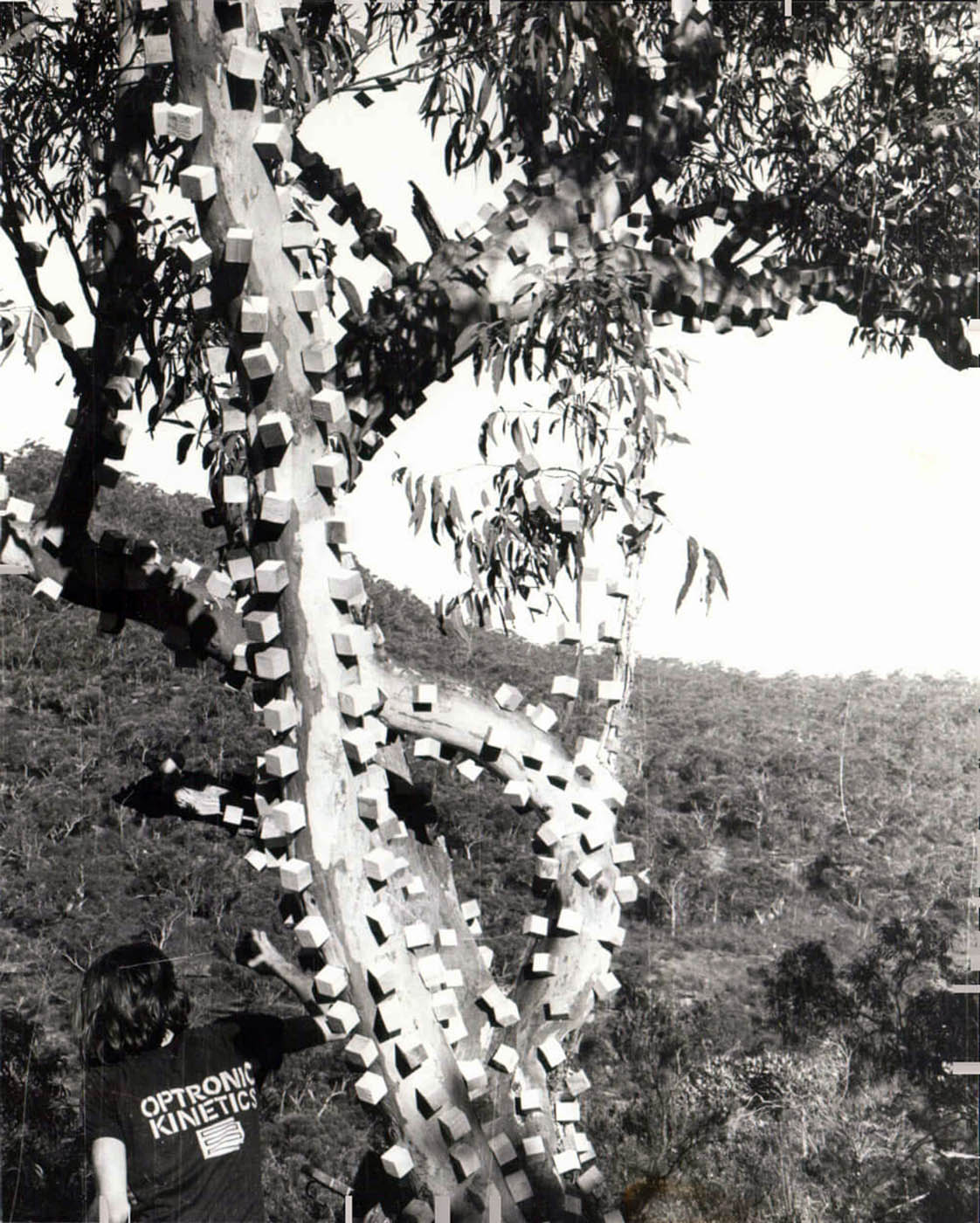
Optronic Kinetics (active c. 1970-72) 'Cubed Tree' 1971


Optronic Kinetics (active c. 1970-72)
Cubed Tree
1971
Black and white photograph
61 x 42cm
Donated by the artist 1973
J W Power collection, Chau Chak Wing Museum


Optronic Kinetics (active c. 1970-72) 'Feathered Office' c. 1973


Optronic Kinetics (active c. 1970-72)
Feathered Office
c. 1973
Black and white photograph
61 x 42cm
Donated by the artist 1973
J W Power collection, Chau Chak Wing Museum


Optronic Kinetics

Optronic Kinetics was an art collective that emerged from the University of Sydney’s infamous Tin Sheds Art Workshop in the early 1970s. At this time, the Tin Sheds was a hotbed for radical thought, student activism and a celebrated ‘alternate art space’, where ideas about conceptual and post-object art were explored and put into practice. From the late 1960s to the early 1980s, the Tin Sheds gave rise to some of Australia’s most progressive and political creative practitioners.

Renowned sculptor and artist Bert Flugelman (1923-2013) was the Tin Sheds’ coordinator from 1968 to 1973, and under his guidance encouraged students from across the University’s disciplines to explore the Art Workshop’s offerings. Combined with the enthusiasm of artist, critic and theorist Donald Brook (1927-2018), a University of Sydney academic at the time, a small cohort of medical and engineering students began to investigate and experiment with electronics and movement. Initially the students had wanted to create ‘very conservative paintings’, so in response Flugelman gave them an introduction to sculpture and convinced them to push the boundaries of their own studies and skills. Flugelman and Brook believed that you did not need to master a creative discipline in order to understand it, but you had to be familiar with its ideas and processes. It was this guiding principle that brought Optronic Kinetics into being.

Spurred by the desire to amalgamate science and technology with art, the collective’s founding members included Fine Arts student Julie Ewington, now a recognised writer and curator, and electrical engineering students David Smith and Jim McDonnell. Together with Flugelman they created conceptually ambitious and humorous works such as Cubed tree, Feathered office and Flashing boob. Other works such as Electronic colour organ and Reflector employed cutting edge technological innovations and theories to bridge the perceived divide between art and science.

Madeline Reece. “Optronic Kinetics,” on the Take 5 Flinders University Museum of Art website 2020 [Online] Cited 21/06/2024 © Flinders University Museum of Art


Cecile Abish (American, b. 1930) 'Mail-Art: Field Coil' c. 1973 (detail)


Cecile Abish (American, b. 1930)
Mail-Art: Field Coil (detail)
c. 1973
Black and white photographs (template and typed documentation not exhibited)
25.5 x 20.4cm
Donated by the artist 1973
J W Power collection, Chau Chak Wing Museum


Cecile Abish (born 1930) is an American artist known primarily for her works in sculpture and photography.

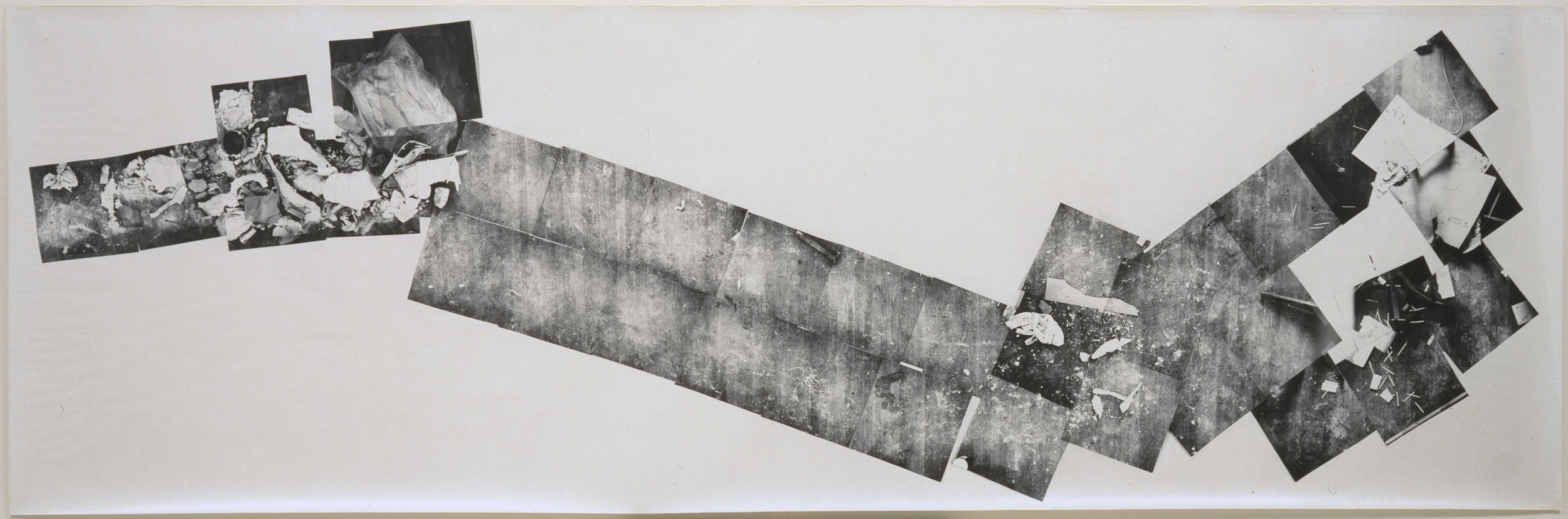
“Field Coil was specifically made for the lower level space at 112, with its unobstructed linear run and uncluttered cement floor. The work consisted of 104 separate coiled kraft paper units that were placed one next to the other. Each section before being rolled measures 36 × 46″, the slits were 36″ long, cut at 1″ intervals and parallel to the 46″ length. The 104 separate units lost their intrinsic apartness as the coils were placed one next to the other, leaving only the uppermost part of each unit exposed to form an extended field. The dimensions of the entire work were 7″ high x 3′ wide x 49′ long.”

Excerpted from Brentano, R., & Savitt, M. (1981). 112 Workshop, 112 Greene Street: History, artists & artworks. New York: New York University Press cited on the White Columns website Nd [Online] Cited 21/06/2024


Petr Stembera (Czech, b. 1945) 'Mail-Art: (rolling a sleeve; 8 parts)' c. 1973 (detail)


Petr Stembera (Czech, b. 1945)
Mail-Art: (rolling a sleeve; 8 parts) (detail)
c. 1973
Black and white photographs
24.0 x 17.8 cm
Donated by the artist 1973
J W Power collection, Chau Chak Wing Museum


His [Stembera’s] Daily Activities, a series of performances for a camera from the early 1970s, dealing with routine actions, such as rolling up sleeves, typewriting, tying shoelaces, or fastening buttons are mainly found in collections outside Czechoslovakia and, thus, virtually absent from Czech collections, as the artist stopped displaying his photographic works after he turned to live performance in 1974. …

[Petr] Rezek wrote about photographic documentation as a basis for communication. Speaking about the Czech context and leaving aside the different financial and technical possibilities, Å tembera’s use of photographic documentation was not especially innovative. Photography served for many as an easily reproducible medium, as the lingua franca of performance art. Its importance was rooted in its utility rather than its aesthetics. However, the specific form of the use of this almost universally understood language depended on many factors. If we look more closely at its uses and direct our focus towards the various dialects, idiolects, and sociolects it encompasses, we can also learn more about the nature of the art it transmitted.

The fact that the Daily Activities series was crucial for Å tembera at the time is confirmed, for example, by a reproduction of a photograph showing him buttoning his shirt, which was used on the poster for his solo exhibition in Antwerp organized by D’Hondt in 1974. Such low-quality reproductions, which appeared in non-profit publications in the West as well as in unofficial and semi-official publications in the East were one of the typical outputs of these exchanges. In addition to gelatin silver prints, photomechanical reproductions played a crucial role in facilitating international transfers. Besides the posters and invitation cards, the reproductions in exhibition catalogues and in foreign magazines were seminal in distributing the original art piece to a wide audience. Through the catalogs, some of the exhibited works reached a secondary audience but also returned to the archives of the authors and to libraries, where they continue to serve as a source of information to this day.

Hanna Buddeus. “Photography: The Lingua Franca of Performance Art?” on the Art Margins website 14th March 2024 [Online] Cited 21/06/2024


Krzysztof Wodiczko (Polish, b. 1943) 'Eye to Eye' c. 1973


Krzysztof Wodiczko (Polish, b. 1943)
Eye to Eye
c. 1973
Gelatin silver photograph
47.6 x 59cm
Donated by the artist 1973
J W Power collection, Chau Chak Wing Museum


Giulio Paolini (Italian, b. 1940) 'Incipit' 1975


Giulio Paolini (Italian, b. 1940)
Incipit
1975
Torn photograph, canvas, wood, in Perspex frame
91.0 x 61.5cm
Purchased with funds from the J W Power Bequest 1976
J W Power collection


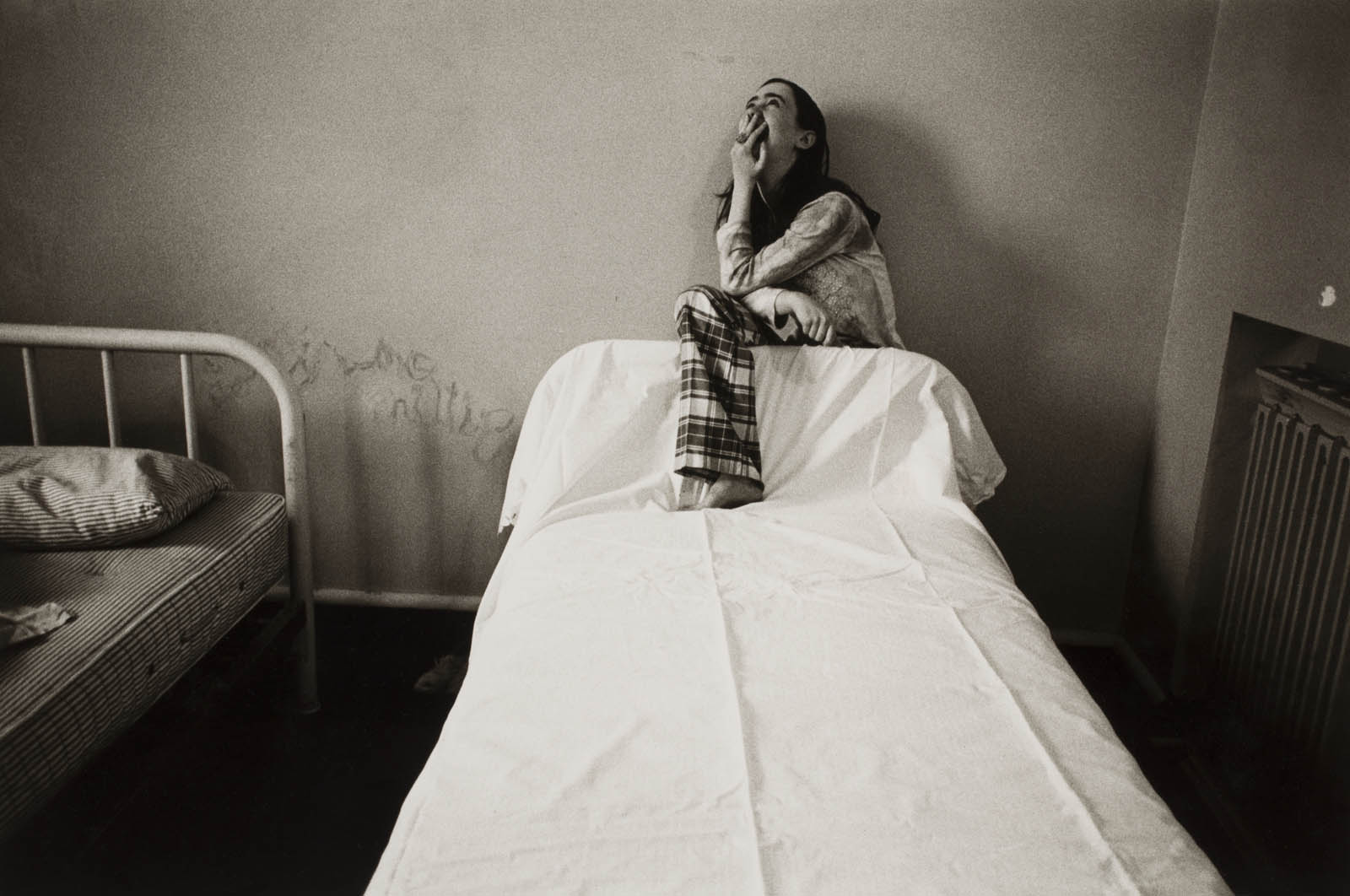
Mary Ellen Mark (American, 1940-2015) 'Untitled' 1976-1978


Mary Ellen Mark (American, 1940-2015)
Untitled
1976-1978
From the series Ward 81, Oregon State Hospital, Salem, Oregon
Silver gelatin photograph
20.3 x 30.5cm
Purchased with funds from the JW Power Bequest 1978
JW Power Collection, Chau Chak Wing Museum


In 1975, photographer Mary Ellen Mark was assigned by The Pennsylvania Gazette to produce a story on the making of Milos Forman’s film of Ken Kesey’s 1962 novel One Flew Over the Cuckoo’s Nest, shot on location at the Oregon State Hospital, a mental institution. While on set, Mark met the women of Ward 81, the only locked hospital security ward for women in the state: The inmates were considered dangerous to themselves or to others. In February of 1976, just before the ward closed (it ceased to exist in November of 1977, when it became the female section of a coeducational treatment ward), Mark and Karen Folger Jacobs, a writer and social scientist, were given permission to make a more extended stay, living on the ward in order to photograph and interview the women. They spent 36 days on Ward 81, photographing and documenting. Jacobs recalls their slow, inevitable assimilation: “We felt the degeneration of our own bodies and the erosion of our self-confidence. We were horrified at the thought of what we might become after a year or two of confinement and therapy on Ward 81.”
Text from the Google Books website


Mary Ellen Mark (American, 1940-2015) 'Untitled' 1976-1978


Mary Ellen Mark (American, 1940-2015)
Untitled
1976-1978
From the series Ward 81, Oregon State Hospital, Salem, Oregon
Silver gelatin photograph
20.3 x 30.5cm
Purchased with funds from the JW Power Bequest 1978
JW Power Collection, Chau Chak Wing Museum


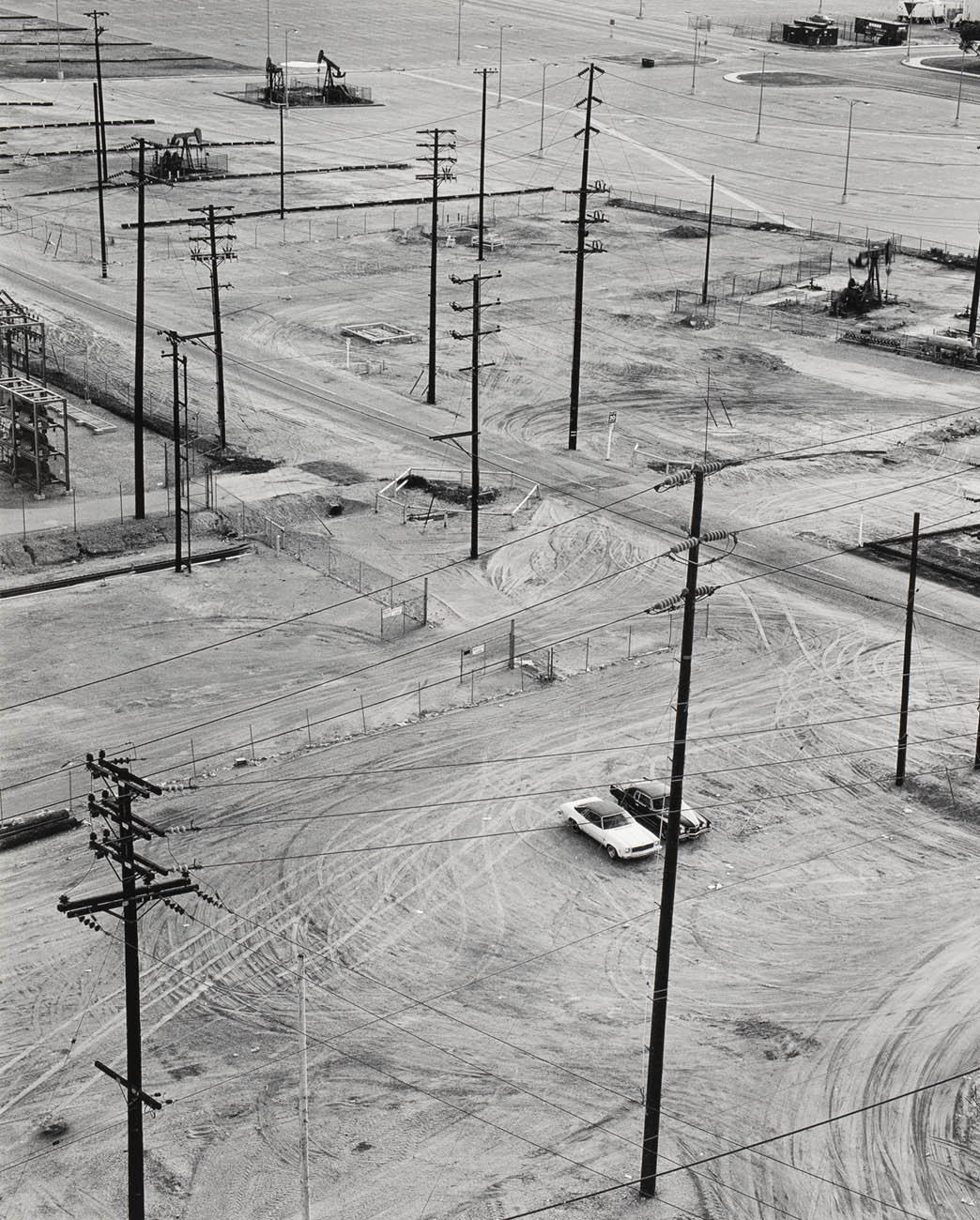
Grant Mudford (Australian, b. 1944) 'From Ocean boulevard, Long Beach' 1979-1980


Grant Mudford (Australian, b. 1944)
From Ocean boulevard, Long Beach
1979-1980
Black and white photograph on paper
60.3 x 50.3cm
Purchased with funds from the J W Power Bequest 1980
J W Power collection, Chau Chak Wing Museum


Bill Henson (Australian, b. 1955) 'Untitled 1980/82' 1980-1982


Bill Henson (Australian, b. 1955)
Untitled 1980/82
1980-1982
Gelatin silver photograph
43.1 x 39cm
Donated by University of Sydney Union 2019
University Art Collection, Chau Chak Wing Museum


“A selection of photographs from the Crowd Series (1980-1982) by Bill Henson. Snapped in secret these black and white journalistic surveillance photographs (‘taken’ in an around Flinders Street railway station in Melbourne) have a brooding intensity and melancholic beauty. Henson uses a flattened perspective that is opposed to the principles of linear perspective in these photographs. Known as The Art of Describing6 and much used in Dutch still life painting of the 17th century to give equal weight to objects within the image plane, here Henson uses the technique to emphasise the mass and jostle of the crowd with their “waiting, solemn and compliant” people.

“When exhibiting the full series, Henson arranges the works into small groupings that create an overall effect of aberrant movement and fragmentation. From within these bustling clusters of images, individual faces emerge like spectres of humanity that will once again dissolve into the crowd … all apparently adrift in the flow of urban life. The people in these images have an anonymity that allows them to represent universal human experiences of alienation, mortality and fatigue.”7

Marcus Bunyan. “Un/aware and in re/pose: the self, the subject and the city,” review of the exhibition ‘In camera and in public’ at the Centre for Contemporary Photography, Melbourne on the Art Blart website October 16, 2011 [Online] Cited 12/06/2024

6/ See Alpers, Svetlana. The Art of Describing: Dutch Art in the Seventeenth Century. University Of Chicago Press, 1984

7/ Anon. BILL HENSON: early work from the MGA collection. Education Resource. A Monash Gallery of Art Travelling Exhibition [Online] Cited 14/10/2011. No longer available online


Todd Watts (American, b. 1949) 'On the 21st century' 1982


Todd Watts (American, b. 1949)
On the 21st century
1982
Silver gelatin photograph
49.0 x 59.2cm
Purchased with funds from the JW Power Bequest 1986
JW Power Collection, Chau Chak Wing Museum


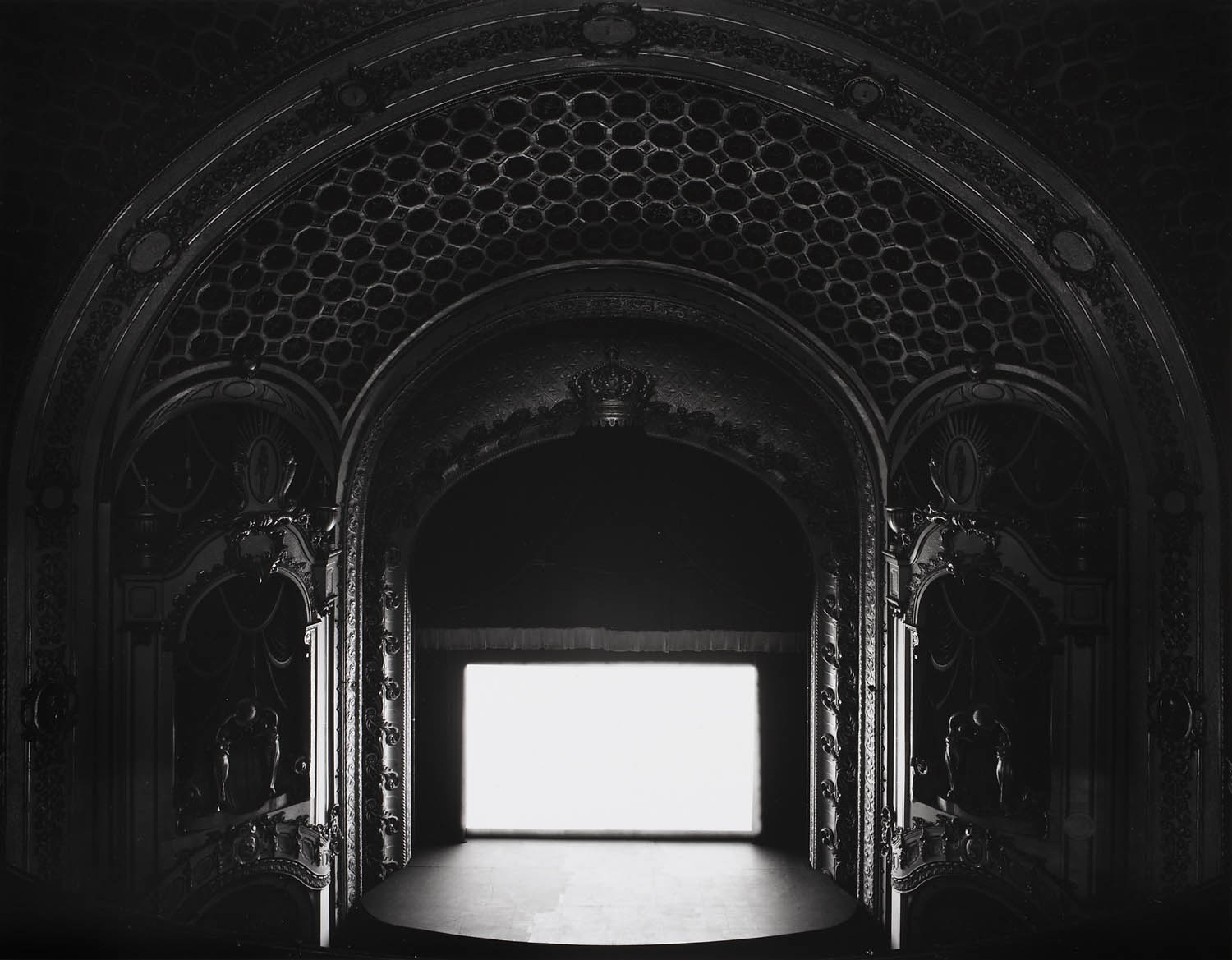
Hiroshi Sugimoto (Japanese, b. 1948) 'State Theatre, Sydney' 1997


Hiroshi Sugimoto (Japanese, b. 1948)
State Theatre, Sydney
1997
Silver gelatin photograph
42.3 x 54.6cm
Purchased with funds from the Dr M J Morrissey Bequest Fund in memory of Professor A L Sadler 2017
University Art Collection, Chau Chak Wing Museum


I loved Sugimoto’s time lapse movie screens, where the exact length of a movie was captured by the open lens of the camera, the substance of time and space evidenced by a seemingly empty screen. There was something wonderfully poetic and transformational about that gesture, about the notion of compressing the narrative, reality and action of a movie into a single frame of light: “the ‘annihilation of time and space’ as a particular moment in a dynamic cycle of rupture and recuperation enables a deliberate focus on the process of transition.”1 The process of transition in the flow of space and time.

Marcus Bunyan on the exhibition “Hiroshi Sugimoto: Past Tense” at the J. Paul Getty Museum, Getty Center, Los Angeles on the Art Blart website June 3, 2014 [Online] Cited 21/06/2024


Hiroshi Sugimoto (Japanese, b. 1948) 'Seagram Building – Ludwig Mies Van Der Rohe' 1997


Hiroshi Sugimoto (Japanese, b. 1948)
Seagram Building – Ludwig Mies Van Der Rohe
1997
Silver gelatin photograph
University Art Collection, Chau Chak Wing Museum


Michael Riley (Australian / Wiradjuri/Kamilaroi, 1960-2004) 'Moree women' 1991


Michael Riley (Australian / Wiradjuri/Kamilaroi, 1960-2004)
Moree women
1991
Gelatin silver print
40.0 x 56.5cm
Donated by University of Sydney Union, 2019
University Art Collection, Chau Chak Wing Museum


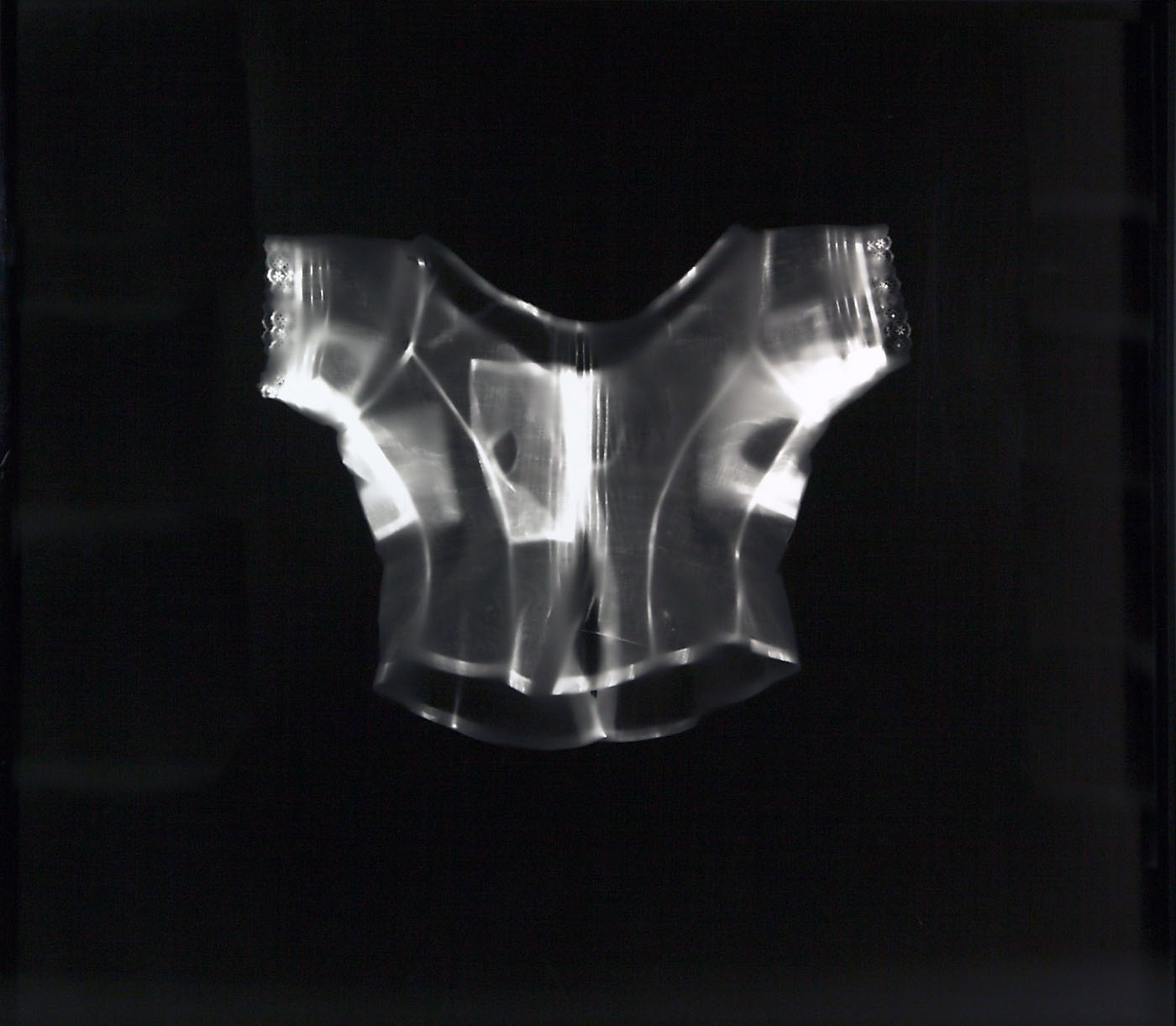
Anne Ferran (Australian, b. 1949) 'Untitled (Bodice)' 1998


Anne Ferran (Australian, b. 1949)
Untitled (Bodice)
1998
Gelatin silver photogram
82.0 x 93.5cm
Donated by University of Sydney Union 2019
University Art Collection, Chau Chak Wing Museum


In 1998 Australian artist Anne Ferran was offered an artist-in-resident’s position at an historic homestead not far from Sydney that had been occupied by successive generations of the same family since 1813. Ferran spent six months systematically making contact prints using the dresses, bodices, skirts, petticoats, and collars still contained in the house. Hovering in a surrounding darkness, softly radiating an inner light, the ghostly traces of these translucent garments now act as residual filaments for a century of absorbed sunshine. Many of them have been patched over the years and their signs of wear and repair are made clear. This allows us to witness a history of the use of each piece of clothing, seeing inside them to those small and skilful acts of home economy – the labour of women – usually kept hidden from a public gaze.

Wall text from the exhibition “Emanations: The Art of the Cameraless Photograph” at the Govett-Brewster Art Gallery / Len Lye Centre, New Plymouth, New Zealand on the Art Blart website July 31, 2016 [Online] Cited 21/06/2024


Cindy Sherman (American, b. 1954) 'Untitled #131' 1983


Cindy Sherman (American, b. 1954)
Untitled #131
1983
C-type photograph
139.9 x 100cm
University Art Collection, Chau Chak Wing Museum
Purchased with funds from the J W Power Bequest 1984
JW Power Collection, Chau Chak Wing Museum


The Twilight Girls (active 1997 - present) 'The Power and the Glory i' 2004 (detail)


The Twilight Girls (Helen Hyatt-Johnston and Jane Polkinghorne) (active 1997 – present)
The Power and the Glory i (detail)
2004
Colour photographic print
75.9 x 50.5cm
Donated by University of Sydney Union 2019
University Art Collection, Chau Chak Wing Museum


Hyatt-Johnston and Polkinghorne’s work is a hilarious celebration of the endless potential to personalise Hollywood fantasy so as to enjoy the vicarious glamour and tack without foreclosing either individual expression or the subversion of mainstream codes. The artists confuse genres and disciplines, feminist aspirations and sacred cows, in a mad comic brew that speaks more of the pleasure of play and friendship than of the construction of sexed identities. And this is the point, to evade the strictures of accepted feminist strategies by putting inclusive play back on the map.

Jacqueline Millner. “Twilight Girls: Helen Hyatt-Johnston and Jane Polkinghorne,” on the Contemporary Art and Feminism website October 22, 2013 [Online] Cited 21/06/2024 © Jacqueline Millner, 2002


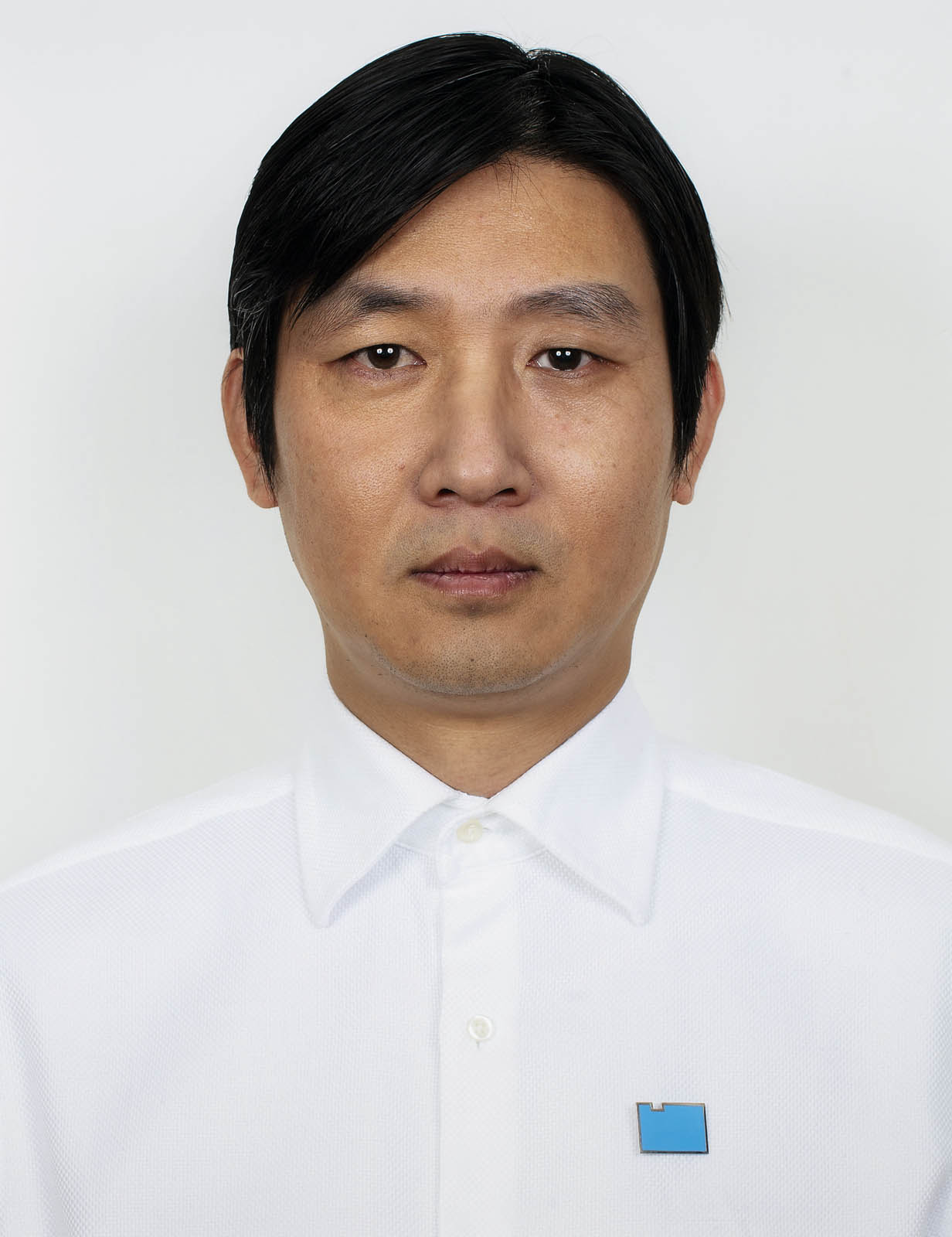
Polit-Sheer-Form Office (PSFO) (active 2005-2009) 'Mr Zhang' 2008


Polit-Sheer-Form Office (PSFO) (active 2005-2009)
Mr Zhang
2008
C-type print
170.4 x 135.5cm
Donated by Gene and Brian Sherman through the Australian Government’s Cultural Gifts Program 2021
University Art Collection, Chau Chak Wing Museum


Polit-Sheer-Form-Office (PSFO) is a China-based art group established in 2005 by artists Hong Hao, Xiao Yu, Song Dong, Liu Jianhua and curator / critic Leng Lin. Born in the mid-1960s, as children they all experienced the late Cultural Revolution, a period of Communist ideological orthodoxy that powerfully affected the preceding generation.

Drawing on this personal history, PSFO’s artistic practice strives to create a collective way of life while removing the political content historically associated with it. In its activities and artworks, PSFO attempts to create a framework – albeit tongue-in-cheek – for collective life in today’s consumer-oriented China. Within this framework, individuals may find the ties that bind them to others. At the same time, “sheer form” without content allows room for the individual to grow. By eating, drinking and playing together, the PSFO members revive a collective way of life associated with the Communist era of their youth, reawakening a long-lost state of being, by which they contend with contemporary China’s ideology of consumerism. But this is not nostalgia for one of the most controversial periods of Chinese history. The very emptiness of the political rhetoric of their childhood is what inspires the group’s name. Instead of political content, we have sheer, unadulterated political form – hence “Polit-Sheer-Form-Office.” The fact that the group calls itself an “Office” is another ironic reference to officialdom. …

Mr. Zheng is a digital amalgam of the faces of the five PSFO members in the form of a generic identification photo. This artwork straightforwardly embodies the union of the group’s five members, each sacrificing his individuality to become this new single entity. As a nod to the so-called “leader portraits” of Chairman Mao that were hung over buildings in China during the Socialist era… This virtual leader combines the characteristics of all five members, and is therefore not a portrait of authoritarianism, but of collectivism.

In American culture, individualism is a core value, yet a new understanding of the need for the collective has emerged. Similarly, while collectivism has been a core Chinese value, there has been increasing interest in individual pursuits. Is doing a good deed human nature’s need or a need for ideology? What is the real content and meaning of collectivism?

Ruijin Shen, curator, Guangdong Times Museum. “Polit-Sheer-Form-Office (PSFO) Polit-Sheer-Form!,” on the Queens Museum website 2014 [Online] Cited 07/07/2024


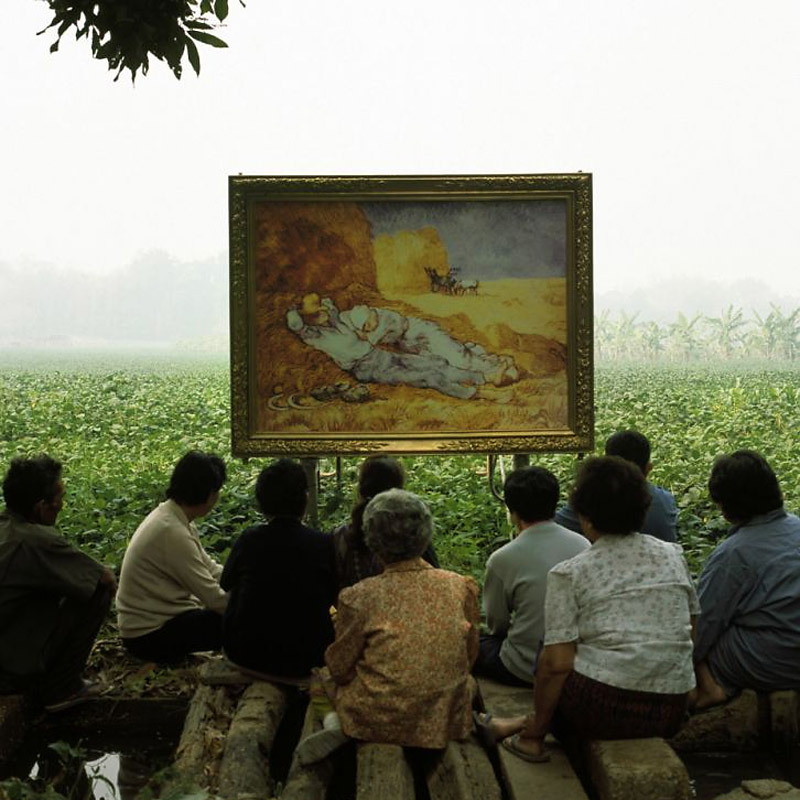
Araya Rasdjarmrearnsook (Thailand, b. 1957) 'The Two Planets: Van Gogh's The Midday Sleep 1889/90, and the Thai Villagers' 2008


Araya Rasdjarmrearnsook (Thailand, b. 1957)
The Two Planets: Van Gogh’s The Midday Sleep 1889/90, and the Thai Villagers
2008
Digital print
75.7 x 75.7cm
Purchased with funds from the Dr M J Morrissey Bequest Fund in memory of Professor A L Sadler 2014
University Art Collection, Chau Chak Wing Museum


Araya explores the relational potential of the tableau most fully in two video installation series: The Two Planets (2008) and Village and Elsewhere (2011), both of which are composed of short audiovisual vignettes that are usually exhibited as multichannel video and photographic installations. The individual works in each series are almost identical in terms of visual composition. Araya re-situates one or two large-scale, ostentatiously gold-framed reproductions of famous western paintings in outdoor or neighborhood spaces in the rural outskirts of the northern Thai city of Chiang Mai. The video camera frames these reproductions and their visually associative physical surroundings in a straight-on shot. On-screen, the framed reproductions are frontally displayed in the background. In the foreground, small groups of people are visible from the back, and their murmurings, chatter, gossip, speculations, and digressions as they look at the reproductions audible. …

In each of these audiovisual vignettes, the duration of the scene displayed approximates the duration of spectatorship by a figural group whose faces we do not see. The visualization of the group signifies “Thai Villagers,” or “Thai Farmers,” transfiguring people who, in everyday life, live in the same suburb as the artist. In each tableau, the group is sitting on the ground, their backs to us, facing the framed reproduction. The shortest of these videos are nearly ten minutes, and the longer ones about twenty-five. Someone comments on a detail that strikes them about the picture in the frame. Another person observes something about this face or that body, this plant, that tool, this hat, or that dish. The group amuses itself, speculating wildly on the backstory in the displayed scene. Sometimes they prod one another to dart up to the framed picture and point out a small detail – or to caress the image of a face, the skin, a body part. With the van Gogh reproduction, the group contemplates the placement of the sickle, the number of wheels on the wooden cart, the total number of oxen legs visible, and the casting of the sunlight on the haystack, all in order to decipher winning lottery numbers. Their conversation flows easily, often straying from the framed reproduction to random neighborhood gossip. Each video is unscripted and staged as a one-take piece using a static shot. The editing is minimal, involving discreet jump cuts to crop out of parts of the conversation without changing the visual composition, giving the impression that the vignettes are displaying spectatorial experiences in real time.

May Adadol Ingawanij. “Araya Rasdjarmrearnsook’s Relational Tableaux,” on the MoMA Post website August 9, 2023 [Online] Cited 21/06/2024


Araya Rasdjarmrearnsook (Thailand, b. 1957) 'Village and Elsewhere: Artemisia Gentileschi's Judith Beheading Holofernes, Jeff Koons's Untitled, and Thai Villagers' 2008


Araya Rasdjarmrearnsook (Thailand, b. 1957)
Village and Elsewhere: Artemisia Gentileschi’s Judith Beheading, Holofernes Jeff Koons’s Untitled, and Thai Villagers
2008
Purchased with funds from the Dr M J Morrissey Bequest Fund in memory of Professor A L Sadler 2014
University Art Collection, Chau Chak Wing Museum


The tableau display of the gold-framed reproductions references and aggrandizes museum conventions of hanging and presenting artworks on walls, an exhibition apparatus that lays claim to addressing everyone. Yet the spectators in The Two Planets and Village and Elsewhere exceed the boundary of that universalizing assertion with their actualization of what, following Elaine Castillo, we might call the spectatorship of the unintended.14 At the same time, their encounters with the reproductions take place in spaces that do not cohere with the museological value of suspending the time and space of daily life. The “Thai Villagers” and “Thai Farmers” in Araya’s tableaux are shown engaging with framed reproductions of art in neighborhood spaces – the local field, temple, and bamboo forest. The spectatorship of the unintended that they enact is a kind of unruly hosting, an extending of hospitality to the foreign, an unpredictable engagement with mobile artifacts from distant lands, cultures, and times.
May Adadol Ingawanij. “Araya Rasdjarmrearnsook’s Relational Tableaux,” on the MoMA Post website August 9, 2023 [Online] Cited 21/06/2024


Chau Chak Wing Museum – The University of Sydney
Level 1, University Place, Camperdown, NSW 2006
Phone: 02 9351 2812

Opening hours:
Monday to Friday (until 9pm Thursdays) 9am – 5pm
Saturday and Sunday 12 – 4pm
Closed public holidays
Chau Chak Wing Museum website

LIKE ART BLART ON FACEBOOK

Back to top

Exhibition: ‘VALIE EXPORT – The Photographs’ at the Fotomuseum Winterthur, Zurich, Switzerland

Exhibition dates: 25th February – 29th May, 2023

Curator: Walter Moser


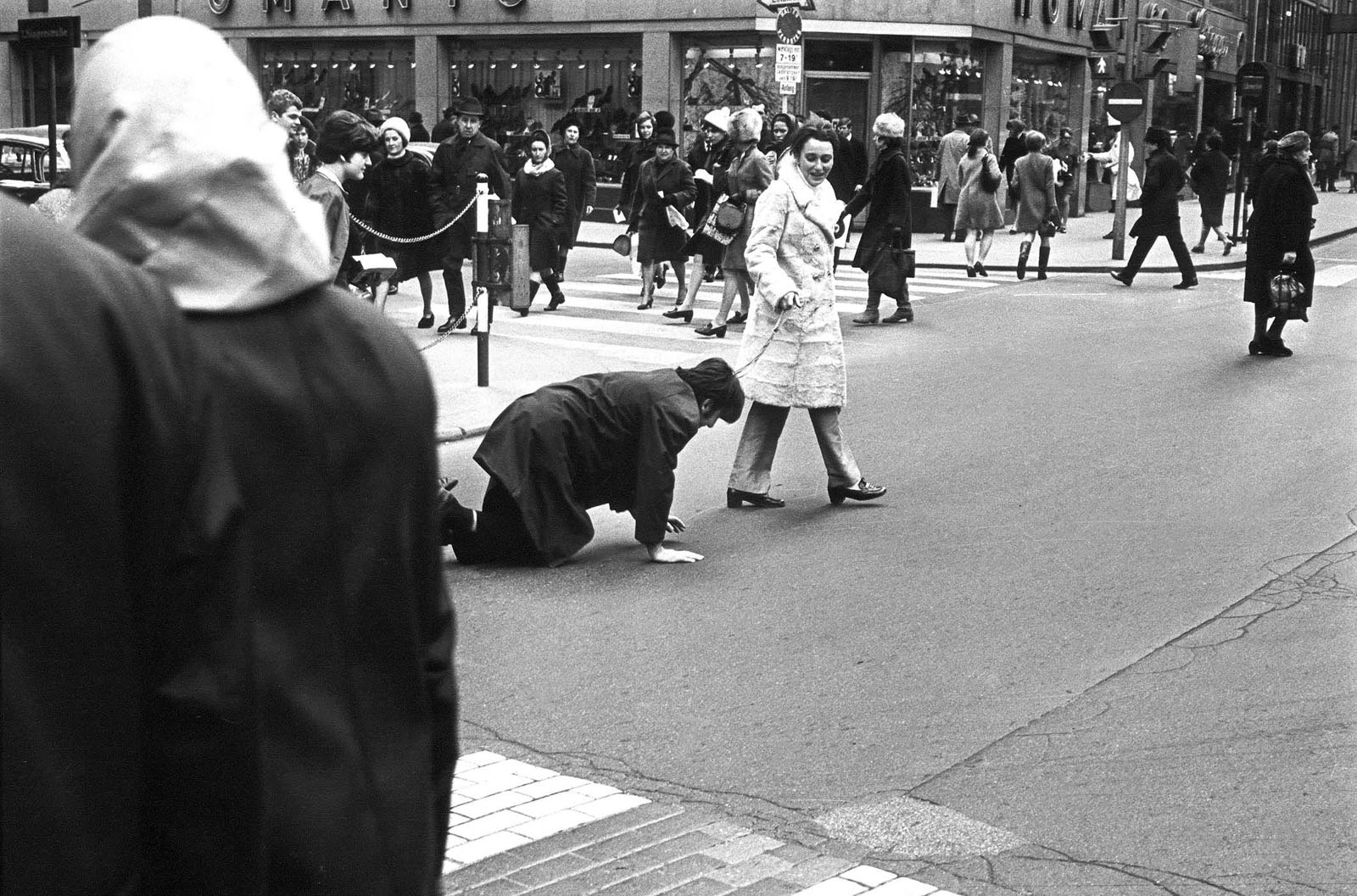
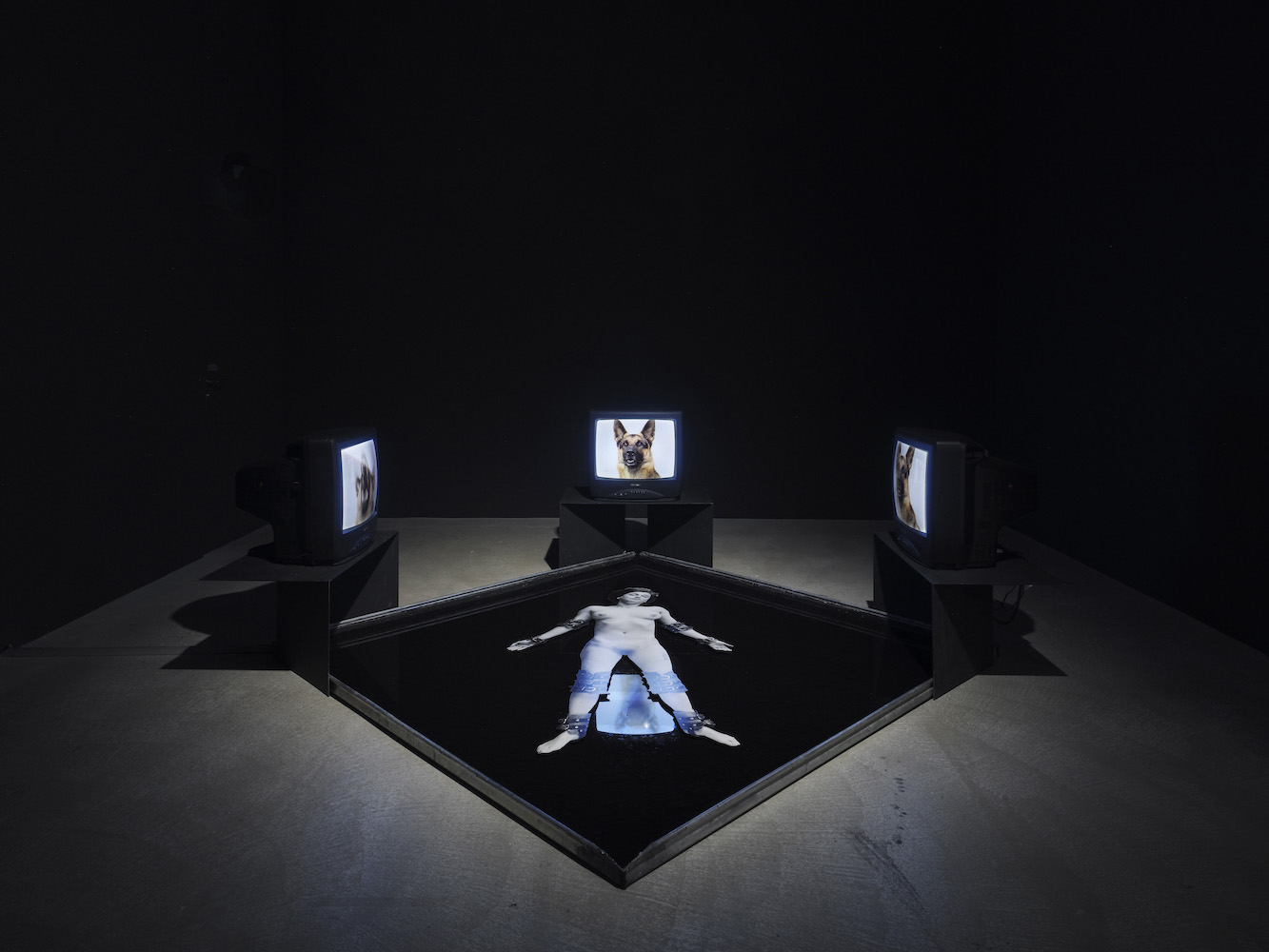
VALIE EXPORT (Austrian, b. 1940) 'Portfolio of Doggedness' (VALIE EXPORT, own words, conversation with Elisabeth Lebovici), in cooperation with Peter Weibel 1968 from the exhibition 'VALIE EXPORT – The Photographs' at the Fotomuseum Winterthur, Zurich, Switzerland, February - May, 2023


VALIE EXPORT (Austrian, b. 1940)
Portfolio of Doggedness (VALIE EXPORT, own words, conversation with Elisabeth Lebovici), in cooperation with Peter Weibel
1968
Courtesy Galerie Thaddaeus Ropac and the artist
© VALIE EXPORT, 2022, ProLitteris, Zurich
Photo: Joseph Tandl


I would really like to meet this artist.

Recent postings have hit a rich vein with exhibitions on artists and concepts which challenge the patriarchal, hegemonic status quo… through an exploration of diversity and the enunciation of different points of view. Postings have included exhibitions on the femme fatale, queer lives and Ukranian modernist painting and artists such as Samuel Fosso, Jimmy DeSana, and Andy Warhol.

Upcoming postings continue the theme with exhibitions by Ming Smith, Ernest Cole, Hannah Villiger, Dawoud Bey and Carrie Mae Weems, and Lucinda Devlin.

Dr Marcus Bunyan


Many thankx to the Fotomuseum Winterthur for allowing me to publish the photographs in the posting. Please click on the photographs for a larger version of the image.


VALIE EXPORT – The Photographs is the first exhibition to focus on the photographic oeuvre of the artist VALIE EXPORT (b. 1940), whose at times provocative performances and experimental installations have been a source of controversy. The show examines EXPORT’s use of photography as a critical exploration of processes of depiction and representation. At the interface of film, video art, drawing and body art the photographs offer a new perspective on her creative oeuvre.


Installation view 'VALIE EXPORT – The Photographs', Fotomuseum Winterthur


Installation view VALIE EXPORT – The Photographs, Fotomuseum Winterthur
© Fotomuseum Winterthur / Conradin Frei


VALIE EXPORT (Austrian, b. 1940) 'TAPP und TASTKINO' (TAP and TOUCH CINEMA) 1968 from the exhibition 'VALIE EXPORT – The Photographs' at the Fotomuseum Winterthur, Zurich, Switzerland, February - May, 2023


VALIE EXPORT (Austrian, b. 1940)
TAPP und TASTKINO (TAP and TOUCH CINEMA) 
1968
Albertina, Wien – The ESSL Collection
© VALIE EXPORT, 2022, ProLitteris, Zurich, photo: Werner Schulz


“As usual, the film is ‘shown’ in the dark. But the cinema has shrunk somewhat – only two hands fit inside it. To see (i.e. feel, touch) the film, the viewer (user) has to stretch his hands through the entrance to the cinema. At last, the curtain which formerly rose only for the eyes now rises for both hands. The tactile reception is the opposite of the deceit of voyeurism. For as long as the citizen is satisfied with the reproduced copy of sexual freedom, the state is spared the sexual revolution. Tap and Touch Cinema is an example of how re-interpretation can activate the public.”

~ Valie Export


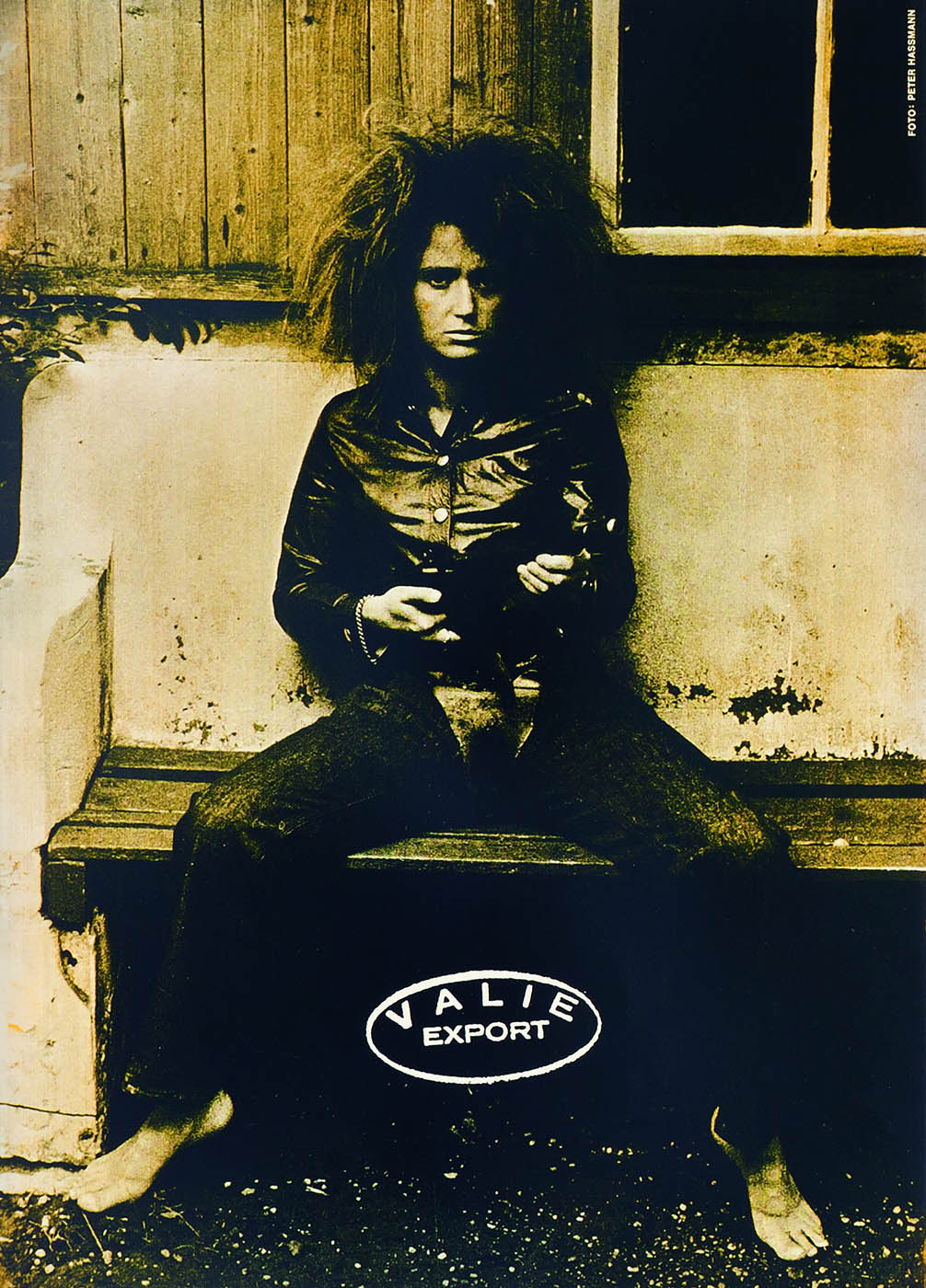
At age twenty-eight, Waltraud Hollinger changed her name to VALIE EXPORT, in all uppercase letters, to announce her presence in the Viennese art scene. Eager to counter the male – dominated group of artists known as the Vienna Actionists – including Günter Brus, Otto Mühl, Hermann Nitsch, and Rudolf Schwarzkogler – she sought a new identity that was not bound by her father’s name (Lehner) or her former husband’s name (Hollinger). Export was the name of a popular cigarette brand. This act of provocation would characterise her future performances, especially TAPP und TASTKINO (TOUCH and TAP Cinema) and Aktionhose: Genitalpanik (Action Pants: Genital Panic). Challenging the public to engage with a real woman instead of with images on a screen, in these works she illustrated her notion of “expanded cinema,” in which film is produced without celluloid; instead the artist’s body activates the live context of watching. Born of the 1968 revolt against modern consumer and technical society, her defiant feminist action was memorialised in a picture taken the following year by the photographer Peter Hassmann in Vienna. VALIE EXPORT had the image screen printed in a large edition and fly-posted it in public spaces.

Gallery label from Transmissions: Art in Eastern Europe and Latin America, 1960-1980, September 5, 2015 – January 3, 2016 from the MoMA website Nd [Online] Cited 05/05/2023


VALIE EXPORT’s multimedia work eludes any simplistic categorisation or definition. As a pioneer of performance art, installation art and video art, EXPORT has consistently broken through the boundaries separating media genres, while using her own body as an artistic medium. Photography has always played a key role in her practice – be it for documentary or experimental purposes, as an element in multimedia installations or as art in its own right. EXPORT has had a constant awareness of the importance of visually recording her performances. Back in 1968 two of her best-known performances, “TAPP und TASTKINO” and the action “Aus der Mappe der Hundigkeit”, were attended by photographers and filmmakers. For the performance “TAPP und TASTKINO”, a request was put out by megaphone asking spectators and passers-by to touch EXPORT’s breasts, which were covered by a box inspired by a cinema auditorium with a curtain that the artist wore like a garment. Participants had to maintain eye contact with EXPORT for a defined period of time while touching her, with the artist thereby reversing the voyeuristic male gaze, a typical feature of cinema. For “Aus der Mappe der Hundigkeit”, EXPORT took artist Peter Weibel through the centre of Vienna on a lead, with him crawling on all fours, provocatively drawing attention to the prevailing gender relations and power dynamics by reversing them. Photography was not merely used to make a complete document of EXPORT’s work. Rather, action and photography entered into a dialogue, creating a mutual dependency between them: on the one hand, actions were recorded (and ultimately communicated too) by means of photography; on the other, by virtue of their production, publication and reception – especially of key moments such as the interaction between artist and participants in “TAPP und TASTKINO” and their switch of perspective – EXPORT’s action photos acquired a status that was independent of the performances. EXPORT’s focus on the critical examination of mechanisms of representation dates right back to the start of her career, when she began dealing with the different characteristics of the photographic image and imaging media, questioning the way they worked and subjecting photography to conceptual analysis by lifting the lid on the conditions governing the technical processes of image-making. Deconstructing the photographic gaze and its implicit power structures were of key importance here.

Dimitris Lempesis. “VALIE EXPORT – The Photographs,” on the Dream Idea Machine website Nd [Online] Cited 04/05/2023


VALIE EXPORT (Austrian, b. 1940) 'Action Pants: Genital Panic' 1969 from the exhibition 'VALIE EXPORT – The Photographs' at the Fotomuseum Winterthur, Zurich, Switzerland, February - May, 2023


VALIE EXPORT (Austrian, b. 1940)
Action Pants: Genital Panic
1969
Courtesy Galerie Thaddaeus Ropac and the artist
© VALIE EXPORT, 2022, ProLitteris, Zurich
Photo: Peter Hassmann


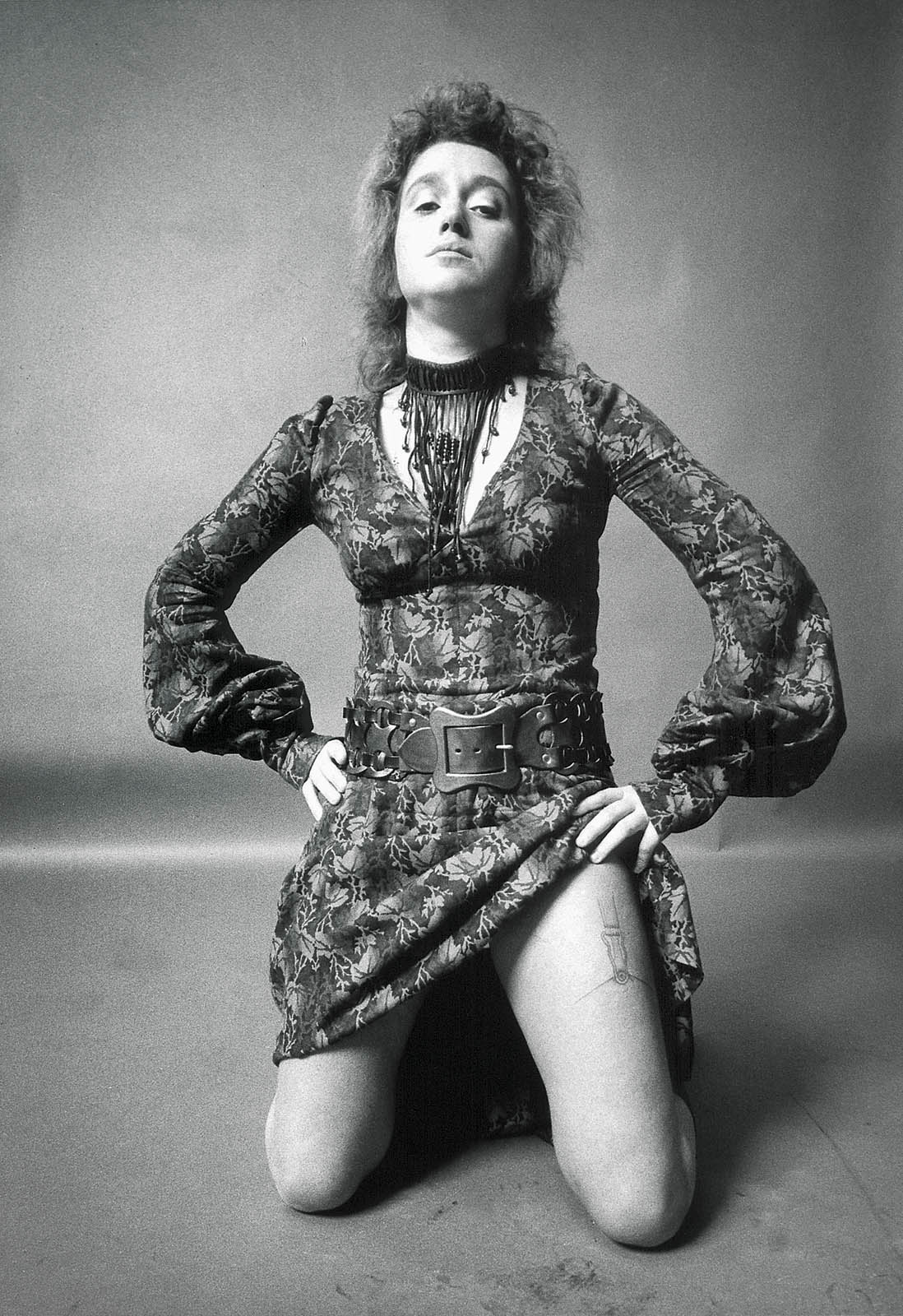
VALIE EXPORT (Austrian, b. 1940) 'BODY SIGN B' 1970 from the exhibition 'VALIE EXPORT – The Photographs' at the Fotomuseum Winterthur, Zurich, Switzerland, February - May, 2023


VALIE EXPORT (Austrian, b. 1940)
BODY SIGN B
1970
Albertina, Wien – The ESSL Collection
© VALIE EXPORT, 2022, ProLitteris, Zurich
Photo: Gertraud Wolfschwenger


VALIE EXPORT (Austrian, b. 1940) 'VALIE EXPORT – SMART EXPORT, self-portrait' 1970


VALIE EXPORT (Austrian, b. 1940)
VALIE EXPORT – SMART EXPORT, self-portrait
1970
Albertina, Wien – The ESSL Collection
© VALIE EXPORT, 2022, ProLitteris, Zurich
Photo: Gertraud Wolfschwenger


VALIE EXPORT – The Photographs is the first exhibition to focus on the photographic oeuvre of the artist VALIE EXPORT (b. 1940), whose at times provocative performances and experimental installations have been a source of controversy. The show examines EXPORT’s use of photography as a critical exploration of processes of depiction and representation. At the interface of film, video art, drawing and body art the photographs offer a new perspective on her creative oeuvre. VALIE EXPORT’s multimedia work eludes any simplistic categorisation or definition. As a pioneer of performance art, installation art and video art, EXPORT has consistently broken through the boundaries separating media genres, while using her own body as an artistic medium. Photography has always played a key role in her practice – be it for documentary or experimental purposes, as an element in multimedia installations or as art in its own right.

EXPORT has had a constant awareness of the importance of visually recording her performances. Back in 1968 two of her best-known performances, TAPP und TASTKINO and the action Aus der Mappe der Hundigkeit, were attended by photographers (and filmmakers). For the performance TAPP und TASTKINO, a request was put out by megaphone asking spectators and passers-by to touch EXPORT’s breasts, which were covered by a box inspired by a cinema auditorium with a curtain that the artist wore like a garment. Participants had to maintain eye contact with EXPORT for a defined period of time while touching her, with the artist thereby reversing the voyeuristic male gaze, a typical feature of cinema. For Aus der Mappe der Hundigkeit, EXPORT took artist Peter Weibel through the centre of Vienna on a lead, with him crawling on all fours, provocatively drawing attention to the prevailing gender relations and power dynamics by reversing them.

Photography was not merely used to make a complete document of EXPORT’s work. Rather, action and photography entered into a dialogue, creating a mutual dependency between them: on the one hand, actions were recorded (and ultimately communicated too) by means of photography; on the other, by virtue of their production, publication and reception – especially of key moments such as the interaction between artist and participants in TAPP und TASTKINO and their switch of perspective – EXPORT’s action photos acquired a status that was independent of the performances.

EXPORT’s focus on the critical examination of mechanisms of representation dates right back to the start of her career, when she began dealing with the different characteristics of the photographic image and imaging media, questioning the way they worked and subjecting photography to conceptual analysis by lifting the lid on the conditions governing the technical processes of image-making. Deconstructing the photographic gaze and its implicit power structures were of key importance here.

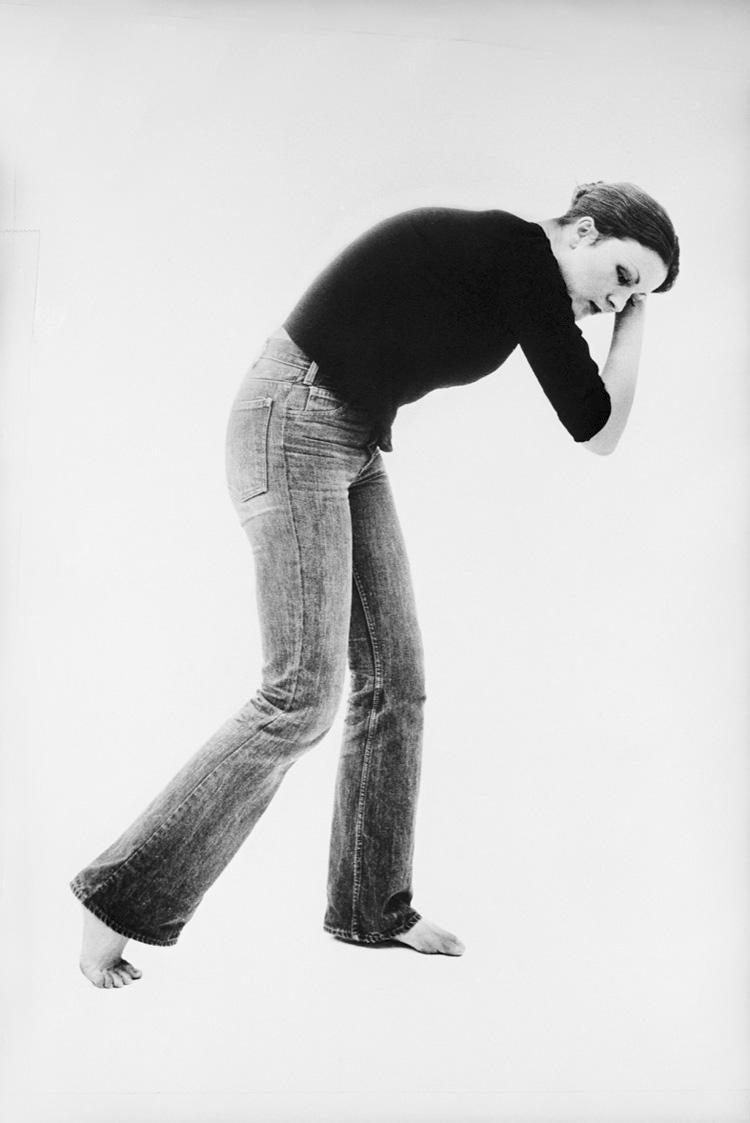
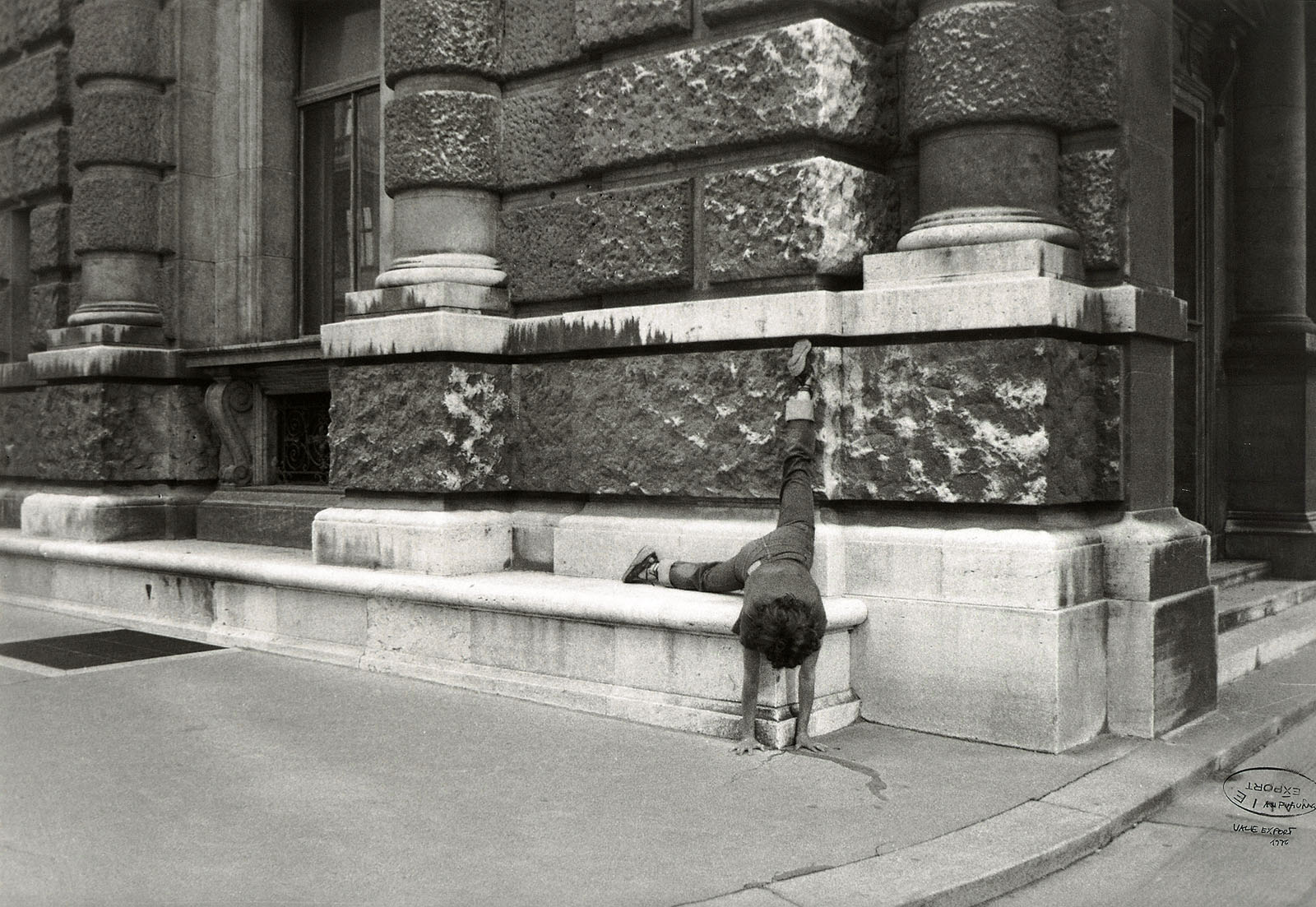
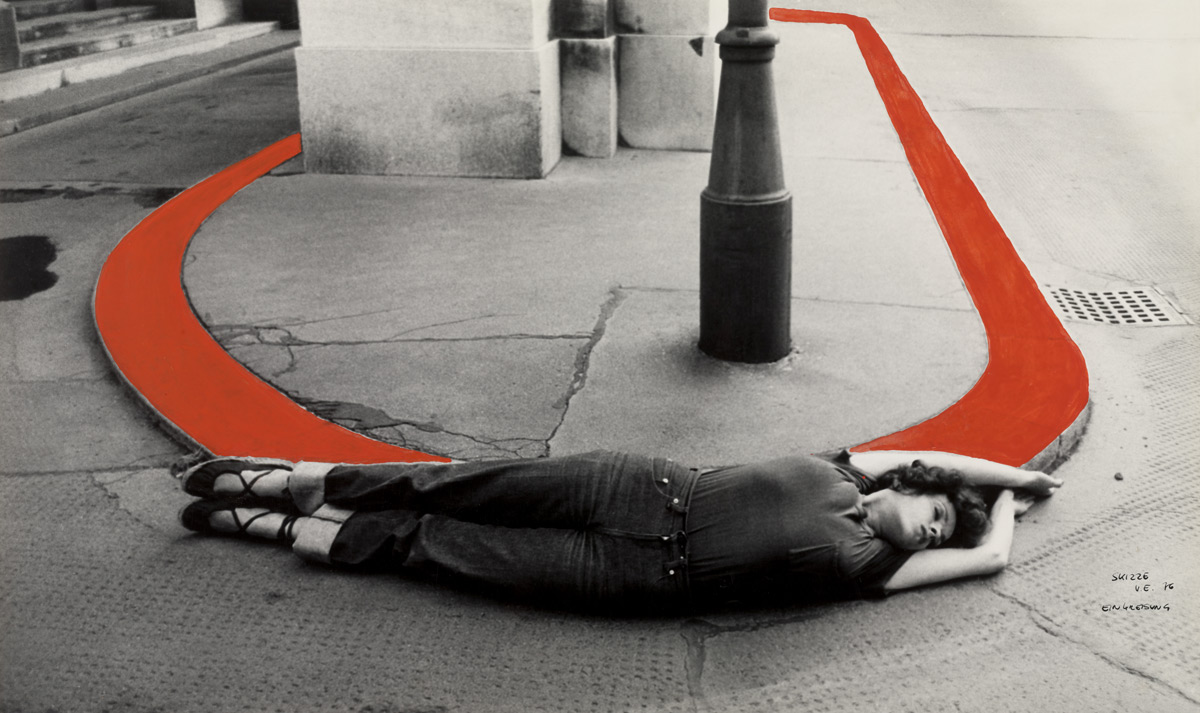
For EXPORT, the critical analysis of systems of representation invariably went hand in hand, in the context of both media and society, with a questioning of the male gaze directed at a body viewed as female. Making reference to her own body, she repeatedly probed the role of the woman, the artist and the subject in patriarchal sociopolitical structures. In 1970, for example, EXPORT had a garter tattooed on her thigh for Body Sign Action to give visible expression to the woman’s status as a sexual object and projection surface for male fantasies. Besides capturing the act of being tattooed, EXPORT also took photographs of the tattoo itself. The work expresses the pain involved – quite literally – in having patriarchal norms inscribed on a body that is seen as female. With her series Body Configurations (1972–1982), EXPORT investigates the relationships between the subject and power-political structures through body postures too. She explicitly couches her critique of the processes of depiction and representation in feminist terms: her work centres on the relationship between subject and space, body and gaze, femaleness and representation.

The exhibition VALIE EXPORT – The Photographs, which was devised in close collaboration with the artist, focuses on the impact that photography has had on her creative output. However, following the logic of EXPORT’s work, the exhibition not only presents photographs but also juxtaposes different media and works created between 1968 and 2007.

About VALIE EXPORT

VALIE EXPORT was born in 1940 in Linz, Austria, and now lives and works in Vienna. She is one of the pioneers of performance art and conceptual art. In 1967, in what was a radical gesture at the time, she gave up her father’s and her ex-husband’s names and laid claim to a new identity, VALIE EXPORT. Her works have been shown worldwide as part of numerous solo and group exhibitions. EXPORT has taught at various international institutions and was a professor for performance and multimedia at the Academy of Media Arts Cologne from 1995 to 2005. The VALIE EXPORT Center Linz was established through the acquisition of the artist’s estate in 2015, thus laying the foundations for an international research centre to foster artistic and academic engagement with media art and performance art.

Press release from Fotomuseum Winterthur


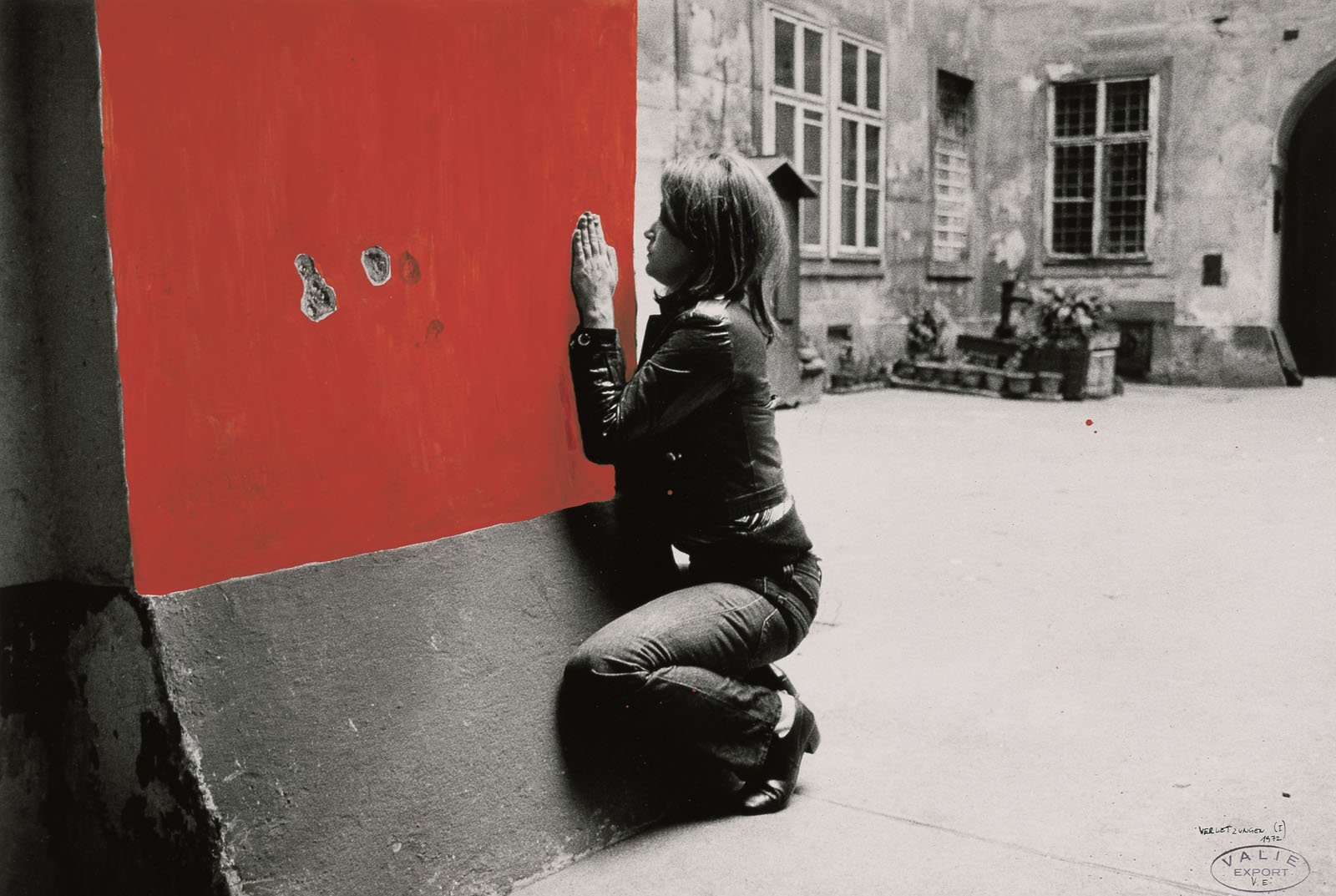
VALIE EXPORT (Austrian, b. 1940) 'Verletzungen I' (Injuries I) 1972


VALIE EXPORT (Austrian, b. 1940)
Verletzungen I (Injuries I)
1972
Wien – The ESSL Collection
© VALIE EXPORT, 2022, ProLitteris, Zurich
Photo: Hermann Hendrich


VALIE EXPORT (Austrian, b. 1940) 'Train II' 1972


VALIE EXPORT (Austrian, b. 1940)
Train II
1972
Courtesy Galerie Thaddaeus Ropac and the artist
© VALIE EXPORT, 2022, ProLitteris, Zurich


VALIE EXPORT (Austrian, b. 1940) 'Verkreuzung' (Crossing) 1972, printed 1980


VALIE EXPORT (Austrian, b. 1940)
Verkreuzung (Crossing)
1972, printed 1980
Black and white silver gelatin print on baryta paper laid on chip board
Each board 165 x 200cm (64.96 x 78.74 in)
Courtesy Galerie Thaddaeus Ropac and the artist
© VALIE EXPORT, 2022, ProLitteris, Zurich


VALIE EXPORT (Austrian, b. 1940) 'ASEMIE – The Inability to Express Oneself Through Facial Expression' 1973


VALIE EXPORT (Austrian, b. 1940)
ASEMIE – The Inability to Express Oneself Through Facial Expression
1973
Courtesy Galerie Thaddaeus Ropac and the artist
© VALIE EXPORT, 2022, ProLitteris, Zurich
Photo: Alfred Damm

die unfähigeit = the inability


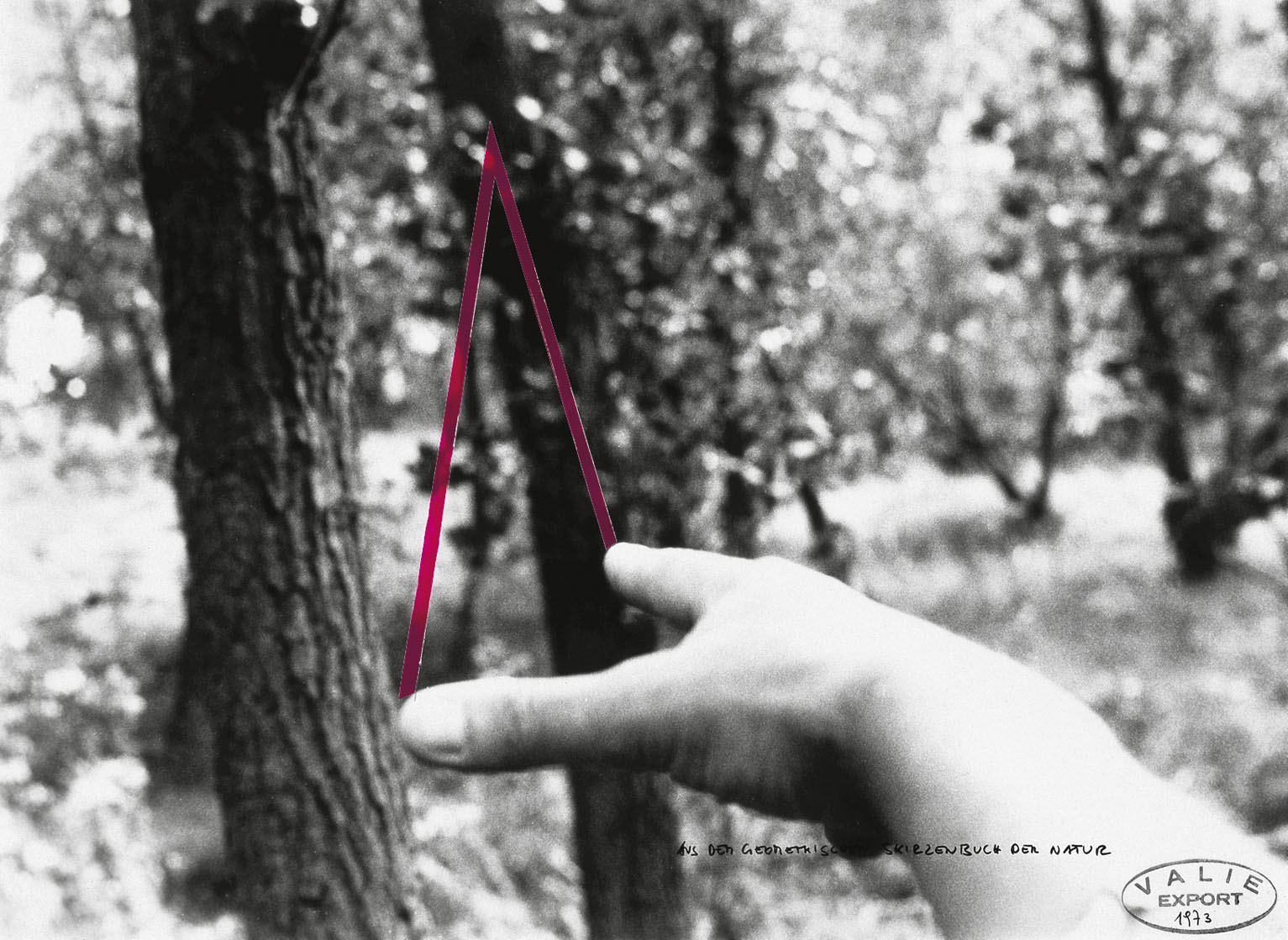
VALIE EXPORT (Austrian, b. 1940) 'From the Geometric Sketchbook of Nature, Tree Triangle' 1973


VALIE EXPORT (Austrian, b. 1941)
From the Geometric Sketchbook of Nature, Tree Triangle
1973
Courtesy Galerie Thaddaeus Ropac and the artist
© VALIE EXPORT, 2022, ProLitteris, Zurich


VALIE EXPORT (Austrian, b. 1940) 'Nachfügung' (Supplement) 1974


VALIE EXPORT (Austrian, b. 1941)
Nachfügung (Supplement)
1974
Courtesy Galerie Thaddaeus Ropac and the artist
© VALIE EXPORT, 2022, ProLitteris, Zurich
Photo: Eric Timmermann


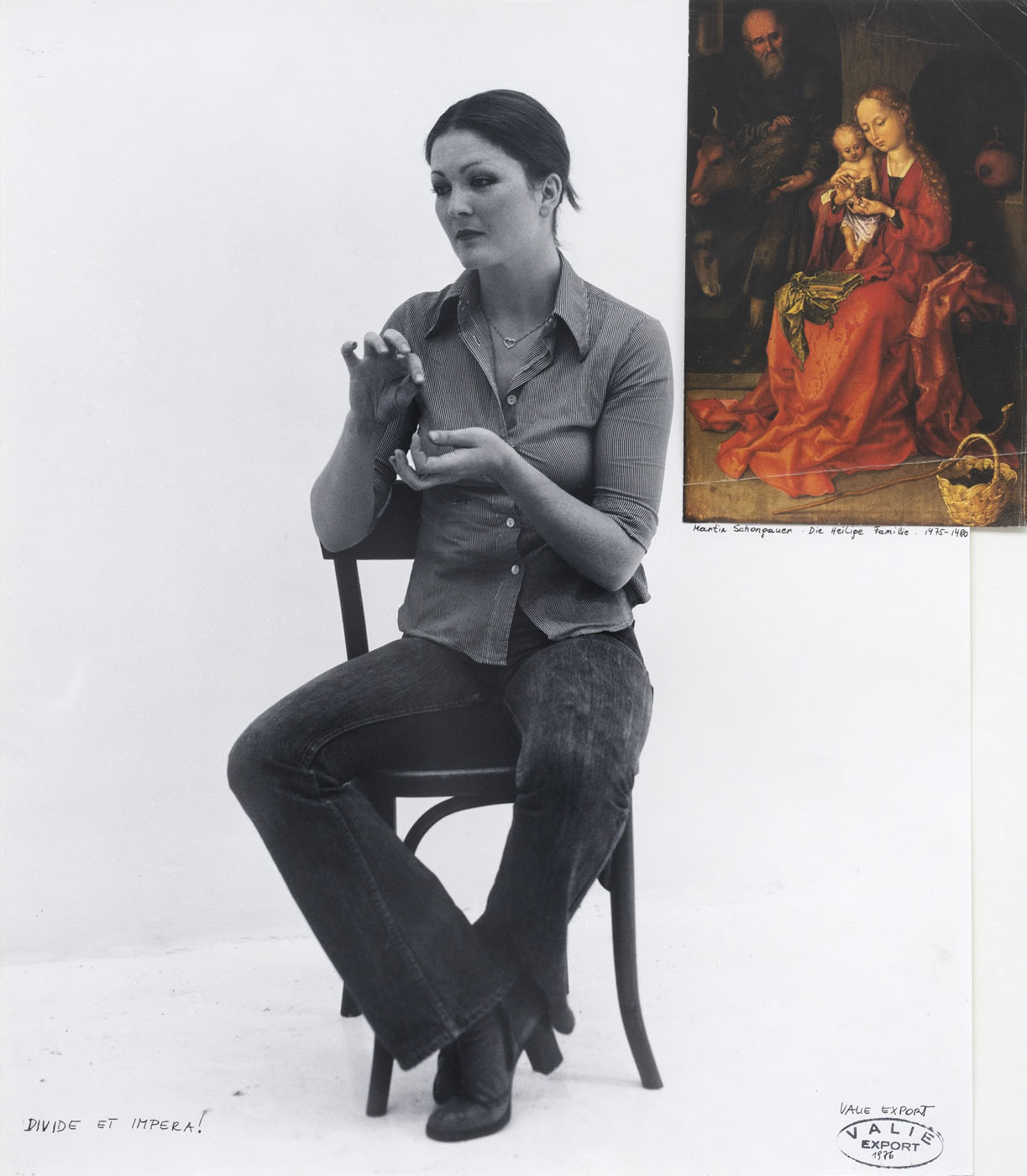
VALIE EXPORT (Austrian, b. 1940) 'Petri / fikation' (after: William Blake, Naomi Entreating Ruth and Orpah to Return to the Land of Moab, 1795) 1976, printed 1980


VALIE EXPORT (Austrian, b. 1940)
Petri / fikation (after: William Blake, Naomi Entreating Ruth and Orpah to Return to the Land of Moab, 1795)
1976, printed 1980
Black and white silver gelatin print on baryta paper laid on chip board
139.5 x 99.5cm
Courtesy Galerie Thaddaeus Ropac and the artist
© VALIE EXPORT, 2022, ProLitteris, Zurich


VALIE EXPORT (Austrian, b. 1940) 'Petri / fikation' (after: William Blake, Naomi Entreating Ruth and Orpah to Return to the Land of Moab, 1795) 1976, printed 1980


VALIE EXPORT (Austrian, b. 1940)
Petri / fikation (after: William Blake, Naomi Entreating Ruth and Orpah to Return to the Land of Moab, 1795)
1976, printed 1980
Black and white silver gelatin print on baryta paper laid on chip board
140 x 100cm
Courtesy Galerie Thaddaeus Ropac and the artist
© VALIE EXPORT, 2022, ProLitteris, Zurich


VALIE EXPORT (Austrian, b. 1940) 'Die Geburtenmadonna' 1976, printed 1980


VALIE EXPORT (Austrian, b. 1940)
Die Geburtenmadonna
1976, printed 1980
Black and white silver gelatin print on baryta paper laid on chip board
Courtesy Galerie Thaddaeus Ropac and the artist
© VALIE EXPORT, 2022, ProLitteris, Zurich


VALIE EXPORT (Austrian, b. 1940) 'DIVIDE ET IMPERA! after: Martin Schongauer, The Holy Family, 1475-1480' 1976


VALIE EXPORT (Austrian, b. 1941)
DIVIDE ET IMPERA! after: Martin Schongauer, The Holy Family, 1475-1480
1976
Courtesy Galerie Thaddaeus Ropac and the artist
© VALIE EXPORT, 2022, ProLitteris, Zurich

Divide et impera! = divide and rule!


VALIE EXPORT (Austrian, b. 1940) 'Anfügung' (Attachment) 1976


VALIE EXPORT (Austrian, b. 1940)
Anfügung (Attachment)
1976
Albertina, Wien – Familiensammlung Haselsteiner
© VALIE EXPORT, 2022, ProLitteris, Zurich


VALIE EXPORT (Austrian, b. 1940) 'Einkreisung' (Encirclement) 1976


VALIE EXPORT (Austrian, b. 1940)
Einkreisung (Encirclement)
1976
From the series Körperkonfigurationen (Body Configurations)
Gelatin silver print with red ink
14 x 23 7/16″ (35.5 x 59.6cm)
The Museum of Modern Art, New York
Carl Jacobs Fund
© 2012 VALIE EXPORT / Artists Rights Society (ARS), New York / VBK, Austria


In her series Body Configurations, the artist had herself or female colleagues photographed in local streets, stairwells, and alleyways, contorting their bodies to mimic the harsh geometries of the city. Influenced not only by the Actionists but also by the human sculpture of Robert Morris, Export complicates the coolly inhuman systems of Minimalism by reintroducing the human body into abstraction, an intimate yet public gesture that effortlessly transmutes the personal into the political.


VALIE EXPORT (Austrian, b. 1940) From the series 'Körperkonfigurationen' (Body Configurations) 1972-1976


VALIE EXPORT (Austrian, b. 1940)
From the series Körperkonfigurationen (Body Configurations)
1972-1976
Gelatin silver print
Courtesy Galerie Thaddaeus Ropac and the artist
© VALIE EXPORT, 2022, ProLitteris, Zurich


VALIE EXPORT (Austrian, b. 1940) from the series 'Körperkonfigurationen' (Body Configurations) 1972-1976


VALIE EXPORT (Austrian, b. 1940)
From the series Körperkonfigurationen (Body Configurations)
1972-1976
Gelatin silver print
Courtesy Galerie Thaddaeus Ropac and the artist
© VALIE EXPORT, 2022, ProLitteris, Zurich


VALIE EXPORT (Austrian, b. 1940) from the series 'Körperkonfigurationen' (Body Configurations) 1972-1976


VALIE EXPORT (Austrian, b. 1940)
From the series Körperkonfigurationen (Body Configurations)
1972-1976
Gelatin silver print
Courtesy Galerie Thaddaeus Ropac and the artist
© VALIE EXPORT, 2022, ProLitteris, Zurich


VALIE EXPORT (Austrian, b. 1940) 'Abrundung I' (Rounding I) 1976, printed 1980


VALIE EXPORT (Austrian, b. 1940)
Abrundung I (Rounding I)
1976, printed 1980
Black and white silver gelatin print on baryta paper laid on chip board
80 x 130.5cm
Courtesy Galerie Thaddaeus Ropac and the artist
© VALIE EXPORT, 2022, ProLitteris, Zurich


VALIE EXPORT (Austrian, b. 1940) 'Elongation' 1976, printed 1980


VALIE EXPORT (Austrian, b. 1940)
Elongation
1976, printed 1980
Black and white silver gelatin print on baryta paper laid on chip board
80 x 130.5cm
Courtesy Galerie Thaddaeus Ropac and the artist
© VALIE EXPORT, 2022, ProLitteris, Zurich


Fotomuseum Winterthur
Grüzenstrasse 44 + 45
CH-8400
Winterthur (Zürich)

Opening hours:
Tuesday to Sunday 11am – 6pm
Wednesday 11am – 8pm
Closed on Mondays

Fotomuseum Winterthur website

LIKE ART BLART ON FACEBOOK

Back to top

Exhibition: ‘Birdlike’ by Anne Ferran at Sutton Gallery, Melbourne

Exhibition dates: 5th March – 2nd April, 2022


Installation view of the exhibition 'Birdlike' by Anne Ferran at Sutton Gallery, Melbourne showing at left, 'Ground dweller 4', 2020-2021


Installation view of the exhibition Birdlike by Anne Ferran at Sutton Gallery, Melbourne showing at left, Ground dweller 4, 2020-2021 (see below)
© the artist and Sutton Gallery


A quick text today as I am very sick with bronchitis and not feeling very well.

I have always liked Ferran’s performative creations starting with her body of work titled Box of Birds (2013) followed by Align (2015); Flying Colour (2016); Open Book (2018); White Against Red (2018); and now her most recent series, Birdlike (2020-2022)

While conceptually based (as with much contemporary photography), her bodies of work have an elemental quality to them that keeps them grounded and present even as they reference a historical past, a “felt” (pardon the pun since Ferran uses felt material) response to a present day conundrum.

The new work Birdlike “continues the artist’s practice of photographing female performers as they improvise with lengths of coloured felt … [which] allows for complex and nuanced interpretations” in response to the initial proposition, in this case Ferran’s wish “to summon the return of a small ground-dwelling bird, the Plains wanderer, Pedionomus torquatus, to a place that it vanished from long ago.”

These birds “are surprisingly distinct from any other species on the planet, they are the last family on their evolutionary line,” the only representative of family Pedionomidae and genus Pedionomus. They are threatened by agricultural practices such as cropping and grazing, and so they are at risk of habitat loss, as well as other threats such as flooding, feral predators, pesticide use and their small population size. With their ground-nesting habits, poor flying ability, and the tendency to run rather than fly from predators, the birds become easy prey for the fox. Now listed as a critically endangered species the bird makes a haunting return, a form of speculative reappearance as Ferran puts it, to a place in which it was once common – that of Wiradjuri country, near Narrandera NSW.

These beautiful, conceptual, improvised photographs are not only about the here and now, but are about present and past (a longing for a quixotic past?), about presence and absence… and about death and loss. Every thing contemporary photography is good at – that is, unpicking the threads of history and reassembling them – is here grounded “in the flatness of the landscape, the vastness of the sky and the colours of the lengths of felt the performer is manipulating.” In other words, grounded in light, colour and the red soil of the Australian landscape these re-imagined birds are captured in a fantastical performance / sublime dance (of death).

I love these photographs. They possess a sublime mystery that makes me stop and question how little the human race has learnt and how much we have lost. With species extinction, climate change and ocean pollution ongoing, this is only the beginning of the desecration of Mother Earth.

Omnia mutantur nos et mutamur in illis (all things change, and we change with them).

But not necessarily for the better.

Dr Marcus Bunyan


Many thankx to Sutton Gallery for allowing me to publish the photographs in the posting. All images © the artist and Sutton Gallery. Please click on the photographs for a larger version of the image.


Installation view of the exhibition 'Birdlike' by Anne Ferran at Sutton Gallery, Melbourne showing at left, 'Ground dweller 4', 2020-2021


Installation view of the exhibition Birdlike by Anne Ferran at Sutton Gallery, Melbourne showing at left, Ground dweller 4, 2020-2021 (see below)
© the artist and Sutton Gallery


Installation view of the exhibition 'Birdlike' by Anne Ferran at Sutton Gallery, Melbourne showing at left, 'Plains wanderer 1'; and at right, 'Plains wanderer 3' both 2020-2021


Installation view of the exhibition Birdlike by Anne Ferran at Sutton Gallery, Melbourne showing at left, Plains wanderer 1; and at right, Plains wanderer 3 both 2020-2021 (see below)
© the artist and Sutton Gallery


Installation view of the exhibition 'Birdlike' by Anne Ferran at Sutton Gallery, Melbourne showing at left, 'Field haunter 1', 'Field haunter 3', and 'ield haunter 2' all 2020-2021; and at right, 'Hiding 1' 2020-2021


Installation view of the exhibition Birdlike by Anne Ferran at Sutton Gallery, Melbourne showing at left, Field haunter 1, Field haunter 3, and Field haunter 2 all 2020-2021 (see below); and at right, Hiding 1 2020-2021 (see below)
© the artist and Sutton Gallery


Anne Ferran (Australian, b. 1949) 'Field haunter 1' 2020-2021 from the exhibition 'Birdlike' by Anne Ferran at Sutton Gallery, Melbourne,  March - April, 2022


Anne Ferran (Australian, b. 1949)
Field haunter 1
2020-2021
Pigment print on cotton rag paper
© the artist and Sutton Gallery


Anne Ferran (Australian, b. 1949) 'Field haunter 2' 2020-2021 from the exhibition 'Birdlike' by Anne Ferran at Sutton Gallery, Melbourne,  March - April, 2022


Anne Ferran (Australian, b. 1949)
Field haunter 2
2020-2021
Pigment print on cotton rag paper
© the artist and Sutton Gallery


Anne Ferran (Australian, b. 1949) 'Field haunter 3' 2020-2021 from the exhibition 'Birdlike' by Anne Ferran at Sutton Gallery, Melbourne,  March - April, 2022


Anne Ferran (Australian, b. 1949)
Field haunter 3
2020-2021
Pigment print on cotton rag paper
© the artist and Sutton Gallery


In Birdlike I aimed to summon the return of a small ground-dwelling bird, the Plains wanderer, Pedionomus torquatus, to a place that it vanished from long ago. Once common over vast areas of southern NSW and Victoria, its existence is now threatened, and birdwatchers like me will go to great lengths to see it just once in their lives. In these photographs, made on Wiradjuri country, near Narrandera NSW, the Plains wanderer makes a form of speculative reappearance, via signs as indirect as the flatness of the landscape, the vastness of the sky and the colours of the lengths of felt the performer is manipulating.

I came to this way of working a few years ago. Its two key components are my collaboration with a performer – here it is Kirsten Packham – and her improvisations with lengths of dyed and painted felt. I choose the performer carefully, as so much depends on her sensitivity to her surroundings and her ability to transmit it through her physical body. With its inherent density, softness and weight, the felt can amplify and enhance her movements and gestures, while exerting a strong presence of its own. I never know what will emerge from these sessions, only that it will be something new, arising out of that moment, that performance and that situation.

Until now I have preferred to work in the familiar environment of a photographic studio. Decamping to the landscape introduced many small and some not-so-small considerations: the texture of the ground underfoot, the ever-changing effects of early morning or late afternoon light, whether it was hot, cold or blowing a gale at any one moment. Small trees crept into the frame and started acting like performers themselves. As the photographs began to accumulate, I thought I could see an out-of-place, almost alien quality emerging. This was unexpected, but on reflection it seems consistent with the displacements that have already happened in this place, as well as with those others that may come in the future.

~ Anne Ferran, 2022


Each image is available in two sizes: 65 x 50cm Ed. of 5 + 2APs and 144 x 104cm Ed. of 3 + 2APs

Performer: Kirsten Packham
Lighting: Frances Mocnik
Assistant: Brittany Hefren

This project is supported by the NSW Government through Create NSW, and the Cad Factory, Narrandera.


Anne Ferran (Australian, b. 1949) 'Ground dweller 1' 2020-2021


Anne Ferran (Australian, b. 1949)
Ground dweller 1
2020-2021
Pigment print on cotton rag paper
© the artist and Sutton Gallery


Anne Ferran (Australian, b. 1949) 'Ground dweller 2' 2020-2021


Anne Ferran (Australian, b. 1949)
Ground dweller 2
2020-2021
Pigment print on cotton rag paper
© the artist and Sutton Gallery


Anne Ferran (Australian, b. 1949) 'Ground dweller 3' 2020-2021


Anne Ferran (Australian, b. 1949)
Ground dweller 3
2020-2021
Pigment print on cotton rag paper
© the artist and Sutton Gallery


Anne Ferran (Australian, b. 1949) 'Ground dweller 4' 2020-2021


Anne Ferran (Australian, b. 1949)
Ground dweller 4
2020-2021
Pigment print on cotton rag paper
© the artist and Sutton Gallery


Anne Ferran (Australian, b. 1949) 'Hiding 1' 2020-2021


Anne Ferran (Australian, b. 1949)
Hiding 1
2020-2021
Pigment print on cotton rag paper
© the artist and Sutton Gallery


Anne Ferran (Australian, b. 1949) 'Hiding 2' 2020-2021


Anne Ferran (Australian, b. 1949)
Hiding 2
2020-2021
Pigment print on cotton rag paper
© the artist and Sutton Gallery


Anne Ferran (Australian, b. 1949) 'Hiding 3' 2020-2021


Anne Ferran (Australian, b. 1949)
Hiding 3
2020-2021
Pigment print on cotton rag paper
© the artist and Sutton Gallery


Anne Ferran (Australian, b. 1949) 'Plains wanderer 1' 2020-2021


Anne Ferran (Australian, b. 1949)
Plains wanderer 1
2020-2021
Pigment print on cotton rag paper
© the artist and Sutton Gallery


Anne Ferran (Australian, b. 1949) 'Plains wanderer 2' 2020-2021


Anne Ferran (Australian, b. 1949)
Plains wanderer 2
2020-2021
Pigment print on cotton rag paper
© the artist and Sutton Gallery


Anne Ferran (Australian, b. 1949) 'Plains wanderer 3' 2020-2021


Anne Ferran (Australian, b. 1949)
Plains wanderer 3
2020-2021
Pigment print on cotton rag paper
© the artist and Sutton Gallery


Sutton Gallery
254 Brunswick Street
Fitzroy 3065
Victoria, Australia
Phone: +61 3 9416 0727

Gallery hours:
Wednesday – Saturday
11am – 5pm, or by appointment

Sutton Gallery website

Anne Ferran website

LIKE ART BLART ON FACEBOOK

Back to top

Exhibition: ‘Dressing up: clothing and camera’ at the Monash Gallery of Art, Wheelers Hill, Melbourne

Exhibition dates: 23rd November, 2019 – 9th February, 2020

Curator: Gareth Syvret

Artists: Gordon Bennett, Polly Borland, Pat Brassington, Eric Bridgeman, Jeff Carter, Nanette Carter, Jack Cato, Zoë Croggon, Sharon Danzig, Rennie Ellis, Elizabeth Gertsakis, Christine Godden, Alfred Gregory, Craig Holmes, Tracey Moffatt, Derek O’Connor, Jill Orr, Deborah Paauwe, David Rosetzky, Damien Shen, Wesley Stacey, Christian Thompson, Lyndal Walker, Justene Williams, Anne Zahalka.


Installation view of the exhibition 'Dressing Up' at the Monash Gallery of Art, Melbourne showing at centre right, Deborah Paauwe's 'Foreign body' (2004)


Installation view of the exhibition Dressing Up at the Monash Gallery of Art, Melbourne showing at centre right, Deborah Paauwe’s Foreign body (2004)
Photo: Marcus Bunyan


Making an appearance

There are some stimulating and challenging works in this first exhibition curated by new MGA Associate Curator Gareth Syvret, who was parachuted into the project at the last moment. The curator has pulled together work that examines the complex interweaving of “cultural scenarios,” “interpersonal scripts,” and “intrapsychic scripts” that ground how the camera, and the photographer, picture our relationship to dressing up… and how we see ourselves pictured by the camera.

In various ways, the works interrogate how clothes (or the lack of them) reinforce the postmodern fragmentation of the individual or group, the self being decentred and multiple, as when we change from work clothes, to drag, to leather, to wearing our footy beanie and scarf… and how these e/facements, these everyday performances (for that is what they are), camouflage or reveal our “true” nature. Do we dress up to fit in (to a tribe or group, or representation), or do we rebel against the status quo, as did that enfant terrible who refused all categorisation throughout his life, the Australian fashion pioneer Leigh Bowery. How do we turn our face towards, or away from, the camera? (turning away is a re/action to the power of representation, even if a negative one)

Firstly we must recognise that “cultural forms do not have single determinate meanings – people make sense of them in different ways, according to the cultural (including sub-cultural) codes available to them.” And secondly, we must acknowledge that, “the analysis of images always needs to see how any given instance is embedded in a network of other instances”1 through intertexuality – where we, reality, our representation, and the image, are just nodes within a network whose unity is variable and relative.

“Critical to understanding the construction of these constantly shifting networks in contemporary society are the concepts of weaving and intertexuality. Intertextuality is the concept that texts do not live in isolation, ‘caught up as they are in a system of references to other books, other texts, other sentences: it is a node within a network… Its unity is variable and relative’ (Foucault, 1973). In other words the network is decentred and multiple allowing the possibility of transgressive texts or the construction of a work of art through the techniques of assemblage [Deleuze and Guattari] – a form of fluid, associative networking that is now the general condition of art production.”2

This weaving of surfaces disrupts histories and memories that are already narrativised, already textualised. It disrupts this marking, the continual reiteration of norms, by weaving a lack of fixity into objects, namely how we see ourselves, how we pictures ourselves. Through dress, and the camera, through a constant process of reconceptualisation of space and matter, we can redefine the significations of the body of the animal in the fold of inscription, through a process of materialisation. The production of this materialisation (the matériel, or arms, of sartorial elegance) – of this signified – is open to struggle, the simulation “by virtue of its being referent-free invites a reading of a different order: it is a perpetual examination of the code.”3 A code which, Julia Kristeva notes, is not simply the product of a single author, but of its relationship to other texts and to the structures of language itself. “[A]ny text,” she argues, “is constructed of a mosaic of quotations; any text is the absorption and transformation of another.”4 And this is what is happening in this exhibition – work, and images, which are a mosaic of quotations fighting over unity and fragmentation, reality and representation… and the construction of identity.

What this exhibition, and this materialisation, does not, and cannot answer, is the critical question: why do we dress up in the first place? What is the overriding reason for this ritualistic, performative enactment, this action, which happens time after time, day after day. And what is that face that we present to the camera during this performance? As Roland Barthes lucidly observes in Camera Lucida, “The PORTRAIT-PHOTOGRAPH is a closed field of forces. Four image-repertoires intersect here, oppose and distort each other. In front of the lens, I am at the same time: the one I think I am, the one I want others to think I am, the one the photographer thinks I am, and the one he makes use of to exhibit his art.”5

So, who I am?

Dr Marcus Bunyan


1/ Dyer, Richard. The Matter of Images: Essays on Representations. London: Routledge, 1993, pp. 2-3

2/ Foucault, Michel cited in Thumlert, Kurt. Intervisuality, Visual Culture, and Education. Nd [Online] Cited 01/04/2011 no longer available online

3/ Tseëlon, E. The Masque of Femininity: The Representation of Women in Everyday Life. London: Sage, 1995, pp. 128-130

4/ Kristeva, Julia. “Word, Dialog and Novel”, in Moi, Toril (ed.,). The Kristeva Reader, New York: Columbia University Press, 1986, p, 37 quoted in Keep, Christopher; McLaughlin, Tim and Parmar, Robin. “Intertextuality,” on The Electronic Labyrinth website [Online] Cited 07/02/2020

5/ Barthes, Roland. Camera Lucida, London, 1984, p. 13


Many thankx to Monash Gallery of Art for allowing me to publish the photographs in the posting. All installation photographs © Marcus Bunyan proceed in a clockwise order around the exhibition. Please click on the photographs for a larger version of the image.


Dress and clothing are so much a part of the way people present themselves to the camera and this subject provides a strong theme through which to explore MGA’s extraordinary collection. Some photographs in the exhibition are well known, others have not previously been shown. All are equally compelling in showing the way photographers record and manipulate dress to tell their stories.


Gareth Syvret, MGA Associate Curator


As cultural hybrids, images are used as if they simultaneously block and unveil truth, reality, ways of seeing and understanding.


Ron Burnett. Cultures of Vision: Images, Media, & the Imaginary. Bloomington: Indiana University Press, 1995, p. 237


The meanings of clothes may usefully be divided into two types, ‘denotation’ and ‘connotation’, each working in its own way on its own level. … Denotation is sometimes called a first order of signification or meaning. It is the literal meaning of a word or image… Connotation is sometimes called a second order of signification or meaning. It may be described as the things that the word to the image makes a person think or feel, or as the associations that a word or an image has for someone…


Barnard, Malcolm. Fashion as Communication. London: Routledge, 1996


Installation view of the exhibition 'Dressing Up' at the Monash Gallery of Art, Melbourne

Installation view of the exhibition 'Dressing Up' at the Monash Gallery of Art, Melbourne showing Deborah Paauwe's 'Foreign body' (2004)

Installation view of the exhibition 'Dressing Up' at the Monash Gallery of Art, Melbourne showing Gordon Bennett's 'Self-portrait (Nuance II)' (1994)

Installation view of the exhibition 'Dressing Up' at the Monash Gallery of Art, Melbourne

Installation view of the exhibition 'Dressing Up' at the Monash Gallery of Art, Melbourne with at left, Gordon Bennett's 'Self-portrait (Nuance II)' (1994) and at right, Deborah Paauwe's 'Foreign body' (2004)


Installation views of the exhibition Dressing Up at the Monash Gallery of Art, Melbourne with at left in the bottom image, Gordon Bennett’s Self-portrait (Nuance II) (1994) and at right, Deborah Paauwe’s Foreign body (2004)
Photos: Marcus Bunyan


Gordon Bennett (Australian, 1955-2014) 'Self-portrait (Nuance II)' 1994 from the exhibition 'Dressing up: clothing and camera' at the Monash Gallery of Art, Wheelers Hill, Melbourne, November 2019 - February 2020


Gordon Bennett (Australian, 1955-2014)
Self-portrait (Nuance II)
1994
Gelatin silver prints
50.8 x 40.6cm (each)
Photographer: Leanne Bennett
Monash Gallery of Art, City of Monash Collection acquired 1995
Courtesy of the Estate of Gordon Bennett and Sutton Gallery (Melbourne)


Gordon Bennett’s Self -portrait (nuance II) performance was staged for the camera rather than a live audience. The artist prepared for the performance by painting his face with polyvinyl acetate glue. The process of peeling away the pale skin, created by the dry glue, was then documented in a series of photographs. This work is a subtle critique of simplistic oppositions between people who have light skin and people who have dark skin. Bennett discovered that he was of Aboriginal descent when he was 11 years old, but he resisted identifying as an Indigenous Australian for another 20 years. Conceived as a self-portrait, this work alludes to Bennett’s own process of ‘coming out’ as an Aboriginal man; removing his white mask. But, rather than representing this process in terms of a simple opposition, the photographs emphasise the nuanced ambiguities and transitory nature of identity.


Deborah Paauwe (Australian, b. 1972) 'Foreign body' 2004 from the exhibition 'Dressing up: clothing and camera' at the Monash Gallery of Art, Wheelers Hill, Melbourne, November 2019 - February 2020


Deborah Paauwe (Australian, b. 1972)
Foreign body
2004
From the series Chinese whispers
Chromogenic print
120 x 120cm
Monash Gallery of Art, City of Monash Collection acquired 2004
Courtesy of the artist, GAGPROJECTS Greenaway Art Gallery (Adelaide) and Michael Reid (Sydney)


Deborah Paauwe’s photographs are loaded and coded psychosexual puzzles. In this photograph Foreign body, who are the subjects and what is their relation? What is the nature of the embrace Paauwe concocts: eroticism or comfort? In their opposition as clothed and naked Paauwe’s models perform a drama, on desire, for the camera in which dress is figured as a method for revealing or concealing the body as the border between eye and flesh.


Installation view of the exhibition 'Dressing Up' at the Monash Gallery of Art, Melbourne showing at left, Eric Bridgeman's 'Woman from settlement with boobs' (2010) and at right, two photographs from Tracey Moffatt's series 'Scarred for life'


Installation view of the exhibition Dressing Up at the Monash Gallery of Art, Melbourne showing at left, Eric Bridgeman’s Woman from settlement with boobs (2010) and at right, two photographs from Tracey Moffatt’s series Scarred for life
Photo: Marcus Bunyan


Installation view of the exhibition 'Dressing Up' at the Monash Gallery of Art, Melbourne showing two photographs from Tracey Moffatt's series 'Scarred for life'


Installation view of the exhibition Dressing Up at the Monash Gallery of Art, Melbourne showing two photographs from Tracey Moffatt’s series Scarred for life
Photo: Marcus Bunyan


Tracey Moffatt (Australian, b. 1960) 'Job hunt' 1976 1994


Tracey Moffatt (Australian, b. 1960)
Job hunt
1976 1994
From the series Scarred for life
Off-set print
80 x 60cm
Monash Gallery of Art, City of Monash Collection acquired 1998
Courtesy of the artist and Roslyn Oxley9 Gallery (Sydney)


Scarred for life is a series of works based on true stories about traumatic childhood experiences. In response to each story, Moffatt has staged and photographed a scene that illustrates the tragic tale. The photographs have been made to look like snapshots from a family album, emphasising the everyday nature of the incidents and their ongoing significance as memories. The photographs have been presented in a way that mimics the format of the 1960s American magazine, Life, which was well known for publishing photo-essays in this captioned format. Moffatt often draws on the story-telling conventions of magazines, cinema and other popular forms of visual communication in ways that give her photographs a heightened sense of drama. In Job hunt the tension between the fictive nature of Moffatt’s artistry and the ordinariness of the subject’s dress as a schoolboy dramatises the everyday. This effect is explored further in The Wizard of Oz where the awkwardness of Moffatt’s casting of a boy in a dress as Dorothy in her own fiction is heightened by his father’s overblown gesture.


Installation view of the exhibition 'Dressing Up' at the Monash Gallery of Art, Melbourne showing at left, Christian Thompson's 'Gods and kings' (2015) and at right, Damien Shen's 'Ventral aspect of a male #1 and #2' (2014)

Installation view of the exhibition 'Dressing Up' at the Monash Gallery of Art, Melbourne showing at left, Christian Thompson's 'Gods and kings' (2015) and at right, Damien Shen's 'Ventral aspect of a male #1 and #2' (2014)

Installation view of the exhibition 'Dressing Up' at the Monash Gallery of Art, Melbourne showing at left, Christian Thompson's 'Gods and kings' (2015) and at right, Damien Shen's 'Ventral aspect of a male #1 and #2' (2014)


Installation views of the exhibition Dressing Up at the Monash Gallery of Art, Melbourne showing at left, Christian Thompson’s Gods and kings (2015) and at right, Damien Shen’s Ventral aspect of a male #1 and #2 (2014)
Photos: Marcus Bunyan


Christian Thompson (Australian / Bidjara, b. 1978) 'Gods and kings' 2015


Christian Thompson (Australian / Bidjara, b. 1978)
Gods and kings
2015
From the series Imperial relic
Chromogenic print
100.0 x 100.0cm
Monash Gallery of Art, City of Monash Collection acquired 2018
Courtesy of the artist and Michael Reid (Sydney + Berlin)


In this photograph by Christian Thompson the artist wears a makeshift hooded cape fashioned out of multiple maps of Australia charting different and conflicting Indigenous and colonial histories. The melding of these narratives through a careful but fragmented process of folding references the instrumentality of the map as a weapon of territoriality to challenge the idea of colonial power predicated on the designation of Australia as terra nullius. Describing his use of portraiture Thompson says, ‘I don’t think of them as being ‘myself’, because I think of my works as conceptual portraits. I’m really just the armature to layer ideas on top of … I really like the idea of wearing history, I like the idea of adorning myself in references to history.’ By wearing his cloak of maps, Thompson transfigures his body into a terrain where difficult histories are re-explored.


Damien Shen (Australian / Ngarrindjeri, b. 1976) 'Ventral aspect of a male #1' 2014


Damien Shen (Australian / Ngarrindjeri, b. 1976)
Ventral aspect of a male #1
2014
From the series On the fabric of the Ngarrindjeri body – volume II
Pigment ink-jet print
59.4 x 42.0cm
Photographer: Richard Lyons
Monash Gallery of Art, City of Monash Collection acquired 2016
Courtesy of the artists and MARS Gallery (Melbourne)


This work is from Shen’s series On the fabric of the Ngarrindjeri body – volume II (2014), which comprises 12 black-and-white photographs showing the artist and his uncle, a Ngarrindjeri elder known as Major Sumner. Across the series, the two subjects are shown from different angles, either together or individually. Their bodies have been painted in the traditional Ngarrindjeri way and they perform in front of the camera in a studio setting. While the majority of the images were taken in front of the studio backdrop, four of the images document Major Sumner ‘behind the scenes’.

This series is typical of Shen’s practice in that it explores his Indigenous identity and family history through portraiture. For Shen this series is extremely personal, as it documents his uncle sharing his cultural knowledge and experience with him. However, the series was also created to more broadly document Ngarrindjeri culture and the history of his ancestors. Furthermore, Shen’s use of a plain studio backdrop and sepia toning, along with his prosaic titles, directly reference 19th-century ethnographic portraiture, drawing attention to the history of the representation of Indigenous people. The candid backstage images are not sepia toned and have been juxtaposed with the staged portraits in a way that further highlights the artificiality of the studio setting.


Damien Shen (Australian / Ngarrindjeri, b. 1976) 'Ventral aspect of a male #2' 2014


Damien Shen (Australian / Ngarrindjeri, b. 1976)
Ventral aspect of a male #2
2014
From the series On the fabric of the Ngarrindjeri body – volume II
Pigment ink-jet print
59.4 x 42.0cm
Photographer: Richard Lyons
Monash Gallery of Art, City of Monash Collection acquired 2016
Courtesy of the artists and MARS Gallery (Melbourne)


Installation view of the exhibition 'Dressing Up' at the Monash Gallery of Art, Melbourne showing at left, Jill Orr's 'Lunch with the birds' (1979) and at centre, Zoë Croggon's 'Lucia' (2018) and at centre right, Justene Williams 'Blue foto' (2005)

Installation view of the exhibition 'Dressing Up' at the Monash Gallery of Art, Melbourne showing at left, Jill Orr's 'Lunch with the birds' (1979) and at centre, Zoë Croggon's 'Lucia' (2018) and at centre right, Justene Williams 'Blue foto' (2005)


Installation views of the exhibition Dressing Up at the Monash Gallery of Art, Melbourne showing at left, Jill Orr’s Lunch with the birds (1979) and at centre, Zoë Croggon’s Lucia (2018) and at centre right, Justene Williams Blue foto (2005)
Photos: Marcus Bunyan


Jill Orr (Australian, b. 1952) 'Lunch with the birds #3' 1979


Jill Orr (Australian, b. 1952)
Lunch with the birds #3
1979
Ink-jet print, printed 2007
Photographer: Elizabeth Campbell
30 x 44cm
Monash Gallery of Art, City of Monash Collection acquired 2008
Courtesy of the artist


Jill Orr’s Lunch with the birds performance took place on St Kilda beach on a wintery day in 1979. It was conceived as a shamanistic ritual that would provide an antidote to the junk food that is often thrown to scavenging seagulls. Dressed in her mother’s wedding gown, Orr lay on the beach surrounded by a meal of whole bread, fresh fish and pure grain, and waited for the birds to come and commune with her on the foreshore. Apart from the photographer Elizabeth Campbell, who had been commissioned to document the event, there was no human audience on the beach. Like other performances that Orr has enacted in the landscape, nature itself is the primary audience for this ritual. All the same, Orr is quite conscious of using photography to share the performance with gallery audiences. Working with the photographic documentation after the event, Orr composed the images as a narrative sequence (from which these works are taken) and presented them on black mount boards to suggest a filmstrip.


Zoë Croggon (Australian, b. 1989) 'Lucia' 2018


Zoë Croggon (Australian, b. 1989)
Lucia
2018
From the series Luce Rossa
Pigment ink-jet print
65 x 79cm
Monash Gallery of Art, City of Monash Collection acquired 2019
Courtesy of the artist and Daine Singer Gallery (Melbourne)


Zoë Croggon uses collage techniques to explore spatial relationships between the human form, architecture and the physical world. Her practice is informed by her experience of studying ballet and dance. In many of Croggon’s works, found photographs of the human body are cut out and re-placed, in tension, against surface and structure to explore the politics and poetics of space. For the series Lucia Rossa, the source materials are derived from Italian pornography, eroctica and fashion magazines. Although it is not overtly depicted, this work responds to the ways that the female body is ‘arranged, fragmented and presented for consumption…’ As such, ‘Lucia’ considers the condition of fabric, clothing and dress as a space for the body, laden with the politics of sexuality.


Installation view of the exhibition 'Dressing Up' at the Monash Gallery of Art, Melbourne showing at left, Justene Williams 'Blue foto' (2005) and at right, Christine Godden's photographs


Installation views of the exhibition Dressing Up at the Monash Gallery of Art, Melbourne showing at left, Justene Williams Blue foto (2005) and at right, Christine Godden’s photographs
Photo: Marcus Bunyan


Christine Godden (Australian, b. 1947) 'Untitled' 1976


Christine Godden (Australian, b. 1947)
Untitled
1976
Gelatin silver print
15.3 x 22.8cm
Monash Gallery of Art, City of Monash Collection acquired with the assistance of The Robert Salzer Foundation 2015
Courtesy of the artist


Christine Godden’s photographic work is a highly personal and poetic form of documentary practice, which is informed by a feminist interest in developing distinctly female perspectives on the world. Godden’s familiarity with the tradition of fine art photography in North America is evident in her commitment to high quality printing, which accentuates the sensuality of her subject matter. This photograph is from a body of Untitled works that was originally exhibited in 1976 at George Paton Gallery, Melbourne and the Australian Centre for Photography, Sydney. This tightly organised sequence of 44 photographs intended to show ‘how women see [and] how women think.’ The photographs present fragments or tightly cropped glimpses of textures and bodies (usually of women) that, with their combination of tenderness and formal rigour, take the appearance of being ‘female,’ while at the same time unpicking or unhinging the logic of a feminine imagery or style.


Christine Godden (Australian, b. 1947) 'Untitled' 1976


Christine Godden (Australian, b. 1947)
Untitled
1976
Gelatin silver print
15.3 x 22.8cm
Monash Gallery of Art, City of Monash Collection acquired with the assistance of The Robert Salzer Foundation 2015
Courtesy of the artist


Christine Godden (Australian, b. 1947) 'Untitled' 1976


Christine Godden (Australian, b. 1947)
Untitled
1976
Gelatin silver print
15.3 x 22.8cm
Monash Gallery of Art, City of Monash Collection acquired with the assistance of The Robert Salzer Foundation 2015
Courtesy of the artist


Installation view of the exhibition 'Dressing Up' at the Monash Gallery of Art, Melbourne showing at centre, Christine Godden's photographs; at right, David Rosetzky's photographs

Installation view of the exhibition 'Dressing Up' at the Monash Gallery of Art, Melbourne showing at left, Christine Godden's photographs; at middle left David Rosetzky's photographs; and at far right Sharon Danzig's 'No escape' (2004)


Installation views of the exhibition Dressing Up at the Monash Gallery of Art, Melbourne showing at left in the bottom image, Christine Godden’s photographs; at middle left David Rosetzky’s photographs; and at far right Sharon Danzig’s No escape (2004)
Photos: Marcus Bunyan


David Rosetzky (Australian, b. 1970) 'Hamish' 2004


David Rosetzky (Australian, b. 1970)
Hamish
2004
Chromogenic prints
50 x 61cm
Monash Gallery of Art, City of Monash Collection acquired 2005
Reproduction courtesy of the artist and Sutton Gallery (Melbourne)


This work by David Rosetzky is an early examples of cut-out and collaged photographic portraits that he has been producing periodically since 2004. To create these images, Rosetzky produces slick studio portraits of young models, referencing the style of photography prevalent in advertising and fashion magazines. He then layers a number of portraits on top of each other before hand-cutting sections to reveal parts of the underlying prints. Through this method of image making he seeks to represent the identity of his subjects as multi-layered, shifting and often concealed.


Installation view of the exhibition 'Dressing Up' at the Monash Gallery of Art, Melbourne

Installation view of the exhibition 'Dressing Up' at the Monash Gallery of Art, Melbourne

Installation view of the exhibition 'Dressing Up' at the Monash Gallery of Art, Melbourne showing at left, Sharon Danzig's 'No escape' (2004) and at right, the work of Pat Brassington

Installation view of the exhibition 'Dressing Up' at the Monash Gallery of Art, Melbourne showing at second left, Sharon Danzig's No escape (2004) and at right, the work of Pat Brassington


Installation views of the exhibition Dressing Up at the Monash Gallery of Art, Melbourne showing at second left in the bottom image, Sharon Danzig’s No escape (2004) and at right, the work of Pat Brassington
Photos: Marcus Bunyan


Installation view of the exhibition 'Dressing Up' at the Monash Gallery of Art, Melbourne showing work from Elizabeth Gertsakis' series 'Innocent reading for origin' (1987)

Installation view of the exhibition 'Dressing Up' at the Monash Gallery of Art, Melbourne showing work from Elizabeth Gertsakis' series 'Innocent reading for origin' (1987)

Installation view of the exhibition 'Dressing Up' at the Monash Gallery of Art, Melbourne showing work from Elizabeth Gertsakis' series 'Innocent reading for origin' (1987)


Installation views of the exhibition Dressing Up at the Monash Gallery of Art, Melbourne showing work from Elizabeth Gertsakis’ series Innocent reading for origin (1987)
Photos: Marcus Bunyan


Elizabeth Gertsakis. 'Innocent reading for origin' 1987


Elizabeth Gertsakis (Australian, b. 1954)
Innocent reading for origin
1987
Gelatin silver prints
74.0 x 48.5cm (each)
Monash Gallery of Art, City of Monash Collection acquired 1994
Courtesy of the artist


For the series Innocent reading for origin, Elizabeth Gertsakis uses photographs of her family taken at the time of their migration to Australia from Florina, Greece, her birthplace, when she was an infant. These photographs are presented with typescripts of her readings and observations about the photographs. As viewers we are witness to how the images form the artist’s words and, placed alongside them, how her words form the images. The dress of the people in the photographs is particularly significant for their interpretation and description and the ways that these images operate on the artist and the viewer. Gertsakis is concerned here with how photographs transmit memory and meaning in private and public. By shifting the format and scale of family photographs from shoebox to gallery wall, Gertsakis calls into question the status of the medium as vernacular and/or fine art.


Elizabeth Gertsakis. 'Innocent reading for origin' 1987


Elizabeth Gertsakis (Australian, b. 1954)
Innocent reading for origin
1987
Gelatin silver prints
74.0 x 48.5cm (each)
Monash Gallery of Art, City of Monash Collection acquired 1994
Courtesy of the artist


As necessity or luxury, to integrate or rebel, in freedom or oppression, dress is the nexus of selfhood. Photography and dress are forever entwined; from its inception in the 1840s one of photography’s main objectives has been the making of portraits. Clothing has been imaged by photographers ever since. In documentary mode, photography provides a record of the ways we dress and how clothing has changed over time. As an instrument of empire photography was used for the purpose of recording the dress and appearance of Indigenous people. Since the early twentieth century the practice of fashion photographers has posed body and garment to create brands and promote lifestyle choices to sell us the clothes we wear.

This exhibition draws together photographs from the MGA collection that feature dress or clothing as a significant element in their making. Some of the photographers included have produced works with documentary intent. For many, a classification of their practice is not so clear cut. These artists photograph dress, clothing and the body to actively question appearances. They use photography as a tactic for testing the nature of consumer culture, challenging social norms or protesting histories of colonisation and discrimination. Shaping and shaped by the individual, our clothes can conceal, reveal and transform who we are. Like the photographs in this exhibition they are the bearers of memory, emotion and time.

Text from the Monash Gallery of Art website [Online] Cited 22/12/2019


Installation view of the exhibition 'Dressing Up' at the Monash Gallery of Art, Melbourne showing the work of Polly Borland from her 'Bunny' series (2004-2005)


Installation view of the exhibition Dressing Up at the Monash Gallery of Art, Melbourne showing the work of Polly Borland from her Bunny series (2004-2005)
Photo: Marcus Bunyan


Polly Borland. 'Untitled XXIII' 2004-2005


Polly Borland (Australian, b. 1959)
Untitled XXIII
2004-2005
From the series Bunny
Chromogenic print, printed 2008
25.3 x 17.1cm
Monash Gallery of Art, City of Monash Collection acquired 2008
Courtesy of the artist and Murray White Room (Melbourne)


This photograph is from Polly Borland’s Bunny series, which consists of more than 50 images. Borland worked over an extended period of time in close collaboration with actress Gwendoline Christie as the subject of the photographs. The Bunny series plays upon the physicality of its model – who is extraordinarily tall – rendering tense, awkward and absurd poses. The surreal character of Bunny created through gestures of masking and dressing up acts as a darkly playful riposte to the objectification of the Playboy centrefold. Through a process of costuming explored between photographer and subject these images lampoon the fetishism of the glamour shot, supplanting it with their own fantasies both revealed and concealed.


Installation view of the exhibition 'Dressing Up' at the Monash Gallery of Art, Melbourne

Installation view of the exhibition 'Dressing Up' at the Monash Gallery of Art, Melbourne showing at left the work of Alfred Gregory, at centre the work of Jack Cato (1930s-1940s), and at right Lyndal Walker's Lachlan 'sprucing by the hearth' (2013) from the series 'Modern romance'


Installation views of the exhibition Dressing Up at the Monash Gallery of Art, Melbourne showing at left in the bottom image, the work of Alfred Gregory, at centre the work of Jack Cato (1930s-1940s), and at right Lyndal Walker’s Lachlan sprucing by the hearth (2013) from the series Modern romance.
Photo: Marcus Bunyan


Installation view of the exhibition 'Dressing Up' at the Monash Gallery of Art, Melbourne showing the work of Jeff Carter and Rennie Ellis

Installation view of the exhibition 'Dressing Up' at the Monash Gallery of Art, Melbourne showing the work of Jeff Carter and Rennie Ellis

Installation view of the exhibition 'Dressing Up' at the Monash Gallery of Art, Melbourne showing the work of Jeff Carter with at left 'Saturday arvo, Cronulla Beach' (1960) and 'Clan gathering, Wangaratta' (1955); and at right, Rennie Ellis' 'Richmond fans, Grand Final, MCG' (1974)


Installation views of the exhibition Dressing Up at the Monash Gallery of Art, Melbourne showing the work of Jeff Carter with at left in the bottom image: Saturday arvo, Cronulla Beach (1960) and Clan gathering, Wangaratta (1955); and at right, Rennie Ellis’ Richmond fans, Grand Final, MCG (1974)
Photos: Marcus Bunyan


Jeff Carter (Australian, 1928-2010) 'Saturday arvo, Cronulla Beach' 1960


Jeff Carter (Australian, 1928-2010)
Saturday arvo, Cronulla Beach
1960
Gelatin silver print
26.8 x 38.0cm
Monash Gallery of Art, City of Monash Collection acquired 1992
Courtesy of the artist


Jeff Carter (Australian, 1928-2010) 'Clan gathering, Wangaratta' 1955


Jeff Carter (Australian, 1928-2010)
Clan gathering, Wangaratta
1955
Gelatin silver print
29.1 x 31.9cm
Monash Gallery of Art, City of Monash Collection acquired 1992
Courtesy of the artist


Rennie Ellis (Australian, 1940-2003) 'Richmond fans, Grand Final, MCG' 1974


Rennie Ellis (Australian, 1940-2003)
Richmond fans, Grand Final, MCG
1974
Chromogenic print
26.7 x 40.7cm
Monash Gallery of Art, City of Monash Collection acquired 2007
Courtesy of the Rennie Ellis Photographic Archive (Melbourne)


This is one of the most famous photographs of the most important date in the Australian football calendar: Grand Final Day. Ellis turned his lens off the field onto the fans of the winning side on 28 September 1974, the Richmond Tigers. Ellis’s photograph encapsulates the centrality of clothing and colour to the tribalism of football fandom – in particular among ‘cheer squads’ – some of it official merchandise, some adapted or homemade. The image brilliantly exemplifies the unique ability of still photography to render human physicality and a moment in time.


Installation view of the exhibition 'Dressing Up' at the Monash Gallery of Art, Melbourne

Installation view of the exhibition 'Dressing Up' at the Monash Gallery of Art, Melbourne showing at left, Derek O'Connor's 'Untitled' (1981-1984) and at right, four Rennie Ellis photographs


Installation views of the exhibition Dressing Up at the Monash Gallery of Art, Melbourne showing at left in the bottom image, Derek O’Connor’s Untitled (1981-1984) and at right, four Rennie Ellis photographs (see below).
Photos: Marcus Bunyan


Rennie Ellis (Australian, 1940-2003) 'Confrontation, Gay Pride Week Picnic, Botanical Gardens' 1973


Rennie Ellis (Australian, 1940-2003)
Confrontation, Gay Pride Picnic, Botanic Gardens
1973
Selenium-toned gelatin silver print
22.8 x 34.3cm
Monash Gallery of Art, City of Monash Collection acquired 2016
Courtesy of the Rennie Ellis Photographic Archive (Melbourne)


Rennie Ellis (Australian, 1940-2003) 'Drag queens and security guard' 1973


Rennie Ellis (Australian, 1940-2003)
Drag queens and security guard
1973
Selenium-toned gelatin silver print
30 x 44cm
Monash Gallery of Art, City of Monash Collection acquired 2016
Courtesy of the Rennie Ellis Photographic Archive (Melbourne)


In 1973 the Australian Gay Liberation movement instigated a series of Gay Pride festivals in Adelaide, Brisbane, Melbourne and Sydney. This was a time when homosexual sex was classified as a criminal act across Australia, and the Gay Pride events sought to challenge these repressive laws and openly celebrate gay and lesbian culture in public spaces.

Rennie Ellis, one of the most prolific photojournalists of Australian society during the 1970s and 1980s, documented Melbourne’s Gay Pride Week with his characteristic warmth and candour. Commissioned to photograph the event for the National Review, Ellis captured everything from transgressive cross-dressers and camped up political banners to same-sex couples enjoying romantic interludes on the lawns of the Botanic Gardens.

Ellis made the only substantial visual record of Melbourne’s first gay and lesbian festival. These photographs show the importance of dress as a method for open expression of gay and queer identities. Since the making of these photographs, significant progress has been made on this issue, most notably with the Marriage Amendment (Definition and Religious Freedoms) Bill, 2017 providing equal rights to same sex couples. Continued work and education towards the eradication of discrimination on the basis of sexual orientation, however, remains imperative.


Installation view of the exhibition 'Dressing Up' at the Monash Gallery of Art, Melbourne showing at left, Derek O'Connor's 'Untitled' (1981-1984) and at right, two photographs by Wesley Stacey, both 'Untitled' (1973) from the series 'Friends'


Installation views of the exhibition Dressing Up at the Monash Gallery of Art, Melbourne showing at left, Derek O’Connor’s Untitled (1981-1984) and at right, two photographs by Wesley Stacey, both Untitled (1973) from the series Friends
Photo: Marcus Bunyan


Derek O'Connor (Australian born England, b. 1959) 'Untitled' 1981-1984 (installation view)


Derek O’Connor (Australian born England, b. 1959)
Untitled (installation view)
1981-1984
From the series Amata
Image 2 of a series of 4
Gelatin silver print
50.8 x 61.2cm
Monash Gallery of Art, City of Monash Collection acquired 2007
Courtesy of the artist
Photo: Marcus Bunyan


Derek O’Connor took this series of photographs in the early 1980s while he was living at Amata, an Aboriginal community situated in the Anangu Pitjantjatjara / Yankunyjatjara Lands in the far northwest of South Australia. They show a group of Aboriginal youths congregating around a campfire on the outskirts of the township, casually incorporating various elements of capitalist culture into their own communal space: second-hand ’70s clothing, a portable cassette player, a tin can with a Hans Heysen label, and petrol.

Photographs of this sort, which represent Aboriginal people as fringe-dwellers on the margins of White Australia, date back to the nineteenth century. Early examples of this genre typically cast Aboriginal people as a dying race, whose way of life was rapidly being undermined by the colonial regime. In O’Connor’s photographs, however, the Aboriginal youths personify a sense of persistent vitality, in spite of their circumstances. As O’Connor explains, ‘there is no self-pity or passive resignation in the way they face the camera. Their quiet defiance has a palpable sense of integrity.’


Monash Gallery of Art
860 Ferntree Gully Road, Wheelers Hill
Victoria 3150 Australia
Phone: + 61 3 8544 0500

Opening hours:
Tue – Fri: 10am – 5pm
Sat – Sun: 10pm – 4pm
Mon/public holidays: closed

Monash Gallery of Art website

LIKE ART BLART ON FACEBOOK

Back to top

Exhibition: ‘Roger Ballen’s Theatre of the Mind’ at SCA Galleries, Sydney College of the Arts, Sydney

Exhibition dates: 16th March – 7th May, 2016

Curator: Professor Colin Rhodes, Dean of SCA


Roger Ballen (South African born America, b. 1950) 'Caged' 2011 from the exhibition 'Roger Ballen's Theatre of the Mind' at SCA Galleries, Sydney College of the Arts, Sydney, March - May, 2016


Roger Ballen (South African born America, b. 1950)
Caged
2011
Image courtesy of the artist and Stills Gallery


Taken as a whole, the artist Roger Ballen’s body of work is exceptionally strong. From his early documentary series Dorps (1986) and Platteland (1996) which featured alienated and poverty poverty stricken whites in South Africa struggling with their place in the world after Apartheid; through my favourite series Outland (2001), Shadow Chamber (2005) and Boarding House (2009) which portrayed down and out whites on the fringe of South African society in a surrealist, performative art; to the more recent Animal Abstraction (2011), I Fink U Freeky (2013) and Asylum of the Birds (2014) … through each of these series you can trace the development of this preternatural artist, whose work seems to exist almost beyond nature itself.

The move from documentary photographer to director / collaborator / actor / observer was critical to the development of Ballen’s art. As the text on the Outland web page on Roger Ballen’s website states, “Where previously his pictures, however troubling, fell firmly into the category of documentary photography, these pictures move into the realms of fiction. Ballen’s characters act out dark and discomfiting tableaux, providing images which are exciting and disturbing in equal measure. One is forced to wonder whether they are exploited victims, colluding directly in their own ridicule, or newly empowered and active participants within the drama of their representation.” [No longer available online]

From the videos included in this posting, it is obvious that the latter statement is the correct interpretation. Through this thematic development, the viewer may come to understand the nature of the artist’s collaboration with the people, places and things that he photographs. The empathy that these photographs and videos evidence, the interchangeable director/actor roles, and the connection that he has with his subject matter gives insight into the compassion of this man. He never judges anyone. He accepts them for who they are and works with them to create these challenging art works.

Apparently these photographs, “have a singular ability to cause disquiet to the viewer.” Personally, they have never caused me disquiet for I find them quite fascinating. They follow on from a long line of photographers who have observed the marginalised in society, from the circus freak show photographs, through Diane Arbus and Arthur Tress (who also has a book called Theater of the Mind) to Joel Peter-Witkin and Roger Ballen. Much like the earlier Robert Frank’s seminal book The Americans, which featured an outsider photographing a world from a different point of view, Ballen moved to South Africa from America in 1982 and has never fully lost that outsider status. As John McDonald observes, “He has been there long enough to be an insider, but retains the probing eye of an outsider, able to see a side of life that native-born can’t see, or don’t wish to see.” And that is the point: all of these artists, with their probing eyes, can perceive difference and accept it on its own terms. They portray the world through a horizontal consciousness (an equal “living field” if you like), not a hierarchical system of privilege, power and control, where some are better, more worthy than others.

But what nature is he investigating? Is it human nature and its ability to survive under the most dire circumstances? Is it the nature of the relationship of the body to its environment, or the human to animals, or the relationship between our souls and our subconscious? It’s all of these and more. Ballen probes these nexus, the strands that connect and link our lives together: our dreams, nightmares and desires. His photographs act as a form of binding together, bringing the periphery of society into the centre (of attention). He creates an extant reality in which we are asked to question: how do we feel towards these people and how do we feel about our own lives?

He achieves this creation through the use of what I call “heightened awareness” – both situationally and subconsciously. Ballen is fully aware and receptive towards the conditions of his environment and his dreams. Instead of a desire to possess the object of his longing and then to be possessed by that desire (desire to possess / possessed by desire) Ballen has learnt, as Krishnamurti did, not to make images out of every word, out of every vision and desire. Ballen understands that he must be attentive to the clarity of not making images – of desire, of prejudice, of flattery – because only then might you become aware of the world that surrounds us, just for what it is and nothing more. He accepts what he can create and what is given to him by being fully aware. Then you are sensitive to every occasion, it brings its own right action.1 His images become a blend of the space of intimacy and world-space as he strains toward, “communion with the universe, in a word, space, the invisible space that man can live in nevertheless, and which surrounds him with countless presences.”2

His photographs become an enveloping phenomenon in which the viewer is draped in their affect… this ‘wearing of images’ is both magical and all encompassing.

We are the people in his pictures. We are their dreams.

Dr Marcus Bunyan


Footnotes

1/ Concepts from Krishnamurti. Beginnings of Learning. Harmondsworth: Penguin Books, 1978, pp. 130-131.

2/ Bachelard, Gaston. The Poetics of Space. (trans Maria Jolas). Boston: Beacon Press, 1994, p. xxxv.


Many thankx to SCA Galleries for allowing me to publish the photographs in the posting. Please click on the photographs for a larger version of the image.


“Archetypal levels of the deeper subconscious pervade my photographs… When I create my photographs I often travel deep into my own interior, a place where dreams and many of my images originate. I see my photographs as mirrors, reflectors, connectors into the mind… The light comes from the dark.”

“These pictures are a very complex way of seeing, a very complex way of viewing the world and you know perhaps this went back to the time I was in my mother’s stomach… I can’t really say what exactly is the primary cause of what I do.”

“So the thing is is my pictures, my better pictures or a lot of my pictures, embed themselves deeply in the subconscious, because the mind isn’t ready for those photographs, they don’t have any corresponding experience in some way or another, so the pictures tend to have more of an impact on the person’s deeper mind than something we would normally think of as disturbing because the pictures get into the mind. People aren’t used to having things get in there and stay in there and threaten their image of themselves in some way or another and so that’s why they call them disturbing, they’re not actually disturbing a better way of saying it is that if somebody has some kind of consciousness they’re actually enlightening.”


Roger Ballen


Roger Ballen’s Asylum of the Birds (full film)

To mark the publication of his long-awaited new monograph Asylum of the Birds, photographer Roger Ballen, with director Ben Crossman, has produced this psychologically powerful, unforgettable film that follows Roger into a world synonymous with his photographs, as never before seen on film.


Roger Ballen’s Outland (2015)

Phaidon Press has released a revised version of the iconic book Outland by photographer Roger Ballen. Film maker Ben Jay Crossman takes us on a journey to the Outland to show us the mind inside the mind.


ROGER BALLEN: PHOTOGRAPHS 1982-2009 Part 3: Outland

Roger Ballen talks about his past projects leading up to his current work in the celebrated exhibition ROGER BALLEN: PHOTOGRAPHS 1982-2009, on display at George Eastman House from Feb. 27 – June 6, 2010. Hear more from the curator of the exhibition, Eastman House director Dr. Anthony Bannon, discussing Ballen’s work in ‘Embracing Difficult Art’


His raw, black & white images are alluring, fascinating and disturbing. He is one of the most important and exciting photographers of the 21st century. The intriguing work of Roger Ballen is coming to Australia, to Sydney College of the Arts (SCA), this March in the artist’s first major Sydney exhibition. Staged to coincide with the 20th Biennale of Sydney, Roger Ballen’s Theatre of the Mind is a provocative exhibition of 75 contemporary works created by the artist over the last two decades.

Professor Colin Rhodes, Dean of the University of Sydney’s contemporary art school and curator of the exhibition, said: “For a long time Roger Ballen’s photography has trodden a path where others are too timid to tread, toying with our innermost dreams, nightmares and desires. The raw, atmospheric exhibition spaces at Sydney College of the Arts [the site of the former Rozelle Psychiatric Hospital] are the ideal setting to articulate this core aspect of Ballen’s work.”

Born in New York in 1950, Ballen has lived in Johannesburg since the 1970s. His work as a geologist took him across the countryside and led him to explore, through the camera lens, the smaller South African towns. His early photographs of the hidden lives of people living on the fringes of society made considerable impact, receiving acclaim from American writer and filmmaker Susan Sontag among others.

Through the medium of black and white photography, Ballen has achieved a unique integration of drawing, painting and installation that have been compared to the masters of art brut. His peculiar and somewhat shocking imagery confronts the viewer and drags them into the work. Viewers are participants in the work – not merely observers – taking them on a journey into the recesses of their minds, as Ballen explores his own.

Roger Ballen’s Theatre of the Mind consists of five sections that see people, birds, animal and inanimate subjects become the ‘cast’ in an exhibition that is hard-hitting, psychological theatre. The Sydney exhibition includes a new installation work created onsite at SCA by Ballen in response to the site’s mental health history, in the labyrinth of underground cells of the former Rozelle hospital.

The show includes Ballen’s award-winning music video ‘I Fink U Freeky’ (2012) by South African rap-rave group Die Antwoord, which has received over 76 million hits on YouTube and earned a cult following. In addition, the public will be able to access his equally remarkable video works Outland and Asylum of the Birds.

The worldwide impact of Ballen’s work was celebrated in major retrospective exhibition at Washington DC’s Smithsonian National Museum of African Art from 2013 to 2014. It was this exhibition that drove Rhodes’ interest to bring Ballen’s work to Australia.

“When I first saw Ballen’s work en masse, I was struck by the role of drawing in his photos and what seemed to me a relationship with Art Brut or Outsider Art. The artist’s interest in and knowledge of Outsider Art is a key part of understanding the growth of Ballen’s identity as an international artist,” said Professor Rhodes.

Roger Ballen will present a public talk in Sydney at SCA on 9 March, ahead of the official opening of his Sydney exhibition on Tuesday 15 March. Roger Ballen’s Theatre of the Mind is showing at SCA Galleries from 16 March to 7 May 2016. A 96-page book will accompany the exhibition featuring Ballen’s photography and an essay by Professor Rhodes.

Press release from SCA Galleries


Roger Ballen (South African born America, b. 1950) 'Bewitched' 2012 from the exhibition 'Roger Ballen's Theatre of the Mind' at SCA Galleries, Sydney College of the Arts, Sydney, March - May, 2016


Roger Ballen (South African born America, b. 1950)
Bewitched
2012
Image courtesy of the artist and Stills Gallery


Roger Ballen (South African born America, b. 1950) 'Untitled' 2015


Roger Ballen (South African born America, b. 1950)
Untitled
2015
Image courtesy of the artist and Stills Gallery


Roger Ballen (South African born America, b. 1950) 'Twirling Wires' 2001


Roger Ballen (South African born America, b. 1950)
Twirling Wires
2001
Image courtesy of the artist and Stills Gallery


Roger Ballen (South African born America, b. 1950) 'Mirrored' 2012


Roger Ballen (South African born America, b. 1950)
Mirrored
2012
Image courtesy of the artist and Stills Gallery


Ballen has no qualms about creating dramatic scenarios in his search for “archetypal” symbols that speak to the viewer’s subconscious. He began as a documentary photographer but over the years his pictures have become filled with drawings, paintings and sculptural brac-a-brac, created by the artist himself, or by his subjects. In works such as Collision (2005) or Deathbed (2010), there are no figures, but the human presence is implied by a face drawn on a pillow or the broken head of a doll. The walls in both photos are covered in crude drawings and dirty marks – signs of previous occupation…

[Ballen] argues that these images are primarily psychological, not sociological. He wants to address that deep, dark part of the mind that Freud called “the Id”. As a concept it’s more poetic than biological – a shared repository of instinctive drives that remains buried under the trappings of civilisation…

Despite the extreme nature of her work, Diane Arbus remained within the documentary tradition, whereas a figure such as Joel-Peter Witkin constructs his own theatrical tableaux in the studio. Ballen’s work is somewhere between these two poles. The subjects of his photographs are society’s misfits, but his approach is shamelessly theatrical. His figures are not posing passively, they are collaborating with someone who has won their trust, creating a form of ad hoc performance art in bare, filthy rooms…

It’s more interesting to ask what Ballen feels when he enters such environments. To take these photos he has immersed himself in a world of violence and madness. If he has built up a rapport with his subjects it is by treating them not as freaks, but as people with their own sense of dignity. He refuses to buy into conventional distinctions about what is normal and abnormal, presumably as a legacy of his early exposure to the counterculture and the anti-psychiatry movement.

John McDonald. “Roger Ballen,” on the John McDonald website April 7, 2016 [Online] Cited 25/04/2016


Roger Ballen (South African born America, b. 1950) 'Lunchtime' 2001


Roger Ballen (South African born America, b. 1950)
Lunchtime
2001
Image courtesy of the artist and Stills Gallery


Roger Ballen (South African born America, b. 1950) 'Take off' 2012


Roger Ballen (South African born America, b. 1950)
Take off
2012
Image courtesy of the artist and Stills Gallery


Roger Ballen (South African born America, b. 1950) 'Cat and Mouse' 2001


Roger Ballen (South African born America, b. 1950)
Cat and Mouse
2001
Image courtesy of the artist and Stills Gallery


Roger Ballen (South African born America, b. 1950) 'School Room' 2003


Roger Ballen (South African born America, b. 1950)
School Room
2003
Image courtesy of the artist and Stills Gallery


Roger Ballen (South African born America, b. 1950) 'Portrait of sleeping girl' 2000


Roger Ballen (South African born America, b. 1950)
Portrait of sleeping girl
2000


Roger Ballen (South African born America, b. 1950) 'Deathbed' 2010


Roger Ballen (South African born America, b. 1950)
Deathbed
2010


Roger Ballen (South African born America, b. 1950) 'Three hands' 2006


Roger Ballen (South African born America, b. 1950)
Three hands
2006


Roger Ballen (South African born America, b. 1950) 'Head inside shirt' 2001


Roger Ballen (South African born America, b. 1950)
Head inside shirt
2001


SCA Galleries
Sydney College of the Arts (University of Sydney)
Kirkbride Way, off Balmain Road, Lilyfield (enter opposite Cecily Street)
Phone: +61 2 9351 1008

Opening hours:
Monday to Friday, 11am – 5pm
Saturday, 12 – 4pm (during exhibitions)

SCA Galleries website

LIKE ART BLART ON FACEBOOK

Back to top

Review: ‘Polixeni Papapetrou: Lost Psyche’ at Stills Gallery, Sydney

Exhibition dates: 29th October – 29th November 2014


Polixeni Papapetrou (Australian, 1960-2018) 'The Day Dreamer' 2014


Polixeni Papapetrou (Australian, 1960-2018)
The Day Dreamer
2014
Pigment print
100 x 150cm


“Art does not reproduce the visible; rather, it makes visible.”


Paul Klee. Creative Credo [Schöpferische Konfession] 1920


When “facing” adversity, it is a measure of a person’s character how they hold themselves, what face they show to the world, and how their art represents them in that world. So it is with Polixeni Papapetrou. The courage of this artist, her consistency of vision and insightful commentary on life even while life itself is in the balance, are inspiring to all those that know her.

Papapetrou has always created her own language, integrating the temporal dissemination of the historical “case” into a two-dimensional space of simultaneity and tabulation (the various archetypes and ancient characters), into an outline against a ground of Cartesian coordinates.1 In her construction, in her observation and under her act of surveillance, Papapetrou moves towards a well-made description of the states of the body in the tables and classification of the psychological landscape. Her tableaux (the French tableau signifies painting and scene (as in tableau vivant), but also table (as in a table used to organise data)) are a classification and tabulation that is an exact “portrait” of “the” illness, the lost psyche of the title. Her images lay out, in a very visible way, the double makeover: of the outer and inner landscape.

These narratives are above all self-portraits. The idea that image, archetype and artist might somehow be one and the same is a potent idea in Papapetrou’s work. What is “rendered” visible in her art is her own spirit, for these visionary works are nothing less than concise, intimate, focused self-portraits. They speak through the mask of the commedia dell’ arte of a face half turned to the world, half immersed in imaginary worlds. The double skin (as though human soul, the psyche, is erupting from within, forcing a face-off) and triple skin (evidenced in the lack of depth of field of the landscape tableaux) propose an opening up, a revealing of self in which the anatomy (anatemnein: to tear, to open a body, to dissect) of the living is revealed. The images become an autopsy on the living and the dead: “a series of images, that would crystallize and memorize for everyone the whole time of an inquiry and, beyond that, the time of a history.”2

Papapetrou’s images become the “true retina” of seeing, close to a scientific description of a character placed on a two dimensional background (notice how the stylised clouds in The Antiquarian, 2014 match the fur hat trim). In the sense of evidence, the artist’s archetypes proffer a Type that is balanced on the edge of longing, poetry, desire and death, one that the objectivity of photography seeks to fix and stabilise. These images serve the fantasy of a memory: of a masked archetype in a made over landscape captured “exact and sincere” by the apparatus of the camera. A faithful memory of a tableau in which Type is condensed into a unique image: the visage fixed to the regime of representation,3 the universal become singular. This Type is named through the incorporated Text, the Legend: I am Day Dreamer, Immigrant, Merchant, Poet, Storyteller.

But even as these photographs seek to fix the Type, “even as the object of knowledge is photographically detained for observation, fixed to objectivity,”4 the paradox is that this kind of knowledge slips away from itself, because photography is always an uncertain technique, unstable and chaotic, as ever the psyche. In the cutting-up of bodies, cutting-up on stage, a staging aimed at knowledge – the facticity of the masked, obscured, erupting face; the corporeal surface of the body, landscape, photograph – the image makes visible something of the movements of the soul. In these heterotopic images, sites that relate to more stable sites, “but in such a way as to suspect, neutralise, or invert the set of relations that they happen to designate, mirror or reflect,”5 Papapetrou’s psyche, “creates the chain of tradition which passes a happening on from generation to generation.”6 In her commedia dell’ arte, an improvised comedy of craft, of artisans (a worker in a skilled trade), the artist fashions the raw material of experience in a unique way.7 We, the audience, intuitively recognise the type of person being represented in the story, through their half masks, their clothing and context and through the skilful dissemination of collective memory and experience.

Through her storytelling Papapetrou moves towards a social and spiritual transformation, one that unhinges the lost psyche. Her landscape narratives are a narrative of a recognisable, challenging, unstable non-linear art, an art practice that embraces “the speculative mystery of ancient roles… They’re all souls with divided emotions, torn between dream and reality, who like us, converge on the collective stage that is the world.” They are archetype as self-portrait: portraits of a searching, erupting, questioning soul, brave and courageous in a time of peril. And the work is for the children (of the world), for without art and family, extinction.

Dr Marcus Bunyan


Footnotes

1/ Adapted from Didi-Huberman, Georges. Invention of Hysteria: Charcot and the Photographic Iconography of the Salpetriere (trans. Alisa Hartz). Cambridge, Mass.: MIT Press, 2003, p. 24-25. I am indebted to the ideas of Georges Didi-Huberman for his analysis of the ‘facies’ and the experiments of Jean-Martin Charcot on hysteria at the Hôpital Salpêtrière in Paris in the 1880s.

2/ Ibid., p. 48

3/ Ibid., p. 49

4/ Ibid., p. 59

5/ Foucault, Michel. “Of Other Spaces,” in Diacritics Spring 1986, p. 24 quoted in Fisher, Jean. “Witness for the Prosecution: The Writings of Coco Fusco,” in Fusco, Coco. The Bodies That Were Not Ours. London: Routledge, 2001, pp. 226-227

6/ Fisher, Ibid., p. 227-228

7/ “One can go on and ask oneself whether the relationship of the storyteller to his material, human life, is not in itself a craftsman’s relationship, whether it is not his very task to fashion the raw material of experience, his own and that of others, in a solid, useful, and unique way.”
Benjamin
, Walter. Illuminations (trans. by Harry Zohn; edited by Hannah Arendt). New York: Schocken Books, 1968 (2007), p. 108

Many thankx to Polixeni Papapetrou and Stills Gallery for allowing me to publish the photographs in the posting. Please click on the photographs for a larger version of the image. All images copyright of the artist.


“For her, history indicates a view of culture that is more congruent with mortality, with the biological swell of great things arising and perishing, brilliant and melancholy, august and yet brittle. Without judgement, she reorients history as phenomenology: it contains a bracing dimension of loss which is congruent with that fatal sentiment lodged in our unconscious, that our very being – our psyche – is ultimately lost…

Lost Psyche is always about lost cultural innocence, where culture gets too smart and ends by messing with an earlier equilibrium. Papapetrou identifies these moments not to promote gloom but to recognise all the parallels that make for redemption. Parts of the psyche are undoubtedly lost; but Papapetrou proposes and proves that they can still be poetically contacted.”


Robert Nelson 2014


Polixeni Papapetrou (Australian, 1960-2018) 'The Immigrant' 2014


Polixeni Papapetrou (Australian, 1960-2018)
The Immigrant
2014
Pigment print
100 x 150cm


Polixeni Papapetrou (Australian, 1960-2018) 'The Merchant' 2014


Polixeni Papapetrou (Australian, 1960-2018)
The Merchant
2014
Pigment print
100 x 150cm


Polixeni Papapetrou (Australian, 1960-2018) 'The Orientalist' 2014


Polixeni Papapetrou (Australian, 1960-2018)
The Orientalist
2014
Pigment print
100 x 150cm


Polixeni Papapetrou (Australian, 1960-2018) 'The Poet' 2014


Polixeni Papapetrou (Australian, 1960-2018)
The Poet
2014
Pigment print
100 x 150cm


Polixeni Papapetrou (Australian, 1960-2018) 'The Storyteller' 2014


Polixeni Papapetrou (Australian, 1960-2018)
The Storyteller
2014
Pigment print
100 x 150cm


In Lost Psyche, Polixeni Papapetrou portrays emblematic figures that have come to the end of their tradition, their rationale, their place in the world. These intriguing and charismatic characters – the poet, the tourist, the immigrant, among others – bring to life antique Victorian paper masks. Yet, despite being cast beyond our immediate reality, their costumes harking back to earlier times, their settings to fantastical places, these archetypal figures live on in the cultural imagination.

Internationally celebrated for an oeuvre that has consistently tested the boundaries of performance and photography, reality and fantasy, childhood and adulthood, Lost Psyche marks a significant return for Papapetrou. Having extensively explored the Australian landscape as a stage for her photographic fictions, and working in response to the natural and historical dramas of our country, this series takes us back into her studio and the expansive scope of imaginary worlds.

Expressive, luscious and knowingly naïve, the painted backdrops bring to mind the simple seduction of children’s storybooks. At the same time, they reference the painting heavyweights and photographic forerunners that are celebrated within art history. Papapetrou’s image The Duchess, for instance, echoes Goya’s commanding oil painting of the Duchess of Alba (1797). Yet, in this newly imagined version, the ‘role’ of Duchess is playfully acted not endured, and like the melodrama of theatre, the dark sky and downcast actor are softened to become illustrative and symbolic – a scene in a universal story. So too, The Orientalist evokes Felix Beato’s 19th Century photographic forays in Japan, recalling his hand-colouring techniques and depictions of social ‘types’.

Consciously foregrounding this ever-present potential for art to present stereotyped representations, Papapetrou reminds us how these social roles and ‘masks’ play out within our souls and psyche’s just as they do on the cultural stage. As a metaphor for the loss of childhood, a time in which we openly switch between characters, identities and roles, this work evokes the persistence of that imagination, as it lives on within the adult world.

In Lost Psyche, the speculative mystery of ancient roles enjoys a fantastical and touching afterlife. In the contemporary world we may also entertain the inner poet, the storyteller, the clown, the connoisseur, the courtesan, the day dreamer or the dispossessed. They’re all souls with divided emotions, torn between dream and reality, who like us, converge on the collective stage that is the world.

Polixeni Papapetrou is an internationally acclaimed artist. Her works feature in significant curated exhibitions, including recently the 13th Dong Gang International Photo Festival, Korea, the TarraWarra Biennale, VIC, Remain in Light, Museum of Contemporary Art, and Melbourne Now, National Gallery of Victoria. She exhibits worldwide, including in Paris, New York, Tokyo, Seoul, Athens and Berlin. Recent solo exhibitions include Under My Skin, Northern Centre for Contemporary Art, 2014, Between Worlds in Fotogràfica Bogotá, 2013, and A Performative Paradox, Centre for Contemporary Photography, 2013. Her work is held in numerous institutional collections, including the National Gallery of Australia, National Gallery of Victoria, Museum of Contemporary Art Australia, Monash Gallery of Art, Artbank, Fotomuseo, Colombia, and the Museum of Fine Arts, Florida, USA.

Press release from Stills Gallery


Polixeni Papapetrou (Australian, 1960-2018) 'The Antiquarian' 2014


Polixeni Papapetrou (Australian, 1960-2018)
The Antiquarian
2014
Pigment print
150 x 100cm


Polixeni Papapetrou (Australian, 1960-2018) 'The Duchess' 2014


Polixeni Papapetrou (Australian, 1960-2018)
The Duchess
2014
Pigment print
150 x 100cm


Polixeni Papapetrou (Australian, 1960-2018) 'The Summer Clown' 2014


Polixeni Papapetrou (Australian, 1960-2018)
The Summer Clown
2014
Pigment print
150 x 100cm


Polixeni Papapetrou (Australian, 1960-2018) 'The Troubadour' 2014


Polixeni Papapetrou (Australian, 1960-2018)
The Troubadour
2014
Pigment print
150 x 100cm


Stills Gallery

This gallery has now closed.

Stills Gallery website

LIKE ART BLART ON FACEBOOK

Back to top

Exhibition: ‘A World of Its Own: Photographic Practices in the Studio’ at the Museum of Modern Art (MoMA), New York Part 1

Exhibition dates: 8th February – 2nd November 2014

The Edward Steichen Photography Galleries, third floor

Curators: Organised by Quentin Bajac, The Joel and Anne Ehrenkranz Chief Curator, with Lucy Gallun, Assistant Curator, Department of Photography


Bruce Nauman (American, b. 1941) 'Composite Photo of Two Messes on the Studio Floor' 1967


Bruce Nauman (American, b. 1941)
Composite Photo of Two Messes on the Studio Floor 
1967
Gelatin silver print
40 1/2″ x 10′ 3″ (102.9 x 312.4cm)
Gift of Philip Johnson
Museum of Modern Art Collection


A bumper two part posting on this fascinating, multi-dimensional subject: photographic practices in the studio, which may be a stage, a laboratory, or a playground. The exhibition occupies all MoMA’s six photography galleries, each gallery with its own sub theme, namely, Surveying the Studio, The Studio as Stage, The Studio as Set, A Neutral Space, Virtual Spaces and The Studio, from Laboratory to Playground.

The review of this exhibition “When a Form Is Given Its Room to Play” by Roberta Smith on the New York Times website (6th February 2014) damns with faint praise. The show is a “fabulous yet irritating survey” which “dazzles but often seems slow and repetitive.” Smith then goes on to list the usual suspects: “And so we get professional portraitists, commercial photographers, lovers of still life, darkroom experimenters, artists documenting performances and a few generations of postmodernists, dead and alive, known and not so, exploring the ways and means of the medium. This adds up to plenty to see: around 180 images from the 1850s to the present by some 90 photographers and artists. The usual suspects here range from Julia Margaret Cameron to Thomas Ruff, with Laszlo Moholy-Nagy, Lucas Samaras, John Divola and Barbara Kasten in between.” There are a few less familiar and postmodern artists thrown in for good measure, but all is “dominated by black-and-white images in an age when colour reigns.” The reviewer then rightly notes the paucity of “postmodern photography of the 1980s, much of it made by women, that did a lot to reorient contemporary photo artists to the studio. It is a little startling for an exhibition that includes so many younger artists dealing with the artifice of the photograph (Ms. Belin, for example) to represent the Pictures Generation artists with only Cindy Sherman, James Casebere and (in collaboration with Allan McCollum) Laurie Simmons” before finishing on a positive note (I think!), noting that the curators “had aimed for a satisfying viewing experience, which, these days, is something to be grateful for.”


SOMETHING TO BE GRATEFUL FOR… OH, TO BE SO LUCKY IN AUSTRALIA!

Just to have the opportunity to view an exhibition of this quality, depth and breadth of concept would be an amazing thing. Even a third of the number of photographs (say 60 works) that address this subject at any one of the major institutions around Australia would be fantastic but, of that, there is not a hope in hell.

Think Marcus, think… when was the last major exhibition, I mean LARGE exhibition, at a public institution in Australia that actually addressed specific ISSUES and CONCEPTS in photography (such as this), not just putting on monocular exhibitions about an artists work or exhibitions about a regions photographs? Ah, well… you know, I can’t really remember. Perhaps the American Dreams exhibition at Bendigo Art Gallery, but that was a GENERAL exhibition about 20th century photography with no strong investigative conceptual theme and it was imported from George Eastman House.

Here in Australia, all we can do is look from afar, purchase the catalogue and wonder wistfully what the exhibition actually looks like and what we are missing out on. MoMA sent me just 10 images media images. I have spent hours scouring the Internet for other images to fill the void of knowledge and vision (and then cleaning those sometimes degraded images), so that those of us not privileged enough to be able to visit New York may gain a more comprehensive understanding of what this exhibition, and this multi-faceted dimension of photography, is all about. It’s a pity that our venerable institutions and the photography curators in them seem to have had a paucity of ideas when it comes to expounding interesting critiques of the medium over the last twenty years or so. What a missed opportunity.

Dr Marcus Bunyan


Many thankx to MoMA for allowing me to publish six of the photographs in the posting. The rest of the images were sourced from the Internet. Please click on the photographs for a larger version of the image.


Installation view of the exhibition 'A World of Its Own: Photographic Practices in the Studio' at the Museum of Modern Art (MoMA), New York


Installation view of the exhibition A World of Its Own: Photographic Practices in the Studio at the Museum of Modern Art (MoMA), New York


Surveying the Studio


Uta Barth (American, b. 1958) 'Sundial (07.13)' 2007


Uta Barth (American, b. 1958)
Sundial (07.13)
2007
Chromogenic colour prints
each 30 x 28 1/4″ (76.2 x 71.8cm)
The Photography Council Fund
Museum of Modern Art Collection


Geta Brâtescu (Romanian, 1926-2018) 'The Studio. Invocation of the Drawing' (L'Atelier. Invocarea desenului) 1979


Geta Brâtescu (Romanian, 1926-2018)
The Studio. Invocation of the Drawing (L’Atelier. Invocarea desenului)
1979
Gelatin silver prints with tempera on paper
33 1/16 x 27 9/16″ (84 x 70cm)
Modern Women’s Fund
Museum of Modern Art Collection


Geta Brătescu was a Romanian visual artist with works in drawing, collage, photography, performance, illustration and film. In 2008, Brătescu received an honorary doctorate from the Bucharest National University of Arts for “her outstanding contributions to the development of contemporary Romanian art”. Brătescu was artistic director of literature and art magazine Secolul 21. A major retrospective of her work was held at the National Museum of Art of Romania in December 1999. In 2015 Brătescu’s first UK solo exhibition was held at the Tate Liverpool. In 2017, she was selected to represent Romania at the 57th Venice Biennale.


Man Ray (American, 1890-1976) 'Laboratory of the Future' 1935


Man Ray (American, 1890-1976)
Laboratory of the Future
1935
Gelatin silver print
9 1/16 x 7″ (23.1 x 17.8cm)
Gift of James Johnson Sweeney
Museum of Modern Art Collection


Charles Sheeler (American, 1883-1965) 'Cactus and Photographer's Lamp, New York' 1931


Charles Sheeler (American, 1883-1965)
Cactus and Photographer’s Lamp, New York
1931
Gelatin silver print
9 1/2 x 6 5/8″ (23.5 x 16.6cm)
Gift of Samuel M. Kootz
Museum of Modern Art Collection


Bringing together photographs, films, videos, and works in other mediums, A World of Its Own: Photographic Practices in the Studio examines the ways in which photographers and artists using photography have worked and experimented within the four walls of the studio space, from photography’s inception to today. Featuring both new acquisitions and works from the Museum’s collection that have not been on view in recent years, A World of Its Own includes approximately 180 works, by approximately 90 artists, such as Berenice Abbott, Uta Barth, Zeke Berman, Karl Blossfeldt, Constantin Brancusi, Geta Brătescu, Harry Callahan, Robert Frank, Jan Groover, Barbara Kasten, Man Ray, Bruce Nauman, Paul Outerbridge, Irving Penn, Adrian Piper, Edward Steichen, William Wegman, and Edward Weston.

The exhibition considers the various roles played by the photographer’s studio as an autonomous space; depending on the time period, context, and the individual motivations (commercial, artistic, scientific) and sensibilities of the photographer, the studio may be a stage, a laboratory, or a playground. Organised thematically, the display unfolds in multiple chapters. Throughout the 20th century, artists have explored their studio spaces using photography, from the use of composed theatrical tableaux (in photographs by Julia Margaret Cameron or Cindy Sherman) to neutral, blank backdrops (Richard Avedon, Robert Mapplethorpe); from the construction of architectural sets within the studio space (Francis Bruguière, Thomas Demand) to chemical procedures conducted within the darkroom (Walead Beshty, Christian Marclay); and from precise recordings of time and motion (Eadweard Muybridge, Dr. Harold E. Edgerton) to amateurish or playful experimentation (Roman Signer, Peter Fischli / David Weiss). A World of Its Own offers another history of photography, a photography created within the walls of the studio, and yet as groundbreaking and inventive as its seemingly more extroverted counterpart, street photography.”

Text from the MoMA website


The exhibition is divided into 6 themes each with its own gallery space:

1/ Surveying the Studio
2/ The Studio as Stage
3/ The Studio as Set
4/ A Neutral Space
5/ Virtual Spaces
6/ The Studio, from Laboratory to Playground


The Studio as Stage


Unidentified photographer (French?) 'Untitled' c. 1855


Unidentified photographer (French?)
Untitled
c. 1855
Albumen silver print from a wet-collodion glass negative
9 3/16 × 6 1/8″ (23.4 × 15.5cm)
Gift of Paul F. Walter
Museum of Modern Art Collection


Cecil Beaton (British, 1904-1980) 'Edith Sitwell' 1927


Cecil Beaton (British, 1904-1980)
Edith Sitwell
1927
Gelatin silver print
11 1/2 × 9 5/8″ (29.3 × 24.5 cm)
Gift of Paul F. Walter
Museum of Modern Art Collection
© 2022 Estate of Cecil Beaton


George Platt Lynes (American, 1907-1955) 'Untitled' 1941


George Platt Lynes (American, 1907-1955)
Untitled
1941
Gelatin silver print
7 5/8 x 9 5/8″ (19.2 x 24.4cm)
Anonymous gift
Museum of Modern Art Collection


Lucas Samaras (American, 1936-2024) 'Auto Polaroid' 1969-1971


Lucas Samaras (American born Greece, 1936-2024)
Auto Polaroid
1969-1971
Eighteen black-and-white instant prints (Polapan), with hand-applied ink
Each 3 3/4 x 2 15/16″ (9.5 x 7.4cm)
Overall 14 5/8 x 24″ (37.2 x 61cm)
Gift of Robert and Gayle Greenhill
Museum of Modern Art Collection


Working in the digital realm long before it was associated with fine art, Samaras pioneered radical new modes of image making throughout his storied career, pushing and redefining the boundaries of portraiture and self-portraiture over the course of seven decades. Centering on the body and the psyche, Samaras’s autobiographical work across photography, painting, installation, assemblage, drawing, textile, and sculpture often meditates on the malleable, shapeshifting nature of selfhood. “I like remaking myself in photography,” the artist once said. …

In the late 1960s, Samaras began working with a Polaroid 360 camera, creating his iconic Auto Polaroids by altering hundreds of images, mostly self-portraits, with applications of ink by his own hand. In 1973, using a Polaroid SX-70, he took this collagist approach further by manipulating the wet emulsion of the film with a stylus or his fingertip before the chemicals set. The resulting distortions in his Photo-Transformations series took on abstract, otherworldly effects, which he would continue exploring amid the rise of other image making technologies in the following decades.

Anonymous. “Remembering Lucas Samaras,” on the Pace Gallery website Mar 7, 2024 [Online] Cited 06/06/2024


Lucas Samaras (American, 1936-2024) 'Auto Polaroid' 1969-1971 (detail)

Lucas Samaras (American, 1936-2024) 'Auto Polaroid' 1969-1971 (detail)

Lucas Samaras (American, 1936-2024) 'Auto Polaroid' 1969-1971 (detail)


Lucas Samaras (American, 1936-2024)
Auto Polaroid (details)
1969-1971
Eighteen black-and-white instant prints (Polapan), with hand-applied ink
Each 3 3/4 x 2 15/16″ (9.5 x 7.4cm)
Overall 14 5/8 x 24″ (37.2 x 61cm)
Gift of Robert and Gayle Greenhill
Museum of Modern Art Collection


Julia Margaret Cameron (British, 1815-1879) 'Madonna with Children' 1864


Julia Margaret Cameron (British, 1815-1879)
Madonna with Children
1864
Albumen silver print
10 1/2 x 8 5/8″ (26.7 x 21.9cm)
Gift of Shirley C. Burden
Museum of Modern Art Collection


Julia Margaret Cameron (British, 1815-1879) 'Untitled (Mary Ryan?)' c. 1867


Julia Margaret Cameron (British, 1815-1879)
Untitled (Mary Ryan?)
c. 1867
Albumen silver print
13 3/16 x 11″ (33.5 x 27.9cm)
Gift of Shirley C. Burden
Museum of Modern Art Collection


Nadar (Gaspard-Félix Tournachon) (French, 1820-1910) Adrien Tournachon (French, 1825-1903) 'Pierrot Surprised' 1854-1855


Nadar (Gaspard-Félix Tournachon) (French, 1820-1910)
Adrien Tournachon (French, 1825-1903)
Pierrot Surprised
1854-1855
Albumen silver print
11 1/4 x 8 3/16″ (28.6 x 20.8cm)
Suzanne Winsberg Collection. Gift of Suzanne Winsberg
Museum of Modern Art Collection


Maurice Tabard (French, 1897-1984) 'Untitled' 1929


Maurice Tabard (French, 1897-1984)
Untitled
1929
Gelatin silver print
6 9/16 x 6 1/2″ (16.7 x 16.5cm)
Gift of Robert Shapazian
Museum of Modern Art Collection


Edward Steichen (American born Luxembourg, 1879-1973) 'Anna May Wong' 1930


Edward Steichen (American born Luxembourg, 1879-1973)
Anna May Wong
1930
Gelatin silver print
16 9/16 x 13 7/16″ (42.1 x 34.1cm)
Gift of the artist
Museum of Modern Art Collection


“Taking people away from their natural circumstances and putting them into the studio in front of a camera did not simply isolate them, it transformed them. Sometimes the change was subtle; sometimes it was great enough to be almost shocking. But always there was transformation.”

~ Irving Penn 1974


Cindy Sherman (American, b. 1954) 'Untitled #131' 1983


Cindy Sherman (American, b. 1954)
Untitled #131
1983
Chromogenic colour print
35 x 16 1/2″ (89 x 41.9cm)
Joel and Anne Ehrenkranz Fund
Museum of Modern Art Collection


The Studio as Set


Barbara Kasten (American, b. 1936) 'Construct I-F' 1979


Barbara Kasten (American, b. 1936)
Construct I-F
1979
Colour instant print (Polaroid Polacolor)
9 1/2 x 7 1/2″ (24.0 x 19.0cm)
Acquired through the generosity of Wendy Larsen
Museum of Modern Art Collection


Barbara Kasten (American, b. 1936) 'Construct NYC 17' 1984


Barbara Kasten (American, b. 1936)
Construct NYC 17
1984
Silver dye bleach print
29 3/8 x 37 1/16″ (74.7 x 94.1cm)
Gift of Foster Goldstrom
Museum of Modern Art Collection


James Casebere (American, b. 1953) 'Subdivision with Spotlight' 1982


James Casebere (American, b. 1953)
Subdivision with Spotlight
1982
Gelatin silver print
14 13/16 x 18 15/16″ (37.6 x 48.1cm)
Purchase
Museum of Modern Art Collection


Francis Bruguière (American, 1879-1945) 'Light Abstraction' c. 1925


Francis Bruguière (American, 1879-1945)
Light Abstraction
c. 1925
Gelatin silver print
9 15/16 x 7 15/16″ (25.2 x 20.2cm)
Gift of Arnold Newman
Museum of Modern Art Collection


Francis Joseph Bruguière (15 October 1879 – 8 May 1945) was an American photographer.

Francis Bruguière was born in San Francisco, California, to Emile Antoine Bruguière (1849-1900) and Josephine Frederikke (Sather) Bruguière (1845-1915). He was the youngest of four sons born into a wealthy banking family and was privately educated. His brothers were painter and physician Peder Sather Bruguière (1874-1967), Emile Antoine Bruguiere Jr. (1877-1935), and Louis Sather Bruguière (1882-1954), who married wealthy heiress Margaret Post Van Alen. He was also a grandson of banker Peder Sather. His mother died in the 1915 sinking of the British ocean liner SS Arabic by a German submarine.

In 1905, having studied painting in Europe, Bruguière became acquainted with photographer and modern art promoter Alfred Stieglitz (who accepted him as a Fellow of the Photo-secession), and set up a studio in San Francisco, recording in a Pictorialist style images of the city after the earthquake and fire; some of them were reproduced in a book called San Francisco in 1918. He co-curated the photographic exhibition at the 1915 Panama-California Exposition in San Diego, and nine of his photographs were included in The Evanescent City (1916) by George Sterling.

In 1918, following the decline of the family fortune, he moved to New York City where he made his living by photographing for Vanity Fair, Vogue, and Harper’s Bazaar. Soon he was appointed the official photographer of the New York Theatre Guild. In this role he photographed the British stage actress Rosalinde Fuller, who was debuting in What’s in a Name? (1920), and she partnered him for the rest of his life.

Throughout his life, Bruguière experimented with multiple-exposure, solarization (years ahead of Man Ray), original processes, abstracts, photograms, and the response of commercially available film to light of various wavelengths. Until his one-man show at the Art Centre of New York in 1927, he showed this work only to friends. In the mid-1920s, he planned to make a film called The Way, depicting stages in a man’s life, to be played by Sebastian Droste with Rosalinde doing all the female parts. To obtain funding, Bruguière took photographs of projected scenes, but Droste died before filming started; so we are left with only the still pictures.

In 1927 they moved to London, where Bruguière co-created the first British abstract film, Light Rhythms, with Oswell Blakeston. Long thought to have been lost, it has now been recovered. During World War II, he returned to painting.

Text from the Wikipedia website


Jaromír Funke (Czech, 1896-1945) 'Composition' c. 1925


Jaromír Funke (Czech, 1896-1945)
Composition
c. 1925
Gelatin silver print
9 1/4 × 11 9/16″ (23.4 × 29.3cm)
Acquired through the generosity of Blanchette Hooker Rockefeller
Museum of Modern Art Collection
© 2022 Miloslava Rupešová


Jaromír Funke (1 August 1896 – 22 March 1945) was a leading Czech photographer during the 1920s and 1930s.

Funke was recognised for his “photographic games” using mirrors, lights, and insignificant objects, such as plates, bottles, or glasses, to create unique works. In his still life imagery he created abstracts of forms and shadows reminiscent of photograms. His work was regarded as logical, original and expressive in nature. A typical feature of Funke’s work would be the “dynamic diagonal.”

Text from the Wikipedia website


Paul Outerbridge (American, 1896-1958) 'Images de Deauville' 1936


Paul Outerbridge (American, 1896-1958)
Images de Deauville
1936
Tri-colour carbro print
15 3/4 x 12 1/4″ (40 x 31.1cm)
Gift of Mrs. Ralph Seward Allen
Museum of Modern Art Collection


Shozo Kitadai, Kiyoji Otsuji. 'Untitled' from the portfolio 'APN (Asahi Picture News)' 1953-1954


Shozo Kitadai, Kiyoji Otsuji
Untitled from the portfolio APN (Asahi Picture News)
1953-1954
Gelatin silver print, printed 2003
7 1/2 × 5 9/16″ (19 × 14.2cm)
Gift of Shigeru Yokota
Museum of Modern Art Collection
© 2022 Seiko Otsuji


Irving Penn (American, 1917-2009) 'Three Steel Blocks, New York' 1980


Irving Penn (American, 1917-2009)
Three Steel Blocks, New York
1980
Platinum/palladium print
13 1/4 × 20 11/16″ (33.6 × 52.5cm)
Acquired through the generosity of Lily Auchincloss
Museum of Modern Art Collection
© The Irving Penn Foundation


Elad Lassry (Israeli, b. 1977) 'Nailpolish' 2009


Elad Lassry (Israeli, b. 1977)
Nailpolish
2009
Chromogenic colour print
14 1/2 x 11 1/2″ (36.8 x 29.2cm)
Fund for the Twenty-First Century
Museum of Modern Art Collection


The Museum of Modern Art
11 West 53 Street
New York, NY 10019
Phone: (212) 708-9400

Opening hours:
10.30am – 5.30pm
Open seven days a week

MoMA website

LIKE ART BLART ON FACEBOOK

Back to top

Review: ‘Ian Strange: SUBURBAN’ at NGV Studio, Melbourne

Exhibition dates: 27th July – 15th September 2013


Ian Strange (Australian, b. 1982) 'Corrine Terrace' 2011


Ian Strange (Australian, b. 1982)
Corrine Terrace
2011
Archival digital print
Collection of the artist, New York
© Ian Strange


It is disappointing when you invite friends from Melbourne and interstate to an opening and one of them turns to you and says, “Well, what was all the fuss about?” The trick is to go with no expectation and you will never be disappointed and may even be pleasantly surprised. Unfortunately, not in this case.

Despite all the years, not to mention money, that have gone into the Crewdson-esque production of this small body of work, what emerges in my mind at least are three interesting and beautiful images (a ying / yang black circle / white circle and a red painted house) and not much else. The three images are outstanding in their psychological excoriation of suburban belonging. Through use of colour and form the images interrogate a sense of home, place, identity and ‘fitting in’ that suburbia promotes, though under the surface there bubbles away the heart of the malcontent (the film American Beauty is a perfect example of this paradigm). In their Zen-like intensity these are incisive, insightful images.

And that’s it. The rest of the exhibition is stocking-filled with a couple more images that don’t really work, a series of stills of a house being set on fire from a film of the same thing. The photos and film of the house being set on fire mean nothing, take me nowhere.* In a word this exhibition is ‘THIN’ to say the least.

While the NGV is to be congratulated for promoting contemporary art, including street art, there has to be at least some basis of depth to an artist’s work, not just the fact that they are”now a noted contemporary artist with a developing international standing.” This is not enough. When you really look at this work it is obvious it needs more matter, more substance. Like a house of cards its foundation is built on shifting sands, foundations that need time to develop and solidify, thoughts that needed greater time to be delineated and teased out. There is no rush with this kind of investigation and that’s what it feels like here – an interesting idea, painted over, over produced and not fully developed to the point where it becomes unmissable, unmistakable.

Dr Marcus Bunyan

* Look no further than Gregory Crewdson’s Untitled (House Fire) from the series Beneath the Roses (2004), for the use of a burning building to create an interesting narrative about hope and despair in suburbia.


Many thankx to the National Gallery of Victoria for allowing me to publish some of the photographs in the posting. All the installation photographs © Marcus Bunyan. Please click on the photographs for a larger version of the image.


Installation photograph of Ian Strange's 'Corrine Terrace' 2011 taken at the opening of the exhibition © Marcus Bunyan


Installation photograph of Ian Strange’s Corrine Terrace 2011 taken at the opening of the exhibition
Photo: © Marcus Bunyan


Ian Strange (Australian, b. 1982) 'Lake Road' 2012


Ian Strange (Australian, b. 1982)
Lake Road
2012
Archival digital print
© Ian Strange 2013


Ian Strange (Australian, b. 1982) 'Lake Road' 2012 (detail)


Ian Strange (Australian, b. 1982)
Lake Road (detail)
2012
Archival digital print
© Ian Strange 2013


The remarkable work of New York-based Australian artist Ian Strange will take centre stage at NGV Studio from 27 July. Suburban is the culmination of Strange travelling for two and a half years through neighbourhoods in the US. Working on a massive scale across key cities, Strange painted directly on to the surfaces and facades of suburban homes, and in some cases burnt them to the ground, to create a moving statement around Western ideas of home.

These unique interventions staged across the cities of Ohio, Detroit, Alabama, New Jersey, New York and New Hampshire were documented with a film crew and volunteers and will be shared at NGV Studio as part of Strange’s multifaceted photographic, film and installation work.

Cinematic in both tone and scale, Suburban investigates the iconography surrounding the family home and its place in the current economic climate. Through the work, Strange articulates his own conflicted relationship with suburbia he experienced growing up in the Australian suburbs, juxtaposed with living in New York City and the United States. Strange’s exploration of suburban experience articulates a distinctively Australian sensibility to a global audience.

David Hurlston, Curator of Australian Art, NGV, said that Strange was fast becoming recognised, both locally and internationally, for his distinctive practice and, in particular, for this new and unique body of work.

“We are excited to be able to present this ground-breaking exhibition of work by Ian Strange. From his early work as a street artist in Australia he is now a noted contemporary artist with a developing international standing. Strange is one of the most exciting young artists to have emerged from the street art genre in recent times,” Mr Hurlston said.

Suburban considers the status of the family home in the United States and Australia through nine large-scale photographic works and a dramatic multi-channel, surround sound video installation. Carefully selected fragments of the original houses will also be on display in the exhibition as both sculptural objects and social artefacts. Exhibiting artist Ian Strange said that Suburban was a culmination of more than two years’ work.

“This project has been all consuming for the past two and a half years of my life. I wanted to create a body of work that reacted to the icon of the suburban home and to the suburbs as a whole. The suburbs have played an important role in shaping who I am as a person and an artist. The suburbs have always been home, but I have always found suburbia isolating. Suburban is my reaction to that,” Mr Strange said.

Strange’s early artistic career evolved as a teenager growing up in the suburbs of Perth. Here he took on the name Kid-Zoom and from the late 1990s played an active role in Australia’s street art movement. After relocating to New York in 2010 under the mentorship of Ron English, he participated in the now legendary underground exhibition The Underbelly Project, before his first solo exhibition and pop-up show in the Meatpacking district, This City Will Eat Me Alive, which generated critical acclaim and attention from the art world.  Now an internationally recognised artist living between the United States and Australia, Strange has more recently been exploring the notion of home and identity and exhibited in the inaugural Outpost Street Art Festival on Sydney Harbour’s Cockatoo Island with his work Home, a full-scale replication of his childhood house installed in the Turbine Hall.

Press release from the National Gallery of Victoria


Ian Strange (Australian, b. 1982) 'Harvard St' 2012


Ian Strange (Australian, b. 1982)
Harvard St
2012
Archival digital print
Collection of the artist, New York
© Ian Strange


Ian Strange (Australian, b. 1982) 'Harvard St' 2012 (detail)


Ian Strange (Australian, b. 1982)
Harvard St (detail)
2012 
Archival digital print
Collection of the artist, New York
© Ian Strange


Installation photograph of Ian Strange's 'Harvard St' 2012 taken at the opening of the exhibition © Marcus Bunyan


Installation photograph of Ian Strange’s Harvard St 2012 taken at the opening of the exhibition
Photo: © Marcus Bunyan


On location in Detroit, July 2012


On location in Detroit, July 2012
Photo: Jedda Andrews


Graffiti crosses the picket line

Dan Rule

Indeed, the works that populate the exhibition hardly fit the stylised representational or textual archetypes that have come to typify graffiti and street art. In this series, average suburban homes are immersed in monochrome-painted gestures and motifs or, in one case, flames. But while they bear a resemblance to impulse vandalism, their effect is allegorical rather than literal. In one work, a home in a Detroit street bears a bold, blood-red “X”, which could be read as a metaphor for the wave of loan foreclosures and socio-economic turmoil that has supplanted the city’s suburban dream. Another residence is coated in black paint but for an unpainted circular vacuum, a window into the psychological and emotional underpinnings behind the ideal of the weatherboard home on the spacious block.

And that’s precisely the level on which Strange sees the work operating. “There are some very strong political implications for this work … and I definitely acknowledge that,” he says. “But I was really careful not to make works that were just about these broken-down suburbs and this ‘ruin porn’ thing. I know that in Detroit they’re really sensitive about that kind of thing, and we were really aware of keeping this project focused on the idea of being a reaction to the icon of the house in the suburbs, rather than a reaction to some of those socio-economic factors.”

Dan Rule. “Graffiti crosses the picket line,” on The Age website July 20, 2013 [Online] Cited 05/09/2013


Ian Strange (Australian, b. 1982) Film still from 'SUBURBAN'


Ian Strange (Australian, b. 1982)
Film still from SUBURBAN
© Ian Strange 2013


Installation photograph of Ian Strange film still from 'SUBURBAN' © Marcus Bunyan


Installation photograph of Ian Strange film still from SUBURBAN
© Marcus Bunyan


Installation photograph of Ian Strange film stills from 'SUBURBAN' © Marcus Bunyan


Installation photograph of Ian Strange film stills from SUBURBAN
Photo: © Marcus Bunyan


NGV Studio
The Ian Potter Centre: NGV Australia, Federation Square

Opening hours:
Daily 10am – 5pm

National Gallery of Victoria website

LIKE ART BLART ON FACEBOOK

Back to top

Exhibition: ‘Lorna Simpson’ at Jeu de Paume, Paris

Exhibition dates: 28th May – 1st September 2013


Lorna Simpson (American, b. 1960) 'Five Day Forecast (Prévisions à cinq jours)' 1988


Lorna Simpson (American, b. 1960)
Five Day Forecast (Prévisions à cinq jours)
1988
5 gelatin silver prints in a frame, 15 plates engraved plastic
24 1/2 x 97 in (62.2 x 246.4cm) overall
Lillian and Billy Mauer Collection
© Lorna Simpson


A fascinating practice!

Identity, memory, gender, representation, the body, the subject, felt, text, images, video, gesture, reenactment, concept and performance, all woven together seamlessly like a good wig made of human hair…

Dr Marcus Bunyan


Many thankx to Jeu de Paume for allowing me to publish the photographs in the posting. Please click on the photographs for a larger version of the image.


Lorna Simpson (American, b. 1960) 'Stereo Styles (Styles stéréo)' 1988


Lorna Simpson (American, b. 1960)
Stereo Styles (Styles stéréo)
1988
10 dye-diffusion black-and-white Polaroid prints, 10 engraved plastic plaques
57 3/4 x 125 1/4 x 1 3/8 in (146.7 x 318.1 x 3.5cm) overall
Collection of Melva Bucksbaum and Raymond Learsy
© Lorna Simpson


Lorna Simpson (American, b. 1960) 'Wigs II' 1994-2006


Lorna Simpson (American, b. 1960)
Wigs II
1994-2006
Serigraph on 71 felt panels (images and text)
98 x 265 in (248.9 x 673.1cm) overall
Courtesy the artist; Salon 94, New York; and Galerie Nathalie Obadia, Paris/Brussels
© Lorna Simpson


Lorna Simpson surprised her audiences in 1994 when she began to print her photographs on felt, inspired by its materiality after seeing an exhibition of the sculpture of Joseph Beuys in Paris “where the piano and walls were covered for a beautiful installation.” Simpson questioned whether the medium might be appropriate in a far different way for her work given the perspective afforded her by the passage of time. With the felt pieces, Simpson turned away from photography’s traditional paper support, magnified the already larger-than-life-size of the images within her large photo-text pieces to extremely large-scale multi-part works, and, most critically, absented the figure, in particular, the black woman in a white shift facing away from the camera for which she had received critical acclaim.

Ever-present, nevertheless, were her thematic concerns. The first felts offered surrogates for the body in a taxonomy of her own photographs of Wigs, with voicings “in and around gender,” and expanded upon the investigation of the role of coiffure in the construction of identity in Simpson’s photo-texts (such as Stereo Styles, Gallery 1). In the mid-1990s, such felts were succeeded by a series of photographs of interior and exterior scenes that were accompanied by long text passages printed on separate small felts. In these works the figure was replaced, as Okwui Enwezor wrote, “by the rumour of the body.”


Lorna Simpson (American, b. 1960) 'Please remind me of who I am' 2009 (detail)


Lorna Simpson (American, b. 1960)
Please remind me of who I am (detail)
2009
50 found photo booth portraits, 50 ink drawings on paper, 100 bronze elements
Overall installation dimensions variable
Collection of Isabelle and Charles Berkovic
© Lorna Simpson


For each multi-part photo-booth piece, Simpson sets in bronze frames these small inexpensive shots as well as her drawings of selected details of the photographs. Self-styled and performed, these photographs were used for a variety of purposes by their now anonymous sitters, ranging from sober, formal ID photos to glamorous, often theatrically playful mementos. Encompassing photo booth shots of different sizes from the 1920s to the 1970s (a few in colour), Simpson’s constellations of many images for each work offer a collective portrait of self-portraiture (Gather, 2009) and continue her ongoing explorations of identity and memory, explicitly phrased in the title of one of them: Please remind me of who I am (2009).


Lorna Simpson (American, b. 1960) 'Waterbearer [Porteuse d'eau]' 1986


Lorna Simpson (American, b. 1960)
Waterbearer (Porteuse d’eau)
1986
Gelatin silver print, vinyl letters
59 x 80 x 2 1/2 in (149.9 x 203.2 x 5.7cm) overall
Courtesy the artist; Salon 94, New York; and Galerie Nathalie Obadia, Paris / Brussels
© Lorna Simpson


Waterbearer shows a woman from the back, pouring water from an elegant silvery metallic pitcher in one hand and from an inexpensive plastic jug in the other, echoing art historical renderings of women at wells or in the domestic settings of Dutch still-life paintings. As if balancing the scales of justice, this figure also symbolically offers disjunctions of means and class. In the accompanying text, Simpson explicitly addresses memory and the agency of speakers: “She saw him disappear by the river, they asked her to tell what happened, only to discount her memory.”


For her first European retrospective, the Jeu de Paume presents thirty years of Lorna Simpson’s work. For this Afro-American artist, born in Brooklyn, New York, in 1960, the synthesis between image and text is profound and intimate. If one were to consider Lorna Simpson as a writer, the textual element of her works could have an autonomous life as prose poems, very short stories or fragments of scripts. And yet, her texts are inseparable from her images; there is a dynamic between the two that is both fragile and energising, which links them unfailingly. Lorna Simpson became known in the 1980s and 90s for her photographs and films that shook up the conventions of gender, identity, culture and memory.

Throughout her work, the artist tackles the complicated representation of the black body, using different media, while her texts add a significance that always remains open to the spectator’s imagination. In her recent work, Lorna Simpson has integrated archive images, which she reinvents by positioning herself in them as subject. As the artist underlines: “The theme I turn to most often is memory. But beyond this subject, the underlying thread is my relationship to text and ideas about representation.” (Lorna Simpson)

This retrospective reveals the continuity in her conceptual and performative research. In her works linking photography and text, as well as in her video installations, she integrates – while continually shaking them up – the genres of fixed and moving images, using them to ask questions about identity, history, reality and fiction. She introduces complexity through her use of photography and film, in her exploitation of found objects, in the processes she develops to take on the challenges she sets herself and to spectators.

The exhibition gathers her large format photo-texts of the mid 1980s, which brought her to the attention of the critics (Gestures / Reenactments, Waterbearer, Stereo Styles), her work in screenprints on felt panels since the 1990s (Wigs, The Car, The Staircase, Day Time, Day Time (gold), Chandelier), a group of drawings (Gold Headed, 2013), and also her “Photo Booths,” ensembles of found photos and drawings (Gather, Please remind me of who I am…). The exhibition is also an opportunity to discover her video installations: multivalent narratives that question the way in which experience is created and perceived more or less falsely (Cloudscape, 2004, Momentum, 2010), among them, Playing Chess, a new video installation made especially for the occasion.


About the exhibition

Joan Simon

In her critically acclaimed body of work spanning more than thirty years, Lorna Simpson questions identity and memory, gender and history, fact and fiction, playing eye and ear in tandem if not in synchrony to prompt consideration of how meaning is constructed. That she has often described herself as an observer and a listener informs an understanding of both her approach and her subjects. In her earliest black-and-white documentary street photographs (1978-1980), Simpson isolated gestures that bespoke an intimacy between those framed in her viewfinder, recording what was less a decisive moment than one of coming into relation. Some of these photographs seem to capture crossed glances, pauses in an ongoing conversation. Others are glimpses of occasions, transitional events identifiable by a white confirmation or wedding dress, which convey a sense of palpable silence in exchanges between people just out of earshot.

When Simpson began to stage her own photographs in 1985 and to write accompanying texts, she came in closer. She allowed us to see a carefully framed black body, abstracted in gesture and in white clothing, yet also permitted us to read seemingly overheard comments that redirected and recomplicated the view. While her images captured gestures, her narratives imbued these images frozen in a never-changing present with memory, a past. The title of her first photo-text work, made in 1985, and of the exhibition of that year in which it was first exhibited was Gestures / Reenactments, and one can argue that all Simpson’s work is built on the juxtaposition of gestures and reenactments, creating meaning in the resonant gap between the two. It is a gap that invites the viewer / reader to enter, all the while requiring an active reckoning with some inalienable truths: seeing is not necessarily believing, and what we might see is altered not only by our individual experiences and assumptions but also, critically, by what we might hear.

The exhibition

Whether for still or moving picture productions, Lorna Simpson (b. 1960) uses her camera as catalyst to question identity and gender, genres and history, race and class, fact and fiction, memory and meanings. Assumptions of photographic “truth” are challenged and qualified – indeed redirected – by the images she creates that are inseparable from the texts she writes to accompany them, by the soundings she chooses  for videos, or by her pairings of vintage photographs with newly made renderings. The Jeu de Paume presents lorna Simpson’s first large-scale exhibition in Europe beginning with her earliest photo-text pieces of the 1980s through her newest video installation, Chess, 2013, which makes its debut in Paris.

Works in the exhibition show the artist drawing on traditional photo techniques such as gelatin silver prints in an intimate synthesis with speakerly texts (Gallery 1). They also show Simpson’s creation of new combines, among them serigraphs on felt with writings and images invoking film noir (Gallery 2), a video installation of three projections based on historic photographs and her own prior still photos (Gallery 3), constellations of recuperated photo-booth photos with her drawings isolating details from them as well as vintage photographs together with those re-staged by the artist (Gallery 4), and a video focusing on performance as well as time itself and its reversal (Gallery 5).

The exhibition’s parcours [route] reveals turning points in Simpson’s oeuvre as well as thematic continuities. The earliest pieces in the show are Simpson’s performative proto-cinematic photo-texts, beginning with the 1985 Gestures/ Reeactments, a title literally evocative of the work’s visual / verbal aspect while also paradigmatically descriptive of what would be her conceptual practice for the next three decades. Simpson herself makes a rare appearance in her work in two related pieces in the show: the 2009 epic still photo work 1957-2009 (Gallery 4), for which the artist re-enacted scenes from vintage photos, and Chess, 2013, (Gallery 3), which features re-enactments of some of the same photos.

.
Gallery 1 introduces the artist’s signature, indeed iconic early images of the 1980s – a black figure in white clothing, face turned away from the camera or cropped out of the frame – accompanied by precisely crafted, allusive texts that recomplicate what is seen by what is heard in these voicings. The intention to deny a view of a face, as Simpson says, “was related to the idea that the one thing that people gravitate to in photography is the face and reading the expression and what that says about the person pictured, an emotional state, who they are, what they look like, deciphering and measuring. Who is being pictured, what is actually the subject? Photographing from the back was a way to get viewers’ attention as well as to consciously withdraw what they might expect to see.”

The performative photo-text works in Gallery 1 are Gestures / Reenactments, 1985 (created as part of her thesis project for her MFA at the University of California, San Diego), Waterbearer and Twenty Questions (A Sampler) (the first works that Simpson made when she moved to New York in 1986), as well as Five Day Forecast, 1988, and Stereo Styles, 1988. Beginning with Waterbearer, all of these except Gestures / Reenactments (which features a black male) show a black female in a white shift played by artist Alva Rogers, who was often mistaken for Simpson herself.

Gallery 2 marks important changes the artist made during the ’90s, most notably Simpson’s surprising shift to printing her photographs on felt and absenting the human figure. At first she used surrogates for the body, seen in the many and various wigs she photographed and which she accompanied with texts that continued to address ideas of identity and gender (Wigs, 1994-2006). She used photographs taken during her travels for the next series of felt works, which were interior and exterior scenes (The Car, 1995, The Rock, 1995, The Staircase, 1998) that in both imagery and texts invoked film noir. These works led almost inevitably to the start of Simpson’s film and video work in 1997. (Her earliest photo-texts will be recognised by the viewer as proto-cinematic with their multiple frames and conversational voices.)

This gallery also reveals how Simpson continues to use her felt medium and returns to her own archive of images   as well as found objects. Three related works, though no longer using text, nevertheless “comment” on each other:  a video of a performance (Momentum, 2010) inspired by an early 1970s performance at Lincoln Center generated felt works based on vintage photographs of this famous New York theatre – Chandelier, 2011, Daytime, 2011, and Daytime (gold), 2011 – as well as the Gold Headed (2013) drawings, based on the dancers costumed head to foot in gold. Drawings are perhaps the least known medium in Simpson’s practice, and while they reveal the fluid gestures of her hand, visitors will recognise in these gold heads turned from the viewer an echo of the position of the figures  in Gallery 1.

Gallery 3 is devoted to Simpson’s newest video, Chess, 2013, which is based on historic photos as well as her own earlier photographic piece, 1957-2009 (Gallery 4), in which she restaged found vintage photographs. Chess and 1957-2009 mark the rare instances in which Simpson has herself appeared in her work.

Gallery 4 presents reenactments that use quotidian photographic genres to explore constructions of identity and that offer a collective portrait of photographic portraiture over time. All of the works in this gallery are based on found photographs Simpson purchased on eBay and each depicts anonymous subjects performing for the camera. 1957-2009 is based on photographs in a vintage album; Gather and Please remind me of who I am are constellations of bronze-framed found photo-booth images (from the 1920s to the 1970s) accompanied by Simpson’s similarly framed drawings of details from the photographs.

Gallery 5 offers Simpson’s video installation Cloudscape, 2004, which focuses on performance itself and the soundings of a body, that of artist Terry Adkins whistling a hymn. Embodying memory (and the distortions of it) as she did in her earliest photo-works but playing also with the particularities of video, Simpson loops the video to play forward and backward. In this process a new melody is created even as the stationary figure appears same but different.


Lorna Simpson (American, b. 1960) 'Chess (Échecs)' 2013


Lorna Simpson (American, b. 1960)
Chess (Échecs)
2013
HD video installation with three projections, black & white, sound
10:25 minutes (loop)
Score and performance by Jason Moran
Courtesy the artist; Salon 94, New York; and Galerie Nathalie Obadia, Paris/Brussels
© Lorna Simpson


Lorna Simpson (American, b. 1960) 'Chess (Échecs)' 2013


Lorna Simpson (American, b. 1960)
Chess (Échecs)
2013
HD video installation with three projections, black & white, sound
10:25 minutes (loop)
Score and performance by Jason Moran
Courtesy the artist; Salon 94, New York; and Galerie Nathalie Obadia, Paris/Brussels
© Lorna Simpson


“Gestures” and “reenactments” could both be described as the underlying methods of Simpson’s practice for the decades to follow. Whether working with photographs she herself staged, found photographs, or archival film footage, her images captured gestures (as in her earliest documentary photographs of 1978-1980) while her series of multiple images, accompanied by texts, proposed simultaneous (if not synchronous) reenactments. This method also applied to works in which she replicated found images, whether turning images from her films into drawings, or using herself to re-play roles depicted by anonymous figures she had discovered in vintage photographs, either for staged still photographs (as in 1957-2009, 2009), or for moving pictures (as in the video Chess, 2013).

Chess, 2013, Simpson’s video installation made expressly for this exhibition, draws on images from 1957-2009, her still photograph ensemble of 2009 (on view in Gallery 4). For both, in a departure from her earlier videos and prior staged photographs, Simpson herself performs. In 1957-2009, by reenacting scenes from found vintage prints with which they are shown, Simpson is “mirroring both the male and  the female character, in dress, pose, expression, and setting. When I would mention the idea of working with mirrors [for the Chess video] people would often mention the famous portraits of Picasso and Picabia taken at a photo studio in New York by an anonymous photographer who placed the subject at a table in front of two mirrored panels at seventy-degree angles. The result is a five-way portrait that includes views that are not symmetrical and that offer slightly different angles: a surrealist trope of trick photography.”

Though the artist first rejected the idea of working with the mirror device used in these historic portraits, which she had seen many times, she decided to take it on fully and reconstruct it in her studio for this new video project after  art historian and sociologist Sarah Thornton sent her “a beautiful image of an unknown man of African descent in a white straw hat, which had been in an exhibition at MoMA [catalogue page 61]. It was a five-way portrait probably taken by the same photographer who had taken the portraits of Picasso and Picabia. I could no longer resist or dismiss this idea. I felt that it was demanding my attention.”

Shot in Simpson’s studio over the weekend of December 8, 2012, Chess is comprised of three video projections. For two of them Simpson again plays both female and male chess-players, and with the help of makeup and hair assistants, she now allows her characters to age. The third projection shows pianist Jason Moran performing his improvised score for this project, which was inspired by discussions between artist and composer about “mirroring in music,” especially “in the work of musician Cecil Taylor, who employs mirroring in his compositions.”


Lorna Simpson (American, b. 1960) 'The Car' 1995


Lorna Simpson (American, b. 1960)
The Car
1995
Serigraph on 12 felt panels with felt text panel
102 x 104 in (259.1 x 264.2cm)
Courtesy the artist; Salon 94, New York; and Galerie Nathalie Obadia, Paris/Brussels
© Lorna Simpson


Lorna Simpson (American, b. 1960) 'The Car' 1995 (detail)


Lorna Simpson (American, b. 1960)
The Car (detail)
1995
Serigraph on 12 felt panels with felt text panel
102 x 104 in (259.1 x 264.2cm)
Courtesy the artist; Salon 94, New York; and Galerie Nathalie Obadia, Paris/Brussels
© Lorna Simpson


Lorna Simpson (American, b. 1960) '1957-2009' 2009 (detail)


Lorna Simpson
1957-2009 (detail)
2009
299 gelatin silver prints, framed
5 x 5 in. (12.7 x 12.7cm) each (image size)
Rennie Collection, Vancouver
© Lorna Simpson


While collecting photo booth images on eBay, Simpson found the first of the vintage photographs – a woman in a tight sweater-dress leaning on a car – that would generate 19572009 (2009). The artist subsequently bought the entire album and in 2009 restaged these photographs of an anonymous black woman and sometimes a man performing for their camera between June and August 1957 in Los Angeles, which they may have done in the hope of gaining movie work in Hollywood or as an independent project of self-invention. For 1957-2009, Simpson reenacted both female and male roles, and the 299 images are comprised of both the 1957 originals and Simpson’s 2009 remakes. Simpson again reenacted a selection of these vignettes for her video installation Chess, 2013.


Lorna Simpson (American, b. 1960) 'Cloudscape (Paysage nuageux)' 2004


Lorna Simpson (American, b. 1960)
Cloudscape (Paysage nuageux)
2004
Video projection, black & white, sound
3:00 minutes (loop)
Centre national des arts plastiques, purchase in 2005
Photo courtesy the artist; Salon 94, New York; and Galerie Nathalie Obadia, Paris/Brussels
© Lorna Simpson/Centre national des arts plastiques


Lorna Simpson’s video installation Cloudscape (2004) isolates one man, Simpson’s friend, the artist and musician Terry Adkins, in a dark room, spotlighted as he whistles a hymn and is enveloped in fog. Focusing on the ephemerality of performance, the artist employs a technique afforded by her medium to play with time as well. Simpson runs the video forward and then also backward in a continuous loop, creating new visual and oral / aural permutations of gesture and reenactment. In the reversal of the time sequence, the image remains somewhat familiar while the tune turns into something else, a different melody.


Lorna Simpson (American, b. 1960) 'Momentum' 2010


Lorna Simpson (American, b. 1960)
Momentum
2010
HD video, color, sound
6:56 minutes
Courtesy the artist; Salon 94, New York; and Galerie Nathalie Obadia, Paris/Brussels
© Lorna Simpson


As Simpson explored new mediums, such as film and video starting in 1997 or found photographs in  the late 1990s, she continued to work in parallel with her felt serigraphs. In this gallery are three related sets of works that, unlike her earlier photo-text pieces, are all based on a personal memory: performing as a youngster, age 12, in gold costume, wig, and body paint in a ballet recital at New York’s Lincoln Center. Simpson re-staged such a performance for her video Momentum (2010).


Jeu de Paume
1, Place de la Concorde
75008 Paris
métro Concorde
Phone: 01 47 03 12 50

Opening hours:
Tuesday – Friday: 12am – 8pm
Saturday and Sunday: 11am – 7pm
Closed Monday

Jeu de Paume website

Lorna Simpson website

LIKE ART BLART ON FACEBOOK

Back to top