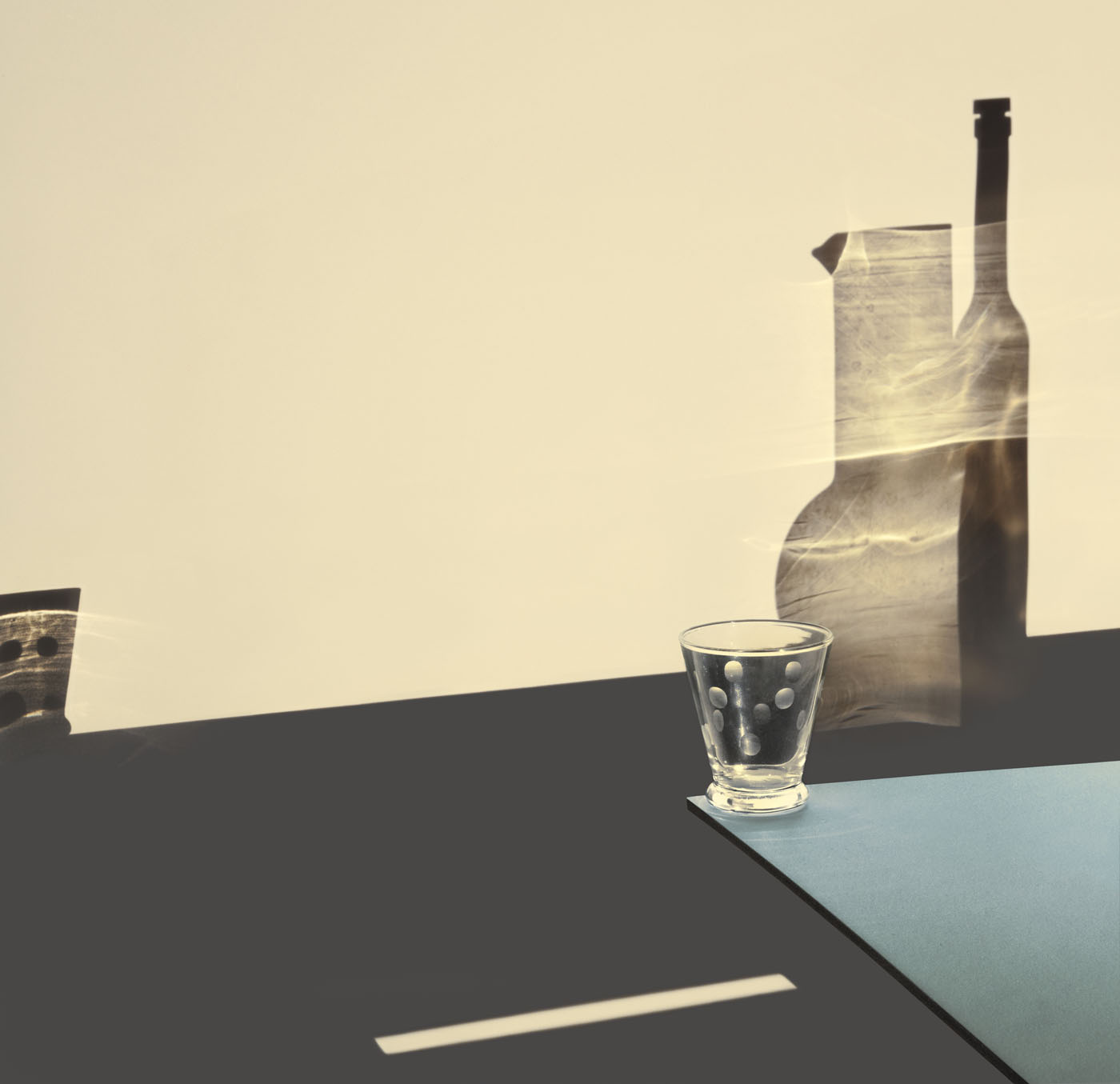
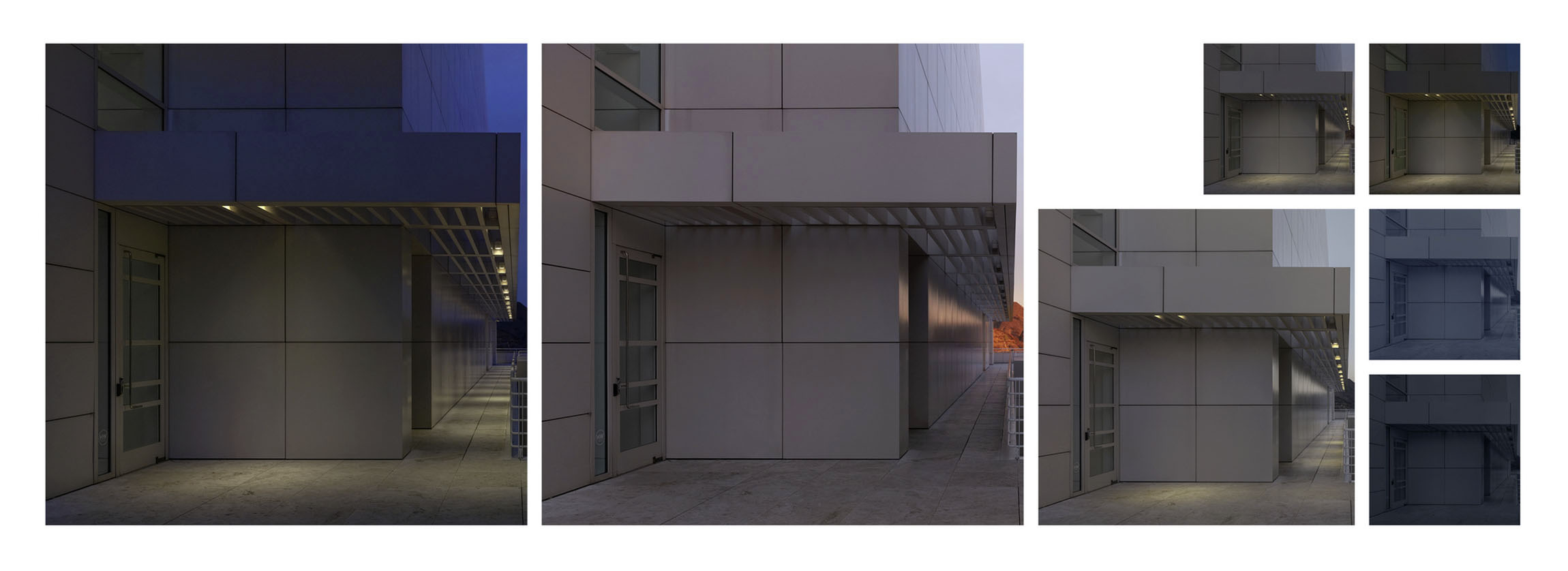
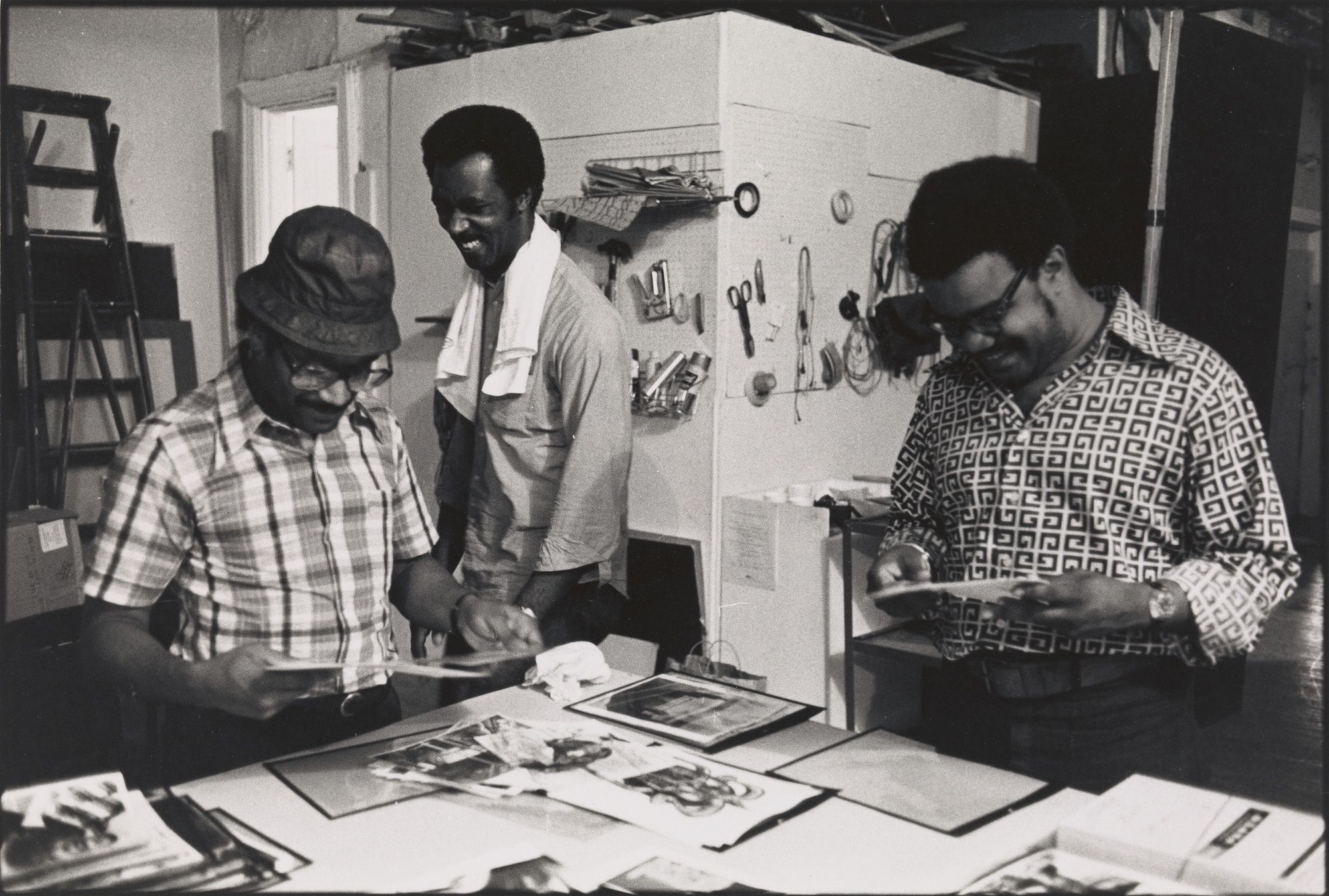
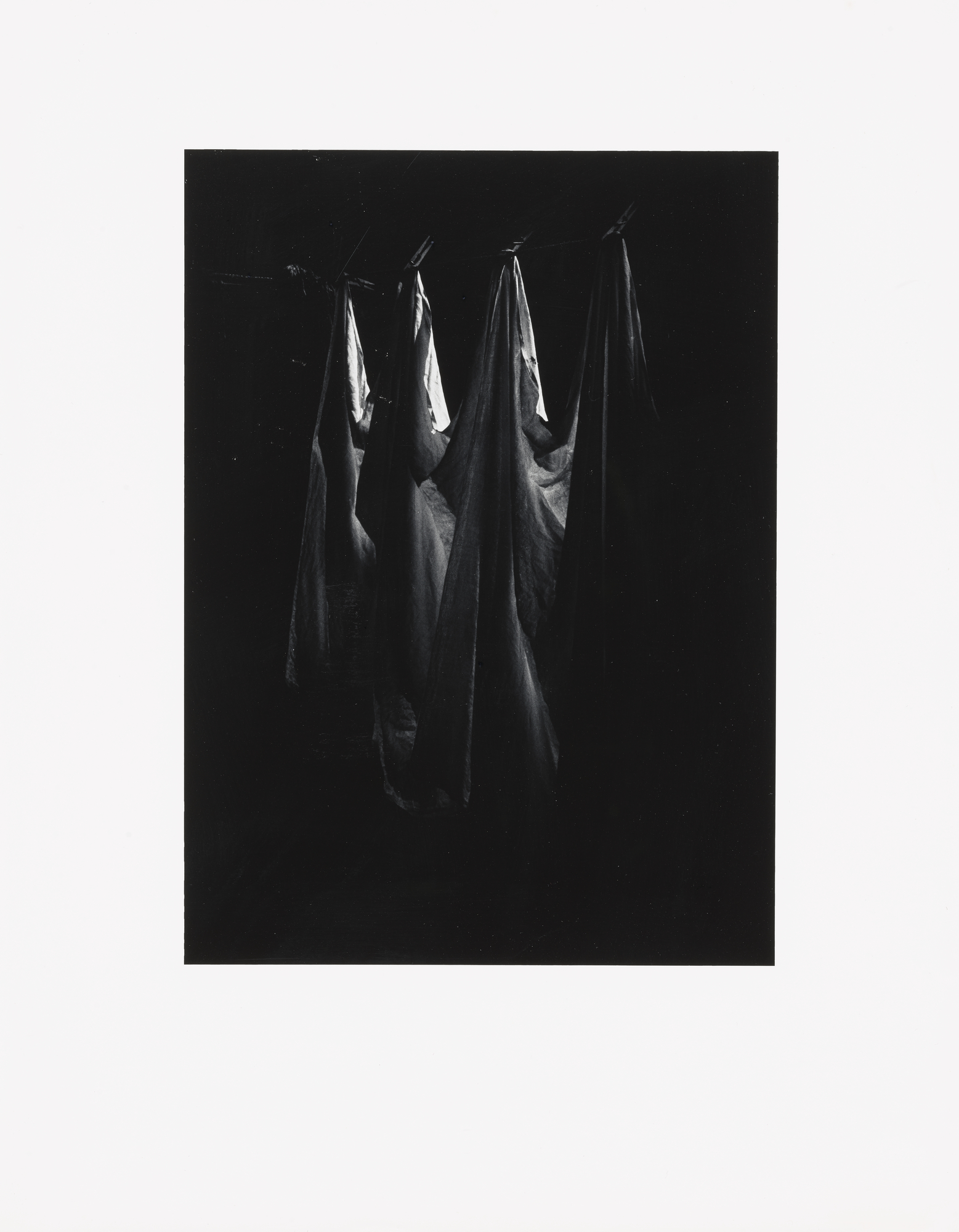
Exhibition: ‘Nineteenth-Century Photography Now’ at the J. Paul Getty Museum, Los Angeles

Exhibition dates: 9th April – 7th July, 2024

Curators: the exhibition is curated by Karen Hellman, former associate curator in the Department of Photographs. Carolyn Peter, assistant curator in the Department of Photographs, Getty Museum, served as organising curator with assistance from Claire L’Heureux, former Department of Photographs graduate intern and Antares Wells, curatorial assistant


At left, Julia Margaret Cameron (British born India, 1815-1879) 'Florence after the Manner of the Old Masters' 1872; and at right, Carrie Mae Weems (American, b. 1953) 'After Manet' 2003


At left, Julia Margaret Cameron (British born India, 1815-1879) Florence after the Manner of the Old Masters 1872; and at right, Carrie Mae Weems (American, b. 1953) After Manet 2003

from the ‘Identity’ section of the exhibition


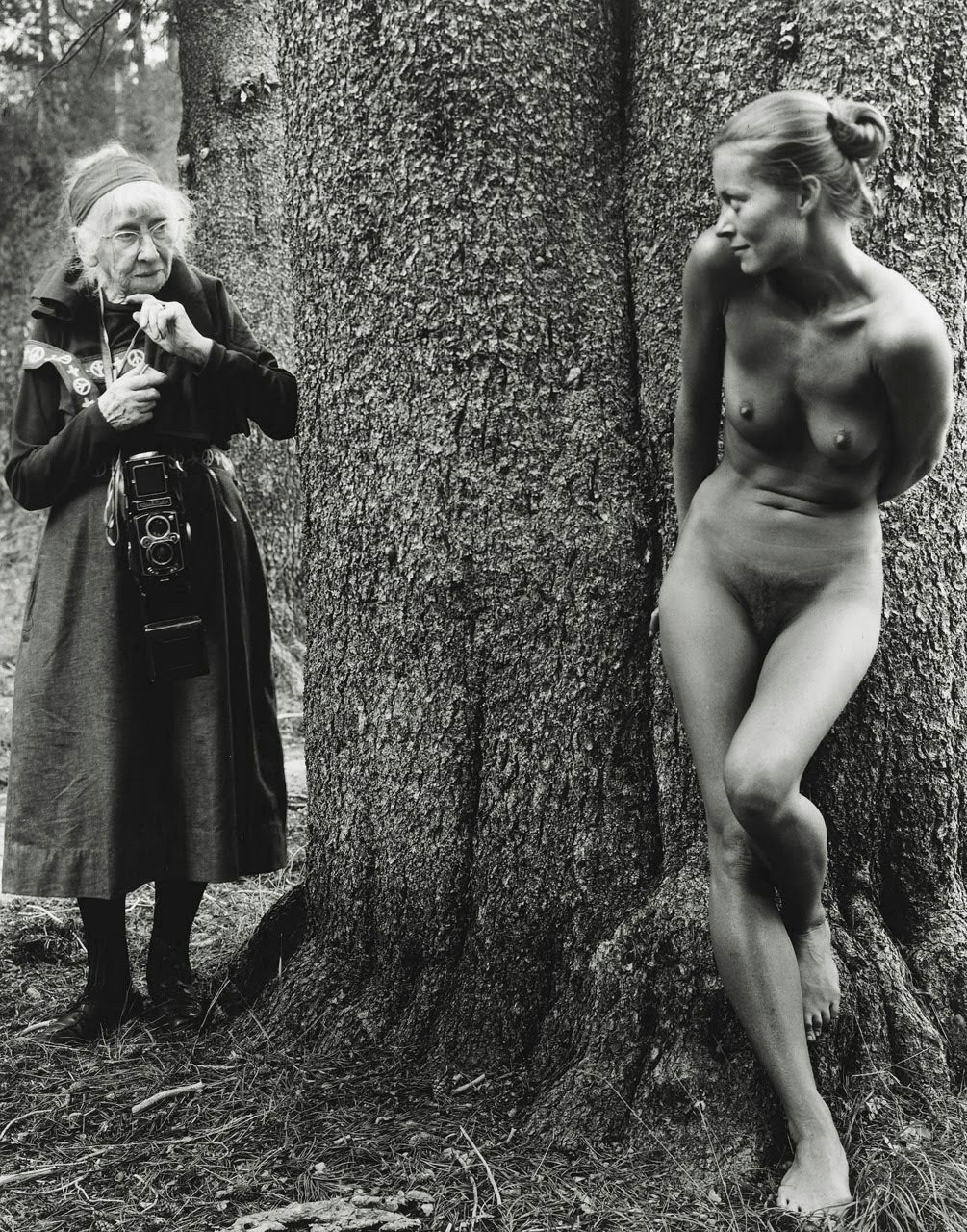
Magdalene Keaney, curator of the exhibition Francesca Woodman and Julia Margaret Cameron: Portraits to Dream In, observes that the exhibition “poses questions about how we might think in new ways about relationships between 19th and 20th century photographic practice…”

As does this exhibition:

~ Everything emerges from something. One must be “mindful of the origins and essence of photography.” (Moriyama)

~ History often repeats itself in different forms.

~ Memory often returns in fragmentary form.

~ The wisdom and spirit of the past speaks to the practitioners of the future.

Dr Marcus Bunyan


NB: Transubstantiation, an un/explainable change in form, substance, or appearance (from the Latin roots trans, “across or beyond,” and substania, “substance”)


Many thankx to the J. Paul Getty Museum for allowing me to publish the photographs in the website. Please click on the photographs  for a larger version of the image.


The earliest photographs – often associated with small, faded, sepia-toned images – may seem to belong to a bygone era, but many of the conventions established during photography’s earliest years persist today. Organised around five themes dating back to the medium’s beginnings, this exhibition explores nineteenth-century photographs through the work of twenty-one contemporary artists. These interchanges between the first decades of the medium and the most recent invite us to reimagine nineteenth-century photography while exploring its complexities.

Text from the J. Paul Getty Museum website


“Ms. Hellman, a former associate curator, inspired by her work with the Bayard materials, conceived “Nineteenth-Century Photography Now” as a way to access the influence that early photographers still have. The exhibition includes work from the past by 23 named and three anonymous photographers plus an additional 16 included in an album; there are 21 present-day artists. It is organised around five themes: Identity, Time, Spirit, Landscape and Circulation. The picture that serves as an introduction to the show is “Untitled ‘point de vue'” (1827) by Joseph Nicéphore Niépce, a faded heliograph on pewter, that Daido Moriyama keeps a reproduction in his studio; the wall text quotes him saying, “it serves as a gentle daily reminder to be mindful of the origins and essence of photography.” There are two photographs by Mr. Moriyama prompted by Niépce’s bit of primitive technology.”


William Meyers. “Photography’s Past and Present at the Getty Center,” on The Wall Street Journal website May 29, 2024 [Online] Cited 16/06/2024


Julia Margaret Cameron (British born India, 1815-1879) 'Florence after the Manner of the Old Masters' 1872


Julia Margaret Cameron (British born India, 1815-1879)
Florence after the Manner of the Old Masters
1872
Albumen silver print
Image: 34 × 25.6cm (13 3/8 × 10 1/16 in.)
Mount: 43.3 × 32.4cm (17 1/16 × 12 3/4 in.)
The J. Paul Getty Museum, Los Angeles


Portrait of Florence Fisher posing with a rose stem with the leaves attached. She holds the rose in place with one arm folded across her chest.
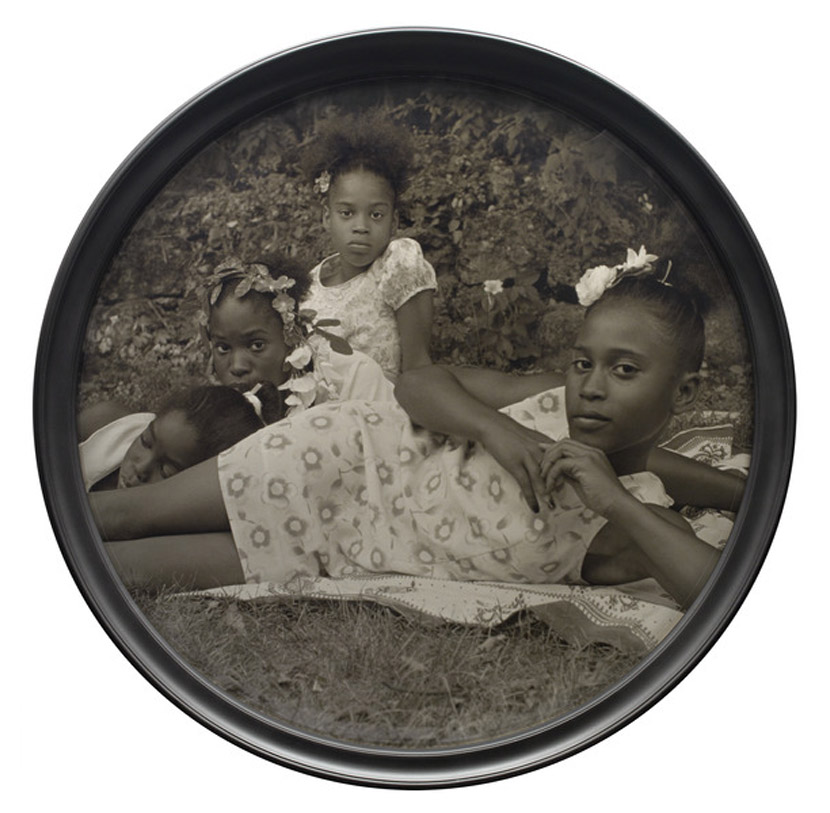
 

Carrie Mae Weems (American, b. 1953) 'After Manet' 2003


Carrie Mae Weems (American, b. 1953)
After Manet
2003
From the series May Days Long Forgotten
Chromogenic print
Object: 84.3cm (33 3/16 in.)
The J. Paul Getty Museum, Los Angeles
© Carrie Mae Weems


The black and white photograph – one from the nine-part series May Days Long Forgotten – depicts four African American girls in summer dresses, with garlands in their hair, reclining on a lawn. The piece is mounted in a circular frame prepared by the artist, and is number five of an edition of eight.


Joseph Nicéphore Niépce (French, 1765-1833) 'Untitled 'point de vue'' 1827


Joseph Nicéphore Niépce (French, 1765-1833)
Untitled ‘point de vue’
1827
Heliograph on pewter
16.7 x 20.3 x .15cm


The invention of photography was announced simultaneously in France and England in 1839, dazzling the public and sending waves of excitement around the world. These astonishing breakthroughs depended upon centuries of developments in chemistry, optics, and the visual arts, accelerating in the decades after 1790. The Niépce Heliograph was made in 1827, during this period of fervent experimentation. It is the earliest photograph produced with the aid of the camera obscura known to survive today.

Text from the Harry Ransom Center website
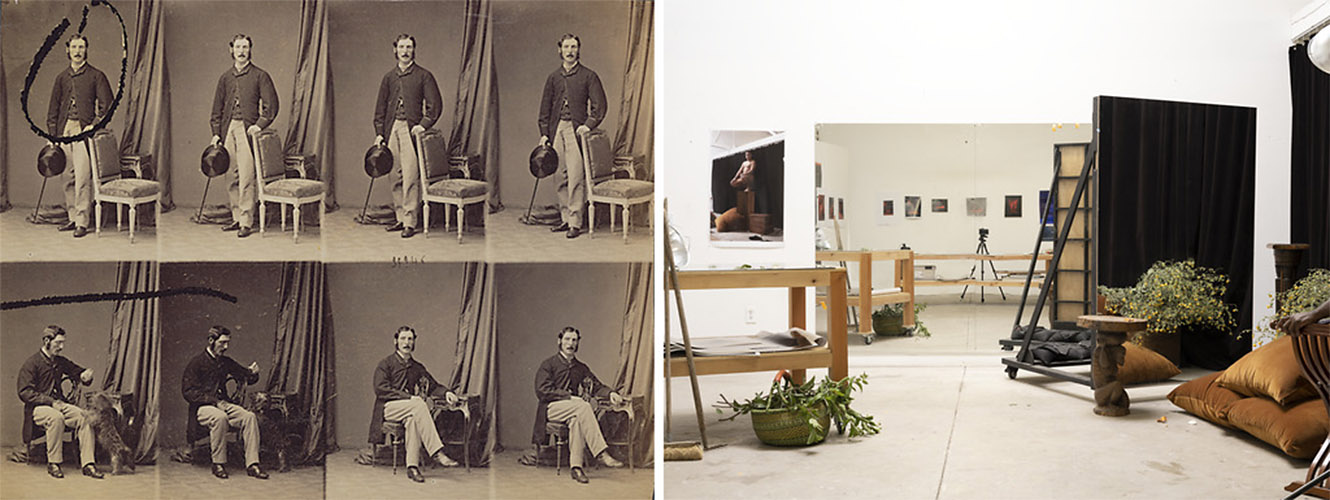
 

At left, André Adolphe-Eugène Disdéri (French, 1819-1889) 'Uncut Sheet of Cartes-de-Visite Portraits', 1860s; and at right, Paul Mpagi Sepuya (American, b. 1982) 'Daylight Studio with Garden Cuttings (_DSF0340)' 2022


At left, André Adolphe-Eugène Disdéri (French, 1819-1889) Uncut Sheet of Cartes-de-Visite Portraits, 1860s; and at right, Paul Mpagi Sepuya (American, b. 1982) Daylight Studio with Garden Cuttings (_DSF0340) 2022


William Henry Fox Talbot (English, 1800-1877) '[A Stem of Delicate Leaves of an Umbrellifer]' probably 1843-1846


William Henry Fox Talbot (English, 1800-1877)
[A Stem of Delicate Leaves of an Umbrellifer]
probably 1843-1846
Photogenic drawing negative
Image: 18.1 × 22.1cm (7 1/8 × 8 11/16 in.)
The J. Paul Getty Museum, Los Angeles


The exceptional boldness of this image conveys a visual impression that at first may seem quite unlike other of William Henry Fox Talbot’s pictures. He made it with the same photogenic drawing process he used for much of his work by placing the stem of leaves directly on top of the prepared paper and then exposing to sunlight without the aid of a camera. Although the original plant was delicate, its sharply delineated white shadow on the rich dark brown background creates a graphic, two-tone effect. The same specimen was used in a slightly different orientation to make a negative that is preserved in one of the family albums formerly at the Fox Talbot Museum in Lacock and now at the British Library, London.

Other visually similar works in Talbot’s oeuvre help us to understand what we are seeing here. Some of them show the interior structure of the plant specimens he photographed, proving that the negatives at first had fuller details. Because the most vulnerable sections of the silver-based images are those that are light in tone, these areas will fade disproportionately faster than the darker parts. In this case, the lightest tones would have been in the interior spaces of the plant, and these at some point faded. It is unlikely that Talbot saw the same picture we see today, at least not when he first made it, but the boldness of the present state reminds us that changes over time can create as well as destroy.

Adapted from Larry Schaaf. William Henry Fox Talbot, In Focus: Photographs from the J. Paul Getty Museum (Los Angeles: Getty Publications, 2002), 68. © 2002 J. Paul Getty Trust


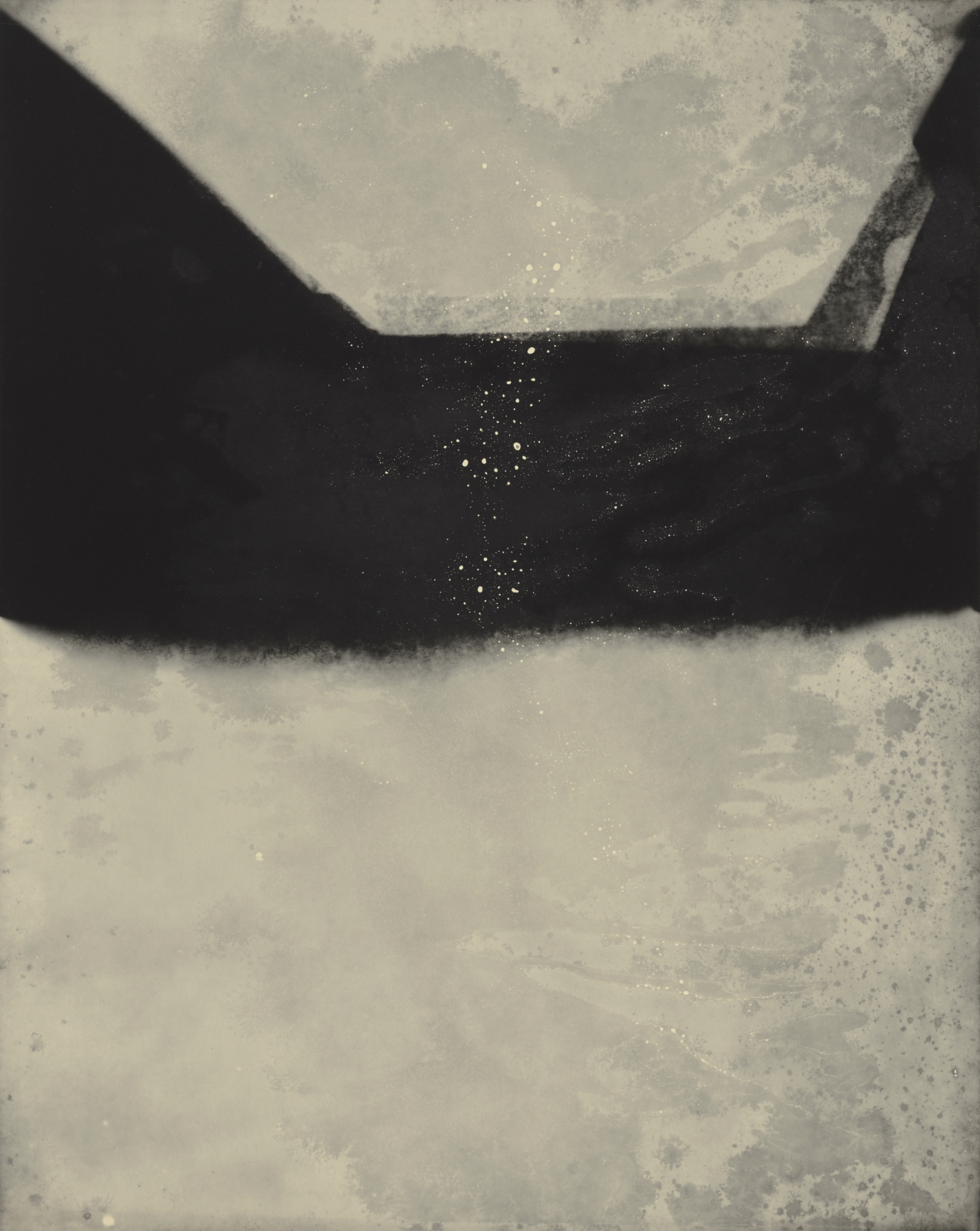
Hiroshi Sugimoto (Japanese, b. 1948) 'A Stem of Delicate Leaves of an Umbrellifer, circa 1843-1846' 2009


Hiroshi Sugimoto (Japanese, b. 1948)
A Stem of Delicate Leaves of an Umbrellifer, circa 1843-1846
2009
Toned gelatin silver print
Image: 93.7 × 74.9cm (36 7/8 × 29 1/2 in.)
The J. Paul Getty Museum, Los Angeles
Gift of the artist
© Hiroshi Sugimoto


“To look at Fox Talbot’s earliest experiments, the blurred and hazy images suffuse the excited anticipation of discovering how light could transfer the shape of things onto paper. … I decided to collect Fox Talbot’s earliest negatives, from a time in photographic history very likely before positive images existed, and print the photographs that not even he saw.”

~ Hiroshi Sugimoto (p. 349, in Hiroshi Sugimoto, Ostfildern-Ruit, 2005)


Hiroshi Sugimoto visited the Getty Museum in 2007 to study the earliest photographs in the collection. After photographing some of William Henry Fox Talbot’s photogenic drawing negatives, he produced large-scale prints and coloured them with toning agents to replicate the hues of the paper negatives. The scale of the enlarged prints reveals the fibers of the original paper, which create delicate patterns embedded in the images.


At left, Herbert Bell et al, '[Amateur World Tour Album, taken with early Kodak cameras, plus purchased travel photographs by various photographers]' (2 page spread); and at right, Stephanie Syjuco (American born Philippines, b. 1974) 'Herbaria' 2021 (detail)


At left, Herbert Bell et al, [Amateur World Tour Album, taken with early Kodak cameras, plus purchased travel photographs by various photographers] (2 page spread); and at right, Stephanie Syjuco (American born Philippines, b. 1974)
Herbaria 2021 (detail)


Herbert Bell (English, 1856-1946) Frederick Nutt Broderick (English, about 1854-1913) Gustave Hermans (Belgian, 1856-1934) Anthony Horner (English, 1853-1923) Michael Horner (English, 1843-1869) C. W. J. Johnson (American, 1833-1903) Léon & Lévy (French, active 1864-1913 or 1920) Léopold Louis Mercier (French, b. 1866) Neurdein Frères (French, founded 1860s, dissolved 1918) Louis Parnard (French, 1840-1893) Alfred Pettitt (English, 1820-1880) Francis Godolphin Osborne Stuart (British born Scotland, 1843-1923) Unknown maker Valentine & Sons (Scottish, founded 1851, dissolved 1910) L. P. Vallée (Canadian, 1837-1905) York and Son J. Kühn (French, active Paris, France 1885 - early 20th century) '[Amateur World Tour Album, taken with early Kodak cameras, plus purchased travel photographs by various photographers]' (2 page spread)


Herbert Bell (English, 1856-1946)
Frederick Nutt Broderick (English, about 1854-1913)
Gustave Hermans (Belgian, 1856-1934)
Anthony Horner (English, 1853-1923)
Michael Horner (English, 1843-1869)
C. W. J. Johnson (American, 1833-1903)
Léon & Lévy (French, active 1864-1913 or 1920)
Léopold Louis Mercier (French, b. 1866)
Neurdein Frères (French, founded 1860s, dissolved 1918)
Louis Parnard (French, 1840-1893)
Alfred Pettitt (English, 1820-1880)
Francis Godolphin Osborne Stuart (British born Scotland, 1843-1923)
Unknown maker
Valentine & Sons (Scottish, founded 1851, dissolved 1910)
L. P. Vallée (Canadian, 1837-1905)
York and Son
J. Kühn (French, active Paris, France 1885 – early 20th century)
[Amateur World Tour Album, taken with early Kodak cameras, plus purchased travel photographs by various photographers] (2 page spread)
Albumen silver print
Closed: 35.4 × 28 × 3.5cm (13 15/16 × 11 × 1 3/8 in.)
The J. Paul Getty Museum, Los Angeles
Google Arts & Culture website


Includes amateur photographs taken with early Kodak cameras, including the original Kodak or Kodak no. 1, and Kodak no. 2 cameras, as well as commercially produced images.


Stephanie Syjuco (American born Philippines, b. 1974) 'Herbaria' 2021 (detail)


Stephanie Syjuco (American born Philippines, b. 1974)
Herbaria (detail)
2021
From the series Pileups
Hand-assembled pigmented inkjet prints on Hahnemühle Baryta
Framed [Outer Dim]: 121.9 × 91.4cm (48 × 36 in.)
The J. Paul Getty Museum, Los Angeles
© Stephanie Syjuco


A collage composed of diverse naturalist archival sources, including photographs of bones, foliage, and crystal formations.


At left, Paul-Marie-Léon Regnard (French, 1850-1927) 'Passionate Ecstatic Position/Expression' 1878; and at right, Laura Larson (American, b. 1965) 'The Mind Is a Muscle' 2019


At left, Paul-Marie-Léon Regnard (French, 1850-1927) Passionate Ecstatic Position/Expression 1878; and at right, Laura Larson (American, b. 1965)
The Mind Is a Muscle 2019
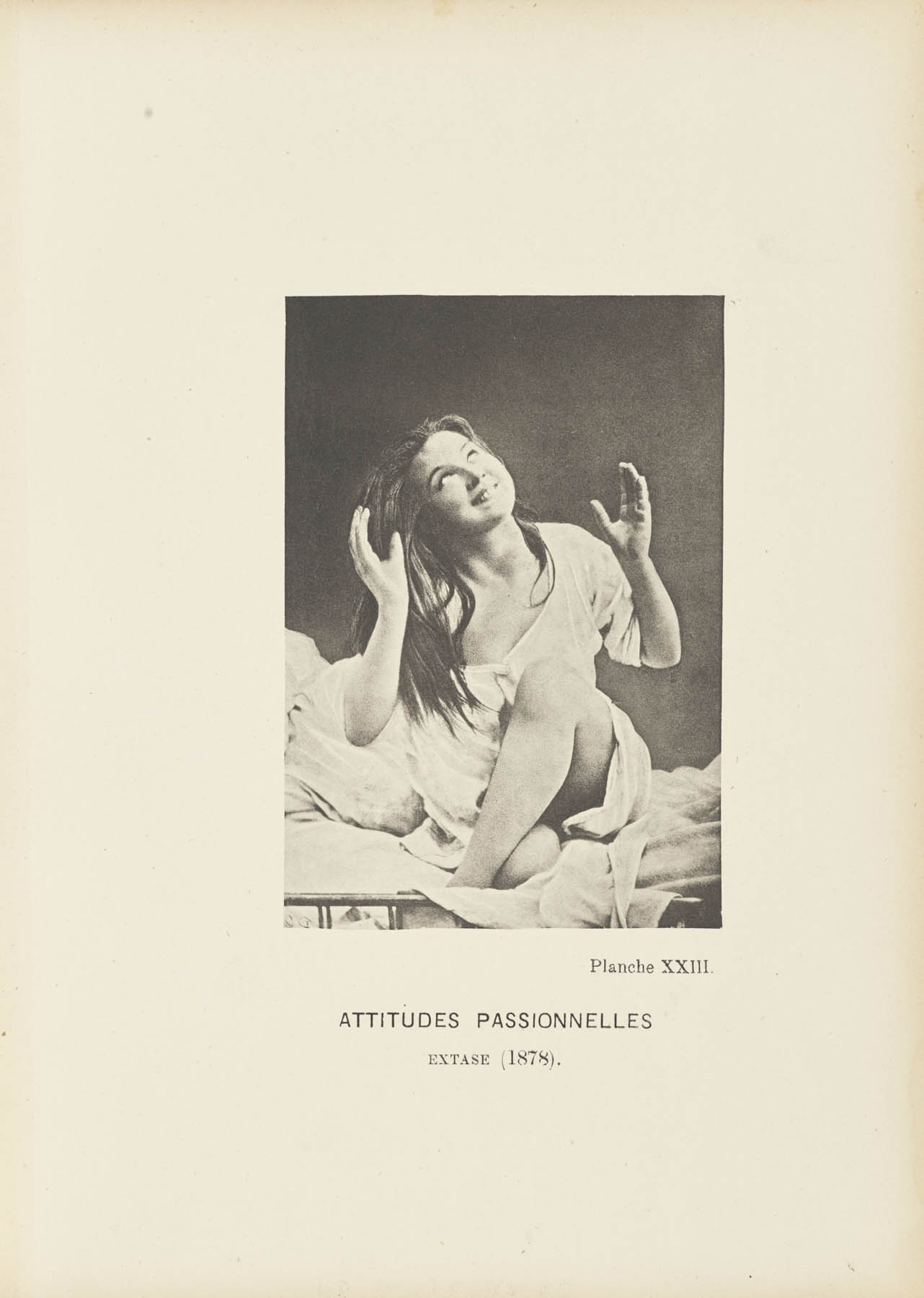
 

Paul-Marie-Léon Regnard (French, 1850-1927) 'Passionate Ecstatic Position/Expression' 1878 Part of 'Iconographie Photographique de la Salpetriere' (Service de M. Charcot)


Paul-Marie-Léon Regnard (French, 1850-1927)
Passionate Ecstatic Position/Expression
1878
Part of Iconographie Photographique de la Salpetriere (Service de M. Charcot)
Photogravure
Image: 10.3 × 7.1cm (4 1/16 × 2 13/16 in.)
The J. Paul Getty Museum, Los Angeles


Laura Larson (American, b. 1965) 'The Mind Is a Muscle' 2019


Laura Larson (American, b. 1965)
The Mind Is a Muscle
2019
from the series City of Incurable Women
Inkjet print
The J. Paul Getty Museum, Los Angeles
Courtesy of and © Laura Larson


At first glance, photographs made in the 19th century may seem like faded relics of an increasingly distant and forgotten age, yet they persist in inspiring, challenging, and resonating with artists today.

Nineteenth-Century Photography Now, on view April 9 through July 7, 2024 at the Getty Center, offers new perspectives on early photography by looking through the lens of contemporary artists who respond directly to their historical themes and subject matter.

“This exhibition provides an opportunity to connect visitors with some of the earliest photographs in the Museum’s collection, now almost two centuries old, via the responses of contemporary makers,” says Timothy Potts, Maria Hummer-Tuttle and Robert Tuttle Director of the J. Paul Getty Museum. “The revelatory ability of early photography to capture images of the world around us still resonates with practitioners today, and bridges between past and present photography are as active and relevant as they have ever been.”

Organised around five themes, dating back to the medium’s beginnings, Identity, Time, Spirit, Landscape, and Circulation, this exhibition explores 19th-century photographs through the work of 21 contemporary artists. Reflecting the inventiveness of early practitioners as well as the more disturbing historical aspects of their era, these interchanges between the first decades of the medium and the most recent invite us to reimagine 19th century photography while exploring its complexities.

In their work, artists Daido Moriyama, Hanako Murakami, and Carrie Mae Weems look back to the invention of photography to convey a sense of how this revolutionary discovery changed people’s perceptions.

As is still the case today, the most popular subjects for the camera in the 19th century were people. In the galleries focused on Identity, Paul Mpagi Sepuya and Myra Greene respond to the complex history of photographic portraiture while Laura Larson, Stephanie Solinas, and Fiona Tan investigate the pseudosciences of the 19th century and how they reinforced stereotypes and identification systems that impact us today.

Photography and Time have been inextricably linked ever since early inventors struggled to permanently fix a fleeting moment on a sheet of paper. This section includes work by Lisa Oppenheim and Liz Deschenes exploring 19th-century photographers’ technical innovations and the ways in which the medium affects our perception of time.

The genre of Spirit photography emerged from the Victorian obsession with death in Europe and North America. Photographers exploited the ability to manipulate photographic images, employing multiple exposures and staged photography to create otherworldly scenes or to summon loved ones back from the dead. In this section, Khadija Saye and Lieko Shiga respond to the possibilities that spirit photography offers in rendering the unseen.

19th-century photographers went to great lengths to make images of remote Landscapes. Government-sponsored surveys and expeditionary programs employed the camera to justify the expansion and to record the resulting military conflicts. Mark Ruwedel, Michelle Stuart, and An-My Lê re-envision some of these same historical landscapes and offer up new ones that bring the past closer to our present.

By the middle of the 19th century, thousands of photographs were in Circulation worldwide, the result of photographers’ ability to reproduce the same image multiple times. Pictures of historical events, tourist destinations, and anthropological expeditions made the world seem more accessible, but with time and distance, they became disconnected from their original contexts. In this section, early photographs appear next to projects that make these historical absences present. Wendy Red Star, Stephanie Syjuco, Ken Gonzales-Day, and Andrea Chung recover what has been lost, calling out the residual effects of the 19th-century photograph on our present knowledge of global cultures and histories.

“Through the works of these visionary contemporary artists, 19th-century photography is not faded and dead but very much alive, an active material that enables us to rethink the medium and our relationship to it,” says Karen Hellman, curator of the exhibition.

Nineteenth-Century Photography Now is curated by Karen Hellman, former associate curator in the Department of Photographs. Carolyn Peter, assistant curator in the Department of Photographs, Getty Museum, served as organising curator with assistance from Claire L’Heureux, former Department of Photographs graduate intern and Antares Wells, curatorial assistant.

Related programming includes Who or What is Missing in Nineteenth-Century Photography?, a discussion featuring artists Laura Larson, Wendy Red Star, and Paul Mpagi Sepuya in a conversation about their artistic practices and how they are engaging with, and critiquing photography from the 19th century, and Art Break: The Precarious Nature of Photography, Society, and Life, June 6, 12pm. Artist Phil Chang talks with curator Carolyn Peter about his series “Unfixed” on view in Nineteenth-Century Photography Now and how an economic crisis and a pandemic inspired him to create photographs that will intentionally fade away to express the fragility of societal systems and life.

Press release from the J. Paul Getty Museum website


Introduction


At left, Maker unknown. 'Kuroda Yasaburo, 50 Years Old' January 6, 1882; and at right, Myra Greene (American, b. 1975) 'Undertone #10' 2017-2018


At left, Maker unknown Kuroda Yasaburo, 50 Years Old January 6, 1882; and at right, Myra Greene (American, b. 1975) Undertone #10 2017-2018


Introduction

The earliest photographs – often associated with small, faded, sepia-toned images – may seem to belong to a bygone era, but many of the conventions established during photography’s earliest years persist today. Organised around five themes dating back to the medium’s beginnings, this exhibition explores nineteenth-century photographs through the work of twenty-one contemporary artists. Reflecting the inventiveness of early practitioners as well as the more disturbing historical aspects of their era, these interchanges between the first decades of the medium and the most recent invite us to reimagine nineteenth-century photography while exploring its complexities.
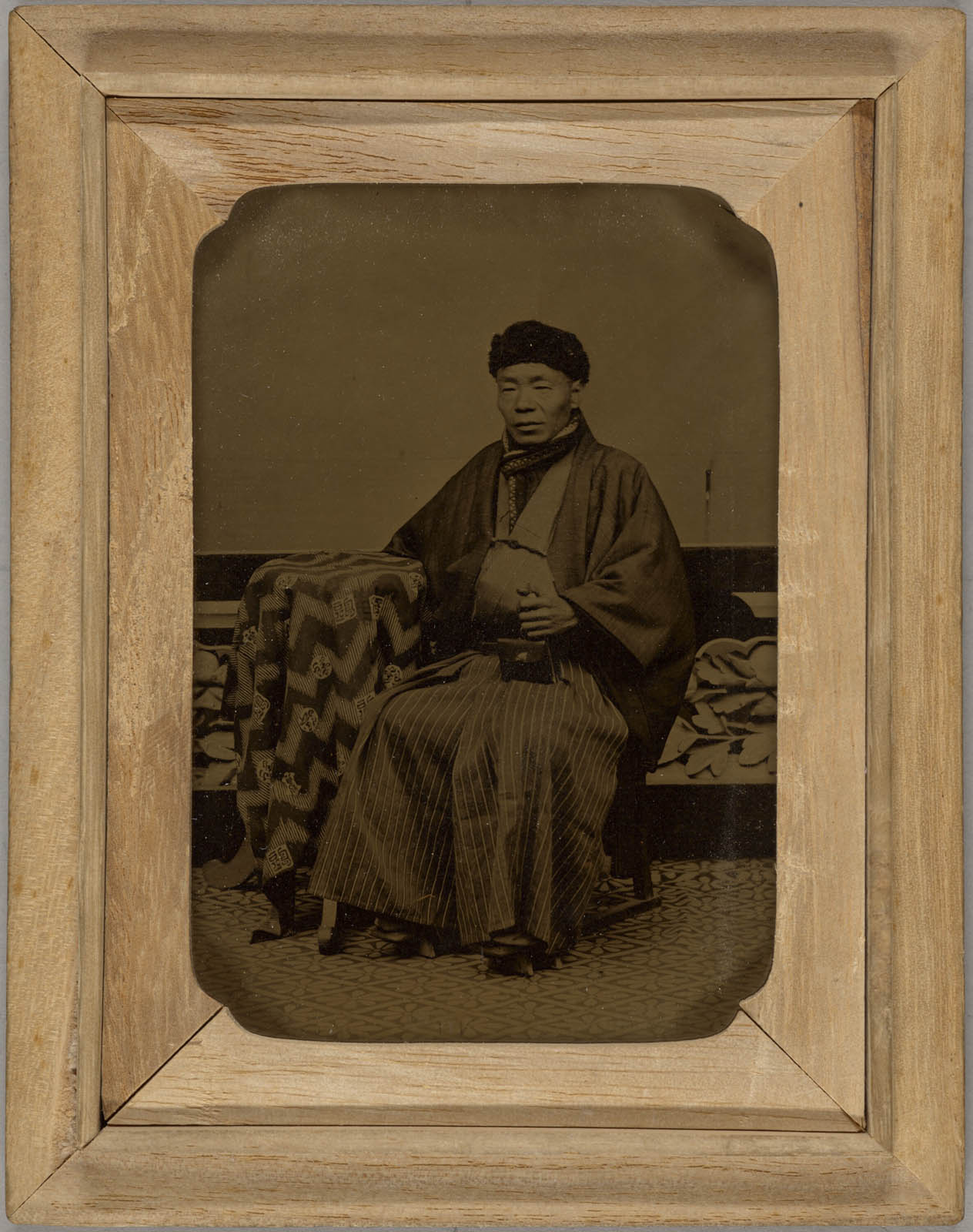
 

Maker unknown. 'Kuroda Yasaburo, 50 Years Old' January 6, 1882


Maker unknown
Kuroda Yasaburo, 50 Years Old
January 6, 1882
Ambrotype
Closed: 11.5 × 9 × 1cm (4 1/2 × 3 9/16 × 3/8 in.)
The J. Paul Getty Museum, Los Angeles
Gift of Virginia Heckert in memory of Gordon Baldwin


Myra Greene (American, b. 1975) 'Undertone #10' 2017-2018


Myra Greene (American, b. 1975)
Undertone #10
2017-2018
Ambrotype
The J. Paul Getty Museum, Los Angeles
© Myra Greene


__________________________________________

Identity


At left, Various makers. 'Pickpockets at the Universal Exposition of 1889' 1889; and at right, Fiona Tan (Indonesia, b. 1966) 'Marie Thiriot' 2021


At left, Various makers Pickpockets at the Universal Exposition of 1889 1889; and at right, Fiona Tan (Indonesia, b. 1966) Marie Thiriot 2021


Fiona Tan (Indonesia, b. 1966) 'Marie Thiriot' 2021


Fiona Tan (Indonesia, b. 1966)
Marie Thiriot
2021
From the series Pickpockets
HD video installation, stereo, flat-screen monitor
Courtesy of the artist and Frith Street Gallery, London
© Fiona Tan
Photo: Frith Street Gallery CC


‘As an artist working almost entirely with time-based and lens-based media, time is one of my major tools … time is both tool with which to shape and chisel and material to fold, distort and configure.’

Fiona Tan (b. 1966, Pekanbaru) explores history and time and our place within them, working within the contested territory of representation. Deeply embedded in all of Tan’s works is her fascination with the mutability of identity, the deceptive nature of representation and the play of memory across time and space in a world increasingly shaped by global culture. She investigates how we represent ourselves and the mechanisms that determine how we interpret the representation of others. …

A testament to Tan’s passion for archives, her video installation Pickpockets (2020) stems from an album of photographs she came across when in residence at the Getty Research Center, Los Angeles. It contained early examples of mugshots taken of pickpockets apprehended at the World’s Fair in Paris in 1889. Fascinated by the subjects of these portraits, their names and countries of origin, and their unknown stories, she invited a group of writers to devise monologues from the point of view of these individuals, which were then performed and recorded by actors.

Anonymous. “Fiona Tan,” on the Frith Street Gallery website Nd [Online] Cited 29/04/2024


[The identity section] has “Affaire Alaux, Faubourg St. Honoré – L’Assassin” (Nov. 2, 1902), a print by Alphonse Bertillon, the inventor of the mug shot, showing the mustached villain full-face and in profile; it is accompanied by over 20 pictures of sites that played a significant role in Bertillon’s life taken in 2012 by Stéphanie Solinas employing a “crime scene” approach.

William Meyers. “Photography’s Past and Present at the Getty Center,” on The Wall Street Journal website May 29, 2024 [Online] Cited 16/06/2024


At left, Attributed to Alphonse Bertillon (French, 1853-1914) 'Affaire Alaux, Faubourg St. Honoré – L'Assassin' November 2, 1902; and at right, Stéphanie Solinas (French, b. 1978) 'Untitled (M. Bertillon) – Two Faces' 2012


At left, Attributed to Alphonse Bertillon (French, 1853-1914) Affaire Alaux, Faubourg St. Honoré – L’Assassin November 2, 1902; and at right, Stéphanie Solinas (French, b. 1978) Untitled (M. Bertillon) – Two Faces 2012


Identity

As is still the case today, the most popular subjects for the camera in the nineteenth century were people. Early commercial portrait photographers set up studios and established standards for posing and props, serving clients who eagerly shared these prized images with family and friends. Other portraits of the time, however, such as the mug shot and studies of female “hysterics,” reinforced questionable forms of objectification. Paul Mpagi Sepuya and Myra Greene respond to the complex history of photographic portraiture. Fiona Tan, Laura Larson, and Stéphanie Solinas investigate the nineteenth century pseudosciences that relied on the perceived accuracy of the new medium.
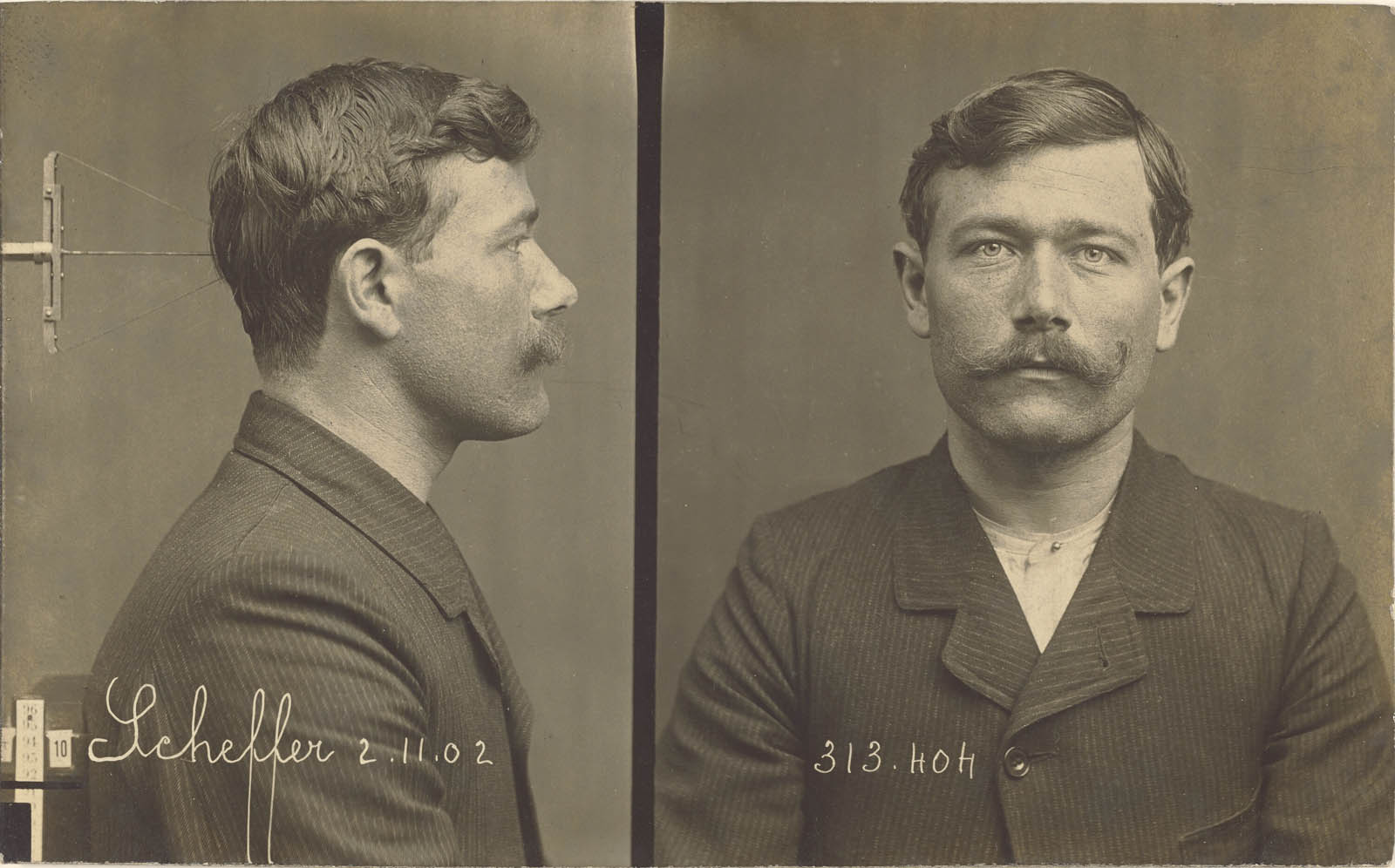
 

Attributed to Alphonse Bertillon (French, 1853-1914) 'Affaire Alaux, Faubourg St. Honoré – L'Assassin' November 2, 1902


Attributed to Alphonse Bertillon (French, 1853-1914)
Affaire Alaux, Faubourg St. Honoré – L’Assassin
November 2, 1902
Gelatin silver print
Image: 7.9 × 12.7cm (3 1/8 × 5 in.)
The J. Paul Getty Museum, Los Angeles


The mugshot of Henri-Léon Scheffer, the man who murdered Joseph Reibel.


CAUGHT BY A FINGER PRINT

A unique piece of detective work has been accomplished in Paris by a retiring scientist. A mysterious murder had been committed. The detectives arrested one wrong man dis charged him, and were preparing .to arrest another when to their chief came the quiet scientist, saying,

“The assassin’s name is Henri Léon Scheffor. Here is his photograph, his description and past record.” M. Cochefert, chief of the police hesitated. “My men know nothing of this person.” he said. “How shall we accuse him ?”

“Arrest him,” insisted the other, “and should he prove to innocent I will pay him 1,000 francs as an indemnity.”

“But what basis have you for your certainty of his guilt ?” asked M. Cochefert.

“Some finger prints he left on a piece of broken glass,” replied the man of science.

It was not necessary to pay the indemnity. He who was thus strangely accused was arrested and confessed his crime. The quiet man of science was M. Alphonse Bertillon, already celebrated as the founder and present chief of tho anthropometric service of tho Paris prefecture of police. Alphonse Bertillon has the gentle, weary smile of the over-worked and nervous student. He speaks mildly, moves softly, like one on his guard against strain and haste, until now and again, his thoughtful face will light up with enthusiasm as he lets himself go. Then his conversation becomes rapid and eloquent ; he runs through books and documents with ardour, pulls down boxes from high shelves, spreads out charts, explains them, performs experiments to illustrate his statements and darts back by a short cut to tho point where he had left off; tho whole man is transformed. Thus we heard the tale of the Accusing Finger Prints.

“A man named Joseph Reibel, porter to tho dentist Allaux, in his apartment and offices in the Rue du Faubourg Saint-Honore, was found choked to death and clumsily tied, lying in his master’s office,” began M. Bertillon. “The place had been looted hastily, closets and drawers being open and their contents tossed about. In particular a handsome cabinet holding a collection of coins was found with its glass door broken and its gold coins absent. There were- practically no clues to the identity of the assassin, the janitress at the street door, having a confused memory as to visitors, which set the detectives on more than one wrong scent. They arrested one man and the papers published his portrait. Then the newspapers at least began to suspect the innocent dentist himself.

“They had taken a flashlight photograph of the office,” continued M. Bertillon. “Looking at that photograph one day, I noticed two glittering little white marks on the edge of the broken glass of the coin cabinet. I asked my self what they could be. They might be defects in the printing ; but, on the other hand their situation suggested that they might be finger prints – and finger-prints are very much in my line ! The thought wore upon me until at last I jumped into a cab and drove to tho place. Examining the edge of the glass I found tho marks to be really finger-marks, and in spite of the thousand chances still in good condition.

“Being composed of tiny quantities of grease and dirt they made the glass slightly opaque, so that they came out bright by contrast in the photograph. Except when looked at in a favourable light they were practically invisible to the naked eye. There were marks of a right-hand thumb in one place and of the same thumb and four fingers in another. I had the two pieces of glass cut out with a diamond. I gave one to a policeman, instructing him to hold it just so, and saw him start off to my office with it in a cab. Then I gave tho other piece to a second policeman, with the same instructions, and started him off in a second cab, so that if an accident should happen to one of the pieces the other might be spared.

“In the workrooms of the anthropometric service I had the finger-marks immediately photographed. At first I admit I did not attach overmuch importance to them. They might be the prints of one of the detectives, or of the dentist Allaux – naturally solicitous of his broken cabinet – or even the finger-prints of M. Cochefert ! One by one I took their finger-prints for comparison. One by one I found that they did not at all correspond with those on the glass. This started me in earnest,” admitted M. Bertillon. “I began to ask myself, if among the thousands of criminals, swindlers and violent and suspicious characters photo-graphed, measured, and, finger-printed yearly by the anthropometric service the author of these finger-prints might not, at some time or other, himself have passed.” Here M. Bertillon called our attention to the thumb mark (“pouce”) of Scheffer, the assassin, Just below his full-face and profile photographs. Though small it was very distinct.

“Look at the central point of that thumb-print,” he exclaimed. “Look where the innermost loop moves up and over a single diagonal. Now jumping two loops from that interior diagonal, towards tho direct left you see a plain little fork in tho third loop. It is the exact reproduction of just such another in the thumb-mark on the broken glass ! Tho next thing was to arrest Scheffer though it took a little time to find him. Here, again, the information obtainable from his ‘fiche’ in the anthropometric service rendered service. It was seen that he had been a native of Aubervilliers (the Paris suburb and had worked in the government match factory. When arrested he confessed, at the same time trying to make out a case of extenuating circumstances. According to his story, Reibel planned that they should simulate a burglary of his master’s premises. They quarrelled over the division of the spoils and Scheffer says he thought he had merely choked his friend into un-consciousness and left him tied – according to original agreement. And all discovered through an accidental finger-print which the assassin had left as an index to the crime. “Science Siftings.”

Anonymous. “Caught by a Finger Print,” in the Balmain Observer and Western Suburbs Advertiser (NSW: 1884-1907), Sat 4 Mar 1905, Page 2 on the Trove website [Online] Cited 29/04/2024

__________________________________________

Time
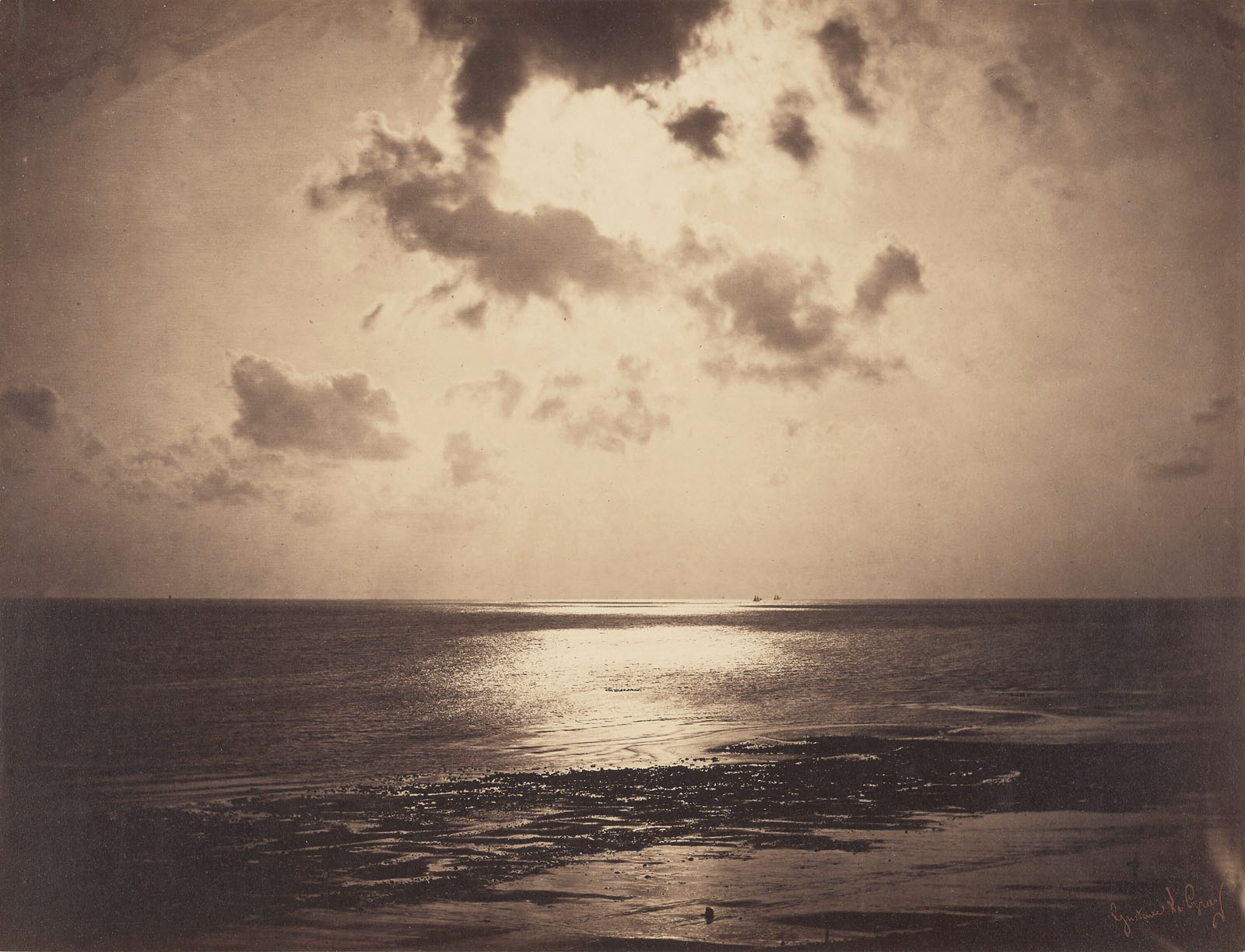
 

Gustave Le Gray (French, 1820-1884) 'An Effect of Sunlight – Ocean No. 23' 1857-1858


Gustave Le Gray (French, 1820-1884)
An Effect of Sunlight – Ocean No. 23
1857-1858
Albumen silver print from glass negatives
12 5/8 × 16 7/16 in.
The J. Paul Getty Museum, Los Angeles


Lisa Oppenheim (American, b. 1975) 'An Effect of Sunlight – Ocean No. 23 (1857/2019)' 2019


Lisa Oppenheim (American, b. 1975)
An Effect of Sunlight – Ocean No. 23 (1857/2019)
2019
Gelatin silver print, exposed to sunlight and toned with silver
Framed [Outer Dim]: 35.6 × 47.7 × 3.7cm (14 × 18 3/4 × 1 7/16 in.)
The J. Paul Getty Museum, Los Angeles
© Lisa Oppenheim


Time

Photography and time have been inextricably linked ever since early inventors such as William Henry Fox Talbot struggled to permanently fix a fleeting moment on a sheet of paper. The development of the camera coincided with new discoveries about how we perceive an instant in time or an object in motion, and people praised photography for its ability to “stop time” and record what the unaided eye could not see. Lisa Oppenheim and Liz Deschenes respond to nineteenth century photographers’ technical innovations and the ways in which the medium affects our perception of time. Phil Chang and Hiroshi Sugimoto address the fate of photographs across minutes or even centuries.


At left, Étienne-Jules Marey (French, 1830-1904) and Michel Berthaud (French, active 1860s-1880s) 'Walking/Running' (La Marche/La Course Rapide) about 1890, published 1893; and at right, Liz Deschenes (American, b. 1966) 'FPS (120)' 2018-2021


At left, Étienne-Jules Marey (French, 1830-1904) and Michel Berthaud (French, active 1860s-1880s) Walking/Running (La Marche/La Course Rapide) about 1890, published 1893; and at right, Liz Deschenes (American, b. 1966) FPS (120) 2018-2021
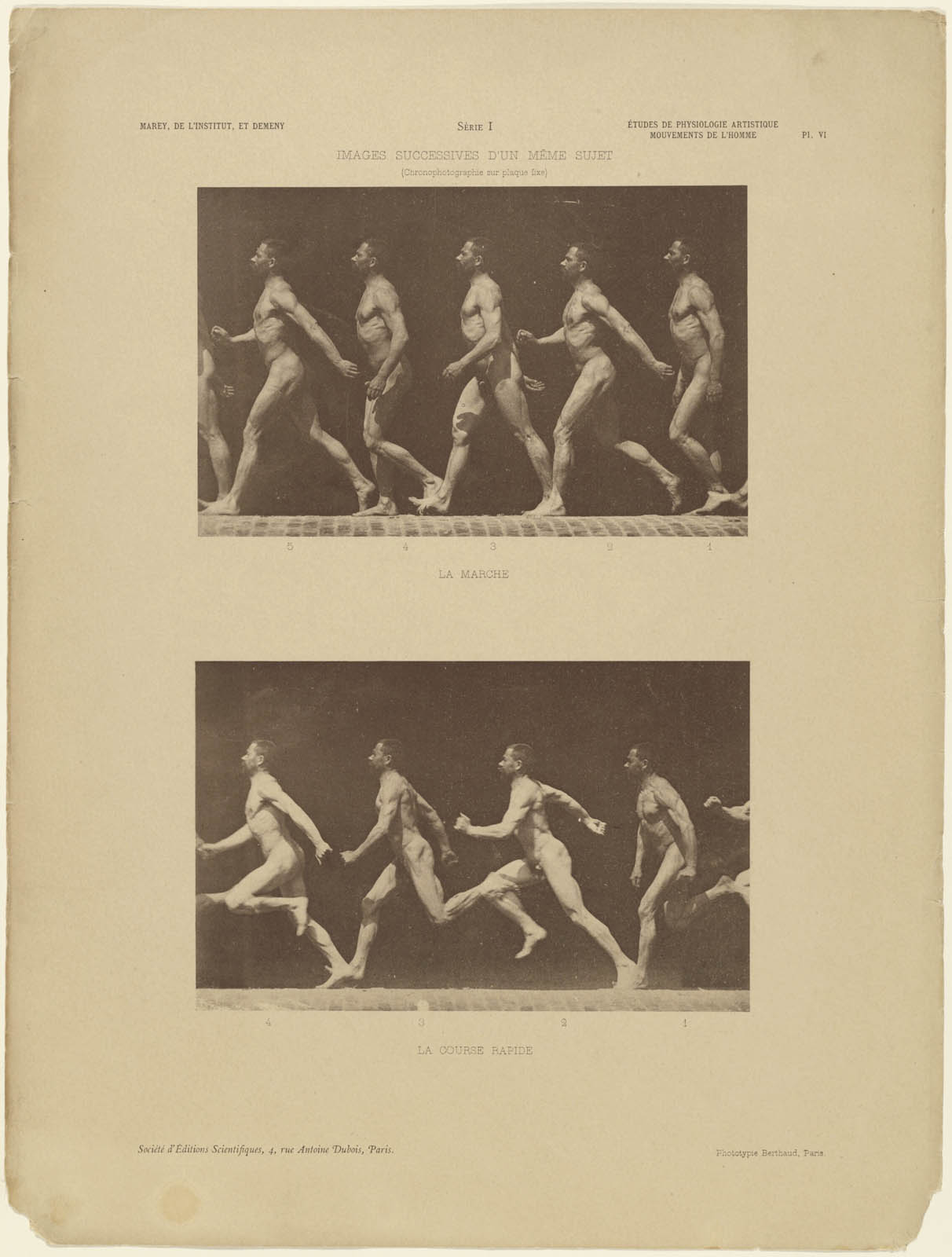
 

Étienne-Jules Marey (French, 1830-1904) and Michel Berthaud (French, active 1860s-1880s) 'Walking/Running' (La Marche/La Course Rapide) about 1890, published 1893


Étienne-Jules Marey (French, 1830-1904) and Michel Berthaud (French, active 1860s-1880s)
Walking/Running (La Marche/La Course Rapide)
about 1890, published 1893
Collotype
Image: 11.3 × 17.6cm (4 7/16 × 6 15/16 in.)
The J. Paul Getty Museum, Los Angeles

__________________________________________

Spirit


At left, William H. Mumler (American, 1832-1884) 'Mrs. Swan' 1869-1878; and at right, Khadija Saye (Gambian-British, b. 1992) 'Nak Bejjen' [Cow's Horn] 2017-2018


At left, William H. Mumler (American, 1832-1884) Mrs. Swan 1869-1878; and at right, Khadija Saye (Gambian-British, b. 1992) Nak Bejjen [Cow’s Horn] 2017-2018


Spirit

The genre of spirit photography – which used photographic tricks to insert ghostly figures among the living – emerged during the nineteenth century from the Victorian obsession with death, séances, and mediums in Europe and North America and from the losses of the Civil War in the United States. Photographers exploited the ability to manipulate photographic images, employing multiple exposures and staged photography to create otherworldly scenes or to summon loved ones back from the dead. Khadija Saye and Lieko Shiga respond to the possibilities that spirit photography offers in rendering the unseen.


William H. Mumler (American, 1832-1884) 'Mrs. Swan' 1869-1878


William H. Mumler (American, 1832-1884)
Mrs. Swan
1869-1878
Albumen silver print
Image: 8.9 × 5.7cm (3 1/2 × 2 1/4 in.)
The J. Paul Getty Museum, Los Angeles
Public domain


Khadija Saye (Gambian-British, b. 1992) 'Nak Bejjen' [Cow's Horn] 2017-2018


Khadija Saye (Gambian-British, b. 1992)
Nak Bejjen [Cow’s Horn]
2017-2018
From the series in this space we breathe
Silkscreen print
The J. Paul Getty Museum, Los Angeles
Purchased with funds provided by the Photographs Council
© Estate of Khadija Saye


At left, Unknown maker (American) '[Seated Woman with "Spirit" of a Young Man]' about 1865-1875; and at right, Lieko Shiga (Japanese, b. 1980) 'Talking with Me' 2005 From the series 'Lilly'


At left, Unknown maker (American) [Seated Woman with “Spirit” of a Young Man] about 1865-1875; and at right, Lieko Shiga (Japanese, b. 1980) Talking with Me 2005 From the series Lilly


Unknown maker (American) '[Seated Woman with "Spirit" of a Young Man]' about 1865-1875


Unknown maker (American)
[Seated Woman with “Spirit” of a Young Man]
about 1865-1875
Tintype
Image: 8.7 × 6.4cm (3 7/16 × 2 1/2 in.)
The J. Paul Getty Museum, Los Angeles
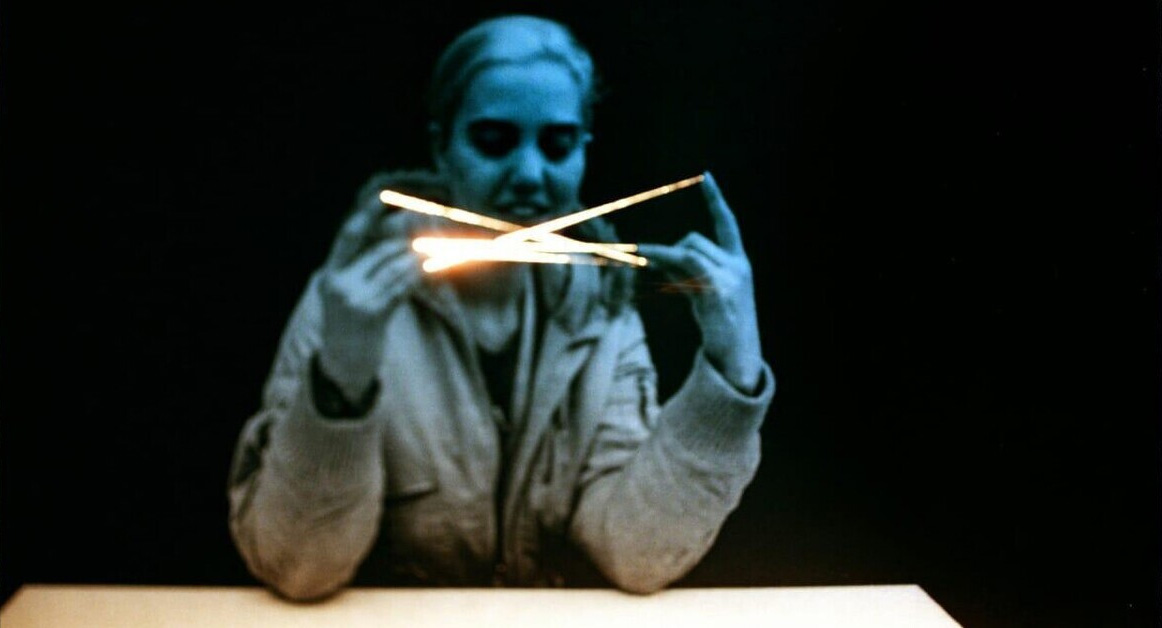
 

Lieko Shiga (Japanese, b. 1980) 'Talking with Me' 2005


Lieko Shiga (Japanese, b. 1980)
Talking with Me
2005
From the series Lilly


‘Lilly’ is a photographic essay that was initiated in 2005 when Lieko Shiga was living in London. During that period she produced a series of images of her neighbours that lived alongside her in a block of East London council flats, drawing techniques and inspiration from paranormal photographs that were popular in the early days of photography. Haunting, mysterious, playful and captured in an array of muted colours, the photographs [are] grouped around different subjects…

Publisher’s Description

__________________________________________

Landscape
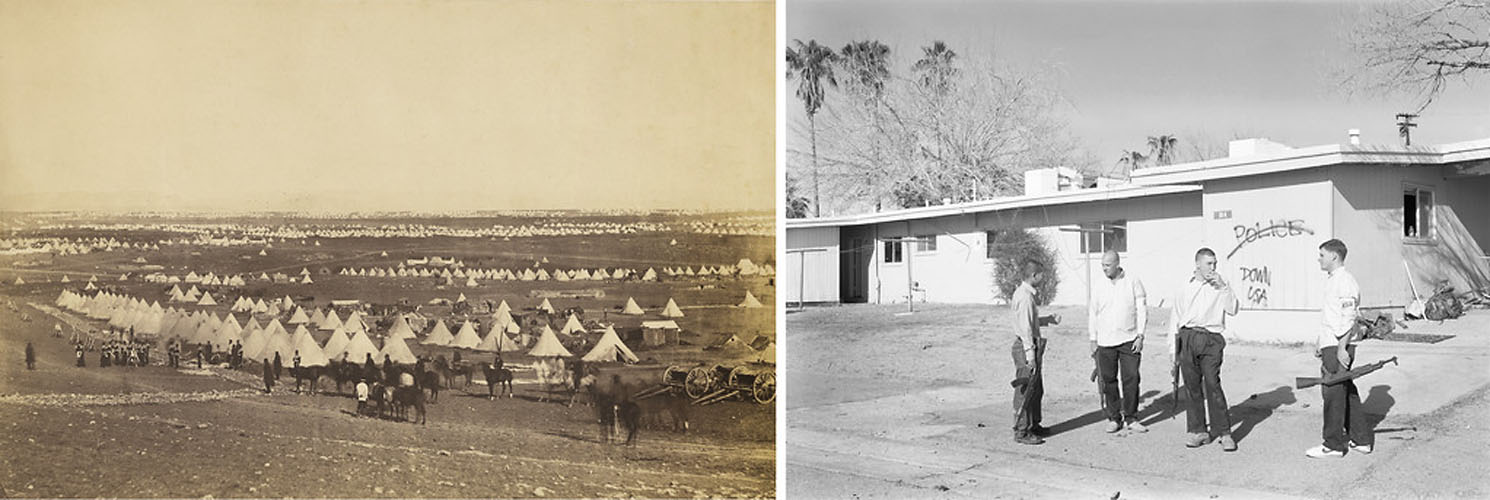
 

At left, Roger Fenton (English, 1819-1869) 'Plateau of Sebastopol II' 1855; and at right, An-My Lê (Vietnamese American, b. 1960) 'Security and Stabilization Operations, Iraqi Police' 2003-2004


At left, Roger Fenton (English, 1819-1869) Plateau of Sebastopol II 1855; and at right, An-My Lê (Vietnamese American, b. 1960) Security and Stabilization Operations, Iraqi Police 2003-2004
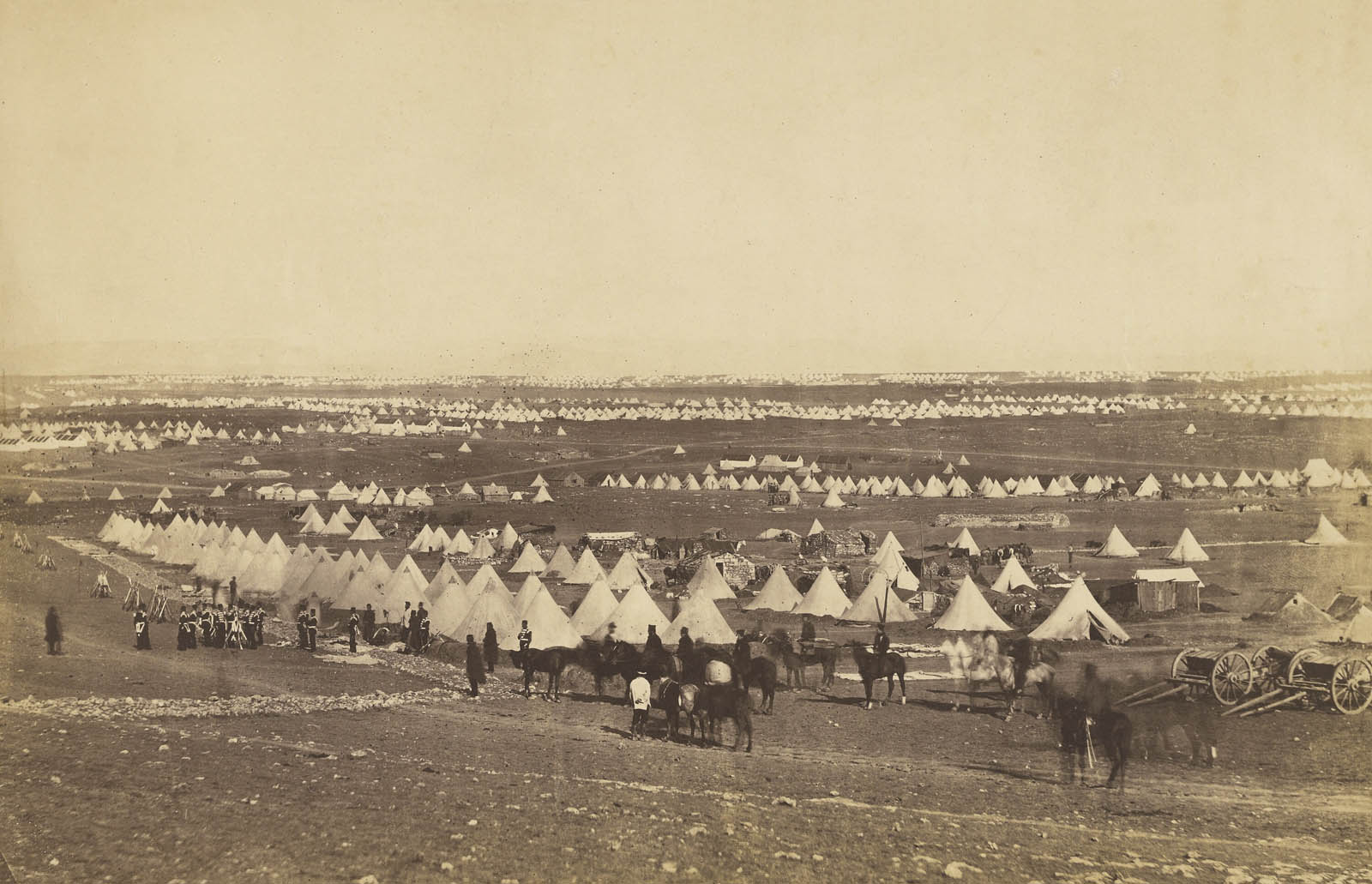
 

Roger Fenton (English, 1819-1869) 'Plateau of Sebastopol II' 1855


Roger Fenton (English, 1819-1869)
Plateau of Sebastopol II
1855
Albumen silver print
Image: 22.2 × 34.4cm (8 3/4 × 13 9/16 in.)
The J. Paul Getty Museum, Los Angeles
Public domain
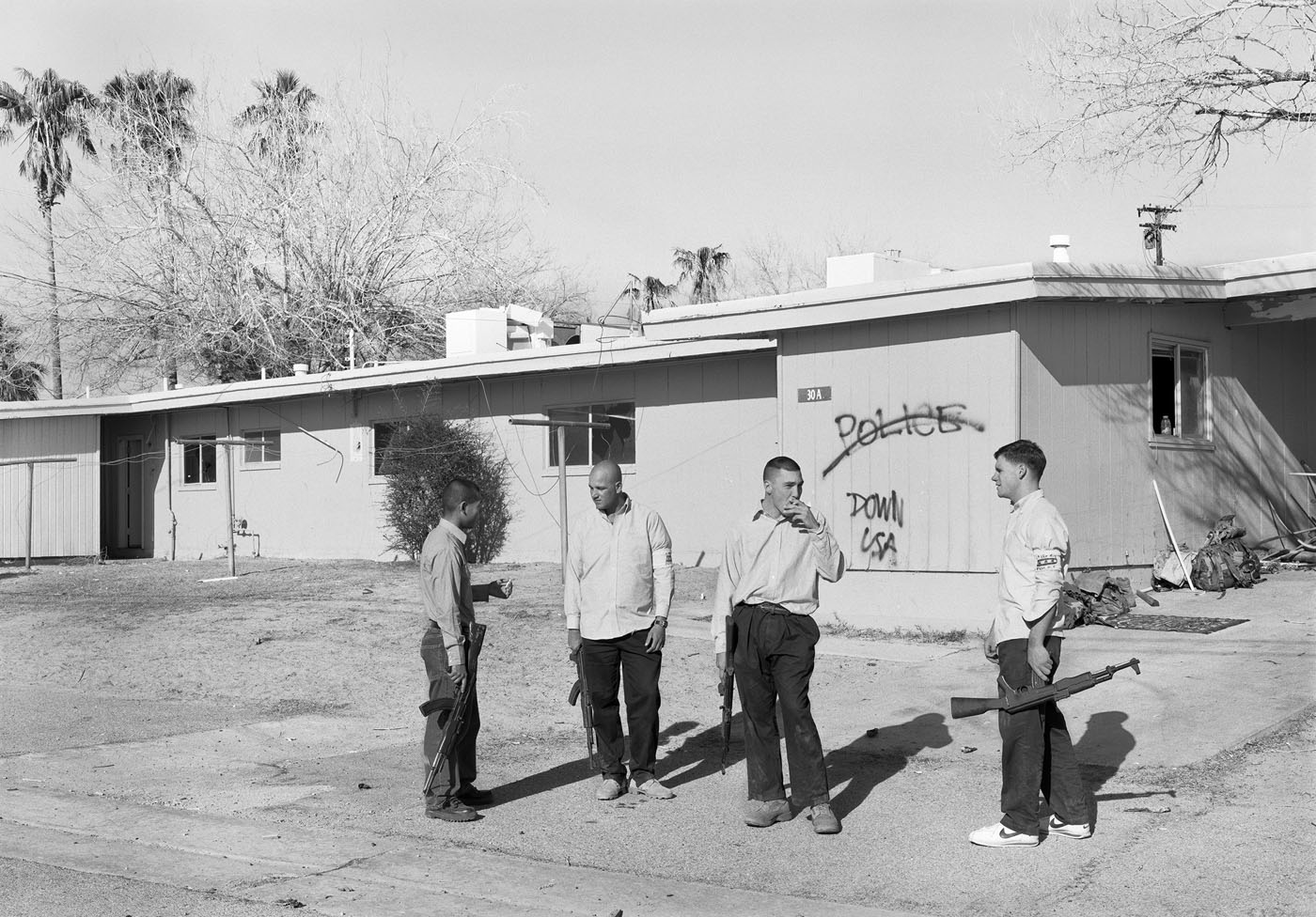
 

An-My Lê (Vietnamese-American, b. 1960) 'Security and Stabilization Operations, Iraqi Police' 2003-2004


An-My Lê (Vietnamese American, b. 1960)
Security and Stabilization Operations, Iraqi Police
2003-2004
From the series 29 Palms
Gelatin silver print
The J. Paul Getty Museum, Los Angeles
Courtesy of the artist and Marian Goodman Gallery
© An-My Lê


Landscape

Nineteenth-century photographers went to great lengths to make images of remote landscapes, which required traveling with large format cameras, glass plates, and chemicals. Ideological forces drove many of these journeys, with the ultimate goal of imperial expansion through industrial development and war. Government sponsored surveys and expeditionary programs employed the camera to justify the expansion and to record the resulting military conflicts. Mark Ruwedel, Michelle Stuart, and An-My Lê re-envision some of these same historical landscapes and offer up new ones that bring the past closer to our present.


At left, Timothy O'Sullivan (American, about 1840-1882) 'Desert Sand Hills Near Sink of Carson, Nevada' 1867; and at right, Michelle Stuart (American, b. 1933) 'Timeless Land' 2021


At left, Timothy O’Sullivan (American, about 1840-1882) Desert Sand Hills Near Sink of Carson, Nevada 1867; and at right, Michelle Stuart (American, b. 1933) Timeless Land 2021
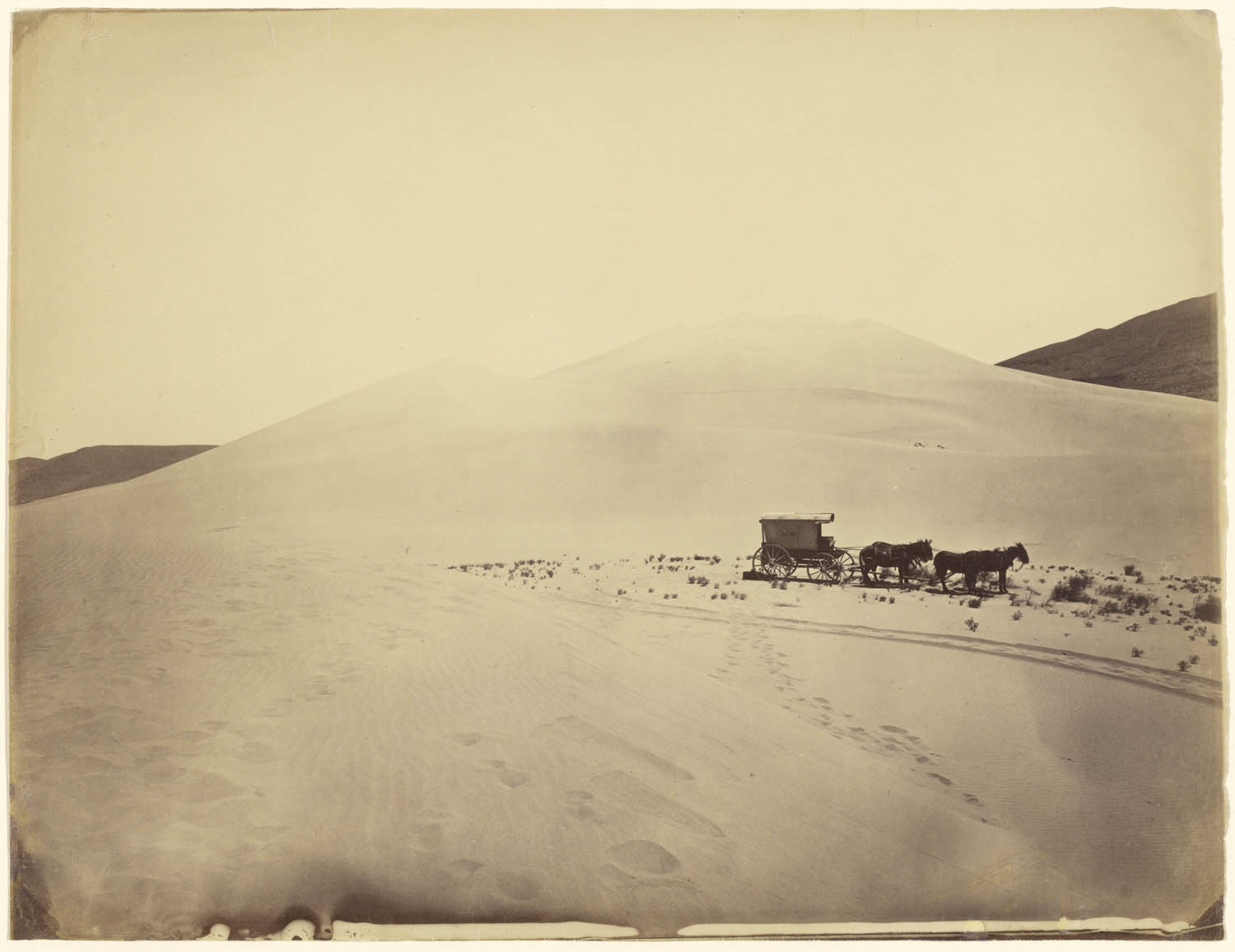
 

Timothy O'Sullivan (American, about 1840-1882) 'Desert Sand Hills Near Sink of Carson, Nevada' 1867


Timothy O’Sullivan (American, about 1840-1882)
Desert Sand Hills Near Sink of Carson, Nevada
1867
Albumen silver print
The J. Paul Getty Museum, Los Angeles
Public domain


Timothy O’Sullivan’s darkroom wagon, pulled by four mules, entered the frame at the right side of the photograph, reached the center of the image, and abruptly U-turned, heading back out of the frame. Footprints leading from the wagon toward the camera reveal the photographer’s path. Made at the Carson Sink in Nevada, this image of shifting sand dunes reveals the patterns of tracks recently reconfigured by the wind. The wagon’s striking presence in this otherwise barren scene dramatises the pioneering experience of exploration and discovery in the wide, uncharted landscapes of the American West.

O’Sullivan’s photographs from the 1867 Geological Exploration of the Fortieth Parallel expedition were intended to provide information for the purpose of expanding railroads and industry, yet they demonstrate his eye for poetic beauty.

Text from the J. Paul Getty Museum website
 

Michelle Stuart (American, b. 1933) 'Timeless Land' 2021


Michelle Stuart (American, b. 1933)
Timeless Land
2021
Ambrotypes
The J. Paul Getty Museum, Los Angeles
Purchased with funds provided by the Photographs Council
© Michelle Stuart


A.J. Russell (American, 1830-1902) 'Embankment No. 3 West of Granite Cannon [Wyoming]' April 1868


A.J. Russell (American, 1830-1902)
Embankment No. 3 West of Granite Cannon [Wyoming]
April 1868
Albumen silver print
Image: 21.9 × 29.4 cm (8 5/8 × 11 9/16 in.)
Mount: 34.1 × 43.1 cm (13 7/16 × 16 15/16 in.)
The J. Paul Getty Museum, Los Angeles


Mark Ruwedel (American/Canadian, b. 1954) 'Union Pacific #67 (after A.J. Russell)' 1996


Mark Ruwedel (American/Canadian, b. 1954)
Union Pacific #67 (after A.J. Russell)
1996
Gelatin silver print
Image: 18.9 × 23.9cm (7 7/16 × 9 7/16 in.)
The J. Paul Getty Museum, Los Angeles
© Mark Ruwedel


Mark Ruwedel’s statement in a wall text notes that “The legacy of nineteenth-century expeditionary photography was most important to me when working on my Westward series.” He cites Timothy O’Sullivan, Alexander Gardner and A.J. Russell. The Landscape section has a print by A.J. Russell, “Embankment No. 3 West of Granite Cannon. [Wyoming]” (April 1868), and seven pictures by Mr. Ruwedel: “Union Pacific #39 (After A.J. Russell)” and “Union Pacific #67 (After A.J. Russell)” (1994 and 1996, respectively) and five others with no specific acknowledgments but clearly influenced by his 19th-century mentors.

William Meyers. “Photography’s Past and Present at the Getty Center,” on The Wall Street Journal website May 29, 2024 [Online] Cited 16/06/2024
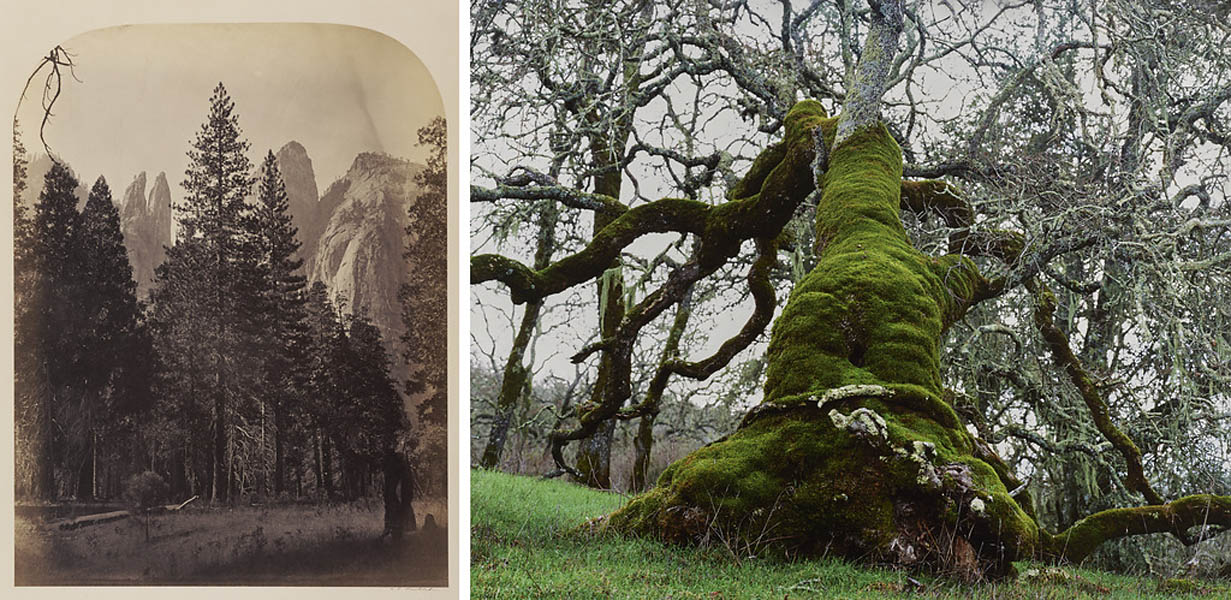
 

At left, Carleton Watkins (American, 1829-1916) 'Cathedral Spires – Yo Semite' 1861; and at right, Ken Gonzales-Day (American, b. 1964) 'At daylight the miserable man was carried to an oak…' Negative 2002; print 2021


At left, Carleton Watkins (American, 1829-1916) Cathedral Spires – Yo Semite 1861; and at right, Ken Gonzales-Day (American, b. 1964) At daylight the miserable man was carried to an oak… Negative 2002; print 2021
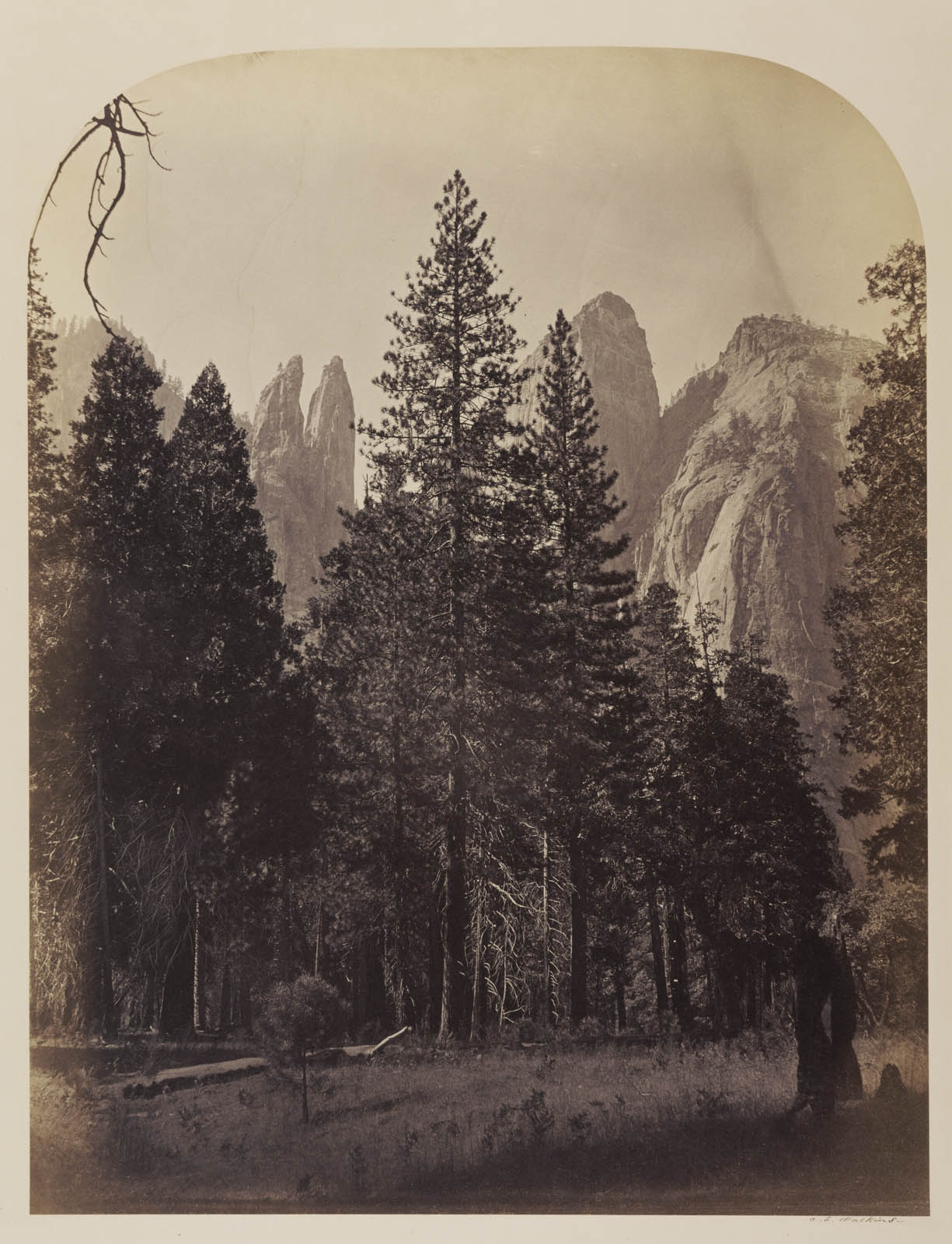
 

Carleton Watkins (American, 1829-1916) 'Cathedral Spires – Yo Semite' 1861


Carleton Watkins (American, 1829-1916)
Cathedral Spires – Yo Semite
1861
Albumen silver print
Image (Dome-Topped): 52.2 × 40.3cm (20 9/16 × 15 7/8 in.)
The J. Paul Getty Museum, Los Angeles


When Carleton Watkins photographed the remote Yosemite wilderness, America was not yet a century old. Conscious of their country’s lack of a national cultural identity, Americans adopted particularly dramatic geologic formations such as Cathedral Spires as their version of ancient ruins and soaring Gothic churches. The great pine tree in the foreground here became another form of this uniquely American history. Watkins’s images helped define America’s preference for landscape views depicting rugged wilderness and celebrating spectacular landforms on the grandest of scales.
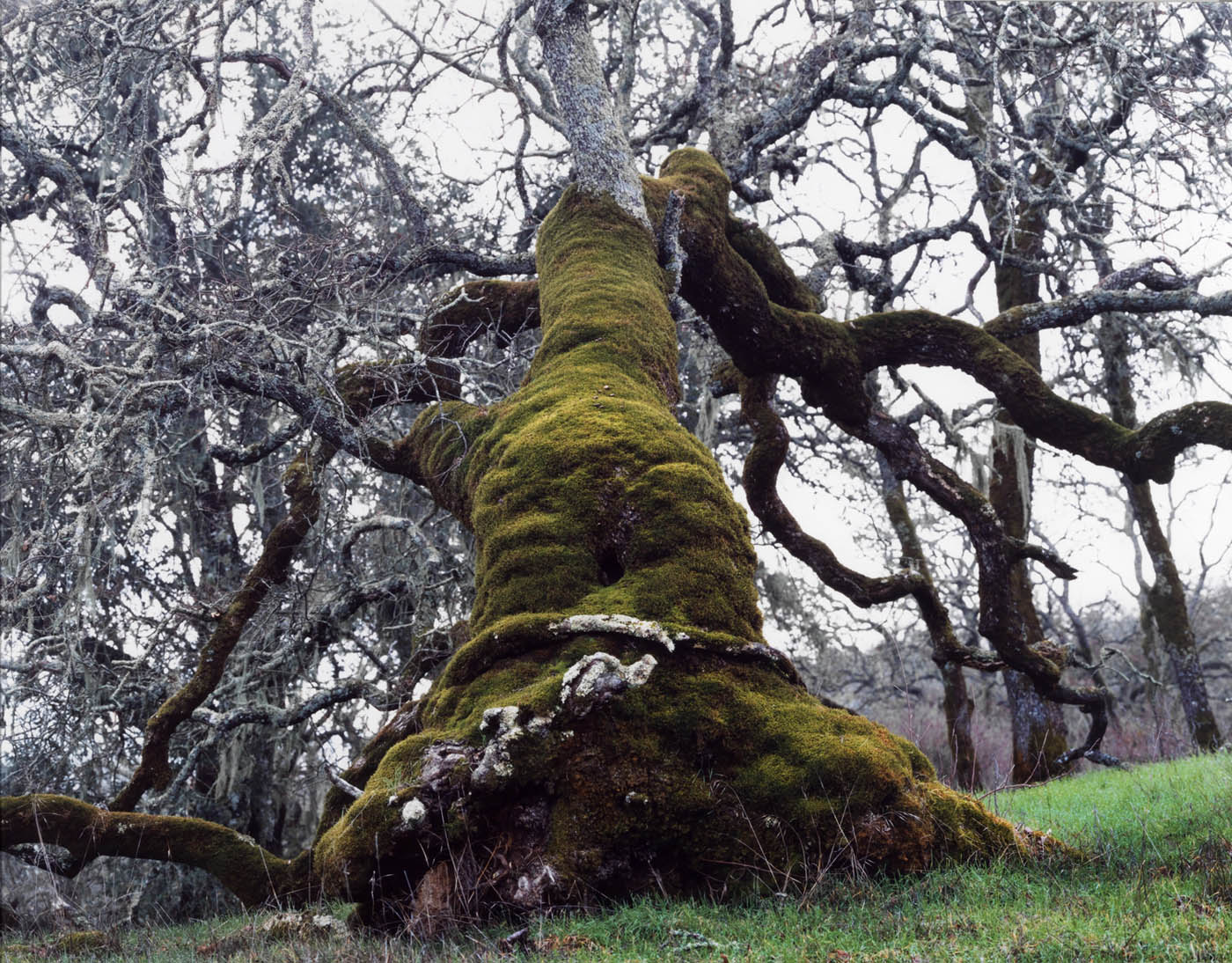
 

Ken Gonzales-Day (American, b. 1964) 'At daylight the miserable man was carried to an oak…' Negative 2002; print 2021


Ken Gonzales-Day (American, b. 1964)
At daylight the miserable man was carried to an oak…
Negative 2002; print 2021
From the series Searching for California’s Hang Trees
Pigment print
Image: 92.7 × 117.5cm (36 1/2 × 46 1/4 in.)
© Ken Gonzales-Day

This print: Smithsonian American Art Museum, Museum purchase through the Luisita L. and Franz H. Denghausen Endowment


Through meticulous research, Gonzales-Day documented approximately 350 lynching incidents that occurred in California between 1850 and 1935, most of which involved victims of Mexican descent. To create the series Searching for California Hang Trees, the artist visited many of these sites and captured the likeness of trees that may have borne witness to these events. Gonzales-Day’s landscapes unearth traces of this little-known history.

Our America: The Latino Presence in American Art, 2013

__________________________________________

Circulation


Charles M. Bell (American, 1848-1893) 'Manulitó, Chief of the Navajos' 1874


Charles M. Bell (American, 1848-1893)
Manulitó, Chief of the Navajos
1874
Albumen silver print
Image (Arched): 18.4 × 14.9cm (7 1/4 × 5 7/8 in.)
The J. Paul Getty Museum, Los Angeles
Public domain
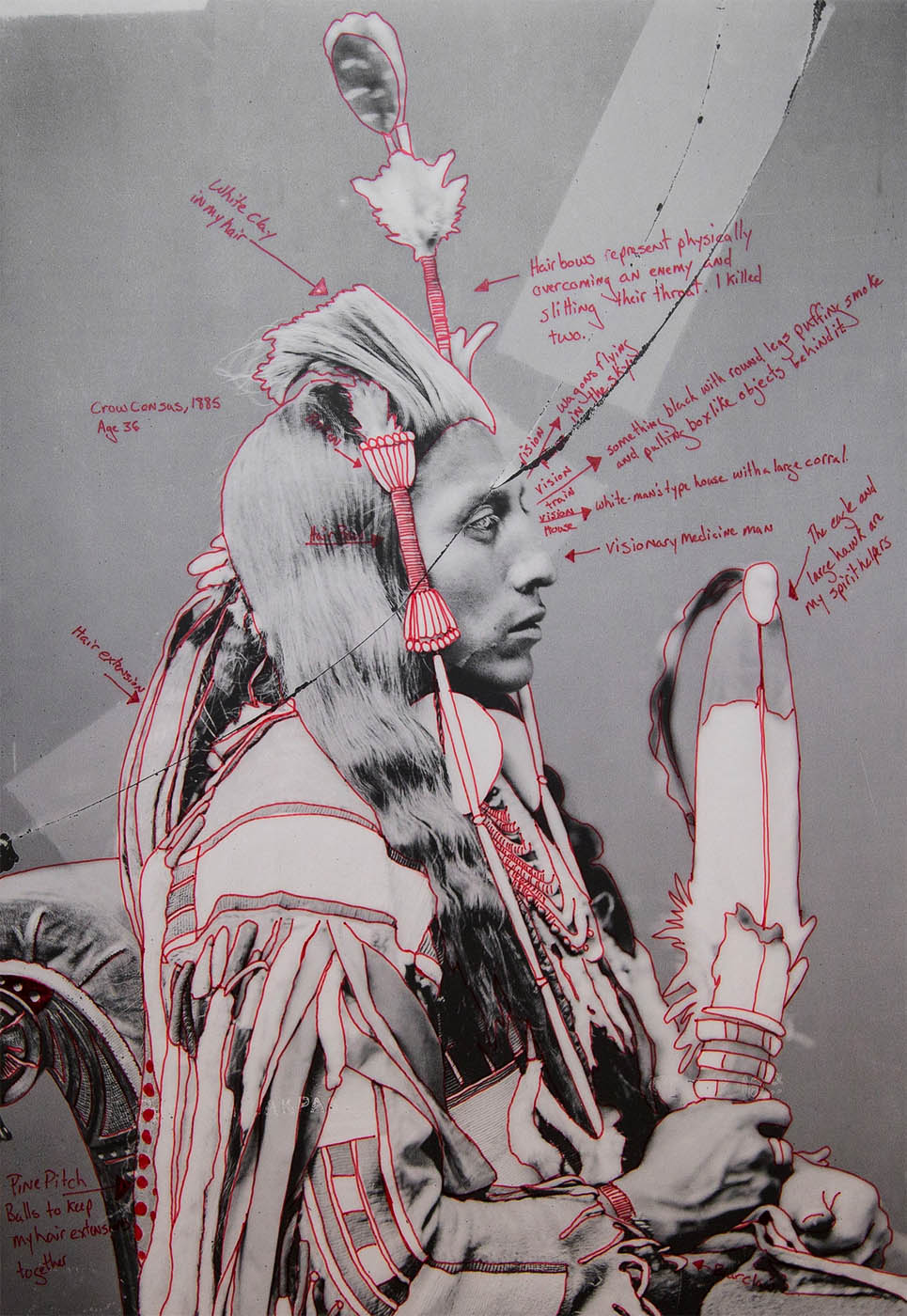
 

Wendy Red Star (American/Apsáalooke, b. 1981) 'Peelatchiwaaxpáash / Medicine Crow (Raven)' 2014


Wendy Red Star (American/Apsáalooke, b. 1981)
Peelatchiwaaxpáash / Medicine Crow (Raven)
2014
From the series Crow Peace Delegation
Inkjet print
Nasher Museum of Art at Duke University
Museum purchase with funds provided by Jennifer McCracken New and Jason G. New
© Wendy Red Star
Image courtesy of the Nasher Museum of Art


Artist-manipulated digitally reproduced photograph by C.M. (Charles Milton) Bell, National Anthropological Archives, Smithsonian Institution, 24 x 16 9/20 inches


Circulation

By the middle of the nineteenth century, thousands of photographs were in circulation worldwide, the result of photographers’ ability to reproduce the same image multiple times. Pictures of historical events, tourist destinations, and anthropological expeditions made the world seem more accessible, but with time and distance, they became disconnected from their original contexts. Many eventually ended up in archives (including at Getty). Early photographs appear next to projects that make these historical absences present. Wendy Red Star, Stephanie Syjuco, Ken Gonzales-Day, and Andrea Chung recover what has been lost, calling out the residual effects of the nineteenth-century photograph on our present knowledge of global cultures and histories.

Text from the J. Paul Getty Museum
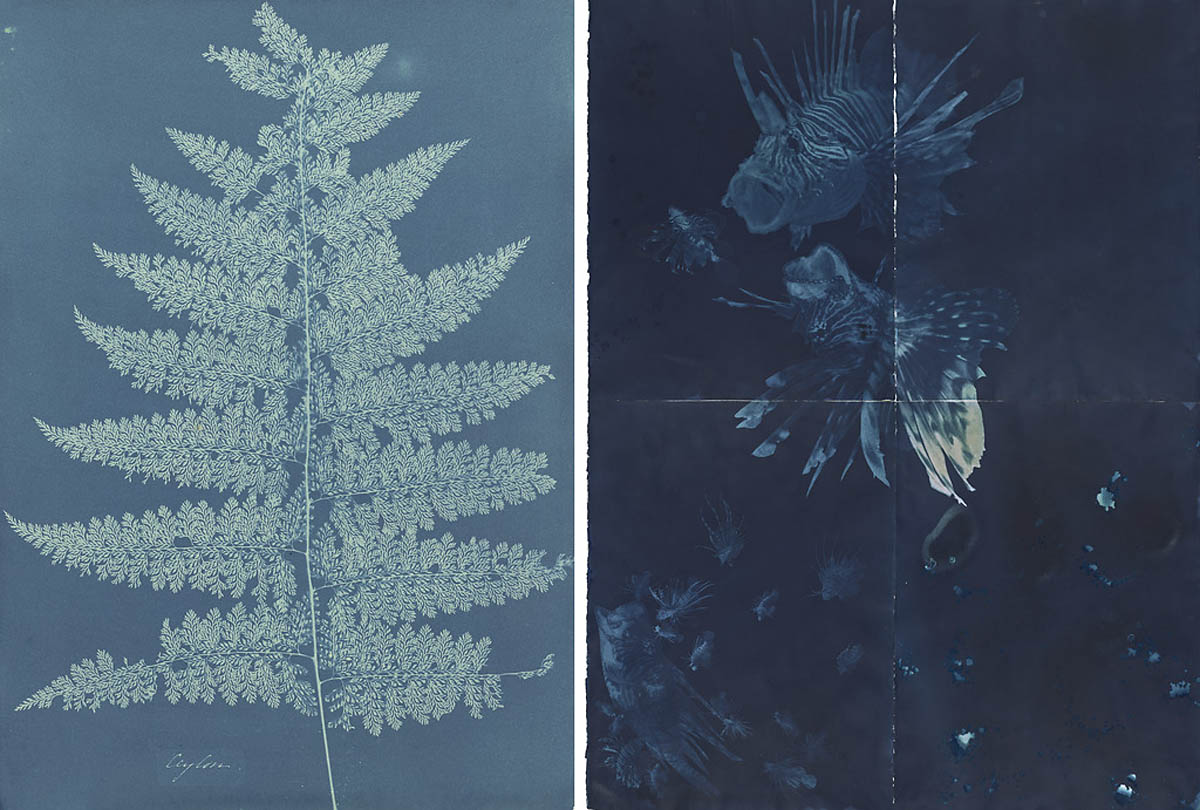
 

At left, Anna Atkins (British, 1799-1871) possibly with Anne Dixon (British, 1799-1877) 'Ceylon/Fern' about 1854; and at right, Andrea Chung (American, b. 1978) 'Untitled' 2016


At left, Anna Atkins (British, 1799-1871) possibly with Anne Dixon (British, 1799-1877) Ceylon/Fern about 1854; and at right, Andrea Chung (American, b. 1978) Untitled 2016
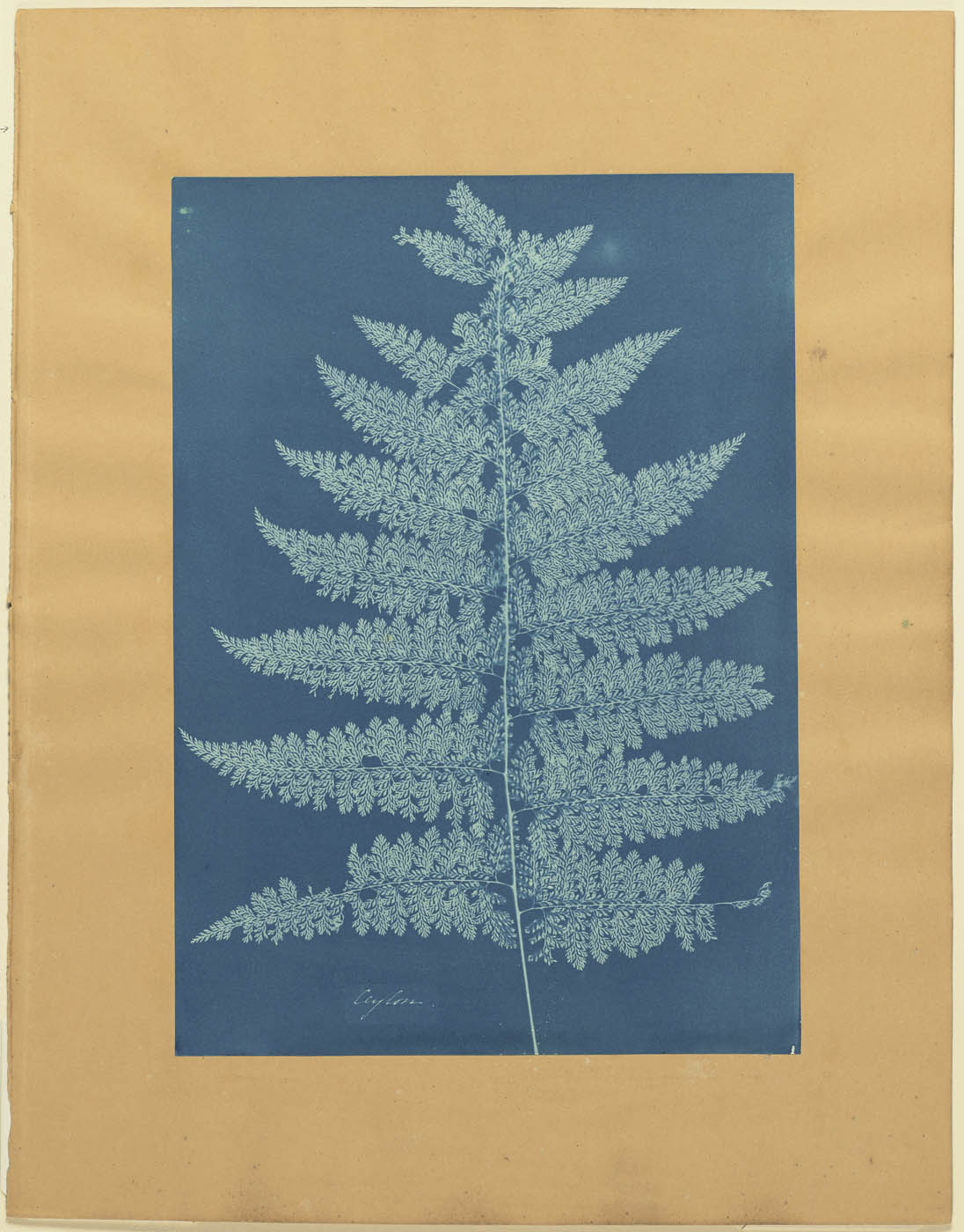
 

Anna Atkins (British, 1799-1871) possibly with Anne Dixon (British, 1799-1877) 'Ceylon/Fern' about 1854


Anna Atkins (British, 1799-1871) possibly with Anne Dixon (British, 1799-1877)
Ceylon/Fern
about 1854
Cyanotype
Image: 34.8 × 24.7cm (13 11/16 × 9 3/4 in.)
Sheet: 48.3 × 37.5cm (19 × 14 3/4 in.)
The J. Paul Getty Museum, Los Angeles
Public domain


Cyanotypes of British and Foreign Flowering Plants

After completing the highly ambitious, decade-long project Photographs of Blue Algae: Cyanotype Impressions in the summer of 1853, Anna Atkins turned to new botanical subjects. She would eventually produce several unique presentation albums with cyanotypes of ferns and flowering plants. Atkins most likely collaborated on these albums with her dear friend, Anne Dixon. Dixon came to Halstead Place for an extended stay in the summer of 1852 to comfort Atkins who was deeply shaken by the death of her father and frequent scientific partner John George Children earlier that year. Photo historian Larry Schaaf suggests that it was during this stay or perhaps one the next summer that Dixon began assisting Atkins and creating her own cyanotypes. Thus, it becomes difficult to know whether surviving works from this time period were created by Atkins, Dixon, or both.1

These seven pieces in the J. Paul Getty Museum Collection (figs. 1-7) were extracted from an 1854 presentation album Cyanotypes of British and Foreign Flowering Plants given by Anna Atkins to Anne Dixon in 1854. The album remained intact until sometime around 1981, when it was broken up after being sold at auction.

Atkins and Dixon shared a deep interest in botany, a science that was considered well suited to women since it could be studied locally, even in one’s own garden. Serious “lady botanists” could join the Botanical Society in London, one of the first scientific organisations to admit women. Atkins joined in 1839. The two friends’ interest in botany is documented in a letter of 1851 from Children to Sir William Hooker in which he discussed the two women’s longtime plant collecting. Later, in a letter that Atkins wrote to Hooker in 1864, she extended an offer from Dixon to send him samples of any of the plants from her own collection.2

Carolyn Peter, J. Paul Getty Museum, Department of Photographs
2019
© J. Paul Getty Trust
Creative Commons Attribution 4.0 International License

1/ Larry Schaaf, Sun Gardens: Cyanotypes by Anna Atkins (New York: The New York Public Library, 2018), 77
2/ Ibid, 80
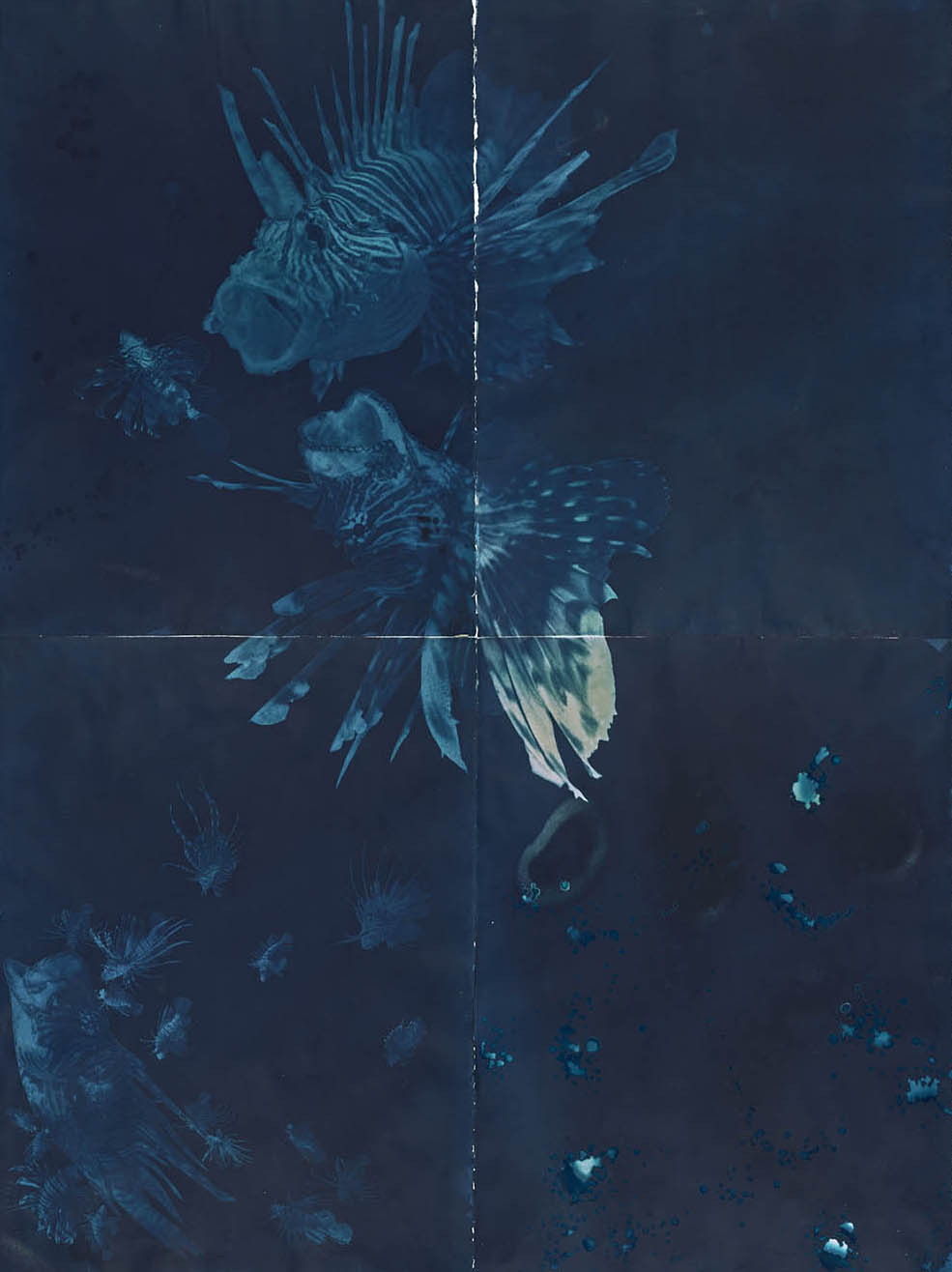
 

Andrea Chung (American, b. 1978) 'Untitled' 2016


Andrea Chung (American, b. 1978)
Untitled
2016
From the series Anthropocene
Cyanotypes
The J. Paul Getty Museum, Los Angeles
© Andrea Chung


Anna Atkins was a 19th-century botanist who documented plant specimens to make the world’s first photo book.

Today, artist Andrea Chung makes images of lionfish. Invasive to the Caribbean, they stand as a metaphor for the impact of colonisation in the region.

Text and photograph from the Getty Museum X web page


The J. Paul Getty Museum
1200 Getty Center Drive
Los Angeles, California 90049

Opening hours:
Daily 10am – 5pm

The J. Paul Getty Museum website

LIKE ART BLACK ON FACEBOOK

Back to top

Exhibition: ‘Arthur Tress: Rambles, Dreams, and Shadows’ at the J. Paul Getty Museum, Los Angeles

Exhibition dates: 31st October, 2023 – 18th February, 2024

Warning: This posting contains photographs of male nudity and sexual activity.


Installation view of the exhibition 'Arthur Tress: Rambles, Dreams, and Shadows' at the J. Paul Getty Museum, Los Angeles showing the work 'Boy in Flood Dream, Ocean City, Maryland' 1971


Installation view of the exhibition Arthur Tress: Rambles, Dreams, and Shadows at the J. Paul Getty Museum, Los Angeles showing the work Boy in Flood Dream, Ocean City, Maryland 1971


Arthur Tress: fantastical photographer

Definition of ‘fantastical’
1. strange, weird, or fanciful in appearance, conception, etc.
2. created in the mind; illusory.


I honour the work of Arthur Tress. Strange and wonderful, like something out of a fairytale or a nightmare, Arthur Tress’ ‘imaginary’ stories take the viewer out of themselves and into a different realm of being and believing. His staged, performative “magic realism” photographs – featuring the inclusion of fantastic or mythical elements into seemingly realistic fiction – emerge from the psyche of the artist, from his deepest thoughts, feelings and dreams.

Taking advice from that another gay photographer, American Duane Michals (who works in sequences of images to tell stories), Michals told Tress that “a photograph can be anything”. As Michals insightfully observes,

“I believe in the imagination. What I cannot see is infinitely more important than what I can see…

Everything we experience is in our mind. It is all mind. What you are reading now, hearing now, feeling now…

There is not one photography. There is no photography. The only value judgment is the work itself. Does it move, touch, fill me?”1


It’s all in the mind.

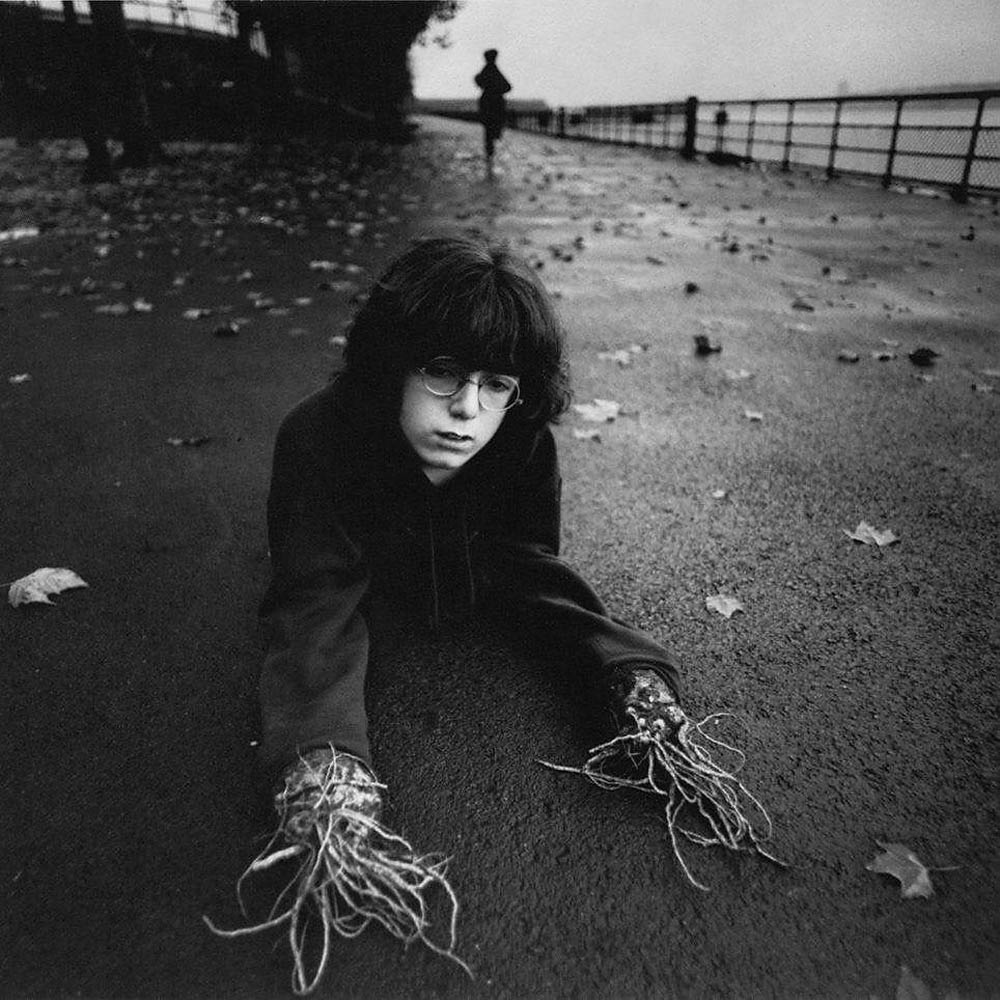
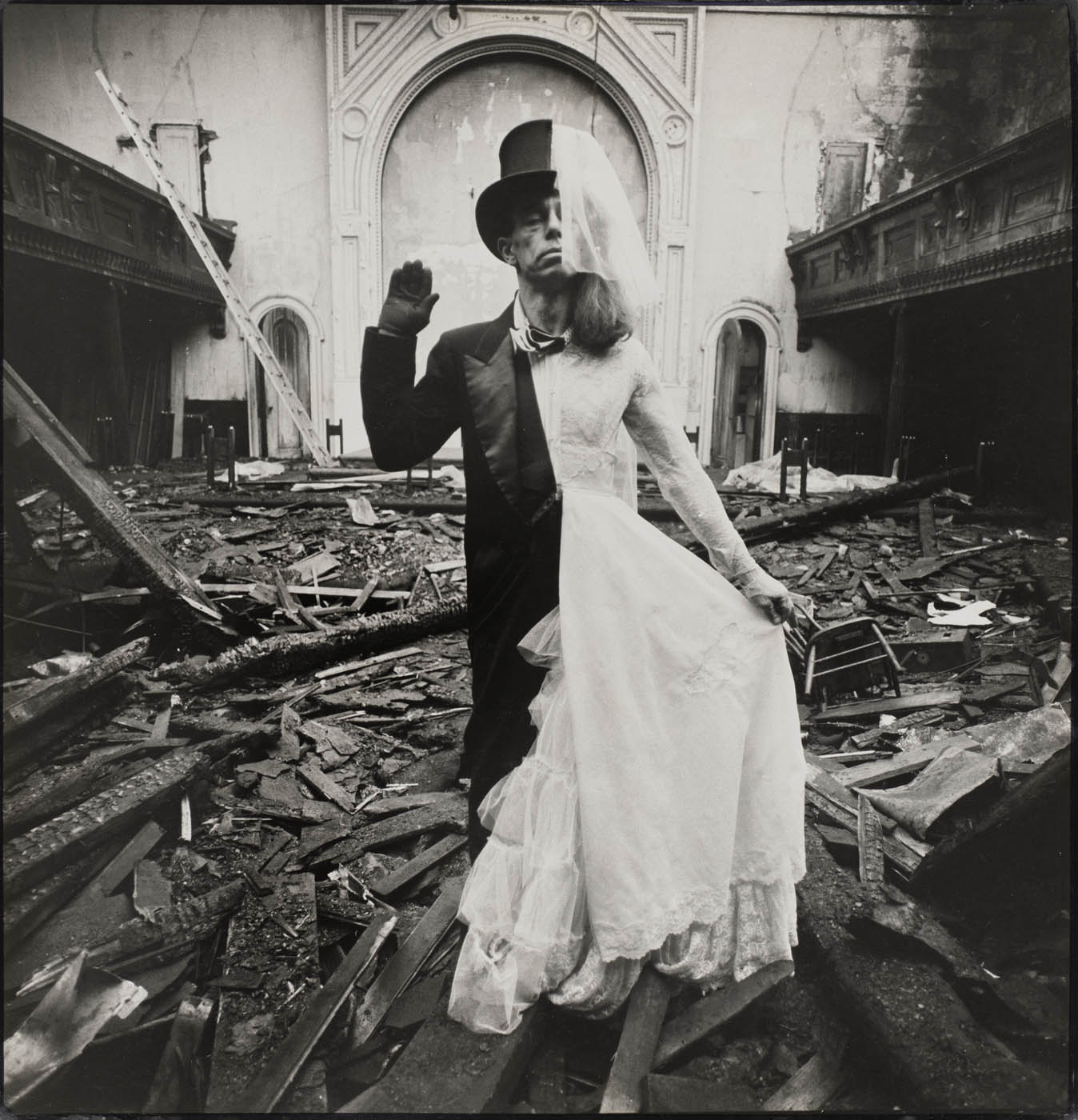
Tress discovered his own way to tell stories, his own signature style, that was completely different from anything being accomplished in New York at the time by (for example) Robert Mapplethorpe, Peter Hujar, Diane Arbus, David Wojnarowicz, or Nan Goldin. Through the transmutation of metal into gold, or dream into photograph, Tress placed himself outside the trendy happenings of the Big Apple. In images such as the early Woman with Coin Operated Binoculars, Coit Tower, San Francisco (1964, below) – redolent of what was to follow – the disturbing Boy with Root Hands, New York (1970, below), Bride and Groom, New York, New York (1970, below) and Boy in Flood Dream, Ocean City, Maryland (1971, below), Tress reaches out an illuminates the dreams, desires and fears of children and adults.

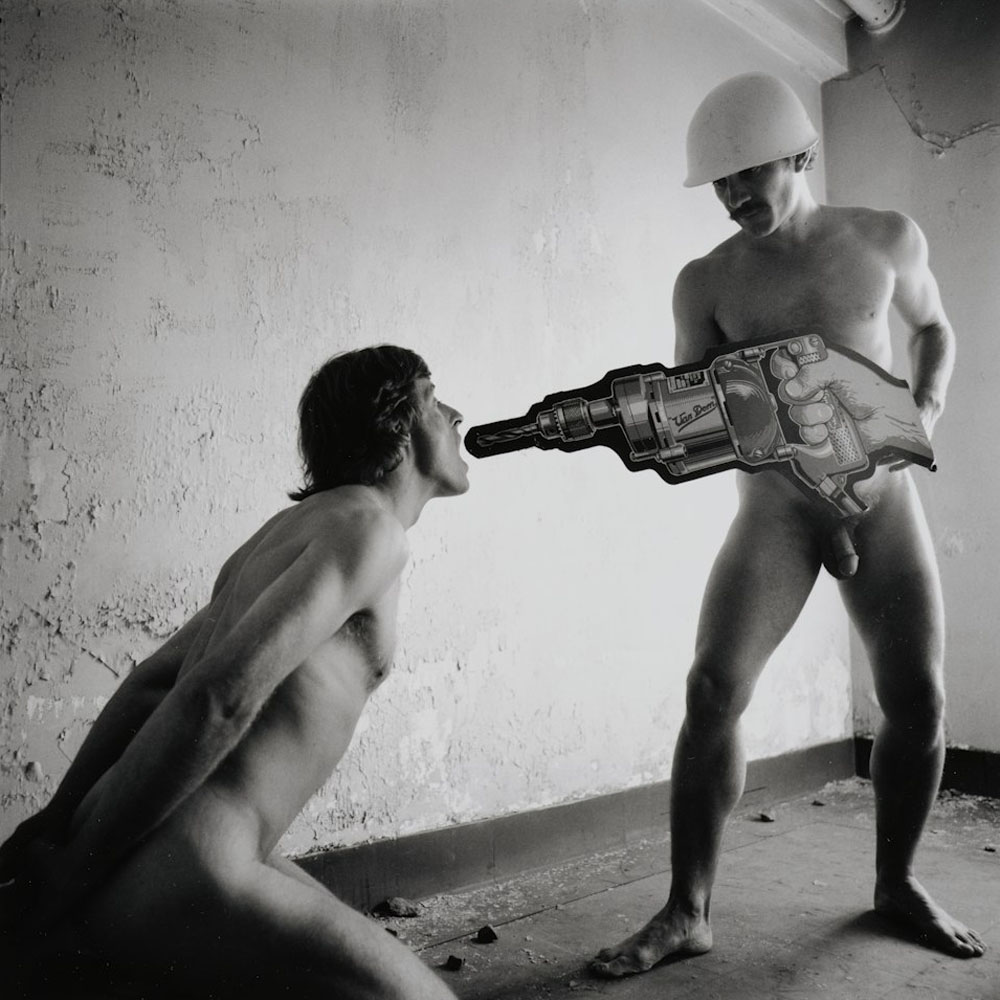
What is disappointing is that neither the media images nor the accompanying text include any images from or text about what I feel is one of Tress’ strongest bodies of work, his photographs of gay fantasies. Can we not include these images for fear of upsetting delicate conservative sensibilities? I don’t know whether there were any included in the exhibition either, having not seen the presentation in person.

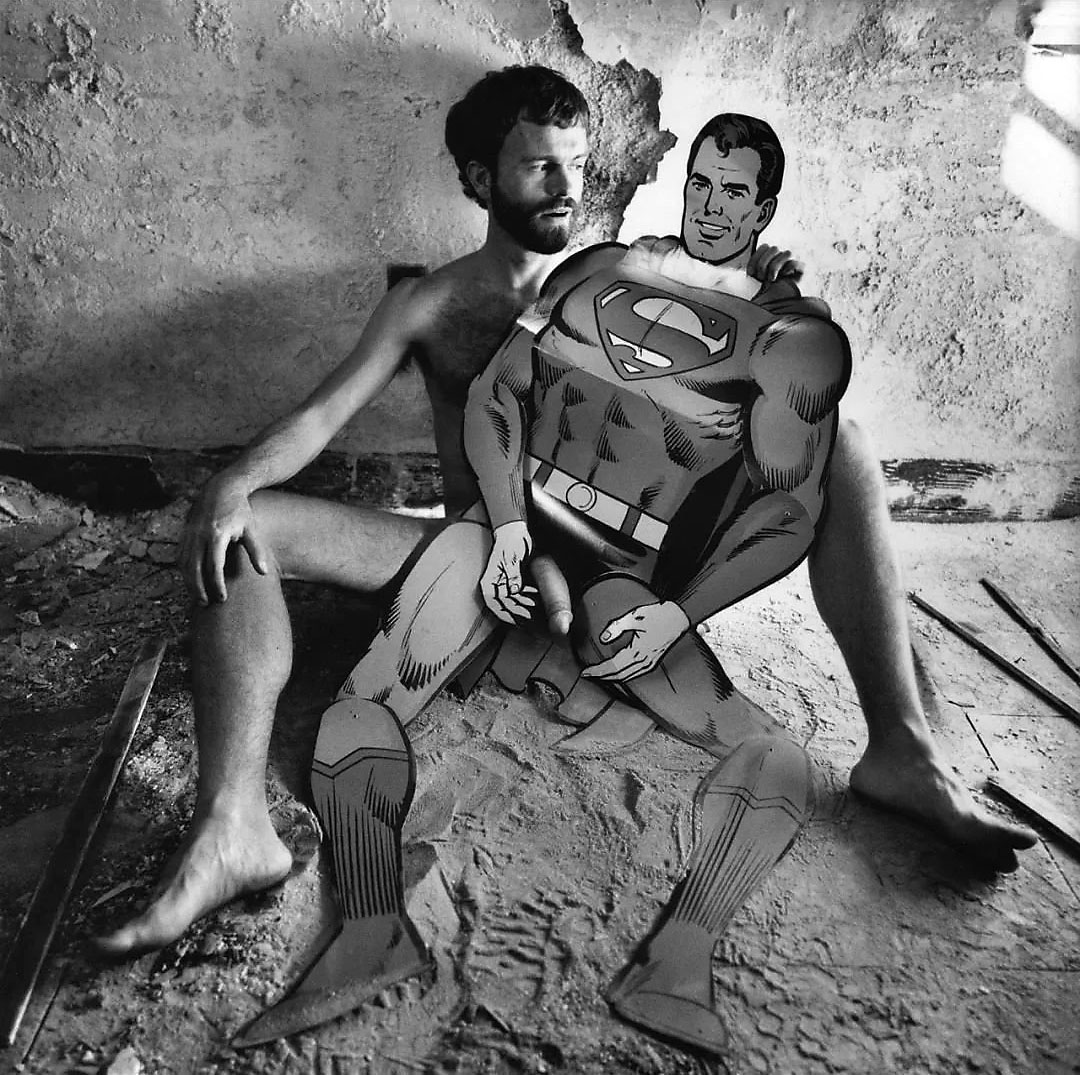
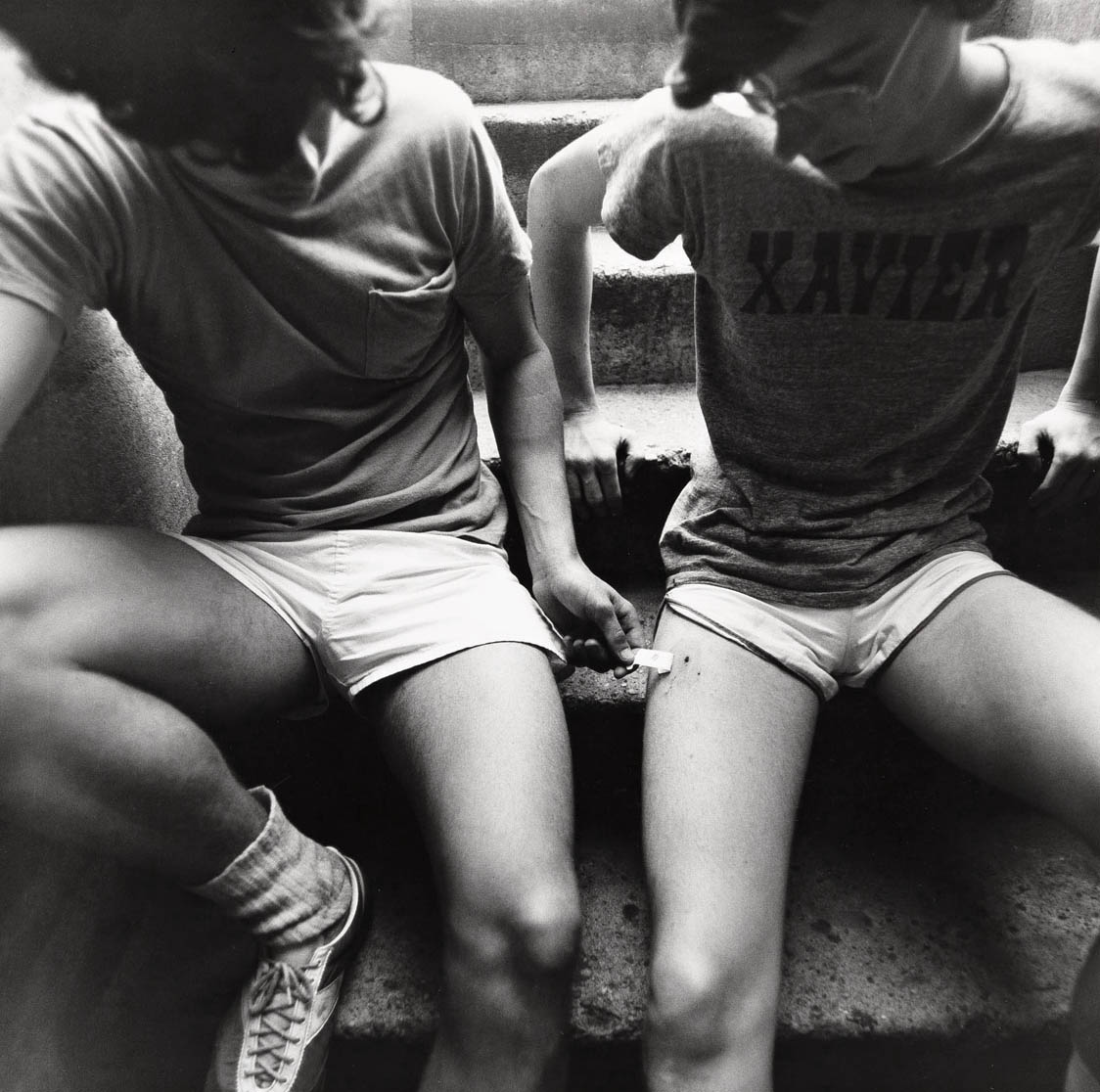
Again, created from the artist’s fantasies and imagination these works posses a tremendous élan vital, a celebration of sexuality and life. They also possess intelligence and wit a plenty. Witness, Band-aid Fantasy (1978, below) which is clever and sensitive in its fetishisation of the removal of a Band-aid from a friend; or the look on the face of Superman and the male subject in Superman Fantasy (1977, below) where one cock belongs to both: the penis of the male “standing” in for that of the super man, standing in for the always hidden power of Superman’s cock represented by the (irony: cut-out cardboard) phallic armoured body of the hyper-masculine hero, desired by the male with his lustful look. The photograph makes me laugh. If you are so further inclined, there are six pages of these wonderful gay fantasies on the Stanford Libraries Arthur Tress Photograph Collection web pages. Well worth a visit.

To my mind, Arthur Tress has always been an underrated artist. A courageous and dedicated photographer who forged an extra-ordinary magical path, it is a pleasure to see his work exhibited at the Getty.

Dr Marcus Bunyan


1/ Duane Michals June 20, 1976 September 1, 1976


Many thankx to the J. Paul Getty Museum for allowing me to publish the photographs in the posting. Please click on the photographs for a larger version of the image.


“Tress credits his friend and fellow photographer Duane Michals with opening his eyes to the possibilities of his chosen medium in the 1960s, back when Tress’ photographs hewed more closely to the prevalent “documentary” style of the day. “He said a photograph can be anything,” Tress says, describing Michals’ approach. “It can be a sequence, you can write on the photograph, paint on it, make collages, tell a story. In the ’60s, that was revolutionary.”

As it turned out, Tress was a receptive audience for Michals’ manifesto. By the time the Brooklyn native had secured his breakthrough assignment in 1969 to photograph what he describes as the “endangered folk cultures” of Appalachia, Tress was already pushing against the dispassion of the documentary style.”

Ben Marks. “How One Artist Makes New Art From Old Coloring Books and Found Photos,” on the Collectors Weekly website August 26th, 2021 [Online] Cited 10/11/2023


The first exhibition to chronicle the early career of Arthur Tress, one of the most innovative American photographers of the postwar era. During his first decade as an emergent professional in the New York photography world (1968-1978), his artistic practice evolved from being rooted in the social documentary tradition to a bold new approach drawing inspiration from the inner worlds of fantasies, daydreams, and nightmares.


Arthur Tress (American, b. 1940) 'Boy in Flood Dream, Ocean City, Maryland' 1971


Arthur Tress (American, b. 1940)
Boy in Flood Dream, Ocean City, Maryland
1971
From the series Dream Collector
Gelatin silver print
J. Paul Getty Museum, Los Angeles
© Arthur Tress Archive LLC


One of Tress’s best known images from his Dream Collectors photobook, the photograph depicts a child emerging out of a discarded roof on a pier in Ocean City, Maryland. The effectiveness of this composition is remarkable given that Tress stumbled on the site and the subject by chance.

Wall label


Installation view of the exhibition Arthur Tress: Rambles, Dreams, and Shadows at the J. Paul Getty Museum, Los Angeles showing 'Boy in Flood Dream, Ocean City, Maryland' (1971)


Installation view of the exhibition Arthur Tress: Rambles, Dreams, and Shadows at the J. Paul Getty Museum, Los Angeles showing Boy in Flood Dream, Ocean City, Maryland (1971, above)


Installation view of the exhibition 'Arthur Tress: Rambles, Dreams, and Shadows' at the J. Paul Getty Museum, Los Angeles showing works from his 'Shadows' series

Installation view of the exhibition 'Arthur Tress: Rambles, Dreams, and Shadows' at the J. Paul Getty Museum, Los Angeles


Installation views of the exhibition Arthur Tress: Rambles, Dreams, and Shadows at the J. Paul Getty Museum, Los Angeles showing works from his Shadows series in the bottom image


Arthur Tress’s Magic Realism Comes to Getty

Drawn from his imagination, dreams, and queer identity, Arthur Tress’s photography presents a surrealist world with fantastical subjects In the field of staged photography, Arthur Tress (American, born 1940) was a trailblazer, directing his subjects in fictional and often surreal scenes.

The first exhibition to chronicle his early career, Arthur Tress: Rambles, Dreams, and Shadows, on view October 31, 2023 – February 18, 2024 at the Getty Center, examines how his artistic practice evolved from being rooted in the social documentary tradition to a bold new approach drawing inspiration from fantasies, daydreams, and nightmares.

“Tress’s early work from his Dream Collector and other related series constitutes a remarkable artistic achievement and a major contribution to the history of post-war photography and the photo book,” says Timothy Potts, Maria Hummer-Tuttle and Robert Tuttle Director of the J. Paul Getty Museum. “In a series of increasingly radical projects, Tress delved deeply into the worlds of surrealism and the unconscious, establishing himself as one of the most interesting mavericks of his generation.”

Born in Brooklyn, New York, Tress began his career as a documentary photographer in the late 1960’s, focusing his lens on the people of New York and the Appalachian region of the eastern United States. Initially concerned with such societal issues as poverty, pollution, and lack of open space for urban recreation, by the mid-1970s he began channeling his creative energy into more personal artistic projects that reflected his imagination, dreams, and his own queer identity.

This exhibition presents highlights from Tress’s major photographic projects dating from 1968 to 1978: Appalachia: The Disturbed Land; Open Space in the Inner City; The Dream Collector; Shadow; Theater of Mind; and The Ramble.

Tress’s early work is rooted in the social documentary tradition, recalling photographs made by Depression-era artists for the U.S. government. Tress’s Appalachia: The Disturbed Land captures scenes of poverty and environmental degradation in coal mining communities. The work was originally exhibited at the Sierra Club’s gallery in New York where it garnered positive reviews.

Tress’s next major project, Open Space in the Inner City, also reflects his concern for the environment as well as his interest in documenting problems facing young people. Set primarily in New York City and its environs, the photographs show polluted streetscapes and waterways, housing projects, junkyards, factories, and parking lots, and include both candid and posed images of children, families, and commuters. A central theme of the series is the general lack of open space for recreation.

Appearing as his first major photo book in 1972, The Dream Collector visualises children’s fantasies and nightmares. This body of work cemented Tress’s reputation for staging macabre and fantastic subjects at a time when the photography world was largely dedicated to prosaic realism.

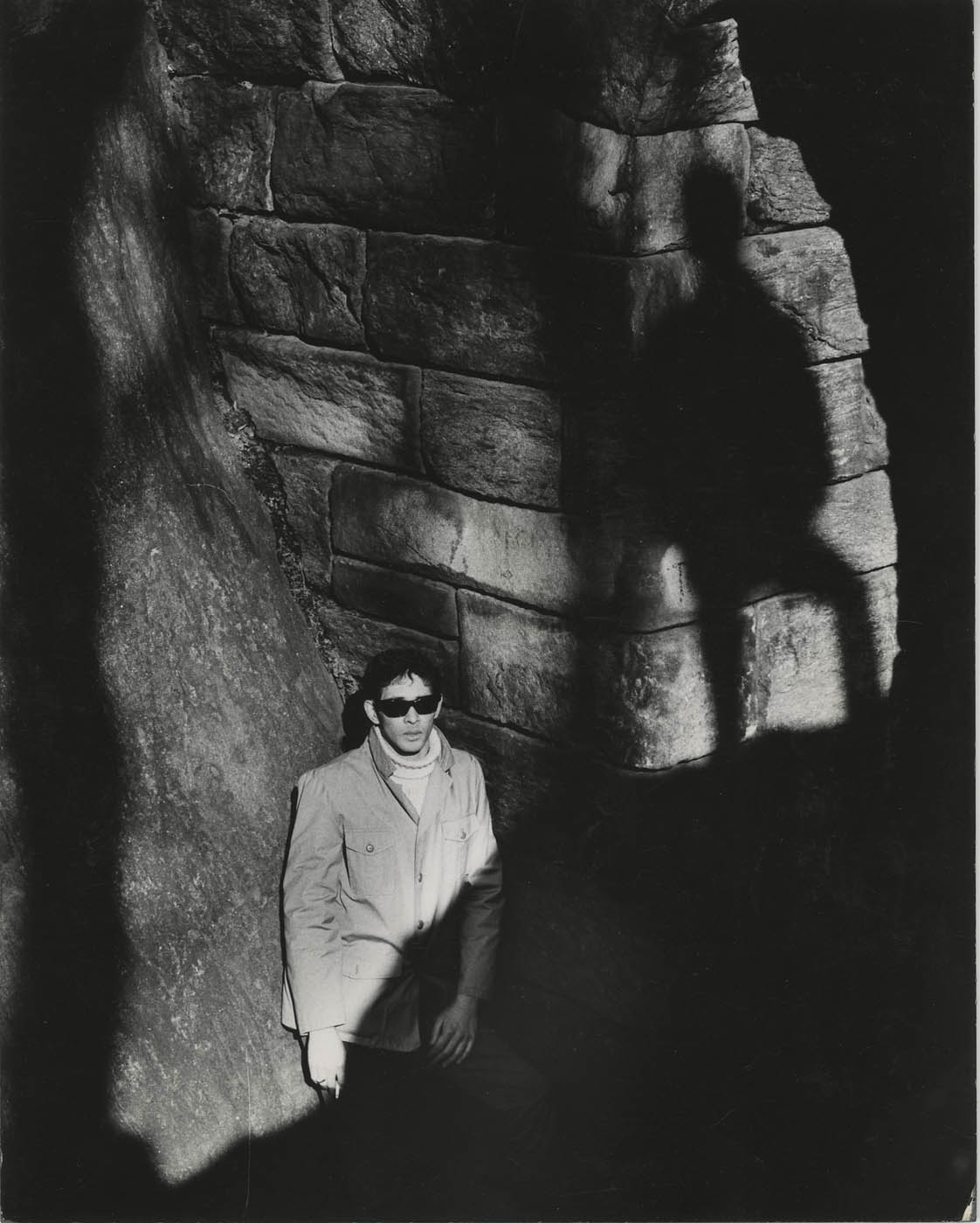
Between 1972 and 1975 Tress created a series of photographs centered on his own shadow. The images reproduced in his photobook Shadow trace the mystical dream journey of an individual soul through birth, death, and enlightenment. Tress chose to use a wide-angle lens that alters the perspective and imparts a dreamlike quality. His only light source was the sun, which made early morning or late afternoon the ideal times to shoot, as the raking light lengthened the shadows, making them more dramatic.

In Theater of the Mind Tress explored his personal anxieties as well as the complexities of family relationships. He convinced his subjects to play out dramatic and sometimes disturbing scenes for the camera which were informed by the artist’s own psychic intuitions. Afterwards, when he shared the photographs with them, his sitters often remarked on his having illuminated an important but hitherto hidden aspect of their family dynamic.

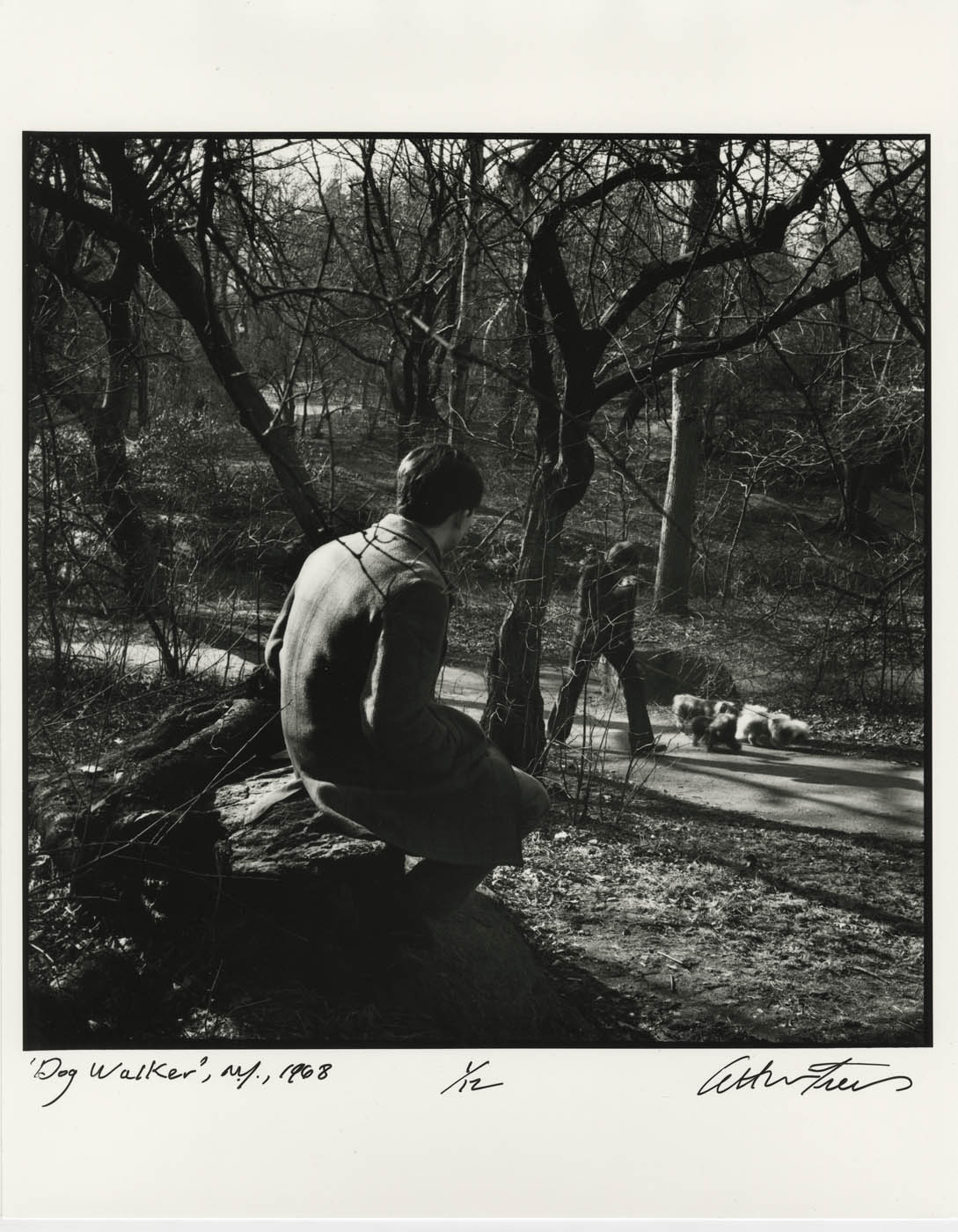
One of Tress’s most personal bodies of work is an extraordinary series depicting the Ramble, a wooded section of Central Park in New York City known as a gay cruising ground. The Ramble was a personal photographic project that he did not exhibit or publish, as doing so could have exposed his subjects to embarrassment, harassment, or violence. Tress was still struggling with his sexuality at this time and making these pictures helped allay his anxieties, giving him something else to focus on in the Ramble aside from his own furtive sexual encounters.

“By revisiting an energetic decade of professional and personal work from 1968 to 1978, this exhibition enabled me to see more clearly how these early explorative years marked the beginning of a very personal vision, unique to myself, as an emerging photo artist – a peculiar combination of documentary realism and emotional responsiveness to the hidden mysteries of everyday life,” says Arthur Tress.

“I’m excited to have this amazing opportunity both in our exhibition and its accompanying catalogue to share an extraordinary body of work that is not well known to the general public, and to narrate the remarkable story behind Tress’s early career that has remained untold,” says Jim Ganz, senior curator in the Getty Museum’s Department of Photographs.

Arthur Tress: Rambles, Dreams, and Shadows is curated by Jim Ganz with Paul Martineau, curator in the Department of Photographs. Related programming includes Magic Realism: An Evening with Arthur Tress, where Tress will discuss his bold approach to photography, and the world premiere of Arthur Tress: Water’s Edge, an immersive journey into the life and unique vision of acclaimed photographer Arthur Tress. The exhibition is also accompanied by a catalogue, Arthur Tress: Rambles, Dreams, and Shadows.

Anonymous. “Arthur Tress’s Magic Realism Comes to Getty,” on the Getty website Oct 18, 2023 [Online] Cited 28/10/2023


Arthur Tress: Water’s Edge – Trailer

Trailer for feature length documentary about fantasist/surrealist photographer Arthur Tress. Directed by Stephen B. Lewis


Arthur Tress (American, b. 1940) 'Woman with Coin Operated Binoculars, Coit Tower, San Francisco' 1964


Arthur Tress (American, b. 1940)
Woman with Coin Operated Binoculars, Coit Tower, San Francisco
1964
Gelatin silver print
© Arthur Tress Archive LLC

Not sure whether this photograph is in the exhibition. Used under fair use conditions for the purpose of education, research, review and comment


Arthur Tress (American, b. 1940) 'Girl and Moon Dream, New York, New York' 1968


Arthur Tress (American, b. 1940)
Girl and Moon Dream, New York, New York
1968
Gelatin silver print
J. Paul Getty Museum, Los Angeles
© Arthur Tress Archive LLC


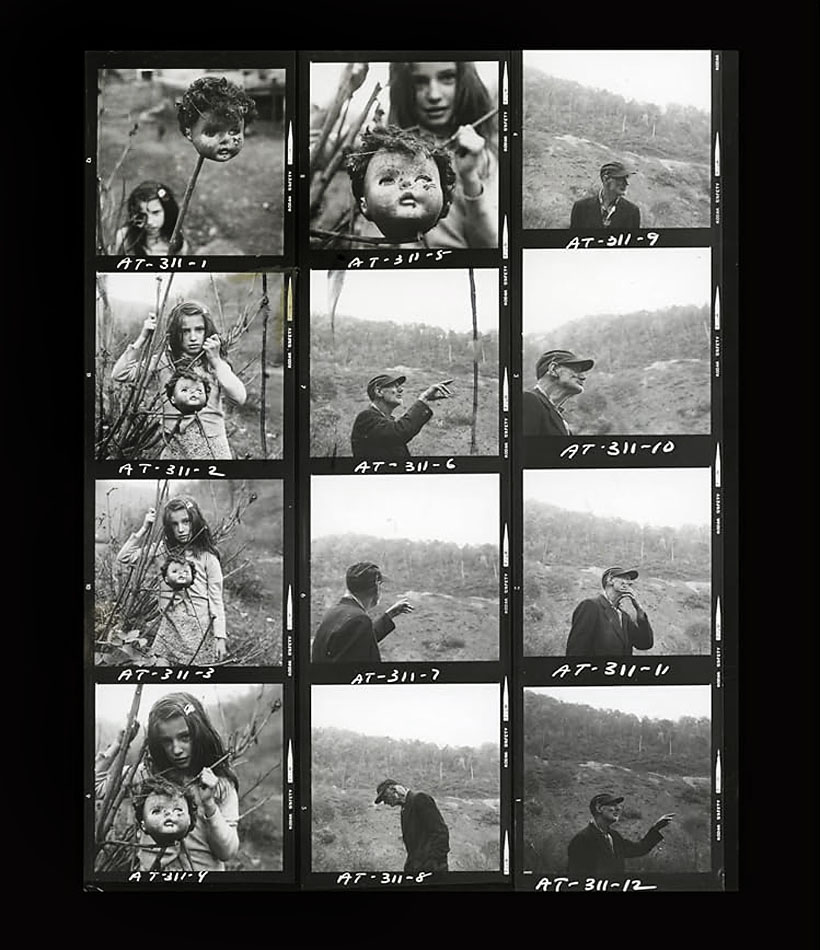
Arthur Tress (American, b. 1940) 'Girl with Doll's Head, Capels, West Virginia' 1968


Arthur Tress (American, b. 1940)
Girl with Doll’s Head, Capels, West Virginia
1968
From the series Appalachia: The Disturbed Land
Gelatin silver print
20.4 × 15.7cm (8 1/16 × 6 3/16 in.)
J. Paul Getty Museum, Los Angeles
Gift of the Ottersons
© Arthur Tress Archive LLC


Arthur Tress 'Appalachia: The Disturbed Land' proof sheet 1968


Arthur Tress Appalachia: The Disturbed Land proof sheet 1968


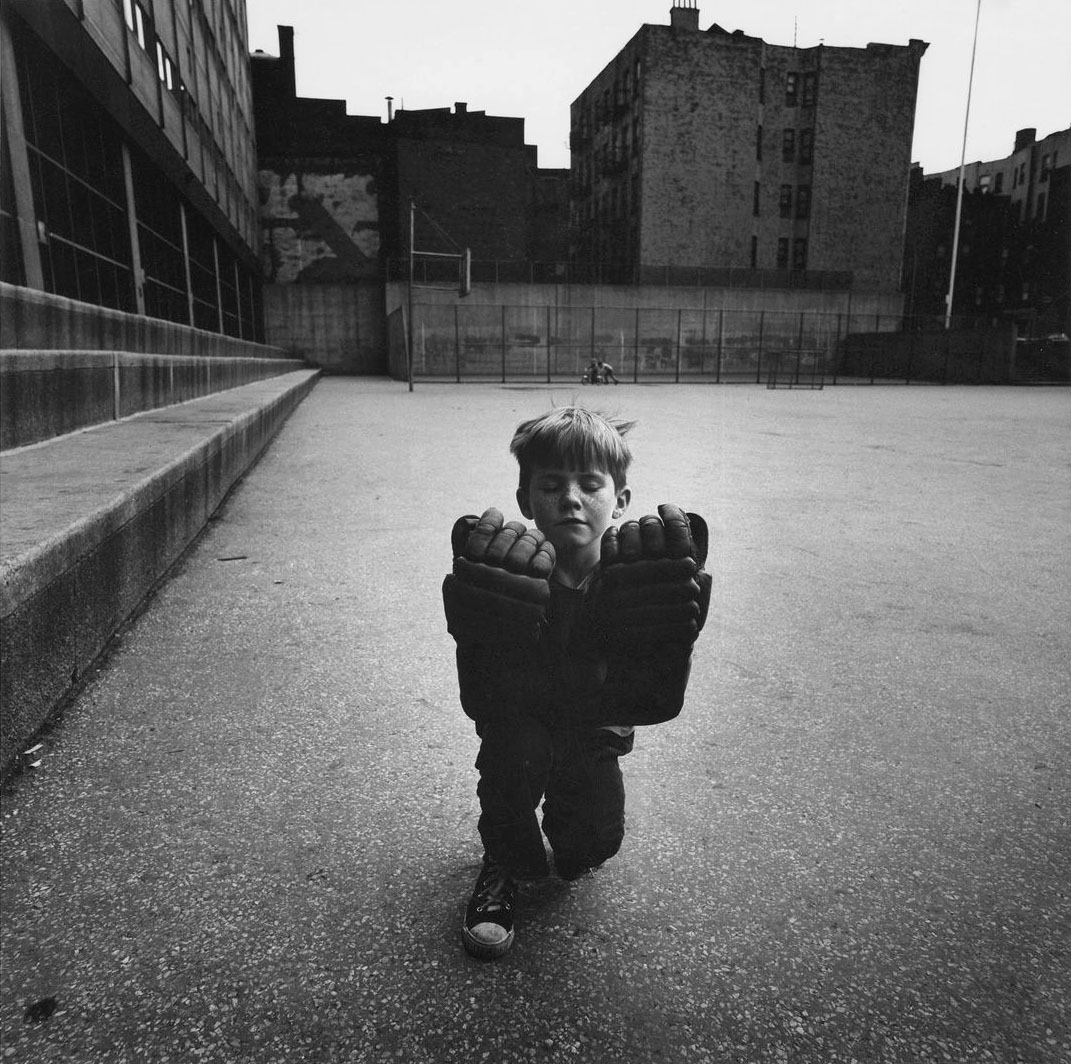
Arthur Tress (American, b. 1940) 'Boy with Hockey Gloves (Hockey Glove Fantasy)' 1968


Arthur Tress (American, b. 1940)
Boy with Hockey Gloves (Hockey Glove Fantasy)
1968
Gelatin silver print
© Arthur Tress Archive LLC


A Kind of Magic

Photographer Arthur Tress’s “shaman vision quest dream journey”

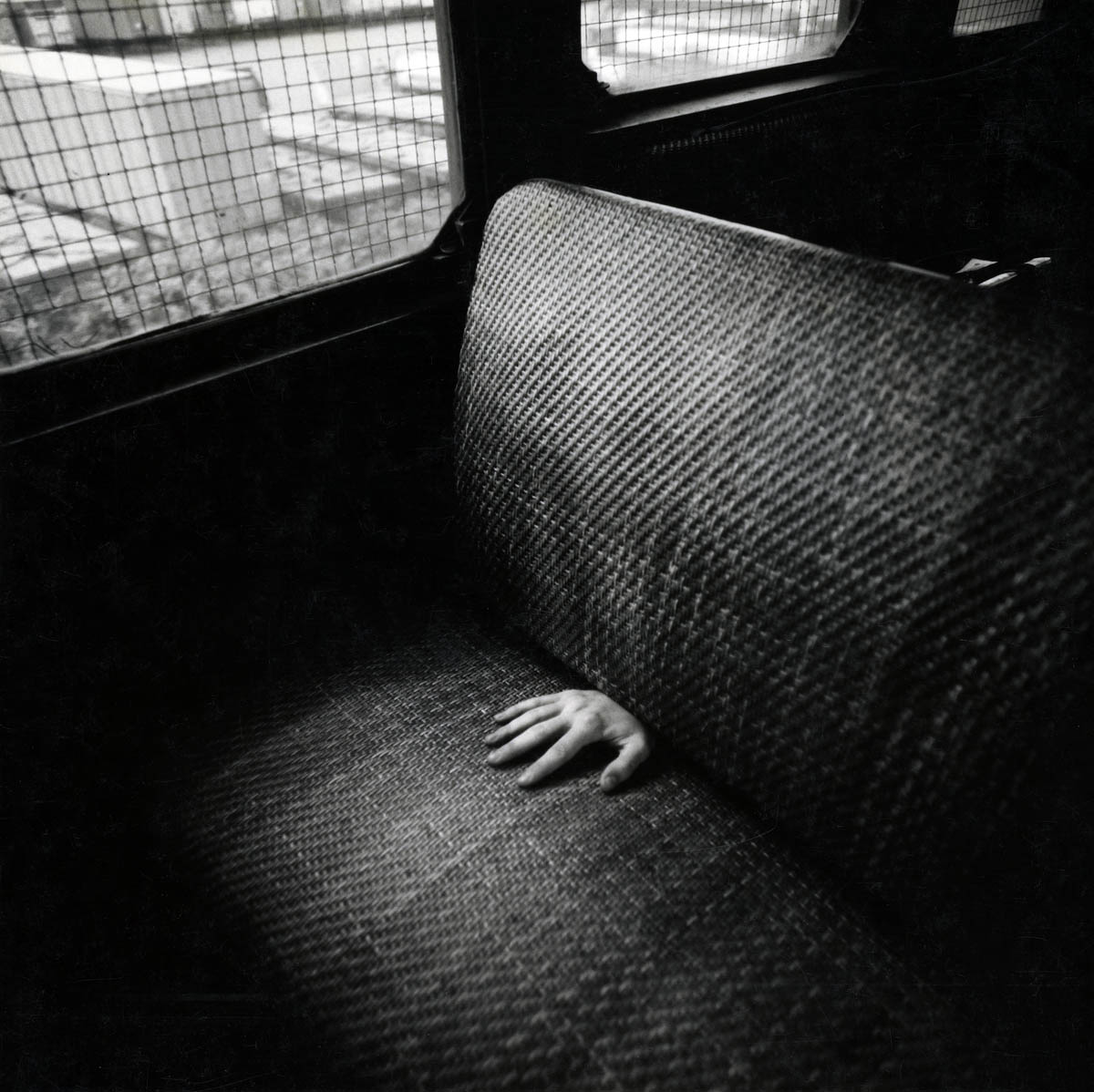
Photographer Arthur Tress revels in the weird and fantastic – a hand sticking out of a bus seat, boys blending in with trees, children and adults playing against backdrops of rubble and trash – dark, spooky, unnerving images.

Tress, who spent time in his early career as a documentary photographer and traveled widely, staged his photographs to set a mood and tell a story.

Tress is one of the foremost practitioners of staged photography. He’s well known for his surreal photobooks, especially The Dream Collector (1972), but his career began earlier, in the 1960s, with commercial projects that encouraged his artistic development and anticipated his later fantastical works.

Arthur Tress: Rambles, Dreams, and Shadows (out now from Getty) looks closely at the artist’s early career, from 1968 to 1978, from his travels abroad through his return to the United States, stopping in Sweden, Russia, Appalachia, New York, San Francisco, and many other places. The images and quotations below are drawn from the exhibition catalog and take you into his world.

Tress traveled to Appalachia several times early in his career, and he became increasingly passionate about accurately representing the character of the destitute yet beautiful region and its people. Photographs curator Mazie Harris writes that the twisted branches and lonely image reflect the region’s “barren future.”

In 1969 Tress photographed “the Ramble,” known as a gay cruising ground in New York’s Central Park. But he never published this work, says photographs curator James Ganz, “because doing so could have exposed the photographer and his subjects to embarrassment or harassment.” Even the act of taking these pictures was dangerous at the time. This body of work is a deeply personal, intimate expression and probing of Tress’s identity as a gay man and also reflects much about the culture of the time and the anxieties, fears, and longings experienced by members of his community.

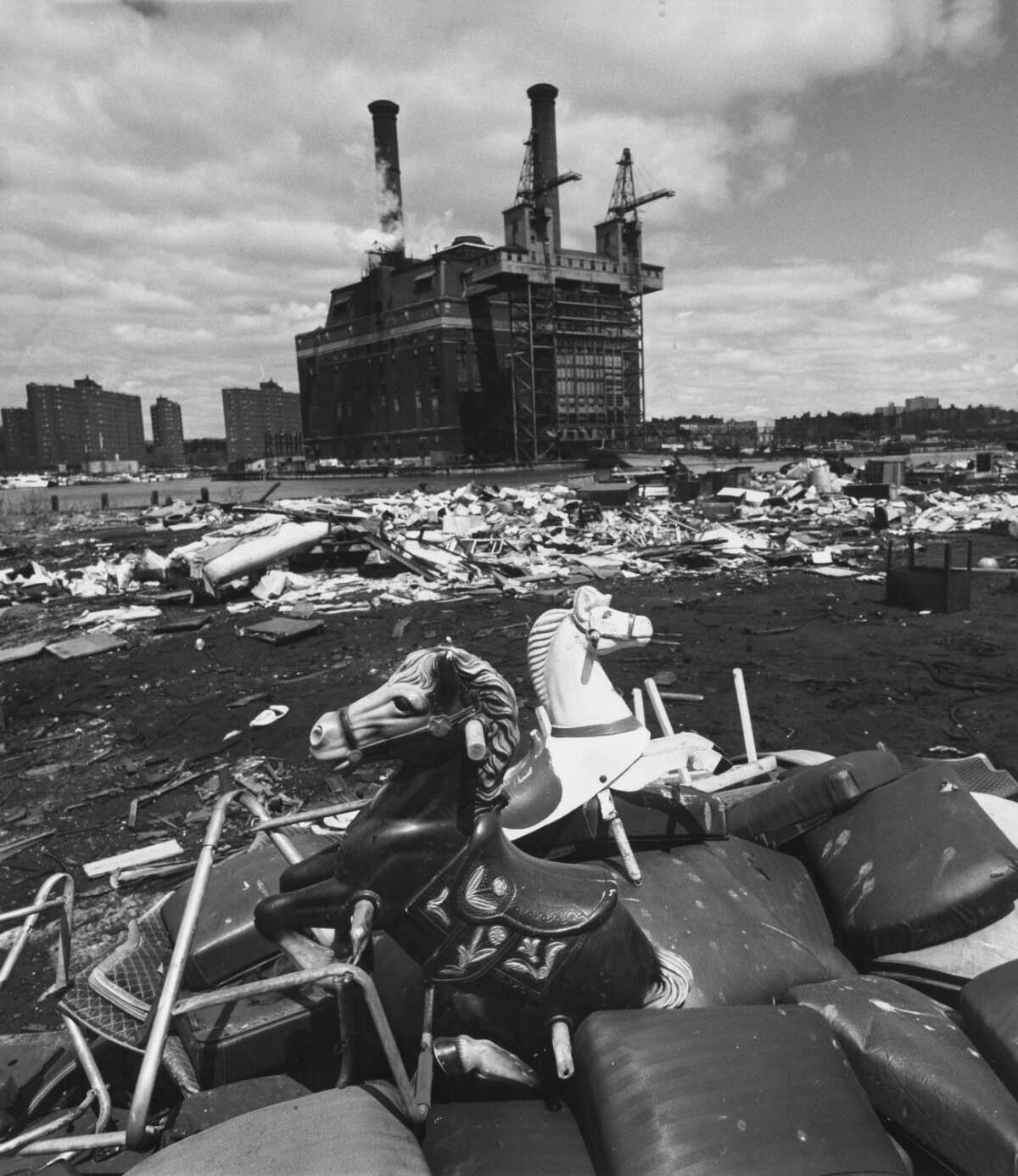
The image Hobby Horses, Harlem River, Bronx, New York (1970, below) is part of Tress’s series Open Space in the Inner City (1969-1971). It shows his environmentalism, which he cultivated throughout his travels, especially in his exploration of Appalachia. Having settled in New York after living in Sweden, Tress was shocked by the rampant urban blight and crowding in the city and how few open spaces there were for people to play, thrive, and live. His series helped bring attention to this widespread civic issue and was shown by institutions like the Sierra Club and the New York State Council on the Arts.

While Tress was at work on what would become his Dream Collector series, he sought the advice of famed children’s author Maurice Sendak, who is most widely known for the book Where the Wild Things Are. At the end of their visit, Tress offered Sendak the choice of one of Tress’s photographs, and Sendak picked Wild Man of the Forest, Central Park, New York (1969, below) which “evoke[s] the archetypal figure of the medieval wild man of the woods.”

Between 1972 and 1975 Tress created a series and photobook called Shadow. The work Shadow, Cannes, France (negative 1974; print 1975, below), featuring the artist and shadows cast by a sculpture of birds, appeared toward the end of the book in a section titled “Magic Flight.” Curator of photographs Paul Martineau says this picture – juxtaposed with other images of imprisoned shadows – symbolises freedom and “traces a mystical dream journey of an individual soul from the past to the present and into the future, through birth, death, and enlightenment.”

“[This] photograph of my father in a snowstorm is, in fact, a kind of surrogate self-portrait that mirrors my own hollow fearfulness about my own body’s decline and disappearance into a cold emptiness,” Tress wrote in a 2022 letter to curator Paul Martineau. [Last Portrait of My Father, New York, New York, 1978 below]

In 1970 Tress wrote about the magical properties of a photograph, and, surely, he is a visual magician, an artist possessed of a creative vision and intuition that allows him to connect to his subjects in a deep, revelatory way. Tress’s images pull you into his imagined, constructed worlds. His work is mysterious, surprising, surreal, and dreamlike. His images, the product of personal experiences and feelings, are universal in their play on and exploration of human fears, desires, and longings. He once described his series Shadow as a “shaman vision quest dream journey.”

Rachel Barth. “A Kind of Magic,” on the Getty website Nov 07, 2023 [Online] Cited 10/11/2023


Arthur Tress (American, b. 1940) 'My Face in Store Window, New York, New York' 1969


Arthur Tress (American, b. 1940)
My Face in Store Window, New York, New York
1969
Gelatin silver print
Collection David Knaus
© Arthur Tress Archive LLC


Arthur Tress (American, b. 1940) 'Cemetery, Queens, New York' 1969


Arthur Tress (American, b. 1940)
Cemetery, Queens, New York
1969
Gelatin silver print
J. Paul Getty Museum, Los Angeles
© Arthur Tress Archive LLC


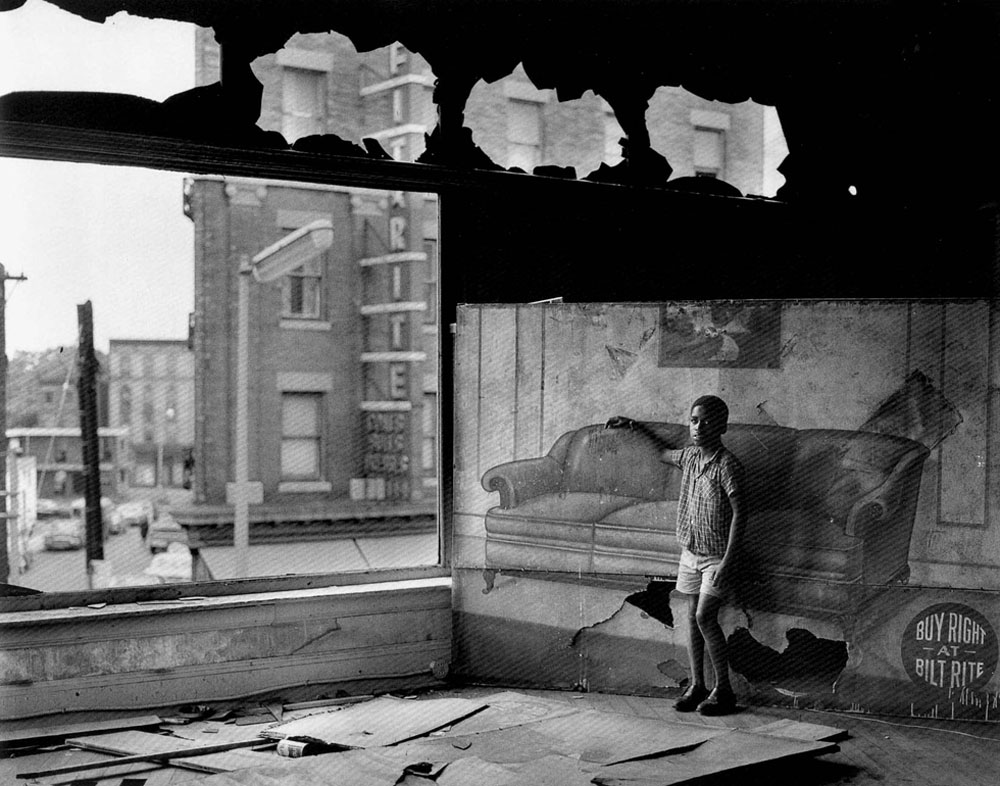
Arthur Tress (American, b. 1940) 'Boy in Burnt-Out Furniture Store, Newark, New Jersey' 1969


Arthur Tress (American, b. 1940)
Boy in Burnt-Out Furniture Store, Newark, New Jersey
1969
Gelatin silver print
© Arthur Tress Archive LLC


In July 1969, while photographing the site of the Newark race riots that had occurred two summers earlier, Tress wrote to his sister that the police took him in for questioning. “They could have arrested me for being in the abandoned buildings – so I was very polite to them.”

Wall label


Arthur Tress (American, b. 1940) 'Wild Man of the Forest, Central Park, New York' 1969


Arthur Tress (American, b. 1940)
Wild Man of the Forest, Central Park, New York
1969
Gelatin silver print
13 3/4 x 10 3/4 in.
J. Paul Getty Museum, Los Angeles
Gift of Trixy Castro
© Arthur Tress Archive LLC


While Tress was at work on what would become his Dream Collector series, he sought the advice of famed children’s author Maurice Sendak, who is most widely known for the book Where the Wild Things Are. At the end of their visit, Tress offered Sendak the choice of one of Tress’s photographs, and Sendak picked Wild Man of the Forest, Central Park, New York, which “evoke[s] the archetypal figure of the medieval wild man of the woods.”


Arthur Tress (American, b. 1940) 'Woman in Railroad Yard, Brooklyn, New York' 1969


Arthur Tress (American, b. 1940)
Woman in Railroad Yard, Brooklyn, New York
1969
From the series Open Space in the Inner City
Gelatin silver print
J. Paul Getty Museum, Los Angeles
Gift of David A. Cohen and Laurie K. Cohen
© Arthur Tress Archive LLC


Arthur Tress (American, b. 1940) 'Boy on Bike Crossing Williamsburg Bridge, New York' 1969


Arthur Tress (American, b. 1940)
Boy on Bike Crossing Williamsburg Bridge, New York
1969
From the series Open Space in the Inner City
Gelatin silver print
40.2 × 50cm (15 13/16 × 19 11/16 in.)
J. Paul Getty Museum, Los Angeles
Gift of Gregory V. Gooding
© Arthur Tress Archive LLC


Arthur Tress (American, b. 1940) 'Two Men Cruising, Central Park, New York' 1969


Arthur Tress (American, b. 1940)
Two Men Cruising, Central Park, New York
1969
From the series The Ramble
Gelatin silver print
Collection David Knaus
© Arthur Tress Archive LLC


Arthur Tress (American, b. 1940) 'Dog Walker, Central Park, New York' 1969, printed 2007


Arthur Tress (American, b. 1940)
Dog Walker, Central Park, New York
1969, printed 2007
From the series The Ramble
Gelatin silver print
Collection David Knaus
© Arthur Tress Archive LLC


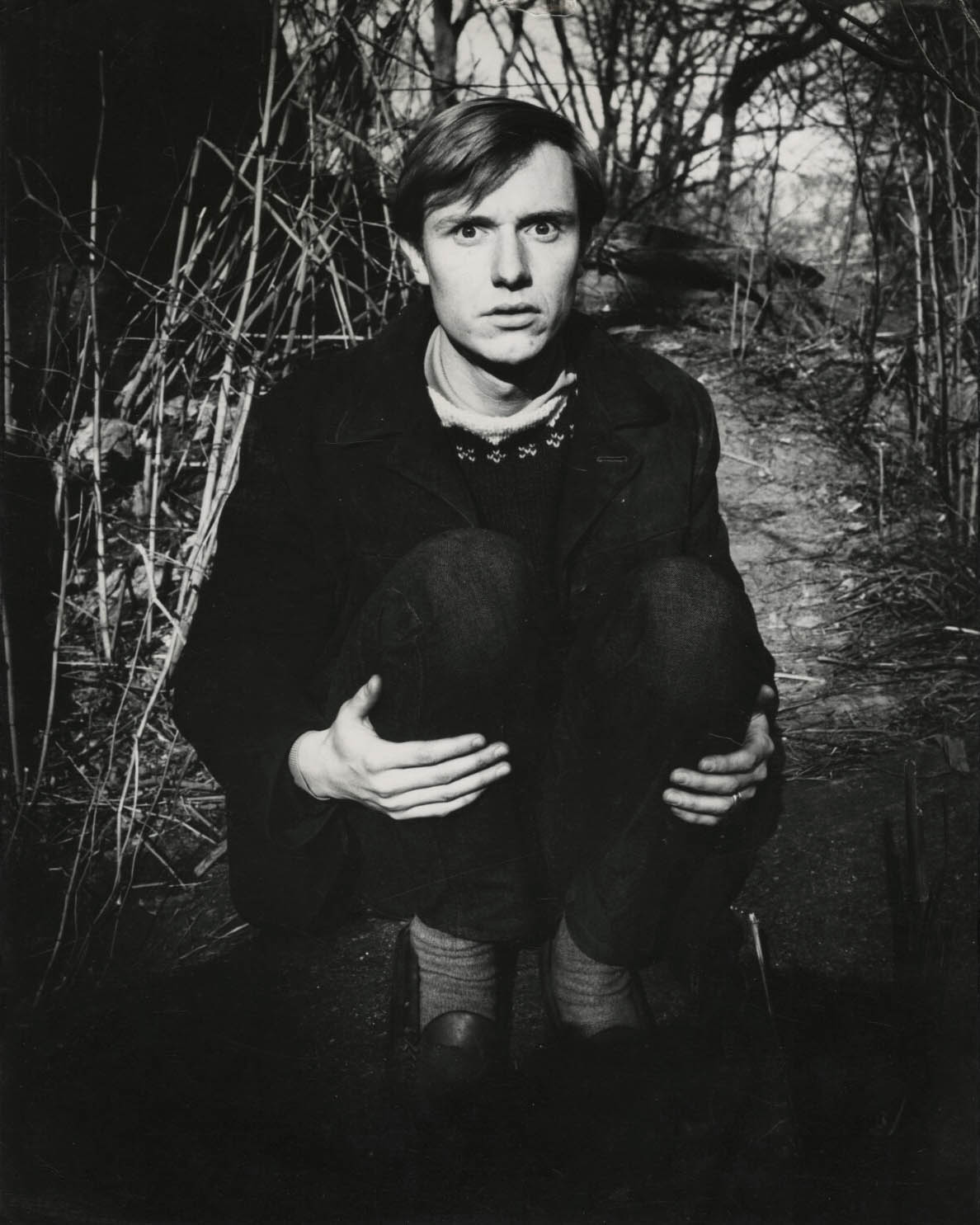
Arthur Tress (American, b. 1940) 'Young Man in Woods, Central Park, New York' 1969


Arthur Tress (American, b. 1940)
Young Man in Woods, Central Park, New York
1969
Gelatin silver print
9 3/4 x 7 3/4 in.
J. Paul Getty Museum, Los Angeles
© Arthur Tress Archive LLC


Arthur Tress (American, b. 1940) 'Boy in Central Park (Rambles), New York City' 1969


Arthur Tress (American, b. 1940)
Boy in Central Park (Rambles), New York City
1969
Gelatin silver print
© Arthur Tress Archive LLC


Arthur Tress (American, b. 1940) 'Gay Activists at First Gay Pride Parade, Christopher Street, New York' Negative 1970


Arthur Tress (American, b. 1940)
Gay Activists at First Gay Pride Parade, Christopher Street, New York
Negative 1970
Gelatin silver print
J. Paul Getty Museum, Los Angeles
© Arthur Tress Archive LLC


Arthur Tress (American, b. 1940) 'Bruce at Dawn, Paper Flower Maker, East Village, New York' 1970


Arthur Tress (American, b. 1940)
Bruce at Dawn, Paper Flower Maker, East Village, New York
1970
Gelatin silver print
J. Paul Getty Museum, Los Angeles
© Arthur Tress Archive LLC


Arthur Tress (American, b. 1940) 'Friends Playing Cards, Sheepshead Bay, Brooklyn, New York' 1970


Arthur Tress (American, b. 1940)
Friends Playing Cards, Sheepshead Bay, Brooklyn, New York
1970
Gelatin silver print
J. Paul Getty Museum, Los Angeles
© Arthur Tress Archive LLC


Arthur Tress (American, b. 1940) 'Boy with Root Hands, New York' 1970


Arthur Tress (American, b. 1940)
Boy with Root Hands, New York
1970
From the series Dream Collector
Gelatin silver print
J. Paul Getty Museum, Los Angeles
© Arthur Tress Archive LLC


Arthur Tress (American, b. 1940) 'Teenage Boys, Bronx High School of Science, Bronx, New York' 1970, printed later


Arthur Tress (American, b. 1940)
Teenage Boys, Bronx High School of Science, Bronx, New York
1970, printed later
From the series Open Space in the Inner City
Gelatin silver print
J. Paul Getty Museum, Los Angeles
Gift of Jon and Ellen Vein Family
© Arthur Tress Archive LLC


Arthur Tress (American, b. 1940) 'Hobby Horses, Harlem River, Bronx, New York' 1970


Arthur Tress (American, b. 1940)
Hobby Horses, Harlem River, Bronx, New York
1970
Gelatin silver print
8 7/8 x 7 13/16 in.
J. Paul Getty Museum, Los Angeles
Gift of J. Patrick and Patricia A. Kennedy
© Arthur Tress Archive LLC


The above image is part of Tress’s series Open Space in the Inner City (1969-1971). It shows his environmentalism, which he cultivated throughout his travels, especially in his exploration of Appalachia. Having settled in New York after living in Sweden, Tress was shocked by the rampant urban blight and crowding in the city and how few open spaces there were for people to play, thrive, and live. His series helped bring attention to this widespread civic issue and was shown by institutions like the Sierra Club and the New York State Council on the Arts.


Arthur Tress (American, b. 1940) 'Boy with Basketball, Bronx, New York' 1970


Arthur Tress (American, b. 1940)
Boy with Basketball, Bronx, New York
1970
From the series The Dream Collector
Gelatin silver print
34 × 26.6cm (13 3/8 × 10 1/2 in.)
J. Paul Getty Museum, Los Angeles
© Arthur Tress Archive LLC


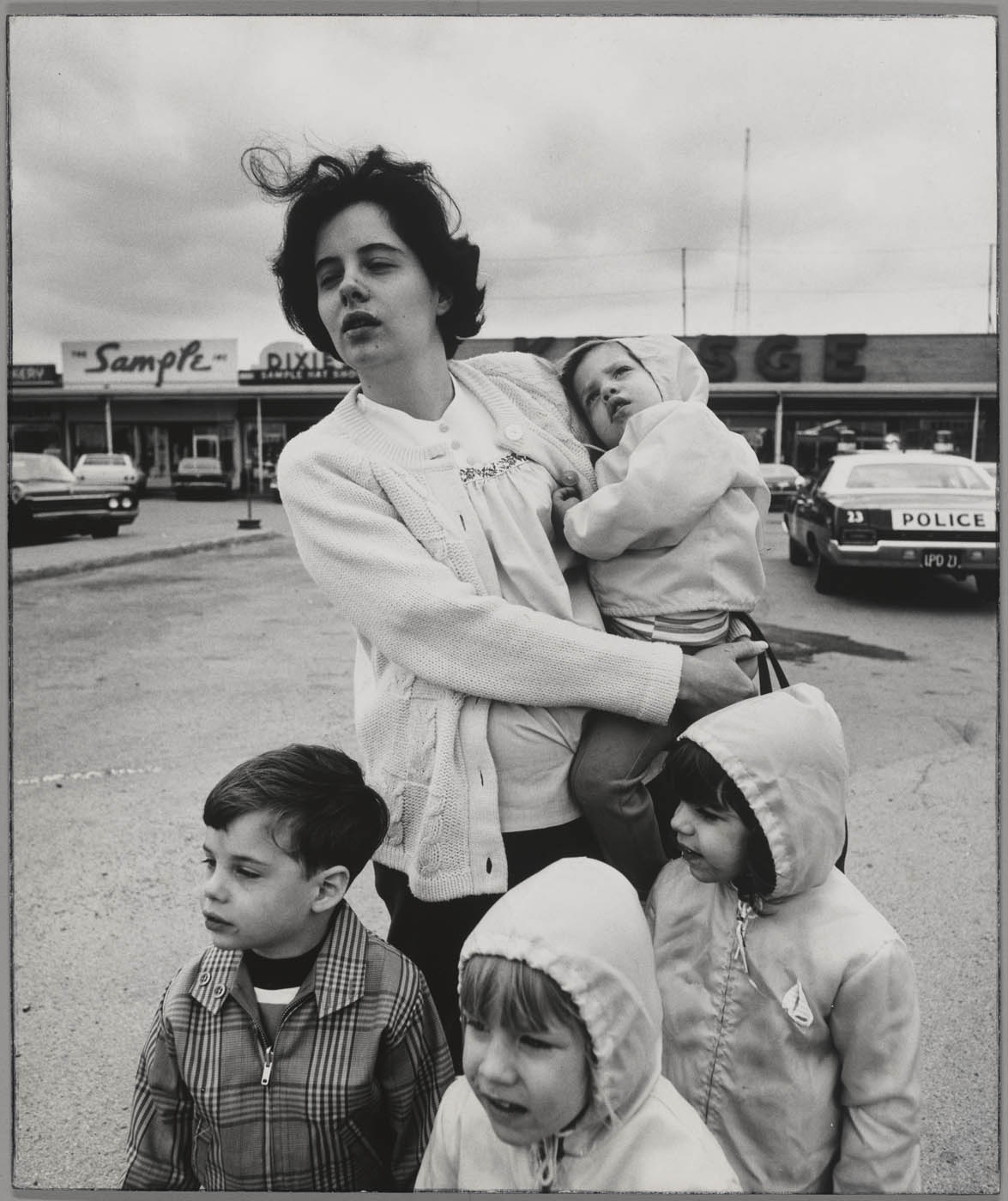
Arthur Tress (American, b. 1940) 'Woman in Shopping Center Parking Lot, Lackawanna, New York' 1970


Arthur Tress (American, b. 1940)
Woman in Shopping Center Parking Lot, Lackawanna, New York
1970
From the series Open Space in the Inner City
Gelatin silver print
23.3 × 19.6cm (9 3/16 × 7 11/16 in.)
J. Paul Getty Museum, Los Angeles
Gift of J. Patrick and Patricia A. Kennedy
© Arthur Tress Archive LLC


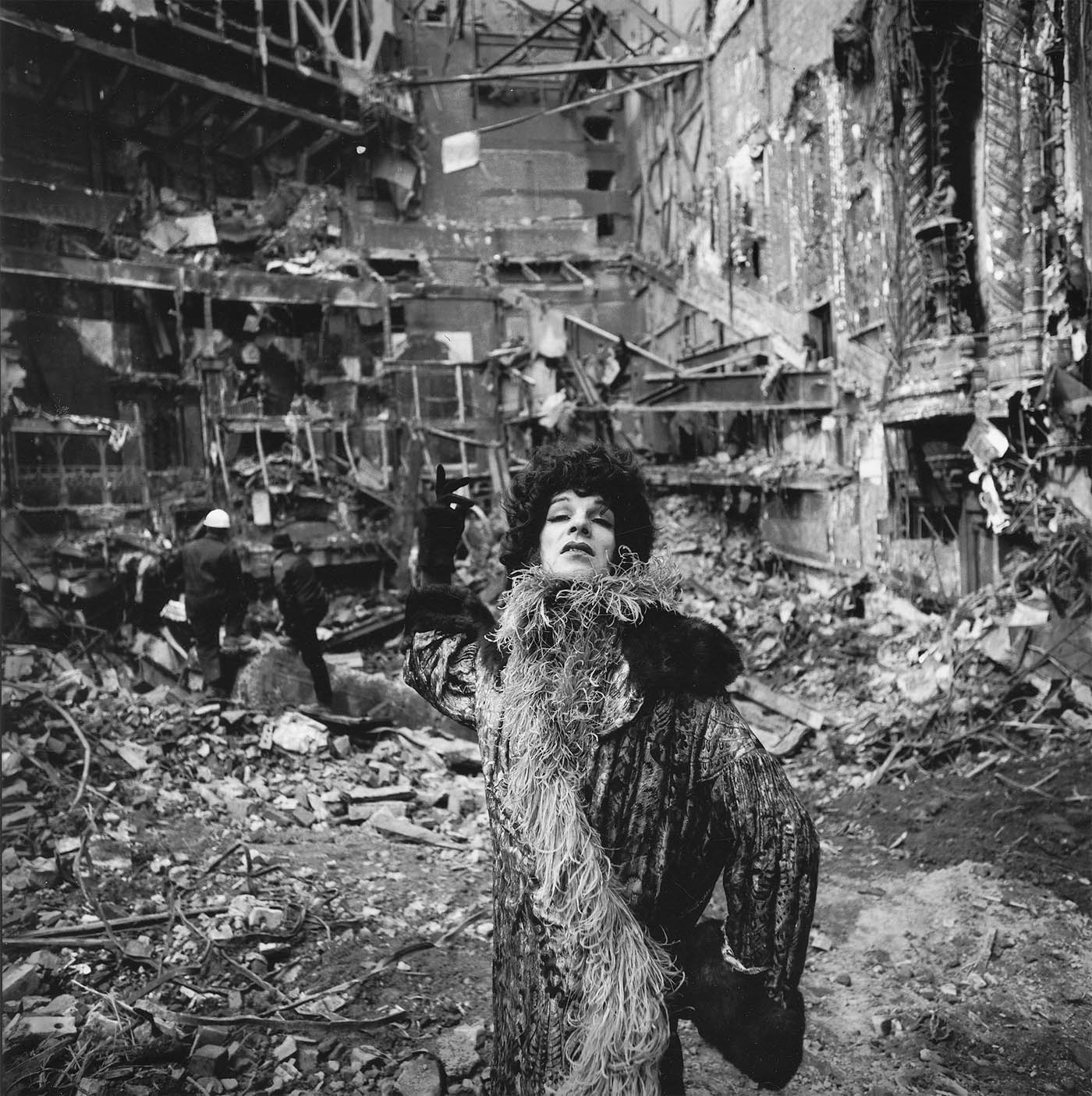
Arthur Tress (American, b. 1940) 'Minette as Gloria Swanson in Ruins of Fox Theater, Brooklyn, New York' 1971


Arthur Tress (American, b. 1940)
Minette as Gloria Swanson in Ruins of Fox Theater, Brooklyn, New York
1971
Gelatin silver print
J. Paul Getty Museum, Los Angeles
© Arthur Tress Archive LLC


Arthur Tress (American, b. 1940) 'Boy in Tin Cone, Bronx, New York' 1972


Arthur Tress (American, b. 1940)
Boy in Tin Cone, Bronx, New York
1972
From the series The Dream Collector
Gelatin silver print
J. Paul Getty Museum, Los Angeles
© Arthur Tress Archive LLC


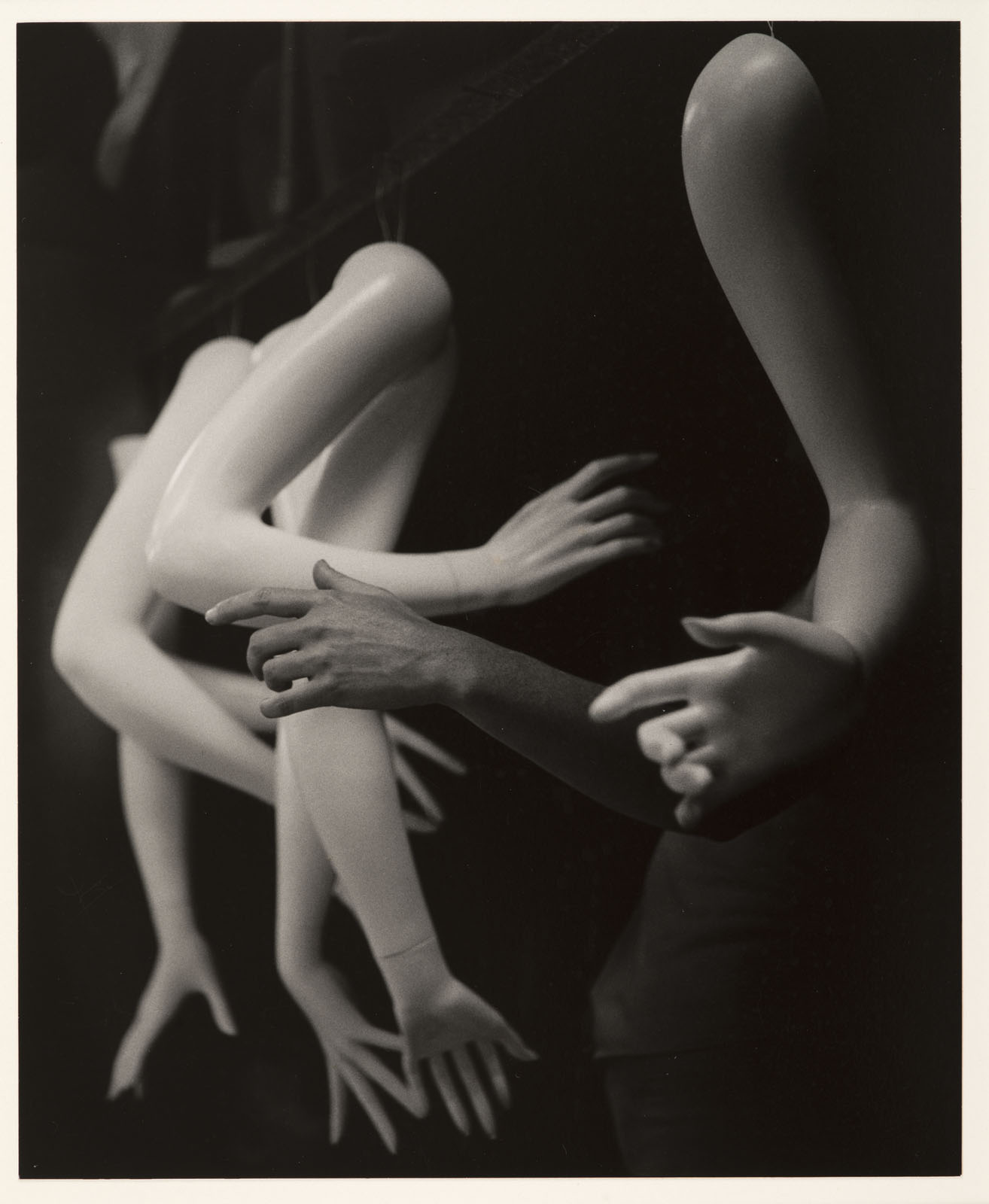
Arthur Tress (American, b. 1940) 'Hand on Train, Staten Island, New York' 1972


Arthur Tress (American, b. 1940)
Hand on Train, Staten Island, New York
1972
From the series The Dream Collector
Gelatin silver print
J. Paul Getty Museum, Los Angeles
© Arthur Tress Archive LLC


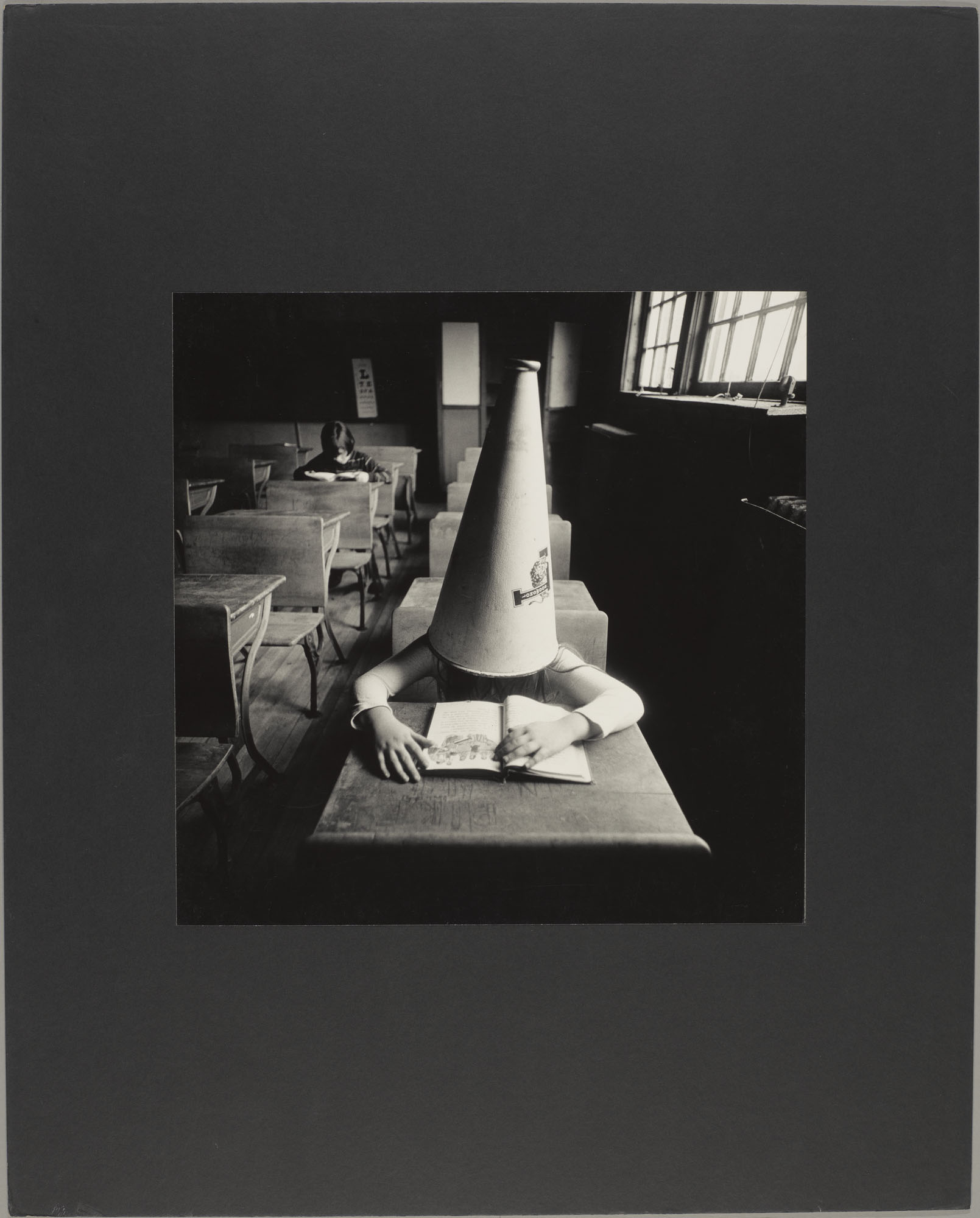
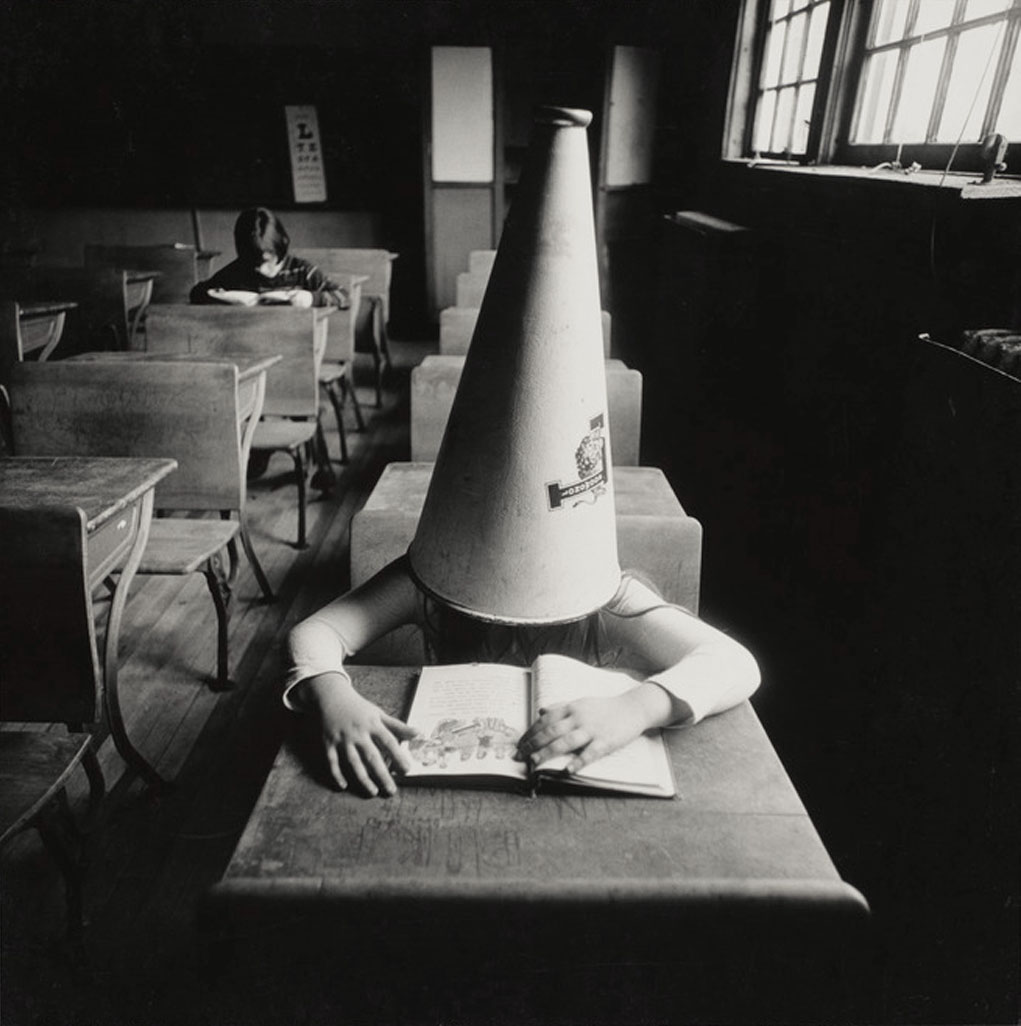
Arthur Tress (American, b. 1940) 'Girl With Dunce Cap, P.S. 3, New York, New York' 1972 (installation view)


Arthur Tress (American, b. 1940)
Girl With Dunce Cap, P.S. 3, New York, New York
1972
From the series The Dream Collector
Gelatin silver print
26.4 × 26.4cm (10 3/8 × 10 3/8 in.)
J. Paul Getty Museum, Los Angeles
© Arthur Tress Archive LLC


Arthur Tress (American, b. 1940) 'Girl With Dunce Cap, P.S. 3, New York, New York' 1972


Arthur Tress (American, b. 1940)
Girl With Dunce Cap, P.S. 3, New York, New York
1972
From the series The Dream Collector
Gelatin silver print
26.4 × 26.4cm (10 3/8 × 10 3/8 in.)
J. Paul Getty Museum, Los Angeles
© Arthur Tress Archive LLC


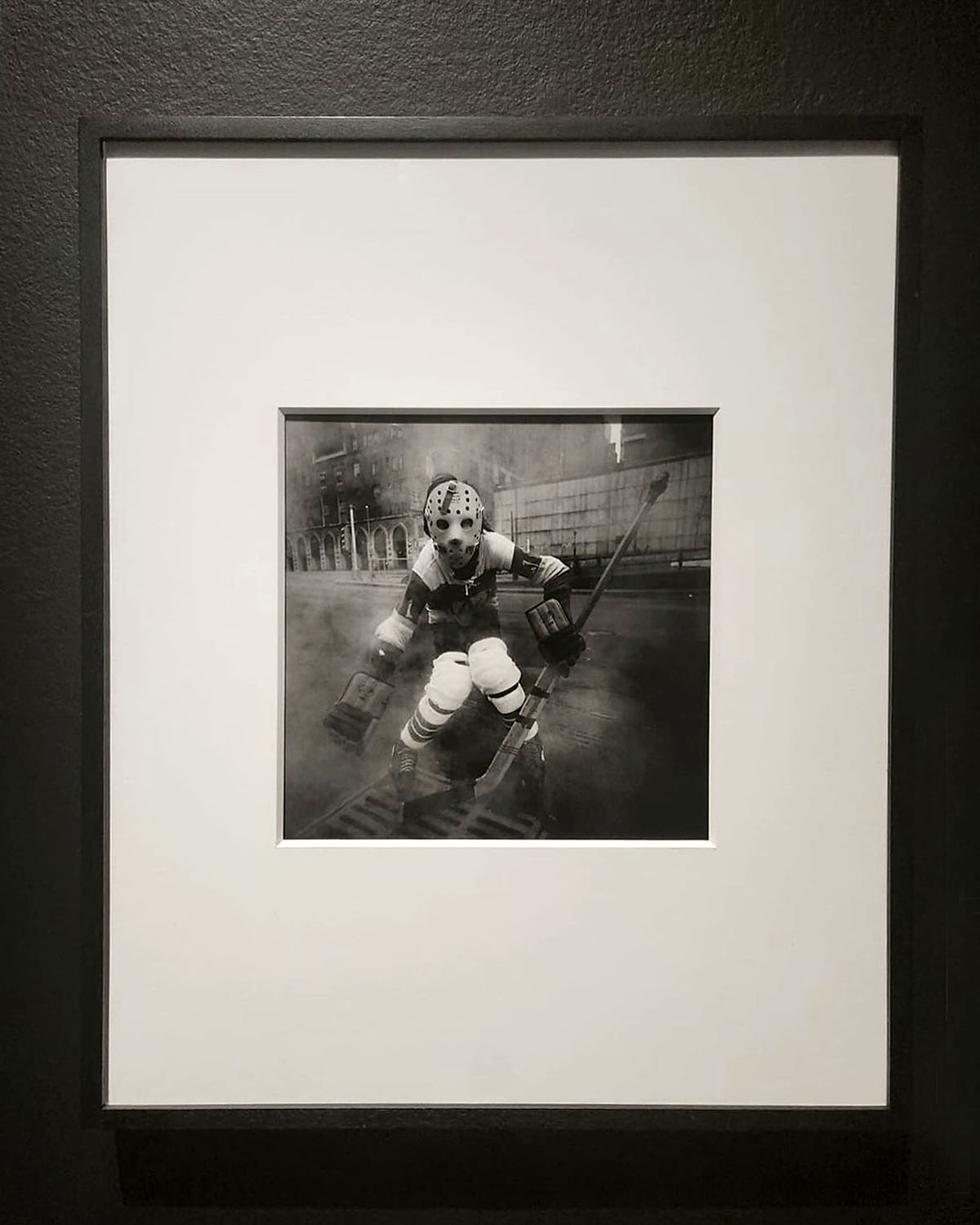
Installation view of the exhibition Arthur Tress: Rambles, Dreams, and Shadows at the J. Paul Getty Museum, Los Angeles showing 'Hockey Player, New York' (1972)


Installation view of the exhibition Arthur Tress: Rambles, Dreams, and Shadows at the J. Paul Getty Museum, Los Angeles showing Hockey Player, New York (1972, below)


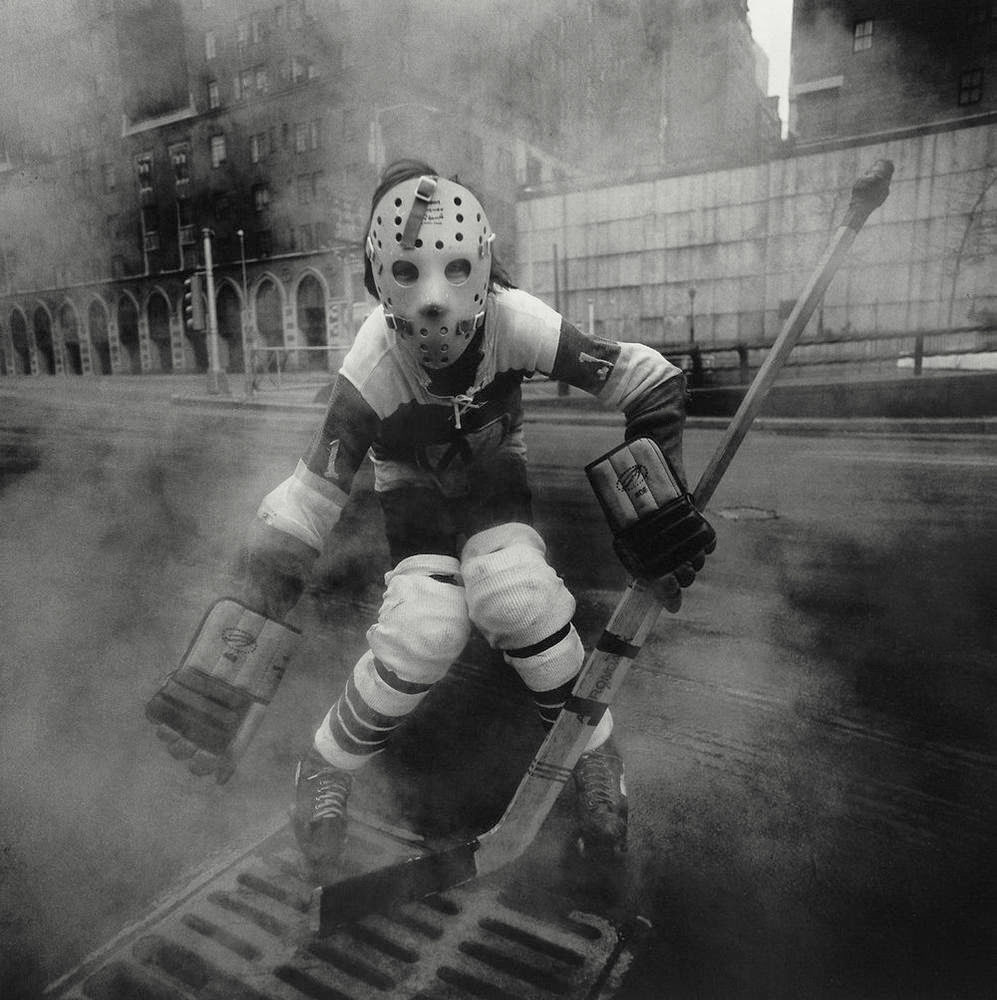
Arthur Tress (American, b. 1940) 'Hockey Player, New York' 1972


Arthur Tress (American, b. 1940)
Hockey Player, New York
1972
Gelatin silver print
© Arthur Tress Archive LLC


Arthur Tress (American, b. 1940) 'Shadow, Cannes, France' Negative 1974; print 1975


Arthur Tress (American, b. 1940)
Shadow, Cannes, France
Negative 1974; print 1975
Gelatin silver print,
19.4 × 19.2cm (7 5/8 × 7 9/16 in.)
J. Paul Getty Museum, Los Angeles
Gift of John V. and Laure M. Knaus
© Arthur Tress Archive LLC


Between 1972 and 1975 Tress created a series and photobook called Shadow. The above work, featuring the artist and shadows cast by a sculpture of birds, appeared toward the end of the book in a section titled “Magic Flight.” Curator of photographs Paul Martineau says this picture – juxtaposed with other images of imprisoned shadows – symbolises freedom and “traces a mystical dream journey of an individual soul from the past to the present and into the future, through birth, death, and enlightenment.”


Arthur Tress (American, b. 1940) 'Dream Therapist, Harold Ellis, New York, New York' 1975


Arthur Tress (American, b. 1940)
Dream Therapist, Harold Ellis, New York, New York
1975
Gelatin silver print
J. Paul Getty Museum, Los Angeles
© Arthur Tress Archive LLC


Arthur Tress (American, b. 1940) 'Girl Running Away from Dinosaur, Santa Cruz, CA' Nd


Arthur Tress (American, b. 1940)
Girl Running Away from Dinosaur, Santa Cruz, CA
Nd
Gelatin silver print
© Arthur Tress Archive LLC


Arthur Tress (American, b. 1940) 'Last Portrait of My Father, New York, New York' 1978


Arthur Tress (American, b. 1940)
Last Portrait of My Father, New York, New York
1978
Gelatin silver print
15 1/8 x 14 7/8 in.
Collection of David Knaus
© Arthur Tress Archive LLC


“[This] photograph of my father in a snowstorm is, in fact, a kind of surrogate self-portrait that mirrors my own hollow fearfulness about my own body’s decline and disappearance into a cold emptiness,” Tress wrote in a 2022 letter to curator Paul Martineau.

In 1970 Tress wrote about the magical properties of a photograph, and, surely, he is a visual magician, an artist possessed of a creative vision and intuition that allows him to connect to his subjects in a deep, revelatory way. Tress’s images pull you into his imagined, constructed worlds. His work is mysterious, surprising, surreal, and dreamlike. His images, the product of personal experiences and feelings, are universal in their play on and exploration of human fears, desires, and longings. He once described his series Shadow as a “shaman vision quest dream journey.”

Rachel Barth. “A Kind of Magic,” on the Getty website Nov 07, 2023 [Online] Cited 10/11/2023


Installation view of the exhibition 'Arthur Tress: Rambles, Dreams, and Shadows' at the J. Paul Getty Museum, Los Angeles showing the work 'Bride and Groom, New York, New York' 1970


Installation view of the exhibition Arthur Tress: Rambles, Dreams, and Shadows at the J. Paul Getty Museum, Los Angeles showing the work Bride and Groom, New York, New York 1970 (below)


Arthur Tress (American, b. 1940) 'Bride and Groom, New York, New York' 1970


Arthur Tress (American, b. 1940)
Bride and Groom, New York, New York
1970
From the series Theater of the Mind
Gelatin silver print
41.7 × 40.2cm (16 7/16 × 15 13/16 in.)
J. Paul Getty Museum, Los Angeles
Gift of Gregory V. Gooding
© Arthur Tress Archive LLC


Arthur Tress (American, b. 1940) 'Hermaphrodite between Venus and Mercury, East Hampton, New York' 1973


Arthur Tress (American, b. 1940)
Hermaphrodite between Venus and Mercury, East Hampton, New York
1973
Gelatin silver print
© Arthur Tress Archive LLC

Used under fair use conditions for the purpose of education, research, review and comment


Arthur Tress (American, b. 1940) 'Self-Portrait with Lobster, Bar Harbor, Maine' 1974


Arthur Tress (American, b. 1940)
Self-Portrait with Lobster, Bar Harbor, Maine
1974
Gelatin silver print
17.7 x 17.7cm
Collection of the artist


Arthur Tress (American, b. 1940) 'Boot Fantasy, New York' 1977


Arthur Tress (American, b. 1940)
Boot Fantasy, New York
1977
Gelatin silver print
26 x 26cm
J. Paul Getty Museum, Los Angeles
Gift of David Knaus


Arthur Tress (American, b. 1940) 'Superman Fantasy' 1977


Arthur Tress (American, b. 1940)
Superman Fantasy
1977
Gelatin silver print
© Arthur Tress Archive LLC

Used under fair use conditions for the purpose of education, research, review and comment


Arthur Tress (American, b. 1940) 'Drill Fantasy' 1977


Arthur Tress (American, b. 1940)
Drill Fantasy
1977
Gelatin silver print
© Arthur Tress Archive LLC

Used under fair use conditions for the purpose of education, research, review and comment


Arthur Tress (American, b. 1940) 'Two Men, Two Rooms' 1977


Arthur Tress (American, b. 1940)
Two Men, Two Rooms
1977
Gelatin silver print
© Arthur Tress Archive LLC

Used under fair use conditions for the purpose of education, research, review and comment


Arthur Tress (American, b. 1940) 'Band-aid Fantasy' 1978


Arthur Tress (American, b. 1940)
Band-aid Fantasy
1978
Gelatin silver print
© Arthur Tress Archive LLC

Used under fair use conditions for the purpose of education, research, review and comment


Arthur Tress (American, b. 1940) 'Lumberjack Fantasy' 1980


Arthur Tress (American, b. 1940)
Lumberjack Fantasy
1980
Gelatin silver print
© Arthur Tress Archive LLC

Used under fair use conditions for the purpose of education, research, review and comment


Arthur Tress (American, b. 1940) 'Two Surfers, Ft. Lauderdale' 1980


Arthur Tress (American, b. 1940)
Two Surfers, Ft. Lauderdale
1980
Gelatin silver print
J. Paul Getty Museum, Los Angeles
© Arthur Tress Archive LLC


Arthur Tress (American, b. 1940) 'Child's Dream of Redwood Monster, Santa Cruz, California' 1971


Arthur Tress (American, b. 1940)
Child’s Dream of Redwood Monster, Santa Cruz, California
1971
From the series The Dream Collector
Gelatin silver print
J. Paul Getty Museum, Los Angeles
© Arthur Tress Archive LLC


'Arthur Tress: Rambles, Dreams, and Shadows' book Edited by James A. Ganz


Child’s Dream of Redwood Monster, Santa Cruz, CA, 1971 on the cover


Arthur Tress: Rambles, Dreams, and Shadows book

Edited by James A. Ganz, with contributions by Mazie M. Harris and Paul Martineau

This richly illustrated volume is the first critical look at the early career of Arthur Tress, a key proponent of magical realism and staged photography.

Arthur Tress (b. 1940) is a singular figure in the landscape of postwar American photography. His seminal series, The Dream Collector, depicts Tress’s interests in dreams, nightmares, fantasies, and the unconscious and established him as one of the foremost proponents of magical realism at a time when few others were doing staged photography.

This volume presents the first critical look at Tress’s early career, contextualising the highly imaginative, fantastic work he became known for while also examining his other interrelated series: Appalachia: People and Places; Open Space in the Inner City; Shadow; and Theater of the Mind. James A. Ganz, Mazie M. Harris, and Paul Martineau plumb Tress’s work and archives, studying ephemera, personal correspondence, unpublished notes, diaries, contact sheets, and more to uncover how he went from earning his living as a social documentarian in Appalachia to producing surreal work of “imaginative fiction.” This abundantly illustrated volume imparts a fuller understanding of Tress’s career and the New York photographic scene of the 1960s and 1970s.

This volume is published to accompany an exhibition on view at the J. Paul Getty Museum at the Getty Center from October 31, 2023, to February 18, 2024.

James A. Ganz is senior curator in the Department of Photographs at the J. Paul Getty Museum.

“Along with several others of his cohort, Arthur Tress spearheaded the resurgence of the directorial mode in the 1970s, as well as his generation’s engagement with previously taboo subject matter. With his unique blend of documentary and surrealist approaches, he has made a major contribution to his medium.”

~ A. D. Coleman, photography critic and historian

264 pages
9 1/2 x 11 inches
17 color and 198 b/w illustrations
ISBN 978-1-60606-861-8
hardcover

Getty Publications
Imprint: J. Paul Getty Museum


Arthur Tress book cover


Arthur Tress: Rambles, Dreams, and Shadows book cover


Tress Rambles pp. 30-31


Arthur Tress: Rambles, Dreams, and Shadows pp. 30-31


Tress Rambles pp. 40-41


Arthur Tress: Rambles, Dreams, and Shadows pp. 40-41


Tress Rambles pp. 82-83


Arthur Tress: Rambles, Dreams, and Shadows pp. 82-83


The J. Paul Getty Museum
1200 Getty Center Drive
Los Angeles, California 90049

Opening hours:
Daily 10am – 5pm

The J. Paul Getty Museum website

LIKE ART BLACK ON FACEBOOK

Back to top

Exhibition: ‘Dawoud Bey & Carrie Mae Weems: In Dialogue’ at the J. Paul Getty Museum, Los Angeles

Exhibition dates: 4th April – 9th July, 2023


Dawoud Bey (American, b. 1953) 'Two Women at a Parade' 1978 from the exhibition 'Dawoud Bey & Carrie Mae Weems: In Dialogue' at the J. Paul Getty Museum, Los Angeles, April-  July, 2023


Dawoud Bey (American, b. 1953)
Two Women at a Parade
1978
Gelatin silver print
Grand Rapids Art Museum, Michigan Museum purchase
© Dawoud Bey
Courtesy of Stephen Daiter Gallery


Engaging each other in light

Dialogue: Old English dialogas (plural), from Latin from Greek dialogos, from dia ‘through’ + logos ‘word’

“As we define it, dialogue is “a communicative process in which people with different perspectives seek understanding.” To be in dialogue means that participants are not only engaging each other in light of their different views, but they are also striving to achieve a degree of mutual understanding.”

Jason Combs. “What is Dialogue?” on the University of Dayton website Monday October 28, 2019 [Online] Cited 01/07/2023


Short and sweet because I’m not feeling well.

What an inspired pairing for an exhibition. “Each [artist] addresses race, class, representation, and systems of power in their work, creating photographic series grounded in Black history and realities that speak to the human condition.”

From street-based photographs of everyday life to conceptual excavations of Black Histories, they produce incisive thought provoking works “that intermingle past and present, referenc[ing] African Americans whose lives and stories have been co-opted or lost.”

I love them both for their commitment to and passion for life in all its different forms. Bringing people together. Expressing a degree of mutual understanding.

#BlackLivesMatter #AllLivesMatter

Dr Marcus Bunyan


Many thankx to the J. Paul Getty Museum for allowing me to publish the photographs in the posting. Please click on the photographs for a larger version of the image.


Dawoud Bey and Carrie Mae Weems have been friends and colleagues for more than 40 years. Each addresses race, class, representation, and systems of power in their work, creating photographic series grounded in Black history and realities that speak to the human condition. This exhibition sheds light on their unique trajectories and modes of presentation, and their shared consciousness and principles. Organised by the Grand Rapids Art Museum.


Dawoud Bey (American, b. 1953) 'The Woman in the Light, Harlem, NY' 1980 from the exhibition 'Dawoud Bey & Carrie Mae Weems: In Dialogue' at the J. Paul Getty Museum, Los Angeles, April-  July, 2023


Dawoud Bey (American, b. 1953)
The Woman in the Light, Harlem, NY
1980
Gelatin silver print
© Dawoud Bey
Courtesy of Stephen Daiter Gallery


Dawoud Bey (American, b. 1953) 'Self and Shadow, New York, NY' 1980 from the exhibition 'Dawoud Bey & Carrie Mae Weems: In Dialogue' at the J. Paul Getty Museum, Los Angeles, April-  July, 2023


Dawoud Bey (American, b. 1953)
Self and Shadow, New York, NY
1980
Gelatin silver print
© Dawoud Bey
Courtesy of Stephen Daiter Gallery


Dawoud Bey (American, b. 1953) 'A Young Man Resting on an Exercise Bike, Amityville, NY' 1988


Dawoud Bey (American, b. 1953)
A Young Man Resting on an Exercise Bike, Amityville, NY
1988
Gelatin silver print
© Dawoud Bey
Courtesy of Stephen Daiter Gallery


Dawoud Bey (American, b. 1953) 'Couple in Prospect Park, Brooklyn, NY' 1990


Dawoud Bey (American, b. 1953)
Couple in Prospect Park, Brooklyn, NY
1990
Gelatin silver print Getty Museum
© Dawoud Bey


In 1976 I had been making photographs for a couple of years. I had certainly been looking at a lot more photographs than I had actually made. From looking at photographs in books and magazines and going to exhibitions of pictures by Mike Disfarmer at MoMA, Richard Avedon at Marlborough, and haunting whatever other places there were to see photographs in New York in the early 1970s, I had begun to educate myself, with the intent of adding something to the conversation through my own pictures.

The artist Janet Henry, who was from the same Jamaica, Queens neighborhood that I lived in, had gotten a job in the Education Department at the Studio Museum in Harlem, then located above a Kentucky Fried Chicken on 125th Street and Fifth Avenue in a large second floor loft space. When Frank Stewart, the museum’s staff photographer and photo teacher, left to do a commissioned project in Cuba, Janet called me and asked if I would take over the class. On the first day of class a few students straggled in. One of them, a seemingly shy woman with big expressive eyes, introduced herself, “Hi, my name is Carrie. Do you think I could be a photographer?” she asked, holding her Leica camera in her hand. That began what has now been 33 years of friendship and camaraderie with one of the most brilliant people I know.

From the very beginning, Carrie Mae Weems has had a sharp intelligence that was looking for a way into the world. From her early documentary photographs to the more expansive and materially varied recent works, she has consistently set out to visually define the world on her own terms and to redefine for all of us the nature of the world that we are in. After all these years I still anticipate her work with a fresh sense of wonderment, knowing that her restless search for the deeper meaning of things will yield a continuing rich trove of objects and images. On a Sunday morning in May I called from my home in Chicago to reconnect with my dear friend while she was traveling in Seville, Spain.

Dawoud Bey quoted in “Carrie Mae Weems by Dawoud Bey,” on the BOMB Magazine website July 1, 2009 [Online] Cited 18/06/2023


Dawoud Bey (American, b. 1953) 'Taneesha' 1999


Dawoud Bey (American, b. 1953)
Taneesha
1999
Dye diffusion prints
Collection of Jack and Sandra Guthman
© Dawoud Bey
Courtesy of Stephen Daiter Gallery


Dawoud Bey (American, b. 1953) 'The Birmingham Project: Wallace Simmons and Eric Allums' 2012


Dawoud Bey (American, b. 1953)
The Birmingham Project: Wallace Simmons and Eric Allums
2012
Inkjet prints
Rennie Collection, Vancouver
© Dawoud Bey
Courtesy of Stephen Daiter Gallery


Dawoud Bey (American, b. 1953) 'The Birmingham Project: Taylor Falls and Deborah Hackworth' 2012


Dawoud Bey (American, b. 1953)
The Birmingham Project: Taylor Falls and Deborah Hackworth
2012
Inkjet prints
Rennie Collection, Vancouver
© Dawoud Bey
Courtesy of Stephen Daiter Gallery


Dawoud Bey (American, b. 1953) 'Braxton McKinney and Lavone Thomas, Birmingham, AL' 2012


Dawoud Bey (American, b. 1953)
The Birmingham Project: Braxton McKinney and Lavone Thomas
2012
Inkjet prints
Rennie Collection, Vancouver
© Dawoud Bey
Courtesy of Stephen Daiter Gallery


Dawoud Bey (American, b. 1953) 'Betty Selvage and Faith Speights, Birmingham, AL' 2012


Dawoud Bey (American, b. 1953)
The Birmingham Project: Betty Selvage and Faith Speights
2012
Inkjet prints
Rennie Collection, Vancouver
© Dawoud Bey
Courtesy of Stephen Daiter Gallery


Dawoud Bey (American, b. 1953) 'Boy on Skateboard, Harlem, NY' 2014


Dawoud Bey (American, b. 1953)
Boy on Skateboard, Harlem, NY
2014
Inkjet print
© Dawoud Bey
Courtesy of Stephen Daiter Gallery


Dawoud Bey (American, b. 1953) 'Former Renaissance Ballroom Site, Harlem, NY' 2015


Dawoud Bey (American, b. 1953)
Former Renaissance Ballroom Site, Harlem, NY
2015
Inkjet print
© Dawoud Bey
Courtesy of Stephen Daiter Gallery


Dawoud Bey (American, b. 1953) 'Untitled #15 (Forest with Small Trees)' 2017


Dawoud Bey (American, b. 1953)
Untitled #15 (Forest with Small Trees)
2017
Gelatin silver print
Getty Museum, purchased with funds provided by the Photographs Council
© Dawoud Bey


Since meeting at the Studio Museum in Harlem in 1977, Dawoud Bey and Carrie Mae Weems have been intellectual colleagues and companions.

From the outset of their careers, both have operated from a deep social commitment to participate in, describe, and define culture. In seeking to express themselves fully, each has expanded possibilities within photography and video to address their chosen subjects.

Dawoud Bey & Carrie Mae Weems: In Dialogue, on view April 4 through July 9, 2023, brings together for the first time a focused selection of work from a period of over 40 years by two of today’s most important and influential photo-based artists. Each grapples with issues of race, class, and representation in their work, making art grounded in the experiences and realities of Black Americans while also speaking to the broader human condition.

“The Museum’s Department of Photographs has made great strides in recent years in building an exhibitions program that highlights more expansive narratives of photographic history,” says Timothy Potts, Maria Hummer-Tuttle and Robert Tuttle Director of the J. Paul Getty Museum. “Dawoud Bey and Carrie Mae Weems are two artists who reframe American traumas that have been ignored or simplified in the national historical record. We are proud to showcase their work in dialogue with one another.”

Jim Ganz, senior curator of photographs, adds, “These artists are two of the most dynamic and insightful of our time. As presented in this extraordinary exhibition, their eloquent dialogue gives unique perspective on their shared concerns as image makers.”

Dawoud Bey (American, born 1953) creates photographs that focus on individuals, communities, and important but often overlooked American histories. His carefully composed images convey the dignity and rich inner lives of his subjects. Carrie Mae Weems (American, born 1953) first gained recognition in the 1980s for exploring identity, race, power, and history, themes that still fuel her art. Over her career, Weems has turned increasingly to staged photography and the use of text to heighten the emotional intensity of her work.

This exhibition is divided into five sections, starting with early pictures that both artists made in the photodocumentary tradition and followed by ambitious, groundbreaking explorations of the medium as it developed technologically and artistically. The exhibition then focuses on how both artists moved beyond candid pictures of everyday life and began making larger scale work that is more planned than spontaneous. Bey’s portraiture evolved from street-based glimpses of the world made with a handheld camera to portraits that are formal but intimate, in which his subjects appear at ease and engage directly with the lens. With her Kitchen Table Series, Weems transitioned from representing real people in their natural environments to creating staged photo essays. For each artist, the techniques developed in this period became the foundation for future projects.

In Resurrecting Black Histories, each artist addresses the 19th century and its legacies in distinctive ways. Bey’s carefully composed landscapes evoke the experience of fleeing along the Underground Railroad, the clandestine network that helped enslaved people escape the South. Weems, by incorporating texts that intermingle past and present, references African Americans whose lives and stories have been co-opted or lost.

In Memorial & Requiem, Bey and Weems reference traumatic 20th-century events. They worked with community partners to stage scenes meant to reinvigorate discussion of the American legacy of racial violence. Each photographer also created a related video, bringing their own sensibility – Bey’s searching, intimate gaze; Weems’ choreographed social commentary – to the moving image, using sequencing and sound to deepen engagement with American history.

The exhibition ends with Revelation in the Landscape, where both Bey and Weems contemplate the built environments in which we live and how those spaces affect our perceptions of the world and ourselves. Bey returns to the Harlem neighbourhoods he photographed in the late 1970s, tracking the changes wrought by gentrification. Weems photographs imposing sites in Rome, inserting herself into historical places imbued with power and legacy. Both series reveal the economic and institutional forces that shape daily life.

In conjunction with the exhibition Getty has created a community program inspired by the exhibition, L.A.: In Dialogue. This program brings Dawoud Bey & Carrie Mae Weems: In Dialogue to a wider Los Angeles community, furthering the influence of the two artists and introducing their work to a new generation of artists and viewers. The artist-led program will host educational workshops for local teens and young adult photographers, and will teach participants techniques in black-and-white photography and the artistic practice of capturing portraiture and place. They will explore themes from the exhibition, collaborate with peers, and explore their local communities: Culver City (Black Image Center), South L.A. (LA Commons), Downtown L.A. (Inner-City Arts), and Venice Beach (Venice Arts). This program will result in a satellite exhibition that will open in June 2023.

Related programming includes Dawoud Bey and Carrie Mae Weems in Conversation on Tuesday, April 4 at 4pm. That evening at 7pm, the Museum presents master saxophonist David Murray in concert with his newly formed quartet as part of the exhibition programming.

Press release from the J. Paul Getty Museum


Carrie Mae Weems (American, b. 1953) 'First Self Portrait' 1975 from the exhibition 'Dawoud Bey & Carrie Mae Weems: In Dialogue' at the J. Paul Getty Museum, Los Angeles, April-  July, 2023


Carrie Mae Weems (American, b. 1953)
First Self Portrait
1975
Gelatin silver print
© Carrie Mae Weems
Courtesy of the artist and Jack Shainman Gallery, New York


Carrie Mae Weems (American, b. 1953) 'Harlem Street' 1976-1977 from the exhibition 'Dawoud Bey & Carrie Mae Weems: In Dialogue' at the J. Paul Getty Museum, Los Angeles, April-  July, 2023


Carrie Mae Weems (American, b. 1953)
Harlem Street
1976-1977
Gelatin silver print
© Carrie Mae Weems
Courtesy of the artist and Jack Shainman Gallery, New York


Carrie Mae Weems (American, b. 1953) 'Woman in Shorts, Boardwalk, Santa Monica' 1980-1982


Carrie Mae Weems (American, b. 1953)
Woman in Shorts, Boardwalk, Santa Monica
1980-1982
Gelatin silver print
© Carrie Mae Weems
Courtesy of the artist and Jack Shainman Gallery, New York


Carrie Mae Weems (American, b. 1953) 'Reclining Girl, Fiji' 1982-1983


Carrie Mae Weems (American, b. 1953)
Reclining Girl, Fiji
1982-1983
Gelatin silver print
© Carrie Mae Weems
Courtesy of the artist and Jack Shainman Gallery, New York


Carrie Mae Weems (American, b. 1953) 'Untitled (Woman and daughter with children)' 1990


Carrie Mae Weems (American, b. 1953)
Untitled (Woman and daughter with children)
1990
Gelatin silver print
© Carrie Mae Weems
Courtesy of the artist and Jack Shainman Gallery, New York


Carrie Mae Weems (American, b. 1953) 'Untitled (Woman standing alone)' 1990


Carrie Mae Weems (American, b. 1953)
Untitled (Woman standing alone)
1990
Gelatin silver print
© Carrie Mae Weems
Courtesy of the artist and Jack Shainman Gallery, New York


Carrie Mae Weems (American, b. 1953) 'Untitled (Woman and Daughter with Makeup)' 1990


Carrie Mae Weems (American, b. 1953)
Untitled (Woman and Daughter with Makeup)
1990
Gelatin silver print
© Carrie Mae Weems
Courtesy of the artist and Jack Shainman Gallery, New York


Carrie Mae Weems (American, b. 1953) 'See No Evil' 1991


Carrie Mae Weems (American, b. 1953)
See No Evil
1991
Dye diffusion print (Polaroid Polacolor)
61 × 50.5cm (24 × 19 7/8 in.)
The J. Paul Getty Museum, Los Angeles, Gift of Daniel Greenberg and Susan Steinhauser
© Carrie Mae Weems


Carrie Mae Weems (American, b. 1953) 'Road Sign' 1991-1992


Carrie Mae Weems (American, b. 1953)
Road Sign
1991-1992
Gelatin silver print
© Carrie Mae Weems
Courtesy of the artist and Jack Shainman Gallery, New York


Carrie Mae Weems (American, b. 1953) 'Untitled (Ebo Landing)' 1992


Carrie Mae Weems (American, b. 1953)
Untitled (Ebo Landing)
1992
Two gelatin silver prints and one screenprinted text panel
© Carrie Mae Weems
Courtesy of the artist and Jack Shainman Gallery, New York


Carrie Mae Weems (American, b. 1953) 'You Became a Scientific Profile / An Anthropological Debate / A Negroid Type / A Photographic Subject' 1995-1996


Carrie Mae Weems (American, b. 1953)
You Became a Scientific Profile / An Anthropological Debate / A Negroid Type / A Photographic Subject
1995-1996
From From Here I Saw What Happened and I Cried
© Carrie Mae Weems
Courtesy of the artist and Jack Shainman Gallery, New York


Carrie Mae Weems (American, b. 1953) 'The Edge of Time – Ancient Rome' 2006


Carrie Mae Weems (American, b. 1953)
The Edge of Time – Ancient Rome
2006
Chromogenic print
© Carrie Mae Weems


Carrie Mae Weems (American, b. 1953) 'The Tragedy of Hiroshima' 2008


Carrie Mae Weems (American, b. 1953)
The Tragedy of Hiroshima
2008
Inkjet print
© Carrie Mae Weems
Courtesy of the artist and Jack Shainman Gallery, New York


The pose of the figures, other than the obvious reference to the Pieta, reminds me of that famous and most moving Eugene W. Smith photograph Tomoko and Mother in the Bath (1971)


The J. Paul Getty Museum
1200 Getty Center Drive
Los Angeles, California 90049

Opening hours:
Daily 10am – 5pm

The J. Paul Getty Museum website

LIKE ART BLACK ON FACEBOOK

Back to top

Exhibition: ‘Uta Barth: Peripheral Vision’ at the J. Paul Getty Museum, Los Angeles

Exhibition dates: 15th November, 2022 – 19th February, 2023


Uta Barth (German, b. 1958) 'Sundial (07.4)' 2007 from the exhibition 'Uta Barth: Peripheral Vision' at the J. Paul Getty Museum, Los Angeles, Nov 2022 - Feb 2023


Uta Barth (German, b. 1958)
Sundial (07.4)
2007
Chromogenic prints
Image (each): 76.2 x 71.7cm
Snite Museum of Art, University of Notre Dame, Humana Foundation Endowment for American Art
© Uta Barth


“Look beyond the facts
and you may discover,
there are new facts, that upon
careful examination
are not facts but assumptions.
The human eye is prejudiced.”

Drager Meurtant


Many thankx to the J. Paul Getty Museum for allowing me to publish the photographs in the posting. Please click on the photographs for a larger version of the image.


“To photograph in my home is a matter of convenience but it’s a way of saying that vision happens everywhere. Working with what’s around me all the time is to drive home that point and to get people to think about what is around them all the time, what is in the immediate environment.”


Uta Barth


“I consider the framing and mounting and display of the work to be a continuation of the work itself,” Barth says. “I look at the gallery space as a sculptural problem to solve. The space between pieces matters as much as the pieces themselves. Artwork, architecture and light – I want to give equal strength to all of those elements. From the beginning, I had to tell everyone [at the museum] this is not a collection of pictures. It’s an installation.” …

Barth unsettles the figure/ground relationship by assuming but omitting a clearly focused figure. What remains, and what Barth champions as plenty, is the ground. What conventionally would register as secondary becomes primary; the peripheral becomes all. These pictures aren’t out of focus, she has explained now for decades; rather, they are focused on the point unoccupied by that absent figure.


Utah Barth quoted in Leah Ollman. “For artist Uta Barth, learning to photograph is a way of learning to see,” on the Los Angeles Times website Dec 28, 2022 [Online] Cited 27/01/2023


Installation view of the exhibition 'Uta Barth: Peripheral Vision' at the J. Paul Getty Museum, Los Angeles showing from left to right, 'In the Light and Shadow of Morandi (17.12)', 2017; 'In the Light and Shadow of Morandi (17.03)', 2017; 'In the Light and Shadow of Morandi (17.06)'; 'Thinking about... In the Light and Shadow of Morandi', 2018; 'Untitled (17.01)', 2017


Installation view of the exhibition Uta Barth: Peripheral Vision at the J. Paul Getty Museum, Los Angeles

Left to right: In the Light and Shadow of Morandi (17.12), 2017. JPMorgan Chase Art Collection; In the Light and Shadow of Morandi (17.03), 2017. Courtesy of the artist; In the Light and Shadow of Morandi (17.06). Courtesy of the artist; 1301PE, Los Angeles; and Tanya Bonakdar Gallery, New York / Los Angeles; Thinking about… In the Light and Shadow of Morandi, 2018. Getty Museum; Untitled (17.01), 2017. Courtesy of the artist; 1301PE, Los Angeles; and Tanya Bonakdar Gallery, New York / Los Angeles. All works by and © Uta Barth


For more than forty years, Los Angeles-based artist Uta Barth (born in West Germany, 1958) has made photographs that investigate the act of looking. In her multipart works, she explores the ephemeral qualities of light and its ability to overwhelm and entirely destabilise human vision. In certain series, the repetition of motifs – including aspects of her home – creates a rhythm that suggests movement, carrying viewers from one image to the next. Barth also highlights photography’s abiding connection to the passage of time with her sequential images captured at intervals over a particular period.

This exhibition traces Barth’s career from her early experimentations as a student to later studies of the eye’s capabilities and the camera’s role in helping an artist translate visual information into a photograph. Barth’s most recent work is displayed here for the first time: a project commissioned in celebration of the Getty Center’s twentieth anniversary.


“Dated 1979-82 (2010), these small, square-format black and white prints are hung individually and in groups of up to sixteen sequenced images. They offer interesting and in some cases revelatory connections to aspects of Barth’s mature work, specifically her preoccupation with compositional framing and the behaviour of light, her depiction of everyday environments, and her use of the anonymous figure. For example, in the eleven-panel piece One Day, the artist documented a day’s progression of the shadow of an unnamed figure cast from light passing through a sliding glass door onto a vinyl floor. And, in the diptych Untitled #1, a figure stands adjacent to, then enters, a rectangle of shadow cast upon a white wall. While elements of the student work are echoed in to walk, they appear more overtly in other recent projects, such as Sundial (2007), which records the passage of light on an interior space as a temporally ambiguous series of perceptual shifts.”


Audrey Mandelbaum. “Uta Barth: …to walk without destination and see only to see,” X_TRA Winter 2010 Volume 13 Number 2 on the X_TRA website [Online] Cited 29/01/2023


Early Work

1978-1990

Works from the start of Barth’s career are multifaceted and experimental. They exemplify the fits and starts of a young artist trying to translate complex ideas into physical prints. At the University of California, Los Angeles (UCLA), where she earned her master’s degree in fine arts (1985), Barth was strongly influenced by theories of the “gaze,” or how the perceptions of individuals define power relations within social dynamics.

The artist’s body plays a central role in many of her works from the 1980s. In their exploration of the physical experience of being looked at or being blinded by light, some photographs are inherently confrontational. Others display words written directly on her skin that provoke questions or form the connective tissue of a sentence. By isolating these small elements of language, Barth rejected the possibility of creating a specific narrative, leaving us with an inscrutable fragmentary text. Devoid of greater context, the photographs appear to embrace the potential for ambiguity in both images and language.


Uta Barth (German, b. 1958) 'One Day' 1979, printed 2010
 from the exhibition 'Uta Barth: Peripheral Vision' at the J. Paul Getty Museum, Los Angeles, Nov 2022 - Feb 2023


Uta Barth (German, b. 1958)
One Day
1979, printed 2010
Pigment prints
Image (each): 26.7 x 21.6cm
Courtesy of the artist; 1301PE, Los Angeles; and Tanya Bonakdar Gallery, New York/Los Angeles
© Uta Barth


Uta Barth (German, b. 1958) 'Untitled #3' 1979-1982; printed 2010 from the exhibition 'Uta Barth: Peripheral Vision' at the J. Paul Getty Museum, Los Angeles, Nov 2022 - Feb 2023


Uta Barth (German, b. 1958)
Untitled #3
1979-1982; printed 2010
Pigment print
26.7 x 21.6cm
Courtesy of the artist; 1301PE, Los Angeles; and Tanya Bonakdar Gallery, New York/Los Angeles
© Uta Barth


Uta Barth (German, b. 1958) 'Untitled #5' 1979-1982; printed 2010


Uta Barth (German, b. 1958)
Untitled #5
1979-1982; printed 2010
Pigment print
26.7 x 21.6cm
Courtesy of the artist; 1301PE, Los Angeles; and Tanya Bonakdar Gallery, New York/Los Angeles
© Uta Barth


Uta Barth (German, b. 1958) 'Untitled' about 1990


Uta Barth (German, b. 1958)
Untitled
About 1990
Gelatin silver print
Courtesy of the artist; 1301PE, Los Angeles; and Tanya Bonakdar Gallery, New York/Los Angeles
© Uta Barth


“The principal reveal is that Barth belongs to a category all her own – one that begs definition but is cued by recalling that “camera” means “room”. Through a disciplined technique developed over years of training and teaching, Bart manipulates light and space to create rooms within rooms and, most interestingly, the illusion of a camera recording itself. Using for the most part her home as the world, with subjects extending from scattered or grouped household objects to clouds, branches and rooftops seen through a window, Barth has invented a new visual language – one that exercises an almost atrophied muscle, grown lazy by habit, which separately powers the eye and the brain to reveal how, not what the eye sees, and how the brain processes what is seen.

Her focus is neither on self (as with a portrait) nor on the object (as in a painting) but rather on how forms are perceived if the focus is shifted from the object to the surround. To achieve this skewed way of seeing – which the show titles (wrongly, I think) “peripheral vision” – Barth might focus her lens on an object placed where the viewer would stand, then remove it before shooting. The resulting blurry image doesn’t present as blurred (as do those of Gerhard Richter, William Klein and Rolf Sachs), but rather as the visual echo of a partially registered scene.” …

Random domestic items and studio ephemera slip out of the frame while registering what’s in it; the surround overtakes the centre; spaces are left for the viewer to complete; and although Barth’s serial works sequence from one image to the next, unlike film they resist narrative. The Getty’s photography curator Arpad Kovacs’s brilliant staging heeds her injunction to mount the work as an installation rather than a photography show to encourage the eye to focus separately on each image, and even the modestly scaled works to command their space. …

Such is the rigour of Barth’s technique, now fully adept at portraying the ground behind the subject, and adapted to the self-imposed limitations of portraying virtually nothing outside her living and workspace, that even the few literal images of domestic objects tweak perception, and even the longer series, though unavoidably filmic, are so charged with atmosphere as to resist narrative.

Most magical are the rhythmic forms seemingly sculpted with light into both waves and still-lives. In this sense, at her core, Barth is an environmentalist, creating a charged electrical field from light, shadow and her deceptive take on focus. …

The biggest takeaway is the revelation of what, in the hands of a master, the camera can do: namely, break the frame or create an artificial one; create the optical effect of an after-image left after looking into headlights; position the viewer both in front of and inside the scene, choreograph a lit surface to create rhythm, and, most radically, manipulate light to brain-shift perception. Realising Barth’s career goal of “how to get someone to think about thinking, not about what they’re looking at”, the blurred or serial images achieved with subtle interventions of light, camera angles and removing the focused-on object create palimpsests of the absent to produce a truly new way of seeing.

Jill Spalding. “Uta Barth: Peripheral Vision,” on the Studio International website 9th January 2023 [Online] Cited 27/01/2023


Perceptual Shift: Thoughts on the Photographs of Uta Barth

Los Angeles-based photographer Uta Barth has spent her career exploring subtle changes of light as it illuminates various surfaces, documenting the passage of time, and investigating the differences between how the human eye and the camera perceive the world. In this conversation, curators and critics Russell Ferguson and Jan Tumlir discuss major themes and motifs in Barth’s work and delve into the ways she approaches her artistic practice. Moderated by Getty curator Arpad Kovacs, the conversation also explores her most significant sources of inspiration and her years as an educator in Southern California.

Speakers

Russell Ferguson is a curator and a writer. Formerly a curator at the Museum of Contemporary Art, Los Angeles; chief curator at the Hammer Museum, Los Angeles; and a professor at the University of California, Los Angeles, he has organized many solo and group exhibitions.

Arpad Kovacs (moderator) is an assistant curator in the Department of Photographs at the Getty Museum. His exhibitions focus on 20th-century and contemporary photography, with a specific interest in conceptual practices.

Jan Tumlir is an art writer, teacher, and curator who lives in Los Angeles. He is a founding editor of the local art journal X-TRA and a regular contributor to Artforum.


Uta Barth’s Atmospheric Photographs

“The camera sort of teaches you to see in a really different way and to experience your environment in a different way, and to pay attention to the act of looking.”

Photographer Uta Barth’s photographs focus on the act of looking. She has long been interested in creating images in which there is no discernable subject, but rather the image or light itself is the subject. Barth’s conceptual photographs examine how we see and how we define foreground and background. Her series are often long-term engagements; she photographs the same place over many months, or even years, to understand how light changes a space over time. She recently completed a series at the Getty Center taken over the course of a year and comprising over 60,000 images. Barth has received fellowships from the National Endowment for the Arts, the Guggenheim Memorial Foundation, and the MacArthur Foundation.

In this episode, Barth discusses her approach to making images through several of her bodies of work including Ground, Figure, and her new Getty series. Her career will be the subject of a retrospective at the Getty Center in fall 2022.


Uta Barth

Modern Art Notes Podcast


Ground

1994-1997

In this series, Barth focused on an unoccupied plane in space, resulting in photographs that appear blurry and make ordinary places and objects appear elusive and ultimately hard to discern. Slivers of architectural details and furnishings are occasionally evident in the images of interior spaces from 1994, but these prints yield little narrative information.

A single photograph in the gallery, Ground #52, presents the central subject, the top of a sofa, in clear focus. Displayed amid prints that make use of blur, this work suggests that crisp detail invites quick glances, while images that are more difficult to understand slow the viewer down. By removing the traditional subject, the artist creates photographs that are more atmospheric than descriptive, encouraging us to consider the very act of looking.


Uta Barth (German, b. 1958) 'Ground #30' 1994


Uta Barth (German, b. 1958)
Ground #30
1994
Chromogenic print
55.7 x 45.6cm
Collection Lannan Foundation
© Uta Barth


Uta Barth (German, b. 1958) 'Ground #41' 1994


Uta Barth (German, b. 1958)
Ground #41
1994
Chromogenic print
Mount: 28.6 x 26.7 x 4.8cm
Burt and Jane Berman
© Uta Barth


Uta Barth (German, b. 1958) 'Ground #42' 1994


Uta Barth (German, b. 1958)
Ground #42
1994
Chromogenic print
Mount: 28.6 x 26.7 x 4.8cm
The Eileen Harris Norton Collection
© Uta Barth


“For an in-depth discussion of the phenomenological aspects of Barth’s work, see Pamela M. Lee’s “Uta Barth and the Medium of Perception,” in Pamela lee, Matthew Higgs, and Jeremy Gilbert-Rolfe, eds., Uta Barth (London: Phaidon Press, 2004), 36-97.”

Audrey Mandelbaum. “Uta Barth: …to walk without destination and see only to see,” on the X_TRA website Winter 2010 Volume 13 Number 2


phenomenological meaning:

relating to the science of phenomena as distinct from that of the nature of being.

denoting or relating to an approach that concentrates on the study of consciousness and the objects of direct experience.


Uta Barth (German, b. 1958) 'Ground #44' 1994


Uta Barth (German, b. 1958)
Ground #44
1994
Chromogenic print
99.7 x 121.9cm
The Museum of Contemporary Art, Los Angeles
Purchase with funds provided by Nancy Escher, Nowell J. Karten, Tom Peters, Pieter Jan Brugge and Anna Boorstin, Janice Miyahira and Duff Murphy, Joe Rosenberg, Bernard and Peggy Lewak, Patricia Marshall and an anonymous donor
© Uta Barth


Uta Barth (German, b. 1958) 'Ground #58' 1994


Uta Barth (German, b. 1958)
Ground #58
1994
Pigment print
24.1 x 30.5 x 4.4cm
The J. Paul Getty Museum, Los Angeles
© Uta Barth


Field

1995-1996

In the 1990s Barth deliberately blurred the focus of her camera to create images that destabilise the viewer’s expectation of a photograph.

The atmospheric urban scenes depicted in the Field series relate to film production stills like those used in storyboards. Barth has likened the works to location scouting, an activity closely associated with Los Angeles and the film industry. Rather than literal descriptions of specific places, these photographs are suggestive of a mood.


Uta Barth (German, b. 1958) 'Field #8' 1995


Uta Barth (German, b. 1958)
Field #8
1995
Chromogenic print
58.5 x 73cm
Magasin III Museum for Contemporary Art, Stockholm
© Uta Barth


Uta Barth (German, b. 1958) 'Field #9' 1995


Uta Barth (German, b. 1958)
Field #9
1995
Chromogenic print
58.4 x 73cm
The Museum of Contemporary Art, Los Angeles
Gift of Councilman Joel Wachs
© Uta Barth


Uta Barth (German, b. 1958) 'Field #19' 1996


Uta Barth (German, b. 1958)
Field #19
1996
Chromogenic print
58.5 x 73cm
Magasin III Museum for Contemporary Art, Stockholm
© Uta Barth


……………………in passing.”,

1995-1997

In the mid-1990s Barth made ……………………in passing.”, a portfolio of images torn from magazines that she cropped to isolate out-of-focus backgrounds, thereby pushing the figures to the edges of the frame. The results highlight backgrounds containing little discernible information, emphasising the importance of details along the periphery.


Uta Barth (German, b. 1958) '........................in passing.”,' 1995-1997


Uta Barth (German, b. 1958)
……………………in passing.”,
1995-1997
Lithographs
Sheet (each): 32.4 x 28.6cm
Collection UCLA Grunwald Center for the Graphic Arts, Hammer Museum
Gift of Randall and Jennifer Green
© Uta Barth


Uta Barth (German, b. 1958) '...............................in passing."' 1995-1997


Uta Barth (German, b. 1958)
………………………….in passing.”,
1995-1997
Lithograph
Sheet (each): 32.4 x 28.6cm
Collection UCLA Grunwald Center for the Graphic Arts, Hammer Museum
Gift of Randall and Jennifer Green
© Uta Barth


Uta Barth (German, b. 1958) '...............................in passing."' 1995-1997


Uta Barth (German, b. 1958)
………………………….in passing.”,
1995-1997
Lithograph
Sheet (each): 32.4 x 28.6cm
Collection UCLA Grunwald Center for the Graphic Arts, Hammer Museum
Gift of Randall and Jennifer Green
© Uta Barth


Uta Barth (German, b. 1958) '...............................in passing."' 1995-1997


Uta Barth (German, b. 1958)
………………………….in passing.”,
1995-1997
Lithograph
Sheet (each): 32.4 x 28.6cm
Collection UCLA Grunwald Center for the Graphic Arts, Hammer Museum
Gift of Randall and Jennifer Green
© Uta Barth


Untitled

1998

The untitled diptychs present an almost stereoscopic view of outdoor spaces. In this series Barth sought for the first time to render a delayed visual reaction through sequential images. The works represent the moment when we passively perceive the world and catch sight of a detail that briefly holds our interest, compelling us to look again. Barth’s second image, made minutes or even hours later, is never the same as the first.


Uta Barth (German, b. 1958) 'Untitled (98.2)' 1998


Uta Barth (German, b. 1958)
Untitled (98.2)
1998
Chromogenic prints
Image each: 114.3 x 144.8cm
Lent by The Metropolitan Museum of Art
Purchase, The Horace W. Goldsmith Foundation Gift, through Joyce and Robert Menschel
© Uta Barth


…and of time

2000

In 2000 the Getty Museum invited eleven artists to create works in response to art in the collection. Barth found inspiration in Claude Monet’s Wheatstacks, Snow Effect, Morning, 1891, a painting that demonstrates the role of light in altering the perception and appreciation of a subject. In a series of multipart photographs, she examined the daylight streaming through her living room window, producing variations on the scene of a sparsely appointed interior bathed in warm, soft light. The series underscores how prolonged observation, especially of our immediate surroundings, prompts a nuanced understanding of the mundane.


Uta Barth (German, b. 1958) '...and of time (aot 2)' 2000


Uta Barth (German, b. 1958)
…and of time (aot 2)
2000
Chromogenic prints
Image (each): 89.5 x 112.4cm
Collection Buffalo AKG Art Museum
Norman E. Boasberg Art Fund, 2001
© Uta Barth

Uta Barth (German, b. 1958) '...and of time (aot 4)' 2000


Uta Barth (German, b. 1958)
…and of time (aot 4)
2000
Chromogenic prints
Image (each): 88.9 x 114.3cm
J. Paul Getty Museum, Los Angeles
© Uta Barth


Uta Barth (German, b. 1958) '...and of time (aot 5)' 2000


Uta Barth (German, b. 1958)
…and of time (aot 5)
2000
Chromogenic prints
Image (each): 88.9 x 111.8cm
Yale University Art Gallery
Purchase with the Kanet and Simeon Braguin Fund and with a gift from The Walsh Charitable Fund of the Ayco Charitable Foundation
© Uta Barth


“A key point made in much writing about Barth’s work, including her own reflections, is the relative unimportance of the actual objects before her camera. In the suite white blind (bright red) (2002), for example, an image of tree branches against sky outside of Barth’s house is repeated multiple times. Each iteration represents a shift in perception that might occur over the course of a prolonged stare.”


Audrey Mandelbaum. “Uta Barth: …to walk without destination and see only to see,” X_TRA Winter 2010 Volume 13 Number 2 on the X_TRA website [Online] Cited 29/01/2023


white blind (bright red)

2002

During a period of bed rest following an illness, Barth found herself looking out the window at power lines and gnarled tree branches visible against a clear blue sky. The experience of prolonged staring at this dense network of interconnected lines resulted in optical fatigue. When she closed her eyes, the lingering afterimages captured her imagination.

Inspired by this experience, Barth rendered the subjects in a highly schematic manner, occasionally reducing individual limbs to thin linear forms. These photographs oscillate between faithful description and an intentionally distorted view that suggests the deterioration of vision.

By interspersing certain frames with planes of nearly solid colour and images in which tonalities are digitally inverted, Barth created a dreamlike state in which crisp details and bursts of colour are equally disorienting.


Uta Barth (German, b. 1958) 'white blind (bright red) (02.2)' 2002


Uta Barth (German, b. 1958)
white blind (bright red) (02.2)
2002
Chromogenic prints
Image (each): 54.2 x 66.4cm
Courtesy of the artist; 1301PE, Los Angeles; and Tanya Bonakdar Gallery, New York / Los Angeles
© Uta Barth


Uta Barth (German, b. 1958) 'white blind (bright red) (02.10)' 2002; printed 2006


Uta Barth (German, b. 1958)
white blind (bright red) (02.10)
2002; printed 2006
Pigment prints
Image (each): 54.2 x 67.3cm
Hans Nefkens H + F Collection
© Uta Barth


Uta Barth (German, b. 1958) 'white blind (bright red) (02.12)' 2002


Uta Barth (German, b. 1958)
white blind (bright red) (02.12)
2002
Chromogenic prints
Image (each): 54 x 66.4cm
Courtesy of the artist; 1301PE, Los Angeles; and Tanya Bonakdar Gallery, New York / Los Angeles
© Uta Barth


Uta Barth (German, b. 1958) 'white blind (bright red) (02.13)' 2002


Uta Barth (German, b. 1958)
white blind (bright red) (02.13)
2002
Chromogenic prints
Image (each): 54 x 67.3cm
Magasin III Museum for Contemporary Art, Stockholm
© Uta Barth


Sundial

2007

Observing the movement of shadows is a long-standing, universal method of tracking the sun’s progress across the sky. It is also an important way of situating oneself temporally and spatially. Exploring the passage of time in her immediate environment by photographing shadows has been a primary concern of Barth’s for over twenty years.

The photographs in Barth’s Sundial series were most often made at dusk, sometimes minutes apart. They capture the various qualities of fading light as it streamed through the windows of Barth’s home, bathing the interior in a warm glow. The palette alternates between soft, alluring colours and jarring inversions of hues. The transformed scenes suggest moments of visual disengagement and the afterimages that appear when we close our eyes yet continue to see a version of what we have just witnessed.


Uta Barth (German, b. 1958) 'Sundial (07.6)' 2007


Uta Barth (German, b. 1958)
Sundial (07.6)
2007
Chromogenic prints
Image (each): 76.2 x 95.3cm
Los Angeles County Museum of Art
Gift of John Baldessari with additional support provided by the Ralph M. Parsons Fund
© Uta Barth


…and to draw a bright white line with light

2011

In this series, Barth manipulated light to “draw” lines that she then photographed. After noticing a horizontal sliver of light on the diaphanous curtains in her bedroom, she began to manoeuvre the fabric, altering the shape of the beam, which grew in width in the waning hours of the day. By sequencing the panels to show ever-widening bands of light, she made the passage of time palpable.

The presence of Barth’s hand in one panel reintroduces the artist’s body into her work, after it had been largely absent for over twenty years


Uta Barth (German, b. 1958) '...and to draw a bright white line with light (11.2)' 2011; printed 2021


Uta Barth (German, b. 1958)
…and to draw a bright white line with light (11.2) (details)
2011; printed 2021
Pigment prints
Image (each): 96.5 x 143.5cm
J. Paul Getty Museum, Los Angeles
© Uta Barth


Uta Barth (German, b. 1958) '...and to draw a bright white line with light (11.2)' (detail) 2011; printed 2021


Uta Barth (German, b. 1958)
…and to draw a bright white line with light (11.2) (detail)
2011; printed 2021
Pigment prints
Image (each): 96.5 x 143.5cm
The J. Paul Getty Museum, Los Angeles
© Uta Barth


Compositions of Light on White

2011

In her home, Barth observed rectilinear shapes of light cast on a set of closet doors. She strategically opened and closed the window shades to manipulate blocks of light and shadow, organising them into a pictorial composition.

Over the last decade, Barth has repeatedly drawn inspiration from twentieth-century painters, with a specific interest in artists who continually returned to a motif or method of creation. This series shows the influence of geometric abstraction as developed by the Modernist Dutch painter Piet Mondrian (1872-1944).


Uta Barth (German, b. 1958) 'Compositions of Light on White (Composition #9)' 2011


Uta Barth (German, b. 1958)
Compositions of Light on White (Composition #9)
2011
Pigment print
Framed: 96.8 x 99.2cm
Courtesy of the artist; 1301PE, Los Angeles; and Tanya Bonakdar Gallery, New York / Los Angeles
© Uta Barth


Uta Barth (German, b. 1958) 'Compositions of Light on White (Composition #12)' 2011


Uta Barth (German, b. 1958)
Compositions of Light on White (Composition #12)
2011
Pigment print
45.4 x 52.1cm
Sharyn and Bruce Chamas
© Uta Barth


Untitled

2017

Each composition in this series is divided into three parts. At the top is a long, narrow band of windows, often reflecting fragments of tree branches or a cloudless sky. Along the bottom is a thin band of gravel. An expansive white surface in the centre reveals the uneven texture of the rough-hewn plaster wall of Barth’s studio, illuminated by Southern California’s peculiarly bright sunlight. The imperfections in this area chart the wall’s retention of moisture over an extended period of dry heat. The surfaces bring to mind the Minimalist canvases of the American painter Robert Ryman (1930-2019), whose career was dedicated primarily to exploring the sheer diversity of tone that could be achieved with white paint.


Uta Barth (German, b. 1958) 'Untitled (17.05)' 2017


Uta Barth (German, b. 1958)
Untitled (17.05)
2017
Pigment print
Framed: 192.4 x 164.8cm
Courtesy of the artist; 1301PE, Los Angeles; and Tanya Bonakdar Gallery, New York / Los Angeles
© Uta Barth


In the Light and Shadow of Morandi

2017

The prints in this series are awash with colourful refractions and stark shadows of glass vessels. As the title suggests, this body of work is an homage to the canvases of the Italian painter Giorgio Morandi (1890-1964), whose still lifes often feature humble domestic containers rendered in a manner that emphasises their sculptural forms.

To capture the shadow of the vessels without including her own silhouette in the frame, Barth positioned the camera at an extreme angle and later digitally corrected the distortion. The unconventional shape of these works is the result of parallax, which occurs when an object’s position appears to change depending on the vantage point of the viewer.


Uta Barth (German, b. 1958) 'In the Light and Shadow of Morandi (17.12)' 2017


Uta Barth (German, b. 1958)
In the Light and Shadow of Morandi (17.12)
2017
Pigment print
Framed: 123.8 x 134 x 5.1cm
JP Morgan Chase Art Collection
© Uta Barth


UB
This spring I will do a solo show with Galeria Elvira González in Madrid. Aside from that I have started on a project titled In the light and shadow of Morandi. I am fascinated by his work, by his relentless repetition of the same subject matter, in order to talk about composition and painting itself. I share this fascination and this use of repetition in much of my own work. So I am playing around with these repetitive still lifes, but I am only photographing the shadows they cast. I want the image to be deferred, and as in the recent projects, I want to draw with light, the refraction of light as it moves through glass and liquids, to draw with shadow, and again, to use light as the subject in and of itself.

SM
That makes me think of the series called From My Window by André Kertész … do you look at him at all?

UB
I think more about a Robert Frank photograph I love. It is part of The Americans and is a view from a window onto the rooftops of the town [View from hotel window – Butte, Montana, 1956 below]. He moved the camera back to include the curtains of the window he is looking out of and thereby moved the attention to himself as the onlooker, rather than just the scene itself. It is a small move, yet it totally changes the reading of the image. I have used that same move in much of my work.

Sabine Mirlesse. “Light, Looking: Uta Barth by Sabine Mirlesse,” on the BOMB website Mar 22, 2012 [Online] Cited 29/01/2023


Robert Frank (Swiss, 1924-2019) 'View from hotel window – Butte, Montana' 1956


Robert Frank (Swiss, 1924-2019)
View from hotel window – Butte, Montana
1956
Gelatin silver print


Uta Barth (German, b. 1958) 'In the Light and Shadow of Morandi (17.03)' 2017


Uta Barth (German, b. 1958)
In the Light and Shadow of Morandi (17.03)
2017
Pigment print
Framed: 123.8 x 134cm
Courtesy of the artist
© Uta Barth


Uta Barth (German, b. 1958) 'Thinking about... In the Light and Shadow of Morandi,' 2018


Uta Barth (German, b. 1958)
Thinking about… In the Light and Shadow of Morandi,
2018
Pigment print
Framed: 78.7 x 78.7cm
The J. Paul Getty Museum, Los Angeles
© Uta Barth


…from dawn to dusk.

2022

Commissioned to make a work in celebration of the Getty Center’s twentieth anniversary, Barth created a multi-panel project responding to the architect Richard Meier’s complex structure. Her tightly formed, gridded installation references the square panels that adorn the Center’s facade, while individual images capture the architecture’s way of amplifying light and casting shadows, which animates parts of the campus as the sun moves across the sky.

Twice a month for a year, the artist set up her camera to make exposures every five minutes from dawn until dusk. Alternating between clear representations of a specific location – an entrance to the Harold M. Williams Auditorium – and atmospheric renderings characterised by soft focus and inverted colours, the work reacts to the sense of overwhelming brightness reflected by the travertine and painted-aluminium surfaces of the site. Barth has described the intensity of this light, enhanced by the architect’s choice of materials, as “viscerally disorienting.” Prints with inverted colours evoke the experience of afterimages, the optical phenomenon of continuing to see a version of what you just witnessed after closing your eyes.

Press release from the J. Paul Getty Museum website


Uta Barth (German, b. 1958) '...from dawn to dusk (December)' 2022


Uta Barth (German, b. 1958)
…from dawn to dusk (December)
2022
Pigment print
Dimensions variable
Courtesy of the artist; 1301PE, Los Angeles; and Tanya Bonakdar Gallery, New York/Los Angeles
© Uta Barth


The J. Paul Getty Museum
1200 Getty Center Drive
Los Angeles, California 90049

Opening hours:
Daily 10am – 5pm
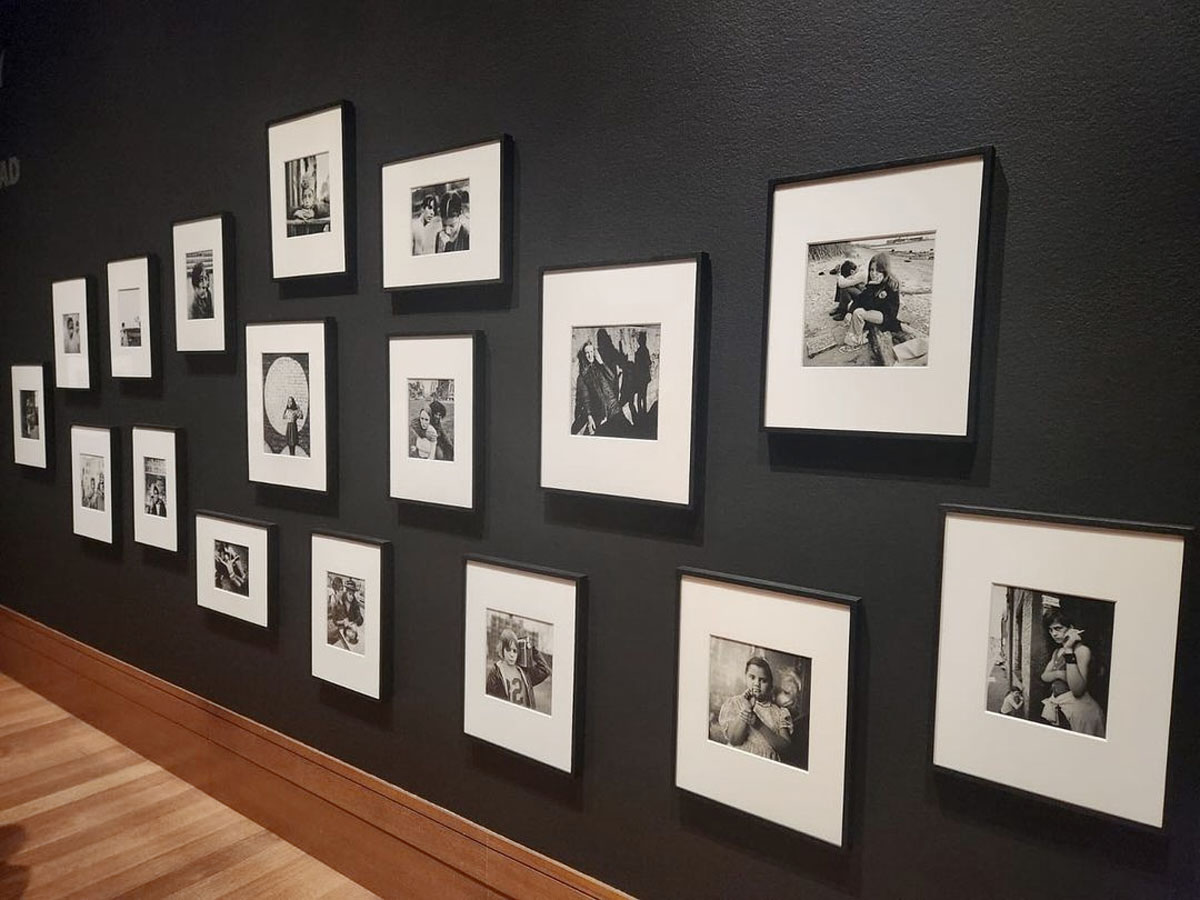
The J. Paul Getty Museum website

LIKE ART BLACK ON FACEBOOK

Back to top

Exhibition: ‘Working Together: The Photographers of the Kamoinge Workshop’ at the J. Paul Getty Museum, Los Angeles

Exhibition dates: 19th July – 9th October, 2022

Curators: Mazie Harris, assistant curator, J. Paul Getty Museum, in consultation with Sarah L. Eckhardt, associate curator, Virginia Museum of Fine Arts


Anthony Barboza (American, b. 1944) 'Pensacola, Florida' 1966 from the exhibition 'Working Together: The Photographers of the Kamoinge Workshop' at the J. Paul Getty Museum, Los Angeles, July - Oct, 2022


Anthony Barboza (American, b. 1944)
Pensacola, Florida
1966
Gelatin silver print
22.5 × 34cm (8 7/8 × 13 3/8 in.)
Virginia Museum of Fine Arts, Richmond
Adolph D. and Wilkins C. Williams Fund
© Anthony Barboza


LIBERTY!

Even though I know the history of photography reasonably well(!) I had never heard of the Kamoinge Workshop (a collective of Black photographers formed in New York in 1963) before I started to assemble this posting. This “group of people acting together… produced powerful images, sensitively registering Black life in the mid-20th century.” Their work “reminds us of the power of both individual creativity and collective action.”

What is notable about the work of Kamoinge artists as evidenced by the vibrant, graphic photographs of high contrast and chiaroscuro presented here is the mainly abstract nature of their representation of Black life.

Through images such as Anthony Barboza’s broken liberty in Pensacola, Florida (1966) and fragmented Street Self-portrait (1970s), Adger Cowans’ distorted Three Shadows (1966), C. Daniel Dawson’s Backscape #1 (1967), Louis Draper’s Untitled (Swing and Shadow) (1967) and Boy and H, Harlem (1961), James Mannas’ desperate No Way Out, Harlem, NYC (1964) and Peeping Sea Wall Beach Boy, Georgetown, Guyana (1972), Herbert Randall’s melancholy Untitled (Hattiesburg, Mississippi, Freedom Summer) (1964), Herb Robinson’s Brother and Sister (1973) and Central Park, Kids (1961), Beuford Smith’s, hanging, Boy on Swing, Lower East Side (1970), Ming Smith’s decaying Untitled (Harlem, NY) (c. 1973) and Shawn Walker’s barricaded Harlem, 117th Street (c. 1960) … the viewer can begin to picture, begin to feel and empathise with – the life of displacement and deprivation, poverty and protest, strength and joy – that was at the centre of Black experiences. The work of the Kamoinge artists offered “an alternative to the mainstream media of the time, which often overlooked Black culture or portrayed it negatively.”

“Through careful cropping, framing, and printing techniques, Kamoinge artists defamiliarised everyday sights such as puddles and clouds, asphalt, and weathered walls. Their images encourage greater attention to commonplace subjects – the reflective glass of shop windows, worn advertisements on city streets, a dirtied pile of salt – that might otherwise be overlooked. Much of their work with shadows and reflections centers Black bodies seeking a place for themselves amid the ebb and flow of daily life.” (Exhibition text)

For me what is so important about this group of artists (or any individual or group of people that represent through art: difference, diversity and the fight for equality and liberty) is that they represent themselves and historically archive their continuing struggle against oppression – so that, as the definition of the word “liberty” states – we can all attain “the state of being free within society from oppressive restrictions imposed by authority on one’s way of life, behaviour, or political views.”

Usually the fight comes not from the top down, but from the grass roots up… from community, from culture and how these begin to influence wider social attitudes and prejudices. Fighting against any injustice, whether it be racism, sexism, ism ism ism, is a fight against ignorance and bigotry. It is a fight against people being unaware of what is going on, what affect their actions have on others, it is a fight against misinformation and misrepresentation, and it is a fight against power residing in the hands of the few. As such, the photographs of the Kamoinge Workshop artists are a vital reflection on the process of change and acceptance, of progress (or the lack of it) and the constant need to be vigilant, to keep fighting against any force that seeks to subjugate us. Their photographs heighten our aesthetic awareness, one of the defining qualities of being human, connecting us to our ability to reflect on and appreciate the world around us in all its mysterious spirit and joyful difference.

Dr Marcus Bunyan


Many thankx to the J. Paul Getty Museum for allowing me to publish the photographs in the posting. Please click on the photographs for a larger version of the image.


This is the first major exhibition about the Kamoinge Workshop, a collective of Black photographers formed in New York in 1963. Members of the group produced powerful images, sensitively registering Black life in the mid-20th century. The exhibition explores Kamoinge’s photographic artistry in the 1960s and 1970s, celebrating the group’s collaborative ethos, commitment to community, and centering of Black experiences.


Installation view of the exhibition 'Working Together: The Photographers of the Kamoinge Workshop' at the J. Paul Getty Museum, Los Angeles


Installation view of the exhibition Working Together: The Photographers of the Kamoinge Workshop at the J. Paul Getty Museum, Los Angeles showing at centre, the work of Louis Draper.


Anthony Barboza (American, b. 1944) 'Kamoinge Members' 1973, printed 2019 from the exhibition 'Working Together: The Photographers of the Kamoinge Workshop' at the J. Paul Getty Museum, Los Angeles, July - Oct, 2022


Anthony Barboza (American, b. 1944)
Kamoinge Members
1973, printed 2019
Inkjet print
45.7 × 50.8cm (18 × 20 in)
Virginia Museum of Fine Arts, Richmond
Eric and Jeanette Lipman Fund
© Anthony Barboza


Anthony Barboza (American, b. 1944) 'Editors Working on the First Volume of The Black Photographers Annual' 1973 from the exhibition 'Working Together: The Photographers of the Kamoinge Workshop' at the J. Paul Getty Museum, Los Angeles, July - Oct, 2022


Anthony Barboza (American, b. 1944)
Editors Working on the First Volume of The Black Photographers Annual
1973
Pictured: Beuford Smith, Joe Crawford, Ray Francis
Gelatin silver print
12.1 × 17.9cm (4 3/4 × 7 1/16 in.)
Virginia Museum of Fine Arts, Richmond
Adolph D. and Wilkins C. Williams Fund
© Anthony Barboza


Anthony Barboza (American, b. 1944) '1st Annual International Black Photographers Dinner Honoring Roy DeCarava and James Van Der Zee, NYC' 1979


Anthony Barboza (American, b. 1944)
1st Annual International Black Photographers Dinner Honoring Roy DeCarava and James Van Der Zee, NYC
1979
Gelatin silver print
18.9 × 24.9cm (7 7/16 × 9 13/16 in.)
Virginia Museum of Fine Arts, Richmond
Arthur and Margaret Glasgow Endowment
© Anthony Barboza


Anthony Barboza (American, b. 1944) 'Easter Sunday in Harlem' 1974


Anthony Barboza (American, b. 1944)
Easter Sunday in Harlem
1974
Gelatin silver print
15.4 x 22.6cm
The J. Paul Getty Museum, Los Angeles


Anthony Barboza (American, b. 1944) 'Street Self-portrait' 1970s


Anthony Barboza (American, b. 1944)
Street Self-portrait
1970s
Gelatin silver print
19.9 x 15.1cm
The J. Paul Getty Museum, Los Angeles


In 1963 a group of Black photographers based in New York formed the Kamoinge Workshop.

Committed to photography’s power as an art form, Kamoinge members depicted Black life as they saw and experienced it. They hoped to offer an alternative to the mainstream media of the time, which often overlooked Black culture or portrayed it negatively.

Working Together: The Photographers of the Kamoinge Workshop, on view at the Getty Museum at the Getty Center July 19 – October 9, is the first major retrospective presenting photographs from the collective during the 1960s and 1970s. Highlighting each photographer’s individual artistry as well as the Workshop’s shared concerns, this exhibition celebrates the group’s self-organising, commitment to community, and centering of Black experiences.

“The work in this exhibition highlights Black Americans behind and in front of the camera. The Museum regularly features individual artists in monographic exhibitions, but it is important also to document and celebrate the importance of collaborative groups such as the Kamoinge Workshop,” says Timothy Potts, Maria Hummer-Tuttle and Robert Tuttle Director of the J. Paul Getty Museum. “Working Together reflects Getty’s continuing efforts to diversify our collection, and thereby represent a more expansive history of photography. To that end, several of the works shown in the exhibition were recently acquired for the Museum’s collection.”

Within their first year as a group, the members of the Kamoinge Workshop (pronounced “kuh-moyn-gay” by the members of the group) made a commitment to portray the communities around them. They chose the name – which means “a group of people acting together” in the Kikuyu language of Kenya – to reflect the collective model they wished to follow as well as their interest in Black communities not just at home but also outside the United States.

The exhibition will focus on the first two decades of the collective, from the founding of the group in 1963 through the various activities of the International Black Photographers association in the early 1980s, and includes photographs by 15 of the organisation’s early members. The artists included in the exhibition are Anthony Barboza, Adger Cowans, Daniel Dawson, Louis Draper, Al Fennar, Ray Francis, Herman Howard, Jimmie Mannas, Herb Randall, Herb Robinson, Beuford Smith, Ming Smith, Shawn Walker, and Calvin Wilson. Also included are several photographs by Roy DeCarava, the first director of the Workshop.

Images in the exhibition capture the experience of urban life at mid-century, the civil rights movement, intimate portraiture, experimental abstraction, jazz musicians, and the Black experience abroad. Though the photographers included in the exhibition produced diverse bodies of work, many of their photographs are printed with dark tones that compellingly evoke the unsettling era in which they were made.

“The Kamoinge vision remains resonant today,” notes Mazie Harris, curator of the installation of Working Together in the Getty Museum’s Center for Photographs. “The photographs in this exhibition offer a glimpse into the artistry and ambition of the workshop members, reminding us of the power of both individual creativity and collective action.”

Working Together: The Photographs of the Kamoinge Workshop is organised by the Virginia Museum of Fine Arts and curated by Mazie Harris, assistant curator, J. Paul Getty Museum, in consultation with Sarah L. Eckhardt, associate curator, Virginia Museum of Fine Arts.

Press release from the J. Paul Getty Museum


Adger Cowans (American, b. 1936) 'Three Shadows' 1966, printed 1968


Adger Cowans (American, b. 1936)
Three Shadows
1966, printed 1968
Gelatin silver print
26.6 × 15.7cm (10 1/2 × 6 3/16 in.)
Getty Museum
© Adger Cowans, courtesy Bruce Silverstein Gallery


Adger Cowans (American, b. 1936) 'Footsteps' 1960


Adger Cowans (American, b. 1936)
Footsteps
1960
Gelatin silver print
21 × 33.8cm (8 1/4 × 13 5/16 in.)
Virginia Museum of Fine Arts, Richmond.
Aldine S. Hartman Endowment Fund
© Adger Cowans


C. Daniel Dawson (American, b. 1943) 'Backscape #1' 1967


C. Daniel Dawson (American, b. 1943)
Backscape #1
1967
Gelatin silver print
15.2 × 22.9cm (6 × 9 in.)
Collection of C. Daniel Dawson
© C. Daniel Dawson


C. Daniel Dawson (American, b. 1943) 'Olaifa and Egypt' 1978


C. Daniel Dawson (American, b. 1943)
Olaifa and Egypt
1978
Gelatin silver print
16.5 × 24.1cm (6 1/2 × 9 1/2 in.)
Collection of C. Daniel Dawson
© C. Daniel Dawson


Louis Draper (American, 1935-2002) 'Fannie Lou Hamer' 1971


Louis Draper (American, 1935-2002)
Fannie Lou Hamer
1971
Gelatin silver print
18.1 × 13.3cm (7 1/8 × 5 1/4 in.)
Getty Museum
© Louis H. Draper Preservation Trust, courtesy Bruce Silverstein Gallery


Louis Draper (American, 1935-2002)

Fannie Lou Hamer (née Townsend; October 6, 1917 – March 14, 1977) was an American voting and women’s rights activist, community organiser, and a leader in the civil rights movement. She was the co-founder and vice-chair of the Freedom Democratic Party, which she represented at the 1964 Democratic National Convention. Hamer also organised Mississippi’s Freedom Summer along with the Student Nonviolent Coordinating Committee (SNCC). She was also a co-founder of the National Women’s Political Caucus, an organisation created to recruit, train, and support women of all races who wish to seek election to government office.

Hamer began civil rights activism in 1962, continuing until her health declined nine years later. She was known for her use of spiritual hymnals and quotes and her resilience in leading the civil rights movement for black women in Mississippi. She was extorted, threatened, harassed, shot at, and assaulted by racists, including members of the police, while trying to register for and exercise her right to vote. She later helped and encouraged thousands of African-Americans in Mississippi to become registered voters and helped hundreds of disenfranchised people in her area through her work in programs like the Freedom Farm Cooperative. She unsuccessfully ran for the U.S. Senate in 1964 and the Mississippi State Senate in 1971. In 1970, she led legal action against the government of Sunflower County, Mississippi for continued illegal segregation.

Hamer died on March 14, 1977, aged 59, in Mound Bayou, Mississippi. Her memorial service was widely attended and her eulogy was delivered by U.S. Ambassador to the United Nations Andrew Young. She was posthumously inducted into the National Women’s Hall of Fame in 1993.

Text from the Wikipedia website


Louis Draper (American, 1935-2002) 'Congressional Gathering' 1959, printed later


Louis Draper (American, 1935-2002)
Congressional Gathering
1959, printed later
Gelatin silver print
23.4 × 16.9 cm (9 3/16 × 6 5/8 in.)
Getty Museum
© Louis H. Draper Preservation Trust, courtesy Bruce Silverstein Gallery


Louis Draper (American, 1935-2002) 'Untitled (Swing and Shadow)' 1967


Louis Draper (American, 1935-2002)
Untitled (Swing and Shadow)
1967
Gelatin silver print
22.9 × 15.2cm (9 × 6 in.)
Getty Museum
© Louis H. Draper Preservation Trust, courtesy Bruce Silverstein Gallery


Louis Draper (American, 1935-2002) 'Untitled (Billy)' About 1966-1972


Louis Draper (American, 1935-2002)
Untitled (Billy)
About 1966-1972
Gelatin silver print
24.1 × 33.3cm (9 1/2 × 13 1/8 in.)
Virginia Museum of Fine Arts, Richmond
Arthur and Margaret Glasgow Endowment
© Courtesy of the Louis H. Draper Preservation Trust, Nell D. Winston, Trustee


Louis Draper (American, 1935-2002) 'Boy and H, Harlem' 1961


Louis Draper (American, 1935-2002)
Boy and H, Harlem
1961
Gelatin silver print
21.3 × 32.2 cm (8 3/8 × 12 11/16 in.)
Virginia Museum of Fine Arts, Richmond
Arthur and Margaret Glasgow Endowment
© Courtesy of the Louis H. Draper Preservation Trust, Nell D. Winston, Trustee


Louis Draper (American, 1935-2002) 'Untitled' 1960s


Louis Draper (American, 1935-2002)
Untitled
1960s
Gelatin silver print
23.3 × 17.3cm (9 3/16 × 6 13/16 in.)
Virginia Museum of Fine Arts, Richmond
Arthur and Margaret Glasgow Endowment
© Courtesy of the Louis H. Draper Preservation Trust, Nell D. Winston, Trustee


Louis Draper (American, 1935-2002) 'Reward MLK Poster, New York' 1971


Louis Draper (American, 1935-2002)
Reward MLK Poster, New York
1971
Gelatin silver print
18.1 x 13.3cm
The J. Paul Getty Museum, Los Angeles


Community

The Kamoinge Workshop began as a community of photographers who supported and encouraged one another. Within their first year, they also made a commitment to portray the communities around them. They introduced one of their early projects by explaining, “The Kamoinge Workshop represents black photographers whose creative objectives reflect a concern for truth about the world, about the Society, and about themselves.” Years later, member Louis Draper expanded: “Cognizant of the forces for change revolving around Kamoinge, we dedicated ourselves to speak of our lives as only we can. This was our story to tell and we set out to create the kind of images of our communities that spoke of the truth we’d witnessed, and that countered the untruths we’d all seen in mainline publications.”

Mentorship

Kamoinge members taught photography in programs across New York City, from Brooklyn and Harlem to the Bronx, equipping a younger generation with the technical and philosophical knowledge they needed to portray their communities. Louis Draper noted that they were eager for “a sense of purpose other than individual acclaim; we wanted to serve.” In the late 1960s, Draper and Daniel Dawson taught a photography course for teens every summer, and Draper led a youth mentorship program in the Bronx. The photographs in this section of the exhibition document some of their students.

Civil Rights

Although most Kamoinge members resisted being labeled civil rights photographers – a term they felt conjured images of firehoses and attack dogs – oral and written histories of the group emphasise that the collective formed in the midst of the civil rights movement. As Louis Draper described: “Many of the group had been a part of the March on Washington with Reverend King. Others had witnessed southern law brutality brought on by voting rights activity and sit-in demonstrations. Within a year’s time, these same volatile forces would propel many of us into engaged and enraged resistance.” Part of their resistance was to make images of Black Americans that were absent from the national conversation. Some members photographed leading figures and pivotal events of the civil rights movement but not necessarily to provide a journalistic record. Many created images reflected the theme of civil rights on a symbolic level instead.

“Like Jazz”

Music played an enormous role in the art of the Kamoinge Workshop. Jazz was a near-constant soundtrack for the group’s meetings, and musicians and live performances were the subjects of many of their photographs. Jazz also served as a metaphor for photography itself. Rhythm, timing, and improvisation are key elements in street photography as well as experimental abstraction. Innovative musicians such as Miles Davis and John Coltrane inspired Kamoinge artists, as did attending rehearsals and performances by figures as diverse as Mahalia Jackson and Sun Ra. These musicians moved the photographers to experiment and above all to hone their craft. Ming Smith characterised photography as “making something out of nothing,” adding, “I think that’s like jazz.”

A Global Perspective

A significant factor leading to the formation of the Kamoinge Workshop was, as Louis Draper put it, “the emerging African consciousness exploding within us.” Even before most of the members began traveling internationally, their choice of a name from the Kikuyu people of Kenya emphasised their interest in Black experiences outside the United States. Kenya, which gained independence from colonial rule in 1963, the same year Kamoinge was founded, was frequently in the press during the group’s earliest meetings. The decolonisation movement swept across the African continent from the mid-1950s through the 1960s, the same years that the US civil rights movement intensified. Many Kamoinge members traveled to African countries that had recently gained independence, and also to regions with significant diasporic communities. Some worked outside the United States on film projects or on assignments for magazines and in their off-hours made time for their own art. These travels expanded their sense of belonging to a global Black fellowship, however widely dispersed.

Shadows, Reflections, and Abstractions

Kamoinge has often been associated with street photography, but abstraction was also a crucial part of their work. By the time they joined the group, Louis Draper, Al Fennar, and Adger Cowans were already making abstract images in addition to more recognisably documentary pictures. In the late 1960s and into the early 1970s, many of the other members began to follow suit. Workshop photographers pushed themselves and the medium by experimenting with new forms and ideas. Through careful cropping, framing, and printing techniques, Kamoinge artists defamiliarised everyday sights such as puddles and clouds, asphalt, and weathered walls. Their images encourage greater attention to commonplace subjects – the reflective glass of shop windows, worn advertisements on city streets, a dirtied pile of salt – that might otherwise be overlooked. Much of their work with shadows and reflections centers Black bodies seeking a place for themselves amid the ebb and flow of daily life.

Kamoinge’s Legacy

Kamoinge Workshop members supported not just one another but also the broader community of Black photographers. In 1973 Beuford Smith founded the Black Photographers Annual, a publication that helped bring attention to artists outside the Kamoinge circle. In 1978, other members started a group called International Black Photographers, which honoured the work of photography elders and encouraged younger generations. Neither endeavour was part of the workshop’s official activities, but each grew out of the members’ ambition to serve and promote Black artists. Following their exhibitions in the mid-1970s, the Kamoinge Workshop neither organised exhibitions nor produced publications again until the mid-1990s. The group never disbanded, however, and the members remained close. They resumed formal meetings in 1992, applied for nonprofit status, and renamed themselves Kamoinge, Inc. A subsequent influx of new members energised the group as they continued the work that began in 1963.

Exhibition texts adapted from the Virginia Museum of Fine Arts publication Working Together: Louis Draper and the Kamoinge Workshop published as “Working Together: The Photographers of the Kamoinge Workshop” on the J. Paul Getty Museum website [Online] Cited 31/08/2022


Albert Fennar (American, 1938-2018) 'Salt Pile' 1971


Albert Fennar (American, 1938-2018)
Salt Pile
1971
Gelatin silver print
Framed [outer dim]: 52.1 × 41.9cm (20 1/2 × 16 1/2 in.)
Virginia Museum of Fine Arts, Richmond
Gift of Mrs. Alfred duPont, by exchange
© Miya Fennar and the Albert R. Fennar Archive


Albert Fennar (American, 1938-2018) 'Sphere' 1974


Albert Fennar (American, 1938-2018)
Sphere
1974
Gelatin silver print
Framed [outer dim]: 52.1 × 41.9cm (20 1/2 × 16 1/2 in.)
Virginia Museum of Fine Arts, Richmond
Gift of Mrs. Alfred duPont, by exchange
© Miya Fennar and The Albert R. Fennar Archive


Herman Howard (American, 1942-1980) 'March on Washington' 1963


Herman Howard (American, 1942-1980)
March on Washington
1963
Gelatin silver print
14.8 × 23.8cm (5 13/16 × 9 3/8 in.)
Collection of Herb Robinson
Digital image courtesy Virginia Museum of Fine Arts


Herman Howard (American, 1942-1980) 'New York' 1960s


Herman Howard (American, 1942-1980)
New York
1960s
Gelatin silver print 16 × 23.3cm (6 5/16 × 9 3/16 in.)
Collection of Herb Robinson
Digital image courtesy Virginia Museum of Fine Arts


James Mannas (American, b. 1941) 'No Way Out, Harlem, NYC' 1964


James Mannas (American, b. 1941)
No Way Out, Harlem, NYC
1964
Gelatin silver print
22.7 × 16.2cm (8 15/16 × 6 3/8 in.)
Virginia Museum of Fine Arts, Richmond
Arthur and Margaret Glasgow Endowment
© James Mannas


James Mannas (American, b. 1941) 'Peeping Sea Wall Beach Boy, Georgetown, Guyana' 1972


James Mannas (American, b. 1941)
Peeping Sea Wall Beach Boy, Georgetown, Guyana
1972
Gelatin silver print
23.8 × 15.9cm (9 3/8 × 6 1/4 in.)
Virginia Museum of Fine Arts, Richmond
Arthur and Margaret Glasgow Endowment
© James Mannas


Herbert Randall (American, born 1936) 'Untitled (Hattiesburg, Mississippi, Freedom Summer)' 1964


Herbert Randall (American, born 1936)
Untitled (Hattiesburg, Mississippi, Freedom Summer)
1964
Gelatin silver print
34.3 × 22.9cm (13 1/2 × 9 in.)
Virginia Museum of Fine Arts, Richmond
Arthur and Margaret Glasgow Endowment
© Herbert Randall


Herbert Randall (American, born 1936) 'Untitled (Bed-Stuy, New York)' 1960s


Herbert Randall (American, born 1936)
Untitled (Bed-Stuy, New York)
1960s
Gelatin silver print
33.7 × 23.3cm (13 1/4 × 9 3/16 in.)
Virginia Museum of Fine Arts, Richmond
Arthur and Margaret Glasgow Endowment
© Herbert Randall


Herb Robinson (American, active since 1960s) 'Miles Davis at the Vanguard' 1961, printed later


Herb Robinson (American, active since 1960s)
Miles Davis at the Vanguard
1961, printed later
Gelatin silver print
35.3 × 25cm (13 7/8 × 9 13/16 in.)
Getty Museum
© Herb Robinson, courtesy Bruce Silverstein Gallery


Herb Robinson (American, active since 1960s) 'Brother and Sister' 1973


Herb Robinson (American, active since 1960s)
Brother and Sister
1973
Gelatin silver print
16.5 × 22.9cm (6 1/2 × 9 in.)
Virginia Museum of Fine Arts, Richmond
Arthur and Margaret Glasgow Endowment
© Herb Robinson


Herb Robinson (American, active since 1960s) 'Central Park, Kids' 1961


Herb Robinson (American, active since 1960s)
Central Park, Kids
1961
Gelatin silver print
33.8 × 23.5cm (13 5/16 × 9 1/4 in.)
Collection of Herb Robinson
© Herb Robinson


Herb Robinson (American, active since 1960s) 'The Girls' 1969


Herb Robinson (American, active since 1960s)
The Girls
1969
Gelatin silver print
8.6 × 21.3cm (3 3/8 × 8 3/8 in.)
Virginia Museum of Fine Arts, Richmond
Arthur and Margaret Glasgow Endowment
© Herb Robinson


Beuford Smith (American, b. 1941) 'Two Bass Hit, Lower East Side' 1972


Beuford Smith (American, b. 1941)
Two Bass Hit, Lower East Side
1972
Gelatin silver print
23.8 × 34.3cm (9 3/8 × 13 1/2 in.)
Virginia Museum of Fine Arts, Richmond
Arthur and Margaret Glasgow Endowment
© Beuford Smith/Césaire


Beuford Smith (American, b. 1941) 'Boy on Swing, Lower East Side' 1970


Beuford Smith (American, b. 1941)
Boy on Swing, Lower East Side
1970
Gelatin silver print
17.3 × 25.1cm (6 13/16 × 9 7/8 in.)
Virginia Museum of Fine Arts, Richmond
Arthur and Margaret Glasgow Endowment
© Beuford Smith


Interviews with Kamoinge Artists

Interviewed by video during the pandemic, Kamoinge artists reflect on their experience with the group and the ongoing significance of their work together.

Video includes subtitles/closed captions in English and Spanish. Footage courtesy of the artists and the Whitney Museum of American Art. Adapted by the J. Paul Getty Museum


Ming Smith (American, active since 1970s) 'America Seen through Stars and Stripes, New York City, New York' About 1976


Ming Smith (American, active since 1970s)
America Seen through Stars and Stripes, New York City, New York
About 1976
Gelatin silver print
31.8 × 47cm (12 1/2 × 18 1/2 in.)
Virginia Museum of Fine Arts, Richmond
Adolph D. and Wilkins C. Williams Fund
© Ming Smith


Ming Smith (American, active since 1970s) 'Untitled (Harlem, NY)' About 1973


Ming Smith (American, active since 1970s)
Untitled (Harlem, NY)
About 1973
Gelatin silver print
31.8 × 22.2cm (12 1/2 × 8 3/4 in.)
Virginia Museum of Fine Arts, Richmond
Adolph D. and Wilkins C. Williams Fund
© Ming Smith


Ming Smith (American, active since 1970s) 'Love Barber Shop Jazz, Pittsburgh, PA' 1992


Ming Smith (American, active since 1970s)
Love Barber Shop Jazz, Pittsburgh, PA
1992
Gelatin silver print
46.2 x 31.8cm
The J. Paul Getty Museum, Los Angeles
Purchased with funds provided by the Photographs Council
© Ming Smith


Shawn Walker (American, b. 1940) 'Harlem, 117th Street' About 1960


Shawn Walker (American, b. 1940)
Harlem, 117th Street
About 1960
Gelatin silver print
18.4 × 12.7cm (7 1/4 × 5 in.)
Virginia Museum of Fine Arts, Richmond
Aldine S. Hartman Endowment Fund
© Shawn Walker PhotoArts Studio


Shawn Walker (American, b. 1940) 'Family on Easter, Harlem, NY' 1975


Shawn Walker (American, b. 1940)
Family on Easter, Harlem, NY
1975
Gelatin silver print
11 × 15.9cm (4 5/16 × 6 1/4 in.)
Virginia Museum of Fine Arts, Richmond
Kathleen Boone Samuels Memorial Fund
© Shawn Walker


Shawn Walker (American, b. 1940) 'Women in the Field, Cuba' 1968


Shawn Walker (American, b. 1940)
Women in the Field, Cuba
1968
Gelatin silver print
Virginia Museum of Fine Arts, Richmond
Arthur and Margaret Glasgow Endowment
© Shawn Walker


The J. Paul Getty Museum
1200 Getty Center Drive
Los Angeles, California 90049

Opening hours:
Daily 10am – 5pm

The J. Paul Getty Museum website

LIKE ART BLACK ON FACEBOOK

Back to top

Exhibition: ‘In Focus: Sound’ at the J. Paul Getty Museum, Los Angeles

Exhibition dates: 28th June – 2nd October, 2022

Curator: Karen Hellman, assistant curator in the Department of Photographs.


Maker unknown (American) 'Phonograph Demonstration' about 1900-1905 from the exhibition 'In Focus: Sound' at the J. Paul Getty Museum, Los Angeles, June-  Oct, 2022


Maker unknown (American)
Phonograph Demonstration
about 1900-1905
Gelatin silver print
27 × 37.1cm (10 5/8 × 14 5/8 in)
Getty Museum


“Sometimes theory leads to an over determination. Something is gained but at a price. Finding images that evoke a sound can only be saved by paying the higher price of remembering how images look when their sound is removed.”

~ Ian Lobb


From my knowledge of photography, I have added further images that I can hear … but not in the exhibition that I know of. You may like to recall other photographs that you could include in the exhibition.

Dr Marcus Bunyan


Many thankx to the J. Paul Getty Museum for allowing me to publish the photographs in the posting. Please click on the photographs for a larger version of the image.


Though photographs are silent, photographers have long conjured sound in their images. Whether depicting crowded urban spaces, musicians performing, people engaged in conversations, or even more abstract depictions of sound, the pictures in this exhibition show photography’s power to communicate beyond the visual. The images date from the 19th century to the recent past, and in each, the audible plays as much of a role as the visual. As you look at these photographs, you are invited to imagine what you might “hear” as well.

Text from the J. Paul Getty Museum website


Florence Henri (American, 1893-1982) 'Columbia Records' 1931 from the exhibition 'In Focus: Sound' at the J. Paul Getty Museum, Los Angeles, June-  Oct, 2022


Florence Henri (American, 1893-1982)
Columbia Records
1931
Gelatin silver print
24.8 × 39.1cm (9 3/4 × 15 3/8 in)
Getty Museum
© Martini & Ronchetti, courtesy Archives Florence Henri


Gjon Mili (American born Albania, 1904-1984) 'Tap Dancer, September 29, 1949' 1949 from the exhibition 'In Focus: Sound' at the J. Paul Getty Museum, Los Angeles, June-  Oct, 2022


Gjon Mili (American born Albania, 1904-1984)
Tap Dancer, September 29, 1949
1949
Gelatin silver print
33.8 × 26cm (13 5/16 × 10 1/4 in)
Getty Museum
© Gjon Mili / The LIFE Picture Collection / Shutterstock


Photographs may be silent, but photographers have long conjured sound in their images.

Whether depicting crowded urban spaces, musicians performing, or people engaged in conversation, the pictures in this exhibition prove photography’s power to communicate beyond the visual.

Drawn from Getty’s permanent collection, In Focus: Sound, on view June 28 through September 2, 2022, unites two sensory perceptions – sight and sound – in photographs that record the visual while also imitating the audible.

“Photography and sound have more in common than one might expect,” says Karen Hellman, curator of the exhibition. “Photographs can evoke a sensory perception that they cannot actually depict. Looking at photographs while thinking about sound could provide a new way of viewing and appreciating photography.”

The 19th century saw a keen scientific and philosophical interest in reproducing ephemeral phenomena. This led to the development of the photograph as well as the phonograph. This interlinked history perhaps explains photography’s connection to sound and why photographers, even subconsciously, have endeavoured to picture it. In each image in this exhibition, which date from the 19th century to the recent past, the audible plays as much of a role as the visual.

This exhibition includes works by known and lesser-known makers from the 19th century to the recent past, including Julia Margaret Cameron, Walker Evans, Man Ray, Graciela Iturbide, Marco Breuer, Naoya Hatakeyama, and Christian Marclay.

In Focus: Sound will be on view June 28 through September 2, 2022, at the Getty Center.

Text from the J. Paul Getty Museum website


Naoya Hatakeyama (Japanese, b. 1958) 'Blast #0608' 1995


Naoya Hatakeyama (Japanese, b. 1958)
Blast #0608
1995
Chromogenic print
Getty Museum
Gift of James N. and Susan A. Phillips
© Naoya Hatakeyama


Man Ray (American, 1890-1976) 'Record' 1933


Man Ray (American, 1890-1976)
Record
1933
Gelatin silver print
28.9 × 22.5cm (11 3/8 × 8 7/8 in)
Getty Museum
© Man Ray Trust ARS-ADAGP


Albert Harlingue (French, 1879-1963) 'Abbot Rousselot's Collection of Tuning Forks' about 1924


Albert Harlingue (French, 1879-1963)
Abbot Rousselot’s Collection of Tuning Forks
about 1924
Gelatin silver print
17.9 × 12.7cm (7 1/16 × 5 in)
Getty Museum


Julia Margaret Cameron (British born India, 1815-1879) 'The Echo' 1868


Julia Margaret Cameron (British born India, 1815-1879)
The Echo
1868
Albumen silver print
27.1 × 22.7cm (10 11/16 × 8 15/16 in)
Getty Museum


Milton Rogovin (American, 1909-2011) 'Storefront Churches' 1958-1961


Milton Rogovin (American, 1909-2011)
Storefront Churches
1958-1961
Gelatin silver print
12.5 × 12cm (4 15/16 × 4 3/4 in.)
Getty Museum
Gift of Dr. John V. and Laura M. Knaus
© Milton Rogovin


Carrie Mae Weems (American, b. 1953) 'Untitled (Musical Score of "God Bless the Child")' 1995


Carrie Mae Weems (American, b. 1953)
Untitled (Musical Score of “God Bless the Child”)
1995
From the series From Here I Saw What Happened and I Cried
Chromogenic print with sandblasted musical notations on frame glass
45.6 × 45.6cm (17 15/16 × 17 15/16 in)
Getty Museum
Gift of Mary and Dan Solomon in honour of Weston Naef
© Carrie Mae Weems


Will Connell (American, 1898-1961) 'Sound' 1936


Will Connell (American, 1898-1961)
Sound
1936
Gelatin silver print
34.2 × 26.7cm (13 7/16 × 10 1/2 in)
Getty Museum
Gift of Trish and Jan de Bont
© Will Connell


Lisette Model (American born Austria, 1901-1983) '[Singer, Sammy's Bar, New York]' about 1940-1944


Lisette Model (American born Austria, 1901-1983)
[Singer, Sammy’s Bar, New York]
about 1940-1944
Gelatin silver print
Getty Museum
© Estate of Lisette Model, courtesy of Baudoin Lebon/Keitelman


“Bowery old-timers claim her voice has had no match for power and ferocity since Maggie Cline used to stun with “Knock ‘Em Down McCloskey”.”

The uncredited text, referring to this photograph of the bar singer known as “Tillie,” accompanied a group of Lisette Model’s photographs made at Sammy’s Bar that were reproduced in the September 1994 Harper’s Bazaar magazine. Taken from below and at a slight diagonal angle, the image captures the vitality and vibrancy of the performer belting it out on the stage at Sammy’s, a local favourite in the Bowery district of New York, also visited by photographers Weegee and Diane Arbus. The angle from which the photograph was made also emphasises the gleaming microphone, which seem to rise up to meet the challenge of projecting Tillie’s already powerful voice.

Text from the J. Paul Getty app


Ralph Eugene Meatyard (American, 1925-1972) 'Untitled ("Motion-Sound" Landscape)' Negative 1969


Ralph Eugene Meatyard (American, 1925-1972)
Untitled (“Motion-Sound” Landscape)
Negative 1969, printed 1974
Gelatin silver print
Gift of Weston J. and Mary M. Naef
©  Estate of Ralph Eugene Meatyard


Christian Marclay (American-Swiss, b. 1955) 'Untitled (Death)' 2020


Christian Marclay (American-Swiss, b. 1955)
Untitled (Death)
2020
Chromogenic print
Courtesy of the artist, and Fraenkel Gallery, San Francisco
© Christian Marclay


Further images that I can hear … but not in the exhibition that I know of (from Marcus)


Tracey Moffatt (Australian, b. 1960) 'The Movie Star (David Gulpilil)' 1985


Tracey Moffatt (Australian, b. 1960)
The Movie Star (David Gulpilil)
1985
Type C photograph on paper
Image: 50.7 x 77.3cm
Frame: 74.5 x 99.0cm
Gift of the artist 1998. Donated through the Australian Government’s Cultural Gifts Program
Courtesy of the artist and Roslyn Oxley9 Gallery, Sydney
© Tracey Moffatt


Marion Kalter (Austrian, b. 1951) 'John Cage chez Dorothea Tanning, Paris' 1979


Marion Kalter (Austrian, b. 1951)
John Cage chez Dorothea Tanning, Paris


Larry Fink (American, 1941-2023) 'Studio 54' 1977


Larry Fink (American, 1941-2023)
Studio 54, New York City
May 1977
Silver gelatin print


Alfred Stieglitz (American, 1864-1946) 'Songs of the Sky' 1924


Alfred Stieglitz (American, 1864-1946)
Songs of the Sky
1924
Gelatin silver print


Alfred Stieglitz (American, 1864-1946) 'Songs of the Sky' 1924


Alfred Stieglitz (American, 1864-1946)
Songs of the Sky
1924
Gelatin silver print


Eva Besnyö (Dutch, 1910-2003) 'Boy With Cello, Balaton, Hungary' 1931


Eva Besnyö (Dutch, 1910-2003)
Boy With Cello, Balaton, Hungary
1931
Gelatin silver print
42.5 x 39.2cm (16.7 x 15.4 in)


Arnold Newman (American, 1918-2006) 'Igor Stravinsky' 1945


Arnold Newman (American, 1918-2006)
Igor Stravinsky
1945
Gelatin silver contact sheet


Santu Mofokeng (South African, b. 1956) 'Opening Song, Hand Clapping and Bells' 1986


Santu Mofokeng (South African, b. 1956)
Opening Song, Hand Clapping and Bells
1986
From the series Train Church
Gelatin silver print
Image: 19 x 28.5cm


Minor White (American, 1908-1976) 'The Sound of One Hand Clapping, Pultneyville, New York' 1957


Minor White (American, 1908-1976)
The Sound of One Hand Clapping, Pultneyville, New York
1957
Gelatin silver print
24.4 x 25.1cm (9 5/8 x 9 7/8 in.)
Purchased in part with funds provided by Daniel Greenberg, Susan Steinhauser, and the Greenberg Foundation
Reproduced with permission of the Minor White Archive, Princeton University Art Museum
© Trustees of Princeton University


Eugène Atget (French, 1857-1927) 'Street diversions (or B organ)' 1898-1899


Eugène Atget (French, 1857-1927)
Street diversions (or B organ)
1898-1899
Albumen print


Walker Evans. 'Church Organ and Pews' 1936


Walker Evans (Walker Evans, 1903-1975)
Church Organ and Pews
1936
Gelatin silver print


Robert Frank. 'Bar, Las Vegas' 1955-1956


Robert Frank (Swiss-American, 1924-2019)
Bar, Las Vegas
1955-1956
Gelatin silver print


Robert Frank (Swiss-American, 1924-2019) 'Political Rally, Chicago' 1956


Robert Frank (Swiss-American, 1924-2019)
Political Rally, Chicago
1956
Gelatin silver print
35.1 x 23.7cm (13 13/16 x 9 5/16 in)


André Kertész (Hungarian, 1894-1985) 'Cellist' 1916


André Kertész (Hungarian, 1894-1985)
Cellist
1916
Gelatin silver print


André Kertész (Hungarian, 1894-1985) 'Violoniste ambulant, Abony' (Traveling violinist, Abony) 1921


André Kertész (Hungarian, 1894-1985)
Violoniste ambulant, Abony
Traveling violinist, Abony
1921
Gelatin silver print


André Kertész (Hungarian, 1894-1985) 'Eiffel Tower, Summer Storm' 1927


André Kertész (Hungarian, 1894-1985)
Eiffel Tower, Summer Storm
1927
Gelatin silver print


Platt D Babbitt. 'Niagara Falls from the American side' whole plate daguerreotype c.1855


Platt D Babbitt (American, 1822-1879)
Niagara Falls from the American side
c. 1855
Whole plate daguerreotype


Platt D. Babbitt. '[Scene at Niagara Falls]' c. 1855


Platt D Babbitt (American, 1822-1879)
[Scene at Niagara Falls]
c. 1855
Daguerreotype


Platt D. Babbitt. 'Niagara Falls', c. 1860


Platt D Babbitt (American, 1822-1879)
Niagara Falls
c. 1860
Daguerreotype


Henri Huet (French, 1927-1971)/AP ''Life' magazine photographer Larry Burrows (far left) struggles through elephant grass and the rotor wash of an American evacuation helicopter as he helps GIs carry a wounded soldier on a stretcher from the jungle to the chopper in Mimot, Cambodia' 4 May 1970


Henri Huet (French, 1927-1971)/AP
‘Life’ magazine photographer Larry Burrows (far left) struggles through elephant grass and the rotor wash of an American evacuation helicopter as he helps GIs carry a wounded soldier on a stretcher from the jungle to the chopper in Mimot, Cambodia
4 May 1970
Gelatin silver print


Henri Huet, French (1927-1971) 'The body of an American paratrooper killed in action in the jungle near the Cambodian border is raised up to an evacuation helicopter, Vietnam' 1966


Henri Huet (French, 1927-1971)
The body of an American paratrooper killed in action in the jungle near the Cambodian border is raised up to an evacuation helicopter, Vietnam
1966
Gelatin silver print


James Barnor (Ghanian, b. 1929) 'E. K. Nyame, the legendary Ghanaian musician, photographed for a record cover, Accra' c. 1975


James Barnor (Ghanian, b. 1929)
E. K. Nyame, the legendary Ghanaian musician, photographed for a record cover, Accra
c. 1975
Gelatin silver print


Roger Scott (Australian, b. 1944) 'Ghost train' 1972


Roger Scott (Australian, b. 1944)
Ghost train
1972
Gelatin silver print


Diane Arbus. ‘The House of Horrors’ 1961


Diane Arbus (American, 1923-1971)
The House of Horrors
1961
Gelatin silver print


Diane Arbus (American, 1923-1971) 'A child crying, N.J.' 1967


Diane Arbus (American, 1923-1971)
A child crying, N.J.
1967
Gelatin silver print


Stephen Shore (American, b. 1947) 'Lookout Hotel, Ogunquit, Maine, July 16, 1974'


Stephen Shore (American, b. 1947)
Lookout Hotel, Ogunquit, Maine, July 16, 1974
1974
Chromogenic colour print, printed 2013
17 × 21 3/4 in. (43.2 × 55.2cm)
The Museum of Modern Art, New York
Acquired through the generosity of an anonymous donor
© 2017 Stephen Shore


Gordon Parks (American, 1912-2006) 'Shooting Victim in Cook County Morgue, Chicago, Illinois' 1957


Gordon Parks (American, 1912-2006)
Shooting Victim in Cook County Morgue, Chicago, Illinois
1957
Pigmented inkjet print, printed 2019
11 7/8 × 17 15/16″ (30.1 × 45.6cm)
The Museum of Modern Art, New York
The Family of Man Fund
© 2021 Gordon Parks Foundation


Robert H. Jackson (American, b. 1934) 'FATAL BULLET HITS OSWALD. Jack Ruby fires bullet point blank into the body of Lee Harvey Oswald at Dallas Police Station. Oswald grimaces in agony' November 24, 1963


Robert H. Jackson (American, b. 1934)
FATAL BULLET HITS OSWALD. Jack Ruby fires bullet point blank into the body of Lee Harvey Oswald at Dallas Police Station. Oswald grimaces in agony
November 24, 1963


Robert H. Jackson (American, b. 1934) 'Jack Ruby (52) shoots Lee Harvey Oswald (24) 24 November 1963' 1963


Robert H. Jackson (American, b. 1934)
Jack Ruby (52) shoots Lee Harvey Oswald (24)
24 November 1963


Originally published in the Dallas Times Herald, November 25, 1963. Cropped from the source image to the portion that was published in 1963. Winner of the 1964 Pulitzer Prize for Photography.


Unknown photographer. 'Survivors of the atomic bomb attack of Nagasaki walk through the destruction as fire rages in the background Aug. 9 1945'


Unknown photographer
Survivors of the atomic bomb attack of Nagasaki walk through the destruction as fire rages in the background Aug. 9 1945
1945


John Williams (1933- 2016) 'Open Air Shower, Bronte Beach' 1964


John Williams (Australian, 1933-2016)
Open Air Shower, Bronte Beach
1964
Gelatin silver print


Dorothea Lange (American, 1895-1965) 'Man Stepping from Cable Car, San Francisco' 1956


Dorothea Lange (American, 1895-1965)
Man Stepping from Cable Car, San Francisco
1956
Gelatin silver print


Ansel Adams (American, 1902-1984) 'Upper Yosemite Fall' 1946


Ansel Adams (American, 1902-1984)
Upper Yosemite Fall
1946
Gelatin silver print


Ansel Adams (American, 1902-1984) 'Nevada Fall Profile' 1946


Ansel Adams (American, 1902-1984)
Nevada Fall Profile
1946
Gelatin silver print


Kaho Yu (Australian) 'Untitled' from the series 'Infinitesimal Residual Vibration of An Unknown Sound' 2009-2011


Kaho Yu (Australian)
Untitled from the series Infinitesimal Residual Vibration of An Unknown Sound
2009-2011


Kaho Yu (Australian) 'Untitled' from the series 'Infinitesimal Residual Vibration of An Unknown Sound' 2009-2011


Kaho Yu (Australian)
Untitled from the series Infinitesimal Residual Vibration of An Unknown Sound
2009-2011


The photographs in this series were taken during a period when I was feeling existentially bored. Instead of distracting myself with activities and accumulating new sensations, I decided to “look” at boredom, to study, and perhaps to understand it. The most natural strategy was to observe the immediate environments where my daily activities take place – train stations, cubicles, copy machines room, etc. I carried a medium format camera on a tripod and spent the odd hours wandering alone through those familiar spaces.

My “study” did not lead me to any revelation or answer. Instead, I found myself spending a lot of time waiting in a long silence, between the opening and the closing of the camera shutter.

Charles Babbage, a scientist in 1837, postulated that every voice and sound, once imparted on the air particles, does not dissipate but remains in the diffused movements of all the particles in the atmosphere. Thus, there might one day come a person equipped with the right mathematical knowledge of these motions who will be able to capture the infinitesimal vibrations and to trace back to their ultimate source.

Taking a long exposure, letting the light slowly accumulate an image on the celluloid surface, to me, is not unlike a sound seeker searching in the air particles, for the tiny residual movements that have been conveyed through the history of mankind, from the beginning of time.

Kaho Yu artist statement


… i listen to the wind that obliterates my traces


… i listen to the wind that obliterates my traces brings together a collection of early photographs related to music, a group of 78rpm recordings, and short excerpts from various literary sources that are contemporary with the sound and images. It is a somewhat intuitive gathering, culled from artist Steve Roden’s collection of thousands of vernacular photographs related to music, sound, and listening. The subjects range from the PT Barnum-esque Professor McRea – “Ontario’s Musical Wonder” (pictured with his complex sculptural one man band contraption) – to anonymous African-American guitar players and images of early phonographs. The images range from professional portraits to ethereal, accidental, double exposures – and include a range of photographic print processes, such as tintypes, ambrotypes, cdvs, cabinet cards, real photo postcards, albumen prints, and turn-of-the-century snapshots.

The two CDs display a variety of recordings, including one-off amateur recordings, regular commercial releases, and early sound effects records. there is no narrative structure to the book, but the collision of literary quotes (Hamsun, Lagarkvist, Wordsworth, Nabokov, etc.). Recordings and images conspire towards a consistent mood that is anchored by the book’s title, which binds such disparate things as an early recording of an American cowboy ballad, a poem by a Swedish Nobel laureate, a recording of crickets created artificially, and an image of an itinerant anonymous woman sitting in a field, playing a guitar. The book also contains an essay by Roden.

Text from the Dust to Digital website Nd [Online] Cited 23/07/2022. Published by Dust-to-Digital, 2011. The book is out of stock but available on Abe.com website.


'... i listen to the wind that obliterates my traces' book cover (2011)


… i listen to the wind that obliterates my traces book cover (2011)


The J. Paul Getty Museum
1200 Getty Center Drive
Los Angeles, California 90049

Opening hours:
Daily 10am – 5pm

The J. Paul Getty Museum website

LIKE ART BLACK ON FACEBOOK

Back to top

Exhibition: ‘Imogen Cunningham: A Retrospective’ at the J. Paul Getty Museum, Los Angeles

Exhibition dates: 8th March – 12th June, 2022


Imogen Cunningham (American, 1883-1976) 'On Mount Rainer' 1915 from the exhibition 'Imogen Cunningham: A Retrospective' at the J. Paul Getty Museum, Los Angeles, March - June, 2022


Imogen Cunningham (American, 1883-1976)
On Mount Rainer
1915
Platinum print
18.4 × 23.4cm (7 1/4 × 9 3/16 in.)
Getty Museum
© Imogen Cunningham Trust


This is the second posting on this magnificent exhibition on the work of the American photographer Imogen Cunningham (1883-1976), this time its iteration at the J. Paul Getty Museum, Los Angeles. Cunningham, whose broad expanse of work stretches from Pictorialism through avant-garde to Group f/64 modernism, has for too long been underrated in the pantheon of 20th century photographic stars.

In this posting there are 20 or so new images from the exhibition, including contributions from luminaries and friends such as Minor White, Edward Weston, Lisette Model and Dorothea Lange. Of interest is the close framing of the portraits (for example see Sonya Noskowiak 1928, below) and, with these media images, the ability to see the placement and size of the photographic print on the supporting backing card.

I particularly respond to the tonality and texture of the plant photographs and Imogen’s sensitivity to their form and structure.

My favourite photograph in the posting is an image of Cunningham’s I have never seen before – the wonderful late work, Aiko’s Hands (1971, below). The Stieglitz hands, the suspended leaf like Minor White, the message in the water…

There are parts of this image that are a quiet metaphor, but the overall impression is not. It talks directly and immediately to the viewer.

Dr Marcus Bunyan


Many thanks to the J. Paul Getty Museum for allowing me to publish the photographs in the posting. Please click on the photographs for a larger version of the image. See the posting on this exhibition when it was at the Seattle Art Museum.


In a career that spanned seventy years, Imogen Cunningham created a large and diverse body of work – from portraits, to nudes, to florals, and to street photographs. In a field dominated by men, she was one of a handful of women who helped to shape early modernist photography in America. This exhibition seeks to acknowledge her stature as equivalent to that of her male peers and to reevaluate her enormous contribution to twentieth century photographic history.


Imogen Cunningham (American, 1883-1976) 'Mrs. Walsh and Middie at the Window' 1907-1908 from the exhibition 'Imogen Cunningham: A Retrospective' at the J. Paul Getty Museum, Los Angeles, March - June, 2022


Imogen Cunningham (American, 1883-1976)
Mrs. Walsh and Middie at the Window
1907-1908
Platinum print
10.6 × 15.7cm (4 3/16 × 6 3/16 in.)
© The Imogen Cunningham Trust


Imogen Cunningham (American, 1883-1976) 'The Dream / New-san-Koburi' about 1910


Imogen Cunningham (American, 1883-1976)
The Dream / New-san-Koburi
about 1910
Platinum print
22.7 × 16.2cm (8 15/16 × 6 3/8 in.)
© The Imogen Cunningham Trust


Imogen Cunningham (American, 1883-1976) 'Roi Partridge, Etcher' 1915


Imogen Cunningham (American, 1883-1976)
Roi Partridge, Etcher
1915
Platinum print
20.6 × 15.5cm (8 1/8 × 6 1/8 in.)
Getty Museum
© Imogen Cunningham Trust


The Wood Beyond the World

After her graduation from the University of Washington, Cunningham took a job in the studio of photographer and ethnologist Edward S. Curtis. She learned the platinum printing process there, and received a grant that allowed her to continue her studies in Dresden, Germany. On her return to Seattle, she began making soft-focus platinum prints with an ethereal dreamlike quality. Her work in this period was influenced by the Pre-Raphaelite movement in art and literature, which called for renewal within the Victorian art establishment through spiritualism and an enhanced connection with nature. An epic tale set in a medieval forest, The Wood Beyond the World (1894) by William Morris, a leading figure in the movement, particularly sparked her imagination.


Imogen Cunningham (American, 1883-1976) 'Wood Beyond the World 1' 1910


Imogen Cunningham (American, 1883-1976)
Wood Beyond the World 1
1910
Platinum print
Getty Museum
© The Imogen Cunningham Trust


Imogen Cunningham (American, 1883-1976) 'In the Wood / Voice of the Wood' 1910


Imogen Cunningham (American, 1883-1976)
In the Wood / Voice of the Wood
1910
Platinum print
19.8 × 19.1cm (7 13/16 × 7 1/2 in.)
© The Imogen Cunningham Trust


Imogen Cunningham (American, 1883-1976) 'Amaryllis' 1933


Imogen Cunningham (American, 1883-1976)
Amaryllis
1933
Gelatin silver print
Getty Museum
© The Imogen Cunningham Trust


Imogen Cunningham (American, 1883-1976) 'Aloe' 1925


Imogen Cunningham (American, 1883-1976)
Aloe
1925
Gelatin silver print
20.8 × 16.5cm (8 3/16 × 6 1/2 in.)
Getty Museum
© Imogen Cunningham Trust


In Her Garden

After Cunningham moved her family to San Francisco in 1917, she turned away from soft-focus images and began to make sharply delineated pictures. She cultivated a garden, growing plants and flowers for a series of botanical studies, all while taking care of her three young sons. In 1929 the prominent photographer Edward Weston recommended that ten of Cunningham’s photographs be included in the seminal exhibition Film und Foto in Stuttgart, Germany. Although the show did not bring her financial success, it garnered international recognition for her as a leading American modernist photographer.


Imogen Cunningham (American, 1883-1976) 'Hen and Chickens' 1929


Imogen Cunningham (American, 1883-1976)
Hen and Chickens
1929
Gelatin silver print
25.2 × 24.6cm (9 15/16 × 9 11/16 in.)
Getty Museum
© Imogen Cunningham Trust


Imogen Cunningham (American, 1883-1976) 'Flax' 1926


Imogen Cunningham (American, 1883-1976)
Flax
1926
Gelatin silver print
23.5 × 16.1cm (9 1/4 × 6 5/16 in.)
Getty Museum
© Imogen Cunningham Trust


Imogen Cunningham (American, 1883-1976) 'Banana Plant' 1925-1929


Imogen Cunningham (American, 1883-1976)
Banana Plant
1925-1929
Gelatin silver print
29.5 × 22.2cm (11 5/8 × 8 3/4 in.)
The Art Institute of Chicago, Julien Levy Collection
Gift of Jean Levy and the estate of Julien Levy
© Imogen Cunningham Trust


Imogen Cunningham (American, 1883-1976) 'Triangles' 1928


Imogen Cunningham (American, 1883-1976)
Triangles
1928
Gelatin silver print
9.7 × 7.1cm (3 13/16 × 2 13/16 in.)
Getty Museum
© Imogen Cunningham Trust


Imogen Cunningham (American, 1883-1976) 'Two Callas' 1925-1929


Imogen Cunningham (American, 1883-1976)
Two Callas
1925-1929
Gelatin silver print
30 × 22.6cm (11 13/16 × 8 7/8 in.)
The Art Institute of Chicago, Julien Levy Collection
Gift of Jean Levy and the estate of Julien Levy
© Imogen Cunningham Trust


Imogen Cunningham (American, 1883-1976) 'Calla Lily (Black and White Lily)' 1925-1933


Imogen Cunningham (American, 1883-1976)
Calla Lily (Black and White Lily)
1925-1933
Gelatin silver print
30 × 23.5 cm (11 13/16 × 9 1/4 in.)
© The Imogen Cunningham Trust


Imogen Cunningham (American, 1883-1976) 'Tower of Jewels' 1925


Imogen Cunningham (American, 1883-1976)
Tower of Jewels
1925
Gelatin silver print
30.5 × 23.8cm
UC Berkeley Art Museum and Pacific Film Archive


Ansel Adams (American, 1902-1984) '[Dogwood Blossoms, Yosemite National Park]' Negative about 1938; print 1941


Ansel Adams (American, 1902-1984)
[Dogwood Blossoms, Yosemite National Park]
Negative about 1938; print 1941
Gelatin silver print
16.8 × 11.4cm (6 5/8 × 4 1/2 in.)
© 2014 The Ansel Adams Publishing Rights Trust


Imogen Cunningham (American, 1883-1976) '[Sonya Noskowiak]' 1928


Imogen Cunningham (American, 1883-1976)
[Sonya Noskowiak]
1928
Gelatin silver print
8.9 × 7.6cm (3 1/2 × 3 in.)
© The Imogen Cunningham Trust


Imogen Cunningham (American, 1883-1976) 'Martha Graham, Dancer' 1931


Imogen Cunningham (American, 1883-1976)
Martha Graham, Dancer
1931
Gelatin silver print
18.5 × 25.2cm (7 5/16 × 9 15/16 in.)
Getty Museum
Gift of Daniel Greenberg and Susan Steinhauser
© Imogen Cunningham Trust


Imogen Cunningham (American, 1883-1976) 'Frida Kahlo Rivera, Painter' 1931


Imogen Cunningham (American, 1883-1976)
Frida Kahlo Rivera, Painter
1931
Gelatin silver print
Getty Museum, Gift of Daniel Greenberg and Susan Steinhauser
© The Imogen Cunningham Trust


On the Portrait

When asked to describe the requirements for a successful portrait photographer, Cunningham replied, “You must be able to gain an understanding at short notice and at close range of the beauties of character, intellect, and spirit, so you can draw out the best qualities and make them show in the face of the sitter.” She would often engage her sitters in conversation until they relaxed, or ask them to think of the nicest thing they could imagine. She resisted indulging their vanity, however, and “face-lifting” was her word for the type of portrait work that required beautification – in her estimation an obstacle to a good likeness.


Imogen Cunningham (American, 1883-1976) 'Self-Portrait with Korona View' 1933


Imogen Cunningham (American, 1883-1976)
Self-Portrait with Korona View
1933
Gelatin silver print
10.2 × 8.4cm (4 × 3 5/16 in.)
© Imogen Cunningham Trust


Dorothea Lange (American, 1895-1965) 'Waiting for Work on Edge of the Pea Field, Holtville, Imperial Valley, California' February 1937 


Dorothea Lange (American, 1895-1965)
Waiting for Work on Edge of the Pea Field, Holtville, Imperial Valley, California
February 1937
Gelatin silver print
20.5 × 19.2 cm (8 1/16 × 7 9/16 in.)
The J. Paul Getty Museum, Los Angeles


“HUMAN EROSION [all underlined] / Erosion of the soil has its counterpart in erosion / of our society. / The one wastes natural resources; / the other human resources / Employment is intermittent. Jobs are precarious and / annual income is low. / Waited weeks for the maturity of 1937 winter pea / crop, which froze; then more weeks until maturity / of second crop. / Near Hollville,California / February 1937.”


Lisette Model (American born Austria, 1901-1983) 'Woman with Veil, San Francisco' 1949


Lisette Model (American born Austria, 1901-1983)
Woman with Veil, San Francisco
1949
Gelatin silver print
34.9 x 27cm
The J. Paul Getty Museum, Los Angeles


Imogen Cunningham (American, 1883-1976) 'Angel Island' 1952


Imogen Cunningham (American, 1883-1976)
Angel Island
1952
Gelatin silver print
19.3 x 19.3cm
© Imogen Cunningham Trust


Imogen Cunningham (American, 1883-1976) 'Stan, San Francisco' 1959


Imogen Cunningham (American, 1883-1976)
Stan, San Francisco
1959
Gelatin silver print
24.2 × 17.9cm (9 1/2 × 7 1/16 in.)
© Imogen Cunningham Trust


Edward Weston (American, 1886-1958) 'Armco Steel' 1922


Edward Weston (American, 1886-1958)
Armco Steel
1922
Palladium print
24.4 × 19.4cm (9 5/8 × 7 5/8 in.)
© 1981 Arizona Board of Regents, Center for Creative Photography


West Coast Photography

In 1932 Imogen Cunningham, along with Ansel Adams, John Paul Edwards, Sonya Noskowiak, Henry Swift, Willard Van Dyke, and Edward Weston – all San Francisco Bay Area photographers – helped found Group f/64. (They adopted the name from the aperture setting on a large-format camera that would yield the greatest depth of field, making a photograph equally sharp from foreground to background.) The goal of this loosely formed association was to promote a modernist style through sharply focused images created with a West Coast perspective or sense of place. The works presented in this gallery, created by Cunningham’s closest colleagues – all contributors to the Group f/64 legacy – demonstrate how the influence they had on one another defined the future of West Coast photography.


Edward Weston (American, 1886-1958) 'Bananas and Orange' 1927


Edward Weston (American, 1886-1958)
Bananas and Orange
1927
Gelatin silver print
Getty Museum
© 1981 Arizona Board of Regents, Center for Creative Photography


Imogen Cunningham (American, 1883-1976) 'Aiko's Hands' 1971


Imogen Cunningham (American, 1883-1976)
Aiko’s Hands
1971
Gelatin silver print
27.2 × 34.7cm (10 11/16 × 13 11/16 in.)
Getty Museum
Gift of Daniel Greenberg and Susan Steinhauser
© Imogen Cunningham Trust


Minor White (American, 1908–1976) 'Nude Foot, San Francisco' 1947


Minor White (American, 1908-1976)
Nude Foot, San Francisco
Negative 1947; print 1975
Gelatin silver print
21.2 × 27cm (8 3/8 × 10 5/8 in.)
Reproduced with permission of the Minor White Archive, Princeton University Art Museum. © Trustees of Princeton University
Gift of Daniel Greenberg and Susan Steinhauser


Imogen Cunningham (American, 1883-1976) 'Dancer, Mills College' 1929


Imogen Cunningham (American, 1883-1976)
Dancer, Mills College
1929
Gelatin silver print
21.7 × 18.7cm (8 9/16 × 7 3/8 in.)
Getty Museum
© Imogen Cunningham Trust


Imogen Cunningham (American, 1883-1976) 'Snake' 1929


Imogen Cunningham (American, 1883-1976)
Snake
1929
Gelatin silver print
19.7 × 16.5cm (7 3/4 × 6 1/2 in.)
The Art Institute of Chicago
Julien Levy Collection, Gift of Jean and Julien Levy
© Imogen Cunningham Trust


Imogen Cunningham (American, 1883-1976) 'Gertrude Stein, Writer' 1934


Imogen Cunningham (American, 1883-1976)
Gertrude Stein, Writer
1934
Gelatin silver print
Getty Museum
© The Imogen Cunningham Trust


A Parting of Ways

In 1934 Cunningham’s marriage to Roi Partridge ended in divorce. Their three teenage boys, Gryffyd, Rondal, and Padraic, remained in the family home with their mother until they finished high school. Cunningham never remarried, and although she received the house as part of her settlement, the divorce was the beginning of three decades of financial difficulties. Without Partridge, Cunningham had to pick up the pace of her work to stay afloat. She took more commissions, made more portraits, and began teaching portrait photography to students in her home. Despite the added stress, Cunningham sought out ways to challenge herself.


Imogen Cunningham (American, 1883-1976) 'Cornish School Trio 2' 1935


Imogen Cunningham (American, 1883-1976)
Cornish School Trio 2
1935
Gelatin silver print
22.9 × 19.1cm (9 × 7 1/2 in.)
© Imogen Cunningham Trust


Imogen Cunningham (American, 1883-1976) 'Pentimento' 1973


Imogen Cunningham (American, 1883-1976)
Pentimento
1973
Gelatin silver print
18.3 × 22.4cm (7 3/16 × 8 13/16 in.)
Getty Museum
Gift of Daniel Greenberg and Susan Steinhauser
© Imogen Cunningham Trust


Imogen Cunningham (American, 1883-1976) 'A Man Ray Version of Man Ray' 1961


Imogen Cunningham (American, 1883-1976)
A Man Ray Version of Man Ray
1961
Gelatin silver print
23.5 × 16.3cm (9 1/4 × 6 7/16 in.)
Getty Museum
Gift of Daniel Greenberg and Susan Steinhauser
© Imogen Cunningham Trust


Imogen Cunningham (American, 1883-1976) 'Double Image, Sutter St. and Fillmore' c. 1947


Imogen Cunningham (American, 1883-1976)
Double Image, Sutter St. and Fillmore
c. 1947
Gelatin silver print
Collection of the Oakland Museum of California, Gift of the Junior League of Oakland
© The Imogen Cunningham Trust


Into the Street

In 1934, while in New York, Cunningham made what she called her first “stolen pictures,” documentary street photographs that she took while trying to hide herself and her camera from view. Her interest in street photography was renewed in 1946 when she met Lisette Model while they were both teaching at the California School of Fine Arts (now the San Francisco Art Institute). Cunningham’s candid depictions of her subjects have often been described as gentler and more sympathetic than those by many of her contemporaries. Her “stolen pictures” capture people as they are and not how they look when they know they are being photographed.


Imogen Cunningham (American, 1883-1976) 'Tea at Foster's, San Francisco' 1940s


Imogen Cunningham (American, 1883-1976)
Tea at Foster’s, San Francisco
1940s
Gelatin silver print
19.1 × 18.7cm (7 1/2 × 7 3/8 in.)
Seattle Art Museum
Gift of John H. Hauberg
© Imogen Cunningham Trust


Imogen Cunningham (American, 1883-1976) 'Self-Portrait with Grandchildren in Funhouse' 1955


Imogen Cunningham (American, 1883-1976)
Self-Portrait with Grandchildren in Funhouse
1955
Gelatin silver print
22.2 × 18.5cm (8 3/4 × 7 5/16 in.)
Getty Museum
© Imogen Cunningham Trust


One of the greatest photographers of the 20th century, Imogen Cunningham (American, 1883-1976) enjoyed a career that spanned three-quarters of a century, creating a large and diverse body of work that underscored her vision, versatility, and commitment to the medium.

The first major retrospective in the United States in more than 35 years, Imogen Cunningham: A Retrospective brings together her insightful portraits, elegant flower and plant studies, poignant street pictures, and groundbreaking nudes in a visual celebration of Cunningham’s enormous contributions to the history of photography.

“Despite Cunningham’s exceptional achievements as a photographic artist, her work has not received the attention accorded her male counterparts,” says Timothy Potts, Maria Hummer-Tuttle and Robert Tuttle Director of the J. Paul Getty Museum. “Though struggling to meet the demands of family and career, she emerged by the second half of the 1920s as one of the most important and innovative modernist photographers in America, collaborating with leading practitioners, mentoring novices, and actively engaging with contemporary controversies in modern art. This exhibition and publication will provide the spotlight on her contribution to 20th-century photography that she so richly deserves.”

Cunningham was initially self-taught, learning the fundamentals of photography from the instructions that came with her first camera. After graduating from the University of Washington, she established a portrait studio in Seattle and began making soft-focus photographs. Her work in this period was influenced by the Pre-Raphaelite movement in art and literature. In 1915, Cunningham married and started a family. After she moved her family to San Francisco in 1917, she turned away from soft-focus images and began making a series of sharply delineated botanical studies.

In 1932 Cunningham, along with Ansel Adams, John Paul Edwards, Sonya Noskowiak, Henry Swift, Willard Van Dyke, and Edward Weston – all San Francisco Bay Area photographers – helped found Group f/64. This loosely formed association promoted a modernist style through sharply focused images created with a West Coast perspective and sense of place.

From the mid-1940s forward, Cunningham could often be seen roaming the streets of San Francisco with her Rolleiflex, making environmental portraits of the city’s inhabitants. Her enlightened attitude about her place in the world extended to her relationships with people of different racial backgrounds and sexual orientations, which broke down social barriers while enriching and diversifying her oeuvre. Cunningham’s last major project, a series of portraits of older people, was started at age 92 and published posthumously in the book After Ninety: Imogen Cunningham in 1977. The project reflected her determination to keep active and provided a way to come to grips with being a nonagenarian herself.

Cunningham was a woman of exceptional intelligence and talent, yet competing in a male-dominated profession posed a formidable challenge. She felt disparaged by some of her male colleagues, who occasionally downplayed her talent and influence. As a bulwark against the stress, she joined San Francisco Women Artists, a group organised to promote, support, and expand the representation of women in the arts. Over the years Cunningham served as a resource for female artists such as Laura Andreson, Ruth Asawa, Alma Lavenson, Laura Gilpin, Dorothea Lange, Consuelo Kanaga, and Merry Renk, among others, providing advice, moral support, and essential connections throughout the art and business worlds.

“Cunningham continually sought out new opportunities to grow, learn, and change as an artist and a person” says Paul Martineau, curator of photographs at the Getty Museum, and curator of the exhibition. “She readily admitted that she was never fully satisfied with anything and considered self-improvement, in all its forms, her life’s work.”

Imogen Cunningham: A Retrospective is organised by the Getty Museum, Los Angeles and curated by Paul Martineau, associate curator of Photographs. Major support from Jordan Schnitzer and the Harold & Arlene Schnitzer CARE Foundation. Accompanying the exhibition is a lavishly illustrated companion book, Imogen Cunningham: A Retrospective.

Press release from the J. Paul Getty Museum website


Imogen Cunningham (American, 1883-1976) 'Ruth Asawa, Sculptor' 1952


Imogen Cunningham (American, 1883-1976)
Ruth Asawa, Sculptor
1952
Gelatin silver print
Fine Arts Museums of San Francisco, Gift of Ruth Asawa and Albert Lanier
© The Imogen Cunningham Trust


A Network of Women

Cunningham was a woman of exceptional intelligence and talent, yet competing in a male-dominated profession posed a formidable challenge, particularly after Partridge divorced her in 1934 and she struggled to support herself. To make matters worse, Cunningham felt disparaged by some of her male colleagues, who occasionally downplayed her talent and influence. As a bulwark against the stress, Cunningham joined San Francisco Women Artists, a group organised to promote, support, and expand the role of women in the arts. Over the years Cunningham served as a resource for female artists such as Laura Andresen, Ruth Asawa, Alma Lavenson, Laura Gilpin, Dorothea Lange, Consuelo Kanaga, and Merry Renk, among others, providing advice, moral support, and essential connections throughout the art and business worlds.


Imogen Cunningham (American, 1883-1976) 'The Unmade Bed' 1957


Imogen Cunningham (American, 1883-1976)
The Unmade Bed
1957
Gelatin silver print
27.1 × 34.3cm (10 11/16 × 13 1/2 in.)
Getty Museum
Gift of Daniel Greenberg and Susan Steinhauser
© Imogen Cunningham Trust


Minor White (American, 1908-1976) 'Sandblaster, San Francisco' Negative 1949; print 1975


Minor White (American, 1908-1976)
Sandblaster, San Francisco
Negative 1949; print 1975
Gelatin silver print
21.6 × 25.1cm (8 1/2 × 9 7/8 in.)
Reproduced with permission of the Minor White Archive, Princeton University Art Museum. © Trustees of Princeton University
Gift of Daniel Greenberg and Susan Steinhauser


The Light Within

In 1964 the photographer and editor Minor White devoted an issue of the influential magazine Aperture to Cunningham. In an elegant tribute, he described his own experience of the spell she cast over her subjects as a kind of inner light. The first publication dedicated entirely to Cunningham’s work, this issue of Aperture contained a selection of forty-four images dating from 1912 to 1963, representing her wide range of genres and styles.

Between 1965 and 1973 Cunningham served as a visiting photography instructor at the California College of Arts and Crafts, Oakland; Humboldt State College, Arcata; the San Francisco Art Institute; and San Francisco State College. In 1970 she was awarded a Guggenheim Foundation grant of $5,000 to make prints from her old negatives. This prestigious prize marked a turning point in her long career, an acknowledgment that coincided with a rising interest among museums and enthusiasts in collecting photographs, both historical and contemporary.


Imogen Cunningham (American, 1883-1976) 'Minor White, Photographer' 1963


Imogen Cunningham (American, 1883-1976)
Minor White, Photographer
1963
Gelatin silver print
Getty Museum
© The Imogen Cunningham Trust


Imogen Cunningham (American, 1883-1976) 'Phoenix Recumbent' 1968


Imogen Cunningham (American, 1883-1976)
Phoenix Recumbent
1968
Gelatin silver print
19.1 × 22.2cm (7 1/2 × 8 3/4 in.)
Collection of Rudi Bianchi
© Imogen Cunningham Trust


Imogen Cunningham (American, 1883-1976) 'My Father at Ninety' 1936


Imogen Cunningham (American, 1883-1976)
My Father at Ninety
1936
Gelatin silver print
Getty Museum
© The Imogen Cunningham Trust


After Ninety

When she was ninety-two, Cunningham started a new project, photographing people of advanced age. She estimated that this would take two years to complete, and she planned to publish the photographs in a volume to be called After Ninety. She began to seek out subjects, visiting them in their homes, in hospitals, and in convents. The project provided an outlet for her determination to keep active as well as a way to come to grips with being a nonagenarian herself. Cunningham died on June 24, 1976, and the book was published the following year.


Imogen Cunningham (American, 1883-1976) 'After Ninety' 1977


Imogen Cunningham (American, 1883-1976)
After Ninety
1977
Closed: 31.1 x 23.5 x 1.3cm
Private collection


Imogen Cunningham (American, 1883-1976) 'The Coffee Gallery' 1960


Imogen Cunningham (American, 1883-1976)
The Coffee Gallery
1960
Gelatin silver print
19.5 x 22.4cm
Getty Museum
Gift of Daniel Greenberg and Susan Steinhauser
© Imogen Cunningham Trust


Imogen Cunningham (American, 1883-1976) 'Another Arm' 1973


Imogen Cunningham (American, 1883-1976)
Another Arm
1973
Gelatin silver print
23.2 × 19cm (9 1/8 × 7 1/2 in.)
© Imogen Cunningham Trust


Judy Dater. 'Imogen Cunningham and Twinka Thiebaud' 1974


Judy Dater (American, born 1941)
Imogen and Twinka at Yosemite
1974
Gelatin silver print
24.2 × 19cm (9 1/2 × 7 1/2 in.)
© Judy Dater. All rights reserved


The J. Paul Getty Museum
1200 Getty Center Drive
Los Angeles, California 90049

Opening hours:
Daily 10am – 5pm

The J. Paul Getty Museum website

LIKE ART BLACK ON FACEBOOK

Back to top

Exhibition: ‘In Focus: Platinum Photographs’ at the J. Paul Getty Museum, Los Angeles

Exhibition dates: 21st January – 31st May, 2020

Curator: Arpad Kovacs, assistant curator of photographs at the museum


Peter Henry Emerson (British, born Cuba, 1856-1936) 'Coming Home from the Marshes' 1886 from the exhibition 'In Focus: Platinum Photographs' at the J. Paul Getty Museum, Los Angeles, Jan - May, 2020


Peter Henry Emerson (British born Cuba, 1856-1936)
Coming Home from the Marshes
1886
Platinum print
Image: 19.8 × 28.9cm (7 13/16 × 11 3/8 in.)
The J. Paul Getty Museum, Los Angeles


Glorious. adjective: having a striking beauty or splendour.

I have seen quite a few vintage platinum prints over the years, from Paul Strand to Robert Mapplethorpe (even though he didn’t print them himself). And there has always struck me about them a lusciousness, a pleasingly rich “atmosphere” which appeals strongly to the senses, through an almost erotic charge of intensity.

Contrary to the contemporary mania for pure blacks and whites in an image, platinum prints, with their wide gamut, can have an innumerable number of greys in their tonal range which form a holistic whole in the rendition of the subject. For example, Frederick H. Evans’ Kelmscott Manor: In the Attics (2) (1896, below) has a delicacy of description and a glowing aura seemingly emanating from the very depths of the image, which fetishises the photographic object, itself.

As in a drizzle of light rain – and emerging from Pictorialist conventions of sfumato – there is a liquidity to the tonality of platinum prints, as though there is mercury flowing under the surface of the paper. Glorious.

Dr Marcus Bunyan


Many thankx to the J. Paul Getty Museum for allowing me to publish the photographs in the posting. Please click on the photographs for a larger version of the image.


Admired for their velvety matte surface, wide tonal range, and neutral palette, platinum prints helped establish photography as a fine art. Introduced in 1873, the process was championed by prominent photographers until platinum’s use was restricted in World War I and manufacturers were forced to introduce alternatives. The process attracted renewed interest in the mid-twentieth century from a relatively small but dedicated community of practitioners. This exhibition draws from the Museum’s collection to showcase some of the most striking prints made with platinum and the closely related palladium processes.

Text from the J. Paul Getty Museum website


Eveleen W. H. Myers (British, 1856-1937) 'Leopold Hamilton Myers as 'The Compassionate Cherub'' about 1888-1891 from the exhibition 'In Focus: Platinum Photographs' at the J. Paul Getty Museum, Los Angeles, Jan - May, 2020


Eveleen W. H. Myers (British, 1856-1937)
Leopold Hamilton Myers as ‘The Compassionate Cherub’
about 1888-1891
Platinum print
Image: 24.4 × 29cm (9 5/8 × 11 7/16 in.)
The J. Paul Getty Museum, Los Angeles


Sarah Choate Sears (American, 1858-1935) 'Helen Sears' 1895


Sarah Choate Sears (American, 1858-1935)
Helen Sears
1895
Platinum print
Image: 22.8 × 18.7cm (9 × 7 3/8 in.)
The J. Paul Getty Museum, Los Angeles


Sarah Choate Sears (American, 1858-1935)

Sarah Choate Sears (1858-1935) was an American art collector, art patron, cultural entrepreneur, artist and photographer

About 1890 she began exploring photography, and soon she was participating in local salons. She joined the Boston Camera Club in 1892, and her beautiful portraits and still life attracted the attention of fellow Boston photographer F. Holland Day. Soon her work was gaining international attention.

At the same time she was pursuing her photography interest, she and her husband were hosting some of the most elegant cultural and artistic parties in Boston. They often featured private symphonic performances and included many international composers and performers, including Ignacy Paderewski, Serge Koussevitsky and Dame Nellie Melba.

In 1899 she was given a one-woman show at the Boston Camera Club, and in 1900 she had several prints in Frances Benjamin Johnson’s famous exhibition in Paris. In early 1900 she met American Impressionist Mary Cassatt, and the two continued to be friends for the remainder of their lives. During this same period she was elected as a member of the prestigious photographic associations: the Linked Ring in London and Alfred Stieglitz’s Photo-Secession in New York…

In 1907, two of her photographs were published in Camera Work, but by that time she had lost much of her interest in photography.

Text from the Wikipedia website


Frederick H. Evans (British, 1853-1943) 'Kelmscott Manor: In the Attics (2)' 1896


Frederick H. Evans (British, 1853-1943)
Kelmscott Manor: In the Attics (2)
1896
Platinum print
Image: 19.9 × 14.9cm (7 7/8 × 5 7/8 in.)
The J. Paul Getty Museum, Los Angeles


Gertrude Käsebier (American, 1852-1934) '[Gertrude O'Malley and son Charles]' 1900


Gertrude Käsebier (American, 1852-1934)
[Gertrude O’Malley and son Charles]
1900
Platinum print
Image: 20.2 × 15.6cm (7 15/16 × 6 1/8 in.)
The J. Paul Getty Museum, Los Angeles


Edward Steichen (American, born Luxembourg, 1879-1973) 'La Cigale' (The cicada) Negative 1901; print 1908


Edward Steichen (American, born Luxembourg, 1879-1973)
La Cigale (The cicada)
Negative 1901; print 1908
Waxed gum bichromate over platinum print
Image: 31.4 × 27cm (12 3/8 × 10 5/8 in.)
The J. Paul Getty Museum, Los Angeles


The J. Paul Getty Museum presents In Focus: Platinum Photographs, featuring more than two dozen striking prints made with platinum and the closely related palladium photographic process.

Drawn from the museum’s collection, the exhibition explores the wide variety of visual characteristics that have come to define the allure and beauty of this medium, which include a velvety matte surface, wide tonal range, and neutral palette. Introduced in 1873 by scientist William Willis Jr. (British, 1841-1923), the use of platinum was quickly embraced by both professional and amateur photographers alike and helped to establish photography as a fine art.

The visual qualities of each print could be individualised by changing the temperature of the developer or adding chemicals such as mercury or uranium. Photographers further enhanced their works by using an array of commercially available papers with rich textures and by employing inventive techniques such as the application of pigments and layered coatings to mimic effects associated with painting and drawing.

Platinum printing became widely associated with Pictorialism, an international movement and aesthetic style popular at the end of the 19th century. Advocates of Pictorialism favoured visible marks of the artist’s hand that might be achieved by manipulating either the negative or the print, or both. These hand-crafted prints differentiated themselves from the crisp images produced by commercial photographers and snapshots made with hand-held cameras recently introduced by Kodak.

Among the works on view is a triptych of a mother and child by Gertrude Käsebier (American, 1852-1934), one of the most technically innovative photographers associated with Pictorialism, an atmospheric nude by Edward Steichen (American, born Luxembourg, 1879-1973), and a view of Venice by Alvin Langdon Coburn (British, born United States, 1882-1966). Other images by Paul Strand (American, 1890-1976) and Karl Struss (American, 1886-1981) incorporate geometric forms or unusual vantage points to introduce abstraction into their compositions.

The popularity of platinum paper declined in the years leading up to the First World War. The soaring price of the metal forced manufacturers to introduce alternatives, including papers made with palladium and a platinum-and-silver hybrid. As platinum became crucial in the manufacture of explosives, governments prohibited its use for any purpose outside the defence industry. The scarcity of materials and eventual shifting aesthetic preferences led many photographers to abandon the process in favour of gelatin silver prints.

Interest in the process was renewed in the mid-20th century, and a relatively small but dedicated number of photographers continue to use the process today. The fashion photographer Irving Penn (American, 1917-2009) began hand coating papers with platinum in the 1960s and created prints that simultaneously emphasise intense and detailed shadows and subtle luminous highlights. More recent examples include a double portrait by artist Madoka Takagi (American, born Japan, 1956-2015) featuring herself, arms crossed and a shirtless man covered in tattoos, both gazing stoically into the camera’s lens; a suburban night scene by Scott B. Davis (American, born 1971); and an experiment in abstraction by James Welling (American, born 1951).

In Focus: Platinum Photographs is on view January 21-May 31, 2020 at the J. Paul Getty Museum. The exhibition is curated by Arpad Kovacs, assistant curator of photographs at the museum.

Press release from The J. Paul Getty Museum


Gertrude Käsebier (American, 1852-1934) 'Gertrude and Charles O'Malley: A Triptych, summer 1903' 1903


Gertrude Käsebier (American, 1852-1934)
Gertrude and Charles O’Malley: A Triptych, summer 1903
1903
Platinum print
Image: 19.4 × 15.2cm (7 5/8 × 6 in.)
Later overmat and mount -irregular: 58.3 × 71.1cm (22 15/16 × 28 in.)
The J. Paul Getty Museum, Los Angeles


Gertrude Käsebier (American, 1852-1934) 'Gertrude and Charles O'Malley: A Triptych, summer 1903' 1903


Gertrude Käsebier (American, 1852-1934)
Gertrude and Charles O’Malley: A Triptych, summer 1903
1903
Platinum print
Image: 18.7 × 14.9cm (7 3/8 × 5 7/8 in.)
Later overmat and mount -irregular: 58.3 × 71.1cm (22 15/16 × 28 in.)
The J. Paul Getty Museum, Los Angeles


Gertrude Käsebier (American, 1852-1934) 'Gertrude and Charles O'Malley: A Triptych, summer 1903' 1903


Gertrude Käsebier (American, 1852-1934)
Gertrude and Charles O’Malley: A Triptych, summer 1903
1903
Platinum print
Image: 20 × 14.8cm (7 7/8 × 5 13/16 in.)
Later overmat and mount -irregular: 58.3 × 71.1cm (22 15/16 × 28 in.)
The J. Paul Getty Museum, Los Angeles


Gertrude Käsebier (American, 1852-1934) 'Gertrude and Charles O'Malley: A Triptych, summer 1903' 1903


Gertrude Käsebier (American, 1852-1934)
Gertrude and Charles O’Malley: A Triptych, summer 1903
1903
Platinum print
Image: 19.4 × 15.2cm (7 5/8 × 6 in.)
Later overmat and mount -irregular: 58.3 × 71.1cm (22 15/16 × 28 in.)
The J. Paul Getty Museum, Los Angeles


Joseph Turner Keiley (American, 1869-1914) 'Untitled' 1900-1905


Joseph Turner Keiley (American, 1869-1914)
Untitled
1900-1905
Platinum print
The J. Paul Getty Museum, Los Angeles


Joseph Turner Keiley (American, 1869-1914)

Joseph Turner Keiley (26 July 1869 – 21 January 1914) was an early 20th-century photographer, writer and art critic. He was a close associate of photographer Alfred Stieglitz and was one of the founding members of the Photo-Secession. Over the course of his life Keiley’s photographs were exhibited in more than two dozen international exhibitions, and he achieved international acclaim for both his artistic style and his writing.

He began photographing in the mid-1890s and met fellow New York photographer Gertrude Käsebier, who at that time was engaged in photographing American Indians who were performing in Buffalo Bill’s Wild West Show. Keiley also photographed some of the same subjects, and in 1898 nine of his prints were exhibited in the Philadelphia Photographic Salon. One of the judges for the Salon was Stieglitz, who also wrote a glowing review of Keiley’s work.

Due to his success in Philadelphia the next year Keiley became the fourth American elected to the Linked Ring, which at that time was the most prominent photographic society in the world promoting pictorialism.

In 1900 he joined the Camera Club of New York and had a one-person exhibition in the Club’s gallery. At that time Stieglitz was serving as the Vice President of the Club and editor of the Club’s journal Camera Notes, and Keiley soon became his closest ally. Stieglitz asked him to become Associate Editor of the journal, and over the next few years Keiley was one of its most prolific writers, contributing articles on aesthetics, exhibition reviews and technical articles. He also had several of his photographs published in the journal.

While working with Stieglitz the two began experimenting with a new printing technique for glycerine-developed platinum prints, and they co-authored an article on the subject that was later published in Camera Notes.

In 1902 Stieglitz included Keiley as one of the founding members of the Photo-Secession, and he had fifteen of his prints (one more than Edward Steichen) included in the inaugural exhibition of the Photo-Secession at the National Arts Club.

When Stieglitz started Camera Work in 1903 he asked Keiley to become Associate Editor, and for the next eleven years he was second only to Stieglitz in the details of publishing the journal. He contributed dozens of essays, reviews and technical articles, and he advised Stieglitz about promising new photographers from Europe.

Keiley had seven gravures published in Camera Work, one in 1903 and six in 1907.

Text from the Wikipedia website


Alvin Langdon Coburn (British born United States, 1882-1966) 'Grand Canal, Venice' 1908


Alvin Langdon Coburn (British born United States, 1882-1966)
Grand Canal, Venice
1908
Platinum print
40.8 × 21.3cm (16 1/16 × 8 3/8 in.)
The J. Paul Getty Museum, Los Angeles


Alfred Stieglitz (American, 1864-1946) 'Georgia O'Keeffe - Hands' 1918


Alfred Stieglitz (American, 1864-1946)
Georgia O’Keeffe – Hands
1918
Palladium print
The J. Paul Getty Museum, Los Angeles


Doris Ulmann (American, 1882-1934) 'Landscape with Pump and Barn' about 1920-1934


Doris Ulmann (American, 1882-1934)
Landscape with Pump and Barn
about 1920-1934
Platinum print
The J. Paul Getty Museum, Los Angeles


Doris Ulmann (May 29, 1882 – August 28, 1934) was an American photographer, best known for her portraits of the people of Appalachia, particularly craftsmen and musicians, made between 1928 and 1934.


Tina Modotti (American, born Italy, 1896-1942) 'Hands Resting on Tool' 1927


Tina Modotti (American born Italy, 1896-1942)
Hands Resting on Tool
1927
Palladium print
Image: 19.7 × 21.6cm (7 3/4 × 8 1/2 in.)
The J. Paul Getty Museum, Los Angeles


Manuel Álvarez Bravo (Mexican, 1902-2002) '[Wounded Agaves]' Negative 1950; print late 1970s - early 1980s


Manuel Álvarez Bravo (Mexican, 1902-2002)
[Wounded Agaves]
Negative 1950; print late 1970s – early 1980s
Platinum print
Image: 16.7 × 21.2cm (6 9/16 × 8 3/8 in.)
The J. Paul Getty Museum, Los Angeles
Gift of Daniel Greenberg and Susan Steinhauser
© Archivo Manuel Álvarez Bravo, S.C.


Irving Penn (American, 1917-2009) 'Breton Onion Seller, London' Negative 1950; print 1967


Irving Penn (American, 1917-2009)
Breton Onion Seller, London
Negative 1950; print 1967
Platinum and palladium print
Image: 41 × 30.6cm (16 1/8 × 12 1/16 in.)
The J. Paul Getty Museum, Los Angeles
Partial gift of Irving Penn
© The Irving Penn Foundation


Robert Mapplethorpe (American, 1946 - 1989) 'Coral Sea' 1983


Robert Mapplethorpe (American, 1946 – 1989)
Coral Sea
1983
Platinum print
Image: 58.8 × 49.7cm (23 1/8 × 19 9/16 in.)
Jointly acquired by the J. Paul Getty Trust and the Los Angeles County Museum of Art, with funds provided by the J. Paul Getty Trust and the David Geffen Foundation
The J. Paul Getty Museum, Los Angeles
© Robert Mapplethorpe Foundation


Madoka Takagi (American, born Japan, 1956-2015) 'Untitled [Self-portrait with Bare-chested, Tattooed Latino Man]' 1986


Madoka Takagi (American born Japan, 1956-2015)
Untitled [Self-portrait with Bare-chested, Tattooed Latino Man]
1986
Platinum and palladium print
Image: 24.3 × 19.4cm (9 9/16 × 7 5/8 in.)
The J. Paul Getty Museum, Los Angeles
© Estate of Madoka Takagi


Scott B. Davis (American, b. 1971) 'Dana Point, California' Negative April 15, 2006; print April 25, 2010


Scott B. Davis (American, b. 1971)
Dana Point, California
Negative April 15, 2006; print April 25, 2010
Platinum and palladium print
Image: 40.6 × 50.3cm (16 × 19 13/16 in.)
The J. Paul Getty Museum, Los Angeles
Gift of the artist
© Scott B. Davis


James Welling (American, b. 1951) 'Untitled' 2013-2014


James Welling (American, b. 1951)
Untitled
2013-2014
Platinum print
The J. Paul Getty Museum, Los Angeles
Gift of the artist
© James Welling


James Welling (born 1951 in Hartford, Connecticut) is a postmodern artist. He earned both a BFA and an MFA at California Institute of the Arts in Valencia, California, where he studied with, among others, Dan Graham. He emerged in the 1970s as a post-conceptual artist for whom photographic norms and the representational field itself were and remain contested and problematised. Welling lives and works in Los Angeles.


The J. Paul Getty Museum
1200 Getty Center Drive
Los Angeles, California 90049

Opening hours:
Tues – Friday 10am – 5.30pm
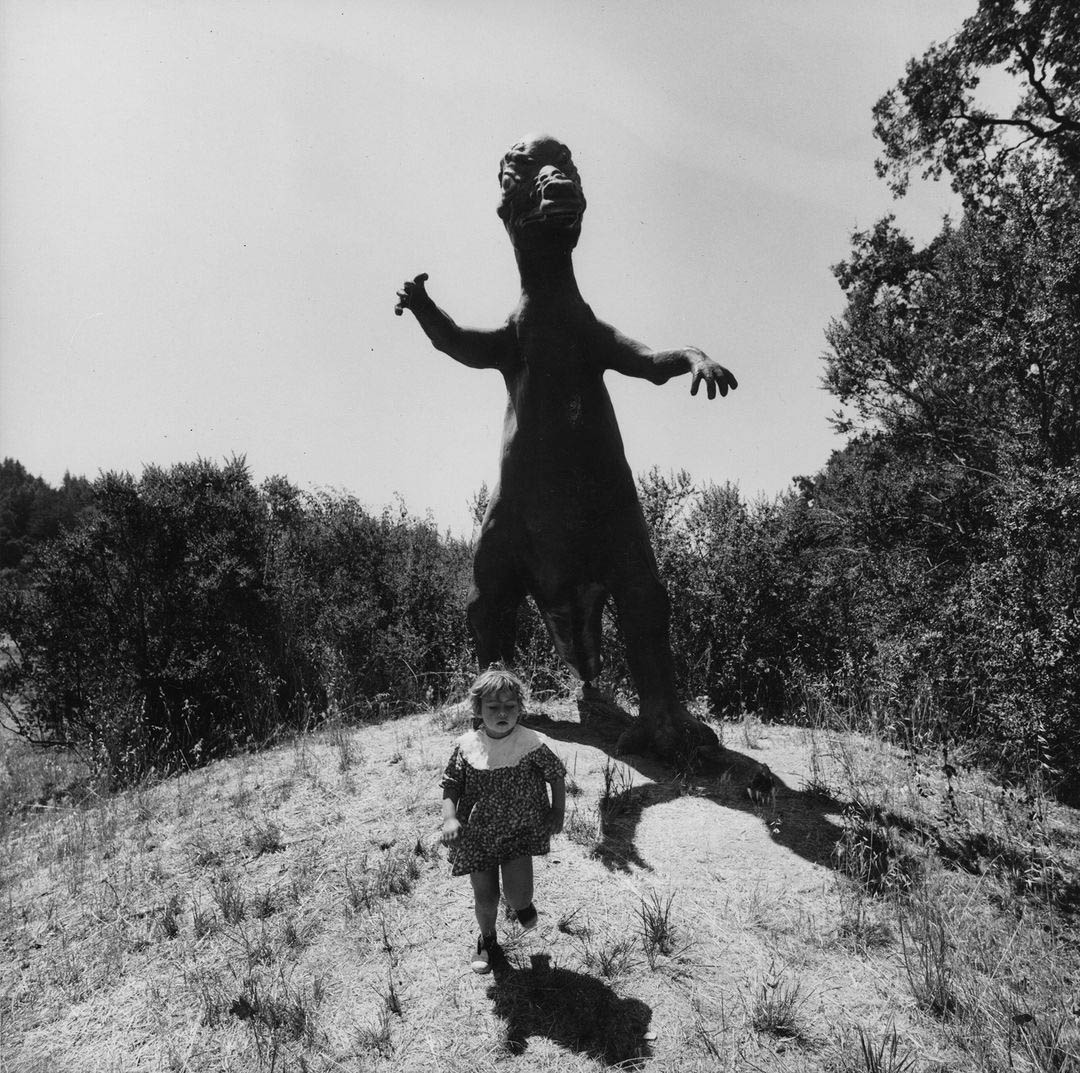
Saturday 10am – 8pm
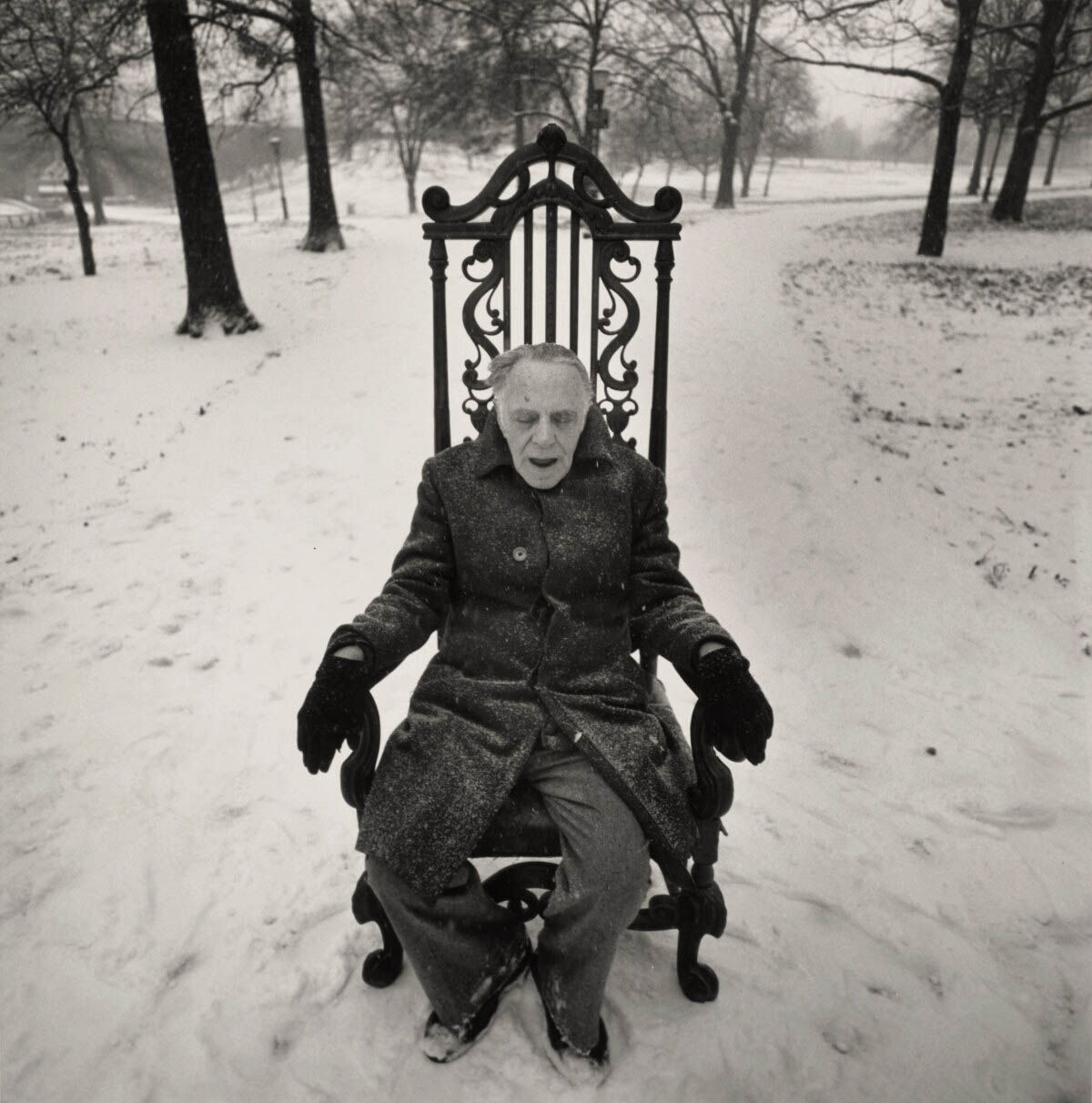
Sunday 10am – 5.30pm
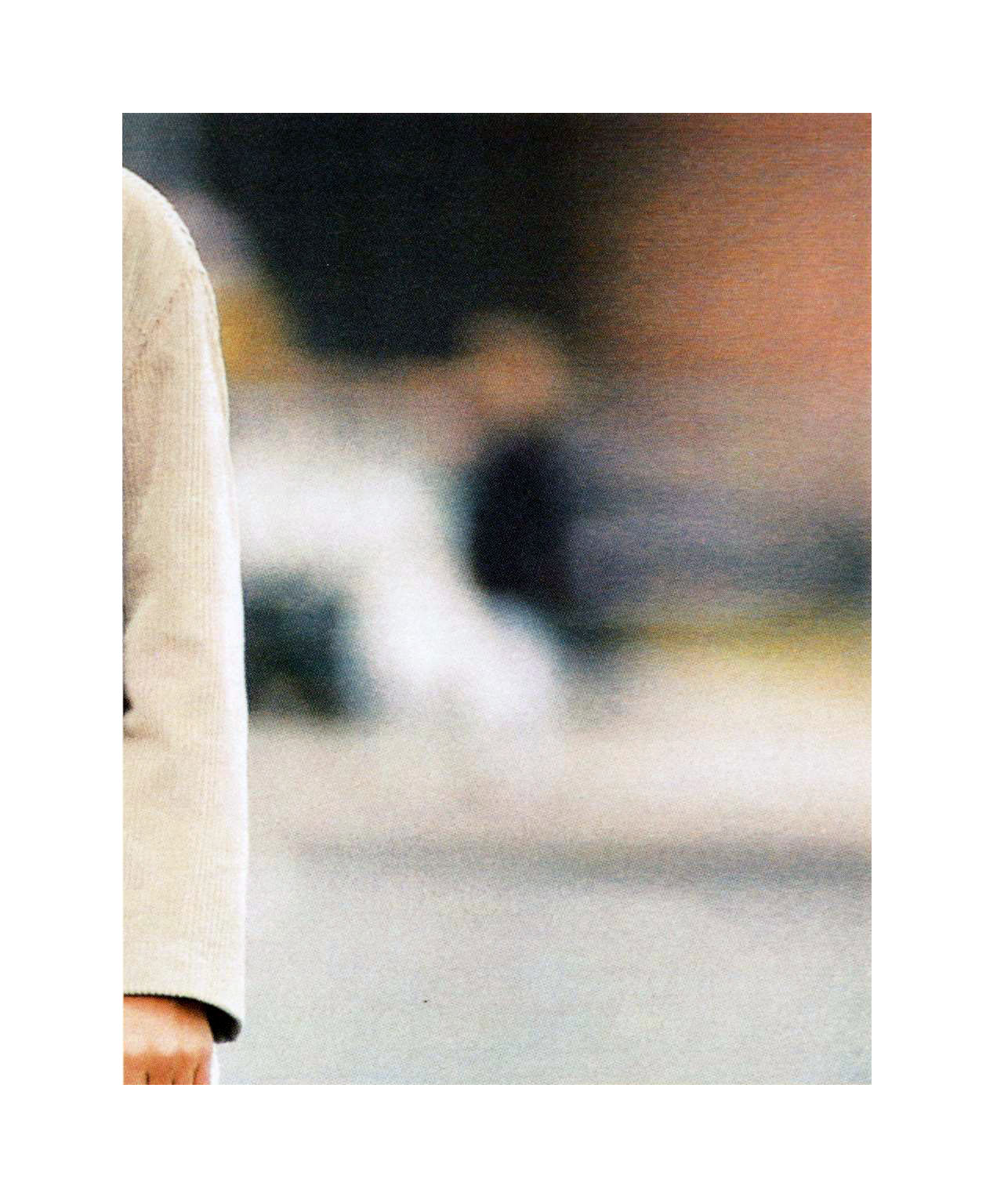
Monday closed

The J. Paul Getty Museum website

LIKE ART BLACK ON FACEBOOK

Back to top

Exhibition: ‘Unseen: 35 Years of Collecting Photographs’ at the J. Paul Getty Museum, Los Angeles

Exhibition dates: 17th December, 2019 – 8th March, 2020

Curators: Jim Ganz, senior curator of photographs at the Getty Museum in collaboration with Getty curators Mazie Harris, Virginia Heckert, Karen Hellman, Arpad Kovacs, Amanda Maddox, and Paul Martineau.


Weegee (Arthur Fellig) (American born Austria, 1899-1968) '[Calypso]' about 1944; before 1946 from the exhibition Exhibition: 'Unseen: 35 Years of Collecting Photographs' at the J. Paul Getty Museum, Los Angeles, Dec 2019 - March 2020


Weegee (Arthur Fellig) (American born Austria, 1899-1968)
[Calypso]
about 1944; before 1946
Gelatin silver print
26.2 x 33.3cm (10 5/16 x 13 1/8 in.)
The J. Paul Getty Museum, Los Angeles
© International Center of Photography


Imagine having these photographs in your collection!

My particular favourite is Hiromu Kira’s The Thinker (about 1930). For me it sums up our singular 1 thoughtful 2 imaginative 3 ephemeral 4 ether/real 5 existence.

“Aether is the fifth element in the series of classical elements thought to make up our experience of the universe… Although the Aether goes by as many names as there are cultures that have referenced it, the general meaning always transcends and includes the same four “material” elements [earth, air, water, fire]. It is sometimes more generally translated simply as “Spirit” when referring to an incorporeal living force behind all things. In Japanese, it is considered to be the void through which all other elements come into existence.” (Adam Amorastreya. “The End of the Aether,” on the Resonance website Feb 16, 2015 [Online] Cited 23/02/2020)

Dr Marcus Bunyan


Many thankx to the J. Paul Getty Museum for allowing me to publish the photographs in the posting. Please click on the photographs for a larger version of the image.


Carleton Watkins (American, 1829-1916) '[Guadalupe Mill]' 1860 from the exhibition Exhibition: 'Unseen: 35 Years of Collecting Photographs' at the J. Paul Getty Museum, Los Angeles, Dec 2019 - March 2020


Carleton Watkins (American, 1829-1916)
[Guadalupe Mill]
1860
Salted paper print
Image (dome-topped): 33.8 × 41.6cm (13 5/16 × 16 3/8 in.)
The J. Paul Getty Museum, Los Angeles


Martin Munkácsi (American born Hungary, 1896-1963) 'The Goalie Gets There a Split Second Too Late' about 1923 from the exhibition Exhibition: 'Unseen: 35 Years of Collecting Photographs' at the J. Paul Getty Museum, Los Angeles, Dec 2019 - March 2020


Martin Munkácsi (American born Hungary, 1896-1963)
The Goalie Gets There a Split Second Too Late
about 1923
Gelatin silver print
29.8 × 36.7cm (11 3/4 × 14 7/16 in.)
The J. Paul Getty Museum, Los Angeles
© Estate of Martin Munkácsi, Courtesy Howard Greenberg Gallery, New York


Hiromu Kira (American, 1898-1991) 'The Thinker' about 1930


Hiromu Kira (American, 1898-1991)
The Thinker
about 1930
Gelatin silver print
27.9 × 35.1cm (11 × 13 13/16 in.)
The J. Paul Getty Museum, Los Angeles
© Sadamura Family Trust


Hiromu Kira (1898-1991) was one of the most successful and well-known Japanese American photographers in prewar Los Angeles. He was born in Waipahu, O’ahu, Hawai’i on April 5, 1898, but was sent to Kumamoto, Japan, for his early education. When he was eighteen years old, he returned to the United States and settled in Seattle, Washington, where he first became interested in photography. In 1923, he submitted prints to the Seattle Photography Salon which accepted two of the photographs. In 1923, his work was accepted in the Pittsburg Salon and the Annual Competition of American Photography. He found work at the camera department of a local Seattle pharmacy and began meeting other Issei, Nisei and Kibei photographers such as Kyo Koike and joined the Seattle Camera Club.

In 1926, Kira moved to Los Angeles with his wife and two young children. Although he was never a member of the Japanese Camera Pictorialists of California, a group that was active in Los Angeles at that time, he developed strong friendships with club members associated with the pictorialist movement of the 1920s and ’30s such as K. Asaishi and T. K. Shindo. In 1928, Kira was named an associate of the Royal Photography Society, and the following year he was made a full fellow and began exhibiting both nationally and internationally. In 1929 alone, Kira exhibited ninety-six works in twenty-five different shows. In the late twenties, he worked at T. Iwata’s art store. In 1931, his photograph The Thinker, made while showing a customer how to use his newly purchased camera properly, appeared on the March 1931 issue of Vanity Fair magazine.

On December 5, two days before the attack on Pearl Harbor, Kira was selected to be included in the 25th Annual International Salon of the Camera Pictorialists of Los Angeles. Within a few months, he was forced to store his camera, photography books and prints in the basement of the Nishi Hongwanji Buddhist Temple in Little Tokyo, Los Angeles for the duration of World War II. He and his family were incarcerated at Santa Anita Assembly Center and the Gila River, Arizona concentration camp from 1942-1944, leaving the latter in April 1944.

Following his release, he lived briefly in Chicago before returning to Los Angeles in 1946, where he remained for the rest of his life. In Los Angeles, he worked as a photo retoucher and printer for the Disney, RKO and Columbia Picture studios but never exhibited again as he had before the war.

Text from the Hiromu Kira page on the Densho Encyclopedia website [Online] Cited 23/02/2020


Marinus Jacob Kjeldgaard (Danish, 1884-1964, active Paris, France late 1930s - late 1940s) '[Collage: Balance of Powers]' about 1939


Marinus Jacob Kjeldgaard (Danish, 1884-1964, active Paris, France late 1930s – late 1940s)
[Collage: Balance of Powers]
about 1939
Gelatin silver print
28.5 × 32cm (11 1/4 × 12 5/8 in.)
The J. Paul Getty Museum, Los Angeles
© Estate of Marinus Jacob Kjeldgaard


Paul Outerbridge (American, 1896-1958) '[Egg in Spotlight]' 1943


Paul Outerbridge (American, 1896-1958)
[Egg in Spotlight]
1943
Gelatin silver print
26.4x 34.4cm (10 3/8 x 13 9/16 in.)
The J. Paul Getty Museum, Los Angeles
© 2019 G. Ray Hawkins Gallery, Beverly Hills, CA


Emil Cadoo (American, 1926-2002) 'Children of Harlem' 1965


Emil Cadoo (American, 1926-2002)
Children of Harlem
1965
Gelatin silver print
20.3 × 25.2cm (8 × 9 15/16 in.)
The J. Paul Getty Museum, Los Angeles, Gift of Joyce Cadoo / Janos Gat Gallery
© Estate of Emil Cadoo, courtesy of Janos Gat Gallery


Anthony Hernandez (American, b. 1947) 'Los Angeles #1' 1969


Anthony Hernandez (American, b. 1947)
Los Angeles #1
1969
Gelatin silver print
18.9 × 28.4cm (7 7/16 × 11 3/16 in.)
The J. Paul Getty Museum, Los Angeles, Purchased in part with funds provided by the Photographs Council
© Anthony Hernandez


William Eggleston (American, b. 1939) 'Dolls on Cadillac, Memphis' 1972


William Eggleston (American, b. 1939)
Dolls on Cadillac, Memphis
1972
Chromogenic print
25.4 × 38.1cm (10 × 15 in.)
The J. Paul Getty Museum, Los Angeles
© Eggleston Artistic Trust


William Wegman (American, b, 1943) 'Dog and Ball' 1973


William Wegman (American, b, 1943)
Dog and Ball
1973
Gelatin silver print
The J. Paul Getty Museum, Los Angeles
© William Wegman


Marketa Luskacova (Czech, b. 1944) 'Sclater St, Woman with Baby and Girl' 1975


Markéta Luskačová (Czech, b. 1944)
Sclater St, Woman with Baby and Girl
1975
Gelatin silver print
21 x 31.8cm (8 1/4 x 12 1/2 in.)
The J. Paul Getty Museum, Los Angeles
© Markéta Luskačová


Markéta Luskačová (Czech, b. 1944)

Markéta Luskačová (born 1944) is a Czech photographer known for her series of photographs taken in Slovakia, Britain and elsewhere. Considered one of the best Czech social photographers to date, since the 1990s she has photographed children in the Czech Republic, Slovakia, and also Poland…

In the 1970s and 1980s, the communist censorship attempted to conceal her international reputation. Her works were banned in Czechoslovakia, and the catalogues for the exhibition Pilgrims in the Victoria and Albert Museum were lost on their way to Czechoslovakia.

Luskačová started photographing London’s markets in 1974. In the markets of Portobello Road, Brixton and Spitalfields, she “[found] a vivid Dickensian staging”.

In 2016 she self-published a collection of photographs of street musicians, mostly taken in the markets of east London, under the title To Remember – London Street Musicians 1975-1990, and with an introduction by John Berger.

Text from the Wikipedia website [Online] Cited 23/02/2020


Marketa Luskacova (Czech, b. 1944) 'Men around Fire, Spitalfields Market' Negative 1976, print 1991


Markéta Luskačová (Czech, b. 1944)
Men around Fire, Spitalfields Market
Negative 1976, print 1991
Gelatin silver print
22.8 x 32.9cm (9 x 12 15/16 in.)
The J. Paul Getty Museum, Los Angeles
© Markéta Luskačová


Shigeichi Nagano (Japanese, 1925-2019, active Tokyo, Japan) '[Tokyo, Aobadai (Nishi Saigoyama Park), Meguro Ward]' 1988


Shigeichi Nagano (Japanese, 1925-2019)
[Tokyo, Aobadai (Nishi Saigoyama Park), Meguro Ward]
1988
Gelatin silver print
26 × 39.4cm (10 1/4 × 15 1/2 in.)
The J. Paul Getty Museum, Los Angeles, Purchased with funds provided by the Photographs Council
© Shigeichi Nagano


Shigeichi Nagano (Japanese, 1925-2019)

During the 1960s Nagano observed the period of intense economic growth in Japan, depicting the lives of Tokyo’s sarariman with some humour. The photographs of this period were only published in book form much later, as Dorīmu eiji and 1960 (1978 and 1990 respectively).

Nagano exhibited recent examples of his street photography in 1986, winning the Ina Nobuo Award. He published several books of his works since then, and won a number of awards. Nagano had a major retrospective at the Tokyo Metropolitan Museum of Photography in 2000.

Nagano died two months short of his 94th birthday, on January 30, 2019.

Text from the Wikipedia website


Catherine Opie (American, b. 1961) 'Untitled #15' 1997


Catherine Opie (American, b. 1961)
Untitled #15
1997
Inkjet print
40.6 × 104.1cm (16 × 41 in.)
The J. Paul Getty Museum, Los Angeles
© Catherine Opie


Nan Goldin (American, b. 1953) 'Self Portrait, Red, Zurich' 2002


Nan Goldin (American, b. 1953)
Self Portrait, Red, Zurich
2002
Silver-dye bleach print
Framed (outer dim): 72.4 x 104.1cm (28 1/2 x 41 in.)
The J. Paul Getty Museum, Los Angeles
© Nan Goldin, courtesy of Matthew Marks Gallery and the artist


Hong Hao (Chinese, b. 1965) 'My Things No. 5 - 5,000 Pieces of Rubbish' 2002


Hong Hao (Chinese, b. 1965)
My Things No. 5 – 5,000 Pieces of Rubbish
2002
Chromogenic print
120 × 210.8cm (47 1/4 × 83 in.)
The J. Paul Getty Museum, Los Angeles, Anonymous Gift
© Hong Hao, Courtesy of Chambers Fine Art


Veronika Kellndorfer (German, b. 1962) 'Succulent Screen' 2007


Veronika Kellndorfer (German, b. 1962)
Succulent Screen
2007
Silkscreen print on glass
288 × 351.5cm (113 3/8 × 138 3/8 in.)
Gift of Christopher Grimes in honour of Virginia Heckert
The J. Paul Getty Museum, Los Angeles
© Veronika Kellndorfer


A three-panel silkscreen print on glass, Succulent Screen depicts a detail view of one of the signature miter-cut windows of Frank Lloyd Wright’s Freeman House. The house was built in the Hollywood Hills in 1923, was listed on the National Register of Historic Places in 1971 as a California Historical Landmark and as Los Angeles Historic-Cultural Monument #247 in 1981; it was bequeathed to the USC School of Architecture in 1986.

Text from the Getty Museum website


Sharon Core (American, b. 1965) 'Early American, Strawberries and Ostrich Egg' 2007


Sharon Core (American, b. 1965)
Early American, Strawberries and Ostrich Egg
2007
Chromogenic print
42.8 x 56.8cm (16 7/8 x 22 3/8 in.)
The J. Paul Getty Museum, Los Angeles
© Sharon Core


The Getty Museum holds one of the largest collections of photographs in the United States, with more than 148,000 prints. However, only a small percentage of these have ever been exhibited at the Museum. To celebrate the 35th anniversary of the founding of the Department of Photographs, the Getty Museum is exhibiting 200 of these never-before-seen photographs and pull back the curtain on the work of the many professionals who care for this important collection in Unseen: 35 Years of Collecting Photographs, on view December 17, 2019 – March 8, 2020.

“Rather than showcasing again the best-known highlights of the collection, the time is right to dig deeper into our extraordinary holdings and present a selection of never-before-seen treasures. I have no doubt that visitors will be intrigued and delighted by the diversity and quality of the collection, whose riches will support exhibition and research well into the decades ahead,” says Timothy Potts, director of the J. Paul Getty Museum.

The exhibition includes photographs by dozens of artists from the birth of the medium in the mid-19th century to the present day. The selection also encompasses a variety of photographic processes, including the delicate cyanotypes of Anna Atkins (British, 1799-1871), Polaroids by Carrie Mae Weems (American, born 1953) and Mary Ellen Mark (American, 1940-2015) and an architectural photographic silkscreen on glass by Veronika Kellndorfer (German, born 1962).

Visual associations among photographs from different places and times illuminate the breadth of the Getty’s holdings and underscore a sense of continuity and change within the history of the medium. The curators have also personalised some of the labels in the central galleries to give voice to their individual insights and perspectives.

Growth of the collection

In 1984, as the J. Paul Getty Trust was in the early stages of conceiving what would eventually become the Getty Center, the Getty Museum created its Department of Photographs. It did so with the acquisition of several world-famous private collections, including those of Sam Wagstaff, André Jammes, Arnold Crane, and Volker Kahmen and Georg Heusch. These dramatic acquisitions immediately established the Museum as a leading center for photography.

While the founding collections are particularly strong in 19th and early 20th century European and American work, the department now embraces contemporary photography and, increasingly, work produced around the world. The collection continues to evolve, has been shaped by several generations of curators and benefits from the generosity of patrons and collectors.

Behind the scenes

In addition to the photographs on view, the exhibition spotlights members of Getty staff who care for, handle, and monitor these works of art.

“What the general public may not realise is that before a single photograph is hung on a wall, the object and its related data is managed by teams of professional conservators, registrars, curators, mount-makers, and many others,” says Jim Ganz, senior curator of photographs at the Getty Museum. “In addition to exposing works of art in the collection that are not well known, we wanted to shed light on the largely hidden activity that goes into caring for such a collection.”

Collecting Contemporary Photography

The department’s collecting of contemporary photography has been given strong encouragement by the Getty Museum Photographs Council, and a section of the exhibition will be dedicated to objects purchased with the Council’s funding. Established in 2005, this group supports the department’s curatorial program, especially with the acquisition of works made after 1945 by artists not yet represented or underrepresented in the collection. Since its founding, the Council has contributed over $3 million toward the purchase of nearly five hundred photographs by artists from Argentina, Australia, Canada, Japan, Korea, Malaysia, South Africa, and Taiwan, as well as Europe and the United States.

Looking ahead

The exhibition also looks towards the future of the collection, and includes a gallery of very newly-acquired works by Laura Aguilar (American, 1959-2018), Osamu Shiihara (Japanese, 1905-1974), as well as highlights of the Dennis Reed collection of photographs by Japanese American photographers. The selection represents the department’s strengthening of diversity in front of and behind the camera, the collection of works relevant to Southern California communities, and the acquisition of photographs that expand the understanding of the history of the medium.

“With this exhibition we celebrate the past 35 years of collecting, and look forward to the collection’s continued expansion, encompassing important work by artists all over the world and across three centuries,” adds Potts.

Unseen: 35 Years of Collecting Photographs is on view December 17, 2019 – March 8, 2020 at the Getty Center. The exhibition is organised by Jim Ganz, senior curator of photographs at the Getty Museum in collaboration with Getty curators Mazie Harris, Virginia Heckert, Karen Hellman, Arpad Kovacs, Amanda Maddox, and Paul Martineau.

Press release from the J. Paul Getty Museum [Online] Cited 09/20/2020


Hiroshi Sugimoto (Japanese, b. 1948) 'Botanical Specimen (Erica mutabolis), March 1839' 2009


Hiroshi Sugimoto (Japanese, born 1948)
Botanical Specimen (Erica mutabolis), March 1839
2009
Toned gelatin silver print
93.7 x 74.9cm (36 7/8 x 29 1/2 in.)
© Hiroshi Sugimoto


Julia Margaret Cameron (British born India, 1815-1879) '[Spring]' 1873


Julia Margaret Cameron (British born India, 1815-1879)
[Spring]
1873
Albumen silver print
35.4 × 25.7cm (13 15/16 × 10 1/8 in.)
The J. Paul Getty Museum, Los Angeles


Reverend William Ellis (British, 1794-1872) and Samuel Smith. '[Portrait of a Black Couple]' about 1873


Reverend William Ellis (British, 1794-1872) and Samuel Smith
[Portrait of a Black Couple]
about 1873
Albumen silver print
24.1 × 18.6cm (9 1/2 × 7 5/16 in.)
The J. Paul Getty Museum, Los Angeles


Prince Roland Napoleon Bonaparte (French, 1858-1924) 'Jacobus Huch, 26 ans' about 1888


Prince Roland Napoleon Bonaparte (French, 1858-1924)
Jacobus Huch, 26 ans
about 1888
Albumen silver print
15.9 × 10.9cm (6 1/4 × 4 5/16 in.)
The J. Paul Getty Museum, Los Angeles


Underwood & Underwood (American, founded 1881, dissolved 1940s) 'Les Chiens du Front, eux-mems, portent des masques contre les gaz' May 27, 1917


Underwood & Underwood (American, founded 1881, dissolved 1940s)
Les Chiens du Front, eux-mems, portent des masques contre les gaz
May 27, 1917
Rotogravure
22 × 20.4cm (8 11/16 × 8 1/16 in.)
The J. Paul Getty Museum, Los Angeles


László Moholy-Nagy (American born Hungary, 1895-1946) '[The Law of the Series]' 1925


László Moholy-Nagy (American born Hungary, 1895-1946)
[The Law of the Series]
1925
Gelatin silver print
21.6 × 16.2cm (8 1/2 × 6 3/8 in.)
The J. Paul Getty Museum, Los Angeles
© 2019 Estate of László Moholy-Nagy / Artists Rights Society (ARS), New York


Martin Munkácsi (American born Hungary, 1896-1963) 'Big Dummies' 1927-1933


Martin Munkácsi (American born Hungary, 1896-1963)
Big Dummies
1927-1933
Gelatin silver print
33.5 × 26.7cm (13 3/16 × 10 1/2 in.)
The J. Paul Getty Museum, Los Angeles
© Estate of Martin Munkácsi, Courtesy Howard Greenberg Gallery, New York


Munkácsi was a newspaper writer and photographer in Hungary, specialising in sports. At the time, sports action photography could only be done in bright light outdoors. Munkácsi’s innovation was to make sport photographs as meticulously composed action photographs, which required both artistic and technical skill.

Munkácsi’s break was to happen upon a fatal brawl, which he photographed. Those photos affected the outcome of the trial of the accused killer, and gave Munkácsi considerable notoriety. That notoriety helped him get a job in Berlin in 1928, for Berliner Illustrirte Zeitung, where his first published photo was a motorcycle splashing its way through a puddle. He also worked for the fashion magazine Die Dame.

More than just sports and fashion, he photographed Berliners, rich and poor, in all their activities. He traveled to Turkey, Sicily, Egypt, London, New York, and Liberia, for photo spreads in Berliner Illustrirte Zeitung.

The speed of the modern age and the excitement of new photographic viewpoints enthralled him, especially flying. There are aerial photographs; there are air-to-air photographs of a flying school for women; there are photographs from a Zeppelin, including the ones on his trip to Brazil, where he crossed over a boat whose passengers wave to the airship above.

On 21 March 1933, he photographed the fateful Day of Potsdam, when the aged President Paul von Hindenburg handed Germany over to Adolf Hitler. On assignment for Berliner Illustrirte Zeitung, he photographed Hitler’s inner circle, although he was a Jewish foreigner.

Munkácsi left for New York City… Munkácsi died in poverty and controversy. Several universities and museums declined to accept his archives, and they were scattered around the world.

Text from the Wikipedia website [Online] Cited 23/02/2020


Erwin Blumenfeld (American born Germany, 1897-1969) 'Hitlerfresse (Hitler's Mug)' January 30, 1933


Erwin Blumenfeld (American born Germany, 1897-1969)
Hitlerfresse (Hitler’s Mug)
January 30, 1933
Gelatin silver print collage with ink
29.2 × 21.3cm (11 1/2 × 8 3/8 in.)
The J. Paul Getty Museum, Los Angeles
© The Estate of Erwin Blumenfeld


Erwin Blumenfeld (American born Germany, 1897-1969)

Blumenfeld was born in Berlin on 26 January 1897. As a young man he worked in the clothes trade and wrote poetry. In 1918 he went to Amsterdam, where he came into contact with Paul Citroen and Georg Grosz. In 1933 he made a photomontage showing Hitler as a skull with a swastika on its forehead; this image was later used in Allied propaganda material in 1943.

He married Lena Citroen, with whom he had three children, in 1921. In 1922 he started a leather goods shop, which failed in 1935. He moved to Paris, where in 1936 he set up as a photographer and did free-lance work for French Vogue. After the outbreak of the Second World War he was placed in an internment camp; in 1941 he was able to emigrate to the United States. There he soon became a successful and well-paid fashion photographer, and worked as a free-lancer for Harper’s Bazaar, Life and American Vogue. Blumenfeld died in Rome on 4 July 1969.

Text from the Wikipedia website [Online] Cited 23/02/3030


Paul Wolff (German, 1887-1951) and Dr Wolff & Tritschler OHG (German, founded 1927, dissolved 1963) '[Dog at the beach]' 1936


Paul Wolff (German, 1887-1951) and Dr Wolff & Tritschler OHG (German, founded 1927, dissolved 1963)
[Dog at the beach]
1936
Gelatin silver print
23.4 x 17.8cm (9 3/16 x 7 in.)
The J. Paul Getty Museum, Los Angeles
© Dr Paul Wolff & Tritschler, Historisches Bildarchiv, D-77654 Offenburg, Germany


Barbara Morgan (American, 1900 - 1992) 'City Shell' 1938


Barbara Morgan (American, 1900-1992)
City Shell
1938
Gelatin silver print
49.2 × 39.4cm (19 3/8 × 15 1/2 in.)
Reproduced courtesy of the Barbara and Willard Morgan Photographs and Papers, Library Special Collections, Charles E. Young Research Library, UCLA
The J. Paul Getty Museum, Los Angeles


Walker Evans (American, 1903 - 1975) '[Two Giraffes, Circus Winter Quarters, Sarasota]' 1941


Walker Evans (American, 1903-1975)
[Two Giraffes, Circus Winter Quarters, Sarasota]
1941
Gelatin silver print
15.1 × 18.3cm (5 15/16 × 7 3/16 in.)
The J. Paul Getty Museum, Los Angeles
© Walker Evans Archive, The Metropolitan Museum of Art


Horst P. Horst (American born Germany, 1906-1999) 'Hands, Hands' 1941


Horst P. Horst (American born Germany, 1906-1999)
Hands, Hands
1941
Platinum and palladium print
23.7 × 17cm (9 5/16 × 6 11/16 in.)
The J. Paul Getty Museum, Los Angeles, Gift of Manfred Heiting
© The Estate of Horst P. Horst and Condé Nast


Erwin Blumenfeld (American born Germany, 1897-1969) 'Maroua Motherwell, New York' 1941-1943


Erwin Blumenfeld (American born Germany, 1897-1969)
Maroua Motherwell, New York
1941-1943
Gelatin silver print
48.5 x 38.7cm (19 1/8 x 15 1/4 in.)
The J. Paul Getty Museum, Los Angeles
© The Estate of Erwin Blumenfeld


Henry Holmes Smith (American, 1909-1986) 'Photography Student' 1947


Henry Holmes Smith (American, 1909-1986)
Photography Student
1947
Gelatin silver print
11.4 × 9.6cm (4 1/2 × 3 3/4 in.)
The J. Paul Getty Museum, Los Angeles, Gift of the Smith Family Trust
© J. Paul Getty Trust


Henry Holmes Smith (American, 1909-1986)

Henry Holmes Smith (1909-1986) was an American photographer and one of the most influential fine art photography teachers of the mid 20th century. He was inspired by the work that had been done at the German Bauhaus and in 1937 was invited to teach photography at the New Bauhaus being founded by Moholy-Nagy in Chicago. After World War II, he spent many years teaching at Indiana University. His students included Jerry Uelsmann, Jack Welpott, Robert W. Fichter, Betty Hahn and Jaromir Stephany.

Smith was often involved in the cutting edge of photographic techniques: in 1931 he started experimenting with high-speed flash photography of action subjects, and started doing colour work in 1936 when few people considered it a serious artistic medium. His later images were nearly all abstract, often made directly (without a camera, i.e. like photograms), for instance images created by refracting light through splashes of water and corn syrup on a glass plate. However, although acclaimed as a photographic teacher, Holmes’ own photographs and other images did not achieve any real recognition from his peers.

Text from the Wikipedia website [Online] Cited 23/02/2020


Andreas Feininger (American born France, 1906-1999) 'Elegant Disk Clam, dosinia elegans, Conrad' 1948


Andreas Feininger (American born France, 1906-1999)
Elegant Disk Clam, dosinia elegans, Conrad
1948
Gelatin silver print
30.4 x 23.8cm (11 15/16 x 9 3/8 in.)
The J. Paul Getty Museum, Los Angeles
© Estate of Gertrud E. Feininger


Alexander Rodchenko (Russian, 1891-1956) 'Roll (of Film)' 1950


Alexander Rodchenko (Russian, 1891-1956)
Roll (of Film)
1950
Gelatin silver print
30.5 × 24cm (12 × 9 7/16 in.)
The J. Paul Getty Museum, Los Angeles
© 2019 Estate of Alexander Rodchenko / UPRAVIS, Moscow / Artists Rights Society, NY


Otto Steinert (German, 1915-1978) 'Schlammweiher 2' Negative 1953, print about 1960s


Otto Steinert (German, 1915-1978)
Schlammweiher 2
Negative 1953, print about 1960s
Gelatin silver print
39.6 x 29.1cm (15 9/16 x 11 7/16 in.)
The J. Paul Getty Museum, Los Angeles
Courtesy Galerie Johannes Faber


André Kertész (American born Hungary, 1894-1985) 'Still Life with Snake' Negative 1960; print later


André Kertész (American born Hungary, 1894-1985)
Still Life with Snake
Negative 1960; print later
Gelatin silver print
Image: 24.8 × 19.7cm (9 3/4 × 7 3/4 in.)
The J. Paul Getty Museum, Los Angeles
© Estate of André Kertész


Malick Sidibé (Malian, 1936-2016) 'Vues de dos' Nd, print 2003


Malick Sidibé (Malian, 1936-2016)
Vues de dos
Nd, print 2003
Gelatin silver print, glass, paint, cardboard, tape, and string
36.5 x 27cm (14 3/8 x 10 5/8 in.)
The J. Paul Getty Museum, Los Angeles
© Estate of Malick Sidibé


Irving Penn (American, 1917-2009) 'Red Apples' July 15, 1985


Irving Penn (American, 1917-2009)
Red Apples
July 15, 1985
Silver-dye bleach print
25.4 × 20.3cm (10 × 8 in.)
The J. Paul Getty Museum, Los Angeles, Gift of Nancy and Bruce Berman
© 1985 Irving Penn


Lyle Ashton Harris (American, b. 1965) 'Man and Woman #1' 1987-1988


Lyle Ashton Harris (American, b. 1965)
Man and Woman #1
1987-1988
Gelatin silver print
74.3 x 48.9cm (29 1/4 x 19 1/4 in.)
The J. Paul Getty Museum, Los Angeles
© Lyle Ashton Harris


Jim Dow (American, b. 1942) 'Doll Repair Shop Window, Buenos Aires, Argentina' 1990


Jim Dow (American, b. 1942)
Doll Repair Shop Window, Buenos Aires, Argentina
1990
Chromogenic print
51.2 × 40.6cm (20 3/16 × 16 in.)
The J. Paul Getty Museum, Los Angeles, Gift of Nancy and Bruce Berman
© Jim Dow


Carrie Mae Weems (American, b. 1953) 'See No Evil' 1991


Carrie Mae Weems (American, b. 1953)
See No Evil
1991
Dye diffusion print (Polaroid Polacolor)
61 × 50.5cm (24 × 19 7/8 in.)
The J. Paul Getty Museum, Los Angeles, Gift of Daniel Greenberg and Susan Steinhauser
© Carrie Mae Weems


Myoung Ho Lee (South Korean, b. 1975) '[Tree #2]' 2006


Myoung Ho Lee (South Korean, b. 1975)
[Tree #2]
2006
Inkjet print
39.8 × 32.1cm (15 11/16 × 12 5/8 in.)
The J. Paul Getty Museum, Los Angeles, Purchased with funds provided by the Photographs Council
© Myoung Ho Lee, Courtesy Yossi Milo Gallery, New York


Daniel Naudé (South African, b. 1984) 'Africanis 18. Murraysburg, Western Cape, 10 May 2010' 2010


Daniel Naudé (South African, b. 1984)
Africanis 18. Murraysburg, Western Cape, 10 May 2010
2010
60 x 60cm (23 5/8 x 23 5/8 in.)
The J. Paul Getty Museum, Los Angeles
© Daniel Naudé


Pieter Hugo (South African, b. 1976) 'Aissah Salifu, Agbogbloshie Market, Accra, Ghana' 2010


Pieter Hugo (South African, b. 1976)
Aissah Salifu, Agbogbloshie Market, Accra, Ghana
2010
From the Permanent Error series
Digital chromogenic print
81.3 x 81.3cm (32 x 32 in.)
The J. Paul Getty Museum, Los Angeles
© Pieter Hugo


Mona Kuhn (German born Brazil, 1969) 'Portrait 37' 2011


Mona Kuhn (German born Brazil, 1969)
Portrait 37
2011
Chromogenic print
38.3 x 38.1cm (15 1/16 x 15 in.)
The J. Paul Getty Museum, Los Angeles
© Mona Kuhn


Alison Rossiter (American, b. 1953) 'Eastman Kodak Azo E, expired May 1927, processed 2014' 2014


Alison Rossiter (American, b. 1953)
Eastman Kodak Azo E, expired May 1927, processed 2014
2014
Gelatin silver print
25 x 20cm (9 13/16 x 7 7/8 in.)
The J. Paul Getty Museum, Los Angeles
© Alison Rossiter


The J. Paul Getty Museum
1200 Getty Center Drive
Los Angeles, California 90049

Opening hours:
Daily 10am – 5.30pm

The J. Paul Getty Museum website

LIKE ART BLACK ON FACEBOOK

Back to top

Exhibition: ‘In Focus: The Camera’ at the J. Paul Getty Museum, Getty Center, Los Angeles

Exhibition dates: 30th July, 2019 – 5th January, 2020

Curator: Paul Martineau


Lisette Model (American born Austria, 1901-1983) 'Weegee, New York' 1945 from the exhibition 'In Focus: The Camera' at the J. Paul Getty Museum, Getty Center, Los Angeles, July 2019 - Jan 2020


Lisette Model (American born Austria, 1901-1983)
Weegee, New York
1945
Gelatin silver print
34.1 × 27cm (13 7/16 × 10 5/8 in.)
The J. Paul Getty Museum, Los Angeles
© Estate of Lisette Model, courtesy Baudoin Lebon/Keitelman


Apologies. A filler posting from me as I am sick at the moment. Although I love the design of the old cameras – when viewed from the outside, through the media images, the exhibition seems to also be a bit of a filler from the Getty.

Where are the interesting questions?

How can a box of metal and glass, a machine, capture onto film and pixels, something that so transcends time and space that, at its best, it preserves the spirit of our existence, the condition of our becoming?

How does the camera impart its own reality, and how, through looking, do photographers understand how different cameras impart different realities? How do we intimately see what the camera sees, without looking through the machine?

How have digital cameras altered how we use the camera and how we see the world, moving us from a viewfinder and vanishing point, to looking at a flat screen on the back of the camera?

How does the physicality of the camera, from large format to iPhone, affect how we hold the machine, how we interact with it’s ontology and enact its rationale – in particular perspectives of abstraction, becoming, existence, reality, as well as the basic categories of being and their relations: Substance, Relation, Quantity and Quality; Place, Time, Situation, Condition, Action, Passion?

Dr Marcus Bunyan


Many thankx to the J. Paul Getty Museum for allowing me to publish the photographs in the posting. Please click on the photographs for a larger version of the image.


Once a simple wooden box with a primitive lens and cap for controlling light, the modern camera has undergone enormous change since its invention in the early nineteenth-century. Flexible film stocks, built-in light meters, motor drives, and megapixels are a few of the advancements that have transformed the way this ingenious device captures and preserves a moment in time. This display explores the evolution of the camera through the Museum’s collection of historic cameras and photographs.


Unknown maker (European) 'Camera Obscura' c. 1750-1800 from the exhibition 'In Focus: The Camera' at the J. Paul Getty Museum, Getty Center, Los Angeles, July 2019 - Jan 2020


Unknown maker (European)
Camera Obscura
c. 1750-1800
Wood, brass, and glass
Object: H: 7.9 × W: 10.8 × D: 23.5cm (3 1/8 × 4 1/4 × 9 1/4 in.)
Object (Extended): H: 31.1cm (12 1/4 in.)
Lid extended: H: 15.9cm (6 1/4 in.)
The J. Paul Getty Museum, Los Angeles, Gift of Gloria and Stanley Fishfader


Unknown maker (French) 'Daguerreotype/Wet-plate Camera' c. 1851 from the exhibition 'In Focus: The Camera' at the J. Paul Getty Museum, Getty Center, Los Angeles, July 2019 - Jan 2020


Unknown maker (French)
Daguerreotype/Wet-plate Camera
c. 1851
Wood, brass, and glass
Object: H: 18.1 × W: 21.6 × D: 31.1cm (7 1/8 × 8 1/2 × 12 1/4 in.)
Lens: H: 9.2 × Diam: 7.3cm (3 5/8 × 2 7/8 in.)
The J. Paul Getty Museum, Los Angeles, Gift of Gloria and Stanley Fishfader


Unknown maker (British) 'Camera box' 1860


Unknown maker (British)
Camera box
1860
Wood, glass, metal
The J. Paul Getty Museum, Los Angeles, Gift of Gloria and Stanley Fishfader


August Semmendinger (American, 1820-1885) 'Mammoth Plate Wet-Collodion Camera' 1874-1885


August Semmendinger (American, 1820-1885)
Mammoth Plate Wet-Collodion Camera
1874-1885
wood, metal, fabric, and glass
The J. Paul Getty Museum, gift in memory of Beaumont Newhall


August Semmendinger (1820 – August 6, 1885) was a manufacturer of photographic apparatuses and the inventor of the Excelsior Wet Plate Camera. Semmendinger first made his cameras in New York City. The second factory where he built his cameras was located in Fort Lee, New Jersey.


Kodak (American) 'The Kodak' 1888


Kodak (American, founded 1888)
The Kodak
1888
Wood, leather, brass, and glass
Object: H: 9.5 × W: 8.3 × D: 17.1cm (3 3/4 × 3 1/4 × 6 3/4 in.)
The J. Paul Getty Museum, Los Angeles, Gift of Gloria and Stanley Fishfader


The very first Kodak camera.


John F. Collins (American, 1888-1990, active 1904-1974) '[Kodak Ektra Camera]' c. 1930


John F. Collins (American, 1888-1990, active 1904-1974)
[Kodak Ektra Camera]
c. 1930
Gelatin silver print
38.4 × 48.1cm (15 1/8 × 18 15/16 in.)
Gift of Nina and Leo Pircher


Eastman Kodak Company (American, founded 1888) 'Kodak Bantam Special' 1936


Eastman Kodak Company (American, founded 1888)
Kodak Bantam Special
1936
Metal, enamel, and glass
The J. Paul Getty Museum, gift of Gloria and Stanley Fishfader


Eastman Kodak Company (American, founded 1888) 'World War II "Matchbox" Spy Camera' 1944


Eastman Kodak Company (American, founded 1888)
World War II “Matchbox” Spy Camera
1944
Metal and glass
The J. Paul Getty Museum, gift of Gloria and Stanley Fishfader


Polaroid Corporation (American, founded 1937) 'Polaroid Land Camera Model 95' c. 1948-1949


Polaroid Corporation (American, founded 1937)
Polaroid Land Camera Model 95
c. 1948-1949
Leather and steel Object (Closed): L: 24.1 × W: 11.4 × D: 5.7cm (9 1/2 × 4 1/2 × 2 1/4 in.)
Case: H: 19.1 × W: 26.7 × D: 7cm (7 1/2 × 10 1/2 × 2 3/4 in.)
The J. Paul Getty Museum, Los Angeles, Gift of Gloria and Stanley Fishfader


Steineck Kamerawerk (Tutzing, West Germany) 'Steineck ABC Wristwatch Camera' 1949


Steineck Kamerawerk (Tutzing, West Germany)
Steineck ABC Wristwatch Camera
1949
Metal, enamel, leather, and glass


Made in Germany by Steineck Kamerawerk. Subminiature camera for discs of film 25mm diameter, 8 exposures 7mm diameter. Steinhetl VI lens F:12.5mm f/2.8 fixed aperture, coated cobir enamel. Two-speed rotary shutter. Refelcting finder – concave mirror and ball and pin sight. Wristwatch shaped. Designed in Germany by Dr R Steineck.

Looks like a large wristwatch. Came with a 12.5mm (f2.5) fixed-focus lens. Single shutter speed. Eight round exposures with a 5.5 mm diameter are produced on a round disk of film 24mm in diameter. Disks can be cut from standard 35mm film. A cassette, with its own exposure counter, is used to hold the film. To load the camera, the cassette is pressed lightly into place in the opening in the back of the camera, and the knurled rim of the cassette is turned firmly to the right until it stops and the red dots on the camera body and cassette are aligned. Film advance is automatic – the film is readied for the next frame immediately after an exposure is made. The lens is a 12.5m f/2.5, made by Steinheil. It is fixed-focus so that everything from 4.25 ft. to infinity is sharp. The lens has a two-point aperture setting: one for bright light (red dot), the other for dim light (blue dot), set by a control knob on the face of the camera. The metal focal-plane shutter has only one speed, 1/125 sec. In making an exposure, the camera is held between the index finger and thumb, the shutter release being depressed by the thumb while the index finger serves to steady the camera by exerting a counter pressure. No separate action is required to advance the film or cock the shutter; as soon as the exposure has been made, the camera is ready to take the next picture. The A-B-C has two parallax-corrected finders: an optical hollow mirror viewfinder, which permits sighting from above when the camera, worn on the wrist, is held in picture-taking position. The other, a direct-vision viewfinder, is used at eye level, requiring that the camera be removed from the wrist. When the direct-vision finder is used, you sight through the hole in the back (cassette) with the camera close to the eye; the camera is held by the straps, both thumbs steadying the body, and the shutter release is operated by the index finger. The original accessories included filters, close-up lenses, and even a special enlarger. Steineck planned an M-sync flash for a future A-B-C, as well as a built-in filter carousel (to be put in front of the aperture control), and even a tripod-mount accessory that fits through the eye-level finder!

Text from Ebay website


Hasselblad AB (Swedish, founded 1841) 'Hasselblad wide angle camera' 1954-1959


Hasselblad AB (Swedish, founded 1841)
Hasselblad wide angle camera
1954-1959
Metal, artificial leather, glass
Object: 13 × 11 × 15cm (5 1/8 × 4 5/16 × 5 7/8 in.)
The J. Paul Getty Museum, Los Angeles, Gift of Gloria and Stanley Fishfader


Nippon Kogaku K.K. (Japanese, founded 1917) 'Nikon "Reporter" large load 35mm camera' after 1959


Nippon Kogaku K.K. (Japanese, founded 1917)
Nikon “Reporter” large load 35mm camera
after 1959
Plastic, metal, and imitation leather-covered body
The J. Paul Getty Museum, Los Angeles, Gift of Gloria and Stanley Fishfader


Canon Inc. (Japanese, founded 1937) 'Canon S 35mm camera with rare F2 lens' 1946


Canon Inc. (Japanese, founded 1937)
Canon S 35mm camera with rare F2 lens
1946
Metal, glass
Object: 8 × 14.5 × 10cm (3 1/8 × 5 11/16 × 3 15/16 in.)
The J. Paul Getty Museum, Los Angeles, Gift of Gloria and Stanley Fishfader


Introduced in 1938, the Canon S is the younger sibling of the Hansa Canon. It was developed to compete in quality with the German Leica II, but at a price more accessible to the Japanese public.


Polaroid Corporation (American, founded 1937) 'Polaroid SX-70' 1972


Polaroid Corporation (American, founded 1937)
Polaroid SX-70
1972
Metal, plastic, leather, and glass
Private collection


Exhibition includes a selection of rare cameras from the 19th century to present

The camera, once a simple wooden box with a primitive lens and cap for controlling light, has undergone enormous changes since its invention, eventually becoming a tool that is in most people’s back pockets. In Focus: The Camera, on view July 30, 2019 – January 5, 2020 at the J. Paul Getty Museum, Getty Center, explores the evolution of this ingenious device through a selection of historic cameras and photographs.

During the early 19th, the three essential components of photography – a dark chamber, a light-sensitive substrate, and a method of fixing the image – were used in different ways in the experiments of Nicéphore Niépce (French, 1765-1833), Louis-Jacques-Mandé Daguerre (French, 1787-1851), and William Henry Fox Talbot (British, 1800-1877). In subsequent decades, advancements such as flexible film stocks, built-in light meters, motor drives, and megapixels transformed the way the camera captures and preserves a moment in time.

On view in the exhibition will be a number of cameras manufactured in the 19th century to present day, including the simple camera obscura, a daguerreotype camera, a stereo camera, an early roll-film camera, a large portable camera, a miniature spy camera, an early colour camera, and the first digital camera marketed to the general public. The exhibition will include text that explains how photographs are created using each of these cameras and techniques. Cameras produced by well-known brands such as Kodak, Leica, Nikon, Hasselblad, and Canon will be displayed.

The gallery will also include a number of portraits, self-portraits, and images of artists at work by famed photographers such as Imogen Cunningham (American, 1883-1976), Dorothea Lange (American, 1895-1965), Lisette Model (American, born Austria, 1901-1983), Helmut Newton (German-Australian, 1920-2004), Edward Steichen (American, born Luxembourg, 1879-1973), Andy Warhol (American, 1928-1987), and Edward Weston (American, 1886-1958). These images remind the viewer of the inextricable relationship between the camera and the artist.

In Focus: The Camera is curated by Paul Martineau, associate curator of photographs for the J. Paul Getty Museum.

Text from the J. Paul Getty Museum website [Online] Cited 21/12/2019


Capt. Horatio Ross (British, 1801-1886) '[Self-portrait preparing a Collodion plate]' 1856-1859


Capt. Horatio Ross (British, 1801-1886)
[Self-portrait preparing a Collodion plate]
1856-1859
Albumen silver print
Image: 20 × 16.2cm (7 7/8 × 6 3/8 in.)
The J. Paul Getty Museum, Los Angeles


Underwood & Underwood (American, 1881-1940s) 'Photographing New York City - on a slender support 18 stories above pavement of Fifth Avenue' 1905


Underwood & Underwood (American, 1881-1940s)
Photographing New York City – on a slender support 18 stories above pavement of Fifth Avenue
1905
Gelatin silver print
Image (left): 8 × 7.6cm (3 1/8 × 3 in.)
Image (right): 8 × 7.6cm (3 1/8 × 3 in.)
Mount: 8.9 × 17.8cm (3 1/2 × 7 in.)
The J. Paul Getty Museum, Los Angeles


Edward Weston (American, 1886-1958) 'Self Portrait with Camera' 1908


Edward Weston (American, 1886-1958)
Self Portrait with Camera
1908
Platinum print
Image: 14.6 × 8.6cm (5 3/4 × 3 3/8 in.)
The J. Paul Getty Museum, Los Angeles
© 1981 Arizona Board of Regents, Center for Creative Photography


George Watson (American, 1892-1977) '[Camera on 12-foot Tripod]' 1920s


George Watson (American, 1892-1977)
[Camera on 12-foot Tripod]
1920s
Gelatin silver print
Image: 11.7 × 9.1cm (4 5/8 × 3 9/16 in.)
Sheet: 12.2 × 9.8cm (4 13/16 × 3 7/8 in.)
The J. Paul Getty Museum, Los Angeles
© The Watson Family Photo Collection


Man Ray (American, 1890-1976) '[Self-Portrait with Camera]' 1932


Man Ray (American, 1890-1976)
[Self-Portrait with Camera]
1932
Gelatin silver print
Image: 29.2 × 22.9cm (11 1/2 × 9 in.)
The J. Paul Getty Museum, Los Angeles
© Man Ray Trust ARS-ADAGP


Man Ray showed himself in profile in this self-portrait, intently adjusting the focal range on his view camera as if for a portrait session. He directs the camera in the photograph at the audience, while the camera taking his picture remains invisible. The touch of Man Ray’s hand on the focusing ring serves as a reminder of the human artistry required to make photographs, a departure from his more accidental approach to creating works in other media. Man Ray solarised the print, using a process indelibly associated with him.

Text from the J. Paul Getty Museum website


Alma Lavenson (American, 1897-1989) '[Self-Portrait]' 1932


Alma Lavenson (American, 1897-1989)
[Self-Portrait]
1932
Gelatin silver print
20.3 × 25.2cm (8 × 9 15/16 in.)
The J. Paul Getty Museum, Los Angeles
© Alma Lavenson Associates


Employing the sharp focus and close vantage point that were the hallmarks of Group f/64, with which she was associated, Alma R. Lavenson presented her camera as a vital extension of herself as a photographic artist. Her hands delicately and reverently frame the lens, positioning it as her centre and source of inspiration.

Text from the J. Paul Getty Museum website


Unknown photographer (American) '[Portrait of Dorothea Lange]' 1937


Unknown photographer (American)
[Portrait of Dorothea Lange]
1937
Gelatin silver print
13.7 × 16.7cm (5 3/8 × 6 9/16 in.)
The J. Paul Getty Museum, Los Angeles
Gift of the Dixon Family


Walker Evans (1903-1975) 'Resort Photographer at Work' 1941


Walker Evans (1903-1975)
Resort Photographer at Work
Negative 1941; print later
Gelatin silver print
15.9 × 22.4cm (6 1/4 × 8 13/16 in.)
The J. Paul Getty Museum, Los Angeles


Weegee (Arthur Fellig) (American, born Austria, 1899-1968) 'Photographer at a Fire' 1940-1945


Weegee (Arthur Fellig) (American born Austria, 1899-1968)
Photographer at a Fire
1940-1945
Gelatin silver print
Image: 34.1 × 27.1cm (13 7/16 × 10 11/16 in.)
The J. Paul Getty Museum, Los Angeles
© International Center of Photography


Andreas Feininger (American, born France, 1906 - 1999) 'The Photojournalist' Negative 1951; print later


Andreas Feininger (American born France, 1906-1999)
The Photojournalist
Negative 1951; print later
Gelatin silver print
Image: 32.3 × 26.3cm (12 11/16 × 10 3/8 in.)
The J. Paul Getty Museum, Los Angeles, Gift of Daniel Greenberg and Susan Steinhauser
© Estate of Gertrud E. Feininger


Imogen Cunningham (American, 1883-1976) 'Self-Portrait with Grandchildren in a Funhouse' 1955


Imogen Cunningham (American, 1883-1976)
Self-Portrait with Grandchildren in a Funhouse
1955
Gelatin silver print
The J. Paul Getty Museum. © Imogen Cunningham Trust


Anthony Friedkin (American, b. 1949) 'Extras with Film Cameras' 1996


Anthony Friedkin (American, b. 1949)
Extras with Film Cameras
1996
Gelatin silver print
Image: 16.3 × 24.3cm (6 7/16 × 9 9/16 in.)
Sheet: 20.1 × 25.2cm (7 15/16 × 9 15/16 in.)
The J. Paul Getty Museum, Los Angeles, Gift of Sue and Albert Dorskind
© Anthony Friedkin


The J. Paul Getty Museum
1200 Getty Center Drive
Los Angeles, California 90049

Opening hours:
Daily 10am – 5.30pm

The J. Paul Getty Museum website

LIKE ART BLACK ON FACEBOOK

Back to top