Exhibition: ‘Photo-Secession: Painterly Masterworks of Turn-of-the-Century Photography’ at the Utah Museum of Fine Arts, Salt Lake City

Exhibition dates: 24th August – 29th December 2024


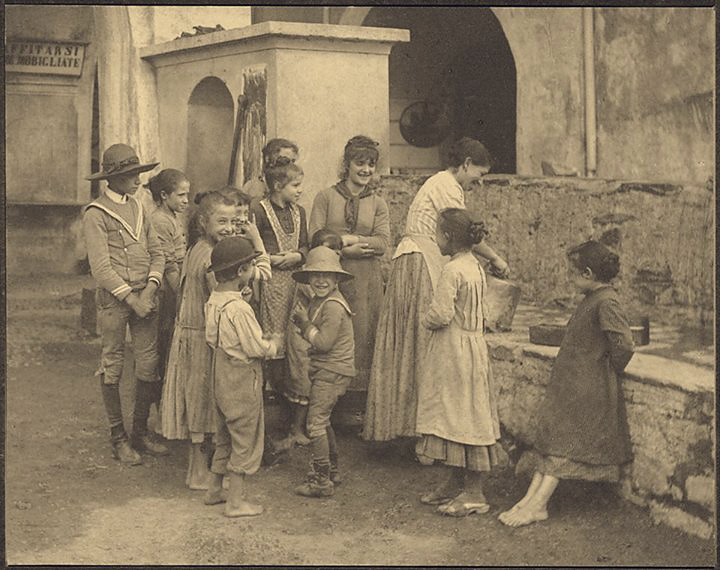
Peter Henry Emerson (British born Cuba, 1856-1936) 'Poling the Marsh Hay' c. 1885 from the exhibition 'Photo-Secession: Painterly Masterworks of Turn-of-the-Century Photography' at the Utah Museum of Fine Arts, Salt Lake City, August - December 2024


Peter Henry Emerson (British born Cuba, 1856-1936)
Poling the Marsh Hay
c. 1885
Platinum print on paper


Id est / that is

Voluptuous = relating to or characterised by luxury or sensual pleasure

Sensual = late Middle English (in the sense ‘sensory’): from late Latin sensualis, from sensus (see sense)

Sense = various; including:

~ a reasonable or comprehensible rationale i.e. the latent and emerging Modernism inherent in Photo-Secession photographs

~ the way in which a situation [in this case the “reading” of a photograph] can be interpreted i.e. the interpretation of Photo-Secession photographs as either Pictorialist, Modernist or a combination of both

~ a keen intuitive awareness of or sensitivity to the presence or importance of something i.e. the feeling of the photographer towards the object of their attention, revealed in the print, whether that be a nude, a building, pears and an apple or the side of a white barn

~ to be aware of (something) without being able to define exactly how one knows i.e. to be able to detect, recognise, and feel that ineffable “something” that emanates from the object of (y)our attention… in the act of creativity, in the act of seeing

Bringing something to our senses

Thus, the older I get the more I appreciate the faculty of feeling, thought and meaning that is revealed in these revolutionary photographs.

Dr Marcus Bunyan


Many thankx to the Utah Museum of Fine Arts for allowing me to publish the photographs in the posting. Please click on the photographs for a larger version of the image.


Quotes on Walls

“Why, Mr. Stieglitz, you won’t insist that a photograph can possibly be a work of art – you are a fanatic!”


Luigi Palma de Cesnola, Director of the Metropolitan Museum of Art, reportedly said to Alfred Stieglitz, 1902


“The painter need not always paint with brushes, he can paint with light itself. Modern photography has brought light under control and made it as truly art-material as pigment or clay. … The photographer has demonstrated that his work need not be mechanical imitation. He can control the quality of his lines, the spacing of his masses, the depth of his tones and the harmony of his gradations. He can eliminate detail, keeping only the significant. More than this, he can reveal the secrets of personality. What is this but Art?”


Arthur Wesley Dow, 1921


“The photographer’s problem therefore, is to see clearly the limitations and at the same time the potential qualities of his medium… without tricks of process or manipulation, through the use of straight photographic methods. … Photography is only a new road from a different direction but moving toward the common goal, which is Life.”


Paul Strand, 1917


“Pictorial photography owes its birth to the universal dissatisfaction of artist photographers in front of the photographic errors of the straight print. Its false values, its lack of accents, its equal delineation of things important and useless, were universally recognised and deplored by a host of malcontents… I consider that, from an art point of view, the straight print of today is not a whit better than the straight print of fifteen years ago. If it was faulty then it is still faulty now.”


Robert Demachy, 1907


“Gum, diffused lenses, (ultra) glycerining, were of experimental interest once. … Most of these are of more value historically than artistically. The prints are neither painting (or its equivalents) nor photographs. Let the photographer make a perfect photograph. It will be straight and beautiful – a true photograph.”


Alfred Stieglitz, 1919


Photo-Secession: Painterly Masterworks of Turn-of-the-Century Photography celebrates an intrepid group of photographers, led by preeminent photographer Alfred Stieglitz, who fought to establish photography as fine art, coequal with painting and sculpture at the turn of the 20th century. The Photo-Secession movement took cues from European modernists – who seceded from centuries-old academic traditions – to demonstrate photographic pictures’ aesthetic, creative, and skilful value as art. An homage to Stieglitz, Photo-Secession includes some of the very images that established the appreciation of photography’s artistic merits.

The UMFA will present this exhibition concurrently with Blue Grass, Green Skies: American Impressionism and Realism from the Los Angeles County Museum of Art to draw attention to the cyclical dialogue between painting and photography in the late 19th and early 20th centuries. During this period, photographers manipulated their images at various stages of production to imitate painterly effects, while painters worked and reworked their oils to imitate the immediacy of photography, demonstrating a remarkable reciprocity between these two art forms.

Text from the Utah Museum of Fine Arts website


Installation view of the exhibition 'Photo-Secession: Painterly Masterworks of Turn-of-the-Century Photography' at the Utah Museum of Fine Arts showing the work of Heinrich Kühn

Installation view of the exhibition 'Photo-Secession: Painterly Masterworks of Turn-of-the-Century Photography' at the Utah Museum of Fine Arts showing the work of Heinrich Kühn


Installation view of the exhibition Photo-Secession: Painterly Masterworks of Turn-of-the-Century Photography at the Utah Museum of Fine Arts showing the work of Heinrich Kühn
Image courtesy of the Utah Museum of Fine Arts


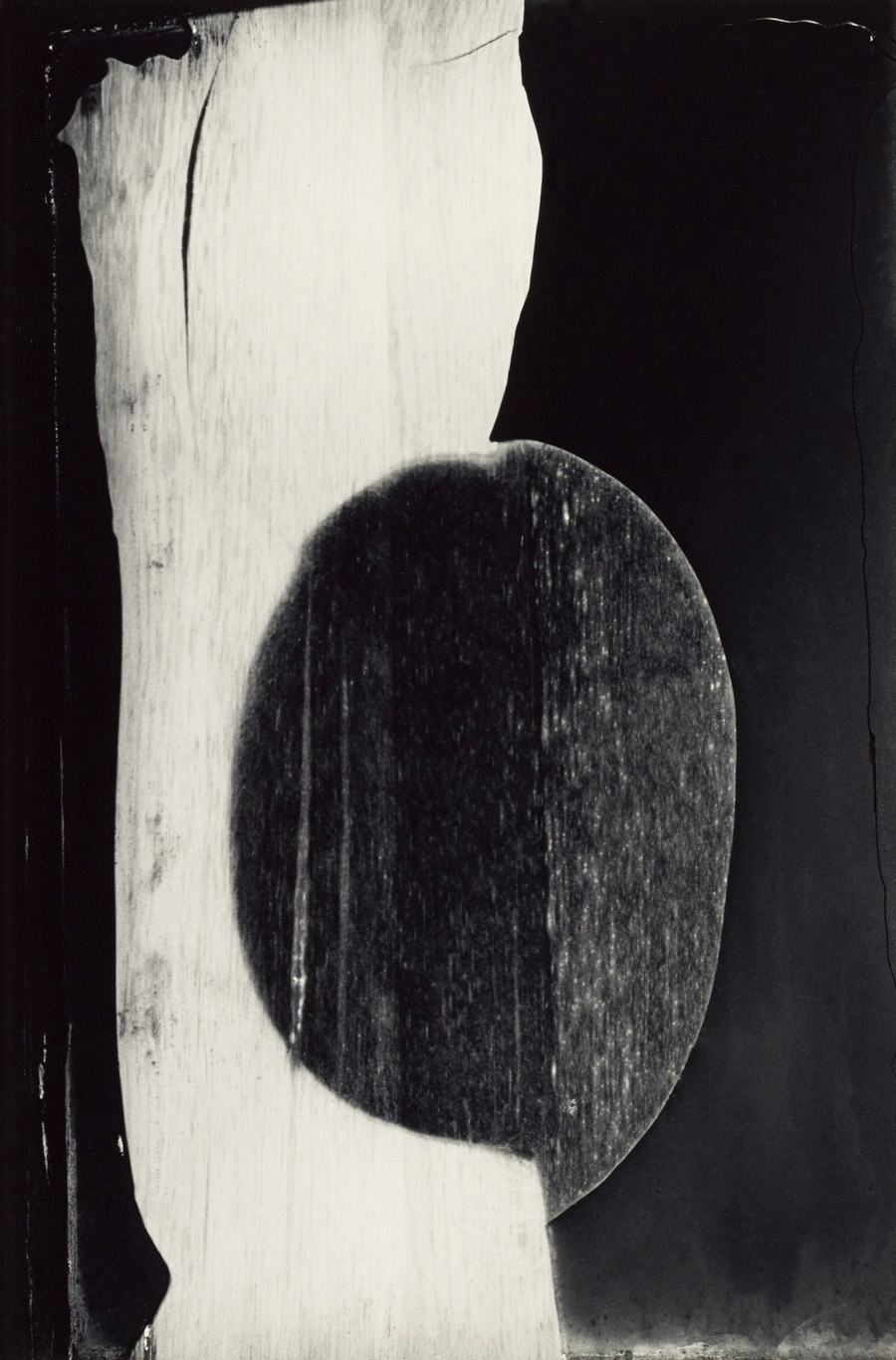
Installation view of the exhibition 'Photo-Secession: Painterly Masterworks of Turn-of-the-Century Photography' at the Utah Museum of Fine Arts showing at centre from left to right, Bernard Shea Horne 'Doorway Abstraction'; Drahomir Josef Ruzicka 'The Arch, Pennysylvannia Station' c. 1920; Arnold Genthe 'Acoma Pueblo, New Mexico' c. 1920; William E. Dassonville 'The Great Highway, San Francisco' c. 1905


Installation view of the exhibition Photo-Secession: Painterly Masterworks of Turn-of-the-Century Photography at the Utah Museum of Fine Arts showing at centre from left to right, Bernard Shea Horne Doorway Abstraction; Drahomir Josef Ruzicka The Arch, Pennysylvannia Station c. 1920; Arnold Genthe Acoma Pueblo, New Mexico c. 1920; William E. Dassonville The Great Highway, San Francisco c. 1905


Installation view of the exhibition 'Photo-Secession: Painterly Masterworks of Turn-of-the-Century Photography' at the Utah Museum of Fine Arts showing from top left to right, Edward Steichen 'Lotus, Mount Kisco' 1915; Edward Steichen 'Calla Lily' c. 1921; Edward Steichen 'Three pears and an apple' c. 1921; Edward Steichen 'Blossom of White Fingers' c. 1923


Installation view of the exhibition Photo-Secession: Painterly Masterworks of Turn-of-the-Century Photography at the Utah Museum of Fine Arts showing from top left to right, Edward Steichen Lotus, Mount Kisco 1915; Edward Steichen Calla Lily c. 1921; Edward Steichen Three pears and an apple c. 1921; Edward Steichen Blossom of White Fingers c. 1923


Installation view of the exhibition 'Photo-Secession: Painterly Masterworks of Turn-of-the-Century Photography' at the Utah Museum of Fine Arts

Installation view of the exhibition 'Photo-Secession: Painterly Masterworks of Turn-of-the-Century Photography' at the Utah Museum of Fine Arts


Installation view of the exhibition Photo-Secession: Painterly Masterworks of Turn-of-the-Century Photography at the Utah Museum of Fine Arts


Installation view of the exhibition 'Photo-Secession: Painterly Masterworks of Turn-of-the-Century Photography' at the Utah Museum of Fine Arts showing in the display cabinet issues of the magazine 'Camera Work', 1903-1917. Edited by Alfred Stieglitz and Edward Steichen


Installation view of the exhibition Photo-Secession: Painterly Masterworks of Turn-of-the-Century Photography at the Utah Museum of Fine Arts showing in the display cabinet issues of the magazine Camera Work, 1903-1917. Edited by Alfred Stieglitz and Edward Steichen


The Role of Camera Work

One of the key platforms for the Photo-Secession movement was the influential journal Camera Work, edited by Stieglitz and Steichen. Published from 1903 to 1917, Camera Work featured the work of Photo-Secessionists alongside essays and critiques that championed the artistic potential of photography. The journal played a crucial role in shaping public and critical perceptions of photography, providing a space for photographers to showcase their work and engage in intellectual discourse.

Adelaide Ryder. “The Photo-Secession Movement: Pioneering Artistry in Early Photography,” on the UMFA website Nd [Online] Cited 22/10/2024


Introduction

This exhibition celebrates 26 intrepid artists at the turn of the 20th century who sought to establish photography as a fine art equal to long-established media like painting, sculpture, drawing, and printmaking. This movement in the United States centred on the group dubbed the Photo-Secession. While each of the Photo-Secessionists had their distinctive approaches, their works are hand-crafted photographic prints of traditional artistic subjects, such as landscape, portraiture, figure study, and still life. This combination of painterly imagery and printmaking is also known as Pictorialism.

The passionate leader and tenacious advocate of the Photo-Secession was Alfred Stieglitz, who advanced the visions of the most ambitious photographers of the time, including Heinrich Kühn, Gertrude Käsebier, Edward Steichen, Paul Strand, and Clarence White. Stieglitz tirelessly promoted art photography through his exhibition space in New York City – the Little Galleries of the Photo-Secession and later called simply 291 – as well as through the journals he edited – Camera Notes (1897-1903) and Camera Work (1903-1917).

This exhibition also covers the breakup of the Photo-Secession, as some photographers rejected Pictorialism while others remained staunchly committed to it. The Photo-Secession itself irrevocably split apart around 1917. Artists led by Stieglitz, Steichen, and Strand switched to Straight Photography, an approach involving sharp focus and direct printing of the original shot. Artists led by Käsebier and White continued to innovate through painterly approaches using soft focus and manipulated prints.

The works in this exhibition represent some of the most influential artists and iconic images of the period as well as superb examples of a variety of photographic printing techniques, including platinum, gum-bichromate, carbon, cyanotype, and bromoil.

All works of art this exhibition are from the private collection of Michael Mattis and Judith Hochberg. This exhibition is organised by art2art Circulating Exhibitions.

The Rebirth of Art Photography in Europe

In the first few decades after the invention of photography in 1839, painters played an instrumental role in the development of this new medium. Artist-photographers like D.O. Hill in Edinburgh and Gustave Le Gray in Paris exhibited their photographs alongside paintings, drawings, and prints. The novelty of the photograph led to the proliferation of portrait studios and mass-produced views of famous monuments or exotic locales for the tourist trade. By the 1860s photography was considered a bourgeois technical profession. The Kodak camera, first issued in 1888, further popularised photography with its roll film, simple controls, and reasonable cost of one dollar (about $33 today).

Even as more and more individuals could access the means to make photos, artist-photographers advocated for the status of their medium and demanded a differentiation between their work and the products of point-and-shoot cameras. In 1889 Peter Henry Emerson published the book Naturalistic Photography for Students of the Art, which proposed a role for landscape photographers equal to esteemed painters like Camille Corot and Jean-François Millet. Emerson’s publication was a clarion call for a new generation of artistic photographers, and Pictorialism was born.

Pictorialist photographers enthusiastically pursued their new movement, pioneering soft-focus lenses and manipulatable printing methods. Soon they were forming regional clubs across Europe and resumed exhibiting their prints as art. The photographers that formed the t in London were particularly active and influential, and Pictorialism spread to other cultural centres like Paris, Berlin, and Vienna.

Alfred Stieglitz and the American Pictorialist Movement

Born in Hoboken, New Jersey, but educated largely in Germany, Alfred Stieglitz (1864-1946) watched the flowering of European Pictorialism with a mixture of aesthetic appreciation and fierce competitiveness, writing in 1892:

“Every unbiased critic will grant that we [American photographers] are still many lengths in the rear, apparently content to remain there, inasmuch as we seem to lack the energy to strive forward – to push ahead with that American will-power which is so greatly admired by the whole civilised world.”

Energised by European Pictorialism, Stieglitz championed juried photographic salons in Boston, New York, and Philadelphia. He also edited a series of increasingly ambitious journals about Pictorialist photography, starting with The American Amateur Photographer in 1893, then Camera Notes in 1897, and finally Camera Work starting in 1903. He inaugurated and named the Photo-Secession movement through the landmark exhibition he curated in 1903 at the National Arts Club in New York, which comprised 162 works by 32 artists. The name “Photo-Secession” referred to European avant-garde artistic movements, and in his own words, “Photo-Secession actually means a seceding from the accepted idea of what constitutes a photograph.” Eventually European artists would also be invited to join the Photo-Secession.

In 1905 Stieglitz opened a space at 291 Fifth Avenue in New York, the Little Galleries of the Photo-Secession, later simply called 291. It was the first retail gallery devoted to photography. He supported the venture with his own resources and generous assistance from others, and Edward Steichen was his steadfast associate. By 1915 Stieglitz was also showing avant-garde painting and sculpture at 291, including works by Pablo Picasso, Henri Matisse, and Constantin Brâncuși. Thus, he sought to demonstrate the idea that all art forms were on par with and informed one another.

Close Collaborations and the Sudden End of the Photo-Secession

From 1907 to 1910 Alfred Stieglitz and Clarence White closely collaborated on photographs and a landmark photography exhibition. In 1907 they made a series of 60 nudes, Stieglitz posing the models and White focusing the camera and making most of the prints. The following year, Stieglitz devoted an entire issue of Camera Work to White. In 1910 Stieglitz and White co-curated the International Exhibition of Pictorial Photography at Buffalo’s Albright Gallery (now Albright Knox Gallery). This historic project that included over 600 prints is now regarded as the apex of the Photo-Secession. It was also the final monument of the movement, as each of the major Pictorialists, White included, broke away from Stieglitz in the years that followed.

Significant reasons for the end of the Photo-Secession were Stieglitz’s authoritarian personality and disdain for photographers who needed to earn a living rather than exclusively pursue art for art’s sake. Philosophical differences also explain the rupture. Stieglitz had come to believe that Pictorialism had run its course. The irony was that the Photo-Secession had established photography as fine art through images that imitated other art forms by manipulation at every stage of the process – from lens to negative to print. Their pictures to varying degrees used methods that denied the very essence of photography. Stieglitz asserted that it was time to abandon the “painterly photograph” and to champion photography as fine art with compelling pictures that were truly photographic.

Late Pictorialism and the Clarence White School

As the artist Georgia O’Keeffe, Alfred Stieglitz’s partner for 30 years, acknowledged, “He was either loved or hated – there wasn’t much in between.” For reasons both personal and professional, most of the leading Photo-Secessionists chose not to follow Stieglitz and Paul Strand into Straight Photography. Many clustered instead around Clarence White, who in his gentle and encouraging manner was the antithesis of Stieglitz. In 1914 White founded the Clarence White School of Photography in New York City. In 1916 White along with Gertrude Käsebier and Alvin Langdon Coburn co-founded Pictorial Photographers of America; this new society welcomed members of all backgrounds and published the new journal Photo-Graphic Art.

The Clarence White School continued to be a locus for the training of new photographers until 1940, under the guidance of White’s widow Jane White after his death in 1925. Among the most prominent students of Clarence White are Karl Struss, Anne Brigman, Laura Gilpin, and Doris Ulmann, all of whom are represented in this exhibition. Other notable pupils of White include Margaret Bourke-White, Anton Bruehl, Paul Outerbridge, and Dorothea Lange.

Straight Photography, Edward Steichen, and Paul Strand

The final section of this exhibition focuses on Straight Photography and two of Alfred Stieglitz’s most notable protégés, Edward Steichen and Paul Strand. Between them, they pioneered leading branches of 20th-century American photography.

With the entry of the United States into World War I, both Steichen and Strand were drafted into the U.S. Army. Steichen was a photographer for the Army Air Service Signal Corps in Europe, and Strand was an X-ray technician in the Army Medical Corps. In the years immediately after WWI, they each turned their attention to photographing the natural world: flowers and fruit in Steichen’s case, and toadstools, grasses, and ferns in Strand’s. Both would return to photographing their gardens in the final years of their lives.

Outside the naturalist realm, Steichen and Strand’s paths diverged.

Steichen, an extrovert, pioneered modern fashion and advertising photography for the Condé Nast magazines Vogue and Vanity Fair. Later he was named Director of the Department of Photography at the Museum of Modern Art in New York, where he organised the landmark exhibition, Family of Man, which traveled to 37 countries on six continents and was seen by an estimated nine million people.

Strand, an introvert, traveled to remote places around the world, documenting the landscape, architecture, and people, his work exuding a respect for the dignity of the labouring class, which he absorbed from his mentor, Lewis Hine. Overall, Strand’s profoundly humanist scenes of everyday life influenced a generation of socially conscious photographers who documented the 20th-century crises of the Dust Bowl, the Great Depression, World War II, and more.

Heinrich Kühn

In the late 19th century, European Pictorialism was divided into two camps. On the one side were the purist photographers who, aside from a softening of the lens, opposed extensive manipulation of the negative or the print for artistic effect. On the other side were those who derided “button-pushers” and viewed the “straight” photograph as merely the raw material from which to create an artistic print through elaborate handiwork.

The leader of this latter camp was Heinrich Kühn (1866-1944). Eschewing Modernist tendencies, he chose traditional subject matter of painting from the 17th through 19th centuries: still life, figural studies, and genre scenes. His preference for gum-bichromate and bromoil printmaking techniques, which allowed for extensive manipulation, were intended to provoke the reaction in the viewer: is that really a photograph?

Born in Dresden, Kühn moved to Innsbruck, Austria, after youthful studies in science and medicine. Thanks to a sizeable inheritance, he could devote himself to artistic photography, joining both the Linked Ring in London and Stieglitz’s Photo-Secession in the United States. A trans-Atlantic correspondence with Stieglitz began in 1899 and lasted three decades. They congratulated one another on their latest triumphs and encouraged each other through professional and personal disappointments. In 1909, with Stieglitz’s assistance, Kühn organised the International Photographic Exhibition in Dresden, one of the high points of Pictorialism.

Later in life, Kühn filed multiple patents in photochemistry and camera technology related to Pictorialist photography, but none earned him any money. Tastes had changed, and the painterly photograph had become a quaint curiosity.

Gertrude Käsebier

Gertrude Käsebier (1852-1934) was 37 years old, married, and had three children by the time she began studying art at the Pratt Institute. She had originally purchased a camera to make portraits of her children, but Pratt encouraged its women students to earn a living in the arts. By 1897 she opened a one-room commercial portrait studio in New York City. Her ambition was to make “not maps of faces, but likenesses that are biographies, to bring out in each photograph the essential personality that is variously called temperament, soul, humanity.”

Recognition for Käsebier’s talent and ability came swiftly. In 1898 the painter William Merritt Chase, judging the Philadelphia Photographic Salon, called her work “as fine as anything that [Anthony] Van Dyck has ever done.” For Stieglitz, who organised her first solo show in 1899 at the Camera Club of New York, Käsebier was “beyond dispute the leading portrait photographer in this country.” That year, she sold one of her photographs for the unheard-of sum of $100 (almost $3,800 today).

However, by the time that the Brooklyn Museum honoured Käsebier with a career retrospective in 1929, Pictorialist photography had fallen so far out of fashion that the exhibition was not even reviewed in major journals.

Clarence Hudson White

Clarence Hudson White (1871-1925) was a modest, soft-spoken, entirely self-taught genius from America’s heartland. Raised in the small town of Newark, Ohio, he eked out a living as a bookkeeper for a wholesale grocer; each week he saved enough to purchase two glass plates for his camera. He specialised in gorgeously back-lit domestic interior scenes featuring his friends and members of his close-knit extended family.

White’s contributions to the 1898 Philadelphia Photographic Salon were so highly praised that, like Gertrude Käsebier, he was appointed a judge for the following year. The annual salons of the Newark Camera Club that he organised featured the nation’s preeminent Pictorialists and were the direct precursor to Stieglitz’s Photo-Secession. Indeed, the 1900 salon featured his friend and latest discovery, Edward Steichen of Milwaukee.

From 1907 onwards, both in New York City and during summers in rural Maine, White was also America’s foremost teacher of photography. Many of the leading American photographers of the 20th century studied at the Clarence White School.

Paul Strand

In 1915 Alfred Stieglitz found in the young Paul Strand (1890-1976) the leader of a remarkable new direction in photography. Strand had been a senior at the Ethical Culture High School in 1907 when he first visited Gallery 291 on a class trip with his photography teacher, Lewis Hine, whose poignant documents of immigrants and child labor were staples of the Progressive Movement. Eight years later, after thousands of hours in the darkroom at the New York Camera Club, Strand returned to 291 with a portfolio of platinum prints that pointed the way to a new era. Stieglitz deemed them “brutally direct, devoid of all flim-flam, devoid of trickery and of any ‘ism’. These photographs are the direct expression of today.” Stieglitz not only offered Strand an exhibition at 291, but also devoted the final two issues of Camera Work exclusively to him.

What was so compelling and inspiring to Stieglitz in Strand’s photography? His portfolio contained pictures of urban street life and architecture, as well as powerful close-ups of weathered New York faces (influenced by Lewis Hine), boldly composed still lifes, and shadow abstractions taken on a porch in Twin Lakes, Connecticut.

As for photography’s future, Strand and Stieglitz saw eye to eye. In his essay in Camera Work, Strand called for the universal adoption of Straight Photography “without tricks of process or manipulation.” In a provocative lecture at the Clarence White School, Strand condemned “this so-called pictorial photography, which is nothing but an evasion of everything photographic.”


Works by Emerson, Post, Evans, and Sutcliffe
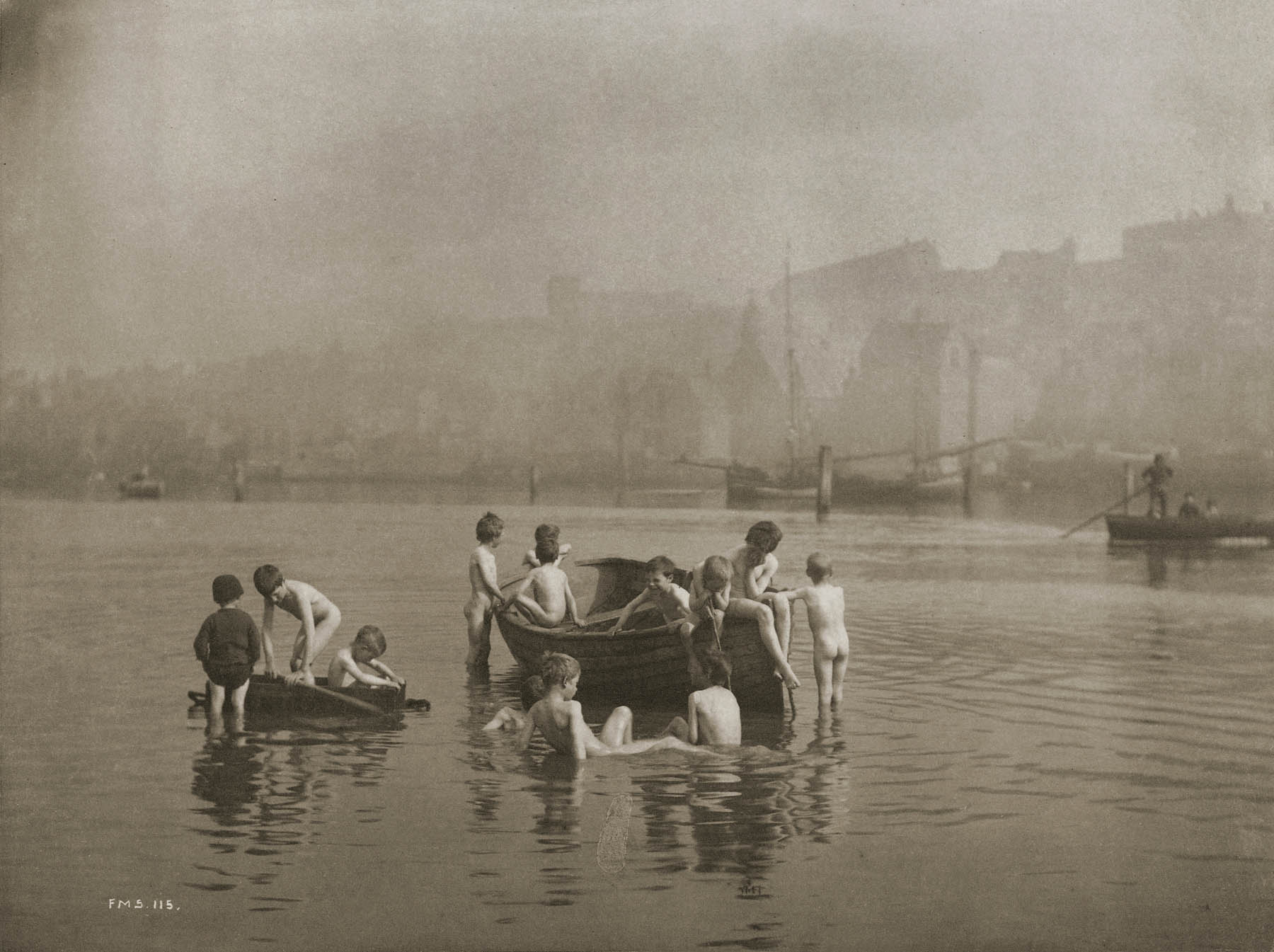
 

Frank Meadow Sutcliffe (British, 1853-1941) 'The Water Rats' 1886 from the exhibition 'Photo-Secession: Painterly Masterworks of Turn-of-the-Century Photography' at the Utah Museum of Fine Arts, Salt Lake City, August - December 2024


Frank Meadow Sutcliffe (British, 1853-1941)
The Water Rats
1886
Platinum print on paper


Sutcliffe was a member of the British photographic society the Linked Ring, which sought to make their work recognised as fine art. He operated a portrait studio in the seaside town of Whitby in North Yorkshire but is remembered for his charming, naturalistic depictions of local life. This photograph resulted in his excommunication by local clergy for its “corrupting” effects. Today this is his best-known photograph, regarded as a study of pure childhood joy.
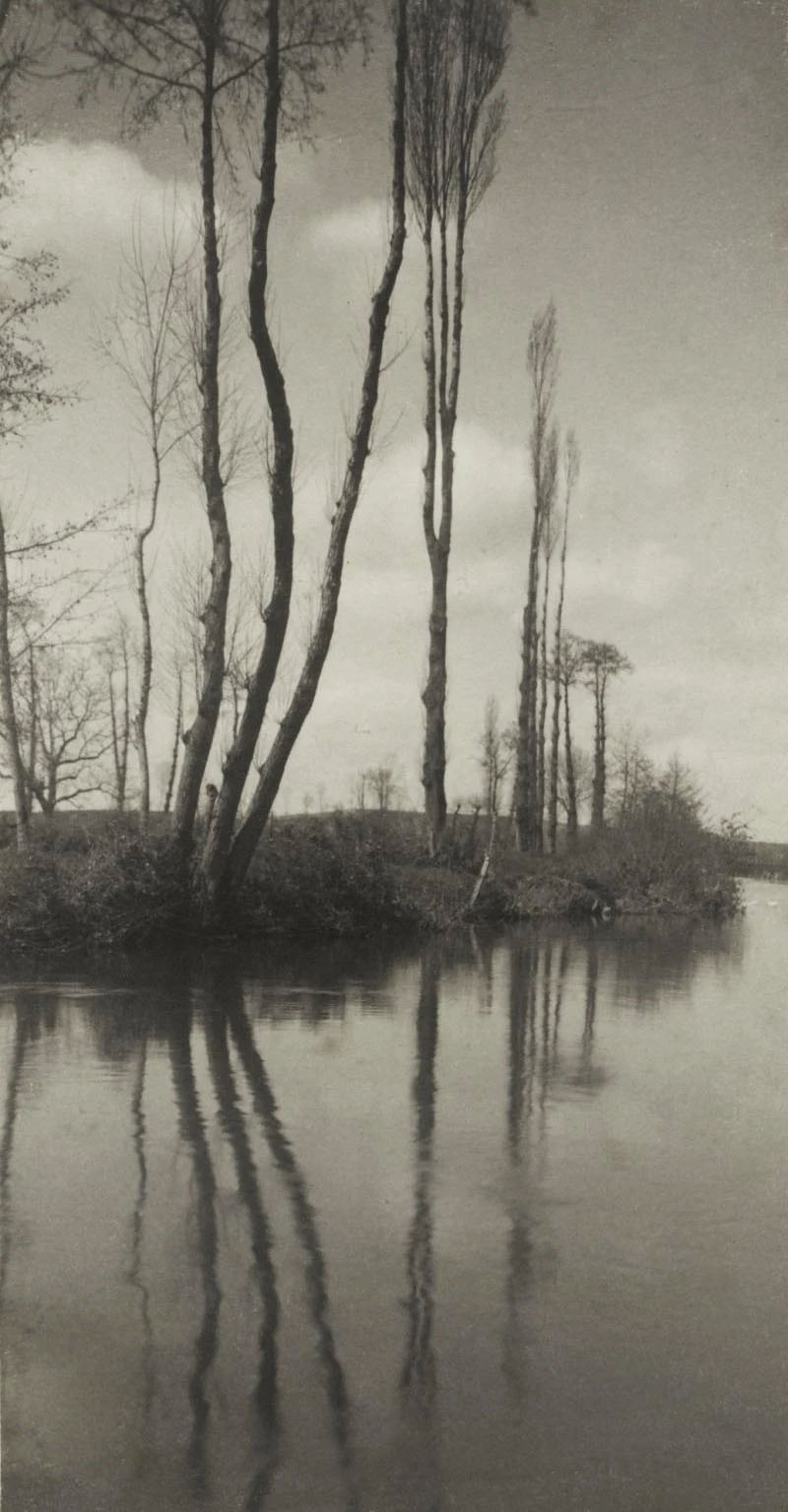
 

Frederick H. Evans (British, 1853-1943) 'Poplars on a French River' c. 1900


Frederick H. Evans (British, 1853-1943)
Poplars on a French River
c. 1900
Platinum print on paper
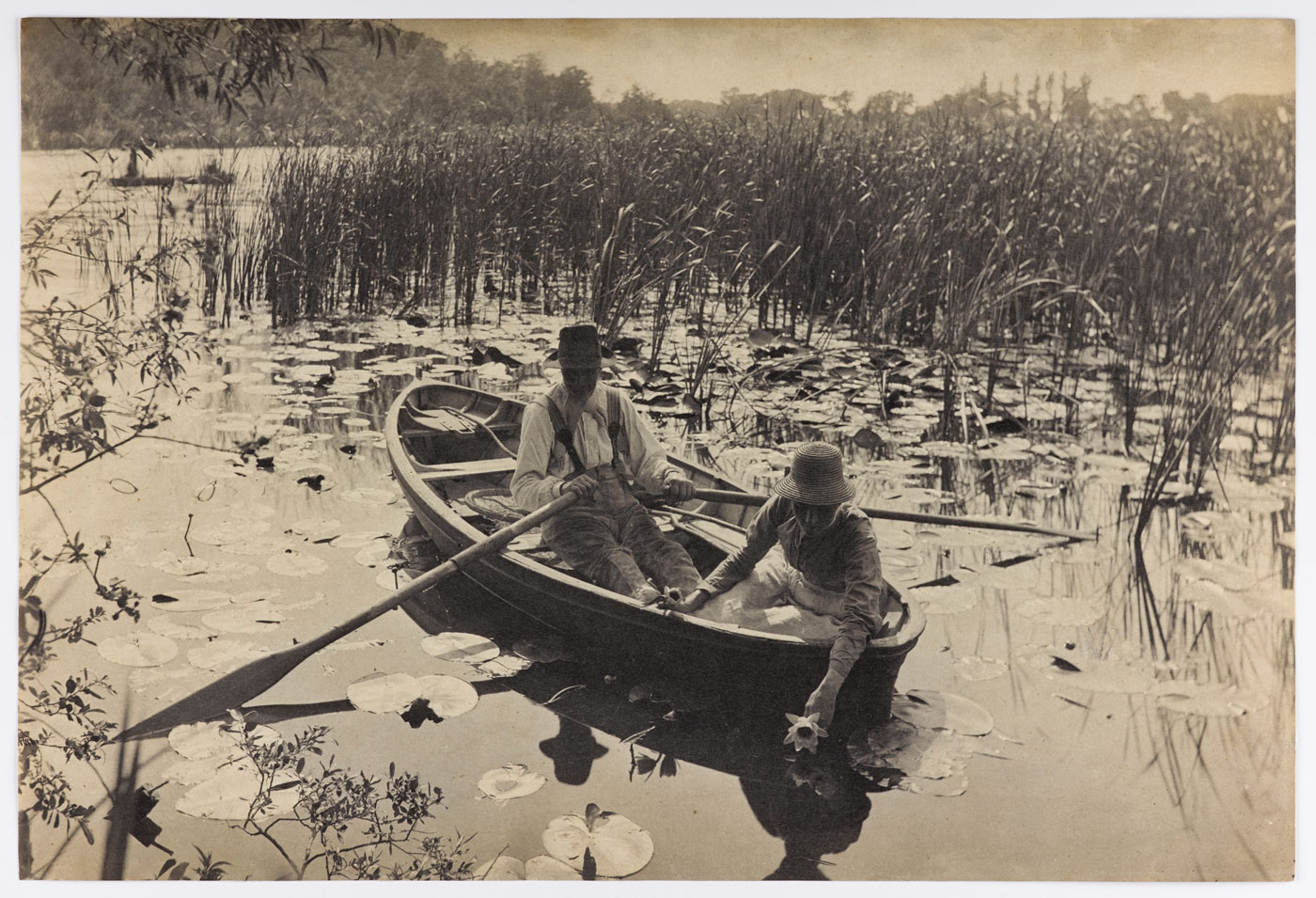
 

Peter Henry Emerson (British born Cuba, 1856-1936) 'Gathering Water Lilies' c. 1885


Peter Henry Emerson (British born Cuba, 1856-1936)
Gathering Water Lilies
c. 1885
Platinum print on paper


In addition to his photographic work, Emerson wrote persuasively that photography could match – and even surpass – painting as an emotive art form. His writings were influential to the young Alfred Stieglitz, with whom he corresponded over four decades.

All from the Collection of Michael Mattis and Judith Hochberg


Works by Thiollier
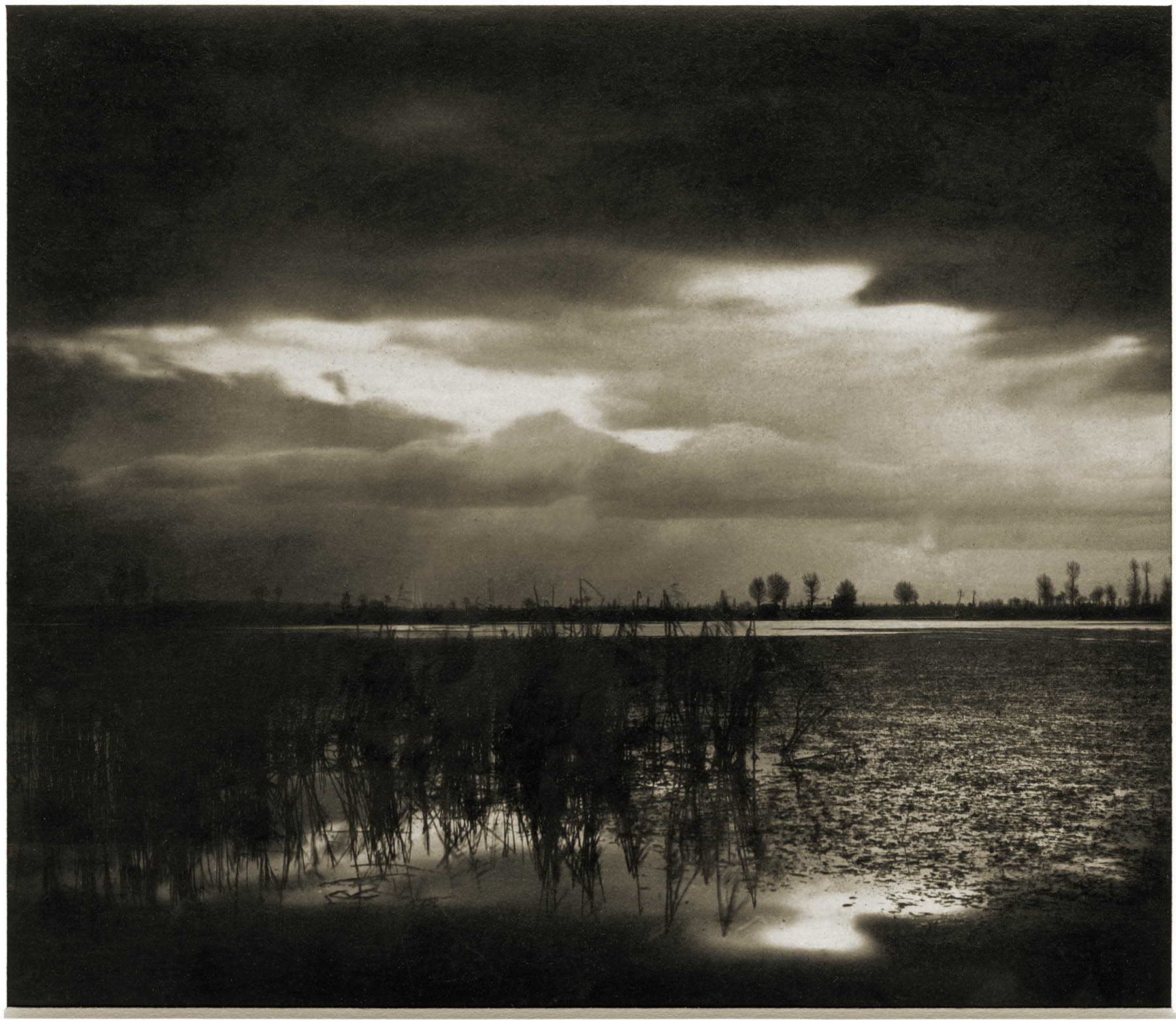
 

Félix Thiollier (French, 1842-1914) 'Landscape in Bugey' c. 1885


Félix Thiollier (French, 1842-1914)
Landscape in Bugey
c. 1885
Carbon print on paper


Thiollier’s photographic career is a fairly recent discovery, highlighted in the first ever retrospective of his career at the Musée d’Orsay in Paris in 2012.

From the Collection of Michael Mattis and Judith Hochberg


Works by Kühn


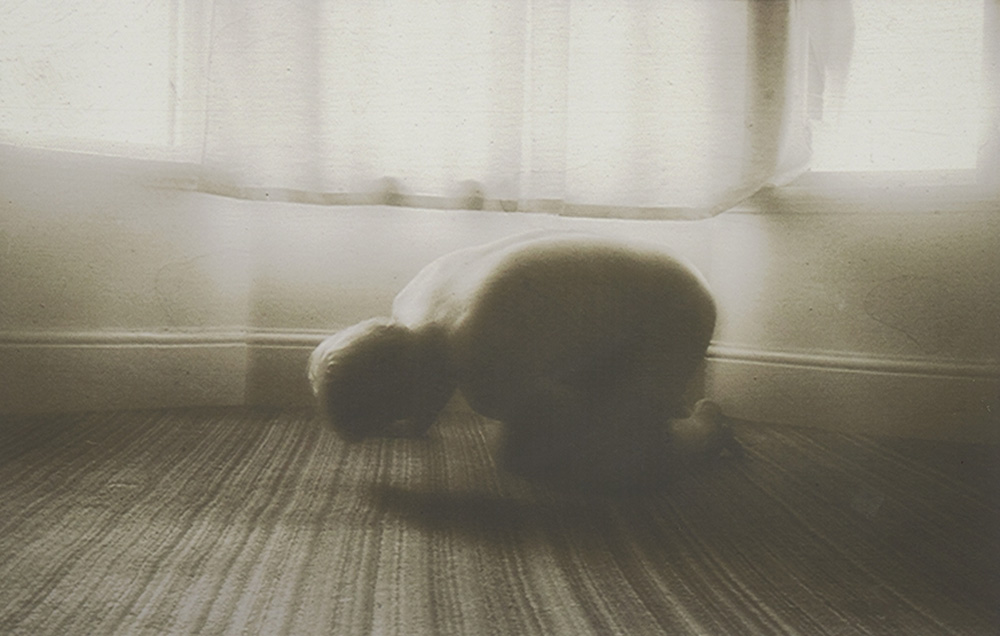
Heinrich Kühn (Austrian born Germany, 1866-1944) 'Nude in Morning Sun' c. 1920


Heinrich Kühn (Austrian born Germany, 1866-1944)
Nude in Morning Sun
c. 1920
Multiple bromoil transfer print on Japanese tissue paper


Heinrich Kühn (Austrian born Germany, 1866-1944) 'Female torso in sunlight' c. 1920


Heinrich Kühn (Austrian born Germany, 1866-1944)
Female torso in sunlight
c. 1920
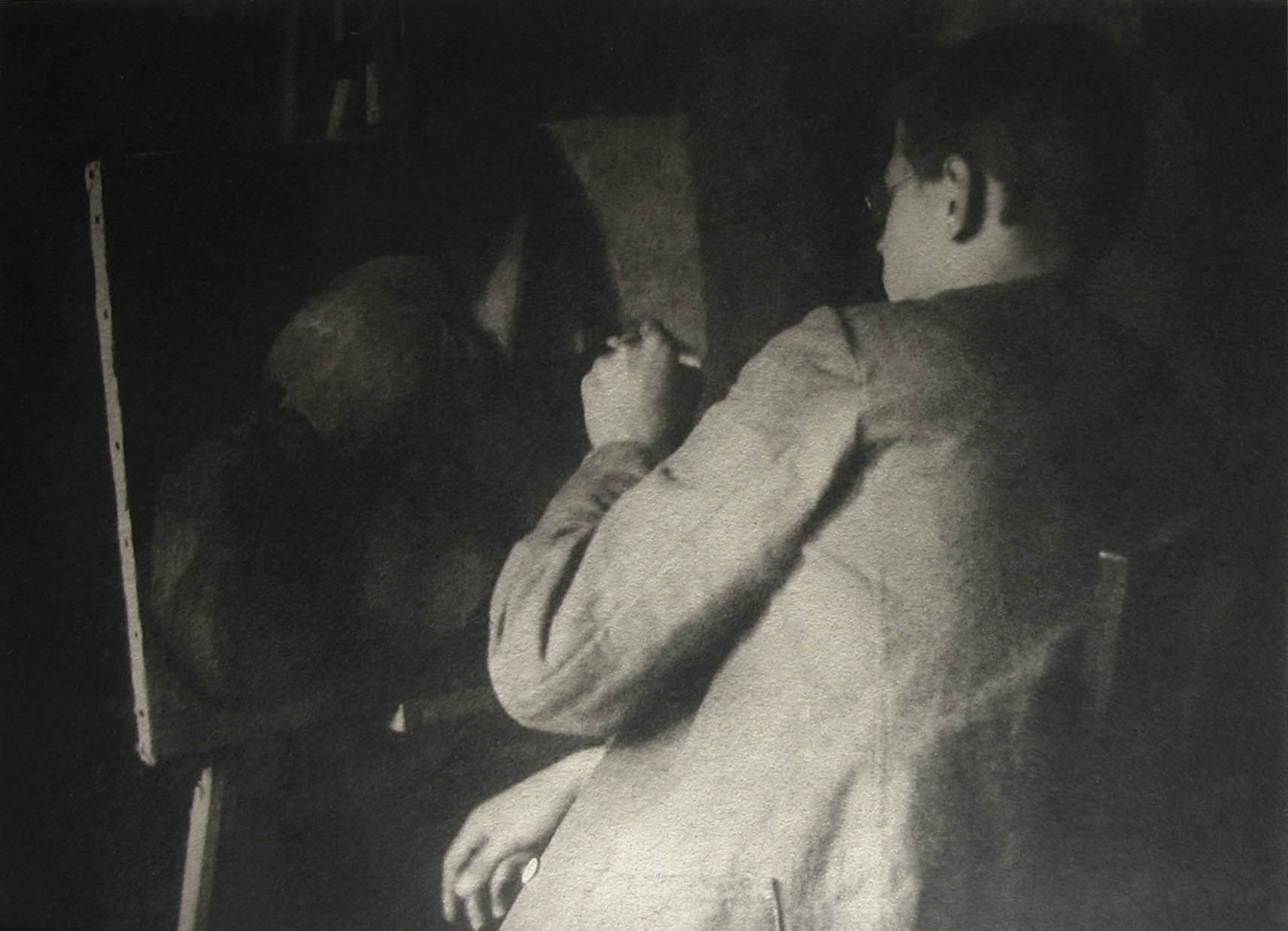
 

Heinrich Kühn (Austrian born Germany, 1866-1944) 'Walter at Easel' c. 1909


Heinrich Kühn (Austrian born Germany, 1866-1944)
Walter at Easel
c. 1909
Gum-bichromate print on paper


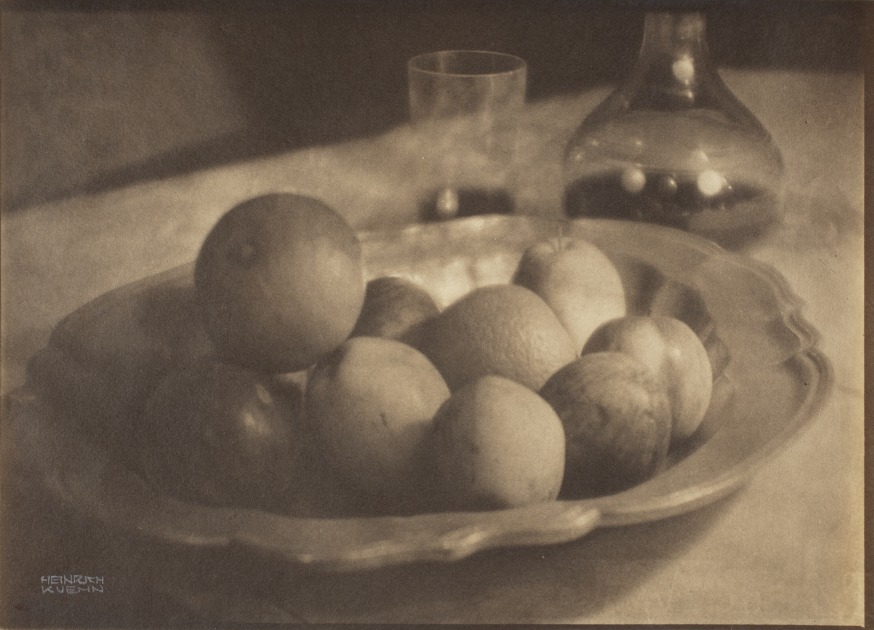
Heinrich Kühn (Austrian born Germany, 1866-1944) 'Still Life with Fruit and Pottery' c. 1896


Heinrich Kühn (Austrian born Germany, 1866-1944)
Still Life with Fruit and Pottery
c. 1896
Gum-bichromate print on paper with an applied watercolour wash


Kühn’s still lifes deliberately recall paintings from earlier centuries. This scene – his first published image – contains similar elements to 17th-century still-life compositions. He even included insects, which are traditional references to mortality called memento mori (reminders of death). Can you spot the housefly?

All from the Collection of Michael Mattis and Judith Hochberg


Portraits by Steichen


Edward Steichen (American born Luxembourg, 1879-1973) 'George Frederic Watts, London' 1901


Edward Steichen (American born Luxembourg, 1879-1973)
George Frederic Watts, London
1901
Varnished platinum print on paper


This dramatic profile portrait of the English Pre-Raphaelite painter was the first in what Steichen termed his “Great Men” series. Steichen wrote about his approach to portraiture, “I aim for the expression of something psychological. I am not satisfied with the mere reproduction of features and expression.”

Published in Camera Work, 14, 1906
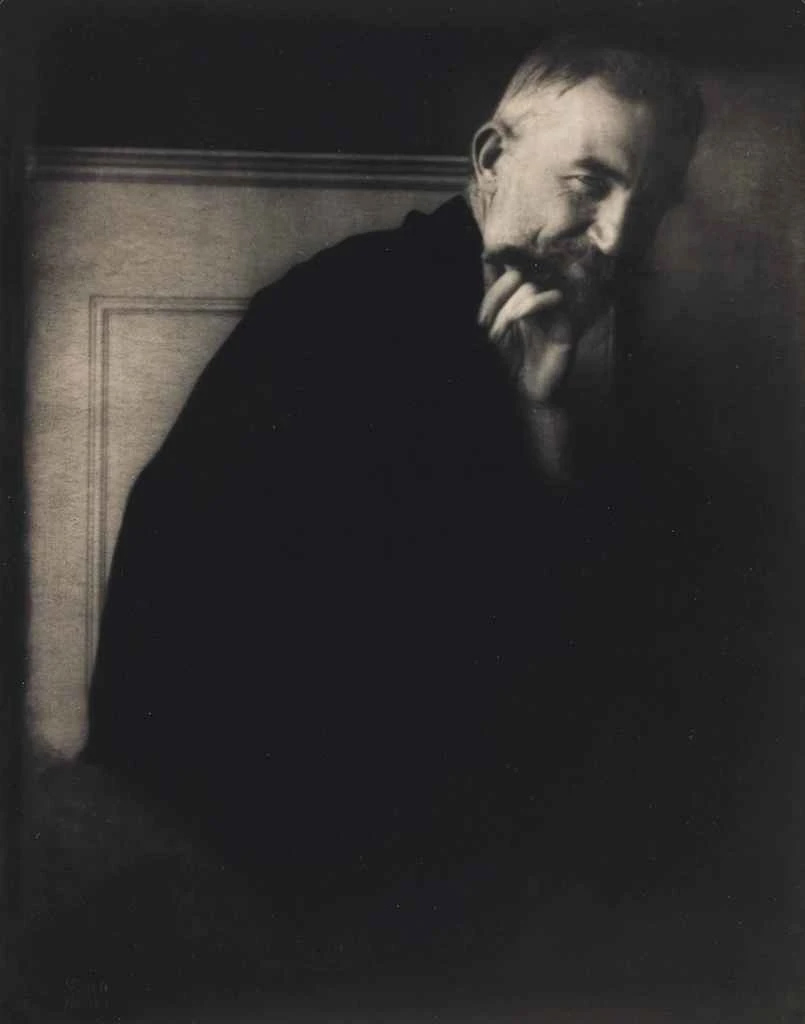
 

Edward Steichen (American born Luxembourg, 1879-1973) 'The Photographer's Best Model: George Bernard Shaw, London' 1907


Edward Steichen (American born Luxembourg, 1879-1973)
The Photographer’s Best Model: George Bernard Shaw, London
1907
Platinum print on paper


Steichen was elated after his photographic sitting with Shaw, writing to Stieglitz: “Well I’ve seen and done Shaw (photographically of course). He’s the nicest kind of fellow imaginable – genial and boyish – there is a little of the sardonic about him as you see him but when you get the camera at him you are tempted with possibilities in that way. He seems to know a lot about photography and certainly skilfully bluffs you into believing he knows it all.”

Published in Camera Work, 42/43, 1913

All from the Collection of Michael Mattis and Judith Hochberg


Glossary of Photographic Printing Methods and Terms from the History of Photography

Gelatin Silver Print

For over a century, from the 1880s until the digital era, the gelatin silver print was the most common technique for producing black-and-white photographs. The paper is coated with a binder layer of gelatin incorporating light-sensitive silver chloride or silver bromide. The paper is exposed under a negative, either by contact-printing or through an enlarger, then chemically developed, stopped, fixed, and dried. In the process, the silver salts are reduced to metallic silver, which carries the image. The overall color of the print can be altered through toning.

Cyanotype

A sheet of paper is sensitised in a solution of potassium ferricyanide and ferric ammonium citrate. After contact-printing under a negative, the iron compounds form an insoluble blue (“cyan”) dye known as Prussian blue. Apart from its occasional artistic use, the only regular use of the cyanotype was in copying architectural plans, thus called “blueprints.”

Platinum or Palladium Print

A platinum print is produced by sensitising a sheet of paper with platinum and iron salts. The sheet is then contact-printed under a negative until a faint image is visible. The print is developed in a potassium oxalate solution that dissolves unexposed iron salts and transforms the platinum salts into metallic platinum, which intensifies the image. Mercury chloride can be added to the solution to give a warmer tone. Unlike a silver print, where the image lives in a gelatin binder layer on top of the paper (akin to a watercolour), the image in a platinum print is embedded in the paper fibres (akin to an oil painting). The rich mid-tone range and matte surface made the platinum print the favoured medium for the Pictorialist photographers, from P.H. Emerson onward. When the price of platinum spiked during World War I, palladium was introduced as a more affordable (and generally warmer-toned) substitute.

Pigment Prints

The following processes are known as pigment prints, because the photographic image is carried by inks or pigments, rather than by metallic particles like silver, iron, or platinum.

Gum Bichromate Print

A sheet of paper is coated with diluted gum-arabic mixed with coloured pigment and light-sensitive potassium bichromate. During exposure under a negative, the bichromate causes the coloured gum-arabic to harden in proportion to the amount of light received. The areas not exposed to light remain soluble in water, and the print is developed by washing away the soluble areas, leaving a positive image on the paper. The prints can be exposed and reprinted numerous times with different coloured pigments, as well as manipulated by brushing away more pigmented gum during the washing stage.

Bromoil (Transfer) Print

This process does not begin with a negative, but rather with a gelatin silver print that is bleached in a solution of potassium bromide. The bleaching removes the silver-based image and selectively hardens the underlying gelatin in proportion to the image density. The sheet is then hand-coloured with an oil-based ink, which is selectively absorbed depending on the hardness of the gelatin: the softer areas contain more water, which repels the oil-based ink. An inked print is sometimes used as a kind of printing plate for transferring the image to another sheet of paper (a bromoil transfer print).

Photogravure

This is a sophisticated photomechanical process used for reproducing photographs in ink in a large edition. It is a form of intaglio printing, in which a photographic image is acid-etched into a copper plate. The relief image is then inked and printed. Alfred Stieglitz’s magazine Camera Work was largely printed in photogravure.

The Photo-Secession

This was the brief but influential artistic movement led by American Alfred Stieglitz during the years 1902–1915 that championed photography as an art form that was as aesthetic, creative, and skilful as traditional media like painting, drawing, watercolour, and printmaking. The European artistic movement Secessionism inspired the name Photo-Secession, and both movements were committed to Modernism by seceding from centuries-old academic traditions.

Pictorialism / Pictorialist

The approach to photography in which artists sought to make images that imitated the tradition of paintings through photographic prints. Pictorialist photographers used soft focus lenses and manipulated both their negatives and printing media to create their prints.

The Linked Ring

Also known as the Brotherhood of the Linked Ring, this photographic society founded in 1892 in London promoted photography as a form of art and was influential for the American society of the Photo-Secession.

Straight Photography

The approach to photography in which artists use sharp focus and print directly from their negatives with minimal or no manipulation.

Camera Notes

Camera Notes was the journal of the Camera Club of New York, edited by Alfred Stieglitz from 1897 to 1902. Under Stieglitz’s editorship, the purposes of Camera Notes were “to take cognisance also of what is going on in the photographic world at large, to review new processes and consider new instruments and agents as they come into notice; in short to keep our members in touch with everything connected with the progress and elevation of photography.”

Camera Work

Camera Work was the journal about contemporary photography that Alfred Stieglitz edited and published with the assistance of Edward Steichen from 1903 to 1917. The goal of this journal “devoted largely to the interests of pictorial photography” was “to issue quarterly an illustrated publication which will appeal to the ever-increasing ranks of those who have faith in photography as a medium of individual expression, and, in addition, to make converts of many at present ignorant of its possibilities.”

This glossary has been edited from primary sources and text by Ina Schmidt-Runke, Meike Harder, and Andreas Gruber.


The Photo-Secession Movement: Pioneering Artistry in Early Photography

By Adelaide Ryder, head photographer and digital assets manager at the UMFA

The Birth of the Photo-Secession Movement

This fall the Utah Museum of Fine Arts will exhibit Photo-Secession: Painterly Masterworks of Turn-of-the-Century Photography. This exhibition of art photography from the early 20th century will be on view from August 24 to December 29, 2024. Who were the Photo-Secessionists and why was their work so pivotal to the advancement of photography as an art form?

In the mid-19th century photography was regarded as a complex technical field that only a trained professional could do. By the 1880s, however, the hand-held camera had become affordable and easy to use, and the “snapshot” became commonplace. Smaller, easier-to-use cameras and the ability to send the film off to a lab for development gave the public accessibility to the medium in a new way. This technological advancement greatly affected the professional photography business, as people began to question the skills needed to make a photograph when “anyone could push a button.”

How did photographers respond to this shift in aesthetics and business? Many searched for ways to use photography to express abstract ideas or subjective points of view, shifting from using photography to document objective likeness to illustrating subjective conditions or the subject’s inner state. This helped elevate the photographer’s status, as the expressive ability of the person behind the camera became as important as the subject. Photographers embraced symbolism and started printing with complex techniques like gum bichromate to elevate their craft above the basic snapshot. Two significant movements were born from this struggle to gain recognition as a legitimate form of artistic expression rather than simply a means of mechanical documentation: Pictorialism and the Photo-Secession.

The camera was seen as a tool, and many felt that photographs visually lacked the “artist’s hand,” an essential factor in calling something “art.” The Photo-Secession movement, founded by Alfred Stieglitz in 1902, aimed to change this perception. Stieglitz and his contemporaries believed photography deserved the same artistic consideration as painting and sculpture. They aimed to elevate photography to fine art, emphasizing the photographer’s vision and creativity over mere technical skill. Stieglitz said the Photo-Secession was founded “loosely to hold together those Americans devoted to pictorial photography in their endeavour to compel its recognition, not as a handmaiden of art, but as a distinctive medium of individual expression.” (Camera Work, no. 6, April 1904.)

The Photo-Secession movement emerged from the broader Pictorialist movement, which dominated photographic art in the late 19th and early 20th centuries. While both movements sought to establish photography as an art form, the Photo-Secessionists emerged with their own philosophy.

Similarities

Artistic Expression: The Photo-Secession and Pictorialism emphasized the photographer’s role as an artist rather than a mere technician. They believed that photography should convey the photographer’s vision and emotional intent.

Aesthetic Quality: Both movements valued the aesthetic quality of photographs. They often employed techniques like soft focus, manipulation of light, and careful composition to create visually striking images.

Influence of Painting: Both were heavily influenced by the aesthetics of painting, particularly Impressionism and Symbolism. They sought to create images that were painterly in style, blurring the lines between photography and traditional fine arts.

Differences

Philosophical Focus: Pictorialism focused on creating images that looked like paintings, often using elaborate darkroom techniques to achieve a painterly effect. Photo-Secession, while also influenced by painting, emphasised the photographer’s personal expression and the inherent qualities of the photographic medium, sometimes even embracing the “snapshot” aesthetic if it helped to illustrate more hidden ideas and thoughts.

Technical Innovation: The Photo-Secessionists were more open to embracing the amateur artist and experimentation in techniques and technologies, whereas the Pictorialists held on to the traditional hierarchy of the European artistic schools of the time. Photo-Secessionists saw innovation as a means to expand photography’s artistic potential.

Subject Matter: Pictorialists focused on romanticized and idealized subjects, such as landscapes, portraits, and allegorical scenes. The Photo-Secessionists, on the other hand, explored a wider range of subjects, including urban scenes, modern life, and abstract forms. They embraced art movements like Cubism and Futurism, reflecting a broader and more progressive vision of art.

Exhibition and Display: The Photo-Secessionists were disenchanted with the outdated salons and gate-keeping ways of many photo schools commonly practiced in Europe. They began publications like The American Amateur Photographer, Camera Notes, and Camera Work to help give a platform to young photographers and people practicing these new ways of image making.

Adelaide Ryder. “The Photo-Secession Movement: Pioneering Artistry in Early Photography,” on the UMFA website Nd [Online] Cited 22/10/2024
 

Who were the Photo-Secessionists?

Works by Stieglitz

Alfred Stieglitz: The Visionary Leader

Alfred Stieglitz was a driving force behind the Photo-Secession movement. His passion for photography galvanized his dedication to promoting it as an art form. He saw photography as a means of personal expression. He helped catapult the idea that image-making can happen in the darkroom, during the printing process, as much as in the camera.

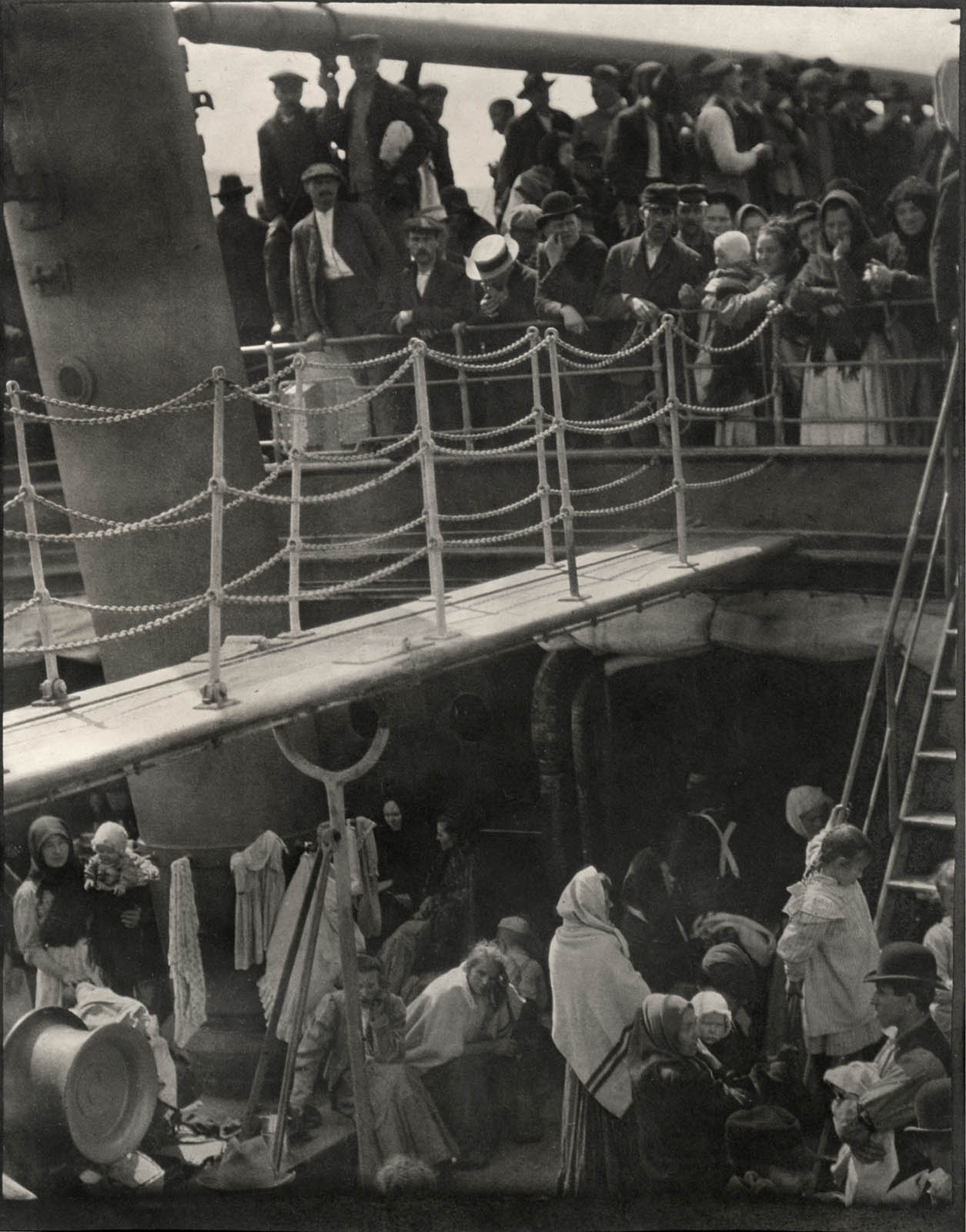
Stieglitz’s photograph The Steerage (1907, below) is one of the most iconic images in the history of photography. This powerful image captures the crowded lower deck of a transatlantic steamer, where people traveled in steerage class, the part of the ship with accommodations for those with the cheapest tickets. The Steerage is celebrated for its striking composition, which combines geometric shapes and human forms to create a dynamic and balanced visual narrative. Stieglitz considered this photograph one of his most outstanding achievements, as it encapsulated his transition to straight photography, which embraced photographs looking like photographs rather than the painterly qualities of Pictorialism. This photograph shows his ability to convey the complexity and depth of human experience through a single image. The photograph is a masterpiece of visual artistry and a compelling social document, reflecting the conditions and aspirations of early 20th century immigrants.

Adelaide Ryder. “The Photo-Secession Movement: Pioneering Artistry in Early Photography,” on the UMFA website Nd [Online] Cited 22/10/2024


Alfred Stieglitz (American, 1864-1946) 'The Steerage' 1907


Alfred Stieglitz (American, 1864-1946)
The Steerage
1907
Hand-pulled photogravure on paper


This photograph has become the iconic image of the Photo-Secession and has legendary status. In June 1907 he sailed to Europe to visit family and booked a first-class cabin. On a stroll around the ship, he encountered a bustling scene of labourers and their families traveling in steerage class, the part of the ship with accommodations for those with the cheapest tickets. With a single four-by-five-inch glass plate left in his camera, Stieglitz shot what would be regarded as a definitive masterpiece of both photography and Modernism.

About making this picture Stieglitz recalled: “There were men and women and children on the lower deck of the steerage. There was a narrow stairway leading to the upper deck of the steerage, a small deck right on the bow of the steamer. To the left was an inclining funnel and from the upper steerage deck there was fastened a gangway bridge that was glistening in its freshly painted state. It was rather long, white, and during the trip remained untouched by anyone. On the upper deck, looking over the railing, there was a young man with a straw hat. The shape of the hat was round. He was watching the men and women and children on the lower steerage deck. A round straw hat, the funnel leaning left, the stairway leaning right, the white drawbridge with its railing made of circular chains – white suspenders crossing on the back of a man in the steerage below, round shapes of iron machinery, a mast cutting into the sky, making a triangular shape. I saw shapes related to each other. I saw a picture of shapes and underlying that the feeling I had about life.”


Alfred Stieglitz (American, 1864-1946) 'The Hand of Man' 1902


Alfred Stieglitz (American, 1864-1946)
The Hand of Man
1902
Hand-pulled photogravure on paper

All from the Collection of Michael Mattis and Judith Hochberg


Works by Käsebier

Gertrude Käsebier: The Master of Portraiture

Gertrude Käsebier was known for her compelling portraits and allegorical imagery. Käsebier’s work transcended traditional portrait photography by infusing her images with a deep sense of intimacy and character. She believed that a photograph should reveal the inner essence of its subject, and her portraits are renowned for capturing the personality and spirit of the people she photographed.

Käsebier’s approach to portraiture was both innovative and empathetic. This image from the UMFA’s permanent collection is a perfect example of how she photographed women and children, presenting them with dignity and respect at a time when they were not the usual subjects of portraiture. Her work challenged conventional representations and highlighted her subjects’ emotional depth and individuality.

Adelaide Ryder. “The Photo-Secession Movement: Pioneering Artistry in Early Photography,” on the UMFA website Nd [Online] Cited 22/10/2024
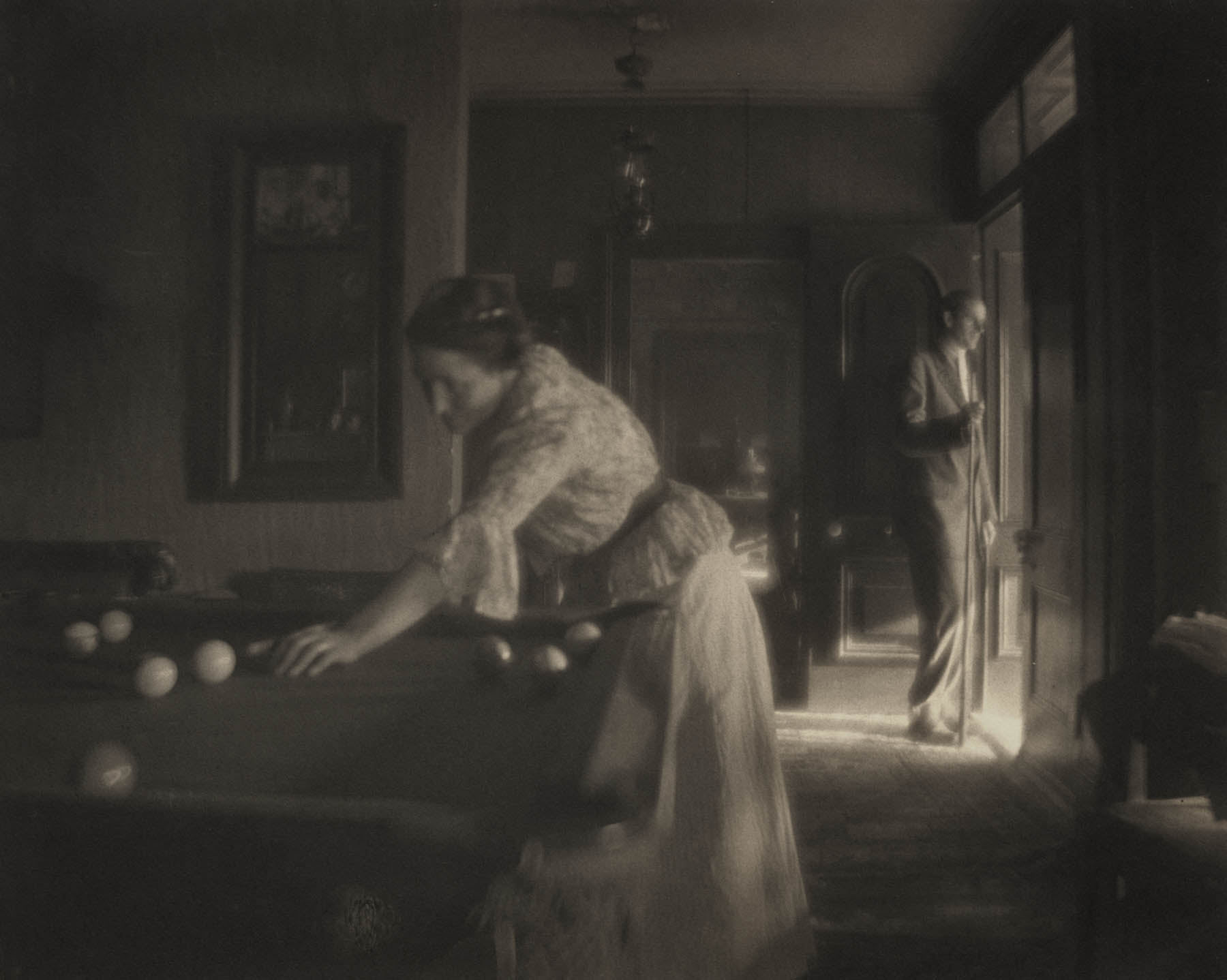
 

Gertrude Käsebier (American, 1852-1934) 'Untitled (Billiard Game)' c. 1909


Gertrude Käsebier (American, 1852-1934)
Untitled (Billiard Game)
c. 1909
Platinum print on paper
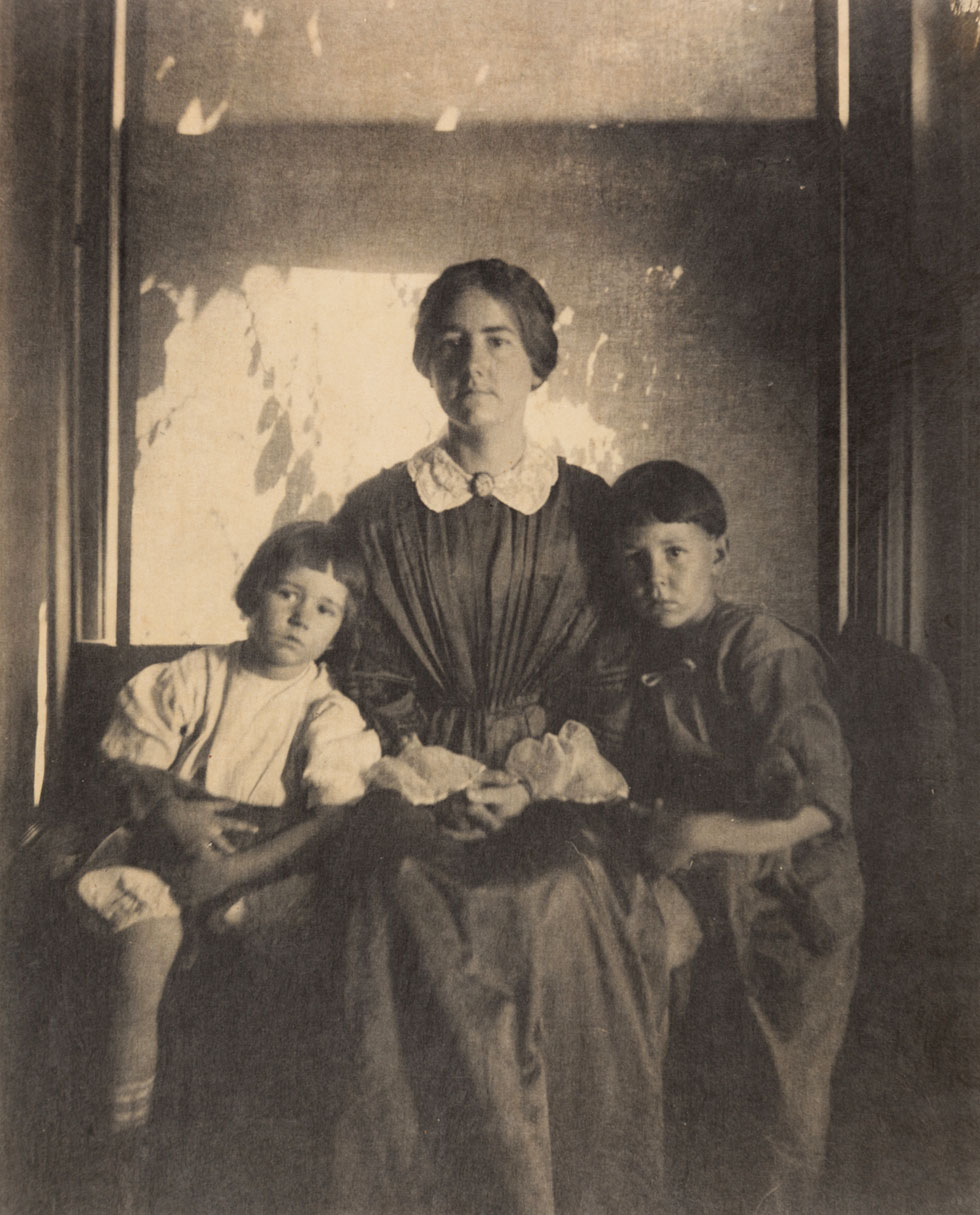
 

Gertrude Käsebier (American, 1852-1934) 'Mother and Two Children' 1899


Gertrude Käsebier (American, 1852-1934)
Mother and Two Children
1899
Platinum print on paper


Gertrude Käsebier (American, 1852-1934) 'Serbonne (A Day in France)' 1901


Gertrude Käsebier (American, 1852-1934)
Serbonne (A Day in France)
1901
Platinum print on paper


Both Pumpkin Pie, Voulangis and Serbonne (A Day in France) were set in France in 1901, when the artist was chaperoning art students. The young man in both scenes is Edward Steichen at age 22, whose interest in photography was then budding.

Serbonne is Käsebier’s chaste reference to Édouard Manet’s famous painting Le Déjeuner sur l’herbe (The Luncheon on the Grass) of 1863. An example of ultra-soft focus, this photo was reproduced in the inaugural issue of Camera Work, which was devoted to Käsebier.

Published in Camera Work, 1, 1903
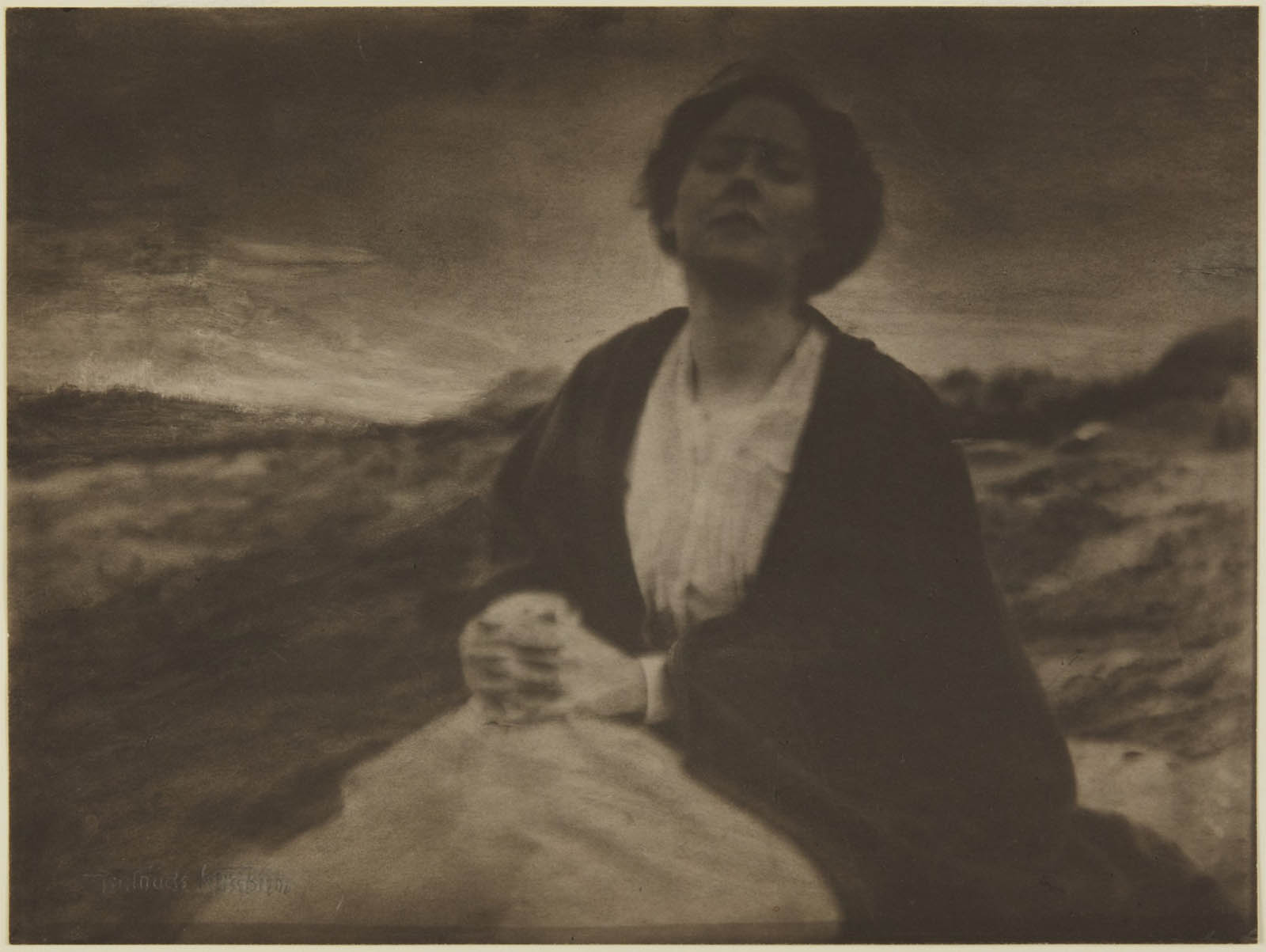
 

Gertrude Käsebier (American, 1852-1934) 'The Heritage of Motherhood' 1904


Gertrude Käsebier (American, 1852-1934)
The Heritage of Motherhood
1904
Gum-bichromate print on paper


This portrays the children’s book author Agnes Rand Lee in mourning after the sudden death of her daughter from illness. A contemporary photographer and critic deemed this image “one of the strongest things that Käsebier has ever done, and one of the saddest and most touching that I have ever seen.” Käsebier extensively manipulated the gum-bichromate process to make this print appear like a charcoal drawing.
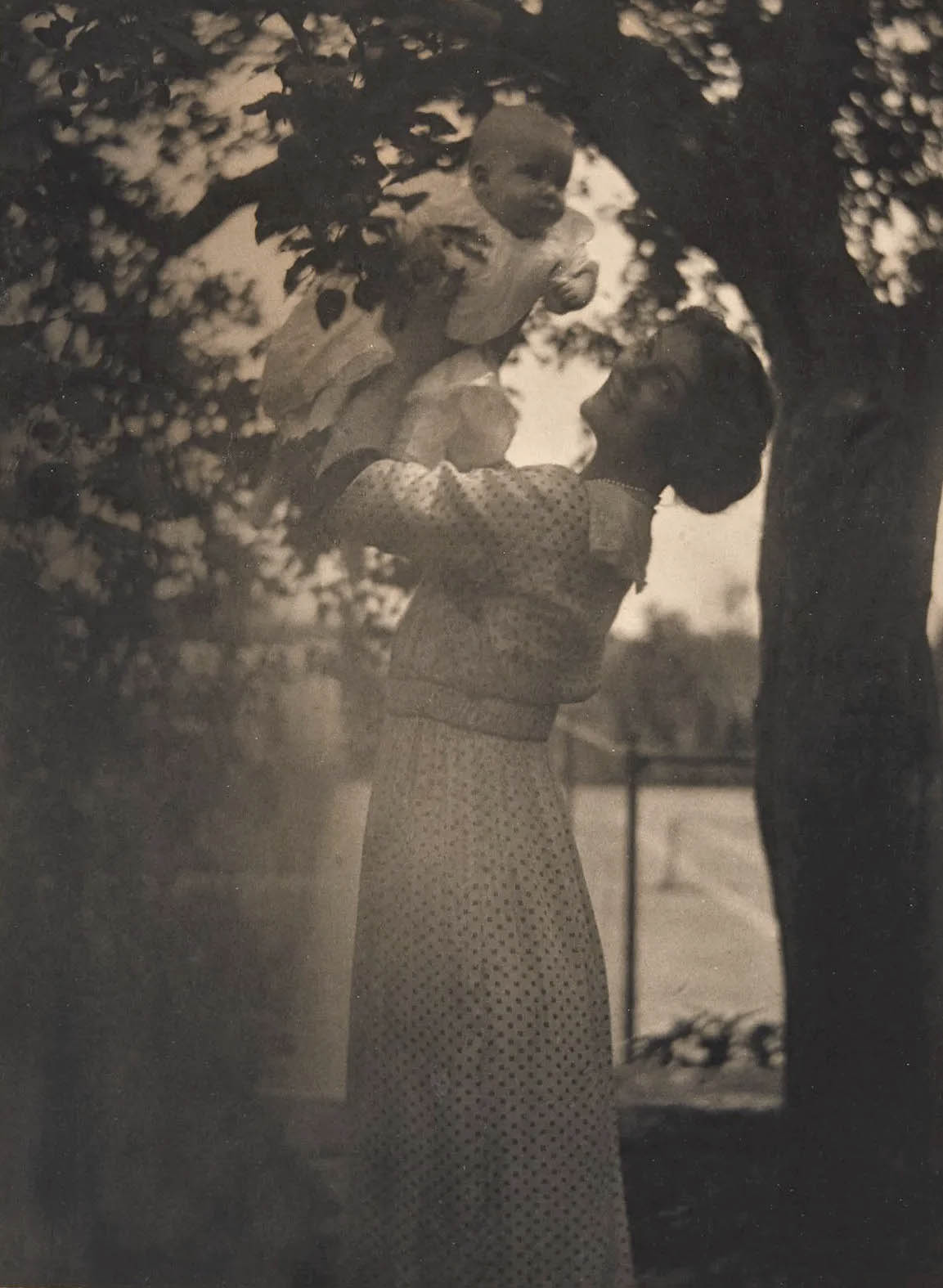
 

Gertrude Käsebier (American, 1852-1934) 'Mother and Child' c. 1900


Gertrude Käsebier (American, 1852-1934)
Mother and Child
c. 1900
Multiple gum-bichromate print on paper


The subject of mother and child was a frequent one for Pictorialists, especially Käsebier and Clarence White. The contrast between the tiny infant and the mighty tree gives this image additional symbolic meaning.


Gertrude Käsebier (American, 1852-1934) 'The Picture Book' 1903


Gertrude Käsebier (American, 1852-1934)
The Picture Book
1903
Platinum print on paper


Alfred Stieglitz had a print of this photograph in his personal collection, which he bequeathed to the Metropolitan Museum of Art in New York.

Published in Camera Work, 10, 1905

All from the Collection of Michael Mattis and Judith Hochberg


Works by Evans


Frederick Evans (British, 1853-1943) 'Aubrey Beardsley' 1893


Frederick H. Evans (British, 1853-1943)
Aubrey Beardsley
1893
Platinum print on paper


Evans, a member of the British art photography group the Linked Ring, was close friends with prominent authors and artists, such as George Bernard Shaw and Aubrey Beardsley. Portrayed here around age 20, Beardsley was a talented artist, designer, and illustrator, whose promising career was cut short by tuberculosis just five years after this photo was made.
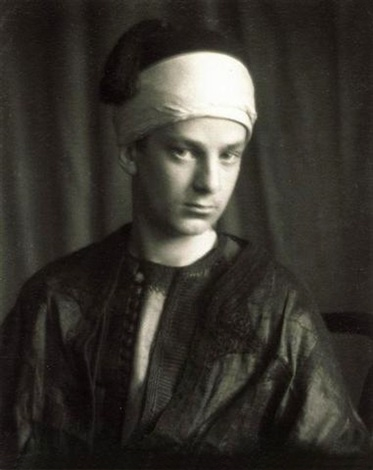
 

Frederick H. Evans (British, 1853-1943) 'Alvin Langdon Coburn in Eastern Clothing' 1901


Frederick H. Evans (British, 1853-1943)
Alvin Langdon Coburn in Eastern Clothing
1901
Platinum print on paper


Coburn was a precocious young American artist. An eighth birthday gift of a Kodak camera sparked his interest in photography. By age 16 Coburn had moved to London to work with his cousin the photographer F. Holland Day, whose portrait by Gertrude Käsebier is in this exhibition. After being included in a landmark exhibition at the Royal Photographic Society, Coburn returned to New York and apprenticed with Käsebier. By the tender age of 20, he became a founding member of the Photo-Secession and launched an international career dividing his time between New York, London, and Paris.

All from the Collection of Michael Mattis and Judith Hochberg


Works by Dow


Arthur Wesley Dow (American, 1857-1922) 'Silhouetted Trees' c. 1910


Arthur Wesley Dow (American, 1857-1922)
Silhouetted Trees
c. 1910
Cyanotype print on paper


A painter, printmaker, and photographer, Dow is mainly remembered today as a pioneering educator who taught in New York at the Pratt Institute, Art Students League, and Teacher’s College of Columbia University. Among Dow’s students were Gertrude Käsebier, Alvin Langdon Coburn, Charles Sheeler, and Georgia O’Keeffe. Dow also hired Clarence White to teach photography at Columbia, thereby launching White’s important teaching career.

From the Collection of Michael Mattis and Judith Hochberg


Works by Haviland
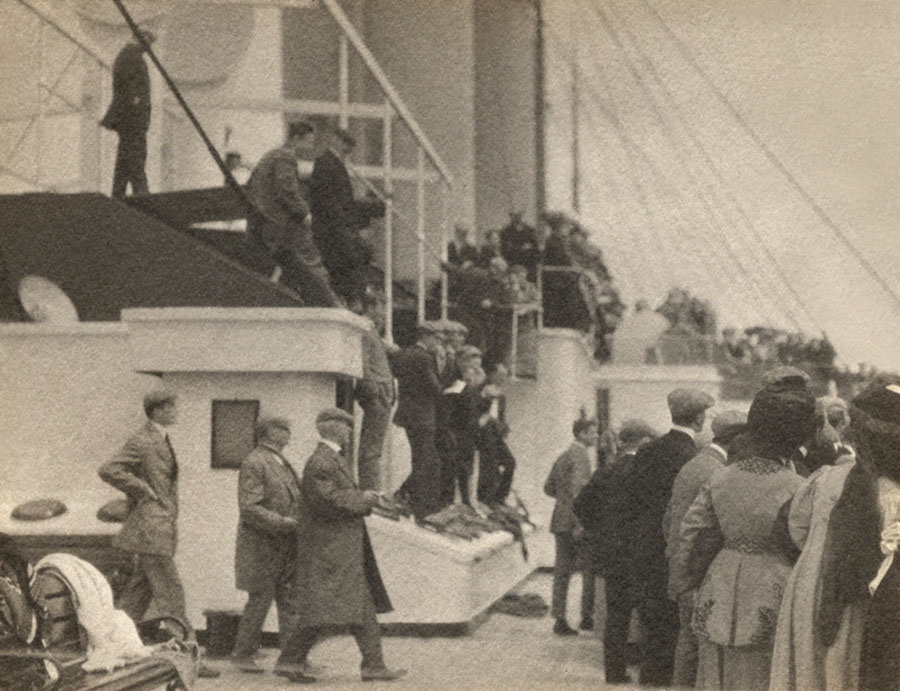
 

Paul Burty Haviland (American, 1880-1950) 'Ship Deck' 1910


Paul Burty Haviland (American, 1880-1950)
Ship Deck
1910
Platinum print on paper


Haviland was an amateur photographer from a young age and grew up immersed in the arts. His grandfather was an early photography critic in Paris, and his father owned Haviland porcelain factory in Limoges, France. As the New York representative of the family business, Haviland happened to meet Alfred Stieglitz in 1908. Just two years later he became associate editor of Camera Work and helped financially support Stieglitz’s gallery 291.

All from the Collection of Michael Mattis and Judith Hochberg


Works by Struss
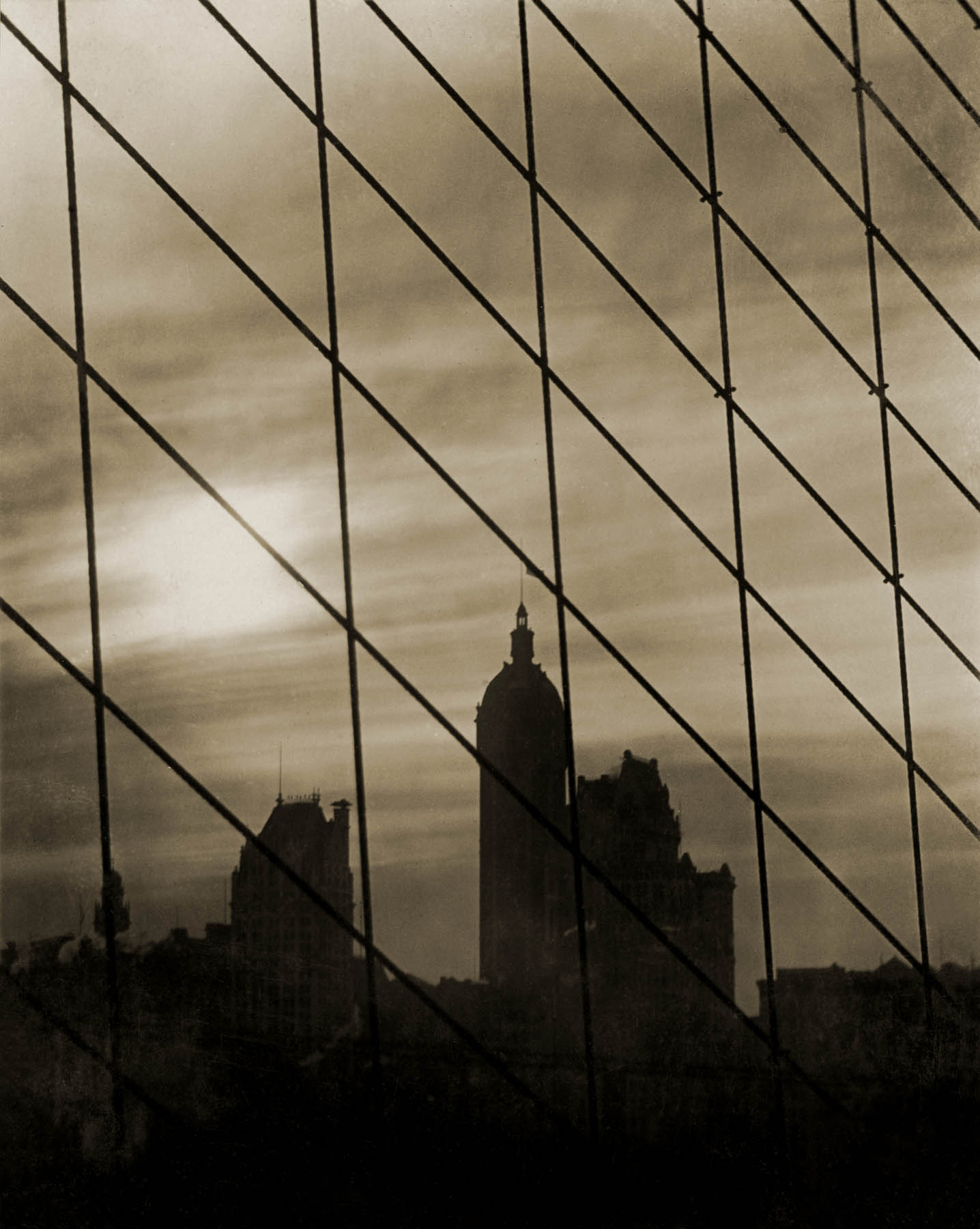
 

Karl Struss (American, 1886-1981) 'Cables' 1912


Karl Struss (American, 1886-1981)
Cables
1912
Gelatin silver print on paper


Struss was a star pupil of Clarence White and became a favourite of Alfred Stieglitz and the youngest member of the Photo-Secession. He is best known for his compelling cityscapes of New York, including the view of the Singer Building through the cables of the Brooklyn Bridge and the dramatic Flatiron Building, Twilight.


Karl Struss (American, 1886-1981) 'Flatiron Building, Twilight' c. 1915


Karl Struss (American, 1886-1981)
Flatiron Building, Twilight
c. 1915
Gelatin silver print on paper


Struss eventually broke away from Stieglitz and cofounded the society of the Pictorial Photographers of America along with Clarence White and Gertrude Käsebier in 1916. He … accepted a job as a cameraman for filmmaker Cecil B. DeMille. Struss would become one of the most prolific Hollywood cinematographers with 150 films, an Academy Award, and three Academy nominations to his credit.

All from the Collection of Michael Mattis and Judith Hochberg


Nudes by Stieglitz and White


Clarence Hudson White (American, 1871-1925) 'Reflected Nude' 1909


Clarence Hudson White (American, 1871-1925)
Reflected Nude
1909
Platinum print on paper
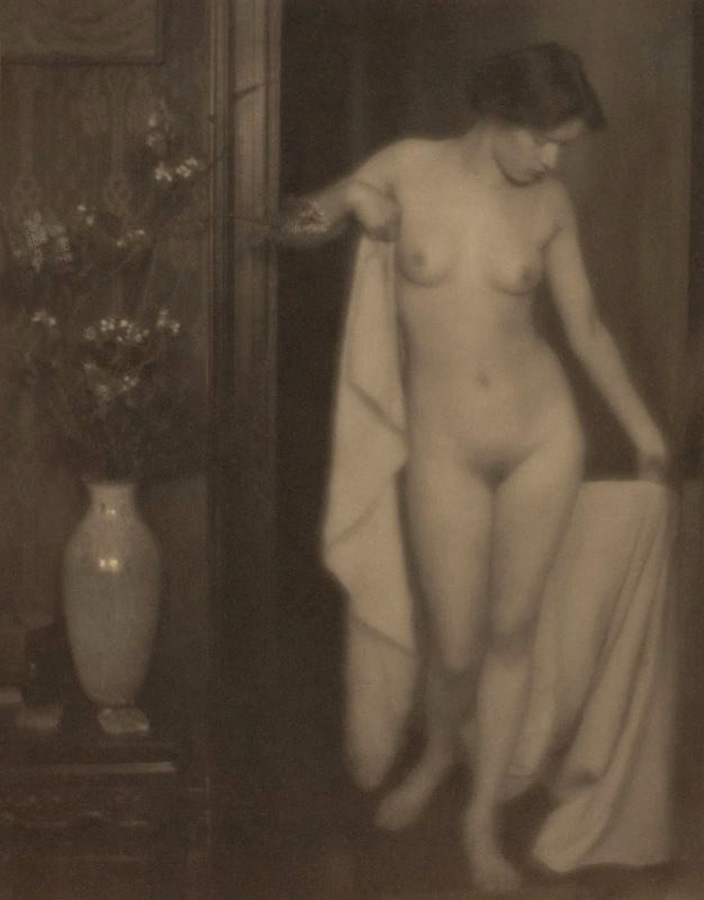
 

Alfred Stieglitz (American, 1864-1946) and Clarence Hudson White (American, 1871-1925) 'Nude Posed in Doorway (Miss Thompson)' 1907


Alfred Stieglitz (American, 1864-1946) and Clarence Hudson White (American, 1871-1925)
Nude Posed in Doorway (Miss Thompson)
1907
Platinum print on paper


Alfred Stieglitz (American, 1864-1946) and Clarence Hudson White (American, 1871-1925) 'The Torso' 1907


Alfred Stieglitz (American, 1864-1946) and Clarence Hudson White (American, 1871-1925)
The Torso
1907
Palladium print on paper


This is likely the most widely reproduced nude by Photo-Secession artists.

After their personal and professional rupture, Stieglitz wrote White a letter that specifically referred to their collaboration in 1907. Stieglitz insisted “that my name be not mentioned by you in connection with either the prints or the negatives” and further instructed White to erase his name from any prints they had jointly signed. Despite this vitriol, Stieglitz retained in his personal collection two prints of The Torso, one of them jointly signed in pencil.

Published in Camera Work, 27, 1909

All from the Collection of Michael Mattis and Judith Hochberg


Images of O’Keeffe by Stieglitz
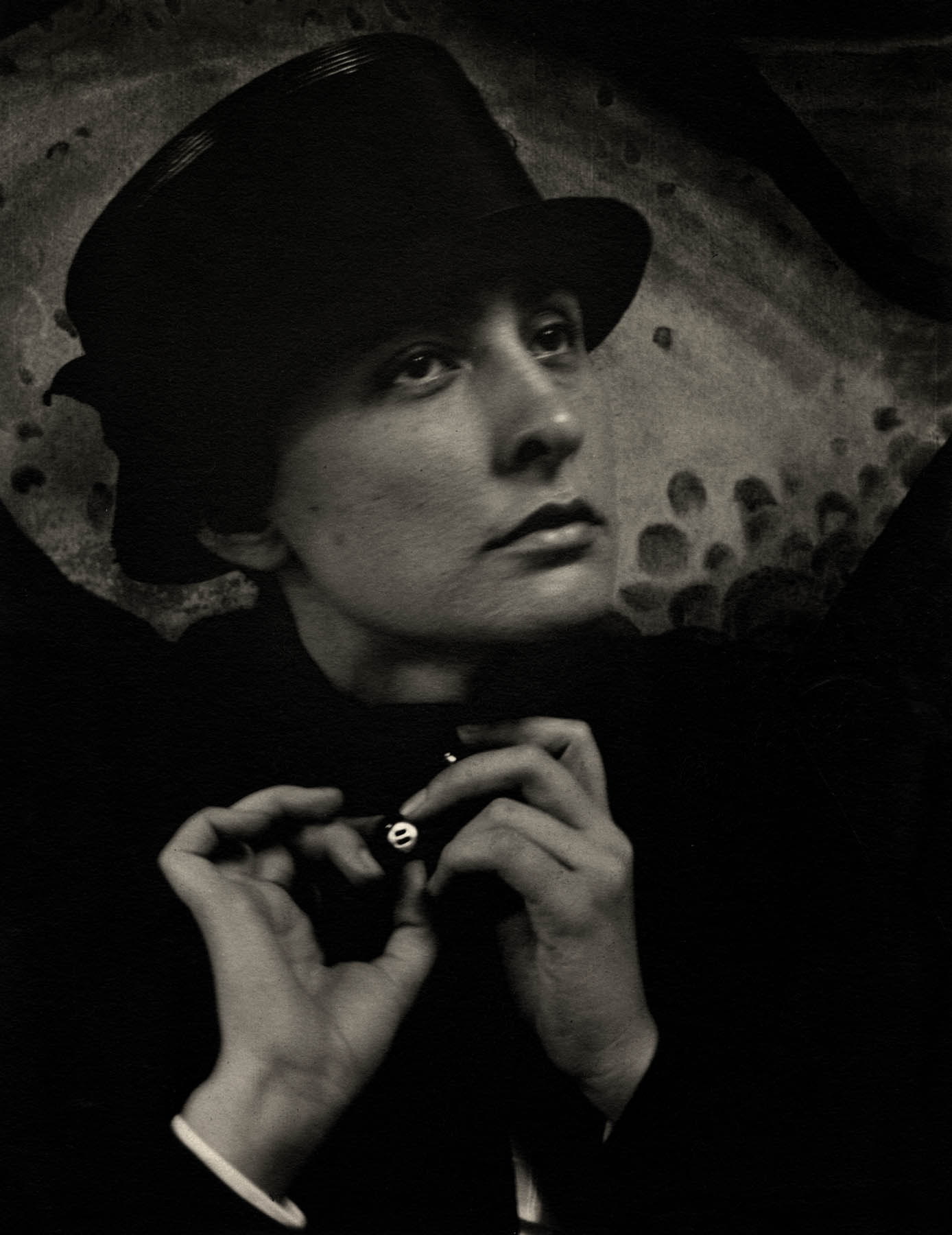
 

Alfred Stieglitz (American, 1864-1946) 'Georgia O'Keeffe' 1918


Alfred Stieglitz (American, 1864-1946)
Georgia O’Keeffe
1918
Palladium print on paper
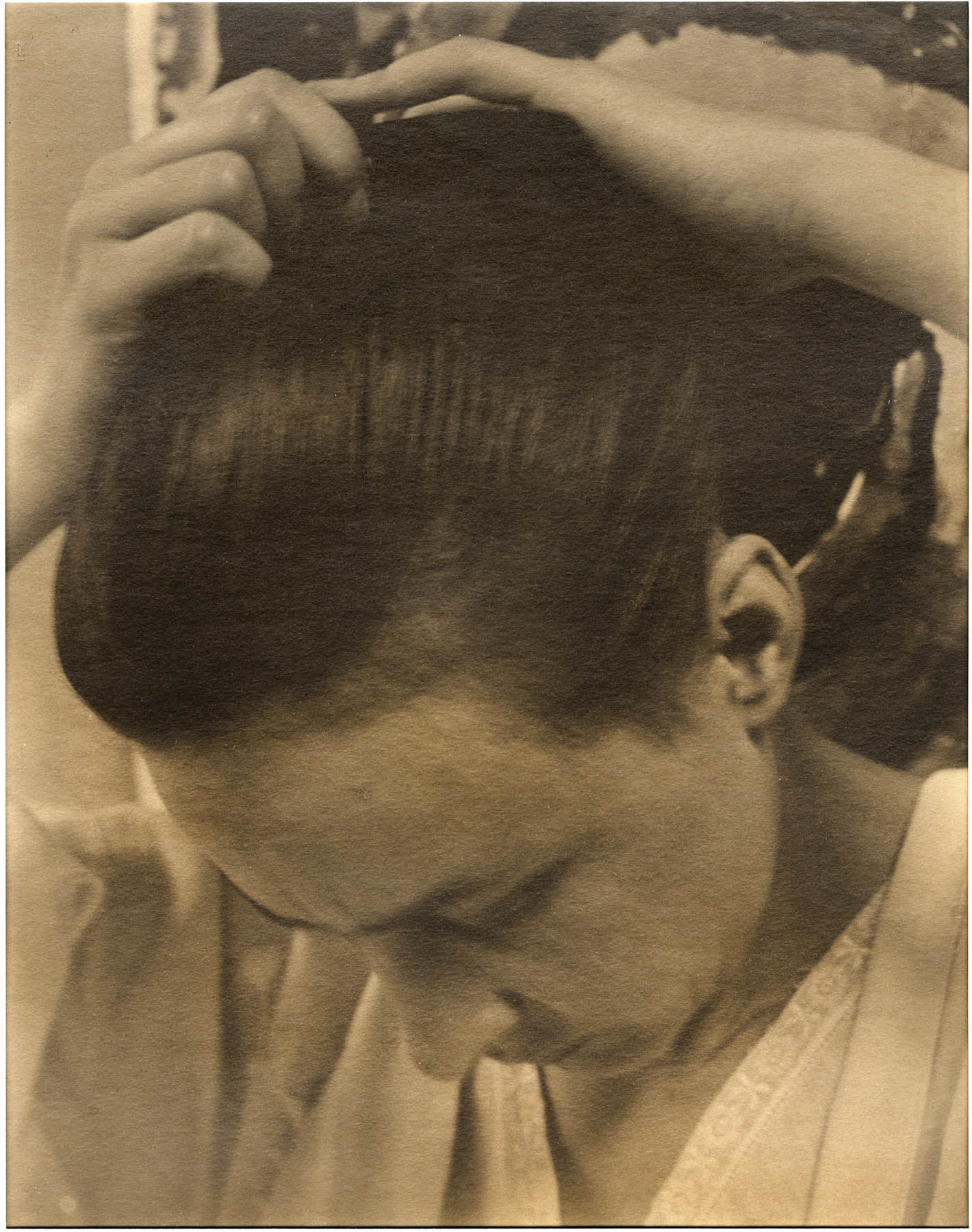
 

Alfred Stieglitz (American, 1864-1946) 'Georgia O'Keeffe (Fixing Hair)' 1919-1921


Alfred Stieglitz (American, 1864-1946)
Georgia O’Keeffe (Fixing Hair)
1919-1921
Palladium print on paper


Over two decades, Stieglitz made over 300 photos of O’Keeffe, producing an extraordinary and candid portrait of the artist. She recalled, “I was photographed with a kind of heat and excitement and in a way wondered what it was all about.” The directness and intimacy of this series of photos differ from the idealised nudes that Stieglitz and White made together during the heyday of the Photo-Secession.

All from the Collection of Michael Mattis and Judith Hochberg


Works by White

Clarence Hudson White: The Romantic

Clarence Hudson White was celebrated for his romanticised and intimate approach to photography. His 1904 image The Kiss perfectly illustrates his unique style. This platinum print on paper captures a tender moment with a soft focus and gentle lighting. The Kiss portrays an intimate scene imbued with a sense of emotional depth. White’s use of the platinum printing process, which provides a broad tonal range and exquisite detail, enhances the image’s delicate and dreamlike quality. His work reflects the movement’s early emphasis on creating photographs that evoke the emotional and aesthetic qualities of fine art while also paving the way for future explorations in photographic expression.

Adelaide Ryder. “The Photo-Secession Movement: Pioneering Artistry in Early Photography,” on the UMFA website Nd [Online] Cited 22/10/2024


Clarence H. White (American, 1871-1925) 'The Bubble' 1898, printed 1905


Clarence Hudson White (American, 1871-1925)
The Bubble
1898
Platinum print on paper


This image was exhibited at the 1898 Philadelphia Photographic Salon to great acclaim. Fellow photographer and critic Joseph Keiley commented, “Like most of Mr. White’s pictures, it is a well nigh perfect piece of composition whose subject with subtle poetry stimulates and leaves much to the imagination.”


Clarence Hudson White (American, 1871-1925) 'The Mirror' 1912


Clarence Hudson White (American, 1871-1925)
The Mirror
1912
Platinum print on paper
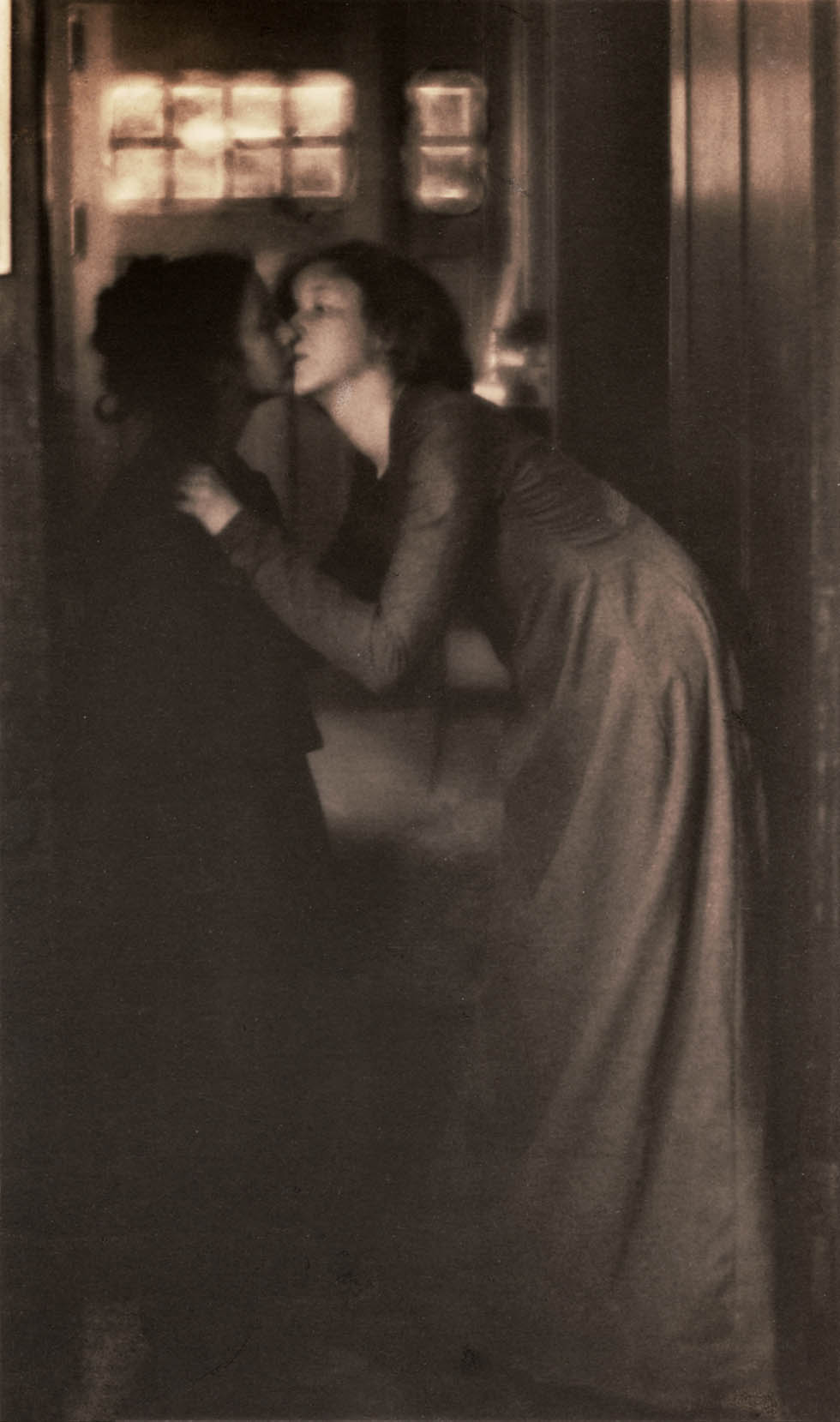
 

Clarence Hudson White (American, 1871-1925) 'The Kiss' 1904


Clarence Hudson White (American, 1871-1925)
The Kiss
1904
Platinum print on paper


This is one of White’s best known photographs. Despite his separation from White, Stieglitz kept prints of both The Kiss and The Bubble in his personal collection throughout his life.

All from the Collection of Michael Mattis and Judith Hochberg


Works by followers of White

Anne Brigman: The Feminine Mystic of Photo-Secession

Anne Brigman was known for her evocative and mystical imagery. She often placed herself within her compositions, challenging traditional gender roles and expectations. Her connection to the Photo-Secession movement was cemented through her association with Alfred Stieglitz, who published her work in Camera Work and admired her innovative spirit.

Brigman’s 1911 photograph The Pine Sprite exemplifies her distinctive style. The image features a nude female figure intertwined with the natural landscape, blending the human form seamlessly with the rugged environment. This work reflects Brigman’s themes of femininity, nature, and freedom, aligning with the Photo-Secessionist emphasis on personal expression and artistic experimentation. Brigman’s contributions highlighted the movement’s inclusive spirit, showcasing how female photographers could assert their voices and artistic visions in a male-dominated field.

Adelaide Ryder. “The Photo-Secession Movement: Pioneering Artistry in Early Photography,” on the UMFA website Nd [Online] Cited 22/10/2024
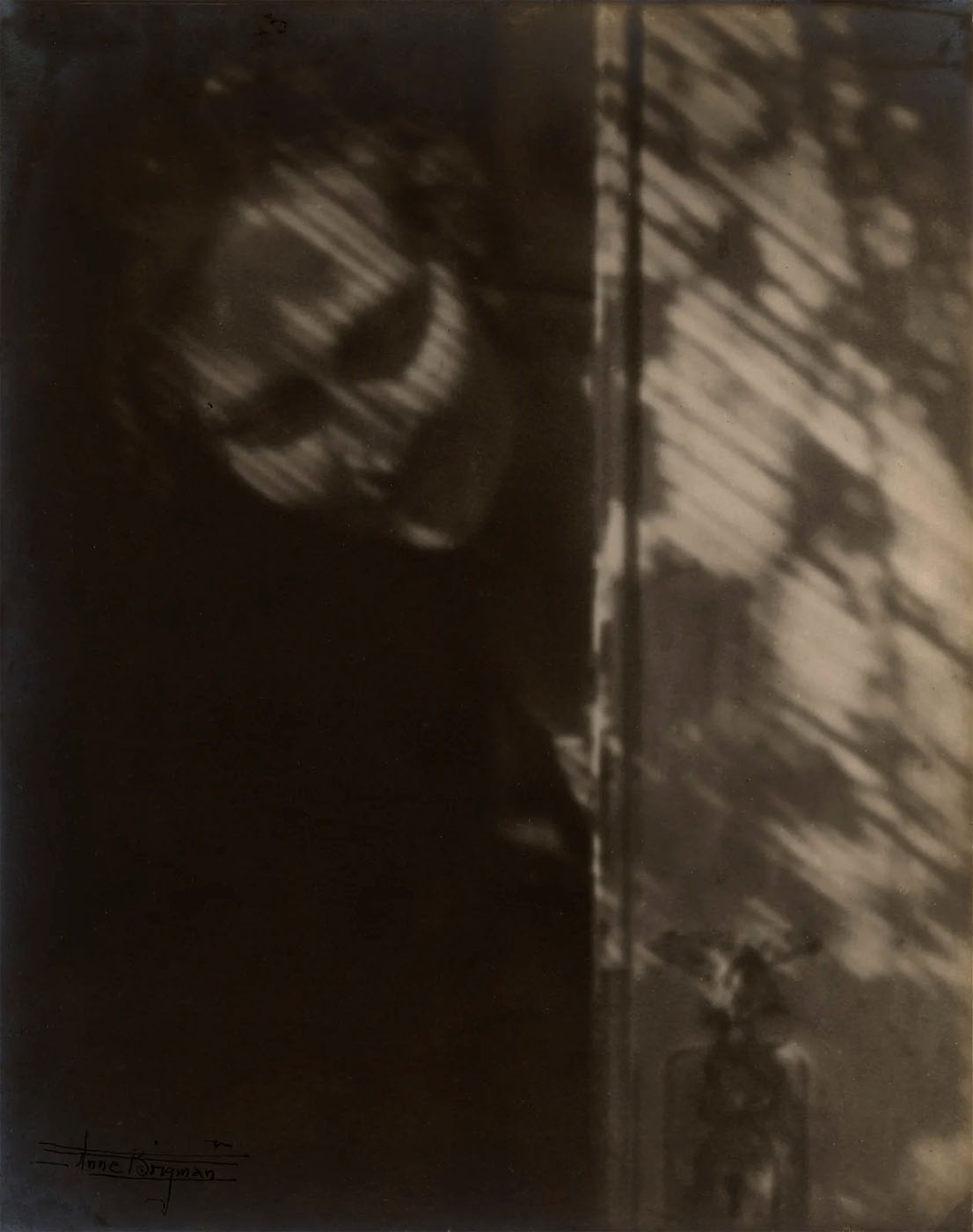
 

Anne Brigman (American, 1869-1950) 'The Shadow on My Door (Self Portrait)' 1921


Anne Brigman (American, 1869-1950)
The Shadow on My Door (Self Portrait)
1921
Gelatin silver print on paper
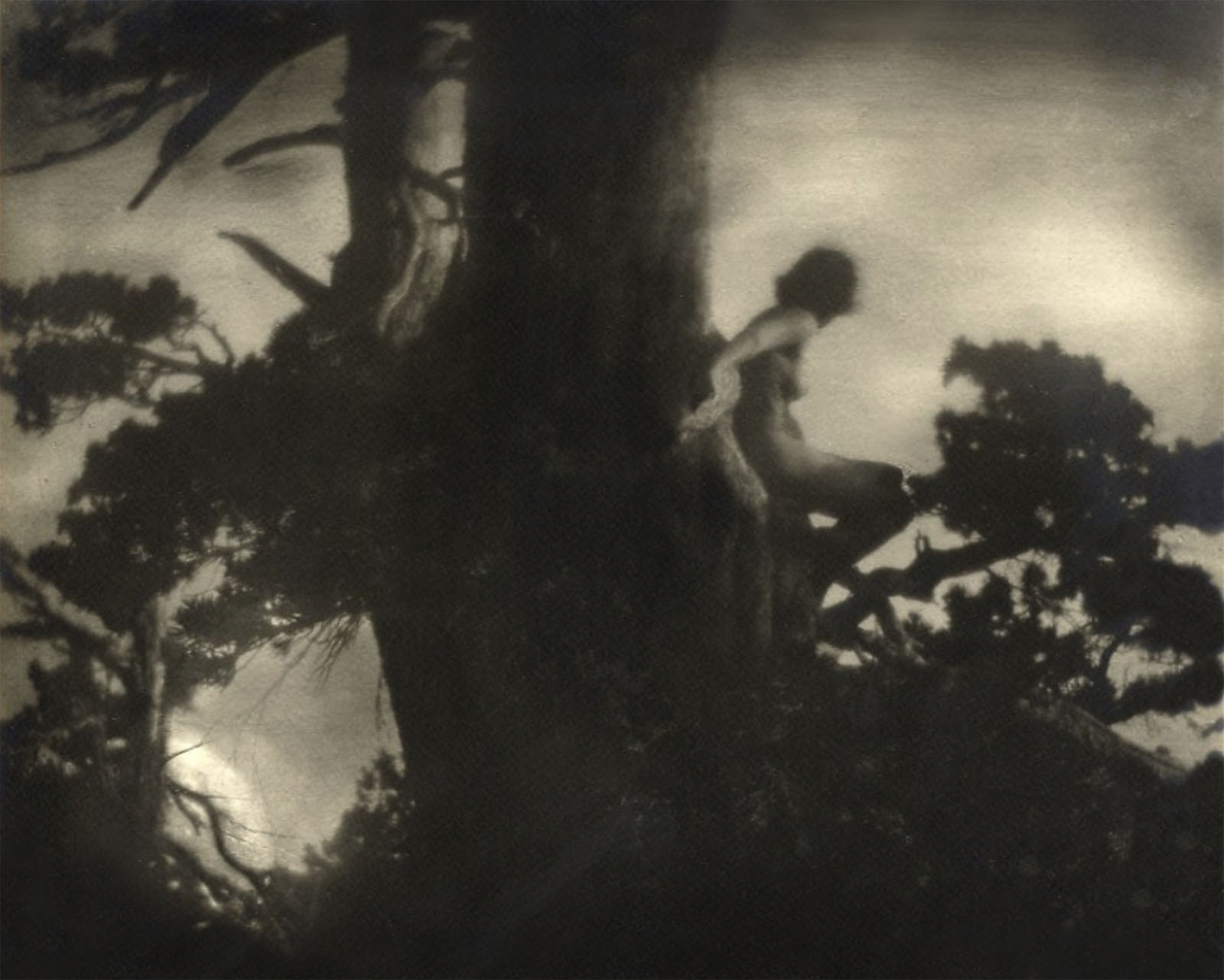
 

Anne Brigman (American, 1869-1950) 'The Pine Sprite' 1911 from the exhibition 'Photo-Secession: Painterly Masterworks of Turn-of-the-Century Photography' at the Utah Museum of Fine Arts, Salt Lake City, August - December 2024


Anne Brigman (American, 1869-1950)
The Pine Sprite
1911
Gelatin silver print on paper


Brigman was for a long time the only Californian member of the Photo-Secession. She was a free spirit and pagan whose woodsy nudes inspired by fantasy and folklore were frequently reproduced in Camera Work.


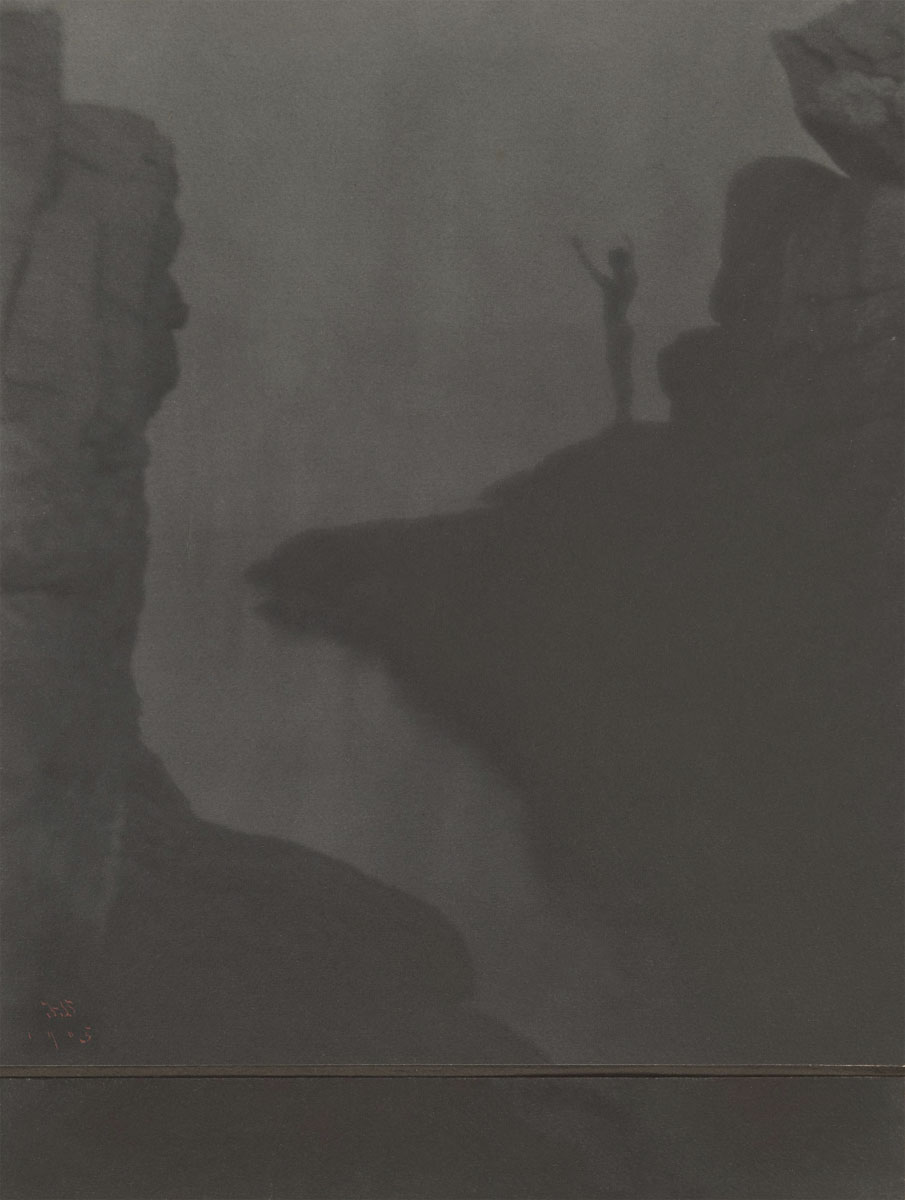
Laura Gilpin (American, 1891-1979) 'Ghost Rock, Garden of the Gods, Colorado' 1919


Laura Gilpin (American, 1891-1979)
Ghost Rock, Garden of the Gods, Colorado
1919
Palladium print on paper


An amateur photographer from Colorado Springs, Gilpin moved to New York to study with Clarence White in 1916. This photograph was one of Gilpin’s first successes after returning home in 1919, the beginning of her decades-long career as one of the most notable photographers of the West and Southwest.

All from the Collection of Michael Mattis and Judith Hochberg


In 1916 Gilpin enrolled at the Clarence H. White School of Photography in New York. Two years later, she returned to her native Colorado Springs and became one of the few women to pursue landscape photography.

This is her depiction of the Garden of the Gods, a scenic rock formation in Colorado Springs. It captures the stillness and otherworldly quality of the area. The photograph also reflects an emphasis on the evocation of mood rather than on descriptive detail.

Text from the National Gallery of Art Facebook page


Edward Steichen

Edward J. Steichen: The Innovator

Edward J. Steichen, a close associate of Stieglitz, brought a unique perspective to the Photo-Secession movement. Steichen was not only a photographer but also a painter, which influenced his photographic style. He experimented with various techniques, including soft focus and manipulation of light, to create both ethereal and visually striking images.

An avid gardener, Steichen propagated and grew a bountiful garden at his French country house. This image of a calla lily is rendered with exquisite detail and tonal richness. Steichen’s botanical images showcase his ability to find harmony between nature and art. His meticulous composition and sensitivity to light transform a simple flower into a work of art, reflecting his painterly approach to photography. His botanical works contributed to the Photo-Secession movement by highlighting the artistic potential of natural forms.

Adelaide Ryder. “The Photo-Secession Movement: Pioneering Artistry in Early Photography,” on the UMFA website Nd [Online] Cited 22/10/2024
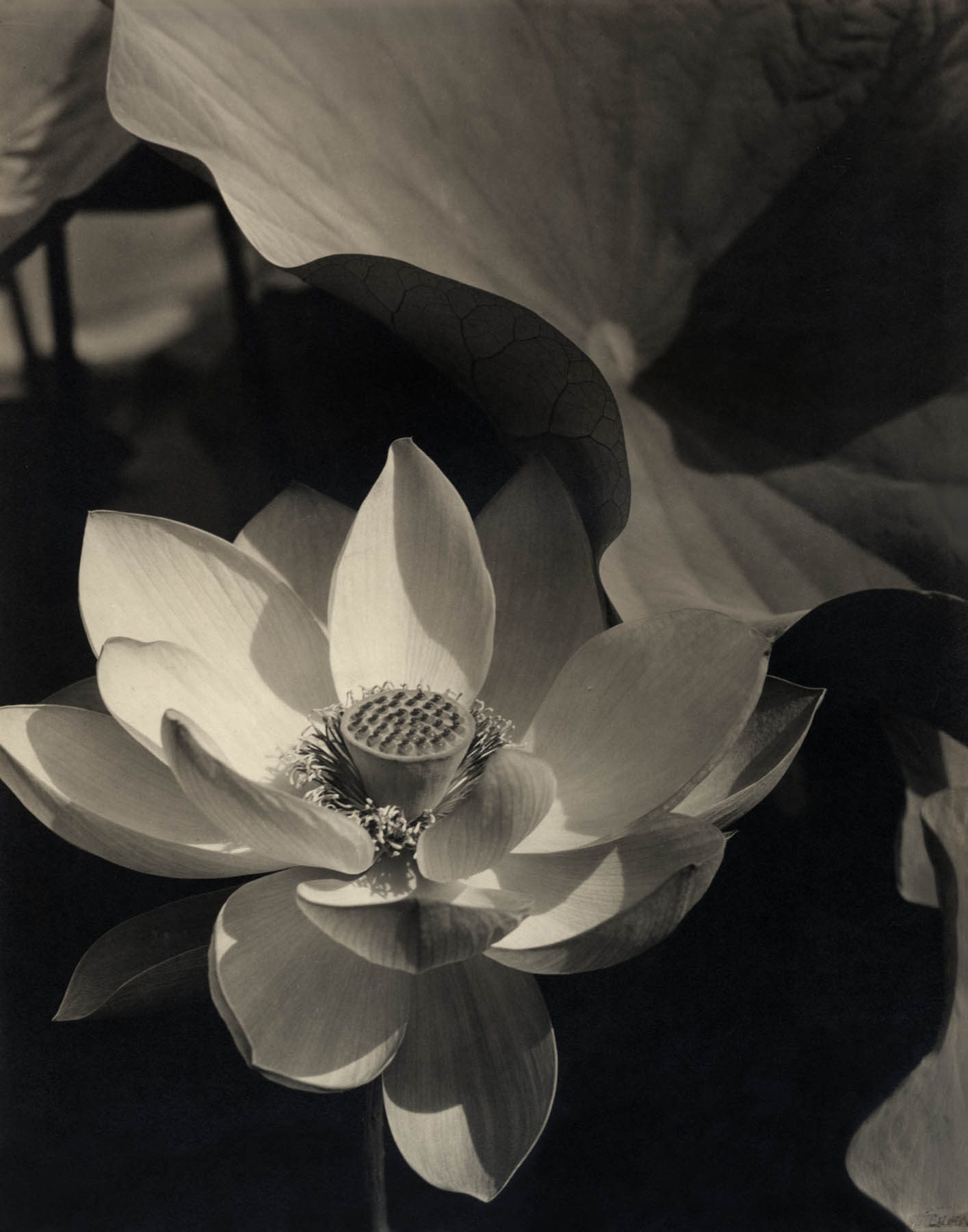
 

Edward Steichen (American born Luxembourg, 1879-1973) 'Lotus, Mount Kisco' 1915 from the exhibition 'Photo-Secession: Painterly Masterworks of Turn-of-the-Century Photography' at the Utah Museum of Fine Arts, Salt Lake City, August - December 2024


Edward Steichen (American born Luxembourg, 1879-1973)
Lotus, Mount Kisco
1915
Gelatin silver print on paper


Edward Steichen (American born Luxembourg, 1879-1973) 'Calla Lily' c. 1921


Edward Steichen (American born Luxembourg, 1879-1973)
Calla Lily
c. 1921
Platinum print on paper


Steichen had previously photographed flowers in compositions that placed delicate floral arrangements next to women figured as ideals of feminine beauty. In contrast, here he presents the lotus and calla lily in sharp focus and as singular subjects without overt metaphorical meaning.


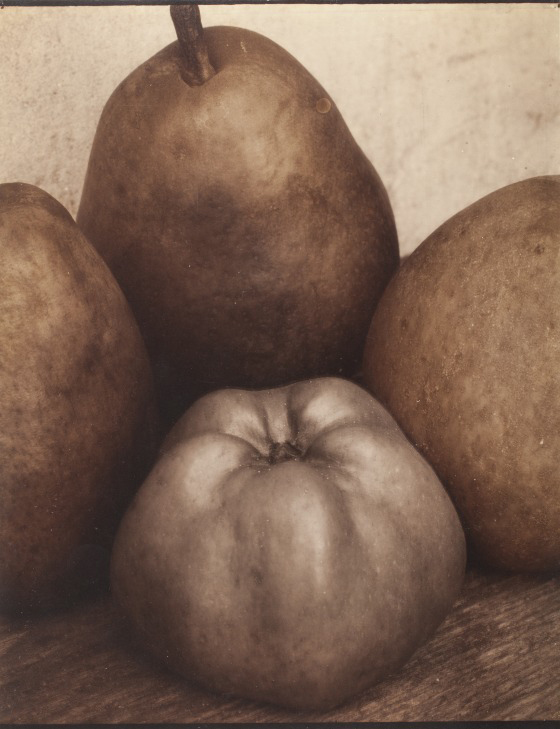
Edward Steichen (American born Luxembourg, 1879-1973) 'Three Pears and an Apple' 1921


Edward Steichen (American born Luxembourg, 1879-1973)
Three Pears and an Apple
1921
Gelatin silver print on paper


On making this picture Steichen wrote: “I was particularly interested in a method of representing volume, scale, and a sense of weight. In my small greenhouse I constructed a tent of opaque blankets. From a tiny opening, I directed light against one side of the covering blanket, and this light, reflected from the blanket, was all. I made a series of exposures that lasted more than two days and one night. As the nights were cool, everything, including the camera, contracted and the next day expanded. Instead of producing one meticulously sharp picture, the infinitesimal movement produced a succession of slightly different sharp images, which optically fused as one. Here for the first time in a photograph, I was able to sense volume as well as form.”


Edward Steichen (American born Luxembourg, 1879-1973) 'Blossom of White Fingers' c. 1923


Edward Steichen (American born Luxembourg, 1879-1973)
Blossom of White Fingers
c. 1923
Gold-toned gelatin silver print on paper


This study of the graceful hands of Steichen’s wife with ultra-soft focus and high-key lighting and printed on gold-toned gelatin paper is one of the rare instances of Steichen using Pictorialist methods after the end of the Photo-Secession.
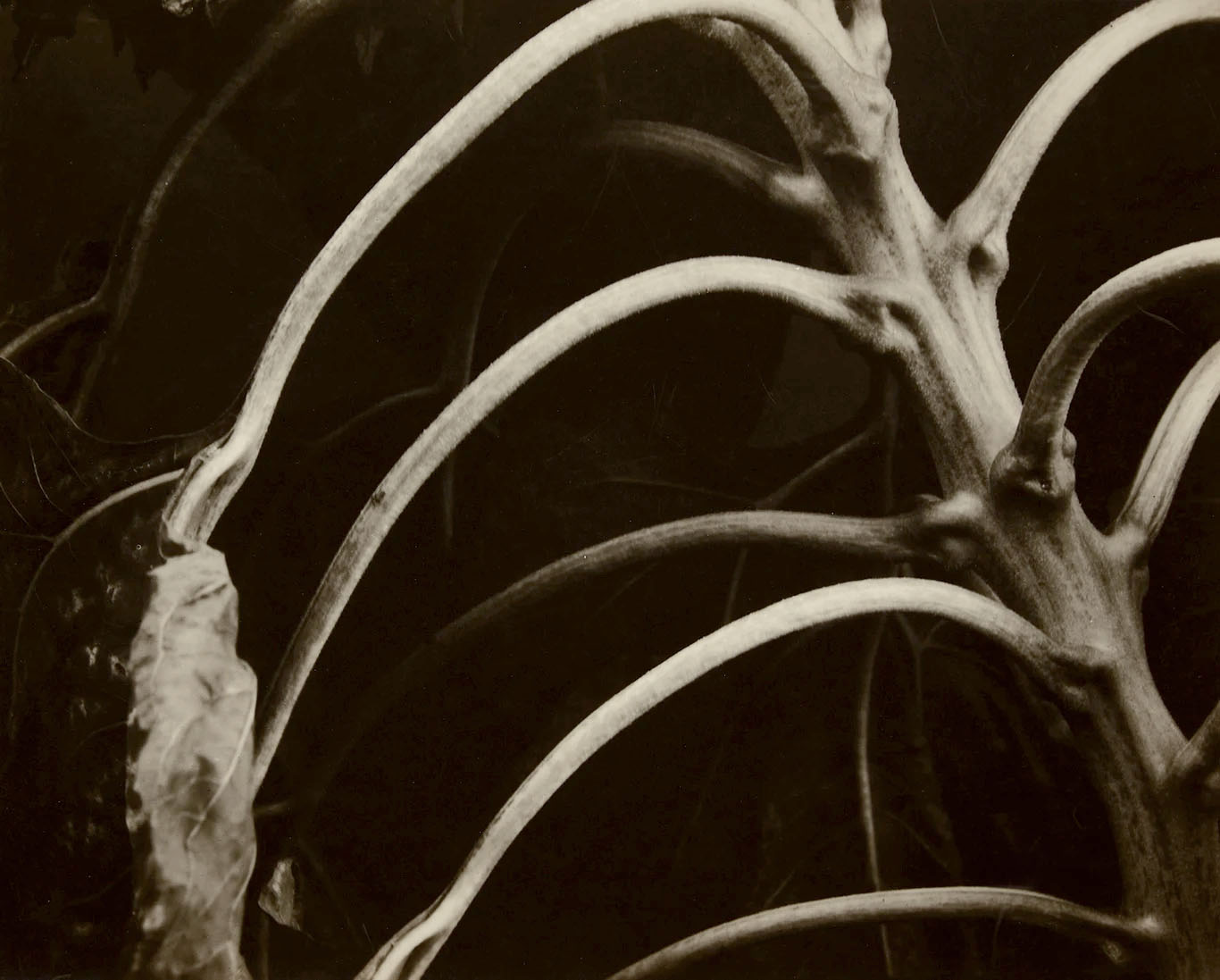
 

Edward Steichen (American born Luxembourg, 1879-1973) 'Backbone and Ribs of a Sunflower' c. 1920


Edward Steichen (American born Luxembourg, 1879-1973)
Backbone and Ribs of a Sunflower
c. 1920
Gelatin silver print on paper


Steichen was a knowledgeable botanist and spent five decades photographing the life cycle of sunflowers. This is one of his earliest studies of the plant. He became fascinated with spirals in nature, writing, “I found some form of the spiral in most succulent plants and in certain flowers, particularly in the seed pods of the sunflower.”


Edward Steichen (American born Luxembourg, 1879-1973) 'Advertising Study for Coty Lipstick' 1929


Edward Steichen (American born Luxembourg, 1879-1973)
Advertising Study for Coty Lipstick
1929
Gelatin silver print on paper


Steichen is credited as a founding figure of modern advertising and fashion photography. From 1923 to 1938, he served as chief photographer for the Condé Nast magazines Vogue and Vanity Fair. He had extensive experience in graphic design and advertising from his youth and earlier career. He had designed posters as a young man for a lithographic printer in Milwaukee. As Alfred Stieglitz’s associate on Camera Work from 1903 to 1917, Steichen produced the logo, typeface, and page layouts.

All from the Collection of Michael Mattis and Judith Hochberg


Works by Strand
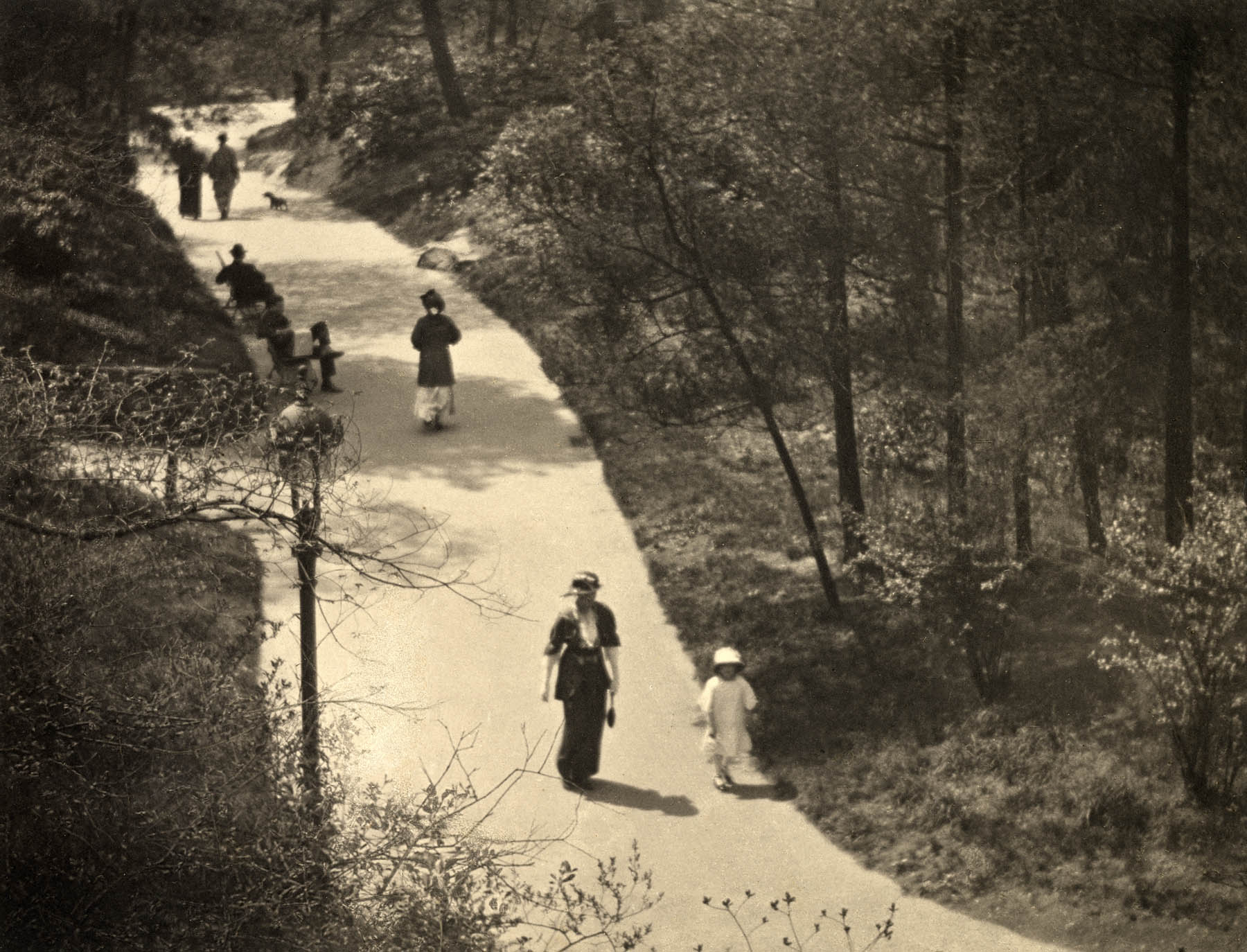
 

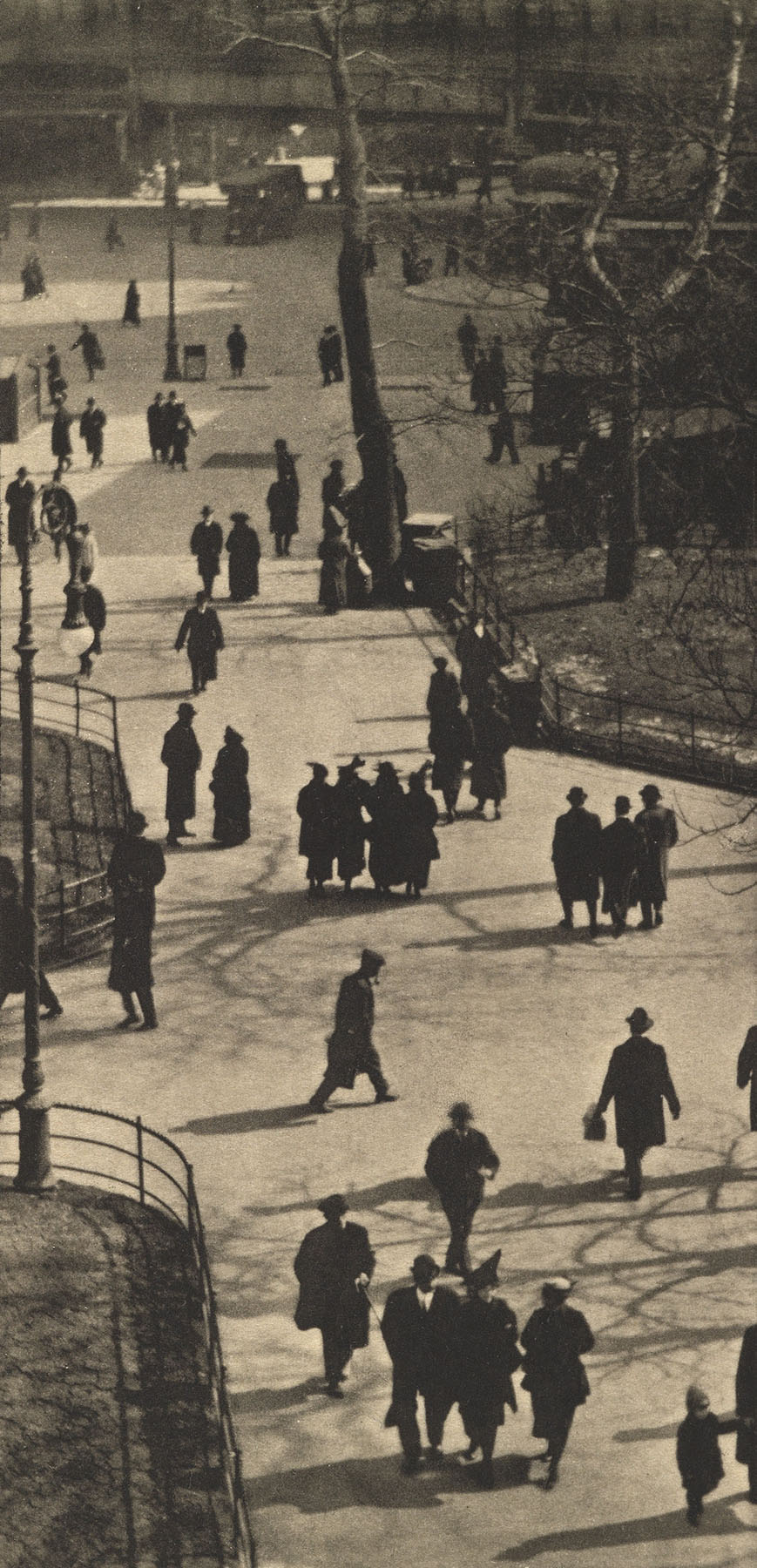
Paul Strand (American, 1890-1976) 'Central Park' 1915-1916 from the exhibition 'Photo-Secession: Painterly Masterworks of Turn-of-the-Century Photography' at the Utah Museum of Fine Arts, Salt Lake City, August - December 2024


Paul Strand (American, 1890-1976)
Central Park
1915-1916
Platinum print on paper


Urban life preoccupied Strand and in the 1920s would become a central subject of Modernist photographers around the world. From a Central Park overpass Strand identified this interesting composition with the bright, sinuous path dividing the picture plane. The decisive moment to snap the shutter occurred with the appearance of the two advancing figures and their angular shadows.
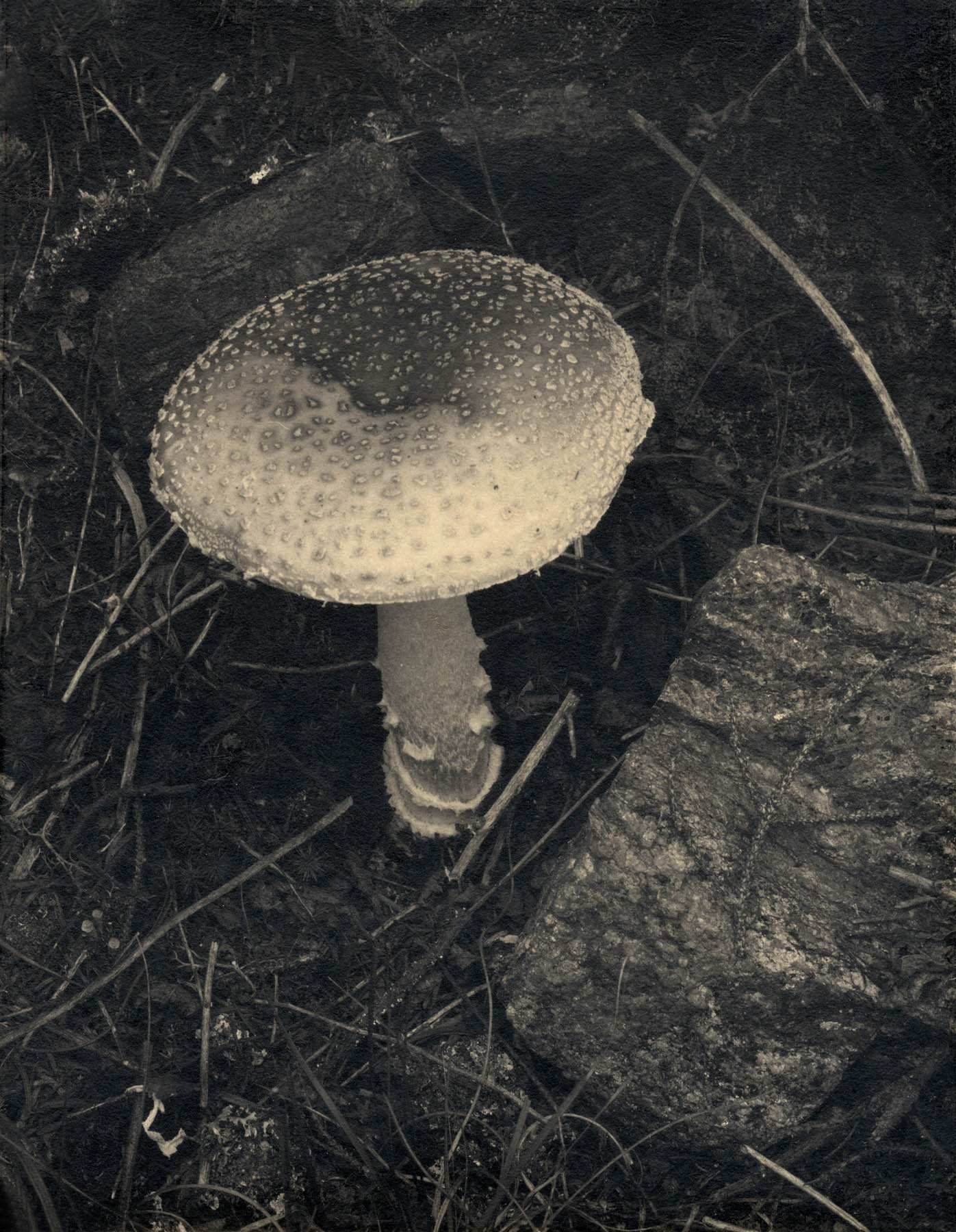
 

Paul Strand (American, 1890-1976) 'Speckled Toadstool, Georgetown, Maine' 1927


Paul Strand (American, 1890-1976)
Speckled Toadstool, Georgetown, Maine
1927
Waxed platinum print on paper


Strand continued to use platinum printing long after most other photographers adopted gelatin silver papers, which were more efficient and versatile and had a glossier surface. His prints in platinum are highly regarded for capturing minute detail and a wide range of tonal values.
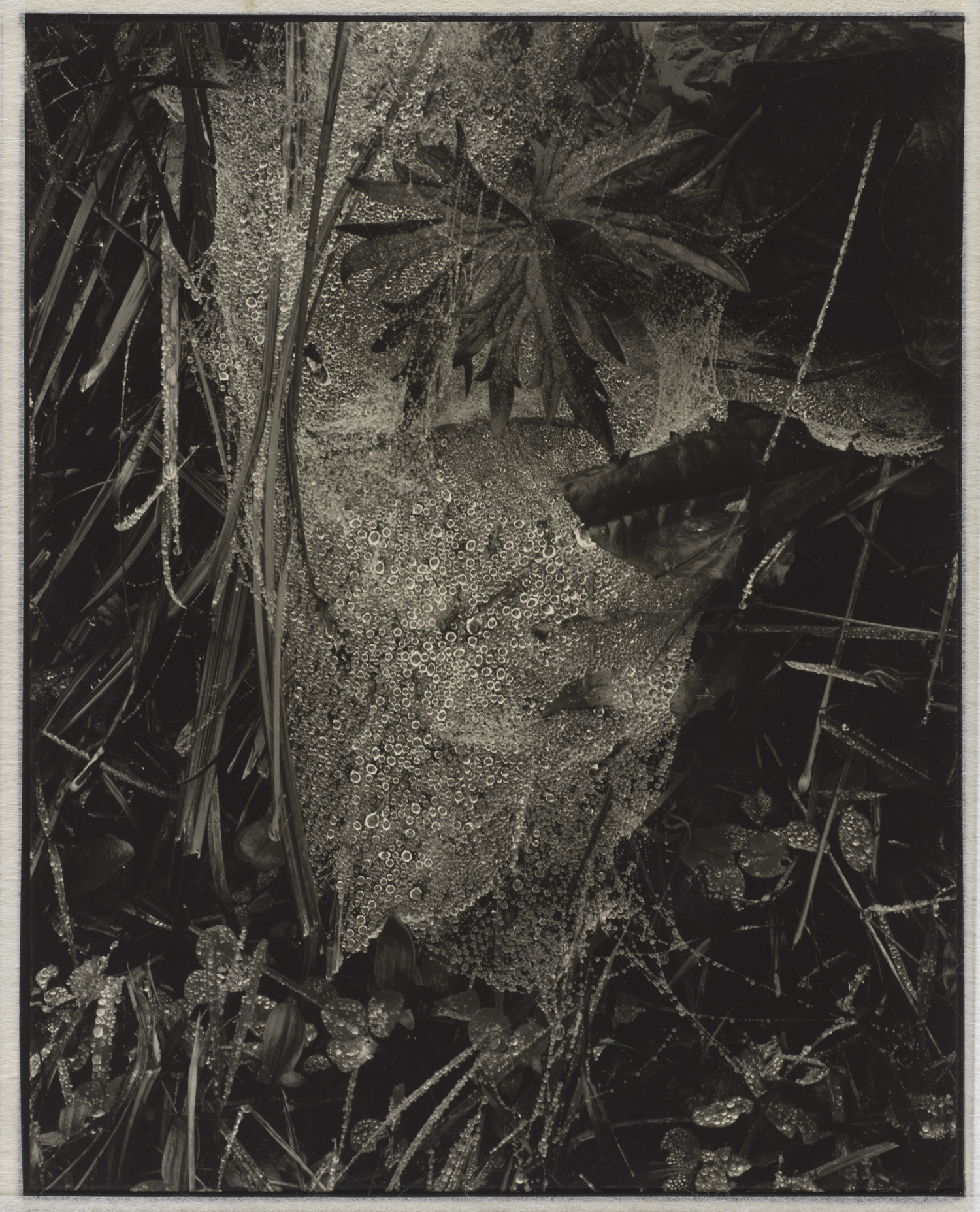
 

Paul Strand (American, 1890-1976) 'Cobweb in the Rain, Georgetown, Maine' 1928


Paul Strand (American, 1890-1976)
Cobweb in the Rain, Georgetown, Maine
1928
Gelatin silver print on paper

All from the Collection of Michael Mattis and Judith Hochberg


Works of Straight photography
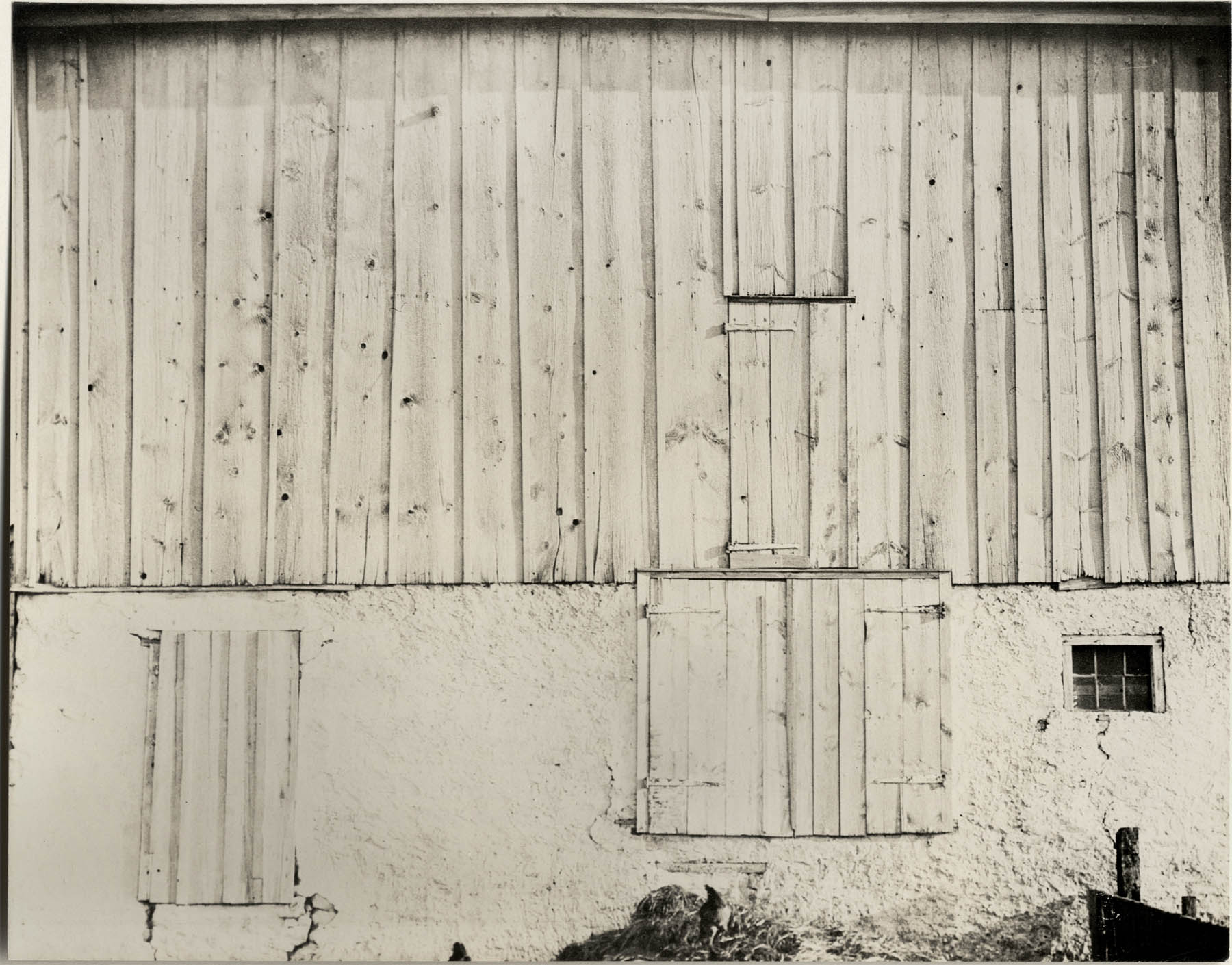
 

Charles Sheeler (American, 1883-1965) 'Side of White Barn, Bucks County' 1917


Charles Sheeler (American, 1883-1965)
Side of White Barn, Bucks County
1917
Gelatin silver print on paper


A painter and photographer, Sheeler became a close friend of Alfred Stieglitz as the Photo-Secession dissolved. This photographic study of line, shape, and tone recalls the hard-edged style of Sheeler’s paintings. Only the chickens appearing at the bottom edge give a sense of scale to the barn.


Alvin Langdon Coburn: The Avant-Garde Creator

Alvin Langdon Coburn pushed the boundaries of photography with his innovative Vortographs, created in 1916-1917. These images are considered some of the first abstract photographs, born from Coburn’s desire to create art that combined the physical with the spiritual. By placing a vortoscope, a triangular arrangement of mirrors and prisms, over a camera’s lens, Coburn created complex images of kaleidoscopic and geometric patterns that simplify the photograph to the essential elements of light and form. This technique broke away from traditional photographic representation, emphasising form, structure, and abstraction. The Vortographs were influenced by the Vorticist movement, which celebrated dynamic and abstract art. Coburn’s pioneering work with these images marked a significant departure from Pictorialism, embracing modernist principles and demonstrating the artistic potential of photography beyond mere depiction. The Vortographs stand as a testament to Coburn’s visionary approach and contributions to the evolution of photographic art.

Adelaide Ryder. “The Photo-Secession Movement: Pioneering Artistry in Early Photography,” on the UMFA website Nd [Online] Cited 22/10/2024
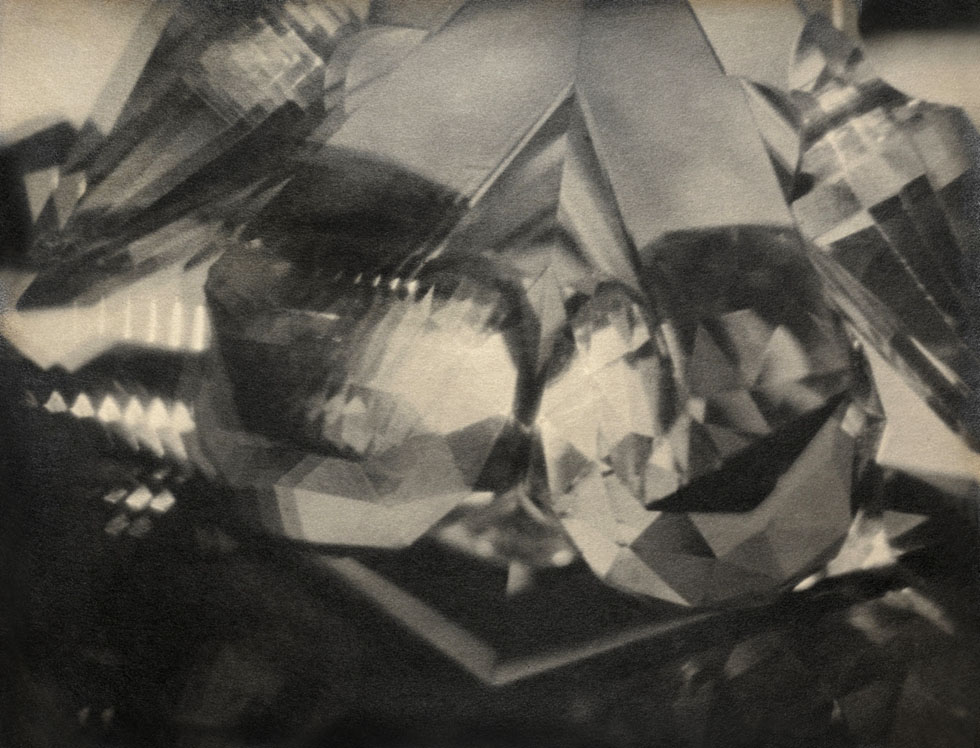
 

Alvin Langdon Coburn (British American, 1882-1966) 'Vortograph' 1917


Alvin Langdon Coburn (British American, 1882-1966)
Vortograph
1917
Gelatin silver print on paper


Coburn was one of the Photo-Secessionists who rejected Pictorialism. In his 1916 essay “The Future of Pictorial Photography,” he called for abstraction in photography, concluding, “it is my hope that photography may fall in line with all the other arts, and with her infinite possibilities, do things stranger and more fascinating than the most fantastic dreams.” Coburn created vortographs like this by placing a devise with three mirrors between his camera and subject. When he exhibited them to great fanfare in London in 1917, Ezra Pound proclaimed: “The Camera is freed from Reality!”

All from the Collection of Michael Mattis and Judith Hochberg


Utah Museum of Fine Arts
University of Utah campus
Marcia and John Price Museum Building
410 Campus Center Drive

Opening hours:
Tuesday – Sunday 10am – 5pm
Closed Mondays

Utah Museum of Fine Arts website

LIKE ART BLART ON FACEBOOK

Back to top

Exhibition: ‘In Focus: Platinum Photographs’ at the J. Paul Getty Museum, Los Angeles

Exhibition dates: 21st January – 31st May, 2020

Curator: Arpad Kovacs, assistant curator of photographs at the museum


Peter Henry Emerson (British, born Cuba, 1856-1936) 'Coming Home from the Marshes' 1886 from the exhibition 'In Focus: Platinum Photographs' at the J. Paul Getty Museum, Los Angeles, Jan - May, 2020


Peter Henry Emerson (British born Cuba, 1856-1936)
Coming Home from the Marshes
1886
Platinum print
Image: 19.8 × 28.9cm (7 13/16 × 11 3/8 in.)
The J. Paul Getty Museum, Los Angeles


Glorious. adjective: having a striking beauty or splendour.

I have seen quite a few vintage platinum prints over the years, from Paul Strand to Robert Mapplethorpe (even though he didn’t print them himself). And there has always struck me about them a lusciousness, a pleasingly rich “atmosphere” which appeals strongly to the senses, through an almost erotic charge of intensity.

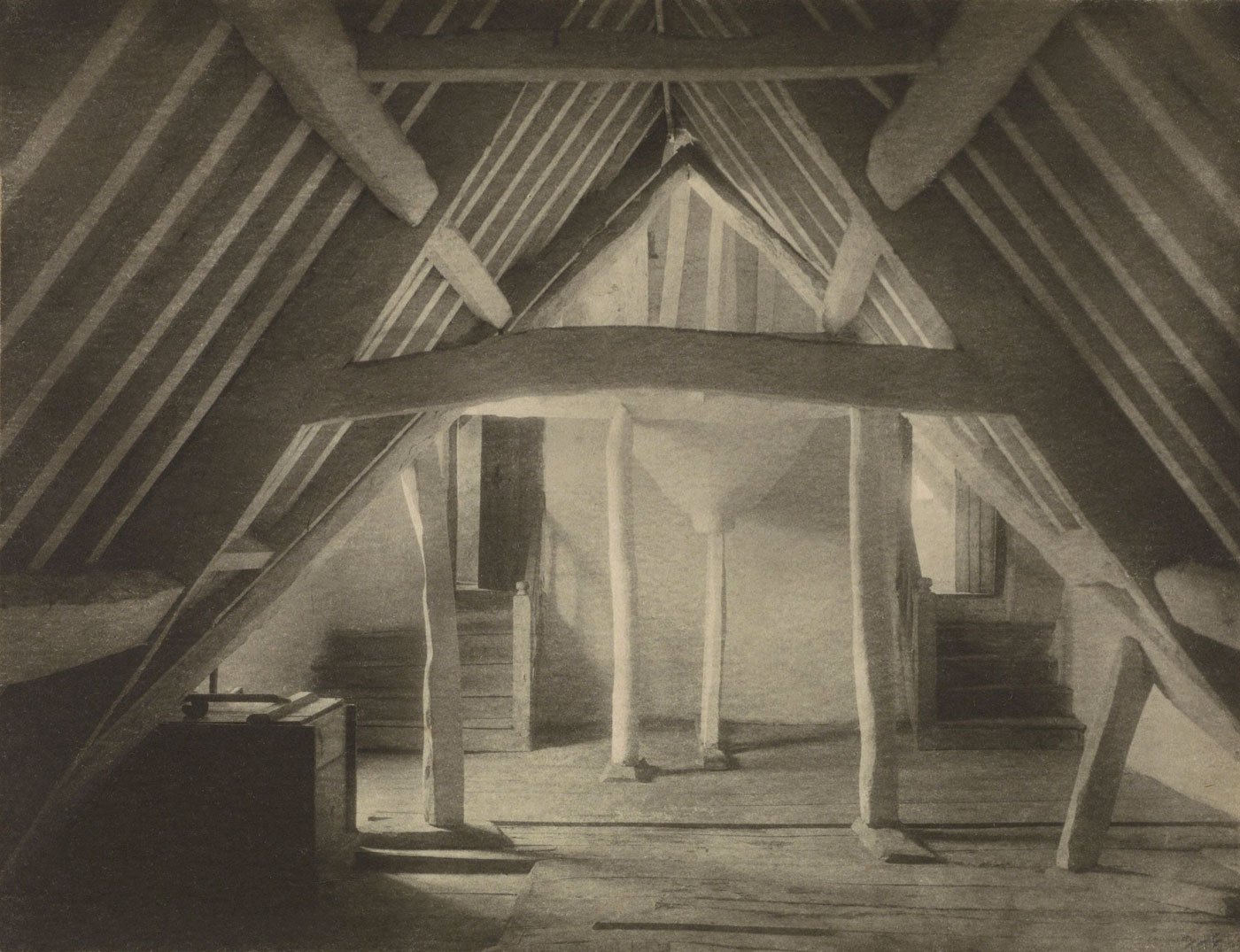
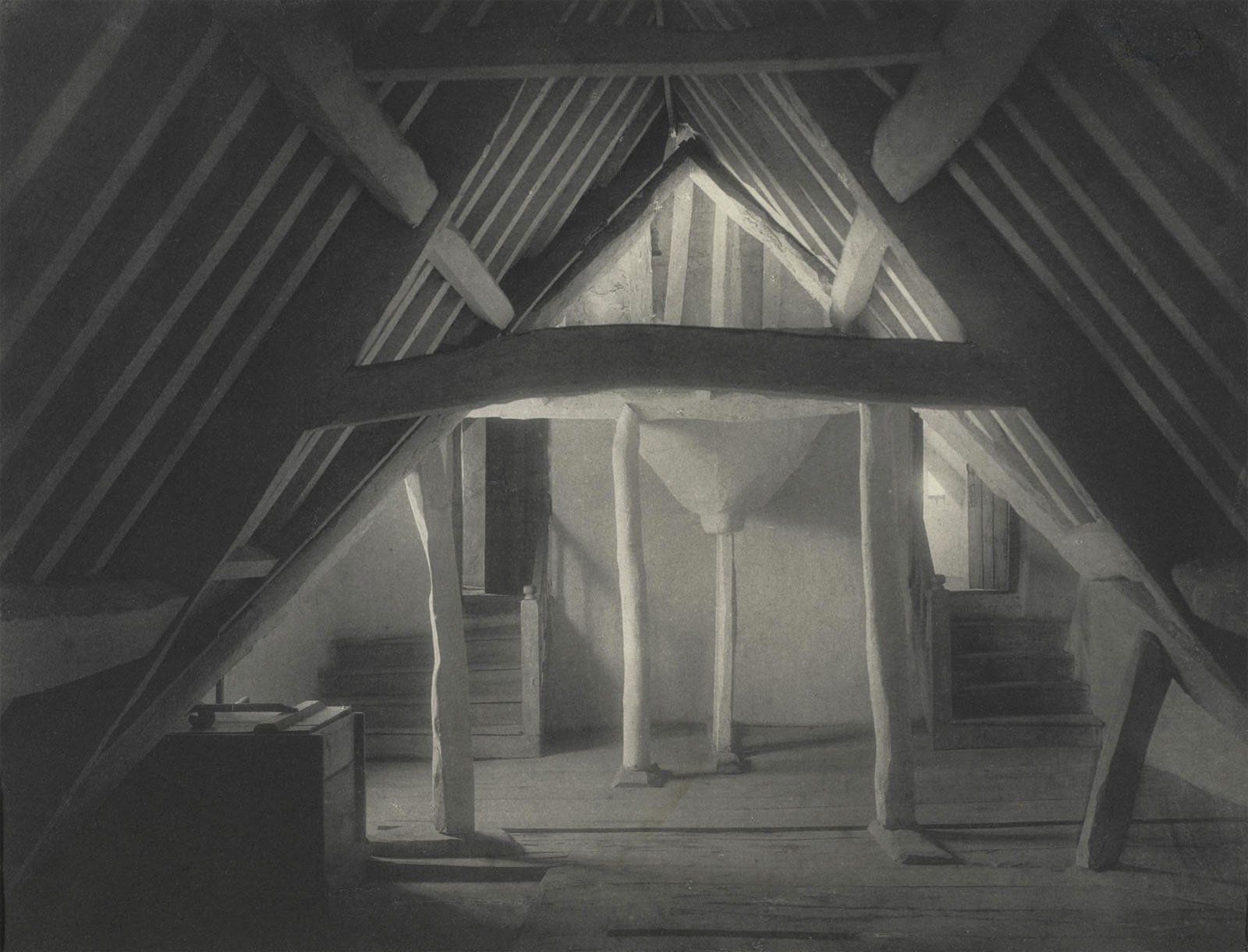
Contrary to the contemporary mania for pure blacks and whites in an image, platinum prints, with their wide gamut, can have an innumerable number of greys in their tonal range which form a holistic whole in the rendition of the subject. For example, Frederick H. Evans’ Kelmscott Manor: In the Attics (2) (1896, below) has a delicacy of description and a glowing aura seemingly emanating from the very depths of the image, which fetishises the photographic object, itself.

As in a drizzle of light rain – and emerging from Pictorialist conventions of sfumato – there is a liquidity to the tonality of platinum prints, as though there is mercury flowing under the surface of the paper. Glorious.

Dr Marcus Bunyan


Many thankx to the J. Paul Getty Museum for allowing me to publish the photographs in the posting. Please click on the photographs for a larger version of the image.


Admired for their velvety matte surface, wide tonal range, and neutral palette, platinum prints helped establish photography as a fine art. Introduced in 1873, the process was championed by prominent photographers until platinum’s use was restricted in World War I and manufacturers were forced to introduce alternatives. The process attracted renewed interest in the mid-twentieth century from a relatively small but dedicated community of practitioners. This exhibition draws from the Museum’s collection to showcase some of the most striking prints made with platinum and the closely related palladium processes.

Text from the J. Paul Getty Museum website


Eveleen W. H. Myers (British, 1856-1937) 'Leopold Hamilton Myers as 'The Compassionate Cherub'' about 1888-1891 from the exhibition 'In Focus: Platinum Photographs' at the J. Paul Getty Museum, Los Angeles, Jan - May, 2020


Eveleen W. H. Myers (British, 1856-1937)
Leopold Hamilton Myers as ‘The Compassionate Cherub’
about 1888-1891
Platinum print
Image: 24.4 × 29cm (9 5/8 × 11 7/16 in.)
The J. Paul Getty Museum, Los Angeles


Sarah Choate Sears (American, 1858-1935) 'Helen Sears' 1895


Sarah Choate Sears (American, 1858-1935)
Helen Sears
1895
Platinum print
Image: 22.8 × 18.7cm (9 × 7 3/8 in.)
The J. Paul Getty Museum, Los Angeles


Sarah Choate Sears (American, 1858-1935)

Sarah Choate Sears (1858-1935) was an American art collector, art patron, cultural entrepreneur, artist and photographer

About 1890 she began exploring photography, and soon she was participating in local salons. She joined the Boston Camera Club in 1892, and her beautiful portraits and still life attracted the attention of fellow Boston photographer F. Holland Day. Soon her work was gaining international attention.

At the same time she was pursuing her photography interest, she and her husband were hosting some of the most elegant cultural and artistic parties in Boston. They often featured private symphonic performances and included many international composers and performers, including Ignacy Paderewski, Serge Koussevitsky and Dame Nellie Melba.

In 1899 she was given a one-woman show at the Boston Camera Club, and in 1900 she had several prints in Frances Benjamin Johnson’s famous exhibition in Paris. In early 1900 she met American Impressionist Mary Cassatt, and the two continued to be friends for the remainder of their lives. During this same period she was elected as a member of the prestigious photographic associations: the Linked Ring in London and Alfred Stieglitz’s Photo-Secession in New York…

In 1907, two of her photographs were published in Camera Work, but by that time she had lost much of her interest in photography.

Text from the Wikipedia website


Frederick H. Evans (British, 1853-1943) 'Kelmscott Manor: In the Attics (2)' 1896


Frederick H. Evans (British, 1853-1943)
Kelmscott Manor: In the Attics (2)
1896
Platinum print
Image: 19.9 × 14.9cm (7 7/8 × 5 7/8 in.)
The J. Paul Getty Museum, Los Angeles


Gertrude Käsebier (American, 1852-1934) '[Gertrude O'Malley and son Charles]' 1900


Gertrude Käsebier (American, 1852-1934)
[Gertrude O’Malley and son Charles]
1900
Platinum print
Image: 20.2 × 15.6cm (7 15/16 × 6 1/8 in.)
The J. Paul Getty Museum, Los Angeles


Edward Steichen (American, born Luxembourg, 1879-1973) 'La Cigale' (The cicada) Negative 1901; print 1908


Edward Steichen (American, born Luxembourg, 1879-1973)
La Cigale (The cicada)
Negative 1901; print 1908
Waxed gum bichromate over platinum print
Image: 31.4 × 27cm (12 3/8 × 10 5/8 in.)
The J. Paul Getty Museum, Los Angeles


The J. Paul Getty Museum presents In Focus: Platinum Photographs, featuring more than two dozen striking prints made with platinum and the closely related palladium photographic process.

Drawn from the museum’s collection, the exhibition explores the wide variety of visual characteristics that have come to define the allure and beauty of this medium, which include a velvety matte surface, wide tonal range, and neutral palette. Introduced in 1873 by scientist William Willis Jr. (British, 1841-1923), the use of platinum was quickly embraced by both professional and amateur photographers alike and helped to establish photography as a fine art.

The visual qualities of each print could be individualised by changing the temperature of the developer or adding chemicals such as mercury or uranium. Photographers further enhanced their works by using an array of commercially available papers with rich textures and by employing inventive techniques such as the application of pigments and layered coatings to mimic effects associated with painting and drawing.

Platinum printing became widely associated with Pictorialism, an international movement and aesthetic style popular at the end of the 19th century. Advocates of Pictorialism favoured visible marks of the artist’s hand that might be achieved by manipulating either the negative or the print, or both. These hand-crafted prints differentiated themselves from the crisp images produced by commercial photographers and snapshots made with hand-held cameras recently introduced by Kodak.

Among the works on view is a triptych of a mother and child by Gertrude Käsebier (American, 1852-1934), one of the most technically innovative photographers associated with Pictorialism, an atmospheric nude by Edward Steichen (American, born Luxembourg, 1879-1973), and a view of Venice by Alvin Langdon Coburn (British, born United States, 1882-1966). Other images by Paul Strand (American, 1890-1976) and Karl Struss (American, 1886-1981) incorporate geometric forms or unusual vantage points to introduce abstraction into their compositions.

The popularity of platinum paper declined in the years leading up to the First World War. The soaring price of the metal forced manufacturers to introduce alternatives, including papers made with palladium and a platinum-and-silver hybrid. As platinum became crucial in the manufacture of explosives, governments prohibited its use for any purpose outside the defence industry. The scarcity of materials and eventual shifting aesthetic preferences led many photographers to abandon the process in favour of gelatin silver prints.

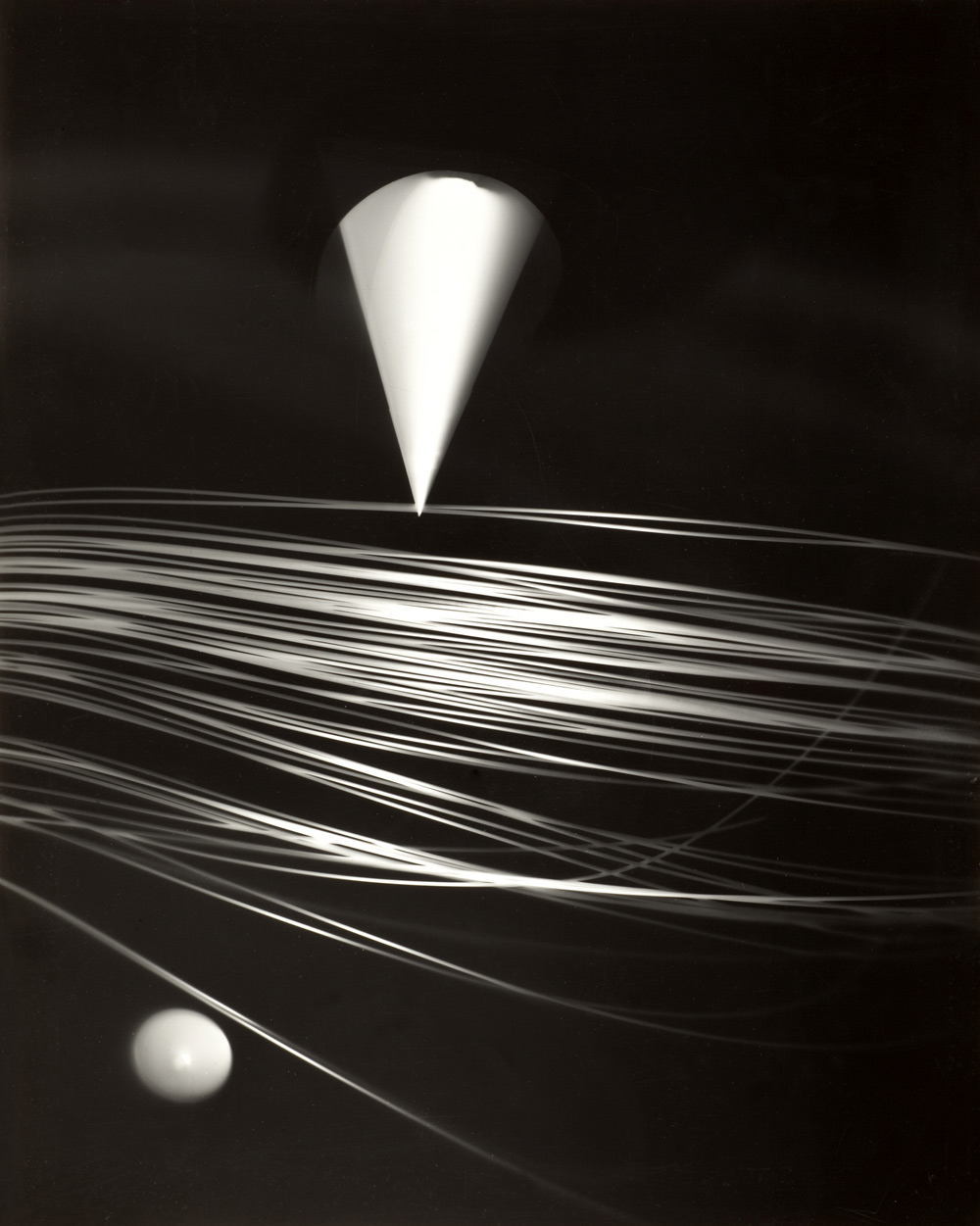
Interest in the process was renewed in the mid-20th century, and a relatively small but dedicated number of photographers continue to use the process today. The fashion photographer Irving Penn (American, 1917-2009) began hand coating papers with platinum in the 1960s and created prints that simultaneously emphasise intense and detailed shadows and subtle luminous highlights. More recent examples include a double portrait by artist Madoka Takagi (American, born Japan, 1956-2015) featuring herself, arms crossed and a shirtless man covered in tattoos, both gazing stoically into the camera’s lens; a suburban night scene by Scott B. Davis (American, born 1971); and an experiment in abstraction by James Welling (American, born 1951).

In Focus: Platinum Photographs is on view January 21-May 31, 2020 at the J. Paul Getty Museum. The exhibition is curated by Arpad Kovacs, assistant curator of photographs at the museum.

Press release from The J. Paul Getty Museum


Gertrude Käsebier (American, 1852-1934) 'Gertrude and Charles O'Malley: A Triptych, summer 1903' 1903


Gertrude Käsebier (American, 1852-1934)
Gertrude and Charles O’Malley: A Triptych, summer 1903
1903
Platinum print
Image: 19.4 × 15.2cm (7 5/8 × 6 in.)
Later overmat and mount -irregular: 58.3 × 71.1cm (22 15/16 × 28 in.)
The J. Paul Getty Museum, Los Angeles


Gertrude Käsebier (American, 1852-1934) 'Gertrude and Charles O'Malley: A Triptych, summer 1903' 1903


Gertrude Käsebier (American, 1852-1934)
Gertrude and Charles O’Malley: A Triptych, summer 1903
1903
Platinum print
Image: 18.7 × 14.9cm (7 3/8 × 5 7/8 in.)
Later overmat and mount -irregular: 58.3 × 71.1cm (22 15/16 × 28 in.)
The J. Paul Getty Museum, Los Angeles


Gertrude Käsebier (American, 1852-1934) 'Gertrude and Charles O'Malley: A Triptych, summer 1903' 1903


Gertrude Käsebier (American, 1852-1934)
Gertrude and Charles O’Malley: A Triptych, summer 1903
1903
Platinum print
Image: 20 × 14.8cm (7 7/8 × 5 13/16 in.)
Later overmat and mount -irregular: 58.3 × 71.1cm (22 15/16 × 28 in.)
The J. Paul Getty Museum, Los Angeles


Gertrude Käsebier (American, 1852-1934) 'Gertrude and Charles O'Malley: A Triptych, summer 1903' 1903


Gertrude Käsebier (American, 1852-1934)
Gertrude and Charles O’Malley: A Triptych, summer 1903
1903
Platinum print
Image: 19.4 × 15.2cm (7 5/8 × 6 in.)
Later overmat and mount -irregular: 58.3 × 71.1cm (22 15/16 × 28 in.)
The J. Paul Getty Museum, Los Angeles


Joseph Turner Keiley (American, 1869-1914) 'Untitled' 1900-1905


Joseph Turner Keiley (American, 1869-1914)
Untitled
1900-1905
Platinum print
The J. Paul Getty Museum, Los Angeles


Joseph Turner Keiley (American, 1869-1914)

Joseph Turner Keiley (26 July 1869 – 21 January 1914) was an early 20th-century photographer, writer and art critic. He was a close associate of photographer Alfred Stieglitz and was one of the founding members of the Photo-Secession. Over the course of his life Keiley’s photographs were exhibited in more than two dozen international exhibitions, and he achieved international acclaim for both his artistic style and his writing.

He began photographing in the mid-1890s and met fellow New York photographer Gertrude Käsebier, who at that time was engaged in photographing American Indians who were performing in Buffalo Bill’s Wild West Show. Keiley also photographed some of the same subjects, and in 1898 nine of his prints were exhibited in the Philadelphia Photographic Salon. One of the judges for the Salon was Stieglitz, who also wrote a glowing review of Keiley’s work.

Due to his success in Philadelphia the next year Keiley became the fourth American elected to the Linked Ring, which at that time was the most prominent photographic society in the world promoting pictorialism.

In 1900 he joined the Camera Club of New York and had a one-person exhibition in the Club’s gallery. At that time Stieglitz was serving as the Vice President of the Club and editor of the Club’s journal Camera Notes, and Keiley soon became his closest ally. Stieglitz asked him to become Associate Editor of the journal, and over the next few years Keiley was one of its most prolific writers, contributing articles on aesthetics, exhibition reviews and technical articles. He also had several of his photographs published in the journal.

While working with Stieglitz the two began experimenting with a new printing technique for glycerine-developed platinum prints, and they co-authored an article on the subject that was later published in Camera Notes.

In 1902 Stieglitz included Keiley as one of the founding members of the Photo-Secession, and he had fifteen of his prints (one more than Edward Steichen) included in the inaugural exhibition of the Photo-Secession at the National Arts Club.

When Stieglitz started Camera Work in 1903 he asked Keiley to become Associate Editor, and for the next eleven years he was second only to Stieglitz in the details of publishing the journal. He contributed dozens of essays, reviews and technical articles, and he advised Stieglitz about promising new photographers from Europe.

Keiley had seven gravures published in Camera Work, one in 1903 and six in 1907.

Text from the Wikipedia website


Alvin Langdon Coburn (British born United States, 1882-1966) 'Grand Canal, Venice' 1908


Alvin Langdon Coburn (British born United States, 1882-1966)
Grand Canal, Venice
1908
Platinum print
40.8 × 21.3cm (16 1/16 × 8 3/8 in.)
The J. Paul Getty Museum, Los Angeles


Alfred Stieglitz (American, 1864-1946) 'Georgia O'Keeffe - Hands' 1918


Alfred Stieglitz (American, 1864-1946)
Georgia O’Keeffe – Hands
1918
Palladium print
The J. Paul Getty Museum, Los Angeles


Doris Ulmann (American, 1882-1934) 'Landscape with Pump and Barn' about 1920-1934


Doris Ulmann (American, 1882-1934)
Landscape with Pump and Barn
about 1920-1934
Platinum print
The J. Paul Getty Museum, Los Angeles


Doris Ulmann (May 29, 1882 – August 28, 1934) was an American photographer, best known for her portraits of the people of Appalachia, particularly craftsmen and musicians, made between 1928 and 1934.


Tina Modotti (American, born Italy, 1896-1942) 'Hands Resting on Tool' 1927


Tina Modotti (American born Italy, 1896-1942)
Hands Resting on Tool
1927
Palladium print
Image: 19.7 × 21.6cm (7 3/4 × 8 1/2 in.)
The J. Paul Getty Museum, Los Angeles


Manuel Álvarez Bravo (Mexican, 1902-2002) '[Wounded Agaves]' Negative 1950; print late 1970s - early 1980s


Manuel Álvarez Bravo (Mexican, 1902-2002)
[Wounded Agaves]
Negative 1950; print late 1970s – early 1980s
Platinum print
Image: 16.7 × 21.2cm (6 9/16 × 8 3/8 in.)
The J. Paul Getty Museum, Los Angeles
Gift of Daniel Greenberg and Susan Steinhauser
© Archivo Manuel Álvarez Bravo, S.C.


Irving Penn (American, 1917-2009) 'Breton Onion Seller, London' Negative 1950; print 1967


Irving Penn (American, 1917-2009)
Breton Onion Seller, London
Negative 1950; print 1967
Platinum and palladium print
Image: 41 × 30.6cm (16 1/8 × 12 1/16 in.)
The J. Paul Getty Museum, Los Angeles
Partial gift of Irving Penn
© The Irving Penn Foundation


Robert Mapplethorpe (American, 1946 - 1989) 'Coral Sea' 1983


Robert Mapplethorpe (American, 1946 – 1989)
Coral Sea
1983
Platinum print
Image: 58.8 × 49.7cm (23 1/8 × 19 9/16 in.)
Jointly acquired by the J. Paul Getty Trust and the Los Angeles County Museum of Art, with funds provided by the J. Paul Getty Trust and the David Geffen Foundation
The J. Paul Getty Museum, Los Angeles
© Robert Mapplethorpe Foundation


Madoka Takagi (American, born Japan, 1956-2015) 'Untitled [Self-portrait with Bare-chested, Tattooed Latino Man]' 1986


Madoka Takagi (American born Japan, 1956-2015)
Untitled [Self-portrait with Bare-chested, Tattooed Latino Man]
1986
Platinum and palladium print
Image: 24.3 × 19.4cm (9 9/16 × 7 5/8 in.)
The J. Paul Getty Museum, Los Angeles
© Estate of Madoka Takagi


Scott B. Davis (American, b. 1971) 'Dana Point, California' Negative April 15, 2006; print April 25, 2010


Scott B. Davis (American, b. 1971)
Dana Point, California
Negative April 15, 2006; print April 25, 2010
Platinum and palladium print
Image: 40.6 × 50.3cm (16 × 19 13/16 in.)
The J. Paul Getty Museum, Los Angeles
Gift of the artist
© Scott B. Davis


James Welling (American, b. 1951) 'Untitled' 2013-2014


James Welling (American, b. 1951)
Untitled
2013-2014
Platinum print
The J. Paul Getty Museum, Los Angeles
Gift of the artist
© James Welling


James Welling (born 1951 in Hartford, Connecticut) is a postmodern artist. He earned both a BFA and an MFA at California Institute of the Arts in Valencia, California, where he studied with, among others, Dan Graham. He emerged in the 1970s as a post-conceptual artist for whom photographic norms and the representational field itself were and remain contested and problematised. Welling lives and works in Los Angeles.


The J. Paul Getty Museum
1200 Getty Center Drive
Los Angeles, California 90049

Opening hours:
Tues – Friday 10am – 5.30pm
Saturday 10am – 8pm
Sunday 10am – 5.30pm
Monday closed

The J. Paul Getty Museum website

LIKE ART BLACK ON FACEBOOK

Back to top

Exhibition: ‘A Subtle Beauty: Platinum Photographs from the Collection’ at the National Gallery of Art, Washington

Exhibition dates: 5th October 2014 – 4th January 2015

Curator: Andrea Nelson, assistant curator, department of photographs, National Gallery of Art


Alfred Stieglitz (American, 1864-1946) 'The Last Joke – Bellagio' 1887


Alfred Stieglitz (American, 1864-1946)
The Last Joke – Bellagio
1887
Platinum print
Sheet (trimmed to image): 11.7 x 14.7cm (4 5/8 x 5 13/16 in.)
National Gallery of Art, Washington, Alfred Stieglitz Collection


I am too sick at the moment to really say anything constructive about platinum prints except one word: wow. You only have to look at the tonality and the sensuality of the prints to understand their appeal. Driftwood, Maine, 1928 by Paul Strand is my favourite in this posting.

Marcus


Many thankx to the National Gallery of Art for allowing me to publish the photographs in the posting. Please click on the photographs for a larger version of the image.


Laura Gilpin (American, 1891-1979) 'Ghost Rock, Colorado Springs' 1919


Laura Gilpin (American, 1891-1979)
Ghost Rock, Colorado Springs
1919
Platinum print
24.2 x 19.1cm (9 1/2 x 7 1/2 in.)
National Gallery of Art, Washington, The Marvin Breckinridge Patterson Fund


Renowned for her landscape photographs of the American Southwest, Gilpin was mentored by Gertrude Käsebier and trained at the Clarence H. White School of Photography in New York. This luminous photograph exemplifies Gilpin’s skill in producing expressive works with a wide spectrum of tonal values.


Frederick H. Evans (British, 1853-1943) '
York Minster, North Transept: "In Sure and Certain Hope",' 1902


Frederick H. Evans (British, 1853-1943)
York Minster, North Transept: “In Sure and Certain Hope”
1902
Platinum print
27.46 x 19.69cm (10 13/16 x 7 3/4 in.)
National Gallery of Art, Washington, Carolyn Brody Fund and Pepita Milmore Memorial


Evans was known as the master of the unmanipulated platinum print. For him, a perfect photograph was one that “gives its beholder the same order of joy that the original would.” In this work, light, more than architecture, is his subject. As light fills the space of York Minster Cathedral it dissolves the weight of the massive stone, creating a reverential, timeless mood. Evans also took great care in the presentation of his photographs, often embellishing his mounts with hand-ruled borders and watercolour washes.

Text from the National Gallery of Art website


Evans was described by Alfred Stieglitz as ‘the greatest exponent of architectural photography’. Evans aimed to create a mood with his photography; he recommended that the amateur ‘try for a record of emotion rather than a piece of topography’. He would spend weeks in a cathedral before exposing any film, exploring different camera angles for effects of light and means of emotional expression. He always tried to keep the camera as far as possible from the subject and to fill the frame with the image completely, and he used a small aperture and very long exposure for maximum definition. Equally important to the effect of his photographs were his printing methods; he rejected the fashion for painterly effects achieved by smudging, blowing or brushing over the surface of the gum paper print. His doctrine of pure photography, ‘plain prints from plain negatives’, prohibited retouching.

Text from the MoMA website


Karl Struss (American, 1886-1981) 'Columbia University, Night' 1910


Karl Struss (American, 1886-1981)
Columbia University, Night
1910
Gum dichromate over platinum print processed with mercury
24 x 19.4cm (9 7/16 x 7 5/8 in.)
National Gallery of Art, Washington, Horace W. Goldsmith Foundation through Robert and Joyce Menschel


Alfred Stieglitz (American, 1864-1946) 'From the Back-Window – 291' 1915


Alfred Stieglitz (American, 1864-1946)
From the Back-Window – 291
1915
Platinum print
24.1 x 19.1cm (9 1/2 x 7 1/2 in.)
National Gallery of Art, Washington, Alfred Stieglitz Collection


Influenced by Peter Henry Emerson’s understanding of photography as an independent art form, Stieglitz became the driving force behind the development of art photography at the turn of the century. He founded the Photo-Secession group in 1902 with the aim to “advance photography as applied to pictorial expression.” This view of the buildings in New York behind Stieglitz’s famed Little Galleries of the Photo-Secession at 291 Fifth Avenue is an exceptional example of a platinum print with rich, neutral grey and black tones. The diffuse glow of the lights is enhanced by Stieglitz’s choice of a smooth printing paper with a subtle surface sheen. (NGA)

Around 1915, Stieglitz began photographing the view out of the window of his gallery, a practice he continued through two relocations of his business. In this photograph made from the window of Stieglitz’s first gallery (known as “291” for its address on Fifth Avenue), the legacy of Pictorialism hovers in the rich, evocative atmosphere he coaxes from the nighttime scene, even as the play of angular forms declares the modernist impulse for the exposure. (Text from Metropolitan Museum of Art)


Paul Strand (American, 1890-1976) 'Driftwood, Maine' 1928


Paul Strand (American, 1890-1976)
Driftwood, Maine
1928
Platinum print
24.3 x 19.2cm (9 9/16 x 7 9/16 in.)
National Gallery of Art, Washington, Southwestern Bell Corporation Paul Strand Collection


Strand was a committed advocate of the platinum process and made platinum photographs well into the 1920s and early 1930s. Driftwood, Maine is printed on Japine paper, a photographic paper with a chemically altered surface, which resembles parchment. First introduced by William Willis’ Platinotype Company in 1906, Japine platinum paper provided deep blacks and a lustrous surface sheen that Strand found ideal for his modernist abstractions.


Rare platinum photographs that played a pivotal role in establishing photography as a fine art will be presented at the National Gallery of Art. On view in the West Building from October 5, 2014 through January 4, 2015, A Subtle Beauty: Platinum Photographs from the Collection will include two dozen works from the Gallery’s renowned collection of photographs. Presented in conjunction with a symposium organised by the National Gallery of Art and sponsored by the Foundation of the American Institute for Conservation of Historic and Artistic Works, this exhibition features compelling prints by Alfred Stieglitz (1864-1946), Edward Steichen (1879-1973), Gertrude Käsebier (1852-1934), and other prominent Pictorialist photographers.

“Photographers in the late 19th and early 20th centuries were captivated by the lush appearance and rich atmospheric effects they were able to create through the platinum print process,” said Earl A. Powell III, director, National Gallery of Art. “With their extraordinary tonal range – capable of capturing the deepest blacks, warmest sepias, and creamiest of whites – platinum prints quickly became the preferred process of the era.”

Exhibition highlights

Featuring 24 outstanding photographs from the 1880s to the 1920s, this exhibition reveals the artistic qualities and subtle nuances of the platinum process. Major artists such as Peter Henry Emerson (1856-1936), Frederick H. Evans (1853-1943), Alvin Langdon Coburn (1882-1966), and Clarence H. White (1871-1925), revered platinum prints for their permanence, delicate image quality, and surface textures that could range from a velvety matte to a lustrous sheen.

Focused on the aesthetic and technical aspects of platinum photographs, highlights include Stieglitz’s From the Back-Window – 291 (1915), an exceptional print with neutral grey and black tones capturing the diffuse glow of lights in the buildings behind the artist’s galleries at 291 Fifth Avenue; Evans’ superb York Minster, North Transept: “In Sure and Certain Hope” (1902), an affective work whose subject is light more than architecture; and Steichen’s evocative Rodin (1907),  combining platinum with gum dichromate to create a painterly, multilayered portrait.

Press release from the National Gallery of Art website


Clarence H. White (American, 1871-1925) 'Mrs. White – In the Studio' 1907


Clarence H. White (American, 1871-1925)
Mrs. White – In the Studio
1907
Palladium print, printed later
24.4 x 19.3cm (9 5/8 x 7 5/8 in.)
National Gallery of Art, Washington, Horace W. Goldsmith Foundation through Robert and Joyce Menschel and R. K. Mellon Family Foundation


Alvin Langdon Coburn (American, 1882-1966) 'Clarence H. White' c. 1905


Alvin Langdon Coburn (American, 1882-1966)
Clarence H. White
c. 1905
Platinum print
24.2 x 19.4cm (9 1/2 x 7 5/8 in.)
National Gallery of Art, Washington, Patrons’ Permanent Fund


Coburn presents fellow photographer Clarence H. White holding a tube of platinum paper in much the same manner as a painter would hold a palette. Because the paper support contributed greatly to the overall appearance of the platinum print, photographers experimented with a range of handmade and mass-produced papers that varied in texture and colour.


Clarence H. White (American, 1871-1925) 'George Borup' 1909


Clarence H. White (American, 1871-1925)
George Borup
1909
Platinum print
25 x 20cm (9 13/16 x 7 7/8 in.)
National Gallery of Art, Washington, Patrons’ Permanent Fund


A self-taught photographer from Ohio, White became an important leader of the Pictorialist movement. A member of the Photo-Secession, he exhibited widely and later founded the Clarence H. White School of Photography in New York in 1914, a school that helped define and establish Pictorialist ideals. White took this portrait of geologist and explorer George Borup the year he returned from an expedition to the North Pole.


Frederick H. Evans (British, 1853-1943) 'Aubrey Beardsley' 1894


Frederick H. Evans (British, 1853-1943)
Aubrey Beardsley
1894
Platinum print
13 x 90.2cm (5 1/8 x 35 1/2 in.)
National Gallery of Art, Washington, Paul Mellon Fund


A major figure in British Pictorialism and a driving force of its influential society The Linked Ring, Frederick Evans is best known for his moving interpretations of medieval cathedrals rendered with unmatched subtlety in platinum prints. Until 1898, Evans owned a bookshop in London where, according to George Bernard Shaw, he was the ideal bookseller, chatting his customers into buying what he thought was right for them. In 1889, Evans befriended the seventeen-year-old Aubrey Beardsley, a clerk in an insurance company who, too poor to make purchases, browsed in the bookshop during lunch hours. Eventually, Evans recommended Beardsley to the publisher John M. Dent as the illustrator for a new edition of Thomas Malory’s “Le Morte d’Arthur.” It was to be Beardsley’s first commission and the beginning of his meteoric rise to fame.

Evans probably made this portrait of Beardsley (1872-1898) in 1894, at the time the young artist was achieving notoriety for his scandalous illustrations of Oscar Wilde’s “Salomé” and “The Yellow Book,” two publications that captured the irreverent, decadent mood of the European fin de siècle. A lanky, stooped youth who suffered from tuberculosis and would die of the disease at the age of twenty-five, Beardsley, conscious of his awkward physique, cultivated the image of the dandy. Evans is reported to have spent hours studying Beardsley, wondering how best to approach his subject, when the artist, growing tired, finally relaxed into more natural poses. In the platinum print, Evans captured the inward-looking artist lost in the contemplation of his imaginary world, his beaked profile cupped in the long fingers of his sensitive hands.

Text from the Metropolitan Museum of Art


Gertrude Käsebier (American, 1852-1934) 'Alfred Stieglitz' 1902


Gertrude Käsebier (American, 1852-1934)
Alfred Stieglitz
1902
Platinum print
30.5 x 21.2cm (12 x 8 3/8 in.)
National Gallery of Art, Washington, R. K. Mellon Family Foundation, Diana and Mallory Walker Fund, and Horace W. Goldsmith Foundation through Robert and Joyce Menschel


Featured in the 1903 inaugural issue of Alfred Stieglitz’s seminal journal Camera Work, Gertrude Käsebier was hailed by him as “the leading portrait photographer in the country.” To manipulate the tones of this print, Käsebier masked sections of the negative and then used a brush to selectively apply the developing solution to the printing paper. The final result resembles a beautifully hand-worked watercolour.


Heinrich Kühn (American, 1866-1944) 'Walther Kühn' 1911


Heinrich Kühn (American, 1866-1944)
Walther Kühn
1911
Gum dichromate over platinum print
29.7 x 23.7cm (11 11/16 x 9 5/16 in.)
National Gallery of Art, Washington, Horace W. Goldsmith Foundation through Robert and Joyce Menschel


A photographer, writer, and scientist, Heinrich Kühn was a central figure in the international development of Pictorialist photography. Known for his intimate portraits, scenes of rural life, and still-life photographs, he was actively involved in groups – both in Great Britain and Austria – that espoused an alternative to a purely technical view of photography.


Edward Steichen (American, 1879-1973) 'Rodin' 1907


Edward Steichen (American, 1879-1973)
Rodin
1907
Gum dichromate over platinum print
37.94 x 26.67cm (14 15/16 x 10 1/2 in.)
National Gallery of Art, Washington, Pepita Milmore Memorial Fund


Steichen positioned Auguste Rodin in a contemplative pose reminiscent of the sculptor’s most recognised work, The Thinker. By adding gum dichromate (a mixture of light-sensitive salts, pigment and a gum arabic binder) over a platinum print, Steichen enhanced the soft-focus appearance and tonality of his portrait.

Steichen was an important link between European and American artistic circles during the first decade of the twentieth century. A member of the Photo-Secession, Steichen encouraged the group’s founder, Alfred Stieglitz, to open a gallery in New York to promote the club’s work. The Little Galleries of the Photo-Secession (later known as “291” from its address at 291 Fifth Avenue) opened in 1905. Soon, the gallery’s scope extended beyond photography to include other currents in modern art, such as the exhibition of Rodin’s watercolours and drawings that Steichen organised in 1908.


Alfred Stieglitz (American, 1864-1946) 'Hodge Kirnon' 1917


Alfred Stieglitz (American, 1864-1946)
Hodge Kirnon
1917
Satista print
Alfred Stieglitz Collection


One of the least well known and most beautiful of Stieglitz’s portraits, this photograph depicts Hodge Kirnon, a man Stieglitz saw in passing every day. When preparing to close his historic gallery “291” in 1917 as a result of World War I, Stieglitz assessed his work and life and saw that Kirnon – who operated the elevator that transported the gallery’s visitors, its critics, and its provocative modern art – had been a true fellow passenger on the momentous trip.

Satista prints refer to a print that is a composed of a mixture of silver and platinum. This is a very old process, invented by William Willis published in Sensitive Photographic Paper and Process of Making. The process was intended to be more economical then platinum printing, but being able to produce results that looked like pure platinum prints and being as permanent.


Edith R. Wilson (American, 1864-1924) 'Portrait of a Family' 1922


Edith R. Wilson (American, 1864-1924)
Portrait of a Family
1922
Palladium print
R.K. Mellon Family Foundation


With the onset of World War I, platinum metal was needed for military purposes, raising its price and severely limiting its use in commercial applications. This led to the advancement of new photographic products that relied on the more readily available and less expensive precious metals of silver and palladium. Wilson made this portrait on palladium paper during a summer course offered by the Clarence H. White School of Photography. Intended to replicate the look of platinum prints, palladium papers came in various surface textures and tonal values; however, they were never fully embraced by photographers, who questioned both their quality and permanence.


Harry C. Rubincam (American, 1871-1940) 'The Circus' 1905


Harry C. Rubincam (American, 1871-1940)
The Circus
1905
Platinum print
The Sarah and William L Walton Fund


After years of working for insurance and wholesale grocery companies in New York City, Rubincam moved to Denver, Colorado, where he learned photography from a retired professional. His participation in several exhibitions brought his work to the attention of Alfred Stieglitz, who invited Rubincam in 1903 to be a member of the Photo-Secession, an elite group of photographers whose aim was to advance photography as a fine art. This photograph of a circus performance is unusual among art photographs from this time for its spontaneity.


National Gallery of Art
National Mall between 3rd and 7th Streets
Constitution Avenue NW, Washington

Opening hours:
Open daily 10.00am – 5.00pm

National Gallery of Art website

LIKE ART BLART ON FACEBOOK

Back to top

Exhibition: ‘See the Light – Photography, Perception, Cognition: The Marjorie and Leonard Vernon Collection’ at The Los Angeles County Museum of Art (LACMA)

Exhibition dates: 27th October 2013 – 23rd March 2014


William Henry Fox Talbot (England, 1800-1877) 'Articles of China' c. 1844


William Henry Fox Talbot (English, 1800-1877)
Articles of China
c. 1844
Calotype
5 3/8 x 7 1/8 in. (13.65 x 18.1cm)
The Marjorie and Leonard Vernon Collection, gift of The Annenberg Foundation, acquired from Carol Vernon and Robert Turbin


It is a real joy to bring these beautiful images to you!

Frederick H. Evans A Sea Of Steps – Wells Cathedral (England, 1903, below) is one of my favourite photographs of all time, up there in my top 20 or so. But you wouldn’t knock back any of these for your collection, especially Imogen Cunningham’s Magnolia Blossom (1925, below) and Edward Steichen’s Three Pears & An Apple (1921, below).

Marcus


Many thankx to The Los Angeles County Museum of Art for allowing me to publish the photographs in the posting. Please click on the photographs for a larger version of the image.


Linnaeus Tripe (England, 1822-1902) 'The Elliot Marbles, Central Museum, Madras' India, 1858


Linnaeus Tripe (English, 1822-1902)
The Elliot Marbles, Central Museum, Madras
India, 1858
Albumen photograph
10 1/2 × 13 in. (26.67 × 33.02cm)
The Marjorie and Leonard Vernon Collection, gift of The Annenberg Foundation, acquired from Carol Vernon and Robert Turbin


Carl Christian Heinrich Kühn (Germany, active Austria, 1866-1944) 'Still Life' c. 1905


Carl Christian Heinrich Kühn (Germany, active Austria, 1866-1944)
Still Life
c. 1905
Bromoil print
8 1/4 × 11 1/2 in. (20.96 × 29.21cm)
The Marjorie and Leonard Vernon Collection, gift of The Annenberg Foundation, acquired from Carol Vernon and Robert Turbin
© Estate of Heinrich Kühn


Imogen Cunningham (United States, 1883-1976) 'Magnolia Blossom' 1925


Imogen Cunningham (United States, 1883-1976)
Magnolia Blossom
1925
Gelatin silver print
The Marjorie and Leonard Vernon Collection, gift of The Annenberg Foundation, acquired from Carol Vernon and Robert Turbin
© 1925, 2013 Imogen Cunningham Trust


Charles Harbutt (United States, New Jersey, Camden, born 1935) 'Triptych' 1978, printed 1978


Charles Harbutt (United States, New Jersey, Camden, born 1935)
Triptych
1978, printed 1978
Gelatin silver prints
8 x 12″
The Marjorie and Leonard Vernon Collection, gift of The Annenberg Foundation, acquired from Carol Vernon and Robert Turbin
© Charles Harbutt. All rights reserved, Courtesy Peter Fetterman Gallery


The Los Angeles County Museum of Art (LACMA) presents See the Light – Photography, Perception, Cognition: The Marjorie and Leonard Vernon Collection, an exhibition celebrating an extraordinary collection and exploring parallels between photography and the science of vision. Since the invention of photography in the late 1830s, the medium has evolved in relation to theories about vision, perception, and cognition. The exhibition takes a historical perspective, identifying correlations between photography and the science of vision during four chronological periods. See the Light is comprised of 220 works by more than 150 artists, including Ansel Adams, Julia Margaret Cameron, Imogen Cunningham, William Henry Fox Talbot, Edward Steichen, Edward Weston, Minor White, and many more.

The exhibition draws entirely from the Marjorie and Leonard Vernon Collection, a key collection within LACMA’s Wallis Annenberg Photography Department. Acquired in 2008, the collection represents the diversity of photographic processes from the medium’s invention in 1839 to the 21st century. See the Light is accompanied by a free mobile-phone multimedia tour featured on mobile.lacma.org with commentary by the Vernons’ daughter, Carol Vernon; curator Britt Salvesen; artist James Welling; expert in computational vision Pietro Perona; and others. A 208-page catalogue, published by LACMA and DelMonico Books / Prestel, includes an essay by Britt Salvesen with contributions from Todd Cronan, Antonio Damasio, Alan Gilchrist, Pietro Perona, Barbara Maria Stafford, and James Welling. A new web page features excerpts from LACMA’s Vernon Oral History Project, an ongoing series of interviews with prominent artists, curators, dealers, and scholars who worked closely with the Vernons.

“Photography is often approached from either the artistic or the technological point of view, but these two aspects of the medium have been intertwined since its invention,” said Britt Salvesen, Department Head and Curator of the Wallis Annenberg Photography Department. “As a scientific instrument, the camera operates as an infallible eye, augmenting physiological vision, and as an artist’s tool, it channels the imagination, recording creative vision. The Marjorie and Leonard Vernon Collection offers unparalleled scope to the spirit of both science and art.”

The Marjorie and Leonard Vernon Collection

Through a groundbreaking gift from Wallis Annenberg and the Annenberg Foundation, and with the support of Carol Vernon and Robert Turbin, LACMA acquired the Marjorie and Leonard Vernon Collection in 2008. Comprising of more than 3,600 prints by almost 700 artists, the Marjorie and Leonard Vernon Collection at LACMA constitutes one of the finest collections of photography spanning the 19th and 20th centuries. LACMA’s acquisition of this collection makes it possible for the museum to represent photography’s breadth in the context of its encyclopaedic collections.

Marjorie and Leonard Vernon were avid collectors in the Los Angeles and Southern California communities. The Vernons built their collection beginning around 1975, cultivating a group of works with global significance, with a special emphasis on West Coast photography of the early and mid-20th century. The collection grew over the years to include works by international photographers, with the earliest photographs dating from the 1840s and the latest to 2001.

Exhibition organisation

See the Light is organised thematically and traces the trajectory of advanced research on cognition and perception in relation to the art of photography. Four approaches within photography are identified: descriptive naturalism, subjective naturalism, experimental modernism, and romantic modernism.

Descriptive naturalism: Early advocates of photography (from the 1840s through around 1880) were eager to recruit the authority of science without sacrificing the romance of art. The notion that the camera could make a pure transcription of nature, undistorted by human error, took hold at precisely the moment with research in physiological optics revealed the complexities of the human visual system. The depiction of far-off landscapes was one of photography’s key functions in its descriptive naturalist phase, as in Carleton Watkins’s commanding views of the American West, which recorded the natural splendour of the landscape and its settlement.

Subjective naturalism: In the late 19th century, experimental psychology, a newly defined scientific discipline, addressed the progression of sensation into interpretation. At the same time, champions of artistic photography introduced the possibilities of expression, ambiguous form, and abstraction into a medium previously valued for its descriptive functions. Heinrich Kühn’s mastery of painterly techniques, for example, led to the creation of photographs on par with paintings or charcoal drawings. Ultimately Kühn’s photographs depict dreams or memories as much as physical reality.

Experimental Modernism: After World War I, photography became a key tool for avant-garde artists determined to deploy technology in a positive rather than destructive manner, thus restoring balance within the individual psyche and within society at large. The abstract works of György Kepes, influenced by Gestalt psychology, represent a European version of this tendency, which he and other emigrés brought to the United States. A later heir to this tradition is Barbara Kasten, who uses photography to explore key interests including transparency, colour, light, and structure.

Romantic Modernism: Inspired by nature, romantic modernism isolated moments of direct personal contact with the world, and explored the specific capabilities of photography. Despite an apparent divergence of art and science following World War II, photography was a site of connection. Ansel Adams believed in the artist’s unique vision, while also advocating technical precision to realise it. Concurrently, scientists were focusing on contrast perception, the neurological mechanisms by which we distinguish objects and make sense of spatial arrangements. Scientists and photographers alike had to understand the visual system and its responses to black and white.”

Press release from the LACMA website


Edward Steichen (Luxembourg, active United States, 1879-1973) 'Three Pears & An Apple' 1921, printed 1921


Edward Steichen (Luxembourg, active United States, 1879-1973)
Three Pears & An Apple
1921, printed 1921
Gelatin silver print
9 5/8 × 7 1/2 in. (24.45 × 19.05cm)
The Marjorie and Leonard Vernon Collection, gift of The Annenberg Foundation and promised gift of Carol Vernon and Robert Turbin
© The Estate of Edward Steichen


William Henry Fox Talbot (England, 1800-1877) 'Lace' 1841


William Henry Fox Talbot (England, 1800-1877)
Lace
1841
Calotype
7 1/2 × 9 1/4 in. (19.05 × 23.5cm)
The Marjorie and Leonard Vernon Collection, gift of The Annenberg Foundation and promised gift of Carol Vernon and Robert Turbin


Andrew Young (England, active 1870-1879) 'Plane at Aberdour, in Old Avenue' Scotland, late 1870s


Andrew Young (English, active 1870-1879)
Plane at Aberdour, in Old Avenue
Scotland, late 1870s
Woodbury type
9 1/8 × 7 3/8 in. (23.18 × 18.73cm)
The Marjorie and Leonard Vernon Collection, gift of The Annenberg Foundation, acquired from Carol Vernon and Robert Turbin


Frederick H. Evans (England, 1853-1943) 'A Sea Of Steps - Wells Cathedral' England, 1903


Frederick H. Evans (English, 1853-1943)
A Sea Of Steps – Wells Cathedral
England, 1903
Platinum print
9 x 7 1/4 in. (22.86 x 18.44cm)
The Marjorie and Leonard Vernon Collection, gift of The Annenberg Foundation and Carol Vernon and Robert Turbin
© Frederick H. Evans, courtesy Janet B. Stenner


Jaroslav Rössler (Bohemia, Havlíčkův Brod, 1902-1990) 'Still Life with Small Bowl' Czechoslovakia (now Czech Republic), 1923


Jaroslav Rössler (Bohemia, Havlíčkův Brod, 1902-1990)
Still Life with Small Bowl
Czechoslovakia (now Czech Republic), 1923
Gelatin silver print
8 7/8 × 9 3/8 in. (22.54 × 23.81cm)
The Marjorie and Leonard Vernon Collection, gift of The Annenberg Foundation and promised gift of Carol Vernon and Robert Turbin


György Kepes (Hungary, active United States, 1906-2001) 'Balance' 1942, printed 1942


György Kepes (Hungary, active United States, 1906-2001)
Balance
1942, printed 1942
Gelatin Silver Print
The Marjorie and Leonard Vernon Collection, gift of The Annenberg Foundation, acquired from Carol Vernon and Robert Turbin
© The György Kepes Estate


Los Angeles County Museum of Art (LACMA)
5905 Wilshire Boulevard (at Fairfax Avenue)
Los Angeles, CA, 90036
Phone: 323 857-6000

Opening Hours:
Monday – Tuesday, Thursday 11am – 6pm
Friday 11am – 8pm
Saturday – Sunday 10am – 7pm
Closed Wednesday

LACMA website

LIKE ART BLART ON FACEBOOK

Back to top

Exhibition: ‘In Focus: Architecture’ at the J. Paul Getty Museum, Getty Center, Los Angeles

Exhibition dates: 15th October 2013 – 2nd March 2014


William Henry Fox Talbot (English, 1800-1877) 'Boulevard des Italiens, Paris' 1843


William Henry Fox Talbot (English, 1800-1877)
Boulevard des Italiens, Paris
1843
Salted paper print from a Calotype negative
16.8 x 17.3cm
The J. Paul Getty Museum, Los Angeles


Another gem of a photography exhibition from the Getty. These In Focus exhibitions are just a treasure: from Making a Scene, Still Life and The Sky to Los Angeles, Picturing the Landscape and now Architecture. All fabulous. To have a photography collection such as the Getty possesses, and to use it. To put on these fantastic exhibitions…

I like observing the transition between epochs (or, in more architectural terms, ‘spans’ of time), photographers and their styles. From the directness and frontality of Fox Talbot’s Boulevard des Italiens, Paris (1843, below) to the atmospheric ethereality of Atget’s angular The Panthéon (1924, below) taken just three years before he died; from the lambent light imbued in Frederick Evans’ architectural study of the attic at Kelmscott Manor (1896, below) to the blocked, colour, geometric facade of William Christenberry’s Red Building in Forest, Hale County, Alabama (1964, below).

I love architecture, I love photography. Put the two together and I am in heaven.

Dr Marcus Bunyan


Many thankx to the J. Paul Getty Museum for allowing me to publish the photographs in the posting. Please click on the photographs for a larger version of the image.


Eugéne Atget (French, 1857-1927) 'The Panthéon' 1924


Eugéne Atget (French, 1857-1927)
The Panthéon
1924
Gelatin silver chloride print on printing-out paper
Image: 17.8 x 22.6cm
The J. Paul Getty Museum, Los Angeles


Eugène Atget made this atmospheric study across the place Sainte-Geneviève toward the back of the Panthéon, a church boldly designed to combine the splendour of Greece with the lightness of Gothic churches. The church’s powerful colonnaded dome, Atget’s primary point of interest, hovers in the background, truncated by the building in the left foreground.

In order to make the fog-veiled Panthéon visible when printing this negative, Atget had to expose the paper for a long period of time. As a consequence of the long printing, the two buildings in the foreground are overexposed, appearing largely as black silhouettes. Together they frame the Panthéon, rendered entirely in muted greys. This photograph exceeds documentation to become more a study of mood and atmospheric conditions than of architecture.


Frederick H. Evans (British, 1863-1943) 'Kelmscott Manor: In the Attics (No. 1)' 1896


Frederick H. Evans (British, 1863-1943)
Kelmscott Manor: In the Attics (No. 1)
1896
Platinum print
15.6 x 20.2cm
© Mrs Janet M. Stenner, sole granddaughter of Frederick H, Evans
The J. Paul Getty Museum, Los Angeles


Frederick Evans’s architectural study of the attic at Kelmscott Manor, a medieval house, part of which dates from 1280, is a visual geometry lesson. The composition is all angles and intersections, formed not only by the actual structure but also by the graphic definition of light within the space. Soft illumination bathes the area near the stairs, while the photograph’s foreground plunges into murky darkness. The sharp angles of intersecting planes are mediated by the rough-hewn craftsmanship of the beams and posts, almost sensuous in their sinewy imperfection and plainly wrought by hand. The platinum print medium favoured by Evans provides softened tonalities that further unify the triangles, squares, and diagonal lines of the dynamic composition.


William Christenberry (American, b. 1936) 'Red Building in Forest, Hale County, Alabama' 1964


William Christenberry (American, b. 1936)
Red Building in Forest, Hale County, Alabama
1964
44.5 x 55.9cm
© William Christenberry
The J. Paul Getty Museum, Los Angeles


William Christenberry began photographing this makeshift wooden structure in his native Alabama in 1974. Since that time, he has made nearly annual trips to document the facade of this isolated dwelling, located deep in the Talladega National Forest. Such vernacular structures were uncommon photographic subjects until Walker Evans, Ed Ruscha, William Eggleston, and other twentieth-century photographers elevated their stature. Like the edifices photographed by Eugène Atget, Bernd and HIlla Becher, and others, the buildings Christenberry recorded in the southern United States were often in disrepair and in danger of disappearing altogether.


Soon after its invention in 1839, photography surpassed drawing as the preferred artistic medium for recording and presenting architecture. Novel photographic techniques have kept pace with innovations in architecture, as both media continue to push artistic boundaries. In Focus: Architecture, on view October 15, 2013 – March 2, 2014 at the J. Paul Getty Museum, Getty Center, traces the long, interdependent relationship between architecture and photography through a selection of more than twenty works from the Museum’s permanent collection, including recently acquired photographs by Andreas Feininger, Ryuji Miyamoto, and Peter Wegner.

“Architectural photography was an integral part of the early days of the medium, with the construction of many of the world’s most important and magnificent structures documented from start to finish with the camera,” explains Timothy Potts, director of the J. Paul Getty Museum. “This exhibition demonstrates how architectural photography has grown from straightforward documentary style photographs in its early days to genre-bending works like those of Peter Wegner from 2009.”

Beginnings of Architectural Photography

Recognised for their accuracy and precision, photographs could render architectural details as never before and show the built environment during construction, after completion, or in ruin. Nineteenth-century photographers were eager to utilize the new medium to document historic sites and structures, as well as buildings that rose alongside them, or in their place. In 1859, Gustave Le Gray photographed the Mollien Pavilion, a structure that constituted part of the “New Louvre,” a museum expansion completed during the reign of Napoleon III. Le Gray’s picturesque composition highlighted the Pavilion’s ornamented façade and other intricate details that could inform the work of future architects. Louis-Auguste Bisson, a trained architect, worked with his brother Auguste-Rosalie to photograph grand architectural spaces such as Interior of Saint-Ouen Church in Rouen (1857). The Bisson brothers produced a monumental print, derived from a glass negative of the same size, to feature the nave of the structure in an interior view rarely depicted in 19th century photographs.

A burgeoning commercial market for tourist photographs emerged toward the end of the nineteenth century. Views of architectural landmarks and foreign ruins became popular souvenirs and tokens of the ancient world. Artists such as J.B. Greene, who ventured to exotic destinations, provided visions of historic sites in Egypt, while Louis-Émile Durandelle took a series of photographs that documented the construction of the Eiffel Tower in the years before it became a symbol of the modern era at the World’s Exposition of 1889. Durandelle’s frontal view of the structure underscored its perfect geometric form, and his photographs were the earliest of what became a popular motif for amateur and professional photographers. Other noted photographers of this period included Eugène Atget, who obsessively documented the streets and buildings of Paris before its modernisation, and Frederick H. Evans, who created poetic photographs of Romanesque and Gothic cathedrals.

The Rise of Modern Architectural Photography

As the commercial market for photographs expanded and technologies advanced, representations of architectural forms began to evolve as well. In the twentieth century, images of buildings developed in conjunction with the rise of avant-garde, experimental, documentary, and conceptual modes of photographic expression.

Andreas Feininger, who studied architecture in Weimar, followed what Bauhaus instructor László Moholy-Nagy called a “new vision” of photography as an autonomous artistic practice with its own laws of composition and lighting. In Portal in Greifswald (1928), Feininger created a negative print, or a photograph with reversed tonalities, resulting in a high contrast image that enhanced the mystery of the architectural subject and removed it from its ecclesiastical context.

“The experimental spirit that permeated photography in the first half of the twentieth century inspired new ways to look at architectural forms,” says Amanda Maddox, assistant curator of photographs at the J. Paul Getty Museum and curator of the exhibition. “As photographs could present buildings in abstracted, close-up, or fragmented views, they encouraged viewers to see the built environment around them as never before.”

At the same time the Bauhaus was influencing photographers throughout Europe, Walker Evans was at the forefront of vernacular photography in the United States, which elevated ordinary objects and events to photographic subjects. In keeping with this trend, architectural photography shifted its focus to ordinary domestic and functional buildings. Derelict and isolated dwellings feature prominently in the work of William Christenberry, whose photograph and “building construction” of Red Building in Forest, Hale County, Alabama (1994) will be on display in the exhibition.

Architecture as a photographic subject became more malleable at the end of the twentieth century, as artists continued to explore the symbolism and vitality of the modern cityscape. This transition is exemplified in Peter Wegner’s 32-part Building Made of Sky III (2009), in which the spaces between skyscrapers in New York, San Francisco and Chicago create buildings of their own. Wegner described the series as “the architecture of air, the space defined by the edges of everything else.” When presented as a grid, the works form a new, imaginary city.

Press release from the J. Paul Getty website


Gustave Le Gray (French, 1820 - 1884) 'Mollien Pavilion, the Louvre' 1859


Gustave Le Gray (French, 1820-1884)
Mollien Pavilion, the Louvre
1859
Albumen silver print
Image: 36.7 x 47.9cm
The J. Paul Getty Museum, Los Angeles


Standing opposite a newly built pavilion of the Louvre, Gustave Le Gray made this photograph when the sun’s position allowed him to best capture the details of the heavily ornamented facade, from the fluted columns on the ground level to the figurative group on the nearest gable. Paving stones lead the viewer’s eye directly to the corner of the pavilion, where the sunlit facade is further highlighted beside an area blanketed in shadow.

Though the extensive art collections of the Louvre had first been opened to the public in 1793, after the French Revolution, it was not until 1848 that the museum became the property of the state. Le Gray’s image shows the exuberance of the architecture undertaken shortly thereafter, during the reign of Napoléon III, when large sections of the building housed government offices.


Ryuji Miyamoto (Japanese, b. 1947) 'Kowloon Walled City' 1987


Ryuji Miyamoto (Japanese, b. 1947)
Kowloon Walled City
1987
Gelatin silver print
34.4 x 51.1cm
© Ryuji Miyamoto
The J. Paul Getty Museum, Los Angeles


Robert Adams (American, b. 1937) 'Longmont, Colorado' 1973


Robert Adams (American, b. 1937)
Longmont, Colorado
1973
Gelatin silver print
15.2 x 19.4cm
© Robert Adams
The J. Paul Getty Museum, Los Angeles


The long, interdependent relationship between photography and architecture is the subject of this survey drawn from the Getty Museum’s collection. Spanning the history of the medium, the exhibition features twenty-four works by such diverse practitioners as William Henry Fox Talbot, Eugène Atget, Walker Evans, Bernd and Hilla Becher, and Ryuji Miyamoto. Seen together, the varied photographic representations of secular and sacred structures on display reveal how the medium has impacted our understanding and perception of architecture.

In the nineteenth century, photography surpassed drawing as the preferred artistic medium for recording and presenting architecture. Recognised for their accuracy and precision, photographs could render architectural elements as never before. The intricate ornamented facade, the sprawling sunlit Napoléon Courtyard, and the classical design of the Louvre appear in magnificent detail in Gustave Le Gray’s picturesque image of the Mollien Pavilion, a structure completed in the 1850s during the reign of Napoléon III.

Photographers working in the nineteenth century documented historic structures on the verge of disappearance as well as contemporary buildings erected before their eyes. They also captured the built environment during construction, after completion, and in ruin. This photograph by Louis-Émile Durandelle shows the Eiffel Tower, the centrepiece of the 1889 World Exposition, in November 1888 when only its four columns, piers, and first two platforms were in place.

With the advancement of photographic technologies and the modernisation of the built environment around the turn of the twentieth century came innovative representations of architecture. Compositions and photographic processes began to reflect the avant-garde and modernist sensibilities of the time, and photographs of buildings, churches, homes, and other structures often showcased these developments. Andreas Feininger, who trained as an architect, utilised an experimental printing technique to depict gothic St. Nikolai cathedral in Greifswald in a nontraditional way.

Images of architecture by contemporary photographers Robert Adams, William Christenberry, and others working in the documentary tradition often underscore the temporality of buildings. Vernacular structures found in his native Alabama are among the subjects Christenberry has systematically recorded for the past six decades. By returning year-after-year to photograph the same places, such as the red building shown above, Christenberry chronicles the decay (and sometimes the ultimate disappearance) of stores, tenant houses, churches, juke joints, and other rural buildings.

Experimental and conceptual approaches toward the representation of architecture have been embraced by photographers. Peter Wegner used skyscrapers in New York, San Francisco, and Chicago as his framing devices to feature the spaces between high rises that form buildings of their own. By upending images of these canyons, he created buildings made of sky. When presented as a grid, they form a new, imaginary city.

Text from the J. Paul Getty website


Henri Le Secq (French, 1818 - 1882) 'Tour de Rois à Rheims' ('Tower of the Kings at Rheims Cathedral') 1851


Henri Le Secq (French, 1818-1882)
Tour de Rois à Rheims (Tower of the Kings at Rheims Cathedral)
1851
Salted paper print
35.1 x 25.9cm
The J. Paul Getty Museum, Los Angeles


Louis-Émille Durandelle (French, 1839 - 1917) 'The Eiffel Rower: State of Construction' 1888


Louis-Émille Durandelle (French, 1839-1917)
The Eiffel Rower: State of Construction
1888
Albumen silver print
43.2 x 34.6cm
The J. Paul Getty Museum, Los Angeles


The Centennial Exposition of 1889 was organised by the French government to commemorate the French Revolution. Bridge engineer Gustave Eiffel’s 984-foot (300-meter) tower of open-lattice wrought iron was selected in a competition to erect a memorial at the exposition. Twice as high as the dome of St. Peter’s in Rome or the Great Pyramid of Giza, nothing like it had ever been built before. This view was made about four months short of the tower’s completion. Louis-Émile Durandelle photographed the tower from a low vantage point to emphasise its monumentality. The massive building barely visible in the far distance is dwarfed under the tower’s arches. Incidentally, the tower’s innovative glass-cage elevators, engineered to ascend on a curve, were designed by the Otis Elevator Company of New York, the same company that designed the Getty Center’s diagonally ascending tram.


Andreas Feininger (American born France, 1906-1999) 'Portal in Greifswald' 1928


Andreas Feininger (American, born France, 1906-1999)
Portal in Greifswald
1928
Gelatin silver print
23.4 x 17.5cm
© Estate of Gertrud E. Feininger
The J. Paul Getty Museum, Los Angeles


William Eggleston (American, b. 1939) '(Untitled)' Negative about 1967-1974; print 1974


William Eggleston (American, b. 1939)
(Untitled)
Negative about 1967-1974; print 1974
Chromogenic print
Image: 22.2 x 15.2cm
© Eggleston Artistic Trust
The J. Paul Getty Museum, Los Angeles


The J. Paul Getty Museum
1200 Getty Center Drive
Los Angeles, California 90049

Opening hours:
Tues – Friday 10am – 5.30pm
Saturday 10am – 8pm
Sunday 10am – 5.30pm
Monday closed

The J. Paul Getty Museum website

LIKE ART BLART ON FACEBOOK

Back to top

Exhibition: ‘Flatlands: photography and everyday space’ at the Art Gallery of New South Wales (AGNSW), Sydney

Exhibition dates: 13th September 2012 – 3rd February 2013


David Moore (Australia, 1927-2003) 'Light pattern, camera in motion' c. 1948, printed 1997


David Moore (Australia, 1927-2003)
Light pattern, camera in motion
c. 1948, printed 1997
Gelatin silver photograph
50.7 x 40.3cm
Art Gallery of New South Wales, Sydney
Gift of Karen, Lisa, Michael and Matthew Moore, 2004


This posting contains one of my favourite early works by Fiona Hall, Leura, New South Wales (1974, below) which is redolent of all the themes that would be expressed in the later work – an alien landscape that examines “the relationship between humankind and nature and the symbolic role of the [fecund] garden in western iconography.” In her work the “nature” of things (plants, money, videotape, plumbing fittings, birds nests, etc…) are re/classified, re/ordered and re/labelled.

Another stunning photograph in this posting is Minor White’s Windowsill daydreaming (1958, below). It is one of my favourite images of all time: because of the power of observation (to be able to recognise, capture and present such a manifestation!); because of the images formal beauty; and because of its metaphysical nature – a poetry full of esoteric allusions, one that addresses a very profound subject matter that is usually beyond ordinary knowledge or understanding. This alien presence, like the structure of an atom, is something that lives beyond the edges of our consciousness, some presence that hovers there, that we can feel and know yet can never see. Is it our shadow, our anima or animus? This is one of those rare photographs that will always haunt me.

Dr Marcus Bunyan


Many thankx to the Art Gallery of New South Wales for allowing me to publish the photographs in the posting. Please click on the photographs for a larger version of the image. All text accompanying photographs © Art Gallery of New South Wales Photography Collection Handbook, 2007.


Olive Cotton (Australia, 1911-2003) 'By my window' 1930


Olive Cotton (Australia, 1911-2003)
By my window
1930
Gelatin silver photograph
20.3 x 15.1cm
Art Gallery of New South Wales, Sydney
Purchased with funds provided by the Photography Collection Benefactors’ Program 2006


Keast Burke (Australian born New Zealand, 1896-1974) 'Untitled' 1930s


Keast Burke (Australian born New Zealand, 1896-1974)
Untitled
1930s
Gelatin silver print
23.1 x 23.1cm
Art Gallery of New South Wales, Sydney
Purchased with funds provided by the Photography Collection Benefactors’ Program 2003

Formwork for Sydney Harbour Bridge


Australasian Photo-Review’s cover of 15 March 1932 by Burke was the first which could be described as typically modernist with its dynamic photograph of the structures of Sydney Harbour Bridge. In December 1932 Burke had written:

The New Photography is the kind which seeks to shatter that blissful state of peace with photographs of an entirely different kind. It demands that photography shall be purely objective, shall photograph anything and everything – snap repetition and pattern wherever it is to be found.


That same year he published the Harbour Bridge photographs in a volume entitled Achievement: a collection of unusual studies of the Sydney Harbour Bridge, Sydney: Mick Simmons Ltd. His second modernist AP-R cover was for 14 January 1933 featuring a diver and diving board photographed in a similar style, emphasising form and structure and indistinguishable from images of divers and athletes being photographed by the Modernists of Europe and the USA.

Keast Burke’s determination to assimilate the new style into his work can be seen in the tug of war between the painterliness of pictorialism, in his warm-toned prints, and the boldness and geometricism of Modernism.

James McArdle. “January 16: Man,” on the On This Date In Photography website 16/01/2017 [Online] Cited 27/07/2024


Cecil Bostock (Australia, 1884-1939) 'Phenomena' c. 1938


Cecil Bostock (Australia, 1884-1939)
Phenomena
c. 1938
Gelatin silver photograph
26.3 x 30.5cm
Art Gallery of New South Wales, Sydney
Gift of Max Dupain 1980


Bostock remains an enigmatic personality in Australian pictorial and early modernist photography. This is at least in part due to his body of work being scattered on his death in 1939 as it was auctioned to cover his debts. Fortunately Phenomena was left to his former assistant Max Dupain who had worked with him from 1930 to 1933.

Phenomena was one of 11 photographs Bostock exhibited with the Contemporary Camera Groupe and it was placed in the window at David Jones along with other photographs such as Plum blossom 1937 by Olive Cotton and Mechanisation of art by Laurence Le Guay. Phenomena is a wonderful modernist work with its plays of light and dark and disorienting shapes and curving lines. It is impossible to tell exactly how the shapes are made or where the light is coming from, nor what the objects are. It could easily be exhibited upside down where the viewer could be looking down on objects arranged on a flat surface. Phenomena is a tribute to Bostock’s restless, inventive and exacting abilities.


Fiona Hall (Australia, b. 1953) 'Leura, New South Wales' 1974


Fiona Hall (Australia, b. 1953)
Leura, New South Wales
1974
Gelatin silver photograph
27.8cm x 27.8cm
Art Gallery of New South Wales, Sydney
Purchased 1981
© Fiona Hall


The rich tones and fine detail of Leura, New South Wales were made possible by Hall’s use of a large-format nineteenth-century view camera. The antiquated technology, once used by colonial photographers to document nature and the taming of the Australian landscape, here records instead the verdant foliage of a floral-patterned couch and carpet. Made at the beginning of Hall’s career, it demonstrates her burgeoning interest in the representation of nature. The relationship between humankind and nature and the symbolic role of the garden in western iconography has since been a recurrent theme in her work, which ranges across photography, sculpture and installation. Leura… differs from Hall’s other photographs in that it documents a “found” object. Hall’s later works, such as The Antipodean suite 1981 and her large-format polaroids of 1985, are of her own constructions and sculptures. Her Paradisus terrestris series 1989-1990, 1996, 1999, of aluminium repousse sculptures takes the garden of Eden as its subject and treats it as an Enlightenment florilegium, wherein nature is classified, ordered and labelled. This kind of botanical transcription, like photography, was the process through which the alien Australian landscape was ‘naturalised’ by its colonists – a process which Hall wryly comments on in this acutely observed encounter within a domestic interior.


David Stephenson (USA/Australia, b. 1955) 'Sant'ivo alla Sapienza 1645-50 Rome, Italy' 1997


David Stephenson (USA/Australia, b. 1955)
Sant’ivo alla Sapienza 1645-50 Rome, Italy
1997
From the series Domes 1993-2005
Type C photograph
55 × 55cm
Art Gallery of New South Wales, Sydney
Purchased with funds provided by Joanna Capon and the Photography Collection Benefactors Program 2002
© David Stephenson


With poetic symmetry the Domes series considers analogous ideas. It is a body of work which has been ongoing since 1993 and now numbers several hundred images of domes in countries including Italy, Spain, Portugal, Turkey, England, Germany and Russia. The typological character of the series reveals the shifting history in architectural design, geometry and space across cultures and time, demonstrating how humankind has continually sought meaning by building ornate structures which reference a sacred realm.2 Stephenson photographs the oculus – the eye in the centre of each cupola. Regardless of religion, time or place, this entry to the heavens – each with unique architectural and decorative surround – is presented as an immaculate and enduring image. Placed together, the photographs impart the infinite variations of a single obsession, while also charting the passage of history, and time immemorial.

2. Hammond, V. 2005, “The dome in European architecture,” in Stephenson, D. 2005, Visions of heaven: the dome in European architecture, Princeton Architectural Press, New York p. 190.

© Art Gallery of New South Wales Photography Collection Handbook, 2007


David Stephenson (USA/Australia, b. 1955)
'Cathedral of the Assumption, Kremlin 1475-79, Moscow, Russia' 2000


David Stephenson (USA/Australia, b. 1955)
Cathedral of the Assumption, Kremlin 1475-79, Moscow, Russia
2000
Type C photograph
55 x 55cm
Art Gallery of New South Wales, Sydney
Purchased with funds provided by Graham and Mary Bierman, Josef and Jeanne Lebovic 2002
© David Stephenson


David Stephenson (USA/Australia, b. 1955) 'Pantheon c. 117-138, Rome, Italy' 1997, printed 2002


David Stephenson (USA/Australia, b. 1955)
Pantheon c. 117-138, Rome, Italy
1997, printed 2002
Type C photograph
55 x 55cm
Art Gallery of New South Wales, Sydney
Purchased with funds provided by Graham and Mary Bierman, Josef and Jeanne Lebovic 2002
© David Stephenson


Pat Brassington (Australian, b. 1942) 'In marble halls #1' 2003


Pat Brassington (Australian, b. 1942)
In marble halls #1
2003
From the series In marble halls
Pigment print
90 x 140cm
Art Gallery of New South Wales, Sydney
Gift of the artist 2009
© Pat Brassington


Simryn Gill (Singapore/Malaysia/Australia, b. 1959) From 'A long time between drinks' 2005


Simryn Gill (Singapore/Malaysia/Australia, b. 1959)
From A long time between drinks
2005
Portfolio of 13 offset prints
29.8cm x 29.7cm
Art Gallery of New South Wales, Sydney
© Simryn Gill


Among Simryn Gill’s multi-disciplinary explorations of identity and belonging, investigations of suburban locations carry a particular resonance due to their often autobiographical nature. A long time between drinks 2009 is an intensely focused look at suburban Adelaide which was the artist’s first experience of Australia when she arrived in 1987 from Kuala Lumpur, and the city where she first exhibited. Gill returned to Adelaide in 2005 to revisit this early point of contact, producing an evocative series of 13 images.

The photographs impart an ostensible sense of alienation and isolation that corresponds to the artist’s position as an outsider looking in. Gill’s viewpoint of these empty streets that seem to lead nowhere is forensic and detached. But surprisingly, as repetitious compositions and details culminate across the photographs, the prosaic subject matter becomes increasingly surreal, abstract and even poetic.

As Sambrani Chaitanya has stated, “Gill’s work is an investigation of the limits of categorisation,”1 and this group of works, just as in Gill’s examination of Marrickville (where she now lives) in May 2006, emphasises the difficulty of defining an idea of place through mere description. Memory, time and pure invention are required to fill in the gaps. The eerie, yet evocative environment in these photographic prints is further enhanced by their presentation in a square box emulating those of sets of vinyl LP recordings.

1/ Sambrani, C. “Other realties, someone else’s fictions: the tangled art of Simryn Gill,” [Online], Art and Australia Vol. 42, No. 2, Summer 2004, p. 220.


Simryn Gill (Singapore/Malaysia/Australia, b. 1959) From 'A long time between drinks' 2005


Simryn Gill (Singapore/Malaysia/Australia, b. 1959)
From A long time between drinks
2005
Portfolio of 13 offset prints
29.8cm x 29.7cm
Art Gallery of New South Wales, Sydney
© Simryn Gill


A new exhibition, Flatlands: photography and everyday space, examines photography’s role in transforming the way we perceive, organise and imagine the world. The 39 works by 23 Australian and international artists included in the exhibition have been drawn from the Gallery’s permanent collection of 20th century and contemporary photography.

Definitions of space have always depended on the scientific, social and cultural aspects of the human experience. At its birth in the 19th century, photography’s monocular vision was seen as the ultimate tool for representation and classification. Elusive phenomena such as distance, depth and emptiness seemed within grasp. Yet, limited to freezing single moments or viewpoints in time, the photograph’s ability to objectively represent the world was under question by the turn of the 20th century. Technological advancements, such as faster exposure times transformed the potential of the medium to not only show things that escaped the eye but new ways of seeing them as well.

Embracing partiality and ambivalence, modernist photography sought to capture the fragments, details and blurred boundaries in the expanses we call personal space. What the photograph began to reveal were dimensions which German cultural theorist Walter Benjamin described in 1931 as the ‘optical unconscious’ of reality. The works of photographers such as Melvin Vaniman, Frederick Evans, Harold Cazneaux, William Buckle, Franz Roh, Olive Cotton, David Moore, Josef Sudek, Minor White and Robert Rauschenberg explore the intangible in spaces which define our physical and spiritual relationship with reality. Windows, doorways, ceilings, staircases – these mundane and ordinary passageways suddenly acquire a centrality and metaphysical depth normally denied to them.

The edges between sacred and profane, public and private, natural and artificial, real and dreamed environments became further entangled in the subjective visions of late 20th century and contemporary photographic work. For Daido Moriyama, Fiona Hall, Pat Brassington, Simryn Gill, Christine Godden, Geoff Kleem, Leonie Reisberg, Ingeborg Tyssen, David Stephenson and Justine Varga, space is seen to be a product of the perception of the individual. Photographs are able to reveal realms outside of the scientific – that is those created by emotion, memory and desire.

As Fiona Hall commented in 1996, “our belief might be maintained, for at least as long as the image can hold our attention, in the possibility of inhabiting a world as illusory as the two-dimensional one of the photograph.” Collectively, these images destabilise naturalised certainties while activating the imaginary dimension and the unsettling, albeit poetic potential of photography to impact and alter our view of the world.

Press release from the AGNSW website


Frederick H. Evans (British, 1853-1943) 'A Sea of Steps - Stairs to Chapter House - Wells Cathedral' 1903


Frederick H. Evans (England, 1853-1945)
A sea of steps
1903
Platinotype photograph
23.6 x 19.2cm
Art Gallery of New South Wales, Sydney
Gift of the Sydney Camera Circle 1977


Minor White (America, 1908-1976) 'Christmas ornament, Batavia, New York, January 1958' 1958


Minor White (America, 1908-1976)
Christmas ornament, Batavia, New York, January 1958
1958
From the portfolio Sound of one hand 1960-1965
Gelatin silver photograph mounted on card
Art Gallery of New South Wales, Sydney
Gift of Patsy Asch 2005
Reproduction with permission of the Minor White Archive
© Princeton University Art Museum


Minor White. 'Windowsill daydreaming' 1958


Minor White (America, 1908-1976)
Windowsill daydreaming
Rochester, New York, July 1958
From the portfolio Sound of one hand 1960-1965
Art Gallery of New South Wales, Sydney
Reproduction with permission of the Minor White Archive
© Princeton University Museum of Art


Informed by the esoteric arts, eastern religion and philosophy, Minor White’s belief in the spiritual qualities of photography made him an intensely personal and enigmatic teacher, editor and curator. White’s initial experience with photography was through his botanical studies at the University of Minnesota where he learned to develop and print photomicrography images, a view of life that he saw as akin to modern art forms. White advocated Stieglitz’s concept of ‘Equivalence’ in which form directly communicated mood and meaning, that ‘darkness and light, objects and spaces, carry spiritual as well as material meanings’.1 White disseminated his photographic theories through the influential quarterly journal Aperture, which he edited and co-founded with his contemporaries Ansel Adams, Dorothea Lange, Beaumont Newhall and others.

Like Stieglitz, White also worked in sequences that through abstraction, expression and metaphor emphasised his mystical interpretation of the visual world. The sequences allow for a dialogue to continue through and in-between the images, engaging the viewer in a visual poem rather than any strict or formal narrative. The series, Sound of one hand, exemplifies White’s study of Zen and esoteric philosophies, reflecting his meditation of the Zen koan from which he saw rather than heard any sound. The first of the series, Metal ornament, Pultneyville, New York, October 1957 presents an abstracted form that is both sensual and elusive, slipping in and out of ocular register. The ambiguous graduated tones and reflected light pull the eye into the centre of the image before vicariously dragging it back. This broken semi-elliptical shape is mirrored in Windowsill daydreaming, Rochester, New York, July 1958 as the gently moving curtains play with the light and shadows of White’s flat, creating abstracted organic forms. Abstracted forms of nature were of great interest to White as can be seen in the rest of the series that capture the frosted window of his flat with its crystallised ice, condensation and glimpses of the outside world.

1/ Rice, S. 1998, “Beyond reality,” in Frizot, M. (ed.,). A new history of photography, Könemann, Cologne pp. 669-673


Minor White (America, 1908-1976) 'Burned mirror, Rochester, New York, June 1959' 1959


Minor White (America, 1908-1976)
Burned mirror, Rochester, New York, June 1959
1959
From the portfolio Sound of one hand 1960-1965
Gelatin silver photograph mounted on card
32.2 x 21.2cm
Art Gallery of New South Wales, Sydney
Gift of Patsy Asch 2005
Reproduction with permission of the Minor White Archive
© Princeton University Museum of Art


Olive Cotton (Australia, 1911-2003) 'Skeleton Leaf' 1964


Olive Cotton (Australia, 1911-2003)
Skeleton Leaf
1964
Gelatin silver photograph
24.7 × 19.6cm
Art Gallery of New South Wales, Sydney
Purchased with funds provided by the Photography Collection Benefactors’ Program 2006
© artist’s estate


Leonie Reisberg (Australian, b. 1955) 'Fragments from the bizarre theatre of my life' 1980


Leonie Reisberg (Australian, b. 1955)
Fragments from the bizarre theatre of my life
1980
3 gelatin silver photograph
a – empty room, 19.6 x 24.4cm
b – room with woman, 19.7 x 24.5cm
c – room with woman and ghost, 19.7 x 24.4cm
Art Gallery of New South Wales, Sydney
Purchased 1981
© Leonie Reisberg


Deeply personal, Leonie Reisberg’s photographs delve into the ambiguities of intimate space. Like many women photographers of the 1970s-80s, such as Fiona Hall, Micky Allan, Robyn Stacey and Kate Breakey, Reisberg was interested in pushing the boundaries of the medium through techniques such as hand-painting, double exposure and collage.


Art Gallery of New South Wales
Art Gallery Road, The Domain
Sydney NSW 2000, Australia

Opening hours:
Open every day 10am – 5pm
except Christmas Day and Good Friday

Art Gallery of New South Wales website

LIKE ART BLART ON FACEBOOK

Back to top

Exhibition: ‘The Platinum Process: Photographs from the Nineteenth to the Twenty-First Century’ at Philadelphia Museum of Art

Exhibition dates: 27th February – 23rd May, 2010


Frederick H. Evans (British, 1853-1943) 'Kelmscott Manor: Attics' 1896 from the exhibition 'The Platinum Process: Photographs from the Nineteenth to the Twenty-First Century' at Philadelphia Museum of Art, February - May, 2010


Frederick H. Evans (British, 1853-1943)
Kelmscott Manor: Attics
1896
Platinum print
Image and sheet: 6 1/16 × 7 7/8 inches (15.4 × 20cm)
Philadelphia Museum of Art
Gift of the artist, 1932


Attics often serve as metaphors for the space where memories reside. Here Frederick Evans captures the warm glow, the simple, rough-hewn timbers, and the striking geometry of the attic at Kelmscott Manor, the beloved summer retreat of designer William Morris (British, 1834-1896).

Morris, the leader of the Arts and Crafts movement – which valued Britain’s craft tradition and rejected its industrial revolution – drew inspiration from the architecture and workmanship of Kelmscott, designed and constructed in the 1500s. In 1896 Morris invited Evans to photograph the home, which he felt embodied the memory of Britain’s aesthetic past.

Text from the Philadelphia Museum of Art website


Platinum prints always have such luminosity. A Sea of Steps by Fredrick H. Evans (1903, below) is a knockout. I remember some beautiful platinum prints many years ago (1989) up in Sydney at the Museum of Contemporary Art in the touring exhibition Robert Mapplethorpe: The Perfect Moment that were an absolute knockout as well. Pity he didn’t print them himself but they were still superlative!

Dr Marcus Bunyan


Many thankx to Shen Shellenberger and the Philadelphia Museum of Art for allowing me to publish the last five images in the posting. Please click on the photographs for a larger version of the image.


Frederick H. Evans (British, 1853-1943) 'Kelmscott Manor' 1896 from the exhibition 'The Platinum Process: Photographs from the Nineteenth to the Twenty-First Century' at Philadelphia Museum of Art, February - May, 2010


Frederick H. Evans (British, 1853-1943)
Kelmscott Manor
1896
Platinum print
Image and sheet: 7 3/8 × 4 1/4 inches (18.7 × 10.8cm)
Philadelphia Museum of Art
Purchased with funds contributed by Dorothy Norman and with the Director’s Discretionary Fund, 1968


Frederick H. Evans (British, 1853-1943) 'Angers: Prefecture, Sculptured Arches of 11th-12th Century' c. 1906-1907 from the exhibition 'The Platinum Process: Photographs from the Nineteenth to the Twenty-First Century' at Philadelphia Museum of Art, February - May, 2010


Frederick H. Evans (British, 1853-1943)
Angers: Prefecture, Sculptured Arches of 11th-12th Century
c. 1906-1907
Platinum print
Image and sheet: 9 11/16 × 7 7/8 inches (24.6 × 20 cm)
Philadelphia Museum of Art
Purchased with funds contributed by Dorothy Norman and with the Director’s Discretionary Fund, 1968


Frederick H. Evans (British, 1853-1943) 'Southwell Cathedral, Chapter House Capital' 1898


Frederick H. Evans (British, 1853-1943)
Southwell Cathedral, Chapter House Capital
1898
Platinum print
Philadelphia Museum of Art


Frederick H. Evans (British, 1853-1943) 'View across the nave to the transept at York Minster' 1901


Frederick H. Evans (British, 1853-1943)
View across the nave to the transept at York Minster
1901
Platinum print
Philadelphia Museum of Art


Frederick H. Evans (British, 1853-1943) 'Durham Cathedral: West End Nave' 1912


Frederick H. Evans (British, 1853-1943)
Durham Cathedral: West End Nave
1912
Platinum print
Image and sheet: 9 1/2 × 4 13/16 inches (24.1 × 12.3cm)
Philadelphia Museum of Art
Purchased with funds contributed by Dorothy Norman, 1973


Frederick H. Evans (British, 1853-1943) 'Ancient crypt cellars in Provins' 1910


Frederick H. Evans (British, 1853-1943)
Ancient crypt cellars in Provins
1910
Platinum print
Philadelphia Museum of Art


Frederick H. Evans (British, 1853-1943) 'Westminster Abbey: North Transept: East Side' 1911


Frederick H. Evans (British, 1853-1943)
Westminster Abbey: North Transept: East Side
1911
Platinum print
Image and sheet: 9 7/16 × 6 inches (23.9 × 15.3cm)
Philadelphia Museum of Art
Purchased with the Lola Downin Peck Fund, 1969


Frederick H. Evans (British, 1853-1943) 'Westminster Abbey: Staircase in Confessor's Chapel' 1911


Frederick H. Evans (British, 1853-1943)
Westminster Abbey: Staircase in Confessor’s Chapel
1911
Platinum print
Image and sheet: 9 1/2 × 6 1/8 inches (24.2 × 15.6cm)
Philadelphia Museum of Art
Purchased with the Lola Downin Peck Fund, 1969


Frederick H. Evans (British, 1853-1943) 'Westminster Abbey: From the South Transept' 1911


Frederick H. Evans (British, 1853-1943)
Westminster Abbey: From the South Transept
1911
Platinum print
Image and sheet: 9 1/2 × 7 7/16 inches (24.2 × 18.9cm)
Philadelphia Museum of Art
Purchased with the Lola Downin Peck Fund, 1969


Frederick H. Evans (British, 1853-1943) 'Westminster Abbey: East Ambulatory' 1911


Frederick H. Evans (British, 1853-1943)
Westminster Abbey: East Ambulatory
1911
Platinum print
Image and sheet: 9 5/16 × 6 11/16 inches (23.7 × 17cm)
Purchased with the Lola Downin Peck Fund, 1969


Frederick H. Evans (British, 1853-1943) 'Westminster Abbey: 12th-Century Mosaic Floor at the Sanctuary' 1911


Frederick H. Evans (British, 1853-1943)
Westminster Abbey: 12th-Century Mosaic Floor at the Sanctuary
1911
Platinum print
Image and sheet: 7 5/16 × 8 7/8 inches (18.6 × 22.6 cm)
Philadelphia Museum of Art
Purchased with the Lola Downin Peck Fund, 1969


Although Evans indicated that this mosaic floor was created in the twelfth century, the surface surrounding the High Altar of Westminster Abbey was in fact laid in 1268. King Henry III (1207-1272) commissioned the mosaic from Roman craftsmen who specialised in the opus sectile, or “cut work” technique, commonly called “Cosmati” after a well-known Italian family of mosaic artists. Materials used here include blue, red, and turquoise glass as well as yellow limestone, purple porphyry, green serpentine, and onyx. Evans’s unusual composition privileges the floor, drawing attention to the intricate and abstract design of squares, rectangles, and roundels.

Text from the Philadelphia Museum of Art website


Frederick H. Evans (British, 1853-1943) 'Westminster Abbey: East End, North Ambulatory' 1911


Frederick H. Evans (British, 1853-1943)
Westminster Abbey: East End, North Ambulatory
1911
Platinum print
Image and sheet: 9 3/8 × 7 1/2 inches (23.8 × 19.1cm)
Philadelphia Museum of Art
Purchased with the Lola Downin Peck Fund, 1969


Frederick H. Evans (British, 1853-1943) 'Westminster Abbey: Apse from Choir' 1911


Frederick H. Evans (British, 1853-1943)
Westminster Abbey: Apse from Choir
1911
Platinum print
Image and sheet: 9 7/16 × 7 1/2 inches (23.9 × 19.1cm)
Philadelphia Museum of Art
Purchased with the Lola Downin Peck Fund, 1969


Country Life magazine commissioned Evans to photograph the interior of London’s Westminster Abbey in 1911, while the church was closed to worshipers in preparation for the coronation of King George V (1865-1936) and Queen Mary (1867-1953). Although the construction and removal of temporary facilities relating to the coronation regularly disrupted Evans’s work, the more than fifty photographs in the resulting portfolio reveal only the timeless beauty and grandeur of the Gothic structure that has hosted thirty-eight royal coronations since the year 1066.

Text from the Philadelphia Museum of Art website


Frederick H. Evans (British, 1853-1943) 'Westminster Abbey: Henry VII Chapel, Detail of Henry VII Tomb' 1911


Frederick H. Evans (British, 1853-1943)
Westminster Abbey: Henry VII Chapel, Detail of Henry VII Tomb
1911
Platinum print
Image and sheet: 8 1/16 × 7 3/16 inches (20.4 × 18.2cm)
Philadelphia Museum of Art
Purchased with the Lola Downin Peck Fund, 1969


Frederick H. Evans (British, 1853-1943) 'Westminster Abbey: Tomb of Edward III, Mary and William' 1911


Frederick H. Evans (British, 1853-1943)
Westminster Abbey: Tomb of Edward III, Mary and William
1911
Platinum print
Image and sheet: 8 11/16 × 6 5/8 inches (22.1 × 16.9cm)
Philadelphia Museum of Art
Purchased with the Lola Downin Peck Fund, 1969


Frederick H. Evans (British, 1853-1943) 'York Minster - In Sure and Certain Hope' 1903


Frederick H. Evans (British, 1853-1943)
York Minster – In Sure and Certain Hope
1903
Platinum print
Philadelphia Museum of Art


Frederick H. Evans (British, 1853-1943) 'A Sea of Steps - Stairs to Chapter House - Wells Cathedral' 1903


Frederick H. Evans (British, 1853-1943)
A Sea of Steps – Stairs to Chapter House – Wells Cathedral
1903
Platinum print
Philadelphia Museum of Art


Frederick H. Evans (British, 1853-1943) 'Wells Cathedral: North Transept' c. 1903


Frederick H. Evans (British, 1853-1943)
Wells Cathedral: North Transept
c. 1903
Platinum print
Image and sheet: 7 1/4 × 5 7/16 inches (18.4 × 13.8cm)
Purchased with funds contributed by Dorothy Norman, 1973


Frederick H. Evans (British, 1853-1943) 'Ely Cathedral: Octagon into Nave Aisle' c. 1899


Frederick H. Evans (British, 1853-1943)
Ely Cathedral: Octagon into Nave Aisle
c. 1899
Platinum print
Image and sheet: 7 15/16 × 6 1/8 inches (20.2 × 15.6cm)
Philadelphia Museum of Art
Purchased with funds contributed by Dorothy Norman, 1973


Frederick H. Evans (British, 1853-1943) 'Fr: Sec: Spine of Echinus x. 40' c. 1887


Frederick H. Evans (British, 1853-1943)
Fr: Sec: Spine of Echinus x. 40
c. 1887
Platinum print
Image and sheet: 4 3/4 × 4 5/8 inches (12 × 11.8cm)
Philadelphia Museum of Art
Purchased with funds contributed by Dorothy Norman, 1973


Unlike many beginning photographers of the nineteenth century who experimented with straightforward portrait or landscape compositions, Evans’s earliest trials with photography involved minute organic matter and required the use of a microscope. His complicated “photo-microgram” process allowed him to capture the intricate structures of objects including a water beetle’s eye, tiny sea shells, and this section of a sea urchin’s spine. Although classified as scientific rather than artistic imagery by the Photographic Society of Great Britain, this photo-microgram demonstrates Evans’s ability to delineate the magnificence of organic patterns and presage his photographs that depict the structural beauty of cathedrals.

Text from the Philadelphia Museum of Art website


Frederick H. Evans (British, 1853-1943) 'Berberis: Plant Study' c. 1908


Frederick H. Evans (British, 1853-1943)
Berberis: Plant Study
c. 1908
Platinum print
Image and sheet: 9 3/8 × 7 1/16 inches (23.8 × 17.9cm)
Philadelphia Museum of Art
Purchased with funds contributed by Dorothy Norman and with the Director’s Discretionary Fund, 1968


Frederick H. Evans (British, 1853-1943) 'Redlands Woods' c. 1908


Frederick H. Evans (British, 1853-1943)
Redlands Woods
c. 1908
Platinum print
Image and sheet: 6 × 4 3/16 inches (15.3 × 10.6cm)
Philadelphia Museum of Art
Purchased with funds contributed by Dorothy Norman and with the Director’s Discretionary Fund, 1968


Frederick H. Evans (British, 1853-1943) 'An English Glacier: Near Summit of Scafell' c. 1905


Frederick H. Evans (British, 1853-1943)
An English Glacier: Near Summit of Scafell
c. 1905
Platinum print
Image and sheet: 9 3/4 × 6 1/2 inches (24.8 × 16.5 cm)
Philadelphia Museum of Art
Purchased with funds contributed by Dorothy Norman and with the Director’s Discretionary Fund, 1968


Exhibition Highlights the Exceptional Beauty of the Platinum Process in Photography

A cornerstone of photographic practice during the late nineteenth and early twentieth centuries, the platinum print is revered by photographers and viewers alike as one of the most beautiful forms of photography, with subtle and lustrous shades that range from the deepest blacks to the most delicate whites. The Philadelphia Museum of Art will present an exhibition of more than 50 works from the late 19th century to the present, showcasing outstanding prints largely drawn from the Museum’s collection of photographs. The Platinum Process: Photographs from the Nineteenth to the Twenty-First Century, on view February 27 – May 23 in the Julien Levy Gallery at the Museum’s Perelman Building, will include images by early masters of the process including Frederick H. Evans (British, 1853-1943) and Alfred Stieglitz (American, 1864-1946), as well as works by skilled contemporary practitioners such as Lois Conner (American, born 1951) and Andrea Modica (American, born 1960), who continue to engage in this historic and painstaking process in an era noted for electronic imaging.

“The exhibition offers an opportunity to share this exceptionally beautiful form of photography with our visitors, some of whom may be seeing it for the first time,” Curator of Photographs Peter Barberie said, adding “the Museum is fortunate to have a particularly strong and varied collection of work by some of the truly great practitioners of this process.”

Unlike standard silver printing, in which particles are suspended in gelatin, platinum is brushed directly onto the paper, allowing artists to create a matte image with an exceptionally wide tonal range. Introduced in 1873, the process was enthusiastically embraced by the group of photographers known as the Pictorialists, who believed that fine art photography should emulate the aesthetic values of painting. The group included Evans, whose beautifully rendered images of Britain’s Westminster Abbey, York Minster Abbey and Ely Cathedral are included in the exhibition, and Stieglitz (American, 1876-1946), who is represented in the show by a portrait of his wife, the artist Georgia O’Keeffe (American, 1887-1986), as well as a landscape that foreshadows his Equivalents series.

While encompassing works spanning many dates and styles, The Platinum Process highlights one of the Museum’s treasures, the 1915 masterpiece “Wall Street” by Paul Strand (1890-1976, see above), whose work was at the forefront of the modernist aesthetic developing in New York during the early 20th century. Strand used the subtlety of the platinum print in this work to emphasise abstract patterns in the long shadows cast by figures that walk before a succession of monumental windows.

Reserves of platinum were appropriated for military use during World War I, and its high cost led manufacturers to cease production of commercial platinum paper by the 1930s. As photographers became more engaged in social concerns, documentation and realism, the process fell into disuse. It was not until the early 1960s when Irving Penn, then a successful photographer for Vogue magazine, began to experiment with the long-forgotten technique and took the first steps toward its revival. A meticulous craftsman, Penn was delighted by the luminous prints and lavish tonal range he could achieve using platinum and began to make new photographs with this process in the 1970s. Penn and many of the other contemporary artists on view including Thomas Shillea and Jennette Williams followed Strand’s example, using platinum not for idealised pictures, but to capture nuances of modern experience.

Press release from The Philadelphia Museum of Art website [Online] Cited 25/07/2019. No longer available online


Robert S. Redfield (American, 1849-1923) 'Heloise Redfield at Mount Washington' 1889


Robert S. Redfield (American, 1849-1923)
Heloise Redfield at Mount Washington
1889
Platinum print
Image and sheet: 6 5/16 × 8 1/4 inches (16 × 21cm)
Philadelphia Museum of Art
Gift of Alfred G. Redfield, 1985


F. Holland Day (American, 1864-1933) 'Untitled' 1905


F. Holland Day (American, 1864-1933)
Untitled
1905
Platinum prints mounted to paper
Image and sheet (overall): 10 1/16 × 7 1/2 inches (25.6 × 19.1cm)
Philadelphia Museum of Art
From the Collection of Dorothy Norman, 1970


Katharine Steward Stanbery (American, 1870-1928) 'Untitled (Two Girls Playing Jacks)' 1907


Katharine Steward Stanbery (American, 1870-1928)
Untitled (Two Girls Playing Jacks)
1907
Platinum print
Image and sheet: 8 15/16 x 4 11/16 inches (22.7 x 11.9cm)
Philadelphia Museum of Art
125th Anniversary Acquisition. Purchased with the Lola Downin Peck Fund, the Alice Newton Osborn Fund, and with funds contributed by The Judith Rothschild Foundation, 2002


Paul Strand (American, 1890-1976) 'City Hall Park, New York' 1915


Paul Strand (American, 1890-1976)
City Hall Park, New York

1915
Platinum print
Sheet: 13 7/8 x 7 3/4 inches (35.2 x 19.7cm)
Philadelphia Museum of Art
Gift of the artist, 1972


Paul Strand (American, 1890-1976) 'Washington Heights, New York' 1915


Paul Strand (American, 1890-1976)
Washington Heights, New York
1915 (negative); 1915 (print)
Platinum print
Image and sheet: 9 3/8 x 11 7/8 inches (23.8 x 30.2cm)
Philadelphia Museum of Art
The Paul Strand Retrospective Collection, 1915-1975, gift of the estate of Paul Strand, 1980


Paul Strand (American, 1890-1976) 'Wall Street, New York' 1915


Paul Strand (American, 1890-1976)
Wall Street
1915 (negative); 1915 (print)
Platinum print
Image: 9 3/4 × 12 11/16 inches (24.8 × 32.2cm)
Philadelphia Museum of Art
The Paul Strand Retrospective Collection, 1915-1975, gift of the estate of Paul Strand, 1980


Paul Strand (American, 1890-1976) 'Man in a Derby, New York' 1916


Paul Strand (American, 1890-1976)
Man in a Derby, New York
1916
Platinum print
Image: 12 13/16 x 9 15/16 inches (32.5 x 25.2cm)
Mat: 22 11/16 x 19 7/16 inches (57.6 x 49.4cm)
Philadelphia Museum of Art
The Paul Strand Retrospective Collection, 1915-1975, gift of the estate of Paul Strand, 1980


Paul Strand (American, 1890-1976) 'The Italian, New York' 1916


Paul Strand (American, 1890-1976)
The Italian, New York
1916 (negative); 1916 (print)
Platinum print
Image and sheet: 13 × 9 5/16 inches (33 × 23.7cm)
Philadelphia Museum of Art
The Paul Strand Retrospective Collection, 1915-1975, gift of the estate of Paul Strand, 1980


Paul Strand (American, 1890-1976) 'Rebecca, New York' 1922 (negative); 1922 (print)


Paul Strand (American, 1890-1976)
Rebecca, New York
1922 (negative); 1922 (print)
Palladium print
Image: 9 3/4 x 7 13/16 inches (24.8 x 19.8cm)
Philadelphia Museum of Art
The Paul Strand Collection, purchased with funds contributed by Mr. and Mrs. Robert A. Hauslohner (by exchange), 1985


Alvin Langdon Coburn (British, born United States, 1882-1966) 'George Seeley' c. 1902-1903


Alvin Langdon Coburn (British, born United States, 1882-1966)
George Seeley
c. 1902-1903
Platinum print
Image and sheet: 11 x 8 9/16 inches (27.9 x 21.7cm)
Philadelphia Museum of Art
Purchased with the Lola Downin Peck Fund, the Alice Newton Osborn Fund, and with funds contributed by The Judith Rothschild Foundation in honour of the 125th Anniversary of the Museum, 2002


Gertrude Käsebier (American, 1852-1934) 'The Two Families' c. 1910


Gertrude Käsebier (American, 1852-1934)
The Two Families
c. 1910
Platinum print
Image and sheet: 5 3/8 × 11 5/16 inches (13.6 × 28.8cm)
Philadelphia Museum of Art
Gift of William Innes Homer, 1986


Käsebier’s family members and close friends served as her earliest photographic subjects, and familial themes remained paramount in the images she produced throughout her career. This photograph of Käsebier’s two daughters and their families, taken in Woburn, Massachusetts, is a dynamic portrait of a multigenerational gathering. Curiously, Käsebier manipulated this print to emphasise the act of photography. In the original scene, the young boy and seated woman at right look downward at a wire-mesh food cover resting on a plate. These objects have been removed from this print, replaced by the considerably more fascinating camera.

Text from the Philadelphia Museum of Art website


Gertrude Käsebier (American, 1852-1934) 'Mrs. F. H. Evans' c. 1900


Gertrude Käsebier (American, 1852-1934)
Mrs. F. H. Evans
c. 1900
Platinum print
Image and sheet: 7 1/2 × 5 1/4 inches (19.1 × 13.4 cm)
Philadelphia Museum of Art
Purchased with funds contributed by Dorothy Norman, 1973


In 1889, at the age of thirty-seven, Käsebier enrolled at Brooklyn’s Pratt Institute to study portrait painting. Although the art school did not teach photography, Käsebier began using a camera at home to document her growing children, eventually favoring photography over other mediums. She established a commercial portrait studio in New York City in 1897, working to “bring out in each photograph the essential personality that is variously called temperament, soul, humanity.” This portrait features Ada Emily Longhurst, wife of photographer Frederick H. Evans, whom Käsebier befriended while on a trip to England in 1901.

Text from the Philadelphia Museum of Art website


Philadelphia Museum of Art
26th Street and the Benjamin Franklin Parkway
Philadelphia, PA 19130

Opening hours:
Thursday – Monday 10am – 5pm
Closed Tuesdays and Wednesdays

The Philadelphia Museum of Art website

LIKE ART BLART ON FACEBOOK

Back to top