Review: ‘Looking at Looking’ at the National Gallery of Victoria, Melbourne

Exhibition dates: 30th September 2011 – 4th March 2012
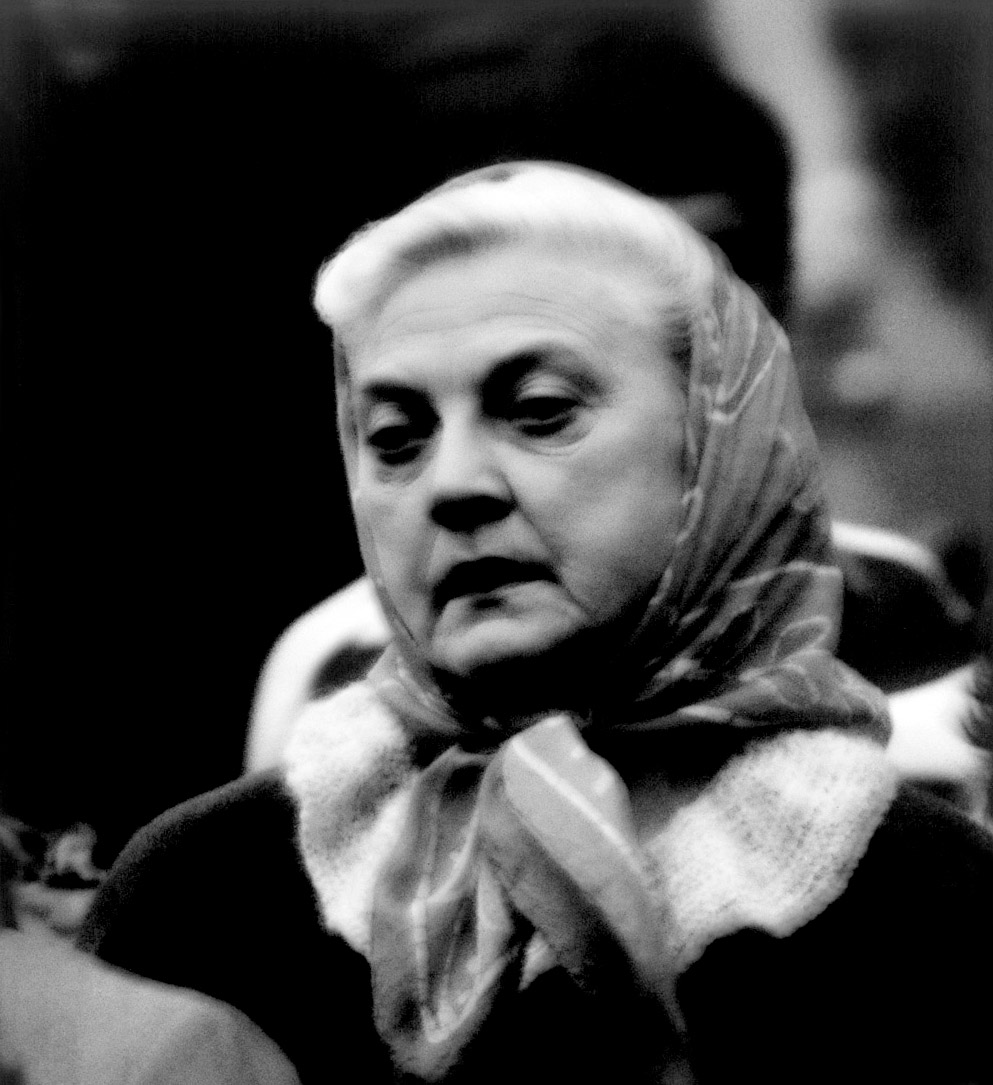
 

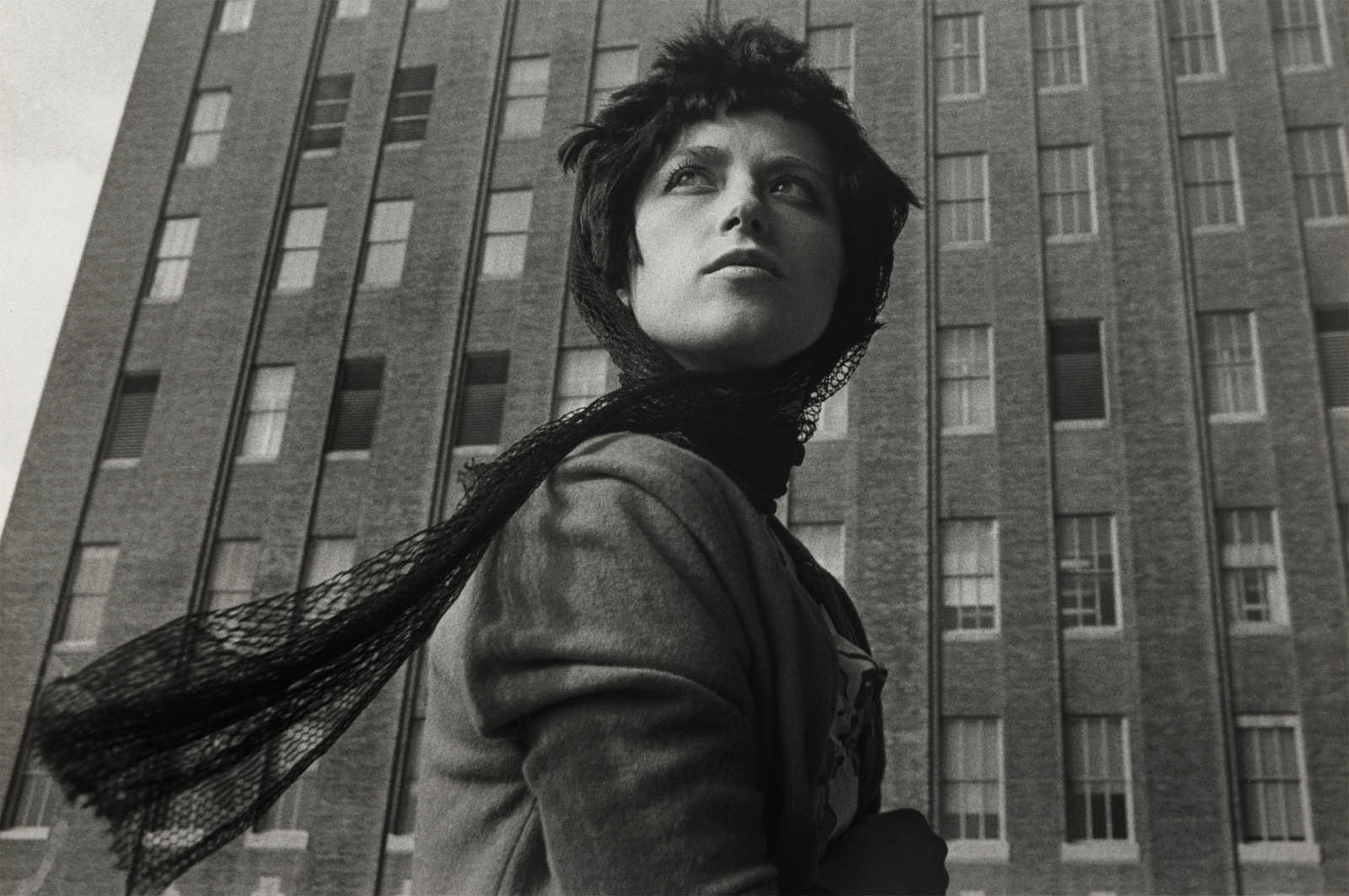
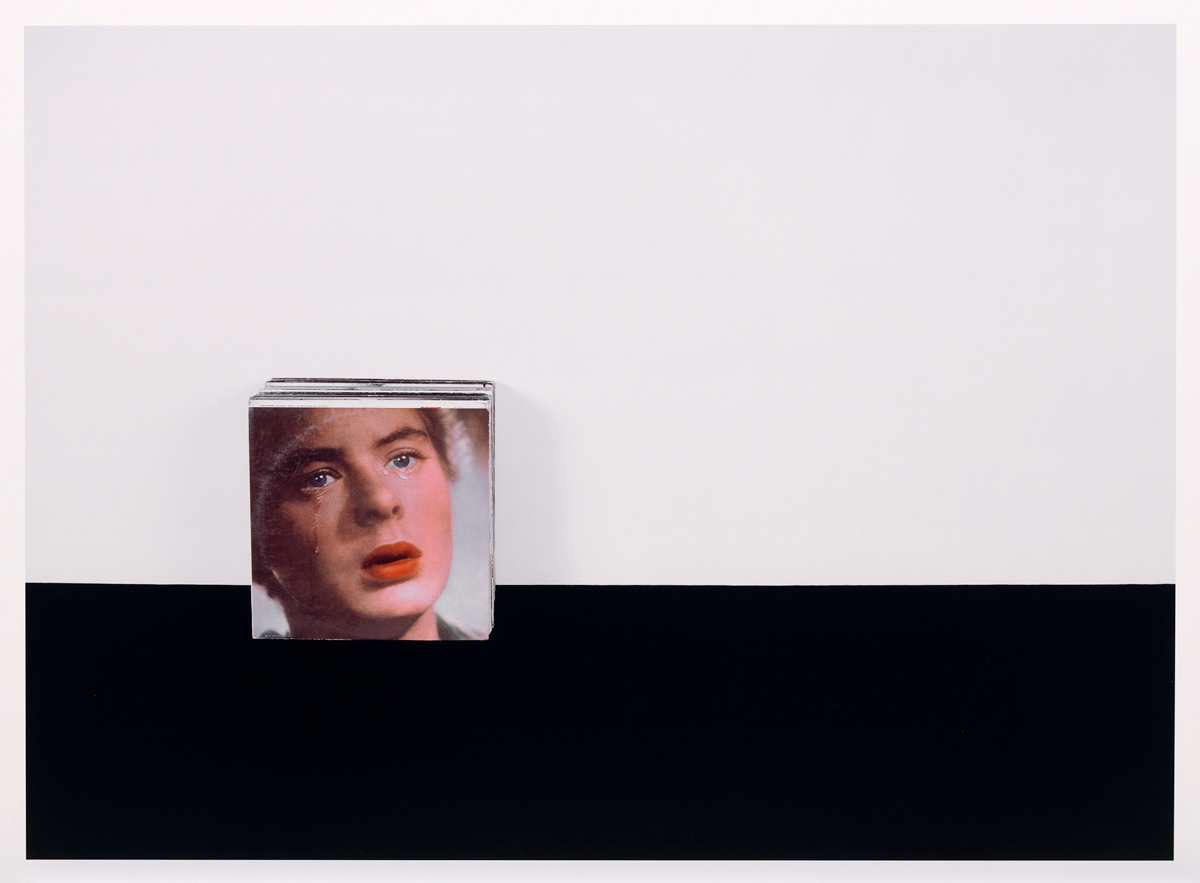
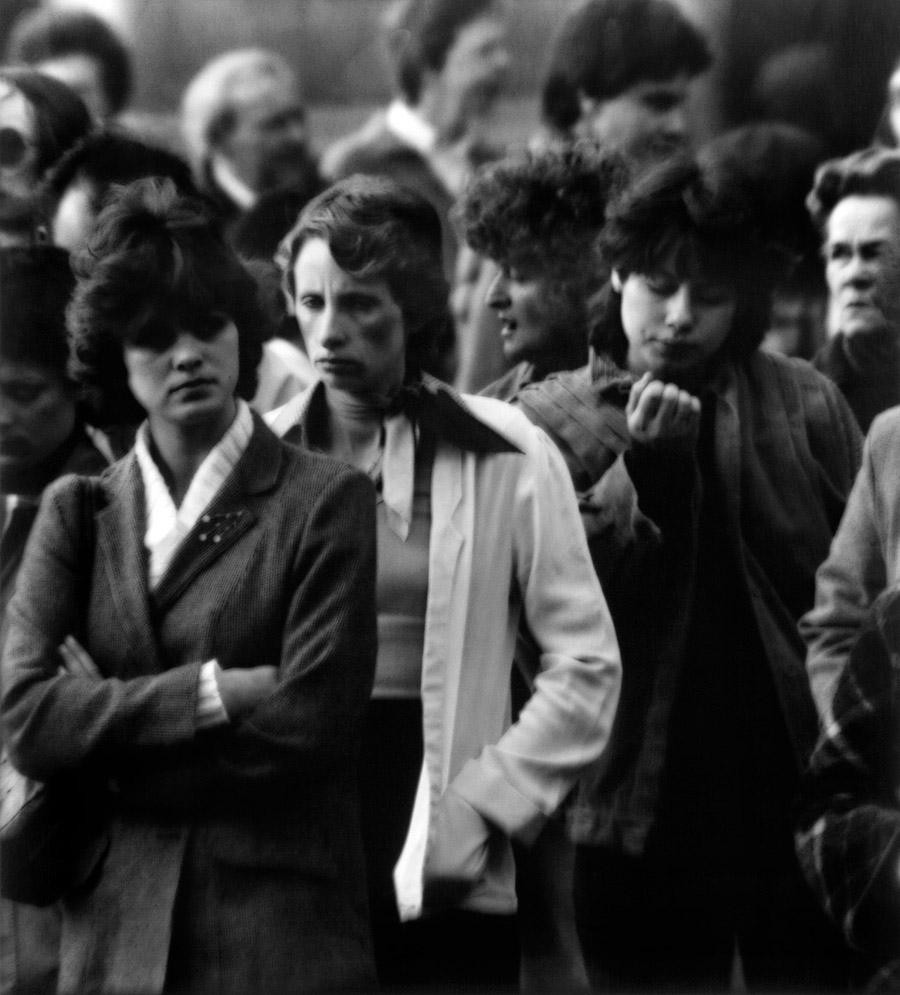
Bill Henson (Australian, b. 1955) 'Untitled 1980/82' 1980-1982


Bill Henson (Australian, b. 1955)
Untitled 1980/82
1980-1982
From the Untitled 1980/82 series 1980-1982
Gelatin silver photograph
43.0 x 38.8cm
National Gallery of Victoria, Melbourne
Anonymous gift, 1993
© Courtesy of the artist and Roslyn Oxley9 Gallery, Sydney


“The paradox is the more we seek to fix our vision of the world and to control it the less sure we are as to who we are and what our place is in the world.”


Marcus Bunyan 2011


This is a delightful, intimate exhibition at the National Gallery of Victoria that examines how looking through a camera directs and structures the way we see the world. The exhibition mines the same ground as one of my top exhibitions from last year, In camera and in public that was presented at the Centre for Contemporary Photography, Fitzroy.

Numerous artists use photography to examine the ways in which gender, race and sexuality have been ‘looked at’ in visual culture, including the politics of looking in relation to Indigenous cultures and identities. In I split your gaze (1997) by Brook Andrew, the artist has split the face of an Aboriginal man down the middle, and reassembled the face ear to ear. No longer can we look on the man as a whole because our gaze is split. Andrew is said to have “reclaimed” the image from colonial scientific, anthropological documentation but this presupposes some holistic whole existed a priori to white intervention. The split photograph does alter perception but to what extent it promotes a different reading, a postcolonial gaze that is understood as such by the viewer, is debatable.

Chi Peng poses more interesting gender reversals and masquerades. In Consubstantiality (2004, below) misaligned pairs of people, of androgynous face and hard to distinguish gender, are “reflected” in a pseudo mirror. Consubstantiality references the Christian principle describing the intertwined relationship of the Trinity (God the Father, the Son, and the Holy Spirit) as being of one essence, one being.

“Chi Peng uses digital technologies to manipulate photographic surfaces and often uses his own body and identity as a homosexual man living in China as a means of creating new ways of looking at himself and at the construction of identity… With powdered faces and bodies, the naked ‘reflections’ press the palms of their hands together across a pane of glass. At first glance, it is as though the photographer is intruding on a private scene, a moment of self-scrutiny in a mirror. However the hands do not quite align and the gazes diverge…”1

This self-reflexivity and its relation to the Lacan’s mirror stage in the development of male and female identity – in which the mirror can be looked at and looks back in return – lends these ethereal images real beauty and presence as they explore the psychology of identity and gender reversal.

“Photographers Ashley Gilbertson and John Imming, and collaborative artists Lyndell Brown and Charles Green have all used cameras to document war, and their works off three distinct views.The common link appears to be an engagement with ideas of the observer and the observed and questioning who is looking at whom, and why?”2 Attempting an apolitical view of the war in Iraq, Gilbertson was embedded with different US military outfits on numerous visits to the country between 2002-2008, reliant on them for his safety. Many of his “objective” photographs deal with representations of surveillance and covert looking from ‘within the ranks’. But not from within enemy ranks. The very fact of his embedding, his lying down within a disciplinary system of control and power, to shoot from one point of view, politicises his gaze.

Brown and Green’s painterly photograph features a tightly choreographed scene, “a market within a military camp in which traders were invited to sell their wares. The scene is indicative, however, of the ‘strained atmosphere’ prevalent when different cultures interact in military situations – seemingly harmonious but concealing the ‘control that was exerted in the selection of traders’.”3 This traditional tableau vivant sees the traders become actors on a stage, their gaze directed towards the female officer at the centre of the group holding a piece of clothing which is blocked from our view. We the viewer are excluded from the circle of gazes; we become other, looking at the looking of the traders. Their gaze and our gaze are at cross-purpose; we wish to become a player on the stage but are denied access and can only observe the spectacle from a distance. Excluded, the viewer feels disempowered, the photographic mise en scène leaving me unmoved.

John Imming’s photographs use found images from the Vietnam war, the first war in which photographers had unrestricted access and were given absolute freedom to record what they saw. Vietnam was a stage for intense exploration, photographers bombarding the public with images of extreme violence. Imming rephotographs images from the television screen using a Leica camera, abstracting them into darkly hued creatures, the borders miming the shape of early television screens. “The images become abstracted and our gaze is ‘reduced’ into blurred shapes of contrasting tones … His photographs force us to slow down the memories of the somewhat ephemeral television imagery and look deeply at what is being portrayed, and how.”4 These photographs fail in that task for they are very surface photographs. The photographs do not have the structure to support such a vision nor the support of beauty to prick the consciousness of the gaze. They are ugly images because war is ugly and abstracting them in order to ask the viewer to look deeply and have an incredible insight into the condition ‘war’ and how it is portrayed simply did not work for me.


The two standout works in the exhibition are Thomas Struth’s luminous photograph Pergamon Museum IV, Berlin (2001, below) and Bill Henson’s seminal (perhaps even ubiquitous) series Untitled 1980/82 (1980-1982, see above) – these photographs seem to be everywhere at the moment, perhaps a change is as good as a rest!

Struth’s magnificent large colour photograph is an investigation into the theatre of seeing. In the photograph Struth directs his cast and choreographs the visitors, the arrangement of the spectators re-assembling the open-ended narrative of the 2nd century Telephos frieze behind. “Similarities between the poses of the audience members and the poses of the carve relief figures gradually emerge, suggesting an unconscious dialogue between the viewers and the objects they regard. The result of Struth’s directorial mode of working is the creation of a type of theatre based on intersecting viewpoints, raising questions about the gaze of the spectator and the process of looking at works of art and each other.”5

Beholders observe beholders and the subjects of vision become historical, according to art historian Wold-Dieter Heilmeyer. Here I observe that:

~ The suffused light that falls from the skylight leaves no shadow.

~ A man who casts no shadow has no soul.

~ The shadow according to Jung is the seat of creativity. In this photograph there is no depth of field, the sculptures and the figures feel like they are almost on one plane.

~ None of the viewers looks at the camera, they avoid its probing gaze, passively becoming the feminine aspect – like the central raised figure, robbed of head and arms, being gazed upon from all sides. We, the viewer, are looking at the spectacle of the viewers looking at the frieze. Looking at looking the observer becomes the observed (surveillance camera where are you?)

~ Consider the freeze frame of the models as they posed for the sculptor all those years ago; the freeze frame of the sculptures themselves; the freeze frame of the spectators posing for the camera; the freeze frame of the photograph itself; and then consider the freeze frame of time and space as we stand before the photograph looking at it. Then notice the women in the photograph videotaping the scene, another excoriating layer that tears at the fabric of time and looking, that causes lacrimation for our absent soul. What a photograph!


The Henson photographs are presented in a wonderfully musical installation, mimicking the movement of the crowds portrayed. I republish below my comments on this series from the review of the In camera and in public exhibition.

“A selection of photographs from the Crowd Series (1980-1982) by Bill Henson. Snapped in secret these black and white journalistic surveillance photographs (‘taken’ in an around Flinders Street railway station in Melbourne) have a brooding intensity and melancholic beauty. Henson uses a flattened perspective that is opposed to the principles of linear perspective in these photographs. Known as The Art of Describing6 and much used in Dutch still life painting of the 17th century to give equal weight to objects within the image plane, here Henson uses the technique to emphasise the mass and jostle of the crowd with their “waiting, solemn and compliant” people.

“When exhibiting the full series, Henson arranges the works into small groupings that create an overall effect of aberrant movement and fragmentation. From within these bustling clusters of images, individual faces emerge like spectres of humanity that will once again dissolve into the crowd … all apparently adrift in the flow of urban life. The people in these images have an anonymity that allows them to represent universal human experiences of alienation, mortality and fatigue.”7

Henson states, “The great beauty in the subject comes, for me, from the haunted space, that unbridgeable gap – which separates the profound intimacy and solitude of our interior world from the ‘other’… The business of how a child’s small hand appearing between two adults at a street crossing can suggest both a vulnerability, great tenderness, and yet also contain within it all of the power that beauty commands, is endlessly fascinating to me.”8 His observation is astute but for me it is the un/awareness of the people in these photographs that are their beauty, their insertion into the crowd but their isolation from the crowd and from themselves. As Maggie Finch observes, it is “that feeling of being both alone and private in a crowd, thus free but also exposed.”9

In the sociologist Erving Goffman’s terms the photographs can be seen as examples of what he calls “civil inattention”10 which is a carefully monitored demonstration of what might be called polite estrangement, the “facework” as we glance at people in the crowd, holding the gaze of the other only briefly, then looking ahead as each passes the other.

“Civil inattention is the most basic type of facework commitment involved in encounters with strangers in circumstances of modernity. It involves not just the use of the face itself, but the subtle employment of bodily posture and positioning which gives off the message “you may trust me to be without hostile intent” – in the street, public buildings, trains or buses, or at ceremonial gatherings, parties, or other assemblies. Civil inattention is TRUST as ‘background noise’ – not as a random collection of sounds, but as carefully restrained and controlled social rhythms. It is characteristic of what Goffman calls “unfocused interaction.””11

This is what I believe Henson’s photographs are about. Not so much the tenderness of the child’s hand but a fear of engagement with the ‘other’. As such they can be seen as image precursors to the absence/presence of contemporary communication and music technologies. How many times do people talk on their mobile phone or listen to iPods in crowds, on trams and trains, physically present but absenting themselves from interaction with other people. Here but not here; here and there. The body is immersed in absent presence, present and not present, conscious and not conscious, aware and yet not aware of the narratives of a ‘recipro/city failure’. A failure to engage with the light of place, the time of exposure and an attentiveness to the city.

As Susan Stewart insightfully observes,

“To walk in the city is to experience the disjuncture of partial vision/partial consciousness … The walkers of the city travel at different speeds, their steps like handwriting of a personal mobility. In the milling of the crowd is the choking of class relations, the interruption of speed, and the machine.”12

Dr Marcus Bunyan


Footnotes

1/ Finch, Maggie. Looking at Looking: The Photographic Gaze. Catalogue. Melbourne: National Gallery of Victoria, 2011, p. 10

2/ Ibid., p. 16

3/ Ibid., p. 21

4/ Ibid., p. 24

5/ Ibid., p. 7

6/ See Alpers, Svetlana. The Art of Describing: Dutch Art in the Seventeenth Century. University Of Chicago Press, 1984

7/ Anon. BILL HENSON: early work from the MGA collection. Education Resource. A Monash Gallery of Art Travelling Exhibition [Online] Cited 14/10/2011. No longer available online

8/ Henson, Bill quoted in the exhibition catalogue. First published as a pdf for the exhibition In camera and in public Curated by Naomi Cass. Centre for Contemporary Photography, 16 September – 23 October 2011

9/ Stephens, Andrew. “Who’s watching you?” in The Saturday Age. 23rd September 2011 [Online] Cited 14/10/2011

10/ See  Goffman, E. Behaviour in Public Places. New York: Free Press, 1963

11/ Giddens, Anthony. The Consequences of Modernity. Cambridge: Polity Press, 1991, pp. 82-83

12/ Stewart, Susan. On Longing: Narratives of the Miniature, the Gigantic, the Souvenir, the Collection. Durham: Duke University Press, 1993, p. 2. Prologue


Many thankx to the National Gallery of Victoria for allowing me to publish the photographs in the posting. Please click on the photographs for a larger version of the image.


Bill Henson (Australian, b. 1955) 'Untitled 1980/82' 1980-1982


Bill Henson (Australian, b. 1955)
Untitled 1980/82
1980-1982
From the Untitled 1980/82 series 1980-1982
Gelatin silver photograph
43.0 x 38.8cm
National Gallery of Victoria, Melbourne
Anonymous gift, 1993
© Courtesy of the artist and Roslyn Oxley9 Gallery, Sydney


Bill Henson (Australian, b. 1955) 'Untitled 1980/82' 1980-1982


Bill Henson (Australian, b. 1955)
Untitled 1980/82
1980-1982
From the Untitled 1980/82 series 1980-1982
Gelatin silver photograph
29.2 x 47cm
National Gallery of Victoria, Melbourne
Anonymous gift, 1993
© Courtesy of the artist and Roslyn Oxley9 Gallery, Sydney


On 30 September the National Gallery of Victoria will present Looking at Looking: The Photographic Gaze, a unique exhibition exploring how photography can construct particular ways of looking. Looking at Looking will feature works by 10 Australian and international photographers including 20 photographs from Bill Henson’s Untitled 1980-82 series.

Drawn entirely from the NGV Collection, this exhibition will bring together a fascinating selection of photographs inviting the viewer to consider the diverse nature of the photographic gaze and explore the complex relationships between the subject, the photographer and the audience. The displayed photographs will include observations of people in crowds, surveillance images from war zones and photographs that explore different ways of looking at gender, race and identity.

Maggie Finch, Assistant Curator, Photography, NGV said: “The act of photographing people involves a process of observation and scrutiny. At times, photographers remain detached and anonymous while at other times they are complicit, directing their subjects and encouraging specific actions.”

Frances Lindsay, Deputy Director, NGV, said: “In the NGV’s 150th year this exhibition allows visitors to explore the dynamic relationship between the observer and the observed. This is a rare opportunity to view these photographs in a truly unique context.”

Looking at Looking will consider the anonymous photographer, one who is able to look without being looked at in return and consequently see more than otherwise possible. This idea is explored in Bill Henson’s series Untitled 1980-82, where the artist photographed people on city streets. Hung in a dense display, these photographs provide a psychological study of the nature of people when in a crowd.

Looking at Looking will feature works by Brook Andrew, Chi Peng, Anne Ferran, Ashley Gilbertson, Charles Green and Lyndell Brown, Bill Henson, John Immig, Thomas Struth and David Thomas.

Press release from the National Gallery of Victoria


Thomas Struth (German, b. 1954) 'Pergamon Museum IV, Berlin' 2001


Thomas Struth (German, b. 1954)
Pergamon Museum IV, Berlin
2001
Type C photograph
144.1 x 219.9cm
National Gallery of Victoria, Melbourne
Purchased with the assistance of The Bowness Family Fund for Contemporary Photography, 2008
© 2011 Thomas Struth
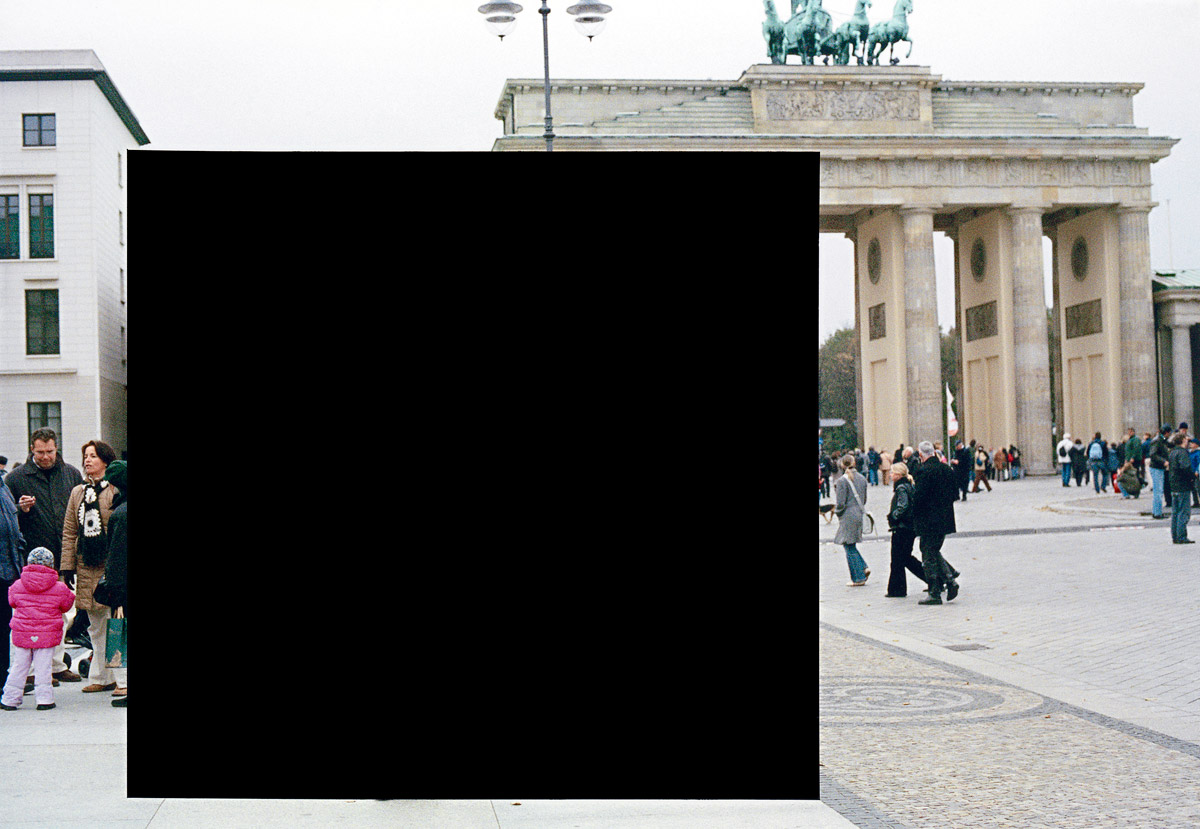
 

David Thomas (born Northern Ireland 1951, arrived Australia 1958) 'Amid history 2 (Large version)' 2006


David Thomas (born Northern Ireland 1951, arrived Australia 1958)
Amid history 2 (Large version)
2006
Enamel paint on type C photograph on aluminium and plastic
100 x 145cm
National Gallery of Victoria, Melbourne
Purchased, Victorian Foundation for Living Australian Artists, 2007 © the artist
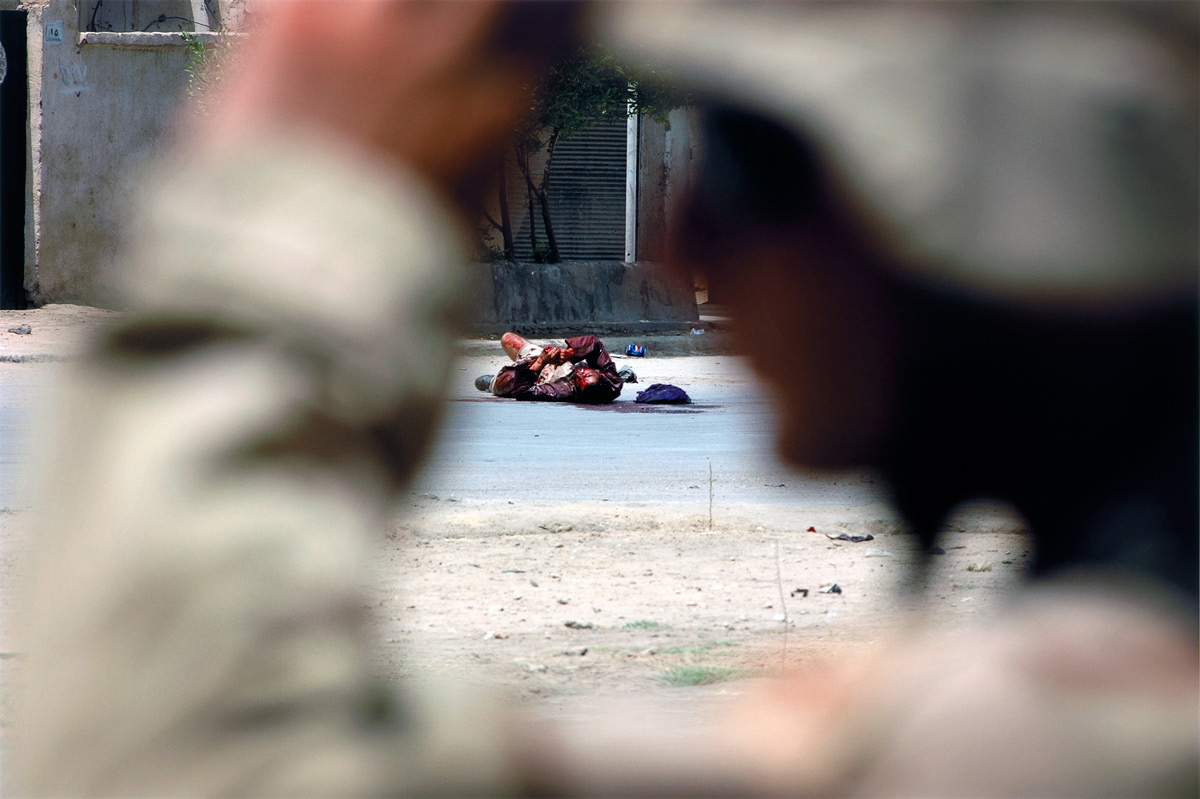
 

Ashley Gilbertson (Australian, b. 1978) 'A member of the Mahdi Army RPG team' 2004 from the 'Whiskey Tango Foxtrot' series 2004


Ashley Gilbertson (Australian, b. 1978)
A member of the Mahdi Army RPG team
2004
From the Whiskey Tango Foxtrot series 2004
Digital type C print
66.5 x 99.8cm
National Gallery of Victoria, Melbourne
Purchased, Victorian Foundation for Living Australian Artists, 2009
© Ashley Gilbertson / VII Network


John Immig (Dutch/Australian, 1935-2018) 'No title (T.V. images)' 1975-1976


John Immig (Dutch/Australian, 1935-2018)
No title (T.V. images)
1975-1976
From the Vietnam series 1975-1976
Gelatin silver photograph
20.2 x 25.3cm
National Gallery of Victoria, Melbourne
Purchased with the assistance of the Visual Arts Board, 1977
© John Immig


Chi Peng (Chinese, b. 1981) 'Consubstantiality' 2004


Chi Peng (Chinese, b. 1981)
Consubstantiality
2004
Type C photograph
87.5 x 116.7cm
National Gallery of Victoria, Melbourne
Purchased with the assistance of the NGV Foundation, 2004
© Chi Peng, courtesy of Red Gate Gallery, Beijing


Brook Andrew (Australian, b. 1970) 'I Split Your Gaze' 1997


Brook Andrew (Australian, b. 1970)
I Split Your Gaze
1997
Gelatin silver print
122.6 × 114cm (image and sheet)
National Gallery of Victoria, Melbourne
Purchased with funds from the Victorian Foundation for Living Australian Artists, 2005
© Brook Andrew/Copyright Agency, 2023
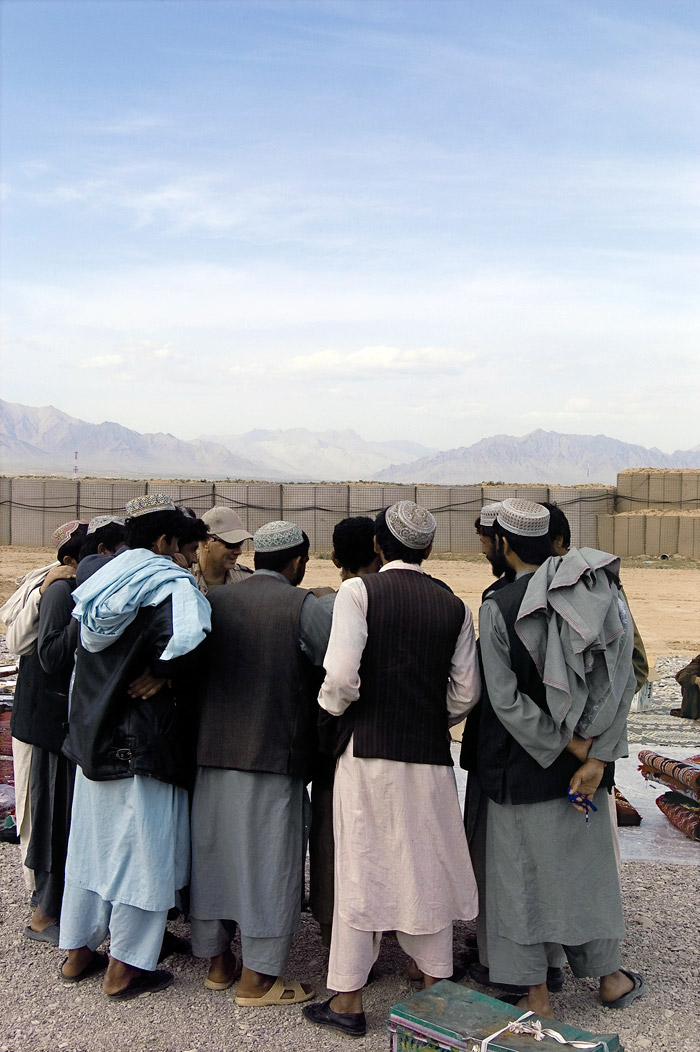
 

Charles Green (Australian, b. 1953) and Lyndell Brown (Australian, b. 1961) 'Afghan traders with soldiers, market, Taran Kowt Base Uruzgan Province, Afghanistan' 2007 printed 2009


Charles Green (Australian, b. 1953)
Lyndell Brown (Australian, b. 1961)
Afghan traders with soldiers, market, Taran Kowt Base Uruzgan Province, Afghanistan
2007 printed 2009
From The approaching storm series 2009
Inkjet print
155.0 x 107.5cm
National Gallery of Victoria, Melbourne
Purchased, Victorian Foundation for Living Australian Artists, 2009
© Courtesy of the Artists and Arc One Gallery, Melbourne


NGV International
180 St Kilda Road

Opening hours
Daily 10am – 5pm
National Gallery of Victoria website

LIKE ART BLART ON FACEBOOK

Back to top

Photographs: ‘A Thousand Little Suns’ by Martina Lindqvist

July 2011


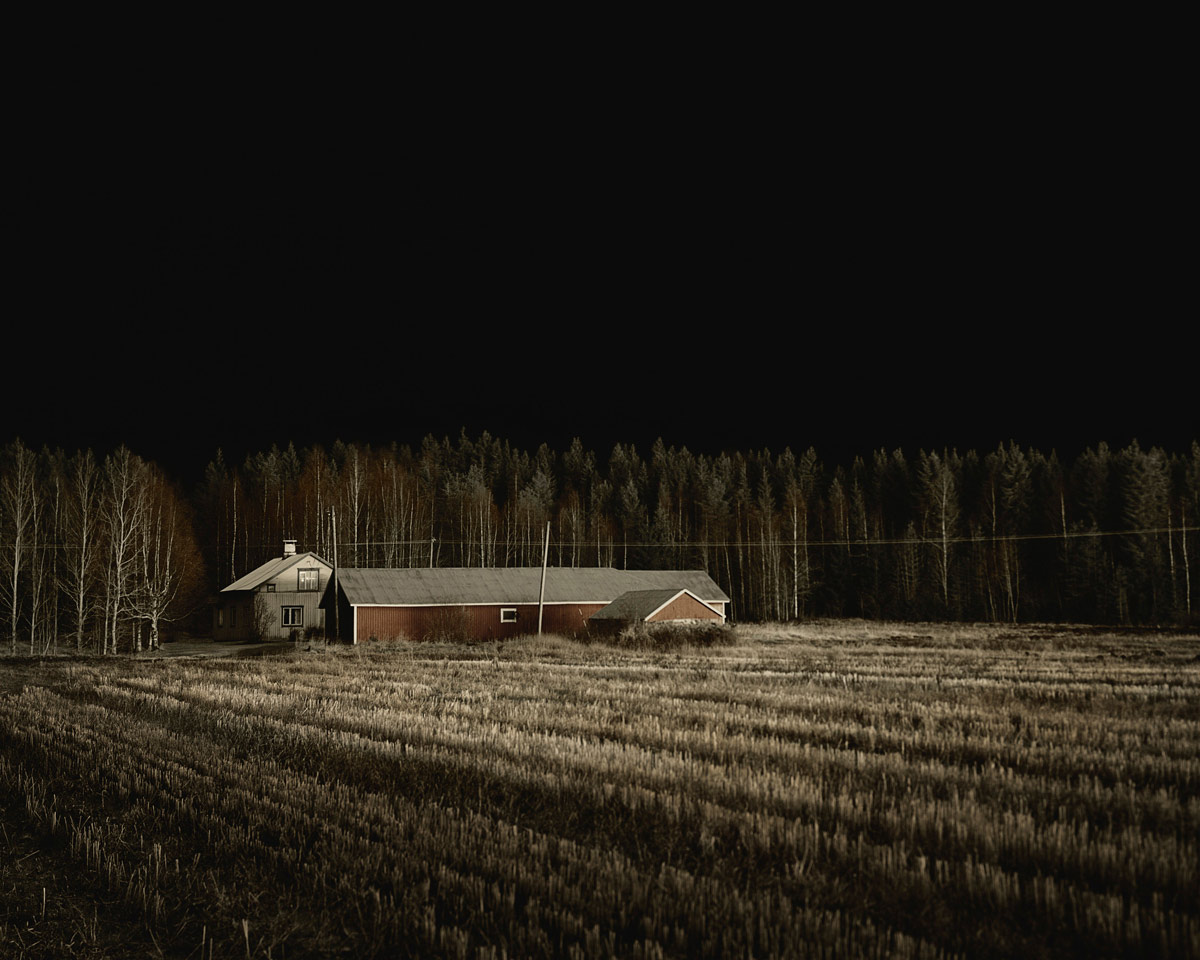
Martina Lindqvist (Finland, b. 1981) 'Untitled 1' from the series 'A Thousand Little Suns' 2011


Martina Lindqvist (Finland, b. 1981)
Untitled 1
2011
From the series A Thousand Little Suns


This end of the world will occur without noise, without revolution, without cataclysm. Just as a tree loses leaves in the autumn wind, so the earth will see in succession the falling and perishing all its children, and in this eternal winter, which will envelop it from then on, she can no longer hope for either a new sun or a new spring. She will purge herself of the history of the worlds. The millions or billions of centuries that she had seen will be like a day. It will be only a detail completely insignificant in the whole of the universe. Presently the earth is only an invisible point among all the stars, because, at this distance, it is lost through its infinite smallness in the vicinity of the sun, which itself is by far only a small star. In the future, when the end of things will arrive on this earth, the event will then pass completely unperceived in the universe. The stars will continue to shine after the extinction of our sun, as they already shone before our existence. When there will no longer be on the earth a sole concern to contemplate, the constellations will reign again in the noise as they reigned before the appearance of man on this tiny globule. There are stars whose light shone some millions of years before we arrived … The luminous rays that we receive actually then departed from their bosom before the time of the appearance of man on the earth. The universe is so immense that it appears immutable, and that the duration of a planet such as that of the earth is only a chapter, less than that, a phrase, less still, only a word of the universe’s history.


Camille Flammarion, Le Fin du Monde (The End of the World) 1893


Many thankx to Martina Lindqvist for allowing me to publish the six photographs in this series. Please click on the photographs for a larger version of the image.


Martina Lindqvist (Finland, b. 1981) 'Untitled 2' from the series 'A Thousand Little Suns' 2011


Martina Lindqvist (Finland, b. 1981)
Untitled 2
2011
From the series A Thousand Little Suns


Martina Lindqvist (Finland, b. 1981) 'Untitled 3' from the series 'A Thousand Little Suns' 2011


Martina Lindqvist (Finland, b. 1981)
Untitled 3
2011
From the series A Thousand Little Suns


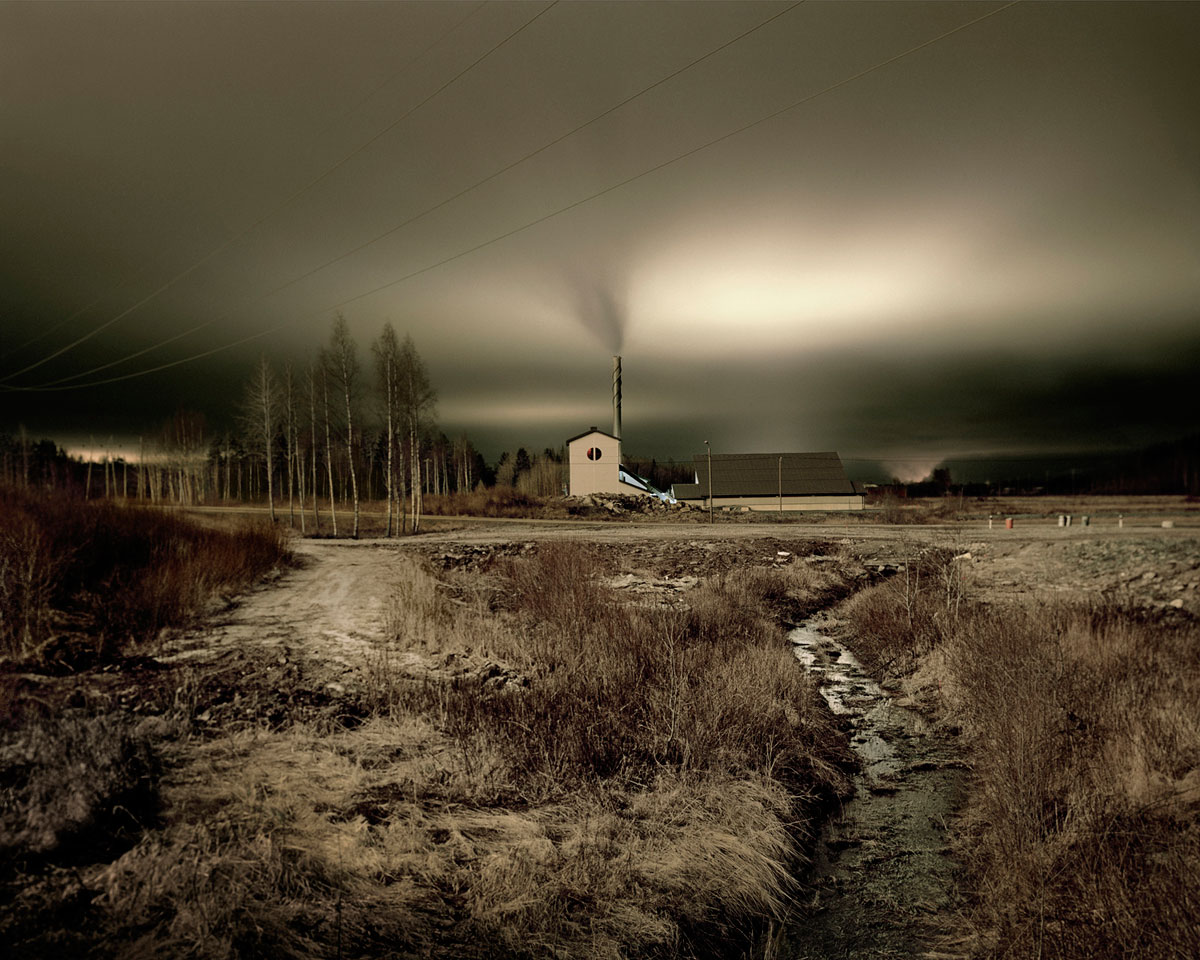
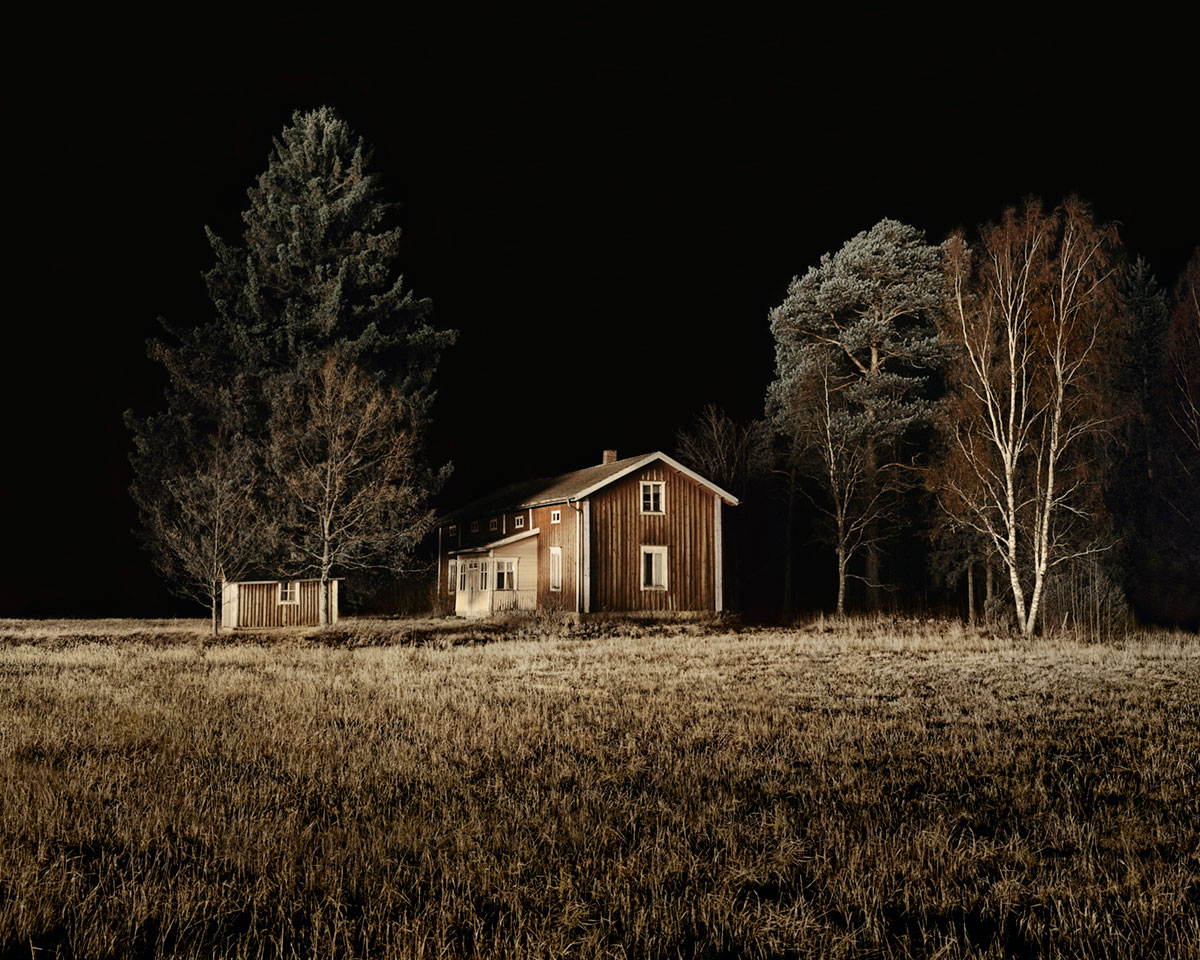
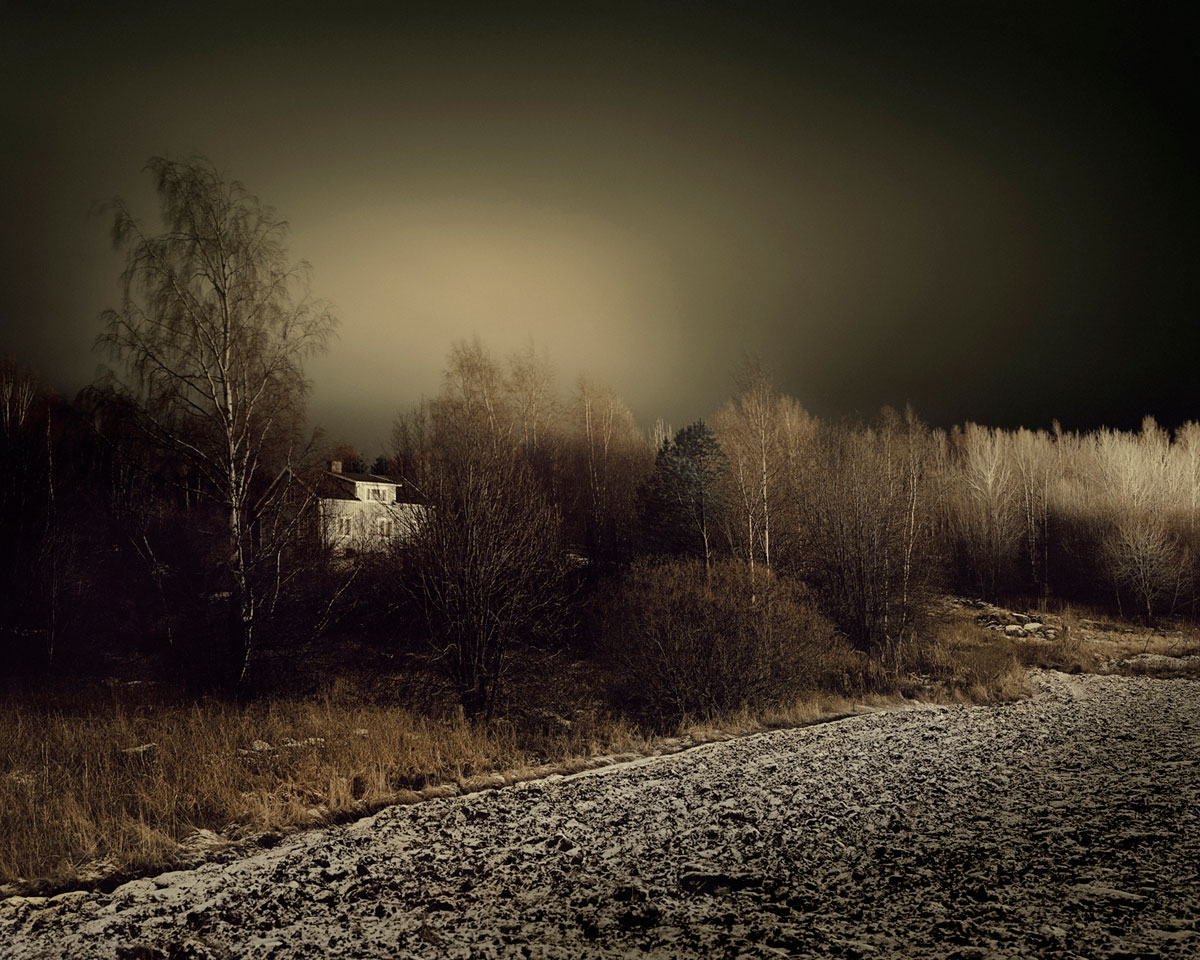
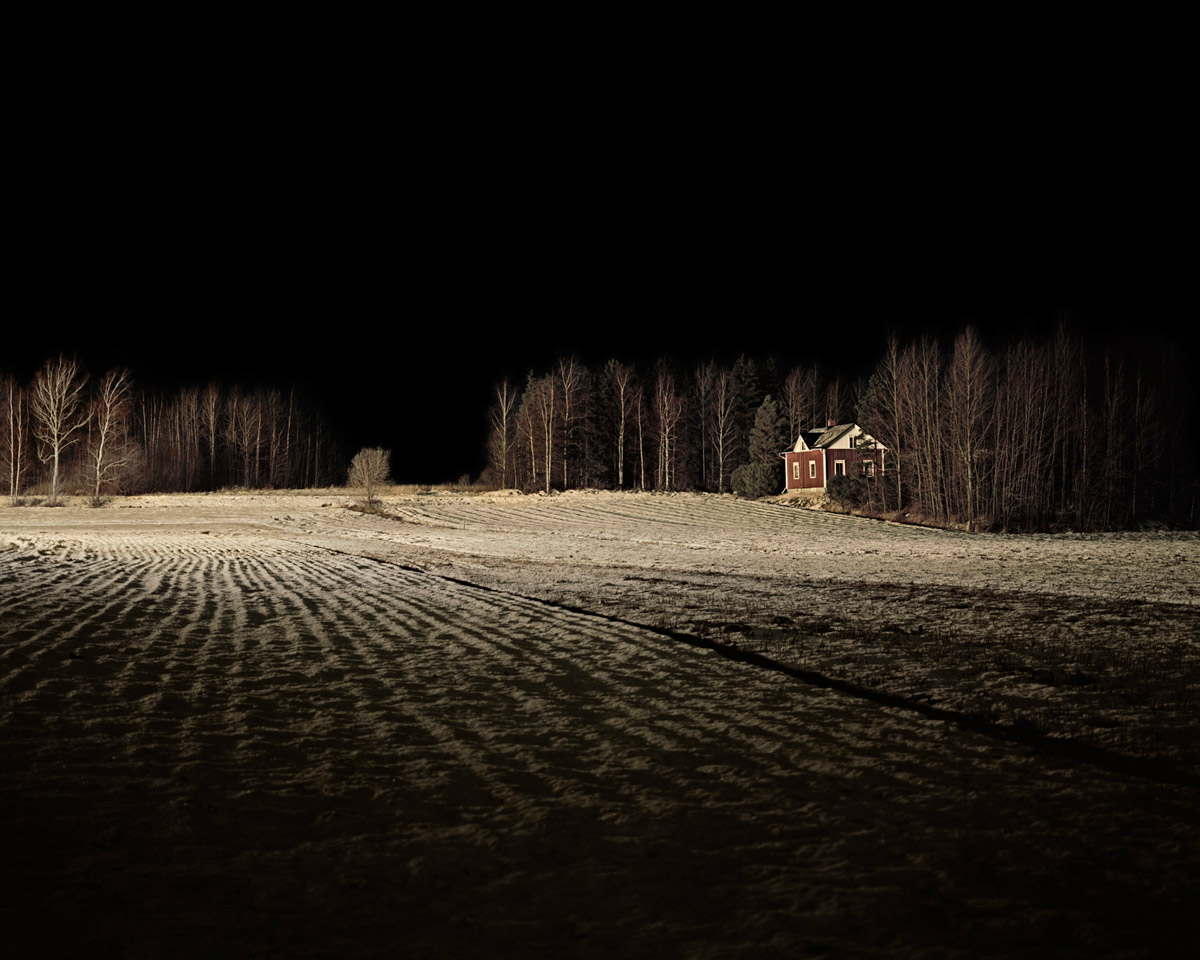
A Thousand Little Suns is an autobiographical body of work that uses childhood landscapes as metaphor for human experience, and is further influenced by an interest in spatial psychology, or more precisely, the emotive effects of landscapes and forested wilder land. Marcault and Therese Brosse once wrote that “forests, especially, with the mystery of their space prolonged indefinitely beyond the veil of tree-trunks and leaves, space that is veiled for our eyes … are veritable psychological transcendents.” Forests, in spite of being the most natural of spaces, are truly unnatural for the cultured human being. Soon, if we don’t know where we are going we no longer know where we are, and standing on the brink of a forest always represents this possibility of going deeper and deeper into the unknown.

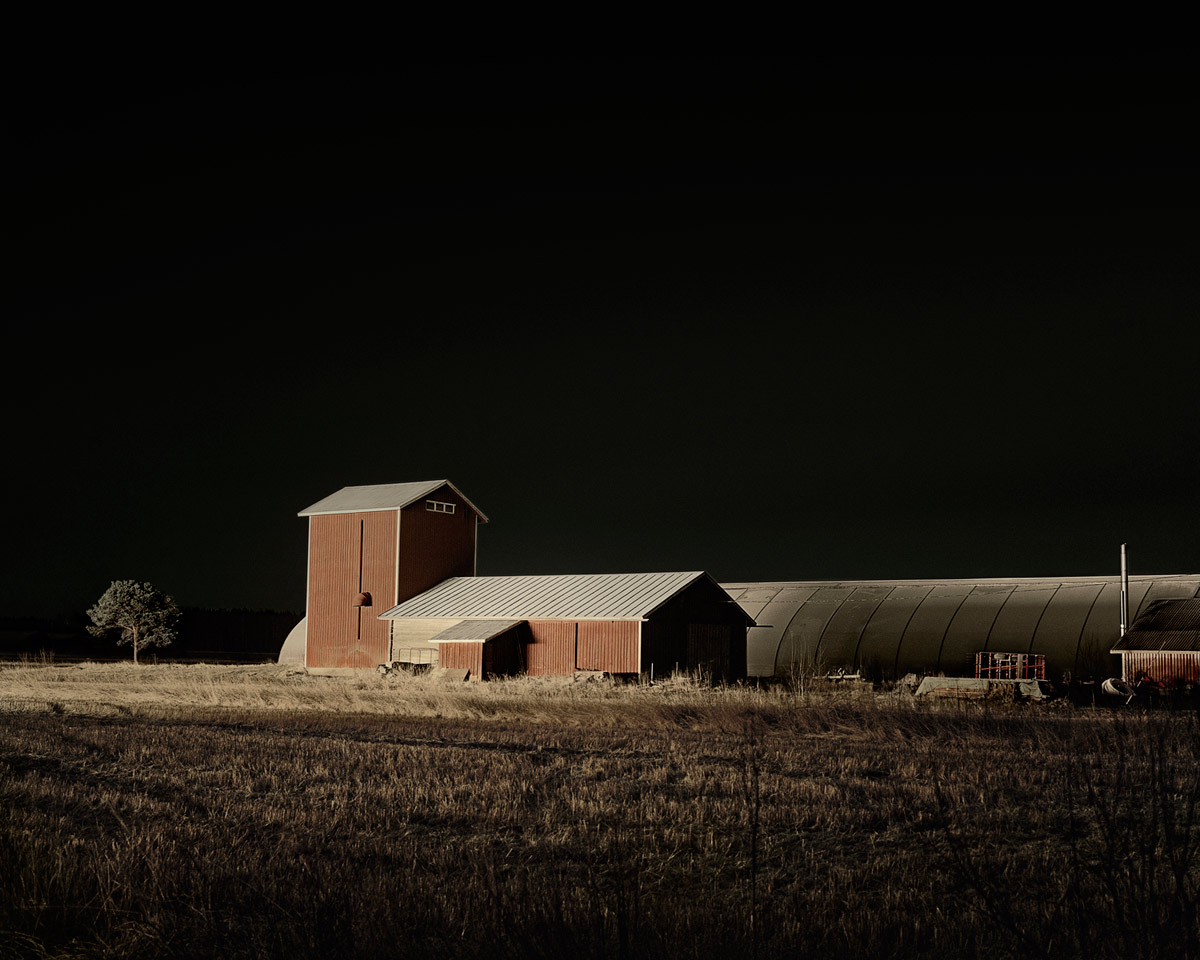
A Thousand Little Suns takes a contemplative look on the landscape of Ostrobothnia in central Finland, which during the autumn and winter months should be shrouded by an impenetrable darkness, but instead finds itself lit by a thousand glowing lights. Shining upon uneasy buildings trapped in the middle of darkness and light; forestation and cultured space, these ephemeral lights place the border with its inherent dialectical problematic of inside / outside in focus. The concept of the border is thus echoed in the structural quality of the land; in the patches of light with their opposing darkness, and is a reflection of the experience of an inherited yet closed off culture that was always seen through the eyes of a visitor.

Martina Lindqvist 2011


Martina Lindqvist (Finland, b. 1981) 'Untitled 4' from the series 'A Thousand Little Suns' 2011


Martina Lindqvist (Finland, b. 1981)
Untitled 4
2011
From the series A Thousand Little Suns


Martina Lindqvist (Finland, b. 1981) 'Untitled 5' from the series 'A Thousand Little Suns' 2011


Martina Lindqvist (Finland, b. 1981)
Untitled 5
2011
From the series A Thousand Little Suns


Martina Lindqvist (Finland, b. 1981) 'Untitled 6' from the series 'A Thousand Little Suns' 2011


Martina Lindqvist (Finland, b. 1981)
Untitled 6
2011
From the series A Thousand Little Suns


Martina Lindqvist website

LIKE ART BLART ON FACEBOOK

Back to top

Exhibition: ‘You Are Here: Architecture and Experience’ at Carnegie Museum of Art, Pittsburgh

Exhibition dates: 5th March – 29th May 2011


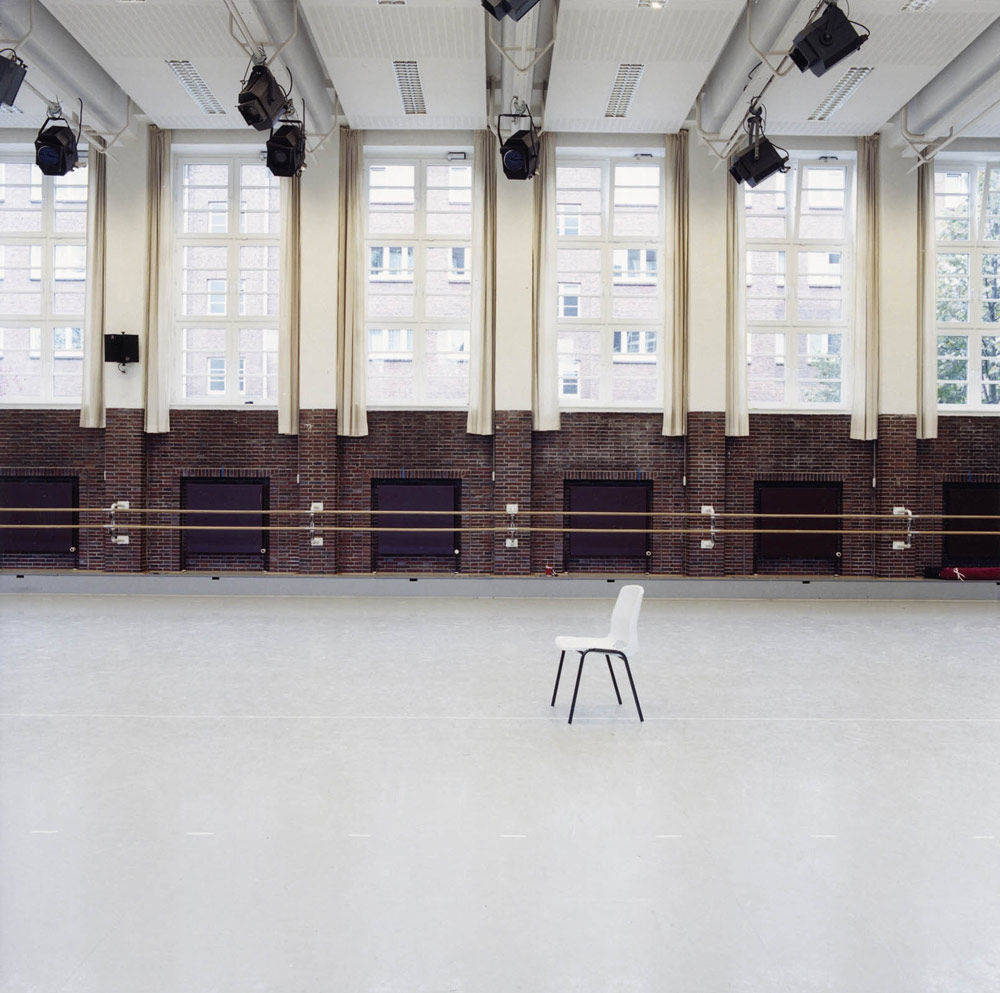
Candida Höfer (German, b. 1944) 'Ballettzentrum Hamburg III' 2000


Candida Höfer (German, b. 1944)
Ballettzentrum Hamburg III
2000
Chromogenic print
Courtesy of Sonnabend Gallery


Inspired curating conjoins the monumental, classicist purity of Höfer with the picturesque, dystopian (dis)quietude of Gaillard in an exhibition that investigates our relationship to buildings and their environments and their relationship to us – the ‘i’ in our histor-i-city.

Dr Marcus Bunyan


Many thankx to the Carnegie Museum of Art for allowing me to publish the photographs in the posting. Please click on the photographs for a larger version of the image.


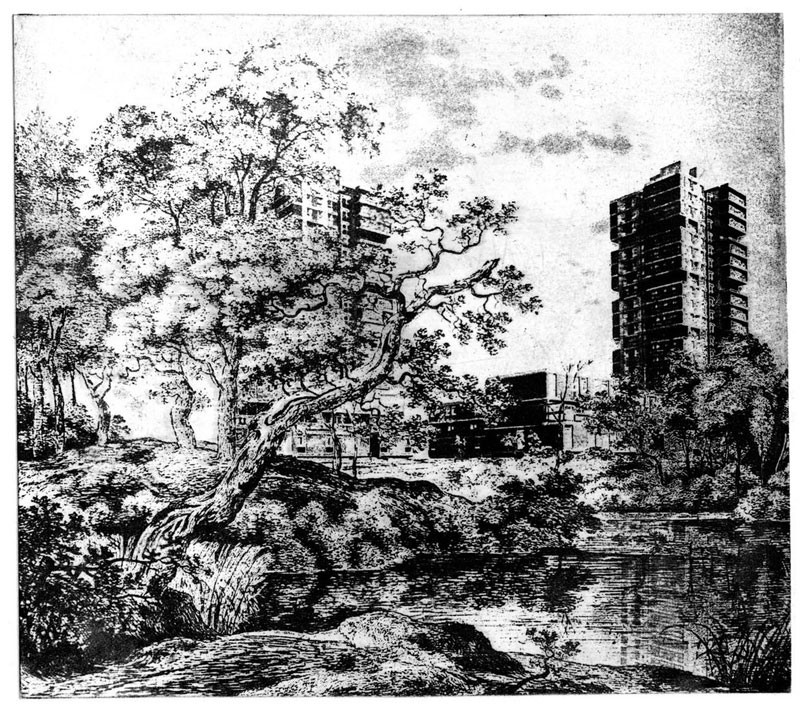
Cyprien Gaillard (French, b. 1980) 'Belief in the Age of Disbelief (L'arbre incliné/étape VI)' 2005


Cyprien Gaillard (French, b. 1980)
Belief in the Age of Disbelief (L’arbre incliné/étape VI)
2005
Etching
36 x 47cm
© Cyprien Gaillard
Courtesy Sprüth Magers Berlin, London


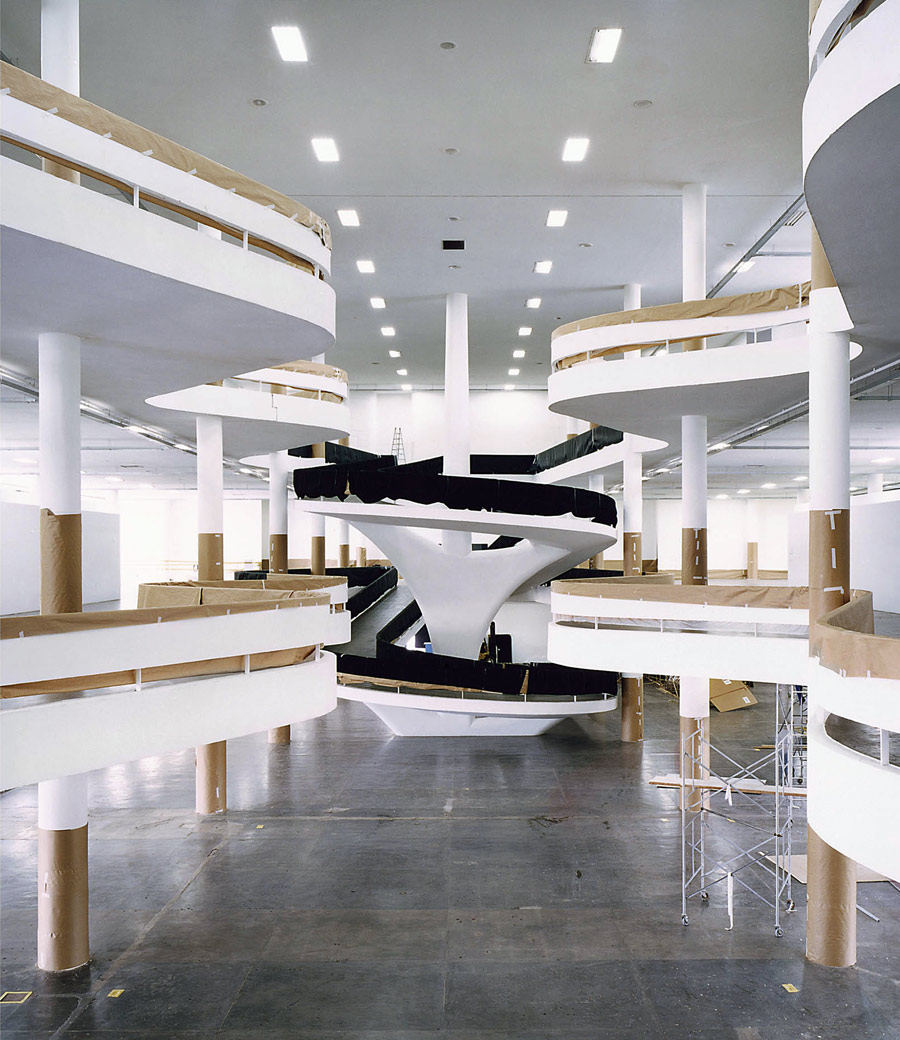
Candida Höfer (German, b. 1944) 'Fundação Bienal de São Paulo XI' 2005


Candida Höfer (German, b. 1944)
Fundação Bienal de São Paulo XI
2005
Chromogenic print
81 3/8 x 71 7/8 in.
Courtesy of Sonnabend Gallery


Carnegie Museum of Art presents the powerful work of two contemporary artists – Candida Höfer and Cyprien Gaillard – who explore architectural environments and how they influence experiences and perceptions of the world.

“We shape our buildings, and afterwards our buildings shape us.” With that simple but profound insight, Winston Churchill conveyed people’s complex relationship to architecture: The physical form of a building is controlled by its designer, but the impact a constructed environment has can be unpredictable, emotional, and even visceral. That dynamic is evident in the upcoming exhibition You Are Here: Architecture and Experience, which brings together the photographs of German artist Candida Höfer and a video and etchings by French artist Cyprien Gaillard. Both artists express the formative power of architecture in different but complementary ways, according to Tracy Myers, curator of architecture at the Heinz Architectural Center and organiser of the exhibition.

Candida Höfer’s lush colour photographs of ornate historical and contemporary interior spaces are usually devoid of humans, yet they reveal details that draw the viewer into a consideration of what each place means. Höfer’s photographs usually focus on spaces of cultural and social activity. Printed very large (from about 4 x 4 feet to a massive 6 x 8 feet), the 17 photographs in You Are Here represent the range of Höfer’s work in terms of scale, point of view, building type, and geographical location.

By contrast, Cyprien Gaillard’s video Desniansky Raion and his meticulously detailed etchings probe the human legacy of Modernist high-rise housing blocks. Constructed after World War II throughout the United States, Europe, and the Eastern Bloc to provide decent housing, these buildings often became warehouses for the poor and incubators of crime and antisocial behaviours.

Named for an administrative district in Kiev, Desniansky Raion poignantly reflects on the gap between the utopian Modernist aspiration for universal housing and the banal reality that instead prevailed. It comprises three parts. In the first section, weekend fight clubs of 50 or 100 people face off against each other in a pugilistic ritual set against the backdrop of housing towers in St. Petersburg, Russia. The second part shows the implosion of a similar tower in Meaux, a small city near Paris; the demolition of the building was treated by the city government as a literal spectacle, with a light show and fireworks preceding the destruction. The final third is a very long panning aerial shot of seemingly endless ranks of virtually identical housing blocks in Kiev, Ukraine. The video is accompanied by a soundtrack composed by Koudlam, a young musician born in the Ivory Coast. Also featured are six etchings by Gaillard, collectively titled Belief in the Age of Disbelief, in which the Modernist housing tower is placed in classic picturesque landscapes.

“Gaillard’s video packs a powerful and direct emotional punch: each time I view it, I experience physically the anticipation that ebbs and flows through the course of the work,” said Myers. “By contrast, Höfer’s photographs embody a kind of quietude that encourages slow, sustained exploration of the meaning that builds through accumulation of detail. But both works are equally affecting and bring the viewer with compelling intensity into the realm of architectural experience. Höfer and Gaillard capture the constant oscillation between what we make of our buildings, and what they make of us.”

Artists’ Biographies

Candida Höfer has been creating photographs for more than 30 years. Born in Eberswalde, Germany, in 1944, she studied with Berndt Becher and is identified with a group of German artists – Thomas Ruff, Andreas Gursky, Axel Hütte, and Thomas Struth – best known for their unsentimental photographs of architecture, landscapes, and urban developments. Höfer has made interiors her focus.

Cyprien Gaillard, born in Paris in 1980 and currently based in Berlin, explores contemporary landscapes and buildings in a variety of media, including video, painting, and etchings. Much of his work is concerned with the legacy and inheritance of buildings and landscapes that are left to us, and the ways in which we interact with them.

Press release from the Carnegie Museum of Art website


Cyprien Gaillard (French, b. 1980) 'Desniansky Raion' video still, 2007


Cyprien Gaillard (French, b. 1980)
Desniansky Raion
2007
Video still
DVD, 30 min.
Edition of 5
© Cyprien Gaillard. Courtesy Sprüth Magers Berlin, London


Cyprien Gaillard – Desniansky Raion, Part 1, 2008

The video takes place in a parking lot of a drab housing complex in St. Petersburg, Russia, where he witness two large groups of men – one mostly wearing red shirts and the other blue – slowly walking towards each other. Set by Gaillard to the hypnotic electronic beats of French composer Koudlam’s I See you All, the video shows the colour-coordinated groups marching in loose formation, reminiscent of ancient armies confronting each other on some distant battlefield. Suddenly, signal flares billowing smoke arc through the air and the two groups come together, clashing in flurry of fists – a breathtaking display of raw physical violence set against the stark backdrop of the housing block. As the sounds of Koudlam’s pulsing music draw louder and more urgent, the furious hand-to-hand combat intensifies while bodies of the fallen lay strewn on the pavement. Before long, the blue faction beats a hasty retreat, only to regroup moments later on one side of a nearby pedestrian bridge. The two sides come together again, this time clashing on the impossibly narrow span of the footbridge. The blue group is once more chased off, and the victors in red erupt in victorious celebration.

Text from the YouTube website


Cyprien Gaillard (French, b. 1980) 'Belief in the Age of Disbelief (Banja Luca)' 2005


Cyprien Gaillard (French, b. 1980)
Belief in the Age of Disbelief (Banja Luca)
2005
Etching
36 x 47cm
© Cyprien Gaillard
Courtesy Sprüth Magers Berlin, London


Candida Höfer (German, b. 1944) 'Pinacoteca Querini Stampalia Venezia I' 2003


Candida Höfer (German, b. 1944)
Pinacoteca Querini Stampalia Venezia I
2003
Chromogenic print
60 15/16 x 73 in
Courtesy of Sonnabend Gallery


Candida Höfer (German, b. 1944) 'Palacio Nacional de Mafra VII' 2006


Candida Höfer (German, b. 1944)
Palacio Nacional de Mafra VII
2006
Chromogenic print
61 x 69 1/8 in
Collection Zibby and Andrew Right, New York


Candida Höfer (German, b. 1944) 'Musee du Louvre Paris XX' 2005


Candida Höfer (German, b. 1944)
Musee du Louvre Paris XX
2005
Chromogenic print
78 3/4 x 95 5/8 in
Courtesy of Sonnabend Gallery


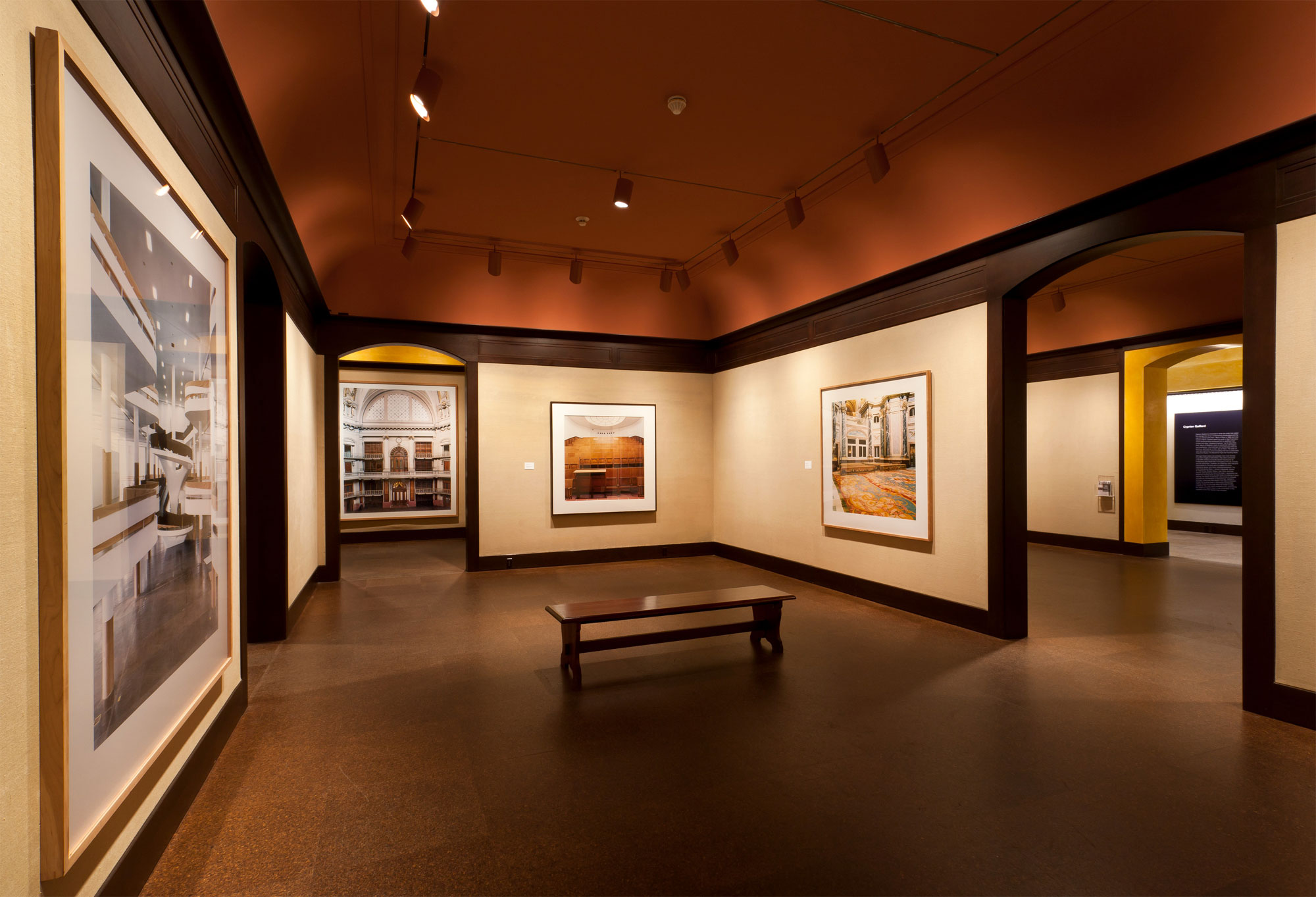
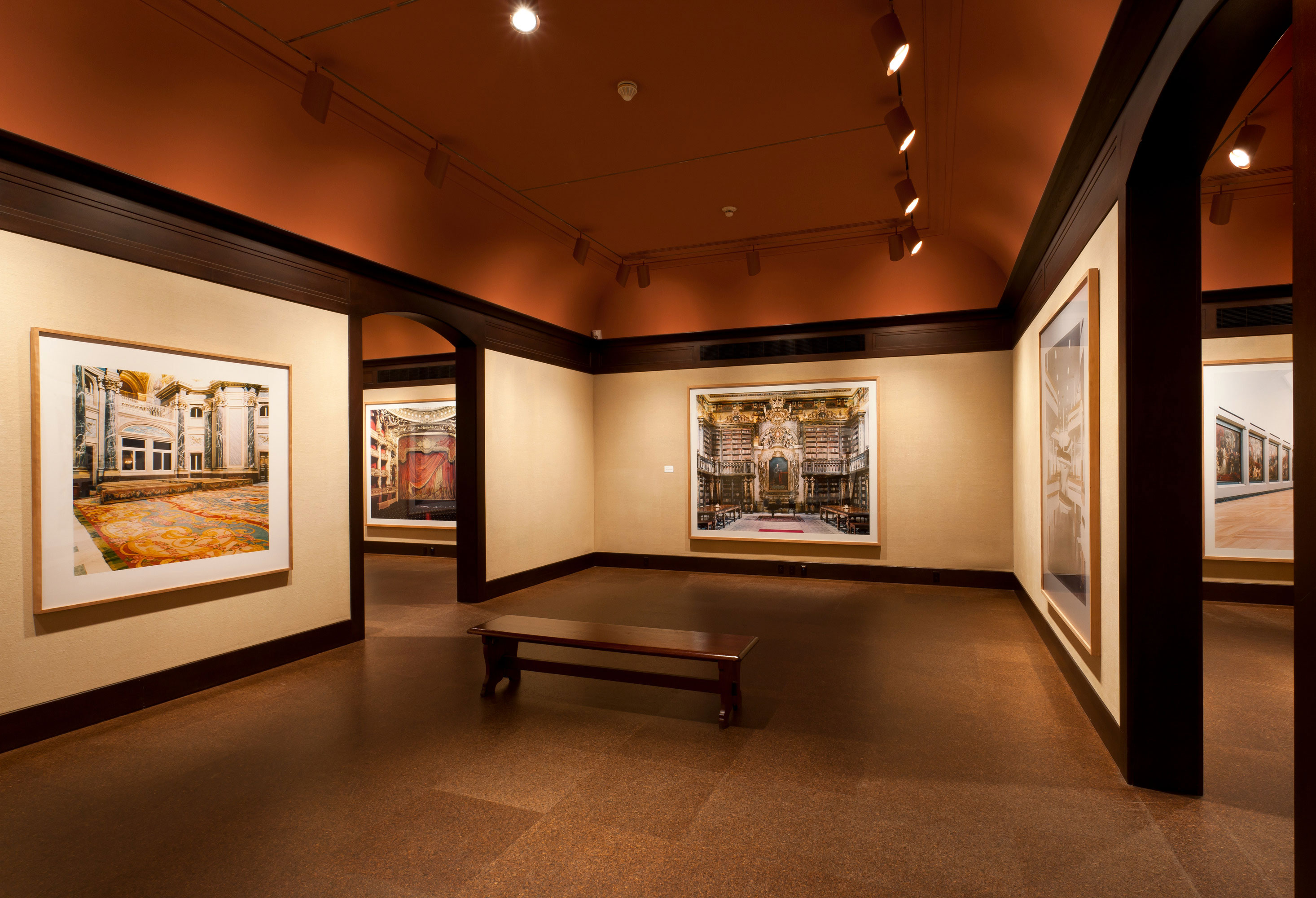
Installation view of the exhibition 'You Are Here: Architecture and Experience' at the Heinz Architectural Center, Carnegie Museum of Art, Pittsburgh

Installation view of the exhibition 'You Are Here: Architecture and Experience' at the Heinz Architectural Center, Carnegie Museum of Art, Pittsburgh

Installation view of the exhibition 'You Are Here: Architecture and Experience' at the Heinz Architectural Center, Carnegie Museum of Art, Pittsburgh


Installation views of the exhibition You Are Here: Architecture and Experience at the Heinz Architectural Center, Carnegie Museum of Art, Pittsburgh


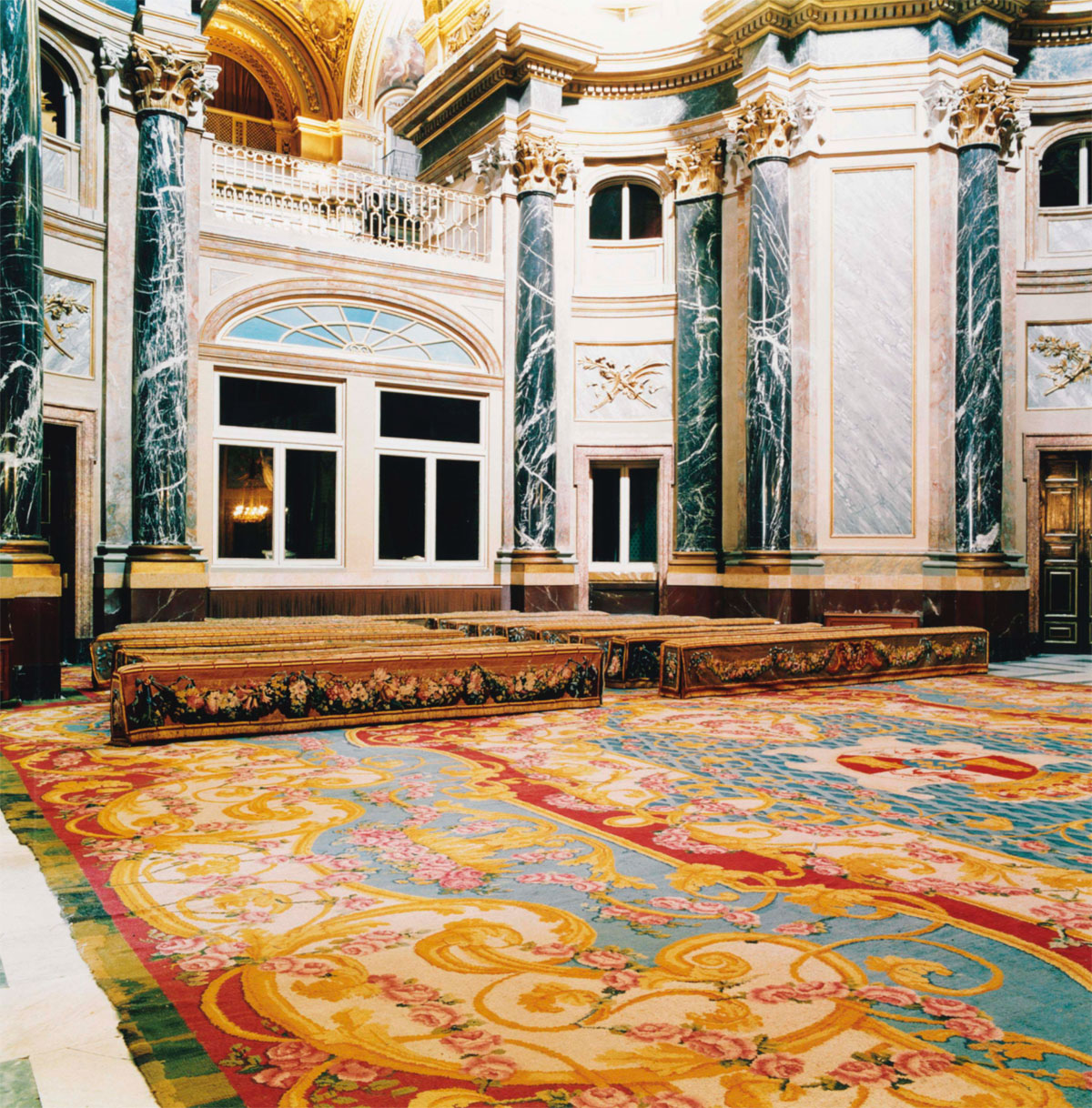
Candida Höfer (German, b. 1944)
'Palacio Real Madrid V' 2000


Candida Höfer (German, b. 1944)
Palacio Real Madrid V
2000
Chromogenic print
47 x 47 in. (119.3 x 119.3cm)


Carnegie Museum of Art
4400 Forbes Avenue
Pittsburgh, PA 15213-4080
Phone: 412.622.3131

Opening hours:
Daily 10am – 5pm
Carnegie Museum of Art website

LIKE ART BLART ON FACEBOOK

Back to top

Review: ‘Navigating Widely’ by Vanila Netto at Arc One Gallery, Melbourne

Exhibition dates: 1st March – 26th March 2011


Vanila Netto (Brazil, b. 1963) 'Pole Relief' 2011
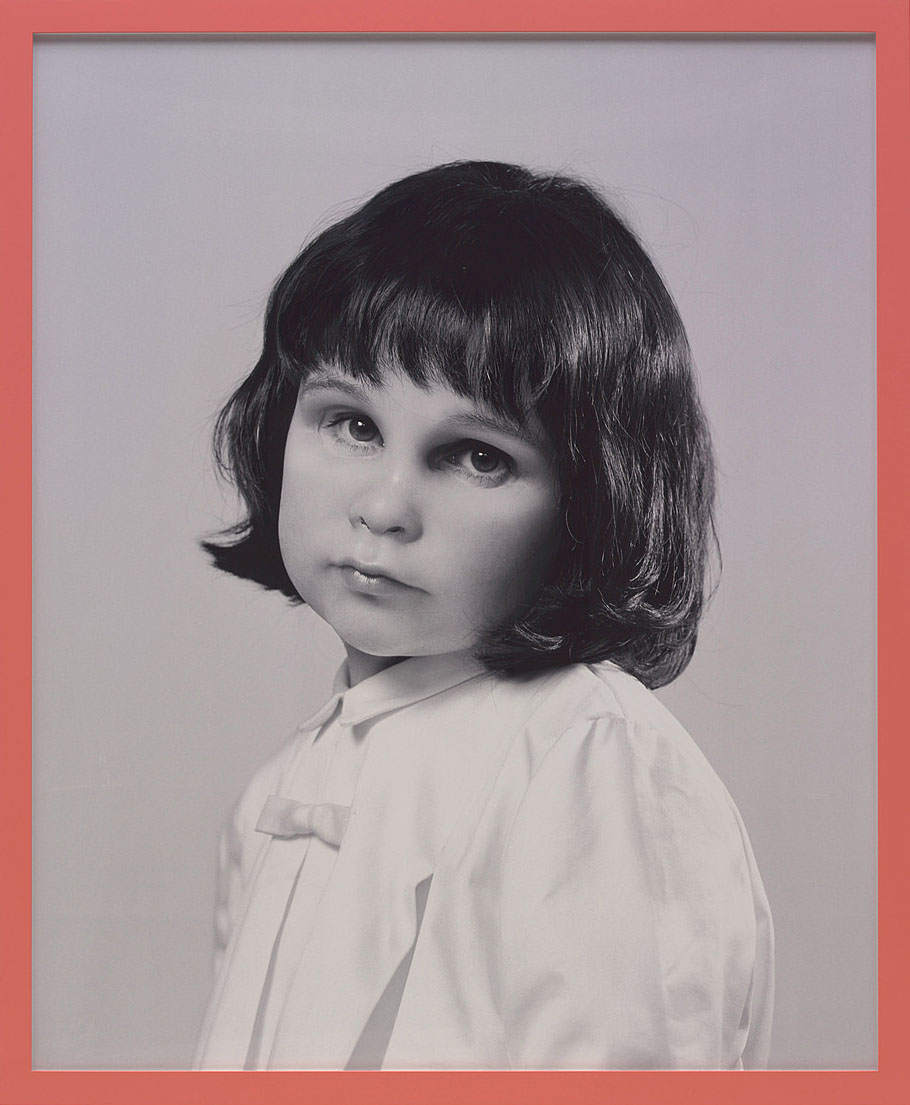
 

Vanila Netto (Brazil, b. 1963)
Pole Relief
2011
50 x 50cm
Archival pigment ink on cotton rag paper


“There’s an odd diaristic quality to Vanila Netto’s photographic, still life, video and neon works. What at first might seem like a hotchpotch of gestures, assemblages and moments reveals a lateral narrative – still points on a fluid map.”


Dan Rule in The Age newspaper


Netto’s work moves from one place to another, Navigating Widely. Some elements are more successful than others. The grainy colour field photographs of extruded objects (foam packing, the detritus of cardboard) fail to impress lacking the fidelity that the subject matter requires and the ability to integrate successfully into the lateral narrative. The Super 8 film transferred to digital video It is time to bridge (2011) is excellent, evoking as it does the utopian ideals of industrialisation, planes and rockets becoming “permanent and sedentary residents” of an abandoned dream park. The diptych neon installation Elation, Deflation (Inner Tubes) (2011) is also effective in evoking the interface between human and machine.

The best work in the exhibition is the series of small square format, analogue colour photographs that have been printed digitally (see photographs below). There is a lovely spatial resistance in these photographs – hints of colour, slices, markings on walls, the collision of opposites – that elevates them above the rest of the exhibition. In these photographs, the punctum pricks our consciousness but is it enough? Although these are interesting photographs, are they photographs that you would remember in a week, a month or a year? More was needed to hang your hat on, perhaps an ambiguous sense of Time that stretched the frame of reference.

Overall, the hotchpotch of gestures, assemblages and moments needed a more substantial grounding and, for me, became points on a confused map: a collection of complexities, both global and personal, that needed a focusing of rationale and conceptualisation. Less is more! Drawing what are some good ideas and threads together in a simplified form would add to the strength of the work for there is talent here. Perhaps concentrating on one idea and exploring it more fully would be a step along the path. I look forward to the next literation.

Dr Marcus Bunyan


Many thanxk to Angela Connor for her help and to Arc One Gallery for allowing me to publish the photographs in the posting. Please click on the photograph for a larger version of the image.


Vanila Netto (Brazil, b. 1963) 'Colossus' 2011


Vanila Netto (Brazil, b. 1963)
Colossus
2011
100 x 100cm
Archival pigment ink on cotton rag paper


Vanila Netto (Brazil, b. 1963) 'Mir' 2011


Vanila Netto (Brazil, b. 1963)
Mir
2011
50 x 50cm
Archival pigment ink on cotton rag paper


Vanila Netto (Brazil, b. 1963) 'Wheeling Consorts' 2011


Vanila Netto (Brazil, b. 1963)
Wheeling Consorts
2011
50 x 50cm
Archival pigment ink on cotton rag paper


Vanila Netto (Brazil, b. 1963) 'Solaris' 2011


Vanila Netto (Brazil, b. 1963)
Solaris
2011
50 x 50cm
Archival pigment ink on cotton rag paper


Vanila Netto (Brazil, b. 1963) 'Air Buzzing' 2011


Vanila Netto (Brazil, b. 1963)
Air Buzzing
2011
50 x 50cm
Archival pigment ink on cotton rag paper


Arc One Gallery
45 Flinders Lane
Melbourne, 3000
Phone: (03) 9650 0589

Opening hours:
Wed – Sat 11am – 5pm

Arc One Gallery website

LIKE ART BLART ON FACEBOOK

Back to top

Exhibition: ‘Between Here and There: Passages in Contemporary Photography’ at The Metropolitan Museum of Art, New York

Exhibition dates: 2nd July 2010 – 3rd February, 2011

 Curator: Douglas Eklund, Associate Curator in the Department of Photographs


Many thankx to The Metropolitan Museum of Art for allowing me to publish the photographs in the posting. Please click on the photographs for a larger version of the image.


Richard Long (British, b. 1945) 'County Cork, Ireland' 1967 from the exhibition 'Between Here and There: Passages in Contemporary Photography' at The Metropolitan Museum of Art


Richard Long (British, b. 1945)
County Cork, Ireland
1967
Gelatin silver print
76.2 x 101.6 cm (30 x 40 in.)
The Metropolitan Museum of Art, Purchase, Vital Projects Fund Inc. Gift, through Joyce and Robert Menschel, 2010
© Richard Long


Long was a key figure in recasting sculpture in two directions: inward toward the gestures of bodies in space and outward toward the creation of ephemeral works made directly in the landscape. A student of the sculptor Anthony Caro at Saint Martins College of Art, Long was well versed in the reductive quality of geometric abstraction but sought to make the form of his works even more elegantly simple and wedded to life. He would go for solitary walks in the English countryside, and at a particular place he would create elemental forms such as a line, an x shape, or a circle by walking over the ground to leave a temporary imprint. A photograph such as County Cork, Ireland – in which the shape seems to hover in the image like a flying saucer – is thus an imprint of an imprint; the form of the work is derived from the holistic relationship between the concept (idea), the action of the body (figure), and the site of his gesture (ground). It is also informed by an astute understanding of the profound links between British culture and the landscape, from prehistoric hill figures through nineteenth-century theories of the Picturesque.

Wall text from the exhibition


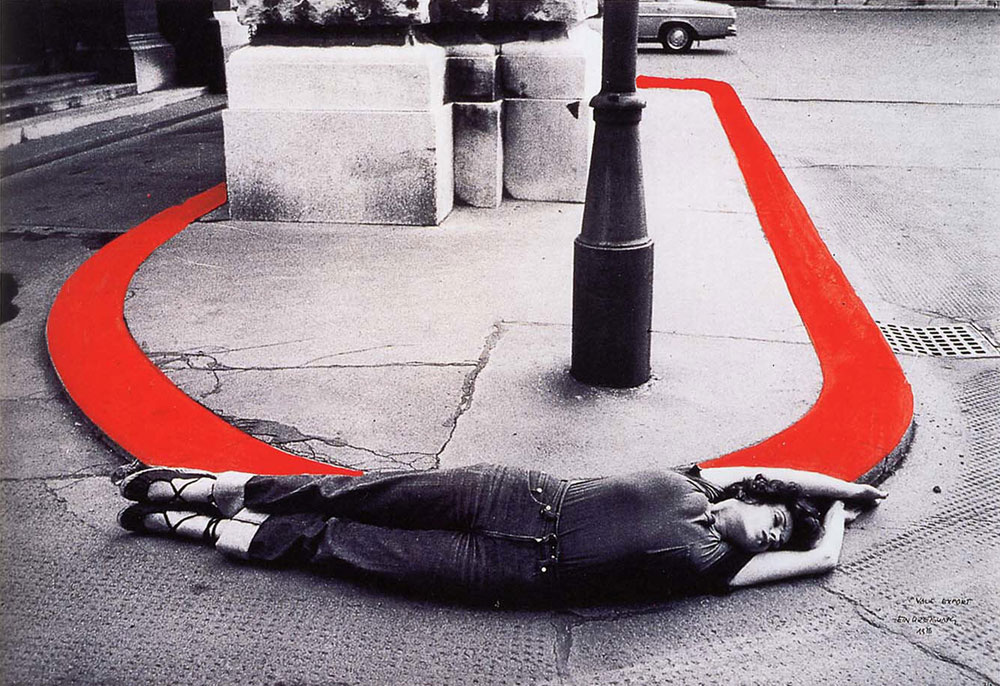
VALIE EXPORT (Austrian, b. 1940) 'Encirclement' 1976 from the exhibition 'Between Here and There: Passages in Contemporary Photography' at The Metropolitan Museum of Art


VALIE EXPORT (Austrian, b. 1940)
Encirclement
1976
Gelatin silver print
40.8 x 61cm (16 1/16 x 24 in.)
Promised Gift of Thea Westreich and Ethan Wagner
© VALIE EXPORT, Courtesy Charim Gallery Vienna


In her series Body Configurations, the artist had herself or female colleagues photographed in local streets, stairwells, and alleyways, contorting their bodies to mimic the harsh geometries of the city. Influenced not only by the Actionists but also by the human sculpture of Robert Morris, Export complicates the coolly inhuman systems of Minimalism by reintroducing the human body into abstraction, an intimate yet public gesture that effortlessly transmutes the personal into the political.

Wall text from the exhibition


Felix Gonzalez-Torres (American born Cuba, 1957–1996) '[No Title]' 1985 from the exhibition 'Between Here and There: Passages in Contemporary Photography' at The Metropolitan Museum of Art


Felix Gonzalez-Torres (American born Cuba, 1957–1996)
[No Title]
1985
Instant black-and-white print
7.2 x 6.9cm (2 13/16 x 2 11/16 in.)
The Metropolitan Museum of Art, New York
Purchase, Anonymous Gift, 1997
© The Felix Gonzalez-Torres Foundation, Courtesy of Andrea Rosen Gallery, New York


Gonzalez-Torres first came to prominence in the early 1990s with his interactive site-specific installations of candy stacks and printed paper. These “antimonuments” parody the coldness and rigor of Minimalist sculpture while actively encouraging participation by the audience. This early work conveys the sense of exile that the artist felt in America after fleeing his native Cuba. It can also suggest a Romantic conception of the soul yearning for the Infinite (represented by the sea) despite the hemming-in of the razor-thin barbed wire that blocks our passage. On the back of this photograph, the artist collaged a printed fragment, possibly from a magazine advertisement, showing cut-off portions of the words “THE BO[?]” and “ANYMORE.” Although made, signed, and dated by the photographer, Gonzalez-Torres thought of works such as this as lying outside his core oeuvre.

Text from The Metropolitan Museum of Art website


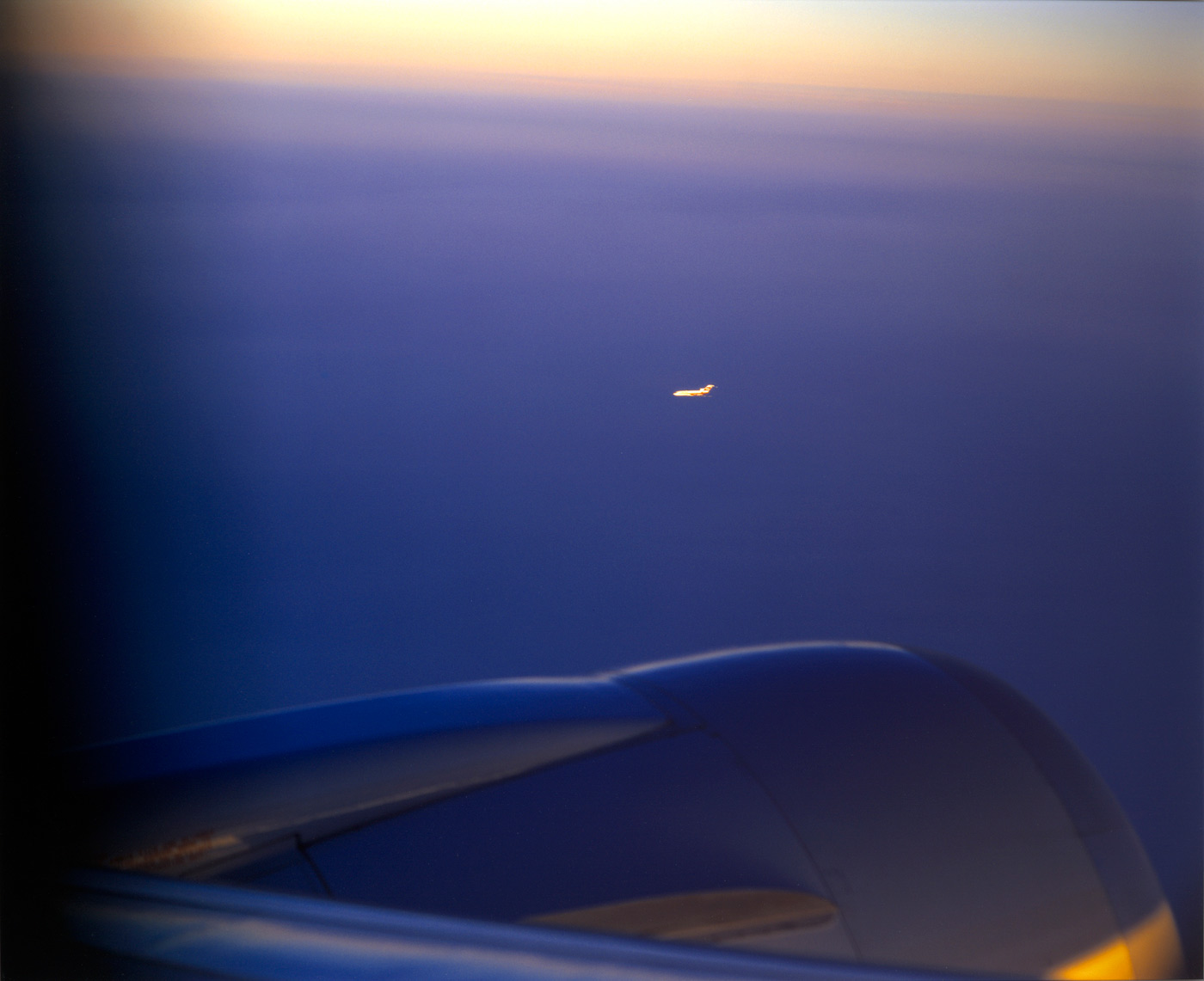
Doug Aitken (American, b.1968) 'Passenger' 1997 from the exhibition 'Between Here and There: Passages in Contemporary Photography' at The Metropolitan Museum of Art


Doug Aitken (American, b. 1968)
Passenger
1997
Chromogenic print
100.5 x 122cm (39 9/16 x 48 1/16 in.)
The Metropolitan Museum of Art, Purchase, Alfred Stieglitz Society Gifts, 2004
© Doug Aitken


Aitken is best known for multiscreen video installations exploring the ways in which perception and consciousness are transformed by our global, technology-driven existence. Passenger belongs to a group of still photographs made in 1997 showing planes in flight, most of which focus on the faint traceries of takeoffs and landings over desolate airport landscapes. In its emphasis on luminosity and atmosphere, this example reveals Aitken’s debt to older California artists such as James Turrell and Robert Irwin. It is also unabashedly sensual: Aitken’s high production values – reminiscent of Technicolor cinematography and glossy advertising – refer directly to the media images that unavoidably condition our responses to the world.

There is something of the sublime in Aitken’s photograph, however, in that it describes the limits of the visible while flooding the eye with colour. Starting from an experience familiar to all air travellers of “two ships passing” in the ether, the artist proposes a more complex statement about the way we perceive reality – namely, that the one thing that we cannot see is ourselves seeing and thus that our understanding of the world is always partial and incomplete.

Wall text from the exhibition


Themes of dislocation and displacement in contemporary photography will be explored in The Metropolitan Museum of Art’s forthcoming exhibition in the Joyce and Robert Menschel Hall for Modern Photography. Drawn almost entirely from the Museum’s collection, Between Here and There: Passages in Contemporary Photography on view July 2, 2010 through February 13, 2011, will feature 22 artists whose photographic works convey a sense of a rootless or unfixed existence.

In the 1960s and 1970s, photography was often embraced by artists who had abandoned conventional art media and who were more interested in creating a work of art that took place over a period of time, in a serial progression, or in a fleeting gesture. The individual painting or sculpture was deemed insufficient to represent the fragmented experience that characterises the modern world; thus artists showed how a work of art could take the form of a walk (Richard Long), a 20-foot-long book (Ed Ruscha), or a series of postcards outlining the precise time that the artist got up each day (On Kawara). Since the 1980s, however, the more conventional practice of creating a carefully executed, singular photograph has regained prominence in contemporary art. Works by Rineke Dijkstra, Thomas Struth, and Weng Fen embody a belief in photography’s traditional powers of description, while reflecting feelings of dislocation in our newly global society.

The exhibition also will include works by: Vito Acconci, Doug Aitken, Darren Almond, Lothar Baumgarten, Matthew Buckingham, VALIE EXPORT, Felix Gonzalez-Torres, Svetlana Kopystiansky, Bruce Nauman, Dennis Oppenheim, Allen Ruppersberg, Fazal Sheikh, Erin Shirreff, Robert Smithson, Anne Turyn, and Jeff Wall.

The first half of the exhibition shows how artists in 1960s and 1970s, working in the context of Minimal and Conceptual art, were drawn to photography for its differences from traditional art media: it was low-tech, easily reproducible, and not considered a valuable art object. Photography was also enlisted to document ephemeral works of art. Bruce Nauman and Vito Acconci, for instance, created performances that focused on the actions and movements of their bodies in space, and captured these works in photographs and videos.

Other artists, such as Robert Smithson, chose to work directly in the landscape – often in distant or inaccessible locations – and their “Earthworks” could generally be seen only through photographs. Smithson is best known for his landmark Spiral Jetty (1970) in the Great Salt Lake, Utah. For an early experiment in his Mirror Displacements series of photographs, Smithson placed small mirrors into snow drifts on the roof of his apartment building. Through dizzying shifts in scale, the artist’s 1969 study transforms a corner of his Manhattan roof into an Alpine landscape.

A student of Anthony Caro, British artist Richard Long was well versed in the reductive quality of geometric abstraction, but sought to make his works even more simple and wedded to life. He would go for solitary walks in the countryside, and at a particular place he would create elemental forms such as a line, X, or circle by walking over the ground to leave a temporary imprint. Long’s photograph County Cork, Ireland (1967) – in which a circle seems to hover over the grass like a flying saucer – is thus an imprint of an imprint, creating a holistic relationship between the concept, the action of the body, and the site of his gesture.

For her series Body Configurations, the Austrian artist VALIE EXPORT had herself and female colleagues photographed in local streets, as they contorted their bodies to mimic the harsh geometries of the city. Encirclement (1976) shows a woman lying in the street, her body elongated and arched to follow the bright red curve the sidewalk. The photograph reintroduces the human body into abstraction in an intimate yet public gesture.

Beginning in the 1980s, there was a renewed interest in photography’s historical genres and recommitment to technical skill and visual fidelity, as seen in Rineke Dijkstra’s portraits. Geopolitical displacement and cultural migration are referenced in one of Dijkstra’s most important bodies of work to date: her photographs of a Bosnian refugee girl, Almerisa. Between Here and There will feature four portraits of Almerisa that Dijkstra made between 1994 and 2000, beginning at an asylum seekers’ center in the Netherlands. Eight photographs from this series of 11 works were acquired recently by the Museum.

In both photographs and films, Doug Aitken explores the ways in which perception is transformed by our global, technology-driven existence. Aitken’s photograph Passenger (1997), taken from the window of an airplane in flight, shows another plane flying in parallel in the remote distance, illuminated by the sun setting on a slanted horizon. Aitken references sensations of being adrift in mid-air and of “two ships passing” – paths that do not quite connect, despite their proximity to each other.

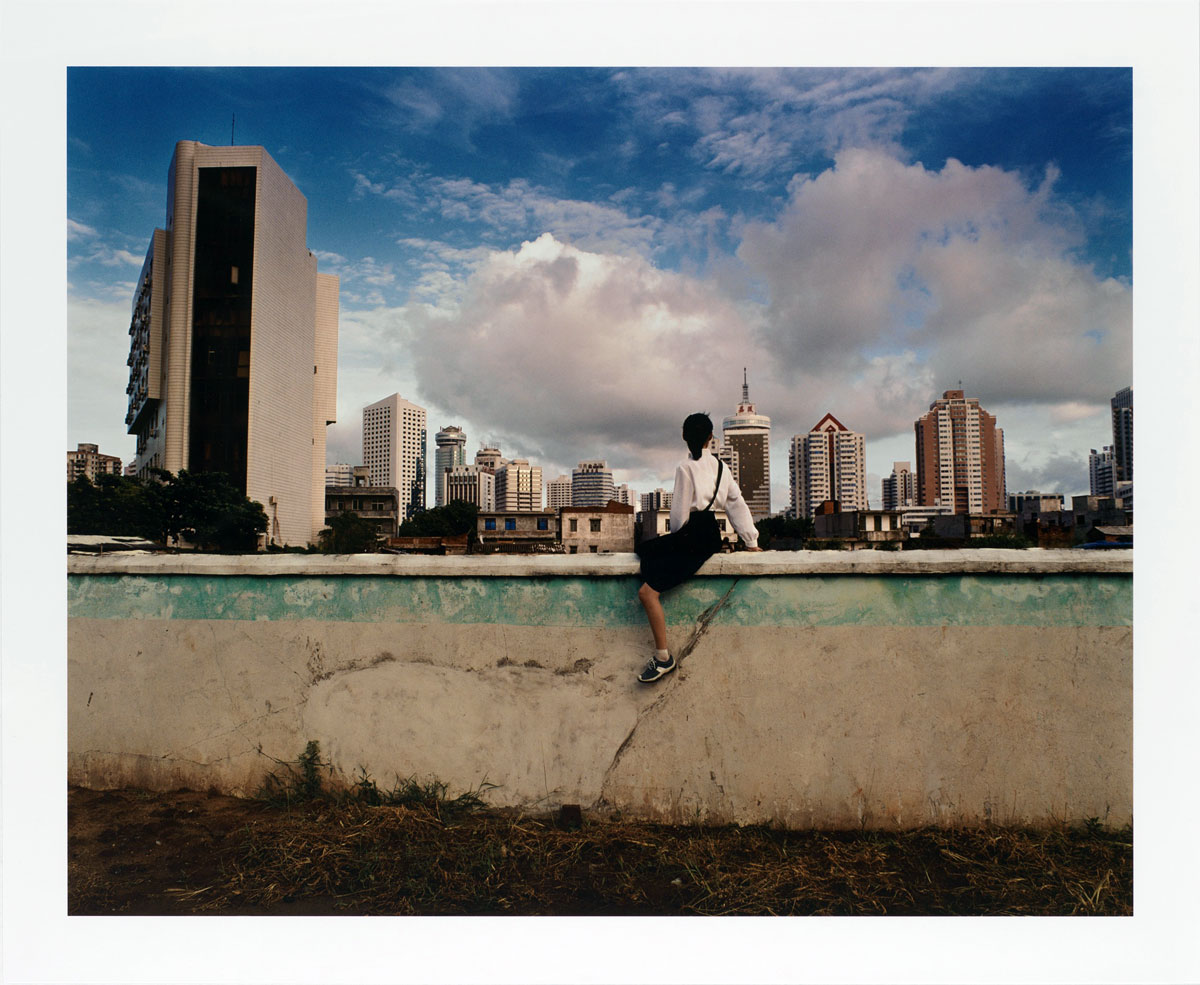
Chinese artist Weng Fen explores a young generation poised at a transitional moment between China’s traditional rural society and a quickly burgeoning urbanism. Bird’s Eye View: Haikou V (2002) shows a woman – perhaps an outsider or a new arrival to the city – perched on an old wall, looking toward the new skyscrapers on the horizon, but not fully occupying the space of the past or the future. This work is part of a group of recent gifts and promised gifts of contemporary Chinese photographs to the Museum.

The exhibition comes full circle with a recently acquired video by Erin Shirreff. Roden Crater (2009) takes as its subject artist James Turrell’s legendarily inaccessible and still unfinished celestial observatory carved out of a 400,000-year-old extinct volcano. Shirreff’s mesmerising fixed-camera view of the distant “Earthwork” shows an improbable succession of slow-moving climactic and light effects on the crater, creating a haunting meditation on the never-ending quest for resolution in life and in art.

Between Here and There: Passages in Contemporary Photography is organised by Douglas Eklund, Associate Curator in the Department of Photographs.”

Text from The Metropolitan Museum of Art website


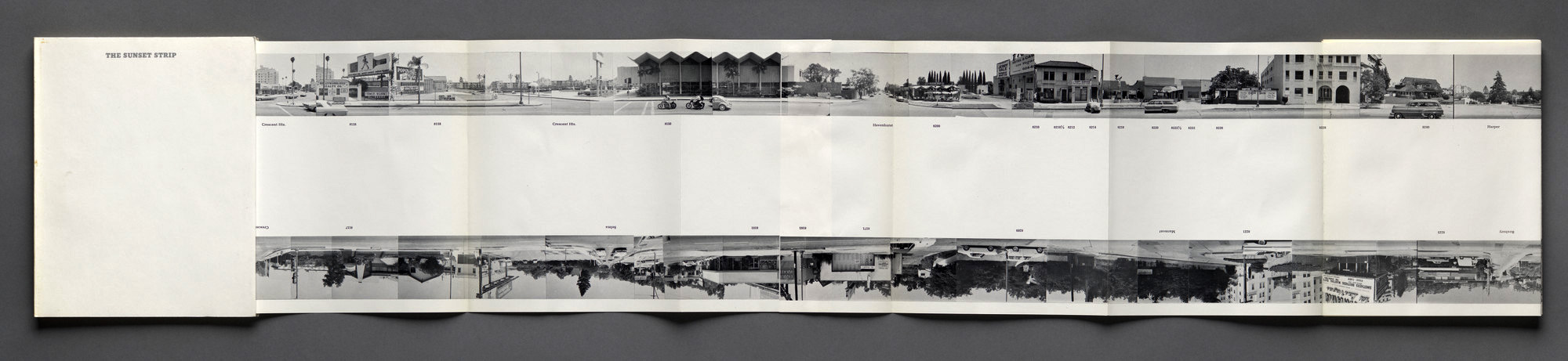
Ed Ruscha (American, b. 1937) 'Every Building on the Sunset Strip'
1966


Ed Ruscha (American, b. 1937)
Every Building on the Sunset Strip
1966
Artist book, offset printed
Each page: 7 x 5 1/2 inches (17.8 x 14cm)
Overall: 7 1/8 x 5 5/8 x 1/2 inches (18.1 x 14.3 x 1.1cm)
© Ed Ruscha


Early in the development of both Minimal and Conceptual art, the linguistic phrase as instruction or directive became paramount: the idea was primary and its execution could be by anyone who followed directions. This paradigm displaced the role of the artist from a kind of benighted savage to cool producer, and no artist commented more sharply on this new “informational” style than the West Coast painter Ed Ruscha, whose Pop-inflected canvases were often of resonant or humorous words such as Flash or Oof rendered in cartoonish yet formally precise typefaces floating on monochromatic backgrounds.

Ruscha’s books are similarly head-scratching fulfillments of their titles. First came Twentysix Gasoline Stations (1962), as blank as an instructional manual and offering a serial Warholian accounting of the most flatfooted-looking snapshots of banal roadside filling stations imaginable. The photographs were not the art, and it was not a luxurious livre d’artiste. Its meaning lay somewhere in the puzzled response of the reader thumbing through it and the circuitous, even futile route that it took through the culture. As Ruscha himself kidded, “My books end up in the trash.” Every Building on the Sunset Strip … is – like a row of bricks placed on the floor by sculptor Carl Andre – a model of “one thing after another” Minimalism as well as a readymade chance arrangement (the strip itself) of the artist’s beloved vernacular architectural eyesores.

Text from The Metropolitan Museum of Art website


Thomas Struth (German, b. 1954)
'National Museum of Art, Tokyo' 1999 from the exhibition 'Between Here and There: Passages in Contemporary Photography' at The Metropolitan Museum of Art


Thomas Struth (German, b. 1954)
National Museum of Art, Tokyo
1999
Chromogenic print
179.4 x 276.9cm (70 5/8 x 109 in.)
Purchase, Jennifer and Joseph Duke, Joyce and Robert Menschel, and Anonymous Gifts, Gift of Dr. Mortimer D. Sackler, Theresa Sackler and Family, and Fletcher and Harris Brisbane Dick Funds, 2001
© Thomas Struth


Throughout the 1990s Struth photographed people in museums, cathedrals, and other shrines that function as tourist meccas for the secular religion of art. The subject of this work is half of a Japanese-French exchange of treasures. The Japanese sent their prized eighth-century bodhisattva from Nara to the Louvre, where it was encased in bulletproof glass and displayed in an incongruously ornate Second Empire gallery. Struth’s photograph shows the French contribution, also behind glass, in the hall the Japanese designed to exhibit it.

Quintessentially Gallic, Delacroix’s 1830 painting Liberty Leading the People is a hymn to the supreme rights of the individual, shot through with sex and high drama. The mise-en-scène, however, is an uncanny reflection of late twentieth-century spectacle culture – the movie theatre, where the crowd passively absorbs images on a glowing screen. Yet, Struth is not simply demonstrating the collision between Delacroix’s characters, who rush forward into history, and those who are immobilised in the face of it; he also discerns a respectful distance on the part of the Japanese toward their visitor, an appreciation of difference and cultural specificity that is a key to this artist’s work.

Text from The Metropolitan Museum of Art website


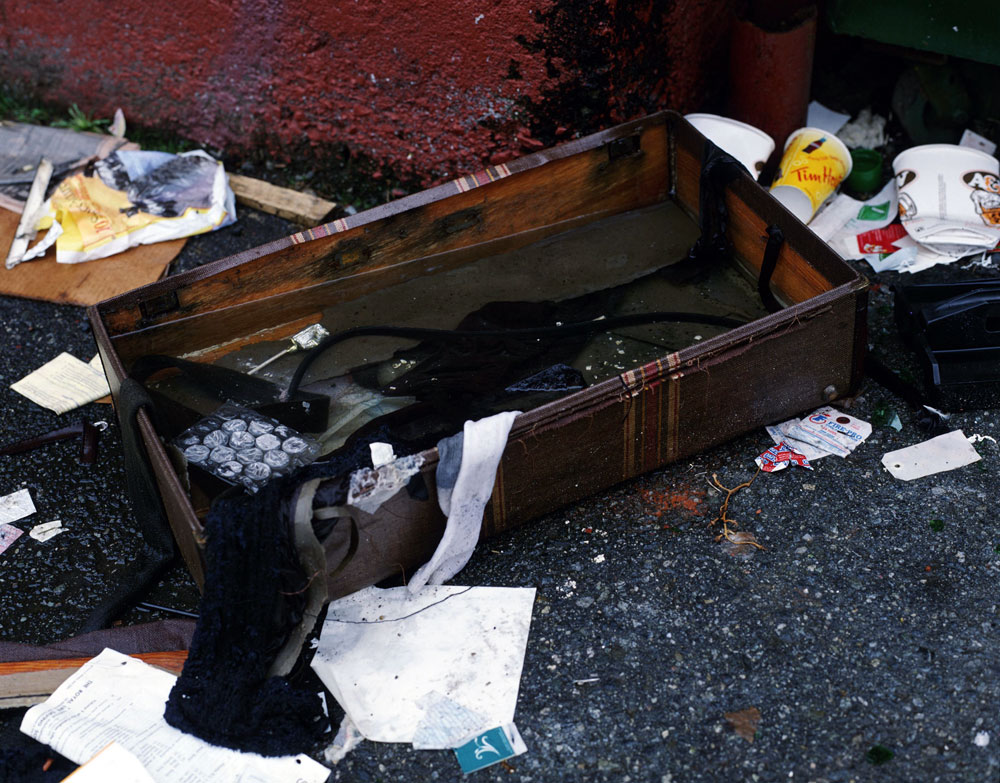
Jeff Wall (Canadian, b.1946) 'Rainfilled Suitcase' 2001 from the exhibition 'Between Here and There: Passages in Contemporary Photography' at The Metropolitan Museum of Art


Jeff Wall (Canadian, b. 1946)
Rainfilled Suitcase
2001
Transparency in light box
Collection of Jennifer Saul and Stephen Rich, New York
© Jeff Wall


Wall’s tableaux straddle the worlds of the museum and the street. For the last three decades, the artist has created elaborately staged and meticulously rendered scenes of urban and suburban conflict and disorder that he witnessed firsthand, which were then shown as colour transparencies in light boxes reminiscent of backlit advertising images seen in airports and bus stops. About 2000, Wall also began to make smaller, more elliptical photographs – isolating the kinds of details that previously would have been seen in the background of his larger, more programmatic pictures. This grimy half of an abandoned suitcase filled with old clothes and rain seems paradoxically to be both as obsessively arranged as a still life and as randomly disordered as the average flotsam and jetsam on any down-and-out street corner.

Wall text from the exhibition


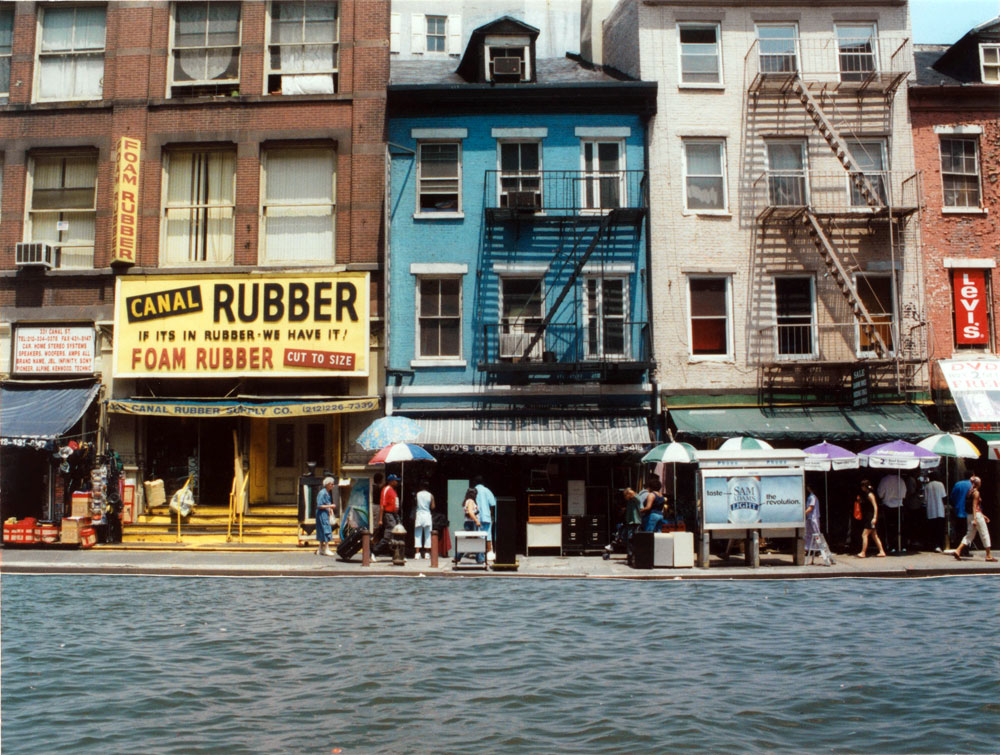
Matthew Buckingham (American, born 1963) 'Canal St. Canal No. 3' 2002 from the exhibition 'Between Here and There: Passages in Contemporary Photography' at The Metropolitan Museum of Art


Matthew Buckingham (American, b. 1963)
Canal St. Canal No. 3
2002
Chromogenic prints
The Metropolitan Museum of Art, Purchase, Vital Projects Fund Inc. Gift, through Joyce and
Robert Menschel, 2010
© Matthew Buckingham


This is the maquette for a postcard that the artist created for the group show “Nostalgia.” The postcard was sold in the shops along Canal Street accompanied by the following text beneath the image:

ABOVE: a section of Canal Street as it might look today if a 1791 proposal to build a “Venetian-style” canal connecting the Hudson and East Rivers across Lower Manhattan had been realised. The canal and an accompanying commercial harbour were meant to replace both a small stream which ran along present-day Canal Street, and the so-called Fresh Water or Collect Pond, a befouled 70-acre swamp that one New York newspaper of the day called a “shocking hole.” Instead, real-estate interests prevailed, and the stream was widened only enough to drain the pool so it could be filled in and developed. Many basements of new buildings on the landfill soon flooded, so the stream was further enlarged to increase drainage – making it, in effect, an open sewer. After much complaint about odour, and despite efforts to beautify the waterway with a tree-lined promenade, it was covered over in 1819. Flaws in this re-design kept Canal Street smelling foul for years. It is rumoured that the natural spring which once fed the Fresh Water Pond still flows deep below Canal Street today.*

Wall text from the exhibition

*Luc Sante defines nostalgia as a state of inarticulate contempt for the present combined with a fear of the future.


Weng Fen (Chinese, born 1961) 'Bird's Eye View: Haikou V' 2002 from the exhibition 'Between Here and There: Passages in Contemporary Photography' at The Metropolitan Museum of Art


Weng Fen (Chinese, b. 1961)
Bird’s Eye View: Haikou V
2002
Chromogenic print
50 x 62.7cm (19 11/16 x 24 11/16 in.)
The Metropolitan Museum of Art, Gift of Ellie Warsh, 2009
© Weng Fen


Weng Fen belongs to a generation of Chinese photographers whose principal subject is a China in the throes of physical, social, economic, and political change. His Bird’s Eye View series focuses on the elevated urbanism of cities such as Haikou, Shanghai, and Shenzhen. Many of these photographs feature schoolgirls with their backs to the camera, perched on a wall or precipice, staring at the landscape – adolescent figures on the threshold of personal transition looking out onto a landscape and a culture at a similarly transformational moment.

Wall text from the exhibition


Rineke Dijkstra (Dutch, b. 1959) 'Almerisa, Asylum Seekers' Center, Leiden, The Netherlands, March 14, 1994' 1994 from the exhibition 'Between Here and There: Passages in Contemporary Photography' at The Metropolitan Museum of Art


Rineke Dijkstra (Dutch, b. 1959)
Almerisa, Asylum Seekers’ Center, Leiden, The Netherlands, March 14, 1994
1994
Chromogenic print
120 x 100cm (47 1/4 x 39 3/8 in)
The Metropolitan Museum of Art, Gift of Ellen Kern, 2008
© Rineke Dijkstra


Dijkstra is best known for her portraits of teenage beachgoers in Poland, Croatia, the Ukraine, Belgium, England, and America, which convey the poignant intensity of adolescence with startling eloquence. In all her work, she is particularly drawn to subjects in a state of transition – blood-spattered matadors just minutes after bullfights, women cradling their newborns moments after delivery – and renders them with respect, attentiveness, and compassion.

Between 1994 and 2008 Dijkstra made eleven photographs of a Bosnian refugee girl named Almerisa, from her initial processing at an asylum seekers’ center in the Netherlands to her fully Westernised adulthood and motherhood. Here, the imprint of geopolitical displacement is rendered without cant and that of childhood is captured without nostalgia. Like all great portraitists, Dijkstra extracts an elemental, almost mythic quality from the irreducible individuality of her subject – of the eternal radiating from the everyday. This selection is from a recent gift to the Metropolitan of eight of the eleven portraits of Almerisa.

Wall text from the exhibition


The Metropolitan Museum of Art
1000 Fifth Avenue at 82nd Street
New York, New York 10028-0198
Information: 212-535-7710

Opening hours:
Sunday – Tuesday and Thursday: 10am – 5pm
Friday and Saturday: 10am – 9pm
Closed Wednesday

The Metropolitan Museum of Art website

LIKE ART BLART ON FACEBOOK

Back to top

Exhibition: ‘Portraits and Power: People, Politics and Structures’ at Centro di Cultura Contemporanea Strozzina – Fondazione Palazzo Strozzi, Florence

Exhibition dates: 1st October 2010 – 23rd January, 2011


Many thankx to the Centro di Cultura Contemporanea Strozzina for allowing me to publish the photographs in the posting. All text comes from the Centro di Cultura Contemporanea Strozzina website. Please click on the photographs for a larger version of the image.


Installation view of the exhibition 'Portraits and Power: People, Politics and Structures' at Centro di Cultura Contemporanea Strozzina - Fondazione Palazzo Strozzi, Florence

Installation view of the exhibition 'Portraits and Power: People, Politics and Structures' at Centro di Cultura Contemporanea Strozzina - Fondazione Palazzo Strozzi, Florence


Installation view of the exhibition Portraits and Power: People, Politics and Structures at Centro di Cultura Contemporanea Strozzina – Fondazione Palazzo Strozzi, Florence with the work of Rineke Dijkstra at right


Portraits and Power explores portraiture and the representation of political, economical and social power in the contemporary world through the works of contemporary artists. Portraits of famous political figures, investigations into the lifestyle of the social elite, as well as inquiries into the power structures of international institutions.

The exhibition explores its theme from three main standpoints: it analyses power as an expression of the charisma of those individuals who have become icons or symbols of their age; it probes the power of institutions and social models that either represent themselves or are represented in a critical light; and it investigates the hidden mechanisms of powerful authorities.

Portraits and Power is a project of the CCC Strozzina, with the consultancy of Peter Funnell (National Portrait Gallery, London), Walter Guadagnini (“UniCredit & Art” project) and Roberta Valtorta (Museum of Contemporary Photography, Cinisello Balsamo) coordinated by Franziska Nori (CCCS, Firenze).

Text from the Centro di Cultura Contemporanea Strozzina website [Online] Cited 02/02/2020


Tina Barney (American, b. 1945) 'The Ancestor' 2001 from the exhibition 'Portraits and Power: People, Politics and Structures' at Centro di Cultura Contemporanea Strozzina - Fondazione Palazzo Strozzi, Florence


Tina Barney (American, b. 1945)
The Ancestor
2001
C-print
Courtesy the artist and Janet Borden Inc., New York


Tina Barney (American, b. 1945) 'The Brocade Walls' 2004 from the exhibition 'Portraits and Power: People, Politics and Structures' at Centro di Cultura Contemporanea Strozzina - Fondazione Palazzo Strozzi, Florence


Tina Barney (American, b. 1945)
The Brocade Walls
2004
C-print
Courtesy the artist and Janet Borden Inc., New York


Installation view of the exhibition 'Portraits and Power: People, Politics and Structures' at Centro di Cultura Contemporanea Strozzina – Fondazione Palazzo Strozzi, Florence showing the work of Tina Barney


Installation view of the exhibition Portraits and Power: People, Politics and Structures at Centro di Cultura Contemporanea Strozzina – Fondazione Palazzo Strozzi, Florence showing the work of Tina Barney


The characters Tina Barney portrays are the representatives of a social class that normally exercises careful control over the circulation of pictures of its members, whether in the form of family photographs or official portraits, which are often published on the pages of glossy magazines. She is one of the first photographers to have made artistic use of this kind of representation. Hers is not merely the gaze of an onlooker, but that of a trusted person, who has personal relationships with her subjects. What she is interested in is not so much the idea of displaying the wealth of these families, but that of analysing social and family dynamics – such as the ambivalent relationship between children and parents. Her work is conceived as a means to improve self-understanding.

The people portrayed all come from families educated in the awareness of their own social role: discipline, self-control and rigour are features to be observed in all the subjects photographed, and they share the same high level of composure. For the series entitled The Europeans, which was produced over a period of about eight years, the author was introduced by one circle of friends to another, and thus given the opportunity to portray Italian nobles, Austrian bankers and landowners, proud representatives of the wealthy Spanish bourgeoisie, and English gentlemen in their sophisticated dwellings. Neither the formal way of dressing nor the furnishings can be traced back to any particular fashion: Tina Barney seeks to produce timeless pictures that at first sight will appear closer to traditional painting than to contemporary photography. Tina Barney creates her portraits through a careful observation of people in their everyday lives; to capture transient moments she asks her subjects to repeat something in front of the camera in such a way as to fix them. Her work tool is a fixed, large-size camera; an extended time exposure and high resolution enable her to render the details of each setting in detail. The figures portrayed have a rigid and formal countenance, which makes them appear markedly detached from one another, even though it is often brothers and sisters or parents and children who are photographed together: “this is the best that we can do. This inability to show physical affection is in our heritage”.

Tina Barney’s photographs give a sense of the fleetingness of their relationships behind the mask of self-controlled bearing. The artist thus unveils the game of social roles and attitudes conducted by her subjects, a veritable Theater of Manners (to quote the title of one of her most famous series) which demands enough sensitivity on the viewers’ part for them to focus on those details in the pictures that render hidden and non-immediately obvious features visible.

Since the mid-1970s, Tina Barney has been focusing her work on the portrayal of the privileged exponents of New York and New England high society, seen either in their own homes or on certain special occasions. The style of the pictures ranges from that of tableaux vivant to that of genre paintings, drawing expressive force from the interaction between wealthy settings and the people who move about in them.


Tina Barney (American, b. 1945) 'The Granddaughter' 2004 from the exhibition 'Portraits and Power: People, Politics and Structures' at Centro di Cultura Contemporanea Strozzina - Fondazione Palazzo Strozzi, Florence


Tina Barney (American, b. 1945)
The Granddaughter
2004
C-print
Courtesy the artist and Janet Borden Inc., New York


Installation view of the exhibition 'Portraits and Power: People, Politics and Structures' at Centro di Cultura Contemporanea Strozzina - Fondazione Palazzo Strozzi, Florence showing the work of Jim Dow


Installation view of the exhibition Portraits and Power: People, Politics and Structures at Centro di Cultura Contemporanea Strozzina – Fondazione Palazzo Strozzi, Florence showing the work of Jim Dow


Jim Dow (American, b. 1942) 'Library Metropolitan Club, New York' 1999 / 2010 from the exhibition 'Portraits and Power: People, Politics and Structures' at Centro di Cultura Contemporanea Strozzina - Fondazione Palazzo Strozzi, Florence


Jim Dow (American, b. 1942)
Library Metropolitan Club, New York
1999 / 2010
Chromogenic colour print
Courtesy the artist, Janet Borden, Inc., New York


Jim Dow (American, b. 1942) 'Dining Room, Morgan Library, New York' 1999 / 2010 from the exhibition 'Portraits and Power: People, Politics and Structures' at Centro di Cultura Contemporanea Strozzina - Fondazione Palazzo Strozzi, Florence


Jim Dow (American, b. 1942)
Dining Room, Morgan Library, New York
1999 / 2010
Chromogenic colour print
Courtesy the artist, Janet Borden, Inc., New York


By taking shots that are as objective as possible and completely devoid of any human presence, Dow gives a concentrated and authentic view of the architecture, furnishings and frameworks of these backdrops of life. “My interest in photography centres on its capacity for exact description. I use photography to try to record the manifestations of human ingenuity and spirit still remaining in our country’s everyday landscape.” For one of his most recent series, Dow has been able to make his way into some of the most exclusive private circles of New York City. He selected circles that are still active and have a long and significant history behind, such as the renowned Metropolitan Club, which was founded in 1891 by John Pierpont Morgan, and once listed James Roosevelt and William K. Vanderbilt among its most illustrious members. Most of these circles require strict adherence to rules consolidated by tradition. Only those introduced to the club by one of its members can join it, a practice that contributes to keep it a kind of network; a specific commission will then consider whether the candidate is fit for acceptance. Though there are over twenty circles of this kind in New York, outsiders will rarely notice their presence. While they no longer exercise the kind of political influence they used to as seats of power and decision making bodies, these clubs are now undergoing a new renaissance. An increasing number of politicians and businessmen are choosing to meet in their secluded rooms, which public opinion often perceives as places of intrigue and the setting for secret appointments of various kinds. With his descriptive and comparative photographs, Dow is giving a face to these exclusive meeting places, inviting viewers to join him in admiring the timeless opulence of their rooms. Architecture is the “primary and most powerful form of mass-communication”; at the same time, it is a mirror for power and its strategies, for the consolidation of authority and its effects on those who exercise it. “Architecture is power. The powerful build precisely because they are powerful. Yet architecture is also an expression of the capability and resoluteness – as well as resolve – of the powerful. Politicians intentionally exploit architecture to seduce, impress, and intimidate.” (Deyan Sudjic, The Edifice Complex: How the Rich and Powerful Shape the World, 2006).

American photographer Jim Dow approaches places as meeting points bearing visible traces of people’s mutual interactions. In different photographic series, the artist has portrayed American barbecue joints, pie and mash shops in London, tango halls in Buenos Aires, the workplaces of farmers, tinsmiths and iron-smiths, and baseball stadiums from one coast of the US to the other.


Clegg & Guttmann (Michael Clegg and Martin Guttmann) 'Grand Master' 1985 from the exhibition 'Portraits and Power: People, Politics and Structures' at Centro di Cultura Contemporanea Strozzina - Fondazione Palazzo Strozzi, Florence


Clegg & Guttmann (Michael Clegg and Martin Guttmann)
Grand Master
1985
Cibachrome
Courtesy Galerie Christian Nagel, Cologne, Berlin, Antwerp


For Grand Master, part of a photographic series produced in the 1980s, Clegg & Guttmann asked an actor to display certain poses characteristic of power, presenting him as the representative of a non-specified institution. The background of the image consists in a fictional architectural scenario – one simply simulated by using photographed space – the artificial nature of which is revealed by certain incongruities in the lighting effects. What is central here, once more, is the reflection offered on the controlled and never spontaneous construction of an image of power.

The tension conveyed by Clegg & Guttmann’s works springs from the subtle gap characterising the artists’ relationship with tradition. Their classical and apparently affirmative representations of people with power should be interpreted, within the context of their career spanning several decades, as different ways of visualising an analytical and deconstructive practice engaging with the mechanisms of authority.


Installation view of the exhibition 'Portraits and Power: People, Politics and Structures' at Centro di Cultura Contemporanea Strozzina - Fondazione Palazzo Strozzi, Florence showing the work of Clegg & Guttmann


Installation view of the exhibition Portraits and Power: People, Politics and Structures at Centro di Cultura Contemporanea Strozzina – Fondazione Palazzo Strozzi, Florence showing the work of Clegg & Guttmann


The CCCS – Centro di Cultura Contemporanea Strozzina – Fondazione Palazzo Strozzi, Florence, will be staging an exhibition entitled Portraits and Power: People, Politics and Structures, from 1 October 2010 to 23 January 2011, which will run concurrently with the retrospective devoted to Bronzino, the undisputed master of the Mannerist portrait, on Palazzo Strozzi’s piano nobile.

The exhibition, based on an original project by the CCCS in consultation with Peter Funnell (curator and director of research programmes at the National Portrait Gallery in London), Walter Guadagnini (chairman of the “UniCredit & Art” project’s scientific committee) and Roberta Valtorta (director of the Cinisello Balsamo Museum of Contemporary Photography) and coordinated by Franziska Nori (director of the CCCS), will show the work of international artists and collectives such as Tina Barney, Christoph Brech, Bureau d’études, Fabio Cifariello Ciardi, Clegg & Guttmann, Nick Danziger, Rineke Dijkstra, Jim Dow, Francesco Jodice, Annie Leibovitz, Helmut Newton, Trevor Paglen, Martin Parr, Wang Qingsong, Daniela Rossell, Jules Spinatsch, Hiroshi Sugimoto, and The Yes Men – who have all proved capable of developing a critical analysis of the portrayal and depiction of political, economic and social power in the media.

The exhibition explores its theme from two main standpoints: it analyses power as an expression of the charisma of those individuals who have become icons or symbols of their age; and it probes the power of institutions and social models that either represent themselves or are represented in a critical light.

The role played by images has grown to such an extent that it has led to the predominant emergence of their value not only in terms of portrayal but also of the successful establishment of power. The works of art on display bear witness not only to the self-referential strategies of power, but also to the different approaches artists adopt in deconstructing or chipping away at the images that represent social, economic and political power in a way that can not only bolster a leadership but that can also undermine its authority.

The National Portrait Gallery in London will be contributing works by three famous international photographers that explore the image of political authority. The series devoted to Queen Elizabeth II by Annie Leibovitz evinces a celebrated contemporary artist’s dialogue with the great tradition of official portraiture, and the cycle entitled Blair at War by Nick Danziger gives an extraordinary vision of Tony Blair’s daily life in the days immediately preceding the outbreak of the war in Iraq. The portrait of Margaret Thatcher by Helmut Newton keeps alive the iconic role of one of the most influential politicians of recent decades despite the fact that her authority had waned.

Clegg & Guttmann show the photographs of three managing directors of the Deutsche Bank. These images, while based on the official portraiture genre, provide the opportunity for a conceptual reflection on the theme of the public presentation of individuals who are at the same time both subject and patron of the work. Christoph Brech portrays a modern patron of the arts in a video that dwells on a detail of the hull of his yacht, Sea Force One, a floating museum filmed from a distance in Venetian waters.

The role of the image not only as representation but also as a tool for the construction or exploration of power is analysed by artists such as Hiroshi Sugimoto, whose Portraits bring to life wax effigies of historical or contemporary political figures through the evocative power of photography, and Rineke Dijkstra whose series of images of a soldier with the French Foreign Legion prompts a reflection on what remains of the individual when he becomes the representative of a military authority. Francesco Jodice, in his video entitled Dubai Citytellers, analyses the development and the social impact of one of the new centres of global economic power.

In the photo triptych Past, Present and Future, Wang Qingsong portrays himself as a bystander, bearing witness to fighters in poses mimicking celebrative and monumental Socialist sculptures, reflecting upon the contradictory nature of the actual power of masses in contemporary China.

Tina Barney records the life and domestic environment of the beau monde, combining the spontaneous feel of a private snapshot with a sophisticated aesthetic approach strongly echoing the world of art and traditional photography. The provocative photo series Ricas y Famosas by Daniela Rossell portrays the taste and excesses of the new super wealthy social oligarchy in Mexico, while Martin Parr’s series entitled Luxury, which is devoted to fashion shows, horse-racing and art fairs in the world’s major capitals, probes the lifestyle of the upper class in a globalised Western world. The pictures of Jim Dow portray the luxurious rooms of the great private social clubs of New York City’s elite, fashionable places that are inaccessible to the general public.

A different critical approach to the theme of power is offered by the French collective Bureau d’études with its project involving mapping the links between political and economic power. The CIA’s secret missions and operations, on the other hand, provide the focus for the work of Trevor Paglen who reconstructs top secret movements and connections. Jules Spinatsch presents a new work taken from his Temporary Discomfort video-photographic series, denouncing the controversial transformation of a place such as the island of La Maddalena in Sardinia into the venue for the G8 summit that never took place. Also on view is the antagonistic activism of The Yes Men, a collective who will be presenting their spectacular media initiative that rocked the image and power of the multinational corporation responsible for the Bhopal environmental catastrophe in India.

Finally, the composer Fabio Cifariello Ciardi uses famous politicians’ public speeches as his raw material for the creation of electroacoustic music that will underline their rhetorical techniques of persuasion.

The exhibition catalogue, published in Italian and English, contains a series of essays by authors from different countries, backgrounds and disciplines, offering the visitor a chance to explore in greater depth the themes addressed by the exhibition.

Press release from the Strozzina website [Online] Cited 02/02/2020


Rineke Dijkstra (Dutch, b. 1959) 'Olivier' Quartier Vienot, Marseille, France, July 21, 2000 from the exhibition 'Portraits and Power: People, Politics and Structures' at Centro di Cultura Contemporanea Strozzina - Fondazione Palazzo Strozzi, Florence


Rineke Dijkstra (Dutch, b. 1959)
Olivier
Quartier Vienot, Marseille, France, July 21, 2000
On loan from The Bank of America Merrill Lynch Collection


Rineke Dijkstra (Dutch, b. 1959) 'Olivier' Quartier Monclar, Djibouti, July 13, 2003 from the exhibition 'Portraits and Power: People, Politics and Structures' at Centro di Cultura Contemporanea Strozzina - Fondazione Palazzo Strozzi, Florence


Rineke Dijkstra (Dutch, b. 1959)
Olivier
Quartier Monclar, Djibouti, July 13, 2003
On loan from The Bank of America Merrill Lynch Collection


A crucial feature of Dijkstra’s photography is her desire to show the true personality of her subjects, as opposed to any simulated one. Up against the contemporary mystifying quality of the Internet and digital manipulation, her images illustrate in a very convincing way how photography is still capable of transcending the surface of subjects to grasp their deeper and constantly evolving identities. Her series feature, for instance, young bullfighters immediately after a bullfight, young mothers with babies born only a few minutes before, and portraits of boys and girls from various parts of the world at the beach. Her work method, whereby subjects are given very few directions and are usually portrayed frontally, leads to the creation of bare and detached pictures in which people display an inevitably fragile and vulnerable air. The Olivier Silva project, which the artist has developed over the course of more than three years, centres on the figure of a young man who in July 2000 voluntarily enrolled in the French Foreign Legion. Dijkstra portrays crucial moments of his intense training in France and Africa – from the day of his enrolment, in Aubagne, near Marseille, to the missions he was sent to fulfil in various parts of the world (Gabon, Ivory Coast and Gibuti) in 2003. The photographs clearly illustrate the metamorphoses the young man underwent over the course of the years: the innocent looking boy becomes an energetic and professional elite soldier enlisted in one of the world’s toughest and most controversial army corps. The centrepiece of the work is the artist’s interest in Olivier as an individual whose personality evolves in the course of his training, as is clearly revealed by his attitude and the look in his eyes, as well as by the very way in which his facial features change. The training imparted in military units of this kind is aimed at annulling the recruit’s personality in order to then recreate it according to new parameters: the youngster draws closer and closer to the prototype of the soldier as we progress from one photograph to the next. Just as all new recruits of the Foreign Legion are assigned a new name and identity, after three years Olivier no longer looks (even physically) like the same person as before. Like an accelerated film sequence, this series shows the dissolution of the original identity of a man subjected to the conditions dictated by an apparatus of power. Every soldier is at the service of the country he fights for and becomes one of its official public representations, embodying its military power. The same power he now wields is that which in a few years has conditioned him – or even produced him, one may say. Through her aesthetically minimalist photographs, Rineke Dijkstra illustrates the paradox of opposition between individual values and those of the community, between identity and conformity.

Rineke Dijkstra has carried out profound research in the field of photographic portraiture. Her subjects are adolescents who are still searching for themselves and who are incapable of acting in front of a camera, as well as adults caught in decisive moments in their personal development. By portraying these subjects, the artist explores the theme of identity and its representation.


Martin Parr (British, b. 1952) 'France. Paris. Haute Couture' 2007 from the exhibition 'Portraits and Power: People, Politics and Structures' at Centro di Cultura Contemporanea Strozzina - Fondazione Palazzo Strozzi, Florence


Martin Parr (British, b. 1952)
France. Paris. Haute Couture
2007
from the series Luxury
Pigment print
© Martin Parr / Magnum Photos


Martin Parr (British, b. 1952) 'England. Epsom. The Derby' 2004 from the exhibition 'Portraits and Power: People, Politics and Structures' at Centro di Cultura Contemporanea Strozzina - Fondazione Palazzo Strozzi, Florence


Martin Parr (British, b. 1952)
England. Epsom. The Derby
2004
from the series Luxury
Pigment print
© Martin Parr / Magnum Photos


Martin Parr (British, b. 1952) 'Russia. Moscow. Fashion Week' 2004 from the exhibition 'Portraits and Power: People, Politics and Structures' at Centro di Cultura Contemporanea Strozzina - Fondazione Palazzo Strozzi, Florence


Martin Parr (British, b. 1952)
Russia. Moscow. Fashion Week
2004
From the series Luxury
Pigment print
© Martin Parr / Magnum Photos


Unlike most of his colleagues, Parr has little interest in the great themes of photographic reporting, such as the documenting of war and poverty. Working around the world, he finds his motifs in everyday life. At the beginning of his career, he focused in particular on the observation of people from lower middle class backgrounds engaged in different activities, in the context of themes such as consumption, communication and leisure. He has left it ambiguous as to whether these pictures of his are charged with critical overtones or intended to serve as a mere means of social documentation. Through this approach to his work, Parr has developed a highly distinctive and almost unmistakable style marked by dazzling colours obtained by the use of flash on top of natural light. Parr takes his camera near people and their social milieus, creating images that appear grotesque or exaggerated at first. Their motifs, which often coincide with moments of everyday life, are shot from unusual perspectives.

The feeling these pictures convey is that of being spontaneous photos, similar to snapshots. Only under closer scrutiny you understand they have been skilfully construed and arranged. While always highly charged and taking widespread social stereotypes as their starting point, Parr’s images are never banal. The perspective they convey stands out for the way in which it takes viewers by surprise and for the ironic detachment with which the photographer turns to his subjects.

According to Parr, his photographs never fail to elicit extreme emotions because they always show some truths: “We are so used to digesting pictures that are pure propaganda, that people are surprised when someone like me shows them images that are closely tied to reality. I, at least, don’t lie”. The photographer’s gaze takes the viewer into his confidence, leading him through the pictures to discover the absurdity of what we deem normal. Gathered in large series regularly published in volumes, these shots transcend the irony of individual images to concentrate on the analysis of a given social milieu.

The Luxury series portrays personages from the international jet set, photographed in different settings around the world – from the Miami Art Fair to horse races in Durban, from polo tournaments in Dubai to the Beijing Auto Show. With these images, Parr has intentionally moved away from his previous subjects to focus on the life of the upper classes: for, as he himself has noted, the main problem the world is facing is not poverty but wealth – excessive development and prosperity. These photographs offer the perspective of an external, noninvolved observer, whose gaze is drawn towards minor details that usually find no place in the common representations of these events.

The centrepieces of these photos are the superficial clichés that the people participating in the events adopt as tokens of their upper-class identity. The pictures fix moments in which this enactment reveals itself to be so fragile or so exaggerated that the people involved become extras in a comedy – one that the photographer’s eye has fallen upon, finding interest not in individuals as such, but in their belonging to a given social system with all its rules and values.

Martin Parr describes himself as a “chronicler of our times”. In his photographic series he records the behaviour of people of different social classes in different contexts, searching not so much for mutual differences as for what brings human beings together when they find themselves in certain roles.


Nick Danziger (British, b. 1958) 'Helicopter Flight from RAF Lyneham to Battersea, 3 April 2003' from the exhibition 'Portraits and Power: People, Politics and Structures' at Centro di Cultura Contemporanea Strozzina - Fondazione Palazzo Strozzi, Florence


Nick Danziger (British, b. 1958)
Helicopter Flight from RAF Lyneham to Battersea, 3 April 2003

Bromide print
Courtesy National Portrait Gallery, London
© Nick Danziger


This opportunity had arisen thanks to The Saturday Times Magazine, which had launched a project to produce a special report on the occasion of Blair’s fiftieth birthday, one based not on official photographs but on a way of perceiving and depicting power from the point of view of everyday life – the interior of private and usually inaccessible places, removed from the conventional and more distinctly representational ones. These were the very days in which Blair was facing one of the most challenging decisions of his mandate: that concerning Great Britain’s intervention in the Second Gulf War on the side of the United States.

Danziger was able to document moments and scenes that could otherwise never have been made visible, capturing apparently insignificant moments that actually express all the underlying tensions and dynamics of those crucial days in 2003. On his first day of work, 14 March, Danziger was in Blair’s so called “den” – the Prime Minister’s private workroom in Downing Street. While engaged in a telephone call with Palestinian leader Yasser Arafat, Blair is shown in a non-conventional and informal, rather than simply official, pose. A mirror here gives us a glimpse of Alastair Campbell, the Prime Minister’s ever-present spin doctor, and the person responsible for his public image. This reflection becomes a sort of picture within the picture, a reminder of the assemblage of Danziger’s photographic documents, which are never created by chance or artlessly, but always follow from a conscious decision on the photographer’s part.

Danziger seems to be providing an almost intimate depiction of power, one that catches its subjects unawares. Yet it is worth recalling that the Blair government had developed a very careful and well-thought strategy for controlling its own public identity. New Labour’s promotion of an image of its Prime Minister as a young man from next door and of its own political class as one close to ordinary people has been a central feature of its political platform – a way of making a break after the long years of Conservatism under Margaret Thatcher and John Major.

The power of Danziger’s photographs lies in their ability to suggest the moments preceding and following the one portrayed, as illustrated for instance by the pictures of the Prime Minister’s transfer by plane, or the conversation held by a group of politicians outside Blair’s cabinet as they wait for the imminent war decisions to be made. In these pictures the outside world is always cut off; still, as critic John Berger has noted, the importance of photographs lies precisely in their ability to show things they do not directly portray.

Danziger himself bears witness to this when he writes that “in some of the pictures, from where the Prime Minister is sitting, he could hear people shouting ‘stop the war’ outside”. Power censors what might damage or shed doubt upon the reassuring appearance of a politician, and always seeks to portray itself in a manner useful for its own preservation.

The work of photojournalist Nick Danziger features videos and photographs in a documentary style, which often accompany the diaries he writes during his many trips around the world – from Bosnia to Afghanistan, Great Britain to Brazil, and so on. Between March and April 2003, Danziger and journalist Peter Stothard spent thirty days in close contact with the then Prime Minister Tony Blair and his entourage.


Installation view of the exhibition 'Portraits and Power: People, Politics and Structures' at Centro di Cultura Contemporanea Strozzina - Fondazione Palazzo Strozzi, Florence showing the work of Hiroshi Sugimoto


Installation view of the exhibition Portraits and Power: People, Politics and Structures at Centro di Cultura Contemporanea Strozzina – Fondazione Palazzo Strozzi, Florence showing the work of Hiroshi Sugimoto


The Portraits series was first developed in 1999, starting from a portrait of King Henry VIII of England inspired by the work of Dutch painter Hans Holbein. Sugimoto’s self-professed aim was to become “the first sixteenth-century photographer.” The series then continued with different subjects, including famous contemporary figures who have entered the collective imagination, such as the Cuban lider máximo Fidel Castro and Pope John Paul II.

Sugimoto’s works are not portraits of the original subjects, but of wax sculptures reproducing them in the most hyper-realist way possible. The figures are illumined by a source of direct light and strongly stand out against a black background in an extremely theatrical way, imitating poses typical of the characters they represent, while removing them from all context and thus emphasising their nature as icons rather than human beings.

For these works Sugimoto has not made use of the 50 x 60 cm format that is typical of him. Yet, they stand in continuity with the artist’s unique reflection upon the nature of photography and its relation to history and time. Here he embarks upon a reflection on portraiture and the process whereby an image is translated using different media, emphasising the problematic “realistic effect” of photographic reproduction.

An attentive gaze will notice small disproportions in the various parts of the subjects’ bodies or strange lighting effects due to the way in which light reflects on wax as opposed to real skin. Still, these pictures invite us to look at them as we would other photographs. Thinking, that is, about the genuine subjects they portray, something that paradoxically makes them “more real” than the wax statues that constitute their actual subjects. Different levels of reproduction are at play here: from the original subject to an initial photograph that served as a model for the wax statue that Sugimoto then portrayed in his photographic work. Our gaze will strongly be drawn towards the extraordinary elegance and aesthetic refinement of these works, which reveal the uncommon technical abilities of Sugimoto, marked as they are by the endless range of white, grey and black shades typical of him. Despite all this, his works remain emotionally cold: they consist in conceptual reflections upon the very notion of portrait and its political and cultural value as an icon of the characters it represents, and explicitly forgo any realist view of the individuals they take as their subjects. The artist seems to be causing all sense of natural time to collapse – in such a way as to stress that of absolute time. He attains a balance between life and death that is characteristic of photography but also of portraiture, whereby what counts is not the reality or the life of a subject, but the latter’s value as an image in itself, beyond time and everyday life.

Hiroshi Sugimoto’s photographs convey a conceptual attitude aimed at stripping images down to their bare essence, thus emphasising the primacy of the idea over the object portrayed. His famous marine landscapes and dioramas express a view of photography as a sort of time machine – a way of preserving or constructing memories and emotions.


Hiroshi Sugimoto (Japan, b. 1948) Pope John Paul II 1999 (installation view)


Hiroshi Sugimoto (Japan, b. 1948)
Pope John Paul II (installation view)
1999
Black and white photograph
Courtesy Rosa e Gilberto Sandretto
© Hiroshi Sugimoto


Hiroshi Sugimoto (Japan, b. 1948) 'Pope John Paul II' 1999 from the exhibition 'Portraits and Power: People, Politics and Structures' at Centro di Cultura Contemporanea Strozzina - Fondazione Palazzo Strozzi, Florence


Hiroshi Sugimoto (Japan, b. 1948)
Pope John Paul II
1999
Black and white photograph
Courtesy Rosa e Gilberto Sandretto
© Hiroshi Sugimoto


Hiroshi Sugimoto (Japan, b. 1948) 'Fidel Castro' 1999 (installation view)


Hiroshi Sugimoto (Japan, b. 1948)
Fidel Castro (installation view)
1999
Black and white photograph
Courtesy Sonnabend Gallery, New York
© Hiroshi Sugimoto


Hiroshi Sugimoto (Japan, b. 1948) 'Fidel Castro' 1999 from the exhibition 'Portraits and Power: People, Politics and Structures' at Centro di Cultura Contemporanea Strozzina - Fondazione Palazzo Strozzi, Florence


Hiroshi Sugimoto (Japan, b. 1948)
Fidel Castro
1999
Black and white photograph
Courtesy Sonnabend Gallery, New York
© Hiroshi Sugimoto


Centre for Contemporary Culture Strozzina
Palazzo Strozzi, Piazza Strozzi, Firenze

Strozinna website

LIKE ART BLART ON FACEBOOK

Back to top

Exhibition: ‘Haunted: Contemporary Photography / Video / Performance’ at Solomon R. Guggenheim Museum, New York

Exhibition dates: 26th March – 6th September, 2010


Looks like a great exhibition – wish I was there to see it!


Many thankx to Claire Laporte and the Solomon R. Guggenheim Museum for allowing me to publish the photographs in the posting. Please click on the photographs for a larger version of the image.


Adam Helms (American, b. 1974) 'Untitled Portrait (Santa Fe Trail)' 2007 from the exhibition 'Haunted: Contemporary Photography / Video / Performance' Guggenheim Museum, March - Sept, 2010


Adam Helms (American, b. 1974)
Untitled Portrait (Santa Fe Trail)
2007
Double-sided screenprint on paper vellum edition 2/2
101.3 x 65.7cm
Solomon R. Guggenheim Museum, New York, Purchased with funds contributed by the Photography Committee 2007.131


Idris Khan (British, b. 1978) 'Homage to Bernd Becher' 2007 from the exhibition 'Haunted: Contemporary Photography / Video / Performance' Guggenheim Museum, March - Sept, 2010


Idris Khan (British, b. 1978)
Homage to Bernd Becher
2007
Bromide print edition 1/6
49.8 x 39.7cm
Solomon R. Guggenheim Museum, New York, Purchased with funds contributed by the Photography Committee


Bernd Becher (German, 1931-2007) and Hilla Becher (German, 1934-2015) 'Water Towers' 1980 from the exhibition 'Haunted: Contemporary Photography / Video / Performance' Guggenheim Museum, March - Sept, 2010


Bernd Becher (German, 1931-2007) and Hilla Becher (German, 1934-2015)
Water Towers
1980
Nine gelatin silver prints
155.6 x 125.1cm
Solomon R. Guggenheim Museum, New York, Purchased with funds contributed by Mr. and Mrs. Donald Jonas


Andy Warhol (American, 1928-1987) 'Orange Disaster #5' 1963


Andy Warhol (American, 1928-1987)
Orange Disaster #5
1963
Acrylic and silkscreen enamel on canvas
269.2 x 207cm
Solomon R. Guggenheim Museum, New York, Gift, Harry N. Abrams Family Collection 74.2118


Joan Jonas (American, b. 1936) 'Mirror Piece I' 1969


Joan Jonas (American, b. 1936)
Mirror Piece I
1969
Chromogenic print
101 x 55.6cm
Solomon R. Guggenheim Museum, New York, Purchased with funds contributed by the Photography Committee


Zhang Huan (Chinese, b. 1965) '12 Square Meters' 1994


Zhang Huan (Chinese, b. 1965)
12 Square Meters
1994
Chromogenic print A.P. 3/5, edition of 15
149.9 x 99.7cm
Solomon R. Guggenheim Museum, New York, Purchased with funds contributed by Manuel de Santaren and Jennifer and David Stockman


Much of contemporary photography and video seems haunted by the past, by the history of art, by apparitions that are reanimated in reproductive mediums, live performance, and the virtual world. By using dated, passé, or quasi-extinct stylistic devices, subject matter, and technologies, such art embodies a longing for an otherwise unrecuperable past.

From March 26 to September 6, 2010, the Solomon R. Guggenheim Museum presents Haunted: Contemporary Photography / Video / Performance, an exhibition that documents this obsession, examining myriad ways photographic imagery is incorporated into recent practice. Drawn largely from the Guggenheim’s extensive photography and video collections, Haunted features some 100 works by nearly 60 artists, including many recent acquisitions that will be on view at the museum for the first time. The exhibition is installed throughout the rotunda and its spiralling ramps, with two additional galleries on view from June 4 to September 1, featuring works by two pairs of artists to complete Haunted’s presentation.

The works in Haunted: Contemporary Photography / Video / Performance range from individual photographs and photographic series to sculptures and paintings that incorporate photographic elements; projected videos; films; performances; and site-specific installations, including a new sound work created by Susan Philips for the museum’s rotunda. While the show traces the extensive incorporation of photography into contemporary art since the 1960s, a significant part of the exhibition will be dedicated to work created since 2001 by younger artists.

Haunted is organised around a series of formal and conceptual threads that weave themselves through the artworks on view:

Appropriation and the Archive

In the early 1960s, Robert Rauschenberg and Andy Warhol began to incorporate photographic images into their paintings, establishing a new mode of visual production that relied not on the then-dominant tradition of gestural abstraction but rather on mechanical processes such as screenprinting. In so doing, they challenged the notion of art as the expression of a singular, heroic author, recasting their works as repositories for autobiographical, cultural, and historical information. This archival impulse revolutionised art production over the ensuing decades, paving the way for a conceptually driven use of photography as a means of absorbing the world at large into a new aesthetic realm. Since then, a number of artists, including Bernd and Hilla Becher, Sarah Charlesworth, Douglas Gordon, Luis Jacob, Sherrie Levine, Richard Prince, Cindy Sherman, and Sara VanDerBeek, have pursued this archival impulse, amassing fragments of reality either by creating new photographs or by appropriating existing ones.


Cindy Sherman (American, b. 1954)
'Untitled Film Still #58' 1980


Cindy Sherman (American, b. 1954)
Untitled Film Still #58
1980
Gelatin silver print
20.3 x 25.4cm
Solomon R. Guggenheim Museum, Gift, Ginny Williams


“I’ve always played with make-up to transform myself, but everything, including the lighting, was self taught. I just learned things as I needed to use them. I absorbed my ideas for the women in these photos from every cultural source that I’ve ever had access to, including film, TV, advertisements, magazines, as well as any adult role models from my youth.”1

Cindy Sherman (b. 1954, Glen Ridge, N.J.) emerged onto the New York art scene in the early 1980s as part of a new generation of artists concerned with the codes of representation in a media-saturated era. Along with many artists working in the 1980s, Sherman explored photography as a way to reveal and examine the cultural constructions we designate as truth. Confronting the belief that photographs are truthful documents, Sherman’s fictional narratives suggested that photographs, like all forms of representation, are ideologically motivated. She is aware that the camera is not a neutral device but rather a tool that frames a particular viewpoint.

Sherman’s reputation was established early on with her Untitled Film Stills, a series of 69 black-and-white photographs that she began making in 1977, when she was twenty-three. In this series, the artist depicted herself dressed in the various melodramatic guises of clichéd B-movie heroines presented in 8 x 10 publicity stills from the 1950s and 1960s. In photograph after photograph, Sherman both acts in and documents her own productions. Although Sherman is both model and photographer, these images are not autobiographical. Rather, they memorialise absence and leave us searching for a narrative and clues to what may exist beyond the frame of the camera.

By the time Sherman made the Untitled Film Stills, black-and-white photography was already recognised as belonging to the past, and the styles she replicated were taken not from her own generation but from that of her mother’s. Sherman used wigs and makeup as well as vintage clothing to create a range of female characters. She sets her photos in a variety of locations, including rural landscapes, cities, and her own apartment. Although many of the pictures are taken by Sherman herself using an extended shutter release, for others she required help, sometimes enlisting friends and family. The characters she created include an ingénue finding her way in the big city, a party girl, a housewife, a woman in distress, a dancer, and an actress. In 1980 she completed the series and has said that she stopped when she ran out of clichés to depict. Unlike the media images they refer to, Sherman’s stills have a deliberate artifice that is heightened by the often-visible camera cord, slightly eccentric props, unusual camera angles, and by the fact that each image includes the artist rather than a recognisable actress or model. Sherman remains an important figure, with works in major collections around the globe, and continues to create striking, imaginative art.

Text from the Teacher’s Guide to the exhibition

1/ Cindy Sherman, quoted in Monique Beudert and Sean Rainbird, eds., Contemporary Art: The Janet Wolfson de Botton Gift, p. 99.


Landscape, Architecture, and the Passage of Time

Historically, one of photography’s primary functions has been to document sites where significant, often traumatic events have taken place. During the Civil War, which erupted not long after the medium was invented, a new generation of reporters sought to photograph battles, but due to the long exposure times required by early cameras, they could only capture the aftermath of the conflicts. These landscapes, strewn with the dead, now seem doubly arresting, for they capture past spaces where something has already occurred. Their state of anteriority, witnessed at such an early stage in the medium’s development, speaks to the very nature of a photograph, which possesses physical and chemical bonds to a past that disappears as soon as it is taken. As viewers, we are left with only traces from which we hope to reconstruct the absent occurrences in the fields, forests, homes, and offices depicted in the works in the exhibition. With this condition in mind, many artists, among them James Casebere, Spencer Finch, Ori Gersht, Roni Horn, Luisa Lambri, An-My Lê, Sally Mann, and Hiroshi Sugimoto, have turned to empty spaces in landscape and architecture, creating poetic reflections on time’s inexorable passing and insisting on the importance of remembrance and memorialisation.


Christian Boltanski (French, 1944-2021) 'Autel de Lycée Chases' 1986-1987


Christian Boltanski (French, 1944-2021)
Autel de Lycée Chases
1986-1987
Six photographs, six desk lamps, and twenty-two tin boxes
170.2 x 214.6 x 24.1cm
Rubell Family Collection, Miami
© 2010 Artists Rights Society (ARS), New York/ADAGP, Paris


“A good work of art can never be read in one way. My work is full of contradictions. An artwork is open – it is the spectators looking at the work who make the piece, using their own background. A lamp in my work might make you think of a police interrogation, but it’s also religious, like a candle. At the same time it alludes to a precious painting, with a single light shining on it. There are many way of looking at the work. It has to be ‘unfocused’ somehow so that everyone can recognize something of their own self when viewing it.”1

The power of photography to recall the past has inspired many contemporary artists to use photographs to revisit the experience of historical events. In so doing, artists reconsider the photograph itself as an object imbued with history. They became aware that using the medium of photography would lend the elements of specificity and truth to their work.

Since the late 1960s, Christian Boltanski (b. 1944, Paris) has worked with photographs collected from ordinary and often ephemeral sources, endowing the commonplace with significance. Rather than taking original photographs to use in his installations, he often finds and rephotographs everyday documents – passport photographs, school portraits, newspaper pictures, and family albums – to memorialise everyday people. Boltanski seeks to create an art that is indistinguishable from life and has said, “The fascinating moment for me is when the spectator hasn’t registered the art connection, and the longer I can delay this association the better.”2 By appropriating mementos of other people’s lives and placing them in an art context, Boltanski explores the power of photography to transcend individual identity and to function instead as a witness to collective rituals and shared cultural memories.

In Boltanski’s 1986-1987 work Autel de Lycée Chases (which means “Altar to the Chases High School”) enlarged photographs of children are hung over a platform constructed from stacked tin biscuit boxes, which are rusted as if they have been ravaged by time. The black-and-white photographs look like artefacts from another era. An electric light illuminates each face while at the same time obscuring it. The arrangement gives no way to identify or connect the unnamed individuals.

The photos used in Autel de Lycée Chases were taken from a real-world source, the school photograph of the graduating class of 1931 from a Viennese high school for Jewish students. These students were coming of age in a world dominated by war and persecution, and it is likely that many perished over the next decade.

At once personal and universal in reference, Boltanski’s work serves as a monument to the dead, hinting at the Holocaust without naming it. Within this haunting environment, Boltanski intermingles emotion and history, sentimentality and profundity.

Text from the Teacher’s Guide to the exhibition

1/ Christian Boltanski, “Tamar Garb in conversation with Christian Boltanski,” in Christian Boltanski (London: Phaidon Press, 1997), p. 24.
2/ “Christian Boltanski: Lessons of Darkness”


Documentation and Reiteration

Since at least the early 1970s, photographic documentation, including film and video, has served as an important complement to the art of live performance, often setting the conditions by which performances are staged and sometimes obviating the need for a live audience altogether. Through an ironic reversal, artworks that revolved around singular moments in time have often come to rely on the permanence of images to transmit their meaning and sometimes even the very fact of their existence. For many artists, these documents take on the function of relics-objects whose meaning is deeply bound to an experience that is always already lost in the past. Works by artists such as Marina Abramović, Christian Boltanski, Sophie Calle, Tacita Dean, Joan Jonas, Christian Marclay, Robert Mapplethorpe, Ana Mendieta, and Gina Pane examine various aesthetic approaches inspired by the reiterative power of the photograph. Using photography not only to restage their own (and others’) performances but to revisit the bodily experience of past events, these artists have reconsidered the document itself as an object embedded in time, closely attending to its material specificity in their works.


James Casebere (American, b. 1953) 'Garage' 2003


James Casebere (American, b. 1953)
Garage
2003
Chromogenic print, face-mounted to acrylic
181.6 x 223.5cm
Solomon R. Guggenheim Museum, New York
Anonymous gift


“Black and white had more to do with memory and the past. Color was too much about the present, I associated it with color TV, which was not a part of my past. I wanted the images to be related to a sense of history, let’s say, whether personal or social. And I think black and white adds a certain level of abstraction.”1

Since the mid-1970s James Casebere (b. 1953, Lansing, Michigan) has been carefully constructing architectural models and photographing them, yielding images somewhere between realism and obvious fabrication. His photographs are stripped of color and detail to evoke a sense of emotional place rather than the physicality of a place’s forms. Casebere is interested in the memories and feelings that are brought to mind by the architectural spaces he represents. The resulting works are dramatic, surreal, and remarkably true to life, embracing qualities of photography, architecture, and sculpture.

His tabletop models imitate the appearance of architectural institutions (home, school, library, prison) or common sites (tunnel, corridor, archway), representing the structures that occupy our everyday world. These models, made from such featureless materials as Foamcore, museum board, plaster, and Styrofoam, remain empty of detail and human figures. It is only when Casebere casts light on their bland surfaces and spartan interiors that the models are transformed. By eliminating the details, and taking advantage of dramatic lighting effects and the camera’s ability to flatten space, Casebere is able to transform familiar domestic spaces to find the extraordinary in the everyday. He asks viewers to rely on their memory to fill in the gaps and to create a context in which to understand his images.

Casebere stages his photographs to construct realities inspired by contemporary American visual culture that blur the line between fiction and fact. In this way, his images suggest psychologically charged spaces and have an otherworldly quality. The notion that these may be actual places seems plausible, but the lack of human presence leads us to wonder what has happened here. The viewer may imagine a human story within the abandoned spaces. Without people or colour, the photographs are about our own associations with these spaces and what they may represent.

Text from the Teacher’s Guide to the exhibition

1/ Roberto Juarez, “James Casebere,” Bomb 77 (Fall 2001)


Trauma and the Uncanny

When Andy Warhol created his silkscreen paintings of Marilyn Monroe in the wake of her death, he touched on the darker side of a burgeoning media culture that, during the Vietnam War, became an integral part of everyday life. Today, with vastly expanded channels for the propagation of images, events as varied as the terrorist attack on the World Trade Center and the deaths of celebrities such as Princess Diana and Michael Jackson have the ability to become traumatic on a global scale. Many artists, including Adam Helms, Nate Lowman, Adam McEwen, Cady Noland, and Anri Sala, have reexamined the strategy of image appropriation Warhol pioneered, attending closely to the ways political conflict can take on global significance. At the same time, photography has altered, or as some theorists argue, completely reconfigured our sense of personal memory. From birth to death, all aspects of our lives are reconstituted as images alongside our own experience of them. This repetition, which is mirrored in the very technology of the photographic medium, effectively produces an alternate reality in representation that, especially when coping with traumatic events, can take on the force of the uncanny. Artists such as Stan Douglas, Anthony Goicolea, Sarah Anne Johnson, Jeff Wall, and Gillian Wearing exploit this effect, constructing fictional scenarios in which the pains and pleasures of personal experience return with eerie and foreboding qualities.

Press release from the Solomon R. Guggenheim Museum website [Online] Cited 22/08/2010 no longer available online


Gillian Wearing (British, b. 1963) 'Self-Portrait at Three Years Old' 2004


Gillian Wearing (British, b. 1963)
Self-Portrait at Three Years Old
2004
Chromogenic print
182 x 122cm
Solomon R. Guggenheim Museum, New York
Purchased with funds contributed by the International Directors Council and Executive Committee Members: Ruth Baum, Edythe Broad, Elaine Terner Cooper, Dimitris Daskalopoulos, Harry David, Gail May Engelberg, Shirley Fiterman, Nicki Harris, Dakis Joannou, Rachel Lehmann, Linda Macklowe, Peter Norton, Tonino Perna, Elizabeth Richebourg Rea, Mortim


“I taught myself to use a camera – it’s not very difficult to use a camera, but I never bothered looking at any textbooks on how to make a picture. I had a much more casual relation to it. For me at the time it was much more about the process rather than the results.”1

Photography has not only profoundly impacted our understanding of historical events, it has also changed the way we remember our personal histories. Beginning at birth, all aspects of our lives are recorded as images alongside our own experiences of them. These parallel recording devices, the camera and personal memory, produce alternate realities that may sometimes be synchronised but at other times are askew.

Gillian Wearing (b. 1963, Birmingham, England) uses masks as a central theme in her videos and photographs. The masks, which range from literal disguises to voice dubbing, conceal the identities of her subjects and free them to reveal intimate secrets. For her 2003 series of photographs Album, Wearing used this strategy to create an autobiographical work. Donning silicon prosthetics, she carefully reconstructed old family snapshots, transforming herself into her mother, father, uncle, and brother as young adults or adolescents. In one of the works, Wearing recreated her own self-portrait as a teenager – and in fact the artist considers all the photographs in this series as self-portraits. She explains: “I was interested in the idea of being genetically connected to someone but being very different. There is something of me, literally, in all those people – we are connected, but we are each very different.”2

To make the Album series, Wearing collaborated with a talented team (some of whom have worked for Madame Tussaud’s wax works) who sculpted, cast, painted, and applied hair to create the masks, wigs, and body suits used in these photographs. The elaborate disguises the artist wears, when combined with the snapshot “realism” of the original images on which they are based, create an eerie fascination that serves to reveal aspects of her identity rather than conceal it.

Self-Portrait at Three Years Old (2004) carries this role-playing further back in time. Confronting the viewer with her adult gaze through the eyeholes of the toddler’s mask, Wearing plays on the rift between interior and exterior and raises a multitude of provocative questions about identity, memory, and the truthfulness of the photographic medium. Wearing says, “What I love about photographs is that they give you a lot and also they withhold a lot.”3

Text from the Teacher’s Guide to the exhibition

1/ “Gillian Wearing,” interview by Leo Edelstein, Journal of Contemporary Art
2/ Quoted in Jennifer Bayles, “Acquisitions: Gillian Wearing,” Albright-Knox Art Gallery, Buffalo, NY (accessed January 25, 2010)
3/ Sebastian Smee, “Gillian Wearing: The art of the matter,” The Independent (London), October 18, 2003


Sophie Calle (French, b. 1953) 'Father Mother (The Graves, #17)' 1990


Sophie Calle (French, b. 1953)
Father Mother (The Graves, #17)
1990
Two gelatin silver prints in artist’s frames edition 2/2
181.0 x 111.1cm each
Solomon R. Guggenheim Museum, New York, Gift, The Bohen Foundation


Ana Mendieta (Cuban American, 1948-1985) 'Untitled (Silueta Series)' 1978


Ana Mendieta (Cuban American, 1948-1985)
Untitled (Silueta series)
1978
Gelatin silver print
20.3 x 25.4cm
Solomon R. Guggenheim Museum, New York, Purchased with funds contributed by the Photography Committee


Anne Collier (American, b. 1970) 'Crying' 2005


Anne Collier (American, b. 1970)
Crying
2005
Chromogenic print edition 1/5
99.1 x 134 x 0.6cm
Solomon R. Guggenheim Museum, New York, Purchased with funds contributed by Mr. and Mrs. Aaron M. Tighe


Miranda Lichtenstein (American, b. 1969) 'Floater' 2004


Miranda Lichtenstein (American, b. 1969)
Floater
2004
Chromogenic print edition 5/5
104.1 x 127cm
Solomon R. Guggenheim Museum, New York, Purchased with funds contributed by the Photography Committee


Sarah Anne Johnson (Canadian, b. 1976) 'Morning Meeting (from Tree Planting)' 2003


Sarah Anne Johnson (Canadian, b. 1976)
Morning Meeting (from Tree Planting)
2003
Chromogenic print edition
73.7 x 79.7cm
Solomon R. Guggenheim Museum, New York, Purchased with funds contributed by Pamela and Arthur Sanders; the Harriett Ames
Charitable Trust; Henry Buhl; the Heather and Tony Podesta Collection; Ann and Mel Schaffer; Shelley Harrison; and the Photography Committee


Sally Mann (American, b. 1951) 'Virginia' from the 'Mother Land' series 1992


Sally Mann (American, b. 1951)
Virginia from the Mother Land series
1992
Gelatin silver print
76.2 x 96.5cm
Solomon R. Guggenheim Museum, New York, Gift, The Bohen Foundation


Solomon R. Guggenheim Museum
1071 5th Avenue (at 89th Street)
New York

Opening hours:
Sunday – Monday, 11am – 6pm
Closed Tuesday
Wednesday – Friday 11am – 6pm
Saturday 11am – 8pm

Solomon R. Guggenheim Museum website

LIKE ART BLART ON FACEBOOK

Back to top

Review: ‘presentation/representation: photography from Germany’ at the Monash Gallery of Art, Wheelers Hill, Melbourne

Exhibition dates: 3rd July – 30th August, 2009

Curator: Thomas Weski

Artists: Laurenz Berges, Albrecht Fuchs, Karin Geiger, Claus Goedicke, Uschi Huber, Matthias Koch, Wiebke Loeper, Nicola Meitzner, Peter Piller, Heidi Specker.

An exhibition of the Institut für Auslandsbeziehungen e. V. (ifa/Institute for Foreign Cultural Relations), Stuttgart, Germany and presented in cooperation with the Goethe-Institut Australien.


Matthias Koch (German, b. 1967) 'Submarine Laboe near Kiel, built 1944' 2006 from the exhibition 'presentation/representation: photography from Germany' at the Monash Gallery of Art, Melbourne, July - August, 2009


Matthias Koch (German, b. 1967)
Submarine Laboe near Kiel, built 1944
2006
© Matthias Koch


I was looking forward to this exhibition and so on a cold and very windy winter’s day I ventured out on the drive to the Monash Gallery of Art in Wheelers Hill expecting to be challenged by a new generation of German photographers. I was to be sorely disappointed. This show, with the exception of excellent work by Andreas Koch and good work by Laurenz Berges, epitomises all that I find woeful about contemporary photography.

There is a lack of life and vigour to the work, no sense of enjoyment in taking photographs of the world. The narratives are shallow and vacuous inducing a deep somnambulism in the viewer that is compounded by the silent, deeply carpeted gallery making the experience one of entering a mausoleum (this is a great space that needs to be a contemporary space!). How many times have I seen photographs of empty spaces that supposedly impart some deep inner meaning? See how a great artist like Tacita Dean achieves the same end to startling effect with her film Darmstädter Werkblock (2007). How many times do I need to see ‘dead pan’ portrait photographs that are again supposed to impart rich psychological meaning? I have seen too many already.

Conceptually the work is barren. Technically the proficiency of some of the work is almost non-existent. If this standard of work was put up for assessment in a university course it would fail miserably. For example in Nicola Meitzner’s work Forward Motion (2006), vertical portraits (of the same person in different poses) and streetscapes of Tokyo are poor quality prints mounted in unattractive silver aluminium frames. They are forgettable. If an artist were to study the work of, say, Manuel Alvarez Bravo, then one might gain some insight into how to photograph the city and the people that live in it in a way that elicits a response from the viewer to the photo-poetry that is placed before them.

Uschi Huber’s photographs of boarded up shop fronts, while a nice conceptual idea, are again lacking in technical proficiency and are nothing we haven’t seen many times before while Peter Piller’s ten print-media type pigment prints of girls at a shooting range with rifles do not bare comment on both a conceptual and technical level. Similarly, Wiebke Loeper’s colour photographs of the city of Wismar – houses, roads, water, oat fields, people peering into shop windows – sent to friends living in Melbourne to show them the desolation and rebuilding of the city are seriously year 12 work.

The two redeeming artists are Laurenz Berges and Andreas Koch.

Berges four large type C colour photographs of an empty house and the surrounds as seen through a window are intimately detailed visions of human absence from the built environment: the huts, piles of wood chips, barren trees, the feathers on the floor of one print, the cigarette butts on the floor of another, the marks on the wall in blue and red add to a sense of abandonment and alienation from the environment – traces of human experience, identity and memory etched into the photographic medium.

As the text on the Institut für Auslandsbeziehungen (IFA) website observes,

“Laurenz Berges is a chronicler of absence. His minimalist photographs point to the earlier use of spaces, only fragments of which are shown, whose inhabitants have put them to other, new uses. Berges depicts the traces of this change in austere images that, due to their reduction, tell their stories indirectly and almost involuntarily. These are stories about the existential significance certain spaces have for our identity, and also about their transitoriness and their loss.”1


The star of the show was the work of Matthias Koch. His five large aqua-mounted type C prints from the series Sites of German History (2006) are both technically and conceptually superb, full of delicious ironies and humour. Using an aerial aesthetic (apparently by climbing the ladder of a fire engine that he owns) Koch looks down on the landscape and through his images formulates new ways of seeing national symbols (even though many of them are not in Germany). His re-presentation of spatial inter-relations and objects embedded in their rural and urban surroundings are both simple yet layered and complex.

Unfortunately I have only two photographs (above and below) to show you of his work. None other was available but the images gives you an idea of his raison d’être. The specimen of U-995, built in Kiel in 1944, is presented as a trapped and mounted animal, preserved for our delectation and inspection with gangways and stairs to view the innards. Little hobby craft lie on a beach behind while people paddle in the shallows, a ship barely seen in the distance out at sea. The fact that this U-boat was once used to destroy such a ship, the irony of the proposition, is not lost on the viewer.

Other images in the series include a photograph of the derelict runway of the Heinkel factory as seen from above, the overgrown concrete slabs cracked and lifting, the edges filled with grass, the distant view dissolving into mist and nothingness. The photograph Harbour, Allied landing near Normandy, 1944 (2006, below) shows an American jeep and half-track of the period on the beach of the Allied landing in Normandy, tyre tracks swirling in the sand while in the distance the concrete block remains of the Mulberry harbour used in 1944 still litter the coastline. How many men, both German and American, died on this beach all those years ago? In another tour de force Atlantic Defence Wall near Cherbourg. Bunker construction built 1940 (2006) concrete bunkers dot the landscape with the beach and sea beyond as people sunbathe on the grass amongst the ruined bunkers, probably oblivious to the context of their surroundings. Koch is a master of the re-presentation of the context of memory, history and place.

Overall this exhibition is a great disappointment. I find it hard to believe that the exhibition has been curated by the same man who curated the recent Andreas Gursky exhibition at the National Gallery of Victoria. The choice of work and the presentation of technically poor prints is not up to standard. I also find it difficult to reconcile some of the reviews I have read of this exhibition with the actual work itself. Thank goodness for the photographs of Matthias Koch for he alone made the journey into outer Melbourne a worthwhile journey into the memory of the soul.

Dr Marcus Bunyan


1/ Anonymous. “Presentation/representation: Laurenz Berges,” on the Institut für Auslandsbeziehungen (IFA) website [Online] Cited 08/08/2009 no longer available online


    Many thankx to Monash Gallery of Art for allowing me to publish the photographs in the posting. Please click on the photographs for a larger version of the image.


    Matthias Koch (German, b. 1967) 'Harbour, Allied landing near Normandy, 1944' 2006 from the exhibition 'presentation/representation: photography from Germany' at the Monash Gallery of Art, Melbourne, July - August, 2009


    Matthias Koch (German, b. 1967)
    Harbour, Allied landing near Normandy, 1944
    2006
    © Matthias Koch


    Laurenz Berges (German, b. 1966) 'Garzweiler' [surface mine] 2003 from the exhibition 'presentation/representation: photography from Germany' at the Monash Gallery of Art, Melbourne, July - August, 2009


    Laurenz Berges (German, b. 1966)
    Garzweiler [surface mine]
    2003
    C print
    130 x 171cm (51.2 x 67.3 in.)
    © Courtesy Galerie Wilma Tolksdorf, Frankfurt/Berlin


    This international touring exhibition was developed by the Institut für Auslandsbeziehungen (ifa) in Germany and is presented in cooperation with the Goethe-Institut Australien.

    MGA is hosting the important international exhibition ‘presentation / representation: photography from Germany’, which brings to Melbourne the work of ten of Germany’s best contemporary photographers.

    presentation/representation is curated by Thomas Weski (curator of Andreas Gursky recently seen at the National Gallery of Victoria), and covers the work of the generation of German photographers that has followed the now-legendary Kunstakademie Düsseldorf generation of Gursky, Thomas Ruff, Thomas Struth and Candida Höfer. For the artists in presentation/representation, including Matthias Koch, Laurenz Berges and Heidi Specker, photography is a medium that has its own language and characteristics, and their work collectively explores the limits of the medium.

    Shaune Lakin, Director of the MGA states “MGA is thrilled to present ‘presentation / representation’ and to bring to the people of Melbourne such an important survey of contemporary German photography. As well as providing a comprehensive survey of German practice, the exhibition will complement the experience of those who saw Weski’s wonderful Gursky exhibition at NGV. We are also delighted to host participating artist Matthias Koch.”

    Koch will be presenting a series of public programs including an artist talk, student tutorial and a field trip exploring the industrial suburban sites close to the gallery. “With his critical interest in landscape, architecture and history, Koch will provide some wonderful insights into our local landscape for participants in these programs,” notes Dr Lakin.

    MGA’s Education and public programs coordinator Stephanie Richter says: “This is a great opportunity for students and Melbourne audiences to meet one of Germany’s most celebrated contemporary photographers and to participate in the busy schedule of talks, tutorials and field trips with Matthias.”

    Press release from Monash Gallery of Art website [Online] Cited 05/08/2019 no longer available online


    Heidi Specker (German, b. 1962) 'D'Elsi - Elsi' 12007


    Heidi Specker (German, b. 1962)
    D’Elsi – Elsi 1
    2007
    Digital Fine Art Print
    Courtesy Fiedler Contemporary, Köln
    Galerie Barbara Thumm, Berlin
    © VG Bild-Kunst, Bonn, Germany, 2007


    Claus Goedicke (German, b. 1966) 'Trip to the Moon' 2006


    Claus Goedicke (German, b. 1966)
    Trip to the Moon
    2006
    Pigment print on wallpaper
    © Claus Goedicke


    Nicola Meitzner (German, b. 1969) 'Forward motion' 2006


    Nicola Meitzner (German, b. 1969)
    Forward motion
    2006
    From the tableau Forward motion
    Pigment print
    © Nicola Meitzner


    Wiebke Loeper (German, b. 1972) 'To the sisters of Carl Möglin' 2005


    Wiebke Loeper (German, b. 1972)
    To the sisters of Carl Möglin
    2005
    From the series To the sisters of Carl Möglin
    © VG Bild-Kunst, Bonn, Germany, 2007


    Uschi Huber (German, b. 1966) 'Fronten' 2006


    Uschi Huber (German, b. 1966)
    Fronten
    2006
    From the series Fronten 2006
    © Uschi Huber


    Albrecht Fuchs (German, b. 1964) 'Daniel Richter, Berlin' 2004


    Albrecht Fuchs (German, b. 1964)
    Daniel Richter, Berlin
    2004
    C print
    © Courtesy Frehking Wiesehöfer, Köln


    Monash Gallery of Art
    860 Ferntree Gully Road
    Wheelers Hill, Victoria 3150

    Opening hours:
    Tuesday – Friday: 10am – 5pm
    Saturday – Sunday: 10pm – 4pm
    Monday and Public Holidays: closed

    Monash Gallery of Art website

    LIKE ART BLART ON FACEBOOK

    Back to top

    Exhibition: Scott McFarland photographs at Regen Projects, Los Angeles

    Exhibition dates: 23rd May – 3rd July, 2009


    Scott McFarland (Canadian, b. 1975) 'Fallen Oak Tree' 2008


    Scott McFarland (Canadian, b. 1975)
    Fallen Oak Tree
    2008
    From the series Hampstead
    Inkjet print
    27 x 24 inches (68.6 x 61cm)
    Edition of 5


    Variations on a theme

    Whether McFarland’s photographs are “straight” or composites, there always seems to an unnerving feel to them, a formal frontality that empowers the viewer into trying to unlock the photographs secret, like an enigmatic puzzle. Everything is presented front on, square to the camera, no oblique angles, relying in the straight photographs on the scale of the accumulated blocks of information, and in the composites, in the very unlikely, even theatrical, staging of the people within the mise en scène.

    These are very cinematic photographs, some, literally, with their panoramic aesthetic, others built by assembling their scudding skies and stiff, neatly placed people. Too neatly placed in my opinion but that’s McFarland’s hook, his aesthetic cough which prompts the viewer to question the veracity of the image, its link to the photographs indexical reality. His multiple exposures push the boundaries of truth or dare, hyperreal solutions to a disengaged world. Personally, I prefer his straight photographs which are built on a fabulous eye, a masterful understanding of pictorial space (monumental elements held in balance) and wonderful previsualisation. You don’t need anything more.

    Dr Marcus Bunyan


    Many thankx to Regen Projects for allowing me to publish the photographs in the posting. Please click on the photographs for a larger version of the image.


    Scott McFarland (Canadian, b. 1975) 'The Admiral's House as seen from the Upper Garden at Fenton House' 2006


    Scott McFarland (Canadian, b. 1975)
    The Admiral’s House as seen from the Upper Garden at Fenton House
    2006
    From the series Hampstead
    Inkjet print
    Edition of 5


    “Regen Projects is pleased to announce an exhibition of new work by Canadian artist Scott McFarland. This exhibition will feature new photographs including 3 large panorama works, smaller works from the “Hampstead” series, and introduce the new “Niagara” series.

    Scott McFarland’s photography reconsiders the traditional concept of a photograph as the depiction of a single captured moment in time. Through digital means he is able to manipulate composition, colour, light, space, shape, and form. McFarland’s photographs combine multiple negatives to represent simultaneous temporalities and interweave selected elements into a cohesive whole. Several different moments are packed into what appears to be one densely constructed instant. The photographs are meticulously crafted illusions created within the formal language of documentary photography.

    McFarland’s consideration of photography and the built picture was brought about by the artist’s own understanding of the artificial “nature” found in built environments such as gardens and zoos. Taking the relationship of the constructed space/constructed image one step further, McFarland has photographed a modernist architectural landmark: the Berthold Lubetkin designed penguin pool at the London zoo. Through two very distinct works, McFarland investigates the elliptical structure of the famous penguin pool vis-à-vis the elliptical / arcing motion of his camera rotating on a tripod. One photograph is an objective colour rendering where the camera has been left level while rotating; the other is a larger black and white version where the camera arcs along a non-level plane distorting and altering the curve of the structure from right to left.

    The new square format photographs from McFarland’s “Niagara” series have a rough unfinished quality unlike any photographs he has taken to date. These softer focus images with odd shifts in light and glare are location studies for the large panorama A Horse Drawn Hearse, Queens Royal Tours, 174 Anne, Niagara on the Lake, Ontario (2009, below). This work depicts an old carriage business and its surroundings during the dead of Canadian winter. In this visually captivating work, a black funeral carriage contrasts against the white snow. The acreage, surrounded by newer suburban homes, evokes the question of how long can this structure resist the modern urban pressures it faces. These straight photographs presented alongside his precise digitally mastered compositions illustrate how the photographic process and the history of art and photography have always informed McFarland’s work.

    “Over the last decade, Scott McFarland has produced bodies of work that engage with different aspects of photography … McFarland’s approach is both descriptive and metaphoric … The images, rich in cultural significance, express the complementary workings of conceptual and aesthetic factors all the while holding various characteristics of art and photography in ambiguous relation.”

    Andrea Kunard. Scott McFarland: A Cultivated View, published by the National Gallery of Canada, Ottawa, 2009, p. 12.

    Text from the Regen Projects press release [Online] Cited 16/06/2009. No longer available online.


    Scott McFarland (Canadian, b. 1975) 'A Horse Drawn Hearse, Queens Royal Tours, 174 Anne, Niagara on the Lake, Ontario' 2009


    Scott McFarland (Canadian, b. 1975)
    A Horse Drawn Hearse, Queens Royal Tours, 174 Anne, Niagara on the Lake, Ontario
    2009
    From the series Niagara
    Inkjet print
    59.5 x 124 inches (151.1 x 315cm)
    Edition of 5


    Scott McFarland (Canadian, b. 1975) 'Boathouse with Moonlight' 2002


    Scott McFarland (Canadian, b. 1975)
    Boathouse with Moonlight
    2002
    From the series Boathouse
    Digital C-print
    71 x 91 inches (180 x 231cm)
    Edition of 5, 2 AP


    “Boathouse with Moonlight” is an exploration of the technical advancements afforded by digital photography, created by assembling multiple exposures taken over the space of two hours under the light of a full moon. Unlike traditional photography, this image does not represent one specific moment captured at a particular site; rather, it shows an accumulation of moments that have been manipulated and layered to create a revised version of the boathouse and its surroundings. McFarland’s use of multiple exposures to produce the final image emphasises not only the duration of the photographic act, but also the many facets of the boathouse’s character. This type of building on British Columbia’s “Sunshine Coast” is disappearing with the construction of new, suburban-style retirement housing.

    Text from the National Gallery of Canada website [Online] Cited 02/03/2019


    Scott McFarland (Canadian, b. 1975) 'Gorse and Broom, West Heath, Hampstead' 2006


    Scott McFarland (Canadian, b. 1975)
    Gorse and Broom, West Heath, Hampstead
    2006
    From the series Hampstead
    Inkjet print
    Edition of 5


    Scott McFarland (Canadian, b. 1975) 'Women Drying Laundry on the Gorse, Vale of Health, Hampstead Heath' 2007


    Scott McFarland (Canadian, b. 1975)
    Women Drying Laundry on the Gorse, Vale of Health, Hampstead Heath
    2007
    From the series Hampstead
    Inkjet print
    29 x 45 inches (73.7 x 114.3cm)
    Edition of 5


    Scott McFarland (Canadian, b. 1975) 'Inspecting, Allan O'connor Searches for Botrytis cinerea' 2003


    Scott McFarland (Canadian, b. 1975)
    Inspecting, Allan O’connor Searches for Botrytis cinerea
    2003
    From the series Gardens
    Digital C-print
    40 x 48 inches (102 x 122cm)
    Edition of 7


    Scott McFarland (Canadian, b. 1975) 'Orchard View with the Effects of Seasons (Variation #1)' 2003-2006


    Scott McFarland (Canadian, b. 1975)
    Orchard View with the Effects of Seasons (Variation #1)
    2003-2006
    From the series Gardens
    Digital C-print
    42 x 122 inches (106.7 x 309.9cm)
    Edition of 3


    Scott McFarland (Canadian, b. 1975) 'Empire' 2005


    Scott McFarland (Canadian, b. 1975)
    [Huntington Botanical Gardens in San Marino, Calif]
    2005
    From the series Empire
    Inkjet print


    Scott McFarland (Canadian, b. 1975) 'Echinocactus grusonii' 2006


    Scott McFarland (Canadian, b. 1975)
    Echinocactus grusonii [Huntington Botanical Gardens in San Marino, Calif]
    2006
    From the series Empire
    Inkjet print
    24.5 x 27.5 inches (62 x 70cm)
    Edition of 3
    Private collection/Vancouver Art Gallery


    This picture comes from Empire, a series on desert vegetation shot in the Huntington Botanical Gardens in San Marino, Calif. Henry E. Huntington, an art collector who made his fortune building railroads, founded the garden in 1919.

    “The plantings [of the garden] are dense, and the soil is mostly hidden beneath the thriving vegetation,” writes Grant Arnold in a catalogue essay for the exhibition, “the fullness of the planting continually reminding the visitor of Huntington’s beneficence.” To many gallery visitors, however, these images of lush desert vegetation will simply be appealing to the eye.

    Kevin Chong. “A different way of seeing,” on the CBC News website November 13, 2009 [Online] Cited 02/03/2019


    Scott McFarland (Canadian, b. 1975) 'The Granite Bowl in the Berlin Lust Garden' 2006


    Scott McFarland (Canadian, b. 1975)
    The Granite Bowl in the Berlin Lust Garden
    2006
    Inkjet print
    43 x 62 inches (109.2 x 157.5cm)
    Edition of 5


    At first the photograph appeared to be a simple scene, one of no importance. The two young children, obviously related based on their similar physical features, seemed a bit awkward and posed, but otherwise, I thought it to be a snapshot, much like the one I took of the bowl while in Berlin. Upon learning how McFarland created this and many of his other photographs, I learned how complex of a scene this really is. McFarland uses multiple negatives, often taken over a matter of days, weeks, and even months, and combines them digitally into a seamless print. His interest is in breaking through the concept of a photograph being an image of a single instant in time and space.

    A fuller narrative is created as well. With just one negative, there may only be one or two people depicted. We may just have the dog with his owner half shown, or even only half of the brother-sister group. But by overlapping the various negatives, Mr McFarland manipulates his work into a greater piece. We can now ask ourselves, why are the brother and sister so psychologically distant? Or, who is the small girl with the accordion and where is her mother? Is her mother the woman with the baby carriage? How long has that man been sleeping under the bowl? These are all questions that can be asked together because the negatives are combined that couldn’t be asked if we had just the single frame.

    Jason Hosford. “Scott McFarland’s The Granite Bowl in the Berlin Lust Garten,” on the West L’Art website June 24, 2007 [Online] Cited 02/03/2019


    Scott McFarland (Canadian, b. 1975) 'View of Vale of Health, looking towards Hampstead' 2007


    Scott McFarland (Canadian, b. 1975)
    View of Vale of Health, looking towards Hampstead
    2007
    From the series Hampstead
    Inkjet print
    27 x 42.5 inches (68.6 x 108 cm)
    Edition of 5


    With the stiff figures of a historical painting, Scott McFarland’s View of Vale of Health, Looking Towards Hampstead muddles ideas of what’s real and what’s not.

    From the get-go, painting and photography have been inextricably bound together. The Pictorialists tried to make their photographs look like paintings. The Futurists, in their paintings, mimicked the blurred and segmented movement found in Etienne-Jules Marey’s chronophotographs. The photorealists created paintings whose subject was the photograph itself. And in his large-scale, backlit photo-transparencies, Jeff Wall has alluded to paintings by Nicolas Poussin, Edouard Manet, and Paul Cézanne, among others. The digital age has done nothing to diminish each medium’s obsession with the other.

    This continued entwining of art forms is evident in Scott McFarland’s computer-montaged photographs, on view at the Vancouver Art Gallery. So is the parallel entanglement of nature and culture. Both conditions are conspicuous in his 2006 series, “Hampstead”, inspired by the landscapes of the early-19th-century English painter John Constable. McFarland’s colour photos, shot in various locations around London’s immense Hampstead Heath, pay homage to Constable’s attraction to the same place. They also play variations on that painter’s rendering of multiple versions of the same scene, and on his open-air studies of the changing effects of light and weather. …

    Over the past decade, McFarland’s working methods have changed from straightforward analog photography to the creation of highly manipulated images in which he digitally splices together multiple segments of the same landscape or structure, shot over a period of days, weeks, or even months. In both variations of Orchard View With the Effects of the Seasons, for instance, the blossoms and foliage of spring, summer, and fall are contained within the same seamless panorama.

    The digital assist means that there are no constraints of time, space, or documentary veracity in McFarland’s work: he can build whatever impossible pictures he wants and they will look “real”. At least until they’re closely scrutinised, revealing incongruities of light, shadow, time, and figuration. In this sense, his art challenges our understanding of the nature of the photograph and its relationship with the truth. There’s nothing really new about this project – as long as photography’s been around, it’s been manipulated by its practitioners. Photoshop, however, has added a vast digital dimension to the darkroom antics of earlier photo artists.

    Robin Laurence. “Scott McFarland makes impossible pictures real at the Vancouver Art Gallery,” on the Georgia Straight website October 7th 2009 [Online] Cited 02/03/2019


    Regen Projects
    6750 Santa Monica Boulevard,
    Los Angeles, CA 90038

    Opening hours:
    Tuesday – Saturday 10am – 6pm

    Regen Project website

    Scott McFarland website

    LIKE ART BLART ON FACEBOOK

    Back to top

    Review: ‘My Jesus Lets Me Rub His Belly’ exhibition by Martin Smith at Sophie Gannon Gallery, Melbourne

    Exhibition dates: 21st April – 16th May, 2009


    Martin Smith (Australian, b. 1972) 'Hot/humid/oppressive/stifling/still' 2009 from the exhibition 'My Jesus Lets Me Rub His Belly' by Martin Smith at Sophie Gannon Gallery, Melbourne, April - May, 2009


    Martin Smith (Australian, b. 1972)
    Hot/humid/oppressive/stifling/still
    2009
    Pigment print and collage
    90 x 130cm


    This is an interesting, well constructed exhibition of photographs, collage and sculpture by Martin Smith presented at Sophie Gannon Gallery, Melbourne that addresses issues of place and faith: memories of growing up within a religious framework. The work is well resolved, the themes explored are poignant, full of pathos, laden with sardonic humour and pull no punches.

    The main body of the exhibition are contemporary personal photographs of sunsets, landscapes and urban spaces (such as the photograph of Central Park in New York, above). Incised into the surface of the photograph, actually cut into the surface, are narratives of boredom, anger and the blind injustice of devotion, memories of stories of a fifteen year old boy. In some of the photographs the lettering follows the pictorial representation of the photograph, in others it overwrites it. The cut letters fall away to the bottom of the picture and are captured by the picture frame, sitting at the bottom of each image like the leaves of autumn – half remembered stories that become jumbled in the mind, played over and over again.

    These images consolidate both photographic and written texts while at the same time undermining their veracity and referentiality. Image and text are performative, playing off of each other to provide a transgressive textuality that becomes a mode of agential resistance capable of fragmenting and releasing the subject. In this engagement between image and text the work becomes intertextual, the ritual of production engaging a network of texts, a discursive multiplicity that traverses the entire scope of social, cultural, and institutional production. The childhood taboo of not criticising ‘faith’ is cross/ed in the process of re-remembering, re-inscription.

    In these assemblages the surface of the photograph and the body of the text are subverted through a ritualised cutting, like the incision of the stigmata into the body of Christ. They become sites of resistance. As Deleuze and Guittari have noted of this process the site of resistance is both a productive and disruptive re-territorialization and de-territorialization of meaning:

    “For them (Deleuze and Guattari), assemblages are the processes by which various configurations of linked components function in an intersection with each other, a process that can be both productive and disruptive. Any such process involves a territorialization; there is a double movement where something accumulates meanings (re-territorialization), but does so co-extensively with a de-territorialization where the same thing is disinvested of meanings. The organization of a territory is characterized by such a double movement … An assemblage is an extension of this process, and can be thought of as constituted by an intensification of these processes around a particular site through a multiplicity of intersections of such territorializations.”1


    The particular site, the particular intersection that Smith addresses in his work is that of memory, faith and place. The lack of fixity in this intersection provides the artist with abundant opportunity to reinscribe the already inscribed ritual of faith, subverting the iteration of the norms already attributed to it, providing a loss of original meaning and the gaining of new meanings. This productive, disruptive re-inscription provides the positionality of the work and the viewer struggles with the emotional conflicts that result from this territorialization: even if you don’t know these stories they challenge what you believe, now.

    Counterbalancing the colour photographs are white collages that are embossed with the answer to the celebrants greeting “The Lord be with you” to which the people respond “And also with you.” Hovering in the background of the work the words are again subverted, this time in a resurrection of cut letters – instead of being cut into the photograph the letters project outwards towards the viewer forming commodified shapes such as cars, underpants and people. The joy doesn’t stop there: the two sculptures in the exhibition add to the chaos with a wonderful sense of humour.

    Through their hypertexts the work “becomes more and more layered until they are architectural in design, until their relationship to the context from which they have grown cannot be talked about through the simple models offered by referentiality, or by attributions of cause and effect.”2

    Without absolute attribution the work becomes a form of transubstantiation. The flexibility of memory and the orthodoxy of religion are transformed into a spirituality of the self that the child of fifteen with blood running down his arms from his personal stigmata of boredom could never have imagined. At the end of days, when all is said and done, the funny diatribes with their ambiguous photographs are homily and heretic, and together form a more inclusive body of bliss: ‘And also with you and you and you and you’.

    Whatever your faith, whoever you are.

    Dr Marcus Bunyan


    1/ Wood, Aylish. “Fresh Kill: Information technologies as sites of resistance,” in Munt, Sally (ed.,). Technospaces: Inside the New Media. London: Continuum, 2001, p. 166

    2/ Burnett, Ron. Cultures of Vision: Images, Media, & the Imaginary. Bloomington: Indiana University Press, 1995, pp. 137-138

    Thank you to Edwin Nicholls for his help.


    Martin Smith (Australian, b. 1972) 'Hot/humid/oppressive/stifling/still' 2009 (detail)


    Martin Smith (Australian, b. 1972)
    Hot/humid/oppressive/stifling/still (detail)
    2009
    Pigment print and collage
    90 x 130cm


    Installation view of Martin Smith's exhibition 'My Jesus Lets Me Rub His Belly' at Sophie Gannon Gallery, Melbourne


    In the above installation photograph you can just see the cut letters lying at the bottom of the picture frame


    Martin Smith (Australian, b. 1972) 'I still hate that man' 2009 from the exhibition 'My Jesus Lets Me Rub His Belly' by Martin Smith at Sophie Gannon Gallery, Melbourne, April - May, 2009


    Martin Smith (Australian, b. 1972)
    I still hate that man
    2009
    Pigment print and collage
    130 x 180cm


    Martin Smith (Australian, b. 1972) 'My Frenetic, Anxiety Driven Snuffing' 2009


    Martin Smith (Australian, b. 1972)
    My Frenetic, Anxiety Driven Snuffing
    2009
    Pigment print and collage
    90 x 130cm


    Artist statement

    I grew up in the bayside suburbs of Brisbane, Australia with a speech impediment. My teenage years were spent watching and observing, as I was too embarrassed to speak. My inability to express myself during this time left an indelible mark on my personal history and has provided the impetus for my artistic enquiries. Therefore it is no surprise that my art practice is primarily about language and the modes of representation used to express and interpret personal experience.

    Among the studio methodologies that I employ are the combination of traditional story telling writing with vernacular photography. The text and the images have no literal relationship and I am very careful to avoid any obvious connection between the two. I write personal stories then hand-cut the text out of the image. The removed letters from the image are collected and captured by the picture frame, sitting at the bottom of each image like fallen leaves creating an Autumnal scene where visible change has occurred and the picture and the figure are going through a transition. The text punctures the surface of the image disrupting the way we view and read the work. We can’t fully view the image because of the text and we can’t read the text without the image creating a constant back and forth between the two. When viewing the visual and textual oscillation between the two narrative devices that have no literal connection we find balance outside the picture frame in a new discursive space. It is through this collision of narrative and languages that unique interpretations of personal experience are built. I am interested in exploring spaces of meaning that are created when two or more narrative devices are blended.

    In other works the letters are also glued directly onto the wall of the gallery to form recognisable but featureless figures. These installations explore how meaning and identity are generated through language. The individual letters (the building blocks of language) combine together to form a representation of a life that exists only through the formulation of language.

    Recently I performed a stand-up ‘comedy’ routine as another vehicle for exploring story-telling and personal histories. The routine titled “Hello Newmarket Hotel” was performed at an ‘open mic’ night in front of a regular comedy audience. The aim was to recreate and recontextualise a particularly painful childhood memory while incorporating known ‘comedy’ tropes. This work along with my whole practice is interested in the role that photography, and other forms of narrative, plays in the construction of our identity and how personal histories are written and interpreted.

    Martin Smith 2017


    Martin Smith (Australian, b. 1972) 'The Relationship Blossomed' 2009


    Martin Smith (Australian, b. 1972)
    The Relationship Blossomed
    2009
    Pigment print and collage
    115 x 115cm


    Martin Smith (Australian, b. 1972) 'The Relationship Blossomed' 2009 (detail)


    Martin Smith (Australian, b. 1972)
    The Relationship Blossomed (detail)
    2009
    Pigment print and collage
    115 x 115cm


    Martin Smith (Australian, b. 1972) 'The Homily' 2009


    Martin Smith (Australian, b. 1972)
    The Homily
    2009
    Pigment print and collage
    130 x 90cm


    Martin Smith (Australian, b. 1972) 'And also with you #2' 2009


    Martin Smith (Australian, b. 1972)
    And also with you #2
    2009
    Collage on paper, eva
    42 x 30cm


    Martin Smith (Australian, b. 1972) 'And also with you #3' 2009


    Martin Smith (Australian, b. 1972)
    And also with you #3
    2009
    Collage on paper, eva
    42 x 30cm


    Martin Smith (Australian, b. 1972) 'After 3 months on the road Mary started to loosen up' 2009


    Martin Smith (Australian, b. 1972)
    After 3 months on the road Mary started to loosen up
    2009
    Photographic carving on marble base
    18 x 10 x 10cm


    Sophie Gannon Gallery
    2, Albert Street
    Richmond, Vic 3121

    Opening hours:
    Tuesday – Saturday 11am – 5pm

    Sophie Gannon Gallery website

    LIKE ART BLART ON FACEBOOK

    Back to top