Exhibition: ‘Francis Bacon & Henry Moore: Terror and Beauty’ at the Art Gallery of Ontario (AGO), Toronto

Exhibition dates: 5th April – 20th July 2014


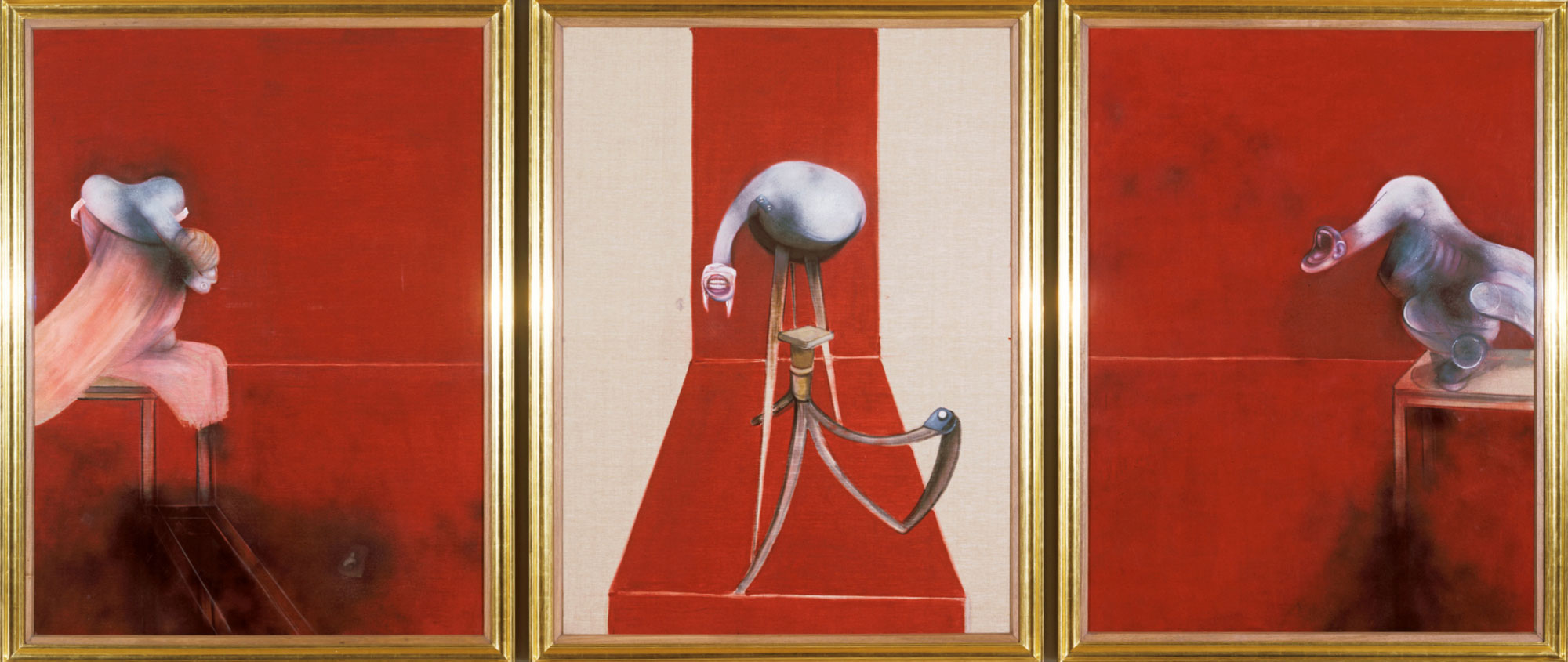
Francis Bacon (British, 1909-1992) 'Second Version of Triptych 1944' 1988


Francis Bacon (British, 1909-1992)
Second Version of Triptych 1944
1988
Oil and alkyds on canvas
Each panel 198 x 147.5cm (each panel)
Tate Modern, London
© Estate of Francis Bacon / SODRAC (2013)


Like the my earlier posting on the exhibition ‘Caravaggio – Bacon’ at Gallery Borghese, Rome, what an inspired curatorial decision this is. I would have never have thought to have brought Bacon and Moore together, but the synergy between the two artists work is undeniable.

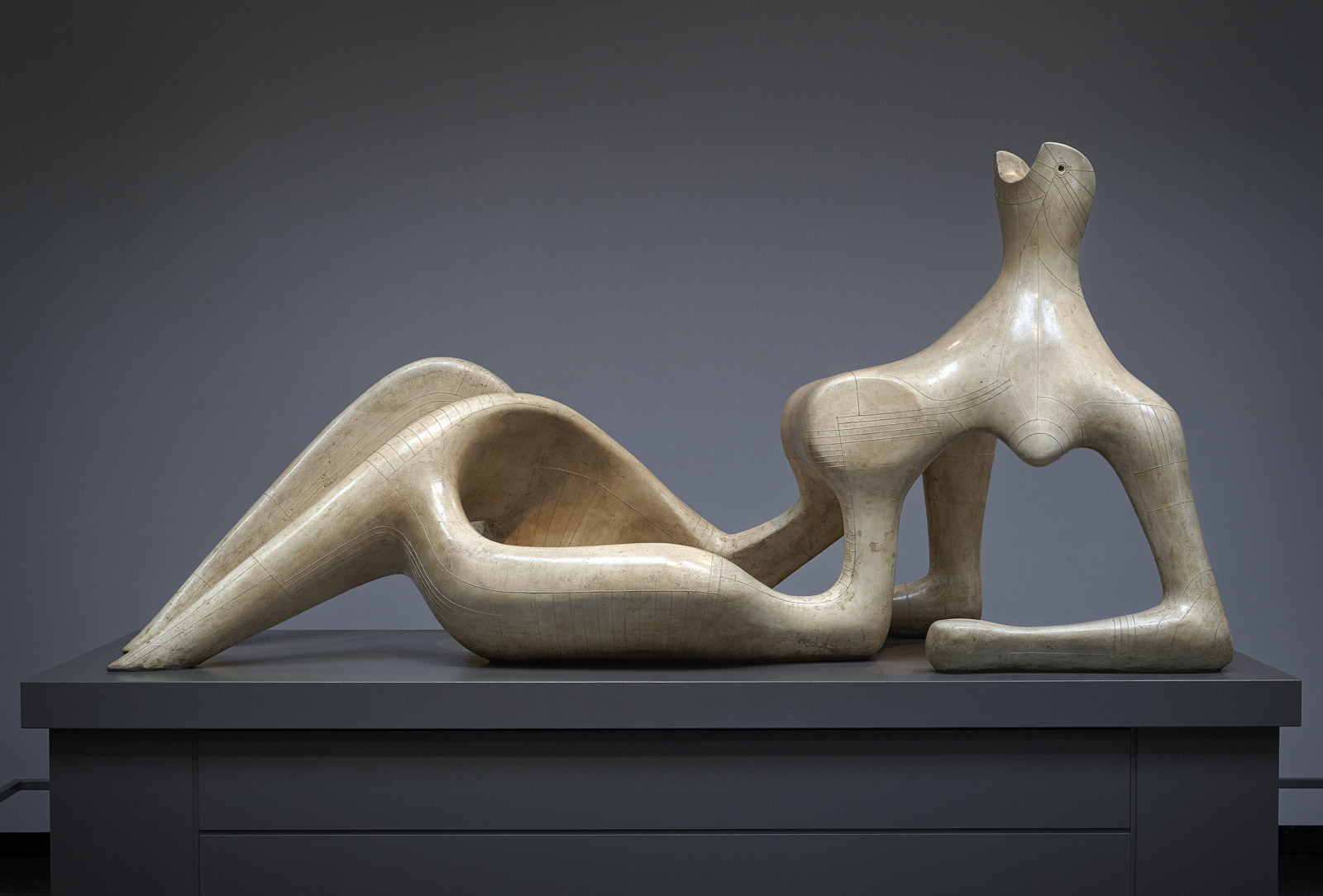
Personally, I don’t think that Moore is as immobile and measurable as Radoslaw Kudlinski states in the quotation below: while rooted in anthropological concerns his anthropomorphic “nightmares” have a heft and gravitas that move you, not physically, but in the pit of your stomach. Look at the open mouth of Reclining Figure (1951, below) and tell me you are not drawn down into the bowls of the soul through the pointed tit of mother earth. Tactile, yes. Immobile and measurable, NO!

Moore moves you from within. His roots are from an ancient and emotional landscape, one of decay, time and change. His works are like embryonic sacs, pushing out at you from different points. The holes in his work are like looking into a black hole. The spaces he creates with his sculptures DENY a perfect formal economy, for they are really awkward images that impinge on a space. Never stationary, his sculptures move you from within in the most powerful way. A perfect counterbalance to the external, cinematic rambunctiousness of Bacon.

Dr Marcus Bunyan


Many thankx to the Art Gallery of Ontario for allowing me to publish the photographs in the posting. Please click on the photographs for a larger version of the image.


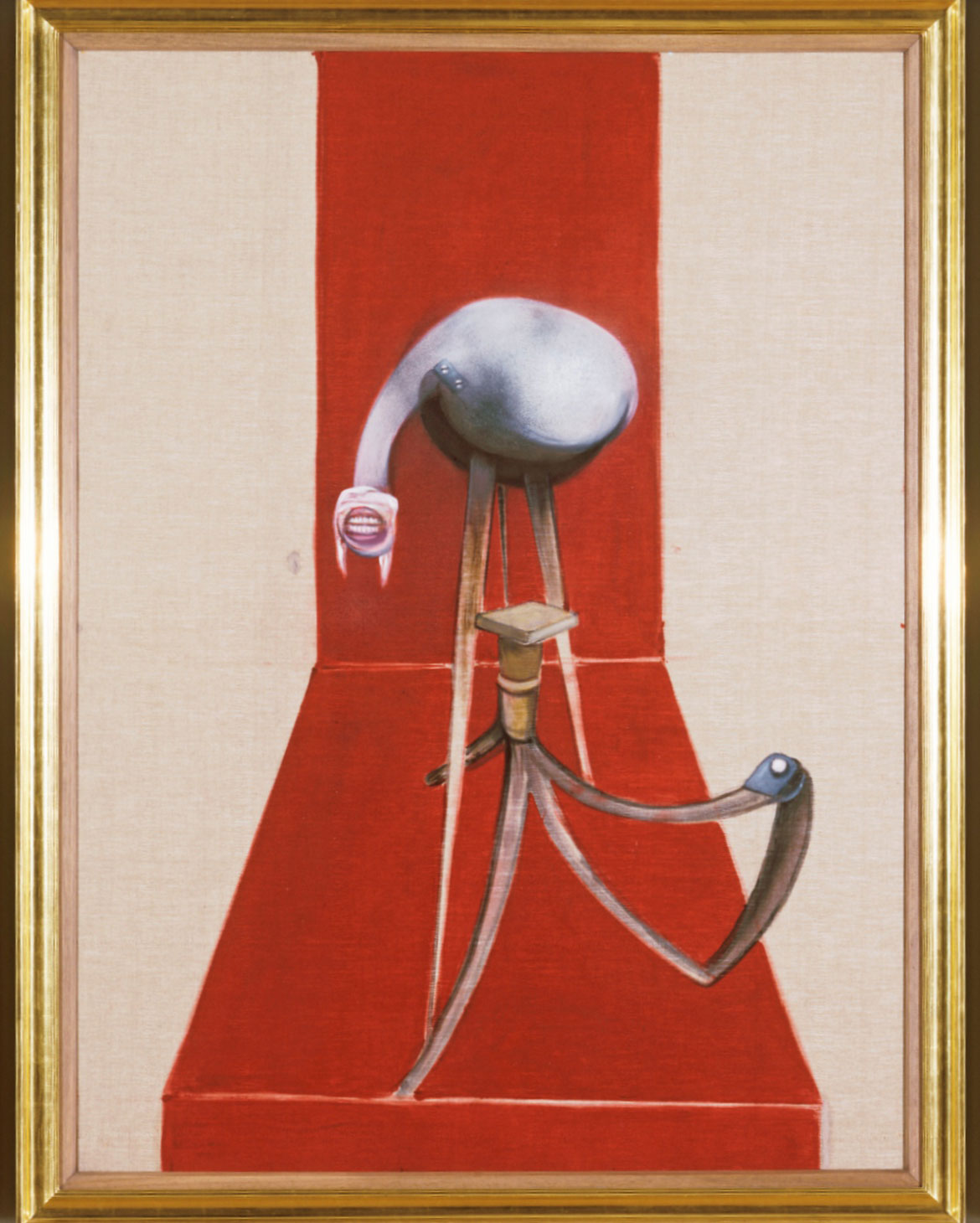
Francis Bacon (British, 1909-1992) 'Second Version of Triptych 1944' 1988 (detail)


Francis Bacon (British, 1909-1992)
Second Version of Triptych 1944 (detail)
1988
Oil and alkyds on canvas
Each panel 198 x 147.5cm (each panel)
Tate Modern, London
© Estate of Francis Bacon / SODRAC (2013)


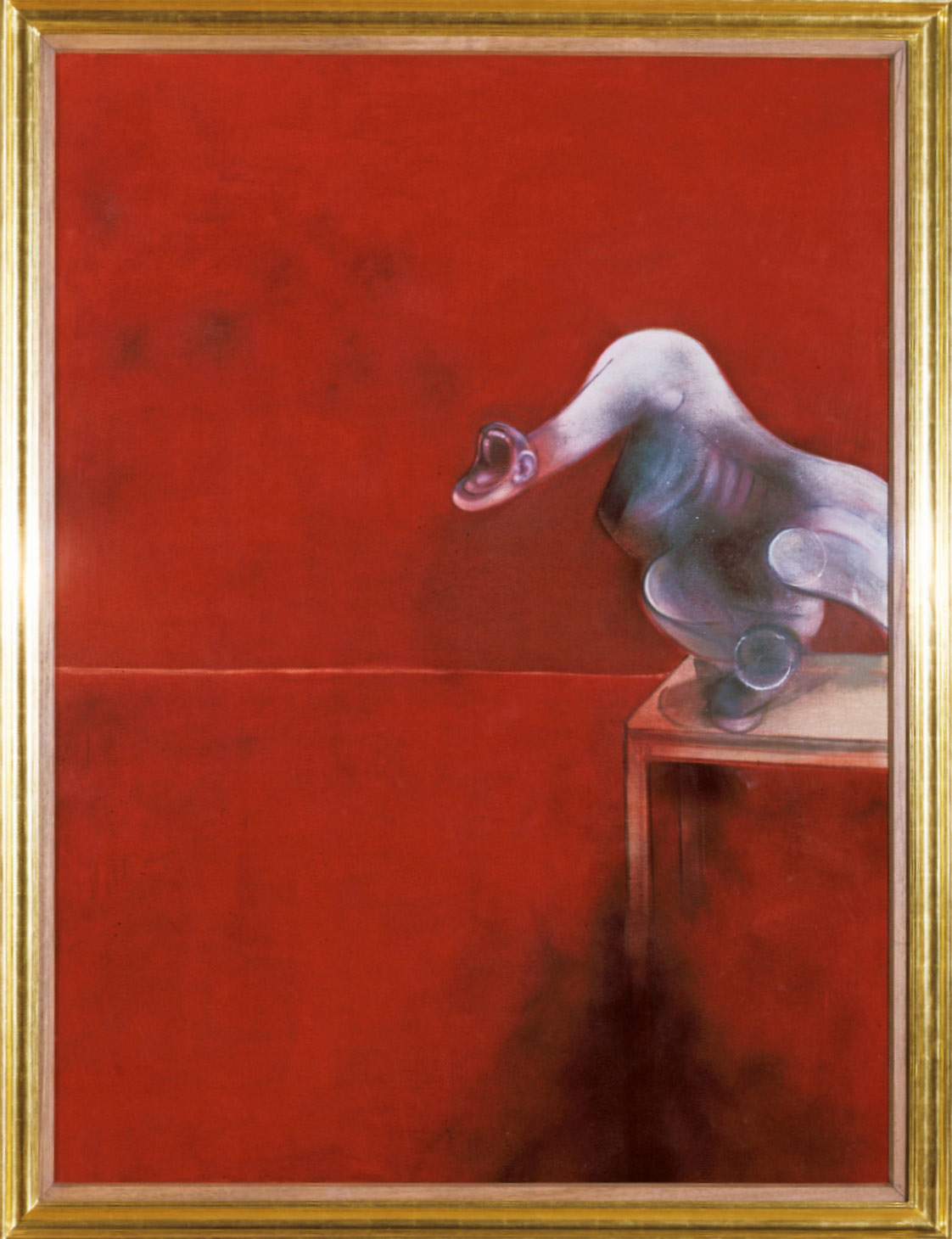
Francis Bacon (British, 1909-1992) 'Second Version of Triptych 1944' 1988 (detail)


Francis Bacon (British, 1909-1992)
Second Version of Triptych 1944 (detail)
1988
Oil and alkyds on canvas
Each panel 198 x 147.5cm (each panel)
Tate Modern, London
© Estate of Francis Bacon / SODRAC (2013)


“While Moore’s figures are sustaining themselves entirely from within, Bacon’s are disengaged fugitives from history. Bacon is already “after” when Moore is still “before.”

And while Moore’s nightmares are still rooted in anthropological concerns – corporeal and measurable – Bacon’s subject is a phantom without a name, without a past, because a collectivised subject is only and always an abstract fragment of a person.

But we need Moore’s confrontation with Bacon. Moore is a guardian of our sanity. His forms are stationary – despite the refined movement of all their structural lines, and their impeccable pronunciation of architectural tempo, as well as their perfect formal economy, they are going nowhere.

And because of Moore’s immobility, tactility and measurability, I welcome his presence with relief. He defends us from Bacon’s radical, cinematic mobility, forever escaping our grasp.

Bacon’s state of convulsive stasis is an illusion, because looking at his canvas you have an impression that between the two or three takes, there are more frames, as in a movie, trapped in the same space. There is also a sense that this trapping of multiplicity is not a conscious choice, but the consequence of there being nowhere else to go.

Bacon is the scandal of the flesh, the existential strip-tease – even a post-flesh, post-body concept of a person. He is a fugitive, and his natural state is motion, appearance and disappearance. He belongs to non-materiality, to cyberspace – and this is his paradox, because together with the sensuality of his pictorial matter, the materiality of subject is gone. That’s why Bacon is so relevant today.”

Radoslaw Kudlinski. “Serious Scary: Francis Bacon and Henry Moore in Toronto,” on the Canadian Art website, May 7, 2014 [Online] Cited 05/07/2014. No longer available online


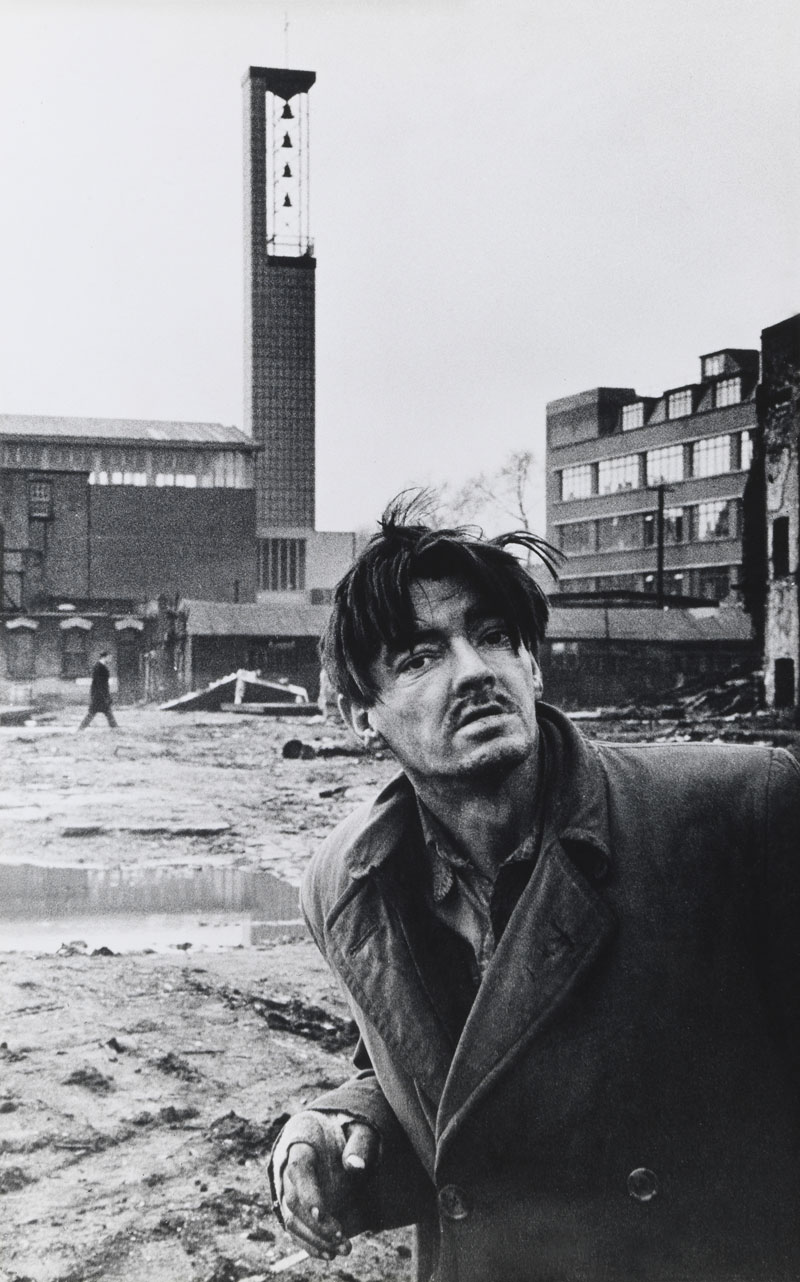
Bill Brandt (German-British, 1904-1983) 'Francis Bacon' Nd


Bill Brandt (German-British, 1904-1983)
Francis Bacon
Nd
Gelatin silver print
20.9 x 18.7cm
© The Bill Brandt Archive, London / Courtesy Edwynn Houk Gallery, New York / Zürich


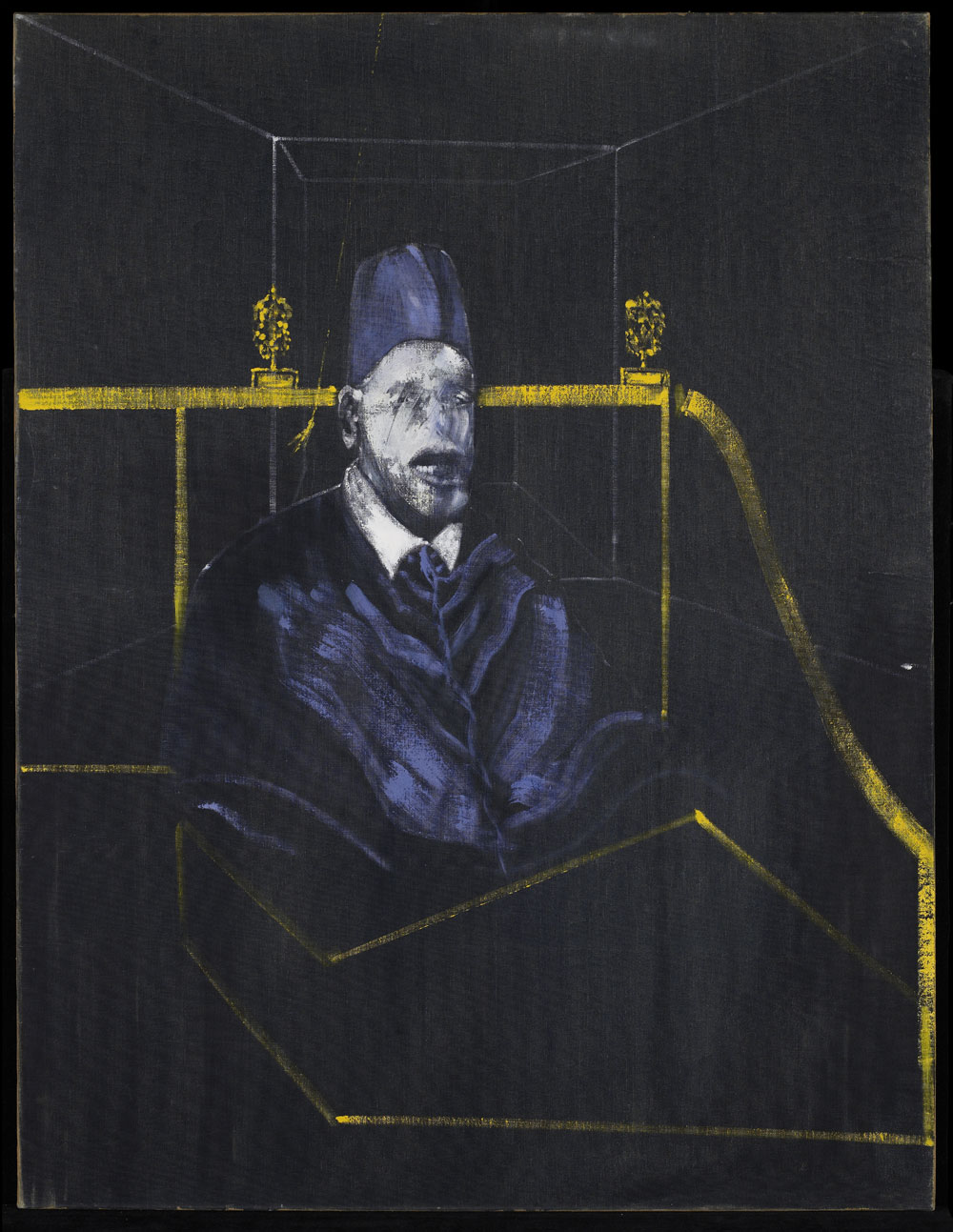
Francis Bacon (British, 1909-1992) 'Study for Portrait VI' 1953


Francis Bacon (British, 1909-1992)
Study for Portrait VI
1953 
Oil on canvas
152 x 117cm
The Minneapolis Institute of Arts,
The Miscellaneous Works of Art Purchase Fund © Estate of Francis Bacon / SODRAC (2013)


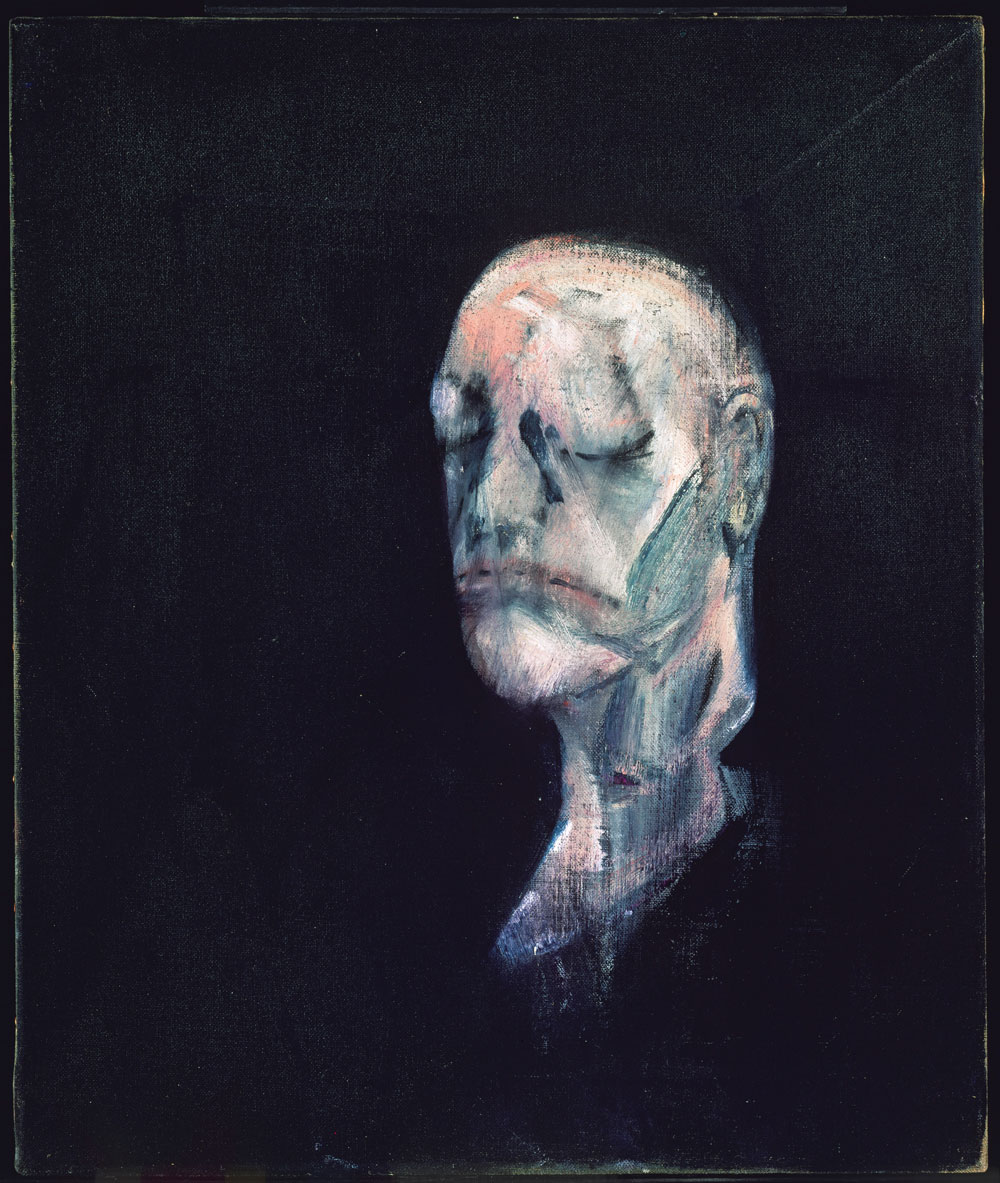
Francis Bacon (British, 1909-1992) 'Study for Portrait II (After the life mask of William Blake)' 1955


Francis Bacon (British, 1909-1992)
Study for Portrait II (After the life mask of William Blake)
1955
Oil on canvas
61 x 51cm
Tate Modern, London © Estate of Francis Bacon / SODRAC (2013)


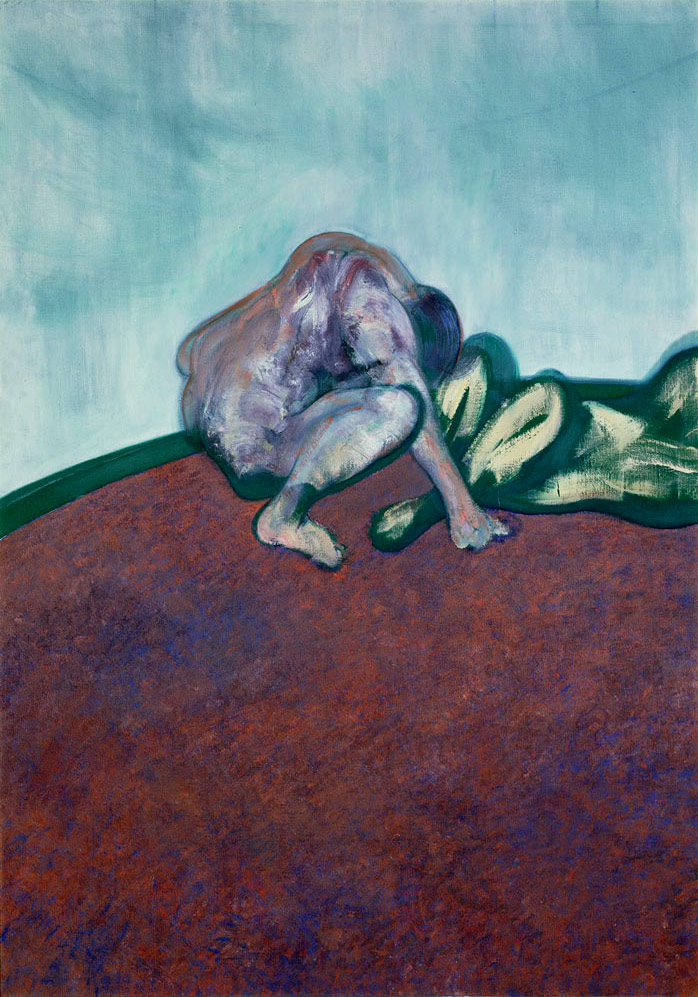
Francis Bacon (British, 1909-1992) 'Two Figures in a Room' 1959


Francis Bacon (British, 1909-1992)
Two Figures in a Room 
1959
Oil on canvas
198 x 140.5cm
Robert & Lisa Sainsbury Collection, Sainsbury Centre for Visual Arts, University of East Anglia, UK
© Estate of Francis Bacon / SODRAC (2013)


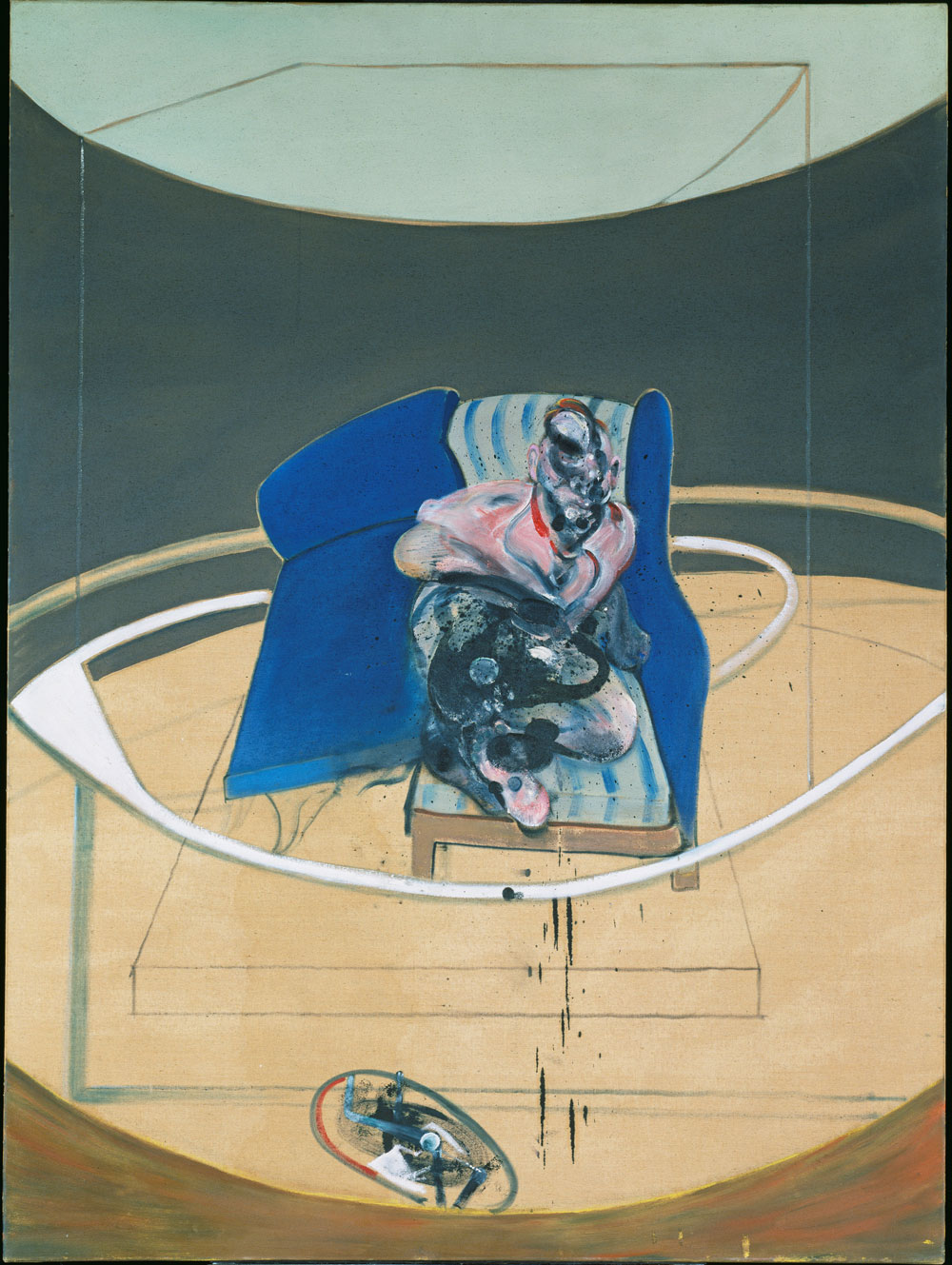
Francis Bacon (British, 1909-1992) 'Study for Portrait on Folding Bed' 1963


Francis Bacon (British, 1909-1992)
Study for Portrait on Folding Bed
1963
Oil on canvas
198.1 x 147.3cm
Tate Britain, London
© Estate of Francis Bacon / SODRAC (2013)


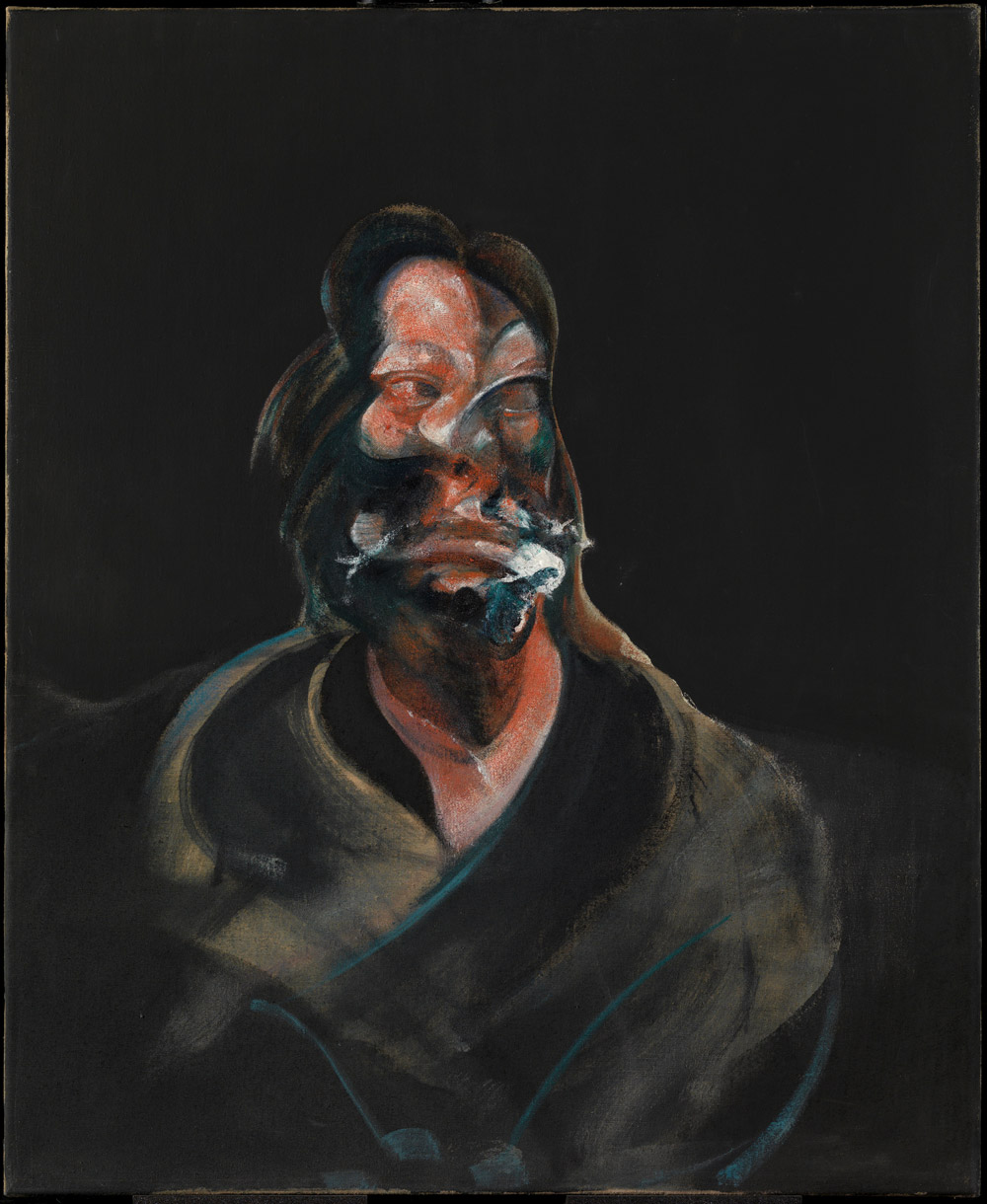
Francis Bacon (British, 1909-1992) 'Portrait of Isabel Rawsthorne' 1966


Francis Bacon (British, 1909-1992)
Portrait of Isabel Rawsthorne
1966
Oil on canvas
81 x 69cm
Tate Modern, London
© Estate of Francis Bacon / SODRAC (2013)


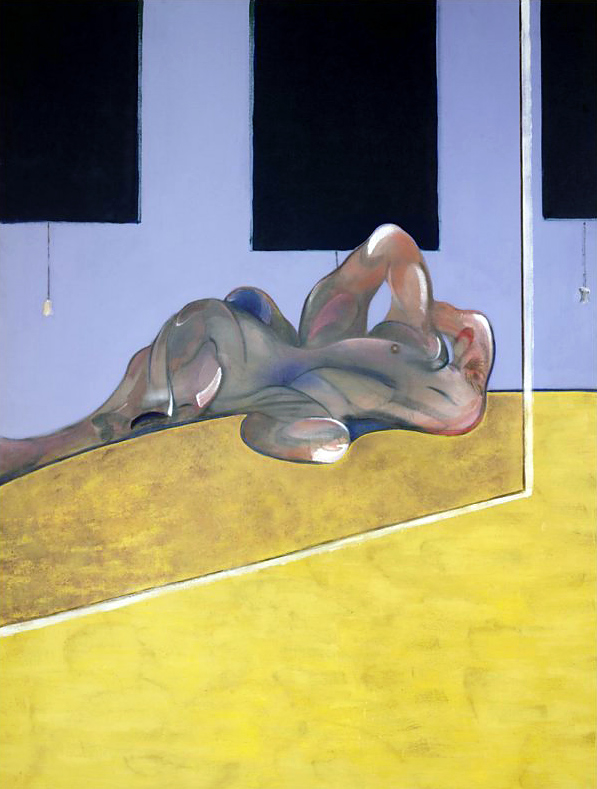
Francis Bacon (British, 1909-1992) 'Lying Figure in a Mirror' 1971


Francis Bacon (British, 1909-1992)
Lying Figure in a Mirror
1971
Oil on canvas
198.5 x 147.5cm
Museo de Bellas Artes Bilbao
© Estate of Francis Bacon / SODRAC (2013)


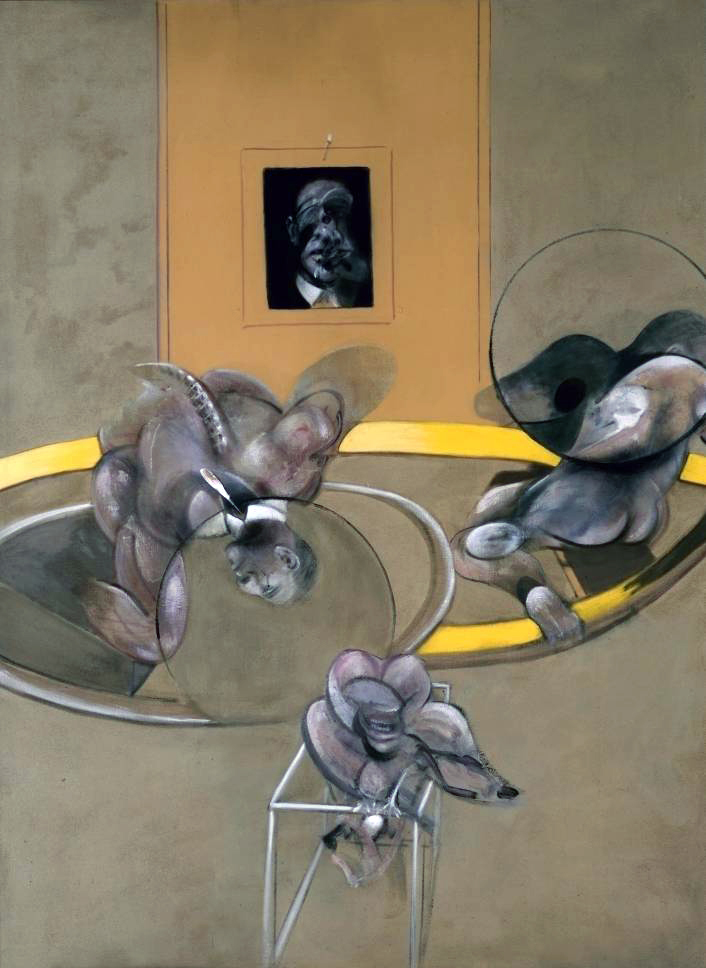
Francis Bacon (British, 1909-1992) 'Three Figures and a Portrait, 1975' 1975


Francis Bacon (British, 1909-1992)
Three Figures and a Portrait, 1975
1975
Oil and acrylic on canvas
198.1 x 147.3cm
Tate Britain, London
© Estate of Francis Bacon / SODRAC (2013)


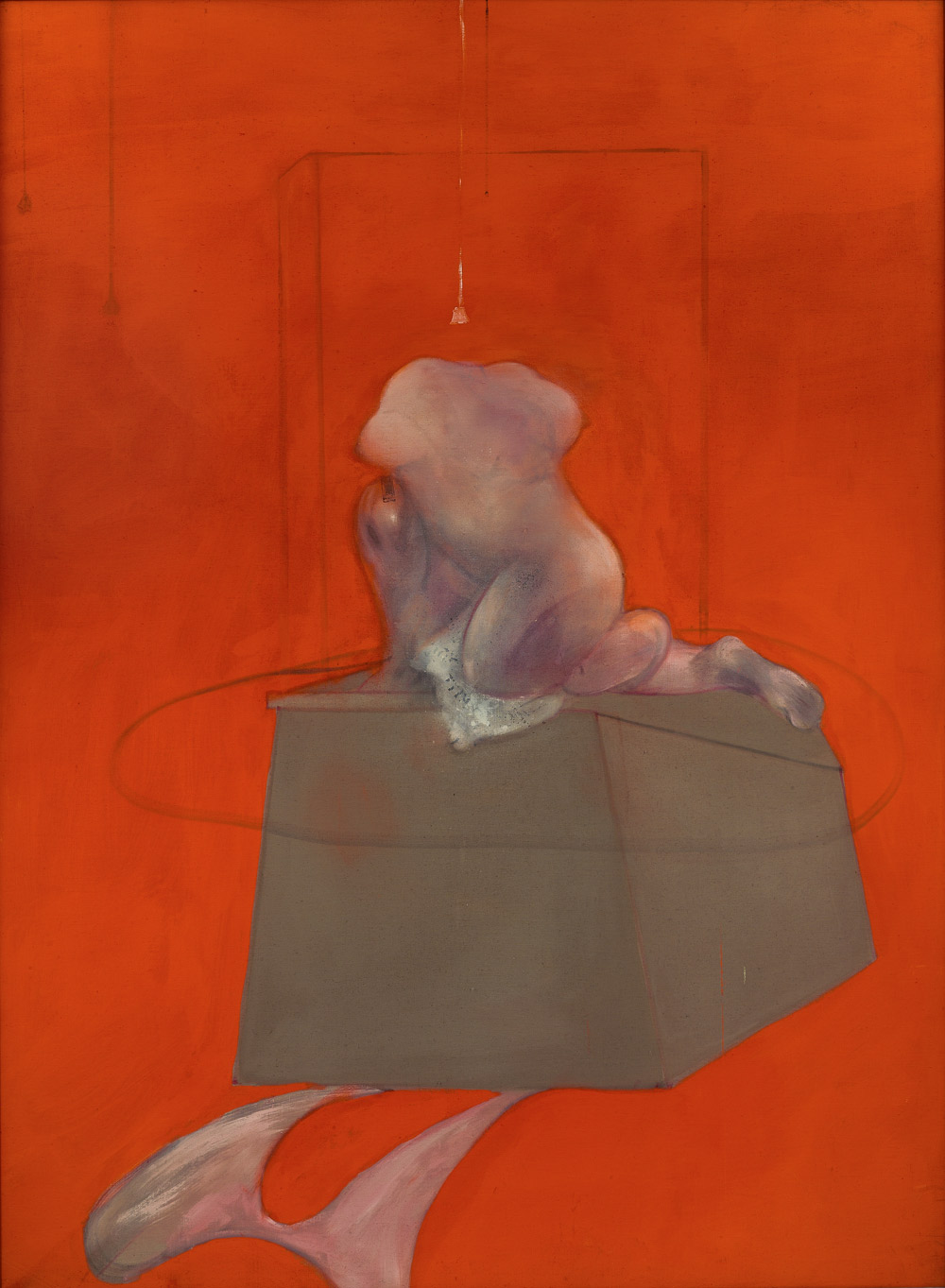
Francis Bacon (British, 1909-1992) 'Untitled (Kneeling Figure)' 1982


Francis Bacon (British, 1909-1992)
Untitled (Kneeling Figure)
1982
Oil on canvas
212 x 161cm
The Estate of Francis Bacon
© Estate of Francis Bacon / SODRAC (2013)


The tortured British painter Francis Bacon, whose triptych recently set a new record for the most expensive artwork ever sold at auction, makes his Canadian debut this spring at the Art Gallery of Ontario (AGO) alongside rarely-seen works by the British sculptor Henry Moore in the exhibition Francis Bacon & Henry Moore: Terror and Beauty. Featuring more than 130 artworks, including paintings, sculptures, drawings, photographs and archival materials, the exhibition explores the two artists’ shared fascination with the human form in relation to the violence of the Second World War and other key events of the 20th century.

Although they were neither friends nor collaborators, Bacon (b. 1909) and Moore (b. 1898) were contemporaries who shared an obsession with expressing themes of violence, trauma and conflict, both social and personal. Drawing on the artists’ personal experiences during the London Blitz and other conflicts, the exhibition examines how confinement and angst fostered their extraordinary creativity and unique visions. Bacon, whose dark depictions of human torment have inspired several characters in popular culture, including the appearance of Heath Ledger’s Joker in The Dark Knight, was a sado-masochist who sought to process the trials of humanity through his canvases. Moore, a British war artist, was one of the most renowned sculptors of his time. His works evoke endurance and stability, but when considered in light of his wartime experience, they read as an effort to rebuild and redeem the fragile human psyche and body.

Curated for the AGO by Dan Adler, associate professor of art history at York University, Francis Bacon and Henry Moore: Terror and Beauty is the first Canadian exhibition of Bacon’s work and includes rarely seen Moore pieces, from both the AGO collection and elsewhere. Moore’s works are a cornerstone of the AGO collection, and pairing them with those by Francis Bacon sets them in a new light. The exhibition also presents more than 30 archival photographs by acclaimed German-born British photographer Bill Brandt. Loans for the exhibition have also been secured from several institutions, including MoMA, Tate Britain and the Museum of Contemporary Art, Chicago.

Press release from the AGO website


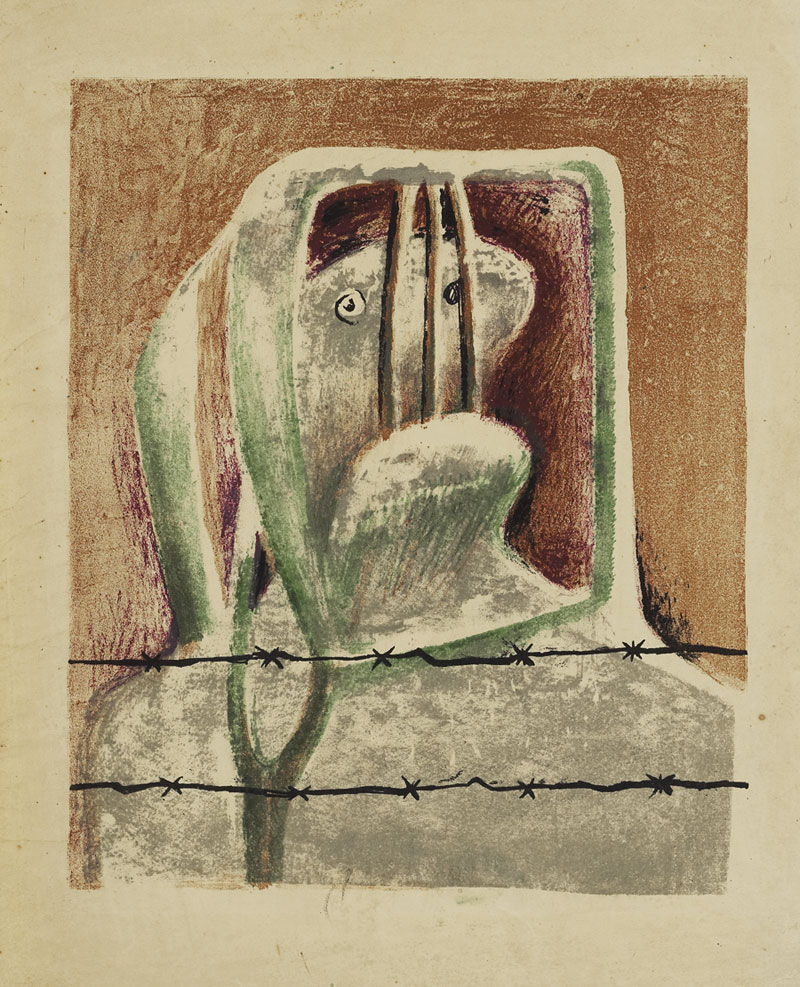
Henry Moore (English, 1898-1986) 'Spanish Prisoner' 1939


Henry Moore (English, 1898-1986)
Spanish Prisoner
1939
Lithograph on paper
36.5 x 30.5cm
Art Gallery of Ontario, Toronto
© The Henry Moore Foundation. All Rights Reserved, DACS / SODRAC (2013)


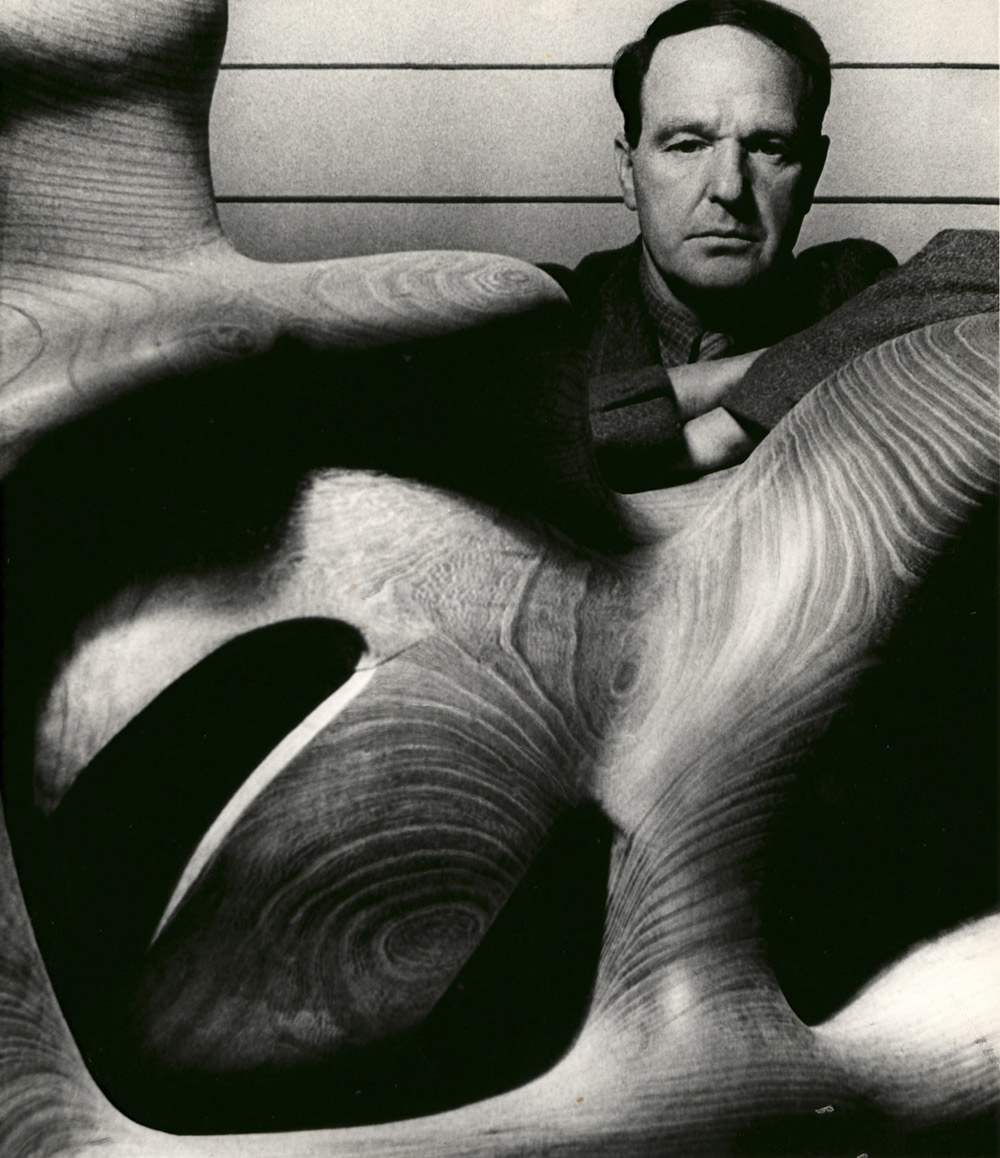
Bill Brandt (German-British, 1904-1983) 'Henry Moore in his Studio at Much Hadham, Hertfordshire' 1940


Bill Brandt (German-British, 1904-1983)
Henry Moore in his Studio at Much Hadham, Hertfordshire
1940
Gelatin silver print
22.8 x 19.6cm
© The Bill Brandt Archive, London / Courtesy Edwynn Houk Gallery, New York / Zürich


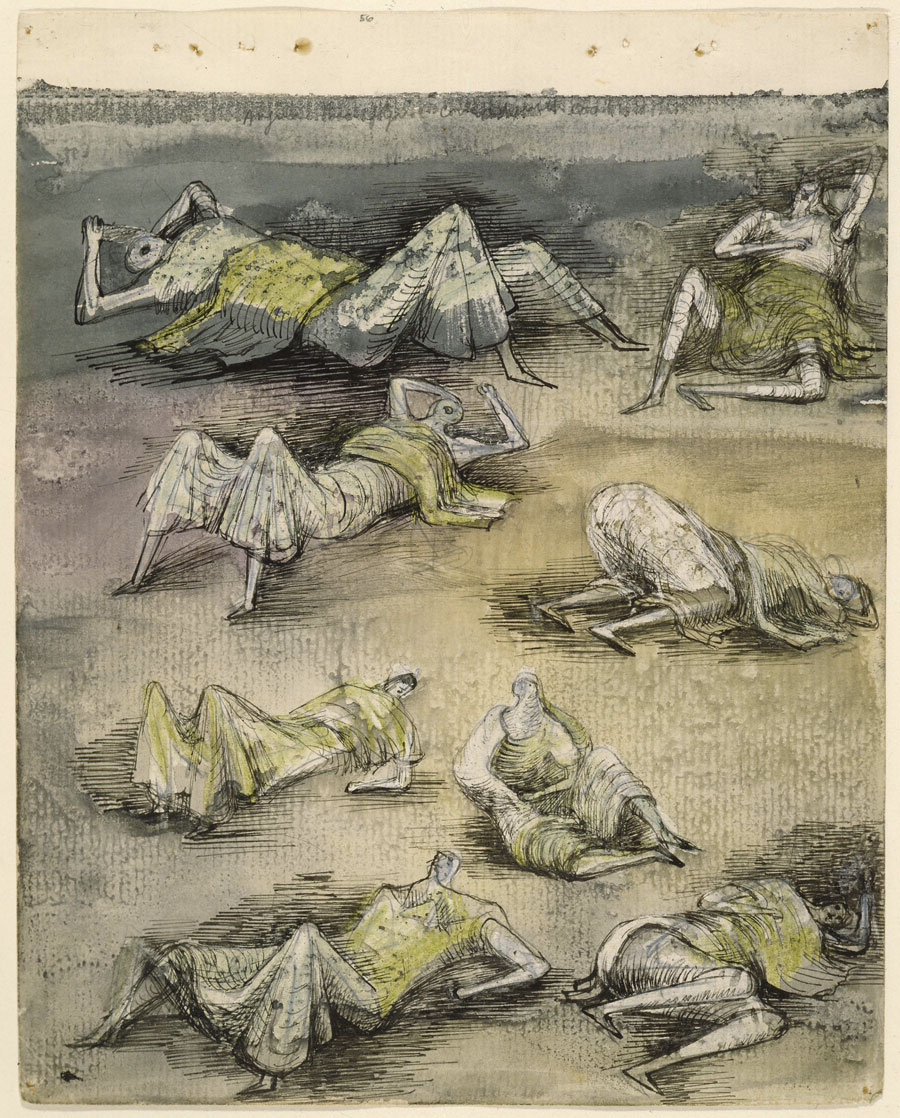
Henry Moore (English, 1898-1986) 'Sleeping Positions' 1940-1941


Henry Moore (English, 1898-1986)
Sleeping Positions
1940-1941
Mixed media on wove paper
20.4 x 16.5cm
The Henry Moore Foundation
© The Henry Moore Foundation. All Rights Reserved, DACS / SODRAC (2013)


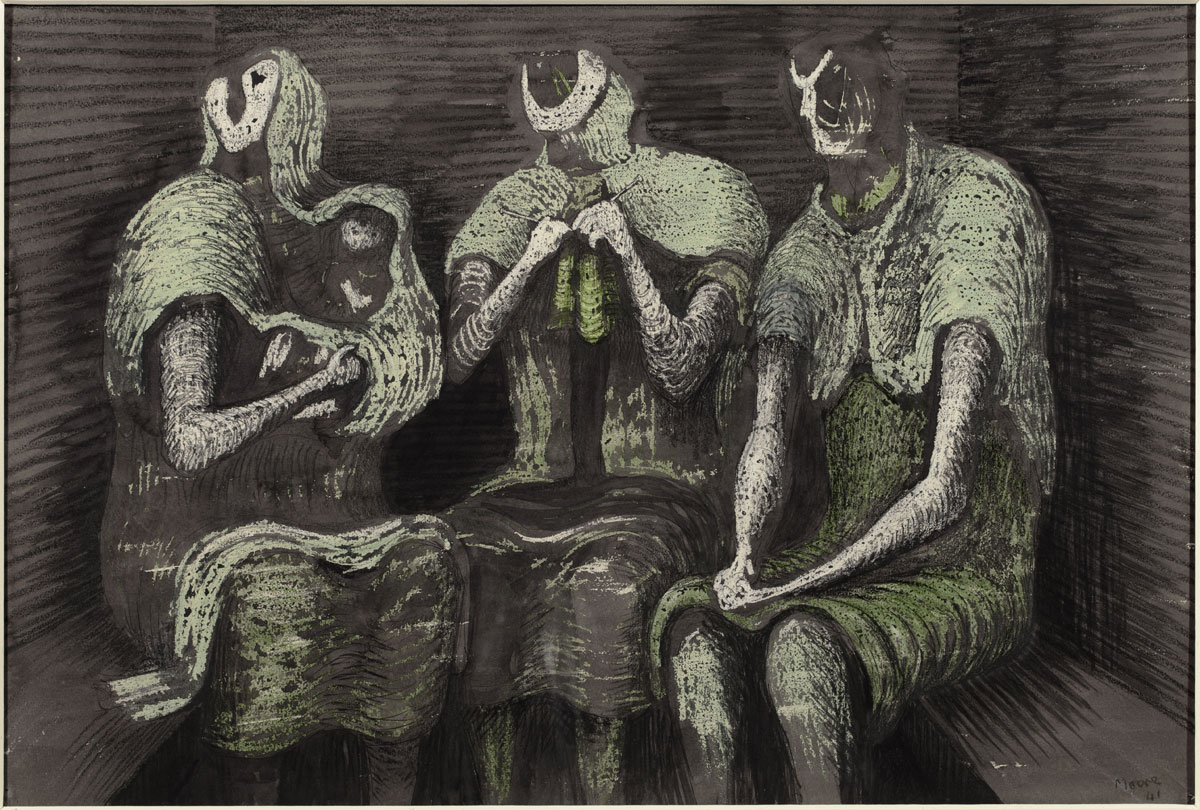
Henry Moore (English, 1898-1986) 'Three Fates' 1941


Henry Moore (English, 1898-1986)
Three Fates
1941
Watercolour
29.7 x 19.9cm
Royal Pavilion and Museums, Brighton & Hove
© The Henry Moore Foundation. All Rights Reserved, DACS / SODRAC (2013)


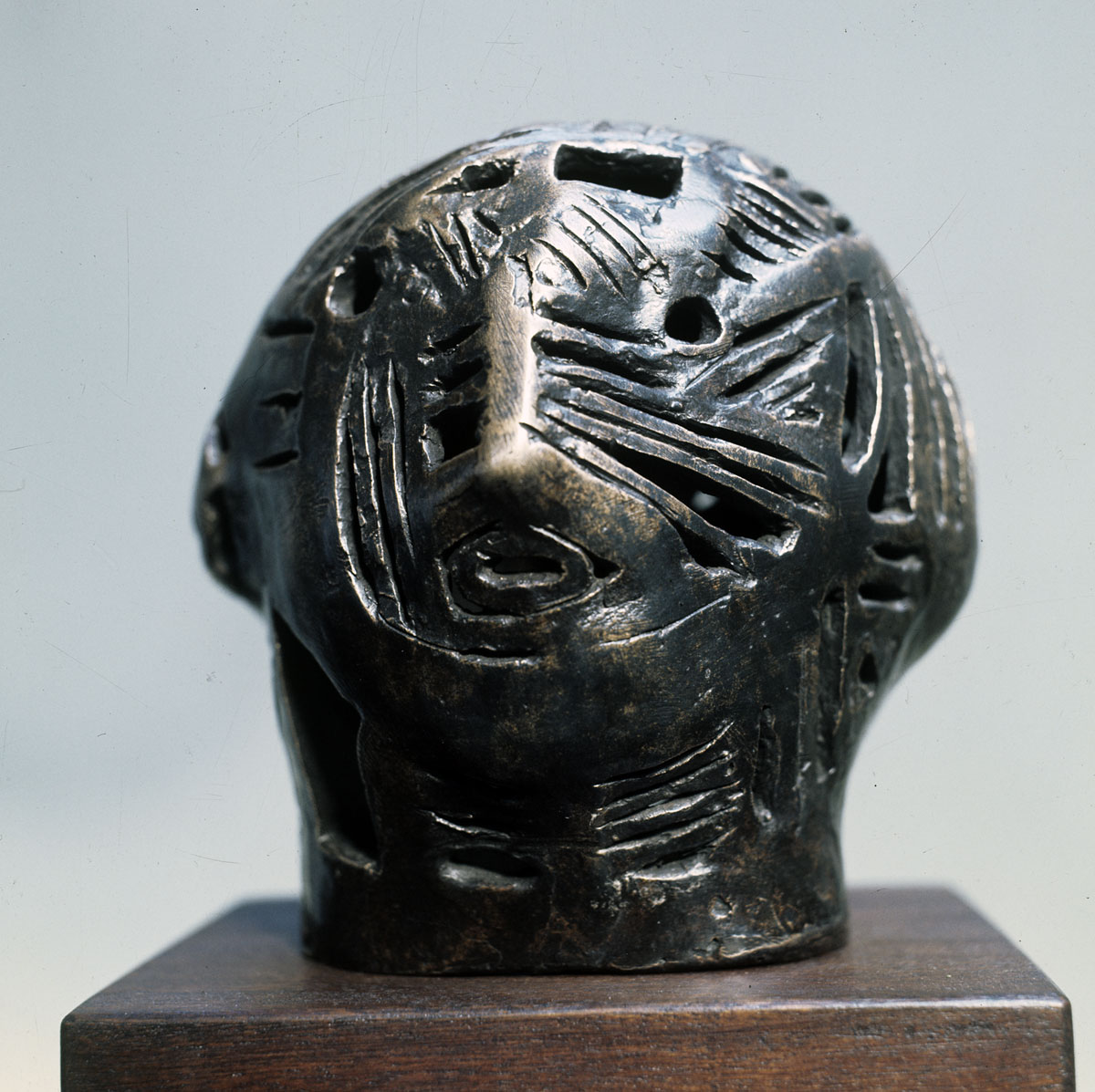
Henry Moore (English, 1898-1986) 'Maquette for Strapwork Head' 1950


Henry Moore (English, 1898-1986)
Maquette for Strapwork Head
1950
Bronze edition of 9
10cm high (excluding base)
The Henry Moore Foundation
© The Henry Moore Foundation. All Rights Reserved, DACS / SODRAC (2013)


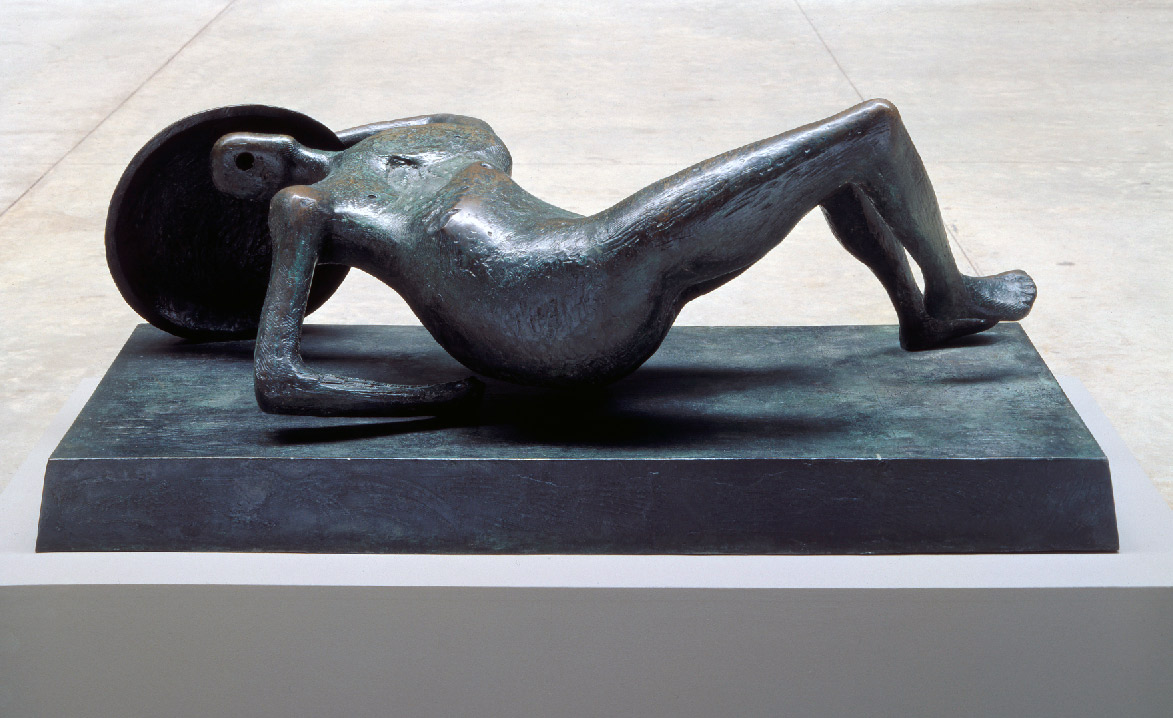
Henry Moore (English, 1898-1986) 'Reclining Figure' 1951


Henry Moore (English, 1898-1986)
Reclining Figure
1951
Plaster cast
Length: 228.5cm
Art Gallery of Ontario, Toronto
Courtesy Craig Boyko, AGO
© The Henry Moore Foundation. All Rights Reserved, DACS / SODRAC (2013)


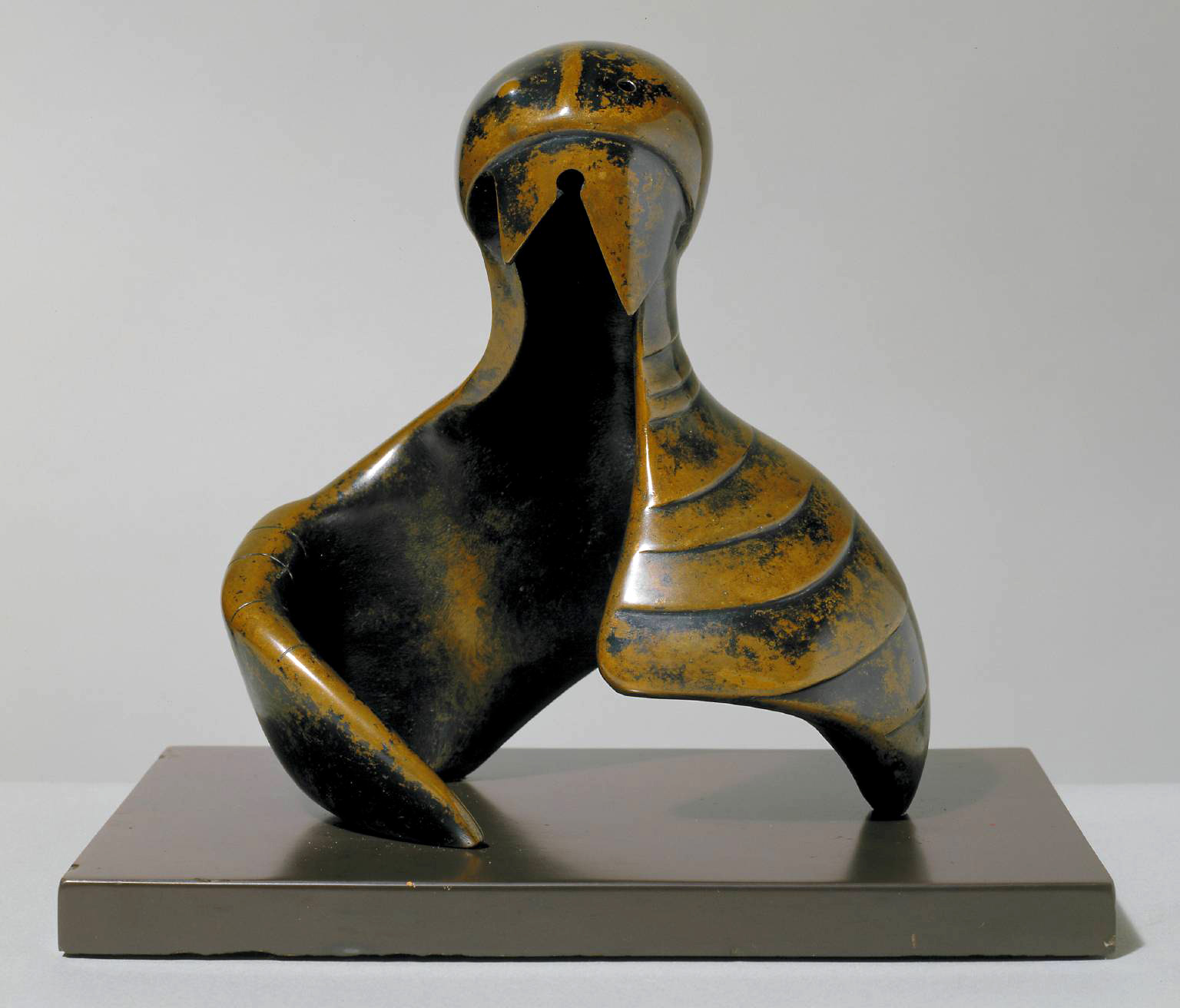
Henry Moore (English, 1898-1986) 'Helmet Head and Shoulders' 1952


Henry Moore (English, 1898-1986)
Helmet Head and Shoulders
1952 
Bronze
19 x 20.5 x 15cm
Tate Modern, London
© The Henry Moore Foundation. All Rights Reserved, DACS / SODRAC (2013)


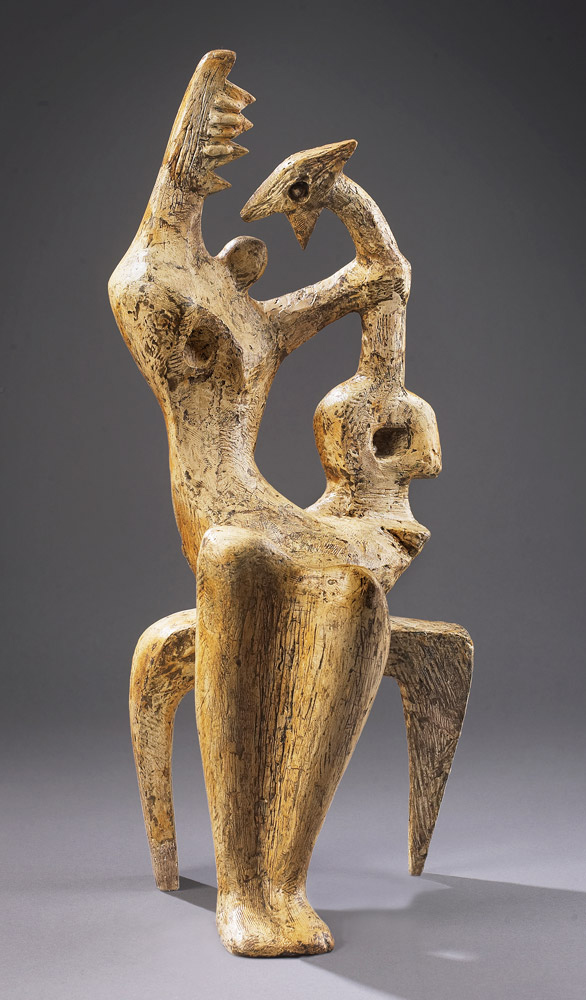
Henry Moore (English, 1898-1986) 'Mother and Child' 1953


Henry Moore (English, 1898-1986)
Mother and Child
1953
Plaster
Art Gallery of Ontario, Toronto
© The Henry Moore Foundation. All Rights Reserved, DACS / SODRAC (2013)


Henry Moore (English, 1898-1986) 'Falling Warrior' 1956-1957


Henry Moore (English, 1898-1986)
Falling Warrior
1956-1957
Bronze
65 x 154 x 85cm
Tate Modern, London
© The Henry Moore Foundation. All Rights Reserved, DACS / SODRAC (2013)


Art Gallery of Ontario
Musée des beaux-arts de l’Ontario

317 Dundas Street West
Toronto Ontario Canada M5T 1G4

Opening hours:
Tuesday – Sunday 10.30am – 5.30pm
Closed Mondays

Art Gallery of Ontario website

LIKE ART BLART ON FACEBOOK

Back to top

Exhibition: ‘A Royal Passion: Queen Victoria and Photography’ at The J. Paul Getty Museum, Getty Center, Los Angeles

Exhibition dates: 4th February – 8th June 2014

Exhibition includes major loans from Royal Collection Trust


Roger Fenton (English, 1819-1869) 'Buckingham Palace' about 1858


Roger Fenton (English, 1819-1869)
Buckingham Palace
about 1858
Albumen silver print
32.2 x 43.3cm (12 11/16 x 17 1/16 in.)
Royal Collection Trust / © Her Majesty Queen Elizabeth II 2013


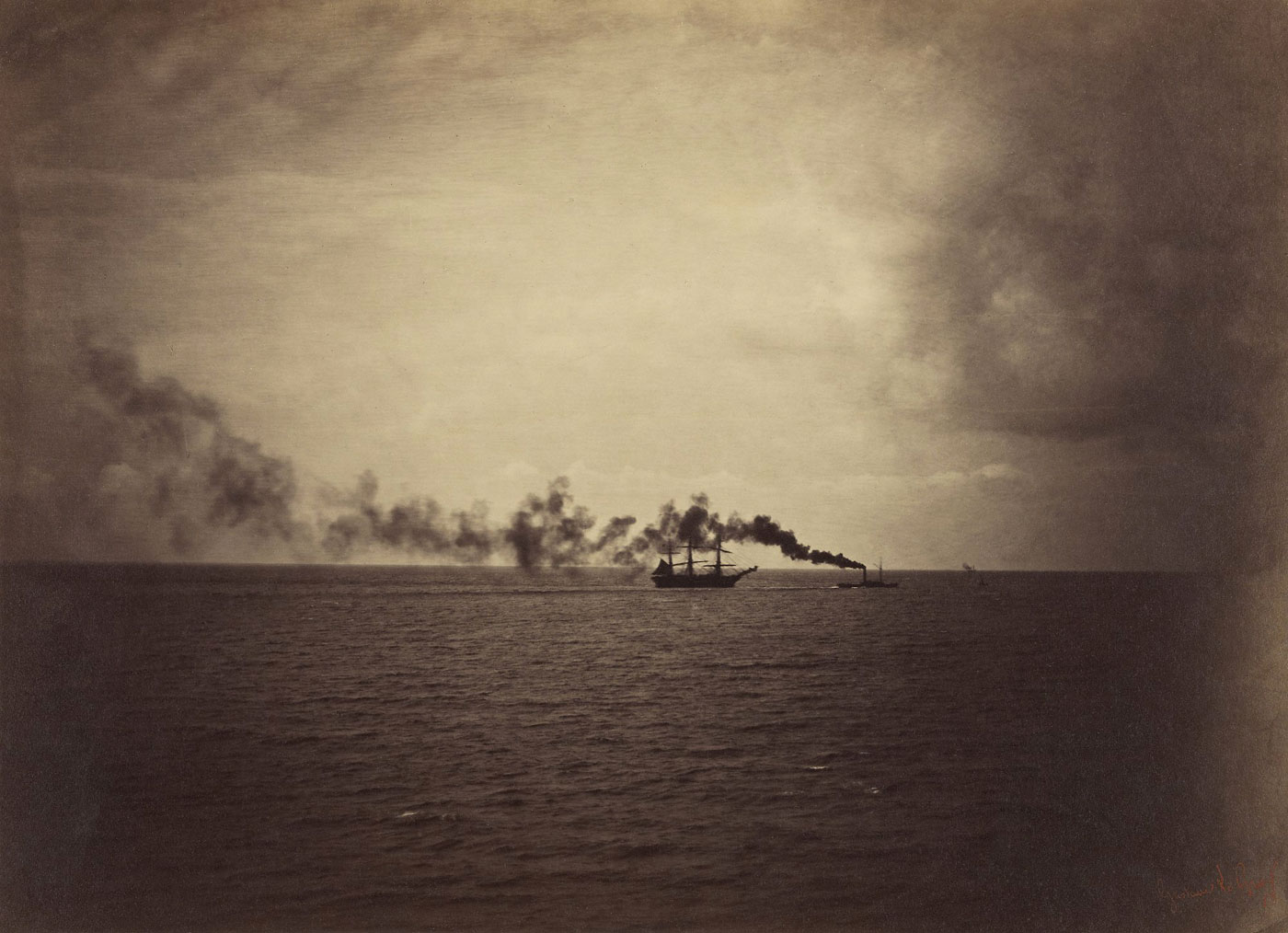
There are some glorious photographs in this posting. The serene Buckingham Palace with open gates; Crystal Palace with enclosed tree and ghostly figures; Nelson’s Column with wooden scaffolding and posters (nothing changes – a shop is knocked down in Chapel Street and within half a day the hoarding is covered in posters); atmospheric tugboat by Gustave Le Gray; the very famous, staged, Valley of the Shadow of Death by Roger Fenton; the “attitude” of the melange of men (if you like) in their stovepipe hats in I.K. Brunel and Others Observing by Robert Howlett, with everyone looking in different directions; and the serenity, beauty, grandeur and suppressed sense of power in Queen Victoria Diamond Jubilee Portrait by W. & D. Downey. To name but a few.

Dr Marcus Bunyan


Many thankx to the J. Paul Getty Museum for allowing me to publish the photographs in the posting. Please click on the photographs for a larger version of the image.


William Henry Fox Talbot (English, 1800-1877) 'Nelson's Column under Construction in Trafalgar Square, London' April 1844


William Henry Fox Talbot (English, 1800-1877)
Nelson’s Column under Construction in Trafalgar Square, London
April 1844
Salted paper print from a paper negative
17.1 x 21.1cm (6 3/4 x 8 5/16 in.)
The J. Paul Getty Museum, Los Angeles


Roger Fenton (English, 1819-1869) 'Manchester Art Treasures' 1857


Roger Fenton (English, 1819-1869)
Manchester Art Treasures
1857
Albumen silver print
18.6 x 24.4cm (7 5/16 x 9 5/8 in.)
The J. Paul Getty Museum, Los Angeles


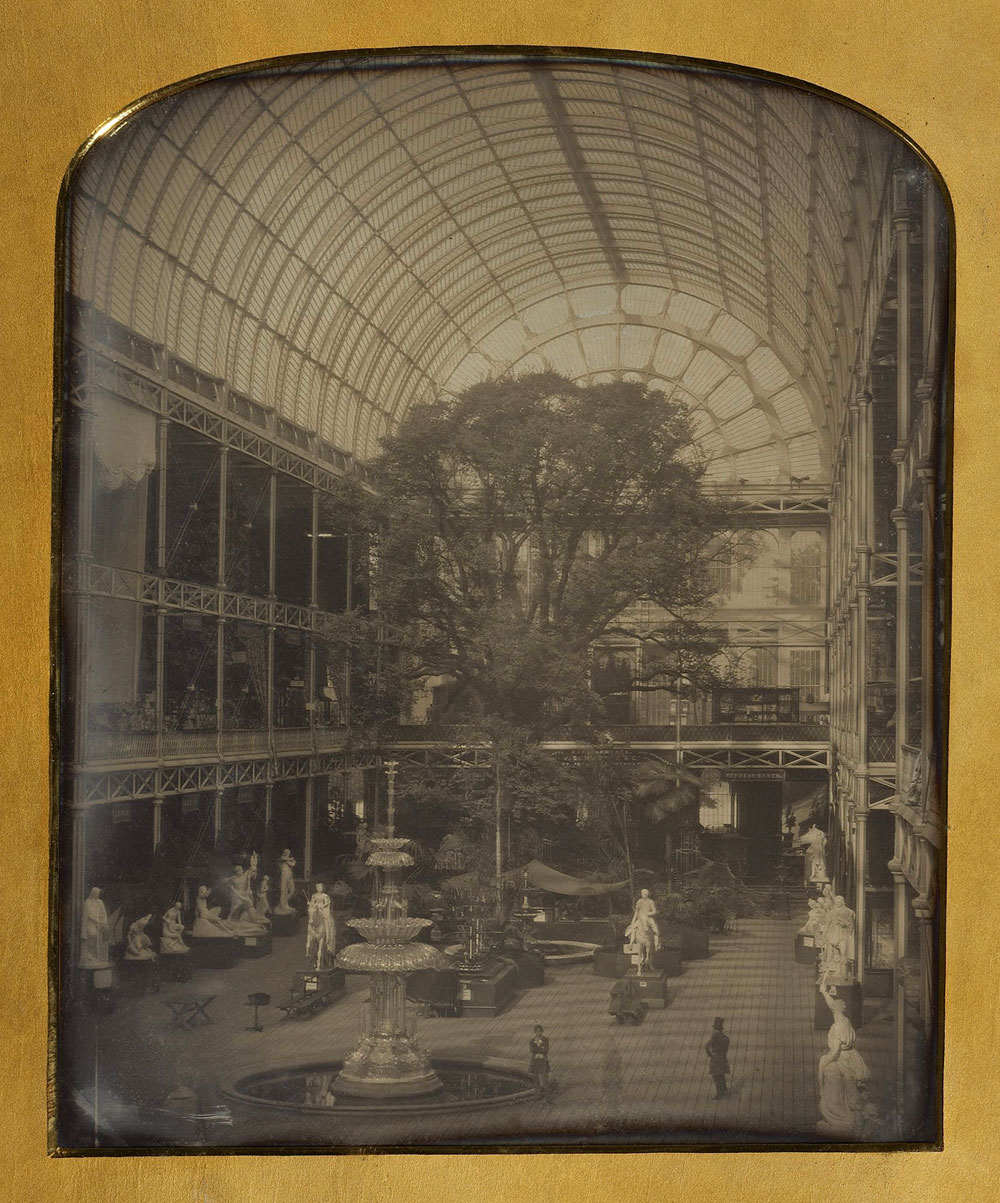
John Jabez Edwin Mayall (British, 1810-1901) 'The Crystal Palace at Hyde Park, London' 1851


John Jabez Edwin Mayall (British, 1810-1901)
The Crystal Palace at Hyde Park, London
1851
Daguerreotype
Image: 30.5 x 24.6cm (12 x 9 11/16 in.)
The J. Paul Getty Museum, Los Angeles


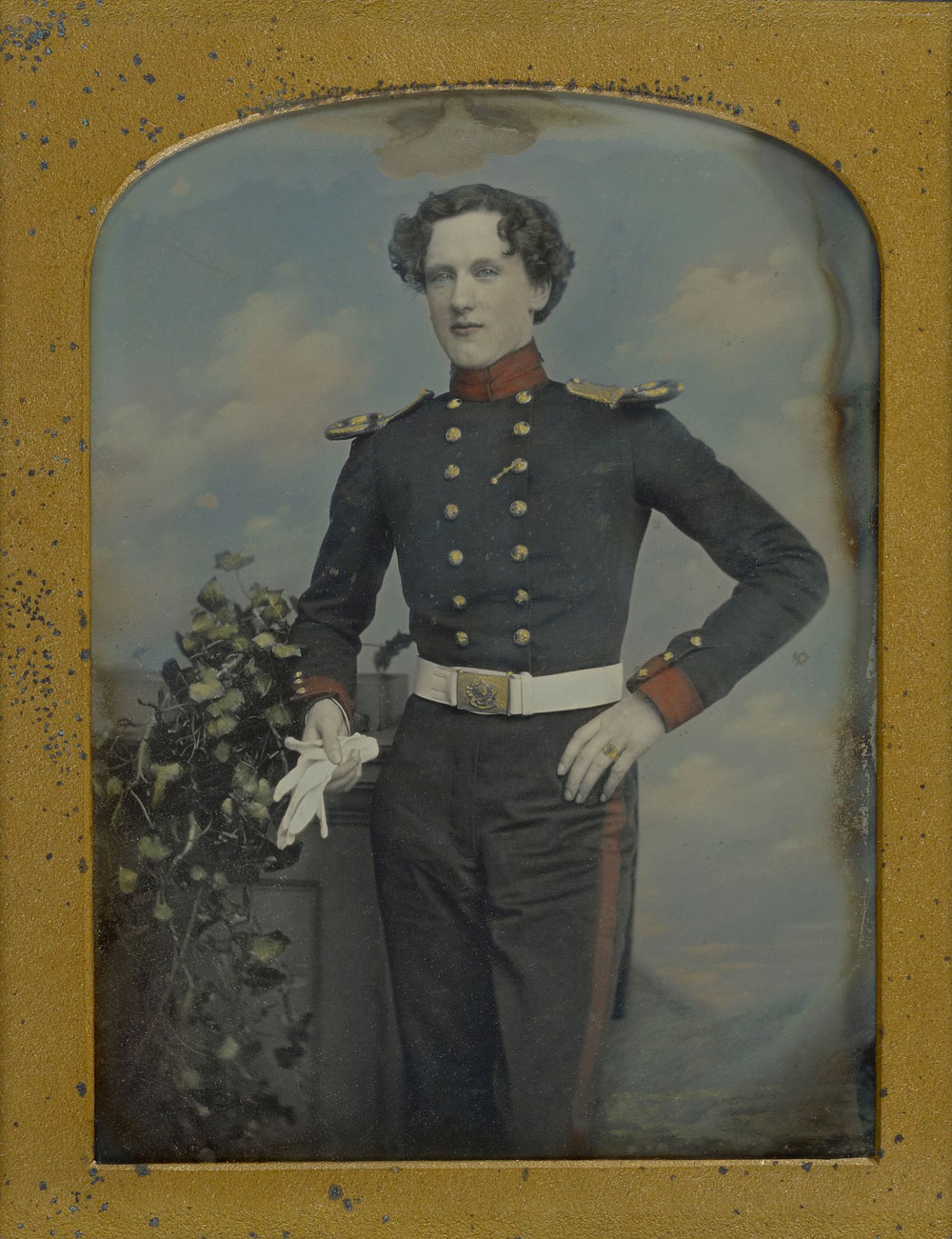
William Edward Kilburn (English, 1818-1891) 'Portrait of Lt. Robert Horsely Cockerell' 1852-1855


William Edward Kilburn (English, 1818-1891)
Portrait of Lt. Robert Horsely Cockerell
1852-1855
Daguerreotype, hand-coloured
8.9 x 6.5cm (3 1/2 x 2 9/16 in.)
The J. Paul Getty Museum, Los Angeles


Gustave Le Gray (French, 1820-1884) 'The Tugboat' 1857


Gustave Le Gray (French, 1820-1884)
The Tugboat
1857
Albumen silver print
Image: 30 x 41.3cm (11 13/16 x 16 1/4 in.)
The J. Paul Getty Museum, Los Angeles


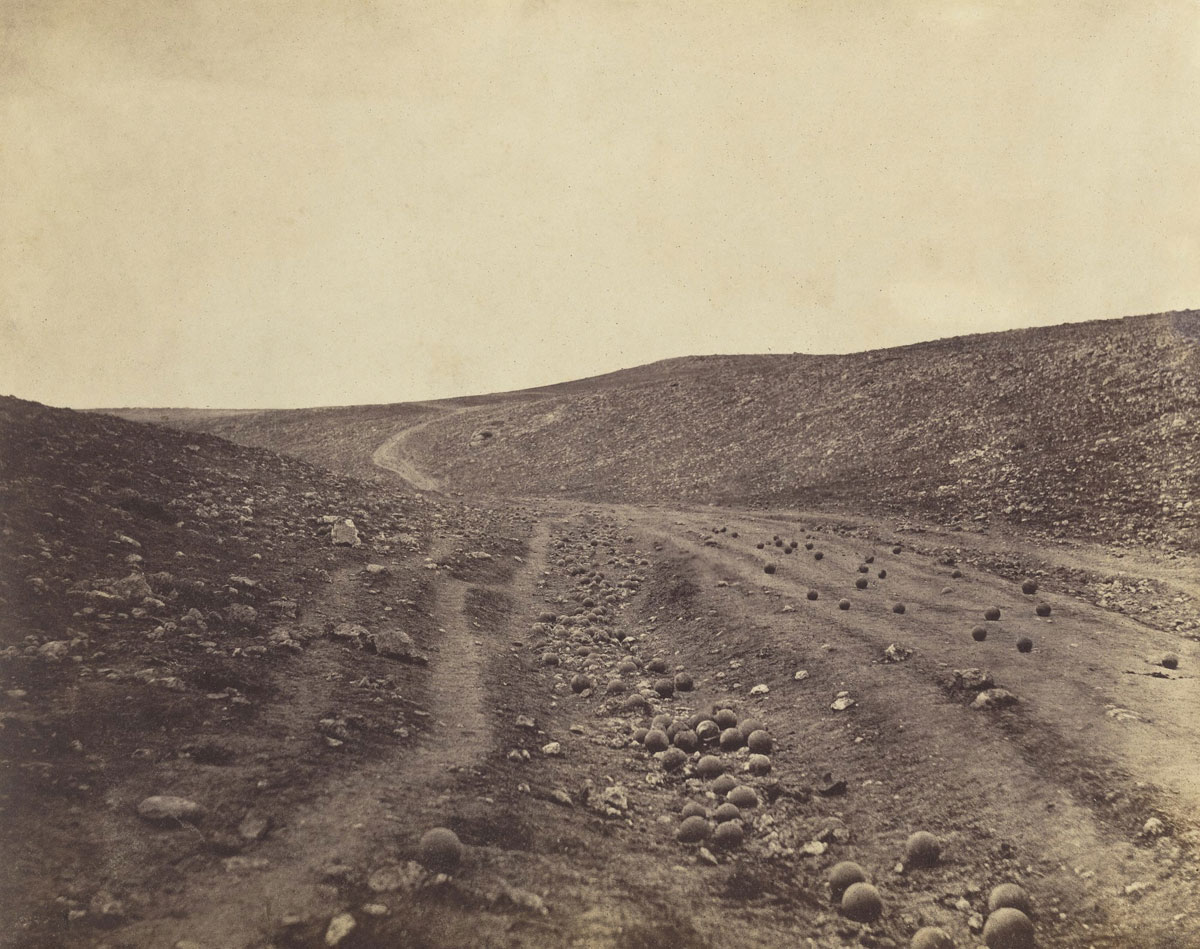
Roger Fenton (English, 1819-1869) 'Valley of the Shadow of Death' April 23, 1855


Roger Fenton (English, 1819-1869)
Valley of the Shadow of Death
April 23, 1855
Salted paper print
27.6 x 34.9cm (10 7/8 x 13 3/4 in.)
The J. Paul Getty Museum, Los Angeles


Leonida Caldesi (Italian, 1823-1891) 'Royal Family' May 27, 1857


Leonida Caldesi (Italian, 1823-1891)
Royal Family
May 27, 1857
Albumen silver print
Royal Collection Trust / © Her Majesty Queen Elizabeth II 2013


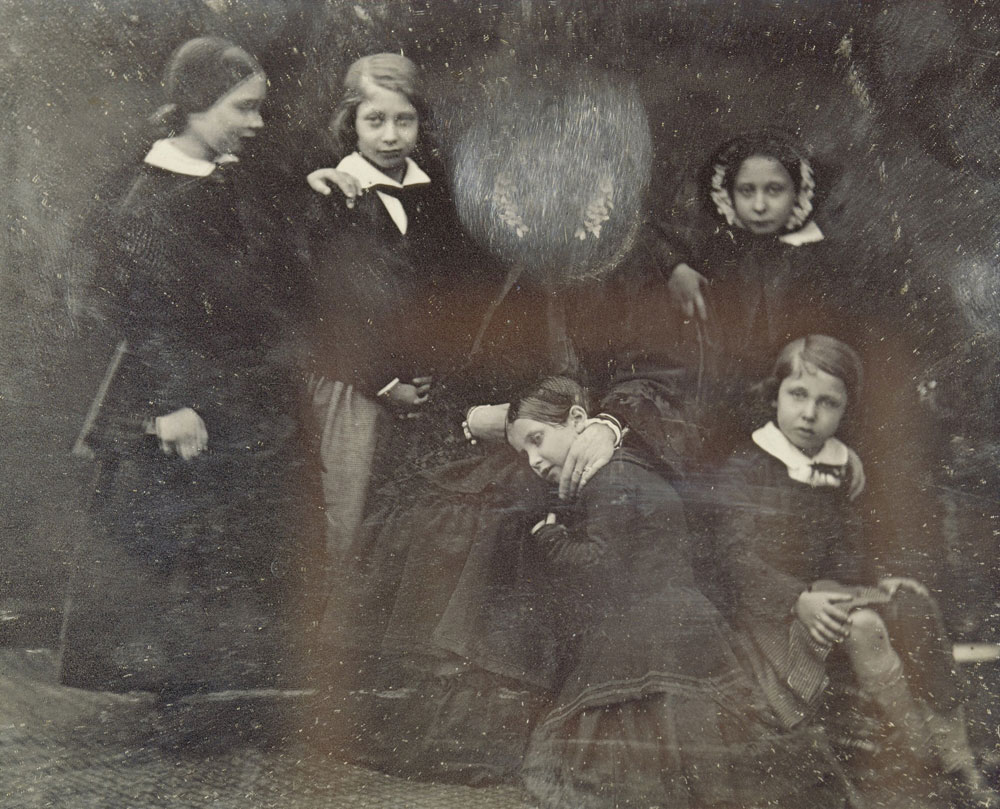
William Edward Kilburn (English, 1818-1891) 'Queen Victoria, the Princess Royal, the Prince of Wales, Princess Alice, Princess Helena, Prince Alfred' January 17, 1852


William Edward Kilburn (English, 1818-1891)
Queen Victoria, the Princess Royal, the Prince of Wales, Princess Alice, Princess Helena, Prince Alfred
January 17, 1852
Daguerreotype
9.1 x 11.5cm (3 9/16 x 4 1/2 in.)
Royal Collection Trust / © Her Majesty Queen Elizabeth II 2013


Queen Victoria’s devotion to photography will be on display in A Royal Passion: Queen Victoria and Photography, February 4 – June 8, 2014 at the J. Paul Getty Museum, Getty Center. With important loans held in the Royal Collection, generously lent by Her Majesty The Queen, shown alongside masterpieces from the Getty Museum, the exhibition displays rare daguerreotypes, private portraits of the royal family, and a selection of prints by early masters such as William Henry Fox Talbot, Roger Fenton, and Julia Margaret Cameron.

At the age of 18, Queen Victoria (1819-1901) ascended the throne of Great Britain and Ireland and was about to turn 20 when the invention of photography was announced – first in Paris, then in London – at the beginning of 1839. The queen and her husband Prince Albert fully embraced the new medium early on, and by 1842 the royal family was collecting photographs. Through their patronage and support, they contributed to the dialogue on photography and were integral to its rise in popularity.

“As the first British monarch to have her life fully recorded by the camera, Victoria’s image became synonymous with an entire age,” explains Timothy Potts, director of the J. Paul Getty Museum. “Now, 175 years later, we take this opportunity to celebrate both the anniversary of photography and the queen’s relationship with it, through a rich collection of images that portray both the evolution of the medium and the monarchy.”

Birth of Photography and Royal Patronage

Queen Victoria and Prince Albert took an interest in photography in the 1840s, which is remarkable given its limited application and dissemination at the time. The first royal photographic portrait – of Albert – was made by William Constable in 1842. While Victoria enjoyed seeing Albert photographed, she was initially apprehensive about being photographed herself. A pair of key images in the exhibition feature Victoria with her children in 1852, sitting for photographer William Edward Kilburn. In the first portrait, the long exposure time created an image in which Victoria’s eyes were closed. Writing in her diary entry for that day, she described her image as “horrid.” She disliked the portrait so much that she scratched the daguerreotype to remove her face. However two days later the queen repeated the exercise and sat before Kilburn’s camera again, only this time she chose to sit in profile wearing a large brimmed bonnet to hide her face.

For many people, the first opportunity of viewing an actual photograph took place in 1851 at the Great Exhibition of the Industry of Works of All Nations, which opened in London at an event presided over by Queen Victoria and Prince Albert. Among its 13,000 exhibits were 700 photographs housed in a massive iron and glass structure in Hyde Park. The Crystal Palace, as it was known, was documented in a series of daguerreotypes by John Jabez Edwin Mayall. The royal family would continue to support similar displays of photography that took place during the 1850s; in addition, they became patrons of the Photographic Society of London. Queen Victoria’s interest in the medium was effectively a royal seal of approval and her interest facilitated its growing popularity.

During her reign, a number of conflicts were also captured on camera, including the Crimean War and Sepoy Rebellion. The camera, although unable to record live battle, was able to record the before and after effects of conflict, and its images revealed both the tedium and horrors of war in these far off lands. Roger Fenton’s Valley of the Shadow of Death (1855) shows a stretch of land that was frequently attacked by the Russian Army, strewn with cannonballs. Formal military portraits, such as William Edward Kilburn’s Portrait of Lt. Robert Horsely Cockerell (1854) took on a memorial quality for families who lost loved ones.

As the application of photography developed through the course of the 19th century, so too did the medium itself. Many photographic innovations and experimentations occurred, particularly in the first thirty years. From early daguerreotypes and paper negatives, to the popular carte de visite and stereoscopic photography, the latter a technique that gave photographs the illusion of depth through binocular vision, the exhibition surveys these many innovations and accomplishments. Visitors will be able to look through reproductions of stereoscopic devices in the exhibition.

Private Photographs of the Royal Family

Victoria and Albert shared their passion for photography, not only in exchanging gifts at birthdays and Christmas, but in collecting, organising, and mounting the family portraits in albums, and would frequently spend evenings working together on assembling these volumes. Victoria would often bring albums and small framed portraits of her family along on her travels. The Getty will display a custom-made bracelet she wore that features photographs of her grandchildren.

“As the medium of photography evolved over the years, so did Victoria’s photographic image: she was the camera-shy young mother before she became an internationally recognisable sovereign,” explains Anne Lyden, curator of the exhibition.

In a rare glimpse of these private photographs, the exhibition includes scenes of young royals at play and images in which the royal family appears informal and almost middle-class in their appearance. In an 1854 portrait by Roger Fenton, the casual attire of the queen is disarming. She is wrapped in a tartan shawl and surrounded by four of her children (she would bear nine children in the span of seventeen years). This is not the image of a bejewelled monarch reigning over her empire, but an intimate view of family life. A pair of scissors and a key visible on the chain on her chatelaine suggests practicality and hints at routine household rituals.

Public Photographs, Public Mourning, and State Portraits

Public photographs of the royal family were incredibly popular – the majority of the population would never see a royal in person, and photographs offered a connection to nobility. However, it was not until 1860 that such photographs were available to the public, when John Jabez Edwin Mayall made the first photograph of the queen available for purchase. The event coincided with the rise in popularity of cartes de visite, thin paper photographs mounted on a thick paper card, which, given their small size, were popular for trading and were easily transported. Within days of Mayall’s portrait being issued, over 60,000 orders had been placed, as people were eager to have a glimpse into the private life of the sovereign. Interest in the royal family extended to views of their various royal residences, such as Buckingham Palace, Windsor Castle, Balmoral Castle, and Osborne House, which will also be included in the exhibition.

When Albert died suddenly on December 14, 1861, Victoria became a widow at the age of 42 and was in deep mourning for the rest of her life. While she retreated from public life, photographs of her as the bereaved wife were widely available, becoming in effect the queen’s public presence. While the tableau of a grieving widow remained prevalent for the remainder of Victoria’s reign, in the 1870s and 1880s she sat for a number of extremely popular state portraits that preserved her powerful position as monarch. The exhibition includes portraits taken by W. & D. Downey and Gunn & Stewart on the occasion of her Diamond Jubilee in 1897, as well as other portraits in which she is seen in full regal attire, complete with royal jewels and crown.

A Royal Passion: Queen Victoria and Photography, is on view February 4 – June 8, 2014 at the J. Paul Getty Museum, Getty Center. The exhibition was curated by Anne Lyden, international photography curator at the National Galleries of Scotland and former associate curator of photographs at the J. Paul Getty Museum. Getty Publications will issue the accompanying book A Royal Passion: Queen Victoria and Photography by Anne Lyden. Concurrently on view in the Center for Photographs is Hiroshi Sugimoto: Past Tense, which includes Sugimoto’s wax figure portrait of Queen Victoria.”

Press release from the J. Paul Getty Museum website


Robert Howlett (British, 1831-1858) 'I.K. Brunel and Others Observing the "Great Eastern" Launch Attempt' November 1857


Robert Howlett (British, 1831-1858)
I.K. Brunel and Others Observing the “Great Eastern” Launch Attempt
November 1857
Albumen silver print
Image (arched top): 24.8 x 21.4cm (9 3/4 x 8 7/16 in.)
The J. Paul Getty Museum, Los Angeles


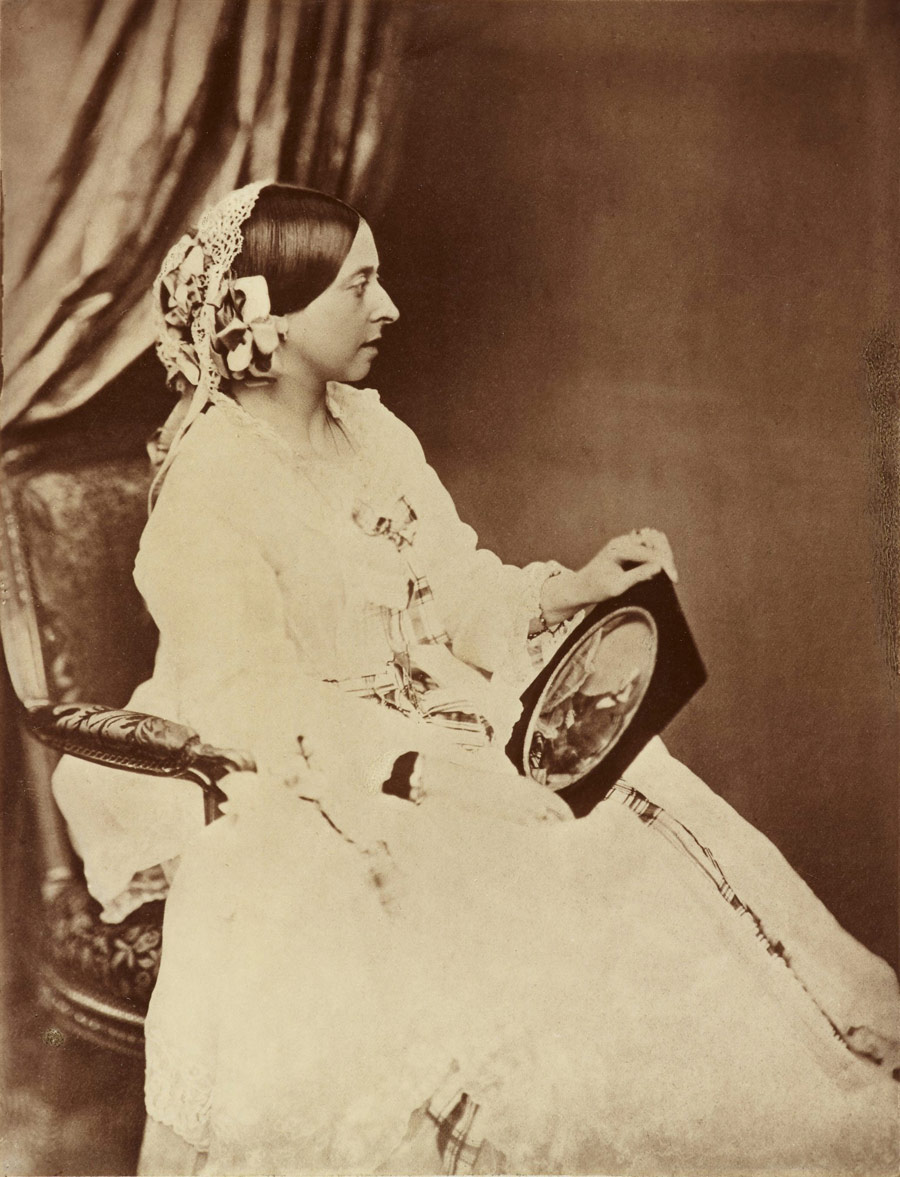
Bryan Edward Duppa (English, 1804-1866) Gustav William Henry Mullins (English, 1854-1921) 'Portrait of Queen Victoria Holding Portrait of Prince Albert' Negative, July 1854; print, 1889


Bryan Edward Duppa (English, 1804-1866)
Gustav William Henry Mullins (English, 1854-1921)
Portrait of Queen Victoria Holding Portrait of Prince Albert
Negative, July 1854; print, 1889
Carbon print
21.8 x 16.6cm (8 9/16 x 6 9/16 in.)
Royal Collection Trust / © Her Majesty Queen Elizabeth II 2013


Roger Fenton (English, 1819-1869) 'The Prince of Wales, the Princess Royal, Princess Alice, the Queen, Prince Alfred' Negative February 8, 1854


Roger Fenton (English, 1819-1869)
The Prince of Wales, the Princess Royal, Princess Alice, the Queen, Prince Alfred
Negative February 8, 1854; print later
Carbon print
22 x 19.7cm (8 11/16 x 7 3/4 in.)
Royal Collection Trust / © Her Majesty Queen Elizabeth II 2013


Roger Fenton (English, 1819-1869) 'Princesses Helena and Louise' 1856


Roger Fenton (English, 1819-1869)
Princesses Helena and Louise
1856
Salted paper print
33 x 29.2cm (13 x 11 1/2 in.)
Repro Credit: © Royal Photographic Society/NMEM / SSPL


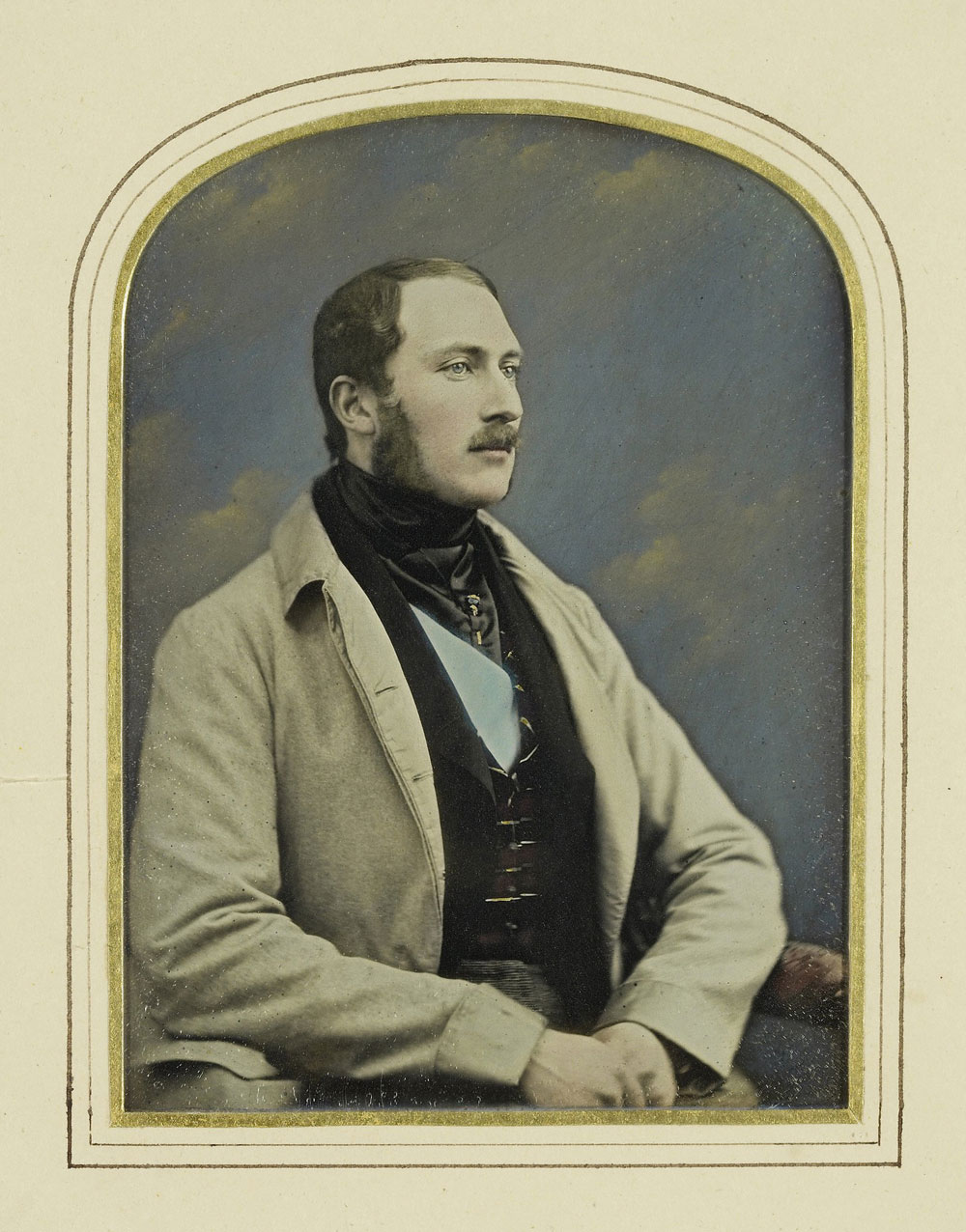
William Edward Kilburn (English, 1818-1891) 'Prince Albert' 1848


William Edward Kilburn (English, 1818-1891)
Prince Albert
1848
Daguerreotype, hand-coloured
8.6 x 6.3cm (3 3/8 x 2 1/2 in.)
Royal Collection Trust / © Her Majesty Queen Elizabeth II 2013


Roger Fenton (English, 1819-1869) 'Queen Victoria' June 30, 1854


Roger Fenton (English, 1819-1869)
Queen Victoria
June 30, 1854
Salted paper print, hand-coloured
19.1 x 15.6cm (7 1/2 x 6 1/8 in.)
The J. Paul Getty Museum, Los Angeles


Roger Fenton (English, 1819-1869) 'The Queen and Prince Albert' May 11, 1854


Roger Fenton (English, 1819-1869)
The Queen and Prince Albert
May 11, 1854
Albumen silver print
20.4 x 16.2cm (8 1/16 x 6 3/8 in.)
Royal Collection Trust / © Her Majesty Queen Elizabeth II 2013


W. & D. Downey (British, active 1860-1920s) 'Queen Victoria Diamond Jubilee Portrait' July 1893


W. & D. Downey (British, active 1860-1920s)
Queen Victoria Diamond Jubilee Portrait
July 1893
Carbon print
Image: 37.7 x 25.4cm (14 13/16 x 10 in.)
Royal Collection Trust / © Her Majesty Queen Elizabeth II 2013


Ghémar Frères. 'Portrait of Queen Victoria Seated, Gazing at a Photograph of Prince Albert' about 1862


Ghémar Frères
Portrait of Queen Victoria Seated, Gazing at a Photograph of Prince Albert
About 1862
Albumen silver print
8.4 x 5.4cm (3 5/16 x 2 1/8 in.)
The J. Paul Getty Museum, Los Angeles


Alexander Bassano (British born Italy, 1829-1913) 'Queen Victoria' April 1882


Alexander Bassano (British born Italy, 1829-1913)
Queen Victoria
April 1882
Carbon print
30.9 x 19.1cm (12 3/16 x 7 1/2 in.)
Royal Collection Trust / © Her Majesty Queen Elizabeth II 2013


The J. Paul Getty Museum
1200 Getty Center Drive
Los Angeles, California 90049

Opening hours:
Tuesday – Friday, Sunday 10am – 5.30pm
Saturday 10am – 8pm
Monday Closed

The J. Paul Getty Museum website

LIKE ART BLART ON FACEBOOK

Back to top

Film: ‘Traveller Homes, a film about Dave Fawcett’

May 2014


Traveller Homes, a film about David Fawcett from PARC_UAL on Vimeo.


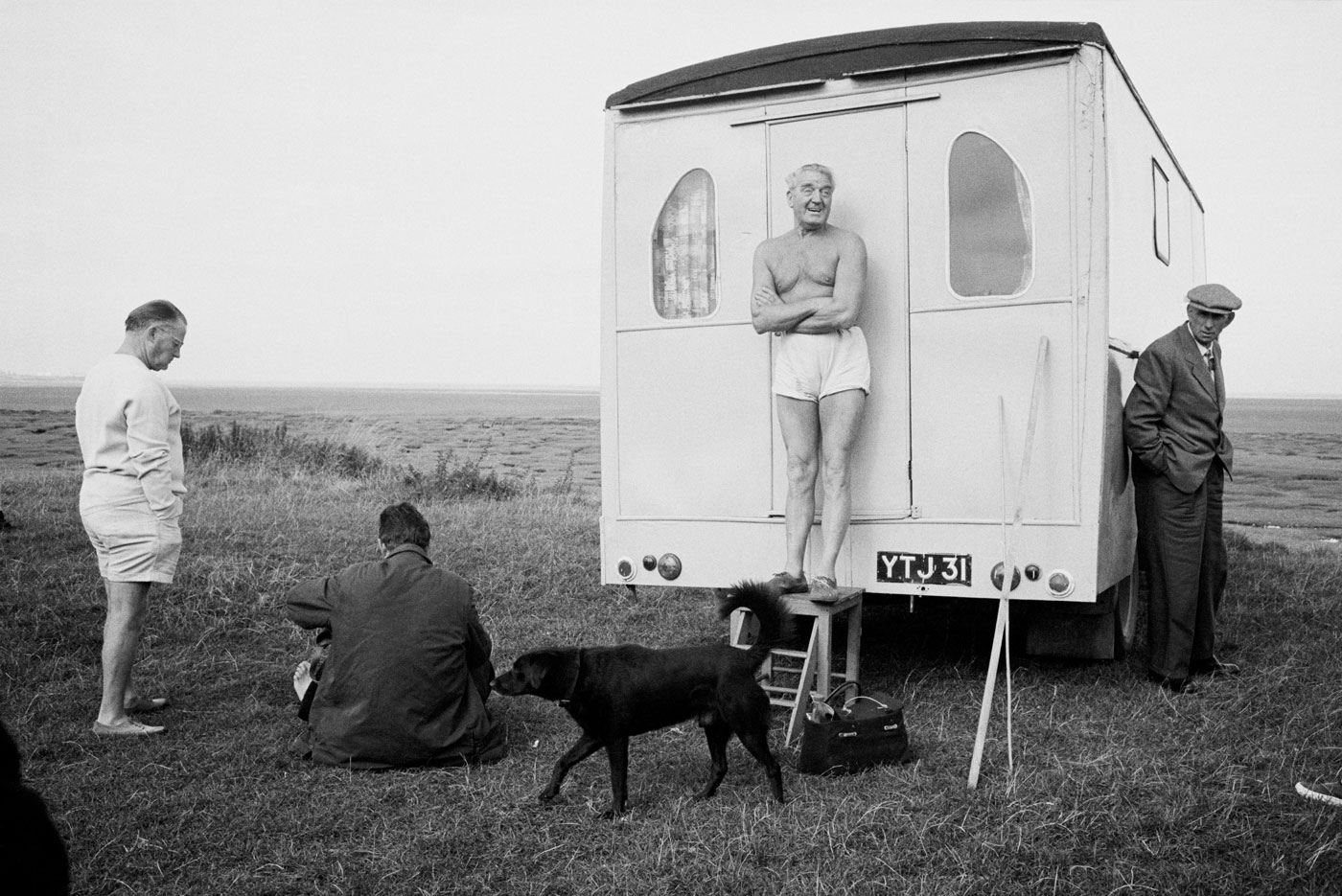
Traveller Homes, a film about Dave Fawcett made by Tom Hunter and Robin Christian in France in 2013.

“Sadly a large part of this activity has become transformed into a nostalgic archive for a lifestyle that has largely disappeared from the highways & byways of England.” (Dave Fawcett, 2013)

Dave Fawcett’s archive of converted buses and trucks is a unique photographic record which formed the basis for his Traveller Homes website. His topographic studies record a segment of English social history, which still struggles to survive.

Since graduating from Leicester University in 1984 ‘Traveller’ Dave Fawcett has embraced the bender lifestyle. His first ‘mobile home’ was an ex-British Telecom Bedford TK. In 1992 he bought a 1966 Albion Chieftain furniture lorry and drove it on a one-way trip to Europe. He survives as a fruit picker during the summer months and still lives on his bus.

A selection from Dave Fawcett’s ‘Traveller Homes’ series is showing in Life on the Road, a Photography and the Archive Research Centre (PARC) project, made in partnership with London College of Communication as part of Green Week, 2014.

The exhibition features photography by Tom Hunter and Dave Fawcett and films by Andrew Gaston, at London College of Communication from 6 – 26 February 2014.


Travellers Homes website

LIKE ART BLART ON FACEBOOK

Back to top

Exhibition: ‘See the Light – Photography, Perception, Cognition: The Marjorie and Leonard Vernon Collection’ at The Los Angeles County Museum of Art (LACMA)

Exhibition dates: 27th October 2013 – 23rd March 2014


William Henry Fox Talbot (England, 1800-1877) 'Articles of China' c. 1844


William Henry Fox Talbot (English, 1800-1877)
Articles of China
c. 1844
Calotype
5 3/8 x 7 1/8 in. (13.65 x 18.1cm)
The Marjorie and Leonard Vernon Collection, gift of The Annenberg Foundation, acquired from Carol Vernon and Robert Turbin


It is a real joy to bring these beautiful images to you!

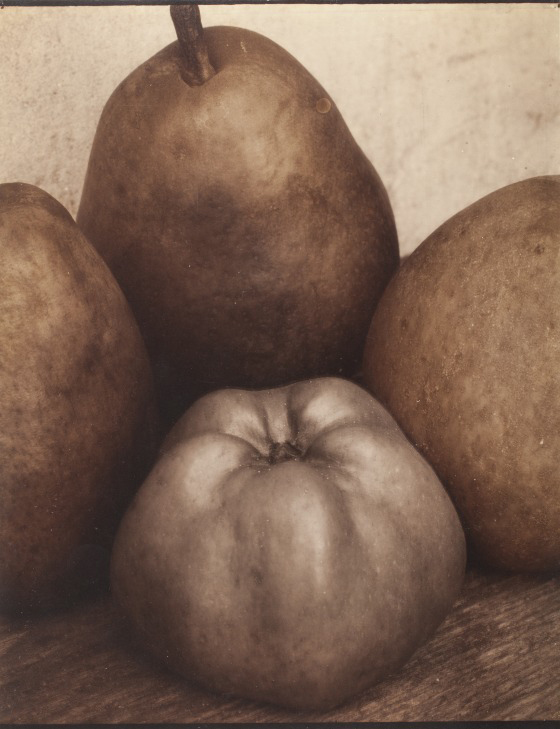
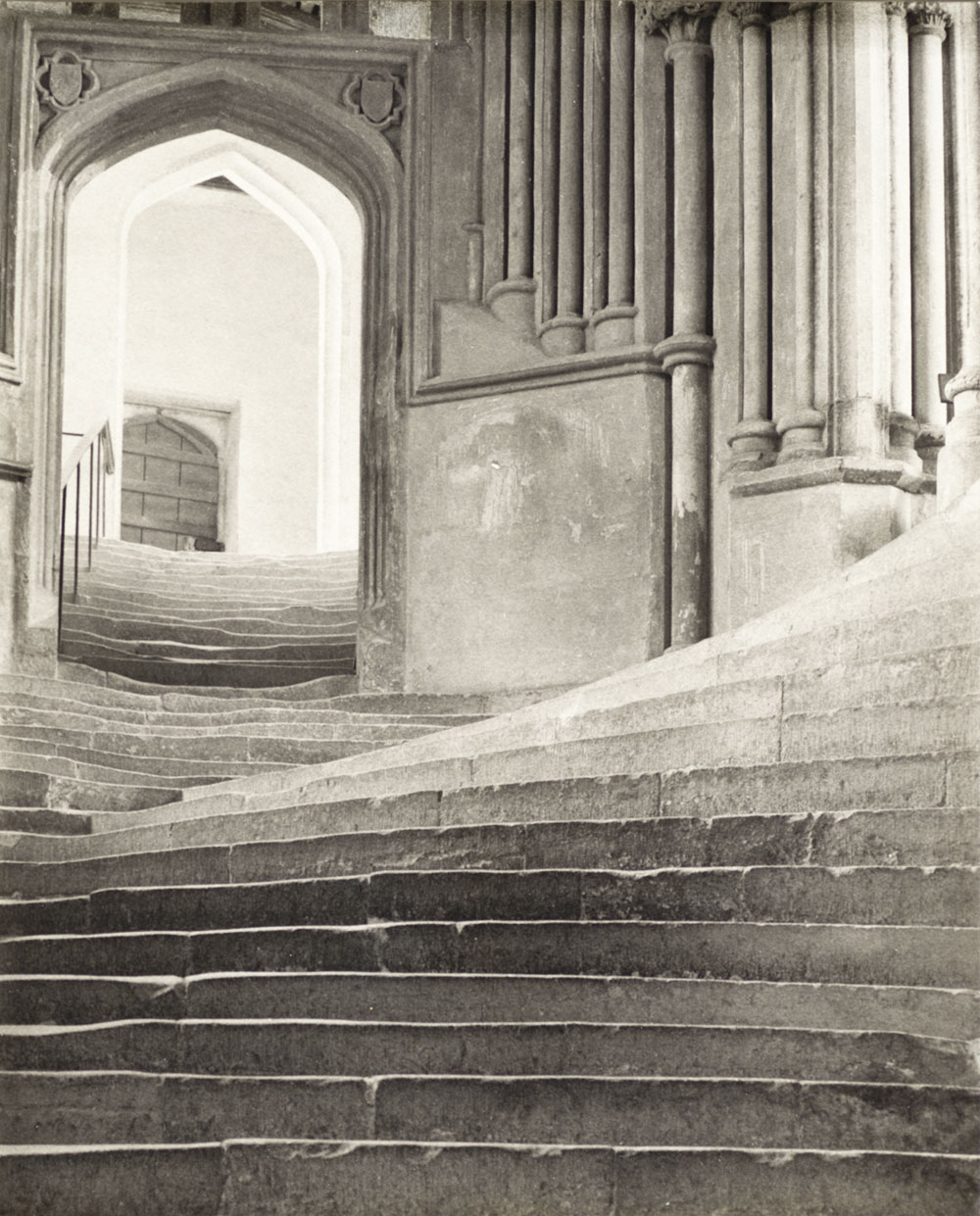
Frederick H. Evans A Sea Of Steps – Wells Cathedral (England, 1903, below) is one of my favourite photographs of all time, up there in my top 20 or so. But you wouldn’t knock back any of these for your collection, especially Imogen Cunningham’s Magnolia Blossom (1925, below) and Edward Steichen’s Three Pears & An Apple (1921, below).

Marcus


Many thankx to The Los Angeles County Museum of Art for allowing me to publish the photographs in the posting. Please click on the photographs for a larger version of the image.


Linnaeus Tripe (England, 1822-1902) 'The Elliot Marbles, Central Museum, Madras' India, 1858


Linnaeus Tripe (English, 1822-1902)
The Elliot Marbles, Central Museum, Madras
India, 1858
Albumen photograph
10 1/2 × 13 in. (26.67 × 33.02cm)
The Marjorie and Leonard Vernon Collection, gift of The Annenberg Foundation, acquired from Carol Vernon and Robert Turbin


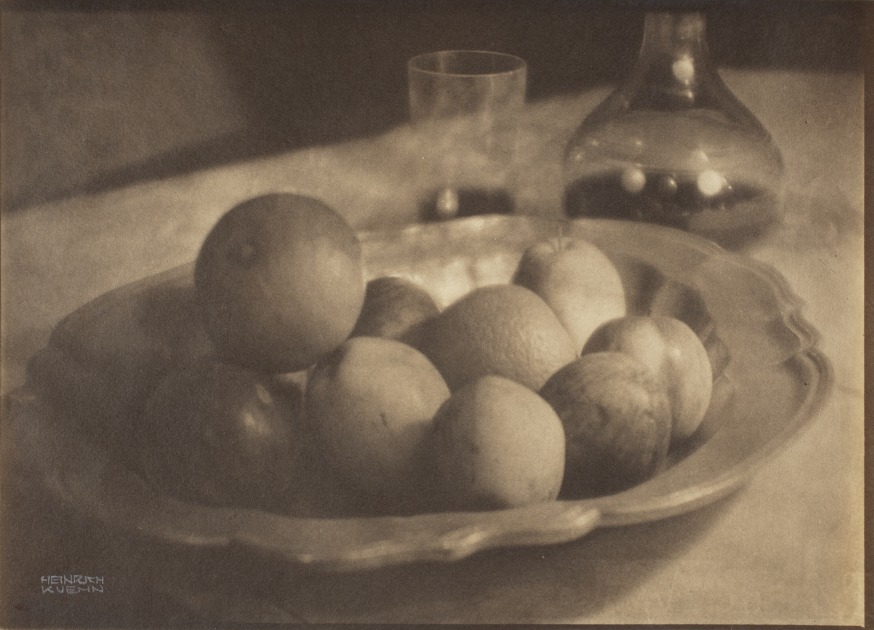
Carl Christian Heinrich Kühn (Germany, active Austria, 1866-1944) 'Still Life' c. 1905


Carl Christian Heinrich Kühn (Germany, active Austria, 1866-1944)
Still Life
c. 1905
Bromoil print
8 1/4 × 11 1/2 in. (20.96 × 29.21cm)
The Marjorie and Leonard Vernon Collection, gift of The Annenberg Foundation, acquired from Carol Vernon and Robert Turbin
© Estate of Heinrich Kühn


Imogen Cunningham (United States, 1883-1976) 'Magnolia Blossom' 1925


Imogen Cunningham (United States, 1883-1976)
Magnolia Blossom
1925
Gelatin silver print
The Marjorie and Leonard Vernon Collection, gift of The Annenberg Foundation, acquired from Carol Vernon and Robert Turbin
© 1925, 2013 Imogen Cunningham Trust


Charles Harbutt (United States, New Jersey, Camden, born 1935) 'Triptych' 1978, printed 1978


Charles Harbutt (United States, New Jersey, Camden, born 1935)
Triptych
1978, printed 1978
Gelatin silver prints
8 x 12″
The Marjorie and Leonard Vernon Collection, gift of The Annenberg Foundation, acquired from Carol Vernon and Robert Turbin
© Charles Harbutt. All rights reserved, Courtesy Peter Fetterman Gallery


The Los Angeles County Museum of Art (LACMA) presents See the Light – Photography, Perception, Cognition: The Marjorie and Leonard Vernon Collection, an exhibition celebrating an extraordinary collection and exploring parallels between photography and the science of vision. Since the invention of photography in the late 1830s, the medium has evolved in relation to theories about vision, perception, and cognition. The exhibition takes a historical perspective, identifying correlations between photography and the science of vision during four chronological periods. See the Light is comprised of 220 works by more than 150 artists, including Ansel Adams, Julia Margaret Cameron, Imogen Cunningham, William Henry Fox Talbot, Edward Steichen, Edward Weston, Minor White, and many more.

The exhibition draws entirely from the Marjorie and Leonard Vernon Collection, a key collection within LACMA’s Wallis Annenberg Photography Department. Acquired in 2008, the collection represents the diversity of photographic processes from the medium’s invention in 1839 to the 21st century. See the Light is accompanied by a free mobile-phone multimedia tour featured on mobile.lacma.org with commentary by the Vernons’ daughter, Carol Vernon; curator Britt Salvesen; artist James Welling; expert in computational vision Pietro Perona; and others. A 208-page catalogue, published by LACMA and DelMonico Books / Prestel, includes an essay by Britt Salvesen with contributions from Todd Cronan, Antonio Damasio, Alan Gilchrist, Pietro Perona, Barbara Maria Stafford, and James Welling. A new web page features excerpts from LACMA’s Vernon Oral History Project, an ongoing series of interviews with prominent artists, curators, dealers, and scholars who worked closely with the Vernons.

“Photography is often approached from either the artistic or the technological point of view, but these two aspects of the medium have been intertwined since its invention,” said Britt Salvesen, Department Head and Curator of the Wallis Annenberg Photography Department. “As a scientific instrument, the camera operates as an infallible eye, augmenting physiological vision, and as an artist’s tool, it channels the imagination, recording creative vision. The Marjorie and Leonard Vernon Collection offers unparalleled scope to the spirit of both science and art.”

The Marjorie and Leonard Vernon Collection

Through a groundbreaking gift from Wallis Annenberg and the Annenberg Foundation, and with the support of Carol Vernon and Robert Turbin, LACMA acquired the Marjorie and Leonard Vernon Collection in 2008. Comprising of more than 3,600 prints by almost 700 artists, the Marjorie and Leonard Vernon Collection at LACMA constitutes one of the finest collections of photography spanning the 19th and 20th centuries. LACMA’s acquisition of this collection makes it possible for the museum to represent photography’s breadth in the context of its encyclopaedic collections.

Marjorie and Leonard Vernon were avid collectors in the Los Angeles and Southern California communities. The Vernons built their collection beginning around 1975, cultivating a group of works with global significance, with a special emphasis on West Coast photography of the early and mid-20th century. The collection grew over the years to include works by international photographers, with the earliest photographs dating from the 1840s and the latest to 2001.

Exhibition organisation

See the Light is organised thematically and traces the trajectory of advanced research on cognition and perception in relation to the art of photography. Four approaches within photography are identified: descriptive naturalism, subjective naturalism, experimental modernism, and romantic modernism.

Descriptive naturalism: Early advocates of photography (from the 1840s through around 1880) were eager to recruit the authority of science without sacrificing the romance of art. The notion that the camera could make a pure transcription of nature, undistorted by human error, took hold at precisely the moment with research in physiological optics revealed the complexities of the human visual system. The depiction of far-off landscapes was one of photography’s key functions in its descriptive naturalist phase, as in Carleton Watkins’s commanding views of the American West, which recorded the natural splendour of the landscape and its settlement.

Subjective naturalism: In the late 19th century, experimental psychology, a newly defined scientific discipline, addressed the progression of sensation into interpretation. At the same time, champions of artistic photography introduced the possibilities of expression, ambiguous form, and abstraction into a medium previously valued for its descriptive functions. Heinrich Kühn’s mastery of painterly techniques, for example, led to the creation of photographs on par with paintings or charcoal drawings. Ultimately Kühn’s photographs depict dreams or memories as much as physical reality.

Experimental Modernism: After World War I, photography became a key tool for avant-garde artists determined to deploy technology in a positive rather than destructive manner, thus restoring balance within the individual psyche and within society at large. The abstract works of György Kepes, influenced by Gestalt psychology, represent a European version of this tendency, which he and other emigrés brought to the United States. A later heir to this tradition is Barbara Kasten, who uses photography to explore key interests including transparency, colour, light, and structure.

Romantic Modernism: Inspired by nature, romantic modernism isolated moments of direct personal contact with the world, and explored the specific capabilities of photography. Despite an apparent divergence of art and science following World War II, photography was a site of connection. Ansel Adams believed in the artist’s unique vision, while also advocating technical precision to realise it. Concurrently, scientists were focusing on contrast perception, the neurological mechanisms by which we distinguish objects and make sense of spatial arrangements. Scientists and photographers alike had to understand the visual system and its responses to black and white.”

Press release from the LACMA website


Edward Steichen (Luxembourg, active United States, 1879-1973) 'Three Pears & An Apple' 1921, printed 1921


Edward Steichen (Luxembourg, active United States, 1879-1973)
Three Pears & An Apple
1921, printed 1921
Gelatin silver print
9 5/8 × 7 1/2 in. (24.45 × 19.05cm)
The Marjorie and Leonard Vernon Collection, gift of The Annenberg Foundation and promised gift of Carol Vernon and Robert Turbin
© The Estate of Edward Steichen


William Henry Fox Talbot (England, 1800-1877) 'Lace' 1841


William Henry Fox Talbot (England, 1800-1877)
Lace
1841
Calotype
7 1/2 × 9 1/4 in. (19.05 × 23.5cm)
The Marjorie and Leonard Vernon Collection, gift of The Annenberg Foundation and promised gift of Carol Vernon and Robert Turbin


Andrew Young (England, active 1870-1879) 'Plane at Aberdour, in Old Avenue' Scotland, late 1870s


Andrew Young (English, active 1870-1879)
Plane at Aberdour, in Old Avenue
Scotland, late 1870s
Woodbury type
9 1/8 × 7 3/8 in. (23.18 × 18.73cm)
The Marjorie and Leonard Vernon Collection, gift of The Annenberg Foundation, acquired from Carol Vernon and Robert Turbin


Frederick H. Evans (England, 1853-1943) 'A Sea Of Steps - Wells Cathedral' England, 1903


Frederick H. Evans (English, 1853-1943)
A Sea Of Steps – Wells Cathedral
England, 1903
Platinum print
9 x 7 1/4 in. (22.86 x 18.44cm)
The Marjorie and Leonard Vernon Collection, gift of The Annenberg Foundation and Carol Vernon and Robert Turbin
© Frederick H. Evans, courtesy Janet B. Stenner


Jaroslav Rössler (Bohemia, Havlíčkův Brod, 1902-1990) 'Still Life with Small Bowl' Czechoslovakia (now Czech Republic), 1923


Jaroslav Rössler (Bohemia, Havlíčkův Brod, 1902-1990)
Still Life with Small Bowl
Czechoslovakia (now Czech Republic), 1923
Gelatin silver print
8 7/8 × 9 3/8 in. (22.54 × 23.81cm)
The Marjorie and Leonard Vernon Collection, gift of The Annenberg Foundation and promised gift of Carol Vernon and Robert Turbin


György Kepes (Hungary, active United States, 1906-2001) 'Balance' 1942, printed 1942


György Kepes (Hungary, active United States, 1906-2001)
Balance
1942, printed 1942
Gelatin Silver Print
The Marjorie and Leonard Vernon Collection, gift of The Annenberg Foundation, acquired from Carol Vernon and Robert Turbin
© The György Kepes Estate


Los Angeles County Museum of Art (LACMA)
5905 Wilshire Boulevard (at Fairfax Avenue)
Los Angeles, CA, 90036
Phone: 323 857-6000

Opening Hours:
Monday – Tuesday, Thursday 11am – 6pm
Friday 11am – 8pm
Saturday – Sunday 10am – 7pm
Closed Wednesday

LACMA website

LIKE ART BLART ON FACEBOOK

Back to top

Exhibition: ‘Only in England: Photographs by Tony Ray-Jones and Martin Parr’ at Media Space at Science Museum, London

Exhibition dates: 21st September 2013 – 16th March 2014


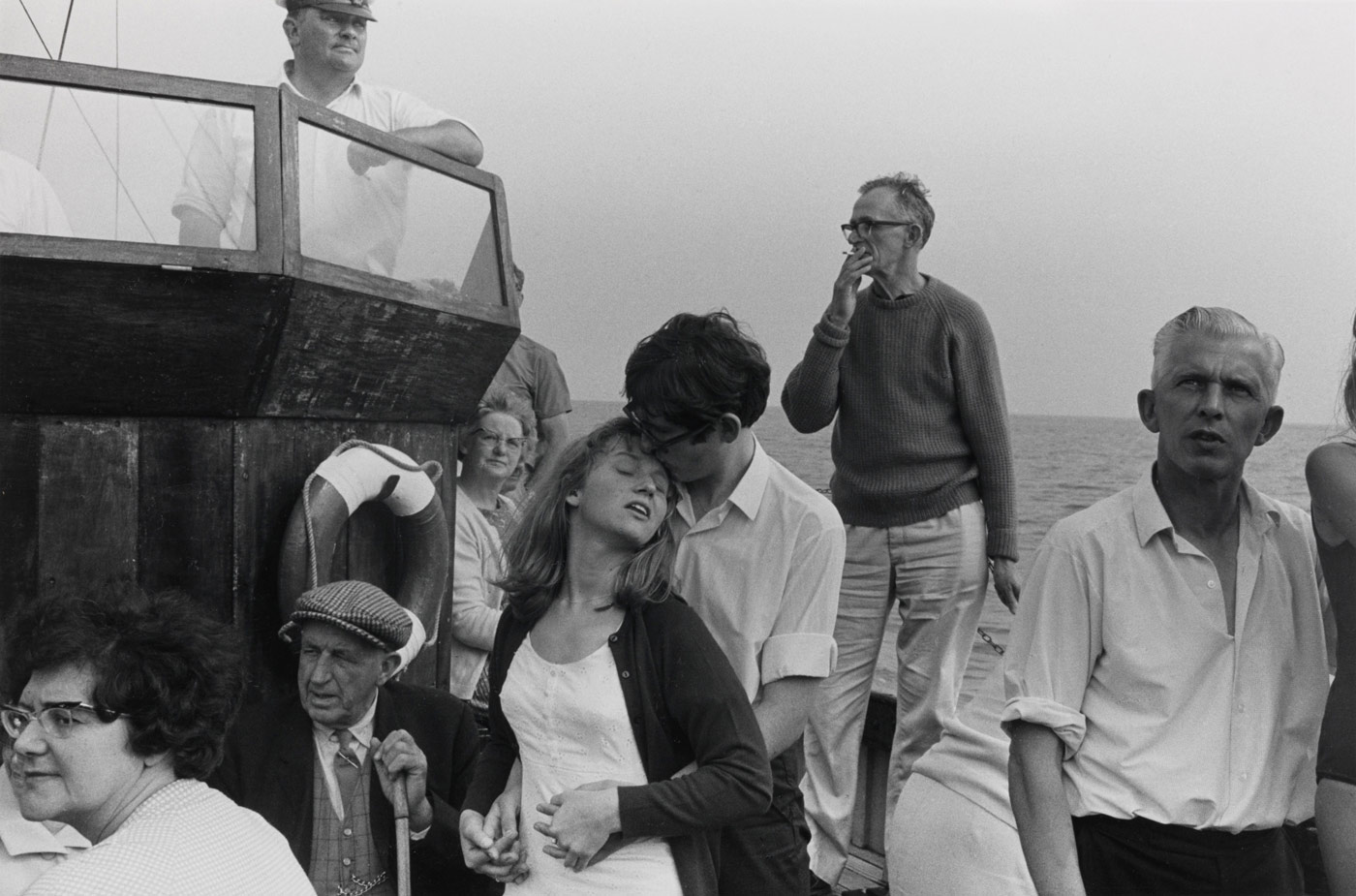
Tony Ray-Jones (English, 1941-1972) 'Beachy Head Tripper Boat, 1967' 1967


Tony Ray-Jones (English, 1941-1972)
Beachy Head Tripper Boat, 1967
1967
© National Media Museum


“Be more aware of composition

Don’t take boring pictures

Get in closer

Watch camera shake

Don’t shoot too much”


Tony Ray-Jones from his diaries


Growing up in the 1960s we used to get taken to Butlins holiday camps (Billy Butlin founded the company, a chain of large holiday camps in the United Kingdom, to provide affordable holidays for ordinary British families). It was a great treat to be away from the farm, to be by the sea, even if the beach was made of stones. Looking back on it now you realise how seedy it was, how working class… but as a kid it was oh, so much fun!

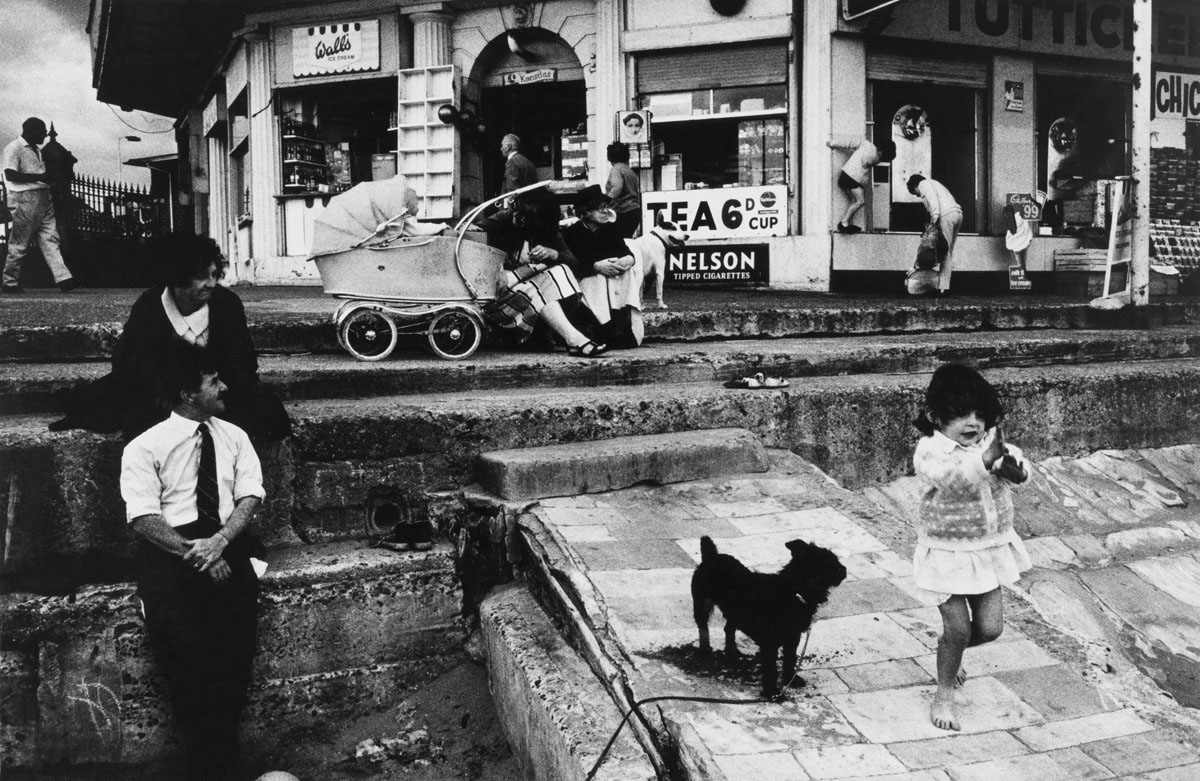
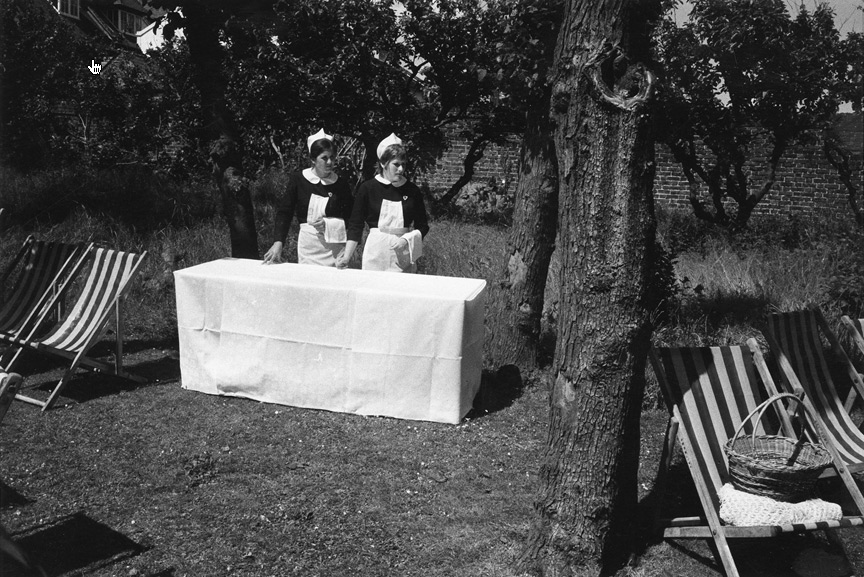
Tony Ray-Jones photographed these environments (mainly the British at play by the sea) and their opposites – afternoon tea taken at Glyndebourne opera festival for example (Glyndebourne, 1967, below) – drawing on the tradition of great British social documentary photography by artists such as Bill Brandt. TRJ even pays homage to Brandt in one of his photographs, Dickens Festival, Broadstairs, c. 1967 (below) which echoes Brandt’s famous photograph Parlourmaid and Under-parlourmaid Ready to Serve Dinner, 1933 by changing “point of view” from up close, personal, oppressive and interior to distance, isolation, leisure/work and exterior.

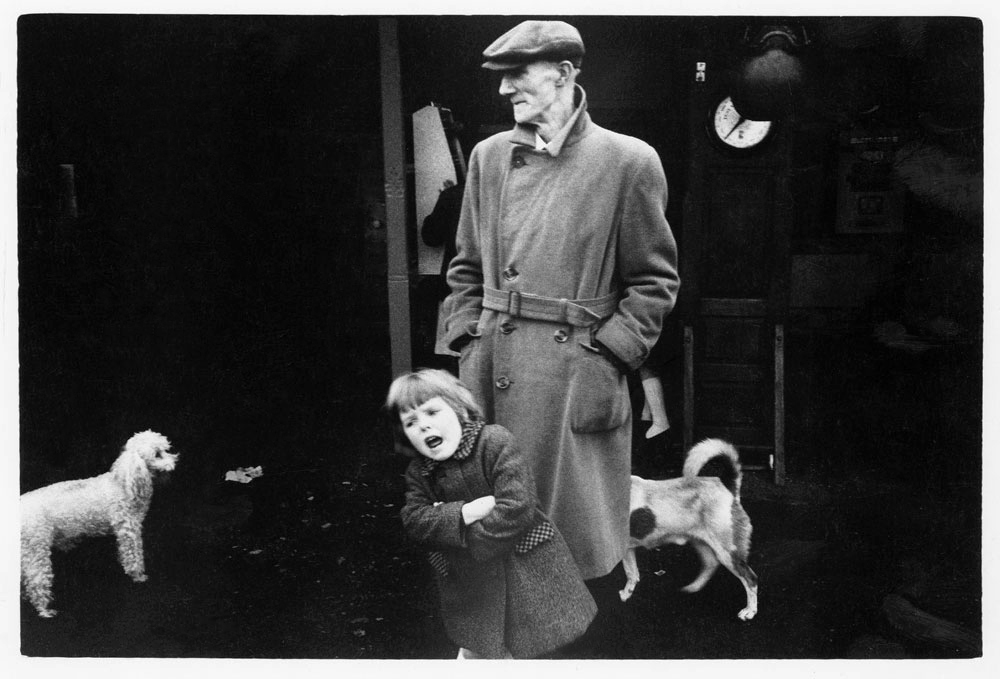
Through his photographs Ray-Jones adds his own style and humour, using “a new conception of photography as a means of expression, over and above its accepted role as a recorder.” He does it all as an intimate expression of his own personality, his maverick, outsider, non-conformist self. I feel – and that is the key word with his art – that he had a real empathy with his subject matter. There is a twinkle in his eye that becomes embedded in his photographs. There is an honesty, integrity and respect for the people he is photographing, coupled with a wicked sense of humour and the most amazing photographic eye. What an eye he had!

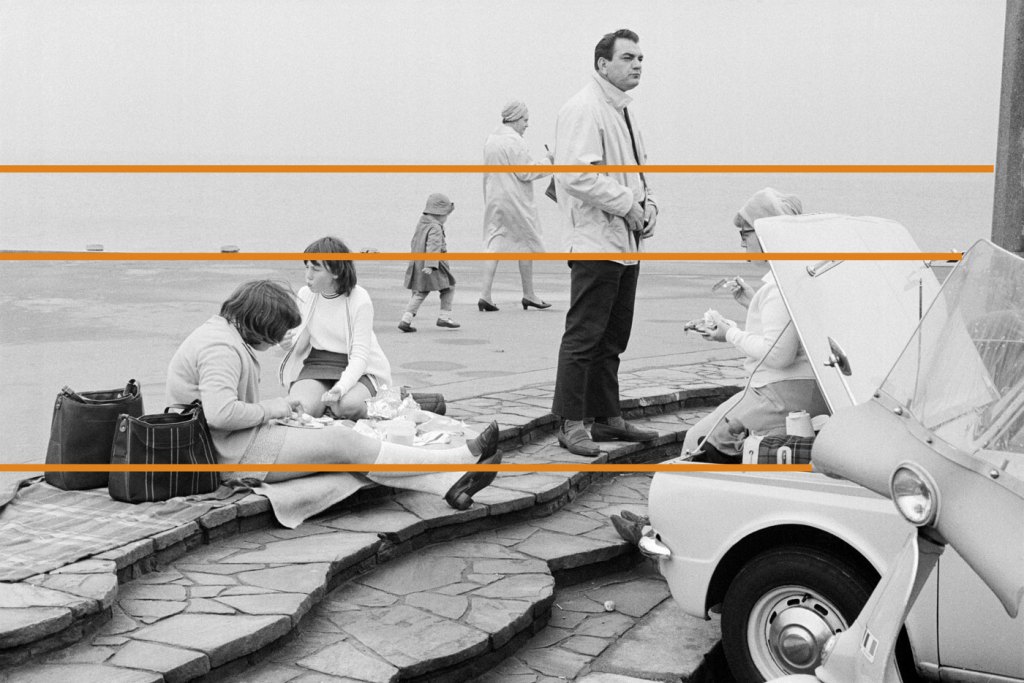
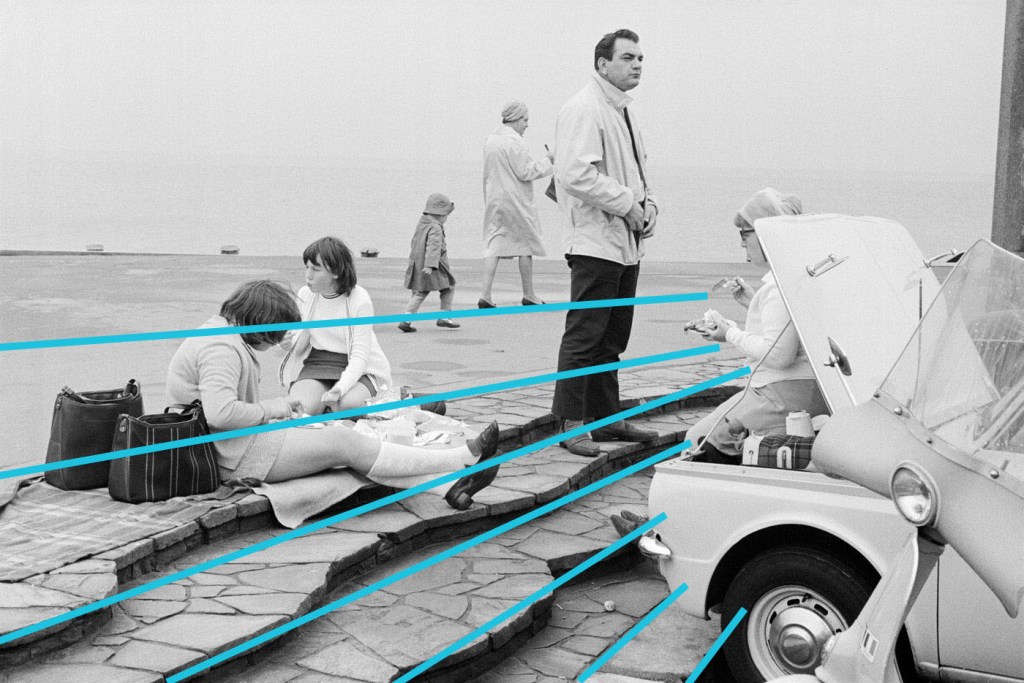
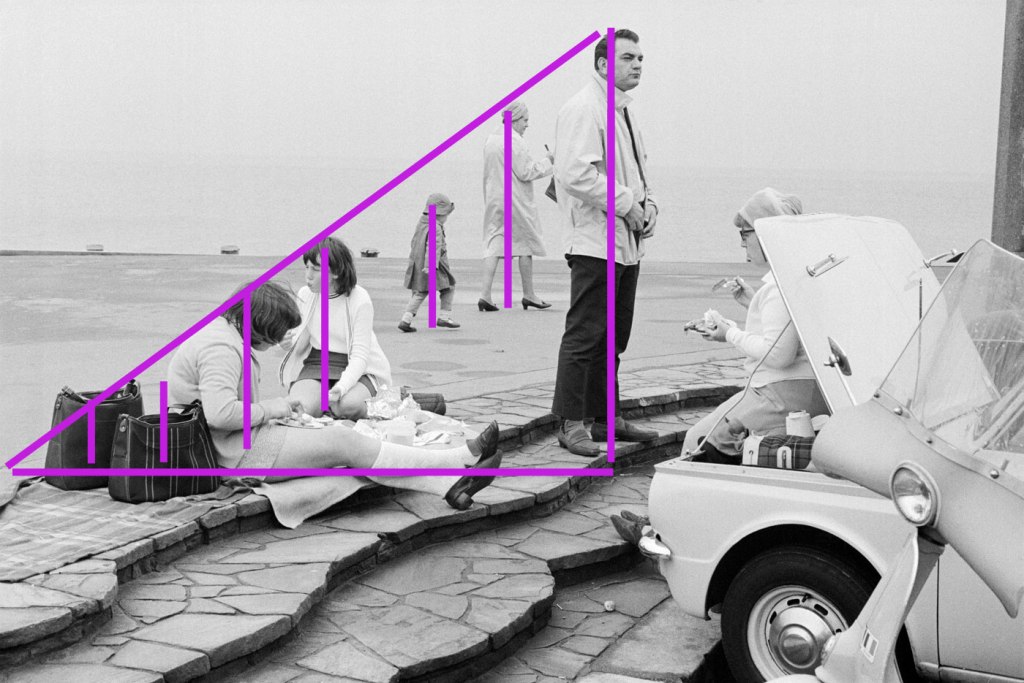
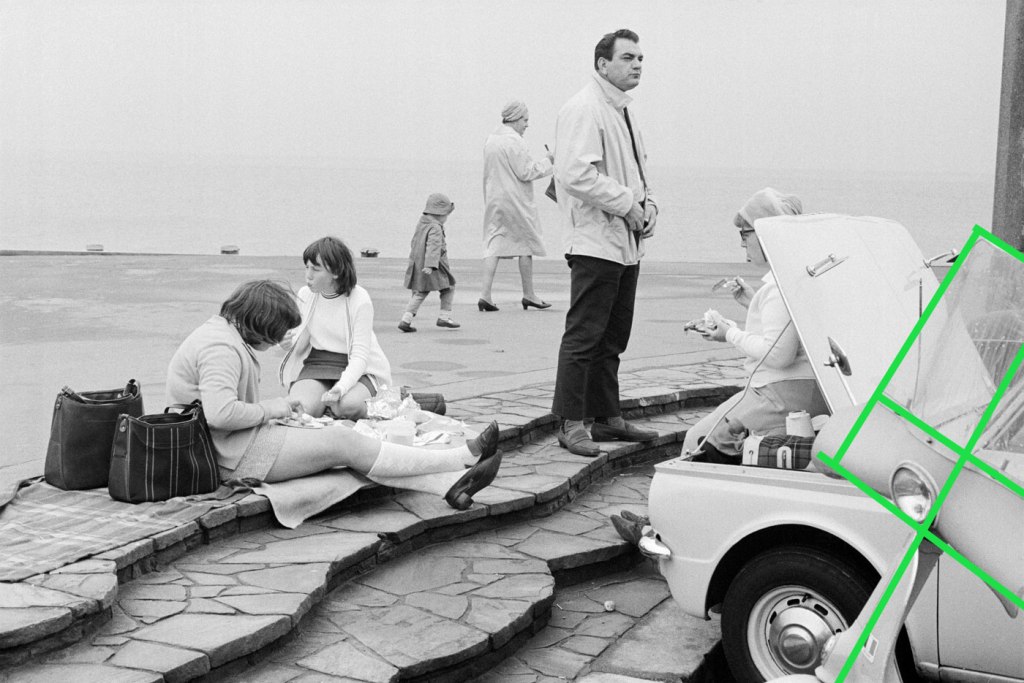
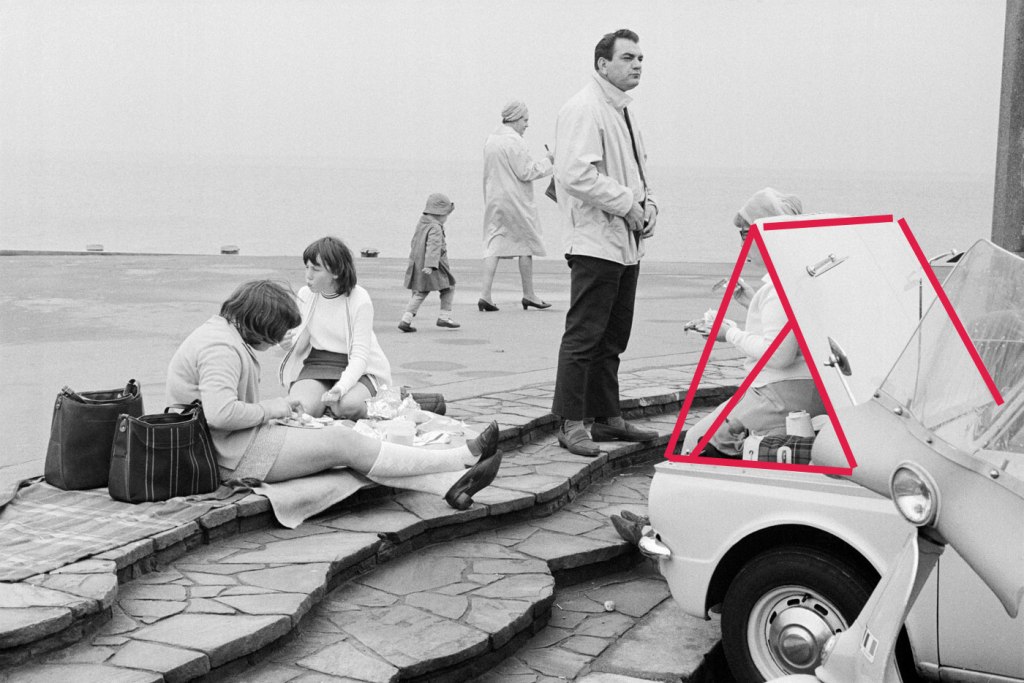
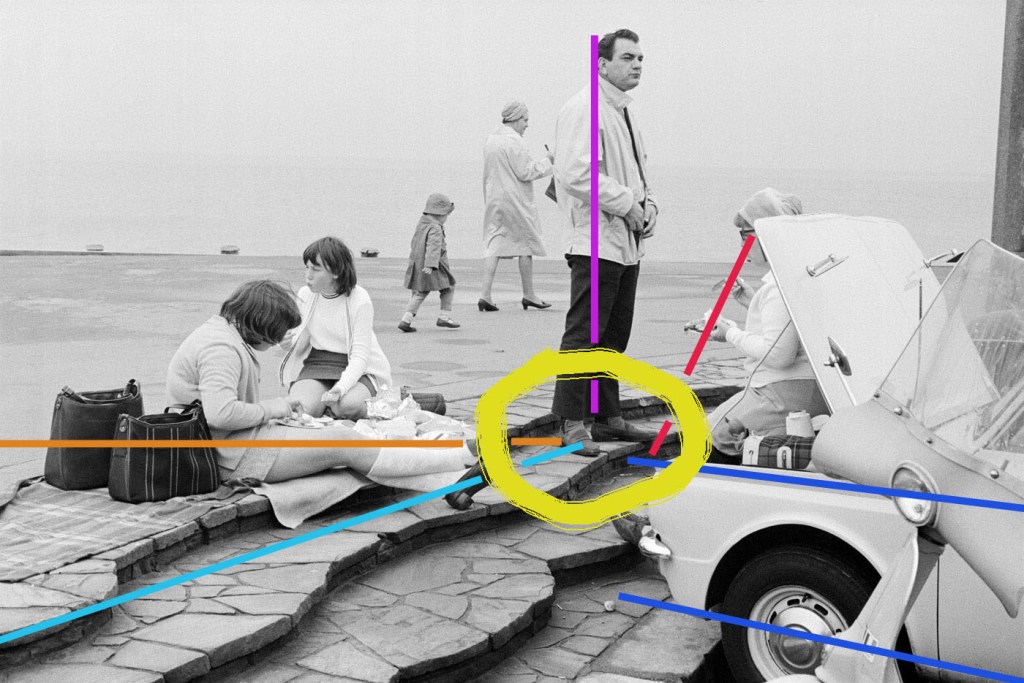
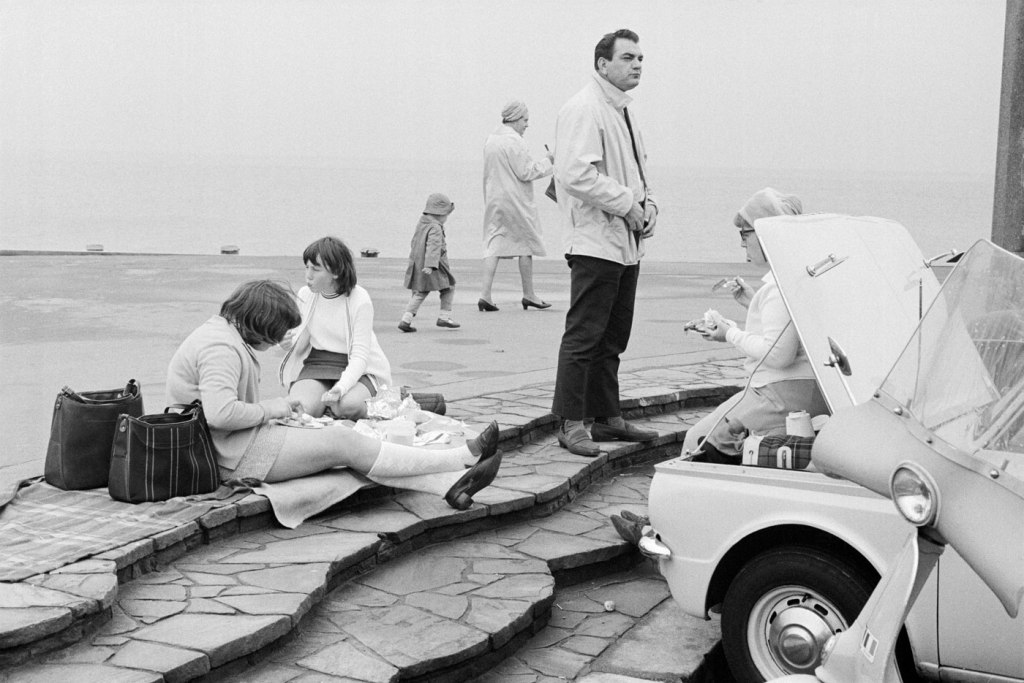
To be able to sum up a scene in a split second, to previsualise (think), intuitively compose, frame and shoot in that twinkle of an eye, and to balance the images as he does is truly the most incredible gift, the quintessential British “decisive moment”. Look at the structural analysis of Location unknown, possibly Worthing (1967-1968, below) that I have presented in a slide show. This will give you a good idea of the visual complexity of Ray-Jones’ images… and yet he makes the sum of all components seem grounded (in this case by the man’s feet) and effortless. Devon Caranicas has observed that TRJ possessed a quick wit and adeptness for reducing a complex narrative into a single frame, the photographed subjects transformed into social actors of supreme stereotypes. The first part is insightful, but social actors of supreme stereotypes? I think not, because these people are not acting, this is their life, their humanity, their time out from the hum-drum of everyday working class life. They do not pose for TRJ, it’s just how they are. Look at the musicality of the first five images in the posting – how the line rises and falls, moves towards you and away from you. Only a great artist can do that, instinctively.

I cannot express to you enough the utmost admiration I have for this man’s art. In my opinion he is one of greatest British photographers that has ever lived (Julia Margaret Cameron, William Henry Fox Talbot, Roger Fenton, Francis Bedford, Frederick H. Evans, Cecil Beaton, Peter Henry Emerson and Herbert Ponting would be but a few others that spring to mind). He photographed British customs and values at a time of change and pictured a real affection for the lives of ordinary working class people. Being one of the them, he will always hold a special place in my heart.

Dr Marcus Bunyan


Many thankx to Media Space at Science Museum for allowing me to publish the photographs in the posting. Please click on the photographs for a larger version of the image.


“Although the entirety of the images from Only in England were shot throughout the politically and socially turbulent late 60’s and early 70’s both artists shy away from depicting the culture clashes that so often visually defined this period. Instead, they each opted to turn their lens onto the quintessential country side, and in doing so, pay homage to a traditional type of English life that was becoming a sort of sub-culture in itself – a way of living that was not yet touched by the encroaching globalisation, or “americanisation,” of the UK.”

Anonymous text on the ART WEDNESDAY website September 26th, 2013 [Online] Cited 05/03/2014. No longer available online


“Ray-Jones printed his black and white pictures small, in a dark register of tonally very dense prints. The National Media Museum has lots of these, and perhaps to devote the cavernous new space only to such small pictures would have been a mistake. Even backed up with a mass of supporting material, including the fascinating pages from Ray-Jones’ diaries, the prints would struggle to fill the space. So only the first section is devoted to about 50 beautiful little Ray-Jones vintage prints. Two whole sections have been added to the exhibition to flesh it out…

[Parr] has unfortunately chosen to print them [Ray-Jones prints] in a way quite alien to anything Ray-Jones ever made: they are printed in Parr’s own way, as larger, paler, more diffuse things in mid-tones that Ray-Jones would never have countenanced. They are printed, inevitably, by digital process…

Sadly, these Ray-Jones by Parr prints add up to an appropriation of the former by the latter: they are Martin Parr pictures taken from Tony-Ray Jones negatives, and it would have been better not to have shown them so. They are fine images, but they should have been seen in some other way: on digital screens, perhaps, or as modern post-cards. Anything to make quite explicit the clear break with Ray-Jones’ own prints. That the images they contain are very fine is not in doubt. But I take leave to question whether they “present a new way of thinking through creative use of the collections”. They are well labelled and for specialists there will be no difficulty in knowing that they are not by Ray-Jones. But for the public I am not so sure. Suddenly two-thirds of the show are in this larger, modern, digitally printed form, either by Parr himself or by Ray-Jones-through-Parr. It looks as if that is the dominant group…”

Extract from Francis Hodgson. “Two Exhibitions of Tony Ray-Jones – Two Ways of Giving Context to Photographs,” on the Photomonitor website, September 2013 Cited 05/03/2014 no longer available online


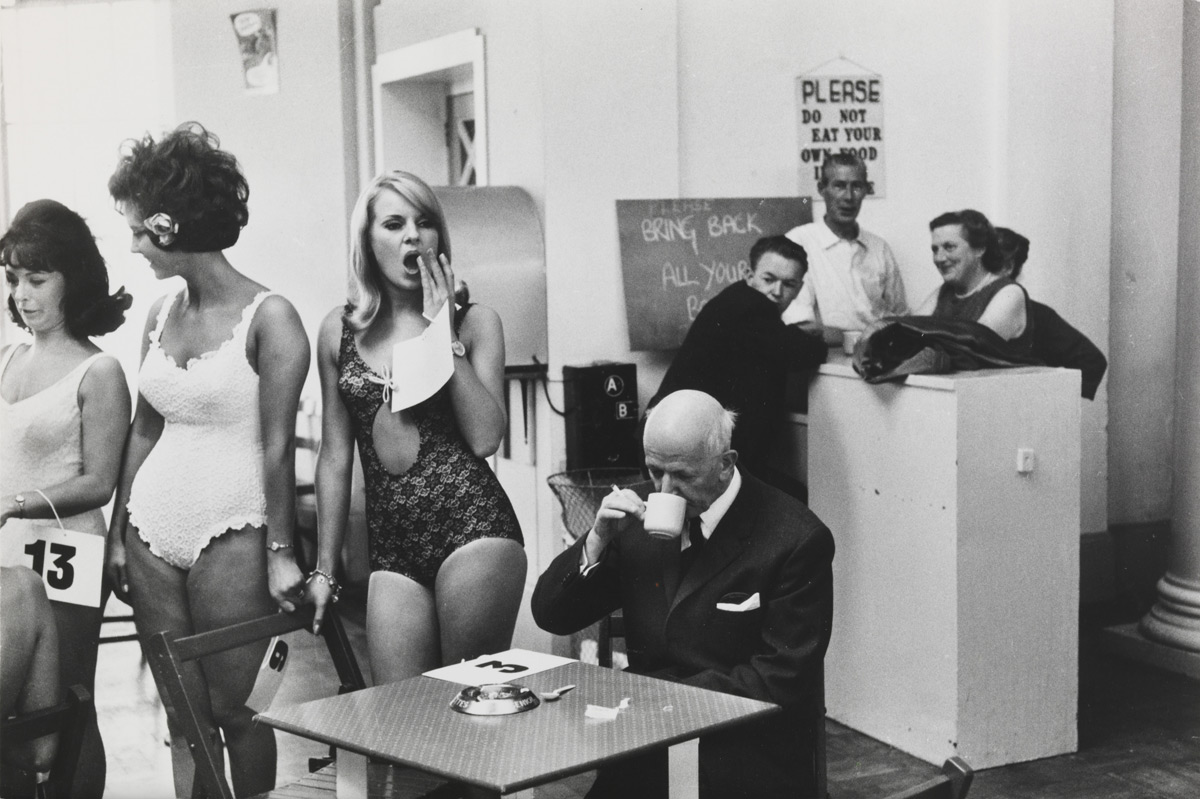
Tony Ray-Jones (English, 1941-1972) 'Beauty contestants, Southport, Merseyside, 1967' 1967


Tony Ray-Jones (English, 1941-1972)
Beauty contestants, Southport, Merseyside, 1967 
1967
© National Media Museum


Tony Ray-Jones (English, 1941-1972) 'Brighton Beach, West Sussex, 1966' 1966


Tony Ray-Jones (English, 1941-1972)
Brighton Beach, West Sussex, 1966
1966
© National Media Museum


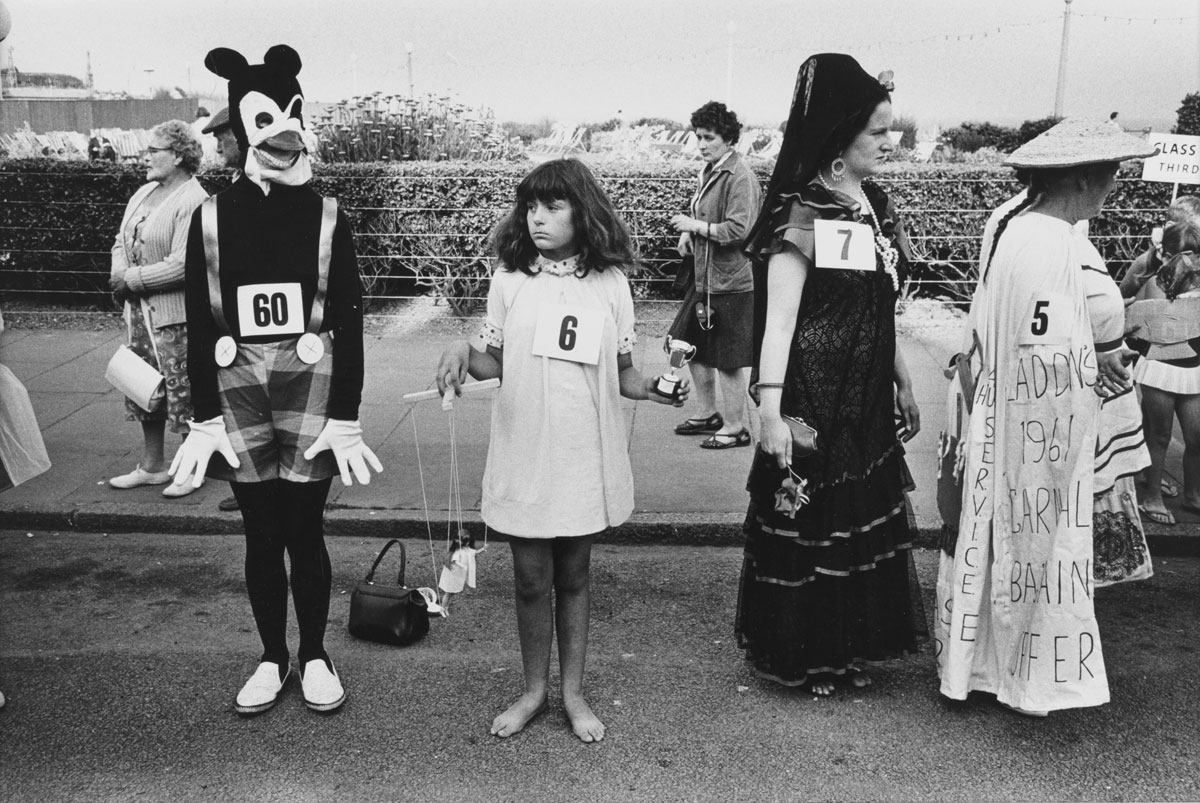
Tony Ray-Jones (English, 1941-1972) 'Eastbourne Carnival, 1967' 1967


Tony Ray-Jones (English, 1941-1972)
Eastbourne Carnival, 1967
1967
© National Media Museum


Tony Ray-Jones (English, 1941-1972) 'Blackpool, 1968' 1968


Tony Ray-Jones (English, 1941-1972)
Blackpool, 1968
1968
© National Media Museum


Tony Ray-Jones (English, 1941-1972) 'Location unknown, possibly Worthing' 1967-1968


Tony Ray-Jones (English, 1941-1972)
Location unknown, possibly Worthing
1967-1968
© National Media Museum


This slideshow requires JavaScript.


Tony Ray-Jones Location unknown, possibly Worthing (1967-68) picture analysis by Dr Marcus Bunyan


Fascinated by the eccentricities of English social customs, Tony Ray-Jones spent the latter half of the 1960s travelling across England, photographing what he saw as a disappearing way of life. Humorous yet melancholy, these works had a profound influence on photographer Martin Parr, who has now made a new selection including over 50 previously unseen works from the National Media Museum’s Ray-Jones archive. Shown alongside The Non-Conformists, Parr’s rarely seen work from the 1970s, this selection forms a major new exhibition which demonstrates the close relationships between the work of these two important photographers.

The first ever major London exhibition of work by British Photographer, Tony Ray-Jones (1941-1972) will open at Media Space on 21 September 2013. The exhibition will feature over 100 works drawn from the Tony Ray-Jones archive at the National Media Museum alongside 50 rarely seen early black and white photographs, The Non-Conformists, by Martin Parr (1952).

Between 1966 and 1969 Tony Ray-Jones created a body of photographic work documenting English customs and identity. Humorous yet melancholy, these photographs were a departure from anything else being produced at the time. They quickly attracted the attention of the Institute of Contemporary Arts (ICA), London where they were exhibited in 1969. Tragically, in 1972, Ray-Jones died from Leukaemia aged just 30. However, his short but prolific career had a lasting influence on the development of British photography from the 1970s through to the present.

In 1970, Martin Parr, a photography student at Manchester Polytechnic, had been introduced to Ray-Jones. Inspired by him, Parr produced The Non-Conformists, shot in black and white in Hebden Bridge and the surrounding Calder Valley. This project started within two years of Ray-Jones death and demonstrates his legacy and influence.

The exhibition will draw from the Tony Ray-Jones archive, held by the National Media Museum.  Around 50 vintage prints will be on display alongside an equal number of photographs which have never previously been printed. Martin Parr has been invited to select these new works from the 2700 contact sheets and negatives in the archive. Shown alongside these are Parr’s early black and white work, unfamiliar to many, which has only ever previously been exhibited in Hebden Bridge itself and at Camerawork Gallery, London in 1981.

Tony Ray-Jones was born in Somerset in 1941. He studied graphic design at the London School of Printing before leaving the UK in 1961 to study on a scholarship at Yale University in Connecticut, US. He followed this with a year long stay in New York during which he attended classes by the influential art director Alexey Brodovitch, and became friends with photographers Joel Meyerowitz and Garry Winogrand. In 1966 he returned to find a Britain still divided by class and tradition. A Day Off – An English Journal, a collection of photographs he took between 1967-1970 was published posthumously in 1974 and in 2004 the National Media Museum held a major exhibition, A Gentle Madness: The Photographs of Tony Ray-Jones.

Martin Parr was born in Epsom, Surry in 1952. He graduated from Manchester Polytechnic in 1974 and moved to Hebden Bridge in West Yorkshire, where he established the ‘Albert Street Workshop’, a hub for artistic activity in the town. Fascinated by the variety of non-conformist chapels and the communities he encountered in the town he produced The Non-Conformists. In 1984 Parr began to work in colour and his breakthrough publication The Last Resort was published in 1986. A Magnum photographer, Parr is now an internationally renowned photographer, filmmaker, collector and curator, best-known for his highly saturated colour photographs critiquing modern life.

Only in England: Photographs by Tony Ray-Jones and Martin Parr will run at Media Space, Science Museum from 21 September 2013 – 16 March 2014. The exhibition will then be on display at the National Media Museum from 22 March – 29 June 2014. The exhibition is curated by Greg Hobson, curator of Photographs at the National Media Museum, and Martin Parr has been invited to select works from the Tony Ray-Jones archives.

Greg Hobson, curator of Photographs at the National Media Museum says, “The combination of Martin Parr and Tony Ray-Jones’ work will allow the viewer to trace an important trajectory through the history of British photography, and present new ways of thinking about photographic histories through creative use of our collections.” Martin Parr says, “Tony Ray-Jones’ pictures were about England. They had that contrast, that seedy eccentricity, but they showed it in a very subtle way. They have an ambiguity, a visual anarchy. They showed me what was possible.”

The Tony Ray-Jones archive comprises of approximately 700 photographic prints, 1700 negative sheets, 2700 contact sheets, 600 boxes of Ektachrome / Kodachrome transparencies. It also includes ephemera such as notebooks, diary pages, and a maquette of England by the Sea made by Tony Ray-Jones.

Media Space is a collaboration between the Science Museum (London) and the National Media Museum (Bradford). Media Space will showcase the National Photography Collection of the National Media Museum through a series of exhibitions. Alongside this, photographers, artists and the creative industries will respond to the wider collections of the Science Museum Group to explore visual media, technology and science.

Press release from the Science Museum website


Tony Ray-Jones (English, 1941-1972) 'Bacup coconut dancers, 1968' 1968


Tony Ray-Jones (English, 1941-1972)
Bacup coconut dancers, 1968
1968
© National Media Museum


Tony Ray-Jones (English, 1941-1972) 'Bournemouth, 1969' 1969


Tony Ray-Jones (English, 1941-1972)
Bournemouth, 1969
1969
Vintage Gelatin Silver Print
16 x 25cm (6 x 10 inches)
© National Media Museum


Tony Ray-Jones (English, 1941-1972) 'Location unknown, possible Morecambe, 1967-68' 1967-1968


Tony Ray-Jones (English, 1941-1972)
Location unknown, possible Morecambe, 1967-68
1967-1968
© National Media Museum


Tony Ray-Jones (English, 1941-1972) 'Mablethorpe, 1967' 1967


Tony Ray-Jones (English, 1941-1972)
Mablethorpe, 1967
1967
Vintage Gelatin Silver Print
14 x 21cm (6 x 8 inches)
© National Media Museum


Tony Ray-Jones (English, 1941-1972) 'Ramsgate, 1967' 1967


Tony Ray-Jones (English, 1941-1972)
Ramsgate, 1967
1967
© National Media Museum


Tony Ray-Jones (English, 1941-1972) 'Mankinholes Methodist Chapel, Todmorden' 1975


Tony Ray-Jones (English, 1941-1972)
Mankinholes Methodist Chapel, Todmorden
1975
© Martin Parr/ Magnum


Tony Ray-Jones (English, 1941-1972) 'Cruft's Dog Show, London, 1966' 1966


Tony Ray-Jones (English, 1941-1972)
Cruft’s Dog Show, London, 1966
1966
© National Media Museum


Tony Ray-Jones (English, 1941-1972) 'Dickens Festival, Broadstairs, c. 1967' c. 1967


Tony Ray-Jones (English, 1941-1972)
Dickens Festival, Broadstairs, c. 1967
c. 1967
© National Media Museum


Tony Ray-Jones (English, 1941-1972) 'Dickens Festival, Broadstairs, c. 1967' c. 1967


Tony Ray-Jones (English, 1941-1972)
Dickens Festival, Broadstairs, c. 1967
c. 1967
© National Media Museum


Tony Ray-Jones (English, 1941-1972) 'Wormwood Scrubs Fair, London, 1967' 1967


Tony Ray-Jones (English, 1941-1972)
Wormwood Scrubs Fair, London, 1967
1967
© National Media Museum


Tony Ray-Jones (English, 1941-1972) 'Untitled' 1960s


Tony Ray-Jones (English, 1941-1972)
Untitled
1960s
© National Media Museum


Tony Ray-Jones (English, 1941-1972) 'Trooping the Colour, London, 1967' 1967


Tony Ray-Jones (English, 1941-1972)
Trooping the Colour, London, 1967
1967
© National Media Museum


Tony Ray-Jones (English, 1941-1972) 'Untitled' 1960s


Tony Ray-Jones (English, 1941-1972)
Untitled
1960s
© National Media Museum


Tony Ray-Jones (English, 1941-1972) 'Glyndebourne, 1967' 1967


Tony Ray-Jones (English, 1941-1972)
Glyndebourne, 1967
1967
© National Media Museum


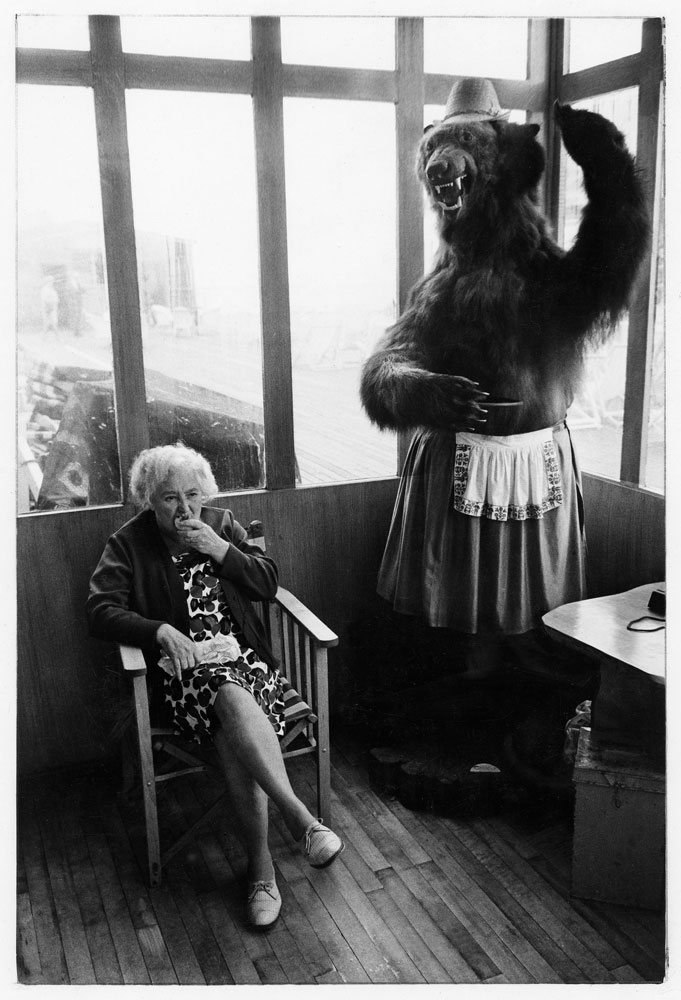
Tony Ray-Jones (English, 1941-1972) 'Elderly woman eating pie seated in a pier shelter next to a stuffed bear, 1969' 1969


Tony Ray-Jones (English, 1941-1972)
Elderly woman eating pie seated in a pier shelter next to a stuffed bear, 1969
1969
© National Media Museum


Tony Ray-Jones (English, 1941-1972) 'Blackpool, 1968' 1968


Tony Ray-Jones (English, 1941-1972)
Blackpool, 1968
1968
Vintage Gelatin Silver Print
21 x 14.5cm (8.25 x 5.70 ins)


Tony Ray-Jones (English, 1941-1972) 'Tom Greenwood cleaning' 1976


Tony Ray-Jones (English, 1941-1972)
Tom Greenwood cleaning
1976
© Martin Parr/ Magnum


Media Space at Science Museum
Exhibition Road, South Kensington,
London SW7 2DD

Opening hours:
Open seven days a week, 10.00 – 18.00

Media Space at Science Museum website

LIKE ART BLART ON FACEBOOK

Back to top

Exhibition: ‘In Focus: Architecture’ at the J. Paul Getty Museum, Getty Center, Los Angeles

Exhibition dates: 15th October 2013 – 2nd March 2014


William Henry Fox Talbot (English, 1800-1877) 'Boulevard des Italiens, Paris' 1843


William Henry Fox Talbot (English, 1800-1877)
Boulevard des Italiens, Paris
1843
Salted paper print from a Calotype negative
16.8 x 17.3cm
The J. Paul Getty Museum, Los Angeles


Another gem of a photography exhibition from the Getty. These In Focus exhibitions are just a treasure: from Making a Scene, Still Life and The Sky to Los Angeles, Picturing the Landscape and now Architecture. All fabulous. To have a photography collection such as the Getty possesses, and to use it. To put on these fantastic exhibitions…

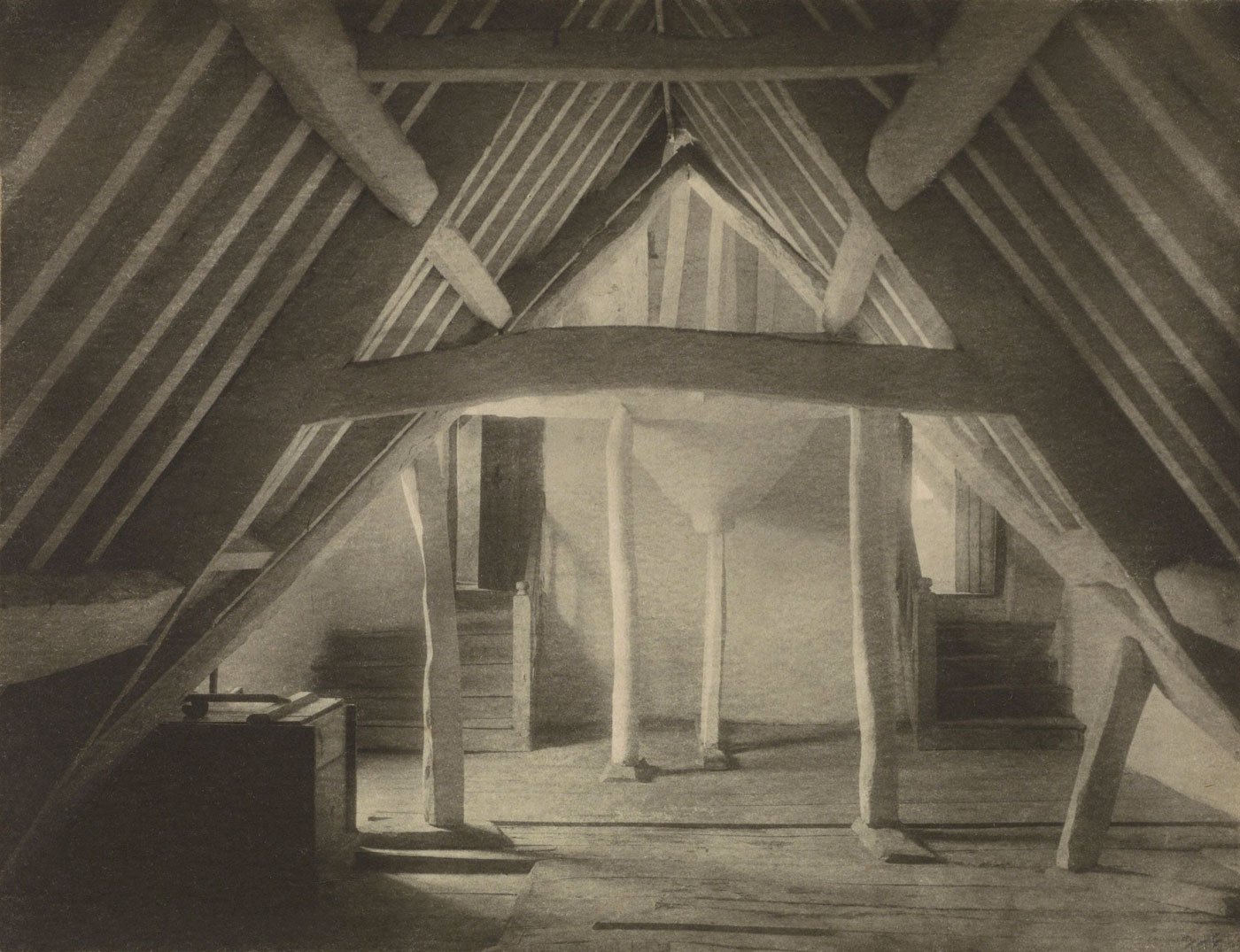
I like observing the transition between epochs (or, in more architectural terms, ‘spans’ of time), photographers and their styles. From the directness and frontality of Fox Talbot’s Boulevard des Italiens, Paris (1843, below) to the atmospheric ethereality of Atget’s angular The Panthéon (1924, below) taken just three years before he died; from the lambent light imbued in Frederick Evans’ architectural study of the attic at Kelmscott Manor (1896, below) to the blocked, colour, geometric facade of William Christenberry’s Red Building in Forest, Hale County, Alabama (1964, below).

I love architecture, I love photography. Put the two together and I am in heaven.

Dr Marcus Bunyan


Many thankx to the J. Paul Getty Museum for allowing me to publish the photographs in the posting. Please click on the photographs for a larger version of the image.


Eugéne Atget (French, 1857-1927) 'The Panthéon' 1924


Eugéne Atget (French, 1857-1927)
The Panthéon
1924
Gelatin silver chloride print on printing-out paper
Image: 17.8 x 22.6cm
The J. Paul Getty Museum, Los Angeles


Eugène Atget made this atmospheric study across the place Sainte-Geneviève toward the back of the Panthéon, a church boldly designed to combine the splendour of Greece with the lightness of Gothic churches. The church’s powerful colonnaded dome, Atget’s primary point of interest, hovers in the background, truncated by the building in the left foreground.

In order to make the fog-veiled Panthéon visible when printing this negative, Atget had to expose the paper for a long period of time. As a consequence of the long printing, the two buildings in the foreground are overexposed, appearing largely as black silhouettes. Together they frame the Panthéon, rendered entirely in muted greys. This photograph exceeds documentation to become more a study of mood and atmospheric conditions than of architecture.


Frederick H. Evans (British, 1863-1943) 'Kelmscott Manor: In the Attics (No. 1)' 1896


Frederick H. Evans (British, 1863-1943)
Kelmscott Manor: In the Attics (No. 1)
1896
Platinum print
15.6 x 20.2cm
© Mrs Janet M. Stenner, sole granddaughter of Frederick H, Evans
The J. Paul Getty Museum, Los Angeles


Frederick Evans’s architectural study of the attic at Kelmscott Manor, a medieval house, part of which dates from 1280, is a visual geometry lesson. The composition is all angles and intersections, formed not only by the actual structure but also by the graphic definition of light within the space. Soft illumination bathes the area near the stairs, while the photograph’s foreground plunges into murky darkness. The sharp angles of intersecting planes are mediated by the rough-hewn craftsmanship of the beams and posts, almost sensuous in their sinewy imperfection and plainly wrought by hand. The platinum print medium favoured by Evans provides softened tonalities that further unify the triangles, squares, and diagonal lines of the dynamic composition.


William Christenberry (American, b. 1936) 'Red Building in Forest, Hale County, Alabama' 1964


William Christenberry (American, b. 1936)
Red Building in Forest, Hale County, Alabama
1964
44.5 x 55.9cm
© William Christenberry
The J. Paul Getty Museum, Los Angeles


William Christenberry began photographing this makeshift wooden structure in his native Alabama in 1974. Since that time, he has made nearly annual trips to document the facade of this isolated dwelling, located deep in the Talladega National Forest. Such vernacular structures were uncommon photographic subjects until Walker Evans, Ed Ruscha, William Eggleston, and other twentieth-century photographers elevated their stature. Like the edifices photographed by Eugène Atget, Bernd and HIlla Becher, and others, the buildings Christenberry recorded in the southern United States were often in disrepair and in danger of disappearing altogether.


Soon after its invention in 1839, photography surpassed drawing as the preferred artistic medium for recording and presenting architecture. Novel photographic techniques have kept pace with innovations in architecture, as both media continue to push artistic boundaries. In Focus: Architecture, on view October 15, 2013 – March 2, 2014 at the J. Paul Getty Museum, Getty Center, traces the long, interdependent relationship between architecture and photography through a selection of more than twenty works from the Museum’s permanent collection, including recently acquired photographs by Andreas Feininger, Ryuji Miyamoto, and Peter Wegner.

“Architectural photography was an integral part of the early days of the medium, with the construction of many of the world’s most important and magnificent structures documented from start to finish with the camera,” explains Timothy Potts, director of the J. Paul Getty Museum. “This exhibition demonstrates how architectural photography has grown from straightforward documentary style photographs in its early days to genre-bending works like those of Peter Wegner from 2009.”

Beginnings of Architectural Photography

Recognised for their accuracy and precision, photographs could render architectural details as never before and show the built environment during construction, after completion, or in ruin. Nineteenth-century photographers were eager to utilize the new medium to document historic sites and structures, as well as buildings that rose alongside them, or in their place. In 1859, Gustave Le Gray photographed the Mollien Pavilion, a structure that constituted part of the “New Louvre,” a museum expansion completed during the reign of Napoleon III. Le Gray’s picturesque composition highlighted the Pavilion’s ornamented façade and other intricate details that could inform the work of future architects. Louis-Auguste Bisson, a trained architect, worked with his brother Auguste-Rosalie to photograph grand architectural spaces such as Interior of Saint-Ouen Church in Rouen (1857). The Bisson brothers produced a monumental print, derived from a glass negative of the same size, to feature the nave of the structure in an interior view rarely depicted in 19th century photographs.

A burgeoning commercial market for tourist photographs emerged toward the end of the nineteenth century. Views of architectural landmarks and foreign ruins became popular souvenirs and tokens of the ancient world. Artists such as J.B. Greene, who ventured to exotic destinations, provided visions of historic sites in Egypt, while Louis-Émile Durandelle took a series of photographs that documented the construction of the Eiffel Tower in the years before it became a symbol of the modern era at the World’s Exposition of 1889. Durandelle’s frontal view of the structure underscored its perfect geometric form, and his photographs were the earliest of what became a popular motif for amateur and professional photographers. Other noted photographers of this period included Eugène Atget, who obsessively documented the streets and buildings of Paris before its modernisation, and Frederick H. Evans, who created poetic photographs of Romanesque and Gothic cathedrals.

The Rise of Modern Architectural Photography

As the commercial market for photographs expanded and technologies advanced, representations of architectural forms began to evolve as well. In the twentieth century, images of buildings developed in conjunction with the rise of avant-garde, experimental, documentary, and conceptual modes of photographic expression.

Andreas Feininger, who studied architecture in Weimar, followed what Bauhaus instructor László Moholy-Nagy called a “new vision” of photography as an autonomous artistic practice with its own laws of composition and lighting. In Portal in Greifswald (1928), Feininger created a negative print, or a photograph with reversed tonalities, resulting in a high contrast image that enhanced the mystery of the architectural subject and removed it from its ecclesiastical context.

“The experimental spirit that permeated photography in the first half of the twentieth century inspired new ways to look at architectural forms,” says Amanda Maddox, assistant curator of photographs at the J. Paul Getty Museum and curator of the exhibition. “As photographs could present buildings in abstracted, close-up, or fragmented views, they encouraged viewers to see the built environment around them as never before.”

At the same time the Bauhaus was influencing photographers throughout Europe, Walker Evans was at the forefront of vernacular photography in the United States, which elevated ordinary objects and events to photographic subjects. In keeping with this trend, architectural photography shifted its focus to ordinary domestic and functional buildings. Derelict and isolated dwellings feature prominently in the work of William Christenberry, whose photograph and “building construction” of Red Building in Forest, Hale County, Alabama (1994) will be on display in the exhibition.

Architecture as a photographic subject became more malleable at the end of the twentieth century, as artists continued to explore the symbolism and vitality of the modern cityscape. This transition is exemplified in Peter Wegner’s 32-part Building Made of Sky III (2009), in which the spaces between skyscrapers in New York, San Francisco and Chicago create buildings of their own. Wegner described the series as “the architecture of air, the space defined by the edges of everything else.” When presented as a grid, the works form a new, imaginary city.

Press release from the J. Paul Getty website


Gustave Le Gray (French, 1820 - 1884) 'Mollien Pavilion, the Louvre' 1859


Gustave Le Gray (French, 1820-1884)
Mollien Pavilion, the Louvre
1859
Albumen silver print
Image: 36.7 x 47.9cm
The J. Paul Getty Museum, Los Angeles


Standing opposite a newly built pavilion of the Louvre, Gustave Le Gray made this photograph when the sun’s position allowed him to best capture the details of the heavily ornamented facade, from the fluted columns on the ground level to the figurative group on the nearest gable. Paving stones lead the viewer’s eye directly to the corner of the pavilion, where the sunlit facade is further highlighted beside an area blanketed in shadow.

Though the extensive art collections of the Louvre had first been opened to the public in 1793, after the French Revolution, it was not until 1848 that the museum became the property of the state. Le Gray’s image shows the exuberance of the architecture undertaken shortly thereafter, during the reign of Napoléon III, when large sections of the building housed government offices.


Ryuji Miyamoto (Japanese, b. 1947) 'Kowloon Walled City' 1987


Ryuji Miyamoto (Japanese, b. 1947)
Kowloon Walled City
1987
Gelatin silver print
34.4 x 51.1cm
© Ryuji Miyamoto
The J. Paul Getty Museum, Los Angeles


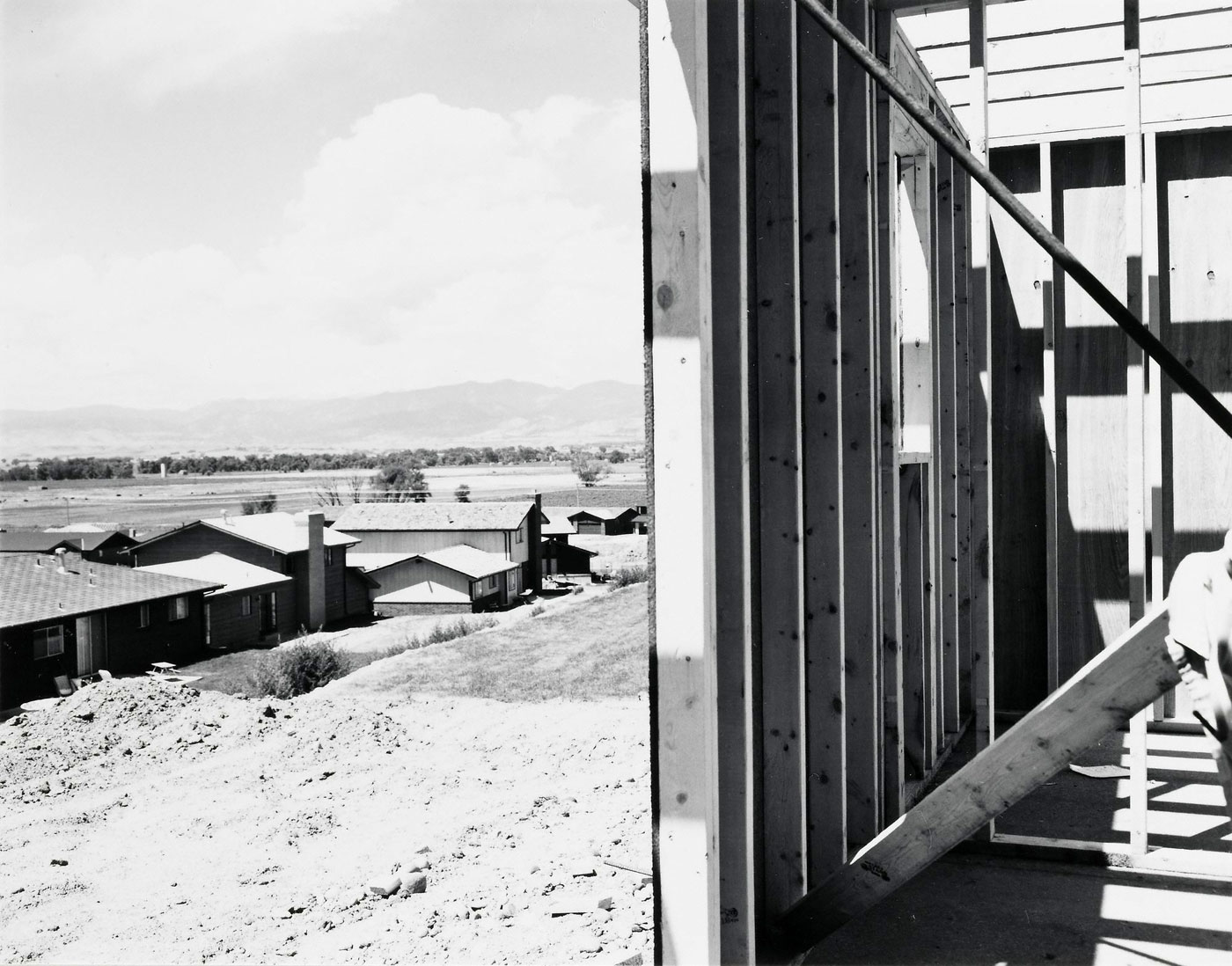
Robert Adams (American, b. 1937) 'Longmont, Colorado' 1973


Robert Adams (American, b. 1937)
Longmont, Colorado
1973
Gelatin silver print
15.2 x 19.4cm
© Robert Adams
The J. Paul Getty Museum, Los Angeles


The long, interdependent relationship between photography and architecture is the subject of this survey drawn from the Getty Museum’s collection. Spanning the history of the medium, the exhibition features twenty-four works by such diverse practitioners as William Henry Fox Talbot, Eugène Atget, Walker Evans, Bernd and Hilla Becher, and Ryuji Miyamoto. Seen together, the varied photographic representations of secular and sacred structures on display reveal how the medium has impacted our understanding and perception of architecture.

In the nineteenth century, photography surpassed drawing as the preferred artistic medium for recording and presenting architecture. Recognised for their accuracy and precision, photographs could render architectural elements as never before. The intricate ornamented facade, the sprawling sunlit Napoléon Courtyard, and the classical design of the Louvre appear in magnificent detail in Gustave Le Gray’s picturesque image of the Mollien Pavilion, a structure completed in the 1850s during the reign of Napoléon III.

Photographers working in the nineteenth century documented historic structures on the verge of disappearance as well as contemporary buildings erected before their eyes. They also captured the built environment during construction, after completion, and in ruin. This photograph by Louis-Émile Durandelle shows the Eiffel Tower, the centrepiece of the 1889 World Exposition, in November 1888 when only its four columns, piers, and first two platforms were in place.

With the advancement of photographic technologies and the modernisation of the built environment around the turn of the twentieth century came innovative representations of architecture. Compositions and photographic processes began to reflect the avant-garde and modernist sensibilities of the time, and photographs of buildings, churches, homes, and other structures often showcased these developments. Andreas Feininger, who trained as an architect, utilised an experimental printing technique to depict gothic St. Nikolai cathedral in Greifswald in a nontraditional way.

Images of architecture by contemporary photographers Robert Adams, William Christenberry, and others working in the documentary tradition often underscore the temporality of buildings. Vernacular structures found in his native Alabama are among the subjects Christenberry has systematically recorded for the past six decades. By returning year-after-year to photograph the same places, such as the red building shown above, Christenberry chronicles the decay (and sometimes the ultimate disappearance) of stores, tenant houses, churches, juke joints, and other rural buildings.

Experimental and conceptual approaches toward the representation of architecture have been embraced by photographers. Peter Wegner used skyscrapers in New York, San Francisco, and Chicago as his framing devices to feature the spaces between high rises that form buildings of their own. By upending images of these canyons, he created buildings made of sky. When presented as a grid, they form a new, imaginary city.

Text from the J. Paul Getty website


Henri Le Secq (French, 1818 - 1882) 'Tour de Rois à Rheims' ('Tower of the Kings at Rheims Cathedral') 1851


Henri Le Secq (French, 1818-1882)
Tour de Rois à Rheims (Tower of the Kings at Rheims Cathedral)
1851
Salted paper print
35.1 x 25.9cm
The J. Paul Getty Museum, Los Angeles


Louis-Émille Durandelle (French, 1839 - 1917) 'The Eiffel Rower: State of Construction' 1888


Louis-Émille Durandelle (French, 1839-1917)
The Eiffel Rower: State of Construction
1888
Albumen silver print
43.2 x 34.6cm
The J. Paul Getty Museum, Los Angeles


The Centennial Exposition of 1889 was organised by the French government to commemorate the French Revolution. Bridge engineer Gustave Eiffel’s 984-foot (300-meter) tower of open-lattice wrought iron was selected in a competition to erect a memorial at the exposition. Twice as high as the dome of St. Peter’s in Rome or the Great Pyramid of Giza, nothing like it had ever been built before. This view was made about four months short of the tower’s completion. Louis-Émile Durandelle photographed the tower from a low vantage point to emphasise its monumentality. The massive building barely visible in the far distance is dwarfed under the tower’s arches. Incidentally, the tower’s innovative glass-cage elevators, engineered to ascend on a curve, were designed by the Otis Elevator Company of New York, the same company that designed the Getty Center’s diagonally ascending tram.


Andreas Feininger (American born France, 1906-1999) 'Portal in Greifswald' 1928


Andreas Feininger (American, born France, 1906-1999)
Portal in Greifswald
1928
Gelatin silver print
23.4 x 17.5cm
© Estate of Gertrud E. Feininger
The J. Paul Getty Museum, Los Angeles


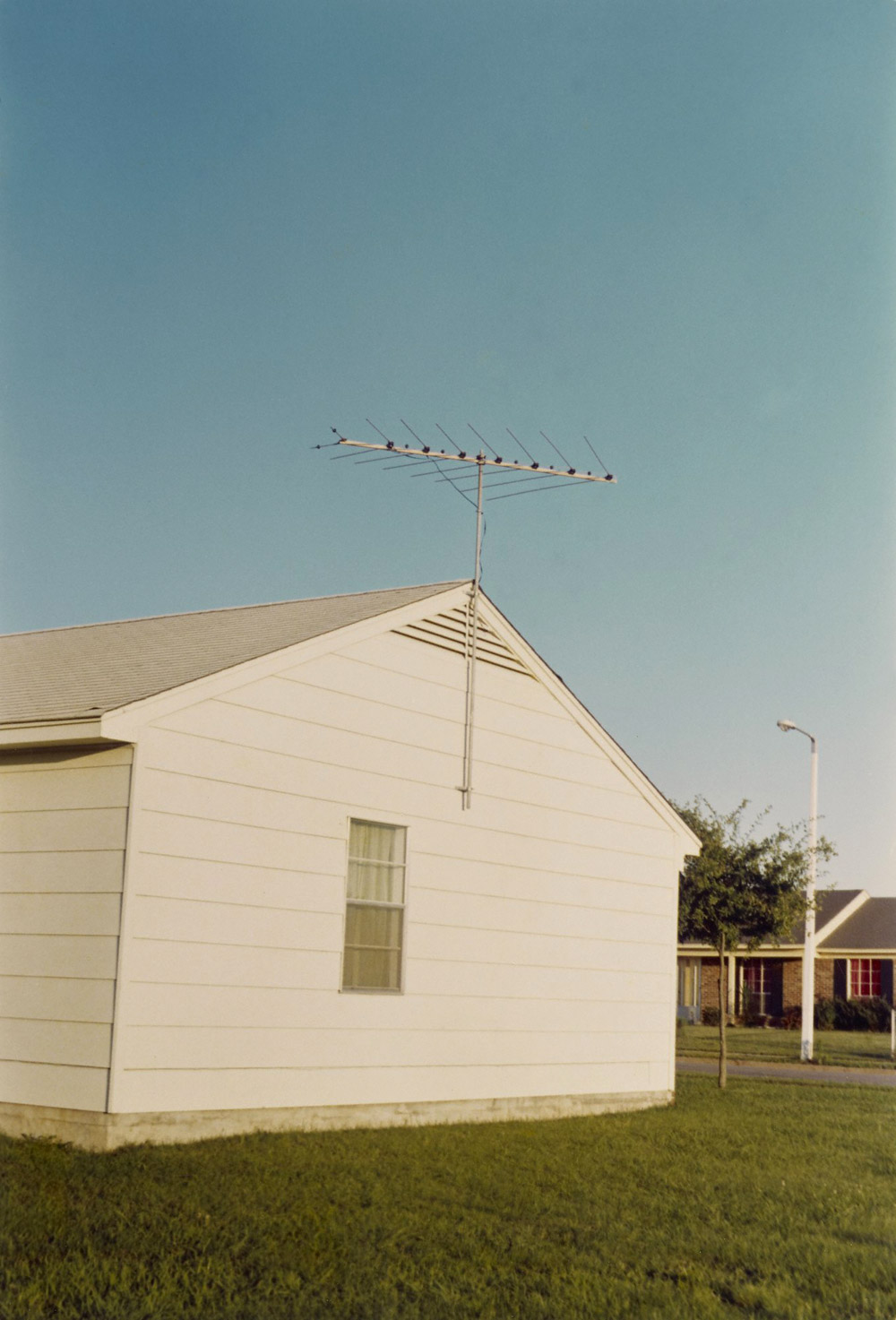
William Eggleston (American, b. 1939) '(Untitled)' Negative about 1967-1974; print 1974


William Eggleston (American, b. 1939)
(Untitled)
Negative about 1967-1974; print 1974
Chromogenic print
Image: 22.2 x 15.2cm
© Eggleston Artistic Trust
The J. Paul Getty Museum, Los Angeles


The J. Paul Getty Museum
1200 Getty Center Drive
Los Angeles, California 90049

Opening hours:
Tues – Friday 10am – 5.30pm
Saturday 10am – 8pm
Sunday 10am – 5.30pm
Monday closed

The J. Paul Getty Museum website

LIKE ART BLART ON FACEBOOK

Back to top

Exhibition: ‘Photography at NOMA’ at The New Orleans Museum of Art

Exhibition dates: 10th November 2013 – 19th January 2014


André Kertész (American born Hungary, 1894-1985) 'Leger's Studio' 1926 - 1927


André Kertész (American born Hungary, 1894-1985)
Leger’s Studio
1926-1927
Gelatin silver print
Image: 3 1/8 x 4 1/4in. (8 x 10.8cm)
The New Orleans Museum of Art
Museum purchase, Women’s Volunteer Committee Fund


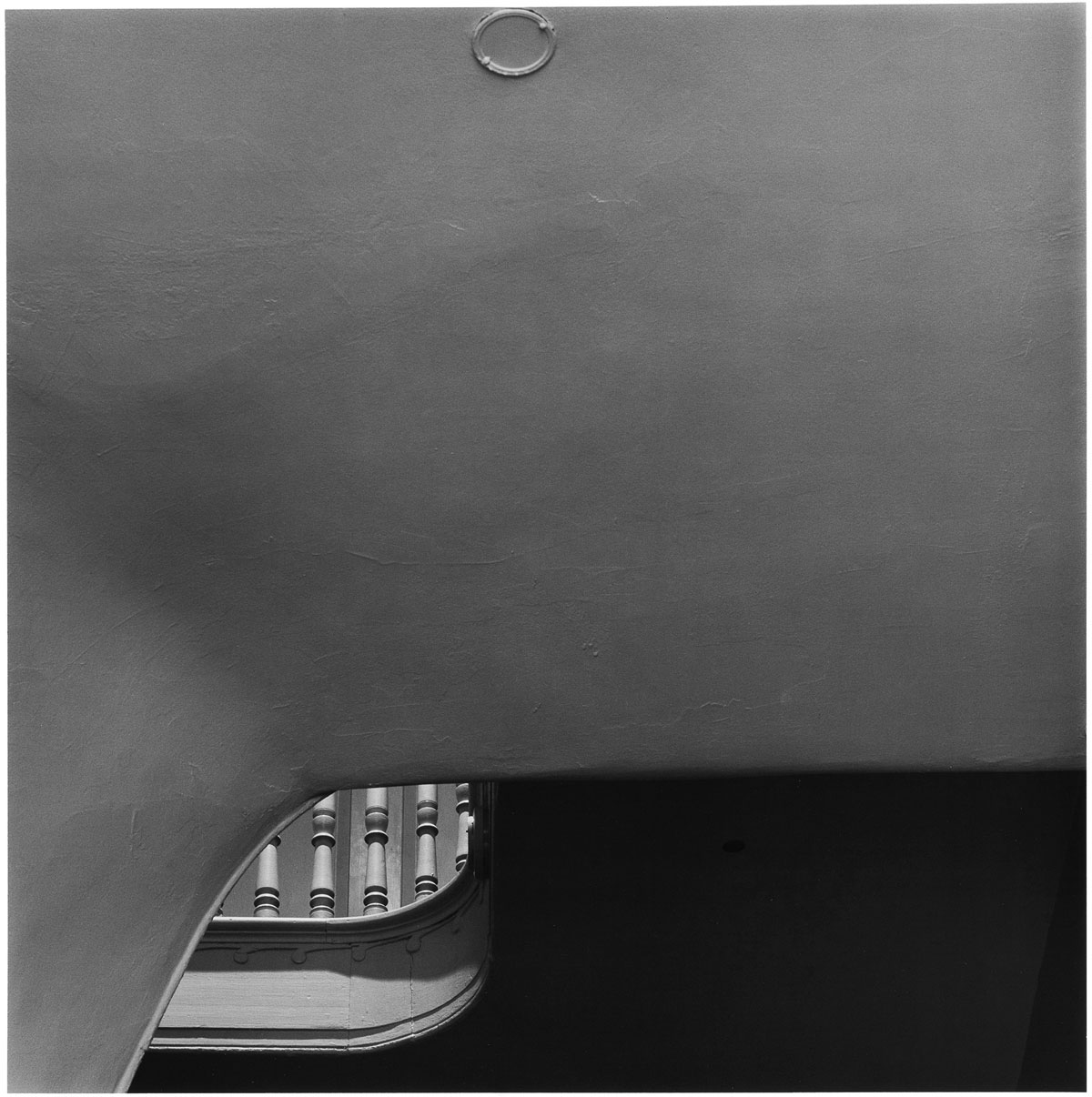
There are some rare and beautiful photographs in this posting. I have never seen the Kertész (Leger’s Studio 1926-1927) with its wonderful structure and tonality nor the unusual Mapplethorpe (Staircase, 1140 Royal 1982). I particularly like the Bellocq (Bedroom Mantel, Storyville c. 1911-1913) with its complex medley of shapes and images.

Marcus


Many thankx to The New Orleans Museum of Art for allowing me to publish the photographs in the posting. Please click on the photographs for a larger version of the image.


Lee Friedlander (American, b. 1934) 'Untitled (Self-Portrait Reflected in Window, New Orleans)' c. 1965


Lee Friedlander (American, b. 1934)
Untitled (Self-Portrait Reflected in Window, New Orleans)
c. 1965
Gelatin silver print
Image: 7 x 10 3/4 in. (17.6 x 27.2cm)
Mount: 11 x 14 in. (27.9 x 35.5cm)
The New Orleans Museum of Art
Museum purchase through the National Endowment for the Arts Grant


Robert Frank (American, 1924-2019) 'Canal Street, New Orleans' 1955


Robert Frank (American, 1924-2019)
Canal Street, New Orleans
1955
Gelatin silver print
Image: 11 x 13 4/5 in. (28 x 35.2cm)
The New Orleans Museum of Art
Museum purchase through the National Endowment for the Arts and Museum Purchase Funds


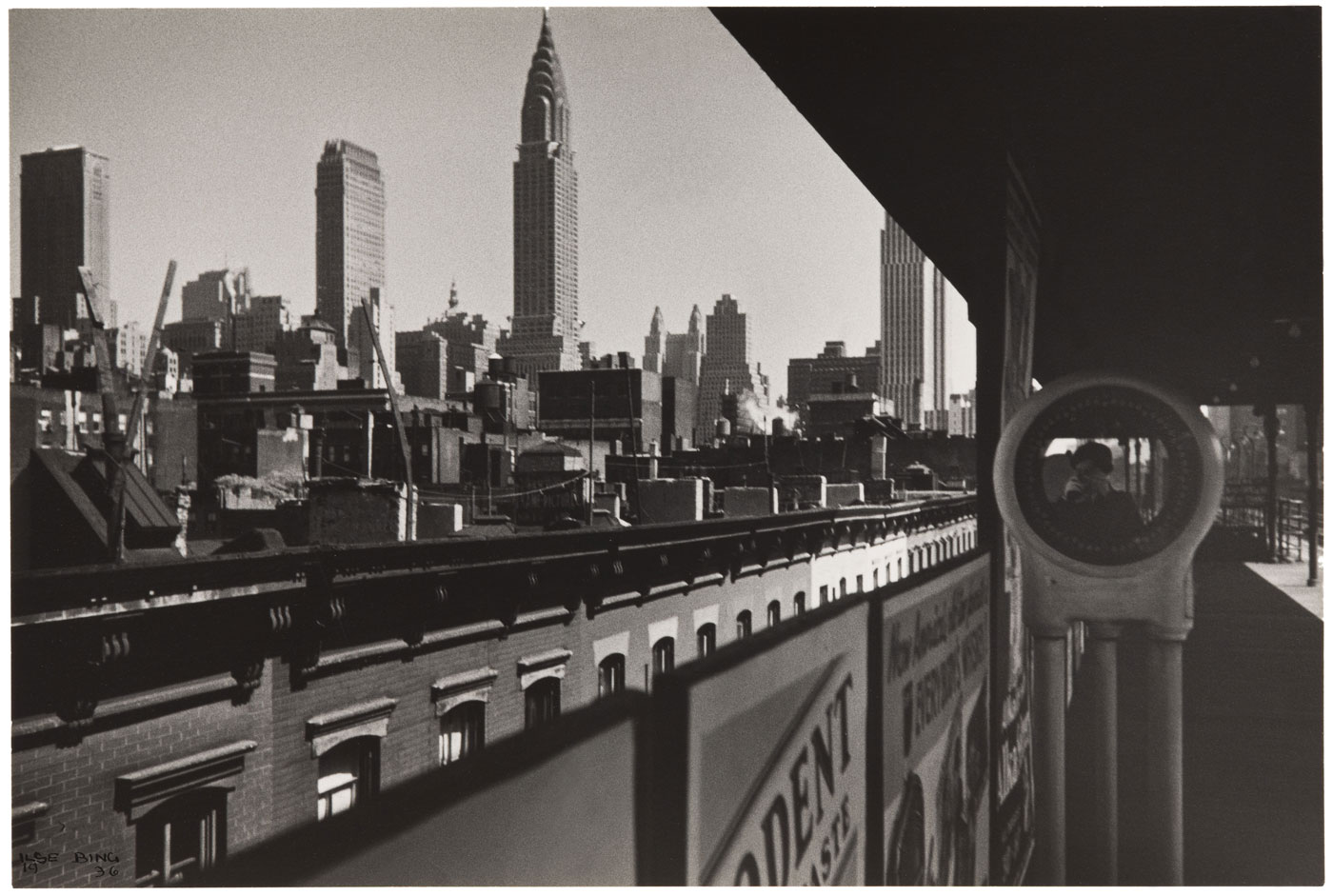
Ilse Bing (American, 1899-1998) 'New York, The Elevated and Me' 1936


Ilse Bing (American, 1899-1998)
New York, The Elevated and Me
1936
Gelatin silver print
Image: 7 15/16 x 11 in. (18.6 x 28cm)
The New Orleans Museum of Art
Museum purchase through the National Endowment for the Arts Matching Grant
© Estate of Ilse Bing


Henri Cartier-Bresson (French, 1908-2004) 'Louisiana' 1947, printed circa 1975


Henri Cartier-Bresson (French, 1908-2004)
Louisiana
1947, printed c. 1975
Gelatin silver print
Image: 9 5/8 x 14 3/16 in. (24.4 x 36cm)
Paper: 12 x 16 in. (30.3 x 40.4cm)
The New Orleans Museum of Art
Museum purchase, General Acquisition Fund


Theodore Lilienthal (American, 1829-1894) 'Charles Hotel, New Orleans' c. 1867


Theodore Lilienthal (American, 1829-1894)
Charles Hotel, New Orleans
c. 1867
Albumen print
Image: 10 3/4 x 13 13/16 in. (27.2 x 35.1cm)
Mount: 17 x 22 1/4 in. (43.3 x 56.6cm)
The New Orleans Museum of Art
Museum Purchase


Featuring masterworks by photographers Edward Weston, William Henry Fox Talbot, André Kertész, Robert Mapplethorpe, and many more, the New Orleans Museum of Art’s upcoming exhibition, Photography at NOMA, explores the Museum’s rich permanent photography collection through a selection of some of its finest works from the early 1840s to the 1980s.

The first comprehensive presentation of works from NOMA’s collection since the 1970s, the exhibition includes over 130 of the most important photographs in the Museum’s collection and presents rare and unusual examples from throughout photography’s history. On view November 10, 2013 through January 19, 2014, the exhibition highlights the tremendous depth and breadth of the Museum’s collection and includes photographs made as works of art as well as advertising images, social documents, and more. The photographers featured in the exhibition range from some of the most recognisable names in the field, including Henri Cartier-Bresson, Robert Frank, and Lewis Hine, to unknown photographers – reflecting the vast spectrum of photographic activity since the medium’s inception in the 19th century.

“NOMA began collecting photographs seriously in the early 1970s when photography was not commonly found in American art museum collections. Today our holdings include nearly 10,000 works, representing a broad range of creative energy and achievement,” said Susan Taylor, NOMA’s Director. “Our collection has strong roots in New Orleans history. Our city has long been an epicentre for the work of established and emerging photographers and we are delighted to share this aspect of New Orleans history with our audiences.”

“Since its origins, photography has infiltrated every aspect of modern life, from art to war, and religion to politics and many of these applications are represented in NOMA’s extensive collection,” said Russell Lord, Freeman Family Curator of Photographs. “Despite the collection’s long history, it remains one of the best kept secrets in this country. Photography at NOMA is an opportunity to re-examine and bring to the fore the diverse range of works found in the collection.”

Since the 1970s, NOMA has built an extensive collection of photographs that represents a wide range of achievement in that medium from the 1840s to the present. Today the collection comprises nearly 10,000 works with images by some of the most significant photographic artists including Berenice Abbott, Ansel Adams, Diane Arbus, Ilse Bing, and Edward Steichen, among many others. The collection includes examples that reflect photography’s international scope, from an 1843 view from his hotel window in Paris by William Henry Fox Talbot to a view of Mount Fuji by Kusakabi Kimbei, but it is also strong in photographs made in and around New Orleans by regional and national photographers such as E. J. Bellocq, Walker Evans, Clarence John Laughlin, and Robert Polidori.

Photography at NOMA features works by Berenice Abbott, Ansel Adams, Diane Arbus, Henri Cartier-Bresson, Walker Evans, Robert Frank, Robert Mapplethorpe, William Henry Fox Talbot, and Edward Weston, among many others.

Press release from the NOMA website


Felix Moissenet (American, b. circa 1814) 'Freeman' c. 1855


Felix Moissenet (American, b. circa 1814)
Freeman
c. 1855
Sixth plate daguerreotype
Image: 3 1/4 x 2 3/4 in. (8 x 6.8cm)
Case (open): 3 5/8 x 6 3/8 in. (9.2 x 16.1cm)
The New Orleans Museum of Art
Museum purchase


Thomas Augustine Malone (British, 1823-1867) 'Demonstration of the Talbotype' December 11, 1848


Thomas Augustine Malone (British, 1823-1867)
Demonstration of the Talbotype
December 11, 1848
Calotype (Talbotype) negative
7 3/8 x 9 2/16 in. (18.8 x 23.3cm)
The New Orleans Museum of Art
Museum purchase


Robert Mapplethorpe (American, 1946-1989) 'Staircase, 1140 Royal' 1982


Robert Mapplethorpe (American, 1946-1989)
Staircase, 1140 Royal
1982
Gelatin silver print
Image: 15 1/5 x 15 1/5 in. (38.5 x 38.5cm)
Paper: 20 x 16 in. (50.6 x 40.4cm)
The New Orleans Museum of Art
Promised gift from H. Russell Albright, MD


William Henry Fox Talbot (British, 1800-1877) 'View of the Paris Boulevards from the First Floor of the Hôtel de Louvais, Rue de la Paix' 1843


William Henry Fox Talbot (British, 1800-1877)
View of the Paris Boulevards from the First Floor of the Hôtel de Louvais, Rue de la Paix
1843
Salted paper print from a paper negative
Image: 6 3/8 x 6 3/4 in. (16.2 x 17.1cm)
Paper: 7 1/2x 9 in. (19 x 23cm)
The New Orleans Museum of Art
Museum purchase, 1977 Acquisition Fund Drive


Paul Outerbridge (American, 1896-1958) 'Groom Detective Agency' 1923


Paul Outerbridge (American, 1896-1958)
Groom Detective Agency
1923
Platinum print
Image: 4 1/2 x 3 1/2 in. (11.5 x 9cm)
Paper: 14 x 11 in. (35.5 x 28cm)
Paul Outerbridge, Jr.
© 2013 G. Ray Hawkins Gallery, Beverly Hills, CA


Morton Schamberg (American, 1881-1918) 'Cityscape' 1916


Morton Schamberg (American, 1881-1918)
Cityscape
1916
Gelatin silver print
Image: 9 1/2 x 7 1/2 in. (24 x 19cm)
Mount: 15 3/4 x 13 in. (40 x 33cm)
The New Orleans Museum of Art
Museum purchase, Women’s Volunteer Committee Fund


Clarence John Laughlin (American, 1905-1985) 'A Mangled Staircase (No. 2)' 1949


Clarence John Laughlin (American, 1905-1985)
A Mangled Staircase (No. 2)
1949
Gelatin silver print
Image: 13 1/2 x 10 13/16 in. (34.2 x 27.5cm)
Mount: 17 x 14 in. (43 x 35.5cm)
The New Orleans Museum of Art
Bequest of Clarence John Laughlin


E. J. Bellocq (American, 1873-1949) 'Bedroom Mantel, Storyville' c. 1911-1913


E. J. Bellocq (American, 1873-1949)
Bedroom Mantel, Storyville
c. 1911-1913
Glass negative
Plate: 10 x 8 in. (25.2 20.2cm)
Museum purchase


Lewis Hine (American, 1874-1940) '[Mechanic and Steam Pump]' c. 1930


Lewis Hine (American, 1874-1940)
[Mechanic and Steam Pump]
c. 1930
Gelatin silver print
Image: 9 1/2 x 7 in. (24.3 x 17.6cm)
Paper: 10 x 8 in. (25.2 x 20.3cm)
The New Orleans Museum of Art
Museum Purchase


The New Orleans Museum of Art
One Collins Diboll Circle, City Park
New Orleans, LA 70124
Phone: (504) 658-4100

Opening hours:
Tuesday – Sunday: 10am – 5pm
Closed Mondays

The New Orleans Museum of Art website

LIKE ART BLART ON FACEBOOK

Back to top

Exhibition: ‘Edith Tudor Hart – In the Shadow of Tyranny’ at the Wien Museum, Vienna

Exhibition dates: 26th September 2013 – 12th January 2014


Edith Tudor-Hart (Austrian-British, 1908-1973) From the series 'Moving and Growing' 1951


Edith Tudor-Hart (Austrian-British, 1908-1973)
From the series Moving and Growing
1951
© Wien Museum


More images from this wonderful photographer who was a low-level Soviet agent while exiled in Britain after the Second World War and who destroyed most of her photos as well as many negatives out of fear of prosecution in 1951. Thanks to contemporary research we can begin to see the vision of this artist. In her photo essays, an impassioned record, she imaged social injustice and showed it to the world… creating her own inimitable style and a “comprehensive and freestanding body of work.”

“Her photos are impressive for the quality of the dialogue with those portrayed and the social context is always visible and tangible. “The women, children and workers photographed by her seem less objectified and, to some extent at least, are placed in a better position to represent themselves,” writes Duncan Forbes, curator of the exhibition.” (press release)

The quality of the dialogue with those portrayed. You can feel that in these images, that the photographer has a care and respect for the people that she is photographing, probably more so than the photographs of Bill Brandt from the same period. She seems to have more connection and concern for her subject matter. I love their grittiness, poignancy and above all their humanity. Look at the arrangement of figures in Family, Stepney, London (about 1932, below) as the viewers eye is led by the two staggered boys on the bed up to the eldest daughter, looking away off camera, while the mother steadfastly gazes directly into the camera clutching her youngest daughter tightly. The smile on the little girls face is a joy.

“No Home, No Dole” was the reality of life in London back then, with the Great Depression taking hold. I remember growing up in the 1960s and things weren’t much better in my grandmothers house, even the old farmhouse I grew up in. No hot running water, my mother bathing us kids in a tin tub on the kitchen floor with water heated up in the kettle on the stove. It was subsistence living for we were the poorest of the poor. That Edith Tudor Hart had the courage of her convictions and recorded these environments shows a human being of great moral character. That the images still survive we are grateful.

Dr Marcus Bunyan


Many thankx to the Wien Museum for allowing me to publish the photographs in the posting. Please click on the photographs for a larger version of the image. View the exhibition online catalogue.


Edith Tudor-Hart (Austrian-British, 1908-1973) 'Unemployed Workers' Demonstration, Trealaw, South Wales' 1935


Edith Tudor-Hart (Austrian-British, 1908-1973)
Unemployed Workers’ Demonstration, Trealaw, South Wales
1935
© Scottish National Portrait Gallery / Archive presented by Wolfgang Suschitzky 2004


“If curator Duncan Forbes and photographers Owen Logan and Joanna Kane have resurrected an amazing archive, Tudor-Hart’s own life is curiously out of focus. Her struggles and sorrows are mute beneath the weight of her images. Her late life feels only half-lived: she struggled under the scrutiny of the security services until her death in 1973; she destroyed much documentation, including her list of negatives. As a woman photographer with left-wing associations, work became scarce. As a communist and a suspected traitor she was blacklisted and in the 1950s she gave up photography altogether.

What’s left, or rather what has been patiently reconstructed, is an impassioned record of the terrible long shadow of ­tyranny in Europe, and of a ­divided Britain that makes you both deeply ashamed and ­occasionally proud.”

Moria Jeffrey review of the exhibition 04/07/2013 on the Art Global website [Online] Cited 06/01/2014 no longer available online


Edith Tudor-Hart (Austrian-British, 1908-1973) 'Prater Ferris Wheel, Vienna' 1931


Edith Tudor-Hart (Austrian-British, 1908-1973)
Prater Ferris Wheel, Vienna
1931
© Scottish National Portrait Gallery / Archive presented by Wolfgang Suschitzky 2004


The rediscovery of a great Austrian-British photographer Edith Tudor-Hart (1908-1973), who is known in Austrian history of photography as Edith Suschitzky, belonged to the group of those politically engaged photographers who faced political developments in the inter-war years with socially critical force.

Edith Suschitzky studied at the Bauhaus in Dessau and worked as a photographer in Vienna around 1930 – while simultaneously a Soviet agent. In 1933 she married an Englishman who likewise had close connections to the Communist Party, and fled with him to Great Britain. There she created brilliant social reportage in the slums of London or in the coal mining areas of Wales, today some of the key examples of British workers’ photography. The exhibition is the first monographic presentation of Edith Tudor-Hart’s work. As well as the period in England, a selection from the early Viennese works are on show. Her unpretentious, documentary-influenced photographs on social themes come mainly from the collections of the National Galleries of Scotland

Following Barbara Pflaum, Elfriede Mejchar and Trude Fleischmann, the Wien Museum is once again putting on a solo exhibition dedicated to a great Austrian photographer: Edith Tudor-Hart (1908-1973), also known in the annals of photographic history by her maiden name Edith Suschitzky. She belonged to the group of politically engaged male and female photographers who, from the 1920s onwards, responded to political developments from a socially critical standpoint – both in Austria and in exile in England, where she became an important figure in the Worker Photography Movement. The exhibition, which was previously on show in Edinburgh, is the first ever overview of the work of this in equal measure fascinating and significant artist. It arose out of a cooperation between the National Galleries of Scotland and the Wien Museum and has been curated by Duncan Forbes, the long-standing Senior Curator of Photography at the National Galleries of Scotland and the new Director of the Fotomuseum Winterthur.

Edith Tudor-Hart was born in Vienna in 1908 as Edith Suschitzky and grew up in a social-democratic household; her father ran a workers’ bookshop in the Favoriten district of Vienna and a revolutionary publishing house. She had contact with the Communist Party of Austria (KPÖ) and the Communist International already from a young age and both charged her with tasks – with legal party work as well as with intelligence activities. Early on, Tudor-Hart become interested in pedagogy; she completed training in the Montessori method and moved in circles that promoted radical, anti-authoritarian school and education reforms. It was likely the period of study at the Bauhaus in Dessau (1928-1930) that first brought her to photography, even though Tudor-Hart is listed in the archives only as a participant on the famous preparatory course and not as a student in the photography department. Her first pictures were taken in about 1930 and “show a technically accomplished photographer, who explored subjects such as the deprivation of the working class and the reform-oriented culture of Austrian Social Democracy as well as the threat posed by military and fascist forces” (as the historian of photography Anton Holzer has written). At the same time she embarked on a career as a photo journalist for illustrated publications.

It was the period in which, thanks to technological advances, photography in the mass media had gained immensely in importance. From the beginning, Tudor-Hart viewed the camera as a political weapon that could be used to document social injustices; she had little time for the formal experiments of the avant-garde. Photography had ceased to be “an instrument for recording events and became instead the means to bring events about and to influence them. It became a living art form that involved the people” (Edith Tudor-Hart). Her first photo series, published in the magazines Der Kuckuck, Arbeiter-Illustrierte-Zeitung and Die Bühne, include a reportage on the deprived East End of London and a series on everyday life in the Vienna Prater. That she was a Communist and yet was working for a social-democratic publication such as Der Kuckuck was down to the fact that the KPÖ played a minimal role in the media (and political) landscape of Austria – in this respect the young photographer had to adapt to the commercial realities of her profession. However, she was also active for the Soviet news agency TASS and, in addition, she continued with her intelligence activities. She was described by a fellow agent as “modest, competent and brave”, ready “to give her all for the Soviet cause”. This eventually became Edith Tudor-Hart’s undoing: when the Austrian government moved against Nazis and Communists, she was arrested without further ado. In the same year she married the English doctor Alexander Tudor-Hart, which allowed her to escape to Great Britain in 1934. “When one views Suschitzky’s photographic work from her Vienna years, it becomes clear that already in her early period, she created a comprehensive and freestanding body of work,” writes Anton Holzer.

Among the miners in Wales

In exile, Edith Tudor-Hart’s photographs took on a sharper socially critical edge. She went with her husband to South Wales, where he practised as a doctor in the coal mining region. The economic crisis had hit heavy industry and mining in northern England particularly hard and in many small towns and villages, nine out of ten men were unemployed. The photos from the mining and shipbuilding region of Tyneside also tell of crippling economic hardship and social decline. With her pictures, Tudor-Hart clearly stood out from the mainstream of British photography, characterised at that time by a bourgeois, somewhat sweet and sentimental aesthetic. Her photos are impressive for the quality of the dialogue with those portrayed and the social context is always visible and tangible. “The women, children and workers photographed by her seem less objectified and, to some extent at least, are placed in a better position to represent themselves,” writes Duncan Forbes, curator of the exhibition. During the slight economic recovery of the mid-1930s, Tudor-Hart was able to build up a photo studio in London: “Edith Tudor-Hart – Modern Photography” it said on her headed paper. She specialised in portraiture and was also able to obtain some advertising work, for example for the toy manufacturer Abbatt Toys. In addition, she supplied photos to new British illustrated publications, including the magazine Lilliput and the popular paper Picture Post, as well as to government departments such as the British Ministry of Education. For her, working for the traditional papers of Fleet Street was, however, not an option. Alongside the equally consistent and nuanced workers’ photography, Tudor-Hart concentrated on work with children, especially after the Second World War, and in this she could call on a wide network of contacts. These included the Austrian paediatrician and curative educator Karl König as well as Anna Freud and Donald Winnicott, two of the leading protagonists of child psychoanalysis. She was concerned with issues of child welfare, heath and education and received commissions from agencies such as the British Medical Association, Mencap and the National Baby Welfare Council. In contrast to the static, studio-based portrait photography customary at the time, Tudor-Hart showed families and especially children as natural and lively.

After the Second World War and with the onset of the Cold War, Tudor-Hart’s personal situation worsened as she was still active as a low-level Soviet agent. In 1951, shortly after the Soviet spy Kim Philby was interrogated for the first time, she destroyed most of her photos as well as many negatives out of fear of prosecution. “Her life as a partisan for the Soviet cause ended with her a defeated and demoralised woman,” writes Duncan Forbes. She stopped publishing photos at the end of the 1950s, presumably at the request of the British secret services. Despite being questioned numerous times she was never arrested. Edith Tudor-Hart lived out her final years until her death in 1973 as an antiques dealer in Brighton.

That her photographic work was rediscovered is thanks to her brother, the photographer and cameraman Wolfgang Suschitzky. He saved a number of negatives from destruction and, in 2004, presented his sister’s photographic archive to the Scottish National Galleries. This exhibition and catalogue make Edith Tudor-Hart’s exceptional work accessible to a wider public for the first time. The exhibition was on show at the National Galleries of Scotland in Edinburgh in spring 2013 and, after its run at the Wien Museum, will also be on display in Berlin. For the first time, it offers an overview of Tudor-Hart’s work from her years in both Vienna and England; many of the photos have never been seen before. Furthermore, the first comprehensive work on this great Austrian artist is being published on the occasion of this exhibition.

Press release from the Wien Museum website


Edith Tudor-Hart (Austrian-British, 1908-1973) 'Family, Stepney, London' about 1932


Edith Tudor-Hart (Austrian-British, 1908-1973)
Family, Stepney, London
about 1932
© Scottish National Portrait Gallery / Archive presented by Wolfgang Suschitzky 2004


Edith Tudor-Hart (Austrian-British, 1908-1973) 'Gee Street, Finsbury, London' about 1936


Edith Tudor-Hart (Austrian-British, 1908-1973)
Gee Street, Finsbury, London
about 1936
© Scottish National Portrait Gallery / Archive presented by Wolfgang Suschitzky 2004


Edith Tudor-Hart (Austrian-British, 1908-1973) 'Unemployed Family, Vienna' 1930


Edith Tudor-Hart (Austrian-British, 1908-1973)
Unemployed Family, Vienna
1930
© Wien Museum


Edith Tudor-Hart (Austrian-British, 1908-1973) '"No Home, No Dole" London' about 1931


Edith Tudor-Hart (Austrian-British, 1908-1973)
“No Home, No Dole” London
about 1931
© Scottish National Portrait Gallery / Archive presented by Wolfgang Suschitzky 2004


Edith Tudor-Hart (Austrian-British, 1908-1973) 'Self-portrait, London' about 1936


Edith Tudor-Hart (Austrian-British, 1908-1973)
Self-portrait, London
about 1936
© Scottish National Portrait Gallery / Archive presented by Wolfgang Suschitzky 2004


Wien Museum
1040 Vienna, Karlsplatz 8
Phone: +43 (0)1 505 87 47 0

Opening hours:
Tuesday – Sunday and public holidays 10am – 6pm

Wien Museum website

LIKE ART BLART ON FACEBOOK

Back to top

Exhibition: ‘Julia Margaret Cameron’ at The Metropolitan Museum of Art, New York

Exhibition dates: 9th August 2013 – 5th January 2014


Julia Margaret Cameron (British born India, Calcutta 1815 - 1879 Kalutara, Ceylon) 'King Lear and his Three Daughters' 1872


Julia Margaret Cameron (British born India, Calcutta 1815 – 1879 Kalutara, Ceylon)
King Lear and his Three Daughters
1872
Albumen silver print from glass negative
Bequest of Maurice B. Sendak, 2013
The Metropolitan Museum of Art


The three Liddell sisters – Lorina, Elizabeth, and Alice – posed with the photographer’s husband playing the tragically deceived King Lear in one of Cameron’s few Shakespearean compositions. Goneril and Regan whisper false flattery in the ageing king’s ear while the truly devoted but disinherited Cordelia – here unadorned and dressed in white – stands before him, an embodiment of disillusioned innocence.


The first posting of a new year, and finally I get to do a posting on one of the greatest photographers of all time. Nobody has ever taken portraits like JMC before or since. What a unique vision, different from everyone else: “directed light, soft focus, and long exposures that allowed the sitters’ slight movement to register in her pictures, instilling them with a sense of breath and life.”

The portrait of Sir John Herschel (April 1867, below) is one of the most famous portraits in the history of photography. What a magnificent achievement, to capture the spirit of this human being on a glass plate… “Our Julia” as my friend Joyce Evans lovingly calls her. It’s funny how everyone takes her to their heart.

Dr Marcus Bunyan


Many thankx to the The Metropolitan Museum of Art for allowing me to publish the photographs in the posting. Please click on the photographs for a larger version of the image.


Julia Margaret Cameron (British born India, Calcutta 1815 - 1879 Kalutara, Ceylon) 'Sappho' 1865


Julia Margaret Cameron (British born India, Calcutta 1815 – 1879 Kalutara, Ceylon)
Sappho
1865
Albumen silver print from glass negative
The Rubel Collection, Purchase, Jennifer and Joseph Duke and Anonymous Gifts, 1997
The Metropolitan Museum of Art


Mary Hillier, a beautiful young house servant at Dimbola, Cameron’s home in Freshwater, was often pressed into photographic service, frequently in the role of the Virgin Mary. She managed to assume her various guises in a remarkably unselfconscious way, projecting both gentleness and strength of character. Hillier is also the model for Cameron’s Sappho, a profile portrait in the Florentine Quattrocento style, perhaps inspired by the chromolithographic reproductions of Italian paintings distributed by the Arundel Society, of which Cameron was a member. The image has great presence, so much so that Cameron decided to print it even though she broke the negative. Precisely what the picture has to do with the Greek poet of Lesbos is unclear, especially since Cameron inscribed another print of the same image Adriana. The titles of two close variants reveal that, by looking left instead of right, Hillier was apparently transformed from Sappho into Dora or, when photographed from one step further back, Clio. Although Cameron often set out to portray a certain ideal, she also titled pictures after the fact, sometimes because the image seemed to embody the character of a certain literary or biblical figure, but sometimes, one suspects, quite simply because there was more of a market for images of the Virgin, Sappho, or Christabel than for portraits of the photographer’s niece or a parlour maid from the Isle of Wight.


Julia Margaret Cameron (British born India, Calcutta 1815 - 1879 Kalutara, Ceylon) 'The Mountain Nymph Sweet Liberty' 1866


Julia Margaret Cameron (British born India, Calcutta 1815 – 1879 Kalutara, Ceylon)
The Mountain Nymph Sweet Liberty
1866
Albumen silver print from glass negative
Harris Brisbane Dick Fund, 1941
The Metropolitan Museum of Art


In Cameron’s The Mountain Nymph Sweet Liberty, Miss Keene, an arresting model about whom we know nothing but her last name, stares directly at the camera (and, by extension, at the viewer), her hair loose and her eyes open wide. Filling the frame, she seems to step out of the picture. The photograph takes its title from John Milton’s poem L’Allegro, a celebration of life’s pleasures:

Come, and trip it as you go
On the light fantastic toe;
And in thy right hand lead with thee
The mountain nymph, sweet Liberty.

Cameron sent the photograph to her friend, the renowned scientist Sir John Herschel, who wrote back, “That head of the ‘Mountain Nymph Sweet liberty’ (a little farouche & égarée [timid and distraught] by the way, as if first let loose & half afraid that it was too good to last) is really a most astonishing piece of high relief. She is absolutely alive and thrusting out her head from the paper into the air. This is your own special style.” Herschel seized upon the photograph’s most striking quality, its startling sense of presence and of psychological connection with the viewer.


Julia Margaret Cameron (British born India, Calcutta 1815 - 1879 Kalutara, Ceylon) 'Zoe, Maid of Athens' 1866


Julia Margaret Cameron (British born India, Calcutta 1815 – 1879 Kalutara, Ceylon)
Zoe, Maid of Athens
1866
Albumen silver print from glass negative
The Rubel Collection, Purchase, Lila Acheson Wallace, Ann Tenenbaum and Thomas H. Lee, and Muriel Kallis Newman Gifts, 1997
The Metropolitan Museum of Art


Here Cameron photographed May Prinsep, her sister’s adopted daughter. By allowing Prinsep’s slight movement and by intentionally softening the focus, Cameron instilled a sense of breath and soul in this living apparition, for the true subject of her photograph was a poetic evocation of love and longing. “Maid of Athens, ere we part, / Give, oh, give me back my heart!” begin the verses composed by Lord Byron as he departed Greece in 1810. In the poem that inspired Cameron, Byron swore “By those tresses unconfined, / Wooed by each Aegean wind; / By those lids whose jetty fringe / Kiss thy soft cheeks’ blooming tinge; / By those wild eyes like the roe, / Zoë mou sas agapo [My life, I love you].”


Julia Margaret Cameron (British born India, Calcutta 1815 - 1879 Kalutara, Ceylon) 'Christabel' 1866


Julia Margaret Cameron (British born India, Calcutta 1815 – 1879 Kalutara, Ceylon)
Christabel
1866
Albumen silver print from glass negative
Harris Brisbane Dick Fund, 1941
The Metropolitan Museum of Art (41.21.26)


“Yea, she doth smile, and she doth weep,
Like a youthful hermitess,
Beauteous in a wilderness.”


Samuel Taylor Coleridge


Coleridge’s unfinished poem “Christabel” (1816) tells the story of a young woman debased by sorcery. A dark poem, full of rolling fog and lesbian innuendo, “Christabel” was the kind of tale that appealed to the Victorian palate – a soup of sexual transgression and moral repair. Cameron rarely made portraits of women; rather, when she photographed them, they appeared as representations of some biblical, mythological, or literary figure. Cameron’s niece, May Prinsep, who would later marry Hallam Tennyson, son of the poet laureate, appears here as the ethereal Christabel before her corruption. Cameron’s long exposure time and distinct soft-focus technique lend the work its idealising gravitas even while, paradoxically, intensifying the realistic presence of the individual before the lens. For all her “high art” aspirations, Cameron was always quick to note that her images were “from life.”


Julia Margaret Cameron (British born India, Calcutta 1815 - 1879 Kalutara, Ceylon) '[Kate Keown]' 1866


Julia Margaret Cameron (British born India, Calcutta 1815 – 1879 Kalutara, Ceylon)
[Kate Keown]
1866
Albumen silver print from glass negative
Gilman Collection, Purchase, Jennifer and Joseph Duke Gift, 2005
The Metropolitan Museum of Art


In spring and summer 1866, having purchased a new, larger camera capable of making twelve-by-fifteen-inch negatives, Cameron produced a series of twelve “life-sized heads,” including this angelic study of tender sorrow somewhat in the style of Botticelli. Throughout her work, poetic truth was valued above photographic truthfulness. She conveyed a sense of life and breath and of honest emotion through careful lighting, her models’ slight movement during long exposures, a shallow depth of field, and softness of focus. “My first successes in my out-of-focus pictures were a fluke,” Cameron wrote. “That is to say, that when focusing and coming to something which, to my eye, was very beautiful, I stopped there instead of screwing on the lens to the more definite focus which all other photographers insist on.” In so doing, she gave the feeling of both flesh and spirit without, in Rejlander’s words, “an exaggerated idea of the bark of the skin.”


Julia Margaret Cameron (British born India, Calcutta 1815 - 1879 Kalutara, Ceylon) 'Mrs. Herbert Duckworth' 1867


Julia Margaret Cameron (British born India, Calcutta 1815 – 1879 Kalutara, Ceylon)
Mrs. Herbert Duckworth
1867
Albumen silver print from glass negative
32.8 x 23.7cm (12 15/16 x 9 5/16 in.)
Gilman Collection, Purchase, Alfred Stieglitz Society Gifts, 2005


This portrait of Julia Jackson, which is usually trimmed to an oval, suggests an antique cameo carved in deep relief. Its success lies partly in its subject’s actual beauty and partly in the way the photographer modelled it to suggest Christian and classical ideals of purity, strength, and grace. The photograph was made the year Julia married Herbert Duckworth. Three years later she was a widow and the mother of three children.

Her second marriage, in 1878, to the great Victorian intellectual Sir Leslie Stephen, produced the painter Vanessa Bell and the writer Virginia Woolf. In her novel To the Lighthouse (1927), Virginia portrayed her mother as the searching, sensitive Mrs. Ramsay, ever suspended in thought. “She bore about with her, she could not help knowing it, the torch of her beauty; she carried it erect into any room that she entered.”


Julia Margaret Cameron (British born India, Calcutta 1815 - 1879 Kalutara, Ceylon) 'Alice Liddell / Pomona' 1872


Julia Margaret Cameron (British born India, Calcutta 1815 – 1879 Kalutara, Ceylon)
Alice Liddell / Pomona
1872
Albumen silver print from glass negative
David Hunter McAlpin Fund, 1963
The Metropolitan Museum of Art


Alice Liddell (1852-1934) – who, as a child, was Lewis Carroll’s muse and frequent photographic model – posed for Cameron a dozen times in August and September 1872. Against a dense background of foliage and bedecked with flowers, the twenty-year-old Liddell was photographed by Cameron as the embodiment of fruitful abundance, Pomona, Roman goddess of gardens and fruit trees.


One of the greatest portraitists in the history of photography, Julia Margaret Cameron (1815-1879) blended an unorthodox technique, a deeply spiritual sensibility, and a Pre-Raphaelite-inflected aesthetic to create a gallery of vivid portraits and a mirror of the Victorian soul. Julia Margaret Cameron, on view at the Metropolitan Museum of Art beginning August 19, 2013, is the first New York City museum exhibition devoted to Cameron’s work in nearly a generation and the first ever at the Met. The showing of 35 works is drawn entirely from the Metropolitan’s rich collection, including major works from the Rubel Collection acquired in 1997 and the Gilman Collection acquired in 2005. The exhibition is made possible by The Hite Foundation, in memory of Sybil Hite.

When she received her first camera in December 1863 as a Christmas gift from her daughter and son-in-law, Cameron was 48, a mother of six, and a deeply religious, well-read, somewhat eccentric friend of many notable Victorian artists, poets, and thinkers. “From the first moment I handled my lens with a tender ardour,” she wrote, “and it has become to me as a living thing, with voice and memory and creative vigour.” Condemned by some contemporaries for sloppy craftsmanship, she purposely avoided the perfect resolution and minute detail that glass negatives permitted, opting instead for carefully directed light, soft focus, and long exposures that allowed the sitters’ slight movement to register in her pictures, instilling them with a sense of breath and life.

The exhibition features masterpieces from each of her three major bodies of work: portraits of men “great thro’ genius” including the poet Alfred, Lord Tennyson, scientist Sir John Herschel, and philosopher Thomas Carlyle; women “great thro’ love” including relatives, neighbours, and household staff, often titled as literary, historical, or biblical subjects; and staged groupings such as her illustrations for Tennyson’s Idylls of the King, her Annunciation in the style of Perugino, or her depiction of King Lear and his daughters. Julia Margaret Cameron is organised by Malcolm Daniel, Senior Curator in the Department of Photographs at The Metropolitan Museum of Art.”

Press release from The Metropolitan Museum of Art website


Julia Margaret Cameron (British born India, Calcutta 1815 - 1879 Kalutara, Ceylon) 'Philip Stanhope Worsley' 1866


Julia Margaret Cameron (British born India, Calcutta 1815 – 1879 Kalutara, Ceylon)
Philip Stanhope Worsley
1866
Albumen silver print from glass negative
Gilman Collection, Purchase, The Horace W. Goldsmith Foundation Gift through Joyce and Robert Menschel, 2005
The Metropolitan Museum of Art


On February 21, 1866, Cameron wrote to Henry Cole, director of the South Kensington Museum, “I have been for 8 weeks nursing poor Philip Worsley on his dying bed… The heart of man cannot conceive a sight more pitiful than the outward evidence of the breaking up of his whole being.” An Oxford-educated poet who translated the Odyssey and part of the Iliad into Spenserian verse, Worsley died of tuberculosis at the age of thirty the following May. Cameron’s portrait, made the year of his death, vividly conveys the intensity of Worsley’s intellectual life and something of its tragedy. To her subject’s hypnotic gravity she added intimations of sacrifice, engulfing the dying poet in dramatic darkness.


Julia Margaret Cameron (British born India, Calcutta 1815 - 1879 Kalutara, Ceylon) 'Alfred, Lord Tennyson' July 4, 1866


Julia Margaret Cameron (British born India, Calcutta 1815 – 1879 Kalutara, Ceylon)
Alfred, Lord Tennyson
July 4, 1866
Albumen silver print from glass negative
The Rubel Collection, Purchase, Lila Acheson Wallace, Michael and Jane Wilson, and Harry Kahn Gifts, 1997
The Metropolitan Museum of Art


When Cameron’s husband retired in 1848 from the Calcutta Council of Education and the Supreme Council of India, they moved to England, settling first in Tunbridge Wells, near Charles’s old friend the poet Henry Taylor, and later in Putney Heath, near the poet laureate Alfred, Lord Tennyson and his wife. For Cameron, these men were not merely friends and neighbours, but also intellectual, spiritual, and artistic advisors. In 1860, while her husband was in Ceylon checking on the family coffee plantations, Cameron visited the Tennysons’ new home at Freshwater on the Isle of Wight and promptly purchased two cottages next door, which she joined together as the new family home. Cameron’s friendship and determination knew no bounds – indeed, her kindness could be overbearing at times. It took three years of pleading before Cameron convinced Tennyson (who jokingly referred to her models as “victims”) to sit for his portrait.


Julia Margaret Cameron (British born India, Calcutta 1815 - 1879 Kalutara, Ceylon) 'Sir John Herschel' April 1867


Julia Margaret Cameron (British born India, Calcutta 1815 – 1879 Kalutara, Ceylon)
Sir John Herschel
April 1867
Albumen silver print from glass negative
The Rubel Collection, Promised Gift of William Rubel
The Metropolitan Museum of Art


No commercial portrait photographer of the period would have portrayed Herschel as Cameron did here, devoid of classical columns, weighty tomes, scientific attributes, and academic poses – the standard vehicles for conveying the high stature and classical learning that one’s sitter possessed (or pretended to possess). To Cameron, Herschel was more than a renowned scientist; he was “as a Teacher and High Priest,” an “illustrious and revered as well as beloved friend” whom she had known for thirty years. Naturally, her image of him would not be a stiff, formal effigy. Instead, she had him wash and tousle his hair to catch the light, draped him in black, brought her camera close to his face, and photographed him emerging from the darkness like a vision of an Old Testament prophet.


Julia Margaret Cameron (British born India, Calcutta 1815 - 1879 Kalutara, Ceylon) 'A Study' 1865-66


Julia Margaret Cameron (British born India, Calcutta 1815 – 1879 Kalutara, Ceylon)
A Study
1865-66
Albumen silver print from glass negative
34.4 x 26.4cm (13 9/16 x 10 3/8 in.)
Bequest of James David Nelson, in memory of Samuel J. Wagstaff Jr., 1990


This image, also titled After Perugino / The Annunciation, is one of more than 130 religiously themed images inspired by Cameron’s deep Christian devotion and her artistic admiration of Italian painting of the early Renaissance. Such photographs adhere to traditional iconography only in the broadest sense. Here, for example, Cameron follows the precedent of paintings of the Annunciation in which the angel Gabriel presents a lily – symbol of purity – to the Virgin Mary. More important, however, Cameron’s sincerity of sentiment imbues her work with an aura of devotion and claims for it a place equal to sacred art of the past.


Julia Margaret Cameron (British born India, Calcutta 1815 - 1879 Kalutara, Ceylon) 'The Parting of Lancelot and Guinevere' 1874


Julia Margaret Cameron (English, 1815-1879)
The Parting of Lancelot and Guinevere
1874
Albumen silver print from glass negative
David Hunter McAlpin Fund, 1952
The Metropolitan Museum of Art


In 1874 Tennyson asked Cameron to make photographic illustrations for a new edition of his Idylls of the Kings, a recasting of the Arthurian legends. Responding that both knew that “it is immortality to me to be bound up with you,” Cameron willingly accepted the assignment. Costuming family and friends, she made some 245 exposures to arrive at the handful she wanted for the book. Ultimately – and predictably – she was unhappy with the way her photographs looked reduced in scale and translated into wood engravings, and she chose to issue a deluxe edition, at her own risk, that included a dozen full size photographic prints in each of two volumes.


The Metropolitan Museum of Art
1000 Fifth Avenue at 82nd Street
New York, New York 10028-0198
Phone: 212-535-7710

Opening hours:
Thursday – Tuesday 10am – 5pm

The Metropolitan Museum of Art website

LIKE ART BLART ON FACEBOOK

Back to top

Exhibition: ‘Another Country: Vintage Photographs of British Life by Tony Ray-Jones’ at James Hyman, London

Exhibition dates: 11th September – 11th October 2013


Tony Ray-Jones (British, 1941-1972) 'Lady's Day' c. 1967


Tony Ray-Jones (British, 1941-1972)
Lady’s Day
c. 1967
Vintage Gelatin Silver Print
12 x 20cm (5 x 8 inches)


What a loss to the world when this photographer died aged just thirty. His eye was magnificent. He seems to have instinctively known how to capture the quintessential British at work, rest and play in all that societies class-ridden glory – the fag hanging out of the mouth in Lady’s Day (c. 1967) combining beautifully with the aura of the patterned dresses; the isolation of the figures and their stop-frame movement in Day at the Races (c. 1967), a wonderfully balanced composition caught in the moment; and the orchestral ensemble that is the cast of Bacup, Lancashire, 1968 (1968), each figure playing its part in the overall tension of the picture plane: the brothers at right in matching duffle coats, the boy walking forward down the incline with head thrown sideways balanced at rear by another boy with hands in pockets tossing his head into the wind. Magical.

Just to see this image, to visualise it and have the camera ready to capture its “nature”, its undeniable presence for that one split second, then to develop and find this image on a proof sheet, what joy this would have been for the artist. Equally illustrious is the feeling of Bournemouth, 1969 (1969) with the nuanced use of shadow and light, the occlusion of the figure behind the screen with the turn of the head, and the placement of the two white tea cups at right. Ray-Jones wasn’t afraid to place figures in the foreground of his compositions either as can be seen in Brighton Beach, 1967 (1967) to great effect, framing the mise en scène behind.

These photographs take me way back to my childhood in the 1960s in England, going to Butlin’s Clacton-on-Sea and Bournemouth for our family holidays. Even the name says it all: Clacton “on sea” as though they have to remind people visiting that they are actually at the sea. The photographs perfectly capture the mood of the country in this utilitarian era where holidays at a seaside resort were often dour affairs, punctuated by stony beaches, bad weather and regulated activities. The freedom of the 1970s had yet to arrive and us kids went whether we liked it or not: Mablethorpe, 1967 (1967) perfectly epitomises such an environment, with the long days of pleasure / torture stretching off into the distance much as the sea wall in Ray-Jones’ photo.

Dr Marcus Bunyan


Many thankx to James Hyman for allowing me to publish these magnificent photographs. Please click on the photographs for a larger version of the image.


Tony Ray-Jones (British, 1941-1972) 'Day at the Races' c. 1967


Tony Ray-Jones (British, 1941-1972)
Day at the Races
c. 1967
Vintage Gelatin Silver Print
13 x 20cm (5 x 8 inches)


Tony Ray-Jones (British, 1941-1972) 'A Day at Richmond Park' c. 1967


Tony Ray-Jones (British, 1941-1972)
A Day at Richmond Park
c. 1967
Vintage Gelatin Silver Print
17.5 x 25.6cm (7 x 10 inches)


Tony Ray-Jones (British, 1941-1972) 'Chatham May Queen, 1968' 1968


Tony Ray-Jones (British, 1941-1972)
Chatham May Queen, 1968
1968
Vintage Gelatin Silver Print
17.5 x 26.2cm (7 x 10 inches)


Tony Ray-Jones (British, 1941-1972) 'Bacup, Lancashire, 1968' 1968


Tony Ray-Jones (British, 1941-1972)
Bacup, Lancashire, 1968
1968
Vintage Gelatin Silver Print
17.5 x 26.5cm (7 x 10 inches)


James Hyman is delighted to stage an exhibition of rare, vintage photographs by Tony Ray-Jones to coincide with the opening exhibition of the Science Museum Media Space, Only in England, Photographs by Tony Ray-Jones and Martin Parr, in September 2013.

Tony Ray-Jones had a short life. He died in 1972 aged just thirty. But the pictures that he left behind are some of the most powerful British photographs of the twentieth century. His work of the late 1960s and early 1970s documents English culture and identity and brilliantly captures this period in English public life. Inspired by what he learnt in America in the mid-1960s, from photographers such as Lee Friedlander and Joel Meyerowitz, Ray-Jones was keen to make ‘new’ photographs of English life, which did not read simply as documentary, but also as art objects. As he explained in Creative Camera in 1968: “the spirit and the mentality of the English, their habits, and the way they do things, partly through tradition and the nature of their environment and mentality.”

The acclaim that Ray-Jones received after his death, especially from other photographers, testifies to the respect of his elders and his contemporaries. Bill Brandt praised the “very pronounced style all of his own” and lamented that “his death, at such a young age, is a terrible loss to British photography.” Jacques Henri-Lartigue praised Tony Ray-Jones as a “fantaisiste”: “young, free and whimsical with, in addition, a very sound technique and a vision of fire that was full of humour, truth and a sense of poetry” and Paul Strand praised his “remarkable formal organisation” and declared: “I found the photographs of Tony Ray-Jones very outstanding. In them I find that rather rare concurrence when an artist clearly attaining mastery of his medium, also develops a remarkable way of looking at the life around him, with warmth and understanding.”

These tributes are to be found in the most important book of Tony Ray-Jones work, A Day Off. An English Journal, published in 1974. They are included in a beautiful essay in which Ainslie Ellis, one of the photographer’s earliest champions, addresses not only the photographs but also Ray-Jones’s photographic process. Ellis stresses that what mattered to Ray-Jones was not just taking the picture, but also the creative process of deciding which pictures on a contact strip to print, and then making a master-print, from which all subsequent prints would be matched. We are, therefore, delighted that this exhibition should include many of the pictures reproduced in this celebrated book and that it present exclusively vintage prints, which, in a number of identifiable cases, are the actual photographs that Tony Ray-Jones exhibited in his lifetime.

Often playful and sometimes despondent, what Ray-Jones produced was unlike anything which came before, and was the catalyst for a generation of New British Photographers.

Press release from the James Hyman website


Tony Ray-Jones (British, 1941-1972) 'Bournemouth, 1969' 1969


Tony Ray-Jones (British, 1941-1972)
Bournemouth, 1969
1969
Vintage Gelatin Silver Print
16 x 25cm (6 x 10 inches)


Tony Ray-Jones (British, 1941-1972) 'Brighton Beach, 1967' 1967


Tony Ray-Jones (British, 1941-1972)
Brighton Beach, 1967
1967
Vintage Gelatin Silver Print
17.5 x 26.5cm (7 x 10 inches)


Tony Ray-Jones (British, 1941-1972) 'Mablethorpe, 1967' 1967


Tony Ray-Jones (British, 1941-1972)
Mablethorpe, 1967
1967
Vintage Gelatin Silver Print
14 x 21cm (6 x 8 inches)


Tony Ray-Jones (British, 1941-1972) 'Waxworks, Eastbourne, 1968' 1968


Tony Ray-Jones (British, 1941-1972)
Waxworks, Eastbourne, 1968
1968
Vintage Gelatin Silver Print
14 x 21cm (6 x 8 inches)


Tony Ray-Jones (British, 1941-1972) 'Durham Miners' Gala' 1969


Tony Ray-Jones (British, 1941-1972)
Durham Miners’ Gala
1969
Vintage Gelatin Silver Print
14 x 22.5cm (6 x 9 inches)


Tony Ray-Jones (British, 1941-1972) 'Sunday Best' c. 1967


Tony Ray-Jones (British, 1941-1972)
Sunday Best
c. 1967
Vintage Gelatin Silver Print
30.5 x 20cm (12 x 8 inches)


Tony Ray-Jones (British, 1941-1972) 'Blackpool, 1968' 1968


Tony Ray-Jones (British, 1941-1972)
Blackpool, 1968
1968
Vintage Gelatin Silver Print
21 x 14.5cm (8.25 x 5.70 ins)


James Hyman Gallery
16 Savile Row
London W1S 3PL
Phone: 020 7494 3857

Opening hours:
By appointment

James Hyman Gallery website

LIKE ART BLART ON FACEBOOK

Back to top