Exhibition: ‘In Light of the Past: Celebrating 25 Years of Photography at the National Gallery of Art’ at the National Gallery of Art, Washington

Exhibition dates: 3rd May – 26th July, 2015

Curators: Sarah Greenough, Senior Curator and Head of the Department of Photographs, and Diane Waggoner, Associate Curator, Department of Photographs, National Gallery of Art


Charles Nègre (French, 1820-1880) 'Market Scene at the Port of the Hotel de Ville, Paris' before February 1852 from the exhibition 'In Light of the Past: Celebrating 25 Years of Photography at the National Gallery of Art' at the National Gallery of Art, Washington, May - July, 2015


Charles Nègre (French, 1820-1880)
Market Scene at the Port of the Hotel de Ville, Paris
before February 1852
Salted paper print
14.7 x 19.9cm
National Gallery of Art, Washington, Patrons’ Permanent Fund, 2003


What a great title for an exhibition. Photography always evidences light of the past, we live in light of the past (the light of the Sun takes just over 8 minutes to reach Earth) and, for whatever reason, human beings never seem to learn from mistakes, in light of the past history of the human race.

My favourites in this postings are the 19th century photographs, to which I am becoming further attuned the more I look at them. There is almost a point when you become psychologically enmeshed with their light, with the serenity of the images, a quality that most contemporary photographs seem to have lost. There is a quietness to their presence, a contemplation on the nature of the world through the pencil of nature that is captivating. You only have to look at Gustave Le Gray’s The Pont du Carrousel, Paris: View to the West from the Pont des Arts (1856-1858, below) to understand the everlasting, transcendent charisma of these images. Light, space, time, eternity.

Dr Marcus Bunyan


Many thankx to the National Gallery of Art for allowing me to publish the photographs in the posting. Please click on the photographs for a larger version of the image.

The Collection of Photographs at the National Gallery of Art, Washington (110kb Word doc)


William Henry Fox Talbot (English, 1800-1877) 'A Scene in York: York Minster from Lop Lane' 1845 from the exhibition 'In Light of the Past: Celebrating 25 Years of Photography at the National Gallery of Art' at the National Gallery of Art, Washington, May - July, 2015


William Henry Fox Talbot (English, 1800-1877)
A Scene in York: York Minster from Lop Lane
1845
Salted paper print
16.2 x 20.4cm
National Gallery of Art, Washington, Edward J. Lenkin Fund, Melvin and Thelma Lenkin Fund and Stephen G. Stein Fund, 2011


A British polymath equally adept in astronomy, chemistry, Egyptology, physics, and philosophy, Talbot spent years inventing a photographic process that created paper negatives, which were then used to make positive prints – the conceptual basis of nearly all photography until the digital age. Calotypes, as he came to call them, are softer in effect than daguerreotypes, the other process announced in 1839. Though steeped in the sciences, Talbot understood the ability of his invention to make striking works of art. Here the partially obstructed view of the cathedral rising from the confines of the city gives a sense of discovery, of having just turned the corner and encountered this scene.
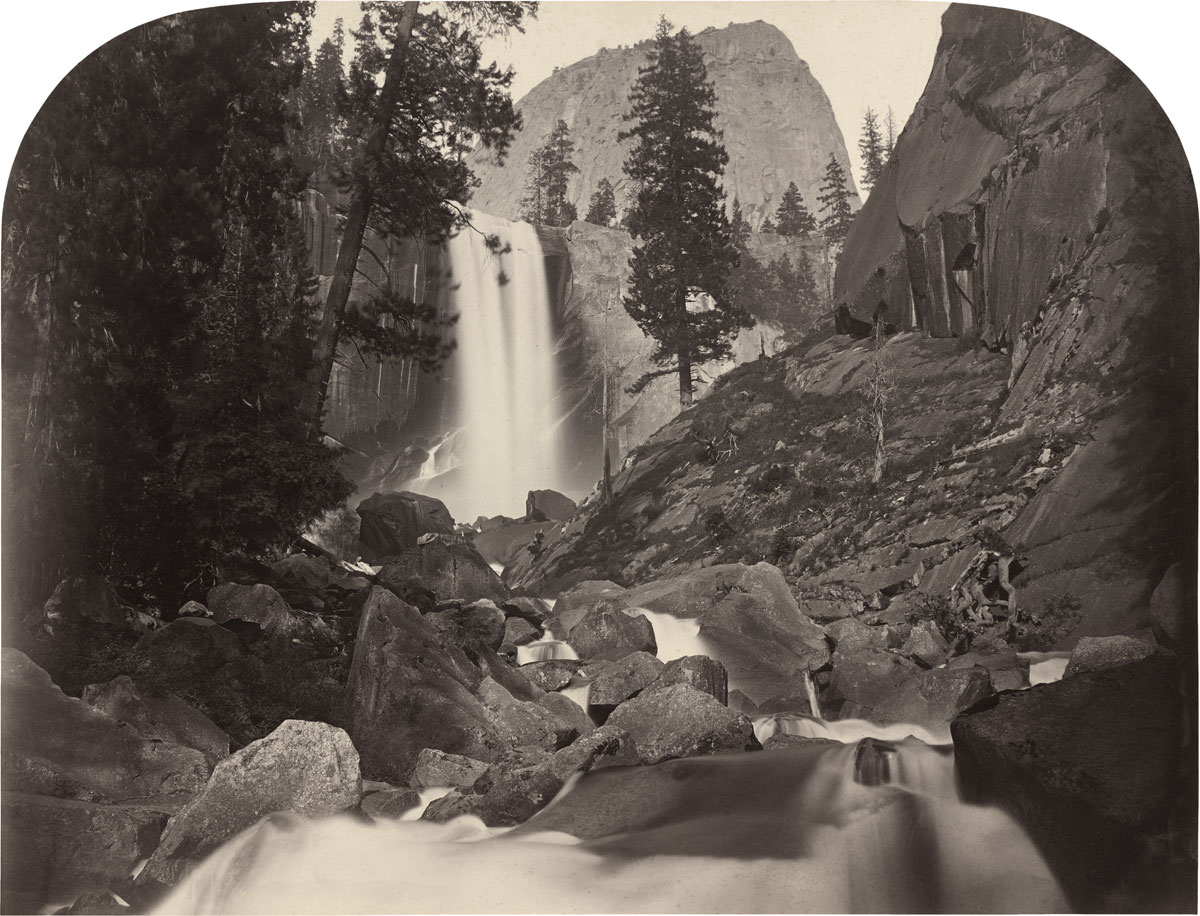
 

Carleton E. Watkins (American, 1829-1916) 'Piwac, Vernal Falls, 300 feet, Yosemite' 1861


Carleton E. Watkins (American, 1829-1916)
Piwac, Vernal Falls, 300 feet, Yosemite
1861
Albumen print
39.9 x 52.3cm
National Gallery of Art, Washington, Gift of Mary and David Robinson, 1995


The westward expansion of America opened up new opportunities for photographers such as Watkins and William Bell. Joining government survey expeditions, hired by railroad companies, or catering to tourists and the growing demand for grand views of nature, they created photographic landscapes that reached a broad audience of scientists, businessmen, and engineers, as well as curious members of the middle class. Watkins’s photographs of the sublime Yosemite Valley, which often recall landscape paintings of similar majestic subjects, helped convince Congress to pass a bill in 1864 protecting the area from development and commercial exploitation.
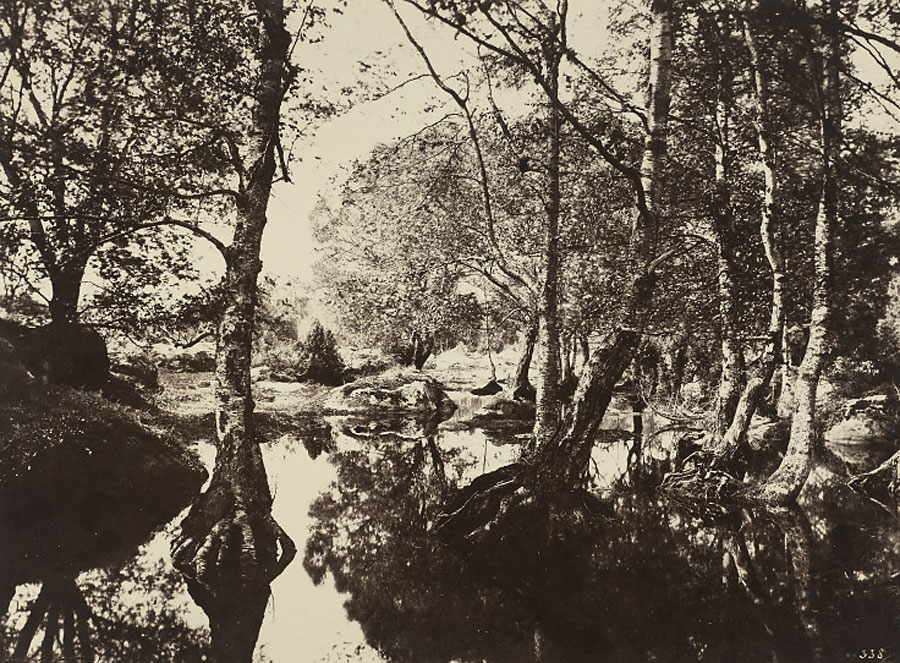
 

Eugène Cuvelier (French, 1837-1900) 'Belle-Croix' 1860s


Eugène Cuvelier (French, 1837-1900)
Belle-Croix
1860s
Albumen print
25.4 x 34.3cm
National Gallery of Art, Washington, Gail and Benjamin Jacobs for the Millennium Fund, 2007


In the second half of the nineteenth century, some photographers in France, hired by governmental agencies to make photographic inventories or simply catering to the growing demand for pictures of Paris, drew on the medium’s documentary abilities to record the nation’s architectural patrimony and the modernisation of Paris. Others explored the camera’s artistic potential by capturing the ephemeral moods of nature in the French countryside. Though photographers faced difficulties in carting around heavy equipment and operating in the field, they learned how to master the elements that directly affected their pictures, from securing the right vantage point to dealing with movement, light, and changing atmospheric conditions during long exposure times.


Gustave Le Gray (French, 1820-1884) 'The Pont du Carrousel, Paris: View to the West from the Pont des Arts' 1856-1858


Gustave Le Gray (French, 1820-1884)
The Pont du Carrousel, Paris: View to the West from the Pont des Arts
1856-1858
Albumen print
37.8 x 48.8cm
National Gallery of Art, Washington, Patrons’ Permanent Fund, 1995


Édouard-Denis Baldus (French, 1813-1889) 'Toulon, Train Station' c. 1861


Édouard-Denis Baldus (French, 1813-1889)
Toulon, Train Station
c. 1861
Albumen print
27.4 x 43.1cm
National Gallery of Art, Washington, Patrons’ Permanent Fund, 1995


In Light of the Past: Celebrating 25 Years of Photography at the National Gallery of Art, on view in the West Building from May 3 through July 26, 2015, will commemorate more than two decades of the Gallery’s robust photography program. Some 175 of the collection’s most exemplary holdings will reveal the evolution of the art of photography, from its birth in 1839 to the late 1970s. In Light of the Past is one of three stellar exhibitions that will commemorate the 25th anniversary of the National Gallery of Art’s commitment to photography acquisitions, exhibitions, scholarly catalogues, and programs.

In Light of the Past includes some of the rarest and most compelling photographs ever created,” said Earl A. Powell III, director, National Gallery of Art, Washington. “It also honours the generous support of our donors who have enabled us to achieve this new place of prominence for photography at the Gallery.

About the exhibition

In Light of the Past begins with exceptional 19th-century salted paper prints, daguerreotypes, and albumen prints by acclaimed early practitioners such as William Henry Fox Talbot (1800-1877), Gustave Le Gray (1820-1884), Roger Fenton (1819-1869), Julia Margaret Cameron (1815-1879), Albert Sands Southworth (1811-1894), and Josiah Johnson Hawes (1808-1901). It also displays works by American expeditionary photographers, including William Bell (1830-1910) and Carleton E. Watkins (1829-1916).

The exhibition continues with late 19th- and early 20th-century American Pictorialist photographs by Alfred Stieglitz (1864-1946), Clarence H. White (1871-1925), Gertrude Käsebier (1852-1934), and Alvin Langdon Coburn (1882-1966), among others, as well as European masters such as Eugène Atget (1857-1927). The exhibition also examines the international photographic modernism of artists such as Paul Strand (1890-1976), André Kertész (1894-1985), Marianne Brandt (1893-1983), László Moholy-Nagy (1895-1946), and Ilse Bing (1899-1998) before turning to the mid-20th century, where exceptional work by Walker Evans (1903-1975), Robert Frank (b. 1924), Harry Callahan (1912-1999), Irving Penn (1917-2009), Lee Friedlander (b. 1934), and Diane Arbus (1923-1971) will be on view.

The exhibition concludes with pictures from the 1960s and 1970s, showcasing works by photographers such as Robert Adams (b. 1937), Lewis Baltz (1945-2014), and William Eggleston (b. 1939), as well as Mel Bochner (b. 1940) and Sol LeWitt (1928-2007), which demonstrate the diverse practices that invigorated photography during these decades.

Press release from the National Gallery of Art
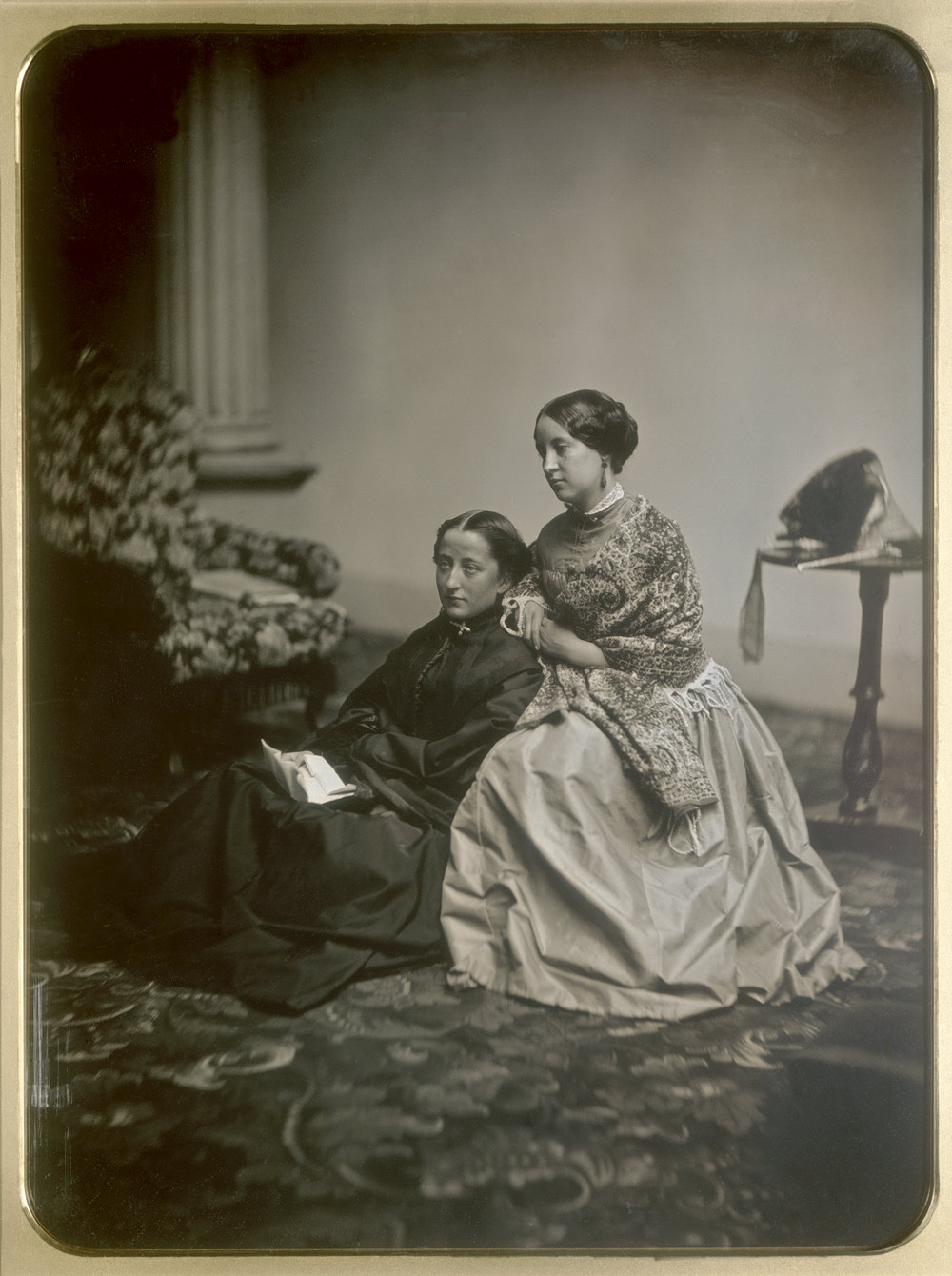
 

Albert Sands Southworth (American, 1811-1894) and Josiah Johnson Hawes (American, 1808-1901) 'The Letter' c. 1850


Albert Sands Southworth (American, 1811-1894) and Josiah Johnson Hawes (American, 1808-1901)
The Letter
c. 1850
Daguerreotype
Plate: 20.3 x 15.2cm
National Gallery of Art, Washington, Patrons’ Permanent Fund, 1999


Working together in Boston, the portrait photographers Southworth and Hawes aimed to capture the character of their subjects using the daguerreotype process. Invented in France and one of the two photographic processes introduced to the public in early 1839, the daguerreotype is made by exposing a silver-coated copper plate to light and then treating it with chemicals to bring out the image. The heyday of the technique was the 1840s and 1850s, when it was used primarily for making portraits. The daguerreotype’s long exposure time usually resulted in frontal, frozen postures and stern facial expressions; this picture’s pyramidal composition and strong sentiments of friendship and companionship are characteristic of Southworth and Hawes’s innovative approach.


Clarence H. White (American, 1871-1925) 'The Hillside' c. 1898


Clarence H. White (American, 1871-1925)
The Hillside
c. 1898
Gum dichromate print
20.8 x 15.88cm
National Gallery of Art, Washington, Patrons’ Permanent Fund, 2008


The Photo-Secession

At the turn of the century in America, Alfred Stieglitz and his colleague Edward Steichen led the movement to establish photography’s status as a fine art. In 1902 Stieglitz founded an organisation called the Photo-Secession, consisting of young artists who shared his belief in the creative potential of the medium. Many of the photographers featured here were members of the group, including Gertrude Käsebier, Clarence White, and Alvin Langdon Coburn. Through the exhibitions Stieglitz organised in his New York gallery, called 291, and the essays he published in his influential quarterly, Camera Work, he and the Photo-Secession promoted the Pictorialist aesthetic of softly textured, painterly pictures that elicit emotion and appeal to the imagination. Occasionally the photographers’ compositions refer to other works of art, such as Steichen’s portrait of his friend Auguste Rodin, whose pose recalls one of the sculptor’s most famous works, The Thinker. Influenced by the modern European and American painting, sculpture, and drawing he exhibited at 291, Stieglitz lost interest in the Photo-Secession in the early 1910s and began to explore a more straightforward expression.
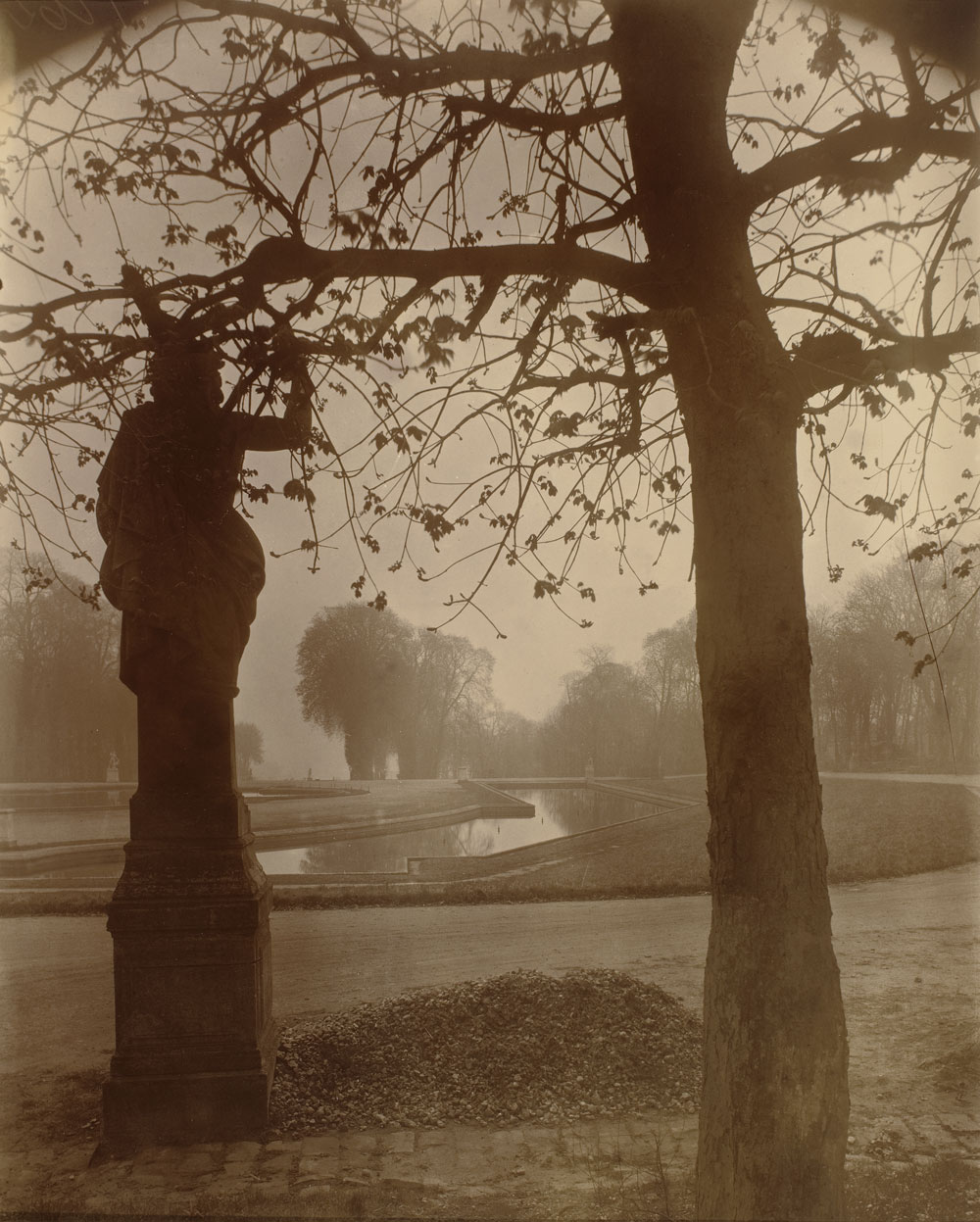
 

Eugène Atget (French, 1857-1927) 'Saint-Cloud' 1926


Eugène Atget (French, 1857-1927)
Saint-Cloud
1926
Albumen print
22.2 x 18.1cm
National Gallery of Art, Washington, Gift of Mary and Dan Solomon and Patrons’ Permanent Fund, 2006


Using a cumbersome camera mounted on a tripod, Atget recorded the myriad facets of Paris and its environs at the turn of the century. Transforming ordinary scenes into poetic evocations, he created a visual compendium of the objects, architecture, and landscapes that were expressive of French culture and its history. He sold his photographs to artists, architects, and craftsmen, as well as to libraries and museums interested in the vanishing old city. Throughout his career he returned repeatedly to certain subjects and discovered that the variations caused by changing light, atmosphere, and season provided inexhaustible subjects for the perceptive photographer.
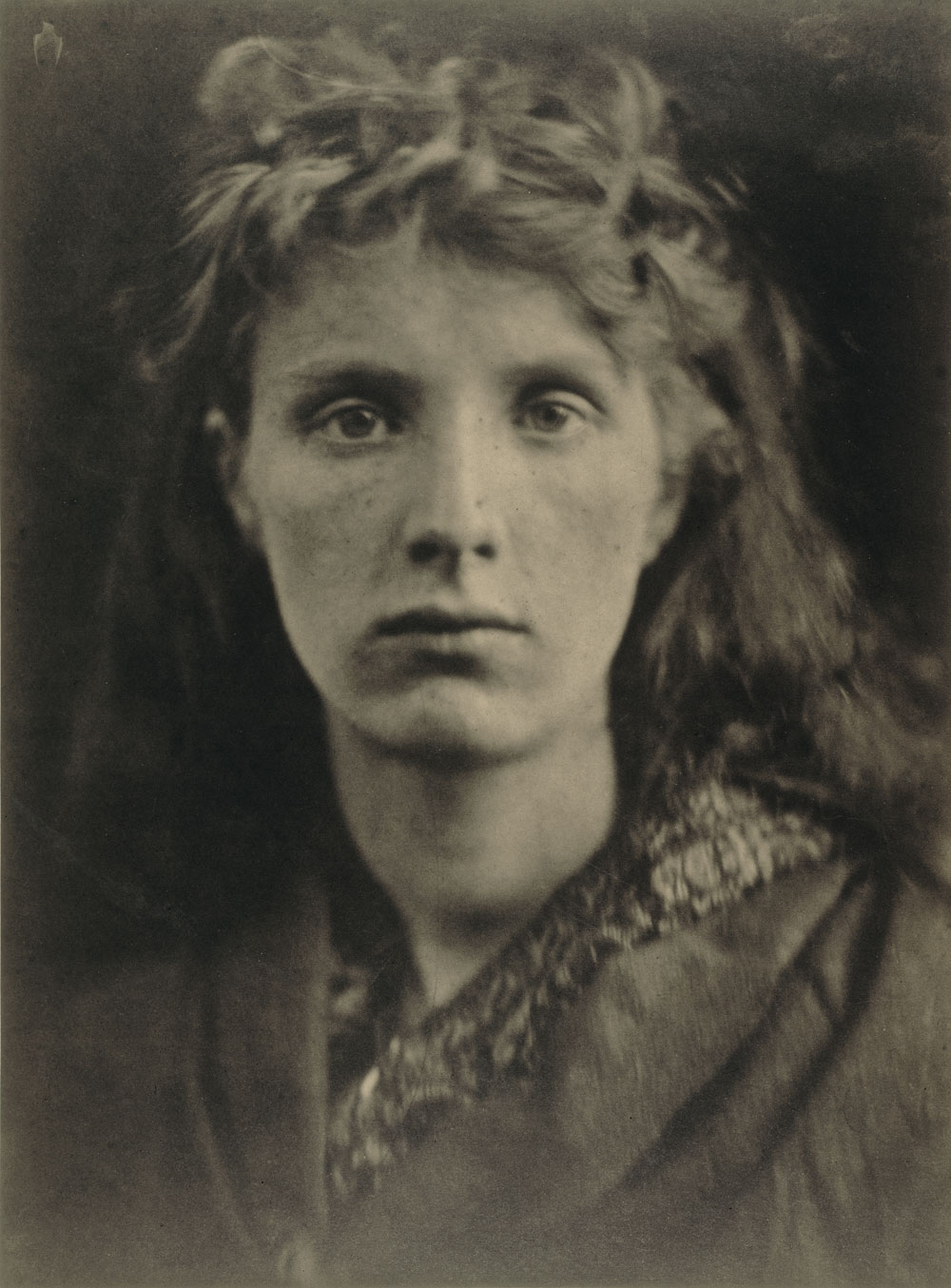
 

Julia Margaret Cameron (British, 1815-1879) 'The Mountain Nymph, Sweet Liberty' June 1866


Julia Margaret Cameron (British, 1815-1879)
The Mountain Nymph, Sweet Liberty
June 1866
Albumen print
36.1 x 26.7cm
National Gallery of Art, Washington, New Century Fund, 1997


Ensconced in the intellectual and artistic circles of midcentury England, Cameron manipulated focus and light to create poetic pictures rich in references to literature, mythology, and history. Her monumental views of life-sized heads were unprecedented, and with them she hoped to define a new mode of photography that would rival the expressive power of painting and sculpture. The title of this work alludes to John Milton’s mid-seventeenth-century poem L’Allegro. Describing the happy life of one who finds pleasure and beauty in the countryside, the poem includes the lines:

Come, and trip it as ye go
On the light fantastic toe;
And in thy right hand lead with thee,
The mountain nymph, sweet Liberty.
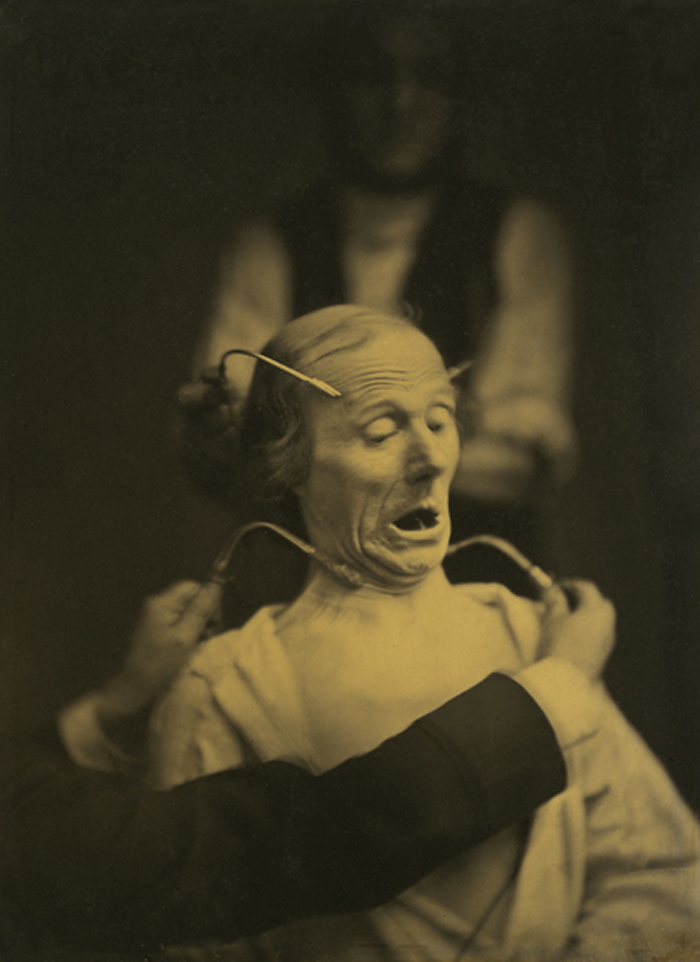
 

Dr Guillaume-Benjamin-Amant Duchenne (de Boulogne) (French, 1806-1875) 'Figure 63, "Fright" from "Mécanisme de la physionomie humaine (Mechanism of human physiognomy)" (1862)' 1854-1855


Dr Guillaume-Benjamin-Amant Duchenne (de Boulogne) (French, 1806-1875)
Figure 63, “Fright” from “Mécanisme de la physionomie humaine (Mechanism of human physiognomy)” (1862)
1854-1855
Albumen print
21.5 × 16cm
National Gallery of Art, Washington, Pepita Milmore Memorial Fund, 2015


A neurologist, physiologist, and photographer, Duchenne de Boulogne conducted a series of experiments in the mid-1850s in which he applied electrical currents to various facial muscles to study how they produce expressions of emotion. Convinced that these electrically-induced expressions accurately rendered internal feelings, he then photographed his subjects to establish a precise visual lexicon of human emotions, such as pain, surprise, fear, and sadness. In 1862 he included this photograph representing fright in a treatise on physiognomy (a pseudoscience that assumes a relationship between external appearance and internal character), which enjoyed broad popularity among artists and scientists.
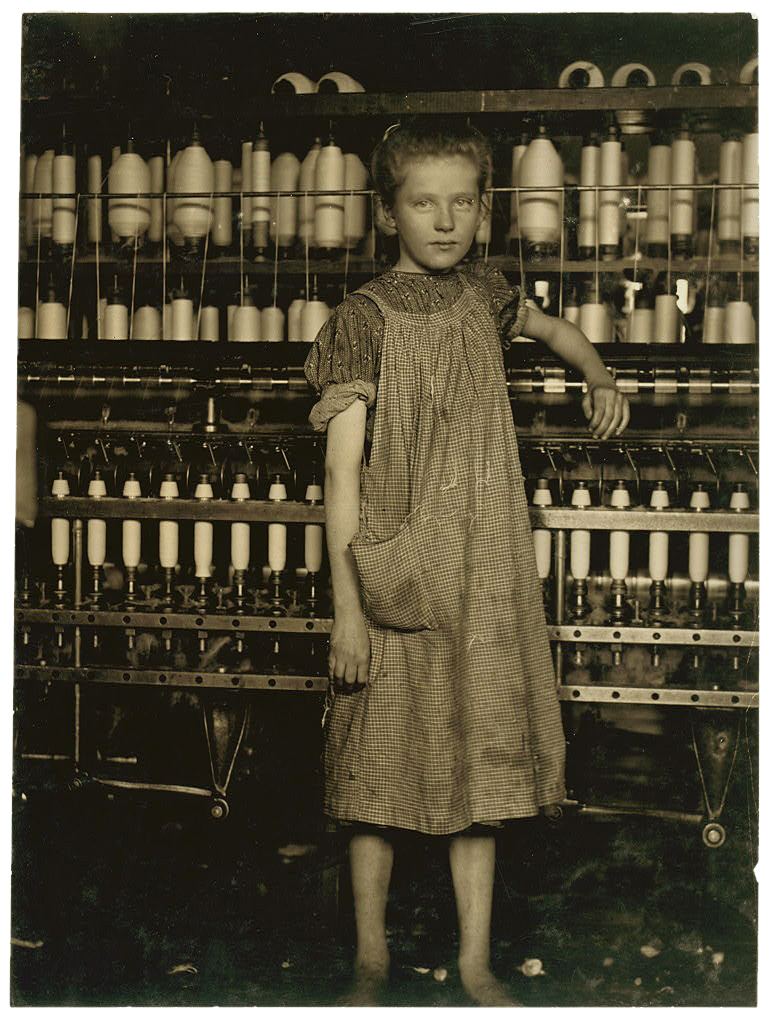
 

Lewis Hine (American, 1874-1940) 'An Anaemic Little Spinner in a New England Cotton Mill (North Pownal, Vermont)' 1910


Lewis Hine (American, 1874-1940)
An Anaemic Little Spinner in a New England Cotton Mill (North Pownal, Vermont)
1910
Gelatin silver print
24.1 × 19.2cm
National Gallery of Art, Washington, Pepita Milmore Memorial Fund, 2015


Trained as a sociologist and initially employed as a teacher, Hine used the camera both as a research tool and an instrument of social reform. One of the earliest and most influential social documentary photographers of his time, he made many pictures under the auspices of the National Child Labor Committee, an organisation formed in 1904 to promote better working conditions for children. Hine’s focus on the thin, frail body of this barefoot twelve-year-old spinner, who stands before rows of bobbins in the mill where she worked, was meant to illustrate the unhealthy effects of her employment. Photographs like this one were crucial to the campaign to change American child labor laws in the early twentieth century.


In Light of the Past: Twenty-Five Years of Photography at the National Gallery of Art

Georgia O’Keeffe and the Alfred Stieglitz Estate laid the foundation of the photography collection of the National Gallery of Art in 1949 with their donation of 1,650 Stieglitz photographs, an unparalleled group known as the Key Set. Yet the Gallery did not start actively acquiring photographs until 1990, when it launched an initiative to build a collection of works by European and American photographers from throughout the history of the medium and mount major exhibitions with scholarly publications. Now including nearly fifteen thousand prints, the collection encompasses the rich diversity of photographic practice from fine art to scientific and amateur photography, as well as photojournalism. It is distinguished by its large holdings of works by many of the medium’s most acclaimed masters, such as Paul Strand, Walker Evans, André Kertész, Ilse Bing, Robert Frank, Harry Callahan, Lee Friedlander, Gordon Parks, Irving Penn, and Robert Adams, among others.

In Light of the Past celebrates the twenty-fifth anniversary of the 1990 initiative by presenting some of the Gallery’s finest photographs made from the early 1840s to the late 1970s. It is divided into four sections arranged chronologically. The first traces the evolution of the art of photography during its first decades in the work of early British, French, and American practitioners. The second looks at the contributions of late nineteenth and early twentieth-century photographers, from Stieglitz and the American Pictorialists to European masters such as Eugène Atget. The third section examines the international photographic modernism of the 1920s and 1930s, and the fourth features seminal mid-twentieth-century photographers. The exhibition concludes with pictures representing the varied practices of those working in the late 1960s and 1970s.

The Nineteenth Century: The Invention of Photography

In 1839 a new means of visual representation was announced to a startled world: photography. Although the medium was immediately and enthusiastically embraced by the public at large, photographers themselves spent the ensuing decades experimenting with techniques and debating the nature of this new invention. The works in this section suggest the range of questions addressed by these earliest practitioners. Was photography best understood as an art or a science? What subjects should photographs depict, what purpose should they serve, and what should they look like? Should photographers work within the aesthetics established in other arts, such as painting, or explore characteristics that seemed unique to the medium? This first generation of photographers became part scientists as they mastered a baffling array of new processes and learned how to handle their equipment and material. Yet they also grappled with aesthetic issues, such as how to convey the tone, texture, and detail of multicoloured reality in a monochrome medium. They often explored the same subjects that had fascinated artists for centuries – portraits, landscapes, genre scenes, and still lifes – but they also discovered and exploited the distinctive ways in which the camera frames and presents the world.

Photography at the Turn of the Twentieth Century

In the late nineteenth century, improvements in technology and processing, along with the invention of small handheld cameras such as the Kodak, suddenly made it possible for anyone of middle-class means to take photographs. Many amateurs took up the camera to commemorate family, friends, and special events. Others, such as the sociologist Lewis Hine, used it as a tool for social and political change. Partially in response to the new ease of photography, more serious practitioners in America and Europe banded together to assert the artistic merit of the medium. Called Pictorialists, they sought to prove that photography was just as capable of poetic, subjective expression as painting. They freely manipulated their prints to reveal their authorial control, often resulting in painterly effects, and consciously separated themselves from amateur photographers and mechanised processes.

Photography Between the Wars

In the aftermath of World War I – the first modern, mechanised conflict – sweeping changes transformed photography. Avant-garde painters, graphic designers, and journalists turned to the medium, seeing it as the most effective tool to express the fractured, fast-paced nature of modernity and the new technological culture of the twentieth century. A wide variety of new approaches and techniques flourished during these years, especially in Europe. Photographers adopted radical cropping, unusual angles, disorienting vantage points, abstraction, collage, and darkroom alchemy to achieve what the influential Hungarian teacher László Moholy-Nagy celebrated as the “new vision.” Other photographers, such as the German August Sander or the Americans Alfred Stieglitz, Edward Weston, and Walker Evans, sought a more rigorous objectivity grounded in a precise examination of the world.

Postwar Photography

Photography thrived in the decades after World War II, invigorated by new ideas, practices, and expanding venues for circulating and displaying pictures. Immediately after the war, many photographers sought to publish their pictures in illustrated magazines, which prospered during these years. Some, such as Gordon Parks, made photographs highlighting racial, economic, and social disparities. Others, such as Louis Faurer, Sid Grossman, and Robert Frank, turned to the street to address the conditions of modern life in pictures that expose both its beauty and brutality. Using handheld cameras and available light, they focused on the random choreography of sidewalks, making pictures that are often blurred, out of focus, or off-kilter.

In the later 1950s and 1960s a number of photographers pushed these ideas further, mining the intricate social interactions of urban environments. Unlike photographers from the 1930s, these practitioners, such as Garry Winogrand, Lee Friedlander, and Diane Arbus, sought not to reform American society but to record it in all its complexity, absurdity, and chaos. By the late 1960s and 1970s, other photographers, such as Robert Adams and Lewis Baltz, looked beyond conventional notions of natural beauty to explore the despoliation of the urban and suburban landscape. Their pictures of tract houses, highways, and motels are stripped of any artistic frills, yet they are exquisitely rendered and replete with telling details. Also starting in the 1960s, many conceptual or performance artists working in a variety of media embraced what they perceived to be photography’s neutrality and turned to it as an essential part of their experiments to expand traditional notions of art. In the late 1960s, improvements in colour printing techniques led others, such as William Eggleston, to explore the artistic potential of colour photography.


Edward Steichen (American, 1879-1973) 'An Apple, A Boulder, A Mountain' 1921


Edward Steichen (American, 1879-1973)
An Apple, A Boulder, A Mountain
1921
Platinum print
National Gallery of Art, Washington, Patrons’ Permanent Fund, 2014


After World War I, Steichen became disillusioned with the painterly aesthetic of his earlier work and embarked on a series of experiments to study light, form, and texture. Inverting an apple, he demonstrated how a small object, when seen in a new way, can assume the monumentality and significance of a much larger one. His close-up scrutiny of a natural form closely links this photograph with works by other American modernists of the 1920s, such as Edward Weston, Paul Strand, and Georgia O’Keeffe.
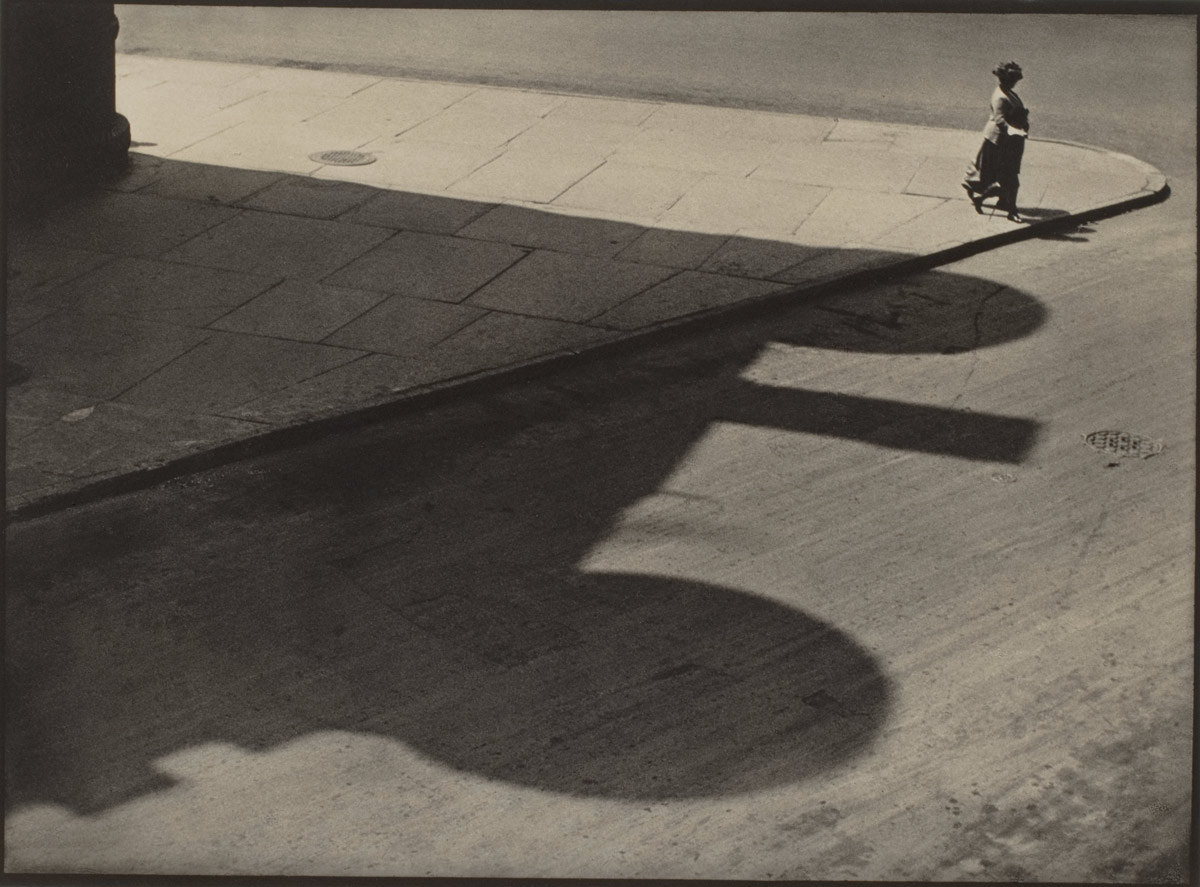
 

Paul Strand (American, 1890-1976) 'People, Streets of New York, 83rd and West End Avenue' 1916


Paul Strand (American, 1890-1976)
People, Streets of New York, 83rd and West End Avenue
1916
Platinum print
24.2 x 33cm
National Gallery of Art, Washington, Patrons’ Permanent Fund, 1990


Strand was introduced to photography in high school by his teacher Lewis Hine, who instilled in him a strong interest in social issues. In 1907, Hine took his pupil to Alfred Stieglitz’s 291 gallery in New York, which launched Strand’s desire to become a fine art photographer. By the early 1910s, influenced by Stieglitz, he began to make clearly delineated portraits, pictures of New York, and nearly abstract still lifes. Strand came to believe that photography was a gift of science to the arts, that it was an art of selection, not translation, and that objectivity was its very essence.
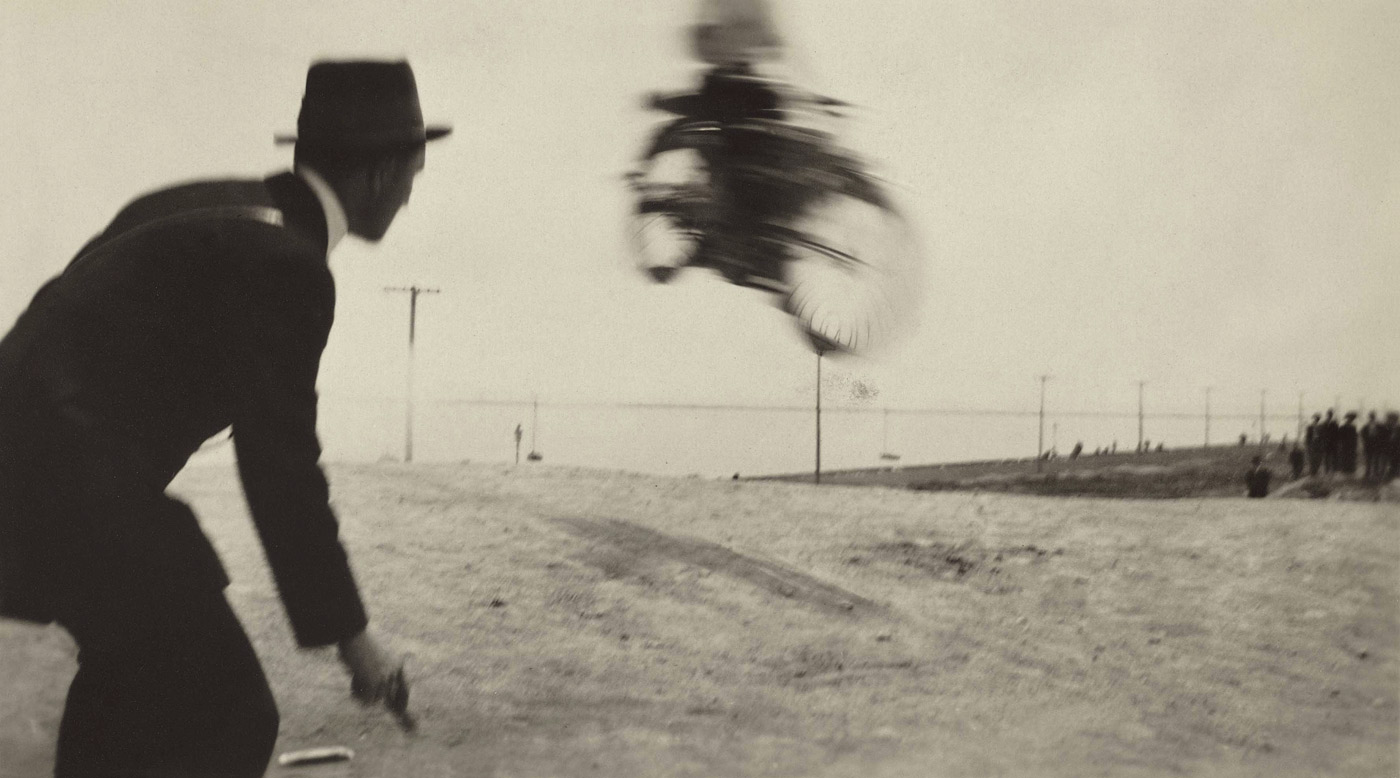
 

American 20th Century. 'Untitled' c. 1930


American 20th Century
Untitled
c. 1930
Gelatin silver print
5.7 x 10cm
National Gallery of Art, Washington, Gift of Robert E. Jackson, 2007


Snapshots

After World War I, a parade of technological improvements transformed the practice of photography. With smaller cameras, faster shutter speeds, and more sensitive film emulsions, both amateurs and more serious practitioners could now easily record motion, investigate unexpected angles and points of view, and work in dim light and inclement weather. The amateur’s less staid, more casual approach began to play an important role in the work of modernist photographers as they explored spontaneity and instantaneity, seeking to capture the cacophony and energy of modern life. Blurriness, distorted perspectives, and seemingly haphazard cropping-once considered typical amateur mistakes-were increasingly embraced as part of the modern, vibrant way of picturing the world.
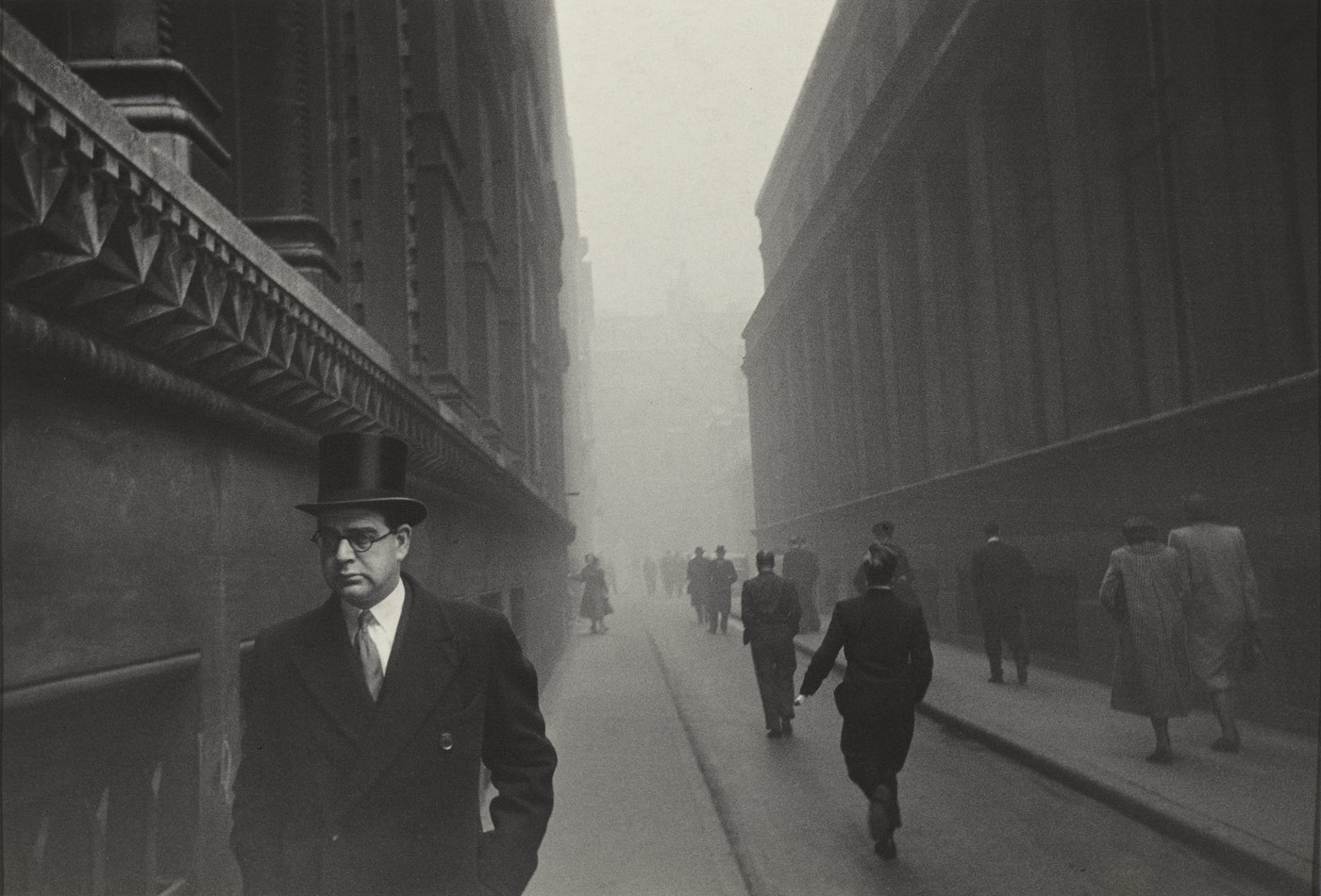
 

Robert Frank (Swiss, 1924-2019) 'City of London' 1951


Robert Frank (Swiss, 1924-2019)
City of London
1951
Gelatin silver print
23 x 33.6cm
National Gallery of Art, Washington, Robert Frank Collection, Purchased as a Gift of The Howard Gilman Foundation, in Honor of the 50th Anniversary of the National Gallery of Art, 1991
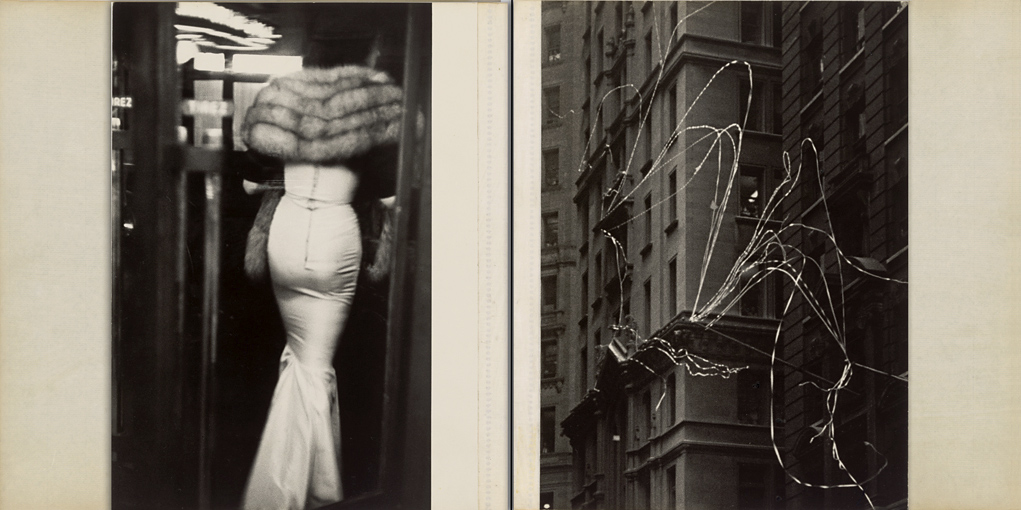
 

Robert Frank (Swiss, 1924-2019) 'Woman/Paris' 1952


Robert Frank (Swiss, 1924-2019)
Woman/Paris
1952
Gelatin silver print in bound volume
Image: 35.1 x 25.4cm
National Gallery of Art, Washington, Robert Frank Collection, Gift (Partial and Promised) of Robert Frank, in Honor of the 50th Anniversary of the National Gallery of Art, 1990


In the late 1940s and early 1950s, Frank made several handbound volumes of photographs, exploring different ways to link his pictures through non-narrative sequences. While in Zurich in October 1952, he assembled pictures taken in Europe, South America, and the United States in a book called Black White and Things. With a brief introductory quote from Antoine de Saint-Exupéry – “it is only with the heart that one can see rightly; what is essential is invisible to the eye” – the photographs are arranged in a sophisticated sequence that uses formal repetition, conceptual contrasts, and, as here, witty juxtapositions to evoke a range of ideas …

While in Zurich in October of 1952, Frank assembled photographs taken in Europe, South America, and the United States in the preceding years into a bound book called Black White and Things. Designed by Frank’s friend Werner Zryd, and with only a brief introductory statement describing the three sections, the photographs appear in a sophisticated sequence that relies on subtle, witty juxtapositions and powerful visual formal arrangements to evoke a wide range of emotions.

Frank made three copies of this book, all identical in size, construction, and sequence. He gave one copy to his father, gave one to Edward Steichen, and kept one. The book that belonged to his father is now in a private collection; Steichen’s copy resides at the Museum of Modern Art, New York; and in 1990 Frank gave his copy to the Robert Frank Collection at the National Gallery of Art.
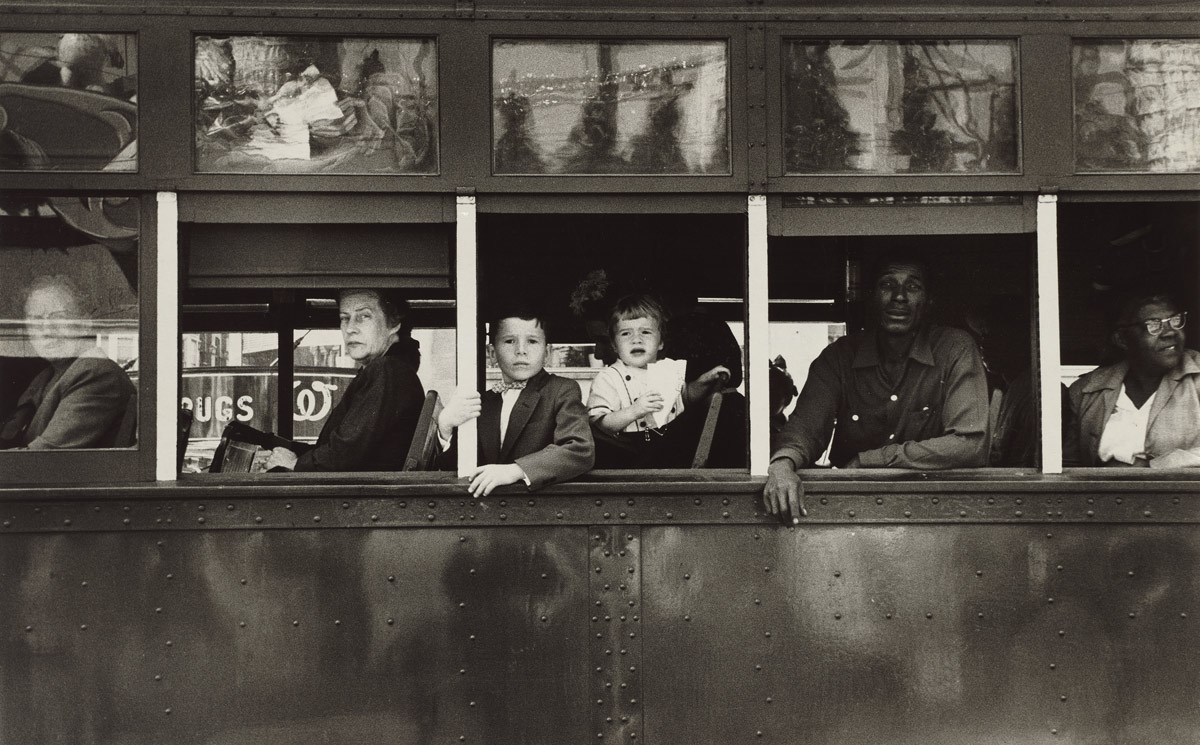
 

Robert Frank (Swiss, 1924-2019) 'Trolley - New Orleans' 1955


Robert Frank (Swiss, 1924-2019)
Trolley – New Orleans
1955
Gelatin silver print
Sheet: 21 x 31.6cm
National Gallery of Art, Washington, Gift of Maria and Lee Friedlander, 2001
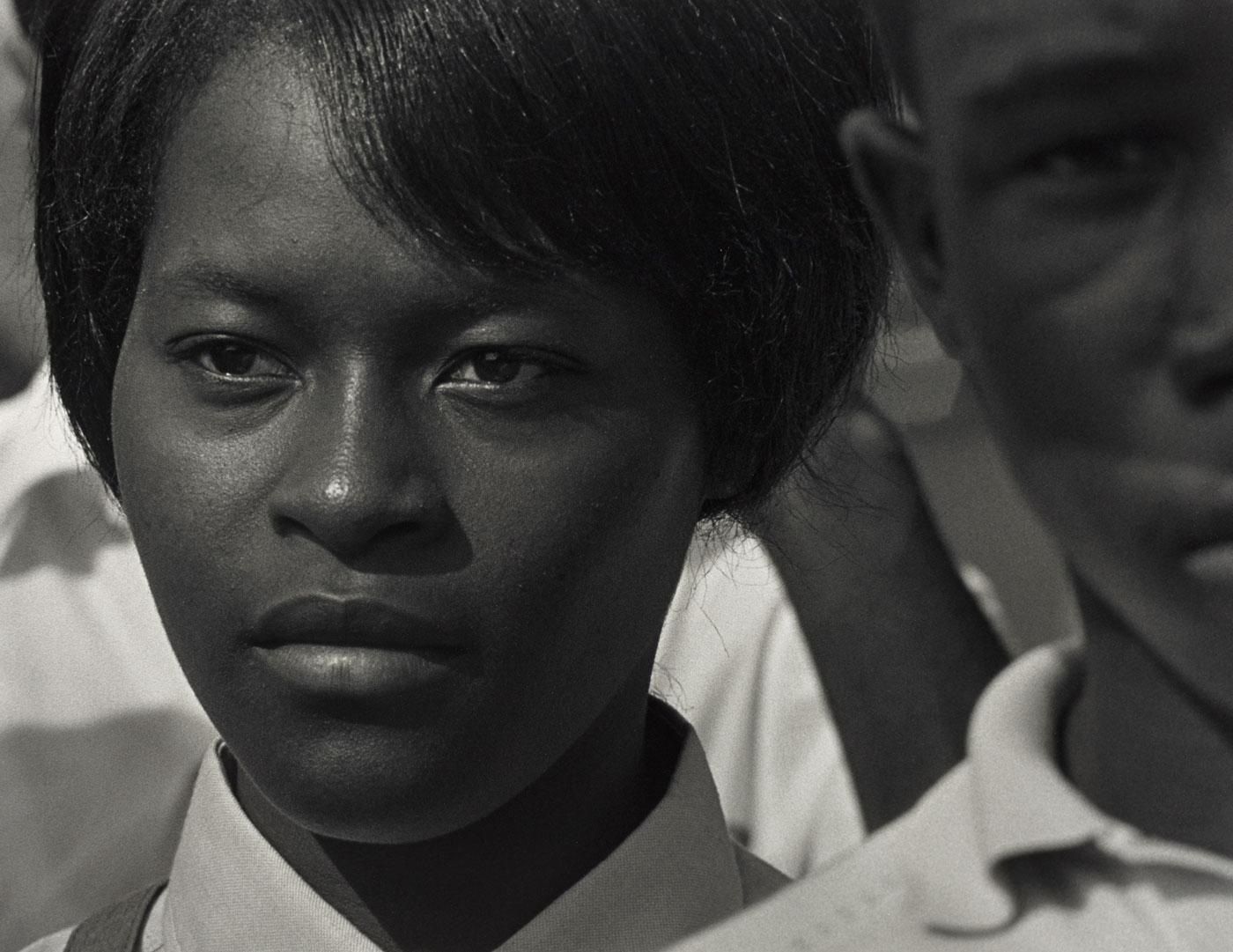
 

Roy DeCarava (American, 1919-2009) 'Mississippi Freedom Marcher, Washington, D.C.' 1963


Roy DeCarava (American, 1919-2009)
Mississippi Freedom Marcher, Washington, D.C.
1963
Gelatin silver print
25.5 x 33cm
National Gallery of Art, Washington, Horace W. Goldsmith Foundation through Robert and Joyce Menschel, 1999


Lee Friedlander (American, b. 1934) 'New York City' 1966


Lee Friedlander (American, b. 1934)
New York City
1966
Gelatin silver print
Image: 13.3 x 20.6 cm
National Gallery of Art, Washington, Trellis Fund, 2001


Heir to the tradition of documentary photography established by Eugène Atget, Walker Evans, and Robert Frank, Friedlander focuses on the American social landscape in photographs that can seem absurd, comical, and even bleak. In dense, complex compositions, he frequently depicts surprising juxtapositions that make the viewer look twice. He has made numerous self-portraits, yet he appears in these pictures in oblique and unexpected ways, for example reflected in a mirror or window. The startling intrusion of Friedlander’s shadow onto the back of a pedestrian’s coat, at once threatening and humorous, slyly exposes the predatory nature of street photography.


Giovanni Anselmo (Italian, 1934-2023) 'Entering the Work' 1971


Giovanni Anselmo (Italian, 1934-2023)
Entering the Work
1971
Photographic emulsion on canvas
49 x 63.5cm
National Gallery of Art, Washington, Glenstone in honor of Eileen and Michael Cohen, 2008


Conceptual Photography

In the 1960s, many painters and sculptors questioned the traditional emphasis on aesthetics and turned to creating art driven by ideas. Photography’s association with mechanical reproduction appealed to them as they sought to downplay the hand of the artist while promoting his or her role as idea maker. Some conceptual artists, such as Sol Lewitt and Mel Bochner, used photographs to explore an interest in perspective, scale, and mathematics. Others turned to photography as a tool to record performances and artistic undertakings, the resulting pictures acting as an integral part of those projects.

Anselmo was a member of the Italian Arte Povera group, which sought to break down the separation of art and life through experimental performances and the use of natural materials such as trees and leaves. To make this work, Anselmo set his camera up with a timed shutter release, and raced into view so that his running figure creates a modest yet heroic impression on the landscape.


Robert Adams (American, b. 1937) 'Colorado Springs, Colorado' 1974


Robert Adams (American, b. 1937)
Colorado Springs, Colorado
1974
Gelatin silver print, printed 1983
15.2 x 15.2cm
National Gallery of Art, Washington, Gift of Mary and Dan Solomon and Patrons’ Permanent Fund, 2006


For more than forty years, Adams has recorded the changing American landscape, especially the ongoing settlement of the West. Although he has photographed roads, tract houses, and strip malls that have utterly transformed the landscape, he has also captured the beauty that remains and indeed, that refuses to die, as in his poetic picture of morning fog over California hills. He is convinced, as he wrote in 1974, that “all land, no matter what has happened to it, has over it a grace, an absolutely persistent beauty.”
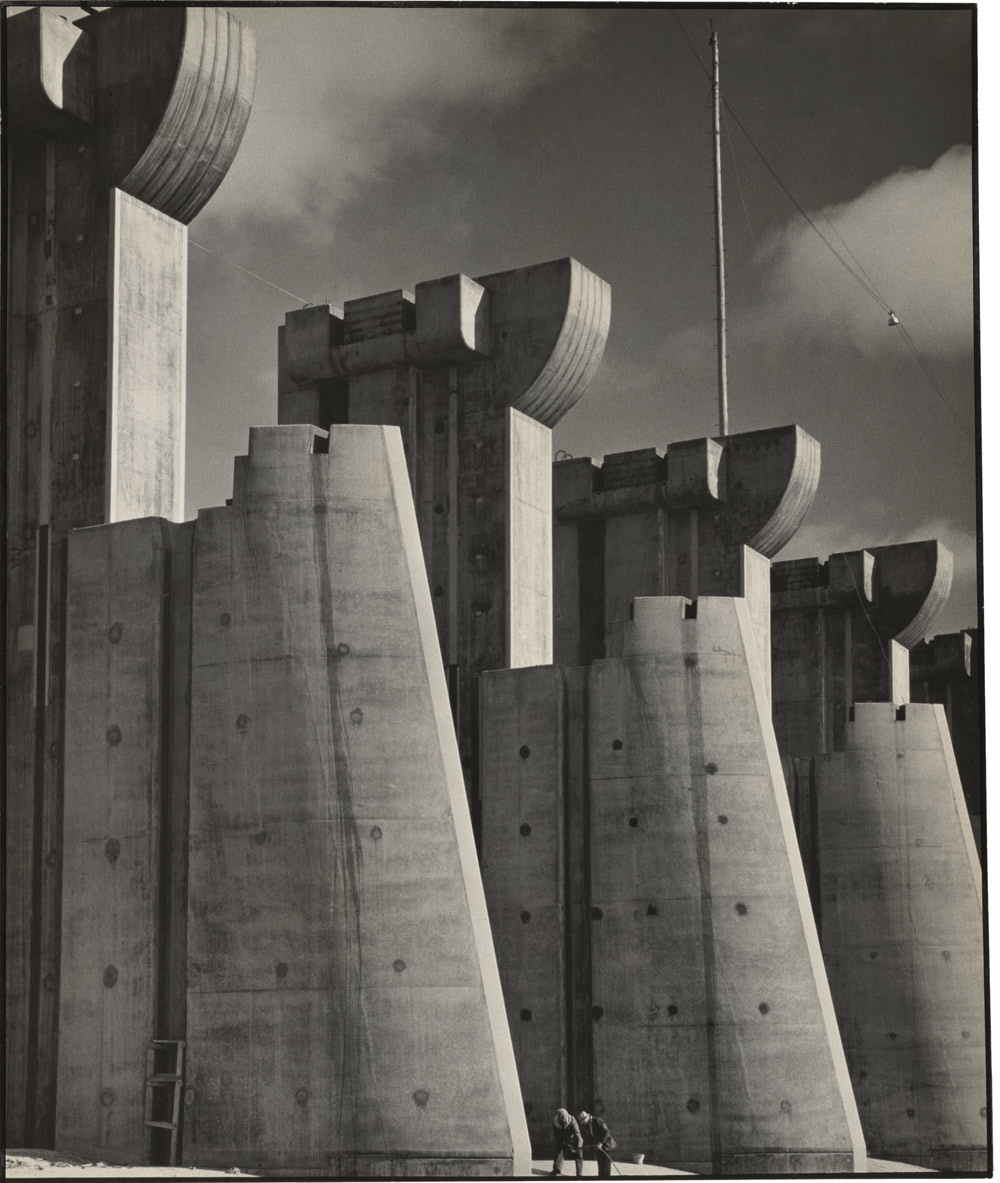
 

Margaret Bourke-White (American, 1904-1971) 'Fort Peck Dam, Montana' 1936


Margaret Bourke-White (American, 1904-1971)
Fort Peck Dam, Montana
1936
Gelatin silver print
33.02 × 27.31cm
National Gallery of Art, Washington, Patrons’ Permanent Fund, 2014


One of the most iconic photographs by the pioneering photojournalist Bourke-White, Fort Peck Dam, Montana was published on the cover of the inaugural issue of Life magazine on November 23, 1936. A striking representation of the machine age, the photograph depicts the stark, massive piers for an elevated highway over the spillway near the dam. The two men at the bottom of the print indicate the piers’ massive scale while revealing the vulnerable position of the worker in the modern industrial landscape.
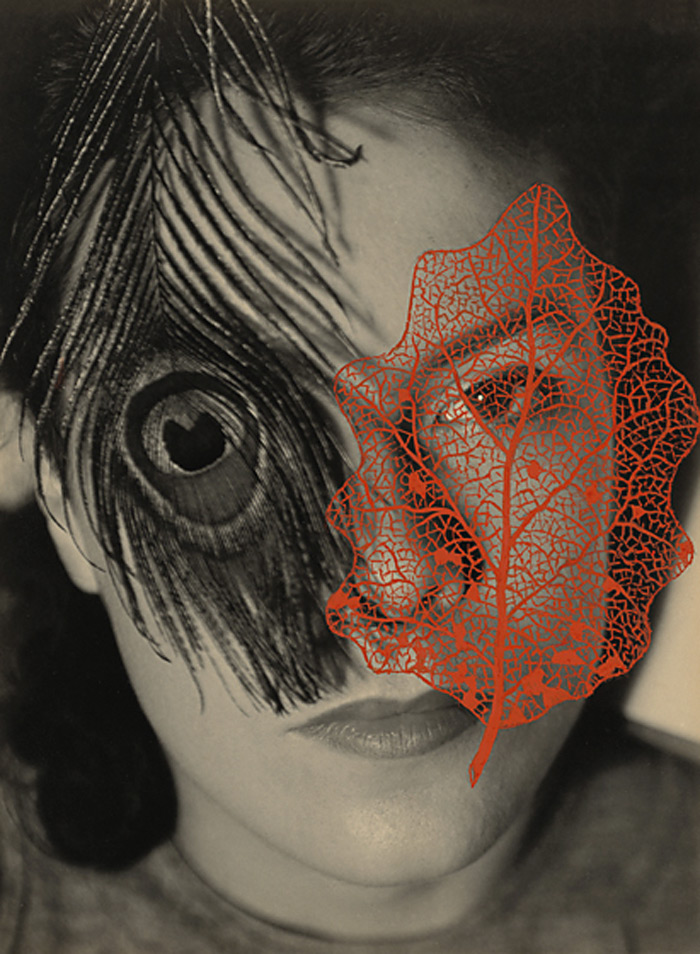
 

György Kepes (American born Hungary, 1906-2001) 'Juliet with Peacock Feather and Red Leaf' 1937-1938


György Kepes (American born Hungary, 1906-2001)
Juliet with Peacock Feather and Red Leaf
1937-1938
Gelatin silver print with gouache
15.7 × 11.6cm
National Gallery of Art, Washington, Pepita Milmore Memorial Fund, 2014


Trained as a painter at the Academy of Fine Arts in Budapest, Kepes was an influential designer, educator, aesthetic theorist, and photographer. In 1930 he moved to Berlin, where he worked with László Moholy-Nagy, but eventually settled in Chicago and later Cambridge, Massachusetts. Created soon after his arrival in America, this startling photograph is both an intimate depiction of Kepes’s wife and a study of visual perception. Like the red leaf that seems to float above the image, the peacock feather – its eye carefully lined up with Juliet’s – obscures not only her vision but also the viewer’s ability to see her clearly.
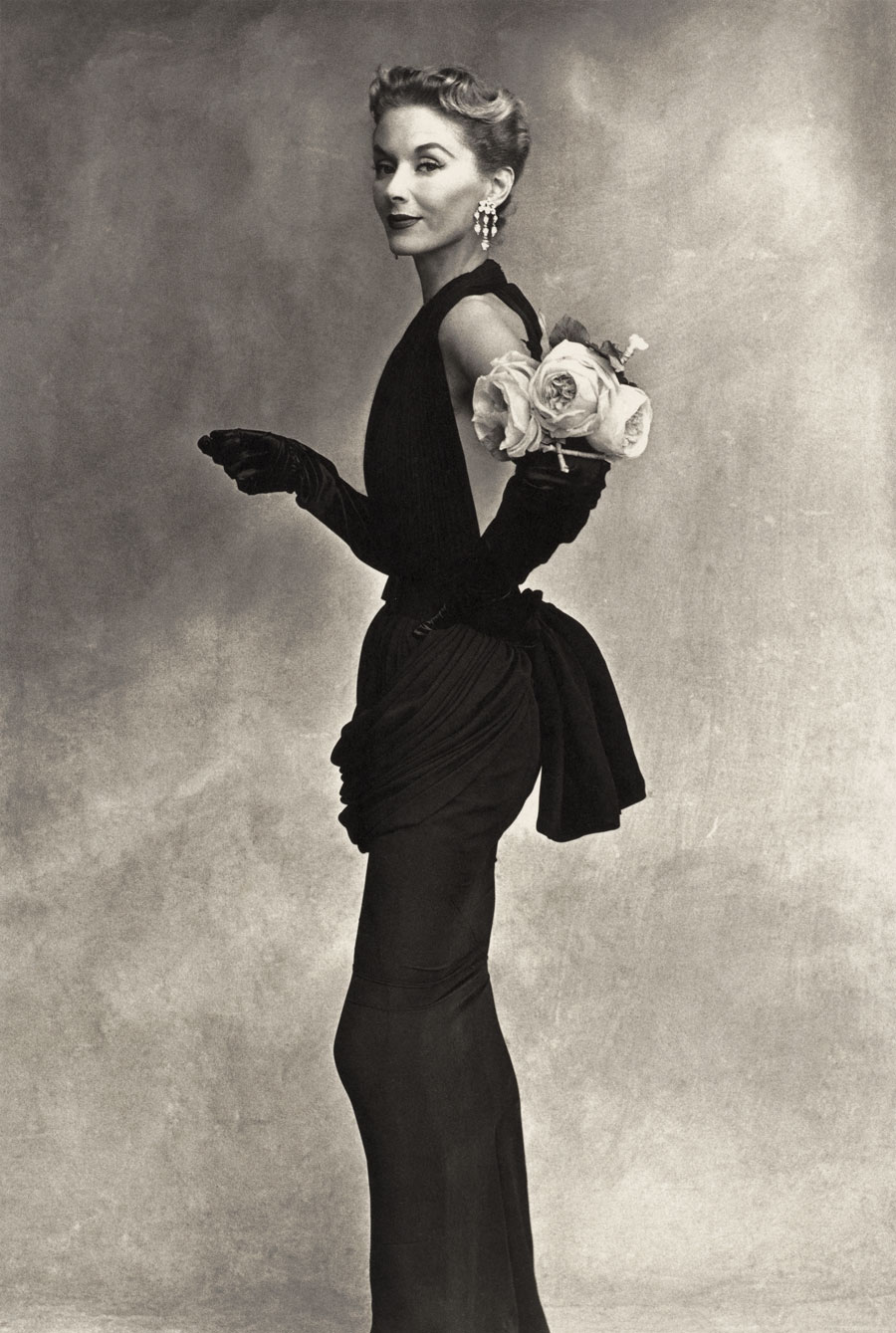
 

Irving Penn (American, 1917-2009) 'Woman with Roses (Lisa Fonssagrives-Penn in Lafaurie Dress), Paris' 1950


Irving Penn (American, 1917-2009)
Woman with Roses (Lisa Fonssagrives-Penn in Lafaurie Dress), Paris
1950
Platinum/palladium print, 1977
55.1 x 37cm
National Gallery of Art, Washington, Gift of Irving Penn, 2002


One of the most influential fashion and portrait photographers of his time, Penn made pictures marked by refinement, elegance, and clarity. Trained as a painter and designer, he began to photograph in the early 1940s while working at Vogue; more than 150 of his photographs appeared on the cover of the magazine during his long career. A perfectionist, Penn explored earlier printing techniques, such as a late nineteenth-century process that used paper coated with solutions of platinum or palladium rather than silver, to achieve the subtle tonal range he desired.


National Gallery of Art
National Mall between 3rd and 7th Streets
Constitution Avenue NW, Washington

Opening hours:
Open daily 10.00 am – 5.00pm

National Gallery of Art website

LIKE ART BLART ON FACEBOOK

Back to top

Exhibition: ‘Gordon Parks: Segregation Story’ at the High Museum of Art, Atlanta

Exhibition dates: 15th November, 2014 – 21st June, 2015

Curators: Brett Abbott, Keough Family Curator of Photography and Head of Collections at the High Museum of Art, in collaboration with Peter W. Kunhardt, Jr., Executive Director from the Gordon Parks Foundation


Gordon Parks (American, 1912-2006) 'Airline Terminal, Atlanta, Georgia' 1956 from the exhibition 'Gordon Parks: Segregation Story' at the High Museum of Art, Atlanta, Nov 2014 - June 2015


Gordon Parks (American, 1912-2006)
Airline Terminal, Atlanta, Georgia
1956
Courtesy of and copyright The Gordon Parks Foundation


The more I see of this man’s work, the more I admire it.

A sense of history, truth and injustice; a sense of beauty, colour and disenfranchisement; above all, a sense of composition and knowing the right time to take a photograph to tell the story. It’s all there, right in front of us, in almost every photograph. Photographs of institutionalised racism and the American apartheid, “the state of being apart”, laid bare for all to see.

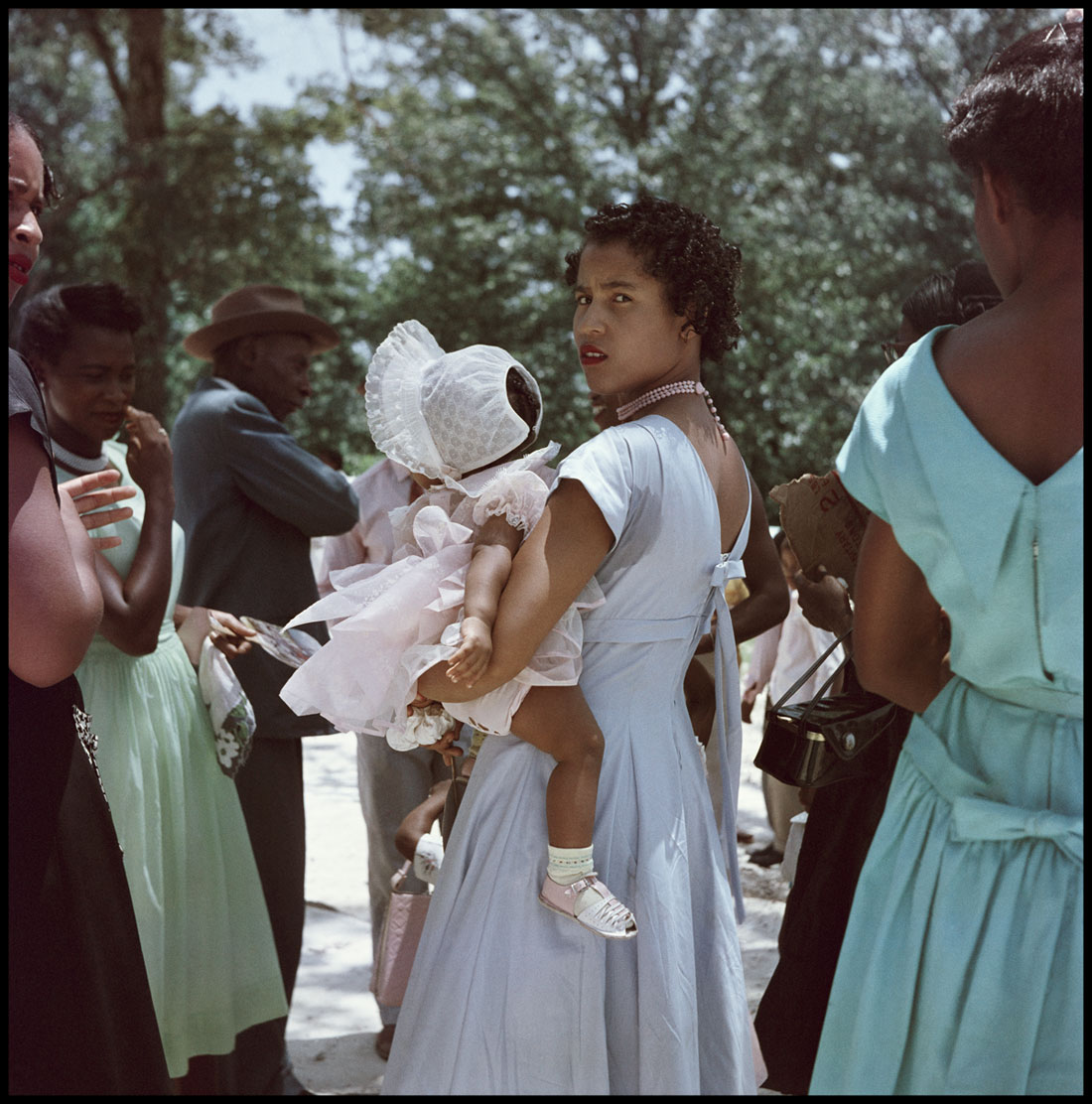
From the languid curl and mass of the red sofa on which Mr. and Mrs. Albert Thornton, Mobile, Alabama (1956) sit, which makes them seem very small and which forms the horizontal plane, intersected by the three generations of family photos from top to bottom – youth, age, family … to the blank stare of the nanny holding the white child while the mother looks on in Airline Terminal, Atlanta, Georgia (1956). I love the amorphous mass of black at the right hand side of the this image. From the neon delightful, downward pointing arrow of ‘Colored Entrance’ in Department Store, Mobile, Alabama (1956) to the ‘WHITE ONLY’ obelisk in At Segregated Drinking Fountain, Mobile, Alabama (1956). And so the story flows on like some great river, unstoppable, unquenchable…

But then we have two of the most intimate moments of beauty that brings me to tears as I write this, the two photographs at the bottom of the posting Untitled, Shady Grove, Alabama (1956). Just look at the light that Parks uses, this drawing with light. And then the use of depth of field, colour, composition (horizontal, vertical and diagonal elements) that leads the eye into these images and the utter, what can you say, engagement – no – quiescent knowingness on the children’s faces (like an old soul in a young body). This is a wondrous thing.

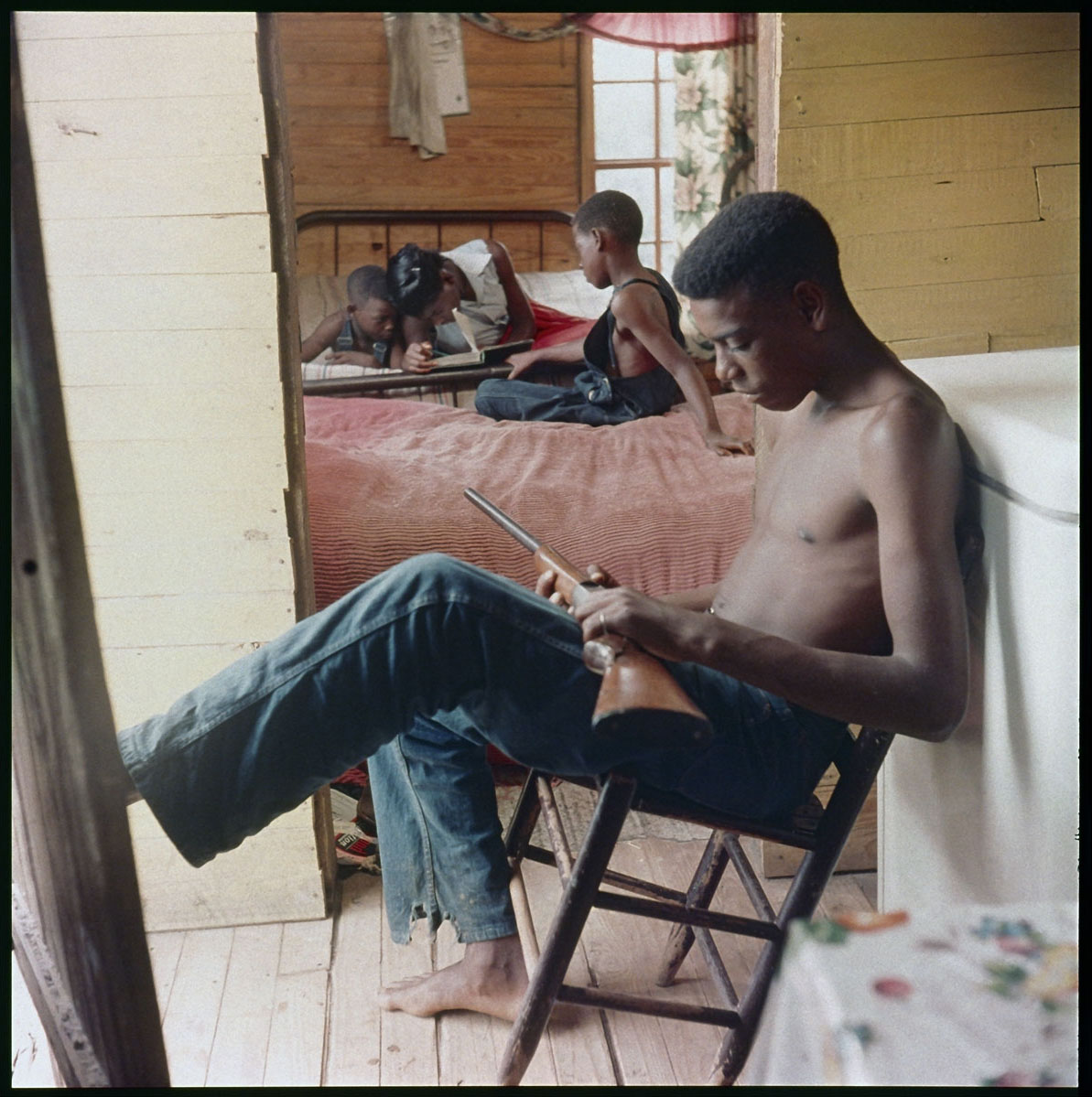
Notice how the photographer has pre-exposed the sheet of film so that the highlights in both images do not blow out. Pre-exposing the film lessens the contrast range allowing shadow detail and highlight areas to be held in balance. Also notice how in both images the photographer lets the eye settle in the centre of the image – in the photograph of the boy, the out of focus stairs in the distance; in the photograph of the three girls, the bonnet of the red car – before he then pulls our gaze back and to the right of the image to let the viewer focus on the faces of his subjects. In both photographs we have vertical elements (a door jam and a telegraph post) coming out of the red colours in the images and this vertically is reinforced in the image of the three girls by the rising ladder of the back of the chair. Masterful image making, this push and pull, this bravura art of creation.

Surely, Gordon Parks ranks up there with the greatest photographers of the 20th century.

Dr Marcus Bunyan


Many thankx to the High Museum of Art for allowing me to publish the photographs in the posting. Please click on the photographs for a larger version of the image. Many thanx also to Carlos Eguiguren for sending me his portrait of Gordon Parks taken in New York in 1985, which reveals a wonderful vulnerability within the artist.


Carlos Eguiguren (Chile, b. 1955) 'Gordon Parks, New York' 1985 rom the exhibition 'Gordon Parks: Segregation Story' at the High Museum of Art, Atlanta, Nov 2014 - June 2015


Carlos Eguiguren (Chile, b. 1955)
Gordon Parks, New York
1985
4 x 5″ transparency film
© Carlos Eguiguren


Gordon Parks (American, 1912-2006) 'Mr. and Mrs. Albert Thornton, Mobile, Alabama' 1956


Gordon Parks (American, 1912-2006)
Mr. and Mrs. Albert Thornton, Mobile, Alabama
1956
Promised gift of The Gordon Parks Foundation
Courtesy of and copyright The Gordon Parks Foundation


This portrait of Mr. and Mrs. Albert Thornton Sr., aged 82 and 70, served as the opening image of Parks’s photo essay. The well-dressed couple stares directly into the camera, asserting their status as patriarch and matriarch of their extensive Southern family. Photography is featured prominently within the image: a framed portrait, made shortly after the couple was married in 1906, hangs on the wall behind them, while family snapshots, including some of the Thorntons’ nine children and nineteen grandchildren, are proudly displayed on the coffee table in the foreground.


Gordon Parks (American, 1912-2006) 'Department Store, Mobile, Alabama' 1956


Gordon Parks (American, 1912-2006)
Department Store, Mobile, Alabama
1956
Promised gift of The Gordon Parks Foundation
Courtesy of and copyright The Gordon Parks Foundation


Joanne Wilson, one of the Thorntons’ daughters, is shown standing with her niece in front of a department store in downtown Mobile. The pair is impeccably dressed in light, summery frocks. The jarring neon of the “Colored Entrance” sign looming above them clashes with the two young women’s elegant appearance, transforming a casual afternoon outing into an example of overt discrimination. Notice the fallen strap of Wilson’s slip. Though this detail might appear discordant with the rest of the picture, its inclusion may have been strategic: it allowed Parks to emphasise the humanity of his subjects.


Gordon Parks (American, 1912-2006) 'Outside Looking In, Mobile, Alabama' 1956


Gordon Parks (American, 1912-2006)
Outside Looking In, Mobile, Alabama
1956
Promised gift of The Gordon Parks Foundation
Courtesy of and copyright The Gordon Parks Foundation


A group of children peers across a chain-link fence into a whites-only playground with a Ferris wheel. Although they had access to a “separate but equal” recreational area in their own neighbourhood, this photograph captures the allure of this other, inaccessible space. The children, likely innocent to the cruel implications of their exclusion, longingly reach their hands out to the mysterious and forbidden arena beyond. The pristinely manicured lawn on the other side of the fence contrasts with the overgrowth of weeds in the foreground, suggesting the persistent reality of racial inequality.


Gordon Parks (American, 1912-2006) 'At Segregated Drinking Fountain, Mobile, Alabama' 1956


Gordon Parks (American, 1912-2006)
At Segregated Drinking Fountain, Mobile, Alabama
1956
Promised gift of The Gordon Parks Foundation
Courtesy of and copyright The Gordon Parks Foundation


The Jim Crow laws established in the South ensured that public amenities remained racially segregated. These laws applied to schools, public transportation, restaurants, recreational facilities, and even drinking fountains, as shown here. The photograph documents the prevalence of such prejudice, while at the same time capturing a scene of compassion. Here, a gentleman helps one of the young girls reach the fountain to have a refreshing drink of water.


Gordon Parks (American, 1912-2006) 'Ondria Tanner and Her Grandmother Window-Shopping, Mobile, Alabama' 1956


Gordon Parks (American, 1912-2006)
Ondria Tanner and Her Grandmother Window-Shopping, Mobile, Alabama
1956
Promised gift of The Gordon Parks Foundation
Courtesy of and copyright The Gordon Parks Foundation


RARE PHOTOS BY GORDON PARKS PREMIERE AT HIGH MUSEUM OF ART

Featuring works created for Parks’ powerful 1956 Life magazine photo essay that have never been publicly exhibited.

The High Museum of Art presents rarely seen photographs by trailblazing African American artist and filmmaker Gordon Parks in Gordon Parks: Segregation Story on view November 15, 2014 through June 21, 2015.

The exhibition, presented in collaboration with The Gordon Parks Foundation, features more than 40 of Parks’ colour prints – most on view for the first time – created for a powerful and influential 1950s Life magazine article documenting the lives of an extended African-American family in segregated Alabama. The series represents one of Parks’ earliest social documentary studies on colour film. The High will acquire 12 of the colour prints featured in the exhibition, supplementing the two Parks works – both gelatin silver prints – already owned by the High. These works augment the Museum’s extensive collection of Civil Rights era photography, one of the most significant in the nation.

Following the publication of the Life article, many of the photos Parks shot for the essay were stored away and presumed lost for more than 50 years until they were rediscovered in 2012 (six years after Parks’ death). Though a small selection of these images has been previously exhibited, the High’s presentation brings to light a significant number that have never before been displayed publicly. As the first African-American photographer for Life magazine, Parks published some of the 20th century’s most iconic social justice-themed photo essays and became widely celebrated for his black-and-white photography, the dominant medium of his era. The photographs that Parks created for Life’s 1956 photo essay The Restraints: Open and Hidden are remarkable for their vibrant colour and their intimate exploration of shared human experience.

The images provide a unique perspective on one of America’s most controversial periods. Rather than capturing momentous scenes of the struggle for civil rights, Parks portrayed a family going about daily life in unjust circumstances. Parks believed empathy to be vital to the undoing of racial prejudice. His corresponding approach to the Life project eschewed the journalistic norms of the day and represented an important chapter in Parks’ career-long endeavour to use the camera as his “weapon of choice” for social change. The Restraints: Open and Hidden gave Parks his first national platform to challenge segregation. The images he created offered a deeper look at life in the Jim Crow South, transcending stereotypes to reveal a common humanity.

“Parks’ images brought the segregated South to the public consciousness in a very poignant way – not only in colour, but also through the eyes of one of the century’s most influential documentarians,” said Brett Abbott, exhibition curator and Keough Family curator of photography and head of collections at the High. “To present these works in Atlanta, one of the centres of the Civil Rights Movement, is a rare and exciting opportunity for the High. It is also a privilege to add Parks’ images to our collection, which will allow the High to share his unique perspective with generations of visitors to come.

A Day in the Life

For The Restraints: Open and Hidden, Parks focused on the everyday activities of the related Thornton, Causey and Tanner families in and near Mobile, Ala. The images present scenes of Sunday church services, family gatherings, farm work, domestic duties, child’s play, window shopping and at-home haircuts – all in the context of the restraints of the Jim Crow South.

Key images in the exhibition include:

~ Mr. and Mrs. Albert Thornton, Mobile Alabama (1956)
~ Outside Looking In, Mobile, Alabama (1956)
~ Department Store, Mobile Alabama (1956)
~ Airline Terminal, Atlanta, Georgia (1956)
~ Willie Causey, Jr., with Gun During Violence in Alabama, Shady Grove, Alabama (1956)

About Gordon Parks

Gordon Parks was born in Fort Scott, Kansas. He grew up poor and faced racial discrimination. Parks was initially drawn to photography as a young man after seeing images of migrant workers published in a magazine, which made him realise photography’s potential to alter perspective. Parks became a self-taught photographer after purchasing his first camera at a pawnshop, and he honed his skills during a stint as a society and fashion photographer in Chicago. After earning a Julius Rosenwald Fellowship for his gritty photographs of that city’s South Side, the Farm Security Administration hired Parks in the early 1940s to document the current social conditions of the nation.

By 1944, Parks was the only black photographer working for Vogue, and he joined Life magazine in 1948 as the first African-American staff photographer. In 1970, Parks co-founded Essence magazine and served as the editorial director for the first three years of its publication. Parks later became Hollywood’s first major black director when he released the film adaptation of his autobiographical novel The Learning Tree, for which he also composed the musical score, however he is best known as the director of the 1971 hit movie Shaft. Parks received the National Medal of Arts in 1988 and received more than 50 honorary doctorates over the course of his career. He died in 2006

About The Gordon Parks Foundation

The Gordon Parks Foundation permanently preserves the work of Gordon Parks, makes it available to the public through exhibitions, books, and electronic media and supports artistic and educational activities that advance what Gordon described as “the common search for a better life and a better world.” The Foundation is a division of The Meserve-Kunhardt Foundation.

Press release from the High Museum of Art


Gordon Parks (American, 1912-2006) 'Untitled, Alabama' 1956


Gordon Parks (American, 1912-2006)
Untitled, Alabama
1956
Collection of The Gordon Parks Foundation
Courtesy of and copyright The Gordon Parks Foundation


Gordon Parks (American, 1912-2006) 'Untitled, Shady Grove, Alabama' 1956


Gordon Parks (American, 1912-2006)
Untitled, Shady Grove, Alabama
1956
Collection of The Gordon Parks Foundation
Courtesy of and copyright The Gordon Parks Foundation


Gordon Parks (American, 1912-2006) 'Store Front, Mobile Alabama' 1956


Gordon Parks (American, 1912-2006)
Store Front, Mobile Alabama
1956
Collection of The Gordon Parks Foundation
Courtesy of and copyright The Gordon Parks Foundation


Gordon Parks (American, 1912-2006) 'Untitled, Shady Grove, Alabama' 1956


Gordon Parks (American, 1912-2006)
Untitled, Shady Grove, Alabama
1956
Collection of The Gordon Parks Foundation
Courtesy of and copyright The Gordon Parks Foundation


Gordon Parks (American, 1912-2006) 'Willie Causey, Jr., with Gun During Violence in Alabama, Shady Grove, Alabama' 1956


Gordon Parks (American, 1912-2006)
Willie Causey, Jr., with Gun During Violence in Alabama, Shady Grove, Alabama
1956
Collection of The Gordon Parks Foundation
Courtesy of and copyright The Gordon Parks Foundation


Gordon Parks (American, 1912-2006) 'Untitled, Shady Grove, Alabama' 1956


Gordon Parks (American, 1912-2006)
Untitled, Shady Grove, Alabama
1956
Collection of The Gordon Parks Foundation
Courtesy of and copyright The Gordon Parks Foundation


Gordon Parks (American, 1912-2006) 'Untitled, Shady Grove, Alabama' 1956


Gordon Parks (American, 1912-2006)
Untitled, Shady Grove, Alabama
1956
Collection of The Gordon Parks Foundation
Courtesy of and copyright The Gordon Parks Foundation


Gordon Parks (American, 1912-2006) 'Black Classroom, Shady Grove, Alabama' 1956


Gordon Parks (American, 1912-2006)
Black Classroom, Shady Grove, Alabama
1956
Promised gift of The Gordon Parks Foundation
Courtesy of and copyright The Gordon Parks Foundation


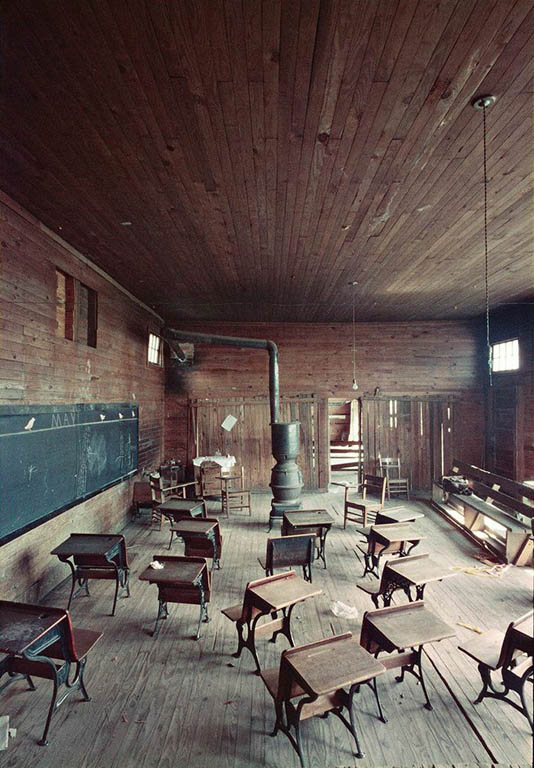
Although this photograph was taken in the 1950s, the wood-panelled interior, with a wood-burning stove at its centre, is reminiscent of an earlier time. Parks’s photograph of the segregated schoolhouse, here emptied of its students, evokes both the poetic and prosaic: springtime sunlight streams through the missing slats on the doors, while scraps of paper, rope, and other detritus litter the uneven floorboards. One of the Thorntons’ daughters, Allie Lee Causey, taught elementary-grade students in this dilapidated, four-room structure. After Parks’s article was published in Life, Mrs. Causey, who was quoted speaking out against segregation, was suspended from her job. She never held a teaching position again.


High Museum of Art
1280 Peachtree Street,
N.E. Atlanta, GA 30309

Opening hours:
Monday – Closed
Tuesday – Saturday 10am – 5pm
Sunday 12 – 5pm
High Museum of Art website

LIKE ART BLART ON FACEBOOK

Back to top

Exhibition: ‘Storyteller: The Photographs of Duane Michals’ at the Peabody Essex Museum (PEM), Salem MA

Exhibition dates: 7th March – 21st June, 2015

Original curator of the touring exhibition: Linda Benedict-Jones, Curator of Photography at the Carnegie Museum of Art (CMOA)


Duane Michals (American, b. 1932) From the series 'I Remember Pittsburgh' 1982 from the exhibition 'Storyteller: The Photographs of Duane Michals' at the Peabody Essex Museum (PEM), Salem MA, March - June, 2015


Duane Michals (American, b. 1932)
From the series I Remember Pittsburgh
1982
Nine gelatin silver prints
Greenwald Photograph Fund and Fine Arts Discretionary Fund
Courtesy of Carnegie Museum of Art, Pittsburgh


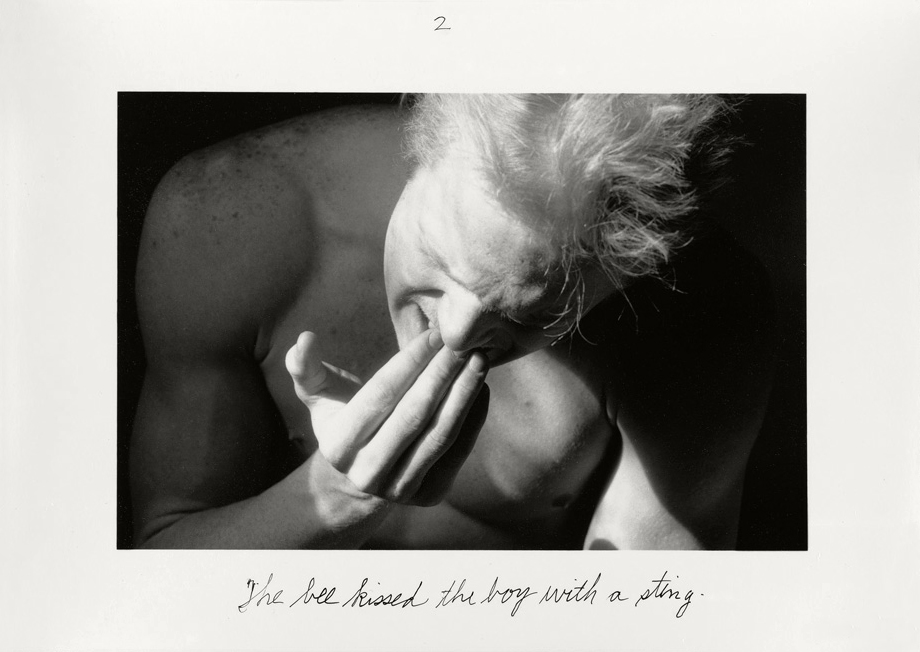
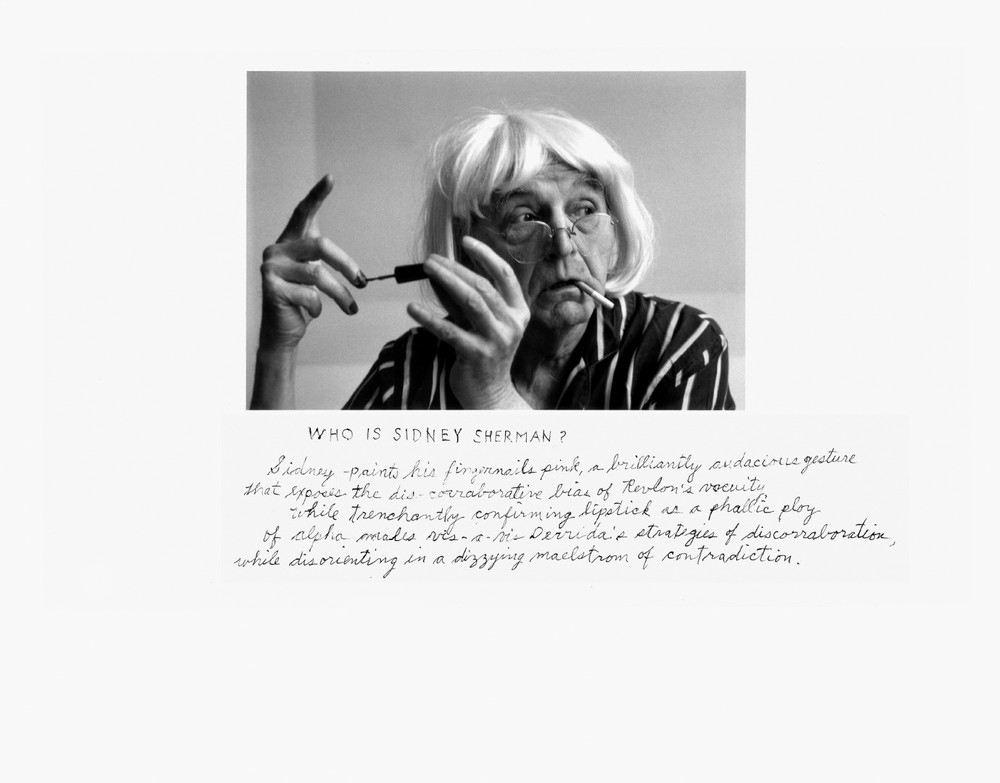
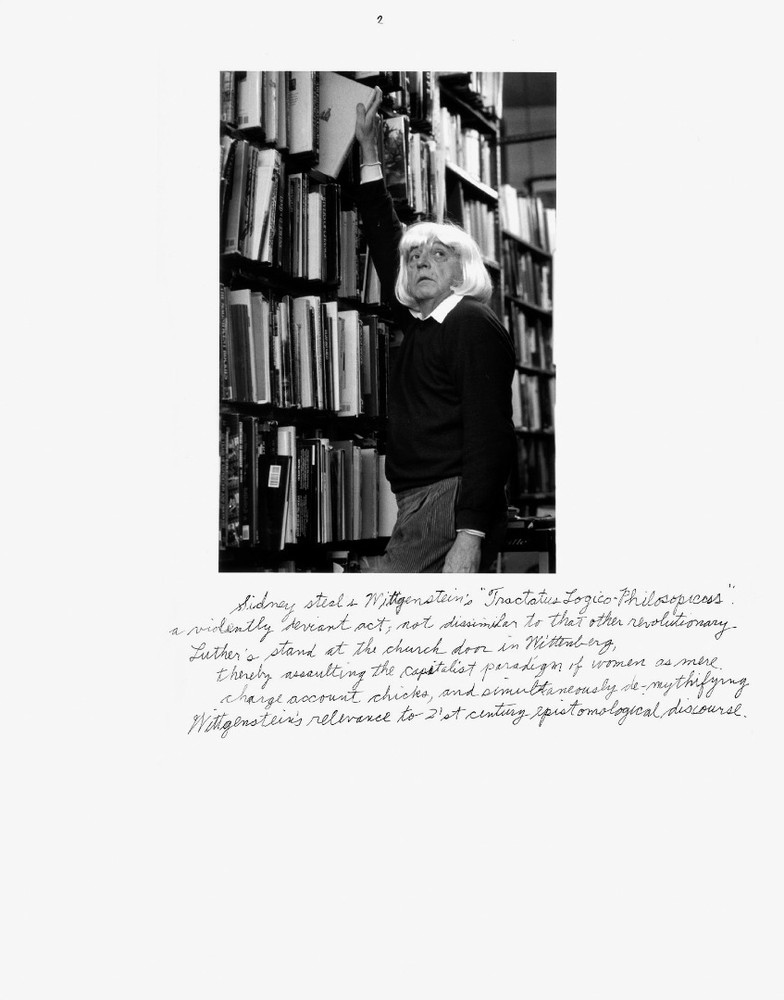
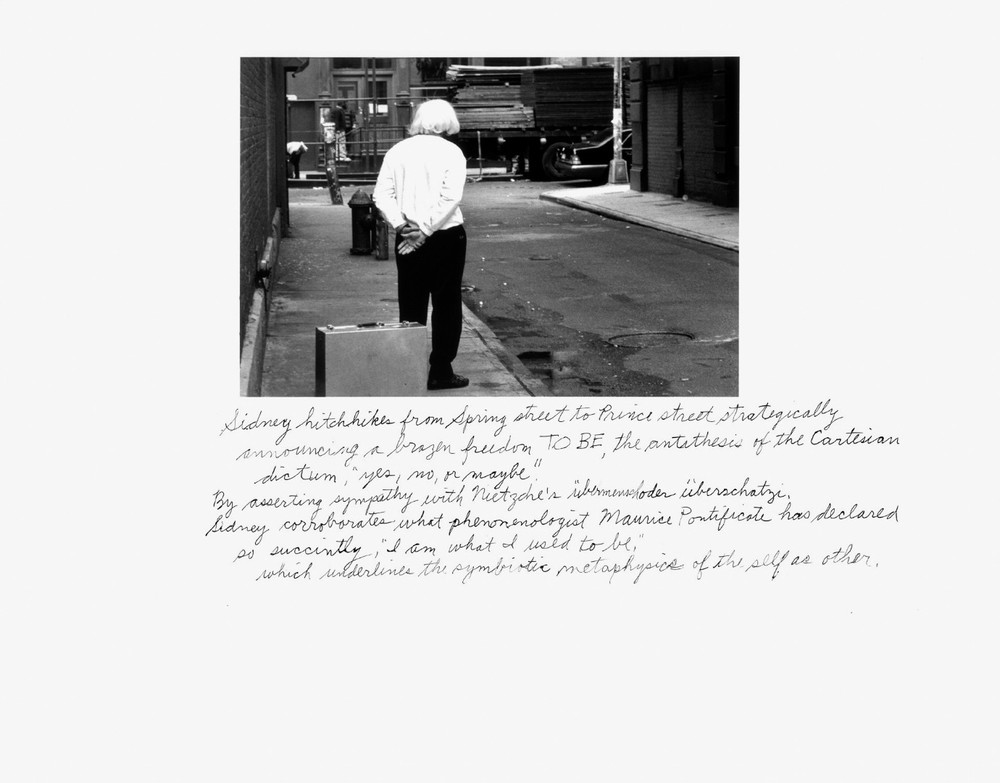
I couldn’t resist. Another posting on the work of this extraordinary artist. I particularly like The Bewitched Bee (1986) and Who is Sidney Sherman?, replete with blond wig and fag hanging out of the mouth accompanied by very funny and perceptive text.

There is also a very interesting piece of writing on life and photography included in the posting, Real Dreams, from 1976.

Dr Marcus Bunyan


Please click on the photographs for a larger version of the image.


“I’m not interested in what something looks like, I want to know what it feels like.”


Duane Michals


Duane Michals (American, b. 1932) 'The Bewitched Bee' 1986 from the exhibition 'Storyteller: The Photographs of Duane Michals' at the Peabody Essex Museum (PEM), Salem MA, March - June, 2015

Duane Michals (American, b. 1932) 'The Bewitched Bee' 1986

Duane Michals (American, b. 1932) 'The Bewitched Bee' 1986

Duane Michals (American, b. 1932) 'The Bewitched Bee' 1986

Duane Michals (American, b. 1932) 'The Bewitched Bee' 1986

Duane Michals (American, b. 1932) 'The Bewitched Bee' 1986

Duane Michals (American, b. 1932) 'The Bewitched Bee' 1986

Duane Michals (American, b. 1932) 'The Bewitched Bee' 1986

Duane Michals (American, b. 1932) 'The Bewitched Bee' 1986

Duane Michals (American, b. 1932) 'The Bewitched Bee' 1986

Duane Michals (American, b. 1932) 'The Bewitched Bee' 1986

Duane Michals (American, b. 1932) 'The Bewitched Bee' 1986

Duane Michals (American, b. 1932) 'The Bewitched Bee' 1986


Duane Michals (American, b. 1932)
The Bewitched Bee
1986
Thirteen gelatin silver prints with hand-applied text
5 x 7 in. (12.7 x 17.8 cm)


Michals uses photography to spin what amount to Ovidian legends, as in The Bewitched Bee, a sequence of thirteen images in which a young man stung by a bee grows antlers, wanders through the woods, and finally drowns in a sea of leaves.


The Peabody Essex Museum (PEM) presents Storyteller: The Photographs of Duane Michals, the first major U.S. retrospective of the artist’s work in 20 years. Through image sequences, multiple exposures and the overlay of handwritten messages and pigment, Duane Michals (b. 1932) pioneered distinctly new ways of creating and considering photographs. The last half-century of this artist’s prolific, trailblazing career is explored in a carefully selected presentation of more than 65 works. Organised by the Carnegie Museum of Art, Storyteller: The Photographs of Duane Michals is on view at PEM from March 7 through June 21, 2015.

Michals’ career has been fuelled by his enduring curiosity about the human experience and has been defined by its continual creative exploration and reinvention. A self-taught practitioner, he emerged on the photographic scene in the 1960s, at a time when Ansel Adams’ austere mountain ranges and Henri Cartier-Bresson’s iconic street scenes ruled the day. Rather than journey outward to depict nature or patiently wait to capture a decisive moment, Michals sought a new method of expression for his psychological and imaginative vision. He worked with friends and acquaintances to stage sequences of photographs that sought to express things that cannot be seen directly, such as metaphysical  reflections on the passage from life to death. Later, he added handwritten text to the images’ margins, further challenging the prevailing sanctity of the single pure photograph.

“For Michals, the need to authentically express himself trumped any interest in being accepted into the mainstream art world. His work charts fresh territory, creatively mixing philosophical rigour, surreal witticism and childlike playfulness with an unabashed sentimentality and nostalgic longing,” says Trevor Smith, PEM’s Curator of the Present Tense. “In Michals’ photographs we encounter an uncommon vulnerability as well as a resolute search for meaning and human connection.”

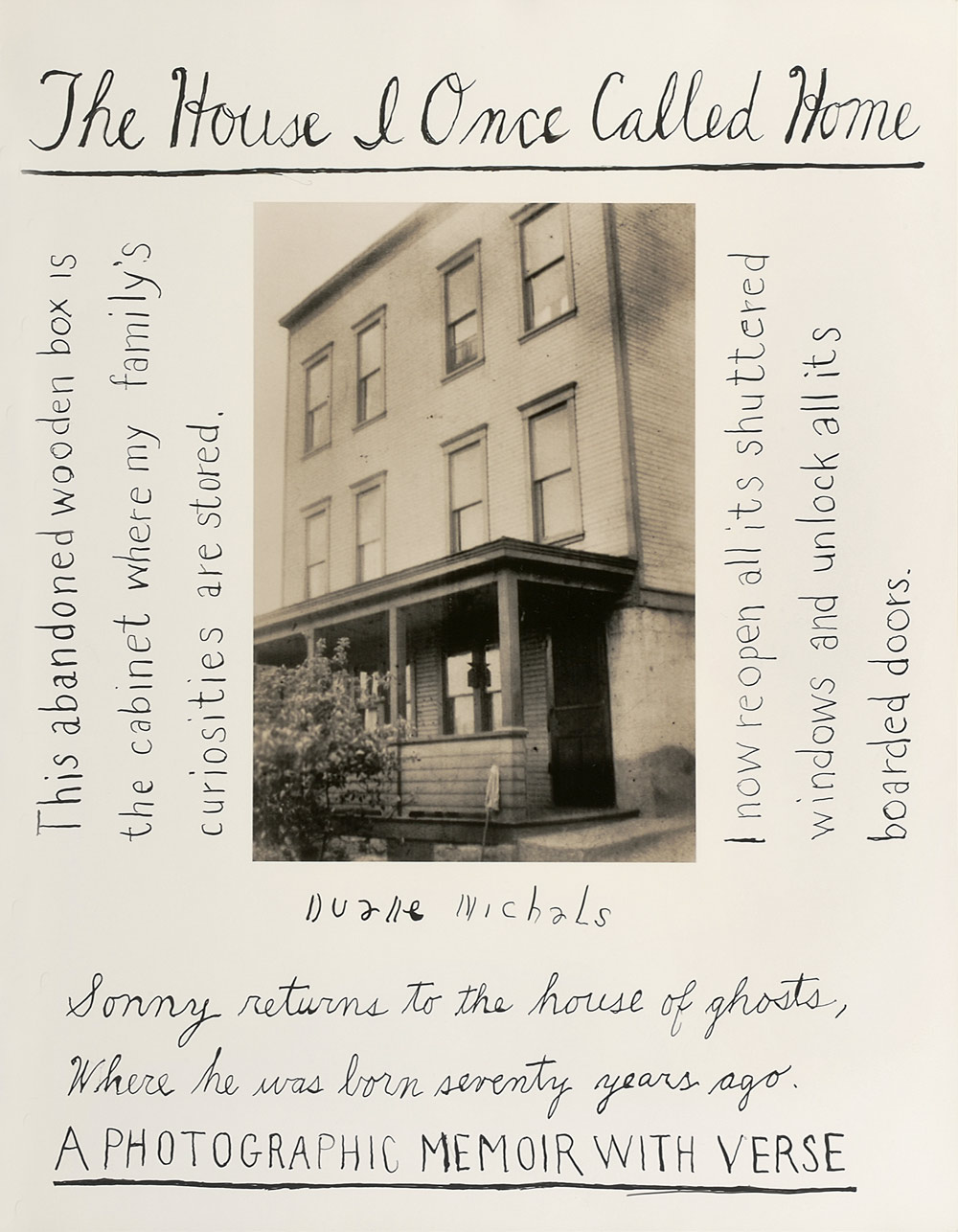
Raised in a steelworking family outside of Pittsburgh, Michals has explored familial and personal identity as a recurring theme. In a rarely exhibited 30-photograph sequence titled The House I Once Called Home (2003), the artist explores the abandoned three-story brick house where he spent his childhood. Each image is paired with poetic verse of remembrance and reflection to create an intimate photographic memoir and metaphysical scrapbook. Recent photographs are superimposed on historic images as the series toggles through time, space and memory. The home’s current dilapidated state contrasts with reveries of a formerly bustling family home and a rumination on the passage of time and the inevitable succession of generations.

Michals’ lifelong adventure with photography began on a trip to Russia in 1958. Borrowing a camera from a friend, he discovered a way to interact with people and tell stories. Shortly thereafter, Michals moved to New York City where he supported himself through work as a commercial photographer for Vogue, Esquire and Life magazines and took portraits of notable artists including Meryl Streep, Sting and Willem de Kooning. In the 1960s, Michals began his earliest experimental narrative sequences that were exhibited in 1970 at the Museum of Modern Art (MoMA). The curator of the show, William Burback, noted that “the mysterious situations Michals invents are posed and theatrical. Yet, they are so common to the urban condition that we have the illusion of remembering scenes and events experienced for the first time.” Later he began adding text to his photographs such as This Photograph Is My Proof (from 1974), which allowed him to tell stories and address feelings that could not be fully explored by photography alone.

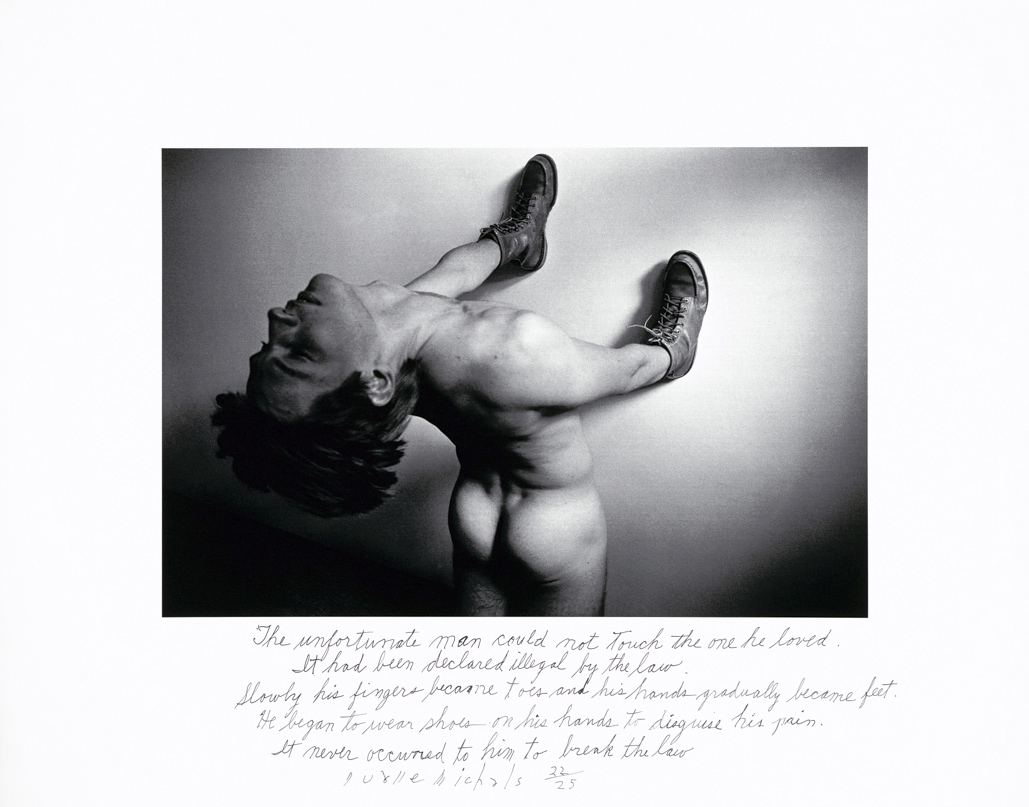
Rather than take cues from his photographic contemporaries, Michals considers surrealist painters such as René Magritte, Balthus and Giorgio de Chirico to be his artistic heroes. Scratching out universal truths from the mystery of human experience, Michals has explained that his works are, “about questions, they are not about answers.” Over the decades, he has been at the forefront of exploring sexual identity and the struggles for gay rights. In his 1976 work, The Unfortunate Man, a model arches his back in anguish while the accompanying text reads: The unfortunate man could not touch the one he loved. It was declared illegal by the law. Slowly his fingers became his toes and his hands gradually became feet. He wore shoes on his hands to disguise his pain. It never occurs to him to break the law.

One of the constants of Michals’ career – from his classic narrative sequences to his more recent series of hand-painted tintypes – has been his preference for intimately scaled images with tactile surface treatments. These works, with their universal themes of memory, dreams, desire and mortality, draw the viewer closer and insist on their full engagement at an emotional level. Commenting on why Michals includes handwritten text on his images, he has said: “I love the intimacy of the hand. It’s like listening to someone speaking.”

Press release from the PEM website


Duane Michals (American, b. 1932) 'Andy Warhol' 1972


Duane Michals (American, b. 1932)
Andy Warhol
1972
© Duane Michals; The Henry L. Hillman Fund
Courtesy of Carnegie Museum of Art, Pittsburgh


Duane Michals (American, b. 1932) 'Sting' 1982


Duane Michals (American, b. 1932)
Sting
1982
Gelatin silver print
Courtesy of DC Moore Gallery and the artist


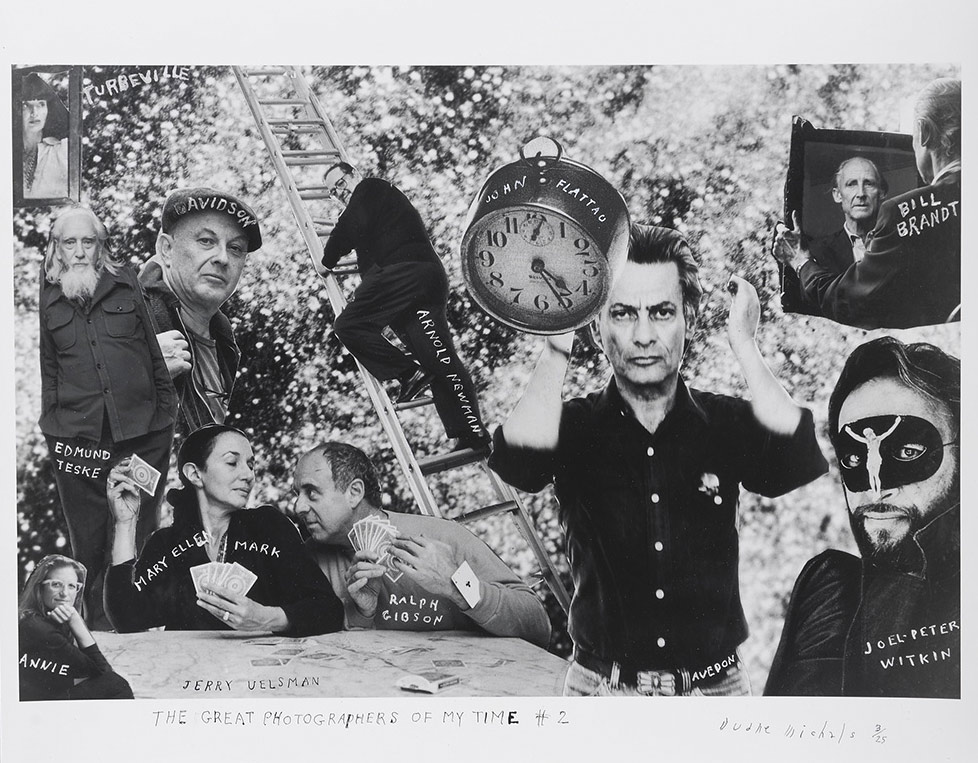
Duane Michals (American, b. 1932) 'The Great Photographers of My Time #2' 1991 from the exhibition 'Storyteller: The Photographs of Duane Michals' at the Peabody Essex Museum (PEM), Salem MA, March - June, 2015


Duane Michals (American, b. 1932)
The Great Photographers of My Time #2
1991
Gelatin silver print
The Henry L. Hillman Fund
Courtesy of Carnegie Museum of Art, Pittsburgh


Duane Michals (American, b. 1932) 'The Unfortunate Man' 1976


Duane Michals (American, b. 1932)
The Unfortunate Man
1976
Gelatin silver print with hand-applied text
The Henry L. Hillman Fund
Courtesy of Carnegie Museum of Art, Pittsburgh


Duane Michals (American, b. 1932) 'Magritte at His Easel' 1965


Duane Michals (American, b. 1932)
Magritte at His Easel
1965
Gelatin silver print with hand-applied text


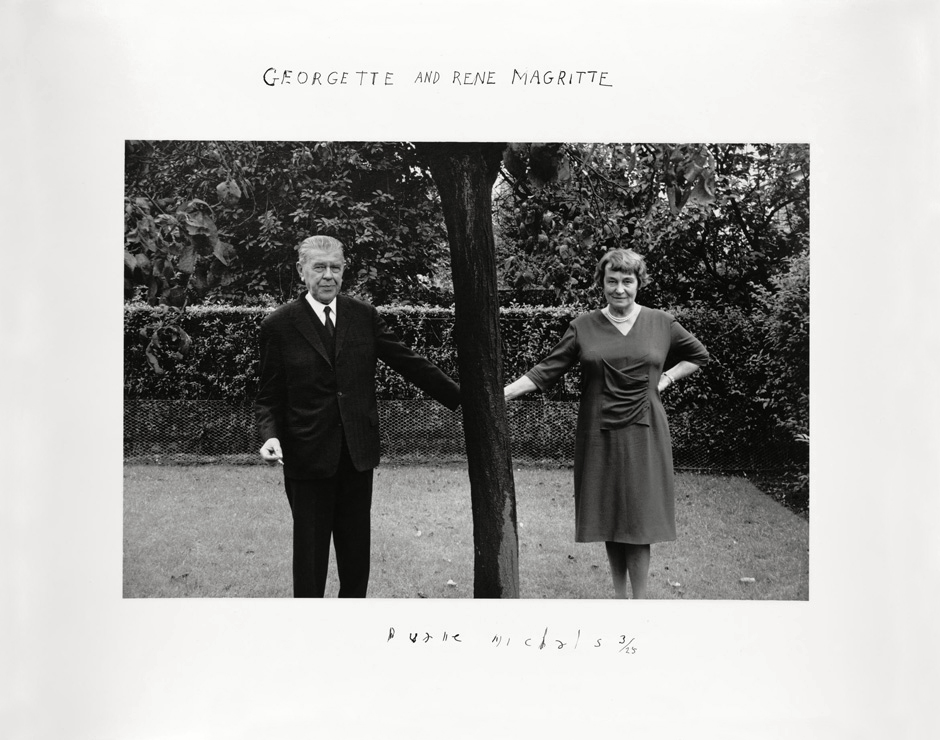
Duane Michals (American, b. 1932) 'Georgette and Rene Magritte' 1965


Duane Michals (American, b. 1932)
Georgette and Rene Magritte
1965
Gelatin silver print with hand-applied text


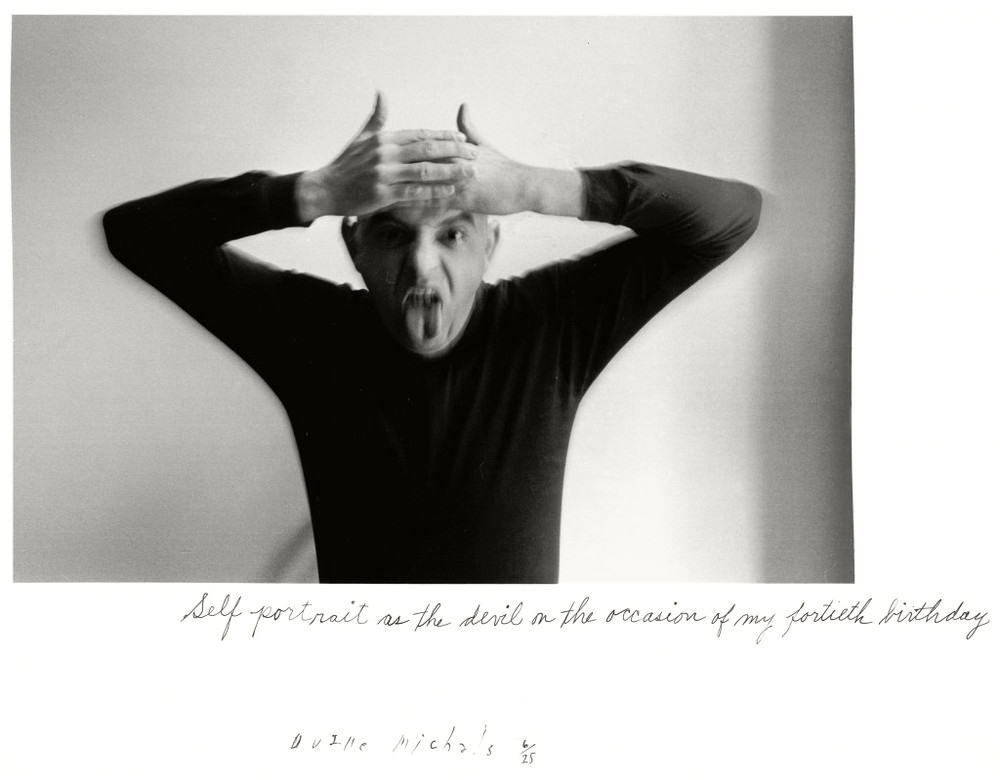
Duane Michals (American, b. 1932) 'Self Portrait as a Devil on the Occasion of My Fortieth Birthday' 1972


Duane Michals (American, b. 1932)
Self Portrait as a Devil on the Occasion of My Fortieth Birthday
1972
The Henry L. Hillman Fund
Courtesy of Carnegie Museum of Art, Pittsburgh
© Duane Michals


Duane Michals (American, b. 1932) 'Primavera' 1984


Duane Michals (American, b. 1932)
Primavera
1984
The Henry L. Hillman Fund
Courtesy of Carnegie Museum of Art, Pittsburgh
© Duane Michals


Duane Michals (American, b. 1932) From the series 'The House I Once Called Home' 2002


Duane Michals (American, b. 1932)
From the series The House I Once Called Home
2002
Thirty gelatin silver prints with hand-applied text
The Henry L. Hillman Fund
Courtesy of Carnegie Museum of Art, Pittsburgh


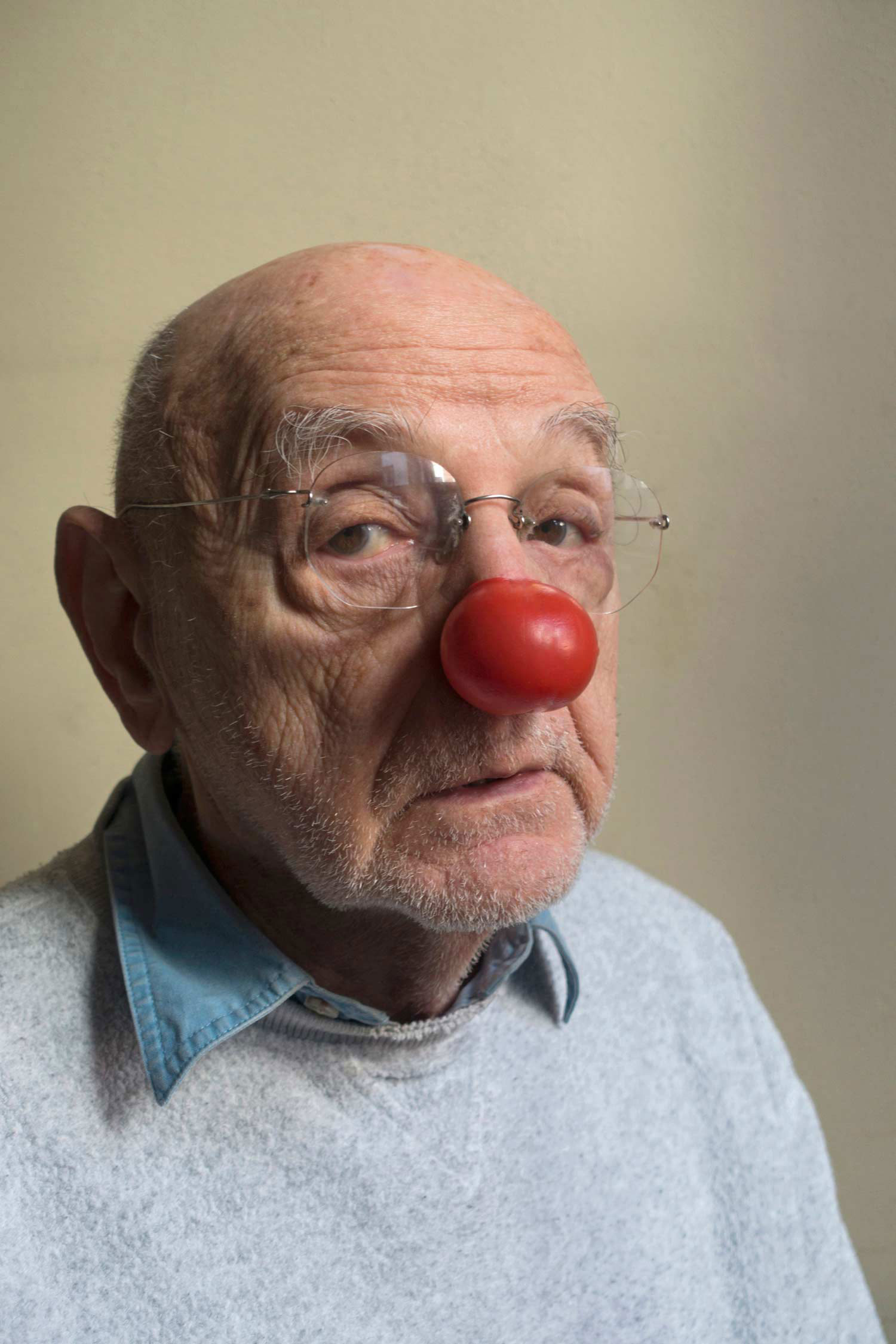
Randy Duchaine. 'Duane Michals, portrait with red nose' 2015


Randy Duchaine
Duane Michals, portrait with red nose
2015
Photo courtesy of Randy Duchaine


Real Dreams

by Duane Michals

Nothing is what I once thought it was. You are not what you think you are. You are nothing you can imagine.
I am a short story writer. Most often photographers are reporters. I am an orange.
They are apples.
One of the biggest cliches in photography is to say that he is a personal photographer.
We must touch each other to stay human. Touch is the only thing that can save us.
I use photography to help me explain my experiences to myself.
Some photographers literally shoot everything that moves, hoping somehow, in all that confusion to discover a photograph. The difference between the artist and the amateur is a sense of control. There is a great power in knowing exactly what you are doing, even when you don’t know.
We are all stars. We just don’t know it.
I practice being Duane Michals everyday – that’s all I know.
Most portraits are lies. People are rarely what they appear to be, especially in front of a camera. You might know me your entire lifetime and never reveal yourself to me. To interpret wrinkles as character is insult not insight.
Was there ever a 1956? What did I do in June 1971? What happened in 1956? I think that there was 1932.
The history of photography has not been written. You will write it. No one has photographed a nude until you have. No one has photographed a sequence or green pepper till you have. Nothing has been done until you do it.
There are no answers anymore.
Get (Edward) Weston off your back, forget (Diane) Arbus, (Robert) Frank, (Ansel) Adams, (Clarence) White, don’t look at photographs. Kill the Buddha.
I am my own hero.
Photography books have titles like “The Photographer’s Eye” or “The Vision of So and So” or “Seeing Photographers” – as if photographers didn’t have minds, only eyes.
Everything is going; yes, even you must go. Right now you are going. Right now!
I find myself talking to photographs. I see a photograph of a women and I ask, “Is that all you’re going to tell me?” I can see the long hair and costume. Is she a witch, a mother, kind, consuming? Does she believe anything? I want more.
As I write this, at this moment, thousands of people are dying, thousands are being born, the earth is totally alive with Spring lust, stars are exploding – my God!
It is the great unknowing that we all live in, that we call life, that I find overwhelming. And I think that I will never know, never.
I am the limits of my work. You are the limits of yours. This is a journey. We do not live here. When I say “I,” I mean We.
As soon as I say “now,” it becomes “then.”
It is very easy for photographers to fake. Just go out and photograph twenty Pizza Huts.
That’s all there is, change.
Some influences open doors and liberate, other influences close doors and suffocate.
Photography, particularly, is suffocating.
I believe in the imagination. What I cannot see is infinitely more important than what I can see.

Photographers tell me what I already know. The recognition of the beautiful, bizarre, or boring (the three photographic B’s) is not the problem. You would have to be a refrigerator not to be moved by the beauty of Yosemite. The problem is to deal with one’s total experience, emotionally as well as visually. Photographers should tell me what I don’t know.
I find the limitations of still photography enormous. One must redefine photography, as it is necessary to redefine one’s life in terms of one’s own needs. Each generation should redefine the language and all its experiences in terms of itself.
The key word is expression – not photography, not painting, not writing. You are the event, not your parents, friends, gurus. Only you can teach yourself.
Everything we experience is in our mind. It is all mind. What you are reading now, hearing now, feeling now…
We’re all afraid of dying. We’ve already died. Look at your high school graduation picture, she’s dead! Just now, you died.
It is essential for me to be silly. If one is serious, one must also be foolish, to survive.
Trying to communicate one true feeling on my own terms is a constant problem.
I am compulsive in my preoccupation with death. In some way I am preparing myself for my own death. Yet if someone would put a gun to my stomach, I would pee my pants. All my metaphysical speculations would get wet.
When you look at my photographs, you are looking at my thoughts.
I am very attracted to the person of Stefan Mihal. He is the man I never became. We are complete opposites, although we were born at the same moment. If we should meet, we would explode. We are like matter and anti-matter. He is my shadow. I saved myself from him.
I only photograph what I know about, my life, I do not presume to know who blacks are or what they feel or bored suburban families or transvestites. And I never believe photographs of them staring into a camera.
I take nothing for granted. I can count on nothing. I am not sure where I once was certain. I don’t know what will be left by the time I’m fifty. That’s ok.
The sight of these words on a page pleases me. It’s like some sort of trail I’ve left behind, clues, strange marks made, that prove I was once here.
When I was about 9 ( the year my brother Tim was born), I would sit on the edge of my bed and be very still, long after the family had gone to sleep. I would try to find the “I” of “me.” I thought that if I would be very quiet, I might find that place inside that was “I.” I am still looking.
We are all a mental construction. Change our chemistry, our point of reference and reality changes.
I am a professional photographer and a spiritual dilettante: I would prefer to be a professional mystic and a dilettante photographer.
I remember the first time I sensed being lonely. I was about five at the time, living with my grandmother, and my best friend Art went away with his family. The afternoon loomed long and empty. I missed someone, I was empty. There was a lacking.
Only I am my enemy. My fear can stop me.
Never try to be an artist. Just do your work and if the work is true, it will become art.
“We must pay attention so as not to be deceived by the familiar.”
Things are what we will them to become.
It is important to stay vulnerable. To permit pain, to make mistakes, not to be intimidated by touching. Mistakes are very important, if we’re alert.
None of my photographs would have existed without my inventing them. These are not accidental encounters, witnessed on the street. I am responsible whether (Henri Cartier-) Bresson was there or not, those people would have had their picnic along the Seine. They were historical events.

There is not one photography. There is no photography. The only value judgment is the work itself. Does it move, touch, fill me?
Any one who defines photography frightens me. They are photo-fascists, the limiters.
They know! We must struggle to free ourselves constantly, not only from ourselves but especially from those who know.
It seems I am waiting for something to happen: and when it does, it will be difficult for me to imagine that I had ever been the person who is writing this. I will be someone else.
I am not interested in the perfect print. I am interested in a perfect idea. Perfect ideas survive bad prints and cheap reproductions. They can change our lives.
(If Duane wants to take pictures, he should do a study of laborers and farm workers and unwed mothers and make some social changes. Do something else – something noble. That’s what I’d do. – Stefan Mihal)
We have a way of making the most extraordinary experiences ordinary. We actually work at destroying miracles.
The best artists give themselves in their work. (Rene) Magritte was a gift, (Eugene) Atget, (Thomas) Eakins, (Odilon) Redon, (Bill) Brandt, (August) Sander(s), Balthus, (Giorgio) De Chirico, (Walt) Whitman, Cavafy. That’s all that there is to give. I am my gift to you, and you are your gift to me.
Most photographers photograph other people’s lives, seldom their own.
We must free ourselves to become what we are.
Photography describes to well.
Our parents protect us from death. But when they die, there is no one to stand between us and death.
I once thought that time was horizontal, and if I looked straight ahead, I could see next Thursday. Now I think it is vertical and diagonal and perpendicular. It’s all very confusing.
People believe in the reality of photographs, but not in the reality of paintings. That gives photographers an enormous advantage. Unfortunately, photographers also believe in the reality of photographs.
The most important sentences usually contain two words: I want, I love, I’m sorry, please forgive, please touch, I need, I care, thank you.
Everything is subject for photography, especially the difficult things of our lives: anxiety, childhood hurts, lust, nightmares. The things that cannot be seen are the most significant. They cannot be photographed, only suggested.
I would like to talk to William Blake and Thomas Eakins.

Duane Michals June 20, 1976 September 1, 1976


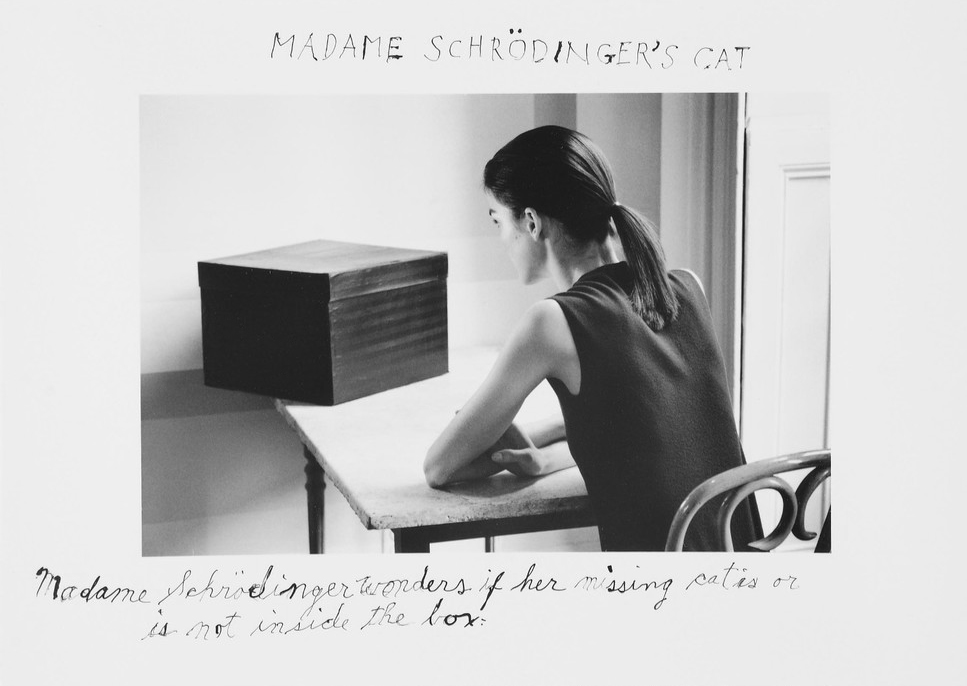
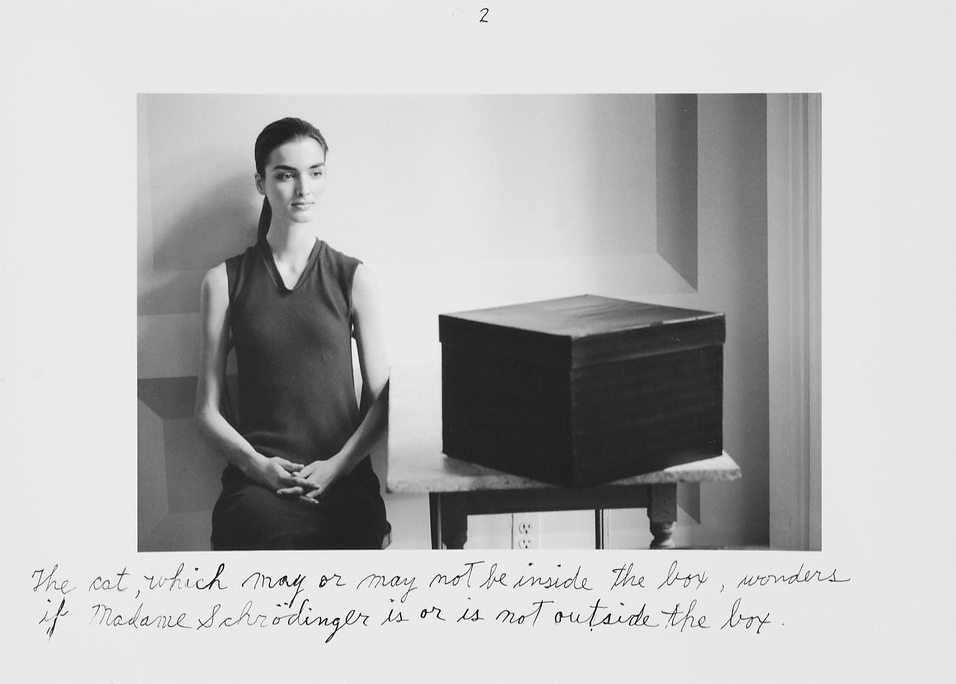
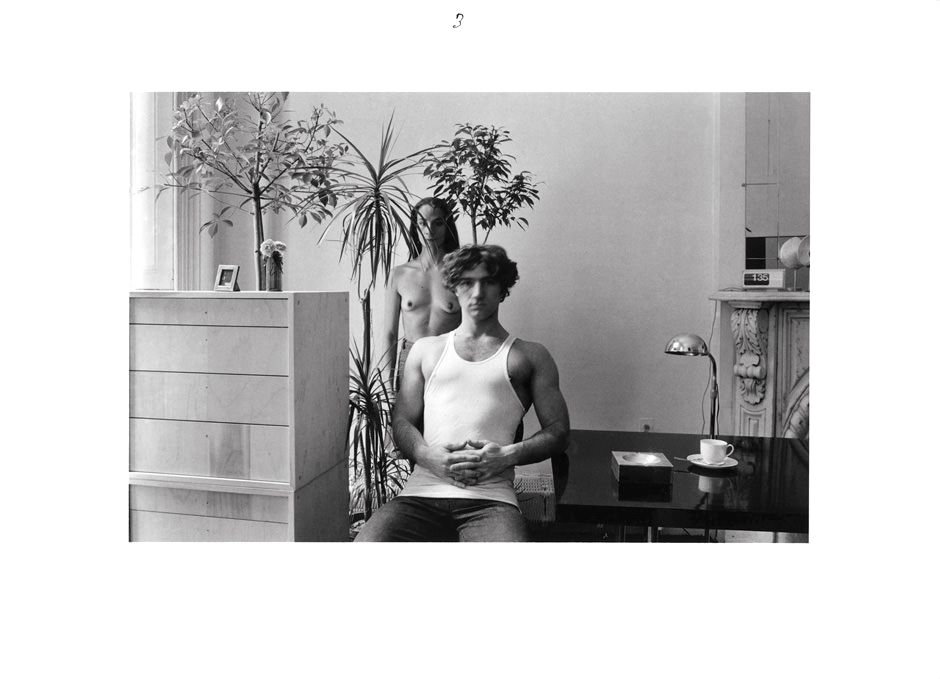
Duane Michals (American, b. 1932) 'Madame Schrödinger's Cat' 1998

Duane Michals (American, b. 1932) 'Madame Schrödinger's Cat' 1998

Duane Michals (American, b. 1932) 'Madame Schrödinger's Cat' 1998


Duane Michals (American, b. 1932)
Madame Schrödinger’s Cat
1998
From the series Quantum
© Duane Michals
The Henry L. Hillman Fund
Courtesy of Carnegie Museum of Art, Pittsburgh


Duane Michals (American, b. 1932) 'Paradise Regained' 1968

Duane Michals (American, b. 1932) 'Paradise Regained' 1968 'Paradise Regained' 1968

Duane Michals (American, b. 1932) 'Paradise Regained' 1968

Duane Michals (American, b. 1932) 'Paradise Regained' 1968

Duane Michals (American, b. 1932) 'Paradise Regained' 1968

Duane Michals (American, b. 1932) 'Paradise Regained' 1968


Duane Michals (American, b. 1932)
Paradise Regained
1968
Courtesy of the artis
The Henry L. Hillman Fund
Carnegie Museum of Art


“Everything I did grew out of my frustration with the medium, the silence of the still picture,” he says, so he found the “wiggle room.” With sequences, he could add drama before and after the decisive moment. Having his subjects move created ethereal images and an awareness of time’s passage. Layering negatives challenged preconceptions.

Language, Michals says, has always been associated with photographs. A newspaper caption might tell you that 20 inches of snow fell on Boston or Vladimir Putin arrived by plane at the Olympics. “I write about what cannot be seen,” he says. “My text picks up where the photograph fails. This Photograph is my Proof, a “nice picture” of his cousin and new bride at Michals’ grandmother’s house, is metaphorically “out of focus” until Michals adds the text.

Michals uses a pen nib and ink to enhance his visual stories, writing in cursive or all capitals depending on his mood. “I like the handwriting, the texture.” He also collects original manuscripts. He describes himself as an intimist, a lover of diaries, books (he has three libraries at home in New York City), small pictures and intimacy. “My photographs whisper into the viewers’ eyes rather than shout. They say, ‘Come closer. I’ll tell you a secret.'”

Michals says he’s taken many professional risks, especially when presenting issues born of the gay community like isolation and illegal behaviour. “Remember, 20 or 30 years ago, marriage wasn’t even on the table,” he says. (Michals and Fred Gorrée, his partner of nearly 56 years, married in 2011, just days after same-sex marriage was legalised in New York.)

Unlike Robert Mapplethorpe, whom he says is more hardcore, Michals tends toward sentimentality and the legitimacy of the love between people of the same gender. “I’m not a typical gay person any more than I’m a typical person or photographer.”

That disdain for following established paths might explain why Ansel Adams and Henri Cartier-Bresson are not among his heroes. “My sources for inspiration were anybody who contradicted my mind and opened my imagination,” Michals says, like Lewis Carroll, Magritte, Joseph Cornell and surrealists in general. “Ansel Adams did not open my imagination. He dealt with Yosemite and sunsets. I was interested in metaphysical ideas, what happens when you die.”

Extract from Lisa Kosan. “Meet Duane Michals,”on the PEM website 2nd March 2015 [Online] Cited 08/06/2015. No longer available online.


Duane Michals (American, b. 1932) 'Who is Sidney Sherman?' 2000

Duane Michals (American, b. 1932) 'Who is Sidney Sherman?' 2000

Duane Michals (American, b. 1932) 'Who is Sidney Sherman?' 2000

Duane Michals (American, b. 1932) 'Who is Sidney Sherman?' 2000

Duane Michals (American, b. 1932) 'Who is Sidney Sherman?' 2000

Duane Michals (American, b. 1932) 'Who is Sidney Sherman?' 2000


Duane Michals (American, b. 1932)
Who is Sidney Sherman?
2000
© Duane Michals
The Henry L. Hillman Fund
Courtesy of Carnegie Museum of Art, Pittsburgh


Peabody Essex Museum
East India Square
161 Essex Street
Salem, MA 01970-3783 USA
Phone: 978-745-9500, 866-745-1876

Opening hours:
Open Thursday – Monday, 10am – 5pm
Closed Tuesdays and Wednesdays

Peabody Essex Museum website

LIKE ART BLART ON FACEBOOK

Back to top

Exhibition: ‘Hal Fischer, Gay Semiotics, 1977/2014’ at the Fotomuseum Winterthur, Zürich

Exhibition dates: 8th May – 7th June, 2015

Curator: Professor Tim Dean


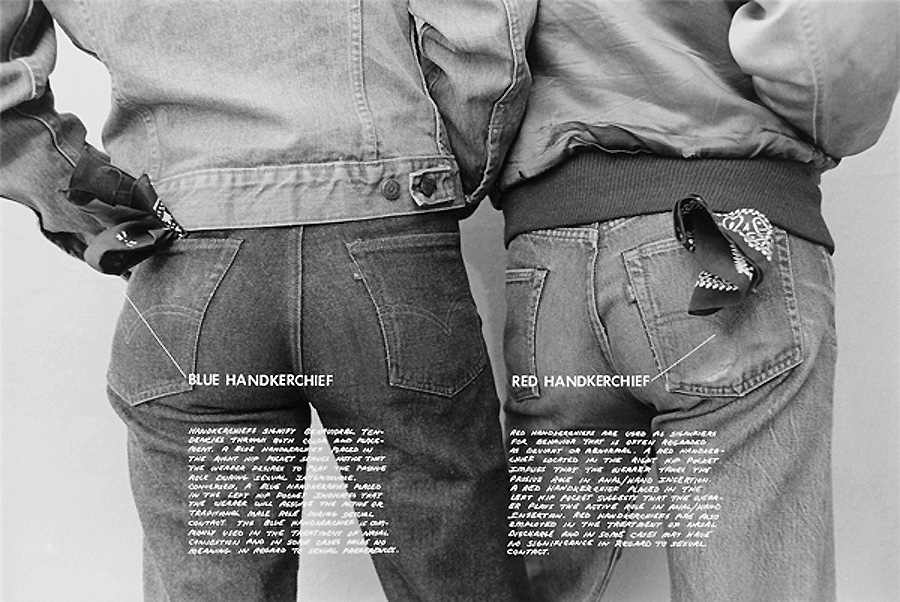
Hal Fischer (American, b. 1950) 'Blue Handkerchief, Red Handkerchief' 1977/2014 from 'Gay Semiotics' from the exhibition 'Hal Fischer, Gay Semiotics, 1977/2014' at the Fotomuseum Winterthur, Zürich, May - June, 2015


Hal Fischer (American, b. 1950)
Blue Handkerchief, Red Handkerchief
1977/2014
From Gay Semiotics 1977
Inkjet print


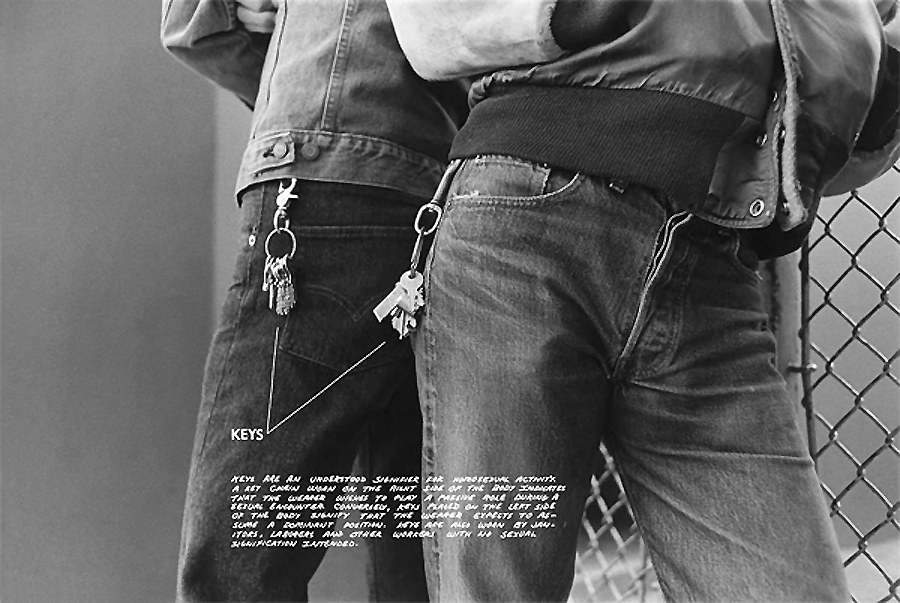
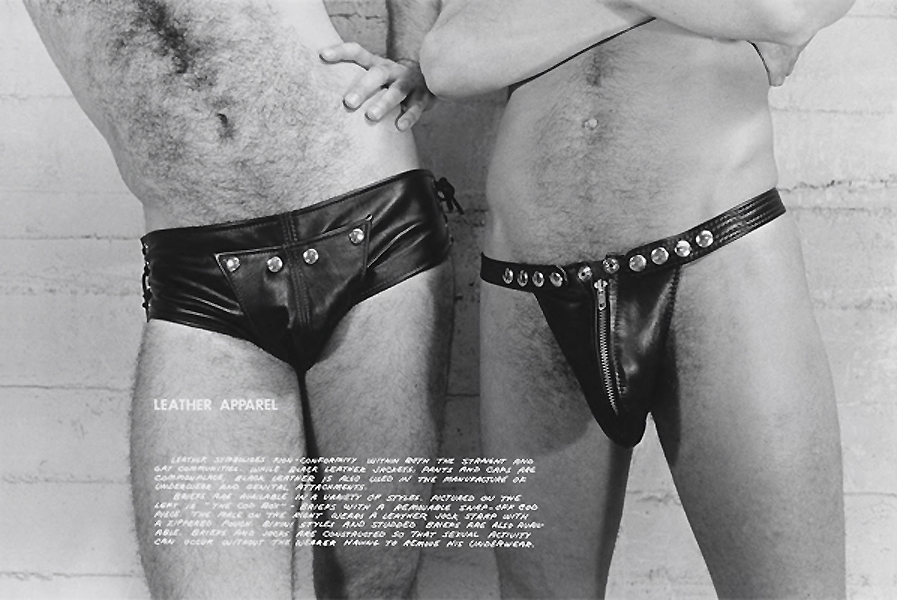
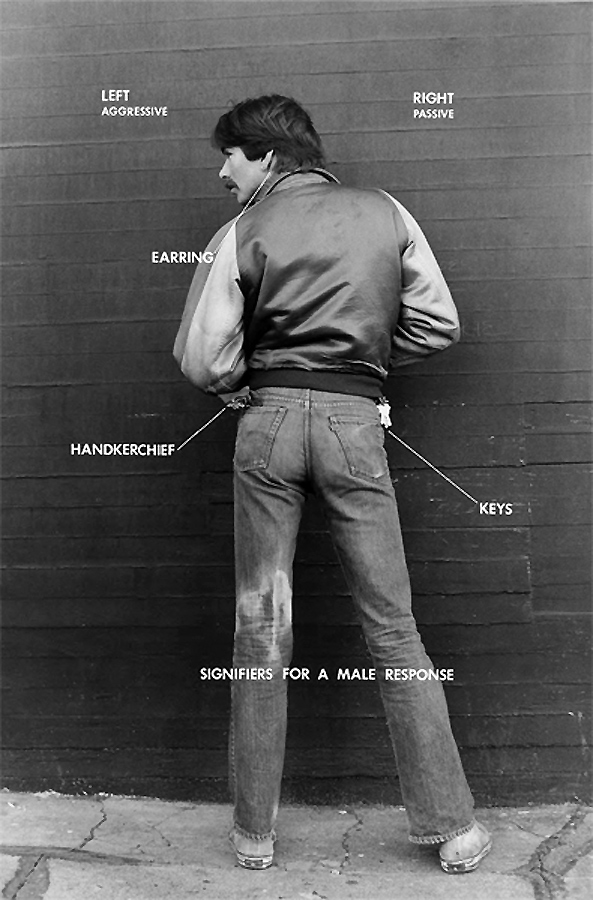
I remember coming out in 1975, six years after Stonewall, that seismic event that was the out and proud culmination of the resistance to oppression that had been building since the Second World War. Pre-disco, pre-Heaven night club (opened in December 1979) young gay men like me went to pubs in the Soho and Earl’s Court district of London and to places like Bang! nightclub on Tottenham Court Road (opened 1976). I used to wear an earring in my left ear, keys on the left, handkerchiefs to all the fetish nights at Heaven, and speak a queer language that secretive gay men had to speak in straight places… Polari (or alternatively Parlare, Parlary, Palare, Palarie, Palari; from Italian parlare, “to talk”).

“Polari is a form of cant slang used in Britain by actors, circus and fairground showmen, merchant navy sailors, criminals, prostitutes, and the gay subculture. There is some debate about its origins, but it can be traced back to at least the nineteenth century and possibly the sixteenth century… Polari is a mixture of Romance (Italian or Mediterranean Lingua Franca), London slang, backslang, rhyming slang, sailor slang, and thieves’ cant… It was a constantly developing form of language, with a small core lexicon of about 20 words (including bona, ajax, eek, cod, naff, lattie, nanti, omi, palone, riah, zhoosh (tjuz), TBH, trade, vada), and over 500 other lesser-known words.

Polari was used in London fishmarkets, the theatre, fairgrounds and circuses, hence the many borrowings from Romany. As many homosexual men worked in theatrical entertainment it was also used among the gay subculture, at a time when homosexual activity was illegal, to disguise homosexuals from hostile outsiders and undercover policemen. It was also used extensively in the British Merchant Navy, where many gay men joined ocean liners and cruise ships as waiters, stewards and entertainers. On one hand, it would be used as a means of cover to allow gay subjects to be discussed aloud without being understood; on the other hand, it was also used by some, particularly the most visibly camp and effeminate, as a further way of asserting their identity.” (Text from Wikipedia)

For example “vada the bona omi” was a “look at the good man”, “spark out on his palliass” was “flat out on his back”, and “he had huge lallies” which was “he had huge legs” (more terms can be found on the Polari – British gay slang web page). Another favourite was “trolling the Dilly” which means “to cruise or walk about Pica/dilly” where the rent boys (known as Dilly boys) used to line up against the railings looking for customers or “trade”. In this context “trolling” could be seen as a form of gay flâneur. Wikipedia states that Polari had begun to fall into disuse amongst the gay subculture by the late 1960s, but in my experience this is not true. Within my circle of friends it was still in constant use into the early 1980s. The language was very useful in pubs in London where sailors, ruff trade, and the theatre crowd mixed in Soho, were you could comment to a gay friend on a man that you thought attractive and anyone overhearing your conversation would not know what you were talking about.

All this must seem rather quaint now, but the archetypal images of gay men have not changed much over the intervening years. There is still the natural young gay man, the bear, the leatherman (or those that just wear leather for dance parties, just for show and not for attitude), the S/M scene, still the handkerchief code (still seen though rarely these days), the armband on the left or right for active or passive, still the gay jocks but now much more the gym preened bunnies. Everything old is new again… it’s just less heterogeneous.

Dr Marcus Bunyan


Many thankx to the Fotomuseum Winterthur for allowing me to publish the photographs in the posting. Please click on the photographs for a larger version of the image.

All photographs by Hal Fischer from Gay Semiotics, 1977/2014, Courtesy Hal Fischer, and Cherry and Martin, Los Angeles Â© Hal Fischer


In 1977, Hal Fischer produced his photo-text project Gay Semiotics, first as a series of silver gelatin prints and then as a book published by NFS Press. The project explored the growing visibility of the male gay community in the Castro district of San Francisco, particularly its street style and so-called ‘hanky codes’ indicating different sexual preferences. Fisher’s series was one of the earliest attempts to explore a queer semiotics, offering a playful engagement with male self-fashioning and archetypes. Gay Semiotics is both a marker of the self-confidence and creativity of the San Francisco gay community before the emergence of HIV/AIDS and an important contribution to West Coast conceptual photography.


Hal Fischer (American, b. 1950) 'Keys' 1977/2014 from 'Gay Semiotics' 1977 from the exhibition 'Hal Fischer, Gay Semiotics, 1977/2014' at the Fotomuseum Winterthur, Zürich, May - June, 2015


Hal Fischer (American, b. 1950)
Keys
1977/2014
From Gay Semiotics 1977
Inkjet print


Hal Fischer (American, b. 1950) 'Leather Apparel' 1977/2014 From 'Gay Semiotics' 1977


Hal Fischer (American, b. 1950)
Leather Apparel
1977/2014
From Gay Semiotics 1977
Inkjet print


Hal Fischer (American, b. 1950) 'Gag Mask' 1977/2014 From 'Gay Semiotics' 1977


Hal Fischer (American, b. 1950)
Gag Mask
1977/2014
From Gay Semiotics 1977
Inkjet print


Hal Fischer (American, b. 1950) 'Amyl Nitrite' 1977/2014 From 'Gay Semiotics' 1977


Hal Fischer (American, b. 1950)
Amyl Nitrite
1977/2014
From Gay Semiotics 1977
Inkjet print


Hal Fischer (American, b. 1950) 'Earring' 1977/2014 From 'Gay Semiotics' 1977


Hal Fischer (American, b. 1950)
Earring
1977/2014
From Gay Semiotics 1977
Inkjet print


JBW: Gay Semiotics is an attempt to map some of the discourse of structuralism onto the visual codes of male queer life in the Castro. How did you come to structuralism?

HF: Thanks to Lew Thomas, in graduate school I began reading things like Jack Burnham’s The Structure of Art and Ursula Meyer’s Conceptual Art. Those were two key texts. Of course, structuralism came late to photography, when you consider that Susan Sontag’s Against Interpretation came out in 1966. Reading Burnham, going on to read Claude Lévi-Strauss, all that was crucial. I learned about signifiers, and thought, this is going on all around me.

JBW: You’re doing several things in Gay Semiotics. On the one hand, you’re parsing a signification system that arose out of a nonverbal, erotic exchange, and you’re also deconstructing gay male self-fashioning and photographing “archetypes.” It is thus a photo-project about the history of photography and its long legacy of ethnographic typing.

HF: I can’t say I was conscious of it at the time, but one of the first photographers who influenced me was August Sander. I mean, I LOVED Sander. I still do. I probably was a fascist in an earlier life, because I’m definitely into types, and I’m definitely into archetyping. I don’t really think it’s that awful a thing to do; it can be very informative. I was also interested in the Bechers and the notion of repetition.

JBW: So the work is also about genre.

HF: Yes. It’s also about personal desire; it’s a lexicon of attraction.”

Extract from Julia Bryan-Wilson speaking with Hal Fischer. Aperture magazine #218, Spring 2015


Hal Fischer (American, b. 1950) 'Signifiers for a Male Response' 1977/2014 From 'Gay Semiotics' 1977


Hal Fischer (American, b. 1950)
Signifiers for a Male Response
1977/2014
From Gay Semiotics 1977
Inkjet print


Hal Fischer (American, b. 1950) 'Street Fashion Basic Gay' 1977/2014 From 'Gay Semiotics' 1977


Hal Fischer (American, b. 1950)
Street Fashion Basic Gay
1977/2014
From Gay Semiotics 1977
Inkjet print


Hal Fischer (American, b. 1950) 'Street Fashion Jock' 1977/2014 From 'Gay Semiotics' 1977


Hal Fischer (American, b. 1950)
Street Fashion Jock
1977/2014
From Gay Semiotics 1977
Inkjet print


Hal Fischer (American, b. 1950) 'Street Fashion Forties Trash' 1977/2014 From 'Gay Semiotics' 1977


Hal Fischer (American, b. 1950)
Street Fashion Forties Trash
1977/2014
From Gay Semiotics 1977
Inkjet print


Hal Fischer (American, b. 1950) 'Street Fashion Hippie' 1977/2014 From 'Gay Semiotics' 1977


Hal Fischer (American, b. 1950)
Street Fashion Hippie
1977/2014
From Gay Semiotics 1977
Inkjet print


Hal Fischer (American, b. 1950) 'Street Fashion Uniform' 1977/2014 From 'Gay Semiotics' 1977


Hal Fischer (American, b. 1950)
Street Fashion Uniform
1977/2014
From Gay Semiotics 1977
Inkjet print


Hal Fischer (American, b. 1950) 'Street Fashion Leather' 1977/2014 From 'Gay Semiotics' 1977


Hal Fischer (American, b. 1950)
Street Fashion Leather
1977/2014
From Gay Semiotics 1977
Inkjet print


Hal Fischer (American, b. 1950) 'Archetypal Media Image Leather' 1977/2014 From 'Gay Semiotics' 1977


Hal Fischer (American, b. 1950)
Archetypal Media Image Leather
1977/2014
From Gay Semiotics 1977
Inkjet print


Hal Fischer (American, b. 1950) 'Archetypal Media Image Urbane' 1977/2014 From 'Gay Semiotics' 1977


Hal Fischer (American, b. 1950)
Archetypal Media Image Urbane
1977/2014
From Gay Semiotics 1977
Inkjet print


Hal Fischer (American, b. 1950) 'Archetypal Media Image Western' 1977/2014 From 'Gay Semiotics' 1977


Hal Fischer (American, b. 1950)
Archetypal Media Image Western
1977/2014
From Gay Semiotics 1977
Inkjet print


Hal Fischer (American, b. 1950) 'Archetypal Media Image Classical' 1977/2014 From 'Gay Semiotics' 1977


Hal Fischer (American, b. 1950)
Archetypal Media Image Classical
1977/2014
From Gay Semiotics 1977
Inkjet print


Hal Fischer (American, b. 1950) 'Archetypal Media Image Natural' 1977/2014 From 'Gay Semiotics' 1977


Hal Fischer (American, b. 1950)
Archetypal Media Image Natural
1977/2014
From Gay Semiotics 1977
Inkjet print


Hal Fischer (American, b. 1950) 'Dominance' 1977/2014 From 'Gay Semiotics' 1977


Hal Fischer (American, b. 1950)
Dominance
1977/2014
From Gay Semiotics 1977
Inkjet print


Hal Fischer (American, b. 1950) 'Sadism & Masochism' 1977/2014 From 'Gay Semiotics' 1977


Hal Fischer (American, b. 1950)
Sadism & Masochism
1977/2014
From Gay Semiotics 1977
Inkjet print


Hal Fischer (American, b. 1950) Submission' 1977/2014 From 'Gay Semiotics' 1977


Hal Fischer (American, b. 1950)
Submission
1977/2014
From Gay Semiotics 1977
Inkjet print


Hal Fischer (American, b. 1950) 'Bondage Device Cross' 1977/2014 From 'Gay Semiotics' 1977


Hal Fischer (American, b. 1950)
Bondage Device Cross
1977/2014
From Gay Semiotics 1977
Inkjet print


Hal Fischer (American, b. 1950) 'Bondage Device Open End Table Rack' 1977/2014 From 'Gay Semiotics' 1977


Hal Fischer (American, b. 1950)
Bondage Device Open End Table Rack
1977/2014
From Gay Semiotics 1977
Inkjet print


Hal Fischer (American, b. 1950) 'Bondage Device Meat Hoist' 1977/2014 From 'Gay Semiotics' 1977


Hal Fischer (American, b. 1950)
Bondage Device Meat Hoist
1977/2014
From Gay Semiotics 1977
Inkjet print


Fotomuseum Winterthur
Grüzenstrasse 44 + 45
CH-8400
Winterthur (Zürich)

Opening hours:
Tuesday to Sunday 11am – 6pm
Wednesday 11am – 8pm
Closed on Mondays

Fotomuseum Winterthur website

LIKE ART BLART ON FACEBOOK

Back to top

Artist in focus: Larry Fink

April 2015


Larry Fink (American, 1941-2023) 'Peter Beard's, East Hampton', from the portfolio '82 Photographs 1974 to 1982' 1982; printed 1983


Larry Fink (American, 1941-2023)
Peter Beard’s, East Hampton, from the portfolio 82 Photographs 1974 to 1982

1982; printed 1983
Silver gelatin print


Hands / Class – Tree, Surface, Root

These are magnificent photographs. Fink’s mastery of the picture plane, ensemble, mise-en-scène, chiaroscuro is outstanding. But for me it is the attitude of the hands that make these photographs. Reaching, holding (usually the bodies of women), clasping, upturned, crotch grabbing, oversized, limp, clenched and gesticulating – in more of less every photograph it is the positioning of the hands that are the focus of my attention, and their relation to the social class of the proponent. The hedonism of Studio 54, the snobbishness of the benefits at MoMA and Corcoran Museum, and the Russian and Hungarian balls with their icy coolness and sidelong glances, all played off against the working class birthday parties of Pat Sabatine.

I spoke to my friend and mentor Ian Lobb about these photographs and we had a lively discussion:

MB: What do you think of the work of Larry Fink?

IL: The image of the child holding up his hand was on the cover of the second (?) Larry fink monograph. They are OK, but not great.

I have a rule: “The closer we get to the origin the more options we have.” But Larry is building on heaps of people – Winogrand, Mark Cohen etc, and earlier. And when that happens it really needs to be BUILT to be a success for the viewer. But he is just adding a bit. Its good, OK work. It’s mainly referencing stuff though. I can’t see anyone building on what he has done, a worker would have to go down the tree to a point before him to progress again.

Photography is pretty much fantastic before the fact, so things can look pretty good if it just happens. The process is so different from the reproduction of music that keeps trying to return to an original – photography has done that, but then runs tangential ideas where there can be flash and frozen time and no colour etc…

MB: I can understand what you are saying Ian … even though I don’t necessarily agree!

There is an essay I have just read as part of a Joan Fontcuberta book (“The Right Distance,” in Joan Fontcuberta. Pandora’s Camera: Photogr@phy after Photography. Mack, 2014, pp. 143-150). It’s interesting what he has to say about the “distance” of the photographer from the object… long distance landscape (in Victorian times… Muybridge, Carelton Watkins), long distance city (Marville) – the infinite sublime I call it – coming closer with Atget (parts of doors, stairs, closer engagement) and Blossfeldt – and then the avant-garde in the 1920s with the dissolution of far near into near far… followed by New Topographics and the griding of space, the regimentation and delineation of an even narrower point of view, both aesthetically and objectively.

I am paraphrasing but that is what he says anyway. It makes sense in one way. But in another we do not have to be either / or – near / far. Nor do we have to be “new” every time we take a photograph.

What I am arguing is that you do not always have to reinvent the wheel, in answer to your observation that you have to go back down the tree. Nothing is ever new and sometimes, as with the photography of Fink, it is the gesture that is enough for me – that human gesture that will never happen again exactly in that form. I am still in wonder of that moment, of the child’s raised hand (Pat Sabatine’s 8th Birthday Party). I don’t really care that people have done it before, they have never captured that moment, that precise gesture before… and it is still beautiful to me. The apple never falls far from the tree.

IL: A good term Marcus: the infinite sublime.

Fontcuberta understands it very well – mainly because it could be applied to the best of his pictures in terms of the continual involvement that some of them generate. As I said, the Larry Finks are OK. Have you seen the YouTube about Joel Sternfeld photographing in NY? He is literally right in peoples faces, and yet they don’t even seem to notice him. I’d like to see one of Larry Fink with his flash in these small rooms and intimate spaces.

What I can say is that some smart person will invent the term that distinguishes between the surface aesthetic of the digital and analogue print. There is such “value” in the display here [of Fink’s work], that would not mean the same in a digital print. Why? The analogue look could even be faked to fool everyone I suppose. Even with these, the surface would fall apart @ about 19″ sq and it would all be lost.

MB: It is the surface aesthetic Ian, but it goes deeper than that. I saw the Richard Avedon exhibition up at The Ian Potter Museum of Art were his negatives were blown up to enormous size and digitally printed… and they just didn’t work. There is a containment of energy within a classical analogue black and white photograph that the surface of a digital print cannot capture, yes, but in a good analogue photograph there is also an emotional depth that seems to transcend surface…. and as yet, digital photographs rarely approach this state of being. What would be a word that evinces surface and psychological depth at one and the same time?

Dr Marcus Bunyan


Please click on the photographs for a larger version of the image.


Larry Fink is a prominent American photographer who is best known for capturing images of high-profile social events. Fink’s images from the 1970s and 1980s capture individual vignettes within social gatherings, and nod to the development of documentary photography within the image-driven culture of the second half of the twentieth century. Some of the photographs below are from Fink’s series 82 Photographs 1974 to 1982 and Making Out 1957 – 1980 and depict scenes from clubs and parties in and around New York City. Fink’s subjects are caught off-guard by his camera, and their expressions provide windows into their weariness or giddy party euphoria. Capturing groups and individuals at surprisingly intimate and vulnerable moments, his photographs subtly reveal the disconnect often found between a subject’s public image and his or her inner self. For example, in Peter Beard’s, East Hampton, Fink captures a dynamic group of people in various levels of engagement with one another. While some are intertwined, others glance outward to the party beyond, having seemingly lost interest in the gathering at hand.


Larry Fink (American, 1941-2023) 'John Sabatine and Molly' 1980


Larry Fink (American, 1941-2023)
John Sabatine and Molly
1980
Silver gelatin print


Larry Fink (American, 1941-2023) 'Jean Sabatine and Molly' 1983


Larry Fink (American, 1941-2023)
Jean Sabatine and Molly
1983
Silver gelatin print


Larry Fink (American, 1941-2023) 'N.Y.C. Club Cornich', from the portfolio '82 Photographs 1974 to 1982' 1977; printed 1983


Larry Fink (American, 1941-2023)
N.Y.C. Club Cornich, from the portfolio 82 Photographs 1974 to 1982
1977; printed 1983
Silver gelatin print


Larry Fink (American, 1941-2023) 'N.Y.C. Club Cornich', from the portfolio '82 Photographs 1974 to 1982' 1977; printed 1983


Larry Fink (American, 1941-2023)
N.Y.C. Club Cornich, from the portfolio 82 Photographs 1974 to 1982
1977; printed 1983
Silver gelatin print


Larry Fink (American, 1941-2023) 'Benefit, Corcoran Museum, Washington DC' 1975


Larry Fink (American, 1941-2023)
Benefit, Corcoran Museum, Washington DC
1975
Silver gelatin print


Larry Fink (American, 1941-2023) 'Benefit, Corcoran Museum, Washington DC' 1975


Larry Fink (American, 1941-2023)
Benefit, Corcoran Museum, Washington DC
1975
Silver gelatin print


Larry Fink (American, 1941-2023) 'Benefit, MoMA, New York' 1977


Larry Fink (American, 1941-2023)
Benefit, MoMA, New York
1977
Silver gelatin print


Larry Fink (American, 1941-2023) 'ICP Peter Beard Opening' 1977


Larry Fink (American, 1941-2023)
ICP Peter Beard Opening
1977
Silver gelatin print


Larry Fink (American, 1941-2023) 'Oslin's Graduation Party' 1977


Larry Fink (American, 1941-2023)
Oslin’s Graduation Party
1977
Silver gelatin print


Larry Fink (American, 1941-2023) 'Oslin's Graduation Party' June 1977


Larry Fink (American, 1941-2023)
Oslin’s Graduation Party
June 1977
Silver gelatin print


Larry Fink (American, 1941-2023) 'Studio 54' 1977


Larry Fink (American, 1941-2023)
Studio 54
1977
Silver gelatin print


Larry Fink (American, 1941-2023) 'Studio 54, New York City' May 1977


Larry Fink (American, 1941-2023)
Studio 54, New York City
May 1977
Silver gelatin print


Shore writes that the four ways, “in which the world in front of the camera is transformed into the photograph” are flatness, frame, time, and focus. Fink was aware of these attributes of photography and used them to define the picture’s content and structure. (The depictive level)

Shore, Stephen. The Nature of Photographs. John Hopkins University Press, 1998 quoted by Tyler Brennan Reiss, October 16, 2013.


Larry Fink (American, 1941-2023) 'Studio 54, New York City' May 1977


Larry Fink (American, 1941-2023)
Studio 54, New York City
May 1977
Silver gelatin print


Larry Fink (American, 1941-2023) 'Studio 54, New York City' May 1977


Larry Fink (American, 1941-2023)
Studio 54, New York City
May 1977
Silver gelatin print


Larry Fink (American, 1941-2023) 'Washington DC' 1975


Larry Fink (American, 1941-2023)
Washington DC
1975
Silver gelatin print


Larry Fink (American, 1941-2023) '2nd Hungarian Ball' 1978


Larry Fink (American, 1941-2023)
2nd Hungarian Ball
1978
Silver gelatin print


Larry Fink (American, 1941-2023) 'Russian Ball, New York' 1976


Larry Fink (American, 1941-2023)
Russian Ball, New York
1976
Silver gelatin print


“Sometimes you’re invited to a big ball and for months you think about how glamorous and exciting it’s going to be. Then you fly to Europe and you go to the ball and when you think back on it a couple of months later what you remember is maybe the car ride to the ball, you can’t remember the ball at all. Sometimes the little times you don’t think are anything while they’re happening turn out to be what marks a whole period of your life. I should have been dreaming for months about the car ride to the ball and getting dressed for the car ride, and buying my ticket to Europe so I could take the car ride. Then, who knows, maybe I could have remembered the ball.”

~ Andy Warhol


Larry Fink (American, 1941-2023) 'Russian Ball, New York City' 1976


Larry Fink (American, 1941-2023)
Russian Ball, New York City
1976
Silver gelatin print


Larry Fink (American, 1941-2023) 'Pat Sabatine's 8th Birthday Party' 1977


Larry Fink (American, 1941-2023)
Pat Sabatine’s 8th Birthday Party
1977
Silver gelatin print


Larry Fink (American, 1941-2023) 'Pat Sabatine's 11th Birthday Party' 1980


Larry Fink (American, 1941-2023)
Pat Sabatine’s 11th Birthday Party
1980
Silver gelatin print


Larry Fink (American, 1941-2023) 'Skating Rink' 1980


Larry Fink (American, 1941-2023)
Skating Rink
1980
Silver gelatin print


LIKE ART BLART ON FACEBOOK

Back to top

Selection of images part 2

April 2015


Edward Weston (American, 1886-1958) 'Shipyard detail, Wilmington' 1935


Edward Weston (American, 1886-1958)
Shipyard detail, Wilmington
1935
Silver gelatin print


Another selection of interesting images.

My favourites: the weight of Weston’s Shipyard detail, Wilmington (1935, above); and the romanticism (Jean-François Millet-esque), sublime beauty of Boubat’s Lella, Bretagne, France (1947, below).

Dr Marcus Bunyan

Please click on the photographs for a larger version of the image.


Cecil Stoughton (American, 1920-2008) 'Pres. John F. Kennedy's Lincoln Continental' 1963


Cecil Stoughton (American, 1920-2008)
Pres. John F. Kennedy’s Lincoln Continental
1963
Silver gelatin print


Cecil Stoughton (American, 1920-2008) 'Pres. John F. Kennedy's Lincoln Continental' 1963


Cecil Stoughton (American, 1920-2008)
Pres. John F. Kennedy’s Lincoln Continental
1963
Silver gelatin print


Cecil Stoughton (American, 1920-2008) 'Pres. John F. Kennedy's Lincoln Continental' 1963


Cecil Stoughton (American, 1920-2008)
Pres. John F. Kennedy’s Lincoln Continental
1963
Silver gelatin print


Cecil Stoughton (American, 1920-2008)

Cecil William Stoughton (January 18, 1920 – November 3, 2008) was an American photographer. Born in Oskaloosa, Iowa, Stoughton is best known for being President John F. Kennedy’s photographer during his White House years.

Stoughton took the only photograph ever published showing John F. Kennedy, Bobby Kennedy and Marilyn Monroe together. Stoughton was present at the motorcade at which Kennedy was assassinated, and was subsequently the only photographer on board Air Force One when Lyndon B. Johnson was sworn in as the next President. Stoughton’s famous photograph of this event depicts Johnson raising his hand in oath as he stood between his wife Lady Bird Johnson and a still blood-spattered Jacqueline Kennedy.

Text from the Wikipedia website


Max Yavno (American, 1911-1985) 'Garage Doors, San Francisco' 1947


Max Yavno (American, 1911-1985)
Garage Doors, San Francisco
1947
Silver gelatin print


Max Yavno (American, 1911-1985)

Max Yavno (1911-1985) was a photographer who specialised in street scenes, especially in Los Angeles and San Francisco, California.

He did photography for the Works Progress Administration from 1936 to 1942. He was president of the Photo League in 1938 and 1939. Yavno was in the U.S. Army Air Corps from 1942 to 1945, after which he moved to San Francisco and began specialising in urban-landscape photography. Photographer Edward Steichen selected twenty of Yavno’s prints for the permanent collection at New York’s Museum of Modern Art in 1950, and the next year Yavno won a Guggenheim fellowship.

History professor Constance B. Schulz said of him:

For financial reasons he worked as a commercial advertising photographer for the next twenty years (1954-75), creating finely crafted still lifes that appeared in Vogue and Harper’s Bazaar. He returned to artistic landscape photography in the 1970s, when his introspective approach found a more appreciative audience.

Text from the Wikipedia website


Paul Strand (American, 1890-1976) 'Bombed Area, Gaeta, Italy' 1952


Paul Strand (American, 1890-1976)
Bombed Area, Gaeta, Italy
1952
Silver gelatin print


Ralph Steiner (American, 1899-1986) 'American Rural Baroque' 1929


Ralph Steiner (American, 1899-1986)
American Rural Baroque
1929
Silver gelatin print


Ralph Steiner (American, 1899-1986)

Ralph Steiner (February 8, 1899 – July 13, 1986) was an American photographer, pioneer documentarian and a key figure among avant-garde filmmakers in the 1930s.

Born in Cleveland, Steiner studied chemistry at Dartmouth, but in 1921 entered the Clarence H. White School of Modern Photography. White helped Steiner in finding a job at the Manhattan Photogravure Company, and Steiner worked on making photogravure plates of scenes from Robert Flaherty’s Nanook of the North. Not long after, Steiner’s work as a freelance photographer in New York began, working mostly in advertising and for publications like Ladies’ Home Journal. Through the encouragement of fellow photographer Paul Strand, Steiner joined the left-of-centre Film and Photo League around 1927. He was also to influence the photography of Walker Evans, giving him guidance, technical assistance, and one of his view cameras.

In 1929, Steiner made his first film, H2O, a poetic evocation of water that captured the abstract patterns generated by waves. Although it was not the only film of its kind at the time – Joris Ivens made Regen (Rain) that same year, and Henwar Rodekiewicz worked on his similar film Portrait of a Young Man (1931) through this whole period – it made a significant impression in its day and since has become recognised as a classic: H2O was added to theNational Film Registry in December 2005. Among Steiner’s other early films, Surf and Seaweed (1931) expands on the concept of H2O as Steiner turns his camera to the shoreline; Mechanical Principles (1933) was an abstraction based on gears and machinery.

Text from the Wikipedia website


Wilson A. Bentley (American, 1865-1931) 'Snowflake' c. 1920


Wilson A. Bentley (American, 1865-1931)
Snowflake
c. 1920
Gold-chloride toned microphotographs from glass plate negatives


Andre de Dienes (Hungarian, 1913-1985) 'Erotic Nude' 1950s


Andre de Dienes (Hungarian, 1913-1985)
Erotic Nude
1950s
Silver gelatin print


Andre de Dienes (Hungarian, 1913-1985)

Andre de Dienes (born Andor György Ikafalvi-Dienes) (December 18, 1913 – April 11, 1985) was a Hungarian-American photographer, noted for his work with Marilyn Monroe and his nude photography.

Dienes was born in Transylvania, Austria-Hungary, on December 18, 1913, and left home at 15 after the suicide of his mother. Dienes travelled across Europe mostly on foot, until his arrival in Tunisia. In Tunisia he purchased his first camera, a 35mm Retina. Returning to Europe he arrived in Paris in 1933 to study art, and bought a Rolleiflex shortly after.

Dienes began work as a professional photographer for the Communist newspaper L’Humanité, and was employed by the Associated Press until 1936, when the Parisian couturier Captain Molyneux noted his work and urged him to become a fashion photographer. In 1938 the editor of Esquire, Arnold Gingrich offered him work in New York City, and helped fund Dienes’ passage to the United States. Once in the United States Dienes worked for Vogue and Life magazines as well as Esquire.

When not working as a fashion photographer Dienes travelled the USA photographing Native American culture, including the Apache, Hopi, and Navajo reservations and their inhabitants. Dissatisfied with his life as a fashion photographer in New York, Dienes moved to California in 1944, where he began to specialise in nudes and landscapes.

Text from the Wikipedia website


George A. Tice (American, 1938-2025) 'Porch, Monhegan Island, Maine' 1971


George A. Tice (American, 1938-2025)
Porch, Monhegan Island, Maine
1971
Selenium-toned silver print


George A. Tice (American, 1938-2025)

George Tice (b. 1938) is an American photographer best known for his large-format black-and-white photographs of New Jersey, New York, and the Amish. Tice was born in Newark, New Jersey, and self-trained as a photographer. His work is included in major museum collections around the world and he has published many books of photographs, including Fields of Peace: A Pennsylvania German Album (1970), Paterson, New Jersey (1972), Seacoast Maine: People and Places (1973), Urban Landscapes: A New Jersey Portrait (1975), “Lincoln” (1984), Hometowns: An American Pilgrimage (1988), Urban Landscapes (2002), Paterson II (2006), Urban Romantic (1982), and George Tice: Selected Photographs 1953-1999 (2001).

Text from the Wikipedia website


Auguste Salzmann (French, 1824-1872) 'Jerusalem, Sainte Sepulchre, Colonne du Parvis' 1854


Auguste Salzmann (French, 1824-1872)
Jerusalem, Sainte Sepulchre, Colonne du Parvis
1854
Blanquart-Evrard salted paper print from a paper negative


Weegee (Arthur Fellig) (American, 1899-1968) 'Billie Dauscha and Mabel Sidney, Bowery Entertainers' December 4, 1944


Weegee (Arthur Fellig) (American, 1899-1968)
Billie Dauscha and Mabel Sidney, Bowery Entertainers
December 4, 1944
Silver gelatin print


Winston O. Link (American, 1914-2001) 'Luray Crossing, Luray, Virginia' 1956


Winston O. Link (American, 1914-2001)
Luray Crossing, Luray, Virginia
1956
Silver gelatin print


Paul J. Woolf (American, 1899-1985) 'Looking down on Grand Central Station' 1935


Paul J. Woolf (American, 1899-1985)
Looking down on Grand Central Station
1935
Silver gelatin print


Paul J. Woolf began his photographic career in London, taking pictures as a child. He attended the University of California, Berkeley and the Clarence White School of Photography. By 1942 he was established as a professional photographer who specialised in design and night-time photography. Woolf also maintained a practice as a clinical social worker while continuing his work as a photographer.


Henri Cartier-Bresson (French, 1908-2004) 'Alicante' 1933


Henri Cartier-Bresson (French, 1908-2004)
Alicante
1933
Silver gelatin print


Joel-Peter Witkin (American, b. 1939) 'Leda' 1986


Joel-Peter Witkin (American, b. 1939)
Leda
1986
Silver gelatin print


Roman Vishniac (Russian-American, 1897-1990) 'Father taking his son to the first day of cheder' 1937-1938


Roman Vishniac (Russian-American, 1897-1990)
Father taking his son to the first day of cheder
1937-1938
Silver gelatin print


Julia Margaret Cameron (British, 1815-1879) 'James Rogers' 1867


Julia Margaret Cameron (British, 1815-1879)
James Rogers
1867
Albumen print


Julia Margaret Cameron (British, 1815-1879) 'The Dream' 1869


Julia Margaret Cameron (British, 1815-1879)
The Dream
1869
Albumen print


Lewis W. Hine (American, 1874-1940) 'An Albanian Woman from Italy at Ellis Island' 1905


Lewis W. Hine (American, 1874-1940)
An Albanian Woman from Italy at Ellis Island
1905
Silver gelatin print


Lewis W. Hine (American, 1874-1940) 'Italian laborer, Ellis Island' 1905-1912


Lewis W. Hine (American, 1874-1940)
Italian laborer, Ellis Island
1905-1912
Silver gelatin print


Laure Albin-Guillot (French, 1879-1962) 'Opale' c. 1930


Laure Albin-Guillot (French, 1879-1962)
Opale
c. 1930
Silver gelatin print


Cecil Beaton (British, 1904-1980) 'Virginia Cherrill' 1930s


Cecil Beaton (British, 1904-1980)
Virginia Cherrill
1930s
Silver gelatin print


Édouard Boubat (French, 1923-1999) 'Lella, Bretagne, France' 1947


Édouard Boubat (French, 1923-1999)
Lella, Bretagne, France
1947
Silver gelatin print


Édouard Boubat (French, 1923-1999)

Édouard Boubat (1923-1999) was a French photojournalist and art photographer.

Boubat was born in Montmartre, Paris. He studied typography and graphic arts at the Ã‰cole Estienne and worked for a printing company before becoming a photographer. In 1943 he was subjected to service du travail obligatoire, forced labour of French people in Nazi Germany, and witnessed the horrors of World War II. He took his first photograph after the war in 1946 and was awarded the Kodak Prize the following year. He travelled the world for the French magazine Réalités and later worked as a freelance photographer. French poet Jacques Prévert called him a “peace correspondent” as he was apolitical and photographed uplifting subjects.

Text from the Wikipedia website


LIKE ART BLART ON FACEBOOK

Back to top

Exhibition: ‘John Gossage: Three Routines’ at The Art Institute of Chicago

Exhibition dates: 22nd January – 3rd May, 2015

Curator: Matthew Witkovsky, the Richard and Ellen Sandor Chair and Curator of Photography at the Art Institute of Chicago


John Gossage (American, b. 1946) 'Stallschreiberstr.,' 1989, printed 2003-2004 from the exhibition 'John Gossage: Three Routines' at The Art Institute of Chicago, January - May, 2015


John Gossage (American, b. 1946)
Stallschreiberstr.,
1989, printed 2003-2004
From the series Berlin in the Time of the Wall
Gelatin silver print
15.5 x 12.3cm
The Art Institute of Chicago, Gift of Michael Abrams and Sandra Stewart
© John Gossage

Used under fair use conditions for the purpose of art criticism.


I freely admit that I knew little about this artist’s work before starting to assemble this posting.

Strong, focused, conceptually driven bodies of work that have real guts and presence. Tough, no compromise realist photographs with Gossage not afraid to challenge convention… through dark, almost totally black, chthonic images; through over exposure, sprocket holes of the film, out of focus foregrounds, and an elemental consciousness pushing at reality.

While there are only 12 images in the posting (I wish there were more!), there are 600 more on the Art Institute of Chicago website in the collection and I have spent a lot of time immersing myself in his worlds, his heterotopic spaces (Foucault), spaces of otherness, which are neither here nor there, that are simultaneously physical and mental. The series Berlin in the Time of the Wall is a particular favourite. Just look at the image Stallschreiberstr., (1989, below) and grasp the atmosphere and allusion of the image – the light that emanates from the yin/yang puddle and the symbolic quality of that division with the looming presence of the towering wall, being reflected into the water and next to the only specular highlight of the image.

I am deeply impressed by the profundity of his artistic enquiry, his visioning of a reality that takes the viewer places that they have never been before. And holds them there. Gossage does more than just gather, record, and sequence memories from our contemporary world… he creates those memories afresh, anew. Some photographs in his series work better than others but that is bound to happen when you are really trying to engage with the world that you are imag(in)ing. The force is strong in this one. He got me hook, line and sinker.

Dr Marcus Bunyan


Many thankx to The Art Institute of Chicago for allowing me to publish the photographs in the posting. Please click on the photographs for a larger version of the image.


“For ‘There and Gone’, [Gossage] is photographing on the beach of Tijuana in Mexico; ‘Berlin in the Time of The Wall’ is taking place in Berlin; ‘The Romance Industry’ in Marghera, a desolated industrial area located across the lagoon from Venice in Italy. With these series John Gossage is established as an anthropologist of the ordinary.

In his work, objects, places, situations are also clues, traces to build a photographic memory of past and contemporary history… The choice of the title “Routine” for both of these exhibitions shouldn’t surprise us. John Gossage is using photography as a mastered routine. He gathers, records, and sequences memories from our contemporary world.”


Agathe Cancellieri. “Chicago: Three Routines by John Gossage,” on The Eye of Photography website 2nd March 2015 [Online] Cited 10/03/2015. No longer available online


The first museum survey of American photographer John Gossage’s career ever mounted, this “retrospective in a room” brings together several decades’ worth of work to show three distinct ways, or routines, in which the artist has approached photography.

One routine concentrates on his intensely productive time in Berlin in the 1980s; on display are two dozen images from the nearly 600 that make up his Berlin series, which the Art Institute is fortunate to own in its entirety. The second routine comes from Gossage’s recent year spent traveling the United States on a prestigious Guggenheim Foundation Fellowship, making portraits of art students and capturing views in smaller towns and cities, from Albuquerque, New Mexico, to Rochester, Minnesota. The third offers a “medley” of images from across his career, which he began in his teenage years as a student of Lisette Model, Alexey Brodovich, and Bruce Davidson. In addition to highlighting the various photographic methods Gossage has used throughout his career, the exhibition includes a reading table with a selection of the artist’s publications, showcasing his talents as a consummate printer and an ingenious book artist.


Jim Iska. 'Untitled [Installation view of the exhibition John Gossage: Three Routines at The Art Institute of Chicago]' 2015

Jim Iska. 'Untitled [Installation view of the exhibition John Gossage: Three Routines at The Art Institute of Chicago]' 2015

Jim Iska. 'Untitled [Installation view of the exhibition John Gossage: Three Routines at The Art Institute of Chicago]' 2015


Jim Iska
Untitled [Installation views of the exhibition John Gossage: Three Routines at The Art Institute of Chicago]
2015


John Gossage (American, b. 1946) 'SS Headquarters, Zimmerstr.,' 1988, printed 2003-2004 from the exhibition 'John Gossage: Three Routines' at The Art Institute of Chicago, January - May, 2015


John Gossage (American, b. 1946)
SS Headquarters, Zimmerstr.,
1988, printed 2003-2004
From the series Berlin in the Time of the Wall
Gelatin silver print
21.3 x 26.2cm
The Art Institute of Chicago, gift of Michael Abrams and Sandra Stewart
© John Gossage


John Gossage (American, b. 1946) 'Behind the Japanese embassy Köbisstr.,' 1989, printed 2003/2004


John Gossage (American, b. 1946)
Behind the Japanese embassy Köbisstr.,
1989, printed 2003-2004
From the series Berlin in the Time of the Wall
Gelatin silver print
28.6 x 22.3cm
The Art Institute of Chicago, gift of Michael Abrams and Sandra Stewart
© John Gossage


John Gossage (American, b. 1946) 'Doris, Friedrichstr.,' 1982, printed 2003/2004


John Gossage (American, b. 1946)
Doris, Friedrichstr.,

1982, printed 2003-2004
From the series Berlin in the Time of the Wall
Gelatin silver print
29.7 x 22.6cm
The Art Institute of Chicago, gift of Michael Abrams and Sandra Stewart
© John Gossage


John Gossage (American, b. 1946) 'Untitled' 1982/1989, printed 2003-2006


John Gossage (American, b. 1946)
Untitled
1982/1989, printed 2003-2006
Gelatin silver print
The Art Institute of Chicago, Gift of Michael Abrams and Sandra Stewart
© John Gossage


The Art Institute of Chicago is presenting the first museum survey ever mounted of American photographer John Gossage’s career. John Gossage: Three Routines opened Jan. 22, 2015, and continues through May 3, 2015, in Galleries 188 and 189 in the museum’s Modern Wing.

Gossage, who was born in New York City in 1946, began his photographic career at age 14, taking pictures for the local newspaper in Staten Island, New York. Within a year he advanced to intensive studies with photographers Lisette Model and Bruce Davidson, as well as with art director Alexey Brodovitch.

His only formal education came in 1964, at the experimental Walden School in Washington, D.C. Gossage continued to live in Washington after he graduated, even though New York remained central to his development. He showed his own work there – most frequently with the Leo Castelli Gallery in Manhattan – and organised shows of work by others, including a three-part exhibition on the New York School at the Corcoran Gallery in 1992.

The Art Institute’s “retrospective in a room” brings together several decades’ worth of work to show three distinct ways, or routines, in which the artist has approached photography. One routine concentrates on his intensely productive time in Berlin in the 1980s; on display are two dozen images from the nearly 600 that make up his Berlin series, which the Art Institute is fortunate to own in its entirety. The second routine comes from Gossage’s recent year spent traveling the United States on a prestigious Guggenheim Foundation Fellowship, making portraits of art students and capturing views in small towns, particularly in Colorado. The third offers a “medley” (a fitting approach, as Gossage once played blues guitar professionally) of images from across his career. In addition to highlighting the various photographic methods Gossage has used throughout his career, the exhibition includes a reading table with a selection of the artist’s publications, showcasing his talents as a consummate printer and an ingenious book artist.

While Gossage plays with narrative in his works, he only partly accepts the general expectation that photographs will explain and replicate the world. Extending from Berlin in 1982 to Albuquerque, N.M., in 2014, Three Routines displays a permutating approach to creativity that suggests a reflection on individual continuity in the face of massive historical change. The grouping of so many projects illuminates how Gossage works to maintain authorial consistency while regularly challenging his habits and even questioning the value of a personal style.

John Gossage: Three Routines was organised by Matthew Witkovsky, Richard and Ellen Sandor Chair and Curator, Department of Photography, at the Art Institute. Major funding for the exhibition has been provided by the Trellis Fund. Additional support has been generously contributed by Stephen G. Stein and Edward Lenkin. The exhibition is part of Photography Is ____________ , a nine-month celebration of photography at the Art Institute that includes pop-up gallery talks, online events, and the presentation of the museum’s most treasured photographs.”

Press release from The Art Institute of Chicago


John Gossage (American, b. 1946) 'Untitled', from the series 'Nothing' 1985


John Gossage (American, b. 1946)
Untitled from the series Nothing
1985
Gelatin silver print
© John Gossage


John Gossage (American, b. 1946) #64 from the series 'There and Gone' 1997


John Gossage (American, b. 1946)
#64 from the series There and Gone
1997
Gelatin silver print
© John Gossage


There and Gone is a book in three chapters … the first chapter being the bathing beach in the city of Tijuana. My wife, Terri Weifenbach, took me to this beach. It’s one of those funny places in the world where everything comes together. It’s like a stage set almost. The landscape, what’s going on there and what it means is all concentrated in a relatively small area; it’s exceedingly intense. There’s a lot of illegal border crossing and at the same time it’s the beach of the people of Tijuana.

Robert Adams made a comment in his book Beauty in Photography that always stuck with me. [He wrote] that no photographer of major ambition had ever sustained important work taken with long telephoto lenses. It seemed on obvious loophole. There’s got to be something out there worth taking, something like the periphery of your vision at a great distance. What are things at a great distance?

What seemed interesting to me was the photographing of strangers. Here was a culture whose language I did not speak, which I didn’t really know anything about … I could go on the beach and do the standard photojournalist pantomime where you spend a couple of days blending in, getting to know the people, but it’s a lie, an illusion. Given this I decided to stay at a distance and photograph people who didn’t know that they were being photographed. All of the pictures taken of Mexico are done from America, about a quarter mile down the beach. I could just stand there and shoot all day, anything that went on, taking another culture on its own terms.”

“Interview with John Gossage on There and Gone on the American Suburb X website, April 18, 2011 [Online] Cited 10/03/2015.


John Gossage (American, b. 1946) 'Untitled' from the series 'An Easy Guide to Southern Stars' 2009


John Gossage (American, b. 1946)
Untitled from the series An Easy Guide to Southern Stars
2009
© John Gossage


John Gossage (American, b. 1946) 'Untitled' from the series 'pomodori a grappolo' 2009-2011


John Gossage (American, b. 1946)
Untitled
from the series pomodori a grappolo
2009-2011
© John Gossage


John Gossage (American, b. 1946) 'Untitled' from the series 'pomodori a grappolo' 2009-2011


John Gossage (American, b. 1946)
Untitled
 from the series pomodori a grappolo
2009-2011
© John Gossage


John Gossage (American, b. 1946) '#41' from the series 'The Guggenheim Project' 2010


John Gossage (American, b. 1946)
#41 from the series The Guggenheim Project
2010
© John Gossage


John Gossage (American, b. 1946) '#417' from the series 'The Guggenheim Project' 2013


John Gossage (American, b. 1946)
#417 from the series The Guggenheim Project
2013
© John Gossage


The Art Institute of Chicago
111 South Michigan Avenue
Chicago, Illinois 60603-6404
Phone: (312) 443-3600

Opening hours:
Thursday – Monday 11am – 6pm
Closed Tuesday and Wednesday

The Art Institute of Chicago website

LIKE ART BLART ON FACEBOOK

Back to top

Review: ‘Richard Avedon People’ at The Ian Potter Museum of Art, Melbourne

Exhibition dates: 6th December, 2014 – 15th March, 2015

Curator: Dr Christopher Chapman


Richard Avedon (American, 1923-2004) 'Andy Warhol, artist, Candy Darling and Jay Johnson, actors, New York, August 20, 1969' 1969 from the exhibition 'Richard Avedon People' at The Ian Potter Museum of Art, Melbourne, December 2014 -  March 2015


Richard Avedon (American, 1923-2004)
Andy Warhol, artist, Candy Darling and Jay Johnson, actors, New York, August 20, 1969
1969
© The Richard Avedon Foundation


You can tell a lot about a person from their self-portrait. In the case of Richard Avedon’s self-portrait (1969, below), we see a man in high key, white shirt positioned off centre against a slightly off-white background, the face possessing an almost innocuous, vapid affectation as though the person being captured by the lens has no presence, no being at all. The same could be said of much of Avedon’s photography. You can also tell a lot about an artist by looking at their early work. In the exhibition there is a photograph of James Baldwin, writer, Harlem, New York 1945, celebrated writer and close friend of the artist, which evidences Avedon’s mature portrait style: the frontal positioning of Afro-American Baldwin against a white background will be repeated by Avedon from the start to the end of his career. This trope, this hook has become the artist’s defining signature.

Spread across two floors of the exhibition spaces at The Ian Potter Museum of Art, the exhibition hangs well. The tonal black and white photographs in their white frames, hung above and below the line against the white gallery walls, promote a sense of serenity and minimalism to the work when viewed from afar. Up close, the photographs are clinical, clean, pin sharp and decidedly cold in attitude. Overall the selection of work in the exhibition is weak and the show does not promote the artist to best advantage. There are the usual fashion and portrait photographs, supplemented by street photographs, photographs at the beach and of mental asylums, and distorted photographs. While it is good to see a more diverse range of work from the artist to fill in his back story none of these alternate visions really work. Avedon was definitely not a street photographer (see Helen Levitt for comparison); he couldn’t photograph the mentally ill (see Diane Arbus’ last body of work in the book Diane Arbus: Untitled, 1995) and his distorted faces fail miserably in comparison to Weegee’s (Athur Fellig) fabulous distortions. These are poor images by any stretch of the imagination.

That being said there are some arresting individual images. There is a magical photograph of Truman Capote, writer, 1955 which works because of the attitude of the sitter; an outdoors image of Bob Dylan, musician, Central Park, New York, February 20, 1965 (below) in which the musician has this glorious presence when you stand in front of the image – emanating an almost metaphysical aura – due to the light, low depth of field and stance of the proponent. Also top notch is a portrait of the dancer Rudolf Nureyev, Paris, France, July 25, 1961in which (for once), the slightly off-white background and the pallid colour of the dancer’s lithe body play off of each other, his placement allowing him to float in the contextless space of the image, his striking pose and the enormousness of his member drawing the eyes of the viewer. All combine to make a memorable, iconic image. Another stunning image is a portrait of the artist Pablo Picasso, artist, Beaulieu, France, April 16, 1958where the artist’s large, round face fills the picture plane, his craggy features lit by strong side lighting, illuminating the whites of his eyes and just a couple of his eyebrow hairs. Magnificent. And then there are just two images (see below) from the artist’s seminal book In the American West. More on those later. 

Other portraits and fashion photographs are less successful. A photograph of Twiggy, dress by Roberto Rojas, New York, April 1967 (below), high contrast, cropped close top and bottom, is a vapid portrait of the fashion/model. The image of Elizabeth Taylor, cock feathers by Anello of Emme, New York, July 1964 (below) is, as a good friend of mine said, a cruel photograph of the actress. I tend to agree, although another word, ‘bizarre’, also springs to mind. In some ways, his best known fashion photograph, Dovima with elephants, evening dress by Dior, Cirque d’Hiver, Paris, August 1955 (below) is a ripper of an image… until you observe the punctum, to which my eyes were drawn like a moth to a flame, the horrible shackles around the legs of the elephants.

Generally, the portraiture and fashion photographs are a disappointment. If, as Robert Nelson in The Age newspaper states, “Avedon’s portraiture is a search for authenticity in the age of the fake,”1 then Avedon fails on many levels. His deadpan portraits do not revive or refresh the life of the sitter. In my eyes their inflection, the subtle expression of the sitter, is not enough to sustain the line of inquiry. I asked the curator and a representative from the Avedon Foundation what they thought Avedon’s photographs were about and both immediately said, together, it was all about surfaces. “Bullshit” rejoined I, thinking of the portrait of Marilyn Monroe, actress, New York, May 6, 1957 (below), in which the photographer pressed the shutter again and again and again as the actress gallivanted around his studio being the vivacious Marilyn, only hours later, when the mask had dropped, to get the photograph that he and everyone else wanted, the vulnerable women. This, and only this image, was then selected to be printed for public consumption, the rest “archived, protected by the Avedon Foundation, never allowed off the negative or the contact sheet.”2 You don’t do that kind of thing, and take that much time, if you are only interested in surfaces.

On reflection perhaps both of us were right, because there is a paradox that lies at the heart of Avedon’s work. There is the surface vacuousness and plasticity of the celebrity / fashion portrait; then the desire of Avedon to be taken seriously as an artist, to transcend the fakeness of the world in which he lived and operated; and also his desire to always be in control of the process – evidenced by how people had to offer themselves up to the great man in order to have their portrait taken, with no control over the results. While Avedon sought to be in touch with the fragility of humanity – the man, woman and child inside – it was also something he was afraid of. Photography gave him control of the situation. In his constructed images, Avedon is both the creator and the observer and as an artist he is always in control. This control continues today, extending to the dictions of The Richard Avedon Foundation, which was set up by Avedon during his lifetime and under his tenants to solely promote his art after he passed away.

When you look into the eyes of the sitters in Avedon’s portraits, there always seems to be a dead, cold look in the eyes. Very rarely does he attempt to reveal the ambiguity of a face that resists artistic production (see Blake Stimson’s text below). And when he does it is only when he has pushed himself to do it (MM, BD). Was he afraid, was he scared that he might have been revealing too much of himself, that he would have “lost control”? If, as he said, there is finally nothing but the face – an autograph, the signature of the face – then getting their autograph was a way to escape his mundane family life through PERFORMANCE. Unfortunately, the performance that he usually evinces from the rich and famous, this “figuring” out of himself through others through control of that performance – is sometimes bland to the point of indifference. Hence my comment on his self-portrait that I mentioned at the start of this review. It would seem to me that Avedon could not face the complex truth, that he could bring himself, through his portraits, to be both inside and outside of a character at one and the same time… to be vulnerable, to be frightened, to loose control!

If he shines himself as a self-portrait onto others, in a quest or search for the human predicament, then his search is for his own frightened face. Only in the Western Project which formed the basis for his seminal book In the American West – only two of which are in the exhibition – does Avedon achieve a degree of insight, humanity and serenity that his other photographs lack and, perhaps, a degree of quietude within himself. Created after serious heart inflammations hindered Avedon’s health in 1974, he was commissioned in 1979 “by Mitchell A. Wilder (1913-1979), the director of the Amon Carter Museum to complete the “Western Project.” Wilder envisioned the project to portray Avedon’s take on the American West. It became a turning point in Avedon’s career when he focused on everyday working class subjects such as miners soiled in their work clothes, housewives, farmers and drifters on larger-than-life prints instead of a more traditional options with famous public figures… The project itself lasted five years concluding with an exhibition and a catalogue. It allowed Avedon and his crew to photograph 762 people and expose approximately 17,000 sheets of 8 x 10 Tri-X Pan film.”3

In his photographs of drifters, miners, beekeepers, oil rig workers, truckers, slaughterhouse workers, carneys and alike the figure is more frontally placed within the image space, pulled more towards the viewer. The images are about the body and the picture plane, about the minutiae of dress and existence and the presence and dignity of his subjects, more than any of his other work. In this work the control of the sitter works to the artist’s advantage (none of these people had ever had their portrait taken before and therefore had to be coached) and, for once, Avedon is not relying on the ego of celebrity of the transience of fashion but on the everyday attitudes of human beings. Through his portrayal of their ordinariness and individuality, he finally reveals his open, exposed self. The project was embedded with Avedon’s goal to discover new dimensions within himself… “from a Jewish photographer from out East who celebrated the lives of famous public figures to an ageing man at one of the last chapters of his life to discovering the inner-worlds, and untold stories of his Western rural subjects… The collection identified a story within his subjects of their innermost self, a connection Avedon admits would not have happened if his new sense of mortality through severe heart conditions and ageing hadn’t occurred.”4 Definitively, this is his best body of work. Finally he got there. 

Printed on Agfa’s luscious Portriga Rapid, a double-weight, fibre-based gelatin silver paper which has a warm (brown) colouration for the shadow areas and lovely soft cream highlights, the prints in the exhibition are over six-feet high. The presence of Sandra Bennett, twelve year old, Rocky Ford, Colorado, August 23, 1980 – freckles highlighted by the light, folds of skin under the armpit – and Boyd Fortin, thirteen-year-old, Sweetwater, Texas, March 10, 1979 – visceral innards of the rattlesnake and the look in his eyes – are simply stunning. Both are beautiful prints. In the American West has often been criticised for its voyeuristic themes, for exploiting its subjects and for evoking condescending emotions from the audience such as pity while studying the portraits, but these magnificent photographs are not about that: they are about the exchange of trust between the photographer and a human being, about the dignity of that portrayal, and about the revelation of a “true-self” as much as possible through a photograph – the face of the sitter mirroring the face of the photographer.

While it is fantastic to see these images in Victoria, the first time any Avedon photographs have been seen in this state (well done The Ian Potter Museum of Art!), the exhibition could have been so much more if it had only been more focused on a particular outcome, instead of a patchy, broad brush approach in which everything has been included. I would have been SO happy to see the whole exhibition devoted to Avendon’s most notable and influential work (think Thomas Ruff portraits) – In the American West. The exhibition climaxes (if you like) with three huge, mural-scale portraits of Merce Cunningham (1993, printed 2002), Doon Arbus, writer, New York, 2002 and Harold Bloom, literary critic, New York City, October 28, 2001 (printed 2002), big-statement art that enlarges Avedon’s work to sit alongside other sizeable contemporary art works. Spanning floor to ceiling in the gallery space these overblown edifices, Avedon’s reaction to the ever expanding size of postmodern ‘gigantic’ photography, fall as flat as a tack. At this scale the images simply do not work. As Robert Nelson insightfully observes, “To turn Avedon’s portraiture into contemporary art is technically and commercially understandable, but from an artistic point of view, the conflation of familiarity to bombast seems to be faking it one time to many.”5

Finally we have to ask what do artists Andy Warhol, Keith Haring, Robert Mapplethorpe and Richard Avedon have in common? Well, they were all based in New York; they are all white, middle class, and reasonably affluent; they were either gay, Jewish or Catholic or a mixture of each; they all liked mixing with celebrities and fashion gurus; and they all have foundations set up in their honour. Only in New York. It seems a strange state of affairs to set up a foundation as an artist, purely to promote, sustain, expand, and protect the legacy and control of your art after you are gone. This is the ultimate in control, about controlling the image of the artist from the afterlife.

Foundations such as the Keith Haring Foundation do good work, undertaking outreach and philanthropic programs, making “grants to not-for-profit groups that engage in charitable and educational activities. In accordance with Keith’s wishes, the Foundation concentrates its giving in two areas: The support of organisations which provide educational opportunities to underprivileged children and the support of organisations which engage in education, prevention and care with respect to AIDS and HIV infection.”6 I asked the representative of The Richard Avedon Foundation what charitable or philanthropic work they did. They offer an internship program. That’s it. For an artist so obsessed with image and surfaces, for an artist that eventually found his way to a deeper level of understanding, it’s about time The Richard Avedon Foundation offered more back to the community than just an internship. Promotion and narcissism are one thing, engagement and openness entirely another.

Dr Marcus Bunyan

Word count: 2,335


Footnotes

1/ Robert Nelson. “Pin sharp portraits show us real life,” in The Age newspaper, Friday January 2, 2014, p. 22.

2/ Andrew Stephens. “Fame and falsehoods,” in Spectrum, The Age newspaper, Saturday November 29, 2014, p. 12.

3/ Anon. “Richard Avedon,” on the Wikipedia website [Online] Cited 01/03/2015

4/ Whitney, Helen. “Richard Avedon: Darkness and Light.” American Masters, Season 10, Episode 3, 1996 quoted in Anon. “Richard Avedon,” on the Wikipedia website [Online] Cited 01/03/2015.

5/ Robert Nelson op cit.,

6/ Anon. “About” on The Keith Haring Foundation website [Online] Cited 01/03/2015


Many thankx to The Ian Potter Museum of Art for allowing me to publish the photographs in the posting. All installation photographs © Marcus Bunyan and The Ian Potter Museum of Art. Please click on the photographs for a larger version of the image.


American photographer Richard Avedon (1923-2004) produced portrait photographs that defined the twentieth century. Richard Avedon People explores his iconic portrait making practice, which was distinctive for its honesty, candour and frankness.

One of the world’s great photographers, Avedon is best known for transforming fashion photography from the late 1940s onwards. The full breadth of Avedon’s renowned work is revealed in this stunning exhibition of 80 black and white photographs dating from 1949 to 2002. Avedon’s instantly recognisable iconic portraits of artists, celebrities, and countercultural leaders feature alongside his less familiar portraiture works that capture ordinary New Yorkers going about their daily lives, and the people of America’s West. With uncompromising rawness and tenderness, Avedon’s photographs capture the character of individuals extraordinary in their uniqueness and united in their shared experience of humanity.

Richard Avedon People pays close attention to the dynamic relationship between the photographer and his sitters and focuses on Avedon’s portraits across social strata, particularly his interest in counter-culture. At the core of his artistic work was a profound concern with the emotional and social freedom of the individual in society. The exhibition reveals Avedon’s sensitivity of observation, empathy of identification and clear vision that characterise these portraits.

Text from The Ian Potter Museum of Art website


“There is no truth in photography. There is no truth about anyone’s person.”

“There is no such thing as inaccuracy in a photograph. All photographs are accurate. None of them is truth.”

“Sometimes I think all my pictures are just pictures of me. My concern is… the human predicament; only what I consider the human predicament may simply be my own.”


Richard Avedon


Installation photograph of the exhibition 'Richard Avedon People' at The Ian Potter Museum of Art, Melbourne, February 2015

Installation photograph of the exhibition 'Richard Avedon People' at The Ian Potter Museum of Art, Melbourne, February 2015

Installation photograph of the exhibition 'Richard Avedon People' at The Ian Potter Museum of Art, Melbourne, February 2015

Installation photograph of the exhibition 'Richard Avedon People' at The Ian Potter Museum of Art, Melbourne, February 2015


Installation photographs of the exhibition Richard Avedon People at The Ian Potter Museum of Art, Melbourne, February 2015
Photos: Marcus Bunyan


“Photography has had its place in the pas de deux between humanism and anti-humanism, of course, and with two complementary qualities of its own. In the main, we have thought for a long time now, it is photography’s capacity for technological reproduction that defines its greater meaning, both by indexing the world and through its expanded and accelerated means of semiosis. This emphasis on the proliferation of signs and indices has been part of our posthumanism, and it has turned us away consistently from readings that emphasise photography’s second, humanist quality, its capacity to produce recognition through the power of judgment and thus realise the experience of solidarity or common cause.

In keeping with the framing for this collection of writings, we might call the first of these two qualities photography’s ‘either / and’ impulse and the second its ‘either / or’. Where the first impulse draws its structuring ideal from deferring the moment of judgment as it moves laterally from one iteration to the next, one photograph to the next, the second develops its philosophical ground by seeing more than meets the eye in any given photograph or image as the basis of judgment. For example, this is how Kierkegaard described the experience of a ‘shadowgraph’ (or ‘an inward picture which does not become perceptible until I see it through the external’) in his Either/Or:

Sometimes when you have scrutinised a face long and persistently, you seem to discover a second face hidden behind the one you see. This is generally an unmistakable sign that this soul harbours an emigrant who has withdrawn from the world in order to watch over secret treasure, and the path for the investigator is indicated by the fact that one face lies beneath the other, as it were, from which he understands that he must attempt to penetrate within if he wishes to discover anything. The face, which ordinarily is the mirror of the soul, here takes on, though it be but for an instant, an ambiguity that resists artistic production. An exceptional eye is needed to see it, and trained powers of observation to follow this infallible index of a secret grief. … The present is forgotten, the external is broken through, the past is resurrected, grief breathes easily. The sorrowing soul finds relief, and sorrow’s sympathetic knight errant rejoices that he has found the object of his search; for we seek not the present, but sorrow whose nature is to pass by. In the present it manifests itself only for a fleeting instant, like the glimpse one may have of a man turning a corner and vanishing from sight. (Either/Or, Volume 1, 171, 173)

Roland Barthes was trying to describe a similar experience with his account of the punctum just as Walter Benjamin did with his figure of the angel of history: ‘His face is turned toward the past. Where we perceive a chain of events [in the same way we experience photography’s ‘either / and’ iteration of images], he sees one single catastrophe which keeps piling wreckage upon wreckage and hurls it in front of his feet’. As Kierkegaard, Barthes, and Benjamin suggest, the old humanist experience of struggle with the singular experience of on-going failure to realise its hallowed ideals only ever arose in photography or anywhere else fleetingly, but it is all but invisible to us now.”

Søren Kierkegaard.Either/Or, volume I, 1843, 171, 173 quoted in Blake Stimson. “What was Humanism?” on the Either/And website [Online] Cited 01/03/2015. No longer available online. Used under fair use conditions for the purposes of education and research.


Richard Avedon (American, 1923-2004) 'Marilyn Monroe and Arthur Miller, New York, May 8, 1957' 1957 from the exhibition 'Richard Avedon People' at The Ian Potter Museum of Art, Melbourne, December 2014 -  March 2015


Richard Avedon (American, 1923-2004)
Marilyn Monroe and Arthur Miller, New York, May 8, 1957
1957
© The Richard Avedon Foundation


Richard Avedon (American, 1923-2004) 'Mae West, actor, with Mr. America, New York' 1954


Richard Avedon (American, 1923-2004)
Mae West, actor, with Mr. America, New York
1954
© The Richard Avedon Foundation


Richard Avedon (American, 1923-2004) 'New York Life #5, Lower West Side, New York City, September 9, 1949' 1949


Richard Avedon (American, 1923-2004)
New York Life #5, Lower West Side, New York City, September 9, 1949
1949
© The Richard Avedon Foundation


Richard Avedon People celebrates the work of American photographer Richard Avedon (1923 to 2004), renowned for his achievements in the art of black and white portraiture. Avedon’s masterful work in this medium will be revealed in an in-depth overview of 80 photographs from 1949 to 2002, to be displayed at The Ian Potter Museum of Art, University of Melbourne from 6 December 2014 to 15 March 2015.

Known for his exquisitely simple compositions, Avedon’s images express the essence of his subjects in charming and disarming ways. His work is also a catalogue of the who’s who of twentieth-century American culture. In the show, instantly recognisable and influential artists, celebrities, and countercultural leaders including Bob Dylan, Truman Capote, Marilyn Monroe, Elizabeth Taylor, and Malcolm X, are presented alongside portraits of the unknown. Always accessible, they convey his profound concern with the emotional and social freedom of the individual.

Ian Potter Museum of Art Director, Kelly Gellatly said, “Richard Avedon was one of the world’s great photographers. He is known for transforming fashion photography from the late 1940s onwards, and his revealing portraits of celebrities, artists and political identities.

“People may be less familiar, however, with his portraiture works that capture ordinary New Yorkers going about their daily lives, and the people of America’s West,” Gellatly continued. “Richard Avedon People brings these lesser-known yet compelling portraits together with his always captivating iconic images. In doing so, the exhibition provides a rounded and truly inspiring insight into Avedon’s extraordinary practice.”

Avedon changed the face of fashion photography through his exploration of motion and emotion. From the outset, he was fascinated by photography’s capacity for suggesting the personality and evoking the life of his subjects. This is evidenced across the works in the exhibition, which span Avedon’s career from his influential fashion photography and minimalist portraiture of well-known identities, to his depictions of America’s working class.

Avedon’s practice entered the public imagination through his long association with seminal American publications. He commenced his career photographing for Harper’s Bazaar, followed by a 20-year partnership with Vogue. Later, he established strong collaborations with Egoiste and The New Yorker, becoming staff photographer for The New Yorker in 1992.

Richard Avedon People is the first solo exhibition of Avedon’s work to be displayed in Victoria following showings in Perth and Canberra. The exhibition was curated by the National Portrait Gallery’s Senior Curator, Dr Christopher Chapman, in partnership with the Richard Avedon Foundation over the course of two years. The Foundation was established by Avedon in his lifetime and encourages the study and appreciation of the artist’s photography through exhibitions, publications and outreach programs.

Dr Christopher Chapman

Dr Christopher Chapman is Senior Curator at the National Portrait Gallery where he has produced major exhibitions exploring diverse experiences of selfhood and identity. He joined the Gallery in 2008 and was promoted to Senior Curator in 2011. He works closely with the Gallery’s management team to drive collection and exhibition strategy. Working in the visual arts field since the late 1980s, Christopher has held curatorial roles at the National Gallery of Australia and the Art Gallery of South Australia. He has lectured in visual arts and culture for the Australian National University and his PhD thesis examined youth masculinity and themes of self-sacrifice in photography and film.

A National Portrait Gallery of Australia exhibition presented in partnership with the Richard Avedon Foundation, New York.

Press release from The Ian Potter Museum of Art


Richard Avedon (American, 1923-2004) 'Bob Dylan, musician, Central Park, New York, February 20, 1965' 1965


Richard Avedon (American, 1923-2004)
Bob Dylan, musician, Central Park, New York, February 20, 1965
1965
© The Richard Avedon Foundation


Richard Avedon (American, 1923-2004) 'Dovima with elephants, evening dress by Dior, Cirque d’Hiver, Paris, August 1955' 1955


Richard Avedon (American, 1923-2004)
Dovima with elephants, evening dress by Dior, Cirque d’Hiver, Paris, August 1955
1955
© The Richard Avedon Foundation


Richard Avedon (American, 1923-2004) 'Marilyn Monroe, actress, New York, May 6, 1957' 1957


Richard Avedon (American, 1923-2004)
Marilyn Monroe, actress, New York, May 6, 1957
1957
© The Richard Avedon Foundation


Richard Avedon (American, 1923-2004) 'Civil rights demonstration, Atlanta, Georgia' c. 1963


Richard Avedon (American, 1923-2004)
Civil rights demonstration, Atlanta, Georgia
c. 1963
© The Richard Avedon Foundation


Richard Avedon (American, 1923-2004) 'Self portrait, New York City, July 23, 1969' 1969


Richard Avedon (American, 1923-2004)
Self portrait, New York City, July 23, 1969
1969
© The Richard Avedon Foundation


Richard Avedon (American, 1923-2004) 'Michelangelo Antonioni, film director, with his wife Enrica, Rome, 1993' 1993


Richard Avedon (American, 1923-2004)
Michelangelo Antonioni, film director, with his wife Enrica, Rome, 1993
1993
© The Richard Avedon Foundation


“Insights into the crossover of genres and the convergence of modern media gave Avedon’s work its extra combustive push. He got fame as someone who projected accents of notoriety and even scandal within a decorous field. By not going too far in exceeding known limits, he attained the highest rank at Vogue. In American popular culture, this was where Avedon mattered, and mattered a lot. But it was not enough.

In fact, Avedon’s increasingly parodistic magazine work often left – or maybe fed – an impression that its author was living beneath his creative means. In the more permanent form of his books, of which there have been five so far, he has visualised another career that would rise above fashion. Here Avedon demonstrates a link between what he hopes is social insight and artistic depth, choosing as a vehicle the straight portrait. Supremacy as a fashion photographer did not grant him status in his enterprise – quite the contrary – but it did provide him access to notable sitters. Their presence before his camera confirmed the mutual attraction of the well-connected.”

Max Kozloff. “Richard Avedon’s “In the American West”,” on the ASX website, January 24, 2011 [Online] Cited 01/03/2015


Richard Avedon (American, 1923-2004) 'Elizabeth Taylor, cock feathers by Anello of Emme, New York, July 1964' 1964


Richard Avedon (American, 1923-2004)
Elizabeth Taylor, cock feathers by Anello of Emme, New York, July 1964
1964
© The Richard Avedon Foundation


Richard Avedon (American, 1923-2004) 'Twiggy, dress by Roberto Rojas, New York, April 1967' 1967


Richard Avedon (American, 1923-2004)
Twiggy, dress by Roberto Rojas, New York, April 1967
1967
© The Richard Avedon Foundation


Richard Avedon (American, 1923-2004) 'Boyd Fortin, thirteen-year-old, Sweetwater, Texas, March 10, 1979' 1979


Richard Avedon (American, 1923-2004)
Boyd Fortin, thirteen-year-old, Sweetwater, Texas, March 10, 1979
1979, printed 1984-1985
From the project the Western Project and the book In the American West
© The Richard Avedon Foundation


Richard Avedon (American, 1923-2004) 'Sandra Bennett, twelve year old, Rocky Ford, Colorado, August 23, 1980' 1980


Richard Avedon (American, 1923-2004)
Sandra Bennett, twelve year old, Rocky Ford, Colorado, August 23, 1980
1980, printed 1984-1985
From the project the Western Project and the book In the American West
© The Richard Avedon Foundation


The Ian Potter Museum of Art
The University of Melbourne,
Corner Swanston Street and Masson Road
Parkville, Victoria 3010

Opening hours: Tuesday – Saturday 11am – 5pm

The Ian Potter Museum of Art website

LIKE ART BLART ON FACEBOOK

Back to top

Exhibition: ‘The Social Medium’ at the deCordova Sculpture Park and Museum, Lincoln, MA

Exhibition dates: 31st October, 2014 – 19th April, 2015

Curator: Sarah Montross, Senior Curator at the deCordova Sculpture Park and Museum


Charles "Teenie" Harris (American, 1908-1998) 'Three men and three women, seated as couples in banquette in bar or restaurant advertising "Fried Shrimp Plate $.85" and "1/4 Fried Chicken $.70"' c. 1959; printed 2001 from the exhibition 'The Social Medium' at the deCordova Sculpture Park and Museum, Lincoln, MA, October 2014 - April 2015


Charles “Teenie” Harris (American, 1908-1998)
Three men and three women, seated as couples in banquette in bar or restaurant advertising “Fried Shrimp Plate $.85” and “1/4 Fried Chicken $.70”
c. 1959; printed 2001
Silver gelatin print
Gift of Arlette and Gus Kayafas


Another fun posting to add to the archive!

Marcus


Many thankx to the deCordova Sculpture Park and Museum for allowing me to publish some of the photographs in the posting. Please click on the photographs for a larger version of the image.


Charles "Teenie" Harris (American, 1908-1998) 'Photographer taking picture of Muhammad Ali (Cassius Clay) possibly in Carlton House Hotel, Downtown' 1963; printed 2001 from the exhibition 'The Social Medium' at the deCordova Sculpture Park and Museum, Lincoln, MA, October 2014 - April 2015


Charles “Teenie” Harris (American, 1908-1998)
Photographer taking picture of Muhammad Ali (Cassius Clay) possibly in Carlton House Hotel, Downtown
1963; printed 2001
Silver gelatin print
Gift of Arlette and Gus Kayafas


Charles “Teenie” Harris photographed the African-American community of his hometown of Pittsburgh, primarily for the Pittsburgh Courier, the preeminent national African-American newspaper (c. 1930-1960). Photographing community members, visiting political figures, athletes, and entertainers, Harris set out to balance negative views of African-Americans and their communities. Nicknamed “One-Shot,” Harris photographed confidently and with ease, rarely asking his subjects to pose more than once. The resulting 80,000 negatives make up one of the largest collections of photographs of a black urban community in the United States. Harris’ artistic output helps define photography as a tool for preserving the past, his photographs serving as invaluable documentation of the spirit of a particular time, place, and people.

Prefiguring the paparazzi images of celebrities that pervade contemporary media, Harris’ photographs of singer / actress Lena Horne and boxer Cassius Clay (Muhammad Ali) capture his famous subjects in relaxed settings that humanise them. Furthermore, Harris’ photograph of Clay shows the boxer having his portrait taken by another photographer, giving Harris’ image of a photograph-in-process an even greater behind-the-scenes feel.


Jules Aarons (American, 1921-2008) 'Untitled (Bronx)', from the portfolio 'In The Jewish Neighborhoods 1946-76' c. 1970; printed 2003


Jules Aarons (American, 1921-2008)
Untitled (Bronx), from the portfolio In The Jewish Neighborhoods 1946-76
c. 1970; printed 2003
Silver gelatin print, printer’s proof II
Gift of Arlette and Gus Kayafas


Jules Aarons was one of the most respected and prolific American social documentary photographers in the twentieth century. His street photography captured personal moments in the public eye within the urban neighbourhoods in which he lived: the Bronx, where he was born and raised, and Boston, where he spent the majority of his adult life. Shot with his twin lens Rolleiflex camera held at waist-level, Aarons’ images are casual, intimate, and lively. Although the artist did not personally know his subjects, his work does not exhibit the detachment found in earlier forms of social documentary photography. His deep associations with the places and people he photographed imbue his images with a warmth and familiarity.


Greg Schmigel (American, b. 1969) 'Subway Triptych' 2011


Greg Schmigel (American, b. 1969)
Subway Triptych
2011
Digital photographic prints
Courtesy of the artist


Greg Schmigel (American, b. 1969) 'An Afternoon in the Sun' 2012


Greg Schmigel (American, b. 1969)
An Afternoon in the Sun
2012
Digital photographic prints
Courtesy of the artist


Greg Schmigel (American, b. 1969) 'Ideal Hosiery' 2013


Greg Schmigel (American, b. 1969)
Ideal Hosiery
2013
Digital photographic prints
Courtesy of the artist


Greg Schmigel (American, b. 1969) 'Late Day On Broadway' 2012


Greg Schmigel (American, b. 1969)
Late Day On Broadway
2012
Digital photographic prints
Courtesy of the artist


Greg Schmigel (American, b. 1969) 'This Isn't Fucking Paris' 2012


Greg Schmigel (American, b. 1969)
This Isn’t Fucking Paris
2012
Digital photographic prints
Courtesy of the artist


Greg Schmigel works in the vernacular of mid-twentieth century black and white street photography, capturing candid glimpses of everyday moments. While inspired by pioneering artists such as Jules Aarons, whose work is also on view in this gallery, Schmigel creates photographs with a decidedly twenty-first century quality. A mobile photographer since 2007, his device of choice is the most itinerant and convenient camera available: his iPhone. In his work, Schmigel emphasises that the production of a good photograph is due mainly to the eye of the photographer, and not necessarily dependent on the equipment he uses.

By producing black and white prints from his digital images, the artist casts a timeless aura over contemporary scenes. In photographs such as Ideal Hosiery, the faded signs of a New York City street corner provide an uncanny setting that could easily be found in a photograph taken many decades ago. In other images, however, the omnipresence of smartphones in the hands of pedestrians instantly signals the twenty-first century. In these photographs, Schmigel aptly captures the ironic isolation caused by the very technology created to increase interpersonal communication.


Presented at a time when the compulsion to digitally document and share human activity has increased exponentially, this exhibition features works from deCordova’s permanent collection that prefigure and inform current trends in social photography, as well as recent work by contemporary artists who utilise smartphones and social media to record the world around them. The Social Medium features work spanning from the mid-twentieth century to the present, and includes multiple photographic genres such as social documentary, street, society/celebrity, and portrait photography.

The Social Medium was largely inspired by a recent gift of one of Andy Warhol’s Little Red Books, which contains a set of colour Polaroids. With his camera, Warhol documented the events of his life – from glamorous celebrity parties to mundane occurrences. The arrival of these photographs, which record Warhol’s artistic and social milieu (or environment), created an opportunity to examine the work of other artists who also photograph social experience. Together, the images in this exhibition speak to the continued relevance of the photographic medium’s singular power to capture and preserve personal and societal histories, and provide a selective history of the camera’s role as an extension of memory and a tool that is at once a witness to and participant in human social activity.

Text from the deCordova Sculpture Park and Museum


Eugene Richards (American, b. 1944) 'First Communion, Dorchester' 1976


Eugene Richards (American, b. 1944)
First Communion, Dorchester
1976
Silver gelatin print
Gift of the artist


Eugene Richards captures a specific, local community in which he was embedded, to offer us uncanny views of small-town America. In the 1970s, Richards returned to his native Boston neighbourhood and produced photographs such as First Communion, which would later comprise his seminal book, Dorchester Days (1978). Richards documented a small section of urban Boston at a time when racial tensions and economic decline were defining Dorchester along with swaths of American cities and towns in similar states of transition and decline. First Communion captures a moment that nods towards social frictions at large, where religious traditions and street life converge in ambiguously innocent tension.


Larry Fink (American, 1941-2023) 'N.Y.C. Club Cornich', from the portfolio '82 Photographs 1974 to 1982' 1977; printed 1983


Larry Fink (American, 1941-2023)
N.Y.C. Club Cornich, from the portfolio 82 Photographs 1974 to 1982
1977; printed 1983
Silver gelatin print, 28/30
Gift of Diane and Eric Pearlman


Larry Fink (American, 1941-2023) 'N.Y.C. Club Cornich', from the portfolio '82 Photographs 1974 to 1982' 1977; printed 1983


Larry Fink (American, 1941-2023)
N.Y.C. Club Cornich, from the portfolio 82 Photographs 1974 to 1982
1977; printed 1983
Silver gelatin print, 28/30
Gift of Diane and Eric Pearlman


Larry Fink (American, 1941-2023) 'Peter Beard's, East Hampton', from the portfolio '82 Photographs 1974 to 1982' 1982; printed 1983


Larry Fink (American, 1941-2023)
Peter Beard’s, East Hampton, from the portfolio 82 Photographs 1974 to 1982
1982; printed 1983
Silver gelatin print, 28/30
Gift of Diane and Eric Pearlman


Larry Fink is a prominent American photographer who is best known for capturing images of high-profile social events. Fink’s images from the 1970s and 1980s capture individual vignettes within social gatherings, and nod to the development of documentary photography within the image-driven culture of the second half of the twentieth century. These photographs from Fink’s series 82 Photographs 1974 to 1982 and Making Out 1957-1980 depict scenes from clubs and parties in and around New York City. Fink’s subjects are caught off-guard by his camera, and their expressions provide windows into their weariness or giddy party euphoria. Capturing groups and individuals at surprisingly intimate and vulnerable moments, his photographs subtly reveal the disconnect often found between a subject’s public image and his or her inner self. For example, in Peter Beard’s, East Hampton, Fink captures a dynamic group of people in various levels of engagement with one another. While some are intertwined, others glance outward to the party beyond, having seemingly lost interest in the gathering at hand.


Tod Papageorge (American, b. 1940) 'Studio 54' 1977


Tod Papageorge (American, b. 1940)
Studio 54
1977
Silver gelatin print
Gift of Pete and Constance Kayafas


In this photograph, Tod Papageorge captures revellers in gritty black and white, employing straightforward photography to show significant, poetic moments from everyday life. Highlighted by the timeless quality of a silver gelatin print, his photograph of partygoers at the infamous New York City nightclub, Studio 54, captures such a scene. Dramatic without arranging its subjects, Papageorge’s photograph freezes the precise moment just before the woman’s upstretched hand makes contact with balloon floating wistfully above her head.


Phillip Maisel (American, b. 1981) 'Wall Photos', from the series 'A More Open Place' 2010


Phillip Maisel (American, b. 1981)
Wall Photos, from the series A More Open Place
2010
Archival inkjet print
Courtesy of the artist


Phillip Maisel (American, b. 1981) 'Profile Pictures (4702)', from the series 'A More Open Face' 2011


Phillip Maisel (American, b. 1981)
Profile Pictures (4702), from the series A More Open Face
2011
Archival inkjet print
Courtesy of the artist


Phillip Maisel’s photographs are layered, ethereal images that evoke the fleeting nature of memories. Though nostalgic in tone, these images derive from a very contemporary source. Setting long exposures on his camera, the artist captures the images appearing on his computer screen as he clicked through his friends’ Facebook albums. The resulting picture-of-pictures is twice removed from its source, emphasising the swollen state of image culture and the manner in which digital images are created, uploaded, and discarded at an ever increasing rate.

The title of these series derives from Facebook founder Mark Zuckerberg, who noted that, through the social media platform, he was trying “to make the world a more open place.” Facebook and other sites have certainly achieved that; however, this extreme openness, the compulsion to over-share personal images and information, creates a paradox given the subsequent lack of privacy inherent in these activities. Maisel’s work comments on this contemporary phenomenon in which individuals willingly share images of their private memories in public venues. Furthermore, by reducing a collection of images to a single photograph, the artist manifests the compression of time and space in the internet age. This layering of images is also a form of erasure; each new image obscures the last, consistently degrading the significance of each individual picture and memory.


Neal Slavin (American, b. 1941) 'Capitol Wrestling Corporation, Washington, D.C .,' from the portfolio 'Groups in America' 1979


Neal Slavin (American, b. 1941)
Capitol Wrestling Corporation, Washington, D.C ., from the portfolio Groups in America
1979
Color coupler print, 60/75
Gift of Stephen L. Singer and Linda G. Singer


Neal Slavin is acclaimed for his group portraits, which range from corporate associates to recreational cohorts to families. The photographs on display offer astute yet humorous studies of groups with specific shared interests that lay at the edges of societal norms. In Slavin’s images, no single member of the group pulls focus from the others and the ultimate personality of the portrait hinges upon the collective aura.


Andy Warhol (American, 1928-1987) 'The Little Red Book 128' 1972


Andy Warhol (American, 1928-1987)
The Little Red Book 128
1972
Twenty Polacolor Type 108 Polaroid prints
Gift of The Andy Warhol Foundation for the Visual Arts, Inc. 2014

Examples of Polaroids in book. 20 total.


During the 1970s and early 1980s, Andy Warhol used the Polaroid colour film camera. A then-novel technology which developed photographs in a matter of seconds, he employed it to document the events of his life – from the most glamorous celebrity parties to the most mundane and inconsequential occurrences. Warhol catalogued many of these photographs into small red Holston Polaroid albums, consequently known as Little Red Books. DeCordova’s Little Red Book 128, recently donated to the museum by The Warhol Foundation, features twenty photographs from a day in 1972 that Warhol shared with acclaimed writer Truman Capote, socialite Lee Radziwill and her family, and his business associates Vincent Fremont, Fred Hughes, and Jed Johnson. Consisting of both staged portraits and casual snapshots, the book is part paparazzi portfolio and part quaint family album.

Throughout the height of his fame, Andy Warhol was rarely without a camera in hand. The enigmatic artist often preferred social situations to be passively mitigated by his camera lens, rather than experienced physically and emotionally. In many ways, Warhol’s detachment mirrors a contemporary reliance on electronic forms of communication that limit human contact. Warhol once said, “In the future, everyone will be world – famous for 15 minutes.” Unsurprisingly, in all his work and in this collection of Polaroids, the artist blurs the lines between public / private and commoner / celebrity in a manner which is eerily prophetic of current social media platforms, such as Facebook, Twitter, Instagram, YouTube, among others, which allow anyone and everyone to have their Warholian 15 minutes of fame, or perhaps even just 15 seconds of infamy.


Andy Warhol (American, 1928-1987) 'Anthony Radziwill' 1972


Andy Warhol (American, 1928-1987)
Anthony Radziwill
1972
Polacolor Type 108 Polaroid print


Prince Anthony Stanislaw Albert Radziwill (American, 1959-1999)

Prince Anthony Stanislaw Albert Radziwill (4 August 1959 – 10 August 1999) was an American television executive and filmmaker.

Born in Lausanne, Switzerland, Radziwill was the son of socialite / actress Caroline Lee Bouvier (younger sister of First Lady Jacqueline Lee Bouvier) and Polish Prince Stanisław Albrecht Radziwiłł. He married a former ABC colleague, Emmy Award-winning journalist Carole Ann DiFalco, on 27 August 1994 on Long Island, New York.

As a member of the Radziwills, one of Central Europe’s noble families, Anthony Radziwill was customarily accorded the title of Prince and styled His Serene Highness, although he never used it. He descended from King Frederick William I of Prussia, King George I of Great Britain, and King John III Sobieski of Poland. The family’s vast hereditary fortune was lost during World War II, and Anthony’s branch of the family emigrated to England, where they became British subjects.

Radziwill’s career began at NBC Sports, as an associate producer. During the 1988 Summer Olympics in Seoul, he contributed Emmy Award-winning work. In 1989, he joined ABC News as a television producer for Prime Time Live. In 1990, he won the Peabody Award for an investigation on the resurgence of Nazism in the United States. Posthumously, Cancer: Evolution to Revolution was awarded a Peabody. His work was nominated for two Emmys.

Around 1989 he was diagnosed with testicular cancer, undergoing treatment which left him sterile, but in apparent remission. However, shortly before his wedding, new tumours emerged. Radziwill battled metastasising cancer throughout his five years of marriage, his wife serving as his primary caretaker through a succession of oncologists, hospitals, operations and experimental treatments. The couple lived in New York, and both Radziwill and his wife tried to maintain their careers as journalists between his bouts of hospitalisation. During this period, Radziwill became especially close to his aunt Jacqueline Kennedy Onassis, who was also terminally ill with cancer. He died on 10 August 1999, and was survived by his sister, Anna Christina Radziwill.

Text from the Wikipedia website


Andy Warhol (American, 1928-1987) 'Lee Radziwill' 1972


Andy Warhol (American, 1928-1987)
Lee Radziwill
1972
Polacolor Type 108 Polaroid print


Andy Warhol (American, 1928-1987) 'Jed Johnson' 1972


Andy Warhol (American, 1928-1987)
Jed Johnson
1972
Polacolor Type 108 Polaroid print


Jed Johnson (December 30, 1948 – July 17, 1996) was an American interior designer and film director. Initially hired by Andy Warhol to sweep floors at Warhol’s Factory, he subsequently moved in with Warhol and became his lover. As a passenger in the First Class cabin, he was killed when TWA Flight 800 exploded shortly after takeoff in 1996.


Andy Warhol (American, 1928-1987) 'Truman Capote' 1972


Andy Warhol (American, 1928-1987)
Truman Capote
1972
Polacolor Type 108 Polaroid print


deCordova Sculpture Park and Museum
51 Sandy Pond Rd, Lincoln, MA
01773, United States
Phone: +1 781-259-8355

Opening hours:
Summer
Every day
10am – 5pm

deCordova Sculpture Park and Museum website

LIKE ART BLART ON FACEBOOK

Back to top

Exhibition: ‘Freedom Journey 1965: Photographs of the Selma to Montgomery March by Stephen Somerstein’ at the New-York Historical Society, New York

Exhibition dates: 16th January – 19th April, 2015

Curator: Dr. Louise Mirrer, President and CEO of the New-York Historical Society working with exhibition organiser Deborah Davis


Stephen Somerstein (American, b. 1941) 'Dr. Martin Luther King, Jr. speaking to 25,000 civil rights marchers in Montgomery' 1965 from the exhibition 'Freedom Journey 1965: Photographs of the Selma to Montgomery March by Stephen Somerstein' at the New-York Historical Society, New York, January - April, 2015


Stephen Somerstein (American, b. 1941)
Dr. Martin Luther King, Jr. speaking to 25,000 civil rights marchers in Montgomery 
1965
Courtesy of the photographer


And still it goes on… whether it be so called Chelsea football “fans” singing racist songs and abusing a black man on the Paris Metro, the Australian government’s “intervention” in Aboriginal communities, or Channel Seven’s adverts for Australia: The Story of Us which states, “This is the story of how a bunch of convicts transformed Australia from a barren, frontier prison into one of the richest countries in the world.”

The use of the word “barren” insidiously supports the hidden tenants of racism, surreptitiously reaffirming the idea that Australia was a terra nullius when it was invaded. And for one of the richest countries in the world, the Aboriginal and refugee population is sure not seeing the benefits, both in terms of freedom (refugee children and Indigenous people from incarceration), health, education and life span.

When will the human race ever grow up? We have been fighting this stuff since time immemorial, or perhaps that should be time ‘in memoriam’ – in honour of those who have passed – and in honour of those that continue to suffer. In the end it all comes down to the intersectionality of power, race, religion, money, gender and place, a moveable and fluid feast of fear and loathing, possession and patriarchy. I don’t believe that it will ever change, unless something truly momentous happens to this world… the earth self regulates and rids itself of this disease, this human ‘race’. But we can and we will, still fight the good fight, against bigotry, war, corporations and government surveillance, everywhere.

Dr Marcus Bunyan


Many thankx to the New York Historical Society Museum and Library for allowing me to publish the photographs in the posting. Please click on the photographs for a larger version of the image.


“All through the march I was thinking, ‘This is history in the making. Can I capture it? Can I give a sense to other people of what I am experiencing myself?’ That was the thread that always wove through the back of my mind. Am I up for the task?… I turned my camera most consciously to the people watching the march. It was meant to free them. The march was meant to give them voting rights. The march was meant to change their lives… I wanted the pictures to be a window for people to look back in time and see what it was like then. I needed to capture a sense of their vision.”


Stephen Somerstein


Stephen Somerstein (American, b. 1941) '"Things Go Better With Coke" sign and multi-generational family watching marchers' 1965 from the exhibition 'Freedom Journey 1965: Photographs of the Selma to Montgomery March by Stephen Somerstein' at the New-York Historical Society, New York, January - April, 2015


Stephen Somerstein (American, b. 1941)
“Things Go Better With Coke” sign and multi-generational family watching marchers
1965
Courtesy of the photographer


This is among Somerstein’s favourite shots from the march. “Only in this instant are they looking mostly in the same direction,” he said, recalling that a second shot he took just after lacked the “unity” of this composition.


Stephen Somerstein (American, b. 1941) 'Marchers on the way to Montgomery as families watch from their porches' 1965


Stephen Somerstein (American, b. 1941)
Marchers on the way to Montgomery as families watch from their porches
1965
Courtesy of the photographer


Stephen Somerstein (American, b. 1941) 'Nuns, priests, and civil rights leaders at the head of the march' 1965


Stephen Somerstein (American, b. 1941)
Nuns, priests, and civil rights leaders at the head of the march
1965
Courtesy of the photographer


Stephen Somerstein (American, b. 1941) 'Two mothers with children watching marchers' 1965


Stephen Somerstein (American, b. 1941)
Two mothers with children watching marchers
1965
Courtesy of the photographer


Stephen Somerstein (American, b. 1941) 'Dr. Martin Luther King, Jr. Looks out at crowd in Montgomery' 1965


Stephen Somerstein (American, b. 1941)
Dr. Martin Luther King, Jr. Looks out at crowd in Montgomery
1965
Courtesy of the photographer


“I had to be totally cool about it,” Somerstein said of getting this shot, taken from the platform where Martin Luther King was speaking. “You don’t ask people, you don’t discuss it, you just do it… I had 30 seconds to take the photograph.” This image inspired the poster for the current film Selma.

“Somehow, the photographer managed to position himself directly behind Dr. King as he delivered the sonorous “How Long? Not Long” speech: “Somebody’s asking, ‘How long will prejudice blind the visions of men, darken their understanding, and drive bright-eyed wisdom from her sacred throne?'” it began, ending, “Not long, because the arc of the moral universe is long, but it bends toward justice.” (Holland Cotter)

Iconic Photographs by Stephen Somerstein Capture the Spirit of the Civil Rights Movement

The New-York Historical Society showcases a powerful selection of photographs by Stephen Somerstein that chronicle the 1965 Selma-to-Montgomery Civil Rights March, honouring the 50th anniversary of the protest that changed the course of civil rights in America. On view from January 16 through April 19, 2015, the exhibition Freedom Journey 1965: Photographs of the Selma to Montgomery March by Stephen Somerstein will feature the work of the 24-year-old City College student, who felt he had to document “what was going to be a historic event.” He accompanied the marchers, gaining unfettered access to Dr. Martin Luther King, Jr., Coretta Scott King, Rosa Parks, James Baldwin, Joan Baez, and Bayard Rustin.

Through 55 black and white and colour photographs, Freedom Journey 1965 will document the quest for equality and social justice over the five-day march. Then the managing editor and picture editor of the City College newspaper, Stephen Somerstein recalls “When Dr. King called on Americans to join him in a massive protest march to Montgomery, I knew that important, nation-changing history was unfolding and I wanted to capture its power and meaning with my camera.”

The Selma-to-Montgomery March marked a peak of the American civil rights movement. From March 21 to March 25, 1965, hundreds of people marched from Selma to the State Capitol Building in Montgomery, Alabama to protest against the resistance that the Student Nonviolent Coordinating Committee (SNCC) and other groups had encountered in their mission to register black voters. By March 25, the group had grown to 25,000 people, which Dr. King addressed from the steps of the Montgomery State Capitol. Three months later, President Lyndon Johnson signed the Voting Rights Act of 1965.

Somerstein took approximately 400 photographs over the five-day, 54 mile march. Exhibition highlights include images of Dr. Martin Luther King, Jr. addressing the crowd of 25,000 civil rights marchers in Montgomery; folk singer Joan Baez, standing before a line of state troopers blocking the entrance to the State Capitol; white hecklers yelling and gesturing at marchers; families watching the march from their porches; and images of young and old alike participating in the demonstration.

Somerstein pursued a career in physics, building space satellites at the Harvard Smithsonian Astrophysical Observatory and Lockheed Martin Co. Upon retiring, Somerstein revisited the Selma photographs. Though he had sold a few of them, the majority were not showcased until he participated in a civil rights exhibition at the San Francisco Art Exchange in 2010. “I realised that I had numerous iconic and historic photographs that I wanted to share with the public,” says Somerstein.

This exhibit features the stunning and historic photographs of Stephen Somerstein, documenting the Selma-to-Montgomery Civil Rights March in January 1965. Somerstein was a student in City College of New York’s night school and Picture Editor of his student newspaper when he traveled to Alabama to document the March.

He joined the marchers and gained unfettered access to everyone from Martin Luther King Jr. to Rosa Parks, James Baldwin, and Bayard Rustin. “I had five cameras slung around my neck,” he recalled. Over the five-day, 54-mile march, Somerstein took about four hundred photographs including poignant images of hopeful blacks lining the rural roads as they cheered on the marchers walking past their front porches and whites crowded on city sidewalks, some looking on silently-others jeering as the activists walked to the Alabama capital. Somerstein sold a few photographs to the New York Times Magazine, Public Television and photography collectors, but none were exhibited until 2010, when he participated in a civil rights exhibition at the San Francisco Art Exchange.

Rather than choosing photography as a career, Somerstein became a physicist and worked at the Harvard-Smithsonian Astrophysical Observatory and at Lockhead Martin Company. It was only after his retirement in 2008 that he returned to his photography remarking that he wanted “to have exhibitions of my work and that I realised that I had numerous iconic as well as historic photographs.” Among those photographs were his moving photographs of that memorable march to Montgomery in 1965.”

Press release from the New-York Historical Society Museum and Library


Selma – Montgomery March, 1965

A powerful and recently rediscovered film made during the 1965 Selma to Montgomery march for voting rights. Stefan Sharff’s intimate documentary reflects his youthful work in the montage style under the great Russian filmmaker Sergei Eisenstein. The film features moving spirituals. Marchers include Rev. Dr. Martin Luther King Jr. and his wife Coretta Scott King. (NJ state film festival)

Director: Stefan Sharff

Cameramen:
Stefan Sharff
Christopher Harris
Julian Krainin
Alan Jacobs
Norris Eisenbrey


Stephen Somerstein (American, b. 1941) 'Coretta Scott King and husband civil rights leader Dr. Martin Luther King, Jr., on platform at end of 1965 Selma to Montgomery, Alabama Civil Rights March - March 25, 1965' 1965


Stephen Somerstein (American, b. 1941)
Coretta Scott King and husband civil rights leader Dr. Martin Luther King, Jr., on platform at end of 1965 Selma to Montgomery, Alabama Civil Rights March – March 25, 1965
1965
Courtesy of the photographer


It had taken them 54 miles on the march and their entire lives to reach their goal of voting rights for blacks. Somerstein, who took that photo as a CCNY student, says it’s one of his favourite images from that time.


Stephen Somerstein (American, b. 1941) 'Folk singer Joan Baez in Montgomery' 1965


Stephen Somerstein (American, b. 1941)
Folk singer Joan Baez in Montgomery
1965
Courtesy of the photographer


Stephen Somerstein (American, b. 1941) 'Hecklers yelling and gesturing at marchers' 1965


Stephen Somerstein (American, b. 1941)
Hecklers yelling and gesturing at marchers
1965
Courtesy of the photographer


Stephen Somerstein (American, b. 1941) 'Young civil rights marchers with American flags march in Montgomery' 1965


Stephen Somerstein (American, b. 1941)
Young civil rights marchers with American flags march in Montgomery
1965
Courtesy of the photographer


For all involved, danger was ever-present. The march, which covered 54 miles and took five days, from March 21 to 25, had been preceded by two traumatic aborted versions. On March 7, 600 people trying to walk across the Edmund Pettus Bridge over the Alabama River leading out of Selma to Montgomery were accused by local law officials of gathering illegally and were savagely assaulted by state troopers. Two days later, a second group, this one led by Dr. King, approached the bridge, knelt to pray and turned back. If the retreat was intended as a symbolic rebuke to violence, it did no good. That night, a Unitarian minister from Boston named James J. Reeb, in town for the event, was beaten on the street by a group of Selma racists and died.

By the time of the third march, certain protective measures were in place. The force of public opinion was one. Pictures of the attack at the bridge had been widely seen in print and on national television: All eyes were on Selma now. An Alabama judge had finally granted legal permission for a march to proceed. Finally, President Lyndon B. Johnson, enraged at Gov. George C. Wallace’s refusal to shield the marchers, ordered federal troops to guard them…

Scads of photographers were on the job that day and, inevitably, certain subjects – political leaders, visiting celebrities – were the focus of many cameras, including Mr. Somerstein’s. Yet most of the people in his pictures are not stars; they’re rank-and-file participants. It’s from their perspective that we see the march. In one shot, we’re in the middle of it, surrounded by fellow walkers. In others, we’re looking out at bystanders who line the way: white office workers; hecklers; multiracial shoppers; African-American children on porches; women, dressed in Sunday best, on the steps of black churches.

This viewpoint subtly alters a standard account of the event, one perpetuated in Selma, which suggests that a small, elite band of high-level organisers were the heroes of the day. They were indeed heroes, but they were borne on the shoulders of the countless grass-roots organisers who paved the way for the march and the anonymous marchers, many of them women, who risked everything to walk the walk…

… in the film, the image [of the back of Dr King’s head] seems to be about the man and his drama; in Mr. Somerstein’s photograph, it seems to be about the crowd. For an account of this and other civil rights era events that balance symbols and facts, I look back to the documentary series Eyes on the Prize that ran on public television between 1987 and 1990. Its use of archival images and contemporary interviews with people involved in the Selma-to-Montgomery march gave equal time to personalities and larger realities. And its news clips of the bloody attack on citizens by the police on the bridge in Selma, despite being choppy and grainy, are to me far more wrenching in a you-are-there way than a Hollywood re-enactment, however spectacular. Mr. Somerstein’s quiet photographs are moving in a similar way.

Extracts from Holland Cotter. “A Long March Into History: Stephen Somerstein Photos in ‘Freedom Journey 1965’,” on the New York Times website [Online] Cited 19/02/2015. No longer available online. Used under fair use conditions for the purposes of education and research.


Stephen Somerstein (American, b. 1941) 'Family watching march' 1965


Stephen Somerstein (American, b. 1941)
Family watching march
1965
Courtesy of the photographer


Stephen Somerstein (American, b. 1941) 'Man with American flag and marchers walking past federal troops guarding crossroads' 1965


Stephen Somerstein (American, b. 1941)
Man with American flag and marchers walking past federal troops guarding crossroads
1965
Courtesy of the photographer


Martin Luther King Jr. (MLK) delivers his famous “How Long, Not Long” speech on the steps of the state capitol building in Montgomery, Alabama, 1965


Eyes On The Prize – (Part 6) Bridge to Freedom 1965


Stephen Somerstein talks about a photo he took during the famous 1965 Selma to Montgomery, Ala., march at the New-York Historical Society


Stephen Somerstein talks about a photo he took during the famous 1965 Selma to Montgomery, Ala., march at the New-York Historical Society on Wednesday. Somerstein was a 24-year-old college student when he photographed Dr. Martin Luther King Jr. and the march from Selma to Montgomery that changed the course of civil rights in the U.S. REUTERS


New-York Historical Society
170 Central Park West
at Richard Gilder Way (77th Street)
New York, NY 10024
Phone: (212) 873-3400

Opening hours:
Monday CLOSED
Tuesday – Thursday 11am – 5pm
Friday 11am – 8pm
Saturday – Sunday 11am – 5pm

New-York Historical Society website

LIKE ART BLART ON FACEBOOK

Back to top