Review: ‘Wanderings About History. The Photography of Ulrich Wüst’ at the RMIT Gallery, Melbourne

Exhibition dates: 1st March – 20th April, 2024

Curator: Matthias Flügge


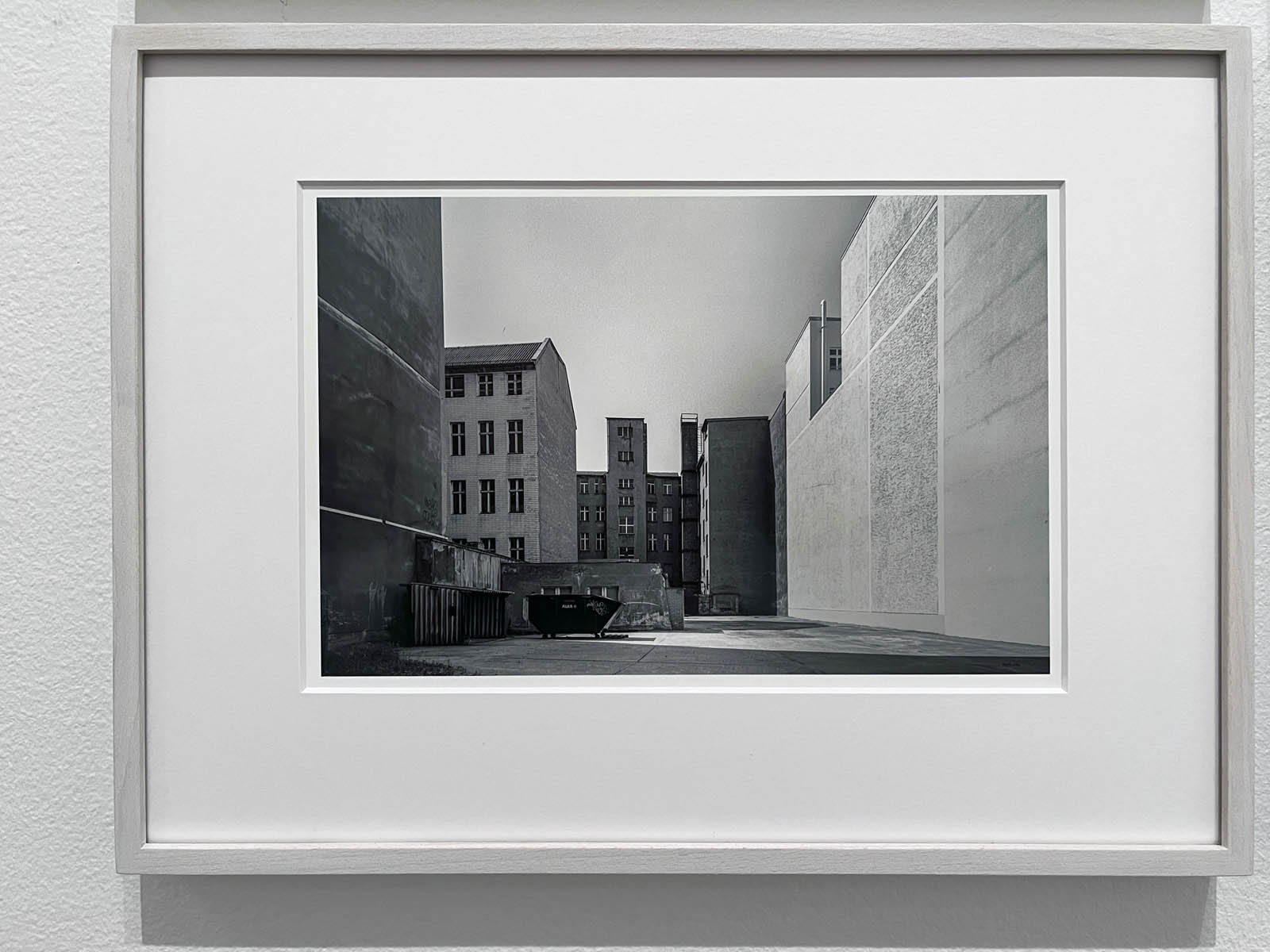
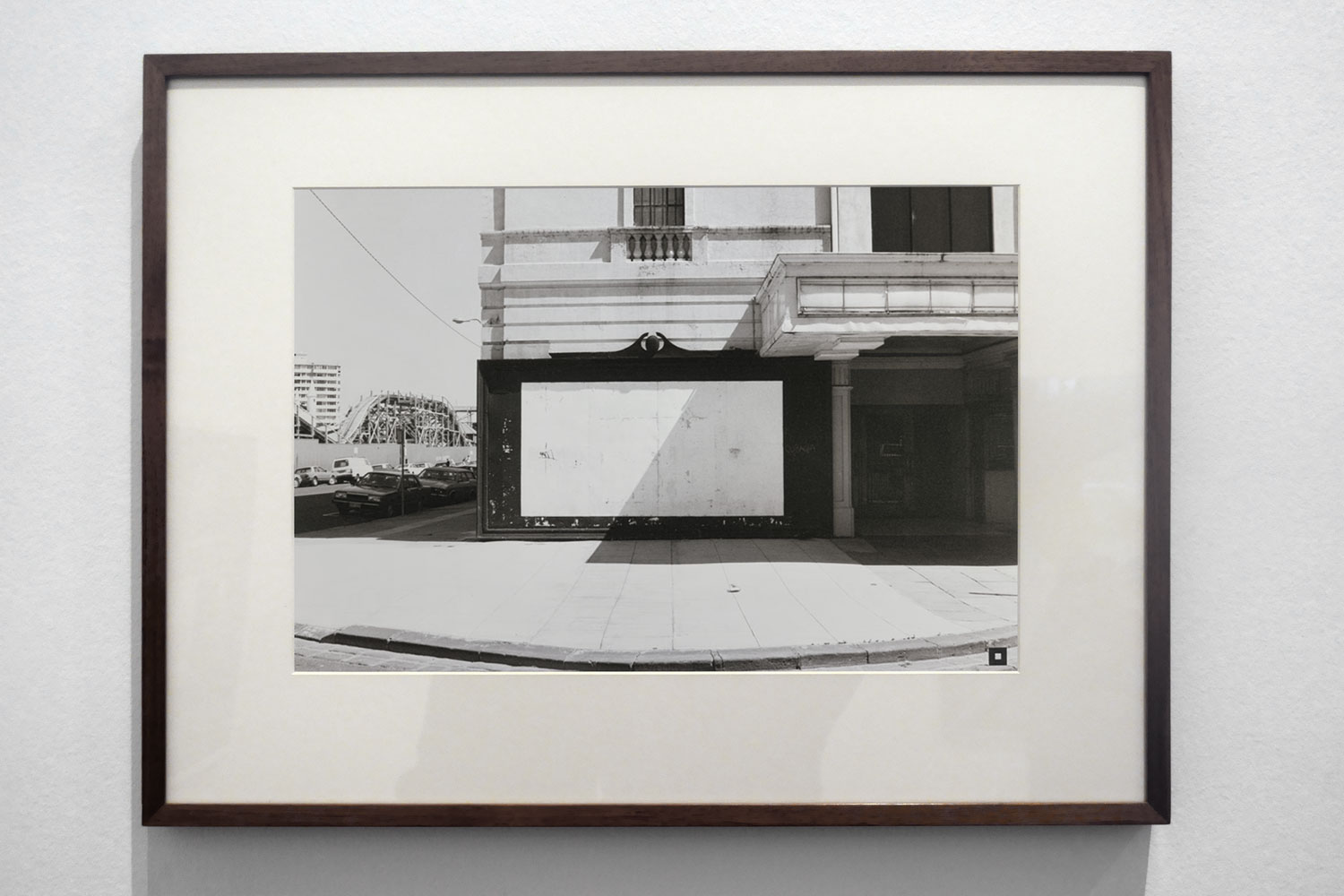
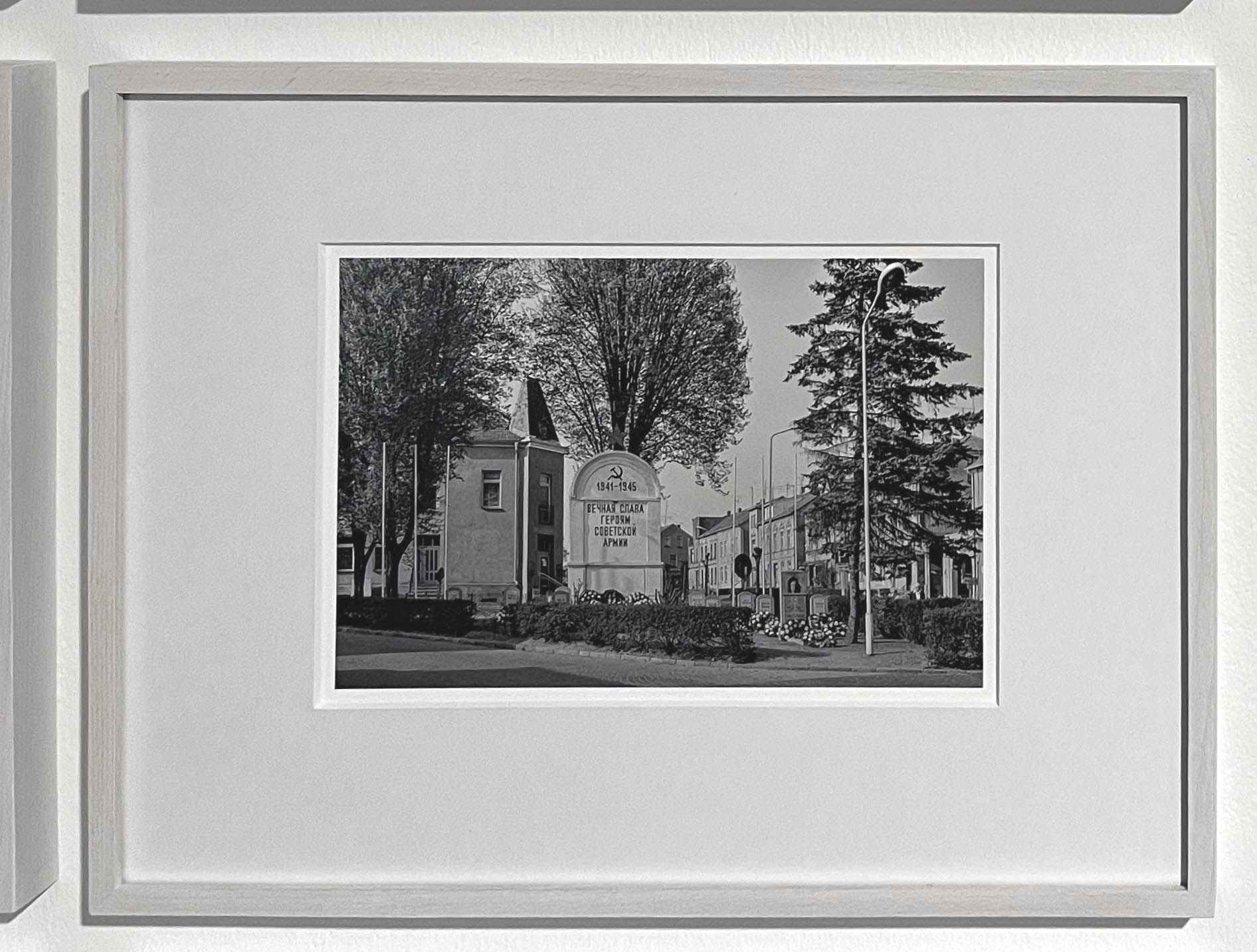
Ulrich Wüst (German, b. 1949) 'Dodendorfer Straße' 1998 From the series 'Morgenstraße. Magdeburg 1998-2000'


Ulrich Wüst (German, b. 1949)
Dodendorfer Straße
1998
Aus der Serie: Morgenstraße. Magdeburg 1998-2000
From the series: Morgenstraße. Magdeburg 1998-2000
B/w archival pigment print
18 x 27cm
© Ulrich Wüst; ifa


Wondering through history


Wonder noun. a feeling of amazement and admiration, caused by something beautiful, remarkable, or unfamiliar.


As enunciated by Jake Wilson in The Age newspaper in a review of the film La Chimera, “ultimately, the problem dramatised here is the same one faced by any modern artist: how do you retain a meaningful link to your predecessors while shaping something new?”1

Further, my mentor and friend Ian Lobb would often challenge me to define what I was adding to the artistic dialogue of photography instead of repeating the language of a previous era, and I would spar with him asking him was it really necessary to constantly reinvent the wheel, was it not enough to see and feel with clarity and humour those precious moments that surround us, and insightfully photograph them. These are the questions that enliven life: is it always necessary to shape something new, or is it enough to be attentive to the moment – of your mind, heart and vision – to create spellbinding photographs that carry your own interpretation of a certain reality.

Such is the case with the stimulating, two-room exhibition of the German photographer Ulrich Wüst at RMIT Gallery, Melbourne.

Wüst’s photography shows great affinity with the work of Bernd and Hiller Becher and the Becher and Dusseldorf Schools of photography which would have been known in East Germany by the time Wüst shot the 1980s series Stadtbilder. 1979-1985 (Cityscapes. 1979-1985) that first brought Wüst to international attention (the border was very permeable to artistic ideas from the West reaching East Germany).2 Indeed, most of Wüst’s oeuvre has direct links to the aesthetic of the Bechers (with their attention to detail and “devotion to the 1920s German tradition of Neue Sachlichkeit (New Objectivity”) and photographers such as Thomas Ruff (with their surreal enlargement of scale and “fundamentally sceptical attitude towards photography’s claim to truth and documentation”).

I believe that referencing and riffing off that aesthetic as Wüst does is no bad thing … for it forms the basis for the photographer’s further take on reality. But there are plenty of other forces at play in his photographs. I observe traces of August Sander, Berenice Abbott, Robert Frank, Michael Schmidt and Eugène Atget among others, especially with the latter in the positioning of Wüst’s camera.

As he observes, “When shooting I often find that if I move just fraction away from the more customary perspective a subtle heightening of tension with take place within the image. It’s no accident that I and my camera frequently get suspicious looks when the angle of the lens shifts away from the perspective found in souvenirs and postcards.” (Wall text from the exhibition)

And this is exactly what Atget did, he moved his camera from the “normal” point of view ever so slightly so that there immediately becomes this tension within the image plane coupled to the possibility of a magical revelation of space, an ironic comment on construction, or a grotesque play of opposites. As Wüst says, his vision, his observation, contains “plenty that is comic, grotesque, ironic” which many people do not see.


If we think about the supposedly objective work of the Bechers, which they insisted was all about documenting the object and not about any type of emotion, we fail to consider, as Julia Curl opines, “that this “objectivity” is only surface-level – that the work is deeply personal, even if its apparent uniformity claims otherwise.”3 Personally, I have never bought into the cool objectification of the Becher’s work for the photographers made defined choices as to how they depicted their constructed realities, each iteration of a water tower, gravel plant or cooling tower different from the other (fragments of a whole). This was deeply personal vision of how the world is perceived.

The same can be said of the photographs of Ulrich Wüst. His photographs are entirely personal, fragmentary excavations of history. In Wüst’s works by series, his photographs – surreal, sculptural scenes absent of people, full of elemental beauty – are not just the flawed humanity of our creation / the creation of our flawed humanity … but the creation and imagination of the human mind captured by the eye of the camera. Wüst’s photographs challenge us to look closer at the reality around us not accepting the status quo, the postcard view, not walking the city as if unaware of the vistas around us, feeling the “traces, injuries, missing and empty spaces in the image, so that things begin to speak of themselves…”4

As the art historian Matthias Flügge states, Wüst’s photographs are “images of intellectual-spatial situations,” wholly a creation, an accretion, on existing forms of photography. Not something new, which is ultimately unnecessary, but a growth in “wondering” – not wandering – achieved through the gradual accumulation of additional layers of beauty, feeling, knowledge so that we are informed and fully aware of our (un)familiar surroundings.

The photographs tell a powerful story of Germany before and after the fall of communism whilst instilling in the viewer a wondering, an accumulation and visual nourishment for the senses.

Such is the photography of Ulrich Wüst.

Dr Marcus Bunyan

PS. The only down side to this exhibition is that all the black and white photographs are modern archival ink jet prints. Call me old fashioned but these pigment prints have no real “presence”. It’s like the difference between an LP and a CD, or a movie in Technicolor or 5K. One has “atmosphere”, one has mood and aura and the other just sits there in all its perfection like a dog with a bone waiting for you to go “oooh, ahhh”. There are people that say you can’t tell the difference between the two. Rubbish. Give me gelatin silver prints any day of the week.


1/ Jake Wilson. “Lost and Found while digging up the cinematic past,” in The Age newspaper, 11 April 2024, p. 24.

2/”Huyssen reveals the complexity of artistic development on both sides of the Wall and notes that “the borders between East and West became porous during the 1970s as a result of treaties between the GDR and the FRG.” His focus in this regard, however, is on those artists who left the East for the West and made an impact there, such as Georg Baselitz and Gerhard Richter; he does not acknowledge the extent to which ideas and influences went in both directions. … While it is true that West German artists showed little interest in exhibiting in the East or in the art that was created there, East German artists tended to be well informed about Western artistic developments…” p. 598

April A. Eisman. “East German Art and the Permeability of the Berlin Wall,” in German Studies Review, Vol. 38, No. 3 (October 2015), pp. 597-616. Published by The Johns Hopkins University Press on behalf of the German Studies Association

3/ Julia Curl. “Bernd and Hilla Becher’s Misunderstood Oeuvre,” on the Hyperallergic website November 2, 2022 [Online] Cited 11/04/2024

4/ Jacek Slaski. “Ulrich Wüst – Stadtbilder 1979–1985: Zwischen Kunst und Dokumentation,” on the tipBerlin website 03/02/2022 [Online] Cited 08/04/2024. Translated from the German by Google Translate


Many thankx to the RMIT Gallery and the ifa for allowing me to publish the photographs in the posting. Please click on the photographs for a larger version of the image.

An exhibition by ifa – Institut für Auslandsbeziehungen e.V., Stuttgart – in partnership with the Goethe-Institut. This project is an official exhibition of PHOTO 2024 International Festival of Photography.


“Most viewers, unfortunately, are so dreadfully serious when they look at the pictures. I have to “hammer it home” incredibly hard before anyone will allow themselves to laugh. In my works there is simply – perhaps a bit hidden – plenty that is comic, grotesque, ironic.”


~ Ulrich Wüst, wall text from the exhibition


“I’m sure I do give those power symbols the aesthetic treatment, otherwise it’s unlikely that I would have any desire or energy to photograph them. But it would also be unfair to say that these objects do not hold their own innate aesthetic fascination. All I can do is try to describe how I am torn between spontaneous fascination and rational rejection, aiming to convey that experience and make it understandable. When shooting I often find that if I move just fraction away from the more customary perspective a subtle heightening of tension with take place within the image. It’s no accident that I and my camera frequently get suspicious looks when the angle of the lens shifts away from the perspective found in souvenirs and postcards. People are very attuned to that sort of shift.”


~ Ulrich Wüst, wall text from the exhibition


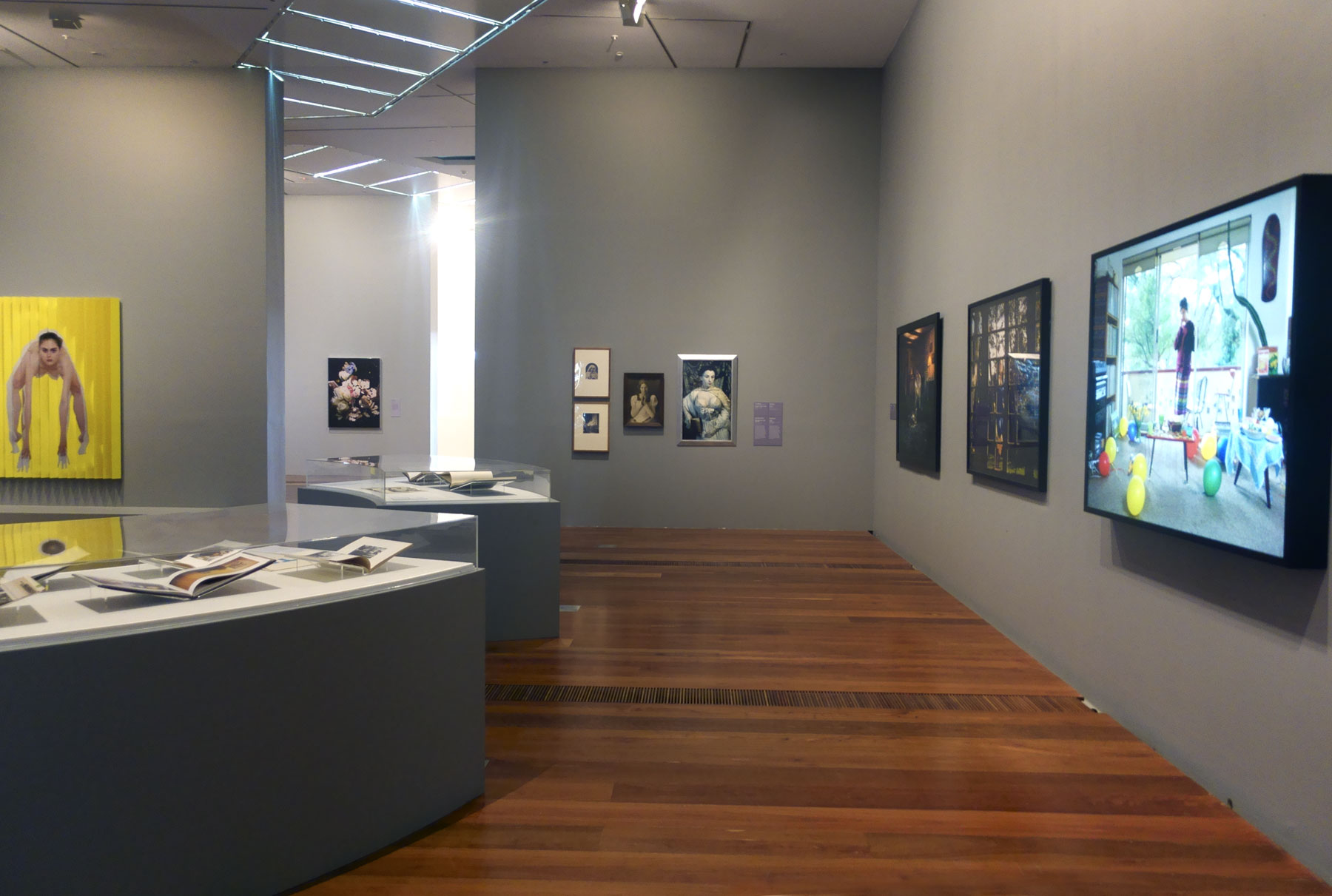
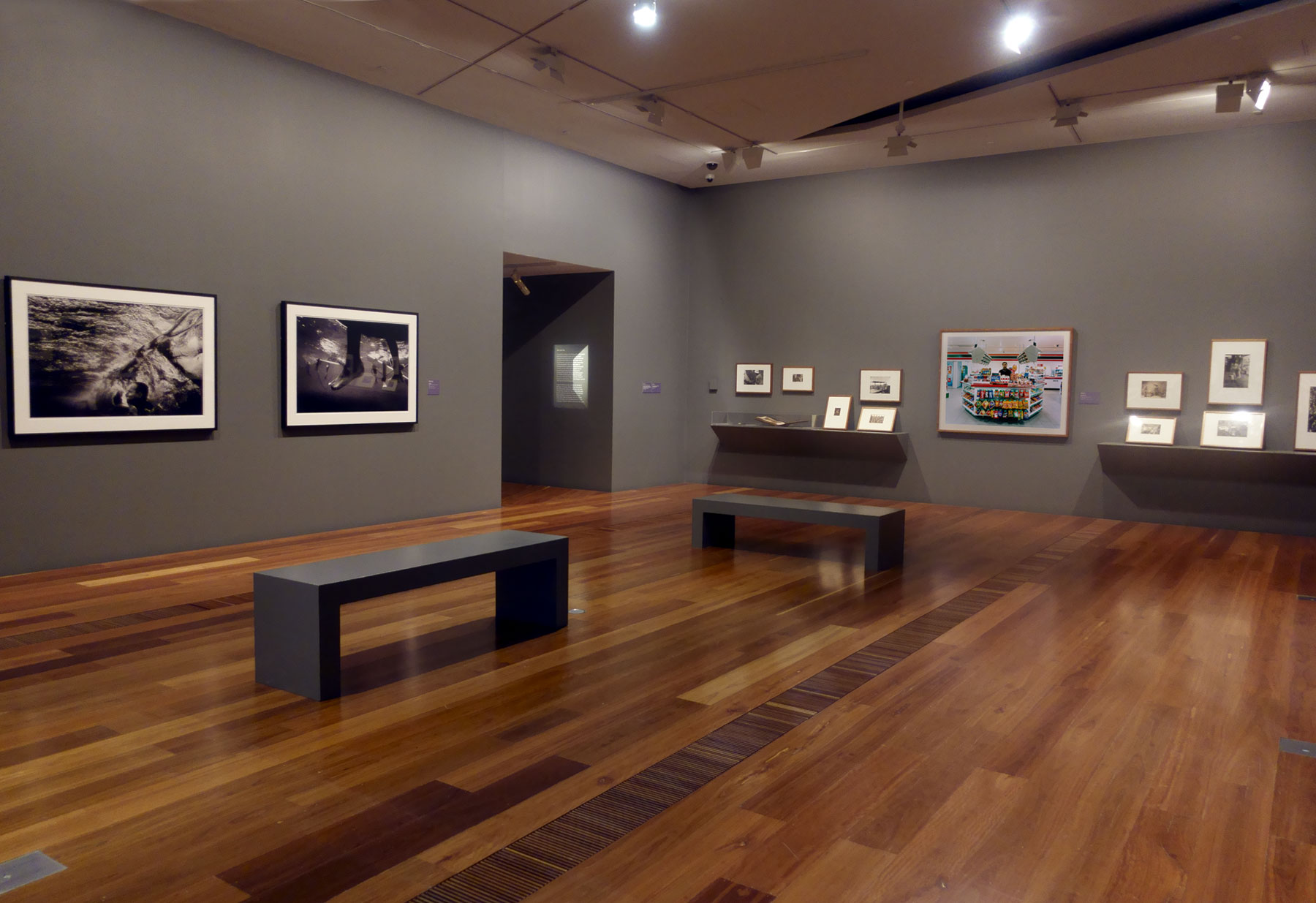
Installation view, Ulrich Wüst, 'Flatland. Schönhof', 2013 (centre), 'The Pomp of Power', 1983-1990 (left) and 'Red October', 2018 (right) from the exhibition 'Wanderings About History. The Photography of Ulrich Wüst', RMIT Gallery, Melbourne, 2024


Installation view, Ulrich Wüst, Flatland. Schönhof, 2013 (centre), The Pomp of Power, 1983-1990 (left) and Red October, 2018 (right) from the exhibition Wanderings About History. The Photography of Ulrich Wüst, RMIT Gallery, Melbourne, 2024
Photo: Christian Capurro


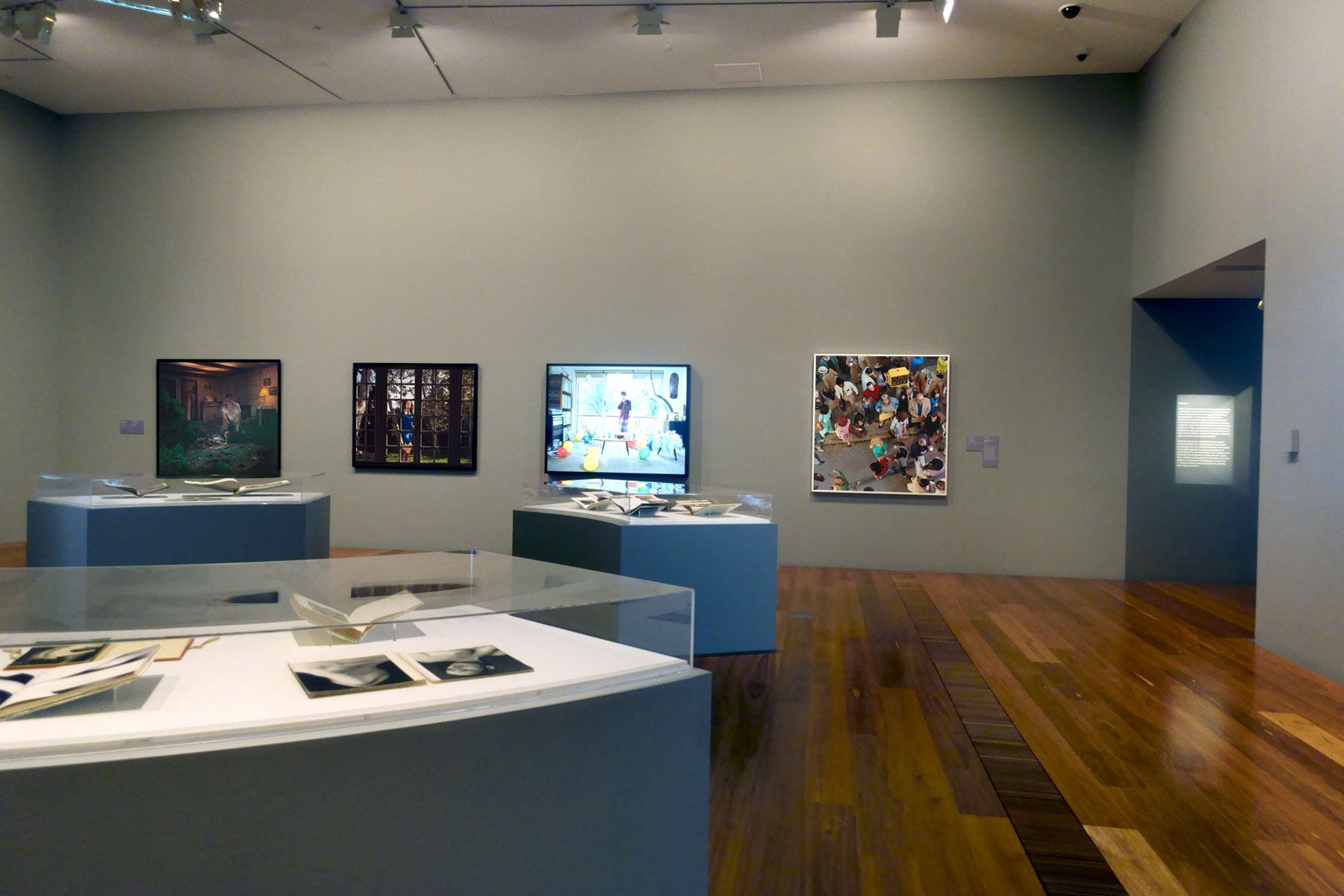
Ulrich Wüst’s photographic work captures his wanderings through German history, portraying the social and urban transformations from the GDR and its disintegration, through the German reunification to the present day. Wüst revives the German history in a new static way, where the past and present clash in a dynamic and ever-changing environment.

Wanderings About History. The Photography of Ulrich Wüst shows a selection of nine suites taken between 1978 and 2019. Ulrich Wüst’s photographic work can be contemplated from different perspectives. While the observations captured here are rooted in Germany’s division and its mending, at the same time they always relate to universal phenomena of social change and its material manifestations. The seemingly terse images, extremely precise in their composition, are the fruits of lengthy visual wanderings through present sites of recent history.
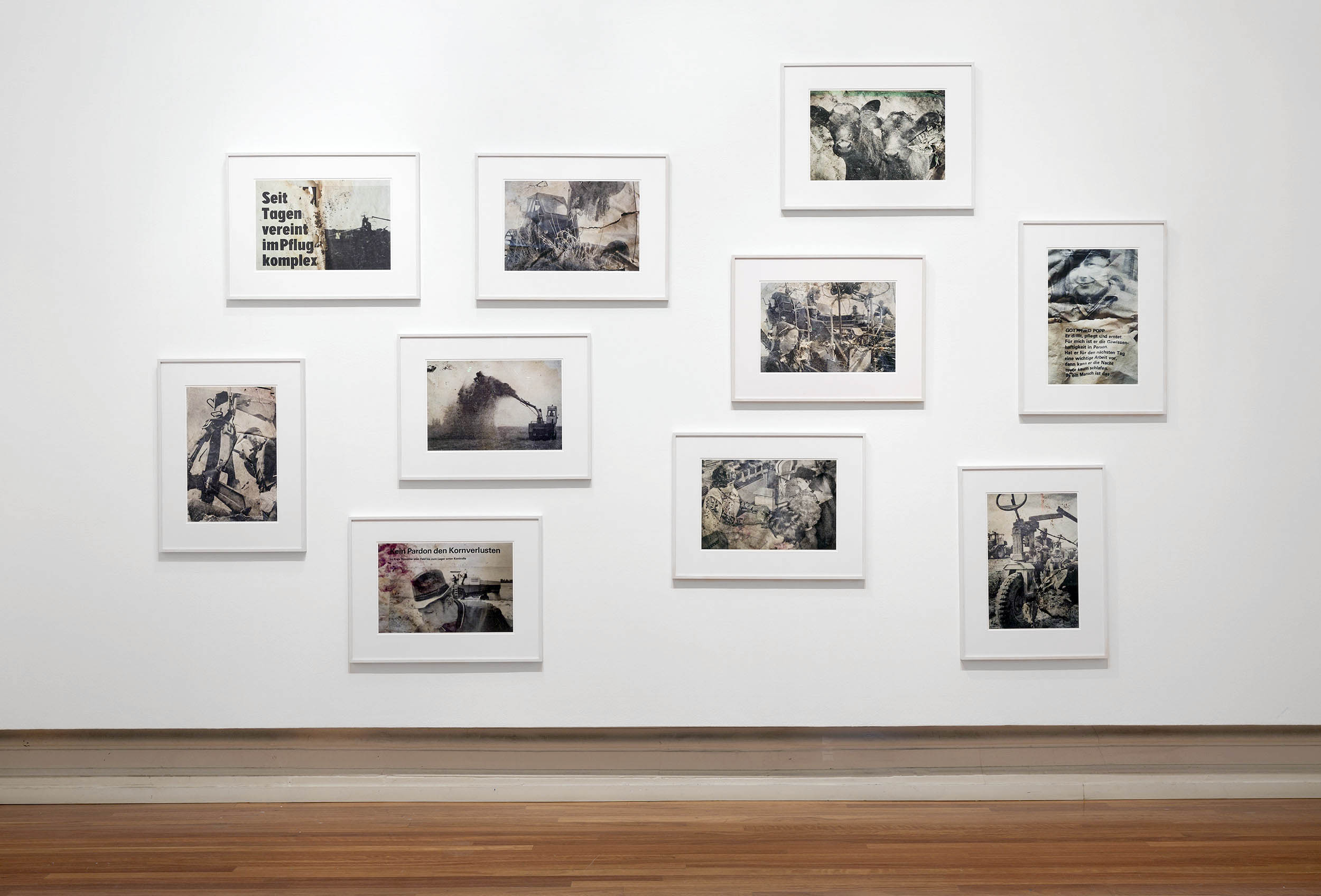
Ulrich Wüst’s photographic œuvre, which explores Eastern Germany in the broader sense, is not confined to the sunken GDR. It might be described as a pictorial archaeology of our present day. These pictures reveal the finds from his “excavations” and are at the same time tools of their conservation. Wüst has an infallible feel for the graphic quality of everyday situations, objects and materials, but also for the deeper layers of significance associated with found images. Examples are the enlarged details from East German press products that demonstrate a manipulative use of photography.

Ulrich Wüst’s photographic work can be contemplated from different perspectives. While the observations captured here are essentially rooted in Germany’s division and its mending, at the same time they always relate to universal phenomena of social change and its material manifestations. The seemingly terse images, extremely precise in their composition, are the fruits of lengthy visual wanderings through present sites of recent history.


Installation view, Ulrich Wüst, 'Flatland. Schönhof', 2013, from the exhibition 'Wanderings About History. The Photography of Ulrich Wüst', RMIT Gallery, Melbourne, 2024


Installation view, Ulrich Wüst, Flatland. Schönhof, 2013, from the exhibition Wanderings About History. The Photography of Ulrich Wüst, RMIT Gallery, Melbourne, 2024
Photo: Christian Capurro


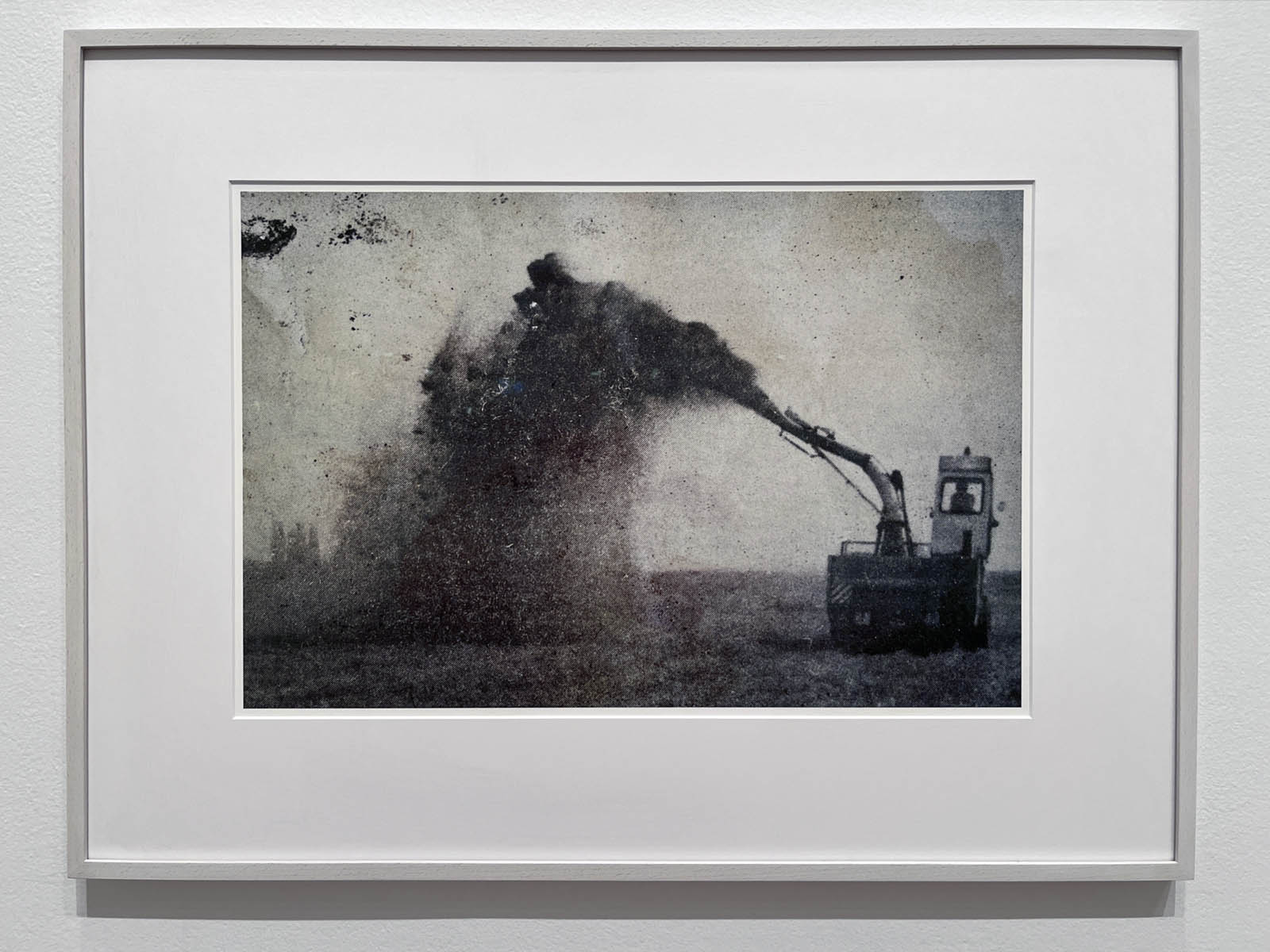
Ulrich Wüst (German, b. 1949) From the series 'Flatland. Schönhof' 2013


Ulrich Wüst (German, b. 1949)
Aus der Serie: Flatland. Schönhof
From the series: Flatland. Schönhof
2013
Colour photograph, archival pigment print
57 × 38cm
© Ulrich Wüst; ifa

 

Ulrich Wüst (German, b. 1949) From the series 'Flatland. Schönhof' 2013 (installation view)

Ulrich Wüst (German, b. 1949) From the series 'Flatland. Schönhof' 2013 (installation view)


Ulrich Wüst (German, b. 1949)
Aus der Serie: Flatland. Schönhof
From the series: Flatland. Schönhof (installation views)
2013
Colour photograph, archival pigment print
57 × 38cm
© Ulrich Wüst; ifa
Photos: Marcus Bunyan


“These photographs of newspapers and magazines were taken in the countryside, things that I found within a very small radius. Previously I had always done that urban stuff but then I would go looking for contrasts, because after a while your eye becomes tired.”


~ Ulrich Wüst, wall text from the exhibition


Installation view, Ulrich Wüst, 'Cityscapes, 1979-1985' (left) and 'Wiegmann Legacy. Bülowssiege, 1991-1992' (right) from the exhibition 'Wanderings About History. The Photography of Ulrich Wüst', RMIT Gallery, Melbourne, 2024


Installation view, Ulrich Wüst, Cityscapes 1979-1985 (left) and Wiegmann Legacy. Bülowssiege 1991-1992 (right) from the exhibition Wanderings About History. The Photography of Ulrich Wüst, RMIT Gallery, Melbourne, 2024
Photo: Christian Capurro


Ulrich Wüst’s photos are “images of mental-spatial situations”

In every city there are places that have been photographed thousands of times. From tourists, amateurs and professionals. Always captured on paper or the digital matrix. Big Ben, Eiffel Tower, Alexanderplatz in the heart of Berlin. Thousands, even millions of looks at the striking symbols of a metropolis that want to capture the essence of the city. Ulrich Wüst was far away from such direct concepts. His view of Alexanderplatz is almost shy, more of a cautious approach, and yet he gets a grip on the place. But it’s not primarily about Berlin. Wüst’s city images are less studies of specific cities than “images of intellectual-spatial situations,” as the art historian and rector of the Dresden University of Fine Arts Matthias Flügge states in his insightful text for the photo book Ulrich Wüst – Stadtbilder 1979-1985 (Ulrich Wüst – City Images 1979-1985).

If you read Flügge’s text, it becomes clear once again that a picture is not just a picture and that it requires more than a fleeting observation, especially with a subject like the cityscape. Because you could easily come to the conclusion that you immediately understand the motif at hand, after all, you yourself are a city dweller and are aware of your habitat. But a photograph is also a starting point for deeper reflections. Wüst’s photographs of prefabricated buildings in East Berlin, vacancies in Magdeburg, and the central square in Karl-Marx-Stadt are not unseen motifs. Rather, they are all too well known. Such urban constellations should not be foreign to anyone who lived in the GDR in the 1970s and 1980s, or even those born later or socialised in the West. …

“Determining the status quo of the constructed, shaped, printed or otherwise produced objective world with all its traces, injuries, missing and empty spaces in the image, so that things begin to speak of themselves,” is what Wüst does, writes Flügge.

Jacek Slaski. “Ulrich Wüst – Stadtbilder 1979–1985: Zwischen Kunst und Dokumentation,” on the tipBerlin website 03/02/2022 [Online] Cited 08/04/2024. Translated from the German by Google Translate


Ulrich Wüst (German, b. 1949) 'Berlin' 1982 From the series 'Cityscapes. 1979-1985'


Ulrich Wüst (German, b. 1949)
Berlin
1982
Aus der Serie: Stadtbilder. 1979-1985
From the series: Cityscapes. 1979-1985
B/w archival pigment print
16 x 24cm
© Ulrich Wüst; ifa


“For me it had always been about the built environment. […] And then I started on those rather dry Cityscapes, which always seems so objective, even though they never were and never tried to be. I wanted to take a concentrated, analytical look at the city. Back then I had a strong sense of mission; I really did want to achieve something. And the things I wanted to say about the city as space I also wanted to tell people who weren’t at all interested in photography or urban space. In some respects it was definitely intended to enlighten. Ultimately I wanted to provoke a debate about what we imagine a “city” to be and what this environment does to us.”


~ Ulrich Wüst, wall text from the exhibition


Axel Hütte (b. 1951) 'James Hammett House' 1982-1984


Axel Hütte (German, b. 1951)
James Hammett House
1982-1984
Silver gelatin print on baryte paper
66 x 80cm
Loan of the artist
 

Ulrich Wüst (German, b. 1949) From the series 'Cityscapes. 1979-1985' (installation view)

Ulrich Wüst (German, b. 1949) From the series 'Cityscapes. 1979-1985' (installation view)

Ulrich Wüst (German, b. 1949) From the series 'Cityscapes. 1979-1985' (installation view)


Ulrich Wüst (German, b. 1949)
Aus der Serie: Stadtbilder. 1979-1985
From the series: Cityscapes. 1979-1985 (installation views)
B/w archival pigment print
16 x 24cm
© Ulrich Wüst; ifa
Photos: Marcus Bunyan


The work of Ulrich Wüst might best be described as a pictorial archaeology of recent German history. With an unsentimental precision these photographic ‘excavations’ pivot around moments of social change; those points in history when the old and the new collide, when the seemingly endless cycle of destruction and construction can so easily relegate the present to the oblivion of the past.

Initially photographing life in the former East Germany, Wüst’s oeuvre grew to include the documentation of everyday situations, objects and materials; expanding further with the addition of found images, cropped and rephotographed by Wüst to reveal alternative readings.

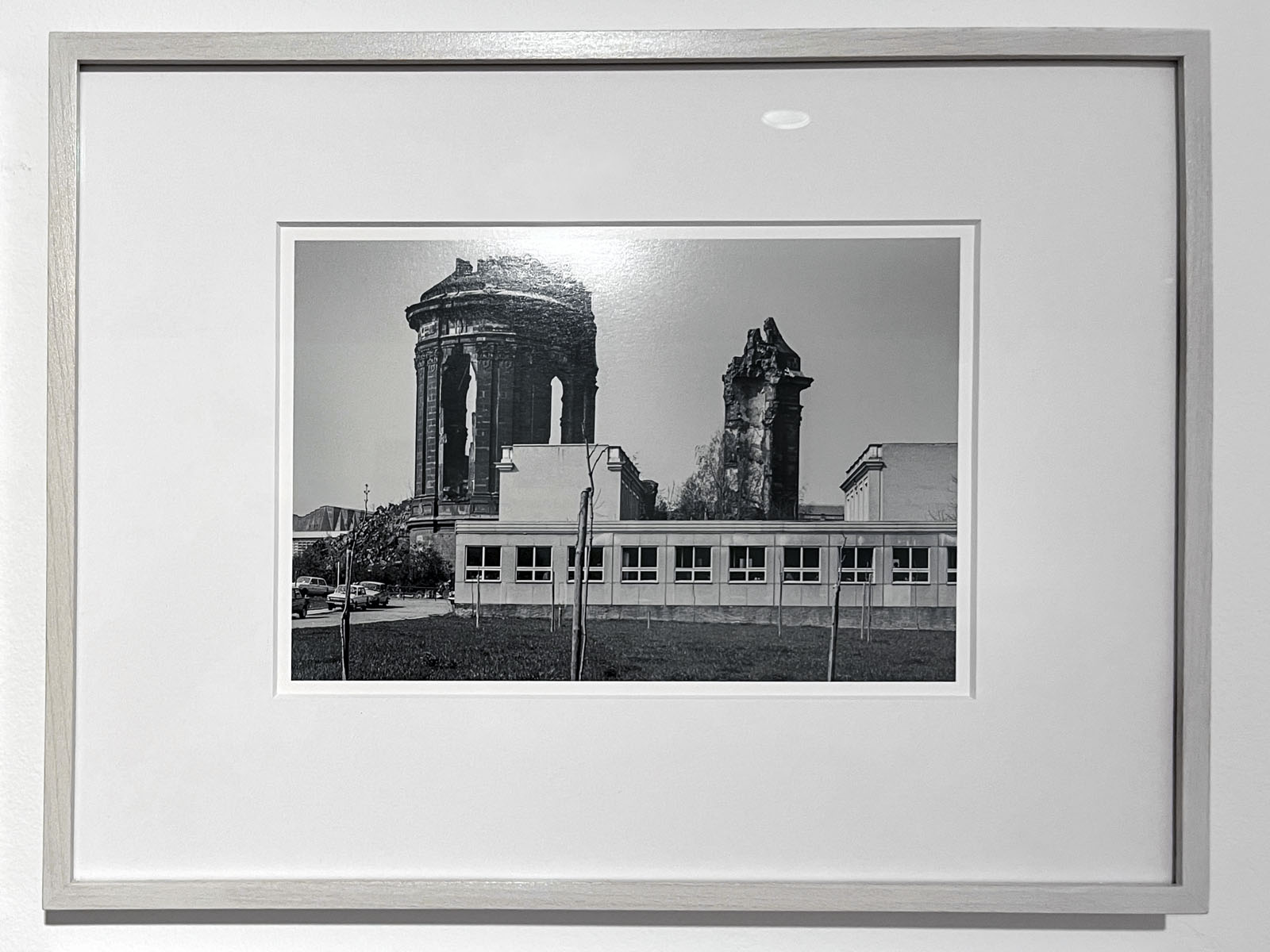
In his sparse black and white Cityscapes, the 1980s series that first brought Wust to international attention, we find images of East German cities and towns still carrying scars from the Second World War – an environment formed through the combination of unchecked decay and Soviet-era reconstruction. With an interest in the absurd – those visual anomalies that arrive through accident or misguided intent – Wüst has forged a unique, non-ideological representation of that time. In a similar manner but on a different scale, Wüst’s Wiegmann Legacy. Bülowssiege (1991-1992) – a photo inventory of objects left behind by the former owner of his house – engages us with the incidental nature of history. Intimate and fragile, these ordinary objects are made monumental through Wüst’s lens, yet these discarded possessions have the same precariousness as the hastily built architecture of cities in perpetual change.

Ulrich Wüst’s photographic work exists as a registry of everyday images. It could be considered akin to the personal archive of a once divided country mending itself, wandering through time, settling upon moments and fragments that also speak to the wider, universal phenomena of social change and its material manifestations.

Wall text from the exhibition


Installation view, Ulrich Wüst, 'Cityscapes, 1979-1985' (right), 'Morgenstraße. Magdeburg, 1998-2000' (second right), 'Wiegmann Legacy. Bülowssiege, 1991-1992' (third right) and 'Red October', 2018 (left) from the exhibition 'Wanderings About History. The Photography of Ulrich Wüst', RMIT Gallery, Melbourne, 2024


Installation view, Ulrich Wüst, Cityscapes, 1979-1985 (right), Morgenstraße. Magdeburg, 1998-2000 (second right), Wiegmann Legacy. Bülowssiege, 1991-1992 (third right) and Red October, 2018 (left) from the exhibition Wanderings About History. The Photography of Ulrich Wüst, RMIT Gallery, Melbourne, 2024
Photo: Christian Capurro


Installation view, Ulrich Wüst, 'Morgenstraße. Magdeburg, 1998-2000' (right), 'Wiegmann Legacy. Bülowssiege, 1991-1992' (centre left) from the exhibition 'Wanderings About History. The Photography of Ulrich Wüst', RMIT Gallery, Melbourne, 2024


Installation view, Ulrich Wüst, Morgenstraße. Magdeburg, 1998-2000 (right), Wiegmann Legacy. Bülowssiege, 1991-1992 (centre left) from the exhibition Wanderings About History. The Photography of Ulrich Wüst, RMIT Gallery, Melbourne, 2024
Photo: Christian Capurro
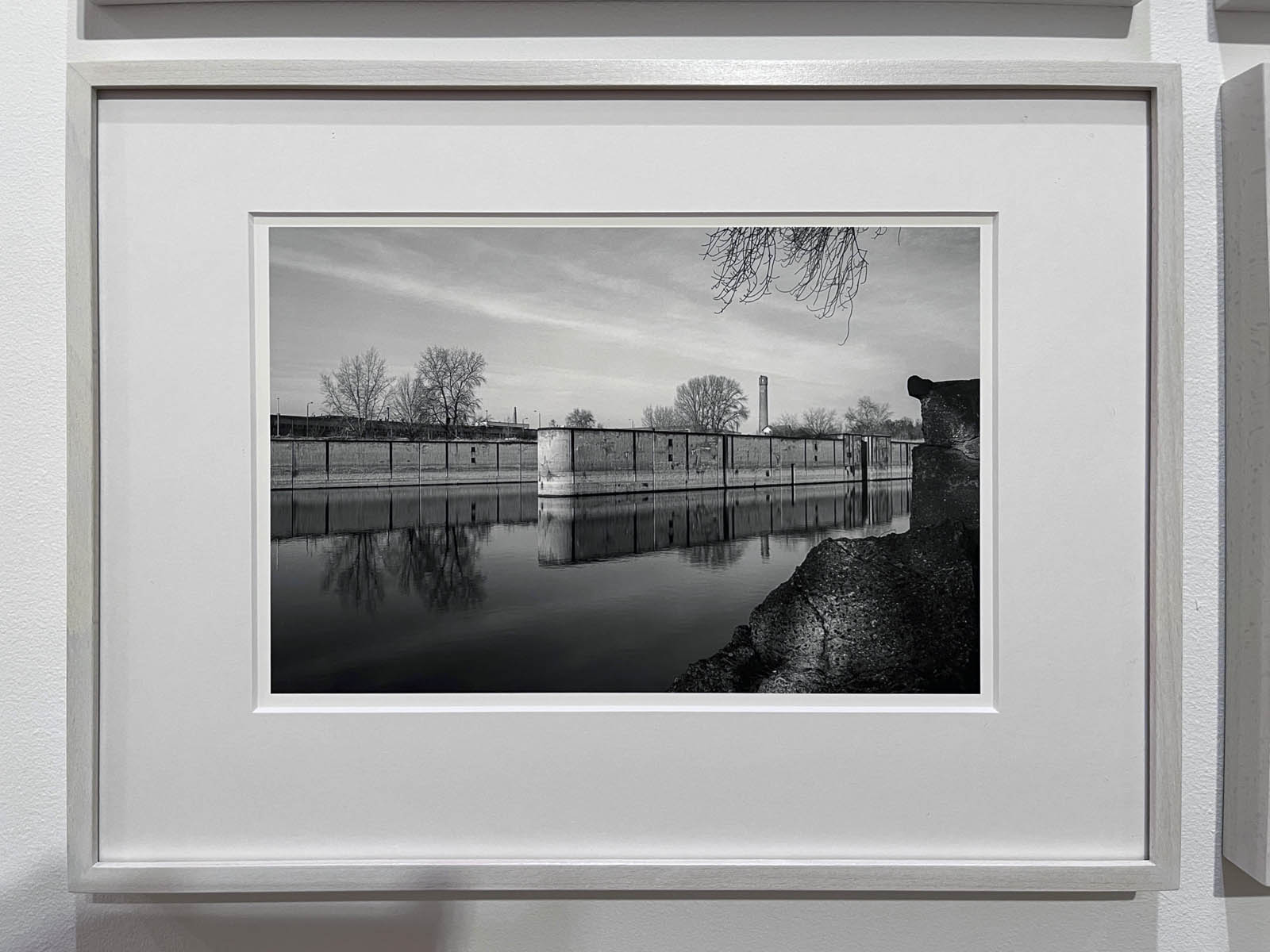
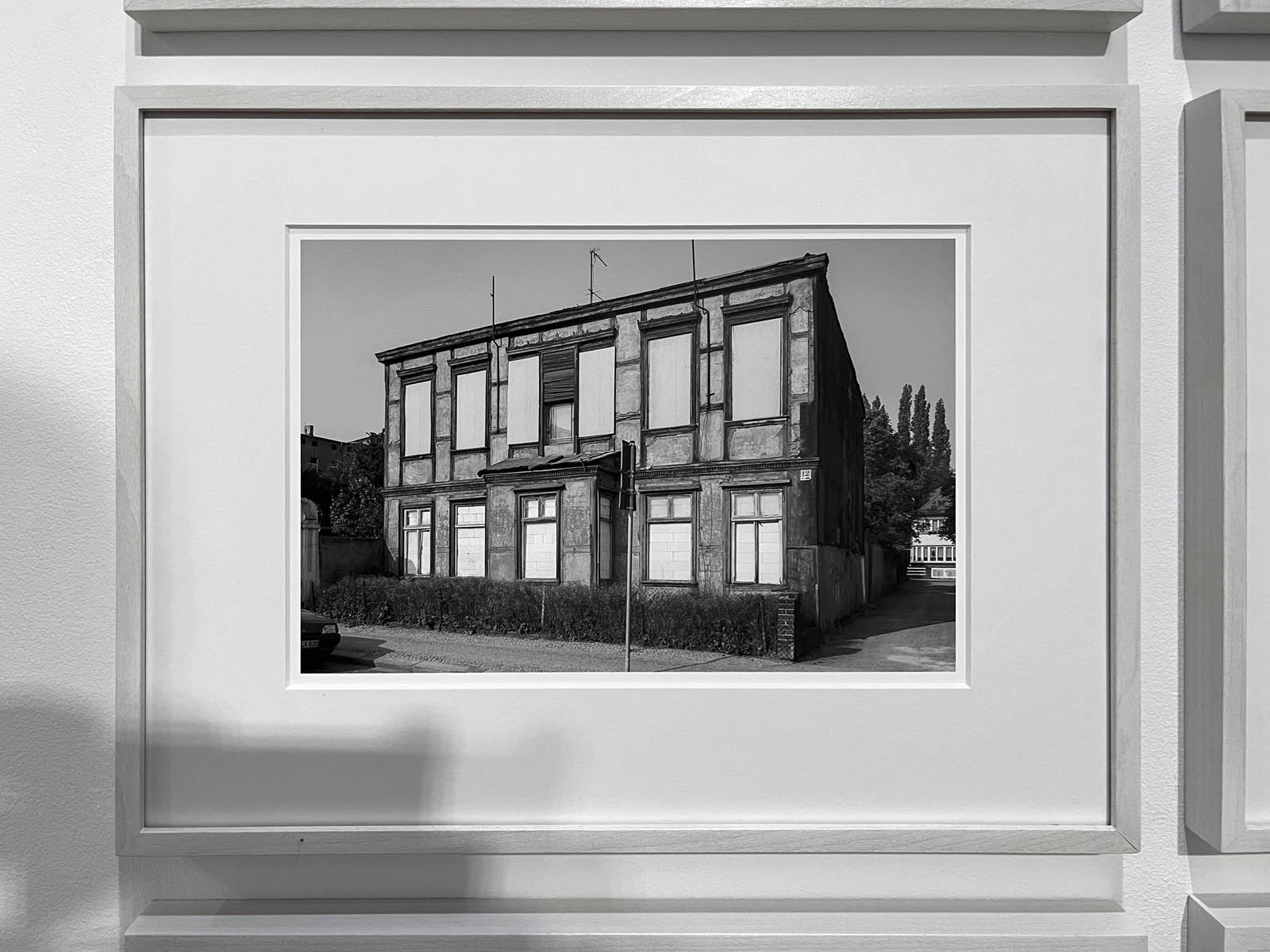
 

Ulrich Wüst (German, b. 1949) From the series 'Morgenstraße. Magdeburg' 1998-2000 (installation view)

Ulrich Wüst (German, b. 1949) From the series 'Morgenstraße. Magdeburg' 1998-2000 (installation view)


Ulrich Wüst (German, b. 1949)
Aus der Serie: Morgenstraße. Magdeburg 1998-2000
From the series: Morgenstraße. Magdeburg 1998-2000 (installation views)
B/w archival pigment print
18 x 27cm
© Ulrich Wüst; ifa
Photos: Marcus Bunyan


“As soon as we see people in pictures, we focus on those people. We seem to be fixated on that somehow and we stare at the figures depicted, however small they may be. But as I wanted to steer attention to the built environment, to what we have built for ourselves, I quite simply decided to leave the people out. If there a no people in sight in the pictures, then for one thing nobody can look at them and for another the effect is disconcerting. Disconcertion is a good opening gambit.”


~ Ulrich Wüst, wall text from the exhibition


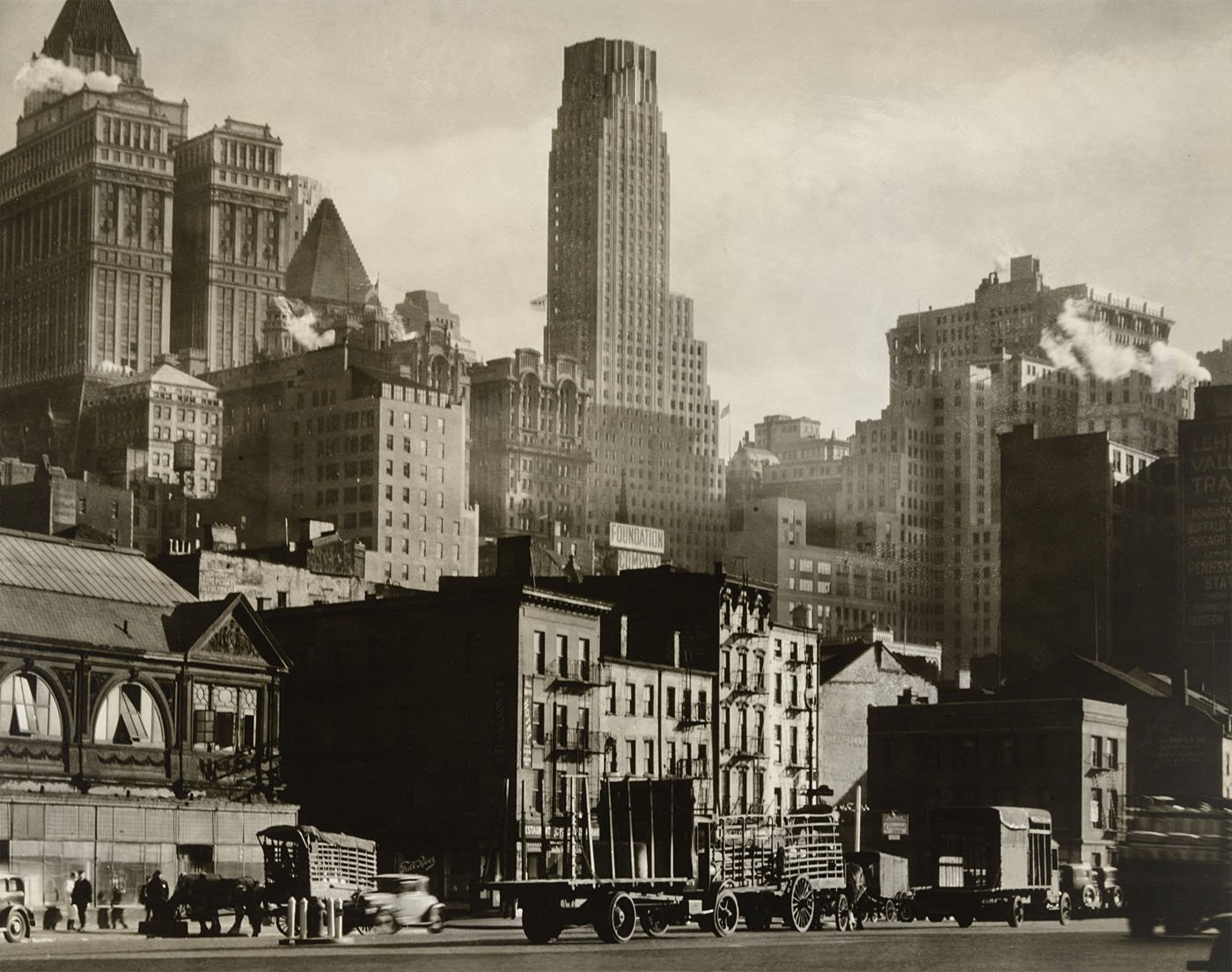
Berenice Abbott (American, 1898-1991) 'Fifth Avenue, Nos. 4, 6, 8, Manhattan' March 20, 1936


Berenice Abbott (American, 1898-1991)
Fifth Avenue, Nos. 4, 6, 8, Manhattan
March 20, 1936
Gelatin silver print
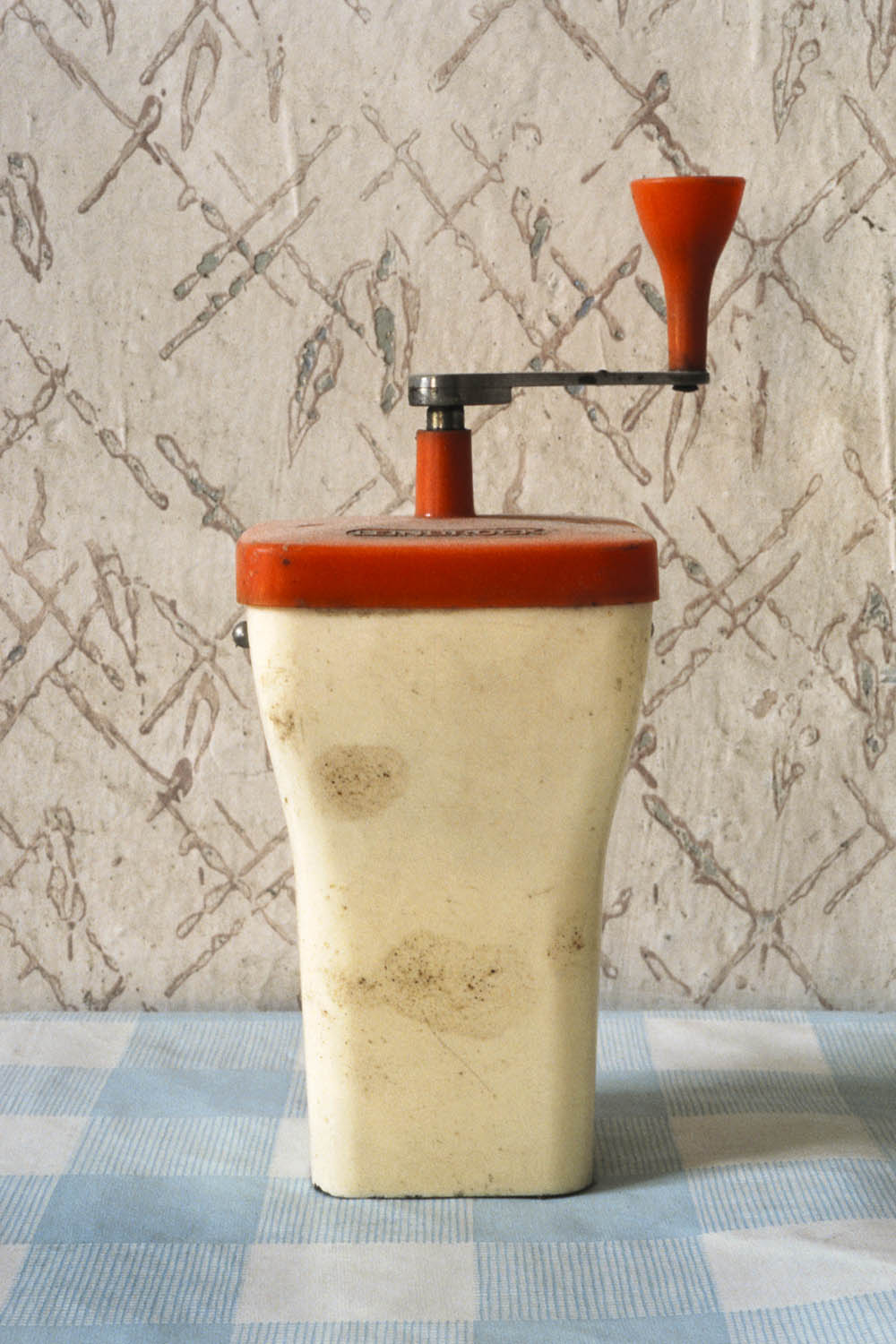
 

Ulrich Wüst (German, b. 1949) 'Kaffemühle' (Coffee grinder) From the series 'Wiegmann Legacy. Bülowssiege 1991-1992'


Ulrich Wüst (German, b. 1949)
Kaffemühle (Coffee grinder) 
Aus der Serie: Nachlass Wiegmann. Bülowssiege 1991-1992
From the series: Wiegmann Legacy. Bülowssiege 1991-1992
Colour photograph, archival pigment print
105 cm x 70cm
© Ulrich Wüst; ifa


“I make a point of calling myself a photographer, because then the art question usually no longer arises. But if others still want to see me as an artist, I can (happily) live with that. Personally I don’t want to think about that question. The only thing I do want to stress is that my work is not documentary. I use documentary technique as a form, as a means, and in certain works I am also looking for documentary precision.”


~ Ulrich Wüst, wall text from the exhibition


Installation view, Ulrich Wüst, 'Wiegmann Legacy. Bülowssiege, 1991-1992' from the exhibition 'Wanderings About History. The Photography of Ulrich Wüst', RMIT Gallery, Melbourne, 2024


Installation view, Ulrich Wüst, Wiegmann Legacy. Bülowssiege, 1991-1992 from the exhibition Wanderings About History. The Photography of Ulrich Wüst, RMIT Gallery, Melbourne, 2024
Photo: Christian Capurro


Ulrich Wüst (German, b. 1949) From the series 'Wiegmann Legacy. Bülowssiege 1991-1992' (installation view)


Ulrich Wüst (German, b. 1949)
Aus der Serie: Nachlass Wiegmann. Bülowssiege 1991-1992
From the series: Wiegmann Legacy. Bülowssiege 1991-1992 (installation view)
Colour photograph, archival pigment print
105 cm x 70cm
© Ulrich Wüst; ifa
Photo: Marcus Bunyan


Installation view, Ulrich Wüst, 'Cityscapes, 1979-1985' (left) and 'Wiegmann Legacy. Bülowssiege, 1991-1992' (right) from the exhibition 'Wanderings About History. The Photography of Ulrich Wüst', RMIT Gallery, Melbourne, 2024


Installation view, Ulrich Wüst, Cityscapes, 1979-1985 (left) and Wiegmann Legacy. Bülowssiege, 1991-1992 (right) from the exhibition Wanderings About History. The Photography of Ulrich Wüst, RMIT Gallery, Melbourne, 2024
Photo: Christian Capurro
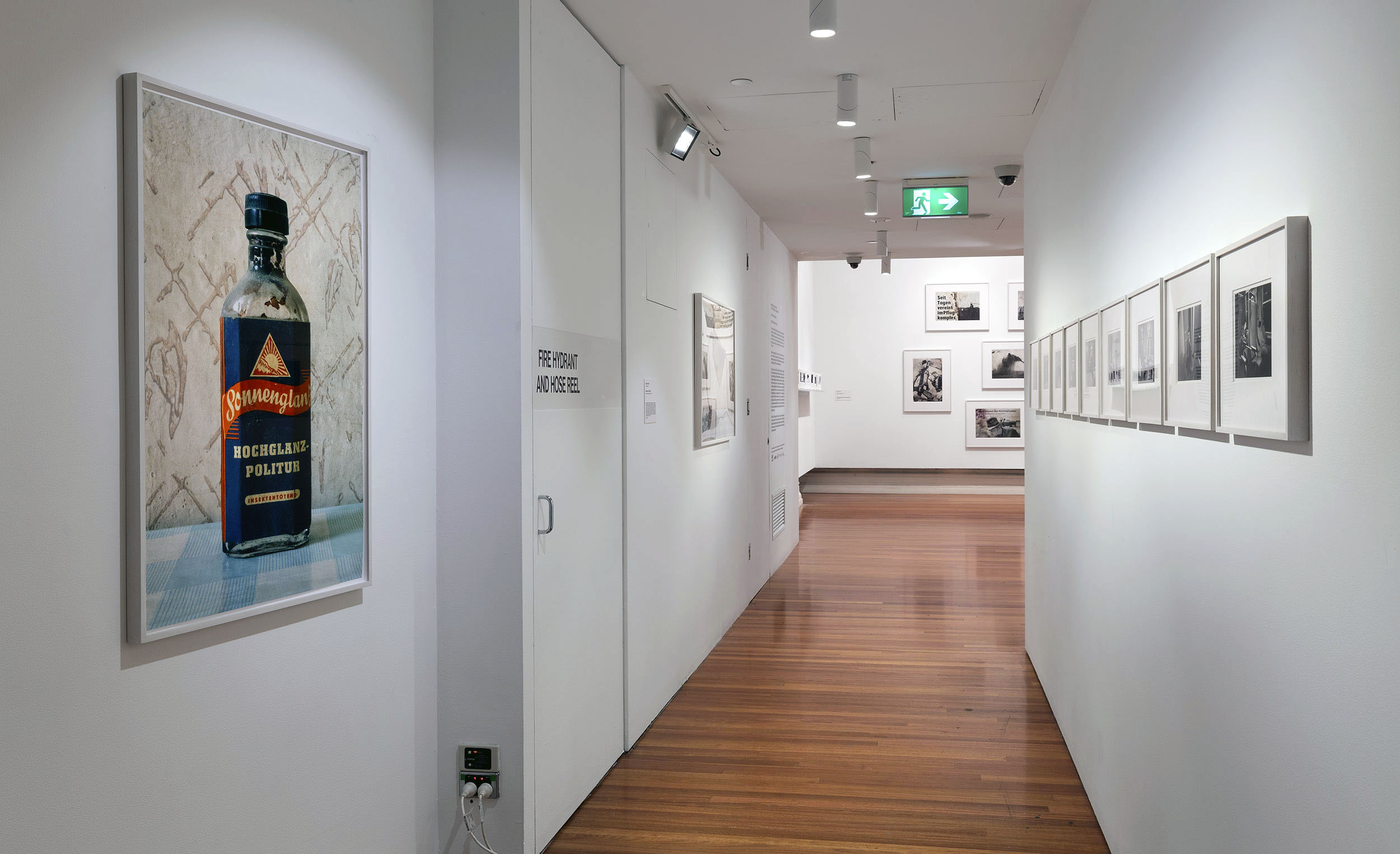
 

Installation view, Ulrich Wüst, 'Wiegmann Legacy. Bülowssiege, 1991-1992' (left) and 'Notations 1984-1986' (right) from the exhibition 'Wanderings About History. The Photography of Ulrich Wüst', RMIT Gallery, Melbourne, 2024


Installation view, Ulrich Wüst, Wiegmann Legacy. Bülowssiege, 1991-1992 (left) and Notations 1984-1986 (right) from the exhibition Wanderings About History. The Photography of Ulrich Wüst, RMIT Gallery, Melbourne, 2024
Photo: Christian Capurro
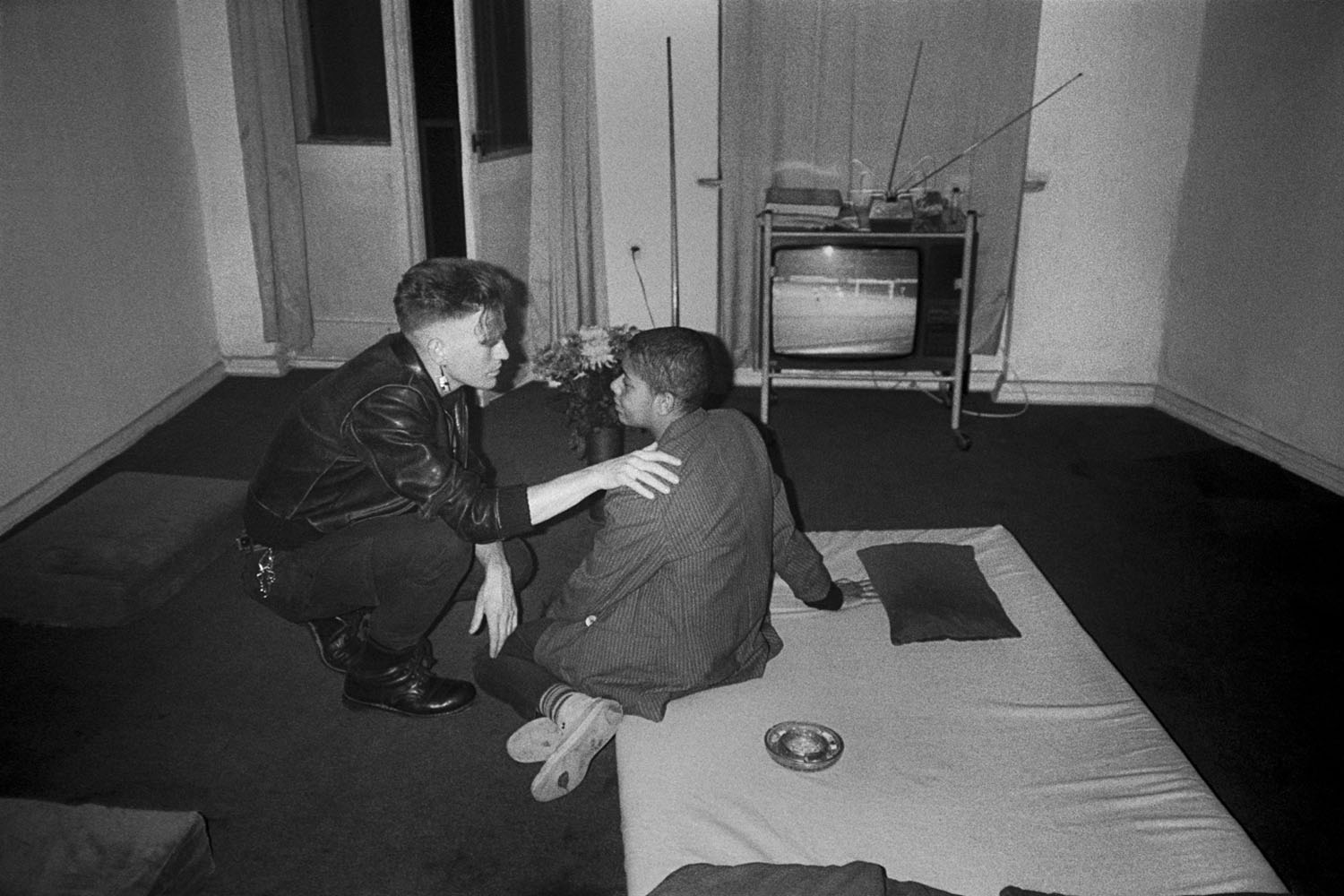
 

Ulrich Wüst (German, b. 1949) 'Berlin, Pappelallee' September 1984 From the series 'Notations. 1984-1986'


Ulrich Wüst (German, b. 1949)
Berlin, Pappelallee
September 1984
Aus der Serie: Notizen. 1984-1986
From the series: Notations. 1984-1986
B/w archival pigment print
14 x 21cm
© Ulrich Wüst; ifa


Ulrich Wüst (German, b. 1949) From the series 'Notations. 1984-1986' (installation view)

Ulrich Wüst (German, b. 1949) From the series 'Notations. 1984-1986' (installation view)

Ulrich Wüst (German, b. 1949) From the series 'Notations. 1984-1986' (installation view)


Ulrich Wüst (German, b. 1949)
Aus der Serie: Notizen. 1984-1986
From the series: Notations. 1984-1986 (installation views)
B/w archival pigment print
14 x 21cm
© Ulrich Wüst; ifa
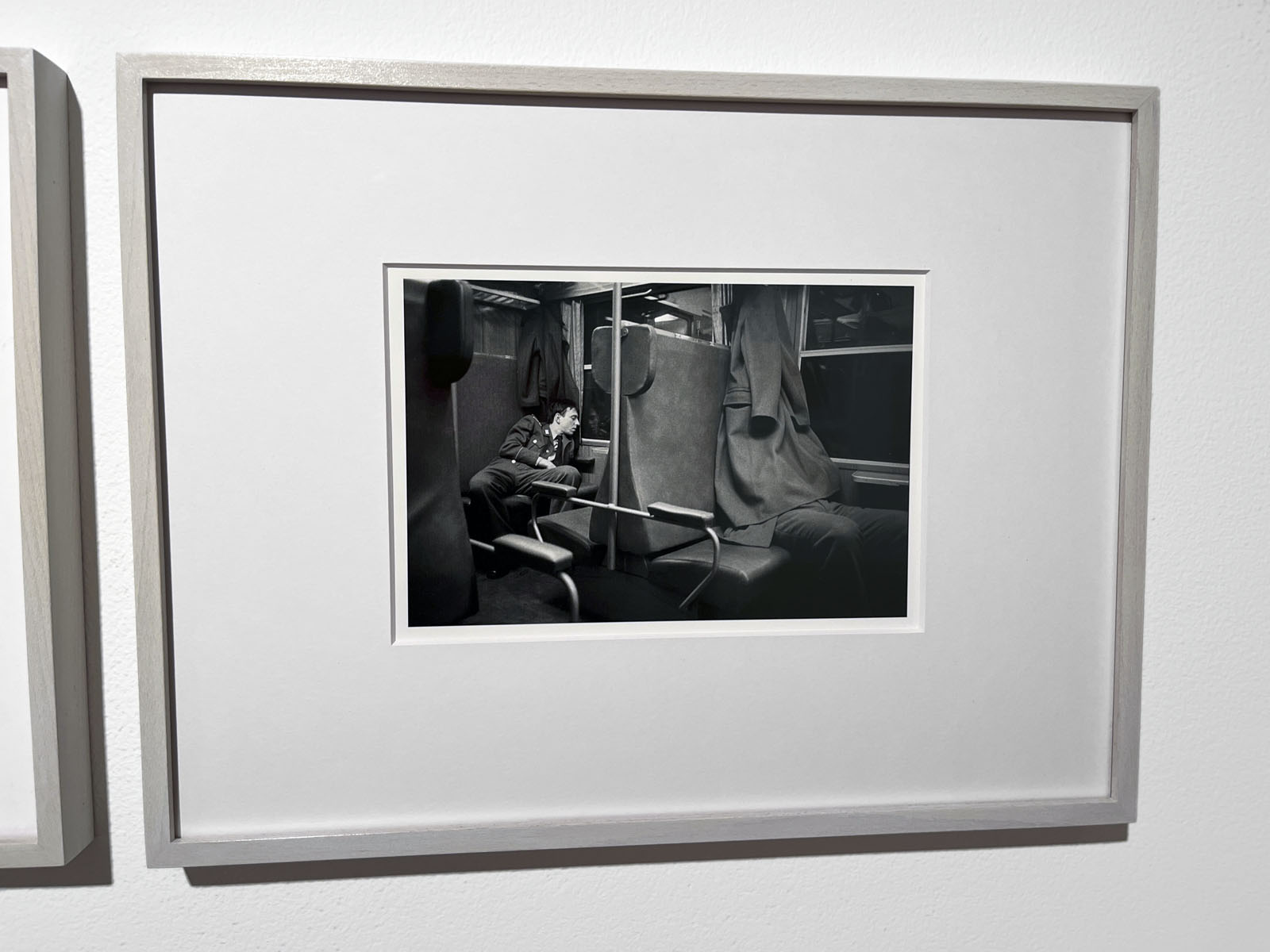
Photos: Marcus Bunyan


“While I was still busy fine-tuning my technical skills for Cityscapes, over in West Germany very small automatic rangefinders were coming onto the market. That was in the early 1980s. […] I got hold of one of those and suddenly I could carry a camera with me all the time, take it anywhere, and I started using it like an “extended eye”. The little camera allowed me to take more intimate, more “personal” works. For me that meant talking about my own life. That was the beginning of the series Notations, as I later called it. I focused on my circle of friends and my immediate environment. And so the Notations came about and that was what I wanted to achieve, as a conscious antithesis to other series like the Cityscapes.”


~ Ulrich Wüst, wall text from the exhibition
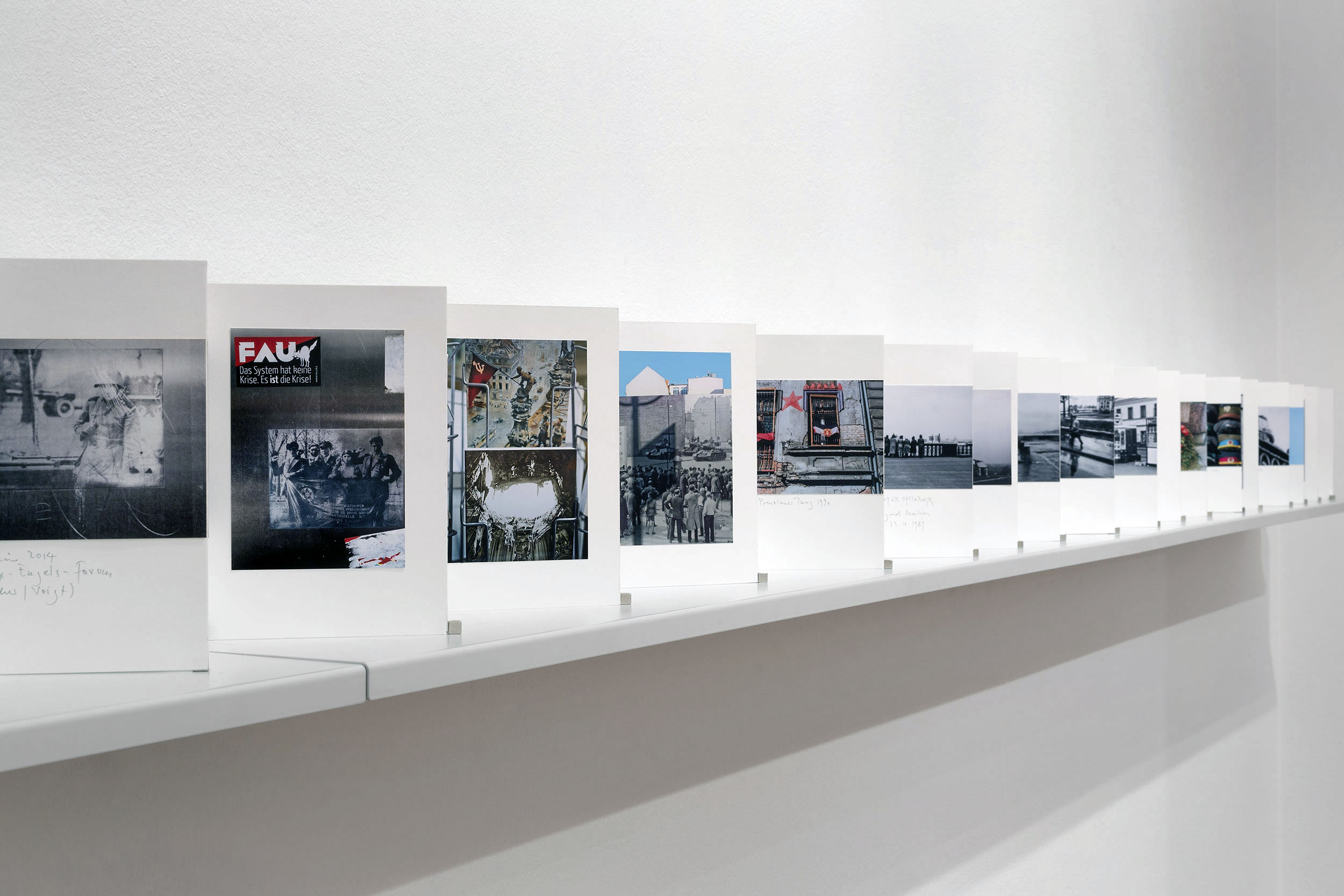
 

Installation view, Ulrich Wüst, 'Red October' 2018, from the exhibition Wanderings About History – The Photography of Ulrich Wüst, RMIT Gallery, Melbourne, 2024


Installation view, Ulrich Wüst, Red October 2018, from the exhibition Wanderings About History. The Photography of Ulrich Wüst, RMIT Gallery, Melbourne, 2024
Photo: Christian Capurro
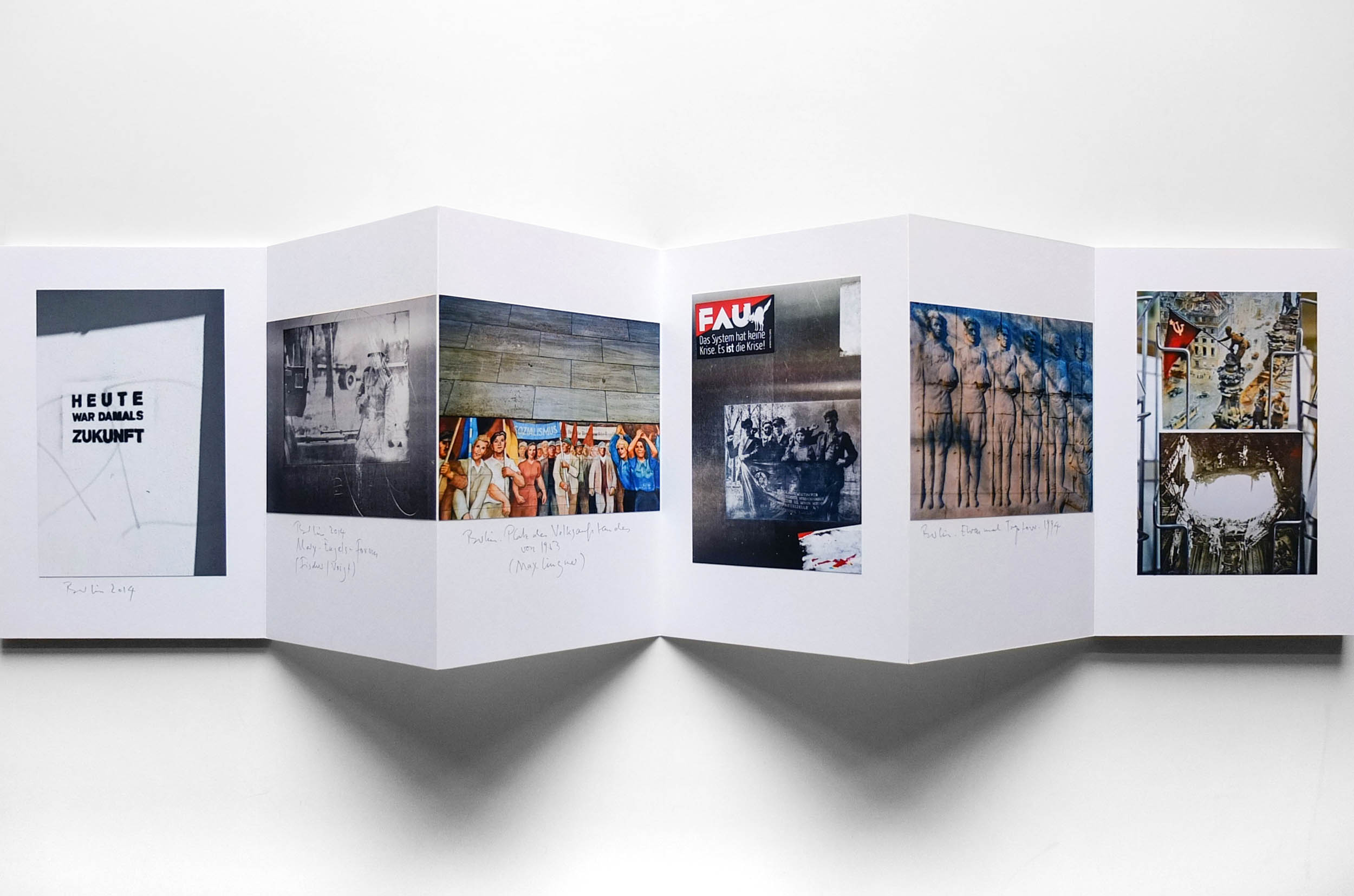
 

Ulrich Wüst (German, b. 1949) 'Roter Oktober' (Red October) 2018


Ulrich Wüst (German, b. 1949)
Roter Oktober (Red October)
2018
Leporello with 45 b/w and colour photographs mounted on cardboard
14.8 × 21.0 × 2.0cm
© Ulrich Wüst; ifa


Michael Schmidt (German, 1945-2014) 'Müller-Ecke Seestrasse, Berlin-Wedding' (Berlin-Wedding) 1976-1978


Michael Schmidt (German, 1945-2014)
Müller-Ecke Seestrasse, Berlin-Wedding (Berlin-Wedding)
1976-1978
© Michael Schmidt, Foundation for Photography and Media Art with the Michael Schmidt Archive
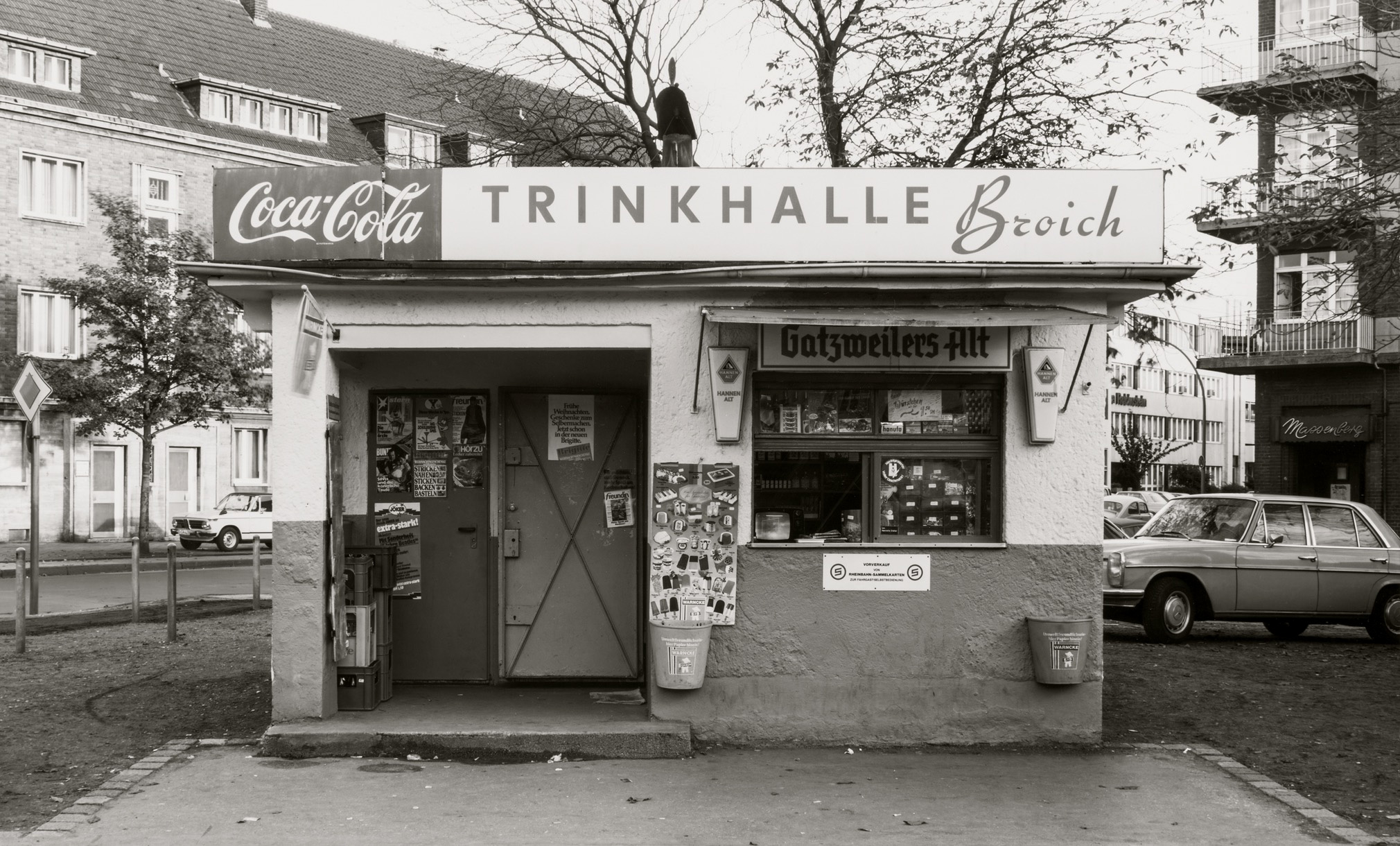
 

Tata Ronkholz (1940-1997) 'Dusseldorf, Sankt-Franziskusstraße 107' 1977


Tata Ronkholz (German, 1940-1997)
Dusseldorf, Sankt-Franziskusstraße 107
1977
Silver gelatin print on baryta paper
41.2 × 51.2cm
Courtesy The Photographische Sammlung / SK Stiftung Kultur, Cologne / Permanent Loan of the Sparkasse KölnBonn


Ulrich Wüst (German, b. 1949) 'Roter Oktober' (Red October) 2018 (installation view)

Ulrich Wüst (German, b. 1949) 'Roter Oktober' (Red October) 2018 (installation view)


Ulrich Wüst (German, b. 1949)
Roter Oktober (Red October) (installation views)
2018
Leporello with 45 b/w and colour photographs mounted on cardboard
14.8 × 21.0 × 2.0cm
© Ulrich Wüst; ifa
Photos: Marcus Bunyan


“Photographers love to complain about the chaos they work in and how that prevents them from keeping tabs on what they do. At some point I realised that the concertinas were a fantastic tool for tracing and recoding the progress of my work. Above all, they enabled me to locate my negatives, because I used very simple but precise captions with the place and date of the picture. I always liked the versatility of the concertina. Now, whenever I need to find a negative, I take one of these booklets of the shelf and look for the photograph. They have become a means to communicate with myself about my work and I miss them when they are being exhibition and I haven’t got them at home.”


~ Ulrich Wüst, wall text from the exhibition


Installation view, Ulrich Wüst, 'The Pomp of Power. 1983-1990' from the exhibition 'Wanderings About History. The Photography of Ulrich Wüst', RMIT Gallery, Melbourne, 2024


Installation view, Ulrich Wüst, The Pomp of Power. 1983-1990, from the exhibition Wanderings About History. The Photography of Ulrich Wüst, RMIT Gallery, Melbourne, 2024
Photo by Christian Capurro
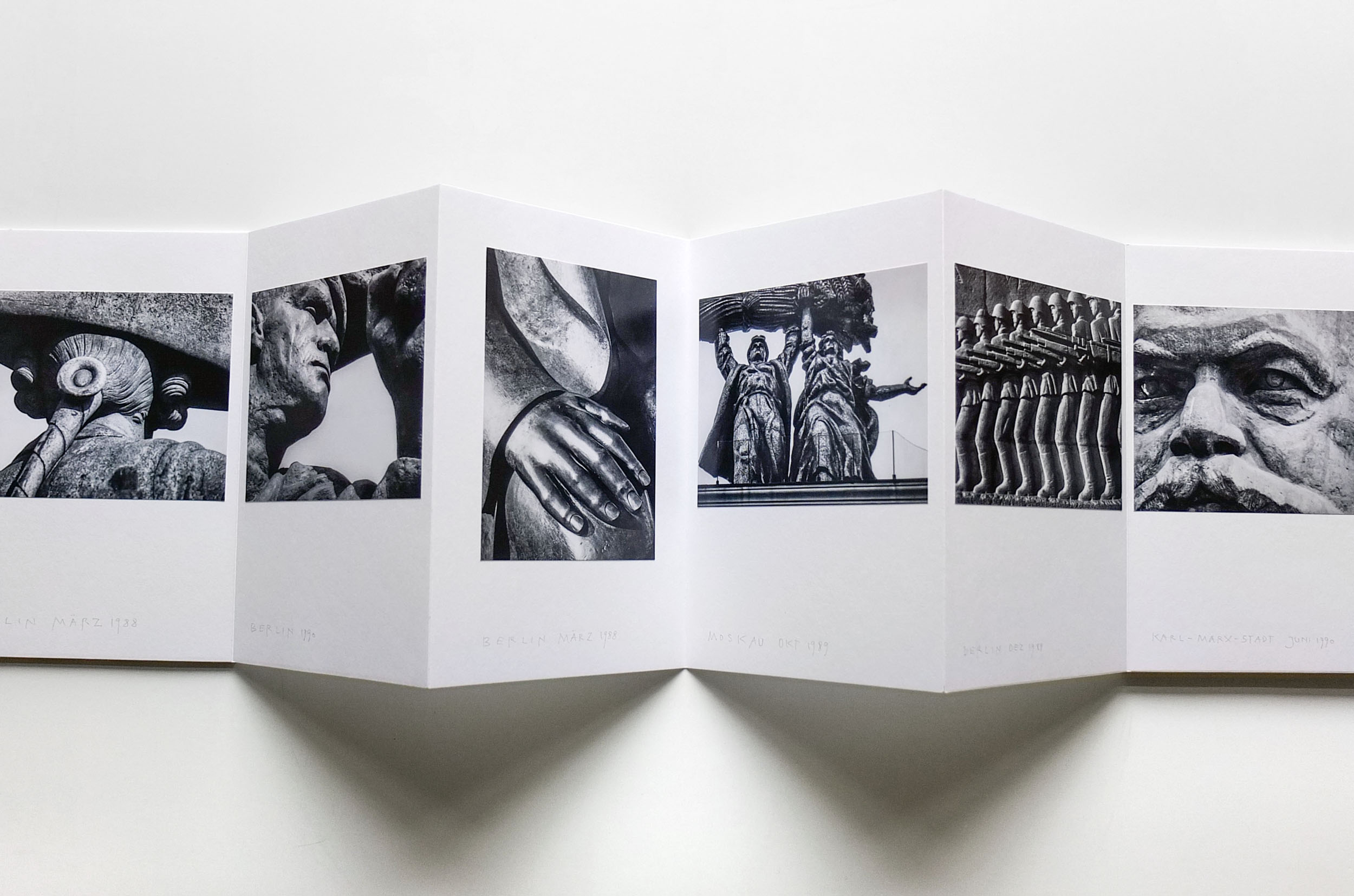
 

Ulrich Wüst (German, b. 1949) 'The Pomp of Power. 1983-1990'


Ulrich Wüst (German, b. 1949)
Die Pracht der Macht. 1983-1990
The Pomp of Power. 1983-1990
Leporello with 30 b/w photographs mounted on cardboard
14.8 × 21.0 × 1.5cm
© Ulrich Wüst; ifa


Ulrich Wüst (German, b. 1949) 'The Pomp of Power. 1983-1990' (installation view)

Ulrich Wüst (German, b. 1949) 'The Pomp of Power. 1983-1990' (installation view)


Ulrich Wüst (German, b. 1949)
Die Pracht der Macht. 1983-1990
The Pomp of Power. 1983-1990 (installation views)
Concertina booklet with 30 b/w photographs mounted on cardboard
14.8 × 21.0 × 1.5cm
© Ulrich Wüst; ifa
Photos: Marcus Bunyan


Clarity and compositional elegance

It may also have been his professional disposition that led him to pay particular attention to the GDR city. After all, he was an expert. Wüst was an expert in the field of urban development; he knew exactly what he was photographing. In the midst of the “leaden times” of the GDR, an era shortly before the collapse in which hardly anything seemed to be moving. Mid-1970s to mid-1980s. Urban and housing construction has long since said goodbye to the promising ideals of a better, because socialist, promise. The reality was pragmatic and merciless. Dilapidated old building and decaying substance on one side and serial prefabricated building on the other.

Wüst’s pictures, which sometimes develop a peculiar irony in their clarity and compositional elegance, can also be understood as political statements. “They searched for clues in a way that was unusual in the GDR as a way of ascertaining the real perceived state of the present,” writes Flügge about the photographer, who knew exactly what he wanted to find and capture. Even the depiction of reality could be considered subversive in the workers’ and farmers’ state. It wasn’t appropriate to show things as they were. Rather, you should show things as they should be. …

By “limiting the image section, he forces reality to formulate its own,” summarizes Flügge.

Jacek Slaski. “Ulrich Wüst – Stadtbilder 1979–1985: Zwischen Kunst und Dokumentation,” on the tipBerlin website 03/02/2022 [Online] Cited 08/04/2024. Translated from the German by Google Translate


Installation view, Ulrich Wüst, 'Village Edge. The Municipality of Nordwestuckermark, 2014-2019' from the exhibition 'Wanderings About History. The Photography of Ulrich Wüst', RMIT Gallery, Melbourne, 2024


Installation view, Ulrich Wüst, Village Edge. The Municipality of Nordwestuckermark, 2014-2019 from the exhibition Wanderings About History. The Photography of Ulrich Wüst, RMIT Gallery, Melbourne, 2024
Photo: Christian Capurro
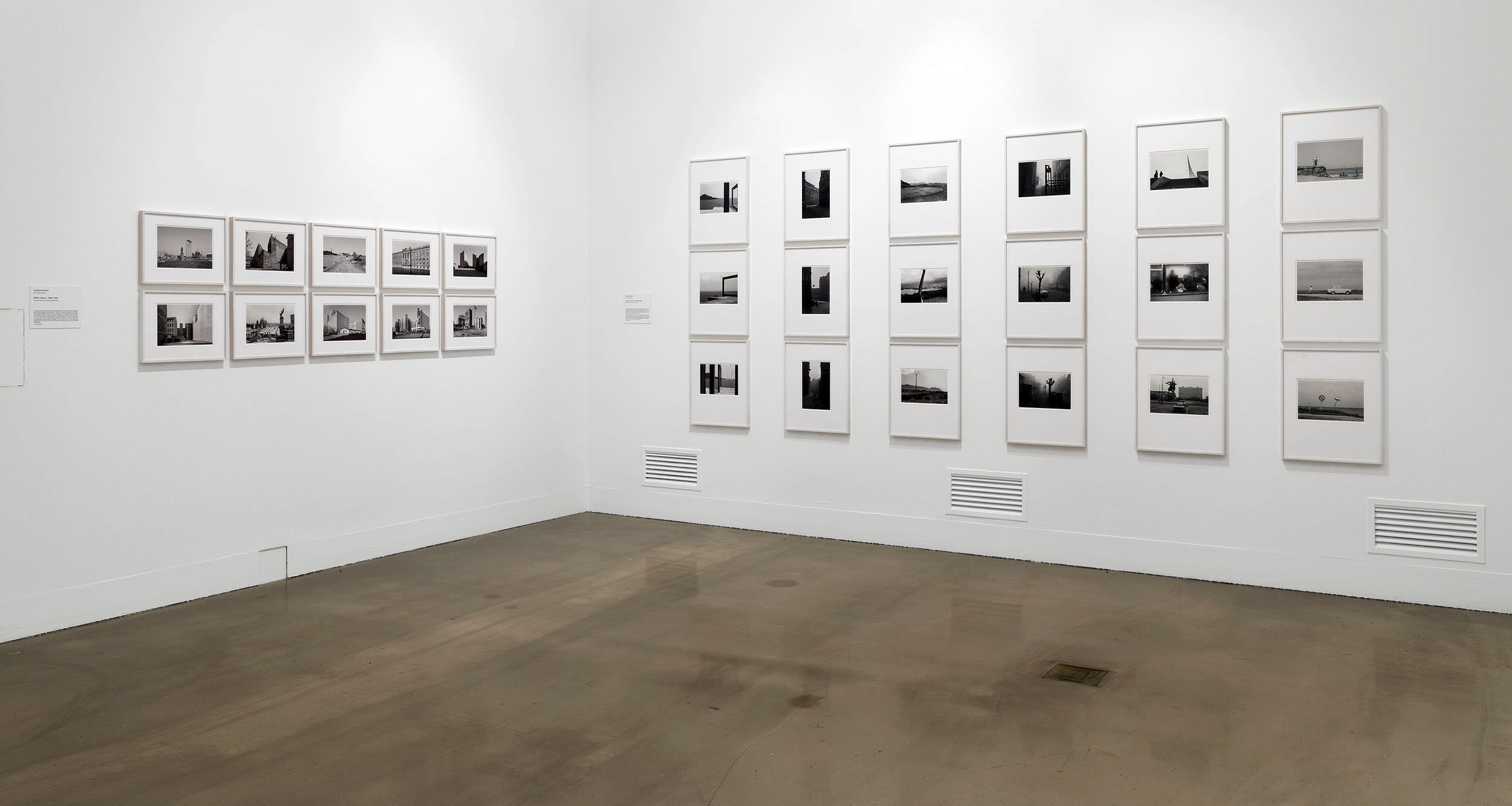
 

Installation view, Ulrich Wüst, 'Book of the Years. 1978-2008' (right) and 'Mitte. Berlin 1994-1997' (left) from the exhibition 'Wanderings About History. The Photography of Ulrich Wüst', RMIT Gallery, Melbourne, 2024


Installation view, Ulrich Wüst, Book of the Years. 1978-2008 (right) and Mitte. Berlin, 1994-1997 (left) from the exhibition Wanderings About History. The Photography of Ulrich Wüst, RMIT Gallery, Melbourne, 2024
Photo: Christian Capurro


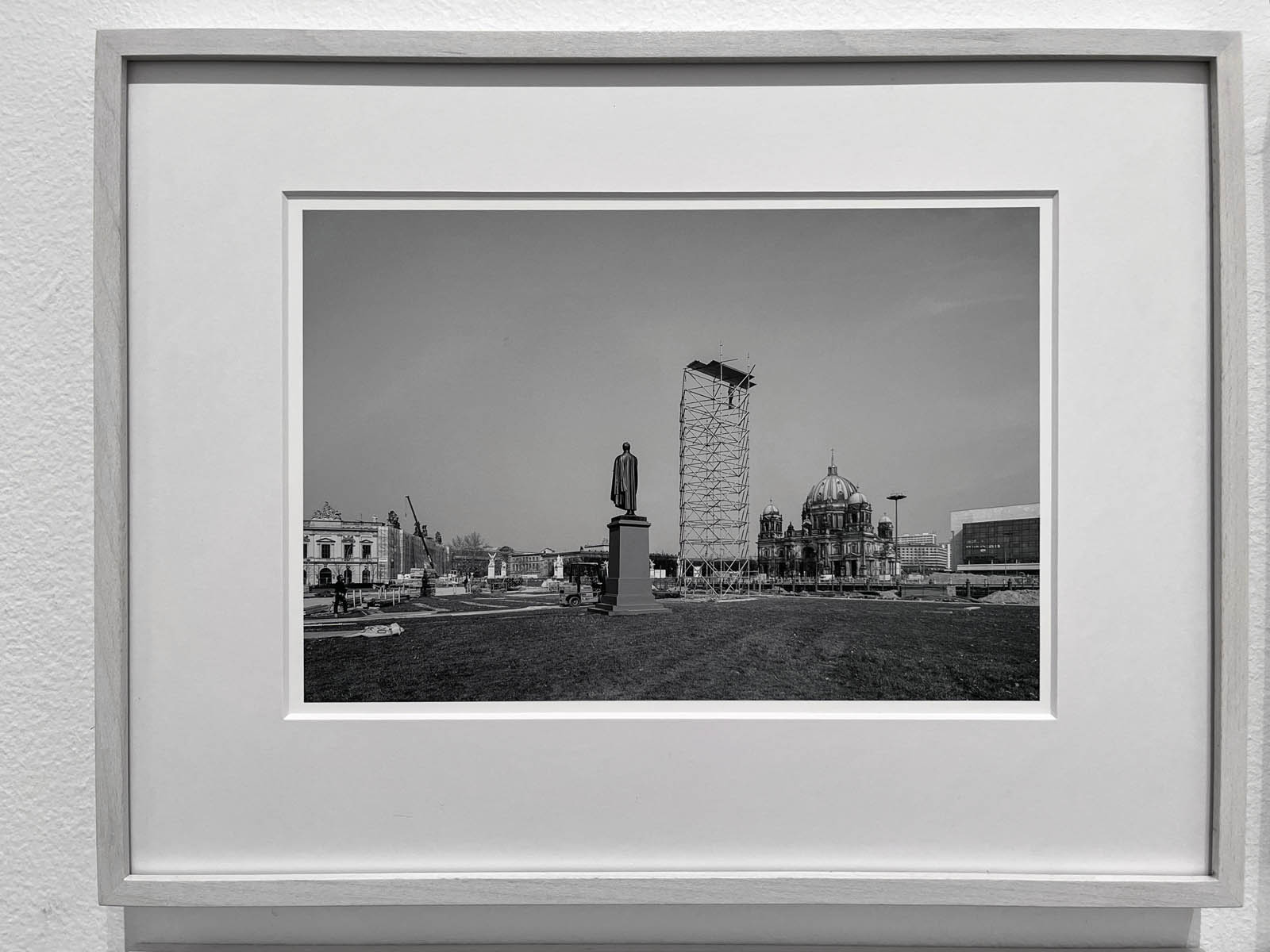
Ulrich Wüst (German, b. 1949) 'Schützenstraße / Jerusalemer Straße' 1996 From the series: 'Mitte. Berlin 1995-1997'


Ulrich Wüst (German, b. 1949)
Schützenstraße / Jerusalemer Straße
1996
Aus der Serie: Mitte. Berlin 1995-1997
From the series: Mitte. Berlin 1995-1997
B/w archival pigment print
18 x 27cm
© Ulrich Wüst; ifa


The different historical eras come together in his pictures. Relics from the pre-war period, often ruins, alongside the proud examples of Eastern Modernism from the post-war period, and finally the cheap and quickly built architecture of the present day. These photos are still important today, and not just for architectural historians and photography connoisseurs. Wüst’s pictures of the GDR city are visual findings about the condition of its residents, even if the people in them are absent. In his text, Flügge quotes from Alexander Mitscherlich’s book Die Unwirtlichkeit unserer Städte. Anstiftung zum Unfrieden (The inhospitability of our cities. Incitement to Discord), in which the doctor, psychoanalyst and writer examined the West German city as early as 1965: “This city shape is regressively shaping the character of its residents.” In his book, Mitscherlich hoped that the city would one day become a “biotope for free people”. It didn’t quite turn out that way, but in a certain sense Mitscherlich wasn’t entirely wrong either. The GDR would soon disappear and with it the GDR city.

Jacek Slaski. “Ulrich Wüst – Stadtbilder 1979–1985: Zwischen Kunst und Dokumentation,” on the tipBerlin website 03/02/2022 [Online] Cited 08/04/2024. Translated from the German by Google Translate


Ulrich Wüst (German, b. 1949) From the series 'Mitte. Berlin 1995-1997' (installation view)

Ulrich Wüst (German, b. 1949) From the series 'Mitte. Berlin 1995-1997' (installation view)

Ulrich Wüst (German, b. 1949) From the series 'Mitte. Berlin 1995-1997' (installation view)

Ulrich Wüst (German, b. 1949) From the series 'Mitte. Berlin 1995-1997' (installation view)

Ulrich Wüst (German, b. 1949) From the series 'Mitte. Berlin 1995-1997' (installation view)


Ulrich Wüst (German, b. 1949)
Aus der Serie: Mitte. Berlin 1995-1997
From the series: Mitte. Berlin 1995-1997 (installation views)
B/w archival pigment print
18 x 27cm
© Ulrich Wüst; ifa
Photos: Marcus Bunyan


I am well aware of how ambivalent photography is. And just because photographs have a documentary air about them, I find it to some extent dubious to slap a documentary label on them. If, ten centimetres from the edge of my picture, the whole content is counteracted by something completely different, then I can no longer claim to be doing serious documentary work. Documentation as a form, in my view, is just a way to explore a theme – a means. I only want to photograph and not distort things. It’s true that there is a documentary background, but what I do with it is always something of my own and totally subjective.


Ulrich Wüst, wall text from the exhibition


Installation view, Ulrich Wüst, 'Mitte. Berlin 1994-1997' (right) and 'Prentzlow. Prenzlau', 2018 (left) from the exhibition 'Wanderings About History. The Photography of Ulrich Wüst', RMIT Gallery, Melbourne, 2024


Installation view, Ulrich Wüst, Mitte. Berlin 1994-1997 (right) and Prenzlau, 2018 (left) from the exhibition Wanderings About History. The Photography of Ulrich Wüst, RMIT Gallery, Melbourne, 2024
Photo: Christian Capurro
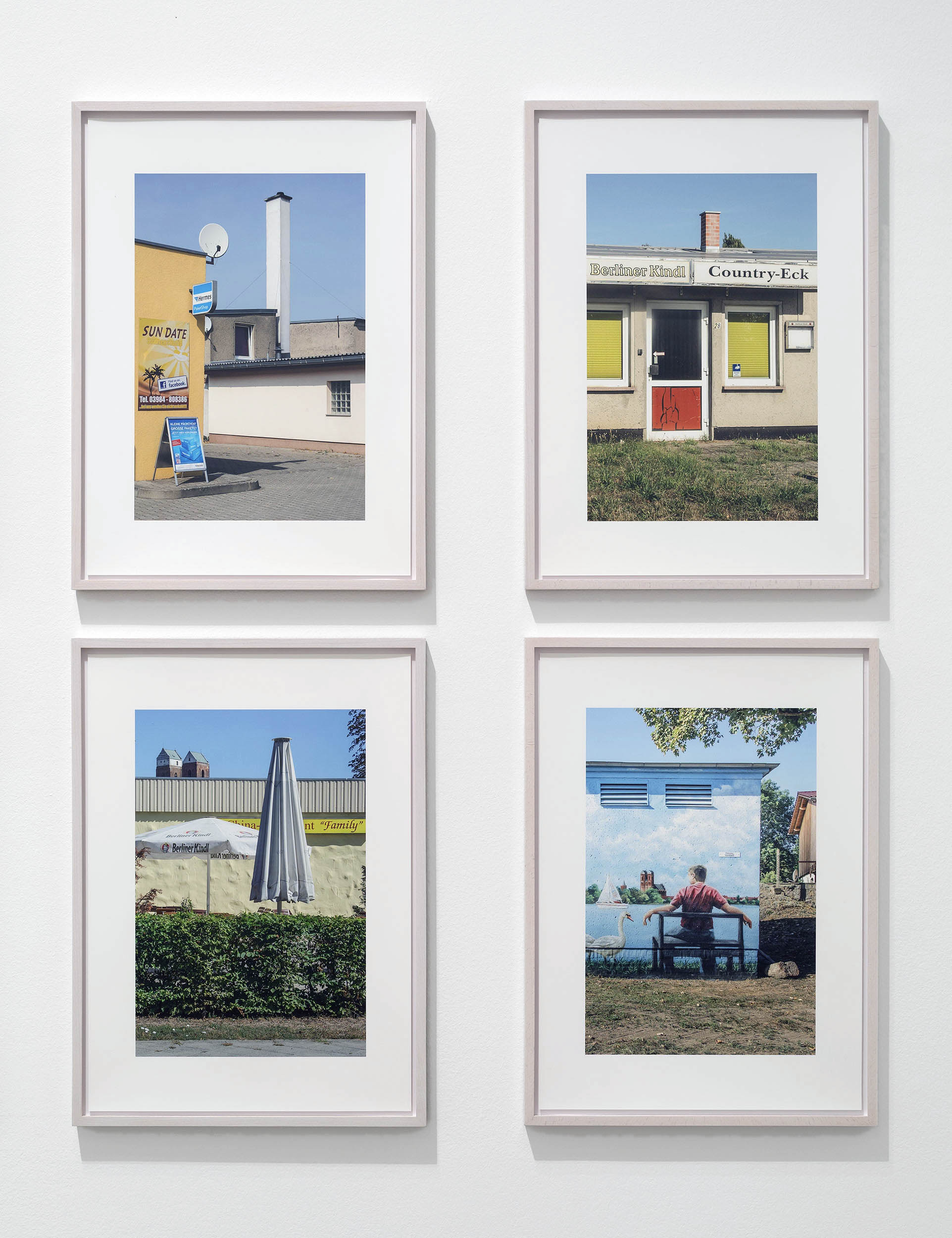
 

Installation view, Ulrich Wüst, 'Prenzlau', 2018, from the exhibition 'Wanderings About History. The Photography of Ulrich Wüst', RMIT Gallery, Melbourne, 2024


Installation view, Ulrich Wüst, Prenzlau, 2018, from the exhibition Wanderings About History. The Photography of Ulrich Wüst, RMIT Gallery, Melbourne, 2024
Photo: Christian Capurro
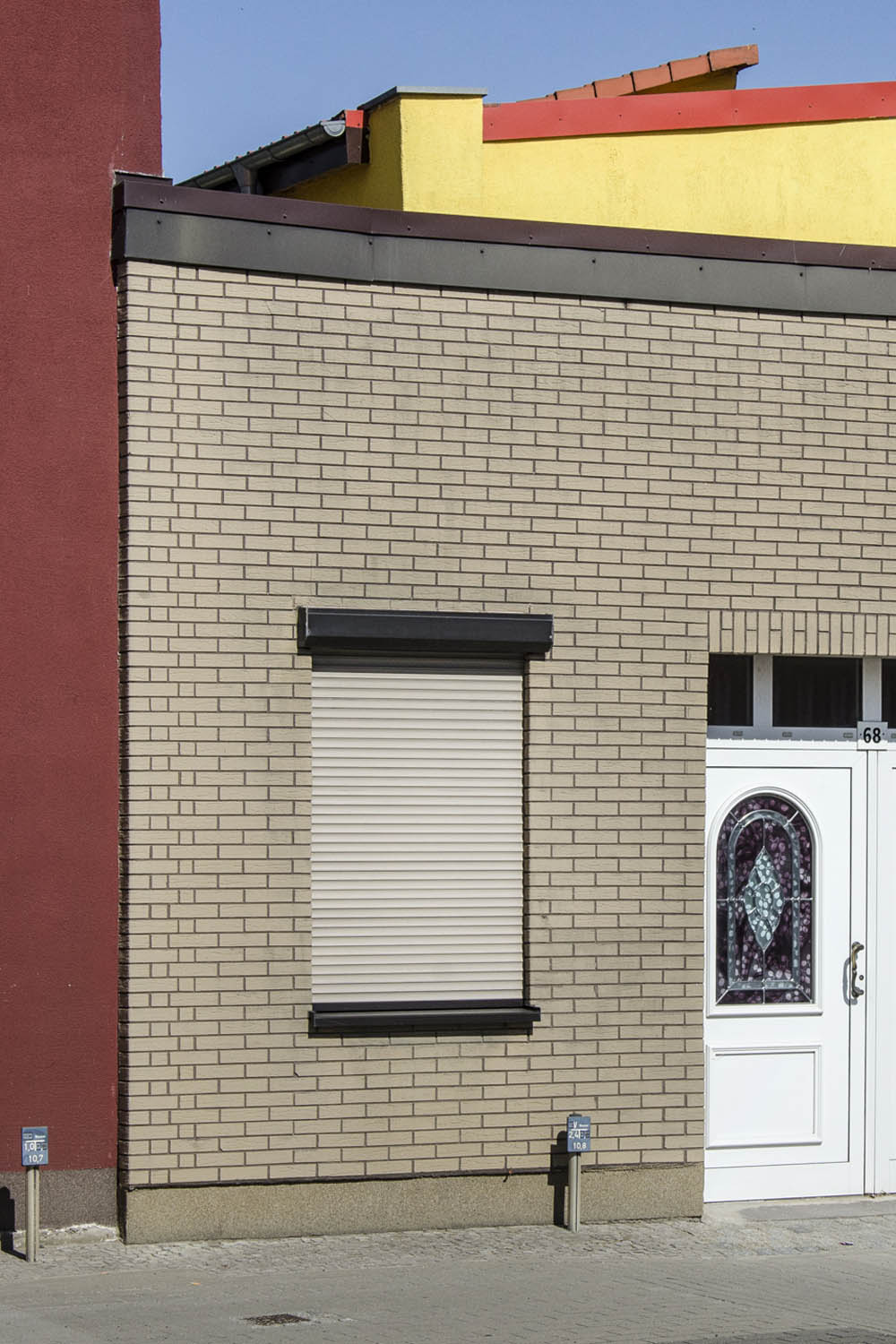
 

Ulrich Wüst (German, b. 1949) From the series ‘Prenzlau’ 2018


Ulrich Wüst (German, b. 1949)
Aus der Serie: Prenzlau
From the series: Prenzlau
2018
Colour photograph, archival pigment print
45 × 30cm
© Ulrich Wüst; ifa
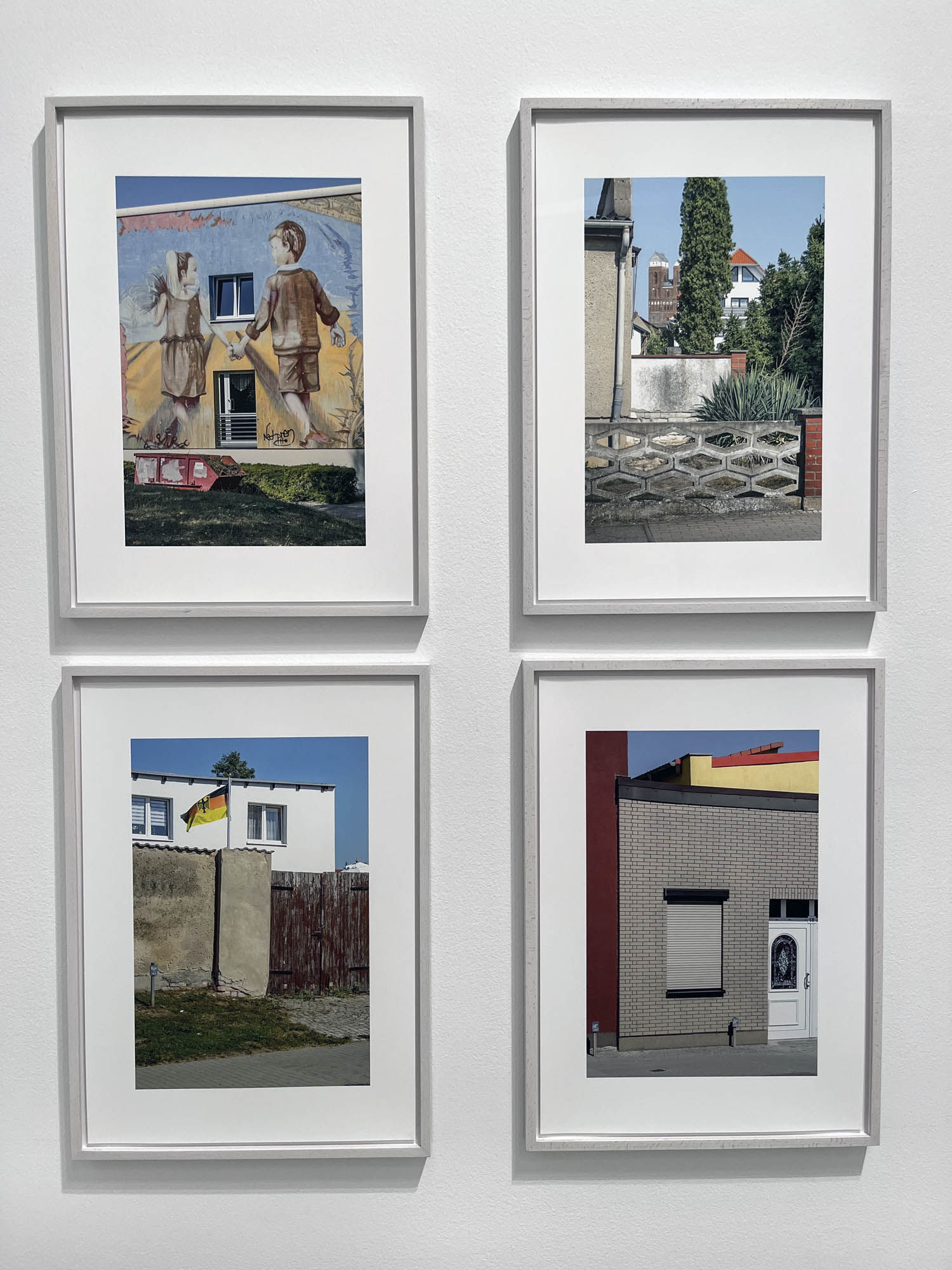
 

Ulrich Wüst (German, b. 1949) From the series 'Prenzlau' 2018 (installation view)

Ulrich Wüst (German, b. 1949) From the series 'Prenzlau' 2018 (installation view)

Ulrich Wüst (German, b. 1949) From the series 'Prenzlau' 2018 (installation view)


Ulrich Wüst (German, b. 1949)
Aus der Serie: Prenzlau
From the series: Prenzlau (installation views)
2018
Colour photograph, archival pigment print
45 × 30cm
© Ulrich Wüst; ifa
Photos: Marcus Bunyan


Installation view, Ulrich Wüst, 'Wiegmann Legacy. Bülowssiege 1991-1992' (right) and 'Book of the Years. 1978-2008' (left), from the exhibition 'Wanderings About History. The Photography of Ulrich Wüst', RMIT Gallery, Melbourne, 2024


Installation view, Ulrich Wüst, Wiegmann Legacy. Bülowssiege, 1991-1992 (right) and Book of the Years. 1978-2008 (left), from the exhibition Wanderings About History. The Photography of Ulrich Wüst, RMIT Gallery, Melbourne, 2024
Photo: Christian Capurro
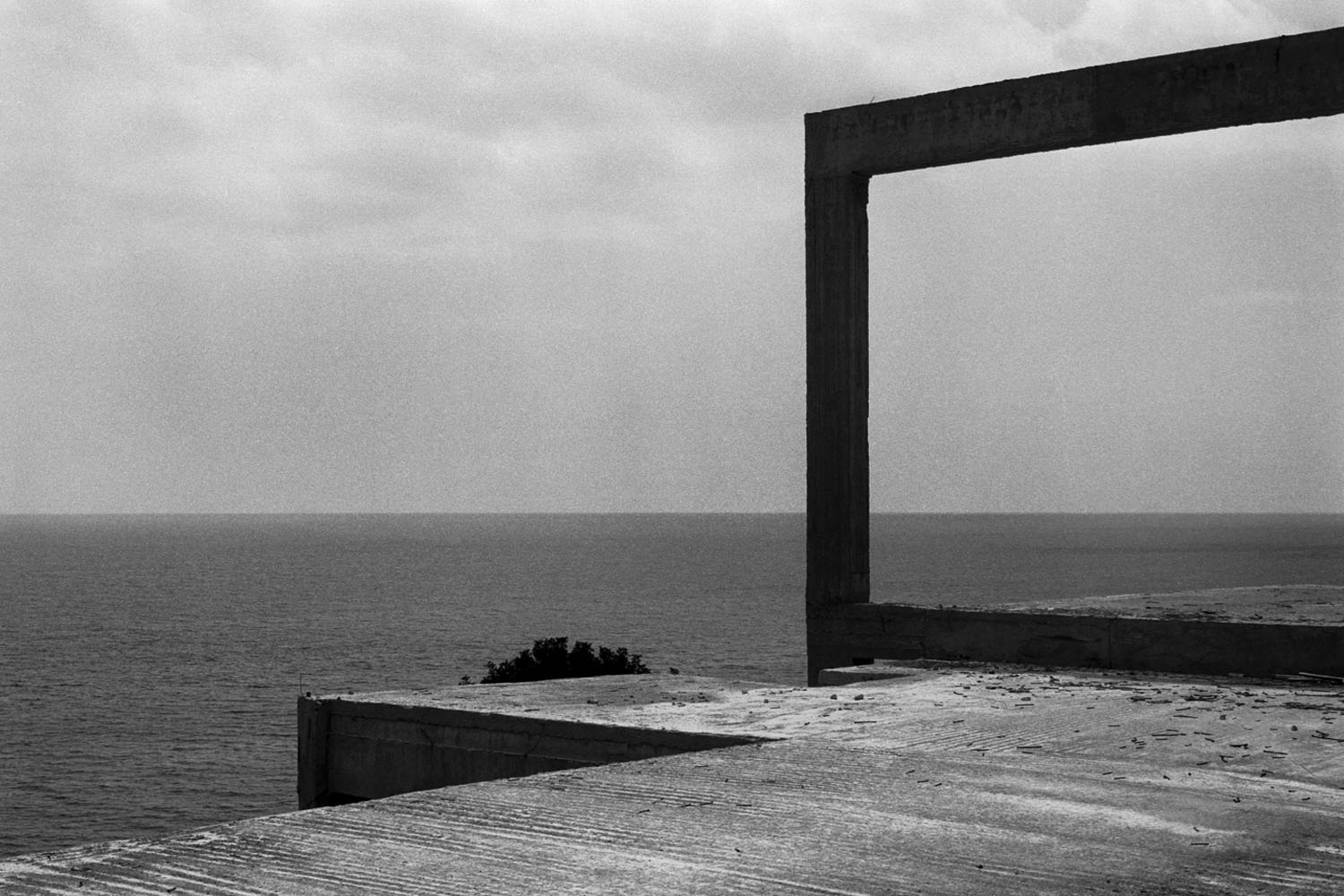
 

Ulrich Wüst (German, b. 1949) 'Kreta' (Crete) 1997 From the series 'Book of the Years. 1978-2008'


Ulrich Wüst (German, b. 1949)
Kreta (Crete)
1997
Aus der Serie: Jahrebuch. 1978-2008
From the series: Book of the Years. 1978-2008
B/w archival pigment print
18 x 27cm
© Ulrich Wüst; ifa
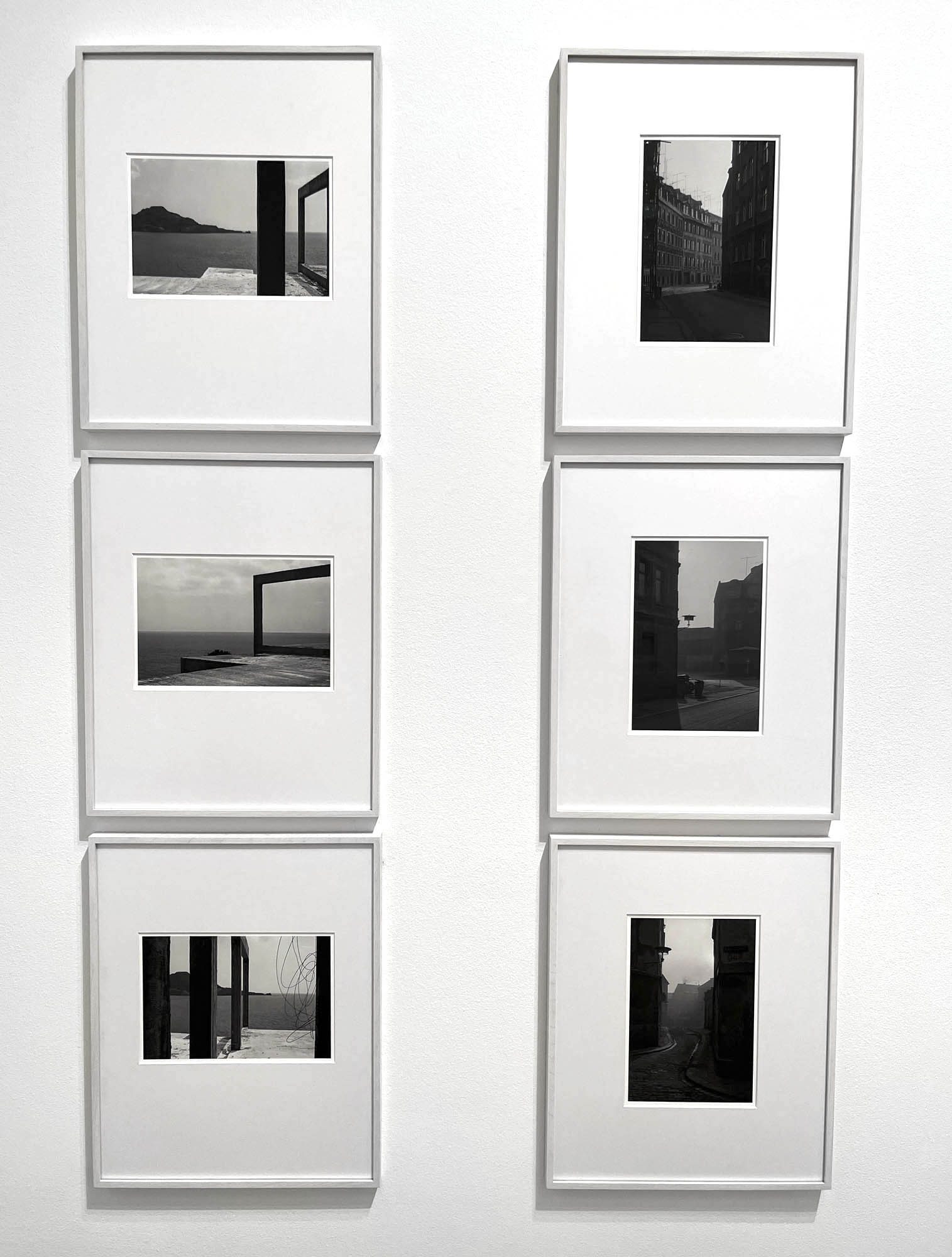
 

Ulrich Wüst (German, b. 1949) From the series 'Book of the Years. 1978-2008' (installation view)

Ulrich Wüst (German, b. 1949) From the series 'Book of the Years. 1978-2008' (installation view)


Ulrich Wüst (German, b. 1949)
Aus der Serie: Jahrebuch. 1978-2008
From the series: Book of the Years. 1978-2008 (installation views)
B/w archival pigment print
18 x 27cm
© Ulrich Wüst; ifa
Photos: Marcus Bunyan


Robert Frank (Swiss-American, 1924-2019) 'London' 1951


Robert Frank (Swiss-American, 1924-2019)
London
1951
Gelatin silver print


Ulrich Wüst (German, b. 1949) From the series 'Book of the Years. 1978-2008' (installation view)


Ulrich Wüst (German, b. 1949)
Aus der Serie: Jahrebuch. 1978-2008
From the series: Book of the Years. 1978-2008 (installation view)
B/w archival pigment print
18 x 27cm
© Ulrich Wüst; ifa
Photo: Marcus Bunyan
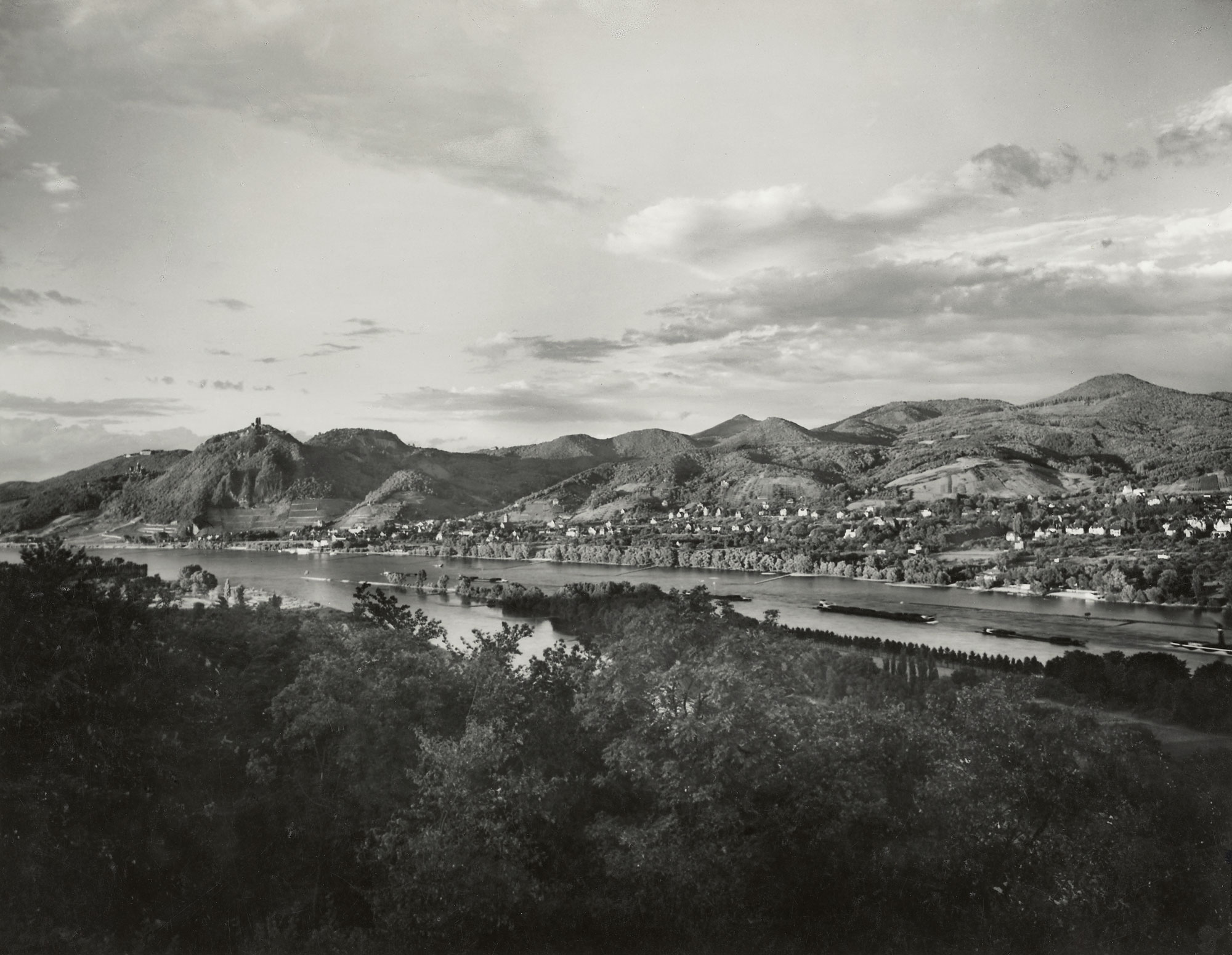
 

August Sander (German, 1876-1964) 'Das Siebengebirge von der unteren Terrasse hin zur Löwenburg' 1922


August Sander (German, 1876-1964)
Das Siebengebirge von der unteren Terrasse hin zur Löwenburg
The Siebengebirge from the lower terrace towards the Löwenburg castle

1922
Gelatin silver print
© Die Photographische Sammlung/SK Sitftung Kultur – August Sander Archiv, Köln; VG Bild-Kunst, Bonn, 2022
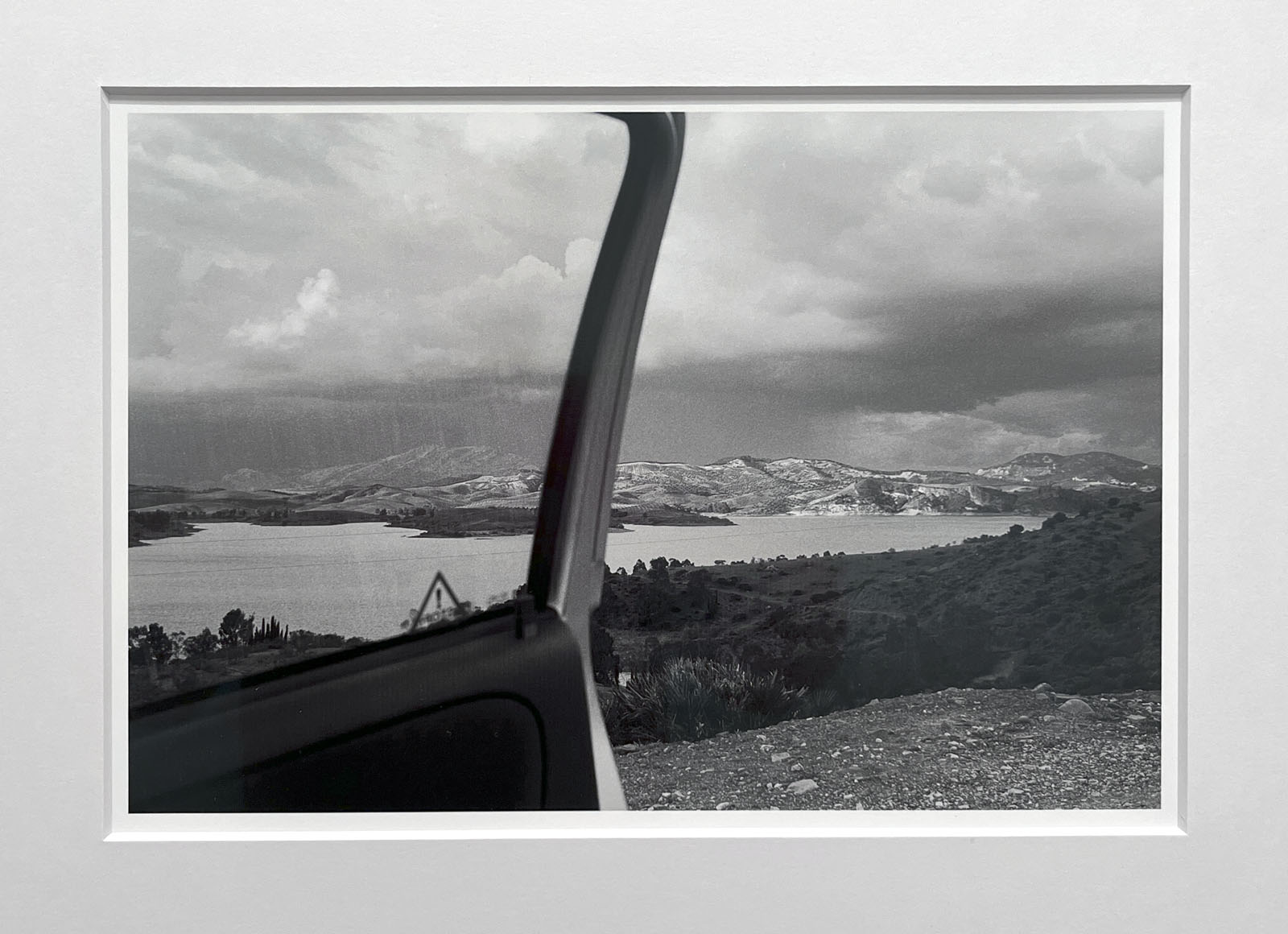
 

Ulrich Wüst (German, b. 1949) From the series 'Book of the Years. 1978-2008' (installation view)


Ulrich Wüst (German, b. 1949)
Aus der Serie: Jahrebuch. 1978-2008
From the series: Book of the Years. 1978-2008 (installation view)
B/w archival pigment print
18 x 27cm
© Ulrich Wüst; ifa
Photo: Marcus Bunyan


A collection/compilation. A great deal of chance and responding to mood. The urban excursions, by contrast, followed a strict pattern. There it was about the grey cityscapes, grey “Mitte” and grey “Morgenstraße”. And yet all of them were taken in bright sunlight! Without the weather forecast promising a safe sunny day, I would probably never have been brave enough to set out on wanderings that did not augur much solace.

Most of the pictures in the book of the Years, on the other hand, really were taken in grey weather. They were done over a period of thirty years, mostly without any particular intention, straight from the experience. Later I gathered them into a kind of melancholy section through times and places. The pictures say: I was here. And I was in this or that mood. They are mood! And sometimes they flirt with the mood as well. That can happen.

~ Ulrich Wüst, wall text from the exhibition


Installation view, Ulrich Wüst, 'Mitte. Berlin 1994-1997' (right), 'Village Edge. The Municipality of Nordwestuckermark, 2014-2019' (left) and 'Prentzlow. Prenzlau', 2018 (centre) from the exhibition 'Wanderings About History. The Photography of Ulrich Wüst', RMIT Gallery, Melbourne, 2024


Installation view, Ulrich Wüst, Mitte. Berlin 1994-1997 (right), Village Edge. The Municipality of Nordwestuckermark, 2014-2019 (left) and Prentzlow. Prenzlau, 2018 (centre) from the exhibition Wanderings About History. The Photography of Ulrich Wüst, RMIT Gallery, Melbourne, 2024
Photo: Christian Capurro


Ulrich Wüst’s photographic work captures his wanderings through German history, portraying the social and urban transformations from the GDR and its disintegration, through the German reunification to the present day. Wüst revives the German history in a new static way, where the past and present clash in a dynamic and ever-changing environment.

Wanderings About History. The Photography of Ulrich Wüst shows a selection of nine suites taken between 1978 and 2019. Ulrich Wüst’s photographic work can be contemplated from different perspectives. While the observations captured here are rooted in Germany’s division and its mending, at the same time they always relate to universal phenomena of social change and its material manifestations. The seemingly terse images, extremely precise in their composition, are the fruits of lengthy visual wanderings through present sites of recent history.

An exhibition by ifa – Institut für Auslandsbeziehungen e.V., Stuttgart – in partnership with the Goethe-Institut. This project is an official exhibition of PHOTO 2024 International Festival of Photography.

Text from the RMIT Gallery website


Installation view, Ulrich Wüst, 'Wiegmann Legacy. Bülowssiege, 1991-1992' (left) and 'Village Edge. The Municipality of Nordwestuckermark, 2014-2019' (right) from the exhibition 'Wanderings About History. The Photography of Ulrich Wüst', RMIT Gallery, Melbourne, 2024


Installation view, Ulrich Wüst, Wiegmann Legacy. Bülowssiege, 1991-1992 (left) and Village Edge. The Municipality of Nordwestuckermark, 2014-2019 (right) from the exhibition Wanderings About History. The Photography of Ulrich Wüst, RMIT Gallery, Melbourne, 2024
Photo: Christian Capurro
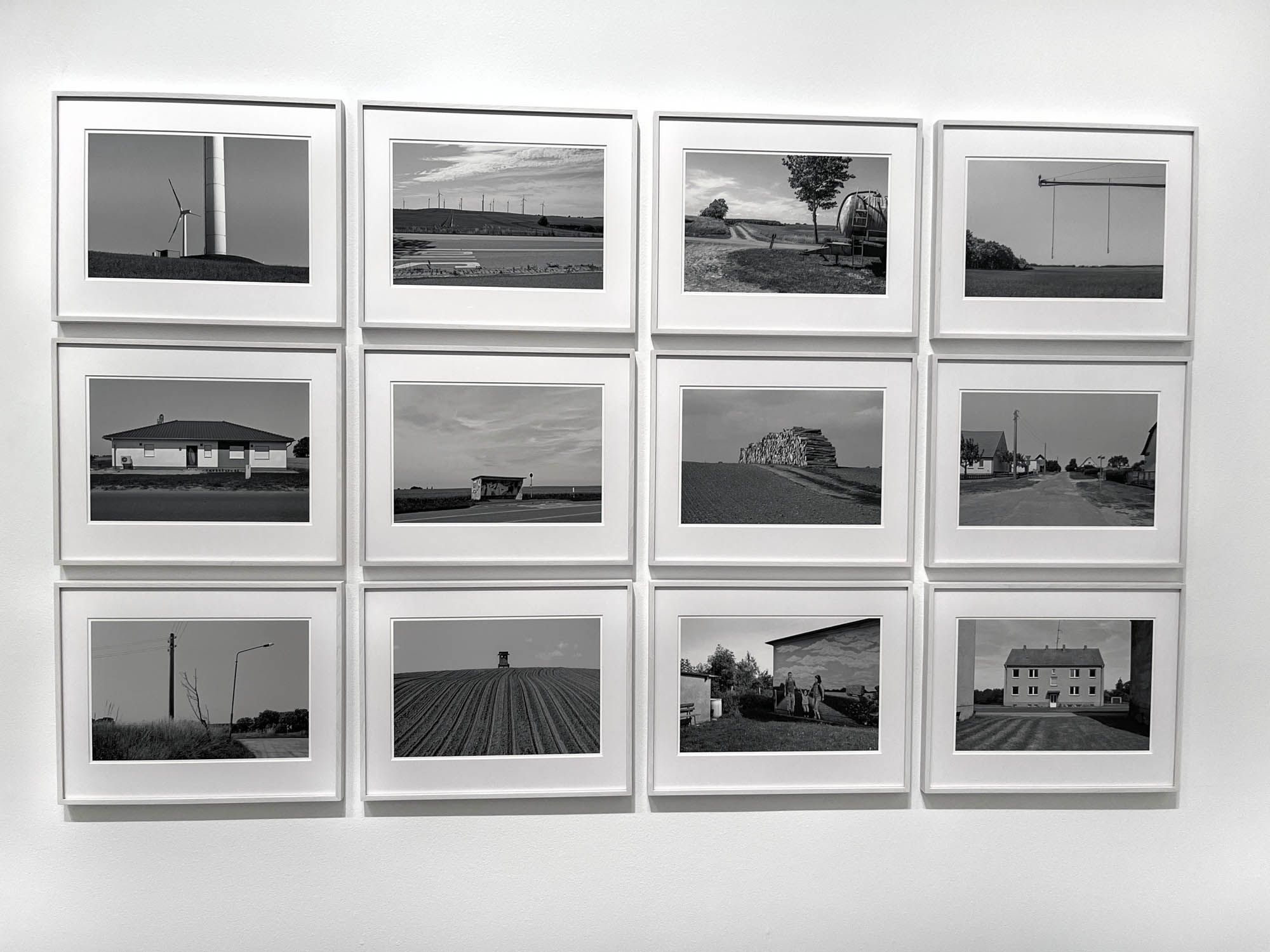
 

Ulrich Wüst (German, b. 1949) From the series 'Village Edge. The Municipality of Nordwestuckermark 2014-2019' (installation view)


Ulrich Wüst (German, b. 1949)
Aus der Serie: Randlage. Die Gemeinde Nordwestuckermark 2014-2019
From the series: Village Edge. The Municipality of Nordwestuckermark 2014-2019 (installation view)
B/w archival pigment print
26 x 39cm
© Ulrich Wüst; ifa
Photo: Marcus Bunyan


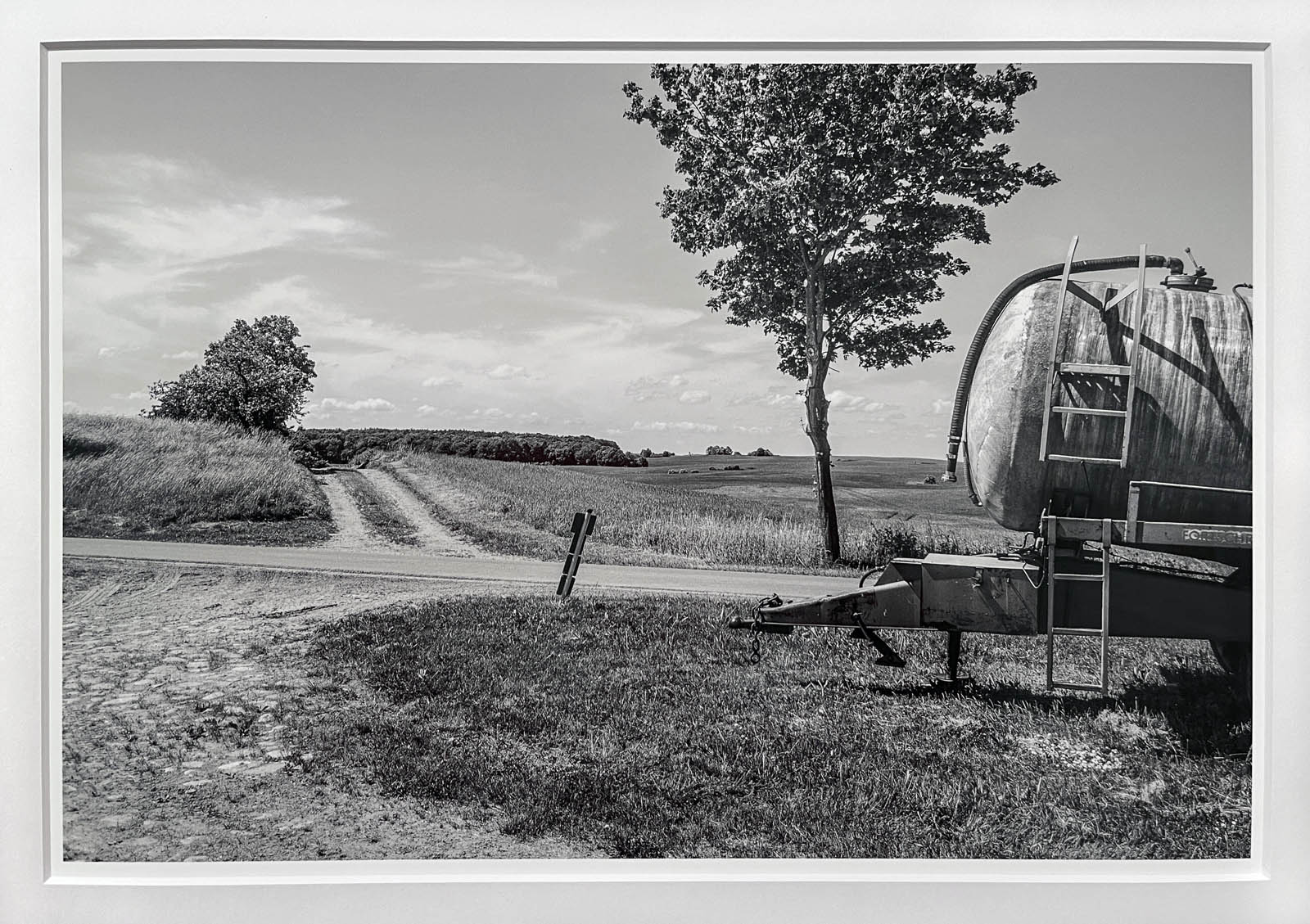
Ulrich Wüst (German, b. 1949) 'Parmen' 2016 From the series 'Village Edge. The Municipality of Nordwestuckermark 2014-2019'


Ulrich Wüst (German, b. 1949)
Parmen
2016
Aus der Serie: Randlage. Die Gemeinde Nordwestuckermark 2014-2019
From the series: Village Edge. The Municipality of Nordwestuckermark 2014-2019
B/w archival pigment print
26 x 39cm
© Ulrich Wüst; ifa


“In the last few years I started taking pictures in the countryside again. The idea was to have photographs of villages and landscapes that were just as “dry” as my cityscape series, like Berlin, or Magdeburg. The resulting work is far removed from any sort of rural idyll, but equally as far removed from the affection I have from these landscapes. I chose not to give too much away.”


~ Ulrich Wüst, wall text from the exhibition


Ulrich Wüst (German, b. 1949) From the series 'Village Edge. The Municipality of Nordwestuckermark 2014-2019' (installation view)

Ulrich Wüst (German, b. 1949) From the series 'Village Edge. The Municipality of Nordwestuckermark 2014-2019' (installation view)


Ulrich Wüst (German, b. 1949)
Aus der Serie: Randlage. Die Gemeinde Nordwestuckermark 2014-2019
From the series: Village Edge. The Municipality of Nordwestuckermark 2014-2019 (installation views)
B/w archival pigment print
26 x 39cm
© Ulrich Wüst; ifa
Photos: Marcus Bunyan


RMIT Gallery
344 Swanston Street, Melbourne

Opening hours:
Tuesday to Friday 11am – 5pm
Saturday 12.30pm – 5pm
RMIT Gallery website

LIKE ART BLART ON FACEBOOK

Back to top

Photographs: Frederick Oswald Barnett (Australian, 1883-1972)

February 2024


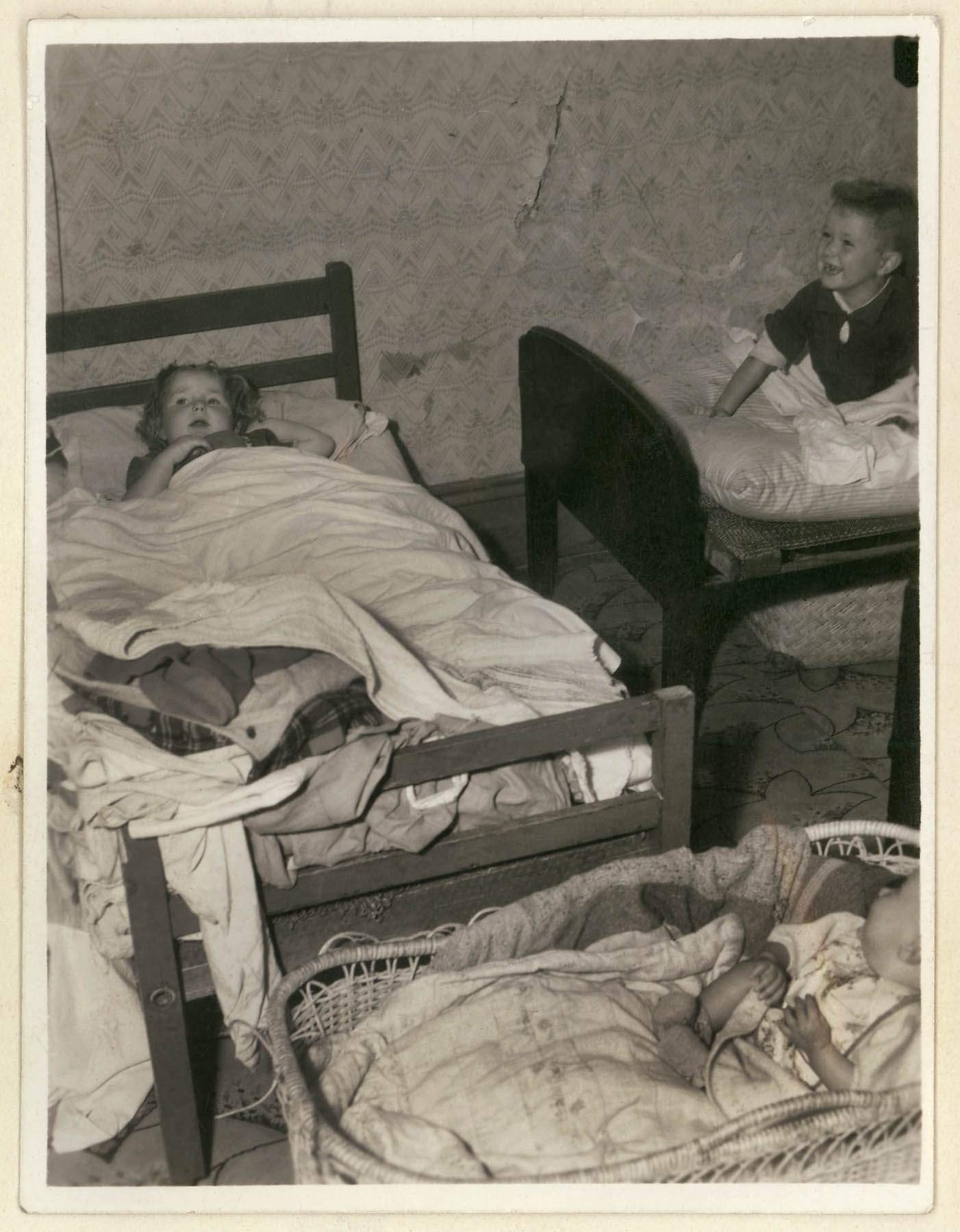
F. Oswald Barnett (Australian, 1883-1972) 'Interior, children's bedroom' c. 1935


F. Oswald Barnett (Australian, 1883-1972)
Interior, children’s bedroom
c. 1935
Gelatin silver print
9.7 x 7.4cm
F. Oswald Barnett Collection
State Library of Victoria
Public domain


Communities dismantled

Dismantled: late 16th century (in the sense ‘destroy the defensive capability of a fortification’): from Old French desmanteler, from des- (expressing reversal) + manteler ‘fortify’ (from Latin mantellum ‘cloak’).


At any age in life, having a stable place to live is vitally important to your physical and mental health. This is especially true for lower socio-economic individuals and families, older human beings, and people with a physical and/or mental disability.

The photographs presented in this posting by active Methodist and photographer F. Oswald Barnett were used to encourage government to remove the ‘slum menace’ – that is, a person or thing that is likely to cause harm; a threat or danger – in inner city Melbourne during the late 1930s-1970s. “Captured by Methodist social reformer F. Oswald Barnett, these photographs served to power his campaign to abolish the city’s inner-city slums and provide a better quality of life for Melbournians.”

“Slum portrayals were sensationalist and voyeuristic. Photos from the slums featured alcoholic mothers with loose moral standards, ‘vermin-infested kitchens’, and children riddled with fleas and head lice.”1

Of course, it is photography’s “ability to police and regulate its subjects, especially those lacking social and political power: the poor, presumed “deviants” or “criminals,” and workers”2 that is at play here. Value judgements about people’s lives and homes were made by do gooders, those of moral fortitude and in positions of power and comfort, likely those very people who had never experienced what it is to be poor, homeless or suffer from a disability. Class would have come in to it as much as the self lubricating disciplinary systems of church, state, hospital, prison that enable and enact power and control over others (Foucault).

And yet, and yet, despite their obvious poverty and “slum” residency (a squalid and overcrowded urban street or district inhabited by very poor people), F. Oswald Barnett’s photographs also document proud people and communities.

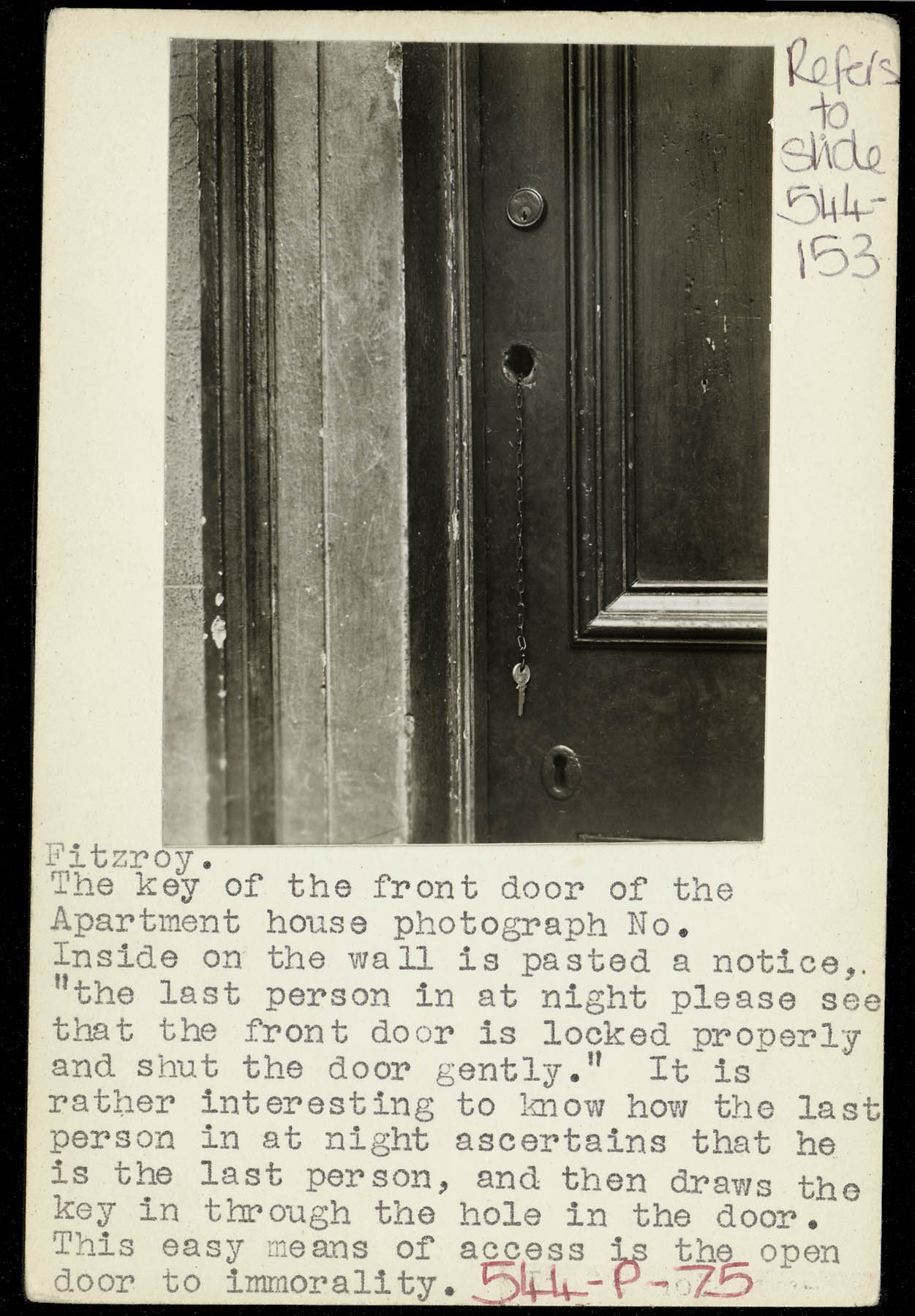
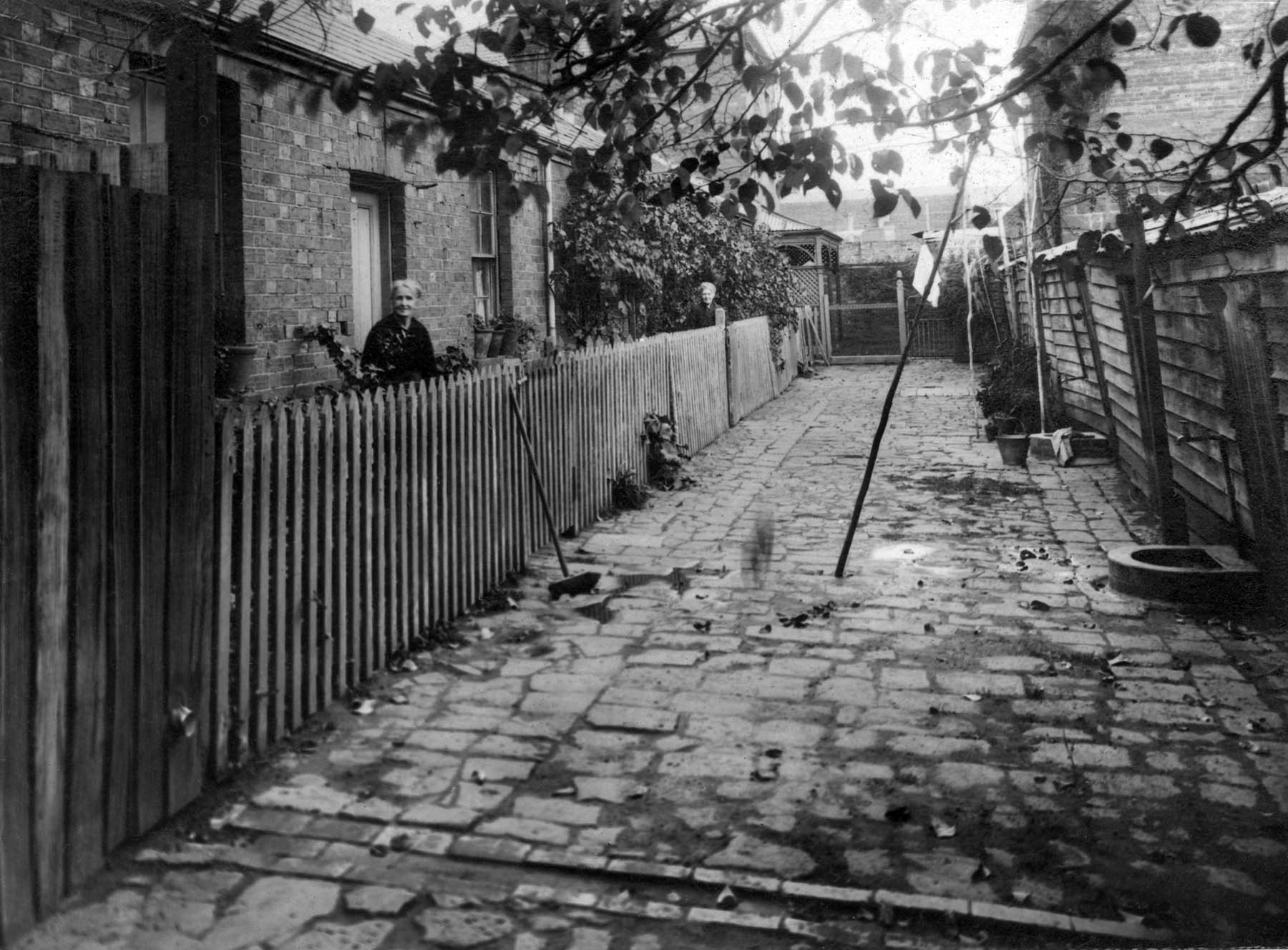
Observe the key of the front door hanging outside a hole in the door in Fitzroy. The key of the front door of the apartment house (c. 1935, below) and note the inference that “easy means of access is the open door to immorality.” A true moralists deduction given the evidence… whereas I would have thought it was a testament to the honesty and integrity of the community, and the lack of crime, that the key to the house could be left freely accessible. In Carlton. Slum pocket (c. 1930, below) two older women stand proudly in their front yards, positioned for and staring at the camera, a broom propped up against the picket fence where one of the woman has been sweeping down the cobbled street. In North Melbourne. Group of children in Erskine Place (c. 1935, below) eight children stand in a line for the camera, quizzical, sullen, smiling, barefoot. Collectively the possess a sense of camaraderie. Witness the two boys holding hands at the left of the image, probably brothers, the one brother looking with love at his brother who faces the camera. This sense of camaraderie, community and family is something all the modernisation in the world can’t buy.

The plan to excise the slums ‘for the common good’ and for immoral reasons, did not go according to plan.

“But abolishing the slums was proving to be difficult. The ‘demolitions program’ was beset with problems. By 1940, only 53 families had actually been moved into new houses. Synchronising demolition works with the building program was hard. The Commission did not have enough resources, and lacked the support of the labour movement.

The Housing Commission upped the ante. In the 1950s and 1960s, the Commission launched the most ambitious slum-clearance projects ever seen in Australia. Residents in Fitzroy, Collingwood and Richmond protested and refused to move. In 1969, the Carlton Association launched a PR campaign denouncing the schemes.

Finally, four years later, the Victorian government abandoned the slum clearance schemes, but by then, whole communities had been dismantled. The buildings that housed them had been demolished.”3

Whole communities had been dismantled for no apparent benefit. And this is exactly what is happening with the demolition of existing public housing in Melbourne at the moment, to be replaced by a mixture of social, affordable and private housing, often tripling the number of dwellings in redevelopments and totally destroying any sense of community that existed in that place, where people actively looked after each other.

Cait Kelly, in an article on the Guardian website in July 2023 on the proposed demolition of the Barak Beacon estate in Port Melbourne comments on Margaret Kelly, the last resident left living in the estate. “When Kelly moved in to Barak Beacon she was a 43-year-old single mum who had spent years in and out of different homes. The housing estate gave her stability. She raised her son, who now has an international career as a game developer, grew flowers in the garden and watched as her neighbour’s children grew up. She said she was “shattered” to be having to fight to stay in her home. “This was our safe home,” she said. “And that’s what it’s been for so many tenants.”4

For many people, secure and stable public housing has been their safe space from the vicissitudes of the world. No longer. Today in Victoria and across Australia, these havens of security and community are being dismantled to be replaced by public-private housing, shared spaces and high density living.

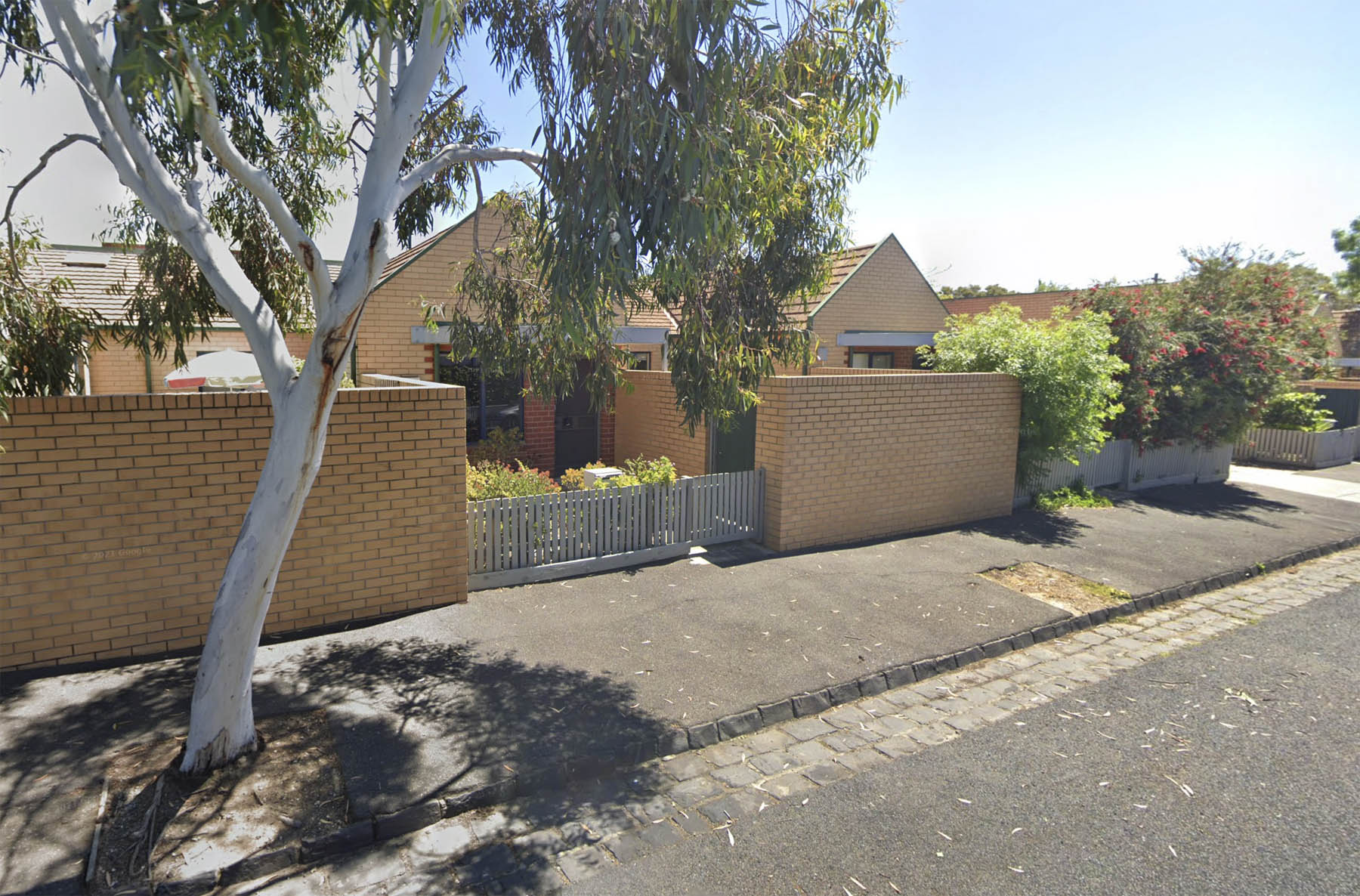
Which brings me to the Grosvenor Precinct (Brunning, Woodstock & Grosvenor Street residences) in Balaclava. HousingFirst, a not-for-profit community housing organisation (providing social housing to over 2000 people across Melbourne) – which purchased the precinct in 1989 “to build and construct accommodation for older persons” – hand delivered a letter at 5pm on the Friday of a long weekend, dropped into the letterbox of each resident.

The letter states, “At HousingFirst, we work hard to continually improve our housing because we want you to enjoy living in a home that meets contemporary standards, where you and  your family can live your best life.

We’re pleased to announce the redevelopment of our Grosvenor Precinct (Brunning, Woodstock & Grosvenor Street residences) in Balaclava.

The redevelopment will provide 68 new architect designed environmentally sustainable homes with modern amenity and beautiful shared spaces for all to enjoy.

To accommodate the changes, you will need to move out of your current home into alternative accommodation that will be arranged by HousingFirst for the period of construction. However, you will have first right of return to the new developed homes once the new homes are complete, and we’re confident the enhanced amenity with be worth the inconvenience.”5

This letter arrived without warning to the residents of the precinct on a Friday night of a long weekend without any consultation, as a fait accompli.

It is believed that the redevelopment of 68 units (which more than triples the number of units on the precinct) will be a mixture of private and public housing although this knowledge has not been formally addressed to the current tenants in the form of a letter. The percentage of public and private housing is uncertain in this point in time. And, despite the protestations of the letter, there is no legal guarantee at the moment that any of the current tenants will be offered first preference in the new development and apartments upon completion.

The older, disabled people who live in this “precinct” sit on a valuable parcel of land (and therein lies one of the major problems). They enjoy units close to the shops, with single or double bedroom villas with their own very small courtyard garden. It is a quiet precinct with little noise and no violence or drug use and the villas are modern and well maintained. The residents are now being placed in multi-storey blocks of flats with noise at all hours of the night, nowhere to house their pets, drug users living down the corridor and litter everywhere. Residents who have already been forced to move have noted that their mental and physical health has deteriorated under the stress of these new living arrangements. HousingFirst is destroying a stable, loving community that cared about each other for the sake of modernisation and, let’s be honest, probably profit.

The whole community is up in arms, both the public housing residents who are left in the precinct together with the residents of privately owned homes in the surrounding area, who themselves have formed a committee to oppose the redevelopment.

This underhand development enacted under a “cloak” of secrecy (see the definition of “dismantling”) has been thrust on vulnerable, older, disabled people without consultation … and is typical of what is going on all over Victoria, as public housing is torn down across the state to be replaced by a mixture of mainly private housing with a bit of public housing thrown in for good measure. All in the name of high density inner city living and supposedly more “modern” amenities without any regard to culture, friendship or community.

It is therefore ironic that the HousingFirst website states that, in terms of building communities, it is their belief that “social and affordable housing is the foundation on which we build strong communities… The service we provide is more than just a safe, secure place to call home. We know that homes transform the lives of our residents. HousingFirst helps our residents put down roots which means home becomes community.”6

Home becomes community! What a load of lip service…

In terms of their residents they state, “Everyday we work with our residents and stakeholders, developing relationships built on our values of integrity, respect, inclusiveness, collaboration and accountability.”7

In all of these areas, these values, their supposed values, have truly been washed down the drain.

As with the ‘excising’ of slum pockets for the ‘common good’ in the late 1930s onwards in Melbourne – an exercise of futility if ever there was one – so the destruction of perfectly modern villa units with their own garden, a small community of older and disabled people who look after each other, and their spreading to the uncertain winds of poorer physical and mental health (I already have reports that where people have been moved they are suffering with both) is outright social vandalism.

Talk about trashing your brand. Well done HousingFirst you have achieved that admirably!

Dr Marcus Bunyan


1/ Sarah Matthews. “Slums of Melbourne,” on the State Library of Victoria Blog website August 6, 2015 [Online] Cited 12/02/2024

2/ Joseph Entin. “Milton Rogovin’s Approach: Photography, Class, and the Aesthetics of Making Space (2008),” on the ASX website July 12, 2010 [Online] Cited 12/05/2018

3/ Sarah Matthews, Op cit.,

4/ Cait Kelly. “Last resident of Port Melbourne housing estate vows to fight for her home after eviction notice,” on the Guardian website Thursday 20 July 2023 [Online] Cited 23/02/2024

5/ Letter to the residents from HousingFirst 3 November 2023

6/ Anonymous. “Building Communities: Creating Inclusive & Diverse Communities,” on the HousingFirst webiste Nd [Online] Cited 23/02/2024

7/ Ibid.,


Please click on the photographs for a larger version of the image. All F. Oswald Barnett photographs are public domain on the State Library of Victoria website. They have been digitally cleaned and balanced by Marcus Bunyan.


Building Communities

Our Belief

We believe social and affordable housing is the foundation on which we build strong communities. Securing housing first allows us to then support the well-being and full participation of low income, disadvantaged Victorians.

The service we provide is more than just a safe, secure place to call home.

We know that homes transform the lives of our residents.

HousingFirst helps our residents put down roots which means home becomes community.

Our Residents

Everyday we work with our residents and stakeholders, developing relationships built on our values of integrity, respect, inclusiveness, collaboration and accountability.


Anonymous. “Building Communities,” on the HousingFirst website June 2020 [Online] Cited 12/02/2024


The land at Grosvenor, Brunning and Woodstock Streets Balaclava was purchased in 1989 to build and construct accommodation for older persons.  Construction commenced in 1992 with final completion in 1994.

The property comprises:

10 x 1BR units (2 in Brunning St, 2 in Grosvenor St, 6 in Woodstock St)
8 x 2BR units (4 in Brunning St, 4 in Grosvenor St)
2 x 3BR units (Grosvenor St)
4 parking spaces at Woodstock with street parking and resident permits available
all units are wheelchair accessible.

DHS holds nomination rights over 2 units in each Brunning and Grosvenor, as well as for 4 units at Woodstock.

Text from the HousingFirst website


Map of Woodstock, Brunning and Grosvenor Streets, Balaclava, Melbourne


Map of Woodstock, Brunning and Grosvenor Streets, Balaclava, Melbourne


Photograph of the units in Woodstock Street, Balaclava


Photograph of the units in Woodstock Street, Balaclava


The Great Depression saw Australia’s unemployment rate rise to 32% by 1932, is seen through the eyes of photographer F. Oswald Barnett in his powerful images of poverty-stricken inner Melbourne suburbs such as Fitzroy, Collingwood and Carlton.


From the vault: Melbourne slums of the 1930s

The first video in our brand new series, From the Vault, provides a rare glimpse into the slums of Melbourne 100 years ago.

Captured by Methodist social reformer F. Oswald Barnett, these photographs served to power his campaign to abolish the city’s inner-city slums and provide a better quality of life for Melbournians.

This collection also tells a fascinating story about the history of Melbourne’s housing reform movement more broadly. Barnett himself was instrumental in helping to lay the foundations for what would become the Housing Commission of Victoria – although as you’ll discover in this film, its remit to excise the slums ‘for the common good’ did not go according to plan.


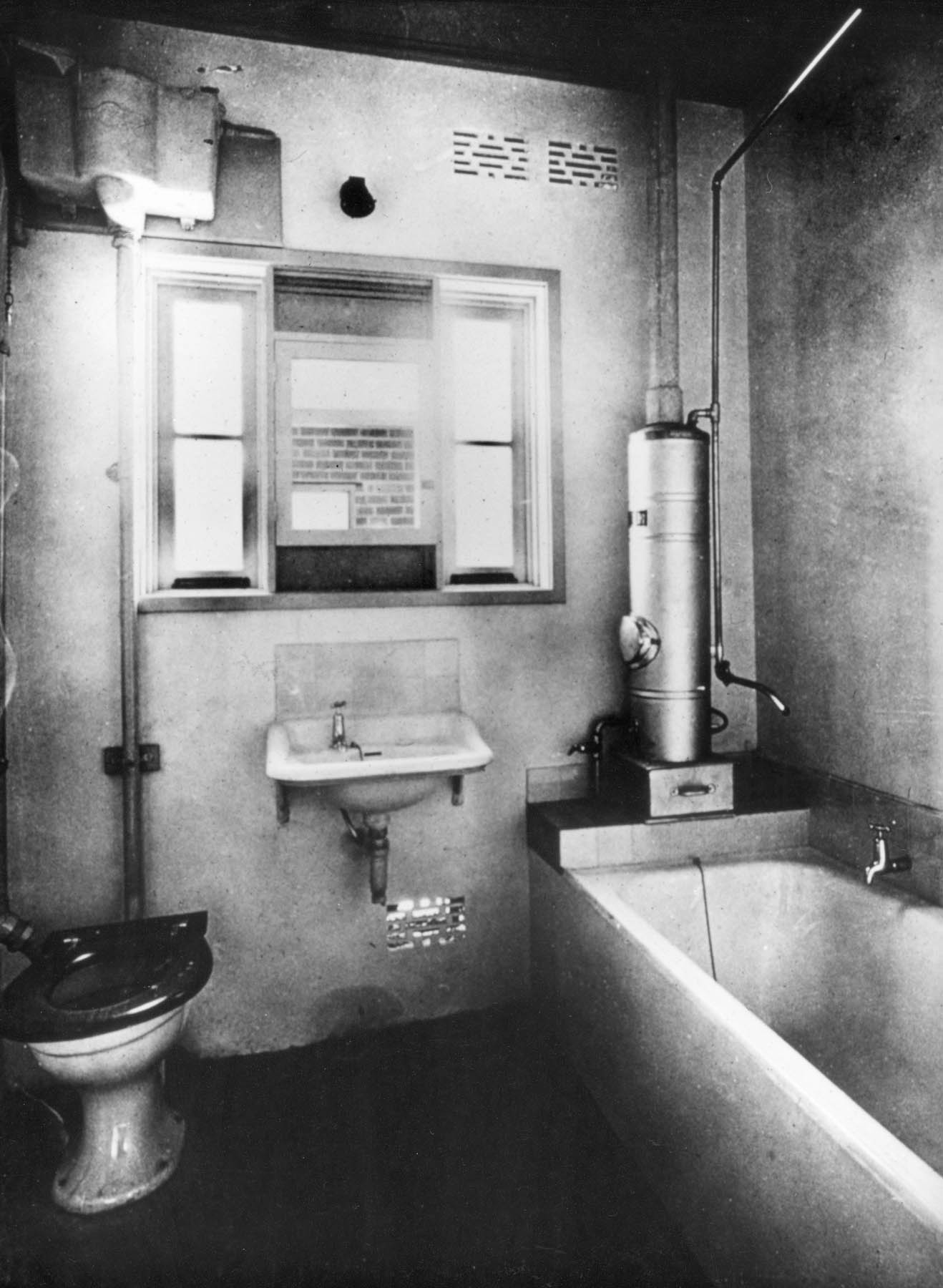
F. Oswald Barnett (Australian, 1883-1972) 'Bathroom interior' c. 1935


F. Oswald Barnett (Australian, 1883-1972)
Bathroom interior
c. 1935
Gelatin silver print
24.1 x 19.1cm
F. Oswald Barnett Collection
State Library of Victoria
Public domain


Collingwood


F. Oswald Barnett (Australian, 1883-1972) 'Collingwood. Glasshouse Street' c. 1935


F. Oswald Barnett (Australian, 1883-1972)
Collingwood. Glasshouse Street
c. 1935
Gelatin silver print
5.4 x 8cm
F. Oswald Barnett Collection
State Library of Victoria
Public domain


View of road paved with bluestone disappearing between corrugated iron fence on left hand side and paling fence on the right. Weatherboard house behind paling fence. Large brick building bearing the words, “Foy & Gibson” visible in the background.


F. Oswald Barnett (Australian, 1883-1972) 'Collingwood. Little Oxford Street' c. 1935


F. Oswald Barnett (Australian, 1883-1972)
Collingwood. Little Oxford Street
c. 1935
Gelatin silver print
5.4 x 8.1cm
F. Oswald Barnett Collection
State Library of Victoria
Public domain


View of street with single storey brick/weatherboard/stone houses along the right hand side and other houses visible in the background. Girl standing on footpath outside one-roomed house. Two boys standing in the middle of the road and a car parked on the left hand side.


F. Oswald Barnett (Australian, 1883-1972) 'Collingwood. Victoria Place'. c. 1935


F. Oswald Barnett (Australian, 1883-1972)
Collingwood. Victoria Place.
c. 1935
Gelatin silver print
5.4 x 8cm
F. Oswald Barnett Collection
State Library of Victoria
Public domain


F. Oswald Barnett (Australian, 1883-1972) 'Collingwood. Plan of house, No. 12 Hood Street' c. 1935


F. Oswald Barnett (Australian, 1883-1972)
Collingwood. Plan of house, No. 12 Hood Street.
c. 1935
Gelatin silver print, hand-coloured
10.5 x 6.8cm
F. Oswald Barnett Collection
State Library of Victoria
Public domain


F. Oswald Barnett (Australian, 1883-1972) 'Collingwood. Hood Street' c. 1935


F. Oswald Barnett (Australian, 1883-1972)
Collingwood. Hood Street
c. 1935
Gelatin silver
5.4 x 8cm
F. Oswald Barnett Collection
State Library of Victoria
Public domain


Map of contemporary Melbourne showing two of the locations pictured in F. Oswald Barnett's photographs of Collingwood


Map of contemporary Melbourne showing two of the locations pictured in F. Oswald Barnett’s photographs of Collingwood


Frederick Oswald Barnett (1883-1972) was an active Methodist. In 1923 a visit to an inner-city slum shocked him deeply and, concerned for the welfare of the children in particular, he enlisted the aid of young Methodists in a campaign which led to the establishment of the Methodist Babies’ Home in South Yarra in 1929. At the same time he was studying part time at the University of Melbourne (B. Com., 1928); his master’s thesis of 1931, based on the result of 150 questionnaires, was published in 1933 as The Unsuspected Slums.

Barnett set up a study-group of forty people drawn from various community organisations, who met weekly in his office to discuss problems of housing reform. His group soon widened its activities to form the nucleus of the slum-abolition movement of the early 1930s. In his public campaign Barnett used a combination of scientifically gathered data and sometimes emotional presentation; he urged his audiences to write to the premier (Sir) Albert Dunstan, who finally agreed to inspect the slums for himself. In 1936 the premier appointed a Housing Investigation and Slum Abolition Board, of which Barnett was a member: it recommended establishment of a housing scheme run by a commission of experts, a policy which his group had long advocated. When the Housing Commission of Victoria was set up in 1938 Barnett became vice-chairman until 1948, when he declined reappointment.

Barnett frequently contributed to public discussion of housing, poverty and related issues through newspaper articles, public addresses and pamphlets, which included, with W. O. Burt, Housing the Australian Nation (1942) and, with Burt and F. Heath, We Must Go On: A Study in Planned Reconstruction and Housing (1944). In 1941-49 he was a director of the City Mutual Life Assurance Society Ltd and chairman from 1946 of its Victorian board, but he was asked to resign when it was known that he was auditor to Australia-Soviet House, Melbourne. In 1952 his was virtually a lone voice attacking proposals for multi-storey flats as public housing, in an address from his familiar platform, the Pleasant Sunday Afternoon at Wesley Church.

E. W. Russell. “Frederick Oswald Barnett (1883-1972),” on the Australian Dictionary of Biography website 2006 first published in the Australian Dictionary of Biography, Volume 7, 1979 [Online] Cited 11/02/2024


Fitzroy


F. Oswald Barnett (Australian, 1883-1972) 'Fitzroy. The Bungalows' c. 1935


F. Oswald Barnett (Australian, 1883-1972)
Fitzroy. The Bungalows
c. 1935
Gelatin silver print
7.5 x 10.0cm mounted on card
F. Oswald Barnett Collection
State Library of Victoria
Public domain


F. Oswald Barnett (Australian, 1883-1972) 'Fitzroy. A group of four cottages' c. 1935


F. Oswald Barnett (Australian, 1883-1972)
Fitzroy. A group of four cottages
c. 1935
Gelatin silver print
7.7 x 10.0cm mounted on card
F. Oswald Barnett Collection
State Library of Victoria
Public domain


F. Oswald Barnett (Australian, 1883-1972) 'Fitzroy. The key of the front door of the apartment house' c. 1935


F. Oswald Barnett (Australian, 1883-1972)
Fitzroy. The key of the front door of the apartment house
c. 1935
Gelatin silver
9.4 x 7.1cm
F. Oswald Barnett Collection
State Library of Victoria
Public domain


F. Oswald Barnett (Australian, 1883-1972) 'Fitzroy. The key of the front door of the apartment house' c. 1935 (detail)


F. Oswald Barnett (Australian, 1883-1972)
Fitzroy. The key of the front door of the apartment house (detail)
c. 1935
Gelatin silver
9.4 x 7.1cm
F. Oswald Barnett Collection
State Library of Victoria
Public domain


F. Oswald Barnett (Australian, 1883-1972) 'Fitzroy. View from the Brotherhood of St. Lawrence' c. 1935


F. Oswald Barnett (Australian, 1883-1972)
Fitzroy. View from the Brotherhood of St. Lawrence
c. 1935
Gelatin silver print
7.6 x 9.4cm
F. Oswald Barnett Collection
State Library of Victoria
Public domain


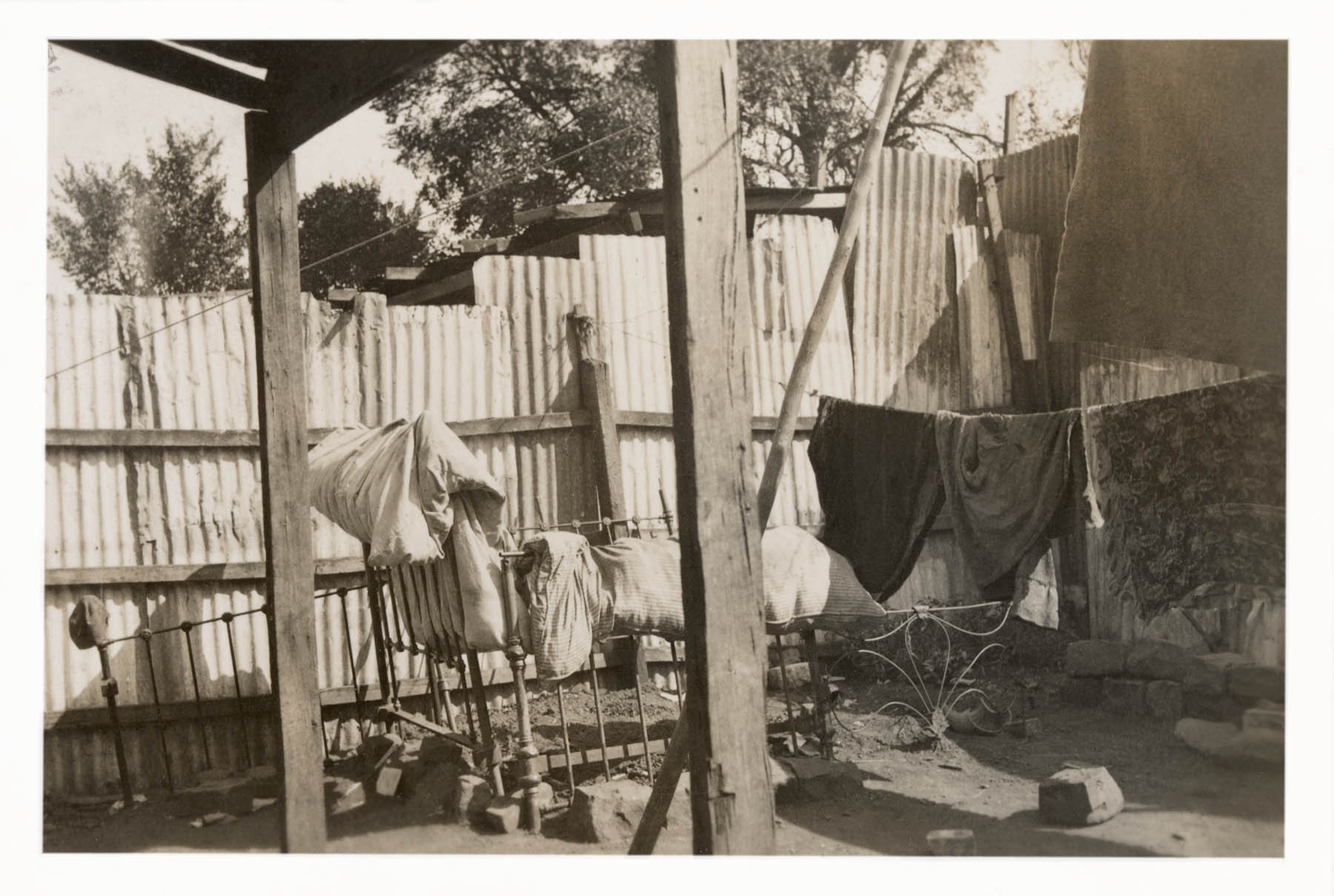
F. Oswald Barnett (Australian, 1883-1972) 'Fitzroy. Rear view of house' c. 1935


F. Oswald Barnett (Australian, 1883-1972)
Fitzroy. Rear view of house
c. 1935
Gelatin silver print
F. Oswald Barnett Collection
State Library of Victoria
Public domain


F. Oswald Barnett (Australian, 1883-1972) 'Fitzroy Town Hall' c. 1935


F. Oswald Barnett (Australian, 1883-1972)
Fitzroy Town Hall
c. 1935
Gelatin silver print
8.0 x 5.3cm
F. Oswald Barnett Collection
State Library of Victoria
Public domain


F. Oswald Barnett (Australian, 1883-1972) 'Fitzroy. Tin house, Ward's Lane' c. 1935


F. Oswald Barnett (Australian, 1883-1972)
Fitzroy. Tin house, Ward’s Lane
c. 1935
Gelatin silver print
7.2 x 9.6cm
F. Oswald Barnett Collection
State Library of Victoria
Public domain


View down lane paved with bluestone. Paling fence on right hand side, single storey brick houses on the left, one appearing to have a tin structure attached. Double storey houses visible in the background.


F. Oswald Barnett (Australian, 1883-1972) 'Fitzroy. Argyle Street' c. 1935


F. Oswald Barnett (Australian, 1883-1972)
Fitzroy. Argyle Street
c. 1935
Gelatin silver print
7.4 x 9.5cm
F. Oswald Barnett Collection
State Library of Victoria
Public domain


F. Oswald Barnett (Australian, 1883-1972) 'Fitzroy. Martin i.e. Market Street' c. 1935


F. Oswald Barnett (Australian, 1883-1972)
Fitzroy. Martin i.e. Market Street
c. 1935
Gelatin silver print
7.0 x 9.4cm
F. Oswald Barnett Collection
State Library of Victoria
Public domain


As far back as the 1850s, slums existed in inner city Melbourne. Slum dwellers lived a squalid existence. Often, they had no bathrooms, or sewerage. They lived in ramshackle housing, with leaky roofs and holes in the walls.

In 1923, active Methodist and social reformer F. Oswald Barnett visited an inner city slum. He was so shocked that he was moved to write the following lament:

WHAT CAN I DO?

Oh God.
What shall I do about these little ones,
These children of the slums,
These helpless, unwashed babies of the slums,
Who crawl along on bare and filthy floors,
Who feed with sticky flies,
Who play in evil-smelling lanes,
Whose mothers cannot keep them clean,
In body or in soul?1


Enlisting the help of other young Methodists, Barnett began a campaign for social change. Together, they successfully advocated for the establishment of the Methodist Babies’ House in South Yarra in 1929.

Barnett went further. Along with several other photographers, he began taking photos of the slums, using them as fuel in his push for social reform. The pictures, combined with emotive language, simultaneously shocked and captivated the public.

Melbourne historian, Dr Andrew Brown-May, observes that from the 1850s onwards: ‘Slum depictions, fashioned in words and illustration, endured as a powerful genre in Melbourne’s cultural landscape.’2

Slum portrayals were sensationalist and voyeuristic. Photos from the slums featured alcoholic mothers with loose moral standards, ‘vermin-infested kitchens’, and children riddled with fleas and head lice.

The campaign to rid Melbourne of its slums steadily gained momentum over the next century. In 1937 the Housing Investigation and Slum Abolition Board produced a damning report on the ‘slum menace’:

‘The Board records its horror and amazement at the deplorable conditions … Hidden behind wide, spacious streets there are slum pockets which are hotbeds of depravity and disease’.3


The Board recommended urgent measures to combat the problem, including the rehousing of slum dwellers and reclamation of slum areas. Its report led to the creation of the Housing Commission of Victoria.

In 1938, the Victorian government passed legislation to facilitate a war on slums.’  The Housing Commission was tasked with ‘excising’ slum pockets for the ‘common good’.4  The Commission built flats to rehouse the slum dwellers. At the same time, it went about acquiring cheap land in suburbs such as Coburg, Brunswick, Northcote, Fitzroy and Richmond.

But abolishing the slums was proving to be difficult. The ‘demolitions program’ was beset with problems. By 1940, only 53 families had actually been moved into new houses. Synchronising demolition works with the building program was hard. The Commission did not have enough resources, and lacked the support of the labour movement.5

The Housing Commission upped the ante. In the 1950s and 1960s, the Commission launched the most ambitious slum-clearance projects ever seen in Australia. Residents in Fitzroy, Collingwood and Richmond protested and refused to move. In 1969, the Carlton Association launched a PR campaign denouncing the schemes.

Finally, four years later, the Victorian government abandoned the slum clearance schemes, but by then, whole communities had been dismantled. The buildings that housed them had been demolished.

Society moved on to other concerns. But the slum stereotype lives on in our records. It is the only version of the truth that remains.

You can view the entire F. Oswald Barnett Collection online.

References

1/ Barnett, F.O. [1945?], I hear the tramp of millions, Rawson’s Book Shop, Melbourne
2/ ‘Slums’, Encyclopedia of Melbourne
3/ Housing Investigation and Slum Abolition Board, 1937, First (progress) report, with appendices and supplements [microform] : slum reclamation : housing for the lower-paid worker; short term programme, H.J. Green, Government Printer, Melbourne
4/ Freestone, R., 2010, Urban nation : Australia’s planning heritage, CSIRO Publishing in assoc. with the Dept. of Environment, Water, Heritage and Arts, & the Australian Heritage Council. p. 217
5/ Howe, R. (ed.), 1988, New houses for old : fifty years of public housing in Victoria 1938-1988, Ministry of Housing & Construction, Melbourne, p. 41

Sarah Matthews. “Slums of Melbourne,” on the State Library of Victoria Blog website August 6, 2015 [Online] Cited 12/02/2024


Carlton


F. Oswald Barnett (Australian, 1883-1972) 'Carlton. David Street' c. 1935


F. Oswald Barnett (Australian, 1883-1972)
Carlton. David Street
c. 1935
Gelatin silver print
7.3 x 9.7cm
F. Oswald Barnett Collection
State Library of Victoria
Public domain


View down paved street. Two storey brick houses on either side. Child leaning over front fence on left hand side. Two dogs, child and other single storey houses visible at end of street.


F. Oswald Barnett (Australian, 1883-1972) 'Carlton. Two mothers' c. 1935


F. Oswald Barnett (Australian, 1883-1972)
Carlton. Two mothers
c. 1935
Gelatin silver print
9.5 x 6.5cm mounted on card 15.2 x 10.1cm
F. Oswald Barnett Collection
State Library of Victoria
Public domain


F. Oswald Barnett (Australian, 1883-1972) 'Carlton. Two mothers' c. 1935 (detail)


F. Oswald Barnett (Australian, 1883-1972)
Carlton. Two mothers (detail)
c. 1935
Gelatin silver print
9.5 x 6.5cm mounted on card 15.2 x 10.1cm
F. Oswald Barnett Collection
State Library of Victoria
Public domain


F. Oswald Barnett (Australian, 1883-1972) 'Carlton. Carlton Place' c. 1935


F. Oswald Barnett (Australian, 1883-1972)
Carlton. Carlton Place
c. 1935
Gelatin silver print
7.1 x 9.5cm
F. Oswald Barnett Collection
State Library of Victoria
Public domain


F. Oswald Barnett (Australian, 1883-1972) 'Carlton. Entrance to a slum pocket' c. 1935


F. Oswald Barnett (Australian, 1883-1972)
Carlton. Entrance to a slum pocket
c. 1935
Gelatin silver print
6.4 x 9.7cm
F. Oswald Barnett Collection
State Library of Victoria
Public domain


F. Oswald Barnett (Australian, 1883-1972) 'Carlton. Slum pocket' c. 1930


F. Oswald Barnett (Australian, 1883-1972)
Carlton. Slum pocket
c. 1930
Gelatin silver print
7.3 x 9.8 cm
F. Oswald Barnett Collection
State Library of Victoria
Public domain


F. Oswald Barnett (Australian, 1883-1972) 'Carlton. Little Barkly Street' c. 1935


F. Oswald Barnett (Australian, 1883-1972)
Carlton. Little Barkly Street
c. 1935
Gelatin silver print
7.4 x 9.6cm mounted on card
F. Oswald Barnett Collection
State Library of Victoria
Public domain


F. Oswald Barnett (Australian, 1883-1972) 'Carlton. Little Barkly Street' c. 1935 (detail)


F. Oswald Barnett (Australian, 1883-1972)
Carlton. Little Barkly Street (detail)
c. 1935
Gelatin silver print
7.4 x 9.6cm mounted on card
F. Oswald Barnett Collection
State Library of Victoria
Public domain


F. Oswald Barnett (Australian, 1883-1972) 'Carlton. Kitchen interior with woman and three children' c. 1935


F. Oswald Barnett (Australian, 1883-1972)
Carlton. Kitchen interior with woman and three children
c. 1935
Gelatin silver print
7.2 x 9.9cm
F. Oswald Barnett Collection
State Library of Victoria
Public domain


Interior view of kitchen with open fireplace. Containers and utensils on mantelpiece above fireplace. Woman and three children seated around a wooden table in front of fireplace.


F. Oswald Barnett (Australian, 1883-1972) 'Carlton. Wash-house and bath-room, 48 Palmerston Street' c. 1935


F. Oswald Barnett (Australian, 1883-1972)
Carlton. Wash-house and bath-room, 48 Palmerston Street
c. 1935
Gelatin silver print
7.4 x 9.6cm mounted on card
F. Oswald Barnett Collection
State Library of Victoria
Public domain


F. Oswald Barnett (Australian, 1883-1972) 'Carlton. Wash-house and bath-room, 48 Palmerston Street' c. 1935 (detail)


F. Oswald Barnett (Australian, 1883-1972)
Carlton. Wash-house and bath-room, 48 Palmerston Street (detail)
c. 1935
Gelatin silver print
7.4 x 9.6cm mounted on card
F. Oswald Barnett Collection
State Library of Victoria
Public domain


Contemporary photograph of 48 Palmerston Street, Carlton


Contemporary photograph of 48 Palmerston Street, Carlton


F. Oswald Barnett (Australian, 1883-1972) 'Carlton. Airedale Place' c. 1935


F. Oswald Barnett (Australian, 1883-1972)
Carlton. Airedale Place
c. 1935
Gelatin silver print
7.2 x 9.8cm
F. Oswald Barnett Collection
State Library of Victoria
Public domain


F. Oswald Barnett (Australian, 1883-1972) 'Carlton. Somerset Place' c. 1935


F. Oswald Barnett (Australian, 1883-1972)
Carlton. Somerset Place
c. 1935
Gelatin silver
6.0 x 9.8cm
F. Oswald Barnett Collection
State Library of Victoria
Public domain


F. Oswald Barnett (Australian, 1883-1972) 'Carlton. Somerset Place' c. 1935 (detail)


F. Oswald Barnett (Australian, 1883-1972)
Carlton. Somerset Place (detail)
c. 1935
Gelatin silver
6.0 x 9.8cm
F. Oswald Barnett Collection
State Library of Victoria
Public domain


F. Oswald Barnett (Australian, 1883-1972) 'Carlton. Ormond Place' c. 1935


F. Oswald Barnett (Australian, 1883-1972)
Carlton. Ormond Place
c. 1935
Gelatin silver
6.1 x 9.5cm
F. Oswald Barnett Collection
State Library of Victoria
Public domain


Map of contemporary Melbourne showing five of the locations pictured in F. Oswald Barnett's photographs of Carlton


Map of contemporary Melbourne showing five of the locations pictured in F. Oswald Barnett’s photographs of Carlton


One of the most visible and lasting effects of the Great Depression was the housing crisis in the poor working class areas of Melbourne and Sydney. Many of the nineteenth-century houses had fallen into disrepair, overcrowding was endemic and a great number of families lived in squalid and unhealthy conditions. Throughout the decade ‘slum’ abolition movements in Melbourne and Sydney ran public campaigns to place public housing on the political agenda, leading to the creation of the first state Housing Commissions.

In Melbourne, Methodist layman F. Oswald Barnett led a campaign calling for slum demolition and the rehousing of residents in government-financed housing. He took hundreds of photographs that were used in public lectures and to illustrate the 1937 report of the Housing Investigation and Slum Abolition Board. This led to the creation of the Housing Commission of Victoria in 1938, with its first major project being the Garden City estate at Fishermans Bend. In Sydney a similar campaign led to the Housing Improvement Act of 1936 and the construction of the first fifty-six home units at Erskineville.

Text from the National Gallery of Victoria


The photographs in the F. Oswald Barnett Collection were taken by Barnett and other unidentified photographers in the 1930s. Many of them were used to illustrate a government report on slum housing and/or made into lantern slides for lectures in a public campaign.  F. Oswald Barnett was born in Brunswick, Victoria. A committed Methodist and housing reformer, he led a crusade against Melbourne’s inner city slums. In 1936 he was appointed to the Slum Abolition Board and from 1938-1948 he was the vice-chair of the Housing Commission. In this position he attempted to shape compassionate public housing policy. He later protested vigorously against proposed high-rise housing.

Text from the Monash Biographical Dictionary of 20th century Australia


West Melbourne and North Melbourne


F. Oswald Barnett (Australian, 1883-1972) 'West Melbourne. The lavatory to a Dudley Mansion' c. 1935


F. Oswald Barnett (Australian, 1883-1972)
West Melbourne. The lavatory to a Dudley Mansion
c. 1935
Gelatin silver
7.4 x 9.7cm
F. Oswald Barnett Collection
State Library of Victoria
Public domain


View of a poorly constructed lavatory building on the edge of a stretch of water. Construction material is mainly corrugated iron. Rail freight car and industrial landscape in the background.


F. Oswald Barnett (Australian, 1883-1972) 'West Melbourne. The lavatory to a Dudley Mansion' c. 1935 (detail)


F. Oswald Barnett (Australian, 1883-1972)
West Melbourne. The lavatory to a Dudley Mansion (detail)
c. 1935
Gelatin silver
7.4 x 9.7cm
F. Oswald Barnett Collection
State Library of Victoria
Public domain


F. Oswald Barnett (Australian, 1883-1972) 'West Melbourne. A Dudley Mansion' c. 1935


F. Oswald Barnett (Australian, 1883-1972)
West Melbourne. A Dudley Mansion
c. 1935
Gelatin silver print
7.5 x 9.7cm
F. Oswald Barnett Collection
State Library of Victoria
Public domain


F. Oswald Barnett (Australian, 1883-1972) 'West Melbourne. A Dudley Mansion' c. 1935 (detail)


F. Oswald Barnett (Australian, 1883-1972)
West Melbourne. A Dudley Mansion (detail)
c. 1935
Gelatin silver print
7.5 x 9.7cm
F. Oswald Barnett Collection
State Library of Victoria
Public domain


F. Oswald Barnett (Australian, 1883-1972) 'West Melbourne. A group of Dudley Mansions' c. 1935


F. Oswald Barnett (Australian, 1883-1972)
West Melbourne. A group of Dudley Mansions
c. 1935
Gelatin silver print
7.4 x 9.8cm
F. Oswald Barnett Collection
State Library of Victoria
Public domain


View across hillside and stretch of water to a group of shanties. Industrial landscape in the background.


F. Oswald Barnett (Australian, 1883-1972) 'West Melbourne. One of the Dudley Mansions' c. 1935


F. Oswald Barnett (Australian, 1883-1972)
West Melbourne. One of the Dudley Mansions
c. 1935
Gelatin silver print
7.4 x 9.7cm
F. Oswald Barnett Collection
State Library of Victoria
Public domain


F. Oswald Barnett (Australian, 1883-1972) 'West Melbourne. One of the Dudley Mansions' c. 1935 (detail)


F. Oswald Barnett (Australian, 1883-1972)
West Melbourne. One of the Dudley Mansions (detail)
c. 1935
Gelatin silver print
7.4 x 9.7cm
F. Oswald Barnett Collection
State Library of Victoria
Public domain


F. Oswald Barnett (Australian, 1883-1972) North Melbourne. 'Row of four houses' c. 1935


F. Oswald Barnett (Australian, 1883-1972)
North Melbourne. Row of four houses
c. 1935
Gelatin silver print
7.3 x 9.6cm
F. Oswald Barnett Collection
State Library of Victoria
Public domain


F. Oswald Barnett (Australian, 1883-1972) 'North Melbourne. Group of children in Erskine Place' c. 1935


F. Oswald Barnett (Australian, 1883-1972)
North Melbourne. Group of children in Erskine Place
c. 1935
Gelatin silver print
10.0 x 7.5cm
F. Oswald Barnett Collection
State Library of Victoria
Public domain


F. Oswald Barnett (Australian, 1883-1972) 'North Melbourne. Group of children in Erskine Place' c. 1935 (detail)


F. Oswald Barnett (Australian, 1883-1972)
North Melbourne. Group of children in Erskine Place (detail)
c. 1935
Gelatin silver print
10.0 x 7.5cm
F. Oswald Barnett Collection
State Library of Victoria
Public domain


F. Oswald Barnett (Australian, 1883-1972) 'North Melbourne. Group of children in Erskine Place' c. 1935 (detail)


F. Oswald Barnett (Australian, 1883-1972)
North Melbourne. Group of children in Erskine Place (detail)
c. 1935
Gelatin silver print
10.0 x 7.5cm
F. Oswald Barnett Collection
State Library of Victoria
Public domain


F. Oswald Barnett (Australian, 1883-1972) 'North Melbourne. Hardwicke Street' c. 1935


F. Oswald Barnett (Australian, 1883-1972)
North Melbourne. Hardwicke Street
c. 1935
Gelatin silver
7.2 x 9.7cm
F. Oswald Barnett Collection
State Library of Victoria
Public domain


F. Oswald Barnett (Australian, 1883-1972) 'North Melbourne. Hardwicke Street' c. 1935 (detail)


F. Oswald Barnett (Australian, 1883-1972)
North Melbourne. Hardwicke Street (detail)
c. 1935
Gelatin silver
7.2 x 9.7cm
F. Oswald Barnett Collection
State Library of Victoria
Public domain


F. Oswald Barnett (Australian, 1883-1972) 'North Melbourne. No. 19 Byron Street' c. 1935


F. Oswald Barnett (Australian, 1883-1972)
North Melbourne. No. 19 Byron Street
c. 1935
Gelatin silver print
F. Oswald Barnett Collection
State Library of Victoria
Public domain


Contemporary photograph of Byron Street, North Melbourne


Contemporary photograph of Byron Street, North Melbourne with number 19 half way along on the left. All apartment complexes now…


F. Oswald Barnett. "An Apology to the Slum Dweller" 1945?

F. Oswald Barnett. "An Apology to the Slum Dweller" 1945?


F. Oswald Barnett. “An Apology to the Slum Dweller,” in F. Oswald Barnett. I hear the tramp of millions. Melbourne: Printers Pty Ltd, 1945? pp. 12-13. 36 p.: ill.; 21cm.


LIKE ART BLART ON FACEBOOK

Back to top

Exhibition: ‘Photography: Real & Imagined’ at The Ian Potter Centre: NGV Australia, Melbourne Part 1

Exhibition dates: 13th October 2023 – 4th February 2024

Warning: Aboriginal and Torres Strait Islander readers should be aware that this posting contains images and names of people who may have since passed away.


O. G. Rejlander (British born Sweden, 1813-1875) No title (The Virgin in prayer) c. 1858-1860


O. G. Rejlander (British born Sweden, 1813-1875)
No title (The Virgin in prayer)
c. 1858-1860
Albumen silver photograph
20.2 × 15.4cm irreg. (image and sheet)
National Gallery of Victoria, Melbourne
Purchased, 2002
Public domain


This is an ambitious, complex but flawed exhibition of photographic works from the NGV Collection. Further comment in Part 2 of the posting…

Dr Marcus Bunyan


Many thankx to the NGV for allowing me to publish the media images in the posting. Other photographs in the posting are public domain. All installation images are by Marcus Bunyan.


Photography: Real and Imagined examines two perspectives on photography; photography grounded in the real world, as a record, a document, a reflection of the world around us; and photography as the product of imagination, storytelling and illusion. On occasion, photography operates in both realms of the real and the imagined.

Highlighting major photographic works from the NGV Collection, including recent acquisitions on display for the very first time, Photography: Real and Imagined examines the complex, engaging and sometimes contradictory nature, of all things photographic. The NGV’s largest survey of the photography collection, the exhibition includes more than 300 works by Australian and international photographers and artists working with photo-media from the nineteenth, twentieth and twenty-first centuries.

Text from the NGV website


Installation view of the entrance to the exhibition 'Photography: Real & Imagined' at The Ian Potter Centre: NGV Australia, Melbourne


Installation view of the entrance to the exhibition Photography: Real & Imagined at The Ian Potter Centre: NGV Australia, Melbourne with introduction wall text to the right
Photo: Marcus Bunyan


Introduction

Photography was once described by writer and critic Lucy Lippard as having ‘a toe in the chilly waters of verisimilitude’. Photographs, Lippard posits, may be a close – rather than exact – reflection of truth. This proposition raises a raft of questions. Is reality so uncomfortable that we only engage with it partially, or out of necessity? Can a photograph show the truth, and if it does, whose truth is it showing – the photographer’s, the subject’s or the viewer’s? If truth is the end game, what does this mean for creative practice and other types of photography? The suggestion that photography is only partially, and somewhat uncomfortably, engaged with the notion of truth highlights the complexity encountered when trying to nearly encapsulate any selection of photographs.

Through works from the NGV Collection, Photography: Real and Imagined teases out connections between iconic and lesser known photographs, putting them in a dialogue with one another that both explores and transcends the time in which they were made. It dos not set out to be a history of photography, but historical context does inform the content, leading to nuanced discussions of past and present, real and imagined.

Introductory wall text from the exhibition


Installation view of the exhibition 'Photography: Real & Imagined' at The Ian Potter Centre: NGV Australia, Melbourne showing at right, Mike and Doug Starn's 'Invictus' (1992)


Installation view of the exhibition Photography: Real & Imagined at The Ian Potter Centre: NGV Australia, Melbourne showing at right, Mike and Doug Starn’s Invictus (1992); and at left works by John Kauffmann, Norman Deck and Edward Steichen (see below)
Photo: Marcus Bunyan


The sun was the light source that enabled the earliest photographs to be made in the 1830s. More than 150 years later the sun is the subject of this photographic sculpture by Mike and Doug Starn that embraces the possibilities of light and its potential effects on photography, in terms of both producing an image and as a force contributing to its irreparable damage. In the centre of their installation, the circular form of a sun seems to pulse and leach out of the layers of exposed orthographic film, which is stretched and layered across steel beams and held with pipe clamps and tape.

Wall text from the exhibition


Installation view of the exhibition 'Photography: Real & Imagined' at The Ian Potter Centre: NGV Australia, Melbourne


Installation view of the exhibition Photography: Real & Imagined at The Ian Potter Centre: NGV Australia, Melbourne showing at top left, John Kauffmann’s The Cloud (c. 1905, below); at bottom left, Kauffmann’s The grey veil c. 1919; at top right, Norman Deck’s Sunset, Parramatta River (1909); and a bottom right, Edward Steichen’s Moonrise (1904)
Photo: Marcus Bunyan


John Kauffmann (Australian, 1864-1942) 'The cloud' c. 1905


John Kauffmann (Australian, 1864-1942)
The cloud
c. 1905
Gelatin silver photograph
28.2 × 37.2cm
National Gallery of Victoria, Melbourne
Gift of Mr John Bilney, 1976
Public domain


John Kauffmann (Australian, 1864–1942) 'The grey veil' c. 1919


John Kauffmann (Australian, 1864-1942)
The grey veil
c. 1919
Gelatin silver photograph
National Gallery of Victoria, Melbourne
Purchased through The Art Foundation of Victoria with the assistance of the Herald & Weekly Times Limited, Fellow, 1990
Public domain


The Yarra River, the Princes Bridge and the Melbourne city skyline beyond shimmer in this photograph by John Kauffmann. And yet, they are not the image’s subject. Using a highly refined Pictorialist treatment, a reduced tonal range and luminous mid tones, the artist has manipulated light to the extent that the feeling and atmospheric qualities become the focus of the image – it is the impression that is paramount. With the choice of title, too, the photograph moves away from a specific documentation of place or time.

Wall text from the exhibition


Norman Deck (Australian 1882-1980) 'Sunset, Parramatta River' 1909


Norman Deck (Australian 1882-1980)
Sunset, Parramatta River
1909
Gelatin silver photograph
30.5 × 24.9cm
National Gallery of Victoria, Melbourne
Gift of Joyce Evans, 1993
Public domain


Installation view of the exhibition 'Photography: Real & Imagined' at The Ian Potter Centre: NGV Australia, Melbourne showing at centre, David Thomas' 'The Movement of Colour (White), Taking a Monochrome for a Walk (London)' (2010-2011)


Installation view of the exhibition Photography: Real & Imagined at The Ian Potter Centre: NGV Australia, Melbourne showing at centre, David Thomas’ The Movement of Colour (White), Taking a Monochrome for a Walk (London) (2010-2011), with at right works by David Noonan, Hiroshi Sugimoto, László Moholy-Nagy and Susan Fereday (see below)
Photo: Marcus Bunyan


David Thomas (British, b. 1951, Australia 1958- ) 'The Movement of Colour (White), Taking a Monochrome for a Walk (London)' 2010-2011 (installation view)


David Thomas (British, b. 1951, Australia 1958- )
The Movement of Colour (White), Taking a Monochrome for a Walk (London) (installation view)
2010-2011
National Gallery of Victoria, Melbourne
Gift of an anonymous donor through the Australian Government’s Cultural Gifts Program 2015
Photo: Marcus Bunyan


“It was made during a residency at the Centre for Drawing Research at Wimbledon School of Art University of the Arts London… and plays on Paul Klee’s definition of drawing as taking a line for a walk on a page… this is taking a monochrome for a walk in the world where the monochrome becomes a key for seeing other colours… an interval in the world. It also suggests the ideas of movement in time and feelings of impermanence.”

~ David Thomas


Installation view of the exhibition 'Photography: Real & Imagined' at The Ian Potter Centre: NGV Australia, Melbourne showing works by David Noonan, Hiroshi Sugimoto, Laslo Moholy-Nagy and Susan Fereday


Installation view of the exhibition Photography: Real & Imagined at The Ian Potter Centre: NGV Australia, Melbourne showing at top right, David Noonan’s Untitled (1992); at bottom left, Hiroshi Sugimoto’s Winnetka Drive-In, Paramount (1993); at top right, László Moholy-Nagy’s Fotogram, 1925 (1925); and at bottom right, Susan Fereday’s Untitled (2001)
Photo: Marcus Bunyan


Light and time are both the means and subject of Hiroshi Sugimoto’s Drive-In Theaters series. To produce the images, the artist directs his camera at the movie screen. Once the film starts, Sugimoto opens the lens shutter of his large-format camera and shuts it the moment the movie ends. The result is a visual condensation of the moving images and projected light of the film for its duration into a vivid, hovering rectangle of virtually pulsating light and, in the case of this drive-in cinema, the surrounding human-made and astronomical light, too.

Wall text from the exhibition


Installation view of the exhibition 'Photography: Real & Imagined' at The Ian Potter Centre: NGV Australia, Melbourne showing David Noonan's 'Untitled' (1992)


Installation view of the exhibition Photography: Real & Imagined at The Ian Potter Centre: NGV Australia, Melbourne showing David Noonan’s Untitled (1992)
Photo: Marcus Bunyan


László Moholy-Nagy (Hungarian 1895-1946, Germany 1920-1934, England 1935-1937, United States 1937-1946) 'Fotogram, 1925' 1925


László Moholy-Nagy (Hungarian 1895-1946, Germany 1920-1934, England 1935-1937, United States 1937-1946)
Fotogram, 1925
1925
Gelatin silver photograph
National Gallery of Victoria, Melbourne
Presented by the National Gallery Society of Victoria, 1985
Public domain


From 1922 to 1943 László Moholy-Nagy experimented extensively with the photogram process – he was passionate about the optical effects and inherent properties of these camera-less images freed from a purely representational mode. In this work a pale shape, an organic swathe, streams across a page while curved shapes dance at the base. A halo above emits small geometric patterns. The work is a celebration of abstraction of the image – of the effects of playing with light, objects and photographic paper in a darkroom.

Wall text from the exhibition


Installation view of the exhibition Photography: Real & Imagined at The Ian Potter Centre: NGV Australia, Melbourne showing at left, Barbara Kasten's Composition 8T (2018); and at right, Lydia Wegner's Purple square (2017)


Installation view of the exhibition Photography: Real & Imagined at The Ian Potter Centre: NGV Australia, Melbourne showing at left, Barbara Kasten’s Composition 8T (2018, below); and at right, Lydia Wegner’s Purple square (2017, below)
Photo: Marcus Bunyan


Barbara Kasten (American, b. 1936) 'Composition 8T' 2018


Barbara Kasten (American, b. 1936)
Composition 8T
2018
Digital type C print
160.0 x 121.9cm (image and sheet)
ed. 1/1
National Gallery of Victoria, Melbourne
Purchased NGV Foundation, 2018
© Barbara Kasten, courtesy Kadel Willborn, Düsseldorf


This photograph from Barbara Kasten’s Collisions/Compositions series continues her practice of creating architectural spaces in the studio using a range of materials, such as plexiglas and mirrors, which she lights and photographs at close range. Influenced by Constructivism and the teachings of the Bauhaus, specifically the work of László Moholy-Nagy, Kasten has experimented with the parameters of abstract photography for around five decades. She has written of her ongoing fascination with light in the creation and conceptual development of her photographs, saying, ‘The interdependency of shadow and light is the essence of photographic exploration and an inescapable part of the photographic process’.

Wall text from the exhibition


Installation view of the exhibition Photography: Real & Imagined at The Ian Potter Centre: NGV Australia, Melbourne showing Lydia Wegner's 'Purple square' (2017)


Installation view of the exhibition Photography: Real & Imagined at The Ian Potter Centre: NGV Australia, Melbourne showing Lydia Wegner’s Purple square (2017)
Photo: Marcus Bunyan


Installation view of the exhibition 'Photography: Real & Imagined' at The Ian Potter Centre: NGV Australia, Melbourne showing at left, Todd McMillan's 'Equivalent VIII' (2014); and at right, Sue Pedley's 'Sound of lotus 1' (2000)


Installation view of the exhibition Photography: Real & Imagined at The Ian Potter Centre: NGV Australia, Melbourne showing at left, Todd McMillan’s Equivalent VIII (2014); and at right, Sue Pedley’s Sound of lotus 1 (2000)
Photo: Marcus Bunyan


Installation view of the exhibition 'Photography: Real & Imagined' at The Ian Potter Centre: NGV Australia, Melbourne


Installation view of the exhibition Photography: Real & Imagined at The Ian Potter Centre: NGV Australia, Melbourne showing at back left, Thomas Ruff’s Portrait (V. Liebermann D) (1999); and at back second left, Ruff’s Portrait (A. Koschkarow) (2000)
Photo: Marcus Bunyan


Installation view of the exhibition Photography: Real & Imagined at The Ian Potter Centre: NGV Australia, Melbourne showing at left, Thomas Ruff’s 'Portrait (V. Liebermann D)' (1999); and at right, Ruff's 'Portrait (A. Koschkarow)' (2000)


Installation view of the exhibition Photography: Real & Imagined at The Ian Potter Centre: NGV Australia, Melbourne showing at left, Thomas Ruff’s Portrait (V. Liebermann D) (1999); and at right, Ruff’s Portrait (A. Koschkarow) (2000)
Photo: Marcus Bunyan


The earnest gazes of the man and woman in these two monumental photographs by Thomas Ruff are so calm and serene that they bely the intense experience of viewing their enlarged faces. Applying a standardised approach – similar to a generic passport photograph – these portraits have a timeless quality that invites you to attempt to ‘read’ their faces and to search for clues as to the inner state of the person. Ruff, however, lets nothing slip. The faces are known to the artist but remain anonymous to the viewer.

Wall text from the exhibition


Installation view of the exhibition 'Photography: Real & Imagined' at The Ian Potter Centre: NGV Australia, Melbourne showing Robert Rooney's 'AM-PM: 2 Dec 1973-28 Feb 1974' (1973-1974) (detail)


Installation view of the exhibition Photography: Real & Imagined at The Ian Potter Centre: NGV Australia, Melbourne showing Robert Rooney’s AM-PM: 2 Dec 1973-28 Feb 1974 (1973-1974) (detail)
Photo: Marcus Bunyan


Featuring some of the most iconic photographs ever created alongside contemporary approaches to the photographic medium, Photography: Real & Imagined is the largest survey of the NGV’s Photography collection in the institution’s history and features more than 270 photographs by Australian and international practitioners.

Four years in the making, this landmark exhibition features photographs from across the 200-year period since the invention of photography in the 19th century, including work by leading international photographers including Man Ray, Cindy Sherman, Wolfgang Tillmans, Gilbert & George and Nan Goldin, alongside Australian photographers Max Dupain, Olive Cotton, Mervyn Bishop, Polly Borland, Destiny Deacon and Darren Sylvester.

Through twenty-one thematic sections, this large-scale exhibition explores the proposition that a photograph can be grounded in the real world, recording, documenting and reflecting the world around us; or be the product of imagination, storytelling and illusion; and on occasion operate in both realms. The thematic sections explore subject matter such as light, place and environment, consumption, conflict, community, and death.

Exhibition highlights include Mervyn Bishop’s important photograph of former Prime Minister of Australia, Gough Whitlam, pouring sand into the open palm of Gurindji Elder Vincent Lingiari. The 1975 image captures the historic meeting between these two figures where Lingiari received the crown lease of his ancestral lands. Also on display is Joe Rosenthal’s World War II photograph Raising the flag on Iwo Jima, 1945, in which American marines raise their country’s flag over the Japanese Island. Both Bishop and Rosenthal’s photographs were staged, or re-constructed for better pictorial effect, illustrating the fluid space between the real and imagined.

The exhibition also presents fashion and advertising photography, including key examples by Lilian Bassman, Athol Smith, Horst P. Horst and Dora Maar. These images showcase a world of designer fashion and high-end products, which set a standard in advertising that continues today. Ilse Bing’s Surrealist inspired photograph commissioned by Elsa Schiaparelli to launch her new perfume Salut in 1934 is a highlight of the exhibition.

Highlighting an area of focused collecting for the NGV, the exhibition recognises the work of women practicing in the early 20th century, including Barbara Morgan whose acclaimed photo montage City shell, 1938, shows an unexpected view of the then recently completed Empire State Building.

Through to the current day, Photography: Real & Imagined presents contemporary photographers of the 21st century including Zanele Muholi, Richard Mosse and Alex Prager. Highlights include Cindy Sherman’s celebrated self-portrait in the guise of Renaissance aristocrat. Also on display will be the oldest photographic work in the NGV Collection, an early 19th century portrait by Englishman William Henry Fox Talbot, one of the inventors of the medium, as well as examples of daguerreotypes, unique images on silver plated copper sheets that are amongst the earliest forms of photography.

The exhibition is accompanied by a major publication – the most ambitious book published on the NGV Photography Collection, generously supported by the Bowness Family Foundation. The publication comprises essays from NGV Senior Curator of Photography, Susan van Wyk, Susan Bright and David Campany; alongside texts by Curator of Photography, Maggie Finch and external authors from Australia, Europe, North America and Southeast Asia.

Regular introductory talks for students are held on weekdays during term times, and free drop-by guided tours each Thursday and Sunday at 10.30am during the exhibition period.

Tony Ellwood AM, Director, NGV, said: ‘This exhibition celebrates the collections and achievements of the NGV’s photography department, which has presented more than 180 exhibitions in its 55-year history. The exhibition is a testament to the strength of the NGV Collection, with so many key examples of the history of photography represented, from the earliest examples from the 19th century, through to contemporary images being produced right now in the twenty-first century. We are grateful for the support of the many donors and philanthropists, such as the Bowness Family Foundation, who have helped to grow and strengthen the NGV’s photography collection.’

Press release from the NGV


Installation view of the exhibition 'Photography: Real & Imagined' at The Ian Potter Centre: NGV Australia, Melbourne at top left, O. G. Rejlander's 'The Virgin in prayer' (c. 1858-1860); at bottom left, Henry Peach Robinson's 'Elaine watching the shield of Lancelot' (1859); at centre, Ruth Hollick's 'Thought' (1921); and at right Cindy Sherman's 'Untitled' (1988) from the 'History Portraits' series (1988-1990)


Installation view of the exhibition Photography: Real & Imagined at The Ian Potter Centre: NGV Australia, Melbourne at top left, O. G. Rejlander’s The Virgin in prayer (c. 1858-1860, below); at bottom left, Henry Peach Robinson’s Elaine watching the shield of Lancelot (1859); at centre, Ruth Hollick’s Thought (1921); and at right Cindy Sherman’s Untitled (1988) from the History Portraits series 1988-1990
Photo: Marcus Bunyan


Describing the complex conundrum presented by Cindy Sherman in this photograph, photographer and curator Patrick Pound once wrote: ‘Fake chested and with a face like a mask, here Cindy Sherman is costumed to the max. She stares out like a disapproving Renaissance figure who has just walked off set from a Peter Greenaway extravaganza. Here we have a photographer looking like a painting that walked out of a film. Sherman’s photographs speak of the fragilities of the visage in an image-saturated world where information and construction slip into foreplay. In Sherman’s photographic world gender and identity is a compilation album. There is a toughness to the excess that is all her own’.

Wall text from the exhibition


Installation view of the exhibition Photography: Real & Imagined at The Ian Potter Centre: NGV Australia, Melbourne showing O. G. Rejlander's 'The Virgin in prayer' (c. 1858-1860)


Installation view of the exhibition Photography: Real & Imagined at The Ian Potter Centre: NGV Australia, Melbourne showing O. G. Rejlander’s The Virgin in prayer (c. 1858-1860, below)
Photo: Marcus Bunyan


Henry Peach Robinson (English, 1830-1901) 'Elaine watching the shield of Lancelot' 1859


Henry Peach Robinson (English, 1830-1901)
Elaine watching the shield of Lancelot
1859
Albumen silver photograph
24.3 × 19.3cm (image and sheet)
National Gallery of Victoria, Melbourne
Purchased from Admission Funds, 1988
Public domain


In the 1850s Henry Peach Robinson was renowned for producing elaborately staged narrative images based on scenes from popular literary sources. He was particularly interested in Arthurian legends and drew upon these stories as inspiration for some of his most admired photographs. Elaine watching the shield of Lancelot is based on Alfred Tennyson’s version of the story of Lancelot and Elaine. Peach Robinson has recreated the scene in which the lovelorn Elaine gazes dreamily at the shield of Lancelot. She is shown as a woman who has shunned reason and propriety and abandoned herself to the intensity of her emotions, making this photograph both a tragic love story and a cautionary narrative.

Wall text from the exhibition


Ruth Hollick (Australian, 1883-1977) 'Thought' 1921


Ruth Hollick (Australian, 1883-1977)
Thought
1921
Gelatin silver photograph
37.4 × 25.3cm
National Gallery of Victoria, Melbourne
Presented through The Art Foundation of Victoria by Mrs Lucy Crosbie Morrison, Member, 1993
Public domain


Installation view of the exhibition 'Photography: Real & Imagined' at The Ian Potter Centre: NGV Australia, Melbourne


Installation view of the exhibition Photography: Real & Imagined at The Ian Potter Centre: NGV Australia, Melbourne
Photo: Marcus Bunyan


Installation view of the exhibition 'Photography: Real & Imagined' at The Ian Potter Centre: NGV Australia, Melbourne


Installation view of the exhibition Photography: Real & Imagined at The Ian Potter Centre: NGV Australia, Melbourne showing Bernd and Hilla Becher’s Coal tipple, Goodspring, Pennsylvania 1975 from the Artists and Photographs folio 1975
Photo: Marcus Bunyan


In 1959, German-born artists Bernd and Hilla Becher began travelling throughout Europe to create photographic typologies of vanishing industrial architecture (a practice they continued for more than four decades). While predominantly documenting German structures and landscapes, they occasionally worked overseas. This image, four views of a coal tipple, was taken on their first trip to North America in the mid 1970s. The Bechers constructed a system for comparing structures: photographed from a consistent angle, with virtually identical lighting conditions, printed at the same size and often displayed in grids.

Wall text from the exhibition


Edward Ruscha (American, b. 1937) 'Twentysix Gasoline Stations' 1963, published 1967 (installation view)

Edward Ruscha (American, b. 1937) 'Twentysix Gasoline Stations' 1963, published 1967 (installation view)


Edward Ruscha (American, b. 1937)
Twentysix Gasoline Stations (installation view)
1963, published 1967
Artist’s book: photo-offset lithograph and printed text, 48 pages, printed cover, glued binding
National Gallery of Victoria, Melbourne
Gift of Robert Rooney through the Australian Government’s Cultural Gifts Program, 2009
Photos: Marcus Bunyan


With the first publication of Twentysix Gasoline Stations, and his subsequent artist books, Edward Ruscha’s work was influential in initiating the widespread interest in photographic book publishing that continues today. Ruscha’s use of photographs as a means of recording – a seemingly unemotional, detached cataloguing of the world – and simply as a ‘device to complete the idea’ influenced the interest in serial imaging adopted by many conceptual artists. Ruscha’s use of the book format was also crucial, providing a transportable way of presenting art in varied contexts that existed as a type of ‘map’ to be read and interpreted, with the subject matter becoming less important than the documentation as a whole.

Wall text from the exhibition


John Baldessari (American 1931-2020) ‘Fable: A Sentence of Thirteen Parts (with Twelve Alternate Verbs) Ending in a Fable’ 1977 (installation view)

John Baldessari (American 1931-2020) ‘Fable: A Sentence of Thirteen Parts (with Twelve Alternate Verbs) Ending in a Fable’ 1977 (installation view)


John Baldessari (American 1931-2020)
Fable: A Sentence of Thirteen Parts (with Twelve Alternate Verbs) Ending in a Fable (installation views)
1977
Artist’s book: photo-offset lithography on concertina fold-out in cross formation, folded paper cover
9.8 × 14.0 × 1.8cm (closed) 70.0 × 126.5cm approx. (overall, opened)
National Gallery of Victoria, Melbourne
Purchased, Friends of the Gallery Library, 2017
Photos: Marcus Bunyan


Conceptual artist John Baldessari, is renowned for his often-playful investigations into ideas of language, image and authenticity, once said: ‘I was always interested in language. I thought, why not? … And then I also had a parallel interest in photography … I could never figure out why photography and art had separate histories. So I decided to explore both’. Taking art off the walls and requiring someone to unfold and activate it is a central idea of this artist’s book. A visual puzzle, it invites an interaction between looking and reading, creating your own fables as you jump from image to word to image again.

Wall text from the exhibition


Eve Sonneman (American, b. 1946) 'Real time' 1968-1974 (installation view)

Eve Sonneman (American, b. 1946) 'Real time' 1968-1974 (installation view)


Eve Sonneman (American, b. 1946)
Real time (installation view)
1968-1974, published 1976
Artist’s book: photo-offset lithograph and printed text, 46 folios, printed paper cover, glued binding
National Gallery of Victoria, Melbourne
Purchased NGV Supporters of Photography, 2021
Photos: Marcus Bunyan


Eve Sonneman’s photobook Real time includes paired photographs, each separated by a black line border. The diptychs allow for the occurrence of movement and gestures and changes between the artist’s camera clicks. The ordered presentation, however, takes the images away from a straight documentary reading and to a consideration of their ‘objectness’. After first showing the photographs at MoMA, New York, then photography curator, John Szarkowski, set up a mentorship for Sonneman with the photographer Diane Arbus. As Sonneman recalled: ‘[Arbus] loved my pictures and we got along great. For two years she helped me edit’. Sonneman then published the images through the newly established Printed Matter in New York in 1976.

Wall text from the exhibition


Installation view of the exhibition 'Photography: Real & Imagined' at The Ian Potter Centre: NGV Australia, Melbourne showing at top left, Carol Jerrems and Virginia Fraser's book 'A Book About Australian Women' (1974);  at top centre, Nan Goldin's book 'The Ballad of Sexual Dependency' (1986); and at bottom left, Tracey Emin's 'Exploration of the Soul' (1994) 


Installation view of the exhibition Photography: Real & Imagined at The Ian Potter Centre: NGV Australia, Melbourne showing at top left, Carol Jerrems and Virginia Fraser’s book A Book About Australian Women (published 1974);  at top centre, Nan Goldin’s book The Ballad of Sexual Dependency (published 1986); and at bottom left, Tracey Emin’s Exploration of the Soul (published 1994)
Photo: Marcus Bunyan


Installation view of the exhibition 'Photography: Real & Imagined' at The Ian Potter Centre: NGV Australia, Melbourne showing at bottom left, Harold Cazneaux's book 'The Bridge Book' (published 1930); and at top right, Lee Friedlander's 'The American Monument' (published 1976)


Installation view of the exhibition Photography: Real & Imagined at The Ian Potter Centre: NGV Australia, Melbourne showing at bottom left, Harold Cazneaux’s book The Bridge Book (published 1930); and at top right, Lee Friedlander’s book The American Monument (published 1976)
Photo: Marcus Bunyan


Lee Friedlander (American, b. 1934) 'The American Monument' Published by The Eakins Press Foundation, New York, 1976 (installation view)


Lee Friedlander (American, b. 1934)
The American Monument (installation view)
Published by The Eakins Press Foundation, New York, 1976
Half-tone plate
Shaw Research Library, National Gallery of Victoria
Photo: Marcus Bunyan


Berenice Abbott (American 1898-1991, worked in France 1921-1929) 'Changing New York' Published by E. P. Dutton & Co, New York, 1939 (installation view)


Berenice Abbott (American 1898-1991, worked in France 1921-1929)
Changing New York (installation view)
Published by E. P. Dutton & Co, New York, 1939
Half-tone plate and letterpress text
National Gallery of Victoria, Melbourne
Purchased NGV Foundation, 2022
Photo: Marcus Bunyan


Installation view of the exhibition 'Photography: Real & Imagined' at The Ian Potter Centre: NGV Australia, Melbourne showing at top left, Man Ray's book 'Photographs by Man Ray Paris 1920-1934' (published 1934); at bottom left, Claude Cahun and Marcel Moore's book 'Aveux non Avenus' (Disavowals or Cancelled Confessions) (published 1930); at top right, Bill Brandt's book 'Perspective of Nudes' (published 1961); and at bottom right, Germaine Krull's book 'Nude studies' (Études de nu) (published 1930)


Installation view of the exhibition Photography: Real & Imagined at The Ian Potter Centre: NGV Australia, Melbourne showing at top left, Man Ray’s book Photographs by Man Ray Paris 1920-1934 (published 1934); at bottom left, Claude Cahun and Marcel Moore’s book Aveux non Avenus (Disavowals or Cancelled Confessions) (published 1930); at top right, Bill Brandt’s book Perspective of Nudes (published 1961); and at bottom right, Germaine Krull’s book Nude studies (Études de nu) (published 1930)
Photo: Marcus Bunyan


Photographs today are often viewed in galleries in frames, hung on walls. Many photographs, however, were originally created for display in combination with text and graphic design; to be laid out on a page and reproduced in different formats; to be held, worn on the body, published, and shared.

With recognition of these expanded histories of photography, and the contemporary resurgence in publishing, this exhibition includes artist books, magazines and photobooks that use the photographic image in print, publishing and design. These two cases include examples that show the influence of Surrealism, the New Objectivity and Constructivist graphic design in dynamic modern publications.

Artist and author Martin Parr has described the photobook as the ‘supreme platform’ for photographers to share the work with a broad audience. The 1920s to the 1970s were arguably the most important period for the publication of photobooks. These two cases include examples that show the influence of modernist, humanist and documentary photography traditions in innovative publications from this time. These include exhibition catalogues, examples of first edition books, publications published in larger un-editioned print runs and coveted collectable limited-edition books and portfolios.

Wall text from the exhibition


Installation view of the exhibition 'Photography: Real & Imagined' at The Ian Potter Centre: NGV Australia, Melbourne showing Man Ray’s book 'Photographs by Man Ray Paris 1920-1934' published 1934


Installation view of the exhibition Photography: Real & Imagined at The Ian Potter Centre: NGV Australia, Melbourne showing Man Ray’s book Photographs by Man Ray Paris 1920-1934 (published 1934) with at right, Man Ray’s Anatomies (1930, below)
Photo: Marcus Bunyan


Man Ray (1890-1976) 'Anatomies' 1930


Man Ray (Emmanuel Radnitzky) (American, 1890-1976)
Anatomies
1930
Gelatin silver photograph

Please note: this photograph is not in the exhibition


Claude Cahun (French, 1894-1954) Marcel Moore (French, 1892-1972) 'Aveux non Avenus' (Disavowals or Cancelled Confessions) Published by Éditions du Carrefour, Paris, 1930 (installation view)

Claude Cahun (French, 1894-1954) Marcel Moore (French, 1892-1972) 'Aveux non Avenus' (Disavowals or Cancelled Confessions) Published by Éditions du Carrefour, Paris, 1930 (installation view)


Claude Cahun (French, 1894-1954) Marcel Moore (French, 1892-1972)
Aveux non Avenus (Disavowals or Cancelled Confessions) (installation view)
Published by Éditions du Carrefour, Paris, 1930
Illustrated book: photogravure, letterpress text, 237 pages, 10 leaves of plates, paper cover, stitched binding
National Gallery of Victoria, Melbourne
Shaw Research Library, acquired through the Friends of the Gallery Library endowment, 2017
Photos: Marcus Bunyan


Aveux non Avenus, by the celebrated poet, writer, sculptor and photographer Claude Cahun, was published in 1930 by Éditions du Carrefour, Paris, in an edition of five hundred. The book comprises a series of texts in French: poems, literary aphorisms, recollections of dream sequences and philosophical thoughts, ideas and meanderings. Pierre Mac Orlan, a French novelist who wrote the preface to the book, described Mademoiselle Claude Cahun’s text as ‘de poèmes-essais et d’essais-poèmes’, or ‘poem-essays and essay-poems’, and said that overall ‘the book is virtually entirely dedicated to the word adventure’

The alliterative title presents a conundrum for English translation – ‘aveux’ meaning ‘avowals’ or ‘confessions’, and ‘non avenus’ meaning ‘voided’ – and is variously translated as Disavowals, Denials, and Unavowed confessions, among other things. Curator Jennifer Mundy has written that the title suggests ‘an affirmative expression immediately followed by some form of negation or retraction’.

Ambiguities around the title aside, there is a strong visual aspect to the book too. The texts are each demarcated with a complex and fantastical photogravure created by Cahun’s partner, Marcel Moore. These photogravure (where an image from the negative of a photograph is etched into a metal plate, similar to printmaking) are collages made up of photographic images of, and by, Cahun. Throughout the book, graphic devices of stars, eyes and lips are also used to separate sections of text. Aveux non Avenus, which has been described as an anti-realist or surrealist-autobiography of the multi-disciplinary Cahun, exists as a potential critique of the autobiography format altogether, is wonderfully irreducible.

Maggie Finch and Isobel Crombie. “Claude Cahun,” in the 2019 July/August edition of NGV Magazine on the NGV website 9th April 2020 [Online] Cited 28/01/2024


Claude Cahun (French, 1894-1954) and Marcel Moore (French, 1892-1972) 'Untitled' 1930


Claude Cahun (French, 1894-1954) and Marcel Moore (French, 1892-1972)
Untitled
1930
In Aveux non avenus 1930
published by Éditions du Carrefour, Paris
illustrated book: heliographs
National Gallery of Victoria, Melbourne
Shaw Research Library, acquired through the Friends of the Gallery Library endowment, 2017


Germaine Krull (German, 1897-1985) 'Nude Studies' (Études de Nu) Published by Librarie des arts décoratifs, Paris, 1930 (installation view)


Germaine Krull (German, 1897-1985)
Nude Studies (Études de Nu) (installation view)
Published by Librarie des arts décoratifs, Paris, 1930
24 photogravures, letterpress on paper, white cloth-backed orange paper-covered board portfolio with ribbons
National Gallery of Victoria
Purchased, NGV Foundation, 2022
Photo: Marcus Bunyan


Bill Brandt (English born Germany, 1904-1983) 'Perspective of Nudes' Published Bodley Head, London, 1961 (installation view)


Bill Brandt (English born Germany, 1904-1983)
Perspective of Nudes (installation view)
Published Bodley Head, London, 1961
Half-tone plate
Shaw Research Library, National Gallery of Victoria
Photo: Marcus Bunyan


Karl Blossfeldt (German, 1865-1932) 'Art Forms in Nature: Examples from the Plant World Photographed Direct from Nature' Published by A. Zwemmer, London, 1929 (installation view)


Karl Blossfeldt (German, 1865-1932)
Art Forms in Nature: Examples from the Plant World Photographed Direct from Nature (installation view)
Published by A. Zwemmer, London, 1929
Half-tone plate
Shaw Research Library, National Gallery of Victoria
Photo: Marcus Bunyan


Karel Teige typographer (Czechoslovakia 1900-1951) Karel Paspa photographer (Czechoslovakia 1862-1936) 'ABECEDA (Alphabet)' Published by J. Otto, Prague, 1926 (installation view)


Karel Teige typographer (Czechoslovakia 1900-1951)
Karel Paspa photographer (Czechoslovakia 1862-1936)
ABECEDA (Alphabet) (installation view)
Published by J. Otto, Prague, 1926
Photomontage
National Gallery of Victoria
Shaw Research Library, acquired through the Friends of the Gallery Library endowment, 2017
Photo: Marcus Bunyan


Aleksandr Rodchenko (Russian, 1891-1958) Varvara Stepanova (Russian, 1894-1958) 'USSR in Construction, no. 12 (Parachute issue)' (URSS en Construction) 1935


Aleksandr Rodchenko (Russian, 1891-1958) and Varvara Stepanova (Russian, 1894-1958)
USSR in Construction, no. 12 (Parachute issue) (URSS en Construction) (installation view)
1935
Illustrated journal: colour rotogravure, 22 pages with fold-out inserts, lithographic cover
National Gallery of Victoria
Purchased, NGV Supporters of Prints and Drawings, 2019
Photo: Marcus Bunyan


Installation view of the exhibition 'Photography: Real & Imagined' at The Ian Potter Centre: NGV Australia, Melbourne showing at top left, Eliza Hutchinson's 'No. 9' (2010); at bottom left, Ewa Narkiewicz's 'Copper flax #4' (1999); at centre top, Harry Nankin's 'The first wave: fragment 2' (1996); at centre bottom, Peter Peryer's 'Seeing' (1989); and at right, Aaron Siskind's 'New York' (1950)


Installation view of the exhibition Photography: Real & Imagined at The Ian Potter Centre: NGV Australia, Melbourne showing at top left, Eliza Hutchinson’s No. 9 (2010); at bottom left, Ewa Narkiewicz’s Copper flax #4 (1999); at centre top, Harry Nankin’s The first wave: fragment 2 (1996); at centre bottom, Peter Peryer’s Seeing (1989); and at right, Aaron Siskind’s New York (1950)
Photo: Marcus Bunyan


In much the same way that tactile writing systems such as braille are impenetrable to those with vision, a photograph printed in two dimensions can be incomprehensible for people with vision impairment. Each system presents a conversion – of letters, texts and illustration – into raised dots on a page; of visible wavelengths of light into an image on a light-sensitive surface. Each relies on an irreversible alteration of the surface. Seeing, the title of this Peter Peryer photograph, infers an action – seeing something. Yet the conversion into a photographic image draws attention to the impenetrability of both acts.

Wall text from the exhibition


Installation view of the exhibition 'Photography: Real & Imagined' at The Ian Potter Centre: NGV Australia, Melbourne showing at left, Gregory Crewdson's 'Untitled' (1999) from the Twilight series (1998-2002); at centre, Malerie Marder's 'Untitled' (2001); and at right, Anne Zahalka's 'Sunday, 2:09pm' (1995) 


Installation view of the exhibition Photography: Real & Imagined at The Ian Potter Centre: NGV Australia, Melbourne showing at left, Gregory Crewdson’s Untitled (1999) from the Twilight series (1998-2002); at centre, Malerie Marder’s Untitled (2001); and at right, Anne Zahalka’s Sunday, 2:09pm (1995)
Photo: Marcus Bunyan


Gregory Crewdson (American, b. 1962) 'Untitled' 1999 (installation view)


Gregory Crewdson (American, b. 1962)
Untitled (installation view)
1999
From the Twilight series 1998-2002
Type C photograph
121.9 × 152.4cm
National Gallery of Victoria, Melbourne
Kaiser Bequest, 2000
Photo: Marcus Bunyan


Anne Zahalka (Australian, b. 1957) 'Sunday, 2:09pm' 1995, printed 2019 (installation view)


Anne Zahalka (Australian, b. 1957)
Sunday, 2:09pm
1995, printed 2019
From the Open House series 1995
Colour cibachrome transparency, light box
121.7 × 161.4cm
National Gallery of Victoria, Melbourne
Purchased, Victorian Foundation for Living Australian Artists, 2019
Photo: Marcus Bunyan


Installation view of the exhibition 'Photography: Real & Imagined' at The Ian Potter Centre: NGV Australia, Melbourne showing at left, Polly Borland's 'Untitled' (2018); and at right, Anne Zahalka's 'Sunday, 2:09pm' (1995)


Installation view of the exhibition Photography: Real & Imagined at The Ian Potter Centre: NGV Australia, Melbourne showing at left, Polly Borland’s Untitled (2018); and at right, Anne Zahalka’s Sunday, 2:09pm (1995)
Photo: Marcus Bunyan


Installation view of the exhibition 'Photography: Real & Imagined' at The Ian Potter Centre: NGV Australia, Melbourne showing at rear from left to right, Gregory Crewdson's 'Untitled' (1999) from the 'Twilight' series (1998-2002); at second left, Malerie Marder's 'Untitled' (2001); and centre, Anne Zahalka's 'Sunday, 2:09pm' (1995); and at right, Alex Prager's 'Crowd #11 (Cedar and Broad Street)' (2013)


Installation view of the exhibition Photography: Real & Imagined at The Ian Potter Centre: NGV Australia, Melbourne showing at rear from left to right, Gregory Crewdson’s Untitled (1999) from the Twilight series (1998-2002); at second left, Malerie Marder’s Untitled (2001); and centre, Anne Zahalka’s Sunday, 2:09pm (1995); and at right, Alex Prager’s Crowd #11 (Cedar and Broad Street) (2013, below)
Photo: Marcus Bunyan


Installation view of the exhibition Photography: Real & Imagined at The Ian Potter Centre: NGV Australia, Melbourne showing Alex Prager's 'Crowd #11 (Cedar and Broad Street)' (2013)


Installation view of the exhibition Photography: Real & Imagined at The Ian Potter Centre: NGV Australia, Melbourne showing Alex Prager’s Crowd #11 (Cedar and Broad Street) (2013, below)
Photos: Marcus Bunyan


Alex Prager (American, b. 1979) 'Crowd #11 (Cedar and Broad Street)' 2013


Alex Prager (American, b. 1979)
Crowd #11 (Cedar and Broad Street)
2013
Inkjet print
149.7 × 142.0cm (image and sheet)
National Gallery of Victoria, Melbourne
Bowness Family Fund for Contemporary Photography, 2014


Alex Prager’s staged photographs openly reference the aesthetics of mid-twentieth century American cinema, fashion photography and the photographs of Cindy Sherman. Her images resemble film stills and are packed with emotion and human melodrama. Working with actors, directing their placement and interaction to create a hyperreal dramatisation of crowd behaviour, Prager’s narrative tableaux pair the banal and fantastic, the everyday and the theatrical, real life and cinematic representation. In this image we have a bird’s eye view of a mass of people crossing the road. We can see the patterns of movement, contact and avoidance and a suggestion of the narrative possibilities of the interacting crowd.

Wall text from the exhibition


Installation view of the exhibition 'Photography: Real & Imagined' at The Ian Potter Centre: NGV Australia, Melbourne showing at second right, Pat Brassington's 'Rosa' (2014); and at right, Yvonne Todd's 'Werta' (2005)


Installation view of the exhibition Photography: Real & Imagined at The Ian Potter Centre: NGV Australia, Melbourne showing at second right, Pat Brassington’s Rosa (2014); and at right, Yvonne Todd’s Werta (2005)
Photo: Marcus Bunyan


Zoë Croggon (Australian, b. 1989) 'Fonteyn' 2012 (installation view)


Zoë Croggon (Australian, b. 1989)
Fonteyn (installation view)
2012
Digital type C print
102.8 × 99.9cm
Purchased with funds arranged by Loti Smorgon for Contemporary Australian Photography, 2013
Photo: Marcus Bunyan


Installation view of the exhibition 'Photography: Real & Imagined' at The Ian Potter Centre: NGV Australia, Melbourne showing Loretta Lux's 'The Drummer' (2004)


Installation view of the exhibition Photography: Real & Imagined at The Ian Potter Centre: NGV Australia, Melbourne showing Loretta Lux’s The Drummer (2004, below)
Photo: Marcus Bunyan


Loretta Lux (German, b. 1969) 'The drummer' 2004


Loretta Lux (German, b. 1969)
The drummer
2004
Cibachrome photograph
45.0 x 37.7cm
National Gallery of Victoria, Melbourne
Purchased, NGV Foundation, 2006
© Loretta Lux. VG Bild-Kunst/Copyright Agency, 2023


Loretta Lux is known for her eerie, hyperreal photographs of children. The luminous pallor of the boy’s skin and the subtle tonal range throughout the photograph is achieved through Lux’s delicate use of digital manipulation to reduce the palette in her image. Lux’s history as a painter informs photographs such as this, which seem to owe as much of a debt to Old Master paintings as modern technology. Her skilful combination of photographic reality and painterly effect gives the image a profoundly disconcerting quality that is reminiscent of the fantastical (and disturbing) character of Oskar, the little drummer boy, in the Günter Grass novel The Tin Drum (1959).

Wall text from the exhibition


Installation view of the exhibition 'Photography: Real & Imagined' at The Ian Potter Centre: NGV Australia, Melbourne showing at bottom left, Raoul Ubac's 'Penthésilée' (c. 1938, below); at top centre, André Kertész's Satiric Dancer, Paris (1926, below); and at right, Max Dupain's 'Impassioned clay' (1936, below)


Installation view of the exhibition Photography: Real & Imagined at The Ian Potter Centre: NGV Australia, Melbourne showing at bottom left, Raoul Ubac’s Penthésilée (c. 1938, below); at top centre, André Kertész’s Satiric Dancer, Paris (1926, below); and at right, Max Dupain’s Impassioned clay (1936, below)
Photo: Marcus Bunyan


Raoul Ubac (Belgian, 1909-1985) 'Penthésilée' c. 1938


Raoul Ubac (Belgian, 1909-1985)
Penthésilée
c. 1938
Gelatin silver photograph
31.0 × 41.5cm
National Gallery of Victoria, Melbourne
Purchased NGV Foundation, 2013


From the mid 1930s onwards Surrealist photographer Raoul Ubac experimented with collage, photomontage and solarisation. These processes disrupted the surface of his photographs, enabling him to create new and fantastic realities and introducing an element of chance into his image making. Penthésilée is from his most important series of photographs. The image is based on the story of Penthesilea, queen of the Amazons, who was killed by Achilles while fighting alongside the Trojans. To represent this mythic battle Ubac created this complex photomontage by cutting up, collaging, rephotographing and solarising photographs of nude female figures. The resulting image has an uncanny sense of movement suggesting the height of battle.

Wall text from the exhibition


André Kertész. 'Satiric Dancer' 1926


André Kertész (Hungarian 1894-1985, France 1925-1936, United States 1936-1985)
Satiric Dancer, Paris
1926, printed c. 1972
Gelatin silver photograph
Purchased, 1973


Installation view of the exhibition 'Photography: Real & Imagined' at The Ian Potter Centre: NGV Australia, Melbourne showing Max Dupain's 'Impassioned clay' (1936)


Installation view of the exhibition Photography: Real & Imagined at The Ian Potter Centre: NGV Australia, Melbourne showing Max Dupain’s Impassioned clay (1936, below)
Photo: Marcus Bunyan


Max Dupain (Australian 1911-1992) 'Impassioned clay' 1936


Max Dupain (Australian 1911-1992)
Impassioned clay
1936
Gelatin silver photograph
50.4 × 36.7cm irreg.
National Gallery of Victoria, Melbourne
William Kimpton Bequest, 2016
Public domain


Installation view of the exhibition 'Photography: Real & Imagined' at The Ian Potter Centre: NGV Australia, Melbourne showing at left, Pat Brassington's 'Rosa' (2014); and at right, Yvonne Todd's 'Werta' (2005)


Installation view of the exhibition Photography: Real & Imagined at The Ian Potter Centre: NGV Australia, Melbourne showing at left, Pat Brassington’s Rosa (2014); and at right, Yvonne Todd’s Werta (2005)
Photo: Marcus Bunyan


Yvonne Todd selects her subjects, most often young women, from ‘call outs’ seeking certain types, people encountered on the street, or modelling agencies where she invariably chooses those with little or no industry experience. In her studio Todd uses costumes, heavy make-up and wigs to style her models. Costuming is an important aspect of Todd’s practice; her interest lies in in what she describes as, ‘the way they carry character and narrative connotations’. Todd’s finished photographs are heavily reworked using Photoshop so that they appear obviously artificial. This overt use of artifice shifts her images from simply being nostalgic recreations to being strangely familiar and undeniably creepy.

Wall text from the exhibition


Installation view of the exhibition 'Photography: Real & Imagined' at The Ian Potter Centre: NGV Australia, Melbourne showing at back left, Robyn Stacey's 'Nothing to see here' (2019) and at back centre, Polly Borland's 'Untitled' (2018)


Installation view of the exhibition Photography: Real & Imagined at The Ian Potter Centre: NGV Australia, Melbourne showing at back left, Robyn Stacey’s Nothing to see here (2019) and at back centre, Polly Borland’s Untitled (2018)
Photo: Marcus Bunyan


Robyn Stacey (Australian, b. 1952) 'Nothing to see here' 2019


Robyn Stacey (Australian, b. 1952)
Nothing to see here
2019
From the Nothing to See Here series 2019
Lenticular image
155.5 × 119cm
National Gallery of Victoria, Melbourne
Purchased, Victorian Foundation for Living Australian Artists, 2020


This large-scale lenticular photograph shows the face of a woman projected onto a curtain. The curtain suggests a hidden cinema screen; however, Robyn Stacey’s curtains cannot be pulled back. From one viewpoint a beautiful face with eyes softly closed as if in sleep appears, but as you move past the image you can only see the curtain. The curtain becomes what the artist described as ‘a membrane between reality and allegory’ and acts as the screen as the portrait appears and disappears.

Wall text from the exhibition


Installation view of the exhibition 'Photography: Real & Imagined' at The Ian Potter Centre: NGV Australia, Melbourne showing Polly Borland's lenticular photograph 'Untitled' (2018)

Installation view of the exhibition 'Photography: Real & Imagined' at The Ian Potter Centre: NGV Australia, Melbourne showing Polly Borland's lenticular photograph 'Untitled' (2018)

Installation view of the exhibition 'Photography: Real & Imagined' at The Ian Potter Centre: NGV Australia, Melbourne showing Polly Borland's lenticular photograph 'Untitled' (2018)


Installation views of the exhibition Photography: Real & Imagined at The Ian Potter Centre: NGV Australia, Melbourne showing Polly Borland’s lenticular photograph Untitled (2018) from the MORPH series
Photos: Marcus Bunyan


Polly Borland (Australia, b. 1959) 'Untitled' 2018


Polly Borland (Australia, b. 1959)
Untitled
2018
From MORPH series 2018
Inkjet print on rice paper on lenticular cardboard
216.0 × 172.7 × 13.0cm
National Gallery of Victoria, Melbourne
Purchased, Victorian Foundation for Living Australian Artists, 2019
© Polly Borland


Installation view of the exhibition Photography: Real & Imagined at The Ian Potter Centre: NGV Australia, Melbourne showing at left, Narelle Autio's two photographs 'Untitled' from 'The Seventh Wave' series (1999-2000); and at right, Selina Ou's 'Convenience' (2001)


Installation view of the exhibition Photography: Real & Imagined at The Ian Potter Centre: NGV Australia, Melbourne showing at left, Narelle Autio’s two photographs Untitled from The Seventh Wave series (1999-2000); and at centre right, Selina Ou’s Convenience (2001)
Photo: Marcus Bunyan


Installation view of the exhibition Photography: Real & Imagined at The Ian Potter Centre: NGV Australia, Melbourne showing Narelle Autio's two photographs 'Untitled' from 'The Seventh Wave' series (1999-2000)


Installation view of the exhibition Photography: Real & Imagined at The Ian Potter Centre: NGV Australia, Melbourne showing Narelle Autio’s two photographs Untitled from The Seventh Wave series (1999-2000)
Photo: Marcus Bunyan


Narelle Autio (Australian, b. 1969) 'Untitled' 2000 (installation view)


Narelle Autio (Australian, b. 1969)
Untitled (installation view)
2000
From The Seventh Wave series 1999-2000
Gelatin silver photograph
90.0 × 134.1cm
National Gallery of Victoria, Melbourne
Purchased with funds arranged by Loti Smorgon for Contemporary Australian Photography, 2001
Photo: Marcus Bunyan


Installation view of the exhibition Photography: Real & Imagined at The Ian Potter Centre: NGV Australia, Melbourne showing at back centre, Selina Ou’s Convenience (2001); and at right, Rosemary Laing’s welcome to Australia (2004)
Photo: Marcus Bunyan


Installation view of the exhibition 'Photography: Real & Imagined' at The Ian Potter Centre: NGV Australia, Melbourne showing at back left, Ben Shahn's 'Young cotton picker, Pulaski County, Arkansas. Schools for coloured children do not open until January 1st so as not to interfere with cotton picking' 1935; and back right, Lewis Hine's 'Finishing garments, 10 Hanover Ave., Boston, Massachusetts' 1912; and at right in the cabinet, Kusakabe Kimbei's album '(Landscape and portraits)' (1880s-1910s) 


Installation view of the exhibition Photography: Real & Imagined at The Ian Potter Centre: NGV Australia, Melbourne showing at back left, Ben Shahn’s Young cotton picker, Pulaski County, Arkansas. Schools for coloured children do not open until January 1st so as not to interfere with cotton picking 1935; and back right, Lewis Hine’s Finishing garments, 10 Hanover Ave., Boston, Massachusetts 1912; and at right in the cabinet, Kusakabe Kimbei’s album (Landscape and portraits) (1880s-1910s)
Photo: Marcus Bunyan


Ben Shahn (Lithuanian 1898-1969, United States c. 1925-1969) 'Young cotton picker, Pulaski County, Arkansas. Schools for coloured children do not open until January 1st so as not to interfere with cotton picking' 1935, printed c. 1975 (installation view)


Ben Shahn (Lithuanian 1898-1969, United States c. 1925-1969)
Young cotton picker, Pulaski County, Arkansas. Schools for coloured children do not open until January 1st so as not to interfere with cotton picking (installation view)
1935, printed c. 1975
Gelatin silver photograph
21.7 × 32.8cm
National Gallery of Victoria, Melbourne
Purchased, 1975
Photo: Marcus Bunyan


Lewis Hine (American, 1874-1940) 'Finishing garments, 10 Hanover Ave., Boston, Massachusetts' 1912


Lewis Hine (American, 1874-1940)
Finishing garments, 10 Hanover Ave., Boston, Massachusetts
1912
Gelatin silver photograph
11.4 × 16.4cm
National Gallery of Victoria, Melbourne
Purchased, 1980
Public domain


Installation view of the exhibition Photography: Real & Imagined at The Ian Potter Centre: NGV Australia, Melbourne showing Kusakabe Kimbei's album '(Landscape and portraits)' (1880s-1910s) 


Installation view of the exhibition Photography: Real & Imagined at The Ian Potter Centre: NGV Australia, Melbourne showing Kusakabe Kimbei’s album (Landscape and portraits) (1880s-1910s)
Photo: Marcus Bunyan


Installation view of the exhibition 'Photography: Real & Imagined' at The Ian Potter Centre: NGV Australia, Melbourne showing  at left, John Thomson's 'The crawlers' (1876-1877, below); at top right, Heather George's 'Stockyards, stockmen in distance. Wave Hill Station, Northern Territory' (1952); and at bottom right, Fred Kruger's 'Group of Aborigines in hop gardens, Coranderrk' (1876, below)


Installation view of the exhibition Photography: Real & Imagined at The Ian Potter Centre: NGV Australia, Melbourne showing  at left, John Thomson’s The crawlers (1876-1877, below); at top right, Heather George’s Stockyards, stockmen in distance. Wave Hill Station, Northern Territory (1952); and at bottom right, Fred Kruger’s Group of Aborigines in hop gardens, Coranderrk (1876, below)
Photo: Marcus Bunyan


Installation view of the exhibition 'Photography: Real & Imagined' at The Ian Potter Centre: NGV Australia, Melbourne showing John Thomson's 'The crawlers' (1876-1877)


Installation view of the exhibition Photography: Real & Imagined at The Ian Potter Centre: NGV Australia, Melbourne showing John Thomson’s The crawlers (1876-1877, below)
Photo: Marcus Bunyan


John Thomson (Scottish 1837-1921) 'The crawlers' 1876-1877


John Thomson (Scottish 1837-1921)
The crawlers
1876-1877
From the Street Life in London series 1877
Woodbury type
11.5 × 8.7cm (image and sheet)
National Gallery of Victoria, Melbourne
Felton Bequest, 1977
Public Domain


Heather George (Australian 1907-1983) 'Stockyards, stockmen in distance. Wave Hill Station, Northern Territory' 1952, printed 1978 (installation view)


Heather George (Australian 1907-1983)
Stockyards, stockmen in distance. Wave Hill Station, Northern Territory (installation view)
1952, printed 1978
From the Northern Territory series 1952
Gelatin silver photograph
Purchased, 1980
Photo: Marcus Bunyan


In 1952 the Australian magazine Walkabout included a series of images made by photojournalist Heather George at Wave Hill Station in the Northern Territory. The vast pastoral lease on the lands of the dispossessed Gurindji people would later become famous as a turning point in the recognition of land rights for Australia’s First Nations peoples, but when George visited, it was a place of entrenched, officially sanctioned discrimination. In George’s photograph, the Gurindji stockmen appear overshadowed by the stockyards in the foreground, perhaps reflecting the attitude of pastoralists who, having been granted leases, took advantage of people living on Country, exploiting them as an unpaid workforce.

Wall text from the exhibition


Fred Kruger (German 1831-1888, Australia 1860-1888) 'Group of Aborigines in hop gardens, Coranderrk' 1876


Fred Kruger (German 1831-1888, Australia 1860-1888)
Group of Aborigines in hop gardens, Coranderrk
1876
Albumen silver photograph
13.3 × 20.2cm
National Gallery of Victoria, Melbourne
Gift of Mrs Beryl M. Curl, 1979
Public domain


In 1876 Fred Kruger was commissioned to produce two series of photographs at Coranderrk, a settlement and working farm established to rehouse dispossessed people of the Kulin Nation. One of the many subjects he photographed was the productive farmland and the activities of the community working the land. Kruger’s photograph shows a multigenerational group of people in the lush Arcadian setting of the hop garden, but what it obscures is the reality of exploitation and poverty that afflicted First Nations people in this place. Kruger’s photographs met a brief to promote the so-called ‘civilising’ work of colonial authorities but in doing so represented a largely imagined reality and created an effective form of propaganda.

Wall text from the exhibition


Selina Ou (Australian, b. 1977) 'Convenience' 2001 (installation view)


Selina Ou (Australian, b. 1977)
Convenience (installation view)
2001
From the Serving You Better series 2001
Type C photograph
National Gallery of Victoria, Melbourne
Purchased with funds arranged by Loti Smorgon for Contemporary Australian Photography, 2005
Photo: Marcus Bunyan


Installation view of the exhibition 'Photography: Real & Imagined' at The Ian Potter Centre: NGV Australia, Melbourne showing at top left, Kusakabe Kimbei's 'Vegetable peddler' (1880s, below); at bottom left, David Wadelton's 'Richmond hairdresser' (1979, below); at top centre, Rennie Ellis' 'Between strips, Kings Cross' (1970-1971, below); at bottom centre, Brassai's 'Washing up in a brothel, Rue Quincampoix (La Toilette, rue Quincampoix (Bidet))' (1932, below); and at right, Wolfgang Sievers' 'Shiftchange at Kelly and Lewis engineering works, Springvale, Melbourne' (1949, below)


Installation view of the exhibition Photography: Real & Imagined at The Ian Potter Centre: NGV Australia, Melbourne showing at top left, Kusakabe Kimbei’s Vegetable peddler (1880s, below); at bottom left, David Wadelton’s Richmond hairdresser (1979, below); at top centre, Rennie Ellis’ Between strips, Kings Cross (1970-1971, below); at bottom centre, Brassai’s Washing up in a brothel, Rue Quincampoix (La Toilette, rue Quincampoix (Bidet)) (1932, below); and at right, Wolfgang Sievers’ Shiftchange at Kelly and Lewis engineering works, Springvale, Melbourne (1949, below)
Photo: Marcus Bunyan


Kusakabe Kimbei (Japanese, 1841-1934) 'Vegetable peddler' 1880s


Kusakabe Kimbei (Japanese, 1841-1934)
Vegetable peddler
1880s
Albumen silver photograph, colour dyes
20.6 × 26.3cm (image and sheet)
National Gallery of Victoria, Melbourne
Gerstl Bequest, 2000
Public domain


Japanese photographer Kusakabe Kimbei established his studio in 1881, making photographs for the domestic and tourist markets. Most of the photographs in this elaborate album are conventional, staged domestic scenes; picturesque views of popular tourist attractions; and street scenes. This image, however, stands alone in the album as an unusual view of contemporary life. Despite the women weavers wearing traditional dress and working hand-operated looms, the factory in which they are working is lit by electric lights and they are supervised by men wearing European-style dress. Unlike its companion works in Kimbei’s album, this photograph speaks to the industrialisation that was part of the Meiji-era modernisation in Japan.

Wall text from the exhibition


Kusakabe Kimbei (Japanese, 1841-1934)

Kusakabe Kimbei (日下部 金兵衛; 1841-1934) was a Japanese photographer. He usually went by his given name, Kimbei, because his clientele, mostly non-Japanese-speaking foreign residents and visitors, found it easier to pronounce than his family name

Kusakabe Kimbei worked with Felice Beato and Baron Raimund von Stillfried as a photographic colourist and assistant. In 1881, Kimbei opened his own workshop in Yokohama, in the Benten-dōri quarter. From 1889, the studio operated in the Honmachi quarter. By 1893, his was one of the leading Japanese studios supplying art to Western customers. Many of the photographs in the studio’s catalogue featured depictions of Japanese women, which were popular with tourists of the time.  Kimbei preferred to portray female subjects in a traditional bijinga style, and hired geisha to pose for the photographs. Many of his albums are mounted in accordion fashion.

Around 1885, Kimbei acquired the negatives of Felice Beato and of Stillfried, as well as those of Uchida Kuichi. Kusakabe also acquired some of Ueno Hikoma’s negatives of Nagasaki. Kimbei retired as a photographer in 1914.

Text from the Wikipedia website


Installation view of the exhibition Photography: Real & Imagined at The Ian Potter Centre: NGV Australia, Melbourne showing David Wadelton's 'Richmond hairdresser' (1979) (installation view)


Installation view of the exhibition Photography: Real & Imagined at The Ian Potter Centre: NGV Australia, Melbourne showing David Wadelton’s Richmond hairdresser (1979, below)
Photo: Marcus Bunyan


David Wadelton (Australian, b. 1955) 'Richmond hairdresser' 1979


David Wadelton (Australian, b. 1955)
Richmond hairdresser
1979
Gelatin silver photograph
13.4 × 20.2cm
National Gallery of Victoria, Melbourne
Gift of David Wadelton through the Australian Government’s Cultural Gifts Program, 2015
© David Wadelton


Rennie Ellis (Australian, 1940-2003) 'Between strips, Kings Cross' 1970-1971


Rennie Ellis (Australian, 1940-2003)
Between strips, Kings Cross
1970-1971; 2000 {printed}
from the Kings Cross series 1971
gelatin silver photograph
37.1 x 24.1 cm (image) 40.3 x 30.4 cm (sheet)
National Gallery of Victoria, Melbourne
Purchased, 2005
© Rennie Ellis Photographic Archive


Installation view of the exhibition 'Photography: Real & Imagined' at The Ian Potter Centre: NGV Australia, Melbourne showing Brassaï's 'Washing up in a brothel, Rue Quincampoix (La Toilette, rue Quincampoix (Bidet))' (1932)


Installation view of the exhibition Photography: Real & Imagined at The Ian Potter Centre: NGV Australia, Melbourne showing Brassaï’s Washing up in a brothel, Rue Quincampoix (La Toilette, rue Quincampoix (Bidet)) (1932, below)
Photo: Marcus Bunyan


Brassaï (Hungarian-French, 1899-1984) 'Washing up in a brothel, Rue Quincampoix' (La Toilette, rue Quincampoix (Bidet)) 1932; printed c. 1979


Brassaï (Hungarian-French, 1899-1984)
Washing up in a brothel, Rue Quincampoix
(La Toilette, rue Quincampoix (Bidet))
1932; printed c. 1979
from The secret of Paris in the 30s series 1931–1935
Gelatin silver photograph
20.5 × 29.2cm (image and sheet)
National Gallery of Victoria, Melbourne
Purchased, 1980
Public Domain


In the 1930s Brassaï became well-known for his photographs of the nightlife of Paris, but it was the sex workers, along with other characters of the city’s underbelly, who excited his imagination. Reflecting on this time, he wrote, ‘Rightly or wrongly, I felt at that time that this underground world represented Paris at its least cosmopolitan, at its most alive, its most authentic, that in these colourful faces of its underworld there had been preserved, from age to age, almost without alteration, the folklore of its remote past’. This photograph presents a matter-of-fact view – there is nothing exotic or erotic about the woman washing herself as her client ties his shoes and prepares to leave.

Wall text from the exhibition


Installation view of the exhibition Photography: Real & Imagined at The Ian Potter Centre: NGV Australia, Melbourne showing Wolfgang Sievers' 'Shiftchange at Kelly and Lewis engineering works, Springvale, Melbourne' (1949)


Installation view of the exhibition Photography: Real & Imagined at The Ian Potter Centre: NGV Australia, Melbourne showing Wolfgang Sievers’ Shiftchange at Kelly and Lewis engineering works, Springvale, Melbourne (1949, below)
Photo: Marcus Bunyan


Wolfgang Sievers (Australian born Germany, 1913-2007) 'Shiftchange at Kelly and Lewis engineering works, Springvale, Melbourne' 1949; printed 1986


Wolfgang Sievers (Australian born Germany, 1913-2007)
Shiftchange at Kelly and Lewis engineering works, Springvale, Melbourne
1949; printed 1986
Gelatin silver photograph
49.4 × 40.5cm
National Gallery of Victoria, Melbourne
Purchased, 1986
© National Library of Australia


Wolfgang Sievers arrived in Australia in 1938, bringing photographic equipment, rigorous training in modernist photography, a firmly held belief in the union of art and industry, left-leaning political views, and the self-declared desire to ‘assist this country through my knowledge as thanks for the freedom I can enjoy here’. The human face of industrial Australia is captured in Sievers’s celebrated photograph of the change of shift at a Melbourne engineering works, showing a sea of men and women surging into work. The upturned, smiling faces of the masses speaking to Sievers’s firmly held belief in the dignity of work.

Wall text from the exhibition


Rosemary Laing (Australian, 1959-2024) 'welcome to Australia' 2004 (installation view)


Rosemary Laing (Australian, 1959-2024)
welcome to Australia (installation view)
2004
Type C photograph
110.8 × 224.4cm
National Gallery of Victoria, Melbourne
Purchased with funds from the Victorian Foundation for Living Australian Artists, 2005
Photo: Marcus Bunyan


This photograph by Rosemary Laing makes an obviously ironic statement, as curator Kyla MacFarlane notes: ‘The title and compositional beauty of this photograph … purposefully jar against its subject matter – the remote Woomera Immigration Detention and Processing Centre in South Australia. Photographing the site while the sun sits low in the sky, Laing observes the Centre’s mechanisms of containment and surveillance – a violent presence on the red dirt and gravel road, and sun-tinged, cloudless sky of its remote location’. The photograph’s formal emptiness reflects the lack of freedom imposed on those seeking asylum and the loss of their civil liberties once detained.

Wall text from the exhibition


Installation view of the exhibition 'Photography: Real & Imagined' at The Ian Potter Centre: NGV Australia, Melbourne showing at left, Rosemary Laing's 'welcome to Australia' (2004, above); and at right, four photographs from Michael Cook's 'Civilised' series (2012)


Installation view of the exhibition Photography: Real & Imagined at The Ian Potter Centre: NGV Australia, Melbourne showing at left, Rosemary Laing’s welcome to Australia (2004, above); and at right, four photographs from Michael Cook’s Civilised series (2012)
Photo: Marcus Bunyan


Installation view of the exhibition 'Photography: Real & Imagined' at The Ian Potter Centre: NGV Australia, Melbourne showing Dorothea Lange's 'Towards Los Angeles, California' (1936)


Installation view of the exhibition Photography: Real & Imagined at The Ian Potter Centre: NGV Australia, Melbourne showing Dorothea Lange’s Towards Los Angeles, California (1936, below)
Photo: Marcus Bunyan


Dorothea Lange (United States 1895-1965) 'Towards Los Angeles, California' 1936, printed c. 1975


Dorothea Lange (United States 1895-1965)
Towards Los Angeles, California
1936; c. 1975 {printed}
Gelatin silver photograph
39.6 x 39.1cm
National Gallery of Victoria, Melbourne
Purchased, 1975


In this photograph Dorothea Lange has ironically juxtaposed the aspiration of clean, comfortable train travel with the exhausting reality of the unemployed traversing America in search of work in the 1930s. Renowned for making photographs that combine empathy and clear-eyed observation, Lange also believed that photographs and text should be presented together to amplify the messages carried in both mediums. She understood that captions ‘fortified’ her photographs and that they should ‘not only (carry) factual information, but also add clues to attitudes, relationships and meanings’. Although it doesn’t have a caption, the opportunistic combination of image and text in this image highlights the gulf between the haves and have nots.

Wall text from the exhibition


Installation view of the exhibition 'Photography: Real & Imagined' at The Ian Potter Centre: NGV Australia, Melbourne showing at top left, Alfred Stiegliz's 'The steerage' (1907); at bottom left, David Moore's 'Migrants arriving in Sydney' (1966); at centre, Charles Nettleton's 'Hobsons Bay railway pier' (1870s); at top right, Maggie Diaz's 'The Canberra, Port Melbourne' (1961-1967); and at bottom right, Paul Haviland's 'Passing steamer' (1910)


Installation view of the exhibition Photography: Real & Imagined at The Ian Potter Centre: NGV Australia, Melbourne showing at top left, Alfred Stiegliz’s The steerage (1907, below); at bottom left, David Moore’s Migrants arriving in Sydney (1966, below); at centre, Charles Nettleton’s Hobsons Bay railway pier (1870s, below); at top right, Maggie Diaz’s The Canberra, Port Melbourne (1961-1967); and at bottom right, Paul Haviland’s Passing steamer (1910)
Photo: Marcus Bunyan


Alfred Stiegitz (American, 1864-1946) 'The Steerage' 1907


Alfred Stieglitz (American 1864-1946, Germany 1881-1990)
The steerage
1907, printed 1911
Photogravure
National Gallery of Victoria, Melbourne
Purchased, 1979
Public domain


Alfred Stieglitz was a pioneering photographer, publisher and gallery director. The steerage, arguably his most important photograph, is regarded as his first great modernist work. The composition, with its compressed space, apparent lack of horizon and striking diagonal lines, is suggestive of avant-garde painting of the time. Showing the densely packed lower decks of the of the transatlantic steamer Kaiser Wilhelm II, Stieglitz’s oblique reference to the return movement of unsuccessful immigrants to America offers an insight into the social outcomes and complexities of mass global migration in the early twentieth century.

Wall text from the exhibition


David Moore (Australia, 1927-2003) 'Migrants arriving in Sydney' 1966


David Moore (Australia, 1927-2003)
Migrants arriving in Sydney
1966
Gelatin silver photograph
26.7 × 40.4cm
National Gallery of Victoria, Melbourne
Purchased, 1991
© Estate of David Moore


David Moore was Australia’s pre-eminent photojournalist of the 1960s. His work was regularly seen in leading local and international magazines. Moore’s Migrants arriving in Sydney, was commissioned and published by National Geographic in 1966. This now iconic image shows the climactic moment when a ship carrying migrants to Australia docks at Sydney harbour. The tightly framed photograph reveals a range of emotions on the faces of a group of people about to disembark and begin a new life. “We must do more than record the sensational, the bizarre, and the tragic. The lens of the camera must probe, with absolute sincerity, deep into the lives of ordinary men and women and show how we work and play.” David Moore, 1953

Text from the National Gallery of Victoria website

THIS IS NOT CORRECT NGV!

In 2015, Judy Annear [Head of Photography at the Art Gallery of New South Wales] said of this famous photograph: “It’s great to consider that it’s not actually what it seems.” Years after the photo was published, it emerged that four of the passengers in it were not migrants but Sydneysiders returning home from holiday.


Charles Nettleton (English 1825-1902, Australia 1854-1902) 'Hobsons Bay railway pier' 1870s


Charles Nettleton (English 1825-1902, Australia 1854-1902)
Hobsons Bay railway pier
1870s
Albumen silver photograph
12.8 × 19.2cm
National Gallery of Victoria, Melbourne
Purchased, 1992
Public domain


Maggie Diaz (American, 1925-2016, Australia 1961-2016) 'The Canberra, Port Melbourne' 1961-1967, printed 2014


Maggie Diaz (American, 1925-2016, Australia 1961-2016)
The Canberra, Port Melbourne
1961-1967, printed 2014
Pigment print
National Gallery of Victoria, Melbourne
Purchased, Victorian Foundation for Living Australian Artists, 2015


As a young woman, Maggie Diaz had been fascinated by the work of French photographer Henri Cartier-Bresson. Her photographs are a ‘slice of life’ offering similar insights into the everyday experiences of people wherever she encountered them. The ship she photographed at Melbourne’s Station Pier in the 1960s was The Canberra, the largest of the passenger ships sailing between Britain and Australia at that time. Often bringing British migrants on assisted passages, the ship also held personal significance for Diaz: as a migrant from the United States, she travelled one-way from the US to Australia on The Canberra’s maiden voyage in 1961.

Wall text from the exhibition


Installation view of the exhibition 'Photography: Real & Imagined' at The Ian Potter Centre: NGV Australia, Melbourne showing four photographs from Michael Cook's 'Civilised' series (2012)


Installation view of the exhibition Photography: Real & Imagined at The Ian Potter Centre: NGV Australia, Melbourne showing four photographs from Michael Cook’s Civilised series (2012)
Photo: Marcus Bunyan


Michael Cook (Australian / Bidjara, b. 1968) 'Civilised #11' 2012


Michael Cook (Australian / Bidjara, b. 1968)
Civilised #11
2012
From the Civilised series 2012
Inkjet print
100.0 x 87.5cm
ed. 3/8
National Gallery of Victoria, Melbourne
Purchased NGV Foundation, 2013
© Michael Cook and Michael Reid Sydney + Berlin


Bidjara artist Michael Cook poses a question in his Civilised series: ‘What makes a person civilised?’ In these photographs he represents the ways Europeans – English, French, Portuguese and Spanish colonists – responded to First Nations people when they arrived on these shores. The artist asserts that his Civilised series ‘suggests how different history might have been if those Europeans had realised that the Aborigines were indeed civilised’.

Wall text from the exhibition


Installation view of the exhibition 'Photography: Real & Imagined' at The Ian Potter Centre: NGV Australia, Melbourne showing at right, Narelle Autio's two photographs 'Untitled' from 'The Seventh Wave' series (1999-2000)


Installation view of the exhibition Photography: Real & Imagined at The Ian Potter Centre: NGV Australia, Melbourne showing at right, Narelle Autio’s two photographs Untitled from The Seventh Wave series (1999-2000)
Photo: Marcus Bunyan


Installation view of the exhibition 'Photography: Real & Imagined' at The Ian Potter Centre: NGV Australia, Melbourne showing at third left bottom, Henri Cartier-Bresson's 'Sunday on the banks of the Marne' (1938, below); at fourth left top, Gabriel de Rumine’s 'Caryatid porch of Erechtheum, Acropolis, Athens' (1859, below); at fourth left bottom, Lee Friedlander's 'Mount Rushmore' (1969, below); at centre top, John Williams' 'Clovelly Beach, Sydney' (1969, below); at top right, Eugène Atget's 'The roller coaster, Invalides funfair (Montagnes russes, fête des Invalides)' (1898, below); and at bottom right, Roger Scott's 'Ghost train, Sydney Royal Easter Show' (1972? 1975? below)


Installation view of the exhibition Photography: Real & Imagined at The Ian Potter Centre: NGV Australia, Melbourne showing at third left bottom, Henri Cartier-Bresson’s Sunday on the banks of the Marne (1938, below); at fourth left top, Gabriel de Rumine’s Caryatid porch of Erechtheum, Acropolis, Athens (1859, below); at fourth left bottom, Lee Friedlander’s Mount Rushmore (1969, below); at centre top, John Williams’ Clovelly Beach, Sydney (1969, below); at top right, Eugène Atget’s The roller coaster, Invalides funfair (Montagnes russes, fête des Invalides) (1898, below); and at bottom right, Roger Scott’s Ghost train, Sydney Royal Easter Show (1972? 1975? below)
Photo: Marcus Bunyan


Installation view of the exhibition 'Photography: Real & Imagined' at The Ian Potter Centre: NGV Australia, Melbourne showing David Goldblatt's 'The playing fields of Tladi, Soweto, Johannesburg, August 1972'


Installation view of the exhibition Photography: Real & Imagined at The Ian Potter Centre: NGV Australia, Melbourne showing David Goldblatt’s The playing fields of Tladi, Soweto, Johannesburg, August 1972
Photo: Marcus Bunyan


Harold Cazneaux (Australian born New Zealand, 1878-1953) 'Fairy Lane steps' 1910


Harold Cazneaux (Australian born New Zealand, 1878-1953)
Fairy Lane steps
1910
Bromoil print
24.8 × 18.5cm
National Gallery of Victoria, Melbourne
Purchased, 1979
© The Cazneaux family


Harold Cazneaux was one of the most important and influential Australian photographers of the early twentieth century. He had a great love of the natural world but early in his career also found a rich subject in the inner-city streets of Sydney. Cazneaux made photographs that appear lively and spontaneous, although given the limitations of the equipment at the time they are almost certain to have been staged to a degree. His charming studies of children at play in city streets transformed the bleak, impoverished urban environments of inner-city Sydney into a wonderful playground.

Wall text from the exhibition


Installation view of the exhibition 'Photography: Real & Imagined' at The Ian Potter Centre: NGV Australia, Melbourne showing Helen Levitt's 'New York (Boys fighting on a pediment)' c. 1940


Installation view of the exhibition Photography: Real & Imagined at The Ian Potter Centre: NGV Australia, Melbourne showing Helen Levitt’s New York (Boys fighting on a pediment) c. 1940
Photo: Marcus Bunyan


Helen Levitt (American, 1913-2009) 'New York (Boys fighting on a pediment)' c. 1940


Helen Levitt (American, 1913-2009)
New York (Boys fighting on a pediment)
c. 1940
Gelatin silver print
31.8 × 21.1cm
National Gallery of Victoria, Melbourne
Bowness Family Fund for Photography, 2022
Public domain


Francis Bedford (attributed to) (English, 1815-1894) 'Fairy Glen, Betws-y-Coed' (Ffos Noddyn, Betws-y-Coed) c. 1860


Francis Bedford (attributed to) (English, 1815-1894)
Fairy Glen, Betws-y-Coed
(Ffos Noddyn, Betws-y-Coed)
c. 1860
from the No title (Stephen Thompson album) (1859 – c. 1868)
Albumen silver photograph
13.7 × 17.8cm (image and sheet)
National Gallery of Victoria, Melbourne
Purchased from Admission Funds, 1988
Public domain


Henri Cartier-Bresson (French, 1908-2004) 'Sunday on the banks of the Marne, Juvisy, France' 1938


Henri Cartier-Bresson (French, 1908-2004)
Sunday on the banks of the Marne, Juvisy, France
1938; (1990s) {printed}
Gelatin silver photograph
29.1 x 43.9 cm (image)
National Gallery of Victoria, Melbourne
Purchased NGV Foundation, 2015
2015.566
© Fondation Henri Cartier-Bresson/Magnum Photos


In 1938 Henri Cartier-Bresson photographed a group of people picnicking on the banks of the river Marne. It is a celebratory image showing a quintessential aspect of everyday life in France: long Sunday lunches. But it also reveals something of the revolutionary politics of the period and their profound influence on Cartier-Bresson in the 1930s. In 1938 the left-wing Popular Front swept into power in France and the newly elected government mandated two weeks paid leave for all workers. At the time, Cartier-Bresson worked for the Paris-based communist press and was commissioned by Regards magazine to photograph an extended series that looked at the social impact of this initiative.

Wall text from the exhibition


Gabriel de Rumine (European, 1841-1871) 'No title (Caryatid porch of Erechtheum, Acropolis, Athens)' 1859


Gabriel de Rumine (European, 1841-1871)
No title (Caryatid porch of Erechtheum, Acropolis, Athens)
1859
Albumen silver photograph
25.7 × 35.8cm irreg. (image and sheet)
National Gallery of Victoria, Melbourne
Presented by the National Gallery Women’s Association, 1995
Public domain


Installation view of the exhibition 'Photography: Real & Imagined' at The Ian Potter Centre: NGV Australia, Melbourne showing Lee Friedlander's 'Mount Rushmore' (1969)


Installation view of the exhibition Photography: Real & Imagined at The Ian Potter Centre: NGV Australia, Melbourne showing Lee Friedlander’s Mount Rushmore (1969, below)
Photo: Marcus Bunyan


Lee Friedlander (United States, b.  1934) 'Mount Rushmore' 1969, printed c. 1977


Lee Friedlander (United States, b.  1934)
Mount Rushmore
1969; printed c. 1977
Gelatin silver print
18.3 × 27.5cm
National Gallery of Victoria, Melbourne
Purchased, 1977
© Lee Friedlander, courtesy Fraenkel Gallery, San Francisco and Luhring Augustine, New York


Installation view of the exhibition 'Photography: Real & Imagined' at The Ian Potter Centre: NGV Australia, Melbourne showing John Williams' 'Clovelly Beach, Sydney' (1969)

Installation view of the exhibition 'Photography: Real & Imagined' at The Ian Potter Centre: NGV Australia, Melbourne showing John Williams' 'Clovelly Beach, Sydney' (1969)


Installation views of the exhibition Photography: Real & Imagined at The Ian Potter Centre: NGV Australia, Melbourne showing John Williams’ Clovelly Beach, Sydney (1969, below)
Photos: Marcus Bunyan


John Williams (1933- 2016) 'Clovelly Beach' 1964


John Williams (Australian, 1933-2016)
Clovelly Beach, Sydney
1969; printed 1988
Gelatin silver photograph
25.6 × 25.4cm
National Gallery of Victoria, Melbourne
Purchased, 1989
© John Williams


Eugène Atget (French, 1857-1927) 'The roller coaster, Invalides funfair (Montagnes russes, fête des Invalides)' 1898


Eugène Atget (French, 1857-1927)
The roller coaster, Invalides funfair (Montagnes russes, fête des Invalides)
1898
From the Festivals and Fairs series in the Art in Old Paris series 1898-1927
Albumen silver photograph
National Gallery of Victoria, Melbourne
Gift of Patrick Pound through the Australian Government’s Cultural Gifts Program, 2020
Public domain


Roger Scott. 'Ghost train, Sydney Royal Easter Show' 1972? 1975?


Roger Scott (Australian, b. 1944)
Ghost train, Sydney Royal Easter Show
1972? 1975?
Gelatin silver print
30.4 × 45.6cm
National Gallery of Victoria, Melbourne
Gift of Mr James Mollison, 1994
© Roger Scott


The Ian Potter Centre: NGV Australia
Federation Square
Corner of Russell and 
Flinders Streets, Melbourne

Opening hours:
Daily 10am – 5pm

National Gallery of Victoria website

LIKE ART BLART ON FACEBOOK

Back to top

Exhibition: ‘Noir & Blanc: une esthétique de la photographie’ at the Bibliothèque nationale de France (BnF), François-Mitterrand, Paris

Exhibition dates: 17th October 2023 – 21st January 2024


Benjamin Brecknell Turner (English, 1815-1894) 'North Side of Quadrangle, Arundel Castle' 1852-1854


Benjamin Brecknell Turner (English, 1815-1894)
North Side of Quadrangle, Arundel Castle
1852-1854
Negative photograph on paper
29.7 x 39.6cm
BnF, department of Prints and Photography, RES PHOTO EI-6-BOITE FOL B (n° 3)
Gift of André and Marie-Thérèse Jammes, 1960


What a lovely exhibition to start the year 2024 on Art Blart.

My favourite photographs in the posting: three beautiful fashion photographs by Frères Séeberger; a stunning late Atget Parc de Sceaux, Duchess Alley (between 1925 and 1927, below) in which you can feel the crispness in the air of the early winter morning; and the glorious seascapes of Gustave Le Gray, probably the best (and most atmospheric) photographer of the sea in all time.

In this posting we observe how black and white photographs are never just black and white but full of different hues and colours. These colour variations tell us a lot about the perception of the image.

As the exhibition text notes: “The strength of the blacks and whites, the variations of hues influence our perception of the image: the more contrasted it is, the more readable it is for our eye saturated with absolute blacks and whites; the more nuanced it is, the more sensitive the distance of time becomes.”

As we enter a new year, another year further away from the origin of the light captured in these photographs, the sensitivity of early photographers and their ability to displace time continues to entrance the viewer.

Dr Marcus Bunyan


Many thankx to the Bibliothèque nationale de France (BnF) for allowing me to publish the photographs in the posting. Please click on the photographs for a larger version of the image.


Noir & Blanc: Une esthétique de la photographie

Black and white is inseparable from the history of photography: its developments, from the end of the 19th century to today, have revealed its plastic force. While the use of colour intensified from the 1970s, black and white reinvented itself as a means of assertive aesthetic expression emphasising graphics and material. Black and white photography remains less expensive and simpler, but its persistence to this day can be explained above all by the fact that it has come to embody the very essence of photography. It appears to carry a universal, timeless, even memorial dimension, where colour would be the sole translation of the contemporary world.

The National Library of France holds one of the richest photographic collections in the world with some six million prints, these are particularly representative of this abundant history of black and white photography.


Benjamin Brecknell Turner (English, 1815-1894) 'Arbre le long d'une clotûre' (Tree along a fence) 1852-1854


Benjamin Brecknell Turner (English, 1815-1894)
Arbre le long d’une clotûre (Tree along a fence)
1852-1854
Negative photograph on paper
23.5 x 27.3cm
BnF, department of Prints and Photography, RES PHOTO EI-6-BOITE FOL B (n° 3)
Gift of André and Marie-Thérèse Jammes, 1960


Photography on paper, with its speed and precision, revolutionised image production in the mid-19th century. The prerequisite is the production of a negative then of the same size as the print. The first negatives are on paper. Reversing the values of blacks and whites, they offer an unknown vision of the world. These oppositions, inverted or not, are the basis of the aesthetics of photography.


One of the earliest British amateur photographers, Benjamin Brecknell Turner (1815-1894) was experimenting with photography barely ten years after the invention of the medium. He exhibited widely during his lifetime and is best known for his beautiful photographs of 19th-century England, picturesque ruins and rural scenes.

A founder member of the Photographic Society of London, Turner contributed to the rapid technical and aesthetic development of photography in the 1850s. Our collection includes a unique album compiled by Turner, ‘Photographic Views from Nature’, containing some of the earliest photographs made in and around the counties of Worcestershire, Surrey, Sussex, Kent and Yorkshire, alongside the radical modern architecture of the Crystal Palace in London’s Hyde Park.

Text from the V&A website


The origins of black and white

Before the invention of colour photography by the Lumière brothers in 1903, one might believe that all photography was black and white. The reality is more complex: the early days were more those of a varied range of values where pure blacks and whites were the exception and so-called sepia tones were the most common. The negative / positive process patented by the Englishman Fox Talbot in 1841 makes it possible to multiply the prints on paper and therefore to vary the shades.

Certain subjects play on oppositions: the mountain views of the Bisson brothers, the Great Wave by Gustave Le Gray, the portraits of the prolific amateur Blancard.


Désiré Charnay (French, 1828-1915) 'Chichen Itza: Bas-relief des Tigres, Palais du Cirque' (Chichen Itza: Bas-relief of the Tigers, Circus Palace) 1859-1861


Désiré Charnay (French, 1828-1915)
Chichen Itza: Bas-relief des Tigres, Palais du Cirque (Chichen Itza: Bas-relief of the Tigers, Circus Palace)
1859-1861
Print on gold-toned albumen paper from a collodion glass negative
BnF, Department of Prints and Photography, RES PHOTO VZ-940-FT4


In 1861, Charnay gave Napoleon III a copy of the album American Ruins composed for the Emperor of expensive proofs on albumen paper toned with gold, in an exceptional format, the miraculous result of his Mexican epic. The shift to gold accentuates the vigour of the contrasts and brings a cold tone to the blacks.


Désiré Charnay (French, 1828-1915) 'Uxmal: détail de la façade dite de la couleuvre' (Uxmal: detail of the so-called snake facade) 1859-1861


Désiré Charnay (French, 1828-1915)
Uxmal: détail de la façade dite de la couleuvre (Uxmal: detail of the so-called snake facade)
1859-1861
From the album American Ruins
Print on gold-toned albumen paper from a collodion glass negative
59 x 78.2cm
BnF, Department of Prints and Photography, RES PHOTO VZ-940-FT4


The forty-nine views of the ruins of Yucatan, Chiapas, Tabasco and the province of Oaxaca constitute the first set of photographs entered into the collections of the Geographical Society, in 1861. During the general assembly of November 29 , Charnay presents his collection of photographs exhibited in the meeting room. The same day, at the Academy of Inscriptions and Belles Lettres, Jomard returns to the quality of Charnay’s photographs, which allow us to conclude that American art – the Egyptologist’s supreme tribute – “deserves a place alongside Assyrian art, and even alongside the art of the Egyptians.”


Bisson frères. Louis-Auguste (French, 1814-1876) and Auguste-Rosalie (French, 1826-1900) 'La crevasse (départ) sur le chemin du grand plateau, ascension du Mont-Blanc' (The crevasse (departure) on the way to the grand plateau, ascent of Mont-Blanc) 1862


Bisson frères. Louis-Auguste (French, 1814-1876) and Auguste-Rosalie (French, 1826-1900)
La crevasse (départ) sur le chemin du grand plateau, ascension du Mont-Blanc (The crevasse (departure) on the way to the grand plateau, ascent of Mont-Blanc)
1862
Print on albumen paper from a wet collodion glass negative
BnF, Department of Prints and Photography, EO-14 (3)-FOL


In 1861, the Bisson brothers managed to hoist their photographic equipment to the summit of Mont Blanc. Mountaineering feat, photographic feat: in these extreme conditions, the plate must be sensitised just before use and developed as soon as possible. The violence of the contrasts, when the brightness of the snow juxtaposes the black of the rocks, redoubles this technical challenge. This conquest of the limit is crowned by the harmony of the print, carried by a site with spectacular aesthetic qualities.


This exhibition brings together black and white masterpieces from the photographic collections of the National Library of France. Nadar, Man Ray, Ansel Adams, Willy Ronis, Helmut Newton, Diane Arbus, Mario Giacomelli, Robert Frank, William Klein, Daido Moriyama, Valérie Belin…: the big names in French and international photography are brought together in a journey which presents approximately 300 prints and embraces 150 years of history of black and white photography, from its origins in the 19th century to contemporary creation.

Black and white is inseparable from the history of photography: its developments, from the end of the 19th century to today, have revealed its plastic force. While the use of colour intensified from the 1970s, black and white reinvented itself as a means of assertive aesthetic expression emphasising graphics and material. Black and white photography remains less expensive and simpler, but its persistence to this day can be explained above all by the fact that it has come to embody the very essence of photography. It appears to carry a universal, timeless, even memorial dimension, where colour would be the sole translation of the contemporary world.


The exhibition in brief

The exhibition addresses the question of black and white from an aesthetic, formal and sensitive angle, emphasising the modes of image creation: plastic and graphic effects of contrasts, play of shadows and lights, rendering of materials in all the palette of values from black to white. The emphasis was placed on photographers who concentrated and systematised their artistic creation in black and white, experimented with its possibilities and limits or made it the very subject of their photography such as Man Ray, Ansel Adams, Ralph Gibson, Mario Giacomelli or Valérie Belin. Particular attention was paid to the quality of the prints, the variety of techniques and photographic papers, but also to the printing of black and white, books and magazines having long been the main relay to the public for photographic creation .

The exhibition thus shows the richness and extent of the BnF’s photographic collections. Among the richest in the world with some six million prints, these are particularly representative of this abundant history of black and white photography.

Exhibition co-organised with the Réunion des Musées Nationaux – Grand Palais


Commissariat

Sylvie Aubenas, director of the Prints and Photography department, BnF
Héloïse Conésa, head of the photography department, responsible for contemporary photography at the Department of Prints and Photography, BnF
Flora Triebel, curator in charge of 19th century photography at the Department of Prints and Photography, BnF
Dominique Versavel, curator in charge of modern photography at the Department of Prints and Photography, BnF

Text from the Bibliothèque nationale de France (BnF)


Hippolyte Blancard (French, 1843-1924) 'Mademoiselle L. Vulliemin, à mi-corps, la tête couverte d’un chapeau' (Miss L. Vulliemin, half-length, head covered with a hat) 1889


Hippolyte Blancard (French, 1843-1924)
Mademoiselle L. Vulliemin, à mi-corps, la tête couverte d’un chapeau (Miss L. Vulliemin, half-length, head covered with a hat)
1889
Platinum print from a gelatin-silver bromide glass negative
BnF, Department of Prints and Photography, EO-508-PET FOL
Gift of print dealer Maurice Rousseau, 1944


Amateur photographer, wealthy pharmacist enriched by the sale of digestive pills, Blancard creates a prolific and picturesque work in a superb contrast of black and white thanks to the use of platinum. This expensive process, patented in 1873, ensures stable prints with marked contrasts which do not stifle the rendering of halftones.


Émile Zola (French, 1840-1902) 'Denise et Jacques, les enfants d'Émile Zola' (Denise and Jacques, the children of Émile Zola) 1898 or 1899


Émile Zola (French, 1840-1902)
Denise et Jacques, les enfants d’Émile Zola (Denise and Jacques, the children of Émile Zola)
1898 or 1899
Gelatin aristotype, gelatin aristotype on matte velvety paper with toning, cyanotype, silver print, gelatin aristotype toned with gold, collodion aristotype with toning
BnF, Department of Prints and Photography, NZ-214-8
Purchase at public sale, 2017


From 1894, the novelist devoted himself with passion to photography, in an intimate vein. Here he tests the effects of his shooting by varying the papers, the processes, the tones based on the same negative on a glass plate. We see that black and white is a monochromy among others (brown, orange, blue). Very few of these test prints created in the privacy of the photographer’s laboratory have reached us; the collection of these six prints is exceptional.


Frères Séeberger. Jules, Louis and Henri Séeberger (French, 1872-1932; 1874-1946; 1876-1956) 'Untitled' 1909-1912


Frères Séeberger. Jules, Louis and Henri Séeberger (French, 1872-1932; 1874-1946; 1876-1956)
Untitled
1909-1912
Silver print on baryta paper
BnF, Department of Prints and Photography, OA-38 (1)-BOITE FOL
Acquisition-donation from the family, 1976


Frères Séeberger. Jules, Louis and Henri Séeberger (French, 1872-1932; 1874-1946; 1876-1956) 'Untitled' 1909-1912


Frères Séeberger. Jules, Louis and Henri Séeberger (French, 1872-1932; 1874-1946; 1876-1956)
Untitled
1909-1912
Silver print on baryta paper
BnF, Department of Prints and Photography, OA-38 (1)-BOITE FOL
Acquisition-donation from the family, 1976


For almost half a century, the Séeberger brothers, specialising in fashion reporting, captured elegant women in their natural settings, racecourses, palaces, upscale beaches. The print on baryta paper, used here, marks a technical breakthrough. A layer of pure white barium sulfate is now interposed between the print support and the binder layer, where the image is formed. Manufactured industrially from the 1890s, chemically developed baryta papers and their characteristic cold tone would dominate silver production until the 1970s.


Frères Séeberger. Jules, Louis and Henri Séeberger (French, 1872-1932; 1874-1946; 1876-1956) 'Untitled' 1909-1912


Frères Séeberger. Jules, Louis and Henri Séeberger (French, 1872-1932; 1874-1946; 1876-1956)
Untitled
1909-1912
Silver print on baryta paper
BnF, Department of Prints and Photography, OA-38 (1)-BOITE FOL
Acquisition-donation from the family, 1976


In Black and White

Entirely designed from the Library’s rich collections, Black & White: An aesthetic of photography presents more than 300 works from the 19th century to the present day which bear witness to the use black and white from more than 200 photographers from around the world.

Considering black and white photographic creation from the 19th century to the most contemporary works, the exhibition presented at the François-Mitterrand affirms an ambition commensurate with the historical and geographical scope of the BnF’s collections and their immense variety technical and stylistic. The Department of Prints and photography has been a high place of conservation and emulation for monochrome photographic expression, under the impetus in particular of Jean-Claude Lemagny. Recently deceased, this very first curator of photography contemporary, in office from 1968 to 1996, was a fervent defender of black and white aesthetics.

In the 19th century, the powerlessness of photography to reproduce colours do not reduce it only to black and white and the tonal variations (blue, sepia, etc.) are in fact multiple. The exhibition opens with a spectacular monochrome of prints by Émile Zola, alongside luxurious prints by Gustave Le Gray, by Désiré Charnay and the Bisson brothers. It is at the turn of the 20th century that black and white became the tonality of photography par excellence, with the generalisation of the gelatin-silver bromide process.


An artistic and aesthetic approach

The rest of the journey deliberately interweaves creations of the 20th and 21st centuries, without chronological consideration. According to a primarily artistic and aesthetic approach to black and white, works of authors, decades, styles, schools and various origins interact, in order to highlight visual constants and graphics observable in use by black and white by photographers from 37 countries. That the photographers either suffered lack of colour or – from the 1950s-1970s – preferred to it, black and white is appreciated by artists for its numerous graphic, material and symbolic, which allow them to obtain certain effects features.


Write in black and white

These are these different ways of writing in black and white that the exhibition shows, starting with the contrasts: prints by Imogen Cunningham and André Kertész at the sculptural portraits of black women by Valérie Belin, in passing through the photograms of Man Ray, the books of William Klein or the fashion photographs of Helmut Newton, the contrast is deliberately sought by certain artists. By accentuating blacks and whites, or even making them disappear to any intermediate shade of grey, they bring out the essential lines of their subjects, retrace the design of the world,
gain visual and graphic expressiveness.

The play of shadows and light, at the origins of the photographic act, forms another part of the exhibition highlights. Bringing together the works of photographers as varied as Brassaï, Alexandre Rodtchenko, Henri CartierBresson, Willy Ronis, Flor Garduño, Daido Moriyama, Arthur Tress or Ann Mandelbaum, this part emphasises the dazzling effects or shadows cast, explored by these artists in their portrait practice, of the street snapshot, of the nocturnal shooting or in their laboratory experiments.

The exhibition continues with a chart of tests deployed in ribbon, from the blackest to the whitest. These prints signed Jun Shiraoka, Emmanuel Sougez, Edward Weston, Barbara Crane or Israel Ariño recall the ability of black and white to render effects of matter by its infinite variations of grey or, conversely, suggest the overflow or disappearance of all matter.


A sensory experience

The journey ends with a paradox with the works of photographers who, like Patrick Tosani, Marina Gadonneix or Laurent Cammal, disturbing the visitor’s perception by using colour processes to represent a black and white subject – an ultimate game with codes inherited from their art. Designed to show the historical depth and the richness of the BnF collections, this exhibition is intended to be educational and sensitive: emphasising certain technical aspects linked to printing practices, while insisting also on the irreducible material part of this art. By the high quality of prints presented, the exhibition offers to the public a sensory experience that will make them perceive the nuances hidden behind this apparently monolithic notion black and white.

Flora Triebel and Dominique Versavel. “En Noir et Blanc,” in Une saison en photographie, Chroniques No. 98, BnF, September – December 2023


Eugène Atget (French, 1857-1927) 'Parc de Sceaux, Duchess Alley' Between 1925 and 1927


Eugène Atget (French, 1857-1927)
Parc de Sceaux, Duchess Alley
Between 1925 and 1927
Print on matte albumen paper from gelatin-bromide glass negative
BnF, Department of Prints and Photography, EO-109 (16)-BOITE FOL B


Eugène Atget claimed a humble, artisanal practice of photography. He used the same old camera and printing paper for decades. Only the disappearance of his usual supplies forced him to change. There is therefore no aesthetic research, yet these colour variations tell us a lot about the perception of the image.

The photographer artist can choose the colours of his prints by playing on the chemistry of the fixing baths or on the nature of the papers.

Gold toning, known since the 1850s, produces deep blacks but is very expensive. Baryta or platinum papers appeared at the end of the century and made it possible to further accentuate contrasts.


Gustave Le Gray (French, 1820-1884) 'Plage de Sainte-Adresse avec les bains Dumont' (Sainte-Adresse beach with Dumont baths) 1856


Gustave Le Gray (French, 1820-1884)
Plage de Sainte-Adresse avec les bains Dumont (Sainte-Adresse beach with Dumont baths)
1856
Print on albumen paper from a collodion glass negative
31.3 x 41.3cm
Former Alfred Armand collection
BnF, Department of Prints and Photography, RESERVE FOL-EO-13 (3)


The strength of the blacks and whites, the variations of hues influence our perception of the image: the more contrasted it is, the more readable it is for our eye saturated with absolute blacks and whites; the more nuanced it is, the more sensitive the distance of time becomes.

Provenance

This article was designed as part of the exhibition “Black & White – An aesthetic of photography” presented at the BnF from October 17, 2023 to January 21, 2024.


The marines of Le Gray

Gustave Le Gray (1820-1884) is a central figure in 19th century photography. A contemporary of photographers like Nadar, Charles Nègre and Henri Le Secq, he began his career by training as a painter. With great mastery of photographic technique, he developed two major inventions, the collodion glass negative in 1850 and the dry wax paper negative in 1851.

Le Gray’s seascapes mark not only a milestone in the history of photography, but also its true intrusion into a pictorial genre characteristic of the English school. Fixing the movement of the waves while the snapshot is still stammering, combining two negatives, one for the sky and one for the sea, Le Gray plays like a virtuoso with a complex technique in the service of a lyrical vision, which prefigures marine studies by Courbet in the 1860s-1870s. The success was immense in France and England: these “enchanted paintings” were acquired by crowned heads, aristocrats, artists and art collectors.


Gustave Le Gray (French, 1820-1884) 'Vapeur' (Steam) 1856-1857


Gustave Le Gray (French, 1820-1884)
Vapeur (Steam)
1856-1857
Print on albumen paper from a collodion glass negative
31.3 x 37.2cm
BnF, Department of Prints and Photography, ESERVE FOL-EO-13 (3)


Gustave Le Gray (French, 1820-1884) 'Groupe de navires - Sète - Méditerranée - No. 10' (Group of ships - Sète - Mediterranean - No. 10) 1857


Gustave Le Gray (French, 1820-1884)
Groupe de navires – Sète – Méditerranée – No. 10 (Group of ships – Sète – Mediterranean – No. 10)
1857
Print on albumen paper from a collodion glass negative
29.9 x 41.2cm
Former Alfred Armand collection
BnF, Department of Prints and Photography, RESERVE FOL-EO-13 (3)


Gustave Le Gray (French, 1820-1884) 'La Vague brisée. Mer Méditerranée No. 15' (The Broken Wave. Mediterranean Sea No. 15) 1857


Gustave Le Gray (French, 1820-1884)
La Vague brisée. Mer Méditerranée No. 15 (The Broken Wave. Mediterranean Sea No. 15)
1857
Photograph, albumen paper, collodion glass negative
41.7 x 32.5cm
BnF, Department of Prints and Photography, RESERVE FOL-EO-13 (3)


Gustave Le Gray (French, 1820-1884) 'La Grande vague - Sète - N° 17' (The Great Wave) 1857


Gustave Le Gray (French, 1820-1884)
La Grande vague – Sète – N° 17 (The Great Wave)
1857
Photograph, albumen paper, collodion glass negative
35.7 x 41.9 cm
BnF, Department of Prints and Photography, RESERVE FOL-EO-13 (3)


Gustave Le Gray (French, 1820-1884) 'Flotte franco-anglaise en rade de Cherbourg' (Franco-English fleet in Cherbourg harbour) August 4-8, 1858


Gustave Le Gray (French, 1820-1884)
Flotte franco-anglaise en rade de Cherbourg (Franco-English fleet in Cherbourg harbour)
August 4-8, 1858
Print on albumen paper from a collodion glass negative
31 x 39.8cm
Former Alfred Armand collection
BnF, Department of Prints and Photography, RESERVE FOL-EO-13 (3)


Félix Nadar (French, 1820-1910) 'La Princesse Marie Cantacuzène' (The Princesse Marie Cantacuzène) around 1855-1860


Félix Nadar (French, 1820-1910)
La Princesse Marie Cantacuzène (The Princesse Marie Cantacuzène)
around 1855-1860
Varnished salted paper print from a collodion glass negative
20.8 × 15.3cm
BnF, Department of Prints and Photography, EO-15 (2)-PET FOL


Nadar created two portraits of this classically beautiful young woman. It indicates on the back of one of the proofs that it is the Romanian princess, Marie Cantacuzène.


The portrait by Félix Nadar

Until the beginning of the 1880s, Félix Nadar’s portraits were distinguished by their neutral backgrounds.

The merit of Mr. Nadar’s portraits does not consist only in the skill of the pose, which is entirely artistic, there is a learned and reasoned arrangement of the light, which attenuates or increases the daylight depending on the character of the head. and the operator’s instinct. We also find in the printing of the proofs a delicate search for harmony and slightly faded tones which soften the edges of the contours with their darkness.


Félix Nadar (French, 1820-1910) 'Bakounine' About 1862


Félix Nadar (French, 1820-1910)
Bakounine
About 1862
Silver print from the original negative on collodion glass
27.1 × 20.6cm
BnF, Department of Prints and Photography, EO-15 (4)-FOL


The revolutionary, philosopher and theoretician of socialism Mikhail Bakunin is one of the immense personalities that Nadar photographed during his career and offered to clients in his constantly enriched portrait gallery. We see here a print from 1862, contemporary with the shooting, but there is also a print made twenty years later and finally a print around 1900, brought up to date after heavy retouching. Thus until the end of the activity of the Nadar workshop, the oldest portraits of celebrities were always offered to customers.


Félix Nadar (French, 1820-1910) 'Jean Journet (1799-1861)' 1857


Félix Nadar (French, 1820-1910)
Jean Journet (1799-1861)
1857
Salted paper print from collodion glass negative
27.4 x 21.8cm
BnF, Department of Prints and Photography, EO-15 (9)-PET FOL


Jean Journet, nicknamed the Apostle, was a picturesque and eccentric Parisian figure, often ridiculed by his contemporaries. Former carbonaro, pharmacist in Limoux, he discovered the philosophy of Fourier and decided to spread his doctrine by abandoning his family and taking his pilgrim’s staff. His humanitarian evangelism, advocating fraternity and association, led him to write numerous pamphlets which he distributed in an untimely manner: by throwing them from “paradise” into theatres or by laying siege to famous writers and editorial offices. Interned several times in Bicêtre, Journet found upon his death a defender in Nadar who published an article in Le Figaro on October 27, 1861, concluding: “Ah my dear fools! that I love you much better than all these wise men.”

Nadar draws inspiration from Spanish painting from the Golden Age to render “this dazzling head of Saint Peter”.


Félix Nadar (French, 1820-1910) 'Charles Asselineau (1820-1874)' Between 1854 and 1870


Félix Nadar (French, 1820-1910)
Charles Asselineau (1820-1874)
Between 1854 and 1870
Print on albumen paper from a collodion glass negative
23.8 x 18.1cm
BnF, Department of Prints and Photography, EO-15 (1)-PET FOL


Charles Asselineau is one of Nadar’s oldest friends. They became friends at the Collège Bourbon and were both close friends of Baudelaire. A fine scholar and supernumerary librarian at Mazarine, Charles Asselineau, author of, among other things, Paradis des gens de lettres and L’Enfer du Bibliophile, was close to the publisher Poulet-Malassis, nicknamed by Baudelaire “Coco-mal-perché”. He collaborated with Nadar on two short stories published in April and August 1846: “The Healed Dead” and “The Found Paradise”, reprinted in When I Was a Student. He belonged to the small circle of editors who documented the Pantheon-Nadar to which biographies of each character were originally to be annexed.

He was Nadar’s best man at his wedding… warned, however, two weeks after the ceremony. The groom explained this in a letter: “It’s quite funny that my first witness learned of my marriage 15 days after the consummation and through an announcement letter. This, my good friend, will be explained to you by me on our first trip. I will limit myself to telling you for the present that I went to your house the day before, a Sunday and that on Monday morning at noon time fixed for the ceremony I did not know at 11 o’clock if I was getting married.” (NAF 25007, fol. 8).


Alexandre Rodtchenko (Russian, 1891-1956) 'Jeune fille au Leica' (Young girl with Leica) 1934


Alexandre Rodtchenko (Russian, 1891-1956)
Jeune fille au Leica (Young girl with Leica)
1934
BnF, prints and photography


Piergiorgio Branzi (Italian, 1928-2022) 'Bar sur la plage, Adriatique' (Beach bar, Adriatic) 1957


Piergiorgio Branzi (Italian, 1928-2022)
Bar sur la plage, Adriatique (Beach bar, Adriatic)
1957
BnF, prints and photography


Willy Ronis (French, 1910-2009) 'Venise' (Venice) 1959


Willy Ronis (French, 1910-2009)
Venise (Venice)
1959
BnF, prints and photography


Ray K. Metzker (American, 1931-2014) 'Kayak, Frankfurt' 1961, printed around 1970


Ray K. Metzker (American, 1931-2014)
Kayak, Frankfurt
1961, printed around 1970
Silver gelatin print
20 x 25.1cm
BnF, Department of Prints and Photography, EP-91 (1)-FOL
Purchase from the author, 1970
Courtesy Howard Greenberg Gallery, New York
© Estate of Ray K. Metzker


A student of Harry Callahan and Aaron Siskind at the Institute of Design in Chicago, Metzker sublimates the formal particularities of this school through exceptional mastery black and white: he excels at stylising reality by constructing his images in direct opposition to dark and light flat areas.


Mario Giacomelli (Italian, 1925-2000) 'Je n'ai pas de main qui me caresse le visage' (I have no Hands caress my face) 1961-1963


Mario Giacomelli (Italian, 1925-2000)
Je n’ai pas de main qui me caresse le visage (I have no Hands caress my face)
1961-1963
BnF, prints and photography


Daido Moriyama (Japanese, b. 1938) 'Portrait d'acteur' (Actor portrait) 1968


Daido Moriyama (Japanese, b. 1938)
Portrait d’acteur (Actor portrait)
1968
From the series Japanese theatre
BnF, prints and photography


André Kertész (Hungarian, 1894-1985) '1er janvier 1972 à la Martinique' (January 1, 1972 in Martinique) 1972


André Kertész (Hungarian, 1894-1985)
1er janvier 1972 à la Martinique (January 1, 1972 in Martinique)
1972
BnF, prints and photography


Bernard Plossu (French, b. 1945) 'Paris' 1973


Bernard Plossu (French, b. 1945)
Paris
1973
BnF, prints and photography


Mary Ellen Mark (American, 1940-2015) 'Immigrants, Istanbul, Turkey' c. 1977


Mary Ellen Mark (American, 1940-2015)
Immigrants, Istanbul, Turkey
c. 1977
BnF, prints and photography


Koichi Kurita (Japanese, b. 1962) 'Melting Snow on a Rock, Nagano, Japan' 1988


Koichi Kurita (Japanese, b. 1962)
Melting Snow on a Rock, Nagano, Japan
1988
BnF, prints and photography


Flor Garduño (Mexican, b. 1957) 'Canasta de Luz' (Corbeille de lumière)(Basket of Light) 1989


Flor Garduño (Mexican, b. 1957)
Canasta de Luz (Corbeille de lumière)(Basket of Light)
1989
BnF, prints and photography


Laurence Leblanc (French, b. 1967) 'Chéa, Cambodge' (Chéa, Cambodia) 2000


Laurence Leblanc (French, b. 1967)
Chéa, Cambodge (Chéa, Cambodia)
2000
From the series Rithy Chéa Kim Sour and the others
BnF, prints and photography


Bibliothèque François-Mitterrand
Quai François Mauriac, 75706 Paris Cedex 13
Phone: +33(0)1 53 79 59 59

Opening hours:
Monday: 2pm – 8pm
Tuesday, Wednesday, Thursday, Friday, Saturday: 9am – 8pm
Sunday: 1pm – 7pm

Bibliothèque François-Mitterrand website

LIKE ART BLART ON FACEBOOK

Back to top

Exhibition: ‘Ruth Orkin: Bike Trip, USA, 1939’ at the Fondation Henri Cartier-Bresson, Paris

Exhibition dates: 19th September, 2023 – 14th January, 2024

Curator: Clément Chéroux, director, Fondation HCB


Ruth Orkin (American, 1921-1985) 'My shadow down the hill' San Francisco, 1938 from the exhibition 'Ruth Orkin: Bike Trip, USA, 1939' at the Fondation Henri Cartier-Bresson, Paris, Sept 2023 - Jan 2024


Ruth Orkin (American, 1921-1985)
My shadow down the hill
San Francisco, 1938
© 2023 Ruth Orkin Photo Archive


Wishing all readers of Art Blart a Happy New Year … but first, a glorious posting to finish the year 2023!

What a joy it is to see a young seventeen-year-old artist spreading their wings and taking such accomplished photographs. “Her photographs of street scenes, of buildings cut by subtle lighting effects, her poetic and touching images” are remarkable for their pictorial construction – framing, understanding and use of light and shadow, perspective – and how they tell the story in a single, beautiful image.

Of particular interest is

1/ How Orkin uses the bicycle and its shadow to frame subject matter, showing an implicit understanding of modernist photography. Images such as Thru the wheels of Commerce, Frisco dockyards on the photo album page San Francisco 1939 (below) are almost Duchampian in their conceptualisation. The artist’s use of near / far, high / low and the reverse of that perspective is exceptional.

2/ How Orkin constructs the pages of the photo album, neatly gridded in either horizontal or vertical photographs (never mixed). Through collective images and text this girded visualisation formalises the journey in her mind, illuminating what a transformative experience it must have been – a rite of passage between youth and adulthood (I have no details on when or why the photo album was constructed). What adventures she must have had, shooting-the-streets at 6am in the morning before going to an Italian grocery store for breakfast!

Further, in the photo album page San Francisco 1939 No’s 33-39 (below) we can observe in the young artist an understanding of how to sequence photographs in their ebb and flow: the bicycle framing the vanishing point in 33 leads to its inversion in Orkin’s shadow in 34; this shadow is echoed in the positive in the sculpture of Voleenteer Firemen (complete with misspelling) in 35 which then leads into the thrusting Italian Church of 36 … but here it is the hanging vegetation which is of import, for the vertical drapery is then inverted in the perspective of the ground shadow in 37 Weeping willows; the opening of the light in that image is echoed in the vista between the bicycle frame in 38 Bay from Cort Tower, this negative space then itself inverted in the self-portrait in 39.

3/ How the addition of text can provide a different interpretation to the images for the viewer. The media images were shorn of the text from the photo album pages (being cropped without text) – lack of con/text which to my eyes denudes them of Orkin’s interpretation and feelings about her images.

For example, the photograph captioned in the press images These people are standing in the middle of Washington St & reading the blackboard wall bulletins, on a newspaper office, Boston, 1939 (below) – reminiscent of Atget’s photograph Pendant l’éclipse (During the eclipse) 1912 (below) – is actually inscribed, These people are standing in the middle of Washington St & reading the blackboard wall bulletins, on a newspaper office. Sept 1.

Some may wonder why the deletion of “Sept 1” is so important… until you realise that Sept 1, 1939 was the day that Hitler’s Nazi Germany invaded Poland leading to the official start of World War 2 (although war had been raging in Manchuria between China and Japan since 1931). Without that word and number all we have in that photograph is a varied group of people looking up at news bulletins. But with their addition, and Orkin knew this only too well, the photograph assimilates the significance of world events into its very being … and then reflects back to the viewer an understanding of how those events will subsequently affect every person in that photograph. If that word and number is not there (as in the press images title) we would have never known the import of the moment that Orkin captured.


Finally, I would acknowledge the precocious talent of Ruth Orkin and her perspicacious (from Latin perspicax, perspicac– ‘seeing clearly’) nature. On this road trip she was young  and full of joys of taking photographs, perceptive and aware of the world around her. For me the photographs are more than sketches that map out the beginnings of her photographic style – they are her style, fully formed and eloquent in their subtle, formal beauty. What an accomplishment for any artist no matter their age.

Dr Marcus Bunyan


Many thankx to the Fondation Henri Cartier-Bresson for allowing me to publish the photographs in the posting. Please click on the photographs for a larger version of the image.


L’exposition Ruth Orkin – Bike Trip, USA, 1939

Curator: Clément Chéroux


In 1939, at the age of 17, Ruth Orkin crossed the United States alone with her bike, her camera and only $25 in her pocket. This “bike trip” across the United States took her from Los Angeles to New York, where she planned to visit the World’s Fair. Her journey and her audacity, exceptional for the time, aroused the curiosity of the local press, which devoted numerous reports to her while she was there. It was during this epic bicycle trip that Ruth Orkin sketched out the beginnings of her photographic style. Her photographs of street scenes, of buildings cut by subtle lighting effects, her poetic and touching images, in which she doesn’t hesitate to stage her metal steed, will be shown for the first time in France at an exhibition at the Henri Cartier-Bresson Foundation. In 1951, having become a professional photographer (after working as a courier for MGM studios), Ruth Orkin produced her most famous image, American Girl in Italy, showing a woman travelling alone, under the gaze of the men who surround her and occupy public space, as a nod to her personal experience.

Text from the Fondation Henri Cartier-Bresson website


Ruth Orkin (American, 1921-1985) 'My shadow down the hill' San Francisco, 1938 from the exhibition 'Ruth Orkin: Bike Trip, USA, 1939' at the Fondation Henri Cartier-Bresson, Paris, Sept 2023 - Jan 2024


Ruth Orkin (American, 1921-1985)
My shadow down the hill
San Francisco, 1938
© 2023 Ruth Orkin Photo Archive


Ruth Orkin (American, 1921-1985) 'Bay from Coit Tower, Treasure Island at left' San Francisco, 1938 from the exhibition 'Ruth Orkin: Bike Trip, USA, 1939' at the Fondation Henri Cartier-Bresson, Paris, Sept 2023 - Jan 2024


Ruth Orkin (American, 1921-1985)
Bay from Coit Tower, Treasure Island at left
San Francisco, 1938
© 2023 Ruth Orkin Photo Archive


Ruth Orkin (American, 1921-1985) 'Bay from Coit Tower, Treasure Island at left' San Francisco, 1938 from the exhibition 'Ruth Orkin: Bike Trip, USA, 1939' at the Fondation Henri Cartier-Bresson, Paris, Sept 2023 - Jan 2024


Ruth Orkin (American, 1921-1985)
Bay from Coit Tower, Treasure Island at left
San Francisco, 1938
© 2023 Ruth Orkin Photo Archive


Ruth Orkin (American, 1921-1985) 'San Francisco 1939' 1939 from the exhibition 'Ruth Orkin: Bike Trip, USA, 1939' at the Fondation Henri Cartier-Bresson, Paris, Sept 2023 - Jan 2024


Ruth Orkin (American, 1921-1985)
San Francisco 1939
1939
From the series Ruth Orkin: Bike Trip, USA, 1939
© 2023 Ruth Orkin Photo Archive


Eugène Atget (French, 1857-1927) 'Pendant l'éclipse' 1912


Eugène Atget (French, 1857-1927)
Pendant l’éclipse (During the eclipse)
1912
Albumen print


Although the moon is not visible in this photograph by Eugène Atget, its presence and appeal are implied. The crowd gathered in Paris’s Place de la Bastille on April 17, 1912, was observing a solar eclipse through viewing apparatuses. Atget, rather than recording the astronomical event itself, turned his attention to its spectators. Though Atget made more than 8,500 pictures of Paris and its environs in a career that spanned over thirty years – most documenting the built environment – this photograph is an unusual example that focuses on a crowd of people.

Text from the MoMA website


Ruth Orkin (American, 1921-1985) 'These people are standing in the middle of Washington St & reading the blackboard wall bulletins, on a newspaper office' Boston, 1939 from the exhibition 'Ruth Orkin: Bike Trip, USA, 1939' at the Fondation Henri Cartier-Bresson, Paris, Sept 2023 - Jan 2024


Ruth Orkin (American, 1921-1985)
These people are standing in the middle of Washington St & reading the blackboard wall bulletins, on a newspaper office
Boston, 1939
© 2023 Ruth Orkin Photo Archive


Ruth Orkin (American, 1921-1985) 'These people are standing in the middle of Washington St & reading the blackboard wall bulletins, on a newspaper office. Sept 1.' Boston, 1939


Ruth Orkin (American, 1921-1985)
These people are standing in the middle of Washington St & reading the blackboard wall bulletins, on a newspaper office. Sept 1.
Boston, 1939
From the series Ruth Orkin: Bike Trip, USA, 1939
© 2023 Ruth Orkin Photo Archive


Ruth Orkin (American, 1921-1985) 'Chicago 1939' 1939


Ruth Orkin (American, 1921-1985)
Chicago 1939
1939
From the series Ruth Orkin: Bike Trip, USA, 1939
© 2023 Ruth Orkin Photo Archive


Ruth Orkin (American, 1921-1985)'U.S. Continent and Chicago 1939' 1939


Ruth Orkin (American, 1921-1985)
U.S. Continent and Chicago 1939
1939
From the series Ruth Orkin: Bike Trip, USA, 1939
© 2023 Ruth Orkin Photo Archive


Exhibition

For the first time in France, the Fondation Henri Cartier-Bresson presents a solo exhibition on American photographer Ruth Orkin (1921-1985), internationally known for her photograph American Girl in Italy (1951), an iconic image of a women travelling alone. While still a teenager, Orkin undertook a pioneering journey across the United States from West to East.

In 1939, at 17 and still living with her parents in Los Angeles, Ruth Orkin decided to cross the United States solo, from the Pacific to the Atlantic. She travelled less by bicycle than with a bicycle, crossing long distances by car, train, and bus, using her bicycle to explore big cities: Chicago, Philadelphia, Washington, New York, Boston and San Francisco.

Over a four-month period, she took 350 photographs: urban scenes, numerous self-portraits and striking compositions framed by her bicycle. In each city she visited, local newspapers covered her story, interviewing and photographing her. With the unexpected publicity, she was invited everywhere, given tickets to shows, and even received a new two-wheeler.

Orkin’s stated aim upon departure was to visit the New York World’s Fair, but the transcontinental adventure proved far more decisive. It was a defining moment in her personal and artistic development, confirming the old adage: it’s not the destination, it’s the journey.

The exhibition brings together around forty photographs and archival documents, including Ruth Orkin’s manuscript on this adventure.


Biography

Born in Boston in 1921, Ruth Orkin grew up in Hollywood. At the age of 10, she received her first camera and began photographing her friends and teachers at school. In 1938, at 17 years old, she took a monumental bicycle trip across the United States from Los Angeles to New York City to see the 1939 World’s Fair, and she photographed along the way.

In 1943, the photographer moved to New York where worked for all the major magazines, including LIFE, which sent her to Israel in 1951. She then went to Italy, where she met Jinx Allen, an art student and fellow American, who became the subject of American Girl in Italy. The photograph was part of a series titled When You Travel Alone, about what they encountered as women traveling alone in Europe after the war.

On her return to New York, Orkin married the photographer and filmmaker Morris Engel. Together they produced two feature films, including Little Fugitive, which was nominated at the Oscar in 1953. From their New York apartment overlooking Central Park, Orkin photographed numerous events (marathons, parades, concerts) and the beauty of the changing seasons. Ruth Orkin passed away in 1985.

Text from the Fondation Henri Cartier-Bresson website


Ruth Orkin (American, 1921-1985) 'Conn & the Sound. Nearly lost my camera taking these because of wind' New England, 1939


Ruth Orkin (American, 1921-1985)
Conn & the Sound. Nearly lost my camera taking these because of wind
New England, 1939
© 2023 Ruth Orkin Photo Archive


Ruth Orkin (American, 1921-1985) 'Conn & the Sound. Nearly lost my camera taking these because of wind' New England, 1939


Ruth Orkin (American, 1921-1985)
Conn & the Sound. Nearly lost my camera taking these because of wind
New England, 1939
From the series Ruth Orkin: Bike Trip, USA, 1939
© 2023 Ruth Orkin Photo Archive


Long Island Sound is a marine sound and tidal estuary of the Atlantic Ocean. It lies predominantly between the U.S. state of Connecticut to the north and Long Island in New York to the south. From west to east, the sound stretches 110 mi (180 km) from the East River in New York City, along the North Shore of Long Island, to Block Island Sound. A mix of freshwater from tributaries, and saltwater from the Atlantic Ocean, Long Island Sound is 21 mi (34 km) at its widest point and varies in depth from 65 to 230 feet (20 to 70 m).

Text from the Wikipedia website


Ruth Orkin (American, 1921-1985) 'Washington 1939' 1939


Ruth Orkin (American, 1921-1985)
Washington 1939
1939
From the series Ruth Orkin: Bike Trip, USA, 1939
© 2023 Ruth Orkin Photo Archive


Ruth Orkin (American, 1921-1985) 'Washington Monument as seen from the Lincoln Memorial & reflected in the Mall' Washington D.C., 1939


Ruth Orkin (American, 1921-1985)
Washington Monument as seen from the Lincoln Memorial & reflected in the Mall
Washington D.C., 1939
© 2023 Ruth Orkin Photo Archive


Ruth Orkin (American, 1921-1985) 'Washington Monument as seen from the Lincoln Memorial & reflected in the Mall' Washington D.C., 1939


Ruth Orkin (American, 1921-1985)
Washington Monument as seen from the Lincoln Memorial & reflected in the Mall
Washington D.C., 1939
From the series Ruth Orkin: Bike Trip, USA, 1939
© 2023 Ruth Orkin Photo Archive


Ruth Orkin (American, 1921-1985) '"Through the Wheels of Justice" The Supreme Court across from Capitol Hill' Washington D.C., 1939


Ruth Orkin (American, 1921-1985)
“Through the Wheels of Justice” The Supreme Court across from Capitol Hill
Washington D.C., 1939
© 2023 Ruth Orkin Photo Archive


Ruth Orkin (American, 1921-1985) '"Through the Wheels of Justice" The Supreme Court across from Capitol Hill' Washington D.C., 1939


Ruth Orkin (American, 1921-1985)
“Through the Wheels of Justice” The Supreme Court across from Capitol Hill
Washington D.C., 1939
From the series Ruth Orkin: Bike Trip, USA, 1939
© 2023 Ruth Orkin Photo Archive


Ruth Orkin (American, 1921-1985) '"EI" running over a slum street. Municipal building in background' New York, 1939


Ruth Orkin (American, 1921-1985)
“EI” running over a slum street. Municipal building in background
New York, 1939
© 2023 Ruth Orkin Photo Archive


Ruth Orkin (American, 1921-1985) '"EI" running over a slum street. Municipal building in background' New York, 1939


Ruth Orkin (American, 1921-1985)
“EI” running over a slum street. Municipal building in background
New York, 1939
From the series Ruth Orkin: Bike Trip, USA, 1939
© 2023 Ruth Orkin Photo Archive


Ruth Orkin (American, 1921-1985) 'Sunset over lower Manhattan' New York, 1939


Ruth Orkin (American, 1921-1985)
Sunset over lower Manhattan
New York, 1939
© 2023 Ruth Orkin Photo Archive


Ruth Orkin (American, 1921-1985) 'Sunset over lower Manhattan' New York, 1939


Ruth Orkin (American, 1921-1985)
Sunset over lower Manhattan
New York, 1939
From the series Ruth Orkin: Bike Trip, USA, 1939
© 2023 Ruth Orkin Photo Archive


Ruth Orkin (American, 1921-1985) '17-Year-Old Girl Pedals Bicycle From Los Angeles to Boston, newspaper clipping from Boston' August 1939


Ruth Orkin (American, 1921-1985)
17-Year-Old Girl Pedals Bicycle From Los Angeles to Boston, newspaper clipping from Boston
August 1939
© 2023 Ruth Orkin Photo Archive


Map describing the route taken by car 1939


Map describing the route taken by car
1939
© 2023 Ruth Orkin Photo Archive


Ruth Orkin (American, 1921-1985) 'An American Girl in Italy' Florence, 1951


Ruth Orkin (American, 1921-1985)
An American Girl in Italy
Florence, 1951
© 1952, 1980 Ruth Orkin Photo Archive


Fondation Henri Cartier-Bresson
79 rue des Archives
75003 Paris

Opening hours:
Tuesday – Sunday 11am – 7pm
Closed on Mondays

Fondation Henri Cartier-Bresson website

LIKE ART BLART ON FACEBOOK

Back to top

Vale Elliott Erwitt (1928-2023)

December 2023


Elliott Erwitt (American born France, 1928-2023) 'New York City' 1955 from Vale Elliott Erwitt (1928-2023)


Elliott Erwitt (American born France, 1928-2023)
New York City
1955
Gelatin silver print


The essence of what happens

Elliott Erwitt’s “art of observation” is a gift of the eye and the mind, where the artist must be truly aware of the world around them in order to capture the mosaic of reality.

Look at the photograph Jackie Kennedy, Arlington, Virginia (1963, below). Observe the split second that particular look of despair was present on Jackie’s face. And there was Erwitt fully aware, in the moment, with his gift of the eye and the mind – and he knew, he absolutely knew that was the moment to take the photograph.

As with much of his work it is the subtle cadences within the image that create their emotional power and magic: sadness, happiness, whimsy, comedy, anger, loneliness, joy – all captured through the reality of the visual language of the image, fully acknowledged in the heart and the mind of the viewer when they imbibe (absorb the ideas) of their spirit.

Dr Marcus Bunyan

Please click on the photographs for a larger version of the image.


“The work I care about is terribly simple … I observe, I try to entertain, but above all I want pictures that are emotion.”


Elliott Erwitt. Personal Exposures. W. W. Norton & Company, 1988


“You either see, or you don’t see.”

“You can take a picture of the most wonderful situation and it’s lifeless, nothing comes through… Then you can take a picture of nothing, of someone scratching his nose, and it turns out to be a great picture.”

“The whole point of taking pictures is so that you don’t have to explain things with words. To me, photography is an art of observation. It’s about finding something interesting in an ordinary place… I’ve found it has little to do with the things you see and everything to do with the way you see them.”

“All the technique in the world doesn’t compensate for the inability to notice.”


Elliott Erwitt


Elliott Erwitt (American born France, 1928-2023) 'Pasadena, California, USA' Nd from Vale Elliott Erwitt (1928-2023)


Elliott Erwitt (American born France, 1928-2023)
Pasadena, California, USA
Nd
Gelatin silver print


Elliott Erwitt (American born France, 1928-2023) 'USA. California. Berkeley' 1956 from Vale Elliott Erwitt (1928-2023)


Elliott Erwitt (American born France, 1928-2023)
USA. California. Berkeley
1956
Gelatin silver print


Photographers with a comic outlook on life seldom win the acclaim granted to exalters of nature or chroniclers of war and squalor. Elliott Erwitt, who died at 95 on Wednesday at his home in Manhattan, was an exception.

For more than six decades he used his camera to tell visual jokes, finding material wherever he strolled. His sharp eye for silly, sometimes telling conjunctions – a dog lying on its back in a cemetery, a glowing Coca-Cola machine amid a public display of missiles in Alabama, a mangy potted plant in a tacky Miami Beach ballroom – earned him constant assignments as well as the affection of a public that shared his sweet, Chaplin-esque sense of the absurd.

Richard B. Woodward. “Elliott Erwitt, Whose Photos Are Famous, and Often Funny, Dies at 95,” on The New York Times website Nov. 30, 2023 [Online] Cited 03/12/2023


Elliott Erwitt (American born France, 1928-2023) 'USA. New York, New York' 1953 from Vale Elliott Erwitt (1928-2023)


Elliott Erwitt (American born France, 1928-2023)
USA. New York, New York
1953
Gelatin silver print


Elliott Erwitt (American born France, 1928-2023) 'Felix, Gladys and Rover (New York, USA)' New York City, 1974


Elliott Erwitt (American born France, 1928-2023)
Felix, Gladys and Rover (New York, USA)
New York City, 1974
Gelatin silver print


Elliott Erwitt (American born France, 1928-2023) 'Moscow, USSR' 1959


Elliott Erwitt (American born France, 1928-2023)
Moscow, USSR
1959
Gelatin silver print


Elliott Erwitt (American born France, 1928-2023) 'Jackie Kennedy, Arlington, Virginia' 1963. © Elliott Erwitt/MAGNUM PHOTOS


Elliott Erwitt (American born France, 1928-2023)
Jackie Kennedy, Arlington, Virginia
1963
Gelatin silver print


Elliott Erwitt (American born France, 1928-2023) 'Wilmington, North Carolina' 1950


Elliott Erwitt (American born France, 1928-2023)
Wilmington, North Carolina
1950
Gelatin silver print


Elliott Erwitt (American born France, 1928-2023) 'Paris, France' 1989


Elliott Erwitt (American born France, 1928-2023)
Paris, France
1989
Gelatin silver print


Elliott Erwitt (American born France, 1928-2023) 'USA. New York City' 1988


Elliott Erwitt (American born France, 1928-2023)
USA. New York City
1988
Gelatin silver print


Elliott Erwitt (American born France, 1928-2023) 'Pittsburgh, USA' 1950


Elliott Erwitt (American born France, 1928-2023)
Pittsburgh, USA
1950
Gelatin silver print


Elliott Erwitt (American born France, 1928-2023) 'Brazil. Buzios' 1990


Elliott Erwitt (American born France, 1928-2023)
Brazil. Buzios
1990
Gelatin silver print


Elliott Erwitt (American born France, 1928-2023) 'Guanajuato, Mexico' 1957


Elliott Erwitt (American born France, 1928-2023)
Guanajuato, Mexico
1957
Gelatin silver print


Elliott Erwitt (American born France, 1928-2023) 'France, Paris, Lucienne Van Kan' 1952


Elliott Erwitt (American born France, 1928-2023)
France, Paris, Lucienne Van Kan
1952
Gelatin silver print


Elliott Erwitt (American born France, 1928-2023) 'Fort Dix, USA' 1951


Elliott Erwitt (American born France, 1928-2023)
Fort Dix, USA
1951
Gelatin silver print


Elliott Erwitt (American born France, 1928-2023) 'Bakersfield, USA' 1983


Elliott Erwitt (American born France, 1928-2023)
Bakersfield, USA
1983
Gelatin silver print


Elliott Erwitt (American born France, 1928-2023) 'Bal, Paris, France' 1967


Elliott Erwitt (American born France, 1928-2023)
Bal, Paris, France
1967
Gelatin silver print


Elliott Erwitt (American born France, 1928-2023) 'Spain, Valencia' 1952


Elliott Erwitt (American born France, 1928-2023)
Spain, Valencia
1952
Gelatin silver print


Elliott Erwitt (American born France, 1928-2023) 'Huntsville, Alabama' 1974


Elliott Erwitt (American born France, 1928-2023)
Huntsville, Alabama
1974
Gelatin silver print


LIKE ART BLART ON FACEBOOK

Back to top

Photographs: Eugène Atget (French, 1857-1927)

November 2023


Eugène Atget (French, 1857-1927) 'Rue Saint-Médard, 5e arrondissement' 1899-1900


Eugène Atget (French, 1857-1927)
Rue Saint-Médard, 5e arrondissement
1899-1900
Albumen print


I am devastated at news of the loss of my very close friend and photographer Ian Lobb today.

An intelligent, compassionate, creative and spiritual man who was a guiding light during the last 33 years of my life.

He said of Atget, “You always have a sense of feeling self surprised at where his camera is.”

Atget was always an inspiration to us both.

Bless him for his wise counsel all these years.

A tribute will appear at a later time.

Dr Marcus Bunyan


Please click on the photographs for a larger version of the image.


Again

Why are the waves,
Coming straight at me?
Fold upon fold
Waves in wind –
And why is the wind
Becoming my breath,
And my breath, the wind?

So now you
Beautiful friend
Breathe my friend
Jump the wave,
Jump up, laughing
The sun right above you,
Here on the coast
Among waves and trees.

Enter your home
Like a nest
Beautiful friend,
Dear friend,
Read till you sleep –
Your breath on the pages
That tell of the road and
On that road where you meet
Those twilight lit:
One, two,
Then three   again.

Ian Lobb


“His prints are direct and emotionally clean records of a rare and subtle perception, and represent perhaps the earliest expression of true photographic art.”


Ansel Adams


“There is nothing I could ask for better than to roll myself between sheets of Atgets, each new one I find (and there are thousands) is a revelation.”


Julien Levy


“In looking at the work of Eugène Atget, a new world is opened up in the world of creative expression.”


Berenice Abbott


Eugène Atget (French, 1857-1927) 'Soleil' c. 1896


Eugène Atget (French, 1857-1927)
Soleil
c. 1896


Eugène Atget (French, 1857-1927) 'Fontaine Jarente – impasse Jarente' 1898


Eugène Atget (French, 1857-1927)
Fontaine Jarente – impasse Jarente (Fountain Jarente – Jarente dead end)
1898
Albumen print


Eugène Atget (French, 1857-1927) 'Fontaine Minerve, Institut' 1899


Eugène Atget (French, 1857-1927)
Fontaine Minerve, Institut (Minerva Fountain, Institute)
1899
Albumen print


Eugène Atget (French, 1857-1927) 'Hôtel de la Comtess de Verrue, rue du Regard' 1899


Eugène Atget (French, 1857-1927)
Hôtel de la Comtess de Verrue, rue du Regard
1899
Albumen print


Eugène Atget (French, 1857-1927) 'Avenue de l'Observatoire' 1899-1900


Eugène Atget (French, 1857-1927)
Avenue de l’Observatoire
1899-1900
Albumen print


Eugène Atget (French, 1857-1927) 'Hôtel de Gouffier, rue de Varenne 56' 1899-1900


Eugène Atget (French, 1857-1927)
Hôtel de Gouffier, rue de Varenne 56
1899-1900
Albumen print


Eugène Atget (French, 1857-1927) 'Cactus [Nice]' before 1900


Eugène Atget (French, 1857-1927)
Cactus [Nice]
Before 1900
Albumen print


Eugène Atget (French, 1857-1927) 'Cour, rue Saint-Jacques 346, disparu, 5e arrondissement' 1900


Eugène Atget (French, 1857-1927)
Cour, rue Saint-Jacques 346, disparu, 5e arrondissement (Court, rue Saint-Jacques 346)
1900
Albumen print


Eugène Atget (French, 1857-1927) 'Hôtel d'Argouges de Lyon, rue Séguier 16' 1900


Eugène Atget (French, 1857-1927)
Hôtel d’Argouges de Lyon, rue Séguier 16
1900
Albumen print


Eugène Atget (French, 1857-1927) 'Presbytère de Saint-Sulpice, rue de Vaugirard 50' 1900


Eugène Atget (French, 1857-1927)
Presbytère de Saint-Sulpice, rue de Vaugirard 50 (Presbytery of Saint-Sulpice)
1900
Albumen print


Eugène Atget (French, 1857-1927) 'Marché aux fleurs' c. 1900s


Eugène Atget (French, 1857-1927)
Marché aux fleurs (Flower market)
c. 1900s
Albumen print


Eugène Atget (French, 1857-1927) 'Cours d'Honneur, Versailles' 1901


Eugène Atget (French, 1857-1927)
Cours d’Honneur, Versailles (Gentilly – old castle, Versailles)
1901
Albumen print


Eugène Atget (French, 1857-1927) 'Gentilly – ancien château' 1901


Eugène Atget (French, 1857-1927)
Gentilly – ancien château
1901
Albumen print


Eugène Atget (French, 1857-1927) 'Hôtel Beauffremont, rue de Grenelle 87' 1901


Eugène Atget (French, 1857-1927)
Hôtel Beauffremont, rue de Grenelle 87
1901
Albumen print


Eugène Atget (French, 1857-1927) 'Hôtel du Maréchal de Tallard, rue des Archives 78' 1901-1902


Eugène Atget (French, 1857-1927)
Hôtel du Maréchal de Tallard, rue des Archives 78
1901-1902
Albumen print


Eugène Atget (French, 1857-1927) 'Grand Trianon Le Buffet' 1902


Eugène Atget (French, 1857-1927)
Grand Trianon Le Buffet
1902
Albumen print


Eugène Atget (French, 1857-1927) 'La Vénus accroupie, par Coysevox (Versailles)' 1902


Eugène Atget (French, 1857-1927)
La Vénus accroupie, par Coysevox (Versailles) (The Crouching Venus, by Coysevox, (Versailles))
1902
Albumen print


Eugène Atget (French, 1857-1927) 'Versailles – l'Orangerie' 1903


Eugène Atget (French, 1857-1927)
Versailles – l’Orangerie
1903
Albumen print


Eugène Atget (French, 1857-1927) 'Oratoire Marie de Médicis, Petit Luxembourg' 1903


Eugène Atget (French, 1857-1927)
Oratoire Marie de Médicis, Petit Luxembourg (Marie de Medici Oratory)
1903
Albumen print


Eugène Atget (French, 1857-1927) 'Fontaine du Marché Saint-Honoré' 1903


Eugène Atget (French, 1857-1927)
Fontaine du Marché Saint-Honoré (Saint-Honoré Market Fountain)
1903
Albumen print


Atget used a view camera with a bellows placed on a tripod, typical of the second half of the 19th century. He worked with 18 × 24 cm negative glass plates, oriented to obtain either a vertical or horizontal photograph. A tilt-shift technique was used to make perspective corrections. This resulted in vignetting (a circular shadow around the edges of the image), a phenomenon seen in a number of Atget’s photographs.

Atget always used gelatin-silver negative glass plates, 1.5mm thick. The plate was held in the camera in a wooden frame by clips that left characteristic marks on many of the prints. A long exposure time resulted in numerous blurs caused by the presence of moving people or objects. Atget developed the negatives himself and wrote the negative number directly onto the gelatin with a pointed stiletto.

Atget made all of his own photographic prints using a technique in which light-sensitive paper, in contact with the glass negative, was printed-out in natural light (never developed). The printing-out process proceeded until Atget determined that the image had the proper density. The photograph was then washed, gold toned, fixed and washed again. Atget’s prints are never black-and-white; their tone varies from deep sepia to violet-brown. Atget was capable of producing high-quality prints but there is great variation in these today depending on his printing and toning techniques and the way his photographs were preserved and exhibited. He never enlarged his photographs.


Atget’s paper

Atget used three types of paper:

Albumen

The light-sensitive emulsion was formed by silver chloride introduced into an albumen binder (beaten egg whites). The majority of Atget’s prints were on albumen paper. He turned to other processes after the First World War, when such paper could no longer be found on the market.

Matt albumen

After the war Atget used another kind of industrially produced printing-out paper with a matt surface.

Aristotype

Atget chose a commercially manufactured printing-out paper made with gelatin. Aesthetically similar to albumen prints, although thicker and with a glossier surface, the process was the same for toning and printing. Some of these prints have yellow stains from sulphuration due to poor processing of the image (such as the use of an exhausted fixing bath or insufficient washing).

Anonymous. “Atget’s technique,” on the Art Gallery of New South Wales website Nd [Online] Cited 03/10/2023


Eugène Atget (French, 1857-1927) 'Fontaine, rue Geoffrey Saint-Hilaire' 1905


Eugène Atget (French, 1857-1927)
Fontaine, rue Geoffrey Saint-Hilaire
1905
Albumen print


Eugène Atget (French, 1857-1927) 'Grand Trianon (escalier)' 1905


Eugène Atget (French, 1857-1927)
Grand Trianon (escalier) (Grand Trianon (staircase))
1905
Albumen print


Eugène Atget (French, 1857-1927) 'Saint-Severin – rue Saint Séverin' 1905-1906


Eugène Atget (French, 1857-1927)
Saint-Severin – rue Saint Séverin
1905-1906
Albumen print


Eugène Atget (French, 1857-1927) 'Grand Trianon – le Buffet' 1906


Eugène Atget (French, 1857-1927)
Grand Trianon – le Buffet
1906
Albumen print


Eugène Atget (French, 1857-1927) 'Maison, rue Saint-Romain [Rouen]' 1907


Eugène Atget (French, 1857-1927)
Maison, rue Saint-Romain [Rouen]
1907
Albumen print


Eugène Atget (French, 1857-1927) 'Nantes – fontaine et Mairie' 1907


Eugène Atget (French, 1857-1927)
Nantes – fontaine et Mairie (Nantes – fountain and town hall)
1907
Albumen print


Eugène Atget (French, 1857-1927) 'Tuileries – Coureuse par Coustou' 1907


Eugène Atget (French, 1857-1927)
Tuileries – Coureuse par Coustou (Tuileries – Runner by Coustou)
1907
Albumen print


Eugène Atget (French, 1857-1927) 'Hôtel d'Imbercourt, 15 rue de l'Universite' 1909


Eugène Atget (French, 1857-1927)
Hôtel d’Imbercourt, 15 rue de l’Universite
1909
Albumen print


Eugène Atget (French, 1857-1927) 'Folie Thoinard, 9 rue Coq-Héron' 1909


Eugène Atget (French, 1857-1927)
Folie Thoinard, 9 rue Coq-Héron
1909
Albumen print


Eugène Atget (French, 1857-1927) 'Façade Saint-Lazare, faubourg Saint-Denis 107' 1909


Eugène Atget (French, 1857-1927)
Façade Saint-Lazare, faubourg Saint-Denis 107
1909
Albumen print


Eugène Atget (French, 1857-1927) 'Hôtel de Vendôme, rue Béranger 3' 1909


Eugène Atget (French, 1857-1927)
Hôtel de Vendôme, rue Béranger 3
1909
Albumen print


Eugène Atget (French, 1857-1927) 'Pommiers [et blés]' 1910 or earlier


Eugène Atget (French, 1857-1927)
Pommiers [et blés] (Apple trees [and wheat])
1910 or earlier
Albumen print


Eugène Atget (French, 1857-1927) 'Sapin ([Petit] Trianon)' 1910 or earlier


Eugène Atget (French, 1857-1927)
Sapin ([Petit] Trianon)
1910 or earlier
Albumen print


Eugène Atget (French, 1857-1927) 'Colonne Moris (Place Saint Sulpice)' 1910


Eugène Atget (French, 1857-1927)
Colonne Moris (Place Saint Sulpice) (Morris Column (Place Saint Sulpice))
1910
Albumen print


Eugène Atget (French, 1857-1927) 'Hôtel de Canhillac, place des Vosges 14' 1911-1912


Eugène Atget (French, 1857-1927)
Hôtel de Canhillac, place des Vosges 14
1911-1912
Albumen print


Eugène Atget (French, 1857-1927) 'Fontaine, faubourg Saint-Martin' 1912


Eugène Atget (French, 1857-1927)
Fontaine, faubourg Saint-Martin (Fountain, Saint-Martin suburb)
1912
Albumen print


Eugène Atget (French, 1857-1927) 'Balcon, [15] rue du Petit Pont' 1913


Eugène Atget (French, 1857-1927)
Balcon, [15] rue du Petit Pont
1913
Albumen print


Eugène Atget (French, 1857-1927) 'Pavilion du Hanovre, boulevard des Capucines 33' 1913


Eugène Atget (French, 1857-1927)
Pavilion du Hanovre, boulevard des Capucines 33
1913
Albumen print


Eugène Atget (French, 1857-1927) 'Fête du Trône' 1914


Eugène Atget (French, 1857-1927)
Fête du Trône
1914
Albumen print


“My excitement at seeing these few photographs would not let me rest. Who was this man? I learned that Atget lived up the street from where I worked – at 17 bis rue Campagne Premiere, and that his prints were for sale. Perhaps I could own some. I wanted to see more, and lost no time in seeking him out. I mounted the four flights to his fifth floor apartment. On the door was a modest handmade sign, “Documents pour Artistes”. He ushered me into a room approximately fifteen feet long, the ordinary room of a small apartment, sparsely and simply furnished. Atget, slightly stooped, impressed me as being tired, sad, remote, appealing. He was not talkative. He did not try to “sell” anything. He showed me some albums, which he had made himself, and I selected as many prints as I could afford to pay for from my meager wages as a photographer’s assistant. I returned many times, and we became more friendly.” Several years passed and Berenice Abbott became a portrait photographer. “By that time I had become a portrait photographer on my own, and I persuaded Atget to come to my studio at 44 rue du Bac to sit for his portrait. To my surprise he arrived in a handsome overcoat. I had always seen him in his patched work clothes. It would have been desirable to photograph him in these too, since they were exquisitely photogenic, but time is a fickle unpredictable master and did not permit another sitting. After developing the portraits she took the images to show Atget. Abbott missed the sign and made one more flight of stairs to find the concierge.” She asked about Atget and was shocked to hear that he had died. “Youth is little equipped to accept or even anticipate the fact of death. And I had just finished his portraits.” Inquiring about his collection of photographs, she found that they had been left to Andre Calmette. It took months of correspondence and convincing, but she eventually acquired Atget’s entire collection. Abbott also wrote a book about Atget and published many of his prints. Many critics have attacked Atget’s work, saying Atget was merely a disappointed painter or actor, and a little ashamed of his medium. Claims have been made that Atget did not really know what he was doing, that reflections in his shop front windows were accidents which he did not even see. Berenice Abbott fiercely defended Atget and his work. Goethe had said, “there is no variety of Art that should be looked upon lightly. Each has delights which great talent can bring to fulfillment.” If Atget had not had this talent he would have been just another record producer of the travel guide variety – tourist fare. I believe the photographer’s eye develops to a more intense awareness than other people’s, as a dancer develops his muscles and limbs, and a musician his ear. The photographer’s act is to see the outside world precisely, with intelligence as well as sensuous insight. This act of seeing sharpens the eye to an unprecedented acuteness. He often sees swiftly an entire scene that most people would pass unnoticed. Capturing the city of Paris and its people was the photographic art of Atget. How one becomes a photographer, well-schooled or self-taught, does not matter. Ultimately, it is the test of time. As with many of the world’s great photographer’s, their images are timeless and still have the appeal as when first developed. Not only did Atget document a city; he also captured its essence.

Lori Oden. “Eugène Atget,” on the International Photography Hall of Fame and Museum website Nd [Online] Cited 03/10/2023


 Eugène Atget (French, 1857-1927) 'Plessis Piquet [Entrée pittoresque, Châtillon]' 1921


Eugène Atget (French, 1857-1927)
Plessis Piquet [Entrée pittoresque, Châtillon]
1921
Albumen print


Eugène Atget (French, 1857-1927) 'Porte, avenue de Paris (Versailles)' 1922


Eugène Atget (French, 1857-1927)
Porte, avenue de Paris (Versailles)
1922
Albumen print


Eugène Atget (French, 1857-1927) 'Fontaine Jarente, rue Jarente' 1922


Eugène Atget (French, 1857-1927)
Fontaine Jarente, rue Jarente
1922
Albumen print


Eugène Atget (French, 1857-1927) 'Coin, rue Norvins et des Saules' 1925


Eugène Atget (French, 1857-1927)
Coin, rue Norvins et des Saules (Corner, rue Norvins et des Saules)
1925
Albumen print


Eugène Atget (French, 1857-1927) 'Parc de Sceaux' 1925


Eugène Atget (French, 1857-1927)
Parc de Sceaux
1925
Albumen print


Eugène Atget (French, 1857-1927) 'Moulin Rouge [86 boulevard de Clichy]' 1926


Eugène Atget (French, 1857-1927)
Moulin Rouge [86 boulevard de Clichy]
1926
Albumen print


Eugène Atget (French, 1857-1927) 'Rue Lanneau' 1925


Eugène Atget (French, 1857-1927)
Rue Lanneau
1925
Albumen print


Eugène Atget (French, 1857-1927) 'Passage Moret, ruelle des Gobelins' 1926


Eugène Atget (French, 1857-1927)
Passage Moret, ruelle des Gobelins
1926
Albumen print


Eugène Atget (French, 1857-1927) 'Rue des Gobelins' 1926


Eugène Atget (French, 1857-1927)
Rue des Gobelins
1926
Albumen print


Eugène Atget (French, 1857-1927) 'Rue des Prêtres Saint-Séverin, au fond rue Boutebrie' 1926


Eugène Atget (French, 1857-1927)
Rue des Prêtres Saint-Séverin, au fond rue Boutebrie
1926
Albumen print


Eugène Atget (French, 1857-1927) 'Saint-Médard' 1926


Eugène Atget (French, 1857-1927)
Saint-Médard
1926
Albumen print


Eugène Atget (French, 1857-1927) 'Square Notre-Dame' 1926


Eugène Atget (French, 1857-1927)
Square Notre-Dame
1926
Albumen print


Eugène Atget (French, 1857-1927) 'Ruelle des Reculettes, Gobelins' 1926


Eugène Atget (French, 1857-1927)
Ruelle des Reculettes, Gobelins
1926
Albumen print


Eugène Atget (French, 1857-1927) 'Saint-Cloud [19h matin, mars 1926]' 1926


Eugène Atget (French, 1857-1927)
Saint-Cloud [19h matin, mars 1926]
1926
Albumen print


LIKE ART BLART ON FACEBOOK

Back to top

Exhibition: ‘Fashioning Self: The Photography of Everyday Expression’ at the Phoenix Art Museum

Exhibition dates: 8th March – 12th November 2023

Curator: Rebecca A. Senf, chief curator at CCP and curator of Fashioning Self


Roger Minick (American, b. 1944) 'Young Woman in Black with Pendant, Estrada Courts, Boyle Heights, East Los Angeles, 1978' 1978 from the exhibition 'Fashioning Self: The Photography of Everyday Expression' at the Phoenix Art Museum, March - Nov 2023


Roger Minick (American, b. 1944)
Young Woman in Black with Pendant, Estrada Courts, Boyle Heights, East Los Angeles, 1978
1978
Gelatin silver print
Center for Creative Photography, University of Arizona
Gift of the Mexican American Legal Defense and Educational Fund
© Roger Minick 1978


Freedom of the self

This is a strange group of photographs with which to investigate the “long-intertwined relationship between fashion as a tool for self-expression and photography’s role in chronicling it,” for while the many historical portrait photographs depict a link between fashion and photography of the self (through the need to fit into a regimented cultural norm), many of the vernacular images are not about fashion, are a kind of non-fashion, where the people who “pose” for the photographs are just wearing whatever they are in at the time… thereby undermining the premise of the exhibition, that the performance of self becomes a visual language through the picturing of fashion.

Indeed, despite the assertion that historical genres such as street photography “inform contemporary evolutions, such as selfies and carefully crafted social-media platforms”, most selfies taken today through the ubiquity of the phone camera are not carefully crafted, are the very antithesis of the old purpose of a portrait: that is, to picture how we choose to dress, adorn, and re/present ourselves at a particular moment in time.

In today’s contemporary age self is more about the style and context of the individual (as pictured in a photograph) rather than about the fashion (the latest style; the manner of doing something) of the individual or the collective.

Today, style is casual, informal, ephemeral, temporary… which leads us to pose the questions, are historical photographs evidence of a self-expression of more substance, compared to the rapid self, the throw away self, the narcissistic self of today? Are selfies today just a shallow expression of self or are they intended to be more, can they be more?

Today, there is less a consciousness of fashionability than there is the ability to enact the self without resort to fashion. As Yves Saint Laurent once said, “Fashion fades, style is eternal.”

While visual representations of identity continue to shape our understandings of self and each other “with intimate details that alert viewers to who we are, as filtered through the photographic medium” this is no longer achieved through the definition of self as “fashionable” (as defined on a hierarchical scale of who is fashionable and who isn’t, who is beautiful and who isn’t) – rather, it is through the equivalence of a nonhierarchical expression of self where everything becomes valuable, every selfie and portrait of equal awareness and importance in a collective and individual consciousness of self.

The very non-fashion of contemporary self expression is a non-performance, an anti-ritual if you like (which destroys the ritual of production of consumable fashion), which negates fashion as defining the self, much as photography of the self does not define who we are but is only a very small facet of a multi-layered identity.

All of which makes the premise of this exhibition (that the performance of self becomes a visual language through the picturing of fashion) and the first part of its title – Fashioning Self – highly problematic.

Dr Marcus Bunyan

PS. Many thankx to my friend and artist Elizabeth Gertsakis for her help in providing thoughts and inspiration for this text.


Many thankx to the Phoenix Art Museum for allowing me to publish the photographs in the posting. Please click on the photographs for a larger version of the image.


Louis Carlos Bernal (American, 1941-1993) 'Albert and Lynn Morales, Silver City, New Mexico' 1978 from the exhibition 'Fashioning Self: The Photography of Everyday Expression' at the Phoenix Art Museum, March - Nov 2023


Louis Carlos Bernal (American, 1941-1993)
Albert and Lynn Morales, Silver City, New Mexico
1978
Chromogenic print. Center for Creative Photography, University of Arizona
Gift of the Mexican American Legal Defense and Educational Fund
© Lisa Bernal Brethour and Katrina Berna


Louis Carlos Bernal (1941-1993) was born in Douglas, Arizona, and grew up in Phoenix. After completing his M.F.A. at Arizona State University in 1972, he joined the faculty of Pima Community College in Tucson, where he remained for the duration of his career, developing and heading its photography program. In 1979, Bernal, along with four other photographers – Morrie Camhi, Abigail Heyman, Roger Minick, and Neal Slavin – received funding from the Mexican American Legal Defense and Educational Fund to photograph Chicano culture in the Southwest for an exhibition and a book project entitled ESPEJO: Reflections of the Mexican American. The commission brought him closer to his ethnic roots and fueled a passionate direction for his work that gained him international recognition for championing regional diversity while symbolizing his exploration of identity as a Mexican American.

Following a tradition of Latin American documentary street photography, Bernal photographed in the barrio – a young girl and her grandfather in a corner barber shop, a girl taking her quinceañera, or locals posing in front of colourful wall murals – images that captured the unique character of Chicano life. He wrote, “My images speak of the religious and family ties I have experienced as a Chicano. I have concerned myself with the mysticism of the Southwest and the strength of the spiritual and cultural values of the barrio.”

Bernal also centered on the family and the home, believing these two elements combined to form the most significant structure within the Mexican-American community. As he wandered streets from Texas to Los Angeles, and met people who were soon drawn to charismatic personality, he was often invited into their homes. He asked permission to photograph them surrounded by their treasured possessions, their family portraits and mementos, and their shrines decorated with saints, candles, and flowers. His subjects appear at ease and confident in front of his camera, a product of Bernal’s deep respect for them. Bernal’s interest in what people chose to surround themselves with led him to photograph the interiors of homes without people. These sensitive portraits of both prized and everyday items in living rooms, bedrooms and gardens were perhaps his most significant innovation.

Bernal’s interest in strong compositional design and technical expertise are evident in both his skilfully printed black-and-white images and his colour work that luminously captures the bright pinks, blues, and greens of interior painted adobe walls, window curtains, and religious icons. He felt a particular urgency to document the streets, people, homes, and artefacts in historic neighbourhoods, as many were undergoing rapid changes or being bulldozed to make way for urban renewal. In recording the Mexican- American experience of Southwest towns and barrios, Bernal created a visual document that preserves the specific iconography and reveals many aspects of this distinct culture.

The Louis Carlos Bernal Collection contains 98 fine prints, both black-and-white and colour, and research materials that include project records, correspondence, clippings, writings and publications.

Anonymous. “Louis Carlos Bernal,” on the Centre for Creative Photography website Nd [Online] Cited 28/09/2023


Kozo Miyoshi (Japanese, b. 1947) 'Tucson, Arizona' 1992 from the exhibition 'Fashioning Self: The Photography of Everyday Expression' at the Phoenix Art Museum, March - Nov 2023


Kozo Miyoshi (Japanese, b. 1947)
Tucson, Arizona
1992
Gelatin silver print
Center for Creative Photography, University of Arizona
Gift of the artist, DEP’T CO.,LTD., Tokyo, Nippon Polaroid, Tsudani Oil Co. Ltd.
© Kozo Miyosh


Kozo Miyoshi was born in Chiba, Japan in 1947. He graduated from the Department of Photography at Nihon University College of Art in 1971. He began his photographic career in the 1970s and started shooting an 8 × 10-inch large format camera in 1981. In 2009 he upgraded to an ultra large format 16 × 20-inch camera which he continues to use on his travels. Miyoshi’s photographs have received international acclaim for their unique and sincere approach to his fleeting subjects.


Dennis Feldman (American, b. 1946) 'Man with Reflective Glasses' 1969-1972


Dennis Feldman (American, b. 1946)
Man with Reflective Glasses
1969-1972
Center for Creative Photography, University of Arizona
Gift of the artist
© Dennis Feldman


Dennis Feldman (American, b. 1946) 'White Girl 1970' 1970


Dennis Feldman (American, b. 1946)
White Girl 1970
1970
Gelatin silver print
Center for Creative Photography, University of Arizona
Gift of the artist
© Dennis Feldman


From the seedy streets of Los Angeles to empty living rooms and apartments across the United States, the photographs of Dennis Feldman (b. 1946) explore the ways popular entertainment seeps into American consciousness. Pictures from his most acclaimed series, Hollywood Boulevard, 1969-1972, invite subjects from social parade of Los Angeles’s famed sidewalk to animate their self-styled identities. His American Images series, published in 1977, pursues other disclosures, revealing tensions that have come to define the underside of the American dream. In some pictures, people relish the escape and freedom symbolised by cars and movieland, while others seem to search for more elusive horizons. Like Walker Evans, Robert Frank, and Frederick Sommer – pioneering photographers whom he considers mentors – Feldman carefully crafts compositions that do not judge their subjects. Instead, they pry apart the world of appearances to reflect on fantasy and desire as they intertwine with paths of everyday life.

Anonymous. “Dennis Feldman: Photographs,” on the BAMPFA website 2019 [Online] Cited 28/09/2023


Garry Winogrand (American, 1928-1984) 'Untitled [Liberace with his mother]' New York, 1954


Garry Winogrand (American, 1928-1984)
Untitled [Liberace with his mother]
New York, 1954
Gelatin silver print
Center for Creative Photography, University of Arizona
Garry Winogrand Archive
Gift of the artist
© The Estate of Garry Winogrand, courtesy Fraenkel Gallery, San Francisco


Fashioning Self: The Photography of Everyday Expression examines the role of photography in shaping, sharing, and shifting identity.

About the exhibition

Whether for a selfie or formal portrait, we all craft our appearance and identity for a public audience. We consider cultural and social norms, the emotions we wish to express or hide away, where we’re going and with whom, and the purpose of the photograph when choosing how we dress, adorn, and present ourselves. The resulting images serve as a window into a particular moment of our life, with intimate details that alert viewers to who we are, as filtered through the photographic medium.

Organised by Phoenix Art Museum and the Center for Creative Photography (CCP), Fashioning Self: The Photography of Everyday Expression features 54 works of street, documentary, and self-portrait photography from 1912 to 2015 that explore this long-intertwined relationship between fashion as a tool for self-expression and photography’s role in chronicling it. Iconic views by Dennis Feldman, Laura Volkerding, Linda Rich, John Simmons, David Hume Kennerly, Teenie Harris, and more illuminate the dialogue that occurs between photographer and subject – the give-and-take between self-performance and art making.

Alongside these works drawn from CCP’s outstanding collection, Fashioning Self also features a rotating display of social media images reflecting community members and individuals from across the United States. Throughout the duration of the exhibition, the Museum and CCP will invite visitors, Arizona residents, and our collective social media followings to take their own selfies and portraits in the galleries or in their environments and share them via the hashtag #FashioningSelf for display in Norton Gallery. By placing these contemporary, real-time images in conversation with works by renowned photographers of the Americas, the exhibition interrogates what it means to be an artist or maker in a world where cameras are commonplace and everyone curates a feed.

Text from the Phoenix Art Museum website


Max Yavno (American, 1911-1985) 'Muscle Beach, Los Angeles' 1949


Max Yavno (American, 1911-1985)
Muscle Beach, Los Angeles
1949
Gelatin silver print
Center for Creative Photography, University of Arizona
Purchase
© Center for Creative Photography, The University of Arizona Foundation


Max Yavno (American, 1911-1985) 'Kuniyoshi Portrait' c. 1941


Max Yavno (American, 1911-1985)
Kuniyoshi Portrait
c. 1941
Gelatin silver
Center for Creative Photography, University of Arizona
Max Yavno Archive
© Center for Creative Photography, The University of Arizona Foundation


Yasuo Kuniyoshi (国吉 康雄, Kuniyoshi Yasuo, September 1, 1889 – May 14, 1953) was an eminent 20th-century Japanese-American painter, photographer and printmaker.


Max Yavno (American, 1911-1985) 'Untitled [Opening Night at the San Francisco Opera]' 1947


Max Yavno (American, 1911-1985)
Untitled [Opening Night at the San Francisco Opera]
1947
Gelatin silver print
Center for Creative Photography, University of Arizona
Max Yavno Archive
© Center for Creative Photography, The University of Arizona Foundation


Social documentary photographer Max Yavno (1911-1985) identified the odd charm that constitutes the identity of a place and people. Born in New York, Yavno was a social worker from 1932-1936; this background clearly informed his photographic career. His humanistic sensibility is revealed in his work, which includes street photographs made in New York, San Francisco, and Los Angeles. Yavno is best known for his depictions of these great American cities and the cultural and social detail of their inhabitants, many of which distinctively reflect their era.

In 1936, Yavno began photographing New York street life for the Works Progress Administration’s Federal Theater Project. As his interest in photography burgeoned, Yavno joined the Photo League and served as its President in the late 1930s. Through this organisation he met Aaron Siskind who became his roommate and lifelong friend. During World War II, Yavno served in the United States Army Air Force as a film and photography instructor. Following the war, he relocated to San Francisco and continued teaching. There, Yavno began a freelance career with clients including Vogue and Harper’s Bazaar. During this time Yavno achieved success both as a fine art and a commercial photographer.

Yavno was included in “Seventeen American Photographers,” a 1947 exhibition at the Los Angeles County Museum of Art. This placed him alongside established photographers Berenice Abbott, Ansel Adams, Man Ray, and Edward Weston. Following this pivotal exhibition, Yavno published The San Francisco Book in 1948 and The Los Angeles Book in 1950, both of which chronicled the urban landscape and its population. By 1952, Edward Steichen had purchased Yavno’s prints for The Museum of Modern Art, New York. With recommendations by Edward Weston and Steichen, he was awarded a Guggenheim Fellowship in 1953. From 1954-75, Yavno owned and operated a thriving commercial photography studio in Los Angeles.

In 1975, the sixty four year old photographer closed his studio to allow for more personal pursuits. Yavno continued to photograph California, but also worked in Mexico, Morocco, Israel, and Egypt, securing funds for the later trips from the National Endowment for the Arts. The Photography of Max Yavno was published by University of California press in 1981, to accompany a retrospective at Los Angeles Municipal Art Gallery. Yavno continued to make and exhibit photographic works until his death in 1985.

The Max Yavno Archive contains papers, records of commercial assignments, correspondence, information regarding the Photo League, memorabilia, photographic materials and over 800 fine photographs.

Anonymous. “Max Yavno,” on the Centre for Creative Photography website Nd [Online] Cited 28/09/2023


Max Yavno (American, 1911-1985) 'Air Force Pilot' 1975-1980


Max Yavno (American, 1911-1985)
Air Force Pilot
1975-1980
Gelatin silver print
Center for Creative Photography, University of Arizona
Max Yavno Archive
© Center for Creative Photography, The University of Arizona Foundation


Elliott Erwitt (American born France, b. 1928) 'Pennsylvania Dutch & Adidas, Santa Cruz, U.S.A.' 1975


Elliott Erwitt (American born France, b. 1928)
Pennsylvania Dutch & Adidas, Santa Cruz, U.S.A.
1975
Gelatin silver print
Center for Creative Photography, University of Arizona
Gift of Al Cohen
© Elliott Erwitt


Marion Post Wolcott (American, 1910-1990) 'Jitterbugging in a night club. Memphis, Tennessee, 1939' 1939-11


Marion Post Wolcott (American, 1910-1990)
Jitterbugging in a night club. Memphis, Tennessee, 1939
1939-11
Gelatin silver print
Center for Creative Photography, University of Arizona
Gift of John H. Wolcott
© Courtesy of Linda Wolcott Moore for the Estate of Marion Post Wolcott


Marion Post Wolcott (American, 1910-1990) 'Spectators at the Paddock Fence, Warrenton, West Virginia' 1941


Marion Post Wolcott (American, 1910-1990)
Spectators at the Paddock Fence, Warrenton, West Virginia
1941
Gelatin silver print
Center for Creative Photography, University of Arizona
Gift of Robin Moore
© Courtesy of Linda Wolcott Moore for the Estate of Marion Post Wolcott


Marion Post Wolcott (American, 1910-1990) 'Board of Directors of the Two Rivers Non-stock Cooperative at a Demonstration of Farmall "M" Tractor, Waterloo, Nebraska' 1941


Marion Post Wolcott (American, 1910-1990)
Board of Directors of the Two Rivers Non-stock Cooperative at a Demonstration of Farmall “M” Tractor, Waterloo, Nebraska
1941
Gelatin silver print
Center for Creative Photography, University of Arizona
Gift of Robin Lee Moore
© Courtesy of Linda Wolcott Moore for the Estate of Marion Post Wolcott


Marion Post Wolcott was born in Montclair, New Jersey, and educated at the New School for Social Research, New York University, and at the University of Vienna. Upon graduation in 1932, she returned to New York to pursue a career in photography and attended workshops with Ralph Steiner. By 1936, she was a freelance photographer for Life, Fortune, and other magazines. She became a staff photographer for the Philadelphia Evening Bulletin in 1937 and remained there until Paul Strand recommended her to Roy Stryker at the Farm Security Administration, where she worked from 1938 to 1942. Wolcott suspended her photographic career thereafter in order to raise her family, but continued to photograph periodically as she traveled and taught, in Iran, Pakistan, Egypt, and New Mexico. In 1968 she returned to freelance photography in California and concentrated on colour work, which she had been producing in the early 1940s. Wolcott’s photographs have been included in group and solo exhibitions at the Museum of Modern Art in 1962, ICP, and elsewhere. Among other honours she has received are the Dorothea Lange Award, and the 1991 Society of Photographic Education’s Lifetime Achievement Award. The several books on her life and career include Paul Henrickson’s Looking for the Light: The Hidden Life of Marion Post Wolcott (1992).

Wolcott’s documentary photographs for the FSA are notable for their variation in subject matter. Because she joined the organisation late in its existence, Stryker often gave her assignments intended to complete projects already begun by others. Wolcott’s photographs show wealthy and middle-class subjects in addition to the poor people and migrant workers who appeared in most FSA photographs. Her body of work provides a view into another side of the 1930s in America, among that small percentage of people who could afford to escape the damaging effects of the Depression.

Lisa Hostetler

Handy et al. Reflections in a Glass Eye: Works from the International Center of Photography Collection, New York: Bulfinch Press in association with the International Center of Photography, 1999, p. 232 “Marion Post Wolcott,” on the International Center of Photography website Nd [Online] Cited 28/09/2023


Francis J. Bruguière (American, 1879-1945) 'Self-portrait with Friend' c. 1912


Francis J. Bruguière (American, 1879-1945)
Self-portrait with Friend
c. 1912
Gelatin silver print
Center for Creative Photography, University of Arizona
Gift of James Enyeart


This spring, Phoenix Art Museum (PhxArt) presents Fashioning Self: The Photography of Everyday Expression, a new major photography exhibition organised by PhxArt and the Center for Creative Photography (CCP) in Tucson. It will be on view from March 8 through November 12 in the Doris and John Norton Gallery for the Center for Creative Photography at Phoenix Art Museum.

Spanning the 1910s through the present, Fashioning Self explores the long-intertwined relationship between self-expression, fashion, and the photographic medium, with more than 50 works by Dennis Feldman, Laura Volkerding, Louis Carlos Bernal, Tseng Kwong Chi, David Hume Kennerly, Helen Levitt, Teenie Harris and others drawn from the CCP collection. These fine-art photographs are displayed alongside a social-media feed of community photos and selfies to spark reflection on the dynamic between photographer and subject, particularly as new technologies, self-styling, and the photographic medium continue to shape visual culture and personal and collective identities around the globe.

“Since the mid-1800s, photographers have captured our world and the captivating cast of characters who inhabit it, documenting all the varied and nuanced presentations of style and expression,” said the Sybil Harrington Director and CEO of Phoenix Art Museum, Jeremy Mikolajczak. “Fashioning Self: The Photography of Everyday Expression sparks fascinating conversations around historical photography genres, including street photography, and how they inform contemporary evolutions, such as selfies and carefully crafted social-media platforms, while also exploring the give-and-take between self-performance and art making.”

Fashioning Self showcases 54 works of street, documentary and self-portrait photography that present slices of everyday public life in the United States from 1912 through 2015. Featured works include those by Garry Winogrand, Marion Post Wolcott, Kozo Miyoshi, Laura Volkerding, Tseng Kwong Chi, Joan Liftin and Rosalind Solomon.

The exhibition’s fine-art images are complemented by a rotating display of social-media photos reflecting community members and individuals from across the United States. Throughout the duration of the exhibition, the museum and CCP will invite visitors, Arizona residents and the institutions’ collective social-media followings to snap their own selfies and portraits in the galleries or other environments and share them via the hashtag #FashioningSelf for display in Norton Gallery. By placing these contemporary, real-time images in conversation with works by renowned photographers of the Americas, the exhibition interrogates what it means to be an artist or maker when cameras are commonplace and everyone curates a feed.

“I am excited for visitors to contribute their own photos to Fashioning Self and engage with works from CCP’s collection in a fun and unique way,” said Rebecca A. Senf, chief curator at CCP and curator of Fashioning Self. “By participating in the gallery’s regularly updated social-media feed, they will be included in a century-long history of photographers who have fashioned, captured and distributed visual representations of identity, while considering how technology, digital platforms, and the ubiquity of the camera continue to shape our understandings of self and each other.”

Press release from the Phoenix Art Museum


Laura Volkerding (American, 1939-1996) 'Mrs. Mary Hatchett, Chicago' 1979


Laura Volkerding (American, 1939-1996)
Mrs. Mary Hatchett, Chicago
1979
Gelatin silver print
Center for Creative Photography, University of Arizona
Laura Volkerding Archive
© Center for Creative Photography, The University of Arizona Foundation


Educator and photographer Laura Volkerding (1939-1996) began her artistic career making prints and drawings, and discovered her passion for photography in 1972, at age thirty-three. Volkerding studied fine arts at the University of Louisville and the Institute of Design at the Illinois Institute of Technology where she received a Master’s degree in graphic design. She taught at University of Chicago from 1970 to 1980, and then served as a senior lecturer in photography at Stanford University until her death in 1996.

Citing photographs by Walker Evans and Art Sinsabaugh, as well as Chicago’s modernist architecture as visual influences, Volkerding’s early photographic work depicts quirky vernacular architecture, campgrounds and suggestive landscapes. In the late 1970s, Laura Volkerding, Nicholas Nixon, Stephen Shore, Frank Gohlke, and Lewis Baltz were among twenty-four photographers chosen to participate in an intensive project entitled Court House that documented historic court house architecture across America. Published in 1979, the monograph Court House: A Photographic Document exhibits a diverse and inclusive examination of America’s architectural heritage. In 1980, Volkerding moved to California and embarked on a project documenting the development of the San Francisco and San Pablo Bay waterfronts creating panoramic images by joining continuous frames of 5 x 7 inch negatives into a more expansive view.

Volkerding experimented with multiple photographic formats before settling, in 1984, on the rich clarity of prints produced with a Deardorff 8 x 10 inch view camera. This same year, Volkerding discovered the subject that would drive her work for over a decade: Les Compagnons du Devoir, a French sculpture apprentice community founded in medieval times. Their history of sculptural practice and reverence for craftsmanship resonated for Volkerding. She was attracted to the figurative and architectural forms that populated their work space. Volkerding photographed classrooms and apprentice projects, foundries and workshops, and cathedral restoration projects. The images suggest the presence of the craftsmen, but are devoid of the actual artisans, thus alluding to the longer craft tradition rather than the contemporary individuals. In addition to making many photographs of Les Compagnons in France, Volkerding photographed other sculpture workshops in Quebec, Tunisia, Spain, Greece, Italy, and the United States. This body of work was exhibited at Stanford in 1986; in 1988 she was awarded her second Guggenheim fellowship. The Center for Creative Photography published a related monograph, Solomon’s Temple: the European Building-Crafts Legacy, shortly before Volkerding’s death.

The Laura Volkerding Endowment and the naming of the Laura Volkerding Reading Room at the Center for Creative Photography serve to perpetuate her important role in photography. The Laura Volkerding Archive contains photographic work prints, negatives, personal papers, and a substantial collection of multi-colour intaglio prints and one-colour lithographs, as well as 968 fine prints.

Anonymous. “Laura Volkerding,” on the Centre for Creative Photography Nd [Online] Cited 28/09/2023


Laura Volkerding (American, 1939-1996) 'Easter, Chicago' 1979


Laura Volkerding (American, 1939-1996)
Easter, Chicago
1979
Gelatin silver print
Center for Creative Photography, University of Arizona
Laura Volkerding Archive
© Center for Creative Photography, The University of Arizona Foundation


“Our choices about clothing, makeup, hairstyles and accessories are a component of the way we communicate who we are, what we value, and what is important to us,” says Rebecca A. Senf, Chief Curator at the Center for Creative Photography …

“These prints are not just evidence of the photographer’s process; they are also evidence of the self presentation process of the people who appear in the pictures,” says Senf. “When you have your portrait made, there’s a process that goes behind thinking about what you’ll wear, how you’ll do your hair and what kind of sense of yourself are you trying to convey through the picture.”

Featuring works by Helen Levitt, Tseng Wong Chi, Charles “Teenie” Harris and Dennis Feldman, among others, Fashioning Self considers both the formal and informal ways in which people employ visual signifiers to transit their identities to the world. Whether donning ball gowns and fur wraps, cowboy hats and boots, bandana and chest tattoos, or unironic trucker hats, each subject conveys an intuitive sense of ease and authenticity that comes from being true to who they are.

Senf brings this integrity to the curation of the show, offering a broad array of images sparkling with individual expressions of character and poise that can resonate with the widest possible audience. “One of the most exciting things about photography is that it’s functioning as a visual language and people are using it to communicate ideas,” she says.

Miss Rosen. “Symbiotic relationship between art and identity,” on the Huck website Monday 14 August 2023 [Online] Cited 28/09/2023


John Gutmann (American born Germany, 1905-1998) 'Helene Mayer, Two Time Olympic Fencing Champion' 1935


John Gutmann (American born Germany, 1905-1998)
Helene Mayer, Two Time Olympic Fencing Champion
1935
Gelatin silver print
Center for Creative Photography, University of Arizona
John Gutmann Archive
© Center for Creative Photography, Arizona Board of Regents


John Gutmann received his bachelor’s degree from the State Academy of Arts and Crafts in Breslau, Germany (now Wroclaw, Poland) and studied with master painter Otto Mueller, one of the founding members of the New Realist movement in Germany. Gutmann moved to Berlin in 1927 where he earned his master’s degree at the State Institute for Higher Education. The arts were flourishing in Berlin, and the city’s vibrant social scene provided inspiration for subject matter and aesthetic. Gutmann’s paintings were done in the vein of well-known German painter Otto Dix, who represented Berlin nightlife as both dizzily exciting and darkly isolating. In 1933, due to the rise of the Nazi regime, Gutmann was no longer able to exhibit his paintings or teach and began to experiment with photography as a means of supporting himself. He bought a Rolleiflex camera, shot three rolls of film, and immediately secured a contract with a German agency, Presse-Foto, to photograph in America and send pictures back for German publications. That same year he arrived in San Francisco and started to document America from the detached eye of an anthropologist. By 1936 he had secured a teaching position at San Francisco State College, where a decade later he founded its creative photography program, one of the first in the country. By the end of the thirties, Gutmann switched agencies to Pix, Inc., a New York-based agency, which promoted his work for publication in magazines such as Time, The Saturday Evening Post, Life, and Look. During World War II, he studied at the Signal Corps Motion Picture School in Queens and made still and motion pictures for the United States Army Signal Corps. He focused much of his work during this time on China, Burma, and India. Gutmann retired from teaching in 1973 and began to print and edit his earlier work for exhibition and publication. The San Francisco Museum of Modern Art held a two-man exhibition in 1976 of John Gutmann and Walker Evan’s work focusing on images of the Great Depression and the American culture that emerged from it. Two years later he was awarded a Guggenheim fellowship. In 1984 his first publication titled The Restless Decade was published by Harry N. Abrams, showcasing his work from the 1930s. Beginning in 1989 a major retrospective, Beyond the Document, traveled from San Francisco Museum of Modern Art to the Museum of Modern Art in New York and then to the Los Angeles County Museum of Art. Gutmann died on June 12, 1998 in San Francisco.

Gutmann brings a strong modernist sensibility to his black-and-white documentary photographs. Using a Rolleiflex camera and shooting from the waist, he combines unusual angles, close cropping, and careful – almost classical – framing to create works that are as poetic as they are impactful. Like Walker Evans, he finds beauty in ordinary and everyday subjects such as advertisements, street scenes, and automobiles–subjects he would return to throughout his career. His straight-style depictions of Depression-era America often include an element of humour, capturing quiet moments of human drama, charged with anxiety, but also hope.

Anonymous. “John Gutmann,” on the International Center of Photography website Nd [Online] Cited 28/09/2023


Joan Liftin (American, 1933-2023) 'Drive-in Owners, North Carolina' 1987


Joan Liftin (American, 1933-2023)
Drive-in Owners, North Carolina
1987
Chromogenic print
Center for Creative Photography, University of Arizona
Gift of Helen Levitt
© Joan Liftin


Joan Liftin (American, 1933-2023) 'Marseille' 2008


Joan Liftin (American, 1933-2023)
Marseille
2008
Gelatin silver print
Center for Creative Photography, University of Arizona
Gift of Andrea Stern
© Joan Liftin


Joan Liftin (American, 1933-2023) '70-40, Clairsville, Ohio' 1978


Joan Liftin (American, 1933-2023)
70-40, Clairsville, Ohio
1978
Dye coupler print
Center for Creative Photography, University of Arizona
Gift of artist
© Joan Liftin


Milton Rogovin (American, 1909-2011) 'Untitled' 1973


Milton Rogovin (American, 1909-2011)
Untitled
1973
Gelatin silver print
Center for Creative Photography, University of Arizona
Gift of Dr. and Mrs. John Knaus
© The Rogovin Collection


Milton Rogovin (American, 1909-2011) 'Untitled' 1985


Milton Rogovin (American, 1909-2011)
Untitled
1985
Gelatin silver print
Center for Creative Photography, University of Arizona
Gift of Dr. and Mrs. John Knaus
© The Rogovin Collection


Milton Rogovin (American, 1909-2011) 'Untitled' 1992


Milton Rogovin (American, 1909-2011)
Untitled
1992
Gelatin silver print
Center for Creative Photography, University of Arizona
Gift of Dr. and Mrs. John Knaus
© The Rogovin Collection


Milton Rogovin (American, 1909-2011) 'Untitled' 1963


Milton Rogovin (American, 1909-2011)
Untitled
1963
Gelatin silver print
Center for Creative Photography, University of Arizona
Gift of Dr. J. Patrick Kennedy
© The Rogovin Collection


Rollie McKenna (American, 1918-2003) 'David Jackson and James Merrill, Stonington, Connecticut' 1961


Rollie McKenna (American, 1918-2003)
David Jackson and James Merrill, Stonington, Connecticut
1961
Gelatin silver print
Center for Creative Photography, University of Arizona
Rosalie Thorne McKenna Archive
© Rosalie Thorne McKenna Foundation


David Noyes Jackson (September 16, 1922 – July 13, 2001) was the life partner of poet James Merrill (1926-1995).

A writer and artist, Jackson is remembered today primarily for his literary collaboration with Merrill. The two men met in May 1953 in New York City, after a performance of Merrill’s play, “The Bait.” They shared homes in Stonington, Connecticut, Key West, Florida, and Athens, Greece. “It was, I often thought, the happiest marriage I knew,” wrote Alison Lurie, who got to know both men in the 1950s and thought enough of the relationship to write a memoir about it more than forty years later, Familiar Spirits (2001).

Over the course of decades conducting séances with a Ouija board, Merrill and Jackson took down supernatural transcriptions and messages from otherworldly entities. Merrill’s and Jackson’s ouija transcriptions were first published in verse form in The Book of Ephraim (printed for the first time in Divine Comedies, 1976, which was awarded the Pulitzer Prize in 1977).

Jackson collaborated with James Merrill on much of his most significant poetic output. The Book of Ephraim (1976), Mirabell: Books of Number (1978), and Scripts for the Pageant (1980) were all written with Jackson’s assistance. Together, they constitute the epic trilogy The Changing Light at Sandover, a 560-page apocalyptic poem published in its entirety in 1982.

He and James Merrill are buried side by side at Evergreen Cemetery, Stonington. Jackson’s former wife and Merrill’s friend, Doris Sewell Jackson is buried behind them.

Text from the Wikipedia website


Rollie McKenna (American, 1918-2003) 'Georgia O'Keeffe with René d'Harnoncourt, Director of MoMA, at the Georges Seurat Opening, NYC' 1958


Rollie McKenna (American, 1918-2003)
Georgia O’Keeffe with René d’Harnoncourt, Director of MoMA, at the Georges Seurat Opening, NYC
1958
Gelatin silver print
Center for Creative Photography, University of Arizona
Rosalie Thorne McKenna Archive
© Rosalie Thorne McKenna Foundation


Rosalie Thorne “Rollie” McKenna (November 15, 1918 – June 14, 2003) was an American photographer. Writers photographed by McKenna include Sylvia Plath, Robert Frost, Dylan Thomas, and Truman Capote. McKenna had a long-term friendship with John Malcolm Brinnin, who helped her come in contact with many of the people she photographed. In addition to portraiture, McKenna also had an interest in architecture, particularly the architecture of Stonington, Connecticut.


John Yang (American, 1933-2009) 'Untitled' 1948


John Yang (American, 1933-2009)
Untitled
1948
Gelatin silver print
Center for Creative Photography, University of Arizona
John Yang Archive
© Naomi Yang


John Yang (1933-2009) was an American architect and photographer. Born in China, he settled in the United States with his family in 1939. His interest in photography began as a child and was later developed when he was a student at The Putney School in Vermont where he was classmates with other future photographers such as Tim Asch. In the summer of 1951, he studied with Minor White at The California School of the Fine Arts. He graduated from Harvard College majoring in Philosophy, and in 1957 he earned a MA in Architecture from the University of Pennsylvania studying under Louis Kahn. Before becoming a photographer full-time, Yang worked as an architect and continued in that practice until 1978.

Yang photographed the architecture and streets of New York as well as the surrounding landscape and gardens. Using traditional equipment and alternative darkroom techniques, he produced exquisite large format contact prints, often toned rich magentas: 11″ x 14″, 8″ x 10″, 5″ x 7″ and 10″ x 78″ panoramas. All work was printed by Yang himself.


Larry Fink (American, 1941-2023) 'Ronis Wedding II, Easton Pennslyvania' January 1989


Larry Fink (American, 1941-2023)
Ronis Wedding II, Easton Pennslyvania
January 1989
Gelatin silver print
Center for Creative Photography, University of Arizona
Purchase
© Larry Fink


Larry Fink (American, 1941-2023) 'Melzer Family Picnic, Eastport, Long Island, New York' June 2002


Larry Fink (American, 1941-2023)
Melzer Family Picnic, Eastport, Long Island, New York
June 2002
Gelatin silver print
Center for Creative Photography, University of Arizona
Purchase
© Larry Fink


Harold Jones (American, b. 1940) 'John and Sandy's Wedding' 1980


Harold Jones (American, b. 1940)
John and Sandy’s Wedding
1980
Gelatin silver print
Center for Creative Photography, University of Arizona
Gift of Harold Jones
© Harold Jones


Harold Jones (born 1940) has contributed to photography as an artist, educator, curator and arts administrator. Born in Morristown, New Jersey in 1940, he graduated from the Maryland Institute with a BFA in Painting and Photography, and from the University of New Mexico with an MFA in Art History and Photography. After graduation Jones worked as an assistant curator at the George Eastman House and in 1971 became the first director of LIGHT Gallery in New York City, the first gallery to exclusively represent contemporary photographers, such as Harry Callahan, Aaron Siskind, and Frederick Sommer. In 1975 Jones became the founding director of the Center for Creative Photography and then went on to start the photography program at the University of Arizona where he taught for the next 30 years. Presently he is professor emeritus and volunteer coordinator of the Voices of Photography oral history project at the Center. Jones continues to be a constant student and practitioner of photography.

Harold Jones’s photography is difficult to categorise, and there are no generalisations that satisfactorily describe his varied body of work. His original training in painting and photography led to a practice that Jones referred to as “photodrawings” – gelatin silver prints worked with a variety of hand-coloured surfaces. Over the years, Jones used ink, food colouring, and oil paints as well as a variety of chemical toners to produce effects that range from subtle to direct. The resulting images are unique and cannot be duplicated. Initially he was ambivalent about altering the surfaces of his prints, feeling that it was an impure practice, but ultimately concluded that creating the photograph was the first phase of drawing, and surface treatments and colouring constituted the second phase. Jones’ approach has varied even within his unaltered prints. He has worked with both multiple and long-duration exposures to capture motion. Jones’s subjects are everyday objects arranged in compositions that require viewing and re-viewing. The photographer has described his delight in the process in which a person moves beyond a superficial reading of his work for closer inspection. His images reinforce the idea that a world continues beyond the picture plane; that one is seeing a fragment of a larger whole. Although he often photographs mundane objects, such as a water tower or laundry hanging, his unusual vantage points or unexpected cropping, produce a range of effects from humour to mystery.

The Harold Jones Archive contains over 150 prints, including a number of unique photodrawings, correspondence, biographical materials, teaching and exhibition files, records of the Society for Photographic Education, publications and clippings, and ephemera covering his career. Correspondents include Robert Heinecken, Jim Alinder, Robert Fichter, Beaumont Newhall, Jerry Uelsmann, and many others. An archive highlight is: University: A Photographic Inquiry, 1984-85: a 2-volume maquette from a project titled Universe City, containing 44 gelatin silver prints and 3 colour prints. Jones’s career can also be studied at the Center for Creative Photography through the LIGHT Gallery archive.

Anonymous. “Harold Jones,” on the International Center of Photography website Nd [Online] Cited 28/09/2023


John Simmons (American, b. 1950) 'The Cotillion' 2015


John Simmons (American, b. 1950)
The Cotillion
2015
Inkjet print
Center for Creative Photography, University of Arizona
Gift of the artist
© John Simmons


Miguel A. Gandert (American, b. 1956) 'Juanito with Jesus Tattoo, Albuerquerque, NM' 1986


Miguel A. Gandert (American, b. 1956)
Juanito with Jesus Tattoo, Albuerquerque, NM
1986
Gelatin silver print
Center for Creative Photography, University of Arizona
Gift of Alan Manley
© Miguel Gandert


David Hume Kennerly (American, b. 1947) 'President Barack Obama And First Lady Michelle Obama Attend The Inaugural Balls' 2009


David Hume Kennerly (American, b. 1947)
President Barack Obama And First Lady Michelle Obama Attend The Inaugural Balls
2009
Chromogenic print
Center for Creative Photography, University of Arizona
David Hume Kennerly Archive
© Center for Creative Photography, Arizona Board of Regents


David Hume Kennerly (born March 9, 1947) is an American photographer. He won the 1972 Pulitzer Prize for Feature Photography for his portfolio of photographs of the Vietnam War, Cambodia, East Pakistani refugees near Calcutta, and the Ali-Frazier fight in Madison Square Garden. He has photographed every American president since Lyndon B Johnson. He is the first presidential scholar at the University of Arizona.

Text from the Wikipedia website


Rosalind Solomon (American, b. 1930) 'On the Ranch, Wyoming, USA' 1977


Rosalind Solomon (American, b. 1930)
On the Ranch, Wyoming, USA
1977
Gelatin silver print
Center for Creative Photography, University of Arizona
Rosalind Solomon Archive
© Rosalind Solomon, all rights reserved


The photographer Rosalind Fox Solomon turned her camera on Washington, D.C., between 1977 and 1979. With access to spaces ranging from artist studios to the White House, Solomon made probing portraits, such as this one of First Lady Rosalynn Carter aboard Air Force 2. During her years as first lady, Carter (born in Plains, Georgia, in 1927) expanded the role of the presidential spouse, regularly attending cabinet meetings and representing her husband, Jimmy Carter, in an official capacity at home and abroad.

Carter continues to devote her life to public service. For more than four decades, she has championed the needs of people with mental illness while also advocating on behalf of numerous other causes, including the Equal Rights Amendment, early childhood immunisation, the Cambodian refugee crisis, and homelessness. In 1982, she and her husband co-founded the Carter Center to promote peace and human rights worldwide. They jointly received the Presidential Medal of Freedom in 1999.

Text from the Smithsonian National Portrait Gallery website


Rosalind Solomon (American, b. 1930) 'First Lady Rosalyn Carter, Airforce 2 en route Orlando, USA' 1978


Rosalind Solomon (American, b. 1930)
First Lady Rosalyn Carter, Airforce 2 en route Orlando, USA
1978
Gelatin silver print
Center for Creative Photography, University of Arizona
Rosalind Solomon Archive
© Rosalind Solomon, all rights reserved


Phoenix Art Museum
McDowell Road & Central Avenue
1625 N. Central Avenue
Phoenix, AZ 85004

Opening hours:
Monday and Tuesday Museum closed
Wednesday: 10am – 7pm
Thursday – Sunday: 10am – 5pm
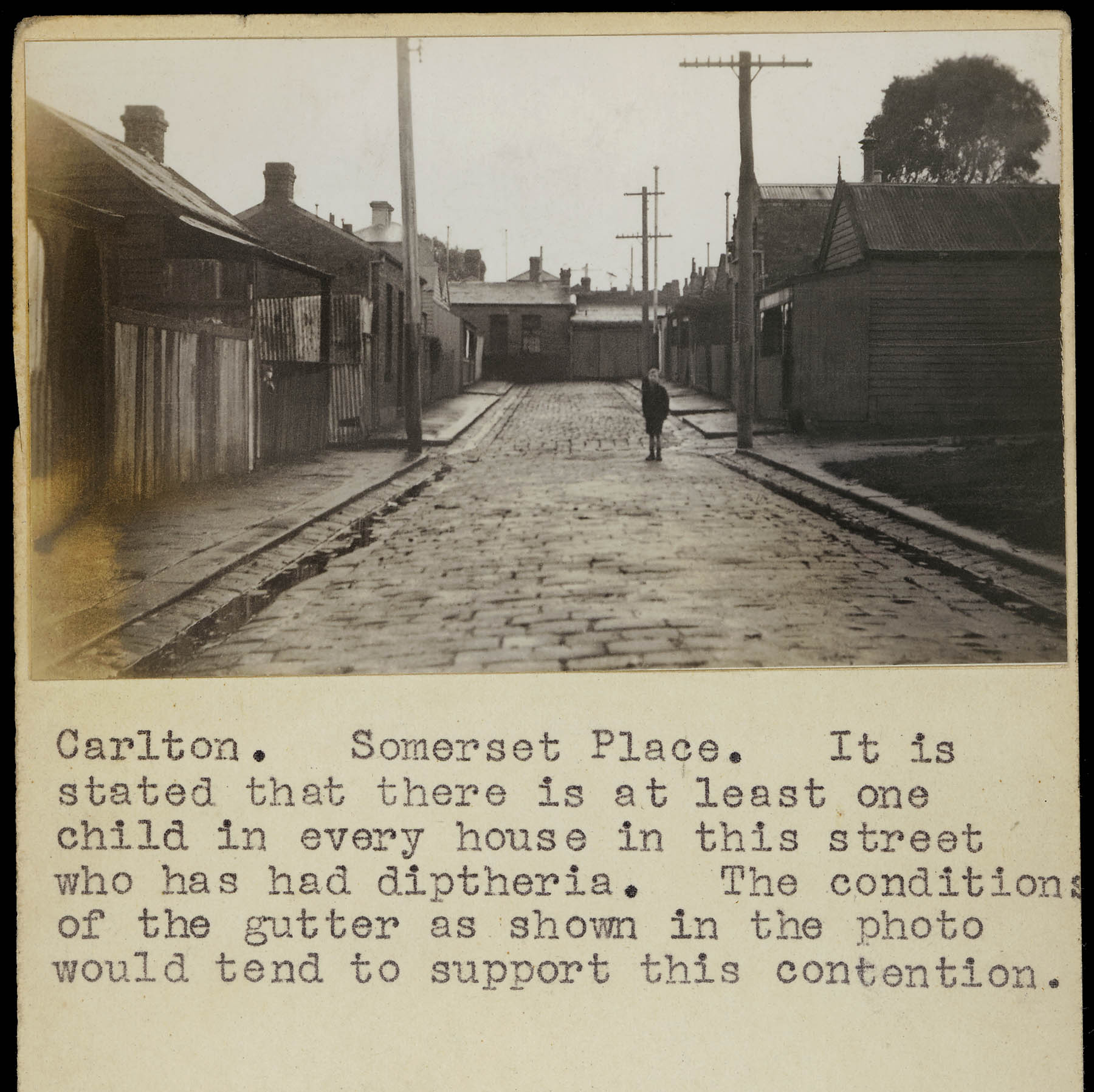
Phoenix Art Museum website

LIKE ART BLART ON FACEBOOK

Back to top

Stereographs: Rose Stereoscopic Views of Victorian Contingents leaving for the Boer War in South Africa, 1899-1900

October 2023

1st Victorian Contingent


George Rose (Australian, 1861-1942) (publisher, Windsor, Melbourne) 'The Victorian Continent' Melbourne, Victoria, 28th October 1899


Unknown photographer
George Rose (Australian, 1861-1942) (publisher, Windsor, Melbourne)
The Victorian Continent
Melbourne, Victoria, 28th October 1899
2 photographic prints on stereocard
9 x 18cm


A historical posting this week: stereographs of soldiers of the two Victorian Contingents leaving from Melbourne for the Boer War in South Africa, the first in October 1899 and the second contingent in January 1900.

I have digitally scanned and cleaned these stereographs (that is, two nearly identical photographs or photomechanical prints, paired to produce the illusion of a single three-dimensional image, usually when viewed through a stereoscope, usually mounted on card) that I borrowed from my friend Terence Hodgkinson. I have added bibliographic information where possible: a small history of Australia and the Boer War; enrolment and embarkation details of the contingents; photographs and details of both ships that the men departed on; and information on the Rose Stereograph Company and its founder.

These 3D stereographs really give you a feeling of what it would have been like to live in Australia in last year of the 19th century and the beginning of the 20th century: a society full of pomp and circumstance with banners and bunting, ceremony and marches supporting a militarised society, where Australia was still a colony and not yet a nation (Federation of Australia only occurred on 1 January 1901).

In the stereograph The Victorian Continent (Melbourne, Victoria, 28th October 1899, above) a crowd of spectators on Swanston Street, Melbourne (viewed from Flinders Street Station with people on the steps of St Paul’s Cathedral at back right) celebrates the departure for South Africa of the 1st Victorian Continent to the Boer War. Notice the flags of the United States of American, Japan, Scotland, United Kingdom and St. George (England) flying above the procession and the absence of the Australian flag (the current Australian flag was first flown on 3rd September 1901). Also note the girl at bottom right clinging onto the corrugated iron roof of wooden sheds where you can book tickets to the Moonee Valley Races and Port Melbourne.

In the series of three stereographs Victorian Continent, S.S. “Medic” Leaving the Pier (Melbourne, Victoria, 28th October 1899, below) we can observe the passage of time as the ship pulls away from the pier as the crowd of onlookers walks towards us, and in the two following stereographs Victorian Continent, S.S. “Medic” off to South Africa and The Victorian Continent, Last View of Boat (both Melbourne, Victoria, 28th October 1899, below) we note that the photographer on top of his high perch has swung his large plate camera through 180 degrees to photograph the crowd and stern of the ship as she passes from view. Again, in the series of stereographs of the departure of the 2nd Victorian contingent The Bushman’s Contingent. “Euryalus” Leaving Pier (Melbourne, Victoria, 13th January 1900, below) we an see how the photographer captures the ship as she slides past, closing in on the troops piled high on the deck to wave goodbye. With their layered geometric forms and serried ranks these are very modernist photographs for their time in Australia. Finally, note another photographer with his large format camera and tripod standing above the crowd at left in the stereograph 2nd Victorian Contingent. The Troops at the Pier (Melbourne, Victoria, 13th January 1900, below)

It’s been a lot of hard work but it’s great to have this record of Melbourne life online as large format jpg for as far as I can tell they are not available otherwise. If anyone needs high resolution scans of the images please get in touch, always happy to send them.

Dr Marcus Bunyan


Many thankx to my friend Terence Hodgkinson for allowing me to scan and publish his stereographs. Digital clean and colour balance by Marcus Bunyan. Please click on the photographs for a larger version of the image.


“It was national sentiment in Canada and Australia which demanded that they share in the dangers of empire as well as the benefits they had long known. Self-appreciation would no longer permit colonial peoples in such advanced areas to feel that they could make no significant contribution to the war in which Britain was engaged.”


Donald C. Gordon, The Dominion Partnership in Imperial Defense 1870-1914 (Baltimore, 1965), p. 152.


“South Australia was still a colony, and Australia not yet a nation, when the Boer War broke out in South Africa in 1899. The colonies of Australia each provided contingents. When the war was over the colonial contingents had been merged, reflecting Australia’s emergence as a nation. Its soldiers had already begun the process of forging a reputation for courage, initiative, and endurance, which would later be reinforced during the Great War.”


Adapted by Steve Larkins from original work by Will Clough as featured in “Tributes of Honour”. “Boer War (11 October 1899 to 30 May 1902),” on the Virtual War Memorial Australia website Nd [Online] 03/10/2023


George Rose (Australian, 1861-1942) (publisher, Windsor, Melbourne) 'The Victorian Contingent Procession' Melbourne, Victoria, 28th October 1899


Unknown photographer
George Rose (Australian, 1861-1942) (publisher, Windsor, Melbourne)
The Victorian Contingent Procession
Melbourne, Victoria, 28th October 1899
2 photographic prints on stereocard
9 x 18cm


A crowd of spectators watching a parade of the 1st Victorian Contingent to the Boer War. The white helmets of the soldiers are visible as a line passing through the arch emblazoned with the words “For Queen”. The soldiers are on their way to embark on a ship bound for South Africa.


George Rose (Australian, 1861-1942) (publisher, Windsor, Melbourne) 'The Victorian Contingent Procession' Melbourne, Victoria, 28th October 1899


Unknown photographer
George Rose (Australian, 1861-1942) (publisher, Windsor, Melbourne)
The Victorian Contingent Procession
Melbourne, Victoria, 28th October 1899
2 photographic prints on stereocard
9 x 18cm


George Rose (Australian, 1861-1942) (publisher, Windsor, Melbourne) 'The Victorian Contingent Procession' Melbourne, Victoria, 28th October 1899


Unknown photographer
George Rose (Australian, 1861-1942) (publisher, Windsor, Melbourne)
The Victorian Contingent Procession
Melbourne, Victoria, 28th October 1899
2 photographic prints on stereocard
9 x 18cm


George Rose (Australian, 1861-1942) (publisher, Windsor, Melbourne) 'Victorian Continent Procession (Governor's Carriage)' Melbourne, Victoria, 28th October 1899


Unknown photographer
George Rose (Australian, 1861-1942) (publisher, Windsor, Melbourne)
Victorian Continent Procession (Governor’s Carriage)
Melbourne, Victoria, 28th October 1899
2 photographic prints on stereocard
9 x 18cm


The enrolment of Victorian volunteers for service in the Transvaal should war break out began on 20 September at Victoria Barracks. Members of all branches of the service were invited to register, as well as citizens with previous military training,22 and by 28 September 760 men of the defence forces and 280 civilians had volunteered.23 But after 3 October, when Victoria committed itself to sending 125 infantry and 125 mounted infantry, the call for recruits became more specific. By 12 October 260 mounted men from a volunteer regiment of 800, and 250 infantry men from a militia regiment of 1900, had given in their names. This was hardly an enthusiastic response to the call to arms, but worse was to follow. When called up for medical and military efficiency tests, only 128 mounted infantry men and 107 infantry men reported.24 The medical examination also produced a surprise: forty percent of the applicants failed to pass a test considered not strict. The failure rate among the Victorian Mounted Rifles might be explained by the fact that as a volunteer regiment its recruits were not subject to any medical examination; but the same excuse could not be made for the militia, and their failure rate was just as high.25 To complete the numbers in both the mounted and unmounted units, the authorities called on the Victorian Rangers,a volunteer infantry regiment; but still lacking five men for the infantry unit they gave the places to members of the permanent artillery!26 Victoria had set out to enlist preferably single men of twenty to forty years of age, and it is a further measure of recruiting difficulties that twenty-seven married men embarked for South Africa.27

It was common for press reporters to regard the Victorian contingent as being composed of bushmen, but that could not have been so for about eighty percent of the infantry were recruited from Melbourne, with the remainder coming from Castlemaine, Ballarat, and Bendigo. Only the mounted unit was filled from country areas. A summary of the occupations of the Victorian contingent shows a preponderance of townmen, with rural areas being represented by landowners rather than rural workers.

Selection of the officers for the contingent on grounds that ignored seniority was questioned in the Legislative Assembly, but defended by the premier who claimed that efficiency had been the criterion.29 An Age report regarded the officers, who had been selected from “numerous volunteers”, as “young, intelligent and enthusiastic”,30 but when one considers the favourable connections of several of them, another factor in their selection seems likely. A biographical summary of the officers is given below. It indicates possible sources of influence, but more importantly, it gives an idea of the type of leader who sailed with the first and the second contingents. All the Victorians were colonials and in personal and professional details they appeared fairly typical of Australian militia officers of the time.31

From existing sources, fragmentary though they may be at times, there emerges a reasonably clear picture of the men who were to lay the foundations of Australian military tradition. They were predominantly unmarried men, on an average in their mid-twenties. The average physique might have approximated a man five feet eight and a half inches in height, ten stone twelve pounds in weight, and thirty-five inches around the chest.47 This suggests a tallish, lithe soldier, and the suggestion is supported by numerous contemporary references to the Australians’ admirable physique. If members of infantry units, the contingenters were most likely to have come from the cities; if members of mounted infantry and cavalry units they would have come mainly from country towns and rural areas. They would have had a liking for the military life, a modicum of discipline, but only a limited knowledge of the science of war.

L.M. Field. The Forgotten War. Australian Involvement in the South African Conflict of 1899-1902. Master of Arts thesis, Australian National University, September 1973, pp. 55-56; 60-61.


George Rose (Australian, 1861-1942) (publisher, Windsor, Melbourne) 'The Victorian Continent Taking Horses Abroad' Melbourne, Victoria, 28th October 1899


Unknown photographer
George Rose (Australian, 1861-1942) (publisher, Windsor, Melbourne)
The Victorian Continent Taking Horses Abroad
Melbourne, Victoria, 28th October 1899
2 photographic prints on stereocard
9 x 18cm


George Rose (Australian, 1861-1942) (publisher, Windsor, Melbourne) 'The Victorian Continent Going Aboard' Melbourne, Victoria, 28th October 1899


Unknown photographer
George Rose (Australian, 1861-1942) (publisher, Windsor, Melbourne)
The Victorian Continent Going Aboard 
Melbourne, Victoria, 28th October 1899
2 photographic prints on stereocard
9 x 18cm


George Rose (Australian, 1861-1942) (publisher, Windsor, Melbourne) 'Victorian Continent, S.S. "Medic" Leaving the Pier' Melbourne, Victoria, 28th October 1899


Unknown photographer
George Rose (Australian, 1861-1942) (publisher, Windsor, Melbourne)
Victorian Continent, S.S. “Medic” Leaving the Pier
Melbourne, Victoria, 28th October 1899
2 photographic prints on stereocard
9 x 18cm


A crowd of onlookers walk down Railway Pier in Port Melbourne to farewell the Victorian Contingent aboard the S.S. Medic as it departs for the Boer War in South Africa.


George Rose (Australian, 1861-1942) (publisher, Windsor, Melbourne) 'Victorian Continent, S.S. "Medic" Leaving the Pier' Melbourne, Victoria, 28th October 1899


Unknown photographer
George Rose (Australian, 1861-1942) (publisher, Windsor, Melbourne)
Victorian Continent, S.S. “Medic” Leaving the Pier
Melbourne, Victoria, 28th October 1899
2 photographic prints on stereocard
9 x 18cm


A crowd of onlookers walk down Railway Pier in Port Melbourne to farewell the Victorian Contingent aboard the S.S. Medic as it departs for the Boer War in South Africa.


George Rose (Australian, 1861-1942) (publisher, Windsor, Melbourne) 'Victorian Continent, S.S. "Medic" Leaving the Pier' Melbourne, Victoria, 28th October 1899


Unknown photographer
George Rose (Australian, 1861-1942) (publisher, Windsor, Melbourne)
Victorian Continent, S.S. “Medic” Leaving the Pier
Melbourne, Victoria, 28th October 1899
2 photographic prints on stereocard
9 x 18cm


A crowd of onlookers walk down Railway Pier in Port Melbourne to farewell the Victorian Contingent aboard the S.S. Medic as it departs for the Boer War in South Africa.


Unknown photographer. 'S.S. Medic leaving Sydney' Probably 1900s


Unknown photographer
S.S. Medic leaving Sydney
Probably 1900s
State Library of New South Wales
Public domain


S.S. Medic

SS Medic was a steamship built by Harland and Wolff in Belfast for the White Star Line which entered service in 1899. Medic was one of five Jubilee-class ocean liners (the others being the Afric, Persic, Runic and Suevic) built specifically to service the Liverpool – Cape Town – Sydney route. The ship’s name pertained to the ancient Persian region of Media and was pronounced Mee-dic.

Medic was the second Jubilee-class ship to be built for the Australia service. Like her sisters she was a single funnel liner, measuring just under 12,000 gross register tons (GRT), which had capacity for 320 passengers in third class on three decks, she also had substantial cargo capacity with seven cargo holds, most of them refrigerated for the transport of Australian meat.

After a long career with White Star, Medic was sold in 1928 and was converted into a whaling factory ship and renamed Hektoria, she remained in service in this role until being torpedoed and sunk during World War II in the Atlantic Ocean whilst sailing in a convoy in 1942. …

White Star Line career

Medic was launched at Belfast on 15 December 1898, but her completion was delayed until 6 July the following year, so that improvements that were being made to her earlier sister Afric could be incorporated into her construction.

Medic inaugurated White Star’s new Australia service with her maiden voyage, which started from Liverpool on 3 August 1899, she was then the largest ship ever to sail to Australia. Although Afric was the first ship built for the service, she did not make her first voyage to Australia until the following month. On board the maiden voyage was Charles Lightoller on his first assignment as fourth mate, he would later become the only senior officer to survive the sinking of the Titanic. Upon Medic‘s arrival in Australia she was greeted with a rapturous reception. Lightoller wrote:

“She was a show ship, the biggest that had ever been out there, and the people in Australia gave us the time of our lives. Everything and everywhere it was Medic


On her first return trip to the UK, Medic carried Australian troops to South Africa for the Boer War which had started in October 1899, and continued to carry troops to the conflict until it concluded in 1902. In October 1900, while Medic was anchored in Neutral Bay, Sydney Harbour, Charles Lightoller and some shipmates were involved in the “Fort Denison Incident”, a prank intended to fool locals into believing a Boer raiding party was attacking the city. The culprits were never apprehended but Lightoller confessed to his company’s superiors, after which he was transferred to the Atlantic route.

Text from the Wikipedia website


Allan C. Green (Australian, d. 1954) 'The steamship and White Star Liner Medic' Before 1940


Allan C. Green (Australian, d. 1954)
The steamship and White Star Liner Medic
Before 1940
State Library of Victoria, Allan C. Green collection of glass negatives
Public domain


George Rose (Australian, 1861-1942) (publisher, Windsor, Melbourne) 'Victorian Continent, S.S. "Medic" off to South Africa' Melbourne, Victoria, 28th October 1899


Unknown photographer
George Rose (Australian, 1861-1942) (publisher, Windsor, Melbourne)
Victorian Continent, S.S. “Medic” off to South Africa
Melbourne, Victoria, 28th October 1899
2 photographic prints on stereocard
9 x 18cm


A crowd of onlookers on Railway Pier in Port Melbourne waves off the Victorian Contingent aboard the S.S. Medic as it departs for the Boer War in South Africa.


The Victorian government took additional steps to ensure the success of the Melbourne farewell by making available holiday excursion fares from all stations to the city. It also approved the issue of free rail passes to the immediate relatives of country members of the contingent.107

The Victorian contingent was given a taste of the morrow by the crowds who thronged inside and outside the Melbourne Town Hall for the mayor’s farewell. “For the first time in the history of Victoria the thrill of patriotism vibrated through the nerves of the people”, and their hearts were stirred by the colony’s first plunge into “the great deeps of international warfare”. After the ceremony, the troops headed a triumphal procession back to barracks, and as the men disappeared within the gates the huge crowd sang Soldiers of the Queen. 111

The thronged streets were lined by 2000 school cadets for the march the following day, Saturday 28 October, and the contingent had an escort of 4000 members of the defence forces. Included in the column, and basking in a glory they must have thought gone forever, were former Imperial soldiers, “ambling but proud old wrecks” who wore the medals of Crimea and the Mutiny.112 Lieutenant Tremearne, in writing of the occasion later, told of people, perfect strangers to him, rushing into the ranks with tear filled eyes and murmuring, “Good luck, old man”.113 Followed by a flotilla of smaller craft, the Medic, largest ship ever to enter an Australian port, sailed down the bay and turned to the open sea. Long after the cheering had died and the launches had turned back, Victoria continued to salute her first contingent with huge bonfires which blazed along miles of coastline.114

L.M. Field. The Forgotten War. Australian Involvement in the South African Conflict of 1899-1902. Master of Arts thesis, Australian National University, September 1973, pp. 74-76.


George Rose (Australian, 1861-1942) (publisher, Windsor, Melbourne) 'The Victorian Continent, Last View of Boat' Melbourne, Victoria, 28th October 1899


Unknown photographer
George Rose (Australian, 1861-1942) (publisher, Windsor, Melbourne)
The Victorian Continent, Last View of Boat
Melbourne, Victoria, 28th October 1899
2 photographic prints on stereocard
9 x 18cm


The Rose Stereograph Company

The publishing output of this long-lived firm (which operated from about 1880 until it went into liquidation in 2017) was phenomenal, and when the remains of what must have been a vast photographic archive went on sale in June 2021 with Lloyds Auctions…

According to a brief history by postcard collector Leo Fitzgerald, the Rose story began when Cornish sea captain William Rose came to the Victorian Ballarat gold fields from California and married Grace Ash at Ballarat in 1861. The couple’s son, George, was born in 1862 at the town of Clunes. He worked in his father’s shoe shop in Chapel Street, Prahran, between 1877 and 1880 (apparently producing his earliest photos from those premises) and began spending his Sundays selling photos to picnic parties in the Dandenong hills. Finding his niche in photography, he moved to a new address at Armadale and founded his own firm publishing stereographic views. Over the years he travelled to many countries and recorded numerous important historic events with his stereographic camera equipment, opening offices in Sydney, Wellington and London. His images from Korea have become especially celebrated in Korea, where they represent an extremely rare glimpse of the nation in 1904, before the onset of the destruction wrought by the wars of the 20th century. …

Collector and researcher Ron Blum, whose excellent books built on Leo Fitzgerald’s work, wrote that George’s son Walter took over the business sometime before 1931, selling it in that year to long-time employees Edward Gilbert and Herbert Cutts… George’s wife, Elizabeth, died in 1929, and both George’s sons died before him. With no longer any legal interest in the company he had founded, George kept on taking photographs for the old firm, travelling around Australia in a mobile darkroom and camping along the way. He worked almost until his death in 1942, aged 80… The Rose Stereographic Company continued under the stewardship of Herbert “Bert” Cutts, who brought his son Neil into the business in the 1950s.

Greg Ray. “The Rose Stereograph Company: a snapshot,” on the Photo Time Tunnel website July 16, 2021 [Online] Cited 23/09/2023


George Rose was born in Clunes, Victoria, in 1861. He did not follow his father into boot-making, but was interested in astronomy and natural history. He was unconventional, of rather eccentric and Bohemian character. After moving to Melbourne in 1876, George developed his skills as a photographer, especially in the stereoscopic field – what is known as 3D photography today. He founded the Rose Stereographic Company in 1880. In 1901 George recorded the celebrations for the visit of the Duke and Duchess of York, and in the following years travelled across Australia and over 35 countries taking three-dimensional photos. By 1907 his business employed six people – two males and four females; at its peak, staff numbered around 20. In 1913 the Rose Stereographic Company began manufacturing “real photo” postcards. George’s son Walter managed the company, allowing his father to concentrate on taking the photographs. In 1931 the business was sold to two long-time employees, Edward Gilbert and Herbert (Bert) Cutts. George Rose died of cancer in 1942, having outlived both his sons, but the business remained in the Cutts family for many years before it finally closed down in March 2017.

Information from the book George Rose – The Postcard Era by Ron Blum.


2nd Victorian Contingent


George Rose (Australian, 1861-1942) (publisher, Windsor, Melbourne) 'The Bushman's Contingent at Camp, Langwarrin' Melbourne, Victoria, 13th January 1900


Unknown photographer
George Rose (Australian, 1861-1942) (publisher, Windsor, Melbourne)
The Bushman’s Contingent at Camp, Langwarrin
Melbourne, Victoria, 13th January 1900
2 photographic prints on stereocard
9 x 18cm


George Rose (Australian, 1861-1942) (publisher, Windsor, Melbourne) 'The Bushman's Contingent at Langwarrin' Melbourne, Victoria, 13th January 1900


Unknown photographer
George Rose (Australian, 1861-1942) (publisher, Windsor, Melbourne)
The Bushman’s Contingent at Langwarrin
Melbourne, Victoria, 13th January 1900
2 photographic prints on stereocard
9 x 18cm


George Rose (Australian, 1861-1942) (publisher, Windsor, Melbourne) 'The Bushman's Contingent Lining up for Grub' Melbourne, Victoria, 13th January 1900


Unknown photographer
George Rose (Australian, 1861-1942) (publisher, Windsor, Melbourne)
The Bushman’s Contingent Lining up for Grub
Melbourne, Victoria, 13th January 1900
2 photographic prints on stereocard
9 x 18cm


George Rose (Australian, 1861-1942) (publisher, Windsor, Melbourne) 'The Bushman's Contingent. Capt. Patterson Giving Instructions to Officers' Melbourne, Victoria, 13th January 1900


Unknown photographer
George Rose (Australian, 1861-1942) (publisher, Windsor, Melbourne)
The Bushman’s Contingent. Capt. Patterson Giving Instructions to Officers
Melbourne, Victoria, 13th January 1900
2 photographic prints on stereocard
9 x 18cm


George Rose (Australian, 1861-1942) (publisher, Windsor, Melbourne) 'The Bushman's Contingent. Group of Officers' Melbourne, Victoria, 13th January 1900


Unknown photographer
George Rose (Australian, 1861-1942) (publisher, Windsor, Melbourne)
The Bushman’s Contingent. Group of Officers
Melbourne, Victoria, 13th January 1900
2 photographic prints on stereocard
9 x 18cm


George Rose (Australian, 1861-1942) (publisher, Windsor, Melbourne) '2nd Victorian Contingent, at the Showgrounds' Melbourne, Victoria, 13th January 1900


Unknown photographer
George Rose (Australian, 1861-1942) (publisher, Windsor, Melbourne)
2nd Victorian Contingent, at the Showgrounds
Melbourne, Victoria, 13th January 1900
2 photographic prints on stereocard
9 x 18cm


George Rose (Australian, 1861-1942) (publisher, Windsor, Melbourne) '2nd Victorian Contingent. Procession (Scottish Regiment)' Melbourne, Victoria, 13th January 1900


Unknown photographer
George Rose (Australian, 1861-1942) (publisher, Windsor, Melbourne)
2nd Victorian Contingent. Procession (Scottish Regiment)
Melbourne, Victoria, 13th January 1900
2 photographic prints on stereocard
9 x 18cm


The Scottish Regiment parading down Collins Street (looking east), Melbourne. The building on the left appears to be the Colonial Mutual Life Building (demolished) and further along, the clock tower is the town hall and the spire is Scots Church. Interesting to note the American flag flying the building at left. I wonder why?


George Rose (Australian, 1861-1942) (publisher, Windsor, Melbourne) '2nd Victorian Contingent. Procession' Melbourne, Victoria, 13th January 1900


Unknown photographer
George Rose (Australian, 1861-1942) (publisher, Windsor, Melbourne)
2nd Victorian Contingent. Procession
Melbourne, Victoria, 13th January 1900
2 photographic prints on stereocard
9 x 18cm


The 2nd Victorian Contingent parading down Collins Street (looking east), Melbourne. The building on the left appears to be the Colonial Mutual Life Building (demolished) and further along, the clock tower is the town hall and the spire is Scots Church. Interesting to note the American flag flying the building at left. I wonder why?


George Rose (Australian, 1861-1942) (publisher, Windsor, Melbourne) '2nd Victorian Contingent. Horses alongside Boat' Melbourne, Victoria, 13th January 1900


Unknown photographer
George Rose (Australian, 1861-1942) (publisher, Windsor, Melbourne)
2nd Victorian Contingent. Horses alongside Boat
Melbourne, Victoria, 13th January 1900
2 photographic prints on stereocard
9 x 18cm


Departed Melbourne: SS Euryalus 13 January 1900.

Raised predominantly on the Mounted Rifle Regiment, formed by Lt-Col Tom Price in 1885, and Victorian Rangers, Militia including the battalions of the Infantry Brigade and some from the Royal Australian Artillery. Colonel Price was initially made CO of the Hanover Road Field Force, including one battalion of Lancashire Militia, two companies of Prince Albert’s Guards and Tasmanians. Price was the only Australian Colonial Officer placed in command of British units during the Boer War.

A seminal moment in the Boer War was the capture of Pretoria in 1900 by British commander, Lord Roberts. The Victorian 2nd (Mounted Rifles) Contingent was the first unit to enter the city. A large number of this unit were invalided back to Victoria, having experienced starvation and extreme exhaustion on some treks.

Strength: 265
Service period: Feb 1900 – Dec 1900.

Text from the Defending Victoria website


George Rose (Australian, 1861-1942) (publisher, Windsor, Melbourne) '2nd Victorian Contingent. Soldiers Taking Saddles Aboard' Melbourne, Victoria, 13th January 1900


Unknown photographer
George Rose (Australian, 1861-1942) (publisher, Windsor, Melbourne)
2nd Victorian Contingent. Soldiers Taking Saddles Aboard
Melbourne, Victoria, 13th January 1900
2 photographic prints on stereocard
9 x 18cm


George Rose (Australian, 1861-1942) (publisher, Windsor, Melbourne) '2nd Victorian Contingent. Horses Going Aboard' Melbourne, Victoria, 13th January 1900


Unknown photographer
George Rose (Australian, 1861-1942) (publisher, Windsor, Melbourne)
2nd Victorian Contingent. Horses Going Aboard
Melbourne, Victoria, 13th January 1900
2 photographic prints on stereocard
9 x 18cm


The horses of the 2nd Victorian Contingent to the Boer War about to be put aboard the steamship “Euryalus”, bound for South Africa. The 2nd Victorian Contingent consisted entirely of mounted rifles.


Unknown photographer. 'S.S. Euryalus' Between 1898 and 1913?


Unknown photographer
S.S. Euryalus
Between 1898 and 1913?
Albumen silver print
13.8 x 19.7cm
State Library of Victoria, R.J. French photographic collection of ships
Gift of Mr R. J. French 1979
Public domain


S.S. Euryalus

The steamer Euryalus returned from South Africa
last night, berthing at the Port Melbourne Town
Pier at about a quarter-past 9 o’clock. It was
thought that she, like the Moravian, might have
had some invalided Australian troops on board, but
there were not any, although the vessel brought a
number of saloon and steerage passengers. She had
an uneventful voyage. Durban was left on the 5th
inst., and normal weather was experienced until
the Euryalus reached lat. 41deg. S. and lon. 97deg.
E., where foggy conditions set in, and these continued
to lon. 109deg. E. She passed Cape Otway
at 11.30 a.m. yesterday, and entered Port Phillip
Heads at 5.30 p.m.

“S.S. EURYALUS.The Argus (Melbourne, Vic.: 1848-1957) 26 May 1900: p. 12. Web. 23 Sep 2023 http://nla.gov.au/nla.news-article9542431


Name: EURYALUS
Type: Passenger Cargo Ship
Launched: 08/06/1898
Completed: 08/1898
Builder: Palmers’ Shipbuilding & Iron Co Ltd
Yard: Jarrow
Yard Number: 732
Dimensions: 3570grt, 2286nrt, 360.0 x 45.7 x 24.1ft
Engines: T3cyl (27, 45.5 & 74 x 48ins), 458nhp
Engines by: Palmers’ Shipbuilding & Iron Co Ltd, Jarrow
Propulsion: 1 x Screw, 11.5knots
Construction: Steel

History

04/11/1898: A Currie & Co, Melbourne
1913: British India Steam Navigation Co Ltd, Glasgow
1913: Placed on the India to Australia service
1919: Accommodation increased to include 2441 x deck passengers
31/12/1923: Arrived for breaking up at La Spezia. Cost £6,500

Comments

1898: Completed at a price of £47,500
Accommodation for 22 x 1st and 24 x 2nd Class passengers


George Rose (Australian, 1861-1942) (publisher, Windsor, Melbourne) '2nd Victorian Contingent. Going Aboard the "Euryalus"' Melbourne, Victoria, 13th January 1900


Unknown photographer
George Rose (Australian, 1861-1942) (publisher, Windsor, Melbourne)
2nd Victorian Contingent. Going Aboard the “Euryalus”
Melbourne, Victoria, 13th January 1900
2 photographic prints on stereocard
9 x 18cm


George Rose (Australian, 1861-1942) (publisher, Windsor, Melbourne) '2nd Victorian Contingent. Going Aboard the "Euryalus"' Melbourne, Victoria, 13th January 1900


Unknown photographer
George Rose (Australian, 1861-1942) (publisher, Windsor, Melbourne)
2nd Victorian Contingent. Going Aboard the “Euryalus”
Melbourne, Victoria, 13th January 1900
2 photographic prints on stereocard
9 x 18cm


George Rose (Australian, 1861-1942) (publisher, Windsor, Melbourne) '2nd Victorian Contingent. Horses Going Aboard' Melbourne, Victoria, 13th January 1900


Unknown photographer
George Rose (Australian, 1861-1942) (publisher, Windsor, Melbourne)
2nd Victorian Contingent. Horses Going Aboard
Melbourne, Victoria, 13th January 1900
2 photographic prints on stereocard
9 x 18cm


Australia and the Boer War, 1899-1902

As part of the British Empire, the Australian colonies offered troops for the war in South Africa. Australians served in contingents raised by the six colonies or, from 1901, by the new Australian Commonwealth. For a variety of reasons many Australians also joined British or South African colonial units in South Africa: some were already in South Africa when the war broke out; others either made their own way to the Cape or joined local units after their enlistment in an Australian contingent ended. Recruiting was also done in Australia for units which already existed in South Africa, such as the Scottish Horse.

Australians served mostly in mounted units formed in each colony before despatch, or in South Africa itself. The Australian contribution took the form of five “waves”. The first were the contingents raised by the Australian colonies in response to the outbreak of war in 1899, which often drew heavily on the men in the militia of the colonial forces. The second were the “bushmen” contingents, which were recruited from more diverse sources and paid for by public subscription or the military philanthropy of wealthy individuals. The third were the “imperial bushmen” contingents, which were raised in ways similar to the preceding contingents, but paid for by the imperial government in London. Then were then the “draft contingents”, which were raised by the state governments after Federation on behalf of the new Commonwealth government, which was as yet unable to do so. Finally, after Federation, and close to the end of the war, the Australian Commonwealth Horse contingents were raised by the new Federal government. These contingents fought in both the British counter-offensive of 1900, which resulted in the capture of the Boer capitals, and in the long, weary guerrilla phases of the war which lasted until 1902. Colonial troops were valued for their ability to “shoot and ride”, and in many ways performed well in the open war on the veldt. There were significant problems, however, with the relatively poor training of Australian officers, with contingents generally arriving without having undergone much training and being sent on campaign immediately. These and other problems faced many of the hastily raised contingents sent from around the empire, however, and were by no means restricted to those from Australia…

The Australians at home initially supported the war, but became disenchanted as the conflict dragged on, especially as the effects on Boer civilians became known…

Conditions for both soldiers and horses were harsh. Without time to acclimatise to the severe environment and in an army with a greatly over-strained logistic system, the horses fared badly. Many died, not just in battle but of disease, while others succumbed to exhaustion and starvation on the long treks across the veld. Quarantine regulations in Australia ensured that even those which did survive could not return home. In the early stages of the war Australian soldier losses were so high through illness that components of the first and second contingents ceased to exist as viable units after a few months of service.

Extract of text from “Australia and the Boer War, 1899-1902” on the Australian War Memorial website Nd [Online] Cited 06/10/2023


George Rose (Australian, 1861-1942) (publisher, Windsor, Melbourne) 'The Bushman's Contingent. Horses Going Aboard' Melbourne, Victoria, 13th January 1900


Unknown photographer
George Rose (Australian, 1861-1942) (publisher, Windsor, Melbourne)
The Bushman’s Contingent. Horses Going Aboard
Melbourne, Victoria, 13th January 1900
2 photographic prints on stereocard
9 x 18cm


George Rose (Australian, 1861-1942) (publisher, Windsor, Melbourne) 'The Bushman's Contingent. "Euryalus" Leaving Pier' Melbourne, Victoria, 13th January 1900


Unknown photographer
George Rose (Australian, 1861-1942) (publisher, Windsor, Melbourne)
The Bushman’s Contingent. “Euryalus” Leaving Pier
Melbourne, Victoria, 13th January 1900
2 photographic prints on stereocard
9 x 18cm


George Rose (Australian, 1861-1942) (publisher, Windsor, Melbourne) 'The Bushman's Contingent, "Euryalus" Leaving Pier' Melbourne, Victoria, 13th January 1900


Unknown photographer
George Rose (Australian, 1861-1942) (publisher, Windsor, Melbourne)
The Bushman’s Contingent, “Euryalus” Leaving Pier
Melbourne, Victoria, 13th January 1900
2 photographic prints on stereocard
9 x 18cm


George Rose (Australian, 1861-1942) (publisher, Windsor, Melbourne) 'The Bushman's Contingent, "Good-bye, Lads."' Melbourne, Victoria, 13th January 1900


Unknown photographer
George Rose (Australian, 1861-1942) (publisher, Windsor, Melbourne)
The Bushman’s Contingent, “Good-bye, Lads.”
Melbourne, Victoria, 13th January 1900
2 photographic prints on stereocard
9 x 18cm


George Rose (Australian, 1861-1942) (publisher, Windsor, Melbourne) 'The Bushman's Contingent, "Good-bye, Lads."' Melbourne, Victoria, 13th January 1900


Unknown photographer
George Rose (Australian, 1861-1942) (publisher, Windsor, Melbourne)
The Bushman’s Contingent, “Good-bye, Lads.”
Melbourne, Victoria, 13th January 1900
2 photographic prints on stereocard
9 x 18cm


George Rose (Australian, 1861-1942) (publisher, Windsor, Melbourne) '2nd Victorian Contingent. Going Aboard the "Euryalus"' Melbourne, Victoria, 13th January 1900


Unknown photographer
George Rose (Australian, 1861-1942) (publisher, Windsor, Melbourne)
2nd Victorian Contingent. The Troops at the Pier
Melbourne, Victoria, 13th January 1900
2 photographic prints on stereocard
9 x 18cm


Soldiers and sailors lined up on the pier, at a farewell parade for the troops of the 2nd Victoria Contingent to the Boer War. The troops of the 2nd Victoria Contingent, all Mounted Rifles, are aboard the steamship “Euryalus”, which is about to depart for Cape Town, South Africa. Note the photographer with his large format camera on tripod at left.


George Rose (Australian, 1861-1942) (publisher, Windsor, Melbourne) '2nd Victorian Contingent. The Last View of the "Euryalus"' Melbourne, Victoria, 13th January 1900


Unknown photographer
George Rose (Australian, 1861-1942) (publisher, Windsor, Melbourne)
2nd Victorian Contingent. The Last View of the “Euryalus”
Melbourne, Victoria, 13th January 1900
2 photographic prints on stereocard
9 x 18cm


LIKE ART BLART ON FACEBOOK

Back to top

Exhibition: ‘Berenice Abbott’s New York Album, 1929’ at the Metropolitan Museum of Art, New York

Exhibition dates: 2nd March – 4th September 2023


Walker Evans (American, 1903-1975) [Berenice Abbott] 1929-1930 from the exhibition 'Berenice Abbott's New York Album, 1929' at the Metropolitan Museum of Art, New York, March - Sept 2023


Walker Evans (American, 1903-1975)
[Berenice Abbott]
1929-1930
Gelatin silver print
16.9 x 11.8cm (6 5/8 x 4 5/8 in.)
Metropolitan Museum of Art
Purchase, The Horace W. Goldsmith Foundation Gift, through Joyce and Robert Menschel, 1997
© Walker Evans Archive, The Metropolitan Museum of Art


Abbott appraises the camera with cool assurance in this portrait, made just after her return from Paris to New York. Her gamine-short hair and bare face affect a chic nonchalance that intrigued Evans. Describing her to a friend after their first meeting, he wrote: “You would like Berenice Abbott, with her hair brushed forward and her woozy eyes.” Her work likewise impressed the young photographer, then finding his footing in the field. Evans’s picture betrays admiration for his new acquaintance, whose burgeoning career offered a model for his own.


American visionary

What a wonderful photographer Berenice Abbott developed into and what a debt of gratitude we owe her for saving the archive of French photographer Eugène Atget whose photographs initially influenced her urban(e) style.

“Abbott felt the changing city [New York] needed an equivalent to the French photographer Eugène Atget (1857-1927), who had documented Paris during a critical period of transition in the late 19th and early 20th centuries with what Abbott called “the shock of realism unadorned.””

It is interesting to analyse Abbott’s New York photographs in relation to Atget. In photographs such as the grouping on Album Page 9: Fulton Street Fish Market and Lower East Side, Manhattan (1929, below) there is an almost symbiotic relationship between Atget’s photographs of street Petits Métiers (trades and professions) and those of Abbott. “The subjects were not sensational, but nevertheless shocking in their very familiarity,” she said of seeing Atget’s photographs in Man Ray’s studio in 1926. Similarly, we can recognise in Abbott’s grouping in Album Page: City Hall Park and Brooklyn Bridge Vicinity, Manhattan (1929, below) and Pingpank Barbershop, 413 Bleecker Street, Manhattan (1938, below) an affinity with Atget’s photographs of architectural details of door handles and the front of shops.

A step away from Atget’s aesthetic are Abbott’s photographs such as Brooklyn Bridge, With Pier 21, Pennsylvania R.R. (1937, below), West Street (1936, below) and Henry Street from Market, Looking West, Manhattan (1935, below) where the foreground of each photograph mimics Atget’s photographs of Old Paris whilst the soaring background of skyscrapers and bridges is all modernist New York, the near / far of the picture plane becoming old / new. Abbott chronicled “the changing aspect of the world’s great metropolis. … Its hurrying tempo, its congested streets, the past jostling the present.”

Still further away from Atget’s aesthetic are Abbott’s photographs grouped in Album Page 1: Financial District, Broadway and Wall Street Vicinity, Manhattan (1929, below) where the artist uses with the chiaroscuro (the treatment of light and shade) within the canyons of skyscraper New York – and modernist almost constructivist photographs such as Canyon, Broadway and Exchange Place (1936, below) and Manhattan Bridge, Looking Up (1936, below) where the artist plays with pictorial perspective by pointing her camera skywards.

Finally, there are Abbott’s photographs that bear no relation to those of Atget, where Abbott as an artist has stepped out of the older artist’s shadow and developed her own artistic signature. Those wonderfully abstract and enigmatic photographs at lower left and right in Album Page 5: Pier 17, South Street Seaport, Manhattan push the boundaries of 1930s photographic language. In other glorious photographs such as The El at Columbus and Broadway (1929, below) and The El, 2nd and 3rd Avenue Lines, Bowery and Division Street, Manhattan (1936, below) Abbott captured the random disorder of urban activity with a focused intensity of vision that produces magical images… and by that I mean, images that transport you into other spaces, other states of being. Her dadaist poet Tristan Tzara put it this way: “We leave with those leaving arrive with those arriving / leave with those arriving arrive when the others leave.”

Dr Marcus Bunyan


Many thankx to the Metropolitan Museum of Art for allowing me to publish the photographs in the posting. Please click on the photographs for a larger version of the image.


In January 1929, after eight years in Europe, the American photographer Berenice Abbott (1898-1991) boarded an ocean liner to New York City for what was meant to be a short visit. Upon arrival, she found the city transformed and ripe with photographic potential. “When I saw New York again, and stood in the dirty slush, I felt that here was the thing I had been wanting to do all my life,” she recalled. With a handheld camera, Abbott traversed the city, photographing its skyscrapers, bridges, elevated trains, and neighbourhood street life. She pasted these “tiny photographic notes” into a standard black-page album, arranging them by subject and locale.

Consisting of 266 small black-and-white prints arranged on thirty-two pages, Abbott’s New York album marks a key turning point in her career – from her portrait work in Paris to the urban documentation that culminated in her federally funded project, Changing New York (1935-1939). Berenice Abbott’s New York Album, 1929 presents a selection of unbound pages from this unique album, shedding new light on the creative process of one of the great photographic artists of the twentieth century. For context, the exhibition also features views of Paris by Eugène Atget (French, 1857-1927), whose extensive photographic archive Abbott purchased and publicised; views of New York City by her contemporaries Walker Evans, Paul Grotz, and Margaret Bourke-White; and photographs from Changing New York. The exhibition is made possible by The Robert Mapplethorpe Foundation, Inc.

Text from the Metropolitan Museum of Art website


MAP


This map charts some of the locations across Manhattan that Berenice Abbott photographed in her New York Album (1929). As the album bears almost no notations, identifying the exact sites depicted in the photographs had to be done through visual recognition of streets, buildings, and other urban landmarks.

Some of the iconic places Abbott photographed, such as the main branch of the New York Public Library and Trinity Church on Wall Street, haven’t changed much since 1929. Others, such as the city’s four elevated train lines and Harlem’s famed Lafayette Theater, have vanished completely. Several sites have gone through multiple transformations within the past century. The National Winter Garden Theater on Houston Street and Second Avenue opened in 1912 as a cinema and vaudeville theatre. By the time Abbott photographed it in 1929, it had been converted to a burlesque house; today, it’s a Whole Foods. The map is an invitation to explore Abbott’s photographs beyond the confines of the Museum’s galleries, and, like the artist herself, to cherish New York as a vibrant metropolis that is, and always has been, defined by change.

For their invaluable help with the historical research, The Met is grateful to the Jones Family Research Collective: former Manhattan Borough Historian Celedonia “Cal” Jones; his daughter, Diane Jones Randall; and his son, Kenneth Jones. Explore Abbott’s 1929 images of New York here with images of each album page.


Berenice Abbott (American, 1898-1991) 'Eugène Atget' 1927


Berenice Abbott (American, 1898-1991)
Eugène Atget
1927
Gelatin silver print
4 3/8 × 3 5/16 in. (11.1 × 8.4cm)
Metropolitan Museum of Art
Gift of Maria Morris Hambourg, in honour of John Szarkowski, 2020
© Berenice Abbott / Commerce Graphics Ltd. Inc.


Born in Ohio, Berenice Abbott moved to Paris and in 1923 became Man Ray’s darkroom assistant. In 1927 she made this photograph of Atget, the renowned documentarian of the streets of Paris and an unwitting hero of the surrealists; when she returned to his apartment to deliver a print of her portrait, Abbott learned of the elderly artist’s death. The unfortunate circumstance put in motion a process that led to Abbott’s purchase of Atget’s archive of five thousand photographs and one thousand negatives, the first (1930) monograph on Atget (edited by Abbott), and the collection’s eventual acquisition by MoMA in 1968.

In the spring of 1927, Abbott invited Atget to sit for a portrait in her Paris studio. She made only three exposures that day: a standing pose, a frontal view, and this profile view. Unfortunately, Atget never saw the photographs. When Abbott arrived at his apartment a few months later to deliver the proofs, she found that the elderly photographer had died suddenly. This portrait was used as the frontispiece in the first book devoted to his work, Atget, Photographe de Paris (1930), displayed in the case nearby.


Berenice Abbott (American, 1898-1991) 'James Joyce' 1926 from the exhibition 'Berenice Abbott's New York Album, 1929' at the Metropolitan Museum of Art, New York, March - Sept 2023


Berenice Abbott (American, 1898-1991)
James Joyce
1926
Gelatin silver print
23.3 x 17.4cm (9 3/16 x 6 7/8in.)
Metropolitan Museum of Art
Gilman Collection, Purchase, Ann Tenenbaum and Thomas H. Lee Gift, 2005
© Berenice Abbott / Commerce Graphics Ltd. Inc.


Berenice Abbott opened a photographic portrait studio in Paris in 1926 after having worked for three years as an assistant to Man Ray, whom she had met in New York. Although her Paris portraits are indebted stylistically to Man Ray’s, she brought to them a sympathetic eye that was very much her own. Her portraits of women are notable for their empathic understanding of her subjects, but she reached a depth of expression in her photographs of James Joyce (1882-1941). Abbott photographed Joyce on two occasions, the first in 1926 at his home, the second in 1928 at her studio, as was her more customary practice. In spite of Abbott’s annotation on the back of the print, this portrait belongs to the earlier session, when Joyce was photographed both with and without the patch over his eye, worn because of his sadly degenerating sight. For this particular exposure Joyce removed the patch and held it, with his glasses, in his right hand; his forehead still bears the diagonal impression of the ribbon. This intimate portrait, with its softly diffused lighting, suggests the complex, introverted character of Joyce’s imagination. It is with good reason that Abbott’s are considered the definitive portraits of the author of “Ulysses” and “Finnegan’s Wake.”


Berenice Abbott (American, 1898-1991) 'Djuna Barnes' 1925 from the exhibition 'Berenice Abbott's New York Album, 1929' at the Metropolitan Museum of Art, New York, March - Sept 2023


Berenice Abbott (American, 1898-1991)
Djuna Barnes
1925
Gelatin silver print
22.6 x 17.1cm (8 7/8 x 6 3/4 in.)
Purchase, Joyce and Robert Menschel Gift, 1987


Abbott lived with the American writer Djuna Barnes when she moved from Ohio to Greenwich Village in 1918, and the two women remained friends, and occasional romantic rivals, throughout their lives. In this portrait, made in Man Ray’s Paris studio, Barnes is elegantly attired and addresses the camera with a smouldering gaze above a slight smile. A decade later, Barnes would publish Nightwood (1936), a classic of lesbian fiction inspired by her tormented affair with the American artist Thelma Wood (1901-1970), who also had a brief relationship with Abbott.


Berenice Abbott (American, 1898-1991) 'Buddy Gilmore, Paris' 1926-1927 from the exhibition 'Berenice Abbott's New York Album, 1929' at the Metropolitan Museum of Art, New York, March - Sept 2023


Berenice Abbott (American, 1898-1991)
Buddy Gilmore, Paris
1926-1927
Gelatin silver print
23.1 x 17.2cm (9 1/8 x 6 3/4 in.)
Purchase
Gift of the Polaroid Corporation and matching funds from the National Endowment for the Arts, 1981


Gilmore was an American jazz drummer known for his acrobatic dexterity and energetic solos. After seeing him perform at Zelli’s, a nightclub in Paris, Abbott invited him to her studio to pose for this action portrait with his drum set. “I was simply crazy about his playing,” she recalled.


Berenice Abbott (American, 1898-1991) 'Fifth Avenue, Nos. 4, 6, 8, Manhattan' March 20, 1936 from the exhibition 'Berenice Abbott's New York Album, 1929' at the Metropolitan Museum of Art, New York, March - Sept 2023


Berenice Abbott (American, 1898-1991)
Fifth Avenue, Nos. 4, 6, 8
1936
Gelatin silver print
19.2 x 24.4cm (7 9/16 x 9 5/8 in.)
Metropolitan Museum of Art
Ford Motor Company Collection, Gift of Ford Motor Company and John C. Waddell, 1987
© Berenice Abbott / Commerce Graphics Ltd. Inc.


In 1929, after eight years in Paris, Abbott returned to America, bringing with her an immense collection of photographs by Eugène Atget and the ideas of European modernist photographers. Her first pictures of New York show the modernist influence in the sharply angled viewpoints and tendency toward abstraction. By the mid-1930s, however, Atget emerged as the stronger influence, as Abbott’s style became more straightforward and documentary.

In 1935 Abbott embarked on a series documenting New York funded by the Federal Art Project, and during the next four years she made hundreds of images of the city’s monuments and architecture. Ninety-seven of these, including “Fifth Avenue, Nos. 4, 6, 8,” were published in “Changing New York” (1939). The caption for this picture informs us that “No. 8 was once the home of the art collection which formed a part of the original Metropolitan Museum of Art.” It was built in 1856 for John Taylor Johnston, president of the Central Railroad of New Jersey. A leading collector of American art, Johnston was a founder of The Met and was elected its first president in 1870.

The New York Album

Abbott sailed for New York in January 1929, hoping to find an American publisher for a proposed book of Atget’s photographs and to promote her own portrait work. She brought with her a new handheld Curt Bentzin camera, thinking she might make some views of the city to sell to publishers in Europe. Inspired by the towering skyscrapers that had reshaped the American metropolis in the 1920s, Abbott pointed her camera up, down, and at skewed angles, creating dynamic compositions with sharp contrasts of light and shadow. She wandered all over Manhattan, photographing storefronts in Harlem, construction sites in midtown, and street vendors and tenement buildings in Chinatown and on the Lower East Side. She paid special attention to the city’s transportation infrastructure: bridges, elevated train lines, railroad terminals, ships docked on the waterfront.

Without access to a darkroom, Abbott had her negatives processed and printed at local drug stores and commercial labs. She pasted the little prints onto the pages of a standard photo album, creating a kind of sketchbook of subjects and themes. When The Met acquired it between 1978 and 1984, the album had already been disbound. Abbott reconstructed the sequence of the first eleven pages displayed here for a publication in 2013; the order of the remaining pages is unknown.

Changing New York

Abbott’s New York album laid the groundwork for her ambitious documentary project Changing New York (1935-1939). Comprising more than 300 negatives and a wealth of research, the project was funded by the Federal Art Project of the Works Progress Administration, a government program dedicated to supporting unemployed artists during the Great Depression. Aided by a team of researchers, field assistants, and darkroom technicians, Abbott chronicled “the changing aspect of the world’s great metropolis. … Its hurrying tempo, its congested streets, the past jostling the present.” She returned to many of the locations she visited in 1929, but the new photographs, made with a large-format view camera like the one Atget used, are more straightforward and less influenced by the jazzy, sharp-angled style of European modernism. The project culminated in a book, published in 1939, featuring ninety-seven photographs with captions by Abbott’s companion, the art critic Elizabeth McCausland. The photographs were widely exhibited and complete sets of the final images were distributed to high schools, libraries, and other public institutions throughout the New York area.


Berenice Abbott (American, 1898-1991) [Album Page 1: Financial District, Broadway and Wall Street Vicinity, Manhattan] 1929


Berenice Abbott (American, 1898-1991)
[Album Page 1: Financial District, Broadway and Wall Street Vicinity, Manhattan]
1929
Gelatin silver prints
Images: approx. 2 1/4 × 3 1/4 in. (5.7 × 8.2cm), and the reverse
Album Page: 10 × 13 in. (25.4 × 33cm), irregular
Metropolitan Museum of Art
© Berenice Abbott / Commerce Graphics Ltd. Inc.
Gift of Emanuel Gerard, 1984


Berenice Abbott (American, 1898-1991) [Album Page 1: Financial District, Broadway and Wall Street Vicinity, Manhattan] 1929 (detail)


Berenice Abbott (American, 1898-1991)
[Album Page 1: Financial District, Broadway and Wall Street Vicinity, Manhattan] (detail)
1929
Gelatin silver prints
Images: approx. 2 1/4 × 3 1/4 in. (5.7 × 8.2cm), and the reverse
Album Page: 10 × 13 in. (25.4 × 33cm), irregular
Metropolitan Museum of Art
© Berenice Abbott / Commerce Graphics Ltd. Inc.
Gift of Emanuel Gerard, 1984


Berenice Abbott (American, 1898-1991) 'Page from New York Album' 1929-1930 (detail)

Berenice Abbott (American, 1898-1991) 'Page from New York Album' 1929-1930 (detail)

Berenice Abbott (American, 1898-1991) 'Page from New York Album' 1929-1930 (detail)

Berenice Abbott (American, 1898-1991) 'Page from New York Album' 1929-1930 (detail)

Berenice Abbott (American, 1898-1991) 'Page from New York Album' 1929-1930 (detail)


Berenice Abbott (American, 1898-1991)
[Album Page 1: Financial District, Broadway and Wall Street Vicinity, Manhattan] (details)
1929
Gelatin silver prints
Images: approx. 2 1/4 × 3 1/4 in. (5.7 × 8.2cm), and the reverse
Album Page: 10 × 13 in. (25.4 × 33cm), irregular
Metropolitan Museum of Art
© Berenice Abbott / Commerce Graphics Ltd. Inc.
Gift of Emanuel Gerard, 1984


If you were an American artist or writer in the 1920s, Paris was where you wanted to be. Springfield, Ohio-born photographer Berenice Abbott (1898-1991) arrived there in 1921 by way of New York, and by early 1929 she had managed to establish herself in the French capital’s flourishing interwar avant-garde scene – first working as an assistant to Man Ray and later taking her own celebrated portraits of luminaries such as James Joyce and Djuna Barnes. She even changed the spelling of her name from “Bernice” to the more Gallic “Berenice.”

Yet somehow this magnet for culturally minded expatriates lost its hold on Abbott the moment she set foot in Lower Manhattan – on a messy January day, no less – at the beginning of what was supposed to be a short trip back to the United States. She had lived in New York once, just eight years before, but in her absence the city had been scaled up: new skyscrapers were rising, the population was exploding, and every block, it seemed, was abuzz with commerce and construction. (The market crash of October 1929 was still many months away). Suddenly, Paris was passe. “When I saw New York again, and stood in the dirty slush,” she later recalled, “I felt that here was the thing I had been wanting to do all my life.”

“Berenice Abbott’s New York Album, 1929,” a small but inspiring show at the Metropolitan Museum, channels the exhilaration Abbott felt upon arriving in the city. The exhibition’s focus is a disbound scrapbook with seven to nine photographs per page, all taken over the course of that year, as Abbott paced the streets (and piers, bridges and train platforms) with a hand-held camera and a compulsion to capture New York’s unruly, cutthroat modernity.

With its 32 pages of small contact prints processed at drugstores and commercial labs (or as Abbott called them, “tiny photographic notes”), the album can be seen as a rough draft of her well-known Works Progress Administration project of the 1930s, “Changing New York.” (Several examples from this later series are in the Met show, including a disconcertingly ethereal view of Seventh Avenue taken from the top of a 46-story building in the garment district.) But Abbott’s “New York Album” is a fascinating artwork in its own right, an adrenalized and ambitious alignment of artist and subject.

Abbott felt the changing city needed an equivalent to the French photographer Eugène Atget (1857-1927), who had documented Paris during a critical period of transition in the late 19th and early 20th centuries with what Abbott called “the shock of realism unadorned.” She had come to New York as part of an impassioned effort to promote Atget’s oeuvre, one that included purchasing the photographer’s archive after his death and making her own prints from his glass-plate negatives; in the “New York Album” she goes further, becoming, in effect, his heir.

The Met’s exhibition incorporates several Atget photographs from the museum’s collection, including one that Abbott was known to admire; it shows an early automobile garage in the Fifth Arrondissement, with a Renault parked in a cobblestoned courtyard. A similar appreciation for the collision of the newfangled with the outmoded can be seen throughout Abbott’s “New York Album,” in shots of skyscrapers looming over rows of tenements and, in one more subtle and almost surreal case, an overhead view of an equine statue photographed from the Ninth Avenue El.

Although the album is not strictly organized by location, it has a distinct cartography. Abbott gravitated to certain neighborhoods that, for her, showed the face of the new city emerging. Many of them were in lower Manhattan; multiple pages are devoted to the Lower East Side, where she was drawn to storefronts and their simultaneously poetic and transactional signage, and the Financial District, where she often pointed her camera skyward to exaggerate the intimidating height of new corporate towers.

Unlike peers such as Walker Evans, she did not take much of an interest in the human subject – or, at least, in individuals. To her, the city was a human construction and humanity was implicit in every part of it. “You’re photographing people when you’re photographing a city,” she explained in a documentary film about her life. “You don’t have to have a person in it.”

As Abbott’s biographer has noted, she was influenced by the French literary movement of Unanimism, which emphasized collective consciousness and expression. You can sense this especially in her shots of the city’s elevated train system, which revel in the formal modernism of all that interlaced steel and cast iron without losing sight of its function of moving millions of people.

As an extension of the exhibition, the Met has created a helpful digital map that identifies some of the subjects in Abbott’s album and updates them with present-day photographs (a collaboration between the Met curator of photography who organized the exhibition, Mia Fineman, and the Jones Family Research Collective, led by the Manhattan borough historian emeritus, Celedonia Jones, until his death last April). It reveals, for example, that the site of a burlesque theater on Houston Street photographed by Abbott is now a Whole Foods.

Visitors to the exhibition can spend a lot of time testing their own knowledge of the city’s geography, but the pleasures of the show have more to do with the drive and dynamism behind the pictures. “Berenice Abbott’s New York Album, 1929” takes us back to an invigorating moment in the history of the metropolis, captured on the fly by an emergent modern artist.

During her upbringing in Ohio, Abbott had planned to be a journalist – she attended Ohio State University’s School of Journalism before turning to art – and it’s clear from her photography that she never lost that instinct for wanting to be where the story was. In those early months of 1929 she recognized that New York was the big story; looking at her “New York Album” gives us hope that it could be again.

Karen Rosenberg. “Berenice Abbott Captured Manhattan in the Throes of Heady Change,” on the New York Times website August 16, 2023 [Online] Cited 21/08/2023


Unanimism

Unanimism (French: Unanimisme) is a movement in French literature begun by Jules Romains in the early 1900s, with his first book, La vie unanime, published in 1904. It can be dated to a sudden conception Romains had in October 1903 of a ‘communal spirit’ or joint ‘psychic life’ in groups of people. It is based on ideas of collective consciousness and collective emotion, and on crowd behaviour, where members of a group do or think something simultaneously. Unanimism is about an artistic merger with these group phenomena, which transcend the consciousness of the individual. Harry Bergholz writes that “grossly generalising, one might describe its aim as the art of the psychology of human groups”. Because of this collective emphasis, common themes of unanimist writing include politics and friendship.

Text from the Wikipedia website


Berenice Abbott (American, 1898-1991) [Album Page: Madison Square Park, Third Avenue and Ninth Avenue Elevated Train Lines, Manhattan] 1929


Berenice Abbott (American, 1898-1991)
[Album Page: Madison Square Park, Third Avenue and Ninth Avenue Elevated Train Lines, Manhattan]
1929
Gelatin silver prints
Images: 5.3 x 7.8cm (2 1/16 x 3 1/16 in.)
Sheet: 6.4 x 8.7cm (2 1/2 x 3 7/16 in.)
Album Page: 25.4 x 30.3cm (10 x 11 15/16in.)
Metropolitan Museum of Art
© Berenice Abbott / Commerce Graphics Ltd. Inc.
Gift of Emanuel Gerard, 1978


In 1921 Ohio-native Abbott left New York to study in Paris. Returning to the city in 1929, she found it transformed and ripe with photographic potential. Following the model of the French photographer Eugène Atget, whose street views of Paris she admired, Abbott ventured around New York photographing seemingly incidental, but often profound, scenes that captured the city’s changing character. This page of small-scale photographs is one example of many of similar album pages in the Metropolitan’s collection. Assembled by Abbott, the album from which they derive comprised a kind of photographer’s sketchbook for subjects and themes.


Berenice Abbott (American, 1898-1991) [Album Page: City Hall Park and Brooklyn Bridge Vicinity, Manhattan] 1929


Berenice Abbott (American, 1898-1991)
[Album Page: City Hall Park and Brooklyn Bridge Vicinity, Manhattan]
1929
Gelatin silver print
Album Page: 25.4 x 33.2 cm (10 x 13 1/16 in.), irregular
Metropolitan Museum of Art
© Berenice Abbott / Commerce Graphics Ltd. Inc.
Gift of Emanuel Gerard, 1981


Berenice Abbott (American, 1898-1991) [Album Page 5: Pier 17, South Street Seaport, Manhattan] 1929


Berenice Abbott (American, 1898-1991)
[Album Page 5: Pier 17, South Street Seaport, Manhattan]
1929
Gelatin silver prints
Images: approx. 5.6 x 8.2cm (2 1/4 x 3 1/4 in.), and the reverse
Album Page: 25.3 x 30.5cm (9 15/16 x 12 in.), irregular
Metropolitan Museum of Art
© Berenice Abbott / Commerce Graphics Ltd. Inc.
Gift of Emanuel Gerard, 1982


Berenice Abbott (American, 1898-1991) [Album Page 9: Fulton Street Fish Market and Lower East Side, Manhattan] 1929


Berenice Abbott (American, 1898-1991)
[Album Page 9: Fulton Street Fish Market and Lower East Side, Manhattan]
1929
Gelatin silver print
Images: approx. 5.6 x 8.2cm (2 1/4 x 3 1/4 in.), and the reverse
Album Page: 25.3 x 30.5 cm (9 15/16 x 12 in.), irregular
Metropolitan Museum of Art
© Berenice Abbott / Commerce Graphics Ltd. Inc.
Gift of Emanuel Gerard, 1981


Berenice Abbott (American, 1898-1991) [Sumner Healy Antique Shop, 942 3rd Avenue near 57th Street, Manhattan] 1930s, printed 1936


Berenice Abbott (American, 1898-1991)
[Sumner Healy Antique Shop, 942 3rd Avenue near 57th Street, Manhattan]
1930s, printed 1936
Gelatin silver print
8 1/8 × 9 15/16 in. (20.6 × 25.2cm)
Metropolitan Museum of Art
Gift of Phyllis D. Massar, 1971
© Berenice Abbott / Commerce Graphics Ltd. Inc.


In 1935 Abbott embarked on a series of photographs documenting New York City. Funded by the Federal Art Project, during the next four years she made hundreds of images of the city’s monuments and architecture, including this one of Sumner Healey’s shop. Attracted to the “extraordinary montage of antiques” – anchored by a ten-foot-tall figurehead of Mars from an eighteenth-century battleship – Abbott also captured the owner’s cat, seemingly trapped on either side by the decorative dogs flanking the store’s entrance. Healey died soon after Abbott made this photograph, and the shop closed two years later.


Berenice Abbott (American, 1898-1991) 'Pingpank Barbershop, 413 Bleecker Street, Manhattan' 1938


Berenice Abbott (American, 1898-1991)
Pingpank Barbershop, 413 Bleecker Street, Manhattan
1938
Gelatin silver print
24.5 × 19.7cm (9 5/8 × 7 3/4 in.)
Twentieth Century Photography Fund, 2013


With its subtle interplay of reflection and interior, this slightly oblique view of a barbershop window reveals the influence of Atget’s photographs of Parisian storefronts. When Abbott made this image, August Pingpank was eighty-seven and was said to be the oldest barber in New York City. He lamented to Federal Art Project researchers that he would soon have to retire due to the invention of the safety razor: “It’s different now with men shaving themselves every morning at home.”


Berenice Abbott’s New York Album, 1929 presents selections from a unique unbound album of photographs of New York City created by American photographer Berenice Abbott (1898-1991), shedding light on the creative process of one of the great artists of the 20th century. Consisting of 266 small black-and-white prints arranged on 32 pages, the album is a kind of photographic sketchbook that offers a rare glimpse of an artist’s mind at work. In addition to some 25 framed album pages, the exhibition features photographs from The Met collection of Paris streets by Eugène Atget, whose archive Abbott purchased and promoted; views of New York by her contemporaries Walker Evans and Margaret Bourke-White; and selections from Abbott’s grand documentary project, Changing New York (1935-1939).

“Berenice Abbott’s groundbreaking work in photography continues to inspire and captivate audiences today, nearly a century after she first began documenting the world around her,” said Max Hollein, Marina Kellen French Director of The Met. “Abbott’s insightful and powerful images provide a window into the New York of the past, while also reminding us of the city’s enduring vitality and resilience.”

Born in Ohio, Abbott moved to New York City in 1918 and to Paris in 1921. She learned photography as a darkroom assistant in Man Ray’s studio and soon established herself as a prominent portraitist of the Parisian avant-garde. Through Man Ray, Abbott met the ageing French photographer Eugène Atget, whose documentation of Paris and its environs struck her as a model of modern photographic art. Following Atget’s sudden death in 1927, she purchased his archive of some 8,000 prints and 1,500 glass negatives and set about promoting his work through exhibitions and publications.

In January 1929, after eight years in Europe, Abbott boarded an ocean liner to New York City for what was intended to be a short visit. Upon arrival, she found the city transformed and ripe with photographic potential. “When I saw New York again, and stood in the dirty slush, I felt that here was the thing I had been wanting to do all my life,” she recalled. Inspired by Atget, Abbott traversed the city with a handheld camera, photographing its skyscrapers, storefronts, bridges, elevated trains, and neighbourhood street life. She pasted these “notes” into a standard black-page album, arranging them by subject and locale. As the immediate precursor to her 1930s WPA project, Changing New York, Abbott’s New York album marks a key moment of transition in her career: from Europe to America and from studio portraiture to urban documentation. The exhibition will be accompanied by an online feature that identifies, for the first time, the locations of many of the photographs in the album.

Berenice Abbott’s New York Album, 1929 is organised by Mia Fineman, Curator in the Department of Photographs, with assistance from Virginia McBride, Research Assistant in the Department of Photographs, both at The Met.

Press release from the Metropolitan Museum of Art


Berenice Abbott (American, 1898-1991) 'The El at Columbus and Broadway' 1929


Berenice Abbott (American, 1898-1991)
The El at Columbus and Broadway
1929
15.0 x 20.3cm (5 15/16 x 8 in.)
Metropolitan Museum of Art
Ford Motor Company Collection, Gift of Ford Motor Company and John C. Waddell, 1987
© Berenice Abbott / Commerce Graphics Ltd. Inc.


Following her eight years of expatriate life in Paris, Abbott saw New York with European eyes. In this view, made shortly after her return, she captured the random disorder of urban activity as handily as her friend the dadaist poet Tristan Tzara, who put it this way: “We leave with those leaving arrive with those arriving / leave with those arriving arrive when the others leave.”


Berenice Abbott (American, 1898-1991) [The El, 2nd and 3rd Avenue Lines, Bowery and Division Street, Manhattan] 1936


Berenice Abbott (American, 1898-1991)
[The El, 2nd and 3rd Avenue Lines, Bowery and Division Street, Manhattan]
1936
Gelatin silver print
Image: 9 11/16 × 7 5/8 in. (24.6 × 19.3cm)
Sheet: 9 7/8 × 7 15/16 in. (25.1 × 20.1cm)
Metropolitan Museum of Art
© Berenice Abbott / Commerce Graphics Ltd. Inc.
Gift of Phyllis D. Massar, 1971


Manhattan’s elevated (El) train lines fascinated Abbott when she first photographed the city in 1929. Seven years later, she used her large-format camera to capture this shadowed vista beneath the El in Chinatown. “I was right in the middle of the street on a little island,” she recalled. “This was one of the occasions when it was downright dangerous to document New York, with traffic whizzing by on both sides, but it was very important to get in exactly the right position to make the photograph work.”


Berenice Abbott (American, 1898-1991) [Manhattan Bridge] 1936


Berenice Abbott (American, 1898-1991)
[Manhattan Bridge]
1936
Gelatin silver print
Metropolitan Museum of Art
Gift of Phyllis D. Massar, 1971
© Berenice Abbott / Commerce Graphics Ltd. Inc.


The Brooklyn Bridge was New York’s first and most famous, but Abbott favoured the all-steel Manhattan Bridge, completed in 1909. She made this photograph on the southern pedestrian walkway; the vibrations of the suspension bridge required a fast shutter speed to avoid blur. “I seem to veer toward waterfronts,” she later said. “As Melville wrote in Moby Dick, the heart of a port city is around its waterfront, and by nature I seem to head right there. Perhaps I should have been a sailor – boats and bridges have always fascinated me.”


Berenice Abbott (American, 1898-1991) [Seventh Avenue Looking South from Thirty-fifth Street, New York] 1935


Berenice Abbott (American, 1898-1991)
[Seventh Avenue Looking South from Thirty-fifth Street, New York]
1935
Gelatin silver print
Metropolitan Museum of Art
Gift of Phyllis D. Massar, 1971
© Berenice Abbott / Commerce Graphics Ltd. Inc.


Abbott made this overhead view of skyscrapers in the garment district from atop the forty-six-story Nelson Tower on Seventh Avenue. The roof of the original Pennsylvania Station, demolished in 1962, can be seen in the lower right corner.


Berenice Abbott (American, 1898-1991) 'Canyon, Broadway and Exchange Place' 1936


Berenice Abbott (American, 1898-1991)
Canyon, Broadway and Exchange Place
1936
Gelatin silver print
23.8 x 19.3cm (9 3/8 x 7 5/8 in.)
Metropolitan Museum of Art
Gift of Joyce and Robert Menschel, 1991
© Berenice Abbott / Commerce Graphics Ltd. Inc.


Berenice Abbott (American, 1898-1991) 'Manhattan Bridge, Looking Up' 1936


Berenice Abbott (American, 1898-1991)
Manhattan Bridge, Looking Up
1936
Gelatin silver print
24.5 x 19.4cm (9 5/8 x 7 5/8 in.)
Metropolitan Museum of Art
Gift of Phyllis D. Massar, 1971
© Berenice Abbott / Commerce Graphics Ltd. Inc.


Berenice Abbott (American, 1898-1991) 'Brooklyn Bridge, With Pier 21, Pennsylvania R.R.' 1937


Berenice Abbott (American, 1898-1991)
Brooklyn Bridge, With Pier 21, Pennsylvania R.R.
1937
Gelatin silver print
19.4 x 24.4cm (7 5/8 x 9 5/8 in.)
Metropolitan Museum of Art
Gift of Joyce and Robert Menschel, 1991
© Berenice Abbott / Commerce Graphics Ltd. Inc.


Berenice Abbott (American, 1898-1991) 'West Street' 1936


Berenice Abbott (American, 1898-1991)
West Street
1936
Gelatin silver print
19.1 x 24cm (7 1/2 x 9 7/16 in. )
Metropolitan Museum of Art
Gift of Jane and Mark Ciabattari, 2000
© Berenice Abbott / Commerce Graphics Ltd. Inc.


Berenice Abbott (American, 1898-1991) 'Henry Street from Market, Looking West, Manhattan' 1935


Berenice Abbott (American, 1898-1991)
Henry Street from Market, Looking West, Manhattan
1935
Gelatin silver print
19.2 x 24.2cm (7 9/16 x 9 1/2 in.)
Metropolitan Museum of Art
Gift of Joyce F. Menschel, 2012
© Berenice Abbott / Commerce Graphics Ltd. Inc.


Berenice Abbott (American, 1898-1991) 'Automat, 977 Eighth Avenue, Manhattan' 1936


Berenice Abbott (American, 1898-1991)
Automat, 977 Eighth Avenue, Manhattan
1936
Gelatin silver print
Image: 19.4 x 24.6cm (7 5/8 x 9 11/16 in.)
Sheet: 22 x 25.3cm (8 11/16 x 9 15/16 in.)
Metropolitan Museum of Art
Gift of Joyce F. Menschel, 2011
© Berenice Abbott / Commerce Graphics Ltd. Inc.


During the Depression, Horn & Hardart’s chain of “waiterless restaurants” served as many as eight hundred thousand freshly prepared meals a day to customers in New York and Philadelphia. With its clean lines, polished chrome details, and mechanical efficiency, the Automat struck Abbott as “an extremely American artefact.” New York’s first Automat opened in Times Square in 1912, but Abbott chose to document the branch at Columbus Circle, popular as a nighttime gathering spot for musicians and cabaret patrons.


Eugène Atget (French, 1857-1927)


Eugène Atget (French, 1857-1927) Printer: Berenice Abbott (American, 1898-1991) 'Street Musicians' 1898-1999, printed 1956


Eugène Atget (French, 1857-1927)
Printer: Berenice Abbott (American, 1898-1991)
Street Musicians
1898-1999, printed 1956
Title page from the portfolio 20 Photographs by Eugène Atget (1856-1927), 1956
Published by Berenice Abbott, New York Gelatin silver print from glass negatives David Hunter McAlpin Fund, 1956


In 1956 Abbott produced a portfolio of twenty new prints from Atget’s glass-plate negatives and offered it by subscription to museums, libraries, and private collectors. This photograph of an organ grinder and exuberant female singer belongs to a series of photographs devoted to the rapidly vanishing street trades, or petits métiers, of Paris.


Eugène Atget (French, 1857-1927) [Atget's Work Room with Contact Printing Frames] c. 1910


Eugène Atget (French, 1857-1927)
[Atget’s Work Room with Contact Printing Frames]
c. 1910
Albumen silver print from glass negative
20.9 x 17.3cm (8 1/4 x 6 13/16 in.)
Metropolitan Museum of Art
Purchase, The Horace W. Goldsmith Foundation Gift, through Joyce and Robert Menschel, 1990


This straightforward study by Atget of his own work room offers a rare glimpse of the inner sanctum of an auteur éditeur, as he described his profession. On the table are the wooden frames the photographer used to contact print his glass negatives; at right are several bins of negatives stacked vertically; below the table are his chemical trays; on the shelves above are stacks of paper albums – a shelf label reads escaliers et grilles (staircases and grills). Atget used these homemade albums to organise his vast picture collection from which he sold views of old Paris to clients.


Eugène Atget (French, 1857-1927) '15, rue Maître-Albert' 1912


Eugène Atget (French, 1857-1927)
15, rue Maître-Albert
1912
Gelatin silver print from glass negative
23.2 x 17.6 cm (9 1/8 x 6 15/16 in.)
Metropolitan Museum of Art
Rogers Fund, 1991
Creative Commons CC0 1.0


Eloquent testimony to Atget’s keen regard for the expressions of common folk, this photograph was part of a self-assigned survey of storefronts and commercial signs. Atget ennobled the little grocery with its modest façade and rudimentary display (covered for lunch hour against the midday heat) and framed it simply, thus withdrawing it from the predictable realm of the picturesque.


Eugène Atget (French, 1857-1927) 'Courtyard, 7 Rue de Valence, 5th arr.' June 1922


Eugène Atget (French, 1857-1927)
Courtyard, 7 Rue de Valence, 5th arr.
1922
Gelatin silver print from glass negative
Image: 17.2 x 22.7cm (6 3/4 x 8 15/16 in.)
Mount: 36.7 x 28.7cm (14 7/16 x 11 5/16 in.)
Metropolitan Museum of Art
Gilman Collection, Purchase, Ann Tenenbaum and Thomas H. Lee Gift, 2005


Atget found his vocation in photography in 1897, at the age of forty, after having been a merchant seaman, an itinerant actor, and a painter. He became obsessed with making what he termed “documents” of Paris and its environs, and with compiling a visual compendium of the architecture, landscape, and artefacts that distinguish French culture and its history. By the end of his life, Atget had amassed an archive of over 8,000 negatives that he had organised into such categories as Parisian Interiors, Petits Métiers (trades and professions), and Vehicles in Paris.

The subject of this photograph is an early automobile garage occupying a timeworn courtyard near the intersection of rue Mouffetard and rue Monge in the fifth arrondissement. Although Atget’s interest was primarily in the texture of old Paris – not the city’s new promenades and modern monuments – he did make a few studies of automobiles, signs of modern times, beginning in 1922. Beside a pair of motorcycles rests an early-model Renault touring car, probably dating from 1908. It, too, may be a relic: its four-cylinder engine lies beside it.


Eugène Atget (French, 1857-1927) Printer: Berenice Abbott (American, 1898-1991) 'Fête du Trône' 1925, printed c. 1929


Eugène Atget (French, 1857-1927)
Printer: Berenice Abbott (American, 1898-1991)
Fête du Trône
1925, printed c. 1929
Matte gelatin silver print from glass negative
23.4 x 17cm (9 3/16 x 6 11/16 in.)
Metropolitan Museum of Art
Purchase, The Horace W. Goldsmith Foundation Gift, through Joyce and Robert Menschel, 1999


Abbott made new contact prints from Atget’s glass-plate negatives, experimenting with various photographic papers and processes to try to approximate the clarity and detail of Atget’s own prints. Sometime early in 1930, Walker Evans visited Abbott’s studio in New York’s Hotel des Artistes, where she stored her vast Atget archive. Deeply affected by the French photographer’s work, Evans left that day with four of Abbott’s Atget prints: this one, Boutique, Marché aux Halles (displayed to the right), and two others. Although Atget’s work was never exhibited during his lifetime, his soulful documentation of Paris had a profound impact on both Abbott and Evans, and contributed to the emergence of a documentary style in twentieth-century American art photography.

Learning from Atget

When Abbott met Eugène Atget in 1926, he had been photographing Paris for thirty years. Working with a large wooden-view camera, Atget made what he modestly called “documents” of the city, compiling a vast visual archive of Parisian streets, courtyards, gardens, shop windows, architectural details, apartment interiors, and tradespeople. Atget’s studio was on the same street in Montparnasse as that of Man Ray, who purchased several dozen of his photographs, publishing four of them in the journal La Révolution surréaliste. Abbott was instantly captivated by Atget’s photographs when she encountered them in Man Ray’s studio. “Their impact was immediate and tremendous,” she recalled. “There was a sudden flash of recognition – the shock of realism unadorned. The subjects were not sensational, but nevertheless shocking in their very familiarity.” In 1927 Abbott persuaded Atget to sit for a portrait in her own studio on the rue du Bac. Months later, following his sudden death at age seventy, she purchased his archive of some 8,000 prints and 1,500 glass negatives and set about promoting his work through exhibitions, publications, and sales of the prints, a selection of which are on display here. When she moved to New York in 1929, Abbott brought the archive with her, and eventually sold it to the Museum of Modern Art in 1968.


Eugène Atget (French, 1857-1927) Printer: Berenice Abbott (American, 1898-1991) 'Boutique, Marché aux Halles, Paris' 1925, printed c. 1929


Eugène Atget (French, 1857-1927)
Printer: Berenice Abbott (American, 1898-1991)
Boutique, Marché aux Halles, Paris
1925, printed c. 1929
Matte gelatin silver print from glass negative
23.1 x 17cm (9 1/8 x 6 11/16 in. )
Metropolitan Museum of Art
Purchase, The Horace W. Goldsmith Foundation Gift, through Joyce and Robert Menschel, 1999
Creative Commons CC0 1.0


Eugène Atget (French, 1857-1927) 'Rue Laplace and Rue Valette, Paris' 1926


Eugène Atget (French, 1857-1927)
Rue Laplace and Rue Valette, Paris
1926
Gelatin silver print from glass negative
Image: 22 x 17.6cm (8 11/16 x 6 15/16 in.)
Metropolitan Museum of Art
The Elisha Whittelsey Collection, The Elisha Whittelsey Fund, by exchange, 1970
Creative Commons CC0 1.0


Eugène Atget (French, 1857–1927) 'Avenue des Gobelins' 1927


Eugène Atget (French, 1857-1927)
Avenue des Gobelins
1927
Gelatin silver print from glass negative
36.8 x 28.6cm (14 1/2 x 11 1/4 in.)
Metropolitan Museum of Art
Purchase, Rogers Fund, and Joyce and Robert Menschel and Harriette and Noel Levine Gifts, 1994


In this headless mannequin, clothed in a simple white uniform, Atget recognised a modern version of the commedia dell’arte clown Gilles, depicted by the eighteenth-century painter Jean Antoine Watteau, for example. It was for the type of transforming vision seen in this picture, which is among the very last in Atget’s lifelong exploration of Paris, that the artist’s work was so enthusiastically embraced by the Surrealists.


The Metropolitan Museum of Art
1000 Fifth Avenue at 82nd Street
New York, New York 10028-0198
Phone: 212-535-7710

Opening hours:
Thursday – Tuesday 10am – 5pm
Closed Wednesday

The Metropolitan Museum of Art website

LIKE ART BLART ON FACEBOOK

Back to top