Exhibition: ‘ “Our Future Is In The Air”: Photographs from the 1910s’ at the Metropolitan Museum of Art, New York

Exhibition dates: 10th November 2010 – 10th April 2011


Aleksey Ivanovich Saveliev (Russian, 1883-1923) 'At the Prepared Grave' 1910


Aleksey Ivanovich Saveliev (Russian, 1883-1923)
At the Prepared Grave
1910
Gelatin silver print
8.9 x 13.3cm (3 1/2 x 5 1/4 in.)
The Metropolitan Museum of Art
Gift of Pierre Apraxine, 2010


These six photo-postcards show various places and moments surrounding the death and burial of Leo Tolstoy. In November 1910 the eighty-two-year-old novelist walked away from his great wealth to devote himself to Christian charity and died in a stationmaster’s house after falling ill on a train. Tolstoy’s death was of tremendous national importance, and how he was to be mourned – whether to kneel or stand at the grave, for instance – signified a contrast between old and new that would be decided during the Russian Revolution seven years later.

Text from the Metropolitan Museum of Art website


What an eclectic group of photographs in this posting as well as a great title for an exhibition!

Marcus


Many thankx to the The Metropolitan Museum of Art for allowing me to publish the photographs in the posting. Please click on the photograph for a larger version of the image.


Aleksey Ivanovich Saveliev (Russian, 1883-1923) 'Peasant Carts with Funeral Wreaths' 1910


Aleksey Ivanovich Saveliev (Russian, 1883-1923)
Peasant Carts with Funeral Wreaths
1910
Gelatin silver print
8.9 x 13.3cm (3 1/2 x 5 1/4 in.)
The Metropolitan Museum of Art
Gift of Pierre Apraxine, 2010


Aleksey Ivanovich Saveliev (Russian, 1883-1923) 'Deputation of the Yasno-Polyanskyi Peasants' 1910


Aleksey Ivanovich Saveliev (Russian, 1883-1923)
Deputation of the Yasno-Polyanskyi Peasants
1910
Gelatin silver print
8.9 x 13.3cm (3 1/2 x 5 1/4 in.)
The Metropolitan Museum of Art
Gift of Pierre Apraxine, 2010


Felix Thiollier (French, 1842-1914)
'A Village Street in the Auvergne' c. 1910


Felix Thiollier (French, 1842-1914)
A Village Street in the Auvergne
c. 1910
Gelatin silver print
The Metropolitan Museum of Art
Twentieth-Century Photography Fund, 2008


An industrialist and serious amateur photographer in Saint-Étienne, Thiollier left to posterity a vast archive of photographs and negatives. Most are landscapes done in the Pictorialist style, but his more unusual images depict factories and daily life outside major cities in early twentieth century France.


Paul Haviland (American, 1880-1950)
'Passing Steamer' 1910


Paul Haviland (American, 1880-1950)
Passing Steamer
1910
Platinum print
The Metropolitan Museum of Art
Gilman Collection
Purchase, Harriette and Noel Levine Gift, 2005


The son of a well-off china manufacturer in Limoges, Haviland encountered Alfred Stieglitz’s Little Galleries of the Photo-Secession in 1908. He soon contributed articles to and published photographs in Stieglitz’s journal Camera Work (and acted as the gallery’s secretary at one point), even bankrolling the gallery’s three-year lease for Stieglitz when the rent was raised. In 1915 he started – with the Mexican-born caricaturist and gallerist Marius de Zayas and the journalist Agnes Ernest Meyer – a new magazine called 291, named for Stieglitz’s gallery at 291 Fifth Avenue.

This image appeared as a photogravure in a 1912 issue of Camera Work. While the soft focus and platinum printing are traces of the waning Pictorialist style, the unexpected vantage point and stark design made Passing Steamer a harbinger of things to come.

Text from The Metropolitan Museum of Art


Anton Giulio Bragaglia (Italian, 1890–1960) 'Change of Position' 1911


Anton Giulio Bragaglia (Italian, 1890-1960)
Change of Position
1911
Gelatin silver print
12.8 x 17.9cm (5 1/16 x 7 1/16 in)
The Metropolitan Museum of Art
Gilman Collection
Purchase, The Horace W. Goldsmith Foundation Gift, through Joyce and Robert Menschel, 2005


At age nineteen, Bragaglia became enamored of the Italian Futurist movement, which espoused the beauty of speed and war, the interdependence of time and space, and the total dissolution of time-consecrated institutions. Not following the stop-motion photography of Eadweard Muybridge and Étienne-Jules Marey from the previous century, Bragaglia left the camera’s shutter open to register the absolute fluidity of motion itself – in this case, the trajectory created by the sweeping, continuous arc of a simple change of body position. The result is a dissolution or dematerialisation of the man’s body in a seamless picture of active life. Although later banished from the Futurists’ ranks, the photographer created perhaps the first truly avant-garde images with the camera – the kind that would become prevalent across the continent only a decade later.

Text from The Metropolitan Museum of Art


Adolph de Meyer (American born France, 1868-1949) '[Dance Study]' c. 1912


Adolph de Meyer (American born France, 1868-1949)
[Dance Study]
c. 1912
Platinum print
The Metropolitan Museum of Art
Alfred Stieglitz Collection, 1949


De Meyer – who would become Vogue magazine’s first official fashion photographer, in 1913 – photographed the dancer Nijinsky and other members of Sergei Diaghilev’s troupe when L’Après midi d’un Faun was presented in Paris in 1912. It has been suggested that this photograph, the only nude by de Meyer, has some connection to the Russian ballet, but if so, it remains mysterious. In 1913 Mabel Dodge, a patroness of the avant-garde, wrote: “Nearly every thinking person nowadays is in revolt against something, because the craving of the individual is for further consciousness, and because consciousness is expanding and bursting through the moulds that have held it up to now.”

Text from The Metropolitan Museum of Art


Stanislaw Ignacy Witkiewicz (Polish, 1885-1939) 'Tadeus Langier, Zakopane' 1912-1913


Stanislaw Ignacy Witkiewicz (Polish, 1885-1939)
Tadeus Langier, Zakopane
1912-1913
Gelatin silver print
12.6 x 17.6cm (4 15/16 x 6 15/16 in)
The Metropolitan Museum of Art
Gilman Collection
Purchase, Denise and Andrew Saul Gift, 2005


Jacques Henri Lartigue (French, 1894-1986) 'Le Grand Prix A.C.F.' 1913


Jacques Henri Lartigue (French, 1894-1986)
Le Grand Prix A.C.F.
1913
Gelatin silver print
11.5 x 17.1cm (4 1/2 x 6 3/4 in)
The Metropolitan Museum of Art
Gilman Collection
Purchase, Ann Tenenbaum and Thomas H. Lee Gift, 2005
© Ministère de la Culture-France/AAJHL


A painter who considered photography a hobby, Lartigue was seven when his father, an accomplished amateur photographer, presented him with his first camera. reserving his images from childhood onward in album after album, Lartigue created a rich chronicle of the sporting life and entertainments of his upper-class milieu but one that, like his diaries, remained essentially private. Until 1963, when a show at the Museum of Modern Art, New York, revealed Lartigue as a major photographer, his work was known only to a group of friends.

[This print has] been made by Lartigue prior to his public recognition, in his customary intimate scale. He made the Grand Prix picture by swinging the camera from left to right as the racing car sped by. It captures the same awestruck, slate-erasing feeling that inspired the Futurist Marinetti to rhapsodise four years earlier, “A roaring motor car which seems to run on machine-gun fire, is more beautiful than the Victory of Samothrace.”

Text from The Metropolitan Museum of Art


Unknown Artist, British School. 'The Great British Advance in the West: A Raiding Party Waiting for the Word to Go' 1914-1918


Unknown Artist, British School
The Great British Advance in the West: A Raiding Party Waiting for the Word to Go
1914-1918
Gelatin silver print
The Metropolitan Museum of Art
Twentieth-Century Photography Fund, 2010
Wikipedia Commons public domain


Unknown Artist, French School. 'The Great Nave: Wounded Soldiers Performing Arms Drill at the End of Their Medical Treatment, Grand Palais, Paris' 1916


Unknown Artist, French School
The Great Nave: Wounded Soldiers Performing Arms Drill at the End of Their Medical Treatment, Grand Palais, Paris
1916
Gelatin silver print
The Metropolitan Museum of Art
Gilman Collection
Purchase, Ann Tenenbaum and Thomas H. Lee Gift, 2005
Wikipedia Commons public domain


During World War I, wounded soldiers who had been sent to Paris to recover were drilled in the cavernous Grand Palais to prepare them for a return to the front.


Unknown Artist, American School. '(Charlie Chaplin and Douglas Fairbanks Selling Liberty Loans during the Third Loan Campaign at the Sub Treasury Building on Wall Street, New York City)' 1918


Unknown artist (American School)
(Charlie Chaplin and Douglas Fairbanks Selling Liberty Loans during the Third Loan Campaign at the Sub Treasury Building on Wall Street, New York City)
1918
Gelatin silver print
19.4 x 24.1cm (7 5/8 x 9 1/2 in)
The Metropolitan Museum of Art
Purchase
The Horace W. Goldsmith Foundation Gift, through Joyce and Robert Menschel, 1996


The twentieth century was truly born during the 1910s. This exhibition, which accompanies Stieglitz, Steichen, Strand, surveys the range of uses to which photography was put as its most advanced practitioners and theorists were redefining the medium as an art. The title “Our Future Is in the Air is taken from a military aviation pamphlet that figures prominently (in French) in a 1912 Cubist tabletop still life by Picasso; it suggests the twinned senses of exhilarating optimism and lingering dread that accompanied the dissolution of the old order.

Photography was handmaiden and witness to the upheavals that revolutionised perception and consciousness during this tumultuous era. Space and time were overcome by motorcars and airplanes, radio and wireless, and man seemed liberated from the bounds of gravity and geography. This seemingly limitless expanse was mirrored by a new understanding of the unconscious as infinitely deep, complex, and varied – a continent ripe for discovery. The camera was seen as the conduit between these two states of self and world, and “straight photography” – stripped of the gauzy blur of Pictorialist reverie – was espoused by Alfred Stieglitz and Paul Strand among others.

This turn was not accidental: since handheld cameras became available in the late 1880s, anyone could be a photographer; similarly, photography had snaked its way into every corner of the culture. Elevated perception would distinguish the new artists from the amateur and the tradesman. The exhibition casts the widest possible net in order to show the foundations upon which the medium staked its claim as an independent art.

The 1910s – a period remembered for “The Great War,” Einstein’s theory of relativity, the Russian Revolution, and the birth of Hollywood – was a dynamic and tumultuous decade that ushered in the modern era. This new age – as it was captured by the quintessentially modern art of photography – will be the subject of the exhibition “Our Future Is In The Air”: Photographs from the 1910s, on view at The Metropolitan Museum of Art from November 10, 2010, through April 10, 2011.

An eclectic centennial exhibition devoted to photography of the 1910s, “Our Future Is In The Air” provides a fascinating look at the birth of modern life through 58 photographs by some 30 artists, including Eugène Atget, Alvin Langdon Coburn, Eugène Druet, Lewis Hine, Jacques-Henri Lartigue, Adolph de Meyer, Christian Schad, Morton Schamberg, Charles Sheeler, and Stanislaw Witkiewicz, among others. Drawn exclusively from the Museum’s collection, the exhibition also features anonymous snapshots, séance photographs, and a family album made by Russian nobility on the eve of revolution. “Our Future Is In The Air” complements the Museum’s concurrent presentation of groundbreaking photographs by Alfred Stieglitz, Edward Steichen, and Paul Strand in the exhibition Stieglitz, Steichen, Strand. The exhibition’s title is taken from a pamphlet for military aviation that figures prominently (in French) in a 1912 Cubist tabletop still-life by Picasso, but is used here because of its double meaning: the feelings of excitement and anxiety that accompanied such radical change.

“Our Future Is In The Air” opens in dramatic fashion with a series of photographs showing moments in the funeral procession and burial of Leo Tolstoy on November 9, 1910. The great Russian novelist passed away just after walking away from his great wealth and literary fame to lead a life of Christian charity. Certain details that can be seen in the photo-postcards – such as whether or not to kneel by the grave – represented a long simmering struggle between old and new, spiritual and secular, that would lead to revolution seven years later.

As cameras became smaller, faster, and easier to operate, amateur photographers such as the child prodigy Jacques-Henri Lartigue pushed the medium in directions that trained photographers shied away from. Since Lartigue was only recognised much later as a key figure in photography, prints such as the ones included here – showing speeding motorcars – are exceedingly rare. Lartigue made one of his most memorable photographs, Le Grand Prix A.C.F. (1913), by swinging his camera in the same direction as the car, as it sped by.

The camera also afforded access to the previously invisible, whether capturing a broken leg bone, revealed in an X-ray from 1916 or the trajectory created by a simple change in body position, in a 1911 motion study by the Futurist artist Anton Giulio Bragaglia.

At the same time, photography became an agent of democratic communication, and documentary photographers used its growing influence to expose degrading conditions of workers, the injustice of child labor, and the devastation of war. Beginning in 1908, Lewis Hine made 5,000 photographs of children working in mills, sweatshops, factories, and street trades; six of his photographs will be featured in this exhibition, including Newsboy asleep on stairs with papers, Jersey City, New Jersey, February 1912. Hine’s reports and slide lectures were meant to trigger a profound, empathetic response in the viewer.

During World War I, photography was utilised to document the mass casualties of mechanised warfare; in the exhibition, an affecting image from 1916, by an unknown artist, shows wounded French soldiers performing drills in the nave of the Grand Palais in Paris as part of their rehabilitation.

Also in the exhibition is an evocative 1918 photograph, again by an unknown artist, of Charlie Chaplin and Douglas Fairbanks entertaining a huge crowd at a war bonds rally on Wall Street.

“Our Future Is In The Air” accompanies the exhibition Stieglitz, Steichen, Strand, which focuses on contemporaneous works by three modernist masters of American photography: Alfred Stieglitz, Edward Steichen, and Paul Strand. It includes photographs by several friends and compatriots of Alfred Stieglitz, from Adolph de Meyer, Alvin Langdon Coburn, Paul Haviland, and Karl Struss to Morton Schamberg and Charles Sheeler, in whose works one can trace the transition from soft focus Pictorialism to a harder-edged, more detached “straight photography.”

Press release from the Metropolitan Museum of Art website


Alvin Langdon Coburn (British born America, 1882-1966) 'The Octopus' 1909


Alvin Langdon Coburn (British born America, 1882-1966)
The Octopus
1909
Platinum print
The Metropolitan Museum of Art
Ford Motor Company Collection, Gift of Ford Motor Company and John C. Waddell, 1987


During the early 1910s, photographers such as Paul Strand, Karl Struss, and Coburn were using Pictorialist techniques from the previous century to depict startling perspectives on contemporary urban subjects, such as this dizzying, bird’s-eye view of New York’s Madison Square from a new skyscraper.


Unknown Artist, American School. '(Man Holding Baseball in Catcher’s Mitt)' 1910


Unknown artist (American School)
(Man Holding Baseball in Catcher’s Mitt)
1910
Gelatin silver print
13.8 x 8.7cm (5 7/16 x 3 7/16 in.)
The Metropolitan Museum of Art
Funds from various donors, 1998


Lewis Hine (American, 1874-1940)
'11:00 A.M. Monday, May 9th, 1910. Newsies at Skeeter’s Branch, Jefferson near Franklin. They were all smoking. Location: St. Louis, Missouri' 1910


Lewis Hine (American, 1874-1940)
11:00 A.M. Monday, May 9th, 1910. Newsies at Skeeter’s Branch, Jefferson near Franklin. They were all smoking. Location: St. Louis, Missouri
1910
Gelatin silver print
The Metropolitan Museum of Art, Gilman Collection
Gift of Phyllis D. Massar, 1970


Trained as a sociologist at Columbia University, Hine gave up his teaching job in 1908 to become a full-time photographer for the National Child Labor Committee. The success of the reform agency, created four years earlier, was largely dependent on its ability to sway public opinion.

Influenced by Jacob Riis’s pictures of slum conditions on New York’s Lower East Side, Hine obsessively documented the working conditions of children in mills, factories, and fields across the country, often going undercover to gain access to his subjects. The results – more than five thousand photographs – were used in field reports, exhibitions, pamphlets, and slide lectures. Hine’s decidedly unromantic, understated pictures served as a potent weapon of persuasion.

Text from The Metropolitan Museum of Art


Lewis Hine (American, 1874-1940) 'Addie Card, 12 years' 1910


Lewis Hine (American, 1874-1940)
Addie Card, 12 years. Spinner in North Pownal Cotton Mill. Girls in mill say she is ten years. She admitted to me she was twelve; that she started during school vacation and now would “stay”. Location: Vermont, August 1910
1910
Gelatin silver print
24.4 x 19.3cm (9 5/8 x 7 5/8 in)
The Metropolitan Museum of Art
Gilman Collection
Purchase, Anonymous Gifts, by exchange, 2005


Lewis Hine (American, 1874-1940) 'Newsboy asleep on stairs with papers, Jersey City, New Jersey' February 1912


Lewis Hine (American, 1874-1940)
Newsboy asleep on stairs with papers, Jersey City, New Jersey
February 1912
Gelatin silver print
Image: 11.5 x 16.8cm (4 1/2 x 6 5/8 in)
Metropolitan Museum of Art
Gilman Collection, Purchase, Ann Tenenbaum and Thomas H. Lee Gift, 2005


Exhibition Overview

The twentieth century was truly born during the 1910s. This exhibition, which accompanies Stieglitz, Steichen, Strand, surveys the range of uses to which photography was put as its most advanced practitioners and theorists were redefining the medium as an art. The title “Our Future Is in the Air” is taken from a military aviation pamphlet that figures prominently (in French) in a 1912 Cubist tabletop still life by Picasso; it suggests the twinned senses of exhilarating optimism and lingering dread that accompanied the dissolution of the old order.

Photography was handmaiden and witness to the upheavals that revolutionised perception and consciousness during this tumultuous era. Space and time were overcome by motorcars and airplanes, radio and wireless, and man seemed liberated from the bounds of gravity and geography. This seemingly limitless expanse was mirrored by a new understanding of the unconscious as infinitely deep, complex, and varied – a continent ripe for discovery. The camera was seen as the conduit between these two states of self and world, and “straight photography” – stripped of the gauzy blur of Pictorialist reverie – was espoused by Alfred Stieglitz and Paul Strand among others.

This turn was not accidental: since handheld cameras became available in the late 1880s, anyone could be a photographer; similarly, photography had snaked its way into every corner of the culture. Elevated perception would distinguish the new artists from the amateur and the tradesman. The exhibition casts the widest possible net in order to show the foundations upon which the medium staked its claim as an independent art.

Text from the Metropolitan Museum of Art website


Eugène Atget (French, 1857-1927) 'Boulevard de Strasbourg' 1912


Eugène Atget (French, 1857-1927)
Boulevard de Strasbourg
1912
Albumen silver print from glass negative
22.4 x 17.5cm (8 13/16 x 6 7/8 in.)
The Metropolitan Museum of Art
Gilman Collection
Purchase, Ann Tenenbaum and Thomas H. Lee Gift, 2005


Atget found his vocation in photography in 1897, at the age of forty, after having been a merchant seaman, a minor actor, and a painter. He became obsessed with making what he termed “documents for artists” of Paris and its environs and compiling a visual compendium of the architecture, landscape, and artefacts that distinguish French culture and history. By the end of his life, Atget had amassed an archive of more than eight thousand negatives, which he organized into such categories as Parisian Interiors, Vehicles in Paris, and Petits Métiers (trades and professions). In Atget’s inventory of Paris, shop windows figure prominently and the most arresting feature mannequin displays. In the 1920s the Surrealists recognised in Atget a kindred spirit and reproduced a number of his photographs in their journals and reviews. Antiquated mannequins such as the ones depicted here struck them as haunting, dreamlike analogues to the human form.

Text from The Metropolitan Museum of Art


Stanislaw Ignacy Witkiewicz (Polish, 1885-1939) 'Jadwiga Janczewska, Zakopane' c. 1913


Stanislaw Ignacy Witkiewicz (Polish, 1885-1939)
Jadwiga Janczewska, Zakopane
c. 1913
Gelatin silver print
The Metropolitan Museum of Art
Gilman Collection
Museum Purchase, 2005


Witkiewicz was prolific in many mediums, writing plays, novels, and philosophical treatises as well as painting and making darkly brooding photographic portraits and self-portraits. In all his work, he describes a proto-existential sense of the self struggling in vain against the undifferentiated mass of men and the indifference of death; he often turned to drugs to recover this missing plenitude of existence.

Between 1912 and 1913, when he thought he was going mad, Witkiewicz made a series of extraordinary self-portraits and portraits of friends, his dying father, and his fiancée, Jadwiga Janczewska. After this time, his engagement with photography was brief, as he devoted himself instead to literature and painting. He took his life on the day Russian troops entered Poland in 1939 – in part a gesture of national solidarity.

Text from The Metropolitan Museum of Art


Karl Struss (American, 1886-1981)
'Claremont Inn, Riverside Drive' 1915


Karl Struss (American, 1886–1981)
Claremont Inn, Riverside Drive
1915
Platinum print
The Metropolitan Museum of Art
Warner Communications Inc. Purchase Fund, 1977


A member of the Photo-Secession, Struss was a student of Clarence White and a friend of Alfred Stieglitz. He made dozens of photographs of New York City at dusk, delighting in the way things merged and were illuminated by strings of fine lights. This photograph, with its gleaming automobiles and electric lights, shows a popular summer restaurant housed in a colonial-era home on the Upper West Side. Four years later, Struss moved to Los Angeles to work as a still photographer in the burgeoning movie business. He wound up being hired as a cameraman by Cecil B. DeMille and in 1927 won the first Oscar for cinematography for his work on F. W. Murnau’s Sunrise.

Text from The Metropolitan Museum of Art


Morton Schamberg (American, 1881–1918) '[View of Rooftops]' 1917


Morton Schamberg (American, 1881–1918)
[View of Rooftops]
1917
Gelatin silver print
The Metropolitan Museum of Art
Ford Motor Company Collection, Gift of Ford Motor Company and John C. Waddell, 1987
Public domain


Had he not died of influenza in 1918, Schamberg likely would have remained one of the best avant-garde painters and photographers of his generation in America. He absorbed the lessons of Cubism through his contacts with the Stieglitz and Arensberg circles, and in photographs such as this one he demonstrated his deft application of the new artistic idioms.

After reaching a point of almost pure abstraction in his painting in the wake of the Armory show of 1913, Schamberg turned in 1915 toward more objective machine forms in his pastels and paintings, and toward urban images in his photographs.

Like Stieglitz’s photographs of the city made from the windows of his galleries, Schamberg’s New York is seen from an elevated perspective, but unlike the elder photographer’s images, Schamberg’s photograph is cool, altogether lacking in human or natural references, and celebrates an almost wholly geometric order underscored by his calculated framing and point of view. For many years this print, the only one Schamberg made from this negative, belonged to his closest friend, Charles Sheeler.

Text from The Metropolitan Museum of Art website


Morton Schamberg (American,  1881-1918) Elsa von Freytag-Loringhoven (German, 1874–1927) (sculptor) '"God" by Baroness Elsa von Freytag-Loringhoven and Morton Schamberg' 1917


Morton Schamberg (American, 1881-1918)
Elsa von Freytag-Loringhoven (German, 1874-1927)
“God” by Baroness Elsa von Freytag-Loringhoven and Morton Schamberg
1917
Gelatin silver print
24.1 x 19.2cm (9 1/2 x 7 9/16 in.)
The Metropolitan Museum of Art
The Elisha Whittelsey Collection, The Elisha Whittelsey Fund, 1973
Wikipedia Commons public domain


This photograph of a drain pipe attached to a miter box documents one of the most famous examples of American Dada. The sculpture God, a Readymade in the spirit of Marcel Duchamp’s upended urinal Fountain, has traditionally been attributed to Schamberg. Recent scholarship suggests, however, that it was primarily the creation of Baroness Elsa von Freytag Loringhoven, a poet, shoplifter, junk collector, and Duchamp worshiper famous for strolling the streets of Greenwich Village with cancelled postage stuck to her face and a birdcage with a live canary dangling from her neck. The sculpture’s irreverent title recalls the sculptor Beatrice Wood’s unattributed comment, included in a published defence of Duchamp’s Fountain, “The only works of art America has given are her plumbing and her bridges.”

Text from The Metropolitan Museum of Art


Charles Sheeler (American, 1883–1965) 'Dan Mask' c. 1918


Charles Sheeler (American, 1883–1965)
Dan Mask
c. 1918
Gelatin silver print
24.2 x 18.2cm (9 1/2 x 7 3/16 in.)
The Metropolitan Museum of Art
Gilman Collection, Purchase, Denise and Andrew Saul Gift, 2005


When Charles Sheeler took up the camera sometime in 1910-11, he was already a modestly accomplished painter. He began to photograph domestic architecture in the Philadelphia area, and within three years he had a successful sideline documenting fine private and public American collections of Chinese bronzes, Meso-American pots, and modern painting and sculpture by Cézanne, Picasso, and Duchamp. Through this work Sheeler met Walter Arensberg, Alfred Stieglitz, and other important collectors and dealers; to a few of them he sold his paintings.

The rigorous demands of detailed record photography soon influenced his painting as the direct, generally frontal assessment of both an object’s form and structure retrained and refined his eye. By 1916, Sheeler had begun to paint from photographs and also to pursue photography as an end in itself. With his first exhibition of photographs, a three-person show with Paul Strand and Morton Schamberg at Marius de Zayas’s Modern Gallery in 1917, Sheeler emerged as one of America’s few prominent artists equally skilled with brush and camera.

This photograph of a Dan mask from Ivory Coast may have been commissioned by John Quinn, a New York lawyer, collector of African art, and patron of the avant-garde. The ceremonial mask emerges from virtual obscurity, filled with mystery, its highly polished wood surface animated by a raking, angular light. The photograph functions as a fetish, speaking with its own voice, commanding our attention, and even, it would seem, judging our response.

This photograph was published in the March 1923 issue of “The Arts,” in an article by de Zayas entitled “Negro Art.”

Text from The Metropolitan Museum of Art website


Charles Sheeler (American, 1883-1965) 'Doylestown House - Stairs from Below' 1917


Charles Sheeler (American, 1883-1965)
Doylestown House – Stairs from Below
1917
Gelatin silver print
21 x 15cm (8 1/4 x 5 15/16 in.)
The Metropolitan Museum of Art
Alfred Stieglitz Collection, 1933


The Metropolitan Museum of Art
1000 Fifth Avenue at 82nd Street
New York, New York 10028-0198
Information: 212-535-7710

Opening hours:
Sunday – Tuesday and Thursday: 10am – 5pm
Friday and Saturday: 10am – 9pm
Closed Wednesday

The Metropolitan Museum of Art website

LIKE ART BLART ON FACEBOOK

Back to top

Review: ‘Sidney Nolan: Drought Photographs’ at Australian Galleries, Melbourne

Exhibition dates: 3rd March – 27th March 2011

Curator: Damian Smith


Sidney Nolan (Australian, 1917-1992) 'Untitled (desiccated horse carcass sitting up)' 1952


Sidney Nolan (Australian, 1917-1992)
Untitled (desiccated horse carcass sitting up)
1952
Archival inkjet print
23 x 23cm


“In the meantime the landscape presents scenes of desolation which mark the memory of all who see it. Thousands of carcasses are strewn on the baked and cracked plains. There is a brooding air of almost Biblical intensity over millions of acres which bear no trace of surface waters. The dry astringent air extracts every drop of moisture from the grass, leaving it so brittle that it breaks under foot with the tinkling of thin glass.”


Sidney Nolan. Epic Drought in Australia 1952


“Peering into the pantry, which held a particular fascination for me, my eye was caught by several jars of preserved fruit that stood on the otherwise empty shelves and by a few dozen diminutive crimson apples on the sill of the window darkened by the yew tree outside. And as I looked on these apples which shone through the half-light … the quite outlandish thought crossed my mind that these things … had all outlasted me …”


W.G. Sebald. The Rings of Saturn 1988


This is a superb exhibition of 61 black and white photographs by Sidney Nolan. The photographs were shot using a medium format camera and are printed in square format from the original 1952 negatives. They were taken near the Birdsville Track in Queensland and were commissioned at the time by the Brisbane newspaper The Courier Mail. Although not intended to be studies for the later ‘Drought paintings’ they have become, were the beginning of, can be seen as, preparatory ideas pre sketching and painting.

There are two proof sets of the Drought Photographs (including the one displayed on the gallery wall) that are printed on a cool-toned Type C photographic paper (analogue to digital to analogue) at about 8″ square. These are the less successful of the prints for the “beauty is in the box.” The more impressive prints are the edition of 10 that is for sale, either as individual prints or as a whole folio, that are printed at approximately 10″ square on a slightly warm-toned Canson Infinity 310 gsm archival inkjet paper (analogue to digital). These are the knockout prints with lots of mid-toned hues – for the warm tone of the paper more closely matches the feel of the dusty Outback. They possess a very “inky” atmosphere and wonderful light. Make sure that you get the gallery staff to show you some of these prints!

The work itself is a joy to behold. The photographs hang together like a symphony, rising and falling, with shape emphasising aspects of form. The images flow from one to another. The formal composition of the mummified carcasses is exemplary, the resurrected animals (a horse, for example, propped up on a fifth leg) and emaciated corpses like contemporary sculpture. Here I am reminded of some of the work of Henry Moore.

The handling of the tenuous aspects of human existence in this uniquely Australian landscape is also a joy to behold. Through an intimate understanding of how to tension the space between objects within the frame Nolan’s seemingly simple but complex photographs of the landscape are previsualised by the artist in the mind’s eye before he even puts the camera to his face. Unfortunately I don’t have any photographs to show you of these works but for me they were one of the highlights of the exhibition, rivalling any of the work of the Farm Security Administration (FSA) photographers photographing in the American Dustbowl during the 1930s. Finally, some great Australian landscape photographs!!

As the curator Damian Smith notes of both strands, “Throughout the series emphasis shifts from detached observation to intimate contemplation – between the forces of the outer landscape to the darkness of the animals’ inner being.”

I would not say the landscapes are ‘detached observation’. Both forms require intimate contemplation.

 
Let us investigate the presence of these images further.

“Barthes mentions the apparently “universal” experiences of birth and death, experiences that, he points out, are in fact always mediated by historical and thus political circumstances. Echoing a famous remark by Bertolt Brecht, he contends that “the failure of photography seems to me to be flagrant in this connection: to reproduce death or birth tells us, literally, nothing.””1

“To reproduce death or birth tells us, literally, nothing.” Hence, you could argue, through an appeal to nostalgia for a mythology of the Australian bush we are held at the surface of an identity. Drought, desolation, despair, death. But these photographs go beyond the reproduction of death, go beyond mere nostalgia, by pushing the prick of consciousness, Barthes punctum, into a sense of spatial immediacy and temporal anteriority – an experience Barthes “sums up as the “having-been-there” that is the basis of every photograph’s sense of witness.”2

The new punctum becomes other than the detail – no longer of form but of intensity, of Time: conjuring past, present and future in a single image.3 We, the viewer, bring our own associations to the image, our knowledge of drought in this big land – the knowledge that this drought has happened, it did happen and it will happen again and again and again in the future, probably with more frequency than it does now. The photograph becomes an active, mental representation of the material world. It becomes the world’s ‘essence’.

The photographs stand for something else, some other state of being, much as this work can be seen as one small aspect of Nolan’s art that stands for the whole – a close examination of a small part of something that represents the whole, like a sail represents a yacht, a metonymic resonance. They tell us something through time, of life and death. As the great author W. G. Sebald eloquently observes in his quotation at the top of this posting these things outlast us – in our imagination.

Dr Marcus Bunyan

 1/ Batchen, Geoffrey. “Palinode: An Introduction to Photography Degree Zero,” in Batchen, Geoffrey (ed.,). Photography Degree Zero: Reflections on Roland Barthes’s Camera Lucida. Cambridge, MA: MIT Press, 2009, p. 6
2/ Ibid., pp. 8-9
3/ Ibid., p. 13


Many thankx to Ingrid Oosterhuis (General Manager Melbourne) for her help and to Australian Galleries for allowing me to publish the text and the photographs in the posting. Please click on the photographs for a larger version of the image.
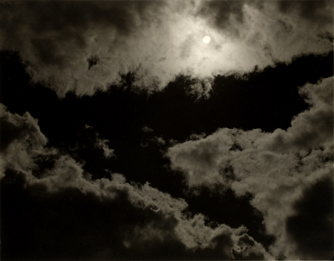


Sidney Nolan (Australian, 1917-1992) 'Untitled (calf carcass in tree)' 1952


Sidney Nolan (Australian, 1917-1992)
Untitled (calf carcass in tree)
1952
Archival inkjet print
23 x 23cm


In 1952 Sidney Nolan was commissioned by the Brisbane newspaper The Courier Mail to travel through far northern Queensland to record his impressions of one of the worst droughts in Australia’s history. Throughout this journey Nolan took numerous black and white photographs using a medium format camera, resulting in a host of startling and memorable images. Focusing on both the macabre spectre of the many animal carcasses strewn across the landscape and on the singular dwellings announcing a tenuous human presence, Nolan created numerous iconic images.

Having returned to Australia after an extended period traveling in Europe, Nolan commented that the animal carcasses reminded him of the petrified bodies he had seen at Pompeii. Throughout the series emphasis shifts from detached observation to intimate contemplation – between the forces of the outer landscape to the darkness of the animals’ inner being. With their carefully composed compositions the photographs represent a dramatic shift from the artist’s earlier photographic experiments. In place of a prior spontaneity, drought-stricken animal carcases are framed in formally rigorous compositions, the moment seemingly trapped in time.

For the first time this exhibition includes the complete and unabridged series of Sidney Nolan’s Drought Photographs, including images previously unavailable for public exhibition.

Damian Smith
Archivist for the Nolan Estate 1996-1999


Sidney Nolan (Australian, 1917-1992) 'Untitled (camp bed)' 1952


Sidney Nolan (Australian, 1917-1992)
Untitled (camp bed)
1952
Archival inkjet print
23 x 23cm


Epic Drought in Australia

Australia has not a very long history, but it is long enough to indicate that she must expect a major drought once every decade. Even so the present drought which the north and west of the continent is enduring, is by far the worst in living memory.

Rivers which have not been dry for over a century are now beds of hot sand, and even the aborigines can find no parallel in their mythology for a drought of this magnitude.

To cattle raising areas, failure of the annual monsoonal rains spells near tragedy. Of a total of 11.4 million beef cattle 1.5million have already perished.

The position is complicated by the lack of a railway connecting the North-centre of Australia with the eastern seaboard. Had such a railway been in existence many thousands of cattle could have been shifted to agistment areas and saved. As it is, the cattle must survive journeys from 500 to 1500 miles on stock routes, and this is generally impossible owing to the weakened positions of the animals. Thus cattle men must face the prospect of watching their herds dwindle until at least the end of the year when there is the probability of early summer storms bringing relief.

In the meantime the landscape presents scenes of desolation which mark the memory of all who see it. Thousands of carcasses are strewn on the baked and cracked plains. There is a brooding air of almost Biblical intensity over millions of acres which bear no trace of surface waters. The dry astringent air extracts every drop of moisture from the grass, leaving it so brittle that it breaks under foot with the tinkling of thin glass.

Death takes on a curiously abstract patter under these arid conditions. Carcasses of animals are preserved in strange shapes which have often a kind of beauty, or even grim elegance.

Over the whole country there is a silence in which men and animals bring forth the qualities necessary for survival. Patience, endurance – and for many Australians, a bitter and salty attitude of irony.

Sidney Nolan, August 1952

Text from the Australian Galleries website [Online] Cited 18/03/2011 no longer available online


Sidney Nolan (Australian, 1917-1992) 'Untitled (cow in tree)' 1952


Sidney Nolan (Australian, 1917-1992)
Untitled (cow in tree)
1952
Archival inkjet print
23 x 23cm


Sidney Nolan (Australian, 1917-1992) 'Untitled (Brian the stockman mounting dead horse)' 1952


Sidney Nolan (Australian, 1917-1992)
Untitled (Brian the stockman mounting dead horse)
1952
Archival inkjet print
23 x 23cm


Australian Galleries is delighted to present this fascinating exhibition of selected photographs by Sidney Nolan curated by Damian Smith, Archivist for the Nolan Estate 1996-1999.

Smith states in the accompanying exhibition catalogue:

“In 1952 Sidney Nolan was commissioned by the Brisbane newspaper The Courier Mail to travel through far northern Queensland to record his impressions of one of the worst droughts in Australia’s history. Throughout this journey Nolan took numerous black and white photographs using a medium format camera, resulting in a host of startling and memorable images. Focusing on both the macabre spectre of the many animal carcasses strewn across the landscape and on the singular dwellings announcing a tenuous human presence, Nolan created numerous iconic images. This exhibition includes the complete and unabridged series of Sidney Nolan’s Drought Photographs, including images previously unavailable for public exhibition.”

In his 1952 essay Epic Drought in Australia Sidney Nolan remarked on the poignancy of the images, noting the following:

“Death takes on a curiously abstract patter under these arid conditions. Carcasses of animals are preserved in strange shapes which have often a kind of beauty, or even grim elegance.”

To coincide with the exhibition Drought Photographs, Australian Galleries will be showing a selection of Drought Drawings by Sidney Nolan that include works previously exhibited at the National Gallery of Victoria, in it’s landmark survey of Nolan’s work Desert Drought in 2003.

Sidney Nolan Drought Photographs
Curated by Damian Smith

In 2010 Damian Smith established Words For Art, a consultancy specialising in art writing and curatorial projects.

Damian has always had a strong interest in Nolan’s work, he was appointed the inaugural archivist for the estate of Sidney Nolan in 1996. Since that time he has curated numerous Nolan exhibitions including a major exhibition, Unmasked: Sidney Nolan and Ned Kelly 1950-1990 for the Heide Museum of Modern Art in 2006.

Building up to the Heide exhibition, Damian was based at Sidney Nolan’s home ‘The Rodd’ at Herefordshire, a 16th Century manor on the border of England and Wales. During that research period he developed an interest in Nolan’s life-long engagement with photography. He discovered vintage prints of Nolan’s photographs of outback Australia and the devastating drought in far northern Queensland, which were included in the landmark survey Sidney Nolan: Desert and Drought, at the National Gallery of Victoria in 2003. The exhibition included previously unseen photographic images from 1949 to 1952.

In the NGV exhibition, numerous small-scale contact prints showing Nolan’s ‘Drought animals’ were featured, as were larger black and white prints from the same series. Additional small-scale prints were sourced as well through Nolan’s step-daughter Jinx Nolan. Of note was Nolan’s now famous Untitled (Brian the stockman mounting a dead horse at Wave Hill Station), 1952, a startling image that first featured in the 1961 Thames & Hudson monograph Sidney Nolan, where it appeared titled Desert.

Having researched and written about these images, Damian recognised that Nolan had spent many hours studying the images, notating them and ultimately using them in the development of his now famous Drought paintings. Nolan offered the photographs to Life Magazine, New York in a bid to bring this extraordinary series to public attention. This bid was unsuccessful.

After all of the years since these photographs were taken, Damian made the decision to resurrect Nolan’s photographs working closely with Sidney Nolan’s widow Mary Nolan, nee Boyd. The result being this exhibition at Australian Galleries, Melbourne in 2011.

Keen to preserve the artist’s vision, the photographs have been produced to a scale consistent with the vintage prints and all are printed from the original negatives which were discovered at ‘The Rodd’.

Text from Australian Galleries Melbourne


Sidney Nolan (Australian, 1917-1992) 'Untitled (cow carcass and cow skull)' 1952


Sidney Nolan (Australian, 1917-1992)
Untitled (cow carcass and cow skull)
1952
Archival inkjet print
23 x 23cm


Sidney Nolan (Australian, 1917-1992) 'Untitled (cow and calf carcass covered in dirt I)' 1952


Sidney Nolan (Australian, 1917-1992)
Untitled (cow and calf carcass covered in dirt I)
1952
Archival inkjet print
23 x 23cm


Australian Galleries
35 Derby Street [PO Box 1183]
Collingwood 3066
Phone: +61 3 9417 4303

Opening hours:
Open 7 days 10am – 6pm

Australian Galleries website

LIKE ART BLART ON FACEBOOK

Back to top

Exhibition: ‘Pictures by Women: A History of Modern Photography’ at The Museum of Modern Art (MoMA), New York

Exhibition dates: 7th May, 2010 – 4th April 2011


Ilse Bing (American born Germany, 1899-1998) 'Self-Portrait in Mirrors' 1931


Ilse Bing (American born Germany, 1899-1998)
Self-Portrait in Mirrors
1931
Gelatin silver print
10 1/2 x 12″ (26.8 x 30.8cm)
The Museum of Modern Art, New York
Joseph G. Mayer Fund
© 2010 The Ilse Bing Estate / Courtesy Edwynn Houk Gallery


How I wish I could have been in New York to see this exhibition!

Marcus


Many thankx to the Museum of Modern Art (MoMA) for allowing me to publish the photographs in the posting. Please click on the photographs for a larger version of the image.


Frances Benjamin Johnston (American, 1864-1952) 'Physiology. Class in emergency work' 1899-1900


Frances Benjamin Johnston (American, 1864-1952)
Physiology. Class in emergency work
1899-1900
Platinum print
7 9/16 × 9 1/2″ (19.2 × 24.2cm)
The Museum of Modern Art, New York
Gift of Lincoln Kirstein


“It is wrong to regard photography as purely mechanical. Mechanical it is, up to a certain point, but beyond that there is great scope for individual and artistic expression.” ~ Frances Benjamin Johnston


After setting up her own photography studio in 1894, in Washington, D.C., Frances Benjamin Johnston was described by The Washington Times as “the only lady in the business of photography in the city.”1 Considered to be one of the first female press photographers in the United States, she took pictures of news events and architecture and made portraits of political and social leaders for over five decades. From early on, she was conscious of her role as a pioneer for women in photography, telling a reporter in 1893, “It is another pet theory with me that there are great possibilities in photography as a profitable and pleasant occupation for women, and I feel that my success helps to demonstrate this, and it is for this reason that I am glad to have other women know of my work.”2

In 1899, the principal of the Hampton Normal and Agricultural Institute in Virginia commissioned Johnston to take photographs at the school for the 1900 Exposition Universelle in Paris. The Hampton Institute was a preparatory and trade school dedicated to preparing African American and Native American students for professional careers. Johnston took more than 150 photographs and exhibited them in the Exposition Nègres d’Amerique (American Negro Exhibit) pavilion, which was meant to showcase improving race relations in America. The series won the grand prize and was lauded by both the public and the press.

Years later, writer and philanthropist Lincoln Kirstein discovered a leather-bound album of Johnston’s Hampton Institute photographs. He gave the album to The Museum of Modern Art, which reproduced 44 of its original 159 photographs in a book called The Hampton Album, published in 1966. In its preface, Kirstein acknowledged the conflict inherent in Johnston’s images, describing them as conveying the Institute’s goal of assimilating its students into Anglo-American mainstream society according to “the white Victorian ideal as criterion towards which all darker tribes and nations must perforce aspire.”3 The Hampton Institute’s most famous graduate, educator, leader, and presidential advisor Booker T. Washington, advocated for black education and accommodation of segregation policies instead of political pressure against institutionalized racism, a position criticized by anti-segregation activists such as author W. E. B. Du Bois.

Johnston’s pictures neither wholly celebrate nor condemn the Institute’s goals, but rather they reveal the complexities of the school’s value system. This is especially clear in her photographs contrasting pre- and post-Hampton ways of living, including The Old Well and The Improved Well (Three Hampton Grandchildren). In both images, black men pump water for their female family members. The old well system is represented by an aged man, a leaning fence, and a wooden pump that tilts against a desolate sky, while the new well is handled by an energetic young boy in a yard with a neat fence, a thriving tree, and two young girls dressed in starched pinafores. Johnston’s photographs have prompted the attention of artists like Carrie Mae Weems, who has incorporated the Hampton Institute photographs into her own work to explore what Weems described as “the problematic nature of assimilation, identity, and the role of education.”4

Kristen Gaylord, Beaumont and Nancy Newhall Curatorial Fellow, Department of Photography, 2016

1/ “Washington Women with Brains and Business,” The Washington Times, April 21, 1895, 9
2/ Clarence Bloomfield Moore, “Women Experts in Photography,” The Cosmopolitan XIV.5 (March 1893), 586
3/ Lincoln Kirstein, “Introduction,” in The Hampton Album: 44 photographs by Frances B. Johnston from an album of Hampton Institute (New York: The Museum of Modern Art, 1966), 10
4/ Quoted in Denise Ramzy and Katherine Fogg, “Interview: Carrie Mae Weems,” Carrie Mae Weems: The Hampton Project (New York: Aperture, 2000), 78


Cindy Sherman (American, b. 1954) 'Untitled #92' 1981


Cindy Sherman (American, b. 1954)
Untitled #92
1981
Chromogenic colour print
24 x 47 15/16″ (61 x 121.9cm)
The Museum of Modern Art, New York
The Fellows of Photography Fund
© 2010 Cindy Sherman


Nan Goldin (American, b. 1953) 'Nan One Month After Being Battered' 1984


Nan Goldin (American, b. 1953)
Nan One Month After Being Battered
1984
Silver dye bleach print (printed 2008)
15 1/2 x 23 1/8″ (39.4 x 58.7cm)
The Museum of Modern Art, New York
Purchase
© 2010 Nan Goldin


JoAnn Verburg (American, b. 1950)
'Still Life with Serial Killers' 1991


JoAnn Verburg (American, b. 1950)
Still Life with Serial Killers
1991
Chromogenic print
19 9/16 × 27 11/16″ (49.7 × 70.4cm)
The Museum of Modern Art, New York
Horace W. Goldsmith Fund through Robert B. Menschel
© 2025 JoAnn Verburg


One day I went to the market in Spoleto, Italy, where my husband and I spent every summer and my flowers were wrapped up in a newspaper that I brought home and realised had a photograph of the serial killers, Charlie Manson and Jeffrey Dahmer, and an article in Italian that asked why these things happen in America. I knew immediately that I wanted to incorporate it into a photograph. And in our bedroom, I had leaned some jumbo postcards from the Courtauld Museum in London on the dresser.

Although the photograph could have a lot of traditional still life elements in it, you know, the bottle or the fruit, or the flowers, I like the fact that an aspect of the still life work that I’m able to bring in is the news that’s going on in another part of the world.

In my still lives, bringing in the newspaper allows me to connect these things that might seem very disparate, a fragment of a painting by a French painter from another century, put together with a news article about murder. But in fact, the nature of our contemporary lives is that we’re flipping the channels all the time. We’re experiencing so many things at once, and we’re not able to selectively engage only one thing at a time.

Text from the The Museum of Modern Art website


The Museum of Modern Art draws from its rich collection of photography to present the history of the medium from the dawn of the modern period to the present with the exhibition Pictures by Women: A History of Modern Photography, from May 7 to August 30, 2010. Filling the entire third-floor Edward Steichen Photography Galleries with photographs made exclusively by women artists, this installation comprises more than 200 works by approximately 120 artists, including a selection of exceptional recent acquisitions and works on view for the first time by such artists as Anna Atkins, Claude Cahun, Rineke Dijkstra, VALIE EXPORT, Nan Goldin, Helen Levitt, and Judith Joy Ross. The exhibition also includes masterworks by such luminaries as Berenice Abbott, Diane Arbus, Gertrude Käsebier, Dorothea Lange, Lisette Model, Tina Modotti, Cindy Sherman, and Carrie Mae Weems, as well as pictures, collages, video, and photography-based installations drawn from other curatorial departments by artists such as Hannah Höch, Barbara Kruger, Annette Messager, Yoko Ono, Lorna Simpson, Kiki Smith, and Hannah Wilke. The exhibition is organised by Roxana Marcoci, Curator; Sarah Meister, Curator; and Eva Respini, Associate Curator, Department of Photography, The Museum of Modern Art.

The Edward Steichen Photography Galleries comprise a circuit of six rooms devoted to a rotating selection of photographs from the Museum’s collection. The galleries featuring works from 1850 to the 1980s open on May 7, 2010, and remain on view through March 21, 2011. The most contemporary works in the exhibition are currently on view in The Robert and Joyce Menschel Gallery, and they remain on view through August 30, 2010.

For much of photography’s 170-year history, women have contributed to its development as both an art form and a means of communication, expanding its parameters by experimenting with every aspect of the medium. Self-portraits and representations of women by a variety of women practitioners are a recurring motif, as seen in works by artists ranging from Julia Margaret Cameron to Lucia Moholy, and from Germaine Krull to Katy Grannan. Significant groups of works by individual photographers are highlighted within this chronological survey, including in-depth presentations of the work of Frances Benjamin Johnston, Käsebier, Modotti, Lange, Levitt, Arbus, Goldin, and Ross.

Marking the entrance to The Edward Steichen Photography Galleries is a large-scale photographic wallpaper, Fluxus Wallpaper, realised by Yoko Ono and George Maciunas in the early 1970s. This work depicts the serial repetition of a set of buttocks, an image originating from a provocative Fluxus film made by Ono in 1966.

Pictures by Women opens with a gallery of nineteenth and early twentieth-century work, representing the variety of photography’s applications. The earliest photograph in the installation was made in the 1850s by British photographer Anna Atkins, who used the cyanotype process to record her many plant specimens. Presented side by side are in-depth groupings of work by American photographers Frances Benjamin Johnston and Gertrude Käsebier. In 1899 the Hampton Institute commissioned Johnston to take photographs at the school that were featured in an exhibition about contemporary African American life at the Paris Exposition of 1900. On view is a selection of pictures taken from a larger album of 156, which exemplify Johnston’s talent for balancing pictorial delicacy and classical composition with the demands of working on assignment. Käsebier – another woman who produced photographic works of art while operating a successful commercial studio – is best known for her portraits and symbolic, soft-focus pictures of the mother-and-child theme.

The rise of photographic modernism in the 1920s and 1930s is traced in the second gallery primarily with the work of European women artists. A wall of portraits of women showing the range of artistic expression and experimentation during this period includes Claude Cahun’s radical gender-bending self-portrait in drag (1921); Lucia Moholy’s striking portrait of fellow Bauhaus student Florence Henri (1927); and Hannah Höch’s Indian Dancer: From an Ethnographic Museum (1930), a collage evoking the modern woman. Included here is also a photocollage by the little known Japanese artist Toshiko Okanoue, titled In Love (1953). Cannibalising images from U.S. magazines such as Life and Vogue, this surreal collage represents a young Japanese woman’s perception of the Western way of life. A group of pictures taken in Mexico in the late 1920s by Italian photographer Tina Modotti possess an aesthetic clarity and beauty that reflect her increasing political involvement within her adopted country. Also included is Ilse Bing’s Self-Portrait in Mirrors (1931), a picture staging a complex mise-en-scène between two reflections – one in the mirror and the other in the camera’s eye – as well as similarly powerful works by Imogen Cunningham, Florence Henri, Germaine Krull, and Lee Miller, who experimented with mobile perspectives of the handheld camera and graphic compositions.

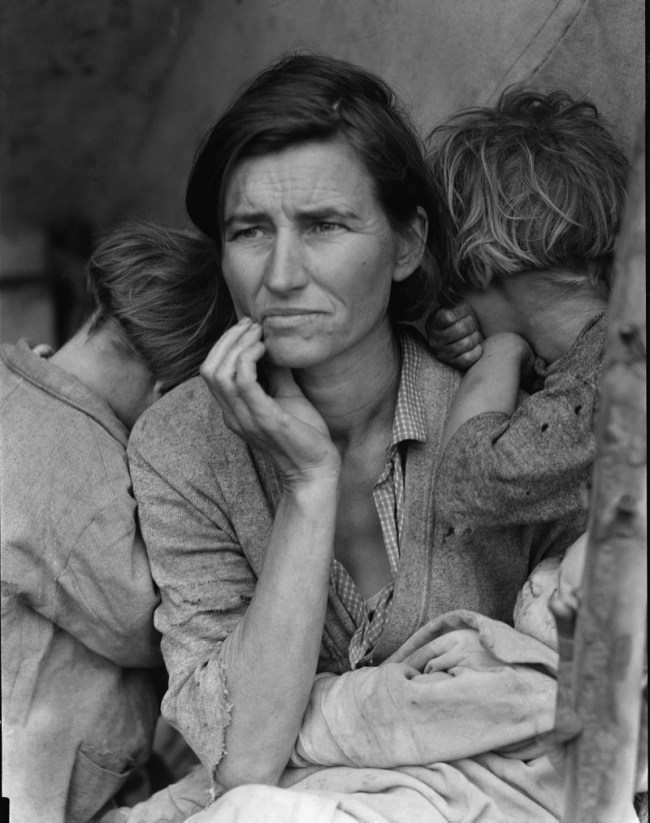
The third gallery features photographers who devoted themselves to the complex challenge of exploring the social world in the interwar and postwar periods. Largely comprising work by American women, this gallery includes comprehensive presentations of two of America’s leading photographers, Dorothea Lange and Helen Levitt. The breadth of Lange’s accomplishments is represented through a selection of approximately 20 photographs, all of women, including her iconic Depression-era picture Migrant Mother, Nipomo, California (1936); the memorable One Nation, Indivisible, San Francisco (1942); and pictures capturing the bustle of postwar life in America, such as Mother and Child, San Francisco (1952). Opposite these works is a wall of colour photographs taken by Levitt in the 1970s on the streets of New York City. These lively, spontaneous pictures are full of humour and drama, and continue the rich tradition of the American documentary genre that Levitt helped establish in the 1940s with her black-and-white photographs. The rest of the gallery includes a variety of work made during the period, including Berenice Abbott’s documents of the changing architecture and character of New York City in the 1930s, and Barbara Morgan’s elegant 1940 photograph of dancer Martha Graham performing her dramatic piece “Letter to the World,” based on the love life of American poet Emily Dickinson.

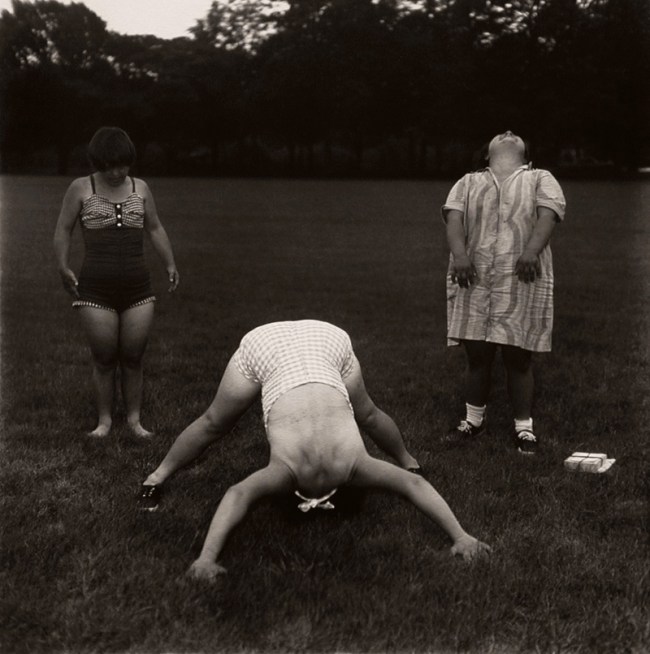
Photography’s documentary tradition in the postwar period continues in the fourth gallery, most notably with a selection of Diane Arbus’s portraits of women, such as A Widow in Her Bedroom, New York City (1963); Identical Twins, Roselle, New Jersey (1966); and Girl in Her Circus Costume, Maryland (1967). This gallery also includes work by artists of the 1960s and 1970s who embraced photography not just as a way of describing experience, but as a conceptual tool for appropriating and manipulating existing photographs. Examples include Martha Rosler’s collage Cleaning the Drapes (1969-1972), which juxtaposes images of domestic bliss taken from women’s magazines with news pictures of the war in Vietnam. The gallery also introduces several notable examples of acts performed for the camera, including Adrian Piper’s self-portrait series Food for the Spirit (1971), a meditation on transcendental being through an analysis of Kant’s Critique of Pure Reason; and VALIE EXPORT’s provocative Action Pants: Genital Panic (1969). Presented as a set of posters, this work memorialised a performance in which the Austrian artist marched into an experimental art-film house in Munich wearing crotchless trousers, challenging mostly male viewers to “look at the real thing” instead of passively enjoying images of women on the screen.

The emergence of colour photography as a major force in the 1970s is seen in the fifth gallery, with large photographs, including Tina Barney’s Sunday New York Times (1982) and a picture from Cindy Sherman’s celebrated Centerfolds (1981) series. This gallery also includes the work of postmodern artists associated with The Pictures Generation, such as Barbara Kruger, Louise Lawler, Sherrie Levine, and Laurie Simmons, who played with photography’s potential to comment on the increasingly image-saturated world of the late twentieth century. Representing the other end of the photographic spectrum is the diaristic aesthetic of Nan Goldin. A group of Goldin photographs dating from 1978 to 1985 capture the shared experience of an artistic downtown New York community – a generation ravaged by drug abuse and AIDS. These pictures of the artist’s friends, lovers, and Goldin herself explore the highs and the lows of amorous relationships. These are presented opposite work by Gay Block, Sally Mann, and Sheron Rupp, who use the probing vision of straightforward photography to explore the world around us.

Concluding the installation in The Robert and Joyce Menschel Gallery are major groups of works that suggest the diversity of artistic strategies and forms in contemporary photography. A group of Judith Joy Ross portraits of very different women – a graduation guest (1993), a soldier (1990), a congresswoman (1987), and a visitor to the Vietnam Veterans Memorial (1984) – invite us to reflect upon the relationship between social roles and the unique identities of the individuals who fulfil them. Presented on the same wall is Rineke Dijkstra’s ongoing series Almerisa, comprising 11 photographs made over a period of 14 years. Dijkstra first photographed Almerisa – a six-year-old Bosnian girl whose family had relocated from their war-torn native country to Amsterdam – as part of a project documenting children of refugees. Dijkstra continued to photograph her at one- or two-year intervals, chronicling not only her development from childhood through adolescence and into adulthood but also her cultural assimilation from Eastern to Western Europe. A selection from Carrie Mae Weems’s series From Here I Saw What Happened and I Cried (1995) superimpose sand-blasted text over found photographs to dissect photography’s historical role in imposing stereotypes upon African Americans. Rounding out this gallery is a wall dedicated to portraits of women, including work by Valérie Belin, Tanyth Berkeley, Katy Grannan, and Cindy Sherman, suggesting the plasticity of photography and, indeed, of female identity itself.

Press release from the MoMA website


Julia Margaret Cameron (British born India, 1815-1879) 'Untitled' c. 1867


Julia Margaret Cameron (British, 1815-1879)
Untitled
c. 1867
Albumen silver print
13 3/16 x 11″ (33.5 x 27.9cm)
The Museum of Modern Art, New York
Gift of Shirley C. Burden


Gertrude Käsebier (American, 1852-1934) 'The Manger' 1899


Gertrude Käsebier (American, 1852-1934)
The Manger
1899
Platinum print
12 13/16 x 9 5/8″ (32.5 x 24.4cm)
The Museum of Modern Art, New York
Gift of Mrs. Hermine M. Turner


Tina Modotti (Italian, 1896-1942) 'Campesinos (Workers' Parade)' 1926


Tina Modotti (Italian, 1896-1942)
Workers Parade
1926
Gelatin silver print
8 7/16 x 7 5/16″ (21.5 x 18.6cm)
The Museum of Modern Art, New York
Given anonymously


Lucia Moholy (British, 1894-1989) 'Untitled (Florence Henri)' 1927


Lucia Moholy (British, 1894-1989)
Untitled (Florence Henri)
1927
Gelatin silver print
14 5/8 x 11″ (37.1 x 28cm)
The Museum of Modern Art, New York
Thomas Walther Collection. Gift of Thomas Walther
© 2010 Lucia Moholy Estate/Artists Rights Society (ARS), New York/VG Bild-Kunst, Bonn


Hannah Höch (German, 1889-1978) 'Indian Dancer: From an Ethnographic Museum' 1930


Hannah Höch (German, 1889-1978)
Indian Dancer: From an Ethnographic Museum (Indische Tänzerin: Aus einem ethnographischen Museum)
1930
Cut-and-pasted printed paper and metallic foil on paper
10 1/8 x 8 7/8″ (25.7 x 22.4cm)
The Museum of Modern Art, New York
Frances Keech Fund
© 2019 Hannah Höch / Artists Rights Society (ARS), New York / VG Bild-Kunst, Germany


Through the cut-and-pasted elements of Indian Dancer, Höch assembled references to film, Central African sculpture, and the domestic sphere. Her collaged model is the actress Renée (Maria) Falconetti (also known simply as “Falconetti”), appearing in a publicity still for Carl Theodor Dreyer’s 1928 film The Passion of Joan of Arc. Half of Falconetti’s face is replaced with the ear, eye, and mouth of a wooden dance mask from Cameroon. Atop her head rests a crown of cutlery: cutout shapes of spoons and knives, set against glinting metallic foil.

This work belongs to a series of photomontages called From an Ethnographic Museum (1924-1934), in which Höch juxtaposed images of women with reproductions of tribal art cut from magazines. The artist cited a visit to the ethnographic museum in Leiden, in the Netherlands, as an influence in the conception of this series; however, she used material from other cultures mostly as a point of departure for commentary on the status of women in contemporary German society. Invoking an androgynous fifteenth-century French martyr as embodied by a glamorous movie star, capping her with the finery of a domestic goddess, and aligning her with a cultural Other, this composite representation examines the complex facets of modern femininity.

Publication excerpt from MoMA Highlights: 375 Works from The Museum of Modern Art, New York (New York: The Museum of Modern Art, 2019)


Grete Stern (Argentine born Germany, 1904-1999) 'Photomontage for Madí, Ramos Mejía, Argentina' 1946-1947


Grete Stern (Argentine born Germany, 1904-1999)
Photomontage for Madí, Ramos Mejía, Argentina
1946-1947
Gelatin silver print
23 9/16 × 19 7/16″ (59.8 × 49.4cm)
The Museum of Modern Art, New York
Latin American and Caribbean Fund and partial gift of Mauro Herlitzka
© 2025 Galería Jorge Mara-La Ruche


Toshiko Okanoue (Japan, b. 1928) 'In Love' 1953


Toshiko Okanoue (Japan, b. 1928)
In Love
1953
Cut-and-pasted printed papers on printed paper
14 x 9 5/8″ (35.6 x 24.4cm)
The Museum of Modern Art, New York
Committee on Photography Fund and Committee on Drawings Funds
© 2019 Toshiko Okanoue


Martha Rosler (American, b. 1943) 'Cleaning the Drapes' from the series 'House Beautiful: Bringing the War Home' c. 1967-1972


Martha Rosler (American, b. 1943)
Cleaning the Drapes from the series House Beautiful: Bringing the War Home
c. 1967-1972
Pigmented inkjet print (photomontage), printed 2011
17 5/16 x 23 3/4″ (44 x 60.3cm)
The Museum of Modern Art, New York
Committee on Photography and The Modern Women’s Fund
© Martha Rosler


Rosler conceived Bringing the War Home during a time of increased intervention in Vietnam by the United States military. Splicing together pictures of Vietnamese citizens maimed in the war, published in Life magazine, with images of the homes of affluent Americans culled from the pages of House Beautiful, Rosler made literal the description of the conflict as the “living-room war,” so called in the USA because the news of ongoing carnage in Southeast Asia filtered into tranquil American homes through television reports. By urging viewers to reconsider the “here” and “there” of the world picture, these activist photomontages reveal the extent to which a collective experience of war is shaped by media images.

Gallery label from The Shaping of New Visions: Photography, Film, Photobook, April 16, 2012 – April 29, 2013


Helen Levitt (American, 1913-2009)
'New York' 1977


Helen Levitt (American, 1913-2009)
New York
1977
Chromogenic print, printed c. 2005
17 15/16 × 11 15/16″ (45.6 × 30.4cm)
The Museum of Modern Art, New York
Gift of Marvin Hoshino
© 2025 Film Documents LLC


The Museum of Modern Art
11 West 53 Street
New York, NY 10019
Phone: (212) 708-9400

Opening hours:
Daily 10.30am – 5.30pm

MoMA website

LIKE ART BLART ON FACEBOOK

Back to top

Review: ‘Navigating Widely’ by Vanila Netto at Arc One Gallery, Melbourne

Exhibition dates: 1st March – 26th March 2011


Vanila Netto (Brazil, b. 1963) 'Pole Relief' 2011


Vanila Netto (Brazil, b. 1963)
Pole Relief
2011
50 x 50cm
Archival pigment ink on cotton rag paper


“There’s an odd diaristic quality to Vanila Netto’s photographic, still life, video and neon works. What at first might seem like a hotchpotch of gestures, assemblages and moments reveals a lateral narrative – still points on a fluid map.”


Dan Rule in The Age newspaper


Netto’s work moves from one place to another, Navigating Widely. Some elements are more successful than others. The grainy colour field photographs of extruded objects (foam packing, the detritus of cardboard) fail to impress lacking the fidelity that the subject matter requires and the ability to integrate successfully into the lateral narrative. The Super 8 film transferred to digital video It is time to bridge (2011) is excellent, evoking as it does the utopian ideals of industrialisation, planes and rockets becoming “permanent and sedentary residents” of an abandoned dream park. The diptych neon installation Elation, Deflation (Inner Tubes) (2011) is also effective in evoking the interface between human and machine.

The best work in the exhibition is the series of small square format, analogue colour photographs that have been printed digitally (see photographs below). There is a lovely spatial resistance in these photographs – hints of colour, slices, markings on walls, the collision of opposites – that elevates them above the rest of the exhibition. In these photographs, the punctum pricks our consciousness but is it enough? Although these are interesting photographs, are they photographs that you would remember in a week, a month or a year? More was needed to hang your hat on, perhaps an ambiguous sense of Time that stretched the frame of reference.

Overall, the hotchpotch of gestures, assemblages and moments needed a more substantial grounding and, for me, became points on a confused map: a collection of complexities, both global and personal, that needed a focusing of rationale and conceptualisation. Less is more! Drawing what are some good ideas and threads together in a simplified form would add to the strength of the work for there is talent here. Perhaps concentrating on one idea and exploring it more fully would be a step along the path. I look forward to the next literation.

Dr Marcus Bunyan


Many thanxk to Angela Connor for her help and to Arc One Gallery for allowing me to publish the photographs in the posting. Please click on the photograph for a larger version of the image.


Vanila Netto (Brazil, b. 1963) 'Colossus' 2011


Vanila Netto (Brazil, b. 1963)
Colossus
2011
100 x 100cm
Archival pigment ink on cotton rag paper


Vanila Netto (Brazil, b. 1963) 'Mir' 2011


Vanila Netto (Brazil, b. 1963)
Mir
2011
50 x 50cm
Archival pigment ink on cotton rag paper


Vanila Netto (Brazil, b. 1963) 'Wheeling Consorts' 2011


Vanila Netto (Brazil, b. 1963)
Wheeling Consorts
2011
50 x 50cm
Archival pigment ink on cotton rag paper


Vanila Netto (Brazil, b. 1963) 'Solaris' 2011


Vanila Netto (Brazil, b. 1963)
Solaris
2011
50 x 50cm
Archival pigment ink on cotton rag paper


Vanila Netto (Brazil, b. 1963) 'Air Buzzing' 2011


Vanila Netto (Brazil, b. 1963)
Air Buzzing
2011
50 x 50cm
Archival pigment ink on cotton rag paper


Arc One Gallery
45 Flinders Lane
Melbourne, 3000
Phone: (03) 9650 0589

Opening hours:
Wed – Sat 11am – 5pm

Arc One Gallery website

LIKE ART BLART ON FACEBOOK

Back to top
Review: ‘Rosemary Laing: leak’ at Tolarno Galleries, Melbourne

Exhibition dates: 26th February – 19th March 2011


Rosemary Laing (Australian, b. 1959) 'Jim' 2010


Rosemary Laing (Australian, b. 1959)
Jim
2010
From the series Leak
C Type photograph
Large image size 110 x 238cm
Framed size 127 x 255cm
Edition of 8


You have just got to love these!

A wonderful suite of five panoramic photographs, framed in white, inhabit the beautiful space of Tolarno Galleries, Melbourne. The photographs, different angles of the same bleached bone inverted skeleton of a house that was constructed by five builders in the Australian landscape around Cooma, New South Wales (no Photoshop tricks here!) have a subdued colour palette of misty greys and greens – all except one that has a vibrant blue sky with clouds, a man with his sheep dogs and a flock of sheep. Two of the photographs are framed upside down, one photograph a closer study from the same angle.

The house on the hill is surrounded by wondrous light gently highlighting the wooden bones of the building embedded into the landscape in a context that is soon to become another suburban housing estate. The skeleton rises up (and falls into the sky) like a foundering ship amongst mysterious gum trees, surrounded by broken stumps and littered branches. The best photograph (top, below) has the effect of the bones being lit up like a giant puzzle.

Examining ‘the encroachment of suburban development and the socio-economic and environmental pressures on the Australian landscape’ these photographs, named after the characters from Patrick White’s novel The Twyborn Affair, are ecologically aware and politically astute, as well as being fine photographs. The title of the exhibition, leak, perfectly sums up the osmotic nature of the encroachment of human habitation upon the ‘natural’ environment, which is already a mediated landscape due to European farming techniques and clearance of the landscape. But this is not a one way discourse; what do we call the ‘new’ Australian bush? What if the humpy invaded suburbia and pushed back the tide?

I would love to see different types of houses in different contexts. I want to see more these are so good!

Dr Marcus Bunyan


Many thankx to Jan Minchin (Director) and Tolarno Galleries for allowing me to publish the photographs in the posting. Please click on the photographs for a larger version of the image. Both images courtesy of the artist and Tolarno Galleries © Rosemary Laing.


Rosemary Laing (Australian, b. 1959) 'Prowse' 2010


Rosemary Laing (Australian, b. 1959)
Prowse
2010
From the series Leak
C Type photograph
Large image size 110 x 247cm
Framed size 127 x 264cm
Edition of 8


Rosemary Laing (Australian, b. 1959) 'Aristide' 2010


Rosemary Laing (Australian, b. 1959)
Aristide
2010
From the series Leak
C Type photograph
60 x 122cm
Edition of 8


Rosemary Laing (Australian, b. 1959) 'Eddie' 2010


Rosemary Laing (Australian, b. 1959)
Eddie
2010
From the series Leak
Type C photograph
Framed 127.0 x 274.6cm
Edition of 8


Tolarno Galleries
Level 4
104 Exhibition Street
Melbourne VIC 3000
Australia
Phone: 61 3 9654 6000

Opening hours:
Tue – Fri 10am – 5pm
Sat 1pm – 4pm

Tolarno Galleries website

LIKE ART BLART ON FACEBOOK

Back to top

Exhibition: ‘Alberto Giacometti. The Origin of Space: Retrospective of the mature work’ at Kunstmuseum Wolfsburg

Exhibition dates: 20th November 2010 – 6th March 2011


Many thankx to the Kunstmuseum Wolfsburg for allowing me to publish the photographs in the posting. Please click on the photographs for a larger version of the image.


Alberto Giacometti (Swiss, 1901-1966) 'La Cage/The Cage' 1950


Alberto Giacometti (Swiss, 1901-1966)
La Cage/The Cage
1950
Bronze
175.6 x 37 x 39.6cm
Collection Fondation Giacometti, Paris (Inv. Nr. : 1994-0177)
Photo: Jean-Pierre Lagiewski
© ADAGP / Fondation Giacometti, Paris / VG Bild-Kunst, Bonn 2010


Alberto Giacometti (Swiss, 1901-1966) 'Walking Man I' 1960


Alberto Giacometti (Swiss, 1901-1966)
Homme qui marche I/Walking Man I
1960
Bronze
180.5 x 27 x 97cm
Collection Fondation Giacometti, Paris (Inv. Nr.: 1994-0186)
Photo: Jean-Pierre Lagiewski
© ADAGP / Fondation Giacometti, Paris / VG Bild-Kunst, Bonn 2010


Alberto Giacometti (Swiss, 1901-1966) 'Falling Man' 1950


Alberto Giacometti (Swiss, 1901-1966)
Homme qui chavire/Falling Man
1950
Bronze, 60 x 22 x 36cm
Avignon, Musée Calvet (Depot Musée d’Orsay); Gift of Philippe Meyer, 2000 (Inv. Nr.: RF 4655)
Photo: © bpk/RMN/Aix-en-Provence, Musée Granet/Michèle Bellot
© ADAGP / Succession Giacometti / VG Bild-Kunst, Bonn 2010


“Space does not exist, it has to be created… Every sculpture based on the assumption that space exists is wrong; there is only the illusion of space.”


Alberto Giacometti, Notes, circa 1949


For the first time in 12 years, the Kunstmuseum Wolfsburg is presenting a comprehensive overview of Alberto Giacometti’s mature work in Germany. Around 60 sculptures will be displayed alongside more than 30 paintings and several drawings in the circa 2000 square meter exhibition space. The exhibition offers unique insights into the fascinating oeuvre of one of the most important artists of the twentieth century.

Giacometti’s vision of situating his figures within their own space and temporality will be realised for the first time in Wolfsburg as the exhibition architecture has been specially designed and constructed around the sculptures on display. Each of the carefully chosen works is provided with the space it requires to unfurl its true strengths. The exhibition clearly demonstrates the continued relevance of the work of Giacometti, who died in 1966, and its lasting influence on subsequent generations of artists. With his completely new conception of the human figure in relation to space and time, Giacometti can literally be considered – and this is one of the exhibition’s key theses – the inventor of virtual space.

Organised in cooperation with the Museum der Moderne Salzburg, the exhibition juxtaposes major works from Giacometti’s oeuvre with selected pieces from private collections and the artist’s estate. The works on show in Wolfsburg are drawn in large part from the estate holdings of the Alberto and Annette Giacometti Foundation in Paris; this is the first time they have been presented on this scale in Germany. The display also includes important loans from the Alberto Giacometti Foundation in Zurich, as well as works from leading museums and private collections in Europe and the United States.

Press release from the Kunstmuseum Wolfsburg website


Alberto Giacometti (Swiss, 1901-1966) 'Figure in a Box between Two Boxes which are Houses' 1950


Alberto Giacometti (Swiss, 1901-1966)
Figurine dans une boîte entre deux boîtes qui sont des maisons/Figure in a Box between Two Boxes which are Houses
1950
Bronze, glass, figurine painted white, 29.5 x 53.5 x 9.4cm
Private collection (Inv. Nr.: GS 45)
© ADAGP / Succession Giacometti / VG Bild-Kunst, Bonn 2010


Alberto Giacometti (Swiss, 1901-1966) 'Man walking in the Rain' 1948


Alberto Giacometti (Swiss, 1901-1966)
Homme qui marche sous la pluie/Man walking in the Rain
1948
Bronze
46.5 x 77 x 15cm
Kunsthaus Zürich, Alberto Giacometti-Stiftung (Inv. Nr.: GS 35)
© ADAGP / Succession Giacometti / VG Bild-Kunst, Bonn 2010


Alberto Giacometti (Swiss, 1901-1966) 'Small Man on a Base' 1940-41


Alberto Giacometti (Swiss, 1901-1966)
Petit homme sur socle/Small Man on a Base
1940-1941
Bronze, 8/8
Height: 8.4cm
Louisiana Museum of Modern Art, Humlebæk, Dänemark
Photo: Brøndum & Co. Poul Buchart/Louisiana Museum of Modern Art, Humlebaek, Dänemark
© ADAGP / Succession Giacometti / VG Bild-Kunst, Bonn 2010


Alberto Giacometti (Swiss, 1901-1966) 'Large Narrow Head' 1954


Alberto Giacometti (Swiss, 1901-1966)
Grande tête mince/Large Narrow Head
1954
Bronze, 4/6
64.5 x 38.1 x 24.4cm
Collection Fondation Giacometti, Paris (Inv. Nr.: 1994-0175)
Photo: Marc Domage
© ADAGP / Fondation Giacometti, Paris / VG Bild-Kunst, Bonn 2010


Alberto Giacometti (Swiss, 1901-1966) 'Three Men Walking' 1948
Screenshot


Alberto Giacometti (Swiss, 1901-1966)
Three Men Walking
1948
Bronze
28 3/10 × 12 9/10 × 13 2/5 in | 72 × 32.7 × 34.1cm


Kunstmuseum Wolfsburg
Abteilung Kommunikation
Hollerplatz 1
38440 Wolfsburg
Phone: +49 (0)5361 2669 69

Opening hours:
Tuesday – Sunday 11am – 6pm
Monday closed

Kunstmuseum Wolfsburg website

LIKE ART BLART ON FACEBOOK

Back to top
Exhibition: ‘Duane Hanson/Gregory Crewdson: Uncanny realities’ at Museum Frieder Burda, Baden-Baden

Exhibition dates: 27th November 2010 – 6th March 2011

Curators: Götz Adriani and Patricia Kamp


Installation photograph of the exhibition 'Duane Hanson/Gregory Crewdson: Uncanny realities' at Museum Frieder Burda


Installation photograph of the exhibition Duane Hanson/Gregory Crewdson: Uncanny realities at Museum Frieder Burda


A great double act!

An inspired curatorial choice brings the work of these two artist’s together – life-like sculptures of everyday Americans mixing with theatrical, deadpan staged images. The mis en scène created in the exhibition space, the tension between sculpture, photograph, frame and space – is delicious.

Crewdson is at his best when he resists the obvious narrative (for example, all the traffic lights stuck on yellow in the photograph Untitled (Brief Encounter) (2006, see below). Personally I prefer his staged photographs with pairs or groups of people within the image, rather than a single figure. The storyline is more ambiguous and the photographs of people walking along railway tracks always remind me of the Stephen King story filmed as Stand by Me (1986) with a young River Phoenix. Either way they are intoxicating, the viewer drawn into these wonderful, dark psychological dramas.

Dr Marcus Bunyan


Many thankx to Museum Frieder Burda for allowing me to publish the photographs in the posting. Please click on the photographs for a larger version of the image.


Installation photograph of the exhibition 'Duane Hanson/Gregory Crewdson: Uncanny realities' at Museum Frieder Burda with Duane Hanson 'Old Couple on a Bench' (1994) in the foreground and Gregory Crewdson 'Untitled (Worthington Street)' (2006) in the background


Installation photograph of the exhibition Duane Hanson/Gregory Crewdson: Uncanny realities at Museum Frieder Burda with Duane Hanson Old Couple on a Bench (1994) in the foreground and Gregory Crewdson Untitled (Worthington Street) (2006) in the background


The works by the two American artists Duane Hanson (1925-1996) and Gregory Crewdson (born in 1962) confuse and touch the observer.

Both artists present people in their everyday lives, with hopes, yearnings and broken dreams. People we usually do not notice, aged and marked by reality, by life itself. While Hanson shapes his life-sized figures with a great deal of sympathy, Crewdson rather spreads a gloomy and depressing atmosphere in his pictures of lonely people in their houses, gardens and in streets.

With his realistic sculptures, the American artist Duane Hanson has become a synonym for contemporary realism in contemporary art. Typical motives are average people like  housewives, waitresses, car dealers, janitors. Posture and expression of these figures are very close to reality. The photographer Gregory Crewdson arranges his large format pictures with cineastic arrangements and lets the abyss behind every-day life scenes become visible.

The exhibition at the Frieder Burda Museum presents about 30 figures by Duane Hanson, mainly from the artist’s estate, in dialogue with 20 large format works from the series Beneath the Roses by the photographer Gregory Crewdson. The photographies are mainly owned by the artist himself.

The curators Götz Adriani and Patricia Kamp are not aiming at a direct confrontation. They are rather presenting two artists who work with different materials, but deal with very similar topics. Both artists, Hanson and Crewdson, are grand when it comes to arranging their art. Crewdson always puts very much effort into the arrangements of the scenes in his pictures, and Hanson always keeps an eye on his close surroundings.

The works of both artists impressively reflect the complexity of the human existence. …


Duane Hanson (American, 1925-1996) 'Children Playing Game' 1979


Duane Hanson (American, 1925-1996)
Children Playing Game
1979
Polyvinyl chloride, coloured with oil, mixed technique and accessories
Collection Hanson, Davie, Florida
© VG Bild-Kunst, Bonn 2010


Duane Hanson (American, 1925-1996) 'Tourists II' 1988


Duane Hanson (American, 1925-1996)
Tourists II
1988
polyvinyl chloride, coloured with oil, mixed technique, accessories
Collection Hanson, Davie, Florida
© VG Bild-Kunst, Bonn 2010


Duane Hanson (American, 1925-1996) 'Self-Portrait with Model' 1979


Duane Hanson (American, 1925-1996)
Self-Portrait with Model
1979
Polyvinyl chloride, coloured with oil, mixed technique and accessories
Collection Hanson, Davie, Florida
© VG Bild-Kunst, Bonn 2010


Duane Hanson (American, 1925-1996) 'Housepainter I' 1984/1988


Duane Hanson (American, 1925-1996)
Housepainter I
1984/1988
Epoxy resin, coloured with oil, mixed technique, accessories
Collection Hanson, Davie, Florida
© VG Bild-Kunst, Bonn 2010


Duane Hanson (American, 1925-1996) 'Queenie II' 1988


Duane Hanson (American, 1925-1996)
Queenie II
1988
Epoxy resin, coloured with oil, mixed technique, accessories
Collection Hanson, Davie, Florida
© VG Bild-Kunst, Bonn 2010


Duane Hanson

Duane Hanson (1925-1996) is one of the most influential American sculptors of the 20th century committed to Realism.

The proximity to reality of his lifelike, detailed human figures make for perfect irritation. Despite all the seriousness hidden behind the socio-critical issue, which prompted Hanson to create his protagonists, the figures have a great deal of entertainment value, above all – and it is precisely this that makes them so appealing – due to their occasional gravitational bearing. Featuring twenty-five works, the exhibition presents a representative cross-section of the American’s extensive oeuvre, which comprises a total of only 114 works. The figures enter a dialogue with the large-format photographs by the American photo artist Gregory Crewdson, who has a flair for relating human abysses in a different and very subtle way.

In the early 1950s, after completing his study of sculpture at the Cranbrook Academy of Art in Bloomfield Hills, Michigan, Hanson was initially guided by the abstract style of art that prevailed during this period. However, this would not lead to a satisfactory result. In 1953, he turned his back on his homeland and spent nearly ten years of his life earning a living as an art teacher at American schools in Germany. It was during this period that he discovered the materials polyester resin and fibreglass, which would become crucial for his future creative work. After returning to the United States, Hanson spent the ensuing years perfecting his artistic skills in the treatment of these materials in such a way that the boundaries between reality and artificial figure seem to blur – where Hanson was never concerned with the mere illusionistic reproduction of reality, but chose this veristic manner of representation as a medium for communicating his concern in terms of content, i.e., shedding light on the tragedy of human lives that hauntingly consolidates in his characters.

In the human figures produced in the early work phase in the late 1960s, Hanson responded to the sociopolitical tension and protest movements of the day. He created sculptures and ensembles that very directly take issue with social hardship, violence, or racism, and he took a stand for the victims of this system, for the people who never had a chance to successfully face the demands made by life.

Influenced by Pop Art, Hanson turned to thematising everyday American life, frequently switching his observations to a critically satirical attitude that was, however, always guided by compassion. Housewives, construction workers, car salesmen, or janitors – the models for his figures are people in the American middle and working classes in whose biographies the disappointment in the American dream has become entrenched. He often puts his people and all of their small insufficiencies into perspective with ironic kindness, such as, for example, the Tourists, in whom are combined all of the clichés associated with the typical Florida tourist.

Hanson’s participation in documenta 5 in Kassel in 1972 gave rise to his international breakthrough. His figures became more lifelike; they more and more naturally blended into their surroundings. Their gestures, facial expressions, and postures related the emotional and physical burdens of life. The artist concentrated on older people in whose physiognomies one can read the traces of existence, the impact of loneliness, the problems that accompany being old, and their alienation. Hanson was struck by the isolation of this generation by society, a circumstance that has not lost any of its relevance.

Hanson’s interest in rendering the figures as lifelike as possible is surely not rooted in a desire to want to convince the viewer of their “authenticity”; rather, their lifelikeness was meant to move the viewer to experience empathy and concern, thus manifesting Hanson’s humanism. Human values and destinies comprise the focus of his art; he transforms the reality of life into the realism of art and in doing so sharpens our outlook and our view of the world, our fellow human beings, and our own life as well.


Gregory Crewdson (American, b. 1962) 'Untitled (Birth)' from the series 'Beneath the Roses' 2007


Gregory Crewdson (American, b. 1962)
Untitled (Birth)
From the series Beneath the Roses
2007
Digital carbon print
144.8 x 223.5cm
Gregory Crewdson, Courtesy Gagosian Gallery, New York
© Gregory Crewdson, 2010


Gregory Crewdson (American, b. 1962) 'Untitled (Blue Period)' from the series 'Beneath the Roses' 2005


Gregory Crewdson (American, b. 1962)
Untitled (Blue Period)
From the series Beneath the Roses
2005
Digital carbon print
144.8 x 223.5cm
Gregory Crewdson, Courtesy Gagosian Gallery, New York
© Gregory Crewdson, 2010


Gregory Crewdson (American, b. 1962) 'Untitled (Brief Encounter)' from the series 'Beneath the Roses' 2006


Gregory Crewdson (American, b. 1962)
Untitled (Brief Encounter)
From the series Beneath the Roses
2006
Digital carbon print
144.8 x 223.5cm
Gregory Crewdson, Courtesy Gagosian Gallery, New York
© Gregory Crewdson, 2010


Gregory Crewdson (American, b. 1962) 'Untitled (Debutante)' from the series 'Beneath the Roses' 2006


Gregory Crewdson (American, b. 1962)
Untitled (Debutante)
From the series Beneath the Roses
2006
Digital carbon print
144.8 x 223.5cm
Gregory Crewdson, Courtesy Gagosian Gallery, New York
© Gregory Crewdson, 2010


Gregory Crewdson (American, b. 1962) 'Untitled (Forest Clearing)' from the series 'Beneath the Roses' 2006


Gregory Crewdson (American, b. 1962)
Untitled (Forest Clearing)
From the series Beneath the Roses
2006
Digital carbon print
144.8 x 223.5cm
Gregory Crewdson, Courtesy Gagosian Gallery, New York
© Gregory Crewdson, 2010


Gregory Crewdson (American, b. 1962) 'Untitled (House Fire)' from the series 'Beneath the Roses' 2004


Gregory Crewdson (American, b. 1962)
Untitled (House Fire)
From the series Beneath the Roses
2004
Digital carbon print
144.8 x 223.5cm
Gregory Crewdson, Courtesy Gagosian Gallery, New York
© Gregory Crewdson, 2010


Gregory Crewdson (American, b. 1962) 'Untitled (Kent Street)' from the series 'Beneath the Roses' 2007


Gregory Crewdson (American, b. 1962)
Untitled (Kent Street)
From the series Beneath the Roses
2007
Digital carbon print
144.8 x 223.5cm
Gregory Crewdson, Courtesy Gagosian Gallery, New York
© Gregory Crewdson, 2010


Gregory Crewdson (American, b. 1962) 'Untitled (Maple Street)' from the series 'Beneath the Roses' 2004


Gregory Crewdson (American, b. 1962)
Untitled (Maple Street)
From the series Beneath the Roses
Digital carbon print
144.8 x 223.5cm
Gregory Crewdson, Courtesy Gagosian Gallery, New York
© Gregory Crewdson, 2010


Gregory Crewdson (American, b. 1962) 'Untitled (Merchants Row)' from the series 'Beneath the Roses' 2003


Gregory Crewdson (American, b. 1962)
Untitled (Merchants Row)
From the series Beneath the Roses
Digital carbon print
144.8 x 223.5cm
Gregory Crewdson, Courtesy Gagosian Gallery, New York
© Gregory Crewdson, 2010


Gregory Crewdson

Born in 1962 in Brooklyn, New York, Gregory Crewdson is one of the best-known contemporary photographers internationally. In his most important series to date Beneath the Roses, which he created between 2003 and 2008, Crewdson explores the American psyche and the disturbing realities at play within quotidian environments. In his dramatically detailed and realistic photographs situated in America’s morbid, small-town milieu, the artist succeeds to stimulate the viewer’s subconscious on various levels. Twenty outstanding works from the series are being placed in a dialogue with sculptures by Duane Hanson. Gregory Crewdson does not spare either effort or expenses for the production of his visual inventions, which are reminiscent of film productions. The stagings are planned and arranged in advance down to the smallest detail and then elaborately implemented in a major logistical and human effort. The final photograph is the result of what is frequently work lasting several weeks, a circumstance that is substantiated by its depths in terms of content and its technical perfection.

Gregory Crewdson works in two distinct ways to create his photographs. On one hand, he works on location in real neighborhoods and townships. On the other hand, the artist works on the soundstage inventing his world from scratch. Before the photographic location productions start, Crewdson drives around upstate Massachusetts looking for interesting settings, which he then has prepared in an elaborate process. In most cases, local residents of the ramshackle towns also play the characters in his work. Crewdson works closely with the art department of the museum MASSMoCA, when shooting his pictures done on the soundstage. The results are much like stills from a movie and reflect his affinity with cinema. Filmmakers such as Alfred Hitchcock, David Lynch, or Steven Spielberg are the inspiration for Crewdson’s uncanny stories, which he seems to freeze in a single snapshot in time.

The construction of this narrative instant demonstrates the artist’s extraordinary talent. Like sophisticated literature does the reader, his works pose a challenge to viewers, as they have to mount the decisive share of the creative effort themselves. A brief, fleeting glance is not enough. Viewers become immersed in the staged scenes full of details and accessories to experience a moment that is intensely real. Fantasy and the powers of imagination and association fashion the visual event in the mind to become a subjective, alternative reality – an uncanny reality.

In his photographs, Crewdson deliberately works with emotions and fears that extend through his oeuvre in recurring, in part very different scenarios. They mirror alienation, absence, shame, sexuality, and loss – human states of emotion that deeply touch the viewer. That the artist focuses on the mind in his works may be due to the fact that, as the son of a psychoanalyst, he experienced insight into the profundity of the human soul very early on. His works can be regarded as metaphors for fears and desires, for the things that take place below the surface, the palpable, as if Crewdson wanted to make visible a new or different level of reality situated somewhere between the conscious and subconscious.

At the same time, the Beneath the Roses series can be seen as a psychological study of the American province. The settings show social realities and document the economic decline of a society behind the backdrop of the American way of life. Unsentimental and direct, they reflect working-class life – which allows us to strike an arc to the work by Duane Hanson, whose oeuvre also revolves around the concept of humanity, the facets of which he lends expression to in his silent, introverted figures.

The evolution of Beneath the Roses was documented in a series of production stills, original drawings by the artist, and detailed lighting plans. About sixty works from this reservoir are presented in a studio exhibition at the museum in order to illustrate the complex technical process of producing the photographs. Gregory Crewdson completed his study of Street Photography at the Yale School of Art in New Haven in 1988. He returned to Yale in 1993 and has occupied the Chair of Photography since.

Press release from the Museum Frieder Burda website


Gregory Crewdson (American, b. 1962) 'Untitled (Natural Bridge)' from the series 'Beneath the Roses' 2007


Gregory Crewdson (American, b. 1962)
Untitled (Natural Bridge)
From the series Beneath the Roses
Digital carbon print
144.8 x 223.5cm
Gregory Crewdson, Courtesy Gagosian Gallery, New York
© Gregory Crewdson, 2010


Gregory Crewdson (American, b. 1962) 'Untitled (Railway Children)' from the series 'Beneath the Roses' 2003


Gregory Crewdson (American, b. 1962)
Untitled (Railway Children)
From the series Beneath the Roses
2003
Digital carbon print
144.8 x 223.5cm
Gregory Crewdson, Courtesy Gagosian Gallery, New York
© Gregory Crewdson, 2010


Gregory Crewdson (American, b. 1962) 'Untitled (RBS Automotive)' from the series 'Beneath the Roses' 2007


Gregory Crewdson (American, b. 1962)
Untitled (RBS Automotive)
From the series Beneath the Roses
2007
Digital carbon print
144.8 x 223.5cm
Gregory Crewdson, Courtesy Gagosian Gallery, New York
© Gregory Crewdson, 2010


Gregory Crewdson (American, b. 1962) 'Untitled (Shane)' from the series 'Beneath the Roses' 2006


Gregory Crewdson (American, b. 1962)
Untitled (Shane)
From the series Beneath the Roses
2006
Digital carbon print
144.8 x 223.5cm
Gregory Crewdson, Courtesy Gagosian Gallery, New York
© Gregory Crewdson, 2010


Gregory Crewdson (American, b. 1962) 'Untitled (Sunday Roast)' from the series 'Beneath the Roses' 2005


Gregory Crewdson (American, b. 1962)
Untitled (Sunday Roast)
From the series Beneath the Roses
2005
Digital carbon print
144.8 x 223.5cm
Gregory Crewdson, Courtesy Gagosian Gallery, New York
© Gregory Crewdson, 2010


Gregory Crewdson (American, b. 1962) 'Untitled (Temple Street)' from the series 'Beneath the Roses' 2006


Gregory Crewdson (American, b. 1962)
Untitled (Temple Street)
From the series Beneath the Roses
2006
Digital carbon print
144.8 x 223.5cm
Gregory Crewdson, Courtesy Gagosian Gallery, New York
© Gregory Crewdson, 2010


Gregory Crewdson (American, b. 1962) 'Untitled (The Father)' from the series 'Beneath the Roses' 2007


Gregory Crewdson (American, b. 1962)
Untitled (The Father)
From the series Beneath the Roses
Digital carbon print
144.8 x 223.5cm
Gregory Crewdson, Courtesy Gagosian Gallery, New York
© Gregory Crewdson, 2010


Gregory Crewdson (American, b. 1962) 'Untitled (Trailer Park)' from the series 'Beneath the Roses' 200


Gregory Crewdson (American, b. 1962)
Untitled (Trailer Park)
From the series Beneath the Roses
2007
Digital carbon print
144.8 x 223.5cm
Gregory Crewdson, Courtesy Gagosian Gallery, New York
© Gregory Crewdson, 2010


Gregory Crewdson (American, b. 1962) 'Untitled (Worthington Street)' from the series 'Beneath the Roses' 2006


Gregory Crewdson (American, b. 1962)
Untitled (Worthington Street)
From the series Beneath the Roses
2006
144.8 x 223.5cm
Gregory Crewdson, Courtesy Gagosian Gallery, New York
© Gregory Crewdson, 2010


Museum Frieder Burda
Lichtentaler Allee 8b
D-76530 Baden-Baden
Phone: +49 (0)7221 / 3 98 98-0

Opening hours:
Tuesday – Sunday 10am – 6pm
Closed Mondays

Museum Frieder Burda website

LIKE ART BLART ON FACEBOOK

Back to top
Exhibition: ‘Joan Fontcuberta: Landscapes without Memory’ at Foam Fotografiemuseum, Amsterdam

Exhibition dates: 26th November 2010 – 27th February 2010


Joan Fontcuberta (Spanish, b. 1955) 'Orogenesis Derain' 2004


Joan Fontcuberta (Spanish, b. 1955)
Orogenesis Derain
2004
© Joan Fontcuberta


It might be useful to know the meaning and application of the word ‘orogenesis’ in relation to the work of Fontcuberta.


Orogeny refers to forces and events leading to a severe structural deformation of the Earth’s crust due to the engagement of tectonic plates. Response to such engagement results in the formation of long tracts of highly deformed rock called orogens or orogenic belts. The word “orogeny” comes from the Greek (oros for “mountain” plus genesis for “creation” or “origin”), and it is the primary mechanism by which mountains are built on continents. Orogens develop while a continental plate is crumpled and thickened to form mountain ranges, and involve a great range of geological processes collectively called orogenesis

An orogenic event may be studied as (a) a tectonic structural event, (b) as a geographical event, and (c) a chronological event. Orogenic events (a) cause distinctive structural phenomena related to tectonic activity, (b) affect rocks and crust in particular regions, and (c) happen within a specific period of time.” (Wikipedia)


In his post-landscape, post-memory worlds constructed by computer technologies there are mediated memories present – of the original paintings, shifting and reinterpreted by the computer and of place interpreted by the original artist – that form a simulated memory of double amnesia. Orogensis is a perfect title for these works as they map such a double memory over time in an future anterior (the death of the past (this has been) and the present (this will have be), pace Barthes); the word and the works also closely align to the word erogenous for these images stimulate the senses and heighten our appreciation and personal memory of the constructed environment. And how beautiful they are!

Dr Marcus Bunyan


Many thankx to the Foam Fotografiemuseum for allowing me to publish the photographs in the posting. Please click on the photographs for a larger version of the image.


Joan Fontcuberta (Spanish, b. 1955) 'Orogenesis Kandinsky' 2004


Joan Fontcuberta (Spanish, b. 1955)
Orogenesis Kandinsky
2004
© Joan Fontcuberta


Joan Fontcuberta (Spanish, b. 1955) 'Orogenesis Pollock' 2002


Joan Fontcuberta (Spanish, b. 1955)
Orogenesis Pollock
2002
© Joan Fontcuberta


For the project Landscapes without Memory Catalan artist Joan Fontcuberta (b. 1955, Barcelona) used software developed by the US Air Force. It translates two-dimensional cartographic data into a simulated three-dimensional image. Instead of feeding maps into the software, in Landscapes without Memory Fontcuberta inserts painted landscapes: from Gauguin to Van Gogh, from Cezanne to Turner and Constable. The software translates them into new, virtual landscapes that Fontcuberta calls ‘post-landscapes’. They form a no-man’s land between the virtual and the real, between truth and illusion.

Ever since the medium was first invented, photography’s relationship with the real world has been as perplexing as it is fascinating. Far more than a medium such as paint, photography was supposed to have a certain level of truth. In recent decades in particular the idea has taken root that truth and reality are ambiguous concepts in photography. The unprecedented digital revolution has brought the potential for manipulation into focus. How much more reliable is the photographic image of the real world? Who and what can we still believe? This juxtaposition of illusion and reality lies at the heart of Spanish artist Joan Fontcuberta’s oeuvre. At the same time, he also refers to the connection between science and truth. Like photography (itself a product of science), we see science as a way of expanding our knowledge of the real world using rational, objective, verifiable methods. Science has a certain authority: what science proves is true. Fontcuberta turns the myth of scientific authority around and manages to persuade the public in many of his projects of the veracity of a purely fictitious narrative – simply by expressing himself in the language of science.

In recent years, Fontcuberta has been especially fascinated by the influence of the digital revolution on the way we communicate and on our use of image. Landscapes without Memory is one such project. He begins here by subjectively interpreting and portraying a landscape, and then using software to interpret and translate the artificial object. The result is a new reality which Foncuberta calls ‘technologically-defined contemporary hallucinations’.

This exhibition is part of the Life Like platform, a project launched by Foam, EYE Film Institute of the Netherlands and Van Gogh Museum to draw attention to the realist art movement. The three museums join forces from 8 October 2010 to 16 January 2011 to throw light on the different aspects of this multi-disciplinary movement.

Press release from the Foam website


Joan Fontcuberta (Spanish, b. 1955) 'Orogenesis Atget' 2004


Joan Fontcuberta (Spanish, b. 1955)
Orogenesis Atget
2004
© Joan Fontcuberta


Joan Fontcuberta (Spanish, b. 1955)
'Orogenesis Braque' 2004


Joan Fontcuberta (Spanish, b. 1955)
Orogenesis Braque
2004
© Joan Fontcuberta


Joan Fontcuberta (Spanish, b. 1955) 'Orogenesis Le Gray' 2004


Joan Fontcuberta (Spanish, b. 1955)
Orogenesis Le Gray
2004
© Joan Fontcuberta


Joan Fontcuberta (Spanish, b. 1955) 'Orogenesis Turner' 2003


Joan Fontcuberta (Spanish, b. 1955)
Orogenesis Turner
2003
© Joan Fontcuberta


Joan Fontcuberta (Spanish, b. 1955) 'Orogenesis Weston' 2004


Joan Fontcuberta (Spanish, b. 1955)
Orogenesis Weston
2004
© Joan Fontcuberta


Foam Fotografiemuseum
Keizersgracht 609
1017 DS Amsterdam
The Netherlands
Phone: +31 (0)20 551 6500

Opening hours:
Mon – Wed 10am – 6pm
Thu – Fri 10am – 9pm
Sat – Sun 10am – 6pm

Foam website

LIKE ART BLART ON FACEBOOK

Back to top

Exhibition: ‘Mark Morrisroe’ at Fotomuseum Winterthur, Zurich

Exhibition dates: 27th November 2010 – 13th February, 2011


Mark Morrisroe (American, 1959-1989) 'Untitled [Self-Portrait]' 1979 from the exhibition 'Mark Morrisroe' at Fotomuseum Winterthur


Mark Morrisroe (American, 1959-1989)
Untitled [Self-Portrait]
1979
T-108 Polaroid
8.5 x 10.7cm
Sammlung Matthew Marks
© Nachlass Mark Morrisroe (Sammlung Ringier) im Fotomuseum Winterthur


This is an emotional posting for me. I came out as a gay man in 1975, six short years after the Stonewall Riots in New York City that were the touchstone of the gay liberation movement. I partied hard in my youth in London and didn’t have my first HIV test until 1982/1983. We just didn’t know about the disease at all. Those two weeks waiting for the result of that first test, for that is how long it took to get the test results back in those days, seemed terribly long. Even worse was the time spent sitting outside the doctor’s office waiting to be called in to get the test results – literally life and death as there was no treatment, no drugs to help, no hope.

I lost many friends over the years to this terrible disease that continues to decimate human beings all around the world. It was only by pure luck that I survived. This posting shows the work of one artist who didn’t survive. He as experimenting with his sexuality (and documenting it) in Boston at much the same time that I was in London and so I feel an affinity with this beautiful and gifted man. What great images he made! How much poorer is the world without his presence and indeed the presence of all human beings who have succumbed to the disease.

Dr Marcus Bunyan


Many thankx to the Fotomuseum Winterthur, Zurich for allowing me to publish the photographs in the posting. Please click on the photographs for a larger version of the image.


“You know, I’m going to be really famous, so you’re lucky to be meeting me.”


Mark Morrisroe, as quoted by Jack Pierson


Mark Morrisroe (American, 1959-1989) '
After the Laone (In the Home of a London Rubber Fetishist, Dec 82)' 1982 from the exhibition 'Mark Morrisroe' at Fotomuseum Winterthur


Mark Morrisroe (American, 1959-1989)
After the Laone (In the Home of a London Rubber Fetishist, Dec 82)
1982
C-Print von Sandwich-Negativ, bearbeitet mit Retuschefarben und Marker
39.5 x 50.6cm
© Nachlass Mark Morrisroe (Sammlung Ringier) im Fotomuseum Winterthur


Mark Morrisroe (American, 1959-1989) '
La Môme Piaf [Pat and Thierry]' 1982 from the exhibition 'Mark Morrisroe' at Fotomuseum Winterthur


Mark Morrisroe (American, 1959-1989)
La Môme Piaf [Pat and Thierry]
1982
C-Print von Sandwich-Negativ, bearbeitet mit Retuschefarben und Marker
50.7 x 40.5cm
© Nachlass Mark Morrisroe (Sammlung Ringier) im Fotomuseum Winterthur


Mark Morrisroe (American, 1959-1989) 'Pat as Kiki, fall 81 Paris' 1985 from the exhibition 'Mark Morrisroe' at Fotomuseum Winterthur


Mark Morrisroe (American, 1959-1989)
Pat as Kiki, fall 81 Paris
1985
Silbergelatine-Abzug von T-665 Polaroid Negativ, bearbeitet mit Retuschefarbe
25.2 x 20.2cm
© Nachlass Mark Morrisroe (Sammlung Ringier) im Fotomuseum Winterthur


Mark Morrisroe (American, 1959-1989) 'Still Life with Marble Figures (in the Home of Stephen Tashjian NYC)' 1985 from the exhibition 'Mark Morrisroe' at Fotomuseum Winterthur


Mark Morrisroe (American, 1959-1989)
Still Life with Marble Figures (in the Home of Stephen Tashjian NYC)
1985
Negative sandwich
40 x 50cm
© Nachlass Mark Morrisroe (Sammlung Ringier) im Fotomuseum Winterthur


Mark Morrisroe (American, 1959-1989) '
Blow Both of Us, Gail Thacker and Me, Summer 1978' 1986 from the exhibition 'Mark Morrisroe' at Fotomuseum Winterthur


Mark Morrisroe (American, 1959-1989)
Blow Both of Us, Gail Thacker and Me, Summer 1978
1986
C-Print, bearbeitet mit Marker
40.5 x 40.5cm
© Nachlass Mark Morrisroe (Sammlung Ringier) im Fotomuseum Winterthur


More than twenty years after Mark Morrisroe’s early death, Fotomuseum Winterthur is presenting the first comprehensive survey exhibition on his work – an extraordinarily diverse body of works that has usually been shown in group shows, mostly in connection with his famous Boston colleagues Nan Goldin and David Armstrong. The exhibition, curated by Beatrix Ruf and Thomas Seelig, is a collaboration between Fotomuseum Winterthur and the Estate of Mark Morrisroe (Ringier Collection).

In the Boston of the early 1980s, Mark Morrisroe was a well-known, charismatic figure, who often appeared in drag together with the artist friends he had met while studying and who performed in bars and clubs with Stephen Tashjian (alias Tabboo!) as the “Clam Twins.” As an artist and photographer he was also at the center of the lively Boston punk scene, whose most important protagonists were known well beyond the city. Like Nan Goldin and David Armstrong before him, Mark Morrisroe moved to New York in the mid-1980s to try his luck there. He died – far too early – in July 1989, at the age of just 30, from the consequences of AIDS.

References to Morrisroe’s origins and past are surrounded by a dense mist that makes it impossible to differentiate between truth and fantasy. By continually inventing and varying scenarios about himself, the settings for which extended from the past to the future, Morrisroe always understood how to collaborate actively in shaping his own myth, feeding it with fanciful layers of lies, or indeed letting it float into the void. His public presence could be engaging, and sometimes loud and disturbing, too, but silence fell after his death – both around the artist and his photography.

In retrospect, Morrisroe’s art studies in Boston and his years in the punk and art world of that city can in fact be seen as his most content and productive period. There he discovered a positive approach to his sexuality, and in the person of Jonathan “Jack” Pierson, who appears in many of his photographs and Polaroids, found his first great love. The first intimate portraits of close friends such as Lynelle White (with whom he published five editions of the collaged, photocopied and coloured-in Dirt fanzine in 1975-1976) were produced there, as were many of his first narcissistic self-scenarios in front of the camera. There Morrisroe shot the low-budget trash film Nymph-O-Maniac in the style of his idol John Waters, with Pia Howard as the main performer.

Mark Morrisroe’s short creative period, of barely ten years, was characterized by an amazing output of photographic experiments, and stands out for its constantly searching, inquisitive, and always individual aesthetic, as a glance at the photographer’s extensive estate reveals. The estate was acquired by the Ringier Collection in 2004 and was placed in the care of the Fotomuseum Winterthur in 2006. The estate comprises around 600 colour prints – a few of them duplicates – approximately as many gelatin silver prints, about 800 of the 2,000 known Polaroid shots by Morrisroe, all the negatives, contact prints, and some of his personal papers, giving some idea of the unbridled enjoyment and energy with which Mark Morrisroe threw himself into his life and work.

The exhibition will feature early colour and black-and-white prints, Polaroids, and Polaroid negatives from which it was possible to make enlargements, as well as the early and late photograms he processed by hand. During his art studies at the School of the Museum of Fine Arts Boston (1978-1982) Morrisroe was already experimenting with various interpretations of reprography, trying to understand the possibilities of the medium and its inherent limitations, and using different ingenious printing processes for his photographic prints. Within his close circle of friends he soon laid claim to the “invention” of what are called “sandwich” prints – enlargements of double negatives of the same subject mounted on top of one another – which yielded an elaborate pictorial quality, producing a very iconic impression in the final result, which over time Morrisroe learned to use in an increasingly controlled way. Early on, the artist recognised the intrinsic value of prints – irrespective of the medium used to produce them – as pictorial objects that he could manipulate, colour, paint, and write on at will.

By all accounts, Mark Morrisroe was a man driven to achieve fame and recognition. Restless and demanding – of himself as well as of others – he always wanted more, and from this inner restlessness he derived enormous resources of artistic energy. Right to the very end, his life and work, down to the photograms feverishly produced in the makeshift darkroom in his hospital, which have hardly ever been publicly shown until today, attest to an unlimited and ecstatic search for a sensual, aesthetic, and always ambivalently charged pictorial world.

The Estate of Mark Morrisroe (Collection Ringier) at the Fotomuseum Winterthur


Following Pat Hearn’s untimely death in 2000, there was a break in exhibition activities focusing on Mark Morrisroe. From 1998 the Ringier Collection had been continuously in contact with Pat Hearn about Mark Morrisroe’s work and they continued the discussion with Pat Hearn’s husband, Colin de Land of American Fine Arts, who had inherited the Mark Morrisroe estate. In 2002 Colin de Land approached Michael Ringier and Beatrix Ruf to discuss options for the future of the Morrisroe estate because he had also fallen ill and was very aware that he was going to die soon himself. In their conversations, the main concern was how responsibility for this important artist could be taken on by keeping the oeuvre together as a comprehensive group of works and making it accessible to a broad audience internationally as well. The Ringier Collection proposed to Colin de Land that they secure the estate by acquiring it and placing it in the Fotomuseum Winterthur. Furthermore, the decision was made to form a foundation for the Morrisroe estate, which would be the home to a comprehensive group of works and would keep the estate together, provide conversational and curatorial continuity, and act as the leading force in communicating and distributing the work through exhibitions and publications.”

Press release from Fotomuseum Winterthur website


Mark Morrisroe (American, 1959-1989) 'Untitled [Self-Portrait with Jonathan]' c. 1978 from the exhibition 'Mark Morrisroe' at Fotomuseum Winterthur


Mark Morrisroe (American, 1959-1989)
Untitled [Self-Portrait with Jonathan]
c. 1978
T-665 Polaroid
10.7 x 8.5cm
© Nachlass Mark Morrisroe (Sammlung Ringier) im Fotomuseum Winterthur


Mark Morrisroe (American, 1959-1989) '
Self-Portrait (to Brent)' 1982
 from the exhibition 'Mark Morrisroe' at Fotomuseum Winterthur


Mark Morrisroe (American, 1959-1989)
Self-Portrait (to Brent)
1982
C-Print von Sandwich-Negativ, bearbeitet mit Retuschefarben und Marker
50.5 x 40.5cm
Privatsammlung Brent Sikkema
© Nachlass Mark Morrisroe (Sammlung Ringier) im Fotomuseum Winterthur


Mark Morrisroe (American, 1959-1989) 'Untitled (Lynelle)' c. 1985 from the exhibition 'Mark Morrisroe' at Fotomuseum Winterthur


Mark Morrisroe (American, 1959-1989)
Untitled [Lynelle]
c. 1985
T-665 Polaroid
10.7 x 8.5cm
© Nachlass Mark Morrisroe (Sammlung Ringier) im Fotomuseum Winterthur


Mark Morrisroe (American, 1959-1989) 'Baby Steffenelli [John S.]' 1985 from the exhibition 'Mark Morrisroe' at Fotomuseum Winterthur


Mark Morrisroe (American, 1959-1989)
Baby Steffenelli [John S.]
1985
Negative sandwich, retouched with ink and inscribed with marker
31 x 44cm
© Nachlass Mark Morrisroe (Sammlung Ringier) im Fotomuseum Winterthur


The portrait of Baby Steffenelli, captured by the provocative photographer Mark Morrisroe, offers a glimpse into the bold, rebellious spirit of the 1980s underground art scene. Morrisroe, known for his raw and unflinching style, frequently blurred the lines between art and performance, creating images that were both intimate and confrontational. This photograph of Steffenelli, a figure often associated with the New York City art world of the time, reflects the vibrant energy of a subculture that thrived on pushing societal boundaries. Steffenelli, much like Morrisroe, embraced unconventional identities, and their collaboration in this photo serves as a visual statement of individuality and defiance, characteristic of the era’s exploration of gender, sexuality, and self-expression.

The 1980s were a transformative time for the art world, particularly in New York, where artists like Morrisroe, Robert Mapplethorpe, and David Wojnarowicz were redefining the possibilities of photography, painting, and performance. Morrisroe, who was also a member of the artistic collective called “The Factory” and part of the East Village art scene, used his camera as a tool to document the subversive lifestyles of his peers. His work, often marked by a sense of urgency and intimacy, captured the raw emotions and complexities of those living on the fringes of society. This photo of Steffenelli, taken in 1985, is a prime example of how Morrisroe’s photographs served as a historical document, reflecting the ongoing dialogues surrounding identity and the body in the context of the post-punk, pre-AIDS crisis era.

For Steffenelli, this image became an emblem of the intersection between personal expression and the broader cultural shifts taking place in the 1980s. The vibrant, sometimes jarring energy of Morrisroe’s photography mirrored the boldness with which people like Steffenelli navigated their place in an increasingly complex world. The photo not only immortalises Steffenelli’s individuality but also serves as a testament to the powerful and often controversial art scene that defined this period. In this single frame, Morrisroe captures not only a person but the essence of a moment in time – a snapshot of defiance, liberation, and transformation in the face of societal norms.

Text from the Old Historical Facebook page


Mark Morrisroe (American, 1959-1989) 'Untitled [Self-Portrait]' 1986
 from the exhibition 'Mark Morrisroe' at Fotomuseum Winterthur


Mark Morrisroe (American, 1959-1989)
Untitled [Self-Portrait]
1986
Silbergelatine-Abzug
42.5 x 29.8cm
© Nachlass Mark Morrisroe (Sammlung Ringier) im Fotomuseum Winterthur


Mark Morrisroe (American, 1959-1989) '
Untitled' 1987 from the exhibition 'Mark Morrisroe' at Fotomuseum Winterthur


Mark Morrisroe (American, 1959-1989)
Untitled
1987
Silbergelatine-Abzug, Fotogramm von Drucksache
50.4 x 40.3cm
© Nachlass Mark Morrisroe (Sammlung Ringier) im Fotomuseum Winterthur


Mark Morrisroe (American, 1959-1989) '
Untitled' c. 1988 from the exhibition 'Mark Morrisroe' at Fotomuseum Winterthur


Mark Morrisroe (American, 1959-1989)
Untitled
c. 1988
C-Print von Sandwich-Negativ
50.7 x 40.5cm
© Nachlass Mark Morrisroe (Sammlung Ringier) im Fotomuseum Winterthur


Fotomuseum Winterthur
Grüzenstrasse 44 + 45
CH-8400 Winterthur (Zurich)

Opening hours:
Tuesday to Sunday 11am – 6pm
Wednesday 11am to 8pm
Closed on Mondays

Fotomuseum Winterthur website

LIKE ART BLART ON FACEBOOK

Back to top
Exhibition: ‘Between Here and There: Passages in Contemporary Photography’ at The Metropolitan Museum of Art, New York

Exhibition dates: 2nd July 2010 – 3rd February, 2011

 Curator: Douglas Eklund, Associate Curator in the Department of Photographs


Many thankx to The Metropolitan Museum of Art for allowing me to publish the photographs in the posting. Please click on the photographs for a larger version of the image.


Richard Long (British, b. 1945) 'County Cork, Ireland' 1967 from the exhibition 'Between Here and There: Passages in Contemporary Photography' at The Metropolitan Museum of Art


Richard Long (British, b. 1945)
County Cork, Ireland
1967
Gelatin silver print
76.2 x 101.6 cm (30 x 40 in.)
The Metropolitan Museum of Art, Purchase, Vital Projects Fund Inc. Gift, through Joyce and Robert Menschel, 2010
© Richard Long


Long was a key figure in recasting sculpture in two directions: inward toward the gestures of bodies in space and outward toward the creation of ephemeral works made directly in the landscape. A student of the sculptor Anthony Caro at Saint Martins College of Art, Long was well versed in the reductive quality of geometric abstraction but sought to make the form of his works even more elegantly simple and wedded to life. He would go for solitary walks in the English countryside, and at a particular place he would create elemental forms such as a line, an x shape, or a circle by walking over the ground to leave a temporary imprint. A photograph such as County Cork, Ireland – in which the shape seems to hover in the image like a flying saucer – is thus an imprint of an imprint; the form of the work is derived from the holistic relationship between the concept (idea), the action of the body (figure), and the site of his gesture (ground). It is also informed by an astute understanding of the profound links between British culture and the landscape, from prehistoric hill figures through nineteenth-century theories of the Picturesque.

Wall text from the exhibition


VALIE EXPORT (Austrian, 1940-2026) 'Encirclement' 1976 from the exhibition 'Between Here and There: Passages in Contemporary Photography' at The Metropolitan Museum of Art


VALIE EXPORT (Austrian, 1940-2026)
Encirclement
1976
Gelatin silver print
40.8 x 61cm (16 1/16 x 24 in.)
Promised Gift of Thea Westreich and Ethan Wagner
© VALIE EXPORT, Courtesy Charim Gallery Vienna


In her series Body Configurations, the artist had herself or female colleagues photographed in local streets, stairwells, and alleyways, contorting their bodies to mimic the harsh geometries of the city. Influenced not only by the Actionists but also by the human sculpture of Robert Morris, Export complicates the coolly inhuman systems of Minimalism by reintroducing the human body into abstraction, an intimate yet public gesture that effortlessly transmutes the personal into the political.

Wall text from the exhibition


Felix Gonzalez-Torres (American born Cuba, 1957–1996) '[No Title]' 1985 from the exhibition 'Between Here and There: Passages in Contemporary Photography' at The Metropolitan Museum of Art


Felix Gonzalez-Torres (American born Cuba, 1957–1996)
[No Title]
1985
Instant black-and-white print
7.2 x 6.9cm (2 13/16 x 2 11/16 in.)
The Metropolitan Museum of Art, New York
Purchase, Anonymous Gift, 1997
© The Felix Gonzalez-Torres Foundation, Courtesy of Andrea Rosen Gallery, New York


Gonzalez-Torres first came to prominence in the early 1990s with his interactive site-specific installations of candy stacks and printed paper. These “antimonuments” parody the coldness and rigor of Minimalist sculpture while actively encouraging participation by the audience. This early work conveys the sense of exile that the artist felt in America after fleeing his native Cuba. It can also suggest a Romantic conception of the soul yearning for the Infinite (represented by the sea) despite the hemming-in of the razor-thin barbed wire that blocks our passage. On the back of this photograph, the artist collaged a printed fragment, possibly from a magazine advertisement, showing cut-off portions of the words “THE BO[?]” and “ANYMORE.” Although made, signed, and dated by the photographer, Gonzalez-Torres thought of works such as this as lying outside his core oeuvre.

Text from The Metropolitan Museum of Art website


Doug Aitken (American, b.1968) 'Passenger' 1997 from the exhibition 'Between Here and There: Passages in Contemporary Photography' at The Metropolitan Museum of Art


Doug Aitken (American, b. 1968)
Passenger
1997
Chromogenic print
100.5 x 122cm (39 9/16 x 48 1/16 in.)
The Metropolitan Museum of Art, Purchase, Alfred Stieglitz Society Gifts, 2004
© Doug Aitken


Aitken is best known for multiscreen video installations exploring the ways in which perception and consciousness are transformed by our global, technology-driven existence. Passenger belongs to a group of still photographs made in 1997 showing planes in flight, most of which focus on the faint traceries of takeoffs and landings over desolate airport landscapes. In its emphasis on luminosity and atmosphere, this example reveals Aitken’s debt to older California artists such as James Turrell and Robert Irwin. It is also unabashedly sensual: Aitken’s high production values – reminiscent of Technicolor cinematography and glossy advertising – refer directly to the media images that unavoidably condition our responses to the world.

There is something of the sublime in Aitken’s photograph, however, in that it describes the limits of the visible while flooding the eye with colour. Starting from an experience familiar to all air travellers of “two ships passing” in the ether, the artist proposes a more complex statement about the way we perceive reality – namely, that the one thing that we cannot see is ourselves seeing and thus that our understanding of the world is always partial and incomplete.

Wall text from the exhibition


Themes of dislocation and displacement in contemporary photography will be explored in The Metropolitan Museum of Art’s forthcoming exhibition in the Joyce and Robert Menschel Hall for Modern Photography. Drawn almost entirely from the Museum’s collection, Between Here and There: Passages in Contemporary Photography on view July 2, 2010 through February 13, 2011, will feature 22 artists whose photographic works convey a sense of a rootless or unfixed existence.

In the 1960s and 1970s, photography was often embraced by artists who had abandoned conventional art media and who were more interested in creating a work of art that took place over a period of time, in a serial progression, or in a fleeting gesture. The individual painting or sculpture was deemed insufficient to represent the fragmented experience that characterises the modern world; thus artists showed how a work of art could take the form of a walk (Richard Long), a 20-foot-long book (Ed Ruscha), or a series of postcards outlining the precise time that the artist got up each day (On Kawara). Since the 1980s, however, the more conventional practice of creating a carefully executed, singular photograph has regained prominence in contemporary art. Works by Rineke Dijkstra, Thomas Struth, and Weng Fen embody a belief in photography’s traditional powers of description, while reflecting feelings of dislocation in our newly global society.

The exhibition also will include works by: Vito Acconci, Doug Aitken, Darren Almond, Lothar Baumgarten, Matthew Buckingham, VALIE EXPORT, Felix Gonzalez-Torres, Svetlana Kopystiansky, Bruce Nauman, Dennis Oppenheim, Allen Ruppersberg, Fazal Sheikh, Erin Shirreff, Robert Smithson, Anne Turyn, and Jeff Wall.

The first half of the exhibition shows how artists in 1960s and 1970s, working in the context of Minimal and Conceptual art, were drawn to photography for its differences from traditional art media: it was low-tech, easily reproducible, and not considered a valuable art object. Photography was also enlisted to document ephemeral works of art. Bruce Nauman and Vito Acconci, for instance, created performances that focused on the actions and movements of their bodies in space, and captured these works in photographs and videos.

Other artists, such as Robert Smithson, chose to work directly in the landscape – often in distant or inaccessible locations – and their “Earthworks” could generally be seen only through photographs. Smithson is best known for his landmark Spiral Jetty (1970) in the Great Salt Lake, Utah. For an early experiment in his Mirror Displacements series of photographs, Smithson placed small mirrors into snow drifts on the roof of his apartment building. Through dizzying shifts in scale, the artist’s 1969 study transforms a corner of his Manhattan roof into an Alpine landscape.

A student of Anthony Caro, British artist Richard Long was well versed in the reductive quality of geometric abstraction, but sought to make his works even more simple and wedded to life. He would go for solitary walks in the countryside, and at a particular place he would create elemental forms such as a line, X, or circle by walking over the ground to leave a temporary imprint. Long’s photograph County Cork, Ireland (1967) – in which a circle seems to hover over the grass like a flying saucer – is thus an imprint of an imprint, creating a holistic relationship between the concept, the action of the body, and the site of his gesture.

For her series Body Configurations, the Austrian artist VALIE EXPORT had herself and female colleagues photographed in local streets, as they contorted their bodies to mimic the harsh geometries of the city. Encirclement (1976) shows a woman lying in the street, her body elongated and arched to follow the bright red curve the sidewalk. The photograph reintroduces the human body into abstraction in an intimate yet public gesture.

Beginning in the 1980s, there was a renewed interest in photography’s historical genres and recommitment to technical skill and visual fidelity, as seen in Rineke Dijkstra’s portraits. Geopolitical displacement and cultural migration are referenced in one of Dijkstra’s most important bodies of work to date: her photographs of a Bosnian refugee girl, Almerisa. Between Here and There will feature four portraits of Almerisa that Dijkstra made between 1994 and 2000, beginning at an asylum seekers’ center in the Netherlands. Eight photographs from this series of 11 works were acquired recently by the Museum.

In both photographs and films, Doug Aitken explores the ways in which perception is transformed by our global, technology-driven existence. Aitken’s photograph Passenger (1997), taken from the window of an airplane in flight, shows another plane flying in parallel in the remote distance, illuminated by the sun setting on a slanted horizon. Aitken references sensations of being adrift in mid-air and of “two ships passing” – paths that do not quite connect, despite their proximity to each other.

Chinese artist Weng Fen explores a young generation poised at a transitional moment between China’s traditional rural society and a quickly burgeoning urbanism. Bird’s Eye View: Haikou V (2002) shows a woman – perhaps an outsider or a new arrival to the city – perched on an old wall, looking toward the new skyscrapers on the horizon, but not fully occupying the space of the past or the future. This work is part of a group of recent gifts and promised gifts of contemporary Chinese photographs to the Museum.

The exhibition comes full circle with a recently acquired video by Erin Shirreff. Roden Crater (2009) takes as its subject artist James Turrell’s legendarily inaccessible and still unfinished celestial observatory carved out of a 400,000-year-old extinct volcano. Shirreff’s mesmerising fixed-camera view of the distant “Earthwork” shows an improbable succession of slow-moving climactic and light effects on the crater, creating a haunting meditation on the never-ending quest for resolution in life and in art.

Between Here and There: Passages in Contemporary Photography is organised by Douglas Eklund, Associate Curator in the Department of Photographs.”

Text from The Metropolitan Museum of Art website


Ed Ruscha (American, b. 1937) 'Every Building on the Sunset Strip'
1966


Ed Ruscha (American, b. 1937)
Every Building on the Sunset Strip
1966
Artist book, offset printed
Each page: 7 x 5 1/2 inches (17.8 x 14cm)
Overall: 7 1/8 x 5 5/8 x 1/2 inches (18.1 x 14.3 x 1.1cm)
© Ed Ruscha


Early in the development of both Minimal and Conceptual art, the linguistic phrase as instruction or directive became paramount: the idea was primary and its execution could be by anyone who followed directions. This paradigm displaced the role of the artist from a kind of benighted savage to cool producer, and no artist commented more sharply on this new “informational” style than the West Coast painter Ed Ruscha, whose Pop-inflected canvases were often of resonant or humorous words such as Flash or Oof rendered in cartoonish yet formally precise typefaces floating on monochromatic backgrounds.

Ruscha’s books are similarly head-scratching fulfillments of their titles. First came Twentysix Gasoline Stations (1962), as blank as an instructional manual and offering a serial Warholian accounting of the most flatfooted-looking snapshots of banal roadside filling stations imaginable. The photographs were not the art, and it was not a luxurious livre d’artiste. Its meaning lay somewhere in the puzzled response of the reader thumbing through it and the circuitous, even futile route that it took through the culture. As Ruscha himself kidded, “My books end up in the trash.” Every Building on the Sunset Strip … is – like a row of bricks placed on the floor by sculptor Carl Andre – a model of “one thing after another” Minimalism as well as a readymade chance arrangement (the strip itself) of the artist’s beloved vernacular architectural eyesores.

Text from The Metropolitan Museum of Art website


Thomas Struth (German, b. 1954)
'National Museum of Art, Tokyo' 1999 from the exhibition 'Between Here and There: Passages in Contemporary Photography' at The Metropolitan Museum of Art


Thomas Struth (German, b. 1954)
National Museum of Art, Tokyo
1999
Chromogenic print
179.4 x 276.9cm (70 5/8 x 109 in.)
Purchase, Jennifer and Joseph Duke, Joyce and Robert Menschel, and Anonymous Gifts, Gift of Dr. Mortimer D. Sackler, Theresa Sackler and Family, and Fletcher and Harris Brisbane Dick Funds, 2001
© Thomas Struth


Throughout the 1990s Struth photographed people in museums, cathedrals, and other shrines that function as tourist meccas for the secular religion of art. The subject of this work is half of a Japanese-French exchange of treasures. The Japanese sent their prized eighth-century bodhisattva from Nara to the Louvre, where it was encased in bulletproof glass and displayed in an incongruously ornate Second Empire gallery. Struth’s photograph shows the French contribution, also behind glass, in the hall the Japanese designed to exhibit it.

Quintessentially Gallic, Delacroix’s 1830 painting Liberty Leading the People is a hymn to the supreme rights of the individual, shot through with sex and high drama. The mise-en-scène, however, is an uncanny reflection of late twentieth-century spectacle culture – the movie theatre, where the crowd passively absorbs images on a glowing screen. Yet, Struth is not simply demonstrating the collision between Delacroix’s characters, who rush forward into history, and those who are immobilised in the face of it; he also discerns a respectful distance on the part of the Japanese toward their visitor, an appreciation of difference and cultural specificity that is a key to this artist’s work.

Text from The Metropolitan Museum of Art website


Jeff Wall (Canadian, b.1946) 'Rainfilled Suitcase' 2001 from the exhibition 'Between Here and There: Passages in Contemporary Photography' at The Metropolitan Museum of Art


Jeff Wall (Canadian, b. 1946)
Rainfilled Suitcase
2001
Transparency in light box
Collection of Jennifer Saul and Stephen Rich, New York
© Jeff Wall


Wall’s tableaux straddle the worlds of the museum and the street. For the last three decades, the artist has created elaborately staged and meticulously rendered scenes of urban and suburban conflict and disorder that he witnessed firsthand, which were then shown as colour transparencies in light boxes reminiscent of backlit advertising images seen in airports and bus stops. About 2000, Wall also began to make smaller, more elliptical photographs – isolating the kinds of details that previously would have been seen in the background of his larger, more programmatic pictures. This grimy half of an abandoned suitcase filled with old clothes and rain seems paradoxically to be both as obsessively arranged as a still life and as randomly disordered as the average flotsam and jetsam on any down-and-out street corner.

Wall text from the exhibition


Matthew Buckingham (American, born 1963) 'Canal St. Canal No. 3' 2002 from the exhibition 'Between Here and There: Passages in Contemporary Photography' at The Metropolitan Museum of Art


Matthew Buckingham (American, b. 1963)
Canal St. Canal No. 3
2002
Chromogenic prints
The Metropolitan Museum of Art, Purchase, Vital Projects Fund Inc. Gift, through Joyce and
Robert Menschel, 2010
© Matthew Buckingham


This is the maquette for a postcard that the artist created for the group show “Nostalgia.” The postcard was sold in the shops along Canal Street accompanied by the following text beneath the image:

ABOVE: a section of Canal Street as it might look today if a 1791 proposal to build a “Venetian-style” canal connecting the Hudson and East Rivers across Lower Manhattan had been realised. The canal and an accompanying commercial harbour were meant to replace both a small stream which ran along present-day Canal Street, and the so-called Fresh Water or Collect Pond, a befouled 70-acre swamp that one New York newspaper of the day called a “shocking hole.” Instead, real-estate interests prevailed, and the stream was widened only enough to drain the pool so it could be filled in and developed. Many basements of new buildings on the landfill soon flooded, so the stream was further enlarged to increase drainage – making it, in effect, an open sewer. After much complaint about odour, and despite efforts to beautify the waterway with a tree-lined promenade, it was covered over in 1819. Flaws in this re-design kept Canal Street smelling foul for years. It is rumoured that the natural spring which once fed the Fresh Water Pond still flows deep below Canal Street today.*

Wall text from the exhibition

*Luc Sante defines nostalgia as a state of inarticulate contempt for the present combined with a fear of the future.


Weng Fen (Chinese, born 1961) 'Bird's Eye View: Haikou V' 2002 from the exhibition 'Between Here and There: Passages in Contemporary Photography' at The Metropolitan Museum of Art


Weng Fen (Chinese, b. 1961)
Bird’s Eye View: Haikou V
2002
Chromogenic print
50 x 62.7cm (19 11/16 x 24 11/16 in.)
The Metropolitan Museum of Art, Gift of Ellie Warsh, 2009
© Weng Fen


Weng Fen belongs to a generation of Chinese photographers whose principal subject is a China in the throes of physical, social, economic, and political change. His Bird’s Eye View series focuses on the elevated urbanism of cities such as Haikou, Shanghai, and Shenzhen. Many of these photographs feature schoolgirls with their backs to the camera, perched on a wall or precipice, staring at the landscape – adolescent figures on the threshold of personal transition looking out onto a landscape and a culture at a similarly transformational moment.

Wall text from the exhibition


Rineke Dijkstra (Dutch, b. 1959) 'Almerisa, Asylum Seekers' Center, Leiden, The Netherlands, March 14, 1994' 1994 from the exhibition 'Between Here and There: Passages in Contemporary Photography' at The Metropolitan Museum of Art


Rineke Dijkstra (Dutch, b. 1959)
Almerisa, Asylum Seekers’ Center, Leiden, The Netherlands, March 14, 1994
1994
Chromogenic print
120 x 100cm (47 1/4 x 39 3/8 in)
The Metropolitan Museum of Art, Gift of Ellen Kern, 2008
© Rineke Dijkstra


Dijkstra is best known for her portraits of teenage beachgoers in Poland, Croatia, the Ukraine, Belgium, England, and America, which convey the poignant intensity of adolescence with startling eloquence. In all her work, she is particularly drawn to subjects in a state of transition – blood-spattered matadors just minutes after bullfights, women cradling their newborns moments after delivery – and renders them with respect, attentiveness, and compassion.

Between 1994 and 2008 Dijkstra made eleven photographs of a Bosnian refugee girl named Almerisa, from her initial processing at an asylum seekers’ center in the Netherlands to her fully Westernised adulthood and motherhood. Here, the imprint of geopolitical displacement is rendered without cant and that of childhood is captured without nostalgia. Like all great portraitists, Dijkstra extracts an elemental, almost mythic quality from the irreducible individuality of her subject – of the eternal radiating from the everyday. This selection is from a recent gift to the Metropolitan of eight of the eleven portraits of Almerisa.

Wall text from the exhibition


The Metropolitan Museum of Art
1000 Fifth Avenue at 82nd Street
New York, New York 10028-0198
Information: 212-535-7710

Opening hours:
Sunday – Tuesday and Thursday: 10am – 5pm
Friday and Saturday: 10am – 9pm
Closed Wednesday

The Metropolitan Museum of Art website

LIKE ART BLART ON FACEBOOK

Back to top