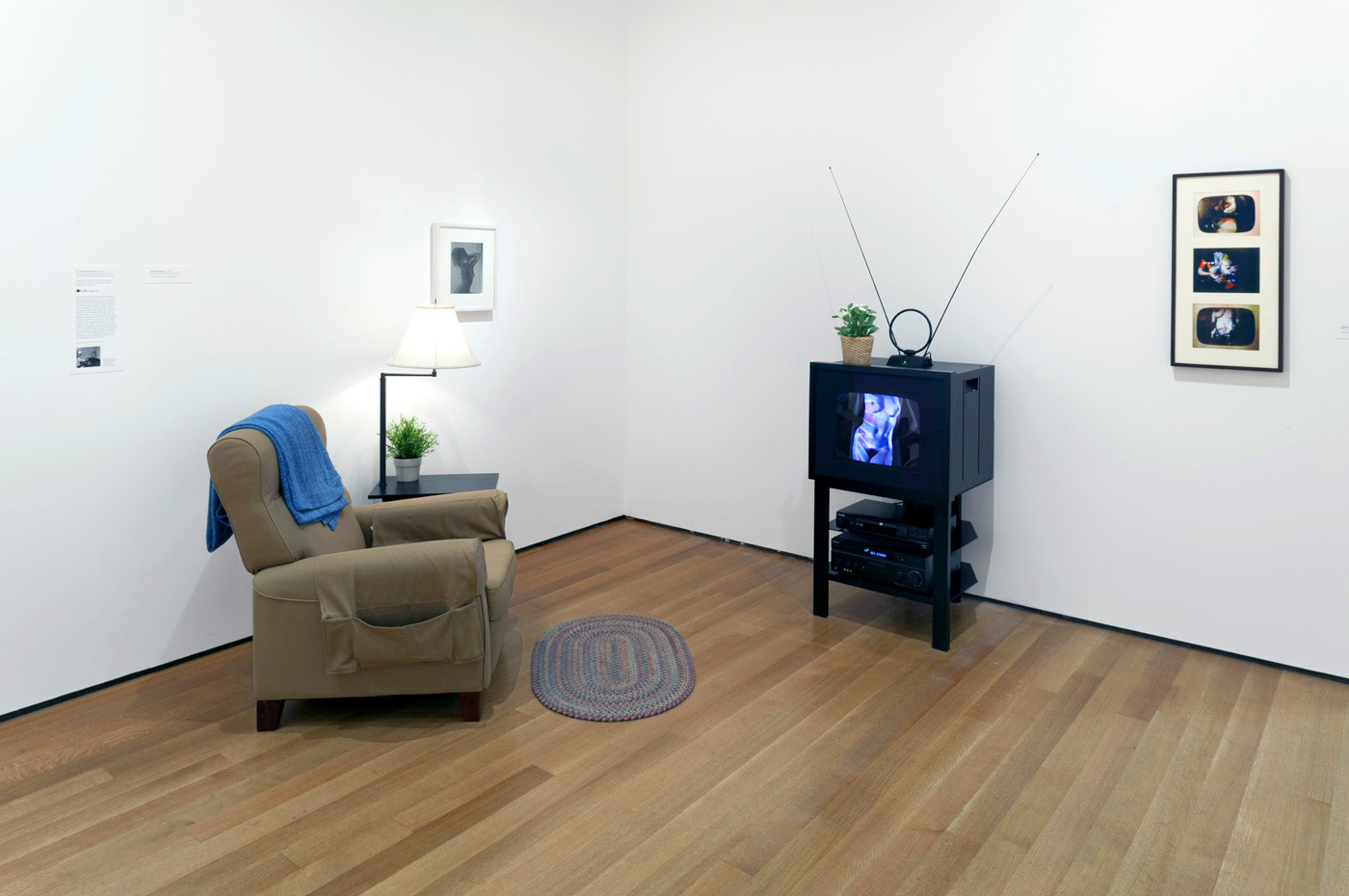
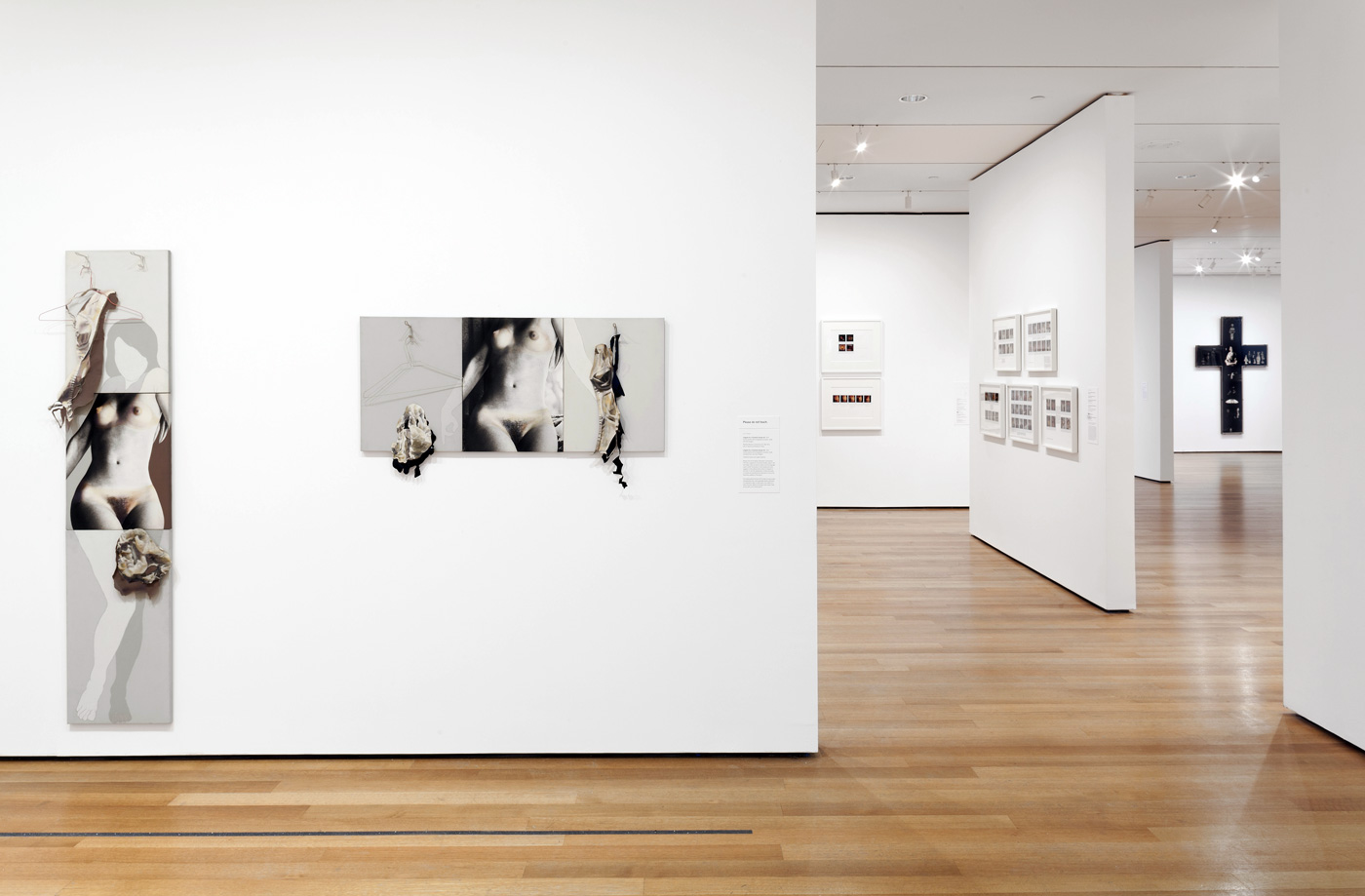
Exhibition: ‘Robert Gober: The Heart Is Not a Metaphor’ at the Museum of Modern Art (MoMA), New York

Exhibition dates: 4th October 2014 – 18th January 2015

Contemporary Galleries and The Donald B. and Catherine C. Marron Atrium, second floor


Many thankx to MoMA for allowing me to publish the photographs in the posting. Please click on the photographs for a larger version of the image.


Robert Gober (American, b. 1954)
 'X Playpen' 1987


Robert Gober (American, b. 1954)
X Playpen
1987
Wood and enamel paint
27 x 37 x 37″ (68.6 x 94 x 94cm)
Batsheva and Ronald Ostrow
Image credit: D. James Dee, courtesy the artist and Paula Cooper Gallery
© 2014 Robert Gober


“Begun in 1984, the sink series appeared during the darkest period of the AIDS epidemic. Gober, who is gay, responded to the tragedy with poetic indirection: the sinks’ cold air of clinical hygiene. The Times critic John Russell nailed the artistic effect: “Minimal forms with maximum content.” The fact that the content must be intuited by the viewer, who is free to regard the sinks as just cleverly manufactured found objects, typifies Gober’s circumspection. His works are enigmatic but not coy, morally driven but not aggrieved. They radiate a quality that is as rare in life as it is in art: character. …

The heart is an excitable physical organ that registers sensations of fight or flight and of love or aversion: the first and last unimpeachable witness to what can’t help but matter, for good and for ill, in every life.”


Peter Schjeldahl. “Found Meanings: A Robert Gober Retrospective,” October 6, 2014 in ‘The Art World’ October 13, 2014 Issue on ‘The New Yorker’ website [Online] Cited 09/07/2021.


Robert Gober (American, b. 1954)
 'The Ascending Sink' 1985


Robert Gober (American, b. 1954)
The Ascending Sink
1985
Plaster, wood, steel, wire lath, and semi-gloss enamel paint
Two components, each: 30 x 33 x 27″ (76.2 x 83.8 x 68.6cm); floor to top: 92″ (233.7cm)
Installed in the artist’s studio on Mulberry Street in Little Italy, Manhattan
Collection of Thea Westreich Wagner and Ethan Wagner, New York
Promised gift to the Whitney Museum of American Art
Image credit: John Kramer, courtesy the artist
© 2014 Robert Gober


Robert Gober (American, b. 1954) 'Untitled' 1984


Robert Gober (American, b. 1954)
Untitled
1984
Plaster, wood, wire lath, aluminium, watercolour, semi-gloss enamel paint
28 x 33 x 22 1/2″ (71.1 x 83.8 x 57.2cm)
Rubell Family Collection
Courtesy the artist and Matthew Marks Gallery
© 2014 Robert Gober


Robert Gober (American, b. 1954) 'Two Partially Buried Sinks' 1986-1987


Robert Gober (American, b. 1954)
Two Partially Buried Sinks
1986-1987
Cast iron and enamel paint
Right: 39 x 25 1/2 x 2 1/2″ (99.1 x 64.8 x 6.4cm)
Left: 39 x 24 1/2 x 2 3/4″ (99.1 x 62.2 x 7cm)
Private collection
Image credit: Andrew Moore, courtesy the artist
© 2014 Robert Gober


Robert Gober (American, b. 1954)
 '
Untitled Closet' 1989


Robert Gober (American, b. 1954)
Untitled Closet
1989
Wood, plaster, enamel paint
84 x 52 x 28″ (213.4 x 132.1 x 71.1cm)
Private collection
Courtesy the artist and Matthew Marks Gallery
© 2014 Robert Gober


Robert Gober (American, b. 1954)
 'Untitled' 1991


Robert Gober (American, b. 1954)
Untitled
1991
Wood, beeswax, human hair, fabric, paint, shoes
9 x 16 1/2 x 45″ (22.9 x 41.9 x 114.3cm)
Collection the artist
Image credit: Andrew Moore, courtesy the artist
© 2014 Robert Gober


Robert Gober (American, b. 1954)
 'Untitled' 1994-1995


Robert Gober (American, b. 1954)
Untitled
1994-1995
Wood, beeswax, brick, plaster, plastic, leather, iron, charcoal, cotton socks, electric light and motor
47 3/8 × 47 × 34″ (120.3 × 119.4 × 86.4cm)
Emanuel Hoffmann Foundation, on permanent loan to the Öffentliche Kunstsammlung Basel
Image credit: D. James Dee, courtesy the artist and Matthew Marks Gallery
© 2014 Robert Gober


Chronicling a 40-year career, Robert Gober: The Heart Is Not a Metaphor is the first large-scale survey of Robert Gober’s (American, b. 1954) work to take place in the United States. The exhibition is on view from October 4, 2014 to January 18, 2015, and features approximately 130 works across several mediums, including individual sculptures, immersive sculptural environments, and a distinctive selection of drawings and prints. Robert Gober: The Heart Is Not a Metaphor is organised by Ann Temkin, The Marie-Josée and Henry Kravis Chief Curator, and Paulina Pobocha, Assistant Curator, Department of Painting and Sculpture, MoMA, working in close collaboration with the artist.

Early on, Gober’s sculptures declared themselves an indispensable part of the landscape of late-twentieth century art; since then they have continued to evolve while remaining tightly bound to the principles outlined by the artist almost four decades ago. Gober places narrative at the centre of his endeavour, embedding themes of sexuality, religion, and politics into work drawn from everyday life. Spare in its use of images and motifs while protean in its capacity to generate meaning, Gober’s work is an art of contradictions: intimate yet assertive, straightforward yet enigmatic. Taking imagery familiar to anyone – doors, sinks, legs – Gober dislocates, alters, and estranges what we think we know. Although a first glance might suggest otherwise, all of Gober’s objects are entirely handmade, by the artist and by collaborators with the necessary expertise.

The earliest works in the exhibition date from the mid-to-late 1970s when Gober was largely working in two dimensions. A painting of the house he grew up in Connecticut hangs at the entrance to the galleries. The first room of the exhibition offers an introduction to Gober’s career, as told through five works: a sculpture of a paint can, a man’s leg, and a closet, as well as a drawing and a small print.

Between 1983 and 1986, Gober created more than 50 sculptures of sinks and scores of related drawings. Based on real sinks, including one in the artist’s childhood home, Gober built them from wood, plaster, and wire lath, and finished them with multiple coats of paint to mimic the appearance of enamel. But, crucially, they lack faucets and plumbing. The sinks’ appearance coincided with the early years of the AIDS epidemic, and their uselessness spoke to the impossibility of cleansing oneself. The sculptures on view in the second gallery of the exhibition were featured in Gober’s first show of sinks, held at the Daniel Weinberg Gallery, Los Angeles, in 1985.

Gober’s early and straightforward sink sculptures gave way in 1985 to a group of distorted sinks whose bodies are variably stretched, bent, multiplied, and divided. The evolution of form registers in the works’ titles: self-evident descriptions become increasingly expressive (eg. The Sink Inside of Me). By the mid-1980s, the artist’s preoccupation with domestic objects expanded to include sculptures of furniture such as beds and playpens, as well as an armchair, on view in the third gallery. Between 1986 and 1987, Gober created Two-Partially Buried Sinks, among the last sink sculptures of the decade. This work is positioned outside the walls of the Museum on a scaffold, and can be viewed through the gallery’s window.

In 1989 at the Paula Cooper Gallery, Gober exhibited his first room-sized installations. Each is framed by wallpapers: a pattern pairing a sleeping white man and a lynched black man in one, and line drawings of male and female genitalia in the other, both of which are on view in the following galleries. These backdrops powerfully inflect the sculptures contained within: a freestanding bridal gown and hand-painted plaster cat litter bags in the first room and a bag of donuts with cast-pewter drains inset into the walls in the second. With characteristic concision, Gober sets off a complex swirl of questions about the unease surrounding issues to everyday life in America.

Gober made Slides of a Changing Painting between 1982 and 1983. During this year, he painted on a small Masonite board and photographed the imagery as it changed over time. Eventually, he had accumulated more than 1,000 slides, which he edited down and organised into a slide projection that he showed in 1984. After the exhibition, Gober put the slides away. When he revisited the project around 1990, he realised that he had unknowingly employed many of the same images in his subsequent sculptures. Slides of a Changing Painting has continued to be generative; it provides a nearly complete index of Gober’s visual themes and vocabulary. The work is on view in a gallery centrally located within the exhibition.

The human figure was absent from Gober’s sculptural repertoire until 1989, when he made his first sculpture of a man’s leg, a breakthrough that ushered in many related works. Single legs wearing trousers and shoes and truncated at mid-shin were followed by pairs of legs that Gober left whole to the waist. He showed these surreal sculptures in a 1991 exhibition in Paris, recreated in the following gallery. Three pairs of legs, augmented by candles, drains, and a musical score, are positioned around the perimeter of a room wallpapered with a kaleidoscopic landscape of a beech forest in autumn. In the centre of the gallery sits a human-sized cigar composed of tobacco sheafs purchased from a Pennsylvania supplier. To learn how to preserve this organic material as it aged, Gober consulted an expert at the American Museum of Natural History. Seeking out specialists’ advice on complicated projects is a hallmark of the artist’s craft based practice.

The works on view in the following gallery were made by artists Anni Albers, Robert Beck, Cady Noland, and Joan Semmel; photographs by Nancy Shaver hang in the adjoining space. Gober brought these objects together for the first time in an exhibition he organised at the Matthew Marks Gallery, New York in 1999. Gober has been curating exhibitions since the mid-1980s, most recently focusing on monographic presentations of the works by American artists Charles Burchfield and Forrest Bess. The contemporary artists included in this gallery share with Gober daring approaches to the representation of sexuality, violence, and American culture.

The immersive installation Gober conceived for a 1992 exhibition at the Dia Center for the Arts, New York is on view nearby. All three rooms of that original presentation are reconstructed: an antechamber, a central gallery, and a dark cul-de-sac. The main space features a hand-painted mural, executed in a paint-by-number method by scenic painters, depicting a forest inspired by the landscape of Long Island’s North Fork. Barred prison windows, through which a blue sky is visible, interrupt the verdant panorama. Placed throughout the gallery are hand-painted plaster sculptures of boxes of rat bait and bundles of newspapers – actually photolithographic facsimiles of newspapers featuring real and invented content. After a six-year absence from Gober’s work, sinks reappeared in the installation at Dia, water now running freely from their faucets.

Following the introduction of mens’ legs into his sculptural vocabulary, Gober cast the leg of a young boy and used that mould as the basis for several subsequent works, including a fireplace where legs take the place of firewood, a vision invoking childhood nightmares and uncensored fairy tales. Also on view is a sculpture of a suitcase that occupies space below ground as well as above. Its lid opens to reveal a sewer grate and a brick shaft that leads to a subterranean tidal pool complete with seaweed, mussel shells, and starfish. Visible through the depths of the water, amid the marine life, are the legs of a man and baby, one holding the other in a manner suggestive of baptism. While primarily a sculptor, Gober has worked across a range of media throughout his career including drawing and printmaking. Drawings sit the closest to his work in three dimensions; most of his sculptures and installations are preceded by preparatory drawings. A selection of Gober’s works on paper is also on view in this gallery.

The final installation included in the exhibition was made in response to the attacks of September 11, 2001, and results from Gober’s desire to create a space of refuge and reflection. The overall structure evokes the interior of a church: a central aisle separating rows of pews leads to an altar-like area flanked by two chapels. From the nipples of a headless Christ, regenerative “living water” flows into a large hole jackhammered into the floor. In the pastel drawings hanging on the side walls, the power of human embrace confronts the harrowing news contained within the photo-lithographed pages of the September 12, 2001, issue of The New York Times. In this installation, the overt references to Catholicism explore the vitality of such symbolism in the wake of contemporary tragedy.

Over the past decade, Gober’s sculptures have become increasingly complex, both technically and iconographically. The artist sometimes uses casts of existing sculptures and combines them to create hybrid objects, as in the conjunction of a chest, a stool, and a twisted network of children’s legs. Elsewhere, Gober pushes recognisable imagery into unpredictable terrain: a sink’s backsplash morphs into gnarled planks of wood interwoven with casts of fragmented arms. New motifs, such as a surrealistically melting rifle, also have entered the artist’s visual universe. The strangeness of these new sculptures is presaged by Prayers Are Answered (1980-1981), an early work loosely based on a Catholic church on 7th Street and Avenue B in the East Village. Rather than the traditional religious scenes to be found in paintings lining the walls, Gober has furnished the church with murals depicting the harshness of daily life in the city.

The exhibition’s final gallery presents works made as early as 1979 and as recently as this past spring. Images of domestic objects and architecture and themes of childhood and the body reverberates across the decades. The dollhouse placed on the floor is one of several that Gober designed and built during his first years in New York City, as one way of earning a living. The sculpture and installations that would follow may be considered life-size realisations of the imaginative potential contained within these small structures.

Published in conjunction with the exhibition and prepared in close collaboration with the artist, Robert Gober: The Heart Is Not a Metaphor traces the development of his work, highlighting themes and motifs to which he has returned throughout the decades. The book features an essay by Hilton Als – a text both wide-ranging and personal – and an in-depth narrative of Gober’s life. The rich selection of images illustrates every phase of the artist’s career, and includes previously unpublished photographs from his own archive. Hardcover. 6.5″w x 9.75″h; 272 pages; 169 illustrations. ISBN: 978-0-87070-946-3. $45.

Ann Temkin

The Marie-Josée and Henry Kravis Chief Curator of Painting and Sculpture
The Museum of Modern Art

Ms. Temkin assumed the role of Chief Curator of Painting and Sculpture in 2008, after joining The Museum of Modern Art in 2003 as Curator. During her tenure, Ms. Temkin has worked extensively with her colleagues on reimagining the Painting and Sculpture collection galleries at the Museum. Along with Robert Gober: The Heart Is Not A Metaphor, her exhibitions at MoMA include Ileana Sonnabend: Ambassador for the New (2013); Abstract Expressionist New York (2010); Gabriel Orozco (2009); and Color Chart: Reinventing Color, 1950 to Today (2008). Prior to MoMA, Ms. Temkin was the curator of modern and contemporary art at the Philadelphia Museum of Art from 1990 to 2003, where she organised such exhibitions as Barnett Newman (2002), Constantin Brancusi (1995), and Thinking is Form: The Drawings of Joseph Beuys (1994).

Paulina Pobocha

Assistant Curator, Department of Painting and Sculpture
The Museum of Modern Art

Ms. Pobocha is an assistant curator in the Department of Painting and Sculpture at The Museum of Modern Art. She joined the Museum in 2008 and has worked on the exhibitions Gabriel Orozco (2009) and Abstract Expressionist New York (2010). In 2013 she co-organised Claes Oldenburg: The Street and The Store. She has also worked extensively with the Museum’s collection. Prior to MoMA, Ms. Pobocha was a Joan Tisch Fellow at the Whitney Museum of American Art, where she lectured on a broad range of subjects in contemporary and modern art. In 2011, she was appointed Critic at the Yale University School of Art.

Press release from the MoMA website


Installation view of 'Robert Gober: The Heart Is Not a Metaphor', The Museum of Modern Art, October 4, 2014 - January 18, 2015


Robert Gober (American, b. 1954)
X Pipe Playpen
2013-14
Wood and bronze
26 1/8 x 55 x 55″ (66.4 x 139.7 x 139.7cm)
Collection the artist
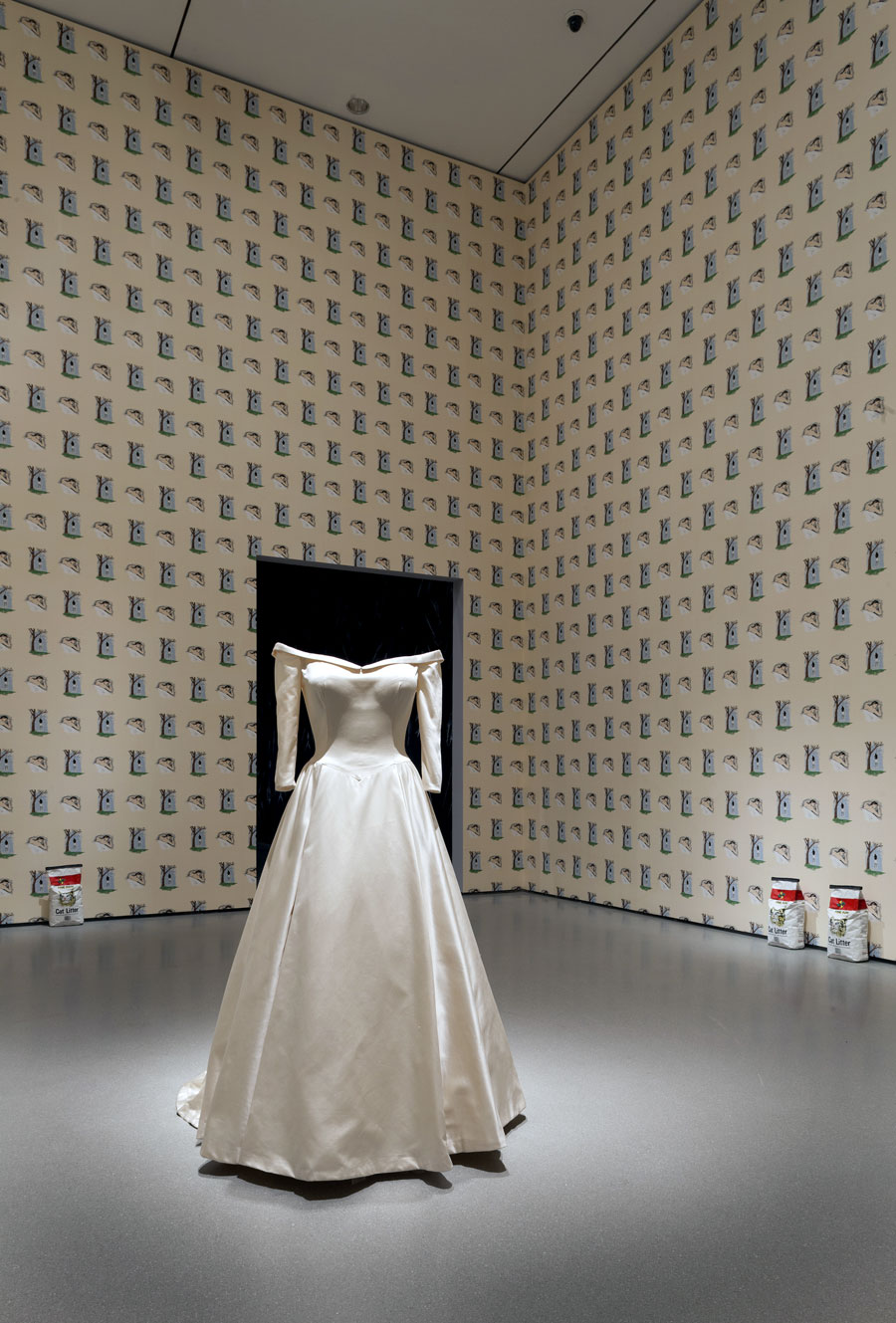
 

Installation view of 'Robert Gober: The Heart Is Not a Metaphor', The Museum of Modern Art, October 4, 2014 - January 18, 2015 showing Gober's 'Untitled' 1989-1996


Robert Gober (American, b. 1954)
Untitled
 (installation view)
1989-1996
Silk satin, muslin, linen, tulle, welded steel, hand-printed silkscreen on paper, cast hydrostone plaster, vinyl acrylic paint, ink, and graphite
Dimensions variable, approximately 800 square feet installed
The Art Institute of Chicago, restricted gift of Stefan T. Edlis and H. Gael Neeson Foundation; through prior gifts of Mr. and Mrs. Joel Starrels and Fowler McCormick
© 2014 Robert Gober


Robert Gober (American, b. 1954) 'Bag of Donuts' 1989


Robert Gober (American, b. 1954)
Bag of Donuts
1989
paper, dough and rhoplex (12 donuts)
© 2014 Robert Gober
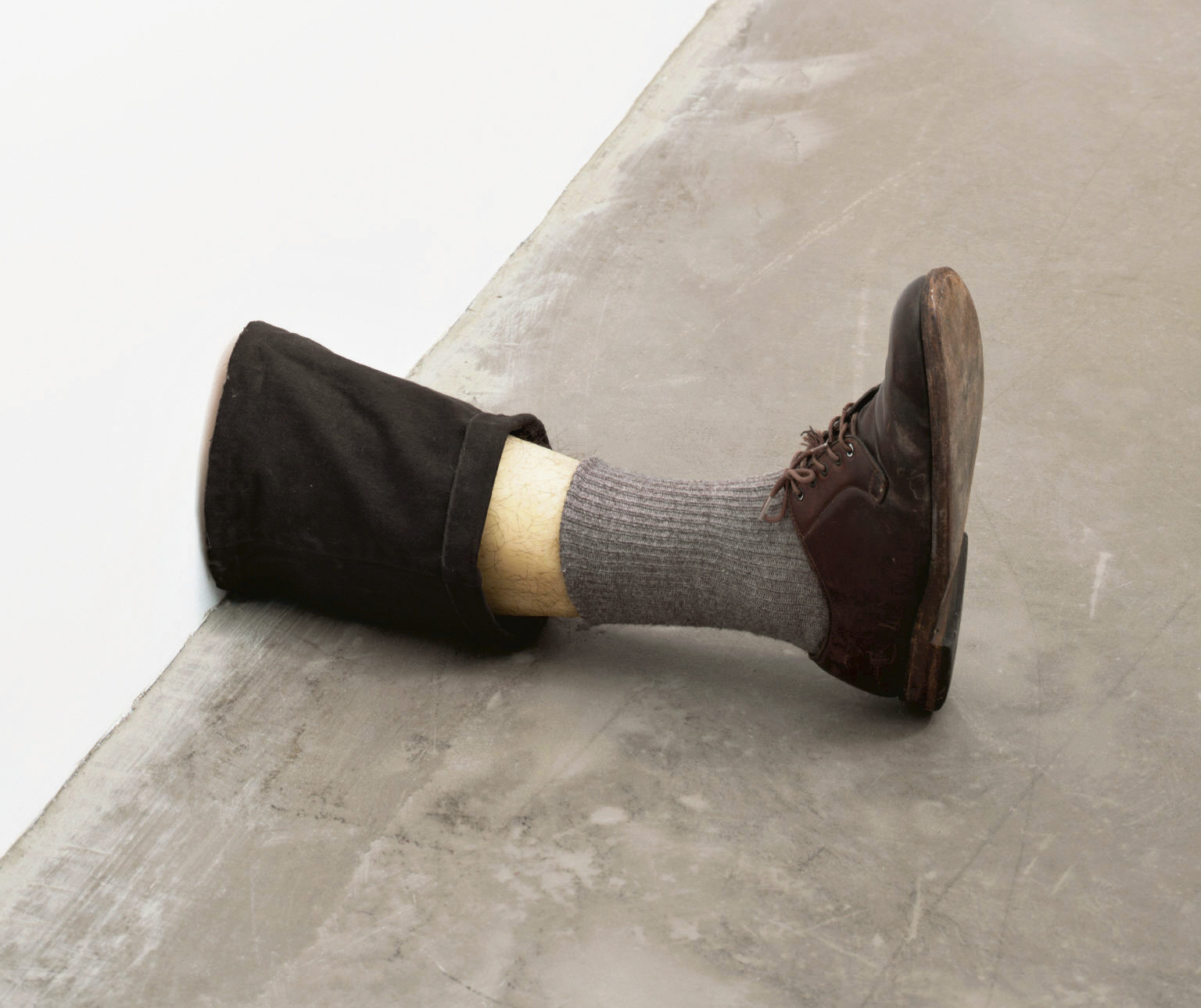
 

Robert Gober (American, b. 1954)
 'Untitled Leg' 1989-1990


Robert Gober (American, b. 1954)
Untitled Leg
1989-1990
Beeswax, cotton, wood, leather, human hair
11 3/8 x 7 3/4 x 20″ (28.9 x 19.7 x 50.8 cm)
The Museum of Modern Art, New York. Gift of the Dannheisser Foundation
© 2014 Robert Gober


Installation view of 'Robert Gober: The Heart Is Not a Metaphor', The Museum of Modern Art, October 4, 2014 - January 18, 2015 showing on the floor, Gober's 'Cigar' 1991


Robert Gober (American, b. 1954)
Cigar (installation view)
1991
Wood, paint, paper, tobacco
15 3/4 x 15 3/4 x 70 7/8″ (40 x 40 x 180cm)
The Museum of Contemporary Art, Los Angeles. Purchased with funds provided by the Collectors Committee in honour of Marcia Simon Weisman
© 2014 Robert Gober

Robert Gober (American, b. 1954)
Forest
1991
Hand-printed silkscreen on paper
180″ x 124″ (457.2 x 315cm)
Courtesy the artist
© 2014 Robert Gober
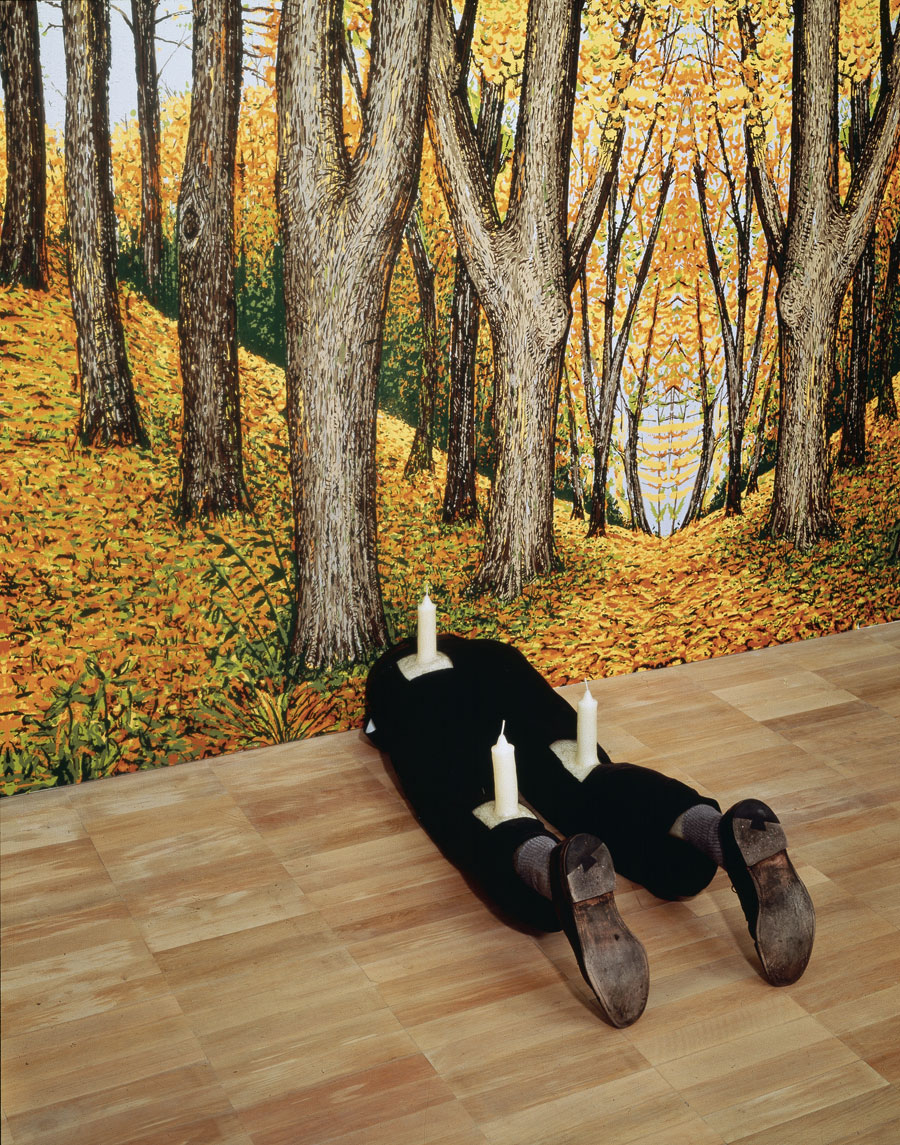
 

Robert Gober (American, b. 1954) '
Untitled' 1991


Robert Gober (American, b. 1954)
Untitled
1991
Wood, beeswax, leather, fabric, and human hair
13 1/4 x 16 1/2 x 46 1/8″ (33.6 x 41.9 x 117.2cm)
The Museum of Modern Art, New York. Gift of Werner and Elaine Dannheisser
Background: Forest, 1991
Hand-painted silkscreen on paper
Image credit: K. Ignatiadis, courtesy the artist and Matthew Marks Gallery
© 2014 Robert Gober


Installation view of 'Robert Gober: The Heart Is Not a Metaphor', The Museum of Modern Art, October 4, 2014 - January 18, 2015 showing Gober's 'Untitled' 1992


Robert Gober (American, b. 1954)
Untitled (installation view)
1992
Paper, twine, metal, light bulbs, cast plaster with casein and silkscreen ink, stainless steel, painted cast bronze and water, plywood, forged iron, plaster, latex paint and lights, photolithography on archival (Mohawk Superfine) paper, twine, hand-painted forest mural
511 3/4 × 363 3/16 × 177 3/16″ (1300 × 922.5 × 450.1cm)
Glenstone
© 2014 Robert Gober


Robert Gober (American, b. 1954) '
Untitled' 1992


Robert Gober (American, b. 1954)
Untitled
1992
Paper, twine, metal, light bulbs, cast plaster with casein and silkscreen ink, stainless steel, painted cast bronze and water, plywood, forged iron, plaster, latex paint and lights, photolithography on archival (Mohawk Superfine) paper, twine, hand-painted forest mural
511 3/4 × 363 3/16 × 177 3/16″ (1300 × 922.5 × 450.1cm)
Glenstone
Image credit: Russell Kaye, courtesy the artist and Matthew Marks Gallery
© 2014 Robert Gober
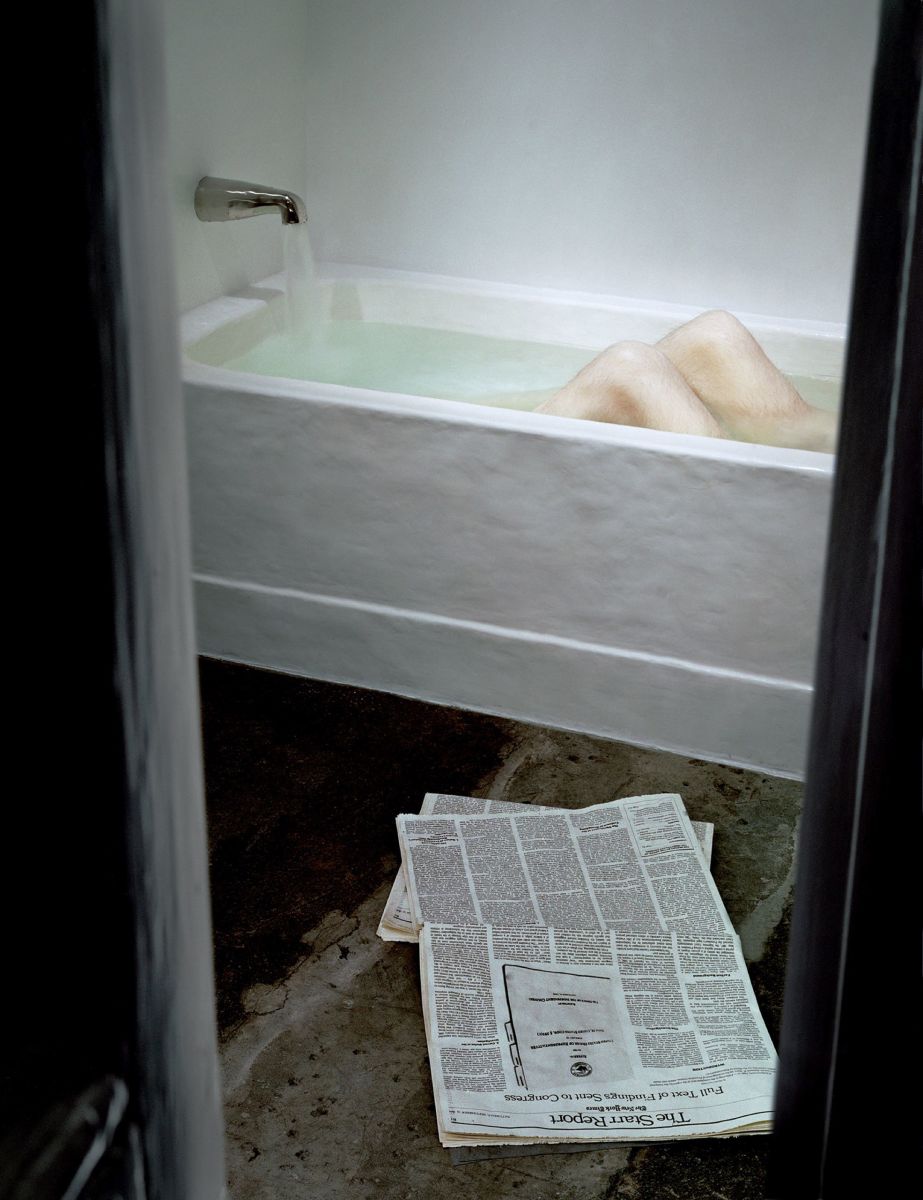
 

Robert Gober (American, b. 1954) 'Untitled' 2003-2005


Robert Gober (American, b. 1954)
Untitled
2003-2005
Courtesy MoMA and Matthew Marks Gallery
Image credit: Russel Kaye
© 2014 Robert Gober


Installation view of 'Robert Gober: The Heart Is Not a Metaphor', The Museum of Modern Art, October 4, 2014 - January 18, 2015 showing Gober's 'Untitled' 2003-2005 (detail)


Robert Gober (American, b. 1954)
Untitled (detail)
2003-2005
© 2014 Robert Gober


Robert Gober (American, b. 1954) 'Untitled' 1980-1981


Robert Gober (American, b. 1954)
Untitled
1980-1981
Oil on wood panel
8 x 5 3/4″ (20.3 x 14.6cm)
Collection the artist
Image credit: Ron Amstutz, courtesy the artist and Matthew Marks Gallery
© 2014 Robert Gober


Robert Gober (American, b. 1954) '
Slip Covered Armchair' 1986-1987


Robert Gober (American, b. 1954)
Slip Covered Armchair
1986-1987
Plaster, wood, linen, and fabric paint
31 1/2 x 30 1/2 x 29″ (80 x 77.5 x 73.7cm)
Collection the artist
Image credit: D. James Dee, courtesy the artist
© 2014 Robert Gober


Installation view of 'Robert Gober: The Heart Is Not a Metaphor', The Museum of Modern Art, October 4, 2014 - January 18, 2015 showing Gober's 'Untitled Door and Door Frame' 1987-1988


Robert Gober (American, b. 1954)
Untitled Door and Door Frame (installation view)
1987-1988
Wood, enamel paint
Door: 84 x 34 x 1 1/2″ (213.4 x 86.4 x 3.8cm)
Doorframe: 90 x 43 x 5 1/2″ (228.6 x 109.2 x 14cm)
Collection Walker Art Center, Minneapolis. Gift of the John and Mary Pappajohn Art Foundation, 2004
© 2014 Robert Gober

Installation views of Robert Gober: The Heart Is Not a Metaphor, The Museum of Modern Art, October 4, 2014 – January 18, 2015
All works by Robert Gober © 2014 Robert Gober © 2014 The Museum of Modern Art
Photos: Jonathan Muzikar


Robert Gober (American, b. 1954) 'Untitled' 2005-2006


Robert Gober (American, b. 1954)
Untitled
2005-2006
Aluminium-leaf, oil and enamel paint on cast lead crystal
4 3/4″ high × 4 1/4″ diameter (12.1 × 10.8cm)
Collection the artist
Image credit: Bill Orcutt, courtesy the artist and Matthew Marks Gallery
© 2014 Robert Gober


Robert Gober (American, b. 1954) '
Untitled' 2008


Robert Gober (American, b. 1954)
Untitled
2008
Cast gypsum polymer
14 1/2 x 10 3/4 x 6″ (36.8 x 27.3 x 15.2cm)
Edition of 4, with 1 AP
Collection the artist
Image credit: Fredrik Nilsen, courtesy the artist and Matthew Marks Gallery
© 2014 Robert Gober


Robert Gober (American, b. 1954) 'Leg with Anchor' 2008


Robert Gober (American, b. 1954)
Leg with Anchor
2008
Forged iron and steel, beeswax, cotton, leather, and human hair
28 × 18 × 20″ (71.1 × 45.7 × 50.8cm)
Glenstone
Image credit: Bill Orcutt, courtesy the artist and Matthew Marks Gallery
© 2014 Robert Gober


The Museum of Modern Art
11 West 53 Street
New York, NY 10019
Phone: (212) 708-9400

Opening hours:
10.30 am – 5.30 pm
Open seven days a week
MoMA website

LIKE ART BLART ON FACEBOOK

Back to top

Exhibition: ‘Transformational Imagemaking: Handmade Photography Since 1960’ at CEPA Gallery, Buffalo, NY

Exhibition dates: 19th September – 13th December 2014

Artists: Thomas Barrow, Wayne Belger, Stephen Berkman, Matthew Brandt, Dan Burkholder, Darryl Curran, Binh Danh, Rick Dingus, Dan Estabrook, Robert Fichter, Robert Flynt, Judith Golden, Betty Hahn, Robert Heinecken, Robert Hirsch, Catherine Jansen, Harold Jones, Tantana Kellner, Les Krims, William Larson, Dinh Q. Lê, David Lebe, Martha Madigan, Curtis Mann, Stephen Marc, Scott McCarney, Chris McCaw, John Metoyer, Duane Michals, Vik Muniz, Joyce Neimanas, Bea Nettles, Ted Orland, Douglas Prince, Holly Roberts, Clarissa Sligh, Keith Smith, Jerry Spagnoli, Mike & Doug Starn, Brian Taylor, Maggie Taylor, Jerry Uelsmann, Todd Walker, Joel-Peter Witkin, John Wood.

Curator: Robert Hirsch


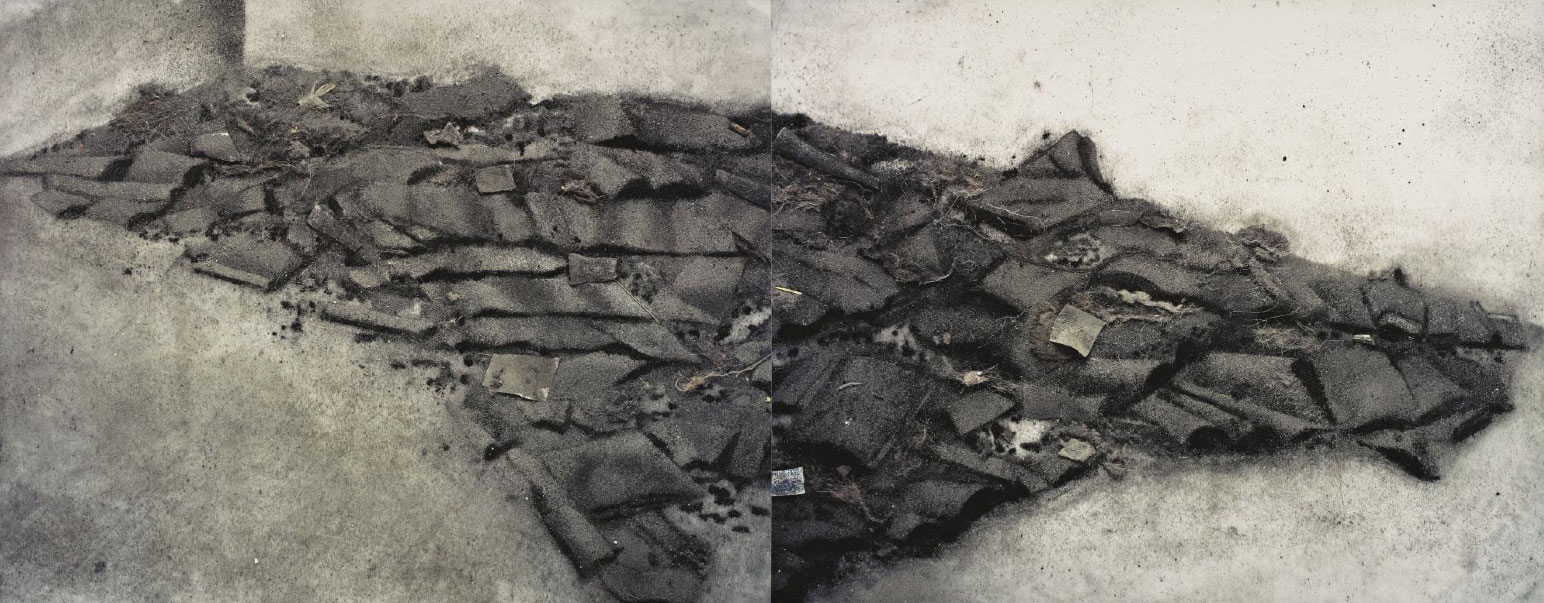
Vik Muniz (Brazilian, b. 1961) 'Picture of Dust' 2000


Vik Muniz (Brazilian, b. 1961)
Picture of Dust (Barry Le Va, Continuous and Related Activities; Discontinued by the Act of Dropping, 1967, Installed at the Whitney Museum in New Sculpture 1965-1975: Between Geometry and Gesture, February 20-June 3, 1990)
2000
From the series The Things Themselves: Picture of Dust
Framed, overall: 51 x 130 1/2 inches
Two silver dye bleach prints (Ilfochrome)
Whitney Museum of American Art, New York;/Licensed by VAGA, New York, NY


The resurgence of handmade photography in the 1960s had several sources and influences. It looked back to the “anti-tradition” of nineteenth-century romanticism, which accentuated the importance of making a highly personal response to experience and a critical response to society. It drew on contemporary popular culture. Many of the artists engaged in this movement were baby-boomers brought up on television and film, media that often portrayed photography as hip and sexy – eg. the film Blow-Up (1966) – and which drove home the significance of constructed photographic images. In addition, the widespread atmosphere of rebellion against social norms propelled the move toward handwork. The rejection of artistic standards in photography was consistent with the much broader exploration of sexual mores and gender roles that took place in the sixties. It was also consistent with the exploration of consciousness. The latter was encouraged by such counter-culture figures as Ken Kesey who, with his band of Merry Pranksters, boarded a Day-Glo bus called “Further” and took an LSD-fuelled trip across the country that echoed Dr. Timothy Leary’s decree “to tune in, turn on, and drop out.” On a broader level, the society-at-large was exposed to psychedelic exploration through Stanley Kubrick’s film 2001: A Space Odyssey (1968), which youthful audiences saw as a mysterious consciousness-expanding trip into humanity’s future. Finally, handmade photography was supported by the general growth of photographic education in the university. The ubiquity and importance of the medium in the culture at large, as well as pressure from those who championed photography from within art institutions gave credence in the post-war decades to the idea that people could study photography seriously. As new photography programs mushroomed in the universities, they produced graduates who took teaching positions in even newer programs. Many of these young teachers, who had grown up to the adage of “do your own thing,” were responsive to unconventional ways of seeing and working, and they encouraged these attitudes in their students, many of whom turned to handmade photography.

Despite the attractions of handmade photography there were in the sixties, and still are to some degree, emphatic objections to the open engagement of the hand in photographic art. One common objection is that such art constitutes a dishonest method to cover up aesthetic and technical inadequacies. Another comes from those who believe strongly in the Western tradition of positivism. These people tend to reject handmade photography on the grounds that it is unnecessarily ambiguous or irrational in its meanings. Nevertheless, more artists than ever are currently using the flexible, experiential methods of handwork. In addition to opening up an avenue to inner experience, artists find handwork attractive because it promotes inventiveness, allows for the free play of intuition beyond the control of the intellect, extends the time of interaction with an image (on the part of both the maker and the viewer), and allows for the inclusion of a wide range of materials and processes within the boundaries of photography…

[Curator] Peter C. Bunnell’s innovative exhibitions [MoMA: Photography as Printmaking (1968) and Photography Into Sculpture (1970)] demonstrated that in essence photography is nothing more than light sensitive material on a surface. The exhibitions also recognized that the way a photograph is perceived and interpreted is established by artistic and societal preconceptions about how a photographic subject is supposed to look and what is accepted as truthful. The work in the Bunnell exhibitions was indicative of a larger zeitgeist of the late 1960s that involved leaving the safety net of custom, exploring how to be more aware of and physically connected to the world, and critically examining expectations with regard to lifestyles…

In spite of post-modernism’s assault on the myth of authorship and its sardonic outlook regarding the human spirit, artists who produce handmade photography continue to believe that individuals can make a difference, that originality matters, and that we learn and understand by doing. They think that a flexible image is a human image, an imperfect and physically crafted one that possesses its own idiosyncratic sense of essence, time, and wonder. Their work can be aesthetically difficult, as it may not provide the audience-friendly narratives and well-mannered compositions some people expect. But sometimes this is necessary to get us to set aside the ordained answers to the question: “What is a photograph?” and allow us to recognise photography’s remarkable diversity in form, structure, representational content, and meaning. This acknowledgment grants artists the freedom and respect to explore the full photographic terrain, to engage the medium’s broad power of inquiry, and to present the wide-ranging complexity of our experiences, beliefs, and feelings for others to see and contemplate.

Extract from Flexible Images: Handmade American Photography, 1969-2002 by Robert Hirsch (2003) on the Light Research website [Online] Cited 14/11/2014. First published in The Society for Photographic Education’s exposure, Volume 36: 1, 2003, cover and pages 23-42. © Robert Hirsch 2003


Many thankx to CEPA Gallery for allowing me to publish the photographs in the posting. Please click on the photographs for a larger version of the image.


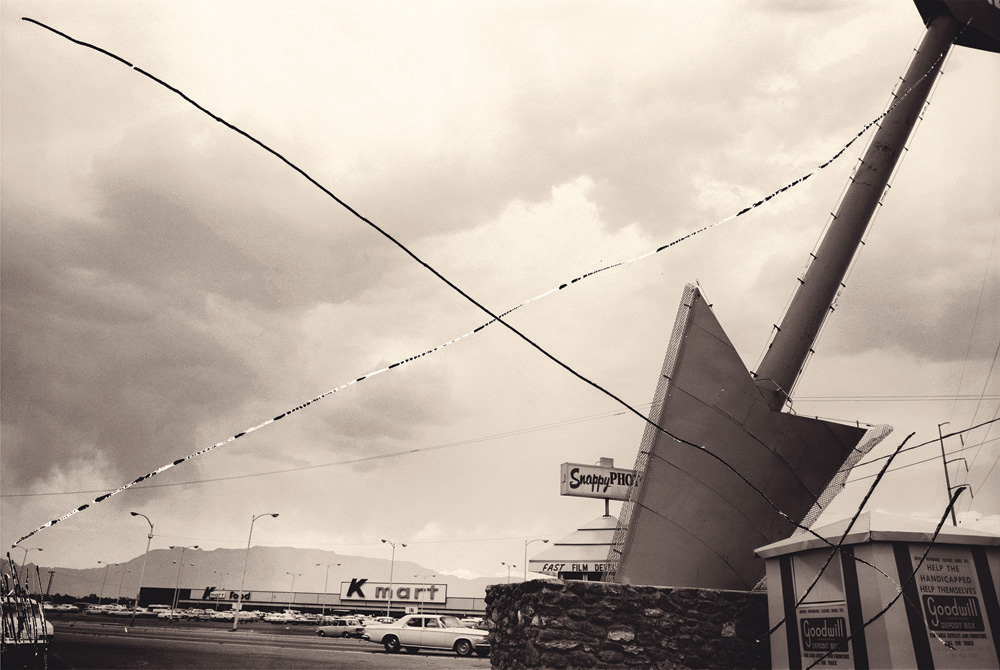
Thomas Barrow (American, b. 1938) 'Dart, Albuquerque' 1974


Thomas Barrow (American, b. 1938)
Dart, Albuquerque
1974
Fuji Crystal Archive Print


Thomas Barrow (American, b. 1938) 'f/t/s Cancellations (Brown) – Field Star' 1975


Thomas Barrow (American, b. 1938)
f/t/s Cancellations (Brown) – Field Star
1975
Gift from the Collection of Joel Deal and Betsy Ruppa
© Thomas Barrow. Museum of Art Rhode Island School of Design, Providence


Barrow scratched through his landscape negatives, calling attention to the materiality of the medium itself and the fact that regardless of how much information is given, reality remains an accumulation of belief, knowledge, and one’s own experience.


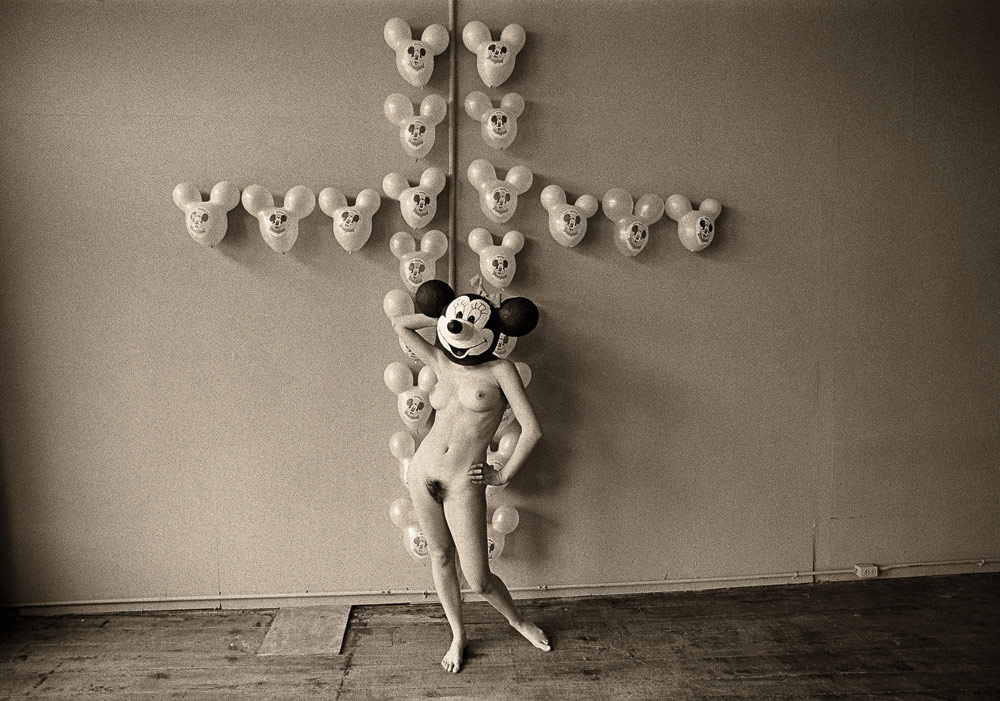
Les Krims (American, b. 1942) 'The Static Electric Effect of Minnie Mouse on Mickey Mouse Balloons' 1968


Les Krims (American, b. 1942)
The Static Electric Effect of Minnie Mouse on Mickey Mouse Balloons
1968
Kodalith Print


“Kodak Kodalith paper was a thin, matt, orthochromatic graphic arts paper that was not intended for pictorial purposes. However, when it was used for pictorial expression its responsiveness to time and temperature controls during development enabled one to produce a wide range of grainy, high-contrast, and sepia tonal effects. Its unusual handling characteristics also meant that photographers had to pull the print at precisely the “right” moment from the developer and quickly get it into the stop bath, making each print unique.”


Din Q Le (Vietnamese American, b. 1968) 'Ezekial’s Whisper' 2014


Din Q Le (Vietnamese American, b. 1968)
Ezekial’s Whisper
2014
C-print, linen tape


Ted Orland (American, b. 1941) 'Meteor!' 1998


Ted Orland (American, b. 1941)
Meteor!
1998
Hand coloured gelatin silver print


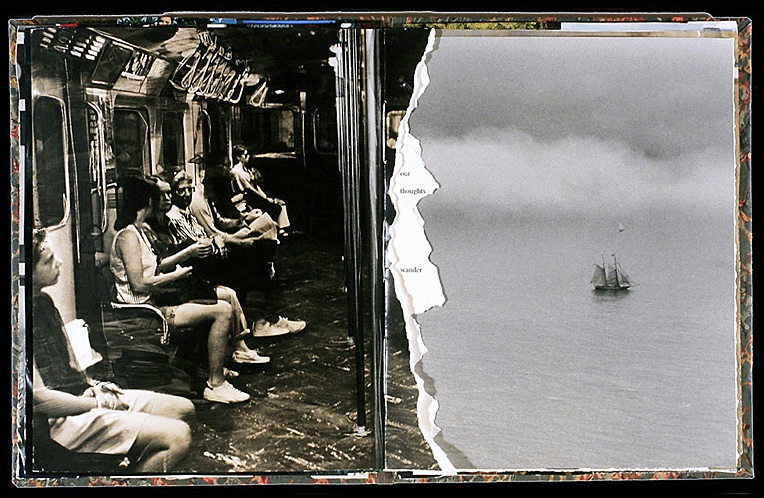
Brian Taylor (American) 'Our Thoughts Wander' 2005


Brian Taylor (American)
Our Thoughts Wander
2005
From the series Open Books
Hand bound book


Open Books

I create photographically illustrated books springing from my fascination with the book format and a love of texture in art. My imagery is inspired by the surreal and poetic moments of living in our fast-paced, modern world. I’m fascinated by how daily life in the 21st Century presents us with incredible experiences in such regularity that we no longer differentiate between what is natural and what is coloured with implausibility, humour, and irony.

These hard cover books are hand bound with marbleised paper and displayed fully opened to a photographically illustrated two-page folio spread. Each book is framed in a wooden shadowbox and presented as a wall piece. I like the idea of making art that contains some imagery which can be sensed but not seen. The underlying pages contain my photographs, snapshots, and work prints that “gave their lives” for the imagery visible in the open spread. These images lie beneath the open pages like history.

Text from the Brian Taylor Photography website [Online] Cited 12/11/2022


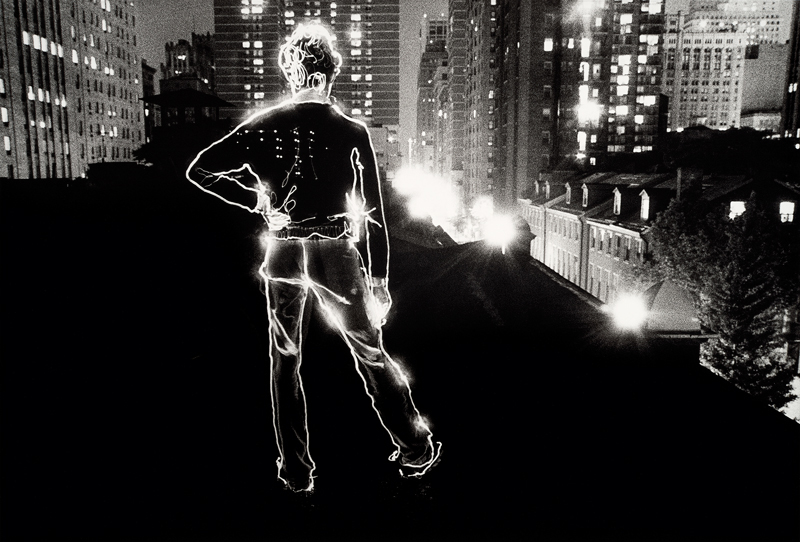
David Lebe (American, b. 1948) 'Angelo On The Roof' 1979


David Lebe (American, b. 1948)
Angelo On The Roof
1979


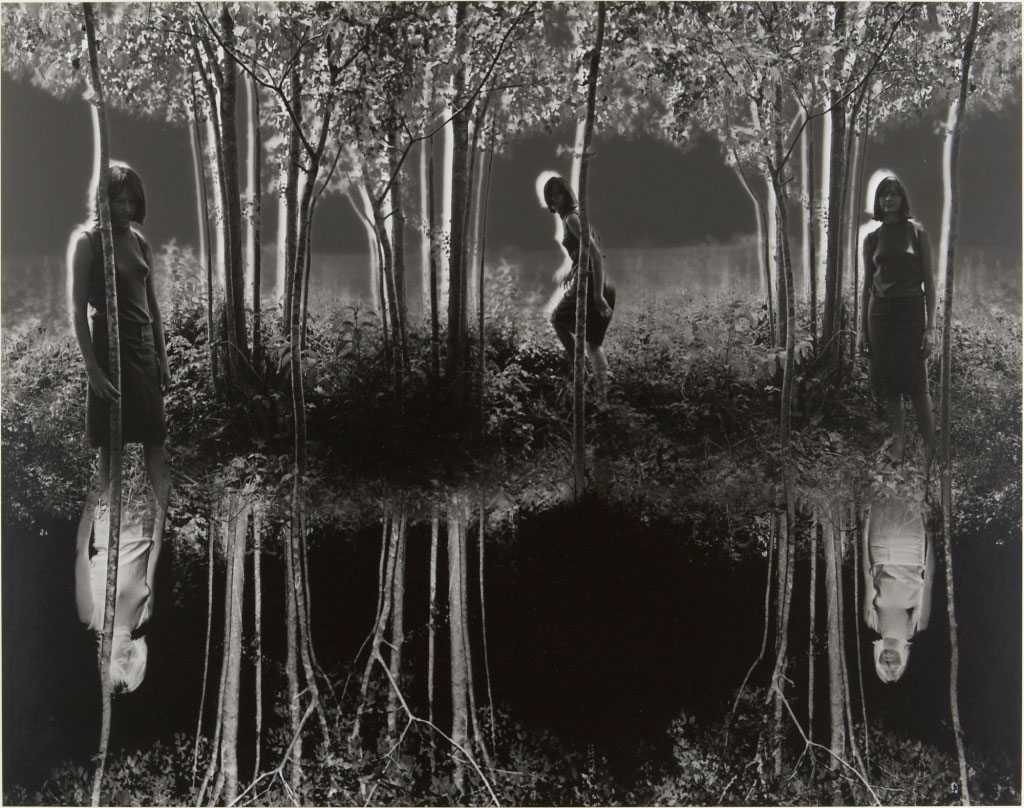
Jerry Uelsmann (American, 1934-2022) 'Small Woods where I met Myself (Final Version)' 1967


Jerry Uelsmann (American, 1934-2022)
Small Woods where I met Myself (Final Version)
1967
Gelatin silver print
25.4 x 32.3cm (10 x 12 11/16 in.)
© 1967 Jerry Uelsmann


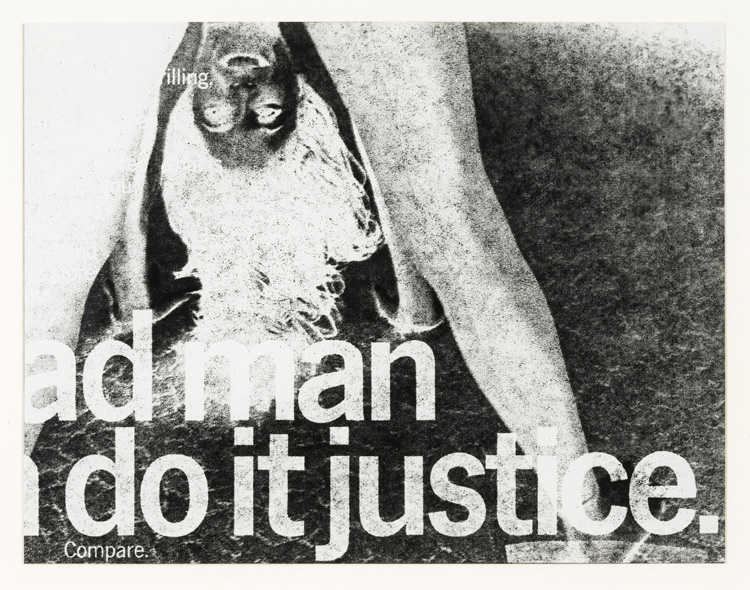
Robert Heinecken (American, 1931-2006) 'Are You Rea #15' 1968


Robert Heinecken (American, 1931-2006)
Are You Rea #15
1968
Offset lithography


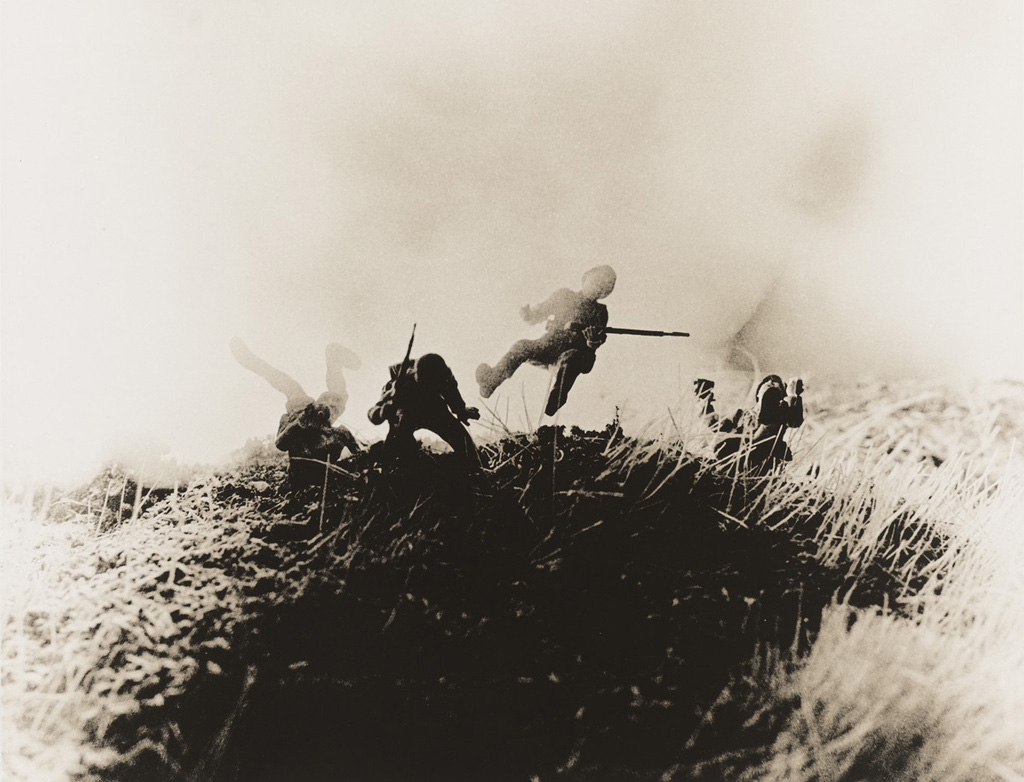
David Levinthal (American, b. 1949) and Garry Trudeau (American, b. 1948) 'Untitled', from the series 'Hitler Moves East' 1977


David Levinthal (American, b. 1949) and Garry Trudeau (American, b. 1948)
Untitled, from the series Hitler Moves East
1977
8 x 10 inches
Gelatin silver (Kodalith) print
Courtesy Paul Morris Gallery, New York City


My favourite story comes from the early days of Levinthal’s career, when he was a college student working on Hitler Moves East with Garry Trudeau. They worked with childlike enthusiasm, purchasing smoke bombs from a local theatre supply shop and growing grass inside David’s apartment to achieve maximum realism. This culminated in a huge explosion of smoke, and the photograph above. Forever making jokes, Levinthal had this to say about the situation: “I’m not even sure we had 911 those days, so that was probably helpful.” He sometimes describes incidents in which things went wrong, but thankfully this wasn’t one of those situations. Instead he successfully produced this photo and began a transition from the early works, which show toys rearranged on his linoleum floor, to photographs that are sophisticated and deceptively real looking.

Ashleigh Ferran. “From Toys to Art: Learning from David Levinthal,” on the Corcoran website August 7, 2013 [Online] Cited 02/07/2021. No longer available online


Joel-Peter Witkin (American, b. 1939) 'Poussin in Hell' 1999


Joel-Peter Witkin (American, b. 1939)
Poussin in Hell
1999
Toned gelatin silver print


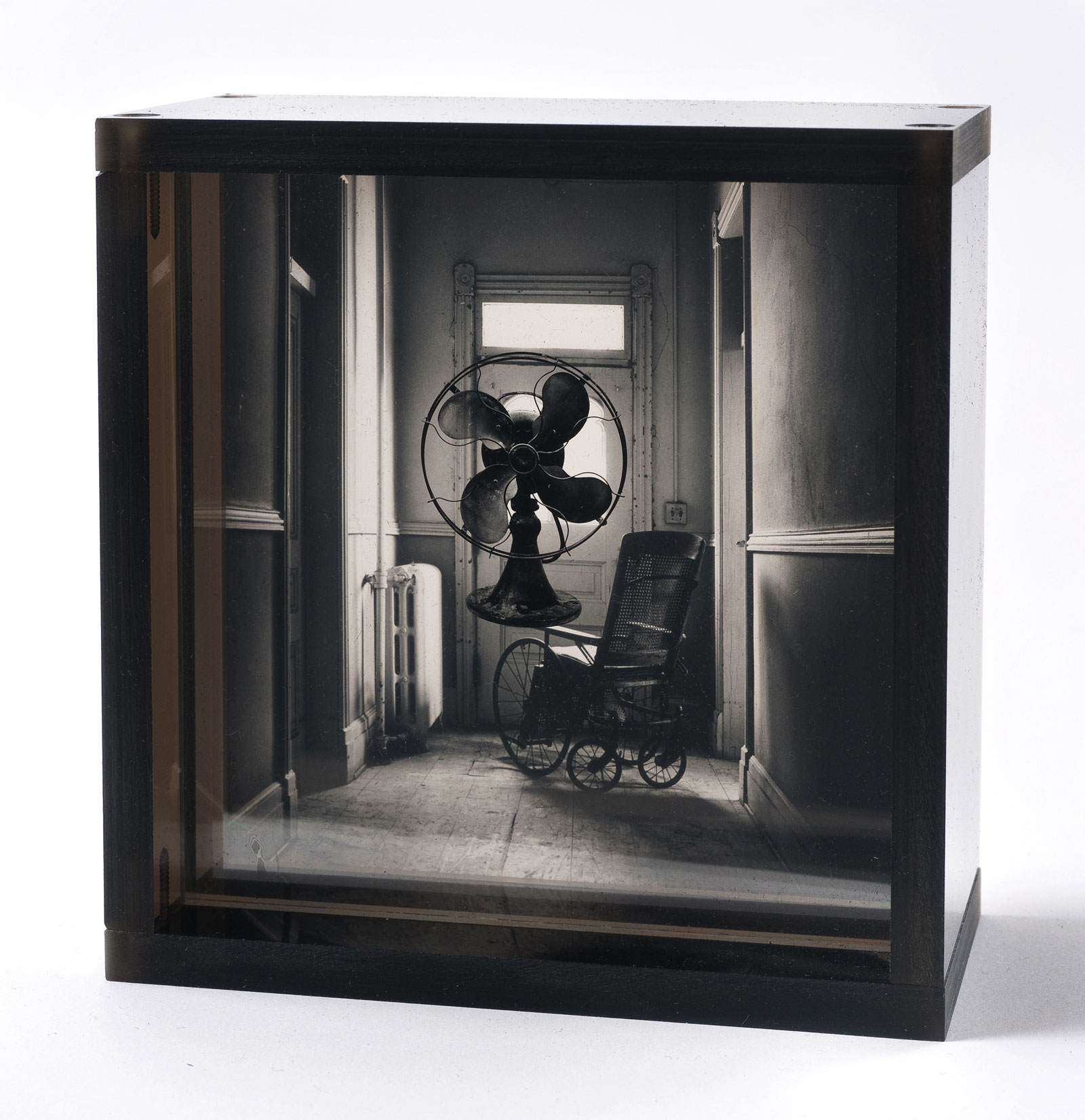
Douglas Prince (American, b. 1943) 'Untitled' 1969


Douglas Prince (American, b. 1943)
Untitled
1969
Film and Plexiglas
5 x 5 x 2.5 inches


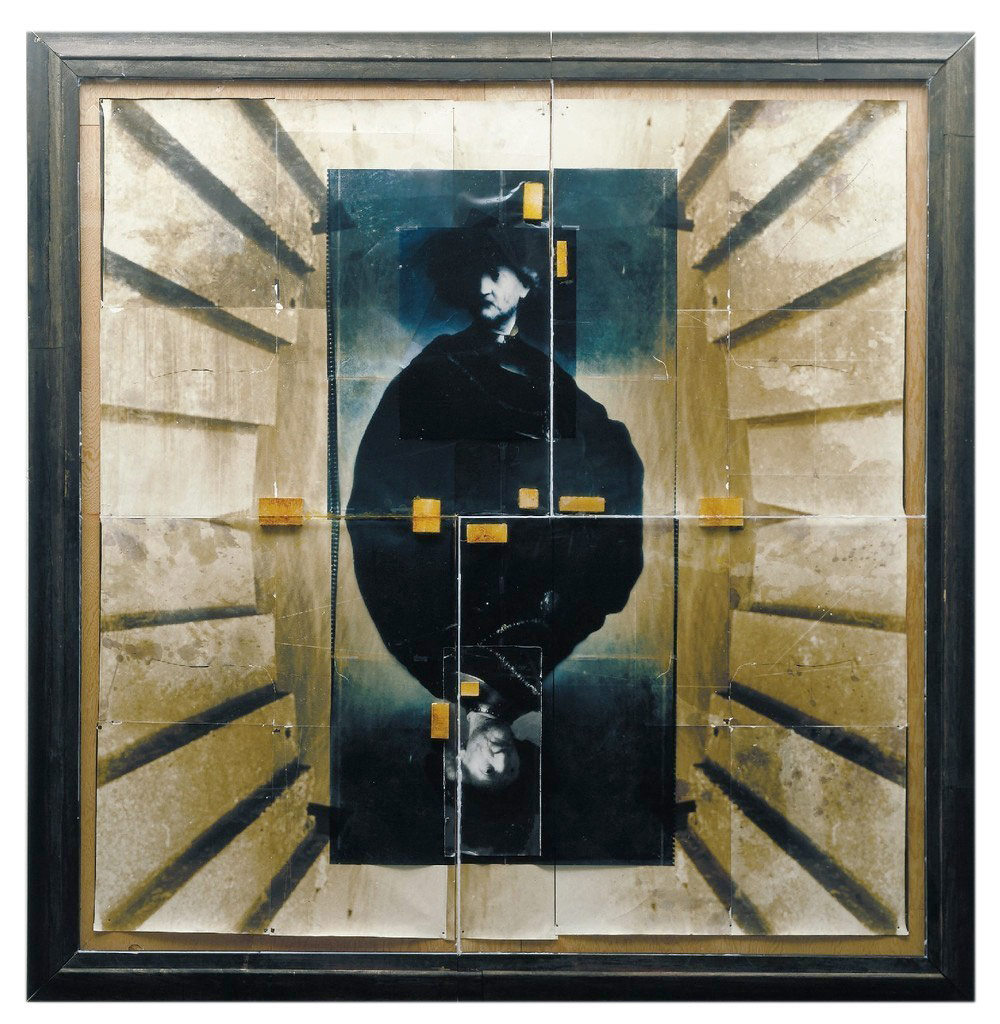
Mike and Doug Starn (American, b. 1961) 'Double Rembrandt with Steps' 1987-1988


Mike and Doug Starn (American, b. 1961)
Double Rembrandt with Steps
1987-1988
Toned gelatin silver print, toned ortho film, wood, Plexiglas, and glue.
108 x 108 inches
Collection of the Museum of Modern Art, New York, NY


CEPA Gallery is pleased to announce Transformational Imagemaking: Handmade Photography Since 1960, a companion exhibition to Robert Hirsch’s recently published book of the same title (Focal Press). This extraordinary exhibition features work by some of the most innovative photographers and imagemakers of the mid- 20th century through today; artists who redefined the notion of photography as a medium and left an indelible mark on contemporary photographic practices.

This extensive survey will include more than 140 works by over 40 artists spanning nearly 50 years of artistic practice unified by a curatorial arc rooted in notions that deviate from the purview of traditional photographic practice. Citing Robert Heinecken’s practice as the genesis of conceptual handmade photography, this exhibition charts an intricate universe of artists whose practice dispenses with the self-prescribed limitations of conventional photography in order to mine the boundless potential of the photographic medium as a conceptual conveyance.

Transformational Imagemaking is the culmination of Hirsch’s lifelong exploration into handmade photography and the artists whose practices were formed on the principle of unearthing new possibilities. Hirsch sites the catalyst for the project as an article he published in exposure in 2003 entitled “Flexible Images: Handmade American Photography, 1969-2002”. It has since expanded into a comprehensive publication that includes personal conversations with each artist conducted over a six-month period during 2013. CEPA will now elaborate further by mounting an exhibition that features a selection of each artist’s work.

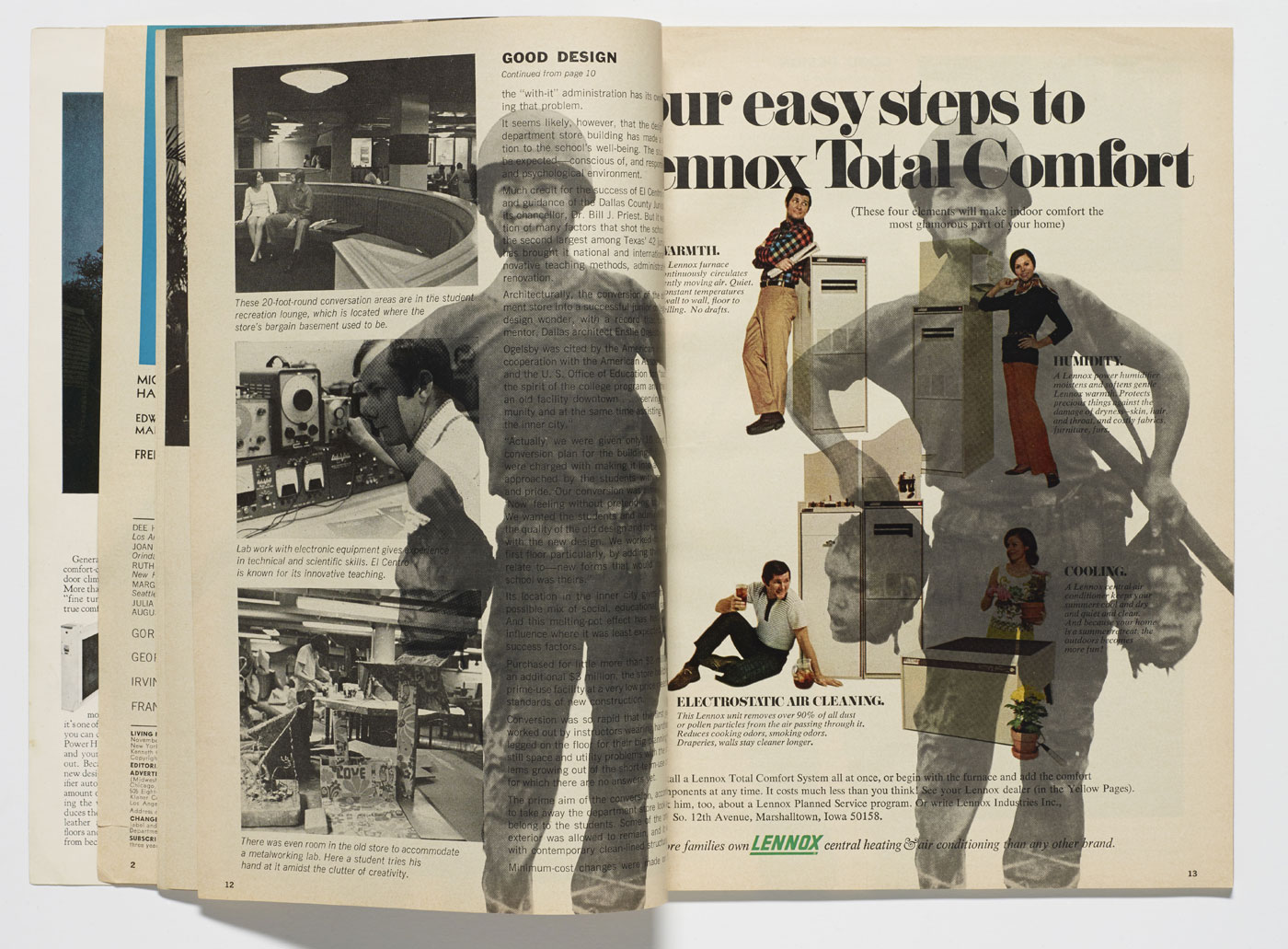
In addition to Transformational Imagemaking, CEPA will also show the complete folio of Robert Heinecken’s seminal series Are You Rea (1966). Considered to be the grandfather of post-modern photographic practices and a major figure of 20th century art, Heinecken was a key figure in promoting new sentiments about photography as an art form, influencing artists such Richard Prince, Barbara Kruger, Sherrie Levine, and others. Heinecken’s rebellious spirit challenged conventions about the ways photographs represent the tangible world: “We constantly tend to misuse or misunderstand the term reality in relation to photographs. The photograph itself is the only thing that is real.”

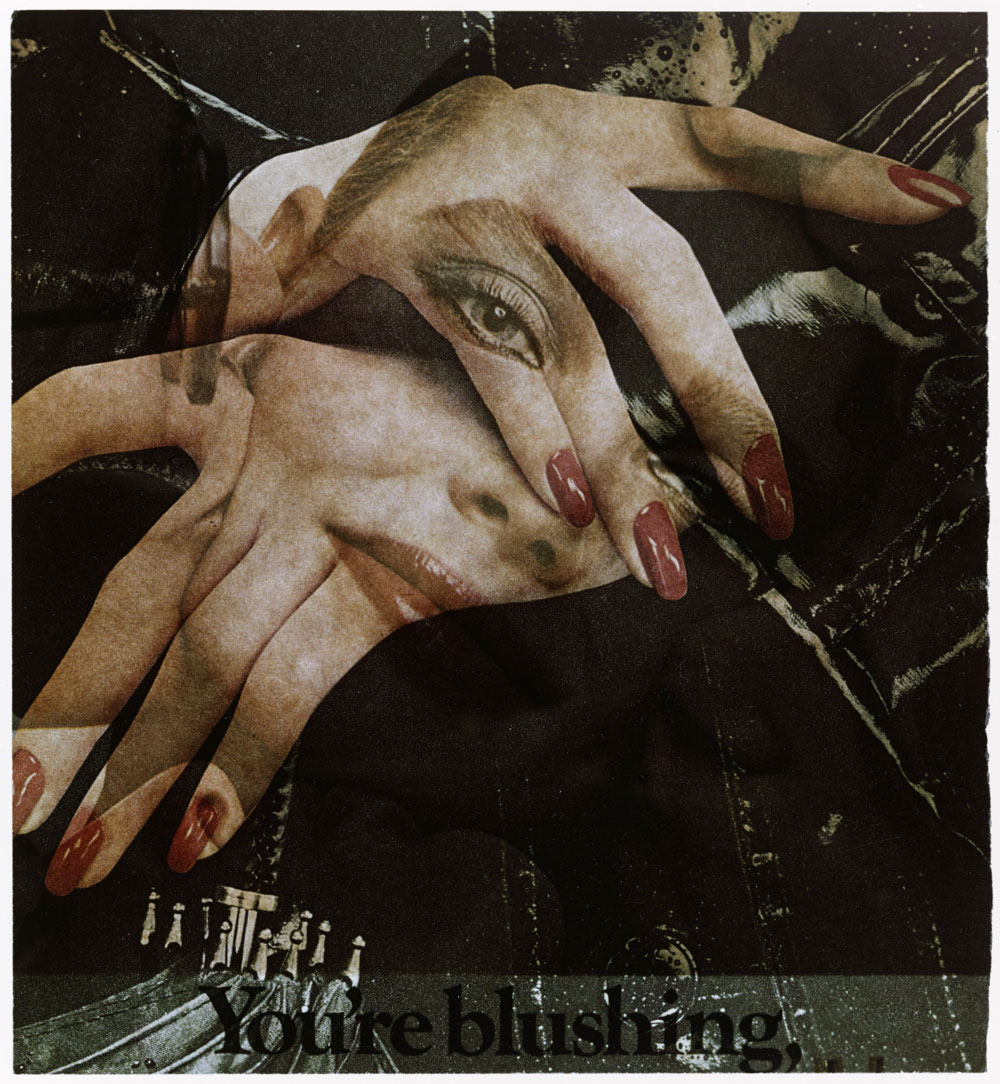
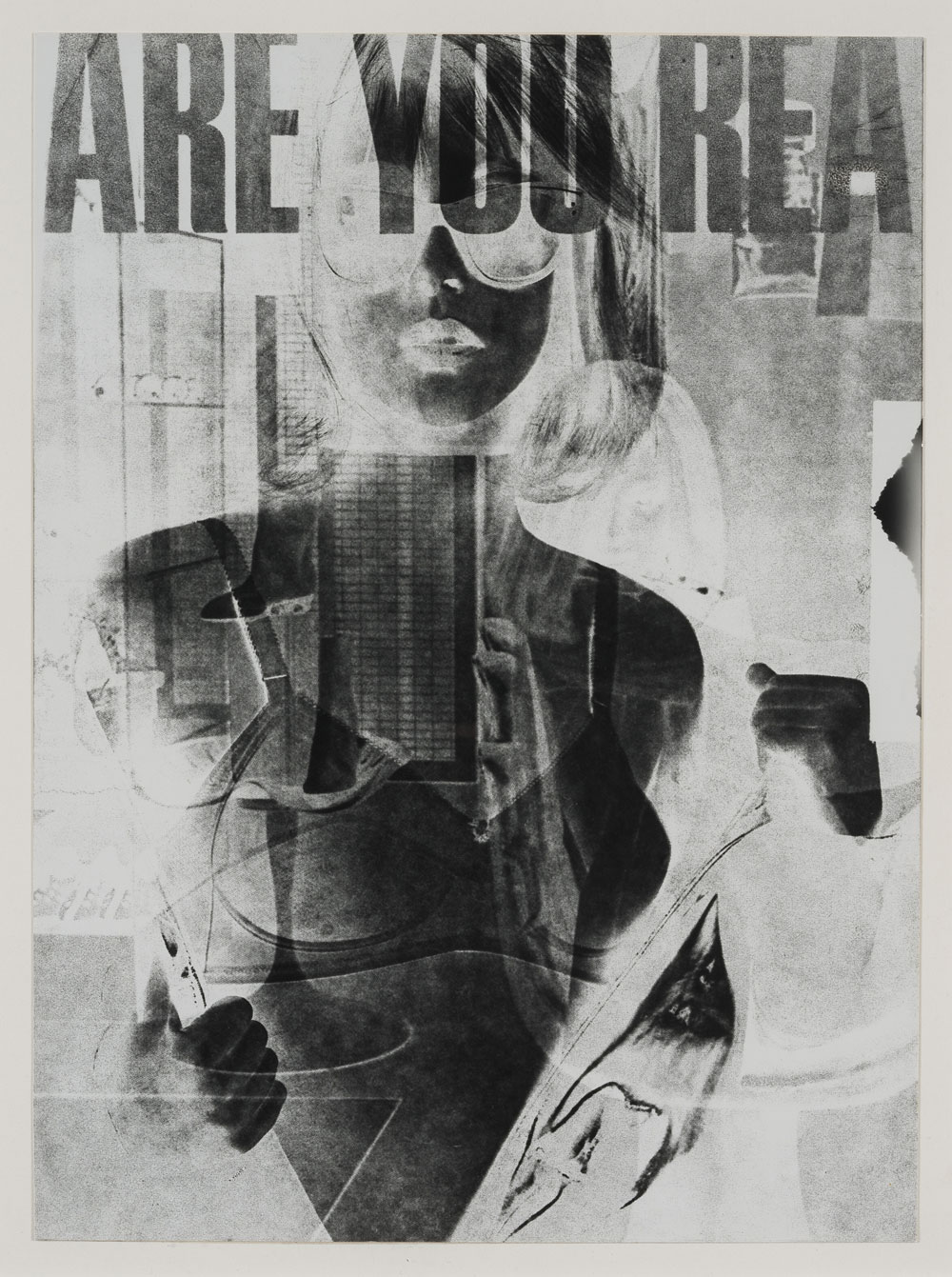
Are You Rea (1966), created by contact printing magazine tear-outs onto photographic paper, are ghostly compositions that layer sexually suggestive images of women with fractured text. This provocative body of work, sexually charged and evocatively ambiguous, reflects an awareness of desire as a commercial commodity that begs us to question the very root of our own desires.

Press release from CEPA Gallery


Keith Smith (American, b. 1938) 'Untitled' 1972


Keith Smith (American, b. 1938)
Untitled
1972


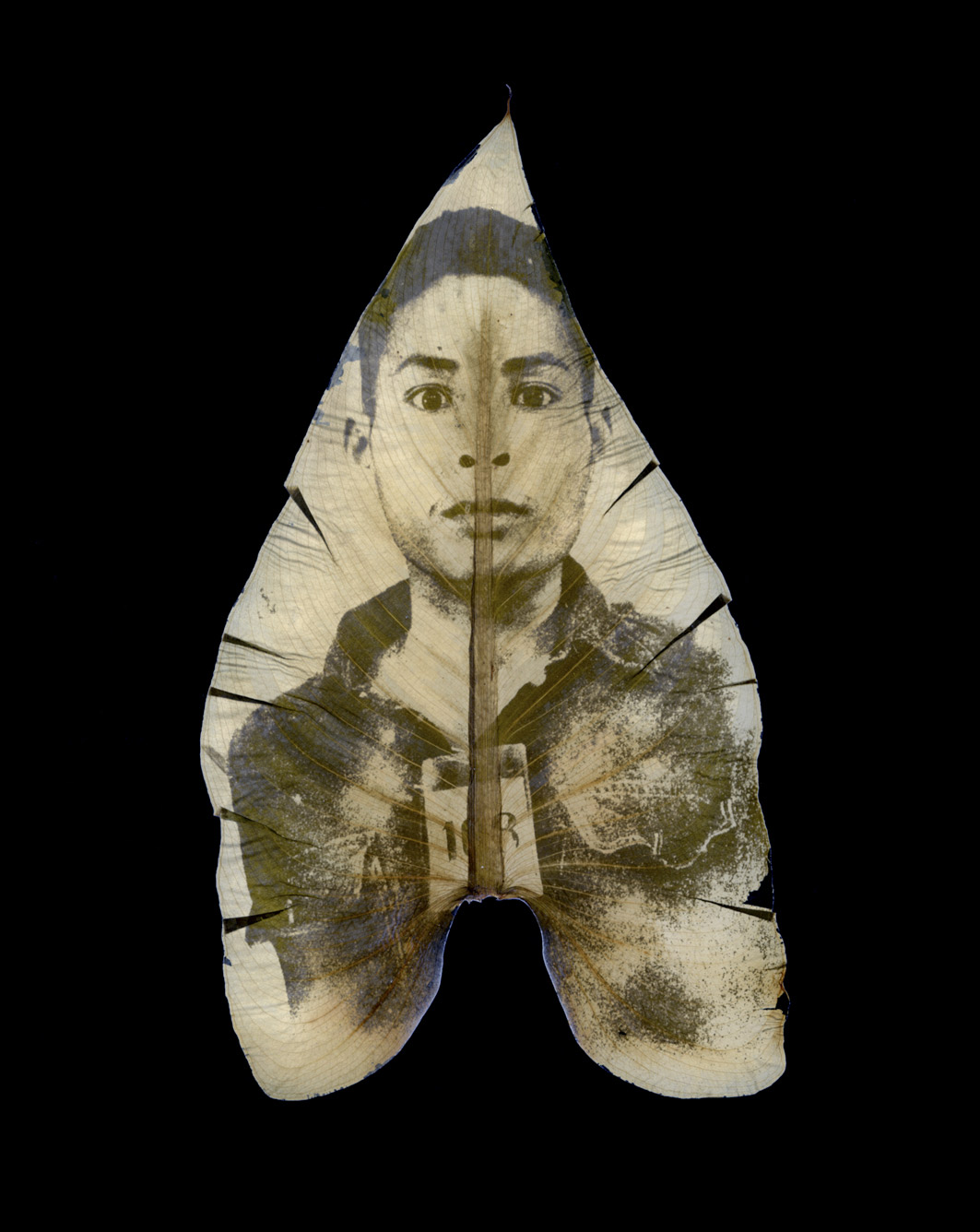
Binh Danh (American born Vietnam, b. 1977) 'The Botany of Tuol Sleng Genocide Museum #2' 2008


Binh Danh (American born Vietnam, b. 1977)
The Botany of Tuol Sleng Genocide Museum #2
2008
From the Immortality: The Remnants of the Vietnam and American War series
Chlorophyll print and resin


The chlorophyll process is an organic alternative photography process akin to the anthotype process. However, instead of printing on the crushed extract of fruit or plant matter, the prints are bleached by sunlight directly onto the surface of leaves using a positive. The resulting images are stunningly delicate and beautiful, ranging from haunting silhouettes to crisp definition. Despite the simplicity of the finished product, the process itself can be tedious with plenty of trial and error.

Drawing on the anthotype process, Danh refined a method for securing a positive directly to a live leaf and allowing sunlight to bleach the image onto its surface naturally. He has also addressed a fundamental challenge with natural photography processes; that of fixing the image to prevent further bleaching and deterioration over time. To save his work, Dah casts his finished pieces in a layer of resin allowing them to be enjoyed for years to come.

Tiffany Pereira. “The chlorophyll process,” on the Alternative Photography website [Online] Cited 02/07/2021


Dinh Q. Lê (Vietnamese, b. 1968) 'Untitled' 1998


Dinh Q. Lê (Vietnamese, b. 1968)
Untitled, from the series Cambodia: Splendor and Darkness
1998
C-print and linen tape


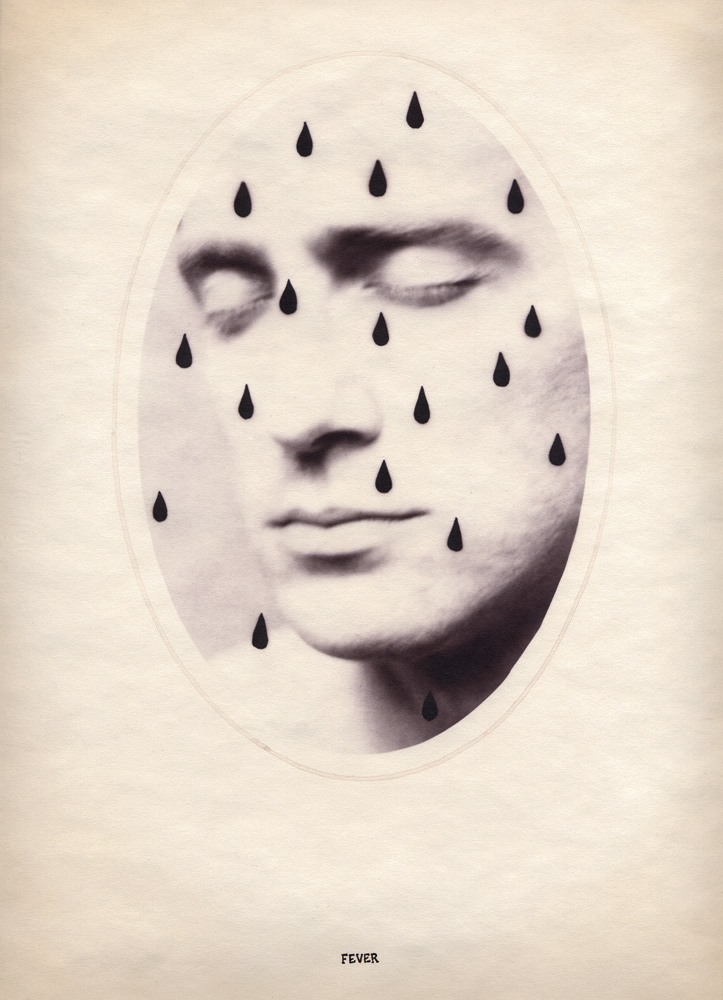
Dan Estabrook (American, b. 1969) 'Fever' 2004


Dan Estabrook (American, b. 1969)
Fever
2004
Salt print with ink and watercolor


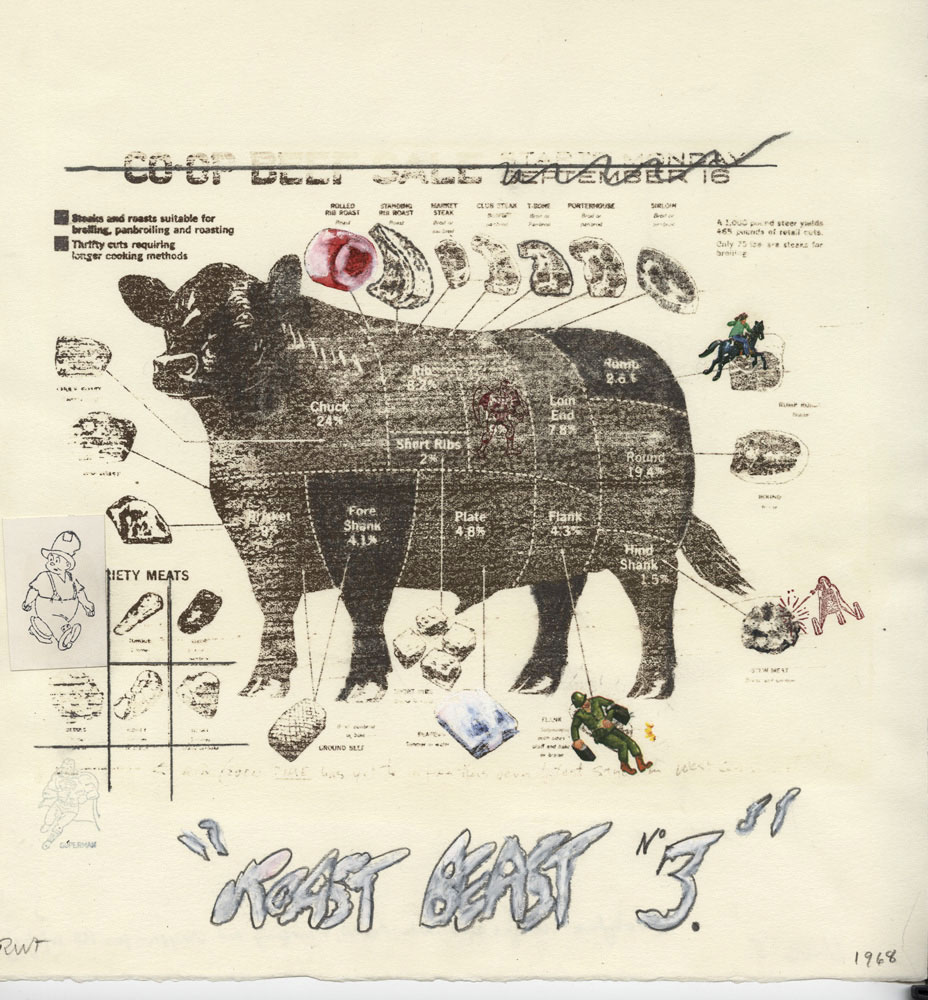
Robert Fichter (American, b. 1939) 'Roast Beast 3' 1968


Robert Fichter (American, b. 1939)
Roast Beast 3
1968
Verifax transfer with rundowns, stamping, and crayon


Robert Heinecken (American, 1931-2006) 'Are You Rea #1' 1966


Robert Heinecken (American, 1931-2006)
Are You Rea #1
1966
Offset lithography


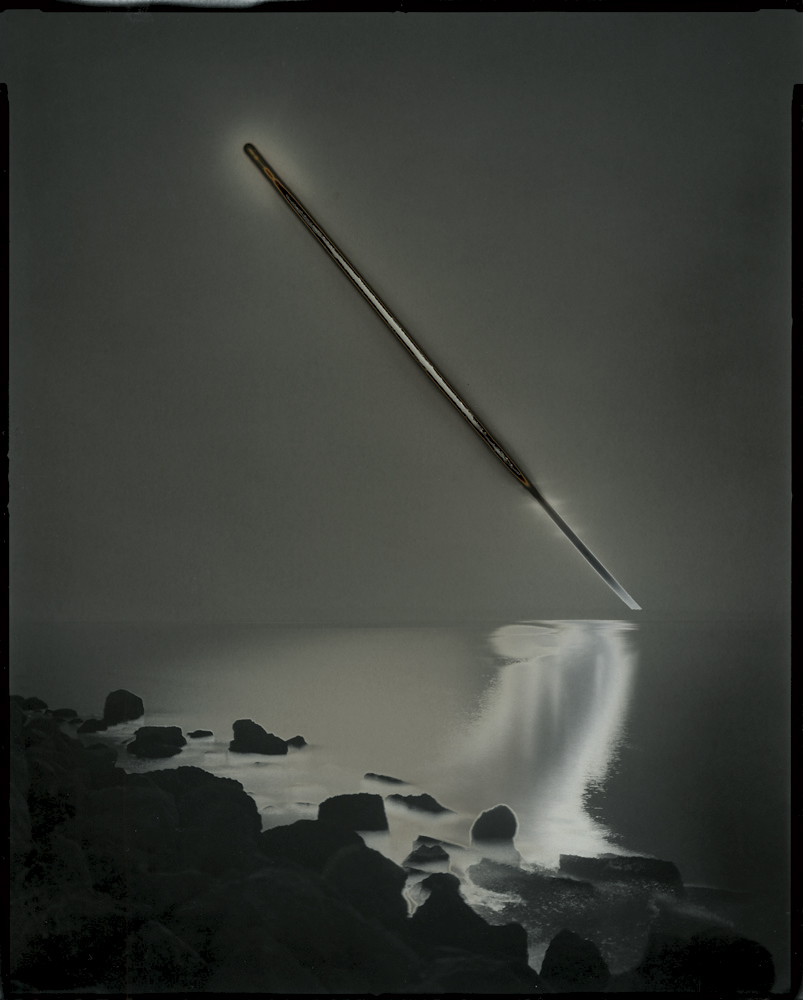
Chris McCaw (American, b. 1971) 'Sunburned GSP #676 (San Francisco Bay)' 2013


Chris McCaw (American, b. 1971)
Sunburned GSP #676 (San Francisco Bay)
2013
Gelatin Silver paper negative


Curtis Mann (American, b. 1979) 'Photographer, Scratch' 2009


Curtis Mann (American, b. 1979)
Photographer, Scratch
2009
Bleached c-print with synthetic polymer varnish


Vik Muniz (Brazilian, b. 1961) 'Atlas (Carlao)' 2008


Vik Muniz (Brazilian, b. 1961)
Atlas (Carlao)
2008
Digital C-print


CEPA Gallery
617 Main Street
Buffalo, NY 14203
Phone: (716) 856-2717

Opening hours:
Wednesday: 12.00pm – 4.00pm
Thursday: 4.00pm -7.00pm
Friday: 12:00pm – 4.00pm
Saturday: 12.00pm – 4.00pm

CEPA Gallery website

LIKE ART BLART ON FACEBOOK

Back to top

Exhibition: ‘Oscar Muñoz: Protographies’ at Jeu de Paume, Paris

Exhibition dates: 3rd June – 21st September 2014

Curated by José Roca and María Wills Londoño (adjunct curator)


Oscar Muñoz (Colombian, b. 1951) 'El juego de las probabilidades' [The Game of Probabilities] 2007


Oscar Muñoz (Colombian, b. 1951)
El juego de las probabilidades [The Game of Probabilities]
2007
12 colour photographs
47 x 40cm each with frame
Courtesy of the artist and Sicardi Gallery, Houston


Another artist investigating the medium of photography in totally fascinating ways… breaking the glass, deconstructing the support, fragmenting the image, questioning the imprint of photography – in memory, in the photographs physicality, in what leaves an impression, in what remains. The un/stable image, in flux, in sediment, investigated through “work [that] defies systematic classification because he works in so many different media: photography, printmaking, drawing, installations, video and sculpture.” Such inventiveness over such a long period of time “developing special techniques to produce images that reveal themselves as a kind of counterpoint to photography and the “decisive moment” it once claimed to capture.” Ephemeral photography that is truly remarkable.

Dr Marcus Bunyan


Many thankx to the Jeu de Paume for allowing me to publish the photographs in the posting. Please click on the photographs for a larger version of the image.


This summer, the Jeu de Paume, which is celebrating 10 years devoted to the image, will be inviting the public to discover Oscar Muñoz (born in 1951), Colombia’s most emblematic artist, who has been producing a body of work for nearly forty years that centres on the capacity of images to preserve memory.


CALI-DOSCOPE: CITY FRAGMENTS


Oscar Muñoz (Colombian, b. 1951) 'Ambulatorio' [Ambulatory] 1994


Oscar Muñoz (Colombian, b. 1951)
Ambulatorio [Ambulatory]
1994
Aerial photograph enclosed in security glass, wood and aluminium, 36 units
100 x 100cm each
Courtesy O.K. Centrum, Linz


Muñoz emerged on the Colombian art scene with his series of large-format hyperrealist drawings in charcoal on paper that revealed his interest in the social implications of empty or deteriorating spaces. This group includes drawings from the series entitled Inquilinatos [Tenement Houses] (1979) and Interiores [Interiors] (1980-1981). Also on display are works referring to Cali’s urban life, such as Ambulatorio [Ambulatory] (1994), El Puente [The Bridge] (2004), Archivo Porcontacto [Bycontact Archive] (2004-2008), which are images of a specific period and specific places in the city, and A través del cristal [Through the Glass] (2008-2009), the latter a way of introducing an absent cultural reference through sound.

Cali recurs in Muñoz’s work as a contextual reference or a support. This is literally the case with Ambulatorio, an aerial photograph of the city blown up to a monumental scale and laid out in a regular grid. Each segment of the photograph is fixed to a piece of security glass, which breaks into pieces when the viewer walks on the work. Each break creates another random mesh of lines over the urban image of a chaotic city in which rational planning and the unstructured coexist in a way typical of all modern South American cities.


THE SUPPORT RECONSIDERED


Oscar Muñoz (Colombian, b. 1951) 'Cortinas de Baño' [Shower curtains] 1985-1986


Oscar Muñoz (Colombian, b. 1951)
Cortinas de Baño [Shower curtains]
1985-1986
Acrylic on plastic, 5 elements
190 x 140 cm and 190 x 70cm each, dimensions variable
Banco de la República collection, Bogotá


Having achieved international renown as an exceptional draughtsman, in the 1980s Muñoz gradually abandoned paper as a support and experimented with new techniques of drawing and printmaking, using unconventional materials and supports such as acrylic applied to damp plastic and charcoal dust on water. This group includes the series Cortinas de Baño [Shower Curtains] (1985-1986), Tiznados [Tainted] (1990), Narcisos secos [Dry Narcissi] (1994-1995) and Simulacros [Simulacra] (1999).

In Cortinas de baño Muñoz experimented for the first time with an unconventional support, in this case an everyday plastic shower curtain, in order to construct an image from a photograph transferred onto a silkscreen mesh. In the printing process, executed with an airbrush through previously prepared silkscreen, the image was transferred onto an unstable surface, with the artist preventing the pigment from being totally fixed by sprinkling water on it.


Oscar Muñoz (Colombian, b. 1951) 'Narcisos (en proceso)' [Narcissi (in process)] 1995-2011


Oscar Muñoz (Colombian, b. 1951)
Narcisos (en proceso) [Narcissi (in process)]
1995-2011
Charcoal dust and paper on water, Plexiglas, 6 elements
10 x 50 x 50cm each, overall dimensions: 10 x 70 x 400cm
Courtesy of the artist


Narcisos was a key series in the artist’s quest to dematerialise the support of the photographic image. Muñoz developed a new technique unprecedented in the history of art and probably never to be encountered again – that of printing on water. The earliest photographic images emerged from water, from the chemical baths that fixed the silver salts in different gradations of intensity produced by the action of light. The support was an incidental necessity. Muñoz has referred to the three phases in the process of Narcissi as allegories of an individual’s progress through life: creation, at the moment when the charcoal dust touches the surface of the water; the changes that come about during evaporation; and death, at the moment when the dried out dust finally settles at the bottom of the container. The result, which the artist has called Narcisos secos, is both the final image and the death of the process: the remains of a photograph that possessed a life after it was fixed for posterity. In this sense, Dry Narcissi are the record of a double death of the image.


Oscar Muñoz (Colombian, b. 1951) 'Narciso' [Narcissus] 2001


Oscar Muñoz (Colombian, b. 1951)
Narciso [Narcissus]
2001
Single-channel video 4:3, colour, sound, 3 min
Courtesy of the artist


Muñoz’s first work in video was Narciso, in which he dramatically presented the processes developed in his Narcissi of the 1990s (in which the evaporation was invisible to the naked eye) by making the water disappear in a few minutes. As in those earlier works, a self-portrait floats on the surface of the water but the drain in the sink and the sound of running water foretell for the viewer what the image’s final fate will be. In reality, there are two images here: that of the subject and that of its shadow on the white bottom of the basin. The images gradually come closer together, as if to suggest that life is a constant quest for self-understanding. However, at the moment when the two images are about to coincide, it is already too late: they fuse into a single distorted stain that disappears down the drain.


Oscar Muñoz (Colombian, b. 1951) 'Re/trato' [Portrait/I Try Again] 2004


Oscar Muñoz (Colombian, b. 1951)
Re/t
rato [Portrait/I Try Again]
2004
Single-channel video projection 4:3, colour, no sound, 28 min
Courtesy of the artist


About the exhibition

“Through a multifaceted body of work that moves freely between photography, printmaking, drawing, installation, video and sculpture, eliminating the borderlines between these disciplines through innovative practices, Oscar Muñoz (Popayán, Colombia, 1951) explores the capacity of images to retain memory.

In 1826, for the first time in history the French inventor Nicéphore Niépce succeeded in fixing the elusive image produced by the camera obscura, a device known since antiquity. In contrast to painting or drawing, the camera obscura was able to obtain an image from life without the assistance of the human hand and in real time: what it could not do was freeze it or fix it onto a support in order to extract it from the passing of time. It could thus be said that the essence of the photographic act does not lie in taking the image but in permanently fixing it. What, then, is the status of the image in the instant prior to the moment when it is fixed for posterity?

If the ontology of photography lies in fixing a moving image for all time, extracting it from life, we might say that Oscar Muñoz’s work is located in the temporal space prior (or subsequent) to the true decisive moment when the image is fixed: that proto-moment when the image is finally about to become photography. In that sense, it could be said that Muñoz’s work is protographic.

The exhibition

Born in 1951 in Popayán (Colombia), Oscar Muñoz is regarded as one of the country’s most important contemporary artists, whilst also garnering attention on the international art scene. A graduate of the Escuela de Bellas Artes in Cali, he has built up over a period of four decades a body of work whose images deal with the realm of memory, loss and the precarious nature of human life. Muñoz’s work defies systematic classification because he works in so many different media: photography, printmaking, drawing, installations, video and sculpture.

“Protographs” (a term coined to evoke the instant just before or just after that split-second when the photographic image is captured and frozen for ever) presents his major series grouped by theme. These themes poetically and metaphorically juxtapose Muñoz’s own past and the different material states of the image. For example, he combines the dissolution, deterioration or disintegration of the image with the inherent fragility of memory and the impossibility of making time stand still; or the image’s evaporation and transformation with the tension between rationality and chaos in our urban societies. Finally, in the main part of his work, he creates ephemeral images that, as they disappear, invite the spectator to share in an experience that is simultaneously rational and sensual.

Oscar Muñoz began his career in the 1970s in Cali in a period when a whirlwind of cultural and cross-disciplinary activity saw the emergence of a generation of writers, photographers and filmmakers who today play a leading role in the contemporary art scene (with Carlos Mayolo, Luis Ospina, Fernell Franco and Andrés Caicedo to name but a few). At that time, Muñoz was drawing with charcoal on large-format supports presenting a cast of sad and sometimes sordid characters with a deep emotional charge. The main characteristics of his work emerged at an early stage. These include a profound and tireless interest in social questions, an original approach to materials, the use of photography as an aid to memory and the exploiting of the dramatic possibilities afforded by the play of shadow and light in defining the image. Moreover, the artist developed a phenomenological approach to minimalism by insisting on the relationship between the artwork, the spectator and the surrounding exhibition space.

In the mid-1980s, Oscar Muñoz moved away from traditional artistic methods and began to experiment with innovative processes that created a real interactive exchange with the spectator. This was the time of a radical reassessment of his artistic practices, whether drawing, printmaking, or photography, and a questioning of the relationship between the artwork and its surroundings. He abandoned traditional formats and techniques, whilst preserving something of their roots and wellsprings, to investigate ephemerality, highlighting the very essence of the materials themselves and their poetic associations. His use of the fundamental elements – water, air and fire – refers to the processes, the cycles and the transcendental manifestations of life, our very existence and death itself. “My work attempts to understand why the past and the present are so full of violent acts,” says the artist. By choosing to use a diverse selection of media and to apply innovative and unique processes, Oscar Muñoz blurs the boundaries between artistic disciplines.

The “Protographs” exhibition showcases a career that has lasted nearly forty years. It presents series of works grouped around the artist’s major themes, starting with his works on paper and his series of large format hyperrealist drawings in charcoal (1976-1981) – bearing witness to his deep interest in social context – and the drawings and engravings that he started making in the 1980s, which marked the relinquishing of paper for an exploration of unconventional materials and processes (printing on damp plastic, the use of sugar and coffee, etc.); continuing with his experiments in the 1990s and 2000s on the stability of the image and its relationship to the processes of memory; and including his latest works (2009-2014), characterised by a continual process of appearance and disappearance, including a new work produced specifically for the exhibition.”

Text by José Roca and María Wills Londoño


IMPRINTS

Over the last decade, Muñoz has created a series of works on the indicative relationship between the object and its image, making use of contact printing, a characteristic printmaking process. This was the case with La mirada del Cíclope [The Cyclops’ Gaze] (2001-2002), Intervalos (mientras respiro) [Intervals (While I Breathe)] (2004) and Paístiempo [Countrytime] (2007), as well as series from a number of other periods.


Oscar Muñoz (Colombian, b. 1951) 'Aliento' [Breath] 1995


Oscar Muñoz (Colombian, b. 1951)
Aliento [Breath]

1995
Metal mirrors, screen-printed with grease, 7 mirrors
Diameter: 20 cm each
Courtesy of the artist


The series Aliento comprises portraits printed in photo-silkscreen with grease on small round metal mirrors located at eye level. The mirrors initially seem blank and the printed image only reveals itself when the viewer, having recognised himself / herself, breathes onto the circular mirror. During this brief moment the reflected image is replaced by the printed image (photographs taken from obituaries) of a deceased person who fleetingly returns through the viewer’s breath.


Oscar Muñoz (Colombian, b. 1951) 'La mirada del cíclope' [The Cyclops' Gaze] 2002


Oscar Muñoz (Colombian, b. 1951)
La mirada del cíclope [The Cyclops’ Gaze]
2002
Digital print on paper, 6 photographs
50 x 50 cm each one
Courtesy of the artist


La mirada del cíclope, in which the subject is considered in relation to death, uses one of the oldest techniques of portraiture and printmaking: a mould made by direct contact, in this case of the artist’s own face. This sculptural object (inspired by the ancient Roman tradition of funerary masks) becomes two-dimensional when it is captured by the camera’s single eye (hence the title). Lacking references to volume, the viewer’s eye cannot decide if the object represented is concave or convex, in a play of perceptual opposites: negative / positive, presence / absence, reality or illusions. Quoting Pierre Bourdieu, Muñoz has noted that “the imagines of ancient Rome are exactly equivalent to the social nature of some modern photographs; they play an important role in the tortuous act of mourning: we accept a reality by ‘becoming accustomed to the unreality of its images’.”


Oscar Muñoz (Colombian, b. 1951) 'Horizonte [Horizon]' 2011


Oscar Muñoz (Colombian, b. 1951)
Horizonte [Horizon]
2011
From the series Impresiones débiles [Weak Impressions]
Charcoal dust print on methacrylate
4 elements, 85 x 73.5cm each
Galerie mor. charpentier, Paris


The earliest successful images taken by Niépce were proto-photographs that did not survive intact as images because the light that had created them continued to affect them until they eventually succumbed to darkness in an inexorable fade to black. This is what happens in film photography when a photograph is not properly rinsed and the developing agent continues to act, or when the photographic paper is directly exposed to the action of light. However, the image can also move towards clarity. In Impresiones débiles, Muñoz employs photographs of great historical and political significance for Colombia and subjects them to a process that makes them seem like “washed out” photos in which over-exposure to light has made the image deteriorate to the point of near invisibility. The works that make up this series are in fact prints rather than photographs, given that they are silkscreens made with charcoal dust on acrylic. The variable distance between the silkscreen mesh and the support allows the artist to single out a different element from the original photograph in each print, making it more highly defined than the rest. The “variable focus” in this series questions another of the supposedly essential characteristics of photography, namely the camera’s systematic, technical objectivity in relation to its subjects.


THE IMAGE IN FLUX

In his most recent works, Muñoz depicts images in a process of continual appearance and disappearance. These are subtle impressions with varying emphases on the different parts of the image that are literally in flux and cannot be fixed, such as those produced by a camera obscura. This section includes the video Cíclope [Cyclops] (2011), the installation Editor solitario [Solitary Editor] and the work Sedimentaciones [Sedimentations] (2011), the latter comprising three tables with projections of documents that are constantly created and destroyed. The exhibition ends with the highly personal Fundido al blanco [Fade to White] (2010).


Oscar Muñoz (Colombian, b. 1951) 'Fundido a blanco (dos retratos)' [Fade to White (Two Portraits)] 2010


Oscar Muñoz (Colombian, b. 1951)
Fundido a blanco (dos retratos) [Fade to White (Two Portraits)]
2010
HD Video, colour, sound, 7 min 40 s
Courtesy of the artist


Fundido a blanco (dos retratos) is an autobiographical work: a family portrait with Muñoz behind the camera, constituting the third side of a temporal triangle that includes his mother and father. It is, in other words, a memorial. Rather than making their features more clear, the strong light that bathes the scene makes them imprecise and ethereal. Muñoz has referred to the intense light in Cali at a certain time of day, when people seem to “disintegrate”, and also to the blinding brilliance of the sun when the artist came out after seeing a film at the city’s film club. The central figure in Fundido a blanco momentarily falls asleep now and then, entering into the light. Rather than fixing that figure at a precise moment of its existence, in the manner of a photographic portrait or snapshot, Muñoz creates a portrait that develops in time. Fundido a blanco is one of the artist’s most moving works, an image that touches the viewer. Its power may perhaps lie in the fact that for the first time in his extensive output, we are here seeing a specific subject rather than the generic representation of one.


Oscar Muñoz (Colombian, b. 1951) 'Sedimentaciones' [Sedimentations] 2011


Oscar Muñoz (Colombian, b. 1951)
Sedimentaciones [Sedimentations]
2011
2 HD video projections, colour, sound, 42 min 27 s, 41 min 42 s, on wooden tables
Courtesy of the artist


The strategy of dissolving the image reappears in Sedimentaciones, a photographic development table on which there are numerous photographs arranged in lines, with various blank sheets between them. The photos are extremely varied in nature, ranging from universally known images to others that are very specific to a Colombian context, personal portraits by the artist and anonymous, generic images. There are two developing trays at opposite corners. A hand takes a photograph from the table and puts it in a plastic tray filled with liquid in which the image dissolves. The paper emerges white and is then randomly placed in one of the lines. On the other side of the table another hand takes up one of the empty sheets and slides it into another tray. On taking out the sheet, the image has magically re-formed on it and the hand places it in the line of photographs. The process starts again in the other corner. Through this alternation we thus witness the ceaseless life and death of the image (see video below).


More work


Oscar Muñoz (Colombian, b. 1951) 'Línea del destino' [Line of Destiny] 2006

Oscar Muñoz (Colombian, b. 1951) 'Línea del destino' [Line of Destiny] 2006

Oscar Muñoz (Colombian, b. 1951) 'Línea del destino' [Line of Destiny] 2006


Oscar Muñoz (Colombian, b. 1951)
Línea del destino [Line of Destiny]
2006
Single-channel video 4:3, black and white, no sound,
1 min 54 s
Courtesy of the artist


Oscar Muñoz (Colombian, b. 1951) 'Pixeles' [Pixels] 1999-2000


Oscar Muñoz (Colombian, b. 1951)
Pixeles [Pixels]
1999-2000
Coffee stains on sugar cubes, Plexiglas
9 panels 35 x 35 x 3cm each
Courtesy of the artist and Sicardi Gallery, Houston


OSCAR MUÑOZ: “Protographs” in progress from Jeu de Paume / magazine on Vimeo.


The magazine’s camera has gone behind the scenes of Oscar Muñoz’ exhibition Protographs at the Jeu de Paume. It attempts to show how the artist and his assistant, Juliana Guevara, produce unstable images, using unconventional materials and supports such as water, charcoal dust, grease on metal, the spectator’s breath, and shower curtains. Since the early 80s, Muñoz has been developing special techniques to produce images that reveal themselves as a kind of counterpoint to photography and the “decisive moment” it once claimed to capture.

Narcissi (1995), Breath (1995), Simulacra (1999), The Collector (2014): all these works question the fragile status of images and the way they live - and die – in our memory.


Jeu de Paume
1, Place de la Concorde
75008 Paris
métro Concorde
Phone: 01 47 03 12 50

Opening hours:
Tuesday – Sunday: 11.00am – 7.00pm
Closed Monday

Jeu de Paume website

LIKE ART BLART ON FACEBOOK

Back to top

Exhibition: ‘Robert Heinecken: Object Matter’ at The Museum of Modern Art (MoMA), New York

Exhibition dates: 15th March – 7th September 2014

Curators: Eva Respini, Curator, with Drew Sawyer, Beaumont and Nancy Newhall Curatorial Fellow, Department of Photography, The Museum of Modern Art

*PLEASE NOTE THIS POSTING CONTAINS ART PHOTOGRAPHS OF FEMALE NUDITY – IF YOU DO NOT LIKE PLEASE DO NOT LOOK, FAIR WARNING HAS BEEN GIVEN*


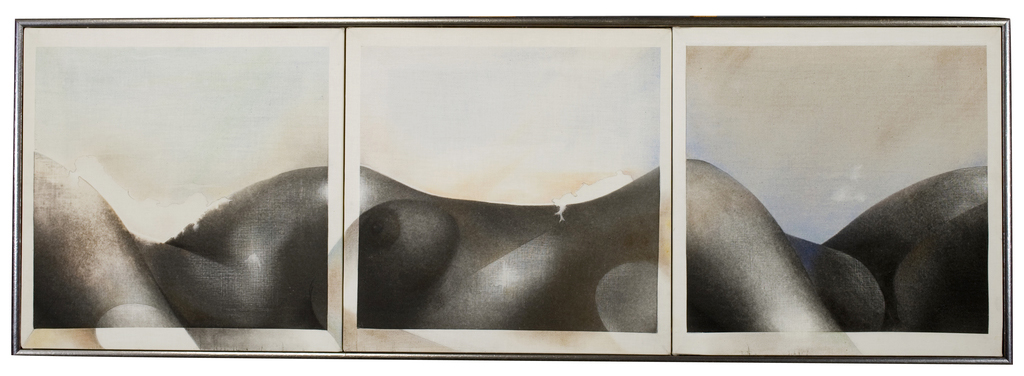
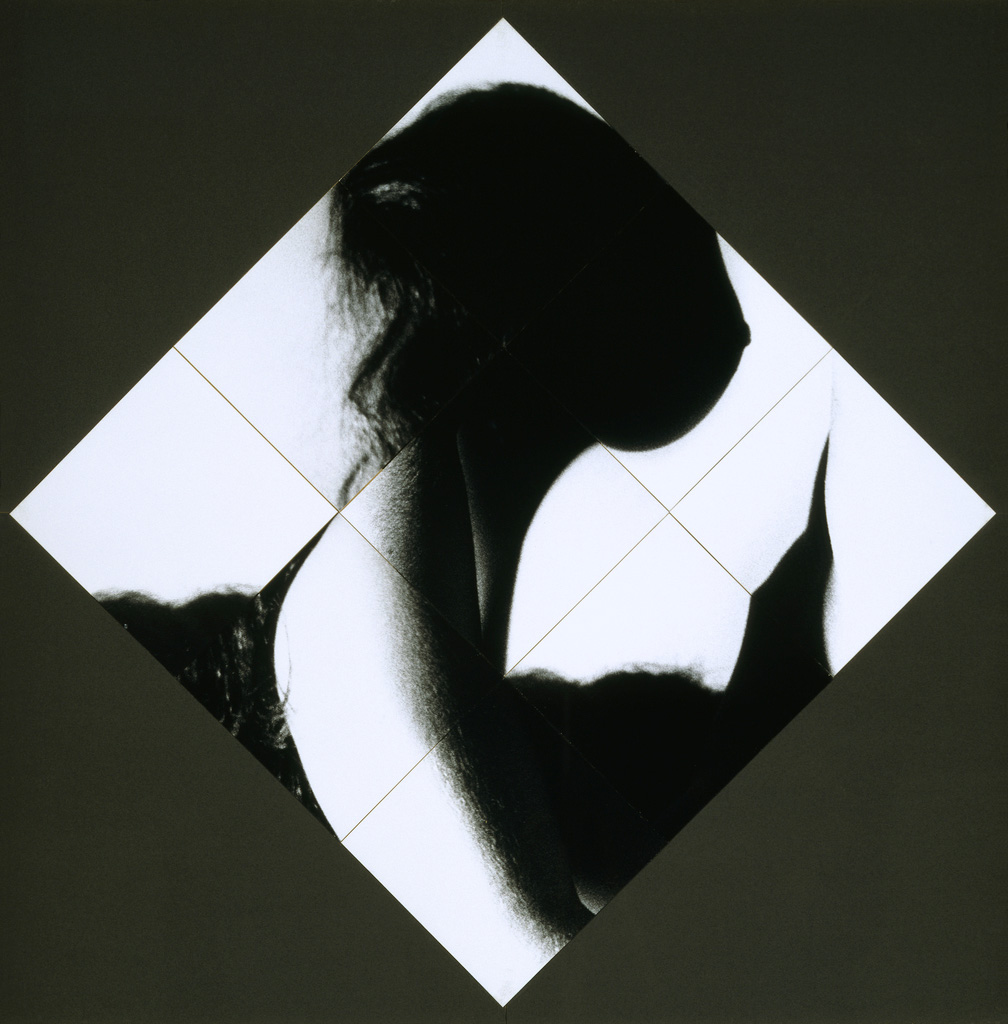
Robert Heinecken (American, 1931-2006) 'Figure Horizon #1' 1971


Robert Heinecken (American, 1931-2006)
Figure Horizon #1
1971
Ten canvas panels with photographic emulsion
Each 11 13/16 x 11 13/16″ (30 x 30cm)
The Museum of Modern Art, New York. Gift of Shirley C. Burden, by exchange


A bumper posting on probably the most important photo-media artist who has ever lived. This is how to successfully make conceptual photo-art.

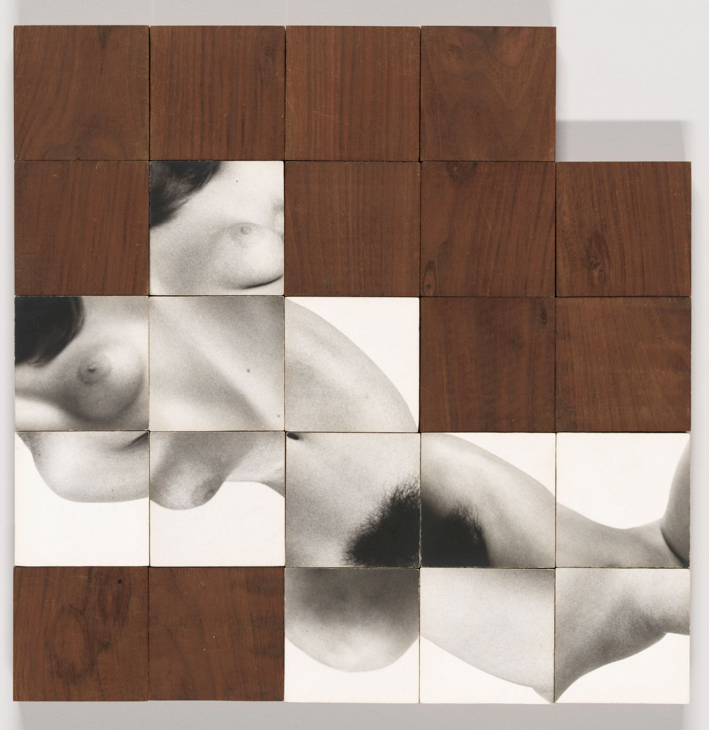
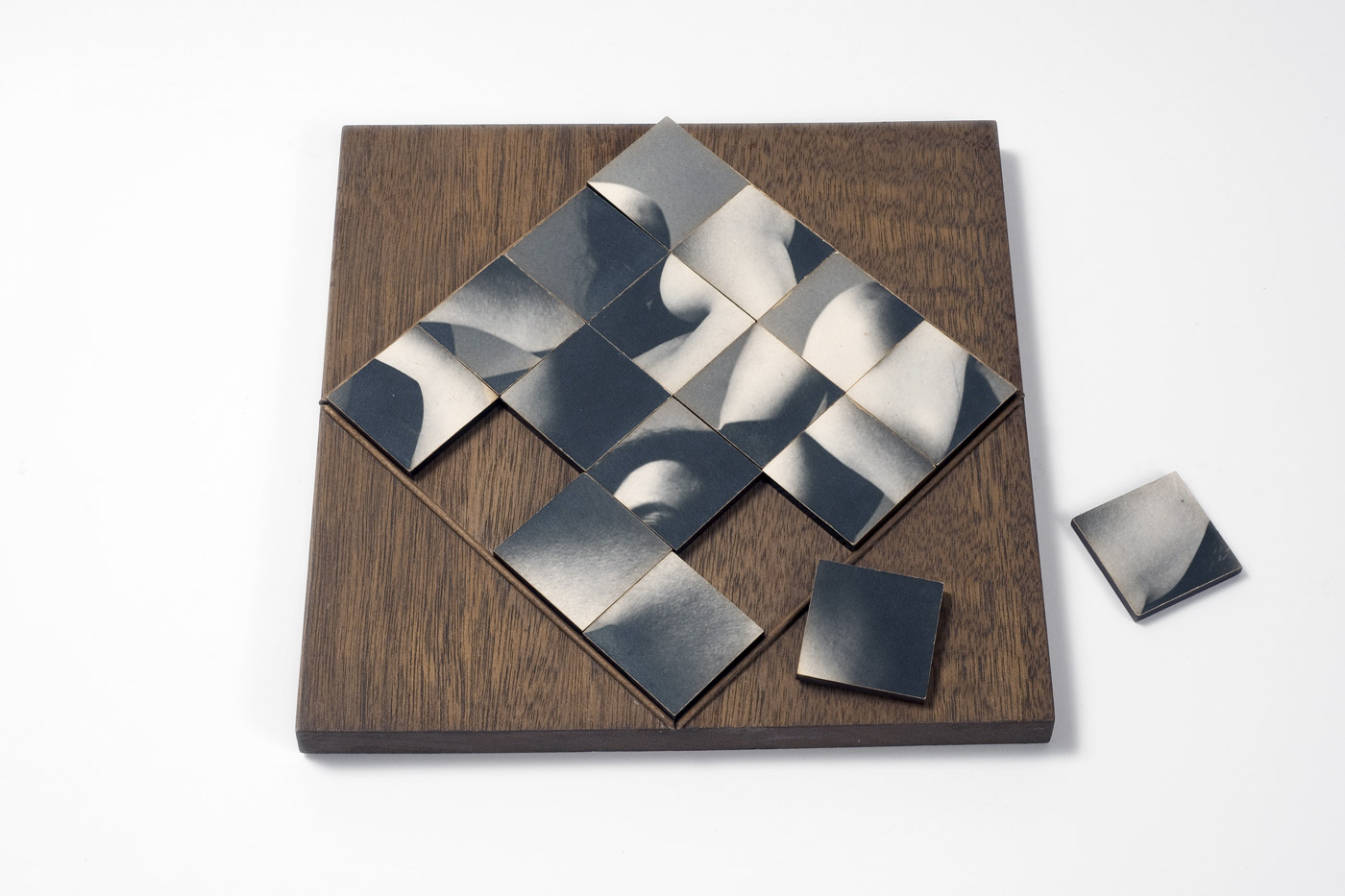
A revolutionary artist, this para-photographer’s photo puzzles are just amazing!

Dr Marcus Bunyan


Many thank to MoMA for allowing me to publish the photographs in the posting. Please click on the photographs for a larger version of the image.


Robert Heinecken (American, 1931-2006) 'Le Voyeur / Robbe-Grillet #2' 1972


Robert Heinecken (American, 1931-2006)
Le Voyeur / Robbe-Grillet #2
1972
Three canvas panels with bleached photographic emulsion and pastel chalk
14 x 40″ (35.6 x 101.6cm)
George Eastman House, Rochester, New York. Museum Purchase with National Endowment for the Arts support


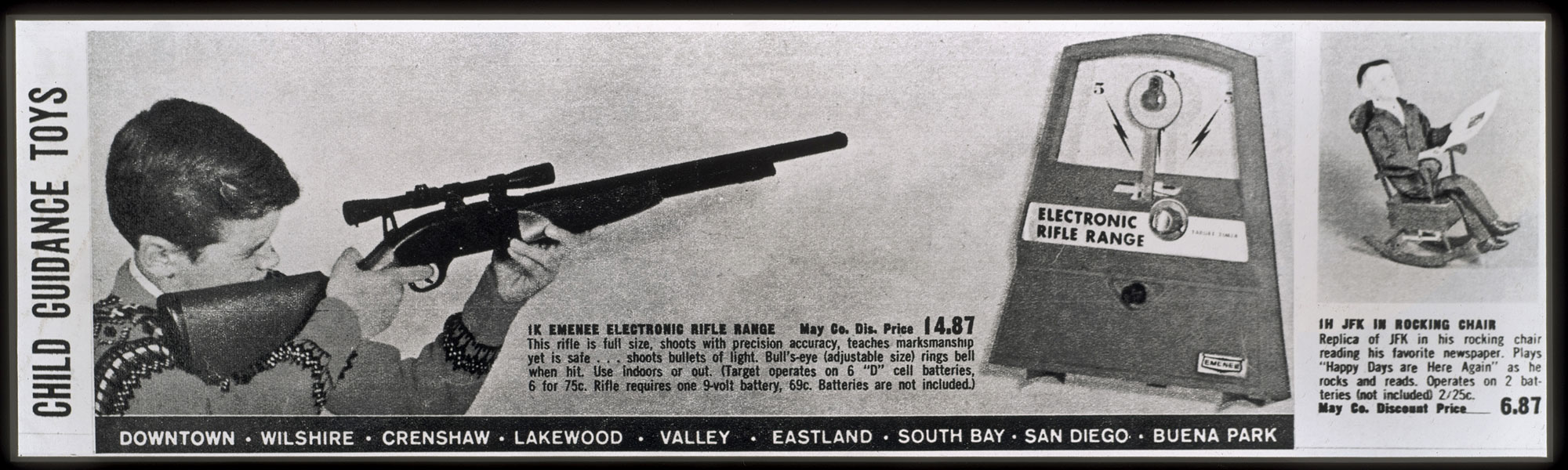
Robert Heinecken (American, 1931-2006) 'Child Guidance Toys' 1965


Robert Heinecken (American, 1931-2006)
Child Guidance Toys
1965
Black-and-white film transparency
5 x 18 1/16″ (12.7 x 45.8cm)
The Art Institute of Chicago. Gift of Boardroom, Inc.


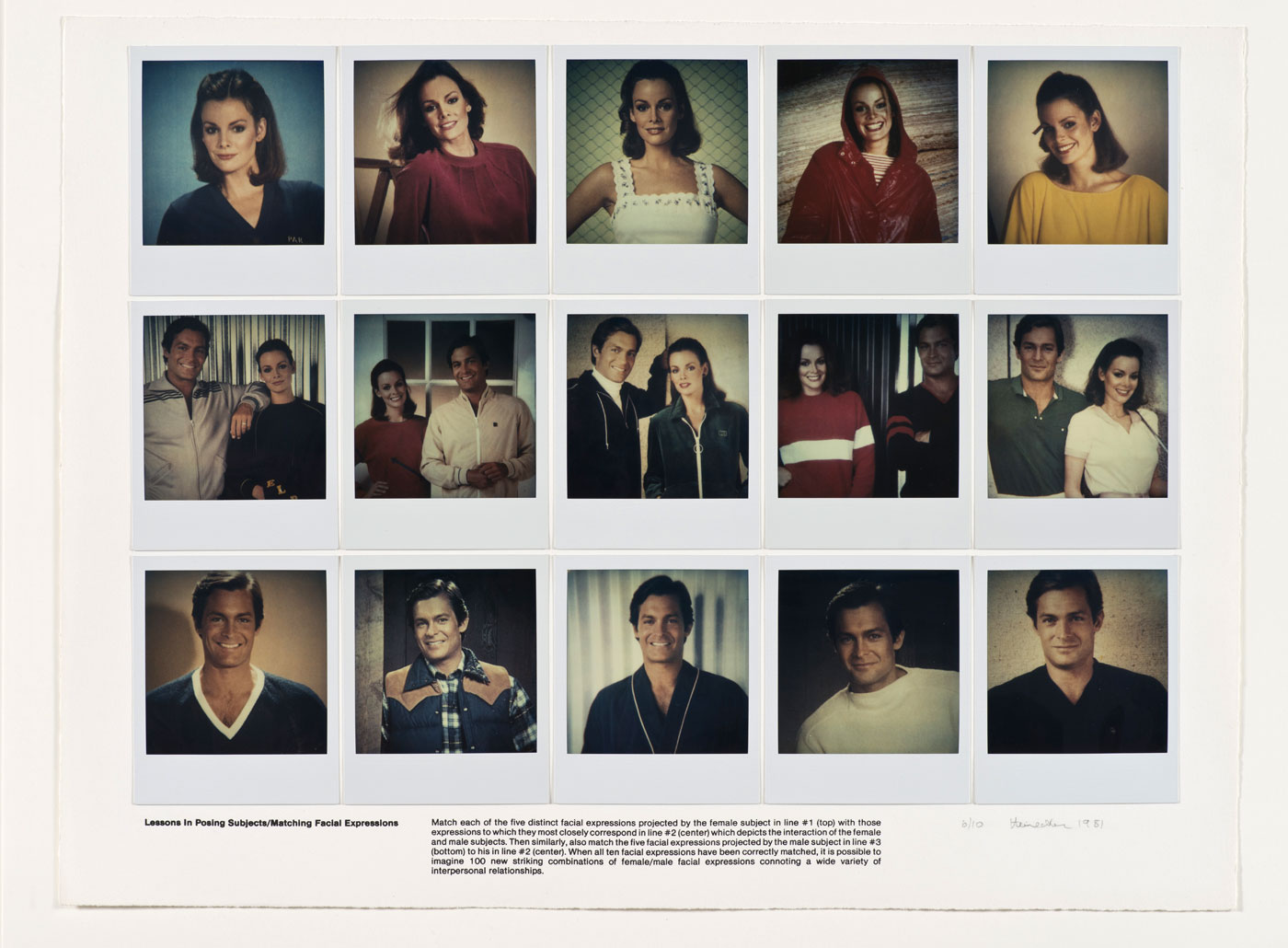
Robert Heinecken (American, 1931-2006) 'Lessons in Posing Subjects / Matching Facial Expressions' 1981


Robert Heinecken (American, 1931-2006)
Lessons in Posing Subjects / Matching Facial Expressions
1981
Fifteen internal dye diffusion transfer prints (SX-70 Polaroid) and lithographic text on Rives BFK paper
15 x 20″ (38.1 x 50.8cm)
Collection UCLA Grunwald Center for Graphic Art, Hammer Museum, Los Angeles. Gift of Dean Valentine and Amy Adelson


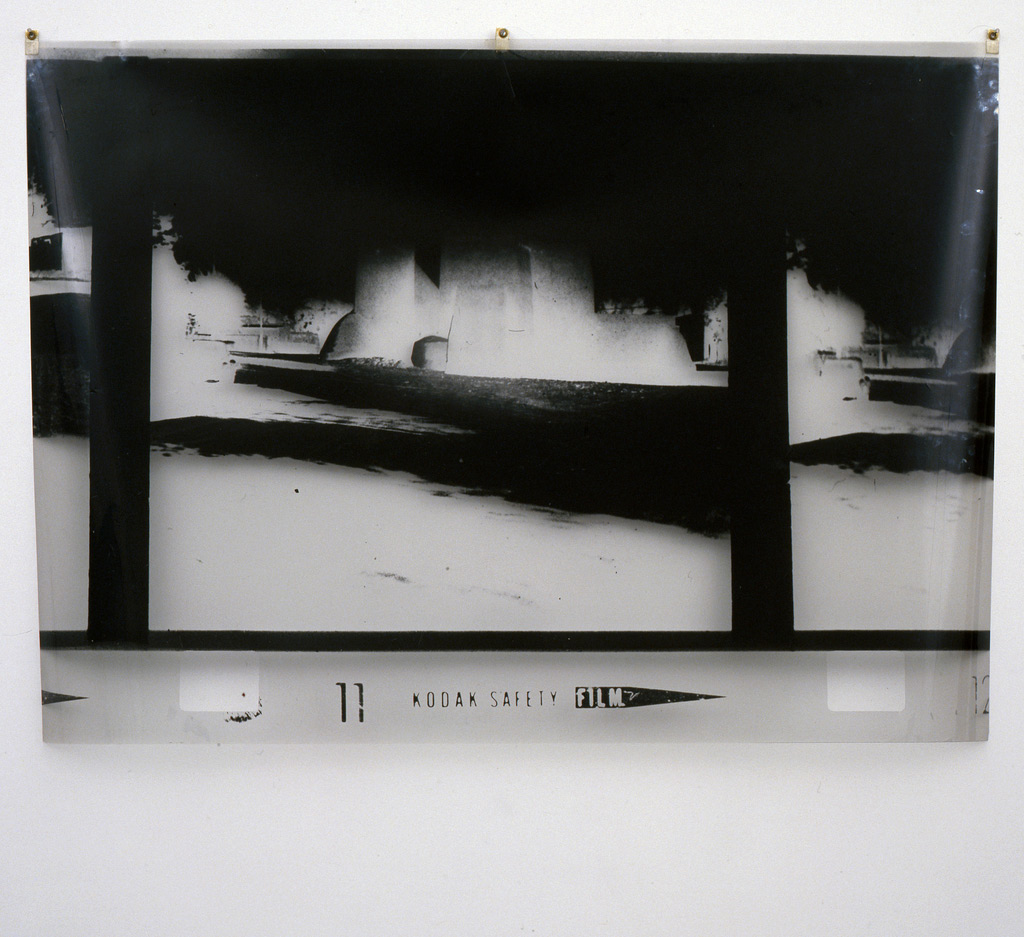
Robert Heinecken (American, 1931-2006) 'Kodak Safety Film / Taos Church' 1972


Robert Heinecken (American, 1931-2006)
Kodak Safety Film / Taos Church
1972
Black-and-white film transparency
40 x 56″ (101.6 x 142.2cm)
The Museum of Modern Art, New York. Committee on Photography Fund


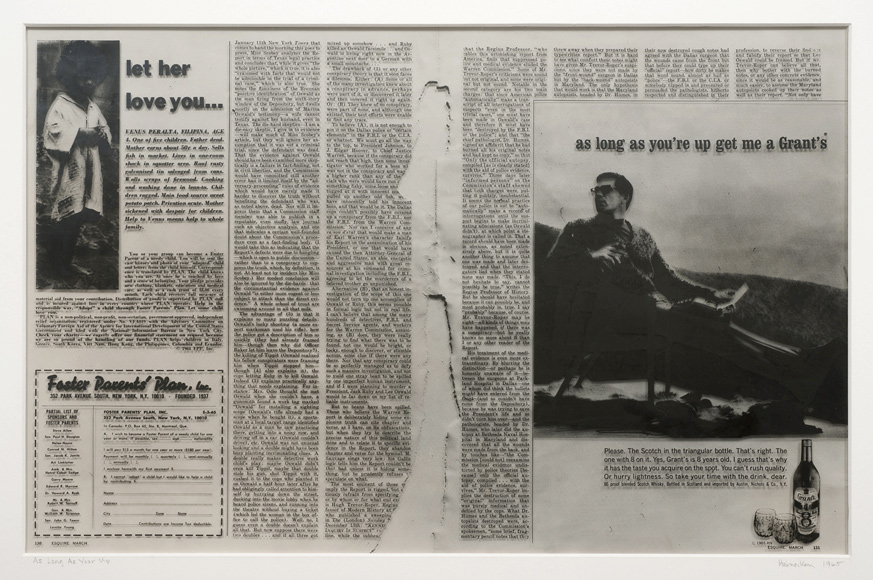
Robert Heinecken (American, 1931-2006) 'As Long As Your Up' 1965


Robert Heinecken (American, 1931-2006)
As Long As Your Up
1965
Black-and-white film transparency
15 1/2 x 19 5/8″ (39.4 x 49.8cm)
The Robert Heinecken Trust, Chicago. Courtesy Petzel Gallery, New York


Robert Heinecken (American, 1931-2006) 'Periodical #5' 1971


Robert Heinecken (American, 1931-2006)
Periodical #5
1971
Offset lithography on found magazine
12 1/4 x 9″ (31.1 x 22.9cm)
Collection Philip Aarons and Shelley Fox Aarons, New York


Robert Heinecken (American, 1931-2006) 'Six Figures/Mixed' 1968


Robert Heinecken (American, 1931-2006)
Six Figures/Mixed
1968
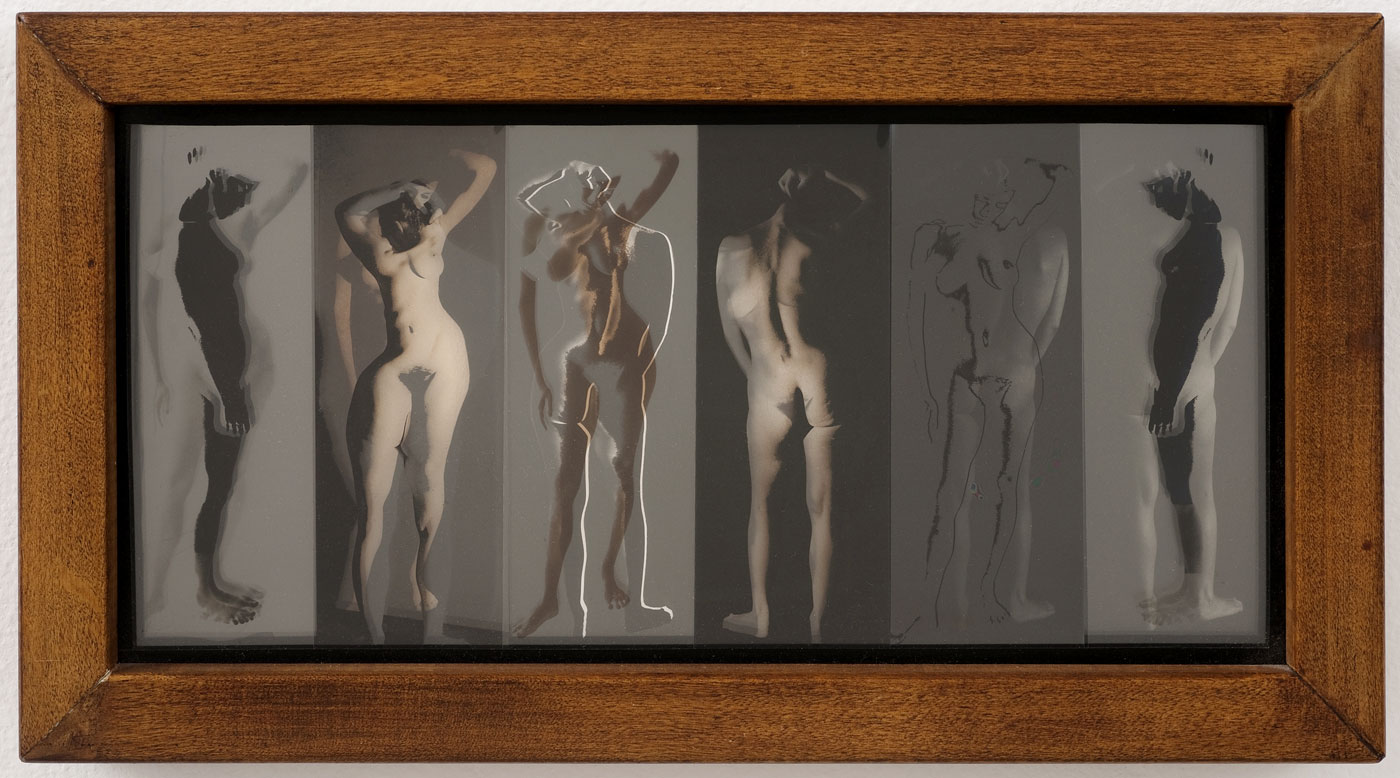
Layered Plexiglas and black-and-white film transparencies
5.75 x 9.75 x 1.5″ (14.61 x 24.77 x 3.81cm)
Collection Darryl Curran, Los Angeles


Robert Heinecken (American, 1931-2006) 'Figure / Foliage #2' 1969


Robert Heinecken (American, 1931-2006)
Figure / Foliage #2
1969
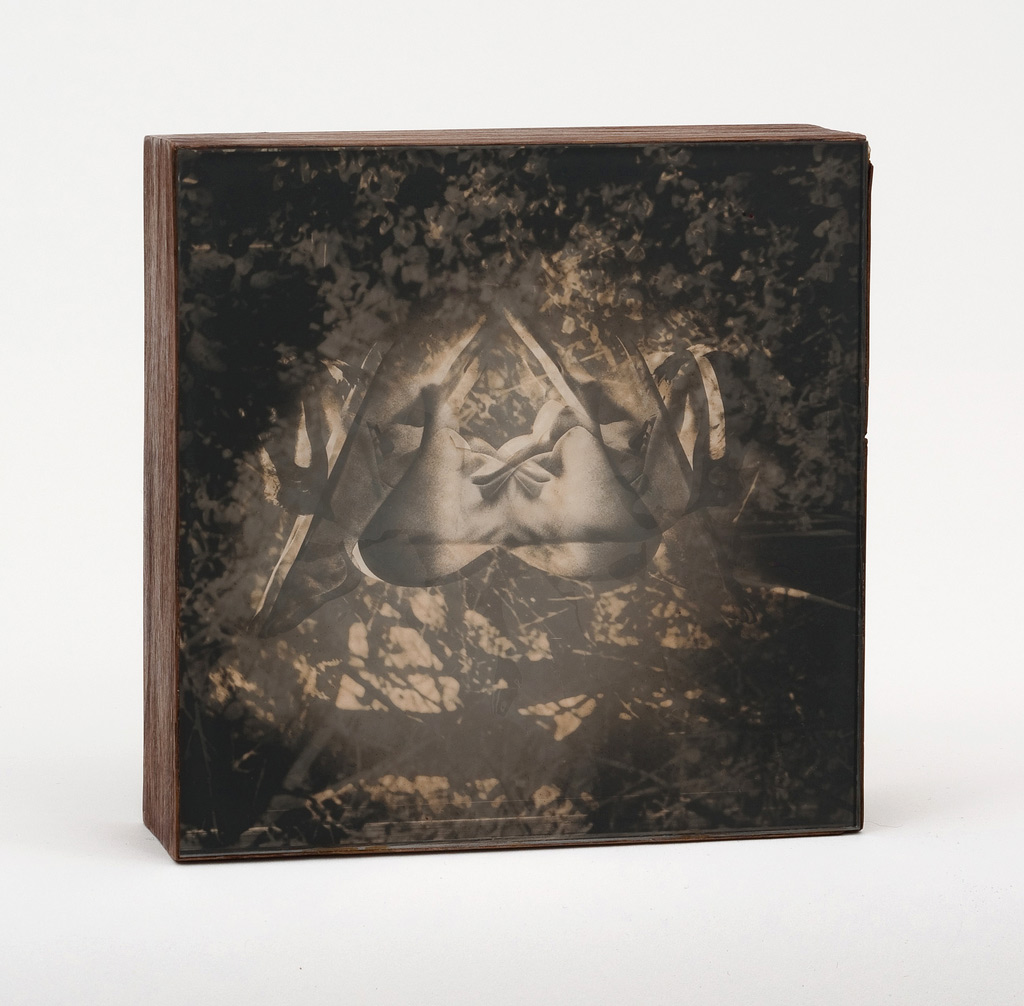
Layered Plexiglas and black-and-white film transparencies
5 x 5 x 1 1/4″ (12.7 x 12.7 x 3.2cm)
Collection Anton D. Segerstrom, Corona del Mar, California


Robert Heinecken (American, 1931-2006) 'Kaleidoscopic Hexagon #2' 1965


Robert Heinecken (American, 1931-2006)
Kaleidoscopic Hexagon #2
1965
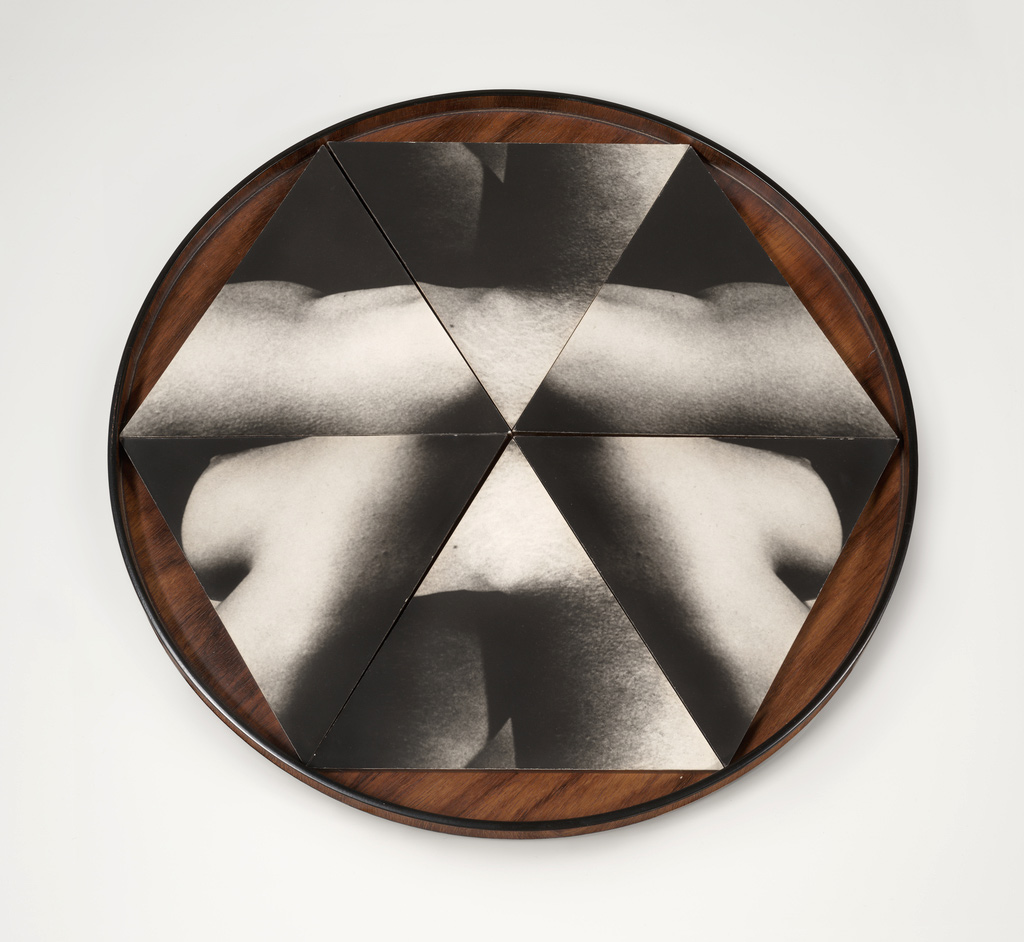
Six gelatin silver prints on wood
Diameter: 14″ (35.6cm)
Black Dog Collection. Promised gift to San Francisco Museum of Modern Art


Robert Heinecken (American, 1931-2006) '24 Figure Blocks' 1966


Robert Heinecken (American, 1931-2006)
24 Figure Blocks
1966
Twelve gelatin silver prints on wood blocks, and twelve additional wood blocks
14 1/16 x 14 1/16 x 13/16″ (35.7 x 35.7 x 2.1cm)
Whitney Museum of American Art, New York. Gift of Jeanne and Richard S. Press


Robert Heinecken (American, 1931-2006) 'Multiple Solution Puzzle' 1965


Robert Heinecken (American, 1931-2006)
Multiple Solution Puzzle
1965
Sixteen gelatin silver prints on wood
11 1/4 x 11 1/4 x 1″ (28.6 x 28.6 x 2.5cm)
Collection Maja Hoffmann/LUMA Foundation


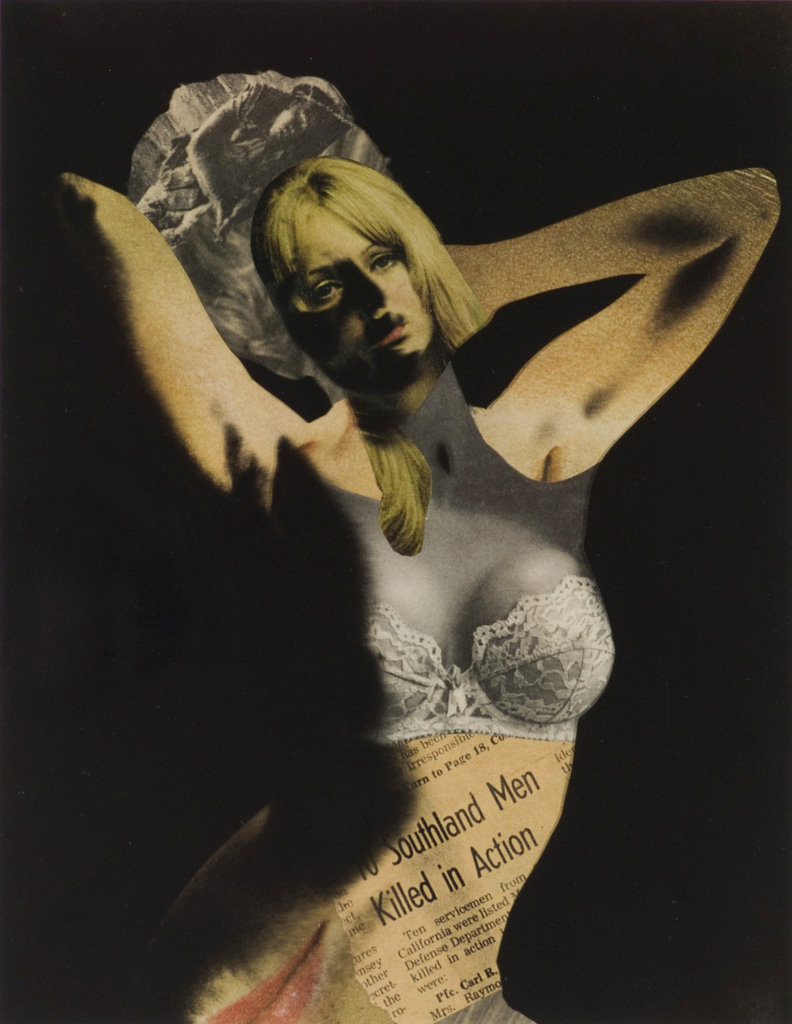
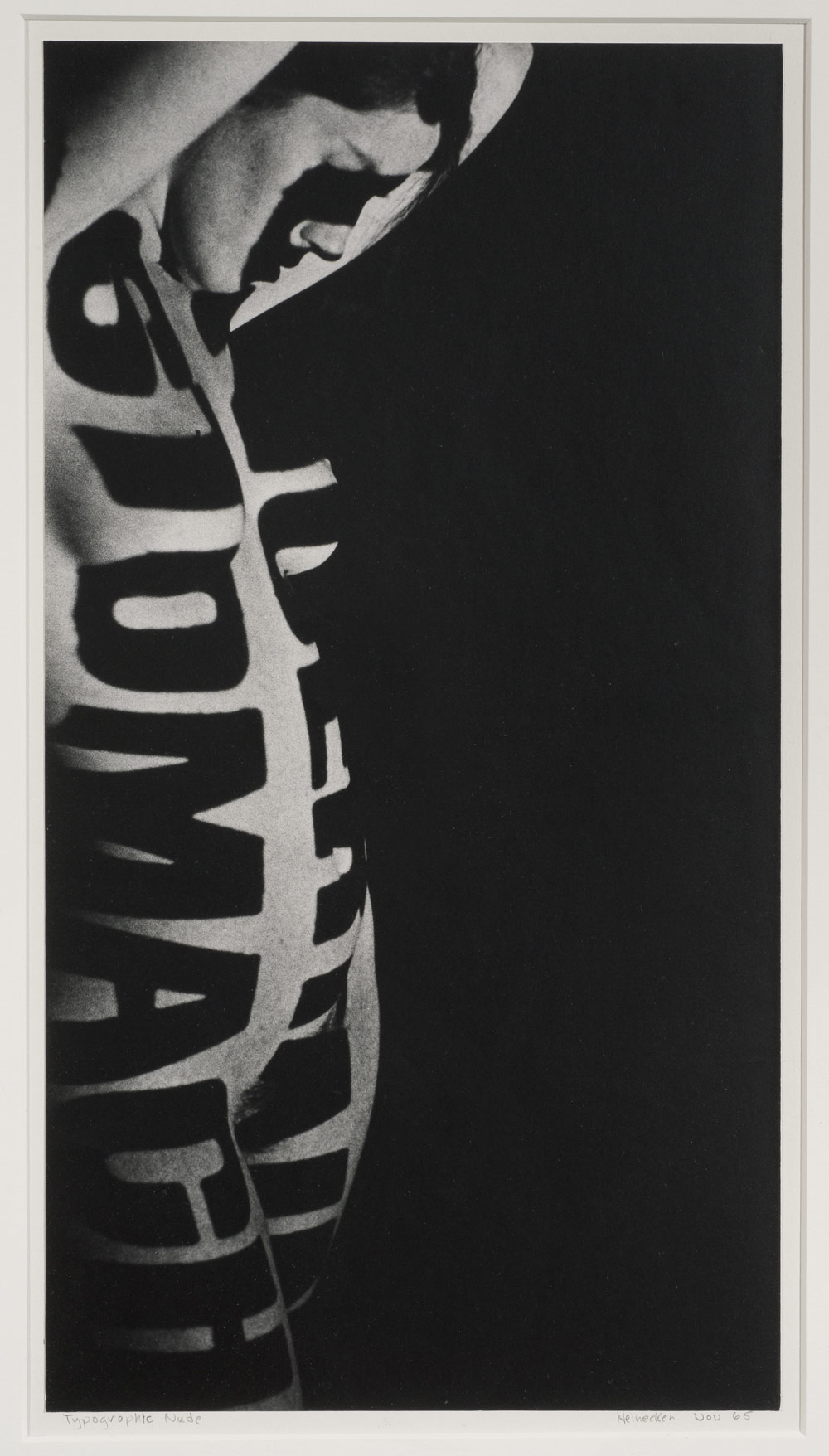
The Museum of Modern Art presents Robert Heinecken: Object Matter, the first retrospective of the work of Robert Heinecken since his death in 2006 and the first exhibition on the East Coast to cover four decades of the artist’s unique practice, from the early 1960s through the late 1990s, on view from March 15 to September 7, 2014. Describing himself as a “para-photographer,” because his work stood “beside” or “beyond” traditional ideas associated with photography, Heinecken worked across multiple mediums, including photography, sculpture, printmaking, and collage. Culling images from newspapers, magazines, pornography, and television, he recontextualized them through collage and assemblage, photograms, darkroom experimentation, and rephotography. His works explore themes of commercialism, Americana, kitsch, sex, the body, and gender. In doing so, the works in this exhibition expose his obsession with popular culture and its effects on society, and with the relationship between the original and the copy. Robert Heinecken: Object Matter is organised by Eva Respini, Curator, with Drew Sawyer, Beaumont and Nancy Newhall Curatorial Fellow, Department of Photography, The Museum of Modern Art. The exhibition will travel to the Hammer Museum, and will be on view there from October 5, 2014 through January 17, 2015.

Heinecken dedicated his life to making art and teaching, establishing the photography program at UCLA in 1964, where he taught until 1991. He began making photographs in the early 1960s. The antithesis of the fine-print tradition exemplified by West Coast photographers Ansel Adams and Edward Weston, who photographed landscapes and objects in sharp focus and with objective clarity, Heinecken’s early work is marked by high contrast, blur, and under- or overexposure, as seen in Shadow Figure (1962) and Strip of Light (1964). In the mid-1960s he began combining and sequencing disparate pictures, as in Visual Poem/About the Sexual Education of a Young Girl (1965), which comprises seven black-and-white photographs of dolls with a portrait of his then-five-year-old daughter Karol at the centre.

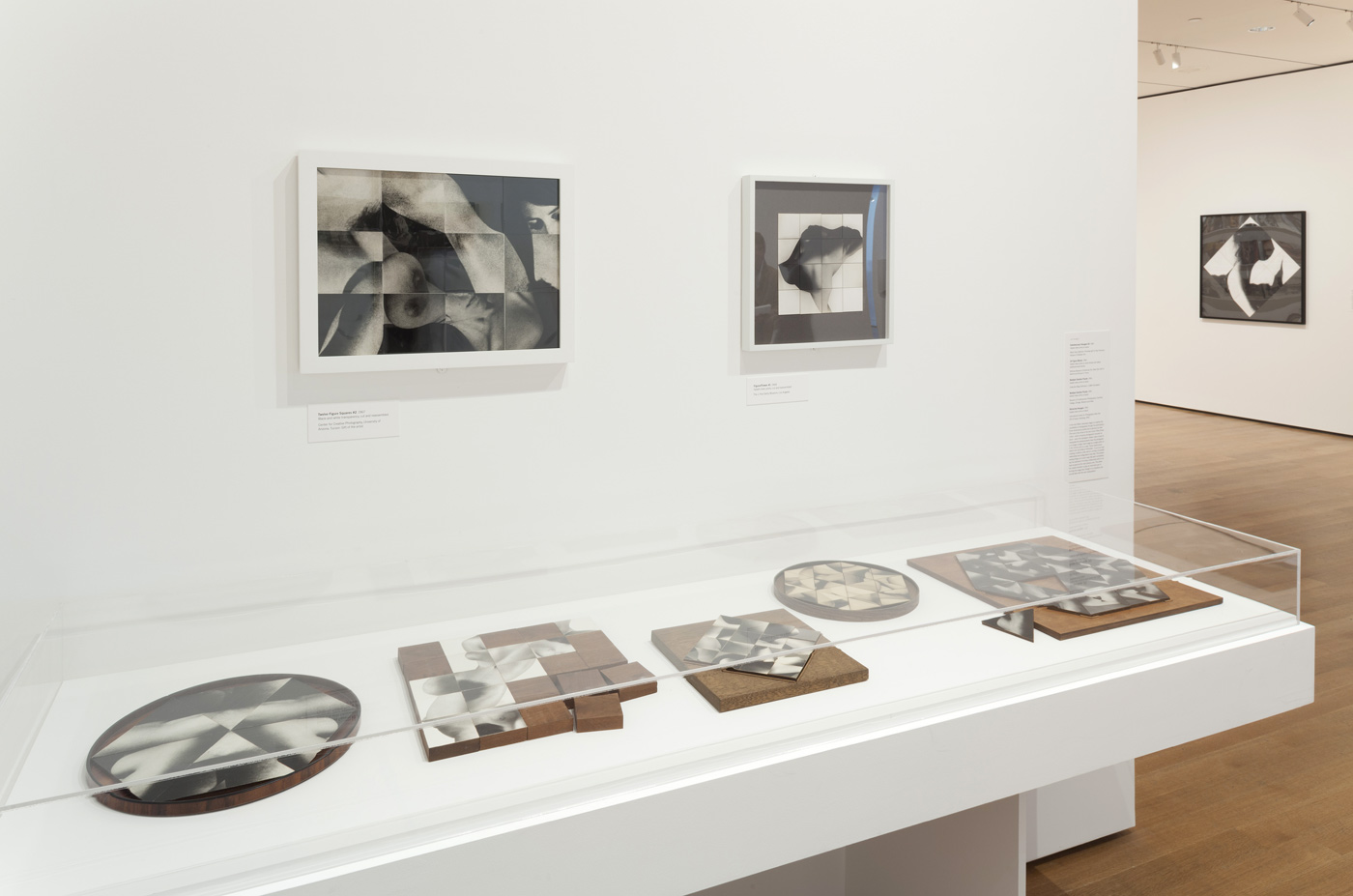
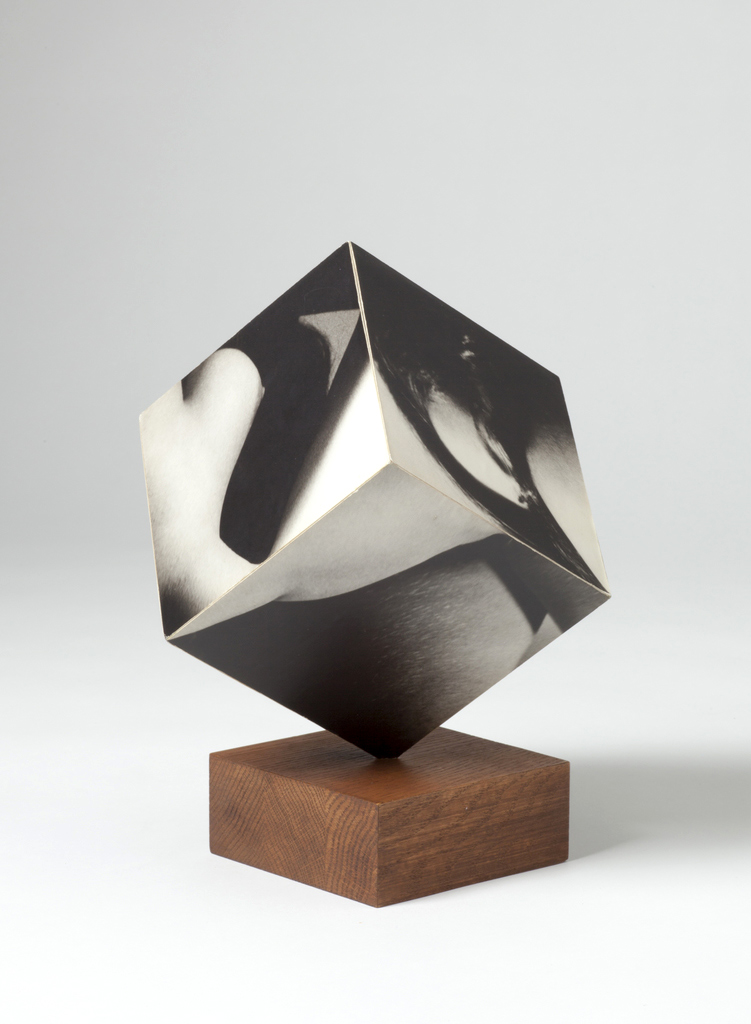
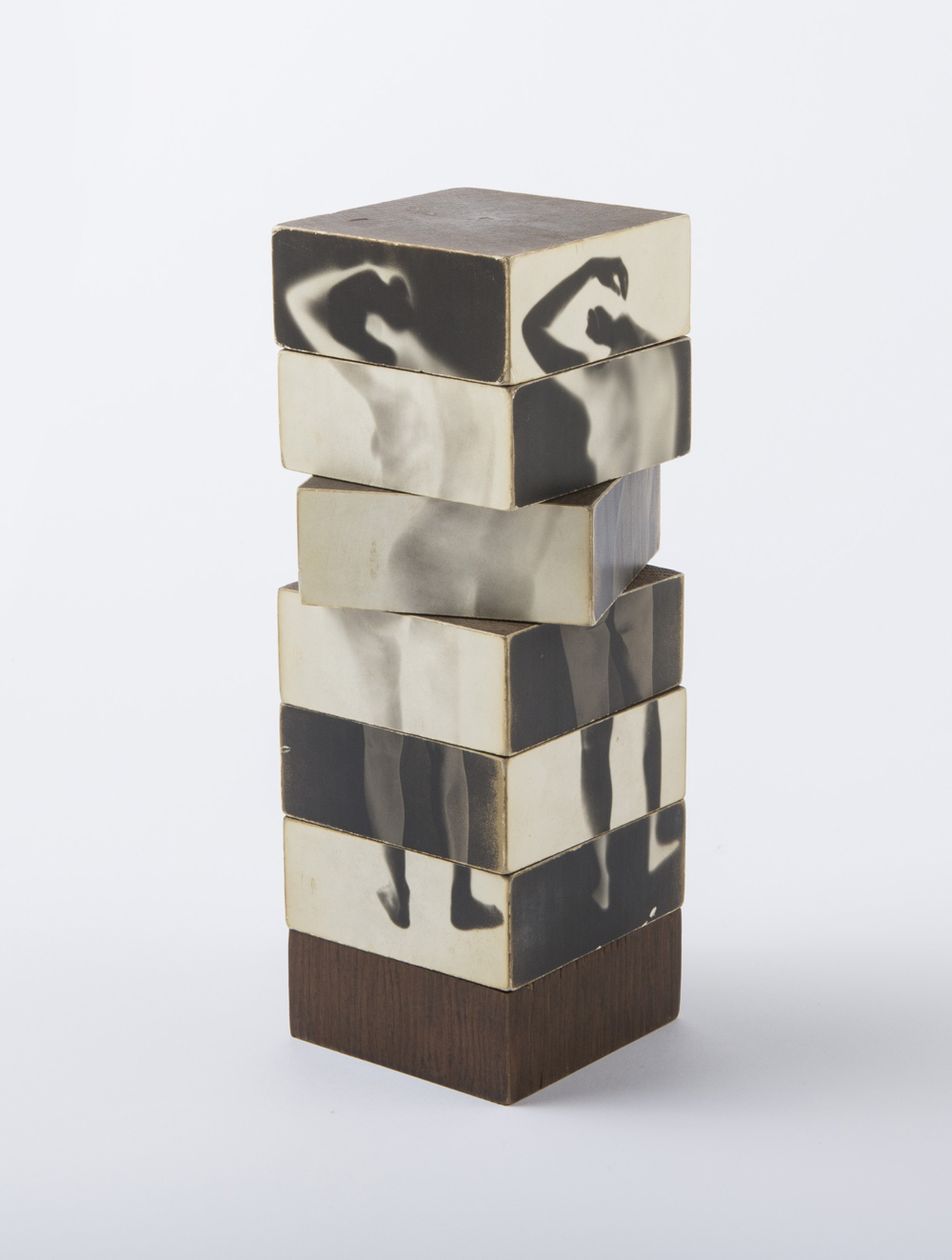
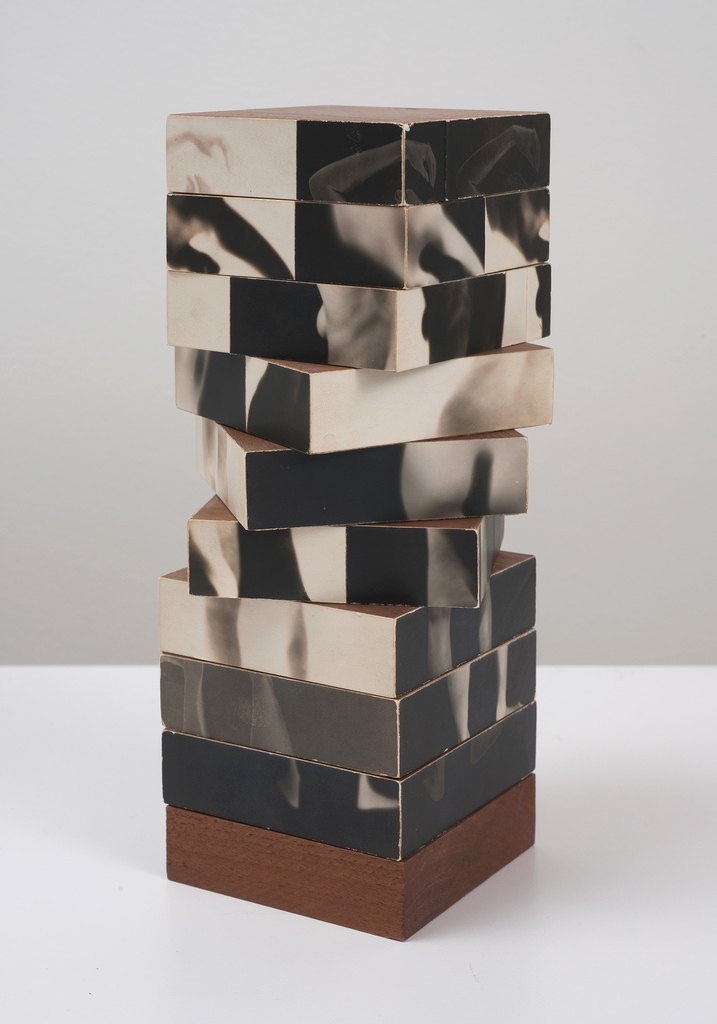
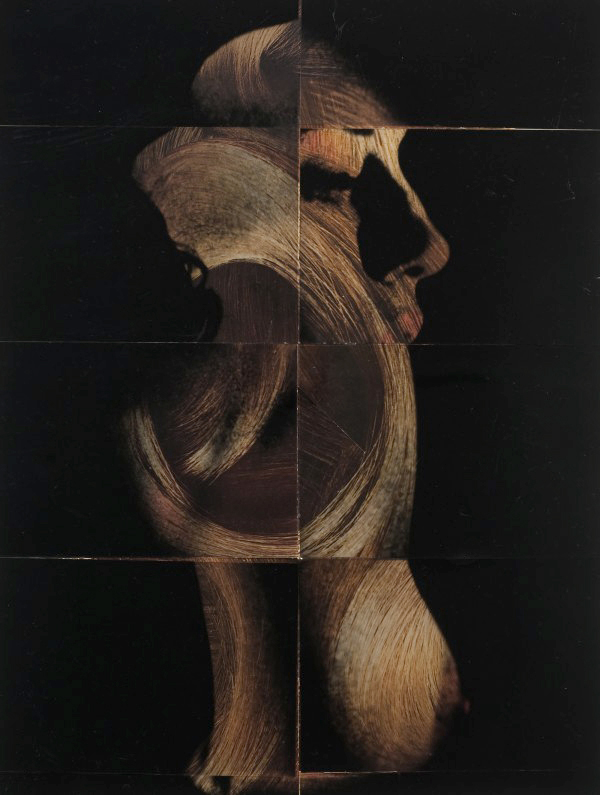
The female nude is a recurring motif, featured in Refractive Hexagon (1965), one of several “photopuzzles” composed of photographs of female body parts mounted onto 24 individual “puzzle” pieces. Other three-dimensional sculptures – geometric volumes ranging in height from five to 22 inches – consist of photographs mounted onto individual blocks, which rotate independently around a central axis. In Fractured Figure Sections (1967), as in Refractive Hexagon, the female figure is never resolved as a single image – the body is always truncated, never contiguous. In contrast, a complete female figure can be reconstituted in his largest photo-object, Transitional Figure Sculpture (1965), a towering 26-layer octagon composed from photographs of a nude that have been altered using various printing techniques. At the time, viewer engagement was key to creating random configurations and relationships in the work; any number of possibilities may exist, only to be altered with the next manipulation. Today, due to the fragility of the works, these objects are displayed in Plexiglas-covered vitrines. However, the number of sculptures and puzzles gathered here offer the viewer a sense of this diversity.

Heinecken’s groundbreaking suite Are You Rea (1964-68) is a series of 25 photograms made directly from magazine pages. Representative of a culture that was increasingly commercialised, technologically mediated, and suspicious of established truths, Are You Rea cemented Heinecken’s interest in the multiplicity of meanings inherent in existing images and situations. Culled from more than 2000 magazine pages, the work includes pictures from publications such as Life, Time, and Woman’s Day, contact-printed so that both sides are superimposed in a single image. Heinecken’s choice of pages and imagery are calculated to reveal specific relationships and meanings – ads for Coppertone juxtaposed with ads for spaghetti dinners and an article about John F. Kennedy superimposed on an ad for Wessex carpets – the portfolio’s narrative moves from relatively commonplace and alluring images of women to representations of violence and the male body.

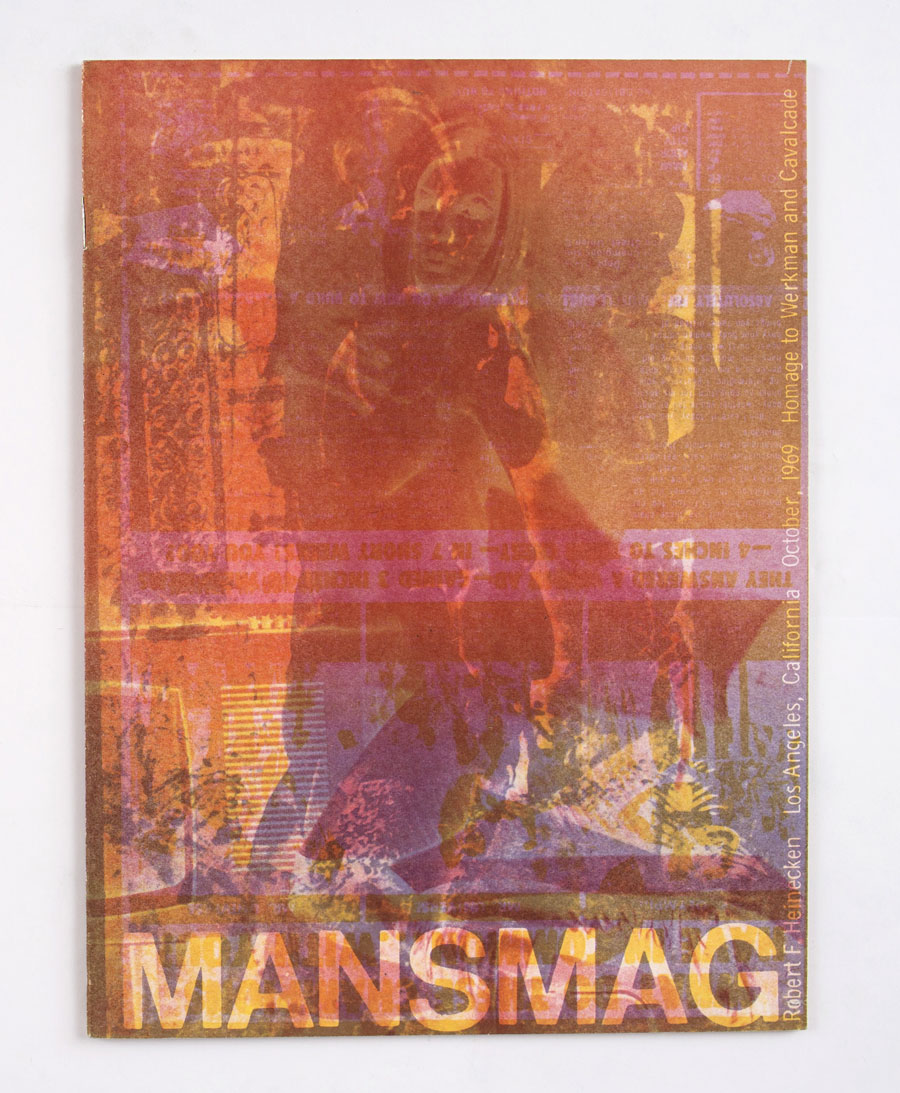
Heinecken began altering magazines in 1969 with a series of 120 periodicals titled MANSMAG: Homage to Werkman and Cavalcade. He used the erotic men’s magazine Cavalcade as source material, making plates of every page, and randomly printing them on pages that were then reassembled into a magazine, now scrambled. In the same year, he disassembled numerous Time magazines, imprinting pornographic images taken from Cavalcade on every page, and reassembled them with the original Time covers. He circulated these reconstituted magazines by leaving them in waiting rooms or slipping them onto newsstands, allowing the work to come full circle – the source material returning to its point of origin after modification. He reprised this technique in 1989 with an altered issue of Time titled 150 Years of Photojournalism, a greatest hits of historical events seen through the lens of photography.


Installation view of 'Robert Heinecken: Object Matter' at The Museum of Modern Art (MoMA)

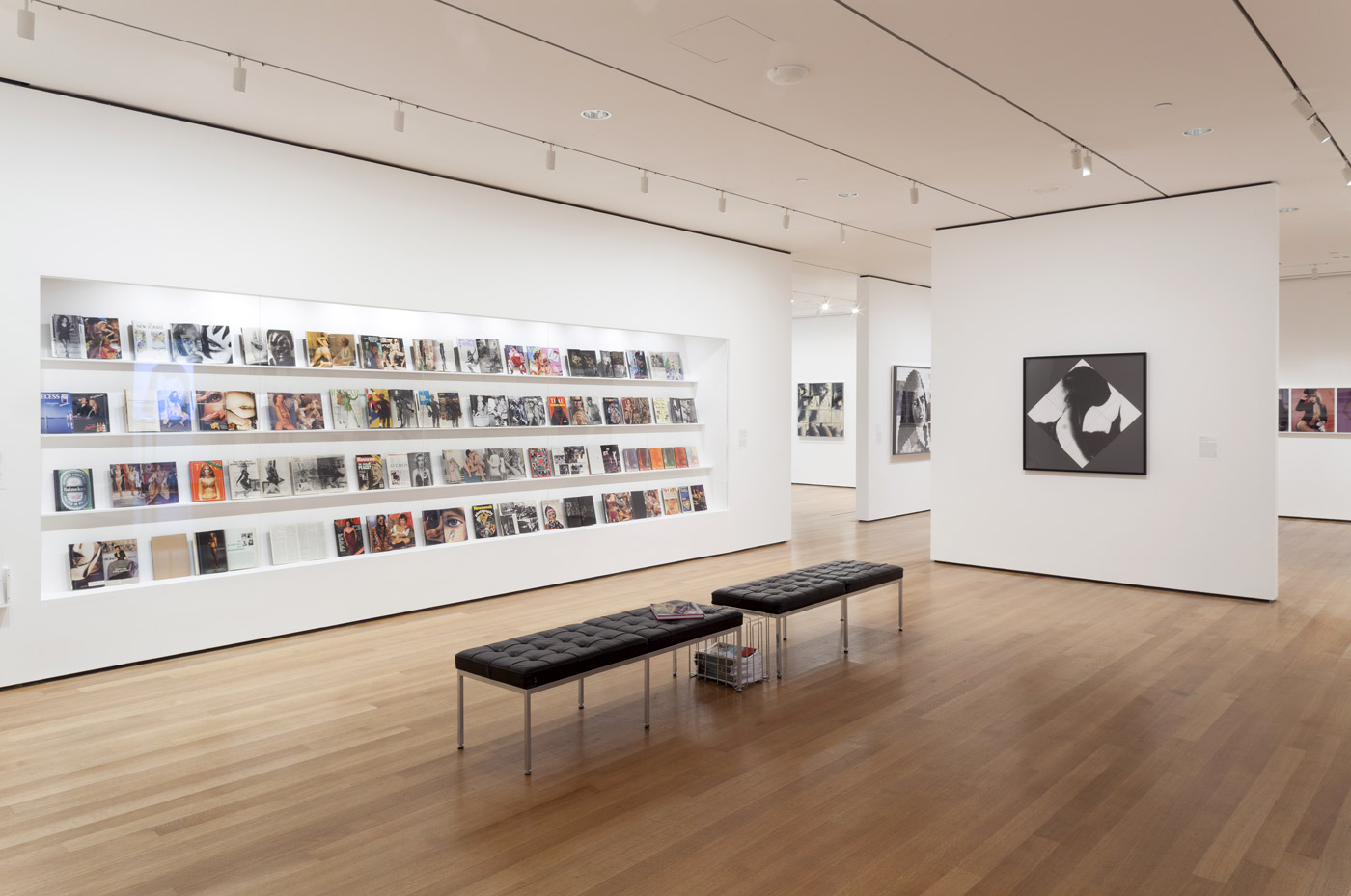
Installation view of 'Robert Heinecken: Object Matter' at The Museum of Modern Art (MoMA)

Installation view of 'Robert Heinecken: Object Matter' at The Museum of Modern Art (MoMA)

Installation view of 'Robert Heinecken: Object Matter' at The Museum of Modern Art (MoMA)


Installation views of Robert Heinecken: Object Matter at The Museum of Modern Art (MoMA)
Photos by Jonathan Muzikar
© The Museum of Modern Art


Robert Heinecken (American, 1931-2006) 'Breast / Bomb #5' 1967


Robert Heinecken (American, 1931-2006)
Breast / Bomb #5
1967
Gelatin silver prints, cut and reassembled
38 1/2 x 38 1/4″ (97.8 x 97.2cm)
Denver Art Museum. Funds From 1992 Alliance For Contemporary Art Auction


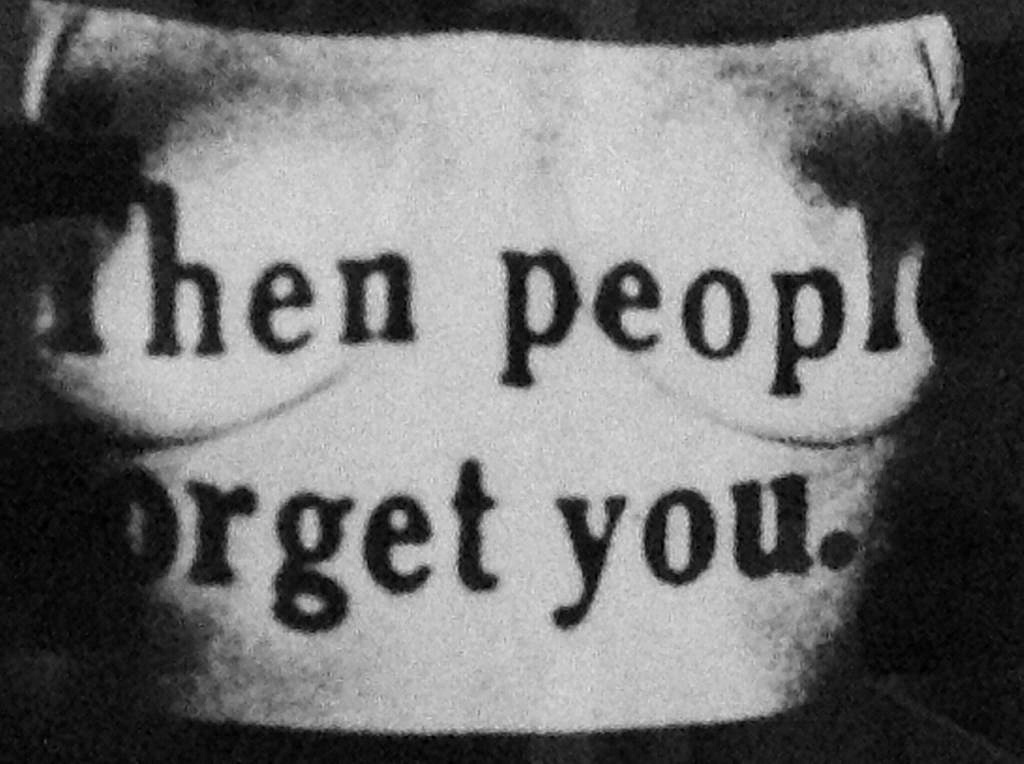
Robert Heinecken (American, 1931-2006) 'Then People Forget You' 1965


Robert Heinecken (American, 1931-2006)
Then People Forget You
1965
Gelatin silver print
10 3/8 x 12 15/16″ (26.3 x 32.8cm)
The Art Institute of Chicago. Gift of Boardroom, Inc.


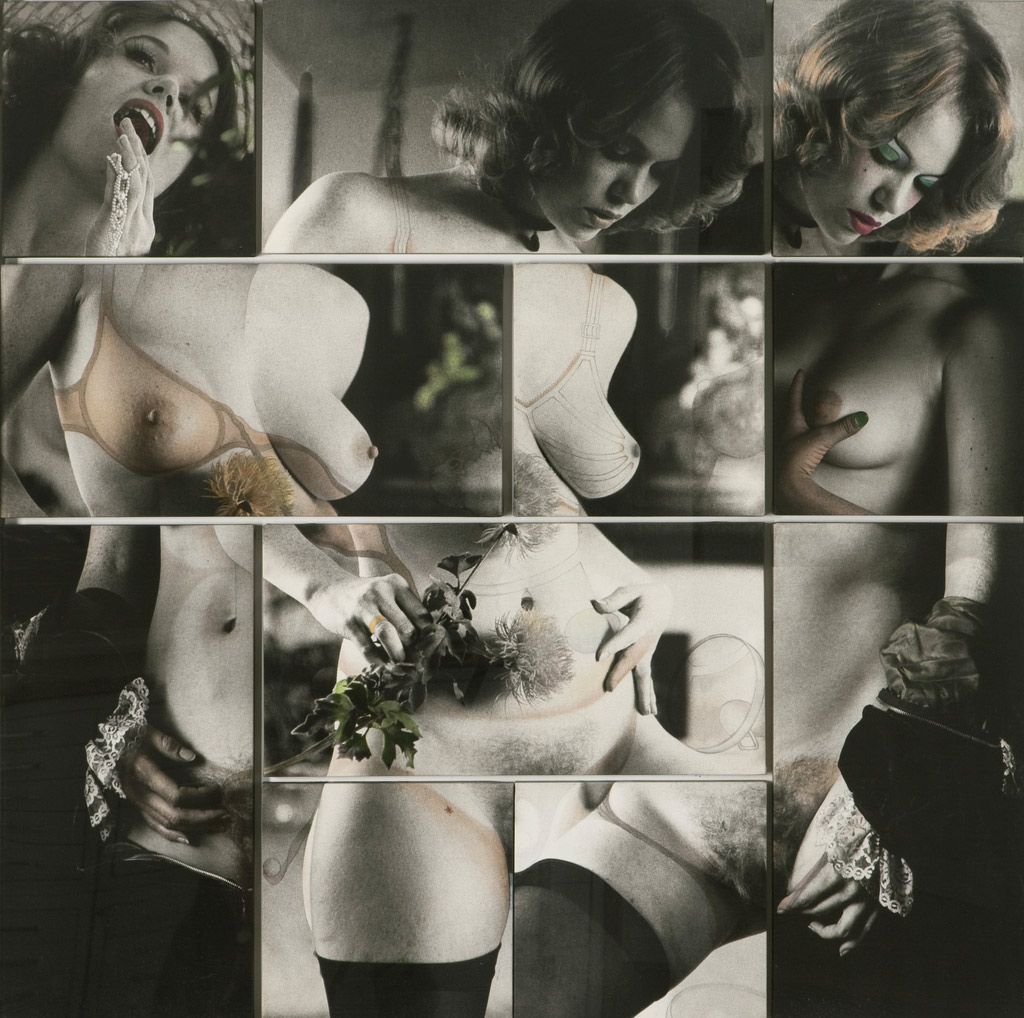
Robert Heinecken (American, 1931-2006) 'Cliche Vary / Autoeroticism' 1974


Robert Heinecken (American, 1931-2006)
Cliche Vary / Autoeroticism
1974
Eleven canvas panels with photographic emulsion and pastel chalk
39 1/2 x 39 1/2 in. (100.3 x 100.3cm)
Collection Susan and Peter MacGill, New York


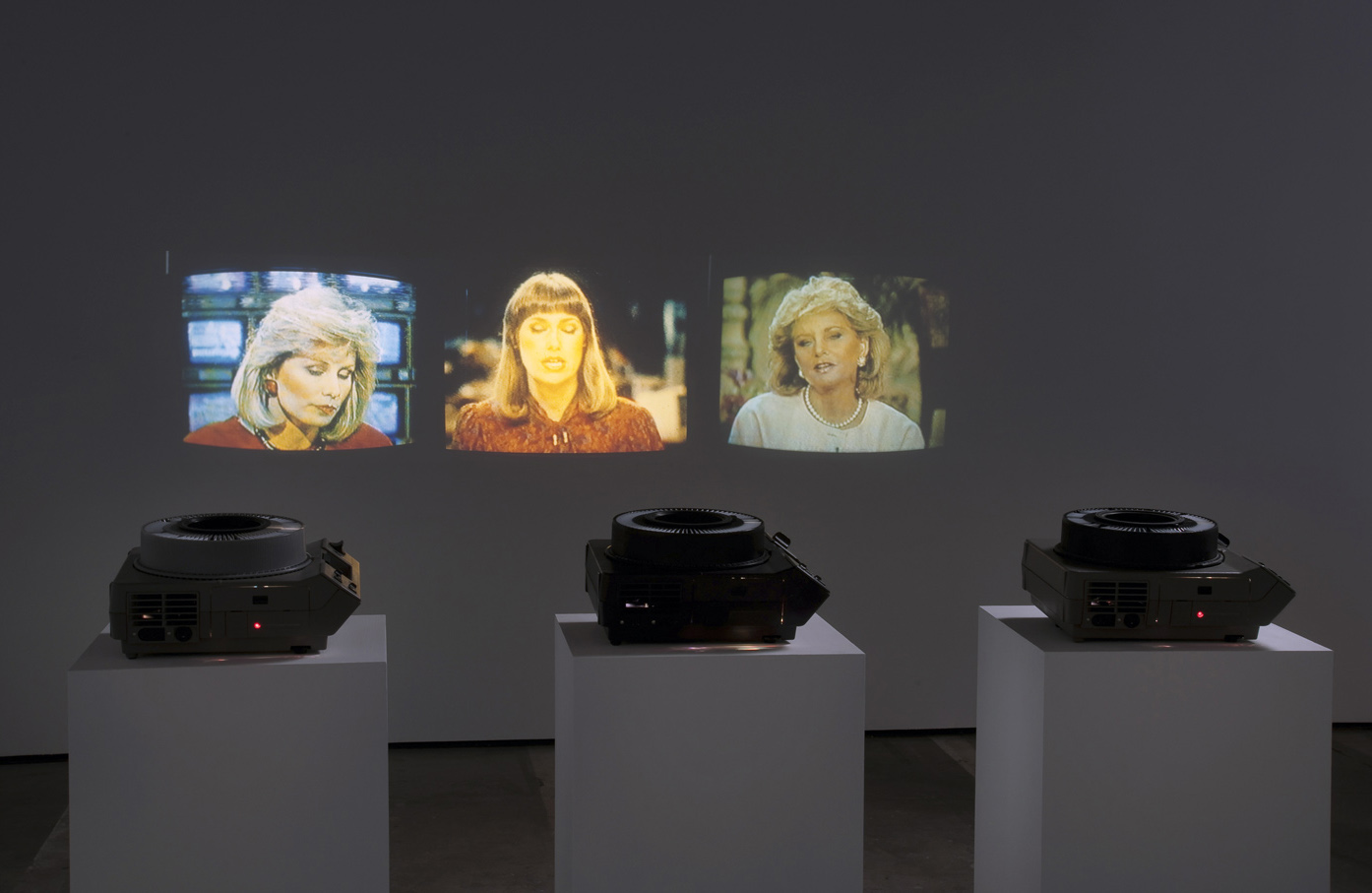
Robert Heinecken (American, 1931-2006) 'Surrealism on TV' 1986


Robert Heinecken (American, 1931-2006)
Surrealism on TV
1986
216 35 mm colour slides, slide-show time variable
The Robert Heinecken Trust, Chicago; courtesy Cherry and Martin Gallery, Los Angeles
© 2013 The Robert Heinecken Trust.


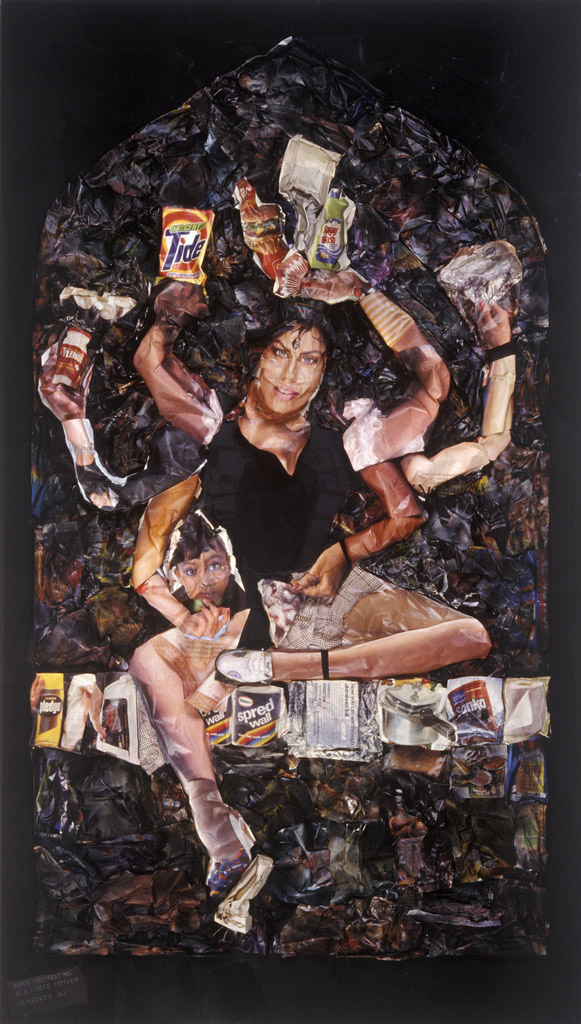
Robert Heinecken (American, 1931-2006) 'Shiva Manifesting as a Single Mother' 1989


Robert Heinecken (American, 1931-2006)
Shiva Manifesting as a Single Mother
1989
Magazine paper, paint and varnish
Collection Philip F. Denny, Chicago
© 2014 The Robert Heinecken Trust


Transparent film is also used in many of Heinecken’s works to explore different kinds of juxtapositions. In Kodak Safety Film / Christmas Mistake (1971), pornographic images are superimposed on a Christmas snapshot of Heinecken’s children with the suggestion in the title that somehow two rolls of film were mixed up at the photo lab. Kodak Safety Film / Taos Church (1972) takes photography itself as a subject, picturing an adobe church in New Mexico that was famously photographed by Ansel Adams and Paul Strand, and painted by Georgia O’Keeffe and John Marin. Presented as a negative, Heinecken’s version transforms an icon of modernism into a murky structure flanked by a pickup truck, telephone wires, and other modern-day debris.

Heinecken’s hybrid photographic paintings, created by applying photographic emulsion on canvas, are well represented in the exhibition. In Figure Horizon #1(1971), Heinecken reprised the cut-and-reassemble techniques from his puzzles and photo-sculptures, sequencing images of sections of the nude female body, to create impossible undulating landscapes. Cliché Vary, a pun on the 19th-century cliché verre process, is comprised of three large-scale modular works, all from 1974: Autoeroticism, Fetishism, and Lesbianism. The works are comprised of separately stretched canvas panels with considerable hand-applied colour on the photographic image, invoking clichés associated with autoeroticism, fetishism, and lesbianism. Reminiscent of his cut-and-reassembled pieces, each panel features disjointed views of bodies and fetish objects that never make a whole, and increase in complexity, culminating with Lesbianism, which is made with seven or eight different negatives.

In the mid-1970s, Heinecken experimented with new materials introduced by Polaroid – specifically the SX-70 camera (which required no darkroom or technical know-how) – to produce the series He/She (1975-1980) and, later, Lessons in Posing Subjects (1981-82). Heinecken experimented with different types of instant prints, including the impressive two-panel S.S. Copyright Project: “On Photography” (1978), made the year after the publication of Susan Sontag’s collection of essays On Photography (1977). The S.S. Copyright Project consists of a magnified and doubled picture of Sontag, derived from the book’s dustcover portrait (taken by Jill Krementz). The work equates legibility with physical proximity – from afar, the portraits appear to be grainy enlargements from a negative (or, to contemporary eyes, pixilated low-resolution images), but at close range, it is apparent that the panels are composed of hundreds of small photographic scraps stapled together. The portrait on the left is composed of photographs of Sontag’’ text; the right features random images taken around Heinecken’s studio by his assistant.

Heinecken’s first large-scale sculptural installation, TV/Time Environment (1970), is the earliest in a series of works that address the increasingly dominant presence of television in American culture. In the installation, a positive film transparency of a female nude is placed in front of a functioning television set in an environment that evokes a living room, complete with recliner chair, plastic plant, and rug. Continuing his work with television, Heinecken created videograms – direct captures from the television that were produced by pressing Cibachrome paper onto the screen to expose the sensitized paper. Inaugural Excerpt Videograms (1981) features a composite from the live television broadcast of Ronald Reagan’s inauguration speech and the surrounding celebrations. The work, originally in 27 parts, now in 24, includes randomly chosen excerpts of the oration and news reports of it. Surrealism on TV (1986) explores the idea of transparency and layering using found media images to produce new readings. It features a slide show comprised of more than 200 images loaded into three slide projectors and projected in random order. The images generally fit into broad categories, which include newscasters, animals, TV evangelists, aerobics, and explosions.

Text from the MoMA press release


Robert Heinecken (American, 1931-2006) 'Figure Cube' 1965


Robert Heinecken (American, 1931-2006)
Figure Cube
1965
Gelatin silver prints on Masonite
5 7/8 x 5 7/8″ (15 x 15cm)
The Robert Heinecken Trust. Courtesy Center for Creative Photography, University of Arizona, Tucson


Robert Heinecken (American, 1931-2006) 'Figure in Six Sections' 1965


Robert Heinecken (American, 1931-2006)
Figure in Six Sections
1965
Gelatin silver prints on wood blocks
8 1/2 x 3 x 3″ (21.6 x 7.6 x 7.6cm)
Collection Kathe Heinecken. Courtesy The Robert Heinecken Trust, Chicago


Robert Heinecken (American, 1931-2006) 'Fractured Figure Sections' 1967


Robert Heinecken (American, 1931-2006)
Fractured Figure Sections
1967
Gelatin silver prints on wood blocks
8 1/4 x 3 x 3″ (21 x 7.6 x 7.6cm)
The Museum of Modern Art, New York. The Photography Council Fund and Committee on Photography Fund


Robert Heinecken (American, 1931-2006) 'The S.S. Copyright Project: "On Photography"' (Part 1 of 2) 1978


Robert Heinecken (American, 1931-2006)
The S.S. Copyright Project: “On Photography” (Part 1 of 2)
1978
Collage of black and white instant prints attached to composite board with staples
b 47 13/16 x 47 13/16″ (121.5 x 121.5cm)
The Museum of Modern Art, New York. Purchased as the partial gift of Celeste Bartos


Robert Heinecken (American, 1931-2006) 'Recto/Verso #2' 1988


Robert Heinecken (American, 1931-2006)
Recto/Verso #2
1988
Silver dye bleach print
8 5/8 x 7 7/8″ (21.9 x 20cm)
The Museum of Modern Art, New York. Mr. and Mrs. Clark Winter Fund


Robert Heinecken (American, 1931-2006) 'Figure Parts / Hair' 1967


Robert Heinecken (American, 1931-2006)
Figure Parts / Hair
1967
Black-and-whtie film transparencies over magazine-page collage
16 x 12″ (40.6 x 30.5cm)
Collection Karol Heinecken Mora, Los Angeles


Robert Heinecken (American, 1931-2006) 'V.N. Pin Up' 1968


Robert Heinecken (American, 1931-2006)
V.N. Pin Up
1968
Black-and-white film transparency over magazine-page collage
12 1/2 x 10″ (31.8 x 25.4cm)
Museum of Contemporary Art, Chicago. Gift of Daryl Gerber Stokols


Robert Heinecken (American, 1931-2006) 'Typographic Nude' 1965


Robert Heinecken (American, 1931-2006)
Typographic Nude
1965
Gelatin silver print
14 1/2 x 7″ (36.8 x 17.8cm)
Collection Geofrey and and Laura Wyatt, Santa Barbara, California


Robert Heinecken (American, 1931-2006) 'Are You Rea #1' 1968


Robert Heinecken (American, 1931-2006)
Are You Rea #1
1968
Twenty-five gelatin silver prints
Various dimensions
Collection Jeffrey Leifer, San Francisco


Robert Heinecken (American, 1931-2006) 'Are You Rea #25' 1968


Robert Heinecken (American, 1931-2006)
Are You Rea #25
1968
Twenty-five gelatin silver prints
Various dimensions
Collection Jeffrey Leifer, San Francisco


Robert Heinecken (American, 1931–2006) 'Cybill Shepherd / Phone Sex' 1992


Robert Heinecken (American, 1931–2006)
Cybill Shepherd / Phone Sex
1992
Silver dye bleach print on foamcore
63 x 17″ (160 x 43.2cm)
The Robert Heinecken Trust, Courtesy of Petzel Gallery, New York


Robert Heinecken (American, 1931-2006) 'MANSMAG: Homage to Werkman and Cavalcade' 1969


Robert Heinecken (American, 1931-2006)
MANSMAG: Homage to Werkman and Cavalcade
1969
Offset lithography on bound paper
8 3/4 x 6 5/8″ (22.2 x 16.8cm)
The Robert Heinecken Trust, Chicago


The Museum of Modern Art
11 West 53 Street
New York, NY 10019
Phone: (212) 708-9400

Opening hours:
Sunday – Friday, 10.30am – 5.30pm
Saturday, 10.30am – 7.00pm

MOMA website

LIKE ART BLART ON FACEBOOK

Back to top

Exhibition: ‘Now You See It: Photography and Concealment’ at the Metropolitan Museum of Art, New York

Exhibition dates: 31st March – 1st September 2014


Many thankx to the Metropolitan Museum of Art for allowing me to publish the photographs in the posting. Please click on the photographs for a larger version of the image.


Weegee (American, born Ukraine (Austria), Złoczów (Zolochiv) 1899-1968 New York) 'Charles Sodokoff and Arthur Webber Use Their Top Hats to Hide Their Faces' January 27, 1942, printed c. 1983


Weegee (American born Ukraine (Austria), Złoczów (Zolochiv) 1899-1968 New York)
Charles Sodokoff and Arthur Webber Use Their Top Hats to Hide Their Faces
January 27, 1942, printed c. 1983
Gelatin silver print
31.8 x 41.4cm (12 1/2 x 16 5/16 in.)
Gift of Aaron and Jessica Rose, 1983
Rights and Reproduction: © Weegee / International Center of Photography


Ralph Eugene Meatyard (American, 1925-1972) 'Occasion for Diriment' 1962


Ralph Eugene Meatyard (American, 1925-1972)
Occasion for Diriment
1962
Gelatin silver print
18.0 x 18.7cm (7 1/16 x 7 3/8 in.)
Rogers Fund, 1967
© The Estate of Ralph Eugene Meatyard, Courtesy Fraenkel Gallery, San Francisco


Ralph Eugene Meatyard was a photographer and optician who spent the last two decades of his life in Lexington, Kentucky, producing an eccentric body of work at some remove from the photographic mainstream. He often posed his family and friends in enigmatic tableaux with props such as dolls and rubber masks, imbuing his images with a haunting Surrealist sensibility. The curious title of this photograph stems from Meatyard’s passion for odd names, puns, and peculiar words and phrases. Diriment is a made-up word, a Lewis Carroll-like compound of “dire” and “merriment” that suggests a mood of high-spirited fun and hilarity fraught with anxious undertones.


Lee Friedlander (American, born Aberdeen, Washington, 1934) 'Shadow, New York City' 1966, printed 1973


Lee Friedlander (American born Aberdeen, Washington, 1934)
Shadow, New York City
1966, printed 1973
Gelatin silver print
16.0 x 24.1cm (6 5/16 x 9 1/2 in.)
Purchase, The Horace W. Goldsmith Foundation Gift, through Joyce and Robert Menschel, 1990


Robert Frank (American, born Zurich, 1924) 'Covered Car - Long Beach, California' 1955


Robert Frank (American born Zurich, 1924-2019)
Covered Car – Long Beach, California
1955
Gelatin silver print
21.4 x 32.7cm (8 7/16 x 12 7/8 in.)
Gilman Collection, Purchase, Ann Tenenbaum and Thomas H. Lee Gift, 2005


Photography is a medium prized for its capacity to expose, lay bare, make visible. For many artists, the camera is, above all, a tool for revealing what would otherwise remain unnoticed. As Diane Arbus once said: “I really believe there are things which nobody would see unless I photographed them.” At the root of this artistic impulse is a keen fascination with that which is hidden, obscure, or hitherto unseen. This exhibition presents a selection of contemporary photographs and video from the permanent collection that variously explores the medium’s dynamic interplay between concealment and revelation.

Some of the artists featured here use the camera to reveal subjects or places ordinarily hidden, as in Vera Lutter’s majestic view of the interior of a Pepsi-Cola bottling plant or Miguel Rio Branco’s lush image of a tapestry’s seamy underside. Others address instances of geopolitical obfuscation: Fazal Sheikh’s aerial photographs of the Negev desert in southern Israel record the traces of Bedouin villages that have been transformed into forests or farmland, while Mishka Henner collects images of stylishly censored high-security sites on Google Earth. In Vault (2011), Thomas Demand takes his inspiration from current events, meticulously re-creating a storeroom in which thirty missing works of art were discovered during a recent police raid.

The tension between publicity and privacy – the simultaneous desire to be looked at and to evade the merciless gaze of the camera – animates the work of artists as diverse as Arbus, Lutz Bacher, Jack Pierson, and Taryn Simon. In her video, The Nightingale (2003), Grace Ndiritu explores the tradition of the veil and its complex poetics of exposure and effacement. Complementing the contemporary works on view is a selection of earlier photographs in which the primary subject is hidden or obscured – a brief anthology of playfulness, shame, and seduction.


Fazal Sheikh (American, born 1965) 'Desert Bloom' (various numbers) 2011


Fazal Sheikh (American, b. 1965)
Desert Bloom (various numbers)
2011
Excerpt from the Erasure Trilogy
Inkjet print
Image: 40 × 60cm (15 3/4 × 23 5/8 in.) Sheet: 52.1 × 72.1cm (20 1/2 × 28 3/8 in.)
Frame: 73.7 × 53.3cm (29 × 21 in.)
Purchase, Jane P. Watkins Gift, 2013


In 2011 the French photographer Frederic Brenner invited eleven prominent photographers to spend six months in residence in Israel and the Occupied Territories, or West Bank, to explore the area’s complexity and to create bodies of work that might broaden and reframe the conversation about the region. Among those invited was Sheikh, an artist best known for his sensitive black-and-white portraits of people living in displaced and marginalised communities around the world. Sheikh’s project takes the form of a trilogy titled Erasure, of which Desert Bloom is the central part. The images were made during several months of flying above the Negev desert and are intended to articulate the rapid transformation of the region. On the one hand, they invoke the Israeli endeavour to “make the desert bloom,” and on the other, they reveal traces of the Negev’s history: the construction of towns for the Bedouin, the natural erosion of the land, the demolition of local dwellings, the remains of military installations, the afforestation campaigns of the Jewish National Fund (JNF), and the transformation of nomadic desert regions into farmland.


Thomas Demand (German, b. 1964) 'Vault' 2012


Thomas Demand (German, b. 1964)
Vault
2012
Chromogenic print
220 x 276.9cm (86 5/8 x 109 in.)
Purchase, Louis V. Bell Fund; Alfred Stieglitz Society, The Fledgling Fund, through Diana Barrett and Robert Vila, Joseph M. and Barbara Cohen Foundation Inc. and Hideyuki Osawa Gifts, 2013
© Thomas Demand / Artist’s Rights Society (ARS), New York


Demand’s photographs of the paper constructions he builds in his studio are typically based on photographs related to politically charged real-world events. He begins with an existing image, usually culled from the news media, which he translates into a three-dimensional life-sized model made of coloured paper and cardboard. The models are then carefully lit and photographed, after which they are destroyed. Three times removed from the scenes they depict, Demand’s works are masterpieces of pictorial ambiguity that occupy a mesmerising middle ground between reality and artifice.

Vault is based on a police photograph of a storeroom at the Wildenstein Institute in Paris, where thirty paintings and sculptures that had been missing for decades were discovered during a police raid in 2011. The missing artworks belong to the heirs of a French Jewish family displaced during the Holocaust. In Demand’s picture, as in the photograph on which it is based, the framed paintings – which include works by Degas, Manet, and Morisot – are turned to face the walls and remain tantalisingly hidden from view.


Vera Lutter (German, born Kaiserslautern, 1960) 'Pepsi Cola Interior II: July 6-13, 2000' 2000


Vera Lutter (German, b. 1960)
Pepsi Cola Interior II: July 6-13, 2000
2000
Gelatin silver print
Overall installation: 90 3/4 in. × 14 ft. 3/4 in. (230.5 × 428.6cm)
Sheet (A): 90 in. × 55 3/4 in. (228.6 × 141.6cm)
Sheet (B): 90 in. × 55 3/4 in. (228.6 × 141.6cm)
Sheet (C): 90 in. × 55 3/4 in. (228.6 × 141.6cm)
Frame (each): 90 3/4 × 56 1/4 in. (230.5 × 142.9cm)
Purchase, Joseph M. and Barbara Cohen Foundation Inc. Gift, 2001
© Vera Lutter


While the basis for Lutter’s technique – the camera obscura – is older than photography itself, her images and subject matter are wholly modern. This enormous negative print was made inside a room-sized pinhole camera that Lutter built in a derelict Pepsi-Cola bottling plant on the East River in Hunters Point, Queens. After pinning three huge sheets of photographic paper opposite the camera’s pinhole aperture, she worked inside the camera to monitor and manipulate the light during the weeklong exposure. The bottling plant itself closed in 1999 and was later demolished.


Mishka Henner (British, b. 1976) 'Staphorst Ammunition Depot, Overijssel' 2011, printed 2014


Mishka Henner (British, b. 1976)
Staphorst Ammunition Depot, Overijssel
2011, printed 2014
From the series Dutch Landscapes
Inkjet print
31 1/2 × 35 7/16 in. (80 × 90cm)
Purchase, Vital Projects Fund Inc. Gift, through Joyce and Robert Menschel, 2014
© Mishka Henner


In his “Dutch Landscapes” series, Henner selects and reproduces images of the Netherlands found on Google Earth. The multicoloured shapes punctuating these landscapes were created not by the artist but at the behest of the Dutch government. When Google Earth was introduced in 2005, satellite imagery of the entire planet became freely accessible to anyone with an Internet connection. This sudden visibility created concerns among many governments, who required Google – or its image suppliers – to obscure the details of sites deemed vital to national security. While most nations employed standard techniques, such as blurring, pixilation, or digital cloning, the Dutch chose to conceal hundreds of sites – including royal palaces, army barracks, and fuel depots – with bold, multicoloured polygons. “There is of course an absurdity to these censored images,” Henner has written, “since their overt, bold and graphic nature only draws attention to the very sites that are meant to be hidden. Yet this contradiction seems perfectly apt for the absurd fear of terror that has come to dominate the cultural landscape of the last decade.”


Now You See It: Photography and Concealment, an installation of 25 works at The Metropolitan Museum of Art, focuses on the dynamic interplay between concealment and revelation in contemporary photography and video art. The featured works, all from the Museum’s Department of Photographs, range from a late 19th-century photograph by Pierre-Louis Pierson to a recently acquired work by Thomas Demand.

The installation presents works by artists who use the camera to reveal subjects or places ordinarily hidden from view, as well as works that explore broader themes of secrecy and obscured or partial vision. A highlight of Now You See It is Thomas Demand’s photograph Vault (2012). The image is based on a police photograph of a storeroom at the Wildenstein Institute in Paris, where 30 paintings and sculptures that had been missing for decades were discovered during a police raid in 2011. In Demand’s picture, as in the photograph on which it is based, the framed art works are turned to face the walls, remaining tantalisingly hidden from view. Other highlights include Vera Lutter’s haunting view of the seldom seen interior of the Pepsi Cola bottling plant in Queens, New York, Pepsi Cola Interior II: July 6-13 (2000), and Fazal Sheikh’s Desert Bloom (2011), a series of aerial photographs of the Negev desert. In Grace Nditru’s acclaimed video The Nightingale (2003), the artist explores the tradition of the veil and its complex associations of exposure and effacement. Accompanied by a recording of the Senegalese singer Baaba Maal, Ndiritu evokes a rapid-fire series of cultural references as she performs a hypnotic, Scheherazade-like series of gestures and movements with a piece of fabric, swiftly transforming it from turban to blindfold, and do-rag to noose to niqab. The tension between publicity and privacy, inherent in the field of photography, is explored in works by artists as diverse as Diane Arbus, Lutz Bacher, Jack Pierson, and Taryn Simon. The 20th-century photographs on view present the theme of concealment in a literal way and include Weegee’s Charles Sodokoff and Arthur Webber Use Their Top Hats to Hide Their Faces (January 27, 1942) and Helen Levitt’s Kids in a Box, on the Street, New York City (c. 1942).

Now You See It: Photography and Concealment is organised by Mia Fineman, Associate Curator in the Department of Photographs at The Metropolitan Museum of Art.


Helen Levitt (American, 1913-2009) [Kids in a Box, on the Street, New York City] c. 1942


Helen Levitt (American, 1913-2009)
[Kids in a Box, on the Street, New York City]
c. 1942
Gelatin silver print
Image approx.: 9 × 6 in. (22.9 × 15.2cm)
Promised Gift of Mrs. Robert O. Levitt
© Estate of Helen Levitt


Helen Levitt (American, 1913-2009) [Kids on the Street Playing Hide and Seek, New York City] c. 1942


Helen Levitt (American, 1913-2009)
[Kids on the Street Playing Hide and Seek, New York City]
c. 1942
Gelatin silver print
9 3/4 × 6 3/4 in. (24.8 × 17.1cm)
Promised Gift of Mrs. Robert O. Levitt
© Estate of Helen Levitt


Attributed to Juliette Alexandre-Bisson (French, 1861-1956) [Birth of Ectoplasm During Séance with the Medium Eva C.] 1919-1920


Attributed to Juliette Alexandre-Bisson (French, 1861-1956)
[Birth of Ectoplasm During Séance with the Medium Eva C.]
1919-1920
Gelatin silver print
11.8 x 8.9cm (4 5/8 x 3 1/2 in.)
Gilman Collection, Purchase, The Howard Gilman Foundation Gift, 2001


Bill Wasilevich (American, active 1940s) 'Jimmy "One Eye" Collins After Arraignment' 1946


Bill Wasilevich (American, active 1940s)
Jimmy “One Eye” Collins After Arraignment
1946
Gelatin silver print
18.6 x 14.4cm (7 5/16 x 5 11/16 in.)
Twentieth-Century Photography Fund, 2008
© Steve Schapiro/Corbis


Grace Ndiritu (British, born 1976)
The Nightingale
2003
Video
Gift of the artist, 2009
© 2003 Grace Ndiritu, Courtesy Grace Ndiritu and LUX, London


Before a camera fixed on her face and neck and accompanied by a recording of the Senegalese singer Baaba Maal, Ndiritu performs a hypnotic, Scheherazade-like series of gestures and movements with a piece of fabric, swiftly transforming it from turban to blindfold, from do-rag to noose to niqab. Both jubilant and unsettling, the video evokes a rapid-fire series of cultural references, counterposing the enforced modesty of the Islamic world with Western fantasies of exoticism. Ndiritu, who studied textiles at the Winchester School of Art, acquired this simple red-and-white scarf while traveling in India and carried it with her as a talisman through years of global exploration.


Jack Pierson (American, b. 1960) 'The Lonely Life' 1992


Jack Pierson (American, b. 1960)
The Lonely Life
1992
Chromogenic print
Frame: 76.2 × 101.6cm (30 × 40 in.)
Purchase, The Horace W. Goldsmith Foundation Gift, through Joyce and Robert Menschel, 2000
© Jack Pierson


In 1994, Pierson was invited by the Whitney Museum of American Art to show his photographs alongside a group of works by Edward Hopper (1882-1967) that the artist selected from their vast holdings. Like Hopper, Pierson creates works that are inherently cinematic in their scope and effects; both are primarily concerned with mood, atmosphere, and exhibit a particularly urban kind of melancholy. His greatest asset, however, is an almost overwhelmingly lush palette, which he uses to depict objects of desire or scenes that are unabashedly sensual and emotional. An excellent example of the artist’s high-key chromaticism, The Lonely Life describes the unique brand of loneliness shared by the performer and the fan, both of whom (like Pierson) are doomed to experience existence solely through the intoxications of art.


Pierre-Louis Pierson (French, 1822-1913) 'Scherzo di Follia' 1861-1867, printed c. 1930


Pierre-Louis Pierson (French, 1822-1913)
Scherzo di Follia
1861-1867, printed c. 1930
Gelatin silver print from glass negative
39.8 x 29.8cm (15 11/16 x 11 3/4 in.)
Gilman Collection, Gift of The Howard Gilman Foundation, 2005


Virginia Oldoini, Countess Verasis de Castiglione (1837-1899), created a sensation when she appeared on the social scene in Paris in 1855, having been sent by the Italian statesman Cavour to secretly win Napoleon III over to the cause of Italian unity by “any means she chose.” Within months, the statuesque beauty was the mistress of Napoleon III and a much-talked-about ornament of the lavish balls so prevalent during the period. After the fall of the Second Empire in 1870, she led an increasingly secluded existence, which gave rise to fantastic speculation about her affairs. As the years went by, her mental stability declined and she ventured out only at night, shrouded in veils.

The countess’s raging narcissism found in photography the perfect ally; Pierre-Louis Pierson produced over seven hundred different images of her. In a reversal of roles, the sitter would direct every aspect of the picture, from the angle of the shot to the lighting, using the photographer as a mere tool in her pursuit of self-promotion and self-expression.


The Metropolitan Museum of Art
1000 Fifth Avenue at 82nd Street
New York, New York 10028-0198
Phone: 212-535-7710

Opening hours:
Sunday – Tuesday and Thursday 10am – 5pm
Friday and Saturday 10am – 9pm
Closed Wednesday

The Metropolitan Museum of Art website

LIKE ART BLART ON FACEBOOK

Back to top

Review / Interview: Simon Maidment, co-curator of the exhibition ‘David McDiarmid: When This You See Remember Me’ at NGV Australia, Melbourne

Exhibition dates: 9th May – 31st August 2014


Unidentified photographer. 'David McDiarmid at his first one-man show 'Secret Love', Hogarth Gallery, Sydney, 1976' 1976


Unidentified photographer
David McDiarmid at his first one-man show ‘Secret Love’, Hogarth Gallery, Sydney, 1976
1976
Silver gelatin photograph
Dennis Altman Collection, Australian Lesbian and Gay Archives (ALGA)


Here’s winking at you, sweetie…

My apologies for the slightly out of focus nature of some of the installation photographs, but I had to take them quickly as I walked through the gallery with co-curator Simon Maidment. If you relied on the nine press images supplied by the NGV (bottom of the posting), you would have no idea of the complexity of this artists work nor would you possess an understanding of the scale, intimacy, brashness, beauty and confrontational visibility of the art. You would also have no idea what a stunning installation the NGV has produced to display the work.

Simply put, this is the best exhibition I have seen in Melbourne this year.


David McDiarmid (1952-1995) – activist (the first gay person ever to be arrested in Australia) and multi-dimensional artist – proves the personal IS political AND influential. His work moves from early personal narratives through decorative to visually commanding and confrontational art. As homosexual identity transits from camp to gay to queer, McDiarmid deconstructs and redefines this identity using context as a FOIL for his art making. As Robert Nelson in his excellent review of the exhibition in The Age newspaper observes, “McDiarmid’s expression of the erotic is an act of protest as well as festivity. When McDiarmid began in full fervour, gay sex was not only reviled but illegal; and as he ended his career, homosexuality seemed to pass from the police to the undertaker. He began his expose of gay eroticism in the spirit of a demonstration and ended it as an act of compassion.”1

Well said. Homosexuality was illegal were McDairmid started making art and was deathly when he himself succumbed to the Grim Reaper. But during the journey that he took the key thing to remember is that McDiarmid never “passed” as something he was not. He was always up front, out there, doing his thing since he was first arrested in 1971. He was always pushing the boundaries, offering a wider perspective on social histories and political contexts. He questioned the marginalisation of minorities (Secret Love, 1976), the boundaries of self and society and examined taboo and transgression in a conservative society. He lived at the cutting edge of culture. Later, he waged a life and death struggle for HIV/AIDS funding, awareness and compassion with a fierce determination combined with sparkling wit, humour and sardonic aphorisms. Sexual politics and safe sex campaigns went hand in hand.

Of course, sexuality and sexual identity were at the core of his creativity. He explored the urban gay male world and the struggle for gay rights, sexual and emotional sensibilities and the cultural politics of HIV/AIDS. Early work was influenced by time spent in New York (where he knew Keith Haring) and San Francisco, where he experienced the development of the clone scene and the music of the clubs. His mode of construction has a lot in common with folk and women’s art (in particular patchwork and quilting) coupled with the use of contemporary materials (such as holographic foil).

McDiarmid’s later work becomes more symbolic and universal but still contains that cutting edge of the personal (DEMENTED QUEEN REMEMBERS HER NAME – forgets to die; POSITIVE QUEEN FEELS NEGATIVE – goes shopping). In the most amazing room of art I have seen this year, McDiarmid uses reflective cut and tiled holographic foils to create moving tribute and biting comment on the HIV/AIDS epidemic. In this darkened room the viewer is surrounded by tiles that “scintillate in spectral transience, changing their colours holographically according to your movement. The image is blunt and horny but also melancholy and scary; and similarly the medium impenetrable, deflecting the gaze and forcing you to change perspective.” (Robert Nelson)

But it’s more than that. You are surrounded by metallic flesh and embedded amongst the iridescence is both love and hate, life and death, winking eyes and holographic rainbow coloured skulls. Body language (1990, below) contains the names of McDairmid’s dead lovers woven into its fabric, a Swastika with the word AIDS for a head and the desire for the anus as a man pulls his arse cheeks apart. But here’s the rub – the tiny, puckered hole contains a holographic image of a winking eye, inviting you in, sharing the death/life joke with you. It’s a classic. In this room it feels as though you are surrounded by the fires of hell as the opalescence of the work changes from footstep to footstep, from positive to negative, from love to hate – and the pure beauty of the work is overwhelming. These are absolutely stunning works of art by any mark of the imagination, up there with the very best art ever made in Australia. His famous Rainbow Aphorisms series 1994 (below) are strong but they are are not a patch on the silver foil works. Less successful are the textile and costume designs, the weakest part of the exhibition.

One question springs to mind. Would his art have been as strong without the impetus of “death art” behind it? What would it have looked like?

I wonder which direction his art would have taken after his initial investigation of gay male identity had he not contracted HIV / AIDS and started making art about the disease. This strong focus gives the work the impetus and grunt it needed to move from the purely decorative and graphic, ney camp in some cases, to work with serious gravitas. In these later works McDiarmid lays it all on the line and just goes for it. I am so glad he did. They are powerful, concise, confrontational, beautiful, shimmering renditions of a soul living life to the full while he still had time.

It’s a pity the NGV has not advertised and promoted this exhibition more extensively. With a stunning catalogue, insightful research, amazing installation and world class art this is one exhibition you shouldn’t miss in Melbourne this winter.

Dr Marcus Bunyan

ART BLART: THE ONLY PLACE TO SEE INSTALLATION PHOTOGRAPHS OF THIS EXHIBITION ON THE WEB.


Many thankx to Simon for allowing me to take the installation photographs during our discussion and to the NGV for allowing me to publish them, along with the nine press images at the bottom of the posting. All installation photographs © Marcus Bunyan and the National Gallery of Victoria. Please click on the photographs for a larger version of the image.


Installation photograph of early works by David McDiarmid in the exhibition 'David McDiarmid: When This You See Remember Me' at NGV Australia, Melbourne

Installation photograph of early works by David McDiarmid in the exhibition 'David McDiarmid: When This You See Remember Me' at NGV Australia, Melbourne


David McDiarmid (Australian 1952-1995, worked in United States 1979-1987)
Installation photograph of early works including, in the case, Vest (c. 1972), hand-embroidered by McDiarmid with the words ‘sydney gay liberation’ as a gift for John Lee with photographs of McDiarmid and artist Peter Tully used as a wallpaper on the wall behind at the exhibition David McDiarmid: When This You See Remember Me at NGV Australia, Melbourne


Installation photograph of early works including 'Secret Love art show, poster' (1976, far left), 'Secret Love' (1976, top centre left), 'Ken's Karate Klub' (1976, centre below left) and 'Tube of joy' (1976, above right) - all from the 'Secret Love' series, 1976 except KKK by David McDiarmid in the exhibition 'David McDiarmid: When This You See Remember Me' at NGV Australia, Melbourne


David McDiarmid (Australian 1952-1995, worked in United States 1979-1987)
Installation photograph of early works including Secret Love art show, poster (1976, far left), Secret Love (1976, top centre left), Ken’s Karate Klub (1976, centre below left) and Tube of joy (1976, above right) – all from the Secret Love series, 1976 except KKK – at the exhibition David McDiarmid: When This You See Remember Me at NGV Australia, Melbourne


David McDiarmid. 'Secret Love' 1976 (installation view)


David McDiarmid (Australian 1952-1995, worked in United States 1979-1987)
Secret Love (installation view)
1976
From the Secret Love series, 1976
Metallic paint, red fibre-tipped pen, coloured pencil, collage of cut photo-offset lithograph and red and black ink on graph paper
78 x 66cm
Collection of Paul Menotti and Bryce Kerr, Sydney


David McDiarmid. 'Secret Love' 1978 (installation view)


David McDiarmid (Australian 1952-1995, worked in United States 1979-1987)
Secret Love (installation view)
1978
Collage of cut colour photo-offset lithographs on plastic, metal and plastic
135 x 142.8cm
Collection of Bernard Fitzgerald, Sydney


David McDiarmid. 'Secret Love' 1978 (installation view detail)


David McDiarmid (Australian 1952-1995, worked in United States 1979-1987)
Secret Love (installation view detail)
1978
Collage of cut colour photo-offset lithographs on plastic, metal and plastic
135 x 142.8cm
Collection of Bernard Fitzgerald, Sydney


Various artworks by David McDiarmid from 1978 (installation view) in the exhibition 'David McDiarmid: When This You See Remember Me' at NGV Australia, Melbourne


David McDiarmid (Australian 1952-1995, worked in United States 1979-1987)
Installation view of various artworks from 1978 including Strangers in the night (top second left), Mardi Gras (top fourth left), Juicy fruit (top second right) and Real confessions (bottom second left)
All National Gallery of Victoria


Bush Couture, Sydney (fashion house) Linda Jackson (designer) David McDiarmid (painter) 'Paua kimono' 1984 (installation view)


Bush Couture, Sydney (fashion house) (front)
Linda Jackson (designer)
David McDiarmid (Australian 1952-1995, worked in United States 1979-1987) (painter)
Paua kimono (installation view)
1984
National Gallery of Victoria, Melbourne


Interview with co-curator Simon Maidment

MB: First of all Simon, can I ask how long have you been at the National Gallery of Victoria and what brought you to the institution?

SM: I’ve been at the NGV since June 2013 and I joined because of a new vision for the gallery which is making contemporary art a priority, both in collecting practices in the exhibitions that the NGV holds. Recently, there has been a real push for change, precipitated by the appointment of Max Delany who is a friend and colleague I respect a lot and who has been really supportive of my career.

MB: So what was your background in terms of training?

SM: I studied as an artist and immediately before coming to the NGV I was undertaking my PhD at The University of Melbourne’s Victorian College of the Arts Centre for Ideas with Elizabeth Presa as one of my supervisors.

MB: And what new knowledge was your PhD based around?

SM: It investigated curatorial practices that could be thought of as context responsive, looking at artists who seek to enact some sort of social and/or political change.

MB: So this exhibition would be perfect to fit into that…

SM: Yes, indeed… so largely my background has been working with living artists. I have done a few shows in which I have worked with existing bodies of work, but I have done a lot of shows where I have been facilitating artists works. I started as an artist working in media arts – sound, video, projection and digital technologies – and often worked as a studio assistant for more senior artists, people like Sue Ford, Susan Fereday, Ian de Gruchy and my role with them became more and more about facilitation. Then the directorship of Westspace came up and I got that, and my focus turned more from collaboration and working as a studio assistant to facilitation. I became a curator because basically that is what I was doing.

MB: So can you tell me Simon, what was the lead in time for this exhibition? I know it was postponed and delayed at various times, what were the reasons for that?

SM: It was kind of before my time so I am not really sure, but there have been different curators at different times from the NGV involved with the project. So Ted Gott was involved with the exhibition, even before he began work at the NGV. Ted was involved with David’s estate with Sally Gray, my co-curator, right from the start, so he’s been an advisor to Sally right from the start of this long journey. I think the initial discussion about the show was with Ted, and then when Jason Smith was in my position he was involved in this project. When I was talking with Sally the very first discussions about holding the exhibition at the NGV was maybe 15 years ago…

MB: So to finally get it here and up on the walls…

SM: So when I started 11 months ago there was really very little in place. So Max Delany and Sally started a conversation about working towards this show probably about 14 months ago. When Tony Ellwood started he was like, “We’re doing this show.” He’s a big fan of David McDiarmid. He was very familiar with his work so I think that helped speed things along and he really facilitated getting this exhibition done. It was scheduled for 2011.

MB: To get it together from start to finish in 14 months is pretty amazing really…

SM: It was a lot of work but bearing in mind how familiar Sally is with the material we kind of had a real head start.

MB: But then you have to pull it all together from lenders and institutions that hold works and that would have been very intensive. Then to design it all and to make it look like it does. It looks fantastic! Everyone at the opening was just smiling and having a good time, looking at the work, remembering.

SM: I knew the work en masse would blow people away.

MB: Reading the catalogue, you can see that David comes from a period where there was a ground swell of social movements, which was almost like one movement. Everybody went to everyone else’s rallies and they all protested together. David McDiarmid was the very first gay person to get arrested in Australia and at the moment I am digitally restoring the image of him being marched away by two policemen at the ABC protest in Sydney. It is so degraded it will take a long time to restore but it is a really important image. Out of that there comes a real social conscience, fighting for your rights and freedom. So leading on from that, when you think about having this exhibition here now (after Ted Gott’s seminal exhibition Don’t Leave Me This Way: Art in the Age of AIDS at the National Gallery of Australia in 1994), you observe that marginalised voices rarely enter institutional centres of art, rarely enter the mainstream art. It’s usually ARI’s or small public galleries. Not that the artist is gay (because they are just artists) but that the CONTENT addresses gay issues – which is why it’s so fantastic to see this exhibition here at the NGV.

So were there any barriers here to doing David’s show?

SM: No, not really. I think one of the really important things to note is that they show would not have really happened without the large gift from the estate. Becoming the key holder and custodian of David McDiarmid’s work added extra emphasis and responsibility about doing the right thing. At that point the organisation is implicated in that legacy and somehow we have to disseminate the work out into the community.

MB: It is quite a confronting show, how do you think the general public will respond to it?

SM: I have done a couple of tours of people through the exhibition, members and other, and one of the things that has been surprising to me, in a way, which has only become apparent when I have been describing the show in which David makes work in response to particular social and political conditions and contexts… is how different things are. AIDS is now not a terminal illness. To speak to a younger generation than even myself, they have no idea about dying from lack of a viable treatment, of AIDS being a death sentence.

MB: Last night I had a cry for all the people I had loved and lost. But it’s not just the public coming in to see this exhibition, it’s young gay men who don’t ever see anybody ill, don’t understand about the side effects of taking the medication, about what living with HIV is like. They don’t understand the struggle that went on for them to live as they do now. Do you think they will engage with that?

SM: We have structured the show in a way that teases those things out. One of the aspects of McDiarmid as a figure that I find very interesting is that, in 20 short years of practice, he spanned incredible key moments and periods of change in broader society and also within gay society. The legal, medical, institutional change… and really looking at that 20 years is looking at a period of immense social change. The narrative of the exhibition is then to reflect on that broader cultural shift through the biography of one person.

MB: It’s interesting when I looked at the show, when you start making work as an artist it’s always about personal narratives – lovers, friends, places – which then widens out into more universal concerns. You can see in David’s early work him scribbling, writing and really intimately notating his world, investigating his self and his relations to the world around him. And then to take that insight and then to mould it into these reflective images into the Rainbow Aphorisms at the end is an incredible journey. Stephen Alkins was saying to be last night that even the last works were still grounded in this humorous, ironic look at life. He as a really important multimedia artist when you actually study the work.

SM: Just to pick up on one aspect that you are mentioning, and going back into my own background, one of things that Max Delany and I have been talking about that has in some ways illuminated this project is that, in the 1970s and 80s that saying ‘The personal is political’, is very important. David’s work is talking very much about the political as his own biography. Perhaps there is a shift in his later work to a more symbolic realm, and I would argue that nowadays artists working in a political and social context and to affect social change is not so much now as a personal identity – a woman, a black man, a gay man – it’s not necessarily about individual identities anymore, in some ways those battles seem to have been won within Western society. Actually for artists now in this context it’s more about neo-liberalism or capitalism. So it tends to be more on an institutional level and people tackling that in a much more symbolic realm. For instance I am thinking of such people as Jeremy Deller, an English artist who engages with British history and in particular his Battle of Orgreave, a reenactment of the actual Battle of Orgreave which occurred during the UK miners’ strike in 1984.

MB: People like Tom Nicholson in Australia, then, who did the Monument for the flooding of Royal Park (2008-2010), a proposition for the scattering of nardoo sporocarp throughout Royal Park, a vast Park in Melbourne’s inner north which was Burke and Wills departure point, now commemorated by a small cairn.

SM: Exactly. Artists like Tom are working in very propositional ways about memory, social imagination, monuments and memorialisation. All those kind of things are very much within a symbolic realm now. McDiarmid’s work fills the personal and then moves into the symbolic.

MB: But then Stephen Alkins said it was always personal to David, still based in the personal. He was very loyal to his friends, he was a very quiet person, very loving person with great energy. But he didn’t suffer fools gladly, and I think that this comes out of that culture of standing up for yourself and being strong because of the stuff we had to go through to where we are today. Seeing this exhibition actually shows you that difference and what we had to fight for.

SM: There’s a real drive there in that last room. He made so much work, across so much media, at the end of his life – that impending death drive was the source of so much creativity.

MB: McDiarmid was heavily influenced by international artists such as Keith Haring but he never really showed overseas. What do you think about that diaspora, that going overseas and then returning home to then begin exhibiting?

SM: Well the earlier work is, as you say, heavily influenced by the New York scene, the clone scene that was prevalent in the 80s – San Francisco, New York – so he’s definitely channelling those places… Interestingly, unlike many other artists, his art practice is nearly all Australian.

MB: Finally, what do you think is is his legacy in terms of his standing as an artist?

SM: In the last ten years of his life he was heavily involved as a community artist. He was incredibly busy and incredibly involved with things like the organisation of the Sydney Gay Mardi Gras and the design of the posters and floats. He was director of Mardi Gras from 1988-90 and he worked up float designs for various groups. You really get a sense of, as you said, of the solitary work of an artist and a real commitment to that work. In terms of his legacy as an artist, I don’t think that we will know until the exhibition is over. His work, such as the Rainbow Aphorisms, has been distributed widely but not really in an art context, and certainly not in a museum show such as this. People have not had the opportunity to visualise his work as a whole body of work until now.

MB: That brings me to the international context. The Keith Haring Foundation relentlessly promotes his work through books, exhibitions and conferences throughout the world. Do you think that you will start promoting his work overseas to other galleries and getting it into international exhibitions?

SM: I think the book will open a lot of doors. Because his work reproduces so well, because his writing is so interesting there is a broad range of voices for the scholars to investigate. But I think because the work reproduces so beautifully that will be hugely important. One of the aspects that the book will hopefully communicate to a younger audience is that of an infected muscular, sexually active, virile man not an emaciated artist… but to understand that and where that came from, and how radical that was at the time. I think that is one of the legacies that people will take away from David’s work. He is one of the artists that has been really instrumental in redefining that imaginary representation of a dying gay man.

MB: I remember seeing those + and – posters in gay sex venues, and thinking to myself, wow those are so amazing, who did those!

SM: Yes, those posters are about not closing down, about always been open to possibilities.

MB: Thank you so much Simon for taking the time to talk to me, it’s been great.

SM: Always a pleasure.


Dr Marcus Bunyan with Simon Maidment for Art Blart, June 2014

Simon Maidment is Curator of Contemporary Art at the NGV.


Installation view by David McDiarmid of various Sydney party posters with a black and white background wallpaper of David and the HIV Living group's 'Day of the dead skeleton for the Sydney Gay and Lesbian Mardi Gras, 1992' in the exhibition 'David McDiarmid: When This You See Remember Me' at NGV Australia, Melbourne

Installation view by David McDiarmid of various Sydney party posters with a black and white background wallpaper of David and the HIV Living group's 'Day of the dead skeleton for the Sydney Gay and Lesbian Mardi Gras, 1992' in the exhibition 'David McDiarmid: When This You See Remember Me' at NGV Australia, Melbourne


David McDiarmid (Australian 1952-1995, worked in United States 1979-1987)
Installation views of various Sydney party posters with a black and white background wallpaper of David and the HIV Living group’s Day of the dead skeleton for the Sydney Gay and Lesbian Mardi Gras, 1992 (commissioned by the AIDS Council of NSW) at the exhibition David McDiarmid: When This You See Remember Me at NGV Australia, Melbourne


David McDiarmid (Australian 1952-1995, worked in United States 1979-1987) 'Sleaze Ball, Horden Pavilion, 12 October 1985' 1985 (installation view)


David McDiarmid (Australian 1952-1995, worked in United States 1979-1987)
Sleaze Ball, Horden Pavilion, 12 October 1985 (installation view)
1985
Screenprint printed in black and gold ink
91.2 x 65cm (sheet)
National Gallery of Australia, Canberra
Gift of the artist, 1991


David McDiarmid (Australian 1952-1995, worked in United States 1979-1987) 'So I walked into the theatre' 1984-1985 (installation view)


David McDiarmid (Australian 1952-1995, worked in United States 1979-1987)
So I walked into the theatre (installation view)
1984-1985
Synthetic polymer paint, iron-on transfer, and cotton thread on cotton
Heide Museum of Modern Art, Melbourne
Gift of the Estate of David McDiarmid, 1998


David McDiarmid (Australian 1952-1995, worked in United States 1979-1987) 'So I walked into the theatre' 1984-1985 (installation view detail)


David McDiarmid (Australian 1952-1995, worked in United States 1979-1987)
So I walked into the theatre (installation view detail)
1984-1985
Synthetic polymer paint, iron-on transfer, and cotton thread on cotton
Heide Museum of Modern Art, Melbourne
Gift of the Estate of David McDiarmid, 1998


So I walked into the

theatre and lit a cigarette

I looked around. Then I

saw Tony. He lives in

Brooklyn and has a nice

beard and greasy hair.

He didn’t acknowledge

me, but I expected that.

I’d already made it with

him several times before

and each time, he pretended

was the first. He had

even told me his name

once, and that he lived

with a lover. We always

have great sex, but he doesn’t

want me to do anything

but stand there. He has

an incredible mouth…


David McDiarmid (Australian 1952-1995, worked in United States 1979-1987) 'Disco kwilt' c. 1980 (installation view)


David McDiarmid (Australian 1952-1995, worked in United States 1979-1987)
Disco kwilt (installation view)
c. 1980
Artbank collection


Installation view of works by David McDiarmid, mainly from the series 'Kiss of Light', 1990-1992 including at left 'Mighty real' 1991 from the exhibition 'David McDiarmid: When This You See Remember Me' at NGV Australia, Melbourne


David McDiarmid (Australian 1952-1995, worked in United States 1979-1987)
Installation view of works from the series Kiss of Light, 1990-92 including at left Mighty real 1991 with Kiss of Light 1990 right at the exhibition David McDiarmid: When This You See Remember Me at NGV Australia, Melbourne
Collage of cut self-adhesive holographic film on enamel paint on plywood


David McDiarmid (Australian 1952-1995, worked in United States 1979-1987) 'Mighty real' (detail) 1991 (installation view detail)


David McDiarmid (Australian 1952-1995, worked in United States 1979-1987)
Mighty real (installation view detail)
1991
From the Kiss of light series 1990-1992
Collage of cut self-adhesive holographic film on enamel paint on plywood
144.5 x 123.6cm
Collection of Bernard Fitzgerald, Sydney


Detail of one of David McDiarmid's holographic film art works showing the winking eyes


Detail of one of David McDiarmid’s holographic film art works showing the winking eyes


David McDiarmid (Australian 1952-1995, worked in United States 1979-1987) 'Body language' 1990 (installation view)


David McDiarmid (Australian 1952-1995, worked in United States 1979-1987)
Body language (installation view)
1990
From the Kiss of light series 1990-1992
Collage of cut self-adhesive holographic film on enamel paint on plywood
152.4 x 121.8cm
National Gallery of Victoria, Melbourne


There is a holographic winking eye in the arsehole of this work


David McDiarmid (Australian 1952-1995, worked in United States 1979-1987) 'Thinking of you' 1990 (installation view detail)


David McDiarmid (Australian 1952-1995, worked in United States 1979-1987)
Thinking of you (installation view detail)
1990
Collage of cut self-adhesive holographic film on enamel paint on plywood
140 x 120cm
Collection of Steven Alkins, Mullumbimby, New South Wales


Installation photograph of the last room in the exhibition 'David McDiarmid: When This You See Remember Me' at NGV Australia, Melbourne showing, at left on the wall, work from the 'Rainbow Aphorisms' series 1994 with in front 'Totem works' 1992-1995


Installation photograph of the last room showing, at left on the wall, work from the Rainbow Aphorisms series 1994 with in front Totem works 1992-1995 at the exhibition David McDiarmid: When This You See Remember Me at NGV Australia, Melbourne


David McDiarmid (Australian 1952-1995, worked in United States 1979-1987) 'Standard bold condensed' 1994 (installation view)


David McDiarmid (Australian 1952-1995, worked in United States 1979-1987)
Standard bold condensed (installation view)
1994
Screenprint on mylar on colour laser print
255.7 x 242.3cm (overall)
National Gallery of Victoria, Melbourne
Gift of the Estate of David McDiarmid, 1998


Peter Tully (Australian, 1947-1992), David McDiarmid (Australian 1952-1995, worked in United States 1979-1987), Ron Smith (Australian, b. 1950s) 'Totem works' 1992-1995 (installation view)

Peter Tully (Australian, 1947-1992), David McDiarmid (Australian 1952-1995, worked in United States 1979-1987), Ron Smith (Australian, b. 1950s) 'Totem works' 1992-1995 (installation view)


David McDiarmid (Australian 1952-1995, worked in United States 1979-1987)
Works from the Rainbow Aphorisms series (installation views)
1994, printed 2014
Computer generated colour inkjet prints
149.1 x 110cm (image and sheet each)
Collection of the McDiarmid Estate, Sydney


Peter Tully (Australian, 1947-1992)

David McDiarmid (Australian 1952-1995, worked in United States 1979-1987)
Lived in United States 1979-1987

Ron Smith (Australian, b. 1950s)
Totem works
1992-1995
Anodised aluminium, found objects (installation)
Dimensions variable
Collection of Ron Smith, Woonona, New South Wales


Installation photograph of the last room in the exhibition 'David McDiarmid: When This You See Remember Me' at NGV Australia, Melbourne showing, at right on the wall, work from the 'Rainbow Aphorisms' series 1994 with in front 'Totem works' 1992-1995, then at left on the wall 'Pictograms' 1995


Installation photograph of the last room showing, at right on the wall, work from the Rainbow Aphorisms series 1994 with in front Totem works 1992-95, then at left on the wall Pictograms 1995 at the exhibition David McDiarmid: When This You See Remember Me at NGV Australia, Melbourne


David McDiarmid (Australian 1952-1995, worked in United States 1979-1987) 'Pictograms' 1995 (installation view)


David McDiarmid (Australian 1952-1995, worked in United States 1979-1987)
Pictograms
1995
Vinyl and reflective plastic on aluminium


“I never saw art as being a safe thing. I know that exists but that’s not something that involves me.”

David McDiarmid, 1993


The vibrant, provocative and pioneering work of leading Australian artist, designer and gay activist David McDiarmid will be presented in a retrospective exhibition at the National Gallery of Victoria. Defying classification, McDiarmid’s work encompasses the complex and interconnected histories of art, craft, fashion, music, sex, gay liberation and identity politics.

David McDiarmid: When This You See Remember Mewill bring together more than 200 works, including the artist’s early gay liberation work; New York graffiti and disco quilts; fashion collaborations with Linda Jackson; his pioneering Rainbow aphorisms andGothic aphorisms digital work; material he produced as Sydney Mardi Gras Artistic Director; posters created for the AIDS Council of NSW; and, his significant and highly influential international campaigns developed in the context of AIDS, sexual politics and safe sex in the 1990s.

Tony Ellwood, Director, NGV, said, “The NGV is pleased to be staging this retrospective of an artist whose work had enormous impact on both the gay liberation movement and the international dialogue around AIDS, and whose clear messages of liberation, equality and emancipation continue to resonate today. David McDiarmid: When This You See Remember Me explores the social history, as well as political and art historical context, that informed McDiarmid’s work, which inspires through its courage, poetry, exuberance and cultural impact.”

Defying classification, the work of David McDiarmid encompasses the complex and interconnected histories of art, craft, fashion, music, sex, gay liberation and identity politics; happily residing in the spaces between high and low art, popular culture and community engagement. At once kaleidoscopic, celebratory and darkly humorous in tone, the artist’s idiosyncratic, highly personal and at times, confessional work highlights the redefinition and deconstruction of identities – “from camp to gay to queer” – drawing on the experiences of a life intensely lived in Melbourne, Sydney and New York. Charting the shifts in politics and individual and community expression that unfold across the decades of the 1970s, 80s and 90s, this exhibition also reveals McDiarmid’s artistic and grassroots political response to the impact of HIV/AIDS during the 1980s and beyond, for which he is best known internationally.

Recognising the cultural climate in which the artist worked, including the burgeoning of the gay rights movement, and a decade later, the advent of the AIDS crisis, the playful and provocative nature of McDiarmid’s work was critically related to changes that were occurring throughout this time to sexual identity and politics in Australia.

Dr Sally Gray, Guest Curator, said, “McDiarmid’s work speaks so eloquently of its time yet its importance and relevance endures today. David McDiarmid: When This You See Remember Me is the first exhibition in which the full scope of McDiarmid’s creative oeuvre is on display and is the culmination of painstaking research, with the support of many of his collaborators, friends and fans.”

David McDiarmid: When This You See Remember Me will coincide with the 20th International AIDS Conference in Melbourne in July 2014.

This exhibition includes coarse language and sexual content. Press release from the NGV website


William Yang (Australian, b. 1943) 'Artist David McDiarmid' May 1995


William Yang (Australian, b. 1943)
Artist David McDiarmid photographed at the Art Gallery of New South Wales adjacent to his giant artwork on the gallery’s facade for Perspecta May, 1995
1995
© Reproduced with permission of William Yang


David McDiarmid (Australian 1952-1995, worked in United States 1979-1987) 'Judy' 1976


David McDiarmid (Australian 1952-1995, worked in United States 1979-1987)
Judy
1976
From the Secret love series 1976
Metallic paint, red fibre-tipped pen, cut photo-offset lithograph and red and black ink on graph paper
78.0 x 66.0cm
Collection of Paul Menotti and Bryce Kerr, Sydney
© Reproduced with the permission of the David McDiarmid estate


David McDiarmid (Australian 1952-1995, worked in United States 1979-1987) 'Strangers in the night' 1978 (installation view)


David McDiarmid (Australian 1952-1995, worked in United States 1979-1987)
Strangers in the night (installation view)
1978
Collage of cut coloured paper and photocopy on mulberry paper
62.6 x 50.7cm
National Gallery of Victoria, Melbourne
Proposed acquisition
© Reproduced with the permission of the David McDiarmid estate


David McDiarmid (Australian 1952-1995, worked in United States 1979-1987) 'Hand and heart' 1984


David McDiarmid (Australian 1952-1995, worked in United States 1979-1987)
Hand and heart
1984
Synthetic polymer paint on cotton
250.0 x 230.0cm
Powerhouse Museum, Sydney
Gift of the Estate of the late David McDiarmid, 1998
© Reproduced with the permission of the David McDiarmid estate


David McDiarmid (Australian 1952-1995, worked in United States 1979-1987) 'Sydney Gay and Lesbian Mardi Gras, poster' 1989-1990


David McDiarmid (Australian 1952-1995, worked in United States 1979-1987)
Sydney Gay and Lesbian Mardi Gras, poster
1989-1990
Colour photo-offset lithograph
69 x 49cm
Powerhouse Museum, Sydney
Gift of Sydney Gay & Lesbian Mardi Gras Limited, 1995
© Reproduced with the permission of the David McDiarmid estate


David McDiarmid (Australian 1952-1995, worked in United States 1979-1987) 'Untitled' 1990-1995


David McDiarmid (Australian 1952-1995, worked in United States 1979-1987)
Untitled
1990-1995
Self-adhesive holographic film and self-adhesive colour plastic on plastic
122.7 x 122.7cm
Collection of Bernard Fitzgerald, Sydney
© Reproduced with the permission of the David McDiarmid estate


David McDiarmid (Australian 1952-1995, worked in United States 1979-1987) 'Discard after use' 1990


David McDiarmid (Australian 1952-1995, worked in United States 1979-1987)
Discard after use
1990
From the Kiss of light series 1990-1992
Collage of self-adhesive holographic film on enamel paint on plywood
61.2 x 61.2cm
National Gallery of Victoria, Melbourne
Gift from the Estate of David McDiarmid, 1998
© Reproduced with the permission of the David McDiarmid estate


David McDiarmid (Australian 1952-1995, worked in United States 1979-1987) 'I want a future that lives up to my past' From the 'Rainbow aphorisms' series 1994, printed 2014


David McDiarmid (Australian 1952-1995, worked in United States 1979-1987)
I want a future that lives up to my past
From the Rainbow aphorisms series 1994, printed 2014
Computer generated colour inkjet prints
149.1 x 110.0cm
Collection of the McDiarmid Estate, Sydney
© Reproduced with the permission of the David McDiarmid estate


David McDiarmid (Australian 1952-1995, worked in United States 1979-1987) 'Q' From the 'Rainbow aphorisms' series 1994, printed 2014


David McDiarmid (Australian 1952-1995, worked in United States 1979-1987)
Q
From the Rainbow aphorisms series 1994, printed 2014
Computer generated colour inkjet prints
149.1 x 110.0cm
Collection of the McDiarmid Estate, Sydney
© Reproduced with the permission of the David McDiarmid estate


The Ian Potter Centre: NGV Australia
Federation Square
Corner of Russell and 
Flinders Streets, Melbourne

Opening hours:
Daily 10am – 5pm

National Gallery of Victoria website

LIKE ART BLART ON FACEBOOK

Back to top

Exhibition: ‘Art and Alchemy. The Mystery of Transformation’ at the Stiftung Museum Kunstpalast (SMKP), Düsseldorf, Germany

Exhibition dates: 5th April – 10th August 2014


Theodor Galle nach Jan van der Straet (Stradanus) (Belgium, 1523-1605) 'Destillierlabor' (from the series "Nova reperta") c. 1589 - c. 1593


Theodor Galle nach Jan van der Straet (Stradanus) (Belgium, 1523-1605)
Destillierlabor
c. 1589 – c. 1593
From the series Nova reperta
Stiftung Museum Kunstpalast, Düsseldorf
Photo: Horst Kolberg, Neuss


Since I have 7 alchemy symbols tattooed on my right bicep in a vertical line to represent the 7 chakras, I thought this was a suitable exhibition for a posting. I love anything alchemical, magical, spiritual – in art and in life. I have just had a couple of snowflakes tattooed on my forearms, one blue / green and the red / orange for an ice / fire combination. Each snowflake is unique and ephemeral, here and gone in the blink of an eye, just like we are. That is their, and our, magic.

The photographer Minor White said it is not just the images that matter, but the space between them that causes an ice / fire frisson. When looking at an exhibition I note how images play off of each other – in pairs, sequences and across the gallery space. It is a relatively simple thing for a photographer to take one good image, more difficult to put a pair of images together that actually says something, but when you get to a sequence of images (as in MW) or a body of work, this is were a lot of artists wane. The intertextual narrative, one woven from the imagination of the artist, does not resolve itself into a satisfying, stimulating whole. How many exhibitions do I see that have some good images but do not access the magic of the music.

Further, we must also remember that in Psychology and Alchemy, Volume 12 in The Collected Works of C. G. Jung, alchemy is central to Jung’s hypothesis of the collective unconscious. “Jung reminds us of the dual nature of alchemy, comprising both the chemical process and a parallel mystical component. He also discusses the seemingly deliberate mystification of the alchemists. Finally, in using the alchemical process to provide insights into individuation, Jung emphasises the importance of alchemy in relating to us the transcendent nature of the psyche.” (Wikipedia)

Jung sees alchemy as an early form of psychoanalysis. The melting of base metal in a crucible and its reforming into gold can be seen as a form of individuation – the dissolution of the ego and its integration into the whole self. Basically the recasting or reforming of identity into a new Self. As the instructive text on Wikipedia notes,

“For the alchemist trying to understand matter and develop base metals into their purest form, gold, substances are grouped as being alike based on their perceived value. Jung documents as these alchemists collectively come to understand that they themselves must embody the change they hope to effect within their materials: for instance, if they hope to achieve the philosopher’s stone that can redeem ‘base’ or ‘vulgar’ metals, then the alchemist too must become a redeemer figure. It became apparent to the alchemists that they were trying to redeem nature as Christ had redeemed man, hence the identification of the Lapis Philosophorum with Christ the Redeemer. The Opus (work) of alchemy, viewed through this interpretation, becomes a symbolic account of the fundamental process the human psyche undergoes as it re-orients its value system and creates meaning out of chaos. The opus beginning with the nigredo (blackening, akin to depression or nihilistic loss of value) in order to descend back into the manipulable prima materia and proceeding through a process of spiritual purification that must unite seemingly irreconcilable opposites (the coniunctio) to achieve new levels of consciousness.”


Much of my early black and white work was based on an understanding of the magical nature of the (art)work. This is a fascinating area of enquiry for all artists because this is what they do – they see the world differently, reform it through their art and present it as a pathway for the future.

Dr Marcus Bunyan

PS The catalogue to this exhibition is excellent with lots of interesting essays.


Many thankx to the Stiftung Museum Kunstpalast for allowing me to publish the art work in the posting. Please click on the photographs for a larger version of the image.


Marcus new tattoos February 2014


Marcus new tattoos February 2014


Pieter Brueghel the Younger (Belgium, 1564-1636) (after Pieter Brueghel the Elder) 'The Alchemist' c. 1600


Pieter Brueghel the Younger (Belgium, 1564-1636)
after Pieter Brueghel the Elder
The Alchemist
c. 1600
Oil on wood
68.8 x 96cm
Private collection


David Teniers d.J. (Flemish, 1610-1690) 'Alchemist in his Workshop' c. 1650


David Teniers d.J. (Flemish, 1610-1690)
Alchemist in his Workshop
c. 1650
Courtesy of Roy Eddleman, Chemical Heritage Foundation Collections
Photo: Will Brown


Adriaen van Ostade (Dutch, 1610-1685) 'The Alchemist' 1661


Adriaen van Ostade (Dutch, 1610-1685)
The Alchemist
1661
The National Gallery, London, Bought 1871
© The National Gallery, London, 2013


Hendrick Goltzius (Dutch, born Germany 1558-1617) 'Allegory of the Arts' 1611


Hendrick Goltzius (Dutch, born Germany 1558-1617)
Allegory of the Arts
1611
Oil on canvas
181 x 256.6cm
Kunstmuseum Basel
© Kunstmuseum Basel
Photo: Martin P. Bühler


Johan Moreelse (Dutch, 1603-1634) 'The Alchemist' 1630


Johan Moreelse (Dutch, 1603-1634)
The Alchemist
1630
Oil on canvas
90.5 x 107.5cm
Robilant + Voena, London und Mailand


Giovanni Antonio Grecolini (Italian, 1675-1725) 'The Education of Cupid by Venus and Vulcan' 1719


Giovanni Antonio Grecolini (Italian, 1675-1725)
The Education of Cupid by Venus and Vulcan
1719
Oil on canvas
48.9 × 64cm
Museum Kunstpalast
Photo: Horst Kolberg


Neo Rauch (German, b. 1960) 'Goldgrube' [Goldmine] 2007


Neo Rauch (German, b. 1960)
Goldgrube [Goldmine]
2007
Oil on canvas
80 x 160cm
Private collection
© Courtesy Galerie EIGEN + ART Leipzig/Berlin / VG Bild-Kunst, Bonn 2014
Photo: Uwe Walter, Berlin


For the first time in Germany, an exhibition spanning all epochs and genres will be introducing the exciting link between art and alchemy in past and present times. 250 works from antiquity to the present, encompassing Baroque art, Surrealism, through to contemporary art from collections and museums in the USA, Great Britain, France, Mexico and Israel reveal the fascination which alchemy exerted for many visual artists. Artists featured in the exhibition, such as Joseph Beuys, Jan Brueghel the Elder, Lucas Cranach the Elder, Max Ernst, Hendrick Goltzius, Rebecca Horn, Anish Kapoor, Yves Klein, Sigmar Polke, Rembrandt van Rijn, Peter Paul Rubens and David Teniers the Younger invite visitors to explore the mystery of transformation.

Alchemy was invariably practised in secret, but was by no means a rare occurrence until well into the 18th century: Eminent personalities, including Paracelsus, Isaac Newton and Johann Wolfgang von Goethe, were alchemists, too. It was not until the Age of the Enlightenment that alchemy was ousted and became intermingled with occultism, sorcery and superstition. In connection with 19th and early 20th-century psychoanalysis alchemy was brought to new life.

The exhibition is divided into two major periods: pre-Enlightenment art, in particular works from the 16th and 17th centuries and the art of the 20th and 21st centuries.

In the pre-Enlightenment era both artists and alchemists laid claim to the ability to not only imitate nature but to even perfect it. This ambition is illustrated in the exhibition by casts from nature made by Bernard Palissy and Wenzel Jamnitzer. Their lizards and other creatures are extraordinarily life-like and yet have been immortalised in precious metal or ceramic as if petrified. The circumstance that artists and alchemists were ultimately rivals is exemplified by the Dutch artist Adriaen van Ostade with his painting depicting an alchemist in his laboratory, having failed to produce gold.

By contrast, the exhibition also includes works by artists presenting alchemy in a favourable light, such as portraits by Rubens and David Teniers the Younger, allegorical paintings by Jan Brueghel the Elder and Hendrick Goltzius, as well as three copies of the “Splendor Solis”, the most richly illuminated manuscript in the history of alchemy. Furthermore, an original manuscript by physicist Isaac Newton, contributed by the Chemical Heritage Foundation in Philadelphia, will be presented here for the first time in Europe.

The modern section of the show begins with Surrealism. Max Ernst, for instance, repeatedly took up the theme of the “Chymical Wedding” in his work. A particular highlight is the painting “The Creation of the Birds”, a key work by the Surrealist artist Remedios Varo. The Androgyne is an important theme, for instance, in the exhibits by Rebecca Horn. Joseph Beuys will be represented by a number of sculptures, drawings and collages, as well as a film and photo documentation of his action at the 1982 documenta. Moreover, the exhibition includes works by Anish Kapoor displaying his characteristic use of intensely coloured pigments. Further exhibits include selected works by representatives of contemporary art, such as Anselm Kiefer, Yves Klein, Alicja Kwade, Sigmar Polke, Neo Rauch and Gerda Steiner and Jörg Lenzlinger.

The exhibition was conceived by Museum Kunstpalast in cooperation with the research group “Art and Knowledge in Pre-Modern Europe” at the Max Planck Institute for the History of Science in Berlin, as well as a group of experts at the Chemical Heritage Foundation in Philadelphia, which also provided many pieces on loan. A Wunderkammer of curious and exotic treasures from flora and fauna is offered for visitors to explore. In an extensive accompanying programme the subject of art and alchemy will be expanded upon by means of lectures, talks and guided tours.

Press release from the SMKP website


Jörg Breu the Elder (German, 1475-1537) (attributed) (attributed) 'Splendor Solis' (Splendor of the Sun) 1531/1532


Jörg Breu the Elder (German, 1475-1537) (attributed)
Splendor Solis (Splendor of the Sun)
1531-1532
Manuscript; parchment, miniatures in opaque color; calfskin cover
33.1 × 22.8cm
Staatliche Museen zu Berlin – Preussischer Kulturbesitz, Kupferstichkabinett
© bpk – Bildagentur für Kunst, Kultur und Geschichte / Staatliche Museen zu Berlin – Kupferstichkabinett
Photo: Jörg P. Anders


Rembrandt Harmenszoon van Rijn (Dutch, 1606-1669) 'Sogenannter Faust' [Allegedly Faust] c. 1651‑1653


Rembrandt Harmenszoon van Rijn (Dutch, 1606-1669)
Sogenannter Faust [Allegedly Faust]
c. 1651‑1653
Drypoint
21.1 × 16.2cm
Stiftung Museum Kunstpalast, Düsseldorf, Sammlung der Kunstakademie (NRW)
Photo: Horst Kolberg, Neuss


Francois-Marius Granet (French, 1775-1849) 'The Alchemist' 1st half of the 19th century


Francois-Marius Granet (French, 1775-1849)
The Alchemist
1st half of the 19th century
Oil on canvas
61 x 48.3cm
Gift of Roy Eddleman Chemical Heritage Foundation Collections, Philadelphia
Photo: Will Brown


Max Ernst (German, 1891-1976) 'Men Shall Know Nothing of This' 1923


Max Ernst (German, 1891-1976)
Men Shall Know Nothing of This
1923
Oil on canvas
80.3 x 63.8cm
Tate, London
Photo: © Tate, London 2013, VG Bild-Kunst, Bonn 2014


Victor Brauner (Romanian, 1903-1966) 'Le Surréaliste' (“The Surrealist”) 1947


Victor Brauner (Romanian, 1903-1966)
Le Surréaliste (“The Surrealist”)
1947
Oil on canvas
60 x 45cm
Peggy Guggenheim Collection, Venice (Solomon R. Guggenheim Foundation, NY)
© Peggy Guggenheim Collection, Venice (Solomon R. Guggenheim Foundation, NY) / VG Bild-Kunst, Bonn 2014


Rebecca Horn (German, b. 1944) 'Zen of Ara' 2011


Rebecca Horn (German, b. 1944)
Zen of Ara
2011
Springs, motor, brass, electrical
D: 73cm
Private collection Rebecca Horn
Photo: Karin Weyrich
© VG Bild-Kunst, Bonn 2014


Yves Klein (French, 1928-1962) 'Relief éponge bleu (RE 18)' (blue sponge relief [re 18]) 1960


Yves Klein (French, 1928-1962)
Relief éponge bleu (RE 18) (blue sponge relief [re 18])
1960
Wood, sponges, pigment dissolved in acetone
230 × 154cm
Museum Kunstpalast, Düsseldorf, Modern Art
© Stiftung Museum Kunstpalast, Düsseldorf / ARTOTHEK / Photo: Horst Kolberg, Neuss / VG Bild-Kunst, Bonn 2014


Richard Meitner (Dutch born America, b. 1949) 'Reductio ad Absurdum' 1977


Richard Meitner (Dutch born America, b. 1949)
Reductio ad Absurdum
1977
Glass and gold
25 x 80cm
Privatsammlung
Photo: Ron Zijlstra
© Richard Meitner


John Isaacs (British, b. 1968) 'Thinking about it' 2002


John Isaacs (British, b. 1968)
Thinking about it
2002
Wax, wire, plaster of paris
15 1/2 x 12 x 13 inches (30 x 30 x 50cm)
Olbricht collection, Germany


Stiftung Museum KunstPalast
Ehrenhof 4-5, 40479
Düsseldorf, Germany
+49 211 56642100

Opening hours:
Tuesday – Sunday 11am – 6pm
Thursday 11am – 9pm
Closed on Monday

Stiftung Museum Kunstpalast website

LIKE ART BLART ON FACEBOOK

Back to top

Exhibition: ‘Francis Bacon & Henry Moore: Terror and Beauty’ at the Art Gallery of Ontario (AGO), Toronto

Exhibition dates: 5th April – 20th July 2014


Francis Bacon (British, 1909-1992) 'Second Version of Triptych 1944' 1988


Francis Bacon (British, 1909-1992)
Second Version of Triptych 1944
1988
Oil and alkyds on canvas
Each panel 198 x 147.5cm (each panel)
Tate Modern, London
© Estate of Francis Bacon / SODRAC (2013)


Like the my earlier posting on the exhibition ‘Caravaggio – Bacon’ at Gallery Borghese, Rome, what an inspired curatorial decision this is. I would have never have thought to have brought Bacon and Moore together, but the synergy between the two artists work is undeniable.

Personally, I don’t think that Moore is as immobile and measurable as Radoslaw Kudlinski states in the quotation below: while rooted in anthropological concerns his anthropomorphic “nightmares” have a heft and gravitas that move you, not physically, but in the pit of your stomach. Look at the open mouth of Reclining Figure (1951, below) and tell me you are not drawn down into the bowls of the soul through the pointed tit of mother earth. Tactile, yes. Immobile and measurable, NO!

Moore moves you from within. His roots are from an ancient and emotional landscape, one of decay, time and change. His works are like embryonic sacs, pushing out at you from different points. The holes in his work are like looking into a black hole. The spaces he creates with his sculptures DENY a perfect formal economy, for they are really awkward images that impinge on a space. Never stationary, his sculptures move you from within in the most powerful way. A perfect counterbalance to the external, cinematic rambunctiousness of Bacon.

Dr Marcus Bunyan


Many thankx to the Art Gallery of Ontario for allowing me to publish the photographs in the posting. Please click on the photographs for a larger version of the image.


Francis Bacon (British, 1909-1992) 'Second Version of Triptych 1944' 1988 (detail)


Francis Bacon (British, 1909-1992)
Second Version of Triptych 1944 (detail)
1988
Oil and alkyds on canvas
Each panel 198 x 147.5cm (each panel)
Tate Modern, London
© Estate of Francis Bacon / SODRAC (2013)


Francis Bacon (British, 1909-1992) 'Second Version of Triptych 1944' 1988 (detail)


Francis Bacon (British, 1909-1992)
Second Version of Triptych 1944 (detail)
1988
Oil and alkyds on canvas
Each panel 198 x 147.5cm (each panel)
Tate Modern, London
© Estate of Francis Bacon / SODRAC (2013)


“While Moore’s figures are sustaining themselves entirely from within, Bacon’s are disengaged fugitives from history. Bacon is already “after” when Moore is still “before.”

And while Moore’s nightmares are still rooted in anthropological concerns – corporeal and measurable – Bacon’s subject is a phantom without a name, without a past, because a collectivised subject is only and always an abstract fragment of a person.

But we need Moore’s confrontation with Bacon. Moore is a guardian of our sanity. His forms are stationary – despite the refined movement of all their structural lines, and their impeccable pronunciation of architectural tempo, as well as their perfect formal economy, they are going nowhere.

And because of Moore’s immobility, tactility and measurability, I welcome his presence with relief. He defends us from Bacon’s radical, cinematic mobility, forever escaping our grasp.

Bacon’s state of convulsive stasis is an illusion, because looking at his canvas you have an impression that between the two or three takes, there are more frames, as in a movie, trapped in the same space. There is also a sense that this trapping of multiplicity is not a conscious choice, but the consequence of there being nowhere else to go.

Bacon is the scandal of the flesh, the existential strip-tease – even a post-flesh, post-body concept of a person. He is a fugitive, and his natural state is motion, appearance and disappearance. He belongs to non-materiality, to cyberspace – and this is his paradox, because together with the sensuality of his pictorial matter, the materiality of subject is gone. That’s why Bacon is so relevant today.”

Radoslaw Kudlinski. “Serious Scary: Francis Bacon and Henry Moore in Toronto,” on the Canadian Art website, May 7, 2014 [Online] Cited 05/07/2014. No longer available online


Bill Brandt (German-British, 1904-1983) 'Francis Bacon' Nd


Bill Brandt (German-British, 1904-1983)
Francis Bacon
Nd
Gelatin silver print
20.9 x 18.7cm
© The Bill Brandt Archive, London / Courtesy Edwynn Houk Gallery, New York / Zürich


Francis Bacon (British, 1909-1992) 'Study for Portrait VI' 1953


Francis Bacon (British, 1909-1992)
Study for Portrait VI
1953 
Oil on canvas
152 x 117cm
The Minneapolis Institute of Arts,
The Miscellaneous Works of Art Purchase Fund © Estate of Francis Bacon / SODRAC (2013)


Francis Bacon (British, 1909-1992) 'Study for Portrait II (After the life mask of William Blake)' 1955


Francis Bacon (British, 1909-1992)
Study for Portrait II (After the life mask of William Blake)
1955
Oil on canvas
61 x 51cm
Tate Modern, London © Estate of Francis Bacon / SODRAC (2013)


Francis Bacon (British, 1909-1992) 'Two Figures in a Room' 1959


Francis Bacon (British, 1909-1992)
Two Figures in a Room 
1959
Oil on canvas
198 x 140.5cm
Robert & Lisa Sainsbury Collection, Sainsbury Centre for Visual Arts, University of East Anglia, UK
© Estate of Francis Bacon / SODRAC (2013)


Francis Bacon (British, 1909-1992) 'Study for Portrait on Folding Bed' 1963


Francis Bacon (British, 1909-1992)
Study for Portrait on Folding Bed
1963
Oil on canvas
198.1 x 147.3cm
Tate Britain, London
© Estate of Francis Bacon / SODRAC (2013)


Francis Bacon (British, 1909-1992) 'Portrait of Isabel Rawsthorne' 1966


Francis Bacon (British, 1909-1992)
Portrait of Isabel Rawsthorne
1966
Oil on canvas
81 x 69cm
Tate Modern, London
© Estate of Francis Bacon / SODRAC (2013)


Francis Bacon (British, 1909-1992) 'Lying Figure in a Mirror' 1971


Francis Bacon (British, 1909-1992)
Lying Figure in a Mirror
1971
Oil on canvas
198.5 x 147.5cm
Museo de Bellas Artes Bilbao
© Estate of Francis Bacon / SODRAC (2013)


Francis Bacon (British, 1909-1992) 'Three Figures and a Portrait, 1975' 1975


Francis Bacon (British, 1909-1992)
Three Figures and a Portrait, 1975
1975
Oil and acrylic on canvas
198.1 x 147.3cm
Tate Britain, London
© Estate of Francis Bacon / SODRAC (2013)


Francis Bacon (British, 1909-1992) 'Untitled (Kneeling Figure)' 1982


Francis Bacon (British, 1909-1992)
Untitled (Kneeling Figure)
1982
Oil on canvas
212 x 161cm
The Estate of Francis Bacon
© Estate of Francis Bacon / SODRAC (2013)


The tortured British painter Francis Bacon, whose triptych recently set a new record for the most expensive artwork ever sold at auction, makes his Canadian debut this spring at the Art Gallery of Ontario (AGO) alongside rarely-seen works by the British sculptor Henry Moore in the exhibition Francis Bacon & Henry Moore: Terror and Beauty. Featuring more than 130 artworks, including paintings, sculptures, drawings, photographs and archival materials, the exhibition explores the two artists’ shared fascination with the human form in relation to the violence of the Second World War and other key events of the 20th century.

Although they were neither friends nor collaborators, Bacon (b. 1909) and Moore (b. 1898) were contemporaries who shared an obsession with expressing themes of violence, trauma and conflict, both social and personal. Drawing on the artists’ personal experiences during the London Blitz and other conflicts, the exhibition examines how confinement and angst fostered their extraordinary creativity and unique visions. Bacon, whose dark depictions of human torment have inspired several characters in popular culture, including the appearance of Heath Ledger’s Joker in The Dark Knight, was a sado-masochist who sought to process the trials of humanity through his canvases. Moore, a British war artist, was one of the most renowned sculptors of his time. His works evoke endurance and stability, but when considered in light of his wartime experience, they read as an effort to rebuild and redeem the fragile human psyche and body.

Curated for the AGO by Dan Adler, associate professor of art history at York University, Francis Bacon and Henry Moore: Terror and Beauty is the first Canadian exhibition of Bacon’s work and includes rarely seen Moore pieces, from both the AGO collection and elsewhere. Moore’s works are a cornerstone of the AGO collection, and pairing them with those by Francis Bacon sets them in a new light. The exhibition also presents more than 30 archival photographs by acclaimed German-born British photographer Bill Brandt. Loans for the exhibition have also been secured from several institutions, including MoMA, Tate Britain and the Museum of Contemporary Art, Chicago.

Press release from the AGO website


Henry Moore (English, 1898-1986) 'Spanish Prisoner' 1939


Henry Moore (English, 1898-1986)
Spanish Prisoner
1939
Lithograph on paper
36.5 x 30.5cm
Art Gallery of Ontario, Toronto
© The Henry Moore Foundation. All Rights Reserved, DACS / SODRAC (2013)


Bill Brandt (German-British, 1904-1983) 'Henry Moore in his Studio at Much Hadham, Hertfordshire' 1940


Bill Brandt (German-British, 1904-1983)
Henry Moore in his Studio at Much Hadham, Hertfordshire
1940
Gelatin silver print
22.8 x 19.6cm
© The Bill Brandt Archive, London / Courtesy Edwynn Houk Gallery, New York / Zürich


Henry Moore (English, 1898-1986) 'Sleeping Positions' 1940-1941


Henry Moore (English, 1898-1986)
Sleeping Positions
1940-1941
Mixed media on wove paper
20.4 x 16.5cm
The Henry Moore Foundation
© The Henry Moore Foundation. All Rights Reserved, DACS / SODRAC (2013)


Henry Moore (English, 1898-1986) 'Three Fates' 1941


Henry Moore (English, 1898-1986)
Three Fates
1941
Watercolour
29.7 x 19.9cm
Royal Pavilion and Museums, Brighton & Hove
© The Henry Moore Foundation. All Rights Reserved, DACS / SODRAC (2013)


Henry Moore (English, 1898-1986) 'Maquette for Strapwork Head' 1950


Henry Moore (English, 1898-1986)
Maquette for Strapwork Head
1950
Bronze edition of 9
10cm high (excluding base)
The Henry Moore Foundation
© The Henry Moore Foundation. All Rights Reserved, DACS / SODRAC (2013)


Henry Moore (English, 1898-1986) 'Reclining Figure' 1951


Henry Moore (English, 1898-1986)
Reclining Figure
1951
Plaster cast
Length: 228.5cm
Art Gallery of Ontario, Toronto
Courtesy Craig Boyko, AGO
© The Henry Moore Foundation. All Rights Reserved, DACS / SODRAC (2013)


Henry Moore (English, 1898-1986) 'Helmet Head and Shoulders' 1952


Henry Moore (English, 1898-1986)
Helmet Head and Shoulders
1952 
Bronze
19 x 20.5 x 15cm
Tate Modern, London
© The Henry Moore Foundation. All Rights Reserved, DACS / SODRAC (2013)


Henry Moore (English, 1898-1986) 'Mother and Child' 1953


Henry Moore (English, 1898-1986)
Mother and Child
1953
Plaster
Art Gallery of Ontario, Toronto
© The Henry Moore Foundation. All Rights Reserved, DACS / SODRAC (2013)


Henry Moore (English, 1898-1986) 'Falling Warrior' 1956-1957


Henry Moore (English, 1898-1986)
Falling Warrior
1956-1957
Bronze
65 x 154 x 85cm
Tate Modern, London
© The Henry Moore Foundation. All Rights Reserved, DACS / SODRAC (2013)


Art Gallery of Ontario
Musée des beaux-arts de l’Ontario

317 Dundas Street West
Toronto Ontario Canada M5T 1G4

Opening hours:
Tuesday – Sunday 10.30am – 5.30pm
Closed Mondays

Art Gallery of Ontario website

LIKE ART BLART ON FACEBOOK

Back to top

Exhibition: ‘Fútbol: The Beautiful Game’ at the Los Angeles County Museum of Art (LACMA)

Exhibition dates: 2nd February – 20th July 2014


Dario Escobar (Guatemalan, b. 1971) 'Obverse & Reverse XIV' 2013 (installation view)


Dario Escobar (Guatemalan, b. 1971)
Obverse & Reverse XIV (installation view)
2013
Latex, leather, string and steel
11 1/2 × 6 9/16 × 6 9/16 ft. (349.89 × 199.94 × 199.94cm)
Dario Escobar
Courtesy of the artist and Josée Bienvenu Gallery, New York


In honour of the World Cup final and a wonderful tournament, here is a glorious posting to celebrate The Beautiful Game!

PS. So much of this work is conceptual graphic design, doesn’t anybody make art anymore?

Marcus


Many thankx to the Los Angeles County Museum of Art (LACMA) for allowing me to publish the photographs in the posting. Please click on the photographs for a larger version of the image.


On the eve of the World Cup – which, like the Olympics, takes place every four years – this exhibition celebrates football, the world’s game, and its richness as a field for metaphorical inquiry. Just as the World Cup brings together athletes and fans from around the globe, Fútbol: The Beautiful Game explores some of the ties that bind us as humans. Focusing on a simple game allows for a direct conversation about the communication and (more often) miscommunication that characterise our collective life, while celebrating one thing that most of the planet holds its breath for: the quadrennial event held to crown a nation as world champion of football. The sport has often been cited as a metaphor for nations, for cultures, and even for life, as is suggested by a statement attributed to the writer Albert Camus: “After many years in which the world has afforded me many experiences, what I know most surely about morality and obligations, I owe to football.” Camus believed that the simple rules governing the game often had more to teach us about life than did politicians and philosophers.

Fútbol: The Beautiful Game presents the work of more than 30 artists who address the game through its imagery, signs, symbols, and sounds while also touching on larger issues well apart from the field of play. These themes include masculinity and the construction of heroes; ritual and worship; marketing and power; and current political, social, and cultural phenomena.


This slideshow requires JavaScript.


Nelson Leirner (Brazil, 1932-2020) 'Maracana' 2003 (installation view)

In the background: Andreas Gursky (German, b. 1955) 'Maracana' 2003 and Andreas Gursky 'Amsterdam, EM Arena I' 2000. In the foreground: Nelson Leirner (Brazil, 1932-2020) 'Maracana' 2003 (installation view)


In the background: Andreas Gursky (German, b. 1955)
Amsterdam, EM Arena I (installation view)
2000
Chromogenic print
108 1/4 × 80 11/16 × 2 7/16 in. (275 × 205 × 6.2cm)
Gagosian Gallery
Andreas Gursky, Courtesy Gagosian Gallery


Nelson Leirner (Brazil, 1932-2020) 'Maracana' 2003 (installation view detail)

Nelson Leirner (Brazil, 1932-2020) 'Maracana' 2003 (installation view detail)


Nelson Leirner (Brazil, 1932-2020)
Maracana (installation view details)
2003
Plaster, plastic, ceramic, wood
120 x 130 3/4 x 9.5 in.
Brooklyn Museum


Installation view of the exhibition 'Fútbol: The Beautiful Game' at the Los Angeles County Museum of Art (LACMA)

Installation view of the exhibition 'Fútbol: The Beautiful Game' at the Los Angeles County Museum of Art (LACMA)

Satch Hoyt (Anglo-Afro-Jamaican, b. 1957) 'Kick That' 2006 (in case) and George Afedzi Hughes (Ghanaian-born American, b. 1962) 'Parallel' 2009-2011


In case: Satch Hoyt (Anglo-Afro-Jamaican, b. 1957)
Kick That
2006
Mixed media with sound
Satch Hoyt
Courtesy of the artist

In the background: George Afedzi Hughes (Ghanaian-born American, b. 1962)
Parallel
2009-2011
Acrylic, oil, enamel on canvas
72 x 120 in. (182.88 x 304.8cm)
Skoto Gallery
Collection of the artist, Courtesy Skoto Gallery


Stephen Dean (French-American, b. 1968) 'Volta' 2002-2003 (installation view)


Stephen Dean (French-American, b. 1968)
Volta (installation view)
2002-2003
Single-channel color DVD installation (9′) with audio and fabric enclosure
Collection of Ruth and William True


Right on floor: Mary Ellen Carroll (American, b. 1961) 'FREE THROW' 1984 (installation view)


Right on floor: Mary Ellen Carroll (American, b. 1961)
FREE THROW (installation view)
1984
Mannequin bottom and basketball with rubberised paint
4 x 3 x 1 ft. (121.91 x 91.44 x 30.48cm)
Mary Ellen Carroll
Courtesy of the artist, 3rd Streaming-NYC, Galerie Hubert Winter-Vienna, Austria


Installation view of the exhibition 'Fútbol: The Beautiful Game' at the Los Angeles County Museum of Art (LACMA)

At centre: Wendy White (American, b. 1971) 'Clavado' 2013 (installation view)


Centre: Wendy White (American, b. 1971)
Clavado (installation view)
2013
Acrylic on canvas, wood, enamel
74 1/2 × 74 1/2 in. (189.23 × 189.23cm)
Andrew Rafacz Gallery
Courtesy of the artist and Andrew Rafacz


Kehinde Wiley (American, b. 1977) 'Samuel Eto'o' 2010 (installation view)


Kehinde Wiley (American, b. 1977)
Samuel Eto’o (installation view)
2010
Oil on Canvas
76 x 60 in.
Roberts & Tilton Gallery
© Kehinde Wiley
Image courtesy of the artist, and Roberts & Tilton, Culver City


Installation view of the exhibition 'Fútbol: The Beautiful Game' at the Los Angeles County Museum of Art (LACMA)

At right: Nery Gabriel Lemus (American, b. 1977) 'Thank You for the Game' 2013 (installation view)


Right: Nery Gabriel Lemus (American, b. 1977)
Thank You for the Game (installation view)
2013
Serigraph
36 x 50 in. (91.44 x 127cm)
Self Help Graphics & Art, Professional Printmaking Program, 2013. On loan from the Self Help
Graphics & Art Collection
© Nery Gabriel Lemus


At right: Dewey Tafoya (American) 'Olmeca 1370 BCE' 2013 (installation view)


Right: Dewey Tafoya (American)
Olmeca 1370 BCE (installation view)
2013
Serigraph
36 × 50 in. (91.44 × 127cm)
Self-Help Graphics
Self Help Graphics & Art, Professional Printmaking Program, 2013. On loan from the Self Help
Graphics & Art Collection


Installation view of the exhibition 'Fútbol: The Beautiful Game' at The Los Angeles County Museum of Art (LACMA)


Installation view of the exhibition Fútbol: The Beautiful Game at The Los Angeles County Museum of Art (LACMA)


The Los Angeles County Museum of Art (LACMA) presents Fútbol: The Beautiful Game, an exhibition examining the sport of fútbol, or soccer, as it is known in the United States. Featuring approximately 50 works by nearly 30 artists on the subject of fútbol – often referred to as “the beautiful game” – the exhibition looks at issues of nationalism, identity, globalism, and mass spectacle as well as the shared human experience between spectators from a multitude of cultures. In anticipation of the 2014 World Cup that takes place in Brazil this summer, LACMA’s exhibition considers the sport through video, photography, painting, sculpture, and large-scale installation.

“A globally beloved sport celebrated in the context of a museum: what a great opportunity to explore the international scope of soccer through the lens of art,” said Michael Govan, CEO and Wallis Annenberg Director of LACMA. “Fútbol should excite all, especially as it coincides with the World Cup in Brazil in summer 2014.”

“When people watch a game, they feel inspired by the spirit of the team, the fans, and the sense of community,” remarked Franklin Sirmans, Terri and Michael Smooke Curator and department head of contemporary art at LACMA, “We, the fans, create the spirit of the team via our rituals. Witnessing a game is one of the few occasions during which a collective sense of enthusiasm is still possible. This exhibition explores that energy.”

Exhibition overview

Two room-sized video installations anchor Fútbol: The Beautiful Game. The first, Zidane: A 21st Century Portrait by the artists Philippe Parreno and Douglas Gordon, provides an intimate portrait of Zinedine Zidane – one of the greatest soccer players in the history of the sport – during the course of a single match. Meanwhile, Stephen Dean’s Volta, set to samba music, directs its gaze at stadium crowds and draws attention to both the pandemonium and organised ritual of mass audiences.

Other works by artists including Robin Rhode, Kehinde Wiley, Petra Cortright, Andy Warhol, Mark Bradford, Mary Ellen Carroll, Hassan Hajjaj, and Andreas Gursky, among others, provide a sense of the possibilities of the sport as a universal conversation piece. With artists hailing from as far afield as Morocco, Germany, Mexico, and South Africa – in addition to several Los Angeles–based artists – the geographic range represented in Fútbol: The Beautiful Game reflects the global reach of the sport.

Gustavo Artigas’s The Rules of the Game examines the ways in which communities that play different sports (basketball, soccer, and football) perceive one another, while Miguel Calderón’s video Mexico vs. Brasil dramatically unfolds during an unlikely victory for Mexico. Chris Beas harkens back to classical modes of presentation in his paintings: his athletic figures are depicted in a celebratory, almost mythic light. Meanwhile, the athletes featured in Generic Art Solutions’ works are almost caricatures caught in moments of extreme dramatisation.

In collaboration with LACMA, a new edition of prints has been commissioned by Self Help Graphics under the direction of executive director, Evonne Gallardo. The new prints by Carolyn Castano, Nery Gabriel Lemus, Ana Serrano, Dewey Tafoya, Ami Motevelli and Mario Ybarra, Jr. address varied aspects of the game – from a commemoration for the Colombian soccer player Andres Escobar who was shot and killed shortly after the 1994 World Cup, seemingly for his mistaken own goal, to references to the Olmec culture of the first major civilisation in Mexico.

As a nod to the imminent World Cup, the exhibition’s design alludes to the Brazilian flag with graphic symbolism as it evokes the environs of the sport – sun, sky, and grass – through a vibrant yellow, blue, and green.

Press release from the LACMA website


Lyle Ashton Harris (American, b. 1965) 'Verona #2' 2001-2004


Lyle Ashton Harris (American, b. 1965)
Verona #2
2001-2004
Silver gelatin print
16 x 20 in.
The Robert E. Holmes Collection
© Lyle Ashton Harris


George Afedzi Hughes (Ghanaian-born American, b. 1962) 'Parallel' 2009-2011


George Afedzi Hughes (Ghanaian-born American, b. 1962)
Parallel
2009-2011
Acrylic, oil, enamel on canvas
72 x 120 in. (182.88 x 304.8cm)
Skoto Gallery
Collection of the artist, Courtesy Skoto Gallery


Stephen Dean (French-American, b. 1968) 'VOLTA' 2002-2003 (still)


Stephen Dean (French-American, b. 1968)
VOLTA (still)
2002-2003
Single-channel color DVD installation (9′) with audio and fabric enclosure
Collection of William and Ruth True, Seattle
Courtesy of the artist and Baldwin Gallery, Aspen
© Stephen Dean


Miguel Calderón (Mexican, b. 1971) 'Mexico vs Brasil' 2004 (video still)


Miguel Calderón (Mexican, b. 1971)
Mexico vs Brasil (video still)
2004
Video transferred to DVD
Duration: 1 hrs. 30 minutes
Courtesy of the artist and kurimanzutto, Mexico City
© Miguel Calderón


Antoni Muntadas (Spanish, b. 1942) 'Celebracions' 2009


Antoni Muntadas (Spanish, b. 1942)
Celebracions
2009
DVD
Blake Byrne
Collection of Blake Byrne, Los Angeles


Chris Beas (American) 'Sir Bobby' 2007


Chris Beas (American)
Sir Bobby
2007
Acrylic on Canvas
24 x 25 3/8 in.
Courtesy of the artist and Martha Otero Gallery
© Chris Beas


Ana Serrano (American, b. 1983) 'Narco Soccer' 2013


Ana Serrano (American, b. 1983)
Narco Soccer
2013
Serigraph
50 × 36 in. (127 × 91.44cm)
Self-Help Graphics
Self Help Graphics & Art, Professional Printmaking Program, 2013. On loan from the Self Help
Graphics & Art Collection


Generic Art Solutions. 'Pieta' 2008


Generic Art Solutions
Pieta
2008
Photograph
36 x 36 in.
Courtesy of Jonathan Ferrara Gallery, New Orleans
© Generic Art Solutions


Andy Warhol (American, 1928-1987) 'Pele' 1978


Andy Warhol (American, 1928-1987)
Pele
1978
Silkscreen
40 x 40 in.
University of Maryland Art Gallery, College Park, MD
© Andy Warhol Foundation/Artists Rights Society (ARS), New York


Kehinde Wiley (American, b. 1977) 'Samuel Eto'o' 2010


Kehinde Wiley (American, b. 1977)
Samuel Eto’o
2010
Oil on Canvas
76 x 60 in.
Roberts & Tilton Gallery
© Kehinde Wiley
Image courtesy of the artist, and Roberts & Tilton, Culver City


Nery Gabriel Lemus (American, b. 1977) 'Thank You for the Game' 2013


Nery Gabriel Lemus (American, b. 1977)
Thank You for the Game
2013
Serigraph
36 x 50 in. (91.44 x 127cm)
Self Help Graphics & Art, Professional Printmaking Program, 2013. On loan from the Self Help
Graphics & Art Collection
© Nery Gabriel Lemus


Philippe Parreno (French, b. 1964) and Douglas Gordon (Scottish, b. 1966) 'Zidane: A 21st Century Portrait' 2006


Philippe Parreno (French, b. 1964) and Douglas Gordon (Scottish, b. 1966)
Zidane: A 21st Century Portrait
2006
© Philippe Parreno and Douglas Gordon


Philippe Parreno (French, b. 1964) and Douglas Gordon (Scottish, b. 1966) 'Zidane: A 21st Century Portrait' 2006


Philippe Parreno (French, b. 1964) and Douglas Gordon (Scottish, b. 1966)
Zidane: A 21st Century Portrait
2006
© Philippe Parreno and Douglas Gordon


Philippe Parreno (French, b. 1964) and Douglas Gordon (Scottish, b. 1966) 'Zidane: A 21st Century Portrait' 2006


Philippe Parreno (French, b. 1964) and Douglas Gordon (Scottish, b. 1966)
Zidane: A 21st Century Portrait
2006
© Philippe Parreno and Douglas Gordon


Los Angeles County Museum of Art (LACMA)
5905 Wilshire Boulevard (at Fairfax Avenue)
Los Angeles, CA, 90036
Phone: 323 857 6000

Opening Hours:
Monday, Tuesday, Thursday: 11am – 6pm
Friday: 11am – 8pm
Saturday, Sunday: 10am – 7pm
Closed Wednesday

LACMA website

LIKE ART BLART ON FACEBOOK

Back to top

Marcus Bunyan black and white archive: ‘The Songs of Eternity’, 1994

July 2014


These are really important photographs for me.

As Minor White’s artist book The Temptation of St. Anthony is Mirrors (1948) is a visual love poem to Tom Murphy, so my artist book The Songs of Eternity (1994) is a visual love poem to my then long-time partner Paul. Both are exceedingly rare books: there are two copies of White’s book and there is one copy of mine.

The prints are even more beautiful in the flesh (so to speak).

Marcus


I am scanning my negatives made during the years 1991-1997 to preserve them in the form of an online archive as a process of active memory, so that the images are not lost forever. These photographs were images of my life and imagination at the time of their making, the ideas I was thinking about and the people and things that surrounded me.

All images © Marcus Bunyan. Please click the photographs for a larger version of the image. Please remember these are just straight scans of the prints, all full frame, no cropping !

Photographs are available from this series for purchase. As a guide, a vintage 8″ x 10″ silver gelatin print costs $700 plus tracked and insured shipping. For more information please see my store web page.

*PLEASE NOTE THIS POSTING CONTAINS ART PHOTOGRAPHS OF MALE NUDITY – IF YOU DO NOT LIKE PLEASE DO NOT LOOK, FAIR WARNING HAS BEEN GIVEN*


The Songs of Eternity

Images and poetry by M. Bunyan 1994


I stood at the edge of the precipice / and peered in as William Blake would say

The timepiece of eternity / swung hands through all the hours

so how naive I’ve been / not to see its powers

Did I deceive / or was I led

What a rude awakening / throughout my head

Many fabulous things were said /

many a doubt was in silence bled …

Nothing is certainty but the change – I was must be strong to attain

Depth, spirit, integrity and the rest

This affirmation I will confirm – not in conformity but in my own special way

Not this way nor that but my own path / that one day will whisper gently in my ear

Be strong, for we have much to say / when the sea becomes the sky.

Strong in your arms I become your scent

Lying in my bed the sheets of flowers enfold me

Trusting in my heart I know

Today    Yesterday    Tomorrow


Marcus Bunyan (Australian, b. 1958) 'Shroud' 1994


Marcus Bunyan (Australian, b. 1958)
Shroud
1994
From the series The Songs of Eternity
Silver gelatin photograph


The Songs of Eternity


Marcus Bunyan (Australian, b. 1958) 'Paul, shadows' 1994


Marcus Bunyan (Australian, b. 1958)
Paul, shadows
1994
From the series The Songs of Eternity
Silver gelatin photograph


I stood at the edge of the precipice / and peered in as William Blake would say


Marcus Bunyan (Australian, b. 1958) 'Eternal timepiece' 1994


Marcus Bunyan (Australian, b. 1958)
Eternal timepiece
1994
From the series The Songs of Eternity
Silver gelatin photograph


The timepiece of eternity / swung hands through all the hours


Marcus Bunyan (Australian, b. 1958) 'Paul, head covered' 1994


Marcus Bunyan (Australian, b. 1958)
Paul, head covered
1994
From the series The Songs of Eternity
Silver gelatin photograph


so how naive I’ve been / not to see its powers


Marcus Bunyan (Australian, b. 1958) 'Pendent #1' 1994


Marcus Bunyan (Australian, b. 1958)
Pendent #1
1994
From the series The Songs of Eternity
Silver gelatin photograph


Did I deceive / or was I led


Marcus Bunyan (Australian, b. 1958) 'Untitled' 1994


Marcus Bunyan (Australian, b. 1958)
Untitled
1994
From the series The Songs of Eternity
Silver gelatin photograph


What a rude awakening / throughout my head


Marcus Bunyan (Australian, b. 1958) 'Untitled' 1994


Marcus Bunyan (Australian, b. 1958)
Untitled
1994
From the series The Songs of Eternity
Silver gelatin photograph


Many fabulous things were said /


Marcus Bunyan (Australian, b. 1958) 'Suspension #1' 1994


Marcus Bunyan (Australian, b. 1958)
Suspension #1
1994
From the series The Songs of Eternity
Silver gelatin photograph


many a doubt was in silence bled …


Marcus Bunyan (Australian, b. 1958) 'Chyralis' 1994


Marcus Bunyan (Australian, b. 1958)
Chrysalis
1994
From the series The Songs of Eternity
Silver gelatin photograph


Nothing is certainty but the change – I was must be strong to attain


Marcus Bunyan (Australian, b. 1958) 'Décolleté' 1994


Marcus Bunyan (Australian, b. 1958)
Décolleté
1994
From the series The Songs of Eternity
Silver gelatin photograph


Depth, spirit, integrity and the rest


Marcus Bunyan (Australian, b. 1958) 'Paul, doorway (for Georgia O'Keeffe)' 1994


Marcus Bunyan (Australian, b. 1958)
Paul, doorway (for Georgia O’Keeffe)
1994
From the series The Songs of Eternity
Silver gelatin photograph


This affirmation I will confirm – not in conformity but in my own special way


Marcus Bunyan (Australian, b. 1958) 'Pendent #2' 1994


Marcus Bunyan (Australian, b. 1958)
Pendent #2
1994
From the series The Songs of Eternity
Silver gelatin photograph


Not this way nor that but my own path / that one day will whisper gently in my ear


Marcus Bunyan (Australian, b. 1958) 'Shadow, wreath' 1994


Marcus Bunyan (Australian, b. 1958)
Shadow, wreath
1994
From the series The Songs of Eternity
Silver gelatin photograph


Be strong, for we have much to say / when the sea becomes the sky.


Marcus Bunyan (Australian, b. 1958) 'Madonna, male' 1994


Marcus Bunyan (Australian, b. 1958)
Madonna, male
1994
From the series The Songs of Eternity
Silver gelatin photograph


Strong in your arms I become your scent


Marcus Bunyan (Australian, b. 1958) 'Suspension #2' 1994


Marcus Bunyan (Australian, b. 1958)
Suspension #2
1994
From the series The Songs of Eternity
Silver gelatin photograph


Lying in my bed the sheets of flowers enfold me


Marcus Bunyan (Australian, b. 1958) 'Paul, wreath and hands' 1994


Marcus Bunyan (Australian, b. 1958)
Paul, wreath and hands
1994
From the series The Songs of Eternity
Silver gelatin photograph


Trusting in my heart I know


Marcus Bunyan (Australian, b. 1958) 'Untitled' 1994


Marcus Bunyan (Australian, b. 1958)
Untitled
1994
From the series The Songs of Eternity
Silver gelatin photograph


Today    Yesterday    Tomorrow


Marcus Bunyan black and white archive page

LIKE ART BLART ON FACEBOOK

Back to top