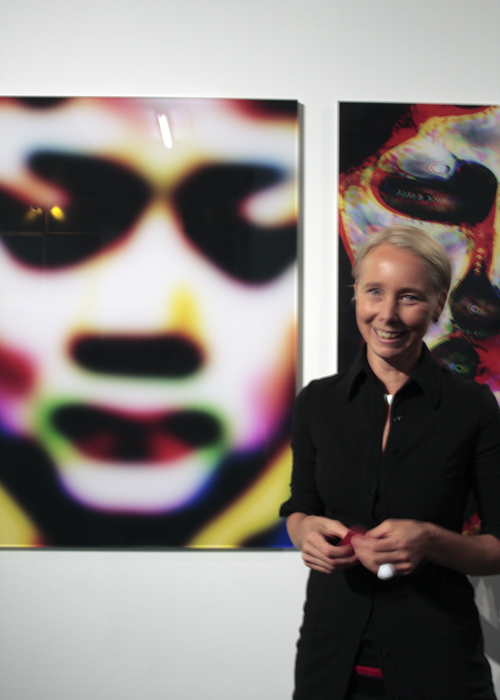
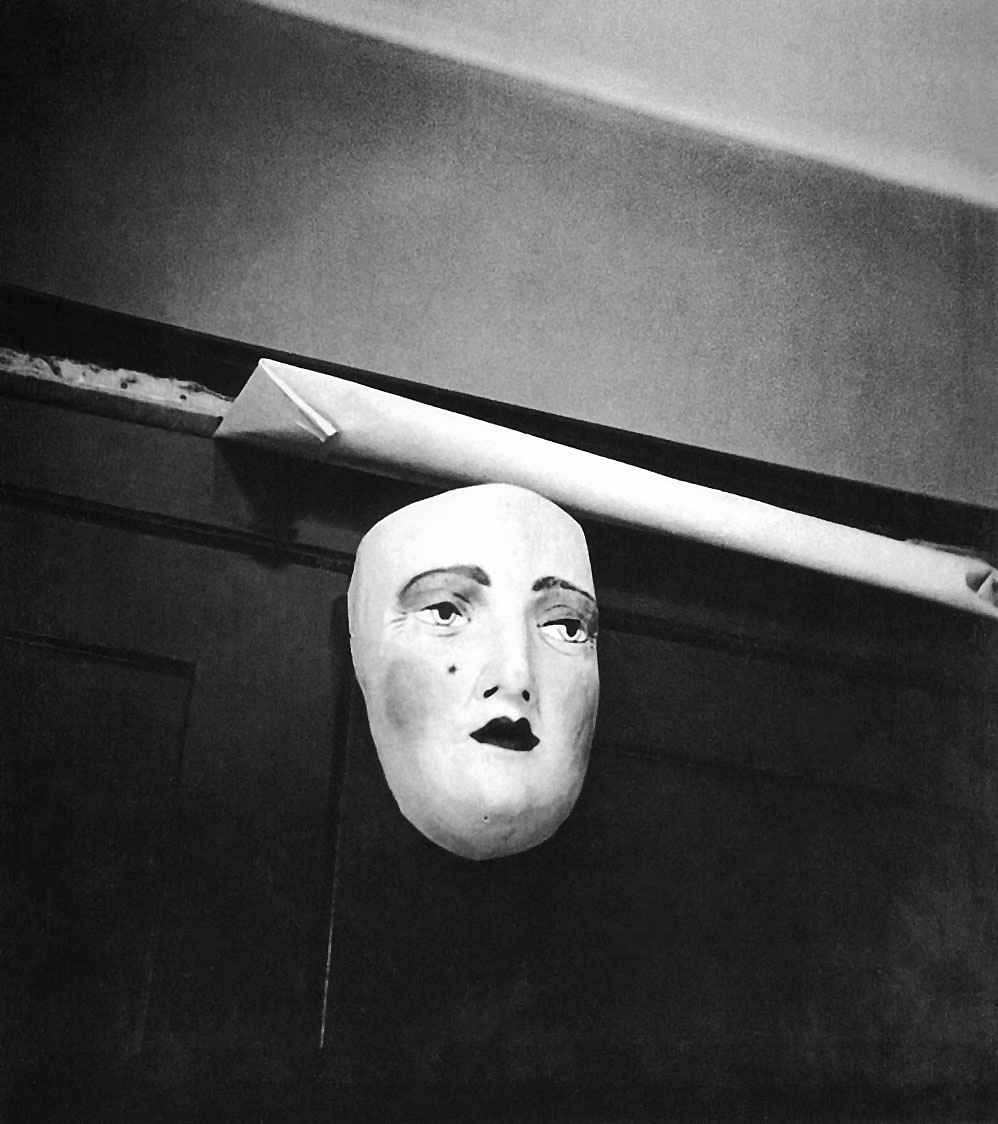
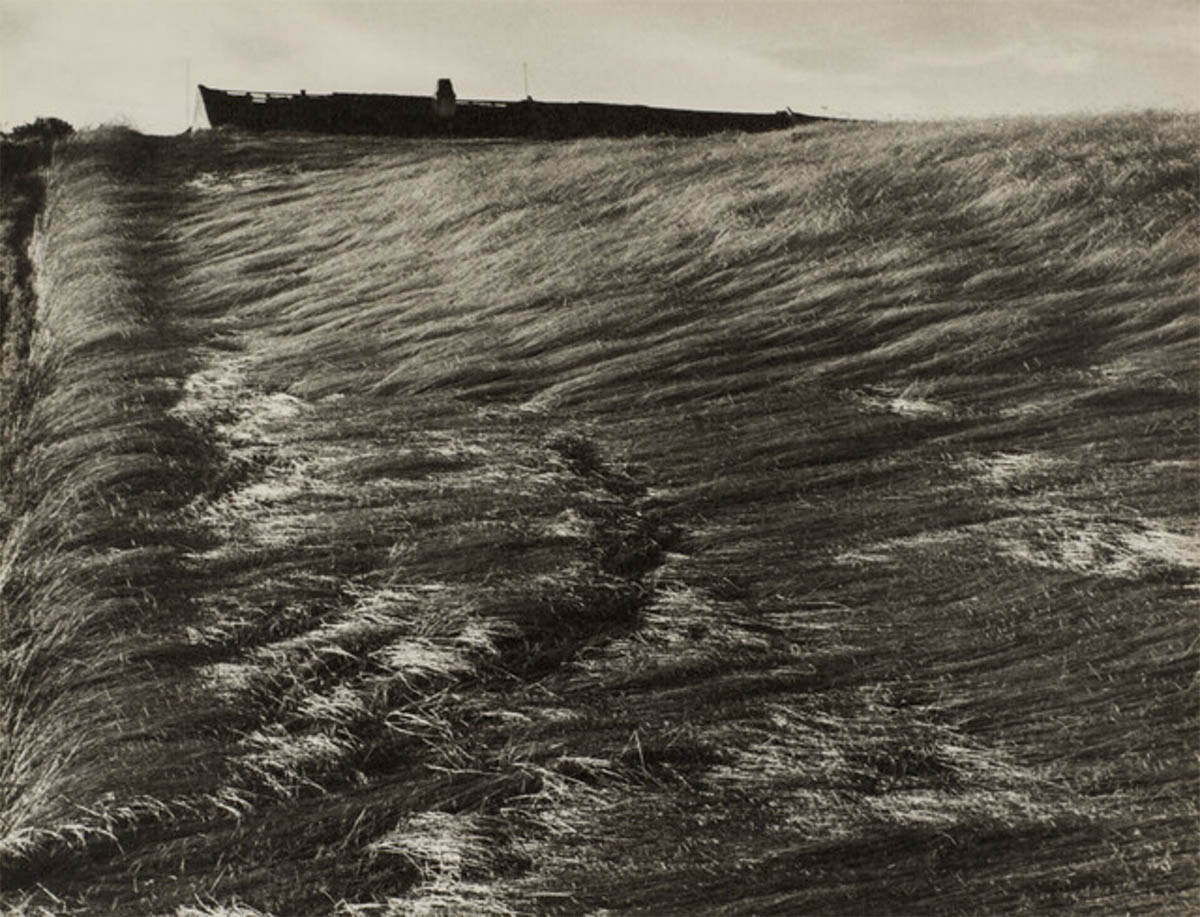
Installation photograph of the opening of Nicola Loder’s exhibition Tourist #3 sighted child 1-11 at Helen Gory Gallery, Melbourne
A wonderful, social opening at Helen Gory Gallery of Nicola Loder’s latest work in her ongoing Tourist photographic series. As always Loder’s work looks superb, the mounting of the images at the back of thick perspex giving the images an almost holographic 3D effect. I still remember her exhibition of black and white children’s faces at the sadly closed Stop 22 Gallery in St Kilda many years ago: those images still impinge on the subconscious. This work continues those themes of instability in the mapping of identity, how we begin to see, to represent ourselves as an individual entity. Speaking of Stop 22 it was great to see Marianne, ex curator of that gallery at the opening with new bub in tow! There is an excellent catalogue essay by Stuart Koop (below).
Dr Marcus Bunyan
Many thankx to Nicola Loder and Helen Gory Gallery for allowing me to publish the photographs in the posting. Please click on the photographs for a larger version of the image.
Installation photograph of the opening of Nicola Loder’s exhibition Tourist #3 sighted child 1-11 at Helen Gory Gallery, Melbourne
“We might think of Loder’s work as ‘undoing’ visuality. She sets technology in reverse, working against the imperatives of photography to clarify, focus, refine and sharpen images, as if our eyes worked backwards, as if acuity worsened. The face is an obvious (originary) limit beyond which chaos prevails and other senses are engaged to interpret what looks like abstract static but which many now believe is an unstriated sensory realm, a liberated space of interrelated, undifferentiated holistic sensory experiences; the original synaesthesia from which perception emerges as a travesty according to 5 distinct categories.
So it’s not blindness after all that the work references, not the failing of vision, but the first moments of looking, when ‘seeing’ begins to separate from the other senses and consolidates into a face, a percept, then into a code, a genre, a representation.”
Josef Sudek (Czech, 1896-1976) A Summer Shower in the Magic Garden 1954-1959 Gelatin silver print
Further to the last post I have collected some images from the Czech photographer Josef Sudek (1896-1976), one of my favourite photographers. The images of this master photographer are a delight. Like the photographs of Eugene Atget they evince generosity in the understanding of light, space and humanity. Insightful writing on Josef Sudek by Charles Sawyer is included in the post.
Dr Marcus Bunyan
Please click on the photographs for a larger version of the image.
“Everything around us, dead or alive, in the eyes of a crazy photographer mysteriously takes on many variations, so that a seemingly dead object comes to life through light or by its surroundings. And if the photographer has a bit of sense in his head maybe he is able to capture some of this – and I suppose that’s lyricism.”
“I believe a lot in instinct. One should never dull it by wanting to know everything. One shouldn’t ask too many questions but do what one does properly, never rush, and never torment oneself.”
“It would have bored me extremely to have restricted myself to one specific direction for my whole life, for example, landscape photography. A photographer should never impose such restrictions upon himself.”
Josef Sudek
Josef Sudek (Czech, 1896-1976) In the enchanted garden 1954-1959 From the series Remembrances Gelatin silver print
Josef Sudek (Czech, 1896-1976) Untitled 1967 Gelatin silver print
“The systematic approach, and the dogged aesthetic experimentation of Sudek are akin to the working habits of Cezanne. But these alone are insufficient to make great art or even good art. On the contrary, if these are all one sees in a work, then the cumulative burden of so much plain labor would be unbearable. Sudek’s devotion to work may have integrated his shattered life but it could not have offered him the spiritual redemption he was seeking; only his aesthetic quest could bring this. It is the struggle for spiritual redemption through his aesthetic quest that gives Sudek’s best photographs their true power. Two qualities characterise his best work: a rich diversity of light values in the low end of the tonal scale, and the representation of light as a substance occupying its own space. The former, the diversity of light values, requires very delicate treatment of the materials, especially the negative, but also the paper (Sudek used silver halide papers in the main). The latter, the portrayal of light as substance, is a more original trait than his tonal palette, which one sees in occasional prints of other photographers. Flaubert once expressed an ambition to write a book which would have no subject, “a book dependent on nothing external … held together by the strength of its style.” Photographers have sometimes expressed parallel aspirations to make light itself the subject of their photographs, leaving the banal, material world behind. Both ideals are, of course, unobtainable, but nonetheless they may be worth pursuing. (Artists, in their pursuit of the unobtainable, are not so likely to be called pathological as others, of us, though recent developments in the philosophy of science tend to view the scientist’s quest for truth as equally quixotic).
Sudek has come closer than any other photographer to catching this illusive goal. His devices for this effect are simple and highly poetic: the dust he raised in a frenzy when the light was just right, a gossamer curtain draped over a chair back, the mist from a garden sprinkler, even the ambient moisture in the atmosphere when the air is near dew point. The eye is usually accustomed to seeing not light but the surfaces it defines; when light is reflected from amorphous materials, however, perception of materiality shifts to light itself. Sudek looked for such materials everywhere. And then he usually balanced the ethereal luminescence with the contra-bass of his deep shadow tonalities. The effect is enchanting, and strongly conveys the human element which is the true content of his photographs. For, throughout all his photography, there is one dominant mood, one consistent viewpoint, and one overriding philosophy. The mood is melancholy and the point of view is romanticism. And overriding all this is a philosophic detachment, an attitude he shares with Spinoza. The attitude of detachment that characterises Sudek’s art accounts for both its strength and weakness: the strength which lies in the ideal of utter tranquility and the weakness which is found in the paucity of human intimacy. Some commentators find Sudek’s photos mysterious but I think this is a mistake: the air of mystery vanishes once we see in Sudek’s photography a person’s private salvation from despair.”
Charles Sawyer. “Josef Sudek” in Creative Camera April 1980, Number 190 [Online] Cited 14/04/2009. No longer available online
A good collection of Josef Sudek photographs can be found on the Museum of Fine Arts Boston website. Go to the site and enter ‘Josef Sudek’ in the Collection Search box to the right and then click on the arrow.
Josef Sudek (Czech, 1896-1976) From the series Vanished Statues in Mionsi 1969 Gelatin silver print
Josef Sudek (Czech, 1896-1976) The Window of My Atelier 1969 Gelatin silver print
Josef Sudek (Czech, 1896-1976) Still-life after Caravaggio, Variation No 2 (or a night-time Variation) 1956 Gelatin silver print
Josef Sudek (Czech, 1896-1976) Untitled (Still Life According to Caravaggio) 1956 Gelatin silver print
Josef Sudek (Czech, 1896-1976) Remembrance of Mr. Magician (the garden of architect Rothmayer) 1959 Gelatin silver print
Otto Rothmayer (architect)
Otto Rothmayer was born during 1892 into a family of carpenters. He took up that trade, following in his father’s footsteps. Rothmayer studied at the Academy of Applied Arts in Prague under Jože Plečník’s guidance, and the Slovenian architect would inspire Rothmayer throughout his entire life. In fact, the design of the Rothmayer Villa was greatly influenced by Plečník’s Villa Stadion in Ljubljana. Rothmayer’s skill at carpentry came in handy as he designed much furniture. He made furniture for the gurus of Czech Cubism, architects Pavel Janák and Josef Gočár. Furniture he designed that does not fall under the category of Cubism but is rather simple and practical can be found in his villa and garden, for instance. His white chairs forged from rough steel were a big hit.
Work at Prague Castle
Plečník would not only be Rothmayer’s mentor but also his colleague. Rothmayer started working as Plečník’s assistant architect at Prague Castle in 1921, when Tomáš G. Masaryk was president of a young, democratic Czechoslovakia. Rothmayer even built a spiral staircase at Prague Castle, using what was then a new material – faux marble. When Plečník left his Castle post after 1930, Rothmayer continued to draw plans for the Castle until his retirement in 1958.
Other projects and the academic world
Rothmayer’s résumé does not only include his tenure at Prague Castle. He took up other projects, too. For instance, he designed three family houses and a side altar for a church in the Vinohrady district of Prague. He also designed museum exhibitions. Rothmayer went into teaching as well. He held the post of Professor of Interior Design at Prague’s Academy of Applied Arts in the late 1940s and early 1950s, when he left for political reasons. Rothmayer also was friends with photographer Josef Sudek, who took many snapshots at Otto’s Břevnov residence. Sudek’s photos set in the villa’s garden are particularly impressive. Otto Rothmayer died in 1966.
Tracy A. Burns. “The Rothmayer Villa: A gem of modern architecture,” on the Private Prague Guide website [Online] Cited 11/01/2019
Josef Sudek (Czech, 1896-1976) Labyrinths 1969 Gelatin silver print
Josef Sudek (Czech, 1896-1976) Labyrinth of Spring 1968 Gelatin silver print 22.5 × 28.7cm (8 7/8 × 11 1/4 in)
Josef Sudek (Czech, 1896-1976) Remembrances of Architect Rothmayer, Mr. Magician 1960 Gelatin silver print
Jindřich Štreit (Czech, b. 1946) Arnoltice 1985 From the Village Life series Gelatin silver print
Jindřich Štreit (born 5 September 1946 in Vsetín) is a Czech photographer and pedagogue known for his documentary photography. He concentrates on documenting the rural life and people of Czech villages. He is considered one of the most important exponents of Czech documentary photography.
Looks like an interesting exhibition. I wish I had been able to see it. Wouldn’t it be such a grand job flying around the world, reviewing photography exhibitions and bringing you my thoughts. I can only wish…
Dr Marcus Bunyan
Many thankx to the Exhibition Hall of the Federal Republic of Germany for allowing me to publish the photographs in the posting. Please click on the photographs for a larger version of the image.
František Drtikol (Czech, 1883-1961) Wave 1925 Gelatin silver print
Czech photography produced and produces leading figures in all areas of photography – from classical documentary photojournalism to surrealism, realism or avant-garde works. From 13 March 2009 on, the Art and Exhibition Hall of the Federal Republic of Germany is presenting over 400 photographic works, a historical mosaic of Czech photography from 1900 until the late 20th century that underlines the international reputation enjoyed by Czech photography today. That reputation is not only apparent in the outstanding contributions by such renowned artists as Josef Sudek, Karel Hájek, Václav Jírů, Vilém Reichmann, Jan Reich, Jindřich Štreit, Frantisek Drtikol, Jaromír Funke, Jaroslav Rossler, Josef Koudelka and Jan Saudek, but also in works from a host of younger photographers. The exhibition does not only showcase famous names but also less well-known photographers, providing an overall impression of the variation and innovation in Czech photography.
From Surrealism and other avant-garde experimentation to realism and classic photo reportage, Czech photographers have long played a key role in all areas of photography and continue to do so to this day.
This exhibition is the first in Germany to present the history and development of Czech photography from 1900 to the turn of the millennium. Beginning with Art Nouveau-inspired Pictorialism, the comprehensive survey traces the rise of avant-garde photography and the development of photo montage in the 1920s to the 1940s. It examines the influence of ideological pressure on photography during the Second World War, the Stalinist 1950s and the period of Communist ‘normalisation’ after the occupation in 1968 and introduces the visitor to the multifaceted range of contemporary trends.
Text from the Exhibition Hall of the Federal Republic of Germany website [Online] Cited 10/04/2009. No longer available online
František Drtikol (Czech, 1883-1961) Nude 1927 Gelatin silver print
František Drtikol (3 March 1883, Příbram – 13 January 1961, Prague) was a Czech photographer of international renown. He is especially known for his characteristically epic photographs, often nudes and portraits.
From 1907 to 1910 he had his own studio, until 1935 he operated an important portrait photostudio in Prague on the fourth floor of one of Prague’s remarkable buildings, a Baroque corner house at 9 Vodičkova, now demolished. Jaroslav Rössler, an important avant-garde photographer, was one of his pupils. Drtikol made many portraits of very important people and nudes which show development from pictorialism and symbolism to modern composite pictures of the nude body with geometric decorations and thrown shadows, where it is possible to find a number of parallels with the avant-garde works of the period. These are reminiscent of Cubism, and at the same time his nudes suggest the kind of movement that was characteristic of the futurism aesthetic.
Eugen Wiskovsky (Czech, 1888-1964) Lunar Landscape or Collars 1929 Gelatin silver print
The oeuvre of the leading Czech avant-garde photographer Eugen Wiskovsky (1888-1964) is not large in size or subject range, but it is noteworthy in its originality, depth of ideas, and mastery. Wiskovsky’s early New Objectivist works, from the late 1920s and early 1930s, sought artistic effect in apparently non-aesthetic objects: His inventive lighting and cropping allowed their elementary lines to stand out, to lose their worldly associations and take on potential metaphorical meanings. In his dynamic diagonal compositions, Wiskovsky was among the most radical practitioners of Czech Constructivism. His landscape work is similarly distinctive.
Jaroslav Rössler (Czech, 1902-1990) Untitled 1931 Gelatin silver print
Jaroslav Rössler (25 May 1902, Smilov – 5 January 1990, Prague) was a pioneer of Czech avant-garde photography and a member of the association of Czech avant-garde artists Devětsil (Butterbur).
Rössler was born to the Czech-German father, Eduard Rössler, and a Czech mother, Adela Nollova. From 1917 to 1920, Rössler studied in the atelier of the company owned by renowned Czech photographer František Drtikol. Subsequently, he worked with the company as a laboratory technician. As a 21 years old, he began collaboration with the art theorist Karel Teige, who assigned him to create typographic layout for magazines Pásmo, Disk, Stavba and ReD (Revue Devětsilu). While working on these tasks, Rössler deepened his knowledge of photographic methods. In his works he utilised and combined the techniques of photogram, photomontage, collage and drawing. The beginnings of his photographic work were influenced by Cubism and Futurism, but he also attempted to create the first abstract photographs. In 1923, he became a member of the avant-garde association Devětsil.
In 1925, he went on a six-month study visit to Paris. The same year he began working as a photographer in the Osvobozené divadlo in Prague. Before his second departure to Paris, he co-worked as a commercial photographer with the pictorial magazine Pestrý týden.
In 1927, Rössler moved to Paris together with his wife, Gertruda Fischerová (1894-1976). Initially, he focused on commercial photography. He collaborated with the experimental studio of Lucien Lorell, and worked on commissions for notable companies such as Michelin and Shell. However, later he found an interest in the “street life” of Paris, which influenced his future stay in the city. During a demonstration, he encountered the protesters and took photographs of the event. Shortly after that he was arrested, and after a six-month imprisonment he was expelled from the country, in 1935. The alleged reason for his expulsion was his German-sounding surname.
After his return from Paris, Rössler and his wife resided in Prague, Žižkov. He opened a small photographic atelier, but difficulties associated with the management of the studio caused a significant gap in his artistic work, lasting for almost two decades.
In the 1950s, he resumed his previous activities and again began experimenting with the camera and photographic techniques. He created so-called “prizmata” (prisms), photographs taken through a birefringent prism. Additionally, he experimented with solarisation and explored the possibilities of the Sabatier effect.
Jindřich Štyrský (Czech, 1899-1942) From the Man with Blinkers series 1934 Museum of Decorative Arts, Prague
Eugen Wiskovsky (Czech, 1888-1964) Disaster 1939 Gelatin silver print
Josef Sudek (Czech, 1896-1976) The Last Rose from the Rose series 1956 Gelatin silver print
Josef Sudek (17 March 1896, Kolín, Bohemia – 15 September 1976, Prague) was a Czech photographer, best known for his photographs of Prague.
Sudek was originally a bookbinder. During the First World War he was drafted into the Austro-Hungarian Army in 1915 and served on the Italian Front until he was wounded in the right arm in 1916 which led to the limb being amputated at the shoulder. After the war he studied photography for two years in Prague under Jaromir Funke. His army disability pension gave him leeway to make art, and he worked during the 1920s in the romantic Pictorialist style. Always pushing at the boundaries, a local camera club expelled him for arguing about the need to move forwards from ‘painterly’ photography. Sudek then founded the progressive Czech Photographic Society in 1924. Despite only having one arm, he used large, bulky cameras with the aid of assistants.
Sudek’s photography is sometimes said to be modernist. But this is only true of a couple of years in the 1930s, during which he undertook commercial photography and thus worked “in the style of the times”. Primarily, his personal photography is neo-romantic.
Josef Sudek was a Czech photographer best known for his elegiac black-and-white images of Prague, interiors, still lifes, and the landscapes of Bohemian forests. Many of Sudek’s most memorable images were taken from the window of his small studio, documenting his humble courtyard during changing weather and light conditions. “Everything around us, dead or alive, in the eyes of a crazy photographer mysteriously takes on many variations,” he explained, “so that a seemingly dead object comes to life through light or by its surroundings.”
Text from the artnet website [Online] Cited 10/01/2019
Jan Saudek (Czech, b. 1935) Life 1966 Gelatin silver print
Josef Koudelka (Czech, b. 1938) France 1987 Gelatin silver print
The Art and Exhibition Hall of the Federal Republic of Germany Museumsmeile Bonn Helmut-Kohl-Allee 4 53113 Bonn Telephone: +49 228 9171-200
Siri Hayes (Australian, b. 1977) Gunnai man land 2008
A handsome group of large photographs in crisp white frames is displayed in the large space of Gallerysmith, Melbourne. Undoubtably they are well taken and printed photographs but conceptually their thematic development is confused. The photographs purport to investigate how industrialisation has changed the Gippsland landscape since colonisation whilst referencing human interactions that ‘are sometimes’ associated with Western art.
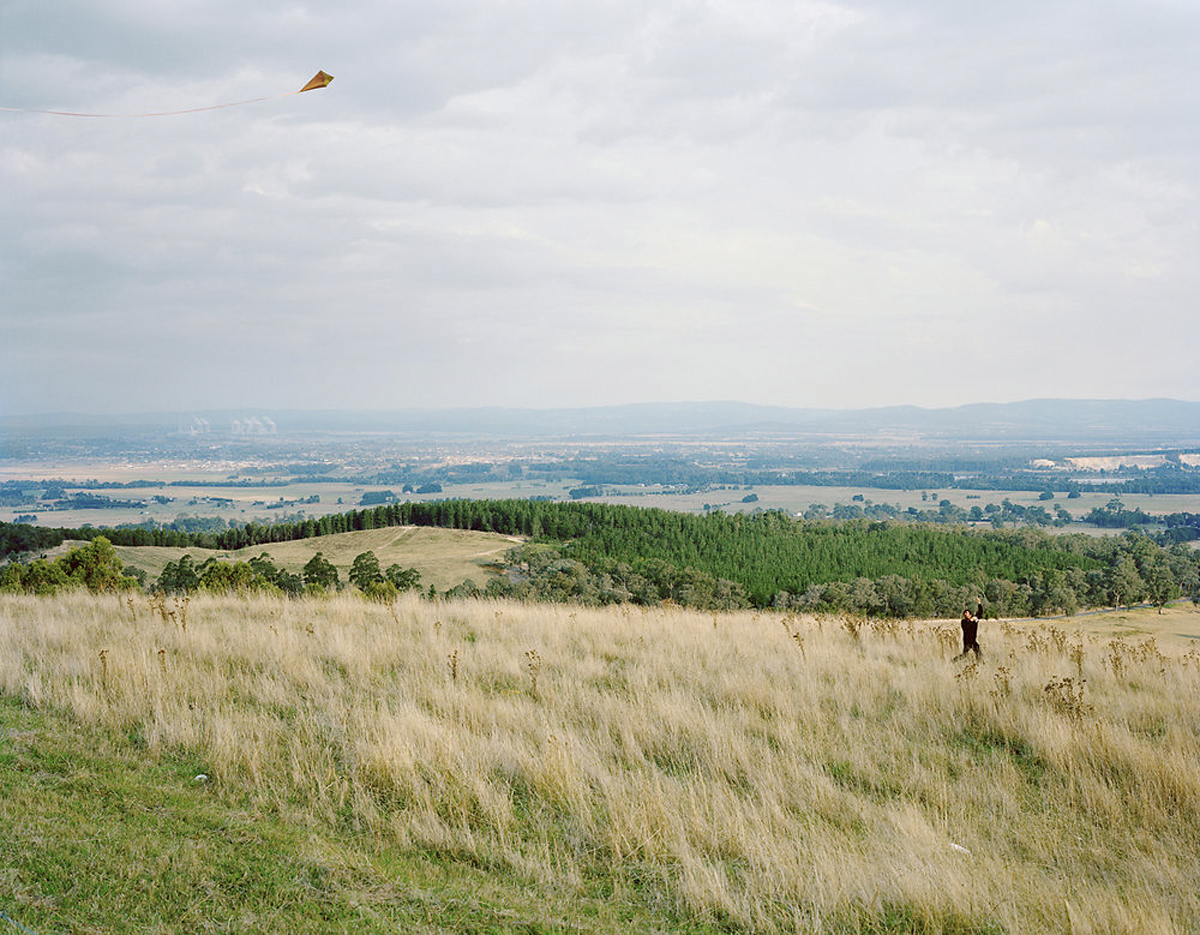
Gunnai land man (above) is very effective in this quest juxtaposing as it does an Indigenous Australian and fallen tree on a bare track with a smoke billowing power station (symbolic of the industrialisation of the area) looming in the background. Other photographs are less successful. What a man flying a kite has to do with the pre-colonial Gippsland landscape is beyond me and the juxtapositional incongruity sought by the artist simply does not work, despite the presence of the power station on the plains in the distance. The symbology has more to do with Japanese art than it has to do with Western art.
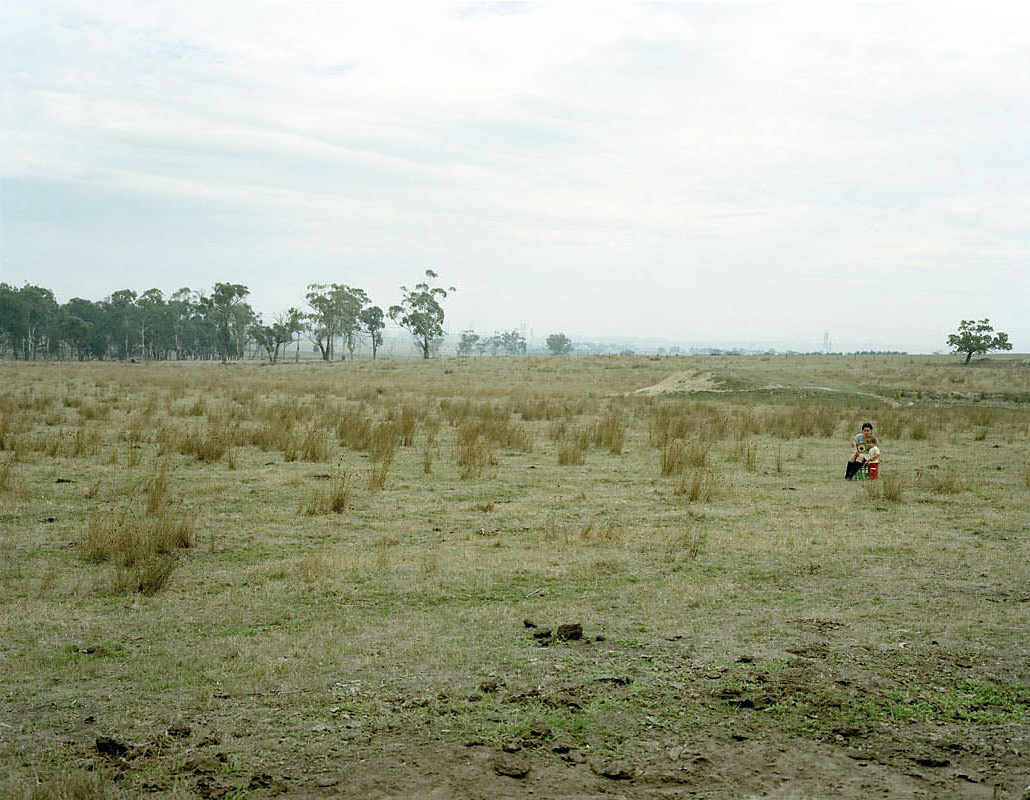
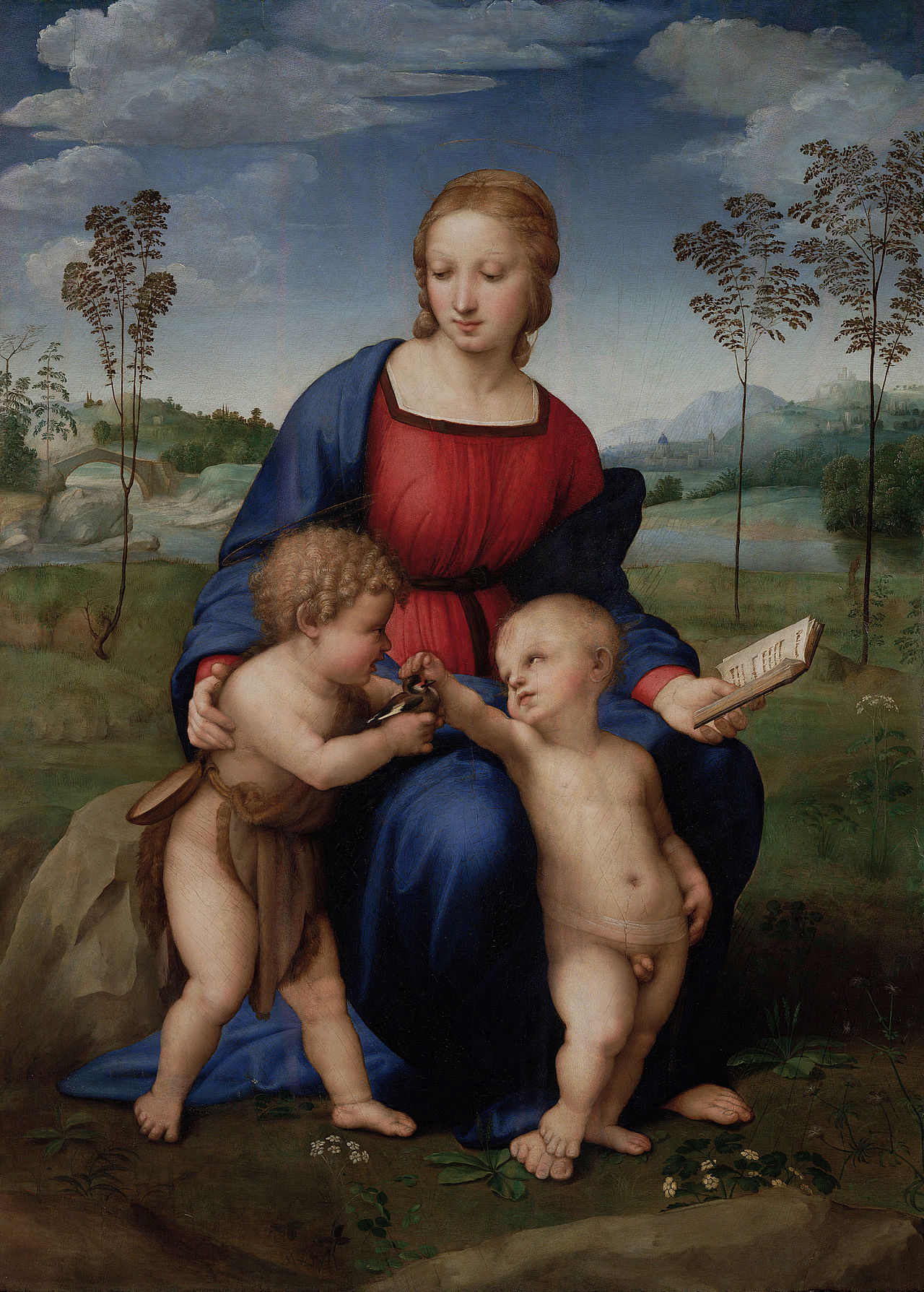
The conceptual narrative of the photograph Moe Madonna (below) works only partially as well. The destruction of the landscape has been caused by pastoralisation not industrialisation. In the image that Hayes is referencing the Madonna is front and centre set in an idyllic landscape. In the work by Hayes the incongruity has to be explained, has to be verbalised in text for the association to be didactically made. The interpretation leaves no room for personal reflection and when I looked at this image, the mother and child were so small in the landscape, the placement so obviously constructed that there incongruity turned to disbelief: namely that I simply did not believe the mise en scène being created.
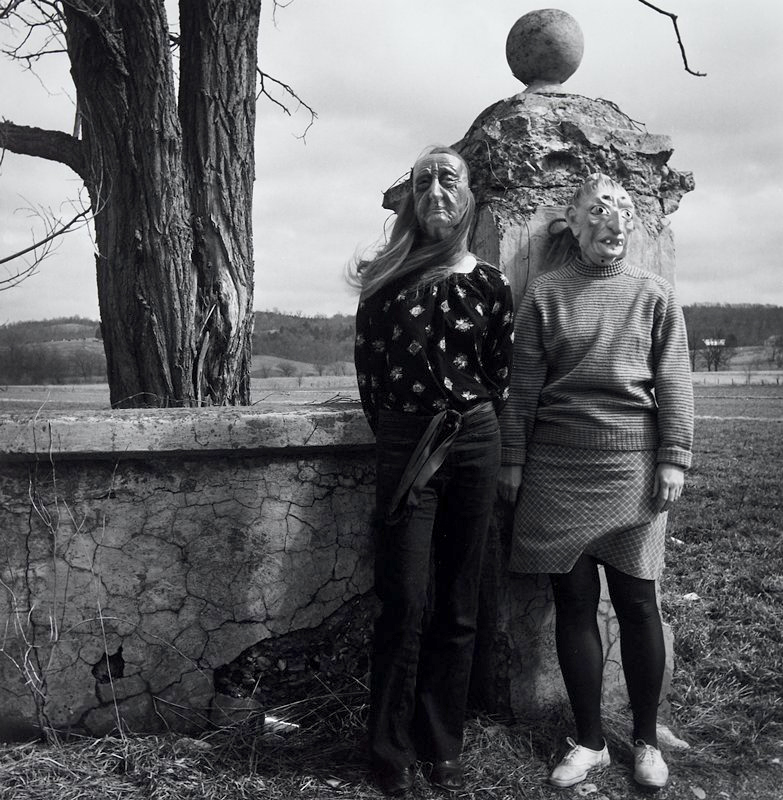
Other narratives are equally confusing. In Paper bag lovers (below) I had to ask the gallery director what was going on in the photograph because the bodies where so small in the landscape (in fact it looks like one body) and you can’t really see the paper bags on their heads because the bodies are just an amorphous mass containing no detail at all (you can just see the body in the photograph below in the mid distance just below the large central tree). Why paper bags anyway? If something intentionally odd and incongruous is sought to be portrayed in the landscape perhaps Hayes should look at the work of Eugene Meatyard (see below) to see a real subversion of the body/landscape dichotomy.
The one standout photograph of the exhibition is Plein air explorers (below). This is confirmed in the sales of the show as all six prints of this photograph have been sold. One can see why!
The title is perfect, the construction of the image faultless. The naked white man stands proudly surveying his conquered domain, the land, whilst around him artists (reminding me of the dilettantes of the Victorian age going on day trips), hunker down into the ground with their easels oblivious to the desiccated trees around them. Here the photographer just observes, doesn’t construct, the incongruity of it all. The artists draw the white man based on direct observation of him and not on their conceptions or conventional images or memories of him while ignoring their surroundings. Here is the paradox, the ironic perfect storm that the artist was conceptually seeking: the representation of landscape based upon direct observation “in the open air” ignored for a perfect white arse while on the horizon smoke stacks of a power station stand in silent witness to the present and imminent destruction of the world. What a photograph! Can I have one now please?
Dr Marcus Bunyan
Many thankx to Gallerysmith for allowing me to publish the photographs in the posting. Please click on the photographs for a larger version of the image.
Siri Hayes (Australian, b. 1977) Moe Madonna 2008
Siri Hayes (Australian, b. 1977) Kite 2008
Raphael (Italian, 1483-1520) Madonna of the Goldfinch 1505-1506 Oil on panel 107 x 77cm Galleria degli Uffizi
Siri Hayes (Australian, b. 1977) Paper Bag Lovers 2008
I have predominantly focused on the parts of the Gippsland landscape that have been impacted by white settlement. I have composed various human interactions that are sometimes associated with Western art and its construction. For example, Moe Madonna references Raphael’s Goldfinch Madonna. The narratives are intentionally odd and incongruous with the surrounding location. My son and I seem out-of-place in a barren paddock while the autumn mist shrouds distant gum trees and electricity pylons. The soil here has been compacted beyond repair by cattle hooves – an inappropriate animal in Australia’s delicate ecosystems. As we sit on this barren plain, I read to Oliver from a European pre-schooler book titled Autumn, creating an interesting juxtaposition with the antipodean equivalent season.
The work in this exhibition considers the pre-colonial Gippsland landscape and how industrial ‘progress’ has altered it. Hopefully it provides pause for thought.
Siri Hayes exhibition notes. March 2009
Siri Hayes (Australian, b. 1977) Plein air explorers 2008
Gallerysmith 170-174 Abbotsford St, North Melbourne, Victoria, 3051 Australia
Curator: Shane Hulbert Opening: Thursday 2nd April, 2009
Group photography show with artists: Shane Hulbert (Aus), John Billan (Aus), So Hing Keung (HK), Stephanie Neoh (Aus), Darren Sylvester (Aus), Ming Tse Ching (HK), Kellyann Geurts (Aus), Andrew Guthrie (HK), Kim Lawler (Aus), Law Sum Po Jamsen (HK), and Lyndal Walker (Aus).
Sculptor Fredrick White in front of Lyndal Walker’s The Time to Hesitate is Through, no Time to Wallow in the Mire 2009
Great to catch up again with John Billan, Shane Hulbert and Les Walkling!
Marcus
Please click on the photographs for a larger version of the image.
Lyndal Walker (Australian, b. 1973) The Time to Hesitate is Through, no Time to Wallow in the Mire 2009
“The images in this show all reflect on an exploration of intersecting territories within Australia and the Chinese Special Administration Region [SAR] of Hong Kong. Central to this exploration are the cultural linkages between claimed and reclaimed territories, social territories and psychological territories and the way this in turn influences national identity. The claim is that these things of importance, and the way we respond to the notion of territory, have recurring similarities between different cultures.
Despite the broadness of the title, the notion of territories is becoming increasingly relevant in a global community, as the traditional borderlines and barriers that define who we are and what we stand for as a culture change in response to internal and external shifts.”
Shane Hulbert 2009
Territories opening night crowd at Project Space/Spare Room, Melbourne
Ming Tse Chong (Chinese, b. 1960) City Still Life II 2008
I greatly admire this series of work. It takes a very special artist and a very special person to look at the world – and specifically how the world is represented and presented to us in scrappy, low quality jpgs – and recognise a different perspective, an alternate reality that is staring us in the face, that is confronting us every single day. No body but Ruff did.
Great artists are always ahead of their time, always probing beyond, offering up a mirror to an inchoate, uninformed society. Robert Frank did it with The Americans in the 1950s, and the Americans didn’t like what they were being shown by an outsider, a foreigner. Lee Friedlander did it in the 1970s with his segmented images and reflections, his informality and perspicacity. Now Ruff abstracts an already abstracted and distracted world, a world flooded with meaningless images. He makes giant the landscape, war, eruption, disruption and destruction until when we approach too close… the image dissolves before our eyes. Into nothingness. We retreat in confusion.
He is aware, while so many of us are unaware. He is fully conscious and observant of the processes and effects of contemporary digital photography. And yet. And yet, these fractured images approach the sublime in some mysterious way.
“How much visual information is needed for image recognition? A pretty small quantity of data will go a long way for the brain and the computer, both of which take shortcuts for the sake of speedy comprehension. In the Jpegs series, German photographer Thomas Ruff exploits this imprecision in digital technology, locating online jpegs and enlarging them until the pixels emerge in a chessboard pattern of near abstraction. A closer look at these images reveals that, in addition to the degeneration of the image into a digital grid, the colour and brightness generated by the algorithms of the compression also become visible. Many of Ruff’s works in this series focus on idyllic, seemingly untouched landscapes, or conversely, on scenes of war and nature disturbed by human manipulation – subjects ill suited to disruptive pixelation, and therefore perfect for Ruff’s purposes. Taken together, these images constitute an encyclopaedic compendium of contemporary visual culture that also engages the history of landscape painting. A fittingly deluxe and oversize volume, Jpegs is the first monograph dedicated exclusively to this monumental series.”
Thomas Ruff is among the most important international photographers to emerge in the last fifteen years, and one of the most enigmatic and prolific of Bernd and Hilla Becher’s former students, a group that includes Andreas Gursky, Thomas Struth, Candida Höfer, and Axel Hutte. In 2007, Ruff completed his monumental and very timely Jpegs series in which he explores the distribution and reception of images in the digital age. Starting with images he culls primarily from the Web, Ruff enlarges them to a gigantic scale, which exaggerates the pixel patterns, until they become sublime geometric displays of colour. A fittingly deluxe and oversized volume, Jpegs (Aperture, June 2009) is the first monograph dedicated exclusively to the publication of Ruff’s remarkable series.
When viewed up close the images in Jpegs look abstract; as you move away they merge into decipherable photographic images. Like Impressionistic paintings, Ruff’s photographs require the viewer’s active participation and shift in perspective in order to make a complete assessment of the image content. The work ranges from idyllic, seemingly untouched landscapes and popular tourist spots, to scenes of war and nature disturbed by human manipulation. Places and global events that have defined the visual media world of recent decades are represented, including the familiar, almost iconic pictures of atomic bomb tests; 9/11; scenes of warfare in Baghdad, Beirut, and Grozny; the killing fields of Cambodia; and the ravaged Asian coasts after the 2004 tsunami, among others. Taken together, these masterworks create an encyclopaedic compendium of contemporary visual culture that also actively engages the history of landscape painting. Jpegs is a testament to the effects of the digital age on the medium of photography.
Many thankx to the Die Photographische Sammlung/SK Stiftung Kultur for allowing me to publish the photographs in the posting. Please click on the photographs for a larger version of the image.
Karl Blossfeldt (German, 1865-1932) Acanthus – Bear’s breech before 1928 Gelatin silver print Karl Blossfeldt Collection at the University of the Arts Berlin
Die Photographische Sammlung presents Plant Studies by Karl Blossfeldt and Related Works, an exhibition presented by Die Photographische Sammlung/SK Stiftung Kultur, Cologne in co-operation with the Berlin University of the Arts, compiled by Gabriele Conrath-Scholl, Rajka Knipper and Claudia Schubert. The exhibition will present for the first time in this volume the famous and influential plant studies by Karl Blossfeldt (1865-1932) from the collection of the Berlin University of the Arts as original prints. Blossfeldt’s photographs will be accompanied by the artist’s herbaria and sculptures based on plants, the latter produced in cooperation with his teacher Moritz Meurer.
The amalgamation and presentation of the various groups of work from the Berlin Blossfeldt collection provides detailed insight into the working style of the artist, who taught the study of natural forms in Berlin for over thirty years. His plant photographs were used primarily as reference aids during lessons in his classes. It was only towards the end of his working life that his photographs became known to the larger public through an exhibition at the Galerie Nierendorf in Berlin in 1926.The publication of the book Art Forms in Nature in 1928 led to an ongoing appreciation of his photographs. Karl Blossfeldt developed in year-long concentration on one theme a highly aesthetic picture language which up until today still fascinates the viewer with its clarity and focus on the object.
The exhibition highlights the topic of plant studies against a background of research into form and structure using selected historical and contemporary works. They mirror the development and technical possibilities of the medium, as well as the artistic reflection into their characteristics and decorative aspects. Thus the scope of the 300 exhibits reaches from detailed analyses of the form of individual botanical structures to the documentation of complex natural and populated areas, up to a symbolic contemplation of plants.
The exhibition is the result of years of cooperation between the Universität der Künste Berlin and Die Photographische Sammlung / SK Stiftung Kultur, two institutions committed to the ongoing academic study and extensive public presentation of the Karl Blossfeldt collection in the possession of the Universität der Künste.
The presentation gives Die Photographische Sammlung once again an opportunity to draw attention to its own institutional orientation. In addition to the co-operation on the work by Karl Blossfeldt these include avant-garde objective and conceptual photographic works, which developed in particular in line with the sense of a new era in the 1920s and the 1960s / 1970s or are artistically related to them. Works which the Cologne institution purchased during the past years in connection with the botanical subject or were obtained as permanent loans, are now part of the current presentation. They include works by Pietro Guidi, August Kotzsch, Paul Dobe, works from the Folkwang-Auriga Verlag, by Fred Koch, Albert Renger-Patzsch, Else Thalemann, August Sander, Ruth Lauterbach-Baehnisch, Ruth Hallensleben, Dr. Herbert W. Franke and Lawrence Beck. Although works by the younger artists Natascha Borowsky and Simone Nieweg are already part of the collection, in light of their more recent work both artists have made photographs from their own collections available for the show.
The current show is a thematically oriented insight into Die Photographische Sammlung’s collection which ranges from the historical to the contemporary and in the last few years has been extended by a number of corresponding groups of photographic works. In order to provide a comprehensive, but lively background to Karl Blossfeld’s work and to display illuminative positions, which were frequently mentioned in connection with the reception of Blossfeldt’s work, but were rarely, if ever, presented together in exhibitions, and also to permit new assessments and links, important loans have been integrated into the exhibition. They have been borrowed from the Karl-Blossfeldt-Archiv / Ann and Jürgen Wilde, Zülpich, which contains the largest collection of original photographs by the artist.
Karl Blossfeldt received essential support from Moritz Meurer (1839-1916) who worked as a graphic artist and painter, and for whom Blossfeldt worked as an assistant in Rome from 1892 to 1895. On the basis of Meurer’s concept, reference aids in the form of sculptures and drawings, as well as photographs, were developed for later use in lessons. Meurer’s idea, to take the basic forms in nature, which could be seen in the composition of a plant, as models for architecture, artistic and craftwork objects or ornaments, was integrated by Blossfeldt into his photographs.
According to the records, attention was drawn to Karl Blossfeldt’s work in particular by the fact that the Berlin gallerist Karl Nierendorf heard about his work and presented the first exhibition of his photographs outside the school context in 1926. The plant photographs, still under the influence of the ornamental art nouveau although more as a reaction to it were highly appreciated in the early days of New Objectivity. These studies seemed to put into practice the newly formed principles contained in the art of the 1920s, in which there was a demand for things to be presented without artistic digression, in a clear, authentic pictorial language, at the same time providing insight into their nature. It is therefore even more surprising that Blossfeldt was able to achieve this so easily, considering that he accomplished it seemingly uninfluenced by questions of artistic or photographic history categories. His motivation stemmed from his didactic and pragmatic aims to depict plant forms with precise accuracy, in order to provide flawless reference aids which would encourage his students to transform them artistically. His straightforward, passionate concentration on one theme, which he almost endlessly varied within a limited field, opened it up for comparative viewing. In particular since the 1970s, in the light of a new-orientation of the medium, his work was highly regarded and gained indirect influence on contemporary art, to the extent that knowledge of his images influences today s viewing perspectives.
On the occasion of the exhibition Plant Studies by Karl Blossfeldt and Related Works Die Photographische Sammlung / SK Stiftung Kultur is presenting on its website a directory they have created of all 631 photographs, 39 herbaria and 57 sculptures from the Universität der Künste’s Karl Blossfeldt collection together with documents from the University archive. A distinctive feature of the research is the fact that every photograph is accompanied not only by a concordance of primary and secondary literature but also Blossfeldt negatives and transparencies from the Deutsche Fotothek in Dresden and, in the near future, from the Karl Blossfeldt Archive/Ann and Jürgen Wilde. The website provides a text forum on the topic, which uses selected documents to illustrate Blossfeldt’s teaching work in the context of the history of the University and includes various aspects of his reception in publications and exhibitions.
Press release from Die Photographische Sammlung
Karl Blossfeldt (German, 1865-1932) Cucurbita – Pumpkin tendrils before 1928 Gelatin silver print Karl Blossfeldt Collection at the University of the Arts Berlin
Karl Blossfeldt (German, 1865-1932) Allium ostrowskianum – garlic plant before 1928 Gelatin silver print Karl Blossfeldt Collection at the University of the Arts Berlin
“In 1928 Karl Blossfeldt (1865-1932) published the now legendary photographic book “Art Forms in Nature.” Brought together were a selection of images of plants that this craftsman had photographed only as illustrative material for his students at the college in Berlin. He photographed the plants isolated in front of a neutral background, their blossoms, buds, stems, umbels and seed capsules often greatly magnified to serve as a distinct model for the decorative art forms of the Art Nouveau movement, whose own bloom period was already fading …
It is quite clearly the particular combination of subject matter and photographic style that gives the works a classic timelessness, allowing them to be discovered “afresh” again and again. So the isolating, monumental and formalistic approach to nature not only tied in well with concepts of New Functionalism, but was also successively interpreted as illustrating the relationship between Art and Nature and as a precursor of Conceptual Art.”
Text from the Karl Blossfeldt Archive website
Karl Blossfeldt (German, 1865-1932) Chrysanthemum segetum – Feverfew before 1928 Gelatin silver print Karl Blossfeldt Collection at the University of the Arts Berlin
Karl Blossfeldt (German, 1865-1932) Dipsacus laciniatus – Cutleaf Teasel before 1928 Gelatin silver print Karl Blossfeldt Collection at the University of the Arts Berlin
Karl Blossfeldt (German, 1865-1932) Thorned Bulbous Plant before 1928 Gelatin silver print Karl Blossfeldt Collection at the University of the Arts Berlin
“He photographed plants by the thousands – photographs which feature flowers, buds, branched stems, clusters or seed capsules shot directly from the side, seldom from an overhead view, and rarely from a diagonal perspective. He usually placed the subjects of his photographs against white or grey cardboard, sometimes against a black background. Hardly ever can details of the rooms be detected. The light for his shots was obtained from northern windows, making it diffuse, but it fell from the side, creating volume. The technique and processing conditions were very simple; only the medium size of the negative format was somewhat out of the ordinary. Nothing detracted from the subject. This man produced such pictures for over thirty years.
The man’s name was Karl Blossfeldt, and his life’s achievement occupies a firm place in the history of 20th-century art, although the aims of his undertaking place him firmly within the 19th century. Blossfeldt shares this bridging of two centuries with other great collectors in the history of photography, such as the Parisian Eugene Atget, and it is to this bridging of two centuries that his influence may be attributed today …
The plant photographs were produced by simple means. Legend has it that a relatively straight-forward homemade camera was used, one common in its time and not very large, with a format of 9 x 12cm. The glass plates which served as negatives were coated with inexpensive but not completely neutral-coloured orthochromatic emulsion, and occasionally – after 1902, as they became more widely available – with panchromatic emulsions, making possible a neutral reproduction of the colour red in halftones. Since the first emulsion was thin and therefore enabled high contrast with extremely sharp edges, it served especially to stress the structural elements. It was thus used primarily for photographs with white or grey backgrounds. The rarer photos with panchromatic emulsions were used to illustrate entire clusters or beds of flowers with a wider variation of chromatic values or halftones.”
Text by Rolf Sachse from the book Karl Blossfeldt Benedikt Taschen Verlag (April 1997) available on Amazon.
Karl Blossfeldt (German, 1865-1932) Papaver orientale – Oriental Poppy before 1928 Gelatin silver print Karl Blossfeldt Collection at the University of the Arts Berlin
Originally developed from a practice at the Unterrichtsanstalt des Königlichen Kunstgewerbemuseums Berlin [Institute of the Berlin Royal Arts and Crafts Museum] at the end of the 19th century and designed specifically for use as teaching materials, Karl Blossfeldt’s plant photographs rank today among the classic works of art and photography history.
Blossfeldt taught “Modelling from Live Plants” from 1899 to 1930, first at the Unterrichtsanstalt des Königlichen Kunstgewerbemuseums, later at the Vereinigte Staatsschulen für Freie und Angewandte Kunst [United State Schools for Fine and Applied Arts] that emerged from the Unterrichtsanstalt’s amalgamation with the Hochschule für Bildende Künste [University of the Visual Arts] – predecessors of the present-day Berlin University of the Arts. A major role in the introduction of that subject was played by Moritz Meurer, for whom Karl Blossfeldt worked as a scholarship-holder in Rome from 1892 to 1895. There, prepared plant specimens, sculptures, castings, drawings and photographs were made as models for classroom use. Blossfeldt took up and systematically developed Meurer’s idea of using the basic natural forms inherent in the structure of a plant for the design of architectural, art or craft objects and ornaments.
A letter written to the director of the Arts and Crafts Museum in 1906 shows that Blossfeldt was already in possession of thousands of photographs, from which he intended gradually to make prints. The plan to enlarge the images came about for a number of reasons:
~ The plants that Blossfeldt collected for his students underwent relatively rapid change, either because they grew or because they wilted and withered. Captured in a photograph, they became a lasting model
~ Photographic enlargements allowed even the tiniest natural forms to be made out
~ Photographic enlargements offered the opportunity to present “unadulterated nature” – in contrast to sketched enlargements, which Blossfeldt contended “always contain a subjective element”
~ Blossfeldt wanted his material seen as a specimen collection that would also be available for future generations of students
There is no detailed record showing the technical facilities at Karl Blossfeldt’s disposal. The Karl Blossfeldt Archive/Ann and Jürgen Wilde and the Deutsche Fotothek in Dresden have preserved glass plates and transparencies of various formats (6/6.5 x 9cm, 9 x 12cm, 9 x 18cm and 13 x 18cm). Blossfeldt’s camera – or cameras, because he may have had several – is known to have been an entirely or partly home-made affair. The work collages in the collection of the Karl Blossfeldt Archive / Ann and Jürgen Wilde give a good idea of his negatives because the images that appear in them are from contact prints made by Blossfeldt.
The fact that Karl Blossfeldt became a major celebrity was due to the fortunate circumstance that his photographs came to the attention of the Berlin gallerist Karl Nierendorf. He staged the first exhibition of Blossfeldt’s work in a non-school context in 1926, presenting it alongside sculptures from Africa and New Guinea and work by the artist Richard Janthur. In 1928, in another Nierendorf initiative, Urformen der Kunst [Art Forms in Nature] was published with 120 plates of plants by Blossfeldt. The book was given such a rapturous reception that the following years saw more editions published and foreign-language editions launched in English, French and Swedish. These studies were very much in tune with the new maxim of 1920s art that called for things to be represented authentically, with no artistic frills, in a clear visual idiom designed to explore and reveal their nature. The fact that Blossfeldt succeeded in this is all the more astonishing since he started out working with no thoughts of pushing forward any boundaries in art or photography. He was primarily motivated by a didactic and pragmatic intention to produce highly accurate plant images which, as models for study, would reveal natural forms to the human eye and inspire students to turn them into art.
With his passionate concentration on a single subject, addressed in close-up in almost infinite variations and thus revealed for comparative examination, Blossfeldt became a highly respected figure, especially after the re-think on photography in the 1970s. As a result, he has had an indirect influence on contemporary art and knowledge of his work helps shape the way we view art today. Karl Blossfeldt did not experience his success for long. He died in December 1932, the year in which his second book Wundergarten der Natur (Art Forms in Nature) was published. The largest collections of his photographs are in the Karl Blossfeldt Archive/Ann and Jürgen Wilde, the Archive of the Berlin University of the Arts and the Deutsche Fotothek Dresden.
Text from the Die Photographische Sammlung/SK Stiftung Kultur website [Online] Cited 25/03/2009. No longer available online
Karl Blossfeldt (German, 1865-1932) Papaver Orientalis – Oriental Poppy capsules before 1928 Gelatin silver print Karl Blossfeldt Collection at the University of the Arts Berlin
Karl Blossfeldt (German, 1865-1932) Dryopteris filix mas – Common male fern before 1928 Gelatin silver print Karl Blossfeldt Collection at the University of the Arts Berlin
Die Photographische Sammlung/SK Stiftung Kultur Im Mediapark 7 50670 Cologne Phone: 0049-(0)221-88895 300
Opening hours: Open daily 14 – 19hrs Closed Wednesdays
Marcus Bunyan (Australian born England, b. 1958) Oakland, 7-’51 from the series The Shape of Dreams (restored) 2009
“Fragments of harmonic lines assemble and collapse as the meaning of each interval must be continually revised in light of the unfolding precession of further terms in an ultimately unsustainable syntax. The mind’s ear tries to remember the sum of passing intervals, but without the ability to incorporate them into larger identifiable units each note inevitably lapses back into silence, surrendered to the presence of the currently sounding tone, itself soon to give way to another newly isolated note in its turn.”
Craig Dworkin1
The Passing of Memory
Thinking about this photograph
I bought an album on Ebay that contained an anonymous aviator with snapshots of his life: photographs of him in Oakland, California, Cologne in Germany and flying out of Italy – photos of his buddies and the work they did, the places they visited, the fun they had.
This one photograph has haunted me more than the rest.
Who was he? What was his life like? Do he get married and have children? Is he still alive?
When scanned the image was so dirty, so degraded, that I spent 7 weeks of my life cleaning and restoring the photograph working all hours of the day and night. I was obsessive almost to the point of obstinacy. Many times I nearly gave up as I thought the task impossible – thousands of dots and hairs inhabited the surface of the image and, surely, it was just another photograph one of millions that circle the world. Why expend so much energy just to resurrect this one particular image?
Some things that can be said about this photograph
It is small measuring only 9cm high by 7.5 cm wide
It is printed on cheap glossy photographic paper which now has a slight yellow tinge to it.
The image is creased at top left.
The back is annotated ‘Oakland, 7-’51’
The dark roundel with the wing on the side of the aircraft has faint text that spells out the words ‘AERO ACE’.
There is no engine in the aircraft and it looks from the parts lying on the ground that the aircraft is being broken up or used for spares.
The man is wearing work overalls with unidentifiable insignia on them, a worker on the aircraft being dismantled or just a fitter on the base.
Someone standing on the ground has obviously called out the man’s name and he has turned around in response to the call and lent forward and put out his hand in greeting – a beautiful spontaneous response – and the photograph has been taken.
Some other things that can be said about this photograph, in passing
The sun splashes the man’s face. He smiles at the camera.
His arm rests gently on the metal of the aircraft, shielded from the sun.
Perhaps he wears a ring on his fifth finger.
He is blind.
This photograph is an individual, isolated note in the fabric of time. It could easily pass into silence as memory and image fade from view. Memories of the individual form the basis for remembering and photographs act as an aide-memoire both for individual memory and the collective memory that flows from individual memory. Memory is always and only partial and fragmentary – who is remembering, what are they remembering, when do they remember, what prompts them to remember and how these memories are incorporated into the collective memory, an always mediated phenomenon that manifests itself in the actions and statements of individuals, are important questions.
Images are able to trigger memories and emotional responses to a particular time and place, but since this photograph has no personal significance what is going on here? Why did I cry when I was restoring it? What emotional association was happening inside me?
“To remember is always to give a reading of the past, a reading which requires linguistic skills derived from the traditions of explanation and story-telling within a culture and which [presents] issues in a narrative that owes its meaning ultimately to the interpretative practices of a community of speakers. This is true even when what is remembered is one’s own past experience… [The] mental image of the past … becomes a phenomenon of consciousness only when clothed with words, and these owe their meaning to social practices of communication.”2
His blindness stares at us while underneath his body walks away into his passing.
I have become the speaker for this man, for this image.
His brilliant face is our brilliant face.
In this speaking, the phenomenon of making the image conscious, the gap between image and presence, between the photo and its shadow has collapsed. There is no past and present but a collective resonance that has presence in images.
“Such reasoning questions the separation of past and present in a fundamental way. As a consequence it becomes fruitless to discuss whether or not a particular event or process remembered corresponds to the actual past: all that matters are the specific conditions under which such memory is constructed as well as the personal and social implications of memories held.”3
‘The personal and social implications of memories held’. Or not held, if images are lost in passing.
It is such a joyous image, the uplifted hand almost in supplication. I feel strong connection to this man. I bring his presence into consciousness in my life, and by my thinking into the collective memory. Perhaps the emotional response is that as I get older photographs of youth remind me of the passing of time more strongly. Perhaps the image reminds me of the smiling father I never had. These are not projections of my own feelings but resonances held in the collective memory.
As Susan Sontag has observed,
“Remembering is an ethical act, has ethical value in and of itself. Memory is, achingly, the only relation we can have with the dead. So the belief that remembering is an ethical act is deep in our natures as humans, who know we are going to die, and who mourn those who in the normal course of things die before us – grandparents, parents, teachers and older friends.”4
Remembering is an ethical act. It is also a voluntary act. We can choose not to remember. We can choose to forget. In this photograph I choose to remember, to not let pass into the dark night of the soul. My mind, eyes and heart are open.
This is not a simulacra of an original image but an adaptation, an adaptation that tries to find resonances between past and present, between image and shadow. As such this photograph is no longer an isolated tone that inevitably lapses back into silence but part of a bracketing of time that is convulsingly beautiful in it’s illumination, it’s presence. The individual as collective, collected memory present for all to see.
The form of formlessness, the shape of dreams.
Dr Marcus Bunyan
1/ Dworkin, Craig. “Grammar Degree Zero (Introduction to Re-Writing Freud)” (2005) [Online] Cited 23rd March, 2009 (no longer available online)
2/ Holtorf, Cornelius. “Social Memory,” part of a doctoral thesis Monumental Past: The Life-histories of Megalithic Monuments in Mecklenburg-Vorpommern (Germany) submitted 1998 [Online] Cited 23/03/2009
3/ Ibid.,
4/ Sontag, Susan. Regarding the Pain of Others. London: Hamish Hamilton, 2003, p. 103
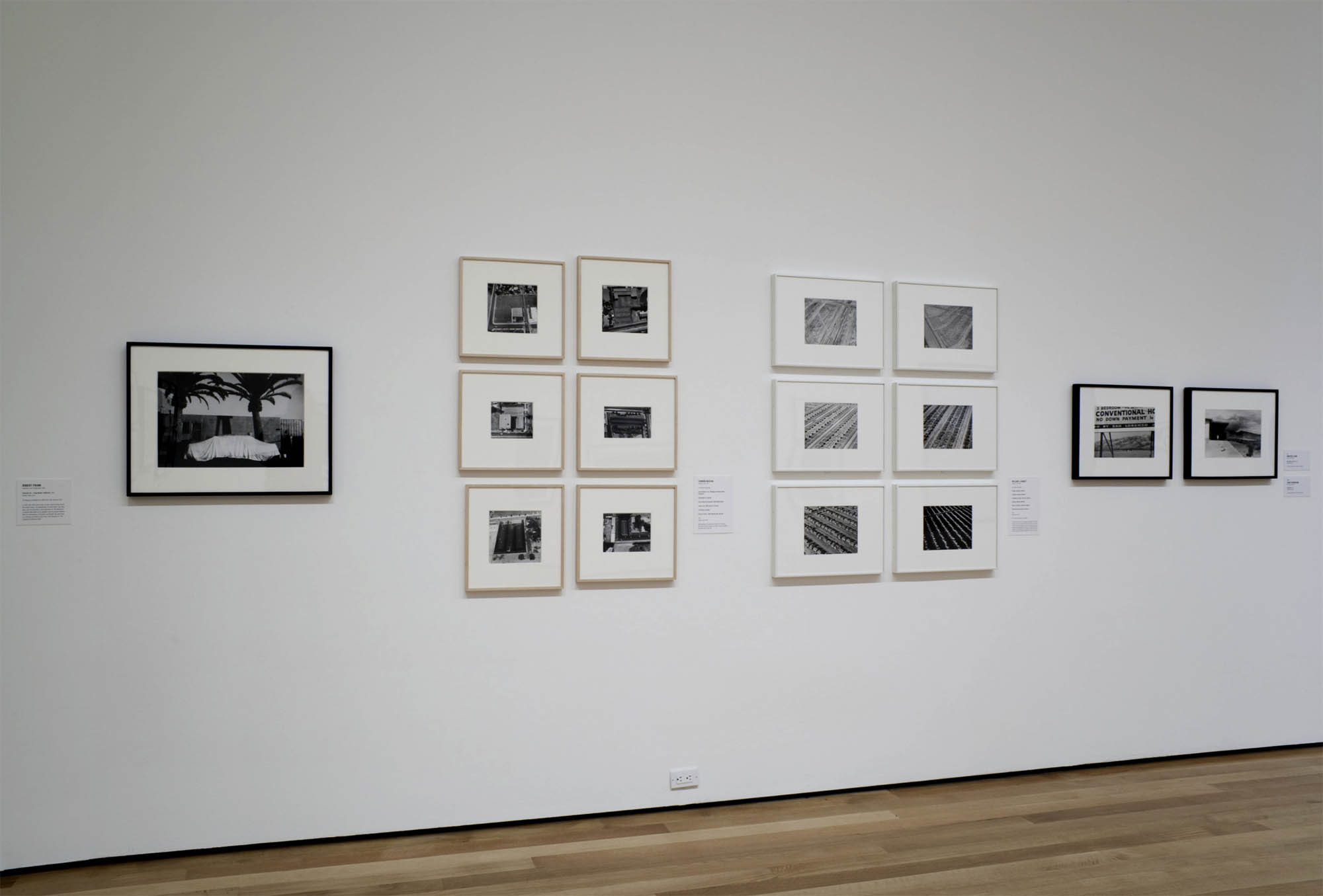
An interesting exhibition is presented in the [now closed] permanent third floor photography gallery at NGV International, Melbourne on a subject that deserved a much more rigorous investigation than could been undertaken in this small gallery space. Presenting single works by Ed Ruscha, Bernd and Hilla Becher, Patrick Pound, Robert Rooney, Simon Obarzanek, Penelope Davis, Candid Hofer, Linda Judge and Charles Green and Lyndell Brown the works seek to investigate the nature of the relationship between photography and the archive, between the semi-permanences of an archival memory and the spaces of a transgressive intertexuality marked by fragmentary, ironic counter-performances.
As noted in the catalogue essay by NGV curator Maggie Finch the archive is a place for holding knowledge that contains elements of truth and error, order and disorder; archives are able to shape history and memory, depending on how, when and by whom the records are accessed. Any disruption of order, governance and authority can lead to alternative readings and interpretations as the arcane ‘mysteries’ of the methods of classification are overturned. Since Victorian times when the body came under the self-surveillance of the camera and was found wanting, photographs have documented the faces of criminals, the physiognomy of degeneration and the fever of war.
As Yiannis Papatheodorou has observed when reviewing Jacques Derrida Mal d’Archive,
“Derrida declares that since the dominant power of the archive derives from the economy of knowledge, it also provides the institutional responsibility of the interpretation. The localisation of the information transforms the inscription, provided by the function of the archive, into the impression of a memory’s trace, conscious or unconscious … The preservation of memory, the access to information, the “resources” of the sources and the working environment are not just the representation of a future memory. They are active practices and discourses that create hierarchies and exclusions. The archives are the languages of the past, activated however dialogically, according to scientific and social demands. The content of our choice is marked by the way we are seeking information. Far from being an abstract principle, our choice is an ideologically oriented negotiation closely related to the politics of interpretation.”1
And there’s the rub. Not only is this exhibition a reordering of an unpublished memory (for that is what an archive is, a unique unpublished memory), it is also a reiteration of the authority of the gallery itself, the “institutional responsibility of the interpretation.”2Deciding what was in this exhibition and what to leave out creates hierarchies of inclusion and exclusion – and in this case the inclusions are mainly ‘safe’ works, ones that challenge the ontology of existence, the cataloguing of reality in a slightly ironic way but oh – nothing too shocking! nothing too disordered! Nothing here then of the archive of images that substantiate the horrors of war, the trans/disfiguration of men in both World Wars for example. There are few images to haunt us, none to refresh our memories in a problematic way.
The more successful pieces, the works that challenge the order of the archive (“what is no longer archived in the same way is no longer lived in the same way”)3, are the ones by Ed Ruscha, Penelope Davis and Simon Obarzaneck (all below).
Ruscha’s vertical inverted cityscape is trapped in a display cabinet opened out on the horizontal plane in concertina format, like one of those optical illusion images in which you see an image looking from one direction and a different image from the other direction. Ruscha’s personal experience of driving down Sunset Strip in Los Angeles and his anthropological recording of the urban experience has been disseminated in a mass produced ‘artists’ book. No unique unpublished archive here. Beneath the facades of the shops other narratives emerge – images are stitched together, cars chopped off, people dismembered – all in a very linear, conceptual way; a journey from one point to another, one that is both subjective (the voice and hand of the author) and objective (the en masse production of the book).
As Chris Balaschak has noted, “The images, taken during the day, capture only the facades of the buildings. Ignorance is given to cars or people, both of which are often cut in half between separate exposures. The imperfections of matching the facades are cracks along Ruscha’s drive. Through these cracks we find Ruscha, not such an anonymous author after all. Splitting cars in two, and mismatching facades we become keenly aware of the passage of time. The facades of buildings may appear as stage sets but they are active points on other itineraries, anticipating future and past narratives.”4
This is Ruscha’s trace through the city but also our intersection with his journey, our chance to make our own itineraries as Balaschak (in his insightful writing) rightly points out. The fragmentary dismembering becomes the space between, the disorder of the linear into a heterotopic space of remembering. We the viewer create our own narrative, flitting through the cracks in the archive of memory, the photographer, the author of our own journey.
Penelope Davis photograms are luminous objects. She makes resin casts of the spine of discarded books and places the casts directly onto photographic paper and then exposes them to light. The books glow and hover in the blackness, the words on the spine reversed. Stripped of their context, of their memory, they become ethereal books, phantom texts, liminal images that hover between what is known and what is imagined. As Davis has said, “Most people assume that when they look at a photo that they are looking at the thing photographed – but they are not. They are looking at a photo. Books and photographic images and archives are enigmatic – you can’t be sure of a singular definition or meaning.”
Davis is ‘messing around’ with the idea of veracity, the truth of photography and the ordering of the archive of our mind through the images we collate. We seek to grasp the original memory of an event, of the reading and ordering of our life through images and none is available to us, for as Foucault has observed memories are only ever fragmentary and distorted representations, partial truths a best. Like Jorge Luis Borges’ journey into the infinite universe of The Library of Babel, for Foucault the psyche is not an archive but a mirror, like the shining silver foil surface of the cover of the Ed Ruscha book:
“The search for the self is a journey into a mental labyrinth that takes random courses and ultimately ends at impasses. The memory fragments recovered along the way cannot provide us with a basis for interpreting the overall meaning of the journey. The meanings that we derive from our memories are only partial truths, and their value is ephemeral. For Foucault, the psyche is not an archive but only a mirror. To search the psyche for the truth about ourselves is a futile task because the psyche can only reflect the images we have conjured up to describe ourselves. Looking into the psyche, therefore, is like looking into the mirror image of a mirror. One sees oneself reflected in an image of infinite regress. Our gaze is led not toward the substance of our beginnings but rather into the meaninglessness of previously discarded images of the self.”5
This leads us nicely onto the images of Simon Obarzanek.
In a fantastic series of photographs, the only ones of this exhibition that seemed to haunt me (as Susan Sontag says images do), Obarzanek photographs people in an ordered, almost scientific, manner. Photographed face on against a non-contextual background using a low depth of field, these repetitive, collective, unnamed people remind me of the images of Galton. But here the uniformity is overwhelmed by quirky differences – the placement of eyes and lips seem large offering a strange, surreal physiognomy. These images resonate, the challenge, they remain with you, they question the order of things as no other photograph in this exhibition does. From simplicity comes eloquence.
To finish I must address the elephant in the room, in fact two elephants!
There is not one digital photograph contained in the exhibition, the work being collage, Type C colour or black and white silver gelatin prints. There is no mention in the catalogue of the crisis of cultural memory that is now permeating our world. Some believe the ever expanding digital archive, the Internet, threatens our lived memories “amidst the process of the ‘digitisation of culture’ and the new possibilities of storing.”6 This vision entails the fear of loosing cultural contents, hitting the delete button so that memory passes into forgetting. This is a vision to which I do not subscribe, but the issue needed to be addressed in this exhibition: how are digital technologies altering our re-assemblance of memory, altering photography’s ability inherent ability to record, store and organise visual images? What about the aura of the original or was there never such a thing?
Furthermore, it would seem that with photographs becoming less and less a fixed essence; with the meaning of the photograph more and more divorced from its referent; with the spectators look the key to reading photographs; and the performance of the photograph a cut and paste reality… then perhaps we are left not with the two polar opposites of order and disorder but some orthogonal spaces in-between.
The second elephant in the room in the gallery space itself.
Whilst the curators of photography at the National Gallery of Victoria do an amazing job running large exhibitions such as the Andreas Gursky and Rennie Ellis shows that have starred this year, the NGV ‘International’ is shooting itself in the foot with the current permanent photography gallery space. Small, jaded and dour it seems an addendum to other larger spaces in the gallery and to be honest photography and Melbourne deserves better. Personally I feel more alive in the fashion gallery that is on the floor below and that, for an photographer, is a hard thing to say.
As the theme for this exhibition deserved a greater in depth investigation so the gallery needs to expand it’s horizons and give the permanent photography gallery a redesign and overhaul. Where is the life and passion of contemporary photography displayed in a small space for all to see in a gallery that sees itself as ‘International’? In an occularcentric world the key word is intertexuality: the gallery space should reflect the electri-city, the mixing of a gallery design ethos with images to surround us in a space that makes us passionate about contemporary photography. Now that would really be a new order of things!
Dr Marcus Bunyan
1/ Papatheodorou, Yiannis. History in the promised land of memory. Review of Jacques Derrida, Mal d’Archive, Paris, Éd. Galilée, 1995 [Online] Cited on 20th March 2009 (no longer available online)
2/ “The archive is understood as collective reservoir of knowledge fulfilling diverse functions and conditioned by three main factors: conservation, selection and accessibility. How are contents stored and which media are used to conserve them? What is selected for storage and what is decided to be cleared out and thus forgotten? Who decides what is archived and who has access to the resources? All these questions paint the archive as a political space where relations of power cross aspects of culture and collective identity.” Assmann, A. (2003) Erinnerungsräume, Formen und Wandlungen des kulturellen Gedächtnis. [Memory Spaces, Forms and Transformations of Cultural Memory] Special paperback editon, 1st edition publ. 1999, München: Beck, p. 343-346
3/ Derrida, Jacques. (1996) Archive Fever, A Freudian Impression. Transl. by E. Prenowitz, p. 18 orig. publ. as Mal d’Archive: une impression freudienne in 1995, Chicago, London: The University of Chicago Press
4/ Balaschak, Chris. Itineraries [part 3] [Online] Cited on 20th March 2009 (no longer available online)
5/ Hutton, Patrick. “Foucault, Freud, and the Technologies of the Self,” in Martin, Luther and Gutman, Huck and Hutton, Patrick (eds.,). Technologies of the Self: A Seminar with Michel Foucault. London: Tavistock Publications, 1988, p. 139
6/ Featherstone, M. (2000) “Archiving Cultures,” in British Journal of Sociology, 51(1), pp. 161-184
Many thankx to the National Gallery of Victoria for allowing me to publish the images in the posting. Please click on the photographs for a larger version of the image.
Penelope Davis (Australian, b. 1963) Shelf 2008 From the Fiction-Non-Fiction series 2007-2008 Type C photograph 90.0 x 70.0cm National Gallery of Victoria, Melbourne Purchased, Victorian Foundation for Living Australian Artists, 2008
Archives contain elements of truth and error, order and disorder and are infinitely fascinating. As both collections of records and repositories of data, archives are able to shape history and memory depending on how, when and by whom the materials are accessed. Their vastness allows for multiple readings to be unravelled over time.
Photography is naturally associated with archives because of its inherent ability to record, store and organise visual images. With this in mind, this exhibition brings together artists drawn largely from the permanent collection of the NGV who explore the idea of archives as complex, living and occasionally mysterious systems of knowledge. Several of the selected artists act as archivists, collecting and ordering their own unique bodies of photographs, while others create disorder by critiquing the ideas and systems of archives.
Bernd and Hilla Becher (German, 1931-2007 and 1934-2015) Coal tipple, Goodspring, Pennsylvania 1975 From the Artists and photographs folio 1975 Gelatin silver photographs 24.0 × 33.9cm (image and sheet) 40.7 × 49.6cm (support) National Gallery of Victoria, Melbourne Purchased, 1976
These images form an interesting body of work: levitating bodies suspended between heaven and earth, neither here nor there, form a hyper-real image grounded in the context of the fluorescent isles of French supermarkets. The mainly anonymous humans look like mannequins in their inertness, frozen at the moment of throwing themselves/being thrown into the consumer environment. After his brilliant series La Chute (The Fall) Darzacq has taken people gathered in a casting call from around the town of Rouen and made their frozen bodies complicit in the mass production of the supermarket and the mass consumption of the image as tableaux vivant: the mise en scène directed by the photographer to limited effect. There is something unsettling about these images but ultimately they are unrewarding, as surface as the environment the bodies are suspended in, and perhaps this is the point.
Suspension of bodies is not a new idea in photography. Jacques Henri Lartigue used the freeze frame to good effect long before Henri Cartier-Bresson came up with his ‘decisive moment’: playing with the effect of speed and gravity in an era of Futurism, Lartigue used the arrested movement of instant photography then afforded by smaller cameras and faster film to capture the spirit of liberation in the ‘Belle Epoque’ period before the First World War.
“All the jumping and flying in Lartigue’s photographs, it looks like the whole world at the turn of the century is on springs or something. There’s a kind of spirit of liberation that’s happening at the time and Lartigue matches that up with what stop action photography can do at the time, so you get these really dynamic pictures. And for Lartigue part of the joke, most of the time, is that these people look elegant but they are doing these crazy stunts.”1
One of the greatest, if not the greatest ever, series of photographs of levitating bodies is that by American photographer Aaron Siskind. Called Pleasures and Terrors of Levitation (sometimes reversed as Terrors and Pleasures of Levitation as on the George Eastman House website) the images feature divers suspended in mid-air with the sky as their blank, background canvas. The images formal construction makes the viewer concentrate on the state of the body, its positioning in the air, and the look on the face of some of the divers caught between joy and fear.
“Highly formal, yet concerned with their subject as well as the idea they communicate, the ‘Pleasures and Terrors of Levitation’ photographs depict the dark shapes of divers suspended mid-leap against a blank white sky. Shot with a hand-held twin-lens reflex camera at the edge of Lake Michigan in Chicago, the balance and conflict suggested by the series’ title is evident in the divers’ sublime contortions.”2
Perhaps because of their air of balance and conflict we can return to these vibrant images again and again and they never loose their freshness, intensity and wonder. The same cannot be said of Denis Darzacq’s Hyper photographs. Slick and surface like the consumer society on which they comment the somnambulistic bodies are more like floating helium balloons, perhaps even tortured souls leaving the earth. Reminiscent of the magicians trick where the girl is suspended and a hoop passed around her body to prove the suspension is real these photographs really are more smoke and mirrors than any comment on the binary between being and having as some commentators (such as Amy Barrett-Lennard, Director Perth Institute of Contemporary Arts) have suggested. There is no spirit of liberation here, no sublime revelation as the seemingly lifeless bodies are trapped between the supermarket shelves, as oblivious to and as anonymous as the products that surround them. The well shot images perhaps possess a sense of fun, if I am being generous, as Darzacq plays with our understanding of reality… but are they more than that or is the Emperor just wearing very thin consumer clothing?
Dr Marcus Bunyan
1/ Kevin Moore (Lartigue biographer) quoted in “Genius of Photography,” on the BBC website [Online] Cited 15/03/2009
2/ Text from the Museum of Contemporary Photography website [Online] Cited 15/03/2009 (no longer available)
Many thankx to the Australian Centre for Photography for allowing me to publish the Darzacq photographs in the posting. Please click on the photographs for a larger version of the image. All other images are used under “fair use” for the purpose of education, research and critical discourse.
Denis Darzacq (French, b. 1961) Hyper #8 2007
“The astonishing photographs that make up Hyper involve no digital manipulation, just close collaboration between young dancers and sportspeople as they jump for the camera to form strange, exaggerated poses and body gestures. Denis Darzacq was drawn to the trashy, consumerist nature of the French Hypermarkets (the equivalent of our supermarkets) and the hyper coloured backgrounds they provided. These supermarkets offered a sharp juxtaposition to the sublime, almost-spiritual bodies that appear to float in their aisles.
Hyper is the latest series of works by French photographer Denis Darzacq, who continues to explore the place of the individual in society, a theme which has been crucial to his work in the last few years.”
Text from the ACP website [Online] Cited 15/03/2009. No longer available online
Jacques Henri Lartigue (French, 1894-1986) Bichonnade, 40, Rue Cortambert, Paris 1905 Gelatin silver print
Jacques Henri Lartigue (French, 1894-1986) Mr Folletete (Plitt) et Tupy, Paris, March 1912 1912 Gelatin silver print
Jacques Henri Lartigue (French, 1894-1986) Fuborg 1929 Gelatin silver print
Herni Cartier-Bresson (French, 1908-2004) Behind Saint Lazare Station, Paris, France 1932 Gelatin silver print
Aaron Siskind (American, 1903-1991) Pleasures and Terrors of Levitation #37 1956 Gelatin silver print
Aaron Siskind (American, 1903-1991) Pleasures and Terrors of Levitation #47 1954 Gelatin silver print
Aaron Siskind (American, 1903-1991) Pleasures and Terrors of Levitation #93 1961 Gelatin silver print
Aaron Siskind (American, 1903-1991) Pleasures and Terrors of Levitation #99 1956 Gelatin silver print
Aaron Siskind (American, 1903-1991) Pleasures and Terrors of Levitation #491 1956 Gelatin silver print
Denis Darzacq (French, b. 1961) Hyper #3 2007
Hyper picks up on La Chute while explicitly focusing the artist’s message on the consumerism which hovered in the background of several previous series. In Casques de Thouars Darzacq explored the connecting power and the limits of a consumer product; here the critique is more biting. Hyper opposes bodies in movement and the saturated, standardised space of mass distribution outlets. In this totally commercial setting, the body’s leap expresses the freedom and unhampered choice of its movement. It is a clear challenge to the marketing strategies which seek to control our behaviour. Some of the figures, glowing with an aura, impose glory and give off a sense of spirituality in total contrast with the temples of consumption in which they are found.
You must be logged in to post a comment.