Exhibition dates: 22nd October – 4th November, 2026
Curator: produced with the John Sadovy Estate Collection and family members Yvonne Sadovy de Mitcheson and Liza Jane Sadovy
*PLEASE NOTE THIS POSTING CONTAINS PHOTOGRAPHS OF VIOLENCE AND DEATH – IF YOU DO NOT LIKE PLEASE DO NOT LOOK, FAIR WARNING HAS BEEN GIVEN*
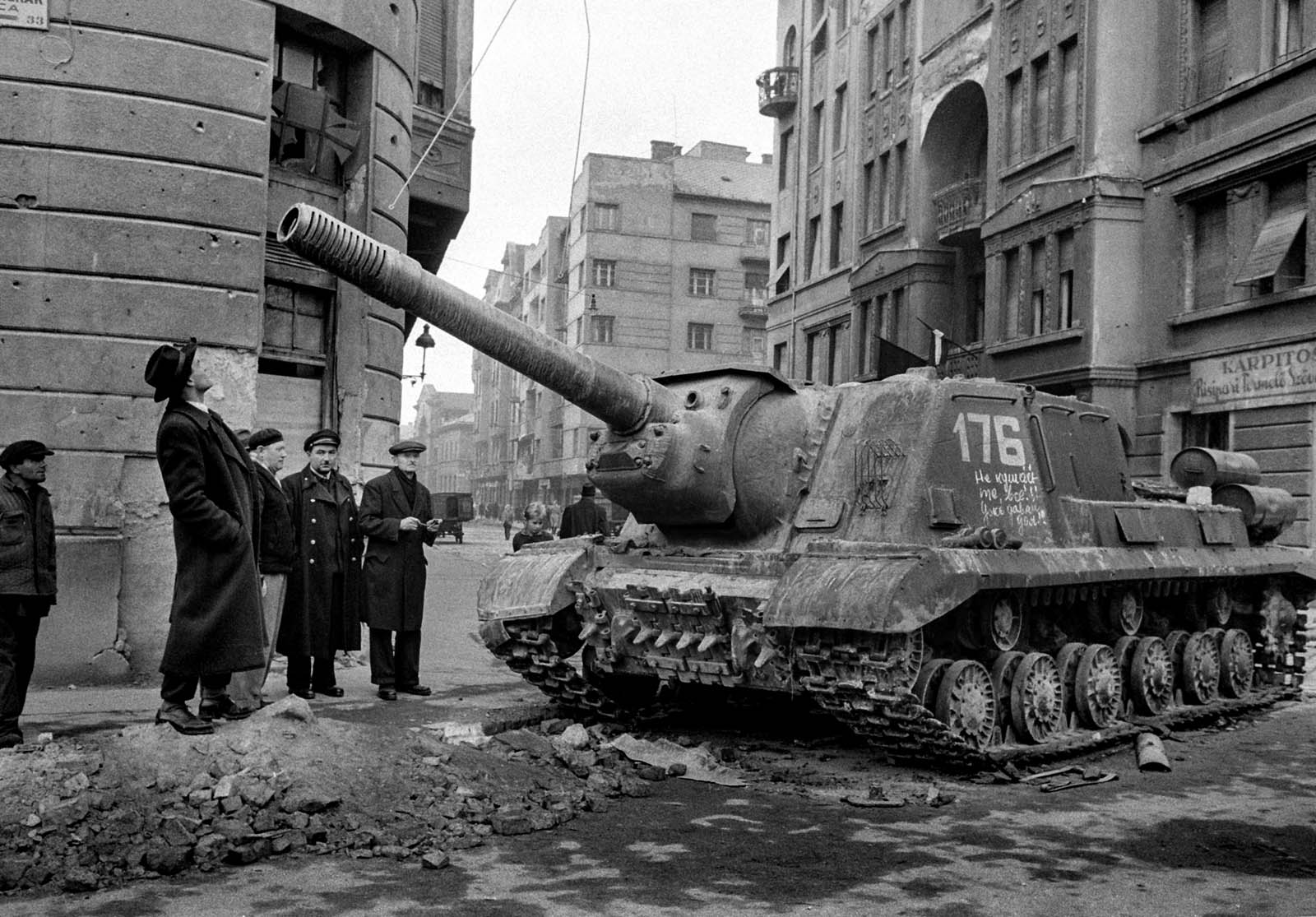
John Sadovy (English born Czech, 1925-2010)
Onlookers on the corner of Lévai Oszkár (now Fecske) Street and Déri Miksa Street, by the disabled Soviet ISU-152 self-propelled gun, on which the following message was written in poor Russian: “не кушайте все!!! уже давай[те] дом[ой]!!!” (Don’t gobble up everything!!! Go home already!!!)
Hungary October 1956
Freedom is the power, right, or condition of acting, speaking, or thinking without hindrance, restraint, or control.
Key dimensions of freedom include:
“Freedom From” (Negative Freedom): Protection or liberation from external oppression, coercion, slavery, fear, want, or tyranny
“Freedom To” (Positive Freedom): The capacity, opportunity, and fundamental right to make choices, pursue goals, express beliefs, and control one’s own life
Civic and Political Rights: Constitutional guarantees – such as freedom of speech, freedom of religion, freedom of the press, and the right to assemble – found in democratic societies
Responsibility and Limits: True freedom is rarely absolute; it is balanced by laws and ethical duties so that one person’s actions do not harm the rights, safety, or well-being of others.
Practical Balance: In daily life, real freedom involves having ownership over your time, choices, and personal growth while remaining accountable to your community.
Freedom
Eleven short years after the vicissitudes and ravages of the Second World War where Budapest was heavily bombed by the Americans and the capital was destroyed during the brutal 50-day urban siege when Soviet and Romanian forces encircled and captured the city from German and Hungarian Axis troops; eleven short years after the mass migration of people all across Europe and the descent of the Iron Curtain; eleven short years after the imposition of a Soviet led communist-dominated puppet government where communists were placed in crucial ministries – “most notably handing control of the Interior Ministry and the secret police (ÁVH) to the communists, the use of intimidation, arrests, rigged elections (such as in 1947), and political manoeuvring to systematically eliminate opposition parties” – elements of the Hungarian population rose up in revolt against oppression.
For a few brief days the uprising was successful. Freedom!
Repercussions against the oppressors especially the secret police were swift and brutal.
But the Soviets couldn’t allow this to happen, an assault on their authority and doctrine, so they sent in the troops and the tanks. They crushed the uprising. 2,500 to 3,000 Hungarians (mostly civilians and local resistance fighters) died and about 20,000 others wounded; an estimated 200,000 Hungarians fled the country as refugees, mostly escaping across the border into Austria.
“In the aftermath and subsequent repression led by János Kádár’s regime, thousands were imprisoned, and roughly 220 to 340 leaders and participants (including Prime Minister Imre Nagy and Pál Maléter) were executed.”1
What price freedom?
Can you imagine having lived through the horror of the Second World War to then come under the yoke of another repressive regime, one that sought to control what you said, what you thought, how you acted, how you created and your ability to think freely about yourself, others and the world in which you lived. That governed – to lead, control, or direct a nation, organisation, or group by making and enforcing laws and policies – your actions through intimidation, violence, arrest and execution.
Wouldn’t you fight for freedom?
These visceral, febrile photographs by that wonderful photographer John Sadovy perfectly capture the fever of the uprising, with all its spontaneity and violence, in all its hope and despair. The photographer depicts “the atmosphere, the faces, unfolding events, and the stories of everyday lives on the street, with empathy and clarity.”2
Empathy, feeling, clarity, atmosphere. There we have it. The resolve to go beyond the mere recording of a situation or place, the documentary, to create an atmosphere of belonging. Narratives beyond the frame. Photographs that evoke feeling, passion and pride even today.
Now think about today, think about Ukraine.
I think about Ukraine fighting the same oppressor, fighting a country that has always thought of Ukraine as belonging to Russia. Their possession.
I think about the posting I did on the flowering of Ukrainian Modernism between 1919 and 1934-1937 (In the Eye of the Storm: Modernism in Ukraine, 1900-1930s at the Thyssen-Bornemisza Museum, Madrid, November 2022 – April 2023) and how that movement was crushed by Joseph Stalin’s regime and the enforcement of socialist realism. Where all art had to conform to Soviet ideals. Where Ukrainian artists reigned in their creativity or were sent to the gulag or executed. A whole culture subjugated under communist rule.
And you wonder why Ukraine is fighting for its survival and freedom from oppression?
Then we have a human being like József Mindszenty (29 March 1892 – 6 May 1975) who was a Hungarian cardinal of the Catholic Church, who for five decades “personified uncompromising opposition to fascism and communism in Hungary”. Tortured, tried, sentenced to life in prison in in a show trial in 1949 he spent 8 years in prison before being freed during the Hungarian Revolution, only to spend the next 15 years holed up in the American Embassy in Budapest. I would have liked to have met this man.
Uncompromising opposition to fascism and communism.
You ask about freedom now?
Respect the heroes.
Dr Marcus Bunyan
1/ Ádám Bráder. “Hungary’s National Day of Mourning Honours 1956 Victims,” on the Hungarian Conservative website 04.11.2024 [Online] Cited 30/10/2026
2/ Timothy Foote, “A Big Story ‘Life’ is Made for”. Life, 12 November 1956, 2.
Many thankx to Luca Pokornyi and the Liszt Institute for allowing me to publish the photographs in the posting. Please click on the photographs for a larger version of the image.
“Where heroes are not forgotten there shall always be new ones.”
Phrase used to commemorate the 1956 Hungarian revolution and freedom fight
“Those who cannot remember the past are condemned to repeat it.”
George Santayana. The Life of Reason: Reason in Common Sense (Volume 1), 1905
The 1956 Hungarian Revolution
The date, October 23, 1956, marked the beginning of the ill-fated revolution that ended with the re-imposition of Communist rule and the flight of some 200,000 Hungarians to Western Europe and the United States. It remains a somber anniversary of heroism in defeat that continues to resonate with Hungarians across the globe.
Written by Harrison King. Narration by Dr. Nicholas B. Breyfogle.
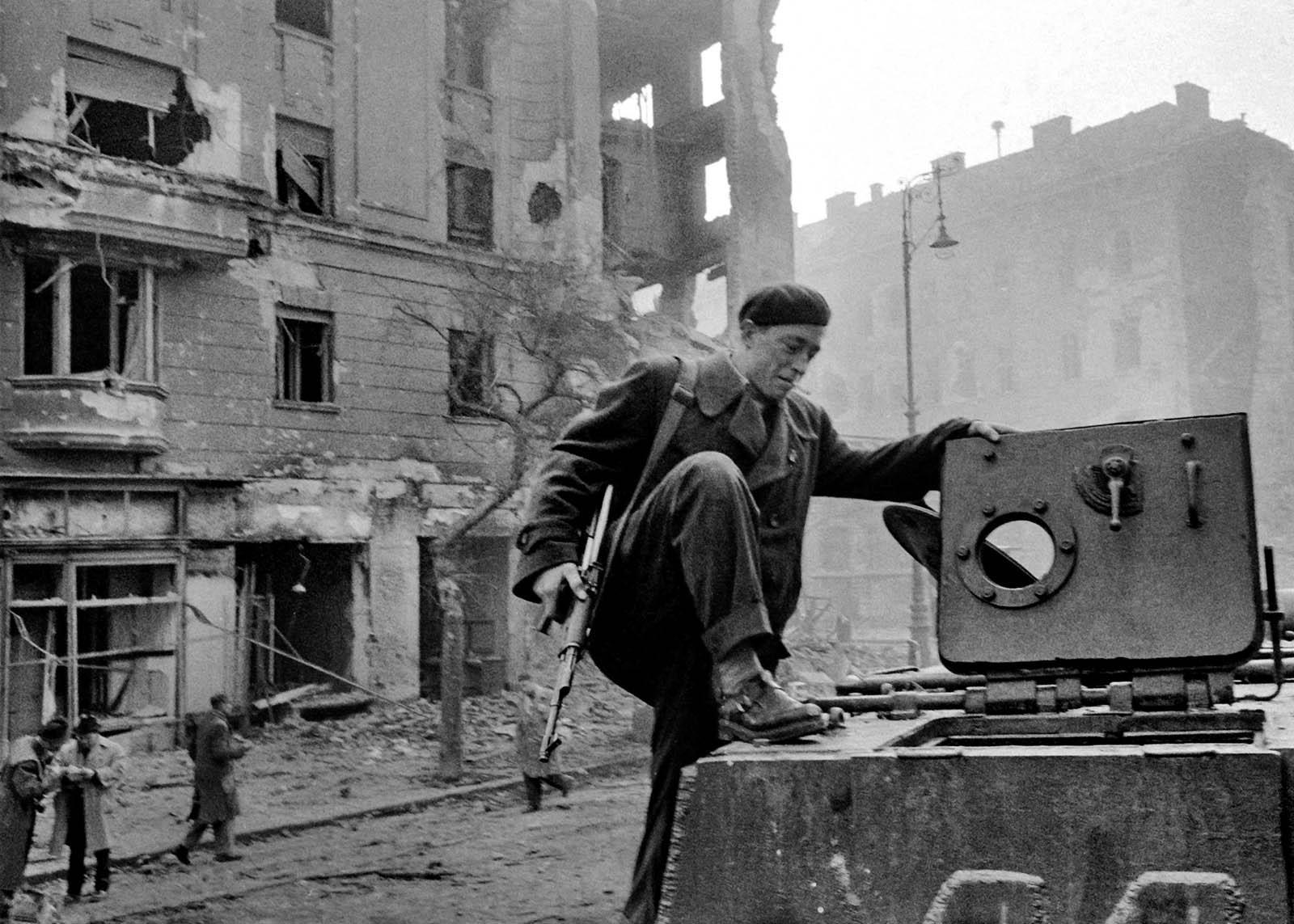
John Sadovy (English born Czech, 1925-2010)
Freedom fighter, with a captured Kalashnikov rifle on his shoulder, climbing on top of an ISU-152 assault gun in Jozsef Boulevard, at the Corvin Passage. The Kilian Barracks is seen in the background on the right
Hungary October 1956
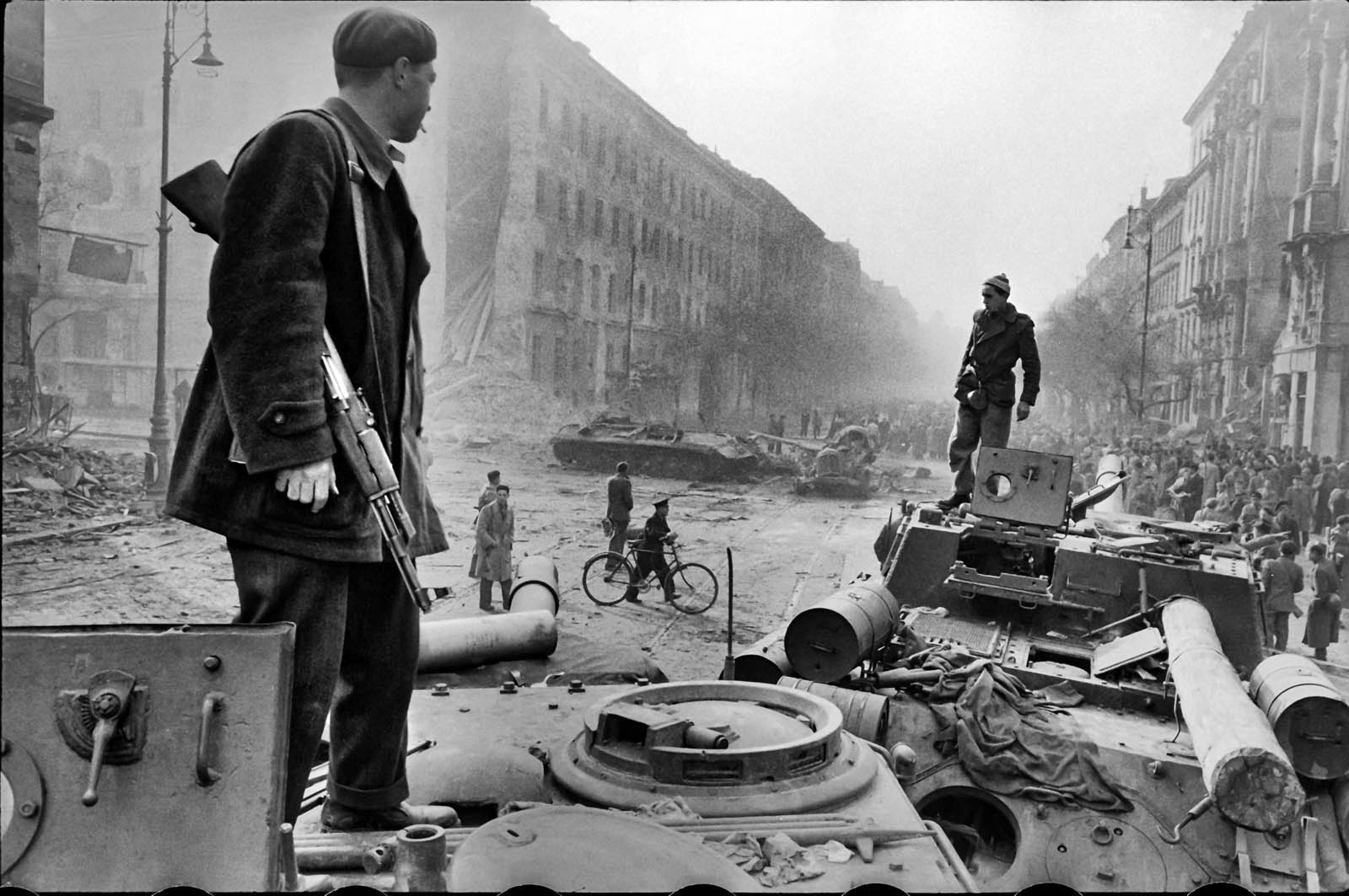
John Sadovy (English born Czech, 1925-2010)
Freedom fighters atop Soviet ISU-152 assault guns at the Corvin Passage. The Kilián Barracks is on the left, and in the background, in a circle of curious onlookers, a Soviet IS-3 heavy tank that has lost its turret
Hungary October 1956
The ISU-152 is a Soviet self-propelled heavy howitzer used during World War II. It is very similar to the SU-152, mounting the same 152 mm ML-20S howitzer on an IS heavy tank chassis. Since the main armament was mounted in a casemate, it required repositioning the entire vehicle using the tracks, which made it awkward to aim. To support more mobile infantry and armour attacks, it was employed as mobile artillery rather than directly engaging the enemy itself. It was employed in numerous campaigns and nations well into the 1970s.
Text from the War Thunder Wiki website
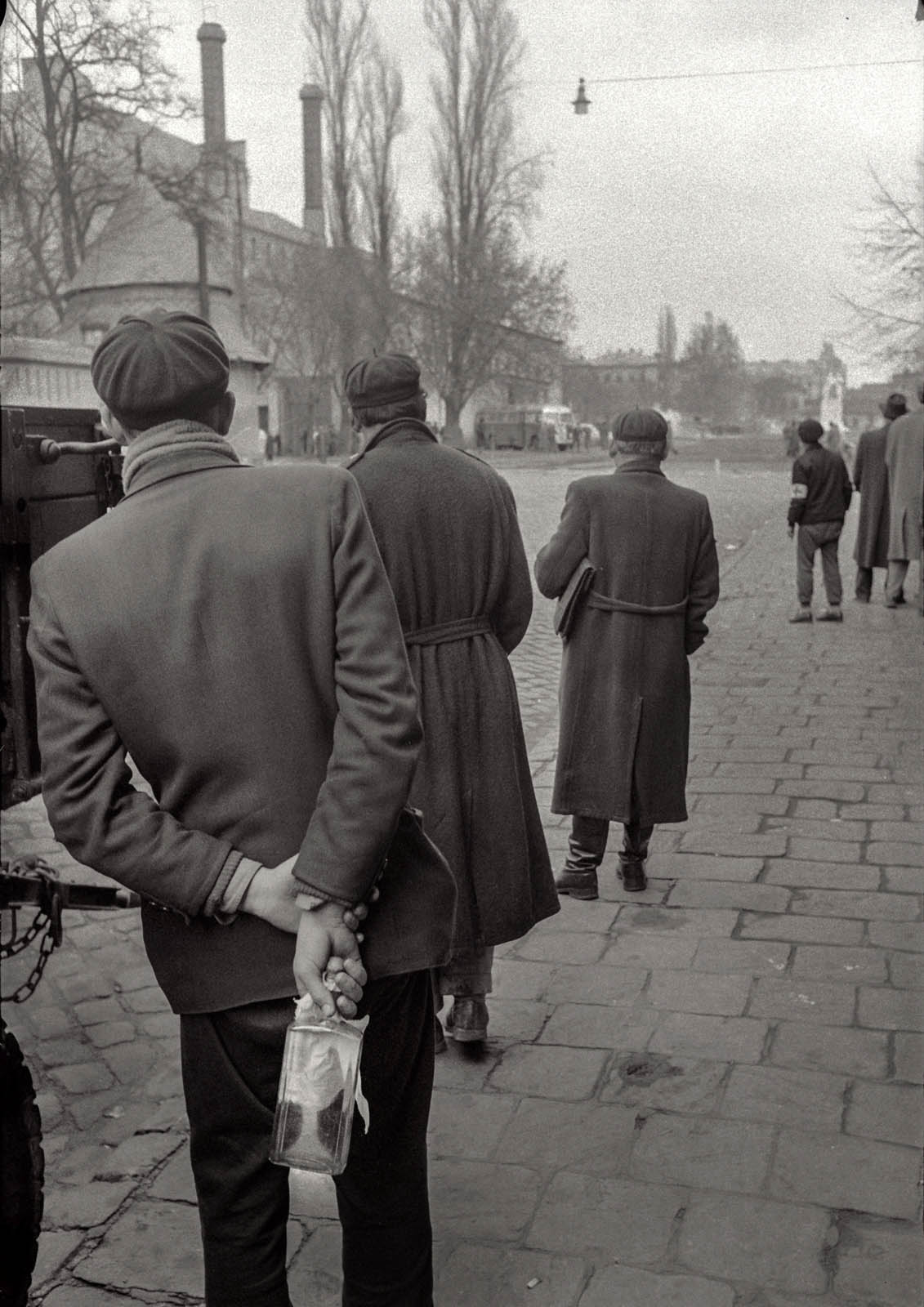
John Sadovy (English born Czech, 1925-2010)
Three men watching the events around an ambulance bus behind the Erkel Theatre from the corner of Szilágyi Street and Köztársaság Square. One of them is holding a Molotov cocktail
Hungary October 1956
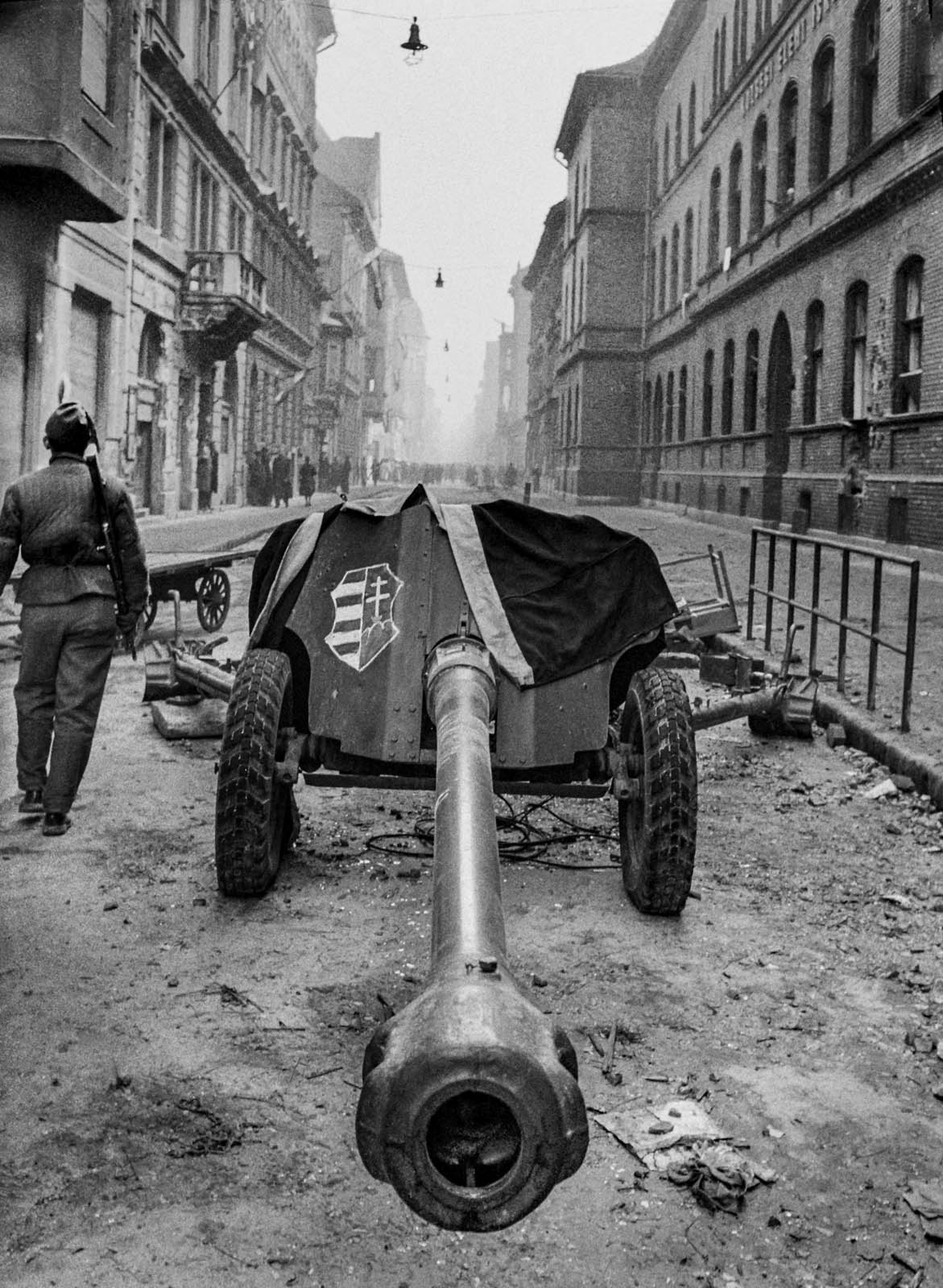
John Sadovy (English born Czech, 1925-2010)
A captured D-44 (85 mm) anti-tank gun, with the Kossuth Coat of Arms on the shield, in front of the Práter Street primary school, a major base for the freedom fighters
Hungary October 1956
The D-44 (85 mm) is a Soviet towed divisional field and anti-tank gun designed between 1943 and 1944 by F.F. Petrov’s design bureau at Uralmashzavod.
The Kossuth Coat of Arms (Kossuth-címer) is a crownless historical coat of arms of Hungary, named after Lajos Kossuth, Regent-President of Hungary during the 1848-1849 Revolution.
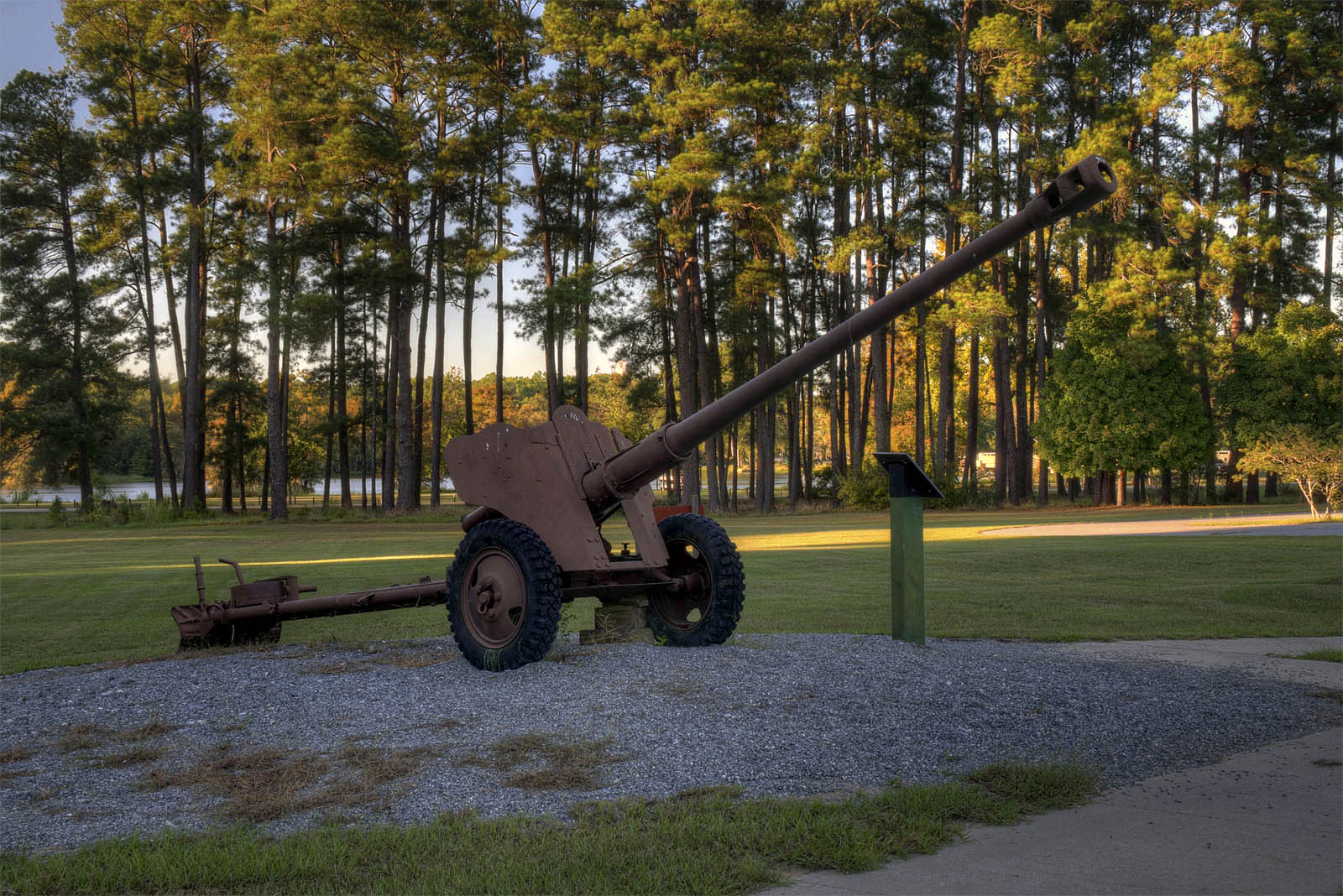
Dsdugan
D-44 85mm gun at Georgia Veterans State Park
2016
Creative Commons CC0 1.0
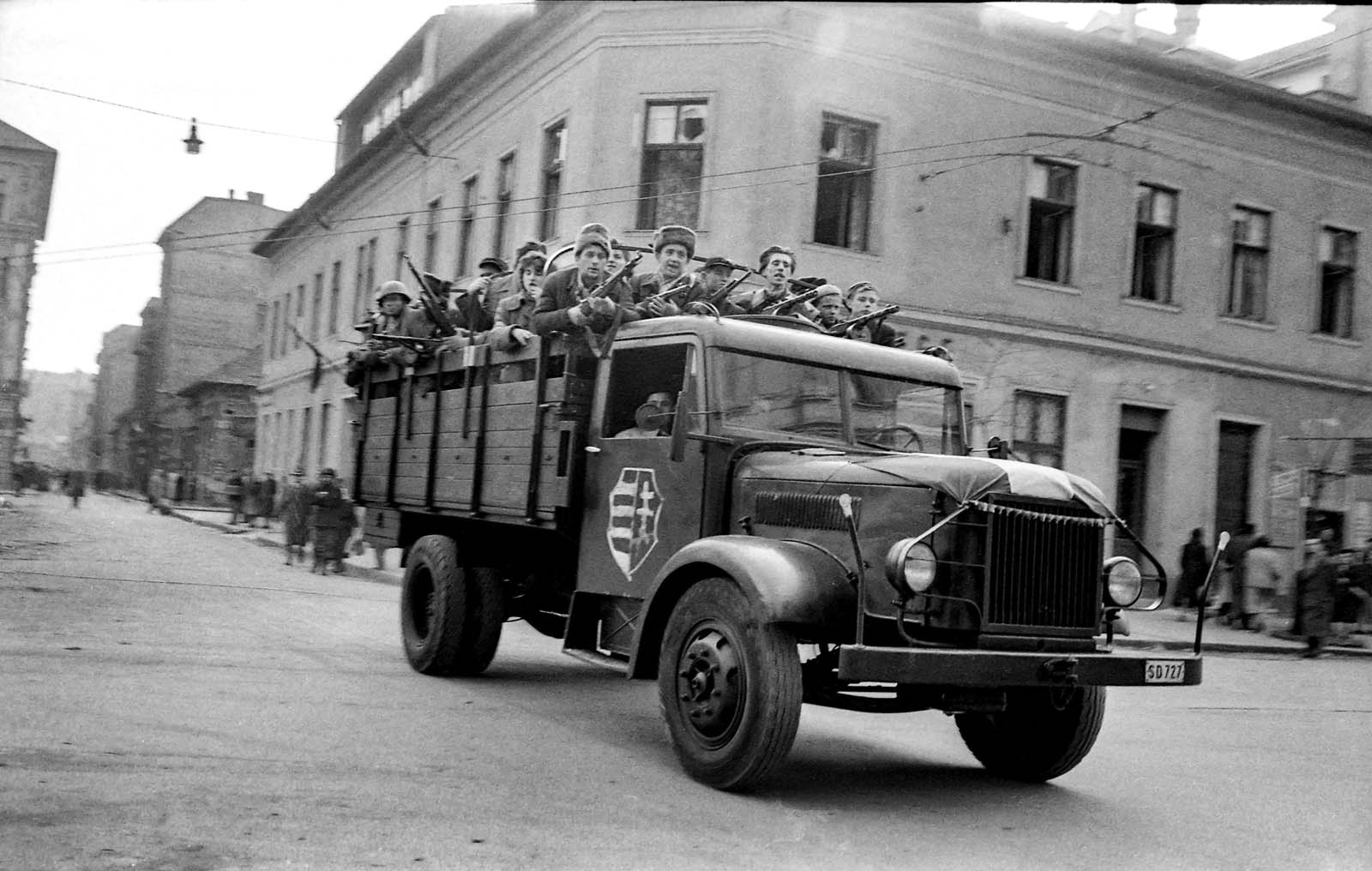
John Sadovy (English born Czech, 1925-2010)
Truck transporting gunmen at Horváth Mihály Square, at the intersection of Baross Street and Futó Street (Budapest, the 30th October, 1956). The vehicle was probably heading for Köztársaság Square
Hungary October 1956
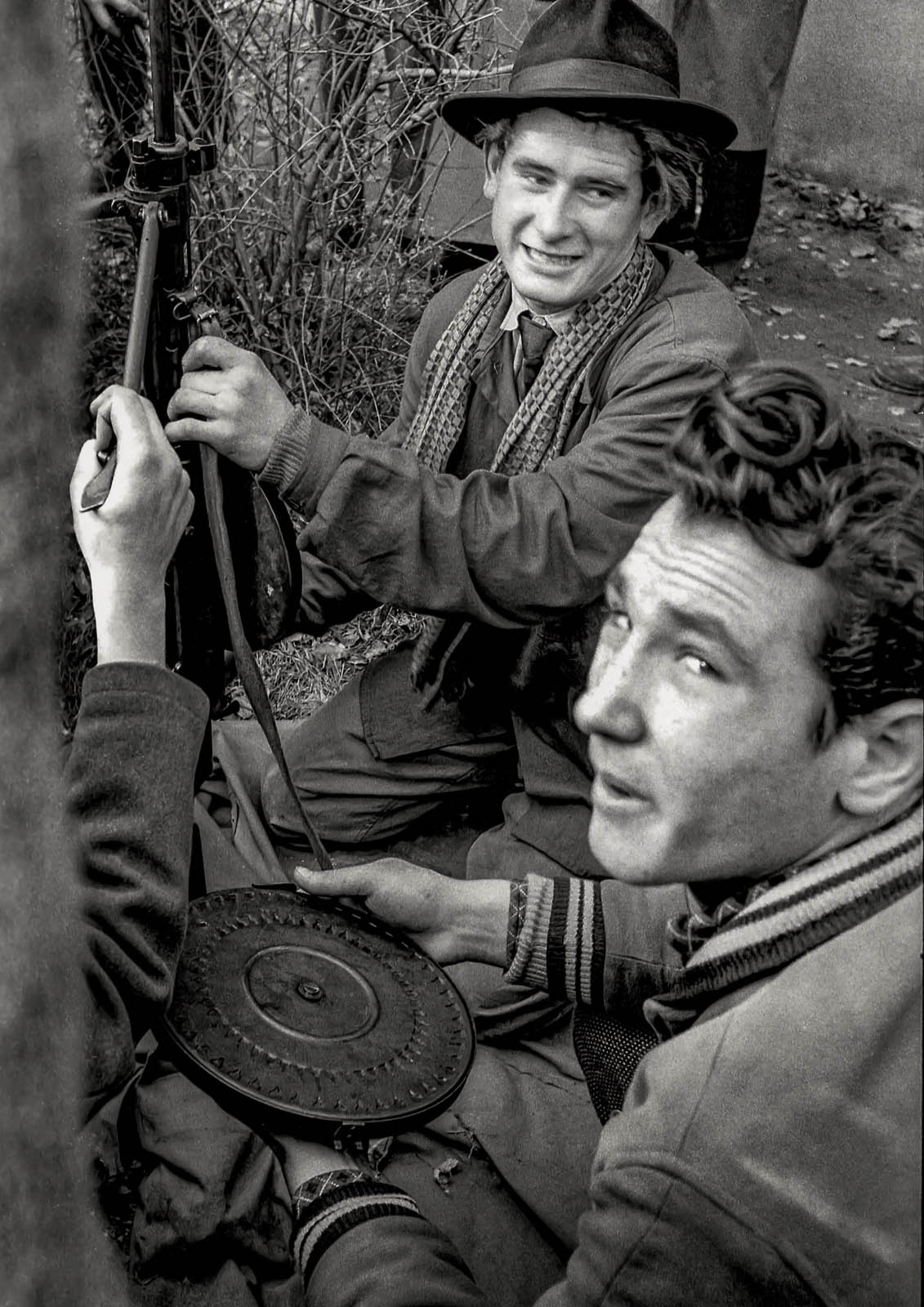
John Sadovy (English born Czech, 1925-2010)
Insurgents under cover in Köztársaság Square with a 7-62 mm DP light machine gun model 1948 used in the Hungarian People’s Army
Hungary October 1956
János Pál pápa Square (Pope John Paul II Square) formerly known as Köztársaság Square (Republic Square), was the site of the historic and bloody siege of the Budapest Communist Party (Hungarian Workers’ Party/MSZMP) headquarters on October 30, 1956, during the Hungarian Revolution, followed by violent clashes and lynchings.
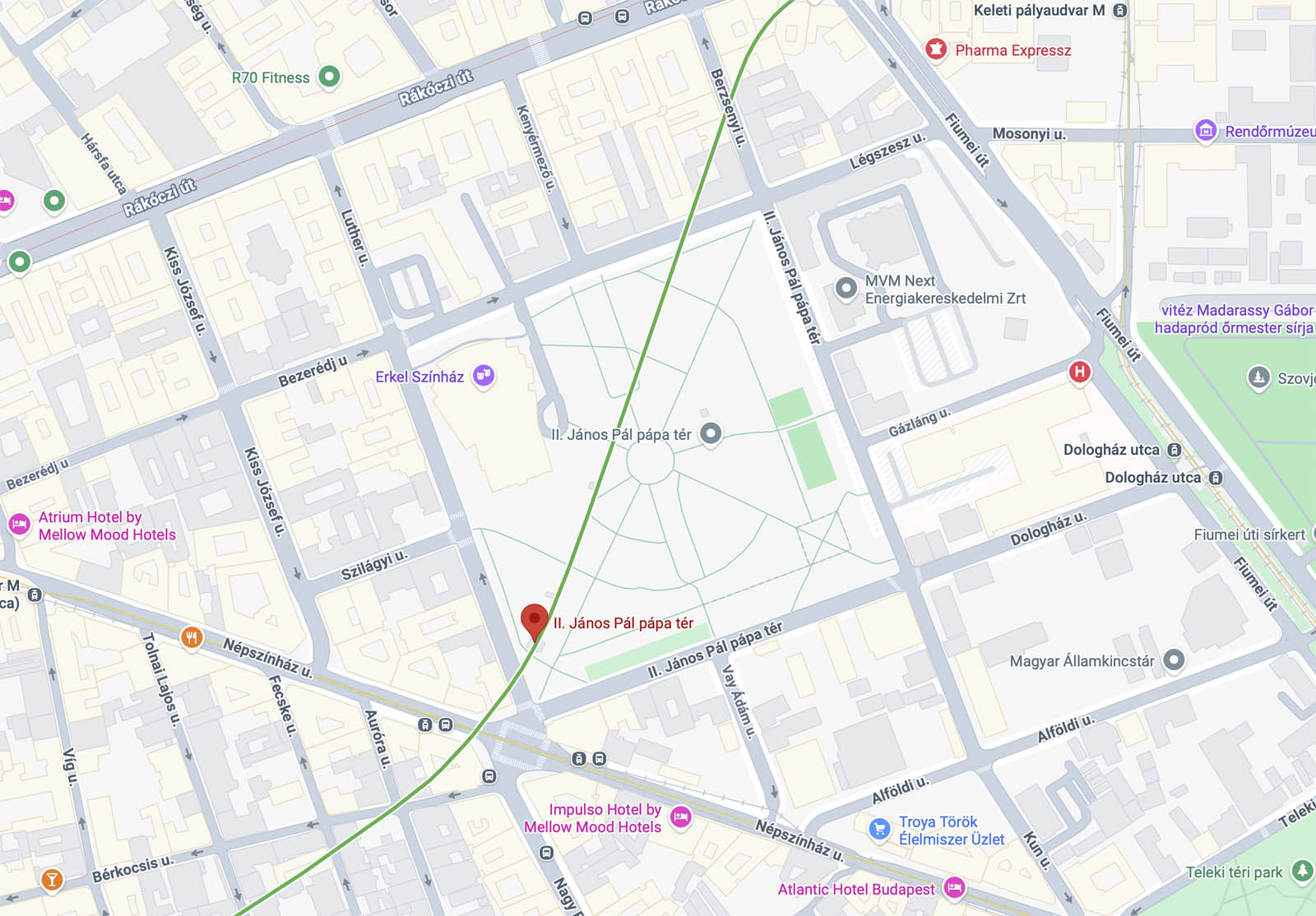
Map of János Pál pápa Square formerly known as Köztársaság Square (Republic Square), Budapest
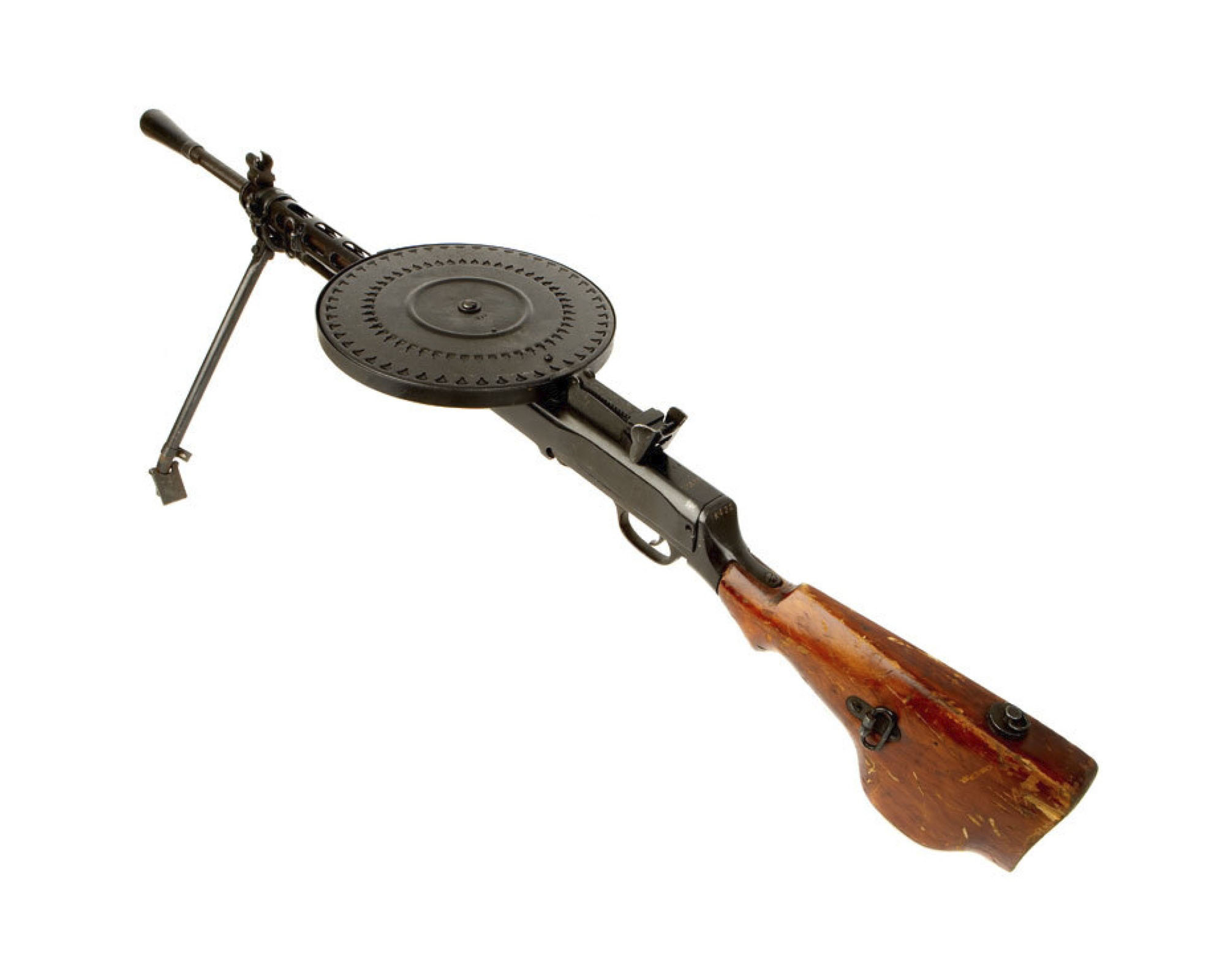
The 7.62 mm DP (and modernised DPM) light machine gun was adopted by the Hungarian People’s Army in 1948. Under heavy pressure from the Soviet Union to standardize to Warsaw Pact equipment, Hungary replaced its existing, highly regarded – but “politically incorrect” – Solothurn machine guns with Soviet-designed small arms. In Hungarian military nomenclature, weapons adopted during this standardization wave in 1948 were designated as the Model 48 (48M) series.
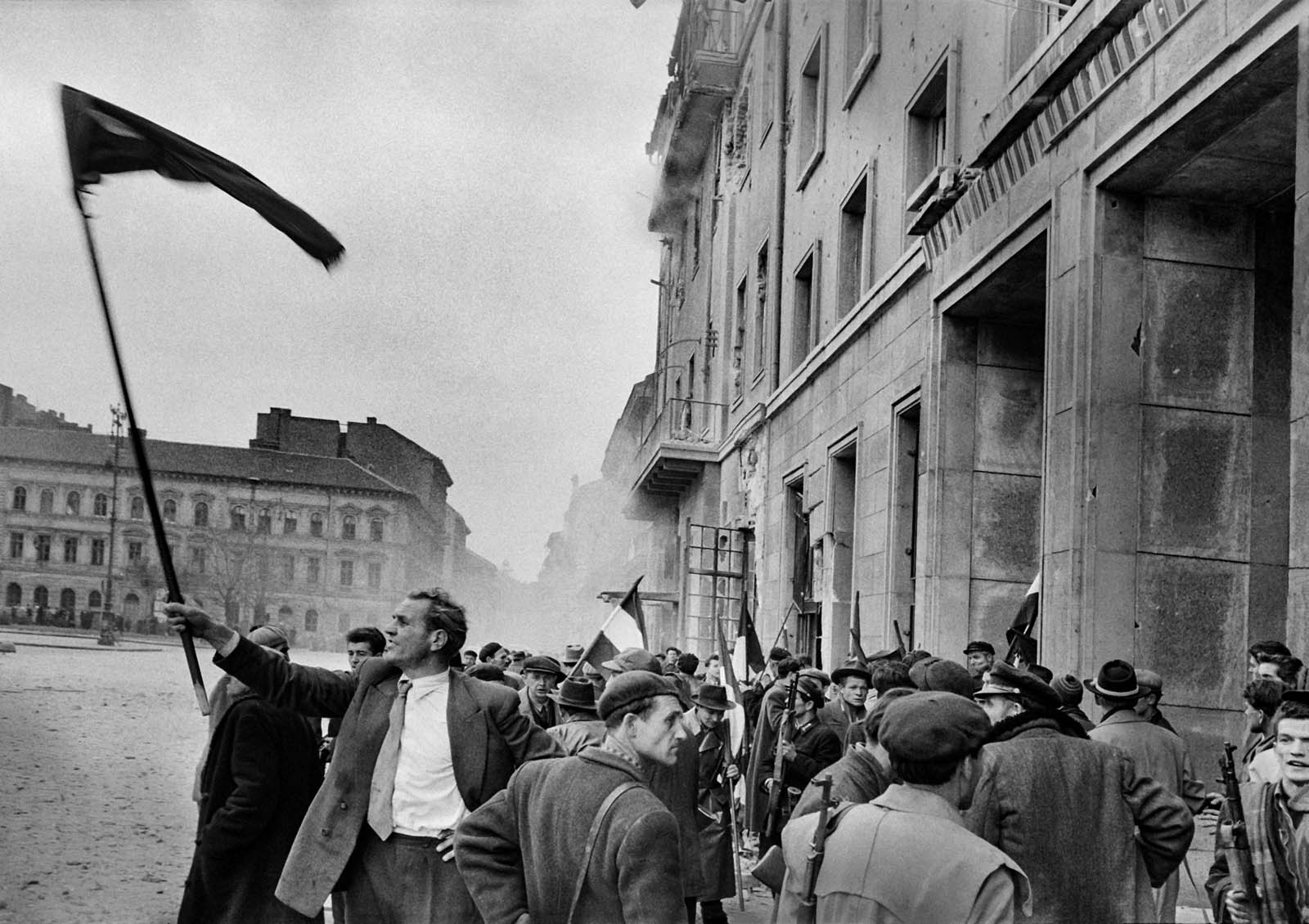
John Sadovy (English born Czech, 1925-2010)
Untitled
Hungary October 1956
A rebel flag-bearer triumphantly signals that the state security agency headquarters have been taken and the secret police are ready to come out.
John Sadovy (English born Czech, 1925-2010)
Untitled
Hungary October 1956
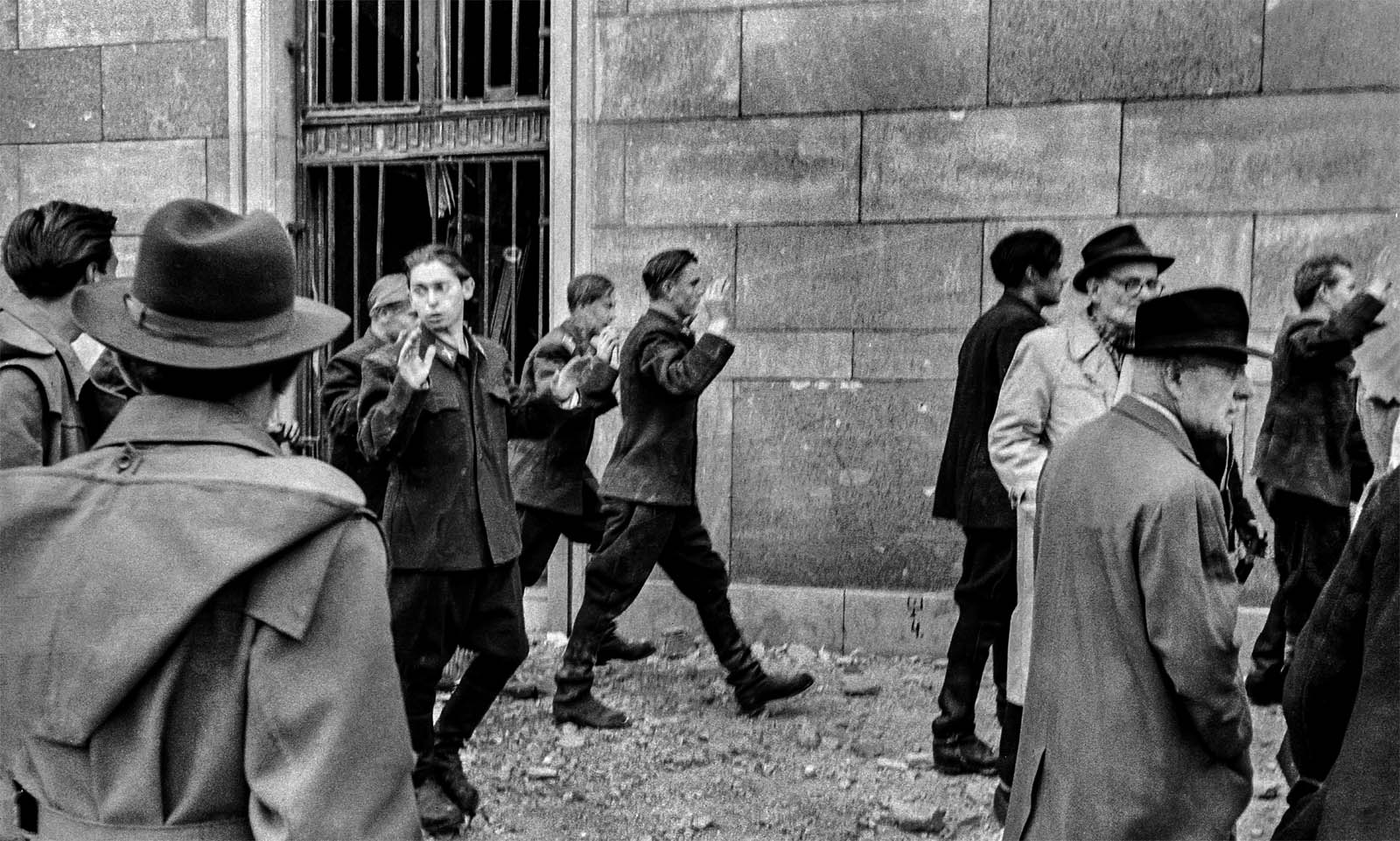
The work of Hungary’s state security agency – Államvédelmi Hatóság or ÁVH – created a climate of fear, and it was much hated. During the revolution some of its members were publicly lynched. Here some leave their headquarters after rebels stormed the building.
John Sadovy (English born Czech, 1925-2010)
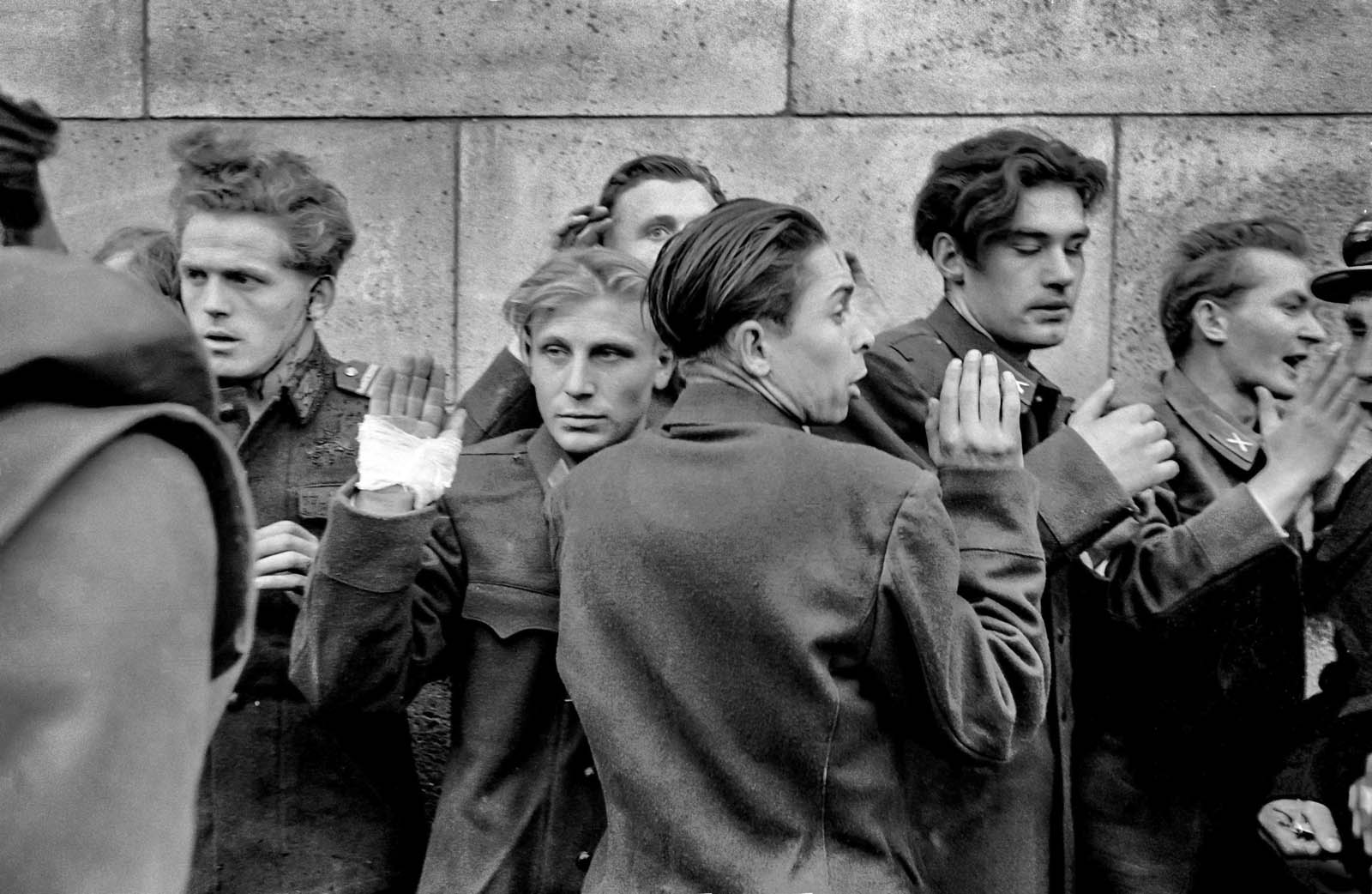
Conscript ÁVH soldiers at the wall of the party headquarters in Köztársaság Square a few moments before the shots were fired at them
Hungary October 1956
The ÁVH (Államvédelmi Hatóság, or State Protection Authority) was the brutal secret police force of the People’s Republic of Hungary from 1945 to 1956. They maintained power through mass surveillance, political purges, show trials (such as those of László Rajk and József Mindszenty), torture, and forced labour camps like Recsk.
On October 23-25, 1956, ÁVH guards and rooftop snipers opened fire on peaceful student and civic protesters gathered at the Radio Building and outside the Parliament Building in Budapest, triggering an armed uprising.
During the revolution, angry crowds, local militias (such as József Dudás’ group), and defecting Hungarian soldiers hunted down, disarmed, and attacked ÁVH personnel. Some members were lynched or executed on the spot, while student and worker councils tried to place others into protective custody to prevent massacres.
Text from various sources
John Sadovy (English born Czech, 1925-2010)
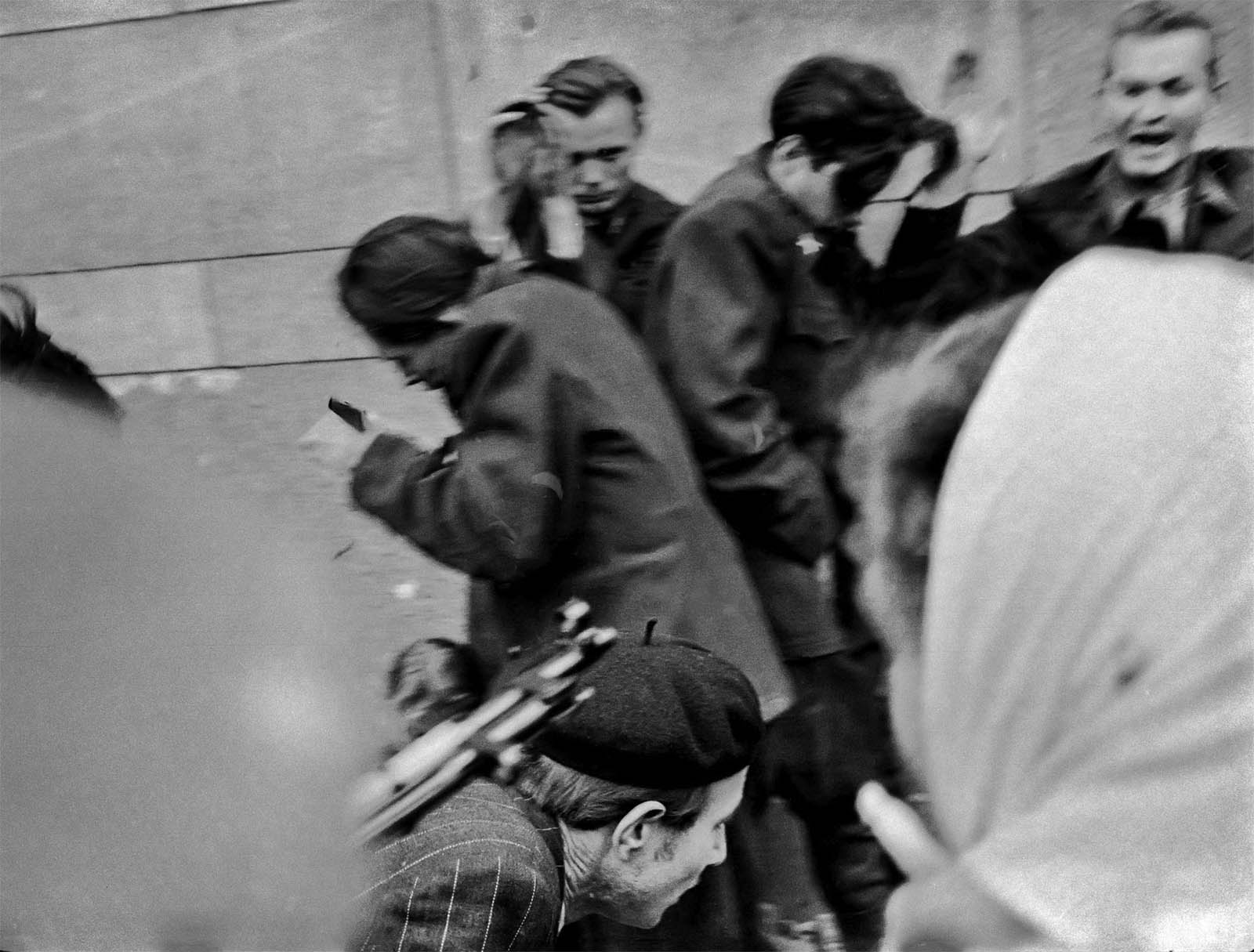
Conscript ÁVH soldiers at the wall of the party headquarters in Köztársaság Square
Hungary October 1956
The second of a series of shots showing an execution at close range. All those pictured were killed, except the man in the upper right corner, who was protesting his innocence.
John Sadovy (English born Czech, 1925-2010)
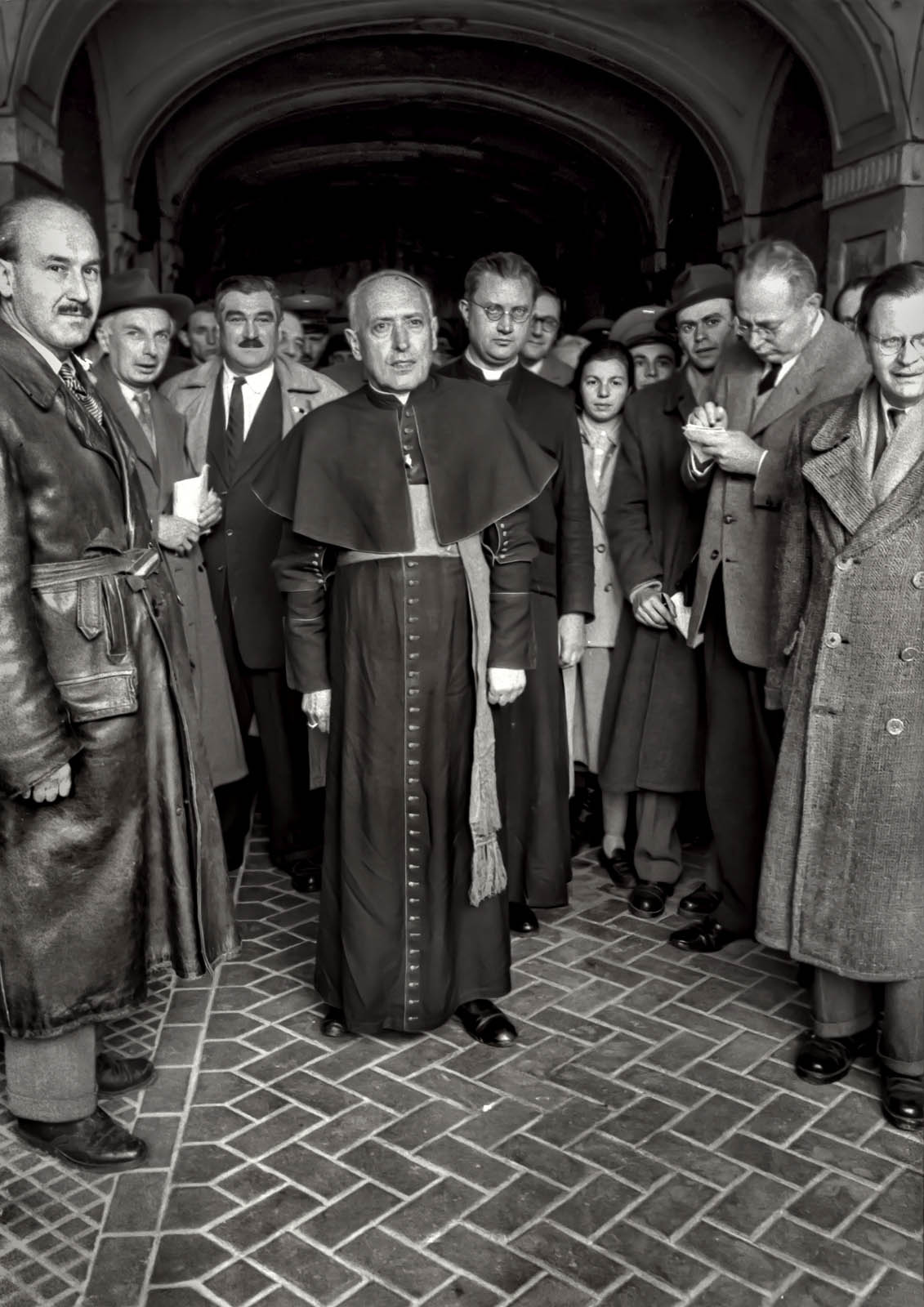
Cardinal and Prince-Primate József Mindszenty, who was released during the revolution, receives representatives of the Hungarian and foreign press in the courtyard of the Primate’s Palace in Úri Street. On the left, Pál Szőke, one of the organisers of the newly-formed Smallholders’ Party; behind Mindszenty’s left shoulder, János Tóth, former parish priest of the Regnum Marianum Church
Hungary October 1956
József Mindszenty (29 March 1892 – 6 May 1975) was a Hungarian cardinal of the Catholic Church who served as Archbishop of Esztergom and leader of the Catholic Church in Hungary from 1945 to 1973. According to the Encyclopaedia Britannica, for five decades “he personified uncompromising opposition to fascism and communism in Hungary”.
During World War II, Mindszenty was imprisoned by the pro-Nazi Arrow Cross Party. After the war, he opposed communism and communist persecution in his country. As a result, he was tortured and given a life sentence in a 1949 show trial that generated worldwide condemnation, including a United Nations resolution.
After eight years in prison, Mindszenty was freed in the Hungarian Revolution of 1956 and granted political asylum by the United States embassy in Budapest. He lived there for the next fifteen years. He was finally allowed to leave the country in 1971, and died in exile in 1975 in Vienna, Austria.
His cause for sainthood was opened in 1993 and Pope Francis declared him Venerable in 2019.
Text from the Wikipedia website
Marking the 70th anniversary of the 1956 Hungarian Revolution, the Liszt Institute London presents a new selection of works by Czech-born British photojournalist, John Sadovy (1925-2010), in collaboration with John Sadovy Estate Collection and Sadovy’s daughters, Yvonne Sadovy de Mitcheson and Liza Jane Sadovy.
John Sadovy was on assignment to cover the events of the Revolution by the American Life Magazine as a freelance photojournalist in Budapest. Having spent only four days in Hungary between the 29th October and the 1st November, primarily in Budapest and also at the Hungarian-Austrian border, he produced nearly 700 photographs.
Sadovy’s photographs were published in Life Magazine on the 12th November 1956 and distributed internationally, soon after earning him wide international acclaim, including the prestigious 1957 Robert Capa Gold Medal, The Art Directors’ Club Medal, The National Press Photographers’ Association, and Encyclopaedia Britannica. His images capture the dramatic violence of the Revolution, while depicting the atmosphere, the faces, unfolding events, and the stories of everyday lives on the street, with empathy and clarity.
“They’re what all popular revolutions are about: violence, bravery, hatred of oppressors.”
~ Timothy Foote, “A Big Story ‘Life’ is Made for”. Life, 12 November 1956, 2.
Born on a farm in the small village of Písek, Czech Republic (then Czechoslovakia) and destined to be a farmer himself, John Sadovy had always dreamed of becoming a photographer. In 1939, he left home and eventually joined the 8th Polish Army in Italy under British Allied Forces Command. After the end of World War Two, when given the choice between returning to Písek or going to the United Kingdom, he chose the latter and arrived to England with very little with him – including his camera bought in Italy – and without speaking the language. He ended up in London, where he married and had two children. Sadovy became a very successful photojournalist, working as a correspondent for Life, Time, Picture Post and Vogue, as well as covering conflict, political events and celebrities. He is best known for his coverage of the 1956 Hungarian Revolution, which affected the way the world saw the events in Hungary, however this is but a fraction of his life’s oeuvre.
Join us for the grand opening of the exhibition on 22 October. The evening will begin with a panel discussion featuring Dr Yvonne Sadovy de Mitcheson, one of Sadovy’s daughters; Dr Max Houghton, writer, curator and Course Leader of the MA Photojournalism and Documentary Photography programme at London College of Communication; Eva Norton, historian and educator; and Botond Zákonyi, Director of the Liszt Institute, Hungarian Cultural Centre London.
The panel will explore the role of photojournalism in shaping collective memory and public understanding of historic events. Focusing on Sadovy’s iconic photographs of the brief uprising, the discussion will consider how press images can preserve events that might otherwise be forgotten or distorted for political purposes. Together, the exhibition and panel will highlight the enduring significance of photojournalism within a contemporary context, while reflecting on the power of images to document history and influence public perception.
“A year ago, I may not have heard of Sadovy nor seen any of his work. Now, however, having worked with his intensely dramatic photographs of the 1956 Revolution, I do not believe I will ever forget them.”
~ Colin Ford, CBE, 2016
Text from the Liszt Institute London website
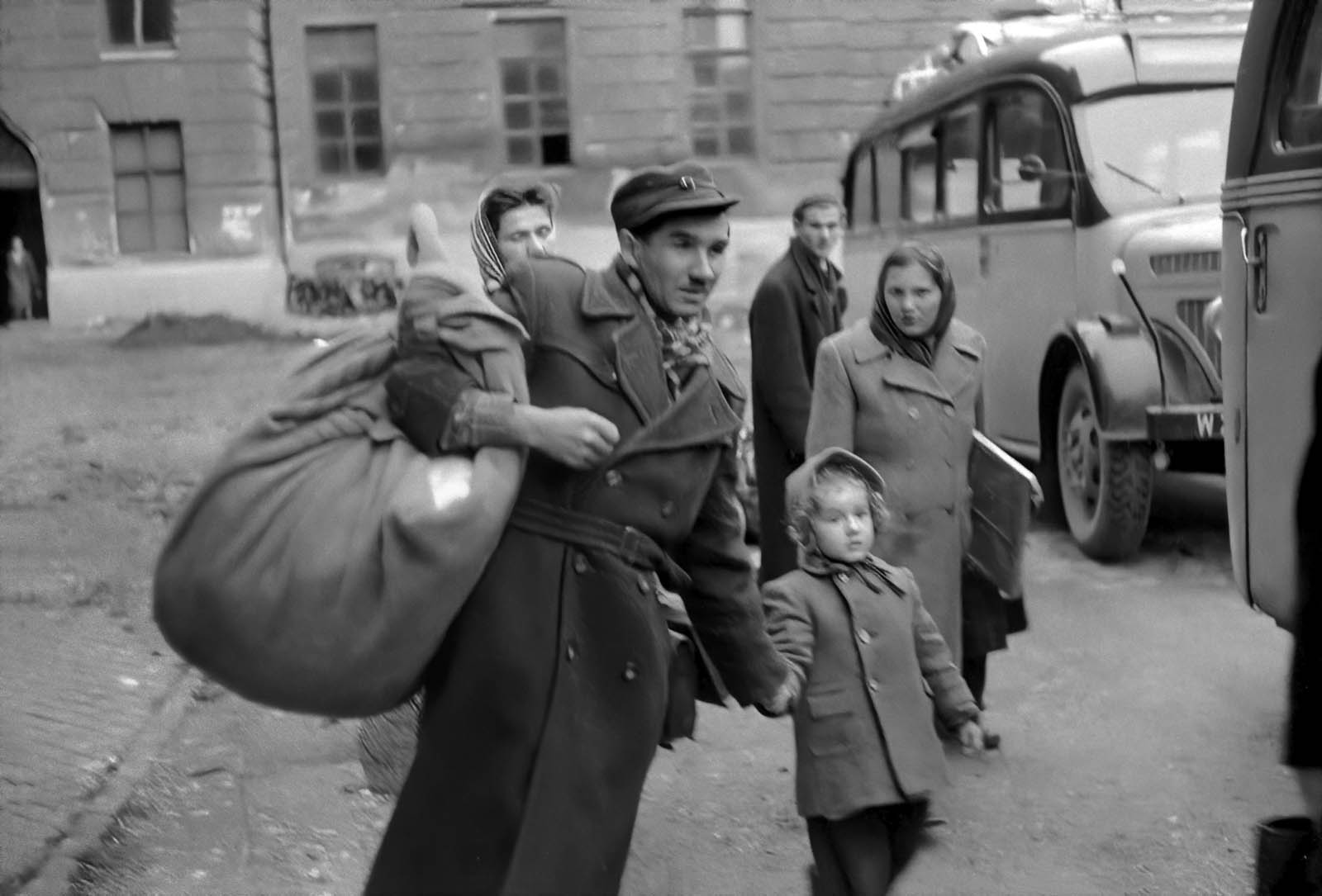
John Sadovy (English born Czech, 1925-2010)
Hungarians in the yard of the Traiskirchen refugee camp
Hungary October 1956
NB. Traiskirchen refugee camp is outside Vienna, Austria, so the location may be incorrect.
The Traiskirchen refugee camp (officially the Bundesbetreuungsstelle für Asylwerber) is Austria’s largest and oldest reception centre for asylum seekers.
Traiskirchen is the home of the largest refugee camp in Austria and one of the largest of these camps in the EU. The refugee camp is based in the centre of Traiskirchen on the area of the former Imperial Artillery Cadet School which was built in 1900.
The buildings were first used by the government as a refugee camp between 1956 and 1960. The camp was first used as a shelter for Hungarian refugees, who had left their country as a result of the Hungarian Revolution in November 1956. 113,810 people came to Austria on the 5th of November, and 6,000 were taken to the camp in Traiskirchen.
Text from the Wikipedia website
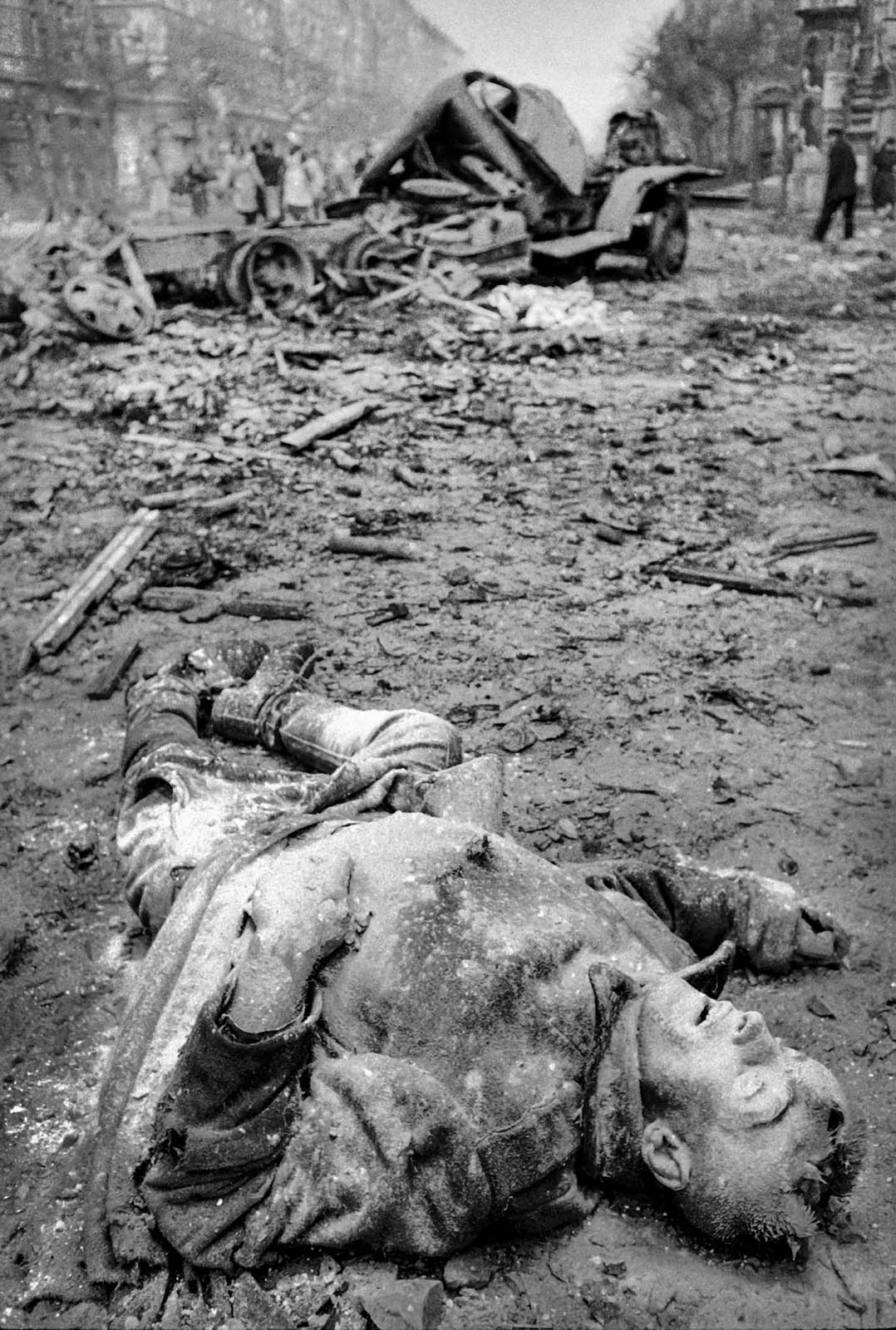
John Sadovy (English born Czech, 1925-2010)
A Soviet soldier killed in action in József Boulevard, at the corner of Práter Street. The body was sprinkled with lime to avoid the risk of contamination
Hungary October 1956
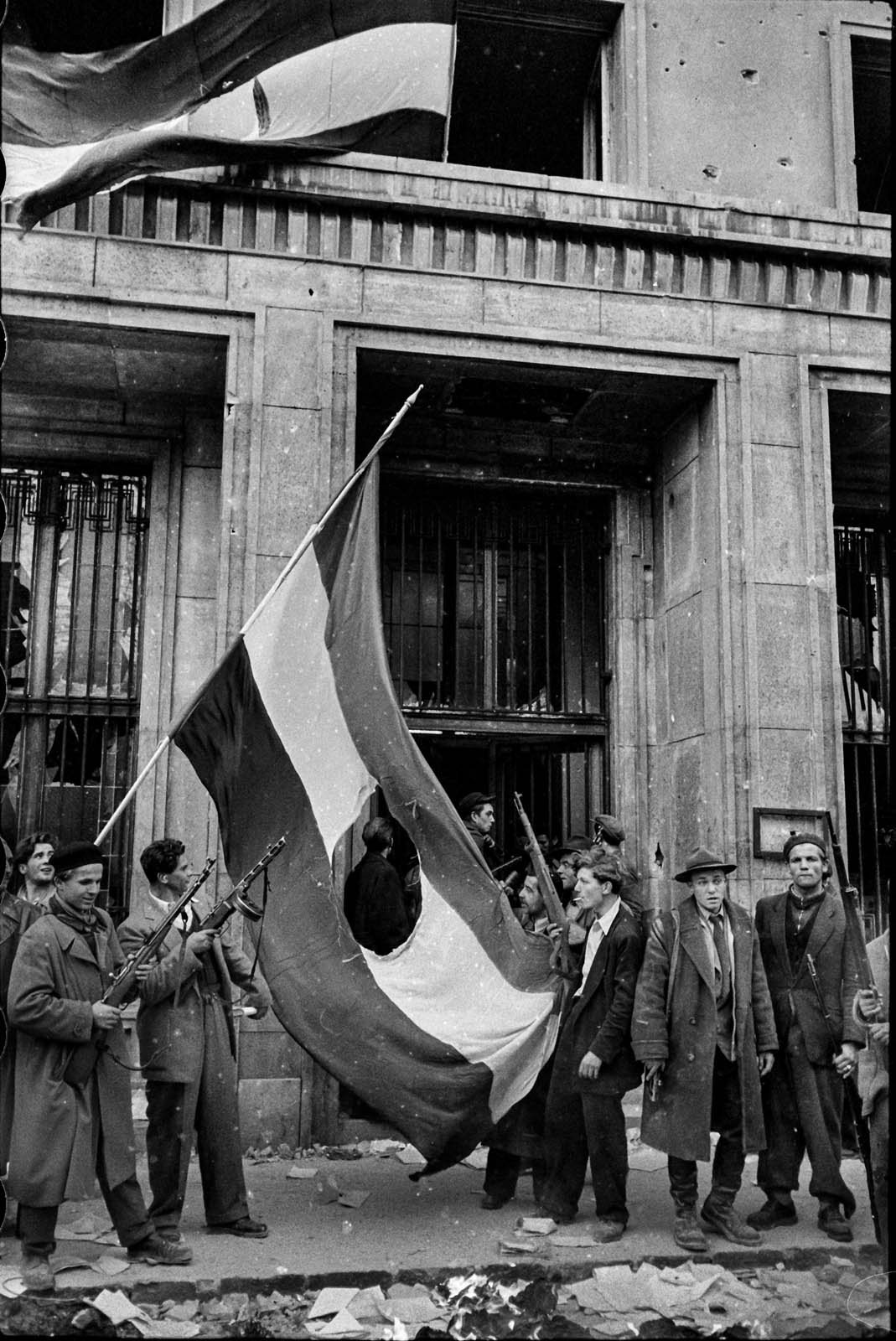
John Sadovy (English born Czech, 1925-2010)
Insurgents with a ‘flag with a hole’ symbol of the revolution
Hungary October 1956
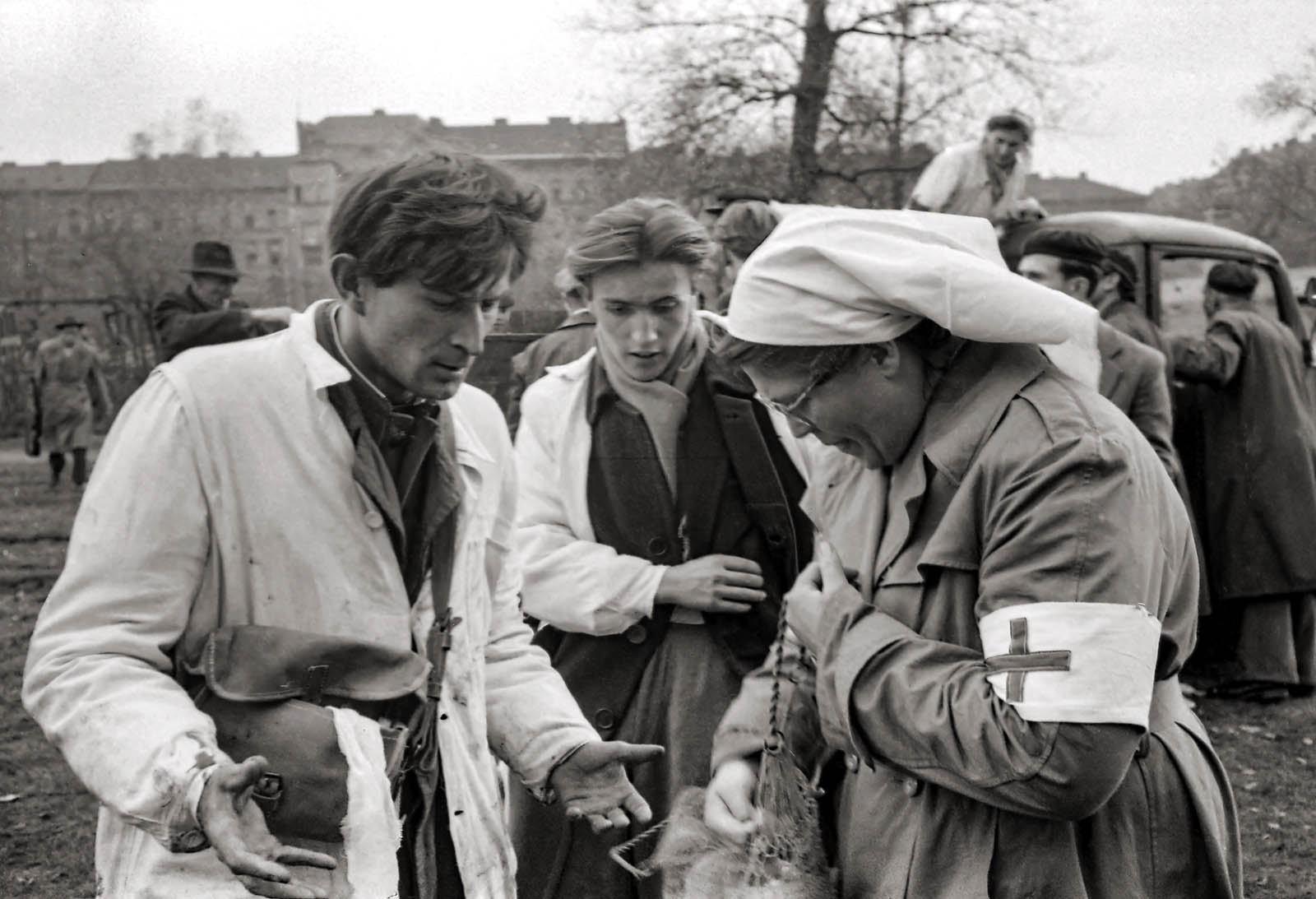
John Sadovy (English born Czech, 1925-2010)
Red Cross workers in Köztársaság Square
Hungary October 1956
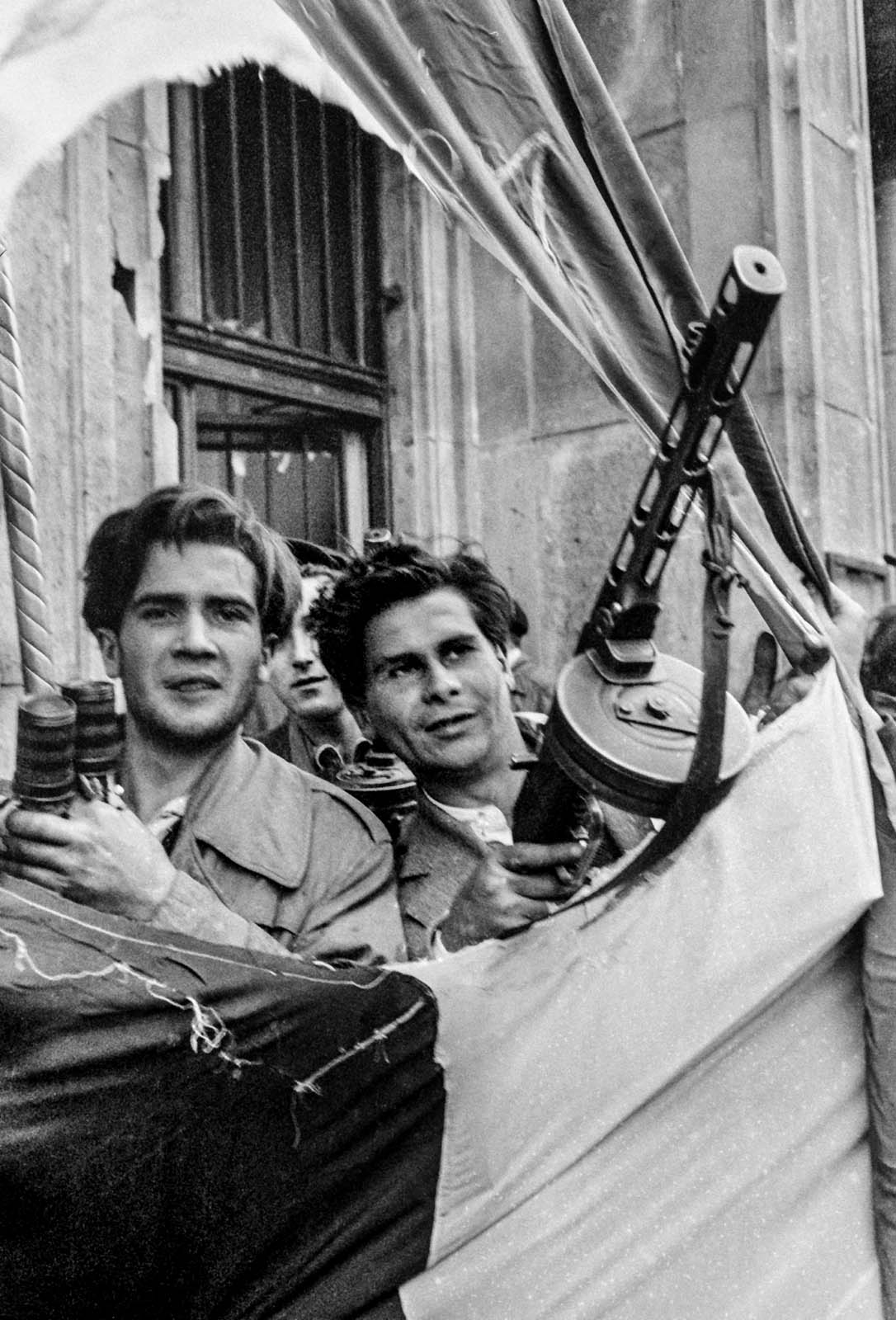
John Sadovy (English born Czech, 1925-2010)
After the occupation of the party headquarters, two armed insurgents pose through the slit of the “flag with a hole” that has become a symbol of the revolution. The man on the right is holding a submachine gun with a drum magazine, the man on the left (Arnold Gerbicz) is holding grenades
Hungary October 1956
Arnold Gerbicz was an armed Hungarian rebel who fought in the Csengery Street group during the 1956 Hungarian Revolution in Budapest.
Following the suppression of the 1956 Hungarian Revolution by Soviet forces, Arnold Gerbicz survived and successfully escaped Hungary, ultimately settling in Manchester, England.
When the Soviet military launched Operation Whirlwind on 4 November 1956 to crush the revolution, armed cells like the Csengery Street Group (to which Gerbicz and his wife, Gabriella, belonged) were targeted. Facing mass arrests, executions, and heavy reprisals from the puppet Kádár regime, Gerbicz joined the exodus of approximately 200,000 Hungarian refugees who fled across the border into Austria.
Instead of staying in the continental refugee camps or migrating to places like Australia or the US, Gerbicz migrated to the United Kingdom.
For decades, the two young men in John Sadovy’s famous photograph – peering through the circular cutout of the revolutionary flag – remained unidentified icons. Decades later, historical researchers (working alongside institutions like the Committee of National Memory) officially identified Gerbicz after his daughter, Margit Stevens, came forward to confirm his identity and provide details of his life post-1956.
Text from various sources
The Csengery Street Group in the Siege of the Party Headquarters at Köztársaság Square
On the morning of October 30, the insurgents from Csengery Street—much like others across the city – heard reports that “ÁVH men were firing on the people” at Köztársaság Square. According to István Hegedűs, head of the district’s National Committee, a man named Steiner reported this to him; however, Hegedűs refused to authorize the armed men attached to the district committee to move to another district for any operation. The insurgents’ commander, however, no longer accepted such orders; under his leadership, the group rushed to the scene and took part in the siege of the Budapest Party Committee building. “Together with Sándor Horváth, we fired at the party headquarters from behind cover near the Erkel Theatre. I fired about 40 rounds, while Horváth emptied one magazine. [Antal] ‘Föcske’ fired from the ground floor; he had two magazines. [Jenő] Lengyel also opened fire,” testified István Huzián. Most members of the group also fired upon the headquarters from the direction of the Erkel Theatre. As is well known, tanks dispatched to relieve the party headquarters mistakenly aided the besiegers, who captured the facility in the early afternoon. No convincing evidence has emerged, however, to suggest that the Csengery Street group participated in any acts of summary justice against the defenders.
Eörsi László. “A Csengery Utcai Csoport, 1956,” on the Beszelo website Nd [Online] Cited 23/10/2026 (translated from Hungarian by Google Translate). Used under fair use conditions for the purposes of education and research
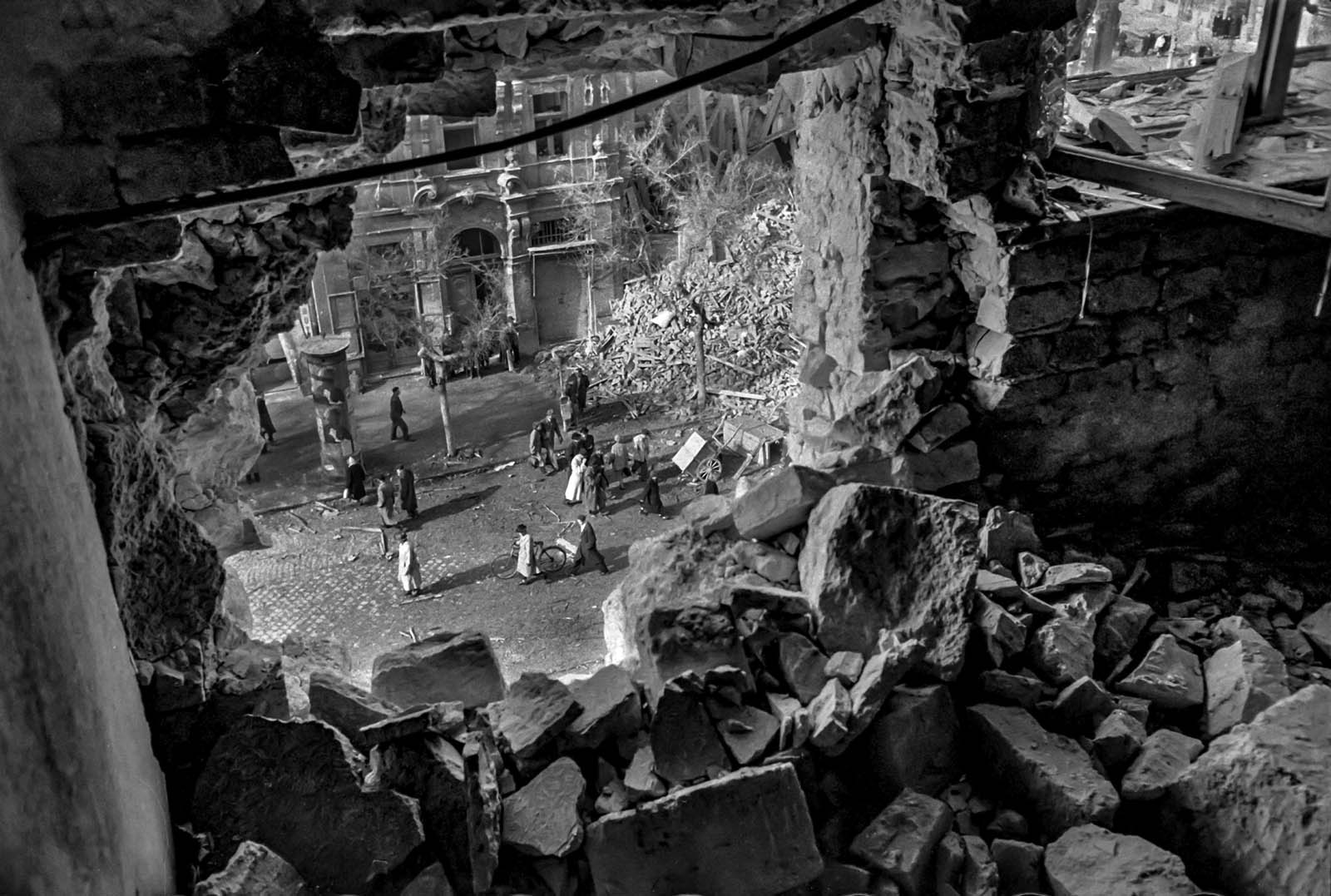
John Sadovy (English born Czech, 1925-2010)
View onto Ferenc Boulevard from a damaged upstairs room in the Kilián Barracks
Hungary October 1956
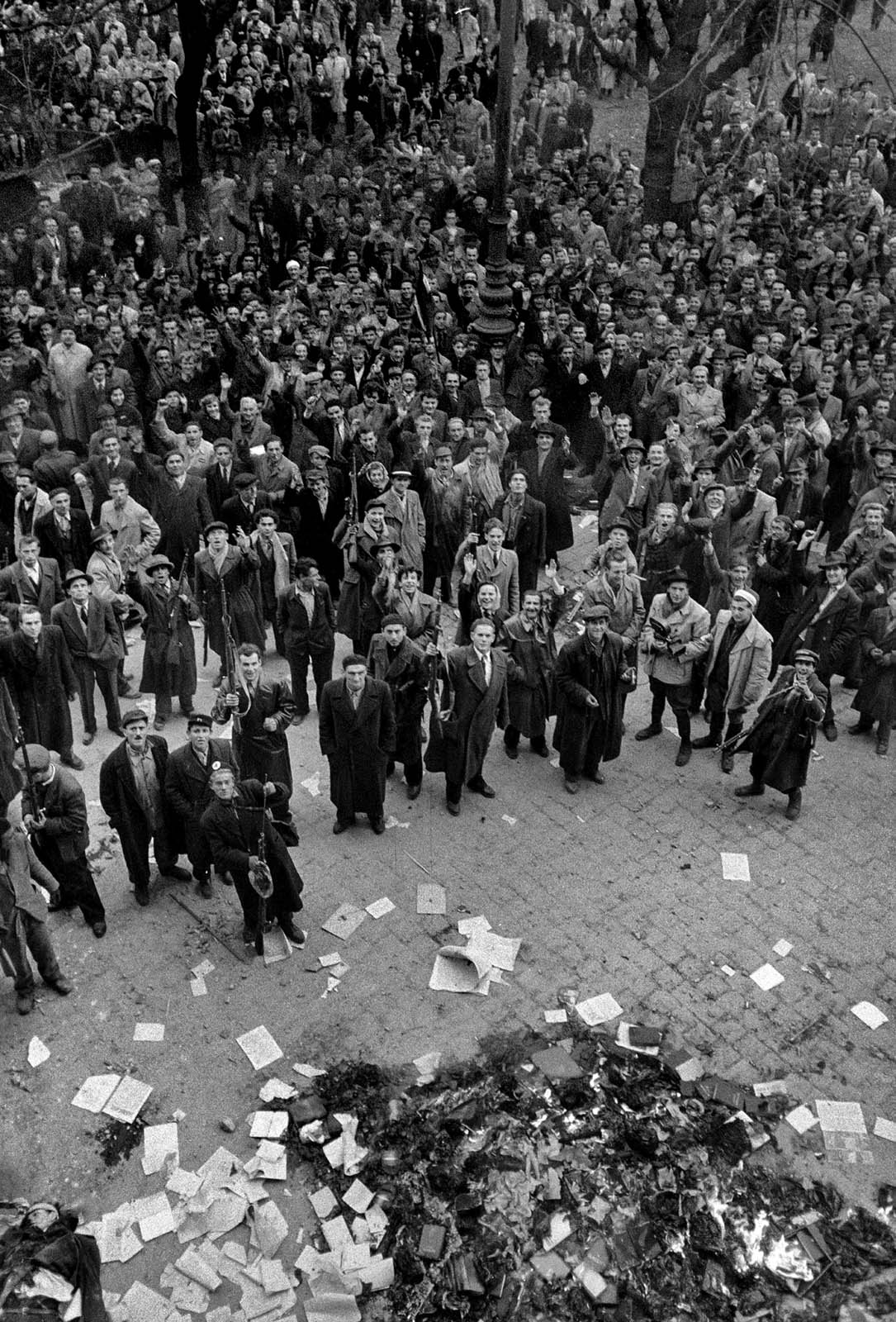
John Sadovy (English born Czech, 1925-2010)
The crowd in front of the party headquarters in Köztársaság Square. Several people wave at Sadovy, who is taking photos from upstairs in the party headquarters. In the foreground, communist propaganda material is thrown on the fire
Hungary October 1956
Exhibition commemorates the anniversary of the 1956 Hungarian Revolution with award-winning photographer
From October 22 to November 4, the Hungarian Cultural Centre in London marks the 70th anniversary of the 1956 Hungarian Revolution with captivating images.
Although the Hungarian struggle against Soviet hegemony ended in defeat, this popular uprising marked the beginning of the twilight of communism in Europe – a process that, through the events in Czechoslovakia in 1968 and Poland in 1981, led to the fall of the Berlin Wall in 1989.
In 1956, numerous Western journalists arrived in Budapest to report on the events. Commissioned by LIFE magazine, photographer John Sadovy was among the first to enter the country; he captured several major events of the revolutionary days, a feat for which he was later awarded the prestigious Robert Capa Prize. The current exhibition presents these photographs, including previously unseen material from the photographer’s wider work.
The impact of the 1956 Hungarian Uprising is still felt today; its international legacy could be discerned in commentaries on the Russian invasion of Ukraine, and in Hungary, in the outcome of this year’s parliamentary election.
Our shared understanding of these historical events – reinforced by images captured at the time – serves as an important reminder of just how fragile democracy is.
The exhibition is hosted at the gallery of the Liszt Institute – Hungarian Cultural Centre: 17-19 Cockspur St, London SW1Y 5BL and is open on weekdays between 11.00 am and 6.00 pm until 4th November 2026.
Press release from the Liszt Institute
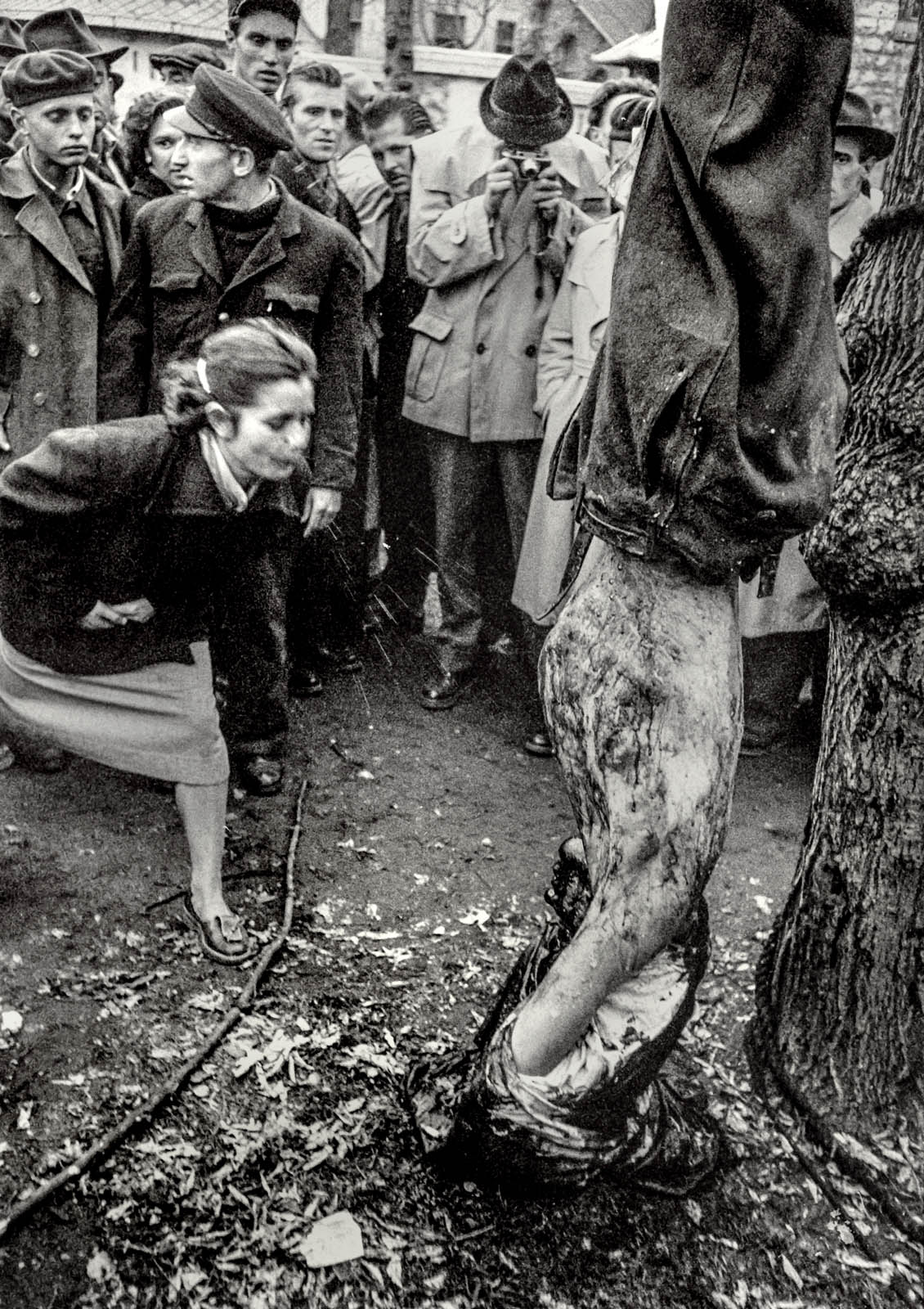
John Sadovy (English born Czech, 1925-2010)
Woman spits in contempt on the body of a suspected AVO police agent suspended by his feet in Köztársaság Square
Hungary October 1956
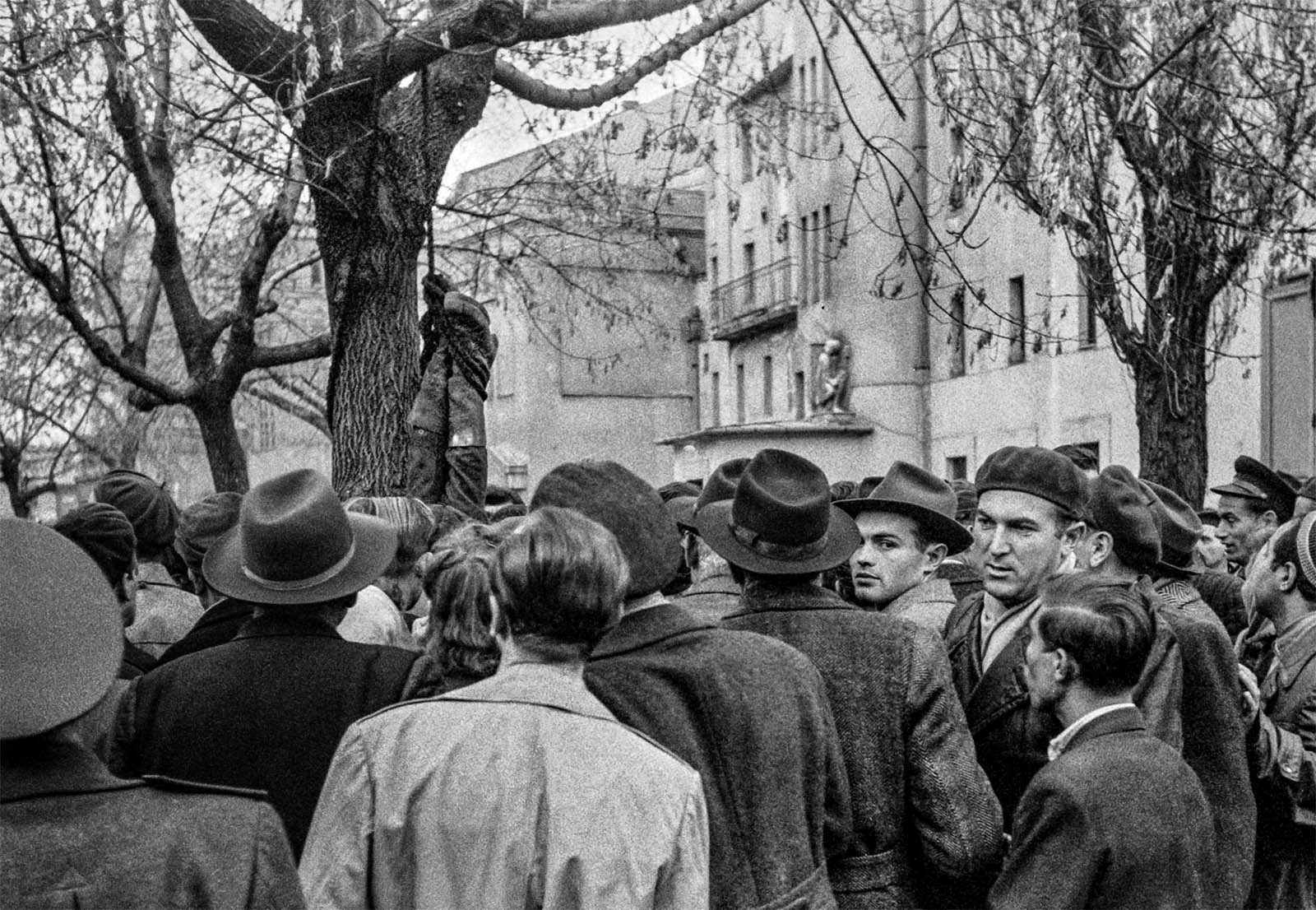
John Sadovy (English born Czech, 1925-2010)
The body of a member of the Soviet security police, who was beaten to death
Hungary October 1956
Probably a wider shot of the AVO police agent suspended by his feet (above)
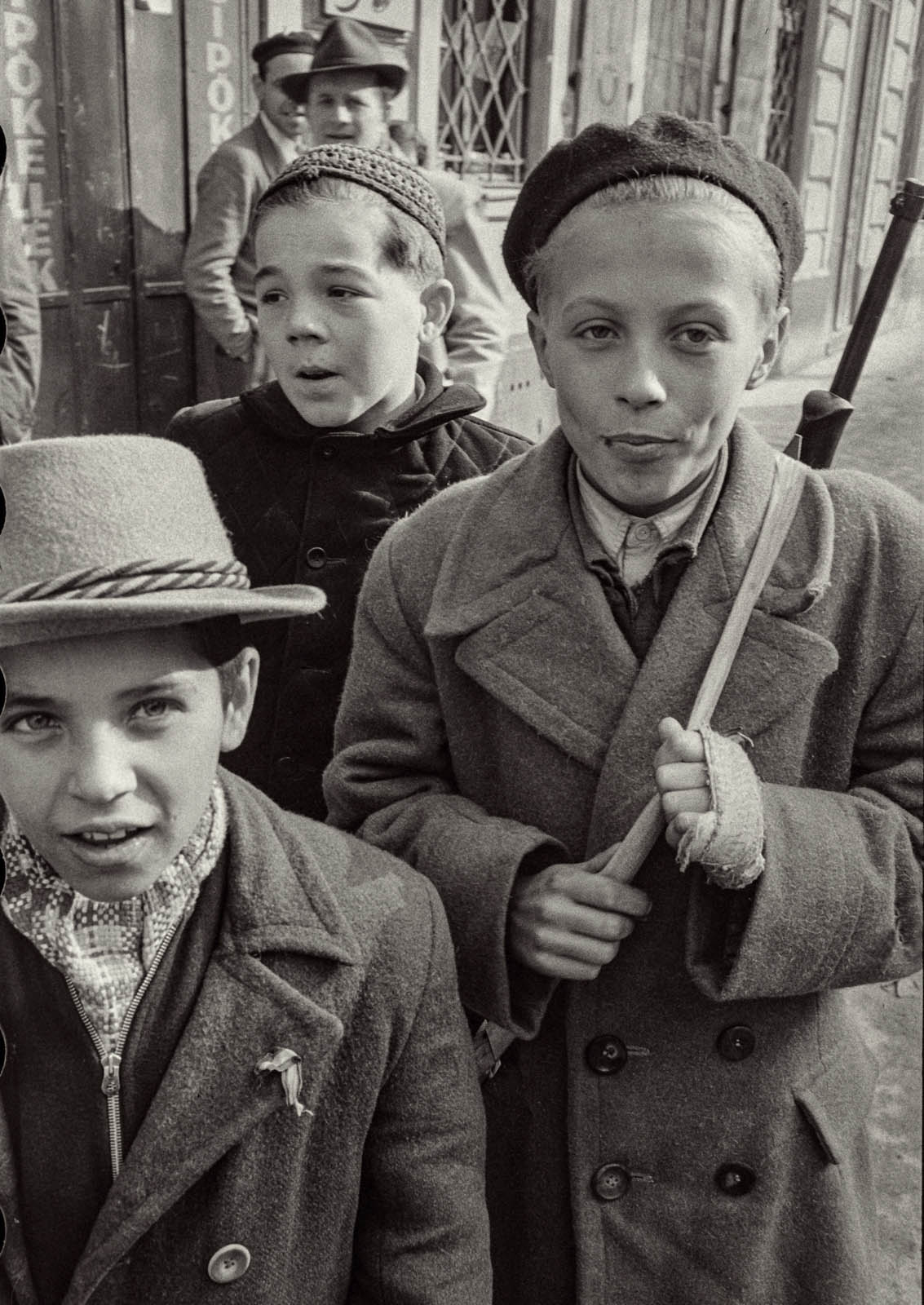
John Sadovy (English born Czech, 1925-2010)
Three young teenagers at the corner of Üllői Avenue and Kisfaludy Street. One of them is carrying a small rifle on his back and has a bandage on his hand; the one in the foreground is wearing a cockade on his jacket
Hungary October 1956
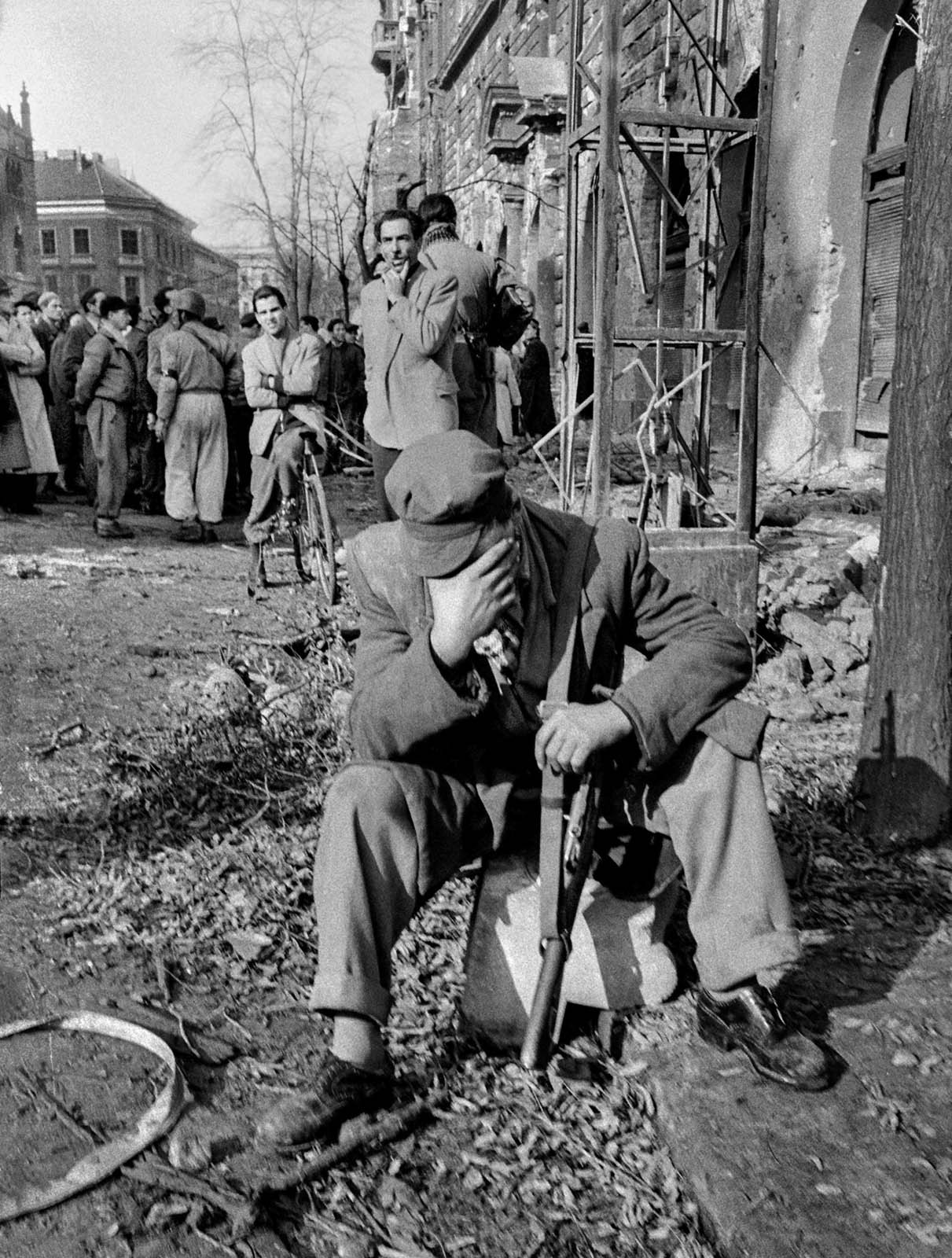
John Sadovy (English born Czech, 1925-2010)
Freedom fighter burying his face in his palms in front of the house at 36 Üllői Avenue
Hungary October 1956
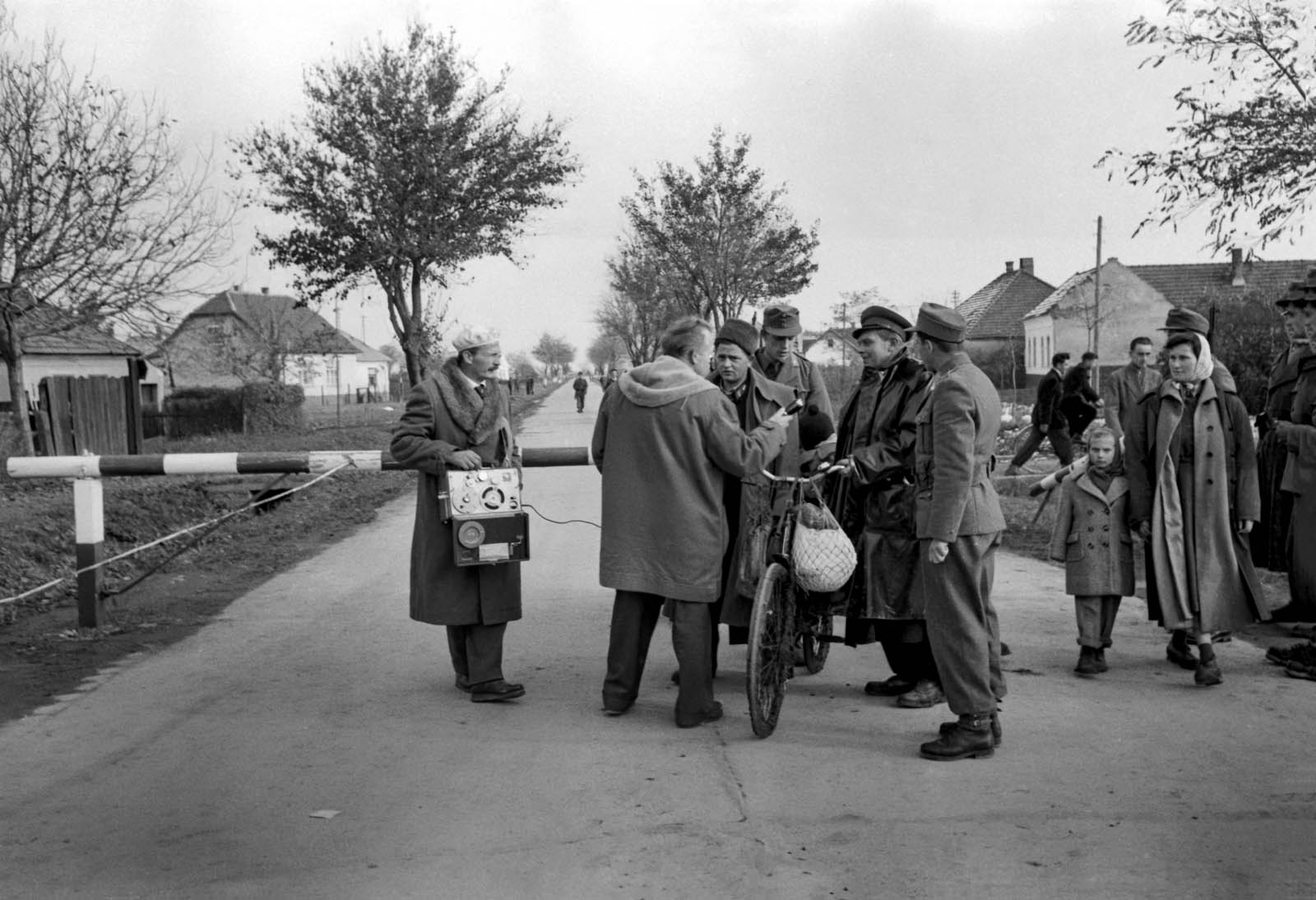
John Sadovy (English born Czech, 1925-2010)
Untitled
Hungary October 1956
The photograph shows a groups with bicycles and children at a border crossing during the Hungarian Revolution of 1956 (around October 31, 1956) near Nickelsdorf, Austria, where Hungarian refugees fled across the border.
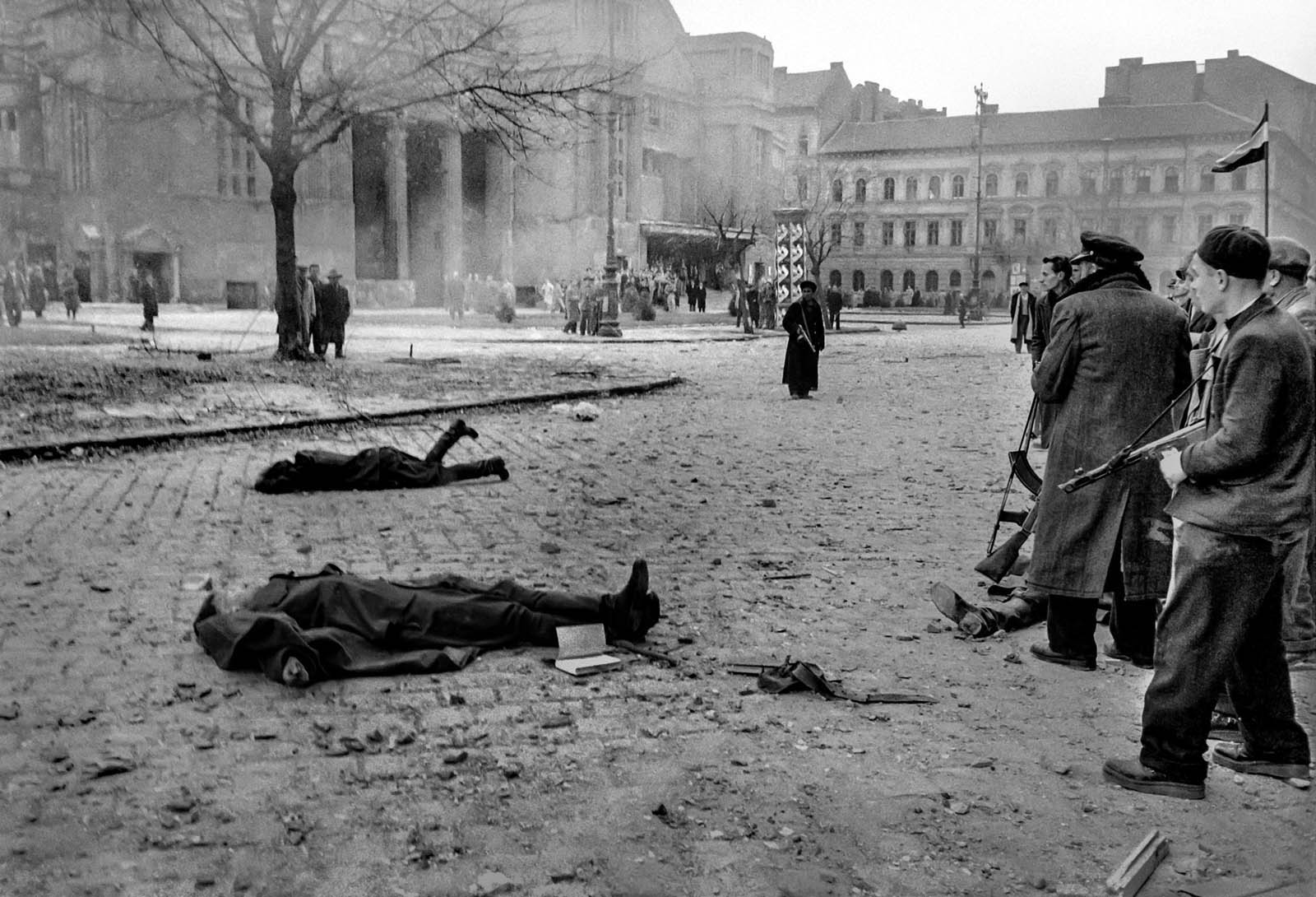
John Sadovy (English born Czech, 1925-2010)
Untitled
Hungary October 1956
The image shows armed Hungarian freedom fighters and bodies on the cobblestone square outside the Communist Party headquarters on Republic Square (Köztársaság tér) in Budapest during the Hungarian Revolution of 1956.
Armed anti-communist revolutionaries stand guard with captured or distributed weapons (including submachine guns) alongside the bodies of defenders and secret police (ÁVH) members who were killed or summarily executed during the heavy fighting.
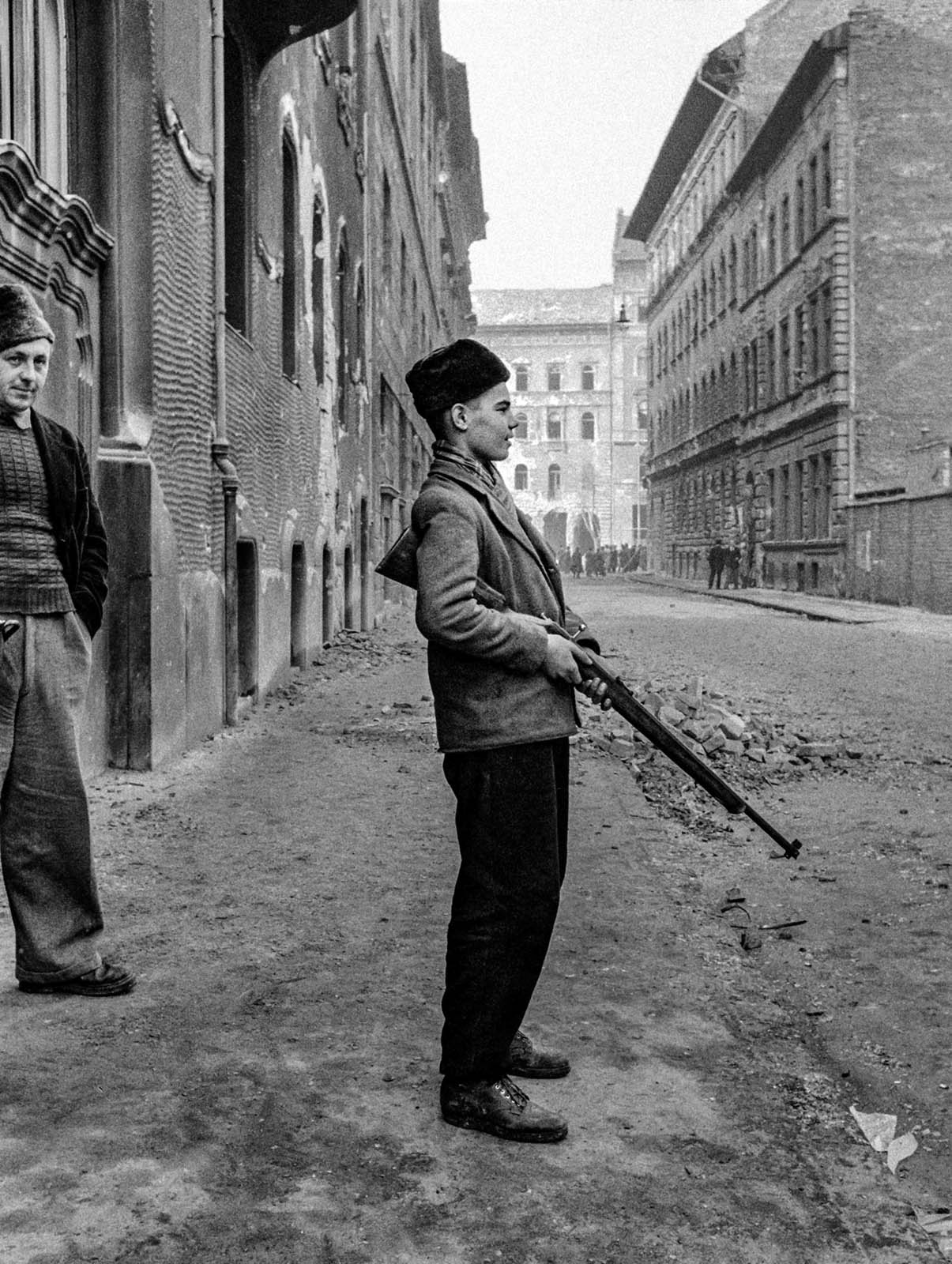
John Sadovy (English born Czech, 1925-2010)
Untitled
Hungary October 1956
Liszt Institute London
7-19 Cockspur St, London SW1Y 5BL
Opening hours:
Monday – Friday, 11.00am – 6.00pm





You must be logged in to post a comment.