Exhibition dates: 27th November – 7th December, 2008
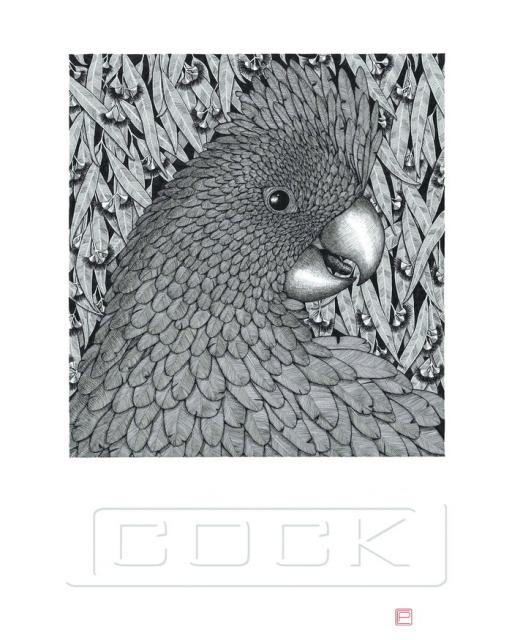
Patrick Christie (Australian) Black COCKatoo 2008 53 x 44cm ink on paper with hand embossing
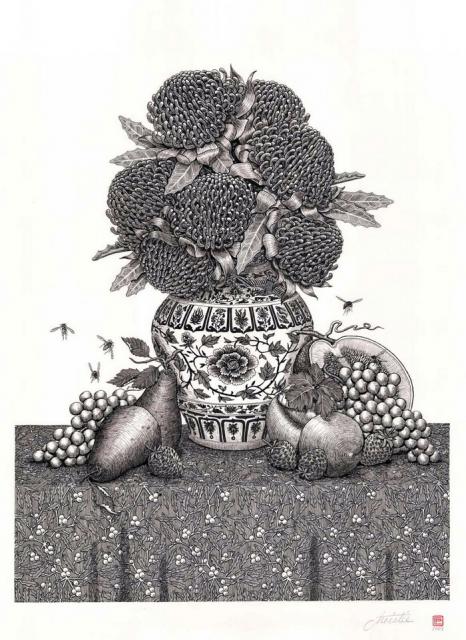
This is the first exhibition by artist Patrick Christie exhibiting at Green-Wood gallery in South Melbourne. The ink illustrations are a feature native botanical specimens, beetles of various varieties and colourful birds – a red COCK, a blue peaCOCK and a black COCKatoo (the ‘cocks’ of the title). While the beetle images and the cowboy illustrations feel flat and uninspired it is the larger flower arrangements and the beautifully detailed birds that hold the attention.
With an abundance in the rendering of their subject matter both produce an uplifting cornucopia – vase, flowers, fruit and material overflowing; feathers of the Black COCKatoo repeating and blending like an Escher drawing into the gum leaves behind. The hand marks the page again and again forming exquisite line. Dutch still life of the 17th century comes to mind with the flower arrangements and whilst I like the embossed word COCK under the bird images I am not sure it is really necessary. The drawings are strong enough to stand on their own.
There is real talent here. Yes the exhibition needed more conceptual rigour as the whole did not match the sum of the parts. Yes the framing needs attention especially in the bird series, where simpler frames with more space around the images would have let the work breathe but these things can be addressed. For an artist what needs to be there from the start is passion, a good eye and the talent to develop a personal language that is vibrant, interesting and unique – that can be nurtured and developed over many years. This exhibition sets Patrick Christie squarely on this path.
Dr Marcus Bunyan
Patrick Christie (Australian) 5 Wasps 2008 67 x 50cm ink on paper
“The photographs tell detached but psychologically emotional stories about what human beings are doing to the world in which they live.” Dr Marcus Bunyan
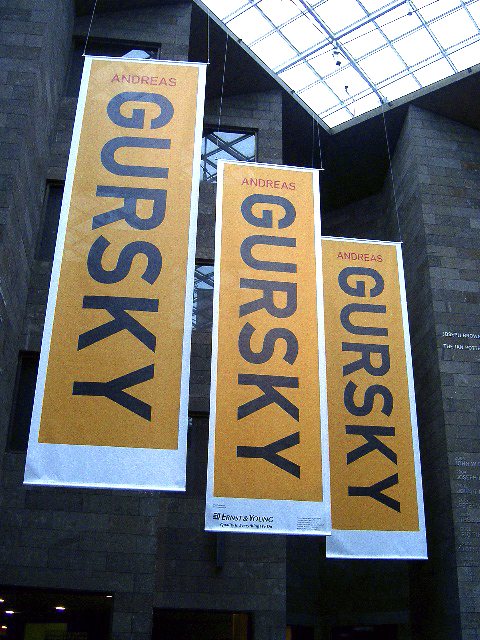
Andreas Gursky banner at NGV International exhibition, Melbourne
A large but plain crowd assembled for the opening of the first exhibition by world renowned German photographer Andreas Gursky at the National Gallery of Victoria in St Kilda Road, Melbourne. After some lively conversation with friends and following the opening speeches we wandered into a large clean gallery space with minimal design elements. The use of space within the gallery allowed the work to speak for itself. It is a minimal hang and the exhibition works all the better for this.
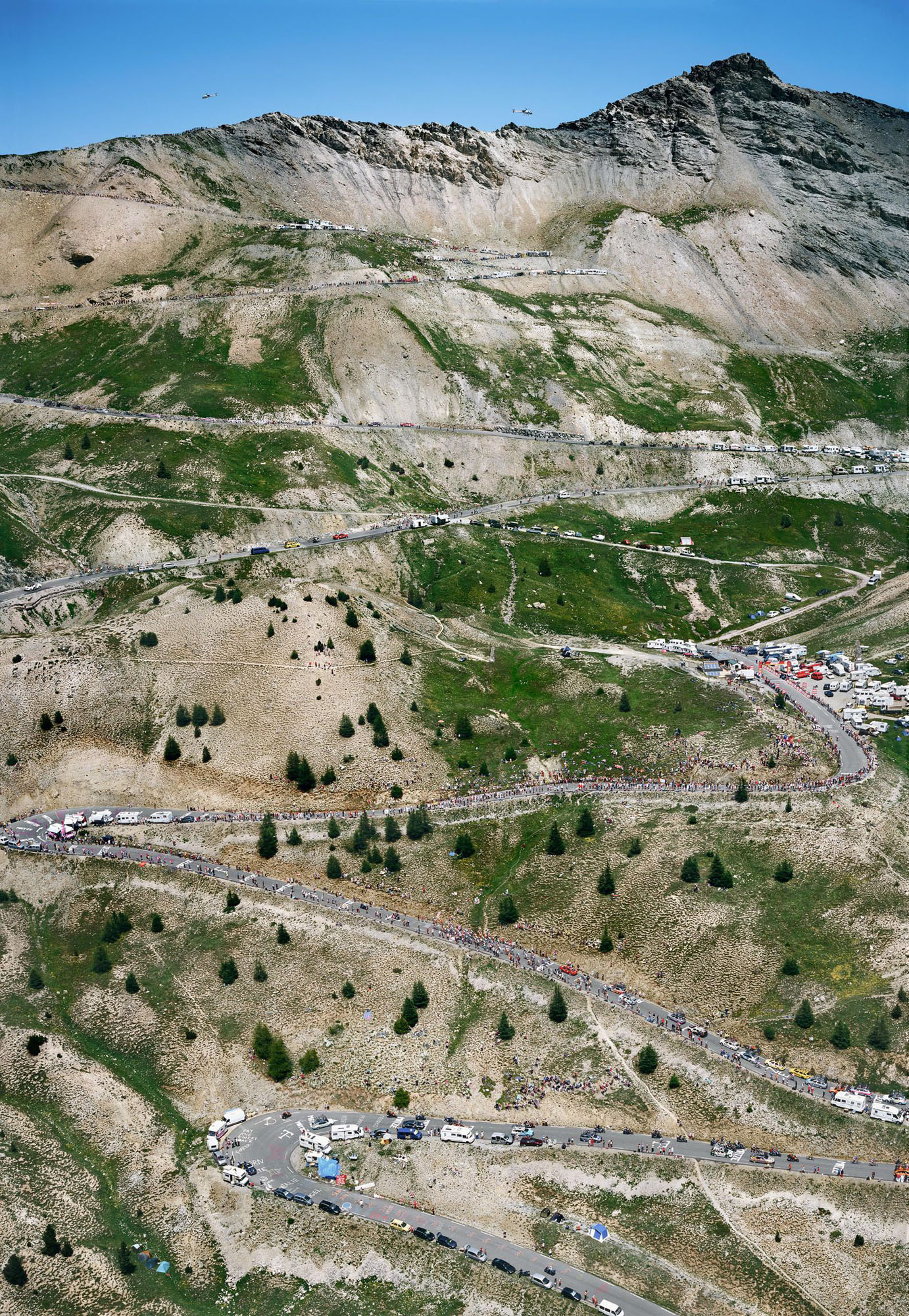
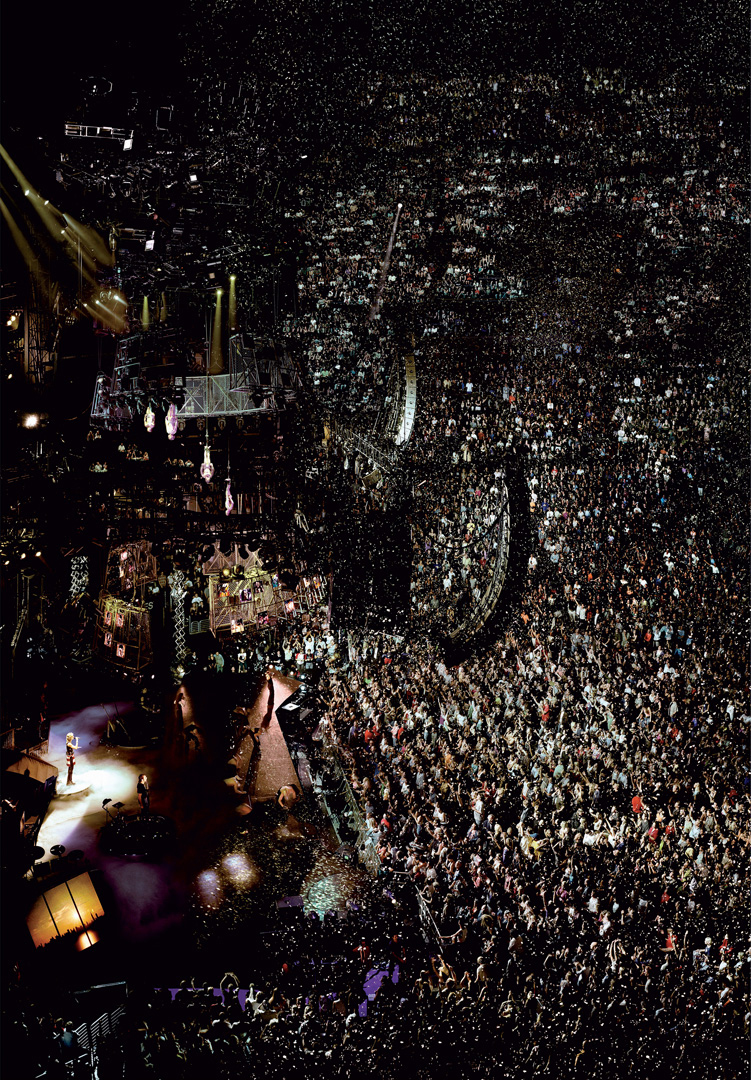
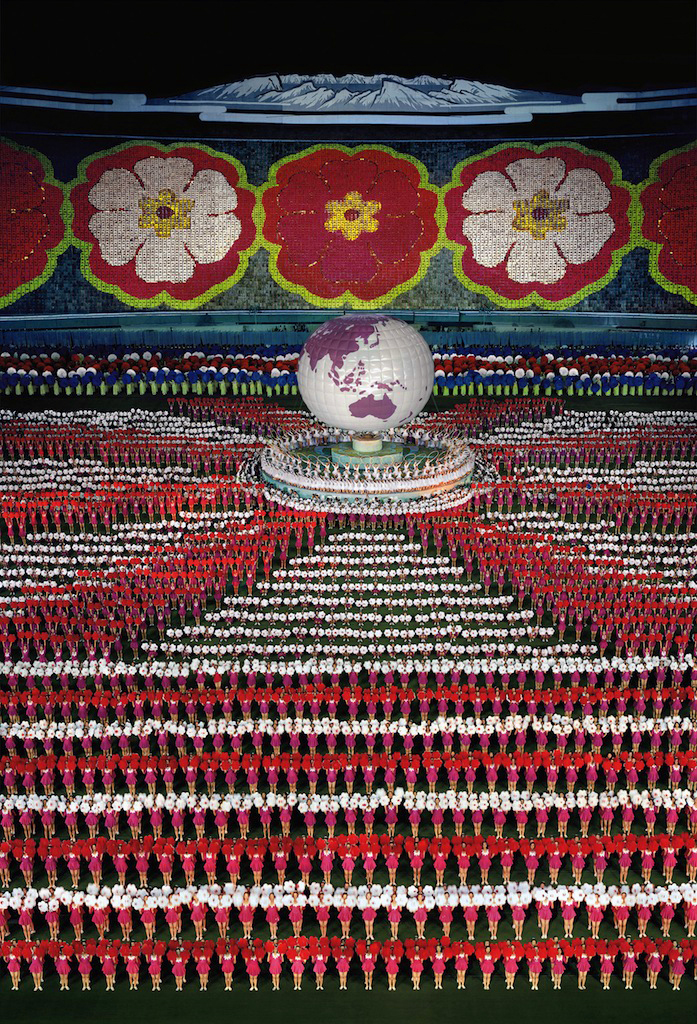
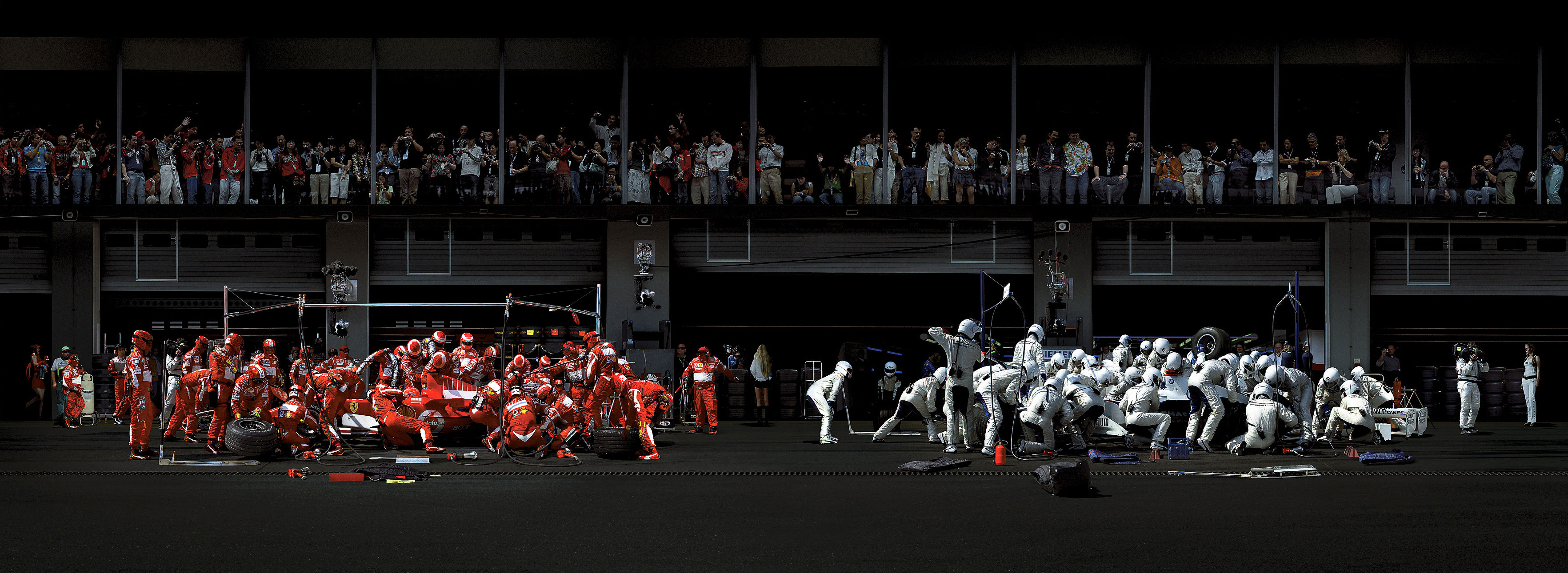
As for the work itself 21 large photographs are presented ranging from landscapes to buildings, race tracks to formula 1 pits, Madonna concerts to the Tour de France.
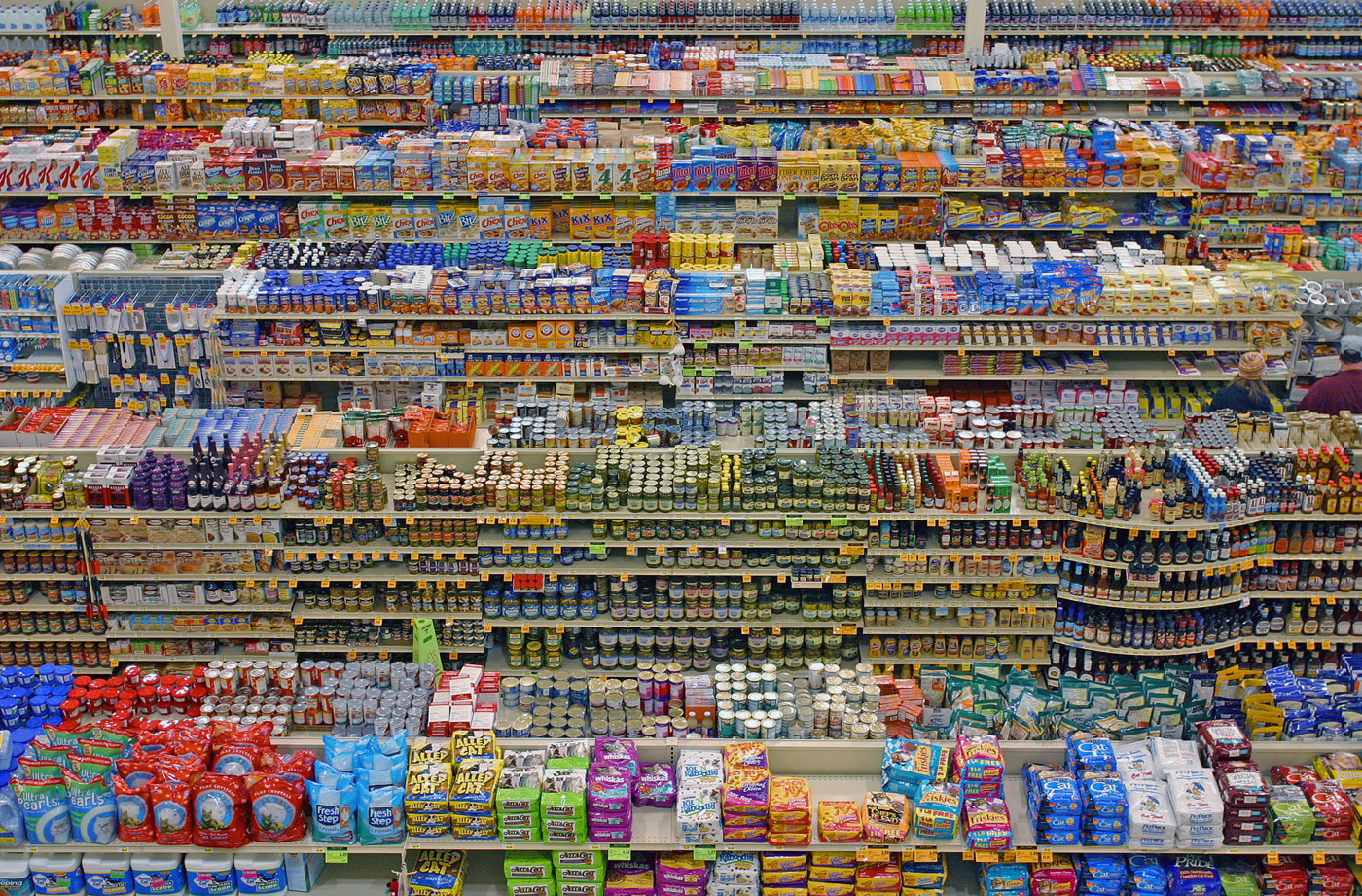
Most work successfully in building a hyperreal vision of the world. We are not sure what is ‘real’ or hyperreal, what is a straight photograph or what has been digitally manipulated and woven together. The colour and sharpness of the images is often intensified: in reproductions of the famous photograph of the 99c supermarket in America the colours seem flat but ‘in the flesh’ the colours are almost fluoro in their saturation and brightness.
Having said that the photographs are nearly always unemotional – as though seen from above in the third person, they observe with detachment. The intrigue for the viewer is in the detail, in working out what is going on, but these are not passionate photographs on the surface. It is beneath the surface that the photographs have their psychological effect: the best of the images work on the subconscious of the viewer.
Like a fantastical dance the three very wide images of the Formula 1 pits feature pit crews practicing tyre changes, frozen in a choreographed ballet; people in the galleries above stare down; pit lane girls seem to have been inserted digitally into the images, standing at side or behind the pit crews in a seemingly surreal comment on these worlds. These are theatrical tableaux vivant, splashed with teams colours. Fantastic photographs.
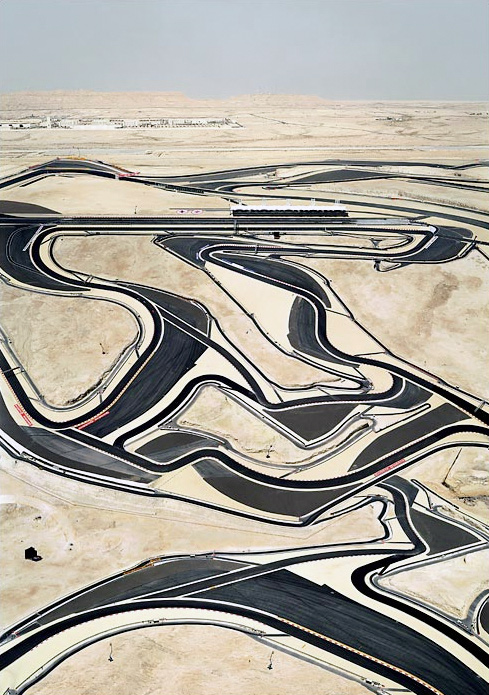
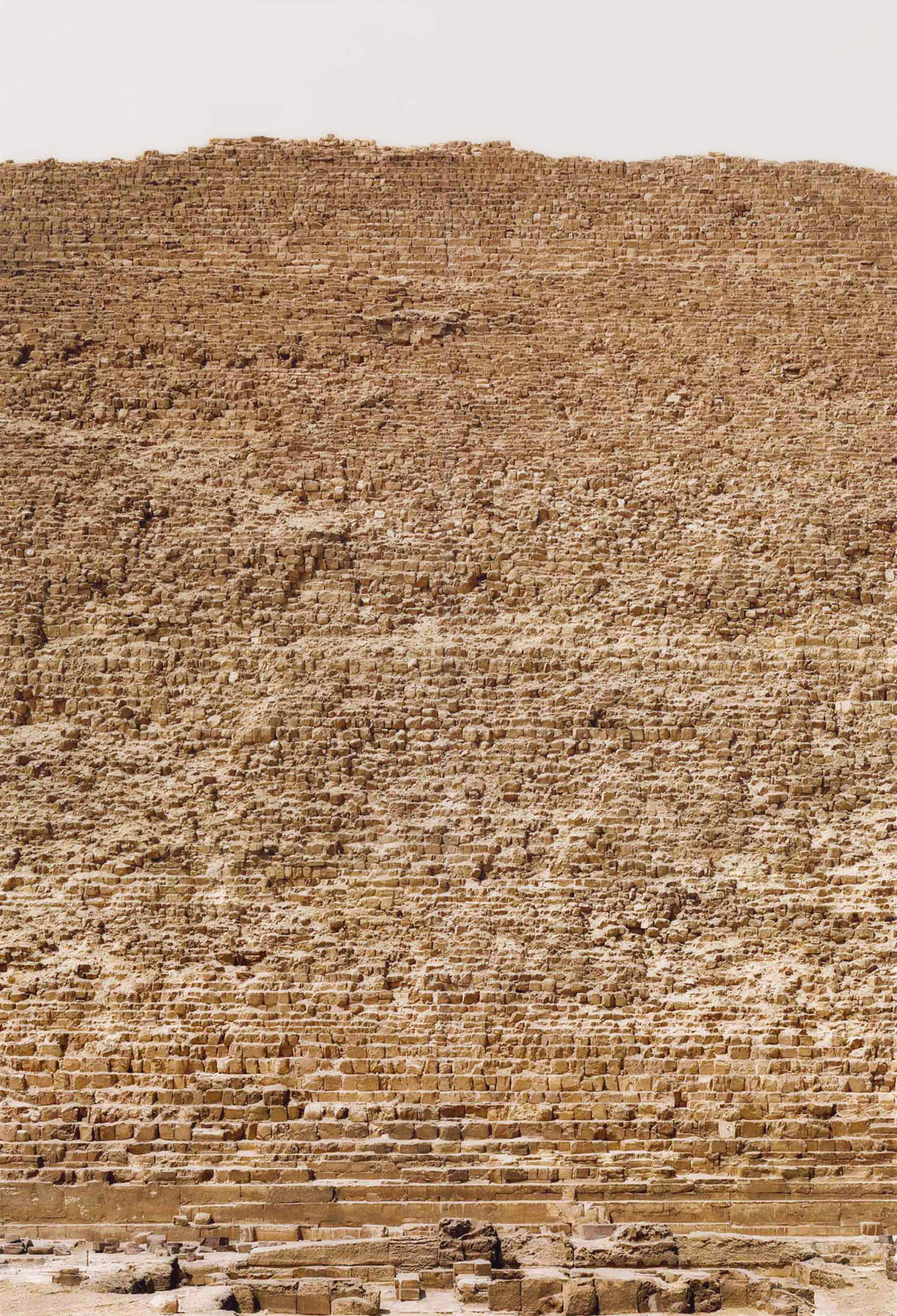
In some of the images, such as the Madonna concert or the photograph of the Bahrain Formula 1 racetrack, space seems to have folded in on itself and the viewer is unsure of the structure of the image and of their vantage point in looking at them. Space also collapses in the photograph of the pyramid of Cheops (2006, below), where the depth of field from foreground to background of the image is negligible. Less successful are images of a Jackson Pollock painting and a green grass bank with running river (Rhein II 1996, below), intensified beyond belief so that the river seems almost to be made of liquid silver.
The photographs tell detached but psychologically emotional stories about what human beings are doing to the world in which they live. These images are a commentary on the state of this relationship – images of repetition, pattern, construction, use, abuse and fantasy woven into hyperreal visions of an unnatural world.
A wonderful exhibition in many aspects, well worth a visit to see one of the world’s best photographers at work.
Dr Marcus Bunyan
Many thankx to the National Gallery of Victoria for inviting me to the opening and for allowing me to publish the photographs in the posting. Please click on the photographs for a larger version of the image.
For the first time in Australia, an exhibition by German contemporary photographer Andreas Gursky opened at the National Gallery of Victoria. From the Haus der Kunst in Munich, Andreas Gursky presents 21 major works for which the artist is internationally acclaimed. The photographs range from 1989 to 2007 and include seminal works such as Tokyo Stock Exchange and the diptych 99 cent store. Andreas Gursky is recognised as one of the world’s leading contemporary artists. On view through 22 February, 2009.
Well known for his large-scale (generally measuring an astounding four to five metres) and extraordinarily detailed photographs of contemporary life, Gursky continues the lineage of ‘new objectivity’ in German photography which was brought to contemporary attention by Bernd and Hilla Becher.
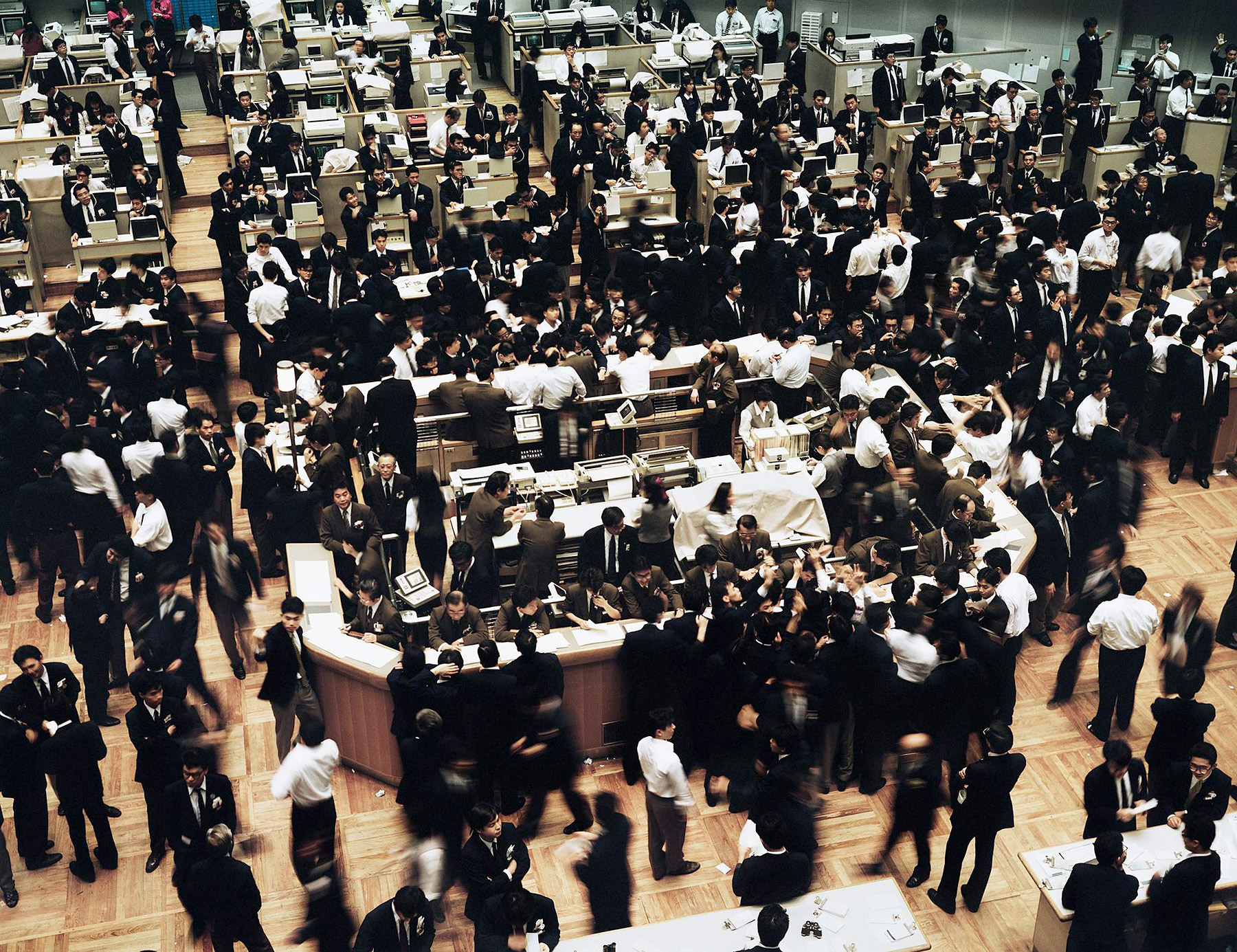
In the 1990s, Gursky became inspired by the various manifestations of global capitalism. His interest was piqued looking at a newspaper photograph of the crowded floor of the Tokyo Stock Exchange and he began to photograph its flurry of suited traders, somehow moving according to some inbuilt order.
Dr Gerard Vaughan, Director, NGV said the Andreas Gursky exhibition represented a significant coup for Melbourne: “The National Gallery of Victoria is the only Australian venue for this extraordinary show – the first major exhibition of Gursky’s work ever to be seen in this country. Generously organised by the Haus der Kunst Museum in Munich we are extremely fortunate to have had the works in this show selected for us by Andreas Gursky himself.”
Andreas Gursky was born in 1955 and grew up in Düsseldorf, Germany. In the early 1980s, he studied at the Kunstakademie Düsseldorf, Germany’s State Art Academy. Whilst there he was heavily influenced by his teachers Bernd and Hilla Becher, who were well known for their methodical black and white photographs of industrial machinery.
In 1984 Gursky began to move away from the Becher style, choosing instead to work in colour. Since then he has travelled across the world to cities such as Tokyo, Cairo, Hong Kong, Stockholm, Singapore and Los Angeles photographing factories, hotels and office buildings – places he considered to be symbols of contemporary culture. His world-view photographs during this period are considered amongst the most original achievements in contemporary photography.
Gursky has been the subject of numerous international exhibitions including the Internationale Foto-Triennale in Esslingen, Germany in 1989 and 1995, the Venice Biennale in 1990, and the Biennale of Sydney in 1996 and 2000. In 2001, Gursky was the subject of an exhibition at the Museum of Modern Art in New York.
Press release from the National Gallery of Victoria website
“The exhibition exudes a certain melancholia and is troubling in many aspects: loneliness, separation, desire for intimacy, desire for love all being expressed through the presented works.” Dr Marcus Bunyan
Exhibition dates: 7th October – 30th November, 2008
Curator: Anna MacDonald
The exhibition includes works by Louise Bourgeois, Nan Goldin, Steve McQueen, Sophie Calle, Mariele Neudecker, Jesper Just, Gabrielle de Vietri, Felix Gonzalez-Torres, Mutlu Çerkez, Amikam Toren, Margaret Salmon and Annika Ström
Sophie Calle (French, b. 1953) Doleur exquise 1984/1999
Set up by Frank Gehry and Edwin Chan Exhibition view at Rotonde1, Luxembourg, 2007
An eclectic mix of mixed media, photography and video work is presented in this exhibition, work which examines concepts of intimacy – staged performances, stories of the city, of men, women, families and children; the artists “contemplate passion, love and longing, as well as feelings of disquiet, loss, and loneliness that embody intimate human relations.”
The exhibition exudes a certain melancholia and is troubling in many aspects: loneliness, separation, desire for intimacy, desire for love all being expressed through the presented works.
Some of the works are strong but others left me cold and uninterested. Few are joyous renditions of the closeness of intimate relations and most works ponder the dangers and disillusionment of failed intimacies that involve feelings of vulnerability (intimate acts often involve a degree of self-disclosure where intimates show something of themselves that may make them feel vulnerable), ambiguity (intimate acts are often an ambiguous and incomplete shared and often idiosyncratic view of the world) and secrecy (intimate acts are private: they are often constructed, by their participants, to be hidden from the view of others).1
The large work by English artist Steve McQueen features two naked black wrestlers shot in slow motion in grainy black and white video. The wrestlers are photographed from the waist down, images of moving legs, or from below, bodies clinging together, faces grimacing in a hyperreal performance of some hypnotic intimate dance – an acted out state of being.
Amikan Torren’s 2008 video work is by comparison is about the improbabilities of life’s daily encounters: in Downstairs over a video image of 3 steps outside a London railway station the narrator tells of a man, a stockbroker who after an accident sometimes needs help descending steps; in Blind the narrator comments on a person helping a blind man across the street; and in Carrots, over a video image of a London street the narrator tells a story about an adolescent and fresh carrots! The musings on the synchronicity and serendipity of everyday encounters are very effective.
Jesper Just’s two video works No Man Is An island II (2004) and The Lonely Villa (2004) were very effective and moving. In the first lonely men in a pub sing the Roy Orbison song Crying with pictures of naked ladies behind them – it is funny and sad at the same time. In the second men in the shadows sit or stand with telephones in front of them: two men sing to each other the song I Don’t Want To Set The World On Fire with close-ups of their lips singing into the telephone: songs of loss, longing and remembrance.
The two most interesting pieces are not video works, nor are they the overrated photographs of Nan Goldin featuring photographs of a family hugging and lying on a bed, but the work of two women: Sophie Calle and Louise Bourgeois.
In Doleur exquise (exquisite pain) Calle revisits fifteen years later the breakup of a relationship and the aftermath of that event: the distress and pain, the experiences of her friends in such circumstances and turns them into brilliant insightful art. A selection of the whole work is presented here that features colour photographs (multiples of a red telephone, abandoned car with it’s doors open, washbasins and empty bedrooms) above text woven onto linen – black on white, grey on grey. The texts are both painful and repetitive (Calle’s on the left) and others heartbreaking accounts of pain (on the right): “6 days ago, the man I love left me …”
(For an insightful analysis of this work see Can Pain Be Exquisite? Autofictional Stagings of Douleur exquise by Sophie Calle, Forced Entertainment and Frank Gehry and Edwin Chan by Anneleen Masschelein. “On the one hand, it deals with the most intense, acute experiences of pain in a human life. On the other hand, these moments are unique and “localised”, that is, they are connected to a concrete time and space, of which the details are forever inscribed in memory.”)
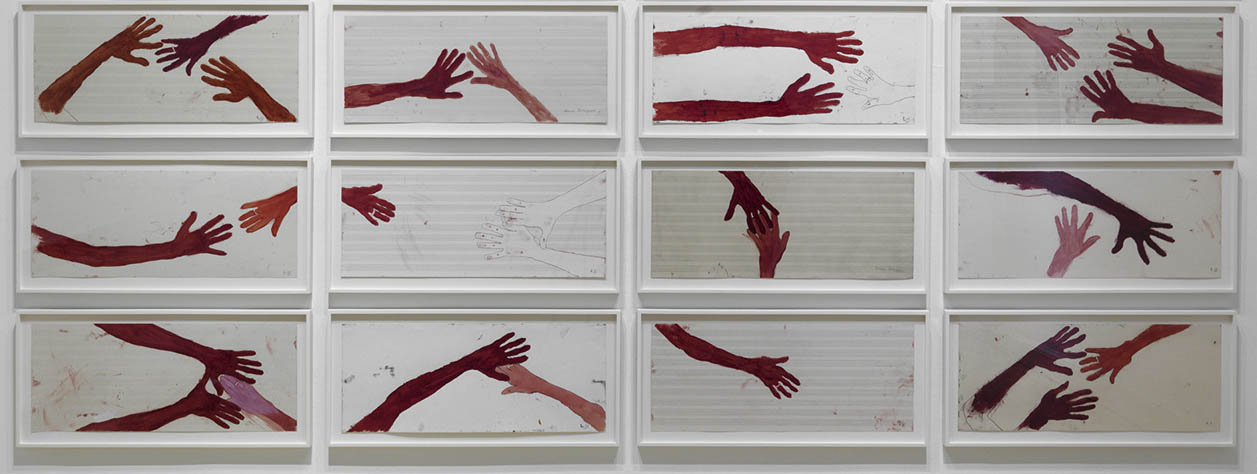
My favourite work from the show is Louise Bourgeois 10AM IS WHEN YOU COME TO ME (2006) – drawings on music paper of mainly red hands, the key a drawing of a 10am clock with a man the big hand with hands extended drawing towards him (or is it tethered to him) an armless woman, the small hand. Some have seen these as “ambiguous images of a hermetic cosmos, as acts of violence or love” but they represent “both Bourgeois’s hands and those of her friend and muse Jerry Gorovoy” and how he helps her and arrives at her studio at this, the designated hour.
To me they are joyous, liberating, spontaneous expressions of love and intimacy, fingerprints on the page, hands intertwining together. They made me feel the intimate expression of humanity: holding a babies hand, so small and vulnerable and feeling them grasp your hand. That connection is what Bourgeois achieves with this work and I thought it was wonderful.
This exhibition is no easy ride but is well worth the contemplation necessary to tease out the themes and feelings that the work investigates.
Dr Marcus Bunyan
1/ Steve Howard, Frank Vetere, Martin Gibbs, Jesper Kjeldskov, Sonja Pedell, Karen Mecoles, Marcus Bunyan, and John Murphy. Mediating Intimacy: Digital Kisses and Cut and Paste Hugs. 2004.
Sophie Calle (French, b. 1953) Doleur exquise (detail) 1984/1999
Louise Bourgeois (French-American, 1911-2010) TEN AM IS WHEN YOU COME TO ME (detail) 2006
Louise Bourgeois (French-American, 1911-2010) TEN AM IS WHEN YOU COME TO ME (detail) 2006
Louise Bourgeois (French-American, 1911-2010) TEN AM IS WHEN YOU COME TO ME 2006
Australian Centre for Contemporary Art 111 Sturt Street, Southbank Victoria 3006, Australia Phone: 03 9697 9999
Opening hours: Tuesday – Friday 10am – 5pm Saturday – Sunday 11am – 5pm Monday Closed Open all public holidays except Christmas Day and Good Friday
Exhibition dates: 11th November – 6th December, 2008
Opening: Tuesday 11th November, 2008
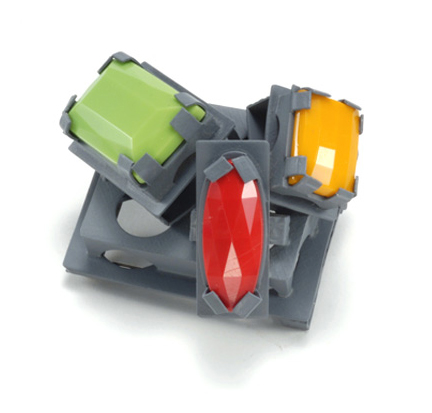
Helen Britton (Australian, b. 1966) Brooch 2008
Moving through Melbourne’s busy laneways from the Oleh Witer exhibition we arrive at the intimate, stylish Gallery Funaki to view the work of Australian artist Helen Britton who works with the form of contemporary jewellery. The crowd spilled onto the street and the small space was busy with an interesting crowd in attendance.
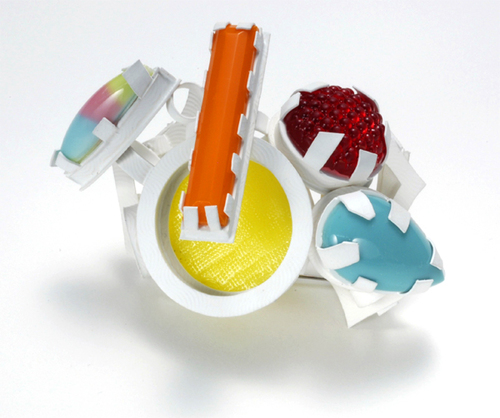
The exhibition presents brooches, earrings, rings and necklaces built with the artists trademark assemblages. Whilst the necklaces are more prosaic (movie like reels and slinks of melted plastic restrained within metal banding) it is the brooches that capture and hold the viewer’s attention. Sci-fi like grided circles collide with concave discs filled with glistening blue crystals; thrusters and steel from a miniature collapsed lunar landing vehicle vie with clusters of vibrant colours that appear to be imbedded into a lunar landscape: delicate crimped and folded metal landscapes with the appearance of collapsed geometric origami.
These are wonderfully inventive constructions, invigorating for their energy and exuberance. Britton has described her work as “industrial baroque”. Perhaps an equally pertinent description would be spatial, or ‘space baroque’ as the artist investigates the nexus, the cellular biology of matter, reality and the spaces we inhabit.
Dr Marcus Bunyan
Helen Britton (Australian, b. 1966) Brooch 2008
Gallery Funaki
Sackville House
Apartment 33
27 Flinders Lane
Melbourne 3000
Australia
Opening hours:
Wednesday – Friday 12 – 5pm
Saturday on occasion (check our socials) or by appointment
Exhibition dates: 11th November – 22nd November, 2008
Opening: Tuesday 11th November, 2008
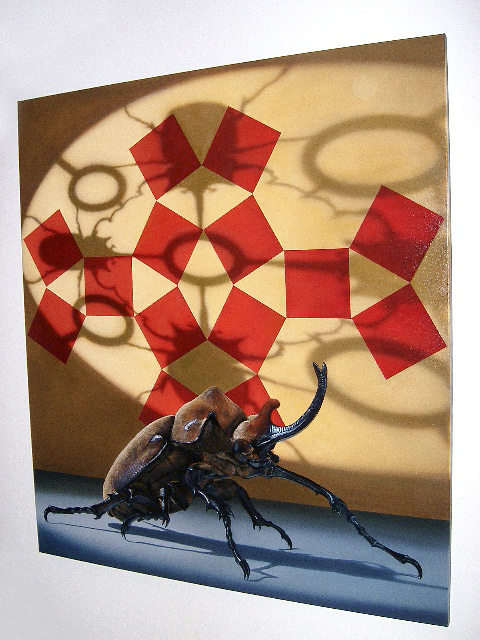
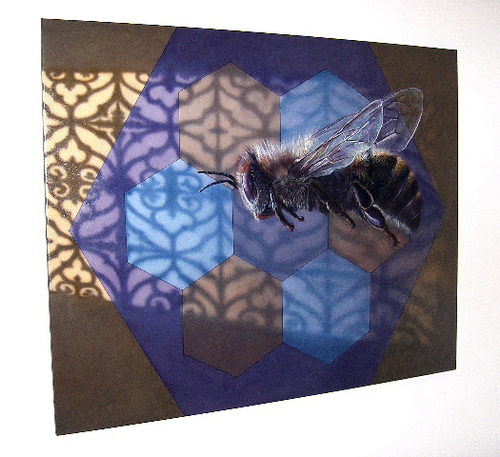
Oleh Witer (Australian) The Elephant Beetle (installation view) 2008 Oil in linen
A warm and lively crowd was in attendance for the opening of the latest Oleh Witer exhibition at Space 39 in Little Collins Street, Melbourne. Nine paintings are presented in the open space of the gallery and what magical paintings they are.
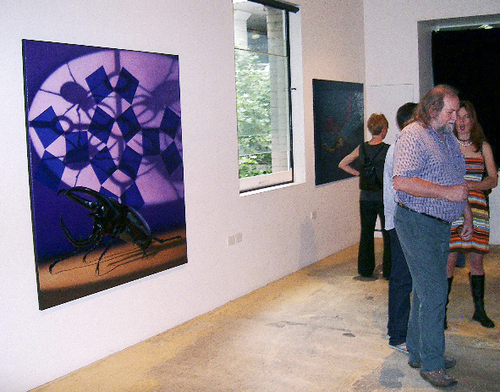
Two of the main canvases feature rearing beetles in the foreground, almost photo-realistically painted, lit from above while in the background geometric red and blue squares are overlaid by enigmatic shadows – almost as though the shadows were the interior structures of a fantastical light shade.
Other canvases feature a bee and a wasp facing each other with cellular geometric patterns and overlaid shadows in the background. Between these two seeming adversaries is a large canvas of a black skull with candle flickering in the it’s lobotomised top sitting on a spiral shape with geometric shapes and the shadows of an almost tarot like ‘ten of swords’ pattern overlaid to the background.
The strongest work features geometric forms with dark surrealist imagery. These are talismanic images with a passionate connection to Taoist and shamanic principles. A concern with the connection between all things is evident – archetypal pentagrams, spirals and swords are linked to the principles and proportions of the golden mean equation.
Contemplation is required to access the inner meanings of the paintings but they reward extended looking … for their magical phosphorescences are revealed over time. Recommended viewing.
Dr Marcus Bunyan
Oleh Witer (Australian) Installation view and opening crowd with The Rhinoceros Beetle 2008 Oil on linen
Oleh Witer (Australian) The Bee (installation view) 2008 Oil on linen
Exhibition dates: 7th November – 29th November, 2008
Opening: Friday 7th November, 2008
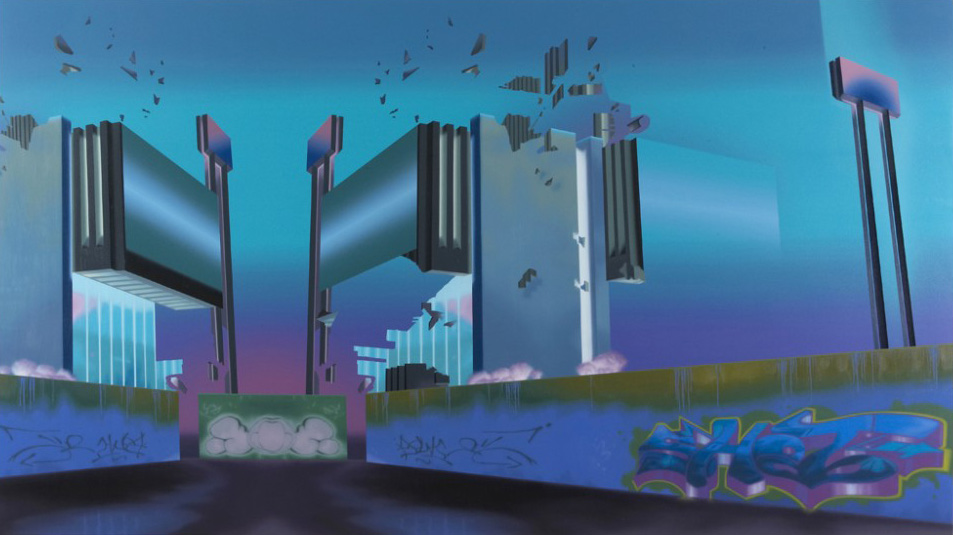
Darren Wardle (Australian, b. 1969) Frontier Psychology 2008 Oil and acrylic on linen 153cm x 274cm Private collection
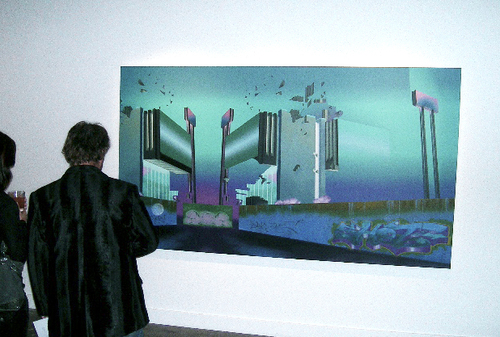
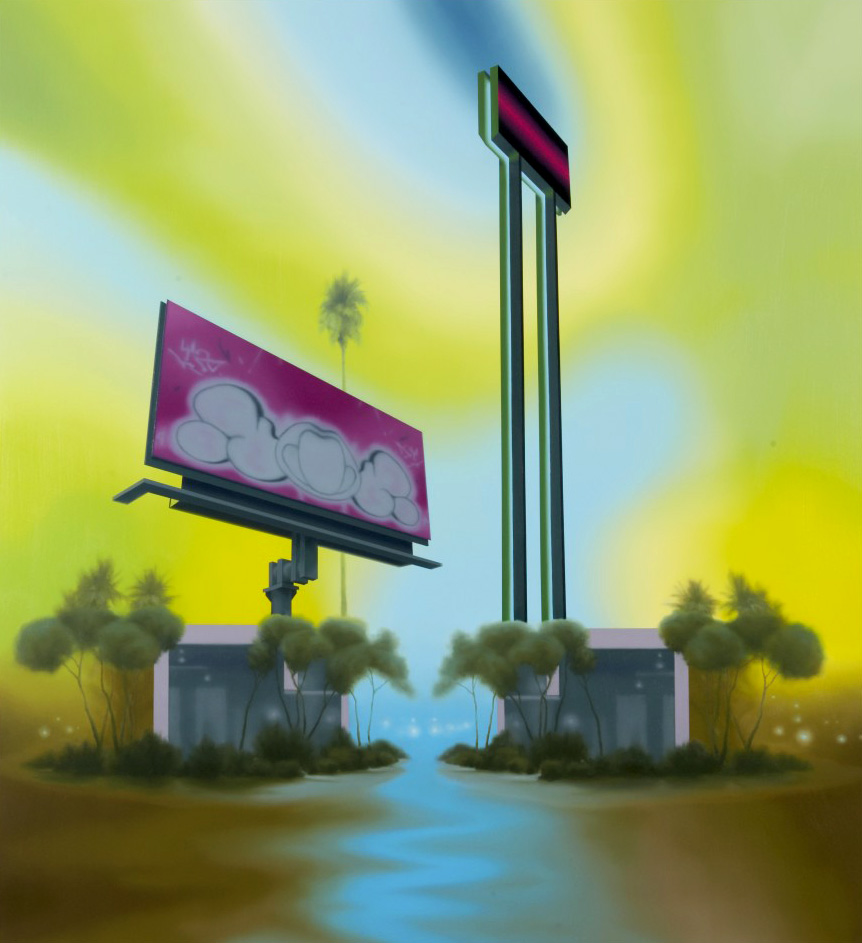
Six luminous oil and acrylic paintings by Darren Wardle greeted viewers in the front gallery at Nellie Castan in South Yarra. In his apocalyptic fractured pop-coloured landscapes objects elide, disintegrate and vanish into thin air. Buildings, empty screens and advertising hoardings become the target of lost innocence, a metaphor for the dis-ease and disintegration of consumer society, a portent of things to come.
The titles of the paintings (such as Tipping Point, Faultline and Slanted) perfectly describe the conceptual themes explored in the work. Slinks of dripping paint pour down the canvas, canvases are cut in three through the use of fractured planes like a double exposure in photography and vegetation becomes purple and white, mutated and x-rayed. Some of the paint almost has a crystalline nature to it’s surface, a ‘surface tension’ that contrasts with flat gradated areas of colour in the backgrounds, as though the world is solidifying, cracking and about to fall apart.
An excellent show that is well hung: so many exhibitions have too many objects, too much noise crowding the walls. Here the work is given space to breathe and live and looks all the better for it. Highly recommended.
Dr Marcus Bunyan
Darren Wardle (Australian, b. 1969) Faultline (installation view) 2008 Oil and acrylic on canvas
Darren Wardle (Australian, b. 1969) Faultline 2008 Oil and acrylic on canvas 153cm x 274cm Private collection
Darren Wardle (Australian, b. 1969) Inland Empire 2008 Oil and acrylic on linen 183cm x 167cm Private collection
Exhibition dates: 5th November – 23rd November, 2008
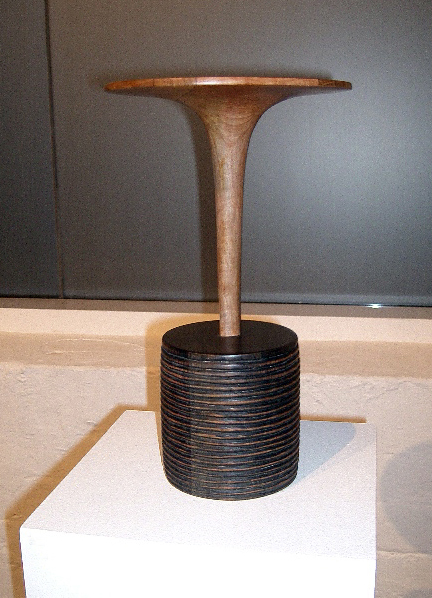
Jamieson Miller (Australian, b. 1965) The Last Drop 2008 Sheoak with ebonised stain 30 x 14 x 10cm
A small but lively crowd was in attendance for the opening of the exhibition territories featuring six small and six large floor standing wooden sculptures by the artist Jamieson Miller at the Dickerson Gallery in Oxford Street, Collingwood.
The work itself is of a fine craftsmanship showing exemplary design: different coloured woods and stains, wonderful joinery, the use of grain and different geometric and fluid shapes are all balanced harmoniously within the objects. A refined aesthetic sensibility is at work in their construction. This sensibility flows through to the conceptual themes of the work: the artist has created sometimes totemic but always lyrical poetic spaces within the corporeality of the work. The viewer enters enclosed intimate spaces (such as the funnels) or steps forward into steeped carved openings that open the way to visions of an inner world. Outer space becomes enclosed inner space as the viewer is at first intrigued, then drawn in and surrounded by the flickering shadows of Plato’s cave.
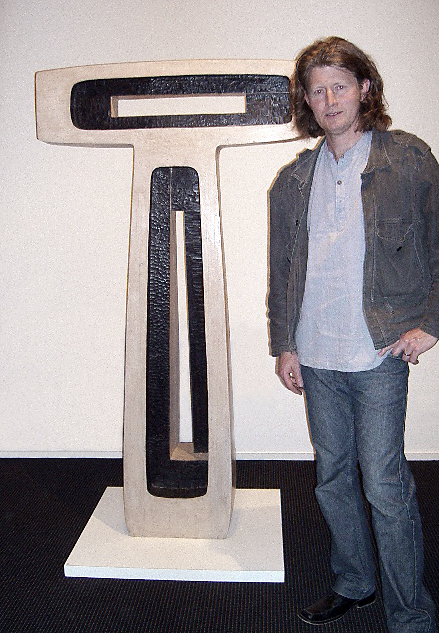
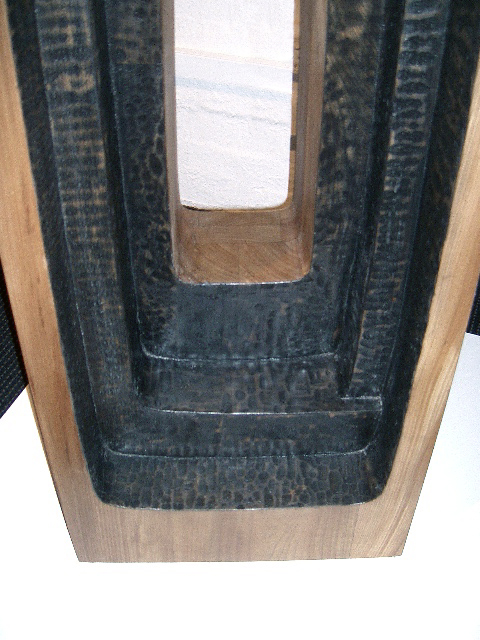
The new gallery is certainly an attractive modern warehouse space with vaulted roof. Unfortunately the large sculptures, although multi-dimensional and carved in the round, have been pushed to the edges of the space close to the walls. This makes it difficult to appreciate the totality of the form of the sculptures especially important with a work like Sight where the carved blackened wood shape on the ‘back’ of the sculpture is a vital counterpoint to the receding opening at the ‘front’ of the work. Make sure you also explore the reverse of the sculpture Lineage II to also comprehend the intimate space of the medieval window like opening to the front.
I really enjoyed the work of Jamieson Miller and recommend a visit to the gallery to see his refined worlds. The work is on show with the paintings of Jason Cordero.
Dr Marcus Bunyan
Jamieson Miller standing next to his sculpture Sight on the opening night of his exhibition territories at Dickerson Gallery in Collingwood.
Cyprus pine with ebonised stain 180 x 100 x 30cm
Jamieson Miller (Australian, b. 1965) Resting Place (detail) 2008 Elm with paint 203 x 42 x 30cm
“These sculptures are both poetic palimpsests and heterotopic objects of otherness that are neither here nor there.” Dr Marcus Bunyan
Exhibition dates: 22nd October – 15th November, 2008
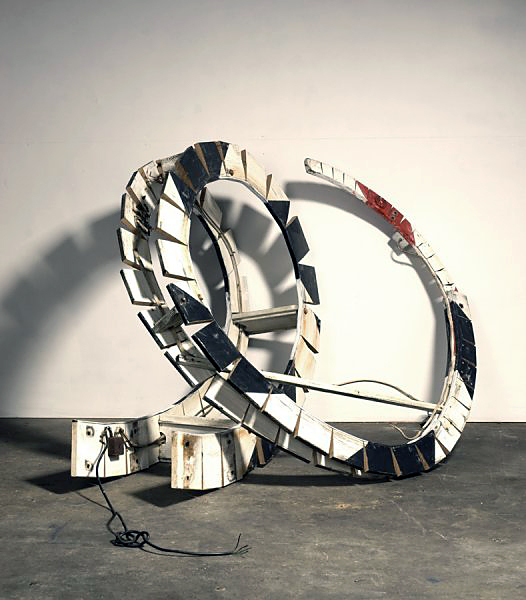
Robbie Rowlands (Australian, b. 1968) Scored 2008 Goal post, steel 160cm x 130cm x 50cm Photograph: Christian Capurro
“The philosopher Martin Heidegger argued that objects are often invisible to us gathered up as they are within a context of functionality and use. It is only when things break down that we become aware of them, seeing them with fresh eyes. In many ways Heidegger’s observation could form the basis of an approach to Robbie Rowlands’ work. Rowlands takes objects that are often forgotten, invisible or transparent to us, objects that exist on the verge of disappearance, and stages a kind of ‘breakdown’, inviting us to rediscover the object, poised somewhere between what it was and what it might become.”
Simon Cooper. Catalogue essay
Sitting in pools of light in the elegant modern space of Place Gallery in Richmond, six theatrically lit sculptures are presented by artist Robbie Rowlands.
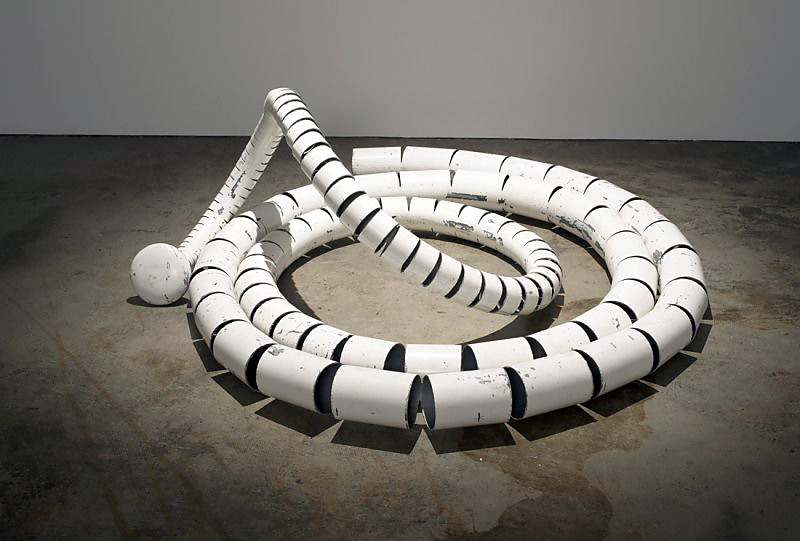
Made of everyday objects (a boom gate, desk, chair, single bed, electricity pole, desk and footy goalpost) they have been de/constructed by the artist and reformed into curved objects. With ironic titles such as Down for the felled electricity pole and Collapse for the dismembered chair Rowland’s work hovers between one fixed state and an’other’ transformative state of being.
While the catalogue essay by Simon Cooper suggests that all of these objects are abandoned or nearly forgotten sharing a context of quasi-obsolescence, this is not the case. These were objects of purpose and form, the acts of ritualised production of a consumer society that contained signs that symbolised their status.
In his creativity Rowland has used these technologies of production, which permit us to produce, transform or manipulate things to create new sensual forms of life.
Some of the sculptures such as Boom (the boom gate; 2008, below) and Scored (the goal post; 2008, above) remind me of creatures emerging from the recesses of the unconscious, curling and rearing up like monsters from the deep. One of the most beautiful forms is the constructed white chair where the function of the object has collapsed into the essence of the form, like the surreal spatiality of a poetic Miro.
As Gaston Bachelard reminds use in The Poetics of Space, “The grace of a curve is an invitation to remain. We cannot break away from it without hoping to return. For the beloved curve has nest-like powers; it incites us to possession, it is a curved corner, inhabited geometry.”1
Cooper suggests that the curved forms that Rowland creates were “already there in the original object, even as it was sat on, written on, or passed by on the way to work.” He rightly notes that the process used contains a certain violence, but that we remember and reconstruct the old form even as we respond to the new construction. For these sculptures are a construction not, I believe, inherent in the original form.
This can be seen in the sculpture Boom (2008, below) for example, where Rowland has used additional pieces of metal to hold the curve of the boom gate in place. Without this skilfully added, hidden sub-structure the transformative shape would collapse onto the floor. Rowland inhabits and possesses his new geometry with as much technology as the original but not in such an obvious form.
The work would have been stronger if only four pieces were presented in the gallery space – the sculptures needed more room to breathe (understanding the dictum that less is more). The sculptures themselves also needed greater thematic cohesiveness perhaps using the colour white as the unifying theme.
At their best these sculptures are both poetic palimpsests and heterotopic objects of otherness that are neither here nor there. They are sensual and beautiful gestures that deserve your attention.
Dr Marcus Bunyan
1/ Bachelard, Gaston. The Poetics of Space. Boston: Beacon, 1969 [originally 1958] p. 146
Robbie Rowlands (Australian, b. 1968) Boom 2008 Rail boom gate, wooden 160cm x 160cm x 130cm Photograph: Wren
Place Gallery 120 Collins Street Melbourne VIC 3000 Phone: (03) 9527 6378
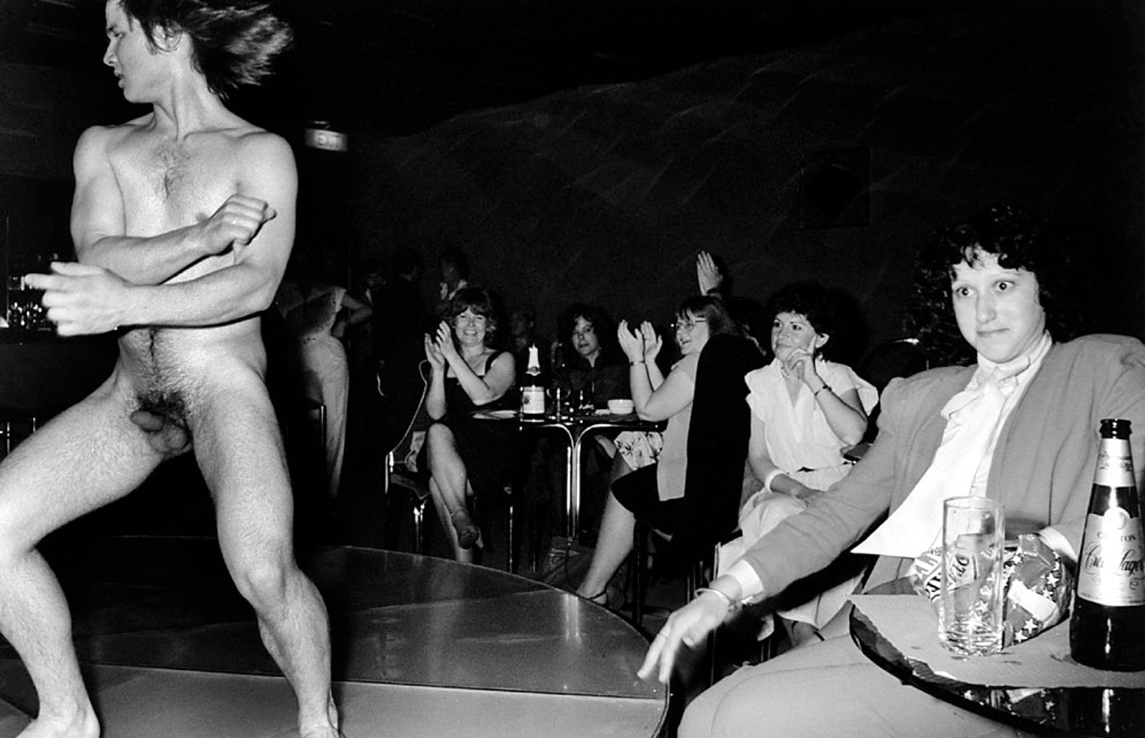
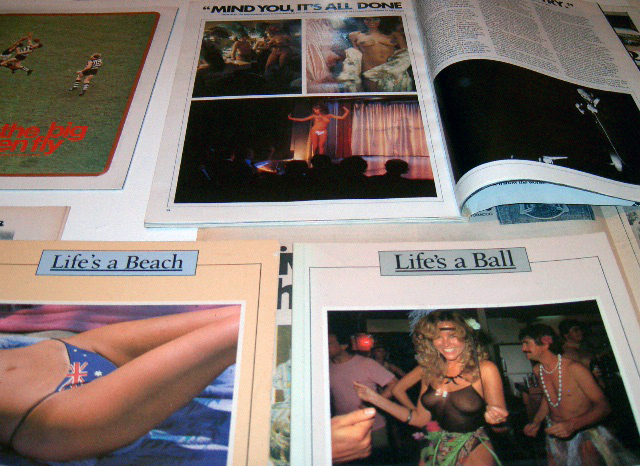
Rennie Ellis (Australian, 1940-2003) Girls’ Night Out, Prahran 1980 Silver gelatin, selenium toned fibre based print
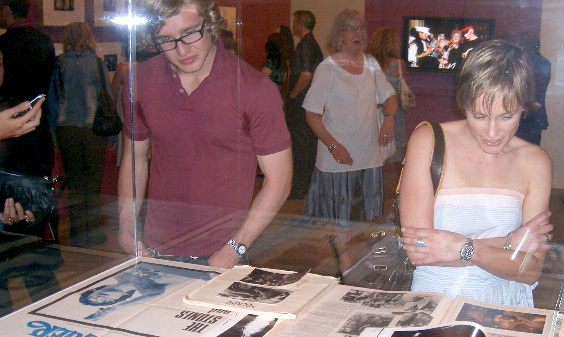
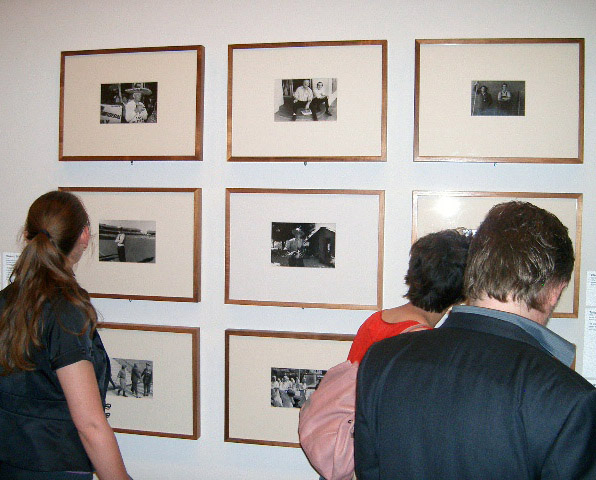
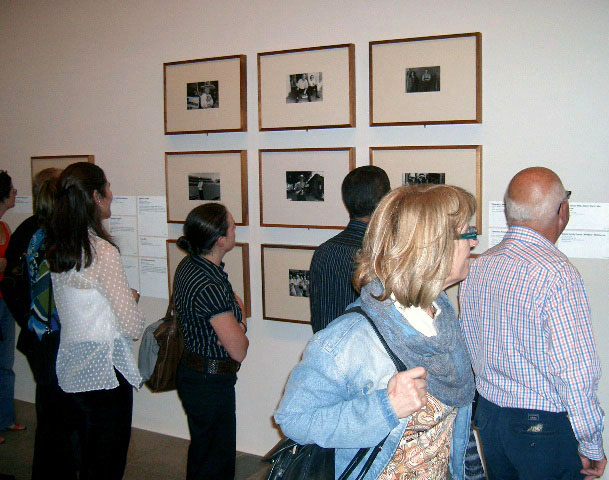
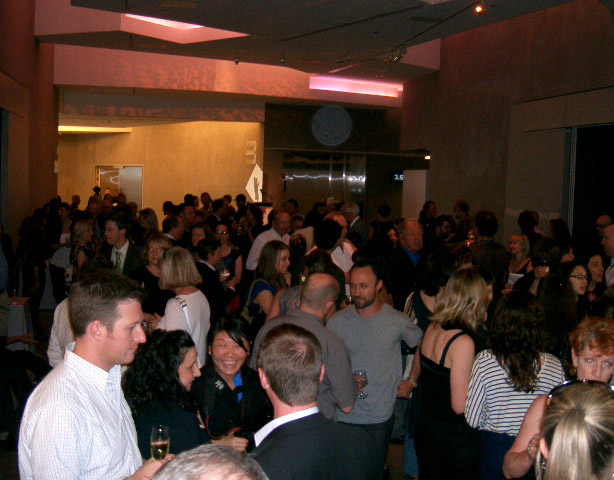
A very social and lively crowd gathered at The Ian Potter Centre: NGV Australia at Federation Square on the evening of 30th October to celebrate the life and work of the Australian social photographer Rennie Ellis.
After opening comments by the NGV Director Dr Gerard Vaughan there was a funny and erudite speech by Phillip Adams AO who had flown down from Sydney to open the exhibition. The crowd enjoyed the anecdotes about his relationship with Rennie and said he thought that dying was a good career move on Rennie’s behalf and that he would have loved the fact that he had a retrospective at the NGV. Adams observed that Ellis used to be everywhere, at every party and opening, using his astute eye to record and never to judge. Applause all round for a life well lived.
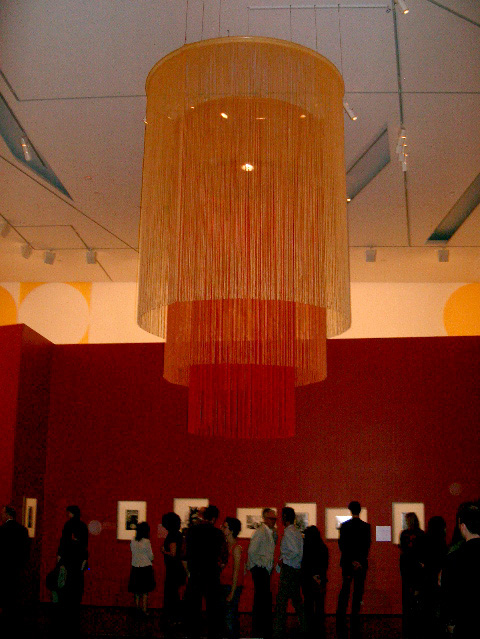
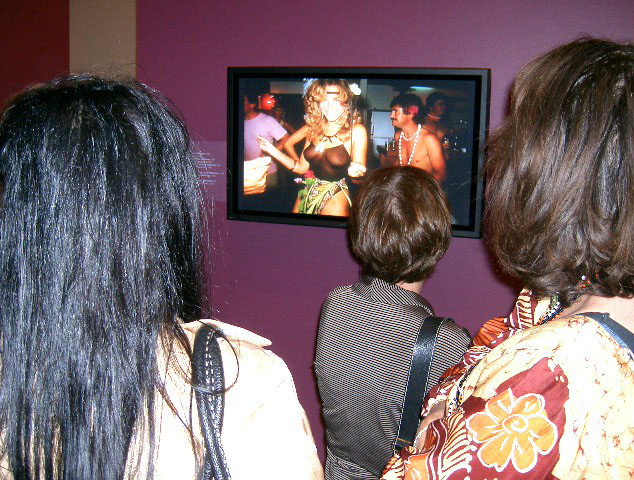
On entering the exhibition space viewers were treated to a simple but effective installation of his work, with overtones of the 1970’s-1980s interior decor with yellow and white circle graphics and hanging fabric chandelier. The curatorial staff at the NGV (notably Susan van Wyk) have chosen over 200 works from an archive of over half a million images for the exhibition in a process that has taken over two and a half years.
As an immigrant arriving in Australia in 1986 I remember 397 Club that used to be at 397 Swanston Street. After every other place had closed this club attracted people from every walk of life: pimps, prostitutes, drag queens, faggots, lesbians, straights and druggies. Rennie was probably there recording the scene. We were there just for a good time. It was fun and this is what Ellis’ photography captures.
Not burdened by overarching conceptual ideas Ellis recorded what he saw, balancing social commentary and spatial organisation in the construction of his images. The image Girls’ Night Out, Prahran 1980 (above) is a pearler (with the look on the woman’s face) and neatly encapsulates the magic of his image making.
“One can almost see the maelstrom of the splitting of the atom in Twombly’s repeating performance threatening to destroy himself and the world around him.” Dr Marcus Bunyan
November 2008
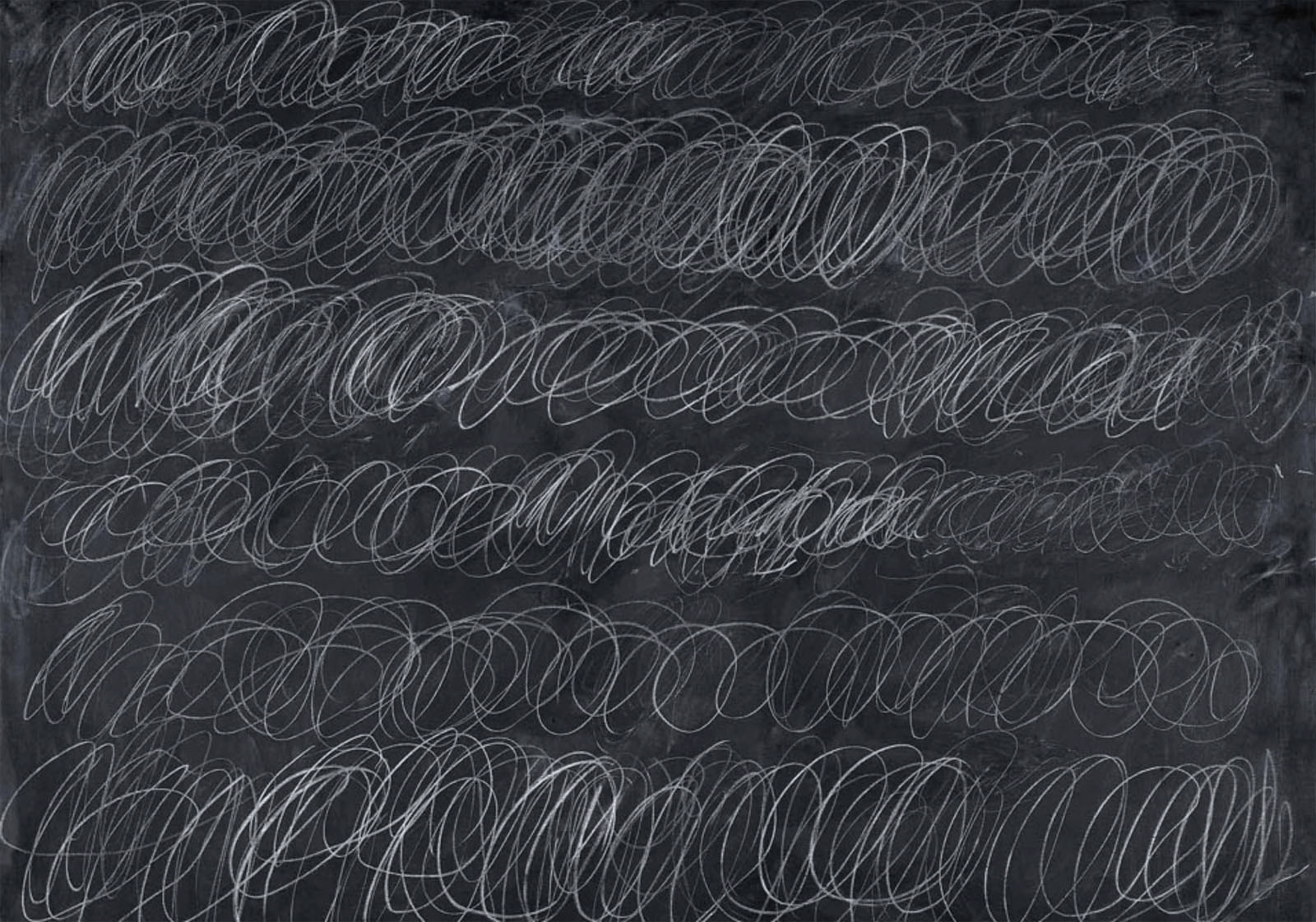
Cy Twombly (American, 1928-2011) Cold Stream 1966 White wax pencil on canvas
This painting reminds me of the drawings of Rudolf Steiner (see the exhibition Joseph Beuys & Rudolf Steiner: Imagination, Inspiration, Intuition at The National Gallery of Victoria, Melbourne earlier this year) but here the performance of marking is pushed beyond the bounds of the spiritual by the ferocious attack of the artist – repeating the form but transgressing the boundaries of that form, disintegrating the ritual into the physical release of energy through the hand.
One can almost see the maelstrom of the splitting of the atom in Twombly’s repeating performance threatening to destroy himself and the world around him.







You must be logged in to post a comment.