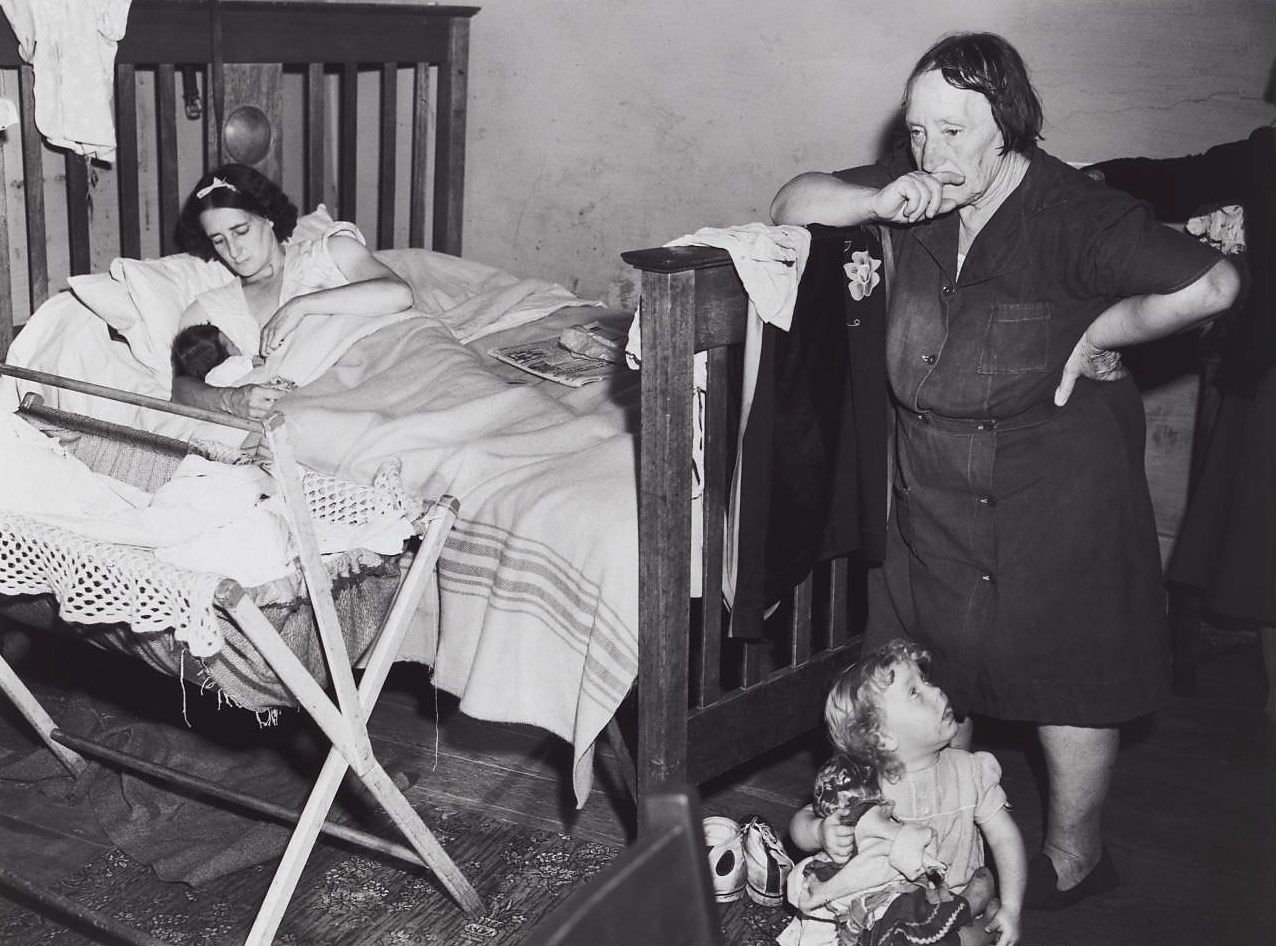
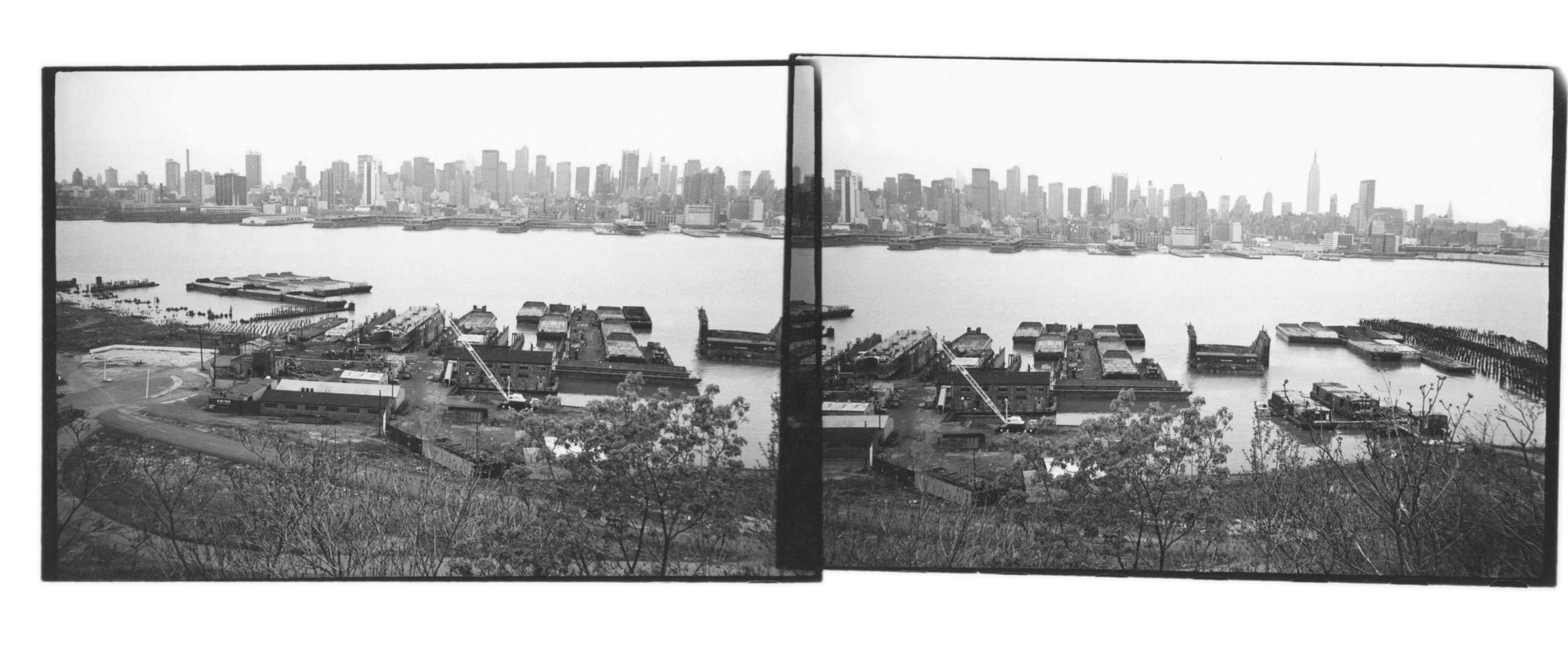
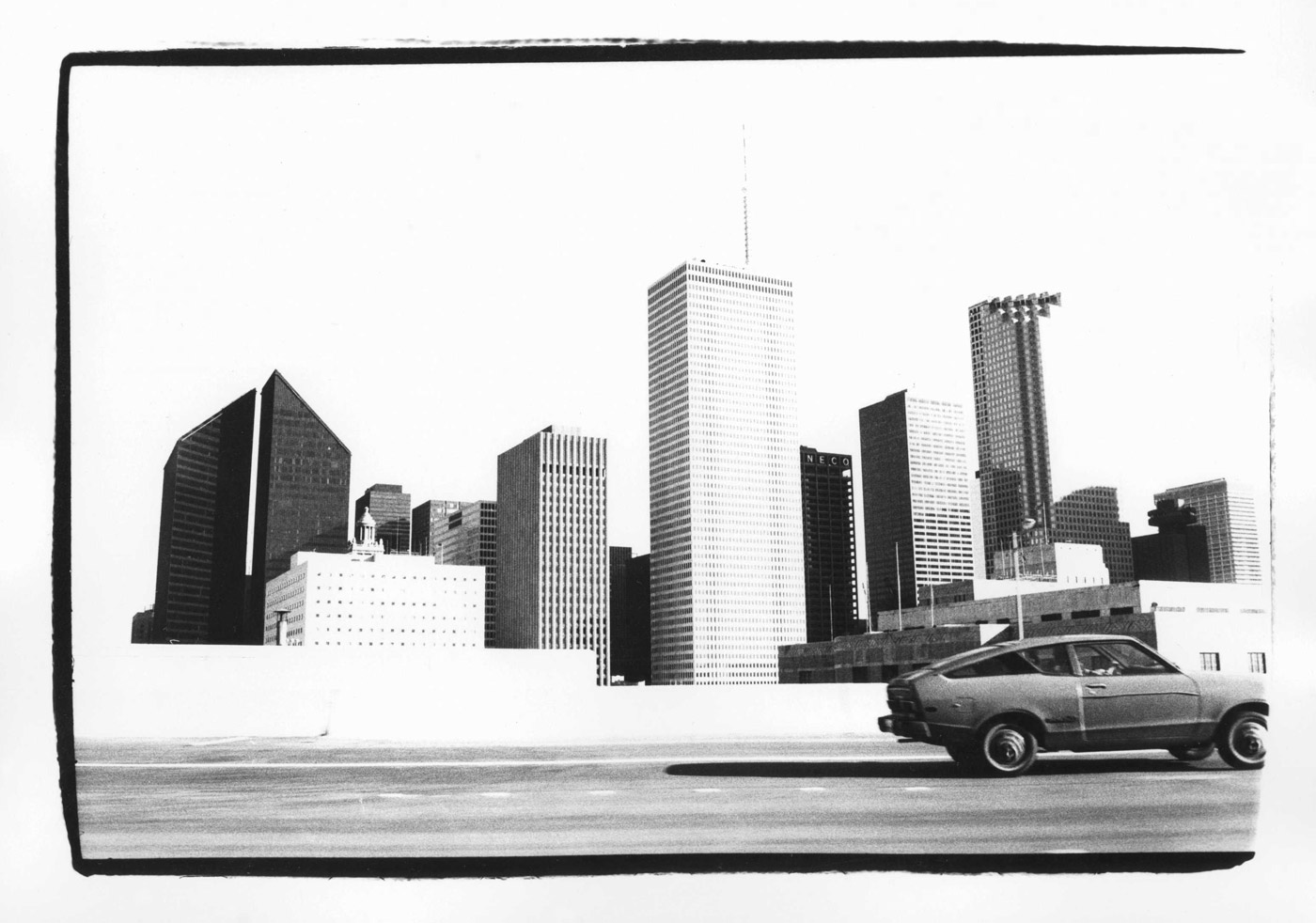
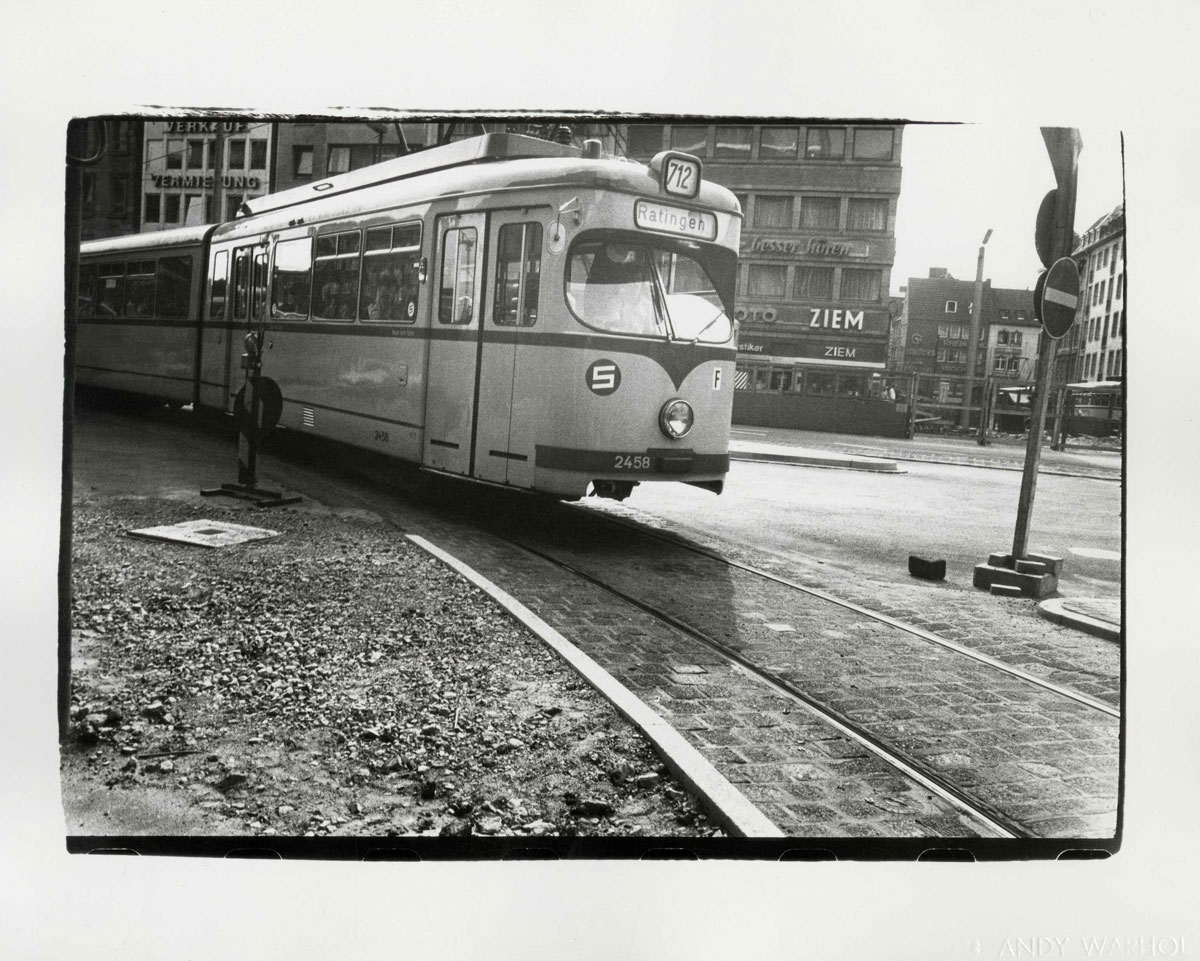
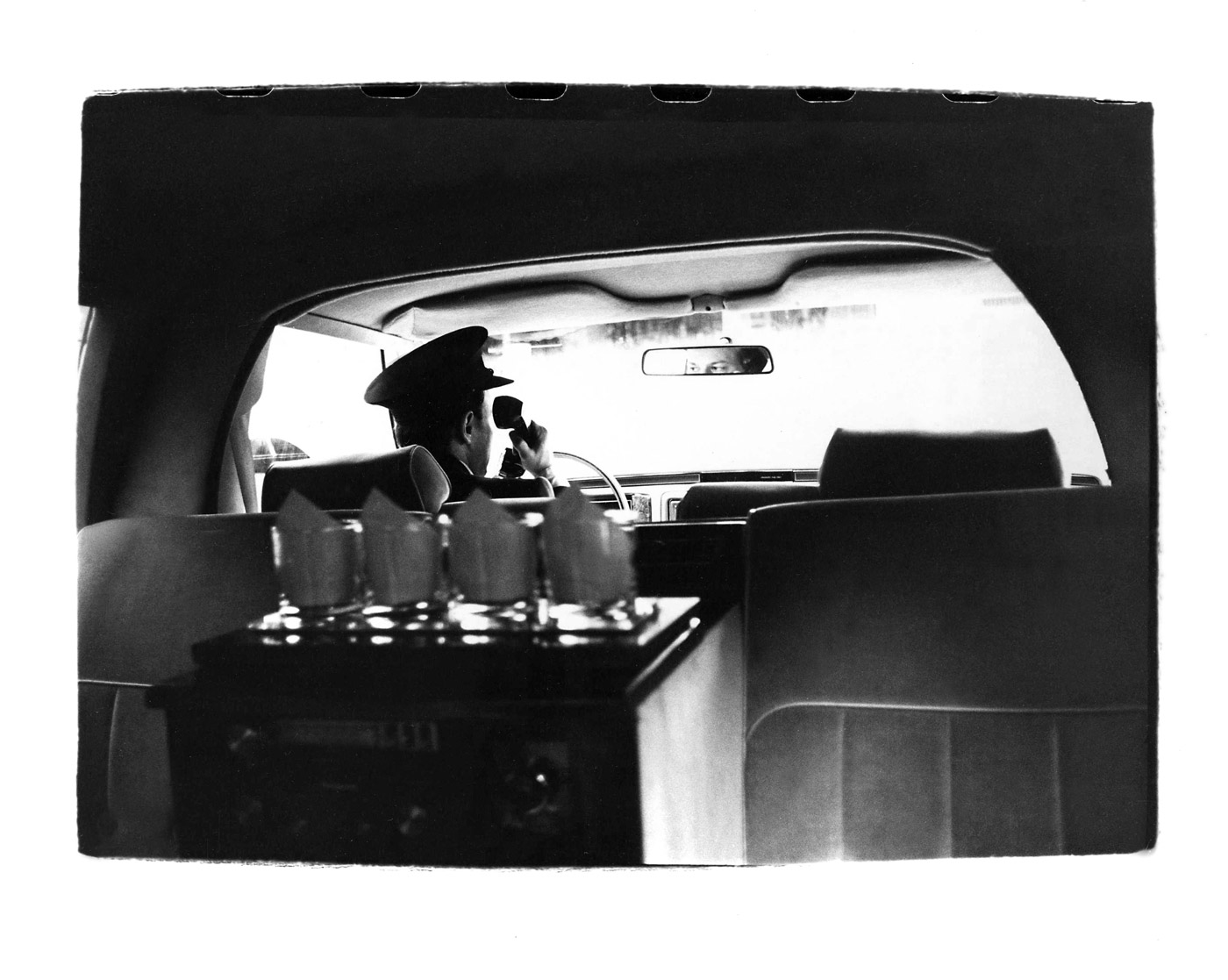
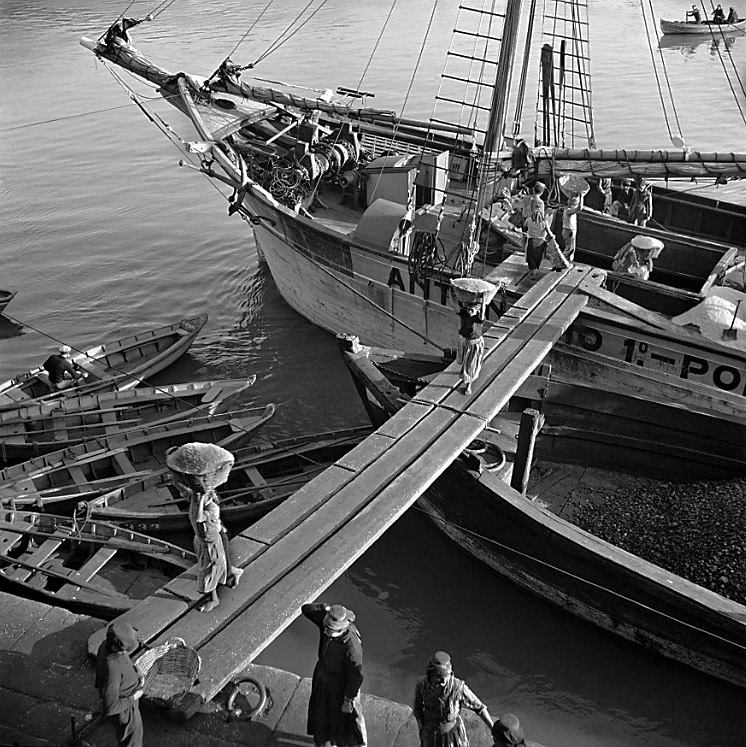
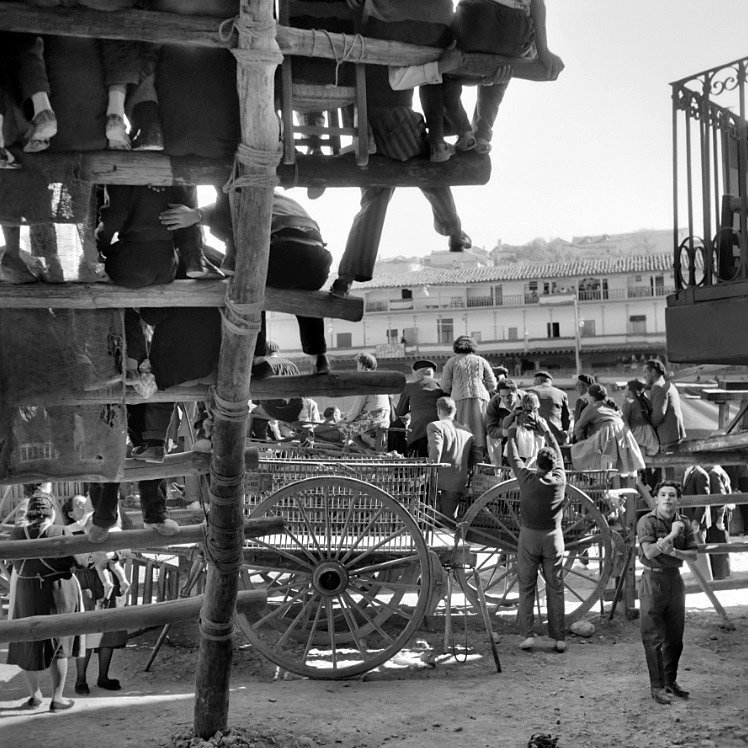
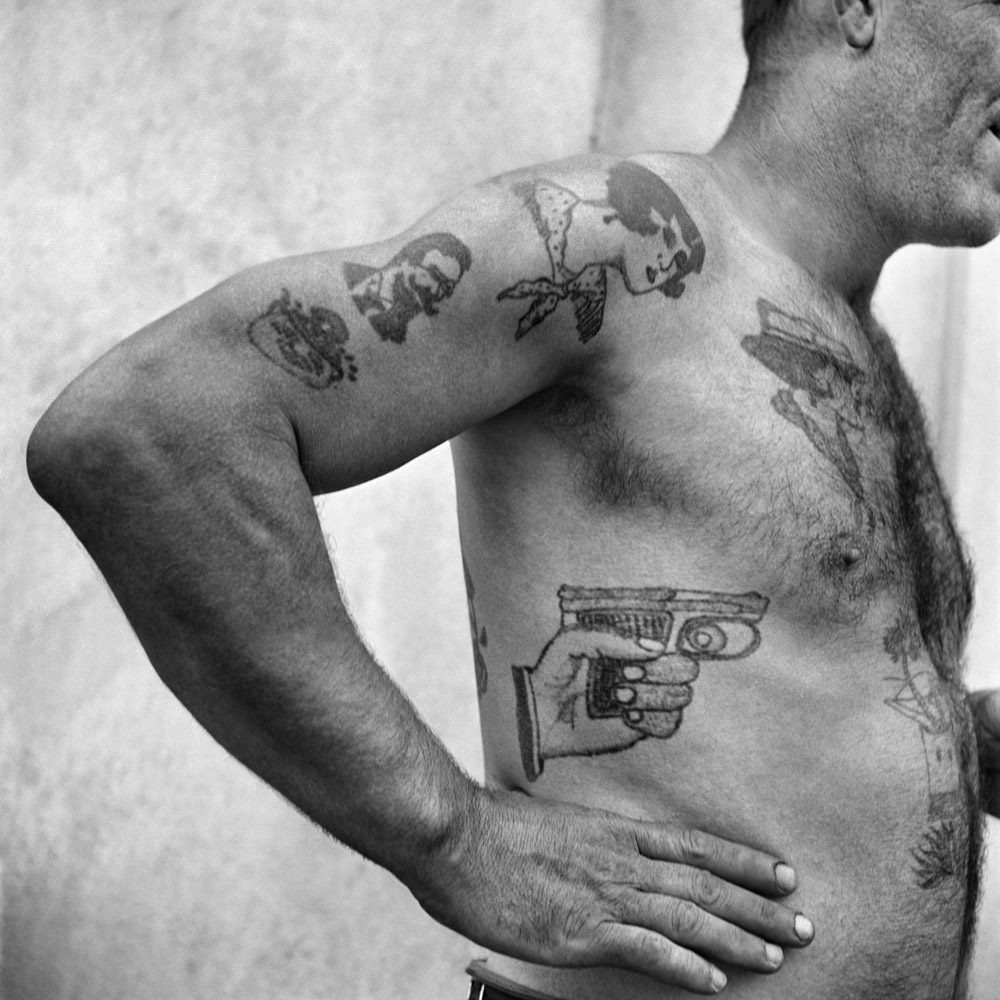
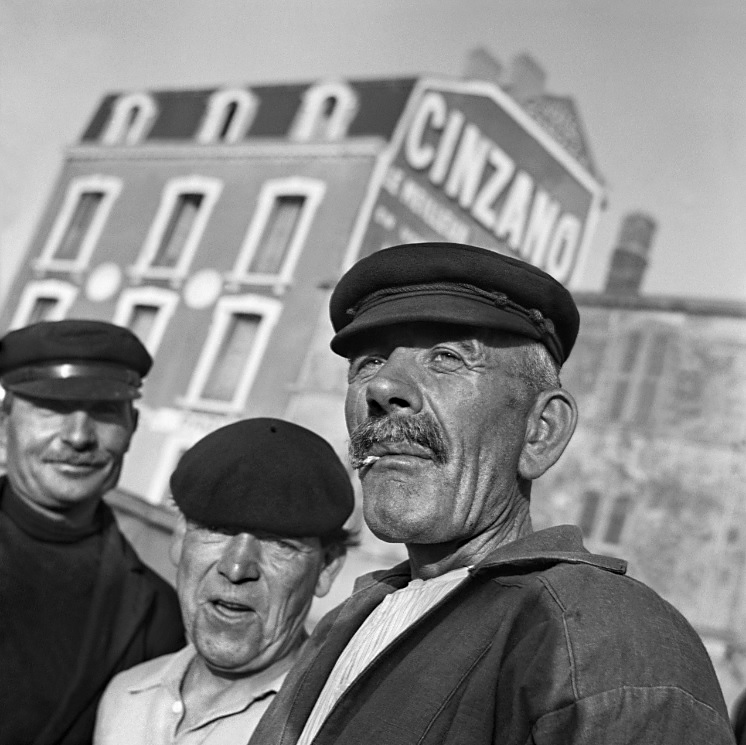
My favourites: the weight of Weston’s Shipyard detail, Wilmington (1935, above); and the romanticism (Jean-François Millet-esque), sublime beauty of Boubat’s Lella, Bretagne, France (1947, below).
Dr Marcus Bunyan
Please click on the photographs for a larger version of the image.
Cecil Stoughton (American, 1920-2008) Pres. John F. Kennedy’s Lincoln Continental 1963 Silver gelatin print
Cecil Stoughton (American, 1920-2008)
Cecil William Stoughton (January 18, 1920 – November 3, 2008) was an American photographer. Born in Oskaloosa, Iowa, Stoughton is best known for being President John F. Kennedy’s photographer during his White House years.
Stoughton took the only photograph ever published showing John F. Kennedy, Bobby Kennedy and Marilyn Monroe together. Stoughton was present at the motorcade at which Kennedy was assassinated, and was subsequently the only photographer on board Air Force One when Lyndon B. Johnson was sworn in as the next President. Stoughton’s famous photograph of this event depicts Johnson raising his hand in oath as he stood between his wife Lady Bird Johnson and a still blood-spattered Jacqueline Kennedy.
Max Yavno (American, 1911-1985) Garage Doors, San Francisco 1947 Silver gelatin print
Max Yavno (American, 1911-1985)
Max Yavno (1911-1985) was a photographer who specialised in street scenes, especially in Los Angeles and San Francisco, California.
He did photography for the Works Progress Administration from 1936 to 1942. He was president of the Photo League in 1938 and 1939. Yavno was in the U.S. Army Air Corps from 1942 to 1945, after which he moved to San Francisco and began specialising in urban-landscape photography. Photographer Edward Steichen selected twenty of Yavno’s prints for the permanent collection at New York’s Museum of Modern Art in 1950, and the next year Yavno won a Guggenheim fellowship.
History professor Constance B. Schulz said of him:
For financial reasons he worked as a commercial advertising photographer for the next twenty years (1954-75), creating finely crafted still lifes that appeared in Vogue and Harper’s Bazaar. He returned to artistic landscape photography in the 1970s, when his introspective approach found a more appreciative audience.
Ralph Steiner (American, 1899-1986) American Rural Baroque 1929 Silver gelatin print
Ralph Steiner (American, 1899-1986)
Ralph Steiner (February 8, 1899 – July 13, 1986) was an American photographer, pioneer documentarian and a key figure among avant-garde filmmakers in the 1930s.
Born in Cleveland, Steiner studied chemistry at Dartmouth, but in 1921 entered the Clarence H. White School of Modern Photography. White helped Steiner in finding a job at the Manhattan Photogravure Company, and Steiner worked on making photogravure plates of scenes from Robert Flaherty’s Nanook of the North. Not long after, Steiner’s work as a freelance photographer in New York began, working mostly in advertising and for publications like Ladies’ Home Journal. Through the encouragement of fellow photographer Paul Strand, Steiner joined the left-of-centre Film and Photo League around 1927. He was also to influence the photography of Walker Evans, giving him guidance, technical assistance, and one of his view cameras.
In 1929, Steiner made his first film, H2O, a poetic evocation of water that captured the abstract patterns generated by waves. Although it was not the only film of its kind at the time – Joris Ivens made Regen (Rain) that same year, and Henwar Rodekiewicz worked on his similar film Portrait of a Young Man (1931) through this whole period – it made a significant impression in its day and since has become recognised as a classic: H2O was added to theNational Film Registry in December 2005. Among Steiner’s other early films, Surf and Seaweed (1931) expands on the concept of H2O as Steiner turns his camera to the shoreline; Mechanical Principles (1933) was an abstraction based on gears and machinery.
Wilson A. Bentley (American, 1865-1931) Snowflake c. 1920 Gold-chloride toned microphotographs from glass plate negatives
Andre de Dienes (Hungarian, 1913-1985) Erotic Nude 1950s Silver gelatin print
Andre de Dienes (Hungarian, 1913-1985)
Andre de Dienes (born Andor György Ikafalvi-Dienes) (December 18, 1913 – April 11, 1985) was a Hungarian-American photographer, noted for his work with Marilyn Monroe and his nude photography.
Dienes was born in Transylvania, Austria-Hungary, on December 18, 1913, and left home at 15 after the suicide of his mother. Dienes travelled across Europe mostly on foot, until his arrival in Tunisia. In Tunisia he purchased his first camera, a 35mm Retina. Returning to Europe he arrived in Paris in 1933 to study art, and bought a Rolleiflex shortly after.
Dienes began work as a professional photographer for the Communist newspaper L’Humanité, and was employed by the Associated Press until 1936, when the Parisian couturier Captain Molyneux noted his work and urged him to become a fashion photographer. In 1938 the editor of Esquire, Arnold Gingrich offered him work in New York City, and helped fund Dienes’ passage to the United States. Once in the United States Dienes worked for Vogue and Life magazines as well as Esquire.
When not working as a fashion photographer Dienes travelled the USA photographing Native American culture, including the Apache, Hopi, and Navajo reservations and their inhabitants. Dissatisfied with his life as a fashion photographer in New York, Dienes moved to California in 1944, where he began to specialise in nudes and landscapes.
George A. Tice (American, 1938-2025) Porch, Monhegan Island, Maine 1971 Selenium-toned silver print
George A. Tice (American, 1938-2025)
George Tice (b. 1938) is an American photographer best known for his large-format black-and-white photographs of New Jersey, New York, and the Amish. Tice was born in Newark, New Jersey, and self-trained as a photographer. His work is included in major museum collections around the world and he has published many books of photographs, including Fields of Peace: A Pennsylvania German Album (1970), Paterson, New Jersey (1972), Seacoast Maine: People and Places (1973), Urban Landscapes: A New Jersey Portrait (1975), “Lincoln” (1984), Hometowns: An American Pilgrimage (1988), Urban Landscapes (2002), Paterson II (2006), Urban Romantic (1982), and George Tice: Selected Photographs 1953-1999 (2001).
Auguste Salzmann (French, 1824-1872) Jerusalem, Sainte Sepulchre, Colonne du Parvis 1854 Blanquart-Evrard salted paper print from a paper negative
Weegee (Arthur Fellig) (American, 1899-1968) Billie Dauscha and Mabel Sidney, Bowery Entertainers December 4, 1944 Silver gelatin print
Winston O. Link (American, 1914-2001) Luray Crossing, Luray, Virginia 1956 Silver gelatin print
Paul J. Woolf (American, 1899-1985) Looking down on Grand Central Station 1935 Silver gelatin print
Paul J. Woolf began his photographic career in London, taking pictures as a child. He attended the University of California, Berkeley and the Clarence White School of Photography. By 1942 he was established as a professional photographer who specialised in design and night-time photography. Woolf also maintained a practice as a clinical social worker while continuing his work as a photographer.
Henri Cartier-Bresson (French, 1908-2004) Alicante 1933 Silver gelatin print
Joel-Peter Witkin (American, b. 1939) Leda 1986 Silver gelatin print
Roman Vishniac (Russian-American, 1897-1990) Father taking his son to the first day of cheder 1937-1938 Silver gelatin print
Julia Margaret Cameron (British, 1815-1879) James Rogers 1867 Albumen print
Julia Margaret Cameron (British, 1815-1879) The Dream 1869 Albumen print
Lewis W. Hine (American, 1874-1940) An Albanian Woman from Italy at Ellis Island 1905 Silver gelatin print
Lewis W. Hine (American, 1874-1940) Italian laborer, Ellis Island 1905-1912 Silver gelatin print
Laure Albin-Guillot (French, 1879-1962) Opale c. 1930 Silver gelatin print
Cecil Beaton (British, 1904-1980) Virginia Cherrill 1930s Silver gelatin print
Édouard Boubat (French, 1923-1999) Lella, Bretagne, France 1947 Silver gelatin print
Édouard Boubat (French, 1923-1999)
Édouard Boubat (1923-1999) was a French photojournalist and art photographer.
Boubat was born in Montmartre, Paris. He studied typography and graphic arts at the École Estienne and worked for a printing company before becoming a photographer. In 1943 he was subjected to service du travail obligatoire, forced labour of French people in Nazi Germany, and witnessed the horrors of World War II. He took his first photograph after the war in 1946 and was awarded the Kodak Prize the following year. He travelled the world for the French magazine Réalités and later worked as a freelance photographer. French poet Jacques Prévert called him a “peace correspondent” as he was apolitical and photographed uplifting subjects.
Marcus Bunyan (Australian, b. 1958) Untitled 2015 Digital photograph From the series Too Much of the Air
Too Much of the Air
After 16 months hard work, I have completed a new 52 image sequence.
These images will be printed large to reinforce the disintegration of the image, technology and human being. Tullio Crali‘s painting Before the Parachute Opens (Prima che si apra il paracadute) (1939) was one of a few starting points, inspirations, for the new sequence.
Below is a selection of images from the sequence. Please click on the photographs for a larger version of the image.
Photographs are available from this series for purchase. As a guide, a digital colour 16″ x 20″ costs $1000 plus tracked and insured shipping. For more information please see my Store web page.
“Imagine being in these planes knowing that you only had moments to live, and knowing that you could do nothing about it. What brought you to that point, what decisions did you take as a human being (or were taken for you) that enacted this scenario.
The “greatness” as the event passes is what is being worked with here. It is the inverse aspect of the sublime. Usually the sublime is regarded as beyond time … but not here. Essentially I am sustaining the last moments of a doomed life, outside of time.
We are unusually privileged to experience the sublime in this way. It is usually a lost aspect through the death of the witness.”
Berenice Abbott (American, 1898-1991) Fifth Avenue Houses (5th Avenue and 8th Street) 1936, printed later Silver gelatin print
A selection of interesting images.
The Vanishing Race by Edward S. Curtis is simple, yet one of the best. Their shadows seem more substantial than their owners.
Any photographer worth their salt would recognise the light on the foliage in a certain location that they know, but the chance of it being as perfect as this are about a billion to one. Notice how the original frame extends the synthesis of man and landscape as well. Such a great amalgam of image and frame, such a perfect marriage where one complements the other without the frame being overpowering, as though the frame were an extension of the image (and organic nature of the landscape).
The line of the riders in the image … they would have virtually ridden over the photographer and the tripod if they had kept that line! And the outrider – magnificent!!
Marcus
Please click on the photographs for a larger version of the image.
Edward S. Curtis (American, 1868-1952) The Vanishing Race – Navaho 1904 Orotone (in original frame)
“The passing of every old man or woman means the passing of some tradition, some knowledge of sacred rites possessed by no other… consequently the information that is to be gathered, for the benefit of future generations, respecting the mode of life of one of the great races of mankind, must be collected at once or the opportunity will be lost for all time.”
Paul Caponigro (American, 1932-2024) Redding Stream, Redding, Connecticut 1968, printed later Gelatin silver print
Paul Caponigro (American, 1932-2024) Nautilus Shell, Ipswich, Mass 1960 Silver gelatin print
Paul Caponigro (American, 1932-2024) Two Leaves, Brewster, New York 1963 Silver gelatin print
Harry Callahan (American, 1912-1999) Eleanor, Port Huron c. 1954 Silver gelatin print
With her raven hair and ripe figure, Eleanor Callahan is one of the most recognisable models in the history of 20th-century photography, an inseparable part of both the life and work of one of its most renowned artists. Clothed and standing among trees in a public park, or nude and turned to the wall while clutching a radiator in an empty room, she served as a formal element within Mr. Callahan’s austere compositions as well as a symbol of womanhood. From 1941 to his death in 1999, she allowed herself to be photographed by him, without complaint, hundreds of times…
“He just liked to take the pictures of me,” she told an interviewer in 2008. “In every pose. Rain or shine. And whatever I was doing. If I was doing the dishes or if I was half asleep. And he knew that I never, never said no. I was always there for him. Because I knew that Harry would only do the right thing.”
Text from Richard B. Woodward. “Eleanor Callahan, Photographic Muse, Dies at 95,” on the New York Times website 28th February 2012. Used under fair use conditions for the purposes of education and research
Dorothea Lange (American, 1895-1965) Potato truck in the field near Shafter, California 1937 Ferrotyped silver print
Walker Evans (American, 1903-1975) Fish Market near Birmingham, Alabama 1936 Silver gelatin print
Robert Doisneau (French, 1912-1994) Le gardien des géants du Nord Nd Silver gelatin print
Berenice Abbott (American, 1898-1991) Christopher Street Shop late 1940s Silver gelatin print
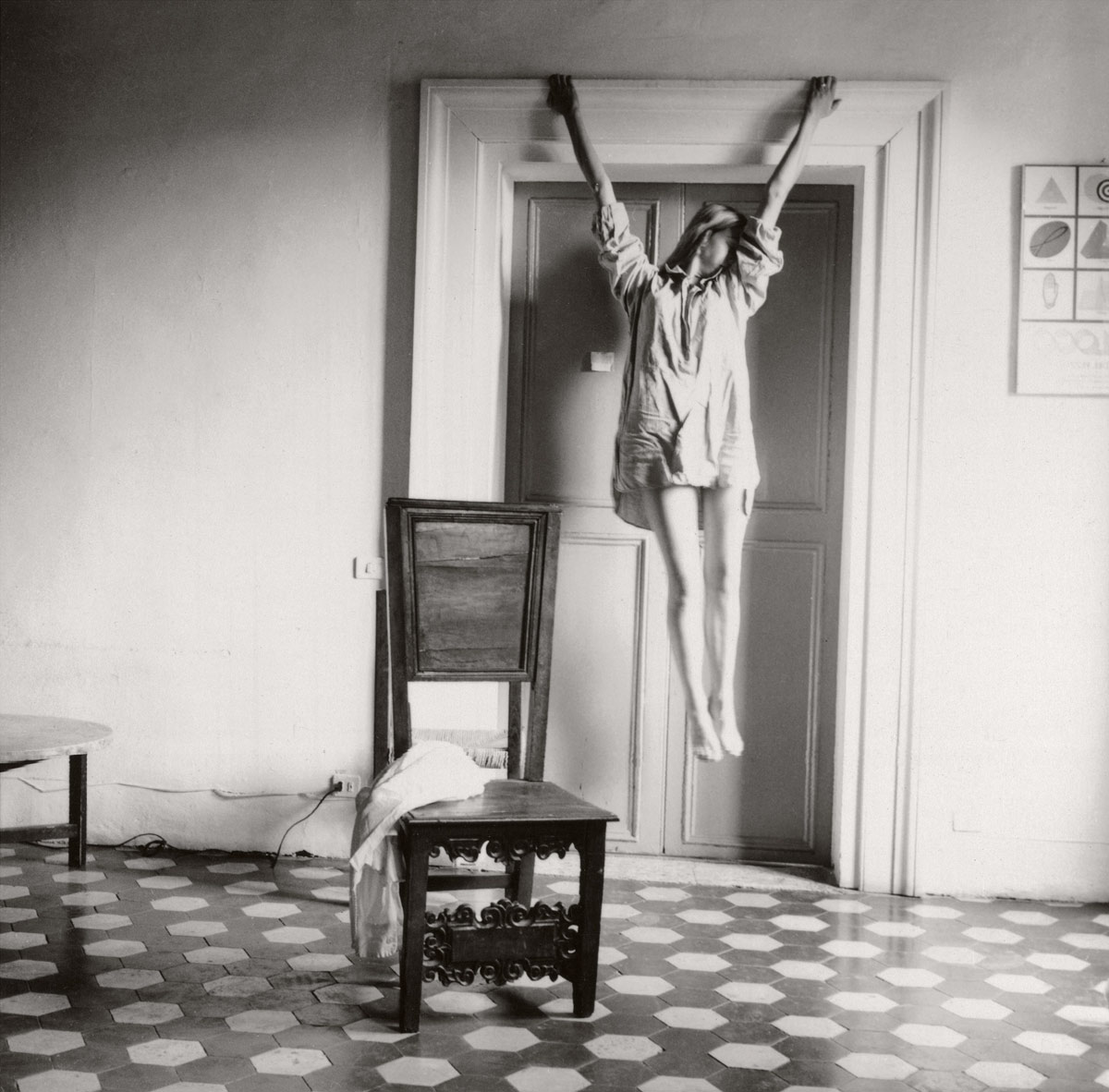
Francesca Woodman (American, 1958-1981) But Lately I Find a Sliver of a Mirror is Simply to Slice an Eyelid 1979-1980 Silver gelatin print
André Kertész (Hungarian, 1894-1985) Fan, December 1937 1937 Silver gelatin print
“I am an amateur and I intend to stay that way for the rest of my life.”
~ André Kertész
Margaret Bourke-White (American, 1904-1971) Fort Peck Dam, Montana 1936 Silver gelatin print
This photograph became an icon of the machine age, not only because it was printed as the cover of the first issue of Life magazine (November 23, 1936), but also because it showed the power of modern technology to dwarf humankind. The giant buttresses and what seem to be crenellated battlements (actually the supports for an elevated highway) are meant to be as raw and impressive as the towering walls of ancient monuments. The engineers on the spillway provide the necessary indication of scale.
Margaret Bourke-White (American, 1904-1971) Terminal Tower [Cleveland] c. 1928 Silver gelatin print
“I stood on the deck to watch the city [Cleveland] come into view. As the skyline took form in the morning mist, I felt I was coming to my promised land … columns of machinery gaining height as we drew toward the pier, derricks swinging like living creatures. Deep inside I knew these were my subjects.”
~ Margaret Bourke-White 1927
François Kollar (Hungarian, 1904-1979) Double-impression of the Eiffel Tower 1931 Solarised silver gelatin print
In this unique and widely-reproduced photograph, the French modernist photographer has overlaid positive and negative images of the magnificent Eiffel Tower. The iconic structure is depicted from an unusual perspective, thrusting upward, with Kollar’s special solarised effect.
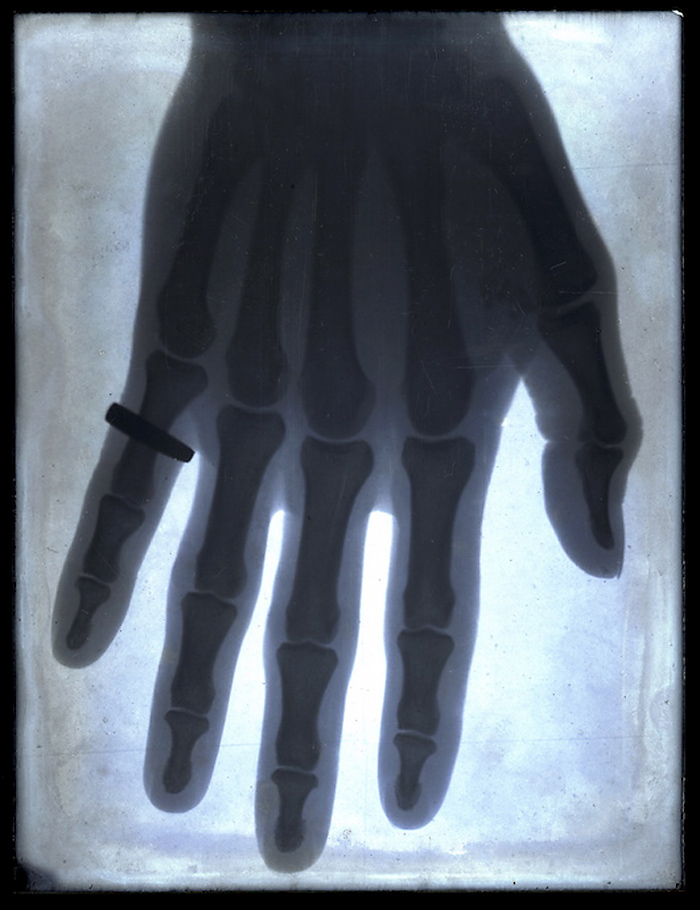
Edward J. Kelty (American, 1888-1967) X-ray of Ajax, the sword swallower 1928 Silver print 18 × 11 inches (45.7 × 27.9cm) With a New York X-ray lab credit in the negative
Edward J. Kelty (American, 1888-1967) Marcellus Golden Models 1933 Silver print 11 1/4 × 8 7/8 inches (28.6 × 22.5cm) With Kelty’s credit and title in the negative
This stunning suite of large format photographs emanates from an esteemed lineage: the early morning light of Atget’s photographs of Old Paris during that cities urban renewal; the frontality of Walker Evans and his photographs of Southern churches (with both artist’s attention to the storefront facade); and the formal qualities of the New Topographic movement and the gridded topos of Bernd and Hilla Becher.
While Eugène Atget photographed the vanishing environs of Old Paris, Davies captures the urban decay of New York City, a city that was undergoing serious urban renewal in the 1970s.
“The redevelopment of large sections of New York City and New York State by Robert Moses between the 1930s and the 1970s was a notable and prominent example of urban redevelopment. Moses directed the construction of new bridges, highways, housing projects, and public parks. Moses was a controversial figure, both for his single-minded zeal and for its impact on New York City… The Rondout neighbourhood in Kingston, New York (on the Hudson River) was essentially destroyed by a federally funded urban renewal program in the 1960s, with more than 400 old buildings demolished, most of them historic brick structures built in the 19th century. Similarly ill-conceived urban renewal programs gutted the historic centres of other towns and cities across America in the 1950s and 1960s.” (Anon. “Urban Renewal,” on the Wikipedia website)
In Davies’ project (and essential to his task), is the revealing of detail in these undervalued buildings. An ethereal light radiates, almost pulsates from these night time buildings – all rendered in beautifully ferrotyped prints that display a surplus of detail.
The previsualisation in these photographs is excellent. Notice how Davies pushes and pulls the viewer forward and backward in the image plane by using the device of the footpath to frame his compositions. In an image such as 94 Greene Street, New York (1975, above) – one of my favourite in this posting – the artist frames the image to stop at the edge of the pavement, allowing enough room so that the eye is led into the image. In other images, such as Broadway, New York (1976, below) or 425 Broome Street, New York (1976, below), Davies crops right up to the base of the building, forcing the viewer to acknowledge the geometric, cellular structure of the facade and nothing else. In yet other images, such as Column, Mercer Street, New York (1975, below) or 155 West Broadway, New York (1975, below) the artist pulls back from the building, allowing the pavement to anchor the building’s displacement while emphasising the columns grounding within the scene.
These really are magnificent photographs that bring the silence of the city to the fore front of our consciousness. Without the presence of human beings, the buildings take on a majesty that is usually usurped, overlooked or just plain passed by during the humdrum nature of everyday life.
Dr Marcus Bunyan
Many thankx to the Joseph Bellows Gallery for allowing me to publish the photographs in the posting. Please click on the photographs for a larger version of the image.
Joseph Bellows Gallery is pleased to announce its upcoming solo exhibition, Bevan Davies New York. The exhibition opens on March 14th and will continue through May 9, 2015. An opening reception will be held on Saturday, March 14th, from 6-8 pm. New York will present Davies’ luminous and highly detailed large-format black and white architectural views from the mid 1970’s, along with a selection of his earlier street portraiture from the preceding decade, in the atrium gallery.
Bevan Davies studied photography with Bruce Davidson, at the University of Chicago in early 1960’s and benefitted greatly through mentoring from Diane Arbus later in that decade. After working the street in both daylight and evening hours, photographing people at odds with society, with a hand camera, Davies changed his working methodology to describing the physical environs of the street: the building facades, alleys and streets with a tripod mounted view camera.
This change in subject and approach resulted in Davies most celebrated work. Created in 1975/76 Bevan Davies’ architectural photographs situated themselves wholly within the dictum laid forth by William Jenkins, as “New Topographics”. In fact, Davies writes of his approach as, “an effort being made to let the camera almost see by itself.” This notion was carried further by the late photographer, Lewis Baltz, who in 1976, referred to Davies’ photographs as, “rigorously contemporary, while acknowledging a use of the camera which dates from the inception of the medium.” The New York facades, taken in the early morning hours and devoid of people, describe spaces defined by light and shadow. They depict a specific time and place, as seen by the window dressings and signage, as well as portray a formal grace among the building’s details that are included within Davies’ camera frame. New York is the first comprehensive exhibition of Davies’ photographs in over two decades.
Davies photographs can be found in the collections of the J. Paul Getty Museum, Center for Creative Photography, Art Institute of Chicago, Nelson-Atkins Museum, Minneapolis Institute of the Arts, Museum of Fine Arts, Houston, George Eastman House, Corcoran Gallery of Art, Harry Ransom Center, Metropolitan Museum of Art, and the International Center of Photography.
In 2014, Nazraeli Press released Los Angeles, 1976, a monograph on Davies’ photographs from that region and era. The photographs depict the residential architecture and neighbourhoods through nuanced arrangement and clarity. A forthcoming volume on Davies’ New York photographs is in prepublication.
Anonymous photographer Untitled from a Japanese family photography album c. 1920-1930s
After the blockbuster Tattoo posting, here is a more still, quiet posting. Another nine images rescued from the dustbin of history…
I bought an anonymous Japanese family photographic album from Daylesford in country Victoria recently for $25 (US$35). There were many images missing, but the thirty that were present are just stunning. I have been scanning them and gently digitally cleaning them since, and this is the second of three postings on the images. I love their immediacy, their vernacular language and intimate feel and the irregular shape and cut of the prints. Some of the photographs are very small in size.
The serenity, the beauty and the attention to the form of the hair is quite captivating. They have me entranced. Just delightful.
Dr Marcus Bunyan
All photographs have been digitally restored. Please click on the photographs for a larger version of the image.
Anonymous photographer Untitled from a Japanese family photography album c. 1920-1930s
Anonymous photographer Untitled (detail) from a Japanese family photography album c. 1920-1930s
Anonymous photographer Untitled from a Japanese family photography album c. 1920-1930s
Anonymous photographer Untitled (detail) from a Japanese family photography album c. 1920-1930s
Anonymous photographer Untitled from a Japanese family photography album c. 1920-1930s
Anonymous photographer Untitled (detail) from a Japanese family photography album c. 1920-1930s
Anonymous photographer Untitled [Four women in traditional Japanese dress] from a Japanese family photography album c. 1920-1930s
Anonymous photographer Untitled from a Japanese family photography album c. 1920-1930s
Anonymous photographer Untitled (detail) from a Japanese family photography album c. 1920-1930s
Anonymous photographer Untitled from a Japanese family photography album c. 1920-1930s
Although I have ten tattoos by different artists – including a full back job by Alex Binnie of London – and scarification done in 1992, you always remember your first tattoo. I was in my early twenties when I decided to get inked. And the person recommended for the job was the legendary Alan Oversby (aka Mr. Sebastian), an S/M tattooist and one of the primary figures in the development of contemporary body piercing.
I remember travelling down to the East End of London and rocking up to this nondescript office block, climbing to the third floor I think it was, and entering a tiny square room, Alan’s studio. What an experience it was to be tattooed by him. Not so much the tattoo itself, which was a tiger on my upper left arm – first part of my earth, air, water, fire, void elemental sequence – but his presence and being surrounded by these fantastic, outrageous photographs on all four walls, floor to ceiling. Here was men’s tackle of all different shapes and sizes, the cocks and pubic area heavily tattooed and some of them heavily pierced, lying on pristine white dinner plates. Welcome to lunch.
For a young man this was an amazing, wondrous display. I totally loved him, the photographs, and his work. Unfortunately I don’t have any photographs of that studio and there are none that I could find online. Suffice it to say that the experience only confirmed me on my path of delicious deviancy that will not stop until the day I die.
Dr Marcus Bunyan
Many thankx to Museum für Kunst und Gewerbe Hamburg for allowing me to publish the photographs and text in the posting. The videos were all sourced from YouTube. Many thankx also to Becky Nunes who I contacted directly and who provided the wonderful photographs of Tã moko facial tattoos of the Maori in New Zealand.
Alan Oversby (Mr Sebastian)
Alan Oversby (Mr. Sebastian)
Alan Oversby (20 February 1933 – 8 May 1996) was one of the primary figures in the development of contemporary body piercing in Europe. He was better known by his professional name Mr. Sebastian.
Originally an art teacher, Alan Oversby left his initial profession to pursue his interests in tattooing and piercing instead. From his studio in London, he promoted both tattooing and body piercing, especially within the gay leather community. He was a correspondent of both Doug Malloy and Jim Ward. Sponsored by Malloy, he visited Los Angeles. Malloy also sponsored trips to London to visit him, bringing along Ward and Sailor Sid Diller. These exchanges were critical to the global spread of the techniques and technology used in contemporary body piercing.
Oversby was also responsible for the adoption of the use of topical and local anaesthetics as part piercing procedure in Europe. Although they are used less now, it used to be standard practice to use anaesthetics when performing piercings in England, where in North America this practice is almost unknown. He was interviewed in the fourth issue of PFIQ. He performed much of the tattooing and piercing on Psychic TV musicians Genesis P-Orridge and Paula P-Orridge. His vocals were used in the Psychic TV track “Message from The Temple” which appeared on their first album Force the Hand of Chance.
In 1987, Alan Oversby was one of 16 men charged as a part of Operation Spanner, a series of raids that resulted in the arrest of men who were all engaged in consensual homosexual BDSM activities. Alan, like the other men, was charged with assault occasioning actual bodily harm for performing a genital piercing on a client. He was also charged with using anaesthetic without a licence and for sending obscene material through the post (photographs of piercings). As the judge was not willing to take the consensuality of the participants into account, Alan pleaded guilty along with the other 15 men. He received a sentence of 15 months, which was suspended for two years.
The Tattoo exhibition is dedicated to old traditions and new stories. It takes a look at the vibrant, innovative and multifaceted tattoo culture, with a focus on artistic, artisanal and culture-specific issues. International exhibits from diverse perspectives are displayed and current debates considered. This is the first time that an exhibition has brought together such a broad range of references, presenting the phenomenon of the tattoo with a particular focus on art and design, since these enduring pictures, words and symbols inspire artists and designers. The theme of the exhibition is therefore the reciprocal influence of art, traditional and lived tattoo art and visual design. The exhibition Tattoo throws light on the ambivalence of the tattoo between a mark of distinction, a sign allocating its bearer to a social class, a badge of identity and a stigma in various cultures, social classes and epochs. Tattoo shows over 250 pieces of work, including photographs, coloured woodcuts, paintings and sculptures, as well as video clips and audio installations, stencils and historical specimens of tattooed skin. From tattooing instruments made of simple tools available in nature to intricate precision machines, colours and pigments convey an impression of the craft in practice. In this show the MKG also looks back on the long tradition of the Hamburg tattoo scene, which had its cradle in the port milieu of the late 19th century. Historical photos which have never before been on public show document the typical tattoos of the working class in Hamburg around 1890. Legendary tattooists such as Christian Warlich (“The Tattoo King”) and Herbert Hoffmann exemplify a many-facetted and highly expressive art form which generates ever new experimental designs. A glimpse into this is given by work from local tattoo artists who let themselves be inspired by the museum’s collection. A picture loop shows many pieces of work by celebrated tattooists, men and women, from the current international scene, which is marked by a huge diversity of stylistic approaches and new aesthetic movements.
The traditional cultural technique
All over the world, many cultures use the human skin as a surface to carry images. The tradition of tattooing is among the earliest art forms and the most ancient crafts. The exhibition shows selected examples. The facial tattoos of Chin women in Burma are part of a rite of passage marking the transition from childhood to adulthood. With the help of thorns or needles, female tattooists incise patterns into the skin which vary from one family clan to another. Tā Moko, the facial tattoos of the Maori in New Zealand, indicate a person’s family affiliation and social status. Each part of the face is reserved for a particular type of information. A tattoo on the centre of the forehead, for instance, testifies to high status. In Thailand, sacred tattoos – known as Sak Yant – are widespread. They are intended to protect their bearer from bad luck and to help them lead a morally impeccable life. Tattoos have a long tradition in Japan too, dating back to the 3rd century. Their design follows a particular harmony and elegance and is characterised by clearly demarcated areas of colour. The tattoos often cover wide expanses of the body surface and connect to a cohesive image. The motifs often reference subjects of traditional woodcuts or represent mythological beings which are supposed to exemplify particular qualities of their bearer’s character. For instance, the dragon stands for virility, power or heaven. Since tattoos were banned from 1870 to 1948 in Japan, they were for a long time associated with the criminal milieu of the Yakuza, a Japanese mafia organisation.
The spread of tattooing in the Western world
In the 18th and 19th centuries, illustrated travel reports were a major influence on the way people viewed other cultures in far-off lands and fired curiosity about the practice of tattooing, which seemed exotic in those days. The word tattow in the Polynesian language is first mentioned in James Cook’s reports of his expeditions to the South Seas in the 18th century. Modern tattooing became widespread in the West through the very popular early ethnographic drawings and prints as well as later through photographs. At the beginning, the art of tattooing often stood for the erotically titillating flair of the exotic and magic-mystical in a world attended by strange cults and rituals. Tattoos flourished in Europe and America during the years leading up to the World War I. For this reason, the members of the American upper class and of almost all European royal families – including the German imperial family – were tattooed. In this period, this form of body decoration was regarded as an expression of good taste. In the 19th century a more ambivalent attitude towards tattooing develops, however, above all among the bourgeoisie. In consequence, very little lies between fascination and rejection in the Western historical view of tattooing: this is what underlies the dual character of tattooing as stigma and mark of distinction.
Codes and their reinterpretation
The functions and meanings attributed to tattooing proliferate due to its diffusion throughout different social classes and groups over the last century. First and foremost, its ambiguity, signalling both stigma and distinction, is symptomatically revealed in the different tattooing practices followed in different milieus. While sailors and soldiers flaunt the record of their travels with exotic images, tattoos develop into veritable badges of recognition in the criminal underworld. In the context of photographic “mugshots”, first used in the hunt for criminals at the beginning of the 20th century, tattoos already take on great significance as a means of identifying suspects. In Russian prison camps of the late 19th century tattoos and branding are systematically employed by the state to mark out people as convicts. In response professional criminals in Russia, however, get around this form of stigmatisation by adopting their own informal tattoos. They modify traditional motifs and develop a system of secret signs, which reveals the group they belong to, their convictions or their rank in the criminal hierarchy. The French photographer and filmmaker Christian Poveda has documented the heavily tattooed members of the Latin American gangs of the Mara Salvatrucha and M-18, the lettering and symbols displayed on their skin have an important function in recognition and promotion of group affinity. The work of the Austrian Klaus Pichler traces the current significance of tattoos in prisons and offers a photographic glimpse into what are actually forms of coping with imprisonment within the penal system.
Women and tattoos
Another aspect of the exhibition are objects dealing with the relationship between women and tattoos. Historical photos highlight the vicissitude, ranging from the exhibition of the heavily tattooed female body as a fairground attraction in the 1920s up to the glamour girls in the vaudeville shows of the 1960s and the first female tattooists, who independently and with great determination carved out a place for themselves in a male-dominated profession. Tattoo culture is meanwhile unthinkable without women and they play an important role as artists in the contemporary scene.
Tattoos in contemporary art
The complex spectrum of meanings conveyed also plays a major role in contemporary art. The Japanese woman artist Fumie Sasabuche, for instance, takes as the theme of her sculptural and photographic works the interplay between the traditional Japanese tattoo motifs of the Yakuza and the aesthetic impulses of Western mass culture. Enrique Marty’s sculptures from his series Art is Dangerous, too, fall back on the Yakuza iconography in order to raise ironic questions about the role of art and the meaning conveyed by tattoos in combination with the grotesque effect created by the figures. The Spanish concept artist Santiago Sierra discusses the subject from the perspective of social and capitalistic criticism in his films. He pays members of socially marginalised groups to have a continuous line tattooed on their backs as part of a performance. With the deliberately unsteadily drawn line he is alluding to the precarious existence they lead and the social stigmatisation that goes with it. The Polish artist Artur Żmijewski addresses relentlessly and provocatively the practice of tattooing prisoners in the Nazi concentration camps. His video 80064, which sparked fierce and controversial debate among its viewers, shows Josef Tarnawa, a 92-year old survivor of Auschwitz, whom the artists persuaded to have his fading camp number freshly tattooed. On the one side, Tarnawa is being stigmatized all over again by this procedure, on the other side the number on his left forearm takes on the function of a shocking admonition not to forget. Active remembrance, Artur Żmijewski seems to be saying here, is channeled today into much too orderly forms. The burn mark and the involuntary tattoo have faded out of view today in the Western history of tattooing, but what was practiced during the Second World War remains deeply engraved on the artist’s memory.
The tension between the tattoo as a work of art and its existence on the “living canvas” is the subject of an exemplary treatment by the Belgian concept artist Wim Delvoye. The exhibition shows the tattooed pig Donata, which the artist decorated under anesthetic in 2005, with the help of several professional tattooists, on his Chinese “Art Farm”. Delvoye subsequently exhibited the animal as a living work of art, and had it stuffed after it died. The second work by Delvoye shown in the exhibition picks up on this idea and articulates critical questions about moral principles in the art market, power and the right to make use of the human body as an artistic object. The Swiss Tim Steiner had a work by the Belgian artist tattooed on his back between 2006 and 2008; in 2008 it was purchased by a Hamburg art collector, together with the right to pass Tim Steiner on as an item on loan, to sell him, to bequeath him and to have his skin conserved after his death. Since then the work Tim has been the subject of great international controversy. He will be on show in the Hamburg exhibition on 11 and 12 April and on 27 and 28 June 2015.
Pricking the skin with a needle demands the same aesthetic imagination and care, the same controlled craftsmanship and knowledge of materials and color sense as any other design technique. The contemporary tattooing scene is highly innovative, transcending the traditional language of tattooing and renewing the medium. A picture loop in the exhibition shows international work in a great variety of styles and in outstanding quality.
With contributors including: Masahiko Adachi (JP) / Diane Arbus (USA) / Imogen Cunningham (USA) / Wim Delvoye (BEL) / Chris Eckert (USA) / Goran Galić & Gian-Reto Gredig (CH) / Herbert Hoffmann (DE/CH) / Mario Marchisella (CH) / Enrique Marty (ESP) / The Rich Mingins Collection (GB) / Ralf Mitsch (NL) / Becky Nunes (NZ) / Jens Uwe Par¬kitny (DE) / Klaus Pichler (AUT) / Christian Poveda (FR) / Rodolphe Archibald Reiss (DE/CH) / Fumie Sasabuchi (JP) / Santiago Sierra (ESP) / Aroon Thaewchatturat (THA) / Timm Ulrichs (DE) / Christian Warlich (D) / Artur Żmijewski (POL). Work in the picture loop by: Luke Atkinson (DE) / Curly (GB) / Mike DeVries (USA) / Thea Duskin (USA) / Lionel Fahy (FR) / Sabine Gaffron (DE) / Valentin Hirsch (DE) / Saira Hunjan (GB) / Inma (GB) / Bastien Jean (FR) / Jon John (GB) / Guy LeTatooer, (FR) / Filip Leu, (CH) / Karl Marc, (FR) / Volko Merschky & Simone Pfaff, (DE) / Lea Nahon, (FR) / Roxx (USA) / Minka Sicklinger (USA) / Liam Sparkes (GB) / Jacqueline Spoerle (CH) / Kostek Stekkos (BE) / Amanda Wachob (USA) / Seth Wood (USA).
Tattoo is a production of the Gewerbemuseum Winterthur, Schweiz, curator Susanna Kumschick, and is being shown for the first time in Germany.
Press release from the Museum für Kunst und Gewerbe Hamburg website
Installation views of the exhibition Tattoo at the Museum für Kunst und Gewerbe Hamburg showing in the bottom two images, photographs by Ralf Mitsch
Kept under wraps in winter and proudly displayed in summer: tattoos are now ubiquitous. However, they are much more than just a current mass phenomenon and trendy fashion accessory: many cultures throughout the world are familiar with the tradition of tattooing, and human skin has always been used as a canvas. Tattooing is one of the earliest art forms and oldest handicrafts.
Tattoos last for a lifetime. Pigments are inserted under the skin forever, yet they are as transient as the life of the person who bears them. They tell personal stories, create identity and affiliation, embellish, heal, protect – and they can both fascinate and repulse. For a long while they were most commonly known as a mark of social distinction or as a means of identifying social outcasts, and as a method of self stigmatisation used by sailors, criminals, prostitutes and gang members to distinguish themselves from “the other”. It is easy to forget that the craze for inking one’s body spread even to aristocratic circles in the later nineteenth century, in a trend that is now echoed by the current fashion for tattoos.
The Tattoo exhibition is dedicated to old traditions and new stories. It takes a look at the vibrant, innovative and multifaceted tattoo culture, with a focus on artistic, artisanal and culture specific issues. International exhibits from diverse perspectives are displayed and current debates considered. This is the first time that an exhibition has brought together such a broad range of references, presenting the phenomenon of the tattoo with a particular focus on art and design, since these enduring pictures, words and symbols inspire artists and designers. The theme of the exhibition is therefore the reciprocal influence of art, traditional and lived tattoo art and visual design.
Johann Baptist von Spix (German, 1781-1826) Journey to Brazil on command Maximilian Joseph I, King of Bavaria, in the years 1817-1820 / made and described by Johann Baptist von Spix and Carl Friedrich von Martius – Munich: [sn], 1823-1831 Loan: Museum of Ethnology, Hamburg
Expedition to Brazil
Johann Baptist von Spix, 1817-1820
Between 1817 and 1820, the zoologist Johann Baptist von Spix and the botanist Carl Friedrich Philipp von Martius undertook an expedition to Brazil at the behest of Maximilian Joseph I, King of Bavaria. They were also interested in the culture of the Brazilian indigenous tribes on the Rio Yapurà, and they published their findings in a three-volume travel report. The illustration is a portrait of Juri, “The son of a cacique of the Juri nation”.
Illustrated travel books were very popular in the 18th and 19th centuries. They shaped western ideas about foreign cultures and also indicate the early interest in exotic tattooing practices. James Cook’s reports on his expeditions to the South Seas in the 18th century contain the mention of the word “tattow” derived from the Polynesian. The term quickly spread and tattooing became popular in the Western world soon afterwards.
Early ethnographic drawings and engravings such as those made by Georg Forster and Karl von den Steinen attracted widespread interest, as did photographs at a later date such as the studio portraits taken by Felice Beato in Japan. They helped to make the art of tattooing into a symbol of the eroticised alien, and a magico-mythical world of cults and rites. Tattoos elicited a mixture of fascination and revulsion right from the start, particularly in middle-class circles during the 19th century: tattooing thus developed a dual character as both stigma and mark of distinction.
Enrique Marty (Spanish, b. 1969) Pablo & Ruth 2010 From the series Art is Dangerous Oil paint on latex on polyurethane, human hair, textiles, metal 155 x 90 x 53.5 cm/143 x 60 x 35cm Loan: Deweer Gallery, Otegem, Belgium
Real portraits are always the starting point for Enrique Marty’s tragicomic sculptures. The tattoos of Pablo & Ruth in the Art is Dangerous series reflect the iconography of the tattoo motifs in Japanese yakuza which the artist has explored in detail and incorporated into his work. His grotesque figures also make reference to early sculptural traditions such as those used in the quaint waxworks exhibitions of the 19th century. He builds on these themes and develops an original sculptural world. Ironic inversions and humour are essential strategies which he uses as an effective weapon. “Art is dangerous”: protest or parody? An allegory of the market system? Can art be dangerous? Or should it be? What role does the art of tattooing play?
Tattoo equipment
Throughout the world tattooing is performed by introducing pigments to the dermis, or second layer of skin. Pieces of wood, thorns, bones, horns, tortoiseshells, metals and shards can be worked into tools. Depending on the shape of the tattooing implement, the patterns produced may be smooth or dotted, narrow or broad. The individual instruments have not changed greatly over the years. However, one notable step forward was the use of electricity which resulted in new techniques and styles at the beginning of the 20th century after Samuel O’Reilly had patented his rotary tattoo machine in 1891. The electric motor moves the needles up and down regularly, enabling the operator to work smoothly and steadily. It is also a less painful process for the client. These electric machines are in widespread use today. Nevertheless, traditional tools, which have hardly changed, are also still employed.
Tattoo inks
It was not until the 20th century that tattoo inks began to be manufactured as industrial products. Previously, they had been mixed in small quantities according to individual recipes using pigments, oils and plant juices. Synthetic pigments not only altered the colour spectrum and production techniques of tattoo inks, but also led to new requirements and constraints as is clear from developments over the last forty years. Today, challenges in the manufacturing process for tattoo inks primarily concern the purity of the ink production process and the quality of the pigments procured. Other requirements tend to be connected with new problems which are no longer to do with the actual pigment that is inserted into the skin. Nowadays the main focus is on the risks posed by laser treatment for tattoo removal.
The Rich Mingins Collection: 1288 Pictures of Early Western Tattooing from the Henk Schiffmacher Collection 2011
The Rich Mingins Collection
Rich Mingins (1916-1968) ran a tattoo studio with his father and his brother Alf Mingins in Cumbria, which is in the north-west of England, and later in London. Tattooing was his passion and he was a master of his craft. He also collected photographs and newspaper cuttings about tattoos. Today all that remains is his photo album which documents the history of tattooing from 1922 to 1949. Unfortunately, it lacks a chronology or any precise dates, and no accompanying commentary has been found. The digital version with extracts from the photo album shows his clients, other well-known tattoo artists of his era, copies of pictures that were in circulation at the time and the artist himself: Rich Mingins poses for the camera with clenched fists, displaying the picture of Jesus Christ with crown, that was tattooed on his chest by his brother Alf Mingins (no. 424).
Painting The Lily! (1936, 1.12 mins.)
In this documentary, George Burchett (1872-1953) tattoos two women with permanent makeup at his studio in the West End of London. His clientele included members of the English upper classes and European royalty such as King Alfonso XIII of Spain, King Frederick IX of Denmark and King George V of England. George Burchett also tattooed Horace Ridler, the legendary Zebra Man also known as “The Great Omi”.
Tattoo Soldiers (1942, 1.15 mins.)
Three Australian soldiers talk about their tattoos from all over the world.
Woman Tattooist (1952, 1 min.)
The first British female tattooist, Jessie Knight (1904-1994), tattoos young women soldiers in Aldershot, Hampshire. She ran a number of studios from the 1920s up to the 1980s.
Tattoo Club (1954, 1.51 mins.)
The well-known British tattooist Les Skuse (1912-1973) founded the Bristol Tattoo Club in 1953 and in 1955 he organised the world’s first tattoo competition, the precursor of the tattoo conventions of today. In the 1950s the Bristol Tattoo Club was the focal point of the tattoo scene, counting famous people such as Bob Maddison, Al Schiefley, Albert Cornelissen and Tattoo Peter among its members.
Photograph from the Christian Warlich estate, 1961 Loan: Hamburg Museum, Sammlung Fotografie
Christian Warlich: the “King of the tattoo artists”
During his lifetime, Christian Warlich (1890-1964) was held to be the greatest tattoo artist in Germany and gained an international reputation as “King of the tattoo artists”. He had taught the craft to the Hamburg tattoo legend Herbert Hoffmann and later made him to be his “Crown Prince”. Warlich himself is believed to have come into this profession by chance. After an apprenticeship as a boilermaker he had gone to sea and become acquainted with tattoo artists in the United States. From there, he brought back one of the first electric tattoo machines. In 1919, Warlich opened an inn in today’s Clemens-Schultz-Straße in St. Pauli, Hamburg, where one of the corners served as a “Modern Tattoo Studio”. Warlich took on tattooing as a serious business: he promoted the store, traded with tattoo machines and tools and in addition to his tattooing, he offered a residue-free and painless removal of tattoos by using a special tincture. Warlich was not only noticed because of his business sense, his work was characterized by craftsmanship and artistic standards, too. Unlike other tattoo artists of his time, he strove for a continuous improvement of the shapes and for the modernisation of the image repertoire. For these purposes, he developed new designs and collected all kinds of templates, for instance from Chinese sample books, movie posters or advertising images. In addition, Warlich kept in contact with tattooists all over Europe, North America and Asia. They exchanged sketches photographs and celluloid stencils with which the outlines of the motifs were transferred to the skin of the customers.
The tattooist Herbert Hoffmann: a legend
The world famous tattooist Herbert Hoffmann (1919-2010) lived through and helped shape various stages of the history of western tattooing. Throughout his life he was very keen to help tattoos gain acceptance and social approval. Having been trained by Christian Warlich, he later became the proprietor of Germany’s oldest tattoo studio in the St. Pauli district of Hamburg, where he worked until 1980. He then moved to Switzerland, where he lived with his partner Jakob Acker in Schwendi bei Heiden in the canton of Appenzell Ausserrhoden. Hoffmann was active in the tattoo scene right up to his death in 2010, attending conventions throughout Europe and acting as an important role model for younger tattoo artists. He himself bore tattoos by Christian Warlich, Tattoo Peter, Tatover Ole, Horst Streckenbach and others. Throughout his life he was also a keen photographer and collector. Many of his photographs were published in the photo book Living Picture Books, Portrait of a Tattooing Passion 1878-1952, which is now out of print. The images displayed in the exhibition are from his private archive and have rarely been shown before. These are photographs from his personal albums with portraits of his friends and clients. They depict Herbert Hoffmann himself at different stages of his life, as well as his environment. At the same time, they narrate an important chapter in the history of tattooing from the 1920s to the 1970s. Unfortunately his written comments can no longer be traced.
Women and tattoos from the private collection of Herbert Hoffmann
The picture archive of the tattooist and collector Herbert Hoffmann (1919-2010) also includes photographs of tattooed women from the 1920s up to the 1970s. Some of them are photographs he took himself but others are copies and images that were circulated in various forms by like-minded people. They are not systematically arranged, most of them are undated and there is no commentary. The collection also includes iconic photographs which had a decisive impact on how tattooed women were viewed at that period. This selection of Herbert Hoffmann’s pictures is a chronicle of women with tattoos, from circus attractions of the 1920s and glamour girls of the 1960s to the predecessors of the famous “new burlesque” artists like Dita Von Teese. However, there are also photos of “ordinary women” with tattoos in the prim-and-proper 1950s and – more rarely – of female tattooists. Herbert Hoffmann’s collection ends with the “renaissance” of tattooing in the 1970s. At that time, women in particular were discovering tattoos as a sign of self-empowerment and the number of female creative tattoo artists making their way in this male-dominated profession began to increase. Today there is a huge variety of (self-)expression by tattooed women, and female tattoo artists play an essential and influential role in the rich contemporary tattoo culture.
Maud Stevens Wagner, Tattoo Artist, USA (1877-1961, photo from 1907)
Maud Stevens Wagner (American, 1877-1961)
The American tightrope walker and contortionist Maud Wagner was the first well-known female tattooist in the Western world. Like others of the small number of female tattooists in the 1920s, she learned her craft from her husband, Gus Wagner, whom she met at the St. Louis World’s Fair in 1904.
Lady Viola (American, 1898-1977) Nd
Lady Viola (Ethel Martin) (American, 1898-1977)
Ethel Martin Vangi, who became famous as “Lady Viola”, was a circus performer and later tattooist; she had portraits of presidents Woodrow Wilson, George Washington and Abraham Lincoln tattooed on her chest. Her left thigh was tattooed with pictures of popular figures of the day, such as Babe Ruth and Charlie Chaplin.
Artoria Gibbons (American, 1893-1985) Nd
Artoria Gibbons (American, 1893-1985)
Like many tattooed circus attractions, Anna Mae Burlington Gibbons was a working-class woman who had herself tattooed when she fell on hard times, and then earned good money as a result (especially as a woman). She and her husband, the tattooist Charles Gibbons, travelled all over America in the 1920s and worked as a team in the circus business. She had one tattoo showing a section of Botticelli’s Annunciation, another depicting a part of Michelangelo’s Holy Family, and her chest featured a portrait of George Washington.
Cindy Ray (Bev Robinson) (Australian, 1942-2025) Untitled [Self-portrait] Nd
Cindy Ray (Bev Robinson) (Australian, 1942-2025)
The last great circus lady, Cindy Ray – also known as “Miss Technicolor” or “The Classy Lassie with the Tattooed Chassis” – toured Australia and New Zealand in the 1960s. She learned how to do tattooing and is still working today under her real name, Bev Nicholas, at the Moving Pictures Tattoo Studio near Melbourne.
Imogen Cunningham (American, 1883-1976) Irene “Bobbie” Libarry 1976 Silver gelatin estate print 19.3 x 17.8cm Loan: The Imogen Cunningham Trust, Lopez Island, USA
Irene “Bobbie” Libarry (American, 1893-1978)
Irene “Bobbie” Libarry (1893-1978) worked as a circus performer, magician and market vendor. She was tattooed by her husband in 1918, ran her own sideshow “The World’s Strangest People” in the 1930s and later worked as a tattoo artist in San Francisco.
Numerous historical portraits of tattooed men have been preserved in the inheritance of the tattoo artist Christian Warlich (1890-1964). The pictures probably originate in the 1880s to 1890s [see both images above]. Especially typical contemporary garments, the beard and hair fashion of the time, relevant tattoo motifs from the German Empire under William I or the symbol of the tenth World Expo in 1889, the Eiffel Tower, give information about this type. All images are carefully rear numbered and labeled with the names of the people portrayed. On display are mainly dock workers and seafarers; members of underprivileged workers who were not used to posing in front of a camera. In the late 19th century, the loading work in the ports was extremely cumbersome and labour intensive, roosts such as the Hamburg Gängeviertel hosted thousands of working families. In this milieu relevant subjects such as anchors, sailboats or professional characters show the belonging to a social group. The tattoos document but beyond the story of people’s lives. There are references to the military service or the crossing of the equator, as well as prison stays or religious motives.
Preserved tattoo specimens
The specimens date from around 1900. At the time they were used to identify unknown corpses. Photography was not yet in routine use at that period and preserved specimens offered almost the only opportunity to document a tattoo in detail and keep it for later identification. The oldest known report of successful identification thanks to a tattoo dates back to the 11th century: King Harold II of England fell in battle and is said to have been identified by the inscription “Edith and England” tattooed above his heart, thanks to which he was buried in a manner befitting his rank.
Emile Lavril, Romeo und Julia Tattoo 14 November 1913, front
Rudolf Archibald Reiss (German-Swiss, 1875-1929)
The criminologist, lecturer and photographer founded the “Institut de police scientifique” at the University of Lausanne in 1909. He also helped to set up courses in photography for investigative purposes at the same institution. Forensic photography, which was being carried out according to standard criteria for the first time was an essential component in his teaching. Since tattoos are important identification features, Reiss paid particular attention to them [see photograph above]. However, the technology available at the time made it difficult to obtain a sharp and accurate image. Reiss used photographs purely for forensic purposes. He refused to accept the then common opinion that offenders could be recognised simply because they had tattoos.
Eyes on the stomach denote homosexuality (the penis makes the ‘nose’ of the face). Stars on the shoulders show that an inmate is a criminal ‘authority’. The medals are awards that existed before the revolution and as such are signs of defiance towards the Soviet regime.
The devils on the shoulders of this inmate show a hatred of authority. This type of tattoo is known as an oskal (grin), a baring of teeth towards the system. They are sometimes accompanied by anti-Soviet texts.
The double-headed eagle is a Russian state symbol that dates back to the 15th century. After the fall of Communism, it replaced the hammer and sickle as the Russian Federation’s coat of arms. This Soviet-era photo is a bold symbol of rage against the USSR; the Statue of Liberty implies a longing for freedom.
Photographs of Russian convicts
Up until the end of the 19th century, it was usual for the government to burn the initials “B.O.R.” (Russian for thief) into thieves’ skin as a punishment. Subsequently, tattoos developed as a distinctive feature of professional criminals; serving as demarcation, identification, as well as a secret means of communication: they transmit information such as affiliation, profession, number of convictions or position in criminal hierarchies. This informal practice transliterated the original stigmatisation inflicted through the government, using a pictorial repertoire borrowed from traditional tattoo imagery while assigning a new meaning. Most of the prison tattoos were done with primitive instruments, such as modified electric shavers with attached needles. Oftentimes, a self-made mixture of rubber and urine was used as substitute ink, bearing great health risks. Arkady Bronnikov (b. 1926) was a leading forensic doctor at the interior ministry of the USSR. From the mid-1960s until the mid-1980s he interviewed and photographed numerous inmates of labour camps in the Urals and Siberia. Today, Bronnikov is a leading expert on tattoo iconography and owns what is considered to be one of the biggest photographic collections of Russian prison tattoos.
The Austrian photographer Klaus Pichler (b. 1977) spent eight years looking for ex-prisoners, photographing their tattoos and writing down the stories behind them. The result was an impressive documentary account of the still poorly researched history of prison tattoos. The pictures and interviews were published in the book Inked for Life. The World of Prison Tattoos.
The acceptance of tattoos in Japanese society is subject to constant change. In the 19th century, large tattoos were considered decorative and were carried openly by rickshaw drivers, for example. For the scantily clad men an ornate body was helpful for their business because it attracted the attention of customers. The image of bullies and petty criminals adhered to rickshaw drivers, as well as to other professions from the simple population which led to a long-term negative perception of the skin images. As an identifying feature of “outlaws” they also function in the criminal milieu of the yakuza. In the Japanese mafia organisation, tattoos still illustrate the milieu name of the bearer (“serpent”, “dragon”, etc.) and document his gang membership. The result was a social aversion to tattoos which continues to this day and also unjustly criminalises innocent citizens. Unlike their historical predecessors, taxi drivers today would only flaunt their tattoos for a photographer; because they are not good for business. Tattoos in Japan were rarely shown openly; in public bath houses they are even forbidden to this day. It was only through the appreciation of the Japanese tattoo tradition by the American tattoo scene of the 1960s and 1970s that the taboo was partially revised.
Masahiko Adachi (Japanese, b. 1983) Flesh Color 2010 Japan Animation / 4 Min.
Japanese colour woodcuts: The 108 heroes of the “Suikoden”
The Japanese name “Suikoden” stands for a famous Chinese adventure story that became very popular in both countries. In this story, a group of rebels fights against corruption and injustice, campaigning for the poor and the disadvantaged. The story originates in the 14th century and is set in the 12th century. For the first time, Kuniyoshi displays these rebels with naked, tattooed bodies which lead to a great success of the book. Until today, the Suikoden is a well-known theme of Japanese culture such as computer games and TV series.
Fumie Sasabuchi draws irezumi tattoos on the skin of pictures of young girls taken from the children’s fashion magazine Vogue Angels. The motifs of the tattoos are part of the traditional repertoire of the Japanese yakuza mafia, and symbolise mortal danger, superhuman strength and special protection, among other things. Sasabuchi unites two media from Western and Eastern popular culture: photography from modern fashion magazines and the traditional woodcut. She combines Japanese myths with Western picture subjects and plays with the ensuing ambivalent images.
Twelve years of civil war in El Salvador came to an end in 1992. Today, gang warfare is an everyday reality in San Salvador, mainly because of two gangs: the Mara Salvatrucha (MS) and the Mara 18 (18). Every year 2,000 people die as a result. Some 14,000 abandoned youths dedicate their lives to the gangs which replace their families. They are the successors of the US gangs that were founded in the 1980s by refugees from the Salvadoran civil war. The Mara gangs today, which originated in the ghettos of Los Angeles, have over 70,000 members in El Salvador, Guatemala and Honduras. Members generally have a tattoo containing the letters M or MS, as well as the number 13 which refers to the position of M in the alphabet. Tattoos in the shape of teardrops represent the number of murders committed, or commemorate the death of a fellow Mara member and friend. The words “La vida loca” stand for “the crazy life” in the Mara, and a downward-pointing M formed with the fingers is used as a sign of recognition.
The Spanish-French photographer and documentary filmmaker Christian Poveda spent over a year with members of the Mara. He followed the lives of these “lost youths”, documenting them through interviews, impressive photographs and the film La vida loca (El Salvador / France / 2008 / 90 mins.). Poveda was killed by several shots to the head in San Salvador in 2009 while working on another film.
The face tattoos of the Chin women in Burma form part of a ritual to mark the transition from childhood to the adult world. Female tattoo artists use thorns 17 or needles to prick patterns into the skin. The symbolic meaning of the lines and dots cannot be ascertained, since no records exist. All that is known is that the patterns differentiate one clan from another. Although the tradition of facial tattooing has died out in many parts of Burma, it is now experiencing a partial revival.
The Tã moko facial tattoos of the Maori in New Zealand give information about family membership, ancestors and social position, as well as the specific abilities of the tattooed person. Each part of the face is dedicated to a particular type of information. Few people have a tattoo in the centre of the forehead, for example, since this indicates high status. Men can usually wear tattoos over the entire face, whereas women have them only on the chin area. This tattoo tradition has been suppressed for a long period, as also happened in other cultures, but the Tã moko have recently been experiencing a renaissance.
Mau Moko: photographic images of the world of Maori tattoo by Becky Nunes
“These are impressive and moving images, which deserve exhibition simply in their own right. More than that, they place moko in a contemporary context, expressing the art as a living, relevant force in our culture and not some struggling remnant of a distant past. They strongly counter the negative connotations of moko.”
Hamish Keith, Art Historian 2009
Mau Moko: the World of Maori Tattoo began as a research project at the University of Waikato, and evolved into a major publication, a scholarly yet entertaining journey from the art’s Pacific chisel origins to the marae workshops and sophisticated urban studios of Aotearoa today. It has been essentially a visual experience – the exacting portraiture of Parkinson and Jenner-Merrett, the iconic canvasses of Goldie and Lindauer, the pretty, ubiquitous postcard albums, and most recently, the brooding, elemental image-making of Westra and Friedlander, have all marked their own place, in their own time. With Mau Moko, and the consummate artistry of this collection, we reach the twenty first century. Becky Nunes’ eloquent lens engages the viewer, and the viewed, and one wonders who is saying “Tirohia, he moko!” It is about us. And yes, it is forever.
Ngahuia Te Awekotuku. May 2008
In December 2007 Penguin Books published Mau Moko, The World Of Maori Tattoo. The result of several years’ research, the book explores the cultural and spiritual issues around ta moko, and relates the stories of its wearers and practitioners. Mau Moko was authored by Ngahuia Te Awekotuku and Linda Waimarie Nikora with contemporary portraits photographed by Becky Nunes. Becky Nunes is a photographic artist and educator, making images for a range of commercial and editorial clients, as well as her own personal work. She heads the Photo Media department at Whitecliffe College of Arts & Design. For the Mau Moko project Nunes travelled through both the North and South Islands of Aotearoa / New Zealand meeting and photographing wearers and practitioners of ta moko.
Sacred tattoos known as Sak Yant are commonly found in Thailand. They protect the bearers from accidents, misfortune and crime. At the same time they help them to lead a morally upright life. However, the rules set by the tattooist must be obeyed or the tattoos lose their power. Sak Yants are not intended for public view and therefore often kept hidden. The motifs used are derived from ancient Khmer script writings and animal symbols such as tigers, dragons, birds, snakes and lizards. The tiger, or Yant Sua, is a popular subject and is associated with strength, fearlessness and power.
Tattoo Master
There are several hundred tattooists in Thailand. Monks tattoo in their temples, and tattoo masters in studios. They are authority figures and their followers also seek advice from them. The sacred tattoos link tattooist and tattooed for a lifetime. 38-year-old Achan Neng Onnut is a tattoo master in On Nut, a district of Bangkok. The pricked motif is called Pho Kae. It depicts a recluse, or hermit, and bestows wisdom, goodness and a peaceful mind to the bearer. The tattoo master recites a mantra in order to activate the tattoo.
Santiago Sierra (Spanish, b. 1966) 250 cm line tattooed on six paid people 1999 Espacio Aglutinador, Havanna / Cuba / doc. / 28.17 mins. / no sound Loan: Galerie Kow, Berlin
In 1999 Santiago Sierra recruited six young unemployed men in Havana to stand in a row and have a horizontal line tattooed on them, running continuously from one man’s back to the next, in exchange for 30 dollars each. Further versions of this performance were carried out and documented as simply as possible. It alludes to the unequal values of capitalist society and to the relative and haphazard nature of remuneration. The imprecise line drawn of the tattoos suggests scarring, so the participants in the performance – members of socially marginalised groups – were subjected to further stigmatisation.
Artur Żmijewski (Polish, b. 1966) 80064 2004 11 mins. Polish with English subtitles Loaned by the artist and Galerie Peter Kilchmann, Zürich
The Polish artist Artur Żmijewski takes an unsparing and provocative look at the tattooing that took place in the Nazi concentration camps. His video shows 92-year-old Auschwitz survivor Josef Tarnawa whom the artist persuaded to have his fading camp number re-inked. While the tattooist is renewing the numbers, Josef Tarnawa recalls the most traumatic time of his life. Artur Żmijewski’s video work polarises opinions. On the one hand, Josef Tarnawa is stigmatised for a second time, but on the other, the number on his left forearm acts as a shocking memorial. According to Artur Żmijewski, nowadays active remembrance is often far too conventional.
In the history of western tattooing, brands and involuntary tattoos have receded into the background, although the practices used during the Second World War remain deep in people’s memories. Whereas the prisoners in Auschwitz were numbered, members of the SS had their blood group tattooed on their upper arms. This meant that after the war, what had started out as a useful medical information turned out to be an irreversible identification mark. The social connotations of a tattoo change over time, with proud insider symbols becoming the stigmata of an outsider group.
Wim Delvoye (Belgium, b. 1965) Tim 2006-08 Tattoo, loan: Sammlung Reinking, Hamburg
Tim Steiner, a Swiss citizen, has had a work by the Belgian conceptual artist Wim Delvoye tattooed on his back. In 2008 the tattoo was sold to a Hamburg-based art collector who acquired the right to lend, sell and bequeath Tim Steiner as a loan object and to preserve his skin after his death. Since then, the work, called Tim, has given rise to international controversy. It raises important questions about ethics in the art market, and about power and the right to dispose of the human body (and its organs, such as the skin).
Chris Eckert (American, b. 1968) Auto Ink 2010 Metal, paint, microelectronics 137 x 56 x 50cm Loaned by the artist
Auto Ink
The strongest indication of a person’s religion is geography. You are born into your religion. That doesn’t make it irrelevant or incorrect – religion provides a framework for basic morality that’s very powerful and it gives people a cultural identity that spans borders. I’ve attended mass in Dutch, German, French, and Spanish and I’ve always felt like I belonged. While my personal experience with religion is one of inclusion, a system that unites people from different regions and cultures, the public face of religion is often one of exclusion. Muslim, Christian, and Jewish zealots who know what God wants. More specifically they know what God doesn’t want and apparently God does not want me… or you. This public face of religion is always so certain, self-confident, even arrogant. That anyone could possibly know the “truth” when that truth is randomly assigned at birth is just funny.
Auto Ink is a three axis numerically controlled sculpture. Once the main switch is triggered, the operator is assigned a religion and its corresponding symbol is tattooed onto the persons arm. The operator does not have control over the assigned symbol. It is assigned either randomly or through divine intervention, depending on your personal beliefs.
The kinetic sculpture of American artist Chris Eckert draws a random religious symbol on the arm of a volunteer subject. Membership of a religion integrates, connects and offers an ethical and moral framework for living with others. Yet many faiths compete with each other and regard the others with resentment and politically motivated enmity. Chris Eckert’s tattooing machine explores how having a particular faith can affect peaceful coexistence in a globalised world.
In European history, the now defunct tradition of religious pilgrim tattoos is an example of the practice of tattooing as a mark of identity and segregation. Examples include the crusader tattoos and tattooed guild symbols in the Middle Ages.
Inking the skin requires the same aesthetic imagination and care, the same manual dexterity, and the same knowledge of materials and colour as other artistic processes. The innovative contemporary tattoo scene is transcend¬ing the language of classical tattooing and regenerating the medium. The image loop shows a diverse range of top quality works by international tattoo artists in a huge variety of styles.
Frank Taki Über(leben) 2014
Tradition and modernity
The rich and cross-cultural collection of the MKG has served as an inspiration for creative work to artists and craftspeople for over 130 years. The classic ornaments of historism, the floral patterns of art nouveau or the spirited characters of Japanese wood cuts: the continuous examination with this kind of historic artwork and its adaption into one’s own visual language are just as much a part of the art of tattooing as the creation of new images. In the autumn of 2014, the MKG has invited a selection of Hamburg tattoo artists to use the museum’s collection as a starting point for new tattoo designs.
Timm Ulrichs (German, b. 1940) The End Eyelid tattoo, 1970/1981/1997 Inkjet print on canvas on stretcher bars, 150 x 150cm Loaned by the artist
In 1981, Timm Ulrichs had THE END tattooed on his right eyelid by “Tattoo Samy” (Horst Heinrich Streckenbach). The tattoo, which can only be read when the eye is closed, recalls the final credits of a film, the last performance and the final moment. This tattoo event was also documented on film, created in the context of the video of the same name which juxtaposes 60 final images.
Museum für Kunst und Gewerbe Hamburg Steintorplatz, 20099 Hamburg
For those of you that remember The Venue, St Kilda and Razor Club, this posting is for you.
This is a FAB exhibition of the life and times of Nick Cave, Roland S Howard, Genevieve McGuckin, Polly Borland, The Boys Next Door, The Birthday Party et al. Peter Milne… the photographs are fantastic, perfectly capturing the spirit, youth and electricity of the times. My god, everyone is so young, so lskinny and Roland is SO androgynous in quite a few of the photos – all eyeliner and come to bed eyes.
Although I never mixed in these circles I occasionally went to The Venue, but Razor was definitely the place to be. One enduring memory was of me, totally off my face on a big party night, climbing up past the ladies loo using the gutter down pipes up to the first floor balcony and clambering over, so that I could go and get someone from management to let us all in.
The hang of the exhibition is perfect. In a flow of images, here is Peter Milne at 17 sitting on a couch with Roland S Howard reading Playboy; Polly Borland at home with a broken, unlit fag hanging from her mouth; and the most beautiful, colour photograph of Nick Cave and Rowland S Howard after Birthday Party gig (1982, below) with arms around each, Nick planting a kiss on the dapper Roland, flocked wallpaper behind. Youth, innocence, life, love, beauty and nostalgia all rolled into one. Gen (Genevieve McGuckin), long-time partner of Roland, has been a friend of mine for years and so it was wonderful to see photographs of her in her youth, as vivacious and delightful then as now.
I loved every second of this exhibition. The creativity of the people, the vibrancy of the ad hoc poses and the sheer joy of living the life – coupled with the magic of the insightful, intuitive images – make this a must see exhibition. If you do anything in Melbourne this coming week, go see this show (ends Saturday, 28th March).
Dr Marcus Bunyan
Many thankx to Strange Neighbour and Peter Milne for allowing me to publish the photographs in the posting. Please click on the photographs for a larger version of the image. All images courtesy of the artist and M.33. Download the Juvenilia web essay (2.7Mb pdf)
Installation photographs of the exhibition Juvenilia at Strange Neighbour, Melbourne Photography:Alex Bell Moffat
Juvenilia brings together for the first time 100 astonishing photographs of friends and family taken by renowned Victorian artist Peter Milne when he was a very young man. Warm, intimate, surprising and already displaying the great compositional skills, originality and humour for which Milne is known, these images offer an unprecedented peep into mid 1970s to mid 1980s Melbourne and a milieu of people who would go on to play pivotal roles in Melbourne’s burgeoning cultural scene.
Starting in 1976 when Milne was 16 and photographing school friends Gina Riley and Rowland S Howard, through to images of the legendary band, the Boys Next Door lounging in Nick Cave’s bedroom in his parents’ house, the first Boys Next Door gig and photo shoot, parties, trips to the country, outings to the beach, rehearsals and a full length photo essay tracing A Day in the Life of Rowland S Howard, the photographs feature a dazzling cast including Anita Lane, Blixa Bargeld, Tony Clark, Polly Borland and Mick Harvey as well as Milne’s less famous but equally interesting friends and family.
Peter Milne is based in Castlemaine. He has exhibited extensively around Australia and internationally. He has had three monographs of his work published: When Nature Forgets (M.33, Melbourne, 2013), Beautiful Lies – Notes Towards a History of Australia (QCP, Brisbane, 2011) and Fish in a Barrel – Nick Cave & The Bad Seeds on Tour (Tender Prey, London, 1993). He is represented by M.33, Melbourne.
I was initially quite dubious when curators Linsey Gosper and Helen Frajman approached me about exhibiting this work because it is so obviously the product of a callow youth (the earliest images on show here were shot when I was 16 years old, soon after the dismissal of the Whitlam government in the mid 1970s).
I was placated by the argument that the work had some kind of historical value that negated my concerns about poor technique and the visible signs of decay in an archive that has been poorly stored for the last four decades but I still felt uncomfortable. I think my key anxiety was the possibility that I would come across like one of those figures we’ve seen in numerous, recent documentaries about the Punk days in Melbourne – fat, balding, middle-aged individuals banging on about how amazing they were when 18 years old. As a fat, balding, middle-aged artist (with visible signs of decay) I try to be more focused on my next body of work than I am on images I produced so very, very long ago.
However, having pulled the negatives and slides out of their dusty boxes, I now see some merit in them. I am immediately struck by the evidence that I really did hang out with some lovely, clever people who went on to fulfil much of the creative potential that they so clearly promised.
I cannot say that life in Melbourne in the late 1970s and early 1980s was bliss (because the city had some meagre, stale and forbidding ways) but it was a time and a place where I found myself in the company of a cohort with great inventive energy and all the joyous arrogance of youth.
Looking at these images now, I see that my friends and family were every bit as beautiful as I remember them.
My friends and I were in our mid-teens and we’d heard about the coming of Australian punk: the Saints in Brisbane and Radio Birdman in Sydney. We’d been to a few gigs at Burnhearts, a gay venue housed in the old ‘Thumping Tum’ that had given up its Tuesday nights to punk. We’d seen Fiction, the Negatives and News there. Punk had exploded across the world, not that you’d know it in Melbourne unless you were one of the few hundred weirdo kids who listened to the new Community Radio station 3RMT FM.
Every form of popular music culture was about something from outside of Australia, untouchable and inaccessible to us. On the other hand, punk was raw and exciting, friends who could strum a few chords had started picking up guitars and all of a sudden, some of us were playing something that resembled music, sure it was dumb and clumsy but it was also empowering and exhilarating.
There was a girl at my high school, Jenny Shannon. Jenny had been telling me and my mates of when her good friend Anita Lane had taken her to see the coolest punk band in Melbourne, so we had to check them out, but each attempt was thwarted with false gig listings and cancellations. Finally, we heard of a gig in Footscray Gardens where Suicide Records were promoting the release of their ‘Lethal Weapons’ compilation LP with a free open air punk gig. We rolled across to Footscray on a beautiful sunny day with the occasional sun shower. In the old red rattler, we were amongst about 50 curious, pimply kids with our hair becoming shorter as our conviction for this new thing grew.
On this particular day punk bands played, loud, distorted music with no frills and minimal production. The Boys Next Door, a tall skinny gang of guys in black, stove pipe pants, long black duffel coats, high collars turned up and mean, superior stares saunter in. “Rowlands here” Jenny whispers “He’s not a member of the band he’s just a friend of Nicks.” Who’s Rowland? Who’s Nick I’m wondering? “We’re the Boys Next Door” one of them spits. With that, the sky suddenly opens and people run for the cover of the trees.
The promoter jumps onto the mic and announces that due to rain they won’t play. There’s a round of booing from 50 people who wanna witness the spectacle of some real punk bands like animals in a zoo. The tall skinny guy grabs the mic, “We’re not fucking playing!” “That’s Nick” says Jenny… more boos… “Fuck off” says skinny guy, so we’ve seen them now, they seem like real assholes and I can’t wait to actually hear ’em live. As we walk back to the station in the drizzle I’ve got Dum Dum Boys by Iggy Pop ringing in my head…
“The first time I saw the dum dum boys I was fascinated”
I didn’t get to catch the Boys Next Door properly until a few months later at the VCA, it was Rowlands 1st gig as the new member of the band…
“I was most impressed. No one else was impressed… they looked as if they put the whole world… down”
This era was exhilaration, bright, skinny, sharp, obnoxious vitality, compelling handsome boys with eyeliner, well-spoken brats with beautiful intelligent sharp witted girls hanging off their arms, the birth of a movement in popular culture that had come to kick the ass of everything that had come before it, to burn brightly and then splinter off into a million shiny pieces. Peter Milne was there at its birth, captured the first sparks of this Super Nova going off. Fortunately he was the only kid around at the time with a good camera who actually knew how to use it to recognise a bunch of ascending stars and shoot those “Fish in a Barrel.”
Quincy McLean 2015
The Birthday Party Nick The Stripper 1981
Band Location: Melbourne, VIC, Australia Track: Nick The Stripper Album: Prayers On Fire Composed By: Nick Cave Produced by: Tony Cohen & The Birthday Party
Florence Henri is rapidly becoming one of my favourite photographers, an artist who emerged during one of the golden periods of photography, the avant-garde of the 1920s-30s. While we have seen some of these photographs before in a previous posting, there are some new and delightful images to enjoy here.
If you believe the text by Priscilla Frank, “Meet Florence Henri, The Under-Acknowledged Queen Of Surrealist Photography,” on the Huffington Post website [02/20/2015], you could be forgiven for thinking that her photography is based on Surrealist themes. Nothing could be farther from the truth. There is nothing about Henri’s photographs to suggest that they are based on the creative potential of the unconscious mind exemplified by the irrational juxtaposition of images. Henri’s photographs are quite logical and ordered, being an investigation into space, time and object using the “extension of the formal and structural aesthetics of Cubism, Purism and Constructivism.”
Her geometric abstractions “exploited the dialogue between realism and abstraction… and she explored spatial extension and fragmentation in her utter modern vocabulary. Her still life and abstract compositions achieved by balancing abstraction with a pure and essential subject were created in the spirit of the machine age. She viewed space as if it were elastic, distorting figure and ground and altering planes through the use of mirrors and lenses.”
Through attention and attentiveness to subject, Henri achieved her results by using created space to investigate the fragmentation and distortion of the world. Her art is not about the production of phenomena (the spectacle), but about the creation of volumes that are in an of space itself. As Donald Judd’s observes of his created volumes in 1981: “… familiar objects, objects as we habitually perceive them, assume physical neutrality because they and their environment are deactivated: “They are points in space, and space is an empty surround. Instead, what is needed is a created space, space made by someone, space that is formed as a solid, the two the same, with the space and the solid defining each other.” Objects in and of space, the two the same: this was the crux. Judd did more than set new solids into existing voids. He formed solids and their correlative spaces as an integrated operation, as if he were establishing an architecture from the ground up, creating the entire environment, intensifying it, saturating it with its own sensation.”1
In a photographic sense, Henri can be seen as a precursor to Judd’s volumes, creating her own worlds from the ground up, creating the entire environment where the space and the object are one and the same thing… only to then record and flatten that space into the essential nature of the photograph, its physicality. Her sensory affects “remain fixed in the concatenation of materials, structure and placement that generates it. They are the lived equivalent of those conditions, experienced as continuous in time – hence, timeless – remaining wholly the same until interrupted.”2 How appropriate for Henri’s photographs for they do indeed have a timeless “air”, a transcendence of the time and place they were taken, a transcendence of the space which her volumes inhabit. Objects in and of space, the two the same.
As Judd observes, “Time and space don’t exist [as idealised abstractions]; they are made by events and positions. Time and space can be made and don’t have to be found like stars in the sky or rocks on a hillside.” Time and space are grounded in being human: they exist when someone experiences them.”3 Here is the nub of the matter, for it matters that we experience Henri’s photographs each in its definite time and space. Henri’s being is immersed in these volumes and they hold our interest because the created environments are saturated with her own sensations.
Dr Marcus Bunyan
Footnotes
1/ Donald Judd quoted in Richard Shiff. “Sensous Thoughts,” in Marianne Stockebrand (ed.,). Donald Judd. The Multicolored Works. Yale University Press, 2014, p. 106
2/ Ibid.,
3/ Ibid., p. 107.
Many thankx to the Jeu de Paume for allowing me to publish the photographs in the posting. Please click on the photographs for a larger version of the image.
“With photography, what I really want to do is compose the image, as I do in painting. The volumes, lines, shadows and light should submit to my will and say what I would like them to say. All of this under the strict control of the composition, because I do not claim to be able to explain the world or to explain my own thoughts.”
Florence Henri in an interview with Attilio Colombo, “Specchio, essenzialità, geometría,” in ‘Florence Henri’ (Milan: Gruppo Editoriale Fabbri, 1983)
“Henri soon recognised the medium’s capacity as a pictorial language and outlet for creative expression. Upon returning to France [from the Bauhaus], Henri began to develop a large body of photographic work based upon her Bauhaus experience and an extension of the formal and structural aesthetics of Cubism, Purism and Constructivism. These non-objective principles forged an alternative to the then-dominant French art movement Surrealism. Henri transcended the avant-garde of one art form to that of another…
Henri’s greatest experimentation with geometric abstraction occurred during the period between 1929-1930… In the photographic work, Florence Henri exploited the dialogue between realism and abstraction, but always maintained a recognisable subject. She was concerned with transparency and movement, and she explored spatial extension and fragmentation in her utter modern vocabulary.
Her still life and abstract compositions achieved by balancing abstraction with a pure and essential subject were created in the spirit of the machine age. She viewed space as if it were elastic, distorting figure and ground and altering planes through the use of mirrors and lenses.”
Lynne Warren. ‘Encyclopedia of Twentieth-Century Photography’, 3-Volume set. Routledge, 2005, p. 691.
Florence Henri. Mirror of the avantgarde illustrates the desire of the Jeu de Paume to highlight the important role played by women photographers from the 1920s to the 1950s, and follows on from previous exhibitions devoted to Claude Cahun, Kati Horna, Eva Besnyö, Berenice Abbott, Lisette Model, Laure Albin Guillot and indeed, Lee Miller.
The exhibition brings together, for the first time in France, over 130 vintage prints by Florence Henri, as well as rare documents and publications, revealing the artist’s photographic production. Influenced by Constructivism, Cubism and Surrealism, Florence Henri’s work is part of the exciting creative tenor of the period, during which, photography, like cinema or architecture, embodied a spirit of innovation and progress, as well as a certain unconventionality in terms of the dominant visual order.
Familiar with Bauhaus, Florence Henri was one of the figures of the European artistic intelligentsia of the time. Her friendship with Fernand Léger, the Delaunays, Hans Arp, László Moholy-Nagy and Theo van Doesburg would have a profound influence on her work. In 1929, Florence Henri opened a photography studio in Paris. It soon rivalled that of Man Ray’s. Her classes were very well-attended and her talents as a portrait photographer were quickly recognised.
It is not so much the image alone as the constant research that brings Florence Henri’s work to life. Lines and geometric compositions are recurring elements in her photographs. Over the years, she made her compositions increasingly complex through the use of mirrors, industrial and natural objects, or through collage and superposition. The exhibition attempts to both decipher and highlight the work of Florence Henri in terms of reflections, perspective, the depth of field and photomontage – key technical experimentations in the history of modern photography.
“All that I know, and how I know this, is primarily made up of abstract elements: spheres, planes, and grids whose parallel lines provide numerous opportunities, without taking into account the mirrors I use, to present the same object from several different angles within a single photograph, in order to yield, in the same way, different visions that complement and complete each other, and which when taken as a whole, are better able to explain it. Essentially, all of this is much more difficult to explain than to do.”
Florence Henri in an interview with Attilio Colombo, “Specchio, essenzialità, geometría,” in ‘Florence Henri’ (Milan: Gruppo Editoriale Fabbri, 1983)
Florence Henri (New York 1893 – Compiègne (France) 1982) was a multi-faceted artist, who was first known for her paintings before making a name for herself as a major figure in avant-garde photography between the end of the 1920s and the beginning of the 1940s. She lived in Silesia, Munich, Vienna, Rome and above all Berlin, before finally settling in Paris in 1924 and devoting herself to photography. This medium enabled her to experiment new relationships with space, in particular by the use of mirrors and other objects in her compositions.
The Jeu de Paume is presenting a vast panorama of Florence Henri’s photographic production from 1927 to 1940, including her self-portraits, abstract compositions, portraits of artists, nudes, photomontages, photocollages, as well as documentary photos taken in Rome, Paris and Brittany. The exhibition comprises vintage prints, various documents and published material.
When she was young, Florence Henri studied music and painting in England and Germany. In 1919, when she was a student at the Berlin Academy of Arts, she made the acquaintance of writer and art historian Carl Einstein and became friends with several figures of the avant-garde, including Hans Arp, Adrian Ludwig Richter, John Heartfield and Lázló Moholy-Nagy. She took classes with Paul Klee and Vassily Kandinsky at the Bauhaus in Weimar. In 1924 she moved to Paris, where she followed classes at the Académie Montparnasse, whose director was André Lhote, then at the Académie moderne (founded by Fernand Léger and Amédée Ozenfant). In 1927, after a visit to Bauhaus in Dessau, she abandoned painting in favour of photography. It was at this time that she produced her famous self-portraits in mirrors and her still lifes; the result of her first steps in the spatial research that she would carry out through the medium of photography.
Between the end of the 1920s and the beginning of the 1930s, three mythical exhibitions in terms of the history of European photography took place in Germany: “Fotografie der Gegenwart” at the Folkwang Museum in Essen (1929); “Film ind Foto” (Fifo) organised the same year by the Deutscher Werkbund in Stuttgart and “Das Lichtbild” held in Munich (1931). These exhibitions bore witness to the rapid expansion of new photographic concepts and a rupture with tradition. Fifo marked the zenith of the Neues Sehen (New Vision) movement of which László Moholy-Nagy was an exponent and “Das Lichtbild” marked the triumph of Neue Sachlichkeit (New Objectivity), whose leading representative was Albert Renger-Patzsch.
Florence Henri was invited to show an important number of prints at these three exhibitions in recognition of her photographic production during this fundamental period that saw the photography used to free our vision and open out onto new experiences.
Florence Henri’s studio rivalled that of Man Ray, even if she had also opened a school of photography where Lisette Model and Gisèle Freund, amongst others, would enrol. In fact, despite the central position that her oeuvre occupied in avant-garde photography at the end of the 1920s, her reputation as a portraitist in Paris, and the fact that her photos had been published in many of the period’s illustrated magazines such as Arts et Métiers and Lilliput etc, Florence Henri’s body of work remains largely unknown.
László Moholy-Nagy’s* comments are a perfect illustration of Florence Henri’s position: “With Florence Henri’s photos, photographic practice enters a new phase, the scope of which would have been unimaginable before today. Above and beyond the precise and exact documentary composition of these highly defined photos, research into the effects of light is tackled not only through abstract photograms, but also in photos of real-life subjects. The entire problem of manual painting is taken onboard by the photographic process and is manifestly given a whole new depth thanks to this new optical instrument. Reflections and spatial relationships, superposition and intersections are just some of the areas explored from a totally new perspective and viewpoint.”
*László Moholy-Nagy, “Zu den Fotografien von Florence Henri”, i10, No 17-18, Amsterdam, December 20, 1928.
Her most well-known work is a self-portrait, in which Henri sits before a mirror, dolled up almost as if in drag. Two silver balls lay reflected up against the mirror, equivocal symbols of both testicles and breasts. Henri, influential in both her artistic style and personal styles, toyed with gender binaries, using her personal appearance to emphasise the performative nature of gender. The artist was married to a Swiss house servant, but went on to have other relationships with both men and women, including a longtime affair with artist and model Margarete Schall.
Henri established herself as a formidable photographer, and remained consistent in her work up until World War II. Then her work declined considerably, both due to lack of materials and the prohibitions imposed under the Nazi occupation. Henri briefly returned to painting, but her central period of output remained in the 1920s and 1930s. Her compositions, simultaneously warm, playful, clever and inquisitive, set the stage for future explorations into the limits of photography, or lack thereof.
Her earliest compositions introduce an element that would be fundamental for her artistic investigations, namely the mirror. Using a very limited number of elements, Henri created extremely complex images characterised by the fragmentation of space and the use of multiple viewpoints. They include one of her best-known works, the self-portrait looking in the mirror with two metal spheres, which may be said to embody the spirit of freedom typical of that period, conveying the image of a modern and emancipated female artist, one who failed to conform to the societal status traditionally assigned to women.
Multiple exposure
Florence Henri uses methods such as multiple exposures when shooting, or a combination of several negatives, some inverted, to obtain abstract images, in which she manages to bestow static objects with a sense of dynamism. Florence Henri’s output during this early phase can be described as a perfect synthesis between abstract geometrical painting and the innovations of New Vision photography.
“Florence Henri’s work lured me to come to Paris in 1929. I wanted to live in a place where images were made that coincided with my own concepts.”
~ Ilse Bing, quoted in Gisèle Freund’s preface to Ilse Bing 1929/1955: Femmes de l’enfance à la vieillesse
Advertising photography
In the field of professional photography, Florence Henri stands out for her very personal approach to advertising photography. Indeed, her images are the natural extension of her photographic experimentation and investigations using objects and mirrors.
Collages
She quickly substitutes industrial objects with natural elements in her compositions. In addition, she introduces a new tool in her work: collage. She makes them with fragments of prints, and then reproduces them to create the final print. She also introduces a new technique into her work – collage – thereby underlining her interest in autonomous images that move away from a simple reproduction of reality, all the while emphasising the conceptual work of the artist.
Shadows
Her quest for experimentation leads Florence Henri to work on the shadows passing vertically through the frame, creating a dark gap that interrupts and fragments the continuity of the image.
Nu composition
Their aesthetic characteristics clearly place the works grouped under the title Nu composition as part of the formal research Florence Henri carried out from the early 1930s, where the mastery of the composition obviously remains the central concern of her work.
Here, the camera is positioned at a slight distance in order to capture the sensuality of the female form, while natural objects – hyacinths and shells – or other more enigmatic elements, such as a comb or cards, also appear in the frame.
Rome
In late 1931 and early 1932, Florence Henri visits Rome where she takes a series of photographs, notably at the Roman Forum, but also at Saint Peter’s Square, which she uses, upon her return to Paris, as material for numerous collages, developing the technique she had already used in certain of her still lifes.
Portrait composition
The series Portrait Composition, is characterised by the tight framing of the central figurer – though some are models, most are her friends, including Grete Willers, Sonia Delaunay, Woty Werner, Kurt Wilhelm-Kästner, Fernand Léger, and Tulia Kaiser. The artist often makes use of harsh lighting, which marks the traits or make-up of her subjects with a diagonal composition or even distorts the image.
Brittany
The photographs taken in Brittany, which at first glance could be seen as purely documentary, reveal a very carefully considered attention to structure. In some of the more general shots, Florence Henri inserts a blurred, graphic element between the lens and the landscape, thereby going against the idea of photography as merely capturing reality, and once again, reinforcing the notion of composition.
Store windows
When Florence Henri strolls through Paris with her camera, her images reveal a very different preoccupation to that of other photographers. Faithful to her attention to structure, in the reflections of store windows she finds the same spirit that brings life to her studio compositions using mirrors. In 1936, Florence Henri moves to the Rue Saint-Romain in Montparnasse, where she makes use of the terrace to work in natural light, and to pursue her study of the fragmentation of the image through the use of shadows and reflections. She also returns to her self-portrait work.
Used under fair use conditions for the purpose of art criticism.
I freely admit that I knew little about this artist’s work before starting to assemble this posting.
Strong, focused, conceptually driven bodies of work that have real guts and presence. Tough, no compromise realist photographs with Gossage not afraid to challenge convention… through dark, almost totally black, chthonic images; through over exposure, sprocket holes of the film, out of focus foregrounds, and an elemental consciousness pushing at reality.
While there are only 12 images in the posting (I wish there were more!), there are 600 more on the Art Institute of Chicago website in the collection and I have spent a lot of time immersing myself in his worlds, his heterotopic spaces (Foucault), spaces of otherness, which are neither here nor there, that are simultaneously physical and mental. The series Berlin in the Time of the Wall is a particular favourite. Just look at the image Stallschreiberstr., (1989, below) and grasp the atmosphere and allusion of the image – the light that emanates from the yin/yang puddle and the symbolic quality of that division with the looming presence of the towering wall, being reflected into the water and next to the only specular highlight of the image.
I am deeply impressed by the profundity of his artistic enquiry, his visioning of a reality that takes the viewer places that they have never been before. And holds them there. Gossage does more than just gather, record, and sequence memories from our contemporary world… he creates those memories afresh, anew. Some photographs in his series work better than others but that is bound to happen when you are really trying to engage with the world that you are imag(in)ing. The force is strong in this one. He got me hook, line and sinker.
Dr Marcus Bunyan
Many thankx to The Art Institute of Chicago for allowing me to publish the photographs in the posting. Please click on the photographs for a larger version of the image.
“For ‘There and Gone’, [Gossage] is photographing on the beach of Tijuana in Mexico; ‘Berlin in the Time of The Wall’ is taking place in Berlin; ‘The Romance Industry’ in Marghera, a desolated industrial area located across the lagoon from Venice in Italy. With these series John Gossage is established as an anthropologist of the ordinary.
In his work, objects, places, situations are also clues, traces to build a photographic memory of past and contemporary history… The choice of the title “Routine” for both of these exhibitions shouldn’t surprise us. John Gossage is using photography as a mastered routine. He gathers, records, and sequences memories from our contemporary world.”
Agathe Cancellieri. “Chicago: Three Routines by John Gossage,” on The Eye of Photography website 2nd March 2015 [Online] Cited 10/03/2015. No longer available online
The first museum survey of American photographer John Gossage’s career ever mounted, this “retrospective in a room” brings together several decades’ worth of work to show three distinct ways, or routines, in which the artist has approached photography.
One routine concentrates on his intensely productive time in Berlin in the 1980s; on display are two dozen images from the nearly 600 that make up his Berlin series, which the Art Institute is fortunate to own in its entirety. The second routine comes from Gossage’s recent year spent traveling the United States on a prestigious Guggenheim Foundation Fellowship, making portraits of art students and capturing views in smaller towns and cities, from Albuquerque, New Mexico, to Rochester, Minnesota. The third offers a “medley” of images from across his career, which he began in his teenage years as a student of Lisette Model, Alexey Brodovich, and Bruce Davidson. In addition to highlighting the various photographic methods Gossage has used throughout his career, the exhibition includes a reading table with a selection of the artist’s publications, showcasing his talents as a consummate printer and an ingenious book artist.
Jim Iska Untitled [Installation views of the exhibition John Gossage: Three Routines at The Art Institute of Chicago] 2015
The Art Institute of Chicago is presenting the first museum survey ever mounted of American photographer John Gossage’s career. John Gossage: Three Routines opened Jan. 22, 2015, and continues through May 3, 2015, in Galleries 188 and 189 in the museum’s Modern Wing.
Gossage, who was born in New York City in 1946, began his photographic career at age 14, taking pictures for the local newspaper in Staten Island, New York. Within a year he advanced to intensive studies with photographers Lisette Model and Bruce Davidson, as well as with art director Alexey Brodovitch.
His only formal education came in 1964, at the experimental Walden School in Washington, D.C. Gossage continued to live in Washington after he graduated, even though New York remained central to his development. He showed his own work there – most frequently with the Leo Castelli Gallery in Manhattan – and organised shows of work by others, including a three-part exhibition on the New York School at the Corcoran Gallery in 1992.
The Art Institute’s “retrospective in a room” brings together several decades’ worth of work to show three distinct ways, or routines, in which the artist has approached photography. One routine concentrates on his intensely productive time in Berlin in the 1980s; on display are two dozen images from the nearly 600 that make up his Berlin series, which the Art Institute is fortunate to own in its entirety. The second routine comes from Gossage’s recent year spent traveling the United States on a prestigious Guggenheim Foundation Fellowship, making portraits of art students and capturing views in small towns, particularly in Colorado. The third offers a “medley” (a fitting approach, as Gossage once played blues guitar professionally) of images from across his career. In addition to highlighting the various photographic methods Gossage has used throughout his career, the exhibition includes a reading table with a selection of the artist’s publications, showcasing his talents as a consummate printer and an ingenious book artist.
While Gossage plays with narrative in his works, he only partly accepts the general expectation that photographs will explain and replicate the world. Extending from Berlin in 1982 to Albuquerque, N.M., in 2014, Three Routines displays a permutating approach to creativity that suggests a reflection on individual continuity in the face of massive historical change. The grouping of so many projects illuminates how Gossage works to maintain authorial consistency while regularly challenging his habits and even questioning the value of a personal style.
John Gossage: Three Routines was organised by Matthew Witkovsky, Richard and Ellen Sandor Chair and Curator, Department of Photography, at the Art Institute. Major funding for the exhibition has been provided by the Trellis Fund. Additional support has been generously contributed by Stephen G. Stein and Edward Lenkin. The exhibition is part of Photography Is ____________ , a nine-month celebration of photography at the Art Institute that includes pop-up gallery talks, online events, and the presentation of the museum’s most treasured photographs.”
“There and Gone is a book in three chapters … the first chapter being the bathing beach in the city of Tijuana. My wife, Terri Weifenbach, took me to this beach. It’s one of those funny places in the world where everything comes together. It’s like a stage set almost. The landscape, what’s going on there and what it means is all concentrated in a relatively small area; it’s exceedingly intense. There’s a lot of illegal border crossing and at the same time it’s the beach of the people of Tijuana.
Robert Adams made a comment in his book Beauty in Photography that always stuck with me. [He wrote] that no photographer of major ambition had ever sustained important work taken with long telephoto lenses. It seemed on obvious loophole. There’s got to be something out there worth taking, something like the periphery of your vision at a great distance. What are things at a great distance?
What seemed interesting to me was the photographing of strangers. Here was a culture whose language I did not speak, which I didn’t really know anything about … I could go on the beach and do the standard photojournalist pantomime where you spend a couple of days blending in, getting to know the people, but it’s a lie, an illusion. Given this I decided to stay at a distance and photograph people who didn’t know that they were being photographed. All of the pictures taken of Mexico are done from America, about a quarter mile down the beach. I could just stand there and shoot all day, anything that went on, taking another culture on its own terms.”
Exhibition dates: 23rd December, 2014 – 10th May, 2015
Curator: organised by assistant curator Arpad Kovacs in the Department of Photographs at the J. Paul Getty Museum
Herman F. Nielson (American, active Niagara Falls, New York 1883 – early 1900s) View of Niagara Falls in Winter c. 1885 Gelatin silver print 19.1 x 24.3cm (7 1/2 x 9 9/16 in.) The J. Paul Getty Museum, Los Angeles
The J. Paul Getty Museum always puts on the most interesting photography exhibitions. This looks to be no exception.
Marcus
Many thankx to the J. Paul Getty Museum for allowing me to publish some of the photographs in the posting. Please click on the photographs for a larger version of the image.
Platt D. Babbitt (American, 1823-1879, active Niagara Falls, New York 1853-1870) [Scene at Niagara Falls] c. 1855 Whole plate daguerreotype The J. Paul Getty Museum CC This work is in the public domain
In the 1800s Prospect Point at Niagara Falls was a popular destination for travellers in search of a transcendent encounter with nature. The falls were revered as a sacred place that was recognised by the Catholic Church in 1861 as a “pilgrim shrine,” where the faithful could contemplate the landscape as an example of divine majesty. Two well-dressed couples are seen from behind as they stand on the shore downstream from the falls, gazing at its majestic splendour. The silhouetted forms – women wearing full skirts and bonnets and carrying umbrellas and men in stovepipe hats – are sharply outlined against the patch of shore and expansive, white foam. Platt D. Babbitt would customarily set up his camera in an open-sided pavilion and photograph groups of tourists admiring the falls without their knowledge, as he appears to have done here. Later he would sell the unsuspecting subjects their daguerreotype likenesses alongside the natural wonder.
Roger Fenton (English, 1819-1869) The Billiard Room, Mentmore c. 1858 Albumen silver print Height: 303mm (11.93 in) Width: 306mm (12.05 in). The J. Paul Getty Museum CC This work is in the public domain
A group of fashionable men and women enjoy a game of billiards in a richly furnished salon. The recently completed billiards room, which was designed as a conservatory, is flooded with sunlight, illuminating the lavish interior and creating a dramatic pattern of light and shadows. Indoor photography was rare in the mid-1800s, but the abundance of light and Fenton’s skill with the wet-collodion process created a remarkably detailed portrait of the space and its inhabitants. Behind the woman standing in the doorway at the very far end of the salon, a marble bust, mantelpiece, and mirror can be seen in an adjacent room.
Mentmore House was a country residence of the wealthy Rothschild family, but little is known as to how Fenton came to photograph its interior or who the depicted individuals might be. Fenton accepted commissions to document several other country homes, and his surviving photographs of Mentmore House – both interior and exterior views – may have formed part of a commissioned album. Like Fenton’s Orientalist scenes, this image reveals a high degree of staging. Only one figure actually holds a cue stick, and several of the women wear hats that seem unusual for the indoor setting.
Camille Silvy (French, 1834-1910, active in London) Group of their Royal Highnesses the Princess Clementine de Saxe Cobourg Gotha, her Sons and Daughter, the Duke d’Aumale, the Count d’Eu, the Duke d’Alencon, and the Duke de Penthievre [in England] 1864 Albumen silver print 10.2 x 17cm (4 x 6 11/16 in.)
Camille Silvy (French, 1834-1910, active in London) Group of their Royal Highnesses the Princess Clementine de Saxe Cobourg Gotha, her Sons and Daughter, the Duke d’Aumale, the Count d’Eu, the Duke d’Alencon, and the Duke de Penthievre [in England] (detail) 1864 Albumen silver print 10.2 x 17cm (4 x 6 11/16 in.)
In Focus: Play, on view at the J. Paul Getty Museum at the Getty Center from December 23, 2014 through May 10, 2015, presents photographs that explore how notions of leisure and play have been represented over the course of the medium’s history. The nearly thirty works from the Museum’s permanent collection highlight a wide range of amusing activities, from quiet games like chess to more boisterous forms of recreation like skateboarding and visits to amusement parks and circuses. All of the photographs included in the exhibition illustrate the many ways people have chosen to spend their free time. The images also demonstrate inventive and improvised approaches, like unusual vantage points and jarring juxtapositions that photographers have employed to help capture the spontaneity of playfulness.
Organised by assistant curator Arpad Kovacs in the Department of Photographs at the J. Paul Getty Museum, this exhibition spans almost 175 years of the medium’s history and features the work of a variety of well-known and lesser-known photographers, including Diane Arbus, Henri Cartier-Bresson, Imogene Cunningham, Larry Fink, T. Lux Feininger, Roger Fenton, Andre Kertész, Man Ray, Alexander Rodchenko, Masato Seto, Camille Silvy, and Weegee, among others.
“Capturing our everyday lives has been one of photography’s central themes ever since its invention in the mid-nineteenth century,” says Timothy Potts, Director of the J. Paul Getty Museum. “So it is no surprise that images of people playing games and having fun is a rich seam within the history of photography that this exhibition and accompanying book bring to life brilliantly. This is photography at its entertaining and uplifting best.”
The introduction of photography in 1839 coincided with a bourgeoning culture of leisure. Changes in working and living conditions brought on by the Industrial Revolution created an unprecedented amount of free time for large numbers of people in Europe and the United States. In the 1850s, photographic studios began to capitalize on the development and growth of the tourism industry, promoting recreation as a photographic subject. Technological advancements in film and camera equipment during the early twentieth century facilitated the recording of dynamic activities such as sports and visits to amusement parks. Domestic and public spaces alike became sites where people performed for the camera and documented a break from daily routines.
During the nineteenth century, the eminent photographer Roger Fenton, who was widely recognised for visually documenting the Crimean War (1853-1856), also photographed intimate scenes that reflected casual pastimes. Included in the exhibition is his photograph from 1858 entitled, The Billiard Room, Mentmore House, in which a group of six people act out a scene of domestic amusement in a billiard room lined with a row of large windows.
The desire for pictures of everyday life flourished during the early twentieth-century. The illustrated press, which had grown in popularity in the United States and Europe since the 1920s, was especially interested in photographs of recreation and leisure. Photojournalists often searched for high-impact images that could tell compelling or amusing stories. Weegee (Arthur Fellig), a well-known tabloid photographer, kept his camera focused on New York City’s neighbourhoods. In the photograph Summer, Lower East Side, New York City, 1937, he recorded the ecstatic faces of boys and girls cooling off in the water from an open fire hydrant as they briefly co-opted a street for their own delight.
Tourist destinations with sweeping vistas, like Niagara Falls and Yosemite Valley, had been attracting photographers continuously since the 1850s. In a 1980 photograph from his Sightseer series, Roger Minick comments on the phenomenon of taking in the sights through visual juxtaposition. A tourist, seen from behind, obstructs the famous view of Yosemite Valley from Inspiration Point, a spot that is practically synonymous with photography. The woman wears a souvenir headscarf illustrated with views of the valley, underscoring the commodification of nature that pervades modern life.
In the 1990s, the photographer Lauren Greenfield began an ambitious project documenting various subcultures in Los Angeles. These works examine the social pecking order and rites of passage associated with youth culture. In her photograph “Free Sex” Party Crew Party, East Los Angeles, 1993, one gets a glimpse into the potential dangers associated with these wild demonstrations of unrestricted freedom and machismo.
“The photographs chosen for this exhibition demonstrate the wide range of approaches photographers have employed to capture people at play, along with a variety of sites that have traditionally signalled leisure and entertainment,” said Kovacs. “Visiting a museum would be included on that list of leisure-time activities. I can’t think of a better way to spend an afternoon.”
In Focus: Play is on view at the J. Paul Getty Museum at the Getty Center beginning December 23, 2014, through May 10, 2015.
Press release from the J. Paul Getty Museum
Unknown photographer [Barnum and Bailey Circus Tent in Paris, France] 1901-1902 Gelatin silver print 22.2 x 58.1cm (8 3/4 x 22 7/8 in.) The J. Paul Getty Museum, Los Angeles
Photographer Masato Seto’s series picnic, produced between 1996 and 2005, takes a particularly intimate approach. Seto’s photographs get inside Tokyo’s private pockets of outdoor space, a highly coveted respite from the busy thrum of the Japanese urban lifestyle. They give us a glimpse of the hard-won leisure of local couples escaping the cramped quarters of high-rise living for the scarce green space of public parks.
The couples’ reactions to the camera’s intrusion range from shielding their faces to outright defiance, to simple staring curiosity. We feel like we’ve caught them in the act of doing something that we shouldn’t see. Representing one family, couple, or individual at a time, Seto situates his subjects in a detached reality of their own. He creates what critic Hiro Koike referred to as “invisible rooms” – plots of grass often defined by the customary plastic sheet – in which intimate moments have been openly displayed and captured.
Melissa Abraham, “An Intimate View of Tokyo,” on The Getty Iris blog, August 5, 2014 [Online] Cited 03/03/2015. No longer available online. Used under fair use conditions for the purposes of education and research
You must be logged in to post a comment.