Exhibition: ‘Storm in a Teacup’ at the Mornington Peninsula Regional Art Gallery, Mornington

Exhibition dates: 24th July – 27th September, 2015

Curator: Wendy Garden


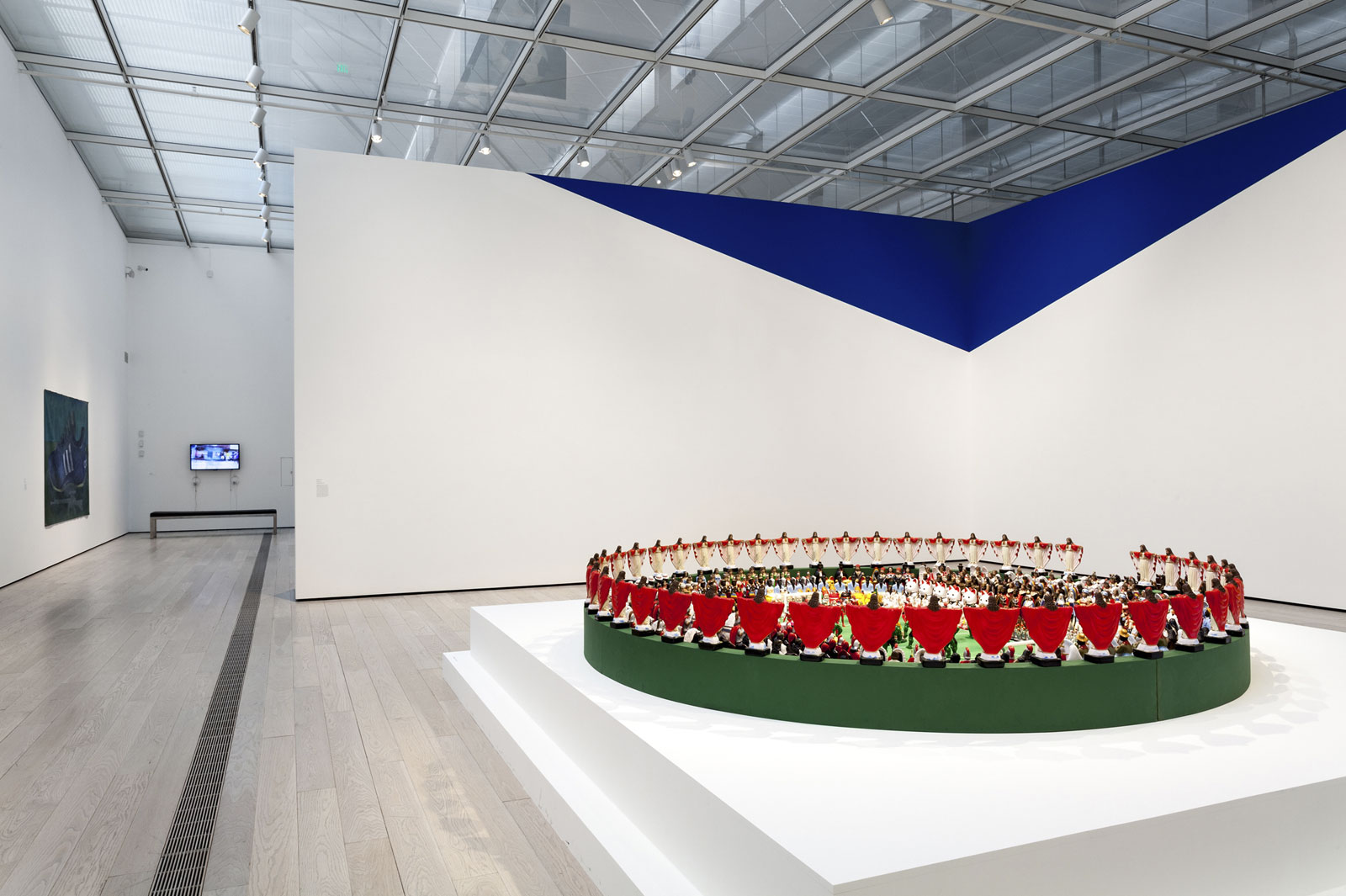
Hotham Street Ladies (est. Australia 2007) 'Dark tea' 2015 (installation view) from the exhibition 'Storm in a Teacup' at the Mornington Peninsula Regional Art Gallery, Mornington, July - Sept, 2015


Hotham Street Ladies (est. Australia 2007)
Dark tea (installation view)
2015
Royal icing, butter cream icing, fondant, food dye, found objects
Dimensions variable
Courtesy of the artists
Photo: Marcus Bunyan


This is the best thematic group exhibition I have seen in Melbourne and surrounds this year.

Every piece in the exhibition is visually stimulating and intelligently constructed, all works combining to make an engaging exhibition. Nothing is superfluous, every work having something interesting to say, whether it is about the ceremony of tea drinking, colonisation, global warming, Stolen Generations or social mores. Congratulations must go to the curators and artists for their efforts.

Particular favourites where the Hotham Street Ladies Dark Tea (2015, below) made of royal icing, butter cream icing, fondant, food dye, and found objects; the many sculptural objects which form the backbone of the exhibition, especially the work of Sharon West and Penny Byrne; and the wonderful vintage photographs that are displayed in the foyer of the gallery.

Accompanying this exhibition is another excellent exhibition, Ways to draw: A selection from the permanent collection by Betty Churcher, on till 27th September as well. If you want a day out from Melbourne with lunch in Mornington, some seriously good art and a drive along the coast, you could do no better than visit the gallery in the next week. Highly recommended.

Dr Marcus Bunyan


Many thankx to the Mornington Peninsula Regional Art Gallery for allowing me to publish the photographs in the posting. All installation photographs © Marcus Bunyan and the Mornington Peninsula Regional Art Gallery. Please click on the photographs for a larger version of the image.


Hotham Street Ladies (est. Australia 2007) 'Dark tea' 2015 (installation view detail)

Hotham Street Ladies (est. Australia 2007) 'Dark tea' 2015 (installation view detail)


Hotham Street Ladies (est. Australia 2007)
Dark tea (installation view details)
2015
Royal icing, butter cream icing, fondant, food dye, found objects
Dimensions variable
Courtesy of the artists
Photos: Marcus Bunyan


Charles Blackman (Australian, 1928-2018) 'Feet beneath the table' 1956 from the exhibition 'Storm in a Teacup' at the Mornington Peninsula Regional Art Gallery, Mornington, July - Sept, 2015


Charles Blackman (Australian, 1928-2018)
Feet beneath the table
1956
Tempera and oil on composition board
106.5 x 121.8cm
National Gallery of Victoria, Melbourne
Presented through the NGV Foundation by Barbara Blackman, Honorary Life Benefactor, 2005


Charles Blackman first encountered Lewis Caroll’s book, Alice in Wonderland, through a talking book for the blind which his wife, Barbara was listening to. Her developing blindness resulted in telescopic vision, spatial disorientation and a shrinking visual field. She was also pregnant with their first child and her distorted body image also had parallels with Alice’s experiences. By painting Alice at the Mad Hatter’s tea party Blackman could express his wife’s feeling of bewilderment and disorientation.


E. Phillips Fox (Australian, 1865-1915) 'The arbour' 1910 from the exhibition 'Storm in a Teacup' at the Mornington Peninsula Regional Art Gallery, Mornington, July - Sept, 2015


E. Phillips Fox (Australian, 1865-1915)
The arbour
1910
Oil on canvas
190.5 x 230.7cm
National Gallery of Victoria, Melbourne
Felton Bequest 1916


Melbourne born E. Phillips Fox, described as ‘one of the greatest of Australia’s Impressionist painters and the most gifted of her colourists’1 went to Paris in 1887 to study at the Ecole des Beaux Arts where he encountered the work of the French Impressionists. He remained in Paris for several years but made frequent trips back to Melbourne to visit his family. The Arbour was painted in Paris in Fox’s garden but is based upon observations of family life in his brother’s garden in Malvern. The depiction of an elegant family taking tea al fresco is a study of refined gentility. The Arbour was exhibited at both the Royal Academy and the Paris Salon exhibitions and was regarded by Fox as the finest thing he had done.2 At the time the painting was much admired for its ‘subtle lights ad shadow’3 and his exemplary ‘use of delicate colour and refined harmonies.’4

1/ Courier Mail, 12 May 1949
2/ Sydney Morning Herald, 13 October 1913
3/ Sydney Morning Herald, 13 October 1913
4/ Le Courrier Australien, Sydney, 15 April 1949


Clare Humphries (Australian, b. 1973) 'Some things were out in the open' 2007


Clare Humphries (Australian, b. 1973)
Some things were out in the open
2007
Pigment print on Hahnemühle photo rag paper (ed. 3/5)
63 x 62cm
Courtesy of the artist


Adam Hill (Blak Douglas) (Australian, b. 1970) 'Not everyone’s cup of tea' 2009


Adam Hill (Blak Douglas) (Australian, b. 1970)
Not everyone’s cup of tea
2009
Synthetic polymer paint on canvas
150 x 260cm
National Gallery of Australia, Canberra Purchased 2009


Kendal Murray (Australian, b. 1958) 'Exceed speed, mislead, concede' 2011


Kendal Murray (Australian, b. 1958)
Exceed speed, mislead, concede
2011
Mixed media assemblage
18 x 24 x 14cm
Courtesy of the artist and Arthouse Gallery, Sydney


Penny Byrne (Australian, b. 1965) 'Tea for two in Tuvalu' 2011


Penny Byrne (Australian, b. 1965)
Tea for two in Tuvalu
2011
Vintage porcelain figurine, vintage, Action man accessories, vintage coral, glass fish, epoxy resin, epoxy putty, retouching medium, powder pigments
15 x 19cm
Private Collection


Penny Byrne (Australian, b. 1965) 'Tea for two in Tuvalu' 2011 (installation view)


Penny Byrne (Australian, b. 1965)
Tea for two in Tuvalu (installation view)
2011
Vintage porcelain figurine, vintage, Action man accessories, vintage coral, glass fish, epoxy resin, epoxy putty, retouching medium, powder pigments
15 x 19cm
Private Collection
Photo: Marcus Bunyan


This piece was inspired by an underwater cabinet meeting held in 2009 by Maldives President Mohammed Nasheed in a campaign to raise awareness for activity on climate change. The thirty minute meeting was held six metres below sea level and was attended by eleven cabinet members calling upon all countries to cut their emissions to halt further temperature rises.

Polynesian island nation of Tuvalu, located in the Pacific Ocean midway between Hawaii and Australia, experienced a severe drought in 2011. A state of emergency was declared and rationing of fresh-water took place which restricted households on some of the islands to two buckets of fresh water per day. Tuvalu is also especially susceptible to changes in sea level and it is estimated that a sea level rise of 20 to 40 centimetres in the next 100 years could make Tuvalu uninhabitable.


Kate Bergin (Australian, b. 1968) 'The hunt for a room of one’s own' 2012


Kate Bergin (Australian, b. 1968)
The hunt for a room of one’s own
2012
Oil on canvas on board
75 x 101cm
Private Collection


Kate Bergin draws upon Dutch and Flemish seventeenth century tradition of still life painting to comment on our attitudes to animals. Bergin stages the scene on a crumpled white tablecloth upon which a large fox, based on a taxidermy fox she bought on eBay, regally sits centre stage. Meticulously rendered native birds, including a honeyeater, finch and triller, are based on photographs of specimens from the Melbourne Museum Collection. They flit about unperturbed by the introduced predator. Teaspoons, representing the impulse for collecting, entangle the fox and bird. Together with a teapot and cup, precariously placed, they contribute to the overarching sense of impending chaos.

Both afternoon tea and the fox represent English upper class social mores and were introduced into the colonies following British settlement. The fox arrived in 1855, brought in for recreational hunting, and has been a major cause of native bird extinctions. Fox numbers are increasing in some areas further threatening the precarious balance between wild life and introduced species.


Sharon West (Australian, b. 1963) 'Two Koori Tribesmen receive a gift of afternoon tea from local colonists' 2014 (installation view)


Sharon West (Australian, b. 1963)
Two Koori Tribesmen receive a gift of afternoon tea from local colonists (installation photo)
2014
Mixed media assemblage
15 x 46 x 30cm
Courtesy of the artist
Photo: Marcus Bunyan


Heather Shimmen (Australian, b. 1957) 'Tip me up' 2005 (installation view)


Heather Shimmen (Australian, b. 1957)
Tip me up (installation view)
2005
Linocut on paper and organza (ed. 7/30)
56 x 76cm
Courtesy of the artist and Australian Galleries, Melbourne and Sydney
Photo: Marcus Bunyan


Trent Jansen (Australian, b. 1981) 'Briggs family tea service' 2011 (installation view)


Trent Jansen (Australian, b. 1981)
Briggs family tea service (installation view)
2011
Slip cast porcelain, bull kelp, wallaby pelt, copper and brass
George (teapot) 22.5 x 20.5 x 13cm; Woretermoeteyenner (sugar bowl) 16 x 13.5 x 9cm; Dolly (milk jug) 12.5 x 12.5 x 8.5cm; John (teacup) 7 x 8.5 x 8cm; Eliza (teacup) 7.5 x 10.5 x 8cm; Mary (teacup) 10 x 9 x 6.5cm
Courtesy of Broached Commissions, Melbourne
Photo: Marcus Bunyan


The Briggs family tea service represents the marriage of George Briggs, a free settler, to Woretermoeteyenner of the Pairrebeenne people in Van Diemen’s Land and the four children they had together. Briggs arrived from Bedfordshire in 1791 and learned to speak the language of the local Pairrebeenne people, trading tea, flour and sugar fro kangaroo, wallaby and seal skins. It is understood that he became good friends with the leader of the Pairrebeenne people, Mannalargenna, and by 1810 he partnered his daughter Woretermoeteyenner. Their marriage meant she had to adapt to a way of life that merged her traditional cultural values with the ways of British settlers. The teapot and sugar bowl represent the parents while their first daughter, Doll Mountgarret Briggs is symbolised in the milk jug and the three cups each signify their other children John, Eliza and Mary.

The tea service is a hybrid design bringing together materials common to both cultures. To realise the set Jansen worked with Rod Bamford on the ceramic elements, Oliver Smith for the brass and copper and Vicki West, who uses the traditional methods of her Tasmanian Aboriginal ancestors, worked with the bull kelp components.


eX de Medici (Australian, b. 1959) 'Blue (Bower-Bauer)' 1998-2000 (installation view)


eX de Medici (Australian, b. 1959)
Blue (Bower-Bauer) (installation view)
1998-2000
Watercolour over black pencil on paper
114.0 x 152.8cm
National Gallery of Australia, Canberra Purchased 2004
Photo: Marcus Bunyan


eX de Medici (Australian, b. 1959) 'Blue (Bower-Bauer)' 1998-2000 (installation view detail)


eX de Medici (Australian, b. 1959)
Blue (Bower-Bauer) (installation view detail)
1998-2000
Watercolour over black pencil on paper
114.0 x 152.8cm
National Gallery of Australia, Canberra Purchased 2004
Photo: Marcus Bunyan


A turning point in eX de Medici’s career came in 1998 when she saw an exhibition of watercolours by Ferdinand Bauer comprising 2,000 rarely seen images of native flora and fauna made when Bauer was official artist on Matthew Flinder’s historic circumnavigation of Australia in 1801-1803. Previously working with tattoo imagery, Medici found the intricate works so compelling she decided to change course and ‘retrograde’ herself and explore watercolour as a medium.1

Referencing Australia’s Bower bird that adorns its nest with anything blue, Medici entangles the history of vanitas painting with commentary about the desire to seek permanence and affirmation in the accumulation of things. The broken willow pattern platter, upturned jugs and cups, amassed with so many other decorative and functional objects, are juxtaposed with skulls, fruit and flowers – symbols of mortality. A reaction to what she considered John Howard’s regressive politics at the time, the work ‘is a kind of a backhanded discussion about colonising our minds with retroactive ideas’.2

1/ Ted Gott. ‘eX deMedici an epic journey on a Lilliputian scale’ Art and Australia Vol. 40, No. 1, Spring 2002, p. 105
2/ eX deMedici in Paul Flynn. Artist Profile #5, March 2008, pp. 28-35.


Storm in a Teacup reflects upon tea drinking in Australia. Introduced by the British colonials, the afternoon tea party was an attempt to ‘civilise’ the land. Tea drinking became so popular in the colonies that by 1888 the amount of tea consumed per capita exceeded the amount consumed in England. Soon after, billy tea was to become an enduring symbol of the pioneering spirit, immortalised by Henry Lawson’s stories published under the title While the billy boils.

Beginning with elegant paintings of the afternoon tea table from E. Phillips Fox and Arthur Streeton, the exhibition goes on to explore the darker side of tea drinking and the social and environmental impacts of the humble cup of tea. Michael Cook’s Object (table), 2015, provides an alternative history to the narrative of colonialism while Sharon West and Adam Hill both use humour to subvert colonial understandings of the afternoon tea party as an occasion of refined gentility.

The humble cuppa has been around for thousands of years, but this exhibition explores how a popular beverage can impact on us culturally, socially, environmentally and politically. There is more to debate than just the proper way to make a cup of tea. Storm in a teacup explores far-reaching issues brewing from tea, including the imposition of one culture upon another – especially on the colonial frontier; the production of ceramics and the environmental impacts of porcelain and its production; gender stereotypes and socialisation through tea parties. The exhibition also reflects upon tea drinking ceremonies in Asia within a western Orientalist paradigm and tea drinking as an occasion for familial cohesiveness and disconnect.

Text from the Mornington Peninsula Regional Art Gallery
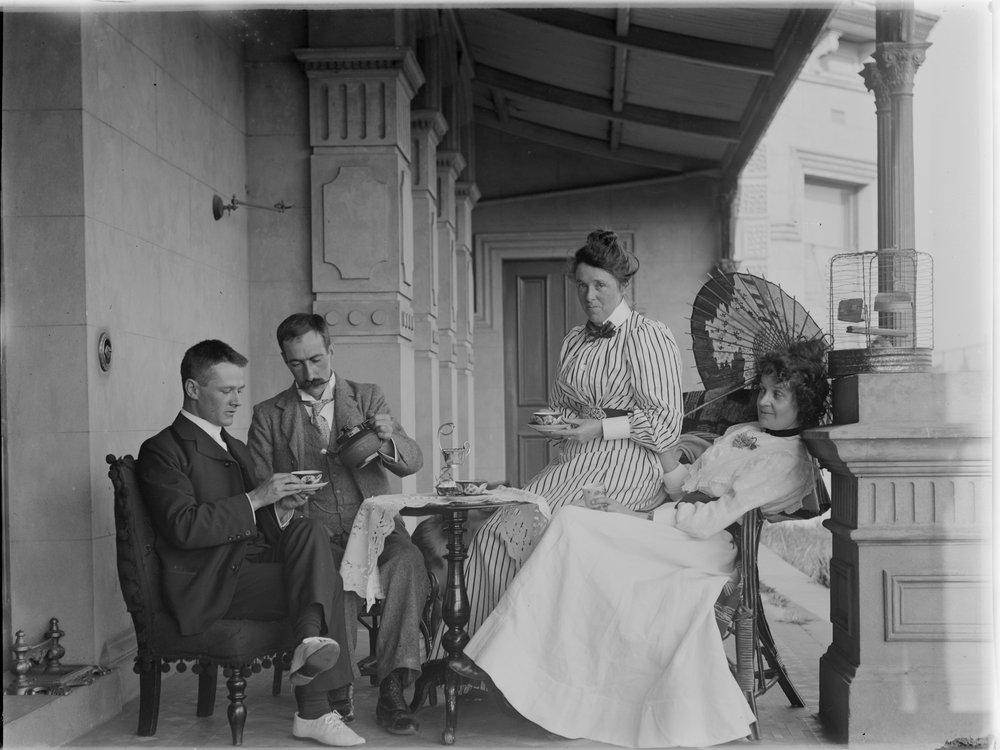
 

Mark James Daniel (Australian, 1867-1949) 'Verandah, "Harefield" – afternoon tea' Feb 1900


Mark James Daniel (Australian, 1867-1949)
Verandah, “Harefield” – afternoon tea
Feb 1900
Glass negative
8.5 x 11cm (quarter plate)
Collection of the State Library of Victoria


Michael J Drew (Australian, 1873-1943) 'Group taking tea in a garden' between 1890 and 1900


Michael J Drew (Australian, 1873-1943)
Group taking tea in a garden
between 1890 and 1900
Glass negative
12.2 x 16.5cm (half plate)
Collection of the State Library of Victoria


Rex Hazlewood (Australian, 1886-1968) '[Men drinking billy tea]' 1911-1927


Rex Hazlewood (Australian, 1886-1968)
[Men drinking billy tea]
1911-1927
Silver gelatin print
Collection of the State Library of New South Wales


Anonymous photographer. 'Afternoon tea at "Vivaleigh"' 1917


Anonymous photographer
Afternoon tea at “Vivaleigh”
1917
Gelatin silver print
12 x 16cm
Collection of the State Library of Victoria


James Fox Barnard (Australian, 1874-1945) 'Lawn, Arylie, Hobart' c. 1900


James Fox Barnard (Australian, 1874-1945)
Lawn, Arylie, Hobart
c. 1900
Glass negative
8.5 x 11cm (quarter plate)
Collection of the State Library of Victoria


James Fox Barnard (Australian, 1874-1945) '[Tea on the verandah]' c. 1900


James Fox Barnard (Australian, 1874-1945)
[Tea on the verandah]
c. 1900
Glass negative
8.5 x 11cm (quarter plate)
Collection of the State Library of Victoria


Installation photograph of the exhibition 'Storm in a Teacup' at the Mornington Peninsula Regional Art Gallery

Installation photograph of the exhibition 'Storm in a Teacup' at the Mornington Peninsula Regional Art Gallery

Installation photograph of the exhibition 'Storm in a Teacup' at the Mornington Peninsula Regional Art Gallery

Installation photograph of the exhibition 'Storm in a Teacup' at the Mornington Peninsula Regional Art Gallery

Installation photograph of the exhibition 'Storm in a Teacup' at the Mornington Peninsula Regional Art Gallery


Installation photograph of the exhibition Storm in a Teacup at the Mornington Peninsula Regional Art Gallery
Photos: Marcus Bunyan


Tea is the medium of many a complex and commonplace rituals. Adopted in a variety of ceremonies and customs across the globe, its unique and symbolic place in our lives is subtle and powerful. Whether a quick cuppa around the kitchen table or a lavish display of refined gentility; from billy tea to Asian tea-drinking ceremonies, tea has played an important role in international trade but more curiously in facilitating social cohesiveness.

Comprising approximately 50 works including painting, photography, sculpture and installation Storm in a Teacup features artists such as Chares Blackman, John Perceval, Emma Minnie Boyd, E. Phillips Fox and contemporary artists Stephen Bowers, Danie Mellor, Penny Byrne, Rosalie Gasgoigne, Matthew Sleeth, eX de Medici, Anne Zahalka, Polixeni Papapetrou and a mad tea party installation by Hotham Street Ladies.

Tea is said to have first been invented in China around 2700 BC, with the earliest records of tea consumption dating to 1000BC. Initially consumed as a medicinal drink, it became widely popular as a common beverage and traded across Asia and Europe during the 16th century. It was King Charles II’s wife Catherine of Portugal who is said to have brought the tea habit to Great Britain. Indeed, the afternoon tea party first became fashionable in the seventeenth century following Queen Catherine de Braganza’s fondness for serving the beverage at Whitehall in London. It wasn’t until the 18th century that it became widely consumed with tea smuggling bringing the tipple to the masses and later influenced the Boston Tea Party.

Tea drinking became a demonstration of social aspirations and grew in popularity giving rise to a subtle orchestration of manners, dress and serving paraphernalia which created new forms of commodity consumption. In the colonies of New South Wales and Victoria afternoon tea parties were a lavish display of settler understandings of refined gentility that were an attempt to signal allegiance to the values of the home country and ground the displaced community in their originating culture. In this respect the afternoon tea party expressed collective understandings of British identity and was a means of domesticating and civilising the alien terrain of the colonies.

Press release from the Mornington Peninsula Regional Art Gallery


Clare Humphries (Australian, b. 1973) 'Family confection II' 2015 (installation view)

Clare Humphries (Australian, b. 1973) 'Family confection II' 2015 (installation view)


Clare Humphries (Australian, b. 1973)
Family confection II (installation views)
2015
Sugar cubes stained with coffee and tea
Dimensions variable
Courtesy of the artist
Photos: Marcus Bunyan


Giuseppe Romeo (Australian, b. 1958) Subjective landscape, 'Of consequence rather than reason' 2015 (installation view)

Giuseppe Romeo (Australian, b. 1958) Subjective landscape, 'Of consequence rather than reason' 2015 (installation view)


Giuseppe Romeo (Australian, b. 1958)
Subjective landscape, ‘Of consequence rather than reason’ (installation views)
2015
Found discarded objects, bitumen, paint
80 x 100 x 60cm
Courtesy of the artist
Photos: Marcus Bunyan


Guiseppe Rome asks the simple question: ‘What are you going to do with it all?’

Romeo recalls the tea sets his mother and aunts possessed and the ‘good set’ kept for special occasions that were rarely used. In this work a silver platter is the support for a silver cake stand upon which a teapot, creamer, sugar bowl and various serving implements jostle with items required to clean up the mess. The bat, ball and stumps are a reference to playing cricket which ‘became an excuse for a big afternoon tea party in England’. A ribbon of wire holds it all together ‘like a dream from Alice in Wonderland when nothing is as it seems’, while a tinkling melody from a music box is a lullaby that sends us in to a contented sleep.

Romeo coats the sculpture in bitumen then paints it entirely in white. The effect is reminiscent of excavated items from an ancient ruin, as if we are peering upon the remains from a modern day Pompeii – artefacts that have been covered in lava and buried. This work alludes to the ways in which we deceive ourselves and ‘attempt to keep it all together through consumption but ultimately we can’t’.


Samantha Everton (Australian, b. 1971) 'Camellia' 2009


Samantha Everton (Australian, b. 1971)
Camellia
2009
From the series Vintage dolls 2009
Pigment print on rag paper (ed. AP2)
106 x 114cm
Courtesy of the artist and Anthea Polson Art, Queensland


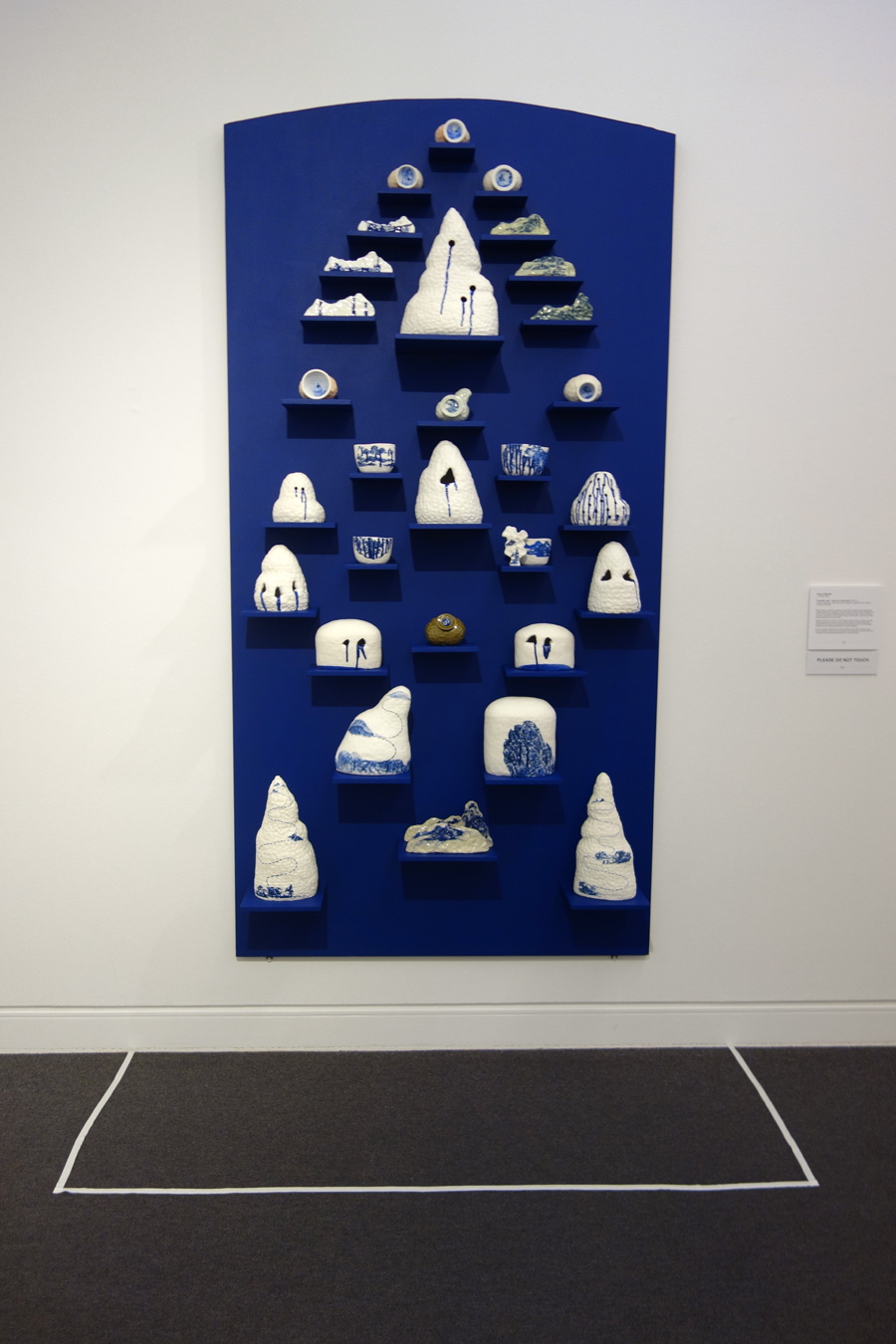
Robyn Phelan (Australian, b. 1965) 'Porcelain wall – ode to an obsession' 2010-2015 (installation view)


Robyn Phelan (Australian, b. 1965)
Porcelain wall – ode to an obsession (installation view)
2010-2015
Porcelain, paper, clay, cobalt oxide, timber, pigment, Jingdezhen tissue transfer
240 x 122 x 42cm
Courtesy of the artist
Photo: Marcus Bunyan


Robyn Phelan (Australian, b. 1965) 'Porcelain wall – ode to an obsession' 2010-15 (installation view detail)


Robyn Phelan (Australian, b. 1965)
Porcelain wall – ode to an obsession (installation view detail)
2010-2015
Porcelain, paper, clay, cobalt oxide, timber, pigment, Jingdezhen tissue transfer
240 x 122 x 42cm
Courtesy of the artist


Robyn Phelan undertook a residency at the Pottery Workshop and Experimental Sculptural Factory of Jingdezhen, Jiangxi Province in China in 2008. Jingdezhen is known as the porcelain capital because it has been the centre of China’s ceramic production, beginning in the fourteenth century Yuan Dynasty, where fine porcelain was first exported all over the world.

Deposits of kaolinite, a clay found at Mt Kaolin nearby which can sustain very high firing temperatures produced a superior white porcelain of increased strength and translucency. Items made from kaolinite were fired with cobalt landscape designs and were highly sought after by European collectors. Over the centuries, because of excessive mining, the mountain’s deposits have become depleted. Phelan’s work is a lament to the desecration of the mountain and a reminder of the potential destructiveness of consumer desire.


Penny Byrne (Australian, b. 1965) '‘Let’s forget about global warming’ said Alice ‘and have a cup of tea instead!’' 2010 (installation view)


Penny Byrne (Australian, b. 1965)
‘Let’s forget about global warming’ said Alice ‘and have a cup of tea instead!’ (installation view)
2010
Vintage porcelain figurine, found toys, epoxy resin, epoxy putty, retouching medium, powder pigments
80 x 33cm
Williams Sinclair Collection
Photo: Marcus Bunyan


Penny Byrne (Australian, b. 1965) '‘Let’s forget about global warming’ said Alice ‘and have a cup of tea instead!’' 2010 (installation view detail)


Penny Byrne (Australian, b. 1965)
‘Let’s forget about global warming’ said Alice ‘and have a cup of tea instead!’ (installation view detail)
2010
Vintage porcelain figurine, found toys, epoxy resin, epoxy putty, retouching medium, powder pigments
80 x 33cm
Williams Sinclair Collection
Photo: Marcus Bunyan


Penny Byrne’s reworked porcelain conversation piece was motivated by Republican Vice-Presidential nominee Sarah Palin’s cry to ‘drill, baby, drill’ during her campaign in 2008. A call for increase off-shore drilling of petroleum, including sites such as the Arctic National Wildlife Refuge, Palin claimed ‘that’s what we hear all across the country in our rallies because people are so hungry for those domestic sources of energy to be tapped into’.1

In Byrne’s piece the patriotic figures gorge themselves, blithely overindulging without care to the wastage. The new Disney production of Alice in Wonderland directed by Tim Burton had just been released and this led Byrne to reflect upon the Mad Hatter’s tea party in which tea was drunk all day because time stood still and was stuck at tea-time.

1/ Transcript: The Vice-Presidential Debate, 2 October 2008. Reprinted in the New York Times, 23 May 2012.


Sharon West (Australian, b. 1963) 'Joseph Banks’ tea party for a Botany Bay tribesman is ruined by flies and spiders' 2014


Sharon West (Australian, b. 1963)
Joseph Banks’ tea party for a Botany Bay tribesman is ruined by flies and spiders
2014
Digital print on paper (ed. 2/5)
66 x 57cm (sheet)
Courtesy of the artist
Photo: Marcus Bunyan


Sharon West’s recreation of an afternoon tea party is set in the early days of first contact. Joseph Banks was the botanist who sailed with Captain Cook on the Endeavour on the first voyage of discovery which mapped the east coast of Australia between 1768 and 1771. While ashore he made an extensive collection of native flora and fauna which was sent back to natural history museums in England. Banks was also instrumental in the British government’s decision to colonise the New South Wales settlement.


Rosalie Gascoigne (b. New Zealand 1917; arr. Australia 1943; d. Canberra 1999) 'The tea party' 1980 (installation view)


Rosalie Gascoigne (b. New Zealand 1917; arr. Australia 1943; d. Canberra 1999)
The tea party (installation view)
1980
Painted wood, celluloid, plastic, enamelled metal, feathers
83 x 35 x 20cm
Private collection
Photo: Marcus Bunyan


Rosalie Gascoigne (b. New Zealand 1917; arr. Australia 1943; d. Canberra 1999) 'The tea party' 1980 (installation view detail)


Rosalie Gascoigne (b. New Zealand 1917; arr. Australia 1943; d. Canberra 1999)
The tea party (installation view detail)
1980
Painted wood, celluloid, plastic, enamelled metal, feathers
83 x 35 x 20cm
Private collection
Photo: Marcus Bunyan


Rosalie Gascoigne found the kewpie dolls amongst a large number of discarded things from an abandoned sideshow at the Bungendore dump in the summer of 1976. ‘I thought “Oh, those dollies, they’re having a … very joyful … picnic. They’re … in the paddock, they’ve got all these old things … they’ve sat down on the teapots and waved their wings around.”

For Gascoigne beauty existed in the most humble of objects and the wear and tear from use only added to the appeal. The enamel teapots were also found at various dumps and were a particular focus of her collecting.

‘I had a thing about enamelware because I see it as being elegant. People see the holes in it. I was collecting brown and white at the same time. To me it had a sort of elegance that a Dalmatian dog has, spotty, very elegant’.1

1/ Rosalie Gascoigne, excerpts from her correspondence, email communication with Martin Gascoigne, 13 March 2015


Julie Dowling (Australian, b. 1969) Badimaya people, Western Australia 'White with one' 2003


Julie Dowling (Australian, b. 1969)
Badimaya people, Western Australia
White with one
2003
Synthetic polymer paint and red ochre on canvas
121 x 100cm
Collection of Jane Kleimeyer and Anthony Stuart


Julie Dowling’s painting is a poignant reminder of the Stolen Generations and the plight of many young girls, forcibly removed from their families, who were brought up in government institutions and trained to be domestic servant to white families. Girls were targeted because women were considered the ‘uplifters’ or ‘civilisers’ of their communities and as future mothers their education into the values of white society was deemed essential to enable successful assimilation. Girls in service were supposed to receive a wage but often this was retained by their employer and not passed on. Dowling points out it is also a history of Stolen wages.


Michael Cook (Australian, b. 1968) Bidjara people, south-west Queensland 'Object (table)' 2015


Michael Cook (Australian, b. 1968)
Bidjara people, south-west Queensland
Object (table)
2015
Inkjet print on Hahnemühle cotton rag (ed. 2/4 + 2AP)
140 x 99cm
Courtesy of the artist and THIS IS NO FANTASY + dianne tanzer gallery, Melbourne


Michael Cook’s photographic tableau ‘turns the table’ on racism. By depicting the body of a white woman as a functional object in service to others, Cook considers the dehumanisation and objectification of one race of people by another in the history of slavery.

The double portrait on the back wall is by Johann Zoffany from 1778, and features Dido Elizabeth Belle (1761-1804) who was born into slavery in the West Indies. The daughter of an African mother, her father was an English naval officer who left her to the care of his uncle, Lord William Murray, where she was raised as an equal with Murray’s niece. Murray was instrumental in outlawing slavery in the United Kingdom in 1772. In the painting Zoffany depicts the two women standing together, the niece affectionately reaching out to Belle. Hence Cook’s afternoon tea is also a reminder that prejudice and racial inequality can be surmounted.


Yenny Huber (b. Austria 1980; arr. Australia 2000) 'Room No. 14' 2006


Yenny Huber (b. Austria 1980; arr. Australia 2000)
Room No. 14
2006
Digital print on aluminium panel (ed. 1/6)
27.2 x 27.2cm
Warrnambool Art Gallery, Victoria


Underpinned by the belief that any one person is comprised of diverse, fragmentary and often illusory selves, Yenny Huber explores the various ego states that reside within. This photograph is a self portrait taken in a hotel room, but it is also an impersonation of an identity available to women. Tea-drinking was once described as ‘an infallible sign of an old maid’1 and in this work Huber offers us an image of a good Catholic girl, knees together, elbows in, sitting demurely on the couch sipping tea. It is an image of femininity constrained by the dictates of religion and outdated socially sanctioned ideals of respectable female behaviour.

1/ The Horsham Times, Victoria, 26 April 1898


Anne Zahalka (Australian, b. 1957) 'Saturday 5.18 pm 1995' 1995 (printed 1997)


Anne Zahalka (Australian, b. 1957)
Saturday 5.18 pm 1995
1995 (printed 1997)
Type C photograph (ed AP)
125 x 162cm
Art Gallery of New South Wales, Sydney Gift of the artist, 2011
Donated through the Australian Government’s Cultural Gifts Program


Mornington Peninsula Regional Art Gallery
Civic Reserve, Dunns Road, Mornington

Opening hours:
Tuesday – Sunday 11am – 4pm
Mornington Peninsula Regional Art Gallery website

LIKE ART BLART ON FACEBOOK

Back to top

Exhibition: ‘Nature/Revelation’ at The Ian Potter Museum of Art, Melbourne

Exhibition dates: 31st March – 5th July, 2015

Curator: Joanna Bosse


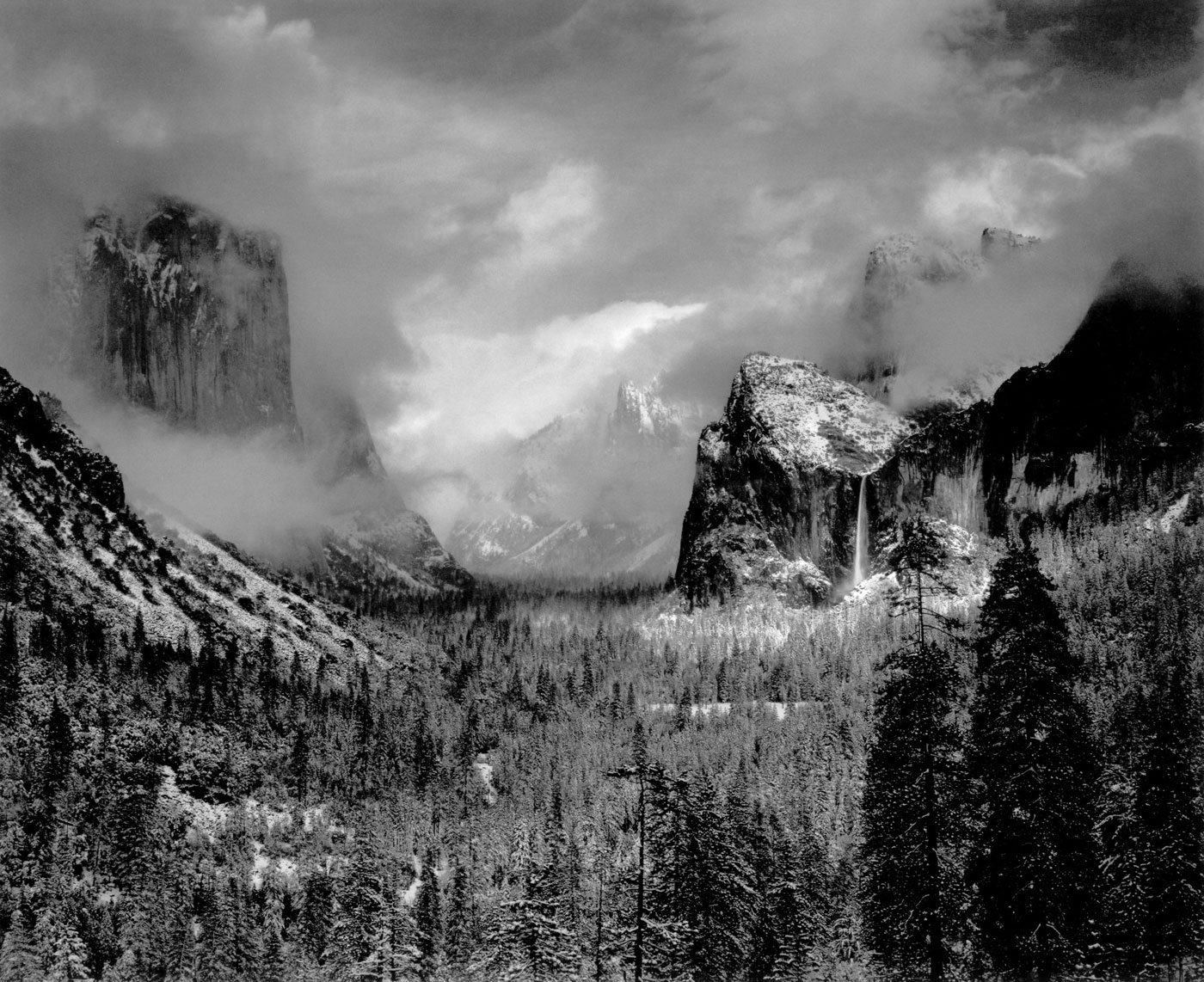
Ansel Adams (American, 1902-1984) 'Clearing winter storm, Yosemite National Park, California' 1935 from the exhibition 'Nature/Revelation' at The Ian Potter Museum of Art, Melbourne, March - July, 2015


Ansel Adams (American, 1902-1984)
Clearing winter storm, Yosemite National Park, California 
1935
Gelatin silver photograph
56 x 71cm framed
National Gallery of Australia, Canberra. Purchased 1980
© 2015 The Ansel Adams Publishing Rights Trust


This is a fascinating exhibition at The Ian Potter Museum of Art, one of the best exhibitions I have seen this year in Melbourne. Unlike the disappointing exhibition Earth Matters: contemporary photographers in the landscape at the Monash Gallery of Art this exhibition, which addresses roughly the same subject matter (climate change and its devastating impact on the earth’s many ecosystems; contemporary notions of nature and the sublime) this exhibition is nuanced and fresh, celebrating “the unique capacity art has to cut through prevailing rhetoric to stimulate individuals both intellectually and emotionally in the face of current environmental issues.”

Every piece of art in this exhibition is emotionally, intellectually and aesthetically challenging. There is no “dead wood” here. As the press release states, “Nature / Revelation features international and Australian artists who are engaged with poetic and philosophical concerns, and whose work offers potentially enlightening experiences that energise our relationship to the natural world.” And it is true!

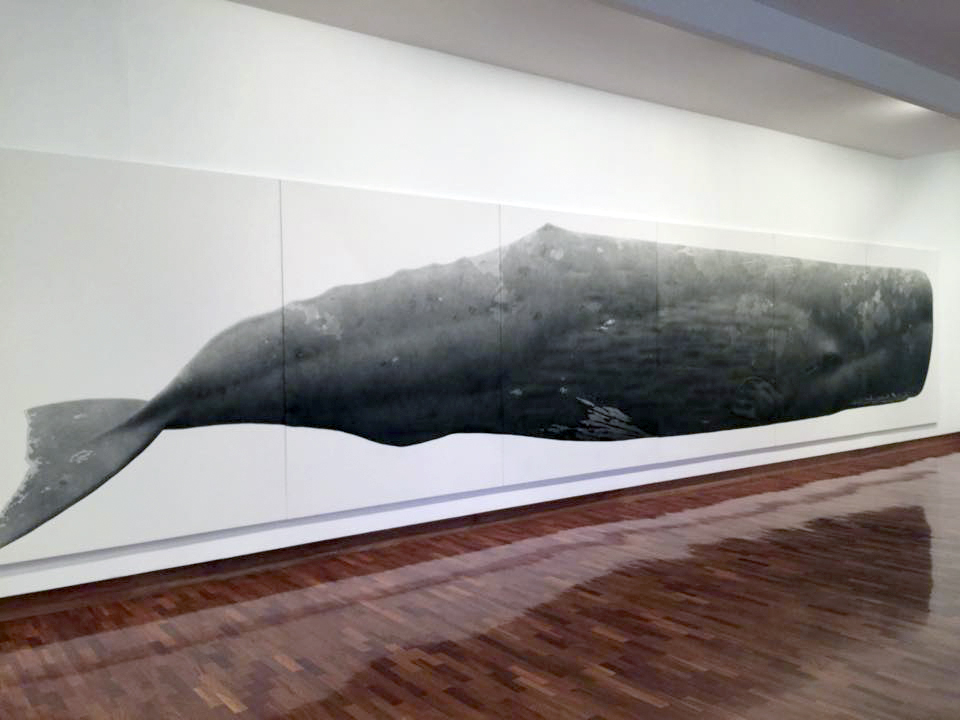
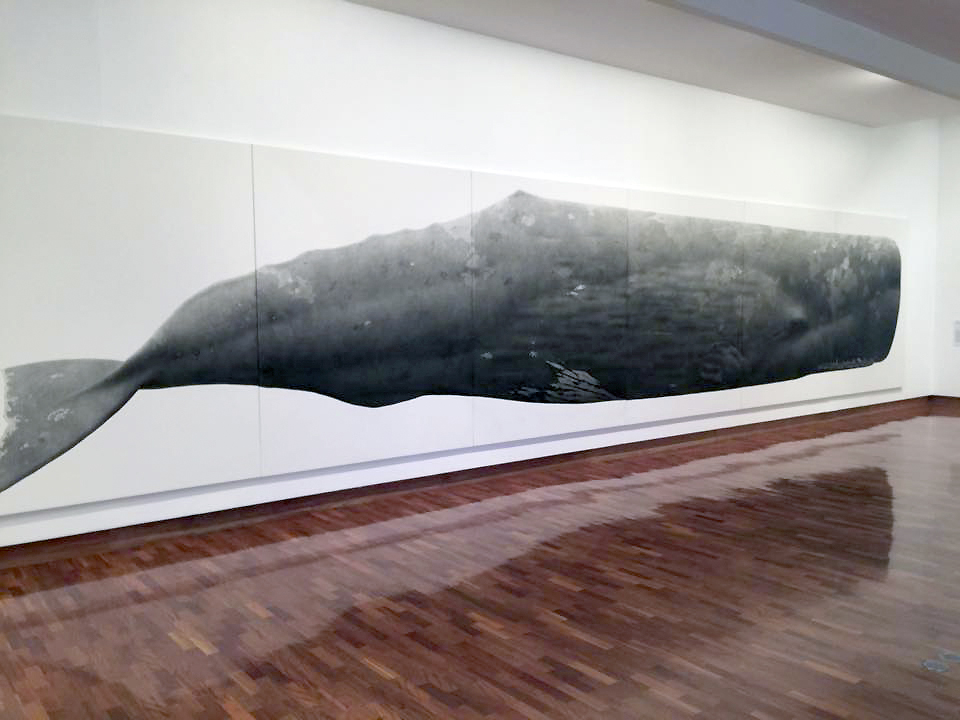
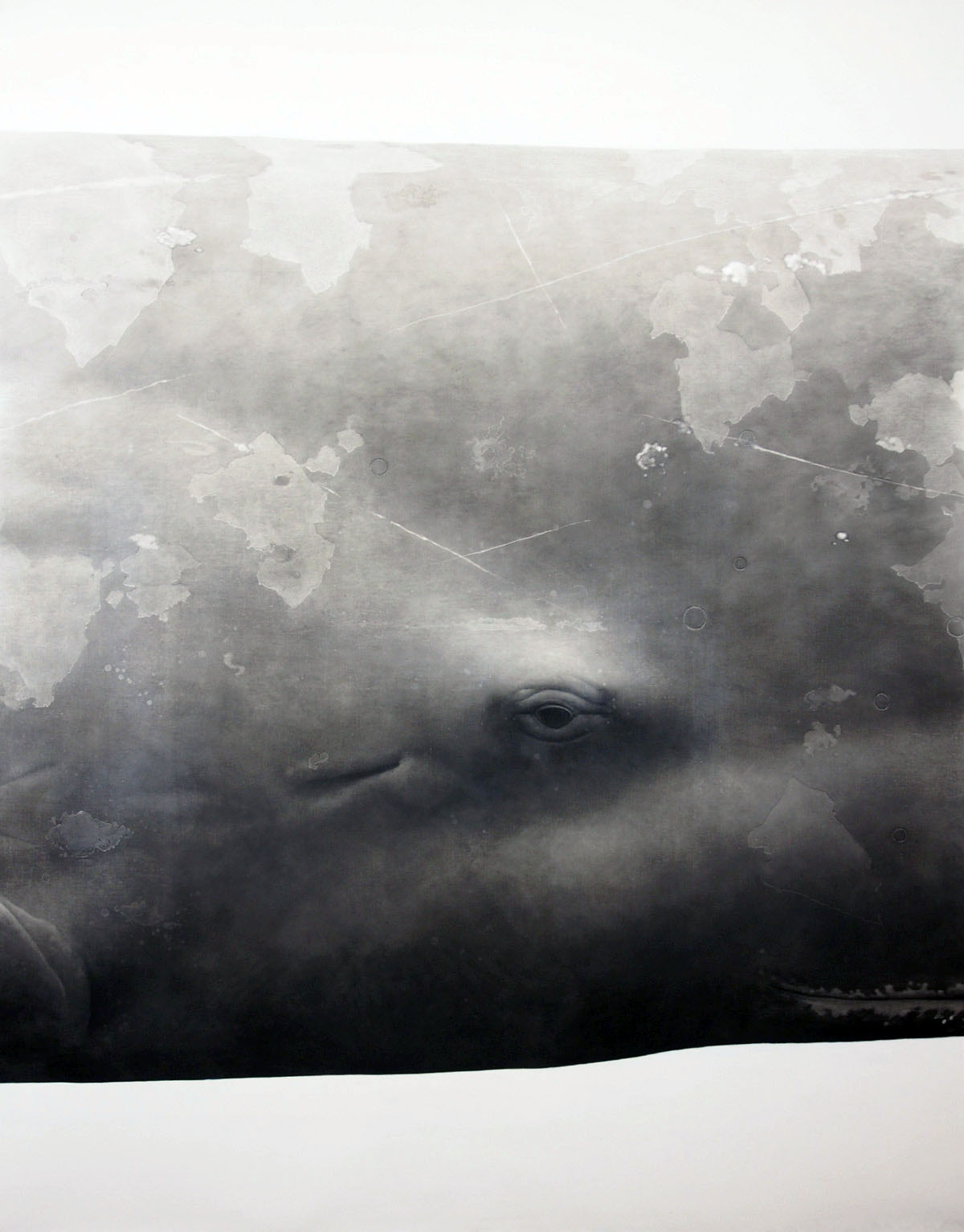
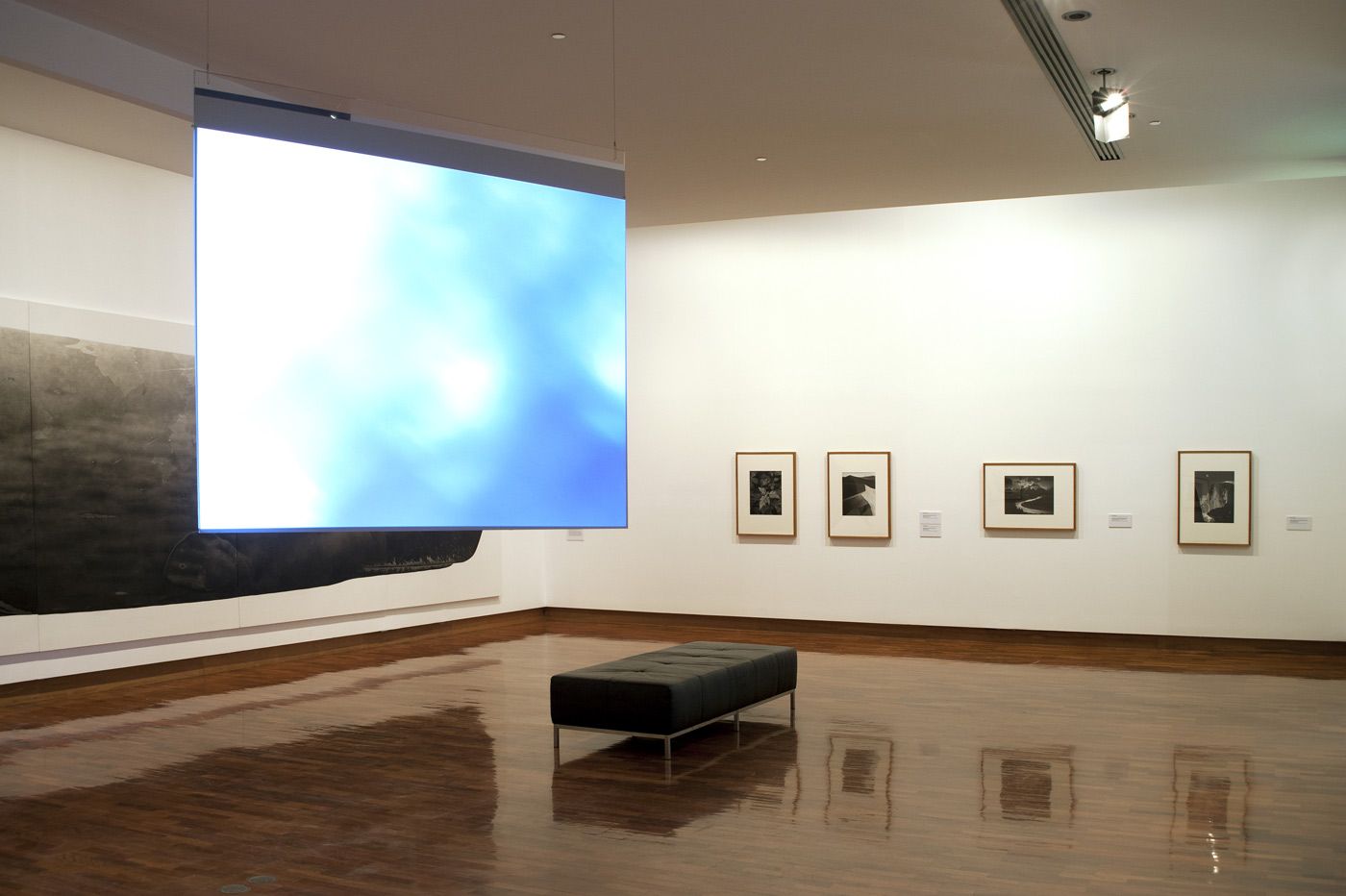
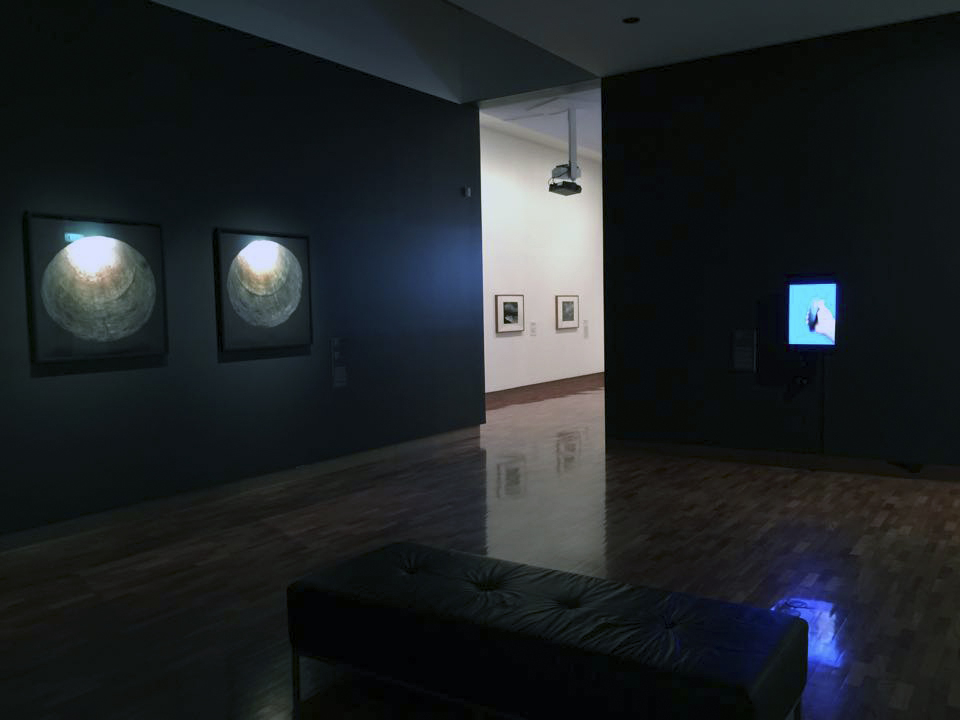
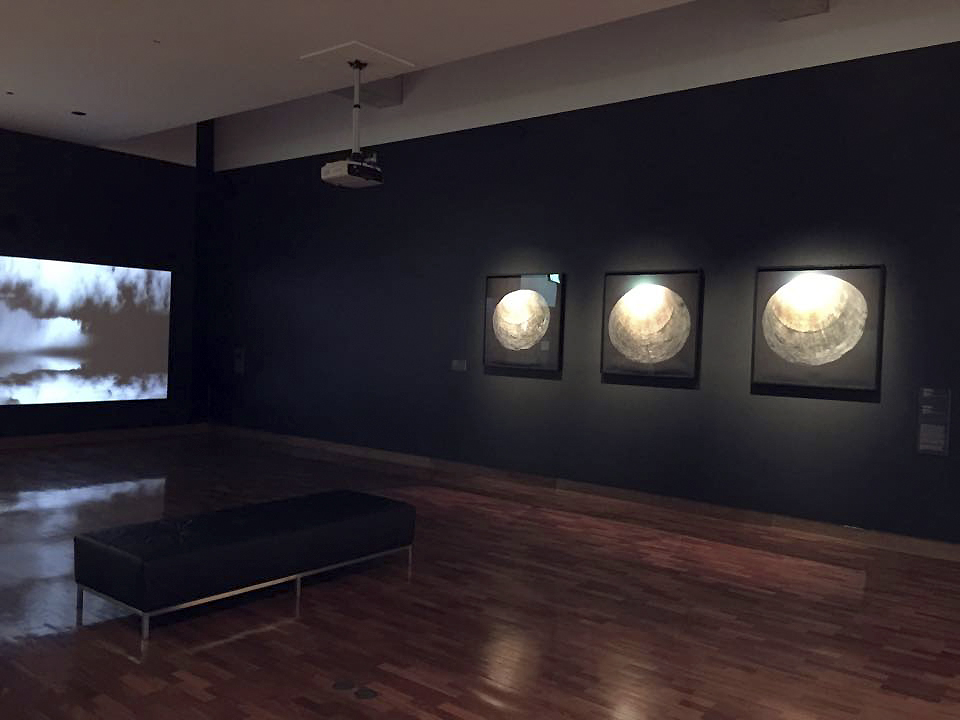
I spent over two hours on a couple of visits to this exhibition and came away feeling en/lightened in mind and body. From the formal beauty of Ansel Adams classical black and white photographs to the mesmerising, eternal video Boulder Hand (2012) by Gabriel Orozco; from the delightful misdirection of Mel O’Callaghan’s Moons to the liminal habitats of Jamie North; and from the constructed clouds of Berndnaut Smilde to the best piece in the exhibition, Jonathan Delafield Cook’s Sperm whale (Physeter macrocephalus) (2013, below) – every piece deserved its place in this exhibition. I would go as far as to say that Delafield Cook’s Sperm whale is the best piece of art that I have seen since Mark Hilton’s dontworry (2013) which featured in the Melbourne Now exhibition at the National Gallery of Victoria. The sheer scale and beauty of the work (with its graphite on canvas attention to detail) and that doleful eye staring out at the viewer, is both empowering and unnerving. It deserves to be in an important collection.

While nature and the world we live in offers moments of revelation, so did the art in this exhibition. The art possesses moments of wonder for the viewer. Kudos to curator Joanna Bosse and The Ian Potter Museum of Art for putting on a top notch show.

Dr Marcus Bunyan


Many thankx to the The Ian Potter Museum of Art for allowing me to publish the photographs in the posting. All installation photographs © Marcus Bunyan and The Ian Potter Museum of Art. Please click on the photographs for a larger version of the image.


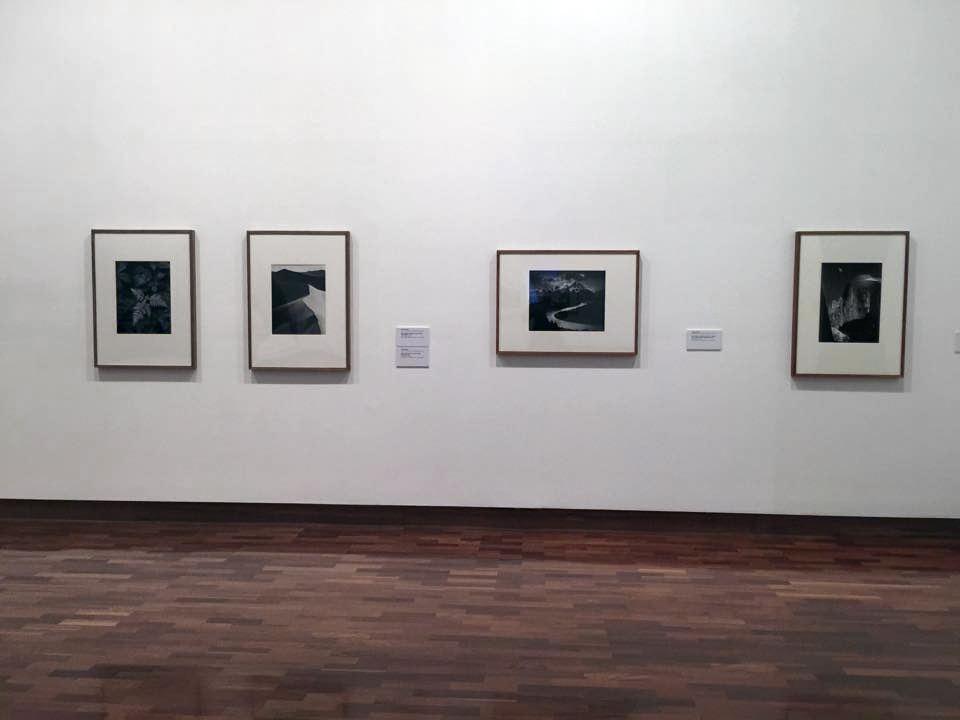
Installation photograph of the exhibition 'Nature/Revelation' at The Ian Potter Museum of Art, Melbourne showing photographs by Ansel Adams


Installation photograph of the exhibition Nature/Revelation at The Ian Potter Museum of Art, Melbourne showing photographs by Ansel Adams
Photo: Marcus Bunyan


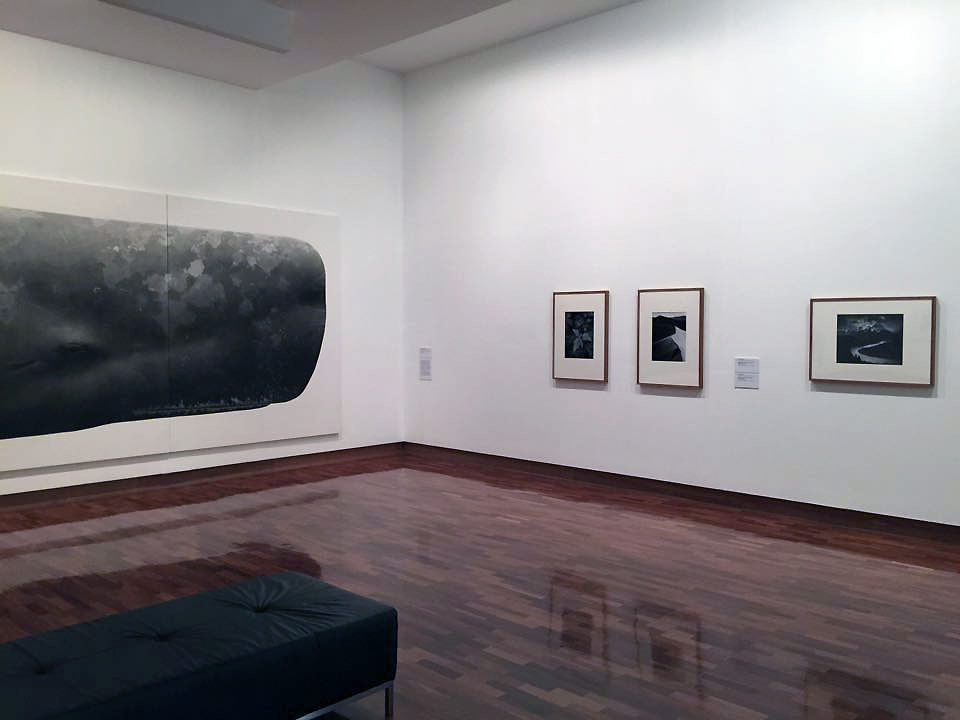
Installation photograph of the exhibition 'Nature/Revelation' at The Ian Potter Museum of Art, Melbourne showing at right, photographs by Ansel Adams; and at left, a detail of Jonathan Delafield Cook's 'Sperm whale (Physeter macrocephalus)' 2013


Installation photograph of the exhibition Nature/Revelation at The Ian Potter Museum of Art, Melbourne showing at right, photographs by Ansel Adams; and at left, a detail of Jonathan Delafield Cook’s Sperm whale (Physeter macrocephalus) 2013
Photo: Marcus Bunyan


Installation photograph of the exhibition 'Nature/Revelation' at The Ian Potter Museum of Art, Melbourne showing Jonathan Delafield Cook's 'Sperm whale (Physeter macrocephalus)' 2013

Installation photograph of the exhibition 'Nature/Revelation' at The Ian Potter Museum of Art, Melbourne showing Jonathan Delafield Cook's 'Sperm whale (Physeter macrocephalus)' 2013


Installation photograph of the exhibition Nature/Revelation at The Ian Potter Museum of Art, Melbourne showing Jonathan Delafield Cook’s Sperm whale (Physeter macrocephalus), 2013
Photos: Marcus Bunyan


Jonathan Delafield Cook (British, b. 1965) 'Sperm whale (Physeter macrocephalus)' 2013 (detail)


Jonathan Delafield Cook (British, b. 1965)
Sperm whale (Physeter macrocephalus) (detail)
2013
Graphite on canvas
6 panels: 245 x 1200 cm overall
Courtesy the artist and Olsen/Irwin Gallery, Sydney
Photo: Marcus Bunyan


Jonathan Delafield Cook’s life size drawing of a Sperm Whale specimen possesses a haunting melancholy… [He] creates an encounter that recalls those between Ahab and Moby Dick immortalised in Hermann Melville’s famous novel. Being face-to-face, eye-to-eye with this majestic sentient being – distinguished for having the largest brain of any creature known to have lived on the Earth – is an awe-inspiring experience. The overwhelming enormity of scale and the panorama-like expanse of the whale’s skin rouse an acute awareness of our own small presence in the room (in the world).

Delafield Cook’s work belongs to the naturalist tradition, and his detailed charcoal drawing intensifies the physical qualities of the subject in a way that renders it both a forensic study and an otherworldly fantasy. The personal history of this sleek leviathan is writ large, like graffiti, on its skin: the abrasions, the exfoliations, scars and its ragged tail tell of unknown adventures in an environment that lies beyond our own experience, but one not exempt from degradation or environmental change.


Installation photograph of the exhibition 'Nature/Revelation' at The Ian Potter Museum of Art, Melbourne showing showing at centre right, photographs by Ansel Adams


Installation photograph of the exhibition Nature/Revelation at The Ian Potter Museum of Art, Melbourne showing showing at centre right, photographs by Ansel Adams
Photo: Marcus Bunyan


Gabriel Orozco (Mexican, b. 1962)
Boulder Hand
2012
Video 54 seconds
Courtesy of the artist


Installation photograph of the exhibition 'Nature/Revelation' at The Ian Potter Museum of Art, Melbourne showing at left, Mel O'Callaghan's 'Moons' 2014; and at right, Gabriel Orozco's video 'Boulder Hand' 2012


Installation photograph of the exhibition Nature/Revelation at The Ian Potter Museum of Art, Melbourne showing at left, Mel O’Callaghan’s Moons 2014; and at right, Gabriel Orozco’s video Boulder Hand 2012
Photo: Marcus Bunyan


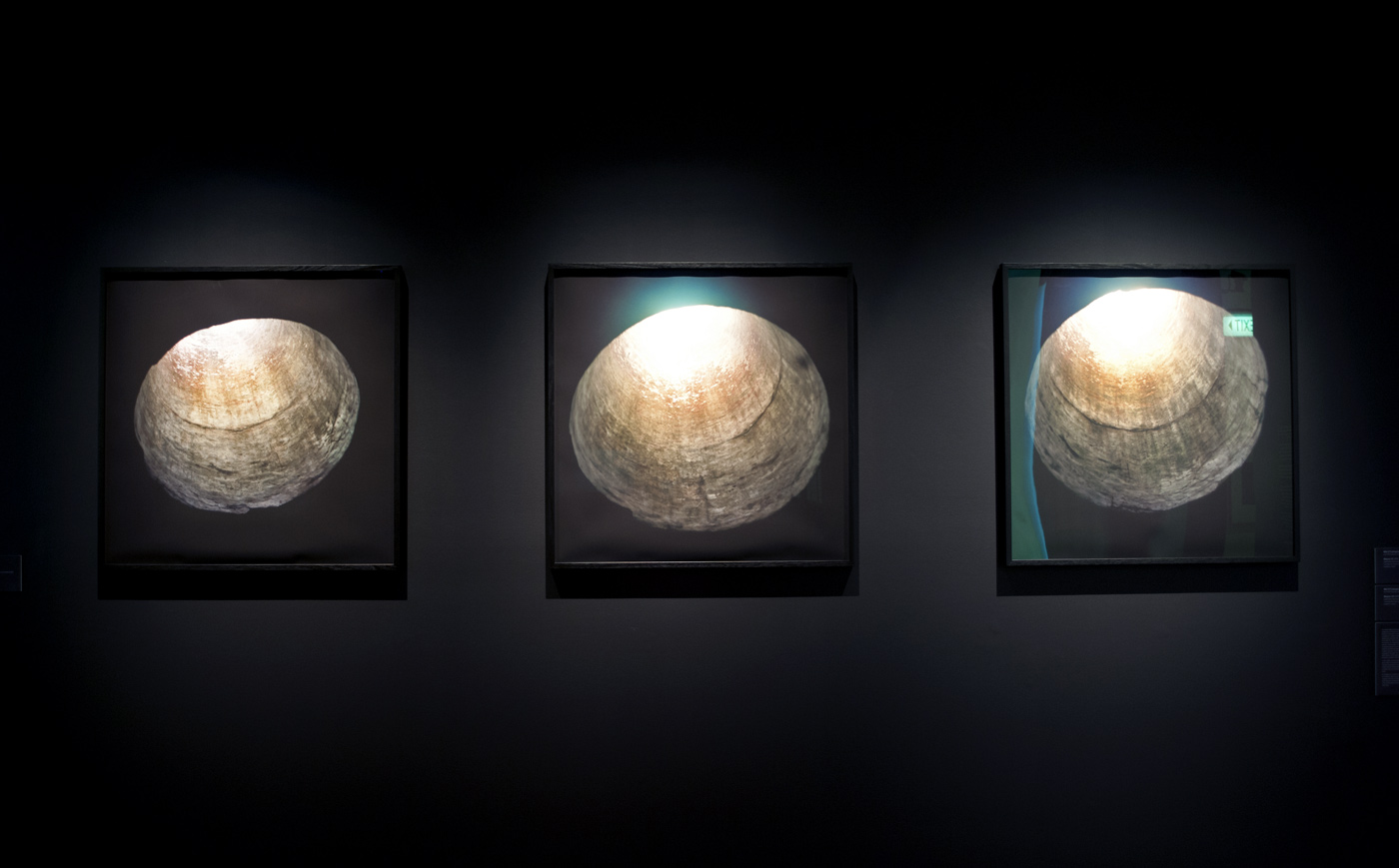
Installation photograph of the exhibition 'Nature/Revelation' at The Ian Potter Museum of Art, Melbourne showing Mel O'Callaghan's 'Moons' 2014

Installation photograph of the exhibition 'Nature/Revelation' at The Ian Potter Museum of Art, Melbourne showing Mel O'Callaghan's 'Moons' 2014


Installation photographs of the exhibition Nature/Revelation at The Ian Potter Museum of Art, Melbourne showing Mel O’Callaghan’s Moons 2014
Photos: Marcus Bunyan


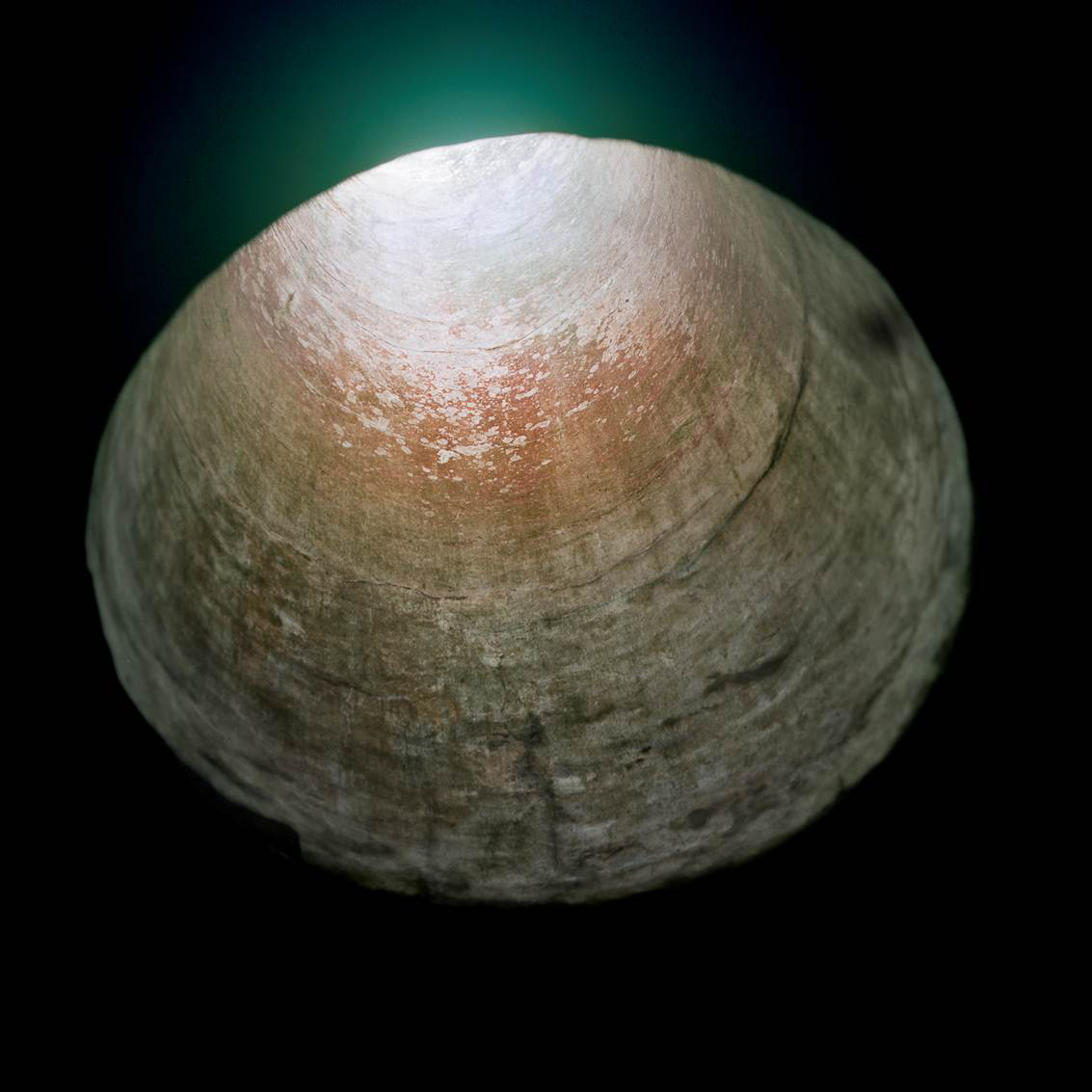
Mel O'Callaghan (Australian, b. 1975) 'Moons (II)' 2014 from the exhibition 'Nature/Revelation' at The Ian Potter Museum of Art, Melbourne, March - July, 2015


Mel O’Callaghan (Australian, b. 1975)
Moons (II)
2014
pigmented inkjet print
100 x 100cm
Courtesy the artist and Galerie Allen, Paris, and Galeria Belo Galsterer, Lisbon


Climate change and its devastating impact on the earth’s many ecosystems is arguably today’s most critical global issue. Nature/Revelation celebrates the unique capacity art has to cut through prevailing rhetoric to stimulate individuals both intellectually and emotionally in the face of current environmental issues. Focusing on contemporary notions of nature and the sublime, the exhibition affirms that the world we live in offers moments of revelation, and that nature can provoke a range of associations – both fantastical and grounded – that profoundly affect us.

Nature/Revelation features international and Australian artists who are engaged with poetic and philosophical concerns, and whose work offers potentially enlightening experiences that energise our relationship to the natural world. Artists include Ansel Adams, Jonathan Delafield Cook, David Haines, Andrew Hazewinkel and Susan Jacobs, Jamie North, Mel O’Callaghan, Gabriel Orozco and Berndnaut Smilde. The exhibition also raises questions about concepts of nature and culture following the arguments of philosopher Timothy Morton.

This exhibition forms a key component of the ‘Art+climate=change’ festival presented by Climarte: arts for a safer climate. This festival of climate change related arts and ideas includes curated exhibitions at a number of museums and galleries alongside a series of keynote lectures and forums featuring local and international speakers.

The University of Melbourne, with the Potter as project leader, is the Principal Knowledge Partner of the Climarte program.

Text from The Ian Potter Museum of Art website


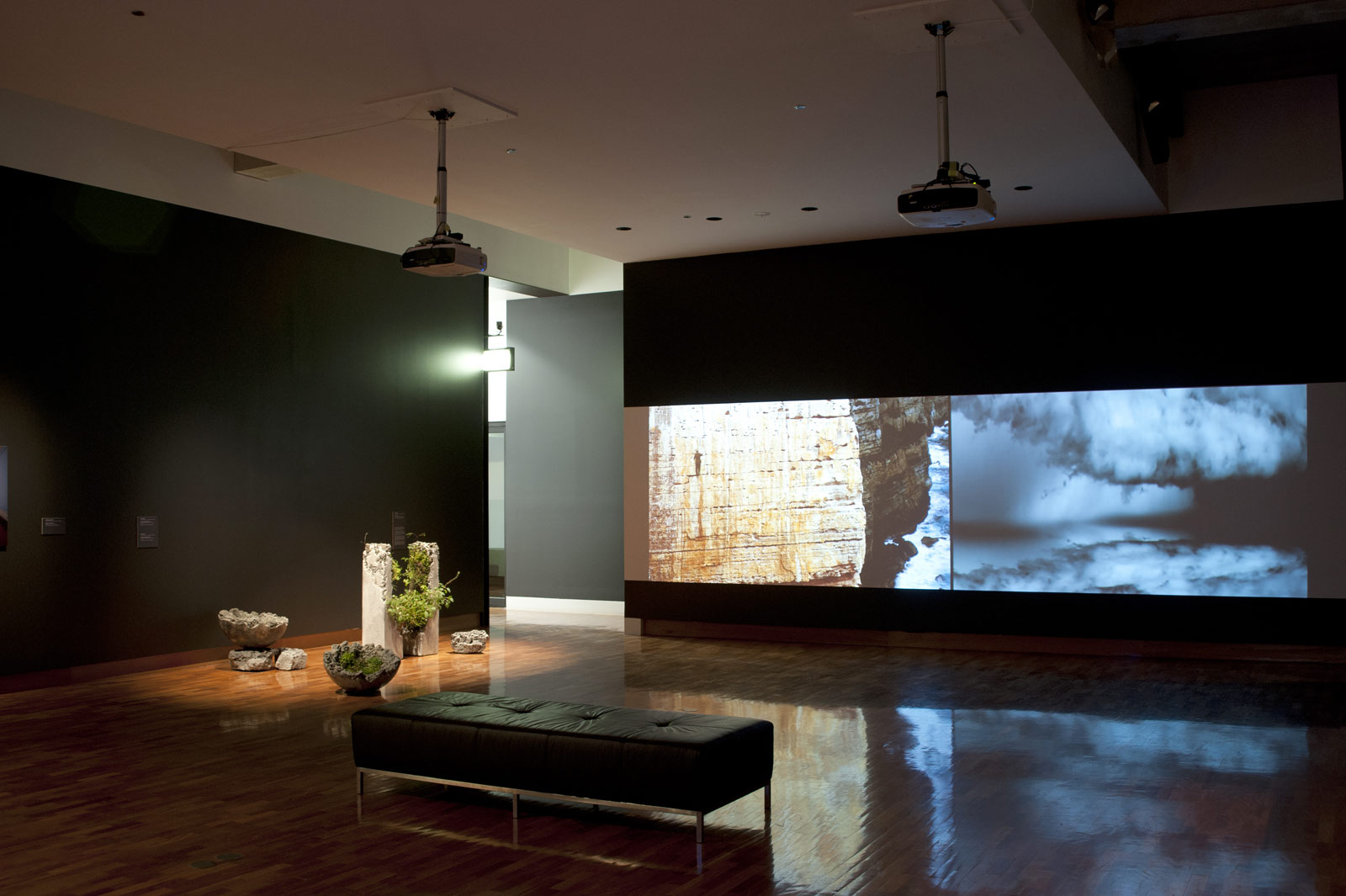
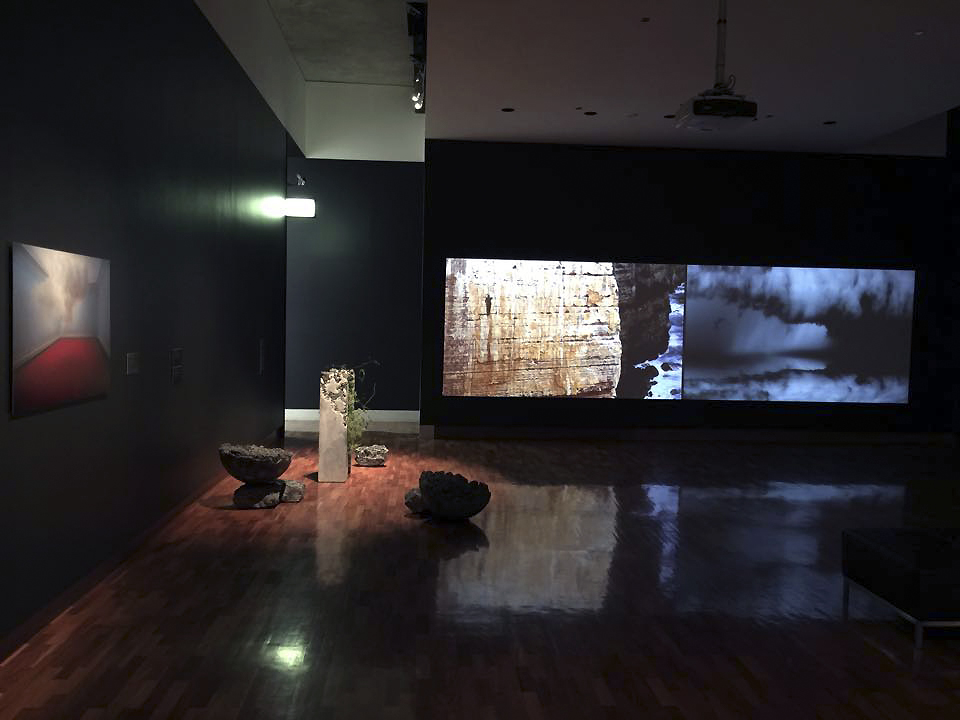
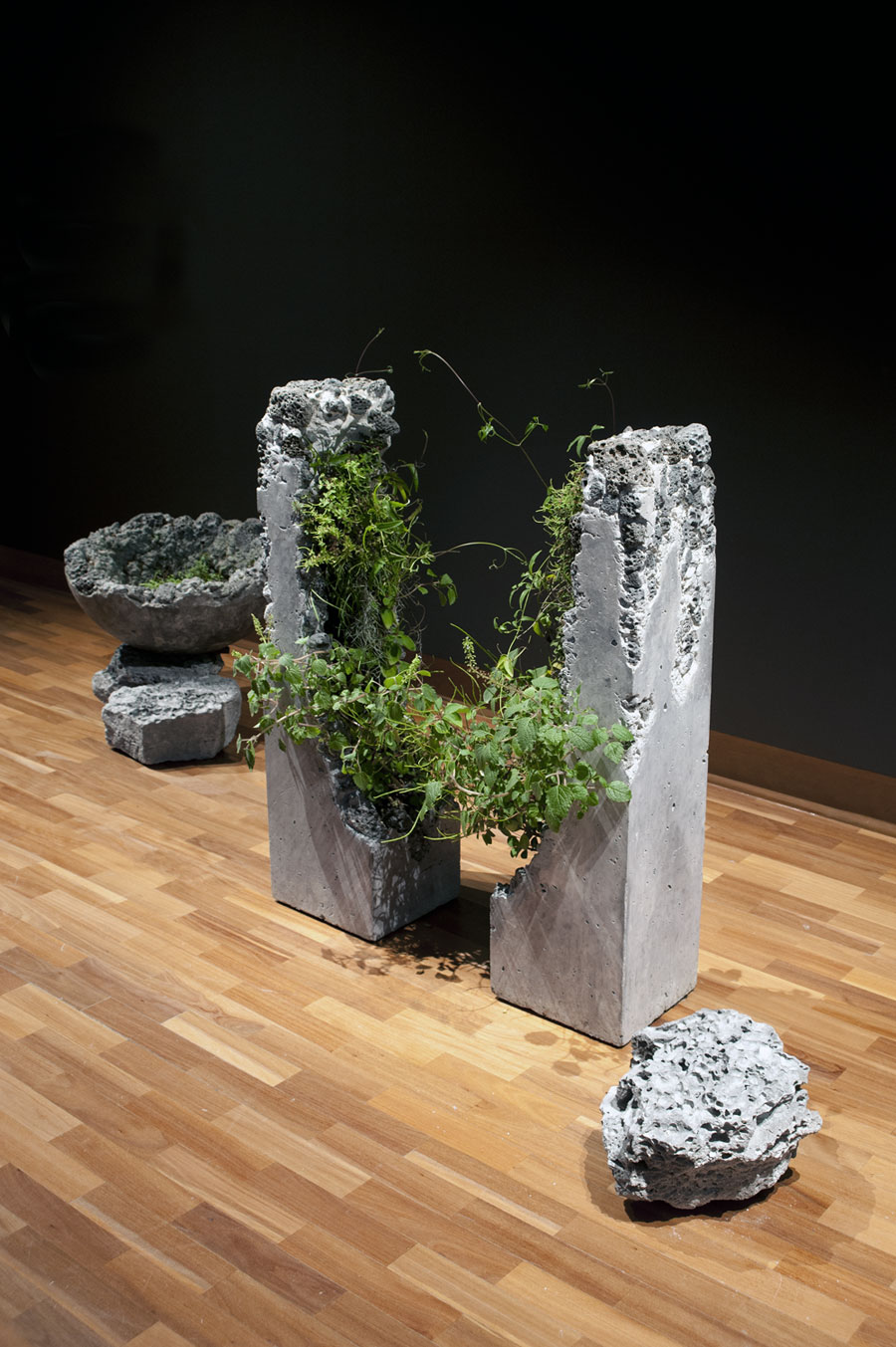
Installation photograph of the exhibition 'Nature/Revelation' at The Ian Potter Museum of Art, Melbourne showing at left on the floor, Jamie North's 'Portal II' and 'Slag bowl I & II' 2014; and at right, David Haines' 'Day & Night' 2005-2015

Installation photograph of the exhibition 'Nature/Revelation' at The Ian Potter Museum of Art, Melbourne showing at left on the floor, Jamie North's 'Portal II' and 'Slag bowl I & II' 2014; and at right, David Haines' 'Day & Night' 2005-2015


Installation photographs of the exhibition Nature/Revelation at The Ian Potter Museum of Art, Melbourne showing at left on the floor, Jamie North’s Portal II and Slag bowl I & II 2014; and at right, David Haines’ Day & Night 2005-2015
Photos: Marcus Bunyan


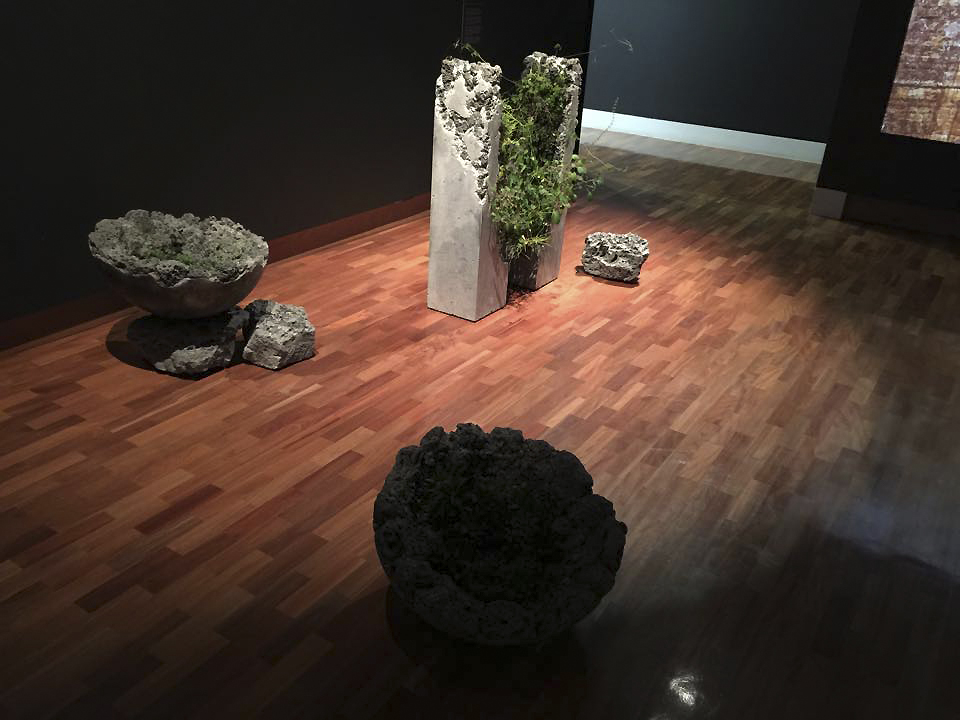
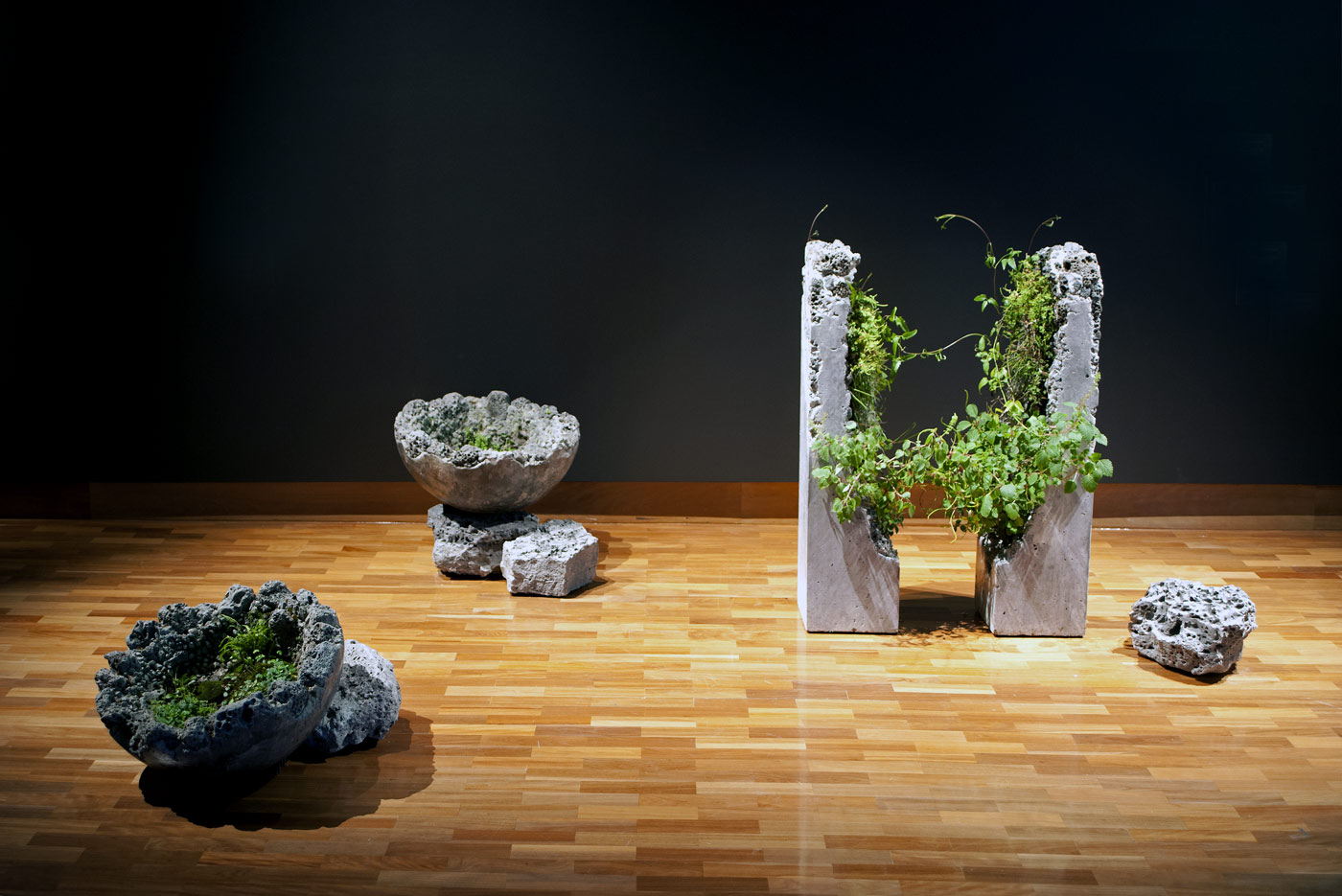
Installation photograph of the exhibition 'Nature/Revelation' at The Ian Potter Museum of Art, Melbourne showing Jamie North's 'Portal II' and 'Slag bowl I & II' 2014

Installation photograph of the exhibition 'Nature/Revelation' at The Ian Potter Museum of Art, Melbourne showing Jamie North's 'Portal II' and 'Slag bowl I & II' 2014

Installation photograph of the exhibition 'Nature/Revelation' at The Ian Potter Museum of Art, Melbourne showing Jamie North's 'Portal II' and 'Slag bowl I & II' 2014


Jamie North (Australian, b. 1971)
Portal II
2014
Cement, marble waste, limestone, steel slag, coal ash, plastic fibre, tree fern slab, various Australian native plants and Spanish moss
2 components: 107.0 x 26.0 x 26.0cm each
Courtesy the artist and Sarah Cottier Gallery, Sydney

Jamie North (Australian, b. 1971)
Slag bowl I & II
2013
Concrete, coal ash, steel slag, Australian native plants and moss
15 x 37 x 37cm each
Courtesy the artist and Sarah Cottier Gallery, Sydney
Photos: Marcus Bunyan


Viewers often mistake Jamie North’s sculptures for actual relics. The sculptures are in fact carefully crafted to emulate liminal habitats where hardy plant species grow in inhospitable conditions. More than mere simulation, each work is itself a miniature ecosystem and has to be tended accordingly.

The sculptures are cast from materials that are commonly found in industrial settings (steel slag, coal ash, marble dust, and concrete) and include local native flora. The specifics of locality are important to North, and his work is a subtle investigation of local environmental systems and the character of place as well as the adaptability of nature in urban settings…

North has an interest in terraforming – the theoretical process of deliberately modifying the atmosphere, temperature, surface topography or ecology of a planet to be similar to the biosphere of Earth. Here, he creates his own terraforms as a reflection on the environmental manipulations that taking place in the everyday.


David Haines (Australian born England, 1966)
Day & Night
2005-2015
Two channel video projection
Courtesy of the artist and Sarah Cotter Gallery, Sydney


Throughout his practice – which comprises investigations into the elemental in carious media – David Haines explores sensation in both seen and unseen forms. He has a particular interest in latent energies, such as aromas, sound waves and electromagnetic currents.

Haines revisits the classic language of the sublime in his 2004 two-channel video installation Day & night. He presents dual images of the sublime: one an immense cliff face with a sea surging against its rocky base; the other a brooding cloudscape, its form gradually unfolding with a mesmeric momentum. The work is simultaneously serene and disturbing, and awakens that range of complex emotions that Kant named the ‘supersensible’ – beyond the range of what is normally perceptible by the senses. The over-riding emotional rush – the presentiment of danger – associated with this experience is a trademark of the sublime.

The abstract sense of danger shifts however when we notice the tiny figure clinging to the cliff face. The scene is abruptly divested of its fantastical quality (its symbolic power is suddenly made real), as we can’t help but identify with the solitary figure. No longer merely observers, we become participants in the scene before us. The perilous figure in Haines’ work provides a touchstone in terms of the overwhelming grandeur of nature. In the context of the exhibition, s/he could represent each of us as we confront the seemingly insurmountable environmental and humanitarian challenges resulting from the increasingly catastrophic effects of global warming.


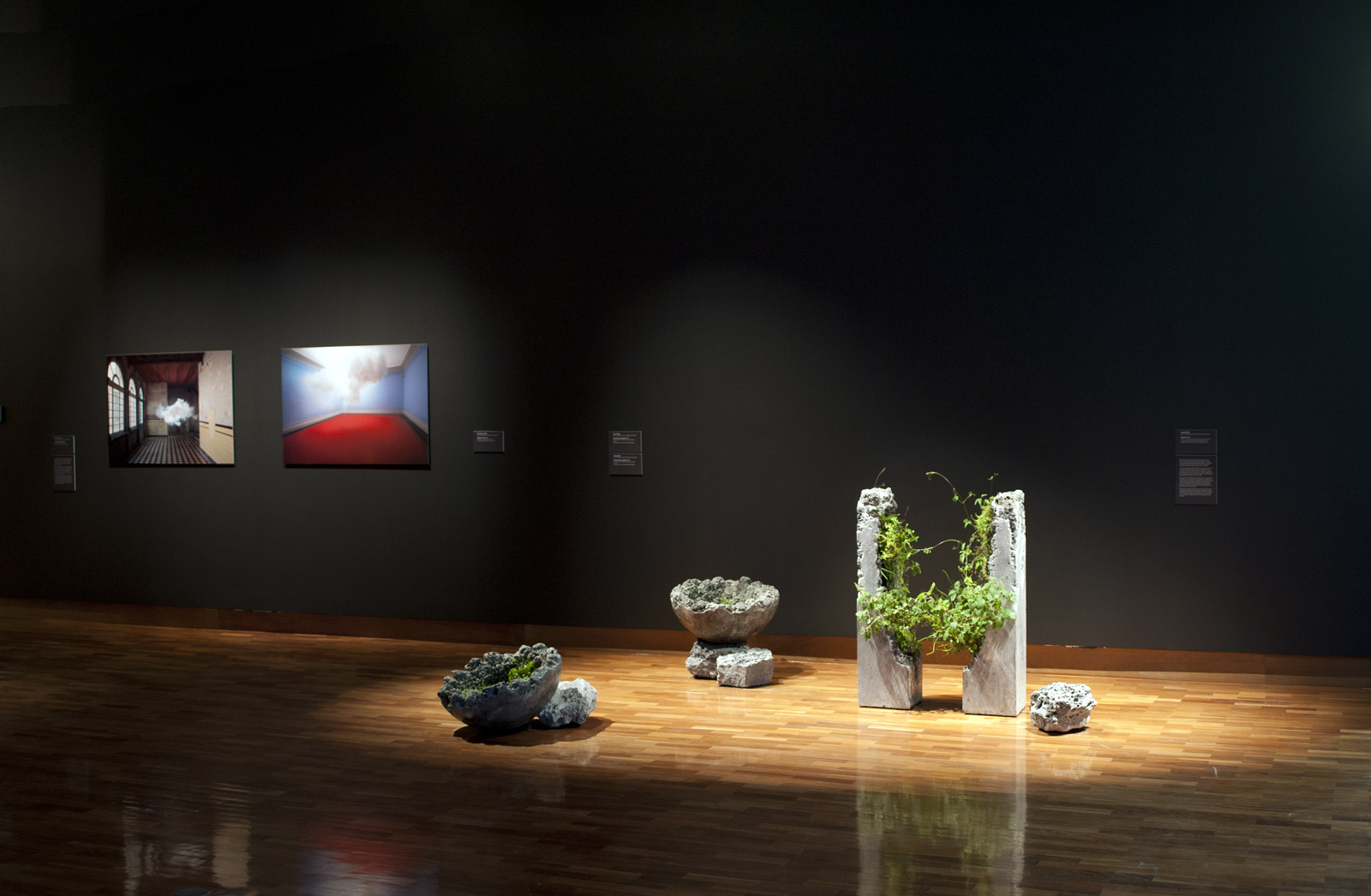
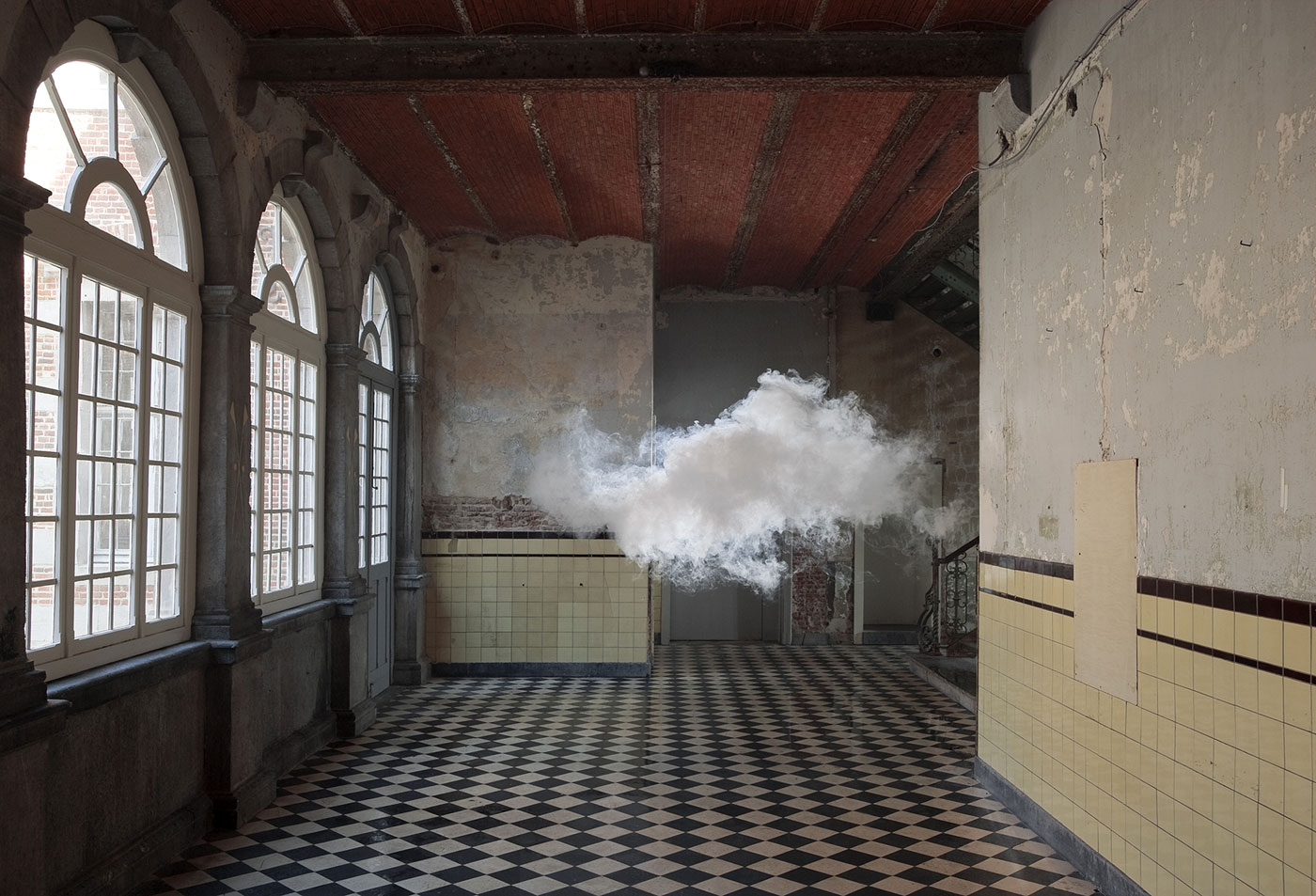
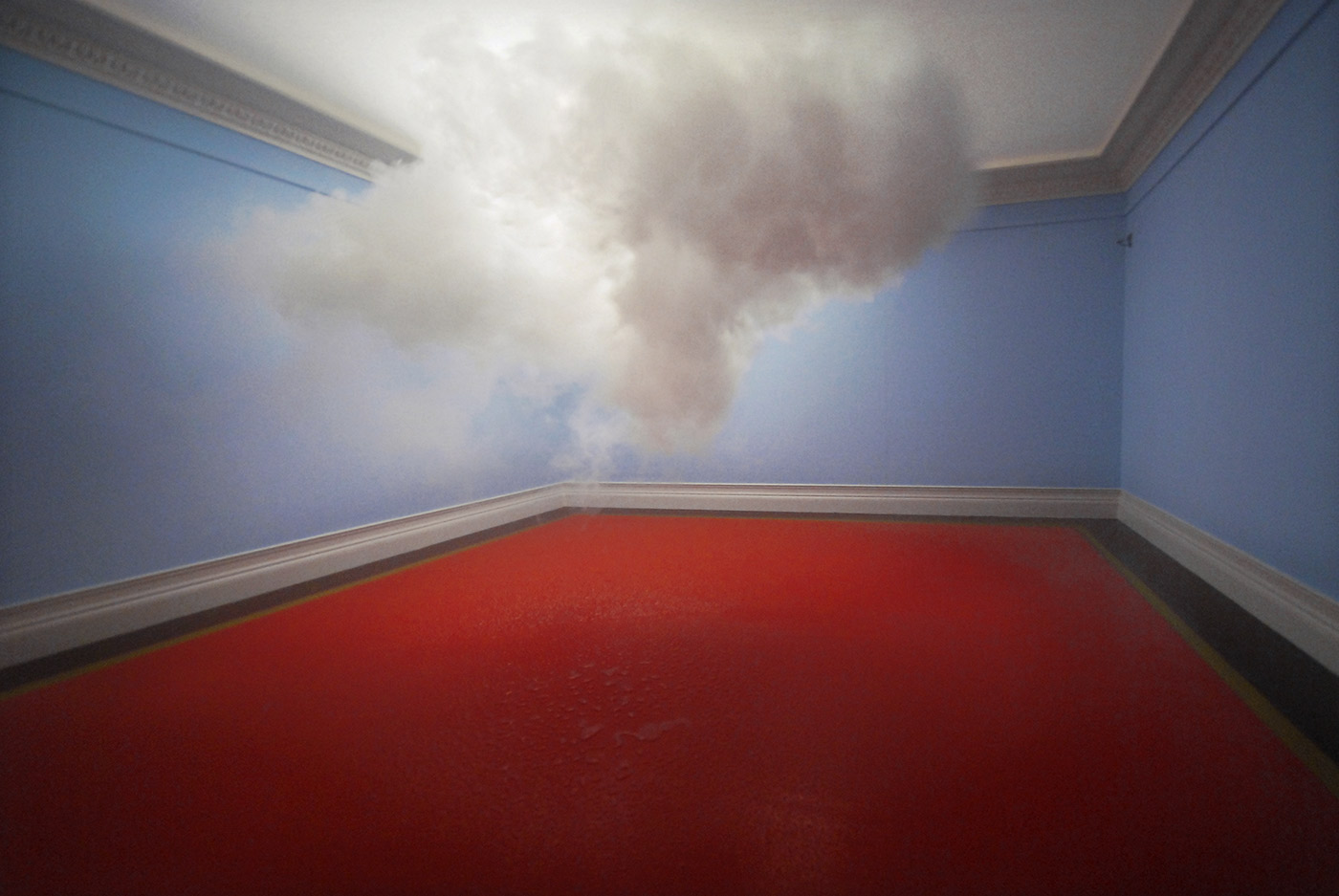
Installation photograph of the exhibition 'Nature/Revelation' at The Ian Potter Museum of Art, Melbourne showing at left, Berndnaut Smilde's 'Nimbus – Probe'  2012 and 'Nimbus D'Aspremont' 2010; and at right, Jamie North's 'Portal II' and 'Slag bowl I & II' 2014


Installation photographs of the exhibition Nature/Revelation at The Ian Potter Museum of Art, Melbourne showing at left, Berndnaut Smilde’s Nimbus – Probe  2012 and Nimbus D’Aspremont 2010; and at right, Jamie North’s Portal II and Slag bowl I & II 2014
Photo: Marcus Bunyan


Berndnaut Smilde (Dutch, b. 1978) 'Nimbus D'Aspremont' 2012


Berndnaut Smilde (Dutch, b. 1978)
Nimbus D’Aspremont
2012
Digital C-type print mounted on diabond
75 x 110cm
Courtesy the artist and Ronchini Gallery, London


Berndnaut Smilde (Dutch, b. 1978) 'Nimbus – Probe' 2010


Berndnaut Smilde (Dutch, b. 1978)
Nimbus – Probe
2010
Digital C-type print mounted on diabond
75 x 112cm
Courtesy the artist and Ronchini Gallery, London


The Ian Potter Museum of Art
The University of Melbourne,
Corner Swanston Street and Masson Road
Parkville, Victoria 3010

Opening hours: Tuesday – Saturday 11am – 5pm

The Ian Potter Museum of Art website

LIKE ART BLART ON FACEBOOK

Back to top

Exhibition: ‘Robert Gober: The Heart Is Not a Metaphor’ at the Museum of Modern Art (MoMA), New York

Exhibition dates: 4th October, 2014 – 18th January, 2015

Curators: Ann Temkin, The Marie-Josée and Henry Kravis Chief Curator of Painting and Sculpture, and Paulina Pobocha, Assistant Curator, Department of Painting and Sculpture


Many thankx to MoMA for allowing me to publish the photographs in the posting. Please click on the photographs for a larger version of the image.


Robert Gober (American, b. 1954)
 'X Playpen' 1987 from the exhibition 'Robert Gober: The Heart Is Not a Metaphor' at the Museum of Modern Art (MoMA), New York, October 2014 - January 2015


Robert Gober (American, b. 1954)
X Playpen
1987
Wood and enamel paint
27 x 37 x 37″ (68.6 x 94 x 94cm)
Batsheva and Ronald Ostrow
Image credit: D. James Dee, courtesy the artist and Paula Cooper Gallery
© 2014 Robert Gober


“Begun in 1984, the sink series appeared during the darkest period of the AIDS epidemic. Gober, who is gay, responded to the tragedy with poetic indirection: the sinks’ cold air of clinical hygiene. The Times critic John Russell nailed the artistic effect: “Minimal forms with maximum content.” The fact that the content must be intuited by the viewer, who is free to regard the sinks as just cleverly manufactured found objects, typifies Gober’s circumspection. His works are enigmatic but not coy, morally driven but not aggrieved. They radiate a quality that is as rare in life as it is in art: character. …

The heart is an excitable physical organ that registers sensations of fight or flight and of love or aversion: the first and last unimpeachable witness to what can’t help but matter, for good and for ill, in every life.”


Peter Schjeldahl. “Found Meanings: A Robert Gober Retrospective,” October 6, 2014 in ‘The Art World’ October 13, 2014 Issue on ‘The New Yorker’ website [Online] Cited 09/07/2021. Used under fair use conditions for the purposes of education and research


Robert Gober (American, b. 1954)
 'The Ascending Sink' 1985 from the exhibition 'Robert Gober: The Heart Is Not a Metaphor' at the Museum of Modern Art (MoMA), New York, October 2014 - January 2015


Robert Gober (American, b. 1954)
The Ascending Sink
1985
Plaster, wood, steel, wire lath, and semi-gloss enamel paint
Two components, each: 30 x 33 x 27″ (76.2 x 83.8 x 68.6cm); floor to top: 92″ (233.7cm)
Installed in the artist’s studio on Mulberry Street in Little Italy, Manhattan
Collection of Thea Westreich Wagner and Ethan Wagner, New York
Promised gift to the Whitney Museum of American Art
Image credit: John Kramer, courtesy the artist
© 2014 Robert Gober


Robert Gober (American, b. 1954) 'Untitled' 1984


Robert Gober (American, b. 1954)
Untitled
1984
Plaster, wood, wire lath, aluminium, watercolour, semi-gloss enamel paint
28 x 33 x 22 1/2″ (71.1 x 83.8 x 57.2cm)
Rubell Family Collection
Courtesy the artist and Matthew Marks Gallery
© 2014 Robert Gober


Robert Gober (American, b. 1954) 'Two Partially Buried Sinks' 1986-1987


Robert Gober (American, b. 1954)
Two Partially Buried Sinks
1986-1987
Cast iron and enamel paint
Right: 39 x 25 1/2 x 2 1/2″ (99.1 x 64.8 x 6.4cm)
Left: 39 x 24 1/2 x 2 3/4″ (99.1 x 62.2 x 7cm)
Private collection
Image credit: Andrew Moore, courtesy the artist
© 2014 Robert Gober


Robert Gober (American, b. 1954)
 '
Untitled Closet' 1989


Robert Gober (American, b. 1954)
Untitled Closet
1989
Wood, plaster, enamel paint
84 x 52 x 28″ (213.4 x 132.1 x 71.1cm)
Private collection
Courtesy the artist and Matthew Marks Gallery
© 2014 Robert Gober


Robert Gober (American, b. 1954)
 'Untitled' 1991


Robert Gober (American, b. 1954)
Untitled
1991
Wood, beeswax, human hair, fabric, paint, shoes
9 x 16 1/2 x 45″ (22.9 x 41.9 x 114.3cm)
Collection the artist
Image credit: Andrew Moore, courtesy the artist
© 2014 Robert Gober


Robert Gober (American, b. 1954)
 'Untitled' 1994-1995


Robert Gober (American, b. 1954)
Untitled
1994-1995
Wood, beeswax, brick, plaster, plastic, leather, iron, charcoal, cotton socks, electric light and motor
47 3/8 × 47 × 34″ (120.3 × 119.4 × 86.4cm)
Emanuel Hoffmann Foundation, on permanent loan to the Öffentliche Kunstsammlung Basel
Image credit: D. James Dee, courtesy the artist and Matthew Marks Gallery
© 2014 Robert Gober


Chronicling a 40-year career, Robert Gober: The Heart Is Not a Metaphor is the first large-scale survey of Robert Gober’s (American, b. 1954) work to take place in the United States. The exhibition is on view from October 4, 2014 to January 18, 2015, and features approximately 130 works across several mediums, including individual sculptures, immersive sculptural environments, and a distinctive selection of drawings and prints. Robert Gober: The Heart Is Not a Metaphor is organised by Ann Temkin, The Marie-Josée and Henry Kravis Chief Curator, and Paulina Pobocha, Assistant Curator, Department of Painting and Sculpture, MoMA, working in close collaboration with the artist.

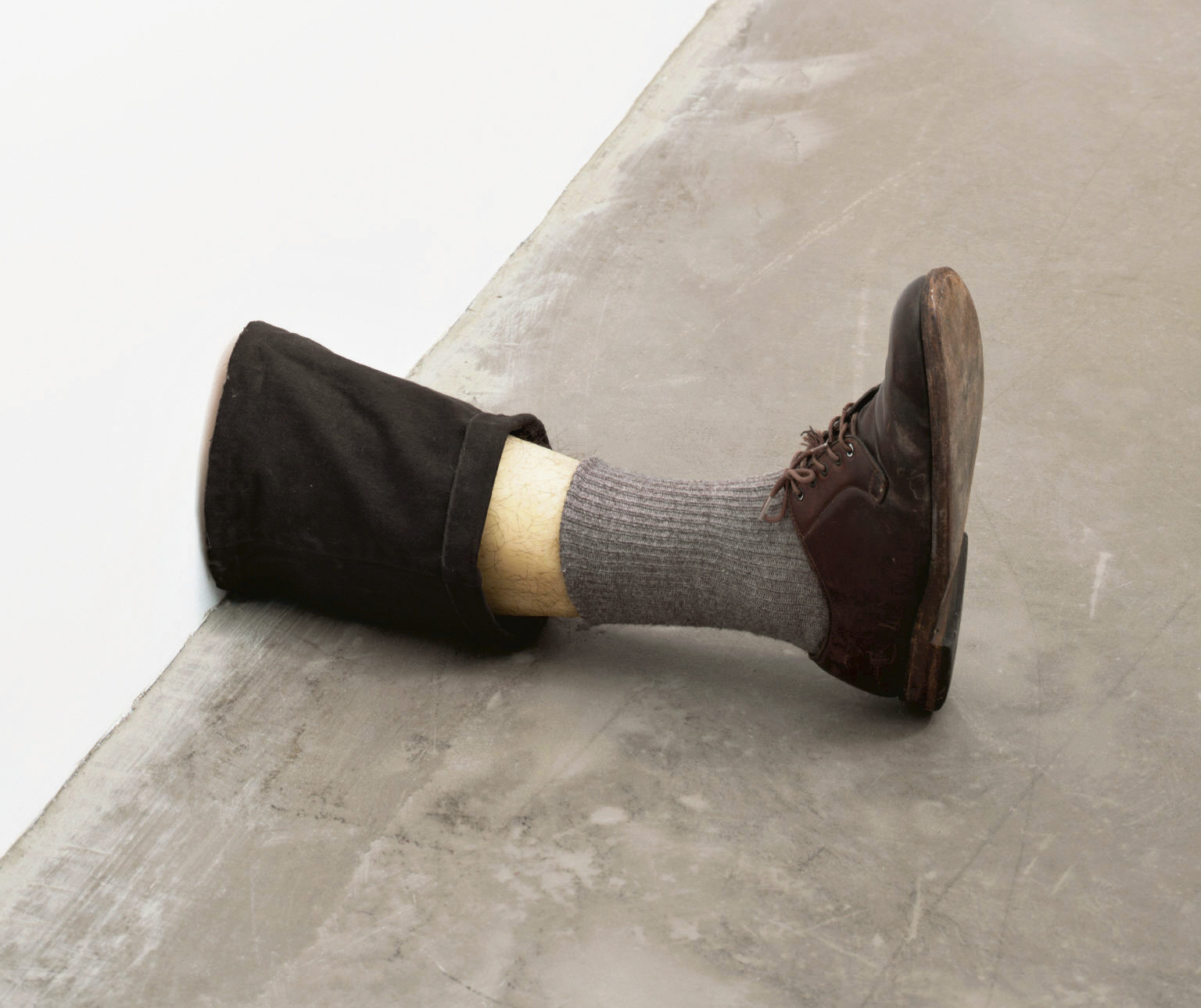
Early on, Gober’s sculptures declared themselves an indispensable part of the landscape of late-twentieth century art; since then they have continued to evolve while remaining tightly bound to the principles outlined by the artist almost four decades ago. Gober places narrative at the centre of his endeavour, embedding themes of sexuality, religion, and politics into work drawn from everyday life. Spare in its use of images and motifs while protean in its capacity to generate meaning, Gober’s work is an art of contradictions: intimate yet assertive, straightforward yet enigmatic. Taking imagery familiar to anyone – doors, sinks, legs – Gober dislocates, alters, and estranges what we think we know. Although a first glance might suggest otherwise, all of Gober’s objects are entirely handmade, by the artist and by collaborators with the necessary expertise.

The earliest works in the exhibition date from the mid-to-late 1970s when Gober was largely working in two dimensions. A painting of the house he grew up in Connecticut hangs at the entrance to the galleries. The first room of the exhibition offers an introduction to Gober’s career, as told through five works: a sculpture of a paint can, a man’s leg, and a closet, as well as a drawing and a small print.

Between 1983 and 1986, Gober created more than 50 sculptures of sinks and scores of related drawings. Based on real sinks, including one in the artist’s childhood home, Gober built them from wood, plaster, and wire lath, and finished them with multiple coats of paint to mimic the appearance of enamel. But, crucially, they lack faucets and plumbing. The sinks’ appearance coincided with the early years of the AIDS epidemic, and their uselessness spoke to the impossibility of cleansing oneself. The sculptures on view in the second gallery of the exhibition were featured in Gober’s first show of sinks, held at the Daniel Weinberg Gallery, Los Angeles, in 1985.

Gober’s early and straightforward sink sculptures gave way in 1985 to a group of distorted sinks whose bodies are variably stretched, bent, multiplied, and divided. The evolution of form registers in the works’ titles: self-evident descriptions become increasingly expressive (eg. The Sink Inside of Me). By the mid-1980s, the artist’s preoccupation with domestic objects expanded to include sculptures of furniture such as beds and playpens, as well as an armchair, on view in the third gallery. Between 1986 and 1987, Gober created Two-Partially Buried Sinks, among the last sink sculptures of the decade. This work is positioned outside the walls of the Museum on a scaffold, and can be viewed through the gallery’s window.

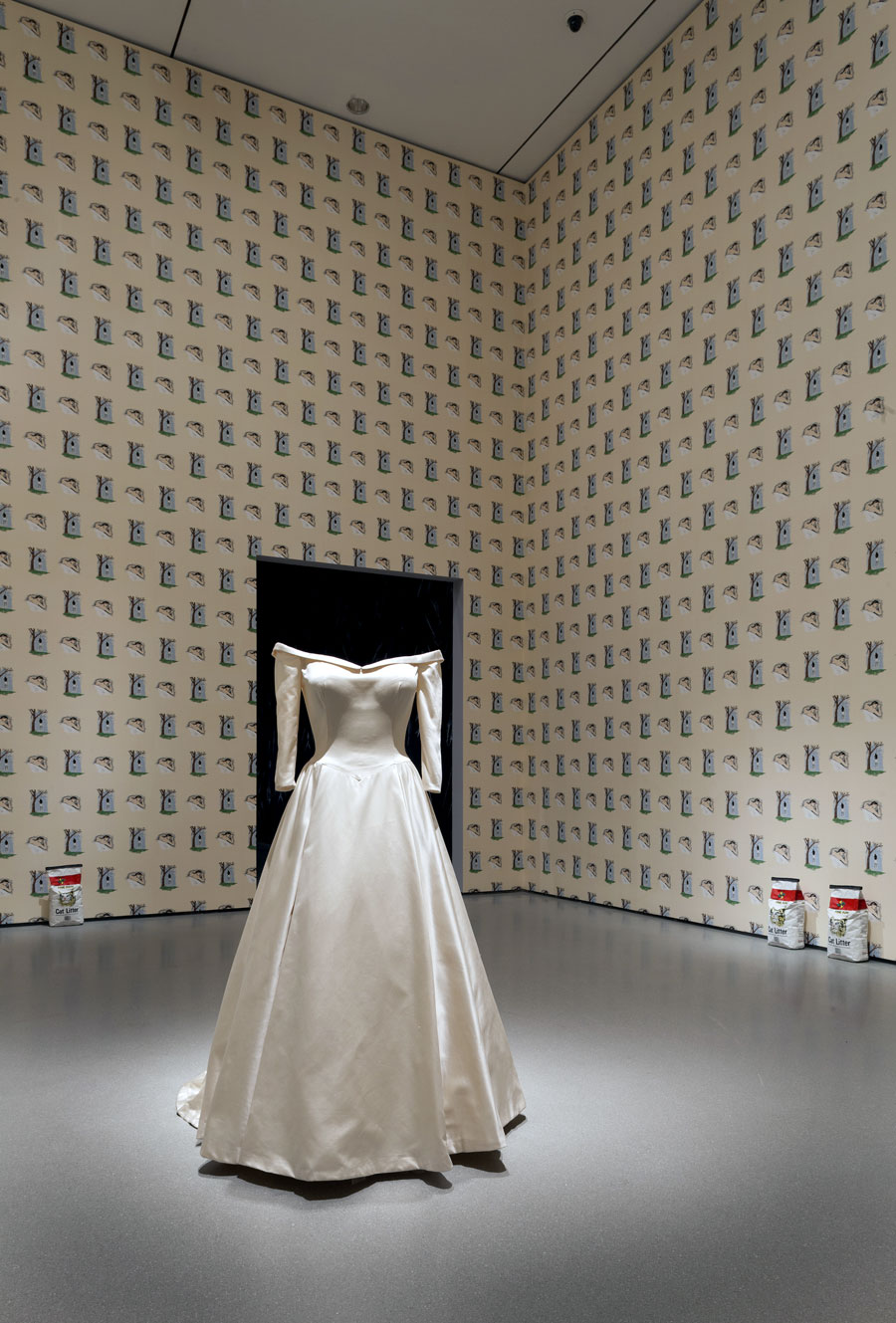
In 1989 at the Paula Cooper Gallery, Gober exhibited his first room-sized installations. Each is framed by wallpapers: a pattern pairing a sleeping white man and a lynched black man in one, and line drawings of male and female genitalia in the other, both of which are on view in the following galleries. These backdrops powerfully inflect the sculptures contained within: a freestanding bridal gown and hand-painted plaster cat litter bags in the first room and a bag of donuts with cast-pewter drains inset into the walls in the second. With characteristic concision, Gober sets off a complex swirl of questions about the unease surrounding issues to everyday life in America.

Gober made Slides of a Changing Painting between 1982 and 1983. During this year, he painted on a small Masonite board and photographed the imagery as it changed over time. Eventually, he had accumulated more than 1,000 slides, which he edited down and organised into a slide projection that he showed in 1984. After the exhibition, Gober put the slides away. When he revisited the project around 1990, he realised that he had unknowingly employed many of the same images in his subsequent sculptures. Slides of a Changing Painting has continued to be generative; it provides a nearly complete index of Gober’s visual themes and vocabulary. The work is on view in a gallery centrally located within the exhibition.

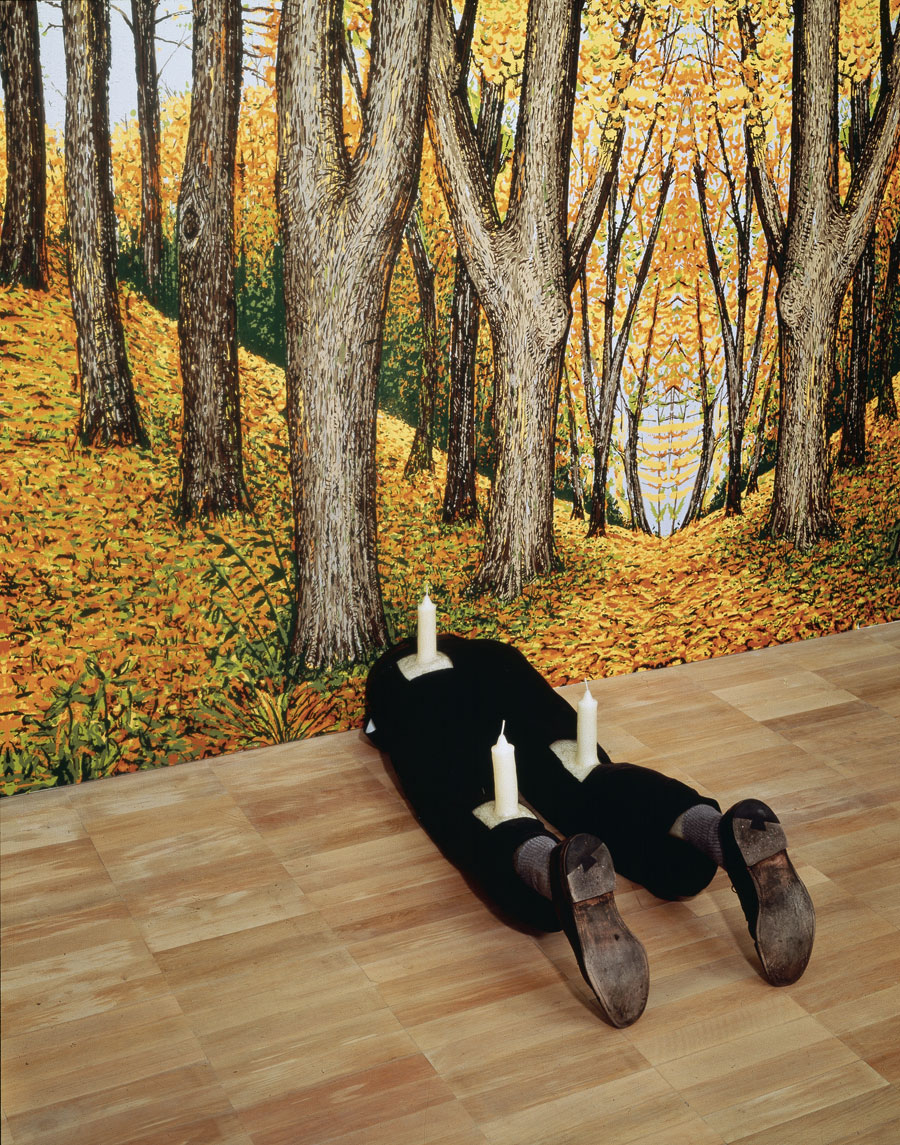
The human figure was absent from Gober’s sculptural repertoire until 1989, when he made his first sculpture of a man’s leg, a breakthrough that ushered in many related works. Single legs wearing trousers and shoes and truncated at mid-shin were followed by pairs of legs that Gober left whole to the waist. He showed these surreal sculptures in a 1991 exhibition in Paris, recreated in the following gallery. Three pairs of legs, augmented by candles, drains, and a musical score, are positioned around the perimeter of a room wallpapered with a kaleidoscopic landscape of a beech forest in autumn. In the centre of the gallery sits a human-sized cigar composed of tobacco sheafs purchased from a Pennsylvania supplier. To learn how to preserve this organic material as it aged, Gober consulted an expert at the American Museum of Natural History. Seeking out specialists’ advice on complicated projects is a hallmark of the artist’s craft based practice.

The works on view in the following gallery were made by artists Anni Albers, Robert Beck, Cady Noland, and Joan Semmel; photographs by Nancy Shaver hang in the adjoining space. Gober brought these objects together for the first time in an exhibition he organised at the Matthew Marks Gallery, New York in 1999. Gober has been curating exhibitions since the mid-1980s, most recently focusing on monographic presentations of the works by American artists Charles Burchfield and Forrest Bess. The contemporary artists included in this gallery share with Gober daring approaches to the representation of sexuality, violence, and American culture.

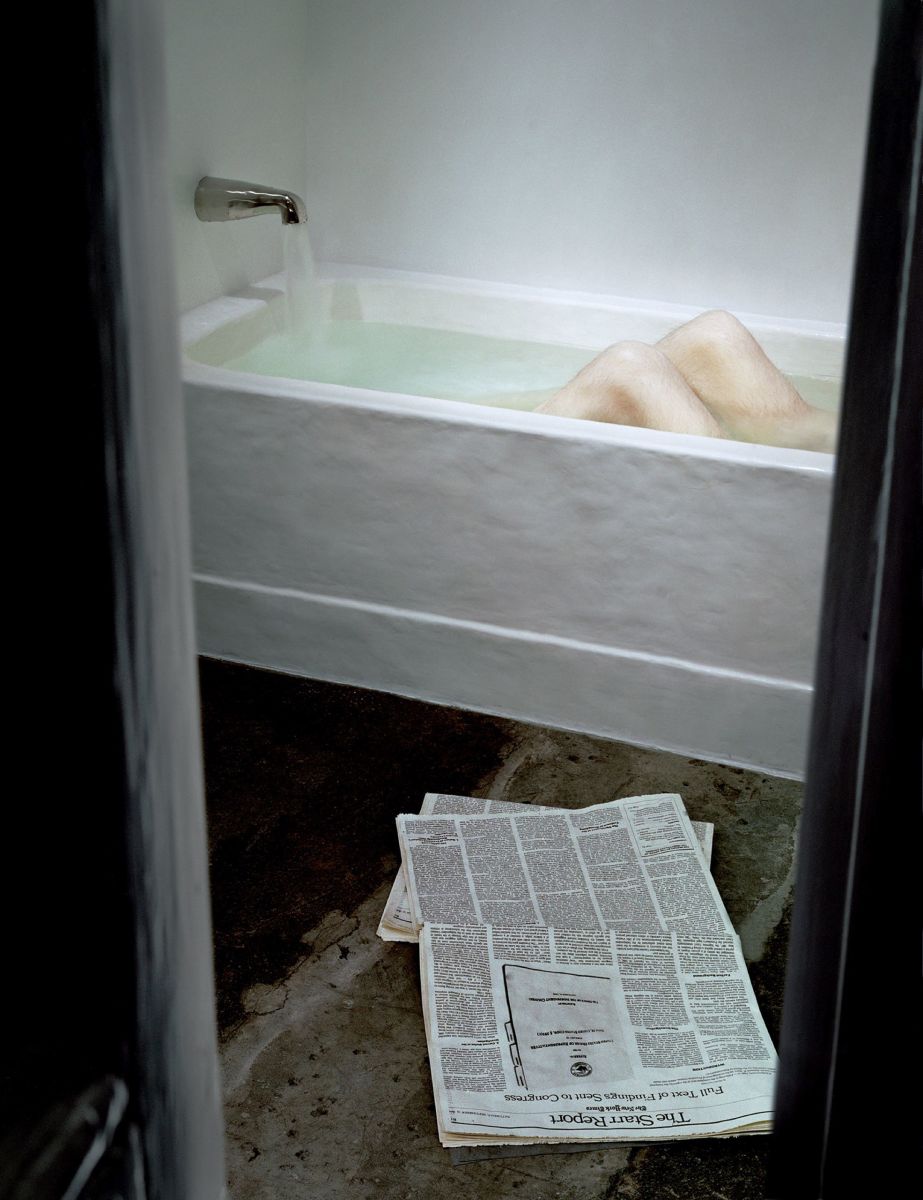
The immersive installation Gober conceived for a 1992 exhibition at the Dia Center for the Arts, New York is on view nearby. All three rooms of that original presentation are reconstructed: an antechamber, a central gallery, and a dark cul-de-sac. The main space features a hand-painted mural, executed in a paint-by-number method by scenic painters, depicting a forest inspired by the landscape of Long Island’s North Fork. Barred prison windows, through which a blue sky is visible, interrupt the verdant panorama. Placed throughout the gallery are hand-painted plaster sculptures of boxes of rat bait and bundles of newspapers – actually photolithographic facsimiles of newspapers featuring real and invented content. After a six-year absence from Gober’s work, sinks reappeared in the installation at Dia, water now running freely from their faucets.

Following the introduction of mens’ legs into his sculptural vocabulary, Gober cast the leg of a young boy and used that mould as the basis for several subsequent works, including a fireplace where legs take the place of firewood, a vision invoking childhood nightmares and uncensored fairy tales. Also on view is a sculpture of a suitcase that occupies space below ground as well as above. Its lid opens to reveal a sewer grate and a brick shaft that leads to a subterranean tidal pool complete with seaweed, mussel shells, and starfish. Visible through the depths of the water, amid the marine life, are the legs of a man and baby, one holding the other in a manner suggestive of baptism. While primarily a sculptor, Gober has worked across a range of media throughout his career including drawing and printmaking. Drawings sit the closest to his work in three dimensions; most of his sculptures and installations are preceded by preparatory drawings. A selection of Gober’s works on paper is also on view in this gallery.

The final installation included in the exhibition was made in response to the attacks of September 11, 2001, and results from Gober’s desire to create a space of refuge and reflection. The overall structure evokes the interior of a church: a central aisle separating rows of pews leads to an altar-like area flanked by two chapels. From the nipples of a headless Christ, regenerative “living water” flows into a large hole jackhammered into the floor. In the pastel drawings hanging on the side walls, the power of human embrace confronts the harrowing news contained within the photo-lithographed pages of the September 12, 2001, issue of The New York Times. In this installation, the overt references to Catholicism explore the vitality of such symbolism in the wake of contemporary tragedy.

Over the past decade, Gober’s sculptures have become increasingly complex, both technically and iconographically. The artist sometimes uses casts of existing sculptures and combines them to create hybrid objects, as in the conjunction of a chest, a stool, and a twisted network of children’s legs. Elsewhere, Gober pushes recognisable imagery into unpredictable terrain: a sink’s backsplash morphs into gnarled planks of wood interwoven with casts of fragmented arms. New motifs, such as a surrealistically melting rifle, also have entered the artist’s visual universe. The strangeness of these new sculptures is presaged by Prayers Are Answered (1980-1981), an early work loosely based on a Catholic church on 7th Street and Avenue B in the East Village. Rather than the traditional religious scenes to be found in paintings lining the walls, Gober has furnished the church with murals depicting the harshness of daily life in the city.

The exhibition’s final gallery presents works made as early as 1979 and as recently as this past spring. Images of domestic objects and architecture and themes of childhood and the body reverberates across the decades. The dollhouse placed on the floor is one of several that Gober designed and built during his first years in New York City, as one way of earning a living. The sculpture and installations that would follow may be considered life-size realisations of the imaginative potential contained within these small structures.

Published in conjunction with the exhibition and prepared in close collaboration with the artist, Robert Gober: The Heart Is Not a Metaphor traces the development of his work, highlighting themes and motifs to which he has returned throughout the decades. The book features an essay by Hilton Als – a text both wide-ranging and personal – and an in-depth narrative of Gober’s life. The rich selection of images illustrates every phase of the artist’s career, and includes previously unpublished photographs from his own archive. Hardcover. 6.5″w x 9.75″h; 272 pages; 169 illustrations. ISBN: 978-0-87070-946-3. $45.

Ann Temkin

The Marie-Josée and Henry Kravis Chief Curator of Painting and Sculpture
The Museum of Modern Art

Ms. Temkin assumed the role of Chief Curator of Painting and Sculpture in 2008, after joining The Museum of Modern Art in 2003 as Curator. During her tenure, Ms. Temkin has worked extensively with her colleagues on reimagining the Painting and Sculpture collection galleries at the Museum. Along with Robert Gober: The Heart Is Not A Metaphor, her exhibitions at MoMA include Ileana Sonnabend: Ambassador for the New (2013); Abstract Expressionist New York (2010); Gabriel Orozco (2009); and Color Chart: Reinventing Color, 1950 to Today (2008). Prior to MoMA, Ms. Temkin was the curator of modern and contemporary art at the Philadelphia Museum of Art from 1990 to 2003, where she organised such exhibitions as Barnett Newman (2002), Constantin Brancusi (1995), and Thinking is Form: The Drawings of Joseph Beuys (1994).

Paulina Pobocha

Assistant Curator, Department of Painting and Sculpture
The Museum of Modern Art

Ms. Pobocha is an assistant curator in the Department of Painting and Sculpture at The Museum of Modern Art. She joined the Museum in 2008 and has worked on the exhibitions Gabriel Orozco (2009) and Abstract Expressionist New York (2010). In 2013 she co-organised Claes Oldenburg: The Street and The Store. She has also worked extensively with the Museum’s collection. Prior to MoMA, Ms. Pobocha was a Joan Tisch Fellow at the Whitney Museum of American Art, where she lectured on a broad range of subjects in contemporary and modern art. In 2011, she was appointed Critic at the Yale University School of Art.

Press release from the MoMA website


Installation view of 'Robert Gober: The Heart Is Not a Metaphor', The Museum of Modern Art, October 4, 2014 - January 18, 2015


Robert Gober (American, b. 1954)
X Pipe Playpen
2013-14
Wood and bronze
26 1/8 x 55 x 55″ (66.4 x 139.7 x 139.7cm)
Collection the artist


Installation view of 'Robert Gober: The Heart Is Not a Metaphor', The Museum of Modern Art, October 4, 2014 - January 18, 2015 showing Gober's 'Untitled' 1989-1996


Robert Gober (American, b. 1954)
Untitled
 (installation view)
1989-1996
Silk satin, muslin, linen, tulle, welded steel, hand-printed silkscreen on paper, cast hydrostone plaster, vinyl acrylic paint, ink, and graphite
Dimensions variable, approximately 800 square feet installed
The Art Institute of Chicago, restricted gift of Stefan T. Edlis and H. Gael Neeson Foundation; through prior gifts of Mr. and Mrs. Joel Starrels and Fowler McCormick
© 2014 Robert Gober


Robert Gober (American, b. 1954) 'Bag of Donuts' 1989


Robert Gober (American, b. 1954)
Bag of Donuts
1989
paper, dough and rhoplex (12 donuts)
© 2014 Robert Gober


Robert Gober (American, b. 1954)
 'Untitled Leg' 1989-1990


Robert Gober (American, b. 1954)
Untitled Leg
1989-1990
Beeswax, cotton, wood, leather, human hair
11 3/8 x 7 3/4 x 20″ (28.9 x 19.7 x 50.8 cm)
The Museum of Modern Art, New York. Gift of the Dannheisser Foundation
© 2014 Robert Gober


Installation view of 'Robert Gober: The Heart Is Not a Metaphor', The Museum of Modern Art, October 4, 2014 - January 18, 2015 showing on the floor, Gober's 'Cigar' 1991


Robert Gober (American, b. 1954)
Cigar (installation view)
1991
Wood, paint, paper, tobacco
15 3/4 x 15 3/4 x 70 7/8″ (40 x 40 x 180cm)
The Museum of Contemporary Art, Los Angeles. Purchased with funds provided by the Collectors Committee in honour of Marcia Simon Weisman
© 2014 Robert Gober

Robert Gober (American, b. 1954)
Forest
1991
Hand-printed silkscreen on paper
180″ x 124″ (457.2 x 315cm)
Courtesy the artist
© 2014 Robert Gober


Robert Gober (American, b. 1954) '
Untitled' 1991


Robert Gober (American, b. 1954)
Untitled
1991
Wood, beeswax, leather, fabric, and human hair
13 1/4 x 16 1/2 x 46 1/8″ (33.6 x 41.9 x 117.2cm)
The Museum of Modern Art, New York. Gift of Werner and Elaine Dannheisser
Background: Forest, 1991
Hand-painted silkscreen on paper
Image credit: K. Ignatiadis, courtesy the artist and Matthew Marks Gallery
© 2014 Robert Gober


Installation view of 'Robert Gober: The Heart Is Not a Metaphor', The Museum of Modern Art, October 4, 2014 - January 18, 2015 showing Gober's 'Untitled' 1992


Robert Gober (American, b. 1954)
Untitled (installation view)
1992
Paper, twine, metal, light bulbs, cast plaster with casein and silkscreen ink, stainless steel, painted cast bronze and water, plywood, forged iron, plaster, latex paint and lights, photolithography on archival (Mohawk Superfine) paper, twine, hand-painted forest mural
511 3/4 × 363 3/16 × 177 3/16″ (1300 × 922.5 × 450.1cm)
Glenstone
© 2014 Robert Gober


Robert Gober (American, b. 1954) '
Untitled' 1992


Robert Gober (American, b. 1954)
Untitled
1992
Paper, twine, metal, light bulbs, cast plaster with casein and silkscreen ink, stainless steel, painted cast bronze and water, plywood, forged iron, plaster, latex paint and lights, photolithography on archival (Mohawk Superfine) paper, twine, hand-painted forest mural
511 3/4 × 363 3/16 × 177 3/16″ (1300 × 922.5 × 450.1cm)
Glenstone
Image credit: Russell Kaye, courtesy the artist and Matthew Marks Gallery
© 2014 Robert Gober


Robert Gober (American, b. 1954) 'Untitled' 2003-2005


Robert Gober (American, b. 1954)
Untitled
2003-2005
Courtesy MoMA and Matthew Marks Gallery
Image credit: Russel Kaye
© 2014 Robert Gober


Installation view of 'Robert Gober: The Heart Is Not a Metaphor', The Museum of Modern Art, October 4, 2014 - January 18, 2015 showing Gober's 'Untitled' 2003-2005 (detail)


Robert Gober (American, b. 1954)
Untitled (detail)
2003-2005
© 2014 Robert Gober


Robert Gober (American, b. 1954) 'Untitled' 1980-1981


Robert Gober (American, b. 1954)
Untitled
1980-1981
Oil on wood panel
8 x 5 3/4″ (20.3 x 14.6cm)
Collection the artist
Image credit: Ron Amstutz, courtesy the artist and Matthew Marks Gallery
© 2014 Robert Gober


Robert Gober (American, b. 1954) '
Slip Covered Armchair' 1986-1987


Robert Gober (American, b. 1954)
Slip Covered Armchair
1986-1987
Plaster, wood, linen, and fabric paint
31 1/2 x 30 1/2 x 29″ (80 x 77.5 x 73.7cm)
Collection the artist
Image credit: D. James Dee, courtesy the artist
© 2014 Robert Gober


Installation view of 'Robert Gober: The Heart Is Not a Metaphor', The Museum of Modern Art, October 4, 2014 - January 18, 2015 showing Gober's 'Untitled Door and Door Frame' 1987-1988


Robert Gober (American, b. 1954)
Untitled Door and Door Frame (installation view)
1987-1988
Wood, enamel paint
Door: 84 x 34 x 1 1/2″ (213.4 x 86.4 x 3.8cm)
Doorframe: 90 x 43 x 5 1/2″ (228.6 x 109.2 x 14cm)
Collection Walker Art Center, Minneapolis. Gift of the John and Mary Pappajohn Art Foundation, 2004
© 2014 Robert Gober

Installation views of Robert Gober: The Heart Is Not a Metaphor, The Museum of Modern Art, October 4, 2014 – January 18, 2015
All works by Robert Gober © 2014 Robert Gober © 2014 The Museum of Modern Art
Photos: Jonathan Muzikar


Robert Gober (American, b. 1954) 'Untitled' 2005-2006


Robert Gober (American, b. 1954)
Untitled
2005-2006
Aluminium-leaf, oil and enamel paint on cast lead crystal
4 3/4″ high × 4 1/4″ diameter (12.1 × 10.8cm)
Collection the artist
Image credit: Bill Orcutt, courtesy the artist and Matthew Marks Gallery
© 2014 Robert Gober


Robert Gober (American, b. 1954) '
Untitled' 2008


Robert Gober (American, b. 1954)
Untitled
2008
Cast gypsum polymer
14 1/2 x 10 3/4 x 6″ (36.8 x 27.3 x 15.2cm)
Edition of 4, with 1 AP
Collection the artist
Image credit: Fredrik Nilsen, courtesy the artist and Matthew Marks Gallery
© 2014 Robert Gober


Robert Gober (American, b. 1954) 'Leg with Anchor' 2008


Robert Gober (American, b. 1954)
Leg with Anchor
2008
Forged iron and steel, beeswax, cotton, leather, and human hair
28 × 18 × 20″ (71.1 × 45.7 × 50.8cm)
Glenstone
Image credit: Bill Orcutt, courtesy the artist and Matthew Marks Gallery
© 2014 Robert Gober


The Museum of Modern Art
11 West 53 Street
New York, NY 10019
Phone: (212) 708-9400

Opening hours:
10.30 am – 5.30 pm
Open seven days a week

MoMA website

LIKE ART BLART ON FACEBOOK

Back to top

Exhibition: ‘Dayanita Singh: Go Away Closer’ at the MMK Museum für Moderne Kunst Frankfurt

Exhibition dates: 27th September, 2014 – 4th January, 2015


Dayanita Singh (Indian, b. 1961) Image from 'File Room' 2013 from the exhibition 'Dayanita Singh: Go Away Closer' at the MMK Museum für Moderne Kunst Frankfurt, September 2014 - January 2015


Dayanita Singh (Indian, b. 1961)
Image from File Room
2013
Courtesy of the artist and Frith Street Gallery, London
© Dayanita Singh


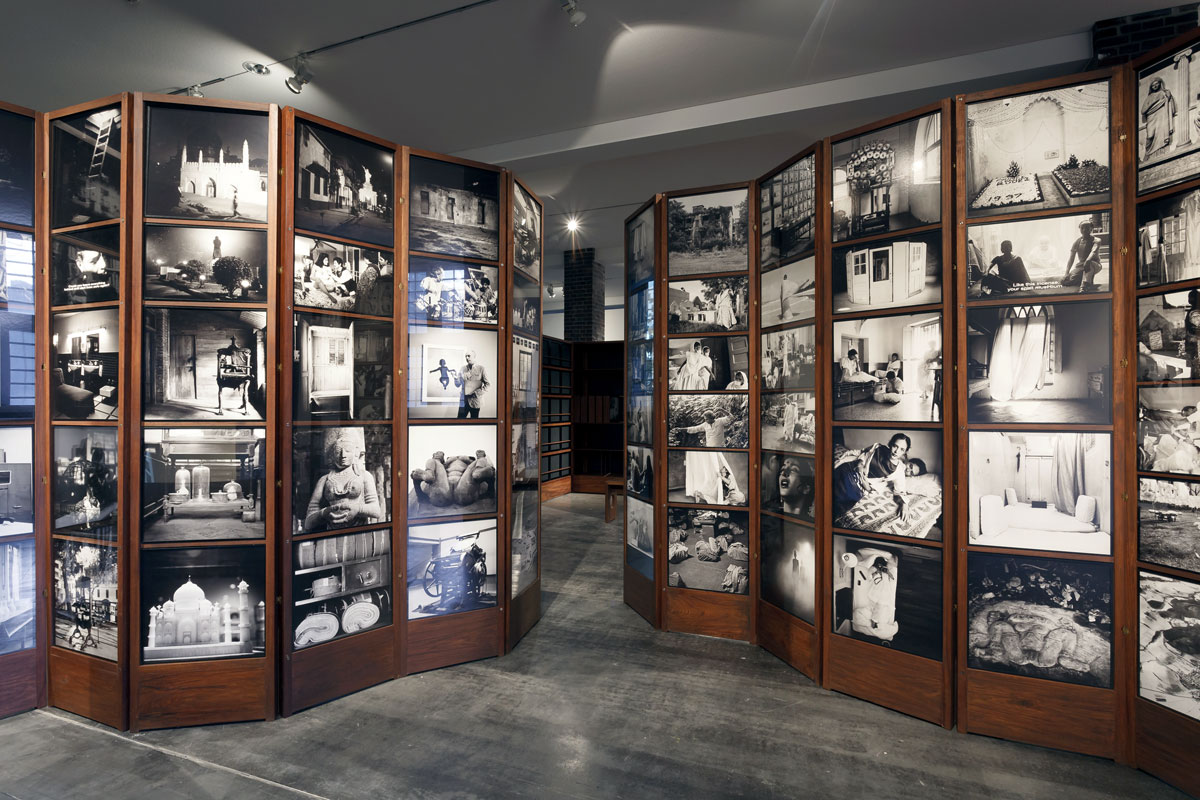
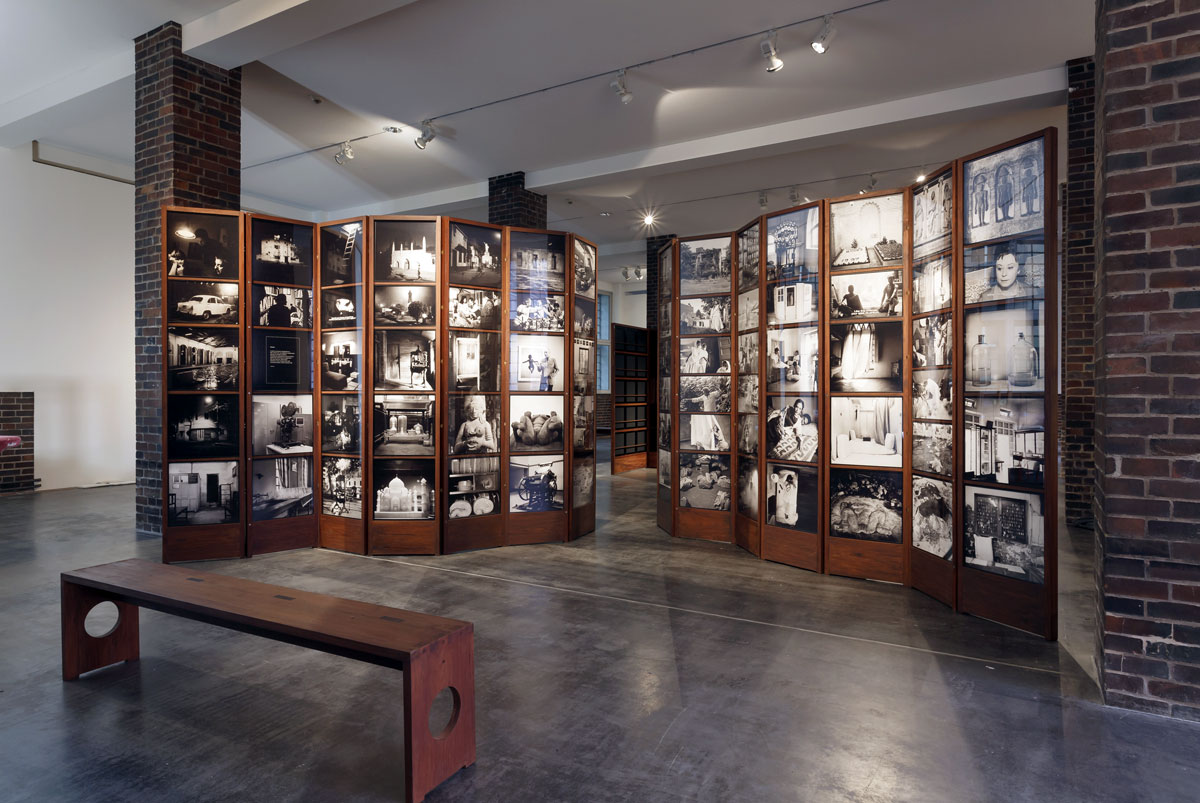
This exhibition looks fantastic. I really love the sensitivity and melancholy of the individual images, I just wish I could see the whole exhibition up close in order to comprehend the scientific, surreal dreamscape narratives. In the top two installation photographs there is reference to Ed Ruscha’s folder books but in the large installation photographs (the wooden panels) I see more a cinematic archive form rather than a book form. Film strips as a puzzle (with echoes of Robert Heinecken) that can be read vertically, horizontally and in the round. What most interests Singh about photography is its dissemination in unusual and interesting ways. For her, the book and the choreography of the photographs within it (the sequencing) is the work.

There are so many excellent exhibitions finishing before 4th January 2015 I hope I get them all, including a huge two part posting on Robert Frank, a posting on Paul Strand and Nicholas Nixon’s The Brown Sisters. Keep your fingers crossed I have time…

Dr Marcus Bunyan


Many thankx to the MMK Museum für Moderne Kunst Frankfurt for allowing me to publish the photographs in the posting. Please click on the photographs for a larger version of the image.


“The art world would like to have one image, the art world would like to have three images, I would like to have a hundred images, maybe five hundred images – so books are really essential to enable me to do all that.”


Dayanita Singh


Dayanita Singh (Indian, b. 1961) Image from 'File Room' 2013 from the exhibition 'Dayanita Singh: Go Away Closer' at the MMK Museum für Moderne Kunst Frankfurt, September 2014 - January 2015

Dayanita Singh (Indian, b. 1961) Image from 'File Room' 2013

Dayanita Singh (Indian, b. 1961) Image from 'File Room' 2013

Dayanita Singh (Indian, b. 1961) Image from 'File Room' 2013

Dayanita Singh (Indian, b. 1961) Image from 'File Room' 2013


Dayanita Singh (Indian, b. 1961)
Images from File Room
2013
Courtesy of the artist and Frith Street Gallery, London
© Dayanita Singh


“With more than seven hundred photographs, the internationally renowned photographer Dayanita Singh is providing in-depth insights into the past thirty years of her artistic work.”


Her exhibition Go Away Closer is a museum in a museum: in installations she calls “museum structures”, Singh arranges her photographs and presents them in structures she had developed as her form. These archives structures stand in the exhibition like open oversize books. Each of the expansive, multiply convertible wooden structures holds between 70 and 140 black-and-white photographs – series of works edited and arranged in sequences by the artist, but theoretically capable of being rearranged and supplemented in any number of ways. The photos unite to form fictional narratives full of allusions and enigmas. The artist has given the various structures such titles as Museum of Little Ladies, Museum of Embraces, Museum of Machines or Museum of Chance. She quite deliberately chooses not to label or date the individual photographs.

Dayanita Singh, who refers to herself as a “book artist”, made a name for herself above all with her carefully designed artist’s books, which she has always thought of as portable museums. The “museum structures” have their origins in these books. This special exhibition form lends the images a quality of seemingly never-ending process. With the ‘museum structures’, Singh moreover broadens our conception of photography and how to approach it by introducing sculptural and architectonic aspects.

Singh’s photographs, which she processes with superb craftsmanship and great technical precision, are characterised by a balance between empathy and distance. In her pictures, with their underlying melancholy mood, she finds simple translations for complex states of mind. In the photographic essays, countless images of her past merge with perceptions of the present, as in a dreamlike state. European music, literature and movie history are as much a part of the artist’s work as the people, structures and places of her surroundings in New Delhi.

The exhibition is further enhanced by Singh’s latest video work, Mona and Myself, which she produced for the German pavilion at the 2013 Venice Biennale. Singh describes the striking video portrait as her first “moving still”. “This film demonstrates the true concern of my work: it’s like a dream, like the brief moment between sleeping and waking,” the artist explains.

Singh first met the film’s protagonist, the eunuch Mona Ahmed, in 1989; since that time the two have been close friends. Talking about the work, the artist says: “Mona tells what it’s like when you belong neither here nor there, are neither male nor female, neither an eunuch nor someone like me.”

Publication

On the occasion of the exhibition at the MMK 3, Dayanita Singh created a new artist’s book entitled Museum of Chance, published by Steidl Verlag, Göttingen. The 88 photographs featured on the inside of the clothbound book also each appear as front and back cover illustrations, so that there are 88 different versions of the publication. The book Museum of Chance is in English, costs 48 EUR and is available at the MMK shop. The exhibition was organised in cooperation with the Hayward Gallery in London.”

Text from the Museum für Moderne Kunst website


Dayanita Singh – Slide Lecture: Chandigarh Lalit Kala Akademi: Amrita Sher-Gil National Art Week


Installation view of Dayanita Singh's exhibition 'Go Closer Away' 2014

Installation view of Dayanita Singh's exhibition 'Go Closer Away' 2014

Installation view of Dayanita Singh's exhibition 'Go Closer Away' 2014

Installation view of Dayanita Singh's exhibition 'Go Closer Away' 2014 (detail)

Installation view of Dayanita Singh's exhibition 'Go Closer Away' 2014 (detail)

Installation view of Dayanita Singh's exhibition 'Go Closer Away' 2014

Installation view of Dayanita Singh's exhibition 'Go Closer Away' 2014

Installation view of Dayanita Singh's exhibition 'Go Closer Away' 2014


Installation views of Dayanita Singh’s Go Closer Away 2014 at MMK Museum für Moderne Kunst Frankfurt
Photo: Axel Schneider
Courtesy the artist © MMK Frankfurt


Dayanita Singh (Indian, b. 1961) Image from 'Museum of Chance' 2013

Dayanita Singh (Indian, b. 1961) Image from 'Museum of Chance' 2013

Dayanita Singh (Indian, b. 1961) Image from 'Museum of Chance' 2013

Dayanita Singh (Indian, b. 1961) Image from 'Museum of Chance' 2013

Dayanita Singh (Indian, b. 1961) Image from 'Museum of Chance' 2013

Dayanita Singh (Indian, b. 1961) Image from 'Museum of Chance' 2013

Dayanita Singh (Indian, b. 1961) Image from 'Museum of Chance' 2013

Dayanita Singh (Indian, b. 1961) Image from 'Museum of Chance' 2013


Dayanita Singh (Indian, b. 1961)
Images from Museum of Chance
2013
Courtesy of the artist and Frith Street Gallery London
© Dayanita Singh


MMK Museum für Moderne Kunst

Domstraße 10
60311
Frankfurt am Main
Phone: +49 69  21230447

Opening hours:
Tuesday – Sunday 10am – 6pm
Closed Monday

MMK Museum für Moderne Kunst
 website

LIKE ART BLART ON FACEBOOK

Back to top

Exhibition: ‘Eyes on the Street: street photography in the 21st century’ at the Cincinnati Art Museum

Exhibition dates: 11th October, 2014 – 4th January, 2015

Artists

Olivo Barbieri (Italian; lives and works in Modena, Italy)
Philip-Lorca diCorcia (American; lives and works in New York)
Jason Evans (British; lives and works in London)
Paul Graham (British; lives and works in New York)
Mark Lewis (Canadian; lives and works in London)
Jill Magid (American; lives and works in New York)
James Nares (American; lives and works in New York)
Barbara Probst (German; lives and works in New York)
Jennifer West (American; lives and works in Los Angeles)
Michael Wolf (German; lives and works in Paris and Hong Kong)


Installation view of the exhibition 'Eyes on the Street: street photography in the 21st century' at the Cincinnati Art Museum


Installation view by Rob Deslongchamps


Watching the watcher watching…

Dr Marcus Bunyan


Many thankx to the Cincinnati Art Museum for allowing me to publish the photographs in the posting. Please click on the photographs for a larger version of the image.


“Some of the artists in ‘Eyes on the Street’ made their work at street level; others sought higher vantage points. Some sharpen our appreciation for individuals, while others underscore universal urban traits. Some work with still images, while others create films and videos. What links them, and binds them to the historical tradition of street photography, is the quality of attention they give these bustling environments. They are watchful. What distinguishes them from the twentieth-century street-photography tradition, however, is that these artists are also acutely conscious of the active roles cameras play in making urban public places today. They know they are part of a greater system of watching.”


Brian Sholis, Associate Curator of Photography, Cincinnati Art Museum


Installation view of the exhibition 'Eyes on the Street: street photography in the 21st century' at the Cincinnati Art Museum


Installation view by Rob Deslongchamps


Barbara Probst (German, b. 1964) 'Exposure #106: N.Y.C., Broome & Crosby Streets, 04.17.13, 2:29 p.m.' 2013 from the exhibition 'Eyes on the Street: street photography in the 21st century' at the Cincinnati Art Museum, October 2014 - January 2015


Barbara Probst (German, b. 1964)
Exposure #106: N.Y.C., Broome & Crosby Streets, 04.17.13, 2:29 p.m.
2013
Ultrachrome ink on cotton paper in twelve parts
Each 29 x 44 inches
Courtesy of the artist and Murray Guy, New York


On January 7, 2000, Barbara Probst first deployed a photographic technique that has become her signature and which she is still fruitfully exploring. On that night she used a remote-control device to synchronise the shutters of twelve cameras, creating as many perspectives on the same scene. In that work, and the more than one hundred that have followed, Probst dissects the photographic moment. Take, for example, the twelve-panel Exposure #106, exhibited here, which combines colour and black-and-white film, multiple photographic genres, staged and unscripted elements, and a patchwork of vantage points. One can’t help but “read” these individual images sequentially, creating a false sense of narrative momentum from a collection of pictures taken in the same instant. One likewise builds, as Probst has called it, a “sculpture in the mind” by piecing together a three-dimensional scene from two-dimensional fragments. The process is never perfect, underscoring, as does all of Probst’s work, the incompleteness and partiality of any photograph.

“Probst forcefully deconstructs the notion of photographic truth, not by specifically questioning that photographic truth but merely by pointing out its necessary incompleteness.

~ Jens Erdman Rasmussen, Dutch curator.


Jason Evans (Welsh, b. 1968) 'Untitled,' from the series "NYLPT," 2008 from the exhibition 'Eyes on the Street: street photography in the 21st century' at the Cincinnati Art Museum, October 2014 - January 2015


Jason Evans (Welsh, b. 1968)
Untitled from the series NYLPT
2008
Gelatin silver print
24 x 24 inches
Courtesy of the photographer


Jason Evans is a street photographer who, in his words, simply likes to “walk around and look at things, follow people, and get lost.” The series exhibited here, NYLPT, was made between 2005 and 2012 in New York, London, Paris, and Tokyo. Evans would expose a roll of 35-mm black-and-white film in one of these cities, then rewind and set aside the roll until his travels brought him to another. There, he would reload the film and re-expose the frames, doing so up to five times without knowing what the results would look like. Sometimes a fragment of language or familiar landmark reveals where part of the picture was made. More often, however, the textures, shapes, and surreal combinations of built environments come together to connote urbanness as a category of experience. Aware that people consume images in myriad ways, Evans not only developed the photographs in a darkroom, but also worked closely with a book publisher and digital programmers to create versions of the series specific to different mediums.


Olivo Barbieri (Italian, b. 1954) 'site specific_ISTANBUL #4' 2011


Olivo Barbieri (Italian, b. 1954)
site specific_Istanbul #4
2011
Archival pigment print
45 x 61 inches
Courtesy of the artist and Yancey Richardson Gallery, New York


Between 2003 and 2013, the Italian artist Olivo Barbieri photographed more than forty of the world’s cities from low-flying helicopters. Fascinated by the expanding megalopolises, Barbieri sought a new visual language to present their shifting forms. He hit upon the idea of using a tilt-shift lens – normally used to correct the apparent convergence of parallel lines in pictures of buildings – to render sections of his images out of focus. By also slightly overexposing the photographs, Barbieri created a diorama-like effect; the people and places he captured seemed to inhabit miniature worlds. His pictures contained enormous amounts of information yet placed some of it tantalisingly out of focus.

This visual effect became so popular that Barbieri sought other ways to push photography’s language in response to the cities that inspired him. In recent years he has adopted a wide array of digital post-production techniques to modify his images, all in service of representing the dizzying state of cities today.

“Captivated by a vision of the twenty-first-century city as a kind of site-specific installation – temporary, malleable, and constantly in flux – [Barbieri] sought a photographic corollary for the radical mutations of urban form that he saw taking place.”

~ Christopher S. Phillips, curator


Installation view of the exhibition 'Eyes on the Street: street photography in the 21st century' at the Cincinnati Art Museum


Installation view by Rob Deslongchamps


Cameras are an integral part of our lives, and the Cincinnati Art Museum’s new exhibition, Eyes on the Street, on view Oct. 11, 2014 – Jan. 4, 2015, examines how they can be used in public spaces. Through a collection of photographs, films and videos by 10 internationally renowned artists – most of whom have never previously exhibited in Cincinnati – the exhibition reimagines street photography and reveals how cameras shape perceptions of cities. Eyes on the Street is the Art Museum’s contribution to the region-wide FotoFocus festival and is a celebration of street photography in the twenty-first century.

“Street photography is a perennial subject of museum exhibitions, but by emphasising the role cameras’ technical capabilities play in making these artworks, I hope to broaden our understanding of the genre,” said Brian Sholis, associate curator of photography. “At the same time, it’s important to recognise that we are not merely subject to faceless surveillance, but can use cameras to amplify the invigorating aspects of city life.”

Eyes on the Street reimagines the genre of street photography and demonstrates how cameras shape our perceptions of cities. It features ten internationally renowned artists who work in photography, film, and video, each of whom deliberatively uses the camera’s technical capabilities to reveal new aspects of the urban environment. Through high-speed and high-definition lenses, multiple or simultaneous exposures, “impossible” film shots, and appropriated surveillance-camera footage, these artists breathe new life into the genre and remind us that urban public places are sites of creative and imaginative encounters.

The exhibition title comes from influential urban theorist Jane Jacobs, who wrote, in her classic treatise The Death and Life of Great American Cities, of “eyes on the street” being crucial to urban neighbourhoods’ vitality – and their ability to accommodate different people and activities. Today, discussion of cameras in public spaces often revolves around surveillance tactics or battles over first-amendment rights. Eyes on the Street reflects the diversity of urban experience and shows us how cameras can help us comprehend the complex urban environment.

The show includes artworks made in New York, San Francisco, Paris, Beirut, Tokyo, Istanbul, and elsewhere by artists who have exhibited widely and have received numerous grants, fellowships, and prizes. Most have never before exhibited in the Cincinnati area.

Press release from the Cincinnati Art Museum


Philip-Lorca diCorcia (American, b. 1951) 'Head #23' 2001


Philip-Lorca diCorcia (American, b. 1951)
Head #23
2001
Fujicolor Crystal Archive print
48 x 60 inches
Courtesy of the artist and David Zwirner, New York/London


To make the photographs exhibited in Eyes on the Street, Philip-Lorca diCorcia affixed a powerful strobe flash to construction scaffolding above a sidewalk in Times Square. He placed his camera some distance away, so as to remain unnoticed, and photographed unwitting strangers bathed in a halo of light. This outdoor “studio” married control and chance, isolating people from their busy surroundings. Their pensive faces reveal complex interior lives it would be easy to miss if we passed them on a busy street.

The resulting series, Heads, comprises a few dozen photographs chosen from the thousands that diCorcia made between 1999 and 2001. Erno Nussenzweig, the subject of Head #13, discovered the photograph of him in 2005. He sued the photographer for using his image without permission. The case went to the New York Court of Appeals, where judges ruled that diCorcia’s images qualify as art, not as advertising, thereby exempting him from privacy protections afforded by law. The case has become an important precedent for artists who wish to take pictures in public places.


Jill Magid (American, b. 1973) 'Control Room' 2004


Jill Magid (American, b. 1973)
Control Room
2004
Still from a two-channel digital video, ten minutes
Courtesy of the artist and Galerie Yvon Lambert, Paris


For more than a decade artist Jill Magid has deliberately worked with institutions of authority to create videos, books, installations, and other artworks. For a series made in Liverpool in 2004, Magid spent thirty-one days in the English port city – the length of time footage from its Citywatch surveillance system is stored. Wearing a red trench coat, she aimed “to use the CCTV system as a film crew, to act as the protagonist, and to be saved in [its] evidence locker.”

During the project she developed relationships with the camera operators. In the video Trust, Magid closes her eyes and allows a CCTV operator to verbally guide her safely through the city’s busy streets. She has described the interaction as one of the most intimate she has experienced, and wrote the Subject Access Request Forms, used to obtain the footage, in the form of love letters. As she later said, “Only by being watched, and influencing how I was watched, could I touch the system and become vulnerable to it.”


Installation view of James Nares's film 'Street' in the exhibition 'Eyes on the Street: street photography in the 21st century' at the Cincinnati Art Museum


Installation view of James Nares’s film Street. Photo by Rob Deslongchamps.


James Nares Street

James Nares moved to New York during the 1970s and joined the experimental music and art scenes as a filmmaker, painter, sculptor, musician, and performer. Today he is perhaps best known for his beautiful abstract paintings, but he has made still- and moving-image work throughout his career. His 2012 film STREET has drawn renewed attention to his work with cameras. STREET uses the remarkable clarity offered by a high-speed, high-definition camera to mesmerising effect. Shot from the window of a car, “the camera is moving in one line at a constant speed,” he has said. “I take small fragments of time and extend them. […] I just wanted to see the drama in small things that happen all the time, everywhere, the little dramas that become big along the way.”

STREET is an unscripted 61-minute high definition video filmed by artist James Nares over one week in September 2011. The final video is a mesmerising experiment in the nuance and beauty of everyday people and people-watching; providing a global view that extends beyond the streets of New York where it was filmed: from Battery Park to the furthest reaches of Upper Broadway, and West Side to East Side in Nares’ personal homage to actualité films. In Nares’ words, “I wanted the film to be about people. All it needed were magical moments, and there are enough of those happening every moment of any given day.”

The scenes are drawn from more than sixteen hours of material and accompanied by a guitar soundtrack performed by Thurston Moore of Sonic Youth.


Eyes on the Street

Brian Sholis

Associate Curator of Photography
Cincinnati Art Museum


The title of this exhibition comes from the architecture writer and urban activist Jane Jacobs, who, in her classic 1961 treatise The Death and Life of Great American Cities, wrote of eyes on the street being crucial to the vitality of urban neighbourhoods, in particular their ability to accommodate different people and activities. She was celebrating her Greenwich Village neighbours, “allies whose eyes help us natives keep the peace of the street,” the “lucky possessors of a city order that makes it relatively simple to keep the peace.” She was quick to add, “there is nothing simple about that order itself, or the bewildering number of components that go into it.” Fifty years later the elements that make urban life vibrant and challenging are even greater in number, and the omnipresence of cameras is one of the greatest changes to the ways we manage a city’s order. Today, discussion of cameras in public places often concentrates on issues of surveillance, personal privacy, and first-amendment rights. As the writer Tom Vanderbilt asked in a 2002 essay that touches on Jacobs’s legacy, “Why is a police surveillance camera on a public street any more intrusive than a patrolman stationed on the corner? […] The real question in all of this is motive, not means: who’s doing the watching, and for what purpose?” The artworks brought together in Eyes on the Street offer ways to think about the social, political, legal, and architectural implications of these questions.

The photographs, films, and videos exhibited here also offer ways to reimagine the genre of street photography, which art historians typically associate with Jacobs’s mid-twentieth-century era. At the time she was drafting the ideas quoted above, photographers like Robert Frank, Henri Cartier-Bresson, and Garry Winogrand prowled Western cities, 35-mm cameras in hand, taking pictures of the daily sidewalk ballet. They worked tirelessly, often photographing rapidly and without introducing themselves to their subjects, whom they corralled into rectangular compositions that expressed some of the dynamism of the passing parade. By contrast, the artists in Eyes on the Street, all working in the twenty-first century, respond to the changed conditions of the city in part by using more deliberative strategies to capture their subjects. They recognise the pervasive influence of cameras on the urban environment by employing their own cameras’ special capabilities to show things our eyes may not see or our minds might not notice. For photographers working half a century ago, the lens was a natural extension of their hands and a relatively simple conduit of their artistic sensibilities. The artists in Eyes on the Street work more self-consciously to disclose the forces conditioning the urban environment and to acknowledge cameras’ active role in that process. In so doing, they create stunning still- and moving-image artworks that show us such places as New York, Shanghai, Beirut, Paris, Chicago, and Istanbul as we’ve never seen them before.

Faces in the Crowd

Writing more than a century ago, German sociologist Georg Simmel diagnosed the mental life of people living in rapidly modernising cities, suggesting that our psychological survival depended upon separating ourselves from the many stimulations of the urban environment. The influence of Simmel’s thinking upon the social sciences has been profound, but scholars today increasingly identify an inversion of his theory as true: for the survival of the metropolis, we must overcome narrow individualism to empathise with others who share it with us. However, one’s capacity to relate to others is necessarily limited, and this cosmopolitan ethics can be difficult to maintain. James Nares’s 2012 film Street uses the remarkable clarity offered by a high-speed, high-definition camera to offset the potentially numbing effect of so many encounters. By slowing down his footage of New York sidewalks, taken from the window of a car moving thirty miles per hour, Nares isolates small vignettes unspooling on the sidewalk. Peoples’ movements are picked out in fine detail, their individual gestures and expressions heightened into a slow-motion monumentality. A similar effect characterises the photographs in Philip-Lorca diCorcia’s series Heads (1999-2001). To make these works, diCorcia, affixed a flash strobe to construction scaffolding on a sidewalk in Times Square. Placing his camera far enough away to be unnoticed, he pre-focused his lens on the spot illuminated by the flash and captured unwitting strangers bathed in a halo of light. His improvised outdoor studio married control and chance, isolating people from their busy surroundings and catching them in moments of inwardness. Their pensive faces reveal complex interior lives it would be all too easy to ignore should we be strolling past them. The quality of attention afforded by Nares and diCorcia’s cameras results in the humanism of their work and grants the dignity we can read in these faces. As the critic Ken Johnson observed of Street, what results is an update of “Walt Whitman’s poetic embrace of humanity. The camera gazes at all with the same equanimity and finds each person, in his or her own way, dignified, loveable, and even beautiful.”

In his series NYLPT, photographer Jason Evans reverses this penchant for individuation. The acronym stands for “New York London Paris Tokyo.” Working over a period of eight years, Evans would expose a roll of 35-mm black-and-white film in one of these cities, then rewind and set aside the roll until his travels brought him to another. There, he would reload the film and re-expose the frames, sometimes doing so up to five times without knowing what the results would look like. As he has said, “The ‘decisive moment’ was no longer out there waiting to be hunted down,” as with traditional street photography. Instead, “it had moved behind the lens, onto the film plane.” Sometimes a fragment of language or familiar landmark reveals where part of the picture was made. More often, however, the textures, shapes, and surreal combinations of built environments come together to connote urbanness as a category of experience.


Jennifer West (American, b. 1966) Still from 'One Mile Film' 2012


Jennifer West (American, b. 1966)
One Mile Film (5,280 feet of 35mm film negative and print taped to the mile-long High Line walk way in New York City for 17 hours on Thursday, September 13th, 2012 with 11,500 visitors – the visitors walked, wrote, jogged, signed, drew, touched, danced, parkoured, sanded, keyed, melted popsicles, spit, scratched, stomped, left shoe prints of all kinds and put gum on the filmstrip – it was driven on by baby stroller and trash can wheels and was traced by art students – people wrote messages on the film and drew animations, etched signs, symbols and words into the film emulsion lines drawn down much of the filmstrip by visitors and Jwest with highlighters and markers – the walk way surfaces of concrete, train track steel, wood, metal gratings and fountain water impressed into the film; filmed images shot by Peter West – filmed Parkour performances by Thomas Dolan and Vertical Jimenez – running on rooftops by Deb Berman and Jwest – film taped, rolled and explained on the High Line by art students and volunteers)
2012
Still from 35-mm film transferred to high-definition video
Commissioned and produced by Friends of the High Line and the New York City Department of Parks and Recreation
Courtesy of the artist and Marc Foxx, Los Angeles


Jennifer West is resolutely experimental in her approach to film, and is known in particular for the ways she treats her film stock: submerging it in seawater, bathing it in chemicals, or exposing it to different types of radiation, usually to psychedelic effect. Her One Mile Film … (2012), commissioned by and for the High Line, an elevated park in New York, documents free-running practitioners – athletes who explore environments without limitations of movement – climbing, jumping, and exploring the park and its environs. Here, though, her “treatment” is an alternative method of recording people in this public space. Once she had completed filming, West affixed her film stock to the High Line’s footpaths, inviting park visitors – some 11,500 of them – to walk on, roll over, draw on, and otherwise imprint their presence upon her work. The finished film appears semi-abstract but is in fact a trace of the people who passed through that particular place on that September 2012 day, like the rubbings people make of manholes and headstones.


Michael Wolf (German, 1954-2019) 'Night #20' 2007


Michael Wolf (German, 1954-2019)
Night #20
2007
Digital c-print
48 x 60 inches
Courtesy of the artist and Bruce Silverstein Gallery, New York


The number of both people and buildings tucked into Hong Kong’s small landmass inspired Michael Wolf to express the verticality and compactness of that unique place. His series Architecture of Density emphasises the repetition inherent to most large-scale construction by zeroing in on building facades and eliminating the ground, the sky, and all other elements that might reveal the picture’s scale. The residential towers seem to stretch on forever; the only variation comes from small human elements, such as laundry hung out to dry. The buildings depicted in the series Transparent City, made in 2007 and 2008 in Chicago, are not quite as close together, and Wolf subsequently created looser compositions. He likewise took advantage of a 300-mm lens and the buildings’ glass curtain-wall construction to peer through the windows at the life inside. “I became acutely aware of being a voyeur,” Wolf said.


Mark Lewis (Canadian, b. 1958) Still from 'Beirut' 2011


Mark Lewis (Canadian, b. 1958)
Beirut
2011
Still from a high-definition video, 8 minutes 11 seconds
Courtesy of the artist and Daniel Faria Gallery, Toronto


In his short films, Mark Lewis repeatedly isolates the fundamental gestures of cinema, exaggerating a zoom or a tracking shot to reveal the constructedness of a seemingly natural scene. Without sacrificing beauty or mystery, Lewis’s meticulously planned works uncover the kinds of artifice that big-budget popular movies aim to conceal. In his eight-minute film Beirut (2011), Lewis crafts a Steadicam shot to explore the multiple cultures and tangled histories represented on a Lebanese street. In a remarkable single take, the camera rounds a corner, proceeds down the street, then lifts magically into the air, floating above roofline to situate these histories in the larger urban fabric. And the end of this short film reminds us of the life that continues around us even as we focus only at street level.


Cincinnati Art Museum
953 Eden Park Drive
Cincinnati, Ohio 45202
Phone: (513) 721-ARTS (2787)

Opening hours:
Open Tuesday – Sunday 11am – 5pm
Closed Mondays

Cincinnati Art Museum website

LIKE ART BLART ON FACEBOOK

Back to top

Exhibition: ‘Oscar Muñoz: Protographies’ at Jeu de Paume, Paris

Exhibition dates: 3rd June – 21st September, 2014

Curators: by José Roca and María Wills Londoño (adjunct curator)


Oscar Muñoz (Colombian, b. 1951) 'El juego de las probabilidades' [The Game of Probabilities] 2007 from the exhibition Exhibition: 'Oscar Muñoz: Protographies' at Jeu de Paume, Paris, June - September, 2014


Oscar Muñoz (Colombian, b. 1951)
El juego de las probabilidades [The Game of Probabilities]
2007
12 colour photographs
47 x 40cm each with frame
Courtesy of the artist and Sicardi Gallery, Houston


Another artist investigating the medium of photography in totally fascinating ways… breaking the glass, deconstructing the support, fragmenting the image, questioning the imprint of photography – in memory, in the photographs physicality, in what leaves an impression, in what remains. The un/stable image, in flux, in sediment, investigated through “work [that] defies systematic classification because he works in so many different media: photography, printmaking, drawing, installations, video and sculpture.”

Such inventiveness over such a long period of time “developing special techniques to produce images that reveal themselves as a kind of counterpoint to photography and the “decisive moment” it once claimed to capture.”

Ephemeral photography that is truly remarkable.

Dr Marcus Bunyan


Many thankx to the Jeu de Paume for allowing me to publish the photographs in the posting. Please click on the photographs for a larger version of the image.


This summer, the Jeu de Paume, which is celebrating 10 years devoted to the image, will be inviting the public to discover Oscar Muñoz (born in 1951), Colombia’s most emblematic artist, who has been producing a body of work for nearly forty years that centres on the capacity of images to preserve memory.

CALI-DOSCOPE: CITY FRAGMENTS


Oscar Muñoz (Colombian, b. 1951) 'Ambulatorio' [Ambulatory] 1994


Oscar Muñoz (Colombian, b. 1951)
Ambulatorio [Ambulatory]
1994
Aerial photograph enclosed in security glass, wood and aluminium, 36 units
100 x 100cm each
Courtesy O.K. Centrum, Linz


Muñoz emerged on the Colombian art scene with his series of large-format hyperrealist drawings in charcoal on paper that revealed his interest in the social implications of empty or deteriorating spaces. This group includes drawings from the series entitled Inquilinatos [Tenement Houses] (1979) and Interiores [Interiors] (1980-1981). Also on display are works referring to Cali’s urban life, such as Ambulatorio [Ambulatory] (1994), El Puente [The Bridge] (2004), Archivo Porcontacto [Bycontact Archive] (2004-2008), which are images of a specific period and specific places in the city, and A través del cristal [Through the Glass] (2008-2009), the latter a way of introducing an absent cultural reference through sound.

Cali recurs in Muñoz’s work as a contextual reference or a support. This is literally the case with Ambulatorio, an aerial photograph of the city blown up to a monumental scale and laid out in a regular grid. Each segment of the photograph is fixed to a piece of security glass, which breaks into pieces when the viewer walks on the work. Each break creates another random mesh of lines over the urban image of a chaotic city in which rational planning and the unstructured coexist in a way typical of all modern South American cities.


THE SUPPORT RECONSIDERED


Oscar Muñoz (Colombian, b. 1951) 'Cortinas de Baño' [Shower curtains] 1985-1986


Oscar Muñoz (Colombian, b. 1951)
Cortinas de Baño [Shower curtains]
1985-1986
Acrylic on plastic, 5 elements
190 x 140 cm and 190 x 70cm each, dimensions variable
Banco de la República collection, Bogotá


Having achieved international renown as an exceptional draughtsman, in the 1980s Muñoz gradually abandoned paper as a support and experimented with new techniques of drawing and printmaking, using unconventional materials and supports such as acrylic applied to damp plastic and charcoal dust on water. This group includes the series Cortinas de Baño [Shower Curtains] (1985-1986), Tiznados [Tainted] (1990), Narcisos secos [Dry Narcissi] (1994-1995) and Simulacros [Simulacra] (1999).

In Cortinas de baño Muñoz experimented for the first time with an unconventional support, in this case an everyday plastic shower curtain, in order to construct an image from a photograph transferred onto a silkscreen mesh. In the printing process, executed with an airbrush through previously prepared silkscreen, the image was transferred onto an unstable surface, with the artist preventing the pigment from being totally fixed by sprinkling water on it.


Oscar Muñoz (Colombian, b. 1951) 'Narcisos (en proceso)' [Narcissi (in process)] 1995-2011


Oscar Muñoz (Colombian, b. 1951)
Narcisos (en proceso)[Narcissi (in process)]
1995-2011
Charcoal dust and paper on water, Plexiglas, 6 elements
10 x 50 x 50cm each
Overall dimensions: 10 x 70 x 400cm
Courtesy of the artist


Narcisos was a key series in the artist’s quest to dematerialise the support of the photographic image. Muñoz developed a new technique unprecedented in the history of art and probably never to be encountered again – that of printing on water. The earliest photographic images emerged from water, from the chemical baths that fixed the silver salts in different gradations of intensity produced by the action of light. The support was an incidental necessity. Muñoz has referred to the three phases in the process of Narcissi as allegories of an individual’s progress through life: creation, at the moment when the charcoal dust touches the surface of the water; the changes that come about during evaporation; and death, at the moment when the dried out dust finally settles at the bottom of the container. The result, which the artist has called Narcisos secos, is both the final image and the death of the process: the remains of a photograph that possessed a life after it was fixed for posterity. In this sense, Dry Narcissi are the record of a double death of the image.


Oscar Muñoz (Colombian, b. 1951) 'Narciso' [Narcissus] 2001


Oscar Muñoz (Colombian, b. 1951)
Narciso [Narcissus]
2001
Single-channel video 4:3, colour, sound, 3 min
Courtesy of the artist


Muñoz’s first work in video was Narciso, in which he dramatically presented the processes developed in his Narcissi of the 1990s (in which the evaporation was invisible to the naked eye) by making the water disappear in a few minutes. As in those earlier works, a self-portrait floats on the surface of the water but the drain in the sink and the sound of running water foretell for the viewer what the image’s final fate will be. In reality, there are two images here: that of the subject and that of its shadow on the white bottom of the basin. The images gradually come closer together, as if to suggest that life is a constant quest for self-understanding. However, at the moment when the two images are about to coincide, it is already too late: they fuse into a single distorted stain that disappears down the drain.


Oscar Muñoz (Colombian, b. 1951) 'Re/trato' [Portrait/I Try Again] 2004


Oscar Muñoz (Colombian, b. 1951)
Re/trato [Portrait/I Try Again]
2004
Single-channel video projection 4:3, colour, no sound, 28 min
Courtesy of the artist


About the exhibition

“Through a multifaceted body of work that moves freely between photography, printmaking, drawing, installation, video and sculpture, eliminating the borderlines between these disciplines through innovative practices, Oscar Muñoz (Popayán, Colombia, 1951) explores the capacity of images to retain memory.

In 1826, for the first time in history the French inventor Nicéphore Niépce succeeded in fixing the elusive image produced by the camera obscura, a device known since antiquity. In contrast to painting or drawing, the camera obscura was able to obtain an image from life without the assistance of the human hand and in real time: what it could not do was freeze it or fix it onto a support in order to extract it from the passing of time. It could thus be said that the essence of the photographic act does not lie in taking the image but in permanently fixing it. What, then, is the status of the image in the instant prior to the moment when it is fixed for posterity?

If the ontology of photography lies in fixing a moving image for all time, extracting it from life, we might say that Oscar Muñoz’s work is located in the temporal space prior (or subsequent) to the true decisive moment when the image is fixed: that proto-moment when the image is finally about to become photography. In that sense, it could be said that Muñoz’s work is protographic.

The exhibition

Born in 1951 in Popayán (Colombia), Oscar Muñoz is regarded as one of the country’s most important contemporary artists, whilst also garnering attention on the international art scene. A graduate of the Escuela de Bellas Artes in Cali, he has built up over a period of four decades a body of work whose images deal with the realm of memory, loss and the precarious nature of human life. Muñoz’s work defies systematic classification because he works in so many different media: photography, printmaking, drawing, installations, video and sculpture.

“Protographs” (a term coined to evoke the instant just before or just after that split-second when the photographic image is captured and frozen for ever) presents his major series grouped by theme. These themes poetically and metaphorically juxtapose Muñoz’s own past and the different material states of the image. For example, he combines the dissolution, deterioration or disintegration of the image with the inherent fragility of memory and the impossibility of making time stand still; or the image’s evaporation and transformation with the tension between rationality and chaos in our urban societies. Finally, in the main part of his work, he creates ephemeral images that, as they disappear, invite the spectator to share in an experience that is simultaneously rational and sensual.

Oscar Muñoz began his career in the 1970s in Cali in a period when a whirlwind of cultural and cross-disciplinary activity saw the emergence of a generation of writers, photographers and filmmakers who today play a leading role in the contemporary art scene (with Carlos Mayolo, Luis Ospina, Fernell Franco and Andrés Caicedo to name but a few). At that time, Muñoz was drawing with charcoal on large-format supports presenting a cast of sad and sometimes sordid characters with a deep emotional charge. The main characteristics of his work emerged at an early stage. These include a profound and tireless interest in social questions, an original approach to materials, the use of photography as an aid to memory and the exploiting of the dramatic possibilities afforded by the play of shadow and light in defining the image. Moreover, the artist developed a phenomenological approach to minimalism by insisting on the relationship between the artwork, the spectator and the surrounding exhibition space.

In the mid-1980s, Oscar Muñoz moved away from traditional artistic methods and began to experiment with innovative processes that created a real interactive exchange with the spectator. This was the time of a radical reassessment of his artistic practices, whether drawing, printmaking, or photography, and a questioning of the relationship between the artwork and its surroundings. He abandoned traditional formats and techniques, whilst preserving something of their roots and wellsprings, to investigate ephemerality, highlighting the very essence of the materials themselves and their poetic associations. His use of the fundamental elements – water, air and fire – refers to the processes, the cycles and the transcendental manifestations of life, our very existence and death itself. “My work attempts to understand why the past and the present are so full of violent acts,” says the artist. By choosing to use a diverse selection of media and to apply innovative and unique processes, Oscar Muñoz blurs the boundaries between artistic disciplines.

The “Protographs” exhibition showcases a career that has lasted nearly forty years. It presents series of works grouped around the artist’s major themes, starting with his works on paper and his series of large format hyperrealist drawings in charcoal (1976-1981) – bearing witness to his deep interest in social context – and the drawings and engravings that he started making in the 1980s, which marked the relinquishing of paper for an exploration of unconventional materials and processes (printing on damp plastic, the use of sugar and coffee, etc.); continuing with his experiments in the 1990s and 2000s on the stability of the image and its relationship to the processes of memory; and including his latest works (2009-2014), characterised by a continual process of appearance and disappearance, including a new work produced specifically for the exhibition.”

Text by José Roca and María Wills Londoño


IMPRINTS

Over the last decade, Muñoz has created a series of works on the indicative relationship between the object and its image, making use of contact printing, a characteristic printmaking process. This was the case with La mirada del Cíclope [The Cyclops’ Gaze] (2001-2002), Intervalos (mientras respiro) [Intervals (While I Breathe)] (2004) and Paístiempo [Countrytime] (2007), as well as series from a number of other periods.


Oscar Muñoz (Colombian, b. 1951) 'Aliento' [Breath] 1995


Oscar Muñoz (Colombian, b. 1951)
Aliento [Breath]

1995
Metal mirrors, screen-printed with grease, 7 mirrors
Diameter: 20 cm each
Courtesy of the artist


The series Aliento comprises portraits printed in photo-silkscreen with grease on small round metal mirrors located at eye level. The mirrors initially seem blank and the printed image only reveals itself when the viewer, having recognised himself / herself, breathes onto the circular mirror. During this brief moment the reflected image is replaced by the printed image (photographs taken from obituaries) of a deceased person who fleetingly returns through the viewer’s breath.


Oscar Muñoz (Colombian, b. 1951) 'La mirada del cíclope' [The Cyclops' Gaze] 2002


Oscar Muñoz (Colombian, b. 1951)
La mirada del cíclope [The Cyclops’ Gaze]
2002
Digital print on paper, 6 photographs
50 x 50 cm each one
Courtesy of the artist


La mirada del cíclope, in which the subject is considered in relation to death, uses one of the oldest techniques of portraiture and printmaking: a mould made by direct contact, in this case of the artist’s own face. This sculptural object (inspired by the ancient Roman tradition of funerary masks) becomes two-dimensional when it is captured by the camera’s single eye (hence the title). Lacking references to volume, the viewer’s eye cannot decide if the object represented is concave or convex, in a play of perceptual opposites: negative / positive, presence / absence, reality or illusions. Quoting Pierre Bourdieu, Muñoz has noted that “the imagines of ancient Rome are exactly equivalent to the social nature of some modern photographs; they play an important role in the tortuous act of mourning: we accept a reality by ‘becoming accustomed to the unreality of its images’.”


Oscar Muñoz (Colombian, b. 1951) 'Horizonte [Horizon]' 2011


Oscar Muñoz (Colombian, b. 1951)
Horizonte [Horizon]
2011
From the series Impresiones débiles [Weak Impressions]
Charcoal dust print on methacrylate
4 elements, 85 x 73.5cm each
Galerie mor. charpentier, Paris


The earliest successful images taken by Niépce were proto-photographs that did not survive intact as images because the light that had created them continued to affect them until they eventually succumbed to darkness in an inexorable fade to black. This is what happens in film photography when a photograph is not properly rinsed and the developing agent continues to act, or when the photographic paper is directly exposed to the action of light. However, the image can also move towards clarity. In Impresiones débiles, Muñoz employs photographs of great historical and political significance for Colombia and subjects them to a process that makes them seem like “washed out” photos in which over-exposure to light has made the image deteriorate to the point of near invisibility. The works that make up this series are in fact prints rather than photographs, given that they are silkscreens made with charcoal dust on acrylic. The variable distance between the silkscreen mesh and the support allows the artist to single out a different element from the original photograph in each print, making it more highly defined than the rest. The “variable focus” in this series questions another of the supposedly essential characteristics of photography, namely the camera’s systematic, technical objectivity in relation to its subjects.

THE IMAGE IN FLUX

In his most recent works, Muñoz depicts images in a process of continual appearance and disappearance. These are subtle impressions with varying emphases on the different parts of the image that are literally in flux and cannot be fixed, such as those produced by a camera obscura. This section includes the video Cíclope [Cyclops] (2011), the installation Editor solitario [Solitary Editor] and the work Sedimentaciones [Sedimentations] (2011), the latter comprising three tables with projections of documents that are constantly created and destroyed. The exhibition ends with the highly personal Fundido al blanco [Fade to White] (2010).


Oscar Muñoz (Colombian, b. 1951) 'Fundido a blanco (dos retratos)' [Fade to White (Two Portraits)] 2010


Oscar Muñoz (Colombian, b. 1951)
Fundido a blanco (dos retratos) [Fade to White (Two Portraits)]
2010
HD Video, colour, sound, 7 min 40 s
Courtesy of the artist


Fundido a blanco (dos retratos) is an autobiographical work: a family portrait with Muñoz behind the camera, constituting the third side of a temporal triangle that includes his mother and father. It is, in other words, a memorial. Rather than making their features more clear, the strong light that bathes the scene makes them imprecise and ethereal. Muñoz has referred to the intense light in Cali at a certain time of day, when people seem to “disintegrate”, and also to the blinding brilliance of the sun when the artist came out after seeing a film at the city’s film club. The central figure in Fundido a blanco momentarily falls asleep now and then, entering into the light. Rather than fixing that figure at a precise moment of its existence, in the manner of a photographic portrait or snapshot, Muñoz creates a portrait that develops in time. Fundido a blanco is one of the artist’s most moving works, an image that touches the viewer. Its power may perhaps lie in the fact that for the first time in his extensive output, we are here seeing a specific subject rather than the generic representation of one.


Oscar Muñoz (Colombian, b. 1951) 'Sedimentaciones' [Sedimentations] 2011


Oscar Muñoz (Colombian, b. 1951)
Sedimentaciones [Sedimentations]
2011
2 HD video projections, colour, sound, 42 min 27 s, 41 min 42 s, on wooden tables
Courtesy of the artist


The strategy of dissolving the image reappears in Sedimentaciones, a photographic development table on which there are numerous photographs arranged in lines, with various blank sheets between them. The photos are extremely varied in nature, ranging from universally known images to others that are very specific to a Colombian context, personal portraits by the artist and anonymous, generic images. There are two developing trays at opposite corners. A hand takes a photograph from the table and puts it in a plastic tray filled with liquid in which the image dissolves. The paper emerges white and is then randomly placed in one of the lines. On the other side of the table another hand takes up one of the empty sheets and slides it into another tray. On taking out the sheet, the image has magically re-formed on it and the hand places it in the line of photographs. The process starts again in the other corner. Through this alternation we thus witness the ceaseless life and death of the image (see video below).


More work


Oscar Muñoz (Colombian, b. 1951) 'Línea del destino' [Line of Destiny] 2006

Oscar Muñoz (Colombian, b. 1951) 'Línea del destino' [Line of Destiny] 2006

Oscar Muñoz (Colombian, b. 1951) 'Línea del destino' [Line of Destiny] 2006


Oscar Muñoz (Colombian, b. 1951)
Línea del destino [Line of Destiny]
2006
Single-channel video 4:3, black and white, no sound,
1 min 54 s
Courtesy of the artist


Oscar Muñoz (Colombian, b. 1951) 'Pixeles' [Pixels] 1999-2000


Oscar Muñoz (Colombian, b. 1951)
Pixeles [Pixels]
1999-2000
Coffee stains on sugar cubes, Plexiglas
9 panels 35 x 35 x 3cm each
Courtesy of the artist and Sicardi Gallery, Houston


OSCAR MUÑOZ: “Protographs” in progress from Jeu de Paume / magazine on Vimeo.


The magazine’s camera has gone behind the scenes of Oscar Muñoz’ exhibition Protographs at the Jeu de Paume. It attempts to show how the artist and his assistant, Juliana Guevara, produce unstable images, using unconventional materials and supports such as water, charcoal dust, grease on metal, the spectator’s breath, and shower curtains. Since the early 80s, Muñoz has been developing special techniques to produce images that reveal themselves as a kind of counterpoint to photography and the “decisive moment” it once claimed to capture.

Narcissi (1995), Breath (1995), Simulacra (1999), The Collector (2014): all these works question the fragile status of images and the way they live - and die – in our memory.


Jeu de Paume
1, Place de la Concorde
75008 Paris
métro Concorde
Phone: 01 47 03 12 50

Opening hours:
Tuesday – Sunday: 11.00am – 7.00pm
Closed Monday

Jeu de Paume website

LIKE ART BLART ON FACEBOOK

Back to top

Exhibition: ‘Robert Heinecken: Object Matter’ at The Museum of Modern Art (MoMA), New York

Exhibition dates: 15th March – 7th September, 2014

Curators: Eva Respini, Curator, with Drew Sawyer, Beaumont and Nancy Newhall Curatorial Fellow, Department of Photography, The Museum of Modern Art

*PLEASE NOTE THIS POSTING CONTAINS ART PHOTOGRAPHS OF FEMALE NUDITY – IF YOU DO NOT LIKE PLEASE DO NOT LOOK, FAIR WARNING HAS BEEN GIVEN*


Robert Heinecken (American, 1931-2006) 'Figure Horizon #1' 1971


Robert Heinecken (American, 1931-2006)
Figure Horizon #1
1971
Ten canvas panels with photographic emulsion
Each 11 13/16 x 11 13/16″ (30 x 30cm)
The Museum of Modern Art, New York
Gift of Shirley C. Burden, by exchange


A bumper posting on probably the most important photo-media artist who has ever lived. This is how to successfully make conceptual photo-art.

A revolutionary artist, this para-photographer’s photo puzzles are just amazing!

Dr Marcus Bunyan


Many thank to MoMA for allowing me to publish the photographs in the posting. Please click on the photographs for a larger version of the image.


Robert Heinecken (American, 1931-2006) 'Le Voyeur / Robbe-Grillet #2' 1972


Robert Heinecken (American, 1931-2006)
Le Voyeur / Robbe-Grillet #2
1972
Three canvas panels with bleached photographic emulsion and pastel chalk
14 x 40″ (35.6 x 101.6cm)
George Eastman House, Rochester, New York
Museum purchase with National Endowment for the Arts support


Robert Heinecken (American, 1931-2006) 'Child Guidance Toys' 1965


Robert Heinecken (American, 1931-2006)
Child Guidance Toys
1965
Black-and-white film transparency
5 x 18 1/16″ (12.7 x 45.8cm)
The Art Institute of Chicago
Gift of Boardroom, Inc.


Robert Heinecken (American, 1931-2006) 'Lessons in Posing Subjects / Matching Facial Expressions' 1981


Robert Heinecken (American, 1931-2006)
Lessons in Posing Subjects / Matching Facial Expressions
1981
Fifteen internal dye diffusion transfer prints (SX-70 Polaroid) and lithographic text on Rives BFK paper
15 x 20″ (38.1 x 50.8cm)
Collection UCLA Grunwald Center for Graphic Art, Hammer Museum, Los Angeles
Gift of Dean Valentine and Amy Adelson


Robert Heinecken (American, 1931-2006) 'Kodak Safety Film / Taos Church' 1972


Robert Heinecken (American, 1931-2006)
Kodak Safety Film / Taos Church
1972
Black-and-white film transparency
40 x 56″ (101.6 x 142.2cm)
The Museum of Modern Art, New York
Committee on Photography Fund


Robert Heinecken (American, 1931-2006) 'As Long As Your Up' 1965


Robert Heinecken (American, 1931-2006)
As Long As Your Up
1965
Black-and-white film transparency
15 1/2 x 19 5/8″ (39.4 x 49.8cm)
The Robert Heinecken Trust, Chicago
Courtesy Petzel Gallery, New York


Robert Heinecken (American, 1931-2006) 'Periodical #5' 1971


Robert Heinecken (American, 1931-2006)
Periodical #5
1971
Offset lithography on found magazine
12 1/4 x 9″ (31.1 x 22.9cm)
Collection Philip Aarons and Shelley Fox Aarons, New York


Robert Heinecken (American, 1931-2006) 'Six Figures/Mixed' 1968


Robert Heinecken (American, 1931-2006)
Six Figures/Mixed
1968
Layered Plexiglas and black-and-white film transparencies
5.75 x 9.75 x 1.5″ (14.61 x 24.77 x 3.81cm)
Collection Darryl Curran, Los Angeles


Robert Heinecken (American, 1931-2006) 'Figure / Foliage #2' 1969


Robert Heinecken (American, 1931-2006)
Figure / Foliage #2
1969
Layered Plexiglas and black-and-white film transparencies
5 x 5 x 1 1/4″ (12.7 x 12.7 x 3.2cm)
Collection Anton D. Segerstrom, Corona del Mar, California


Robert Heinecken (American, 1931-2006) 'Kaleidoscopic Hexagon #2' 1965 from the exhibition Exhibition: 'Robert Heinecken: Object Matter' at The Museum of Modern Art (MoMA), New York, March - September, 2014


Robert Heinecken (American, 1931-2006)
Kaleidoscopic Hexagon #2
1965
Six gelatin silver prints on wood
Diameter: 14″ (35.6cm)
Black Dog Collection
Promised gift to San Francisco Museum of Modern Art


Robert Heinecken (American, 1931-2006) '24 Figure Blocks' 1966 from the exhibition Exhibition: 'Robert Heinecken: Object Matter' at The Museum of Modern Art (MoMA), New York, March - September, 2014


Robert Heinecken (American, 1931-2006)
24 Figure Blocks
1966
Twelve gelatin silver prints on wood blocks, and twelve additional wood blocks
14 1/16 x 14 1/16 x 13/16″ (35.7 x 35.7 x 2.1cm)
Whitney Museum of American Art, New York
Gift of Jeanne and Richard S. Press


Robert Heinecken (American, 1931-2006) 'Multiple Solution Puzzle' 1965


Robert Heinecken (American, 1931-2006)
Multiple Solution Puzzle
1965
Sixteen gelatin silver prints on wood
11 1/4 x 11 1/4 x 1″ (28.6 x 28.6 x 2.5cm)
Collection Maja Hoffmann/LUMA Foundation


The Museum of Modern Art presents Robert Heinecken: Object Matter, the first retrospective of the work of Robert Heinecken since his death in 2006 and the first exhibition on the East Coast to cover four decades of the artist’s unique practice, from the early 1960s through the late 1990s, on view from March 15 to September 7, 2014. Describing himself as a “para-photographer,” because his work stood “beside” or “beyond” traditional ideas associated with photography, Heinecken worked across multiple mediums, including photography, sculpture, printmaking, and collage. Culling images from newspapers, magazines, pornography, and television, he recontextualized them through collage and assemblage, photograms, darkroom experimentation, and rephotography. His works explore themes of commercialism, Americana, kitsch, sex, the body, and gender. In doing so, the works in this exhibition expose his obsession with popular culture and its effects on society, and with the relationship between the original and the copy. Robert Heinecken: Object Matter is organised by Eva Respini, Curator, with Drew Sawyer, Beaumont and Nancy Newhall Curatorial Fellow, Department of Photography, The Museum of Modern Art. The exhibition will travel to the Hammer Museum, and will be on view there from October 5, 2014 through January 17, 2015.

Heinecken dedicated his life to making art and teaching, establishing the photography program at UCLA in 1964, where he taught until 1991. He began making photographs in the early 1960s. The antithesis of the fine-print tradition exemplified by West Coast photographers Ansel Adams and Edward Weston, who photographed landscapes and objects in sharp focus and with objective clarity, Heinecken’s early work is marked by high contrast, blur, and under- or overexposure, as seen in Shadow Figure (1962) and Strip of Light (1964). In the mid-1960s he began combining and sequencing disparate pictures, as in Visual Poem/About the Sexual Education of a Young Girl (1965), which comprises seven black-and-white photographs of dolls with a portrait of his then-five-year-old daughter Karol at the centre.

The female nude is a recurring motif, featured in Refractive Hexagon (1965), one of several “photopuzzles” composed of photographs of female body parts mounted onto 24 individual “puzzle” pieces. Other three-dimensional sculptures – geometric volumes ranging in height from five to 22 inches – consist of photographs mounted onto individual blocks, which rotate independently around a central axis. In Fractured Figure Sections (1967), as in Refractive Hexagon, the female figure is never resolved as a single image – the body is always truncated, never contiguous. In contrast, a complete female figure can be reconstituted in his largest photo-object, Transitional Figure Sculpture (1965), a towering 26-layer octagon composed from photographs of a nude that have been altered using various printing techniques. At the time, viewer engagement was key to creating random configurations and relationships in the work; any number of possibilities may exist, only to be altered with the next manipulation. Today, due to the fragility of the works, these objects are displayed in Plexiglas-covered vitrines. However, the number of sculptures and puzzles gathered here offer the viewer a sense of this diversity.

Heinecken’s groundbreaking suite Are You Rea (1964-1968) is a series of 25 photograms made directly from magazine pages. Representative of a culture that was increasingly commercialised, technologically mediated, and suspicious of established truths, Are You Rea cemented Heinecken’s interest in the multiplicity of meanings inherent in existing images and situations. Culled from more than 2000 magazine pages, the work includes pictures from publications such as Life, Time, and Woman’s Day, contact-printed so that both sides are superimposed in a single image. Heinecken’s choice of pages and imagery are calculated to reveal specific relationships and meanings – ads for Coppertone juxtaposed with ads for spaghetti dinners and an article about John F. Kennedy superimposed on an ad for Wessex carpets – the portfolio’s narrative moves from relatively commonplace and alluring images of women to representations of violence and the male body.

Heinecken began altering magazines in 1969 with a series of 120 periodicals titled MANSMAG: Homage to Werkman and Cavalcade. He used the erotic men’s magazine Cavalcade as source material, making plates of every page, and randomly printing them on pages that were then reassembled into a magazine, now scrambled. In the same year, he disassembled numerous Time magazines, imprinting pornographic images taken from Cavalcade on every page, and reassembled them with the original Time covers. He circulated these reconstituted magazines by leaving them in waiting rooms or slipping them onto newsstands, allowing the work to come full circle – the source material returning to its point of origin after modification. He reprised this technique in 1989 with an altered issue of Time titled 150 Years of Photojournalism, a greatest hits of historical events seen through the lens of photography.


Installation view of 'Robert Heinecken: Object Matter' at The Museum of Modern Art (MoMA)

Installation view of 'Robert Heinecken: Object Matter' at The Museum of Modern Art (MoMA)

Installation view of 'Robert Heinecken: Object Matter' at The Museum of Modern Art (MoMA)

Installation view of 'Robert Heinecken: Object Matter' at The Museum of Modern Art (MoMA)


Installation views of Robert Heinecken: Object Matter at The Museum of Modern Art (MoMA)
Photos by Jonathan Muzikar
© The Museum of Modern Art


Robert Heinecken (American, 1931-2006) 'Breast / Bomb #5' 1967


Robert Heinecken (American, 1931-2006)
Breast / Bomb #5
1967
Gelatin silver prints, cut and reassembled
38 1/2 x 38 1/4″ (97.8 x 97.2cm)
Denver Art Museum
Funds From 1992 Alliance For Contemporary Art Auction


Robert Heinecken (American, 1931-2006) 'Then People Forget You' 1965


Robert Heinecken (American, 1931-2006)
Then People Forget You
1965
Gelatin silver print
10 3/8 x 12 15/16″ (26.3 x 32.8cm)
The Art Institute of Chicago
Gift of Boardroom, Inc.


Robert Heinecken (American, 1931-2006) 'Cliche Vary / Autoeroticism' 1974


Robert Heinecken (American, 1931-2006)
Cliche Vary / Autoeroticism
1974
Eleven canvas panels with photographic emulsion and pastel chalk
39 1/2 x 39 1/2 in. (100.3 x 100.3cm)
Collection Susan and Peter MacGill, New York


Robert Heinecken (American, 1931-2006) 'Surrealism on TV' 1986


Robert Heinecken (American, 1931-2006)
Surrealism on TV
1986
216 35 mm colour slides, slide-show time variable
The Robert Heinecken Trust, Chicago
Courtesy Cherry and Martin Gallery, Los Angeles
© 2013 The Robert Heinecken Trust.


Robert Heinecken (American, 1931-2006) 'Shiva Manifesting as a Single Mother' 1989


Robert Heinecken (American, 1931-2006)
Shiva Manifesting as a Single Mother
1989
Magazine paper, paint and varnish
Collection Philip F. Denny, Chicago
© 2014 The Robert Heinecken Trust


Transparent film is also used in many of Heinecken’s works to explore different kinds of juxtapositions. In Kodak Safety Film / Christmas Mistake (1971), pornographic images are superimposed on a Christmas snapshot of Heinecken’s children with the suggestion in the title that somehow two rolls of film were mixed up at the photo lab. Kodak Safety Film / Taos Church (1972) takes photography itself as a subject, picturing an adobe church in New Mexico that was famously photographed by Ansel Adams and Paul Strand, and painted by Georgia O’Keeffe and John Marin. Presented as a negative, Heinecken’s version transforms an icon of modernism into a murky structure flanked by a pickup truck, telephone wires, and other modern-day debris.

Heinecken’s hybrid photographic paintings, created by applying photographic emulsion on canvas, are well represented in the exhibition. In Figure Horizon #1 (1971), Heinecken reprised the cut-and-reassemble techniques from his puzzles and photo-sculptures, sequencing images of sections of the nude female body, to create impossible undulating landscapes. Cliché Vary, a pun on the 19th-century cliché verre process, is comprised of three large-scale modular works, all from 1974: Autoeroticism, Fetishism, and Lesbianism. The works are comprised of separately stretched canvas panels with considerable hand-applied colour on the photographic image, invoking clichés associated with autoeroticism, fetishism, and lesbianism. Reminiscent of his cut-and-reassembled pieces, each panel features disjointed views of bodies and fetish objects that never make a whole, and increase in complexity, culminating with Lesbianism, which is made with seven or eight different negatives.

In the mid-1970s, Heinecken experimented with new materials introduced by Polaroid – specifically the SX-70 camera (which required no darkroom or technical know-how) – to produce the series He/She (1975-1980) and, later, Lessons in Posing Subjects (1981-82). Heinecken experimented with different types of instant prints, including the impressive two-panel S.S. Copyright Project: “On Photography” (1978), made the year after the publication of Susan Sontag’s collection of essays On Photography (1977). The S.S. Copyright Project consists of a magnified and doubled picture of Sontag, derived from the book’s dustcover portrait (taken by Jill Krementz). The work equates legibility with physical proximity – from afar, the portraits appear to be grainy enlargements from a negative (or, to contemporary eyes, pixilated low-resolution images), but at close range, it is apparent that the panels are composed of hundreds of small photographic scraps stapled together. The portrait on the left is composed of photographs of Sontag’s text; the right features random images taken around Heinecken’s studio by his assistant.

Heinecken’s first large-scale sculptural installation, TV/Time Environment (1970), is the earliest in a series of works that address the increasingly dominant presence of television in American culture. In the installation, a positive film transparency of a female nude is placed in front of a functioning television set in an environment that evokes a living room, complete with recliner chair, plastic plant, and rug. Continuing his work with television, Heinecken created videograms – direct captures from the television that were produced by pressing Cibachrome paper onto the screen to expose the sensitized paper. Inaugural Excerpt Videograms (1981) features a composite from the live television broadcast of Ronald Reagan’s inauguration speech and the surrounding celebrations. The work, originally in 27 parts, now in 24, includes randomly chosen excerpts of the oration and news reports of it. Surrealism on TV (1986) explores the idea of transparency and layering using found media images to produce new readings. It features a slide show comprised of more than 200 images loaded into three slide projectors and projected in random order. The images generally fit into broad categories, which include newscasters, animals, TV evangelists, aerobics, and explosions.

Text from the MoMA press release


Robert Heinecken (American, 1931-2006) 'Figure Cube' 1965


Robert Heinecken (American, 1931-2006)
Figure Cube
1965
Gelatin silver prints on Masonite
5 7/8 x 5 7/8″ (15 x 15cm)
The Robert Heinecken Trust
Courtesy Center for Creative Photography, University of Arizona, Tucson


Robert Heinecken (American, 1931-2006) 'Figure in Six Sections' 1965


Robert Heinecken (American, 1931-2006)
Figure in Six Sections
1965
Gelatin silver prints on wood blocks
8 1/2 x 3 x 3″ (21.6 x 7.6 x 7.6cm)
Collection Kathe Heinecken
Courtesy The Robert Heinecken Trust, Chicago


Robert Heinecken (American, 1931-2006) 'Fractured Figure Sections' 1967


Robert Heinecken (American, 1931-2006)
Fractured Figure Sections
1967
Gelatin silver prints on wood blocks
8 1/4 x 3 x 3″ (21 x 7.6 x 7.6cm)
The Museum of Modern Art, New York
The Photography Council Fund and Committee on Photography Fund


Robert Heinecken (American, 1931-2006) 'The S.S. Copyright Project: "On Photography"' (Part 1 of 2) 1978


Robert Heinecken (American, 1931-2006)
The S.S. Copyright Project: “On Photography” (Part 1 of 2)
1978
Collage of black and white instant prints attached to composite board with staples
47 13/16 x 47 13/16″ (121.5 x 121.5cm)
The Museum of Modern Art, New York
Purchased as the partial gift of Celeste Bartos


Robert Heinecken (American, 1931-2006) 'Recto/Verso #2' 1988


Robert Heinecken (American, 1931-2006)
Recto/Verso #2
1988
Silver dye bleach print
8 5/8 x 7 7/8″ (21.9 x 20cm)
The Museum of Modern Art, New York
Mr. and Mrs. Clark Winter Fund


Robert Heinecken (American, 1931-2006) 'Figure Parts / Hair' 1967


Robert Heinecken (American, 1931-2006)
Figure Parts / Hair
1967
Black-and-whtie film transparencies over magazine-page collage
16 x 12″ (40.6 x 30.5cm)
Collection Karol Heinecken Mora, Los Angeles


Robert Heinecken (American, 1931-2006) 'V.N. Pin Up' 1968


Robert Heinecken (American, 1931-2006)
V.N. Pin Up
1968
Black-and-white film transparency over magazine-page collage
12 1/2 x 10″ (31.8 x 25.4cm)
Museum of Contemporary Art, Chicago
Gift of Daryl Gerber Stokols


Robert Heinecken (American, 1931-2006) 'Typographic Nude' 1965


Robert Heinecken (American, 1931-2006)
Typographic Nude
1965
Gelatin silver print
14 1/2 x 7″ (36.8 x 17.8cm)
Collection Geofrey and and Laura Wyatt, Santa Barbara, California


Robert Heinecken (American, 1931-2006) 'Are You Rea #1' 1968


Robert Heinecken (American, 1931-2006)
Are You Rea #1
1968
Twenty-five gelatin silver prints
Various dimensions
Collection Jeffrey Leifer, San Francisco


Robert Heinecken (American, 1931-2006) 'Are You Rea #25' 1968


Robert Heinecken (American, 1931-2006)
Are You Rea #25
1968
Twenty-five gelatin silver prints
Various dimensions
Collection Jeffrey Leifer, San Francisco


Robert Heinecken (American, 1931–2006) 'Cybill Shepherd / Phone Sex' 1992


Robert Heinecken (American, 1931–2006)
Cybill Shepherd / Phone Sex
1992
Silver dye bleach print on foamcore
63 x 17″ (160 x 43.2cm)
The Robert Heinecken Trust
Courtesy of Petzel Gallery, New York


Robert Heinecken (American, 1931-2006) 'MANSMAG: Homage to Werkman and Cavalcade' 1969


Robert Heinecken (American, 1931-2006)
MANSMAG: Homage to Werkman and Cavalcade
1969
Offset lithography on bound paper
8 3/4 x 6 5/8″ (22.2 x 16.8cm)
The Robert Heinecken Trust, Chicago


The Museum of Modern Art
11 West 53 Street
New York, NY 10019
Phone: (212) 708-9400

Opening hours:
Sunday – Friday, 10.30am – 5.30pm
Saturday, 10.30am – 7.00pm

MOMA website

LIKE ART BLART ON FACEBOOK

Back to top

Exhibition: ‘Fútbol: The Beautiful Game’ at the Los Angeles County Museum of Art (LACMA)

Exhibition dates: 2nd February – 20th July, 2014

Curator: Franklin Sirmans


Dario Escobar (Guatemalan, b. 1971) 'Obverse & Reverse XIV' 2013 (installation view)


Dario Escobar (Guatemalan, b. 1971)
Obverse & Reverse XIV (installation view)
2013
Latex, leather, string and steel
11 1/2 × 6 9/16 × 6 9/16 ft. (349.89 × 199.94 × 199.94cm)
Dario Escobar
Courtesy of the artist and Josée Bienvenu Gallery, New York


In honour of the World Cup final and a wonderful tournament, here is a glorious posting to celebrate The Beautiful Game!

PS. So much of this work is conceptual graphic design, doesn’t anybody make art anymore?

Marcus

Many thankx to the Los Angeles County Museum of Art (LACMA) for allowing me to publish the photographs in the posting. Please click on the photographs for a larger version of the image.


On the eve of the World Cup – which, like the Olympics, takes place every four years – this exhibition celebrates football, the world’s game, and its richness as a field for metaphorical inquiry. Just as the World Cup brings together athletes and fans from around the globe, Fútbol: The Beautiful Game explores some of the ties that bind us as humans. Focusing on a simple game allows for a direct conversation about the communication and (more often) miscommunication that characterise our collective life, while celebrating one thing that most of the planet holds its breath for: the quadrennial event held to crown a nation as world champion of football. The sport has often been cited as a metaphor for nations, for cultures, and even for life, as is suggested by a statement attributed to the writer Albert Camus: “After many years in which the world has afforded me many experiences, what I know most surely about morality and obligations, I owe to football.” Camus believed that the simple rules governing the game often had more to teach us about life than did politicians and philosophers.

Fútbol: The Beautiful Game presents the work of more than 30 artists who address the game through its imagery, signs, symbols, and sounds while also touching on larger issues well apart from the field of play. These themes include masculinity and the construction of heroes; ritual and worship; marketing and power; and current political, social, and cultural phenomena.


Nelson Leirner (Brazil, 1932-2020) 'Maracana' 2003 (installation view)

In the background: Andreas Gursky (German, b. 1955) 'Maracana' 2003 and Andreas Gursky 'Amsterdam, EM Arena I' 2000. In the foreground: Nelson Leirner (Brazil, 1932-2020) 'Maracana' 2003 (installation view)


In the background: Andreas Gursky (German, b. 1955)
Amsterdam, EM Arena I (installation view)
2000
Chromogenic print
108 1/4 × 80 11/16 × 2 7/16 in. (275 × 205 × 6.2cm)
Gagosian Gallery
Andreas Gursky, Courtesy Gagosian Gallery


Nelson Leirner (Brazil, 1932-2020) 'Maracana' 2003 (installation view detail)

Nelson Leirner (Brazil, 1932-2020) 'Maracana' 2003 (installation view detail)


Nelson Leirner (Brazil, 1932-2020)
Maracana (installation view details)
2003
Plaster, plastic, ceramic, wood
120 x 130 3/4 x 9.5 in.
Brooklyn Museum


Installation view of the exhibition 'Fútbol: The Beautiful Game' at the Los Angeles County Museum of Art (LACMA)

Installation view of the exhibition 'Fútbol: The Beautiful Game' at the Los Angeles County Museum of Art (LACMA)

Satch Hoyt (Anglo-Afro-Jamaican, b. 1957) 'Kick That' 2006 (in case) and George Afedzi Hughes (Ghanaian-born American, b. 1962) 'Parallel' 2009-2011


In case: Satch Hoyt (Anglo-Afro-Jamaican, b. 1957)
Kick That (installation view)
2006
Mixed media with sound
Satch Hoyt
Courtesy of the artist

In the background: George Afedzi Hughes (Ghanaian-born American, b. 1962)
Parallel (installation view)
2009-2011
Acrylic, oil, enamel on canvas
72 x 120 in. (182.88 x 304.8cm)
Skoto Gallery
Collection of the artist, Courtesy Skoto Gallery


George Afedzi Hughes (Ghanaian-born American, b. 1962) 'Parallel' 2009-2011 from the exhibition 'Fútbol: The Beautiful Game' at the Los Angeles County Museum of Art (LACMA), February - July, 2014


George Afedzi Hughes (Ghanaian-born American, b. 1962)
Parallel
2009-2011
Acrylic, oil, enamel on canvas
72 x 120 in. (182.88 x 304.8cm)
Skoto Gallery
Collection of the artist, Courtesy Skoto Gallery


Stephen Dean (French-American, b. 1968) 'Volta' 2002-2003 (installation view)


Stephen Dean (French-American, b. 1968)
Volta (installation view)
2002-2003
Single-channel color DVD installation (9′) with audio and fabric enclosure
Collection of Ruth and William True


Right on floor: Mary Ellen Carroll (American, b. 1961) 'FREE THROW' 1984 (installation view)


Right on floor: Mary Ellen Carroll (American, b. 1961)
FREE THROW (installation view)
1984
Mannequin bottom and basketball with rubberised paint
4 x 3 x 1 ft. (121.91 x 91.44 x 30.48cm)
Mary Ellen Carroll
Courtesy of the artist, 3rd Streaming-NYC, Galerie Hubert Winter-Vienna, Austria


Installation view of the exhibition 'Fútbol: The Beautiful Game' at the Los Angeles County Museum of Art (LACMA)

At centre: Wendy White (American, b. 1971) 'Clavado' 2013 (installation view)


Centre: Wendy White (American, b. 1971)
Clavado (installation view)
2013
Acrylic on canvas, wood, enamel
74 1/2 × 74 1/2 in. (189.23 × 189.23cm)
Andrew Rafacz Gallery
Courtesy of the artist and Andrew Rafacz


Kehinde Wiley (American, b. 1977) 'Samuel Eto'o' 2010 (installation view)


Kehinde Wiley (American, b. 1977)
Samuel Eto’o (installation view)
2010
Oil on Canvas
76 x 60 in.
Roberts & Tilton Gallery
© Kehinde Wiley
Image courtesy of the artist, and Roberts & Tilton, Culver City


Kehinde Wiley (American, b. 1977) 'Samuel Eto'o' 2010 from the exhibition 'Fútbol: The Beautiful Game' at the Los Angeles County Museum of Art (LACMA), February - July, 2014


Kehinde Wiley (American, b. 1977)
Samuel Eto’o
2010
Oil on Canvas
76 x 60 in.
Roberts & Tilton Gallery
© Kehinde Wiley
Image courtesy of the artist, and Roberts & Tilton, Culver City


Installation view of the exhibition 'Fútbol: The Beautiful Game' at the Los Angeles County Museum of Art (LACMA)

At right: Nery Gabriel Lemus (American, b. 1977) 'Thank You for the Game' 2013 (installation view)


Right: Nery Gabriel Lemus (American, b. 1977)
Thank You for the Game (installation view bottom image)
2013
Serigraph
36 x 50 in. (91.44 x 127cm)
Self Help Graphics & Art, Professional Printmaking Program, 2013. On loan from the Self Help
Graphics & Art Collection
© Nery Gabriel Lemus


Nery Gabriel Lemus (American, b. 1977) 'Thank You for the Game' 2013


Nery Gabriel Lemus (American, b. 1977)
Thank You for the Game
2013
Serigraph
36 x 50 in. (91.44 x 127cm)
Self Help Graphics & Art, Professional Printmaking Program, 2013. On loan from the Self Help
Graphics & Art Collection
© Nery Gabriel Lemus


At right: Dewey Tafoya (American) 'Olmeca 1370 BCE' 2013 (installation view)


Right: Dewey Tafoya (American)
Olmeca 1370 BCE (installation view)
2013
Serigraph
36 × 50 in. (91.44 × 127cm)
Self-Help Graphics
Self Help Graphics & Art, Professional Printmaking Program, 2013. On loan from the Self Help
Graphics & Art Collection


Installation view of the exhibition 'Fútbol: The Beautiful Game' at The Los Angeles County Museum of Art (LACMA)


Installation view of the exhibition Fútbol: The Beautiful Game at The Los Angeles County Museum of Art (LACMA)


The Los Angeles County Museum of Art (LACMA) presents Fútbol: The Beautiful Game, an exhibition examining the sport of fútbol, or soccer, as it is known in the United States. Featuring approximately 50 works by nearly 30 artists on the subject of Fútbol – often referred to as “the beautiful game” – the exhibition looks at issues of nationalism, identity, globalism, and mass spectacle as well as the shared human experience between spectators from a multitude of cultures. In anticipation of the 2014 World Cup that takes place in Brazil this summer, LACMA’s exhibition considers the sport through video, photography, painting, sculpture, and large-scale installation.

“A globally beloved sport celebrated in the context of a museum: what a great opportunity to explore the international scope of soccer through the lens of art,” said Michael Govan, CEO and Wallis Annenberg Director of LACMA. “Fútbol should excite all, especially as it coincides with the World Cup in Brazil in summer 2014.”

“When people watch a game, they feel inspired by the spirit of the team, the fans, and the sense of community,” remarked Franklin Sirmans, Terri and Michael Smooke Curator and department head of contemporary art at LACMA, “We, the fans, create the spirit of the team via our rituals. Witnessing a game is one of the few occasions during which a collective sense of enthusiasm is still possible. This exhibition explores that energy.”

Exhibition overview

Two room-sized video installations anchor Fútbol: The Beautiful Game. The first, Zidane: A 21st Century Portrait by the artists Philippe Parreno and Douglas Gordon, provides an intimate portrait of Zinedine Zidane – one of the greatest soccer players in the history of the sport – during the course of a single match. Meanwhile, Stephen Dean’s Volta, set to samba music, directs its gaze at stadium crowds and draws attention to both the pandemonium and organised ritual of mass audiences.

Other works by artists including Robin Rhode, Kehinde Wiley, Petra Cortright, Andy Warhol, Mark Bradford, Mary Ellen Carroll, Hassan Hajjaj, and Andreas Gursky, among others, provide a sense of the possibilities of the sport as a universal conversation piece. With artists hailing from as far afield as Morocco, Germany, Mexico, and South Africa – in addition to several Los Angeles–based artists – the geographic range represented in Fútbol: The Beautiful Game reflects the global reach of the sport.

Gustavo Artigas’s The Rules of the Game examines the ways in which communities that play different sports (basketball, soccer, and football) perceive one another, while Miguel Calderón’s video Mexico vs. Brasil dramatically unfolds during an unlikely victory for Mexico. Chris Beas harkens back to classical modes of presentation in his paintings: his athletic figures are depicted in a celebratory, almost mythic light. Meanwhile, the athletes featured in Generic Art Solutions’ works are almost caricatures caught in moments of extreme dramatisation.

In collaboration with LACMA, a new edition of prints has been commissioned by Self Help Graphics under the direction of executive director, Evonne Gallardo. The new prints by Carolyn Castano, Nery Gabriel Lemus, Ana Serrano, Dewey Tafoya, Ami Motevelli and Mario Ybarra, Jr. address varied aspects of the game – from a commemoration for the Colombian soccer player Andres Escobar who was shot and killed shortly after the 1994 World Cup, seemingly for his mistaken own goal, to references to the Olmec culture of the first major civilisation in Mexico.

As a nod to the imminent World Cup, the exhibition’s design alludes to the Brazilian flag with graphic symbolism as it evokes the environs of the sport – sun, sky, and grass – through a vibrant yellow, blue, and green.

Press release from the LACMA website


Lyle Ashton Harris (American, b. 1965) 'Verona #2' 2001-2004


Lyle Ashton Harris (American, b. 1965)
Verona #2
2001-2004
Silver gelatin print
16 x 20 in.
The Robert E. Holmes Collection
© Lyle Ashton Harris


Stephen Dean (French-American, b. 1968) 'VOLTA' 2002-2003 (still)


Stephen Dean (French-American, b. 1968)
VOLTA (still)
2002-2003
Single-channel color DVD installation (9′) with audio and fabric enclosure
Collection of William and Ruth True, Seattle
Courtesy of the artist and Baldwin Gallery, Aspen
© Stephen Dean


Miguel Calderón (Mexican, b. 1971) 'Mexico vs Brasil' 2004 (video still)


Miguel Calderón (Mexican, b. 1971)
Mexico vs Brasil (video still)
2004
Video transferred to DVD
Duration: 1 hrs. 30 minutes
Courtesy of the artist and kurimanzutto, Mexico City
© Miguel Calderón


Antoni Muntadas (Spanish, b. 1942) 'Celebracions' 2009


Antoni Muntadas (Spanish, b. 1942)
Celebracions
2009
DVD
Blake Byrne
Collection of Blake Byrne, Los Angeles


Chris Beas (American) 'Sir Bobby' 2007


Chris Beas (American)
Sir Bobby
2007
Acrylic on Canvas
24 x 25 3/8 in.
Courtesy of the artist and Martha Otero Gallery
© Chris Beas


Ana Serrano (American, b. 1983) 'Narco Soccer' 2013


Ana Serrano (American, b. 1983)
Narco Soccer
2013
Serigraph
50 × 36 in. (127 × 91.44cm)
Self-Help Graphics
Self Help Graphics & Art, Professional Printmaking Program, 2013. On loan from the Self Help
Graphics & Art Collection


Generic Art Solutions. 'Pieta' 2008


Generic Art Solutions
Pieta
2008
Photograph
36 x 36 in.
Courtesy of Jonathan Ferrara Gallery, New Orleans
© Generic Art Solutions


Andy Warhol (American, 1928-1987) 'Pele' 1978


Andy Warhol (American, 1928-1987)
Pele
1978
Silkscreen
40 x 40 in.
University of Maryland Art Gallery, College Park, MD
© Andy Warhol Foundation/Artists Rights Society (ARS), New York


Philippe Parreno (French, b. 1964) and Douglas Gordon (Scottish, b. 1966) 'Zidane: A 21st Century Portrait' 2006


Philippe Parreno (French, b. 1964) and Douglas Gordon (Scottish, b. 1966)
Zidane: A 21st Century Portrait
2006
© Philippe Parreno and Douglas Gordon


Philippe Parreno (French, b. 1964) and Douglas Gordon (Scottish, b. 1966) 'Zidane: A 21st Century Portrait' 2006


Philippe Parreno (French, b. 1964) and Douglas Gordon (Scottish, b. 1966)
Zidane: A 21st Century Portrait
2006
© Philippe Parreno and Douglas Gordon


Philippe Parreno (French, b. 1964) and Douglas Gordon (Scottish, b. 1966) 'Zidane: A 21st Century Portrait' 2006


Philippe Parreno (French, b. 1964) and Douglas Gordon (Scottish, b. 1966)
Zidane: A 21st Century Portrait
2006
© Philippe Parreno and Douglas Gordon


Los Angeles County Museum of Art (LACMA)
5905 Wilshire Boulevard (at Fairfax Avenue)
Los Angeles, CA, 90036
Phone: 323 857 6000

Opening Hours:
Monday, Tuesday, Thursday: 11am – 6pm
Friday: 11am – 8pm
Saturday, Sunday: 10am – 7pm
Closed Wednesday

LACMA website

LIKE ART BLART ON FACEBOOK

Back to top

Review: ‘Concrete’ at the Monash University Museum of Art (MUMA), Melbourne

Exhibition dates: 3rd May – 5th July, 2014

Curator: Geraldine Kirrihi Barlow

Artists: Laurence Aberhart (NZ), Jananne al-Ani (IRQ/UK), Kader Attia (DEU/DZA), Saskia Doherty (AUS), Fabien Giraud & Raphaël Siboni (FRA), Igor Grubić (CRO), Carlos Irijalba (ESP), Nicholas Mangan (AUS), Rä di Martino (ITY), Ricky Maynard (AUS), Callum Morton (AUS), Tom Nicholson (AUS), Jamie North (AUS), Justin Trendall (AUS) and James Tylor (AUS)


Igor Grubic (Croatia, b. 1969) 'Monument' 2014 (still) from the exhibition 'Concrete' at the Monash University Museum of Art (MUMA), Melbourne, May - July, 2014


Igor Grubic (Croatia, b. 1969)
Monument
2014
Video still
Courtesy of the artist


While not as strong as previous exhibitions such as NETWORKS (cells & silos) (2011) and Reinventing the Wheel: the Readymade Century (2013), this exhilarating show at the Monash University Museum of Art (MUMA) confirms that this is the premier public gallery in Melbourne staging intellectually stimulating group exhibitions on specific ideas, concepts and themes.

There are some really interesting works here and I easily spent an hour and a half on each visit pondering, looking, thinking and inquiring. Some of the work is a little overexposed, such as Tom Nicholson’s Comparative monument (Palestine) (2012) – seen in Melbourne Now; Nicholas Mangan’s Some kinds of duration (2011), Ricky Maynard’s photographs and even more Callum Morton after his appearance in the Reinventing the Wheel exhibition. It’s about time some other local artists were given a go.

Justin Trendall’s white Lego buildings are stunning; Laurence Aberhart’s war memorials are printed too dark and seemed to be neither a record nor a feeling (they looked so much better in the recently published book); James Tylor’s photographs are adaptive as they seek to place traditional Indigenous dwellings back into the landscape but the base photographs from which he is working are not up to much; Rä di Martino’s Star Wars ruins are just too cute; and Carlos Irijalba’s drilling/tides are fascinating, but only if you know the context from which the work emanates. Video art was the highlight of the exhibition, and I don’t get to make that statement too often. Igor Grubic’s film Monument (2014, below) was mesmerising, as was Jananne al-Ani’s Shadow sites II (2011, below) – two of the best pieces of video art I have seen in a long time.

Monument features a series of meditative ‘portraits’ of the massive concrete memorials called ‘Spomenik’ built by the former Yugoslav communist state. Grubic abstracts these huge, cathedral-like memorials to various battles (usually of the Second World War) and events,  instead focusing on textures, environments and seasons. He photographs the monuments in mist and accompanies the images with ambient soundscapes that are haunting and evocative. The film holds the viewer in the palm of its hand and you are unable to look away, as the artist’s camera scours the surface of concrete and steel, intercut with branches and leaves, angles and vistas, pulling back and pushing forward. Usually video art doesn’t hold my attention for all but a few minutes but this film you can’t take your eyes from. The screen flickers and crackles, fades to orange and back again – its almost like a failure of transmission, as though the signal is not strong enough to support these interstitial spaces.

In Jananne al-Ani’s immersive film Shadow sites II, the viewer sits in a darkened room and the screen is full width of the space. Here, we are constantly moving forward and the camera never pulls back from the image. The film offers a sequence of aerial views in sepia tones; second by second our perspective nears the ground – but we never arrive. Accompanied by a David Sylvian style ambient soundtrack, the images are absolutely beautiful and intriguing as they morph one to another. Are you looking at the earth, the ground or a closeup of the surface of concrete, such as the patterns in Man Ray’s Dust Breeding (1920), which documents Duchamp’s The Large Glass after it had collected a year’s worth of dust while he was in New York? You are never quite sure…

The other thing to note with this exhibition is that, like many contemporary exhibitions, there are no wall notes or even a hand-out at the beginning that would enable the casual visitor to gain insight into the nature and meaning of the works. If I had not read the press release and done my own research I would have had no idea about the origins of some of the concepts for the work. This really is not good enough for the casual visitor to the gallery, any gallery. Are visitors expected to spend hours before they arrive, researching what the work is about so that they might actually understand what is going on? I took a friend to the gallery and luckily I was on hand to explain to her the ‘how’ and ‘why’ of the works concepts and origins. For example, if you read the wall label for Monuments you would have no idea that these were in Yugoslavia and that they had mostly been built to honour the dead from World War II; similarly, if you read the wall label to Carlos Irijalba’s High Tides (drilling) (2012) you would gain only the vaguest idea that the soil drilling sample was taken from under the tarmac of a former weapons factory in the Urdaibai or Guernica Estuary, Basque Country. Guernica – that place of horror bombed in the Spanish Civil War and most notably memorialised in the painting by Picasso of the same name. We, the viewer, need to know these things… not as an addendum after hours of reading, or on getting home and reading the catalogue essay – but while we are at the gallery!

While artists hint at the meaning of a work, leaving interpretation open ended and up to the viewer’s imagination and what life history they bring to the work, it may be useful and indeed I think desirable to provide the viewer with some tangible clues. Not much, just a paragraph that they can take with them to help with interpretation. It’s not much to ask, is it?

Dr Marcus Bunyan


Many thankx to MUMA for allowing me to publish the photographs in the posting. Please click on the photographs for a larger version of the image.


“Concrete is an interesting metaphor in the sense that it’s an aggregate that’s then bonded together. In some ways, that might represent this positive idea of pluralism, or it could be this completely hideous idea of homogeneity. Many of the works deal with samples of time and cycles violence and trauma and how we go about representing that history.”


Geraldine Kirrihi Barlow


Igor Grubic (Croatia, b. 1969) 'Monument' 2014


Igor Grubic (Croatia, b. 1969)
Monument
2014
Video still
Courtesy of the artist


Igor Grubic (Croatia, b. 1969) 'Monument (work in progress)' installation view, Monash University Museum of Art, 2014


Igor Grubic (Croatia, b. 1969)
Monument (work in progress)
Installation view, Monash University Museum of Art, 2014
2014
Video projection, colour, sound
53 minutes
Photo: Christian Capurro


Born in Zagreb, Croatia, 1969. Lives and works in Zagreb

In the film Monument Zagreb-based artist Igor Grubic offers a series of meditative ‘portraits’ of the massive concrete memorials built by the former Yugoslav state. With the rise of neo-fascism these mysterious sentinel forms, originally intended to honour World War II victims of fascism, are increasingly subject to neglect, even attack.

Emphasising the unexpected fragility of these monumental structures, Grubic sets human attempts to fix meaning, memory and the experience of loss against a backdrop of seasonal change. In a landscape which has witnessed so many cycles of trauma and upheaval, this work mirrors the rise and fall of many monuments built to preserve the memory of events which might otherwise be forgotten. Can such forms ever communicate a stable message through time?

“The work is void of explanation or commentary, instead concentrating on the surfaces of the monuments, their surrounding environments and the shifting seasons. We are left with little but their looming presence. “When we were filming, I was trying to read them without ideological background or context, but at the same time I couldn’t help but feel the fact that lots of people died and suffered at these sites – I could feel a real sense of spirituality. I began seeing them as new cathedrals in a way.””

Text from the Sydney Morning Herald website. Used under fair used conditions for the purposes of education and research


Jananne al-Ani (Iraq, b. 1966) 'Shadow sites II' 2011 (still) from the exhibition 'Concrete' at the Monash University Museum of Art (MUMA), Melbourne, May - July, 2014


Jananne al-Ani (Iraq, b. 1966)
Shadow sites II
2011
Video still
Courtesy of the artist


Born in Kirkuk, Iraq, 1966. Lives and works in London

Jananne al-Ani’s film Shadow sites II offers a sequence of aerial views in sepia tones; second by second our perspective nears the ground. Our appreciation of the formal beauty of these images co-exists with our unease as we try to determine what it is we are looking at. Are these archaeological sites, or housing compounds damaged by missile or drone strikes? Iraqi-born al-Ani notes as inspiration the ‘strange beauty’ of Edward Steichen’s 1918 photographs of the Western Front taken whilst he was a member of the US Aerial Expeditionary Force.

“UK-based Iraqi artist Jananne al-Ani’s striking video work saw her film archaeological sites in the Middle East from high up in a fixed-wing airplane, the shadows of the early morning and late evening revealing former buildings, structures and sites of significance in extraordinary resolution. While al-Ani’s work evokes the nightmarish recent histories of drone strikes and bombing campaigns, it also digs deep into the past.”

Text from the Sydney Morning Herald website. Used under fair used conditions for the purposes of education and research


Extracts from Jananne al-Ani’s film Shadow sites II 2011


James Tylor (Australia, b. 1986) '(Deleted scenes) From an untouched landscape #3' 2013


James Tylor (Australia, b. 1986)
(Deleted scenes) From an untouched landscape #3
2013
Inkjet print on Hahemuhle paper with hole removed to a black velvet void, ed. 4/5
Photo: Christian Capurro


James Tylor (Australia, b. 1986) '(Deleted scenes) From an untouched landscape #1' 2013


James Tylor (Australia, b. 1986)
(Deleted scenes) From an untouched landscape #1
2013
Inkjet print on Hahemuhle paper with hole removed to a black velvet void, ed. 4/5
Photo: Christian Capurro


James Tylor (Australia, b. 1986) 'Un-resettling (stone footing for dome hut)' 2013


James Tylor (Australia, b. 1986)
Un-resettling (stone footing for dome hut)
2013
Hand coloured archival inkjet prints
Courtesy of the artist


Born in Mildura, Victoria. Lives and works in Adelaide, South Australia

Australian cities and communities feature a wide array of memorials, however the long history of Indigenous Australia is almost entirely absent from such solid forms of public acknowledgement. In Un-resettling James Tylor presents the beginnings of a formal typology of Indigenous dwellings, a number of which relate to his own personal heritage. Tylor states, “Un-resettling seeks to place traditional Indigenous dwellings back into the landscape as a public reminder that they once appeared throughout the area.” Tylor’s photographs remind us of the invisible histories of this land, for instance the fertile volcanic plains west of Melbourne with remnants of stone dwellings and larger ceremonial sites of which there is little public knowledge.


Kader Attia (French Algerian, b. 1970) 'Rochers carrés' 2008


Kader Attia (French Algerian, b. 1970)
Rochers carrés [Square rocks]
2008
Courtesy of the artist and Galerie Nagel Draxler, Berlin and Cologne


'Concrete' installation view, Monash University Museum of Art, 2014


Concrete installation view, Monash University Museum of Art, 2014
Justin Trendall (at right), Tom Nicholson (on floor, see below), James Tylor (back wall middle, see above), Kader Attia (back wall left, see above)
Photo: Christian Capurro


'Concrete' installation view, Monash University Museum of Art, 2014


Concrete installation view, Monash University Museum of Art, 2014
Justin Trendall (back left), Tom Nicholson (on floor, see below), Rä di Martino (back wall right, see below)
Photo: Marcus Bunyan


Rä di Martino (Italian, b. 1975) 'No More Stars (Abandoned Movie Set, Star Wars)' 2010 (detail)


Rä di Martino (Italian, b. 1975)
No More Stars (Abandoned Movie Set, Star Wars) 33°50’34 N 7°46’44 E Chot El-Gharsa, Tunisia 01 September 2010 (detail)
2010
Series of 9 photographs, unique edition, lambda prints, wooden frame
30cm x 30cm each


No More Stars (Abandoned Movie Set, Star Wars) 33°50’34 N 7°46’44 E Chot El-Gharsa, Tunisia 01 September 2010 is a series of photographs taken in the abandoned movie sets of the film saga Star Wars, filmed through the years in different locations in the south of Tunisia. Unexpectedly those sets have been left on the locations so after years have now mostly become ruins, almost as some sort strange archeological sites. The particular hot and dry climate has helped maintain intact many parts of the sets, or buried under the sand just sections of it. (Artist statement)


In September 2010, New York-based visual artist and filmmaker Rä di Martino set out on a quest to photograph and document old abandoned film sets in the North African deserts of Tunisia. The project had started when she discovered that it was common practice to abandon these sets without tearing them down, leaving them fully intact and crumbling over time, like archeological ruins. Martino spent that month traveling around Chott el Djerid in Tunisia, finding and photographing three Star Wars sets in all for her photo series No More Stars and Every World’s a Stage.

“I think is very interesting the amazing poetic potential of those ruins, being ruins of something that was the future in our imagination,” Martino explained in an email to The Huffington Post. “It’s bewildering to see the biological decay of those cheap materials, which once built perfect images of our past and future.”


Tom Nicholson (Australian, b. 1973) 'Comparative monument (Palestine)' 2012


Tom Nicholson. 'Comparative monument (Palestine)' 2012


Tom Nicholson (Australian, b. 1973)
Comparative monument (Palestine)
2012
9 stacks of 1000 two-sided off-set printed posters
50 x 50cm each


Proposition for a monument, articulated as 9 stacks of 1000 two-sided off-set printed posters, each 50 x 50cm, for visitors to take away, and also pasted up around Ramallah.

Comparative monument (Palestine) is a proposition for a future monument, which takes the form of nine stacks of posters, from which the audience is free to take a poster. The project began with a search for war monuments bearing the name ‘Palestine’ erected in and around Melbourne in the early 1920s to commemorate the presence of Australian troops in Palestine during WW1. This project rethinks possibilities for the monument and suggests new forms of connection between different parts of the world and their histories.

Throughout Australia, war monuments bear the name “Palestine” to commemorate the presence of Australian troops in Palestine during World War I and, in particular, Australian involvement in the 1917 British capture of Beersheba (in turn a critical city in the events of 1948 and the Nakba). These monuments also reflect the realities of the 1920s (when they were erected) and the era of the British Mandate, when the name Palestine implicitly invoked the shared position of Australia and Palestine within British imperialism. Comparative monument (Palestine) begins with a complete photographic record of these monuments bearing the name “Palestine” in and around Melbourne. Figuring this material into a Palestinian context – both a kind of “homecoming” and exile for these Australian monumental forms – becomes a way to reanimate these linkages between Australia and Palestine. In these forms dedicated to 1917, Nicholson implicates the events and repercussions of 1948 with their echoes of Australian Aboriginal experiences of dispossession and colonial violence. Comparative monument (Palestine) is an attempt to rethink the possibilities of the monument in the face of these histories of dispossession and the acts of imagination and solidarity these histories demand.


Nicholas Mangan (Australian, b. 1979) 'Some kinds of duration' 2011 (detail)


Nicholas Mangan (Australian, b. 1979)
Some kinds of duration (detail)
2011
Installation view, Monash University Museum of Art, 2014
Photo: Marcus Bunyan


Nicholas Mangan (Australian, b. 1979) 'Some kinds of duration' 2011


Nicholas Mangan (Australian, b. 1979)
Some kinds of duration
2011
Installation view, Monash University Museum of Art, 2014
Photo: Christian Capurro


MUMA’s second exhibition for 2014, Concrete brings together the work of twelve artists, both Australian and international. The exhibition explores the concrete, or the solid and its counter: change, the flow of time. As we prepare to mark the centenary of the First World War, the exhibition considers the impact of time upon built and monumental form, reading between materiality and emotion, form and memory.

Monuments reflect a desire for commemoration, truth, honour and justice. Equally, they may function to consolidate political power and national identity. Works in the exhibition locate the monumental in relation to longer cycles of construction, displacement and erasure; archaeology, geology and palaeontology; the shifting politics of memory and ways to describe a history of place.

“Concrete explores the human desire to mark our presence as a complex drive for memory – as well as the need for a blank or negative, a placeholder for the unknowable, the unsayable, the missing.”

Exhibition curator, Geraldine Kirrihi Barlow:

“Concrete introduces a number of artists to Australian audiences for the very first time. Continuing MUMA’s highly regarded series of thematic and discursive exhibitions, and presenting a broad range of significant projects, Concrete considers the function of monuments and ruins from poetic, material and political perspectives.”

Director, Charlotte Day

Text from the MUMA press release


Carlos Irijalba (Spanish, b. 1979) 'High Tides (drilling)' 2012 (installation view)


Carlos Irijalba (Spanish, b. 1979)
High Tides (drilling) (installation view)
2012
Installation view
Courtesy of the artist


Carlos Irijalba (Spanish, b. 1979) 'High Tides (drilling)' 2012 (installation view detail)


Carlos Irijalba (Spanish, b. 1979)
High Tides (drilling) (installation view detail)
2012
Photo: Marcus Bunyan


Born in Pamplona, Spain, 1979. Lives and works in Amsterdam, Netherlands

High Tides (drilling) by Carlos Irijalba presents a 17 metre drilling core from the site of a former weapons factory in the Urdaibai or Guernica Estuary, Basque Country. Beneath an asphalt ‘cap’, layers of soil, clay, limestone and the sedimentary rock Marga are evident. The bombing of Guernica is remembered for its devastating impact upon the civilian population and was the subject of an iconic painting by Pablo Picasso. Irijalba offers a window into the history of this place, as well as longer geological measures of time and materiality.

Tides I, II and III 2012 is a series of three photographs of converging layers of asphalt from which the sample has been taken. Together, these images detail a common surface so ubiquitous we cannot value it as rare or particular. And yet these images record a very specific piece of ‘ground’ or earth, just as they also suggest a vast aerial view, perhaps the meeting of two oceans.


'Concrete' installation view, Monash University Museum of Art, 2014


Concrete installation view, Monash University Museum of Art, 2014
Laurence Aberhart (left), Jamie North (doorway), Carlos Irijalba (right)
Photo: Christian Capurro


Laurence Aberhart (New Zealand, b. 1949) 'Auroa Taranaki' 1991


Laurence Aberhart (New Zealand, b. 1949)
Auroa Taranaki
1991
Silver gelatin photograph


Laurence Aberhart (New Zealand, b. 1949) 'Matakana, North Auckland' 1994


Laurence Aberhart (New Zealand, b. 1949)
Matakana, North Auckland
1994
Silver gelatin photograph


Born in New Zealand, 1949. Lives and works in Russell, Northland, New Zealand

Photographer Laurence Aberhart is drawn to the edge of dominant historical narratives, creating archives of built and monumental forms particular to certain places and periods of time. He returns to these chosen subjects repeatedly. His photographs of the ANZAC memorials of Australia and New Zealand have been taken over the past thirty years. Familiar across both countries, the memorials were built after the First World War to commemorate those who served with the Australia and New Zealand Army Corps. Very few families were able to visit the graves of those who died, and so these monuments served the bereaved as well as larger national concerns. As we approach the centenary of the war, these memorials are the focus of greater attention, yet what they mean is difficult to lock down. In these images the single figure on each column is a fixed point against landscapes in states of constant change.


Saskia Doherty. 'Footfalls' 2013-2014


Saskia Doherty
Footfalls
2013-2014
Cast concrete and printed paper
Installation view, Monash University Museum of Art, 2014
Photo: Christian Capurro


Saskia Doherty poetically references the Samuel Beckett play Footfalls, expanding on an image of famed American palaeontologist Dr Barnum Brown discovering a dinosaur footprint with texts and concrete sculptural gestures, describing the footprint as “a vastly preserved index of a life”.


Jamie North (Australian, b. 1971) 'Tropic cascade #1 and #2' 2014


Jamie North (Australian, b. 1971)
Tropic cascade #1 and #2
2014
Cement, blast furnace slag, coal ash, galvanised steel, Australian native plants
Installation view, Monash University Museum of Art, 2014
Photo: Christian Capurro


Jamie North (Australian, b. 1971) 'Tropic cascade #2' 2014 (installation view detail)


Jamie North (Australian, b. 1971)
Tropic cascade #2 (installation view detail)
2014
Cement, blast furnace slag, coal ash, galvanised steel, Australian native plants
Installation view, Monash University Museum of Art, 2014
Photo: Marcus Bunyan


Monash University Museum of Art (MUMA)
Ground Floor, Building F.
Monash University Caulfield campus
900 Dandenong Road
Caulfield East, VIC 3145
Phone: 61 3 9905 4217

Opening hours:
Tuesday – Friday 10am – 5pm
Saturday 12 – 5pm

Monash University Museum of Art (MUMA) website

LIKE ART BLART ON FACEBOOK

Back to top

Exhibition and videos: ‘Richard Mosse: The Enclave’ – winner of Deutsche Börse Photography Prize 2014 at The Photographers’ Gallery, London

Exhibition dates: 11th April – 22nd June, 2014

Curators: the exhibition was curated by the prize jury, which included Kate Bush (curator), Jitka Hanzlová (artist), Thomas Seelig (Fotomuseum Winterthur), and Anne-Marie Beckmann (Art Collection Deutsche Börse).


Richard Mosse (Ireland, b. 1980) 'Man-size, North Kivu, eastern Congo' 2012 from the exhibition 'Richard Mosse: The Enclave' - winner of Deutsche Börse Photography Prize 2014 at The Photographers' Gallery, London, April - June, 2014


Richard Mosse (Ireland, b. 1980)
Man-size, North Kivu, eastern Congo
2012
Digital C print
72 x 90 inches


Men are bastards. War is bastardry.

Bastardry: the unpleasant behaviour of a bastard (objectionable person).


“Beauty is effective, the sharpest tool in the box. If you can seduce the viewer and you can make them feel aesthetic pleasure regarding a landscape in which human rights violations happen all the time, then you can put them into a very problematic place for themselves – they feel ethically compromised and they feel angry with themselves and the photographer for making them feel that. That moment of self awareness is a very powerful thing.”


Richard Mosse


“Ultimately, Mosse’s photographs are about what we cannot see, what is not seen, what is not acknowledged by documentary photography. What I find so striking about this work is that it not only challenges the conventions of war photography, but that everything daring is translated into the colour of the resultant image. Where war photography is usually done by journalists and photographers used to bullets whistling past their ears, who scurry around with the soldiers, Mosse’s are made together with rebels who have no visible enemy, rebels who actually perform for the camera, creating the drama in their poses where it is otherwise invisible to the eye. And in turn, Mosse’s images visually penetrate and make manifest the insidious spread of disease, war and violence, all of which is begun by greed.


Frances Guerin. “Richard Moss, The Enclave,” on the Fx Reflects blog Wednesday, June 18, 2014 [Online] Cited 05/04/2021.


Richard Mosse: The Impossible Image

Artist and photographer Richard Mosse reveals the stories behind the making of his latest film, The Enclave (2013), in the Democratic Republic of Congo. The film was shown in the Irish Pavilion at the 55th Venice Biennale and was the 2014 winner of the Deutsche Börse Photography Prize.


Mosse documents a haunting landscape touched by appalling human tragedy in eastern Democratic Republic of Congo (DRC), where 5.4 million people have died of war related causes since 1998. Shot on discontinued military surveillance film, the resulting imagery registers an invisible spectrum of infrared light, and renders the jungle warzone in disorienting psychedelic hues. At the project’s heart are the points of failure of documentary photography, and its inability to adequately communicate this complex and horrific cycle of violence, “through six monumental double-sided screens ‘forcing’ the viewer to interact from an array of different viewpoints.”


Biennale Arte 2013 – Ireland 

This desperate situation echoes the barbarity of the Belgian occupation of the Congo that provided the backdrop for Joseph Conrad’s Heart of Darkness (1899) … Mosse had Conrad’s allusiveness in mind when he chose to employ a type of infrared film called Aerochrome, developed during the Cold War by Kodak in consultation with the United States government…

Mosse renders the viewer’s point-of-view identical with that of the camera, immersing us in these scenes, while Frost’s score leaves a buzzing, ringing sound in our ears. Occasionally we stumble across a body lying on the ground in a village, or by the side of a road like a dead animal. It would be gruesome, perhaps unbearable, if it weren’t for the views of the tropical landscape and the ubiquitous pink that gives the action such an unearthly touch.

Even as we feel the looming violence of this place the pink backdrop transforms each segment into a stage set, in a deliberate refusal of the ‘realism’ claimed by conventional photojournalism. Instead of the black-and-white certainties of a world in which good and evil are easily identified, we are plunged into a bright pink nightmare, our every move fraught with danger.

Mosse is seeking to engage the senses, not simply the intellect, but that flood of pink sends mixed messages. It’s an ingratiating colour – a colour that tries too hard, lapsing into camp and kitsch. Such impressions are difficult to reconcile with the subject matter of this installation but Mosse makes no attempt to ease our disorientation. The work is his response to a bewildering, intractable conflict that doesn’t recognise anybody’s rules.”

Extract from John McDonald. “Richard Mosse & William Kentridge,” on the John McDonald website May 10, 2014 [Online] Cited 29/10/2022. Used under fair use conditions for the purposes of education and research


Jonh Kelly meet Richard Mosse, an artist whose beautiful, provocative film installations and photographs are challenging the accepted norms of war photography.


Richard Mosse (Ireland, b. 1980) 'Safe From Harm, North Kivu, Eastern Congo' 2012 from the exhibition 'Richard Mosse: The Enclave' - winner of Deutsche Börse Photography Prize 2014 at The Photographers' Gallery, London, April - June, 2014


Richard Mosse (Ireland, b. 1980)
Safe From Harm, North Kivu, Eastern Congo
2012
Digital C print
48 x 60 inches


The uniqueness of the military film stock is its register of an invisible spectrum of infrared light, turning green landscape into an array of glaring colours… The result is that Mosse’s landscapes appear cancerous, we notice that life is extinct, that something deadly has swept through an otherwise idyllic world…

The Congolese National Army, rebel militia, and warring tribes fight over ownership of the land, their violence extending to rape of women, murdering civilian populations, all in the interests of staking a claim to the land. A struggle that is never actually seen in Mosse’s photographs is nevertheless made undeniable by the aesthetic struggle of unnatural colours in what might otherwise be an untouched world. These hills are blanketed in violence and corruption…

Mosse’s images visually penetrate and make manifest the insidious spread of disease, war and violence, all of which is begun by greed.”

Frances Guerin. “Richard Moss, The Enclave,” on the Fx Reflects blog Wednesday, June 18, 2014 [Online] Cited 05/04/2021. Used under fair use conditions for the purposes of education and research


Richard Mosse (Ireland, b. 1980) 'Platon, North Kivu, Eastern Congo' 2012


Richard Mosse (Ireland, b. 1980)
Platon, North Kivu, Eastern Congo
2012
Digital C print


Richard Mosse (Ireland, b. 1980) 'Men of Good Fortune, North Kivu, Eastern Congo' 2011


Richard Mosse (Ireland, b. 1980)
Men of Good Fortune, North Kivu, Eastern Congo
2011
Digital C print


Richard Mosse (Ireland, b. 1980) 'Nowhere To Run, South Kivu, Eastern Congo' 2010


Richard Mosse (Ireland, b. 1980)
Nowhere To Run, South Kivu, Eastern Congo
2010
Digital C print


The photograph I was initially drawn to in the exhibition, Men of Good Fortune (2011), is a picturesque composition of gentle grassy slopes, pastoral figures and trees that might have been artfully placed by a Capability Brown. These hills were originally inhabited by Congolese tribes who grew crops and hunted for bush meat, until they were driven out by pastoralists who cut down the forest for grazing. Richard Mosse’s camera renders this landscape’s history of intimidation and human rights abuses in shocking pink, like superficially healthy teeth subjected to a plaque disclosing tablet. Nowhere to Run (2010) shows another vista of unearthly pink hills, which seem to have undergone the kind of transformation J. G. Ballard described in The Crystal World. This rose quartz-coloured terrain is, according to the caption, ‘rich in rare earth minerals like gold, cassiterite and coltan, which are extracted by artisanal miners who must pay taxes to the rebels.’

Of course one question these photographs raise is whether the aesthetic pleasure they provide is a distraction from what is really happening in The Enclave.

Andrew Ray. “The Enclave” on the Some Landscapes blog Tuesday June 17, 2014 [Online] Cited 05/04/2021. Used under fair use conditions for the purposes of education and research


Richard Mosse (Ireland, b. 1980) 'Ruby Tuesday, North Kivu, Eastern Congo' 2011


Richard Mosse (Ireland, b. 1980)
Ruby Tuesday, North Kivu, Eastern Congo
2011
Digital C print


Richard Mosse (Ireland, b. 1980) 'Of Lillies and Remains' 2012


Richard Mosse (Ireland, b. 1980)
Of Lillies and Remains
2012
Digital C print


Richard Mosse (Ireland, b. 1980) 'Suspicious Minds' 2012


Richard Mosse (Ireland, b. 1980)
Suspicious Minds
2012
Digital C print


Richard Mosse (Ireland, b. 1980) 'A Dream That Can Last' 2012


Richard Mosse (Ireland, b. 1980)
A Dream That Can Last
2012
Digital C print


Richard Mosse (Ireland, b. 1980) 'We Hate It When Our Friends Become Successful, North Kivu, Eastern Congo' 2010


Richard Mosse (Ireland, b. 1980)
We Hate It When Our Friends Become Successful, North Kivu, Eastern Congo
2010
Digital C print


Richard Mosse (Ireland, b. 1980) 'Even Better Than The Real Thing, North Kivu, Eastern Congo' 2011


Richard Mosse (Ireland, b. 1980)
Even Better Than The Real Thing, North Kivu, Eastern Congo
2011
Digital C print


Richard Mosse (Ireland, b. 1980) 'Only Love Can Break Your Heart' 2012


Richard Mosse (Ireland, b. 1980)
Only Love Can Break Your Heart
2012
Digital C print


Richard Mosse (Ireland, b. 1980) 'Madonna and Child, North Kivu, Eastern Congo' 2012


Richard Mosse (Ireland, b. 1980)
Madonna and Child, North Kivu, Eastern Congo
2012
Digital C print
35 x 28 inches


The Photographers’ Gallery
16-18 Ramillies Street
London
W1F 7LW

Opening hours:
Mon – Wed: 10.00 – 18.00
Thursday – Friday: 10.00 – 20.00
Saturday: 10.00 – 18.00
Sunday: 11.00 – 18.00

The Photographers’ Gallery website

LIKE ART BLART ON FACEBOOK

Back to top