Exhibition: ‘Now You See Us: Women Artists in Britain 1520-1920’ at Tate Britain, London

Exhibition dates: 16th May – 13th October 2024

Curator: Tabitha Barber


Attributed to Levina Teerlinc (Flemish, 1510-1576) 'Portrait of a Lady holding a Monkey' 1560s


Attributed to Levina Teerlinc (Flemish, 1510-1576)
Portrait of a Lady holding a Monkey
1560s
Watercolour and bodycolour heightened with gold and silver
Image: 46 × 46 mm
Frame, circular: 62 × 62 mm
Victor Reynolds and Richard Chadwick


There have been some mixed reviews of this exhibition – “tremendous show… an archaeological dig into the nation’s cultural past” (Jonathan Jones in The Guardian); “niggardly photography section… Only rarely do women’s art and women’s history spark together in this show… For even the best of the artists here are occasionally represented by the least of their works, quite apart from the mystifying omissions.” (Laura Cumming in The Guardian).

Indeed, Laura Cumming poses an interesting question: “Here is a dilemma straight away: which should take precedence, the painting or the fact? Should the show present art on its own terms, or as instance, evidence, expression of social history? It is an extremely complex remit…”

Having not been to London to see the exhibition I can only make generalised comment, but in my opinion the presentation should be a combination of both – art and social history – recognising that one does not exist, emerge, without the other. Art does not live in a bubble isolated from society and society itself is influenced by new ideas, new concepts of art. It’s not the chicken and the egg, it’s the scramble to make sense of living in this world using art as an expression, a (real, surreal, revolutionary, dream, abstract etc…) vision of the world that surrounds us.

Just from compiling this posting I have been enlightened as to the lives of many artists that I had never heard of before. I have admired their work and learnt about their lives and the conditions under which they worked. The exhibition has brought into my consciousness (and the consciousness of others) artists that I would have never have known about. It tells their stories in however fragmented a way … but at least it tells them. And that is a very good thing.

My particular favourites in the posting are three portraits where the sitter stares directly at you: Joan Carlile’s perceptive Portrait of a Lady Wearing an Oyster Satin Dress (1650s, below) so captivating of gaze, so incisive in its simplicity; Maria Cosway’s beautifully rendered Self Portrait (Nd, below) such a luminous and engaging presence; and Gwen John’s powerful Self-Portrait (1902, below) vibrant of colour, full of self-assurance. Wonderful evocations of humanity.

Scottish artist Dame Ethel Walker observes,

“There is no such thing as a woman artist. There are only two kinds of artist – bad and good.”


And that is what his exhibition gives you the obligation to do: to educate yourself, to make yourself a little more informed, to use your brain, eyes, and heart …and make up your own mind about the merit of the work.

I for one are very grateful for that opportunity.

Dr Marcus Bunyan

PS. I have added relevant text from the large print guide and other bibliographic information from accredited sources to illuminate the works presented.


Many thankx to the Tate for allowing me to publish the art work and photographs in the posting. Please click on the photographs for a larger version of the image.


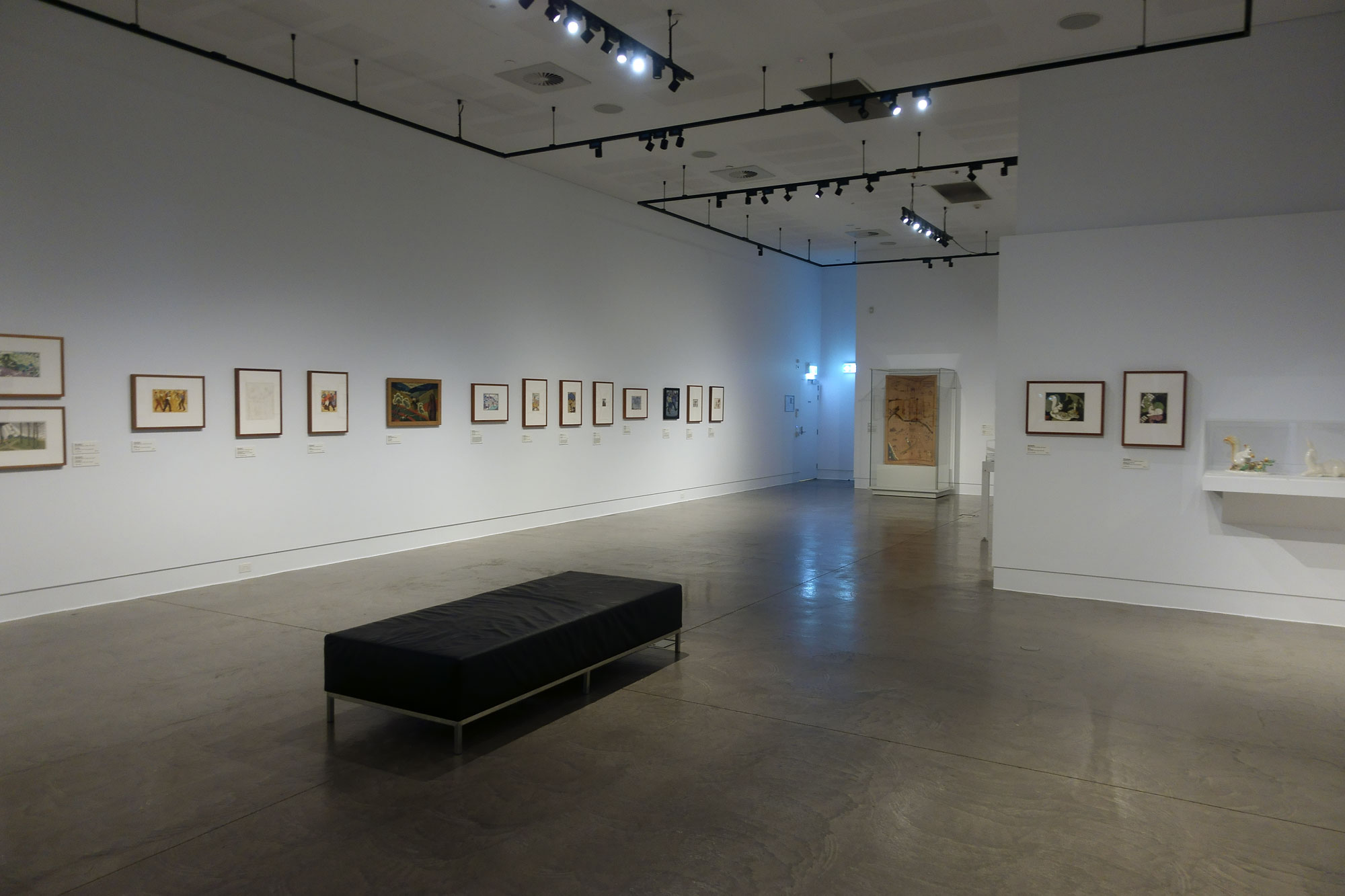
Installation view of the exhibition 'Now You See Us Women Artists in Britain 1520-1920' at Tate Britain showing at right, Lucy Kemp-Welch's 'Colt Hunting in the New Forest' 1897


Installation view of the exhibition Now You See Us Women Artists in Britain 1520-1920 at Tate Britain showing at right, Lucy Kemp-Welch’s Colt Hunting in the New Forest 1897


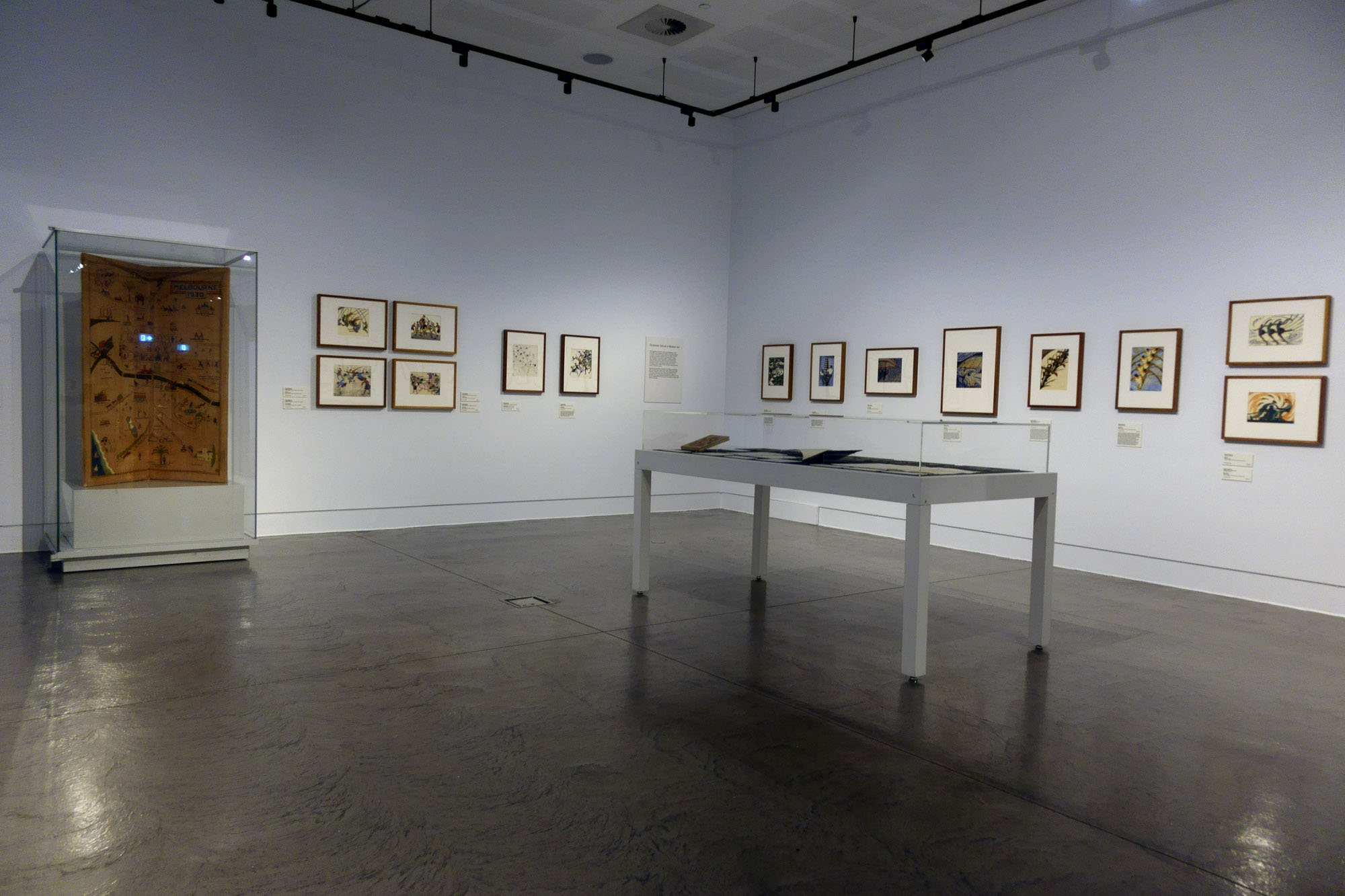
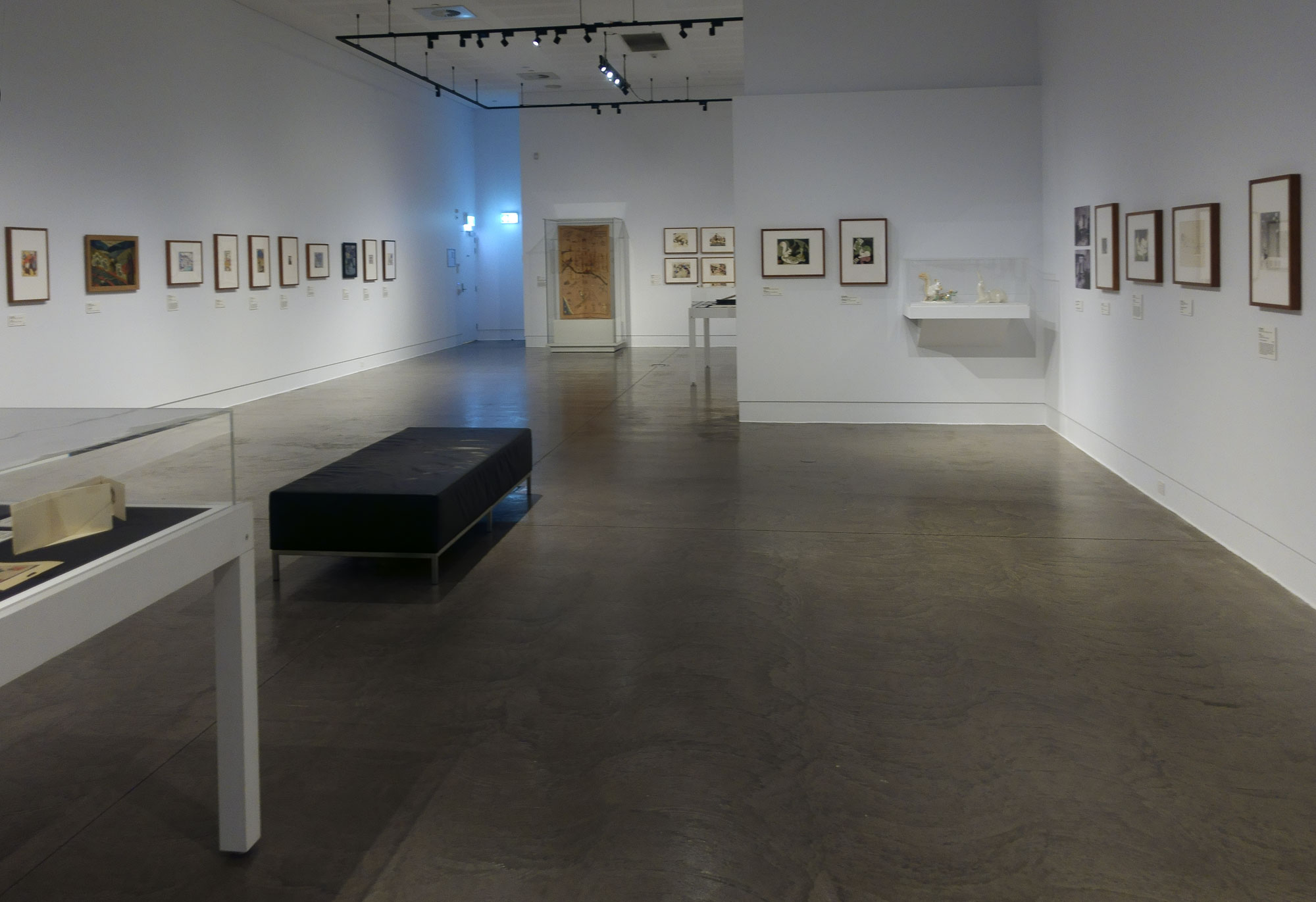
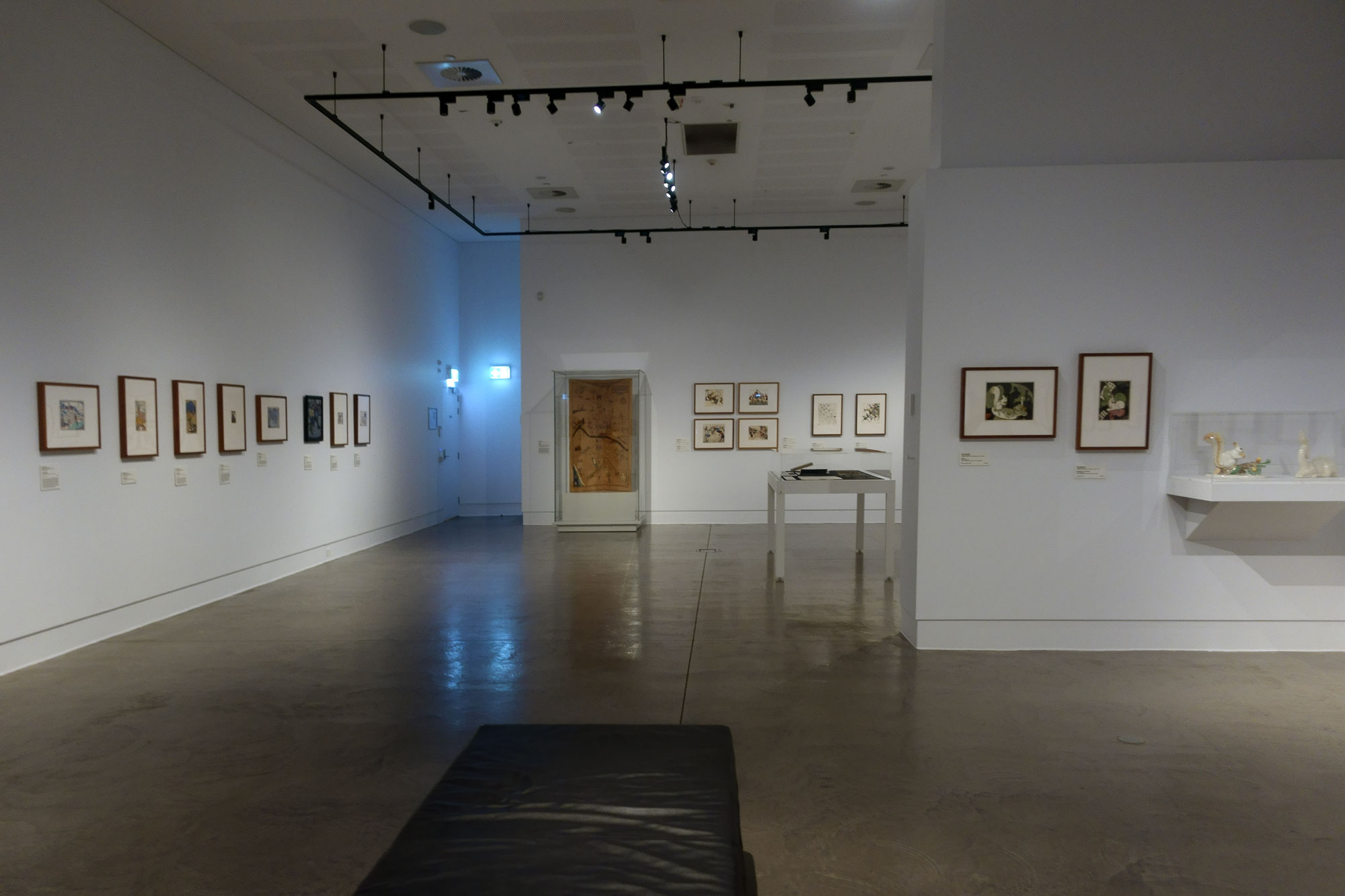
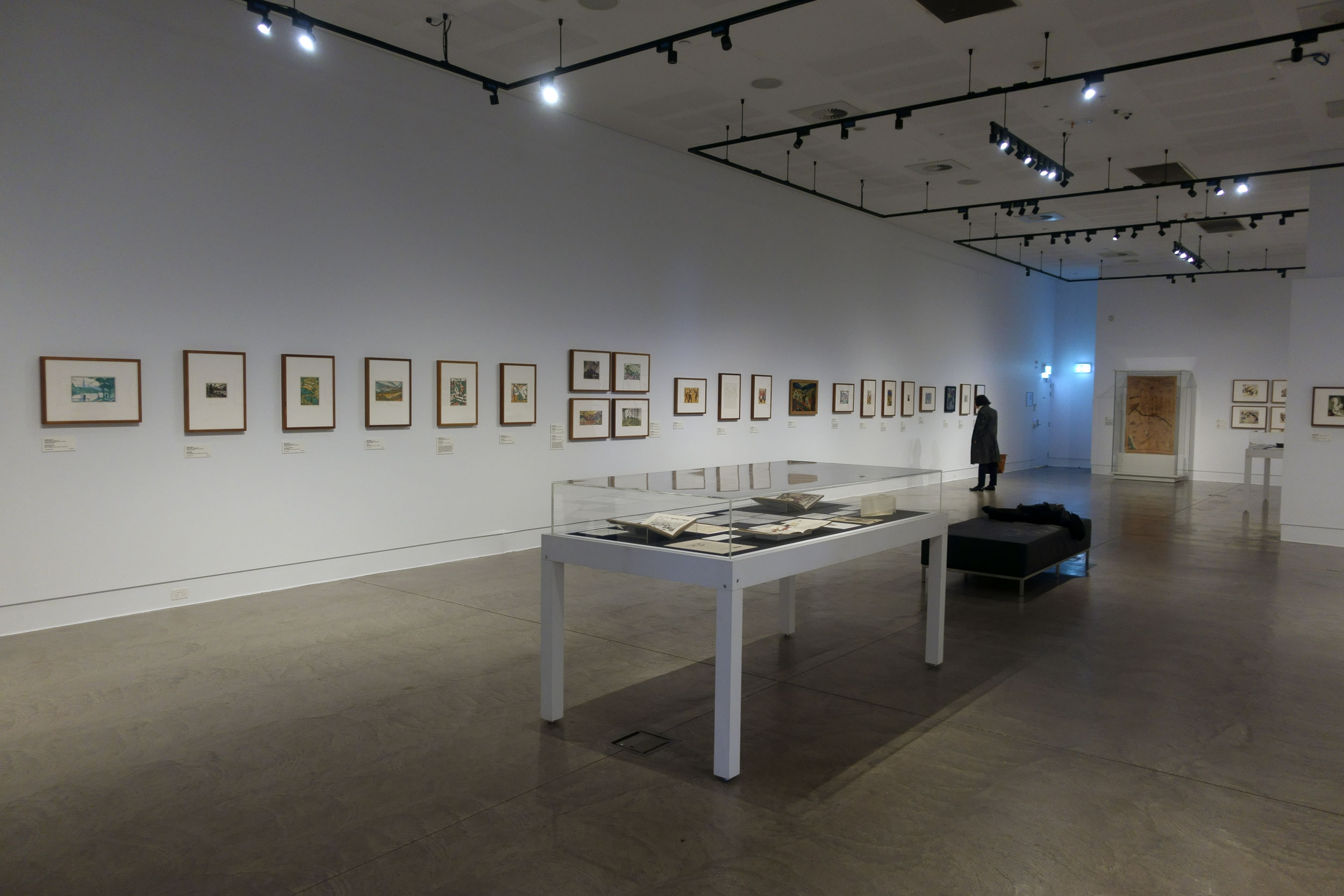
Spanning 400 years, this exhibition follows women on their journeys to becoming professional artists. From Tudor times to the First World War, artists such as Mary Beale, Angelica Kauffman, Elizabeth Butler and Laura Knight paved a new artistic path for generations of women. They challenged what it meant to be a working woman of the time by going against society’s expectations – having commercial careers as artists and taking part in public exhibitions.

Including over 150 works, the show dismantles stereotypes surrounding women artists in history, who were often thought of as amateurs. Determined to succeed and refusing to be boxed in, they daringly painted what were usually thought to be subjects for male artists: history pieces, battle scenes and the nude.

The exhibition sheds light on how these artists championed equal access to art training and academy membership, breaking boundaries and overcoming many obstacles to establish what it meant to be a woman in the art world.

Text from the Tate Britain website


Installation view of the exhibition 'Now You See Us Women Artists in Britain 1520-1920' at Tate Britain showing Artemisia Gentileschi's 'Self-Portrait as the Allegory of Painting (La Pittura)' c. 1638-1639


Installation view of the exhibition Now You See Us Women Artists in Britain 1520-1920 at Tate Britain showing Artemisia Gentileschi’s Self-Portrait as the Allegory of Painting (La Pittura) c. 1638-1639 (below)


Artemisia Gentileschi (Italian, 1593-1653) 'Self-Portrait as the Allegory of Painting (La Pittura)' c. 1638-1639 (installation view)


Artemisia Gentileschi (Italian, 1593-1653)
Self-Portrait as the Allegory of Painting (La Pittura)
c. 1638-1639
Oil on canvas
98.6 x 75.2cm (support, canvas/panel/stretcher external)
Royal Collection Trust
© His Majesty King Charles III 2024


Artemisia Gentileschi (Italian, 1593-1653) 'Self-Portrait as the Allegory of Painting (La Pittura)' c. 1638-1639


Artemisia Gentileschi (Italian, 1593-1653)
Self-Portrait as the Allegory of Painting (La Pittura)
c. 1638-1639
Oil on canvas
98.6 x 75.2cm (support, canvas/panel/stretcher external)
Royal Collection Trust
© His Majesty King Charles III 2024


Gentileschi claimed that ‘all the … Princes’ displayed her self-portrait in their galleries. In addition to this work, Charles I owned another self-portrait, which is now lost. Here, Gentileschi uses her own image to portray the allegorical figure of Pittura (also the Italian feminine noun for painting), who she depicts in a working apron before an easel absorbed in the act of creation.

Text from the exhibition large print guide


As a self-portrait the painting is particularly sophisticated and accomplished. The position in which Artemisia has portrayed herself would have been extremely difficult for the artist to capture, yet the work is economically painted, with very few pentiments. In order to view her own image she may have arranged two mirrors on either side of herself, facing each other. Depicting herself in the act of painting in this challenging pose, the angle and position of her head would have been the hardest to accurately render, requiring skilful visualisation.

Text from the Royal Collection Trust website


Installation view of the exhibition 'Now You See Us Women Artists in Britain 1520-1920' at Tate Britain showing Artemisia Gentileschi's 'Susanna and the Elders' c. 1638-1640


Installation view of the exhibition ‘Now You See Us Women Artists in Britain 1520-1920’ at Tate Britain showing Artemisia Gentileschi’s Susanna and the Elders c. 1638-1640 (below)
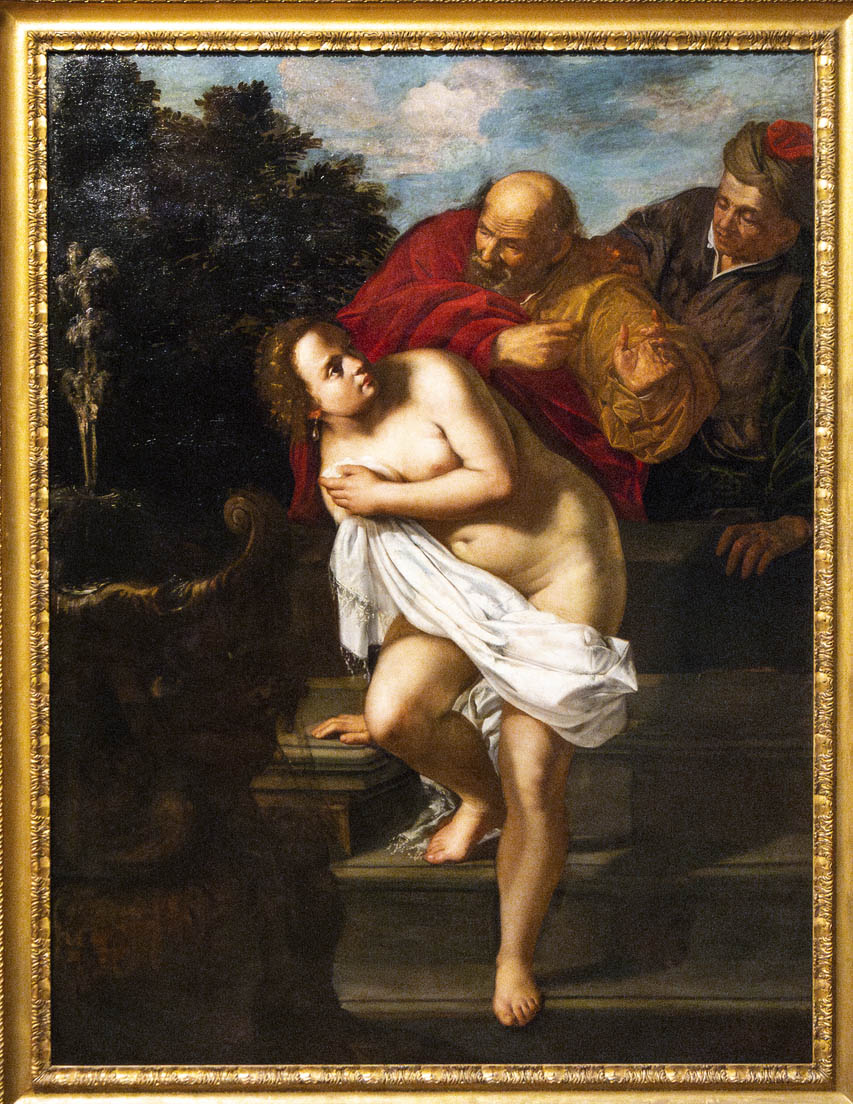
 

Artemisia Gentileschi (Italian, 1593-1653) 'Susanna and the Elders' c. 1638-1640 (installation view)


Artemisia Gentileschi (Italian, 1593-1653)
Susanna and the Elders
c. 1638-1640
Oil on canvas
189.0 x 143.2cm (support, canvas/panel/stretcher external)
Royal Collection Trust / © His Majesty King Charles III 2024


Artemisia Gentileschi (Italian, 1593-1653) 'Susanna and the Elders' c. 1638-1640


Artemisia Gentileschi (Italian, 1593-1653)
Susanna and the Elders
c. 1638-1640
Oil on canvas
189.0 x 143.2cm (support, canvas/panel/stretcher external)
Royal Collection Trust / © His Majesty King Charles III 2024


Likely commissioned by Queen Henrietta Maria, this work was displayed in her Withdrawing Chamber in Whitehall Palace. The subject is an Old Testament narrative on virtue and faith. Susanna, bathing in privacy, is spied on by two elders who attempt to sexually assault her. When she resists them, the men accuse her of adultery. Susanna is arrested and about to be put to death until the men are questioned, and her innocence is revealed. Here, Gentileschi depicts Susanna as vulnerable and fearful, shielding her nakedness. She returned to the subject throughout her career.

Text from the exhibition large print guide


This spring, Tate Britain will present Now You See Us: Women Artists in Britain 1520-1920. This ambitious group show will chart women’s road to being recognised as professional artists, a 400-year journey which paved the way for future generations and established what it meant to be a woman in the British art world. The exhibition covers the period in which women were visibly working as professional artists, but went against societal expectations to do so.

Featuring over 100 artists, the exhibition will celebrate well-known names such as Artemisia GentileschiAngelica Kauffman, Julia Margaret Cameron and Gwen John, alongside many others who are only now being rediscovered. Their careers were as varied as the works they produced: some prevailed over genres deemed suitable for women like watercolour landscapes and domestic scenes. Others dared to take on subjects dominated by men like battle scenes and the nude, or campaigned for equal access to training and membership of professional institutions. Tate Britain will showcase over 200 works, including oil painting, watercolour, pastel, sculpture, photography and ‘needlepainting’ to tell the story of these trailblazing artists.

Now You See Us will begin at the Tudor court with Levina Teerlinc, many of whose miniatures will be brought together for the first time in four decades, and Esther Inglis, whose manuscripts contain Britain’s earliest known self-portraits by a woman artist. The exhibition will then look to the 17th century. Focus will be given to one of art history’s most celebrated women artists, Artemisia Gentileschi, who created major works in London at the court of Charles I, including the recently rediscovered Susanna and the Elders 1638-40, on loan from the Royal Collection for the very first time. The exhibition will also look to women such as Mary BealeJoan Carlile and Maria Verelst who broke new ground as professional portrait painters in oil.

In the 18th century, women artists took part in Britain’s first public art exhibitions, including overlooked figures such as Katherine Read and Mary Black; the sculptor Anne Seymour Damer; and Margaret Sarah Carpenter, a leading figure in her day but little heard of now. The show will look at Angelica Kauffman and Mary Moser, the only women included among the Founder Members of the Royal Academy of Arts; it took 160 years for membership to be granted to another woman. Women artists of this era are often dismissed as amateurs pursuing ‘feminine’ occupations like watercolour and flower painting, but many worked in these genres professionally: needlewoman Mary Linwood, whose gallery was a major tourist attraction; miniaturist Sarah Biffin, who painted with her mouth, having been born without arms and legs; and Augusta Withers, a botanical illustrator employed by the Horticultural Society.

The Victorian period saw a vast expansion in public exhibition venues. Now You See Us will showcase major works by critically appraised artists of this period, including Elizabeth Butler (née Thompson)‘s monumental The Roll Call 1874 (Butler’s work prompted critic John Ruskin to retract his statement that “no women could paint”), and nudes by Henrietta Rae and Annie Swynnerton, which sparked both debate and celebration. The exhibition will also look at women’s connection to activism, including Florence Claxton‘s satirical ‘Woman’s Work’: A Medley 1861 which will be on public display for the first time since it was painted; and an exploration of the life of Barbara Leigh Smith Bodichon, an early member of the Society of Female Artists who is credited with the campaign for women to be admitted to the Royal Academy Schools. On show will be the student work of women finally admitted to art schools, as well as their petitions for equal access to life drawing classes.

The exhibition will end in the early 20th century with women’s suffrage and the First World War. Women artists like Gwen John, Vanessa Bell and Helen Saunders played an important role in the emergence of modernism, abstraction and vorticism, but others, such as Anna Airy, who also worked as a war artist, continued to excel in conventional traditions. The final artists in the show, Laura Knight and Ethel Walker, offer powerful examples of ambitious, independent, confident professionals who achieved critical acclaim and – finally – membership of the Royal Academy.

Press release from Tate Britain
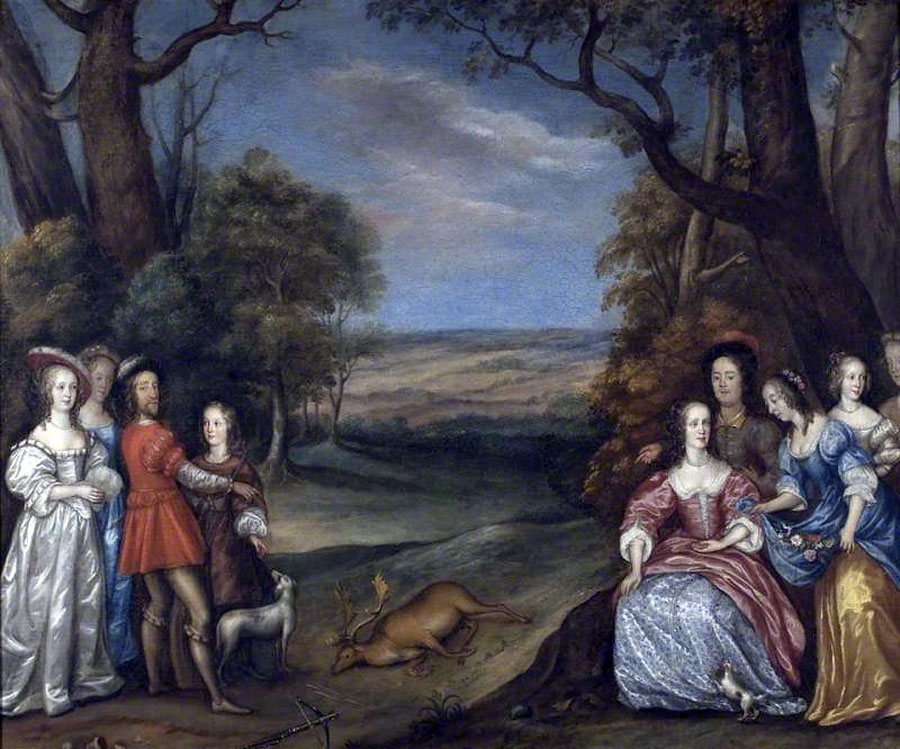
 

Joan Carlile (English, 1606-1679) 'The Carlile Family with Sir Justinian Isham in Richmond Park' 1650s


Joan Carlile (English, 1606-1679)
The Carlile Family with Sir Justinian Isham in Richmond Park
1650s
Oil on canvas
Lamport Hall
CC BY-NC-ND
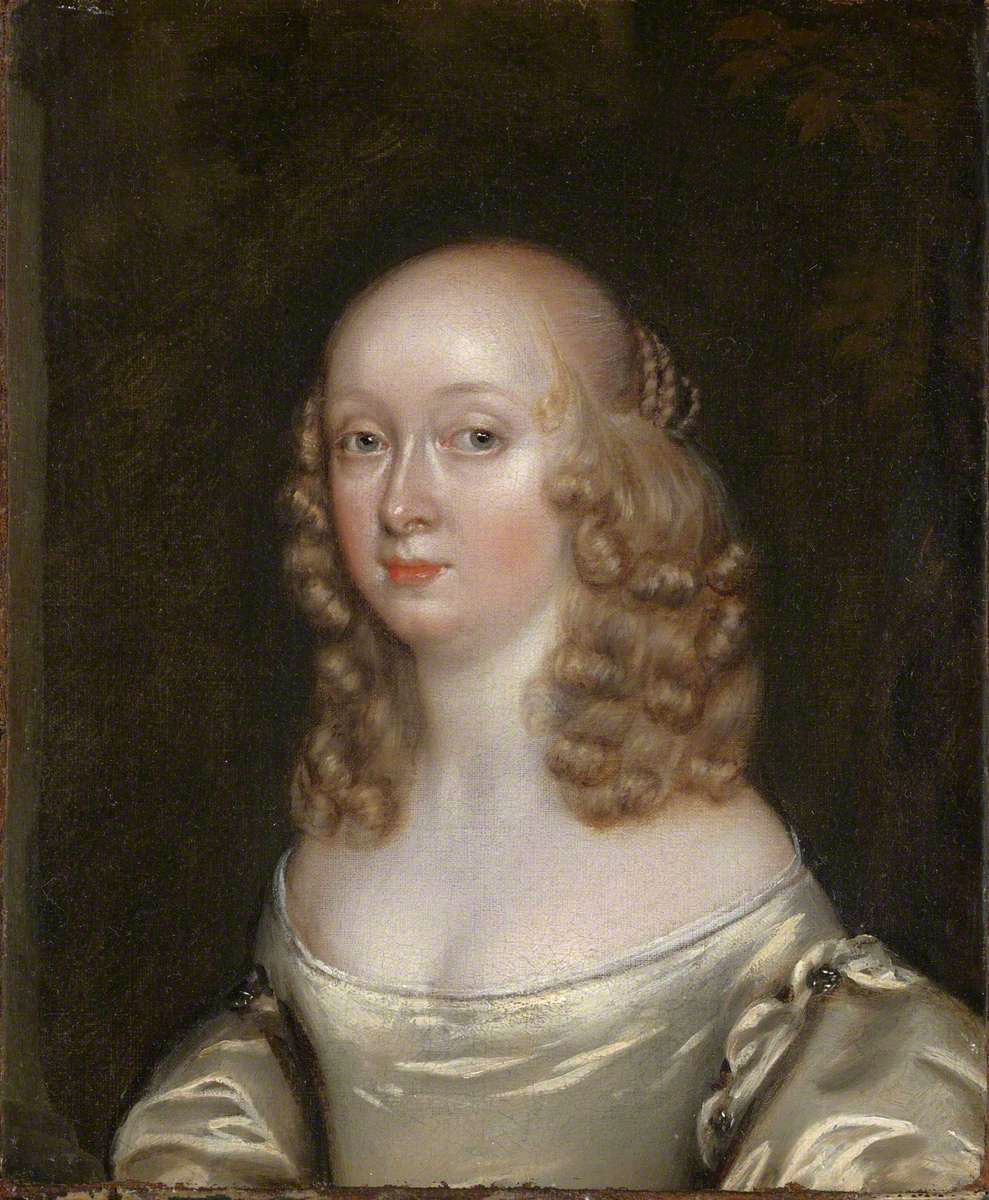
 

Joan Carlile (English, 1600-1679) 'Portrait of a Lady Wearing an Oyster Satin Dress' 1650s


Joan Carlile (English, 1600-1679)
Portrait of a Lady Wearing an Oyster Satin Dress
1650s
Oil on canvas
30.8 x 25.5cm
National Portrait Gallery, London
Government Art Collection
Purchased from Philip Mould Ltd, 2018


Joan Carlile or Carlell or Carliell (c. 1606-1679), was an English portrait painter. She was one of the first British women known to practise painting professionally. Before Carlile, known professional female painters working in Britain were born elsewhere in Europe, principally the Low Countries.


Installation view of the exhibition 'Now You See Us Women Artists in Britain 1520-1920' at Tate Britain showing at left, Joan Carlile's 'Portrait of an Unknown Lady known as Elizabeth Murray, Countess of Dysart and Duchess of Lauderdale' 1650s; and at right, 'Portrait of an Unknown Lady' 1650-1655


Installation view of the exhibition Now You See Us Women Artists in Britain 1520-1920 at Tate Britain showing at left, Joan Carlile’s Portrait of an Unknown Lady known as Elizabeth Murray, Countess of Dysart and Duchess of Lauderdale 1650s (below); and at right, Portrait of an Unknown Lady 1650-1655 (below)
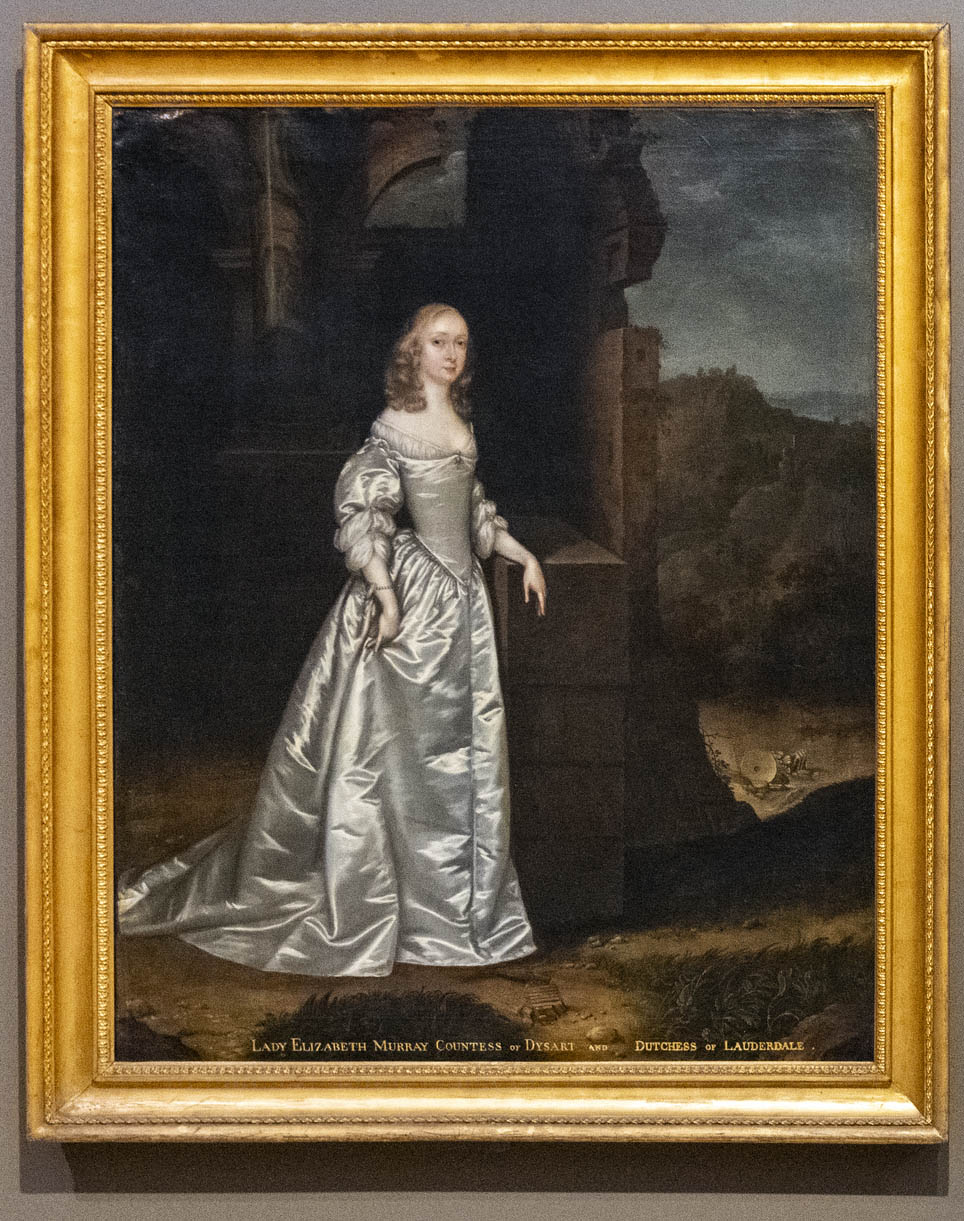
 

Joan Carlile (English, 1606-1679) 'Portrait of an Unknown Lady' 1650-1655 (installation view)


Joan Carlile (English, 1606-1679)
Portrait of an Unknown Lady (installation view)
1650-1655
Oil on canvas
Support: 1107 × 900 mm
Frame: 1205 × 1012 × 73 mm
Photo: Tate
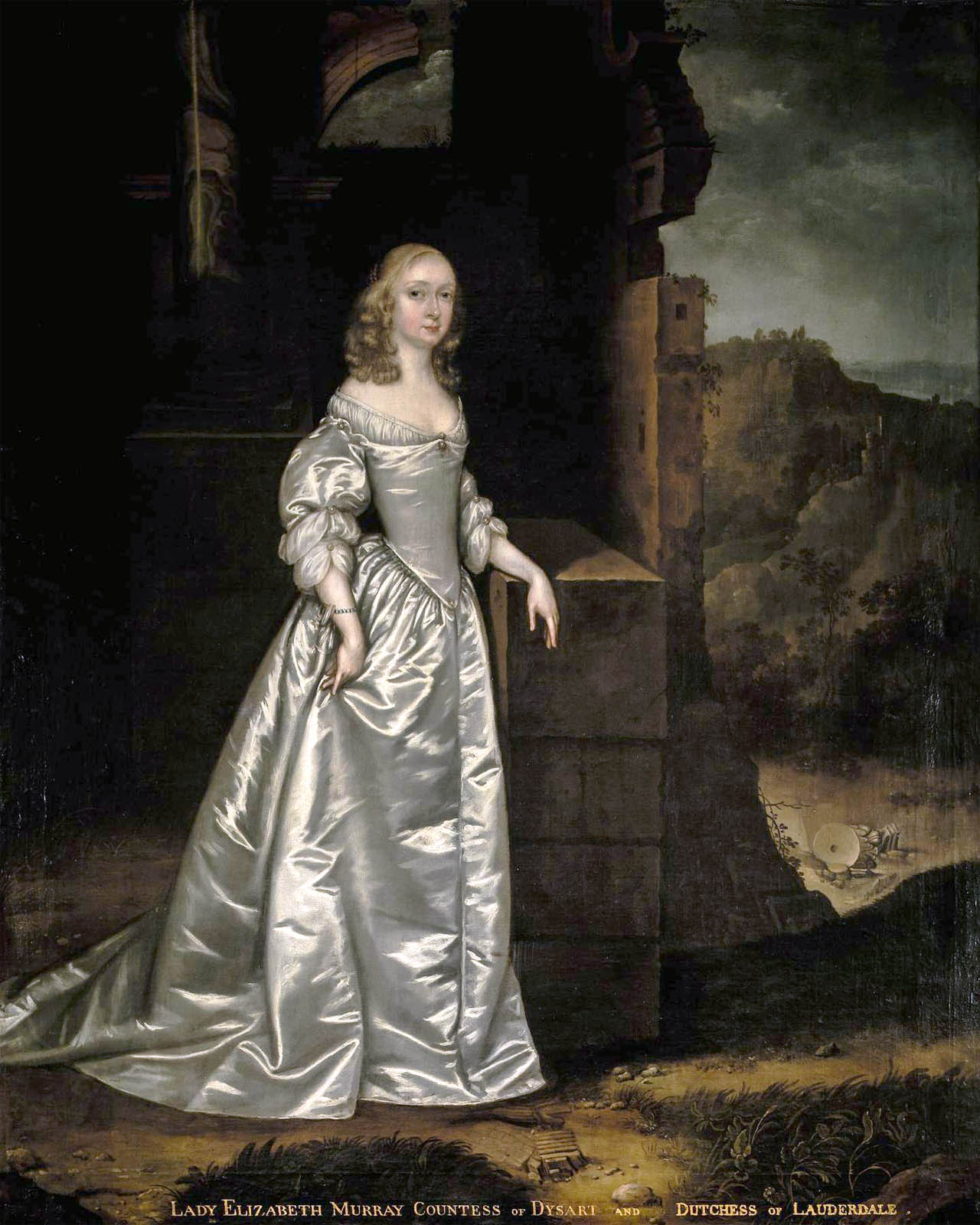
 

Joan Carlile (English, 1606-1679) 'Portrait of an Unknown Lady known as Elizabeth Murray, Countess of Dysart and Duchess of Lauderdale' 1650s


Joan Carlile (English, 1606-1679)
Portrait of an Unknown Lady known as Elizabeth Murray, Countess of Dysart and Duchess of Lauderdale
1650s
Oil on canvas
The Bute Collection at Mount Stuart


Here, Carlile uses the same white satin dress seen in a nearby painting. The pose, with the sitter elegantly gathering a handful of fabric, is taken from works by Charles I’s portrait painter, Flemish artist Anthony van Dyck (1599-1641). The sitter is sometimes identified as Elizabeth Murray, Countess of Dysart and Duchess of Lauderdale. She was Carlile’s near neighbour in Petersham, at Ham House. The broken columns in the background are often used to symbolise loss.

Text from the exhibition large print guide


Joan Carlile (English, 1606-1679) 'Portrait of an Unknown Lady' 1650-1655


Joan Carlile (English, 1606-1679)
Portrait of an Unknown Lady
1650-1655
Oil on canvas
Support: 1107 × 900 mm
Frame: 1205 × 1012 × 73 mm
Photo: Tate


Portraits by Joan Carlile are rare and this is one of only approximately ten that can be identified. Of these, two are in public collections (Ham House, Surrey, and National Portrait Gallery, London), while others are held in historic house collections and family trusts in the United Kingdom, for example Lamport Hall, Burghley House and Berkeley Castle. Carlile seems to have specialised in small-scale full length portraits of figures, usually female, set in large landscape or garden settings. The composition employed here, in which the figure holds the skirt of her dress with one hand and shawl with another, was most likely a template arrangement. It appears in two other portraits, one showing the figure facing the same way as here, the other in reverse, but with both figures wearing the same white satin dress. This repeated composition adds weight to the proposition that Carlile was a professional artist. The wife of Lodowick Carlile (or Carlell), a minor poet and dramatist who also held the office of Gentleman of the Bows to Charles I, Joan Carlile lived with her husband in Petersham, a suburb of London. However, in 1653 their neighbour, Brian Duppa, recorded that ‘the Mistress of the Family intends for London, where she meanes to make use of her skill to som more Advantage then hitherto she hath don’ (quoted in Toynbee and Isham 1954, p.275). In 1654 Carlile is recorded as living in London’s Covent Garden, then the heart of the artistic community (see Burnett 2004/2010, accessed 2 October 2015).

Text from the Tate website


Joan Carlile challenged societal expectations by becoming one of Britain’s first professional women artists in the 1600s, earning her living as an oil painter. Initially employed in King Charles I’s household, Carlile liked to paint in her spare time. With the outbreak of the Civil War, she began painting to support herself.

Carlile moved to Covent Garden in the 1650s – then the centre of the art world – and set up a successful commercial portrait business. Her template of carefully posed figures in silk gowns against landscape backgrounds, seen here in Portrait of an Unknown Lady (1650-5), proved extremely popular. Admired as a professional artist in her lifetime, only a small number of her portraits still exist, some which have never been seen in public.

Text from the Tate website


In her Portrait of an Unknown Lady (1650-1655) the astonishing nacreous lustre of the sitter’s white silk gown, shown full length, shines against the foil of the dull brown foliage behind her. At this point, the Civil War had ended but the restoration of the monarchy was still in the future, and Carlile’s painting, with its overt celebration of luxury and leisure (the spotless pale fabric speaks of both) seems provocative.

It is possible that Carlile taught Anne Killigrew (1660-1685), an accomplished painter and poet whose family encouraged her creative pursuits, although it’s not clear if she ever painted professionally. Only a handful of Killigrew’s works survive today, including Venus Attired by the Three Graces, which reveals her interest in mythological scenes.

Although she died of smallpox aged just 25, Killigrew stands alongside Beale and Carlile as one of Britain’s first female artists.

Alicia Foster. “Blazing a trail: Britain’s first women artists deserve to be better known,” on the Art UK website 13 May 2024 [Online] Cited 03/09/2024
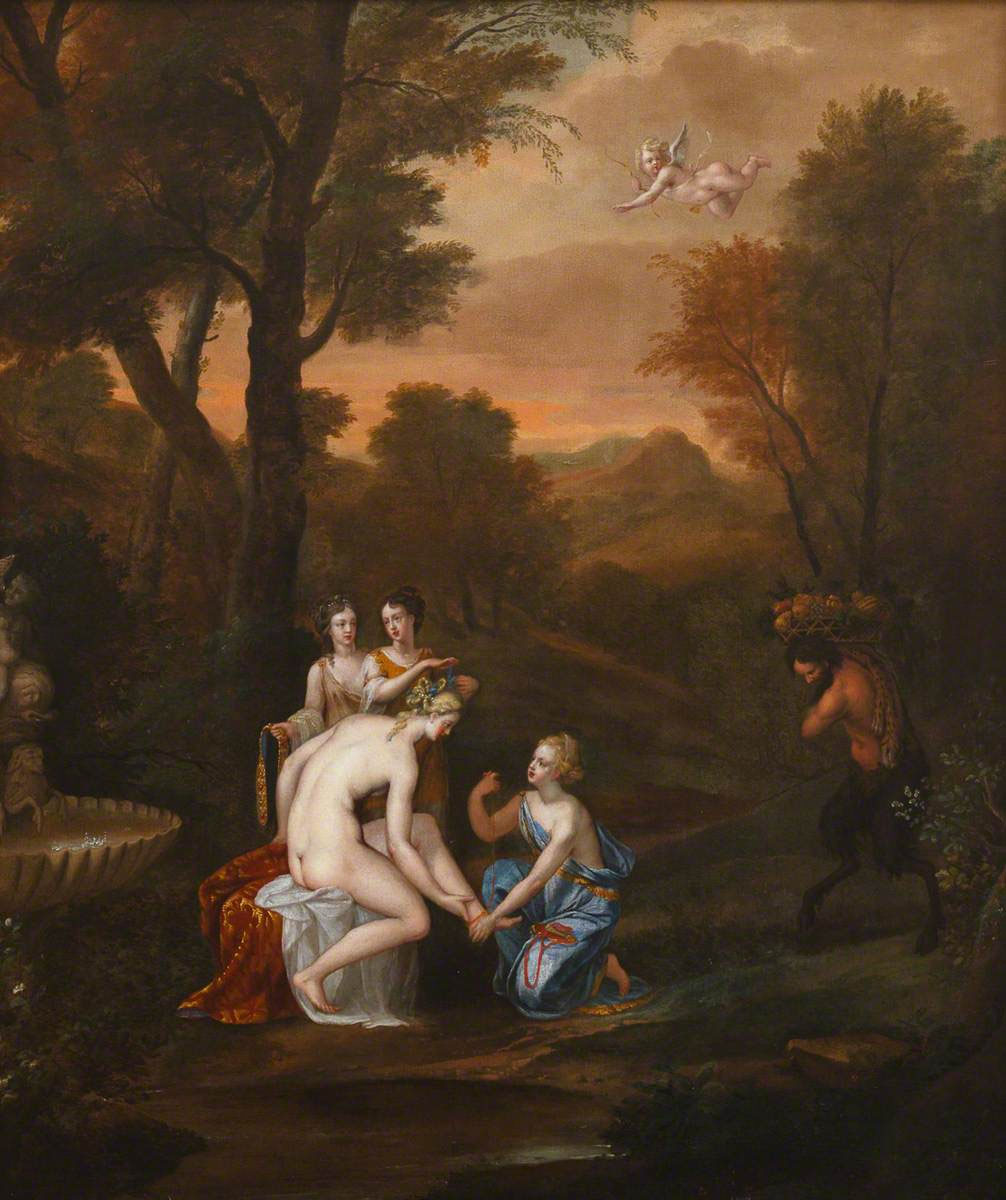
 

Anne Killigrew (English, 1660-1685) 'Venus Attired by the Three Graces' c. 1680


Anne Killigrew (English, 1660-1685)
Venus Attired by the Three Graces
c. 1680
Oil on canvas
Support: 1120 × 950 mm
Frame: 1282 × 1102 × 63 mm
Falmouth Art Gallery
Purchased with the assistance of the Victoria and Albert Museum Purchase Grant Fund, Heritage Lottery Fund, the Art Fund, the Beecroft Bequest, Falmouth Decorative and Fine Arts Society, the Estate of Barry Hughes in memory of Grace and Thomas Hughes and generous donations from local supporters
Public domain


Anne Killigrew has been described as the most celebrated female English prodigy of the Seventeeth Century. A poet and artist of great beauty and repute, Killigrew died of smallpox at the age of just 25. Anne’s exceptional qualities as an artist and a poet were highly praised in her short lifetime. The poet John Dryden dedicated a poem to her in which he refers directly to this picture: ‘Where nymphs of brightest form appear, and shaggy satyrs standing near’ (from ‘To the Pious Memory of the Accomplished Young Lady Mrs Anne Killigrew Excellent In The Two Sister-Arts of Poesy And Painting: An Ode’). Anne Killigrew worked at the Royal Court of King James II as Lady-in-Waiting to the Queen. Anne’s grandfather, Sir William Killigrew, was the Governor of Pendennis Castle, and his son, Dr Henry Killigrew moved to London to work as chaplain to King Charles I. He later became master of the Savoy Hospital.

Text from the Falmouth Art Gallery website
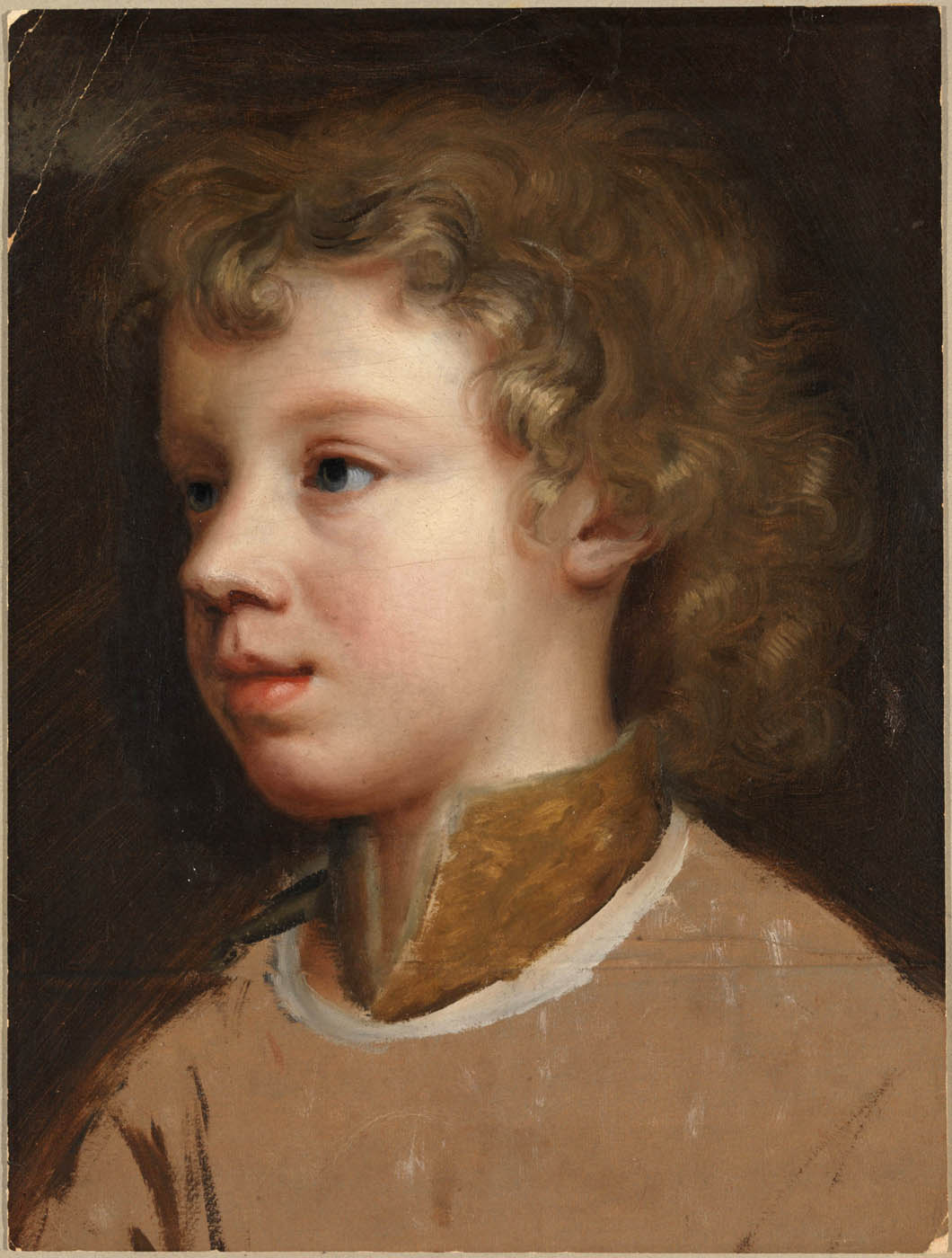
 

Mary Beale (English, 1633-1699) 'Sketch of the Artist's Son, Bartholomew Beale, Facing Left' c. 1660


Mary Beale (English, 1633-1699)
Sketch of the Artist’s Son, Bartholomew Beale, Facing Left
c. 1660
Oil on paper
Support: 325 × 245 mm
Frame: 421 × 340 × 32 mm
Tate
Purchased 2010
Photo: Tate


In the late 1650s and early 1660s Beale and her family were living on Hind Court, off Fleet Street in London. She painted privately and had a painting room in her home. Her husband had a civil service position as Deputy Clerk of the Patents. Portrait sittings of family and friends were often social occasions, with conversation and dinner afterwards. It is in this period that Beale produced small oil sketches on paper of family members, particularly her two young sons. Whether they relate to larger oil on canvas portraits is unclear.

This oil sketch of a young boy, shown in three-quarter profile, is of Mary Beale’s eldest son Bartholomew, baptised in 1656. His appearance, both in age and costume, is very similar to that in Mary Beale’s Self-portrait with her family (Geffrye Museum, London), painted c. 1659-60, before the birth of her youngest son Charles. It relates closely to another sketch of Bartholomew in oil on paper painted at the same time, Sketch of the Artist’s Son, Bartholomew Beale, in Profile c. 1660 (Tate T13245). Whether these sketches are connected to the production of the Geffrye Museum portrait, or were simply executed at around the same time, is not known. They are painted in oil on paper, which seems to have been a feature of Beale’s working method in the early 1660s but is not known in her later career, when she made preparatory sketches in chalk on paper or in oil on canvas (see, for example, Portrait of a Young Girl c. 1679-81, Tate T06612). When this sketch was made, the Beale family was living in Hind Court, off Fleet Street in London, where Mary Beale’s husband, Charles, was employed as Deputy Clerk of the Patents Office. It is difficult to determine whether Beale had much of a commercial portrait practice at this date, but documents certainly record the production of portraits of family and friends. In her ‘painting room’, Beale had ‘pencills [sic.], brushes, goose & swan fitches’, as well as ‘quantities of primed paper to paint on’ (George Vertue, transcription of Charles Beale’s 1661 notebook, now lost, quoted in Barber 1999, p. 16).

Text from the Tate website


Installation view of the exhibition 'Now You See Us Women Artists in Britain 1520-1920' at Tate Britain showing Mary Beale’s 'Anne Sotheby' (1676-1677)


Installation view of the exhibition Now You See Us Women Artists in Britain 1520-1920 at Tate Britain showing Mary Beale’s Anne Sotheby 1676-1677 


Mary Beale (English, 1633-1699) 'Anne Sotheby' 1676-1677


Mary Beale (English, 1633-1699)
Anne Sotheby
1676-1677
Oil on canvas
Tate
Purchased with funds provided by the Nicholas Themans Trust 2024


Beale’s husband kept a daily record of her activities in the studio. Two of his over 30 notebooks and a few partial transcripts are still known. They record Beale’s sitters, her painting stages, her painting materials and her prices. For her commissioned works, she borrowed poses from the portraits of the court artist Peter Lely (1618-1680). Anne Sotheby’s pose is taken from his portrait of Lady Essex Finch. Beale charged £10 for paintings of this size. Her sons acted as studio assistants; her youngest, Charles, was paid to paint the drapery in this portrait.

Text from the exhibition large print guide


Mary Beale (née Cradock) (1633-1699) was an English portrait painter. She was part of a small band of female professional artists working in London. Beale became the main financial provider for her family through her professional work – a career she maintained from 1670/71 to the 1690s. Beale was also a writer, whose prose Discourse on Friendship of 1666 presents a scholarly, uniquely female take on the subject. Her 1663 manuscript Observations, on the materials and techniques employed “in her painting of Apricots”, though not printed, is the earliest known instructional text in English written by a female painter. Praised first as a “virtuous” practitioner in “Oyl Colours” by Sir William Sanderson in his 1658 book Graphice: Or The use of the Pen and Pensil; In the Excellent Art of PAINTING, Beale’s work was later commended by court painter Sir Peter Lely and, soon after her death, by the author of “An Essay towards an English-School”, his account of the most noteworthy artists of her generation.

Text from the Wikipedia website
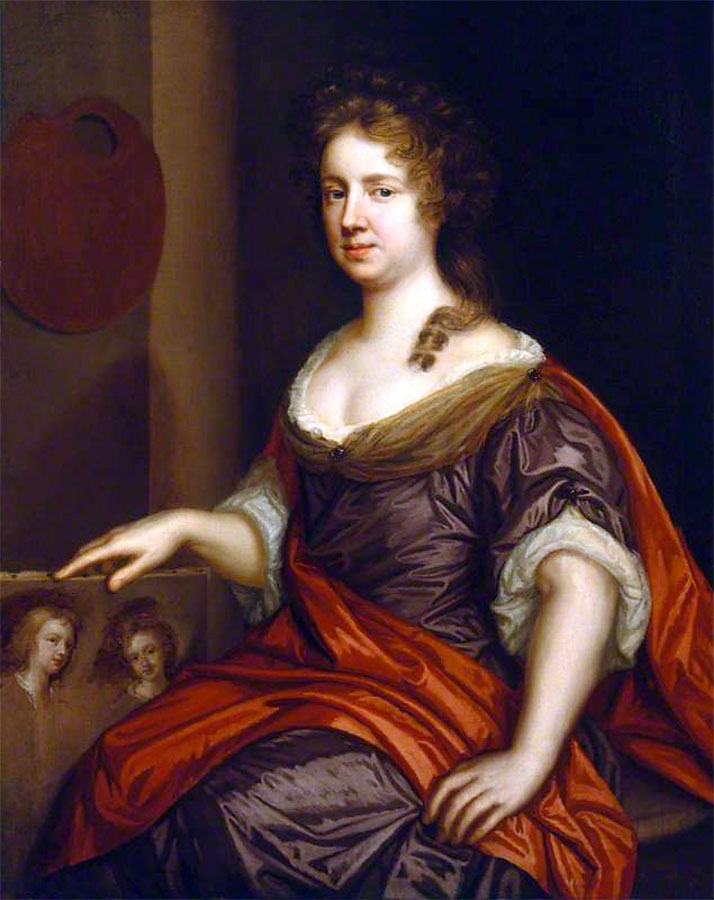
 

Mary Beale (English, 1633-1699) 'Mary Beale' c. 1666


Mary Beale (English, 1633-1699)
Mary Beale
c. 1666
Oil on canvas
109.2 x 87.6cm
National Portrait Gallery, London
Purchased, 1912
CC BY-NC-ND


Beale is shown holding an unframed canvas on which are sketch portraits of her two sons, Bartholomew (1656-1709) and Charles (1660-1714?)


Mary Beale (English, 1633-1699) 'Self Portrait' c. 1675


Mary Beale (English, 1633-1699)
Self Portrait
c. 1675
Oil on sacking
89 x 73cm
West Suffolk Heritage Service
Purchased
CC BY-NC-ND


The early English portrait painter Mary Beale (1622/1623-1699) had a father who was an amateur artist, miniature painter and a collector of paintings (her family owned work by Peter Paul Rubens and Anthony van Dyck) and her husband, Charles, was also an amateur painter and ran her studio in London’s fashionable Pall Mall.

Unusually, in her case, her talent was matched by her spouse’s high regard of it, and she was allowed to supersede him and establish a professional career. She took on female apprentices, though no records of their subsequent careers survive.

Alicia Foster. “Blazing a trail: Britain’s first women artists deserve to be better known,” on the Art UK website 13 May 2024 [Online] Cited 03/09/2024


Exhibition guide

Now You See Us: Women Artists in Britain 1520-1920 celebrates over 100 women who forged public careers as artists. The exhibition begins with the earliest recorded women artists working in Britain. It ends with women’s place in society fundamentally changed by the First World War and the first women gaining the right to vote. Across these 400 years, women were a constant presence in the art world. Now You See Us explores these artists’ careers and asks why so many have been erased from mainstream art histories.

Organised chronologically, the exhibition follows women who practised art as a livelihood rather than an accomplishment. The chosen works were often exhibited at public exhibitions, where these artists sold their art and made their reputations. Most of the women featured belonged to a social class that gave them the time and opportunity to develop their talents. Many were the daughters, sisters or wives of artists. Yet even these women were regarded differently. Now You See Us charts their fight to be accepted as professional artists on equal terms with men.

Many of the exhibited works reflect prejudiced notions of the most appropriate art forms and subjects for women. Others challenge the commonly held belief that women were best suited to ‘imitation’, proving they have always been capable of creative invention. From painting epic battle scenes to campaigning for access to art academies, these women defied society’s limited expectations of them and forged their own paths. Yet so many of their careers have been forgotten and artworks lost. Drawing on the artists’ own writings, art criticism, and new and established research, this exhibition attempts to restore these women to their rightful place in art history. Now You See Us aims to ensure these artists are not only seen but remembered.

Women at the Tudor Courts

There are significant gaps in our knowledge of women’s artistic lives in the sixteenth century. As is the case for many artists in this exhibition, their lives are poorly documented and often hidden behind those of their husbands and fathers. The problems this presents are evident in this room.

Susanna Horenbout (1503-1554) and Levina Teerlinc (c. 1510s-1576) are among the earliest women in Britain to be named as artists. Their reputations are clearly recorded. In 1521, Horenbout’s skill was admired by the German painter and printmaker Albrecht Dürer (1471-1528), and in 1567, both artists were praised by the Italian historian Lodovico Guicciardini (1521-1589). Yet no works by Horenbout have been identified, and those attributed to Teerlinc are not certain.

Horenbout and Teerlinc were both daughters of Flemish manuscript illuminators and were likely trained in their family workshops. Both arrived in England to work at the court of Henry VIII. But as women, they were not employed as artists. While Horenbout’s brother Lucas Horenbout (1490-1544) was Henry VIII’s painter, she served Anne of Cleves as one of her Gentlewomen of the Privy Chamber. Teerlinc served Elizabeth I likewise. This does not mean that they did not paint – at court, their artistic talents would have been a distinguishing skill – but, as is a common feature of this exhibition, written histories have failed to record their activities.

Working in a different context – as a scribe and calligrapher – the works of Esther Inglis (1571-1624) can be identified. Inglis authored more than 60 manuscript books and included her name and self-portrait in many. Raised in Scotland, she may have learnt the art of calligraphy from her mother, Marie Presot (active 1569-1574).

Artemisia Gentileschi

Italian artist Artemisia Gentileschi arrived in London in c. 1638-9 by invitation of Charles I. Like other European rulers, Charles I employed artists of international reputation to signal the cultural sophistication of his court. Gentileschi had prestigious patrons across Europe, including the Grand Duke of Tuscany and Philip IV of Spain. She was the first woman to be a member of the Academy of the Arts of Drawing in Florence, and in Rome, her house had been ‘full of cardinals and princes’. Gentileschi’s fame as an artist was augmented by her status as a woman.

In London, Gentileschi worked for Charles I and Queen Henrietta Maria. Records suggest she produced seven works for the royal collection. These included self-portraits and large history paintings, with subject matter drawn from classical history, mythology, and the Bible. Only the two displayed here are still known. Gentileschi often placed women at the centre of her works, depicting narratives that celebrate their strength and virtue. Susanna and the Elders is an example of the kind of work for which Gentileschi was celebrated.

Gentileschi achieved in her lifetime what many women who came after her had to fight to attain: she was a professional artist who ran her own studio, was a member of an art academy, worked from life models and was ranked as a serious artist alongside men. Despite this, Gentileschi’s status has fluctuated over time, and the artist has faded in and out of art history.

Early accounts of Gentileschi’s work focus on her personal life as much as her painting. Like many of the women artists who came after her, the details of her biography continue to dictate interpretations of her work.

The First Professionals

In 1658, historian William Sanderson (c. 1586-1676) published Graphice. The use of the pen and pensil. Or, The most excellent art of painting. The publication lists contemporary artists practising in England. He includes four women working in oil paint: ‘Mrs Carlile’ (Joan Carlile), ‘Mrs Beale’ (Mary Beale), ‘Mrs Brooman’ (probably Sarah Broman) and ‘Mrs Weimes’ (Anne Wemyss). Carlile and Beale are believed to be two of the earliest British women to have worked as professional artists. Very little is known about Broman or Wemyss beyond snatches of information in archives.

This short list highlights how unusual it was for British women to pursue art as a profession in the seventeenth century. Women had little agency over their own lives and were subject first to their fathers and then their husbands. Limited to the domestic sphere, they were not expected to conduct public lives. Many women painted privately with no thought of turning it into a career. While young men began as apprentices or assistants in the studios of professionals, this route was not open to most women.

In the seventeenth century women writers, poets, playwrights and artists began to give voice to those questioning their secondary status and petitioning for women’s rights. They argued that it was lack of education, not ‘weak minds’ that limited their opportunities. This fight for equality and access to education runs throughout the exhibition.

The First Exhibitors

The first public art exhibition in Britain took place in London in 1760, and art shows soon became an important part of the city’s social calendar. Founded in 1768, the Royal Academy quickly emerged as a driving force in cultural life, with its Summer Exhibition attracting tens of thousands of visitors every year. Other venues, including the Society of Artists and the British Institution also hosted exhibitions.

Women artists played an active part in this competitive world. An estimated 900 women exhibited their work between 1760 and 1830. Angelica Kauffman and Mary Moser were both founding members of the Royal Academy (although, as women, they weren’t awarded full membership and were excluded from the Academy’s council meetings and governance). Despite this precedent, it would take more than 150 years for the next woman to be elected to membership.

Kauffman is one of the few women artists of the eighteenth century whose profile has been sustained. Many others made names for themselves, but their careers are not well documented. Even Moser is less well known, perhaps because she painted flowers while Kauffman pursued the ‘high genre’ of history painting, depicting historical, mythological and biblical narratives.

Art critics of the time often criticised women for their ‘weak’ figurative work, yet they were denied access to life-drawing classes. Women artists also had to battle social expectations. Publishing a private or studio address in an exhibition catalogue was a signal of commercial practice, but painting for money was considered improper. Women artists of higher social rank were listed as ‘honorary’ exhibitors; some exhibited simply as ‘a Lady’, and after marriage, many switched their status from ‘commercial’ to ‘amateur’.

‘Just What Ladies Do For Amusement’

In 1770, the Royal Academy banned ‘Needle-work, artificial Flowers, cut Paper, Shell-work, or any such baubles’ from its exhibitions. They also banned works that were copies. Other categories of art that the Academy considered ‘lower’, such as miniature painting, pastel and watercolour were also treated dismissively. Joshua Reynolds (1723-1792), the Academy’s President, said that working in pastel was unworthy of real artists and was ‘just what ladies do when they paint for their own amusement’.

These ‘lower arts’ were ones that women practised the most. Small in scale and considered less technically challenging than oil painting, they demanded less equipment and could be pursued at home. They were taught to middle and upper-class girls and were the realm of women who pursued art as amateur accomplishment.

Despite this, these art forms offered opportunities for women to earn a living. Many turned miniature painting, needlework and pastel into lucrative professional careers, supplementing their income through tutoring. Their patrons were often women, and some boasted large, fashionable clienteles and even galleries which became tourist attractions.

Founded in 1754, the Society for the Encouragement of Arts, Manufactures and Commerce (the Society of Arts) offered cash prizes and medals in many categories, including the ‘polite arts’. Awards were given for patterns for embroidery, copies of prints, drawings of statues and of ‘beasts, birds, fruit or flowers’, as well as landscapes. Some prizes were specifically intended for young women. The Society was a stepping stone to a career and many of the artists in this exhibition won medals. Yet most of the women recorded as submitting work for competition can no longer be identified beyond their names.

Flowers

In the eighteenth and nineteenth centuries, painting flowers was considered a suitably delicate pursuit for women. Imitating nature (rather than demonstrating creative or imaginative flair) was thought to be an appropriate outlet for women’s artistic skills. Flowers were also at the heart of respectable hobbies like embroidery, botany and gardening. In the 1850s, the women’s periodical the Ladies’ Treasury called flower painting ‘a ladylike and truly feminine accomplishment’. When Mary Moser exhibited Cymon and Iphigenia (based on a poem by John Dryden, 1631-1700) at the Royal Academy in 1789, a reviewer urged her to stick to flowers. She painted flowers ‘transcendently’, he noted, and should do ‘nothing else’.

Many women were employed as professional illustrators, recording plant species for horticulturists and botanical publishers. Some conducted hybrid careers, working as illustrators and drawing tutors while exhibiting flower paintings for a wider market. In the Victorian era, critics applauded several women artists as leaders of the genre. Yet the idea that flower painting, especially in watercolour, was an exclusively amateur pastime has damaged the legacies of many accomplished artists who successfully worked within this genre.

Victorian Spectacle

Grand exhibitions were a defining part of the Victorian art world. The Royal Academy, the leading art institution since 1768, was still Britain’s most prestigious exhibition venue, but was later criticised for its traditional conservatism. New venues, such as London’s Grosvenor Gallery, which opened in 1877, became rival spaces, and exhibitions in Liverpool and Manchester offered fresh opportunities for exhibiting artists. The Victorian era was also the age of World Fairs. Major exhibitions were held in London and Paris, and in 1893, the World’s Exposition in Chicago was visited by over 25 million people.

This room explores the successes of women artists on this public stage. Many of the works on display were shown in these exhibitions. They won international medals, praise from art critics and public recognition. Yet women tackling ‘male’ subjects, such as battle scenes, caused surprise. Opinion was also divided on women painting the nude: some thought it immoral, others brave.

Exhibitions gave women a public platform to build substantial reputations, and some became popular names. Despite this, membership of the Royal Academy, which was a mark of professional recognition, remained out of reach. As a result, women had no automatic exhibiting rights and were reliant on committees of men selecting their works for exhibition. Without institutional support, they had to navigate the commercial art market on their own.

Women artists’ campaigns for access to the Academy joined calls for greater equality in society. From the 1850s, women petitioned for equal rights to education and work, as well as women’s suffrage. These causes are reflected in the works in this room.

Watercolour

Watercolour was considered one of the ‘polite arts’ best suited to women. However, there were few opportunities to practice professionally. The principal watercolour societies – the Old (founded in 1804) and the rival New (founded in 1807 and reconstituted in 1831) – restricted the membership of women. Membership of the Old was limited to six women (in practice, usually four), while the New admitted around ten.

In both societies, women were confined to the category of ‘Lady Members’ until the end of the nineteenth century. They had no say in governance and were denied access to the financial premiums awarded to full members. Since the annual exhibitions of both societies were closed to non-members, most women had limited opportunities to exhibit their work.

Against these odds, many women water colourists achieved significant commercial and critical success. They enjoyed solo shows and developed commercial relationships with dealers, taking control of their careers.

In 1857, a group of women founded the Society of Female Artists (later, the Society of Lady Artists in c. 1869, then the Society of Women Artists in 1899) to promote the work of women artists in Britain.

Photography

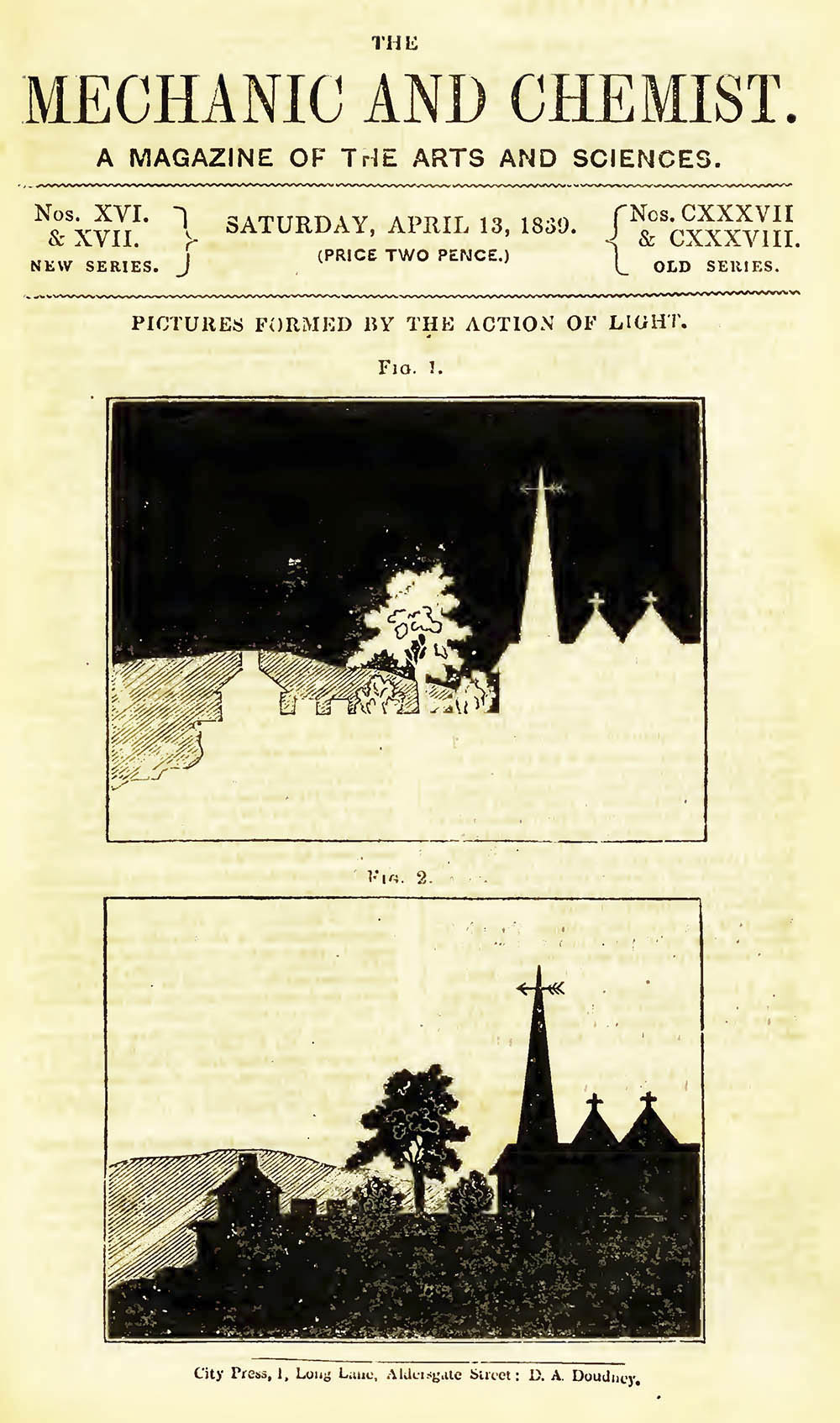
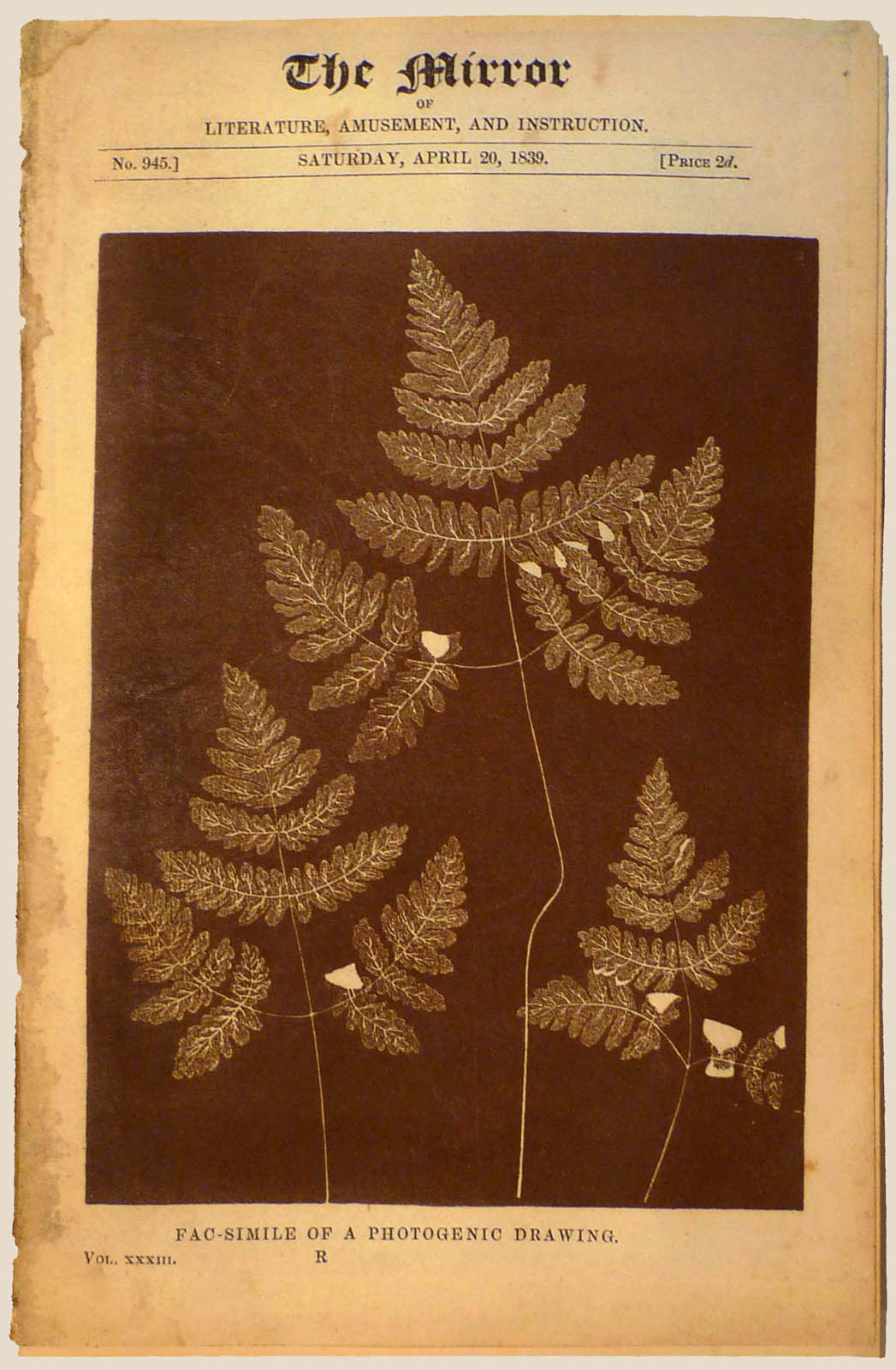
The announcement of photography in 1839 marked a major shift in the art world. In its first decades, photography was a laborious practice that required an understanding of chemistry and optics, as well as expensive equipment. It needed more money, specialist instruction and time than most other art forms. For women who had access to these privileges, the medium provided new opportunities.

From its foundation in 1853, the Photographic Society of London welcomed women members. However, they rarely attended meetings, which were scheduled in the evenings when women required a chaperone to leave the house. The atmosphere of the meetings was described as a ‘men’s club’ and it wasn’t until 1898 that the Society belatedly banned smoking ‘in respect of ladies’ attendance’. Meetings often included papers on new techniques and equipment, providing significant benefits to those who were able to join.

Women participated in London’s first public photographic exhibitions at the Royal Society of Arts in 1852-3 and at the Photographic Society in 1854. The Amateur Photographic Association, established in 1861, also welcomed women from its outset. In the 1890s and early 1900s, London’s Photographic Salon became a key venue. Founded by the Linked Ring Brotherhood, who promoted photography as a fine art, Salon exhibitors included women from across Europe and the US. A photograph of British photographer Carine Cadby in silhouette, examining one of her glass plate negatives, featured on the cover of the 1896 Salon catalogue. Despite this, women were not elected as members of the Linked Ring until 1900. By 1909, they numbered just 8 among 63 men.

Art School

Women were excluded from enrolment at the Royal Academy Schools, Britain’s principal art academy, until 1860. Laura Herford (1831-1870) was the first woman admitted. She had submitted her work for consideration using only her initials and was assumed to be a man. Once women gained entry, they were determined to achieve equal access to training.

Women were barred from the Academy’s life-drawing classes until 1893. Their exclusion from this vital component of art education was justified on many grounds. Chiefly, it was to ‘protect’ women’s supposed modesty, but also because they were considered amateurs who lacked the intellectual capacity to practice art at the highest level. Women students marshalled critical support for their cause and submitted petitions. Life drawing was considered essential to the training of men pursuing careers as artists. Why, they argued, was it not also essential for women?

The Female School of Art, founded in 1842, provided another route into art education. Like several regional schools, such as that in Manchester, it encouraged women into vocational careers in design. Women also had access to private academies, including Sass’s and Leigh’s (later Heatherleys) in London, which prepared students for admission to the Royal Academy Schools. And some women artists, such as Louise Jopling, established their own art school.

In 1871, the founding of the Slade School of Fine Art at University College London signalled a fundamental change of attitudes. From the outset, the Slade offered women an education on equal terms with men. Studying from life models was a central focus of teaching and by the turn of the century, women students outnumbered men by three to one. Access to life drawing had been regarded as the last barrier to equal opportunity. Now they could study from life, some critics argued it was up to women to prove they could be successful artists.

Being Modern

The first two decades of the twentieth century saw rapid change for women, with their rights, roles and opportunities evolving at an unprecedented pace. The First World War signalled a decisive change for women’s place in society and in 1918, after decades of campaigning, some women finally gained the right to vote.

At the same time, the art world was also changing. New art groups and exhibiting societies rejected tradition and promoted modernist aesthetics. Instead of figurative realism, they privileged form, colour and experimentation. Many saw modernism as an opportunity for greater artistic freedom. However, despite growing liberalism in art and society, women artists still faced challenges. The New English Art Club became a rival exhibiting venue to the Royal Academy but was slow to admit women. The Camden Town Group labelled itself ‘progressive’ but openly excluded women.

While modernism is often presented as the dominant movement of the early twentieth century, it doesn’t account for all artistic production of the period. Membership of the Royal Academy, an exhibiting venue many now regarded as too traditional, remained a symbolic goal for many women. When Annie Swynnerton was elected an Associate Member in 1922, Laura Knight said she had broken down the ‘barriers of prejudice’. In 1936, Knight was elected a Royal Academician, becoming the first woman to achieve full membership since the eighteenth century.

The artworks in the final room of the exhibition explore this complex period. Their variety reveals women forging their own paths and pursuing professional careers with purpose and confidence. While many chose not to challenge traditional artistic values, they pushed the boundaries of what was expected of them, paving the way for generations of women artists who came after them.

Text from the Tate exhibition guide
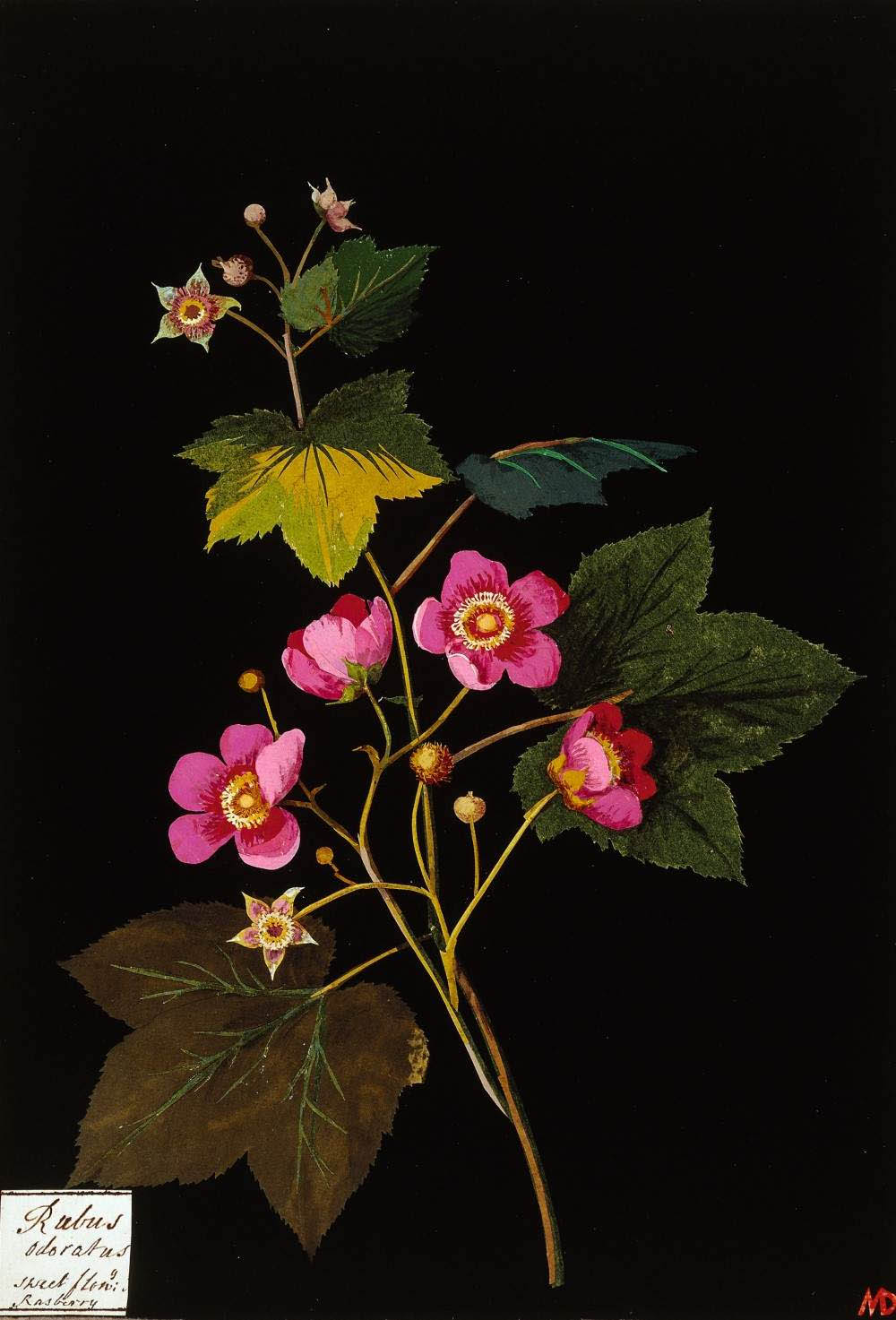
 

Mary Delany (English, 1700-1788) 'Rubus Odoratus' 1772-1782


Mary Delany (English, 1700-1788)
Rubus Odoratus
1772-1782
The British Museum
Bequeathed by Augusta Hall, Baroness Llanover in 1897


Delany was not a professional artist. However, she pursued art with a seriousness of purpose, working in a range of artistic and decorative mediums. She was in her early seventies when she turned to botanical collage, which stemmed from the Dutch art known as knipkunst or schaarkunst. Over the course of a decade, Delany created nearly one thousand botanically accurate collages of plants made from intricately cut pieces of coloured paper. In this collage, Delany shows a flowering raspberry, which was introduced to Britain from North America in 1770.

Text from the exhibition large print guide
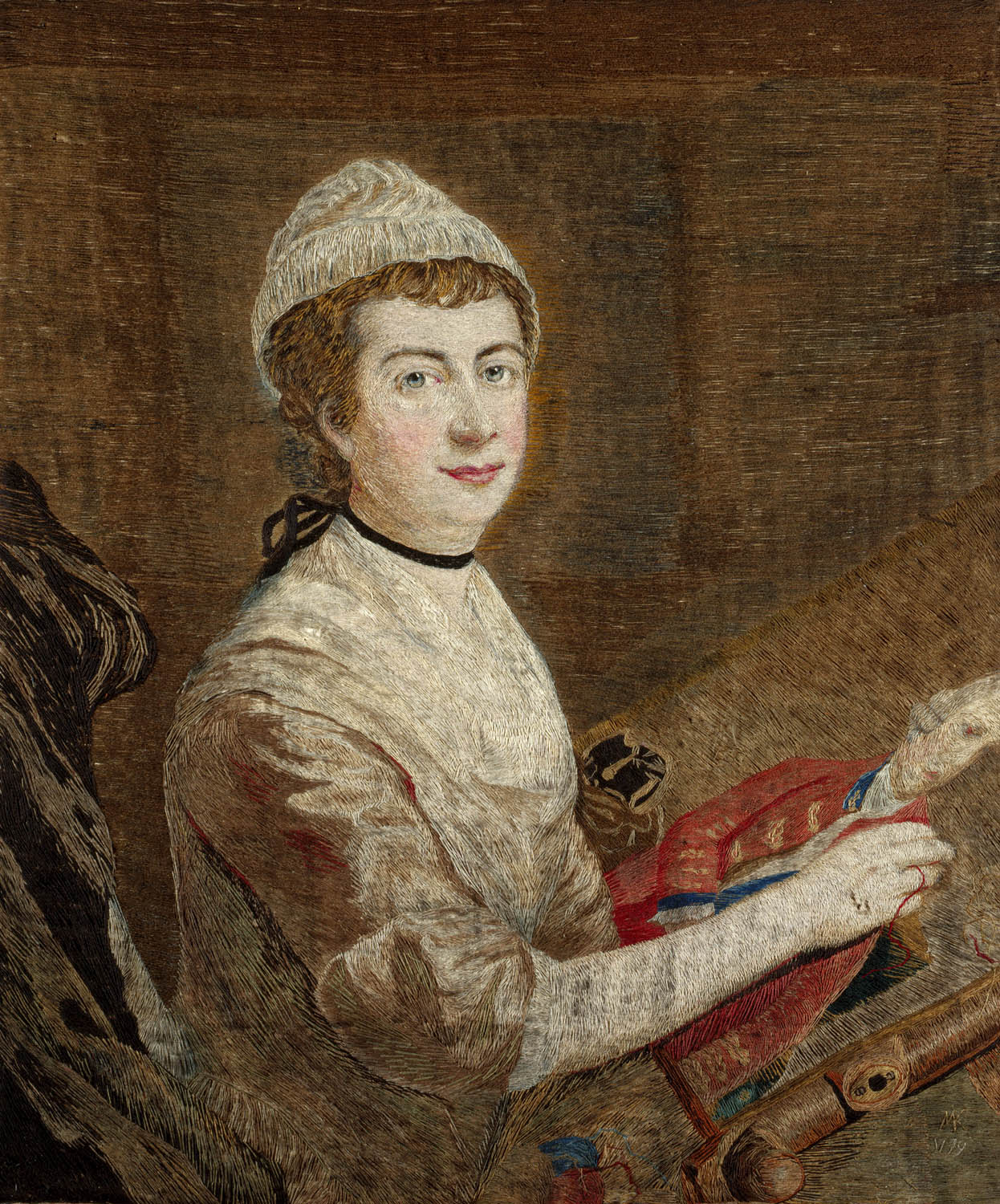
 

Mary Knowles (English, 1733-1807) 'Needlework Picture' 1779


Mary Knowles (English, 1733-1807)
Needlework Picture
1779
Silk (textile), wool, giltwood, glass (material) embroidered, dyeing
89.2 x 84.5cm (frame, external)
Royal Collection Trust / © His Majesty King Charles III 2024


Mary Morris Knowles, born of a Quaker family in Rugeley, Staffordshire, was celebrated as much for her intellect, religious conviction and unusual powers of conversation as for her skill with the needle. A friend of the poetess Anna Seward (‘The Swan of Lichfield’) and of Dr Johnson, she is now regarded as an important early protagonist of the feminist viewpoint in English cultural life. Her support for the abolition of slavery, her investigation into mystical science and her knowledge of garden design, in addition to her accomplishment as a needlewoman, suggest the breadth of her interests. In 1771 she was introduced by her fellow Quaker Benjamin West to Queen Charlotte, who remained on terms of friendship with her over the next thirty years and whose interest in female accomplishments, notably needlework, was well known. Mrs Knowles’s visits to Buckingham House included an occasion in 1778 on which she presented her 5-year-old son George to the King and Queen.

Following the first visit in 1771, the Queen commissioned Mrs Knowles to make a copy of Zoffany’s portrait of George III in needlework or ‘needle painting’ as it was also known. This technique ‘so highly finished, that it has all the softness and Effect of painting’ was achieved with a combination of irregular satin-stitch and long-and-short stitch, worked on hand-woven tammy in an arbitrary pattern and at speed, using fine wool dyed in a wide range of colours under her own supervision. Eight years later Mrs Knowles embroidered the self portrait showing her at work on the Zoffany which, like the earlier piece, she signed with initials and dated. This appears always to have been in the Royal Collection and was presumably also commissioned by Queen Charlotte.

Text from the Royal Collection Trust website
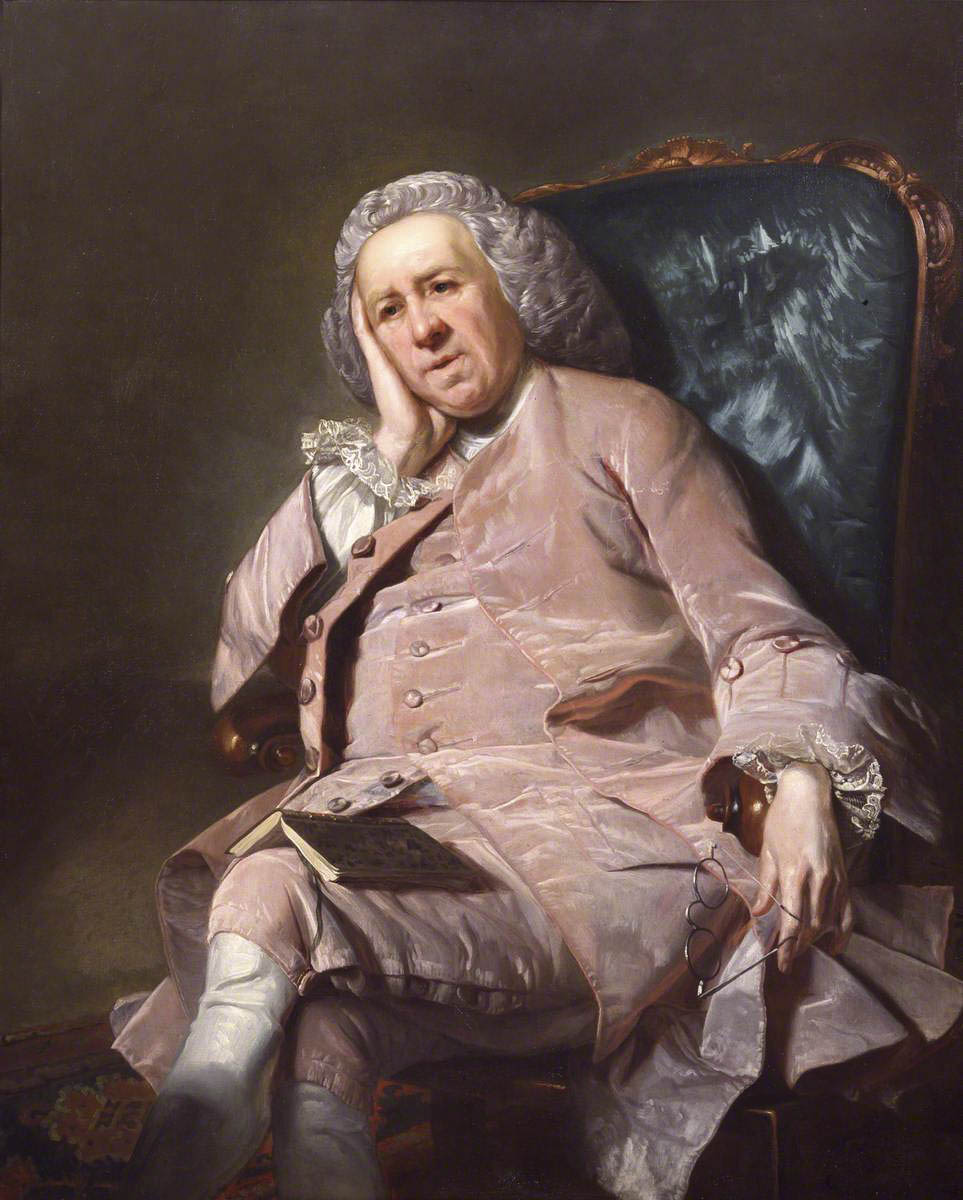
 

Mary Black (English, c. 1737-1814) 'Messenger Monsey (1693-1788)' 1764


Mary Black (English, c. 1737-1814)
Messenger Monsey (1693-1788)
1764
Oil on canvas
127 x 101.6cm
Gift from Frederick Walford, 1877
Royal College of Physicians, London
CC BY-NC-ND


This portrait of the physician Messenger Monsey (1694-1788) is Black’s only known oil painting. Black likely hoped it was a step towards establishing herself as a professional artist, but the issue of payment caused friction. Black hope to charge her client £25, half the amount charged by leading portraitist Joshua Reynolds, but after Monsey’s complaint offered to drop it to a quarter. Monsey considered Black’s expectation of a fee improper. He claimed it would damage her reputation if word got out, and even referred to her as a ‘slut’ in a letter to his cousin.

Wall text from the exhibition


Little is known of the father-and-daughter artists Thomas and Mary Black. Thomas was mainly employed painting draperies for more successful painters, and Mary usually painted copies of old masters. In a letter from Monsey to Mary Black, the doctor wrote: ‘I was bedevilled to let you make your first attempt upon my gracefull person… drawn like a Hog in armour’.

Text from the Art UK website


Black was clearly unfazed by awkward sitters. She built a flourishing artistic practice, painting and teaching the aristocracy, earning enough to live independently (she never married) and keep servants and a horse and carriage at her London home. She died there in old age just as the nineteenth century began.

Alicia Foster. “Blazing a trail: Britain’s first women artists deserve to be better known,” on the Art UK website 13 May 2024 [Online] Cited 03/09/2024


Mary Moser RA (English, 1744-1819) 'Standing Female Nude' Nd


Mary Moser RA (English, 1744-1819)
Standing Female Nude
Nd
Black and white chalk on grey-green paper
49 x W 30.2cm
The Fitzwilliam Museum, Cambridge


As women were excluded from life drawing classes, many took their own steps to improve their anatomical knowledge. They sketched from casts and statues and copied from other artists’ drawings and anatomy books. These rare works show that some artists found ways around these restrictions, although little is known about how Moser and Stone accessed life models.

Text from the exhibition large print guide


Mary Moser RA (English, 1744-1819) 'Flowers in a vase, which stands on a ledge' 1765


Mary Moser RA (English, 1744-1819)
Flowers in a vase, which stands on a ledge
1765
Watercolour and bodycolour on paper
The Syndics of the Fitzwilliam Museum, University of Cambridge


From the same series as the work nearby, this watercolour represents Sagittarius. The vase is filled with a cascade of late flowering plants: asters, chrysanthemums and rare pale nerines, captured in the cold light of winter. In addition to her professional profile as a Royal Academician, Moser acted as a royal tutor. She was part of Queen Charlotte’s circle and taught the princesses botany, embroidery and flower painting. She worked alongside other artists, including Meen and Delany, whose work is also displayed in this room.

Text from the exhibition large print guide


Admired for her striking paintings of flowers, Mary Moser was recognised for her talent from a very young age. She trained with her father, an acclaimed artist and goldsmith, winning her first medal for flower drawing at 14. At just 24, she became one of only two female founders of the Royal Academy, alongside Angelica Kauffman.

Moser painted portraits and historical scenes, but her skilled floral still life works, like Flowers in a vase, which stands on a ledge (1765), were praised by critics. Though still life was traditionally seen as a ‘lesser subject’, her floral works were so widely appreciated she received royal commissions, including one from Queen Charlotte. Despite recognition and the exhibition of many paintings, few of Moser’s works survive today.

Text from the Tate website
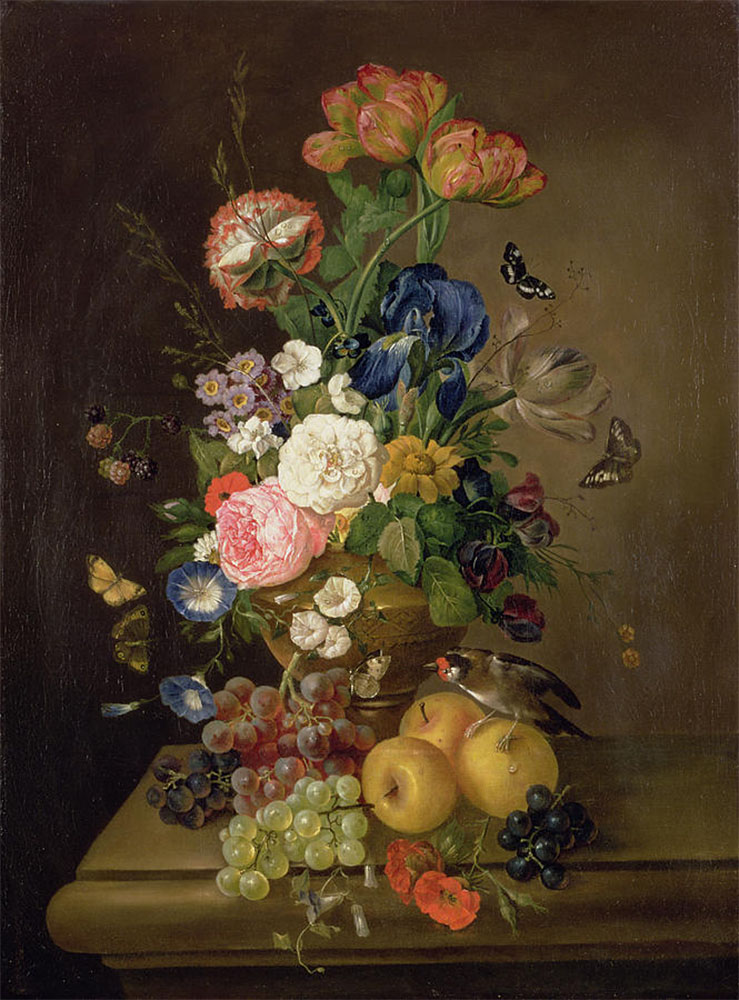
 

Mary Moser RA (English, 1744-1819) 'Vase of Flowers' Between 1758 and 1819


Mary Moser RA (English, 1744-1819)
Vase of Flowers
Between 1758 and 1819
Oil on canvas
72.1 x W 53.6cm
The Fitzwilliam Museum
Gift from Major the Hon. Henry Rogers Broughton, 1966


The exquisite attention to detail in her painting, with its beads of dew and butterflies on the wing, was perhaps nurtured by seeing her father’s work; as a goldsmith and medallion maker, this was also his talent. But the gorgeous sensuality – seen also in her approach to the nude figure – was entirely her own. She married, aged 53, but also had an affair with the estranged husband of another artist: Maria Hadfield Cosway (1759-1839).

Alicia Foster. “Blazing a trail: Britain’s first women artists deserve to be better known,” on the Art UK website 13 May 2024 [Online] Cited 03/09/2024


Installation view of the exhibition 'Now You See Us Women Artists in Britain 1520-1920' at Tate Britain showing Angelica Kauffman's 'Colouring' 1778-1780


Installation view of the exhibition Now You See Us Women Artists in Britain 1520-1920 at Tate Britain showing Angelica Kauffman’s Colouring 1778-1780 (below)
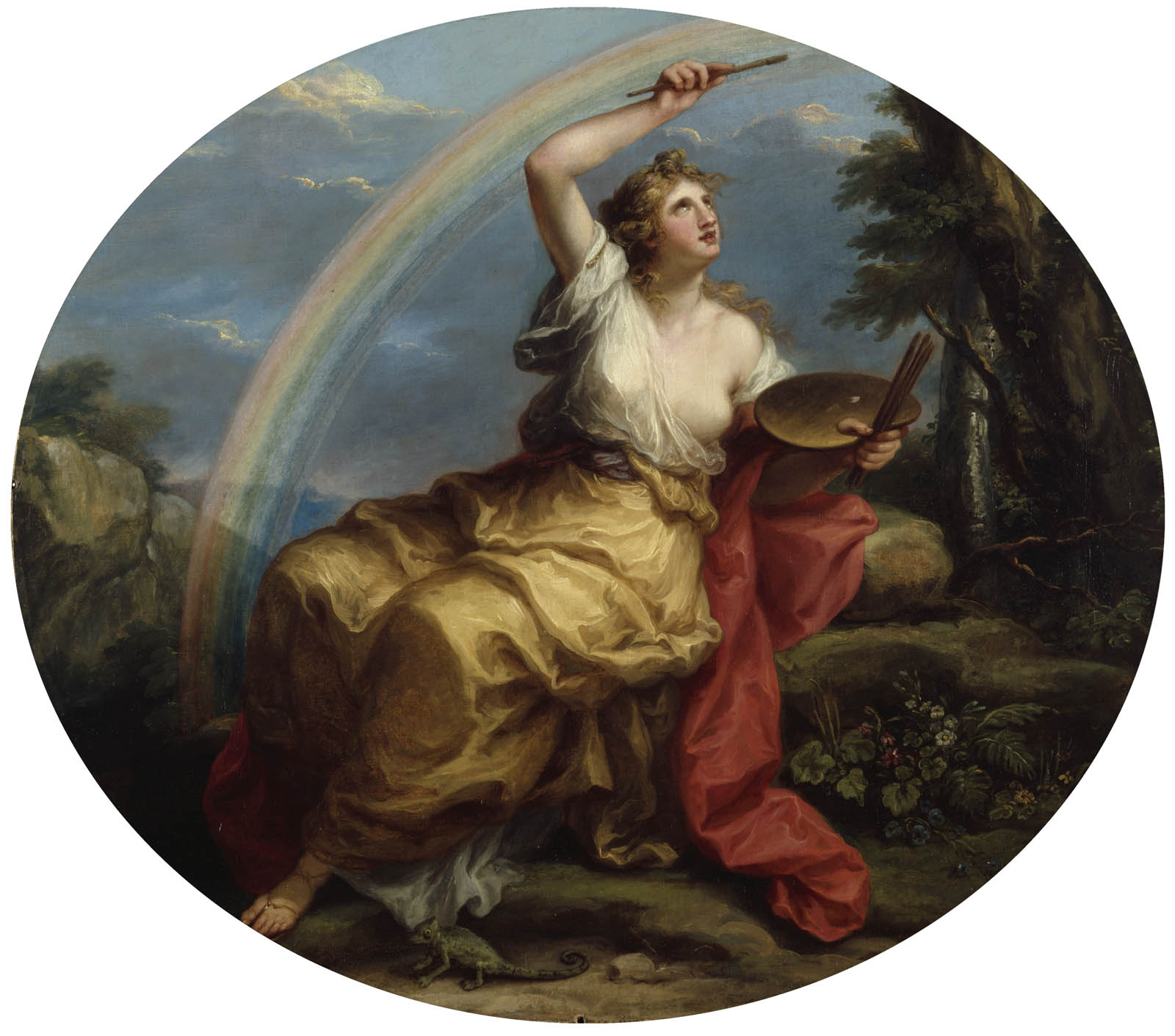
 

Angelica Kauffman RA (Swiss, 1741-1807) 'Colouring' 1778-1780


Angelica Kauffman RA (Swiss, 1741-1807)
Colouring
1778-1780
Oil on canvas
1260 x 1485 x 25 mm
© Royal Academy of Arts, London
Photo: John Hammond


This painting is part of a set of the four [titled ‘Elements of Art’] commissioned from Kauffman by the Royal Academy to decorate the ceiling of the Royal Academy’s new Council Room in Somerset House which opened in 1780. …

Kauffman represented each of her four Elements of Art as women. Female personifications of abstract concepts and values were commonplace in European art but depicting all four as women was unusual. Design (or Disegno), in particular, was known as ‘the father of all the arts’ and was traditionally depicted as a man, often in contrast to Colour or Painting personified as a woman (see Baumgartel). In Design and Colouring, the women are physically engaged in the act of creating whereas in Composition and Invention they are shown in contemplation. In Invention the figure looks to the sky for inspiration and in Composition she is deep in thought with her head resting on her hand in the traditional gesture of melancholy or reverie.

Text from the Royal Academy website


Installation view of the exhibition 'Now You See Us Women Artists in Britain 1520-1920' at Tate Britain showing at centre, Maria Cosway's 'Georgiana as Cynthia from Spenser's 'Faerie Queene'' 1781-1882; and at right, Cosway's 'A Persian Lady Worshipping the Rising Sun' 1784


Installation view of the exhibition Now You See Us Women Artists in Britain 1520-1920 at Tate Britain showing at centre, Maria Cosway’s Georgiana as Cynthia from Spenser’s ‘Faerie Queene’ 1781-1782 (below); and at right, Cosway’s A Persian Lady Worshipping the Rising Sun 1784 (below)
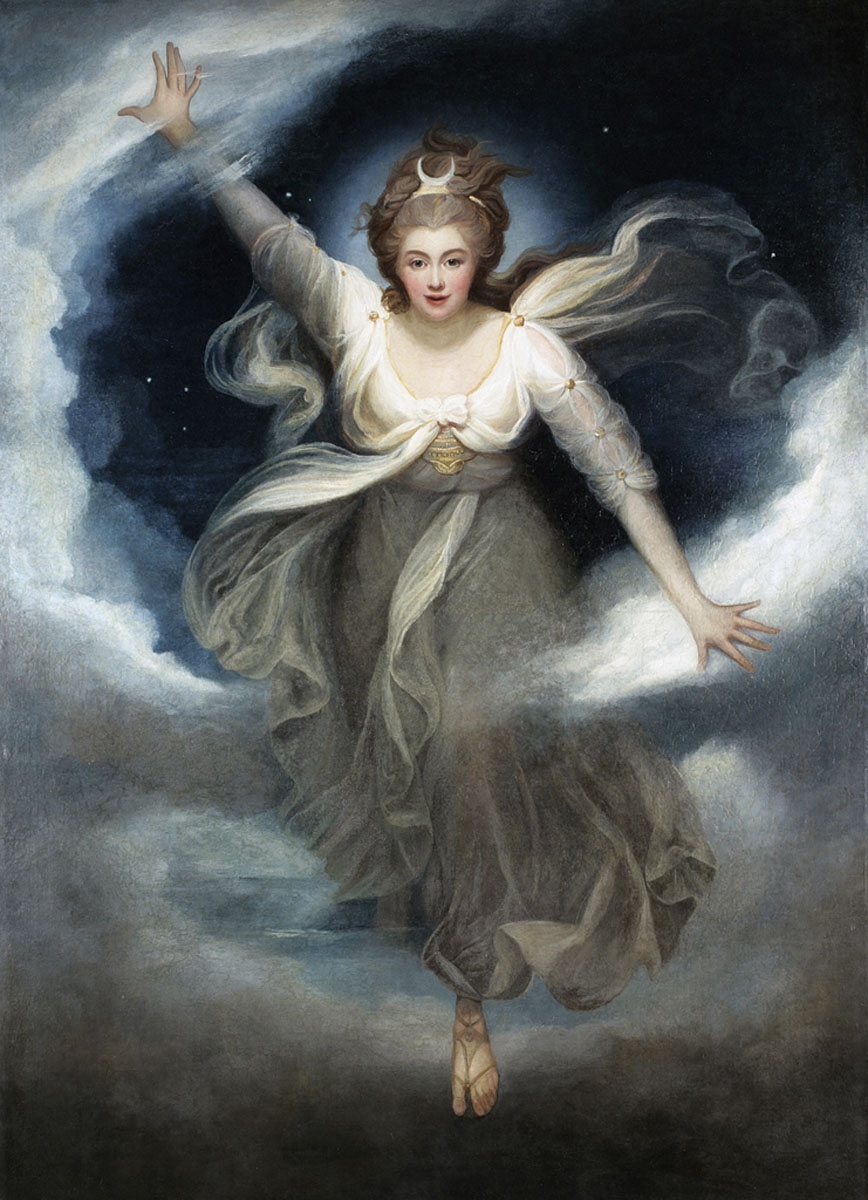
 

Maria Cosway (Italian-English 1760-1838) 'Georgiana as Cynthia from Spenser's 'Faerie Queene'' 1781-1782


Maria Cosway (Italian-English 1760-1838)
Georgiana as Cynthia from Spenser’s ‘Faerie Queene’
1781-1782
Oil on canvas
Chatsworth House
Reproduced by permission of Chatsworth Settlement Trustees / Bridgeman Images
Public domain
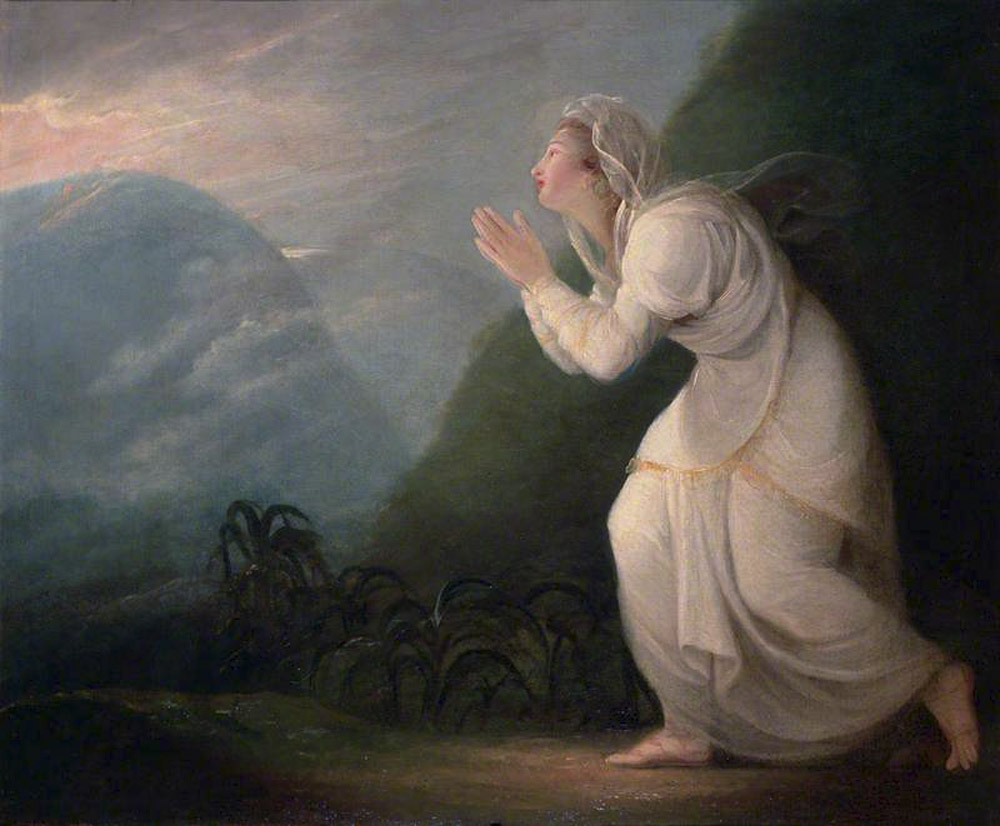
 

Maria Cosway (Italian-English 1760-1838) 'A Persian Lady Worshipping the Rising Sun' 1784


Maria Cosway (Italian-English 1760-1838)
A Persian Lady Worshipping the Rising Sun
1784
Oil on canvas
61 x 73.7cm
Sir John Soane’s Museum
Gift from the artist, 1822
By courtesy of the Trustees of Sir John Soane’s Museum, London
CC BY-NC-ND


As well as portraits, Cosway exhibited history paintings. This work was shown at the Royal Academy in 1784. Although only a few of Cosway’s history pictures can be located now, paintings such as this one were well known through reproductions made by leading engravers and print publishers. Cosway’s success was hindered by her husband, who did not like her to paint professionally. She reflected later that had he permitted it, she would have ‘made a better painter, but left to myself by degrees, instead of improving, I lost what I brought from Italy of my early studies.’

Text from the exhibition large print guide
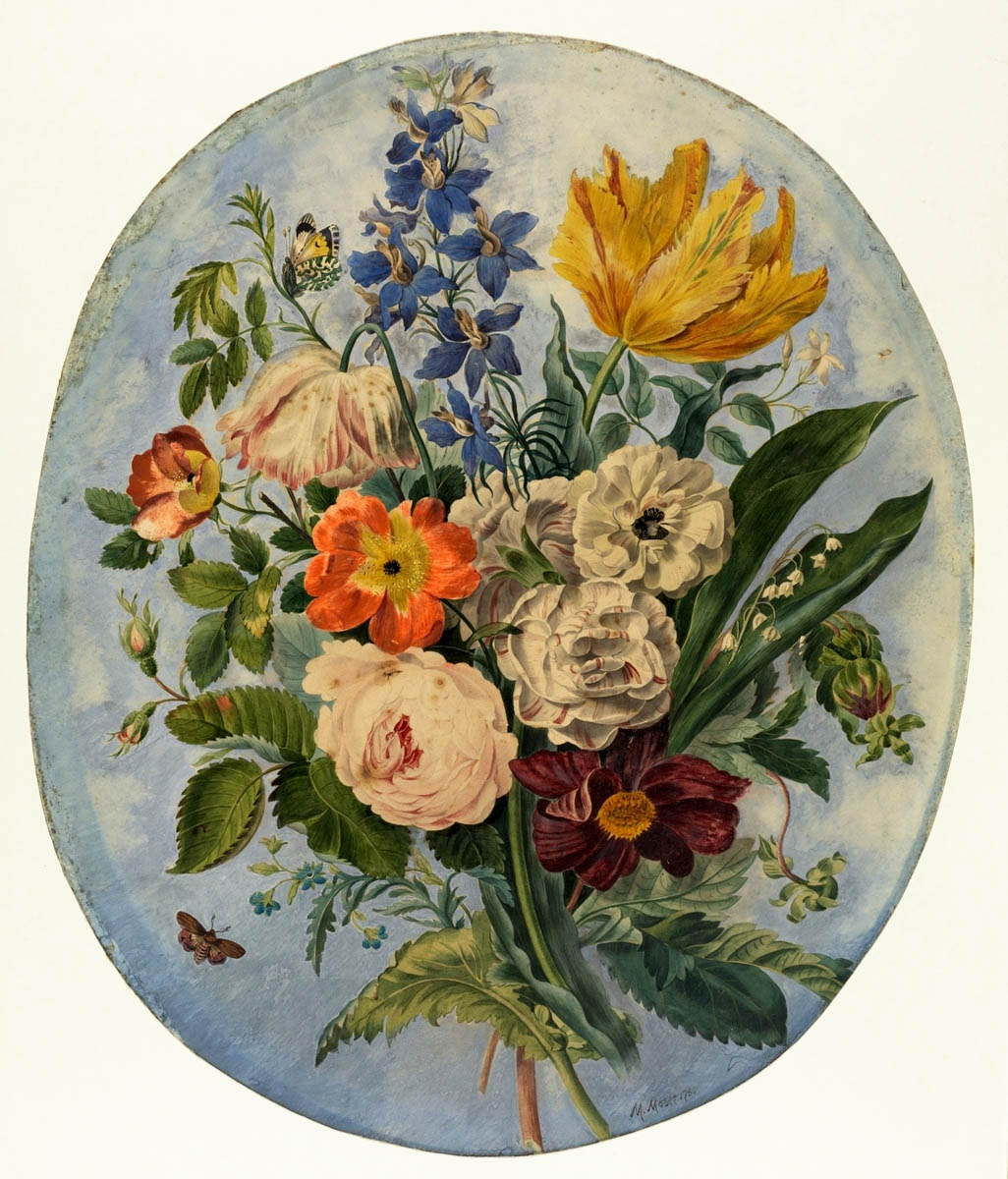
 

Maria Cosway (Italian-English 1760-1838) 'Bouquet of Flowers' 1780


Maria Cosway (Italian-English 1760-1838)
Bouquet of Flowers
1780
Watercolour on paper
The Courtauld, London (Samuel Courtauld Trust)
Bequeathed by Sir Robert Clermont Witt, 1952
CC BY-NC-ND
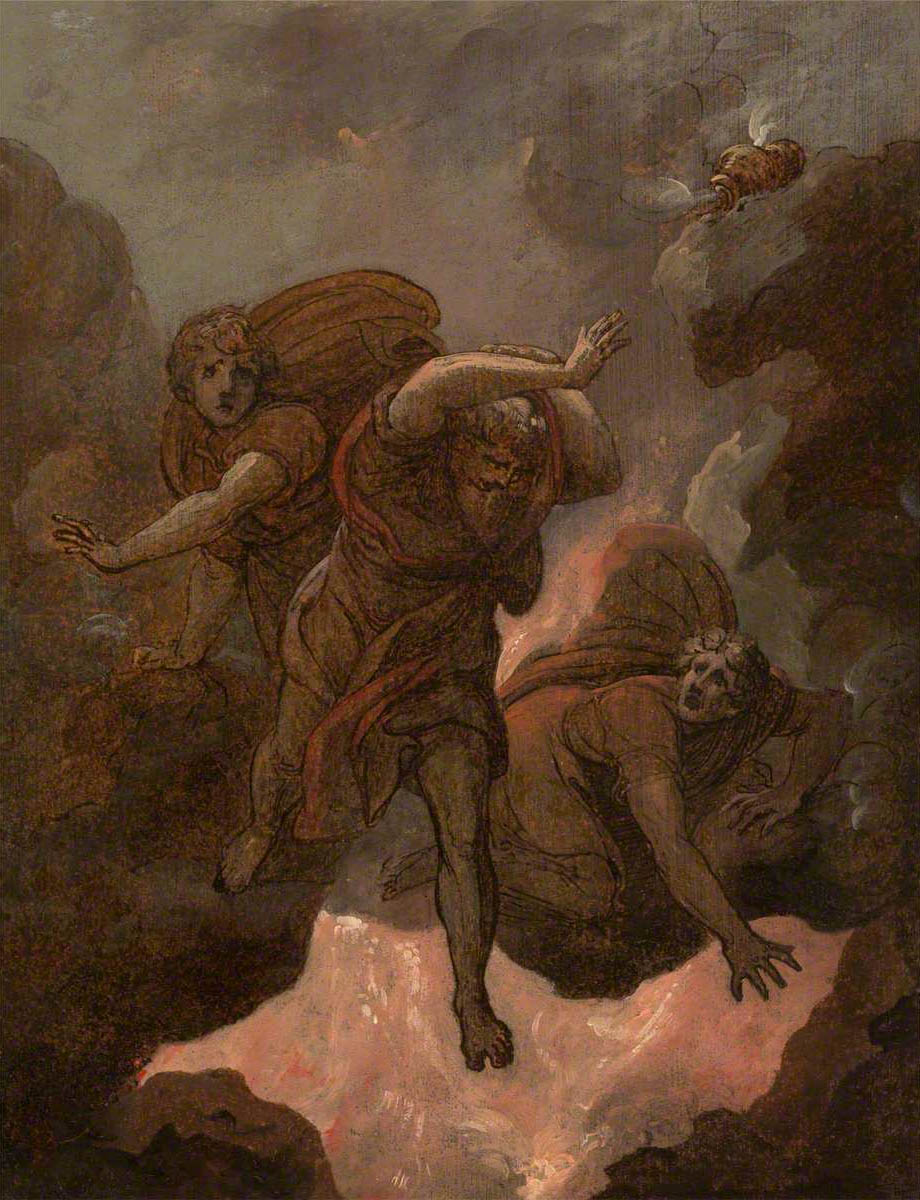
 

Maria Cosway (Italian-English 1760-1838) 'The Judgement of Korah, Dathan and Abiram' c. 1801


Maria Cosway (Italian-English 1760-1838)
The Judgement of Korah, Dathan and Abiram
c. 1801
Pen, ink and oil on canvas
37.5 x 29.2cm
Yale Center for British Art
Paul Mellon Collection
CC BY-NC-ND
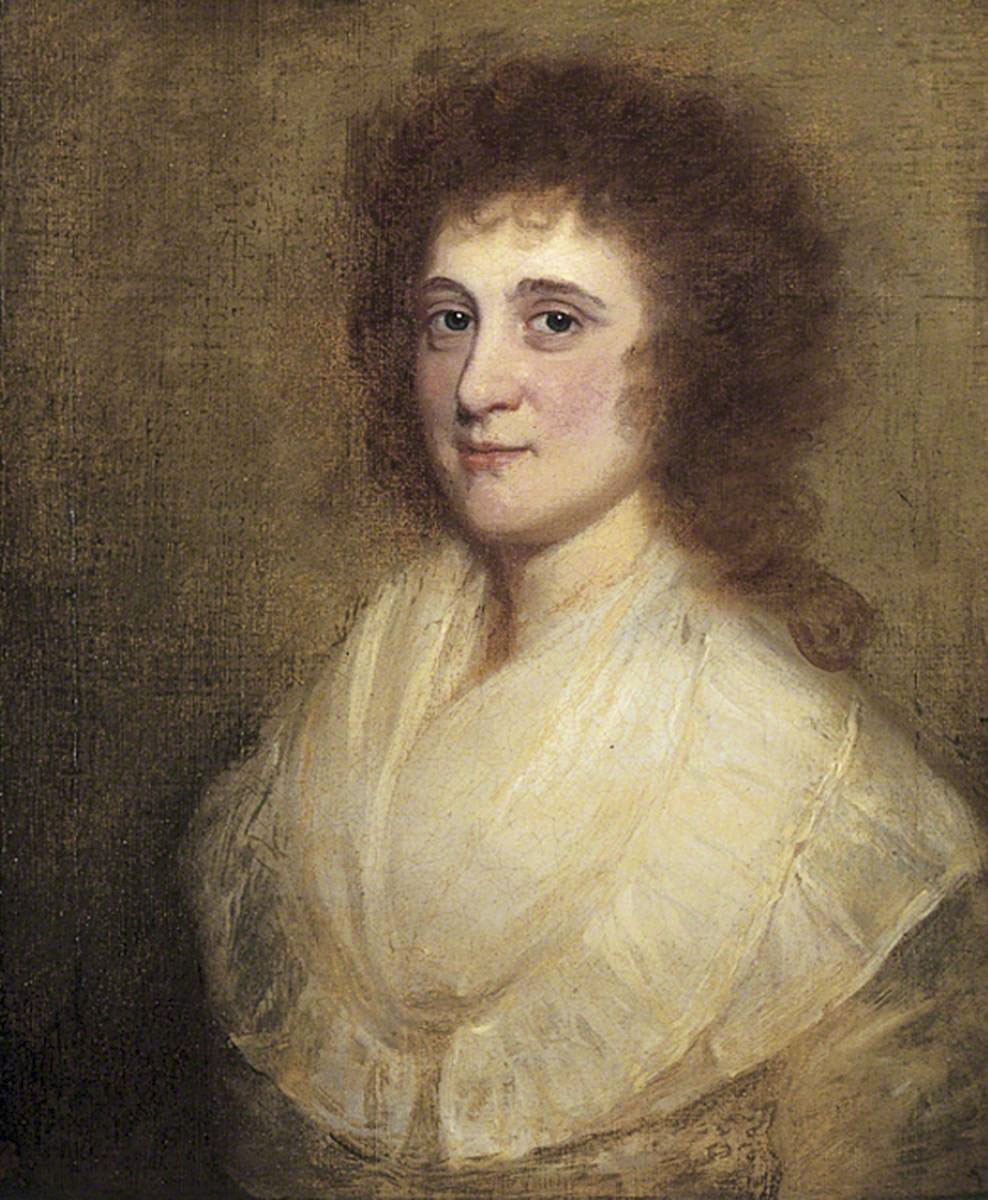
 

Maria Cosway (1759-1838) (after) 'Self Portrait' Nd


Maria Cosway (1759-1838) (after)
Self Portrait
Nd
Oil on canvas
61 x W 50.8cm
Temple Newsam House, Leeds Museums and Galleries
Bequeathed by Sam Wilson, 1925
CC BY-NC-ND
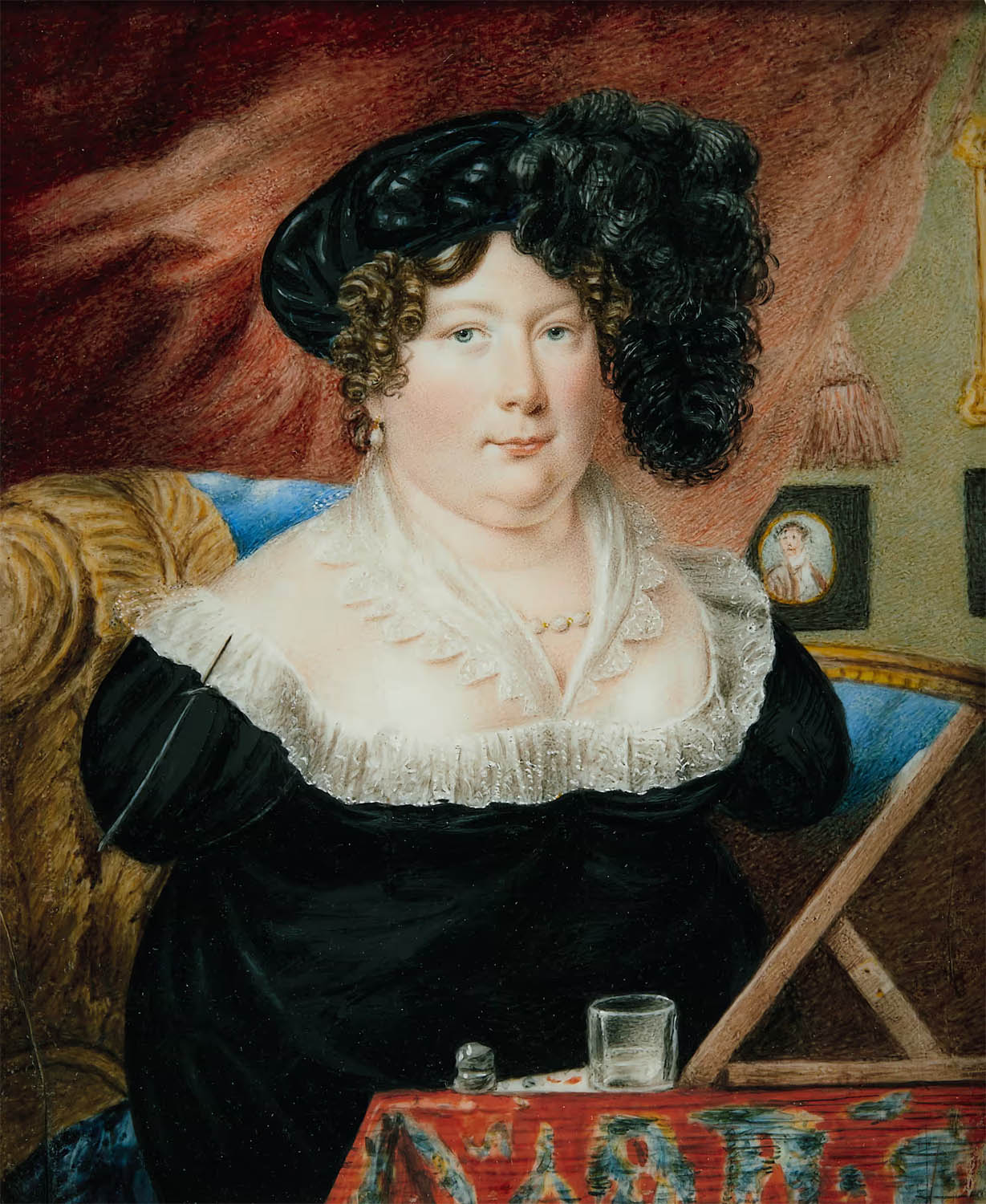
 

Sarah Biffin (English, 1784-1850) 'Self-portrait' c. 1821


Sarah Biffin (English, 1784-1850)
Self-portrait
c. 1821
Watercolour and bodycolour on ivory
Private collection


Biffin, whose baptism record notes that she was born ‘without arms or legs’, taught herself to sew, write and paint using her mouth and shoulder. She wrote that, as a child, ‘I was continually practising every invention; till at length I could, with my mouth – thread a needle – tie a knot – do fancy work – cut out and make my own dresses’.

Text from the exhibition large print guide
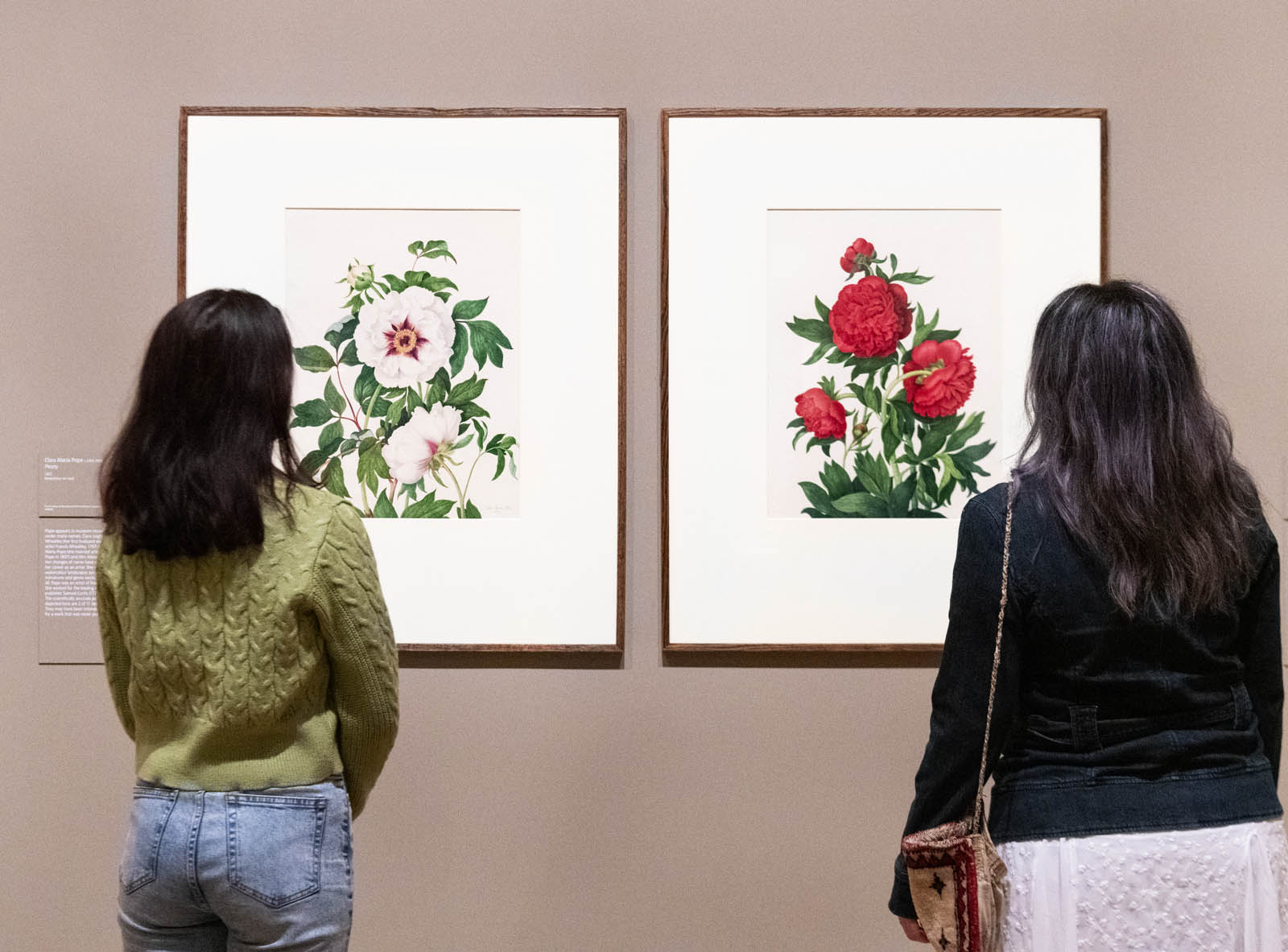
 

Installation view of the exhibition 'Now You See Us Women Artists in Britain 1520-1920' at Tate Britain showing at left, Clara Maria Pope's 'Peony' 1822; and at right, Pope's 'Peony' 1821


Installation view of the exhibition Now You See Us Women Artists in Britain 1520-1920 at Tate Britain showing at left, Clara Maria Pope’s Peony 1822 (below); and at right, Pope’s Peony 1821 (below)
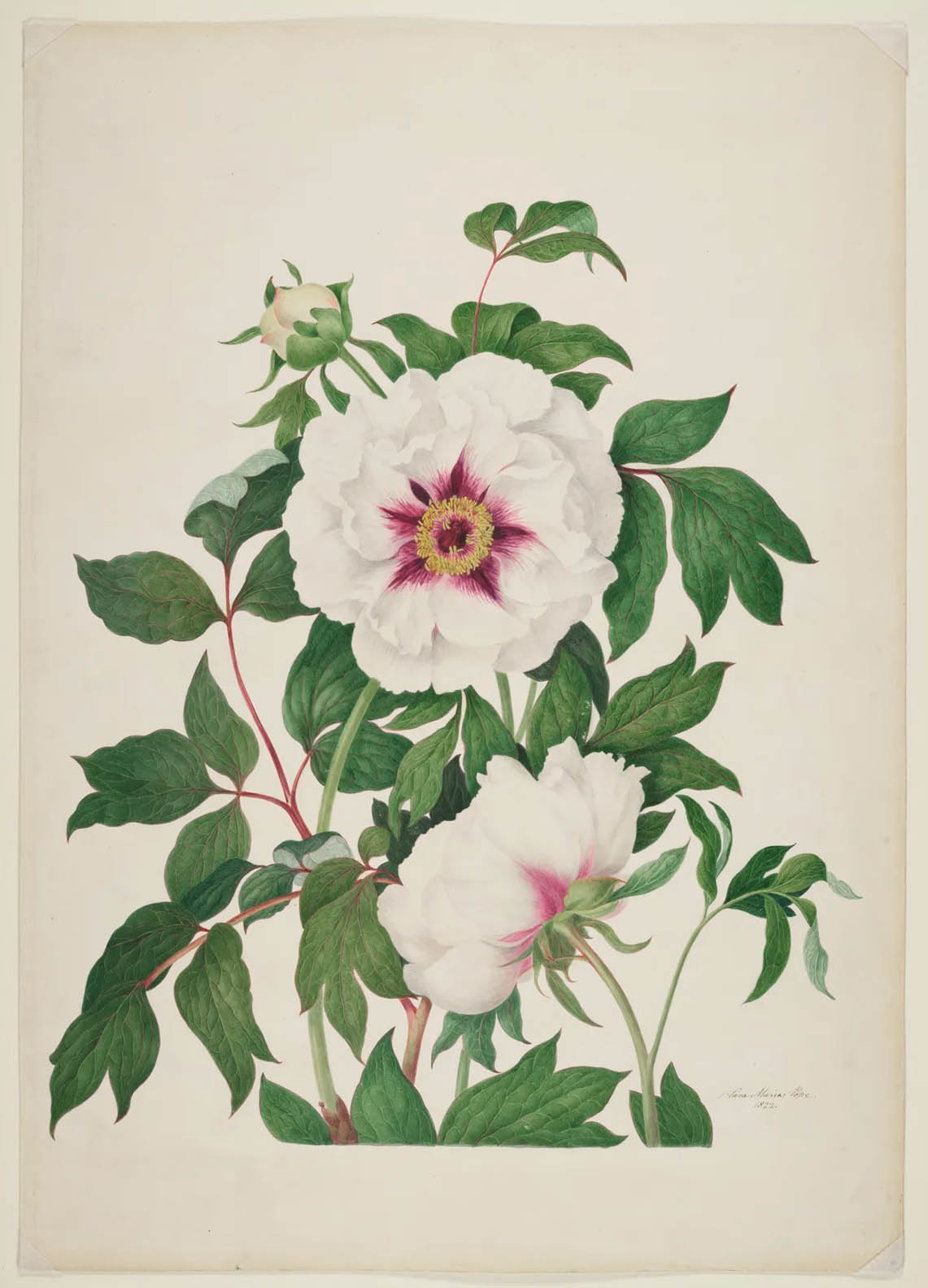
 

Clara Maria Pope (British, 1767-1831) 'Peony' 1822


Clara Maria Pope (British, 1767-1831)
Peony
1822
Bodycolour on card
The Trustees of the Natural History Museum, London
Courtesy the Natural History Museum
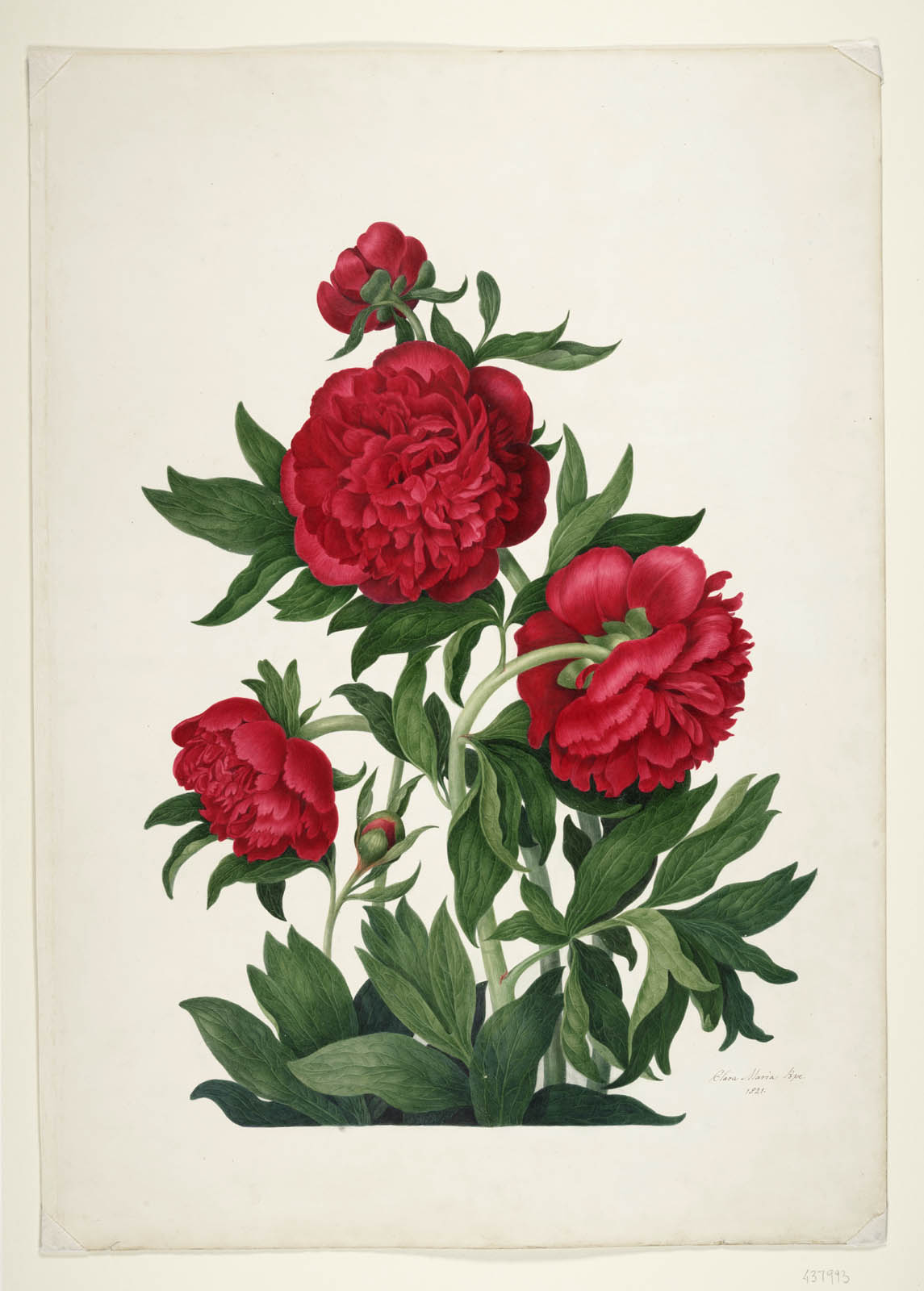
 

Clara Maria Pope (British, 1767-1831) 'Peony' 1821


Clara Maria Pope (British, 1767-1831)
Peony
1821
Bodycolour on card
The Trustees of the Natural History Museum, London
Courtesy the Natural History Museum


Pope appears in museum records under many names: Clara Leigh, Clara Wheatley (her first husband was the artist Francis Wheatley, 1747-1801), Clara Maria Pope (she married actor Alexander Pope in 1807) and Mrs Alexander Pope. Her changes of name have obscured her career as an artist. She exhibited watercolour landscapes and portraits, miniatures and genre works, but above all, Pope was an artist of flowers. She worked for the leading botanical publisher Samuel Curtis (1779-1860). The scientifically accurate peonies depicted here are 2 of 11 designs. They may have been intended as plates for a work that was never published.

Text from the exhibition large print guide
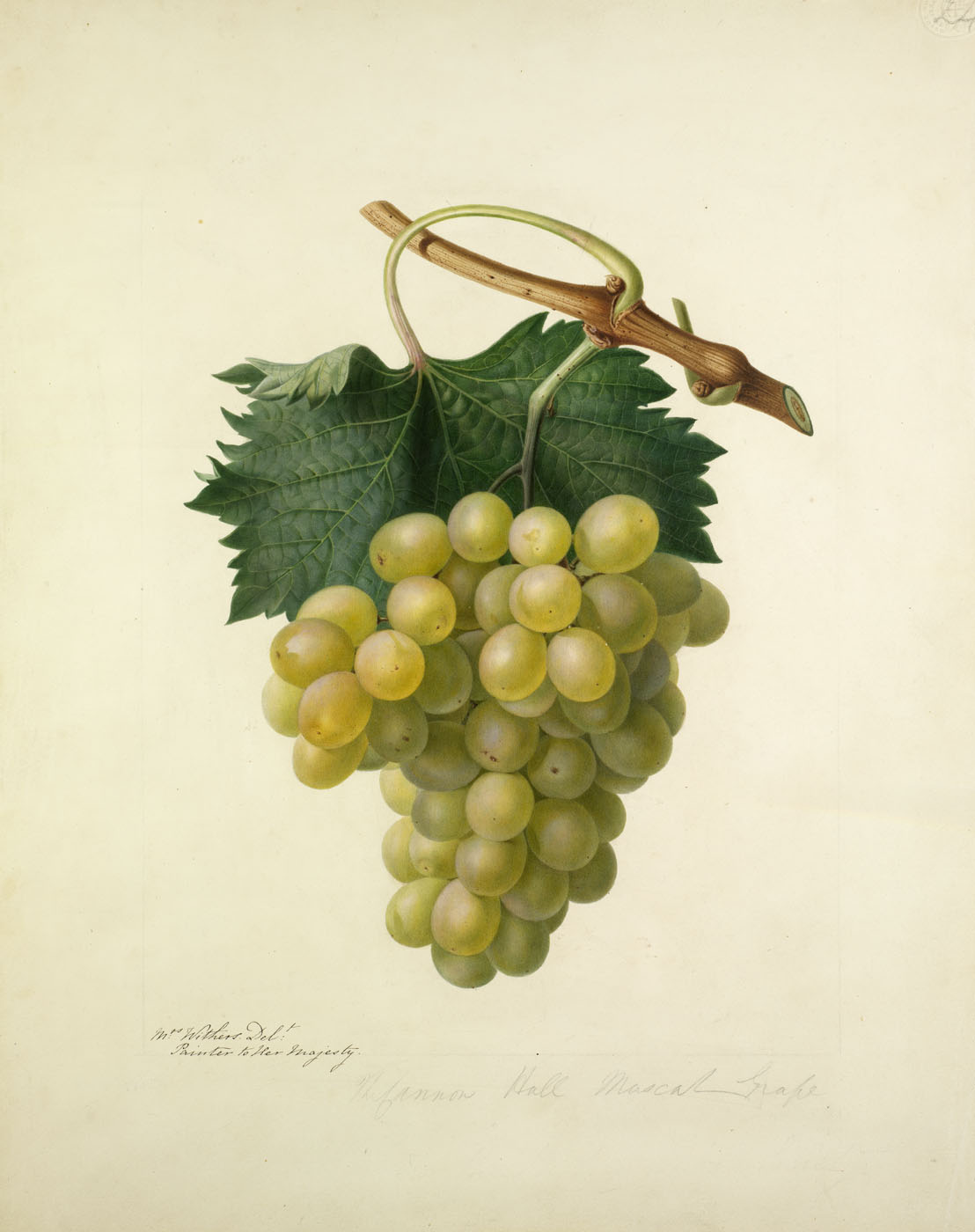
 

Augusta Innes Withers (English, 1792-1877) 'The Canon Hall Muscat Grape' c. 1825


Augusta Innes Withers (English, 1792-1877)
The Canon Hall Muscat Grape
c. 1825
Watercolour on paper
444 × 352 mm
RHS Lindley Collections
Courtesy the Royal Horticultural Society, Lindley Library


Withers was employed by the Horticultural Society to make official ‘portraits’ of varieties of fruit growing in their orchards. The quality of Withers’s work meant her high fees were not questioned. Here, she paints sunlight glowing through grapes and the translucency of the skin of gooseberries in great detail. Withers drew and handcoloured engraved illustrations in the Horticultural Society’s Transactions and made illustrations of fruit for John Lindley’s Pomological Magazine in 1828 (Lindley was Secretary of the Society). Withers was also regarded as one of the best teachers of botanical illustration.

Text from the exhibition large print guide
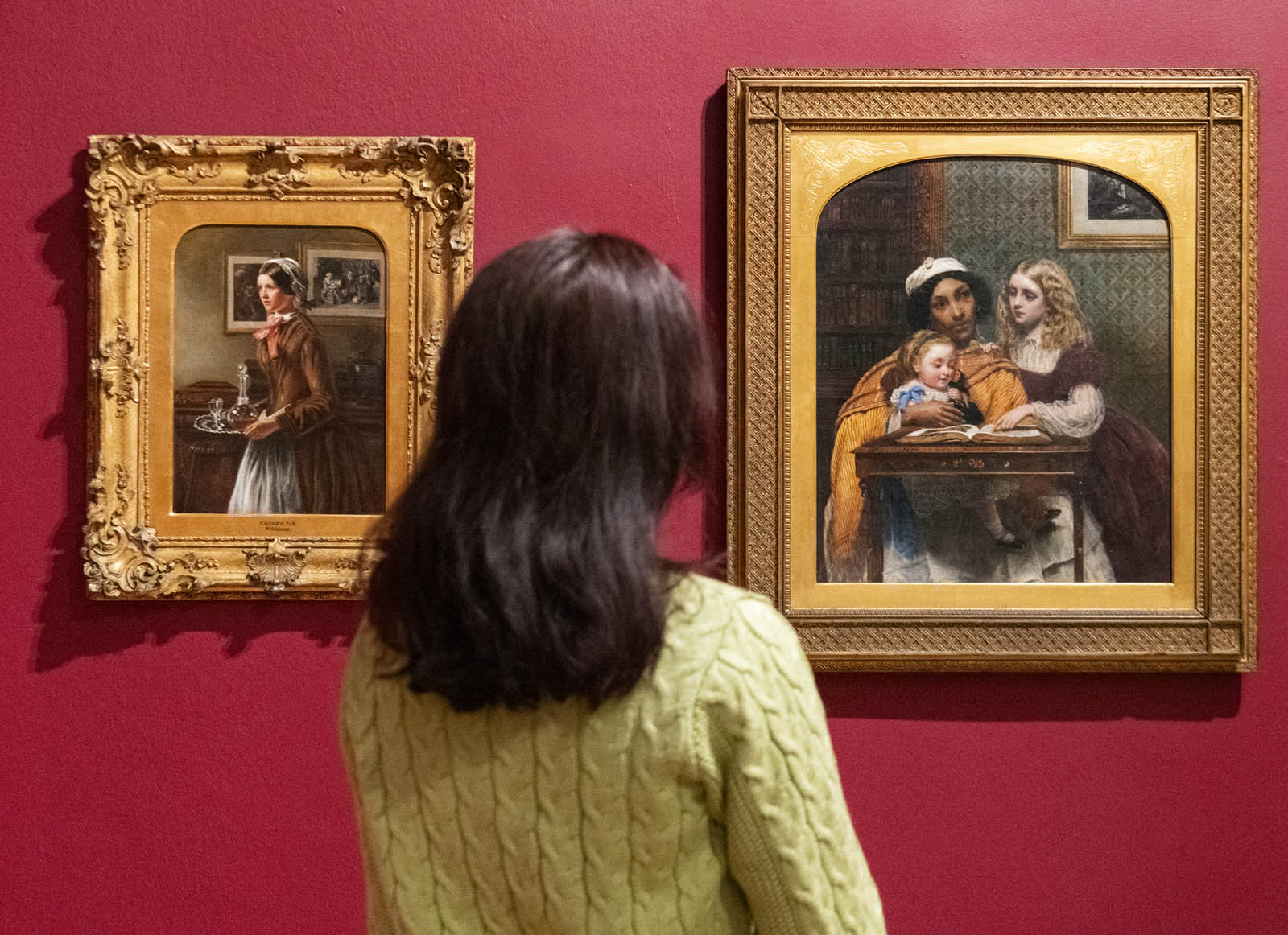
 

Installation view of the exhibition 'Now You See Us Women Artists in Britain 1520-1920' at Tate Britain showing at left, Rebecca Solomon's 'Sherry, Sir?' c. 1858-1862; and at right, Solomon's 'A Young Teacher' 1861


Installation view of the exhibition Now You See Us Women Artists in Britain 1520-1920 at Tate Britain showing at left, Rebecca Solomon’s Sherry, Sir?
c. 1858-1862 (below); and at right, Solomon’s A Young Teacher 1861 (below)
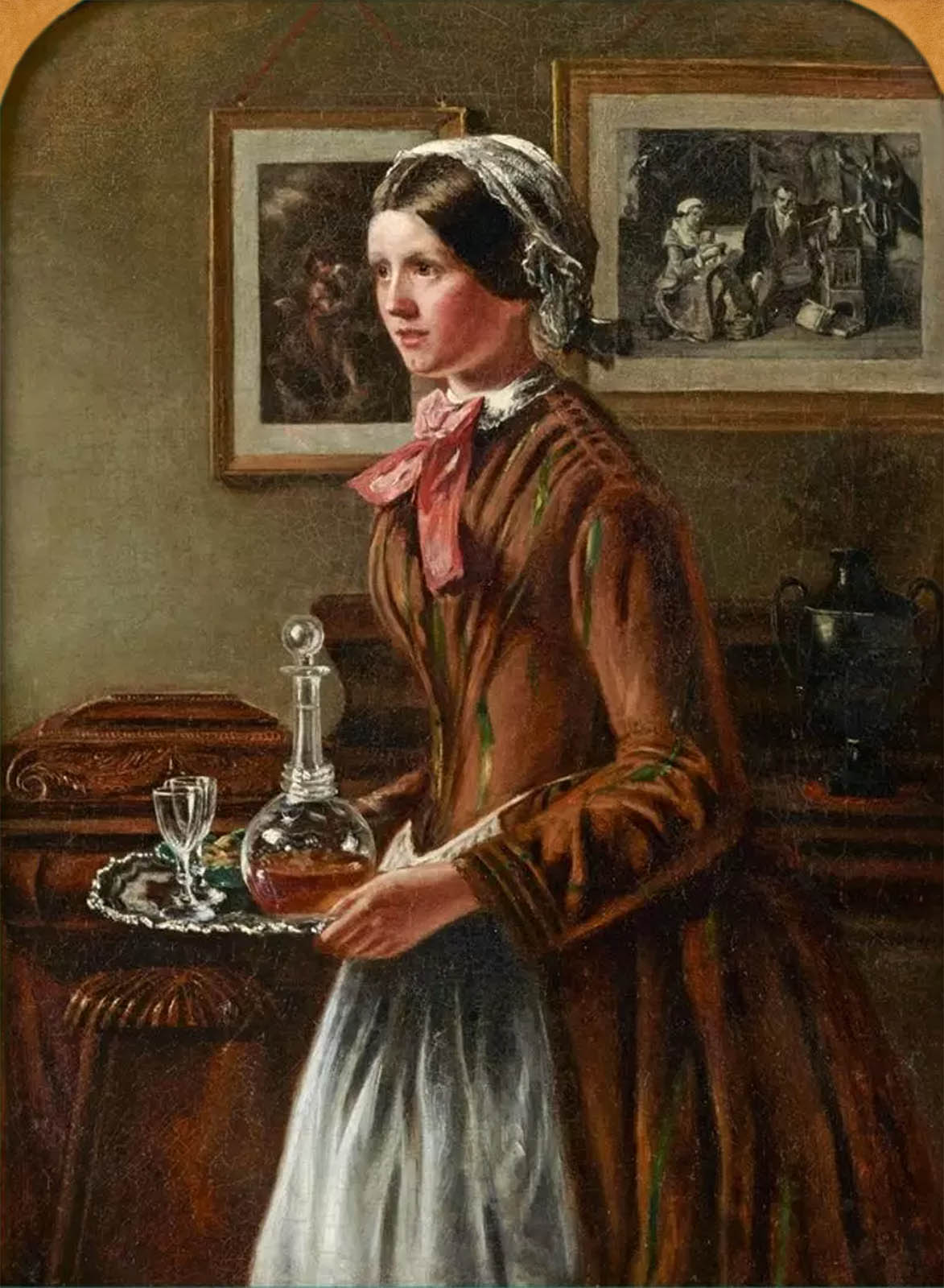
 

Rebecca Solomon (English, 1832-1886) 'Sherry, Sir?' c. 1858-1862


Rebecca Solomon (English, 1832-1886)
Sherry, Sir?
c. 1858-1862
Oil on canvas
Private collection


Solomon often painted scenes of domestic life and interiors, which were considered more suitable subjects for women artists than history painting. Solomon’s domestic scenes include subtle commentary on social hierarchies. Sherry, Sir? depicts a maid with a silver tray. It reprises a well-known painting of the same title, painted by William Powell Frith (1819-1909) in 1851, but unlike Frith’s painting, Solomon draws attention to domestic labour and the hierarchies of a middle-class home. Solomon was the sister of artists Abraham Solomon (1823-1862) and Simeon Solomon (1840-1905).

Text from the exhibition large print guide


Rebecca Solomon (London 26 September 1832 – 20 November 1886 London) was a 19th-century English Pre-Raphaelite draftsman, illustrator, engraver, and painter of social injustices. She is the second of three children who all became artists, in a prominent Jewish family. …

Solomon’s artistic style was typical of popular 19th-century painting at the time and falls under the category of genre painting. She used her visual images to critique ethnic, gender and class prejudice in Victorian England. When Solomon started painting genre scenes, her work demonstrated an observant eye for class, ethnic and gender discrimination. Solomon’s paintings reflect a combination of interest in the theatre and commitment to social consciousness that is not exist in other artist’s painting in the nineteenth century.

Text from the Wikipedia website


Solomon painted in a more equivocal manner… She [the subject of the painting] is equally attractive and demure, but, by being painted from the side and against the background of a middle-class interior, the viewer is invited to reflect on her social status.

This is framed in a genre painting and by no means a piece with pretensions to social realism, but Solomon seems to be underlining the definite restrictions on this young woman’s position in society.

The pictures hanging behind her may contribute to that interpretation of the artist. They are not yet identified, but it seems that on the left we are shown an allegorical subject later than Gainsborough or Reynolds, depicting a young peasant boy or young peasant girl holding a dog in a landscape. On the right, a more specific engraving of a genre painting from Solomon’s own time showing what appears to be an itinerant family of street vendors. By placing his servant girl between these two paintings, Solomon seems to be asking us to compare.

José Luis Jiménez García. “La otra versión de la ‘Sherry Girl’,” on the Diario de Jerez website 07 June 2023 [Online] Cited 28/08/2024 Translated from the Spanish by Google Translate
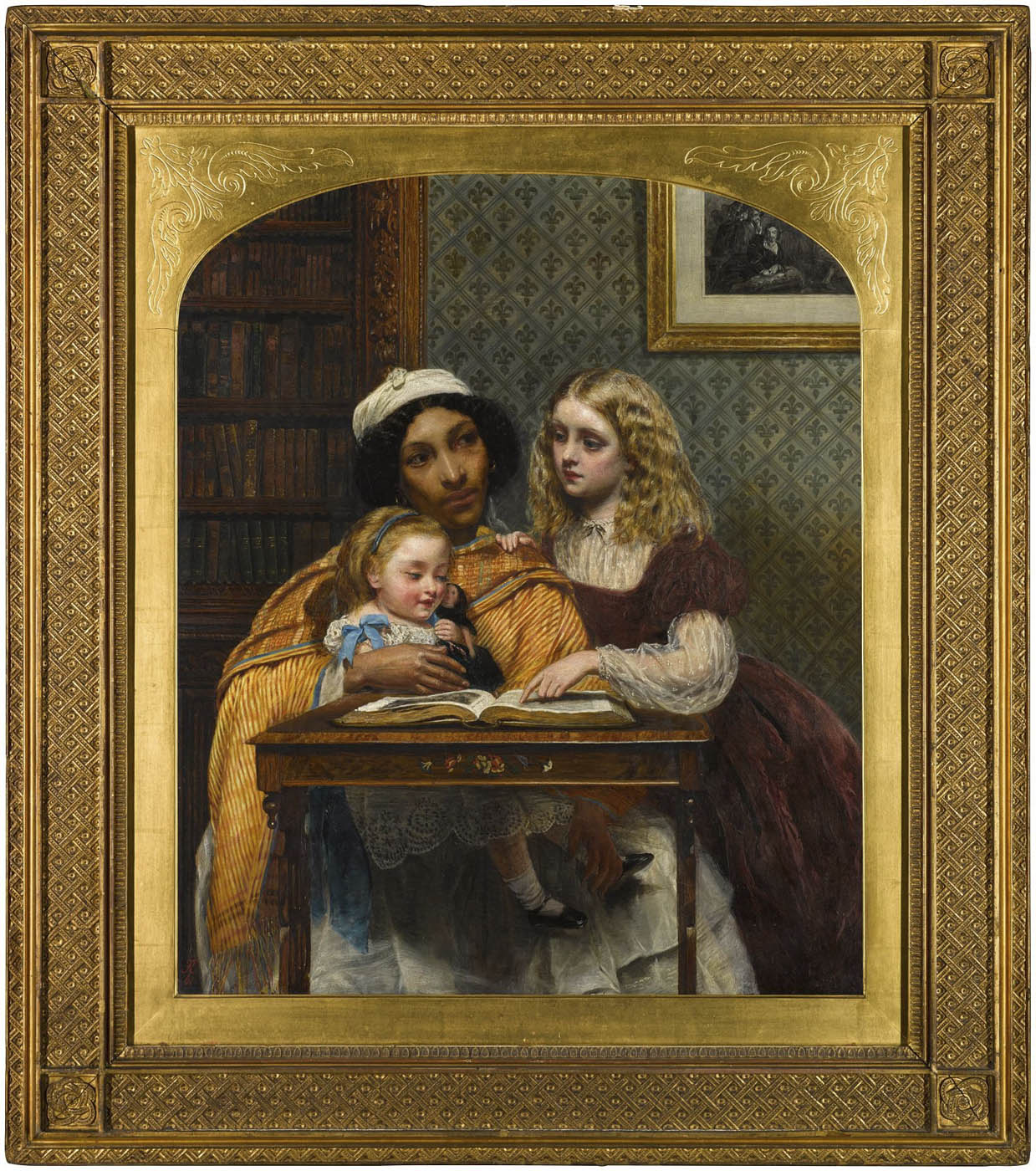
 

Rebecca Solomon (English, 1832-1886) 'A Young Teacher' 1861


Rebecca Solomon (English, 1832-1886)
A Young Teacher
1861
Oil on canvas
61 by 51cm
Tate and the Museum of the Home


Rebecca Solomon’s painting is a complex reflection on gender, race, religion and education in mid-nineteenth century London. As with many of her works, it considers women who worked in better-off households as professional carers. In A Young Teacher, Solomon modifies a traditional domestic scene between mother and child, with the surrounding books stressing the theme of learning. The woman at the centre of the image was modelled by Jamaican-born Fanny Eaton, who became a prominent muse for many Victorian artists and featured in some of the most iconic paintings of the Pre-Raphaelite period. …

Believed to be the first Jewish woman to become a professional artist in England, Rebecca Solomon’s work shone a light on inequality and prejudice at a time when these subjects were far from mainstream. She was active in social reform movements, including as part of a group of 38 artists who petitioned the Royal Academy of Arts to open its schools to women.

Text from the Tate website
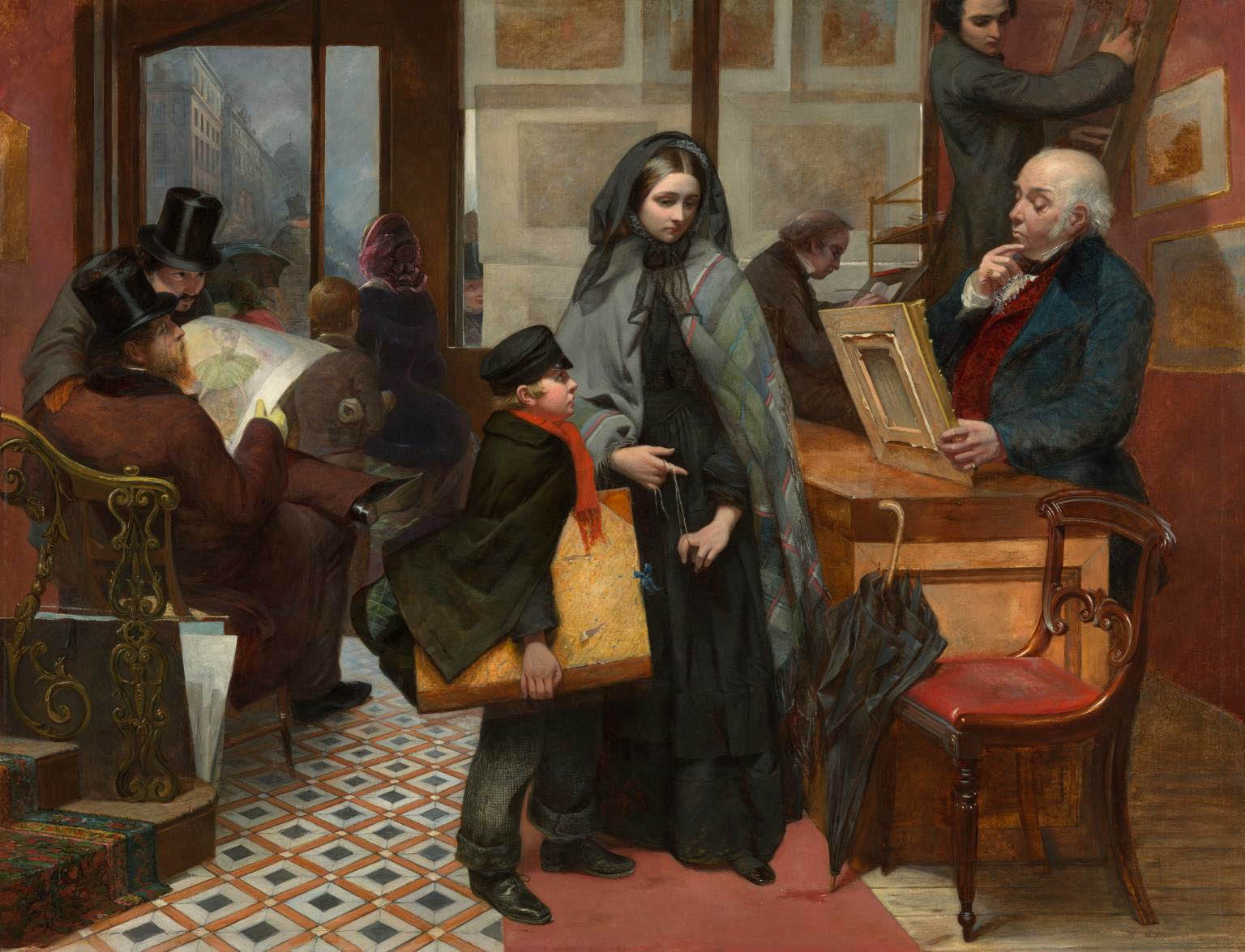
 

Emily Osborn (English, 1828-1925) 'Nameless and Friendless. "The rich man's wealth is his strong city: the destruction of the poor is their poverty (Proverbs: 10:15)' 1857


Emily Osborn (English, 1828-1925)
Nameless and Friendless.
“The rich man’s wealth is his strong city: the destruction of the poor is their poverty” (Proverbs: 10:15)
1857
Oil on canvas
Support: 825 × 1038 mm
Frame: 1042 × 1258 × 75 mm
Tate
Purchased with assistance from Tate Members, the Millwood Legacy and a private donor 2009
Creative Commons CC BY-NC-ND 4.0 DEED


Osborn exhibited widely and was supported by wealthy patrons. She was also part of the ‘rights of woman’ debate, campaigning for more public roles for women. Nameless and Friendless, exhibited at the Royal Academy in 1857, dramatises the difficulties faced by women artists. Osborn shows a young woman offering a painting to a sceptical dealer. With no reputation (‘Nameless’) and no connections (‘Friendless’), she has little chance of a sale. Behind her, two leering men emphasise the impression of her isolation and vulnerability.

Text from the exhibition large print guide


Installation view of the exhibition 'Now You See Us Women Artists in Britain 1520-1920' at Tate Britain showing Emily Mary Osborn's 'Barbara Bodichon (1827-1891)' Nd (below)


Installation view of the exhibition Now You See Us Women Artists in Britain 1520-1920 at Tate Britain showing Emily Mary Osborn’s Barbara Bodichon (1827-1891) Nd (below)
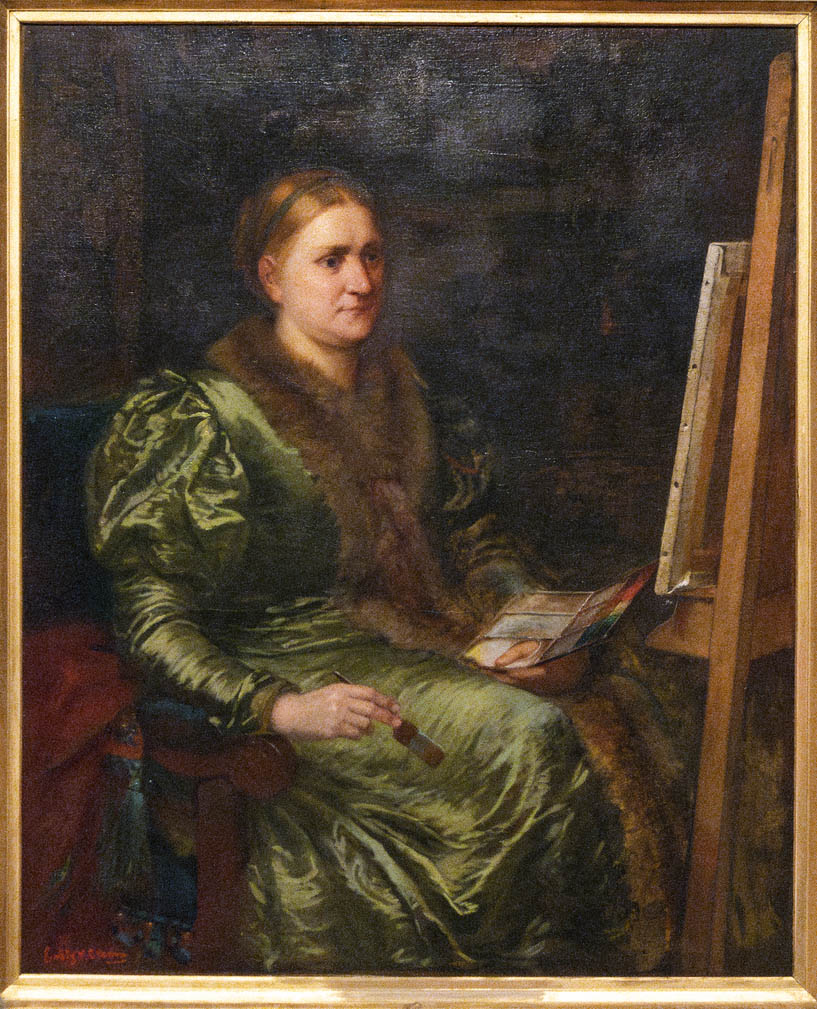
 

Emily Mary Osborn (1828-1925) 'Barbara Bodichon (1827-1891)' Nd (installation view)


Emily Mary Osborn (1828-1925)
Barbara Bodichon (1827-1891) (installation view)
Nd
Oil on canvas
120 x 97cm
Girton College, University of Cambridge


Martha Darley Mutrie (British, 1824-1885) 'Wild Flowers at the Corner of a Cornfield' 1855-1860


Martha Darley Mutrie (British, 1824-1885)
Wild Flowers at the Corner of a Cornfield
1855-1860
Oil on canvas
Support: 821 × 632 mm
Frame: 958 × 781 × 65 mm
Photo: Tate (Seraphina Neville)


Martha Darley Mutrie is considered one of the leading painters of flowers active in Britain in the nineteenth century. She was born in Ardwick, near Manchester. She trained together with her sister, the painter Annie Feray Mutrie (1826-1893), under George Wallis (1811-1891) at the Manchester School of Design from 1844 to 1846, and also undertook private lessons with him. The sisters began exhibiting at the Royal Manchester Institution from 1845 and at the Royal Academy, London, showing there consistently from the early 1850s. Their work was regularly well received by the critics. Mutrie and her sister moved to London in 1854, where they painted flowers in interior settings, carefully arranged, and also outdoors in mock natural settings.

Despite the prominence of women artists painting still lifes and flowers, the men practitioners of the genre, such as George Lance (1802-1864) and William Henry ‘Birds Nest’ Hunt (1790-1864), received greater critical and institutional attention. Martha and Annie Mutrie achieved success that was otherwise rare for women working as artists at the time.

The art critic John Ruskin admired both artists’ work and wrote about one of Annie’s pictures in his review of the 1855 Royal Academy exhibition. In his review Ruskin suggested that she abandon artificial compositions and paint instead ‘some banks of flowers in wild country, just as they grow’ (John Ruskin, Notes on Some of the Principal Pictures Exhibited at the Royal Academy, London, 1855). This painting might be seen as a response to Ruskin’s insight and the advances in science that in the 1850s brought a new focus to the study of nature, with arguments over beauty and truth.

Text from the Tate website
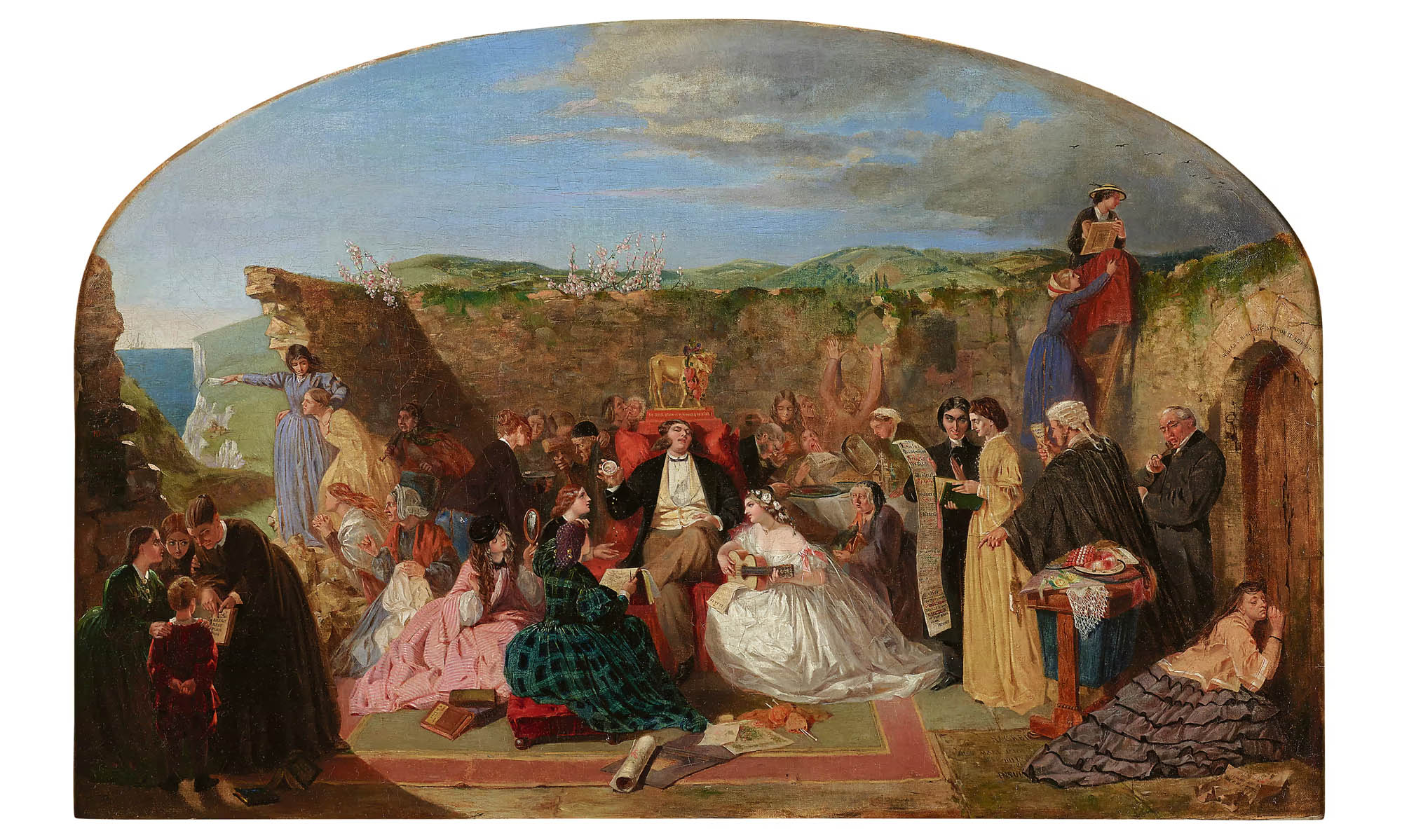
 

Florence Claxton (British, 1838-1920) ''Woman's Work': A Medley' 1861


Florence Claxton (British, 1838-1920)
‘Woman’s Work’: A Medley
1861
Oil on canvas
Martin Beisly Fine Art, London


In the 1850s, Claxton became part of the UK’s first organised movement for women’s rights. Woman’s Work satirises women’s opportunities for professional employment. At its centre a group of women fawn at the feet of a man seated below a statue of the Golden Calf – a false idol. Confined by
a surrounding wall, doors to professions such as medicine are shut to the women. Only the artist Rosa Bonheur has managed to scale the wall’s heights. The painting was exhibited at London’s National Institution for Fine Arts in 1861 and received mixed reviews. Some praised its comic strength but others described it as ‘vulgar’.

Text from the exhibition large print guide
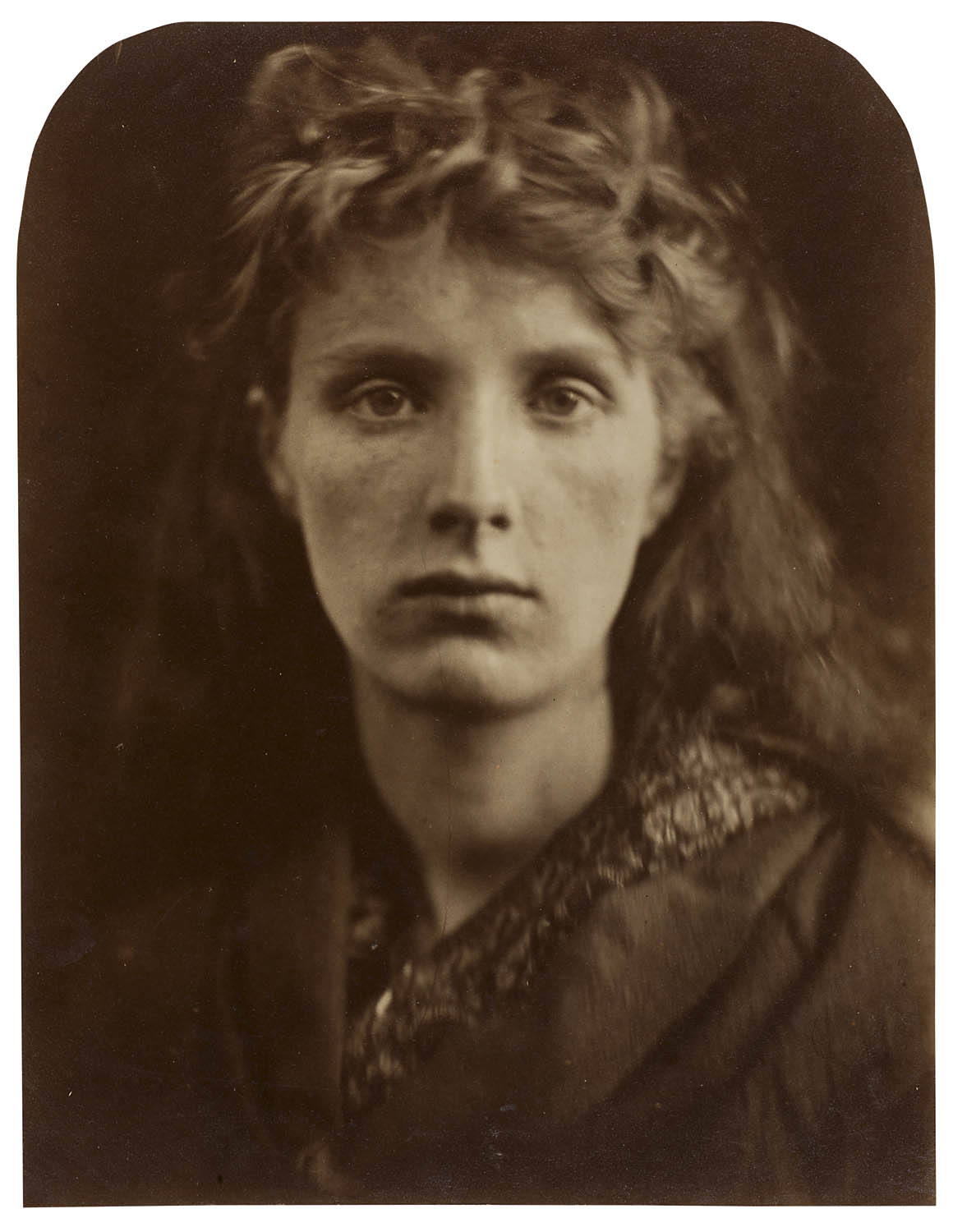
 

Julia Margaret Cameron (British born India, 1815-1879) 'Mountain Nymph, Sweet Liberty' 1865


Julia Margaret Cameron (British born India, 1815-1879)
Mountain Nymph, Sweet Liberty
1865
Albumen print
Wilson Centre of Photography


Annie Keene (1842/3-1901) was an artist’s model at the Royal Academy Schools. Cameron showed Keene’s portrait at the 1866 Hampshire and Isle of Wight Loan Exhibition, and it was for sale at her 1868 exhibition at London’s German Gallery. In this photograph, Cameron’s shallow depth-of-field gives a bold effect. Her friend, the scientist and photographic innovator John Herschel (1792-1871), praised the portrait as ‘a most astonishing piece of high relief – She is absolutely alive and thrusting out her head from the paper into the air’.

Text from the exhibition large print guide
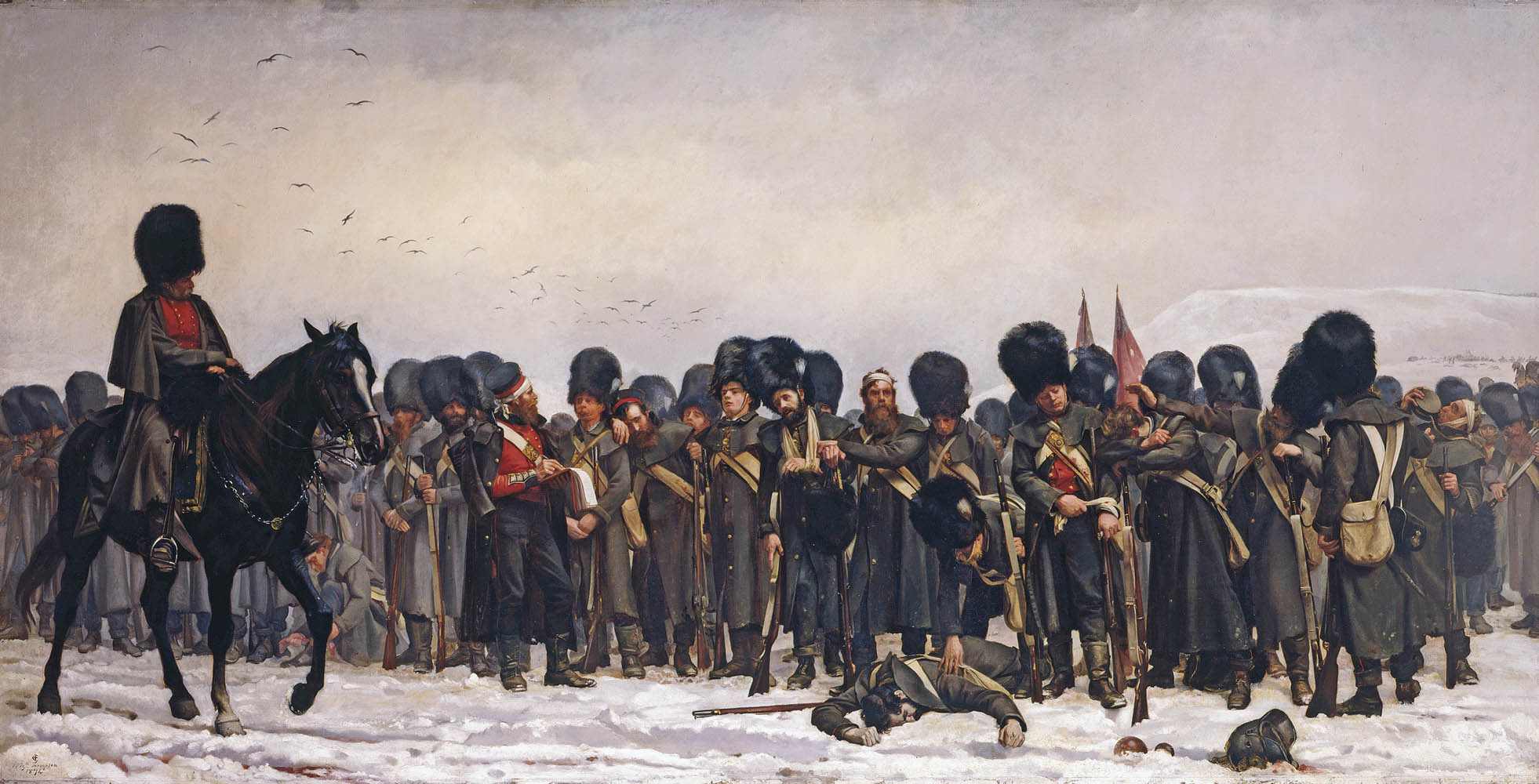
 

Elizabeth Butler (British, 1846-1933) 'The Roll Call' 1874


Elizabeth Butler (British, 1846-1933)
The Roll Call
1874
Oil on canvas
93.3 x 183.5cm (support, canvas/panel/stretcher external)
Royal Collection Trust
© Royal Collection Trust / His Majesty King Charles III 2024


Butler specialised in battle paintings, challenging society’s expectations of women artists. The exhibition of The Roll Call at the Royal Academy in 1874 was one of the greatest art sensations of the nineteenth century. It was praised by Academicians and hung ‘on the line’ (the most prestigious, eye-level position). The painting proved so popular with the public that a policeman had to be stationed nearby to protect the adjacent paintings. Queen Victoria summoned the work to Buckingham Palace for a private viewing, and the copyright sold for the enormous sum of £1,200.

Text from the exhibition large print guide


The Roll Call captured the imagination of the country when exhibited at the Royal Academy in 1874, turning the artist into a national celebrity. So popular was the painting that a policeman had to be stationed before it to hold back the crowds and it went on to tour the country in triumph. The painting’s focus on the endurance and bravery of ordinary soldiers without reference to the commanders of the army accorded with the mood of the times and the increasing awareness of the need for social and military reforms.

Though the public had been exposed to other images of the Crimean War, primarily prints, photographs and newspaper illustrations, never before had the plight of ordinary soldiers been portrayed with such realism. Butler researched her subject by studying A. W. Kinglake’s seminal history of the Crimean War, as well as by consulting veterans of the Crimea, several of whom served as models for the painting. She also painstakingly sought out uniforms and equipment from the Crimean period in order to be correct in the smallest military details. The sombre mood and simple yet dramatic composition Butler achieved in The Roll Call vividly epitomised the grimness not only of the Crimean War but of all wars.

Text from the Royal Collection Trust website


Installation view of the exhibition 'Now You See Us Women Artists in Britain 1520-1920' at Tate Britain showing at left, Louise Jopling's 'Through the Looking-Glass' 1875; and at right, Jopling's 'A Modern Cinderella' 1875


Installation view of the exhibition Now You See Us Women Artists in Britain 1520-1920 at Tate Britain showing at left, Louise Jopling’s Through the Looking-Glass 1875 (below); and at right, Jopling’s A Modern Cinderella 1875 (below)


Louise Jopling (English, 1843-1933) 'Through the Looking-Glass' 1875


Louise Jopling (English, 1843-1933)
Through the Looking-Glass
1875
Oil paint on canvas
Support: 539 × 437 mm
Tate
Purchased with funds provided by the Nicholas Themans Trust and Tate Patrons 2024
Photo: Tate (Sonal Bakrania)


This is a self-portrait Jopling made while pregnant with her son, Lindsay, in 1875.

Jopling was one of the most successful and best-known women artists of the late nineteenth century. She exhibited regularly and, from the 1880s, ran her own art school for women. Jopling hosted receptions and established connections with many artists and art dealers. She carefully planned the exhibition of her work by choosing venues appropriate to each painting’s scale and ambition. Jopling sent this self-portrait to the Society of Lady Artists in 1875. In the same year, A Modern Cinderella, hanging nearby, was shown at the Royal Academy. Both works were purchased by the dealer Agnew: this work for £26, but Cinderella for £262.

Text from the exhibition large print guide


Tabitha Barber, curator of the exhibition, said: “What’s happened to Jopling’s legacy is the story of what’s happened to most women artists … They have been regarded, studied and judged differently.”

Jopling, who in 1901 became one of the first women admitted to the Royal Society of British Artists, was a celebrated artist in her day, Barber said. Her patrons included the de Rothschild family, and the Grosvenor Gallery founders Sir Coutts and Lady Lindsay. “At a time when women weren’t allowed to be members of the Royal Academy, her works were exhibited there almost every year and spoken about in the press. She was reviewed by male art critics, and reviewed well.”

Jopling’s paintings were also commercially successful, selling for some of the highest prices that British female artists could command – albeit far less than their male contemporaries.

“She is among a handful of female artists who were society figures and household names – and it just seems so astonishing that they’re so little known now,” said Barber.

Donna Ferguson. “Tate Britain acquires first painting by pioneering English female artist overlooked for a century,” on The Guardian website 12 May 2024 [Online] Cited 02/09/2024


Louise Jopling (English, 1843-1933) 'A Modern Cinderella' 1875 (installation view)


Louise Jopling (English, 1843-1933)
A Modern Cinderella
1875
Oil on canvas
Support: 910 × 700 mm
Private collection


Louise Jopling (English, 1843-1933) 'A Modern Cinderella' 1875


Louise Jopling (English, 1843-1933)
A Modern Cinderella
1875
Oil on canvas
Support: 910 × 700 mm
Private collection


A Modern Cinderella shows a model removing her fine clothes at the end of a painting session. A glimpse of Jopling’s easel can be seen in the mirror’s reflection. In 1875, Jopling exhibited this work at the Royal Academy. There, the model’s naked shoulder was cause for criticism. Although one reviewer thought it was ‘quite harmless’, a picture dealer’s wife reportedly said that ‘she could never hang such a thing in her house’. Jopling also showed the painting at the 1878 Exposition Universelle in Paris, where she had also trained.

Text from the exhibition large print guide


If this is, indeed, a self-portrait, Jopling has painted herself as somewhere in the liminal space between the social groups she simultaneously belonged to and was excluded from. Despite Jopling’s notoriety and prominence among high-class Pre-Raphaelite artist circles, she experienced a high degree of discrimination. In 1883, she was commissioned to paint a portrait for 150 guineas but lost her employment in favour of Sir John Everett Millais, who requested 1000 guineas for the same project (Clement). In the traditional circles of high society, Jopling was looked down upon for pursuing a career in the fine arts, which was inherently a masculine task. The woman in the image is either taking the dress off or putting it on, but either way, has turned her back to her easel, which could be interpreted as forfeiting a part of her true identity to fit either end of the accepted spectrum of femininity. The underclothing she portrays herself in fit the Pre-Raphaelite aesthetic style of dress, which fit natural waists and emphasised a woman’s beauty through medieval and Greek-inspired silhouettes (Shrimpton, Jayne. Victorian Fashion. Shire Publications, 2016). The inclusion of this white aesthetic dress, as well as the scandalous drop of the strap is a signal of societal rebellion against traditional beauty norms. The woman in the image could also be read as shedding the skin of the two dresses before her to reveal her true, natural, artistic self below.

Emily Goldstein. “‘A modern Cinderella, 1875. Oil on Canvas’ by Louise Jopling,” on the COVE Studio website 23/10/2020 [Online] Cited 02/09/2024


Marianne Stokes (Austrian, 1855-1927) 'The Passing Train' 1890


Marianne Stokes (Austrian, 1855-1927)
The Passing Train
1890
Oil on canvas
Support: 600 × 760 mm
Frame: 885 × 955 mm
Private collection


Marianne Stokes (née Preindlsberger; 1855-1927) was an Austrian painter. She settled in England after her marriage to Adrian Scott Stokes (1854-1935), the landscape painter, whom she had met in Pont-Aven. Stokes was considered one of the leading women artists in Victorian England.


Annie Louisa Swynnerton ARA (British, 1844-1933) 'Mater Triumphalis' 1892


Annie Louisa Swynnerton ARA (British, 1844-1933)
Mater Triumphalis
1892
Paris, musée d’Orsay
Donated by Edmund Davis, 1915


Swynnerton campaigned for women’s suffrage, access to professional training, and equal opportunities. She rebelled against the belief that ‘women could not paint’. Exhibited at the New Gallery in 1892, Mater Triumphalis was regarded as a bold work. It brought Swynnerton international recognition, winning a medal at the 1893 World Exposition in Chicago. Despite this, Swynnerton received mixed reviews from British critics. They were impressed by the artist’s skill and the painting’s ‘quivering life’ but found the ‘frank realism’ of the woman’s naked body disconcerting.

Text from the exhibition large print guide
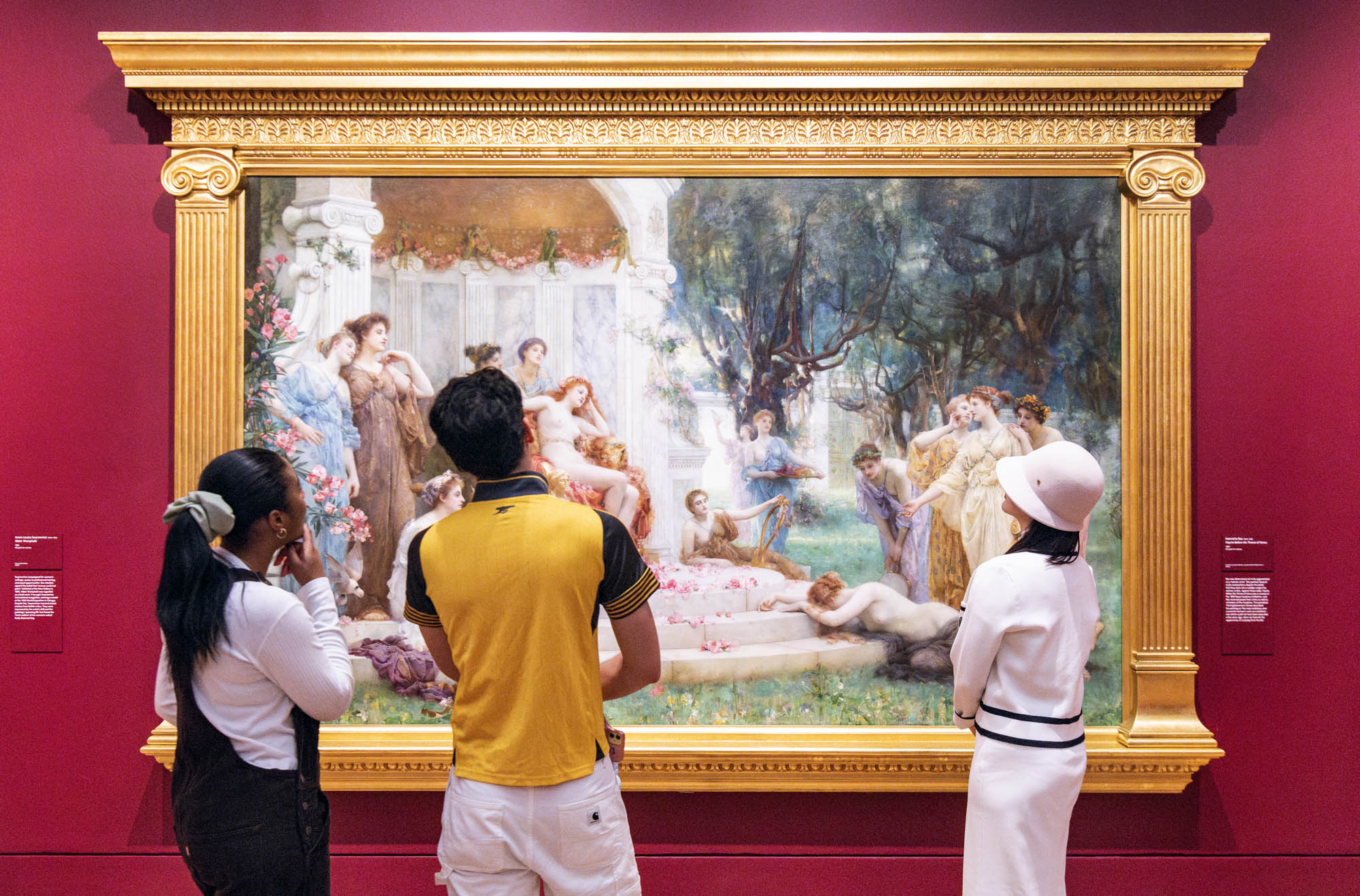
 

Installation view of the exhibition 'Now You See Us Women Artists in Britain 1520-1920' at Tate Britain showing Henrietta Rae's 'Psyche before the throne of Venus' 1894


Installation view of the exhibition Now You See Us Women Artists in Britain 1520-1920 at Tate Britain showing Henrietta Rae’s Psyche before the throne of Venus 1894 (below)
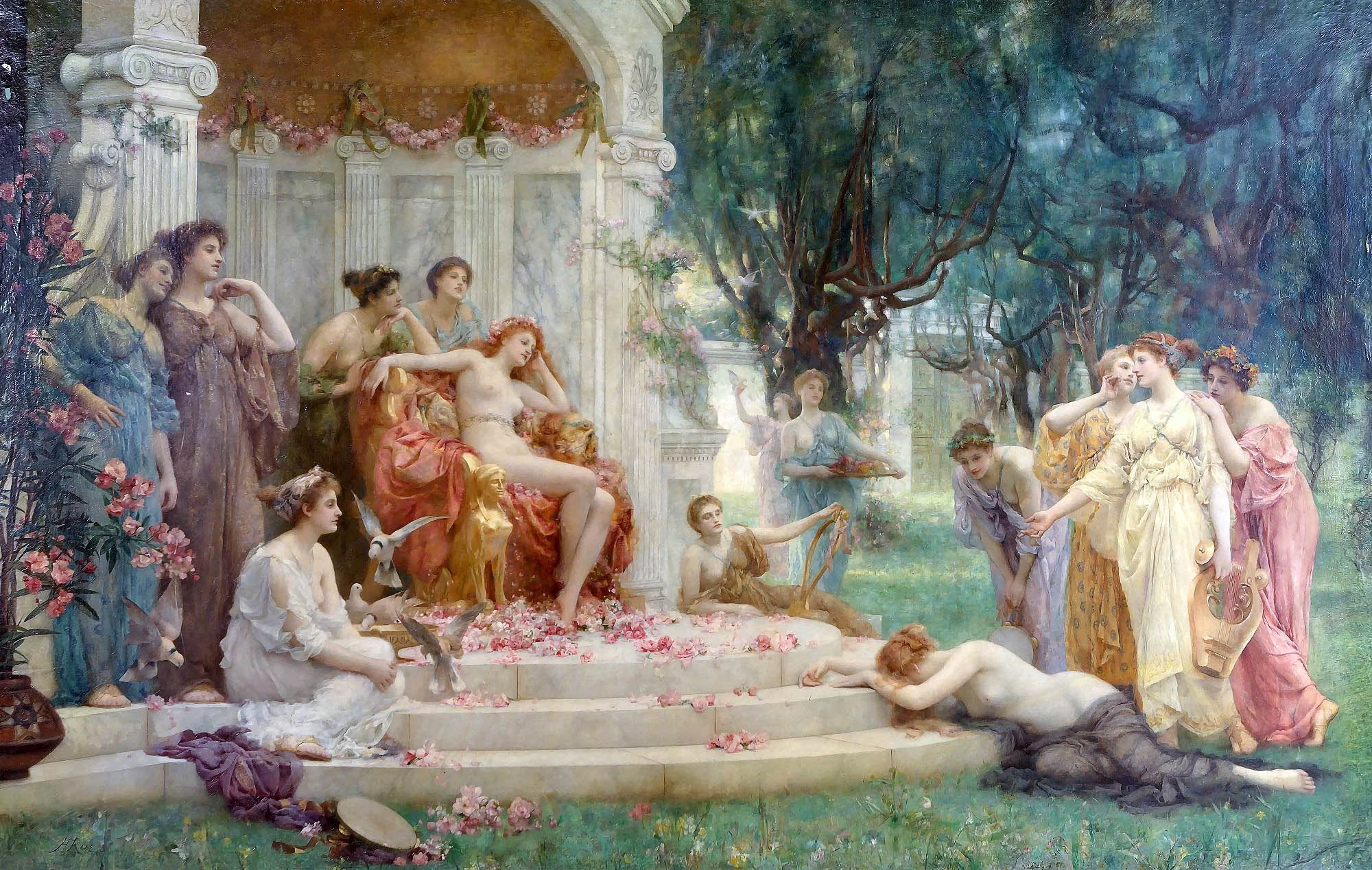
 

Henrietta Rae (British, 1859-1928) 'Psyche before the throne of Venus' 1894


Henrietta Rae (British, 1859-1928)
Psyche before the throne of Venus
1894
Oil paint on canvas
Support: 1941 × 3058 × 31 mm
Frame: 2525 × 3826 × 270 mm
Lent from a private collection, courtesy of Martin Beisly Fine Art


Rae was determined not to be pigeonholed as a ‘woman artist’. She painted classical nude compositions despite the belief that they were not a suitable subject for women artists. Against these odds, Psyche Before the Throne of Venus was a success at the 1894 Royal Academy Exhibition, and Rae received praise from critics as well as members of the Academy. The periodical The Englishwoman’s Review described the painting as ‘the most ambitious and successful woman’s work yet exhibited – one which could not have been executed a few years ago, when we had not the opportunity of studying from the life’.

Text from the exhibition large print guide


Installation view of the exhibition 'Now You See Us Women Artists in Britain 1520-1920' at Tate Britain showing Lucy Kemp-Welch's 'Colt Hunting in the New Forest' 1897


Installation view of the exhibition Now You See Us Women Artists in Britain 1520-1920 at Tate Britain showing Lucy Kemp-Welch’s Colt Hunting in the New Forest 1897


One of the most important pieces of art ever inspired by the New Forest was a painting by Lucy Kemp-Welch (1869-1958), entitled ‘Colt Hunting in the New Forest’. This painting was exhibited at the Royal Academy in 1897, when she was only 26 years old. It was an impressive canvas measuring 1537 x 3060 mm (approximately 5ft x 10ft) and was described as depicting ‘a wide glade in the forest, along which race a number of colts unwilling to relinquish their liberty and to fall into the hands of the four mounted lads who try to catch them’.[1] Lucy Kemp-Welch was born in Bournemouth, in 1869, and spent much of her time wandering in the New Forest, where she ‘personally studied the wild ponies in this pleasant part of England’.[2] Her love of horses and wild ponies remained with her all her life. In order to capture the energy and excitement of the pony drifts for ‘Colt Hunting’ she actually had the full-sized canvas transported to the Forest, where she sketched from life, as the commoners galloped their ponies past her. When the painting was exhibited at the Royal Academy it caused a sensation and was promptly purchased for £525.00.[3] The buyers were trustees of the Chantrey Bequest, who administered a large sum of money left in the will of Sir F. L. Chantrey to obtain works of art by British artists, in order to create a national collection. It was only the third time, since its creation in 1875, that the Chantrey Bequest had purchased artwork by a woman. Lucy Kemp-Welch became a celebrity overnight.[4]

In the same year that Lucy Kemp-Welch exhibited ‘Colt Hunting in the New Forest’, the Tate Galley was built and her painting was transferred to this new, public collection. However, ‘Colt Hunting’ was immediately archived and has never been publicly exhibited. Indeed, there are rumours that the Tate Gallery loaned the painting to the Royal Academy during the Blitz ‘in the hope that the Luftwaffe’s friendly bombs might rid them of this monstrous woman’s work for good’.[5] It is difficult to conceive of the prejudice against women in the late Victorian period and early 20th century, particularly women such as Lucy Kemp-Welch, who stepped out of the roles proscribed to them by a patriarchal society.[6] Her sympathies for the suffragette movement certainly didn’t endear her to the male-establishment figures that controlled the art world. She nevertheless continued to paint and made a successful, and award winning (Paris Salon) career as an artist.

newforestcommoner. “Lucy Kemp-Welch: Colt Hunting in the New Forest,” on the New Forest Commoner website November 27, 2016 [Online] Cited 28/08/2024
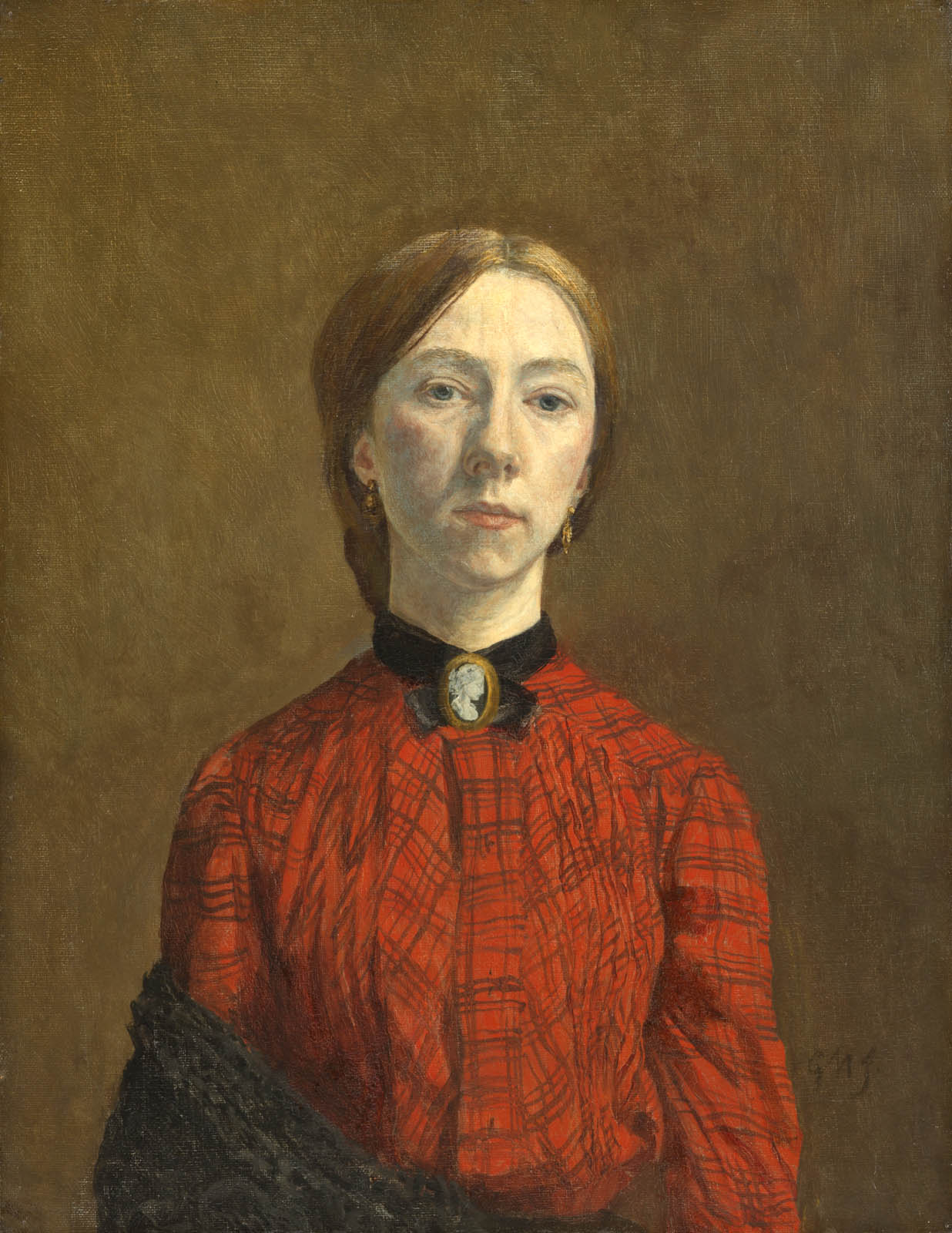
 

Gwen John (Welsh, 1876-1939) 'Self-Portrait' 1902


Gwen John (Welsh, 1876-1939)
Self-Portrait
1902
Oil on canvas
Tate
Purchased 1942
Photo: Tate (Mark Heathcote and Samuel Cole)


John exhibited this self-portrait at the New English Art Club (NEAC) in 1900. It was her debut as an exhibitor. The NEAC had been founded as a forward-thinking artists’ group, created out of dissatisfaction with the art establishment, exemplified by the conservative Royal Academy. Tutors from the Slade, where John had trained, were on the NEAC committee. Despite its progressive stance, in 1900 John was one of only 16 women exhibitors among 75 men. John’s choice to show a self-portrait was perhaps a deliberate assertion of her presence.

Text from the exhibition large print guide


Here is a dilemma straight away: which should take precedence, the painting or the fact? Should the show present art on its own terms, or as instance, evidence, expression of social history? It is an extremely complex remit…

[Laura] Knight is strongly represented with a sequence of cliff-edge paintings; but what about her near-namesake, Winifred Knights? The Deluge is a shattering masterpiece of British modernism, painted in 1920 and thus eligible, yet not here. And why are the ethereal and supremely original blue cyanotypes of Anna Atkins (1799-1871) missing from the niggardly photography section, along with Christina Broom (1862-1939), pioneering photojournalist, whose stirring portraits of suffragettes would have been so apt?

The show is thick with flowers, descending from Delany right down to Helen Allingham’s twee cottage gardens, all ready for their postcard reproductions. And if Allingham, then why not the visionary genius of Beatrix Potter? Weak pre-Raphaelite schlock fills the largest gallery, along with Victorian pieties such as Emily Osborn’s distressed gentlewoman, eyes downcast, awaiting the verdict of a dealer on her latest canvas, while two male artists leer in the background. Nameless and Friendless is terminally mawkish.

Only rarely do women’s art and women’s history spark together in this show. You see it in Ethel Wright’s fabulous 1912 portrait of the suffragette Una Dugdale Duval, in an arsenical green dress beneath a wallpaper of ludicrous fighting cocks, where Wright’s modern bravado exactly meets that of her sitter. And you see it in Gwen John’s immortal 1902 self-portrait, small and distanced, light catching her eyelashes in an atmosphere of hushed stillness, so direct and yet so self-contained: the momentous assertion of reticence.

That epochal image appears on the exhibition posters, perhaps promising too much. For even the best of the artists here are occasionally represented by the least of their works, quite apart from the mystifying omissions. The theme of Now You See Us is undoubtedly riveting. The captions (and the excellent catalogue) are superbly written. But art is trumped by social history too often in this show, words overshadowing images.

Laura Cumming. “Now You See Us: Women Artists in Britain 1520-1920 review – revelations and mystifying omissions,” on The Guardian website 19 May 2024 [Online] Cited 02/09/2024


Gwen John (Welsh, 1876-1939) 'Chloë Boughton-Leigh (1868-1947)' 1904-1908


Gwen John (Welsh, 1876-1939)
Chloë Boughton-Leigh (1868-1947)
1904-1908
Oil on canvas
58.4 x 38.1cm
Tate
Purchased 1925


Gwendolen Mary John (22 June 1876 – 18 September 1939) was a Welsh artist who worked in France for most of her career. Her paintings, mainly portraits of anonymous female sitters, are rendered in a range of closely related tones. Although in her lifetime, John’s work was overshadowed by that of her brother Augustus and her mentor and lover Auguste Rodin, awareness and esteem for John’s artistic contributions has grown considerably since her death.

Gwen John trained at the Slade School of Art in London, where her brother Augustus was also a student. She settled in Paris in 1904, working as a model, becoming Rodin’s mistress and immersing herself in the artistic world of the metropolis. She lived in France for the rest of her life, exhibiting on both sides of the Channel. The portrait shown here is of a Paris friend, Chloë Boughton-Leigh. The subdued colouring, short foreground and self-absorption of the sitter create a deeply intense atmosphere. John showed it in London, at the New English Art Club.

Text from the WikiArt website


Minna Keene (née Bergmann, Canadian born Germany, 1861-1943) 'Decorative Study No. 1, Pomegranates' c. 1906


Minna Keene (née Bergmann, Canadian born Germany, 1861-1943)
Decorative Study No. 1, Pomegranates
c. 1906
Carbon print


The subject of this photograph is believed to be of Violet Keene, Minna Keene’s daughter.
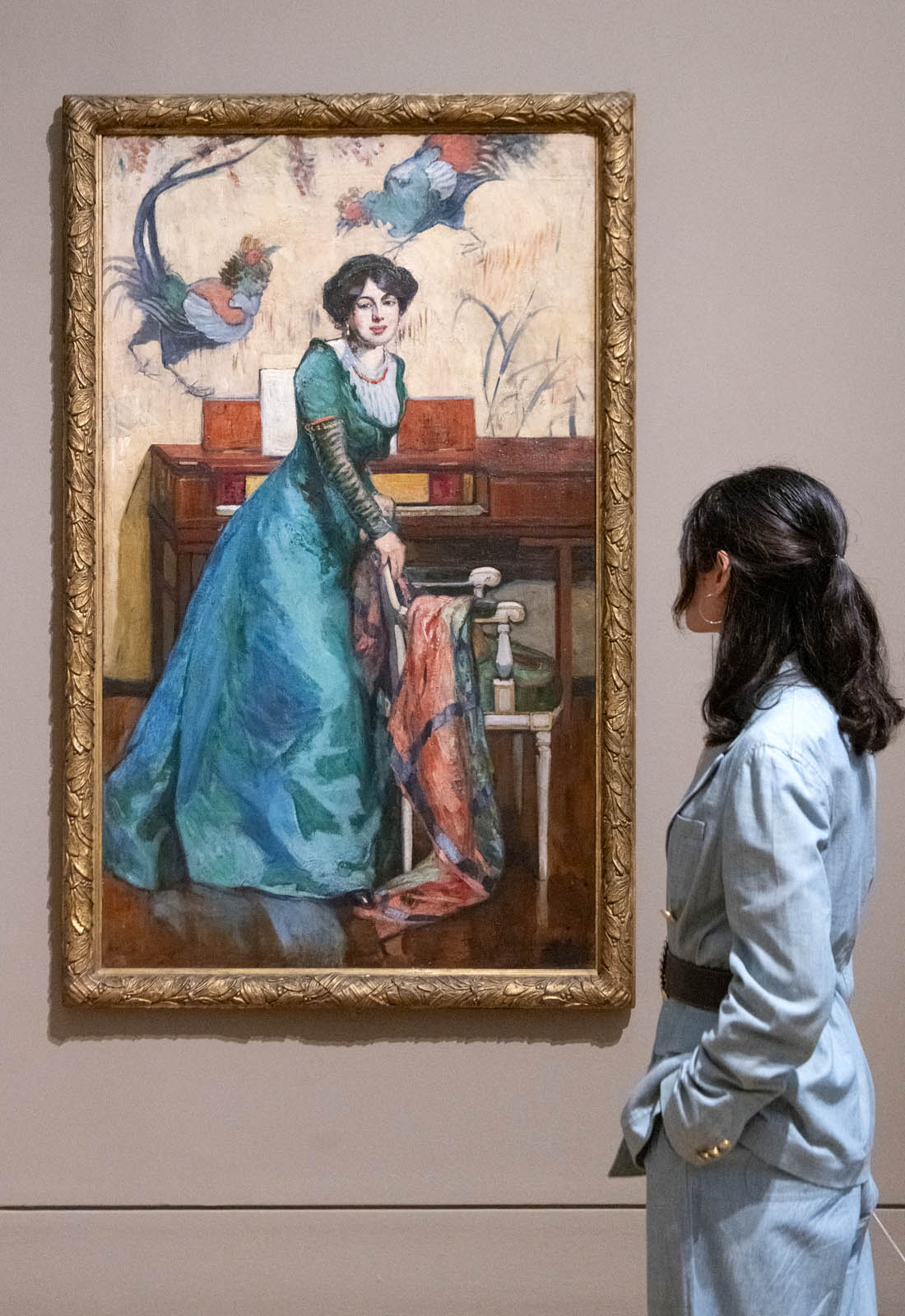
 

Installation view of the exhibition 'Now You See Us Women Artists in Britain 1520-1920' at Tate Britain showing Ethel Wright's 'The Music Room, Portrait of Una Dugdale' 1912


Installation view of the exhibition Now You See Us Women Artists in Britain 1520-1920 at Tate Britain showing Ethel Wright’s The Music Room, Portrait of Una Dugdale 1912 (below)


Ethel Wright (British, 1866-1939) 'The Music Room, Portrait of Una Dugdale' 1912 (installation view)


Ethel Wright (British, 1866-1939)
The Music Room, Portrait of Una Dugdale (installation view)
1912
Oil on canvas
Private collection


This portrait of suffragette and women’s rights activist Una Dugdale Duval (1879-1975) was exhibited at the Stafford Gallery in October 1912. Its flat areas of colour and bold outlines represent a stylistic shift for Wright, who had exhibited at the Royal Academy since the 1880s. Wright shows Duval as cultured and sophisticated, dressed in green, a suffrage colour. Wright made the work the same year Duval made national news for her refusal to promise to obey her husband during their marriage vows. In 1913, Duval published a pamphlet, Love and Honour but Not Obey.

Text from the exhibition large print guide
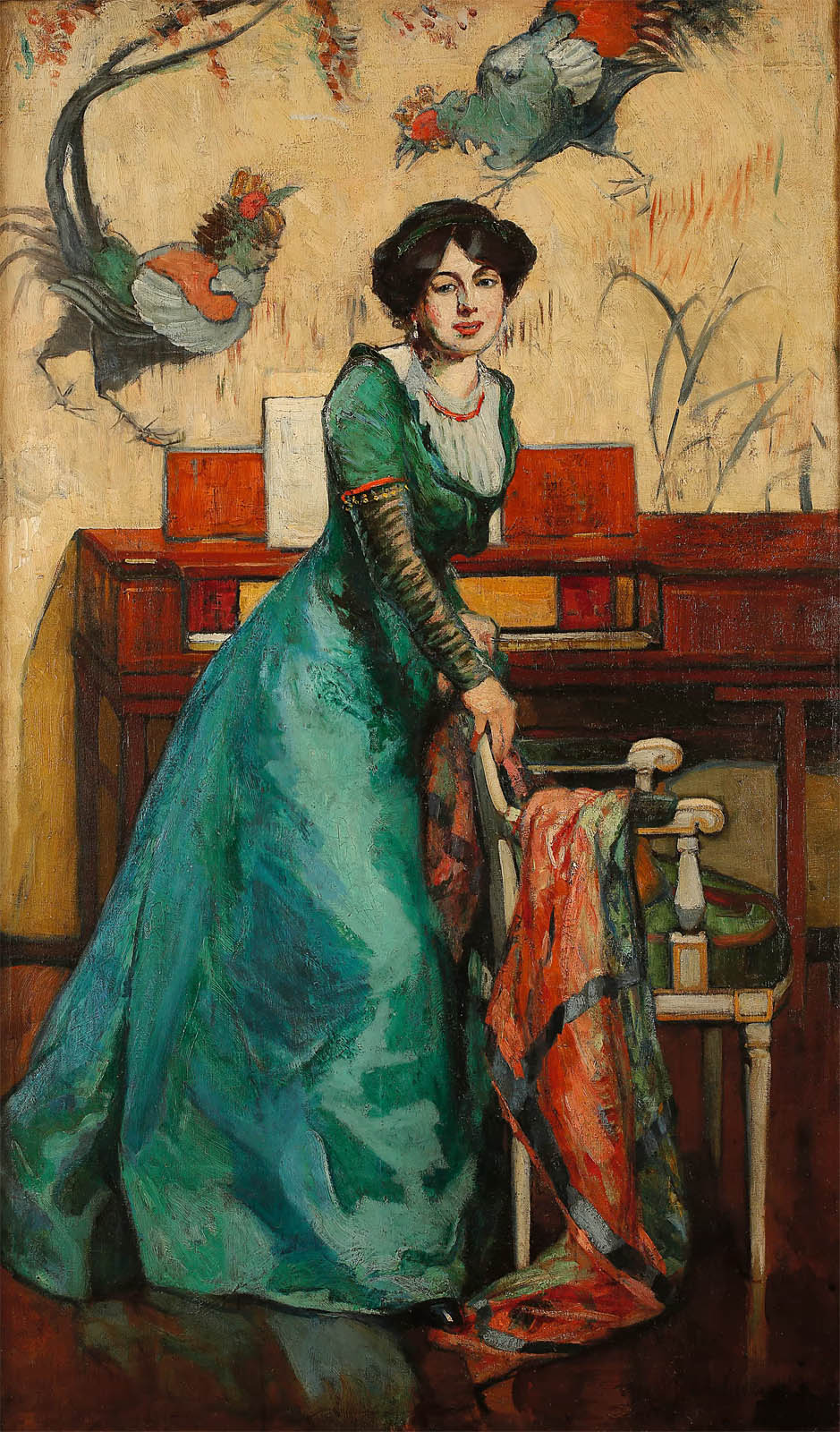
 

Ethel Wright (British, 1866-1939) 'The Music Room, Portrait of Una Dugdale' 1912


Ethel Wright (British, 1866-1939)
The Music Room, Portrait of Una Dugdale
1912
Oil on canvas
Private collection


Vanessa Bell (English, 1879-1961) 'Still Life on Corner of a Mantelpiece' 1914


Vanessa Bell (English, 1879-1961)
Still Life on Corner of a Mantelpiece
1914
Oil on canvas
Support: 559 × 457 mm
Frame: 614 × 512 × 49 mm
Tate
Purchased 1969
© Estate of Vanessa Bell


In 1913, Bell left the Friday Club for the short-lived exhibiting society, the Grafton Group. It included artists who were experimenting with post-impressionism. She was also a founding member of the Omega Workshops. Based in Bloomsbury’s Fitzroy Square, the Workshops aimed to remove the false divisions between fine and decorative arts. The mantelpiece in this painting was in Bell’s house at 46 Gordon Square in London. The objects on it include handmade paper flowers from the Omega Workshops. Bell’s use of an unconventional low viewpoint, fractured, abstracted forms and bright colours show her exploring different techniques associated with twentieth-century art movements.

Text from the exhibition large print guide


Dame Laura Knight DBE RA RWS (English, 1877-1970) 'A Dark Pool' 1917


Dame Laura Knight DBE RA RWS (English, 1877-1970)
A Dark Pool
1917
Oil on canvas
460 × 458 mm
Tyne & Wear Archives & Museums, Laing Art Gallery, Newcastle upon Tyne
© Estate of Dame Laura Knight. All rights reserved 2024 / Bridgeman Images
Image credit: Laing Art Gallery


Anna Airy (English, 1882-1964) 'Shop for Machining 15-inch Shells: Singer Manufacturing Company, Clydebank, Glasgow' 1918


Anna Airy (English, 1882-1964)
Shop for Machining 15-inch Shells: Singer Manufacturing Company, Clydebank, Glasgow
1918
Oil on canvas
Support: Height 1828 mm., Width 2133 mm
© Imperial War Museum


In 1918, Airy received a commission from the Imperial War Museum, thereby becoming Britain’s first official woman war artist. Her 1.7 by 1.8-metre canvases depict munitions production and war-related heavy industry. She later recalled the hot and dangerous conditions in which she worked. A former Slade student, Airy enjoyed a high public profile, won through exhibition and good reviews at the Royal Academy. In 1915, an art critic hailed her as ‘the most accomplished artist of her sex’. Airy was aware, however, of the prejudice women artists still faced. Galleries and buyers, she said, felt ‘safer with a man’.

Text from the exhibition large print guide
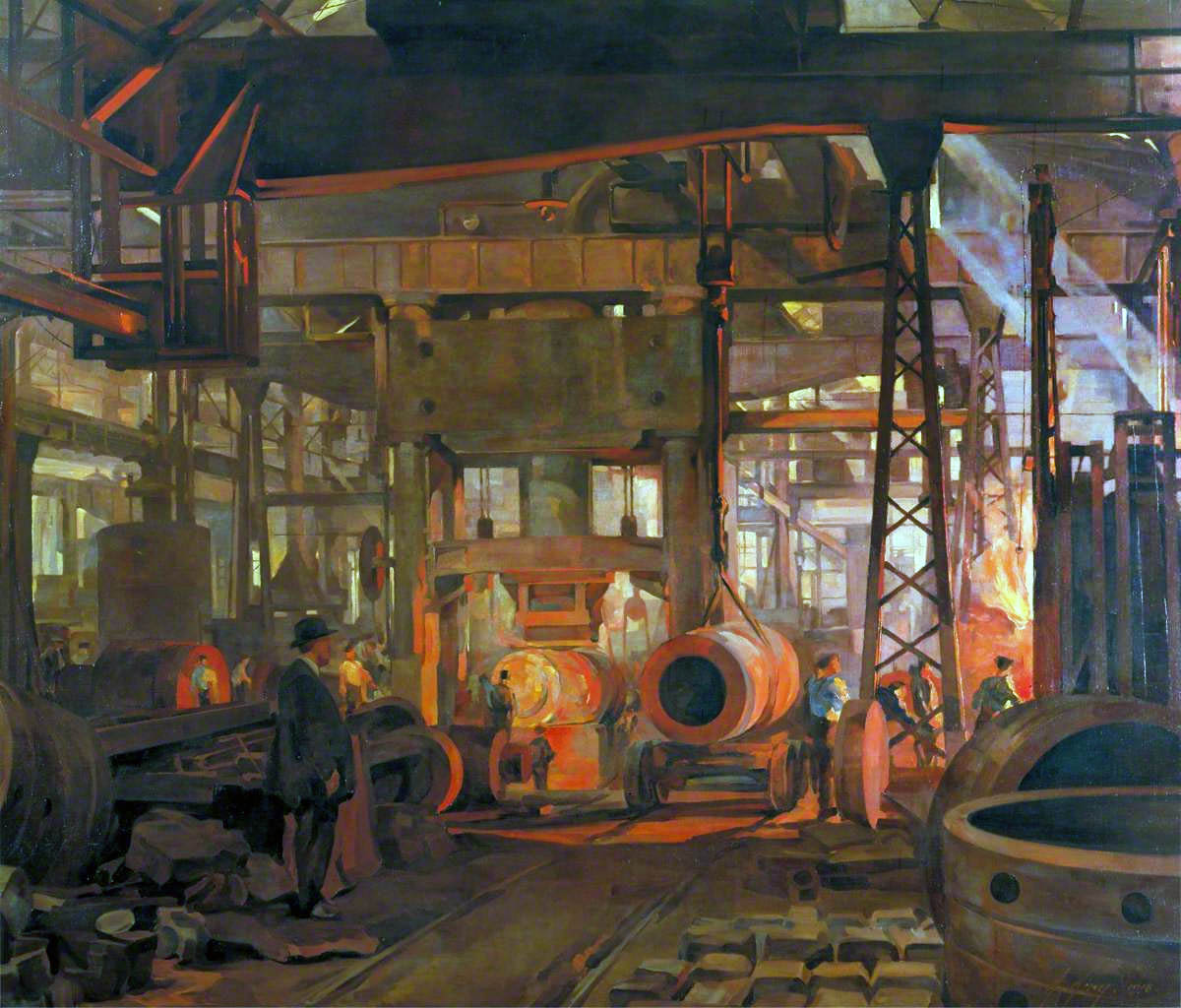
 

Anna Airy (English, 1882-1964) 'Study for 'The L Press: Forging the Jacket of an 18-inch Gun, Armstrong-Whitworth Works, Openshaw'' 1918


Anna Airy (English, 1882-1964)
Study for ‘The L Press: Forging the Jacket of an 18-inch Gun, Armstrong-Whitworth Works, Openshaw’
1918
Oil on canvas
Private collection
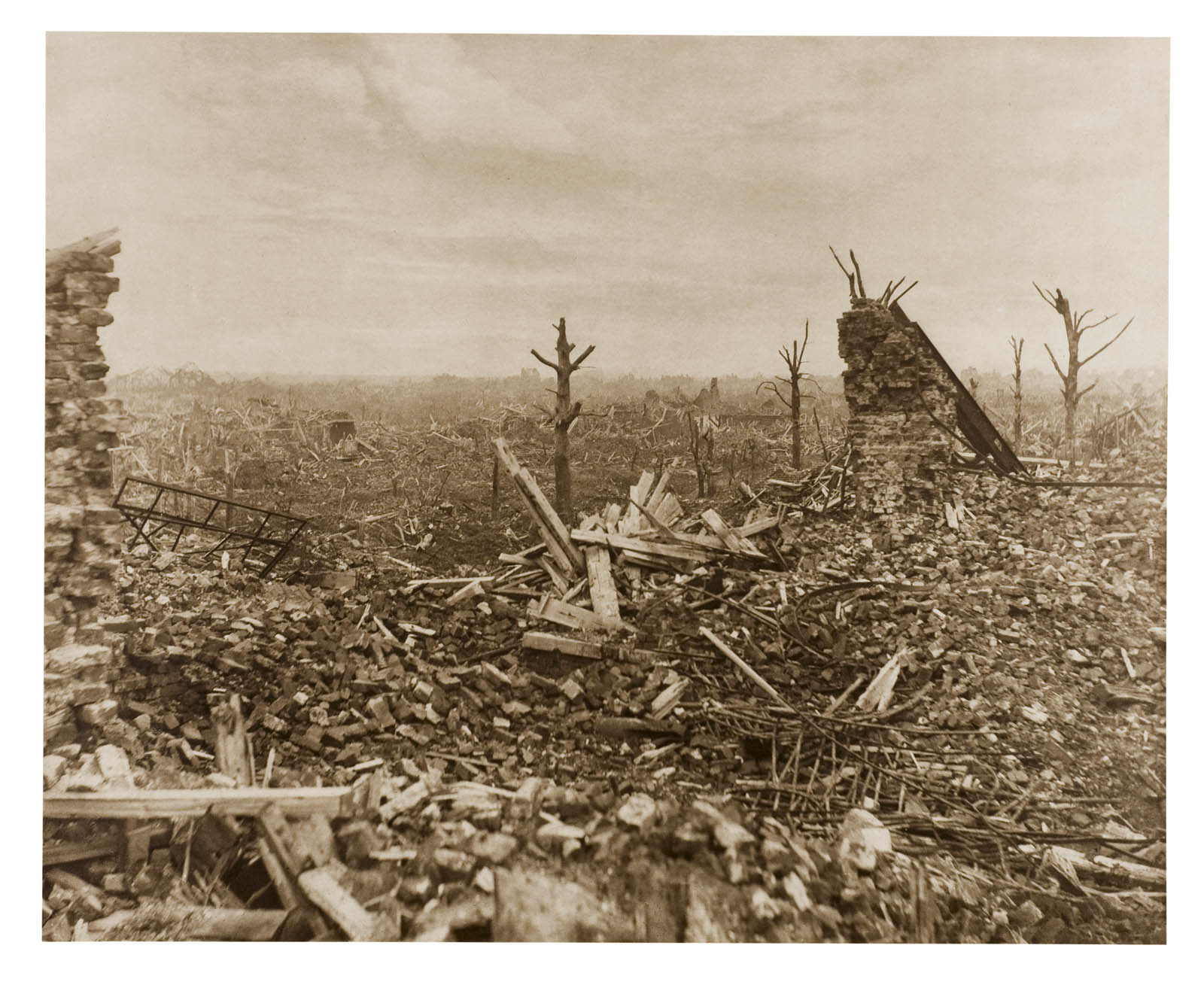
 

Olive Edis (British, 1876-1955) 'War' 1919


Olive Edis (British, 1876-1955)
War
1919
Carbon print on paper
Wilson Centre for Photography


Edis was Britain’s first woman war photographer. She was commissioned by the Imperial War Museum to photograph the activities of servicewomen on duty in France and Flanders. This bleak, blasted landscape captures the impact of the First World War.

Text from the exhibition large print guide


Installation view of the exhibition 'Now You See Us Women Artists in Britain 1520-1920' at Tate Britain


Installation view of the exhibition Now You See Us Women Artists in Britain 1520-1920 at Tate Britain showing Dame Ethel Walker’s Decoration The Excursion of Nausicaa 1920 (below)
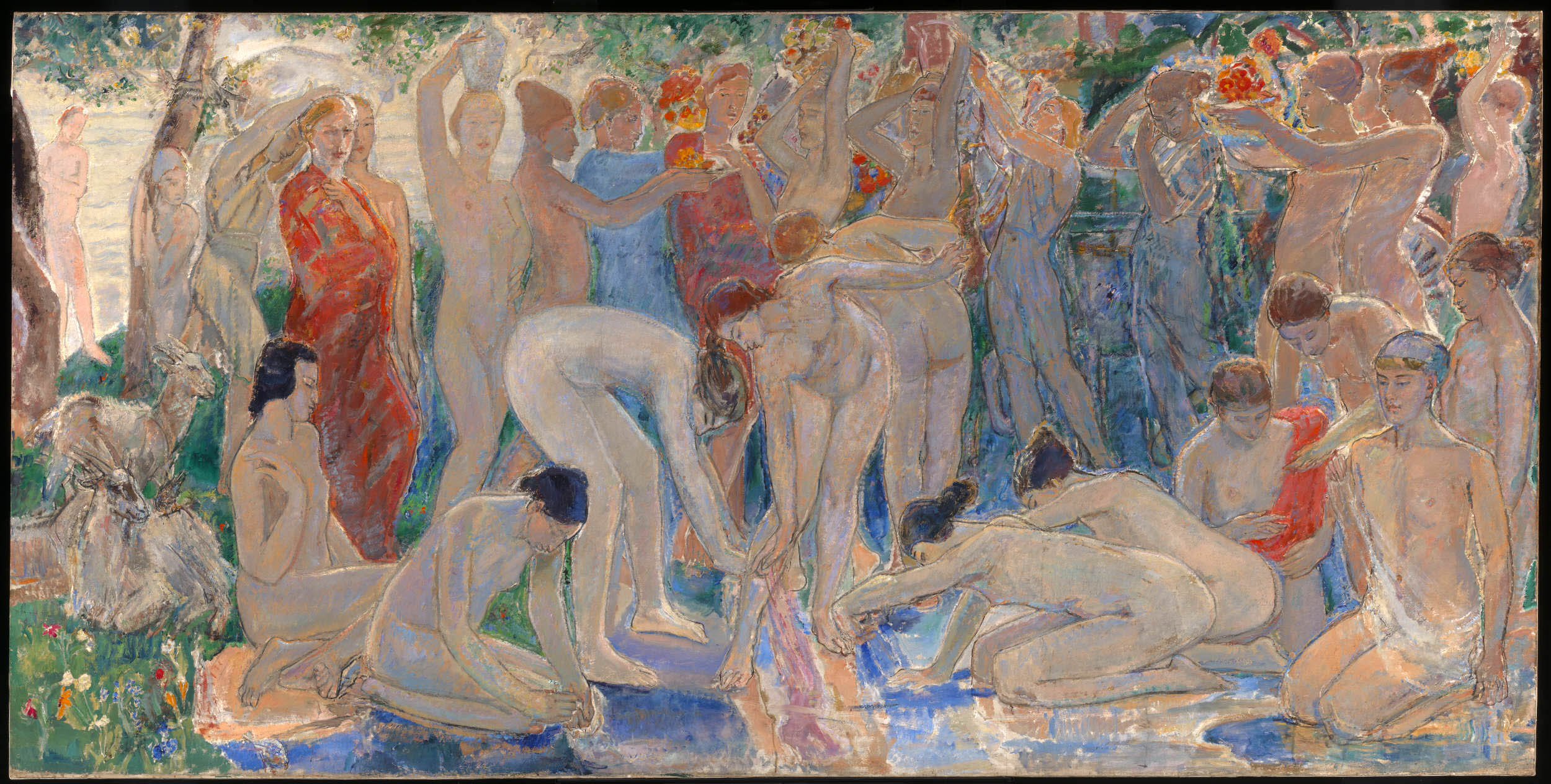
 

Dame Ethel Walker DBE ARA (Scottish, 1861-1951) 'Decoration: The Excursion of Nausicaa' 1920


Dame Ethel Walker DBE ARA (Scottish, 1861-1951)
Decoration: The Excursion of Nausicaa
1920
Oil on canvas
1835 × 3670 mm
Tate
Purchased 1924
Photo: Tate


Writing to J. B. Manson (Monday, 2 June, no year given, but almost certainly 1924), the artist described her work thus:’… Nausicaa early one lovely summer’s morning goes to her father and mother – the King and Queen – to ask permission to have a waggon and mules given to her to take her and her attendants and to fill it with the clothes of the palace that require washing, also with dainties and wine and good food for a forthcoming picnic – and go down to the river adjoining the sea to wash them – which he gives her. On arriving at the river they unharness the mules and are unpacking or unloading the waggons of the clothes and the food for the picnic, and are beginning to wash them in the river. A little wood divides the sea from the river where the goat girl – kneeling by the tree near her goats – hears the strange voices that are sounding in her usually silent little wood. To show it is the sea a girl, nude, has stepped up on to the bank after bathing….’ The story is based on Book VI of the Odyssey: ‘… they spread/The raiment orderly along the beach/Where dashing tides …/… leaving the garments, stretch’d/ In noon-day fervour of the sun, to dry.’

Text from the Tate website


In her lifetime Scottish artist Ethel Walker was celebrated for her trailblazing paintings of the female form. A teacher before she painted fulltime, she developed her own unique style – large, mural-like paintings, which she called her ‘decorations.’ Walker often painted male and female nudes confidently placing female sensuality at the centre of her work, as seen in Decoration: The Excursion of Nausicaa (1920). Its dream-like vision of a feminist utopia was ahead of its time.

Working steadily for decades, she achieved many professional milestones, exhibiting around the world and representing Britain at the Venice Biennale four times. In 1943, Walker was made a Dame of the British Empire, and after her death The Times called her ‘the most important woman artist of her time.’ Despite this, it is only now that her artistic legacy is finally being recognised.

Text from the Tate website


‘There is no such thing as a woman artist. There are only two kinds of artist – bad and good.’

– Ethel Walker


Tate Britain
Millbank, London SW1P 4RG
United Kingdom
Phone: +44 20 7887 8888

Opening hours:
10.00am – 18.00pm daily

Tate Britain website

LIKE ART BLART ON FACEBOOK

Back to top

Exhibition: ‘Álbum de salón y alcoba (The Bedroom and Dressing Room Album). Instalación de David Trullo’ at Museo Nacional de Artes Decorativas, Madrid

Exhibition dates: 24th April – 22nd September, 2024


Kaulak (Antonio Cánovas del Castillo y Vallejo) (Spanish, 1862-1933) 'Studio portrait' 1921-1922


Kaulak (Antonio Cánovas del Castillo y Vallejo) (Spanish, 1862-1933)
Studio portrait
1921-1922
Photographic positive
Museo Nacional de Artes Decorativas, Madrid


Kaulak (22 December 1862 – 13 September 1933), was a Spanish photographer, art critic, editor and amateur painter. His uncle was prime minister Antonio Cánovas del Castillo, assassinated in 1897 by an anarchist, hence his use of a pseudonym; the meaning of which is unexplained, although the word appears to be of Basque origin.


What fabulousesness!

An archive of ‘galant photography’ and other art works illustrating the intimate public and private scenes of a couple in Spain in the 1920s-1930s which builds a memory, a narrative. The exhibition combines photographs and documentation of the most varied kinds, with elements of the daily life of its time.
“… above all [the exhibition] makes us reflect on our own archives: what we keep and what we discard, what we hide and what we reveal, how we build and invent our own history, how we want to be remembered and what we leave to those who come after us.”

The appreciation and enjoyment of difference pictured through photography and art, telling a story otherwise long forgotten.

I have added appropriate bibliographic text where possible.

Dr Marcus Bunyan


Many thankx to the Museo Nacional de Artes Decorativas for allowing me to publish the photographs in the posting. Please click on the photographs for a larger version of the image.


Anonymous photographer. 'Portrait' c. 1935


Anonymous photographer
Portrait
c. 1935
Photographic positive
Museo Nacional de Artes Decorativas, Madrid


The Museo Nacional de Artes Decorativas (MNAD) in Madrid, a state museum of the Ministry of Culture of Spain, joins the PHotoESPAÑA 2024 festival with the opening of Álbum de salón y alcoba. Una instalación de David Trullo, which can be visited free of charge until September 22.

From a forgotten collection that contained public -or living room- photographs and private -or bedroom- scenes of a couple in the 20s and 30s of the last century, the visual artist David Trullo has made this exhibition. The installation is “the result of opening an unnoticed time capsule and putting it in context with pieces from the museum and other collections to explore the limits of intimacy, leading the viewer to surpass them.”

In addition to putting a “rediscovered treasure” into context, the installation offers a review of how photographic documentation is exhibited and interpreted. It also proposes to reflect “on our own archives: what we keep and what we discard, what we hide and what we reveal, how we construct and invent our own history, how we want to be remembered and what we leave to those who come after us.”

The installation is, in itself, an album that captures the intimacy and public life of the 1920s and 1930s, combining the most varied photographs and documentation with elements of the everyday life of her time. It includes pieces and archives from several private collections, the Museo Sorolla, the Muséu del Pueblo d’Asturies, the Museo Nacional del Teatro de Almagro, the Asociación para la Enseñanza de la Mujer-Fundación Fernando de Castro and the Museo de Historia de Madrid, among others.

Between “the living room” and “the bedroom” a route is traced that goes from the preservation of intimate albums – among which a positive by Kaulak stands out, – through the first advances in amateur photography, to the ‘galant photography’, more or less erotic, and other genres of popular culture that include among its protagonists Tórtola Valencia, Sara Montiel, Conchita Piquer or the queer copla singer Miguel de Molina.

Text from the Museo Nacional de Artes Decorativas website


'Advertising design for 'Florido y Cía'' (Florido and Co.) c. 1930


Advertising design for ‘Florido y Cía’ (Florido and Co.)
c. 1930
Watercolour on paper
Museo Nacional de Artes Decorativas, Madrid


Anonymous photographer. 'Miguel de Molina' 1937


Anonymous photographer
Miguel de Molina
1937
Photographic positive
Colección Pedro Víllora


Miguel Frías de Molina (Málaga, April 10, 1908 – Buenos Aires, March 4, 1993), known artistically as Miguel de Molina, was a Spanish singer of copla. Tortured, expelled from Spain and later persecuted by the Franco dictatorship for being a “faggot and a red”, he settled in Argentina in 1946, invited by Eva Perón.

He had an unmistakable personal style combining cabaret, flamenco dancing, deep vocal emotionalism, spectacular costumes and a narcissistic stage persona that made him extremely popular with audiences. His gay identity was openly acknowledged with a sense of humour that was very close to what today would be recognised as ‘low camp.’ Between 1936 and 1942 Molina spent most of the Spanish Civil War on Republican ground. This together with his homosexuality and sympathies for the Left had disastrous consequences for his career. He left Spain for Argentina, where he was hugely successful. But life in exile was not easy and the Argentinean government soon threatened him with expulsion. Molina credited the direct intervention of Eva Perón with helping him stay in the country and continue his career. Unfortunately his overt support for the Perón government made him a despised figure once the Peróns were driven from power. The rampant homophobia of the changed political climate and the cultural shift that accompanied it proved detrimental to his mental and emotional health, prompting him to withdraw from artistic life in 1960. While many personalities who were faced with persecution under Francoism were being rediscovered in the 1980s, Molina, by then bitter and withdrawn, languished in obscurity. It was not until two films that celebrated his life were released a decade later that his uniquely stylised performances and colourful life would finally be celebrated.

Anonymous. “Miguel de Molina – Nominee,” on The Legacy Project website Nd [Online] Cited 21/08/2024


Anonymous maker. 'Fan' c. 1925


Anonymous maker
Fan

c. 1925
Lacquered wood and painted and corrugated paper
Museo Nacional de Artes Decorativas, Madrid
Photo: Masú del Amo


Bruno Zach (Austrian born Ukraine, 1891-1935) (designer) 'Figure of a woman with a fur coat' c. 1920


Bruno Zach (Austrian born Ukraine, 1891-1935) (designer)
Figure of a woman with a fur coat
c. 1920
Cast bronze
Museo Nacional de Artes Decorativas, Madrid
Photo: Fabián Álvarez


Bruno Zach (6 May 1891 – 20 February 1935) was an Austrian art deco sculptor of Ukrainian birth who worked in the early-to-mid 20th century. His output included a wide repertoire of genre subjects, however he is best known for his erotic sculptures of young women.


'Muchas Gracias' (Thank You) Magazine, Year VII - No. 344' September 13, 1930


Muchas Gracias (Thank You) Magazine, Year VII – No. 344
September 13, 1930
Museo Nacional de Artes Decorativas, Madrid


Translated text at the bottom of the magazine:

Thank you very much
For this rascal
We want to tell this little bitch that it fits her well. But we stumbled upon the fit.


Oswald Haerdtl (Austrian, 1899-1959) 'Cocktail set' 1924


Oswald Haerdtl (Austrian, 1899-1959)
Cocktail set
1924
mouth-blown glass
Museo Nacional de Artes Decorativas, Madrid
Photo: Lucía Morate


Oswald Haerdtl was an important Austrian architect, designer, and architecture teacher.

He studied under Kolo Moser and Oskar Strnad at the Wiener Kunstgewerbeschule, and entered Josef Hoffmann’s master class in 1922, soon becoming his assistant. From 1935 to 1959, he was head of the architecture department. His teaching, architectural projects, and international connections, to Italy and France in particular, made him a lasting influence on post-war Modernism in Vienna, bringing a sense of lightness and elegance into the design vocabulary.

Text from the J & L Lobmeyr website


Ramón Peinador Checa (Spanish, 1897-1964) Advertising design for 'Perfumes Oriente' 1925


Ramón Peinador Checa (Spanish, 1897-1964)
Advertising design for ‘Perfumes Oriente’
1925
Wash on paper
Museo Nacional de Artes Decorativas, Madrid
Photo: Javier Rodríguez Barrera


Ramón Peinador Checa (Madrid, December 25, 1897 – Mexico City, May 26, 1964) was a Spanish painter, draftsman, engraver, illustrator, designer and decorator who, exiled in Mexico, became a naturalised citizen of that country.


Photography lies and deceives us. What the camera shows us is staged, either by us or by the eye of the person who creates the images. What we commonly call a “photographic archive” is nothing more than a fragmented collection transformed over the years, with which a memory, a narrative, is built.

From a forgotten collection containing public photographs -or from the living room- and private scenes -or from the bedroom- of a couple in the twenties and thirties of the last century, the visual artist David Trullo proposes this installation.

It is the result of opening an unnoticed time capsule and putting it in context with the pieces of the twentieth century that put an end to the monopoly of the professional photographer. Cameras and processes are simplified and photography is becoming an essential accessory for any occasion, and not only for amateurs, including the female sector: the Kodak Petite from 1926 is promoted as a camera ‘for smart and modern girls’.

In addition to putting a rediscovered treasure into context, the installation proposes a review of the way photographic documentation is displayed and interpreted, but above all it makes us reflect on our own archives: what we keep and what we discard, what we hide and what we reveal, how we build and invent our own history, how we want to be remembered and what we leave to those who come after us.

During this period, Madrid reinvented itself and became as cosmopolitan as other European cities, although it was the bourgeois and aristocratic elites who truly enjoyed it. A surprising and varied sexual atmosphere also emerged, along with new ways of understanding bodies, identities and relationships that were reflected in publications, advertising and photography, with the so-called ‘galant photography’ flourishing within it.

The National Museum of Decorative Arts joins PHotoESPAÑA 2024 with David Trullo’s installation ‘Album of living room and bedroom’

~ With a selection of images from the public and the private, the visual artist discovers a photographic capsule that time has preserved to be reread from the present day

~ The tour includes everything from photographic positives by Kaulak to portraits of Sara Montiel, Conchita Piquer or the queer copla singer Miguel de Molina

The National Museum of Decorative Arts (MNAD), a state museum of the Ministry of Culture, is joining the PHotoESPAÑA 2024 festival with the inauguration of ‘Album of living room and bedroom. Installation by David Trullo’, which can be visited free of charge until September 22.

From a forgotten collection containing public photographs  – or from the living room –  and private scenes  – or from the bedroom – of a couple in the 1920s and 1930s, the visual artist David Trullo has created this proposal. The installation is “the result of opening an unnoticed time capsule and putting it in context with the pieces from the museum and from other collections to explore the limits of intimacy, leading the viewer to surpass them.”

In addition to putting a “rediscovered treasure” into context, the installation offers a review of the way of exhibiting and interpreting photographic documentation. It also suggests reflecting “on our own archives: what we keep and what we discard, what we hide and what we reveal, how we build and invent our own history, how we want to be remembered and what we leave to those who come after us.”
From living room to bedroom

The installation is, in itself, an album that captures the intimacy and public life of the 1920s and 1930s, combining photographs and documentation of the most varied kinds, with elements of the daily life of its time. It features pieces and archives from various private collections, from the Sorolla Museum, the Muséu del Pueblo d’Asturies, the Museo Nacional del Teatro de Almagro, the Asociación para la Enseñanza de la Mujer-Fundación Fernando de Castro or the Museo de Historia de Madrid, among others. Between “the living room” and “the bedroom” there is a journey that goes from the conservation of intimate albums – among which a positive by Kaulak stands out – through the first advances in photography for amateurs, to reaching ‘galant photography’, more or less erotic, and other genres of popular culture that include among their protagonists Tórtola Valencia, Sara Montiel, Conchita Piquer or the queer copla singer Miguel de Molina.
Text from the National Museum of Decorative Arts exhibition press dossier


Antonio Peyró (Spanish, 1882-1954) 'The Baticola (Elena Plá Toda)' 1934


Antonio Peyró (Spanish, 1882-1954)
The Baticola (Elena Plá Toda)
1934
Glazed ceramic
Museo Nacional de Artes Decorativas, Madrid
Photo: Masú del Amo


Antonio Peyró Mezquita was a Spanish ceramist.


''Reciprocal pleasure', cover by Josep Renau Berenguer' 1933


‘Reciprocal pleasure’, cover by Josep Renau Berenguer
1933
Museo Nacional de Artes Decorativas, Madrid
Photo: Masú del Amo


Josep Renau Berenguer (Spanish, 1907-1982) was an artist and communist revolutionary, notable for his propaganda work during the Spanish Civil War. Among his production, he is remarkable for his art deco period, his political propaganda during the Spanish Civil War, the photo murals of the Spanish Pavilion in the International Exhibition of 1937 in Paris, a series of photomontages titled Fata Morgana or The American Way of Life, and murals and paintings made in Mexico, such as Tropic, dated in 1945.

Text from the Wikipedia website


Louis Majorelle (French, 1859-1926) (designer) 'Sofa' 1901-1926


Louis Majorelle (French, 1859-1926) (designer)
Sofa
1901-1926
Silk velvet
Museo Nacional de Artes Decorativas, Madrid
Photo: Lucía Morate


Louis-Jean-Sylvestre Majorelle, usually known simply as Louis Majorelle, (26 September 1859 – 15 January 1926) was a French decorator and furniture designer who manufactured his own designs, in the French tradition of the ébéniste. He was one of the outstanding designers of furniture in the Art Nouveau style, and after 1901 formally served as one of the vice-presidents of the École de Nancy.

Louis Majorelle is one of those who contributed the most to the transformation of furniture. Thanks to posterity, we recognise today a piece of furniture from him as we recognise a piece of furniture from André Charles Boulle and Charles Cressent, the french Prince regent’s favourite artists. During the early 18th century, Cressent replaced the magnificence of ebony and tortoiseshell associated with tin and copper by the softer harmonies of foreign woods. Like him, Louis Majorelle dressed the elegant structure of Art Nouveau furniture with exotic wood inlays.

Text from the Wikipedia website


Álvaro Retana (Spanish born Philippines, 1890-1970) 'Figure for Celia Gámez' c. 1920


Álvaro Retana (Spanish born Philippines, 1890-1970)
Figure for Celia Gámez
c. 1920
Ink and graphite on paper
Colección Pedro Víllora


Álvaro Retana Ramírez de Arellano (Batangas, Philippines, August 26, 1890 – Torrejón de Ardoz, Madrid, February 10, 1970) was a writer, journalist, cartoonist, fashion designer, musician, libertine and Spanish couplet lyricist.

Celia Gámez Carrasco (August 25, 1905 – December 10, 1992) was an Argentinian film actress, and one of the icons of the Golden Age of Spanish theatre. She was more commonly known in Franco’s Spain, particularly in her later years, as La Protegida.


Vitín Cortezo (Spanish, 1908-1978) 'Figure for Celia Gámez' 1939


Vitín Cortezo (Spanish, 1908-1978)
Figure for Celia Gámez
1939
Mixed technique on paper
Colección Pedro Víllora


Víctor María Cortezo Martínez-Junquera, also known as Vitín Cortezo (Madrid, June 10, 1908 – March 2, 1978) was a Spanish painter, illustrator, costume designer and set designer.


Anonymous maker. 'Bloomers and cotton slip with silk knit stockings' c. 1930


Anonymous maker
Bloomers and cotton slip with silk knit stockings
c. 1930
Museo Nacional de Artes Decorativas, Madrid
Photo: Fabián Álvarez


Karl Klaus and Franz Staudigl 'Figure (Serapis Wahliss series)' 1913-1914


Karl Klaus and Franz Staudigl
Figure (Serapis Wahliss series)
1913-1914
Painted and glazed ceramic
Museo Nacional de Artes Decorativas, Madrid
Photo: Fabián Álvarez


Karl Klaus (Austrian, 1889-1925) was a student of Josef Hoffmann. The figure was designed for Serapis-Wahliss, a noted Viennese retailer and manufacturer of porcelain. Franz Staudigl was an Austrian painter born 1885 – died 1944.


Anonymous photographer. 'Concha Piquer' 1927


Anonymous photographer
Concha Piquer
1927
Photographic positive
Museo Nacional del Teatro, Almagro


María de la Concepción Piquer López (13 December 1906 – 12 December 1990), better known as Concha Piquer (and sometimes billed as Conchita Piquer), was a Spanish singer and actress. She was known for her work in the copla form, and she performed her own interpretations of some of the key pieces in the Spanish song tradition, mostly works of the mid-20th century trio of composers Antonio Quintero, Rafael de León y Manuel Quiroga.


Anonymous maker. 'Perfume bottles' 1850-1900


Anonymous maker
Perfume bottles
1850-1900
Engraved and gilded silver and blown glass
Museo Nacional de Artes Decorativas. Madrid
Photo: Fabián Álvarez


Anonymous maker / Paul Koruna, Paris (no dates) (photographer). 'Promotional poster for 'Rosalío'' Nd


Anonymous maker
Paul Koruna, Paris
(no dates) (photographer)
Promotional poster for ‘Rosalío’
Nd
Montage of photographic positives
Colección Ramón Gato


Anonymous maker / Paul Koruna, Paris (no dates) (photographer). 'Promotional poster for 'Rosalío'' Nd. 'Promotional poster for 'Rosalío'' Nd (detail)

Anonymous maker / Paul Koruna, Paris (no dates) (photographer). 'Promotional poster for 'Rosalío'' Nd. 'Promotional poster for 'Rosalío'' Nd (detail)

Anonymous maker / Paul Koruna, Paris (no dates) (photographer). 'Promotional poster for 'Rosalío'' Nd. 'Promotional poster for 'Rosalío'' Nd (detail)

Anonymous maker / Paul Koruna, Paris (no dates) (photographer). 'Promotional poster for 'Rosalío'' Nd. 'Promotional poster for 'Rosalío'' Nd (detail)


Anonymous maker
Paul Koruna, Paris (no dates) (photographer)
Promotional poster for ‘Rosalío’ (details)
Nd
Montage of photographic positives
Colección Ramón Gato


Anonymous maker. 'Manila shawl' 1876-1925


Anonymous maker
Manila shawl
1876-1925
Embroidered silk
Museo Nacional de Artes Decorativas, Madrid
Photos: Javier Rodríguez Barrera


National Museum of Decorative Arts
c/ Montalbán, 12. Madrid

Opening hours
Tuesday – Saturday: 9.30am – 3.00pm
Sundays and holidays: 10.00am – 3.00pm
Afternoons (Thursday): 5.00pm – 8.00pm

National Museum of Decorative Arts website

LIKE ART BLART ON FACEBOOK

Back to top

Exhibition: ‘Under Cover: J.C. Leyendecker and American Masculinity’ at the New-York Historical Society

Exhibition dates: 5th May – 13th August, 2023

Curator: Donald Albrecht


J.C. Leyendecker (American, 1874-1951) 'Ivory Soap It Floats' 1900 from the exhibition 'Under Cover: J.C. Leyendecker and American Masculinity' at the New-York Historical Society, May - August 2023


J.C. Leyendecker (American, 1874-1951)
Ivory Soap It Floats
Painting for Ivory soap advertisement, 1900
Gouache on board
Private collection
Image courtesy of the National Museum of American Illustration, Newport, RI


Featured in mainstream national magazines, ads for Ivory soap often depicted scenes of conventional domesticity. Some, however, were erotic, like this one by Leyendecker featuring a man in a floor-length robe, whose crotch is suggestively rendered.


The Eye of the Beholder

“Leyendecker’s subjects exemplify an elite white masculinity that was hardly representative of the diversity of the United States in his time, or since” observes Sonya Abrego. The artist’s subjects are white, cultured, privileged, “upholding racial, social and nationalist hierarchies”.

But how representations were and are understood depends on the eye of the beholder. At the time that Lyendecker was painting and illustrating commercial magazines his flirtatious subliminal erotic messages would have been all too decipherable to a knowing gay male readership – even as these very illustrations “passed” the scrutiny of heterosexual normativity. For gay men “passing” allowed them to hide their real identity and to fit into society without discrimination and fear of loosing their job, their home and/or going to jail.1 Leyendecker’s works both hide and transgress the taboo when they pass inspection.

For the initiated, Leyendecker’s paintings and illustrations were at the very heart of the subversion of hegemonic masculinity – “a practice that legitimises men’s dominant position in society and justifies the subordination of the common male population and women, and other marginalised ways of being a man.”2 Witness the man holding the “stiff rod” of the golf club in Men with Golf Clubs (c. 1909, below); the knowing looks of the two men in Men and Woman, Arrow Shirts with Golf Clubs and Collie (1910, below); the camp hands on hip languid pose of the man on the Cover of Saturday Evening Post (June 29, 1907, below) and the butcher, hand of hip, frontal crotch shot with Janet Jackson garment malfunction / nipple exposure that is Cover of Collier’s (June 24, 1916, below). The fact that some of the paintings such as Record Time, Cool Summer Comfort (c. 1920, below) feature Leyendecker’s lover of 48 years Charles A. Beach, only adds to the surreptitious nature of the paintings societal relationship. Much as the gay movie star Rock Hudson had to keep his private and public lives separate in order to “pass”, so Leyendecker kept his gay relationship a secret from the public.

While the exhibition would like us to address Leyendecker’s work within a broader context (according to curator Donald Albrecht talking about the artist in “gender terms, racial terms, sexual terms,” treating him in an intersectional way) – that is, through “the interconnected nature of social categorisations such as race, class, and gender as they apply to a given individual or group, regarded as creating overlapping and interdependent systems of discrimination or disadvantage”3 – this is only, and can only ever be, a post-post-posterior inflection on the rump of his work, a point of view wholly constructed in the present (the word and concept becoming popular after 1989 when the term ‘intersectionality’, which has its roots in Black feminist activism, and was originally coined by American critical legal race scholar Kimberlé Williams Crenshaw). Attitudes may have changed over the years and in some parts of the world, but to believe that heterosexual Black, white or Asian men would have understood the intersectional relationships in Leyendecker’s work back in the day is contemporary fairy floss. While it would be nice to think of Leyendecker’s work in all it’s supposed intersectional glory this was not how the work was seen by the general public (and white men in particular) when it was produced and published.

Today the eye of the beholder can still be just as blinded and prejudiced… for the dominant stereotype of the body, that of the white male, constantly reinforces its value in a capitalist consumer society. Body processes are drawn into social relations through fashion, sport, body culture, etc and, “As soon as we are articulated as a male or female body, a raced, classed, or sexed body in the context of the larger culture, a subject position construed hierarchically is not far behind, due in part to that means of articulation, our language. We take up a position according to a dialectic of presence and lack in terms of our relative proximity (still generally connected to our biological bodies) to the monied white male as signifier.”4

What we can do in this case is to inform the ‘conditions of understanding’ of the beholder: in other words, by making the viewer informed of the processes of production we can undermine the “ability of dominant groupings to define their bodies and lifestyles as superior, worthy of reward, and as, metaphorically and literally, the embodiment of class.”5 While the self is a social construction it is still all to easy for the dominant hegemonic group within a culture or society to identify and impose a valuable body – for example, that of the muscular mesomorph or the body of the athlete (or super jock). What we must encourage are processes in society “which will make it extremely difficult for any one group to impose as hegemonic, as worthy of respect and deference across society, a single classificatory scheme of ‘valuable bodies’.”6

A difficult task but I believe a worthy one.

Dr Marcus Bunyan


Footnotes

1/ “Passing is the ability of a person to be regarded as a member of an identity group or category, such as racial identity, ethnicity, caste, social class, sexual orientation, gender, religion, age and/or disability status, that is often different from their own. Passing may be used to increase social acceptance in order to cope with stigma by removing stigma from the presented self and could result in other social benefits as well. Thus, passing may serve as a form of self-preservation or self-protection in instances where expressing one’s true or prior identity may be dangerous.”

Passing (sociology) on the Wikipedia website

2/ Hegemonic masculinity on the Wikipedia website

3/ Definition of intersectionality by Oxford Languages on the Google website

4/ Leslie Heywood. Dedication To Hunger: The Anorexic Aesthetic in Modern Culture. Los Angeles: University of California Press, 1996, p. 12.

5/ Chris Schilling. The Body and Social Theory. London: Sage Publications, 1993, p. 140.

6/ Ibid., p. 143.

Many thankx to the New-York Historical Society for allowing me to publish the photographs in the posting. Please click on the art work for a larger version of the image.


“An effeminate man … expresses his abdication of power. For a man to behave effeminately is an expression of the paradox. With each flap of the wrist he slides deeper into the underclass and, in so doing, betrays the birthright of men to mythic power. Such gestures are violations of masculinity, insults to the meaning of manhood. This is why they are met with such contempt by so many, including many gay men who long for the power of patriarchy.”


Brian Pronger. The Arena of Masculinity: Sports, Homosexuality, and the Meaning of Sex. New York: St. Martin’s Press, 1990, p. 221.


“The Arrow collar man – handsome, well-groomed, and always dapper in crisp shirts with starched white collars – was a pop culture icon. He was so dashing that women who weren’t quite familiar with the idea of a brand personification yet, wrote to Arrow’s parent company hoping they could meet him. He shares a lot in common with the Gibson Girl of the same era: an elegant, youthful ideal of American beauty. But unlike Charles Dana Gibson’s illustrated feminine creation, which he insisted was an amalgam of modern American women of his time, The Arrow Collar Man was originally modelled after a specific person, Charles Beach, who happened to also be Leyendecker’s partner. The two lived together for close to fifty years, and he helped manage the illustrator’s career, a relationship that would have likely disappointed the Arrow man’s female fans. …

Leyendecker’s subjects exemplify an elite white masculinity that was hardly representative of the diversity of the United States in his time, or since. It was working in line with nationalist standards of rugged masculinity espoused from the top by figures like Teddy Roosevelt that permeated the culture at large…


Sonya Abrego. “Going Undercover with Leyendecker at the New York Historical Society,” on the Observer website 06/14/23 [Online] Cited 20/07/2023


Installation view of the exhibition 'Under Cover: J.C. Leyendecker and American Masculinity' at the New-York Historical Society showing at left, 'Thanksgiving: 1628-1928 (Pilgrim and Football Player)' (1928); and at right, 'Ivory Soap It Floats' (1900)


Installation view of the exhibition Under Cover: J.C. Leyendecker and American Masculinity at the New-York Historical Society showing at left, Thanksgiving: 1628-1928 (Pilgrim and Football Player) (1928, below); and at right, Ivory Soap It Floats (1900, above)
Photo: Glenn Castellano, New-York Historical Society


A new exhibition at the New-York Historical Society examines the work and influence of J.C. Leyendecker (1874-1951), a preeminent illustrator and commercial artist who helped shape American visual culture in the first three decades of the 20th century through captivating advertisement campaigns including the legendary “Arrow Collar Man” and countless covers for the Saturday Evening Post. As a gay artist whose illustrations for a mainstream audience often had unspoken homoerotic undertones, his work is especially revealing for what it says about the cultural attitudes towards homosexuality of the period. Under Cover: J. C. Leyendecker and American Masculinity is organised by New-York Historical from the collection of the National Museum of American Illustration, Newport, RI.

Born in 1874 in Montabaur, Germany, Leyendecker immigrated to Chicago in 1882 with his parents and three siblings. Showing an early artistic talent, Leyendecker and his youngest brother, F. X., studied at the Art Institute of Chicago before moving to Paris where they developed their distinctive styles. Upon returning to the United States, the brothers entered a publishing renaissance and soon found themselves at its center, New York City. In 1914, they moved into a 14-room house in New Rochelle, New York, along with Charles Beach, for 48 years.


J.C. Leyendecker (American, 1874-1951) 'Men with Golf Clubs' 1909 from the exhibition 'Under Cover: J.C. Leyendecker and American Masculinity' at the New-York Historical Society, May - August 2023


J.C. Leyendecker (American, 1874-1951)
Men with Golf Clubs
Painting for Arrow Collar advertisement, c. 1909
Oil on canvas
National Museum of American Illustration, Newport, RI


In Leyendecker’s illustrations, interactions between men often took place in homosocial spaces such as all-male dormitories, clubs, haberdasheries, and gymnasiums. In this example, the men’s informal dress and posture plus the heraldic marks of Harvard and Yale in the window suggest an elite college clubhouse and seem to target the ad to college men.


J.C. Leyendecker (American, 1874-1951) 'Men and Woman, Arrow Shirts with Golf Clubs and Collie' 1910 from the exhibition 'Under Cover: J.C. Leyendecker and American Masculinity' at the New-York Historical Society, May - August 2023


J.C. Leyendecker (American, 1874-1951)
Men and Woman, Arrow Shirts with Golf Clubs and Collie
Painting for Arrow Collar advertisement, 1910
Oil on board
National Museum of American Illustration, Newport, RI


Leyendecker developed campaigns for Arrow collars depicting handsome, idealised men wearing shirts and detachable collars manufactured by Cluett Peabody & Co. These ads often depicted fashionable men in stylish settings engaged in activities such as boating, golfing, or reading in men’s clubs. Even when women are present, the men depicted seem indifferent to them, often sharing sexually charged glances with each other instead.


J.C. Leyendecker (American, 1874-1951) 'Couple in Boat' 1912 from the exhibition 'Under Cover: J.C. Leyendecker and American Masculinity' at the New-York Historical Society, May - August 2023


J.C. Leyendecker (American, 1874-1951)
Couple in Boat
Painting for Arrow Collar advertisement, 1912
Oil on canvas
National Museum of American Illustration, Newport, RI


The exhibition locates Leyendecker’s work within the evolution of commercial illustration, when advertisers sought to sell products by emotion and feeling, not only by factual representation of a product’s utilitarian characteristics. These commercial trends can be seen in Leyendecker’s advertising illustrations for Arrow collars.


A new exhibition examines the work and influence of J.C. Leyendecker (1874-1951), a preeminent illustrator and commercial artist who helped shape American visual culture in the first three decades of the 20th century through captivating advertising campaigns including the legendary “Arrow Collar Man” and countless covers for the Saturday Evening Post. As a gay artist whose illustrations for a mainstream audience often had unspoken homoerotic undertones, his work is especially revealing for what it says about the cultural attitudes towards homosexuality of the period.

The exhibition showcases 19 of the artist’s original oil paintings and a wealth of related ephemera, and features both Leyendecker’s editorial work, such as magazine covers, as well as commercial illustrations that appeared in the pages of popular publications, on roadside billboards, in store windows, and on mass transit. Laying the groundwork of Leyendecker’s implied gay narratives, these ads starred fashionable men in stylish settings engaged in activities such as boating, golfing, or reading in men’s clubs.

Under Cover delves into the early politics of sexual identity and gender while simultaneously examining how Leyendecker helped establish a nationalistic ideal of elite and athletic white male beauty. To address this aspect of his work, the exhibition juxtaposes some of Leyendecker’s paintings with artefacts that offer counter-narratives to his works’ exclusionary nature, including depictions of fashionable African American men during the Harlem Renaissance, as well as a selection of contemporaneous advertisements with homoerotic connotations and a digital show of images depicting gay culture in New York during Leyendecker’s time.

Under Cover is organised by New-York Historical from the collection of the National Museum of American Illustration, Newport, RI. The show is guest-curated by Donald Albrecht, and coordinated at New-York Historical by Rebecca Klassen, curator of material culture.

Text from the New-York Historical Society website


J.C. Leyendecker (American, 1874-1951) 'In the Yale Boathouse' 1905


J.C. Leyendecker (American, 1874-1951)
In the Yale Boathouse
1905
Oil on canvas
National Museum of American Illustration, Newport, RI


This painting was one of seven by Leyendecker that illustrated Ralph D. Paine’s “A Victory Unforeseen,” published in the July 1905 issue of Scribner’s Magazine. The short story centres on a Yale-Harvard boat race, and in this image, the hero cools himself off by pouring a pail of water over his sweating shoulders.


Installation view of the exhibition 'Under Cover: J.C. Leyendecker and American Masculinity' at the New-York Historical Society showing at third right, 'Man and Woman Dancing' (1923); at second right, 'Couple in Boat' (1912); and at right, 'Thanksgiving: 1628-1928 (Pilgrim and Football Player)' (1928)


Installation view of the exhibition Under Cover: J.C. Leyendecker and American Masculinity at the New-York Historical Society showing at third right, Man and Woman Dancing (1923, below); at second right, Couple in Boat (1912, above); and at right, Thanksgiving: 1628-1928 (Pilgrim and Football Player) (1928, below)
Photo: Glenn Castellano, New-York Historical Society


Installation view of the exhibition 'Under Cover: J.C. Leyendecker and American Masculinity' at the New-York Historical Society showing at left centre, 'Record Time, Cool Summer Comfort' (c. 1920); at centre, 'In the Yale Boathouse' (1905); and at right, 'Thanksgiving: 1628-1928 (Pilgrim and Football Player)' (1928)


Installation view of the exhibition Under Cover: J.C. Leyendecker and American Masculinity at the New-York Historical Society showing at left centre, Record Time, Cool Summer Comfort (c. 1920, below); at centre, In the Yale Boathouse (1905, above); and at right, Thanksgiving: 1628-1928 (Pilgrim and Football Player) (1928, below)
Photo: Glenn Castellano, New-York Historical Society


“A Superb Example of the Common Man”

As a gay artist, Leyedecker demonstrated a marked flare for portraying the male body either semi-nude or wearing body-revealing clothing. As a specialist in images of men, Leyedecker painted a whole range of male types from the mass market – from feminised men, like those in interwoven sock ads who pose languidly while they look at and caress their stockings; to elegant men of leisure like the Arrow Collar Man; to masculine icons such as the sailor, lifeguard, and athlete. Some of these types were consistent with the era’s theories linking race, gender, and bodily appearance. (Leyedecker’s attitudes toward these issues is unknown). His athletes embodied the tenets of muscular Christianity, and influential philosophy whose proponents believed in manly athleticism as a means toward a patriotic and moral good. President Theodore Roosevelt, who advocated the movement’s principles, noted that Leyendecker’s illustrations depicted “a superb example of the common man.”

Wall text from the exhibition


Installation view of the exhibition 'Under Cover: J.C. Leyendecker and American Masculinity' at the New-York Historical Society

Installation view of the exhibition 'Under Cover: J.C. Leyendecker and American Masculinity' at the New-York Historical Society showing at left in the bottom image, 'Cover of Saturday Evening Post' (June 29, 1907) and 'Cover of Collier's' (June 24, 1916); at second right, 'In the Yale Boathouse' (1905); and at right, 'Thanksgiving: 1628-1928 (Pilgrim and Football Player)' (1928)


Installation views of the exhibition Under Cover: J.C. Leyendecker and American Masculinity at the New-York Historical Society showing at left in the bottom image, Cover of Saturday Evening Post (June 29, 1907, below) and Cover of Collier’s (June 24, 1916, below); at second right, In the Yale Boathouse (1905, above); and at right, Thanksgiving: 1628-1928 (Pilgrim and Football Player) (1928, below)
Photo: Glenn Castellano, New-York Historical Society


J.C. Leyendecker (American, 1874-1951) 'Men reading' 1914


J.C. Leyendecker (American, 1874-1951)
Men reading
Arrow Collar advertisement 1914
Oil on canvas
National Museum of American Illustration, Newport, RI


Installation view of the exhibition 'Under Cover: J.C. Leyendecker and American Masculinity' at the New-York Historical Society showing at left top, 'Men Reading' (1914) and at left bottom, 'Men with Golf Clubs' (c. 1909)


Installation view of the exhibition Under Cover: J.C. Leyendecker and American Masculinity at the New-York Historical Society showing at left top, Men Reading (1914, above) and at left bottom, Men with Golf Clubs (c. 1909, above)
Photo: Glenn Castellano, New-York Historical Society


Homo-sociability

Many of Leyendecker’s paintings portray male behaviour as well as their social and physical interactions. In his illustrations, there interactions often take place in all-male queer spaces such as dormitories, clubs, haberdasheries and gyms. Leyendecker had access to these spaces, and as a gay man he might have been attuned to their potential for same-sex desire and connection. Often, when women are present in his work, the men seem indifferent to them, sometimes sharing sexually charged glances with each other instead.

Since Leyendecker operated within the collaborative nature of the modern advertising profession, he did not have control over what happened to his images after the created them. His work was often subject to revisions at the hands of art directors and others. These changes, whether intentional or not, sometimes had the effect of fortifying or mitigating the images implications of same-sex attraction.

Wall text from the exhibition


Installation view of the exhibition 'Under Cover: J.C. Leyendecker and American Masculinity' at the New-York Historical Society showing at left top, 'Men Reading' (1914) and at left bottom, 'Men with Golf Clubs' (c. 1909); at centre, 'The Donchester – the Cluett Dress Shirt' (1911); and at right, 'In the Stands 2' (1913)


Installation view of the exhibition Under Cover: J.C. Leyendecker and American Masculinity at the New-York Historical Society showing at left top, Men Reading (1914, above) and at left bottom, Men with Golf Clubs (c. 1909, above); at centre, The Donchester – the Cluett Dress Shirt (1911, below); and at right, In the Stands 2 (1913, below)
Photo: Glenn Castellano, New-York Historical Society


J.C. Leyendecker (American, 1874-1951) 'The Donchester – the Cluett Dress Shirt' 1912


J.C. Leyendecker (American, 1874-1951)
The Donchester – the Cluett Dress Shirt
Arrow shirt advertisement, 1911
Oil on canvas
National Museum of American Illustration, Newport, RI


J.C. Leyendecker (American, 1874-1951) 'In the Stands' 2


J.C. Leyendecker (American, 1874-1951)
In the Stands 2
Arrow shirt advertisement, 1913
Oil on canvas
National Museum of American Illustration, Newport, RI


Installation view of the exhibition 'Under Cover: J.C. Leyendecker and American Masculinity' at the New-York Historical Society at left, 'The Donchester – the Cluett Dress Shirt' (1911); and at right, In the 'Stands 2' (1913)

Installation view of the exhibition 'Under Cover: J.C. Leyendecker and American Masculinity' at the New-York Historical Society at left, 'The Donchester – the Cluett Dress Shirt' (1911); and at right, In the 'Stands 2' (1913)


Installation views of the exhibition Under Cover: J.C. Leyendecker and American Masculinity at the New-York Historical Society at left, The Donchester – the Cluett Dress Shirt (1911, above); and at right, In the Stands 2 (1913, above)
Photo: Glenn Castellano, New-York Historical Society


Masculinity and Style

Leyendecker skilfully painted fashionable white men interaction with one another. His 1911 ad for Dorchester dress shirts depicts two men in evening clothes leaning slightly toward each other, possibly to share an intimate story. The whit man-about-town ideal in Leyendecker’s work was only one of many examples of masculinity that circulated in this period. Another kind was advanced by leaders of the Harlem Renaissance, a flourishing of African American art and literature. They understood the power of visual representation and self-presentation to denigrate or uplift their race, especially in the eyes of white audiences. Black Harlem Renaissance writers and artists and their allies forged an elite cultural vanguard. They produced illustrated books, drawings, and photographs that conveyed nuanced and realistic images of Black masculinity through elegant dress and deportment. Queer Black men participated in and were represented by these efforts.

Wall text from the exhibition


Installation view of the exhibition 'Under Cover: J.C. Leyendecker and American Masculinity' at the New-York Historical Society showing at second left, 'In the Stands 2' (1913); at centre, 'Portrait of an American Sailor, Charles Beach' (1918); at third right, 'Man and Woman with Spanish Shawl' (1926); and at right, 'Couple in Boat' (1912)


Installation view of the exhibition Under Cover: J.C. Leyendecker and American Masculinity at the New-York Historical Society showing at second left, In the Stands 2 (1913, above); at centre, Portrait of an American Sailor, Charles Beach (1918, below); at third right, Man and Woman with Spanish Shawl (1926); and at right, Couple in Boat (1912, above)
Photo: Glenn Castellano, New-York Historical Society


J.C. Leyendecker (American, 1874-1951) 'Portrait of an American Sailor, Charles Beach' 1918


J.C. Leyendecker (American, 1874-1951)
Portrait of an American Sailor, Charles Beach
1918
Oil on canvas
National Museum of American Illustration, Newport, RI


Installation view of the exhibition 'Under Cover: J.C. Leyendecker and American Masculinity' at the New-York Historical Society

Installation view of the exhibition 'Under Cover: J.C. Leyendecker and American Masculinity' at the New-York Historical Society showing at centre, 'Portrait of an American Sailor, Charles Beach' (1918); at second right, 'The S.S. Leviathan' (1918); and at right, 'Man and Woman with Spanish Shawl' (1926)


Installation view of the exhibition Under Cover: J.C. Leyendecker and American Masculinity at the New-York Historical Society showing at centre, Portrait of an American Sailor, Charles Beach (1918, below); at second right, The S.S. Leviathan (1918, below); and at right, Man and Woman with Spanish Shawl (1926)
Photo: Glenn Castellano, New-York Historical Society


J.C. Leyendecker (American, 1874-1951) 'The S.S. Leviathan' 1918


J.C. Leyendecker (American, 1874-1951)
The S.S. Leviathan
House of Kuppenheimer advertisement, 1918
Oil on canvas
National Museum of American Illustration, Newport, RI


New-York Historical Society Exhibition Explores the Work of J.C. Leyendecker, a Pivotal Gay Artist and Illustrator Who Helped Shape American Visual Culture.

This spring, a new exhibition at the New-York Historical Society examines the work and influence of J.C. Leyendecker (1874-1951), a preeminent illustrator and commercial artist who helped shape American visual culture in the first three decades of the 20th century through captivating advertising campaigns including the legendary “Arrow Collar Man” and countless covers for the Saturday Evening Post. As a gay artist whose illustrations for a mainstream audience often had unspoken homoerotic undertones, his work is especially revealing for what it says about the cultural attitudes towards homosexuality of the period. Under Cover: J. C. Leyendecker and American Masculinity, on view May 5 – August 13, 2023, is organised by New-York Historical from the collection of the National Museum of American Illustration, Newport, RI.

Under Cover: J.C. Leyendecker and American Masculinity deepens our understanding of the struggle for full civil rights as Americans of the LGBTQ+ community,” said Dr. Louise Mirrer, president and CEO of New-York Historical. “The exhibition is part of New-York Historical’s ongoing commitment to tell stories of Americans whose lived experience, though important and consequential to our history, is so often absent from textbooks in schools and colleges. New-York Historical’s collaboration with the American LGBTQ+ Museum, which will be housed in our institution’s new wing, will further enable meaningful conversations about LGBTQ+ history and its rightful place within the American narrative.”

“J.C. Leyendecker was an amazingly talented artist whose illustrations have come to embody the look and feel of the first half of the century while simultaneously demonstrating how fluidity in gender expression and gay representation were actually quite common at the time, contrary to current assertions that they are unique to our own moment,” said Donald Albrecht, guest curator. “Not only did his work exemplify the zeitgeist, but it depicts a deeply nuanced view of sexuality and advertising that broadens our understanding of American culture.”

Under Cover: J.C. Leyendecker and American Masculinity showcases 19 of the artist’s original oil paintings and a wealth of related ephemera, and features both Leyendecker’s editorial work, such as magazine covers, as well as commercial illustrations that appeared in the pages of popular publications, on roadside billboards, in store windows, and on mass transit. His aesthetic influence extended to Norman Rockwell, his colleague and eventual successor as the Post’s premier illustrator. The exhibition is organised into two primary sections: one exploring Leyendecker’s depictions of the male body, either semi-nude or clad in body-revealing garments, and a second focusing on his images of male intimacies, often of men sharing sexually charged looks. The model for many of his illustrations was Charles Beach, his lover and eventual business manager.

Under Cover delves into the early politics of sexual identity and gender while simultaneously examining how Leyendecker helped establish a nationalistic ideal of elite and athletic white male beauty. To address this aspect of his work, the exhibition juxtaposes some of Leyendecker’s paintings with artefacts that offer counter-narratives to his works’ exclusionary nature, including depictions of fashionable African American men during the Harlem Renaissance. Also providing crucial context: a selection of contemporaneous advertisements with homoerotic connotations and a digital show of images depicting gay culture in New York during Leyendecker’s time, including plays about lesbians and men in drag that appeared on Broadway, effeminate male nightclub performers, and gay artists who wrote poems and created drawings about same-sex desire.

The exhibition locates Leyendecker’s work within the evolution of commercial illustration, when advertisers sought to sell products by emotion and feeling and not only by factual representation of a product’s utilitarian characteristics. These commercial trends can be seen in Leyendecker’s work creating advertising illustrations for companies such as Gillette razors, Ivory soap, House of Kuppenheimer menswear, and Interwoven socks. He also developed campaigns for Arrow collars depicting handsome, idealised men wearing shirts and detachable collars manufactured by Cluett, Peabody & Co. Laying the groundwork of Leyendecker’s implied gay narratives, these ads starred fashionable men in stylish settings engaged in activities such as boating, golfing, or reading in men’s clubs. In his work, Leyendecker created drawings depicting multiple kinds of masculinity for the mass market, from feminized men like the languidly posed males in Interwoven ads who look at and caress their sheer stockings to elegant men of leisure like the Arrow Collar Man to manly men like muscular sailors, lifeguards, and athletes.

Leyendecker’s suggestive images aligned with his era’s sexual mores. Starting in the latter decades of the 19th century, small but dense subcultures that defied sexual and gender conventions became increasingly visible in cities like New York. Members of these subcultures often identified themselves with specific styles of dress, mannerisms, and language. As a gay Manhattanite immersed in the city’s sophisticated visual culture industries, Leyendecker was most likely cognisant of these gay identity markers, sometimes depicting them in his illustrations.

Under Cover is organised by New-York Historical from the collection of the National Museum of American Illustration, Newport, RI. The show is guest-curated by Donald Albrecht, and coordinated at New-York Historical by Rebecca Klassen, curator of material culture. Drawing on three decades of scholarship, the exhibition is aided by a committee of advisors: Dr. Elspeth Brown, Professor of History at the University of Toronto; Dr. Monica L. Miller, Professor of English and Africana Studies, Barnard College; and Dr. Michael Murphy, Associate Professor of Gender and Sexuality Studies at the University of Illinois Springfield.

Press release from the New-York Historical Society


J.C. Leyendecker (American, 1874-1951) 'Cover of Saturday Evening Post' June 29, 1907


J.C. Leyendecker (American, 1874-1951)
Cover of Saturday Evening Post
June 29, 1907
National Museum of American Illustration, Newport, RI


Leyendecker’s Ivy League athletes embodied the ideals of muscular Christianity, a philosophy whose proponents believed in athleticism as a means toward a patriotic and moral good. President Theodore Roosevelt, who advocated the movement’s principles, noted that Leyendecker’s illustrations depicted “a superb example of the common man.”


J.C. Leyendecker (American, 1874-1951) 'Cover of Collier's' June 24, 1916


J.C. Leyendecker (American, 1874-1951)
Cover of Collier’s
June 24, 1916
National Museum of American Illustration, Newport, RI


As a gay male artist, Leyendecker demonstrated a marked flair for depicting the male body either semi-nude or wearing body-revealing clothing. In this cover, Leyendecker partially exposes the athlete’s left nipple.


J.C. Leyendecker (American, 1874-1951) 'Cover of Collier's' November 10, 1917


J.C. Leyendecker (American, 1874-1951)
Cover of Collier’s
November 10, 1917
National Museum of American Illustration, Newport, RI


During World War I, Leyendecker adapted his flair for depicting men to produce images of sailors and soldiers endowed with a healthy, heroic, and muscular masculinity.


Robert Minor (American, 1884-1952) '"Army Medical Examiner: 'At last a perfect soldier!'"'


Robert Minor (American, 1884-1952)
“Army Medical Examiner: ‘At last a perfect soldier!'”
The Masses, July 1916
Reproduction
The Tamiment Library and Robert F. Wagner Labor Archives, New York University Libraries


Home-front depictions of World War I were not always as positive as those created by Leyendecker. Chronicling the war’s dehumanising and deathly toll, this illustration from the leftist magazine The Masses rendered the male body with biting satire.


Installation view of the exhibition 'Under Cover: J.C. Leyendecker and American Masculinity' at the New-York Historical Society showing 'Record Time, Cool Summer Comfort' (c. 1920)


Installation view of the exhibition Under Cover: J.C. Leyendecker and American Masculinity at the New-York Historical Society showing Record Time, Cool Summer Comfort (c. 1920, below)
Photo: Glenn Castellano, New-York Historical Society


By using the same model (Charles Beach) for each figure in this painting, Leyendecker implied that the muscled swimmer and eel-attired collegian were the same person. Reinforcing this idea, the catalog copy assets that the company makes American clothes perfectly fitted to the athletic American man’s body.

Men’s clothing manufacturer B. Kuppenheimer was founded in Chicago in 1876 by Bernard Kuppenheimer, a German Jewish immigrant, along with his son Jonas Kuppenheimer and Samuel Nathan. It was one of many American men’s clothiers with German Jewish founders and/or owners. Subjected to anti-Semitic satire in print media, manufacturers like Kuppenheimer were anxious to project a brand identity though advertising that embraced white, Christian ideals like the college man in the Leyendecker illustration.

Wall text from the exhibition


J.C. Leyendecker (American, 1874-1951) 'Record Time, Cool Summer Comfort' c. 1920


J.C. Leyendecker (American, 1874-1951)
Record Time, Cool Summer Comfort
Painting for Kuppenheimer advertisement, c. 1920
Oil on canvas
National Museum of American Illustration, Newport, RI


By pairing a muscled swimmer with a well-tailored collegian, both modelled by Charles A. Beach, this advertisement illustrated Kuppenheimer’s claim in the ad for “truly American clothes” designed “for the American figure” and expressing “the American personality.” Men’s clothing manufacturer B. Kuppenheimer was founded in Chicago in 1876 by Bernard Kuppenheimer, a German Jewish immigrant, along with his son Jonas and Samuel Nathan.


J.C. Leyendecker (American, 1874-1951) 'Man and Woman Dancing' 1923


J.C. Leyendecker (American, 1874-1951)
Man and Woman Dancing
Painting for Arrow Collar advertisement, 1923
Oil on canvas
National Museum of American Illustration, Newport, RI


This illustration features models Phyllis Frederic and Brian Donlevy, who launched his acting career in the early 1920s while posing for Leyendecker. Donlevy went on to perform in Broadway plays and silent films, eventually taking on major roles in Hollywood movies.


Carl Van Vechten (American, 1880-1964) 'Richard Bruce Nugent (1906-1987)' 1936


Carl Van Vechten (American, 1880-1964)
Richard Bruce Nugent (1906-1987)
1936
Reproduction
Carl Van Vechten Papers Relating to African American Arts and Letters, James Weldon Johnson Collection in the Yale Collection of American Literature, Beinecke Rare Book and Manuscript Library
© Van Vechten Trust


Paralleling Leyendecker’s idealised depictions of white men and often stereotypical images of Black ones, members of the Harlem Renaissance produced illustrated books, drawings, and photographs that conveyed positive images of Black masculinity through elegant dress and deportment. Taken by Carl Van Vechten, a gay white critic, novelist, and Renaissance promoter, this photograph of author and artist Richard Bruce Nugent signalled its subject’s gayness by including a bust of Antinous, the male lover of the Roman emperor Hadrian.


J.C. Leyendecker (American, 1874-1951) 'Thanksgiving: 1628-1928 (Pilgrim and Football Player)' 1928


J.C. Leyendecker (American, 1874-1951)
Thanksgiving: 1628-1928 (Pilgrim and Football Player)
Painting for cover of Saturday Evening Post, November 24, 1928
Oil on canvas
Private collection
Image courtesy of the National Museum of American Illustration, Newport, RI


Juxtaposing a modern muscular football player with a Pilgrim, Leyendecker’s painting for the 1928 Thanksgiving cover of the Saturday Evening Post positions the popular sport not only as a Thanksgiving pastime, but also as a cultural marker of American-ness. By the time the Post published this cover, football had been emerging for decades as an emblem of masculinity.


Installation view of the exhibition 'Under Cover: J.C. Leyendecker and American Masculinity' at the New-York Historical Society showing at right, Leyendecker's 'Easter – Man in the Mirror Painting' for cover of 'Saturday Evening Post', April 11, 1936 (below)


Installation view of the exhibition Under Cover: J.C. Leyendecker and American Masculinity at the New-York Historical Society showing at right, Leyendecker’s Easter – Man in the Mirror Painting for cover of Saturday Evening Post, April 11, 1936 (below)
Photo: Glenn Castellano, New-York Historical Society


J.C. Leyendecker (American, 1874-1951) 'Easter – Man in the Mirror' 1936


J.C. Leyendecker (American, 1874-1951)
Easter – Man in the Mirror
Painting for cover of Saturday Evening Post, April 11, 1936
Oil on canvas
National Museum of American Illustration, Newport, RI


In his work, Leyendecker created drawings depicting multiple kinds of masculinity for the mass market, from preening, dandified men like this artwork’s subject to elegant men of leisure like the Arrow Collar Man to manly men like muscular sailors, lifeguards, and athletes. Timed to Easter, this cover illustration was also one of many instances of the artist creating Post illustrations themed to the seasons and holidays.


New-York Historical Society
170 Central Park West
at Richard Gilder Way (77th Street)
New York, NY 10024
Phone: (212) 873-3400

Opening hours:
Monday CLOSED
Tuesday – Thursday 11am – 5pm
Friday 11am – 8pm
Saturday – Sunday 11am – 5pm

New-York Historical Society website

LIKE ART BLART ON FACEBOOK

Back to top

Exhibition: ‘TO BE SEEN: Queer Lives 1900-1950’ at the Munich Documentation Center for the History of National Socialism

Exhibition dates: 7th October, 2022 – 21st May, 2023

Head Curator: Karolina Kühn
Curators: Juliane Bischoff, Angela Hermann, Sebastian Huber, Anna Straetmans, Ulla-Britta Vollhardt


'TO BE SEEN: Queer Lives 1900-1950' promo poster


Wer’e here, we’re queer, we’re not going anywhere.

Despite years of persecution, death and inequality, the presence of queer identity, diversity and creativity remains undimmed.

There are some fabulous, groundbreaking human beings who are “being seen” in this posting. Equally, there are some fabulous art works that illuminate the(ir) human condition.

Let’s celebrate their existence.

Dr Marcus Bunyan


Many thankx to the Munich Documentation Center for the History of National Socialism for allowing me to publish the photographs in the posting. Please click on the photographs for a larger version of the image.


About the exhibition

TO BE SEEN is an exhibition devoted to the stories of LGBTQI+ in Germany in the first half of the twentieth century. Through historical testimony and artistic positions from then and now, it traces queer lives and networks, the areas of freedom enjoyed by LGBTQI+, and the persecution they suffered.

The exhibition takes an intimate look at a variety of genders, bodies, and identities. It shows how queer life became ever more visible during the 1920s, giving rise to a more open treatment of role models and of desire. During this period, homosexual, trans, and non-binary people achieved their first successes in their fight for equal rights and social acceptance. They organised, fought for scientific and legal recognition of their gender identity, and carved out their own spaces.

But as recognition and visibility in art and culture, science, politics, and society increased, so did resistance. After the Nazis came to power, the LGBTQI+ subculture was largely destroyed. After 1945, their stories and fates were scarcely archived or remembered.

Text from the Munich Documentation Center for the History of National Socialism website


“When a right is withheld from you, you must fight and not give in; that is a moral duty.”


Joseph Schedel opened the first meeting of the Scientific-Humanitarian Committee of Munich on September 24, 1902


Exterior view of the NS Documentation Center in Munich showing a work in the exhibition TO BE SEEN: Queer Lives 1900-1950 – Maximiliane Baumgartner's '"You look at us – we look at you": Rubbing against the architecture of the executive gaze (Based on a paper by Anita Augspurg 'Mißgriffe der Polizei' / 'Abuses by the Police', 1902)' 2021


Exterior view of the NS Documentation Center in Munich showing a work in the exhibition TO BE SEEN: Queer Lives 1900-1950 – Maximiliane Baumgartner’s “You look at us – we look at you”: Rubbing against the architecture of the executive gaze (Based on a paper by Anita Augspurg ‘Mißgriffe der Polizei’ / ‘Abuses by the Police’, 1902) 2021
Photo: Connolly Weber Photography/NS-Dokumentationszentrum München


Installation view of the exhibition 'TO BE SEEN: Queer Lives 1900-1950' at the Munich Documentation Center for the History of National Socialism


Installation view of the exhibition TO BE SEEN: Queer Lives 1900-1950 at the Munich Documentation Center for the History of National Socialism
Photo: Connolly Weber Photography/NS-Dokumentationszentrum München


TO BE SEEN | Trailer

The exhibition TO BE SEEN: Queer Lives 1900-1950 is dedicated to the stories of LGBTIQ* in Germany in the first half of the 20th century from October 7th, 2022 to May 21st, 2023 at the Munich Documentation Center. With historical testimonies and artistic positions from then to the present, the exhibition traces queer life plans and networks, freedom and persecution.

The exhibition takes an intimate look at diverse genders, bodies and identities. It shows how queer life became more and more visible in the 1920s and how role models and desires were dealt with more openly. Homosexual, trans* and non-binary people achieved their first successes in their fight for equal rights and social acceptance: they organised themselves, fought for scientific and legal recognition of their gender identity and conquered their own spaces.

In addition to recognition and visibility in art and culture, science, politics and society, resistance also increased. After the National Socialists came to power, the LGBTIQ* subculture was largely destroyed. After 1945 their stories and fates were hardly archived or remembered.


Unknown photographer. 'Lili, Paris' 1926


Unknown photographer
Lili, Paris
1926
From N. Hoyer (ed.). Man into Woman. An Authentic Record of a Change of Sex. The true story of the miraculous transformation of the Danish painter Einar Wegener (Andreas Sparre). London: Jarrolds, 1933, 1926, opp. p. 40.
Attribution 4.0 International (CC BY 4.0)


Lili Elbe, a transgender woman who underwent sex reassignment surgery in Berlin in the 1930s.


Around 1900, queer people in Germany began gaining more and more visibility in public life – in art, culture, science, and politics. Existing role models for men and women were being questioned. Homosexual women and men as well as trans* and non-binary people achieved initial successes in their struggle for equal rights and acceptance: they organised and fought for scientific and legal recognition of their sexual and gender identity.

They met in public places, founded clubs and associations, and started magazines. New terms were coined to describe their identities and create a sense of belonging. Urning, lesbian, girlfriend, Bubi, homosexual: more than a hundred years ago there were already many expressions for what we call queer today. But as their visibility grew, so did the social and political backlash. The Nazi takeover in 1933 was a defining moment for queer people – their subculture was largely destroyed. In the postwar years, discrimination continued.

Even decades later, LGBTQI+ history is still hardly remembered or preserved in archives. Through historical testimonies and artistic positions from then and now, TO BE SEEN traces queer lives and networks, the spaces of freedom enjoyed by LGBTQI+ people, and the persecution they suffered.

Text from Stories of the exhibition TO BE SEEN: Queer Lives 1900-1950


Unknown photographer. 'Police photo of Liddy Bacroff' 1933


Unknown photographer
Police photo of Liddy Bacroff
1933
Gelatin silver print
© Staatsarchiv Hamburg


Police photo of Liddy Bacroff, taken after an arrest, 1933. Barcoff described themself as a “homosexual transvestite”, lived from sex work, and was convicted several times. In 1943, they was murdered in the Mauthausen concentration camp.


Liddy Bacroff, a transgender woman initially from Ludwigshafen, who moved to Hamburg and lived for the majority of her life publicly presenting herself as a woman. She did not perceive herself to be a man (and, indeed, in papers she left after having been imprisoned, she determined what her name would be while also conspicuously referring to herself as “Liddy Bacroff, Transvestit”). But this was effectively her own form of self-ID. Certainly the authorities didn’t see her as such — her records remain filed under her deadname and identify her as a homosexual man – and, though she’d have been given a Transvestitenschein in Berlin, she wasn’t IN Berlin. Having not visited Hirschfeld and his Institut, it’s a marvel she uses the term “Transvestit”; elsewhere she does refer to herself as a “Mann-Weib” (a “male woman”), and frequently as a girl or a woman. The authorities, again, call her a man or, occasionally, a “Zwitter.” (NB. “Zwitter” means “hermaphrodite” and is here not meant literally but rather as an epithet recorded in the official files – an insult to her.) So the language that is used to describe trans people is inconsistent and, often, absent (depending on the sources). Reading between the lines is necessary, especially in the official records, which view trans women (regardless their lived circumstances or their appearance) only as homosexual men, and charge them as such. And while Hirschfeld was conscientious, the police were… not. This is especially true as the 1930s unfolded and the country Nazified. I wrote a very long thread a while back about “Heinrich Bode”, who was assigned male at birth but frequently presented as a woman. I used that thread to highlight difficulties of definition because Bode denounced their appearance as a woman in court filings and personal testimony, but at the same time also hinted that there was something much deeper than “just” dressing as a woman. But as they were subjected to prosecution by the Nazified judiciary and security state, they were under duress. So, do we assume that Bode was trans, and denied it because of the threat of punishment? Or was their presentation simply playing with the conventions of gender?

Dr. Bodie A. Ashton Historiker, Universität Erfurt. Text from his Twitter account


Unknown photographer. 'Police photo of Liddy Bacroff' 1933


Unknown photographer
Police photo of Liddy Bacroff
1933
Gelatin silver print
© Staatsarchiv Hamburg


Unknown photographer. 'Police photo of Liddy Bacroff' 1933


Unknown photographer
Police photo of Liddy Bacroff
1933
Gelatin silver print
© Staatsarchiv Hamburg


Alexander Sacharoff (Russian, 1886-1963) 'Pavane Fantastique' c. 1916/1917


Alexander Sacharoff (Russian, 1886-1963)
Pavane Fantastique
c. 1916/1917
© Städtische Galerie im Lenbachhaus und Kunstbau München


Unknown photographer. 'Alexander Sacharoff' c. 1914


Unknown photographer
Alexander Sacharoff
c. 1914
© Deutsches Theatermuseum München


The androgynous dancer created new body images and developed the swapping of clothes into a stage genre of its own.


Installation view of the exhibition 'TO BE SEEN: Queer Lives 1900-1950' at the Munich Documentation Center for the History of National Socialism


Installation view of the exhibition TO BE SEEN: Queer Lives 1900-1950 at the Munich Documentation Center for the History of National Socialism
Photo: Connolly Weber Photography/NS-Dokumentationszentrum München


Queer

“Queer” originally referred to anything that did not fit into the usual categories. In English the word queer (meaning strange, other, suspicious), was used earlier as a derogative term for homosexuals. Since the 1990s, however, the term has been adopted by many non heterosexual and non-binary people as a positive self-designation. Within the exhibition, queer is used as a catch-all term for a variety of sexual and gender identities and practices that deviate from heterosexual ideas. The term primarily, but not only, refers to LGBTQI+ – in other words lesbian, gay, bisexual, trans and intersexual persons. Furthermore, “queering” can be understood as a practice of combating various forms of discrimination and exclusion. Applied to gender, sexuality, and identity issues, it means casting a critical gaze at the worldview that regards a heterosexual relationship between two persons as the social norm. The rigid binary division of gender into man and woman and the associated role models are thrown into question. In the exhibition, historical self-designations are used where they can be traced through sources.

Self empowerment

In the German Empire, politics, the economy, and society were dominated by men. The gender order, which was maintained over centuries by state and church, was strictly divided into two parts: men and women were assigned clear roles within which they must operate. People who did not conform to these role models and lived gender and sexual identities outside the normative order were ostracised. They were considered immoral, criminal, or ill. According to Paragraph 175 of the Imperial Criminal Code of 1871, sexual acts between men were forbidden and punishable by imprisonment. In Austria, sex between women was also punishable.

But there were individuals who rebelled against the prevailing gender order and fought for a more open society. They opposed the outlawing of homosexuality and transsexuality, advocated a change in criminal law, and assertively engaged in the recognition of their identities. New alliances and self-images emerged. Many of these pioneers paid a high price for their rebellion: they lost their jobs, their families, and their friendships, and were socially isolated.

Text from Stories of the exhibition TO BE SEEN: Queer Lives 1900-1950


Emil Orlík (European born Prague, 1870-1932) 'Claire Waldoff' c. 1930


Emil Orlík (European born Prague, 1870-1932)
Claire Waldoff
c. 1930
© bpk | Stiftung Deutsches Historisches Museum


In TO BE SEEN #QueerLives we present individuals and movements who rebelled against the gender order that prevailed around 1900 and advocated a more open society. In their fight for equal rights and acceptance, they showed solidarity with each other, organised themselves in clubs, founded magazines, coined new terms and met in bars and clubs.

One of them was the chansonnière and cabaret artist Claire Waldoff (1884-1957). Born as Clara Wortmann in Gelsenkirchen, she is a central figure in the Berlin cultural scene of the 1920s. Her songs are known throughout Germany. She lives openly with her partner Olga (Olly) von Roeder and shapes the city’s lesbian scene.


Emil Orlik (European born Prague, 1870-1932)

Emil Orlik (21 July 1870 – 28 September 1932) was a painter, etcher and lithographer. He was born in Prague, which was at that time part of the Austro-Hungarian Empire, and lived and worked in Prague, Austria and Germany.

Emil Orlik was born the son of a tailor on July 21, 1870, in Prague, then the capital of a province within the Austro-Hungarian empire. He first studied art at the private art school of Heinrich Knirr, where one of his fellow pupils was Paul Klee. Other friends at this time included Franz Kafka, Max Brod, and Rainer Maria Rilke.

Starting in 1891, Orlik studied at the Munich Academy under Wilhelm Lindenschmit. He later learned engraving from Johann Leonhard Raab and proceeded to experiment with various printmaking processes, including woodcut, which he and his friend, Bernard Pankok, experimented with in 1896.

Orlik left the Academy in 1893. He performed his military service for a year before returning to Prague in 1894. He relocated to Munich in 1896, where he worked for the magazine Jugend (Youth). He spent most of 1898 travelling through Europe, visiting the Netherlands, Great Britain, Belgium, and Paris.

Emil Orlik’s prints and techniques went through extensive changes as he traveled internationally, learning new methods wherever he went. Known for his portraits of a wide variety of well-known individuals including Josephine Baker, Albert Einstein, and Marc Chagall, Orlik was an artistic chameleon, never sticking to one genre or style but studying many. His prints catalog his travels, creating a kind of pictorial diary of the years 1892 to 1900 in particular. Many of his works, often produced in color, appeared in the European periodical PAN, along with the work of Toulouse-Lautrec, Kathe Kollwitz, and Max Klinger.

Japanese art and culture fascinated Orlik. He was aware of the impact Japanese art was having on European art and decided to visit Japan. In 1900, he traveled to Japan and spent a year studying Japanese woodblock cutting and printing. His studies of the Japanese culture led him to the art of Utamaro and Hiroshige. Orlik studied the language before his departure and within four months of his arrival he was proficient enough in Japanese to converse with the artisans whose work he admired and under whom he studied.

Orlik never limited himself to popular subject matter. He studied any scene that inspired him, major events or everyday life. He produced fourteen lithographs of the trial of Arthur Schnitzler and his fellow actors; reenactment of the banned play, “Aus dem Reigin,” for which Orlik was a defence witness. After the trial, Orlik began working for the theatre as a designer of costumes, stage sets, and posters.

He kept all his early woodblocks and, in 1920, he published his celebrated portfolio Kleine Holzschnitte (Small woodcuts) in an edition of 100, which also contained the text of his descriptions of each of the prints. The portfolio contained thirty-four woodcuts, eighteen of which were printed in colours. The complete portfolio is now very rarely found. It included such delightful items as Aus London and the superb colour woodcut Schneiderwerkstatt bei Orlik in Prag (the Orlik tailoring workshop in Prague), which depicts his father and colleague’s busy sewing.

Orlik was also commissioned to design colour posters for the Best-Litovsk Peace Conference at which Russia and Germany ended their conflict. He produced seventy-two lithographs, including a number portraits of Leon Trotsky. Around this time he also began to study photography, and by the mid-1920s was photographing celebrities such as Marlene Dietrich and Albert Eintstein.

Emil Orlik died of a heart attack on September 28, 1932. His brother Hugo was willed the estate, and with it the numerous works of art Orlik had collected throughout the years. Hugo Orlik and his family perished in WWII at the hands of the Nazis, and the only survivor was an aunt who regained what little was left of Emil’s effects. To this day Orlik’s work is still exhibited throughout the world.

Anonymous. “Emil Orlik Biography” on The Annex Galleries website Nd [Online] Cited 17/04/2023. Used under fair use conditions for the purposes of education and research


Installation view of the exhibition 'TO BE SEEN: Queer Lives 1900-1950' at the Munich Documentation Center for the History of National Socialism

Installation view of the exhibition 'TO BE SEEN: Queer Lives 1900-1950' at the Munich Documentation Center for the History of National Socialism


Installation views of the exhibition TO BE SEEN: Queer Lives 1900-1950 at the Munich Documentation Center for the History of National Socialism
Photo: Connolly Weber Photography/NS-Dokumentationszentrum München


Unknown photographer. 'Trans* people in the Eldorado in Berlin' 1926


Unknown photographer
Trans* people in the Eldorado in Berlin
1926
© bpk / Kunstbibliothek, SMB


Meeting, moving – forging bonds

Bars and clubs, magazines, organisations, private or public places: queer subcultures and networks emerged in Germany beginning at the turn of the century and especially in the 1920s. Political goals were formulated together. People communicated using their own codes, ciphers, and symbols.

The public sphere continued to be reserved primarily for men – heterosexual, white, and Christian men. But the experience of conquering one’s own spaces against all social opposition, of joining forces and stepping into the public sphere together, led to a growing self-confidence in the queer scenes. In the process, they not only fought for their own interests; political bonds were forged and coalitions formed that bridged differences.

Visions for a society with equal rights for all people were drafted, and existing structures of power were questioned. But internal conflicts emerged as well, and not all queer groups pulled together.

§ 175 des Reichsstrafgesetzbuchs

Trancript: “Paragraph 175: Perverse fornication committed between persons of the male sex or by persons with animals is punishable by imprisonment; loss of civil rights may also be imposed.”

According to Paragraph 175 of the Imperial Criminal Code, sexual intercourse between men was punishable. This provision originated in the Prussian Criminal Code and was introduced throughout Germany with the founding of the German Empire in 1871. Prior to this, homosexuality was exempt from punishment in some German states, such as Bavaria, Württemberg, and Baden, following the example of France. The paragraph was controversial from the beginning: ecclesiastical conservatives and extreme right-wing parties demanded it be made more severe; liberals, social democrats, and communists called for its abolition.

Organisations and the conquest of public space

At the end of the nineteenth century, gay men joined forces to fight against persecution based on Paragraph 175. They founded clubs and associations and sought supporters to achieve their vision of a more open society. Berlin became the hub of this movement and developed into a leading centre of attraction for queer people. It was in Berlin that, in 1897, the Scientific-Humanitarian Committee was founded, which aimed to achieve legal and social equality for homosexual and trans* people.

Some activists from the women’s movements joined this struggle, especially when the extension of Paragraph 175 to encompass women was debated in 1909. Their goal was far-reaching sexual and social reform: a woman’s right to sexual self-determination, abortion, extramarital relations, and independence from her husband. Some leading women’s rights activists lived with another woman, but only few openly identified as lesbian.

Queer subcultures flourished in the Weimar Republic. A diverse landscape of organisations emerged that represented the interests of gays, lesbians, and trans* persons. However, the struggle against Paragraph 175 was not always synonymous with advocacy for an open society. Among gay activists there were also those who paid homage to a homoerotic male cult. They excluded – in addition to women – all those who did not conform to their heroic, in some cases also racist ideas of masculinity.

Text from Stories of the exhibition TO BE SEEN: Queer Lives 1900-1950


Der Eigene (The Unique), 1925


Adolf Brand (publisher)
Der Eigene (The Unique)
1926


Founded in 1896 by Adolf Brand, “Der Eigene” was the longest-running homosexual journal. With its literary-artistic contributions it evoked the image of heroic masculinity.


Struggle against Paragraph 175: the Scientific-Humanitarian Committee

The physician Magnus Hirschfeld (1868-1935) came from a liberal Jewish family and began actively campaigning for the abolition of Paragraph 175 at the end of the nineteenth century. His actions were motivated by the persecution to which gay men were subjected. As a sexual reformer and founder of the Scientific-Humanitarian Committee, he fought against the prevailing rigid sexual morality and contributed significantly to the visibility of queer people.

Magnus Hirschfeld utilised modern means in his educational activities. The silent film drama was shot in 1919 with his active participation. It is considered the first film to deal openly with Anders als die Andern (Different from the Others) the subject of homosexuality. Heavily attacked by conservative and right-wing extremists, and by some with anti-Semitic motives, the film was used as an opportunity to curtail the artistic freedom introduced after the 1918 revolution. After being screened publicly for a full year, the film was banned by censors in 1920 and almost all copies were destroyed.

“Anders als die Andern” is about a homosexual musician who is subject to blackmail. When he no longer knows what to do and files charges, not only is the blackmailer convicted, but he himself is also sentenced – for violating Paragraph 175. He is shattered by the verdict and takes his own life.

Text from Stories of the exhibition TO BE SEEN: Queer Lives 1900-1950


Excerpt from Different from the Others | © UCLA Film & Television Archive

Excerpts from Different From the Others (Anders als die Andern) (Germany, 1919), which was preserved by UCLA Film & Television Archive as part of the Outfest UCLA Legacy Project. Funding provided by The Andrew J. Kuehn Jr. Foundation and the members of Outfest.

Synopsis

The concert violinist Paul Koerner takes a student under his wing, much to the worry of the boy’s parents. Koerner is meanwhile being blackmailed by a former lover, since in Germany any homosexual relations at that time were punishable under the law, codified in Article 175, which was not removed from the books until the 1960s. The German film, Different From the Others is, as far as we know, the first fiction feature film to address a specifically gay audience. Fortunately, even though more than 90% of all German silent films have disappeared, this film exists today in at least half its original length. When the film was first shown in 1919, gay and lesbian audiences must have been amazed that a mainstream fiction feature film would portray their situation as a fact of nature, rather than a perversion. Today, this film celebrates the brief opening of that door, before it slammed shut for another 50 years.

The film was produced and directed by Richard Oswald, at that time one of Germany’s most prolific independents, who made films cheaply and premiered them in a Berlin cinema he owned, where his wife would often handle the office box. Oswald had earned a fortune in 1917 / 1918 with a number of “educational” feature films about sexually transmitted diseases, which were approved by the censorship authorities, simply because syphilis was rampant in the trenches. Oswald would continue to produce controversial films, like his acknowledged masterpiece, The Captain from Koepenick (1931) based on Carl Zuckmayer’s anti-authoritarian play. The Nazis never forgave Oswald for Anders als die Andern or Koepenick, forcing Oswald into exile and eventually to Hollywood, where he directed several films and televisions shows. Although long under appreciated in Germany, recent critical reappraisals have valued his in-your-face aesthetic and modern subject matter.

Only a severely truncated version of the film has survived, with Ukrainian titles, as Gosfilmofond in Russia. It was restored previously to a semblance of the original 1919 release by the Munich Film Museum. The UCLA restoration is based on that Munich reconstruction, with some changes and additions made.

Credits

Richard-Oswald-Produktion. Screenwriters: Magnus Hirschfeld and Richard Oswald. Cinematographer: Max Fassbender. With: Conrad Veidt, Leo Connard, Ilse von Tasso-Lind, Alexandra Willegh, Ernst Pittschau, Fritz Schulz.


Different From Others: A Legacy Preserved (2012)

Featurette about the restoration of German silent film Different From Others (1919). Produced for the Outfest Legacy Project and the UCLA Film & Television Archive.


On October 6 the exhibition TO BE SEEN: Queer lives 1900-1950 opens at the Munich Documentation Center for the History of National Socialism. TO BE SEEN is devoted to the stories of LGBTQI+ in Germany in the first half of the 20th century. Through historical testimony and artistic positions from then and now, it traces queer lives and networks, the areas of freedom enjoyed by LGBTQI+, and the persecution they suffered.

The exhibition takes an intimate look at a variety of genders, bodies, and identities. It shows how queer life became ever more visible during the 1920s, giving rise to a more open treatment of role models and of desire. During this period, homosexual, trans, and non-binary people achieved their first successes in their fight for equal rights and social acceptance. They organised, fought for scientific and legal recognition of their gender identity, and carved out their own spaces.

But as recognition and visibility in art and culture, science, politics, and society increased, so did resistance. After the Nazis came to power, the LGBTQI+ subculture was largely destroyed. After 1945, their stories and fates were scarcely archived or remembered.

Participating artists

Katharina Aigner, Maximiliane Baumgartner, Pauline Boudry & Renate Lorenz, Claude Cahun, Zackary Drucker & Marval Rex, Nicholas Grafia, Philipp Gufler, Richard Grune, Lena Rosa Händle, Hannah Höch, Paul Hoecker, Nina Jirsíková, Germaine Krull, Elisar von Kupffer, Zoltán Lesi & Ricardo Portilho, Herbert List, Heinz Loew, Jeanne Mammen, Michaela Melián, Henrik Olesen, Emil Orlik, Max Peiffer Watenphul, Jonathan Penca, Lil Picard, Karol Radziszewski, Alexander Sacharoff, Gertrude Sandmann, Christian Schad, Renée Sintenis, Mikołaj Sobczak, Wolfgang Tillmans and others.

TO BE SEEN will be accompanied by an extensive program of events and outreach on topics such as the persecution of LGBTQI+ persons under National Socialism, the queer history of Munich, intersectionality and drag, as well as queer identity in literature and film. All information and updates can be found at nsdoku.de/tobeseen.

The accompanying publication features a collection of texts and artworks from the exhibition as well as essays by key voices that shed light on past and present queer lives from an academic and social perspective. The book in German and English will be published in December 2022 by Hirmer Verlag. It features contributions by, among others, Gürsoy Doğtaş, Michaela Dudley, Sander L. Gilman, Dagmar Herzog, Ulrike Klöppel, Ben Miller, Cara Schweitzer, Sebastien Tremblay.

TO BE SEEN: Queer lives 1900-1950 takes place under the patronage of Claudia Roth, Minister of State for Culture and Media. The exhibition was funded by the German Federal Cultural Foundation and the German Federal Government Commissioner for Culture and the Media.

Director: Mirjam Zadoff
Head Curator: Karolina Kühn
Curators: Juliane Bischoff, Angela Hermann, Sebastian Huber, Anna Straetmans, Ulla-Britta Vollhardt
Project Management: Karolina Kühn, Anna Straetmans, Sebastian Huber

Press release from the Munich Documentation Center for the History of National Socialism


Film still from 'The Mystery of Gender' Austria 1933


Film still from The Mystery of Gender
Austria 1933
© Filmarchiv Austria


In April 1933, the film “The Mystery of the Gender” ran in Viennese cinemas for about two weeks before it was banned. The film is a mixture of romance and medical educational film, including close-ups of the women’s genitals. Among the protagonists are – without mentioning their names – Toni Ebel, Charlotte Charlaque and Dora Richter. You can find an excerpt of the film in our storytelling http://www.tobeseen.nsdoku.de

Toni Ebel converted to Judaism in early 1933, but reversed the conversion as the pressure of persecution increased. After 1945 she was recognised in the GDR as a victim of fascism. Ebel was able to start a new life as a painter.

Charlotte Charlaque and Toni Ebel remained in correspondence after their forced separation in 1942. In 1946 Charlaque told her friend about her loneliness, her arrival as a refugee in New York and the difficulties in getting her female name recognised.

Dora Richter became known as one of the first trans* women to undergo gender reassignment surgery. Since it was difficult for trans* people to find work, she took a job as a housemaid at the Institute for Sexology, which was looted by National Socialist groups in 1933. Nothing is known of Richter’s fate after 1933.

Text from the Munich Documentation Center for the History of National Socialism Instagram page


Installation view of the exhibition 'TO BE SEEN: Queer Lives 1900-1950' at the Munich Documentation Center for the History of National Socialism showing at rear, an enlargement of an image by an unknown photographer of the Eldorado in the Motzstrasse (1932); and at left centre in the display cabinet, an image by an unknown photographer Trans* people in the Eldorado in Berlin (1926)


Installation view of the exhibition TO BE SEEN: Queer Lives 1900-1950 at the Munich Documentation Center for the History of National Socialism showing at rear, an enlargement of an image by an unknown photographer of the Eldorado in the Motzstrasse (1932, below); and at left centre in the display cabinet, an image by an unknown photographer Trans* people in the Eldorado in Berlin (1926, above)
Photo: Connolly Weber Photography/NS-Dokumentationszentrum München


The Eldorado on Lutherstraße was one of the city’s infamous cabaret bars.

The Eldorado was the name of multiple nightclubs and performance venues in Berlin before the Nazi Era and World War II. The name of the cabaret Eldorado has become an integral part of the popular iconography of what has come to be seen as the culture of the period in German history often referred to as the “Weimar Republic”. …

Eldorado was a gay cabaret in that along with gay, lesbian, bisexual, trans* patrons, a heterosexual-identifying audience (artists, authors, celebrities, tourists) would have been present as well. “Cross-dressing” was tolerated on the premises, though for the most part legally prohibited and / or sharply regulated in public (and to an extent in private) at the time. This exception to everyday life attracted not only male patrons who wished to dress in the “clothing of the opposite sex”, and their admirers, but also to no small extent women who wished to do the same, and their admirers. Wealthy lookers-on were encouraged to come and drink and watch as so-called “Zechenmacher” (tab payers). The practice was particularly common in so-called “Lesbian bars” or at so-called “Lesbian balls” in the neighbourhood at the time and up the 1960s in places like the Nationalhof at nearby Bülowstraße 37. As women’s incomes were on average much lower than men’s then as now, male spectators with money to spend were explicitly welcome, and it was not uncommon that there were sex-workers present to offer their services. Eldorado also included what have come to be called drag shows as a regular part of the cabaret performances.

Text from the Wikipedia website


The Eldorado, which opened in 1926 on Lutherstrasse in Berlin-Schoeneberg, was – along with its counterpart, the “new Eldorado” on Motzstrasse – one of the internationally most well-known trendy bars of its time. Magnus Hirschfeld, Claire Waldoff, Anita Berber and Marlene Dietrich often and happily visited the Eldorado, as did the prominent National Socialist Ernst Röhm. With its shows, it attracted a wealthy audience, which soon consisted not only of homosexuals and trans* people, but above all of onlookers heterosexuals. Guests could purchase tokens that could be exchanged for a dance with the Eldorado’s “transvestite” staff.


'Token from the Eldorado with same-sex dancing couples on the front and back' c. 1930


Token from the Eldorado with same-sex dancing couples on the front and back
c. 1930
© Gay Museum, Berlin


Dance monocle in original bag


Dance monocle in original bag
© dhmberlin


A popular accessory for lesbian women in the 1920s was the “dance monocle”

Short hair, ties, tails, and top hats were other identifying marks within part of the lesbian scene – and soon to be common among modern heterosexual women as well. The “New Woman” of the 1920s broke away from traditional gender images and appropriated new things and spaces that had previously been occupied by men.

In the Berlin scene, but also in other cities, numerous gay and lesbian clubs that rented premises, called for social activities, but also explicitly pursued political and emancipatory goals. One of the largest “women’s clubs” was the Violetta Ladies’ Club, founded in Berlin in 1926.

The founder of the women’s club Violetta was the lesbian activist Lotte Hahm (1890-1967), who also wrote for “The Girlfriend”. Together with her Jewish partner Käthe Fleischmann (1899-1967) she ran the lesbian bar Monokel-Diele in Berlin. After 1933, both initially tried to maintain lesbian networks and meeting places under cover names. Fleischmann, persecuted as a Jew, survived the Nazi era in various hiding places.

Text from the Munich Documentation Center for the History of National Socialism Instagram page


Invitations to monocle parties of the Violetta women's club in Berlin

Invitations to monocle parties of the Violetta women’s club in Berlin and the women’s association “Geselligkeit” in Chemnitz
In Garçonne 1931/1939
© forummuenchenev


Unknown photographer. 'The Eldorado in the Motzstrasse, corner of Kalckreuthstrasse' 1932


Unknown photographer
The Eldorado in the Motzstrasse, corner of Kalckreuthstrasse
1932
© nsdoku


Meeting places

A lively scene for homosexuals and trans* persons emerged in Germany during the 1920s. Especially in major cities, a number of clubhouses, bars, and clubs functioned as meeting places. The undisputed centre of queer life was Berlin. Police authorities there followed a more liberal course than elsewhere after the end of the nineteenth century. Nearly two hundred subcultural venues are documented in the imperial capital between 1919 and 1933, about eighty of them for lesbian women.

In conservative Munich, as in smaller cities and rural areas, fewer venues existed. Homosexual men had to resort to informal meeting places, due to the ongoing criminal persecution. They used public parks and toilets as “pick-up spots” to socialise or have sex. In doing so, they always ran the risk of being denounced or stopped by the police.

Magazines and informal networks

Magazines were an important means of communication for queer subcultures. They listed relevant clubs and bars, bookstores, and associations, and served as contact exchanges. These references and opportunities were essential particularly for queer people in rural areas, where there were no functioning networks. However, the publishers had to reckon with the banning of their print products at any time. It was not uncommon for entire print runs or volumes to be labeled as “trash texts” and confiscated.

In order to avoid police persecution and social exclusion, the scene employed its own linguistic codes. Camouflage terms such as “friend”, “girlfriend”, “ideal friendship”, “friendly exchange of ideas”, or “ideal-minded” were used to refer to lesbian and gay connections. Lonely hearts ads in relevant magazines were often the only way to find like-minded people, especially in smaller towns and in the countryside.

Text from Stories of the exhibition TO BE SEEN: Queer Lives 1900-1950


Installation view of the exhibition 'TO BE SEEN: Queer Lives 1900-1950' at the Munich Documentation Center for the History of National Socialism


Installation view of the exhibition TO BE SEEN: Queer Lives 1900-1950 at the Munich Documentation Center for the History of National Socialism showing historical magazines


In TO BE SEEN you can leaf through historical magazines. They were an important means of communication for queer subcultures.

Magazines such as “Die Freundsblatt”, “DasFreundschaftsblatt” or “Frauenliebe” referred to relevant pubs, bookstores and associations and served as contact exchanges. Especially for queer people in rural areas, where there were no functioning networks, these tips and opportunities were essential. However, the publishers had to expect their printed products to be banned at any time. It is not uncommon for entire editions or volumes to be marked as “trash and dirty writing” and confiscated.

“The Girlfriend” (subtitle “The Ideal Friendship Journal”, later “Weekly Journal for Ideal Female Friendship”) was a magazine for lesbian women from 1924 to 1933 in Berlin during the Weimar Republic. It is considered the first lesbian magazine and was first published monthly, then every two weeks, and later even weekly.

The editor was Friedrich Radzuweit (1876-1932), chairman of the Federation for Human Rights. The content focuses on information on lesbian life and meeting places for lesbians, political topics, short stories, serialised novels and classifieds. Although “The Girlfriend” was primarily aimed at a lesbian readership, there are also numerous articles that deal with topics such as ‘transvestism’ or transgender. It was discontinued a few weeks after the National Socialists seized power in January 1933: the last issue appeared on March 15, 1933, a week before the Enabling Act was passed.


Die Freundin (The Girlfriend), September 1932, and Liebende Frauen (Women in Love), 1929


Covers from Die Freundin (The Girlfriend), September 1932, and Liebende Frauen (Women in Love), 1929


Cover of "Die Freundin" (The Girlfriend) 26. December 1927


Cover of “Die Freundin” (The Girlfriend)
26. December 1927
© Forum Queeres Archiv München


Unknown photographer. 'Magnus Hirschfeld' c. 1900


Unknown photographer
Magnus Hirschfeld
c. 1900
© Staatsbibliothek zu Berlin – Preußischer Kulturbesitz


Unknown photographer. "Zwischenstufenwand" (sexual transitions wall) c. 1925-1930


Unknown photographer
“Zwischenstufenwand” (sexual transitions wall)
c. 1925-1930
Bildarchiv Preussischer Kulturbesitz


The “Zwischenstufenwand” (sexual transitions wall) in the Institute for Sexology illustrated Hirschfeld’s theory that all people have male and female qualities in them.

The famous picture wall, illustrating Hirschfeld’s sex and gender theories. It was first exhibited in Leipzig (1922) on occasion of the German Natural Scientists’ and Physicians’ centenary and then in Vienna (1930) at the World League for Sexual Reform’s congress. The picture wall (2×1 m by 4×5 m) always had a prominent place in the Institute and was used to explain sexual theories to visitors.


Installation view of the exhibition 'TO BE SEEN: Queer Lives 1900-1950' at the Munich Documentation Center for the History of National Socialism


Installation view of the exhibition TO BE SEEN: Queer Lives 1900-1950 at the Munich Documentation Center for the History of National Socialism


Knowledge, diagnosis, control

Scientific interest in sexuality and gender was expanding around the turn of the century. The amount of sexological research and number of publications increased. Most writings described homosexuality or trans* identities as “pathological” conditions. This assumption has since been scientifically refuted. At the same time, groundbreaking theories emerged, for example Magnus Hirschfeld’s model of “sexual intermediates.” In it, the sexologist anticipated the later realisation that numerous other gender identities besides man and woman exist.

Yet, then as now, knowledge also meant power and control. People were examined, described, classified, and judged as patients. Some sexologists incorporated ideas in their research that drew on biologism and eugenics. These were spread throughout society and later played a central role for the Nazis: their conception of so-called “racial hygiene” distinguished between “valuable” and “unworthy” life.

The driving forces in the German-speaking world from the 1860s on were the lawyer and physician Karl Heinrich Ulrichs and the physician Richard von Krafft-Ebing. Ulrichs in particular fought for the decriminalisation and recognition of homosexuality. His insights into the diversity of sexuality and gender are still essential today. Other scientists understood the “third sex” as a pathological phenomenon and wanted to effect the “re-education” and “healing” of their patients with methods that were sometimes questionable. The result was often physical or psychological trauma.

The Institute for Sexology and its patients

Magnus Hirschfeld was the best-known representative of sexology in the German-speaking world. He combined a pursuit for emancipation and a scientific perspective, was a champion of decriminalisation and a physician at the same time. His Institute for Sexology, founded in Berlin in 1919, became the centre of the liberal-leftist sexual reform movement of the Weimar Republic. In addition to research and medical consulting, the institute operated a library, an archive, and a museum. Unlike conservative sexologists, Hirschfeld and his staff worked towards the self-acceptance of homosexuals and trans* persons.

This “adaptation therapy” or “milieu therapy” aimed to help people adapt to the queer milieu that suited them, instead of repressing their identity. Many important people from the gay community, such as Lili Elbe, were treated here. Homosexual writers such as André Gide and Christopher Isherwood visited the institute. People who today would be considered intersex were also counselled. From the beginning, the Nazis were disturbed by liberal sexology, Hirschfeld, and his institute. Many of the institute’s employees were, like Hirschfeld himself, Jewish. In 1933, Nazi students and SA members demolished the institute; Hirschfeld was on a world tour at the time and remained in exile in France.

The institute grew to become a refuge for “transvestites”. This is how people who we understand today as trans* persons were called at the time. Some of them lived in the institute and earned their living there. They were particularly dependent on it. Despite the institute’s great merits, the relationship between doctors and “patients” was not unproblematic from today’s point of view.

By mediating between queer people and state power, Hirschfeld and his colleagues were able to protect their patients and fight for more rights and freedom for them. But in order to do so, they cooperated with the police and the courts, thus providing the state institutions with access and control. Then as now, intersex and trans* people were rarely perceived as experts on themselves, making them dependent on the recognition bestowed by medicine and the justice system. This was accompanied by a scientific and state-regulatory view of their bodies that pushed them into the role of patients, externally controlled subjects, instead of granting them autonomy over their bodies as well as their own voice.

Text from Stories of the exhibition TO BE SEEN: Queer Lives 1900-1950


Hirschfeld’s medical practices are controversial today

However, Magnus Hirschfeld also referred those male homosexuals who, based on his biological research, assumed that homosexuality could also be treated, to other doctors. They castrated the patients and implanted heterosexual testicles in them.

Not only Magnus Hirschfeld’s medical practices, but also his scientific approach is controversial today. His absolute belief in biology leaned towards social Darwinism and eugenics. He founded a “Medical Society for Sexology and Eugenics”. He thus promoted “sexual selection” in order to improve the “mental fitness of the offspring”. He was thus at the same time far away and entirely in line with the National Socialists.

The National Socialists saw Hirschfeld as a security risk, a threat to the population growth of the “Aryan race” and not only in him. Tens of thousands of gay men are sentenced to prison, jail, and concentration camps, the gay civil rights movement is crushed, gay hangouts are closed, magazines are banned, and then, on May 6, 1933, the Institute for Sex Research is looted and its library burned.

Gabi Schlag and Benno Wenz. “Magnus Hirschfeld – pioneer of sex research,” on the SWR website 29.7.2021 [Online] Cited 12/04/2023. Used under fair use conditions for the purposes of education and research.


Unknown photographer. 'First Congress for Sexual Reform on a Sexological Basis' 1921


Unknown photographer
First Congress for Sexual Reform on a Sexological Basis
1921
From Magnus Hirschfeld, Sexology, vol. 4, plates
© Forum Queeres Archiv München


Session of the “International Conference for Sex Reform on a Sexological Basis”, organised by Hirschfeld 1921 in Berlin at the Langenbeck-Virchow-Haus. (Hirschfeld, leaning forward, is seated just beneath the lectern.) This was the first sexological congress held anywhere, and it laid the groundwork for the Copenhagen congress of 1928.


Willy Römer (German, 1887-1979) 'Transvestites in Front of the Institute of Sexology' 1921


Willy Römer (German, 1887-1979)
Transvestites in Front of the Institute of Sexology
1921
Gelatin silver print
© bpk / Kunstbibliothek, SMB, Photothek Willy Römer


Titled “Transvestites in Front of the Institute of Sexology” this photograph was taken on the occasion of the First International Congress for Sexual Reform on the Basis of Sexology in Berlin, 1921.

Willy Römer (December 31 , 1887 in Berlin – October 26, 1979 in West Berlin ) was a press photographer. His picture agency was one of the ten most important of the Weimar period. The pictures mainly illustrate life in Berlin from 1905 to 1935. It is thanks to a rare stroke of luck that his extensive picture archive survived the Second World War almost unscathed.


'"Transvestite Certificate" for Gerd Katter' 1928


“Transvestite Certificate” for Gerd Katter
1928
© Archiv der Magnus-Hirschfeld-Gesellschaft


Starting in 1900, “Transvestite Certificates” were issued by a doctor, that officially certified that a person was known to be “wearing men’s clothing” or “wearing women’s clothing”.

In TO BE SEEN #QueerLives we also show Gerd Katter’s “Transvestite License”. From 1900, “transvestite certificates” were issued in some cities. It is a medically certified official confirmation that a person is known as “wearing men’s clothing” or “wearing women’s clothing”. The authorities refrain from making an arrest if you show them during checks. However, those affected are thus registered with the police and can be monitored more easily.

Gerd Katter (1910-1995) came to the Institute for Sexology at the age of 16 – at that time still with a female birth name. Barred from having his breasts amputated because of his youth, Katter tries to operate on himself, which requires an emergency amputation. Katter is one of many people who receive concrete, albeit unconventional, help at the institute. So he is prescribed to visit bars where “transvestites” meet. According to the adaptation therapy pursued at the institute, those seeking advice should be brought into contact with like-minded people. This is how they should learn to accept themselves.

Magnus Hirschfeld repeatedly invited Gerd Katter to the institute to show his guests a medical case study – a practice of displaying people and their bodies that was common at the time, but which is problematic from today’s medical-ethical point of view. Gerd Katter later completed an apprenticeship as a carpenter and lived in the GDR.

Text from the Munich Documentation Center for the History of National Socialism Instagram page


Charlotte Wolff (German-British, 1897-1986) 'Bisexuality' German edition from 1981


Charlotte Wolff (German-British, 1897-1986)
Bisexuality
German edition from 1981
© NS-Dokumentationszentrum München


Charlotte Wolff – Sexology in Exile

Female homosexuality and bisexuality received little attention in the male-dominated field of sexology. An exception was the research of Charlotte Wolff (1897-1986). The physician situated precisely these topics at the centre of her work. After 1933, left-wing, Jewish, and openly lesbian women in Germany were increasingly targeted by the Nazis. Being Jewish, she emigrated to Paris in 1933, and to London in 1936. Her research on lesbian sexuality and bisexuality earned her international recognition beginning in the 1960s.

Feeling Bodies, Seeing Images

At the same time as the advancements in sexology, new notions of the body, gender, and intimacy were finding expression in art and culture. Literature, theatre, film, and the visual arts offered an opportunity to question gender stereotypes and to create new roles and body images. These served as the basis for imagining freer ways of living and to lay the foundation for what we perceive today as queer aesthetics.

While Article 142 of the Weimar Constitution promised extensive artistic freedom, censorship was simultaneously introduced for the new medium of film. Munich in particular had numerous bans on film and theatre performances deemed offensive.

Text from Stories of the exhibition TO BE SEEN: Queer Lives 1900-1950


Unknown photographer. 'Anita Berber' c. 1925


Unknown photographer
Anita Berber
c. 1925
© Stiftung Stadtmuseum Berlin – Archive German State Opera


New images of the body

In the first half of the twentieth century, artists experimented with new representations of the human body. They conceived of a wide spectrum of possible identities and sexualities situated outside the dominant categories. Artists subverted binary notions of gender, whether through ambiguities, gender-neutral codes, or playing with androgynous body images.

In 1933, the Nazis put an end to this diversity. Avant-garde works by artists such as Hannah Höch or Jeanne Mammen were denounced as “degenerate” and confiscated, banned, or destroyed. The regime instead honoured artists such as Arno Breker, Leni Riefenstahl, and Josef Thorak, who immortalised traditional gender images in monumental depictions. Such images supported the Nazi regime’s racial ideals, and endured well into the postwar period.

Text from Stories of the exhibition TO BE SEEN: Queer Lives 1900-1950


Claude Cahun (French, 1894-1954) 'Que me veux tu?' 1929


Claude Cahun (French, 1894-1954)
Que me veux-tu?
1929
Gelatin silver print
Paris Musees, musée d’Art moderne


Hannah Höch (German, 1889-1978) 'Untitled (Hannah Höch at her easel, The Hague; self-portrait (double exposure) with the painting Symbolic Landscape III)' 1930


Hannah Höch (German, 1889-1978)
Untitled (Hannah Höch at her easel, The Hague; self-portrait (double exposure) with the painting Symbolic Landscape III)
1930
Gelatin silver print
© VG Bild-Kunst, Bonn 2022


Hannah Höch worked with clichés and role models in her art and was a significant influence on the Dada movement.


Hannah Höch (German, 1889-1878)

Hannah Höch (German: [hœç]; 1 November 1889 – 31 May 1978) was a German Dada artist. She is best known for her work of the Weimar period, when she was one of the originators of photomontage. Photomontage, or fotomontage, is a type of collage in which the pasted items are actual photographs, or photographic reproductions pulled from the press and other widely produced media.

Höch’s work was intended to dismantle the fable and dichotomy that existed in the concept of the “New Woman”: an energetic, professional, and androgynous woman, who is ready to take her place as man’s equal. Her interest in the topic was in how the dichotomy was structured, as well as in who structures social roles.

Other key themes in Höch’s works were androgyny, political discourse, and shifting gender roles. These themes all interacted to create a feminist discourse surrounding Höch’s works, which encouraged the liberation and agency of women during the Weimar Republic (1919-1933) and continuing through to today.

Text from the Wikipedia website


Installation view of the exhibition 'TO BE SEEN: Queer Lives 1900-1950' at the Munich Documentation Center for the History of National Socialism


Installation view of the exhibition TO BE SEEN: Queer Lives 1900-1950 at the Munich Documentation Center for the History of National Socialism
Photo: Connolly Weber Photography/NS-Dokumentationszentrum München


Lovers

The works gathered here show homosexual couples and their intimate relationship with each other. At a time when gay and lesbian love could almost solely take place in secret, capturing queer intimacy within art became a political statement. The images represent an act of self-assertion within a discriminatory environment. They propose utopias and alternative realities that make togetherness possible – partly with recourse to antiquity, partly with a visionary view of future forms of loving and being.

Text from Stories of the exhibition TO BE SEEN: Queer Lives 1900-1950


Gertrude Sandmann (German, 1893-1981) 'Rosa Nachthemd und schwarzer Pyjama' (Pink nightgown and black pyjamas) 1928


Gertrude Sandmann (German, 1893-1981)
Rosa Nachthemd und schwarzer Pyjama (Pink nightgown and black pyjamas)
1928
© Anja Elisabeth Witte/Berlinische Galerie


Gertrude Sandmann (16 November 1893 – 6 January 1981) was a German artist and Holocaust survivor. Born into a wealthy German-Jewish family, Sandmann studied at the Verein der Berliner Künstlerinnen and had private tutelage from Käthe Kollwitz. In 1935 she was banned from practicing her profession due to the Nuremberg Laws. Given a deportation order in 1942, she ignored it, faked her own suicide, and hid with friends in Berlin until the end of the war. She lived in an apartment in Berlin-Schöneberg until the end of her life. She was a lesbian and, after the war, worked to improve the rights and visibility of LGBT people. Much of her oeuvre is held by the Potsdam Museum.

Text from the Wikipedia website


Gertrude Sandmann (1893-1981), who trained in Berlin and Munich, took private lessons from Käthe Kollwitz in the 1920s. She and the older artist remained lifelong friends. Unlike Kollwitz, however, Sandmann was less focused on social critique. A committed feminist, women were her favourite theme, as they were for her colleague Jeanne Mammen, who was about the same age.


Installation view of the exhibition 'TO BE SEEN: Queer Lives 1900-1950' at the Munich Documentation Center for the History of National Socialism


Installation view of the exhibition TO BE SEEN: Queer Lives 1900-1950 at the Munich Documentation Center for the History of National Socialism showing at centre, Dora Kallmus’ photograph The trapeze artist Barbette (Nd, below)
Photo: Connolly Weber Photography/NS-Dokumentationszentrum München


The stage as site of utopias

In the Weimar Republic, vaudevilles, theatres, and nightclubs emerged in many major cities, on whose stages a freer treatment of sexuality and gender identities was allowed. Stage celebrities became role models for alternative gender roles, with drag performances developing into a genre in its own right.

The 1920s, often referred to as “golden” years, were by no means characterised by prosperity for most citizens, even though more and more people gained access to entertainment culture. War trauma and economic hardship stimulated the need to escape the worries of everyday life.

For many people, the bars and clubs of this period were places where they came into contact with alternative gender images and homosexuality, as well as where social debates were sparked.

Text from Stories of the exhibition TO BE SEEN: Queer Lives 1900-1950


Dora Kallmus (Austrian, 1881-1963) 'The vaudeville and trapeze artist Barbette' Nd


Dora Kallmus (Atelier d’Ora) (Austrian, 1881-1963)
The vaudeville and trapeze artist Barbette
Nd
© Estate of Madame d’Ora, MK&G ~ Museum für Kunst und Gewerbe Hamburg


The trapeze artist Barbette (real name Vander Clyde, 1899-1973) celebrated great success in Europe from the mid-1920s. Barbette performed, among other things, in the Berlin Varieté Wintergarten. The sensational productions of the “female impersonators” became increasingly known to a mass audience – and thus also helped the male and female impersonators of the Berlin scene to gain acceptance.


Dora Philippine Kallmus (Madame D’Ora) (Austrian, 1881-1963)

Dora Philippine Kallmus (20 March 1881 – 28 October 1963), also known as Madame D’Ora or Madame d’Ora, was an Austrian fashion and portrait photographer.

Early life

Dora Philippine Kallmus was born in Vienna, Austria, in 1881 to a Jewish family. Her father was a lawyer. Her sister, Anna, was born in 1878 and deported in 1941 during the Holocaust. Although her mother, Malvine (née Sonnenberg), died when she was young, her family remained an important source of emotional and financial support throughout her career.

She and her sister, Anna, were both “well-educated,” spoke English and French, and played the piano. They had also traveled throughout Europe.

She became interested in the photography field while assisting the son of the painter Hans Makart, and in 1905 she was the first woman to be admitted to theory courses at the Graphische Lehr- und Versuchsanstalt (Graphic Training Institute). That same year she became a member of the Association of Austrian photographers. At that time she was also the first woman allowed to study theory at the Graphischen Lehr- und Versuchsanstalt, which in 1908 granted women access to other courses in photography.

Career

In 1907, she established her own studio with Arthur Benda in Vienna called the Atelier d’Ora or Madame D’Ora-Benda. The name was based on the pseudonym “Madame d’Ora”, which she used professionally. D’ora and Benda operated a summer studio from 1921 to 1926 in Karlsbad, Germany, and opened another gallery in Paris in 1925. The Karlsbad gallery allowed D’Ora to cater to the “international elite vacationers.” These same clients later convinced her to open her Paris studio.

Between 1917 and 1927, D’Ora’s studio “produced” photographs for Ludwig Zwieback & Bruder, a Viennese department store. She was represented by Schostal Photo Agency (Agentur Schostal) and it was her intervention that saved the agency’s owner after his arrest by the Nazis, enabling him to flee to Paris from Vienna.

Her subjects included Josephine Baker, Coco Chanel, Tamara de Lempicka, Alban Berg, Maurice Chevalier, Colette, and other dancers, actors, painters, and writers.

Text from the Wikipedia website


Dora Kallmus (Austrian, 1881-1963) 'The vaudeville and trapeze artist Barbette' Nd (detail)


Dora Kallmus (Austrian, 1881-1963)
The vaudeville and trapeze artist Barbette (detail)
Nd
© Museum für Kunst und Gewerbe Hamburg


Unknown photographer. 'Dance study of Alexander Sakharoff' 1912


Unknown photographer
Dance study of Alexander Sakharoff
1912
Deutsche Kunst und Dekoration: illustr. Monatshefte für moderne Malerei, Plastik, Architektur, Wohnungskunst u. künstlerisches Frauen-Arbeiten – 30.1912


Installation view of the exhibition 'TO BE SEEN: Queer Lives 1900-1950' at the Munich Documentation Center for the History of National Socialism


Installation view of the exhibition TO BE SEEN: Queer Lives 1900-1950 at the Munich Documentation Center for the History of National Socialism
Photo: Connolly Weber Photography/NS-Dokumentationszentrum München


Life under dictatorship

After the Nazis took power in 1933, every form of queer life was threatened and continued to exist only in private spaces or secret locations. Hopes for a tacit tolerance of homosexuality by the Nazis were finally dashed after the murder of Ernst Röhm, chief of- staff of the SA (Storm Troopers). The period of open persecution had begun.

During the first major Nazi raids against homosexuals on October 20, 1934, 145 men were arrested in Munich alone. Paragraph 175 of the penal code was made more severe in June 1935: any act between men bearing sexual suggestion was now punishable.

About 57,000 homosexual men were sentenced to prison, and between 6,000 and 10,000 of them were deported to concentration camps, of whom at least half were murdered.

Female homosexuality was not prosecuted in the dictatorship, but was socially ostracised. If lesbian women and persons who did not conform to their gender were denounced, they were threatened with police investigations, house searches, and interrogations. If political opposition, social deviance, or racial persecution additionally occurred, they faced repression or even internment in a concentration camp.

The graphic artist Richard Grune (1903-1983) was imprisoned almost continuously from 1934 to 1945 because of his homosexuality. After his liberation from the concentration camp, he processed what he had experienced through art.

Text from Stories of the exhibition TO BE SEEN: Queer Lives 1900-1950


Richard Grune (German, 1903-1983) 'Solidarity: Prisoner Supports His Exhausted Comrade' 1945-1947


Richard Grune (German, 1903-1983)
Solidarity: Prisoner Supports His Exhausted Comrade
1945-1947
Lithograph
© Wien Museum


“Solidarity,” a lithograph of one prisoner supporting another, by German artist Richard Grune, who spent eight years in Nazi concentration camps after being convicted for homosexuality.


Trained as an artist and graphic designer, 29-year-old Richard Grune moved to Berlin the same month that the police began forcing these establishments to shut down. Although prominent nightclubs like the Eldorado faced closure, members of these communities still found ways to continue gathering more privately. For example, Grune hosted two parties for friends in his studio in fall 1934. He was denounced afterward – along with dozens of others – by a private citizen who often passed information to police. Grune was then arrested for alleged violations of Paragraph 175, the statute of the German criminal code that criminalised sexual relations between men. He was imprisoned for several months before being convicted and sentenced to a year in prison.

After serving his sentence, Grune was arrested again by the Gestapo and held indefinitely in what was misleadingly referred to as “protective custody” (“Schutzhaft”) – an experience shared by many convicted of violating Paragraph 175 under the Nazi regime.5 Grune spent the next decade in concentration camps, including Sachsenhausen and Flossenbürg. He escaped from Flossenbürg in April 1945 as American forces approached and camp authorities evacuated the prisoners.

Grune created the featured lithograph6 – “Solidarity: Prisoner Supports His Exhausted Comrade” – in 1945 as part of a series of images inspired by his experiences as a prisoner in the Nazi camp system. These lithographs were reproduced in two published portfolios in 1947.7 Grune’s artwork reflects many of his own experiences, but it does not reference his persecution as a gay man in any specific way. Instead, his lithographs seem to suggest the idea of shared suffering among all concentration camp prisoners. Because sexual relations between men remained criminalised for decades in Germany after the end of World War II, many people convicted under Paragraph 175 chose to conceal the details of their past persecution under the Nazi regime.8

After the war, Grune chose to portray himself as a political prisoner of Nazism, but he was not able to obtain official recognition or compensation for his suffering. Although his lithographs are among the most important artistic representations of concentration camp experiences created immediately after the war, Grune could not support himself as an artist. He did occasionally find design and illustration work, but he made his living by working as a bricklayer. Grune died in obscurity in Kiel, Germany in 1983.

Anonymous. “Lithograph by Richard Grune,” on the Holocaust Sources in Context website Nd [Online] Cited 10/04/2023. Used under fair use conditions for the purposes of education and research.


"This is how the Führer cleaned up!" Front page of the extra issue of the 'Völkischer Beobachter', June 30, 1934, Berlin edition


“This is how the Führer cleaned up!”
Front page of the extra issue of the Völkischer Beobachter, June 30, 1934, Berlin edition
Public domain


Homosexuality in Nazi organisations and in the military

The proscription of homosexuality was used by various sides in the political struggle. In 1931 / 1932, the Social Democrats utilised Ernst Röhm’s homosexuality to harm the Nazi Party. The Röhm case served the notion of “gay Nazis” gathering together in male associations, a phenomenon that did exist. Beginning in the mid-1930s, the Nazi regime increasingly cracked down on homosexual activity in the army, police, and Nazi associations. Intimacy between men was now punished particularly severely in party organisations and the police. Nazi propaganda labeled homosexual men as “enemies of the state” to legitimise this persecution. Nevertheless, clandestine homosexual encounters continued to occur.

Adapting to survive

After the dismantling of gay and lesbian subcultures across the entire state and the harshening of criminal law, homosexual contact took place almost exclusively in private spaces. Fear of denunciation and persecution drove most homosexuals to hide their sexuality and conform.

This also applied to lesbian women and trans* persons, who were not prosecuted per se. They could remain unhampered as long as they did not attract attention. Marriages of convenience were one of many survival strategies. Certain prominent artists were tolerated by the Nazi regime despite their widely known homosexuality. The regime, which needed these stars for its propaganda, held off on persecution, and demanded that they conform in their way of living.

Persecution and imprisonment

The Nazi regime’s treatment of homosexuals and trans* persons was not uniform. Initially, most of the men convicted under Paragraph 175 were released after serving their prison sentences. Especially since 1940 many were transferred to concentration camps. Lesbian women and trans* persons were sometimes charged with other crimes, such as prostitution or indecent behaviour. Others were persecuted for political, social, or racist reasons.

The Nazi regime’s treatment of homosexuals and trans* persons was not uniform. Initially, most of the men convicted under Paragraph 175 were released after serving their prison sentences. Especially since 1940 many were transferred to concentration camps. Lesbian women and trans* persons were sometimes charged with other crimes, such as prostitution or indecent behaviour. Others were persecuted for political, social, or racist reasons.

Text from Stories of the exhibition TO BE SEEN: Queer Lives 1900-1950


Unknown photographer. 'Photographs from Elisabeth (Lilly) Wust's diary entry on the deportation of her Jewish partner Felice Schragenheim to the Theresienstadt concentration camp' August 21, 1944


Unknown photographer
Photographs from Elisabeth (Lilly) Wust’s diary entry on the deportation of her Jewish partner Felice Schragenheim to the Theresienstadt concentration camp
August 21, 1944
© Jewish Museum Berlin


Part of the diary entry by Elisabeth (Lilly) Wust on the deportation of her Jewish partner Felice Schragenheim to the Theresienstadt concentration camp, August 21, 1944


Elisabeth (Lilly) Wust (1913-2006) and Felice Schragenheim (1922-1945) met in Berlin in 1942, shortly after Schragenheim went into hiding as a Jew. They moved in together a little later and promised to marry in June 1944. On August 21, 1944, Felice Schragenheim was discovered and taken to a Berlin collection point for Jews. Lilly Wust visited her there several times before the deportation to the Theresienstadt ghetto. In the hope of being able to help her beloved, Lilly Wust travelled to Theresienstadt herself in the fall of 1944.

Felice was deported to Auschwitz a little later. She died in early 1945, probably in the Bergen-Belsen concentration camp. Lilly Wust searched for her for years.

The love story of Lily Wust and Felice Schragenheim gained notoriety in the 1990s through the book “Aimée & Jaguar” and the feature film of the same name. However, there is another version of the story: Elenai Predski-Kramer, a former girlfriend of Felice Schragenheim, tells her perspective on the love story after the book was published and expresses the suspicion that Lilly Wust herself might have betrayed Felice Schragenheim. However, there is no evidence for this.

Text from the Munich Documentation Center for the History of National Socialism Instagram page


Unknown photographer. 'Photograph from Elisabeth (Lilly) Wust's diary entry on the deportation of her Jewish partner Felice Schragenheim to the Theresienstadt concentration camp' August 21, 1944 (detail)


Unknown photographer
Photograph from Elisabeth (Lilly) Wust’s diary entry on the deportation of her Jewish partner Felice Schragenheim to the Theresienstadt concentration camp (detail)
August 21, 1944
© Jewish Museum Berlin


Exile and resistance

Only a few homosexual and trans* people succeeded in escaping Nazi persecution through emigration. This option was usually only open to the wealthy or those who had international contacts and could find work abroad thanks to their education and language skills. Leaving Nazi Germany was made more difficult by the measures against capital transfer, which were tightened in 1934. The “Reich Flight Tax” reduced assets by 25 percent upon departure, the export of foreign currency was prohibited, and the transfer of bank or securities assets was made almost impossible.

Individual homosexual or transgender people decided to actively resist the Nazi regime, also in the territories occupied by Germany. They documented the crimes of the Nazi regime, called for resistance, carried out sabotage, committed attacks, or fought as partisans or members of foreign troops against Hitler’s Germany.

Text from Stories of the exhibition TO BE SEEN: Queer Lives 1900-1950


Claude Cahun. 'Self-portrait (with Nazi badge between her teeth)' 1945


Claude Cahun (French, 1894-1954)
Self Portrait (with Nazi badge between her teeth)
1945
Gelatin silver print
© Jersey Heritage Collection


Jewish-French author and photographer Claude Cahun (French, 1894-1954) and her partner Marcel Moore (French, 1892-1972)  put up resistance against the Nazi regime.


After four years of subversive activity, the pair were arrested by the Germans in 1944. Initially, the Nazi authorities couldn’t believe that the women carried it out by themselves. “They believed that there must be somebody else involved, there must be a man involved,” says Downie.

While waiting to be questioned, Cahun and Moore attempted suicide. They both took pills – barbiturates – which put them into a coma. Once they were well enough, they were sentenced to death for undermining the German forces. But the Bailiff of Jersey and the French Consul pleaded on their behalf – by that time, the Normandy landings had happened and Saint-Malo (the main connecting port) had been liberated, so they could no longer be deported to camps in Europe – and their sentence was commuted.

Although their lives had been saved, Moore and Cahun were not pleased. “They wanted to be martyrs for their cause,” says Downie. “To them, that would’ve been the realisation of their life of resistance, to be a martyr for freedom.”

At 3.40pm on May 9, 1945, the swastika was lowered from Fort Regent, a 19th-century fortification in St Helier, and the Union Jack was hoisted, signalling the official end of the occupation. Then the celebrations began. Cahun joined the crowds in Royal Square cheering, flag-waving, and holding a sailor aloft. Despite ill health from their time in prison, they kept on creating work after the war. In the same month, a photograph shows them gripping a Nazi eagle badge brazenly between their teeth, a silk scarf tied around their head, their hands dug into their coat pockets, their eyes staring defiantly at the camera.

Jessie Williams. “Claude Cahun: Jersey’s queer, anti-Nazi freedom fighter,” on the Huck website 14th May, 2020 [Online] Cited 17/04/2023. Used under fair use conditions for the purposes of education and research.


After 1945

Queer history was hardly remembered or archived after 1945. To this day, we know only some of the pioneers of the queer emancipation movement. We know even less about the life of those who were persecuted, driven into exile, murdered – or simply remained invisible.

After the end of the war, queer people continued to be marginalised. Gay men in particular continued to suffer in large numbers under Paragraph 175, many of whom did not go free but were transferred from concentration camps directly to prisons.

The ongoing discrimination by state and society changed only slowly. In 1969, Paragraph 175 was reformed and criminal law liberalised. Beginning in the 1970s, new social movements emerged, including a homosexual emancipation movement. Various groups reclaimed the “pink triangle” as a symbol to stand up for the rights of queer people.

Lesbian and feminist groups also gained popularity during the 1970s. Although lesbian sexuality was not directly persecuted by the state, many suffered from the misogynistic legal situation. The legal preferential treatment of men made it difficult to live out lesbian relationships, due to discrimination in labor and marriage laws.

The emergence of HIV in the 1980s affected many gay men and trans* people: thousands became infected, developed AIDS, and died. The state did not help, but instead relied on stigmatising measures and an aggressive rhetoric of exclusion, especially in Bavaria. For those affected, this recalled the previous period of open persecution.

Thanks to the efforts of activists, the health, political, and social situation of LGBTQI+ persons has improved since the 1990s. Today, queer people in Germany can celebrate some achievements and are also represented in politics. However, much remains to be done for LGBTQI+ equality. In many places around the world the situation is increasingly deteriorating. Trans* people in particular continue to face great discrimination.

Therefore, the commitment to queer self-determination is not over, but more relevant than ever. Because in the end, it not only ensures the preservation of LGBTIQ* human rights, but creates a more just society for all.

Text from Stories of the exhibition TO BE SEEN: Queer Lives 1900-1950


Paul Hoecker (German, 1854-1910)


Installation view of the exhibition 'TO BE SEEN: Queer Lives 1900-1950' at the Munich Documentation Center for the History of National Socialism

Installation view of the exhibition 'TO BE SEEN: Queer Lives 1900-1950' at the Munich Documentation Center for the History of National Socialism showing at left on the wall, Paul Hoecker's painting 'Head of a youth / Portrait of a boy' (1901); and at right on the wall, Paul Hoecker's painting 'Pierrot' (Nd)


Installation view of the exhibition TO BE SEEN: Queer Lives 1900-1950 at the Munich Documentation Center for the History of National Socialism showing in the bottom image at left on the wall, Paul Hoecker’s painting Head of a youth / Portrait of a boy (1901); and at right on the wall, Paul Hoecker’s painting Pierrot (Nd)
Photo: Connolly Weber Photography/NS-Dokumentationszentrum München


Paul Hoecker (German, 1854-1910) 'Young Man's Head' Cover of 'Jugen' magazine, volume 44, 1901


Paul Hoecker (German, 1854-1910)
Young Man’s Head
Cover of Jugend magazine, volume 44, 1901
Public domain


A chapter of TO BE SEEN #QueerLives is dedicated to the artist Paul Hoecker (1854-1910). It was created in collaboration with @forummuenchenev, which researches Hoecker’s story to honor and commemorate his life and work.

Paul Hoecker shaped the Munich art scene in the late 19th century. After his homosexuality became known, the artist was excluded and fell into oblivion. As a professor at the Munich Academy of Fine Arts, Hoecker had a great deal of influence during his lifetime: almost all the painters in the artist group “Die Scholle” and many illustrators for the magazines “Simplicissimus” and “Die Jugend” were among his students. The co-founder of the Munich Secession also received great recognition for his artistic work.

Hoecker privately exchanged views with the sexologist Magnus Hirschfeld about the fact that he has “contrasexual tendencies”, i.e. is gay. When a sex worker was recognised in the model of his acclaimed work “Ave Maria”, he was involuntarily outed. Paul Hoecker forestalled a scandal by resigning from his professorship. In this way he was able to avoid having to take a public position on his sexuality. He withdrew first to Italy and later to his home in Silesia, Oberlangenau.

Text from the Munich Documentation Center for the History of National Socialism Instagram page


Paul Hoecker (German, 1854-1910)

Paul Hoecker (11 August 1854, Oberlangenau – 13 January 1910, Munich) was a German painter of the Munich School and founding member of the Munich Secession…

The Munich Academy

In 1891, at the young age of 36, he was appointed to the Munich Academy, where he replaced Friedrich August von Kaulbach, who had resigned suddenly. He was the first teacher at the academy to take his students on field trips, which often lasted two weeks. He was also one of the first “modern” teachers there, exposing his students to impressionism and the latest developments from the Barbizon School. His studio was often referred to as the “Geniekasten” (Genius Box).

Due to the pervasive influence of Franz von Lenbach, very little exhibition space was available for any art that was considered modern. In 1892, shortly after being appointed a professor, this problem motivated Hoecker to become one of the founding members of the Munich Secession, acting as its secretary. The Secession ultimately inspired similar movements in Berlin and other cities.

Scandal

In 1897, a scandal broke out when it was rumoured that Hoecker had used a male prostitute as a model for a painting of the Madonna. Eventually, the scandal became more personal in nature, and he chose to resign from the academy. He then travelled to Capri, where he stayed at the Villa Lysis, home of industrialist and poet Jacques d’Adelswärd-Fersen, who had left Paris in the wake of his own scandal. While there, Hoecker painted several portraits of Fersen’s lover, Nino Cesarini, a professional model. Though the Jugend magazine published one of his Nino portraits in 1904 – a fully clothed version. By 1901 he returned to Oberlangenau. In 1910, he died of what was diagnosed as “Roman Malaria”.

Posthumous recognition

Despite his important role for the Munich art scene of the late 19th century, Paul Hoecker is hardly known today. This is probably due to the fact that he left the professorship in connection with his homosexuality. In October 2019 a research group was formed at the Forum Queeres Archiv München to investigate the life and work of the painter. Part of the family owned estate of Paul Hoecker has found its way into the archive of the Forum Queeres Archiv München and was digitalised.

Text from the Wikipedia website


Elisar von Kupffer (German, 1872-1942) 'Dove Sei? / Where Are You?' 1914/1918


Elisar von Kupffer (German, 1872-1942)
Dove Sei? / Where Are You?
1914/1918
© Comune di Minusio – Centro Elisarion


Elisar von Kupffer (German, 1872-1942)

Elisàr August Emanuel von Kupffer (20 February 1872 – 31 October 1942) was a Baltic German artist, anthologist, poet, historian, translator, and playwright. He used the pseudonym “Elisarion” for most of his writings…

Career

In 1895 he published Leben und Liebe (Life and Love), a book of poetry. In autumn of that year he moved to Berlin to study at the Berlin Art Academy and moved in with Von Mayer. The following year, he left Agnes and wrote the dramas Der Herr der Welt (Master of the World), and Irrlichter (Wisps) as well as three one-act plays. In 1897 he published the anthology Ehrlos (Infamous, or Dishonorable).

Von Mayer graduated in 1897 and they travelled throughout Italy, Sicily, Southern France and Geneva before returning to Berlin. They spent the summer in Thuringia and Heiligendamm and went back to Italy in 1899. Early next year, Adolf Brand published Von Kupffer’s influential anthology of homoerotic literature, Lieblingminne und Freundesliebe in der Weltliteratur (roughly, “Love of Favourites and Love Between Friends in World Literature”. Lieblingminne is a neologism created by Von Kupffer). The anthology was researched and created, in part, as a protest against the imprisonment of Oscar Wilde in England. It was reprinted in 1995.

In 1908 he published a book on Il Sodoma, the Renaissance artist. In 1911, he and Von Mayer founded the publishing house Klaristische Verlag Akropolis in Munich and Von Kupffer published three major works: a play, Aino und Tio, Hymnen der heiligen Burg (Hymns of the Holy Castle) and Ein neuer Flug und eine heilige Burg (A New Flight and a Holy Castle). His work was also published and reviewed in the gay magazine Akademos, published by Jacques d’Adelswärd-Fersen. That same year, he and Von Meyer announced the creation of a “new religion”, Klarismus (Clarity), and established a community in Weimar. The following year he published a book on Klarismus called Der unbekannte Gott (The Unknown God). In 1913, the Brogi Gallery in Florence hosted his first art exhibition. Later that year, a Klarist community was established in Zürich.

Later life and death

In 1915, with World War I in progress and growing animosity towards Germans, they left Italy and moved to Ticino, where Von Kupffer established himself as a painter and muralist in Locarno, Switzerland. They were granted Swiss citizenship in 1922. From 1925 to 1929 they transformed their villa in Minusio, near Lake Maggiore, into an opulent collection of art, the “Sanctuarium Artis Elisarion”. He was also a photographer, making photographic studies of boys for use in the creation of his paintings, but most of his works featured a youthful version of himself. The Klarist “Elisarion Community” was founded at Minusio in 1926. During the 1930s, the number of visitors increased, then sharply decreased; stopping altogether just before the onset of World War II.

As his health declined, he became reclusive and died on 31 October 1942. Since 1981 the “Sanctuarium Artis Elisarion” has been a Museum dedicated to Von Kupffer’s work. The villa was willed to the municipality of Minusio, and his ashes are interred inside, together with Von Meyer’s. The Elisarion Community was satirically referenced as the “Polysadrion” (roughly; Place of Many Idiots), in the 1931 novel Schloss Gripsholm by Kurt Tucholsky.

Text from the Wikipedia website


Germaine Krull. 'Nude' Nd

Germaine Krull (1897-1985, photographer) From the portfolio 'Les amies' c. 1924


Germaine Krull (European, 1897-1985)
Les Amies
1924
From the portfolio Nudes
© Staatsgalerie Stuttgart


Germaine Luise Krull (20 November 1897 – 31 July 1985) was a photographer, political activist, and hotel owner. Her nationality has been categorised as German, French, and Dutch, but she spent years in Brazil, Republic of the Congo, Thailand, and India. Described as “an especially outspoken example” of a group of early 20th-century female photographers who “could lead lives free from convention”, she is best known for photographically illustrated books such as her 1928 portfolio Métal.


Heinz Loew (German, 1903-1981) 'Doppelportrait Heinz Loew und Hermann Trinkaus im Atelier, Bauhaus Dessau, Doppelbelichtung' (Double portrait of Heinz Loew and Hermann Trinkaus in the studio, Bauhaus Dessau, double exposure) 1927


Heinz Loew (German, 1903-1981)
Doppelportrait Heinz Loew und Hermann Trinkaus im Atelier, Bauhaus Dessau, Doppelbelichtung (Double portrait of Heinz Loew and Hermann Trinkaus in the studio, Bauhaus Dessau, double exposure)
1927
Gelatin silver print
3 1/2 x 4 1/4″ (9 x 12cm)
© Bauhaus-Archiv Berlin


Christian Schad (German, 1894-1982) 'Boys in Love' (Liebende Knaben), 1929


Christian Schad (German, 1894-1982)
Boys in Love (Liebende Knaben)
1929
© Museen der Stadt Aschaffenburg / VG Bild-Kunst, Bonn 2022


Max Peiffer Watenphul (German, 1896-1976) 'Stillleben mit Mimosen' (Still Life with Mimosas) 1932


Max Peiffer Watenphul (German, 1896-1976)
Stillleben mit Mimosen (Still Life with Mimosas)
1932


Max Peiffer Watenphul (1896 – 13 July 1976) was a German artist. Described as a “lyric poet of painting”, he belongs to a “tradition of German painters for whom the Italian landscape represented Arcadia.” In addition to Mediterranean scenes, he regularly depicted Salzburg and painted many still lifes of flowers. As well as oil paintings, his extensive body of work encompasses watercolours, drawings, enamel, textiles, graphic art, and photographs.


Gerda Wegener (Danish, 1885-1940). 'Lili with a Feather Fan' 1920


Gerda Wegener (Danish, 1885-1940)
Lili with a Feather Fan
1920


Gerda Wegener (Danish, 1885-1940). 'Lili Elbe' c. 1928


Gerda Wegener (Danish, 1885-1940)
Lili Elbe
c. 1928


Gerda Wegener (Danish, 1885-1940). 'At the mirror' 1931-1936


Gerda Wegener (Danish, 1885-1940)
At the mirror
1931-1936


'Advertisement by the Hella Knabe tailoring studio' 1932


Advertisement by the Hella Knabe tailoring studio
In Die Freund, December 31, 1932
© forummuenchenev


On December 31, 1932 … this advertisement for Hella Knabe’s tailoring studio appeared in “Die Freund”. In the 1920s, a separate infrastructure was also created for “transvestites” – people who preferred the clothing of the opposite sex, including trans* people. Hella Knabe’s made-to-measure studio became a nationwide attraction. The hairdresser and seamstress, whose husband was a “transvestite” himself, advertised not only in scene magazines, but also in national magazines such as Jugend and Simplicissimus.

Hella Knabe made women’s underwear, artificial busts, corsets and chastity belts for her customers and ran a mail order business. In addition, she received boarders, clothed them, applied make-up and enabled them to live in the opposite sex for a short time. She continued to offer her services after 1933 and kept in touch with her clients through her own magazine with subcultural content. In 1938 she was therefore fined for distributing “lewd literature”.

Text from the Munich Documentation Center for the History of National Socialism Instagram page


Jeanne Mammen (German, 1890-1976) 'Damenbar' (Lesbian Bar) c. 1930-1932


Jeanne Mammen (German, 1890-1976)
Damenbar (Lesbian Bar)
c. 1930-1932
Lithograph


Jeanne Mammen (German, 1890-1976) 'Siesta' c. 1930-1932


Jeanne Mammen (German, 1890-1976)
Siesta
c. 1930-1932


Jeanne Mammen (German, 1890-1976) 'Hermaphrodite' c. 1945


Jeanne Mammen (German, 1890-1976)
Hermaphrodite
c. 1945
© Stadtmuseum Berlin / VG Bild-Kunst, Bonn 2022


Jeanne Mammen (German, 1890-1976)

Jeanne Mammen (21 November 1890 – 22 April 1976) was a German painter and illustrator of the Weimar period. Her work is associated with the New Objectivity and Symbolism movements. She is best known for her depictions of strong, sensual women and Berlin city life.

Jeanne Mammen was born in Berlin, the daughter of a successful German merchant. She and her family moved to Paris when she was five years old. She studied art in Paris, Brussels and Rome from 1906-1911. Her early work, influenced by Symbolism, Art Nouveau, and the Decadent movement, was exhibited in Brussels and Paris in 1912 and 1913.

In 1916 Mammen and her family fled Paris to avoid internment during World War I. While her parents moved to Amsterdam, Mammen chose instead to return to Berlin. She was now financially on her own for the first time, as the French government had confiscated all of her family’s property. For several years Mammen struggled to make ends meet, taking any work she could find, and spending time with people from different class backgrounds. These experiences and newfound sympathies are reflected in her artwork from the period.

In time Mammen was able to find work as a commercial artist, producing fashion plates, movie posters, and caricatures for satirical journals such as Simplicissimus, Ulk, and Jugend. In the mid-1920s she became known for her illustrations evoking the urban atmosphere of Berlin. Much of her artwork depicted women. These women subjects often included haughty socialites, fashionable middle-class shop girls, street singers, and prostitutes. Her drawings were often compared to those of George Grosz and Otto Dix. Throughout the late 1920s and early 1930s she worked mainly in pencil with watercolour washes, and in pen and ink.

In 1921, Mammen moved into an apartment with her sister in Berlin. This apartment was a former photographer’s studio which she lived in until her death. Aside from Art throughout her life Mammen also was interested in science. She was close friends with Max Delbrück who left Europe and took some of her artwork with him and exhibited them in California. In addition to bringing these art works to be exhibited he also sent Mammen care packages from the United States with art supplies.

In 1930 she had a major exhibition in the Fritz Gurlitt gallery. Over the next two years, at Gurlitt’s suggestion, she created one of her most important works: a series of eight lithographs illustrating Les Chansons de Bilitis, a collection of lesbian love poems by Pierre Louÿs.

In 1933, following Mammen’s inclusion in an exhibition of female artists in Berlin, the Nazi authorities denounced her motifs and subjects as “Jewish”, and banned her lithographs for Les Chansons de Bilitis. The Nazis were also opposed to her blatant disregard to for apparent ‘appropriate’ female submissiveness in her expressions of her subjects. Much of her work also includes imagery of lesbians. The Nazis shut down most of the journals she had worked for, and she refused to work for those that complied with their cultural policies. Until the end of the war she practiced a kind of “inner emigration”. She stopped exhibiting her work and focused on advertising. For a time she also peddled second-hand books from a handcart.

In the 1940s, in a show of solidarity, Mammen began experimenting with Cubism and expressionism, a risky move given the Nazis’ condemnation of abstract art as “degenerate”. After the war she took to collecting wires, string, and other materials from the streets of bombed-out Berlin to create reliefs. In the late 1940s she began exhibiting her work again, as well as designing sets for the Die Badewanne cabaret. She created abstract collages from various materials, including candy wrappers. In the 1950s she adopted a new style, combining thick layers of oil paint with a few fine marks on the surface.

In the 1970s there was a resurgence of interest in Mammen’s early work as German art historians, as well as art historians of the women’s movement, rediscovered her paintings and illustrations from the Weimar period. In 2013 her later, more abstract work was featured in “Painting Forever!”, a large-scale exhibition held during Berlin Art Week. In 2017-2018, the Berlinische Galerie mounted a major exhibition of Mammen’s work, titled, “Jeanne Mammen: Die Beobachterin: Retrospektive 1910-1975” (Jeanne Mammen: The Observer: Retrospective 1910-1975), which included more than 170 works in various media, covering the period from the 1920s to her late work in the 1960s and beyond. The show was conceived as an update to a show mounted by the Galerie at the Martin Gropius Bau in 1997, which featured primarily works from the 1920s. In 2010 the Des Moines Art Center exhibited 13 water colour paintings done by Mammen which were inspired by Berlin in the Weimer era.

Text from the Wikipedia website


Herbert List (German, 1903-1975) 'Beachcomber, Baltic Sea' 1933


Herbert List (German, 1903-1975)
Beachcomber, Baltic Sea
1933
Gelatin silver print


Renée Sintenis (German born Poland, 1888-1965) 'Zwei stehende Rehe' (Two Standing Deer) 1948


Renée Sintenis (German born Poland, 1888-1965)
Zwei stehende Rehe (Two Standing Deer)
1948
Etching
22.3 x 15.2cm
© Georg Kolbe Museum, Berlin


Renée Sintenis (German born Poland, 1888-1965)

Renée Sintenis, née Renate Alice Sintenis (20 March 1888 – 22 April 1965), also known as Frau Emil R. Weiss, was a German sculptor, medallist, and graphic artist who worked in Berlin. She created mainly small-sized animal sculptures, female nudes, portraits, and sports statuettes. She is especially known for her Berlin Bear sculptures, which was used as the design for the Berlinale’s top film award, the Golden Bear…

Career

When Renée Sintenis (as she called herself from then on) met the sculptor Georg Kolbe in 1910, she became his model. She modelled for a now lost life-sized statue.

Inspired by this activity, she began creating in sculpture female nudes, expressive heads like those of André Gide and Joachim Ringelnatz, athletes like the Finnish runner Paavo Nurmi, and self-portraits in drawings, sculptures (in terracotta) and etchings.

After 1915, the concise animal figures emerged, which became the subject of her artistic life. Since she rejected monumentality in sculpture, she mainly created small-format sculptures. These small works of art such as horses, deers, donkeys and dogs, enjoyed great popularity with the public because they were cheaper, suitable as gifts and could be placed in small rooms.

From attending Kolbe’s studio, a long-term friendship developed, which he accompanied artistically. In the 1913 Berlin autumn exhibition, the first major exhibition of the Free Secession, Sintenis took part (as in the following years) with small-format plaster sculptures.

From 1913 on, she had her works cast in the Hermann Noack fine art foundry, which she attended artistically for decades.

In 1917 she married the type artist, book designer, painter and illustrator Emil Rudolf Weiß, whom she had met years earlier as her teacher and was also and then as a fatherly friend. He supported her and introduced her to numerous other artists. Their collaboration was limited to a few joint projects, of which the edition of the 22 Songs of the poems by Sappho, for which she created the etchings and Weiß made the font designs, achieved particular fame.

From 1913 she exhibited her sculptures regularly and was highly valued by her colleagues from the Free Secession, the most important Berlin artists’ association, among others, by Max Liebermann, Max Beckmann, and Karl Schmidt-Rottluff. The opening of a gallery in Berlin in 1922 made her the most important protagonist of the well-known Flechtheim art circle in those years. The art-interested public was infatuated with her athletic figures, portraits of friends and the small-format self-portraits.

In addition, due to her body size, slim figure, charisma, her self-confident, fashionable demeanor and androgynous beauty, she was often portrayed by artists like her husband, Emil Rudolf Weiß and Georg Kolbe, and by photographers, like Hugo Erfurth, Fritz Eschen and Frieda Riess. She embodied perfectly the type of the ‘new woman’ of the 1920s, even if she appeared rather reserved.

During the Weimar Republic, Renée Sintenis became an internationally recognised artist, with exhibitions in the Berlin Nationalgalerie, in Berlin, in Paris, the Tate Gallery, in London, the Museum of Modern Art, in New York, Glasgow and Rotterdam. Her small-sized depictions of athletes (boxers, footballers, runners) and portrait busts of their circle of friends were found in public and private collections around the world.

In 1928 Sintenis won the bronze medal in the sculpture section of the art competition for the Summer Olympics in Amsterdam, for her “Footballeur”. She is thought to be the first LGBTQ+ Olympic medallist. Renée Sintenis took part in the 1929 exhibition of the German Association of Artists in the Cologne State House, with five small-format animal sculptures. In 1930 she met the French sculptor Aristide Maillol in Berlin. In 1931 she was appointed as the first sculptor, and second woman after Käthe Kollwitz, together with 13 other artists, to join the Berlin Academy of the Arts – Fine Arts section, although the National Socialists forced her to leave in 1934.

In 1932, she created a statue of the Berlin Bear, a bear standing on its hind legs with its arms raised, based on the Coat of arms of Berlin. The design was popular, and she sold many 15 cm (5.9 in) statues of the bear, which brought wealth and was taken up again in later life.

Third Reich

Emil Rudolf Weiß was dismissed from his university post on 1 April 1933, because of an angry statement against the Nazi regime and the law to reintroduce the civil service. Sintenis herself was excluded from the Academy of the Arts in 1934 because of her Jewish origins – her maternal grandmother was Jewish before her conversion. Nevertheless, she was able to stay in the Reich Chamber of Culture, even if her works were removed from public collections by the National Socialists.

During the Third Reich, Renée Sintenis and her husband Emil Rudolf Weiß lived with considerable restrictions. She continued to exhibit, although one of her self-portraits was shown in the Degenerate Art exhibition in Munich in 1934. Since she was not banned from exhibiting, she was represented in Düsseldorf by the art dealer Alex Vömel, Flechtheim’s successor. In contrast to the 1920s, she was not doing well financially, which was reinforced by the bronze casting ban of 1941.

Until the forced dissolution of the Deutscher Künstlerbund in 1936, Sintenis remained a member of the German Association of Artists. That she was sponsored by the NSDAP propagandist Hans Hinkel, as it was later claimed, has not been proven and is highly unlikely.

Her husband died unexpectedly on 7 November 1942 in Meersburg on the Lake Constance. His death plunged Sintenis into a deep crisis. As a result, she took over his studio in the Künstlerhaus on Kurfürstenstrasse, where Max Pechstein also worked. His family took temporarily on her when her studio house was destroyed by arson and several Allied bombings in 1945. Sintenis lost almost all of her possessions; all papers and parts of her work were lost. While most of the cast models were preserved, the plaster frames of most of the portrait heads were also destroyed. In a self-portrait mask from 1944, the hardships of the war years are visible in her features.

Post-war career

After the war, Sintenis and her partner Magdalena Goldmann moved into an apartment on Innsbrucker Strasse in 1945, where they both lived until their deaths. In 1948, Sintenis received the art prize of the city of Berlin and was appointed by Karl Hofer to the Berlin University of Fine Arts. She was appointed full professor in 1955, although she gave up teaching the same year. She was also appointed to the newly founded Academy of the Arts of Berlin (West) in 1955.

In the 1950s, she became very successful once again. She stayed true to her artistic focus and motifs, which she called “making animals”.

Text from the Wikipedia website


Lena Rosa Händle (German, b. 1976) 'Girl Under Trees' 2016


Lena Rosa Händle (German, b. 1976)
Girl Under Trees
2016
Courtesy the artist
Photo: @frau_orla


In “These hands – a world without equal” (2022, below), the artist Lena Rosa Händle explores the continuation of hidden lesbian codes from the 1920s to the present day. Händle refers to the dancer Tilly Losch, the painter Mariette Lydis and the artist Claude Cahun and focuses on the motif of the hands as a gesture and code of lesbian people. In her photographs, @lenarosahaendle, together with DJane and curator @tonicahunter, reinterprets traditional gestures and is reminiscent of the first female photo studios of the 1920s.

For her work “Girls under Trees” (2016, above), Händle draws on the motif of a tapestry that schoolgirls painstakingly embroidered in 1941 in needlework classes, which were compulsory for girls at the time. Händle adds two personal ads from the newsreel published in Vienna in 1942 to the motif: “Miss is looking for correspondence with a girlfriend under modern” and “Lady wants a girlfriend for the purpose of cinema and theatre”. Advertisements like these are testimonies to the few coded signs of lesbian subculture during the Nazi era. Terms such as “Miss”, “Girlfriend” and “Lady” served as lesbian identification codes, as did the colours lilac and violet. In doing so, the artist sensitively refers to issues such as political power structures, socially enforced expectations and the resulting subtlety of lesbian aesthetics.

Text from the Munich Documentation Center for the History of National Socialism Instagram page


Lena Rosa Händle (German, b. 1976) 'These hands – a world without equal' 2022

Lena Rosa Händle (German, b. 1976) 'These hands – a world without equal' 2022


Lena Rosa Händle (German, b. 1976)
These hands – a world without equal
2022
Courtesy the artist


Installation view of the exhibition 'TO BE SEEN: Queer Lives 1900-1950' at the Munich Documentation Center for the History of National Socialism showing Wolfgang Tillmans's photograph 'The Cock (Kiss)' (2002)


Installation view of the exhibition TO BE SEEN: Queer Lives 1900-1950 at the Munich Documentation Center for the History of National Socialism showing Wolfgang Tillmans’s photograph The Cock (Kiss) (2002, below)
Photo: Connolly Weber Photography/NS-Dokumentationszentrum München


Wolfgang Tillmans (German, born 1968) 'The Cock (Kiss)' 2002


Wolfgang Tillmans (German, b. 1968)
The Cock (Kiss)
2002
Courtesy Galerie Buchholz


El Palomar. 'Schreber is a Woman' 2020


El Palomar
Schreber is a Woman
2020
Film still
© El Palomar


In their audiovisual piece Schreber is a Woman, the Barcelona-based artists’ collective El Palomar delves into the mind of Daniel Paul Schreber, a German lawyer (1842-1911) who became famous for his reports from a psychiatric clinic that later inspired Freud. In his Memoirs of My Nervous Illness from 1903 Schreber recounts feeling like a woman, among other experiences. The book influenced Sigmund Freud to elaborate his theories on paranoia and schizophrenia. Relevant to Schreber’s story is the fact that his father, Dr. Moritz Schreber, authored several books that proposed strict authoritarian models for the physical and moral education of children, which were very popular in Germany and other parts of Europe at the turn of the nineteenth century.

El Palomar uncover and reinterpret the writings of Schreber from a transfeminist perspective to deconstruct the Freudian link between Schreber and schizoprenic paranoia trough a queer viewpoint. Focusing on the images and sounds that Schreber describes in his memoirs, the film offers a rereading of the case as rooted in a period when gender identities were restricted to classical binary archetypes. Schreber is a Woman subverts the original circumstances of queer lineage, recontextualizing gender and pleasure in the present.

Anonymous. “Schreber is a Woman – Video Art on Queer and Trans History,” on the Munich Documentation Center for the History of National Socialism website Oct 7, 2022 [Online] Cited 10/04/2023. Used under fair use conditions for the purposes of education and research.


Installation view of the exhibition 'TO BE SEEN: Queer Lives 1900-1950' at the Munich Documentation Center for the History of National Socialism showing work from Philipp Gufler's series 'Quilts'

Installation view of the exhibition 'TO BE SEEN: Queer Lives 1900-1950' at the Munich Documentation Center for the History of National Socialism showing work from Philipp Gufler's series 'Quilts', with the work 'Quilt #43 (Sophia Goudstikker)' (2021)


Installation view of the exhibition TO BE SEEN: Queer Lives 1900-1950 at the Munich Documentation Center for the History of National Socialism showing work from Philipp Gufler’s series Quilts, in the bottom image Quilt #43 (Sophia Goudstikker) (2021)
Photo: Connolly Weber Photography/NS-Dokumentationszentrum München


Philipp Gufler (German, b. 1989) 'Quilt #50 (Lil Picard)' 2022


Philipp Gufler (German, b. 1989)
Quilt #50 (Lil Picard)
2022
Screenprint on fabric
Courtesy the artist and Galerie Françoise Heitsch
Photo: @frau_orla


In his quilts Philipp Gufler references queer artists, scholars, and places of queer life that have found little or no place in written memories and the historical canon. The series thus becomes an alternative archive that generates a form of intergenerational memory through the technique of “quilting.” In this technique the textiles left behind by deceased people are reassembled and contextualised. The fine materiality of the fabrics stands in direct contrast to the often massive, solid stone monuments of Western historiography. By reusing a variety of historical relics, he creates diverse personal and ancestral forms of memory of different origins. The choice of materials in the works is just as important as the choice of motifs and the associated stories that are told.

Text from the Munich Documentation Center for the History of National Socialism Instagram page


Zoltán Lesi (Hungarian, b. 1982) and Ricardo Portilho (Brazilian) In Frauenkleidung (In Women's Clothing) 2019


Zoltán Lesi (Hungarian, b. 1982) and Ricardo Portilho (Brazilian)
In Frauenkleidung (In Women’s Clothing)
2019
Courtesy the artists and Edition Mosaik Salzburg
Foto: @frau_orla


The poetry collection “In Frauenkleidung” (In Women’s Clothing, above) is a joint work by the lyricist Zoltán Lesi and the designer Ricardo Portilho and is dedicated to the lives of intergender athletes in the early 1930s. In their book, both artists combine documentary language with historical photographs and newspaper clippings drawn from Lesi’s image archive, which has been in the making since 2017. The resulting surrealistic collage uses historical distance to question facts, construction, and truth in a humorous yet sensitive way.

Parallel to the publication, they have created the audio installation “Ein Sprung und der Hummer” (A Jump and the Lobster, below) which, in the form of a Dadaist assemblage inspired by Joseph Cornell, blurs the line between fiction and the documentation of the biographies of the athletes, contributing another layer to the narrative level of the book of poems.

Text from the Munich Documentation Center for the History of National Socialism Instagram page


Zoltán Lesi (Hungarian, b. 1982) and Ricardo Portilho (Brazilian) 'Ein Sprung und der Hummer' (A Jump and the Lobster) 2018/2022 (installation view)


Zoltán Lesi (Hungarian, b. 1982) and Ricardo Portilho (Brazilian)
Ein Sprung und der Hummer (A Jump and the Lobster) (installation view)
2018/2022
Courtesy the artists
Foto: @frau_orla


Zoltán Lesi (Hungarian, b. 1982) and Ricardo Portilho (Brazilian) 'Ein Sprung und der Hummer' (A Jump and The Lobster) 2018/2022

Zoltán Lesi (Hungarian, b. 1982) and Ricardo Portilho (Brazilian) 'Ein Sprung und der Hummer' (A Jump and The Lobster) 2018/2022


Zoltán Lesi (Hungarian, b. 1982) and Ricardo Portilho (Brazilian)
Ein Sprung und der Hummer (A Jump and The Lobster) (installation view)
2018/2022
Courtesy the artists
Foto: @frau_orla


Munich Documentation Center for the History of National Socialism
Max-Mannheimer-Platz 1
80333 Munich
Phone: +49 (0)89 233-67000

Opening hours:
Tuesday – Sunday 10am – 7pm

Munich Documentation Center for the History of National Socialism website

LIKE ART BLART ON FACEBOOK

Back to top

Exhibition: ‘A New Power: Photography in Britain 1800-1850’ at the S T Lee Gallery, Weston Library, Bodleian Libraries, Oxford

Exhibition dates: 1st February – 7th May, 2023

Curator: Geoffrey Batchen, Professor of the History of Art at the University of Oxford


Artist unknown (England) 'Portrait of a man (resembling Jabez Hogg) operating a daguerreotype camera' c. 1845 from the exhibition 'A New Power: Photography in Britain 1800-1850' at the S T Lee Gallery, Weston Library, Bodleian Libraries, Oxford, February - May, 2023


Artist unknown (England)
Portrait of a man (resembling Jabez Hogg) operating a daguerreotype camera
c. 1845
Oil on canvas
The Bodleian Libraries, University of Oxford


This painting was acquired by the Bodleian Libraries at an auction and is the only known painting of a daguerreotypist at work. The man bears a strong resemblance to the photographer (and later ophthalmic surgeon) Jabez Hogg, who in 1843 published a ‘Manual of Photography’ and worked at the Illustrated London News from 1850 to 1866.


Fickle, fleeting time: illuminating a relationship between adaptability and uncertainty

The new medium – (in art) the substance the artist uses to create a piece of artwork, (in science) the substance that transfers the energy, or light from one substance to another substance or from one place to another, or from one surface to another, (in spirit) a person reputedly able to make contact with the world of spirits – of photography possessed the power to capture a pictorial truth to reality that could liberate, educate and memorialise while at the same time being used by the coercive power of the state, police, scientists and doctors (for example) to classify and control the sick, criminals, deviants, “natives” and “other” subjugated peoples.

In the Age of Machinery this instrument of new power harnessed technology and science to capture light in order to reflect back to man an image of himself as he would like to be seen – freezing a moment in time – as indeed the sitter had to stand still in order for their likeness to be captured in the early photographic processes. This action machine, an all dancing singing mix of paraphernalia, lens, metal, wood, glass and chemical reaction, forced a stillness in the sitter commensurate with the stillness of the resulting portrait image, im/mortal at one and the same time. By then by reflecting on that captured image the viewer could transcend time, bringing past time to present future time.

Imagine having never seen your picture before except in a cut-out silhouette or in a portrait drawing or oil painting. Imagine the shock of seeing your likeness before your eyes as a manifestation of a truth: this is what I look like at this point in time from the camera’s point of view – a manifestation of the energy of a person captured through the suspension of time, through the the spirit of the medium and, perhaps, through the medium of the spirit. That moment when the photograph is taken when you are taken out of yourself into another time and space. And then by looking at that image, coming to the understanding that you were already picturing your own death.

Within this exhibit one could dwell upon the Power of the new medium (to do what? to illuminate – make (something) visible/to help clarify or explain. What something is it helping to explain?) but rather, you might like to consider its adapt/ability to be so many things to so many people, to time travel a singular truth into the many truths to which reality points us. The shadow moves. In a medium where everything is supposedly “fixed” nothing is fixed, for everything is up for negotiation. Despite classification systems used to define categories and stereotypes in a bourgeois capitalist industrial society, this uncertainty of representation would have been incredibly confronting to a Victorian sensibility based on order and control – where everything, and every body (literally), had to be kept in its place.

Dr Marcus Bunyan


Many thankx to the Bodleian Libraries for allowing me to publish the photographs in the posting. Please click on the photographs for a larger version of the image.


“We are in the infancy of invention with sun pictures, and no man can predict the results which may be obtained from a further advance in the paths of discovery … an instrument of new power [has been] placed at the disposal of Ingenuity and of Art.”


From a leaflet published in 1846


A New Power: Photography in Britain 1800-1850 is a free exhibition in the Weston Library, running until the 7th May, 2023. This exhibition explores the early history of photography and its impact on British life. It examines the invention of the medium in its earliest incarnation, and how the broad range of uses had an unequivocal impact on British culture. From the invention of celebrity to the very first ‘travel photography’ and how this helped to consolidate colonial sensibilities. By showing how photography intersected with all aspects of a nascent modernity, A New Power reveals photography’s crucial role in making Britain the society it is today.

“The advent of photography was a complex historical event involving social, cultural and technological changes in about equal measure. These changes included significant developments in European society, such as the onset of the Industrial Revolution, but also important advances in scientific thinking and technology, and revolutionary shifts in the experience of time, space and subjectivity. All these elements were necessary to the conception of photography in the early 19th century.”

Exhibition text


Philippe Jacques de Loutherbourg RA (French, 1740-1812) 'Iron Works, Coalbrook Dale' c. 1824 from the exhibition 'A New Power: Photography in Britain 1800-1850' at the S T Lee Gallery, Weston Library, Bodleian Libraries, Oxford, February - May, 2023


Philippe Jacques de Loutherbourg RA (French, 1740-1812)
Iron Works, Coalbrook Dale
c. 1824
From The romantic and picturesque scenery of England and Wales, London 1805, pl.[7]
Etching, aquatint


“The men, women, children, country and houses are all black … The country continues black, … everywhere, smoking and burning coal heaps, intermingled with wretched huts and carts and little ragged children”

~ The Princess Victoria in a diary entry about a trip to Birmingham, 1832


The advent of photography was a complex historical event involving social, cultural and technological changes in about equal measure. These changes included significant developments in European society, such as the onset of the Industrial Revolution, but also important advances in scientific thinking and technology, and revolutionary shifts in the experience of time, space and subjectivity. All these elements were necessary to the conception of photography in the early 19th century.

“Were we required to characterise this age of ours by any single epithet, we should be tempted to call it … the Mechanical Age. It is the Age of Machinery, in every outward and inward sense of that word”

~ Thomas Carlisle (1829)


J. W. Lowry (British, 1803-1879) 'Power loom factory of Thomas Robinson Esqr. Stockport, Cheshire' c. 1849-1850


J. W. Lowry (British, 1803-1879)
Power loom factory of Thomas Robinson Esqr. Stockport, Cheshire
c. 1849-1850
(after drawing by James Nasmyth)
From Andrew Ure, The Philosophy of Manufactures
Engraving trimmed to platemark
17.5 x 32cm
Science Museum Group Collection
© The Board of Trustees of the Science Museum
Creative Commons Attribution 4.0


View of factory interior with five rows of c. 100 power looms using overhead lathe drives, operatives women, visitor and children looking around, spare rollers in corner. [James Nasmyth patents for printing calicoes etc, 1849-1850; Thomas Robinson textile machinery patents, 1844-1849] Factory located in Stockport, Cheshire.


About the exhibition

The announcement of photography’s invention in January 1839, first in Paris and then in London, introduced a ‘new power’ into British life. This new power – derived from photography’s capacity to automatically capture the images created in a camera – was soon being used for every conceivable purpose.

A New Power: Photography in Britain 1800-1850 explores the early history of photography, starting with the invention of the medium and the earliest dissemination of photographic images in Britain and ending with the famous Great Exhibition of 1851. It examines the broad range of uses that photography would quickly come to fill, from documenting the invention of celebrity to the very first ‘travel photography’ and how this helped to shore up colonial sensibilities.

By showing how photography intersected with all aspects of a nascent modernity, A New Power reveals photography’s crucial role in making Britain the society it is today.

Early experiments

In June 1802, Thomas Wedgwood and Humphry Davy co-authored an essay in the Journals of the Royal Institution. It described various experiments the two men had undertaken on making images by exposing to light some pieces of white paper or leather moistened with a solution of silver nitrate. The essay is often considered to be the first to describe specifically photographic experiments. Davy’s colleague Thomas Young made further experiments with silver nitrate in 1804.

 
“White paper, or white leather, moistened with solution of nitrate of silver, undergoes no change when kept in a dark place; but, on being exposed to the day light, it speedily changes colour, and, after passing through different shades of grey and brown, becomes at length nearly black … Nothing but a method of preventing the unshaded part of the delineation from being coloured by exposure to the day is wanting, to render the process as useful as it is elegant.”

~ Humphry Davy and Thomas Wedgwood (1802)


“I formed an image of the rings, by means of the solar microscope, with the apparatus which I have described in the Journals of the Royal Institution, and I threw this image on paper dipped in a solution of nitrate of silver, placed at the distance of about nine inches from the microscope”

~ Thomas Young (1804)

Scientific entertainments

Scientific experiments were frequently presented as public entertainments in the early 19th century. One satirical cartoon shows an experiment conducted at the Royal Institution in London by Thomas Young. He is seen administering nitrous oxide, or laughing gas, to Sir John Coxe Hippisley, with hilariously unfortunate results. On Young’s left is Humphry Davy, holding a pair of bellows. The audience includes many celebrities of the time. Davy and Young also conducted photographic experiments in this laboratory.

Fleeting time

A number of artists in the early 19th century tried to reconcile ‘fleeting time’ with the stasis of a painted landscape. In 1822, Louis Daguerre and his fellow artist Charles Marie Bouton opened their Diorama building in Paris. In the Diorama, viewers sat on a platform that slowly moved so that different views of the same painted scene, enhanced by special lighting and other effects, could appear to gradually reveal themselves. This apparatus was described by its inventors as ‘imitating aspects of nature as presented to our sight, that is to say, with all the changes brought by time, wind, light, atmosphere’.


“An attempt has been made to arrest the more abrupt and transient appearance of the Chiar’oscuro in Nature … to give ‘to one brief moment caught from fleeting time’ a lasting and sober existence”

~ John Constable (1833)


John Constable (British 1776-1837) 'Study of clouds' 1822


John Constable (British 1776-1837)
Study of clouds
1822
Oil on paper, laid on canvas [verso inscribed ’31 Sep.r 10-11 o’clock morning looking Eastward a gentle wind to East’]
H 48 x W 59cm
Ashmolean Museum, University of Oxford
Presented by Sir E. Farquhar Buzzard, Bt, 1933


One of a group of cloud studies from 1822 which are so accurate in their record of weather conditions, that Constable’s mistake in dating this example can be silently corrected to 1 October 1822.


Computing and photography

Shortly after his announcement of photography, William Henry Fox Talbot sent Charles Babbage eight examples of his photogenic drawings. Babbage went on to display Talbot’s photographs at his famous London soirées, intellectual gatherings that Talbot and his family occasionally attended in person. The other entertainments included a working model of a portion of Babbage’s first computing machine, the Difference Engine. Visitors therefore encountered photography and computing together, seeing both for the first time at the same time.


“Many thanks for the loan of those beautiful photographs. They were much admired last Saturday Evg … In the meantime, I gave Lady Byron a treat to whom I lent them for a few hours”

~ Charles Babbage, in a letter to William Henry Fox Talbot, 26 February 1844

Women and photography

Women played an often overlooked but important role in the development of British photography. Pioneering scholars like Elizabeth Fulhame and Mary Somerville were among the first to conduct experiments with light-sensitive silver salts and publish their results.


“The possibility of making cloths of gold, silver, and other metals, by chymical processes, occurred to me in the year 1780 ….”

~ Elizabeth Fulhame, from An Essay On Combustion with a View to a New Art of Dying and Painting, wherein the Phlogistic and Antiphlogistic Hypotheses are Proved Erroneous (November 1794)


“In my experiments … I employ the chloride of silver, which Mr Faraday was so kind as to prepare for me, and which, accordingly, was perfectly pure and white. It was liquid and might be uniformly spread over the paper.”

~ Mary Somerville, from ‘Extract of a letter from Mrs Somerville to M. Arago: Chemical Rays of the Solar Spectrum’, The Edinburgh New Philosophical Journal (October 1836 – April 1837)

Beautiful shadows

English scientist William Henry Fox Talbot first conceived of the possibility of a photographic process in 1833 and soon began experimenting with light-sensitive chemistry at his home, Lacock Abbey in Wiltshire. Initially, he only shared the results of his experiments with family members, including his sister-in-law, Laura Mundy. Her reply is the earliest description we have of photographic images.


“Dear Mr Talbot, Thank you very much for sending me such beautiful shadows.”

~ Laura Mundy, in a letter to William Henry Fox Talbot, 13 December 1834


Sir Francis Leggatt Chantrey RA (English, 1781-1841) 'Bust of Miss Mundy' 1825-1826


Sir Francis Leggatt Chantrey RA (English, 1781-1841)
Bust of Miss Mundy
1825-1826
Plaster
Ashmolean Museum, University of Oxford


Inventing photography

“The most transitory of things, a shadow, the proverbial emblem of all that is fleeting and momentary, may be fettered by the spells of our natural magic, and may be fixed for ever in the position which it seems only destined for a single instant to occupy.”

~ William Henry Fox Talbot, writing in January 1839


The invention of the daguerreotype – a photographic process in which an image is recorded on a sheet of silver-plated copper – was announced in Paris on 7 January 1839. Daguerreotypomania ensued. The extraordinary news was reported in British newspapers just a few days later. This prompted English scientist William Henry Fox Talbot to reveal that he, too, had been working on photographic experiments, a paper-based process that he called photogenic drawing. These twin announcements heralded the advent of photography in Britain. Soon, actual examples could be seen in shops or in reproduction.


“M. Daguerre has discovered a method to fix the images which are represented at the back of a camera obscura; so that these images are not the temporary reflection of the object, but their fixed and durable impress.”

~ Hippolyte Gaucheraud, as translated in The Literary Gazette, 12 January 1839

Photogenic drawings

William Henry Fox Talbot published the details of his invention of photogenic drawing in January 1839, so that anyone with the means and some chemical knowledge could use the process. John Herschel soon devised his own light-sensitive formula and made a camera picture, a view of the framework of his father’s forty-foot telescope. He ‘washed out’ the image with hyposulphite of soda, which, unlike Talbot’s use of table salt, entirely prevented further development. In contrast, Talbot’s photogenic drawings remain light sensitive and therefore cannot be displayed in this exhibition.


'Pictures Formed by the Action of Light' From 'The Mechanic and Chemist: a Magazine of the Arts and Sciences' (13 April 1839)


‘Pictures Formed by the Action of Light’
From The Mechanic and Chemist: a Magazine of the Arts and Sciences (13 April 1839)
Wood engravings after photogenic drawings
Radcliffe Science Library, University of Oxford


The Mechanic and Chemist was one of the better-established of the pioneering illustrated journals, already entering its fourth year of publication. It was started by George Berger, a publisher and bookseller based in the Strand, who launched a wide range of such publications. Most of these collapsed by the mid-1840s, but were in their heyday in 1839. Wood engravings were the most practical way for these publications to include pictures. Far less expensive and much faster for ‘woodcutters’ or ‘woodpeckers’ to produce than steel or copper engravings, unlike lithographs they were intaglio and could be printed alongside the type in a conventional letterpress. The journal had already published accounts of Daguerre’s and Talbot’s inventions, with a strong bias towards Daguerre, and on 13 April 1839 it attempted to express these inventions in visual form. The photographer here, ‘Q.E.D’, said that the silhouette negative had been “taken with the sun behind, forming a strong contrast of light and shade: the preparation not being sensible enough to show the intermediate shades directly.” Apparently overlooking the fact that Talbot had published the idea of making a print from the negative right from the start, Q.E.D. thought he had invented “a method of transforming such pictures into true representations of nature.””

Larry J Schaaf. “Revelations & Representations,” on the the Talbot Catalogue Raisonné blog 27th May 2016 [Online] Cited 21/02/2023


Golding Bird. 'Fac-Simile of a Photogenic Drawing' From 'The Mirror of Literature, Amusement, and Instruction' (20 April 1839) from the exhibition 'A New Power: Photography in Britain 1800-1850' at the S T Lee Gallery, Weston Library, Bodleian Libraries, Oxford, February - May, 2023


‘Fac-Simile of a Photogenic Drawing’
From The Mirror of Literature, Amusement, and Instruction (20 April 1839)
Wood engraving after a photogenic drawing contact photograph by Golding Bird


My personal favourite early woodcut representation of a photogenic drawing is this one, published a week later and coming much closer to mimicking the nature of one of Talbot’s originals. The Mirror of Literature, Amusement, and Instruction had taken the exceptional step of printing the wood block in a brown ink similar to the tone of photogenic drawings; this would have required a second printing of that sheet in black in for the type and represented a willingness to go to extra expense for the sake of accuracy. (Before colour printing became ubiquitous, I wish that publishers in the 1960s-1980s had recognised the value of this approach more often). The Mirror was one of the older illustrated journals, having started in 1822, and not everyone favoured its antiquarian editor, John Timbs. He explained that “our prefixed engraving is a fac-simile of a photogenic drawing, for which we are indebted to the kindness of Dr. Golding Bird, a distinguished botanist, who has published the following very interesting paper on the application of the photographic art to botanical purposes, in that excellent periodical, the Magazine of Natural History.” Dr. Bird (1814-1854) had been an outstanding chemist ever since a child. By 1836 he held the chair of Natural Philosophy at Guy’s Hospital in London.  The next time your physician applies his stethoscope to your chest you will be benefitting from one of Bird’s many inventions. Bird wrote about the effects of light before 1839 and once photography was announced he devoted considerable attention to it in his publications. He at first tried Daguerre’s little-known process on paper, but preferred Talbot’s process, although noting that he wished that Talbot had published even more detailed instructions. Sadly, he died early and none of his own photographs are known to have survived.

Larry J Schaaf. “Revelations & Representations,” on the the Talbot Catalogue Raisonné blog 27th May 2016 [Online] Cited 21/02/2023


George William Francis. 'Fac-Similes of Photogenic Drawings' From 'The Magazine of Science' (27 April 1839) from the exhibition 'A New Power: Photography in Britain 1800-1850' at the S T Lee Gallery, Weston Library, Bodleian Libraries, Oxford, February - May, 2023


‘Fac-Similes of Photogenic Drawings’
From The Magazine of Science (27 April 1839)
Wood engravings after photogenic drawing contact photographs by George William Francis


A very new journal, The Magazine of Science featured the work of a botanist contemporary with Talbot, George William Francis (1800-1865). In 1843 he emigrated to Australia, forming the first Botanic Garden there, in Adelaide. Francis explained that he had photographically sensitised boxwood blocks and made the above photographic impressions directly on them. These were then sent to the wood engraver. The editor felt that the lace was accurately represented but “in the flowers he has failed to express the delicacy and beauty of the drawings.”

Unlike the other journals, The Magazine of Science had delayed publishing about the new invention “because we were desirous in this, as in all things else, to test and, if possible, improve upon the experiments suggested by Mr. Talbot, and since pursued with such ardour by all the philosophers and artists of this country, of France, and of Germany. We now however proceed to give all the information in our power, having tried all the different receipts published.”

Larry J Schaaf. “Revelations & Representations,” on the the Talbot Catalogue Raisonné blog 27th May 2016 [Online] Cited 21/02/2023


Sir John Herschel (British, 1792-1871) 'Experimental photogenic drawing of the mounting of Sir William Herschel’s 40-foot telescope in the garden of Herschel’s house at Slough' October 1839


Sir John Herschel (British, 1792-1871)
Experimental photogenic drawing of the mounting of Sir William Herschel’s 40-foot telescope in the garden of Herschel’s house at Slough
October 1839
Photogenic drawing
History of Science Museum, University of Oxford


At the time that this was taken, Sir William Herschel’s 40-foot telescope was already a famous astronomical symbol, although it was being demolished – hence the absence of the telescope’s tube. The only camera images Sir John Herschel is know to have taken are of his father’s telescope; they also include the first photograph to be taken on glass (now in the Science Museum, London).

Anonymous. “Photogenic Drawing 5,” on the Museum of the History of Science website Nd [Online] Cited 19/02/2023. No longer available online


Daguerreotypes and their copies

Shortly after the announcement of the invention of the daguerreotype in France, British enthusiasts began to import examples of such photographs. The glass shop owned by Claudet & Houghton also offered their customers a selection of French engravings derived from daguerreotypes. Daguerreotypes were taken in London as public demonstrations for the edification of audiences eager to see the latest advances in science and technology. In September 1840, the English journal Westminster Review published two lithographic images, traced from daguerreotypes that had been made in the Polytechnic Institution in London.


Studio of Noël Marie Paymal Lerebours (France) (French, 1807-1873) 'West façade of Notre Dame cathedral, Paris' 1839-1840


Studio of Noël Marie Paymal Lerebours (France) (French, 1807-1873)
West façade of Notre Dame cathedral, Paris
1839-1840
Daguerreotype
Magdalen College, University of Oxford


Lerebours, an optical instrument maker, quickly embraced photography in his business, and pioneered both the market in architectural and scenic Daguerreotypes, as well as their reproduction as engravings, as witnessed in his serial work Excursions Daguerriennes. The plate size is 8.5 x 6.5 inches, the image is laterally reversed, and there is no gold toning – all characteristics of early Daguerreotypes from the period before portraiture became possible.

Anonymous. “Daguerreotype 1,” on the Museum of the History of Science website Nd [Online] Cited 19/02/2023. No longer available online


Noël Marie Paymal Lerebours (French, 1807-1873) 'Plate 6: Egypte: Harem de Méhémet-Ali a Alexandre' c. 1840


Noël Marie Paymal Lerebours (French, 1807-1873)
Plate 6: Egypte: Harem de Méhémet-Ali a Alexandre
c. 1840
From Excursions daguerriennes, vues et monuments les plus remarquables du Globe (Paris: Rittner & Goupil, 1840-1842)
Engraving after daguerreotype
10 13/16 × 15 1/2 × 2 3/16 in. (27.5 × 39.3 × 5.5cm) (Book)
Public domain


This print played an important role in popularising the notion of the artist-daguerreotypist as trustworthy eyewitness. In March 1840, while Goupil-Fesquet and his teacher, Horace Vernet, were on a daguerreotype tour of Egypt and the Levant, a fake story circulated in the Parisian press claiming that Vernet had gained access to Muhammad ‘Ali’s harem. With this print and the accompanying text, Goupil-Fesquet aimed to prove, as “both ocular witness and daguerreotype operator,” that they had seen only the guarded entrance.

Text from the Metropolitan Museum of Art website


Noël Marie Paymal Lerebours (French, 1807-1873) 'Plate 4, England, St Pauls and London' c. 1840


Noël Marie Paymal Lerebours (French, 1807-1873)
Plate 4, England, St Pauls and London
c. 1840
From Excursions daguerriennes, vues et monuments les plus remarquables du Globe (Paris: Rittner & Goupil, 1840-1842)
Engraving after daguerreotype
10 13/16 × 15 1/2 × 2 3/16 in. (27.5 × 39.3 × 5.5cm) (Book)

Courtesy of a Private Collection


L.L. Boscawen Ibbetson (English, 1799-1869) 'Fossils, engraved on a daguerreotype plate' 1840


L.L. Boscawen Ibbetson (English, 1799-1869)
Fossils, engraved on a daguerreotype plate
1840
From The Westminster Review September 1840, p. 460
Ink-on-paper lithograph by A. Friedel


Captain Levett Landon Boscawen Ibbetson (1799 – 8 September 1869) was an English 19th century geologist, inventor, organiser and soldier. He is particularly associated with early developments in photography. He was a member of the London Electrical Society and later a Fellow of the Royal Society (elected 6 June 1850). Capt. Ibbetson developed a method of taking lithographic impressions from daguerreotypes… His illustration of a fossil, “Transverse section of madrepore” in The Westminster Review of September 1840 is credited with being the first example of the use of limelight to shorten exposure times when making daguerreotypes.

Text from the Wikipedia website


Photography and publishing

Paper photographs had one distinct advantage over daguerreotypes: they could be printed in multiple copies and pasted into publications. A number of books and journals containing photographs were produced, seeking to demonstrate the efficacy of the new medium as a means of illustration. These publications met with mixed success, as the unreliable quality of their photographs could not compete with traditional engravings.

Anna Atkins and cyanotype

In a paper delivered to the Royal Society on 13 June 1842, John Herschel proposed a photographic process involving an iron salt that resulted in Prussian-blue images. He decided to call this ‘cyanotype’. Exploiting this invention, the English botanist Anna Atkins issued albums of cyanotype prints of seaweed and algae from 1843, and these are often regarded as the earliest photographic books.


Anna Atkins (British, 1799-1871) 'Sargassum bacciferum' 1843


Anna Atkins (British, 1799-1871)
Sargassum bacciferum
1843
From Photographs of British Algae: Cyanotype Impressions (1843-1853)
Cyanotype
25.3 x 20cm (9 15/16 x 7 7/8 in.)

This photograph: The Metropolitan Museum of Art, Gilman Collection, Purchase, The Horace W. Goldsmith Foundation Gift, through Joyce and Robert Menschel, 2005.
Public domain

The photograph in the exhibition: Oriel College, University of Oxford


The first book to be photographically printed and illustrated, Photographs of British Algae was published in fascicles beginning in 1843 and is a landmark in the history of photography. Using specimens she collected herself or received from other amateur scientists, Atkins made the plates by placing wet algae directly on light-sensitised paper and exposing the paper to sunlight. In the 1840s, the study of algae was just beginning to be systematised in Britain, and Atkins based her nomenclature on William Harvey’s unillustrated Manual of British Algae (1841), labelling each plate in her own hand.

Although artistic expression was not her primary goal, Atkins was sensitive to the visual appeal of these “flowers of the sea” and arranged her specimens on the page in imaginative and elegant compositions. Uniting rational science with art, Photographs of British Algae is an ambitious and effective book composed entirely of cyanotypes, a process invented in 1842 by Sir John Herschel and long used by architects to duplicate their line drawings as blueprints.

Anonymous. “Photographs of British Algae: Cyanotype Impressions,” on the Metropolitan Museum of Art website Nd [Online] Cited 22/02/2023


Success and failure

In 1846, the editor of the journal The Art-Union asked William Henry Fox Talbot to supply approximately 7000 salt prints to accompany a story about the calotype process. These prints were made at the Reading Establishment, a printing business run by Talbot’s former Dutch valet Nicolaas Henneman. Unfortunately for Talbot and Henneman, the Art-Union project proved to be a promotional and financial disaster, with most of the photographs, made in a rush, fading soon after publication.


William Henry Fox Talbot (English, 1800-1877) 'View of one of the towers of Orleans Cathedral' Taken on 21 June 1843


William Henry Fox Talbot (English, 1800-1877)
View of one of the towers of Orleans Cathedral
Taken on 21 June 1843
Published in The Art‑Union: Monthly Journal of the Fine Arts and the Arts, Decorative, Ornamental (June 1846)
Salted paper photograph from calotype negatives
16.3 x 20.2cm (6 7/16 x 7 15/16 in.)

This photograph: The Metropolitan Museum of Art, Purchase, Barbara Schwartz Gift, in memory of Eugene M. Schwartz, and Rogers Fund, 1996. Public domain

The photograph in the exhibition: Private Collection


In 1840 Talbot devised a negative/positive process that allowed multiple prints of a single image – the procedural basis of nearly all photography since. Talbot’s negatives were made of thin writing paper; the fibrous texture obscured some detail, but it imparted softness and a graded tonality to the resulting print. This photograph, showing the upper levels of one tower of Orléans Cathedral, was made on June 7, 1843, when Talbot was en route to Paris to sell the French rights to his patented process. Because he was unsuccessful in this enterprise, the French did not make paper photographs for another decade.

Anonymous. “Cathedral at Orléans,” on the Metropolitan Museum of Art website Nd [Online] Cited 22/02/2023


Nicolaas Henneman (Netherlands/England, 1813-1898) 'The West Façade of Westminster Abbey' Taken before May 1845


Nicolaas Henneman (Netherlands/England, 1813-1898)
The West Façade of Westminster Abbey
Taken before May 1845
Published in The Art-Union: Monthly Journal of the Fine Arts and the Arts, Decorative, Ornamental (June 1846)
Salted paper photograph from calotype negatives
The Metropolitan Museum of Art
Gift of Jean Horblit, in memory of Harrison D. Horblit, 1994


Talbot’s negative-positive photographic process, first made public in 1839, would change the dissemination of knowledge as had no other invention since movable type. To demonstrate the paper photograph’s potential for widespread distribution – its chief advantage over the contemporaneous French daguerreotype – Talbot produced The Pencil of Nature, the first commercially published book illustrated with photographs. With extraordinary prescience, Talbot’s images and brief texts proposed a wide array of applications for the medium, including portraiture, reproduction of paintings, sculptures, and manuscripts, travel views, visual inventories, scientific records, and essays in art.

Despite the revolutionary nature of Talbot’s undertaking, or perhaps because of it, The Pencil of Nature was not a commercial success. Today fewer than forty substantially complete copies – many quite faded – are extant. The present example, containing all twenty-four plates and still in its rare original fascicle covers, was formerly in the collection of Talbot’s daughter Matilda.

Anonymous. “Westminster Abbey,” on the Metropolitan Museum of Art website Nd [Online] Cited 22/02/2023


Nicolaas Henneman (Netherlands / England, 1813-1898)

Born in the Netherlands village of Heemskerk on December 8, 1813, virtually nothing is known about the life of Nicolaas Henneman, until he was hired as a member of inventor William Henry Fox Talbot’s domestic staff shortly after relocating to England in 1838. He quickly progressed to his master’s valet, and finally his most trusted darkroom assistant. Mr. Henneman was an eager student, and was soon collaborating with Mr. Talbot on a wide range of photographic experiments. He became an expert in the intricate calotype process that required both advanced chemistry knowledge and technical precision, but most of all patience. …

In 1843, Mr. Henneman accompanied his boss to France, where his photographs were subsequently featured in Mr. Talbot’s The Pencil of Nature publication. Buoyed by the critical acceptance, he took the bold move of leaving his employment with Mr. Talbot to open his own full-service calotype business, believed to be the first of its kind. Within the modest grounds of a former schoolyard, Mr. Henneman constructed a glass house to serve as his studio, and he received some modest commissions to illustrate various historical texts, including Mr. Talbot’s Sun Pictures in Scotland and Sir William Stirling’s Annals of the Artists of Spain. In 1848, chemist Thomas Malone became a junior partner, necessitating a name change to Henneman & Malone. With the appointment as “Photographer in Ordinary to Her Majesty,” his conversion to wet-collodion processing, and his successful experiments to reduce exposure times, Mr. Henneman seemed assured of financial prosperity. However, his target market was too small, and his business closed with little notice.

Although Nicolaas Henneman was of the industry’s earliest architects, by the mid-1850s, the London photographic community was becoming exceedingly overcrowded. The soft-spoken Dutchman found himself being pushed out by a younger generation. After Mr. Henneman’s business went bankrupt, his steadfast champion Mr. Talbot quietly paid off his creditors. He moved to Birmingham, where he became an operator for master photographers Napoleon Sarony and Robert White Thrupp, among others. This proved to be both commercially unsuccessful and creatively unsatisfying. Ever the survivor, Mr. Henneman bought and operated a lodging house at 18 Half Moon Street in London during the 1870s. He died on January 18, 1898 at the age of 84, with his photographic contributions virtually forgotten. Fortunately, however, many of Nicolaas Henneman’s photographs have been preserved and can be seen in the collections of Lacock Abbey, Bradford’s National Media Museum, and in Amsterdam’s Rijksmuseum.

Anonymous. “Nicolaas Henneman,” on the Historic Camera website 3rd May 2020 [Online] Cited 22/02/2023


William Henry Fox Talbot (English, 1800-1877) 'Palace of Justice, Rouen' Taken in May 1843


William Henry Fox Talbot (English, 1800-1877)
Palace of Justice, Rouen
Taken in May 1843
Published in The Art-Union: Monthly Journal of the Fine Arts and the Arts, Decorative, Ornamental (June 1846)
Salted paper photograph from calotype negatives


Talbot may not have intended his brief diversion to Rouen to be as significant as it has become, but during those four days of miserable weather, the creative baton was handed from art to photography – from Turner to Talbot. During a brief “éclairci” from bad weather, Henry took his camera half a mile from the hotel and into another era of history. Le Palais de Justice was one of the secular buildings of medieval Rouen, completed in 1508, occupying three fifths of an acre in a three sided quadrangle. It was described as an elaborately florid style “sumptuous in its decorations both without and within; its triple canopy windows enriched with mullions and tracery.”

Talbot concentrated on the ornate detail of these windows, isolating the intricate elements sculpted by skilled stonemasons over three centuries earlier. Now housing the Rouen criminal courts, Le Palais de Justice represented Henry’s liberation from rain-soaked captivity. The image above stands in magnificent contrast to his study of the lace curtained view from within the Hotel l’Angleterre. This time he was outside looking in.

Rose Teanby. “Talbot’s Rouen, a tale of two cities,” on the the Talbot Catalogue Raisonné blog 9th March 2018 [Online] Cited 21/02/2023


“The most transitory of things, a shadow, the proverbial emblem of all that is fleeting and momentary, may be fettered by the spells of our natural magic, and may be fixed for ever in the position which it seems only destined for a single instant to occupy.”


William Henry Fox Talbot, writing in January 1839


Most extraordinary

A first-hand account of a demonstration of the daguerreotype process was given by two naval architects from India in a book they published in 1841: ‘And we also saw [at the Adelaide gallery in London] the Daguerreotype which is the most extraordinary production of modern times. We know not how better to describe it than to say, that it is embodying a shadow … In a room fitted up as a Theatre, with shutters by which the light can be totally excluded, M. Dele Croix, a French gentleman, explains all the process’.

 
“The appearance of these drawings is very peculiar. The shadows are a dull grey, varying until they become almost blacky and though the pictures they delineate are accurate in the extreme, they are not pleasing. They appear unnatural and look somewhat like a moonlight scene. The Daguerreotype, with all its necessary apparatus, is manufactured and sold in Paris, for about £20. In Bombay, where the sun is always powerful, pictures of scenery could daily be produced.”
~ Jehangeer Nowrojee and Hirjeebhoy Merwanjee, Journal of residence of two years and a half in Great Britain, London, 1841


Views of London

The earliest photographs of London were taken by visiting Frenchmen. Soon, however, demonstrations of the new process were being offered to audiences at the Polytechnic Institution and Adelaide Gallery in London. In early 1842, Antoine Claudet was commissioned by the newly established Illustrated London News to make a series of daguerreotype views of London. A wood-engraved panorama of the city was then derived from them. This panorama, ‘a picture bigger than anything previously issued’, was promised in the News‘s inaugural issue of 14 May 1842 as a gift to all who subscribed to the journal for six months.


M. de St Croix (French) 'Parliament Street from Trafalgar Square' 1839


M. de St Croix (French)
Parliament Street from Trafalgar Square
1839
Daguerreotype in wood frame
Victoria & Albert Museum, London


This is the oldest photograph in the Museum’s collection. It is a daguerreotype, a unique image formed on a silvered copper plate. The daguerreotype was the first photographic process, publicised in January 1839. It was named after its inventor, Louis Daguerre. Just a few weeks after the French Government revealed the secrets of daguerreotypy in Paris in August 1839, Monsieur de St Croix organised the first public demonstration of the process in London. This is therefore among the very first photographs taken in London. The scene is reversed – as is characteristic of the process – and the image on the shiny surface is difficult to read. However, once caught at the correct angle, amazing detail emerges. In the foreground there is a statue of Charles I and in the distance the royal Banqueting House. There are also traces of the people who stayed still long enough to register on the exposure, which probably lasted some minutes.

Anonymous. “Parliament Street from Trafalgar Square,” on the V&A website Nd [Online] Cited 22/02/2023


Ebenezer Landells (engraver) et al 'London in 1842, Taken from the Summit of the Duke of York's Column (north view)'


Ebenezer Landells (engraver) et al
‘London in 1842, Taken from the Summit of the Duke of York’s Column (north view)’
From the Illustrated London News (7 January 1843)
Hand-coloured panoramic print, from wood engravings after daguerreotypes by Antoine Claudet taken in 1842


A view of London looking northwards from the summit of the Duke of York’s statue, with Carlton Gardens in the foreground, beyond is Waterloo Place, lower Regent Street and Piccadilly circus.


London labour, London poor

Numerous engraved portraits of members of the working class are featured in Henry Mayhew’s London Labour and the London Poor, first published in 1851. Mayhew’s text provided a richly ethnological and often racialised commentary on London’s street workers, based on interviews and social analysis, given added force by the addition of wood engravings based on daguerreotypes.


'Portrait of Henry Mayhew' (From a Daguerreotype by BEARD)


Portrait of Henry Mayhew (From a Daguerreotype by BEARD)


“My earnest hope is that the book may serve to give the rich a more intimate knowledge of the sufferings, and the frequent heroism under those sufferings, of the poor.”


'The London Coffee-Stall' (From a Daguerreotype by BEARD)


The London Coffee-Stall (From a Daguerreotype by BEARD)


“The struggle to get a living is so great, that, what with one and another in the coffee-trade, it’s only those as can get good ‘pitches’ that can get a crust at it.”


'The Irish Street-Seller' (From a Daguerreotype by BEARD)


The Irish Street-Seller (From a Daguerreotype by BEARD)
From Henry Mayhew’s ‘London labour and the London poor: a cyclopedia of the condition and earnings of those that will work, cannot work, and will not work’, Volume 1 page 97, 1851.
Bodleian Libraries, University of Oxford


“I wish people that thinks we’re idle now were with me for a day. I’d teach them.”


'Hindoo Tract-Seller' (From a Daguerreotype by BEARD)


Hindoo Tract-Seller (From a Daguerreotype by BEARD)


“The man whose portrait supplies the daguerreotyped illustration of this number is unable to speak a word of English, and the absence of an interpreter, through some accident, prevented his statement being taken at the time appointed.”


'The Blind Boot-Lace Seller' (From a Daguerreotype by BEARD)


The Blind Boot-Lace Seller (From a Daguerreotype by BEARD)


“I only wish vaccination had been in vogue then as it is now, and I shouldn’t have lost my eyes. God bless the man who brought it up, I say; people doesn’t know what they’ve got to thank him for.”


All from

Henry Mayhew (English, 1812-1887)
London labour and the London poor; a cyclopedia of the condition and earnings of those that will work, those that cannot work, and those that will not work: The London street-folk; comprising, street sellers. Street buyers. Street finders. Street performers. Street artizans. Street labourers. With numerous illustrations from photographs
London, 1851

‘London Labour and the London Poor’ is an oral account of London’s working classes in the mid-19th century. Taking the form of verbatim interviews that carefully preserve the grammar and pronunciation of every interviewee, the completed four-volume work amounts to some two million words: an exhaustive anecdotal report on almost every aspect of working life in London.

Henry Mayhew (25 November 1812 – 25 July 1887) was an English journalist, playwright, and advocate of reform. He was one of the co-founders of the satirical magazine Punch in 1841, and was the magazine’s joint editor, with Mark Lemon, in its early days. He is also known for his work as a social researcher, publishing an extensive series of newspaper articles in the Morning Chronicle that was later compiled into the book series London Labour and the London Poor (1851), a groundbreaking and influential survey of the city’s poor.


Henry Mayhew (English, 1812-1887) 'London labour and the London poor; a cyclopedia of the condition and earnings of those that will work, those that cannot work, and those that will not work: The London street-folk; comprising, street sellers. Street buyers. Street finders. Street performers. Street artizans. Street labourers. With numerous illustrations from photographs' London, 1851


Henry Mayhew (English, 1812-1887)
London labour and the London poor; a cyclopedia of the condition and earnings of those that will work, those that cannot work, and those that will not work: The London street-folk; comprising, street sellers. Street buyers. Street finders. Street performers. Street artizans. Street labourers. With numerous illustrations from photographs
London, 1851


Priests and politicians

All sorts of celebrities were celebrated in engravings based on daguerreotypes, from priests to politicians. One example is Lájos Kossuth, former regent-president of the Kingdom of Hungary, who arrived as an exile at the port of Southampton on 23 October 1851. Over the next three weeks he toured Britain, giving lectures in support of the struggle to free Hungary from the Hapsburg Empire. During this period, he and his family visited Antoine Claudet’s studio in London to have a number of daguerreotype portraits made. Versions of these images were subsequently distributed around the world in the form of lithographs or engravings.
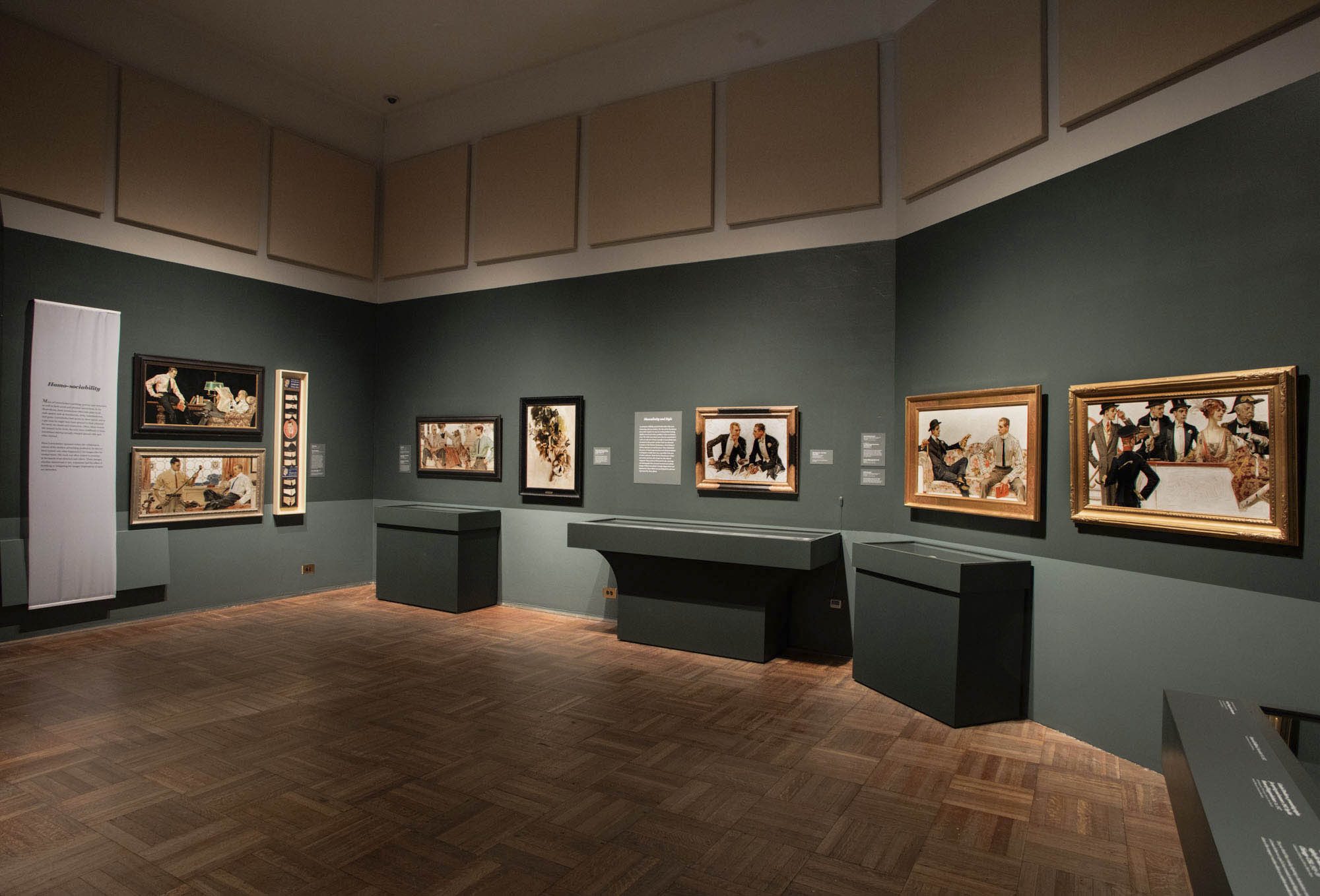
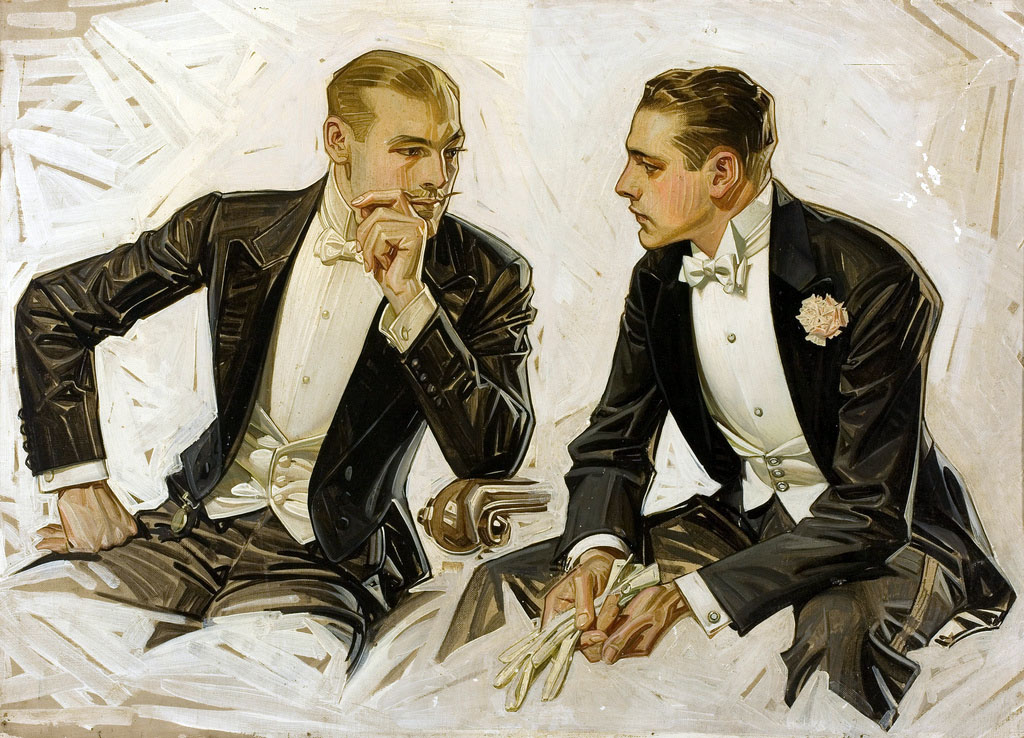
 

Alonzo Chappel (American, 1828-1887)(engraver) 'Thomas Chalmers: Likeness from a daguerreotype by Claudets [sic]' 1873
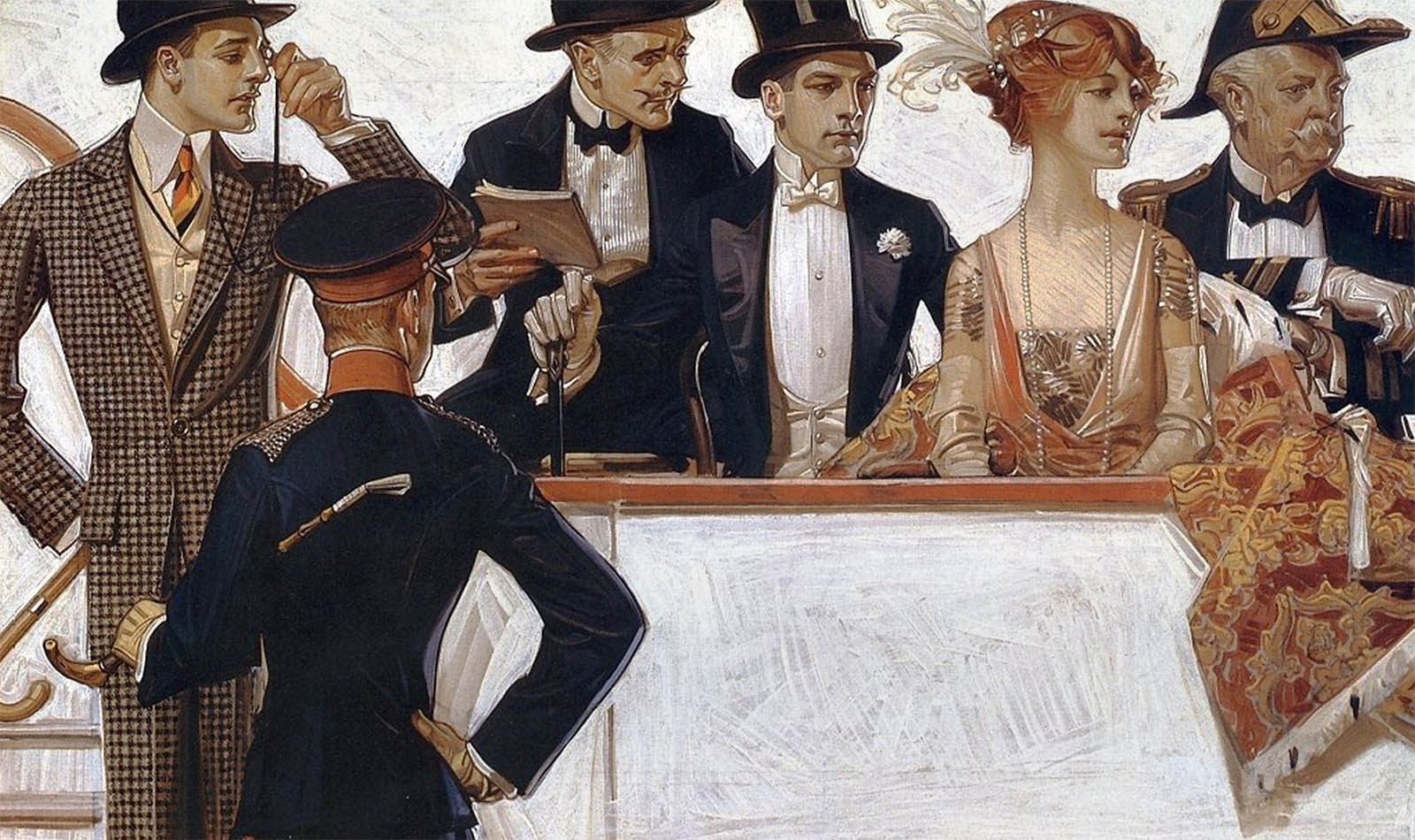
 

Alonzo Chappel (American, 1828-1887)(engraver)
Thomas Chalmers: Likeness from a daguerreotype by Claudets [sic]
1873
Steel engraving of a Scottish clergyman after a daguerreotype by Antoine Claudet studio in c. 1847
Public domain


Alonzo Chappel (March 1, 1828 – December 4, 1887) was an American-Spanish painter, best known for paintings depicting personalities and events from the American Revolution and early 19th-century American history.

Thomas Chalmers FRSE (17 March 1780 – 31 May 1847), was a Scottish minister, professor of theology, political economist, and a leader of both the Church of Scotland and of the Free Church of Scotland. He has been called “Scotland’s greatest nineteenth-century churchman.”


Notable commissions

A particularly notable commission for the Beard studio involved making daguerreotype portraits in May 1845 on the deck of the H.M.S. Erebus. The subjects were fourteen of the officers about to set out under the command of Sir John Franklin in search of the Northwest Passage above Canada. These pictures became particularly famous when the entire expedition disappeared, never to be heard from again. After a public campaign by Lady Franklin in the illustrated press, many other ships were sent over during the ensuing years to try and find the expedition.


Installation view of Studio of Richard Beard daguerreotypes of 'Sir John Franklin' (May 1845) and 'Lieutenant Graham Gore, Commander' (May 1845)


Installation view of Studio of Richard Beard daguerreotypes of Sir John Franklin (May 1845, below) and Lieutenant Graham Gore, Commander (May 1845, below)


Studio of Richard Beard (English, 1801-1885) 'Sir John Franklin' May 1845


Studio of Richard Beard (English, 1801-1885)
Sir John Franklin
May 1845
Daguerreotype in leather case
The Scott Polar Institute, University of Cambridge
Public domain


Sir John Franklin, 16 May 1845, suffering from influenza before leaving for the Arctic. He is wearing the 1843-1846 pattern Royal Navy undress tailcoat with cocked hat.

Lady Franklin commissioned daguerreotype photographs of the twelve senior officers of HMS Erebus and Captain Crozier of HMS Terror. They were taken on board the Erebus at the dockside in Greenhithe on 16 May 1845, just before the ships sailed. Franklin was fascinated by this new technology and included photographic apparatus as part of the expedition’s equipment.

Sir John Franklin KCH FRS FLS FRGS (16 April 1786 – 11 June 1847) was a British Royal Navy officer and Arctic explorer. After serving in wars against Napoleonic France and the United States, he led two expeditions into the Canadian Arctic and through the islands of the Arctic Archipelago, in 1819 and 1825, and served as Lieutenant-Governor of Van Diemen’s Land from 1839 to 1843. During his third and final expedition, an attempt to traverse the Northwest Passage in 1845, Franklin’s ships became icebound off King William Island in what is now Nunavut, where he died in June 1847. The icebound ships were abandoned ten months later and the entire crew died, from causes such as starvation, hypothermia, and scurvy.

Richard Beard (22 December 1801 – 7 June 1885) was an English entrepreneur and photographer who vigorously protected his photographic business by litigation over his photographic patents and helped to establish professional photography in the UK.


Studio of Richard Beard (English, 1801-1885) 'Lieutenant Graham Gore, Commander' May 1845


Studio of Richard Beard (English, 1801-1885)
Lieutenant Graham Gore, Commander
May 1845
Daguerreotype in leather case
The Scott Polar Institute, University of Cambridge
Public domain


Studio of Richard Beard Jr. (London) 'Tyrolese Singers' 1851-1852


Studio of Richard Beard Jr. (London)
Tyrolese Singers
1851-1852
Hand-coloured enamelled daguerreotype
14.1 x 10.3cm
Royal Collection Trust
Acquired by Queen Victoria and Prince Albert in 1852
© His Majesty King Charles III 2022


This daguerreotype, produced and enamelled by the studio of Richard Beard, was purchased by Queen Victoria in 18522, the same year in which her mother, the Duchess of Kent, arranged for the Tyrolese minstrels to surprise the Queen with a serenade at breakfast for her birthday at Osborne. About the event, the Duchess wrote: “Victoria appeared very much pleased with the surprise.”


Hand-coloured enamelled daguerreotype of a group of Tyrolese singers called Klier, Rainer, Margreiter, Rahm and Holaus. Rahm is seated facing partly left playing a dulcimer and Rainer holds a guitar. All are wearing traditional Tyrolese costume, coloured with both dark and pastel tones. The daguerreotype is mounted in a large dark blue leather case with a red velvet interior. Queen Victoria had first seen this troupe of Tyrolese singers at Kensington Palace in 1833. Her mother, the Duchess of Kent, later arranged for the singers to perform at Osborne on her birthday in 1852. The Duchess recorded in her diary that ‘dearest Victoria appeared very much pleased with the surprise’. Later the same year Queen Victoria acquired this daguerreotype. Beard had shown examples of his enamelled daguerreotypes at the Great Exhibition in 1851. The process involved varnishing the daguerreotype and then heating and adding another coat of varnish after the colour pigments had been added.

Text from the Royal Collection Trust website


Tyrolese minstrels

This daguerreotype shows Tyrolese minstrels in carefully tinted folkloric costumes and holding musical instruments. A variant view was the basis of a wood engraving published in the Illustrated London News in 1851 (below). For Queen Victoria’s birthday at Osborne in 1852, her mother, the Duchess of Kent, arranged for the singers to serenade her at breakfast. ‘Victoria appeared very much pleased with the surprise’, the Duchess wrote. This daguerreotype, enamelled according to Beard’s patented formula, was purchased by the Queen in the same year.


Smyth (engraver) 'The Tyrolese Minstrels – from a photograph taken by Beard, by desire of H.R.H. The Duchess of Kent'


Smyth (engraver)
‘The Tyrolese Minstrels – from a photograph taken by Beard, by desire of H.R.H. The Duchess of Kent’
From the Illustrated London News (6 December 1851)
Wood engraving after a daguerreotype by Richard Beard Jr.
Private Collection


Fascinating people

The popular press, and especially the Illustrated London News, soon included wood engraved copies of photographic portraits of celebrities and indigenous people from the colonies of the British Empire. Equally exotic to middle-class viewers, however, were photographic illustrations of members of the British working class. In every case, the daguerreotype was destroyed during the tracing process that led to its wood-engraved copy, leaving these reproductions behind as a kind of shadow history of the medium. In this form, photographic images circulated all around the globe.


Photographer unknown (English) 'Seated man holding a copy of the 'Illustrated London News'' c. 1850


Photographer unknown (English)
Seated man holding a copy of the Illustrated London News
c. 1850
Hand-painted daguerreotype in leather case
Private Collection


Engraver unknown (England) 'The Walpole Islanders at the Panopticon. – From a photograph by Claudet' 1856


Engraver unknown (England)
‘The Walpole Islanders at the Panopticon. – From a photograph by Claudet’
1856
From the Illustrated London News (12 July 1856), page 41
Courtesy of a Private Collection


Modern art and swansdown

These ‘lords and ladies’ dressed in historical costumes for a ball appeared as wood engravings after daguerreotypes taken by Richard Beard Jr. in the Illustrated London News in July 1848. A review in the Nottingham Mercury on 6 October 1848 commended the photographer for the quality of his work, calling it ‘modern art combined with science’.

“Swansdown on black is produced in the most exquisite style, and the finest white lace brought out in bold relief on a dress of white satin.”

~ Nottingham Mercury (6 October 1848)


Smyth (engraver) 'The Spitalfields Ball. Costume Portraits, from daguerreotypes, by Beard'


Smyth (engraver)
‘The Spitalfields Ball. Costume Portraits, from daguerreotypes, by Beard’
From the Illustrated London News (15 July 1848, p. 24)
Wood engravings after daguerreotypes by Richard Beard Jr.
Bodleian Libraries, University of Oxford


Extraordinary Australians

The English-born photographer Douglas T. Kilburn (brother of Edward Kilburn) arrived in Melbourne, Australia, in 1847. Kilburn made a series of daguerreotypes of local indigenous people in about October of that same year. These daguerreotype images were then reproduced around the world in various media. They found their widest audience when a number of them were reproduced as wood engravings in an 1850 issue of the Illustrated London News, along with an accompanying text that expressed the usual racial prejudices of the time.


Unknown engravers (England) 'Australia Felix'


Unknown engravers (England)
‘Australia Felix’
From the Illustrated London News (26 January 1850, p. 53)
Wood engravings after daguerreotypes by Douglas Kilburn, Melbourne
Private Collection


Daguerrotype studios

The first commercial photography studio in England was opened by Richard Beard in the Royal Polytechnic Institution in London in March 1841. It made small daguerreotype portraits using an American invention, a camera that employed a concave mirror rather than a lens to focus the light. Soon, superior, lens-enhanced cameras and more light-sensitive plates allowed for larger and more lively portraits to be made by an ever-increasing number of professional studios.

One of the earliest clients of the Richard Beard studio in London was the 73-year-old Anglo-Irish writer Maria Edgeworth. She had several portraits taken, at a guinea each, during mid-morning on 25 May 1841. About five years later, she returned to the same studio and had a second portrait made.

Her letter to her half-sister Fanny Wilson describes her first portrait session.

“I fear you will not like any of my daguerreotype faces – I am sure I do not – the truer, the worse”

~ Maria Edgeworth, in a letter to Fanny Wilson, 28 May 1841


‘Lestock came with me to breakfast here at 8 o’clock and then he took Honora and Captain Beaufort and me to the Polytechnic and we all had our likenesses taken and I will tell you no more lest I should some way or other cause you disappointment. For my own part my object is secure for I have done my dear what you wished. It is a wonderful mysterious operation. You are taken from one room into another up stairs and down and you see various people whispering and hear them in neighbouring passages and rooms unseen and the whole apparatus and stool on high platform under a glass dome casting a snap-dragon blue light making all look like spectres and the men in black gliding about like &c. I have not time to tell you more of that’.

Maria Edgeworth, Letter to Fanny Wilson, 25 May 1841
MS. Eng. Lett. c. 710, fol. 1r


Studio of Richard Beard (English, 1801-1885) (Royal Polytechnic Institution, London) 'Portrait of Maria Edgeworth' May 1841


Studio of Richard Beard (English, 1801-1885) (Royal Polytechnic Institution, London)
Portrait of Maria Edgeworth
May 1841
Daguerreotype in vertical leather case


Studio of Richard Beard (English, 1801-1885) (Royal Polytechnic Institution, London) 'Portrait of an older man' c. 1841


Studio of Richard Beard (English, 1801-1885) (Royal Polytechnic Institution, London)
Portrait of an older man
c. 1841
Courtesy of a Private Collection


Forty a day

Using a number of different operators, the studio owned by Richard Beard claimed to make about 40 daguerreotype portraits per day. Soon he ran three such studios in London and had licensed a dozen more elsewhere in England. As the English patent holder for the daguerreotype process, Beard insisted that each of these daguerreotypes be stamped with the words ‘Beard Patentee’, wherever they were made. Having established photography as a franchise system, he became, in effect, the Colonel Sanders of early English photography.


Laman Blanchard ed. 'Photographic Phenomena' 'George Cruikshank's Omnibus' (London Tilt and Borgue, 1842) London, 1842


Laman Blanchard ed.
‘Photographic Phenomena’
George Cruikshank’s Omnibus (London Tilt and Borgue, 1842)
London, 1842
Wood engraving by George Cruikshank of the Beard Studio and a poem by S.L. Blanchard
Courtesy of a Private Collection


Fierce enemy

Disputing who had exclusive rights to the commercial use of the daguerreotype process, Richard Beard and Antoine Claudet took several legal actions against each other. In a letter to William Henry Fox Talbot dated 18 January 1843, Claudet refers to Beard as his ‘competitor and fierce enemy’. Having overturned an injunction prohibiting his use of the process, Claudet quickly became Beard’s greatest rival. Soon, however, other competitors also opened studios in London, with those run by Edward Kilburn and John Mayall among the most significant.


Studio of Antoine Claudet (French, 1797-1867) (Adelaide Gallery, London) 'Portrait of Michael Faraday' c. 1848


Studio of Antoine Claudet (French, 1797-1867) (Adelaide Gallery, London)
Portrait of Michael Faraday
c. 1848
Daguerreotype and leather case
History of Science Museum, University of Oxford


Claudet invented one of the improvements that made the Daguerreotype fast enough to take portraits; Faraday’s association with photography began in January 1839 when he announced Talbot’s discovery at the Royal Institution in London.

Michael Faraday FRS (22 September 1791 – 25 August 1867) was an English natural philosopher who contributed to the study of electromagnetism and electrochemistry. His main discoveries include the principles underlying electromagnetic induction, diamagnetism and electrolysis.


Antoine François Jean Claudet (French, 1797-1867)

Antoine François Jean Claudet (August 18, 1797 – December 27, 1867) was a French photographer and artist active in London who produced daguerreotypes. …

Early in his career Claudet headed a glass factory at Choisy-le-Roi, Paris, together with Georges Bontemps, and moved to England to promote the factory with a shop in High Holborn, London. Having acquired a share in L. J. M. Daguerre’s invention, he became one of England’s first commercial photographers using the daguerreotype process for portraiture, improving the sensitising process by using chlorine (instead of bromine) in addition to iodine, thus gaining greater rapidity of action.

He invented the red darkroom safelight, and it was he who suggested the idea of using a series of photographs to create the illusion of movement. The idea of using painted backdrops has also been attributed to him.

From 1841 to 1851 he operated a studio on the roof of the Adelaide Gallery (now the Nuffield Centre), behind St. Martin’s in the Fields church, London, where in 1843 he took one of only two surviving photographs of Ada Lovelace. He opened additional studios at the Colosseum, Regent’s Park (1847-1851) and in 1851 he moved his entire business to 107 Regent Street, where he established what he called a “Temple to Photography.”

It has been estimated that he made 1,800 pictures every year with subjects including Michael Faraday and Charles Babbage. His daguerreotype of Hemi Pomara, in the National Library of Australia, is the oldest known photograph of any Māori person.

In 1848 he produced the photographometer, an instrument designed to measure the intensity of photogenic rays; and in 1849 he brought out the focimeter, for securing a perfect focus in photographic portraiture.

He was elected a fellow of the Royal Society in 1853, and in 1858 he produced the stereomonoscope, in reply to a challenge from Sir David Brewster.

Claudet received many honours, among which was the appointment, in 1853, as “Photographer-in-ordinary” to Queen Victoria, and the award, ten years later, of an honor from Napoleon III of France.

Text from the Wikipedia website


Antoine Claudet (French, 1797-1867) (18 King William St Strand) 'Portrait of seated man and woman' c. 1850


Antoine Claudet (French, 1797-1867) (18 King William St Strand)
Portrait of seated man and woman
c. 1850
Half-plate daguerreotype with applied colour in stamped leather case
Courtesy of a Private Collection


Claudet learned photography from Louis Daguerre in the late 1830s, and established his first daguerreotype studio in London in 1841 behind St Martin-in-the-Fields church, receiving honours from both Queen Victoria and Napoleon III for his skills as a photographer. However, he is best known for his experiments with photographic instruments and his chemical experiments, which succeeded in speeding up the photographic process.


Unfortunately horrid

François Arago, in a report to the Chamber of Deputies in Paris on 3 July 1839, warned that touching the surface of a daguerreotype was like ‘brushing the wings of a butterfly’. This fragility is demonstrated in an 1852 group portrait of Queen Victoria and her family. Apparently, Victoria had been captured with her eyes closed. So, she scratched out her face on the plate in a blizzard of annoyance, leaving herself decapitated but the children unblemished. Despite this experience, Victoria and Albert were enthusiastic patrons of photography.


William Edward Kilburn Studio (English, 1818-1881) 'Queen Victoria et al' 17 January 1852


William Edward Kilburn Studio (English, 1818-1881)
Queen Victoria et al
17 January 1852
Scratched daguerreotype
Royal Collection Trust
© His Majesty King Charles III 2022


This group portrait of Queen Victoria with her five eldest children was taken in January 1852 by William Edward Kilburn, who, as one of the leading photographers in London, was commissioned to photograph the Royal family on a number of occasions. The Queen was portrayed with her eyes closed, which is why she wiped out her face on the plate, but spared the images of the children.


“Went back to the Gardens, where a Daguerreotype by Mr. Kilburn was taken of me & 5 of the children. The day was splendid for it. Mine was unfortunately horrid, but the children’s were pretty.”

~ Queen Victoria, from a diary entry, 1852


William Edward Kilburn Studio (English, 1818-1881) 'Prince Albert' (1819-1861) 1848


William Edward Kilburn Studio (English, 1818-1881)
Prince Albert (1819-1861)
1848
Hand-coloured daguerreotype
6.3 x 8.7cm
Royal Collection Trust RCIN 2932486
© His Majesty King Charles III 2022


Hand-coloured daguerreotype of Prince Albert, seated and facing partly right. His left arm rests on the arm of the chair and his right rests on his lap. He is wearing a beige jacket and a dark brown waistcoat. The background is painted blue with white clouds and the daguerreotype is mounted under glass. On the reverse there is a label reading ‘The Prince from Life 1848’, handwritten by Queen Victoria. Prince Albert was an early enthusiast of photography and closely followed the development of the medium. In February 1847 Kilburn showed examples of his coloured daguerreotypes, made by adding fine coloured powders to the photographic plate, to the Society of Arts. In 1848 Prince Albert commissioned a portrait using the new technique. This is one of two surviving hand-coloured daguerreotypes produced from the sitting. Commissioned by Prince Albert in 1848

Anonymous. “Prince Albert (1819-1861),” on the Royal Collection Trust website Nd [Online] Cited 23/02/2023


Applied colour

By the mid-1840s, it was common for middle-class British citizens to have a daguerreotype portrait made. Often, these were enhanced with applied colour, giving a touch of life to an otherwise monochrome medium.


Studio of Richard Beard (English, 1801-1885) 'Portrait bust of a man' c. 1845


Studio of Richard Beard (English, 1801-1885)
Portrait bust of a man
c. 1845
Hand-painted daguerreotype in vertical leather case
Courtesy of a Private Collection


Richard Beard was a businessman who purchased a licence to use the daguerreotype process in 1841 and opened the world’s first photographic studio. It was set up in a glasshouse on the roof of London’s Royal Polytechnic Institution to provide all-round lighting necessary to the daguerreotype process. There were huge profits from his studios in London and Liverpool and from the sale of licences to take daguerreotypes, but Beard was ruined by his many legal actions against rivals, and went bankrupt in 1850.


Itinerant and transnational

The career of James William Newland exemplifies the itinerant, transnational character of many early photographers. Born in Suffolk in about 1810, Newland opened his first daguerreotype studio in 1845 in New Orleans in the USA. He subsequently travelled throughout Central and South America and then across the Pacific to Sydney, Australia. In 1848, he established a studio there and exhibited 200 daguerreotypes he had taken during his journey. After Australia, he headed back to England for a brief visit, before moving to India to set up a studio in Calcutta. It was there that he died, killed during the Indian Uprising of 1857.


J.W. Newland (English, c. 1810-1857) 'Portrait of a standing man, Calcutta' c. 1855


J.W. Newland (English, c. 1810-1857)
Portrait of a standing man, Calcutta
c. 1855
Quarter-plate daguerreotype in leather case with red velvet pad
Courtesy of a Private Collection


Photo journalism

This daguerreotype records the immense crowds at one of the Chartist rallies held in South London in 1848. Calling for political reform, the Chartist movement was seen by many as a terrifying threat to the established order. Fears were so great, the Duke of Wellington stationed troops across London and the royal family was moved to Osborne House on the Isle of Wight. In the event, the rally passed peacefully, and Prince Albert himself purchased this record of it.


Studio of William Edward Kilburn (English, 1818-1881) (234 Regent St, London) 'The Chartist Meeting on Kennington Common, 10 April 1848' 10 April 1848


Studio of William Edward Kilburn (English, 1818-1881) (234 Regent St, London)
The Chartist Meeting on Kennington Common, 10 April 1848
10 April 1848
Daguerreotype Royal Collection, London


Daguerreotype of a large crowd of supporters of the Chartist movement gathered together on Kennington Common. At the centre of the crowd there is a platform for the speakers, and a number of people hold banners and flags. Behind the crowd there is a tall factory chimney and a large house to the right. In the foreground a man stands facing the crowds in a horse-drawn cart. The daguerreotype is mounted under glass.

This daguerreotype records the immense crowds at one of the Chartist rallies held in South London in 1848. Calling for political reform, and spurred on by the recent February Revolution in France, the Chartist movement was seen by many as a terrifying threat to the established order. Fears were so great that on the eve of the meeting, the Duke of Wellington stationed troops across London and the royal family were moved to Osborne House on the Isle of Wight. In the event the rally passed peacefully. Prince Albert later spoke about his concern for the working classes at a meeting of the Society for the Improvement of the Condition of the Labouring Classes, 18 May 1848. This is one of a pair of daguerreotypes of the event acquired by Prince Albert.

One of a pair of daguerreotypes of the Chartist Meeting on Kennington Common purchased by Prince Albert in 1848

Anonymous. “The Chartist Meeting on Kennington Common, 10 April 1848,” on the Royal Collection Trust website Nd [Online] Cited 23/02/2023


Ruskin and photography

Although his opinion of photography evolved over the years, John Ruskin was initially enthusiastic about the daguerreotype, importing early examples from France and learning the process himself in order to make photographic sketches of architecture and landscape.

“Daguerreotypes taken by this vivid sunlight are glorious things. It is very nearly the same thing as carrying off the palace itself: every chip of stone and stain is there, and of course there is no mistake about proportions… It is a noble invention.”

~ John Ruskin, in a letter to his father from Venice, 7 October 1845


John Ruskin (English, 1819-1900) and John Hobbs (?) 'View of the façade of a building in Venice' c. 1850


John Ruskin (English, 1819-1900) and John Hobbs (?)
View of the façade of a building in Venice
c. 1850
Daguerreotype
History of Science Museum, University of Oxford
Minn Collection
Bequeathed by Henry Minn in 1961


John Ruskin (8 February 1819 – 20 January 1900) was an English writer, philosopher, art critic and polymath of the Victorian era. He wrote on subjects as varied as geology, architecture, myth, ornithology, literature, education, botany and political economy.

Ruskin’s writing styles and literary forms were equally varied. He wrote essays and treatises, poetry and lectures, travel guides and manuals, letters and even a fairy tale. He also made detailed sketches and paintings of rocks, plants, birds, landscapes, architectural structures and ornamentation. The elaborate style that characterised his earliest writing on art gave way in time to plainer language designed to communicate his ideas more effectively. In all of his writing, he emphasised the connections between nature, art and society.

Ruskin was hugely influential in the latter half of the 19th century and up to the First World War. After a period of relative decline, his reputation has steadily improved since the 1960s with the publication of numerous academic studies of his work. Today, his ideas and concerns are widely recognised as having anticipated interest in environmentalism, sustainability and craft.

Ruskin first came to widespread attention with the first volume of Modern Painters (1843), an extended essay in defence of the work of J. M. W. Turner in which he argued that the principal role of the artist is “truth to nature”. From the 1850s, he championed the Pre-Raphaelites, who were influenced by his ideas. His work increasingly focused on social and political issues. Unto This Last (1860, 1862) marked the shift in emphasis. In 1869, Ruskin became the first Slade Professor of Fine Art at the University of Oxford, where he established the Ruskin School of Drawing. In 1871, he began his monthly “letters to the workmen and labourers of Great Britain”, published under the title Fors Clavigera (1871-1884). In the course of this complex and deeply personal work, he developed the principles underlying his ideal society. As a result, he founded the Guild of St George, an organisation that endures today.

Text from the Wikipedia website


Stereoscopic still life

This stereo-daguerreotype includes a selection of the instruments found in the studio of London photographer Antoine Claudet in 1853. They include a focimeter (a device of his own devising that aided focus), a distillation device hanging on the back wall, a telescope on a stand, an upside-down globe, an array of chemical jars and glass vessels, a centrifugal force speed controller, a photographometer (an early kind of light metre), three different kinds of stereoscope, the Post Office London Directory of 1852, a magnifying glass, a slide rule, a glass prism, a French treatise on photography, two of his dynactinometers (another device of his own invention), a mortar and pestle, and an apothecary’s scales.

Photographs of paintings

Daguerreotypes were used to make records of paintings and prints. Sometime in the 1850s, the studio of London-based photographer Edward Kilburn was commissioned to make a daguerreotype of a painting then thought to be by Raphael. The client was the British art dealer Morris Moore. Moore engaged in a decades-long struggle to have this painting, now titled Apollo and Marsyas and attributed to Perugino, accepted as an early work by Raphael. This daguerreotype no doubt played a part in that campaign. Moore displayed it, for example, in Berlin in 1856.

Keepsake and memory

Ada Lovelace, the English mathematician and computing pioneer, had a number of daguerreotype portraits made of herself. The last of these, taken by an unknown photographer, is of a small painted portrait of Lovelace. Frail and thin and suffering from cancer, she is shown sitting at her piano. Shortly before she died, Lovelace wrote a note in which she leaves ‘a daguerreotype from Philips’s picture of me’ to her mother’s friend, a Mary Millicent Montgomery.


Photographer unknown (English) 'Copy of an 1852 painting of Ada Lovelace by Henry Wyndam Phillips' 13 August 1852


Photographer unknown (English)
Copy of an 1852 painting of Ada Lovelace by Henry Wyndam Phillips
13 August 1852
Daguerreotype
Private Collection
Reproduction courtesy of Geoffrey Bond
Public domain


Augusta Ada King, Countess of Lovelace (née Byron; 10 December 1815 – 27 November 1852) was an English mathematician and writer, chiefly known for her work on Charles Babbage’s proposed mechanical general-purpose computer, the Analytical Engine. She was the first to recognise that the machine had applications beyond pure calculation, and to have published the first algorithm intended to be carried out by such a machine. As a result, she is often regarded as the first computer programmer.

Text from the Wikipedia website


2th Sept 1852
I leave to my Mother’s oldest
Friend, Mary Millicent Mont=
=gomery, three articles, viz:
1. A Red Cornelian Brooch which
I have much used I have much used, & to which
I desire my
Hair to be added;
2. A Daguerreotype from Philip’s
Picture of me;
3. 4 Books printed out by me.
I request this Paper also to be
given to Mary Millicent Mont=
=gomery; & I wish her to
understand that I leave her …


As well as being customers of the new photographers, Ada Lovelace and her circle were intrigued by the science of photography and the contribution photographic processes might make to science. Apart from her famous paper on Babbage’s Analytical Engine, her only other known publication is in the form of long footnotes to an article by her husband, William Earl of Lovelace, in the Royal Agricultural Society journal. The article, which he describes as being written for the ‘leather-gaiter-and-top-boot-mind’, reviews a paper by the French economist Gasparin, about possible laws linking climate and the yield of crops, referring to a wide variety of observations of weather and plants collected by both professionals and amateurs. Ada Lovelace observes that photographic devices, such as the actinograph designed by her friend John Herschel, allow the construction of ‘meteorological instruments of the utmost delicacy’, and criticises Gasparin ‘who seems to write unaware of the means which photography has offered’.

In similar vein, she reflected on the potential of photography in providing objective evidence of psychic phenomena. In an unpublished article she writes, ‘If amateurs, of either sex, would amuse their idle hours with experimenting on this subject, & would keep an accurate journal of their daily observations, we should in a few years have a mass of registered facts to compare with the observation of the Scientific’, concluding that ‘we believe that it is as yet quite unsuspected how important a part photography is to play in the advancement of human knowledge’.
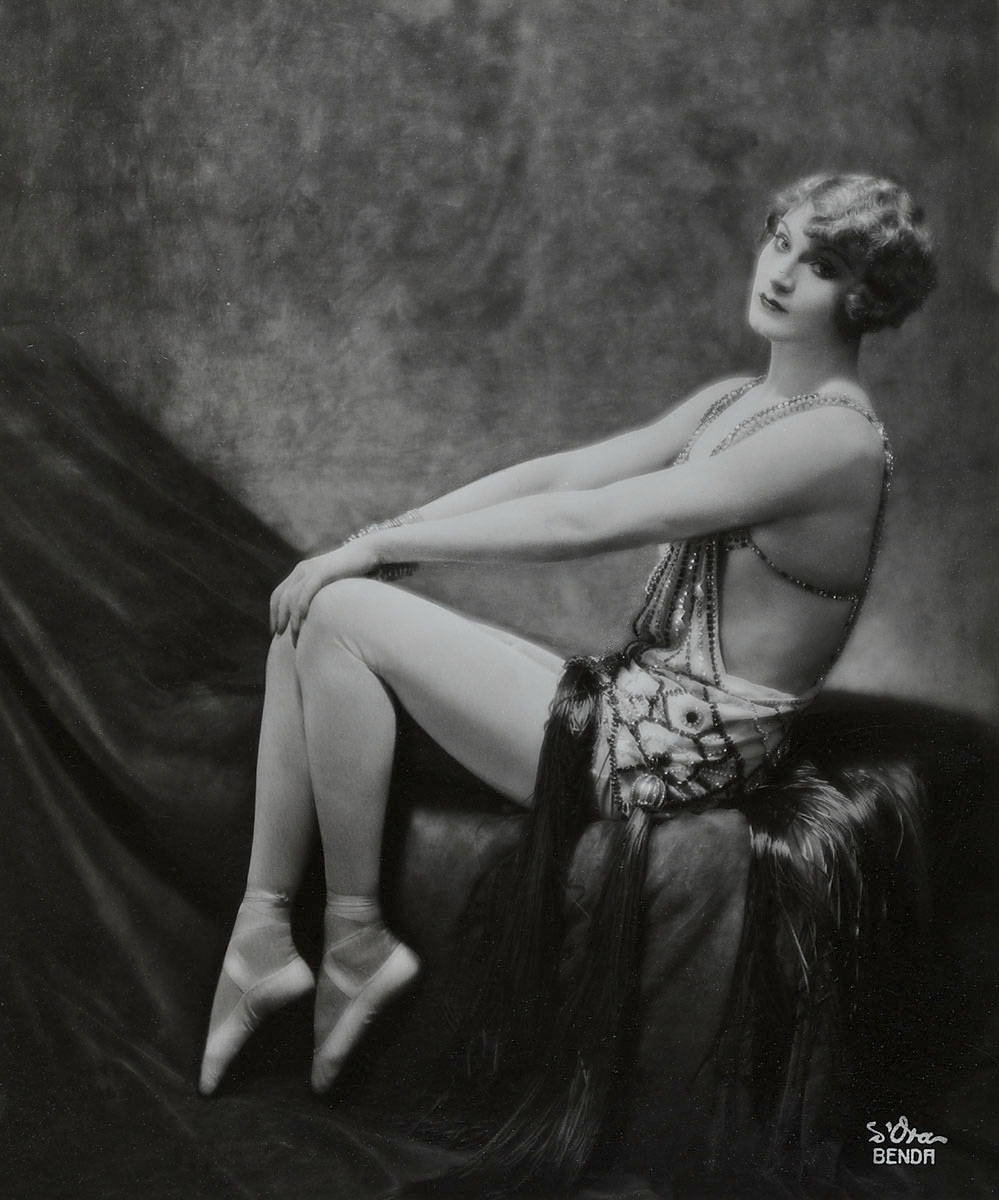
A third poignant daguerreotype, by an unknown photographer, is a photograph of a small portrait of Ada Lovelace, frail and thin, painted by Henry Wyndham Phillips in the last months of her life, when she was in great pain from uterine cancer. Her husband recorded progress on the portrait in his diary – on 2 August ‘she managed to remain long enough when he came for him to make some progress’, on 3 August that he was ‘getting on with the portrait’, and on 13 August that though ‘the suffering was so great that she could scarce avoid crying out’, yet ‘she sat at the piano some little time so that the artist could portray her hands’. The Bodleian archives contain a note written in her last days, in which she leaves ‘a daguerreotype from Philips’s portrait of me’ to her mother’s friend, Miss Montgomery.

Professor Ursula Martin CBE, University of Oxford. “Only known photographs of Ada Lovelace in Bodleian Display,” on the Bodleian blogs Ada Lovelace website 14 October 2015 [Onlinr] Cited 23/02/2023


George Hollis (British, 1793-1842) (engraver) 'Mr Couldock as Richard III' 1851


George Hollis (British, 1793-1842) (engraver)
Mr Couldock as Richard III
1851
From Tallis’s Drawing Room Table Book of Theatrical Portraits, Memoirs and Anecdotes
Hand-coloured steel engraving after daguerreotype by William Paine of Islington

This engraving: The British Museum CC BY-NC-SA 4.0

The engraving in the exhibition: Private collection


Celebrity actors

Tallis’s Drawing Room Table Book of Theatrical Portraits, Memoirs and Anecdotes offered a series of engraved copies of daguerreotype portraits of celebrated Shakespearean actors. Sometimes these actors are shown as if in a portrait studio, but more often they are posing in costume (and even in blackface), as if in the midst of a performance. The series is a reminder of the popularity of the theatre and actors in the mid-19th century (even Queen Victoria bought a copy of this publication), but also of the casual racism that was part of everyday British life.


Engraver unknown (British) 'Mr Charles Kean as Hamlet' 1851


Engraver unknown (British)
Mr Charles Kean as Hamlet
1851
From Tallis’s Drawing Room Table Book of Theatrical Portraits, Memoirs and Anecdotes
Steel engraving after daguerreotype by William Paine of Islington

This engraving: The British Museum CC BY-NC-SA 4.0

The engraving in the exhibition: Private collection


'Mr Ira Aldridge as Aaron in Titus Andronicus' From 'Tallis's Drawing Room Table Book of Theatrical Portraits, Memoirs and Anecdotes' c. 1851


‘Mr Ira Aldridge as Aaron in Titus Andronicus’
From Tallis’s Drawing Room Table Book of Theatrical Portraits, Memoirs and Anecdotes
c. 1851
Steel engraving after daguerreotype by William Paine of Islington
Bodleian Libraries, University of Oxford


Ira Aldridge

Born in New York, Ira Aldridge (1807-1867) was an African-American actor, playwright, and theatre manager. From 1824, the year he emigrated to the UK, Aldridge made his career largely on the London stage and in Europe. He became well known as a performer in plays by Shakespeare, including roles usually played by white actors, such as Richard III, King Lear and Macbeth. Aldridge’s career took off at the height of the movement to abolish slavery throughout the British Empire. He chose to play a number of anti-slavery roles and often addressed his audiences on closing night, speaking passionately about the injustice of slavery.

The Great Exhibition

Six million people – equivalent to a third of the entire population of Britain at the time – visited the Great Exhibition of the Works of Industry of All Nations, an international showcase for goods, raw materials and industrial products and machinery. It took place in Hyde Park, London, from 1 May to 15 October in 1851. Photographs were among the thousands of exhibits, but the Great Exhibition was itself much photographed, as evidenced in the many photographic images reproduced in the illustrated press.

“Today is sunshine and mild weather. I peeped in thro’ a window at the East End of the Crystal palace, and found myself in the territories of the United States, who ought rather to have been located in the Far West of the building. The perspective looked beautiful.”

~ William Henry Fox Talbot, in a letter to his wife Constance, 30 April 1851


Engravers unknown (English) 'The Great Exhibition: The east nave, viewed from the south-western gallery' 1851


Engravers unknown (English)
The Great Exhibition: The east nave, viewed from the south-western gallery
1851
From Illustrated London News, 6 September 1851, p. 296
Stipple and line engraving from daguerreotype by William Edward Kilburn
210 x 270 mm
Courtesy of a Private Collection


Held at Crystal Palace in London in 1851, the Great Exhibition of the Works of Industry of All Nations was one of the most influential cultural events of the 19th century and the Illustrated London New did not fail to record its scale and significance using an equally influential invention that would shape the current century and those to come.

Sir Joseph Paxton (1801-1865) began his career as a gardener’s boy, eventually becoming head gardener for the Duke of Devonshire. He remodelled the Duke’s gardens at Chatsworth and Chiswick, designing large glass and iron conservatories for them. These later became the model for his design of the Great Exhibition building, now known as the Crystal Palace, for which he received his knighthood. After this success, Paxton continued to work on landscape gardening and public parks as well as designing various country houses. Published by Peter Jackson, London.

Sir Joseph Paxton (English, 1801-1865)

Sir Joseph Paxton, (born Aug. 3, 1801, near Woburn, Bedfordshire, Eng. – died June 8, 1865, Sydenham, near London), English landscape gardener and designer of hothouses, who was the architect of the Crystal Palace for the Great Exhibition of 1851 in London.

He was originally a gardener employed by the duke of Devonshire, whose friend, factotum, and adviser he became. From 1826 he was superintendent of the gardens at Chatsworth, the duke’s Derbyshire estate; he built in iron and glass the famous conservatory there (1840) and the lily house for the duke’s rare Victoria regia (1850). Also in 1850, after a cumbersome design had been officially accepted by the Great Exhibition’s organisers, Paxton’s inspired plan for a building of prefabricated elements of sheet glass and iron was substituted. His design, based on his earlier glass structures, covered four times the area of St. Peter’s, Rome, and the grandeur of its conception was a challenge to mid-19th-century technology. Although it was built within six months and he was knighted for his efforts (1851), it was not until later that the structure was seen as a revolution in style. In 1852-1854 its components were moved to Sydenham Hill in Upper Norwood, where they remained (reerected in a different form from the original) until destroyed by fire in 1936.

Paxton was a member of Parliament for Coventry from 1854 until his death. During the period of his glass structures, he also designed many houses in eclectic styles and laid out a number of public parks.

Kathleen Kuiper. “Sir Joseph Paxton,” on the Britannica website Nd [Online] Cited 23/02/2023


Joseph John Jenkins (English, 1811-1885) (engraver) 'Joseph Paxton, designer of the Crystal Palace' c. 1851


Joseph John Jenkins (English, 1811-1885) (engraver)
Joseph Paxton, designer of the Crystal Palace
c. 1851
Stipple and line engraving from daguerreotype by William Edward Kilburn

This engraving: from the Britannica website

The engraving in the exhibition: Private collection


Joseph John Jenkins (1811 – 9 March 1885) was a British engraver and watercolour painter. He is best known for his portraits and landscapes paintings.

Jenkins engraved many portraits, and among other works, Susanna and the Elders, after Francesco Mola, and The Greenwich Pensioner and The Chelsea Pensioner, after Michael William Sharp. He engraved plates and drew illustrations for the annuals, such as The Keepsake and Heath’s Book of Beauty, Plates from his drawings are in Charles Heath’s Illustrations to Byron and similar works.

Grand Panorama

The Illustrated London News issued a commemorative Grand Panorama of the Great Exhibition of All Nations 1851 in its December issue. Comprising fold-out pages, each sheet was based on daguerreotypes of the interior of the Exhibition taken by an operator from the Beard studio. The panorama showed frontal views of each side of the interior of the Crystal Palace, with distinct sections suitably captioned and clusters of figures added to give interest to an otherwise drab set of facades.

Commodities and things

The taking of photographs inside the building was restricted to between 6 and 9 am, before it opened to the public, or on Sundays, when it was otherwise closed. Often, the resulting views are undemonstrative and frontal, even if they are also sometimes animated by the engraver through the addition of figures peering at the exhibits. These scenes confirm the fetishisation of the commodity that was the Great Exhibition’s singular attraction, turning that spectacle into a picture to be gazed at in its turn.


John Tallis (English, 1817-1876) and Jacob George Strutt (British, 1790-1864) 'Tallis's history and description of the Crystal Palace, and the exhibition of the world's industry in 1851' (p. 13) 1852


John Tallis (English, 1817-1876) and Jacob George Strutt (British, 1790-1864)
Tallis’s history and description of the Crystal Palace, and the exhibition of the world’s industry in 1851 (p. 13)
1852
Steel engravings, from original drawings and daguerreotypes by Beard and Mayall studios


The Swedish Nightingale

Prizes were awarded to photographers whose displays at the Great Exhibition were considered to be particularly notable. One of those prizes was awarded to Edward Kilburn. The jury was particularly impressed by a full-length daguerreotype portrait made by Kilburn in 1848 of Swedish opera singer Jenny Lind, known as the Swedish Nightingale. Lind is posed so that her image is reflected in a large mirror; ‘that the reflection in the glass is equally perfect with the original is the point worthy of remark and commendation’.

“… a masterpiece of this art, not excelled, if equalled, by any other specimen exhibited throughout the entire building.”

~ Illustrated London News (1851)


Studio of William Edward Kilburn (English, 1818-1881) (234 Regent St, London) 'Portrait of Jenny Lind standing at a piano' 1848


Studio of William Edward Kilburn (English, 1818-1881) (234 Regent St, London)
Portrait of Jenny Lind standing at a piano
1848
Daguerreotype
11.5 x 9.1cm
© Royal Collection, London


Daguerreotype of a full length portrait of Jenny Lind standing beside a piano, facing away from the camera, with her head and upper body turned left towards the camera. Her right hand rests on the top of the piano and her left hand is touching the keys. She is wearing a long dress and a dark colour lace shawl. The mirror on the wall to the right reflects her back and there is an ornate side table beneath it. The daguerreotype is mounted under glass.

Queen Victoria attended the first London performance given by the Swedish soprano Jenny Lind on the 4th of May 1847. She described the occasion in her journal: ‘The great event of the evening however was Jenny Lind’s appearance & her complete triumph. She has the most exquisite, powerful, & really quite peculiar voice’. She later sang among the choristers at the wedding of the Prince of Wales in St George’s Chapel in 1863.

William Kilburn exhibited several daguerreotypes at the 1851 Great Exhibition, with this image being particularly well received. The exhibition jury commented: ‘For novelty of design we may mention a small picture of the interior of a room, including a whole-length portrait of Jenny Lind: beside, and near her, is a large mirror, in which the figure is reflected. That the reflection in the glass is equally perfect with the original is the point worthy of remark and commendation’.

The daguerreotype was also reproduced with significant cropping in carte-de-visite format, such as in the example today kept at the Victoria & Albert Museum, London (Museum Number S.138:66-2007). Acquired by Queen Victoria and Prince Albert in 1849.

Anonymous. “Jenny Lind (1820-1887),” on the Royal Collection Trust website Nd [Online] Cited 23/02/2023


Really marvellous

Stuffed frogs being shaved and promenading under an umbrella were among the most remarkable of the exhibits daguerreotyped by the Claudet studio at the Great Exhibition. The animals were prepared for anthropomorphic display by Hermann Ploucquert, a taxidermist at the Royal Museum in Stuttgart. The stall at which these creations were exhibited was apparently perpetually surrounded by a crowd. Queen Victoria herself described them in her diaries as ‘really marvellous’. Claudet’s images were issued as a book of coloured wood engravings titled The Comical Creatures from Wurtemberg.

News from home

The dissemination of engravings after daguerreotypes in the Illustrated London News meant that photographic images became itinerant entities. Distributed all over the world, the same image was capable of being experienced, simultaneously, in – say – Sydney, Hong Kong, Calcutta, New York, and London. By 1851, when Harden Melville completed the painting that this coloured engraving commemorates – titled Australia: News from Home – even settlers in outback Australia were able to get copies. One of them is looking at an issue of the Illustrated London News that celebrates the opening of the Great Exhibition in London.

Official reports

Not one of the many photographs exhibited in the Great Exhibition was by William Henry Fox Talbot, England’s claimant to the medium’s invention. Nevertheless, Talbot’s calotype process was chosen to illustrate the official reports on the event, even if the majority of these illustrations was shot and printed by French photographers rather than English ones. The other claimant to photography’s invention, the Frenchman Louis Daguerre, lived long enough to read about London’s Great Exhibition but died two months after it opened. Fittingly, his obituary in the Illustrated London News was accompanied by a wood-engraved portrait based on a daguerreotype.

The Duke of Wellington

The Ryall engraving faithfully imitates the composition and details of the daguerreotype made by the Claudet studio, but reverses the orientation of the Duke’s body. A story in the Illustrated London News, published on 13 November 1852, tells us that the Duke himself was not particularly impressed by the print. Apparently, ‘he looked at it for a moment, shook his head, and, with a half smile and half frown of recognition, muttered “Very old! Hum!” and turned away in thought’. This engraving was in turn copied by others, reappearing in a variety of media over the next few decades, and especially in 1852, the year of Wellington’s death.


Edward J. Pickering, for studio of Antoine Claudet (London) 'Portrait of the Duke of Wellington' 1 May 1844


Edward J. Pickering, for studio of Antoine Claudet (London)
Portrait of the Duke of Wellington
1 May 1844
Daguerreotype

This image: Getty
Public domain

Image in the exhibition: Wellington Collection, Stratfield Saye House


John Sartain (English, 1808-1897) 'The Duke of Wellington' 1852


John Sartain (English, 1808-1897)
The Duke of Wellington
1852
Mezzotint, etching and aquatint engraving (‘engraved by J. Sartain after Claudet’s portrait’)
7 x 4 15/16 in. (17.78 x 12.54cm)

This engraving: Pennsylvania Academy of the Fine Arts
Bequest of Dr. Paul J. Sartain
Public domain

The engraving in the exhibition: Private collection


Salt prints

In September 1840, William Henry Fox Talbot discovered how to greatly increase his photographic paper’s sensitivity to light. This new process produced a latent image which remained invisible to the eye until it was developed for a second time. The result was a sharp negative from which numerous positive salt prints could be made. Resisting his mother’s entreaty to call this process ‘Talbotype’, after himself, he gave it the more modest name of ‘calotype’ (‘beautiful picture’). Other photographers soon took up this new process, including Welshman Calvert Richard Jones and the Scottish duo of David Hill and Robert Adamson.

“A better picture can now be obtained in a minute than by the former process in an hour.”

~ William Henry Fox Talbot, in a letter to the Literary Gazette, 13 February 1841


William Henry Fox Talbot (English, 1800-1877) 'Lace' Early 1840s


William Henry Fox Talbot (English, 1800-1877)
Lace
Early 1840s
Salt print from a calotype negative
22.7 x 18.7cm


Rev. Calvert Richard Jones (Welsh, 1804-1877) 'Colosseum, Rome, 2nd view' 1846


Rev. Calvert Richard Jones (Welsh, 1804-1877)
Colosseum, Rome, 2nd view
1846
Salt print (printed by Nicolaas Henneman) from a calotype negative

This image: Metropolitan Museum of Art
Public domain

Image in the exhibition: MS. WHF Talbot photogr. 6


The Reverend Calvert Richard Jones was the son of a landowner from Wales. He became a marine painter, draftsman, and daguerreotypist before turning to the calotype, the negative/positive paper process invented by William Henry Fox Talbot, with whom Jones occasionally photographed. During travels to Italy in 1841, Jones stopped in France, where he met and photographed with Hippolyte Bayard, the French inventor of direct positive prints on paper. Through Jones, Bayard and Talbot were introduced to each other and their respective pioneering processes.

Jones was enthusiastic about the creative possibilities of photography. He used the photographic panorama, a device that provided the viewer with a wide-angle view of a given scene. His body of work includes marine landscapes and genre portraits of local men and women at work and leisure, as well as travel landscapes of Italy and France. After 1856 Jones apparently gave up photography, although he continued to paint.

Text from the J. Paul Getty Museum website


William Henry Fox Talbot (English, 1800-1877) 'Loch Katrine' 1844


William Henry Fox Talbot (English, 1800-1877)
Loch Katrine
1844
Salt print (printed by Nicolaas Henneman) from a calotype negative


David Octavius Hill and Robert Adamson (Scottish, 1802-1870 and Scottish, 1821-1848) 'Portrait of James Inglis' 2 October 1844


David Octavius Hill and Robert Adamson (Scottish, 1802-1870 and Scottish, 1821-1848)
Portrait of James Inglis
2 October 1844
Salt print from a calotype negative
History of Science Museum, University of Oxford
Presented by Sir John R. Findlay in 1929


Calotype (salted paper print from a calotype negative) of James Inglis, a doctor from Halifax, seated nearly three-quarter length, head very nearly in profile looking left, a leather glove on his left hand; photographed at the British Association for the Advancement of Science meeting at York in 1844. Mostly greenish sepia, pale at edges, retaining the original brown only at centre; discolouration mark from juxtaposed paper on back. For fuller descriptive and historical commentary see narratives.

David Octavius Hill (1802-1870) and Robert Adamson (1821-1848)

Brewster, sensing that Hill’s intention to sketch each of the several hundred ministers before they returned to the far corners of Scotland would be close to impossible, suggested that the painter use the services of the newly established Adamson to make photographic sketches instead. “I got hold of the artist,” Brewster wrote to Talbot in early June, “showed him the Calotype, & the eminent advantage he might derive from it in getting likenesses of all the principal characters before they were dispersed to their respective homes. He was at first incredulous, but went to Mr. Adamson, and arranged with him preliminaries for getting all the necessary portraits.” Within weeks Hill was completely won over, and the two were working seamlessly in partnership. As artistic director, Hill composed each picture, placing his sitters as they might appear in the finished painting.

Adamson operated the camera and carried out the chemical manipulations. Hill and Adamson were a perfect team. Hill, twenty years older than Adamson, was trained as a painter and had important connections in artistic and social circles in Edinburgh; he easily attracted a distinguished clientele to the team’s portrait studio at Adamson’s home, Rock House. Most of all, he possessed a geniality, a “suavity of manner and absence of all affectation,” that immediately set people at ease and permitted him to pose his sitters without losing their natural sense of posture and expression. Adamson was young but had learned his lessons well. He was a consummate technician, excelling in – and even improving upon – the various optical and chemical procedures developed by Talbot. Both men had a profound understanding of the way the world would translate into monochrome pictures.

If in May Hill had been incredulous, by June he was convinced; by July he was proud to exhibit the first photographs as “preliminary studies and sketches” for his picture, and by the end of the year he and his partner had photographed nearly all the figures who would have a place in his grand painting. Their hundreds of preparatory “sketches” ranged from single portraits to groups of as many as twenty-five ministers posed as Hill envisioned them in his ambitious composition. Some portraits, such as that of Thomas Chalmers, first moderator of the Free Church, were used as direct models for the finished work. However, at each sitting, Hill and Adamson made numerous photographs in various poses, and many photographs of the ministers have no direct correspondence with the painting. Still other portraits, of people who were not present for the signing of the Deed of Demission – but whom Hill apparently thought should have been – were used as models for the painting.

“The pictures produced are as Rembrandt’s but improved,” wrote the watercolorist John Harden on first seeing Hill and Adamson’s calotypes in November 1843, “so like his style & the oldest & finest masters that doubtless a great progress in Portrait painting & effect must be the consequence.” In actuality, though, it was so easy to make the portrait “sketches” by means of photography that Hill’s painting was ultimately overburdened by a surfeit of recognizable faces: 450 names appear on his key to the painting. The final composition – not completed for two decades and as dull a work as one can imagine – lacks not only the fiery dynamism of Hill’s first sketches of the event but also the immediacy and graphic power of the photographs that were meant to serve it.

By August 1844, Hill and Adamson clearly understood the value of their calotypes as works of art in their own right and decided to expand their collaboration far beyond the original mission, announcing a forthcoming series of volumes illustrated with photographs of subjects other than the ministers of the Free Church: The Fishermen and Women of the Firth of Forth; Highland Character and Costume; Architectural Structures of Edinburgh; Architectural Structures of Glasgow, &c.; Old Castles, Abbeys, &c. in Scotland; and Portraits of Distinguished Scotchmen. Although these titles were never issued as published volumes, photographs intended for each survive, and those made in the small fishing town of Newhaven are a particularly noteworthy group.

Malcolm Daniel. “David Octavius Hill (1802-1870) and Robert Adamson (1821-1848),” on the Metropolitan Museum of Art website October 2004 [Online] Cited 23/02/2023


William Henry Fox Talbot (English, 1800-1877) 'An Ancient Door in Magdalen College, Oxford' April 1843


William Henry Fox Talbot (English, 1800-1877)
An Ancient Door in Magdalen College, Oxford
April 1843
Salted paper print from paper negative
Dimensions overall: 18.8 x 22.7cm (7 3/8 x 8 15/16 in.)

This image: National Gallery of Art, Robert B. Menschel Fund
CC0 1.0 Universal

Image in the exhibition: MS. WHF Talbot photogr. 4, item 3


A New Power: Photography in Britain 1800-1850 is made possible through the generosity of donors and lenders. In particular the Bodleian Libraries would like to thank: Professor Raymond Dwek CBE FRS and Mrs Sandra Dwek Sir Brian and Lady Pomeroy Ian and Caroline Laing
Lenders
His Majesty King Charles III
Blackie House Library and Museum, Edinburgh
The Trustees of the British Museum
English Heritage Trust
Polar Museum, Scott Polar Research Institute, University of Cambridge
Victoria and Albert Museum
The Wellington Collection, Stratfield Saye House
Ashmolean Museum, University of Oxford
History of Science Museum, University of Oxford
Oxford University Museum of Natural History
The President and Fellows of Magdalen College
The Provost and Fellows of Oriel College
The Principal and Fellows of Somerville College
Geoffrey Batchen
G C Bond
K & J Jacobson
Gregory Page-Turner
William Zachs


We would like to thank HM Government for providing Government Indemnity for the loans and the Department for Culture, Media and Sport and Arts Council England for arranging the indemnity. We are also grateful to those whose skill and labour have made this exhibition possible.


'A New Power: Photography in Britain 1800-1850' exhibition poster


A New Power: Photography in Britain 1800-1850 exhibition poster


Weston Library
Broad Street, OX1

Opening hours:
Monday – Saturday: 10am – 5pm
Sunday: 11am – 4pm

Bodleian Libraries website

LIKE ART BLART ON FACEBOOK

Back to top

Exhibition: ‘ “I’ll Have What She’s Having”: The Jewish Deli’ at the New-York Historical Society

Exhibition dates: 11th November 2022 – 2nd April 2023

Co-curated by Skirball curators Cate Thurston and Laura Mart and Lara Rabinovitch, renowned writer, producer, and specialist in immigrant food cultures. The exhibition was coordinated at New-York Historical by Cristian Petru Panaite with Marilyn Kushner, curator and head, Department of Prints, Photographs, and Architectural Collections.


Ei Katsumata (American) 'Carnegie Deli, New York, NY' 2008 from the exhibition Exhibition: '"I'll Have What She's Having": The Jewish Deli' at the New-York Historical Society, Nov 2022 - April 2023


Ei Katsumata (American)
Carnegie Deli, New York, NY
2008
Photo by Ei Katsumata /Alamy Stock Photo


Culture and its history – past, present and future – is always so fascinating!

Dr Marcus Bunyan


Many thankx to the New-York Historical Society for allowing me to publish the photographs in the posting. Please click on the photographs for a larger version of the image.


Our special exhibition examines how Jewish immigrants, mostly from Central and Eastern Europe, imported and adapted traditions to create a uniquely American restaurant and reveals how Jewish delicatessens became a cornerstone of American food culture.

Organised by the Skirball Cultural Center, “I’ll Have What She’s Having”: The Jewish Deli examines how Jewish immigrants, mostly from Central and Eastern Europe, imported and adapted traditions to create a uniquely American restaurant and reveals how Jewish delicatessens became a cornerstone of American food culture.

The exhibition explores the food of immigration, the heyday of the deli in the interwar period, delis and Broadway, stories of Holocaust survivors and war refugees who worked in delis, the shifting and shrinking landscapes of delis across the country, and delis in popular culture. On display are neon signs, menus, advertisements, deli workers’ uniforms, and video documentaries. The local presentation is enriched with artwork, artefacts, and photography from New-York Historical’s collection along with restaurant signs, menus and fixtures from local establishments, mouthwatering interactives, and a Bloomberg Connects audio tour. And families: Be sure to pick up a copy of our kid-centric guide to the exhibition in the gallery.

Text from the New-York Historical Society website


2nd Ave Deli // “I’ll Have What She’s Having”: The Jewish Deli

New-York Historical Society

What makes the 2nd Ave Deli so special? The New-York Historical Society takes a trip to the Midtown landmark to talk to the owner, managers, workers, and customers about the special magic of the decades-old delicatessen where they “prepare the foods that our mothers and grandmothers made.”


James Reuel Smith (American, 1852-1935) 'Louis Klepper Confectionary and Sausage Manufacturers, 45 E. Houston Street, New York' c. 1900 from the exhibition Exhibition: '"I'll Have What She's Having": The Jewish Deli' at the New-York Historical Society, Nov 2022 - April 2023


James Reuel Smith (American, 1852-1935)
Louis Klepper Confectionary and Sausage Manufacturers, 45 E. Houston Street, New York
c. 1900
Patricia D. Klingenstein Library, New-York Historical Society


James Reuel Smith (1852-1935) was an American photographer and amateur historian who worked in the late 19th century to early 20th century. He was known for his documentary photographs of historical springs and wells in New York City before they were buried beneath the concrete of the rapidly growing city. Many of these natural water resources disappeared as the New York municipal water system developed.

Smith’s photographs documented a vanishing way of life in urban America. Drawing and fetching water had been an essential activity of daily life prior to the development of the modern municipal water system. In the 1870s New York City undertook efforts to eradicate the natural open wells and springs as they were perceived to be hazardous to health. The official municipal source for city water was the Croton Aqueduct which was endorsed by the NYC sanitation officers, rather than local neighbourhood wells and springs.

Text from the Wikipedia website


'Hester Street, Lower East Side' c. 1900 from the exhibition Exhibition: '"I'll Have What She's Having": The Jewish Deli' at the New-York Historical Society, Nov 2022 - April 2023


Hester Street, Lower East Side
c. 1900
Postcard
Patricia D. Klingenstein Library, New-York Historical Society


Unknown photographer (American) 'Anne Russ Federman serving customers at New York's Russ & Daughters, with Hattie Russ Gold in the background' 1939 from the exhibition Exhibition: '"I'll Have What She's Having": The Jewish Deli' at the New-York Historical Society, Nov 2022 - April 2023


Unknown photographer (American)
Anne Russ Federman serving customers at New York’s Russ & Daughters, with Hattie Russ Gold in the background
1939
From the collection of Russ & Daughters


Benjamin Segan (American, 1924-2017) 'Letter to Judith Berman, April 23, 1944'


Benjamin Segan (American, 1924-2017)
Letter to Judith Berman, April 23, 1944
Caserta, Italy
Patricia D. Klingenstein Library, New-York Historical Society


Benjamin David “Ben” Segan was born in New York City on 27 August 1924, to Jacob and Lillian Segan, immigrants from Vilnius, Lithuania. Ben attended George Washington High School in Manhattan, where he met his future wife, Judith “Judy” Berman. During his senior year he attended school by night to work in a defense plant by day.

Nineteen-year-old Ben was drafted into the United States Army as a private on 28 April 1943. His initial processing took place at Fort Dix, New Jersey, where he began his correspondence with Judy, writing to her almost daily until he left the service. By mid-May 1943 he was at Camp Croft, South Carolina, where he remained in basic training through late September and to operate radio equipment.

By October 1943 he was sent to Fort George G. Meade, Maryland, and from there shipped to Italy to join the 93rd Armored Field Artillery Battalion. In Europe he served in Italy, southern France, and Germany. During the Battle of Monte Cassino (a.k.a. the Battle for Rome), January-May 1944, he worked in the 93rd’s communication section.

Although he saw combat, Ben refrained from graphic descriptions in writing to his fianceé. Some of his reticence was due to restrictions imposed by the censors. For example, on 7 April 1945, during the liberation of the Buchenwald concentration camp from the Nazis, which he witnessed, Ben wrote, cryptically (in letter 574), “I’ve been extremely busy recently darling, & don’t think it’s so necessary to tell you as you must have a[n] inkling from the latest news reports on our progress.”

The war in Europe ended on 8 May 1945, but Ben was still there as late as November 10th (the date of his last letter in the collection), when he wrote from the French port of Le Havre, unsure of which ship he’d be on or indeed when it would sail.

Ben was honoured with the American Service Medal, the European-African-Middle Eastern Service Medal, the Good Conduct Medal, and the World War II Victory Medal.

Once home he married Judy on 10 March 1946 at Temple Ansche Chesed on Manhattan’s Upper West Side. They raised two children and worked together for many years in New York City’s Garment District.

Anonymous. “Biographical/Historical Note: Guide to the Benjamin Segan Letters 1943-1945,” on the New-York Historical Society website Nd [Online] Cited 26/02/2023


Lionel S. Reiss (American born Poland, 1894-1988) 'Frankfurter and Lemonade from Manhattan Crosstown' series c. 1945


Lionel S. Reiss (American born Poland, 1894-1988)
Frankfurter and Lemonade from Manhattan Crosstown series
c. 1945
Watercolour, black ink, white gouache, and graphite on paper
11 × 8 in. (27.9 × 20.3cm)
New-York Historical Society, Foster-Jarvis Fund, and contribution of Harry Goldberg


Lionel S. Reiss (1894-1988) was a Polish-American Jewish painter born in Jaroslaw, Poland (then in the Austro-Hungarian Empire), and grew up on the Lower East Side of Manhattan where he studied commercial art. His family had moved to the United States in 1898 when he was four years old. As immigrants to the United States, Reiss’ parents joined the ranks of other Eastern European Jews who were fleeing their native countries at the start of the 20th century. Lionel Reiss’ family settled on New York’s Lower East Side neighbourhood and Reiss himself spent the majority of his life in the city. Reiss worked as a commercial artist for newspapers, publishers, and a motion picture company. Eventually he became art director for Paramount Studios and is credited to be the creator of the Leo the Lion logo of Metro-Goldwyn-Mayer Studios.
Reiss became known for his portraits of Jewish people and landmarks in Jewish history, which he made during his trip to Europe, Africa, and the Middle East in the early 1920s. Being American and Jewish himself, Reiss became fascinated with Jewish life in the Old World. In 1919 Reiss temporarily left the United States to travel to the aforementioned regions, and recorded the everyday life that he encountered in the ghettos. His trip resulted in exhibitions in major American cities.

At the dawn of the Holocaust in 1938, Reiss, who had long returned to the United States, published his book My Models Were Jews, in which he illustratively argued that there is no such thing as a “Jewish ethnicity”, but the Jewish people are rather a cultural group, whereby there is significant diversity within Jewish communities and between different communities in different geographical regions. Reiss was therefore presenting an argument against what he considered to be a common misconception that existed about the Jews. Later works included a 1954 book, New Lights and Old Shadows, which dealt with “the new lights” of a reborn Israel and the “old shadows” of an almost eradicated European Jewish culture. In his last book, A World of Twilight, published in 1972, with text by Isaac Bashevis Singer, Reiss presented a portrait of the Jewish communities in Eastern Europe before the Holocaust.

Text from the Wikipedia website


'Reuben's Delicatessen Menu [autographed by Arnold Reuben]' 1946


Reuben’s Delicatessen Menu [autographed by Arnold Reuben]
1946
Patricia D Klingenstein Library, New-York Historical Society


This fall, New-York Historical Society presents “I’ll Have What She’s Having”: The Jewish Deli, a fascinating exploration of the rich history of the Jewish immigrant experience that made the delicatessen so integral to New York culture. On view November 11, 2022 – April 2, 2023, the exhibition, organised by the Skirball Cultural Center in Los Angeles, where it is on view through September 18, examines how Jewish immigrants, mostly from Central and Eastern Europe, imported and adapted traditions to create a cuisine that became a cornerstone of popular culture with worldwide influence. The exhibition explores the food of immigrants; the heyday of the deli in the interwar period; delis in the New York Theater District; stories of Holocaust survivors and war refugees who found community in delis; the shifting and shrinking landscapes of delis across the country; and delis in popular culture. On display are neon signs, menus, advertisements, and deli workers’ uniforms alongside film clips and video documentaries. New-York Historical’s expanded presentation includes additional artwork, artefacts, photographs of local establishments, and objects from deli owners, as well as costumes from The Marvelous Mrs. Maisel, a mouthwatering interactive, and a Bloomberg Connects audio tour.

“It’s our great pleasure to present an exhibition on a topic so near and dear to the hearts of New Yorkers of all backgrounds,” said Dr. Louise Mirrer, president and CEO of New-York Historical. “‘I’ll Have What She’s Having’: The Jewish Deli tells a deeply moving story about the American experience of immigration – how immigrants adapted their cuisine to create a new culture that both retained and transcended their own traditions. I hope visitors come away with a newfound appreciation for the Jewish deli, and, with it, the story of the United States.”

“Whether you grew up eating matzoball soup or are learning about lox for the first time, this exhibition demonstrates how Jewish food became a cultural touchstone, familiar to Americans across ethnic backgrounds,” said co-curators Cate Thurston and Laura Mart. “This exhibition reveals facets of the lives of Central and Eastern European Jewish immigrants in the late 19th and early 20th centuries that echo in contemporary immigrant experiences. It shows how people adapt and transform their own cultural traditions over time, resulting in a living style of cooking, eating, and sharing community that is at once deeply rooted in their own heritage and continuously changing.”

“I’ll Have What She’s Having” is co-curated by Skirball curators Cate Thurston and Laura Mart along with Lara Rabinovitch, renowned writer, producer, and specialist in immigrant food cultures. It was coordinated at New-York Historical by Cristian Petru Panaite with Marilyn Kushner, curator and head, Department of Prints, Photographs, and Architectural Collections. The exhibition explores topics including deli culture, the proliferation of delis alongside the expansion of New York’s Jewish communities, kosher meat manufacturing, shortages during World War II, and advertising campaigns that helped popularise Jewish foods throughout the city.

Highlights include a letter in New-York Historical’s Patricia D. Klingenstein Library collection from a soldier fighting in Italy during World War II writing to his fiancée that he “had some tasty Jewish dishes just like home” thanks to the salami his mother had sent – a poignant addition to Katz’s famous “Send a Salami to Your Boy in the Army” campaign. Images show politicians and other notable figures eating and campaigning in delis. Movie clips and film stills include the iconic scene in Nora Ephron’s romantic comedy When Harry Met Sally…, which inspired the exhibition title. This and other movie scenes underscore the prominent role of Jewish delis in American popular culture.

Unique to New-York Historical’s presentation is a closer look at the expansion of Jewish communities at the turn of the 20th century, not just on the Lower East Side but also in Brooklyn, Queens, and the Bronx. In the 1930s, some 3,000 delis operated in the city; today, only about a dozen remain. The exhibition gives special attention to dairy restaurants, which offered a safe meatless eating experience; a portion of the neon sign from the Famous Dairy Restaurant on the Upper West Side is on display. Salvaged artefacts, like the 2nd Avenue Delicatessen storefront sign and vintage meat slicers and scales from other delis, are also on view, along with costumes by Emmy Award-winning costume designer Donna Zakowska from the popular Prime Video series The Marvelous Mrs. Maisel.

Visitors are invited to build their own sandwiches named after celebrities, such as Milton Berle, Sophie Tucker, Frank Sinatra, Ethel Merman, and Sammy Davis Jr., in a digital interactive inspired by menu items from Reuben’s Deli and Stage Deli. On the Bloomberg Connects app, exhibition goers can enjoy popular songs like “Hot Dogs and Knishes” from the 1920s, along with clips of Mayor Fiorello La Guardia discussing kosher meat pricing, 1950s radio ads, and interviews with deli owners forced to close during the pandemic lockdown.

In a nostalgic tribute to departed delis that continue to hold a place in the hearts of many New Yorkers, photographs show restaurants that closed in recent years. Eateries include the Upper West Side’s Fine & Schapiro Kosher Delicatessen, Jay & Lloyd’s Kosher Delicatessen in Brooklyn, and Loeser’s Kosher Deli in the Bronx. An exuberant hot dog-shaped sign from Jay & Lloyds Delicatessen, which closed in May 2020, and folk artist Harry Glaubach’s monumental carved and painted signage for Ben’s Best Kosher Delicatessen in Queens, also pay tribute to beloved establishments. The exhibition concludes on a hopeful note, highlighting new delis that have opened their doors in the past decade, such as Mile End and Frankel’s, both in Brooklyn, and USA Brooklyn Delicatessen, located steps from the site of the former Carnegie and Stage Delis in Manhattan.

Support

“I’ll Have What She’s Having”: The Jewish Deli is organised and circulated by the Skirball Cultural Center, Los Angeles, California. Exhibitions at New-York Historical are made possible by Dr. Agnes Hsu-Tang and Oscar Tang, the Saunders Trust for American History, the Evelyn & Seymour Neuman Fund, the New York City Department of Cultural Affairs in partnership with the City Council, and the New York State Council on the Arts with the support of the Office of the Governor and the New York State Legislature. WNET is the media sponsor.

Press release from the New-York Historical Society


Norman Rockwell (American, 1894-1978) 'Save Freedom of Worship: Buy War Bonds' 1943


Norman Rockwell (American, 1894-1978)
Save Freedom of Worship: Buy War Bonds
1943
Poster; offset lithograph
28 x 20 inches
Public domain


World War II poster encouraging individuals to buy war bonds. The poster includes an image by Norman Rockwell and was published by the United States Government Printing Office in Washington, DC, in 1943.


The poster depicts men and women of various races and faiths, including a woman with rosary beads, with hands clasped in prayer. Norman Rockwell was a 20th-century American painter and illustrator. His works enjoy a broad popular appeal in the United States for their reflection of American culture. Rockwell is most famous for the cover illustrations of everyday life scenarios he created for The Saturday Evening Post magazine for more than four decades. The Four Freedoms or Four Essential Human Freedoms is a series of four oil paintings that Rockwell produced in 1943 for reproduction in The Saturday Evening Post alongside essays by prominent thinkers of the day. Later they were the highlight of a touring exhibition sponsored by the Saturday Evening Post and the United States Department of the Treasury. The Four Freedoms theme was derived from the 1941 State of the Union Address by United States President Franklin Roosevelt in which he identified four essential human rights (Freedom of Speech, Freedom of Worship, Freedom from Want, and Freedom from Fear) that should be universally protected. The Office of War Information printed four million sets of Four Freedoms posters by the end of the war. World War II was a massive conflict which involved a majority of the nations of the world, and became the most widespread and deadliest event in human history; it had profound ramifications politically and economically that lasted into the next century. …

Posters were used extensively throughout the war by countries on both sides for purposes such as propaganda, morale, and the broad dissemination of information. The United States Office of War Information (OWI) was a U.S. government agency created during World War II to consolidate government information services. It operated from June 1942 until September 1945. It coordinated the release of war news for domestic use, and, using posters and radio broadcasts, worked to promote patriotism, warn about foreign spies and recruit women into war work. The office also established an overseas branch, which launched a large scale information and propaganda campaign abroad. The War Finance Committee was placed in charge of supervising the sale of all bonds, and the War Advertising Council promoted voluntary compliance with bond buying. More than a quarter of a billion dollars worth of advertising was donated during the first three years of the National Defense Savings Program. The government appealed to the public through popular culture. Norman Rockwell’s painting series, the Four Freedoms, toured in a war bond effort that raised $132 million.

Text from the Wikipedia website


Unknown photographer. 'Rena Drexler on the day of her liberation from Auschwitz Poland, 1945'


Unknown photographer
Rena Drexler on the day of her liberation from Auschwitz
Poland, 1945
Private collection


Installation view of the exhibition "I'll Have What She's Having": The Jewish Deli at the New-York Historical Society showing at centre, a photograph by an unknown photographer 'Rena and Harry Drexler at Drexler's Deli, North Hollywood, CA' (c. 1970s)


Installation view of the exhibition “I’ll Have What She’s Having”: The Jewish Deli at the New-York Historical Society showing at centre, a photograph by an unknown photographer Rena and Harry Drexler at Drexler’s Deli, North Hollywood, CA (c. 1970s, below)


Unknown photographer (American) 'Rena and Harry Drexler at Drexler's Deli, North Hollywood, CA' c. 1970s


Unknown photographer (American)
Rena and Harry Drexler at Drexler’s Deli, North Hollywood, CA
c. 1970s
Private collection


Unknown photographer (American) 'Vienna Beef Factory, inspecting sausages Chicago, IL' c. 1950s


Unknown photographer (American)
Vienna Beef Factory, inspecting sausages
Chicago, IL c. 1950s
Vienna Beef Museum


Unknown photographer (American) 'Vienna Beef Factory, curing pastrami Chicago, IL' c. 1950s


Unknown photographer (American)
Vienna Beef Factory, curing pastrami
Chicago, IL, c. 1950s
Vienna Beef Museum


'Paula Weissman's Hotel and Restaurant Employees Union Books' 1958-1983


Paula Weissman’s Hotel and Restaurant Employees Union Books
1958-1983
Courtesy of Paula Weissman


Installation view of ads from the "You don't have to be Jewish to love Levy's real Jewish Rye" campaign


Installation view of ads from the “You don’t have to be Jewish to love Levy’s real Jewish Rye” campaign (1960s). Despite the campaign’s success, the ads relied on both ethnic stereotypes and a narrowly focused white, Eurocentric view of Jewish identity that excluded Jews of Color.
Photo by Robert Wedemeyer.


With a self-reflection that is arguably as Jewish as its subject, the exhibition doesn’t shy away from an awareness that the deli, created by Eastern and Central European immigrants, is an almost exclusively Ashkenazi institution, and thus limited in its view of Jewish life and culture. Take, for example, the commentary on the posters featuring the famous “You don’t have to be Jewish to love Levy’s” series of rye bread ads. Considered progressive for their time because of the diversity of the models, in retrospect the ads suggest that racial diversity among the Jewish community is an anomaly, which is not the case.

Edie Jarolim. “”I’ll Have What She’s Having” Explores the American Jewish Deli (And Leaves You Hungry),” on the Nosher website July 21, 2022 [Online] Cited 26/02/2023


Howard Zieff (photographer) 'You don't have to be Jewish to love Levy's real Jewish Rye' 1965


Howard Zieff (photographer)
You don’t have to be Jewish to love Levy’s real Jewish Rye
[New York : s.n., 1965?]
Photomechanical print (poster): offset, colour
Library of Congress
Public domain


Howard Zieff (photographer) 'You don't have to be Jewish to love Levy's real Jewish Rye' 1965


Howard Zieff (photographer)
You don’t have to be Jewish to love Levy’s real Jewish Rye
[New York : s.n., 1965?]
Photomechanical print (poster): offset, colour
Library of Congress
Public domain


'Menu from 2nd Avenue Delicatessen' (outside cover) New York City, 1968


Menu from 2nd Avenue Delicatessen (outside cover)
New York City, 1968
Patricia D. Klingenstein Library, New-York. Historical Society


'Menu from 2nd Avenue Delicatessen New York City' 1968


Menu from 2nd Avenue Delicatessen
New York City, 1968
Patricia D. Klingenstein Library, New-York. Historical Society


'Katz's Delicatessen Napkin' 1980-2000


Katz’s Delicatessen Napkin
1980-2000
Paper
Overall: 5 × 5 in. (12.7 × 12.7cm)
Gift of Bella C. Landauer


Unknown photographer (American) 'Abe Lebewohl with hero, from the 2nd Ave Deli, New York, NY' c. 1990


Unknown photographer (American)
Abe Lebewohl with hero, from the 2nd Ave Deli, New York, NY
c. 1990


Unknown photographer (American) 'Snack at Manny's Delicatessen Chicago, IL' 2010


Unknown photographer (American)
Snack at Manny’s Delicatessen
Chicago, IL, 2010
Image Professionals GmbH / Alamy Stock Photo


New-York Historical Society
170 Central Park West
at Richard Gilder Way (77th Street)
New York, NY 10024
Phone: (212) 873-3400

Opening hours:
Monday CLOSED
Tuesday – Thursday 11am – 5pm
Friday 11am – 8pm
Saturday – Sunday 11am – 5pm

New-York Historical Society website

LIKE ART BLART ON FACEBOOK

Back to top

Exhibition: ‘Spowers & Syme’ at the Geelong Art Gallery, Victoria

Exhibition dates: 16th July – 16th October, 2022

A National Gallery Touring Exhibition

Curator: Dr Sarina Noordhuis-Fairfax, Curator of Australian Prints and Drawings at the National Gallery of Australia, Kamberri/Canberra


Installation view of the exhibition 'Spowers & Syme' at the Geelong Art Gallery showing photographs of both Ethel Spowers and Eveline Syme


Installation view of the exhibition Spowers & Syme at the Geelong Art Gallery showing photographs of both Ethel Spowers and Eveline Syme (below)
Photo: Marcus Bunyan


My friend and I travelled down the highway from Melbourne to Geelong especially to see this National Gallery of Australia touring exhibition – and my god, was it worth the journey!

I have always loved woodcuts and the Art Deco era so it was a great pleasure to see the work of two very talented artists from this period, who were “enthusiastic exponents of modern art in Melbourne during the 1930s and ’40s.” Modern art that would have challenged the conservative (male) art conventions of the day, much as modernist photographs by Max Dupain challenged the ongoing power of Pictorialist photography in 1930s Australia.

From viewing the exhibition it would seem to me that Eveline Syme has the sparer, more ascetic aesthetic. Her forms are more graphic, her lines more severe, her spaces more “blocky” (if I can use that word – in other words, more positive and negative space), her colour palette more restrained than in the work of Ethel Spowers. But her work possesses its own charm: a wonderful Japanese inspired landscape such as The factory (1933, below), with its mix of modernism and naturalism; silhouetted blue figures full of dynamism, movement in a swirling circular motif in Skating (1929, below); or the flattened perspective and 3 colour palette of Sydney tram line (1936, below) – all offer their own delicious enjoyment of the urban landscape.

But the star of the show is the work of the astonishing Ethel Spowers. Her work is luminous… containing such romanticism, fun, humour, movement, play, intricate design, bold colours, lyrical graphics… and emotion – that I literally went weak at the knees when viewing these stunningly beautiful art works. There is somethings so joyful about Spowers designs that instantly draws you in, that makes you smile, that made me cry! They really touched my heart…

Even now writing about them, they seem to me like stills from a dream, scenes out of a fairy tale: the pattern of the white gulls obscuring the plough; the rays of sunlight striking the ground behind The lonely farm; the mysterious stillness of The island of the dead; the arching leap over the rope in Fox and geese; the pyramid construction of Football; the delicacy of movement and line in Swings; and the butterfly-like canopies in Wet afternoon. I could go on and on about the joy these works brought me when looking at them, their vivaciousness, their intense, effervescent spirit. If you get a chance before the exhibition closes next weekend in Geelong please go to see them.

As you may have gathered I am totally in love with the work of Ethel Spowers. Thank you, thank you to the artist for making them, and thank you to the energy of the cosmos for allowing me to see them in person!

Dr Marcus Bunyan


Many thankx to Geelong Art Gallery for allowing me to publish the photographs in the posting. Please click on the photographs for a larger version of the image. All installation images © Marcus Bunyan, Geelong Art Gallery and the National Gallery of Australia.


“Is it too great a truism to repeat that the best art is always the child of its own age?”


Eveline Syme


Celebrating the artistic friendship of Melbourne artists Ethel Spowers and Eveline Syme, the National Gallery Touring Exhibition Spowers and Syme will present the changing face of interwar Australia through the perspective of two pioneering modern women artists.

The exhibition offers rare insight into the unlikely collaboration between the daughters of rival media families. Studying together in Paris and later with avant-garde printmaker Claude Flight in London, Ethel Spowers and Eveline Syme returned to the conservative art world of Australia – where they became enthusiastic exponents of modern art in Melbourne during the 1930s and ’40s.

Much-loved for their innovative approach to lino and woodcut techniques, Spowers and Syme showcases their dynamic approach through prints and drawings whose rhythmic patterns reflect the fast pace of the modern world through everyday observations of childhood themes, overseas travel and urban life.

Text from the Geelong Gallery website


Installation view of the exhibition 'Spowers & Syme' at the Geelong Art Gallery

Installation view of the exhibition 'Spowers & Syme' at the Geelong Art Gallery

Installation view of the exhibition 'Spowers & Syme' at the Geelong Art Gallery

Installation view of the exhibition 'Spowers & Syme' at the Geelong Art Gallery

Installation view of the exhibition 'Spowers & Syme' at the Geelong Art Gallery

Installation view of the exhibition 'Spowers & Syme' at the Geelong Art Gallery


Installation views of the exhibition Spowers & Syme at the Geelong Art Gallery
Photos: Marcus Bunyan


Photographer unknown. 'Portrait of Miss EL Spowers, a passenger on board the 'Orama'' 19 March 1935 (installation view)


Photographer unknown
Portrait of Miss EL Spowers, a passenger on board the ‘Orama’ (installation view)
19 March 1935
Fremantle
Reproduction courtesy of The West Australian, Perth
Photo: Marcus Bunyan


Photographer unknown. 'Miss Eveline W. Syme, who is in charge of the library section of the Australian Red Cross Society, is seen displaying a typical parcel of books as sent out to hospitals, convalescent depots etc. This parcel contains about forty units, covering a wide range of literature' 13 May 1943 (installation view)


Photographer unknown
Miss Eveline W. Syme, who is in charge of the library section of the Australian Red Cross Society, is seen displaying a typical parcel of books as sent out to hospitals, convalescent depots etc. This parcel contains about forty units, covering a wide range of literature (installation view)
13 May 1943
Melbourne
Reproduction courtesy of the Australian War Memorial, Canberra
Photo: Marcus Bunyan


Ethel Spowers (Australian, 1890-1947) 'The gust of wind' 1931 (installation view)


Ethel Spowers (Australian, 1890-1947)
The gust of wind (installation view)
1931
Melbourne
Linocut, printed in colour inks, from four blocks
National Gallery of Australia, Kamberri/Canberra
Purchased 1976
Photo: Marcus Bunyan


Ethel Spowers (Australian, 1890-1947) 'The gust of wind' 1931 from the exhibition 'Spowers & Syme' at the Geelong Art Gallery, Victoria, July - Oct, 2022


Ethel Spowers (Australian, 1890-1947)
The gust of wind
1931
National Gallery of Australia, Kamberri/Canberra
Purchased 1976


Ethel Spowers (Australian, 1890-1947) 'Special edition' 1936 (installation view)


Ethel Spowers (Australian, 1890-1947)
Special edition (installation view)
1936
Melbourne
Linocut, printed in colour inks, from four blocks
National Gallery of Australia, Kamberri/Canberra
Purchased 1976
Photo: Marcus Bunyan


Raised in Toorak society, Ethel Spowers was the second daughter of William Spewers, an Aotearoa New Zealand-born journalist and proprietor of The Argus and The Australasian newspapers. The Spowers family lived at Toorak House in St Georges Road. Eveline Syme was the first-born daughter of company director and pastoralist Joseph Syme, who was a partner in competing newspaper The Age until 1891. The Syme family lived at Rotherfield (now Sherwood Hall) in St Kilda. Eveline moved to Toorak in around 1927.

Wall text


Ethel Spowers (Australian, 1890-1947) 'Special edition' 1936 (installation view)


Ethel Spowers (Australian, 1890-1947)
Special edition (installation view)
1936
Melbourne
Linocut, printed in colour inks, from four blocks
National Gallery of Australia, Kamberri/Canberra
Purchased 1976
Photo: Marcus Bunyan


Ethel Spowers (Australian, 1890-1947) 'Melbourne from the river' c. 1924 (installation view)


Ethel Spowers (Australian, 1890-1947)
Melbourne from the river (installation view)
c. 1924
Melbourne
Woodcut, printed in colour inks in the Japanese manner, from five blocks
National Gallery of Australia, Kamberri/Canberra
Purchased 1976
Photo: Marcus Bunyan


A sense of place is important to all of us. For Spowers and Syme, Melbourne (Naarm) was their home and held a special place in their hearts. In the 1920s, Melbourne was an important city. Lively and busy, it was also very accessible to the river and beautiful landmarks. The Yarra River (Birrarung) winding gently through the city and the industrial landscape at Yallourn were worthy subjects to focus on. Spowers’ earlier work Melbourne from the river c 1924 (below) was created looking at the river and is framed by spindly trees.

Text from the National Gallery of Australia website


Ethel Spowers (Australian, 1890-1947) 'Melbourne from the river' c. 1924 (installation view)


Ethel Spowers (Australian, 1890-1947)
Melbourne from the river (installation view)
c. 1924
Melbourne
Woodcut, printed in colour inks in the Japanese manner, from five blocks
National Gallery of Australia, Kamberri/Canberra
Purchased 1976
Photo: Marcus Bunyan


Ethel Spowers (Australian, 1890-1947) 'Melbourne from the river' c. 1924 from the exhibition 'Spowers & Syme' at the Geelong Art Gallery, Victoria, July - Oct, 2022


Ethel Spowers (Australian, 1890-1947)
Melbourne from the river
c. 1924
Melbourne
Woodcut, printed in colour inks in the Japanese manner, from five blocks
National Gallery of Australia, Kamberri/Canberra
Purchased 1976


Eveline Syme (Australian, 1888-1961) 'Banks of the Yarra' 1935 (installation view)


Eveline Syme (Australian, 1888-1961)
Banks of the Yarra (installation view)
1935
Melbourne
Linocut, printed in colour inks, from three blocks
National Gallery of Australia, Kamberri/Canberra
Photo: Marcus Bunyan


Eveline Syme (Australian, 1888-1961) 'Banks of the Yarra' 1935


Eveline Syme (Australian, 1888-1961)
Banks of the Yarra
1935
Melbourne
Linocut, printed in colour inks, from three blocks
National Gallery of Australia, Kamberri/Canberra


Eveline Syme (Australian, 1888-1961) 'The bay' 1932 (installation view)

Eveline Syme (Australian, 1888-1961) 'The bay' 1932 (installation view)


Eveline Syme (Australian, 1888-1961)
The bay (installation views)
1932
Melbourne
Linocut, printed in colour inks, from four blocks
National Gallery of Australia, Kamberri/Canberra
Purchased 1977
Photos: Marcus Bunyan


Eveline Syme (Australian, 1888-1961) 'The bay' 1932 from the exhibition 'Spowers & Syme' at the Geelong Art Gallery, Victoria, July - Oct, 2022


Eveline Syme (Australian, 1888-1961)
The bay
1932
Melbourne
Linocut, printed in colour inks, from four blocks
National Gallery of Australia, Kamberri/Canberra
Purchased 1977


Geelong Gallery is delighted to present National Gallery of Australia Touring Exhibition, Spowers & Syme opening on Saturday 16 July 2022.

Celebrating the artistic friendship of Melbourne artists Ethel Spowers and Eveline Syme, the Know My Name touring exhibition presents the changing
face of interwar Australia through the perspective of two pioneering women artists.

The National Gallery’s Curator of Australian Prints and Drawings, Dr Sarina Noordhuis-Fairfax hopes that Geelong and Victorian audiences will add the
names Spowers and Syme to their knowledge of ground-breaking women artists from the era including Margaret Preston, Thea Proctor, Dorrit Black and Grace Cossington Smith.

‘Spowers and Syme are often overlooked in Australian art history, yet during the 1930s they were recognised by peers as being among the most progressive artists working in Melbourne.’

‘Exhibiting in Australia and England, they championed key ideas from European modernism such as contemporary art reflecting the pace and vitality of life,’ said Noordhuis-Fairfax.

Much-loved for their dynamic approach to lino and woodcut prints, Spowers & Syme offers rare insights into the creative alliance between the daughters of rival media families from Melbourne-based newspapers The Argus and The Age. After studying art together in Paris and London, Spowers and Syme returned to the conservative art world of Australia where they became enthusiastic exponents of modern art during the 1930s and 1940s.

Geelong Galley Director & CEO, Jason Smith says ‘We look forward to sharing the important works of Spowers and Syme and exploring their contributions further through a number of public and education programs. Spowers & Syme will be further contextualised by modernist works by women artists in our Geelong permanent collection including a major survey of printmaker, Barbara Brash.

Press release from the Geelong Art Gallery


Ethel Spowers (Australian, 1890-1947) 'Balloons' c. 1920


Ethel Spowers (Australian, 1890-1947)
Balloons
c. 1920
National Gallery of Australia, Kamberri/Canberra
Gift of Chris Montgomery 1993


Eveline Syme (Australian, 1888-1961) 'The factory' 1933 (installation view)


Eveline Syme (Australian, 1888-1961)
The factory (installation view)
1933
Melbourne
Linocut, printed in colour inks, from four blocks
National Gallery of Australia, Kamberri/Canberra
Purchased 1979
Photo: Marcus Bunyan


Eveline Syme (Australian, 1888-1961) 'The factory' 1933


Eveline Syme (Australian, 1888-1961)
The factory
1933
National Gallery of Australia, Kamberri/Canberra
Purchased 1979


Eveline Syme (Australian, 1888-1961) 'Beginners' class' 1956


Eveline Syme (Australian, 1888-1961)
Beginners’ class
1956
National Gallery of Australia, Kamberri/Canberra
Purchased 1992


Ethel Spowers (Australian, 1890-1947) 'Drawing for the linocut 'School is out'' 1936 (installation view)


Ethel Spowers (Australian, 1890-1947)
Drawing for the linocut ‘School is out’ (installation view)
1936
Melbourne
Drawing in pen and black ink over pencil
National Gallery of Australia, Kamberri/Canberra
Gift of Chris Montgomery 1993
Photo: Marcus Bunyan


At the end of 1936 Spowers held her sixth and final solo exhibition. It was a survey of old favourites and new works, spanning a decade of imagination and experimentation. Among the twenty prints and six watercolours shown at Grosvenor Galleries in Sydney were five fresh linocuts: Kites, Football, School is out, Children’s hoops and Special edition. These works were a return to her most treasured themes: children and family.

Wall text


Ethel Spowers (Australian, 1890-1947) 'School is out' 1936


Ethel Spowers (Australian, 1890-1947)
School is out
1936
National Gallery of Australia, Kamberri/Canberra
Purchased 1976


Ethel Spowers and Eveline Syme captured the joy and dynamism of movement in sport and play. Through colour, pattern and intersecting lines we see the speed and energy of children skipping, running, reaching to catch a ball and the pace of skaters circling the rink in the icy coldness. Who could forget the wonderful feeling of swinging as high as possible, looking down at the world?

Spowers’ images of children playing are reminiscent of her own childhood and have a whimsical charm about them. They capture the sense of wonder and curiosity seen in young children.

Linoleum (lino) was a floor covering that was invented in 1860. Imaginative artists discovered how effective it was for creating prints. With the right tools, it was easy to carve an image into it and make prints using coloured inks on the exposed surface.

Anonymous text. “Play and Games – Spowers & Syme: Primary School Learning Resource,” on the National Gallery of Australia website Nd [Online] Cited 29/08/2022


Ethel Spowers (Australian, 1890-1947) 'The bamboo blind' 1926


Ethel Spowers (Australian, 1890-1947)
The bamboo blind
1926
National Gallery of Australia, Kamberri/Canberra
Purchased 1976


Ethel Louise Spowers (1890-1947), painter and printmaker, was born on 11 July 1890 at South Yarra, Melbourne, second of six children of William George Lucas Spowers, a newspaper proprietor from New Zealand, and his London-born wife Annie Christina, née Westgarth. Allan Spowers was her only brother. She was educated at the Church of England Girls’ Grammar School, Melbourne, and was a prefect in 1908. Wealthy and cultured, her family owned a mansion in St Georges Road, Toorak. Ethel continued to live there as an adult and maintained a studio above the stables.

After briefly attending art school in Paris, Miss Spowers undertook (1911-1917) the full course in drawing and painting at Melbourne’s National Gallery schools. Her first solo exhibition, held in 1920 at the Decoration Galleries in the city, showed fairy-tale drawings influenced by the work of Ida Outhwaite. In 1921-1924 Spowers worked and studied abroad, at the Regent Street Polytechnic, London, and the Académie Ranson, Paris. She exhibited (1921) with fellow Australian artist Mary Reynolds at the Macrae Gallery, London. Two further solo shows (1925 and 1927) at the New Gallery, Melbourne, confirmed her reputation as an illustrator of fairy tales, though by then she was also producing woodcuts and linocuts inspired by Japanese art and covering a broader range of subjects.

A dramatic change in Spowers’ style occurred in 1929 when she studied under Claude Flight (the leading exponent of the modernist linocut) at the Grosvenor School of Modern Art, London. Her close friend Eveline Syme joined her there. Following further classes in 1931, during which Spowers absorbed modernist ideas of rhythmic design and composition from the principal Iain Macnab, she published an account of the Grosvenor School in the Recorder (Melbourne, 1932). In the 1930s her linocuts attracted critical attention for their bold, simplified forms, rhythmic sense of movement, distinctive use of colour and humorous observation of everyday life, particularly the world of children. They were regularly shown at the Redfern Gallery, London. The British Museum and the Victoria and Albert Museum purchased a number of her linocuts.

Stimulated by Flight’s proselytising zeal for the medium, Spowers organised in 1930 an exhibition of linocuts by Australian artists, among them Syme and Dorrit Black, at Everyman’s Library and Bookshop, Melbourne. A founding member (1932-1938) of George Bell‘s Contemporary Group, Spowers defended the modernist movement against its detractors. In an article in the Australasian on 26 April 1930 she called on ‘all lovers of art to be tolerant to new ideas, and not to condemn without understanding’.

Frances Derham remembered Spowers as being ‘tall, slender and graceful’, with ‘a small head, dark hair and grey eyes’. A rare photograph of Spowers, published in the Bulletin (3 September 1925), revealed her fashionable appearance and reflective character. In the late 1930s she stopped practising as an artist due to ill health, but continued her voluntary work at the Children’s Hospital. She died of cancer on 5 May 1947 in East Melbourne and was buried with Anglican rites in Fawkner cemetery. Although she had destroyed many of her paintings in a bonfire, a memorial exhibition of her watercolours, line-drawings, wood-engravings and colour linocuts was held at George’s Gallery, Melbourne, in 1948. Her prints are held by the National Gallery of Australia, Canberra, State galleries in Melbourne and Sydney, and the Ballarat Fine Art Gallery, Victoria.

Stephen Coppel. “Spowers, Ethel Louise (1890-1947),” in the Australian Dictionary of Biography, Volume 16 , 2002, online in 2006 [Online] Cited 26/08/2022


Eveline Syme (Australian, 1888-1961) 'The Yarra at Warrandyte' 1931 (installation view)

Eveline Syme (Australian, 1888-1961) 'The Yarra at Warrandyte' 1931 (installation view)


Eveline Syme (Australian, 1888-1961)
The Yarra at Warrandyte (installation views)
1931
National Gallery of Australia, Kamberri/Canberra
Purchased 1977
Photos: Marcus Bunyan


Eveline Syme (Australian, 1888-1961) 'The Yarra at Warrandyte' 1931


Eveline Syme (Australian, 1888-1961)
The Yarra at Warrandyte
1931
Melbourne
Linocut, printed in colour inks, from four blocks
National Gallery of Australia, Kamberri/Canberra
Purchased 1977


Eveline Winifred Syme (1888-1961), painter and printmaker, was born on 26 October 1888 at Thames Ditton, Surrey, England, daughter of Joseph Cowen Syme, newspaper proprietor, and his wife Laura, née Blair. Ebenezer Syme was her grandfather. Eveline was raised in the family mansion at St Kilda, Melbourne. After leaving the Church of England Girls’ Grammar School, Melbourne, she voyaged to England and studied classics in 1907-1910 at Newnham College, Cambridge (B.A., M.A., 1930). Because the University of Cambridge did not then award degrees to women, she applied to the University of Melbourne for accreditation, but was only granted admission to third-year classics. She chose instead to complete a diploma of education (1914).

Syme’s artistic career was enhanced by her close friendship with Ethel Spowers. She studied painting at art schools in Paris in the early 1920s, notably under Maurice Denis and André Lhote, and held a solo exhibition, mainly of watercolours, at Queen’s Hall, Melbourne, in 1925. Her one-woman shows, at the Athenaeum Gallery (1928) and Everyman’s Library and Bookshop (1931), included linocuts and wood-engravings. While many of her watercolours and prints drew on her travels through England, Provence, France, and Tuscany, Italy, she also responded to the Australian landscape, particularly the countryside around Melbourne and Sydney, and at Port Arthur, Tasmania. Syme’s chance discovery of Claude Flight’s textbook, Lino-Cuts (London, 1927), inspired her to enrol (with Spowers) in his classes at the Grosvenor School of Modern Art, London, in January 1929. In keeping with Flight’s modernist conception of the linocut, she began to produce prints incorporating bold colour and rhythmic design.

Returning to Melbourne in 1929 with an exhibition of contemporary wood-engravings from the Redfern Gallery, London, Syme became a cautious advocate of modern art. She published a perceptive account of Flight and his teaching in the Recorder (1929) and spoke on the radio about wood-engraving; she also wrote a pioneering essay on women artists in Victoria from 1857, which was published in the Centenary Gift Book (1934), edited by Frances Fraser and Nettie Palmer. Syme was a founding member (1932-1938) of George Bell‘s Contemporary Group. She regularly exhibited with the Melbourne Society of Women Painters and Sculptors and with the Independent Group of Artists. Her linocuts, perhaps her most significant achievement, owed much to her collaboration with Spowers.

During the mid-1930s Syme was prominent in moves to establish a women’s residential college at the University of Melbourne. In 1936, as vice-president of the appeal committee, she donated the proceeds of her print retrospective (held at the gallery of the Arts and Crafts Society of Victoria) to the building fund. A foundation member (1936-1961) of the council of University Women’s College, she served as its president (1940-1947) and as a member of its finance committee. She was appointed to the first council of the National Gallery Society of Victoria in 1947 and sat on its executive-committee in 1948-1953. In addition, she was a member (1919) and president (1950-1951) of the Lyceum Club.

A tall, elegant and reserved woman, Syme had a ‘crisp, quick voice’ and a ‘rather abrupt manner’. She died on 6 June 1961 at Richmond and was buried with Presbyterian forms in Brighton cemetery. In her will she left her books and £5000 to University Women’s College. Edith Alsop’s portrait (1932) of Syme is held by University College. Syme’s work is represented in the National Gallery of Australia, Canberra, State galleries in Melbourne, Sydney and Adelaide, and the Ballarat Fine Art Gallery, Victoria.

Stephen Coppel. “Syme, Eveline Winifred (1888-1961),” in the Australian Dictionary of Biography, Volume 16 , 2002, online in 2006 [Online] Cited 26/08/2022


Installation view of the exhibition 'Spowers & Syme' at the Geelong Art Gallery


Installation view of the exhibition Spowers & Syme at the Geelong Art Gallery showing at top left, Spowers The timber crane (1926, below); at top right, Spowers The plough (1928, below); at bottom left, Spowers The works, Yallourn (1933, below); and at bottom right, Spowers The lonely farm (1933, below)
Photo: Marcus Bunyan


Ethel Spowers (Australian, 1890-1947) 'The timber crane' 1926 (installation view)


Ethel Spowers (Australian, 1890-1947)
The timber crane (installation view)
1926
Melbourne
Linocut, printed in colour inks in the Japanese manner, from five blocks
National Gallery of Australia, Kamberri/Canberra
Purchased 1976
Photo: Marcus Bunyan


Ethel Spowers (Australian, 1890-1947) 'The plough' 1928 (installation view)


Ethel Spowers (Australian, 1890-1947)
The plough (installation view)
1928
London
Linocut, printed in colour inks, from three blocks
National Gallery of Australia, Kamberri/Canberra
Purchased 1978
Photo: Marcus Bunyan


Ethel Spowers (Australian, 1890-1947) 'The plough' 1928


Ethel Spowers (Australian, 1890-1947)
The plough
1928
London
Linocut, printed in colour inks, from three blocks
National Gallery of Australia, Kamberri/Canberra
Purchased 1978


Ethel Spowers (Australian, 1890-1947) 'The works, Yallourn' 1933


Ethel Spowers (Australian, 1890-1947)
The works, Yallourn
1933
Linocut
15.7 x 34.8cm (printed image)
National Gallery of Australia, Kamberri/Canberra
Purchased 1976


Eveline Syme (Australian, 1888-1961) 'Bulla Bridge' 1934


Eveline Syme (Australian, 1888-1961)
Bulla Bridge
1934
Wood engraving
10.1 x 14.7cm (printed image)
National Gallery of Australia, Kamberri/Canberra
Purchased 1977


Ethel Spowers (Australian, 1890-1947) 'The lonely farm' 1933 (installation view)

Ethel Spowers (Australian, 1890-1947) 'The lonely farm' 1933 (installation view)


Ethel Spowers (Australian, 1890-1947)
The lonely farm (installation views)
1933
Melbourne
Linocut, printed in colour inks, from five blocks
National Gallery of Australia, Kamberri/Canberra
Purchased 1976
Photos: Marcus Bunyan


Ethel Spowers (Australian, 1890-1947) 'Harvest' 1932 (installation view)


Ethel Spowers (Australian, 1890-1947)
Harvest (installation view)
1932
Melbourne
Linocut, printed in colour inks, from five blocks
National Gallery of Australia, Kamberri/Canberra
Purchased 1976
Photo: Marcus Bunyan


Ethel Spowers (Australian, 1890-1947) 'Harvest' 1932


Ethel Spowers (Australian, 1890-1947)
Harvest
1932
Melbourne
Linocut, printed in colour inks, from five blocks
National Gallery of Australia, Kamberri/Canberra
Purchased 1976


Ethel Spowers (Australian, 1890-1947) 'The joke' 1932 (installation view)

Ethel Spowers (Australian, 1890-1947) 'The joke' 1932 (installation view)


Ethel Spowers (Australian, 1890-1947)
The joke (installation views)
1932
Melbourne
Linocut, printed in colour inks, from four blocks
National Gallery of Australia, Kamberri/Canberra
Purchased 1976
Photos: Marcus Bunyan


Ethel Spowers (Australian, 1890-1947) 'The joke' 1932


Ethel Spowers (Australian, 1890-1947)
The joke
1932
Melbourne
Linocut, printed in colour inks, from four blocks
National Gallery of Australia, Kamberri/Canberra
Purchased 1976


Ethel Spowers (Australian, 1890-1947) 'The island of the dead' 1927 (installation view)


Ethel Spowers (Australian, 1890-1947)
The island of the dead (installation view)
1927
Melbourne
Linocut, printed in colour inks in the Japanese manner, from seven blocks
National Gallery of Australia, Kamberri/Canberra
Purchased 1995
Photo: Marcus Bunyan


In January 1927 Spowers and Syme holidayed in Iutruwita / Tasmania. After they visited the penal settlement at Port Arthur, Spowers produced this view of the nearby cemetery of Point Puer. Following this trip, Syme made a monochrome wood-engraving, The ruins, Port Arthur c. 1927

Wall text


Ethel Spowers (Australian, 1890-1947) 'The island of the dead' 1927


Ethel Spowers (Australian, 1890-1947)
The island of the dead
1927
Melbourne
Linocut, printed in colour inks in the Japanese manner, from seven blocks
National Gallery of Australia, Kamberri/Canberra
Purchased 1995


Eveline Syme (Australian, 1888-1961) 'Skating' 1929 (installation view)


Eveline Syme (Australian, 1888-1961)
Skating (installation view)
1929
London
Linocut, printed in colour inks, from two blocks
National Gallery of Australia, Kamberri/Canberra
Purchased 1979
Photo: Marcus Bunyan


When Syme joined Spowers at the Grosvenor School of Modern Art in January 1929 she made the two-block linocut Skating, which summarises Claude Flight’s teachings on how a composition ‘builds into a geometrical pattern of opposing rhythms’. Her design is simplified, using the repetition of intersecting lines and curves to suggest action. Although the skaters are frozen mid-turn, the print is filled with light and movement, with Syme’s humorous suggestion of novice efforts captured in awkwardly angled arms and legs.

Wall text


Eveline Syme (Australian, 1888-1961) 'Skating' 1929


Eveline Syme (Australian, 1888-1961)
Skating
1929
London
Linocut, printed in colour inks, from two blocks
National Gallery of Australia, Kamberri/Canberra
Purchased 1979


Ethel Spowers (Australian, 1890-1947) 'Fox and geese' 1933 (installation view)


Ethel Spowers (Australian, 1890-1947)
Fox and geese (installation view)
1933
Melbourne
Linocut, printed in colour inks, from five blocks
National Gallery of Australia, Kamberri/Canberra
Purchased 1978
Photo: Marcus Bunyan


Ethel Spowers (Australian, 1890-1947) 'Fox and geese' 1933


Ethel Spowers (Australian, 1890-1947)
Fox and geese
1933
Melbourne
Linocut, printed in colour inks, from five blocks
National Gallery of Australia, Kamberri/Canberra
Purchased 1978


Ethel Spowers (Australian, 1890-1947) 'Football' 1936 (installation view)


Ethel Spowers (Australian, 1890-1947)
Football (installation view)
1936
Melbourne
Linocut, printed in colour inks, from four blocks
National Gallery of Australia, Kamberri/Canberra
Purchased 1982
Photo: Marcus Bunyan


Ethel Spowers (Australian, 1890-1947) 'Tug of war' 1933 (installation view)


Ethel Spowers (Australian, 1890-1947)
Tug of war (installation view)
1933
Melbourne
Linocut, printed in colour inks, from four blocks
National Gallery of Australia, Kamberri/Canberra
Purchased 1976
Photo: Marcus Bunyan


Ethel Spowers (Australian, 1890-1947) 'Tug of war' 1933


Ethel Spowers (Australian, 1890-1947)
Tug of war
1933
Melbourne
Linocut, printed in colour inks, from four blocks
National Gallery of Australia, Kamberri/Canberra
Purchased 1976


Ethel Spowers and Eveline Syme were lifelong friends who inspired and encouraged each another in their artistic pursuits. They were pioneers in printmaking and modern art and their careers reflected the changing circumstances of women after World War 1. Spowers and Syme were among a core group of progressive Australian artists who travelled widely and studied with avant-garde artists. They were at the forefront of Modernism in Australia.

Both women grew up in Melbourne in very comfortable circumstances. Their fathers ran rival newspapers, so their families had many common interests. Spowers’ father was involved with The Argus and The Australasian, while Syme’s father helped run The Age. Both families were dedicated to many causes and generous in their efforts to help others. They also supported war efforts and the Red Cross.

Spowers was the second child of six siblings and her home life was filled with rich and varied creative experiences. Her family lived in a large home in inner Melbourne called Toorak House, a graceful mansion with large gardens to play in and explore. Syme was also one of six siblings and lived nearby in a large house in St Kilda called Rotherfield.

Spowers and Syme studied and travelled together in Australia and overseas. Both were inspired by the artist Claude Flight who taught them at the Grosvenor School in London. He encouraged his students to capture the joy of movement through colour and rhythmic line and the new method of colour linocut printing. Spowers and Syme became strong supporters of being brave as artists, prepared to experiment and promote new ways of doing and seeing.

Throughout their lives the two friends advocated for important causes. Spowers’ focus was always on the welfare of children through her involvement in kindergarten education and volunteering at the local children’s hospital. Syme was particularly dedicated to the advancement of women’s university education.

Anonymous text. “About the Artists – Spowers & Syme: Primary School Learning Resource,” on the National Gallery of Australia website Nd [Online] Cited 29/09/2022


Eveline Syme (Australian, 1888-1961) 'San Domenico, Siena' 1931 (installation view)

Eveline Syme (Australian, 1888-1961) 'San Domenico, Siena' 1931 (installation view)


Eveline Syme (Australian, 1888-1961)
San Domenico, Siena (installation view)
1931
Melbourne
Linocut, printed in colour inks, from four blocks
National Gallery of Australia, Kamberri/Canberra
Purchased 1977
Photos: Marcus Bunyan


An inveterate traveller, Syme produced drawings and watercolours of landscape views from her trips around Victoria, her voyages to England via Colombo, and her travels through Europe, Japan, Hong Kong and the United States of America. In addition to exhibiting her watercolours, Syme often used these compositions as the basis for subsequent prints and oil paintings.

Wall text


Eveline Syme (Australian, 1888-1961) 'Hong Kong harbour' 1934 (installation view)

Eveline Syme (Australian, 1888-1961) 'Hong Kong harbour' 1934 (installation view)


Eveline Syme (Australian, 1888-1961)
Hong Kong harbour (installation views)
1934
Melbourne
Linocut, printed in colour inks, from four blocks
National Gallery of Australia, Kamberri/Canberra
Purchased 1976
Photos: Marcus Bunyan


Ethel Spowers (Australian, 1890-1947) 'Swings' 1932 (installation view)


Ethel Spowers (Australian, 1890-1947)
Swings (installation view)
1932
Melbourne
Linocut, printed in colour inks, from four blocks
National Gallery of Australia, Kamberri/Canberra
Purchased 1976
Photo: Marcus Bunyan


Ethel Spowers (Australian, 1890-1947) 'Swings' 1932


Ethel Spowers (Australian, 1890-1947)
Swings
1932
Melbourne
Linocut, printed in colour inks, from four blocks
National Gallery of Australia, Kamberri/Canberra
Purchased 1976


Eveline Syme (Australian, 1888-1961) 'Sydney tram line' 1936 (installation view)

Eveline Syme (Australian, 1888-1961) 'Sydney tram line' 1936 (installation view)


Eveline Syme (Australian, 1888-1961)
Sydney tram line (installation views)
1936
Melbourne
Linocut, printed in colour inks, from three blocks
National Gallery of Australia, Kamberri/Canberra
Purchased 1979
Photos: Marcus Bunyan


Powers and Syme were associated with numerous art and social group, which established intersecting circles of connection and opportunity in Melbourne and Sydney. During the 1930s they both exhibited in Sydney with other progressive artists at Dorrit Black’s Modern Art Centre and with the Contemporary Group co-founded by Thea Proctor. This print is based on an earlier watercolour by Syme, drawn after staying with Spowers’ sister at Double Bay in 1932.

Wall text


Eveline Syme (Australian, 1888-1961) 'Sydney tram line' 1936


Eveline Syme (Australian, 1888-1961)
Sydney tram line
1936
National Gallery of Australia, Kamberri/Canberra
Purchased 1979
© Estate of Eveline Syme


Ethel Spowers (Australian, 1890-1947) 'Still life' 1925 (installation view)


Ethel Spowers (Australian, 1890-1947)
Still life (installation view)
1925
Melbourne
Wood-engraving, printed in black ink, from one block
National Gallery of Australia, Kamberri/Canberra
Purchased 1981
Photo: Marcus Bunyan


Ethel Spowers (Australian, 1890-1947) 'The noisy parrot' 1926 (installation view)


Ethel Spowers (Australian, 1890-1947)
The noisy parrot (installation view)
1926
Melbourne
Woodcut, printed in colour inks in the Japanese manner, from five blocks
National Gallery of Australia, Kamberri/Canberra
Purchased 2015
Photo: Marcus Bunyan


Ethel Spowers (Australian, 1890-1947) 'The noisy parrot' 1926


Ethel Spowers (Australian, 1890-1947)
The noisy parrot
1926
Melbourne
Woodcut, printed in colour inks in the Japanese manner, from five blocks
National Gallery of Australia, Kamberri/Canberra
Purchased 2015


Ethel Spowers (Australian, 1890-1947) 'Wet afternoon' 1930 (installation view)


Ethel Spowers (Australian, 1890-1947)
Wet afternoon (installation view)
1930
Melbourne
Linocut, printed in colour inks, from four blocks
National Gallery of Australia, Kamberri/Canberra
Purchased 1983
Photo: Marcus Bunyan


In July 1930 Claude Flight included this print in British lino-cuts, the second annual exhibition held at the Redfern Gallery in London. Impressions were acquired by the Victoria & Albert museum and the British Museum. Wet afternoon was exhibited again in September at the annual exhibition of the Arts and Crafts Society of Victoria at Melbourne Town Hall and in the first exhibition of linocuts in Australia held in December at Everyman’s Lending Library in the centre of avant-garde Melbourne.

Wall text


Ethel Spowers (Australian, 1890-1947) 'Wet afternoon' 1930


Ethel Spowers (Australian, 1890-1947)
Wet afternoon
1930
Melbourne
Linocut, printed in colour inks, from four blocks
National Gallery of Australia, Kamberri/Canberra
Purchased 1983


Prints, pigments & poison

The vibrant works by Ethel Spowers and Eveline Syme, printed on smooth Japanese gampi papers from 1927 to 1950, demanded special consideration during conservation preparation from the Spowers & Syme exhibition. Andrea Wise, Senior Conservator, Paper, explains the process and details the green pigment with the toxic backstory. …

The typical palette in Spowers & Syme works feature carbon black, yellow and brown ochres, ultramarine, cobalt and cerulean blues, emerald green and two organic lake pigments – alizarin crimson and a distinct lilac. Lake pigments are made by attaching a dye to a base material such as alumina, making a dyestuff into a workable particulate pigment. This process can also extend more expensive dyestuffs, making them cheaper to use. Bound with oil to create printer’s inks, this limited palette was then overprinted to achieve a wider range of colours.

Emerald green commonly recurs throughout the works. A highly toxic vivid green, invented in the 19th century, it was still commercially available until the early 1960s. Many historical pigments are toxic, based on arsenic, mercury and lead.

Today we are increasingly aware of the health and safety issues related to work of art, but this was not always the case. Emerald green belongs to a group of copper acetoarsenate pigments that were extensively used for many household goods including furniture and wallpapers. A similar pigment, Scheele’s green, was used on the wallpaper in Napoleon’s apartments on St Helena and has been suggested as the cause of his death. Large amounts of arsenic (100 times that of a living person) were found on Napoleon’s hair and scalp after he had died. While poisoning theories still abound, it has been confirmed through other medical cases from the period that arsenic dust and fumes would be circulated in damp Victorian rooms sealed tight against the drafts that were thought to promote ill health.

Anonymous text. “Prints, pigments & poison,” on the National Gallery of Australia website Nov 18, 2021 [Online] Cited 30/08/2022


Ethel Spowers (Australian, 1890-1947) 'Children's Hoops' 1935


Ethel Spowers (Australian, 1890-1947)
Children’s Hoops
1935
Melbourne
Linocut, printed in colour inks, from five blocks
National Gallery of Australia, Kamberri/Canberra


Ethel Spowers (Australian, 1890-1947) 'Bank holiday' 1935 (installation view)


Ethel Spowers (Australian, 1890-1947)
Bank holiday (installation view)
1935
Melbourne
Linocut, printed in colour inks, from six blocks
National Gallery of Australia, Kamberri/Canberra
Purchased 1976
Photo: Marcus Bunyan


Ethel Spowers (Australian, 1890-1947) 'Bank holiday' 1935


Ethel Spowers (Australian, 1890-1947)
Bank holiday
1935
National Gallery of Australia, Kamberri/Canberra
Purchased 1976


Ethel Spowers (Australian, 1890-1947) 'The Junior Red Cross works in every land' 1941 (installation view)


Ethel Spowers (Australian, 1890-1947)
The Junior Red Cross works in every land (installation view)
Linocut, printed in colour, from six blocks
Reproduced in Joan and Daryl Lindsay
The story of the Red Cross Melbourne, 1941
National Gallery of Australia Research Library
Photo: Marcus Bunyan


Powers made one final linocut print around 1941 for inclusion in a published history of the Australian Red Cross Society compiled by Joan and Daryl Lindsay. The Spowers family had a long philanthropic connection with this cause, and Eveline Syme became the first chairperson of the Red Cross Society Picture Library. Reproduced as a lithographic illustration, the long narrow composition is based on the picnicking families in Spowers’ earlier linocut Bank holiday 1935 (see above).

Wall text


Ethel Spowers (Australian, 1890-1947) 'Cuthbert and the dogs' c. 1947 (installation view)


Ethel Spowers (Australian, 1890-1947)
Cuthbert and the dogs (installation view)
c. 1947
Digest Juvenile Productions, Melbourne
National Gallery of Australia Research Library
Photo: Marcus Bunyan


After being diagnosed with breast cancer in the mid-1930s, Spowers stopped printmaking and began a series of short stories for children. During the last decade of her life, she wrote and illustrated at least seven books. Their charm drew on stories the Spowers siblings wrote together as children, yet these were cautionary tales in which youthful characters were often reformed by the results of their actions. Of these, only Cuthbert and the dogs was published.

Wall text


Grosvenor School of Modern Art

This progressive private school was established in 1925 by Scottish wood-engraver Iain Macnab at 33 Warwick Square in Pimlico. Formerly the London studio and house of Scottish portraitist James Rannie Swinton, the ground-floor interior was repurposed into studios for tuition in drawing, painting and composition, with the basement set up for lithography, etching and block printing. With no entrance examinations or fixed terms, students could attend classes at any time by purchasing a book of fifteen tickets, with each ticket permitting entry to a two-hour session.

Merchant hand-selected a small team of similarly anti-academic staff, including Claude Flight. For five years Flight taught weekly afternoon classes on colour linocuts. He emphasised that art must capture the vitality of the machine age and taught his students a new way of seeing that analysed the activities of urban life and condensed these into dynamic compositions bursting with rhythm and energy.


Frank Weitzel (New Zealand, 1905 - England 1932) 'Slum street' c. 1929 (installation view)


Frank Weitzel (New Zealand, 1905 – England 1932)
Slum street (installation view)
c. 1929
Sydney
Linocut, printed in black ink, from one block
National Gallery of Australia, Kamberri/Canberra
Purchased 1993
Photo: Marcus Bunyan


The son of German immigrants, Weitzel has a volatile upbringing in Aotearoa New Zealand where his father interned as an enemy alien. At the age of 16, Wentzel emigrated with his mother to the united States of America, where he studied sculpture in California. After travels through Europe, he relocated to Sydney in 1928 were he produced a series of linocuts in response to the city and was invited by Dorrit Black to exhibit with the Group of Seven. Black arranged for Wentzel to meet Claude Flight in London in 1930; Flight included his prints in the annual linocut exhibitions at Redfern Gallery in 1930 and 1931.

Wall text


Frank Weitzel was known mainly as a sculptor but in his studio over Grubb’s butcher shop at Circular Quay, he worked in the tradition of the artist-craftsman, producing linocut batik shawls and wall-hangings, lamp shades, book-ends etc. He also played violin in the Conservatorium Orchestra and designed a modern room (with Henry Pynor) at the Burdekin House Exhibition in 1929. In 1931, looking for work in London he sought out David Garnett, a publisher and member of the Bloomsbury Group of artist-craftsman. While Garnett was not interested in Weitzel’s drawings for publication, he became an admirer of his sculpture and invited Weitzel to care-take his property ‘Hilton Hall’ and commissioned him to do heads of children. Weitzel came to be praised also by Jacob Epstein, Roger Fry, Paul Nash and Duncan Grant. Garnett describes Weitzel in his autobiography as “small, thin, with frizzy hair which stood piled up on his head, blue-eyed, with a beaky nose. I guessed he was not eating enough… He was proletarian, rather helpless, very eager about art and also about communism”. At around this time Weitzel wrote to Colin Simpson back in Australia, “Now I am working on a show of my own which is being arranged for me by some terrific money bags”. The exhibition was never held. Weitzel contracted tetanus apparently from minerals which got under his finger nails while digging for clay for his sculptures. He died on the 22 February 1932 at the age of 26. A posthumous exhibition was organised by Dorrit Black at the Modern Art Centre, 56 Margaret Street, Sydney, on the 7 June 1933- opened by another supporter of modernism, the artist John D. Moore. The works had been brought back to Sydney by Weitzel’s sister Mary, who had travelled to England to collect them. This small show (41 works) included illustrations to a poem by Weitzel, poster designs for the Empire Marketing Board, Underground Railways, Shell Motor Spirit, Barclay’s Lager and the Predential Insurance Company, as well as sculpture, drawings and linocuts which had been exhibited with Grosvenor School artists in London.

Anonymous text. “Frank Weitzel (1905-1932),” on the Christie’s website Nd [Online] Cited 28/08/2022


Lill Tschudi (Swiss, 1911-2004) 'Fixing the wires' 1932 (installation view)


Lill Tschudi (Swiss, 1911-2004)
Fixing the wires (installation view)
1932
London
Linocut, printed in colour inks, from two blocks
National Gallery of Australia, Kamberri/Canberra
Gift of the artist 1990
Photo: Marcus Bunyan


In December 1929, at the age of 18, Tschudi enrolled at the Grosvenor School of Modern Art where she studied under Claude Flight for six months. She also studied in Paris with progressive teachers including André Lhote. Flight was a lifelong supporter of Tschudi and using Fixing the wires as an empale in his 1934 textbook on linocut techniques nothing that ‘the most important point to consider … is the arrangement whereby each colour block is considered as a space-filling whole, as well as part of the final composition made up of the superimposition of all the colour harmonies’.

Wall text


Lill Tschudi (Swiss, 1911-2004) 'Fixing the wires' 1932


Lill Tschudi (Swiss, 1911-2004)
Fixing the wires
1932
London
Linocut, printed in colour inks, from two blocks
National Gallery of Australia, Kamberri/Canberra
Gift of the artist 1990


Claude Flight (English, 1881-1955) 'Brooklands' c. 1929 (installation view)


Claude Flight (English, 1881-1955)
Brooklands (installation view)
c. 1929
London
Linocut, printed in colour inks, from four blocks
National Gallery of Australia, Kamberri/Canberra
Purchased 1978
Photo: Marcus Bunyan


At the Grosvenor School of Modern Art in London, Claude Flight taught his students the art of the modern colour linocut. He emphasised the importance of composition, building his images of urban life out of simplified form and pattern. Flight’s own practice drew on an exciting mix of avant-garde ideas: from the abstraction of British Vorticism to the dynamism of Italian Futurism to the bold geometric energy of Art Deco and the Arts and Crafts Movement’s emphasis on the handmade.

Wall text


Claude Flight (English, 1881-1955) 'Brooklands' c. 1929


Claude Flight (English, 1881-1955)
Brooklands
c. 1929
London
Linocut, printed in colour inks, from four blocks
National Gallery of Australia, Kamberri/Canberra
Purchased 1978


Sybil Andrews (English-Canadian, 1898-1992) 'Speedway' 1934 (installation view)


Sybil Andrews (English-Canadian, 1898-1992)
Speedway (installation view)
1934
London
Linocut, printed in colour inks, from four blocks
National Gallery of Australia, Kamberri/Canberra
Purchased 1978
Photo: Marcus Bunyan


Andrews first studied art by correspondence while working as a welder at an airbase in bristol during the First World War. After meeting her mentor Cyril Power in Bury St Edmonds, they moved to London to study art before Andrews joined the Grosvenor School of Modern Art as a school secretary. Like Flight, Andrews and Power believed that art should reflect the spirit of the time. Andrews showed her work in joint exhibitions with Power at Redfern Gallery, and often explored the them of manual about. She left London in 1938 and emigrated to Canada with her husband Walter Morgan in 1947, where she eventually established a practice as artist and teacher.

Wall text


Sybil Andrews (English-Canadian, 1898-1992) 'Speedway' 1934


Sybil Andrews (English-Canadian, 1898-1992)
Speedway
1934
London
Linocut, printed in colour inks, from four blocks
National Gallery of Australia, Kamberri/Canberra
Purchased 1978


Cyril E Power (English, 1872-1951) 'Skaters' c. 1932 and Sybil Andrews (English-Canadian, 1898-1992) 'The winch' 1930 (installation view)


Cyril E Power (English, 1872-1951)
Skaters (installation view)
c. 1932
London
Linocut, printed in colour inks, from three blocks
National Gallery of Australia, Kamberri/Canberra
Purchased 1978

Sybil Andrews (English-Canadian, 1898-1992)
The winch (installation view)
1930
London
Linocut, printed in colour inks, from three blocks
National Gallery of Australia, Kamberri/Canberra
Purchased 1978
Photo: Marcus Bunyan


Sybil Andrews (English-Canadian, 1898-1992) 'The winch' 1930 (installation view)


Sybil Andrews (English-Canadian, 1898-1992)
The winch (installation view)
1930
London
Linocut, printed in colour inks, from three blocks
National Gallery of Australia, Kamberri/Canberra
Purchased 1978
Photo: Marcus Bunyan


Sybil Andrews (English-Canadian, 1898-1992) 'The winch' 1930


Sybil Andrews (English-Canadian, 1898-1992)
The winch
1930
London
Linocut, printed in colour inks, from three blocks
National Gallery of Australia, Kamberri/Canberra
Purchased 1978


George Bell (Australian, 1876-1966) 'The departure' 1931 (installation view)


George Bell (Australian, 1876-1966)
The departure (installation view)
1931
Melbourne
Linocut, printed in colour inks, from three blocks
National Gallery of Australia, Kamberri/Canberra
Gift of Mrs B Niven 1988
Photo: Marcus Bunyan


Geelong Art Gallery
Little Malop Street
Geelong, Victoria
Australia 3220
Phone: +61 3 5229 3645

Opening hours:
Daily 10am – 5pm

Geelong Art Gallery website

LIKE ART BLART ON FACEBOOK

Back to top

Exhibition: ‘PLEASE SEND TO REAL LIFE: Ray Johnson Photographs’ at the Morgan Library & Museum, New York

Exhibition dates: 17th June – 2nd October, 2022


Ray Johnson (American, 1927-1995) 'Untitled (Eight photo booth self-portraits)' Nd from the exhibition 'PLEASE SEND TO REAL LIFE: Ray Johnson Photographs' at the Morgan Library & Museum, New York, June - Oct, 2022


Ray Johnson (American, 1927-1995)
Untitled (Eight photo booth self-portraits)
Nd
Gelatin silver prints on whiteboard
Sheet: 8 × 9 1/2 in. (20.32 × 24.13 cm)
Courtesy of the Ray Johnson Estate


Ray Johnson was an American artist “known primarily as a collagist and correspondence artist, he was a seminal figure in the history of Neo-Dada and early Pop art…” He absorbed from his teachers Josef Albers, Alvin Lustig, and Robert Motherwell and “entered into Zen kinship with two teachers, John Cage and Merce Cunningham, and into romantic partnership with another, the sculptor Richard Lippold.” And then he burnt all the early paintings in his possession and took the path less trodden. He developed his own artistic language “through the creation of slight, irregular-shaped, frame-resistant (but mailable) collages he called “moticos”.” (The name was an anagram of the word “osmotic”)

After moving from New York to Locust Valley, Long Island in 1968, Johnson continued to make art but only had two more solo exhibitions, the last one in 1991. “Johnson was forever constructing miniature sets for his own delirious theatre of the absurd: puzzles within puzzles. The sensibility is not unlike Joseph Cornell’s [whose work was a major influence], minus the romance and period nostalgia. Johnson worked in another sort of outsider vernacular – at once banal, vulgar, campy, and deeply sophisticated.”1 The curator Joel Smith refers to “the low-key but constant thrum of odd motivation” behind all of the artist’s work.

Towards the end of his life Johnson took up photography and became a master of the throwaway camera, using the machine to create intimate, staged actions “which served the artist as a form of citation: as a way to “reference,” rather than “represent,” his subjects. The hands-off nature of the medium gave Johnson a way to bring topics up yet keep his viewer (his recipient, his reader) focused on something he cared about more: the messaging process itself.”

Each person, each artist has a different reason to communicate. But what are they communicating? In Johnson’s case I think he was expressing his inner alternate reality, a different point of view of the world communicated through a new and fantastical visual language. Inhabited by bunnies and pop stars, Johnson’s work was a collage of the unclassifiable, bizarre, wired, wonderful, pop, performance, licked, action, nothings, dreams, concept, sexual, stamped, eccentric and enigmatic moticos… osmotic and fluidly subversive observational images, staged interventions, obsessive, witty and weird constructions. As Loring Knoblauch observes, “these pictures find new pathways of physical intervention, creating staged installations that combine Johnson’s restless collage combinations and the quirks of photographic vision into something cleverly unexpected.”2

Revelling in his insider-outsider status, Johnson was a naive draftsman / Navy draftsman (he loved a good play on words). There is a “distinctive wit – and the evident delight of discovery – that runs through these photographs.” But it is a dark witticism, as dark one of my favourite movies, Donnie Darko (full of bunnies). His is art as performance… of nothings, of everything, moving everything, setting everything in motion. We follow his in/actions whether it be documenting a flopped stranger wearing a bunny cutout, six Movie Stars in the back of a car, or his prescient undated Eight photo booth self-portraits (above) in which he acts out and obscures different personas.

In his last performance this creative man of nothing (real life) “was seen jumping from a bridge in Sag Harbor… [and] appeared to be doing a backstroke toward the open Atlantic.” He could not swim. As he said of one of his early performances, it (he) “went off into the void in some marvellous fashion…”

Dr Marcus Bunyan


1/ Vince Aletti. “A Trove of Snapshots from a Sly Master of Collage,” on The New Yorker website July 22, 2022 [Online] Cited 26/09/2022

2/ Loring Knoblauch. “PLEASE SEND TO REAL LIFE: Ray Johnson Photographs @Morgan Library,” on the Collector Daily website September 7, 2022 [Online] Cited 26/09/2022


Many thankx to the Morgan Library & Museum for allowing me to publish the photographs in the posting. Please click on the photographs for a larger version of the image.


Johnson, however, was a prankster. Like the bunny head he adopted as his trademark – a cartoonish line drawing that appeared in much of his work, often bearing the name of a key figure in 20th-century art – he hopped lightly, merrily across this playing field. Revelling in puns and irreverence (an untitled 1973 collage known as “Jackson Pollock Fillets” includes cut-out recipes for Pollock Fillets Amandine and Barbecued Pollock Burgers), conducting his life as a nonstop performance, he revived the Dada tradition embodied by his hero Marcel Duchamp. In contrast to the grandiosity of Minimal art, land art, Pop Art and other macho midcentury movements, he offered something much humbler: collages or drawings of portable size and wry wit. … Johnson created some of the earliest works of Pop Art and was an early influence on conceptual art. …

The contents of Johnson’s pictures fall into several categories. At times, he chopped up the photos and used them to form a collage. Usually, though, and more interestingly, he found or created a collage-like pattern within the photographic frame. He made corrugated cardboard pieces that he called movie stars, and carried them to places where he could photograph them. Sometimes they incorporated images of celebrities: Marilyn Monroe, Jack Kerouac, Johns. Often they were renditions of his signature creation, a bunny with long, erect ears and a pendulous nose that, like a “Kilroy was here” graffiti drawing from World War II, feels both childlike and sexualized. He would inscribe a bunny with a name, thereby transforming it into a standardized personal portrait. And then he would drive his movie stars to a picturesque setting and shoot them with his camera.


Arthur Lubow. “An Elusive Artist’s Trove of Never-Before-Seen Images,” on The New York Times website March 23, 2021 [Online] Cited 26/09/2022


As a body of work, these photographs by Johnson absolutely feel unfinished, in an open-ended and unwieldy way, as though he was grasping for new ways to communicate. Seen together, there is both dogged teach-yourself inventiveness and a hint of loneliness on display, with a nostalgia for stars of the past and his own younger face percolating through his iterative reworkings. At their best, these pictures find new pathways of physical intervention, creating staged installations that combine Johnson’s restless collage combinations and the quirks of photographic vision into something cleverly unexpected. At the end of his life, Johnson was actually becoming an interesting photographer, and these unearthed leavings provide tantalizing glimpses of what might have been.


Loring Knoblauch. “PLEASE SEND TO REAL LIFE: Ray Johnson Photographs @Morgan Library,” on the Collector Daily website September 7, 2022 [Online] Cited 26/09/2022


Overview

Dubbed “New York’s most famous unknown artist” by the New York Times, Ray Johnson (1927-1995) was a widely connected downtown figure, Pop art innovator, and pioneer of collage and mail art. After moving from Manhattan to suburban Long Island in 1968, Johnson selectively distanced himself from the mainstream art world, holding only two exhibitions after 1978. Yet even after his last show, in 1991, he remained a prolific and unpredictable artist.

Johnson used photographs in his work for decades, but it was only with his purchase of a single-use, point-and-shoot camera in January 1992 that he embarked on his own “career as a photographer.” By the end of December 1994 he had used 137 disposable cameras. His most frequent subjects were what he called his Movie Stars: meter-high collages on cardboard, often featuring the bunny head that served as his artistic signature. They became ensemble players in the curious tableaux he staged in everyday locales near his Locust Valley home.

At his death by suicide in January 1995, Johnson left a vast archive of art in boxes stacked throughout his house, including over five thousand colour photographs, still in the envelopes from the developer’s shop. This body of work, virtually unseen until now, comprised his final major art project, the last act in a romance with photography that had begun some forty years earlier.


PLEASE SEND TO REAL LIFE: Ray Johnson Photographs

A widely connected pioneer of Pop and mail art, Ray Johnson (1927-1995) was described as “New York’s most famous unknown artist.” Best known for his multimedia collages, he stopped exhibiting in 1991, but his output did not diminish. In 1992-1994, he used 137 disposable cameras to create a large body of work that is coming to light only now. Staging his collages in settings near his home in Locust Valley, Long Island – parking lots, sidewalks, beaches, cemeteries – he made photographs that pull the world of everyday “real life” into his art. In his “new career as a photographer,” Johnson began making collages in a new, larger format that made them more effective players in his camera tableaux. The vast archive he left behind at his death included over three thousand of the late photographs. Now, his final project makes its debut alongside earlier photo-based collages and works of mail art: fruits of a romance with the camera that spans the four decades of the artist’s career.


Hazel Larsen Archer (American, 1921-2001) 'Ray Johnson at Black Mountain College' 1948 from the exhibition 'PLEASE SEND TO REAL LIFE: Ray Johnson Photographs' at the Morgan Library & Museum, New York, June - Oct, 2022


Hazel Larsen Archer (American, 1921-2001)
Ray Johnson at Black Mountain College
1948
Gelatin silver print
13 3/4 × 9 7/8 inches
The Morgan Library & Museum
Purchased as the gift of David Dechman and Michel Mercure
© Estate of Hazel Larsen Archer


As a student at North Carolina’s Black Mountain College from 1945 to 1948, Johnson thrived under the rigorous tutelage of his foundation-course teacher Josef Albers (1888-1976). Johnson also modelled for Archer, a fellow student who would go on to teach photography at the school. This portrait – lush, faceless, and sexually ambiguous – foreshadows the complexity of Johnson’s use of photography throughout his career. Though attracted by the camera’s peerless ability to bestow glamour, he often tried to undercut its role as a transparent conveyor of facts.


Ray Johnson (American, 1927-1995) 'RJ silhouette and wood, Stehli Beach' Autumn 1992 from the exhibition 'PLEASE SEND TO REAL LIFE: Ray Johnson Photographs' at the Morgan Library & Museum, New York, June - Oct, 2022


Ray Johnson (American, 1927-1995)
RJ silhouette and wood, Stehli Beach
Autumn 1992
Commercially processed chromogenic print
4 × 6 inches
The Morgan Library & Museum
Gift of the Ray Johnson Estate, courtesy of Frances Beatty
© Ray Johnson / Artists Rights Society (ARS), New York


As an artist, Johnson was a master hunter-recycler, constantly revisiting and reinterpreting images from his past. On a visit to the beach at nearby Oyster Bay in 1992, he brought along a camera and a cardboard cutout of his head. Propping the board against a piece of driftwood log, he created a visual pun: the log’s central rings evoke the swirl of hair that Hazel Archer had once photographed on his (now long-bald) head.


Ray Johnson (American, 1927-1995) 'Untitled (Moticos with KAFKAYLLA)' c. 1953-1954


Ray Johnson (American, 1927-1995)
Untitled (Moticos with KAFKAYLLA)
c. 1953-1954
Collage on illustration board
13 × 5 in. (33.02 × 12.7cm)
The Ray Johnson Estate
© Ray Johnson / Artists Rights Society (ARS), New York


Johnson applied one all-purpose noun, “moticos” (both singular and plural), to his short writings, his collages, and the glyph-like shapes he drew. He and his friend Norman Solomon coined the term by reshuffling the word “osmotic,” chosen out of the dictionary. On this moticos made from a flattened box, Johnson paired a photograph of a pigeon with its strange twin: a sort of photo-bird, composed of cookie cutters and a checkerboard. Johnson proposes a second unlikely duo by combining the names of the author Franz Kafka (1883-1924) and the photographer Ylla (Camilla Koffler, 1911-1955), known for her images of animals.


Moticos

In the autumn of 1955, artist Ray Johnson walked through the streets of New York City with a slip of paper, asking strangers if they could define the word he’d written on it: “motico.” People gamely racked their brains: “‘Gee, I wish to hell I knew,’ said one. A nun asked, ‘Isn’t it a kind of colour?'” Johnson recalled these encounters in a story that ran that year in the very first issue of The Village Voice, when he was 27 years old and living in Manhattan, and working primarily in painting and collage.

The word was one Johnson had invented. An anagram of osmotic (a word allegedly chosen at random from a book), “moticos” could refer to several different things. Johnson called the small collage panels he made “moticos” but he also used the word to refer to textual representations too. Johnson would paint and transform the cardboard pieces that came with his laundry into parts of his collages, transforming them into silhouettes and then glyphs, new moticos.

Rebecca Bengal. “Photo Dump: Digging into the 5,000 Photographs Ray Johnson Left Behind,” on the Elephant Art website 20 Jul 2022 [Online] Cited 25/09/2022


Ray Johnson (American, 1927-1995) 'Untitled (James Dean in the Rain)' c. 1953-1959


Ray Johnson (American, 1927-1995)
Untitled (James Dean in the Rain)
c. 1953-1959
Collage on illustration board
15 1/2 × 11 3/4 in. (39.37 × 29.85cm)
The Ray Johnson Estate
© Ray Johnson / Artists Rights Society (ARS), New York


From the early 1950s, Johnson embraced photocollage as a way to inject Hollywood glamour into the cloistered world of avant-garde art. He was appropriating mass-media imagery years before Andy Warhol began populating monumental canvases with celebrity portraits. Here Johnson worked directly upon Dennis Stock’s iconic Life magazine photograph of James Dean walking alone through Times Square, which was published a few months before Dean died in a 1955 car crash. Whether Johnson made this work before or after Dean’s death is unknown. In the 1990s, he would again incorporate the actor’s silhouette in collages and photographs.


Elisabeth Novick. 'Untitled (Moticos on floor)' c. 1955


Elisabeth Novick
Untitled (Moticos on floor)
c. 1955
Gelatin silver print
8 3/4 × 13 1/4 inches
The Morgan Library & Museum
Gift of the Ray Johnson Estate, courtesy of Frances Beatty
Elisabeth Loewenstein / ArenaPAL
© Elisabeth Loewenstein


For a short feature in the first issue of the Village Voice (26 October 1955), a reporter walked with Johnson as he approached strangers in Grand Central Terminal and asked them whether they knew what a “moticos” was. As seen here, Johnson also literally took moticos to the streets, staging crowds of them for the camera in disused spaces in downtown Manhattan. Few early moticos have survived intact: over the next several decades, in a practice he called Chop art, Johnson continually disassembled his work and used the fragments to create new pieces.


Elisabeth Novick. 'Untitled (Ray Johnson and Suzi Gablik)' 1955

Ray Johnson (American, 1927-1995) '1955 moticos photographs from ladder' January 1992


Elisabeth Novick
Untitled (Ray Johnson and Suzi Gablik)
1955
Gelatin silver print
11 × 14 inches
The Morgan Library & Museum
Gift of the Ray Johnson Estate, courtesy of Frances Beatty
Elisabeth Loewenstein / ArenaPAL
© Elisabeth Loewenstein

Ray Johnson (American, 1927-1995)
1955 moticos photographs from ladder
January 1992
Commercially processed chromogenic print
4 × 6 inches
The Morgan Library & Museum
Gift of the Ray Johnson Estate, courtesy of Frances Beatty
© Ray Johnson / Artists Rights Society (ARS), New York


In 1955 Johnson asked his friend Elisabeth Loewenstein (later Novick) to bring a camera along on a walk with their mutual friend Suzi Gablik (1934-2022). Novick’s photographs record the impromptu performance that ensued, in which Johnson draped moticos on Gablik’s face and body. A fellow Black Mountain College alum, Gablik would become an influential critic; in her 1969 book on Pop art, she described improvised actions such as this one as the first “informal happenings” – ephemeral events conceived as works of art – in the postwar era.

Johnson preserved the photographs Novick made that day. Nearly forty years later, in one of his earliest experiments with a “throwaway camera,” he laid out the prints in a grid on his driveway and photographed them from atop a ladder.


Ray Johnson (American, 1927-1995) 'Correspondence to Frances X. Profumo' Undated


Ray Johnson (American, 1927-1995)
Correspondence to Frances X. Profumo
Undated
Typewritten text on paper, newspaper clippings
The Ray Johnson Estate
© Ray Johnson / Artists Rights Society (ARS), New York


In the mid-1950s, Johnson simultaneously shifted from oil painting to small-scale collage and from gallery exhibitions to the mail as a way of putting his art before an individual viewer. An envelope from Johnson often contained enigmatic clippings from books and magazines, including photographic illustrations drawn from the same stockpile that fuelled his collages. These are items Johnson sent in the 1950s to Frances X. Profumo, whom he befriended when he was a student and she an employee at Black Mountain College. The many visual and textual Xs invoke both Profumo’s distinctive middle initial and the convention of signing a fond letter “with kisses” (XXX).


Ray Johnson (American, 1927-1995) 'Untitled (Nothing with Brancusi)' Undated

Ray Johnson (American, 1927-1995) 'Untitled (Mapplethorpe with moticos)' Undated

Ray Johnson (American, 1927-1995) 'Untitled (book page with umbrella as splint)' Undated


Ray Johnson (American, 1927-1995)
Untitled (Nothing with Brancusi)
Undated
Ink on book page
9 1/2 × 7 1/2 in. (24.13 × 19.05cm)
The Ray Johnson Estate
© Ray Johnson / Artists Rights Society (ARS), New York

Ray Johnson (American, 1927-1995)
Untitled (Mapplethorpe with moticos)
Undated
Ink on magazine page
Image: 7 × 7 in. (17.78 × 17.78cm)
The Ray Johnson Estate
The Morgan Library & Museum. Gift of the Ray Johnson Estate, courtesy of Frances Beatty.

Ray Johnson (American, 1927-1995)
Untitled (book page with umbrella as splint)
Undated
Ink on paper
Image: 9 1/2 × 7 in. (24.13 × 17.78cm)
The Ray Johnson Estate
© Ray Johnson / Artists Rights Society (ARS), New York


Over the years, Johnson inducted hundreds or thousands of recipients into what he called the New York Correspondence School by mailing them oblique yet personalised messages. These altered book and magazine pages were among the unmailed works found in his house after his death.


Ray Johnson (American, 1927-1995) 'Offset printing plate (Ara Ignatius portrait)' c. 1964

Ray Johnson (American, 1927-1995) 'Untitled (Ara Ignatius portrait with a photograph of lips)' Undated

Ray Johnson (American, 1927-1995) 'Untitled (Ara Ignatius portrait with bunnyheads)' Undated


Ray Johnson (American, 1927-1995)
Offset printing plate (Ara Ignatius portrait)
c. 1964
Metal
Image: 15 1/2 × 10 in. (39.37 × 25.4cm)
The Ray Johnson Estate
© Ray Johnson / Artists Rights Society (ARS), New York

Ray Johnson (American, 1927-1995)
Untitled (Ara Ignatius portrait with a photograph of lips)
Undated
Cut paper on paper
Image: 11 × 8 1/2 in. (27.94 × 21.59cm)
The Ray Johnson Estate
© Ray Johnson / Artists Rights Society (ARS), New York

Ray Johnson (American, 1927-1995)
Untitled (Ara Ignatius portrait with bunnyheads)
Undated
Ink on paper
Image: 11 × 8 1/2 in. (27.94 × 21.59cm)
The Ray Johnson Estate
© Ray Johnson / Artists Rights Society (ARS), New York


Johnson favoured likenesses that masked as much about him as they revealed. He repeatedly used a headshot that his friend Ara Ignatius made around 1963. It is an unnerving image, lacking the conceit of intimacy that characterises most formal portraits; instead it “stands for” Johnson, in the artless manner of a government-issued ID.

Many pieces of mail art that look like photocopies are in fact products of offset printing – a means of transferring photographs and other images to the page from reusable metal plates. The medium allowed Johnson to return to an image repeatedly, imposing variations that reflected his ever-changing purposes.


Ray Johnson (American, 1927-1995) 'Untitled ("I shot an arrow into the air..." with Shirley Temple and Vikki Dougan)' c. 1970-1972


Ray Johnson (American, 1927-1995)
Untitled (“I shot an arrow into the air…” with Shirley Temple and Vikki Dougan)
c. 1970-1972
Ink, wash, collage, vintage photograph on illustration board
18 × 15 in. (45.72 × 38.1cm)
The Ray Johnson Estate
© Ray Johnson / Artists Rights Society (ARS), New York


In this photocollage, two movie actors meet: Vikki Dougan (b. 1929), who became a sex symbol in the 1950s by publicly appearing in backless dresses, and the quintessentially innocent child star Shirley Temple (1928-2014). Temple’s rendering as a blacked-out, moticos-like figure may allude to her adult married name, Shirley Temple Black. Across the bottom of the image, a line from Henry Wadsworth Longfellow’s 1845 poem “The Arrow and the Song” is altered to refer to Johnson’s forerunner in collage and assemblage art, Joseph Cornell (1903-1972), who lived in Flushing, Queens.


Ray Johnson (American, 1927-1995) 'David Hockney's Mother's Potato Masher' 1972-80-88-94


Ray Johnson (American, 1927-1995)
David Hockney’s Mother’s Potato Masher
1972-80-88-94
Collage on cardboard panel
20 3/8 × 15 1/4 in. (51.75 × 38.74cm)
The Morgan Library & Museum
Gift of Frances Beatty, Alexander Adler, and the Ray Johnson Estate
© Ray Johnson / Artists Rights Society (ARS), New York


The title of each collage in the Potato Masher series begins with a notable artist’s or celebrity’s name. The titles then take an abrupt turn away from stardom by alluding first to the famed figure’s mother, and then to her potato masher. Here, Johnson included his own likeness in the form of a headshot, made around 1963 by the photographer Ara Ignatius. His face is covered by black moticos and cut-up fragments of his earlier artworks. Johnson created his collages over a span of weeks, months, or even years, dating each element in pencil as it joined the composition.


The Morgan Library & Museum presents PLEASE SEND TO REAL LIFE: Ray Johnson Photographs, opening June 17 and running through October 2, 2022. This exhibition explores the previously unknown camera work of the widely connected downtown New York figure, Pop art innovator, and pioneer of collage and mail art. At his death on 13 January 1995, Ray Johnson (1927-1995) left behind a vast archive of art in his house, including over five thousand colour photographs made in his last three years. Small prints, neatly stored in their envelopes from the developer’s shop, the photographs remained virtually unexamined for three decades. Now they can be seen as the last act in a romance with photography that had begun in Johnson’s art some forty years earlier. After retracing the story of Johnson’s use of photography throughout his career, PLEASE SEND TO REAL LIFE offers an in-depth look at the late work the artist called “my career in photography.”

After moving from Manhattan to suburban Long Island in 1968, Johnson selectively distanced himself from the mainstream art world, holding only two exhibitions after 1978. Yet even after his last show, in 1991, he remained a prolific and unpredictable artist. With his purchase of a single-use, point-and-shoot camera in January 1992, he embarked on an entirely fresh creative enterprise. By the end of December 1994, he had used 137 disposable cameras. His most frequent subjects were what he referred to as his Movie Stars: meter-high collages on cardboard, often featuring the bunny head that served as his artistic signature. They became ensemble players in the curious tableaux he staged in everyday locales near his Locust Valley home.

As an artist, Johnson was a master hunter-recycler, constantly revisiting and reinterpreting images from his past. He appears to have first used a disposable camera for a practical purpose: documenting his enormous backlog of unused collage fragments. He performed that work in his driveway and on the back steps of his house, but soon he was carrying a pocket-size camera on daily outings to nearby beaches, parks, and cemeteries. Johnson’s photographs exhibit a collagist’s instinct for insertion, layering, and surprise: most of them are centred on objects that he placed between himself and a scene as he found it. In his photographs as in his pun-filled writing and his densely worked collages, Johnson used juxtaposition to suggest that everything finds correspondence in something else. The point-and-shoot habit gave him a way to create an image almost as quickly as he could think of it. As curator Joel Smith writes in the book that accompanies the exhibition, “Nowhere in Johnson’s art does he look more intensely engaged by the present tense, more thrilled to be immersed in real life, than in the inventions of his throwaway camera.”

PLEASE SEND TO REAL LIFE offers a rare chance to examine photographs taken by Ray Johnson, an artist known primarily for his brilliant work in collage,” said Colin B. Bailey, Director of the Morgan Library & Museum. “The images, most of which have gone unexplored until now, are truly innovative and ahead of their time. The exhibition also celebrates a significant gift of Johnson’s work, generously made by Ray Johnson estate, courtesy of Frances Beatty.”

“These photographs show that in his last years, Ray Johnson remained irrepressibly, explosively creative,” said Smith, the Richard L. Menschel Curator of Photography at the Morgan. “It’s his last great body of work, and its very casualness is prophetic: ten years later, smart phones and social media turned daily life into a constant exchange of personal photographs and commentary. Johnson was still making collages right up to the end – but now he made them in a camera, and the ‘real life’ all around him was his medium.”

PLEASE SEND TO REAL LIFE: Ray Johnson Photographs is accompanied by a book with the same title published by Mack Books, which includes an essay by the exhibition’s curator, Joel Smith.

Press release from the Morgan Library & Museum


Ray Johnson (American, 1927-1995) 'Untitled (Photo Booth Collage)' 1972


Ray Johnson (American, 1927-1995)
Untitled (Photo Booth Collage)
1972
Collage on illustration board
12 7/8 × 19 in. (32.7 × 48.26cm)
The Morgan Library & Museum
Gift of Frances Beatty, Alexander Adler, and the Ray Johnson Estate
© Ray Johnson / Artists Rights Society (ARS), New York


Here, Johnson (visible at top left) employs a booth as an affordable studio for documenting works from his Potato Masher series. Sitting in the photo booth, he simply held up one collage after another for the automatic camera. The resulting sequence of vertical photo strips combines the qualities of a crude performance document and an art gallery’s inventory sheet. David Hockney’s Mother’s Potato Masher appears, not yet finished, fourth from the left in the bottom row.


Ray Johnson (American, 1927-1995) 'Untitled (Tab Hunter William Burroughs)' c. 1976-1981

Ray Johnson (American, 1927-1995) 'William S. Burroughs silhouette and kingfisher' Winter 1992


Ray Johnson (American, 1927-1995)
William S. Burroughs silhouette and kingfisher
Winter 1992
Commercially processed chromogenic print
4 × 6 in.
The Morgan Library & Museum
Gifts of the Ray Johnson Estate, courtesy of Frances Beatty
© Ray Johnson / Artists Rights Society (ARS), New York

Ray Johnson (American, 1927-1995)
Untitled (Tab Hunter William Burroughs)
c. 1976-1981
Collage on cardboard panel
12 × 12 1/2 in. (30.48 × 31.75cm)
The Morgan Library & Museum
Gift of Frances Beatty, Allen Adler, Alexander Adler, and the Ray Johnson Estate
© Ray Johnson / Artists Rights Society (ARS), New York


In 1976 Johnson began asking friends, art-world figures, and celebrities to sit and have their silhouettes traced onto paper. He thus built a library of nearly three hundred profile templates he could use and reuse. As a portrait form, the silhouette reduces its subject to a graphic shape, identifiable but resistant to psychological interpretation. In this example, Johnson overlapped the profiles of 1950s movie heartthrob Tab Hunter (1931-2018) and avant-garde writer William S. Burroughs (1914-1997).

In the 1990s Johnson photographed one of his stock props, a stuffed kingfisher, in combination with Burroughs’s silhouette. The beak of the bird extends the author’s prominent nose: a bill replacing the bill of a Bill.


Even when Johnson avoided direct self-portraiture, his quirky fixations were always evident. (In an essay for the exhibition catalogue, the curator Joel Smith refers to “the low-key but constant thrum of odd motivation” behind all of the artist’s work.) In one of the collages on display, William Burroughs’s profile nearly eclipses that of the nineteen-fifties movie star turned gay icon Tab Hunter, and both are all but obscured by a swarm of pebble-like fragments and bits of collage. Johnson was forever constructing miniature sets for his own delirious theatre of the absurd: puzzles within puzzles. The sensibility is not unlike Joseph Cornell’s, minus the romance and period nostalgia. Johnson worked in another sort of outsider vernacular – at once banal, vulgar, campy, and deeply sophisticated. Like John Baldessari, he favored artless lettering and crisp graphic design. The cardboard slats, especially, might be mistaken for portable Baldessaris.

Vince Aletti. “A Trove of Snapshots from a Sly Master of Collage,” on The New Yorker website July 22, 2022 [Online] Cited 26/09/2022


Ray Johnson (American, 1927-1995) 'Untitled (Elvis with Bunny Ears)' 1987


Ray Johnson (American, 1927-1995)
Untitled (Elvis with Bunny Ears)
1987
Collage with acrylic and ink on canvasboard
16 × 8 in. (40.64 × 20.32cm)
The Morgan Library & Museum
Gift of the Ray Johnson Estate, courtesy of Frances Beatty.
© Ray Johnson / Artists Rights Society (ARS), New York


Beginning in the 1950s, Johnson made artistic use of photographs of the twentieth-century cultural icon Elvis Presley (1935-1977). Johnson’s most emblematic motif, a stylised bunny face, first appeared beside the artist’s name in 1964. Bunny ears would serve both as a kind of trademark and as a way of turning anyone – Elvis, in this case – into a Ray Johnson character. The enlarged halftone dots that compose Elvis’s image confirm its status as a mass-market photographic reproduction.


Ray Johnson (American, 1927-1995) 'Rubble and photo credit' Summer 1992

Ray Johnson (American, 1927-1995) 'Andy Warhol life dates on flowers' July 1992

Ray Johnson (American, 1927-1995) 'Shadow and manhole' Spring 1992


Ray Johnson (American, 1927-1995)
Rubble and photo credit
Summer 1992
Commercially processed chromogenic print
4 × 6 in.
The Morgan Library & Museum
Gift of the Ray Johnson Estate, courtesy of Frances Beatty
© Ray Johnson / Artists Rights Society (ARS), New York

Ray Johnson (American, 1927-1995)
Andy Warhol life dates on flowers
July 1992
Commercially processed chromogenic print
4 × 6 in.
The Morgan Library & Museum
Gift of the Ray Johnson Estate, courtesy of Frances Beatty
© Ray Johnson / Artists Rights Society (ARS), New York

Ray Johnson (American, 1927-1995)
Shadow and manhole
Spring 1992
Commercially processed chromogenic print
4 × 6 in.
The Morgan Library & Museum
Gift of the Ray Johnson Estate, courtesy of Frances Beatty
© Ray Johnson / Artists Rights Society (ARS), New York


Johnson appears to have first used a disposable camera for a practical purpose: documenting his backlog of unused collage fragments. But in January 1992, he told curator Clive Phillpot, “I’m pursuing my career as a photographer,” and in March he added, “I’m having fun with my throw-away camera.” Always faithful to the rapidity of his own thinking, Johnson found in the “throwaway” Fuji Quicksnap a way to give graphic form to ideas as they occurred to him.


Ray Johnson (American, 1927-1995) 'Path of headshots and back steps' Spring 1992

Ray Johnson (American, 1927-1995) 'Joseph Cornell silhouette and payphone' Spring 1992

Ray Johnson (American, 1927-1995) 'Bills, Stehli Beach' Summer 1992


Ray Johnson (American, 1927-1995)
Path of headshots and back steps
Spring 1992
Commercially processed chromogenic print
4 × 6 in.
The Morgan Library & Museum
Gift of the Ray Johnson Estate, courtesy of Frances Beatty
© Ray Johnson / Artists Rights Society (ARS), New York

Ray Johnson (American, 1927-1995)
Joseph Cornell silhouette and payphone
Spring 1992
Commercially processed chromogenic print
4 × 6 in.
The Morgan Library & Museum
Gift of the Ray Johnson Estate, courtesy of Frances Beatty
© Ray Johnson / Artists Rights Society (ARS), New York

Ray Johnson (American, 1927-1995)
Bills, Stehli Beach
Summer 1992
Commercially processed chromogenic print
4 × 6
The Morgan Library & Museum. Gift of the Ray Johnson Estate, courtesy of Frances Beatty; 2022.2:11
© Ray Johnson / Artists Rights Society (ARS), New York


Johnson’s first photography studios were the driveway and back steps of his house, but soon he was carrying a pocket-size camera on his daily outings to nearby beaches, parks, and cemeteries. In spring 1992, he threaded a cutout silhouette of Joseph Cornell over the cord of a payphone, then photographed it with one hand while holding the receiver with the other – acting as operator of a hotline to the collage-art pioneer.


Ray Johnson (American, 1927-1995) 'One-legged figure beside back steps' Spring 1992


Ray Johnson (American, 1927-1995)
One-legged figure beside back steps
Spring 1992
Commercially processed chromogenic print
4 × 6 in.
The Morgan Library & Museum
Gift of the Ray Johnson Estate, courtesy of Frances Beatty
© Ray Johnson / Artists Rights Society (ARS), New York


Ray Johnson (American, 1927-1995) 'Mondrian's grave and playing card, Mount Lebanon Cemetery, Queens' spring 1992

Ray Johnson (American, 1927-1995) 'Billboard' Summer 1992


Ray Johnson (American, 1927-1995)
Mondrian’s grave and playing card, Mount Lebanon Cemetery, Queens
spring 1992
Commercially processed chromogenic print
4 × 6 in.
The Morgan Library & Museum
Gift of the Ray Johnson Estate, courtesy of Frances Beatty
© Ray Johnson / Artists Rights Society (ARS), New York

Ray Johnson (American, 1927-1995)
Billboard
Summer 1992
Commercially processed chromogenic print
4 × 6 in.
The Morgan Library & Museum
Gift of the Ray Johnson Estate, courtesy of Frances Beatty
© Ray Johnson / Artists Rights Society (ARS), New York


Even in his photography, Johnson exhibits a collagist’s instinct for insertion and layering. Most of his photographs are centred on objects that he placed between himself and a scene as he found it. On occasion, though, he used the camera in a conventional way, simply collecting views of sights that drew his interest, such as a billboard advertising nothing or the word HELP on the underside of a boat. Photographs such as these are the field notes of a minutely attentive observer.


PLEASE SEND TO REAL LIFE

Joel Smith

In January 1992, a few weeks after his last lifetime exhibition closed at Moore College in Philadelphia, the artist Ray Johnson began photographing in and around his house in Locust Valley, Long Island, using what he called “my throwaway camera”: a single-use point-and-shoot, preloaded with daylight color film. Thirty-five months and 137 throwaways later, he photographed views through the storefront window of an even-more-final exhibition called Ray Johnson: Nothing. It was up during the Christmas week lull of 1994 in a gallery on the main street of Sea Cliff, a few minutes’ drive from Johnson’s house, and around the corner from that of his friend and frequent mail-art partner, Sheila Sporer. Then, one Friday a couple of weeks into 1995, a man was seen jumping from a bridge in Sag Harbor, an hour and a half’s drive east. Witnesses reported that Johnson – the body, when recovered, proved to be his – appeared to be doing a backstroke toward the open Atlantic. (He could not swim.) Johnson’s presumed suicide is often described as the final work of a career in which art and life had long been inseparable.

In his last three years Johnson made and mailed art incessantly, went out for a drive most days, and ran through about one camera a week. When he finished a twenty-four-frame roll, he would drop off the camera – he used a couple of Kodaks at first and then, consistently, Fujicolor Quicksnaps – at Living Color, a shop in Glen Cove, for developing and printing. After turning sixty-five in October 1992, he often took advantage of a senior discount and ordered duplicate prints. For some forty years his art practice had consisted mainly of collage, relief assemblages, and correspondence art. Though photographs had figured in all three channels of work, they were not photographs made by Johnson himself, but portraits of him by others, or images he cut out of books or magazines. Now, in what he called his new “career as a photographer,” Johnson incorporated a few of his own photographs in modest little collages. He also mailed his photographs to correspondents, usually in the form of photocopies. But in the season after his death, among the dozens of boxes of art and effects Johnson left packed up in every room of his house, over five thousand of the color photos were found, still filed with their negatives and receipts in Living Color envelopes. To say the photographs were found needs qualifying: their existence was recorded, but years would pass before photography registered as a central creative pursuit of his final years.

It is not surprising that this work evaded scrutiny. Physically, these are plain, consumer-grade four-by-six-inch color snapshots, indistinguishable from those anyone would take home from the processor’s – whereas Johnson’s art more often took the form of distinctly, peculiarly altered public imagery. After the rise and canonization of Pop art in the 1960s, his work of a few years earlier, notably his addition of dripping red tears to a fan-magazine photo of Elvis Presley (1956-1957), looked prescient. Johnson, like Andy Warhol and Roy Lichtenstein, took mass-market imagery for his muse – but, instead of enlarging it to grandiose scale, his instinct was to bestow the status of an artistic “original” upon ordinary, available-to-everyone printed matter itself. His collages, in that sense, define an antipode to Pop painting’s monumentalised appropriations. His prototype, you could say, was the sardonic teenager he had been not long before, scribbling mustaches onto Marilyns in magazines.

Spend time with the color photographs, and Johnson’s playful, punky persona becomes evident – not in anything he did to the pictures, but in their contents. The straight-men in these images are the streets, beachfronts, and parking lots of bucolic, smalltown northern Long Island: Locust Valley, Sea Cliff, Roslyn, Lattingtown, Glen Cove, Bayville. The scribbled mustaches are the dramatis personae Johnson introduces to those spaces. Within a few months of starting his photo-work, he began making, and photographing, collages on what were, for him, large (thirty-two-by-eight-inch) pieces of corrugated cardboard (62). (The cardboard often bears Fuji brand info; it, too, comes from the camera shop, or out of its dumpster.) In a letter to art critic David Bourdon in summer 1993, Johnson introduces ninety-three of these collages by name (Bobby Short, Greta Garbo …) and calls them his Movie Stars (or Move Stars). Indeed, despite their rectilinear format, they read as figures: paper-doll play-actors for his photo-tableaux. They have faces – most frequently Johnson’s signature pop-eyed, schlong-nosed bunny, inscribed with a name or phrase. (Many of those are rendered in mirror letters, correctly sequenced but laterally FLOPPED, as if in a misbegotten effort to address a reader on the other side of a steamy window.) As he did with his collages generally, Johnson would glue new elements onto these figures over time, dating each newly added bit in pencil. As the weeks of photo-shoots roll by, you can watch as a figure that starts as mostly naked cardboard fills up with information. I picture Johnson exiting his little grey house (he described its color as “grey with an e,” but named it The Pink House) with a freshly worked batch of Movie Stars under his arm, loading them into the back of his Volkswagen Golf, and taking them out on a drive, camera in pocket.

About a decade after these photographs were made, smart phones came into use, and everyone began having a camera on their person all the time. In 1992, making a photograph still required deciding and preparing to do so, and not simply asking oneself (or not even asking), “Why don’t I?” Buying the camera, noting how close to frame zero it was getting, dropping it off, returning to pick up the prints: making these pictures called for effort, on a par with the effort of crafting the Movie Stars. The whole enterprise reflects the low-key but constant thrum of odd motivation that drives all of Johnson’s work. The art he made was irreducibly personal, if gnomic, and he went to lengths to maintain control over how his collages, punning defacements, paradoxes, and near-nothings would make their way into the world. Johnson’s New York Correspondence School – the vast network he invented for circulating mail art – existed mainly in his head, but this, from his angle, made it no less real than the art world.

In the art-historical fairy tale of postwar New York City, young Ray Johnson must have looked, for a few years, like an avant-garde heir apparent. Born in 1927, the only child of loving working-class parents, he grew up in Detroit and, from 1945 to 1948, attended North Carolina’s Black Mountain College, crucible of every far-seeing artistic impulse of that moment. He was shy and hard-working and he devoured all he could from instructors who included Josef Albers, Alvin Lustig, and Robert Motherwell. He left BMC having entered into Zen kinship with two teachers, John Cage and Merce Cunningham, and into romantic partnership with another, the sculptor Richard Lippold. The four of them took up residence in a building in the deep reaches of downtown Manhattan. Johnson earned money working in Ad Reinhardt’s studio and at the Orientalia bookstore. He showed his Albers-sized, minutely rendered geometric paintings as a member of the American Abstract Artists group. In short, he seemed destined for middling highbrow success.

Instead, he became Ray Johnson. Between 1954 and 1956, he ditched his qualifications by burning all the early paintings still in his possession and redirecting his creative effort onto the slight, irregular-shaped, frame-resistant (but mailable) collages he called “moticos.” His move to print-media-based figural collage came at an historical moment far too late to boast a Dada-Surrealist pedigree and too early to get swept neatly up into Pop. The concerted wrongness of this switch makes it, in retrospect, quietly brilliant, and it points to the singularity that doomed Johnson’s crown-prince prospects. (Two of his successors and friends at BMC, Jasper Johns and Robert Rauschenberg, picked up those prospects and put them to good use.)

Johnson hung onto a number of photographs that documented his fateful conversion. At age sixty-four he arranged twenty of them in a grid on the drive behind his house, then scaled a ladder to re-photograph them (26). In most of these old photographs, moticos in profusion can be seen arrayed in two real-world sites, a pallet on a sidewalk and a large industrial interior. In others – which were made in the street by a friend of Ray’s, the future fashion photographer Elisabeth Novick (then Loewenstein) – you can see Johnson draping moticos all over another friend (and fellow BMC alum), Suzi Gablik. These are, in effect, performance records; Gablik even came to describe Johnson’s moticos-stagings as perhaps the first Happenings in art—a notion that arguably proceeds from their having been photographed. Interviewed in 2015, Novick emphasized how casually this came about. Not long before, she had been given her first camera, and one day, Ray simply asked her to bring it along on a walk. “Suzi just sat there,” Novick said, “and he just threw the things on top of her.” She explains: “He was a very lighthearted sort of whimsical person. […] He wasn’t intense. It was the opposite of intense. If I could look up the opposite word of intense, I would say that was him.”

The “opposite-of-intense” mode of hardly-work Johnson was auditioning that day led him to an art based on play, exchange, and movement; on remaining light-footed enough to follow any association that came to mind, be it ever so slight, silly, or hermetic. Perhaps for just that reason, Johnson’s art found its ideal helpmate in the camera, with its knack for lending graphic form to the ephemeral. In any event, the 1955 documents turn up repeatedly in his color photographs of forty years later (44, 102).

Even more prevalent in these images is the infinitely malleable bunny head (64) that Johnson described as “a sort of self-portrait.” Its partner, equally ever-present, is a headshot of Johnson made by Ara Ignatius around 1963. (Johnson kept on hand an offset plate of this image, from which he could order new printings by the hundreds whenever he needed them.) In one early-1992 photograph, nineteen headshots are laid down in a path leading to Johnson’s backdoor stairs, where he would be staging many more photographs (20). In the summer of 1993, four headshots stare in through the windshield of his car, like a posse of avid fans (126). The headshot rides shotgun with Elvis (108) and, reduced to a pair of eyes, lends consciousness to a mob of moticos on camelback (98).

Johnson’s longtime collector, advocate, and chief interpreter, William Wilson, observed that photographs served the artist as a form of citation: as a way to “reference,” rather than “represent,” his subjects. The hands-off nature of the medium gave Johnson a way to bring topics up yet keep his viewer (his recipient, his reader) focused on something he cared about more: the messaging process itself. Using another photography adjacent tool, the silhouette, Johnson could convert the people he knew into references-to-themselves. Starting in 1976, he used pencil and paper to trace the profile shadows of some 284 sitters. He filed these in two big template binders, ready for use in the studio. Most of his profile subjects were writers, artists, and actors, whose shared characteristic is their publicly traded names.

Some of the silhouettes appear in the colour photographs, as do various celebrity portraits – but many more people show up as bunny faces inscribed with their names. Johnson wrote to Bourdon that seventy-two of his Movie Stars were going to appear in a “RAY JOHNSON OUTDOOR MOVIE SHOW” (see 110, 122, and 124 for variant stagings) that would stand “45 feet in length if ever actually placed next to each other and the wind didn’t blow them down.” In the meantime, he posed individual Movie Stars in the company of obliging strangers (54) or leaned them against the occasional dog (222).

The photographs include some one-offs, such as the shadow cast by Johnson’s mailbox (2) and a tar seam in a parking lot (176). Many of the subjects, though, are ones he revisited dozens of times, such as local beaches, cemeteries, and storefronts, a bathtub he found in a field (106, 107), and himself as a shadow, encountering a manhole cover (4).

Most of the photographs work in a collage-like way: they record Johnson’s alteration of a real-world setting through the addition of some flat thing he has made or chosen, such as one of his grimly cartoony black-on-white graphic characters, hiding amid spiky succulents (18), or an ace of clubs, leaning against Piet Mondrian’s grave marker (42).

At other times he works like a conventional photographer, observing but not intervening, as when he captures the horizon across Long Island Sound (230), a faceless billboard (41), the snapped arrow of a rooftop weathervane (16), or a palm frond splayed on beach sand (92).

Still other images define a mode between these two options, as Johnson finds some noteworthy thing to photograph (dragon’s teeth icicles [6], a mortuary angel [8]), then props up beside it a sign that emblazons the view like a maker’s logo or a graffitist’s tag: “PHOTO BY RAY JOHNSON”; “RAY JOHNSON THE PARIS CORRESPONDENCE SCHOOL.”

Here are a few of the subjects that kept Johnson and his 137 cameras coming back most often:

Inside. When Johnson photographed inside his house, the daylight-exposure film in his pre-loaded cameras restricted his work area to patches of direct sunlight. In late afternoon, the window in his front door cast a scalloped picture frame, or spotlight, around whatever he photographed on the floor (132, 168). The window’s shape in turn became a player, alone or in tandem with its mirror image (45).

Telephones. Johnson was as tireless a phone-caller as he was a mailer. Once, while at home, he held the phone for a bunny labeled EAR MUFS, posing between a 1955 photo and a clutch of moticos glyphs (28). Out driving around, he staged momentary installations in payphone boxes (65, 232). He unhooked one phone’s receiver and threaded over its cord a cardboard cutout silhouette of the artist Joseph Cornell, whom he used to visit in Flushing, Queens (12). The cutout void of Cornell’s head frames the telephone’s number-pad, turning Johnson into the operator of a Cornell-box hotline: camera in one hand, receiver in the other, plugged into the head of the master collagist.

Doubles. In Johnson’s universe, doubleness – correspondence – is the norm. No surprise, then, that he should photograph twins, replicas (48, 50), and those spellbinding autocopies, twin-initialed celebrities (Marilyn Monroe, Mickey Mouse [160]). He gives dualism a distinctly photographic turn by pairing things with their reflections or shadows. When photographed, these light-borne modes of doubling assume a concrete presence: they make reality look Johnsonian. A reflection echoes its original, but the two are non-identical. The reflection – being laterally flopped, like Johnson’s mirror letters – is the original’s opposite (52, 172). As for the shadow, it is a flat, graphic version of its original (70), an incorporeal counterpart to reality (136).

Recycling. A collagist traffics in the reincarnation of materials and images. The beginnings of Johnson’s photographs look like an effort to document his vast inventory of “chop art” – his term for the densely-reworked chunks of assemblage he had been building up and cutting apart again for decades (30-33). He abandoned this cataloguing, but his photographs remain as full of junk (130, 131) as his house (228); “WHAT A DUMP.” His movie-reel memory encompassed everything from Bette Davis films to a porn video made famous in the confirmation hearings of Supreme Court nominee Clarence Thomas [150]). He created a deadpan cardboard memorial to his old associate, arch-recycler Andy Warhol, and laid it atop a raked pile of cemetery flowers (142), and, two years later, atop a scattering of donated clothes (144).

Bills. Scavenged out of those clothing drops, most likely, were the many baseball cap visors Johnson photographed. He held them up before the camera, always in C formation, with deep spaces behind them: the sky, or receding railway tracks (34, 78). He arrayed them on Stehli Beach like a school of migrating horseshoe crabs (94). He cut the bill’s crescent-moon shape out of his headshot (33). If they stand for a name, “Bill,” perhaps he is William Wilson. Or the writer William S. Burroughs, who sat for his silhouette in 1976. Johnson laid a cutout of Burroughs down on cardboard, then extended Bill’s prominent nose with the bill of a kingfisher (96).

Photographers. The photographs feature many images drawn from photography’s historical canon, making Johnson-collaborators of, among others, Walker Evans (via Sherrie Levine) (136), Dennis Stock (158), and Félix González-Torres (186). Some Movie Star bunnies are given the names of photographers, including Horst, Duane Michals (154, 170), and Lord Snowdon (snowed-in / snowed-N [236]). The crane in Bill Brandt’s famous photograph of Kew Gardens provides the top half of an awkward composite figure (159, 174). Johnson perched Michals’s book of portraits on the front bumper of his car, making a third headlight of its cyclopean eye (138). He turned Richard Avedon’s An Autobiography face-down to reveal its author photo and dressed the portraitist in a hat (163) that channels Marianne Moore, who is portrayed in that book wearing her signature tricorn (a moticos-like garment that fascinated Johnson). Late one dusk, Johnson photographed the legs of his shadow spanning a copy of Lee Friedlander’s book Like a One-Eyed Cat, laid down open to its frontispiece, one of Friedlander’s many self-portraits in shadow (80).

Please Send. Between July and December 1994, over twenty wrapped packages appear in Johnson’s photographs. They are addressed to or from his mail-art correspondents, most frequently his local friend Sheila Sporer (158, 242). (The ones Sheila opened – those not marked “DO NOT OPEN” – turned out to be stuffed with plain craft paper.) Often the packages are pictured in the midst of what look like obscure rituals. One stands in Johnson’s driveway, tethered to a helium bunny balloon, ready to begin its physically impossible ascent (206). Others he positioned inside the gallery show-window of his late December 1994 un-show, Ray Johnson: Nothing, and then photographed them from out on the sidewalk (169). (He never ventured inside.) A few days later, he posed two packages, tourist-like, at the end of a pier at sunset (214); distressingly, one of them is next seen drifting in the water below (216).

In late December 1994, Johnson photographed himself in a shop window mirror, holding up a bunny inscribed PLEASE SEND TO REAL LIFE (246). (On the collage, this bunny bears the date December 21; below it, on December 30, Johnson added ONLY YOU [244].) REAL LIFE refers, at one level, to the New York-based art magazine REALLIFE (1979-1994): since late November, Johnson had been urging Sporer to pitch its editor, Thomas Lawson, an article about their three years of collaborative correspondence art.

But the message can mean something else, too – something like: “Here, Life, take this thing I’ve made; I’m going to the other place.” For decades death had been a resolute presence in Johnson’s work, taking such forms as Nothing, pitch-black humor, and a fixation on life dates. Is death palpably present in the photographs of his last three years? It would be silly to deny that it is. And yet it would be trivial to hunt through this large, complex, often comical, always personal body of work for nothing more than a rebus suicide note. Ray Johnson never made himself that easily readable. And nowhere in his art does he look more intensely engaged by the present tense, more thrilled to be immersed in Real Life, than in the inventions of his throwaway camera.

Joel Smith. “PLEASE SEND TO REAL LIFE,” in PLEASE SEND TO REAL LIFE: Ray Johnson Photographs. Mack Books, 2022, pp. 188-195


Ray Johnson (American, 1927-1995) 'Outdoor Movie Show on RJ's car' February 1993

Ray Johnson (American, 1927-1995) 'Outdoor Movie Show in RJ's backyard' 1 June 1993


Ray Johnson (American, 1927-1995)
Outdoor Movie Show on RJ’s car
February 1993
Commercially processed chromogenic print
4 × 6 in.
The Morgan Library & Museum
Gift of the Ray Johnson Estate, courtesy of Frances Beatty
© Ray Johnson / Artists Rights Society (ARS), New York

Ray Johnson (American, 1927-1995)
Outdoor Movie Show in RJ’s backyard
1 June 1993
Commercially processed chromogenic print
4 × 6 in.
The Morgan Library & Museum
Gift of the Ray Johnson Estate, courtesy of Frances Beatty
© Ray Johnson / Artists Rights Society (ARS), New York


The photographs Johnson made between January 1992 and December 1994 feature several dozen collages in a large, vertical format he had never used before. He referred to these works as Movie Stars (or Move Stars), writing that “if the wind didn’t knock them down,” he planned to cast them in a “Ray Johnson Outdoor Movie Show,” lined up like dancers in a musical revue. In the end, still photography was the nearest he came to filmmaking.


In the same way that Johnson burned his early paintings, renouncing the most reliable route to a successful art career in mid-20th-century New York, he exited the fray of Manhattan. In 1968 he moved to Locust Valley, Long Island, and after 1978 he had only two solo exhibitions – the last one in 1991. He continued to make art, though, and looked to artists like Joseph Cornell, famous for his box assemblages, who lived on Utopia Parkway in Queens. Many of Johnson’s works take Cornell’s idea of the display box filled with quirky objects and expands it to tableaus staged for the camera, using the suburban environment, the woods or the seashore as found theatrical sets. …

Johnson’s presence in many of the photos could be called self-portraiture – but the photos also feel very much like ancestors to the ubiquitous cellphone selfie. The photo “RJ with Please Send to Real Life and camera in mirror” (1994) is an obvious selfie precursor. It includes a number of conceptual twists, however: Johnson appears in a mirror, holding a disposable camera and one of his cardboard signs with an alter-ego bunny and the words “Please Send to Real Life” partially printed in reverse – a reminder of how the camera doesn’t merely document reality, but shapes and potentially distorts it. (This photo might also be a reference to his mail-art practice or the New York art magazine Real Life, published from 1979 to 1994.) …

What is art? What is real? Does the image document reality or create it? “Please Send to Real Life” raises some of these questions and shows how Johnson predicted the growing fuzziness between the realms of photography and IRL (in real life) – from snapshots to social media – suggesting that the relationship between them is porous but also ripe for creative intervention.

Anonymous. “Ray Johnson’s Camera Was Disposable. The Photos Are Unforgettable,” on The New York Times website 24th August 2022 [Online] Cited 28/08/2022


Ray Johnson (American, 1927-1995) 'Untitled (JOSEF ALBERS with cat)' 1993


Ray Johnson (American, 1927-1995) 'Untitled (six blue Rays in Rolls)' Undated


Ray Johnson (American, 1927-1995)
Untitled (yellow DUANE MICHALS bunny)
1993
Collage on corrugated cardboard
13 3/4 × 4 1/2 in. (34.93 × 11.43cm)
The Morgan Library & Museum
Gift of the Ray Johnson Estate, courtesy of Frances Beatty
© Ray Johnson / Artists Rights Society (ARS), New York

Ray Johnson (American, 1927-1995)
Untitled (JOSEF ALBERS with cat)
1993
Collage on corrugated cardboard
17 3/8 × 7 1/2 in. (44.13 × 19.05cm)
© Ray Johnson / Artists Rights Society (ARS), New York

Ray Johnson (American, 1927-1995)
Untitled (six blue Rays in Rolls)
Undated
Collage on corrugated cardboard
21 × 8 1/2 in. (53.34 × 21.59cm)
© Ray Johnson / Artists Rights Society (ARS), New York


Movie Stars

Overhead are some of the several dozen collages that appear in photographs Johnson made between January 1992 and December 1994. He referred to these large, vertical pieces as Movie Stars (or Move Stars), writing that “if the wind didn’t knock them down,” he planned to cast them in a “Ray Johnson Outdoor Movie Show,” lined up like dancers in a musical revue. In the end, still photography was the nearest he came to filmmaking. Were the Movie Stars made to be photographed? Or are the photographs mere documents of the Movie Stars? Perhaps the two bodies of work are best understood as complementary parts of a continuous creative cycle. Many of the Movie Stars are made on cardboard that bears photographic product information, suggesting that it was scavenged from the dumpster of the shop where Johnson bought his cameras and turned them in for developing.


Ray Johnson (American, 1927-1995) 'Cage and Satie with Orpheus and Eurydice, Planting Fields Arboretum' February 1993

Ray Johnson (American, 1927-1995) 'Jasper John' February 1993

Ray Johnson (American, 1927-1995) 'WIGART grave and Movie Star of RJ between David Bs' April 1993


Ray Johnson (American, 1927-1995)
Cage and Satie with Orpheus and Eurydice, Planting Fields Arboretum
February 1993
Commercially processed chromogenic print
4 × 6 in.
The Morgan Library & Museum
Gift of the Ray Johnson Estate, courtesy of Frances Beatty
© Ray Johnson / Artists Rights Society (ARS), New York

Ray Johnson (American, 1927-1995)
Jasper John
February 1993
Commercially processed chromogenic print
4 × 6 in.
The Morgan Library & Museum
Gift of the Ray Johnson Estate, courtesy of Frances Beatty
© Ray Johnson / Artists Rights Society (ARS), New York

Ray Johnson (American, 1927-1995)
WIGART grave and Movie Star of RJ between David Bs
April 1993
Commercially processed chromogenic print
4 × 6 in.
The Morgan Library & Museum
Gift of the Ray Johnson Estate, courtesy of Frances Beatty
© Ray Johnson / Artists Rights Society (ARS), New York


The Movie Stars feature a roll call of celebrity faces and names that is, in composite, unique to Johnson’s imagination. By photographing the collages, Johnson animated his personal pantheon in the familiar settings of his daily life. Composers Erik Satie and John Cage rest in the arms of a statue of Orpheus, the prophetic music-maker of Greek myth. Artist Jasper Johns punningly marks the door of an outhouse-like wooden structure. Johnson himself rides shotgun in his Volkswagen Golf while Elvis takes the wheel. And art critic David Bourdon and rock star David Bowie (embodiments, in different ways, of Pop’s legacy) join Johnson at the grave of “Wig art.” Once Johnson even photographed the Movie Stars in their staging area at home, ready to be loaded into the car and taken out for a day’s work.


Ray Johnson (American, 1927-1995) 'Headshot and Elvises in RJ's car' February 1993

Ray Johnson (American, 1927-1995) 'Outdoor Movie Show on dumpster' 18 May 1993

Ray Johnson (American, 1927-1995) 'Four Movie Stars, Locust Valley Cemetery' 31 March 1993


Ray Johnson (American, 1927-1995)
Headshot and Elvises in RJ’s car
February 1993
Commercially processed chromogenic print
4 × 6 in.
The Morgan Library & Museum
Gift of the Ray Johnson Estate, courtesy of Frances Beatty
© Ray Johnson / Artists Rights Society (ARS), New York

Ray Johnson (American, 1927-1995)
Outdoor Movie Show on dumpster
18 May 1993
Commercially processed chromogenic print
4 × 6 in.
The Morgan Library & Museum
Gift of the Ray Johnson Estate, courtesy of Frances Beatty
© Ray Johnson / Artists Rights Society (ARS), New York

Ray Johnson (American, 1927-1995)
Four Movie Stars, Locust Valley Cemetery
31 March 1993
Commercially processed chromogenic print
4 × 6 in.
The Morgan Library & Museum
Gift of the Ray Johnson Estate, courtesy of Frances Beatty
© Ray Johnson / Artists Rights Society (ARS), New York


Ray Johnson (American, 1927-1995) 'Silhouette version of RJ portrait by Joan Harrison, Lattingtown Beach' Autumn 1992


Ray Johnson (American, 1927-1995)
Silhouette version of RJ portrait by Joan Harrison, Lattingtown Beach
Autumn 1992
Commercially processed chromogenic print
4 × 6 in.
The Morgan Library & Museum
Gift of the Ray Johnson Estate, courtesy of Frances Beatty
© Ray Johnson / Artists Rights Society (ARS), New York


To create this picture-within-a-picture, Johnson returned to the site of a much-reproduced portrait of him that photographer Joan Harrison made in the early 1980s. In the spot where he once sat, knees raised and arms outstretched, Johnson leaned a card that features a black silhouette of his symmetrical pose. As so often occurs in his photographs, Johnson here strikes an unsettling balance between absence and presence, erasure and memorialisation.


Ray Johnson (American, 1927-1995) 'Untitled (Bill and Railroad Tracks)' Spring 1992)

Ray Johnson (American, 1927-1995) 'Bill and Long Island Sound' Winter 1992


Ray Johnson (American, 1927-1995)
Untitled (Bill and Railroad Tracks)
Spring 1992)
Commercially processed chromogenic print
4 × 6 in.
The Morgan Library & Museum
Gift of the Ray Johnson Estate, courtesy of Frances Beatty
© Ray Johnson / Artists Rights Society (ARS), New York

Ray Johnson (American, 1927-1995)
Bill and Long Island Sound
Winter 1992
Commercially processed chromogenic print
4 × 6 in.
The Morgan Library & Museum
Gift of the Ray Johnson Estate, courtesy of Frances Beatty
© Ray Johnson / Artists Rights Society (ARS), New York


Johnson held up the sky-blue bill of a baseball cap over a railroad crossing and photographed it. When he holds it over the ocean in another image, it resembles a crescent moon. With his “throwaway” camera he photographed arrangements of photographs and photobooks by Walker Evans, Lord Snowden, Richard Avedon, Bill Brandt, and Lee Friedlander. Friedlander-like, Johnson photographed his own shadow, interacting with the places of his solitary visits.

He photographed his own works in infinite arrangements and continuous correspondence: two bunnyheads sitting up conversationally in tall chairs. He photographed his headshot, affixed to the passenger seat of a car, next to a double photo of Elvis, in the driver’s seat. He photographed a blank billboard in a field; he photographed a pier; he photographed the ocean. He photographed a picture of himself in his shadow cast across a mailbox, a bunny head peeking out. The unearthed photographs become the last note sent.

Rrebecca Bengal. “Photo Dump: Digging into the 5,000 Photographs Ray Johnson Left Behind,” on the Elephant Art website 20 Jul 2022 [Online] Cited 25/09/2022


Ray Johnson (American, 1927-1995) 'RJ reflected in ice truck and split Duane Michals Movie Star' 11 May 1993

Ray Johnson (American, 1927-1995) 'Back steps and moticos' Spring 1992


Ray Johnson (American, 1927-1995)
RJ reflected in ice truck and split Duane Michals Movie Star
11 May 1993
Commercially processed chromogenic print
4 × 6 in.
The Morgan Library & Museum
Gift of the Ray Johnson Estate, courtesy of Frances Beatty
© Ray Johnson / Artists Rights Society (ARS), New York

Ray Johnson (American, 1927-1995)
Back steps and moticos
Spring 1992
Commercially processed chromogenic print
4 × 6 in.
The Morgan Library & Museum
Gift of the Ray Johnson Estate, courtesy of Frances Beatty
© Ray Johnson / Artists Rights Society (ARS), New York


Twins

In his writing and visual art, Johnson used juxtapositions and puns to suggest that nothing stands alone: everything finds correspondence in something else. Photography’s optical literalness gave him new ways to explore reality’s doubleness. Twins – and photocopied photographs – are nearly alike yet insistently distinct. Mirrors give back a faithful, yet laterally reversed, image of nature. The shadow of a thing echoes its original, but (like a moticos) it is flat and empty of internal detail.


Ray Johnson (American, 1927-1995) 'Bunny drawn on Felix Gonzalez-Torres's "Untitled"' 2 January 1994

Ray Johnson (American, 1927-1995) 'Long Dong Silver, Lattingtown Beach' 16 November 1993

Ray Johnson (American, 1927-1995) 'Six Movie Stars in RJ's car' April 1993


Ray Johnson (American, 1927-1995)
Bunny drawn on Felix Gonzalez-Torres’s “Untitled”
2 January 1994
Commercially processed chromogenic print
4 × 6 in.
The Morgan Library & Museum
Gift of the Ray Johnson Estate, courtesy of Frances Beatty
© Ray Johnson / Artists Rights Society (ARS), New York

Ray Johnson (American, 1927-1995)
Long Dong Silver, Lattingtown Beach
16 November 1993
Commercially processed chromogenic print
4 × 6 in.
The Morgan Library & Museum
Gift of the Ray Johnson Estate, courtesy of Frances Beatty
© Ray Johnson / Artists Rights Society (ARS), New York

Ray Johnson (American, 1927-1995)
Six Movie Stars in RJ’s car
April 1993
Commercially processed chromogenic print
4 × 6 in.
The Morgan Library & Museum
Gift of the Ray Johnson Estate, courtesy of Frances Beatty
© Ray Johnson / Artists Rights Society (ARS), New York


Bunnies

A round-eyed, long-nosed bunny head functioned as Johnson’s signature and, as he said, “a kind of self-portrait.” Despite the bunny’s blank expression, context can render it comical, hapless, sinister, or obscene. Johnson altered Felix Gonzalez-Torres’s photograph of a rumpled empty bed – an iconic image of gay mourning during the AIDS crisis – by resting a lone bunny’s head on one of the two pillows. Johnson cut a face-sized hole out of one bunny, then photographed the view outside his front window through the gap. He gave the same bunny to passersby to wear and, once, laid it suggestively atop his toilet bowl. When a large old tree next door was being chainsawed apart, Johnson found in its branching form a gaunt, eyeless bunny’s face.


Ray Johnson (American, 1927-1995) 'Harpo Marx bunny, headshot, and payphone' February 1994

Ray Johnson (American, 1927-1995) 'Bunny tree in backyard' 17 April 1993

Ray Johnson (American, 1927-1995) 'Untitled (red bunny NOTHING)' 1993

Ray Johnson (American, 1927-1995) 'Untitled (Ad Rein Hardt Bunny)' 1993

Ray Johnson (American, 1927-1995) 'Flopped stranger wearing cutout bunny' Spring 1992


Ray Johnson (American, 1927-1995)
Harpo Marx bunny, headshot, and payphone
February 1994
Commercially processed chromogenic print
The Morgan Library & Museum
Gift of the Ray Johnson Estate, courtesy of Frances Beatty
© Ray Johnson / Artists Rights Society (ARS), New York

Ray Johnson (American, 1927-1995)
Bunny tree in backyard
17 April 1993
Commercially processed chromogenic print
The Morgan Library & Museum
Gift of the Ray Johnson Estate, courtesy of Frances Beatty
© Ray Johnson / Artists Rights Society (ARS), New York

Ray Johnson (American, 1927-1995)
Untitled (red bunny NOTHING)
1993
Collage on corrugated cardboard
12 1/2 × 7 1/2 in. (31.75 × 19.05cm)
The Morgan Library & Museum
Gift of the Ray Johnson Estate, courtesy of Frances Beatty
© Ray Johnson / Artists Rights Society (ARS), New York

Ray Johnson (American, 1927-1995)
Untitled (Ad Rein Hardt Bunny)
1993
Collage on corrugated cardboard
12 1/2 × 7 5/8 in. (31.75 × 19.37cm)
The Morgan Library & Museum
Gift of the Ray Johnson Estate, courtesy of Frances Beatty
© Ray Johnson / Artists Rights Society (ARS), New York

Ray Johnson (American, 1927-1995)
Flopped stranger wearing cutout bunny
Spring 1992
The Morgan Library & Museum
Gift of the Ray Johnson Estate, courtesy of Frances Beatty
© Ray Johnson / Artists Rights Society (ARS), New York


What did Johnson intend to do with the thousands of photographs he made between 1992 and 1994? There are few solid indications. He mailed some to correspondents, either in the form of original prints or as photocopies. He also incorporated a handful of his photographs into collages that differ markedly in scale and sensibility from the larger, contemporaneous Movie Stars. In one collage, a photograph of five Movie Stars – arranged like sequential ads beside a road – is punningly combined with a bunny head bearing the name of abstract painter Ad Reinhardt (1913-1967), a friend and employer of Johnson’s in his early New York years.


Ray Johnson (American, 1927-1995) 'Shadow of RJ's mailbox' March 1994

Ray Johnson (American, 1927-1995) 'RJ with PLEASE SEND TO REAL LIFE and camera in mirror' 23 December 1994


Ray Johnson (American, 1927-1995)
Shadow of RJ’s mailbox
March 1994
Commercially processed chromogenic print
The Morgan Library & Museum
Gift of the Ray Johnson Estate, courtesy of Frances Beatty
© Ray Johnson / Artists Rights Society (ARS), New York

Ray Johnson (American, 1927-1995)
RJ with PLEASE SEND TO REAL LIFE and camera in mirror
23 December 1994
Commercially processed chromogenic print
4 × 6 in.
The Morgan Library & Museum
Gift of the Ray Johnson Estate, courtesy of Frances Beatty
© Ray Johnson / Artists Rights Society (ARS), New York


This self-portrait appears on a roll of film Johnson turned in for developing about three weeks before his suicide by drowning on 13 January 1995. The flopped lettering on the Movie Star in his hand undergoes a further reversal in the mirror. On a literal level, the words “REAL LIFE” refer to the New York-based art magazine REALLIFE (1979-1994), which Johnson hoped would soon publish an article about his years-long collaboration with a friend, Sheila Sporer. But the message unmistakably announces, too, that the artist was soon to venture beyond the reach of “real life.”


The Morgan Library & Museum
225 Madison Avenue at 36th Street, New York, NY
Phone: (212) 685-0008

Opening hours:
Tuesday – Thursday, Saturday – Sunday: 10.30am – 5pm
Friday: 10.30am – 7pm
Closed Mondays

The Morgan Library & Museum website

LIKE ART BLART ON FACEBOOK

Back to top

Exhibition: ‘Germany / 1920s / New Objectivity / August Sander’ at Centre Pompidou, Paris

Exhibition dates: 11th May – 5th September, 2022


Ludwig Meidner (German, 1884-1966) 'Selfportrait' 1913 (installation view) from the exhibition 'Germany / 1920s / New Objectivity / August Sander' at Centre Pompidou, Paris, May - Sept, 2022


Ludwig Meidner (German, 1884-1966)
Selfportrait (installation view)
1913
Oil on canvas
Hessisches Landesmuseum Darmstadt
Photo: Aubrey Perry


A portent of things to come…

In Germany, the years 1919-1933 were an extraordinary period of turbulence, emancipation, depravation and creativity. After the humiliation of defeat at the end of the First World War, revolution swept Germany which led to the establishment of democracy through the Weimar Republic, which was born out of the struggle for a new social order and political system.

The flowering of German Expressionism (modern art labelled by Hitler Entartete Kunst or “Degenerate Art” in the 1920s) in painting and sculpture took place under the Weimar Republic of the 1920s and the country emerged as a leading centre of the avant-garde. This exhibition focuses on the art and culture of the Neue Sachlichkeit (New Objectivity), a style which was a challenge to Expressionism and which advocated a return to realism and social commentary in art. “As its name suggests, it offered a return to unsentimental reality and a focus on the objective world, as opposed to the more abstract, romantic, or idealistic tendencies of Expressionism.”1

This multidisciplinary exhibition is structured into eight thematic sections corresponding to the groups and sociocultural categories created by August Sander in his seminal work Menschen des 20. Jahrhunderts (People of the 20th century), “intended, as he stated, to be “a physiognomic image of an age,” and a catalogue of “all the characteristics of the universally human.””2 In other words, Sander focused more on “archetypes” than on individuals, using his photographs to classify groups of people, to create a taxonomic ordering of society. At the time physiognomy (the art of discovering temperament and character from outward appearance) – today classified as a pseudoscience but at the time regarded as a genuine science – used photography to classify individuals and groups, notably used by the Nazis to classify Untermensch, that is, “non-Aryan “inferior people” notably Jews, Roma, and Slavs (Poles, Serbs, Ukrainians, and Russians). The term was also applied to Mixed race and Black people. Jewish, Polish and Romani people, along with the physically and mentally disabled, as well as homosexuals and political dissidents were to be exterminated in the Holocaust.” (Wikipedia)

“[Johannes] Molzahn, [László] Moholy-Nagy and others anticipated photography’s eventual achievement of a universally accessible and highly efficient form of communication. Germany’s immediate future did not fulfil such emancipatory predictions. By the end of the Weimar Republic, it was clear that one of photography’s most significant achievements was repackaging physiognomy, the ancient practice of identifying and classifying people according to racial and ethnic type, as a modern visual language… Declarations of photography as a new universal language and its revival of physiognomic looking went hand in hand with the racialized and metaphysical pursuits of National Socialist photography. This continuity points to uncomfortable connections between Weimar modernism and the fascist ideology of totalitarian regimes. As Eric Kurlander points out … scholars acknowledge that National-Socialist-era culture developed from – rather than broke with – Weimar aesthetic traditions.”3


The Weimar Republic and its culture is full of contradictions. On the one hand you have changes in gender norms, such as the open appearance of homosexuality, the emergence of the emancipated female, the establishment of Magnus Hirschfeld’s Scientific-Humanitarian Committee and World League for Sexual Reform which carried out “the first advocacy for homosexual and transgender rights”, and the disclosed existence of people such as Lili Elbe, who was a Danish painter and transgender woman, and among the early recipients of sex reassignment surgery. At the time of Elbe’s last surgery, her case was already a sensation in newspapers of Denmark and Germany. “Artists are also interested in changes in gender norms, like August Sander, who photographs “La femme” in Menschen des 20. Jahrhunderts. With an almost sociological eye, they construct a typology of the emancipated Neue Frau (New Woman): Bubikopf (short variant of the bob cut), cigarette, wearing of a shirt or even a tie become recurring attributes in the female portraits of the time.” (Text from the exhibition)

On the other hand you have male artists whose depiction of women – and not just the emancipated female – is highly misogynistic. Women are seen as a threat to men … and in many art works from this period, women’s bodies are mutilated, decapitated and hung. These art works attest to the misogyny of many male artists,4 to the desire of men to control women, to see them as fantasies (to be disfigured or killed), or to see them as unfit for purpose.

For example, Rudolf Schlichter’s smiling / grimacing Mutilated proletarian woman (1922-1923) who is missing a hand and half her forearm whilst still holding a child (which can just be seen in an installation image below), presages against her ability to be a “good” mother; Schlichter’s Der Künstler mit zwei erhängten Frauen (The Artist with Two Hanged Women) (1924) focuses on private fantasies of sexualised murder which was a recurrent theme within this period and the public interest in the rise of suicide; Otto Dix’s group of Lustmord (Sex Murder) paintings (one of which is pictured below) “attest to the anxieties of ’emasculated’, defeated men toward newly independent women. Such depraved fantasies of control, accomplished not by gunshots but gashes, were exploited and sensationalized in the rightwing press”5; and Heinrich Maria Davringhausen’s The Dreamer (1919, below) “is an especially surreal example: a grey-faced figure sits at a table, staring out; a bloody straight razor lays by his hand, while in the corner is a woman with her throat cut; above, the ceiling phases into a beach.”6

“The post-war period saw an emancipation of women, which influenced fashion towards masculinity: short hair, shirt, tie and flat chest. you see women active in all the technical fields previously reserved for male heroes. But… these are exceptions reserved for a certain urban high society because the traditional woman remains KKK (Kirchen, Küchen, Kinders: church, kitchen, children).

It is also the time of a liberation of morals, where Jeanne Mammen draws lesbian encounters… and Christian Schad of boys lovingly entwined… But, an opposite current is born towards a biological determinism of homosexuality, artists make violent reminders of the norm and Rudolf Schlichter, Karl Hubbuch or Otto Dix, for example, multiply the representations of sexual crimes by patients: the emancipated female is seen as a threat.”7


The interwar German interregnum was a period of incredible sensitivity and brutality at one and the same time. It was a period of disease (Spanish Flu), disfigurement (homecoming soldiers after the First World War), and economic depression and inflation (especially during the Great Depression of 1929). It was a period of the rise of the machine (machine gun, tank, aeroplane, total war). It saw the rise of aerodynamics, modernist architecture, graphic design, new typography, and photography (notably through the Bauhaus) as prolific forms of visual communication in which reading would be an obsolete skill. ‘”Stop reading! Look!” will be the motto in education,’ Molzahn wrote, ‘”Stop Reading! Look!” will be the guiding principle of daily newspapers’.”8 The period also saw the development of archetypes as socio-cultural norms, of the montage of “things” and their standardisation and rationalisation as utilities to be used (and abused).9

In Europe, the interwar period was one of the most wonderful eras of creativity the world has ever seen, the one to which I would most like to return if I had the possibility of going back in time. It was a period of transgression and experimentation, in which the new possibilities and new points of view opened up to the inquiring mind. The cabaret of life was in full flow in Europe in the interwar years: revolution and street battles, poverty and perversion, living for the moment… for tomorrow might never come, evidenced by the brutality a disillusioned society had witnessed during the First World War. The advances to social freedom and female emancipation which occurred during the period were only the scab that covered a gaping wound beneath, a wounding that would be brutally exposed anew during the repression, genocide and conflagration leading up to and during the Second World War. The depictions of life and death, of the i/rational, in the “objective” art of Neue Sachlichkeit were a portent of things to come…

Dr Marcus Bunyan

Word count: 1,235


Footnotes

1/ Anonymous text. “New Objectivity,” on the German Expressionism MoMA website Nd [Online] Cited 07/08/2022

2/ Anonymous text. “August Sander: People of the Twentieth Century. A Photographic Portrait of Germany,” press release on the Metropolitan Museum of Art website 2004 [Online] Cited 07/08/2022

3/ Pepper Stetler. “Photo Lessons: Teaching Physiognomy during the Weimar Republic,” in Christopher Webster (ed.,). Photography in the Third Reich, Open Book Publishers, 2021, p. 15-28 [Online] Cited 07/08/2022

4/ “During the years following World War I, and until the consolidation of the Nazi party in 1933, paintings and drawings of butchered, semi-nude women proliferated in the art galleries and publications of the Weimar Republic.2 This phenomenon coincided with the sensationalized serial killings of women and children by men who were known as – among other names – Lustmörders. Lustmord, a term derived from criminology and psychology, was the label assigned to this sensational genre.3 The Weimar Lustmördes clearly bother modern scholars, who are faced with the challenge that Weimar critics failed to comment on how these paintings represented the disfiguring of women. The misogyny of these works, uncommented upon in their own time, has become the central focus of much modern Lustmord scholarship, which ultimately defines this treatment of the female form as implicit attacks on the so-called New Woman, a name given to middle- and upper-class women pushing against the traditional roles and restrictions imposed upon them by society.”4

Stephanie Bender. “Lady Killers and Lust-Murderers: The Lustmord Paintings of Weimar Germany,” in Athanor XXIX (Vol. 29), 2011, pp. 77-83. Florida Online Journals [Online] Cited 07/08/2022

5/ Travis Diehl. “New Objectivity,” in Frieze magazine 10 March 2016 [Online] Cited 07/08/2022

6/ Ibid.,

7/ Anonymous text. “la Nouvelle Objectivité, Allemagne années 20,” on the Almanart website Nd [Online] Cited 04/08/2022 (translated from the French by Google translate)

8/ Johannes Molzahn. ‘Nicht mehr lessen! Sehen!’ Das Kunstblatt 12: 3 (1928), p. 80, quoted in Pepper Stetler, Op cit.,

9/ “Rationality is an important aspect of literary representations of Lustmord, and the suggestion of the metropolis as a rational sphere is linked to the role of the male protagonist.14 The male figure is depicted as intellectual and cultured, and even though he commits Lustmord, it is because his rational foundation has been somehow destroyed.15 The manifestation of this violence, this monstrosity that overtakes the rational male, is rooted in the feminine and consequently lashes out at women.”

Jay Michael Layne. “Uncanny Collapse: Sexual Violence and Unsettled Rhetoric in German-Language Lustmord Representations, 1900-1933” (PhD diss., University of Michigan, 2008, pp. 60-671) quoted in Stephanie Bender. “Lady Killers and Lust-Murderers: The Lustmord Paintings of Weimar Germany,” in Athanor XXIX (Vol. 29), 2011, pp. 77-83. Florida Online Journals [Online] Cited 07/08/2022


Many thankx to the Centre Pompidou for allowing me to publish some of the images in the posting. Thankx also to Aubrey Perry for the use of most of the installation photographs of the exhibition (except the five noted below)


0 – Introduction
1 – Prologue

2 – Standardisation

What is standardisation? The singularities are erased, in favour of recourse to models, standardised types, simple forms reproducible in series. Here we see paintings like those of George Grosz, with his faceless figures, schematic human beings with neutral expressions set in empty towns. This corresponds, in architecture, to the launch in Germany of major programs of housing estates, as in Frankfurt, for which the habitat is designed from standardized models. Here we see engravings made by Gernd Arntz, where people are schematized and geometricized. The silhouettes appear in a simple and subtle game of black and white: the stripes of a prisoner play with the grid, the attitudes of the workers are repeated to the rhythm of the wheels of the machine.

[Anglea Lampe, curator of the exhibition]: The attention of the artists is focused on the social belonging of the people. The sociological notion becomes important, especially with the group which was created in Cologne with the artists Gerd Arntz, Heinrich Hoerle, Franz W. Seiwert, who form the Cologne Progressives group with whom  August Sander exhibits. Arntz produced the series of engravings Häuser der Zeit (12 Houses of the Time), where he represents social classes according to a set of codes. It’s a very political speech of the time. Arntz continues to develop this approach with the philosopher and economist Otto Neurath, who works in Vienna: he develops a universal visual language, called isotype. Isotype is the acronym for “international system of typographic picture education”, in other words it is the precursor of the pictogram or emoticons.

In the 1920s, there was the desire, this dream to create universal languages. These pictograms, which are associated with a colour code, make up, for example, a typology of professions, social categories or elements of daily life, for a democratization of knowledge. Economic and societal problems could be visualised and broadcast thanks to this new visual system… it really is a system of infographics before the letter.

3 – Visages de ce temps (Face of our time)

[Florian Ebner, curator of the “August Sander” section]: This two-part exhibition explores the dialogue between August Sander and the Progressive artists of Cologne. We see on the wall the portraits that Sander dedicated to artists and next to it, paintings by artists like Heinrich Hoerle, Franz Seiwert and Anton Räderscheidt. We see how much Sander is inspired by their art and it is a magical moment.

We see on a large table the exchanges between Sander and the Progressives of Cologne: the letters, but also the reproductions he made of their paintings. And at that moment, there is an opening in the picture rail which gives the perspective on the Sander corridor and we see the first group, Les Paysans (Farmers). We see these two forces that run through his work, both rooted in the land – he comes from Westerwald – and revolutionary energy. These are twelve sources of energy that make part of the productive tensions that marked his work.

“By seeing, observing and thinking, with the aid of the photo apparatus and adding a date indication, we can fix universal history and, thanks to the expressive possibilities of photography as a universal language, influence all of humanity.” ~ August Sander

[Florian Ebner]: To return to photography as a universal language, the 1920s in Germany are marked by discussions on the different types of society. It is a society that has asked many questions about itself.

“The fundamental idea of ​​my photographic work People of the Twentieth Century, which I began in 1910 and which contains about five to six hundred photos, a selection of which was published in 1929 under the Antlitz der Zeit (Face of Our Time), is nothing but a profession of faith in photography as a universal language and the attempt to paint a physiognomic portrait of the German man, based on the optical-chemical process of the photography, therefore on the pure shaping of light.” ~ August Sander

[Florian Ebner]: I think Sander’s portraiture embodies something specific in photography: he invites people to stage themselves in front of his camera, to take a posture for several seconds. It is therefore a “self-portrait assisted”, according to photography historian Olivier Lugon, and at the same time he assigns these people a place in his theory of society.

The idea of ​​editing society is exactly that: then in his photographic archives, he assigns models and their images a place in these seven groups and 45 portfolios. Face of our time, his book, allows people to understand in a subtle and fine way the class differences of the Weimar Republic.

4 – Montage

Photomontage appeared during the war among Dada artists. A few years later, this technique is taken up in painting, photography, cinema, literature, to be put at the service of the analysis of society. The mix of patterns or information, dissociated in reality, allows artists to offer a form of visual synthesis of the time.

5 – Les Choses (Things)

The scrutinising gaze of New Objectivity artists brings them take objects as models. Due to its supposedly objective technique, photography seems adapted to the precise rendering of things in their materiality. A dialogue is established between the two arts, painting and photography.

[Angela Lampe]: The paintings are animated by this tension between this inert plant and this bare and geometric environment which gives the false appearance of a bourgeois interior but which is completely artificial and fictitious. Architecture, geometric, abstract, these are the attributes that fascinate artists.

[Sophie Goetzmann]: No photo is objective from the moment there is a framing, a choice of motif, a choice of object photographed, we are in the order of choice. There is a whole practice of plant staging, sometimes point-based original views, close-ups, with attention to rendering detail and matter of these plants. These plants are photographed truly as objects. We are not interested in plants as living beings; they have no vividness, whether in paintings or photographs, they are very rigid, they are placed in neutral and empty environments. They are still life very dead!

6 – Persona froide (Cold persona)

The four murderous years of the war that ended in defeat cause general disappointment. Humiliation breeds a culture of shame. In the 1920s appears what the university specialist in culture German Helmut Lethen calls the “cold persona”.

[Sophie Goetzmann]: Helmut Lethen explains that guilt and shame are two different things. Guilt is having made a mistake and racking your brain, torturing yourself with this mistake to try to fix it; so the guilt, according to him, has to do with interiority.

Shame is having made a mistake but, instead of going into introspection, it’s about thinking outward, to think, “What are people going to think of me? How do I save face with others, how do I erase this shame?”. This is what he calls the culture of shame, people are dominated by a shame of ideas that they never had before the First World War, in particular because everyone had gone merrily to war. The war was a real moment of patriotism in Germany as in France, and all these people found themselves face to face with the reality of war: mutilation, dead, traumatised, bereaved families. At the end of the First World War there is a kind of shame that takes hold people compared to their ideas of four years ago.

How is it transcribed in portraits and in attitudes in general? Through a new way of being, of playing the detached person, of protecting oneself using a mask of indifference. In portraits, people don’t smile, do not display any particular expression, are detached on a neutral background. At the same time, portraits say something about people. In place to express their interiority, they show their position in the social order or their occupation. New Objectivity artists put people in boxes and represent people according to their profession, their place of work.

The portraits say something in general, which is to hide one’s feelings. In this section, there is a portrait of a woman putting on makeup. The make-up is a symbol of this new social attitude which is to put a layer of make-up on oneself so as not to reveal one’s torment, one’s feelings to others, it becomes something embarrassing to do that. Another example is the painter Otto Dix who represents the journalist Sylvia von Harden without complacency, as a typical emancipated intellectual of the Weimar Republic. She has short hair, wears a monocle, smokes and drinks a glass of alcohol. His sentimental torments are reflected in the choice of attributes: her bottom is undone, her pose is constrained, she is uncomfortable in a feminized pink universe. Its interior is exposed.

[Florian Ebner] There is a second meeting point where the two paths intersect. This is Chapter 6: The Cold Persona for the New Objectivity Exposition and  group 3 of Sander dedicated to the woman. For women, he thinks about five portfolios that attempt to describe the role of women in society. The first three describe the woman passively; it is always someone else who defines the woman: The Woman and the Child, The Woman and the Man, The Family. It’s still a quite conservative design about society and the role of women. The last two portfolios, The Elegant Woman, The Intellectual Woman underline the new role and type of woman, the Neue Frau, the new woman. We can see together, the very beautiful portrait painted by Otto Dix of the journalist Sylvia von Harden and that of a German radio secretary photographed by Sander: the game of gestures, the hand, the cigarette, the clothes, they could be sisters, twins.

It is a conception of the portrait that no longer speaks of the interiority of a person but how to describe a person by external attributes, by gesture, accessories, the habitus. At this point, the dialogue between the painted portraits and the photographs of August Sander is very rich.

7 – Rationalité (Rationality)

After the war, it was the economic crisis in Germany, which experienced hyperinflation. In 1924, the Dawes Plan aimed to help Germany reconnect with the growth, thanks to the injection of American capital. It then develops in Germans a fascination for America which has invested generously. The model society of the United States is methodical, harmonious, innovative because it is governed by technology. It is in this context that rationalisation infuses culture in Germany, from how to organise interiors to popular entertainment, through graphic design.

[Angela Lampe]: The rationalisation of work developed by Taylor is imported into German companies, leading to rapid industrialisation and a mechanisation of tasks. The principle of rationalisation soon becomes a new norm that structures social and cultural life itself. For example, the graphic designer Paul Renner develops the Futura font, based on geometric shapes elementary. This new standard of rationality also applies to the development interior. Viennese architect Margarete Schütte-Lihotzky, who works in Frankfurt, designs a modern and functional kitchen.

8 – Utilité

New musical styles imported from America appear in Germany in the 1920s and became very popular. especially jazz and dance music like foxtrot. Composers Ernst Krenek, Kurt Wild or Paul Hindemith drew inspiration from it to create a new musical genre, the Zeitoper, in French: topical opera. The plots take place in the contemporary world, the sets incorporate modern machines like trains, cars, telephones. The opera then addresses a wide audience and draws its references from popular culture.

[Angela Lampe]: There is a great democratisation of this, let’s say, elitist medium, which was the opera. An important figure in the theatre of the 1920s was Bertolt Brecht. At the antipodes of the lyrical outpourings of expressionism it was he, Bertolt Brecht, with the director Erwin Piscator, who developed new forms of theatre, what is called epic theatre, episches theater. In fiction, they introduce scenic devices into their plays that allow the viewer to analyse the plot in order to participate in its awakening Politics. They work from the effects of distancing. The introduction, for example, of the narrator or the break in the unity of the action are all elements generating a distance that encourages reflection. The goal is really to make the spectator.

There are other moments, which can be called moments of neo-objectivity, so Neue Sachlichkeit, in Brecht. It is the theme of sport, he is keen on sport. Moreover, he compares the theatre to sporting events, especially boxing, which really becomes a very important reference for his pieces. There is also his dry and very sober style, which distinguishes it as a representative of this New Objectivity, especially in his poetry.

It is prose that takes precedence over poetry. It’s really another form of literature, which is with an approach, let’s say, rather sociological than poetic. Brecht shares with the New Objectivity also the concern for a democratisation of art. He was interested in the possibilities offered by mass broadcasting devices. For example, he works with recorded poems and radio plays, so broadcast on the radio which spread very quickly in German homes during that time. It’s really a novelty of the mass media, as they say today, which makes it possible to disseminate and democratise culture.

9 – Transgressions

[Sophie Goetzmann]: We have two forms of transgression which are shown in these rooms. The transgression of gender norms, first: the idea of gender norms that will shift, especially in expression, in clothes, for example, that we are going to choose, and in particular the women of that time.

So, often, the women of the upper middle class, who live in the big cities, will resort to men’s fashion, dress boyishly, wear short hair, a flat torso, ties, to modify the feminine fashion of the time. So transgression of gender norms and transgression of heterosexuality because, in the Berlin of the 1920s, there was a whole
very important homosexual subculture, in particular through clubs, meeting places, restaurants, bars.

[Angela Lampe]: The painter and designer Jeanne Mammen creates watercolours featuring the daily life of lesbian meeting places, depicting the relationships between women with a certain tenderness, just like Christian Schad, who draws two young boys lovingly embraced. Otto Dix, in his portraits, depicts on the other hand its models according to a more heteronormative vision. The dancer Anita Berber, an openly bisexual star with multiple escapades, is caricatured as a personification of sin. All in red, she is presented as a figure really out of hell. She is truly the embodiment of Babylon, sinful.

[Sophie Goetzmann]: It is these two forms of transgression that are shown in the first two rooms. The last room in the section shows what is rather the opposite of a transgression, i.e. a reminder of the norm and the attitude of most male artists in the face of these transgressions, which is an attitude of anguish, which is an attitude of fear of seeing lesbian women who openly display their sexuality, to see gender norms that are blurred.

Doesn’t that open the door to a mix, too, of gender roles, a take on the power of women over men? So many of these men will multiply the images of women bruised, murdered, butchered, which also echoes the various facts of the time, where there is a whole phenomenon with serial killers that make the headlines, photographs of murders that are broadcast in the press. These are images that draw a lot of inspiration from this visual culture, almost, murder at that time. These are works that translate a certain anguish of these artists in the face of all these transgressions of the standards of gender and these transgressions of heterosexuality.

The shame felt by the men following the defeat of Germany after the First World War, is expressed through representations of violence against women because, too, women progressed on the social ladder during the First World War. Most of the time, positions that have been left vacant by men who went to the front were taken by women.

10 – Regard vers le bas (Look back)

In this last section, we are interested in artists who have been excluded, the losers from the appearance of Taylorism, who are obviously the workers who are
exploited and which become an interchangeable mass and simple cogs in enormous machinery that overtakes them. But also, all the people who live in a form of marginality, whether war-disabled, or the unemployed, or people who live on the fringes of cities and who do not go to shows, operas or Zeitoper, or Brecht’s shows which are visible in city centres, but who are completely excluded from all this entertainment and who are doomed to a form of marginality in their life, in their place of living, and who are completely crushed by the capitalist economic machinery.

[Angela Lampe]: Far from the bustling boulevards and their neon signs, the painters like Hans Baluschek and Hans Grundig paint those excluded from urban entertainment, like poor families moving through these terrains, waves relegated to the fringes of cities. During these years, there was really a gap between what we call the rich and poor, between underprivileged backgrounds and bourgeois backgrounds, even industrialised capitals. This gap was widening during these years.

[Florian Ebner]: So Sander is going to dedicate portfolio 11 to this group, La grande ville, where we also see the youth of the big city, the young high school girl, the young high school student, dressed in a very chic way, but we also see the uprooted from society, we also see the invalids of the First World War, we see the left-behinds of the system capitalist.

There is a portfolio called The People Who Came to My Door, which is as a sort of mise-en-abyme of his method. That is to say, he invites people who came to ask for money (beggars, hawkers, unemployed), to have their photograph taken in the frame of their door, in front of the entrance wall. It is a true typology of these people. And there is a very beautiful sentence, a very nice idea, where he asks himself: “Can you imagine taking in all the employment offices in Germany, at the same time, a photograph. What strong image would that give of poverty?”

“Here, the photo speaks a very cultured language that can be heard by everybody; it is another language, but just as expressive, as photography would speak if cameras were installed in the 365 existing unemployment offices today on the sole territory of the German Reich and if we made them work simultaneously. If we photographed the people in these offices, then we gathered the results thus obtained and we added the date, 1931, the tragedy of this photographic language would certainly be understandable, without further comment, by all men today and in times to come.” ~ August Sander

11 – Epilogue


Text from the exhibition podcast transcription on the Centre Pompidou website translated from the French by Google translate


This exhibition on the art and culture of the Neue Sachlichkeit (New Objectivity) in Germany is the first overview presented in France of this artistic trend. Apart from painting and photography, the project brings together architecture, design, film, theatre, literature and music.

People of the 20th century, the masterwork by photographer August Sander, establishes the motif of a cross-section of a society, an “exhibition in the exhibition”, as a structural principle, the two interlinked perspectives opening up a large panorama of German art in the late 1920s.

This multidisciplinary exhibition is structured into eight thematic sections corresponding to the groups and sociocultural categories created by August Sander.

A review of German history in the context of contemporary Europe with populist movements and divergent societies in the throes of the digital revolution invites us to observe the political resonances and media analogies between yesterday’s situations and those of today.


Installation view of the exhibition 'Germany / 1920s / New Objectivity / August Sander' at Centre Pompidou, Paris

Installation view of the exhibition 'Germany / 1920s / New Objectivity / August Sander' at Centre Pompidou, Paris

Installation view of the exhibition 'Germany / 1920s / New Objectivity / August Sander' at Centre Pompidou, Paris showing at right works by Rudolf Schlichter: from left to right, 'Arbeiter mit Mütze' (Worker with hat), 1926; 'Verstümmelte Proletarierfrau' (Mutilated proletarian woman), 1922-1923; and 'Schwachsinnige II' (Imbeciles II) 1923-1924


Installation views of the exhibition Germany / 1920s / New Objectivity / August Sander at Centre Pompidou, Paris showing at right in the bottom image, works by Rudolf Schlichter: from left to right, Arbeiter mit Mütze (Worker with hat), 1926; Verstümmelte Proletarierfrau (Mutilated proletarian woman), 1922-1923; and  Schwachsinnige II (Imbeciles II), 1923-1924
Photos: Centre Pompidou, Paris


Wall text from the exhibition 'Germany / 1920s / New Objectivity / August Sander' at Centre Pompidou, Paris


Wall text from the exhibition Germany / 1920s / New Objectivity / August Sander at Centre Pompidou, Paris


Les choses / Things

The artists of the New Objectivity were particularly interested in the genre of still life and represented objects with great clarity, their gaze being both scrutinising and cutting. Because of its supposed objectivity, photography seems particularly suited to the precise rendering of things in their materiality. Inspired by this hyperrealistic fidelity, the painters appropriated the visual language of photography. Rubber cacti and fig trees were very popular in 1920s Germany, where they were sought after for their exoticism. Artists are passionate about these plants then perceived as the plant equivalent of crystalline stone: architectural, geometric, abstract. Xaver Fuhr and Alexander Kanoldt paint figs with great meticulousness, in uncluttered compositions that bring out their clear structure. Georg Scholz values ​​the stiffness of the cactus, in resonance with the rigid pictorial style of the New Objectivity.

This reified nature is part of a broader fascination with the world of objects. Photographers and painters are also interested in glass objects, light bulbs and tableware, often depicted in plunging or unusual perspectives.

Persona froide / Cold persona

The four murderous years of the war ended in defeat engendered a form of general disillusion in Germany. According to literary historian Helmut Lethen, the humiliation inflicted by the victors gave rise to a culture of shame, characterised by widespread embarrassment about pre-war utopias. If guilt implies an introspective approach and supposes questioning oneself about one’s wrongs, shame is external and requires above all to preserve one’s image with others. In the 1920s, what Lethen called the “cold persona” appeared, a new social type that consisted of seeking to escape feelings of humiliation by displaying a mask of coldness and indifference.

This new behaviour profoundly modifies the practice of portraiture. Previously turned towards the interiority and the psychological expression of the model, it now focuses on the external signs of individuals. The artists of the New Objectivity thus represent less personalities than social types, defined by their profession. Often displayed in the very title of the work (businessman, textile merchant, doctor, etc.), it is also identifiable through attributes that allow it to be recognised.

In Menschen des 20. Jahrhunderts (People of the 20th century), August Sander devotes a group to “Socio-professional categories”, photographing less individual characters than occupations.

Like Julius Bissier, who represents himself forging his own image without emotion or affect (see below), the portraits appear cold, emptied of all feeling, in resonance with their often neutral and deserted backgrounds. The subjects appear alone and wear a detached expression, an absent, even empty gaze. Like the young girl represented by Lotte Laserstein, they seem to seek to disguise their feelings behind an impenetrable appearance.

Artists are also interested in changes in gender norms, like August Sander, who photographs “La femme” in Menschen des 20. Jahrhunderts. With an almost sociological eye, they construct a typology of the emancipated Neue Frau (New Woman): Bubikopf (short variant of the bob cut), cigarette, wearing of a shirt or even a tie become recurring attributes in the female portraits of the time.

Rationalité / Rationality

The economic crisis and spectacular post-war inflation were followed by a period of stabilisation and relative growth, favoured in particular by the Dawes Plan and the injection of American capital in 1924. A fascination for America and its model of society seen as methodical and harmonious, governed by technique, was born in Germany.

The rationalisation of work developed by Taylor is imported into German companies, leading to rapid industrialisation and the mechanisation of tasks. The aestheticisation of machines is found in the artists of the New Objectivity, who praise their beauty. Carl Grossberg’s paintings show sparkling clean industrial sites in clean, meticulously detailed compositions. The cult of technology continued with the appearance of the radio, a new domestic machine perceived by the painter Max Radler or the playwright Bertolt Brecht as a potential tool for emancipation.

The principle of rationalisation soon becomes a new norm that structures social and cultural life. The interior layout of the small-sized accommodation is studied by the architects and designers to optimise the space. Along the same lines, Marcel Breuer and Franz Schuster developed sleek, space-saving furniture that freed up as much space as possible. The architect Margarete Schütte-Lihotzky has designed a modern and functional kitchen in Frankfurt, organised as a workspace to limit the movements of the housewife. This concern to improve the daily life of women is part of a general desire for emancipation: the 1920s are those of the appearance of a financially independent Neue Frau (New Woman), who leaves her traditional role to confront to modern technology or to sports previously reserved for men.

Transgressions

In Germany, traditional gender roles were redefined after the First World War. After occupying vacant positions during the conflict, women are now established in the labor market, and obtain the right to vote in 1918. This new position leads them to adopt an androgynous appearance by appropriating the codes of masculinity: short hair, shirt, tie and flat chest, as shown in Selbstbildnis als Malerin (Self-Portrait as a Painter) (1935, below) by Kate Diehn-Bitt (1900-1978), oil on plywood.

In Berlin, in the famous Eldorado cabaret, transvestite artists push this confusion of genres even further. An important homosexual subculture develops in these clubs tolerated by the police. The painter and designer Jeanne Mammen creates watercolours that capture the daily life of lesbian meeting places, depicting the relationships between women with a certain tenderness.

The portraits of Otto Dix, on the other hand, are more imbued with the homophobic stereotypes of the time. The dancer Anita Berber, openly bisexual star with multiple escapades, is caricatured as a personification of sin. Jeweller Karl Krall appears with disproportionately scooped and wide hips, echoing physiologist Eugen Steinach’s ideas about “feminized men”.

Transgressions of heterosexuality and decompartmentalisation of genres generate anxiety in some male artists which is reflected in their works by a violent reminder of the norm. Rudolf Schlichter, Karl Hubbuch or Otto Dix multiply the representations of Lustmörder, sexual crimes showing women violently murdered by knife or hanging.

Regard vers le bas / Look down

The fascination for industry and machines clashes with the harsh reality of the daily life of the most modest populations. Driven by a desire to represent the reverse side of triumphant capitalism, certain artists of the New Objectivity turn their gaze towards those invisible things that technical progress excludes or condemns. Although pretending to a representation objective of the social world, they refuse political neutrality, most of them being committed to the Communist Party.

Karl Völker and Oskar Nerlinger create portraits of anonymous crowds of workers in the oppressive environment of industrial architecture: de-individuated, they are no more than simple cogs in the capitalist economic machine. Using a detached style, the artists represent the precarious populations living on the edge of large modern urban centres, showcases of German capitalism. Far from the bustling boulevards and their neon signs, Hans Baluschek and Hans Grundig paint those excluded from urban entertainment, poor families living in vacant lots on the outskirts of cities.


Max Radler (Polish, 1904-1971) 'Der Radiohörer' (The Radio Listener) 1930 from the exhibition 'Germany / 1920s / New Objectivity / August Sander' at Centre Pompidou, Paris, May - Sept, 2022


Max Radler (Polish, 1904-1971)
Der Radiohörer (The Radio Listener)
1930
Oil on canvas


Wilhelm Heise (German, 1892–1965) 'Verblühender Frühling. Selbstbildnis als Radiobastler' (Faded Spring. Self-portrait as a radio amateur) 1926 from the exhibition 'Germany / 1920s / New Objectivity / August Sander' at Centre Pompidou, Paris, May - Sept, 2022


Wilhelm Heise (German, 1892–1965)
Verblühender Frühling. Selbstbildnis als Radiobastler (Faded Spring. Self-portrait as a radio amateur)
1926
Oil on canvas


Raoul Hausmann (Austrian, 1886-1971) 'Mechanischer Kopf (Der Geist Unserer Zeit)' The Mechanical Head (The Spirit of Our Time) 1919


Raoul Hausmann (Austrian, 1886-1971)
Mechanischer Kopf (Der Geist Unserer Zeit) The Mechanical Head (The Spirit of Our Time)
1919
Assemblage
Wooden hairdresser’s puppet and various objects attached to it: telescopic beaker, a leather case, pipe stem, white cardboard bearing the number 22, a piece of a seamstress’ tape measure, a double decimeter, a watch cog, a roll of character d printing
32.5 x 21 x 20cm
Pompidou Centre collection
Purchase, 1974


“I wanted to unveil the spirit of our time, the spirit of everyone in its rudimentary state.”

Reducing the individual to a series of figures, this head criticises a harmful mechanisation revealed by the Great War. It also constitutes the announcement of a new, rational and impersonal man in tune with modern society. Anti-bourgeois and corrosive, does Raoul Hausmann reject the present or does he project himself into the future?


The most famous work by Hausmann, Mechanischer Kopf (Der Geist Unserer Zeit), “The Mechanical Head (The Spirit of Our Time)”, c. 1920, is the only surviving assemblage that Hausmann produced around 1919-1920. Constructed from a hairdresser’s wig-making dummy, the piece has various measuring devices attached including a ruler, a pocket watch mechanism, a typewriter, some camera segments and a crocodile wallet.

Der Geist Unserer Zeit – Mechanischer Kopf specifically evokes the philosopher George Wilhelm Friedrich Hegel (1770-1831). For Hegel… everything is mind. Among Hegel’s disciples and critics was Karl Marx. Hausmann’s sculpture might be seen as an aggressively Marxist reversal of Hegel: this is a head whose “thoughts” are materially determined by objects literally fixed to it. However, there are deeper targets in western culture that give this modern masterpiece its force. Hausmann turns inside out the notion of the head as seat of reason, an assumption that lies behind the European fascination with the portrait. He reveals a head that is penetrated and governed by brute external forces.”

Jonathan Jones. “The Spirit of Our Time – Mechanical Head, Raoul Hausmann (1919),” on The Guardian website Saturday 27th September 2003 quoted in “Raoul Hausmann,” on the Wikipedia website [Online] Cited 01/08/2022


Carl Grossberg (German, 1894-1940) 'Jacquard-Weberei' (Jacquard weaving workshop) 1934


Carl Grossberg (German, 1894-1940)
Jacquard-Weberei (Jacquard weaving workshop)
1934
Oil on wood


Hans Baluschek (German, 1870-1935) 'Sommernacht' (Summer Evening) 1929 (installation view)


Hans Baluschek (German, 1870-1935)
Sommernacht (Summer Evening) (installation view)
1929
Oil on canvas
120 x 151cm
Photo: Aubrey Perry


Hans Baluschek (German, 1870-1935) 'Sommernacht' (Summer Evening) 1929


Hans Baluschek (German, 1870-1935)
Sommernacht (Summer Evening)
1929
Oil on canvas
120 x 151cm


Hans Baluschek (German, 1870-1935)

Hans Baluschek (9 May 1870 – 28 September 1935) was a German painter, graphic artist and writer.

Baluschek was a prominent representative of German Critical Realism, and as such he sought to portray the life of the common people with vivid frankness. His paintings centred on the working class of Berlin. He belonged to the Berlin Secession movement, a group of artists interested in modern developments in art. Yet during his lifetime he was most widely known for his fanciful illustrations of the popular children’s book Little Peter’s Journey to the Moon (German title: Peterchens Mondfahrt).

Hans Baluschek, after 1920, was an active member of the Social Democratic Party of Germany, which at the time still professed a Marxist view of history.

Text from the Wikipedia website


Installation view of the exhibition 'Germany / 1920s / New Objectivity / August Sander' at Centre Pompidou, Paris showing at left, Karl Hubbuch's 'Twice Hilde II and Twice Hilde' (c. 1929); and at right, Otto Dix's 'An die Schönheit (Selbstbildnis)' (To the beauty (Selfportrait)) (1922)


Installation view of the exhibition Germany / 1920s / New Objectivity / August Sander at Centre Pompidou, Paris showing at left, Karl Hubbuch’s Twice Hilde II and Twice Hilde (c. 1929, below); and at right, Otto Dix’s An die Schönheit (Selbstbildnis) (To the beauty (Selfportrait)) (1922, below)
Photo: Centre Pompidou, Paris


Wall text from the exhibition 'Germany / 1920s / New Objectivity / August Sander' at Centre Pompidou, Paris


Wall text from the exhibition Germany / 1920s / New Objectivity / August Sander at Centre Pompidou, Paris


Karl Hubbuch (German, 1891-1979) 'Zweimal Hilde II' (Twice Hilde II) c. 1929 (installation view)


Karl Hubbuch (German, 1891-1979)
Zweimal Hilde II (Twice Hilde II) (installation view)
c. 1929
Oil on canvas mounted on masonite
Museo Nacional Thyssen-Bomemsiza, Madrid
Photo: Aubrey Perry


Karl Hubbuch (German, 1891-1979) 'Zweimal Hilde' (Twice Hilde) c. 1929 (installation view)


Karl Hubbuch (German, 1891-1979)
Zweimal Hilde (Twice Hilde) (installation view)
c. 1929
Oil on canvas mounted on masonite
Museo Nacional Thyssen-Bomemsiza, Madrid
Photo: Aubrey Perry


Karl Hubbuch, who was originally from Karlsruhe, often travelled to Berlin. It was there that he met George Grosz and Rudolf Schlichter, with whom he joined the radical Novembergruppe and Rote Gruppe, and later the Neue Sachlichkeit. Despite his radical ideological stance, the critical accent of his painting was tempered by the more moderate and classical style characteristic of the Karlsruhe artists.

Twice Hilde II is a double image of Hubbuch’s wife, whom he painted on numerous occasions. Hilde Isai (1905-1971), one of his drawing from life students at the Karlsruhe academy, whom he married in 1928, was an energetic and independent woman who eventually left her husband to devote herself to her passion for photography at the Dessau Bauhaus. The composition, in the manner of a Doppelgänger, was initially designed as a quadruple portrait which the artist later cut into two after the central part was damaged by a leak. The two pieces, which were exhibited together on a few occasions, and the preparatory drawings provide a progressive sequence of Hilde’s personality. Hubbuch, who was very fond of multiple portraits, instead of attempting to capture Hilde’s personality in a single figure, breaks it down into numerous facets, from the image on the left – which shows her seated with crossed legs on a modern tube chair designed by Marcel Breuer in a serious, prim pose wearing glasses that give her an intellectual air – to the provocative, coquettish woman in her underclothes on the far right of the Munich double portrait. Like most of the members of the German New Objectivity movement, Hubbuch was attracted by everyday scenes and by rendering various objects and textures in minute detail.

Although the painting has often been dated to 1923, in the catalogue of the retrospective exhibition of the painter’s work in 1981, the first serious critical study of his oeuvre, Wolfgang Hartmann ascribed it to 1929 on the grounds of particular stylistic features and the fact that Hubbuch did not meet Hilde until 1926.

Paloma Alarcó. “Karl Hubbuch,” on the Museo Nacional Thyssen-Bomemsiza website Nd [Online] Cited 02/08/2022


Karl Hubbuch (German, 1891-1979) 'Zweimal Hilde II' (Twice Hilde II) c. 1929


Karl Hubbuch (German, 1891-1979)
Zweimal Hilde II (Twice Hilde II)
c. 1929
Oil on canvas mounted on masonite
Museo Nacional Thyssen-Bomemsiza, Madrid


Otto Dix (German, 1891-1969) 'An die Schönheit (Selbstbildnis)' (To the beauty (Selfportrait)) 1922


Otto Dix (German, 1891-1969)
An die Schönheit (Selbstbildnis) (To the beauty (Selfportrait))
1922
Oil on canvas
139.5 x 120.5cm
Von der Heydt-Museum Wuppertal, Wuppertal
© Adagp, Paris, 2022


Heinrich Maria Davringhausen (German, 1894-1970) 'The Dreamer II' 1919 (installation view)


Heinrich Maria Davringhausen (German, 1894-1970)
The Dreamer II (installation view)
1919
Photo: Aubrey Perry


Heinrich Maria Davringhausen (German, 1894-1970)

Heinrich Maria Davringhausen (1894-1970) spent his youth in Aachen and studied sculpture at the Düsseldorf Art Academy in 1913-14, where he met Carlo Mense. Rhenish Expressionism, with its leanings towards Fauvism, Cubism and Futurism, exerted a formative influence on Davringhausen’s palette and composition.

In the years that followed, Davringhausen travelled constantly and met Georg Schrimpf at the Monte Verità artists’ colony near Ascona. Several portraits were done of him in a realistically overpainted manner which show the artist against a coloured Futurist background. The loss of an eye in his childhood ensured that Davringhausen was spared military service when the first world war broke out. Heinrich Maria Davringhausen returned to Germany, moved to Munich in 1918 and joined the group of Düsseldorf artists known as Das junge Rheinland.

Under the influence of the Cologne “progressives”, Davringhausen now painted primarily abstract pictures with colour surfaces, some of them conceived in series. Between 1924 and 1925 the artist lived in Toledo, Spain, but chose to settle in Cologne in 1928, where he founded “Gruppe 32” with Anton Räderscheidt et al.

After he married Lore Auerbach, the daughter of a Jewish industrialist, Davringhausen emigrated with his wife to Cala Ratjada on Mallorca in 1933. The outbreak of the Spanish Civil War in 1936 compelled Davringhausen to flee to Ascona via Marseilles and Paris. A year later his work was shown in the exhibition of Degenerate Art. In 1939 Davringhausen was expelled from Switzerland and moved with his family to Haut-de-Cagnes near Nice. After managing to escape from Les Milles, where he was interned in 1939-1940, Davringhausen hid with his wife in Auvergne, returning to Haut-de-Cagnes after the war.

Most of Davringhausen’s work was lost during the war due to his being outlawed by the National Socialists and being continually on the run. In the postwar years Davringhausen exhibited his work, which reveals a close affinity with “Neue Sachlichkeit”, at many galleries across the world.

By the close of the 1950s art history was beginning to take notice of the New Objectivist style. As a result, Heinrich Maria Davringhausen’s early work was shown at numerous exhibitions and was included in publications dealing with the “Neue Sachlichkeit” movement. The artist’s comprehensive body of late work is primarily geometric and abstract yet it did not win much recognition. Heinrich Maria Davringhausen died in Nice on 13 December 1970.

Kraftgenie. “Heinrich Maria Davringhausen,” on the Weimar website, Tuesday, June 8, 2010 [Online] Cited 02/08/2022


Heinrich Maria Davringhausen (German, 1894-1970) 'The Dreamer' 1919


Heinrich Maria Davringhausen (German, 1894-1970)
The Dreamer
1919


Christian Schad (German, 1894-1982) 'Die Melancholische' (The Melancholy) 1931 (installation view)


Christian Schad (German, 1894-1982)
Die Melancholische (The Melancholy) (installation view)
1931
Photo: Aubrey Perry


Christian Schad (21 August 1894 – 25 February 1982) was a German painter and photographer. He was associated with the Dada and the New Objectivity movements. Considered as a group, Schad’s portraits form an extraordinary record of life in Vienna and Berlin in the years following World War I.


The four devastating years of World War I, which ended in defeat for Germany, led to a general sense of disillusionment among the people. Abandoning the visionary, spiritual and psychological aesthetics of expressionism, the disabused artists turned to reality. In painting, this paradigm shift was reflected in the emergence of a more neutral and less expressive figurative style that tended towards greater objectivity.

The German empire was succeeded by a new political regime, the Weimar Republic, which promoted the development of a new democratic culture focused on the masses. The exaltation of the individual was replaced by an ideal of standardisation: singularities were erased in favour of models, standardised types and simple forms reproduced in series. In urban development, the unprecedented shortage of housing at the end of World War I led to the construction of large housing blocks with simple and identical forms, designed according to a principal of rationalisation. The notion of utility which was linked to the new objectivity movement, emerged in theatre, music and literature. This new concept promoted the creation of works intended for a wide audience, strongly anchored in their time and designed to be immediately understandable.

Art also expressed the social upheavals under the new German democracy. After World War I, women joined the labour market and obtained the right to vote in 1918; this very definition of traditional gender roles was a subject explored by painters and photographers. From 1924 onwards, the injection of American Capital ushered in a period of relative economic stabilisation, but many Germans remained excluded from the benefits of growth. Artists who are members of the communist party depicted labourers, the unemployed and beggars, driven by a desire to represent the underside of triumphant capitalism.


August Sander (German, 1876-1964) 'Malerehepaar' (Couple of painters) (Martha et Otto Dix) 1925-1926


August Sander (German, 1876-1964)
Malerehepaar (Couple of painters) (Martha et Otto Dix)
1925-1926
Modern gelatin silver print
20.6 x 24.3 cm
Die Photographische Sammlung/SK Stiftung Kultur, Cologne
© Die Photographische Sammlung/SK Stiftung Kultur – August Sander Archiv, Cologne/ Adagp, Paris, 2022


August Sander (German, 1876-1964) 'Painter (Marta Hegemann)' c. 1925


August Sander (German, 1876-1964)
Painter (Marta Hegemann)
c. 1925
Gelatin silver print
10 3/16 × 7 3/8″ (25.8 × 18.7cm)
© Die Photographische Sammlung / SK Stiftung Kultur – August Sander Archiv, Köln / Adagp, Paris


Carl Grossberg (German, 1894-1940) 'Self portrait' 1928


Carl Grossberg (German, 1894-1940)
Self portrait
1928
Oil on panel
70.1 x 60cm


August Sander (German, 1876-1964) 'Hausierer' (Peddler) 1930


August Sander (German, 1876-1964)
Hausierer (Peddler)
1930
Gelatin silver print
17.5 x 11.8cm (6.9 x 4.6 in)


August Sander (German, 1876-1964) 'Bailiff' c. 1930


August Sander (German, 1876-1964)
Bailiff
c. 1930
Gelatin silver print
10 3/16 × 7 3/8″ (25.8 × 18.7cm)


August Sander (German, 1876-1964) '[Unemployed Man in Winter Coat, Hat in Hand]' 1920


August Sander (German, 1876-1964)
[Unemployed Man in Winter Coat, Hat in Hand]
1920
Gelatin silver print
23.0 x 14.7cm (9 1/16 x 5 13/16 in)


August Sander (German, 1876-1964) 'Frau eines Architekten (Dora Lüttgen)' (Architect's Wife (Dora Lüttgen)) 1926


August Sander (German, 1876-1964)
Frau eines Architekten (Dora Lüttgen) (Architect’s Wife (Dora Lüttgen))
1926
Gelatin silver print
25.8 × 18.7cm


Otto Dix (German, 1891-1969) 'Rothaarige Frau (Damenporträt)' Red-haired woman (female portrait) 1931 (installation view)


Otto Dix (German, 1891-1969)
Rothaarige Frau (Damenporträt) (Red-haired woman (female portrait))
1931
Photo: Aubrey Perry


Otto Dix (German, 1891-1969) 'Rothaarige Frau (Damenporträt)' Red-haired woman (female portrait) 1931 


Otto Dix (German, 1891-1969)
Rothaarige Frau (Damenporträt) Red-haired woman (female portrait)
1931


Installation view of the exhibition 'Germany / 1920s / New Objectivity / August Sander' at Centre Pompidou, Paris showing at centre left, Rudolf Schlichter's 'Margot' (1924); and at second right, Otto Dix's 'Bildnis der Journalistin Sylvia von Harden' (Portrait of the journalist Sylvia von Harden) (1926)


Installation view of the exhibition Germany / 1920s / New Objectivity / August Sander at Centre Pompidou, Paris showing at centre left, Rudolf Schlichter’s Margot (1924, below); and at second right, Otto Dix’s Bildnis der Journalistin Sylvia von Harden (Portrait of the journalist Sylvia von Harden) (1926, below)
Photo: Centre Pompidou, Paris


Rudolf Schlichter (German, 1890-1955) 'Margot' 1924


Rudolf Schlichter (German, 1890-1955)
Margot
1924
© Städel Museum


The prostitute Margot was portrayed several times by Rudolf Schlichter around 1924. Margot, portrayed in the pose of baroque portraits of rulers with a challenging look and self-confident right arm on her hips, bob haircut and cigarette, presents the type of the new woman. She buys her emancipation with the sale and – her swollen left eyelid indicates it – with the maltreatment of her body. The background shows a dreary tenement barracks, their “kingdom” is the street.

Text from the Städel Museum website


Rudolf Schlichter (German, 1890-1955)

Rudolf Schlichter (or Rudolph Schlichter) (December 6, 1890 – May 3, 1955) was a German painter and one of the most important representatives of the Neue Sachlichkeit (New Objectivity) movement.

Schlichter was born in Calw, Württemberg. After an apprenticeship as an enamel painter at a Pforzheim factory he attended the School of Arts and Crafts in Stuttgart. He subsequently studied under Hans Thoma and Wilhelm Trübner at the Academy in Karlsruhe. Called for military service in World War I, he carried out a hunger strike to secure early release, and in 1919 he moved to Berlin where he joined the Communist Party of Germany and the “November” group. He took part in a Dada fair in 1920 and also worked as an illustrator for several periodicals.

A major work from this period is his Dada Roof Studio, a watercolour showing an assortment of figures on an urban rooftop. Around a table sit a woman and two men in top hats. One of the men has a prosthetic hand and the other, also missing a hand, appears on closer scrutiny to be mannequin. Two other figures in gas masks may also be mannequins. A child holds a pail and a woman wearing high button shoes (for which Schlichter displayed a marked fetish) stands on a pedestal, gesturing inexplicably.

In 1925 Schlichter participated in the “Neue Sachlichkeit” exhibit at the Mannheim Kunsthalle. His work from this period is realistic, a good example being the Portrait of Margot (1924, above) now in the Berlin Märkisches Museum. It depicts a prostitute who often modelled for Schlichter, standing on a deserted street and holding a cigarette.

When Adolf Hitler took power, bringing to an end the Weimar period, his activities were greatly curtailed. In 1935 he returned to Stuttgart, and four years later to Munich. In 1937 his works were seized as degenerate art, and in 1939 the Nazi authorities banned him from exhibiting. His studio was destroyed by Allied bombs in 1942.

At the war’s end, Schlichter resumed exhibiting works. His works from this period were surrealistic in character. He died in Munich in 1955.

Text from the Wikipedia website


Rudolf Schlichter (German, 1890-1955) 'Damenkneipe' (Ladies' Bistro) c. 1925


Rudolf Schlichter (German, 1890-1955)
Damenkneipe (Ladies’ Bistro)
c. 1925
Watercolour, India ink and pencil on paper


Otto Dix (German, 1891-1969) 'Bildnis der Journalistin Sylvia von Harden' (Portrait of the journalist Sylvia von Harden) 1926 (installation view)


Otto Dix (German, 1891-1969)
Bildnis der Journalistin Sylvia von Harden (Portrait of the journalist Sylvia von Harden) (installation view)
1926
Oil and tempera on wood
121 x 89cm
Pompidou Centre collection
Purchase, 1961
Photo: Aubrey Perry


Otto Dix (German, 1891-1969) 'Bildnis der Journalistin Sylvia von Harden' (Portrait of the journalist Sylvia von Harden) 1926


Otto Dix (German, 1891-1969)
Bildnis der Journalistin Sylvia von Harden (Portrait of the journalist Sylvia von Harden)
1926
Oil and tempera on wood
121 x 89cm
Pompidou Centre collection
Purchase, 1961
© Adagp, Paris
Photo credits: © Audrey Laurans – Centre Pompidou, MNAM-CCI /Dist. RMN-GP


Who is this woman who dares to appear in public alone, cigarette in hand, at a table of the Romanische Café, a haunt of the Berlin art worlds?

Sylvia von Harden was a journalist in Berlin in the 1920s. Her nonchalant stance is a statement of her emancipated intellectual role. Otto Dix undermines her arrogance with the detail of a loose stocking and her rather awkward pose. Her red-check dress contrast with the pink environment, typically Art Nouveau. The cold, satirical realism typifies the New Objectivity movement to which the painter belonged. Inspired by early 16th-century German masters (Cranach, Holbein), he embraced the tempera on wood panel technique as well as the choice to exhibit the ugliness.


August Sander (German, 1876-1964) 'Sekretärin beim Westdeutscher Rundfunk in Köln' (Secretary at the Westdeutscher Rundfunk in Cologne) 1931


August Sander (German, 1876-1964)
Sekretärin beim Westdeutscher Rundfunk in Köln (Secretary at the Westdeutscher Rundfunk in Cologne)
1931
Gelatin silver print
28.6 x 20.5cm
Pompidou Centre collection
Purchase, 1979
© Die Photographische Sammlung / SK Stiftung Kultur – August Sander Archiv, Köln / Adagp, Paris
Photo credits: © Guy Carrard – Centre Pompidou, MNAM-CCI /Dist. RMN-GP


August Sander (German, 1876-1964) 'Der Maler Anton Räderscheidt' (Painter Anton Räderscheidt) 1926


August Sander (German, 1876-1964)
Maler Anton Räderscheidt (Painter Anton Räderscheidt)
1926
Gelatin silver print
27.9 x 21.9cm
Pompidou Centre collection
Purchase, 1979
© Die Photographische Sammlung / SK Stiftung Kultur – August Sander Archiv, Köln / Adagp, Paris
Photo credits: © Adam Rzepka – Centre Pompidou, MNAM-CCI /Dist. RMN-GP


Anton Räderscheidt (German, 1892-1970) 'Junger Mann mit gelben Handschuhen' (Young man with yellow gloves) 1921


Anton Räderscheidt (German, 1892-1970)
Junger Mann mit gelben Handschuhen (Young man with yellow gloves)
1921
Oil on panel
27.4 x 18.6cm


Anton Räderscheidt (German, 1892-1970)

Anton Räderscheidt (October 11, 1892 – March 8, 1970) was a German painter who was a leading figure of the New Objectivity.

Räderscheidt was born in Cologne. His father was a schoolmaster who also wrote poetry. From 1910 to 1914, Räderscheidt studied at the Academy of Düsseldorf. He was severely wounded in the First World War, during which he fought at Verdun. After the war he returned to Cologne, where in 1919 he cofounded the artists’ group Stupid with other members of the local constructivist and Dada scene. The group was short-lived, as Räderscheidt was by 1920 abandoning constructivism for a magic realist style. In 1925 he participated in the Neue Sachlichkeit (“New Objectivity”) exhibition at the Mannheim Kunsthalle.

Many of the works Räderscheidt produced in the 1920s depict a stiffly posed, isolated couple that usually bear the features of Räderscheidt and his wife, the painter Marta Hegemann. The influence of metaphysical art is apparent in the way the mannequin-like figures stand detached from their environment and from each other. A pervasive theme is the incompatibility of the sexes, according to the art historian Dennis Crockett. Few of Räderscheidt’s works from this era survive, because most of them were either seized by the Nazis as degenerate art and destroyed, or were destroyed in Allied bombing raids. His work was also part of the painting event in the art competition at the 1932 Summer Olympics.

His marriage to Marta ended in 1933. In 1934-1935 he lived in Berlin. He fled to France in 1936, and settled in Paris, where his work became more colourful, curvilinear and rhythmic. He was interned by the occupation authorities in 1940, but he escaped to Switzerland. In 1949 he returned to Cologne and resumed his work, producing many paintings of horses shortly before adopting an abstract style in 1957.

Räderscheidt was to return to the themes of his earlier work in some of his paintings of the 1960s. After suffering a stroke in 1967, he had to relearn the act of painting. He produced a penetrating series of self-portraits in gouache in the final years of his life. Anton Räderscheidt died in Cologne in 1970.

Text from the Wikipedia website


Anton Räderscheidt (German, 1892-1970) 'Junger Mann mit gelben Handschuhen' (Young man with yellow gloves) 1921 (installation view)


Anton Räderscheidt (German, 1892-1970)
Junger Mann mit gelben Handschuhen (Young man with yellow gloves) (installation view)
1921
Oil on panel
27.4 x 18.6cm
Photo: Aubrey Perry


Anton Räderscheidt (German, 1892-1970) 'Painter with Model (Self Portrait)' 1928 (installation view)


Anton Räderscheidt (German, 1892-1970)
Painter with Model (Self Portrait) (installation view)
1928
Photo: Aubrey Perry


Anton Räderscheidt (German, 1892-1970) 'Painter with Model (Self Portrait)' 1928


Anton Räderscheidt (German, 1892-1970)
Painter with Model (Self Portrait)
1928


August Sander (German, 1876-1964) 'Zirkusarbeiter' (Circus Workers) 1926-1932


August Sander (German, 1876-1964)
Zirkusarbeiter (Circus Workers)
1926-1932
Gelatin silver print
28 x 21.10cm
From the Pompidou Centre collection
© Die Photographische Sammlung / SK Stiftung Kultur – August Sander Archiv, Köln / Adagp, Paris
Photo credits: © Die Photographische Sammlung/SK Stiftung Kultur – August Sander Archiv, Cologne/ Adagp, Paris, 2022


Otto Dix (German, 1891-1969) 'Bildnis der Tänzerin Anita Berber' (Portrait of the dancer Anita Berber) 1925 (installation view)

Otto Dix (German, 1891-1969) 'Bildnis der Tänzerin Anita Berber' (Portrait of the dancer Anita Berber) 1925 (installation view)


Installation views of the exhibition Germany / 1920s / New Objectivity / August Sander at Centre Pompidou, Paris showing Otto Dix’s Bildnis der Tänzerin Anita Berber (Portrait of the dancer Anita Berber) (1925, below)
Photos: Aubrey Perry


Wall text from the exhibition 'Germany / 1920s / New Objectivity / August Sander' at Centre Pompidou, Paris


Wall text from the exhibition Germany / 1920s / New Objectivity / August Sander at Centre Pompidou, Paris


Anita Berber in real life


This is Anita Berber in real life. The painted portrait was her at 26. She died three years later. “Sex, drugs, and rock & roll”


Otto Dix (German, 1891-1969) 'Bildnis der Tänzerin Anita Berber' (Portrait of the dancer Anita Berber) 1925


Otto Dix (German, 1891-1969)
Bildnis der Tänzerin Anita Berber (Portrait of the dancer Anita Berber)
1925
© Sammlung Landesbank Baden-Württemberg im Kunstmuseum Stuttgart
Photo: Frank Kleinbac


Otto Dix (German, 1891-1969) Lustmord (Sex Murder) 1922 (installation view)


Otto Dix (German, 1891-1969)
Lustmord (Sex Murder) (installation view)
1922
Photo: Aubrey Perry


Otto Dix (German, 1891-1969) 'Lustmord' (Sex Murder) 1922


Otto Dix (German, 1891-1969)
Lustmord (Sex Murder)
1922


Jeanne Mammen (German, 1890-1976) 'Transvestitenlokal' (Local transvestite) c. 1931


Jeanne Mammen (German, 1890-1976)
Transvestitenlokal (Local transvestite)
c. 1931
Watercolour and pencil
29.50 x 58cm
From the Pompidou Centre collection
© BPK, Berlin, Dist. RMN-Grand Palais / Dietmar Katz


Heinrich Hoerle (German, 1895-1936) 'Selfportrait' c. 1931


Heinrich Hoerle (German, 1895-1936)
Selfportrait
c. 1931
Oil on canvas
41 x 29cm


August Sander (German, 1876-1964) 'Painter [Heinrich Hoerle]' 1928-1932


August Sander (German, 1876-1964)
Painter (Heinrich Hoerle)
1928-1932
Gelatin silver print


George Grosz (Georg Ehrenfried Gross) (German, 1893-1959) 'Porträt des Schriftstellers Max Herrmann-Neiße' (Portrait of the writer Max Herrmann-Neisse) 1925 (installation view)


George Grosz (Georg Ehrenfried Gross) (German, 1893-1959)
Porträt des Schriftstellers Max Herrmann-Neiße (Portrait of the writer Max Herrmann-Neisse) (installation view)
1925
Oil on canvas
100 x 101.50cm
From the Pompidou Centre collection
Photo: Aubrey Perry


Wall text from the exhibition 'Germany / 1920s / New Objectivity / August Sander' at Centre Pompidou, Paris


Wall text from the exhibition Germany / 1920s / New Objectivity / August Sander at Centre Pompidou, Paris


George Grosz (Georg Ehrenfried Gross) (German, 1893-1959) 'Porträt des Schriftstellers Max Herrmann-Neiße' (Portrait of the writer Max Herrmann-Neisse) 1925


George Grosz (Georg Ehrenfried Gross) (German, 1893-1959)
Porträt des Schriftstellers Max Herrmann-Neiße (Portrait of the writer Max Herrmann-Neisse)
1925
Oil on canvas
100 x 101.50cm
From the Pompidou Centre collection
© The estate of George Grosz, Princeton, N.J. / Adagp, Paris
Photo credits: © BPK, Berlin, Dist. RMN-Grand Palais / Cem Yücetas


August Sander (German, 1876-1964) 'Proletarian Intellectuals' [Else Schuler, Tristan Rémy, Franz Wilhelm Seiwert, Gerd Arntz] c. 1925


August Sander (German, 1876-1964)
Proletarian Intellectuals [Else Schuler, Tristan Rémy, Franz Wilhelm Seiwert, Gerd Arntz]
c. 1925
Gelatin silver print
From the Pompidou Centre collection


Heinrich Jost (German, 1889-1948) 'Werbefaltblatt "Für Fotomontage Futura"' (Promotional leaflet "For photomontage Futura") Nd


Heinrich Jost (German, 1889-1948)
Werbefaltblatt “Für Fotomontage Futura” (Promotional leaflet “For photomontage Futura”)
Nd
Press advertisement in four inserted pages
From the Pompidou Centre collection
Photo credits: © Archiv der Massenpresse P. Rössler


Erich Wegner (German, 1899-1980) 'Wirtshaustheke' (Pub bar) c. 1927


Erich Wegner (German, 1899-1980)
Wirtshaustheke (Pub bar)
c. 1927
Canvas on plywood


Walter Schulz-Matan (German, 1899-1965) 'Der Fayencesammler' (The faience collector) 1927


Walter Schulz-Matan (German, 1899-1965)
Der Fayencesammler (The faience collector)
1927
Oil on canvas
© Münchner Stadtmuseum


Hannah Höch (German, 1889-1978) 'Gläser' (Glasses) 1927 (installation view)


Hannah Höch (German, 1889-1978)
Gläser (Glasses) (installation view)
1927
Oil on canvas
77.50 x 77.50cm
From the Pompidou Centre collection
Photo: Aubrey Perry


Better known for her Dadaist collages and photomontages, the Berlin artist Hannah Höch creates here a hyperrealistic still life whose composition is strongly influenced by photography of the time: overhanging point of view, tight framing, neutral space, absence of context particular. The texture of the glass objects is rendered with great precision: this transparency symbolises a new conception of painting, which must show the objects in a limpid manner, without filter. In the very foreground, in an inverted reflection, the painter has represented herself at her easel in front of a window.


Hannah Höch (German, 1889-1978) 'Gläser' (Glasses) 1927


Hannah Höch (German, 1889-1978)
Gläser (Glasses)
1927
Oil on canvas
77.50 x 77.50cm
From the Pompidou Centre collection
© Adagp, Paris
Photo credits: © BPK, Berlin, Dist. RMN-Grand Palais / image MHK


Albert Renger-Patzsch (German, 1897-1966) 'Gläser' (Glasses) 1926-1927


Albert Renger-Patzsch (German, 1897-1966)
Gläser (Glasses)
1926-1927
Gelatin silver print
From the Pompidou Centre collection
© Albert Renger-Patzch-Archiv / Ann & Jürgen Wilde / Adagp, Paris
Photo credits: © Albert Renger-Patzsch Archiv / Ann und Jürgen Wilde, Zülpich / Adagp, Paris, 2022


Aenne Biermann (German, 1898-1933) 'Bärwurz' Between 1926-1928


Aenne Biermann (German, 1898-1933)
Bärwurz
Between 1926-1928
Gelatin silver print
48 x 35.50cm
From the Pompidou Centre collection
Photo credits: © Stiftung Ann und Jürgen Wilde, Bayerische Staatsgemäldesammlungen, Munich


Sasha Stone (1895, Russia - 1940, France) 'Wenn Berlin Konstantinopel wäre' (If Berlin were Constantinople) Before 1929


Sasha Stone (1895, Russia – 1940, France)
Wenn Berlin Konstantinopel wäre (If Berlin were Constantinople)
Before 1929
Photo montage
From the Pompidou Centre collection
Public domain
Photo credits: © Museum Folkwang Essen – ARTOTHEK


Installation view of the exhibition 'Germany / 1920s / New Objectivity / August Sander' at Centre Pompidou, Paris showing at second left, Franz Wilhelm Seiwert's 'Wandbild für einen Fotografen' (Mural for a Photographer) (1925); and at right, George Grosz's 'Konstruktion (Ohne Titel)' (1920)


Installation view of the exhibition Germany / 1920s / New Objectivity / August Sander at Centre Pompidou, Paris showing at second left, Franz Wilhelm Seiwert’s Wandbild für einen Fotografen (Mural for a Photographer) (1925, below); and at right, George Grosz’s Konstruktion (Ohne Titel) (1920, below)
Photo: Aubrey Perry


Franz Wilhelm Seiwert (German, 1894-1933) 'Wandbild für einen Fotografen' (Mural for a Photographer) 1925 (installation view)


Franz Wilhelm Seiwert (German, 1894-1933)
Wandbild für einen Fotografen (Mural for a Photographer) (installation view)
1925
Oil on canvas
109.5 × 154.5cm
Photo: Aubrey Perry


Franz Wilhelm Seiwert (German, 1894-1933) 'Wandbild für einen Fotografen' (Mural for a Photographer) 1925


Franz Wilhelm Seiwert (German, 1894-1933)
Wandbild für einen Fotografen (Mural for a Photographer)
1925
Oil on canvas
109.5 × 154.5cm


George Grosz (Georg Ehrenfried Gross) (German, 1893-1959) 'Construction (Untitled)' (Konstruktion [Ohne Titel]) 1920 (installation view)


George Grosz (Georg Ehrenfried Gross) (German, 1893-1959)
Konstruktion (Ohne Titel) (Construction (Untitled)) (installation view)
1920
Photo: Aubrey Perry


George Grosz. 'Construction (Untitled) (Konstruktion [Ohne Titel])' 1920


George Grosz (Georg Ehrenfried Gross) (German, 1893-1959)
Konstruktion (Ohne Titel) (Construction (Untitled))
1920


Franz Wilhelm Seiwert (German, 1894-1933) 'Freudlose Gasse' (Joyless Street) 1927 (installation view)


Franz Wilhelm Seiwert (German, 1894-1933)
Freudlose Gasse (Joyless Street) (installation view)
1927
Oil on canvas
65.5 x 80cm
Photo: Aubrey Perry


Franz Wilhelm Seiwert (German, 1894-1933)

Franz Wilhelm Seiwert (March 9, 1894 – July 3, 1933) was a German painter and sculptor in a constructivist style. He was also politically active as a communist making significant contributions, both graphic and theoretical to Die Aktion.

Seiwert was born in Cologne. He was seriously burned in 1901, at the age of seven, in an experimental radiological treatment. As a result, he subsequently lived with the fear that his life would be short.

He studied from 1910 to 1914 at the Cologne School of Arts and Crafts. In 1919 he met Max Ernst and took part in Dada activities. He was invited to exhibit in the large Dada exhibit in Cologne but withdrew at the last moment. In that same year he formed the Stupid group which included Heinrich Hoerle and Anton Räderscheidt. According to Ernst, “Stupid was a secession from Cologne Dada. As far as Hoerle and especially Seiwert were concerned, Dada’s activities were aesthetically too radical and socially not concrete enough”.

His first large solo exhibition was in Cologne at the Kunstverein in 1923, and by the mid-1920s he was a leader of the “Group of Progressive Artists”, who sought to reconcile constructivism with realism while expressing radical political views. In 1929 he founded the magazine “a-z”, a journal of progressive art. This became a vehicle for the exposition of Figurative Constructivism.

Seiwert was actively involved in the international discussions concerning proletarian culture during the revolutionary upsurge following the First World War. “Throw out the old false idols! In the name of the coming proletarian culture.”

Seiwert was the leading theorist of Figurative Constructivism describing its origins as “From the expressionist-cubist art-form abstract constructivism was developed, which in turn led into Figurative Constructivism”.

When Hitler came to power in 1933, Seiwert briefly fled to the mountain range Siebengebirge, but his health was badly deteriorating, and friends brought him back to Cologne, where he died on July 3, 1933.

Text from the Wikipedia website


Franz Wilhelm Seiwert (German, 1894-1933) 'Freudlose Gasse' (Joyless Street) 1927


Franz Wilhelm Seiwert (German, 1894-1933)
Freudlose Gasse (Joyless Street) (installation view)
1927
Oil on canvas
65.5 x 80cm


Installation view of the exhibition 'Germany / 1920s / New Objectivity / August Sander' at Centre Pompidou, Paris showing at left, Kate Diehn-Bitt's 'Self Portrait as an Artist' (1935); at middle, Gert Wollheim's 'Untitled (Couple)' (1926); and at right, Otto Dix's 'Portrait of the Jeweller Karl Krall' (1923)


Installation view of the exhibition Germany / 1920s / New Objectivity / August Sander at Centre Pompidou, Paris showing at left, Kate Diehn-Bitt’s Self Portrait as an Artist (1935, below); at middle, Gert Wollheim’s Untitled (Couple) (1926, below); and at right, Otto Dix’s Portrait of the Jeweller Karl Krall (1923, below)
Photo: Aubrey Perry


Kate Diehn-Bitt (German, 1900-1978) 'Self Portrait as an Artist' 1935 (installation view)


Kate Diehn-Bitt (German, 1900-1978)
Self Portrait as an Artist (installation view)
1935
Photo: Aubrey Perry


Gert Wollheim (German, 1894-1974) 'Untitled (Couple)' 1926 (installation view)


Gert Wollheim (German, 1894-1974)
Untitled (Couple) (installation view)
1926
Oil on canvas
Photo: Aubrey Perry


Gert Heinrich Wollheim (German, 1894-1974)

Gert Heinrich Wollheim (11 September 1894 – 22 April 1974) was a German expressionist painter later associated with the New Objectivity, who fled nazi Germany and worked in the United States after 1947.

Gert Heinrich Wollheim was born in Dresden-Loschwitz. From 1911 to 1913, he studied at the College of Fine Arts in Weimar , where his instructors included Albin Egger-Lienz and Gottlieb Forster. From 1914-1917 he was in military service in World War I, where he sustained an abdominal wound. After the war he lived in Berlin until 1919, when Wollheim, Otto Pankok (whom he had met at the academy in Weimar), Ulfert Lüken, Hermann Hundt and others created an artists’ colony in Remels, East Frisia.

At the end of 1919, Wollheim and Pankok went to Düsseldorf and became founding members of the “Young Rhineland” group, which also included Max Ernst, Otto Dix, and Ulrich Leman. Wollheim was one of the artists associated with the art dealer Johanna Ey, and in 1922 he was taken to court over a painting displayed at her gallery. In 1925, he moved to Berlin, and his work, which always emphasised the theatrical and the grotesque, began a new phase of coolly objective representation. His work was part of the art competitions at the 1928 Summer Olympics and the 1932 Summer Olympics.

After Hitler seized power in 1933 Wollheim’s works were declared degenerate art and many were destroyed. He fled to France and became active in the Resistance. He was one of the co-founders of the Union des Artistes Allemandes Libres, an organisation of exiled German artists founded in Paris in autumn 1937. In that same year, he became the companion of the dancer Tatjana Barbakoff. Meanwhile, in Munich, three of his pictures were displayed in the defamatory Nazi exhibition Entartete Kunst (Degenerate Art) in 1937.

From Paris, Wollheim fled to Saarbrücken and later to Switzerland. He was arrested in 1939 and held in a series of labour camps in France (Vierzon, Ruchard, Gurs and Septfonds) until his escape in 1942, after which he and his wife hid in the Pyrénées with the help of a peasant woman. At war’s end in 1945 he returned to France.

In 1947 he moved to New York and became an American citizen. He died in New York in 1974.

Text from the Wikipedia website


Gert Wollheim (German, 1894-1974) 'Untitled (Couple)' 1926


Gert Wollheim (German, 1894-1974)
Untitled (Couple)
1926
Oil on canvas


Otto Dix (German, 1891-1969) 'Portrait of the Jeweller Karl Krall' 1923 (installation view)


Otto Dix (German, 1891-1969)
Portrait of the Jeweller Karl Krall (installation view)
1923
Kunst- und Museumsverein im Von der Heydt-Museum Wuppertal
Photo: Aubrey Perry


When the Nazis came to power in 1933, Dix was dismissed from his professorship teaching art at the Dresden Academy, where he had worked since 1927. The reason given was that, through his painting, he had committed a ‘violation of the moral sensibilities and subversion of the militant spirit of the German people’.

In the years following, some 260 of his works were confiscated by the Nazi Propaganda Ministry. Several of these works, including The Jeweller Karl Krall 1923, appeared in the Entartete Kunst (degenerate art) exhibition of 1937-1938. The exhibition was staged by the Nazis to destroy the careers of those artists they considered mentally ill, inappropriate or unpatriotic.


Otto Dix. 'The Jeweller Karl Krall (Der Juwelier Karl Krall)' 1923


Otto Dix (German, 1891-1969)
Portrait of the Jeweller Karl Krall (Der Juwelier Karl Krall)
1923
Kunst- und Museumsverein im Von der Heydt-Museum Wuppertal
Photo: Antje Zeis-Loi, Medienzentrum Wuppertal
© DACS 2017


Otto Dix (German, 1891-1969) 'Portrait of the Art Dealer Alfred Flechtheim' 1926 (installation view)


Otto Dix (German, 1891-1969)
Portrait of the Art Dealer Alfred Flechtheim (installation view)
1926
Photo: Aubrey Perry


Alfred Flechtheim entered the art world as a collector of Far Eastern art. In 1910, he married the daughter of a wealthy Dortmund merchant. This union helped provide him with the means to open a gallery in 1913. On the eve of the First World War, Flechtheim’s gallery was filled with works by the French avant-garde. He had a reputation as Francophile with a particular affection for Cubism. In Düsseldorf, local artists unfairly suggested that he had turned his back on German art. In this unflattering, uncommissioned work by Dix, he is surrounded by Cubist works. He clutches one in one hand and bills in another. To Dix, he’s little more than a salesman in a cheap suit, hawking foreign merchandise for the local Bourgeoisie.


Otto Dix (German, 1891-1969) 'Portrait of the Art Dealer Alfred Flechtheim' 1926


Otto Dix (German, 1891-1969)
Portrait of the Art Dealer Alfred Flechtheim
1926


Julius Bissier. 'Bildhauer mit Selbstbildnis' (Sculptor with Self-portrait) 1928


Julius Bissier (German, 1893-1965)
Bildhauer mit Selbstbildnis (Sculptor with Self-portrait)
1928
Oil on canvas
77 x 61cm
Museum für Neue Kunst, Städtische Museen Freiburg, Germany


Jeanne Mammen (German, 1890-1976) 'Two Women, Dancing' c. 1928 (installation view)


Jeanne Mammen (German, 1890-1976)
Two Women, Dancing (installation view)
c. 1928
Watercolour and pencil on paper
48 x 36cm
Private Collection, Berlin
Photo: Aubrey Perry


She was born in Germany in 1890, but her family moved to Paris where she enjoyed a carefree and progressive upbringing (including art studies at the Académie Julian, as well as at the Académie Royale des Beaux-Arts in Brussels). In 1914, she returned to Germany and, from 1919, worked from a small fourth-floor, two-room living-quarters-cum-studio at Kurfürstendamm 29 in Berlin for more than 60 years, until her death in 1976.

During her lifetime, she gained a reputation beyond Berlin as a chronicler of life in the city, providing for herself largely by designing film posters for the then booming UFA studios and selling her illustrations to fashion and satirical magazines, including Simplicissimus, Uhu and Jugend. Especially during the 20s and 30s, when out and about, she was never without her sketchbook – several of which are included in the exhibition – capturing the goings-on in cafes, bars and on the streets…

In her early years in Berlin, Mammen lived with her sister Mimi. She was close friends with Hans Uhlmann, later visiting him in prison, following his arrest for distributing flyers in 1933, and some posit more than a friendship between the two artists; others, however, in particular the scholar Laurel Lampela, suppose that Mammen may have been more attracted to women, arguing that such intimate and tender paintings of lesbian couples could only have been made from experience.

Whatever the case, Mammen often withdrew from the world entirely, with repeated periods of isolation. She survived the years of dictatorship from 1933-1945 with the help of friends and mini-commissions, as well as by selling used books from a handcart. Although she had the opportunity to seek exile abroad, she did not want to start afresh for a second time in a foreign country. Instead, she lived the life of a recluse, working by candlelight after her building had been bombed, and often scarcely leaving her studio for days at a time. When she did, she noted (in the only interview she ever gave, carried out a year before her death): “I have always wanted to be just a pair of eyes, walking through the world unseen, only to be able to see others.”

Anna McNay. “Jeanne Mammen: The Observer. Retrospective (1910-75),” on the Studio International website 16/12/2017 [Online] Cited 02/08/2022


Jeanne Mammen (German, 1890-1976) 'Two Women, Dancing' c. 1928


Jeanne Mammen (German, 1890-1976)
Two Women, Dancing
c. 1928
Watercolour and pencil on paper
48 x 36cm
Private Collection, Berlin
© VG Bild-Kunst, Bonn 2017


Jeanne Mammen (1890-1976) 'Valeska Gert' 1928-1929


Jeanne Mammen (1890-1976)
Valeska Gert
1928-1929
Oil on canvas


Jeanne Mammen (German, 1890-1976) 'Café Nollendorf' c. 1931


Jeanne Mammen (German, 1890-1976)
Café Nollendorf
c. 1931
Watercolour and India ink over pencil on paper


Georg Scholz (German, 1890-1945) 'The House of Gatekeeper' 1924 (installation view)


Georg Scholz (German, 1890-1945)
The House of Gatekeeper (installation view)
1924
Photo: Aubrey Perry


Georg Scholz (German, 1890-1945)

Georg Scholz (October 10, 1890 – November 27, 1945) was a German realist painter.

Scholz was born in Wolfenbüttel and had his artistic training at the Karlsruhe Academy, where his teachers included Hans Thoma and Wilhelm Trübner. He later studied in Berlin under Lovis Corinth. After military service in World War I lasting from 1915 to 1918, he resumed painting, working in a style fusing cubist and futurist ideas.

In 1919 Scholz became a member of the Communist Party of Germany, and his work of the next few years is harshly critical of the social and economic order in postwar Germany. His Industrial Farmers of 1920 is an oil painting with collage that depicts a Bible-clutching farmer with money erupting from his forehead, seated next to his monstrous wife who cradles a piglet. Their subhuman son, his head open at the top to show that it is empty, is torturing a frog. Perhaps Scholz’ best-known work, it is typical of the paintings he produced in the early 1920s, combining a controlled, crisp execution with corrosive sarcasm.

Scholz quickly became one of the leaders of the New Objectivity, a group of artists who practiced a cynical form of realism. The most famous among this group are Max Beckmann, George Grosz and Otto Dix, and Scholz’s work briefly vied with theirs for ferocity of attack. By 1925, however, his approach had softened into something closer to neoclassicism, as seen in the Self-Portrait in front of an Advertising Column of 1926 and the Seated Nude with Plaster Bust of 1927.

In 1925, he was appointed a professor at the Baden State Academy of Art in Karlsruhe, where his students included Rudolf Dischinger. Scholz began contributing in 1926 to the satirical magazine Simplicissimus, and in 1928 he visited Paris where he especially appreciated the work of Bonnard.

With the rise to power of Hitler and the National Socialists in 1933, Scholz was quickly dismissed from his teaching position. Declared a Degenerate Artist, his works were among those seized in 1937 as part of a campaign by the Nazis to “purify” German culture, and he was forbidden to paint in 1939.

In 1945, the French occupation forces appointed Scholz mayor of Waldkirch, but he died that same year, in Waldkirch.

Text from the Wikipedia website


Albert Renger-Patzsch (German, 1897-1966) 'Isolatorenkette' (Chain of insulators) 1925


Albert Renger-Patzsch (German, 1897-1966)
Isolatorenkette (Chain of insulators)
1925
Vintage gelatin silver print
27.30 x 37.50cm
Galerie Berinson, Berlin
© Albert Renger-Patzsch Archiv / Ann und Jürgen Wilde, Zülpich / Adagp, Paris, 2022


Albert Renger-Patzsch (German, 1897-1966) 'Triebwerk einer Lokomotive' (Engine of a locomotive) 1925


Albert Renger-Patzsch (German, 1897-1966)
Triebwerk einer Lokomotive (Engine of a locomotive)
1925
Vintage gelatin silver print
17 x 21.2 cm
Galerie Berinson, Berlin
© Albert Renger-Patzsch Archiv / Ann und Jürgen Wilde, Zülpich / Adagp, Paris, 2022


Albert Renger-Patzsch (German, 1897-1966) 'Nockenwelle einer Dampfmaschine' (Camshaft of a steam engine) 1927


Albert Renger-Patzsch (German, 1897-1966)
Nockenwelle einer Dampfmaschine (Camshaft of a steam engine)
1927
Gelatin silver print


Albert Renger-Patzsch (German, 1897-1966) 'Musterzimmer im Fagus-Werk Benscheidt in Alfeld' (Shoe trees at the Fagus factory, Alfeld) 1928


Albert Renger-Patzsch (German, 1897-1966)
Musterzimmer im Fagus-Werk Benscheidt in Alfeld (Shoe trees at the Fagus factory, Alfeld)
1928
Vintage gelatin silver print
16.9 × 22.8cm
Staatsgemäldesammlungen, Munich
© Albert Renger-Patzsch Archiv / Ann und Jürgen Wilde, Zülpich / Adagp, Paris, 2022


Albert Renger-Patzsch (1897-1966) 'Bügeleisen für Schuhfabrikation, Faguswerk Alfeld [Shoemakers' irons, Fagus factory, Alfeld]' 1928


Albert Renger-Patzsch (German, 1897-1966)
Bügeleisen für Schuhfabrikation (Irons for shoemaking)
1928
Gelatin silver print
22.7 × 16.9 cm
Staatsgemäldesammlungen, Munich
© Albert Renger-Patzsch Archiv / Ann und Jürgen Wilde, Zülpich / Adagp, Paris, 2022


Anonymous artist. 'Isotype Brochure' Around 1935


Anonymous artist
Isotype Brochure
Around 1935
Sheet, front
University of Reading, Otto and Marie Neurath Isotype Collection


Anonymous artist. 'Isotype Brochure' Around 1935


Anonymous artist
Isotype Brochure
Around 1935
Sheet, front
University of Reading, Otto and Marie Neurath Isotype Collection


Installation view of the exhibition Germany / 1920s / New Objectivity / August Sander at Centre Pompidou, Paris showing at right, Grethe Jürgens's 'Stoffhändler' (Fabric Merchant) (1936)


Installation view of the exhibition Germany / 1920s / New Objectivity / August Sander at Centre Pompidou, Paris showing at right, Grethe Jürgens’s Stoffhändler (Fabric Merchant) (1936, below)
Photo: Aubrey Perry


Grethe Jürgens (German, 1899-1981)

Grethe Jürgens (February 15, 1899 – May 8, 1981) was a German painter associated with the New Objectivity.

Jürgens was born in Holzhausen and grew up in Wilhelmshaven.[1] In 1918 she enrolled in the Berlin Technical College, where she studied architecture. From 1919 until 1922 she studied at the Hanover School of Arts and Crafts under Fritz Burgr-Mühlfeld. She was employed in advertising as a draftswoman for the Hackethal Wire Company in Hanover from 1923 to 1927, and continued afterward to work as a freelance commercial artist. Her paintings from this period, such as Garden Picture (1928) and Employment Exchange (1929), show the influence of French artists such as Henri Rousseau and Auguste Herbin.

From 1931 to 1932, Jürgens edited the 12-issue run of the magazine Der Wachsbogen, which served as a theoretical organ of the Hanover artists of the New Objectivity movement. In an essay she published in the magazine, she described the group’s artistic approach:

“One paints a landscape, trees, houses, vehicles, and sees the world in a new way. Unemployed people, tramps, or beggars are painted, not because they are “interesting characters” … or through a desire to appeal to the sympathy of society, but because one suddenly realizes that it is in these people that the most powerful expression of the present time is to be found.”


In 1932, she participated in the exhibition “Neue Sachlichkeit in Hanover” (“New Objectivity in Hanover”) at the Herzog Anton Ulrich Museum in Brunswick. In 1933 she had a solo exhibition in Cologne. After 1933, she worked extensively as an illustrator and designer of book covers. In 1951, the Wilhelm Busch Museum in Hanover presented a retrospective exhibition of her works. Jürgens died in 1981 in Hanover.

Text from the Wikipedia website


Grethe Jürgens (German, 1899-1981) 'Stoffhändler' (Fabric Merchant) 1936


Grethe Jürgens (German, 1899-1981)
Stoffhändler (Fabric Merchant)
1936


Installation view of the exhibition 'Germany / 1920s / New Objectivity / August Sander' at Centre Pompidou, Paris showing at left, Lotte Laserstein's 'Russian Girl with Compact' (1928); and at right, Rudolf Schlichter's 'Margot' (1924)


Installation view of the exhibition Germany / 1920s / New Objectivity / August Sander at Centre Pompidou, Paris showing at left, Lotte Laserstein’s Russian Girl with Compact (1928, below); and at right, Rudolf Schlichter’s Margot (1924, below)
Photo: Aubrey Perry


Lotte Laserstein (German-Swedish, 1898-1993) 'Russian Girl with Compact' 1928


Lotte Laserstein (German-Swedish, 1898-1993)
Russian Girl with Compact (Russisches Mädchen mit Puderdose)
1928
Oil on panel
31.7 x 41cm
Städel Museum
Acquired in 2014 with means provided by the Werner Wirthle bequest


With a critical gaze, the Russian Girl with Compact examines her face in her pocket mirror. Her other hand is holding a fluffy powder puff. Facing the viewer, she is nonetheless interested only in what is hidden from our view. And yet the viewer still gets to see the young woman’s reflection, in the profile of her in the mirror on the wall. This duplication heightens her presence, as does the red colour of her elegant blouse. Lotte Laserstein repeatedly painted different types of women. Here, she portrays a modern woman of the 1920s: her bob hairstyle, clothing and use of make-up point to this new type of emancipated woman.

Text from the Städel Museum website


Lotte Laserstein (28 November 1898 – 21 January 1993) was a German-Swedish painter. She was an artist of figurative paintings in Germany’s Weimar Republic. The National Socialist regime and its anti-Semitism forced her to leave Germany in 1937 and to emigrate to Sweden. In Sweden, she continued to work as a portraitist and painter of landscapes until her death. The paintings she created during the 1920s and 1930s fit into the movement of New Objectivity in Germany.

Text from the Wikipedia website


Rudolf Schlichter (German, 1890-1955) 'Margot' 1924


Rudolf Schlichter (German, 1890-1955)
Margot
1924


Bernhard Dörries (German, 1898-1978) 'Breakfast Still Life' 1927 (installation view)


Bernhard Dörries (German, 1898-1978)
Breakfast Still Life (installation view)
1927
Photo: Aubrey Perry


Bernhard Dörries (German, 1898-1978)

Bernhard Dörries ( May 26, 1898 in Hanover – July 15, 1978 in Bielefeld ) was a German painter and art writer .

Bernhard Dörries was a son of the Protestant theologian Bernhard Dörries (1856-1934), his older brother was the church historian Hermann Dörries (1895-1977).

In 1917 Dörries studied architecture at the Technical University of Hanover, but through Kurt Schwitters he began painting and studied at the Art Academy in Berlin. During study visits he got to know Italy, Spain and France. From 1924 he became a board member of the Kunstverein Hannover. In 1933 Dörries joined the National Socialist German Workers’ Party (NSDAP). At the Paris World Exhibition of 1937 he won a “Grand Prix” for a portrait of a girl. After the death of Georg Schrimpf in 1938, he received a professorship at the Art Academy in Berlin, which he held until the end of the Second World War held. From 1937 to 1944, Dörries was represented with 10 paintings at seven major German art exhibitions in Munich.

After the war, Dörries lived in Langenholtensen near Northeim until 1949 and then in Hanover. In 1955 he became a professor again at the Berlin University of the Arts and retired in 1970. From 1973 he was a member of the German Association of Artists.

Text translated from the German Wikipedia website


Bernhard Dörries (German, 1898-1978) 'Breakfast Still Life' 1927


Bernhard Dörries (German, 1898-1978)
Breakfast Still Life
1927


Gert Heinrich Wollheim (German, 1894-1974) 'Abshied von Düsseldorf' (Farewell from Dusseldorf) 1924 (installation view)


Gert Heinrich Wollheim (German, 1894-1974)
Abshied von Düsseldorf (Farewell from Dusseldorf) (installation view)
1924
Oil on canvas
Kunstpalast, Düsseldorf
Photo: Aubrey Perry


Gert Heinrich Wollheim (German, 1894-1974)

Gert Heinrich Wollheim (11 September 1894 – 22 April 1974) was a German expressionist painter later associated with the New Objectivity, who fled Nazi Germany and worked in the United States after 1947.

Gert Heinrich Wollheim was born in Dresden-Loschwitz. From 1911 to 1913, he studied at the College of Fine Arts in Weimar , where his instructors included Albin Egger-Lienz and Gottlieb Forster. From 1914-1917 he was in military service in World War I, where he sustained an abdominal wound. After the war he lived in Berlin until 1919, when Wollheim, Otto Pankok (whom he had met at the academy in Weimar), Ulfert Lüken, Hermann Hundt and others created an artists’ colony in Remels, East Frisia.

At the end of 1919, Wollheim and Pankok went to Düsseldorf and became founding members of the “Young Rhineland” group, which also included Max Ernst, Otto Dix, and Ulrich Leman. Wollheim was one of the artists associated with the art dealer Johanna Ey, and in 1922 he was taken to court over a painting displayed at her gallery. In 1925, he moved to Berlin, and his work, which always emphasised the theatrical and the grotesque, began a new phase of coolly objective representation. His work was part of the art competitions at the 1928 Summer Olympics and the 1932 Summer Olympics.

After Hitler seized power in 1933 Wollheim’s works were declared degenerate art and many were destroyed. He fled to France and became active in the Resistance. He was one of the co-founders of the Union des Artistes Allemandes Libres, an organisation of exiled German artists founded in Paris in autumn 1937. In that same year, he became the companion of the dancer Tatjana Barbakoff. Meanwhile, in Munich, three of his pictures were displayed in the defamatory Nazi exhibition Entartete Kunst (Degenerate Art) in 1937.

From Paris, Wollheim fled to Saarbrücken and later to Switzerland. He was arrested in 1939 and held in a series of labor camps in France (Vierzon, Ruchard, Gurs and Septfonds) until his escape in 1942, after which he and his wife hid in the Pyrénées with the help of a peasant woman. At war’s end in 1945 he returned to France.

In 1947 he moved to New York and became an American citizen. He died in New York in 1974.

Text from the Wikipedia website


Wall text from the exhibition 'Germany / 1920s / New Objectivity / August Sander' at Centre Pompidou, Paris


Wall text from the exhibition Germany / 1920s / New Objectivity / August Sander at Centre Pompidou, Paris


Gert Heinrich Wollheim (German, 1894-1974) 'Abshied von Düsseldorf' (Farewell from Dusseldorf) 1924


Gert Heinrich Wollheim (German, 1894-1974)
Abshied von Düsseldorf (Farewell from Dusseldorf)
1924
Oil on canvas
Kunstpalast, Düsseldorf


Otto Dix (German, 1891-1969) 'Karton zum "Groβstadt-Triptychon"' (Cartoon for "The Grande Ville triptych") 1927-1928 (installation view)
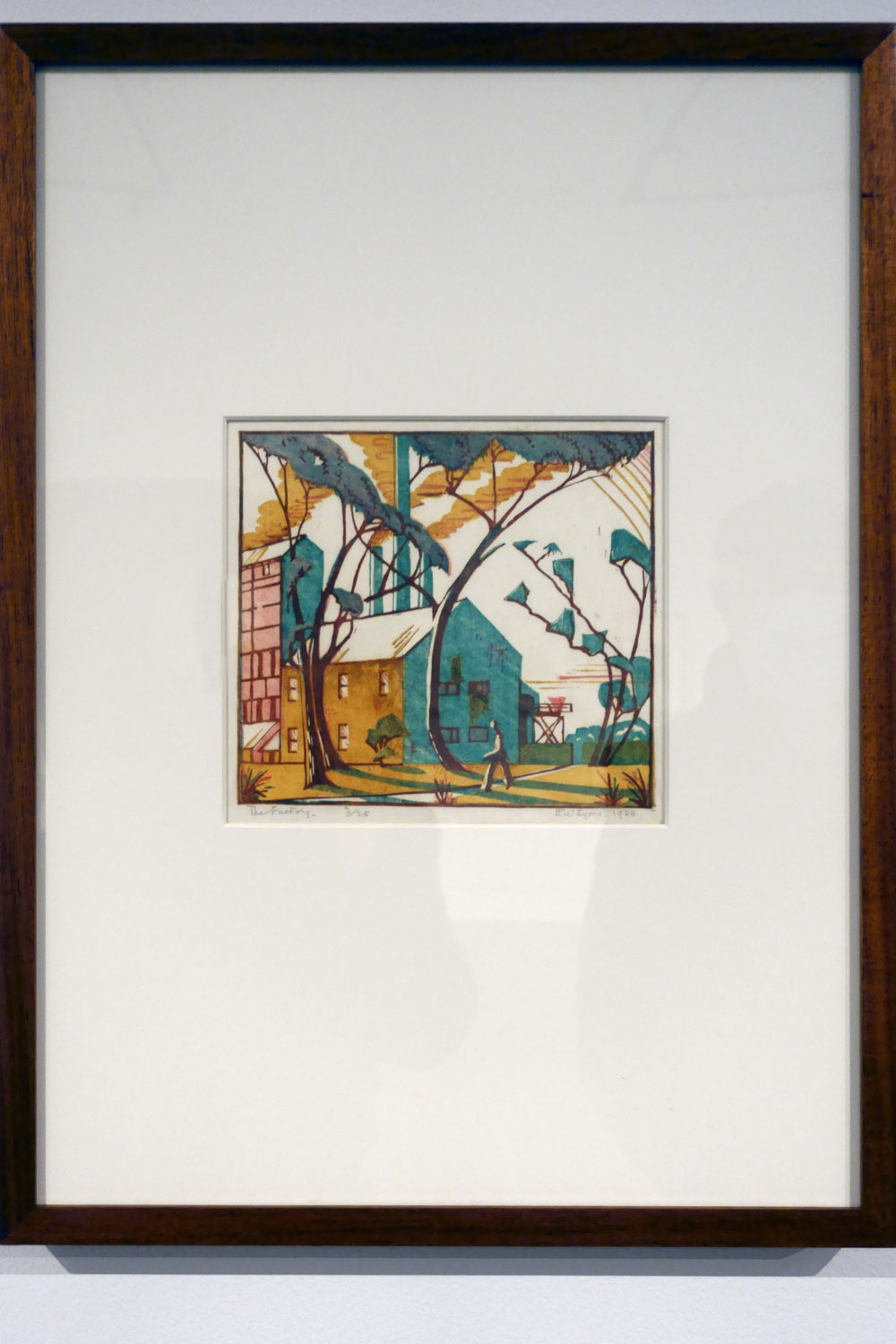
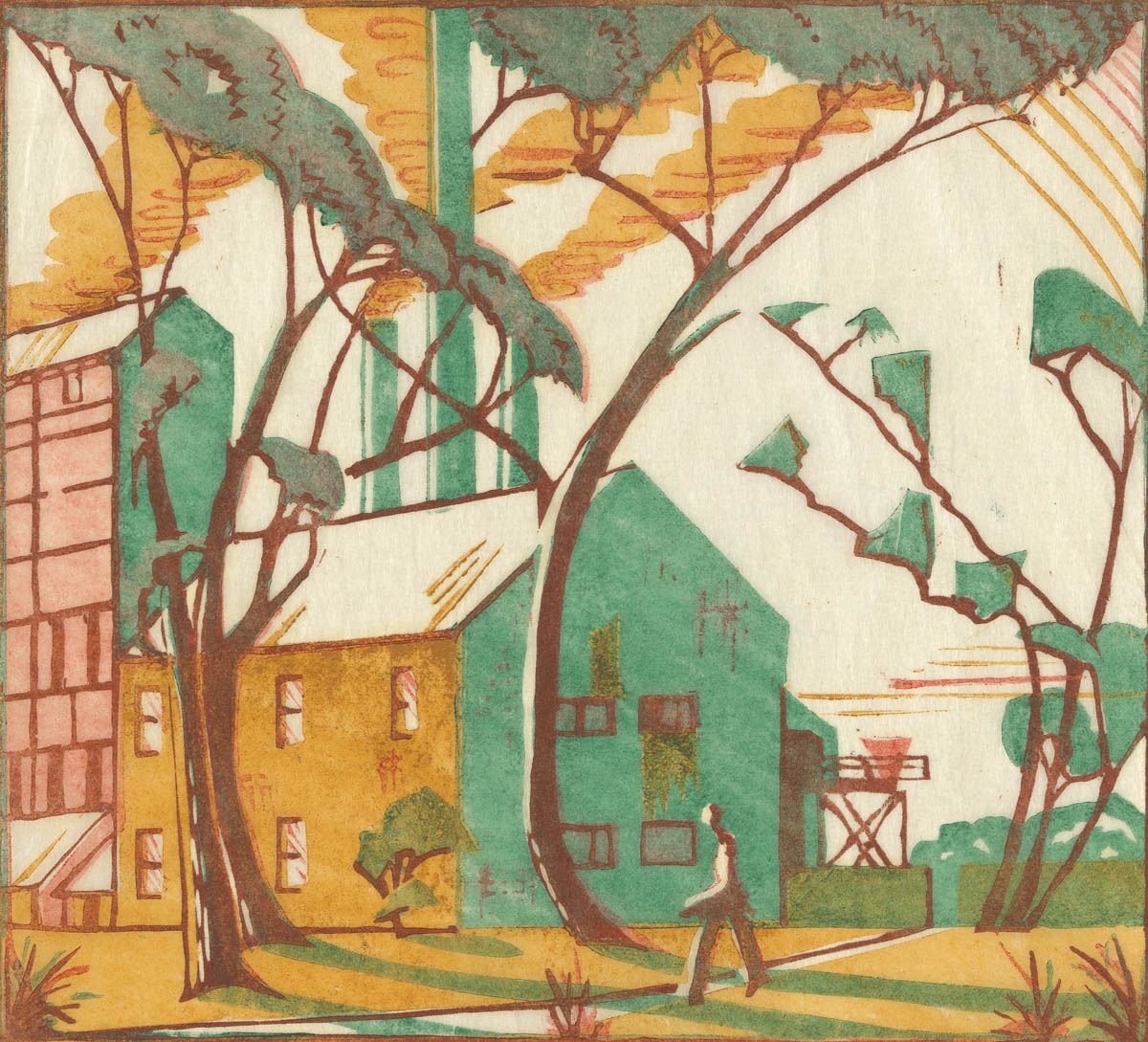
 

Otto Dix (German, 1891-1969)
Karton zum “Groβstadt-Triptychon” (Cartoon for “The Grande Ville triptych”) (installation view)
1927-1928
Charcoal, chalk, pencil, sanguine, gouache on drawing paper laid down on tile
3 panels
Photo: Aubrey Perry


Wall text from the exhibition 'Germany / 1920s / New Objectivity / August Sander' at Centre Pompidou, Paris


Wall text from the exhibition Germany / 1920s / New Objectivity / August Sander at Centre Pompidou, Paris


Otto Dix (German, 1891-1969) Karton zum "Groβstadt-Triptychon" (Cartoon for "The Grande Ville triptych") 1927-1928 (installation view detail)
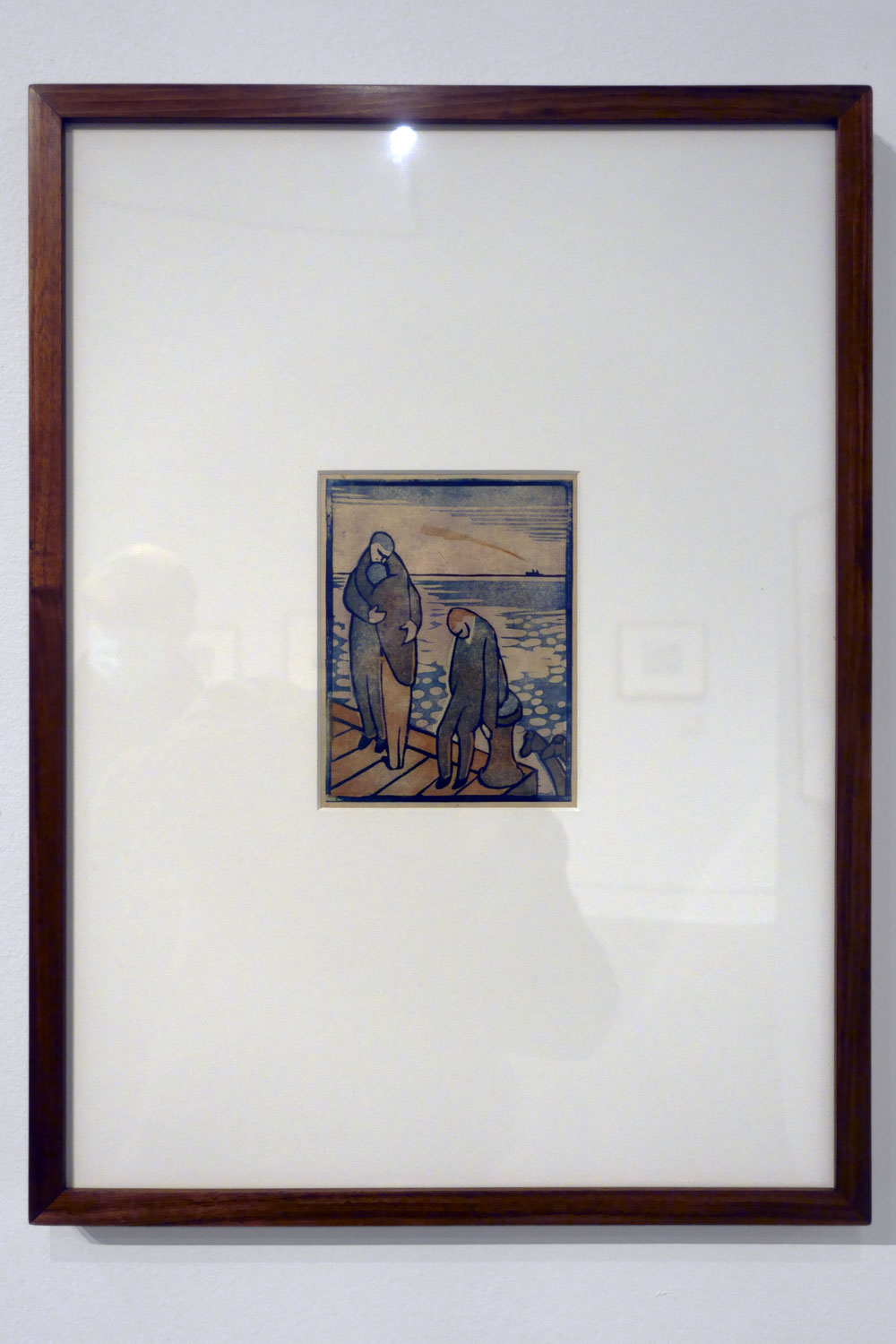
 

Otto Dix (German, 1891-1969)
Karton zum “Groβstadt-Triptychon” (Cartoon for “The Grande Ville triptych”) (installation view detail)
1927-1928
Charcoal, chalk, pencil, sanguine, gouache on drawing paper laid down on tile
3 panels
Photo: Aubrey Perry


Otto Dix (German, 1891-1969) Karton zum "Groβstadt-Triptychon" (Cartoon for "The Grande Ville triptych") 1927-1928 (installation view detail)
 

Otto Dix (German, 1891-1969)
Karton zum “Groβstadt-Triptychon” (Cartoon for “The Grande Ville triptych”) (installation view detail)
1927-1928
Charcoal, chalk, pencil, sanguine, gouache on drawing paper laid down on tile
3 panels
Photo: Aubrey Perry


Otto Dix (German, 1891-1969) Karton zum "Groβstadt-Triptychon" (Cartoon for "The Grande Ville triptych") 1927-1928 (installation view detail)


Otto Dix (German, 1891-1969)
Karton zum “Groβstadt-Triptychon” (Cartoon for “The Grande Ville triptych”) (installation view detail)
1927-1928
Charcoal, chalk, pencil, sanguine, gouache on drawing paper laid down on tile
3 panels
Photo: Aubrey Perry


Georg Scholz (German, 1890-1945) 'Weiblicher Akt auf dem Sofa' (Female nude on the sofa) 1928


Georg Scholz (German, 1890-1945)
Weiblicher Akt auf dem Sofa (Female nude on the sofa)
1928
Oil on canvas


Hans Grundig (German, 1901-1958) 'Am Stadtrand' (On the outskirts) 1926


Hans Grundig (German, 1901-1958)
Am Stadtrand (On the outskirts)
1926
Oil on canvas


Hans Grundig (German, 1901-1958)

Hans Grundig (February 19, 1901 – September 11, 1958) was a German painter and graphic artist associated with the New Objectivity movement.

He was born in Dresden and, after an apprenticeship as an interior decorator, studied in 1920–1921 at the Dresden School of Arts and Crafts. He then studied at the Dresden Academy from 1922 to 1923. During the 1920s his paintings, primarily portraits of working-class subjects, were influenced by the work of Otto Dix. Like his friend Gert Heinrich Wollheim, he often depicted himself in a theatrical manner, as in his Self-Portrait during the Carnival Season (1930).

He had his first solo exhibition in 1930 at the Dresden gallery of Józef Sandel. He made his first etchings in 1933.

Politically anti-fascist, he joined the German Communist Party in 1926, and was a founding member of the arts organisation Assoziation revolutionärer bildender Künstler in Dresden in 1929.

Following the fall of the Weimar Republic, Grundig was declared a degenerate artist by the Nazis, who included his works in the defamatory Degenerate Art exhibition in Munich in 1937. He expressed his antagonism toward the regime in paintings such as The Thousand Year Reich (1936). Forbidden to practice his profession, he was arrested twice – briefly in 1936, and again in 1938, after which he was interned in Sachsenhausen concentration camp from 1940 to 1944.

In 1945 he went to Moscow, where he attended an anti-fascist school. Returning to Berlin in 1946, he became a professor of painting at the Dresden Academy of Fine Arts. In 1957 he published his autobiography, Zwischen Karneval und Aschermittwoch (“Between Shrovetide carnival and Ash Wednesday”). He was awarded the Heinrich Mann Prize in Berlin in 1958, the year of his death.

Text from the Wikipedia website


Hanna Nagel (German, 1907-1975) 'Untitled (Bare-Breasted Woman in Front of a Printing Press)' 1929


Hanna Nagel (German, 1907-1975)
Untitled (Bare-Breasted Woman in Front of a Printing Press)
1929
Graphite and watercolour on paper
46 x 60.5cm


Hanna Nagel (German, 1907-1975)

The daughter of a merchant and a teacher, Hanna Nagel was trained as a bookbinder before enrolling in the Fine Arts School in Karlsruhe in 1919. In an institution that had set up a lithographic and engraving studio at the beginning of the century, the young artist naturally turned towards these techniques, in which she demonstrated great skill. She took courses with Walter Conz, Wilelm Schnarrenberger and, most importantly, Karl Hubbuch, head of the Baden branch of the Neue Sachlichkeit (New Objectivity), the post-war German movement that advocated for a realist representation of the contemporary world. This began the first period in the artist’s work: she followed the example of her professor in terms of themes, highly social content, as well as in her bold and sharp style, which was generally unflattering for models. However, contrary to K. Hubbuch, she chose to treat her figures alone, isolated in their environment, giving them a strange presence (Zigeunerin (gypsy), Munich, 1928; Mädchen mit Blauem Mantel (girl in blue coat), 1929). In 1929, she moved to Berlin, where she took courses with Hans Meid and Emil Orlik at the Fine Arts Academy. She married the painter Hans Fischer in 1931. This marked the end of her realist period.

Marie Gispert. “Hanna Nagel,” on the AWARE (Archives of Women Artists Research & Exhibitions) website 2013 [Online] Cited 04/08/2022. From the Dictionnaire universel des créatrices. Translated from French by Katia Porro. © 2013 Des femmes – Antoinette Fouque © Archives of Women Artists, Research and Exhibitions


Christian Schad (German, 1894-1982) 'Graf St. Genois d'Anneaucourt' 1927 (installation view)


Christian Schad (German, 1894-1982)
Graf St. Genois d’Anneaucourt (installation view)
1927
Photo: Aubrey Perry


Christian Schad (German, 1894-1982) 'Graf St. Genois d'Anneaucourt' 1927


Christian Schad (German, 1894-1982)
Graf St. Genois d’Anneaucourt
1927


Christian Schad (German, 1894-1982) 'Anna Gabbioneta' 1927


Christian Schad (German, 1894-1982)
Anna Gabbioneta
1927
Oil on canvas


Christian Schad (German, 1894-1982) 'Bildnis Dr. Haustein' (Portrait of Dr. Haustein) 1928


Christian Schad (German, 1894-1982)
Bildnis Dr. Haustein (Portrait of Dr. Haustein)
1928
Oil on canvas


Willi Müller-Hufschmid (German, 1890-1966) 'Akademie modell' (Academic model) c. 1922


Willi Müller-Hufschmid (German, 1890-1966)
Akademie modell (Academic model)
c. 1922
Oil on paper on plywood


Willi Müller-Hufschmid studied from 1908 at the Academy of Fine Arts in Karlsruhe. During this time he got to know Rudolf Schlichter, Georg Scholz and other painters from the “Rih” group. He became known as a representative of the New Objectivity towards the end of the 1920s. In the 1950s he turned to abstract painting.


Installation view of the exhibition 'Germany / 1920s / New Objectivity / August Sander' at Centre Pompidou, Paris showing at left, Georg Scholz's 'Kacteen und Semaphore' (Cacti and semaphores) (1923); at centre, Rudolf Dischinger's 'Grammophon' (Gramophone) (1930); and at right, Franz Xaver Fuhr's 'Stillleben (Gummibaum)' (Still life (Rubber tree)) (c. 1925)


Installation view of the exhibition Germany / 1920s / New Objectivity / August Sander at Centre Pompidou, Paris showing at left, Georg Scholz’s Kacteen und Semaphore (Cacti and semaphores) (1923, below); at centre, Rudolf Dischinger’s Grammophon (Gramophone) (1930, below); and at right, Franz Xaver Fuhr’s Stillleben (Gummibaum) (Still life (Rubber tree)) (c. 1925, below)
Photo: Aubrey Perry


Georg Scholz (German, 1890-1945) 'Kacteen und Semaphore' (Cacti and semaphores) 1923


Georg Scholz (German, 1890-1945)
Kacteen und Semaphore (Cacti and semaphores)
1923
Oil on hardboard


Franz Xaver Fuhr (German, 1898-1973) 'Stillleben (Gummibaum)' (Still life (Rubber tree)) c. 1925


Franz Xaver Fuhr (German, 1898-1973)
Stillleben (Gummibaum) (Still life (Rubber tree))
c. 1925
Oil on canvas


Franz Xaver Fuhr (German, 1898-1973)

Franz Xaver Fuhr was born in Mannheim-Neckarau on 23 September 1898. As a painter Fuhr was an autodidact. Obeying his father’s wishes, he learned the painter’s trade. When Fuhr presented his watercolours at the Mannheim “Kunsthalle” for appraisal, the “Kunsthalle” immediately bought several works. As a token of his high esteem of Fuhr’s work the director of the Kunsthalle, Gustav Hartlaub, offered the artist financial support as well as a studio and an apartment in the Mannheim palace.

The artist exhibited watercolours in the autumn exhibition at the Berlin Akademie in 1927 as well as at the Gallery Nierendorf in 1928. Exhibitions in Danzig, Königsberg, Düsseldorf and Lübeck followed.

Fuhr was admitted to the “Deutscher Künstlerbund” and participated regularly in the association’s exhibitions. A sign of public appraisal was the award of the Prize of the “Preußische Akademie” and the Villa-Romana-Prize in 1930 and 1931. During this period Fuhr’s work is characterised by a delicate, flowing colour combined with a grid-like, austere linearity which structures the composition. The artist consistently elaborated this compositional principle during the early 1930s. His works became less austere for the benefit of a more painterly aspect. The deteriorating economic situation and the effects of National Socialist cultural politics also effected Fuhr. The “Städtische Kunsthalle” took his works off show as early as 1934 and three years later 23 of his works were confiscated in German museums. Several works were shown in the exhibition “Degenerate Art”. Fuhr was banned from pursuing his profession.

When his apartment in Mannheim was hit during an air-raid in 1943 the painter decided to leave his home town. He moved to Nabburg, where he stayed until 1950, and then took up residence in Regensburg. The painter was appointed professor at the “Akademie der Bildenden Künste” in Munich in 1946, a post which he held for 20 years.

Franz Xaver Fuhr retreated during the last years of his life and died on 16 December 1973.

Anonymous text. “Franz Xaver Fuhr,” on the Art Directory website Nd [Online] Cited 03/08/2022


Rudolf Dischinger (German, 1904-1988) 'Grammophon' (Gramophone) 1930


Rudolf Dischinger (German, 1904-1988)
Grammophon (Gramophone)
1930
Oil on plywood


Rudolf Dischinger studied at the Baden State Art School with Georg Scholz and Karl Hubbuch. In 1927 he graduated from school with the drawing teacher examination and worked as a teacher in Freiburg until 1939. During this time he painted urban landscapes and still lifes in the New Objectivity style. From 1939 until he was wounded in 1942 he was a soldier in France and Russia. From 1946 he lived again as a freelance artist in Freiburg. There he taught at the art academy until it was closed in 1954. He then worked again in school until his retirement in 1965. In 1976 he received the Reinhold Schneider Prize of the City of Freiburg. After 1945 he started abstract painting. In his last years he turned back to representational painting.


Alexander Kanoldt (German, 1881-1939) 'Stillleben mit Gitarre' (Still Life with Guitar) 1926


Alexander Kanoldt (German, 1881-1939)
Stillleben mit Gitarre (Still Life with Guitar)
1926
Oil on canvas


Alexander Kanoldt (German, 1881-1939)

Alexander Kanoldt (29 September 1881 – 24 January 1939) was a German magic realist painter and one of the artists of the New Objectivity. …

Alexander Kanoldt was born on 29 September 1881 in Karlsruhe in Baden-Württemberg, Germany. His father was the painter Edmund Kanoldt [de], a late practitioner of the Nazarene style.

After studies at the Academy of Fine Arts Karlsruhe he went to Munich in 1908, where he met a number of modernists such as Alexej von Jawlensky, Wassily Kandinsky and Gabriele Münter. He became a member of the Munich New Secession in 1913, with Jawlensky and Paul Klee.

After military service in World War I from 1914 to 1918, the still lifes Kanoldt painted show the influence of Derain and an adaptation of cubist ideas.

By the early 1920s Kanoldt developed the manner for which he is best known, a magic realist rendering of potted plants, angular tins, fruit and mugs on tabletops. He also painted portraits in the same severe style, as well as geometrical landscapes. In 1925 he was made a professor at Breslau Academy, a post he held until 1931. During this time he came into conflict with the Bauhaus faction at the Academy, and he was increasingly at odds with the avant garde. From 1933 until his resignation in 1936 he was the director of the State School of Art in Berlin.

With the rise of the Nazi regime in 1933 Kanoldt attempted accommodation, painting in a romantic style, but nonetheless many of his works were seized by the authorities as degenerate art in 1937. He died in Berlin on 24 January 1939.

Text from the Wikipedia website


Franz Lenk (1898-1968) 'Amaryllis' 1930


Franz Lenk (German, 1898-1968)
Amaryllis
1930
Egg tempera on canvas on wood
66 x 44cm


Franz Lenk (German, 1898-1968)

Franz Lenk (June 21, 1898 Langenbernsdorf, Germany – September 13, 1968 Schwäbisch Hall, Germany) was a landscape artist and co-founder of the group “The Seven”.

After an apprenticeship as a decorative painter and lithograph from 1912 to 1915, Franz Lenk studied at the Dresden Academy in 1916. Lenk was drafted for military service, and after from 1922 onwards he continued his studies. In 1928, Lenk was co-founder of the “Die Sieben” group and in 1929 Lenk was a member of the Berlin Artists’ Association, a member of the Berlin Secession in 1936, and a member of the Prussian Academy of Arts in 1937.

From 1933 to 1936 Franz Lenk was a member of the presidential council of the Reichskammer der bildenden Künste. Also in 1933, he was appointed professor to the United States School in Berlin. In 1937, Lenk denied his participation in the Great German Art Exhibition at the House of German Art and laid down his lecture at the United State School in protest against the defamation of his colleagues and against the repressive “art policy” in the “Third Reich”.

In 1950, he received a teaching assignment at the Carnegie Institute in Pittsburgh. In 1959, Lenk settled in Schwäbisch Hall, where he became the city’s cultural commissioner.

Anonymous text. “Lenz, Frank,” on the Hundertmarkartfair website Nd [Online] Cited 03/08/2022


Franz Lenk (German, 1898-1968) 'Stillleben mit gelber Tüte' (Still life with a yellow bag ) 1927


Franz Lenk (German, 1898-1968)
Stillleben mit gelber Tüte (Still life with a yellow bag)
1927
Mixed technique on canvas


Oskar Nerlinger (German, 1893-1969) 'Straßen der Arbeit' (Labour routes) 1930


Oskar Nerlinger (German, 1893-1969)
Straßen der Arbeit (Labour routes)
1930
Tempera on cardboard


Karl Völker (German, 1889-1962) 'Beton' c. 1924


Karl Völker (German, 1889-1962)
Beton
c. 1924
Oil on canvas


Karl Völker (German, 1889-1962) 'Industriebild' (Picture of Industry) 1924


Karl Völker (German, 1889-1962)
Industriebild (Picture of Industry)
1924
Oil on canvas


Karl Völker (German, 1889-1962) 'Bahnhof' (Train station) 1924-1926


Karl Völker (German, 1889-1962)
Bahnhof (Train station)
1924-1926
Oil on wood


Centre Pompidou 
75191 Paris cedex 04
Phone: 00 33 (0)1 44 78 12 33

Opening hours:
Wednesday – Monday 11am – 9pm

Centre Pompidou website

LIKE ART BLART ON FACEBOOK

Back to top

Exhibition: ‘Ellsworth Kelly: Postcards’ at the Frances Young Tang Teaching Museum and Art Gallery, Skidmore College, Saratoga Springs, New York

Exhibition dates: 10th July – 28th November, 2021

Curated by Ian Berry in collaboration with the Ellsworth Kelly Studio, and with Jessica Eisenthal, Independent Curator


Ellsworth Kelly (American, 1923-2015) 'Gauloise Blue with Red Curve' 1954 from the exhibition 'Ellsworth Kelly: Postcards' at the Frances Young Tang Teaching Museum and Art Gallery, Skidmore College, Saratoga Springs, New York, July - Nov, 2021


Ellsworth Kelly (American, 1923-2015)
Gauloise Blue with Red Curve
1954
Collection of Ellsworth Kelly Studio and Jack Shear
© Ellsworth Kelly Foundation


An intimate change of pace now.

I love these playful interventions which “catch something that’s a flash, a mysterious thing, the beginning of something, a primal thing.”

Starting with the solid base of a printed postcard Kelly constructs and abstracts his collages on their surface, using shifting positions, using his vision rather than his mind. He intuitively feels what is needed, what essence is required to compliment or complicate the existing scene.

As Dr. Jessica Eisenthal insightfully observes, “The collages involve a fundamental interplay between concealment and exposure, with every card containing both a secret and its revelation, a construction and a deconstruction.”

And then there is the simplicity and beauty of his interventions. The clear seeing and feeling expressed in a few pieces of cut or torn paper, promising “a compilation of experiences, a journal of travel, creative play, and relationships.” The thickness and irregularity of the white line over Statue of Liberty (1957); the emptiness and ambiguity of the blue in Moon Over Manhattan (1964); the abstraction of a black “diamond” over Cincinnati Riverfront Stadium (1980) baseball park; and the textural beauty of three disparate bodies of water in St. Martin – Baie Rouge (2005).

Reminding me of the felt immediacy of Gerhard Richter’s overpainted photographs, Kelly’s postcards speak to the heart rather than the head. Their intimate, jewel-like size draw the viewer in to imbibe of the transformative scene, to drink in an unbounded space of creative freedom those glances that we sometimes catch – in the light of revelation – of our life dis/continuous. The fabric and structure of existence itself.

Dr Marcus Bunyan


Many thankx to the Frances Young Tang Teaching Museum and Art Gallery for allowing me to publish the art works in the posting. Please click on the art work for a larger version of the image.


In all his postcards, Kelly’s drive to upset perception, to create moments of uncertainty and “mystery,” is apparent. As he explained in 1991:

“As we move, looking at hundreds of different things, we see many different kinds of shapes. Roofs, walls, ceilings are all rectangles, but we don’t see them that way. In reality they’re very elusive forms. The way the view through the rungs of a chair changes when you move even the slightest bit – I want to capture some of that mystery in my work. In my paintings I’m not inventing; my ideas come from constantly investigating how things look.47

While his goal was to achieve visual ambiguity, Kelly began with images of visual certainty, from the postcard images themselves to the photographic reproductions from which he cut or tore his fragments, for example, those of celebrities, advertisements, or homoeroticism.


Tricia Y. Paik. “Sights of His Life,” in Berry, Ian and Eisenthal, Jessica (eds.,). Elsworth Kelly: Postcards. Delmonico Books, 2021, pp. 318-319.


Jack Shear (American) 'Ellsworth Kelly's Studio' 1994


Jack Shear (American)
Ellsworth Kelly’s Studio
1994
Photo: Courtesy Ellsworth Kelly Studio


Over the course of more than 50 years, renowned American artist Ellsworth Kelly made approximately 400 postcard collages, some of which served as exploratory musings and others as studies for larger works in other mediums. They range from his first monochrome in 1949 through his last postcard collages of crashing ocean waves, in 2005.

Together, these works show an unbounded space of creative freedom and provide an important insight into the way Kelly saw, experienced and translated the world in his art. Many postcards illustrate specific places where he lived or visited, introducing biography and illuminating details that make these pieces unique among his broader artistic production. Ellsworth Kelly: Postcards is the most extensive publication of Kelly’s lifelong practice of collaged postcards.

Ellsworth Kelly (1923-2015) was born in Newburgh, New York. In 1948 he moved to France, where he came into contact with a wide range of classical and modern art. He returned to New York in 1954 and two years later had his first exhibition at the Betty Parsons Gallery. The Museum of Modern Art, New York, organised his first retrospective in 1973. Subsequent exhibitions have been held at museums around the world, including the Solomon R. Guggenheim Museum in New York, Tate in London, Haus der Kunst in Munich and the Centre Pompidou in Paris.


Installation view of the title wall of exhibition 'Ellsworth Kelly: Postcards' at the Frances Young Tang Teaching Museum and Art Gallery, Skidmore College


Installation view of the title wall of the exhibition Ellsworth Kelly: Postcards at the Frances Young Tang Teaching Museum and Art Gallery, Skidmore College


Installation view of Gallery A of the exhibition 'Ellsworth Kelly: Postcards' at the Frances Young Tang Teaching Museum and Art Gallery, Skidmore College


Installation view of Gallery A of the exhibition Ellsworth Kelly: Postcards at the Frances Young Tang Teaching Museum and Art Gallery, Skidmore College


Installation view of Gallery B of the exhibition 'Ellsworth Kelly: Postcards' at the Frances Young Tang Teaching Museum and Art Gallery, Skidmore College


Installation view of Gallery B of the exhibition Ellsworth Kelly: Postcards at the Frances Young Tang Teaching Museum and Art Gallery, Skidmore College


American painter Ellsworth Kelly (1923-2015) is one of the most important artists of the twentieth century. His abstract paintings, sculptures, and prints are masterworks in the exploration of line, form, and colour. In a lesser-known part of his practice, Kelly made collaged postcards, some of which served as exploratory musings and others as preparation for larger works in other media. From 1949 to 2005, Kelly made just over 400 postcard works. They show a playful, unbounded space of creative freedom for the artist and provide an important insight into the way Kelly saw, experienced, and translated the world in his art.

Ellsworth Kelly: Postcards will present a comprehensive survey of Kelly’s postcard collages, with 150 works on view. Many postcards reveal specific places where Kelly lived or visited, such as Paris, where Kelly lived in the late 1940s and early 1950s, and where he often returned, or other areas in New York City – My New Studio (1970), is a picture postcard of downtown Old Chatham, New York, with a stapled arrow pointing to the second-floor windows of his new studio building.

This kind of overt biography and revealing details make the postcard collages unique among Kelly’s works. Flashes of the artist’s playfulness show through, which is less visible in his formally rigorous paintings and sculpture.

The exhibition will be accompanied by a full-colour catalogue featuring newly commissioned writings and never-before published images.

Text from the Frances Young Tang Teaching Museum and Art Gallery website


Ellsworth Kelly (American, 1923-2015) 'EK as Velázquez' 1988 from the exhibition 'Ellsworth Kelly: Postcards' at the Frances Young Tang Teaching Museum and Art Gallery, Skidmore College, Saratoga Springs, New York, July - Nov, 2021


Ellsworth Kelly (American, 1923-2015)
EK as Velázquez
1988


Foreword to catalogue

Widely regarded as one of the most influential artists of the twentieth century, Ellsworth Kelly (1923-2015) is known for paintings, sculptures, drawings, and prints that are masterworks in line, form, and colour. Having played a pivotal role in the development of postwar abstract art, Kelly’s inventive approach to abstraction draws on found composition and observation of the physical world. In a rarely seen aspect of his practice, Kelly made approximately four hundred postcard collages over the course of six decades. Some were exploratory musings, while others served as studies for larger works in other media or a means to revisit important concepts from years prior. Ellsworth Kelly: Postcards is the first survey of Kelly’s postcard collages, starting with his first monochrome painted on a postcard in 1949 and ending with his final collages of crashing ocean waves made in 2005. Resisting clear taxonomies of abstraction and representation, these works show an unbounded space of creative freedom and provide important insight into the way Kelly saw, experienced, and translated the world in his art.

Many postcards illustrate specific places where the artist lived or visited, introducing biography and context that make these works unique among his broader artistic production. During his lifetime, most of these works were held privately by the artist, only occasionally making their way into institutional collections. Many were sent to friends and colleagues as personal correspondences, though many more were kept in his studio. Revealing an unrestrained curiosity and the breadth of his practice, Kelly’s postcard collages are as humorous and intimate as they are formal and discerning.

Kelly began his studies at Pratt Institute in New York from 1941 to 1942, then continued at the School of the Museum of Fine Arts in Boston from 1946 to 1948. While on his tour of duty in Europe during World War II he visited Paris for the first time. He returned with funds from the GI Bill in 1948 and stayed until 1954. Those years in France were formative; this was when Kelly first painted and collaged on picture postcards, which, at the time, he mostly sent to artist and friend Ralph Coburn. In 1954, Kelly moved from Paris to New York, where he rented a studio in Coenties Slip in downtown Manhattan, as part of a community of artists that included Robert Indiana, Agnes Martin, James Rosenquist, and Jack Youngerman. The influence of that fertile time can be seen in several New York postcards of the 1950s.

Throughout the literature on Kelly’s oeuvre, scholars have consistently noted the cyclical process of his art making, his tendency to revisit ideas from years, even decades, earlier. In keeping, the production of the postcard collages was rhythmic and episodic, punctuated by other artistic and life activities. One can trace the years of prolific and less prolific output to align with important life events, including new bodies of work, retrospectives, and studio moves. For instance, Kelly made a great number of cards in 1970, the year he moved to Spencertown, New York, and in 1974 while traveling in Europe following his 1973 Museum of Modern Art retrospective.

Mapping the postcard collage production onto a timeline of Kelly’s life and work also reveals that the postcards were not a part of his general studio practice, but rather constituted a kind of freedom from the studio. In this sense, they comprise a compilation of experiences, a journal of travel, creative play, and relationships. The decade of the 1970s includes a significant number of cards made in St. Martin in the Caribbean, where he would travel to stay with artist Jasper Johns, who had a home on the island. The mid-1980s – particularly around the time he met photographer Jack Shear, who would become his life partner – was another prolific period for Kelly’s postcard collages. This intensity of collage production waned in the 1990s, in part due to the decline in print quality of mass-produced picture postcards, which Kelly did not appreciate.

The postcard collages use a wide variety of found materials, including pieces of vinyl records, newspaper clippings, ticket stubs, wine labels, and even sections of his own prints. For example, in 1964, Kelly used torn proofs from his own lithographs in a series of postcard collages with Paris monuments, as studies for sculptures. This source material is discussed in a new essay for this book by Dr. Tricia Y. Paik. Her essay reviews Kelly’s biography and outlines key features of his iconic work that can be found in specific examples of the postcard collages. Dr. Lynda Klich surveys the advent of the picture postcard itself and points to the use of postcards by modernist artists of the early twentieth century – from Art Nouveau and Futurism, to Surrealism and Dada. Dr. Jessica Eisenthal focuses on the mostly hidden, double-sided aspect of the postcard collages. She reveals that Kelly not only used the backs of the cards for personal notes but also to continue compositions and create even more experimental and, at times, teasing imagery. The book begins with the artist’s own words from a brochure that accompanied the exhibition Kelly organised from MoMA’s collection in 1990, Artist’s Choice: Ellsworth Kelly, Fragmentation and the Single Form. In this essay, Kelly discusses breaking up the visual world into fragments and provides key insights into his ways of seeing and presenting his art.

The vast majority of the postcard collages in the plates section of this book have never before been reproduced. Over the course of this project, new works were discovered in the artist’s archive, and others came to light from personal collections. May this project be the start of more discovery and continued scholarship on this distinctive and revealing body of work.

Ian Berry (curator)


Ellsworth Kelly (American, 1923-2015) 'Columbus Circle' 1957 from the exhibition 'Ellsworth Kelly: Postcards' at the Frances Young Tang Teaching Museum and Art Gallery, Skidmore College, Saratoga Springs, New York, July - Nov, 2021


Ellsworth Kelly (American, 1923-2015)
Columbus Circle
1957
Postcard collage
5 1/2 x 3 1/2 inches
Collection of Ellsworth Kelly Studio and Jack Shear
© Ellsworth Kelly Foundation


Installation view of the exhibition 'Ellsworth Kelly: Postcards' at the Frances Young Tang Teaching Museum and Art Gallery, Skidmore College showing at left, 'Columbus Circle' 1957; and at second left, 'Four Greens, Upper Manhattan Bay' 1957


Installation view of the exhibition Ellsworth Kelly: Postcards at the Frances Young Tang Teaching Museum and Art Gallery, Skidmore College showing at left, Columbus Circle 1957 (above); and at second left, Four Greens, Upper Manhattan Bay, 1957 (below)


Ellsworth Kelly (American, 1923-2015) 'Four Greens, Upper Manhattan Bay' 1957


Ellsworth Kelly (American, 1923-2015)
Four Greens, Upper Manhattan Bay
1957
Postcard collage
Collection of Ellsworth Kelly Studio and Jack Shear
© Ellsworth Kelly Foundation


Ellsworth Kelly (American, 1923-2015) 'Coenties Slip' 1957


Ellsworth Kelly (American, 1923-2015)
Coenties Slip
1957
Postcard collage
Collection of Ellsworth Kelly Studio and Jack Shear
© Ellsworth Kelly Foundation


Ellsworth Kelly (American, 1923-2015) 'Statue of Liberty' 1957


Ellsworth Kelly (American, 1923-2015)
Statue of Liberty
1957
Postcard collage
5 1/2 x 3 1/2 inches
Collection of Ellsworth Kelly Studio and Jack Shear
© Ellsworth Kelly Foundation


Kelly’s Strategies through Postcard Analogies


“During the day, we see so much at one time. I want to catch something that’s a flash, a mysterious thing, the beginning of something, a primal thing.”

~ Ellsworth Kelly, 2008


Aided with the clarity of five decades of hindsight, this exhibition and catalogue afford us the opportunity to observe the breadth of Kelly’s postcard experimentation, the myriad ways he explored strategies, ideas, and shapes to which he returned time and time again. It can be argued that these postcard objects, more than his other works on paper, allow us the closest entrée into what caught his eye, what he pondered, and what he altered, giving us glimpses into his intuitive and transformative vision. These postcard collages allow us to revisit some of “the sights of his lifetime,” how he found what looked “right” to him at different moments during more than half a century. Indeed, his manipulated postcards tangibly analogise how the artist investigated vision. In 1973, at the time of his mid-career retrospective at MoMA, Kelly admitted to his intriguing relationship with the real world; despite his important reliance on empirical observation, he confessed, “I’ve always felt competitive with reality.”34 Postcards – unchanging templates of predetermined realities – offered him controlled environments with which he could actively compete through his pasted papers.

To create his abstractions drawn from the real world, Kelly relied on various artistic impulses that he learned to follow and trust. He explained in 1992:

“I automatically distance the idea of what I’m looking at. I play with what I see, forget what it is, which colour it is, perceive the changes through my shifting positions. I don’t look at it with a thinking mind but with the possibilities of my vision.”35


Kelly enacted this strategy of distancing through collage, both “placing” and “ellipsis” as previously described by Motherwell. In doing so, he was able to “compete” with reality by obscuring and fragmenting the view. In 1973, the artist explained, “I’ve always been interested in fragmentation, through apertures, doors and windows. When you look through them, that fragmented view changes as you move, and you get a series of different pictures.”36 Through fragmentation, he was able to isolate his forms to arrive at singular shapes. Collage also allowed Kelly to deploy another key artistic goal that further distanced his art from his original sources – to reiterate flatness through the flat piece of collage itself, to push out space, to “flatten”37 the experience of vision. Kelly’s act of collage, his intrusion into the scene, also results in a shaped obstruction, an “ellipsis” of the original postcard view, diminishing our ability to discern and recognise the entire scene and thus achieving the ambiguity he desired, “an open, incomplete situation.”38

Now considering Kelly’s postcard output holistically, there is no observable consistency in how these objects relate to his finished body of work. Sometimes his postcard explorations correlate with what he was exploring in paintings and sculptures at the time, while sometimes there is minimal connection. Although most do not serve as actual studies per se for a completed work, a small number of these postcards, in fact, do. Other times his postcard collages are retrospective, returning to shapes and ideas already produced in work finished years prior – such as La dune du Pyla III, 1983 (p. 183); Blue Yellow (Saint-Michel, Paris), 1985 (p. 267); Seascape, 1985 (p. 274); and Blue Red Rocker / St. Martin, 1986 (p. 275).39 While some postcards appear deliberate and “worked,” some can be understood as quickly collaged “sketches.” During the period of his postcard output from 1949 to 2005, there are specific years when Kelly regularly manipulated the postcard – 1957, 1964, 1974, 1977-1978, and 1984-1985; in particular, 1974, 1977, and 1984-1985 proved to be periods of great experimentation, with as many as seventy-six documented postcards from 1984, the most in any given year.40 In some years there is no documented evidence of any activity; however, perhaps in the future, postcards that Kelly might have made and sent out during the mid to late 1960s (from which only one extant card remains) or other years could resurface. One consistent fact is how much delight Kelly took with the postcard, whether as communication mailed to those within his circle, or as private visual dialogue saved for himself.

Tricia Y. Paik. “Sights of His Life,” in Berry, Ian and Eisenthal, Jessica (eds.,). Elsworth Kelly: Postcards. Delmonico Books, 2021, pp. 316-318.


Ellsworth Kelly (American, 1923-2015) 'Study for Green and White Sculpture for les Invalides' 1964


Ellsworth Kelly (American, 1923-2015)
Study for Green and White Sculpture for les Invalides
1964
Postcard collage
Collection of Ellsworth Kelly Studio and Jack Shear
© Ellsworth Kelly Foundation


Ellsworth Kelly (American, 1923-2015) 'Study for Blue and White Sculpture for Les Tuileries' 1964


Ellsworth Kelly (American, 1923-2015)
Study for Blue and White Sculpture for Les Tuileries
1964
Postcard collage
3 1/2 x 5 1/2 inches
Collection of Ellsworth Kelly Studio and Jack Shear
© Ellsworth Kelly Foundation


Ellsworth Kelly (American, 1923-2015) 'Study for Yellow and White Sculpture for la Tour Eiffel' 1964


Ellsworth Kelly (American, 1923-2015)
Study for Yellow and White Sculpture for la Tour Eiffel
1964
Postcard collage
Collection of Ellsworth Kelly Studio and Jack Shear
© Ellsworth Kelly Foundation


Ellsworth Kelly (American, 1923-2015) 'Moon Over Manhattan' 1964


Ellsworth Kelly (American, 1923-2015)
Moon Over Manhattan
1964
Postcard collage
3 1/2 x 5 1/2 inches
Private collection
© Ellsworth Kelly Foundation


Ellsworth Kelly (American, 1923-2015) 'Nose / Sailboat' 1974


Ellsworth Kelly (American, 1923-2015)
Nose / Sailboat
1974
5 1/2 x 3 1/2 inches
Collection of Ellsworth Kelly Studio and Jack Shear
© Ellsworth Kelly Foundation


Ellsworth Kelly (American, 1923-2015) 'Horizontal Nude or St. Martin Landscape' 1974


Ellsworth Kelly (American, 1923-2015)
Horizontal Nude or St. Martin Landscape
1974
4 x 5 7/8 inches
Collection of Ellsworth Kelly Studio and Jack Shear
© Ellsworth Kelly Foundation


Ellsworth Kelly (American, 1923-2015) 'Marilyn Monroe / Shadows' 1974


Ellsworth Kelly (American, 1923-2015)
Marilyn Monroe / Shadows
1974
Collection of Ellsworth Kelly Studio and Jack Shear
© Ellsworth Kelly Foundation


Ellsworth Kelly (American, 1923-2015) 'Study for Dark Gray and White Rectangle I' 1977


Ellsworth Kelly (American, 1923-2015)
Study for Dark Gray and White Rectangle I
1977
4 x 6 inches
Collection of Ellsworth Kelly Studio and Jack Shear
© Ellsworth Kelly Foundation


Ellsworth Kelly (American, 1923-2015) 'Volcano' 1977


Ellsworth Kelly (American, 1923-2015)
Volcano
1977
Collection of Ellsworth Kelly Studio and Jack Shear
© Ellsworth Kelly Foundation


Ellsworth Kelly (American, 1923-2015) 'Amsterdam' 1979


Ellsworth Kelly (American, 1923-2015)
Amsterdam
1979
4 x 5 7/8 inches
Collection of Ellsworth Kelly Studio and Jack Shear
© Ellsworth Kelly Foundation


Ellsworth Kelly (American, 1923-2015) 'Cincinnati Riverfront Stadium' 1980


Ellsworth Kelly (American, 1923-2015)
Cincinnati Riverfront Stadium
1980
3 1/2 x 5 1/2 inches
Collection of Ellsworth Kelly Studio and Jack Shear
© Ellsworth Kelly Foundation


Ellsworth Kelly (American, 1923-2015) 'Study for Blue White' 1980


Ellsworth Kelly (American, 1923-2015)
Study for Blue White
1980
Collection of Ellsworth Kelly Studio and Jack Shear
© Ellsworth Kelly Foundation


Ellsworth Kelly (American, 1923-2015) 'The Young Spartans' 1984


Ellsworth Kelly (American, 1923-2015)
The Young Spartans
1984
4 1/8 x 5 7/8 inches
Collection of Ellsworth Kelly Studio and Jack Shear
© Ellsworth Kelly Foundation


Ellsworth Kelly (American, 1923-2015) 'Giant Artichoke' 1984


Ellsworth Kelly (American, 1923-2015)
Giant Artichoke
1984
3 1/2 x 5 1/2 inches
Collection of Ellsworth Kelly Studio and Jack Shear
© Ellsworth Kelly Foundation


Ellsworth Kelly (American, 1923-2015) 'Sagrada Familia I' 1985


Ellsworth Kelly (American, 1923-2015)
Sagrada Familia I
1985
Collection of Ellsworth Kelly Studio and Jack Shear
© Ellsworth Kelly Foundation


Ellsworth Kelly (American, 1923-2015) 'St. Martin – Baie Rouge' 2005


Ellsworth Kelly (American, 1923-2015)
St. Martin – Baie Rouge
2005
4 5/8 x 6 3/4 inches
Collection of Ellsworth Kelly Studio and Jack Shear
© Ellsworth Kelly Foundation


Pages from the catalogue for the exhibition 'Elsworth Kelly: Postcards'

Pages from the catalogue for the exhibition 'Elsworth Kelly: Postcards'

Pages from the catalogue for the exhibition 'Elsworth Kelly: Postcards'

Pages from the catalogue for the exhibition 'Elsworth Kelly: Postcards'


Pages from the catalogue by Berry, Ian and Eisenthal, Jessica (eds.,). Elsworth Kelly: Postcards. Delmonico Books, 2021


Frances Young Tang Teaching Museum and Art Gallery at Skidmore College
815 North Broadway
Saratoga Springs, NY 12866
Phone: 518-580-8080

Opening hours:
Tuesday 12.00 – 5.00pm
Wednesday 12.00 – 5.00pm
Thursday 12.00 – 9.00pm
Friday 12.00 – 5.00pm
Saturday 12.00 – 5.00pm
Sunday 12.00 – 5.00pm
Closed Mondays and major holidays

Frances Young Tang Teaching Museum and Art Gallery website

LIKE ART BLART ON FACEBOOK

Back to top