Exhibition: ‘In Focus: Protest’ at the J. Paul Getty Museum, Los Angeles

Exhibition dates: 29th June – 10th October, 2021

Curator: Mazie Harris


David Wojnarowicz in 1988 wearing the "If I Die of AIDS" jacket


David Wojnarowicz in 1988
Please note, this photograph is not in the exhibition


Speaking up when others are silent

This one-room exhibition seems like a missed opportunity.

I note the observation of Anne Wallentine: “In Focus: Protest, a one-room exhibition at the Getty Center, focuses on palatable images of protest. There are no disturbing images of the police’s violent attacks on protesters during the June 2020 Black Lives Matter protests, for example, or of self-immolations protesting the Vietnam War. On the one hand, we don’t need to see violence to understand injustice. But this subject deserves a much deeper and broader show to explore the important power dynamics of protest – and of documenting it – than the Getty’s somewhat muddled march through the lowlights of American history.”1

Although I haven’t seen the exhibition I have been able to gather together numerous photographs from installation shots of the show. The exhibition focuses heavily on the civil rights photographs of the 1960s with sporadic abortion, women’s lib, Vietnam War, contemporary Black Lives Matter and metaphorical images standing in for actual protest photographs (such as the photographs of Robert Frank). As Wallentine observes, the subject deserves a much deeper and broader show to explore the important power dynamics of protest, and of documenting it.

America has a long history of protest stretching back to its very beginning, such as the Boston Tea Party in 1773. But thinking about the photography of protest in America – where are the cartes de visit of slavery abolitionists such as Sojourner Truth or Frederick Douglass, the photographs of protests for women’s suffrage, after the Stonewall Riots, against the lack of funding for HIV/AIDS, for gun legislation, photographs of protests for Native American enfranchisement, marches for equal rights, anti-nuclear protests, Iraq War protests, climate change protests, and the worldwide Occupy movement?

What are issues and the politics involved with documenting protest, both for an against, as an expression of the photographers own beliefs? How does the presence of photographers affect how people “play up” to the camera? Does the photographer participate in the protest or stand aside and just document? How is documenting a form of protest in itself? How are these images then made propaganda and to what ends? What is the difference between the vernacular photography of protest and that of a professional photojournalist? How are both disseminated and what is the difference of this impact?

How is the framing of protest photography undertaken in a system – and here I am thinking, for example, of the selective cropping, editing and addition of text in photo essays by professional photographers such as Gordon Parks for Life magazine – and how do we, as viewers, recognise that the systems in which the works are viewed often obscure the networks in which they are created and operate… that is, structures that sit around those pictures re/presentation in galleries or newspapers, journals.

Essentially, in the power of the image, what lies in and beyond the frame of reference – in terms of the technologies of production, technologies of sign systems, technologies of power and technologies of the self2 – has an “affect” upon the reception and interpretation of images, their inculcation in memory through repetition, their performativity, their intertextuality and their promulgation in the world as acts of resistance and freedom, both from the point of view of the photographer and the viewer.

The one image that is my favourite protest photograph “of all time” can be seen above. To my knowledge, this photograph is not included in the exhibition. Taken by an anonymous photographer in 1988 it shows an anonymous man at a protest rally (evidenced by the placard in the background top right) wearing a jacket emblazoned with words in white capital letters “IF I DIE OF AIDS – FORGET BURIAL – JUST DROP MY BODY ON THE STEPS OF THE F.D.A” over the pink triangle, symbol of homosexuals in the Nazi concentration camps later reclaimed as a positive symbol of self-identity for various LGBTQ identities. The F.D.A. referred to is the United States Food and Drug Administration which is responsible for protecting the public health by ensuring the safety, efficacy, and security of human and veterinary drugs and biological products… at the time dragging their feet over AIDS research.

The anonymous man is, in fact, American artist and activist David Wojnarowicz who died at the age of 37 in 1992, four years after the photograph was taken, of AIDS-related complications.

“… during the plague years, he watched his best friends die horribly, while religious leaders pontificated against safe-sex education and politicians mooted quarantine on islands.

It filled him with rage, the brutality and the waste. He writes: “I want to throw up because we’re supposed to quietly and politely make house in this killing machine called America and pay taxes to support our own slow murder, and I’m amazed that we’re not running amok in the streets and that we can still be capable of gestures of loving after lifetimes of all this.” …

“It is exhausting, living in a population where people don’t speak up if what they witness doesn’t directly threaten them,” he writes. Long before the word intersectionality was in common currency, Wojnarowicz was alert to people whose experience was erased by what he called “the pre‑invented world” or “the one-tribe nation”. Politicised by his own sexuality, by the violence and deprivation he had been subjected to, he developed a deep empathy with others, a passionate investment in diversity. During the course of Close to the Knives he touches repeatedly on other struggles, from fighting police brutality towards people of colour to standing up to the erosion of abortion rights. …

As the rallying cry of Aids activists made clear, “Silence = Death”. From the very beginning of his life Wojnarowicz had been subjected to an enforced silencing, first by his father and then by the society he inhabited: the media that erased him; the courts that legislated against him; and the politicians who considered his life and the lives of those he loved expendable.

In Knives he repeatedly explains his motivation for making art as an acute desire to produce objects that could speak, testifying to his presence when he no longer could. “To place an object or piece of writing that contains what is invisible because of legislation or social taboo into an environment outside myself makes me feel not so alone,” he writes. “It is kind of like a ventriloquist’s dummy – the only difference is that the work can speak by itself or act like that magnet to attract others who carried this enforced silence.””3


The jacket that he made and the photograph of it form an intertextual art work, one both (physically) sculptural and photographic, objects that could visibly speak in the world by transgressing the taboo of invisibility, of silence. The photograph was taken by an anonymous photographer of an initially (to the viewer) anonymous man. It then proceeds to transcend its subject … through the projection of the voice of the artist through time, through the knowledge of the story of his own vitality and resistance, now his absence/presence. His protest stands “in eternity” where there is no time. Standing with others, speaking up when others are silent. That is the essence of protest. I just wonder where that jacket is now?

Dr Marcus Bunyan


Footnotes

1/ Anne Wallentine. “A History of Protest Photography That Plays It Too Safe,” on the Hyperallergic website August 18, 2021 [Online] Cited 12/09/2021

2/ Michel Foucault, “Technologies of the Self,” quoted in Luther Martin, Huck Gutman, Patrick Hutton (eds.). Technologies of the Self: A Seminar with Michel Foucault. Tavistock Publications, London, 1988, p. 18.

3/ Olivia Laing. “David Wojnarowicz: still fighting prejudice 24 years after his death,” on the Guardian website, Friday 13 May 2016 [Online] Cited 12/09/2021


Many thankx to the J. Paul Getty Museum for allowing me to publish the photographs in the posting. Please click on the photographs for a larger version of the image.


We are reminded frequently of the power of photographs to propel action and inspire change. During demonstrations photographers take to the streets to record fast-moving events. At other times they bear witness to daily injustices, helping to make them more widely known. This exhibition of images made during periods of social struggle in the United States highlights the myriad roles protest photographs play in shaping our understanding of American life.


In Focus: Protest, a one-room exhibition at the Getty Center, focuses on palatable images of protest. There are no disturbing images of the police’s violent attacks on protesters during the June 2020 Black Lives Matter protests, for example, or of self-immolations protesting the Vietnam War. On the one hand, we don’t need to see violence to understand injustice. But this subject deserves a much deeper and broader show to explore the important power dynamics of protest – and of documenting it – than the Getty’s somewhat muddled march through the lowlights of American history. …

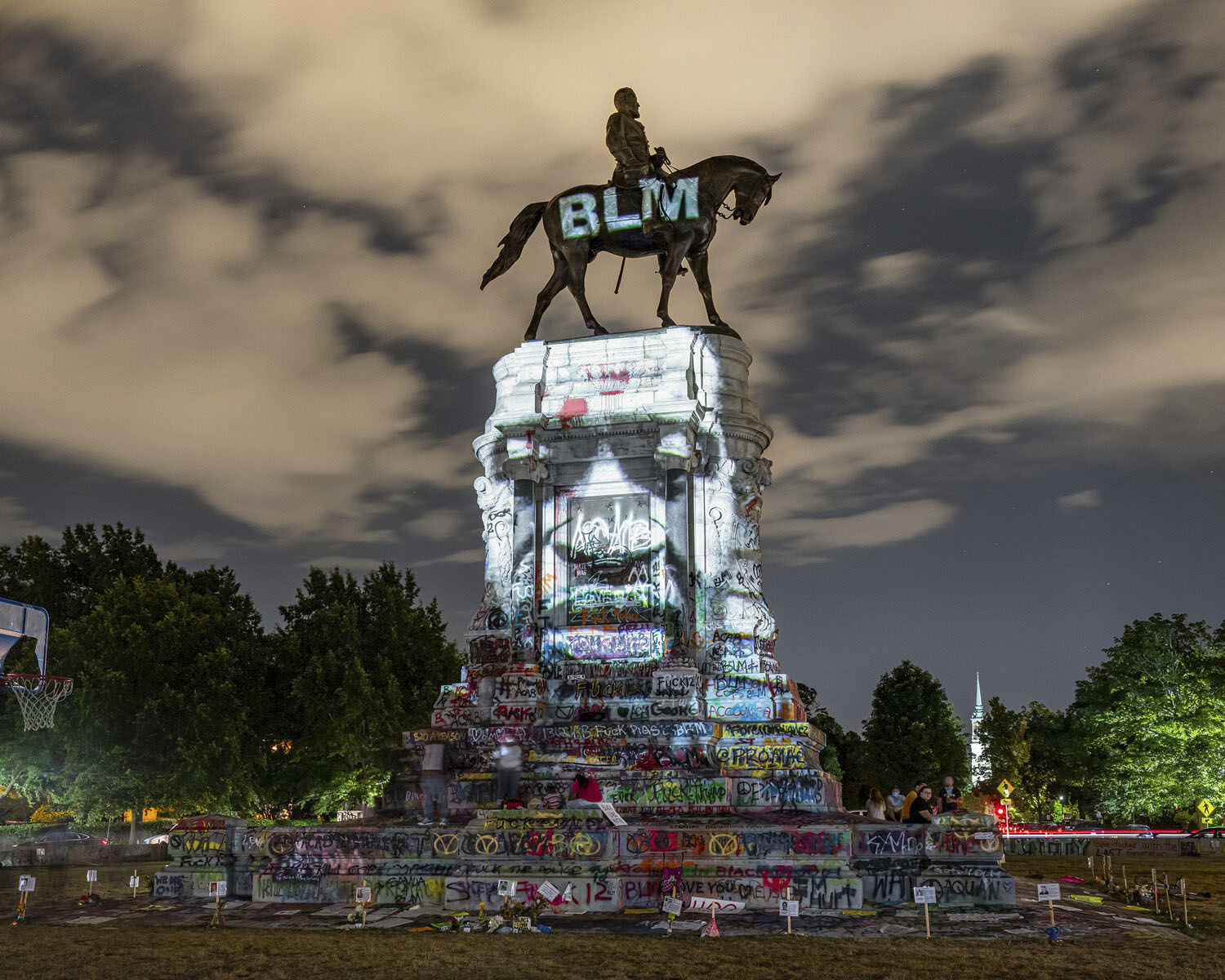
… depicting individuals carries new risks now. Contemporary protest photographers have to navigate the dangers of photo recognition technology for their subjects – notably, Kris Graves’s 2020 photo depicts a luminous memorial to George Floyd projected and graffitied onto a Confederate statue, rather than an image of identifiable marchers [see below]. At the very least, the issue deserves mention in the wall text to contextualize current photography amid this threat to human rights and the tricky role photographers have to navigate while recording and participating in protests. Documenting can be a form of protest, but it can be used against its subjects, too. The exhibition text, however, tends to swerve away from engaging with the complexities of history, mentioning the passage of the 19th Amendment and Voting Rights Act 1965 without referencing the continued struggles to ensure voting access in marginalized communities. It does provide images of counter-protest during the Vietnam War and women’s liberation movement of the 1970s, but these only sharpen the desire for a better understanding of the ebb and flow of human rights efforts into the present.


Anne Wallentine. “A History of Protest Photography That Plays It Too Safe,” on the Hyperallergic website August 18, 2021 [Online] Cited 12/09/2021


Underwood & Underwood (American, founded 1881, dissolved 1940s) '[Women's Campaign Train for Hughes]' 1916 from the exhibition 'In Focus: Protest' at the J. Paul Getty Museum, Los Angeles, June - Oct, 2021


Underwood & Underwood (American, founded 1881, dissolved 1940s)
[Women’s Campaign Train for Hughes]
1916
Gelatin silver print
18.7 × 24.9cm (7 3/8 × 9 13/16 in.)
The J. Paul Getty Museum, Los Angeles


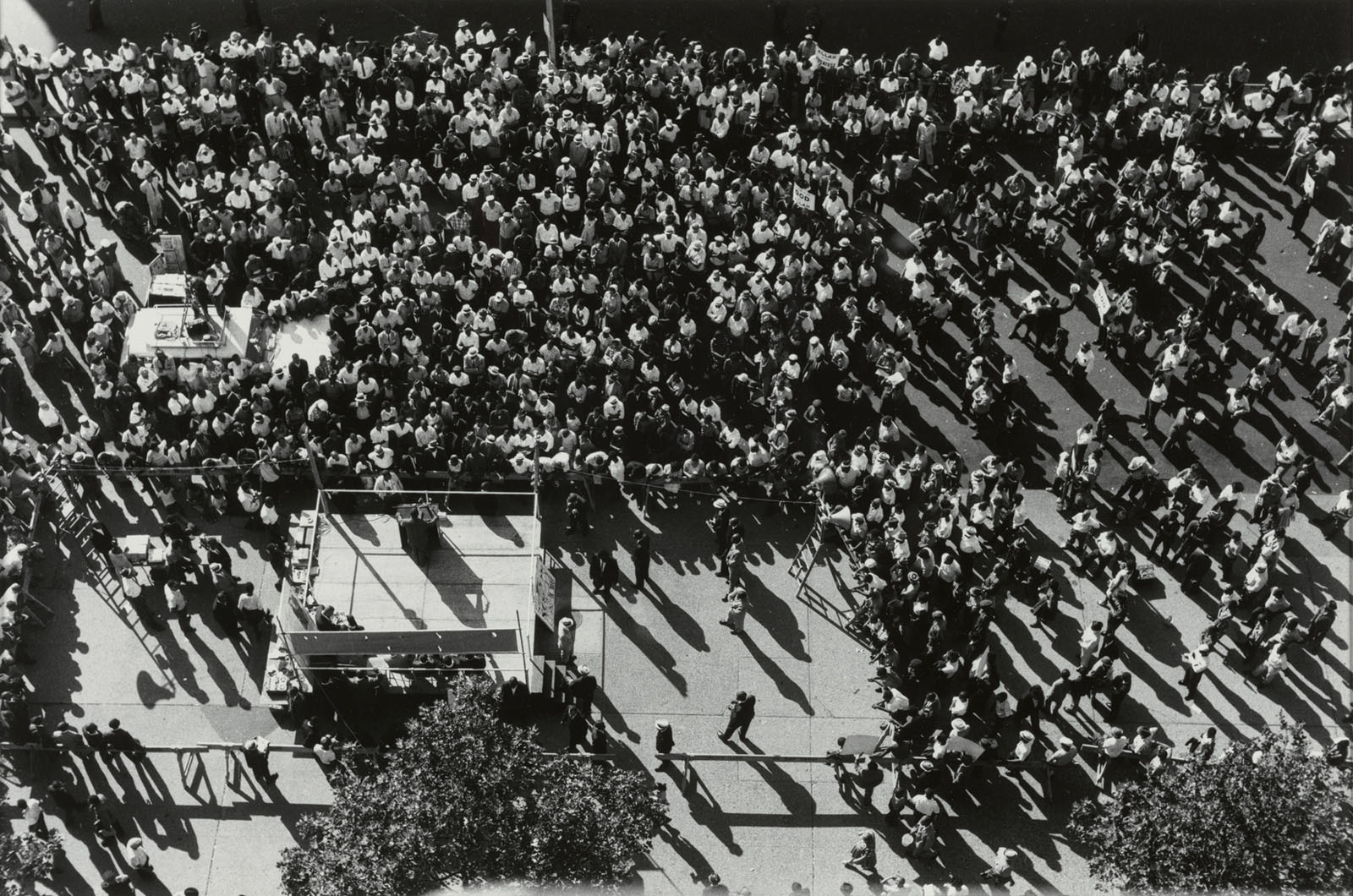
Adger Cowans (American, b. 1936) 'Malcolm X Speaks at a Rally in Harlem at 115th St. & Lennox Ave., New York' September 7, 1963 from the exhibition 'In Focus: Protest' at the J. Paul Getty Museum, Los Angeles, June - Oct, 2021


Adger Cowans (American, b. 1936)
Malcolm X Speaks at a Rally in Harlem at 115th St. & Lennox Ave., New York
September 7, 1963
Gelatin silver print
16.2 × 23.5cm (6 3/8 × 9 1/4 in.)
The J. Paul Getty Museum, Los Angeles
© Adger Cowans


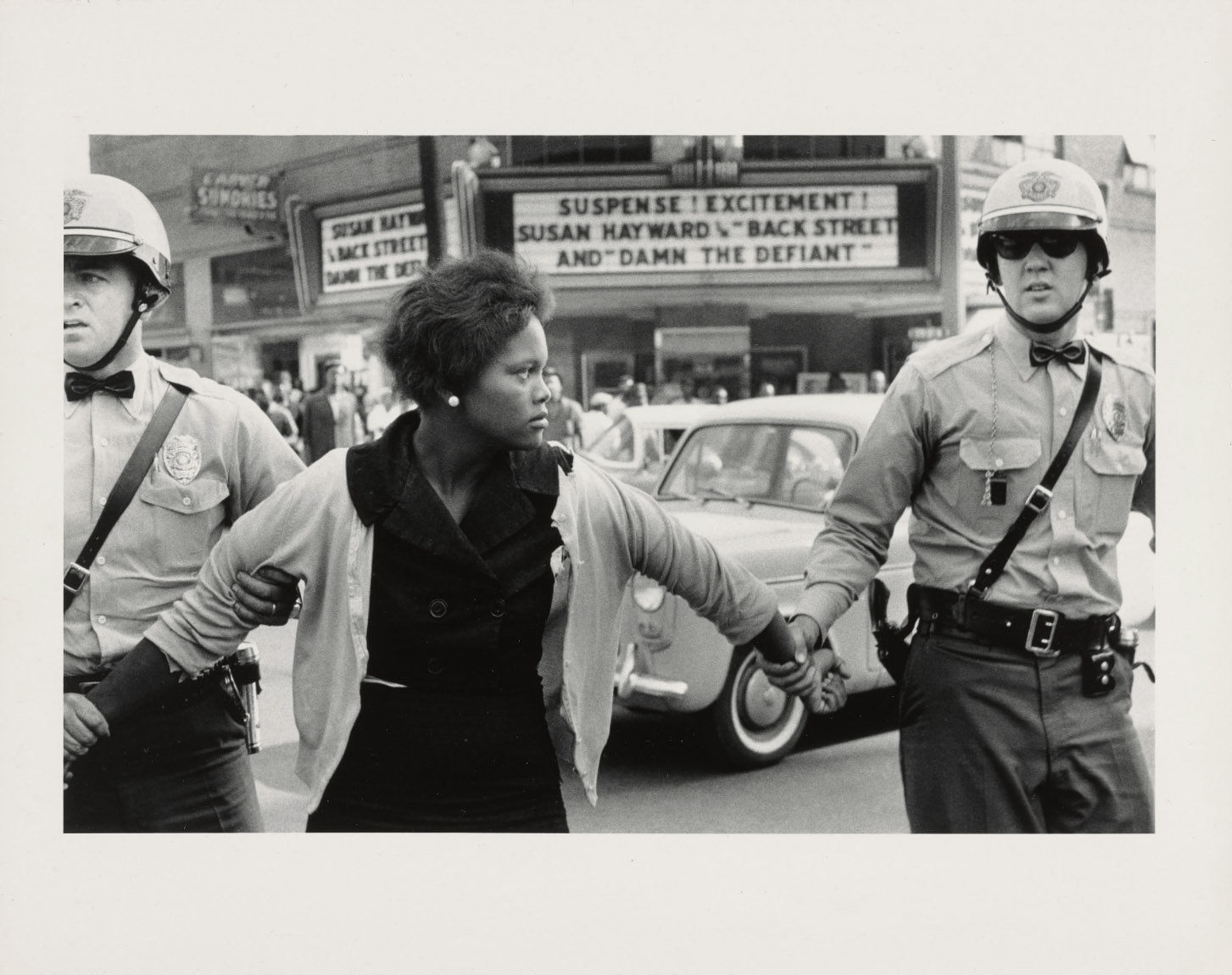
Bruce Davidson (American, born 1933) 'Birmingham, Alabama' Negative 1963; print 1970-1979


Bruce Davidson (American, born 1933)
Birmingham, Alabama
Negative 1963; print 1970-1979
Gelatin silver print
19.9 × 31.1 cm (7 13/16 × 12 1/4 in.)
The J. Paul Getty Museum, Los Angeles
© Bruce Davidson/Magnum Photos


An African-American woman is arrested by two Caucasian police officers, each holding her by her arms. In the background is a theatre marquee, bearing the signs for the movies, “Back Street” and “Damn the Defiant.”


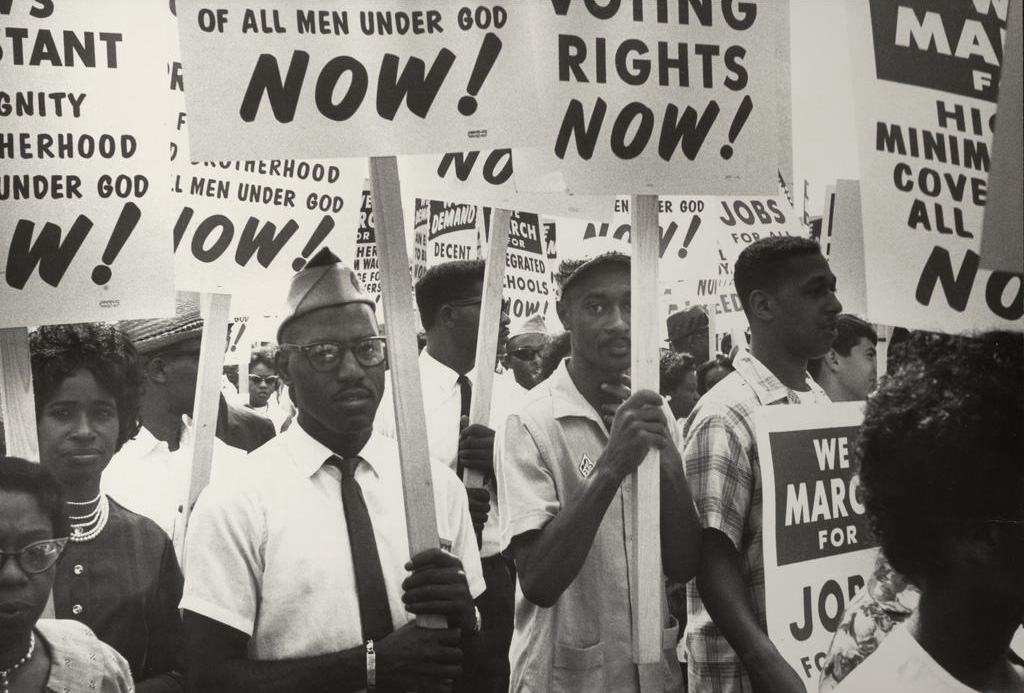
Leonard Freed (American, 1929-2006) 'March on Washington, Washington, D.C.' August 28, 1963


Leonard Freed (American, 1929-2006)
March on Washington, Washington, D.C.
August 28, 1963
Gelatin silver print
26.5 × 38.7cm (10 7/16 × 15 1/4 in.)
The J. Paul Getty Museum, Los Angeles
© Leonard Freed / Magnum Photos


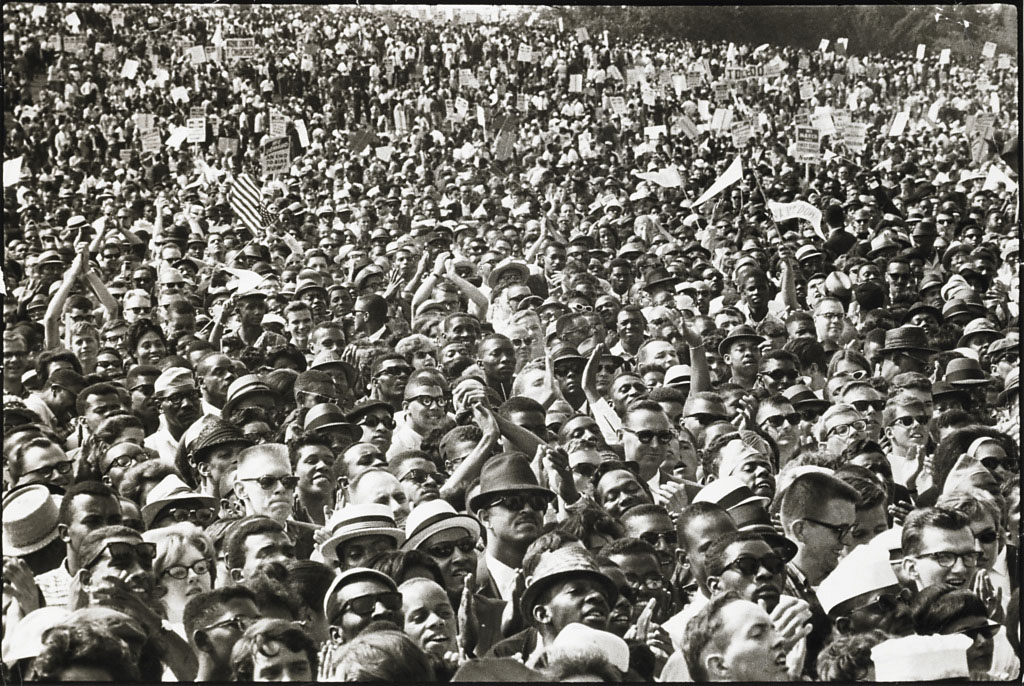
Robert (Bob) Adelman (American, 1930-2016) 'Washington, D.C., Cheering crowd during speeches at historic March on Washington' 1963


Robert (Bob) Adelman (American, 1930-2016)
Washington, D.C., Cheering crowd during speeches at historic March on Washington
1963
Gelatin silver print
27.9 × 35.6cm (11 × 14 in.)
The J. Paul Getty Museum, Los Angeles
© Bob Adelman/Magnum Photos


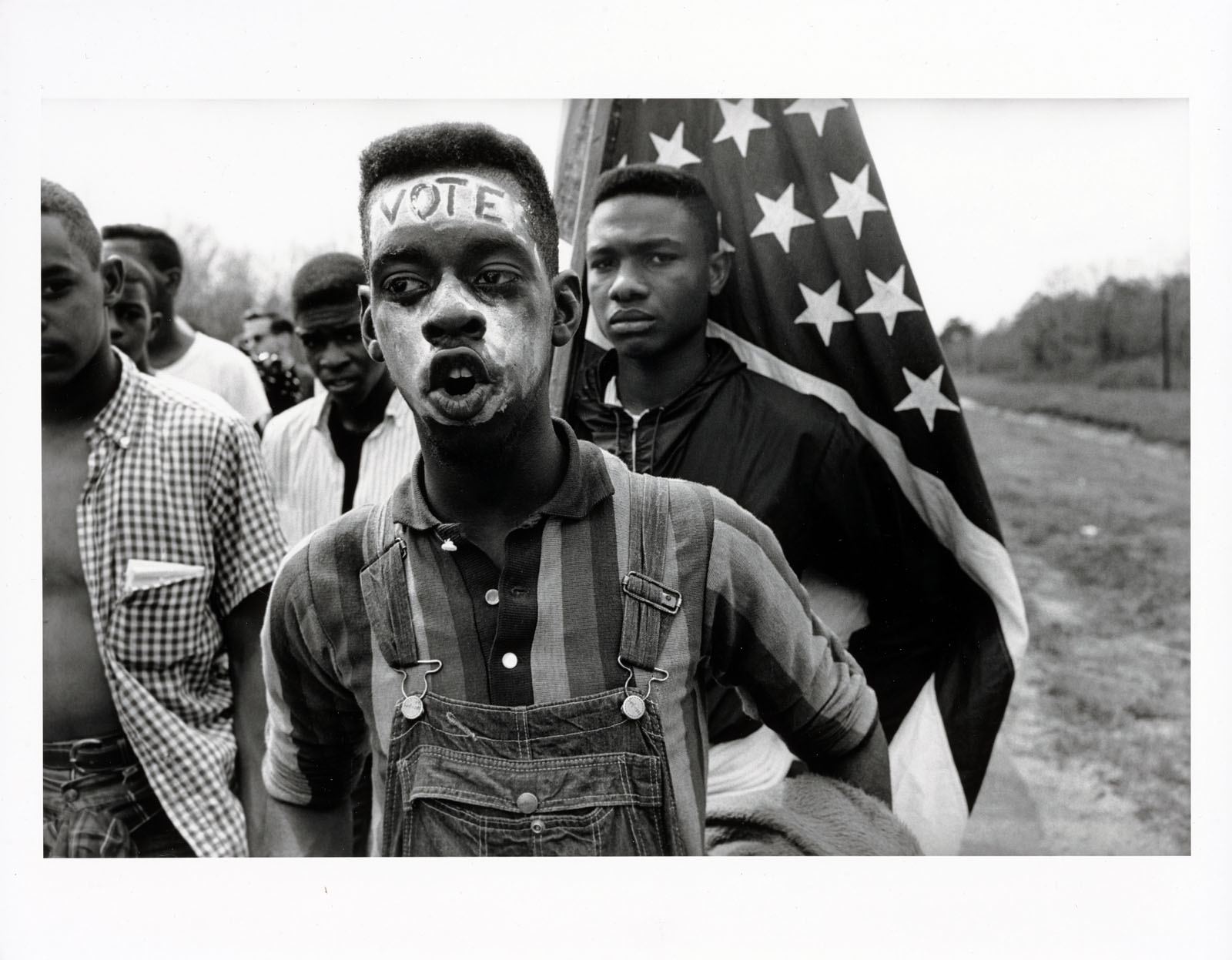
Bruce Davidson (American, b. 1933) 'March from Selma, Alabama' Negative 1965; printed later


Bruce Davidson (American, b. 1933)
March from Selma, Alabama
Negative 1965; printed later
Gelatin silver print
21.7 × 32.8cm (8 9/16 × 12 15/16 in.)
The J. Paul Getty Museum, Los Angeles
© Bruce Davidson/Magnum Photos


Photographs not only capture a nation’s values and beliefs but also help shape them. Camera in hand, photographers often take to the streets, recording protests and demonstrations or bearing witness to daily injustices to make them more widely known. Such images have inspired change for generations.

The late United States Congressman John Lewis emphasised the crucial role photography played in the civil rights struggles of the 1960s. “The unbelievable photographs published in newspapers and magazines… brought people from around the globe to small Southern towns to join the movement,” he said. “These photographs told us that those who expressed themselves by standing in unmovable lines… must be looked upon as the found mothers and fathers of a new America.”

This exhibition highlights how photographers have recorded periods of social struggle and transformation in the United States. Amid the country’s current and ongoing efforts to address and rectify injustice and systemic racism, and as the United States continues to grapple with how best to forge a new and better future, these images help us consider the myriad roles photography plays in shaping our understanding of American life.

Wall text from the exhibition


Voting Rights Act 1965

Voting Rights Act, U.S. legislation (August 6, 1965) that aimed to overcome legal barriers at the state and local levels that prevented African Americans from exercising their right to vote under the Fifteenth Amendment (1870) to the Constitution of the United States. The act significantly widened the franchise and is considered among the most far-reaching pieces of civil rights legislation in U.S. history.

In the 1950s and early 1960s the U.S. Congress enacted laws to protect the right of African Americans to vote, but such legislation was only partially successful. In 1964 the Civil Rights Act was passed and the Twenty-fourth Amendment, abolishing poll taxes for voting for federal offices, was ratified, and the following year Pres. Lyndon B. Johnson called for the implementation of comprehensive federal legislation to protect voting rights. The resulting act, the Voting Rights Act, suspended literacy tests, provided for federal approval of proposed changes to voting laws or procedures (“preclearance”) in jurisdictions that had previously used tests to determine voter eligibility (these areas were covered under Sections 4 and 5 of the legislation), and directed the attorney general of the United States to challenge the use of poll taxes for state and local elections. An expansion of the law in the 1970s also protected voting rights for non-English-speaking U.S. citizens. Sections 4 and 5 were extended for 5 years in 1970, 7 years in 1975, and 25 years in both 1982 and 2006.

The Voting Rights Act resulted in a marked decrease in the voter registration disparity between white and Black people. In the mid-1960s, for example, the overall proportion of white to Black registration in the South ranged from about 2 to 1 to 3 to 1 (and about 10 to 1 in Mississippi); by the late 1980s racial variations in voter registration had largely disappeared. As the number of African American voters increased, so did the number of African American elected officials. In the mid-1960s there were about 70 African American elected officials in the South, but by the turn of the 21st century there were some 5,000, and the number of African American members of the U.S. Congress had increased from 6 to about 40. In what was widely perceived as a test case, Northwest Austin Municipal Utility District Number One v. Holder, et al. (2009), the Supreme Court declined to rule on the constitutionality of the Voting Rights Act. In Shelby County v. Holder (2013), however, the Court struck down Section 4 – which had established a formula for identifying jurisdictions that were required to obtain preclearance – declaring it to be unjustified in light of changed historical circumstances. Eight years later, in Brnovich v. Democratic National Committee (2021), the Court further weakened the Voting Rights Act by finding that the law’s Section 2(a) – which prohibited any voting standard or procedure that “results in a denial or abridgement of the right of any citizen of the United States to vote on account of race or color” – was not necessarily violated by voting restrictions that disproportionately burden members of racial minority groups.

The Editors of Encyclopaedia Britannica. “Voting Rights Act,” on the Britannica website last updated July 30, 2021 [Online] Cited 12/09/2021.


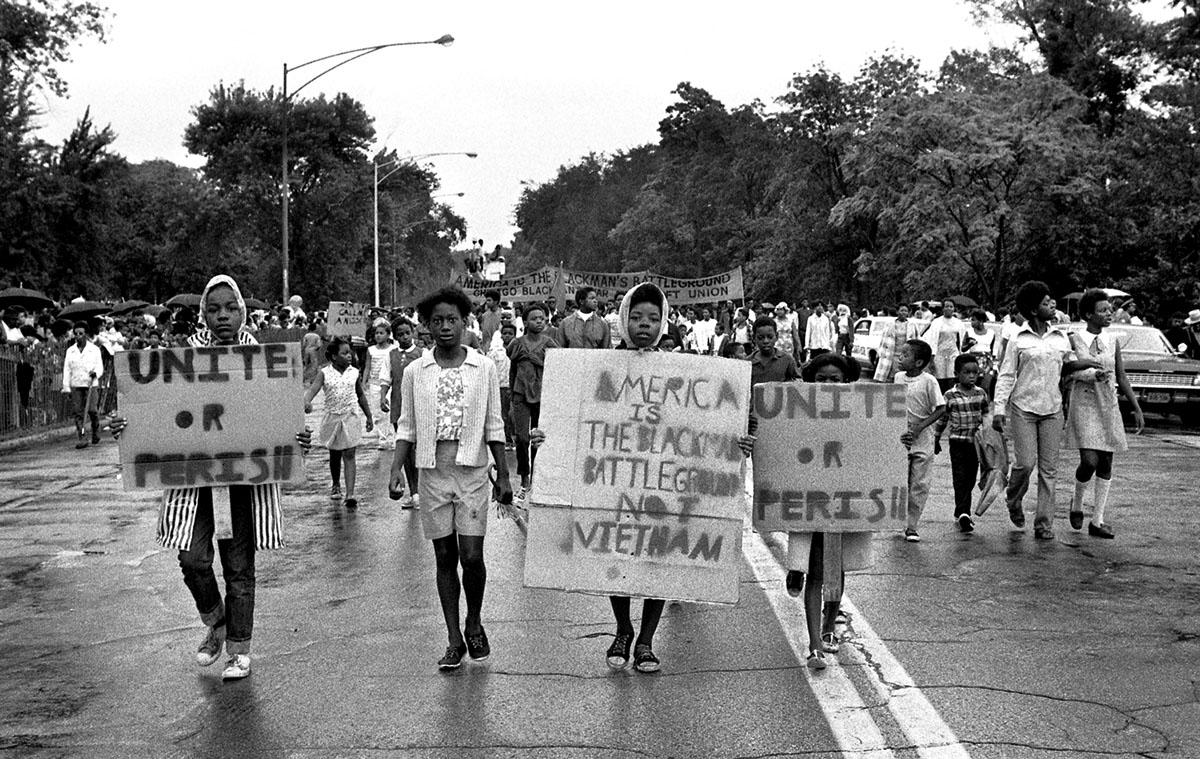
John Simmons (American, b. 1950) 'Unite or Perish, Chicago, Illinois' 1968


John Simmons (American, b. 1950)
Unite or Perish, Chicago, Illinois
1968
The J. Paul Getty Museum, Los Angeles
© John Simmons


Simmons began his career at 15 as a photographer for the oldest African American-owned newspaper, The Chicago Daily Defender in 1965. Over his decades long career, he’s photographed icons of the Civil Rights Movement, turbulent protests and demonstrations, famed musicians and poignant intimate moments of everyday life. “I’m glad to see photographs I took back in my teens are still relevant today,” he says. …

Two of Simmons’ photographs are featured in “In Focus: Protest,” “an exhibition featuring images made during periods of social struggle in the U.S. and highlighting the myriad roles protest photographs play in shaping our understanding of American life,” says Mazie Harris, assistant curator in the department of photographs at the J. Paul Getty Museum. “With this exhibition we aim to give visitors a place to think about some of the ways photographers have brought attention to efforts to address and rectify injustice.” …

“My position on protest is interesting,” says Simmons. “My father was much older than my mother and when Harriet Tubman died my father was around 12 or 13 so that puts me in close relationship to slavery and to people who were arounds slaves. My great grandmother saw Abraham Lincoln and my great aunt was babysat by former slaves. I picked up a camera in 1965, the first year African Americans were allowed to vote. That was behind those eyes the first day I pressed a shutter. So in reality, every photograph I take is a protest photo.”

John Simmons quoted in Steve Simmons. “Photographer John Simmons, ‘Chronicler Of The Civil Rights Movement,’​ Featured In Three Exhibits,” on the Linkedin website August 4, 2021 [Online] Cited 11/09/2021.


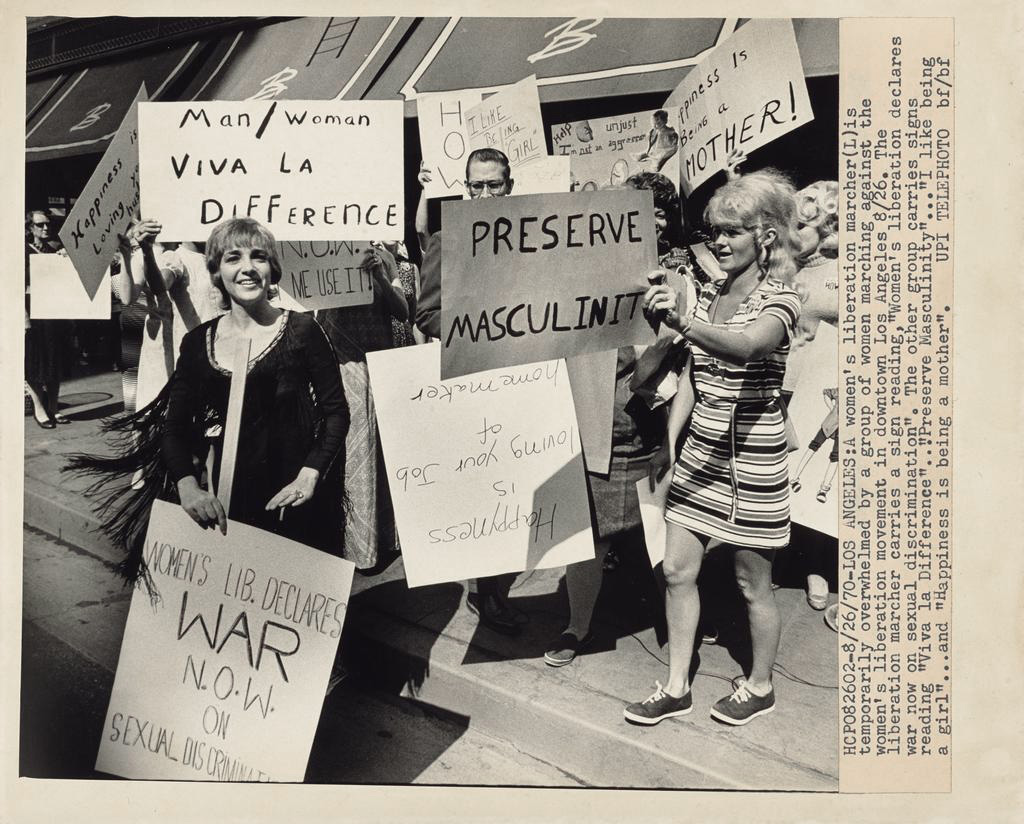
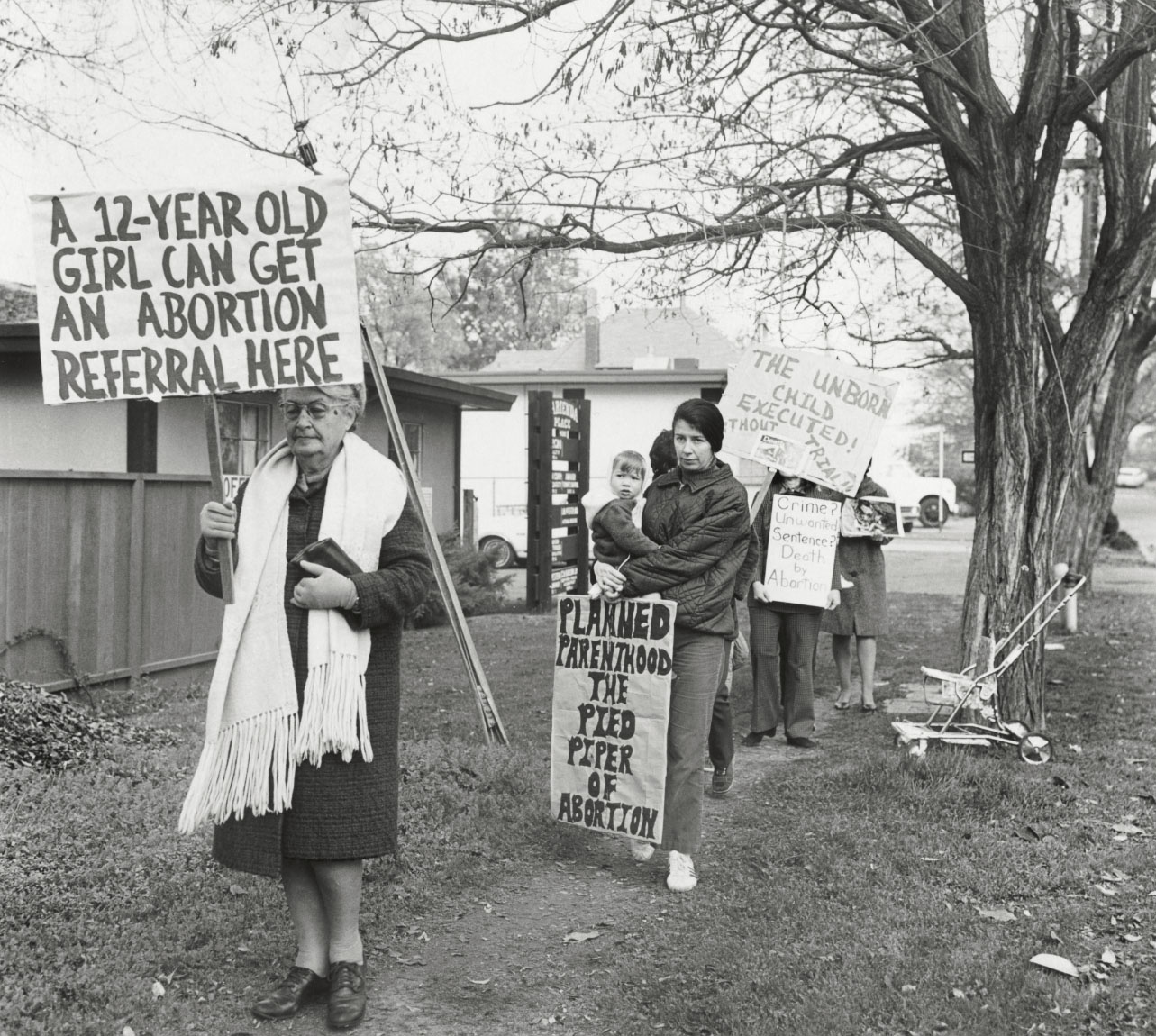
Robert Flora (American, 1929-1986) 'A Women's Liberation Marcher Is Temporarily Overwhelmed by a Group of Women Marching against the Women's Liberation Movement in Downtown Los Angeles' August 26, 1970


Robert Flora (American, 1929-1986)
A Women’s Liberation Marcher Is Temporarily Overwhelmed by a Group of Women Marching against the Women’s Liberation Movement in Downtown Los Angeles
August 26, 1970
Gelatin silver print with typed caption
The J. Paul Getty Museum, Los Angeles
Gift of the Flora Family
Reproduced with permission via Bettmann Archive/Getty Images


Bill Owens (American, born 1938) 'Untitled' early 1970s


Bill Owens (American, born 1938)
Untitled
early 1970s
Gelatin silver print
19.2 × 21.5cm (7 9/16 × 8 7/16 in.)
The J. Paul Getty Museum, Los Angeles
Gift of Robert Shimshak and Marion Brenner
© Bill Owens


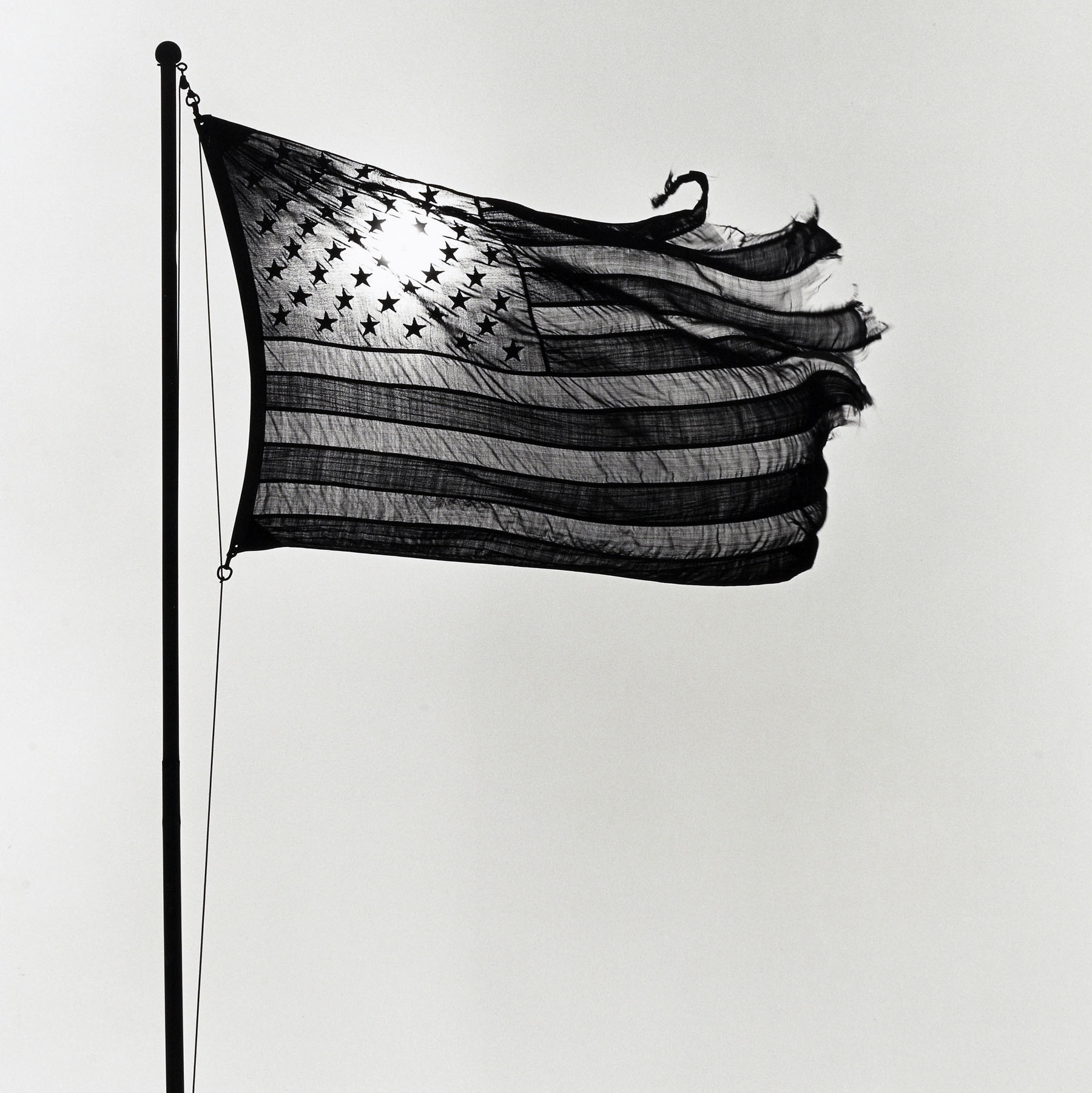
Robert Mapplethorpe (American, 1946-1989) 'American Flag' 1977


Robert Mapplethorpe (American, 1946-1989)
American Flag
1977
Gelatin silver print
35.3 × 35.3cm (13 7/8 × 13 7/8 in.)
Jointly acquired by the J. Paul Getty Trust and the Los Angeles County Museum of Art, with funds provided by the J. Paul Getty Trust and the David Geffen Foundation
© Robert Mapplethorpe Foundation


“Mapplethorpe evoked the frayed character of American ideals during a period when equal rights for gay men and women in the United States seemed nearly unimaginable.”


The J. Paul Getty Museum presents In Focus: Protest, an exhibition featuring images made during periods of social struggle in the United States, and highlighting the myriad roles protest photographs play in shaping our understanding of American life. The exhibition is on view at the Getty Center Museum June 29 – October 10, 2021.

Photographs not only capture a nation’s values and beliefs but also help shape them. Camera in hand, photographers often take to the streets, recording protests and demonstrations or bearing witness to daily injustices to make them more widely known. Such images have inspired change for generations.

In Focus: Protest reminds us of the ability of photographs to both document and propel action,” says Mazie Harris, assistant curator of photographs at the Museum. “With this exhibition we aim to give visitors a place to think about some of the ways that photographers have brought attention to efforts to address and rectify injustice.” Among the works on view are images by well-known artists including Dorothea Lange (American, 1895-1965), Robert Mapplethorpe (American, 1946-1989), and L.A.-based cinematographer and artist John Simmons (American, born 1950). The exhibition also includes resonant images by photographers Robert Flora (American, 1929-1986), William James Warren (American, born 1942), An-My Lê (American, born 1960), and a 2020 photograph by Kris Graves (American, born 1982).

Press release from the J. Paul Getty Museum


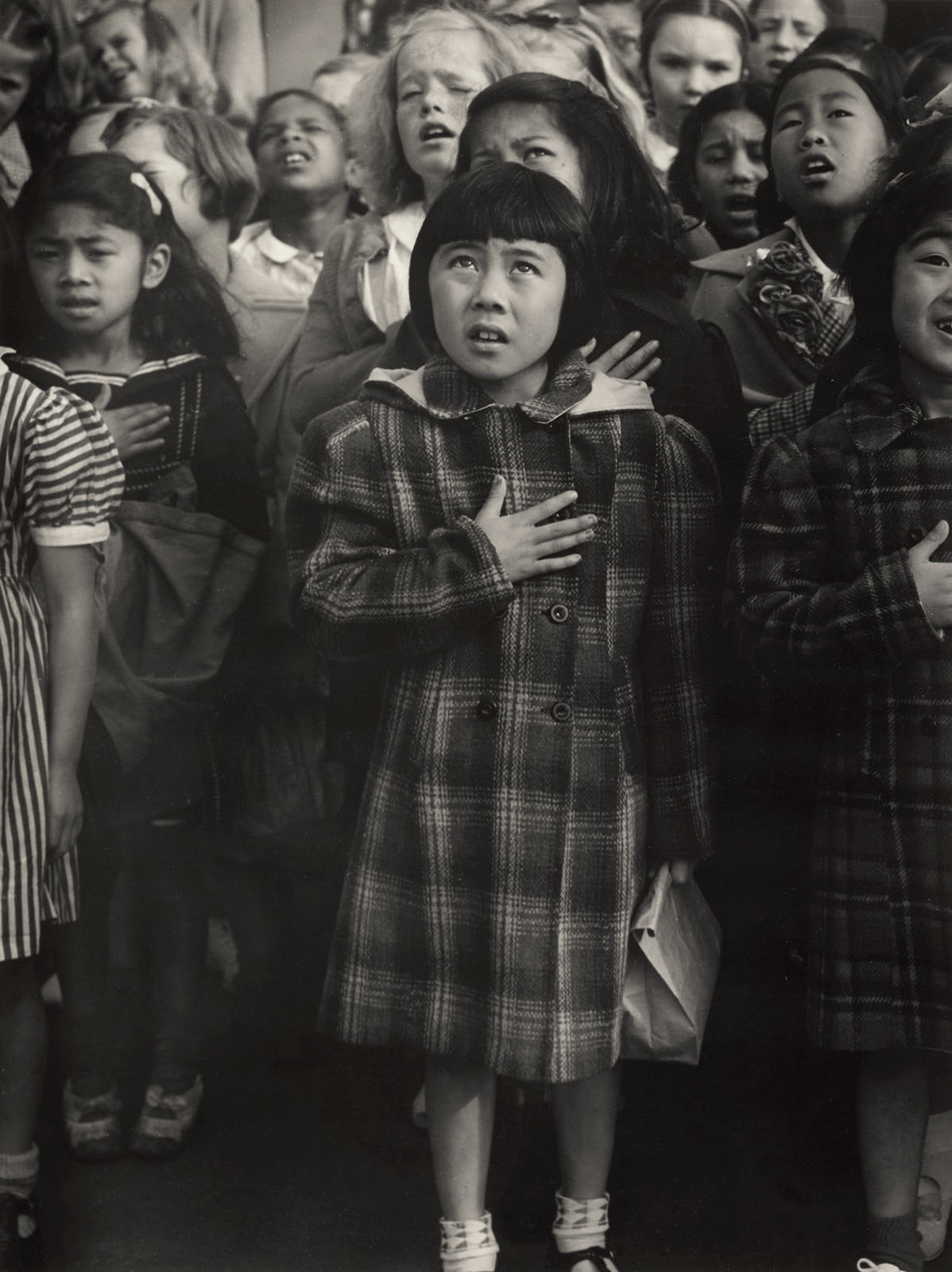
Dorothea Lange (American, 1895-1965) 'Pledge of Allegiance, Raphael Weill Elementary School, San Francisco' Negative April 20, 1942; print about 1960s


Dorothea Lange (American, 1895-1965)
Pledge of Allegiance, Raphael Weill Elementary School, San Francisco
Negative April 20, 1942; print about 1960s
Gelatin silver print
34 × 25.6cm (13 3/8 × 10 1/16 in.)
The J. Paul Getty Museum, Los Angeles


Children’s symbol of hope and innocence can also be tied to their shielding from the “outside world”. Here we have a young Japanese girl reciting the American pledge of allegiance with much determination and passion, all while the United States government would take Japanese Americans into internment camps weeks later, following the bombing of Pearl Harbor.


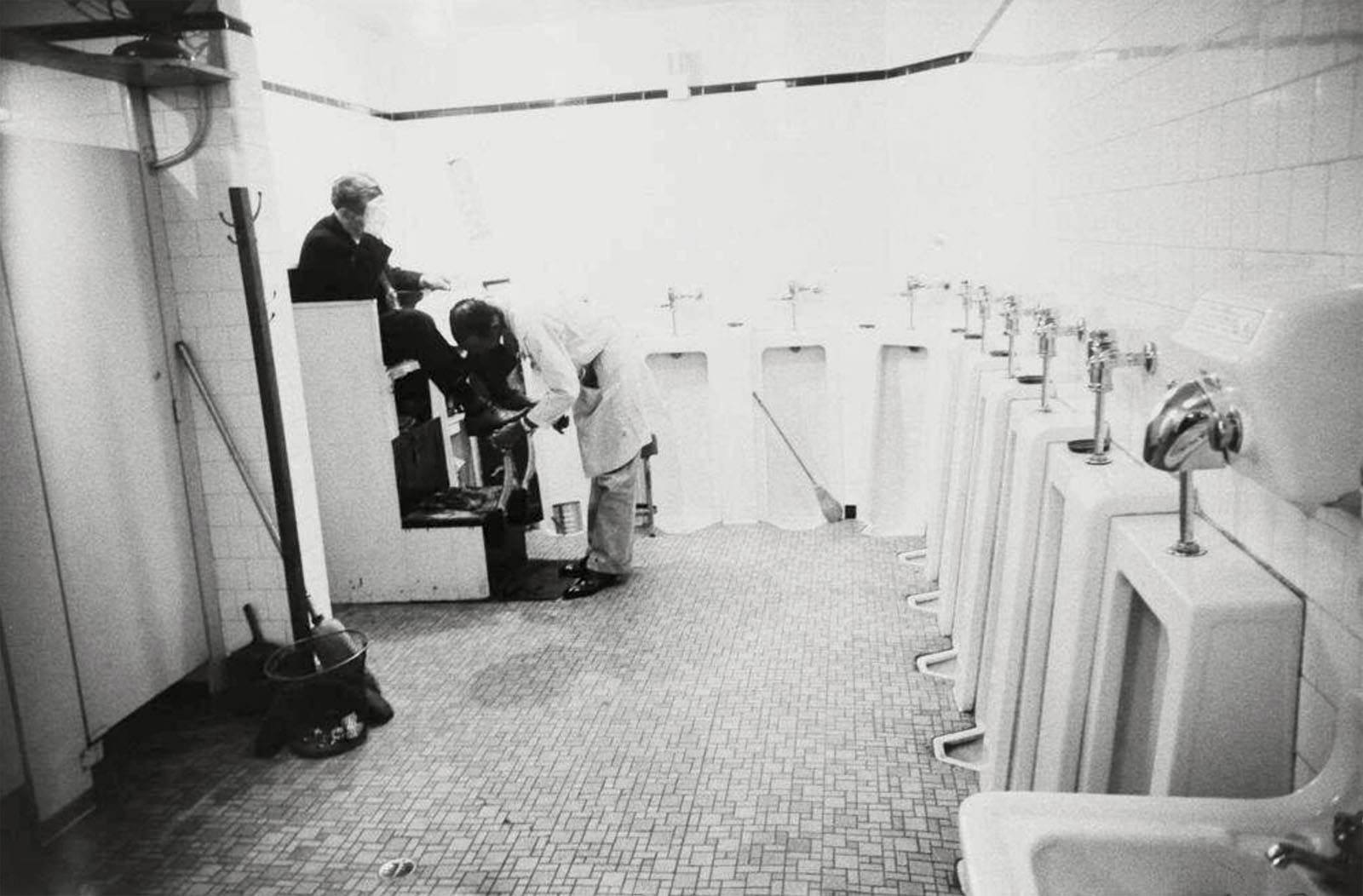
Robert Frank. 'Trolley – New Orleans' 1955


Robert Frank (Swiss-American, 1924-2019)
Trolley – New Orleans
1955
Gelatin silver print
The J. Paul Getty Museum, Los Angeles


“America is an interesting country… but there is a lot here that I do not like and that I would never accept. I am also trying to show this in my photos.” ~ Robert Frank


Robert Frank (American, 1924-2019) 'Railway Station, Memphis, Tennessee' 1955


Robert Frank (Swiss-American, 1924-2019)
Railway Station, Memphis, Tennessee
1955
Gelatin silver print
The J. Paul Getty Museum, Los Angeles


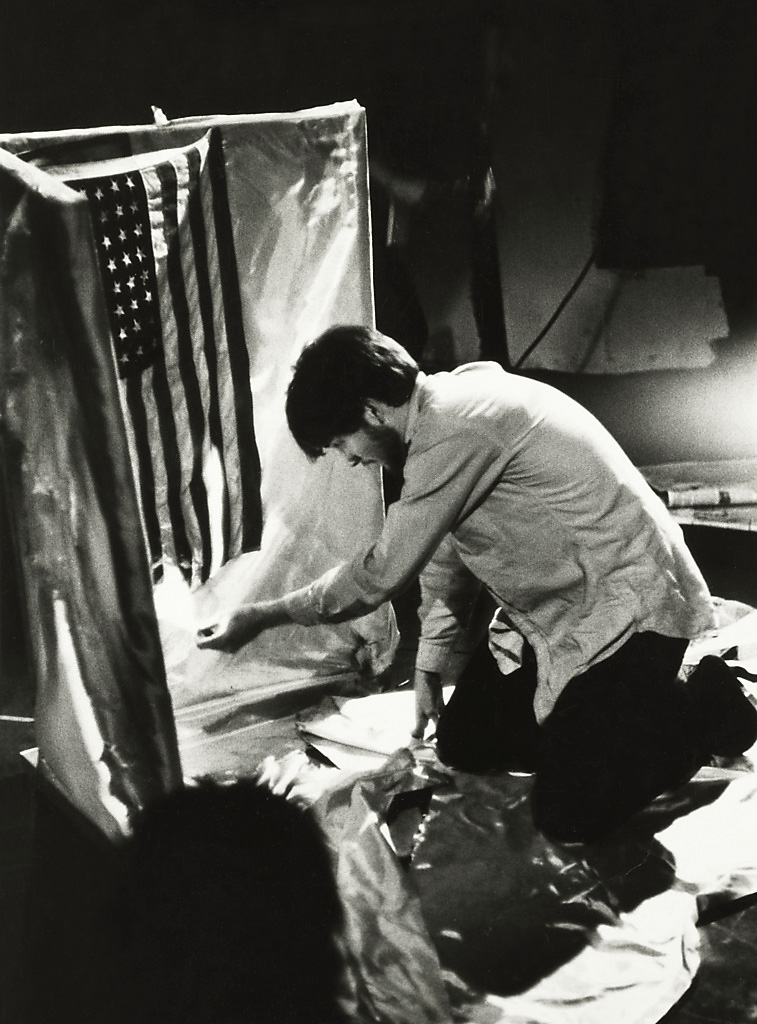
Fred W. McDarrah (American, 1926-2007) 'Jose Rodriguez-Soltero Burned a Flag in a New York Happening' April 8, 1966


Fred W. McDarrah (American, 1926-2007)
Jose Rodriguez-Soltero Burned a Flag in a New York Happening
April 8, 1966
Gelatin silver print
34.8 × 25.8cm (13 11/16 × 10 3/16 in.)
The J. Paul Getty Museum, Los Angeles
© Estate of Fred W. McDarrah


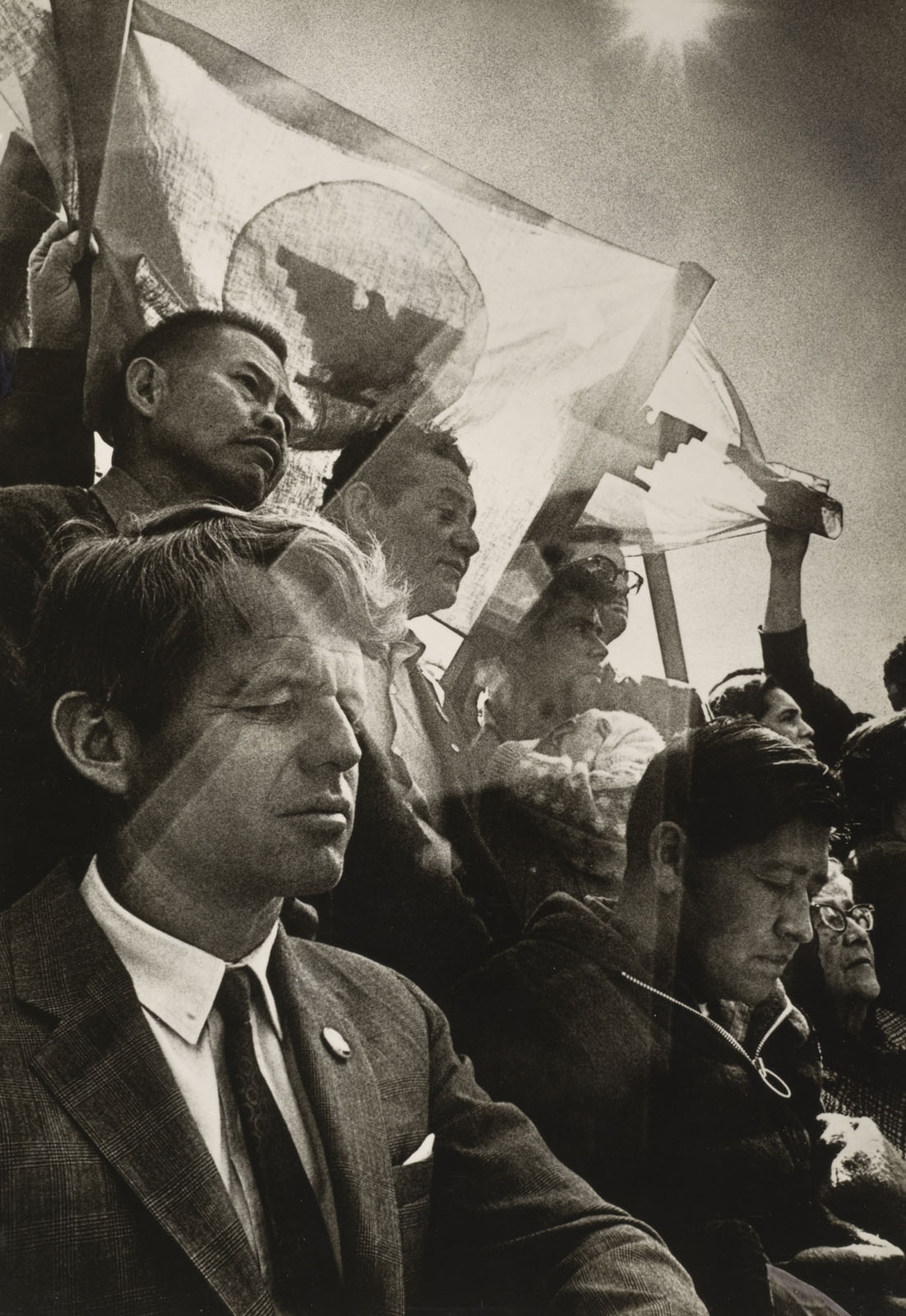
William James Warren (American, b. 1942) 'Robert F. Kennedy and César Chávez Celebrate Mass as Chávez Breaks a Twenty-Five Day Fast, Delano, California' 1968


William James Warren (American, b. 1942)
Robert F. Kennedy and César Chávez Celebrate Mass as Chávez Breaks a Twenty-Five Day Fast, Delano, California
1968
Gelatin silver print
31.2 × 21.6cm (12 5/16 × 8 1/2 in.)
The J. Paul Getty Museum, Los Angeles, Gift of William James Warren
© William James Warren


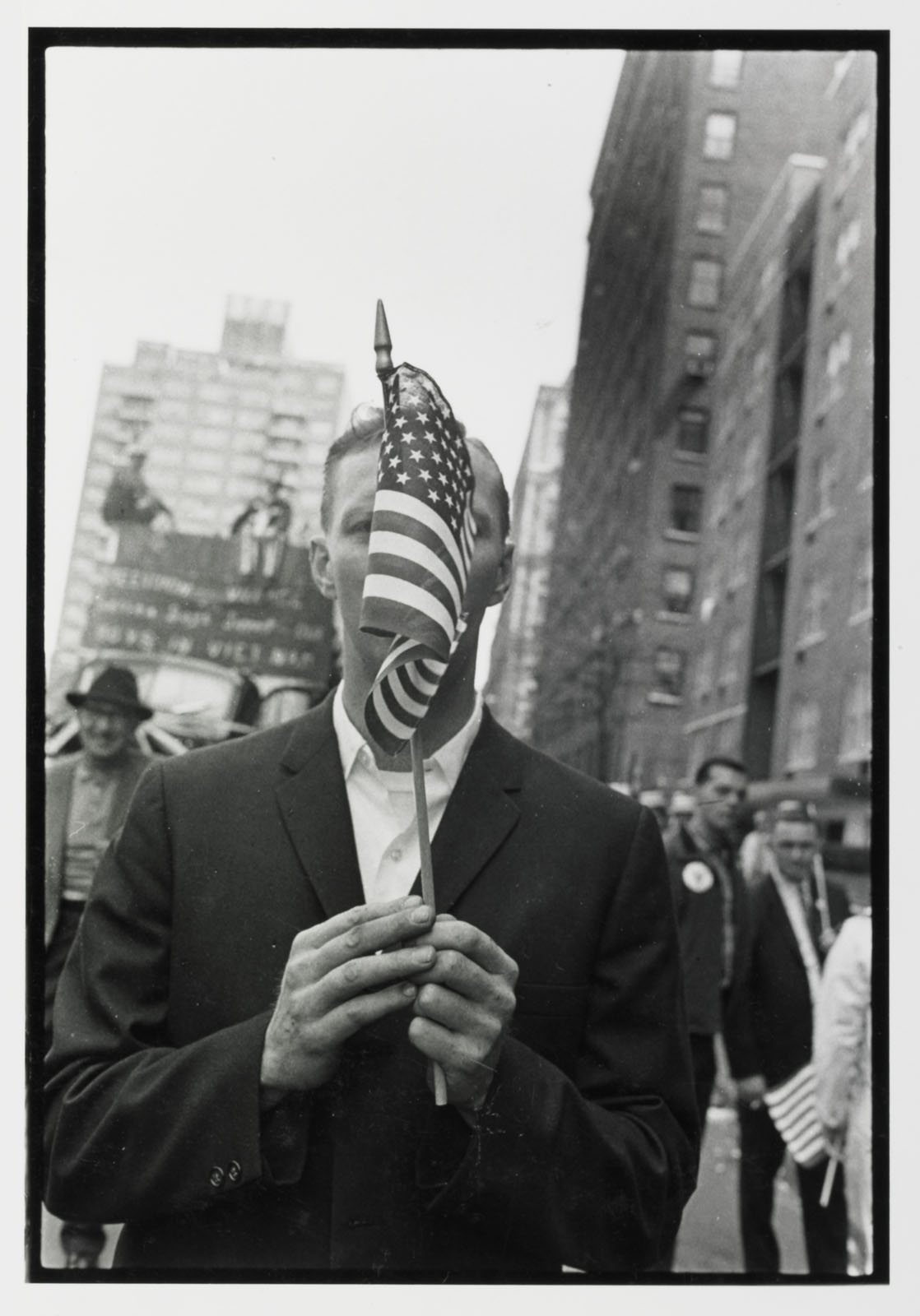
Mary Ellen Mark (American, 1940-2015) 'Vietnam Pro Demonstration' 1968


Mary Ellen Mark (American, 1940-2015)
Vietnam Pro Demonstration
1968
Gelatin silver print
24.3 × 16.7cm (9 9/16 × 6 9/16 in.)
The J. Paul Getty Museum, Los Angeles
© Mary Ellen Mark Foundation


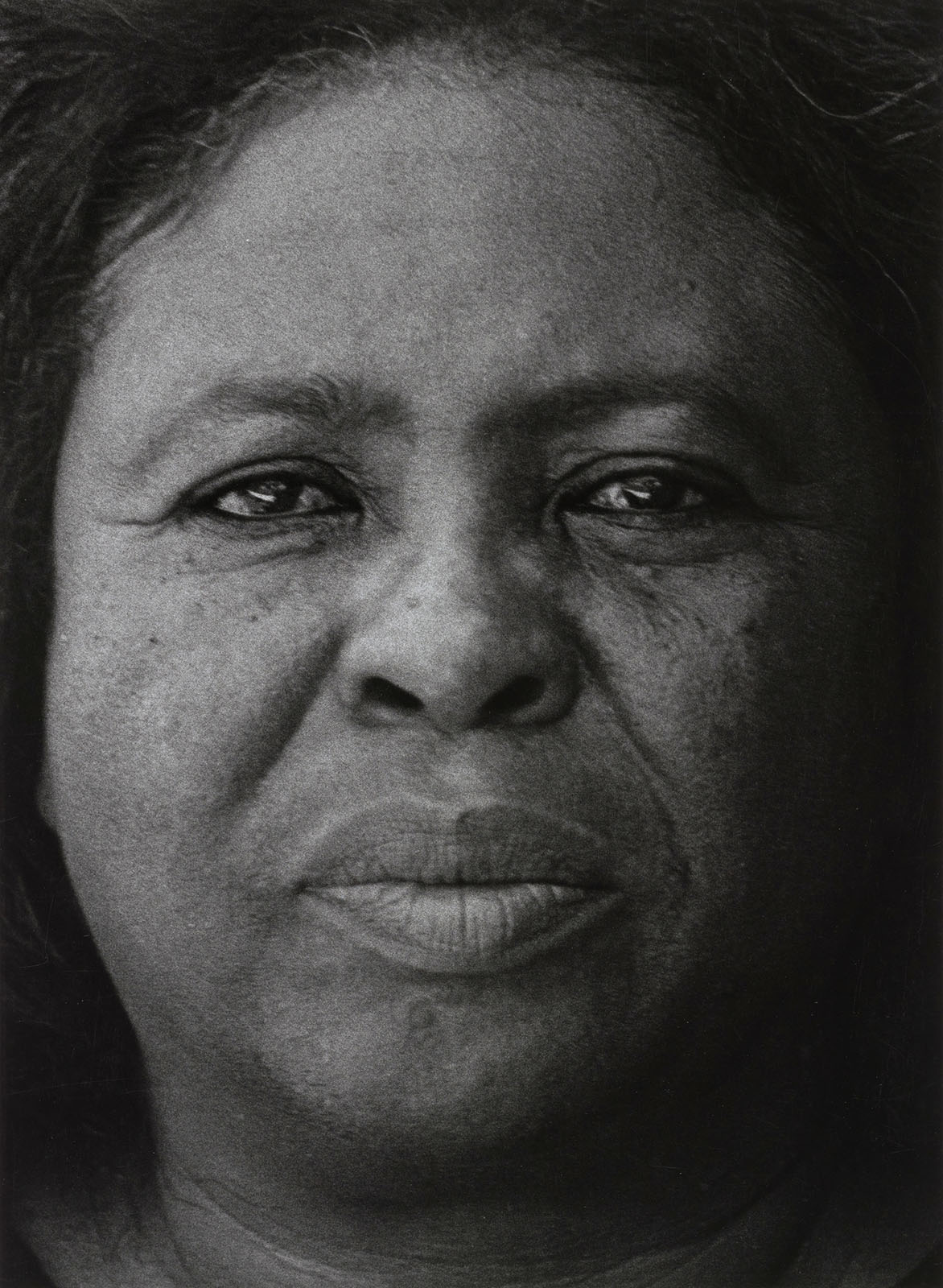
Louis Draper (American, 1935-2002) 'Fannie Lou Hamer, Mississippi' 1971


Louis Draper (American, 1935-2002)
Fannie Lou Hamer, Mississippi
1971
Gelatin silver print
22.86 × 15.56cm (9 × 6 1/8 in.)
The J. Paul Getty Museum, Los Angeles


In 1971 Essence magazine sent Draper on assignment to Mississippi to photograph civil rights activist Fannie Lou Hamer. This portrait appeared with the article “Fannie Lou Hamer Speaks Out,” in the October issue. Known for her fearlessness and strength in the midst of violence and intimidation, Hamer had been arrested and severely beaten by police in 1963 for her work on voter registration drives. She gained national attention when she returned to her activism in the mid-1960s, and this photograph visually distills her voice: “Today I don’t have any money, but I’m freer than the average white American ’cause I know who I am. I know what I’m about, and I know that I don’t have anything to be ashamed of.”

Anonymous text from the Virginia Museum of Fine Arts website


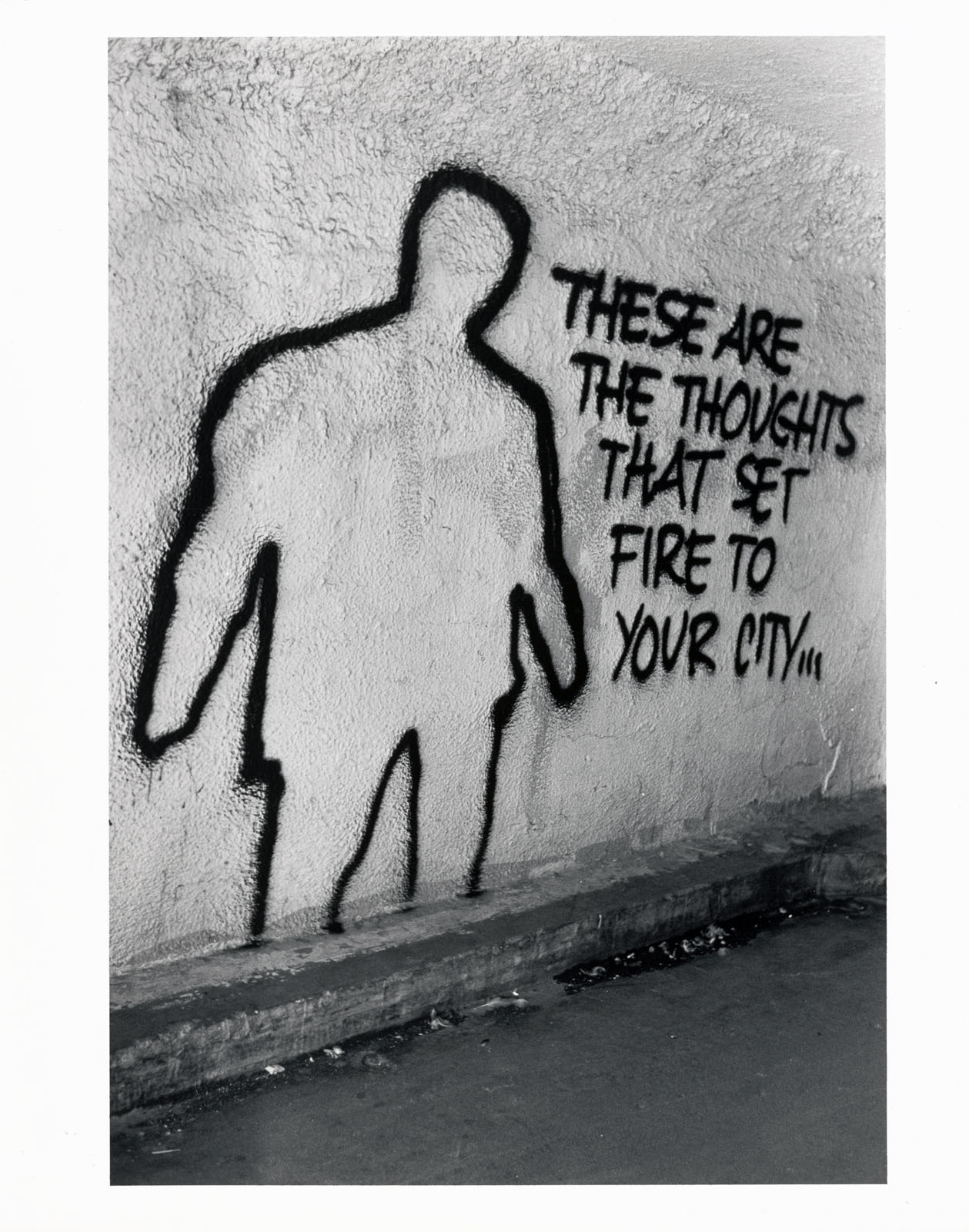
Anthony Friedkin (American, b. 1949) 'These Are the Thoughts that Set Fire to Your City' 1993


Anthony Friedkin (American, b. 1949)
These Are the Thoughts that Set Fire to Your City
1993
Gelatin silver print
32.6 × 22cm (12 13/16 × 8 11/16 in.)
The J. Paul Getty Museum, Los Angeles, Gift of Sue and Albert Dorskind
© Anthony Friedkin


This photograph was taken following the 1992 Rodney King Riots that happened across Los Angeles.


Rodney King (American, 1965-2012)

Rodney Glen King (April 2, 1965 – June 17, 2012) was an African-American man who was a victim of police brutality. On March 3, 1991, King was beaten by LAPD officers during his arrest, after a high-speed chase, for driving while intoxicated on I-210. An uninvolved individual, George Holliday, filmed the incident from his nearby balcony and sent the footage to local news station KTLA. The footage showed an unarmed King on the ground being beaten after initially evading arrest. The incident was covered by news media around the world and caused a public furor.

At a press conference, announcing the four officers involved would be disciplined, and three would face criminal charges, Los Angeles police chief Daryl Gates said: “We believe the officers used excessive force taking him into custody. In our review, we find that officers struck him with batons between fifty-three and fifty-six times.” The LAPD initially charged King with “felony evading”, but later dropped the charge. On his release, he spoke to reporters from his wheelchair, with his injuries evident: a broken right leg in a cast, his face badly cut and swollen, bruises on his body, and a burn area to his chest where he had been jolted with a stun gun. He described how he had knelt, spread his hands out, and slowly tried to move so as not to make any “stupid moves”, being hit across the face by a billy club and shocked. He said he was scared for his life as they drew down on him.

Four officers were eventually tried on charges of use of excessive force. Of these, three were acquitted, and the jury failed to reach a verdict on one charge for the fourth. Within hours of the acquittals, the 1992 Los Angeles riots started, sparked by outrage among racial minorities over the trial’s verdict and related, longstanding social issues. The rioting lasted six days and killed 63 people, with 2,383 more injured; it ended only after the California Army National Guard, the Army, and the Marine Corps provided reinforcements to re-establish control.

The federal government prosecuted a separate civil rights case, obtaining grand jury indictments of the four officers for violations of King’s civil rights. Their trial in a federal district court ended on April 16, 1993, with two of the officers being found guilty and sentenced to serve prison terms. The other two were acquitted of the charges. In a separate civil lawsuit in 1994, a jury found the city of Los Angeles liable and awarded King $3.8 million in damages.

Text from the Wikipedia website


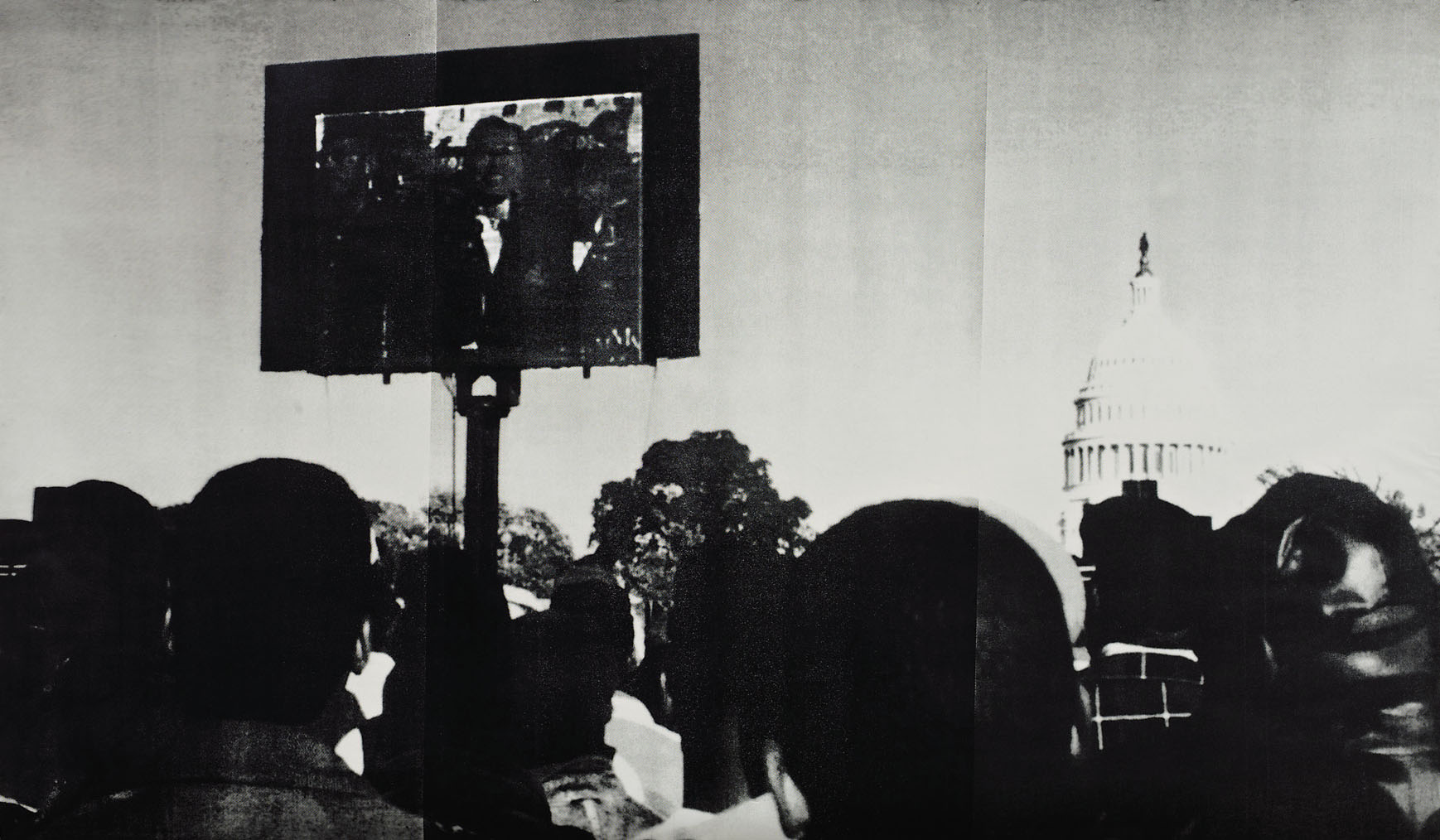
Glenn Ligon (American, b. 1960) 'Screen' 1996


Glenn Ligon (American, b. 1960)
Screen
1996
Silkscreen on canvas
213.36 x 365.76cm (84 x 144 in.)


Taking up an entire wall of a four-walled exhibit is Ligon’s “Screen”, where he took and enlarged a newspaper photograph from the Million Man March in Washington, DC. “Ligon has noted that while the march was meant to inspire African American unity, women and gay men were excluded,” says the photograph’s blurb. Ligon states, “I’m interested in what citizenship is in a democratic country… and the responsibilities that come with it.” On the video screen is Louis Farrakhan, a controversial organiser of the Million Man March.

Text from Julianna Lozada. “”In Focus Protest”: A Close Look at the New Getty Center Exhibit,” on the Karma Compass website July 14, 2021 [Online] Cited 11/09/2021


Million Man March

The Million Man March was a large gathering of African-American men in Washington, D.C., on October 16, 1995. Called by Louis Farrakhan, it was held on and around the National Mall. The National African American Leadership Summit, a leading group of civil rights activists and the Nation of Islam working with scores of civil rights organisations, including many local chapters of the National Association for the Advancement of Colored People (but not the national NAACP) formed the Million Man March Organizing Committee. The founder of the National African American Leadership Summit, Dr. Benjamin Chavis Jr. served as National Director of the Million Man March.

The committee invited many prominent speakers to address the audience, and African American men from across the United States converged in Washington to “convey to the world a vastly different picture of the Black male” and to unite in self-help and self-defence against economic and social ills plaguing the African American community.

The march took place in the context of a larger grassroots movement that set out to win politicians’ attention for urban and minority issues through widespread voter registration campaigns. On the same day, there was a parallel event called the Day of Absence, organised by women in conjunction with the March leadership, which was intended to engage the large population of black Americans who would not be able to attend the demonstration in Washington. On this date, all blacks were encouraged to stay home from their usual school, work, and social engagements, in favour of attending teach-ins, and worship services, focusing on the struggle for a healthy and self-sufficient black community. Further, organisers of the Day of Absence hoped to use the occasion to make great headway on their voter registration drive.

Text from the Wikipedia website


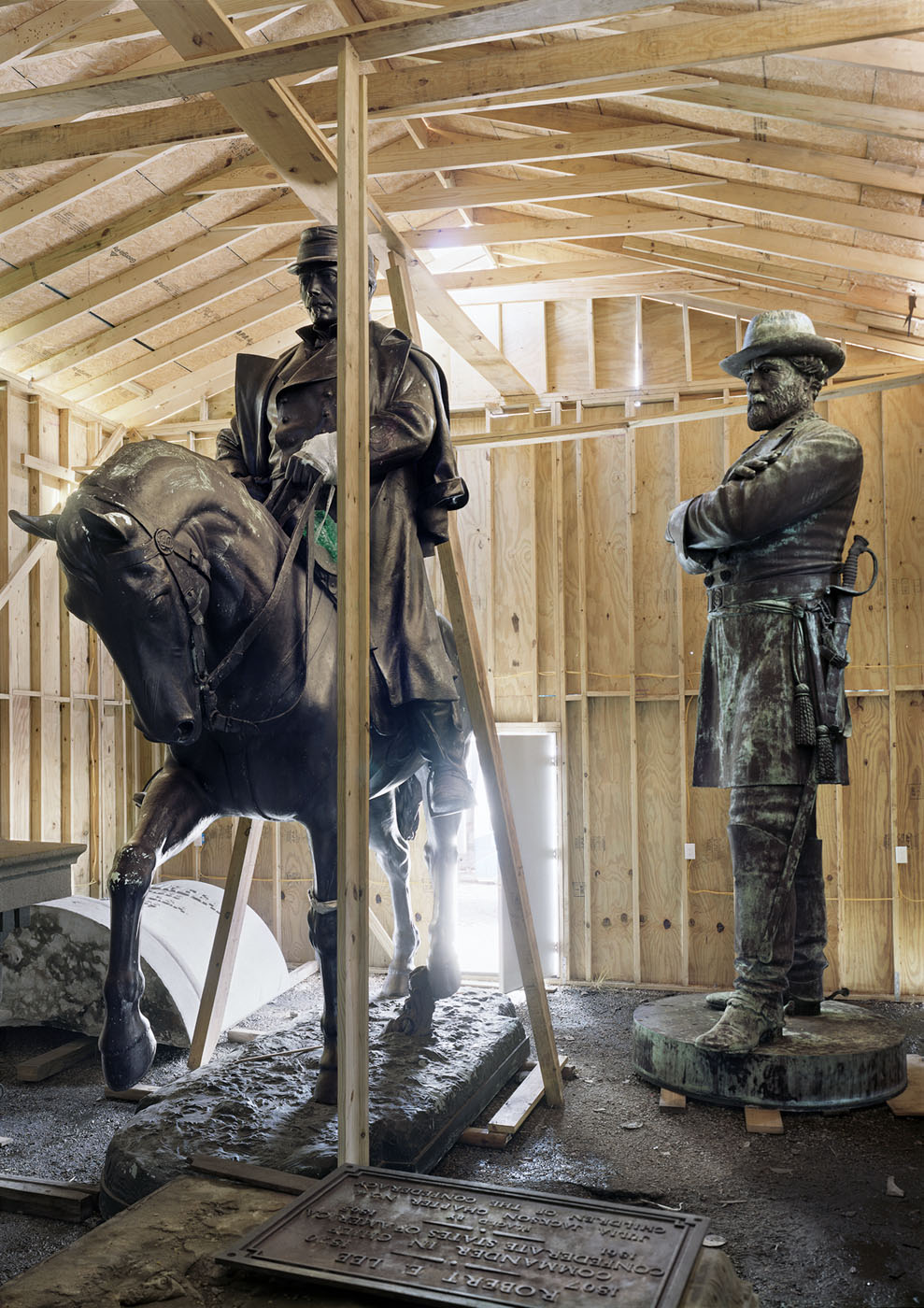
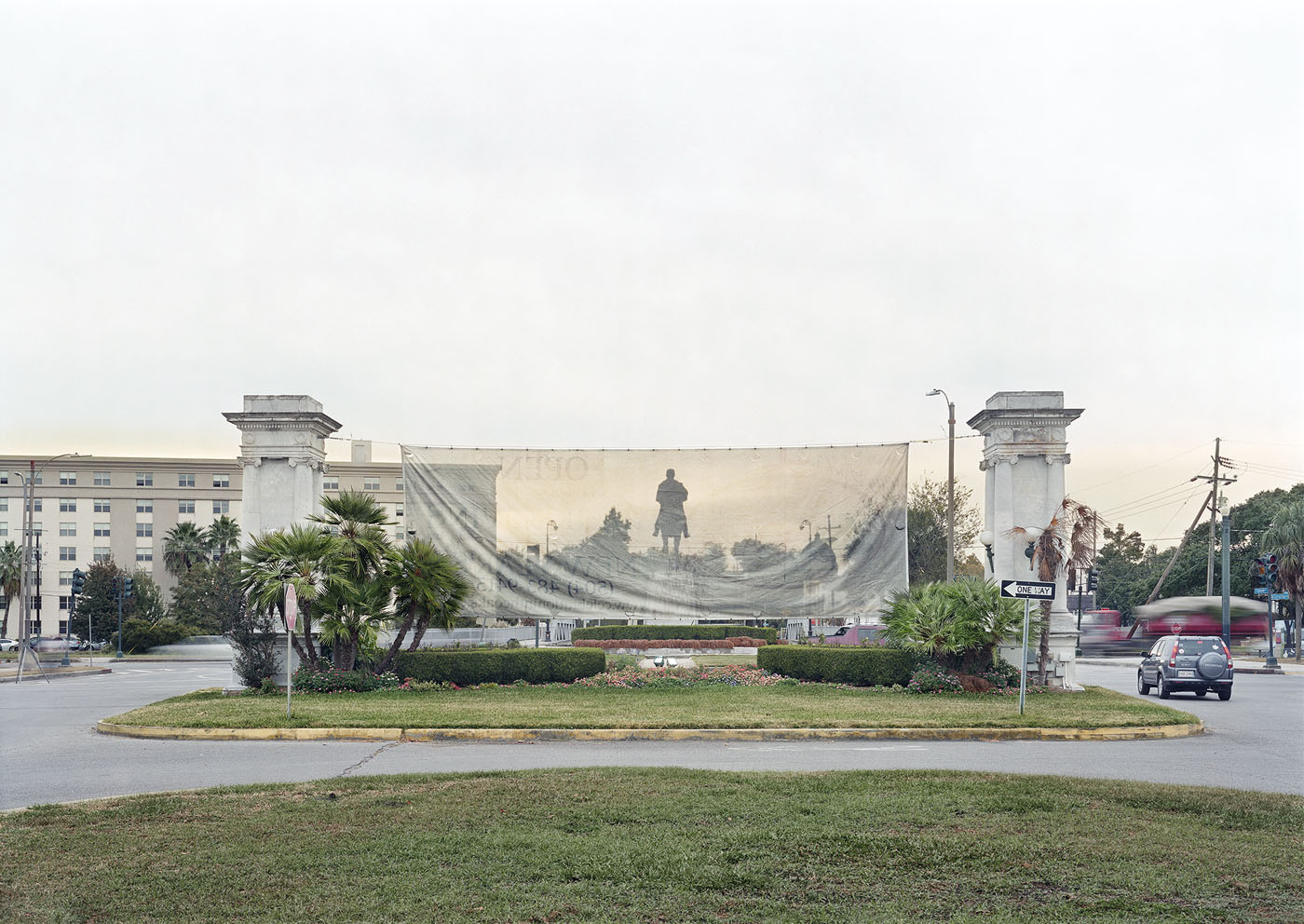
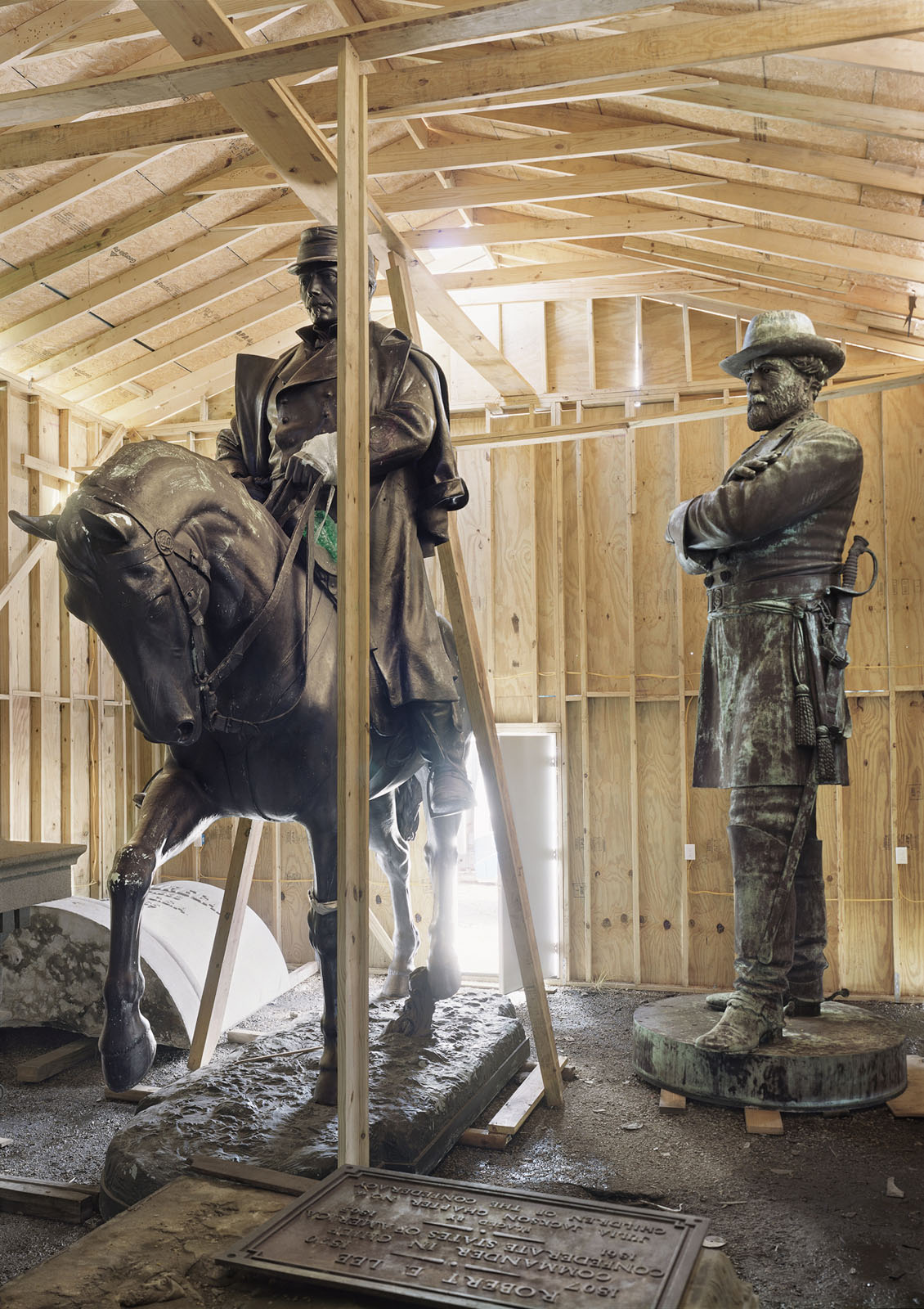
An-My Lê (American born Vietnam, b. 1960) 'Fragment VI: General Robert E. Lee and P.G.T. Beauregard Monuments, Homeland Security Storage, New Orleans, Louisiana' 2017


An-My Lê (American born Vietnam, b. 1960)
Fragment VI: General Robert E. Lee and P.G.T. Beauregard Monuments, Homeland Security Storage, New Orleans, Louisiana
2017
Inkjet print
142.2 × 100.3cm (56 × 39 1/2 in.)
Pier 24 Photography, San Francisco
© An-My Lê courtesy of the Artist and Marian Goodman Gallery


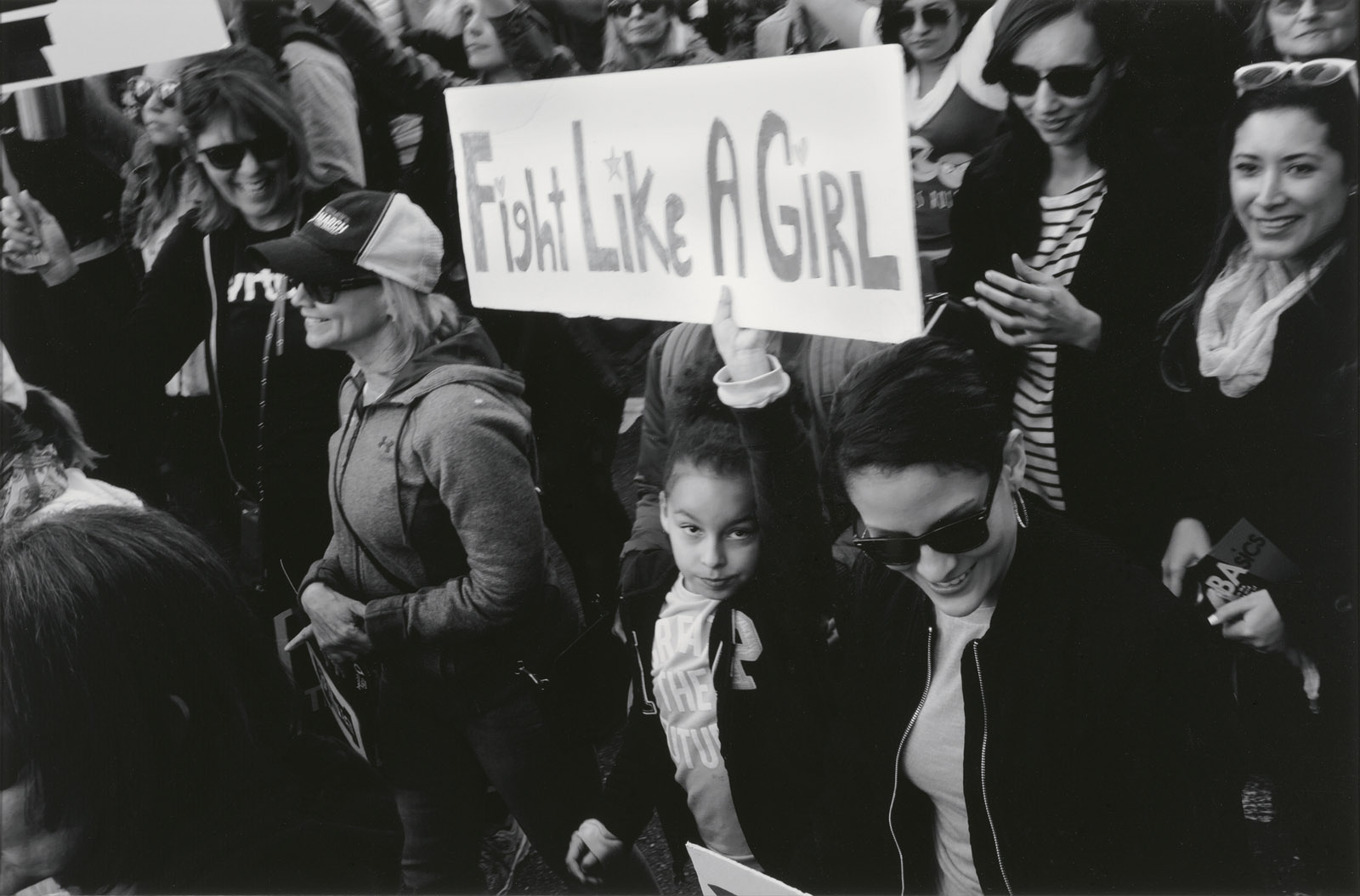
John Simmons (American, b. 1950) 'Fight Like a Girl, Los Angeles' Negative 2019; print 2020


John Simmons (American, b. 1950)
Fight Like a Girl, Los Angeles
Negative 2019; print 2020
Pigment print
24.1 × 38.1cm (9 1/2 × 15 in.)
The J. Paul Getty Museum, Los Angeles
© John Simmons


Kris Graves (American, b. 1982) 'George Floyd Projection, Richmond, Virginia' 2020


Kris Graves (American, b. 1982)
George Floyd Projection, Richmond, Virginia
2020
Inkjet print
40 × 50.1cm (15 3/4 × 19 3/4 in.)


The J. Paul Getty Museum
1200 Getty Center Drive
Los Angeles, California 90049

Opening hours:
Daily 10am – 5pm

The J. Paul Getty Museum website

LIKE ART BLACK ON FACEBOOK

Back to top

Exhibition: ‘Tobias Zielony: The Fall’ at Museum Folkwang, Essen

Exhibition dates: 25th June – 26th September, 2021


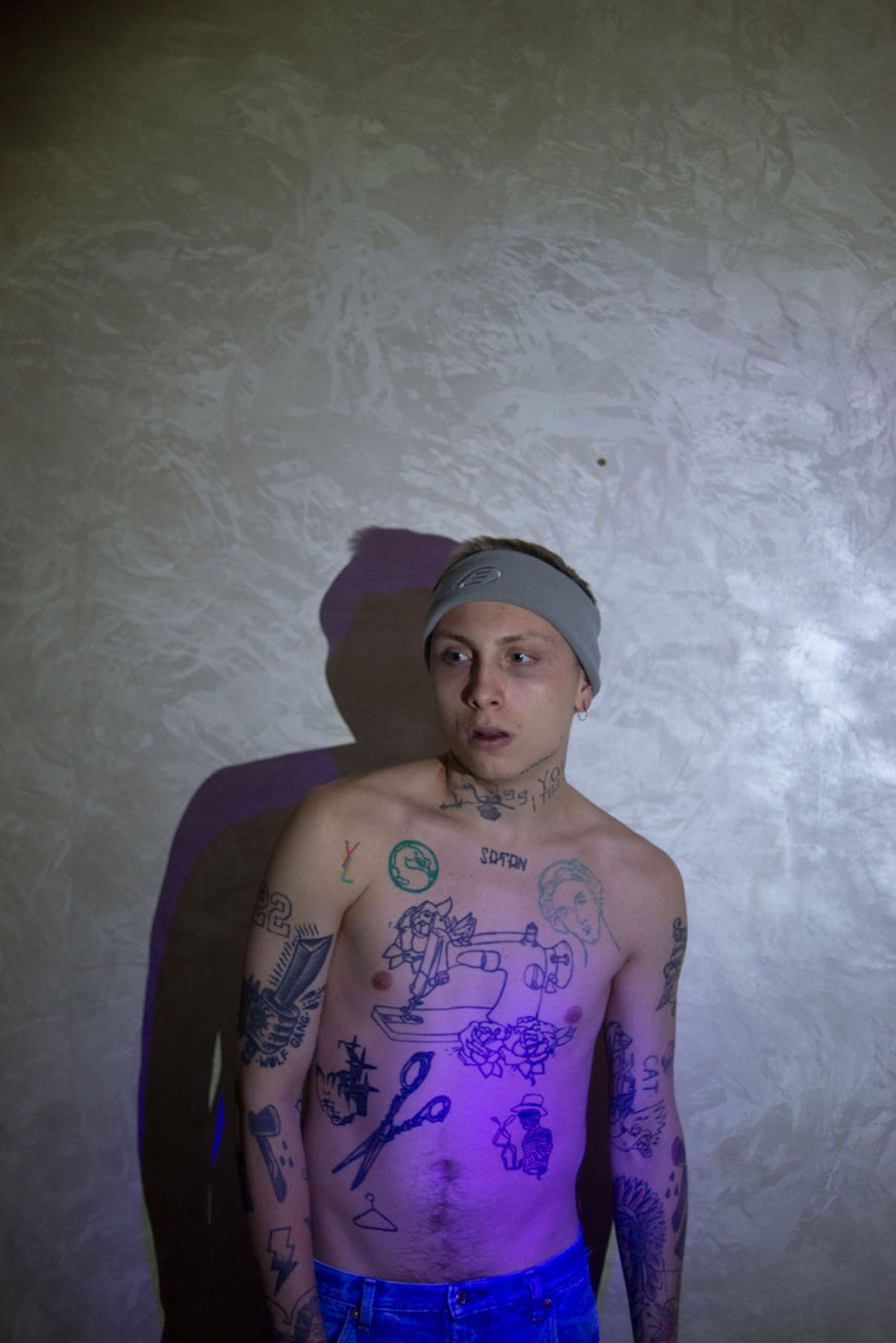
Tobias Zielony (German, b. 1973) 'Andrej' 2016 from the exhibition 'Tobias Zielony: The Fall' at Museum Folkwang, Essen, June - Sept, 2021


Tobias Zielony (German, b. 1973)
Andrej
2016
Courtesy KOW, Berlin
© Tobias Zielony


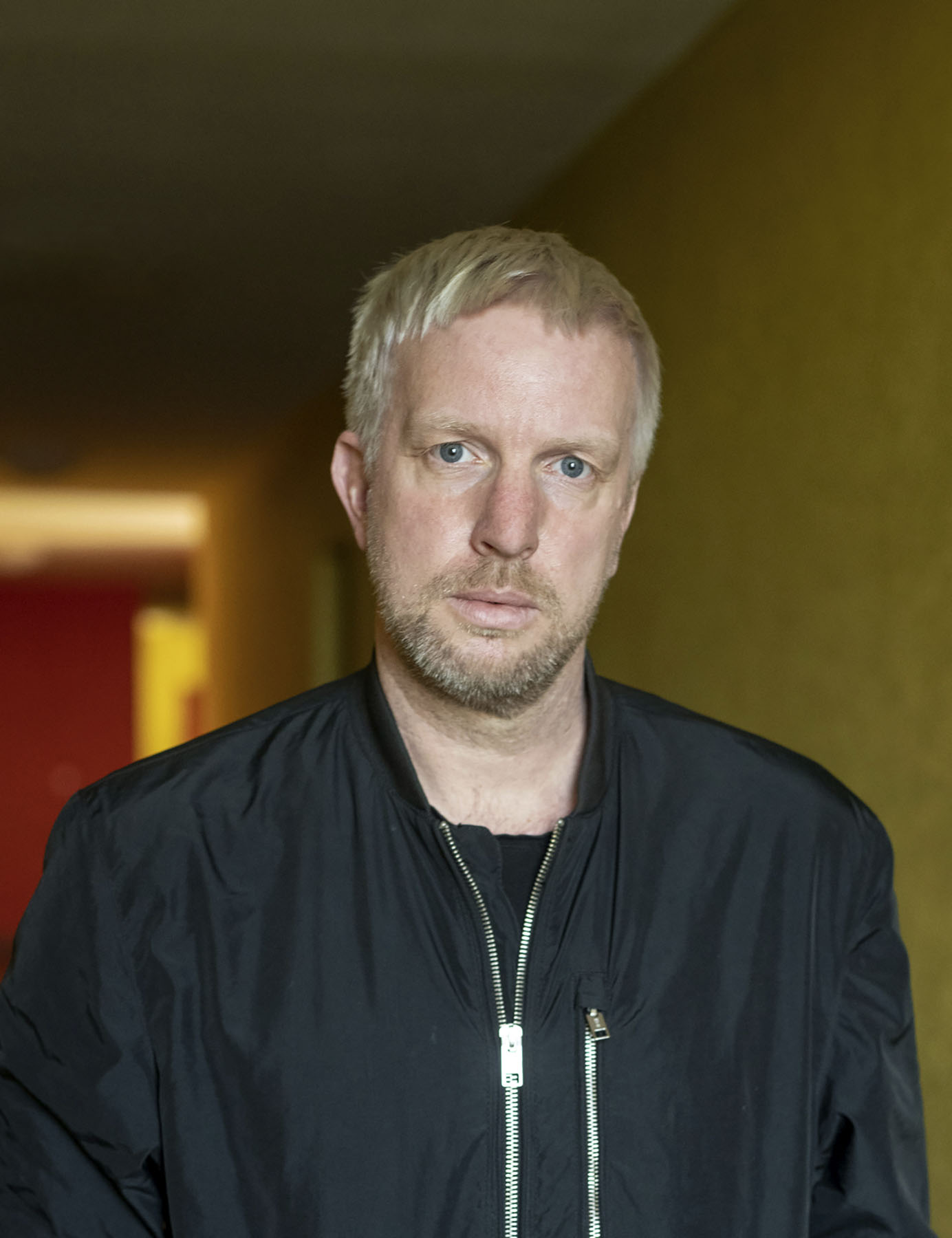
A German artist who pictures the intersection between youth culture, identity and (self) representation.

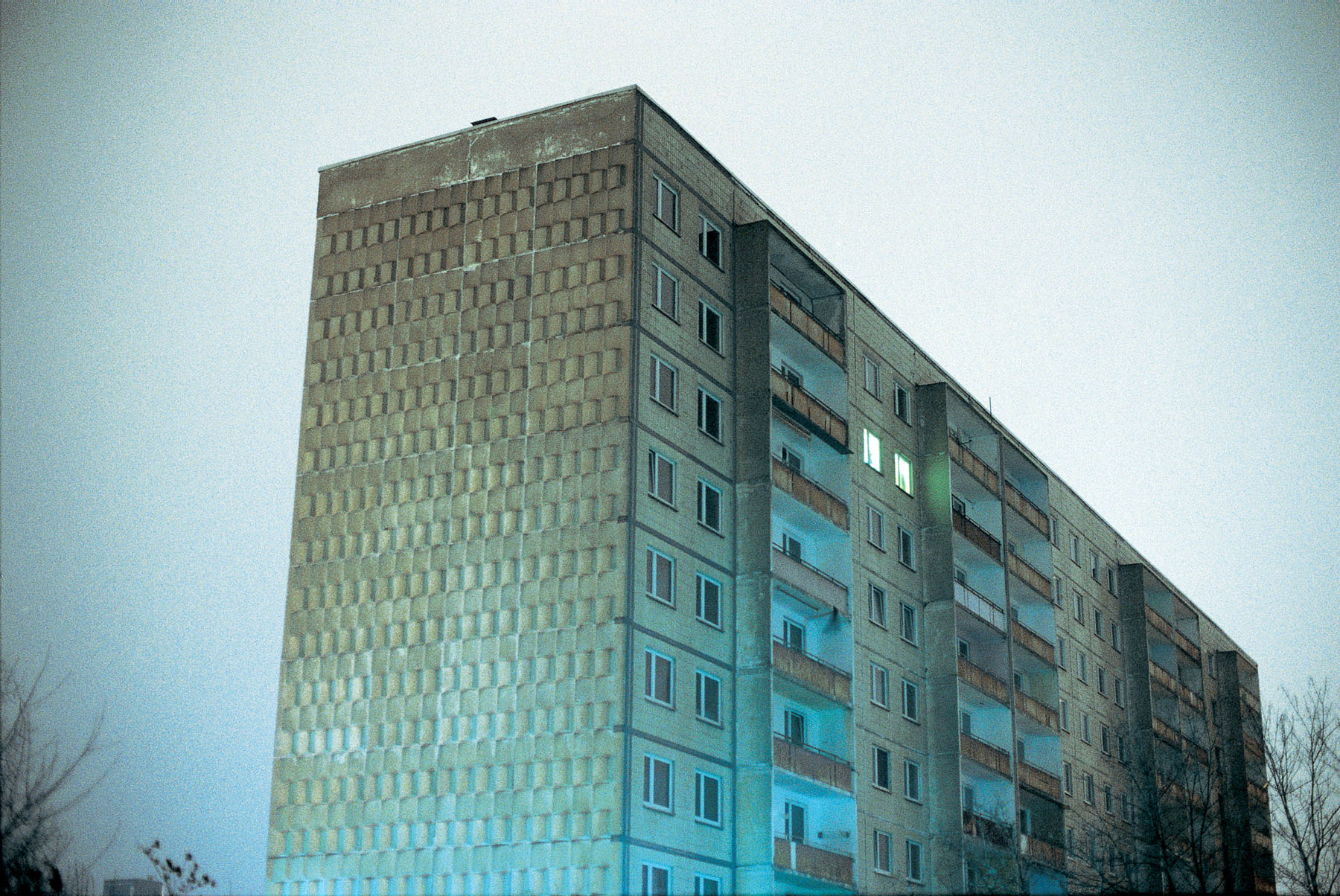
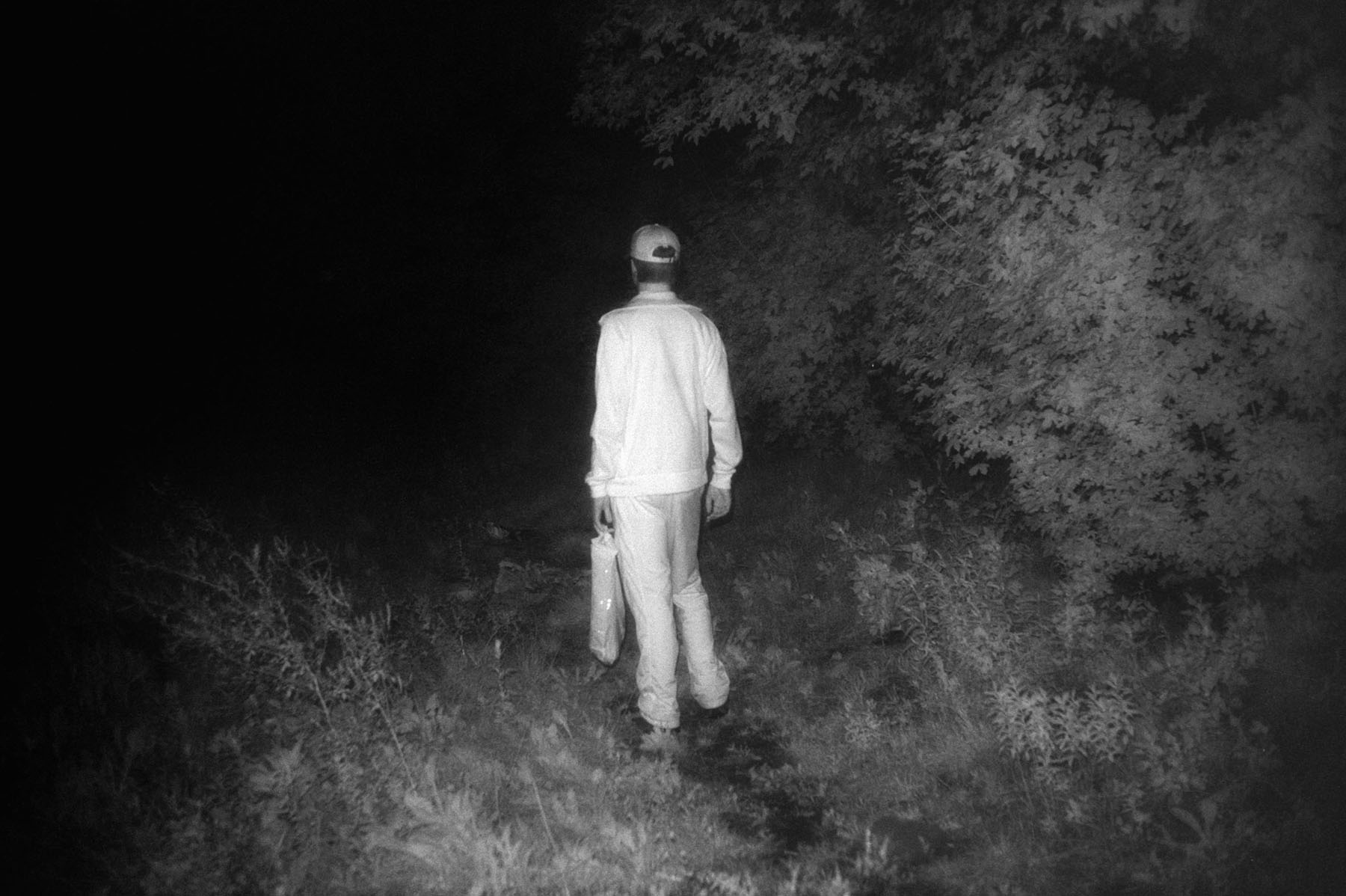
Unlike the work of Michael Schmidt with that artist’s intimate association with the city of Berlin, Zielony’s photographs could have been taken anywhere in the world. With their contextless backgrounds Zielony’s figures – whether strangely lit and configured automatons, eerie apartment blocks that inhabit an alien world or anonymous humanoids fixed in mundane urban spaces – seem to be more about the artist and how he perceives the world than about the subject itself.

Having said that, these memorable photographs of introspective youths seem to hover in space between the preter/natural – suspended between the mundane and the miraculous.

Dr Marcus Bunyan

PS. My friend and mentor said to me, “What I am interested in, is how Zielony came to make such interesting aesthetic decisions – his work is the most interesting in terms of appearance for a long time. It is so easy to make things messy but he manages to remain so clean. What does he do, what does he say to himself to make this happen?”


Many thankx to the Museum Folkwang for allowing me to publish the photographs in the posting. Please click on the photographs for a larger version of the image.


TOBIAS ZIELONY. The Fall – Trailer

With The Fall, the Folkwang Museum is showing the first overview exhibition of works by the photo and video artist Tobias Zielony (b. 1973 in Wuppertal). A total of eleven video works, seven photo series, two room installations and a digital slide show with around 150 photographs alone allow for the first time a comprehensive look at Zielony’s artistic work over the past twenty years.

In his work, Tobias Zielony repeatedly deals with the concept of youth culture in relation to origin, representation and fashion and the associated definition of identity in the changing media reality. The emergence of social networks and the exchange of countless photographic images have fundamentally changed the idea of ​​the self and the forms of (self) representation. Zielony shows his protagonists: inside as self-confident participants in this interplay, who act despite cultural and social differences in a global cosmos of social codes and self-portraits.

Tobias Zielony stands in a long line of tradition in artistic photography and is considered by many younger picture makers to be pioneering. Few photographers of his generation have observed social and media developments as carefully and translated them into a contemporary visual language as he has. For the first time, “The Fall” offers the opportunity to read Zielony’s imagery, which is located in the most diverse regions of the world, as global phenomena in their specific forms.


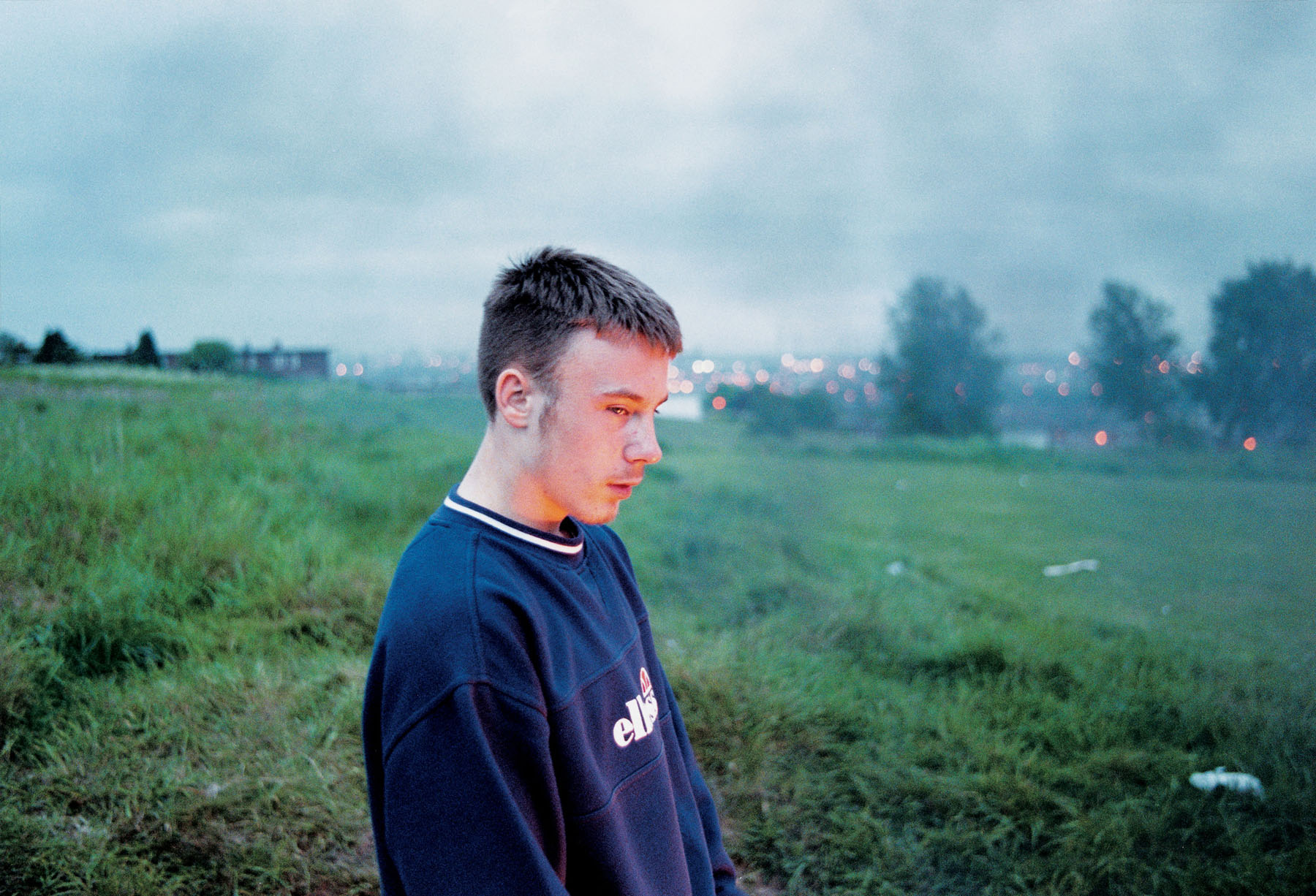
Tobias Zielony (German, b. 1973) 'Glow' 2001 from the exhibition 'Tobias Zielony: The Fall' at Museum Folkwang, Essen, June - Sept, 2021


Tobias Zielony (German, b. 1973)
Glow
2001
From Curfew, Bristol, Newport
C-print
41.4 x 42cm
Courtesy KOW, Berlin
© Tobias Zielony


Tobias Zielony (German, b. 1973) 'Hochhaus' 2003


Tobias Zielony (German, b. 1973)
Hochhaus
2003
From Ha Neu
C-print
46 x 69cm
Museum Folkwang, Essen
© Tobias Zielony


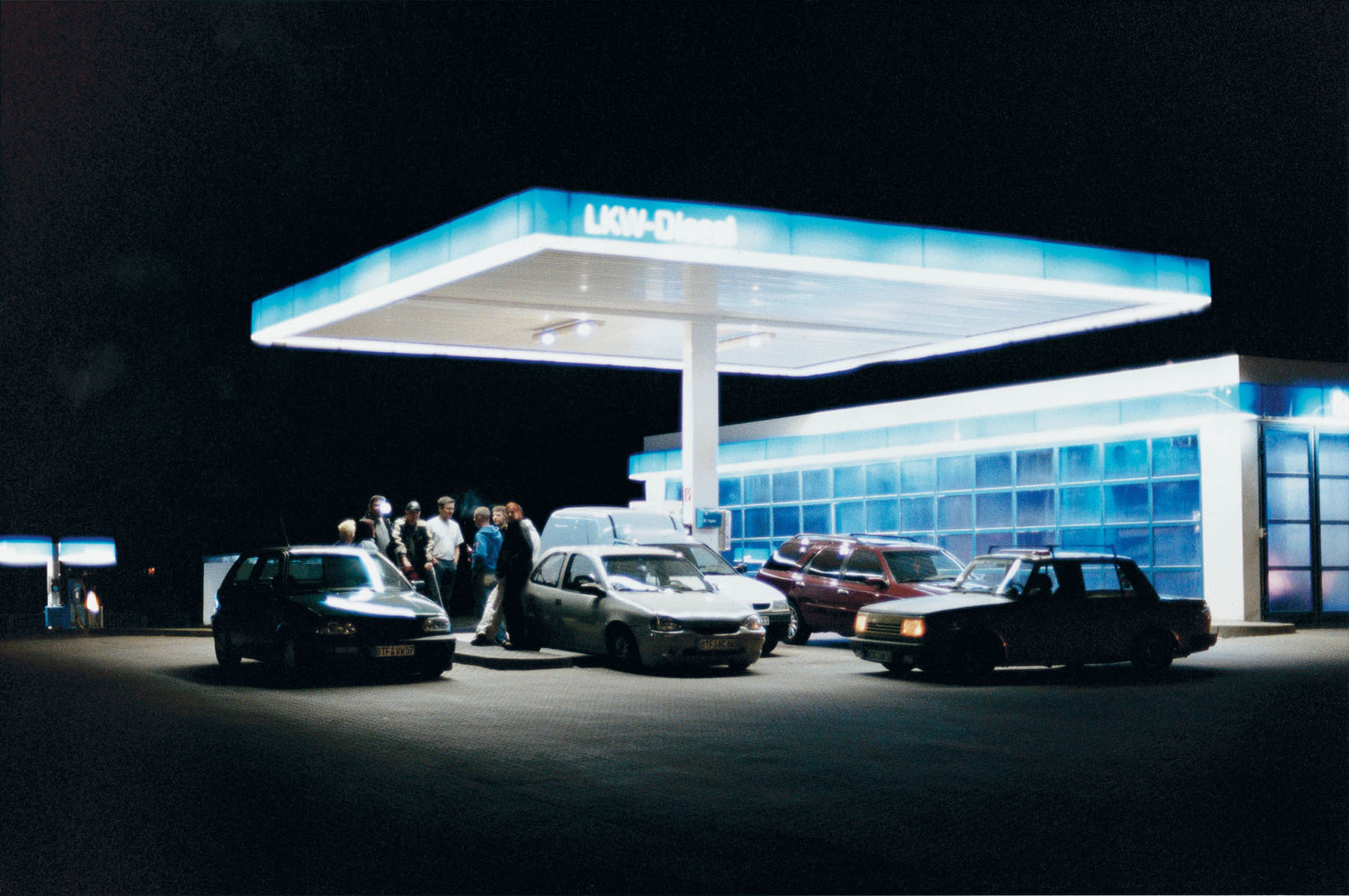
Tobias Zielony (German, b. 1973) 'Aral-1' 2004


Tobias Zielony (German, b. 1973)
Aral-1
2004
From Tankstelle
C-Print
48 x 72cm
Courtesy KOW, Berlin
© Tobias Zielony


Tobias Zielony (German, b. 1973) 'Park' 2006


Tobias Zielony (German, b. 1973)
Park
2006
From Big Sexyland
C-print
67 x 100cm
Museum Folkwang, Essen
© Tobias Zielony


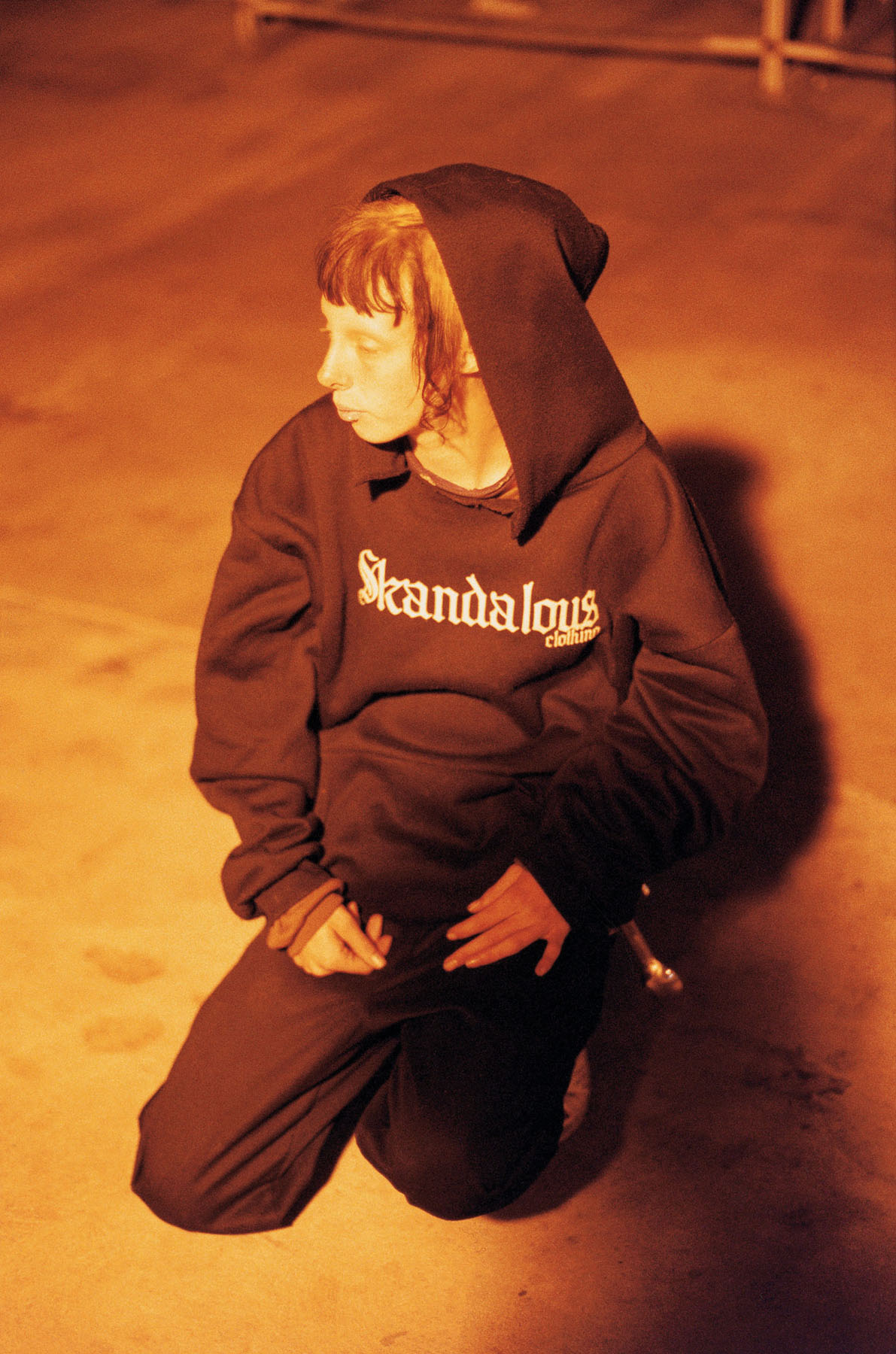
Tobias Zielony (German, b. 1973) 'Skandalous' 2007


Tobias Zielony (German, b. 1973)
Skandalous
2007
From The Cast
C-print
84 x 56cm
Courtesy KOW, Berlin
© Tobias Zielony


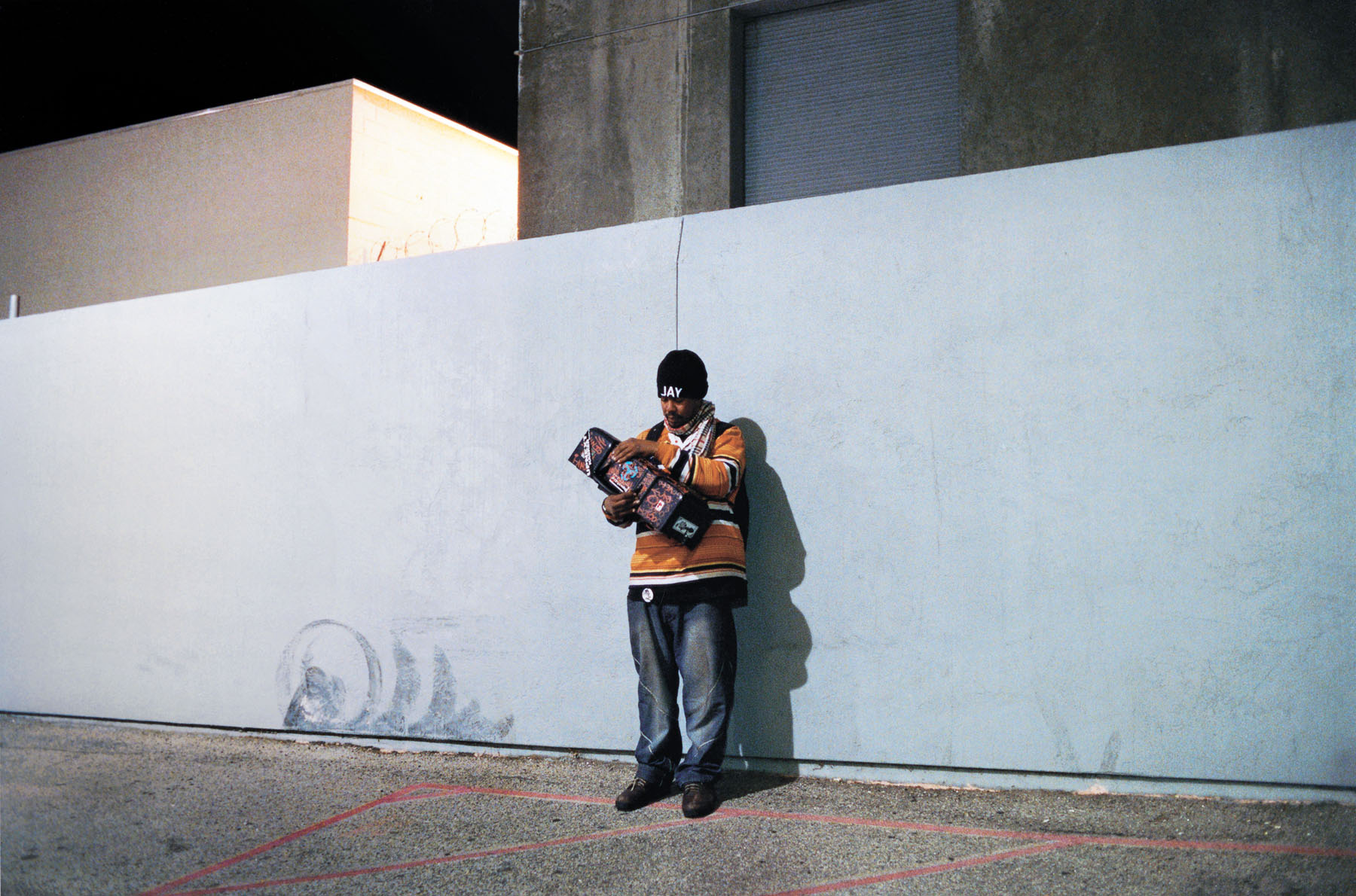
Tobias Zielony (German, b. 1973) 'Jay' 2007


Tobias Zielony (German, b. 1973)
Jay
2007
From The Cast
C-print
56 x 84cm
Courtesy KOW, Berlin
© Tobias Zielony


Tobias Zielony (German, b. 1973) 'Untitled' 2008


Tobias Zielony (German, b. 1973)
Untitled
2008
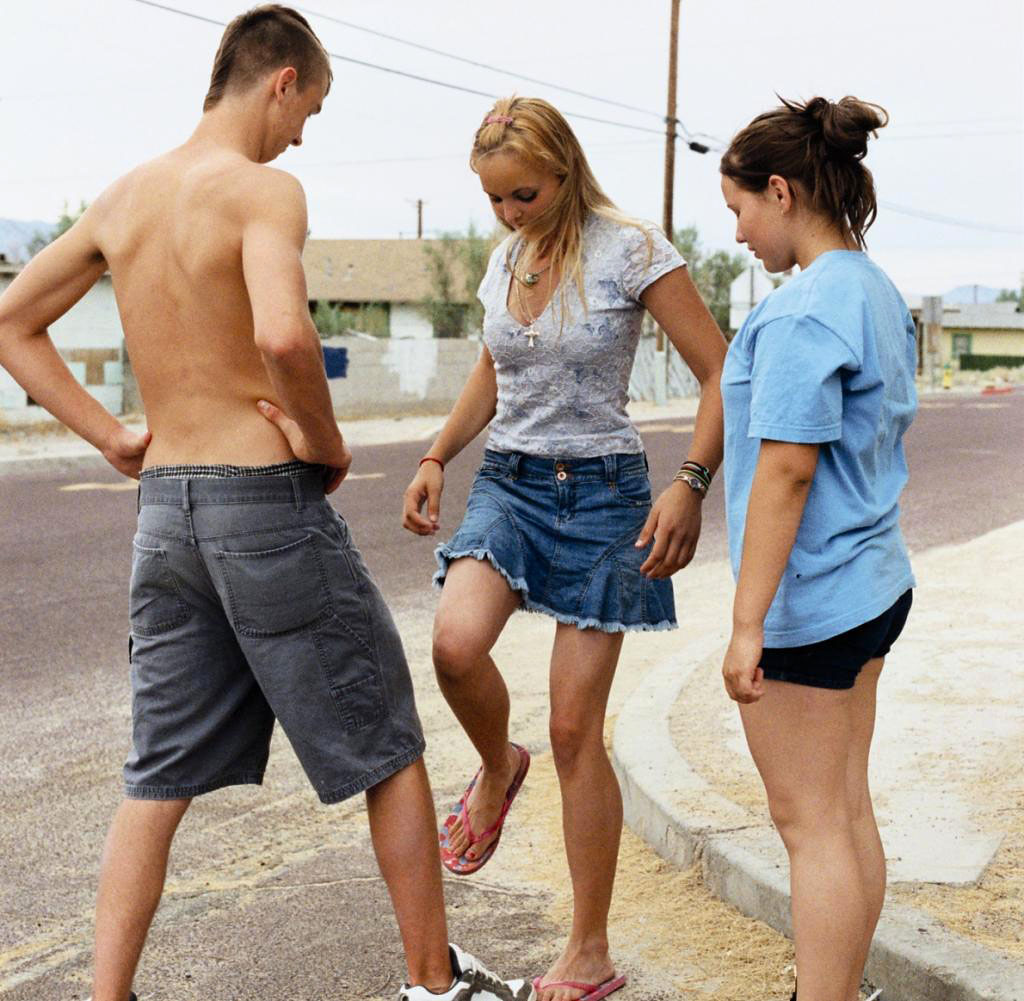
From the series Trona Armpit of America
Courtesy KOW, Berlin
© Tobias Zielony


Tobias Zielony (German, b. 1973) 'Dirt Field' 2008


Tobias Zielony (German, b. 1973)
Dirt Field
2008
From the series Trona Armpit of America
C-print
56 x 84cm
Courtesy KOW, Berlin
© Tobias Zielony


Tobias Zielony (German, b. 1973) 'Two boys' 2008


Tobias Zielony (German, b. 1973)
Two boys
2008
From the series Trona Armpit of America
C-print
56 x 84cm
Courtesy KOW, Berlin
© Tobias Zielony


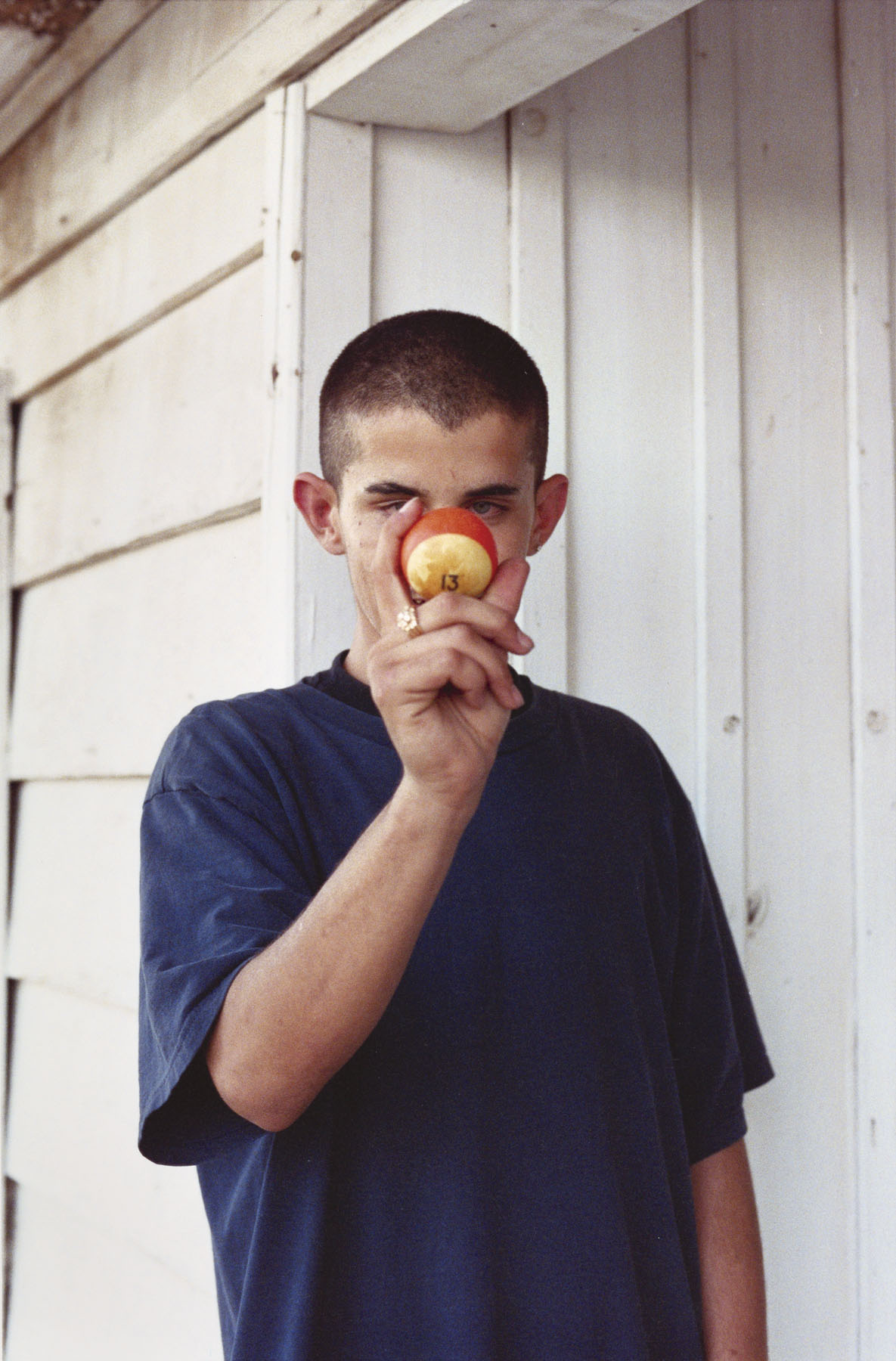
Tobias Zielony (German, b. 1973) 'Ball 13' 2008


Tobias Zielony (German, b. 1973)
Ball 13
2008
From the series Trona Armpit of America
C-print
84 x 56cm
Courtesy KOW, Berlin
© Tobias Zielony


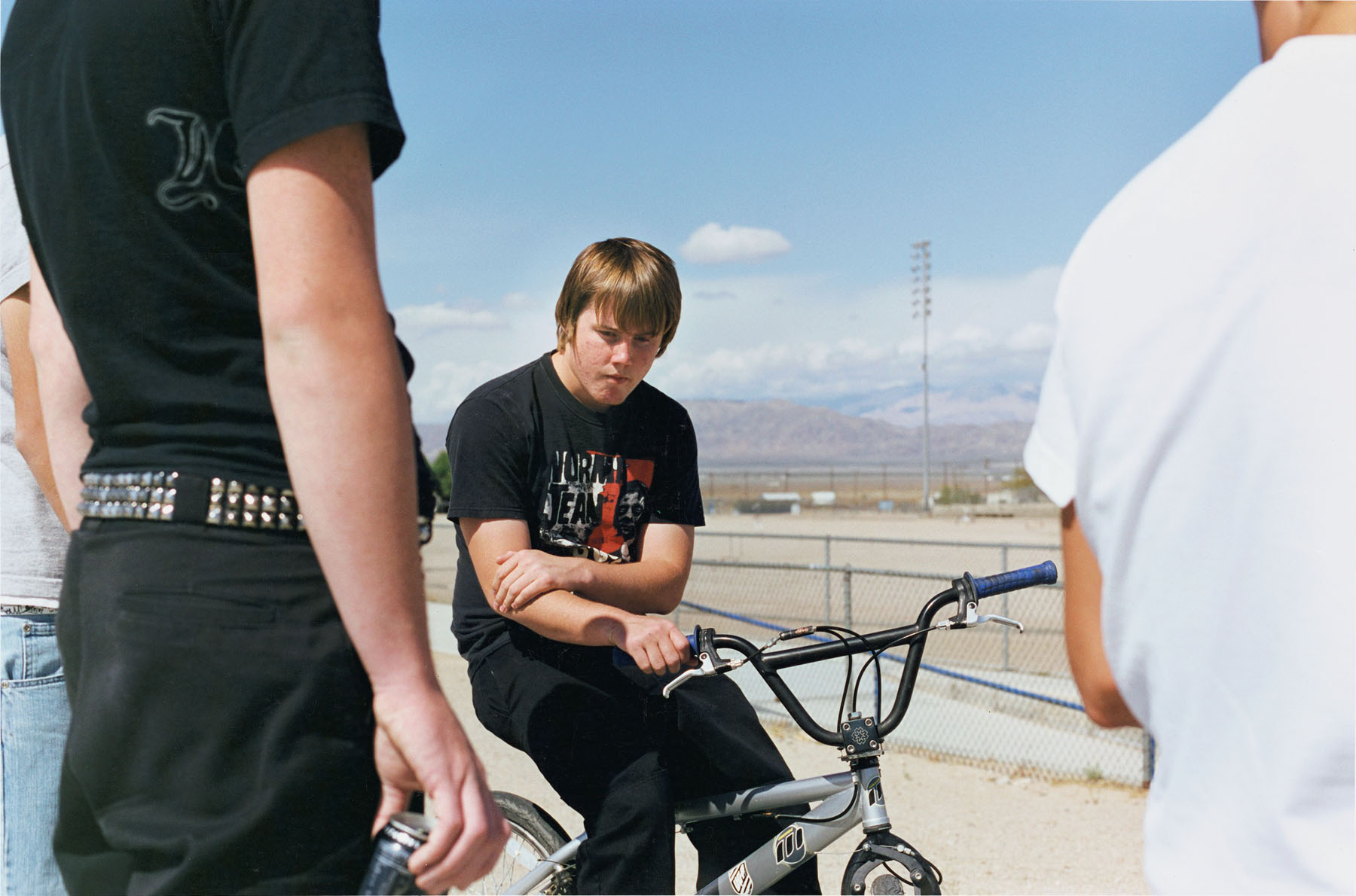
Tobias Zielony (German, b. 1973) 'BMX' 2008


Tobias Zielony (German, b. 1973)
BMX
2008
From the series Trona Armpit of America
C-Print
56 x 84cm
Courtesy KOW, Berlin
© Tobias Zielony


Tobias Zielony (German, b. 1973) 'Vela Azzurra' 2010


Tobias Zielony (German, b. 1973)
Vela Azzurra
2010
From the series Vele
C-print
150 x 120cm
Courtesy KOW, Berlin
© Tobias Zielony


With The Fall, Museum Folkwang is presenting the first major overview exhibition of the work of Tobias Zielony (June 25 – September 26, 2021). Zielony stands in a long lineage of artistic photography. His visual world is seen as paving the way for a younger generation. Few photographers have observed developments in society and the media as keenly and translated these into a contemporary visual language as he has. His work The Citizen, on the topic of migration, was shown in the German Pavilion at the 2015 Venice Biennial and viewed by a broad international public. The largest presentation of his photographs and video works to date offers a comprehensive insight into Zielony’s work of the last 20 years.

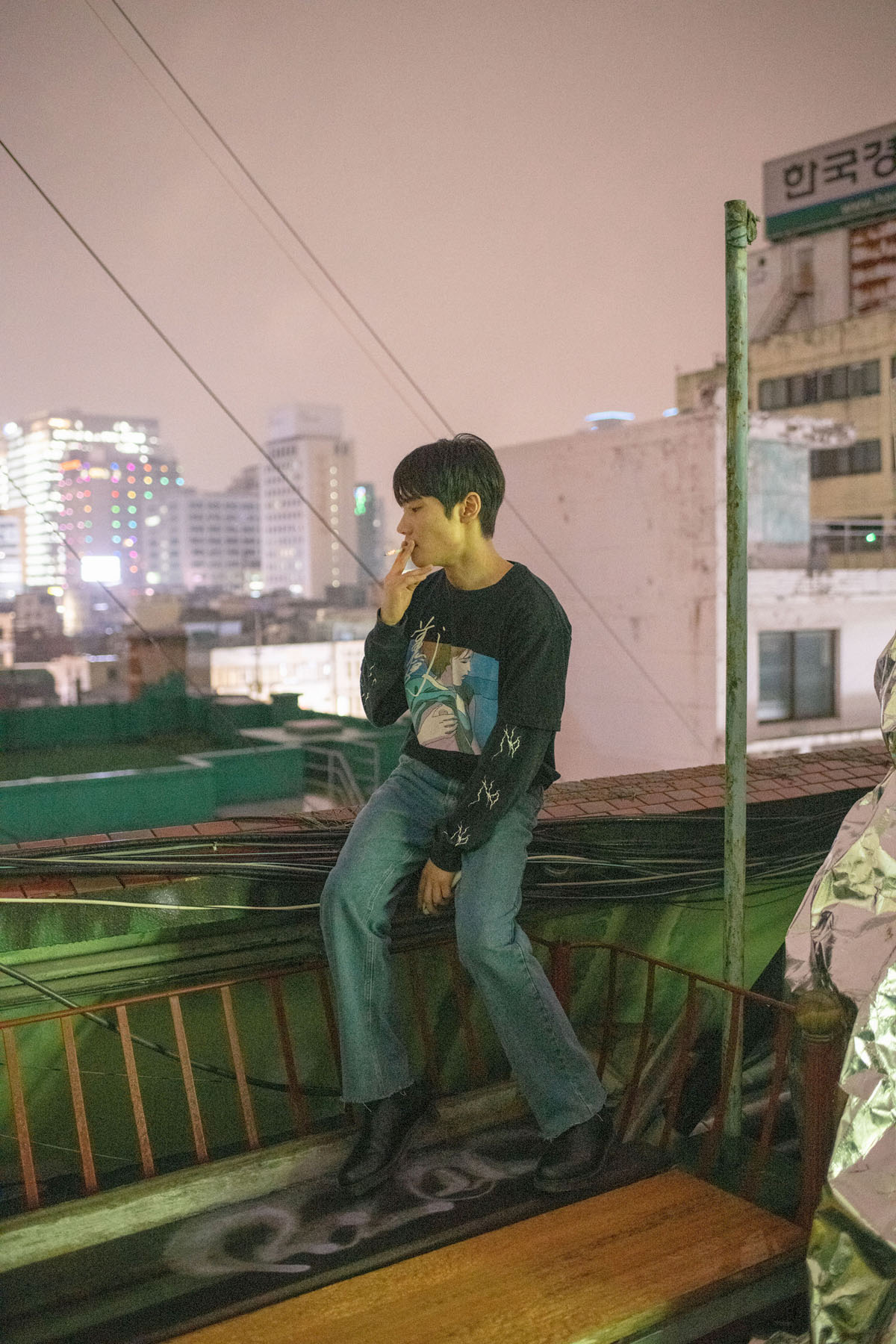
The people and spaces that attract Tobias Zielony are not on the margins of society, but the places in deprived areas where adolescents meet, hang out and show off: be this in Wuppertal, Trona, Naples, Osaka, Halle-Neustadt or Kiev. The youths and young adults whom Zielony accompanies with his camera as a confidant and observer belong to the Techno, LGBTQIT*​ or skater scene, amongst others. Zielony operates globally and allows himself to be guided by his curiosity, which affords him ever new encounters with young people in their respective social contexts. In all of this he explores the intersection between fictional and documentary assertions and investigates the political and aesthetic potential as well as the boundaries of authentic self-representation. His photographic works and films are characterised by a critical understanding of the genre and the quest for self-determination and emancipation of those portrayed in them.

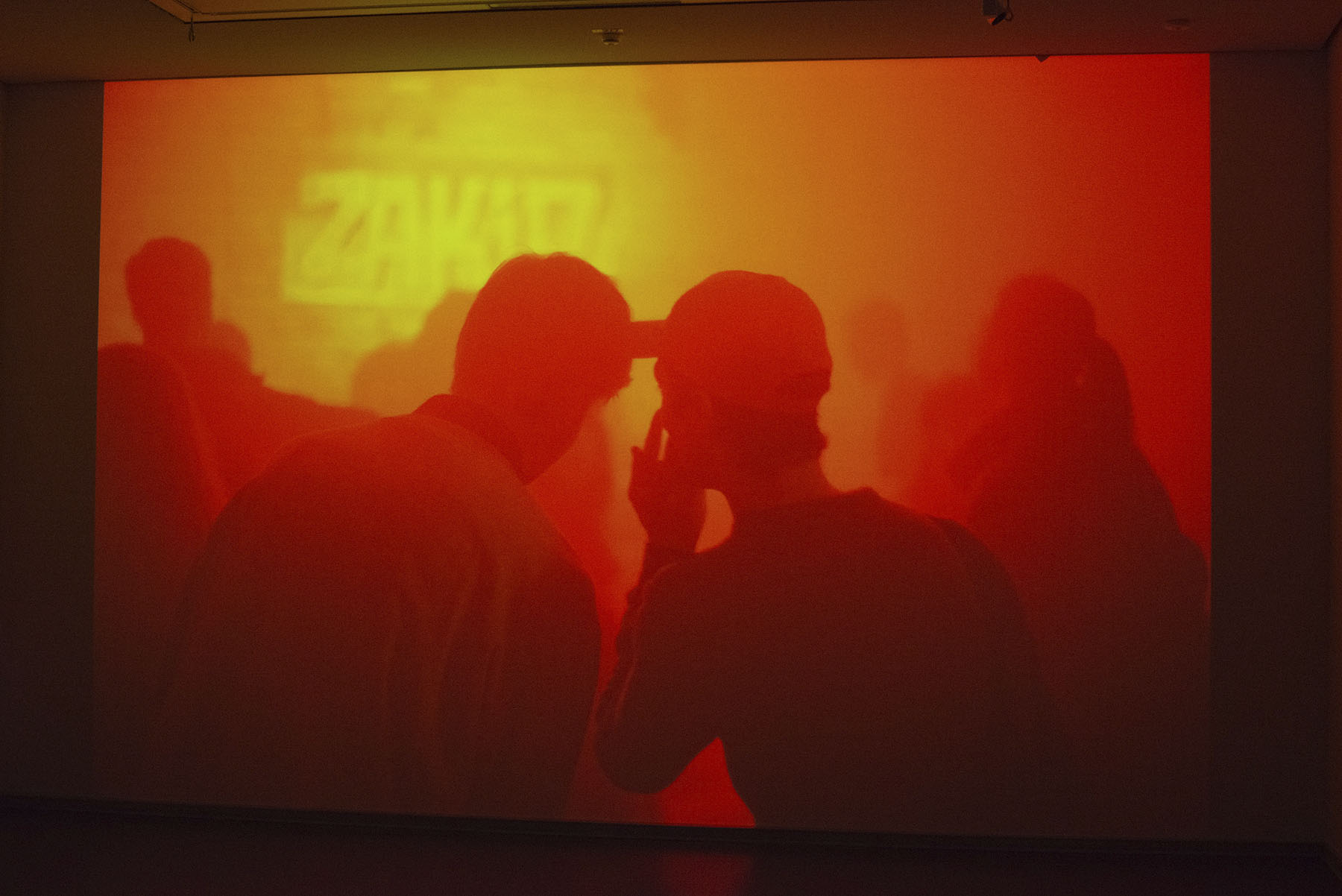
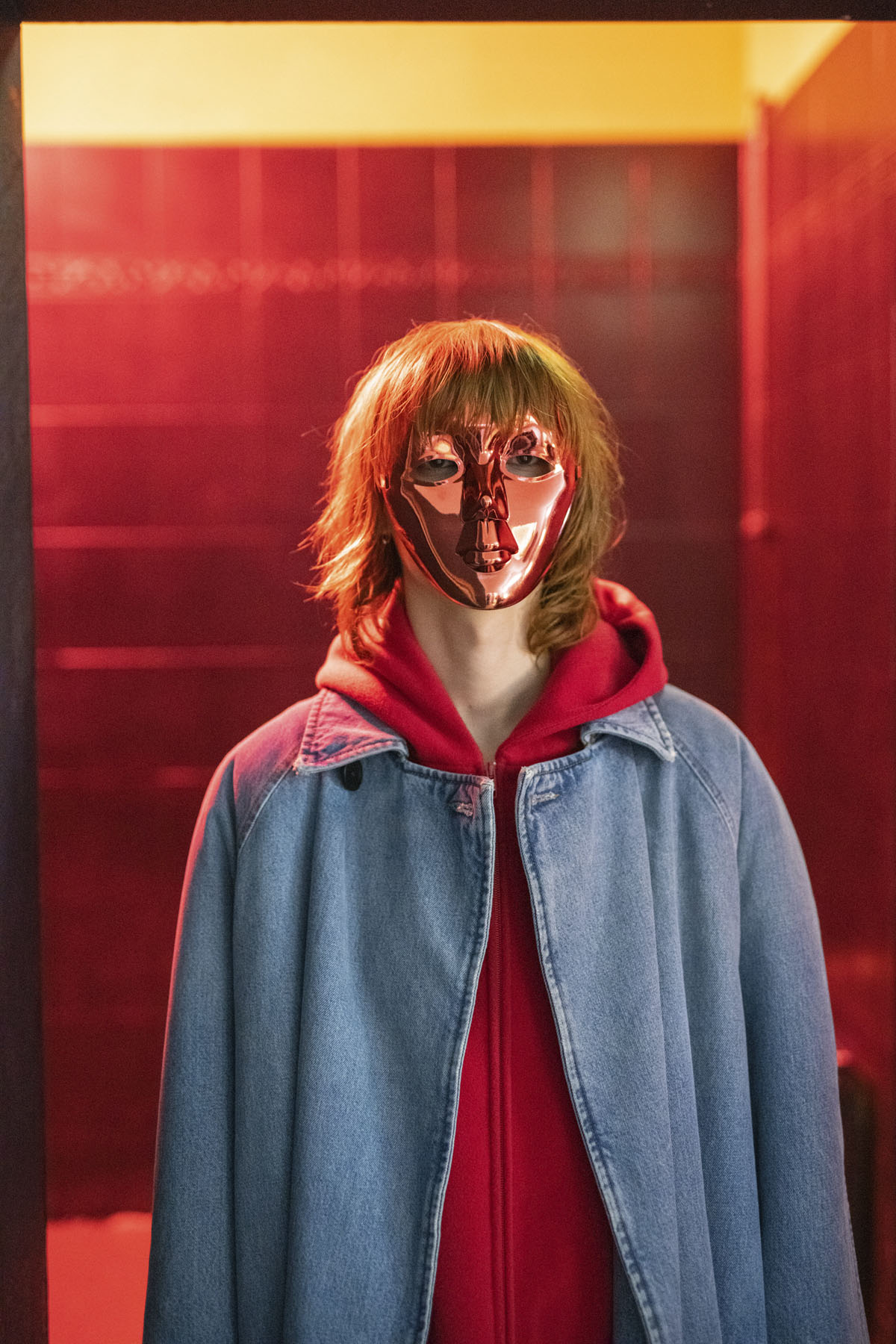
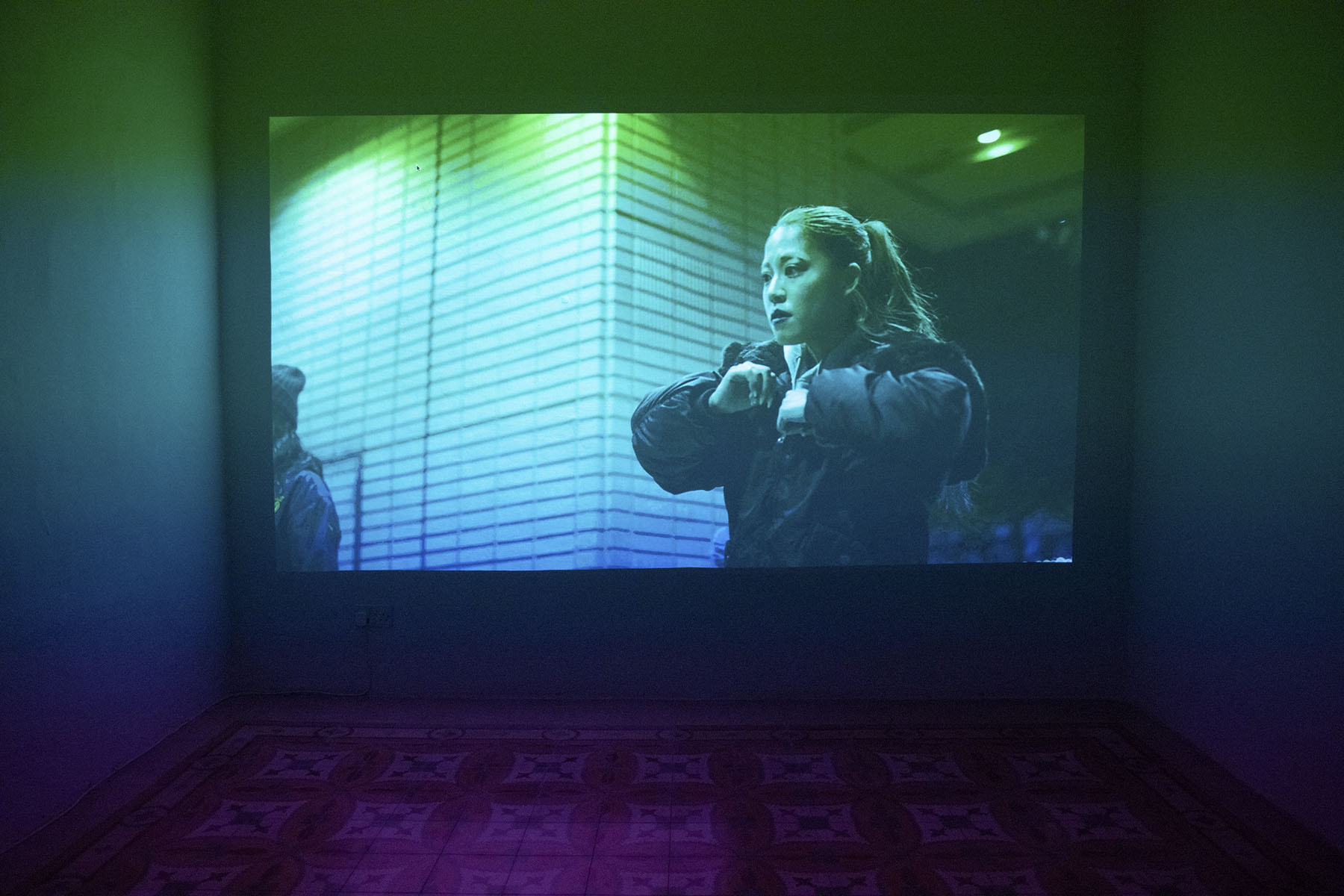
The show The Fall combines well-known photography series and early video works ranging from Curfew (2001), Big Sexyland (2006), the well-known stop-motion videos Vele (2009-2010), Maskirovka (2016-2017), to the video work Hansha (2019) created in Japan. The exhibition is the first to bring together Zielony’s visual worlds from different parts of the world and show them as global phenomena with specific characteristics. A symbolic city space is created in the exhibition;s central space, which offers a space to meet and sojourn. Encounters, situations and places exist alongside and enter into relationship with each other, and in their spatial consolidation cite the ever-present flood of images on social media.

In his work, Tobias Zielony has time and again addressed youth culture with a view to background, representation and fashion and the definition of identity in a world changing in terms of the media used. Social networks and the exchange of photographic images they entail have fundamentally changed the notion of the self and the forms of (self-)representation. Everyone – and this includes his protagonists – now uses the photographic medium with their smart phone in order to send and receive images. In this interplay, Zielony shows his subjects as confident participants acting in a global cosmos of social codes and self-portraits – in spite of cultural and social differences.

Spector Books is publishing a series of essays: selected works by Tobias Zielony are paired with texts by Sophia Eisenhut, Joshua Groß, Dora Koderhold, Enis Maci, Mazlum Nergiz and Jakob Nolte.

Press release from the Museum Folkwang


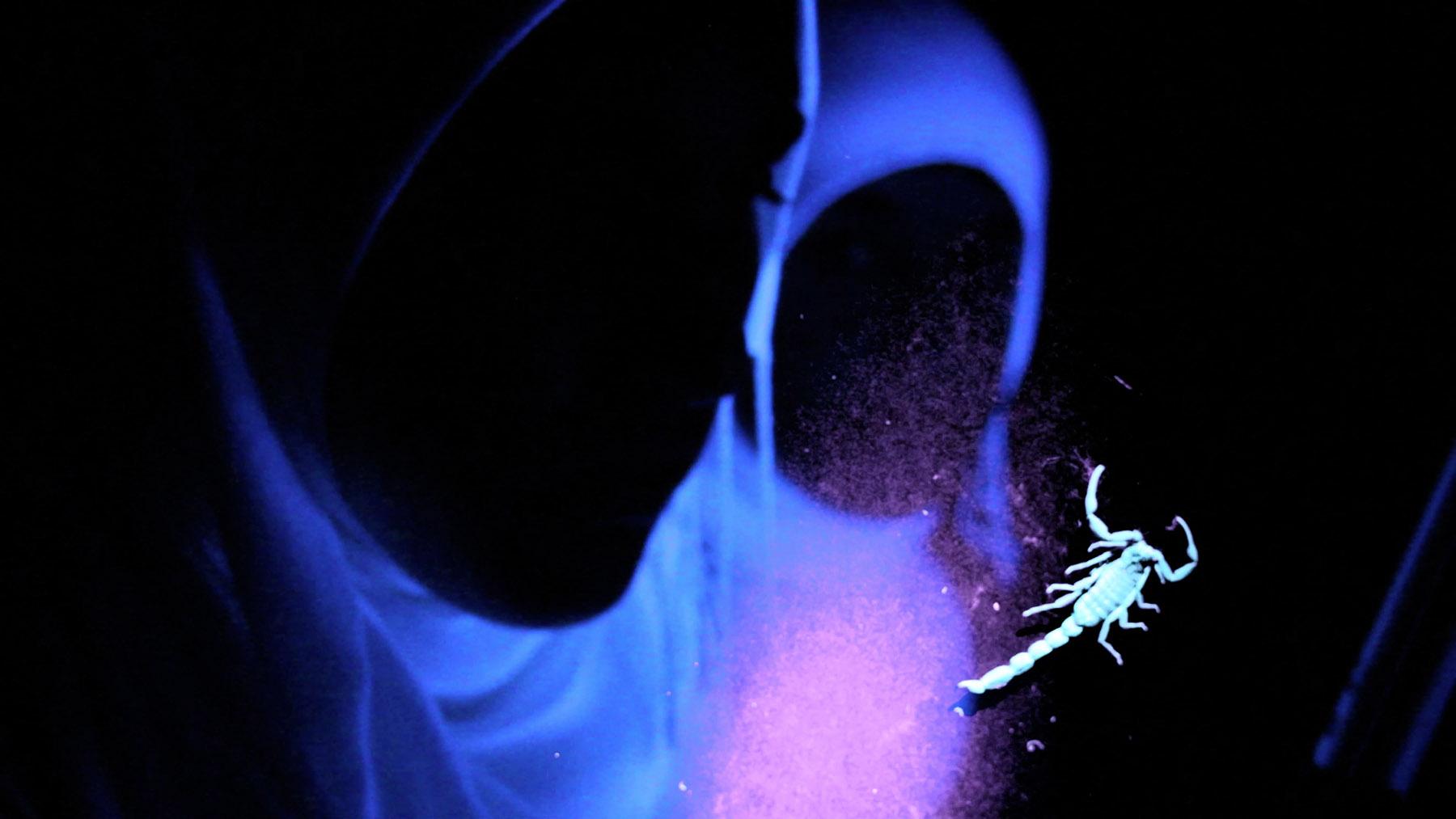
Tobias Zielony (German, b. 1973) 'Al-Akrab' (filmstill) 2014


Tobias Zielony (German, b. 1973)
Al-Akrab (filmstill)
2014
HD Video & Stop Motion, 4:52 min
Courtesy KOW, Berlin
© Tobias Zielony


Tobias Zielony (German, b. 1973) 'The Citizen' 2015


Tobias Zielony (German, b. 1973)
The Citizen
2015
Courtesy KOW, Berlin
© Tobias Zielony


Tobias Zielony (German, b. 1973) 'The Citizen' 2015


Tobias Zielony (German, b. 1973)
The Citizen
2015
Courtesy KOW, Berlin
© Tobias Zielony


Tobias Zielony (German, b. 1973) 'Cover' 2017


Tobias Zielony (German, b. 1973)
Cover
2017
From Maskirovka
Inkjet print
84 x 56cm
Courtesy KOW, Berlin
© Tobias Zielony


Tobias Zielony (German, b. 1973) 'Secret' 2017


Tobias Zielony (German, b. 1973)
Secret
2017
From Maskirovka
Inkjet print
56 x 84cm
Courtesy KOW, Berlin
© Tobias Zielony


Tobias Zielony (German, b. 1973) 'Make Up' 2017


Tobias Zielony (German, b. 1973)
Make Up
2017
From Maskirovka
Inkjet print
70 x 105cm
Courtesy KOW, Berlin
© Tobias Zielony


Tobias Zielony (German, b. 1973) 'Maskirovka' 2017 (installation view)


Tobias Zielony (German, b. 1973)
Maskirovka (installation view)
2017
HD Video, Stop Motion, 8:46 min
Courtesy KOW, Berlin
© Tobias Zielony


Tobias Zielony (German, b. 1973) 'Red Mask' 2019


Tobias Zielony (German, b. 1973)
Red Mask
2019
Inkjet print
100 x 75cm
Courtesy KOW, Berlin
© Tobias Zielony


Tobias Zielony (German, b. 1973) 'Hansha' 2019 (installation view)


Tobias Zielony (German, b. 1973)
Hansha (installation view)
2019
HD Video, 6:01 min
Courtesy KOW, Berlin
© Tobias Zielony


Tobias Zielony (German, b. 1973) 'Snakepool' 2020


Tobias Zielony (German, b. 1973)
Snakepool
2020
Inkjet print
120 x 80cm
Courtesy KOW, Berlin
© Tobias Zielony


Tobias Zielony (German, b. 1973) 'Yusuke' 2020


Tobias Zielony (German, b. 1973)
Yusuke
2020
Inkjet print
120 x 80cm
Courtesy KOW, Berlin
© Tobias Zielony


Halina Kliem. 'Portrait of Tobias Zielony' 2021


Halina Kliem
Portrait of Tobias Zielony
2021


Museum Folkwang
Museumsplatz 1, 45128 Essen

Opening hours:
Tuesday – Sunday 10am – 6pm
Thursday – Friday 10am – 8pm

Museum Folkwang website

LIKE ART BLART ON FACEBOOK

Back to top

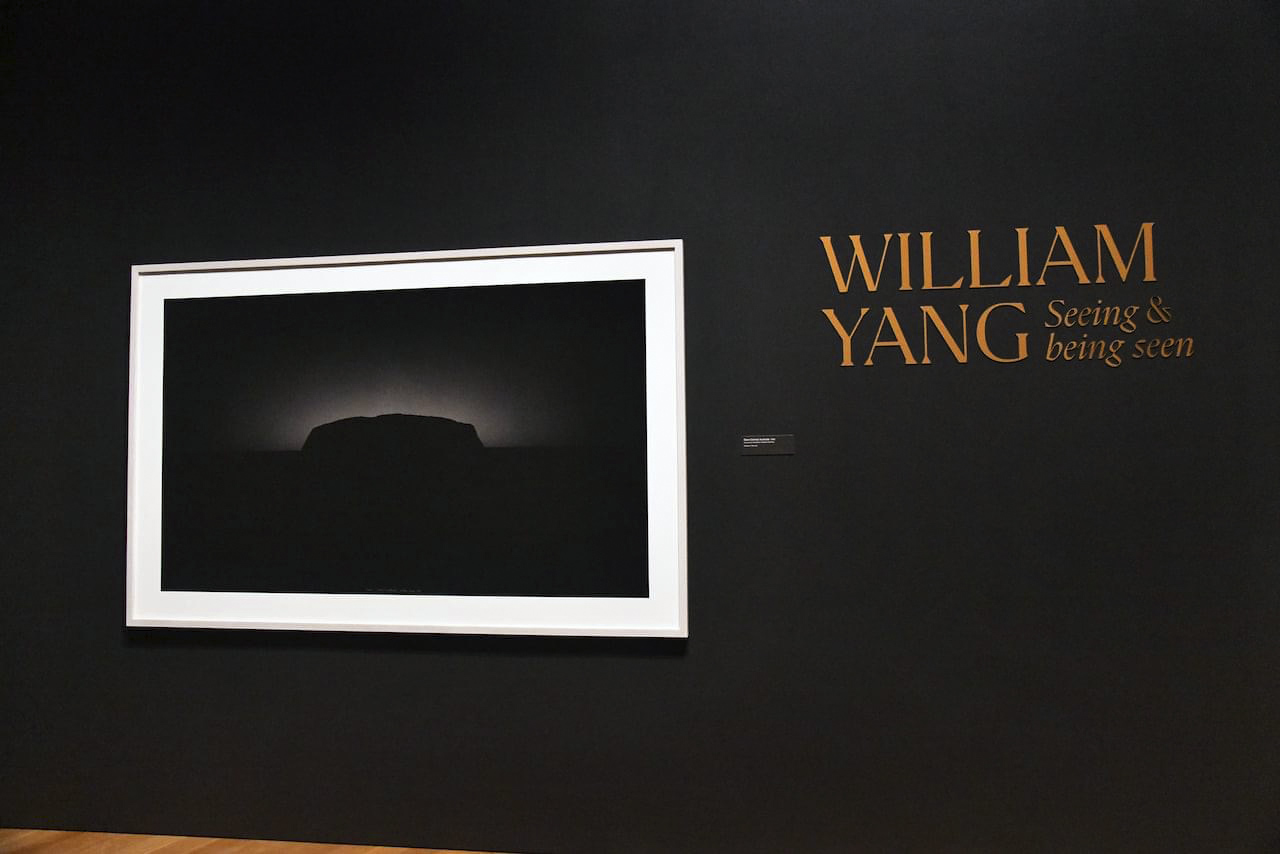
Review: ‘William Yang: Seeing and Being Seen’ at the Queensland Art Gallery | Gallery of Modern Art (GOMA), Brisbane

Exhibition dates: 27th March – 22nd August, 2021

Curator: Rosie Hays, Associate Curator, Australian Cinémathèque, QAGOMA


William Yang (Australia b. 1943) 'Golden Summer' 1987/2016 from the exhibition 'William Yang: Seeing and Being Seen' at the Queensland Art Gallery | Gallery of Modern Art (GOMA), Brisbane, March - August, 2021
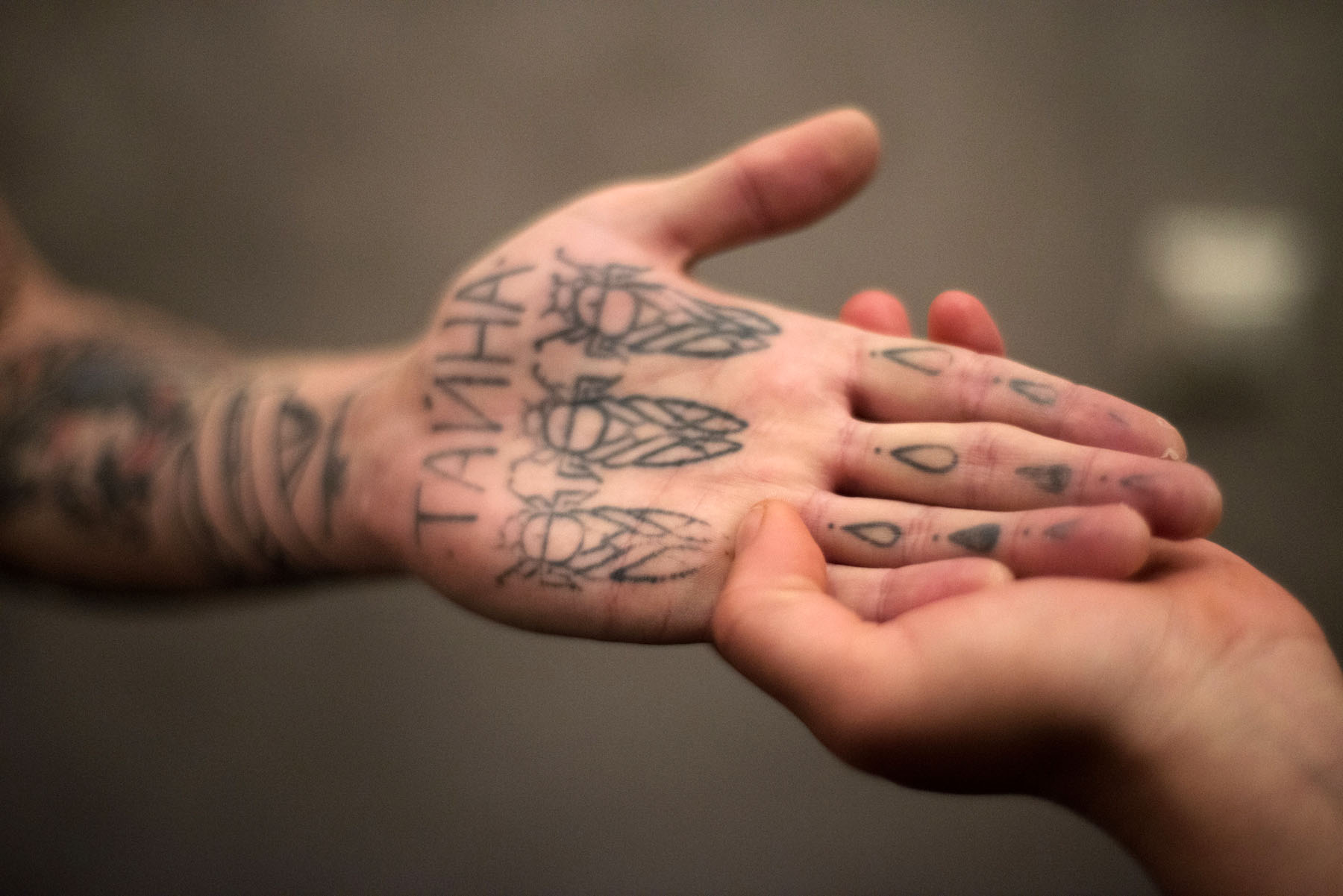
 

William Yang (Australia b. 1943)
Golden Summer
1987/2016
Inkjet print, gold leaf on Innova Softex paper
40 x 30cm
© William Yang
Courtesy: The artist


William Yang (Australia b. 1943) ''Allan' from the monologue 'Sadness'' 1992 from the exhibition 'William Yang: Seeing and Being Seen' at the Queensland Art Gallery | Gallery of Modern Art (GOMA), Brisbane, March - August, 2021


William Yang (Australia b. 1943)
‘Allan’ from the monologue ‘Sadness’
1992
© William Yang
Courtesy: The artist


The Family of Yang

Let me tell you a story… a story made up of many smaller tales, told to me by a chronicler, diarist, writer, performance artist and filmmaker; socio-documentary photographer and historian; master of oral history and storytelling – Chinese-Australian artist William Yang.

Voluminous amounts of text have been written about Yang’s art practice and for this reason I only offer here a brief precis of his fifty year career as an artist. Indeed, it is impossible to cover such an expansive career in performance, film, text and photographs in one posting. After the precis I offer some thoughts and insights into Yang’s work.

Yang was born in 1943 into a family of Chinese immigrants in Far North Queensland. After moving to Brisbane in the mid-1960s to study architecture, he journeyed to Sydney in 1969 where he helped produce plays. Yang picked up a camera and started taking photographs of his friends, celebrities, parties and the gay scene in Sydney, Australia in the early-mid 1970s. His first exhibition Sydneyphiles at the Australian Centre for Contemporary Photography in 1977 set him on his way. Personal reflections were written directly on the mounts around his photographs something that he was to adapt further, inscribing his stories directly on the photographs in later bodies of work (“an oral tradition of storytelling transferred to the physical medium of the photograph”). In 1989, Yang began performing monologues with slide projections in theatres, integrating his skills as a writer and a visual artist.

As can be heard in the exhibition curator Rosie Hays’ video talk below, Yang’s first period was as a social life photographer / commercial photographer, earning a living selling his photographs to gay newspapers; his second period encompassed investigations into marginalised communities: queer community, Australian-Chinese community, Indigenous communities and telling alternative histories of Australia including the history of his Chinese-Australian heritage; and in the third period, Yang’s work has become more reflective, interested in ordinary things, interested in the life of the human embodied in the landscape.

.
As a documentary photographer and performance artist, Yang’s work has examined numerous linked themes. The artist investigates the intimate connections between dystopian and utopian worlds – for example, between the body racked by AIDS and the body beautiful (see above), or between the racism of his childhood and the acceptance of his Chinese heritage – as he probes the paradoxes of existence, those parallels streams of life and death, where one person looks death in the eye and the other doesn’t even know it exists… in that moment. And then proposes a reconciliation between past and present, personal and private, between the margins and the centre. Through his personal stories he exposes himself in the act of making his art, transcending his life in art. Ego drops away and he becomes entirely his own person, entirely himself, when he performs in his inimitable, self-deprecating style.

I have a suspicion, and I could be entirely wrong here, that at heart the young Yang was a very shy and insecure person. From personal experience I know that many introverts hide their shyness through extrovert behaviour, wanting to belong, wanting to be in with the in crowd, to be the life of the party. Yang was always there at any event opening or party, never without a camera, always ready to capture what life put before him because he wanted to belong. Then, to his great credit, instead of getting caught in a rut as many artists do repeating the same thing over and over again, he had the intelligence, will and creativity to push himself further, to take those next steps in his development as an artist and human being… to take those steps that descend, in metaphor, to the centre of the earth, to the centre of his existence. He was on that golden path of self discovery, another step in the evolution of himself. He wanted to know how he, and others, fitted into the great scheme of life. As a chronicler of moments, a chronicler of history, he speaks aloud the thoughts of his own becoming.

While photography is about capturing a moment and being a vehicle for storytelling, it is so much more than that. It can be about the relationship between the photographer and the subject and how that relationship evolves from a personal engagement to a universal engagement. It is the artist’s view of the world through the camera lens turned from a personal story into a universal story to which any human being can relate. Here we have empathy and humanity, diversity and racism, voyeurism and performance, public and private, bigotry and poofdom, decadence and death. The artist tells those stories, where personal is universal.

Yang is an national treasure, a living legend. People relate to William Yang. They reveal themselves to him because they feel comfortable in his presence, comfortable in his spirit and energy. He draws people to him, he is a sage – from the Latin sapere ‘be wise’ – who loves documenting people and their interactions with each other and with himself. He draws people into his orbit… and creates magical stories and intimate photographs about human existence. There is an undeniable virtu to the person and his work. All the subjects of his art are his family. Whether a celebration of life, an investigation into community, in joy and in sadness, we are all, always, part of the Family of Yang.

Dr Marcus Bunyan

Many thankx to the Queensland Art Gallery | Gallery of Modern Art (GOMA) for allowing me to publish the photographs in the posting. Please click on the photographs for a larger version of the image.


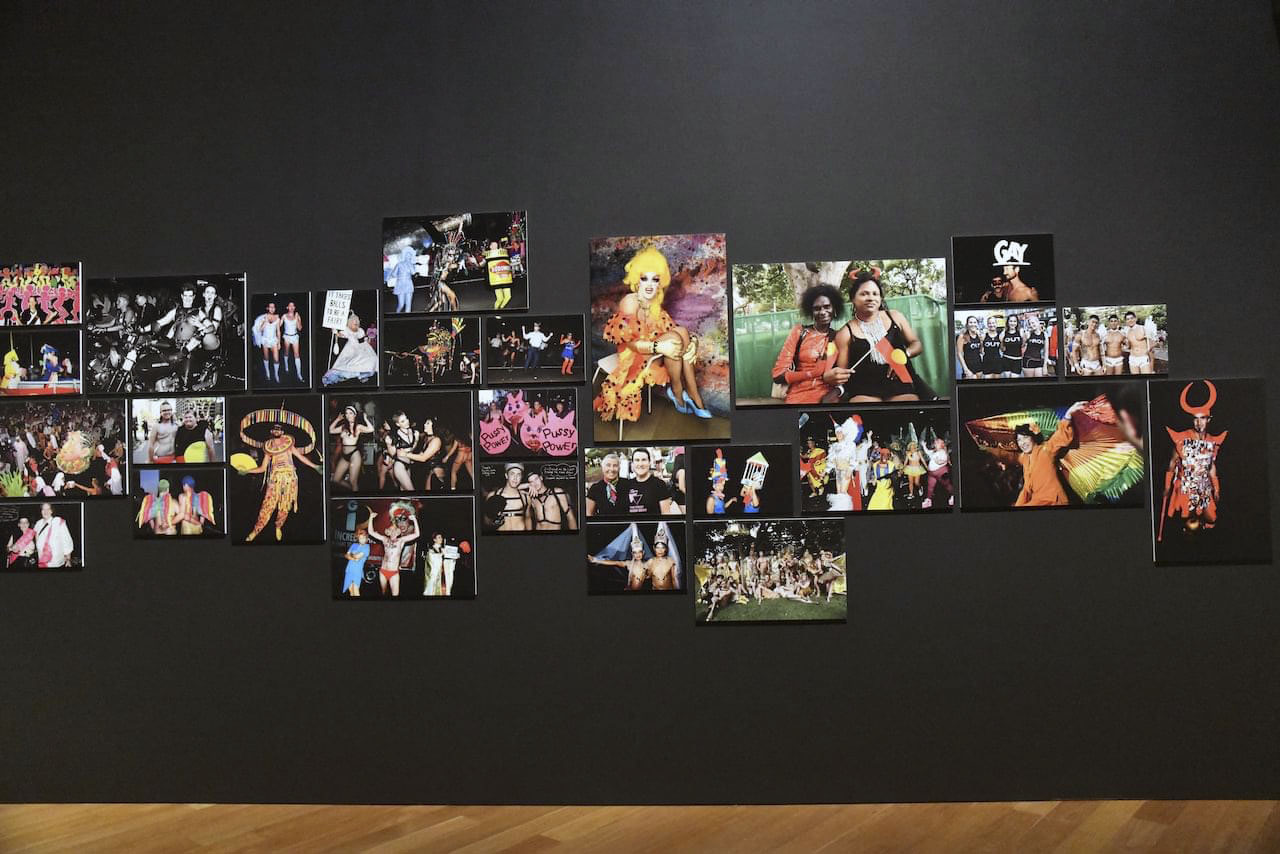
Queensland-born, Sydney-based photographer William Yang’s significant contribution to Australian photography spans five decades. Known for his reflective and joyous depictions of Australia’s LGBTIQ+ scene in the late 70s and 80s through to the present. Yang’s photography is informed by the cultural and political pressures of growing up as a gay man from a Chinese immigrant family in north Queensland.

This exhibition is a major survey of Yang’s work, which traces his career from documentary photography through to explorations of cultural and sexual identities and his depictions of landscape. Yang integrates a photographic practice with writing, video and performance. The exhibition includes Yang’s prolific social portraiture which features prominent creative identities from theatre, film, art and literature such as Patrick White, Brett Whiteley and Cate Blanchett, his revelatory insights into the LGBTIQ+ community, and insightful images of the Australian landscape.

Seeing and Being Seen also includes early social photographs of Sydney’s arts scene as well as the artist’s long exploration of his family and childhood experience in North Queensland which interrogate and celebrate his Chinese-Australian identity, Yang’s identity as a Chinese-Australian, a gay man and artist informs his marginalised experience.

While the stories and images included in the exhibition are quite specific to Yang’s life, the emotions underpinning them are instantly recognisable and acutely relatable. There is confession and courage in his storytelling – his most well-known works are often deeply personal and represent the means by which he reckons with his past, his relationships, and his experience outside the mainstream.

Text from the QAGOMA website


“Yang’s generation is not life as reported in the newspapers but ‘as I saw it’: a personal account summed up as a litany of parties, of innocence lost and worldliness gained, a continuum of his search for contact and meaning. Like his contemporaries Rennie Ellis or Michael Rosen, William Yang is a social photographer, a recorder of life. His strength lies in creating a living testament, and his medium’s strength is that it is necessarily shared. He offers no moral tale, nor any notion of karma to underscore the events: just the three basic but vital stories – birth, love and death.”


Michael Desmond, Senior Curator, National Portrait Gallery, Canberra


“For me, seeing William’s images of men, swaddled in their desire, affection and easy love for one another, continues to disentangle something that’s been knotted up inside me for as long as I can remember. Asian men occupy a very specific idea in the Australian imagination – of being non-sexual, and therefore, undesirable – that we all inevitably internalise. The raw, unashamed sensuality of William’s imagery – of his unabashed desire for the men he captures, and the framing of Asian male beauty itself – is such a potent corrective. His images remind us that desire isn’t anything to be ashamed of, and that Asian men are desirable too.”


Benjamin Law. ‘Bearing witness in the church of William Yang’ 2021


“I was a photographer, which means that I was a voyeur.”


William Yang


“It was difficult to make ends meet as a playwright, so I became a photographer as a way of making money. I was attracted to the glamorous world. I wanted to be a part of it. One way of doing this, I thought, was to be a fashion photographer but i was terrible at it – I couldn’t cover up the flaws. I was better at covering parties and events.”


William Yang, 1993


Installation view of the exhibition 'William Yang: Seeing and Being Seen' at the Queensland Art Gallery | Gallery of Modern Art (GOMA) showing at left, 'Stand Palm Beach' (1981); at middle, 'The Pool at Bondi #3' (1987); and at right, 'Golden Summer' (1987/2016)


Installation view of the exhibition William Yang: Seeing and Being Seen at the Queensland Art Gallery | Gallery of Modern Art (GOMA) showing at left, Stand Palm Beach (1981); at middle, The Pool at Bondi #3 (1987); and at right, Golden Summer (1987/2016, above)


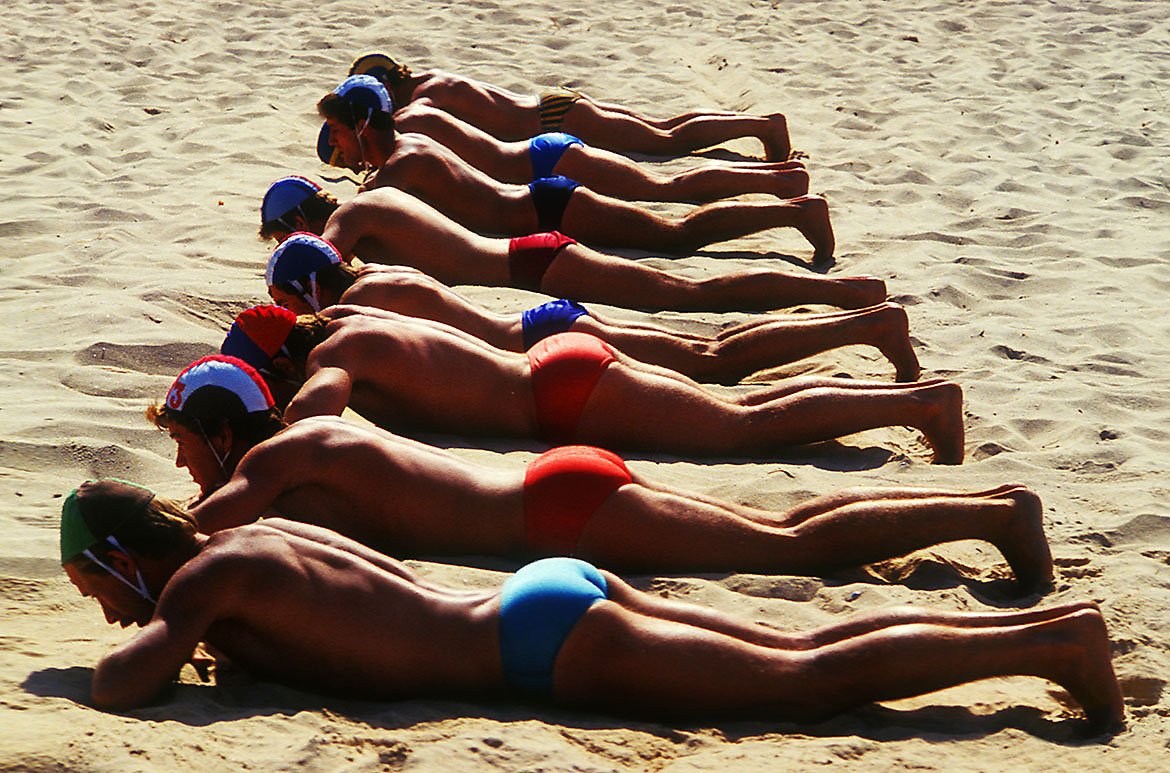
William Yang (Australia b. 1943) 'Tamarama Lifesavers' 1981


William Yang (Australia b. 1943)
Tamarama Lifesavers
1981
Inkjet print on Hahnemühle Fine Art Pearl
39 x 70cm
© William Yang
Courtesy: The artist


William Yang: Seeing and Being Seen / Exhibition walk-through


William Yang (Australia b. 1943) 'Life Lines #3 – Self portrait #2 (1947)' 1947/2008


William Yang (Australia b. 1943)
Life Lines #3 – Self portrait #2 (1947)
1947/2008
Photographer: Unknown
Inkjet print on Innova Softex paper, ed. 2/30
100 x 70cm
Collection of The University of Queensland, purchased 2010
Photo: Carl Warner Reproduced courtesy of the artist and Andrew Baker Art Dealer, Brisbane


William Yang (Australia b. 1943) 'Alter ego' 2001


William Yang (Australia b. 1943)
Alter ego
2001
Digital inkjet print on rag paper
68 x 88cm
© William Yang
Courtesy: The artist


Installation view of the exhibition 'William Yang: Seeing and Being Seen' at the Queensland Art Gallery | Gallery of Modern Art (GOMA)


Installation view of the exhibition William Yang: Seeing and Being Seen at the Queensland Art Gallery | Gallery of Modern Art (GOMA) showing the artist standing in front of his photograph Life Lines #11 – William in scholar’s costume (1984) (1984/2009, below)


William Yang (Australia b. 1943) 'Life Lines #11 – William in scholar's costume (1984)' 1984/2009


William Yang (Australia b. 1943)
Life Lines #11 – William in scholar’s costume (1984)
1984/2009
Inkjet print on Innova Softex paper, ed. 1/20
94.6 x 61.6cm
Collection of The University of Queensland, purchased 2010
Photo: Carl Warner Reproduced courtesy of the artist and Andrew Baker Art Dealer, Brisbane


William Yang (Australia b. 1943) 'Self Portrait #5' 2008


William Yang (Australia b. 1943)
Self Portrait #5
2008
Inkjet print on Innova Softex paper
42 x 65cm
© William Yang
Courtesy: The artist


An exhibition of more than 250 works by Australian photographer and performance artist William Yang opens at the Queensland Art Gallery from tomorrow until 22 August, 2021. William Yang: Seeing and Being Seen spans the artist’s five-decade career and is the first major survey of his work to be presented by an Australian state gallery.

Queensland Art Gallery | Gallery of Modern Art Director Chris Saines said Seeing and Being Seen referred to the artist’s view of the world through the camera lens. ‘Yang captures people across all walks of life, including celebrity artists, alongside photographic explorations that throw light onto subcultures and marginalised groups, and he does not turn away from unsettling narratives or uncomfortable truths,’ Mr Saines said. ‘We are thrilled to be presenting this major exhibition encompassing every aspect of Yang’s practice and highlighting his life-long fascination with people and storytelling. We are also premiering his major new performance ‘In Search of Home’ at GOMA.’

Minister for the Arts Leeanne Enoch said QAGOMA continued to take a leading role in showcasing Queensland-born artists, such as William Yang.

‘William Yang is a noted writer, performer and visual artist with an international profile and this exhibition is an important survey of his work, celebrating inclusivity and diversity,’ Minister Enoch said. ‘The Queensland Government’s support for QAGOMA helps ensure the Gallery will continue its legacy of celebrating Queensland artists and sharing works that tell our stories.’

The exhibition includes Yang’s prolific social portraiture which features prominent creative identities from theatre, film, art and literature such as Patrick White, Brett Whiteley and Cate Blanchett, his revelatory insights into the LGBTIQ+ community, and insightful images of the Australian landscape. Seeing and Being Seen also includes early social photographs of Sydney’s arts scene as well as the artist’s long exploration of his family and childhood experience in North Queensland which interrogate and celebrate his Chinese-Australian identity.

Rosie Hays, Associate Curator, Australian Cinémathèque, QAGOMA and curator of Seeing and Being Seen said Yang’s identity as a Chinese-Australian, a gay man and artist informs his marginalised experience.

‘While the stories and images included in the exhibition are quite specific to William’s life, the emotions underpinning them are instantly recognisable and acutely relatable,’ Ms Hays said. ‘There is confession and courage in William’s storytelling. His most well-known works are often deeply personal and represent the means by which he reckons with his past, his relationships, and his experience outside the mainstream.’

Born in North Queensland in 1943, Yang grew up with little knowledge of his Chinese heritage. Even though his parents were second-generation Chinese-Australian, Cantonese was not spoken at home. After coming to Brisbane in the mid-1960s to study architecture at the University of Queensland, he moved to Sydney in 1969, and has lived and worked there ever since.

A major hard-cover publication accompanying the exhibition features essays by William Yang, curator Rosie Hays, Professor Susan Best and Benjamin Law.

Press release from the GOMA website


William Yang: Seeing and Being Seen / Illustrated Curator’s Talk

Exhibition curator Rosie Hays (Associate Curator, Australian Cinémathèque, QAGOMA) traces William Yang’s reflective and joyous career, delving deeper into the artworks and themes addressed in Seeing and Being Seen.


Artist William Yang’s slideshow performance with stories and eyewitness images from Sydney’s thrilling and turbulent gay scene from the 1970s until now.

Yang is one of Australia’s greatest storytellers, a prolific photographer and a performer of monologues with slide projections. His stories describe the experience of coming to terms with his identity as a gay Chinese Australian. Yang’s work presents a rich and celebratory visual record of this journey, from Gay Liberation in the seventies, to the emergence of the Mardi Gras and a gay subculture in the eighties, to AIDS in the nineties.


William Yang. Families and Fictions: Contemporary Photography from the Collection: Artist Talk, Queensland Art Gallery, 2005


William Yang (Australia b. 1943) '"Mother Standing" Brisbane' 1981


William Yang (Australia b. 1943)
“Mother Standing” Brisbane
1981
Gelatin silver photographs, ed. 2/10
51.3 x 61.1cm
Queensland Art Gallery Foundation Grant purchased 2004
Collection: Queensland Art Gallery | Gallery of Modern Art
© William Yang


William Yang (Australia b. 1943) '"Mother Standing" Brisbane' 1981


William Yang (Australia b. 1943)
“Mother Standing” Brisbane (detail)
1981
Gelatin silver photographs, ed. 2/10
51.3 x 61.1cm
Queensland Art Gallery Foundation Grant purchased 2004
Collection: Queensland Art Gallery | Gallery of Modern Art
© William Yang


Installation view of the exhibition 'William Yang: Seeing and Being Seen' at the Queensland Art Gallery | Gallery of Modern Art (GOMA) showing photographs for Yang's 'About my mother' portfolio


Installation view of the exhibition William Yang: Seeing and Being Seen at the Queensland Art Gallery | Gallery of Modern Art (GOMA) showing photographs for Yang’s ‘About my mother’ portfolio


William Yang (Australia b. 1943) 'Mother. Graceville. 1989' 1989


William Yang (Australia b. 1943)
Mother. Graceville. 1989
1989
From ‘About my mother’ portfolio 2003
Gelatin silver photograph ed. 2/10
51.3 x 61.1cm
Queensland Art Gallery Foundation Grant purchased 2004
Collection: Queensland Art Gallery│Gallery of Modern Art
© William Yang


Installation view of the exhibition 'William Yang: Seeing and Being Seen' at the Queensland Art Gallery | Gallery of Modern Art (GOMA) showing 'Dawn, Central Australia #3'

Installation view of the exhibition 'William Yang: Seeing and Being Seen' at the Queensland Art Gallery | Gallery of Modern Art (GOMA)

Installation view of the exhibition 'William Yang: Seeing and Being Seen' at the Queensland Art Gallery | Gallery of Modern Art (GOMA) showing at centre top, Doris Fish (1988)


Installation views of the exhibition William Yang: Seeing and Being Seen at the Queensland Art Gallery | Gallery of Modern Art (GOMA) showing in the top image, Dawn, Central Australia #3; and in the bottom image at centre top, Doris Fish (1988, below)


William Yang. 'Doris Fish' 1988


William Yang (Australia b. 1943)
Doris Fish
1988
© William Yang
Courtesy: The artist


William Yang (Australia b. 1943) 'The morning after' 1976


William Yang (Australia b. 1943)
The morning after
1976
Gelatin silver print
© William Yang
Courtesy: The artist


Morning sun raking through a window gently lights William Yang’s photograph of sleeping bodies and cast-off clothing, portraying ‘the morning after’ with the intimacy of the dawn. Yang photographed Sydney’s social scene of the 1970s and 80s, capturing wild times at discos, nightclubs and parties. Yang also captured the revellers at rest, photographing the supine forms of his naked lovers, night-clubbers passed out on city pavements and benches, and friends sharing makeshift beds on lounge-room floors.

Yang’s first solo exhibition in 1977, Sydneyphiles, was a frank depiction of the Sydney party scene and the emerging gay community. In their unposed realism, his photographs avoid any air of glamour, focusing instead on the unguarded moment and the spontaneous interactions between friends. The scrupulous honesty of his black-and-white documentary style is offset by his poignant and affectionate portrayals of those people and places familiar to him. His photographs are taken from the position of a participant in the worlds they depict, collectively describing the experience of coming to terms with his identity as a gay Chinese Australian. Yang’s visual stories are infused with a gently wry tone, mixing self-deprecating humour with insightful reflections on cultural identity. Here Yang has created images of the aftermath of intimate encounters, apparent in crumpled sheets and the shapes of sleeping bodies.

Text from the Museum of Contemporary Art, Sydney website


William Yang. 'Synthetic Diamonds at Paddington Town Hall' 1977


William Yang (Australia b. 1943)
Synthetic Diamonds at Paddington Town Hall
1977
© William Yang
Courtesy: The artist


William Yang (Australia b. 1943) 'Alpha' late 1960s


William Yang (Australia b. 1943)
Alpha
late 1960s
Gelatin silver photograph with fibre-tipped pen on fibre-based paper, ed. 6/10
26.7 x 40.2cm
Collection: The University of Queensland purchased 2001
© William Yang


William Yang (Australia b. 1943) 'Ben Law. Arncliffe' 2016/2020


William Yang (Australia b. 1943)
Ben Law. Arncliffe
2016/2020
Inkjet print on Ilford Galerie Smooth Cotton Rag
30 x 50cm
© William Yang
Courtesy: The artist


William Yang (Australia b. 1943) 'The Story of Joe' 1979/2020


William Yang (Australia b. 1943)
The Story of Joe
1979/2020
Inkjet print on Ilford Galerie Smooth Cotton Rag; single-channel video
Print: 40 x 60cm
Video: 16:9, 3:50 minutes, colour, sound; installed dimensions variable
Writer/Performer: William Yang; Director/Producer: Ben Latham Jones
Co-Director/ Co-Producer: Sophie Georgiou
Camera Operator/Editor: Dean Lever; Auslan
Consultant: Sue Jo Wright
Technical Assistant: Jack Okeby
© William Yang
Courtesy: The artist


William Yang. 'Bondi Beach' 1970s


William Yang (Australia b. 1943)
Bondi Beach
1970s
© William Yang
Courtesy: The artist


William Yang. 'Splashproof #1' 1994


William Yang (Australia b. 1943)
Splashproof #1
1994
© William Yang
Courtesy: The artist


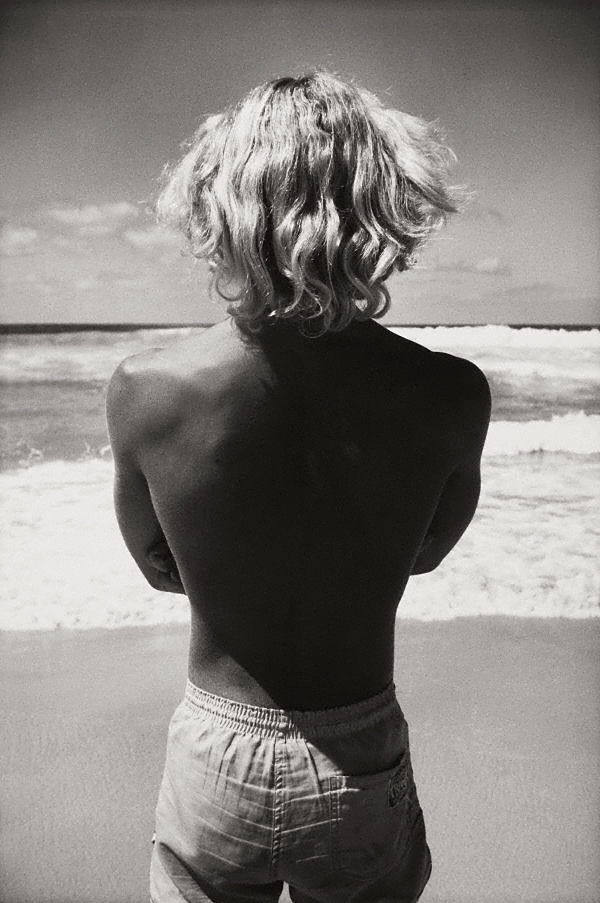
William Yang, like many of his fellow Australian photographers, cannot help but be fascinated with the beach. In 1969, Yang left Brisbane for the bright lights of Sydney, and he fell in love with the city. At a distance from his family and Queensland’s conservatism, Sydney provided an opportunity for reinvention.

It was here that he combined his two photographic passions – landscape and people. Yang embraced the bleached allure of the city’s eastern beaches and took many iconic photographs of Bondi, Tamarama and Clovelly. …

Yang’s beach images present a refreshingly different framing of the typical Australian beach scene. The usual shots of bronzed female bodies or recreational pursuits take a backseat. Instead, Yang takes immense joy in the male figure, and his works represent a desirous male gaze on desirable male bodies.

The beach captured Yang’s eye from early in his career. At the time he started exploring the beach in his new Sydney home, Yang was also a jobbing social photographer, capturing celebrities and the ‘beautiful people’ behind the scenes at A-list parties for magazines. His approach to this work was in the photo-journalist style of capturing the unguarded moment.

Of his passion for taking images of the beach, Yang is a romantic at heart and has said:

“There’s an impulse in me that makes me go for the runny make-up, the unguarded moment, the Freudian slip. I mean I could photograph the plastic bags in the water, the rolls of fat, but the beach brings out the romantic in me. I’m overwhelmed by the beauty of it – the space, the surf, the sand and all that flesh. I’ve never gotten beyond the obvious.”

Rosie Hays. “William Yang: The Beach,” on the QAGOMA website 17 June, 2021 [Online] Cited 10/08/2021


William Yang (Australia b. 1943) 'Great Wave off Clovelly' 2005/2016


William Yang (Australia b. 1943)
Great Wave off Clovelly
2005/2016
Inkjet print on Hahnemühle Fine Art Pearl
40 x 40cm
© William Yang
Courtesy: The artist


William Yang. 'Lifesaver Double' 1987/2017


William Yang (Born 1943, Mareeba, Qld Lives and works Sydney, NSW)
Lifesaver Double
1987/2017
Digital print
© William Yang
Courtesy: The artist


William Yang (Australia b. 1943) 'Lifesavers #3' 1987


William Yang (Australia b. 1943)
Lifesavers #3
1987
Inkjet print on Hahnemühle Fie Art Metallic Pearl
32 x 49.5cm
© William Yang
Courtesy: The artist


“A prolific documentary photographer, storyteller and performer, William Yang creates works that tell an intimate, autobiographical story. Yang draws on his extensive archive of images, memories and sensual experiences, showing the unique atmosphere of freedom that prevailed on Sydney beaches in the 70s, 80s and 90s. Taken around Bondi and Tamarama, Yang has captured the joy of an era and the beauty of the elements with humour and generosity. More than reminiscence or exposé, Yang’s images reveal sensitive connections and insightful reflections about cultural identity.”


Text from the ‘Under The Sun’ exhibition 2017


William Yang 'Checking Out Bondi' 1981/2017


William Yang (Australia b. 1943)
Checking Out Bondi
1981/2017
Digital print
© William Yang
Courtesy: The artist


The Power of Being Seen

William Yang’s work, intimate and considered, draws on the artist’s own lived experience. Yang’s personal stories inform his spoken-word performances and photography, and he often scribes these stories directly onto his photographic prints. Drawn to people, Yang’s work reveals unsettling narratives in his own life, in the lives of his subjects, and in society. Adept at uncovering the unvarnished beauty and hidden foibles of our lives, storytelling is intrinsic to his practice. The artist spoke with exhibition curator Rosie Hays.

Rosie Hays: Are there stories you feel must be told? What draws you to the stories you tell from your own life?

William Yang: I [was] brought up as an assimilated Australian. Neither my brother, Alan, or my sister, Frances, or I learned to speak Chinese. Partly because my father’s clan was the Hakka, so he spoke Hakka, whereas my mother’s clan was the See Yap, and she spoke Cantonese, so English was their common language and that was what we spoke at home. My mother could have taught us Cantonese as it was generally left up to her to do that sort of thing, but she never did. She thought being Chinese was a complete liability and wanted us to be more Australian than the Australians. So, the Chinese part of me was completely denied and unacknowledged until I was in my mid-30s and I became Taoist. It was through my engagement with Chinese philosophy that I embraced my Chinese heritage. People at the time called me Born Again Chinese, and that’s not a bad description as there was a certain zealousness to the process, but now I see it as a liberation from racial suppression, and I prefer to say I came out as a Chinese.


William Yang (Australia b. 1943) 'Chinese New Year Party Year of the Rabbit' 1999


William Yang (Australia b. 1943)
Chinese New Year Party Year of the Rabbit
1999
Gelatin silver print
51 x 61.5cm
© William Yang
Courtesy: The artist


My first big success was my show ‘Sydneyphiles’ at the Australian Centre for Photography in 1977. It was mainly about my social life in Sydney, with portraits of people I had met. Besides my own set of artistic types (I knew Brett Whiteley, Martin Sharp, Jenny Kee and Linda Jackson), I brushed with celebrities on the social rounds working for magazines. The exhibition caused a sensation. I knew then that people were my subject. I found that they wanted to see themselves on the gallery walls, they wanted representation. A compromising photo might cause annoyance, but it was better than being left out. There has always been an appetite for celebrities, well, that was to be expected. A vicarious interest in celebrity life still fuels the media. But I showed many photos of the emerging gay community as well. Australian photos of this type had not been shown in institutions before and it got a mixed reaction. Some said that these works shouldn’t be shown at a public institution, but mostly the pictures were accepted, especially by the gay community. A few were angry with me for outing them, but mostly I was hailed as a hero and was metaphorically given the keys to Oxford Street. I sensed that the mood of the gay community at the time was this: throughout history our community has been invisible. These photos may not be pretty, but we recognise them, and we accept them. We want our stories told.


William Yang (Australia b. 1943) 'Four film directors' 1981


William Yang (Australia b. 1943)
Four film directors
1981
Inkjet print on solid substrate Kapaplast
53 x 80cm
© William Yang
Courtesy: The artist


William Yang (Australia b. 1943) 'Brett Whiteley, Martin Sharp, Wirian' 1982


William Yang (Australia b. 1943)
Brett Whiteley, Martin Sharp, Wirian
1982
Inkjet print on solid substrate Kapaplast
© William Yang
Courtesy: The artist


William Yang (Australia b. 1943) 'Party at the Whiteleys', Lavender Bay' 1982


William Yang (Australia b. 1943)
Party at the Whiteleys’, Lavender Bay
1982
Inkjet print on solid substrate Kapaplast
65 x 110cm
© William Yang
Courtesy: The artist


Installation view of the exhibition 'William Yang: Seeing and Being Seen' at the Queensland Art Gallery | Gallery of Modern Art (GOMA) showing at centre right, 'Brett Whiteley, Lavender Bay, Sydney' (1975); and directly below this, 'Cate Blanchett: The star in her dressing room. After "Hedda Gabler." Wharf Theatre. Sydney' (2004)


Installation view of the exhibition William Yang: Seeing and Being Seen at the Queensland Art Gallery | Gallery of Modern Art (GOMA) showing at centre right, Brett Whiteley, Lavender Bay, Sydney (1975, below); and directly below this, Cate Blanchett: The star in her dressing room. After “Hedda Gabler.” Wharf Theatre. Sydney (2004, below)


William Yang (Australia b. 1943) 'Brett Whiteley, Lavender Bay, Sydney' 1975


William Yang (Australia b. 1943)
Brett Whiteley, Lavender Bay, Sydney
1975
© William Yang
Courtesy: The artist


William Yang (Australia b. 1943) 'Cate Blanchett: The star in her dressing room. After "Hedda Gabler." Wharf Theatre. Sydney' 2004


William Yang (Australia b. 1943)
Cate Blanchett: The star in her dressing room. After “Hedda Gabler.” Wharf Theatre. Sydney
2004
Inkjet print on solid substrate Kapaplast
54 x 80cm
© William Yang
Courtesy: The artist


These days I don’t take as many photographs. I’m sorting through my collection, trying to get it into some sort of order, and trying to digitise the negatives and the colour transparencies […]. I don’t want to be a photographer who dies leaving a pile of mouldy negatives for someone else to sort out […]. Every time I look through my collection, I am surprised because I have largely forgotten what happened in the past. Photography is a major aid to memory and the photographer a witness to the past. A photograph captures a moment in time. You don’t have to do anything special for this to happen, just press the shutter. There is something in the nature of the camera to freeze these moments in time, and there is something in the nature of the world to change and move on, so these moments never occur again.

In the early 1980s I started to do slide projection. It started off as a way to show my colour photography. At the time the colour printing process, Cibachrome, was expensive, and projection was a cheaper way showing my colour images. In 1980 in Adelaide, I met Ian de Gruchy, who did slide projection as his main art form. I was interested in his dissolve unit – a device using two projectors where the projected images dissolved into each other. Music was used, usually minimal music, and the result was known as an audio-visual. When one projects slides, as in a living room slide show, there is a tendency to talk with the slides, explaining them, and I started to do that. I worked with audio-visuals for seven years during the 80s until I had nine photographic essays, or short stories, to string together into a one man show. It was called ‘The Face of Buddha’ and I presented it at the Downstairs Belvoir Street Theatre in 1989. I lost money on that show, but still consider it a success. Everyone liked the form, story-telling with images and music.


William Yang (Australia b. 1943) "William Yang performing Sadness" Sydney 1992


William Yang (Australia b. 1943)
“William Yang performing Sadness”
Sydney 1992
Photo: Peter Elfes (from ‘About my mother’ portfolio 2003)
Gelatin silver photograph, ed. 2/10 / 51.3 x 61.1cm
Purchased 2004
Queensland Art Gallery Foundation Grant
Collection: Queensland Art Gallery | Gallery of Modern Art
© William Yang


William Yang (Australia b. 1943) 'Production still from Sadness' 1999


William Yang (Australia b. 1943)
Production still from Sadness
1999
Director: Tony Ayres
Image courtesy: National Film and Sound Archive, Australia and William Yang


William Yang (Australia b. 1943) ''Allan' from the monologue 'Sadness'' 1992


William Yang (Australia b. 1943)
‘Allan’ from the monologue ‘Sadness’
1992
© William Yang
Courtesy: The artist


“Allan was a landmark for Yang and for Australian documentary photography. The combination of simple, unadorned portrait photos and diaristic, handwritten commentary made each viewer feel intimately acquainted with the subject. The step-by-step progress towards death puts us on the alert for every passing emotion in Allan’s face – he is sad, stoical, cheerful, grim, frivolous and heroic by turns. At the end of his life he has become an empty husk. It’s a devastating slice of reality smuggled into an art gallery, a piece that stops viewers in their tracks every time it’s shown.”


Extract from John McDonald. “Devastating and intimate: the landmark photos that stop viewers in their tracks,” on the Sydney Morning Herald website April 1, 2021 [Online] Cited 09/08/2021


William Yang (Australia b. 1943) ''Allan' from the monologue 'Sadness'' 1992


William Yang (Australia b. 1943)
‘Allan’ from the monologue ‘Sadness’
1992
© William Yang
Courtesy: The artist


The most popular story was called ‘About My Mother’. I told the story about my mother’s family, how they came to Australia in the 1880s from Guang Dong province in China. My mother’s sister, my Aunt Bessie, married a rich landowner, William Fang Yuen, who was murdered by the white manager on his cane farm at Marilyan in north Queensland in 1922. I got an Australia Council grant to do my third performance piece, ‘Sadness’, in 1992. There were two themes: the first involved the AIDS pandemic in Sydney where many gay men, some of them my friends, were dying; and the second was a trip I took to north Queensland to talk to my relatives about William Fang Yuen’s murder. The two themes formed a powerful story about death and legacy. It was an immediate hit and toured Australia and the world. International entrepreneurs wanted my performance pieces, which they considered unique, not my exhibitions, so I kept doing more performance pieces and they became my main artistic expression.


William Yang (Australia b. 1943) 'William in Cane Fields' 2008


William Yang (Australia b. 1943)
William in Cane Fields
2008
From ‘My uncle’s murder’ portfolio 2008
Inkjet print on Innova Softex paper
59 x 91cm
© William Yang
Photograph: Jenni Carter
Courtesy: The artist


William Yang (Australia b. 1943) 'Self Portrait, Listening' 2017


William Yang (Australia b. 1943)
Self Portrait, Listening
2017
Inkjet print on Ilford Galerie Smooth Cotton Rag
38 x 60cm
© William Yang
Courtesy: The artist


The performance pieces changed my photographic practice. Before the 1990s, I made my living from freelance work. I would do whatever jobs people would pay me money to do. Then I found I could make a living doing my performance pieces, so I didn’t have to work for other people. I was able to channel all my energy into my own work and I became more productive. My performance pieces were about stories and I realised that many of my photos had stories behind them. I started writing the text directly onto the photo with a pen. My first series was about men with whom I had had encounters. All those photos had good stories. I have continued to do written works, as I call them, and the pictures with my handwriting have become the signifier of my work. Now I often choose images because they have a story.

Rosie Hays: Do you ever feel you’re telling other people’s stories, or are they your stories that happen to intersect with other people?

William Yang: When I ran out of my own stories, I wanted to tell an Aboriginal story because I felt the Chinese and the Aboriginal people had something in common: both had suffered under British colonialism. In my commissioned piece ‘Shadows’, I tried to tell an Aboriginal story about a community in Enngonia in north-western New South Wales, and it was successful in that I made myself part of the story, but I felt a little uncomfortable telling their story. Later I found someone, Noeline Briggs-Smith, who could tell her own story, and we did a story-telling duet on stage [called] ‘Meeting at Moree’, where we told alternating chapters of our stories on stage. She […] had a much stronger story than me. She had suffered more and worse injustices than I had, but there were interesting intersections in our stories.

Rosie Hays: Something we highlight in the exhibition is your connection to landscape. How would you describe your relationship to nature / the landscape, and has it changed over time?

William Yang: Most photographers have a go at nature. Everyone has photographed a sunset. I had my first serious encounter with photographing nature when I was recovering from a bad case of hepatitis at Frogs Hollow, Maleny, in 1979. I felt fragile from the illness and taking photos made me feel I could still do things. Looking at the photos now, the pictures are a beginner’s view. That’s the thing about nature: it’s been done a billion times before, and it’s difficult [to] escape cliché, but I had to start somewhere and I got a few good ones.

When I became Taoist, I took on a whole new philosophy. I came to appreciate nature, in the form of landscape, as a source and a driving force behind everything that exists. It was constantly changing and renewing itself. Everything about nature was beautiful because it was essentially always itself. I found I could apply a concept of beauty to nature, at least compared to the human nature I was photographing at the time. Later I began to see nature as a titanic struggle for survival […].

I came to realise that the landscape which moved me the most was the country around Dimbulah in north Queensland (on the Atherton Tableland), where I had grown up. It was part of my identity, part of my idea of home. I had absorbed it, it had imprinted itself upon me, and, although I did not realise it at the time – this was before I had articulated an artistic consciousness – it was there in my consciousness and I could draw upon it. So, in the early 90s, I made several trips up to Dimbulah, checking out the country that I remembered from my childhood. Nothing quite fitted my memories, but perhaps that’s a thing about childhood and memory. Nevertheless, I photographed a series on a medium format camera, trying to recapture memories. Now I enjoy returning to Dimbulah and seeing the landscape. It still triggers off emotions, but I feel they have become more distant. This text is from my print William at Thornborough, 2006:

“I have left these places and I have changed. These places still hold me but I move around these hills like a ghost. It is the motherland which formed and nourished me, from where I came, but to which I can never return.”


William Yang (Australia b. 1943) 'Climbing Huang Shan' 2005


William Yang (Australia b. 1943)
Climbing Huang Shan
2005
Inkjet print on Innova Softex paper
41 x 48cm
© William Yang
Courtesy: The artist


Installation view of the exhibition 'William Yang: Seeing and Being Seen' at the Queensland Art Gallery | Gallery of Modern Art (GOMA) showing 'Return to the place of childhood. Dimbulah' (2016)


Installation view of the exhibition William Yang: Seeing and Being Seen at the Queensland Art Gallery | Gallery of Modern Art (GOMA) showing Return to the place of childhood. Dimbulah (2016, below)


William Yang (Australia b. 1943) 'Boranup Karri Forest #1' 2018


William Yang (Australia b. 1943)
Boranup Karri Forest #1
2018
Inkjet print on Ilford Galerie Smooth Cotton Rag
50 x 150cm
© William Yang
Courtesy: The artist


William Yang (Australia b. 1943) 'Return to the place of childhood. Dimbulah' 2016


William Yang (Australia b. 1943)
Return to the place of childhood. Dimbulah
2016
Inkjet print on Ilford Galerie Smooth Cotton Rag
50 x 150cm
© William Yang
Courtesy: The artist


Installation view of the exhibition 'William Yang: Seeing and Being Seen' at the Queensland Art Gallery | Gallery of Modern Art (GOMA)

Installation view of the exhibition 'William Yang: Seeing and Being Seen' at the Queensland Art Gallery | Gallery of Modern Art (GOMA) showing at lower left, 'Boranup Karri Forest #1' (2018)


Installation views of the exhibition William Yang: Seeing and Being Seen at the Queensland Art Gallery | Gallery of Modern Art (GOMA) showing at lower left, Boranup Karri Forest #1 (2018, above)


William Yang (Australia b. 1943) 'Earth Below, Heaven Above' 2020 (still)


William Yang (Australia b. 1943)
Earth Below, Heaven Above (still)
2020
Two-channel video, 16:9, 5:36 minutes, colour, sound
Editor: Jack Okeby
© William Yang
Courtesy: The artist


Rosie Hays: What are your aspirations as an artist? What is the aim for your work in the larger sense?

William Yang: Two of my most important realisations were, firstly, that I was not white but Chinese, and secondly, that I was not straight, but gay. I probably realised these at an early age, but it took me a long time to articulate the condition and to come to terms with it. Personally, I suffered more pain being a closeted gay than being Chinese. These are both big themes in my work. When I started including gay work in my exhibitions, some photographers told me it [was] a phase I was going through and I’d be better off dealing with universal issues. They were right, in a way, because by continuing to deal with marginalised issues, my audience base is much smaller. I would probably have made more money sticking with celebrity lives and continuing the status quo, but it is important for me to talk about being gay and to talk about racial difference, even if they are commercially unpopular subjects. Nowadays, there is more acceptance of being gay here in Australia, and likewise, there is more awareness of racial difference, but in the wider world this is not always the case. It is a cause worth pursuing, and documentary photography with a personal story thrown in is a good way of doing it. I want to acknowledge the activists around the world that have made social change happen.

I want my work to embrace my life. I’ve managed to live to a mature age – I was fortunate not to die young as many of my colleagues did during the AIDS pandemic. One lives a life, and I am not the same person as I was when I was younger. Then I had more energy, had more opinions, some of them obnoxious – in short, I had many of the traits of a young person that old people like to complain about. But one learns from life, and I have lived to this age and can see there is a shape to one’s life. It has to do with the things you believe in and the choices you make (I always knew being an artist would be a hard road), it is shaped by external forces beyond your control, and it is also shaped by luck. Still, I consider my life a fortunate one.

I think I like stories because they are about people and the world. They somehow embrace humanity. I would like my art to convey feelings, emotions, what it is like to be a sentient human: experiencing joy, laughter and sadness, to realise we are vulnerable, that we have our failings, we do bad things, but we are capable of forgiveness, kindness and love.

Rosie Hays is Associate Curator, Australian Cinémathèque, QAGOMA She spoke with the artist in 2020.

This is an edited excerpt of the original interview, which appears in the exhibition publication William Yang: Seeing and Being Seen, available at the QAGOMA Store


William Yang. 'Deposition. Innisfail Court House. 1922' 1990


William Yang (Australia b. 1943)
Deposition. Innisfail Court House. 1922
1990
From ‘About my mother’ portfolio 2003
Gelatin silver photograph on paper
51.3 x 61.1cm (comp.)
Queensland Art Gallery Foundation Grant
Collection: Queensland Art Gallery | Gallery of Modern Art purchased 2004
© William Yang


William Yang (Australia b. 1943) 'Self portrait #1' 1992, printed 2013


William Yang (Australia b. 1943)
Self portrait #1
1992, printed 2013
Inkjet print on paper
87 x 119cm (comp.)
Gallery of Modern Art Foundation Grant
Collection: Queensland Art Gallery | Gallery of Modern Art purchase 2013
© William Yang


William Yang Self portrait #1 / A Director’s Perspective

Join QAGOMA Director Chris Saines CNZM as he discusses William Yang’s Self portrait #1 1992 (printed 2013)


William Yang’s work, intimate and considered, draws on the artist’s own lived experience. Yang’s personal stories inform his spoken-word performances and photography, and he often scribes these stories directly onto his photographic prints. Drawn to people, Yang’s work reveals unsettling narratives in his own life, in the lives of his subjects, and in society. Adept at uncovering the unvarnished beauty and hidden foibles of our lives, storytelling is intrinsic to his practice.


Self Portrait #1

Yang’s unflinching photographic gaze draws from the documentary tradition. Since the 1980s, Yang has displayed an unyielding persistence in unearthing stories that society, or even his subjects, might prefer to remain hidden. His instinct and passion is to present the whole, flawed story, not just the glossy surface.

With stories such as his uncle’s murder, Yang courts his family’s disapproval by airing hidden family stories, balancing potential indiscretions with the importance of telling real stories that reveal experiences or communities often left out of public discourse.

In the mid 1980s, Yang met Yensoon Tsai, a young Taiwanese woman who would become a close friend. Tsai taught Yang the tenets of the Chinese philosophy of Taoism, which led him to explore his Chinese-Australian identity.

Throughout the late 1980s and 90s in Australia, multicultural stories emerged across various art forms. Yang was part of this wave of artists rejecting a suppression of their cultural histories, and who instead wanted to highlight and celebrate diversity. Yang travelled throughout regional and urban Australia documenting the lives of Chinese-Australians, and the landscapes reflecting the legacy of the Chinese in Australia, such as religious shrines and mining sites.

Self Portrait #1 is a landscape work (in the way Yang talks about landscape which is often rooted in people and place and memory) as much as it a portrait work. Capturing the landscape is part of Yang’s somewhat diaristic approach to processing his social and physical environment.

When Yang returns to the Queensland landscape from his childhood, he characterises it as a site to escape from. He needed to escape from racist school bullying, constrictive family expectations, and the dread that his sexuality may be met with disapproval. Yang revisits his childhood home regularly, and some of his most potent performances and photographs come from connecting family and place. The series ‘My Uncle’s Murder’ – and its recounting of an injustice borne of racism dating from 1922 – resulted from such a trip. In his later works, he makes an uneasy peace with these past experiences that are embedded in the landscape of his youth.

Rosie Hays. “William Yang’s work reveals unsettling narratives in his own life,” on the QAGOMA website 4 October, 2020 [Online] Cited 10/08/2021


William Yang (Australia b. 1943) 'Waiting for the Parade to Start' 2019


William Yang (Australia b. 1943)
Waiting for the Parade to Start
2019
Inkjet print on solid substrate Kapaplast
56.5 x 85cm
© William Yang
Courtesy: The artist


William Yang (Australia b. 1943) 'Jac Vidgen and Akira Isogawa, Sweatbox Party' 1989


William Yang (Australia b. 1943)
Jac Vidgen and Akira Isogawa, Sweatbox Party
1989
Inkjet print on solid substrate Kapaplast
© William Yang
Courtesy: The artist


William Yang (Australia b. 1943) 'Patrick White #1, living room, Martin Road' 1988


William Yang (Australia b. 1943)
Patrick White #1, living room, Martin Road
1988
Gelatin silver photograph, ed. 2/10
45.6 x 36.4cm
Queensland Art Gallery Foundation Grant purchased 1998
Collection: Queensland Art Gallery | Gallery of Modern Art


William Yang (Australia b. 1943) 'My Generation (Brett Whiteley)' 1975 (detail)


William Yang (Australia b. 1943)
My Generation (Brett Whiteley) (detail)
1975
© William Yang
Courtesy: The artist


My Generation

Queensland-born, Sydney-based artist William Yang describes a moment in Sydney when a number of creative groups came together to generate an artistic wave that swept across Australian society.

The intersections of the tight literary circle of Nobel award winner Patrick White and his partner, Manoly Lascaris, with the theatrical circle, their friends Jim Sharman and actress Kate Fitzpatrick. Fitzpatrick, in turn, models frocks in the exuberant fashion parades organised by designers Linda Jackson and Jenny Kee, while artists Peter Tully and David McDiarmid extend the tongue-in-cheek Australiana of the two fashionistas’ outfits with witty accessories. Their parades and parties at retail outlet Flamingo Park, a magnet for influential people in business, politics and the arts, determined the look of the 1970s and early 1980s. Tully and McDiarmid used their bravura visuals to jump start the Gay and Lesbian Mardi Gras, giving the event its unique and unforgettable style. The pair lived out a parallel lifestyle that might epitomise the Australian story of gay liberation, with its heady rush unfolding into aching tragedy.

Golden couple Brett and Wendy Whiteley enjoyed the creative atmosphere of the swinging ’60s and the plunge into a riotous world of sex, drugs and rock’n’roll. Yang shows Brett painting, smoking and partying with the beautiful people, and his eventual deterioration as heroin took a fearful hold. The early death of their beautiful daughter, Arkie, was another aspect of this fated family history. Linda Jackson and Jenny Kee eventually split; Kee takes Danton Hughes, the son of Robert Hughes, as a lover; Danton suicides; Kee takes up Buddhism. Yang portrays lives that unfold, flower or wither: lives lived.

Yang’s generation is not life as reported in the newspapers but ‘as I saw it’: a personal account summed up as a litany of parties, of innocence lost and worldliness gained, a continuum of his search for contact and meaning. Like his contemporaries Rennie Ellis or Michael Rosen, William Yang is a social photographer, a recorder of life. His strength lies in creating a living testament, and his medium’s strength is that it is necessarily shared. He offers no moral tale, nor any notion of karma to underscore the events: just the three basic but vital stories – birth, love and death.

Extract from Michael Desmond. “William Yang: My Generation,” in Artlines 1-2009 in “William Yang: Portraits,” on the QAGOMA website 22 September, 2017 [Online] Cited 10/08/2021.


William Yang (Australia b. 1943) 'David Gulpilil' 1978


William Yang (Australia b. 1943)
David Gulpilil
1978
Inkjet print on solid substrate Kapaplast
© William Yang
Courtesy: The artist


William Yang (Australia b. 1943) 'Linda Jackson and Jenny Kee' 1979


William Yang (Australia b. 1943)
Linda Jackson and Jenny Kee
1979
Inkjet print on solid substrate Kapaplast
© William Yang
Courtesy: The artist


William Yang (Australia b. 1943) 'Richard Neville and Bob Geldof at Wirian' 1980


William Yang (Australia b. 1943)
Richard Neville and Bob Geldof at Wirian
1980
Inkjet print on solid substrate Kapaplast
© William Yang
Courtesy: The artist


In order to make a living as a photographer, Yang began his career taking candid shots of ‘beautiful people’ at parties and events for the social pages of newspapers and magazines. Yang rubbed shoulders with celebrities, artists and performers, and discovered that the camera was an entry pass to an exclusive backstage world populated by kindred spirits, with whom he formed close bonds.

Yang’s prolific social portraiture includes some of the most prominent people in Australian theatre, film, art and literature, with more than a few international cameos. A much-loved and trusted figure who is embedded into Sydney’s social fabric, Yang’s images are taken with the razzle-dazzle of celebrity, but little of its conceit.

Within the show is a salon hang ‘social wall’ which long predates Instagram. The selection of faces is reflective of Yang’s friendships and his abiding passion for the arts – they embody both the glamour of celebrity and provide behind-the-scenes insights into the lives of artists from a range of backgrounds. With a camera around his neck, Yang came to understand that he could ask his subjects a series of personal questions, and they would reveal more of themselves than they would during the course of casual conversation.

Representing only a fraction of Yang’s social photography, these images capture the almost compulsive nature of his passion for recording people and places. His gift for eliciting the essence of his subjects through portraiture – whether candid or posed – has been apparent his entire career.

Rosie Hays. “William Yang: Celebrity and Portraiture,” on the QAGOMA website 7 May, 2021 [Online] Cited 10/08/2021.


William Yang (Australia b. 1943) 'Rainbow Angel Wings' 2003


William Yang (Australia b. 1943)
Rainbow Angel Wings
2003
Inkjet print on solid substrate Kapaplast
27 x 40cm
© William Yang
Courtesy: The artist


William Yang (Australia b. 1943) 'Marriage Equality, Mardi Gras' 2013


William Yang (Australia b. 1943)
Marriage Equality, Mardi Gras
2013
© William Yang
Courtesy: The artist


Queensland Art Gallery | Gallery of Modern Art (GOMA)
Stanley Place, South Brisbane
Queensland 4101, Australia
Phone: +61 (0)7 3840 7303

Opening hours:
Daily 10.00am – 5.00pm

Queensland Art Gallery | Gallery of Modern Art (GOMA) website

LIKE ART BLART ON FACEBOOK

Back to top

Review: ‘An-My Lê: On Contested Terrain’ at the Amon Carter Museum of American Art, Fort Worth, Texas

Exhibition dates: 18th April – 8th August, 2021


An-My Lê (Vietnamese-American, b. 1960) 'Untitled, Hanoi' 1995 from the exhibition 'An-My Lê: On Contested Terrain' at the Amon Carter Museum of American Art, Fort Worth, Texas, April - August, 2021


An-My Lê (Vietnamese-American, b. 1960)
Untitled, Hanoi
1995
From the series Viêt Nam (1994-1998)
Gelatin silver print
Courtesy of the artist and Marian Goodman Gallery, New York, Paris, and London
© An-My Lê


“In their essential nature men do not change. The great and noble, the Masters of Life, will be great and noble to the end of time, and to contemplate them and their deeds inspires us to endeavour to emulate them. Learn whom a man venerates, and you can come to judge his character. Like is assimilated unto like. The mind approaches that which it continually contemplates, and kindred inevitably follow.”


Alvin Langdon


Disguising power as virtue or, the Inner Landscape of Beauty

One of the great assets of VR, especially in times of lockdown, is that you can view an exhibition from a distance. Such is the case with this strong exhibition by Vietnamese-American photographer An-My Lê at the Amon Carter Museum of American Art, Fort Worth, Texas. It gives the viewer the ability to come to grips with an artists work displayed as a whole, to contemplate the myriad threads that run through the five bodies of work that are presented in the exhibition.

While there are no remarkable “hero” shots contained within the body of Lê’s work, collectively the photographs from each series build a serious interrogation into the contested terrains of colonialism, war, the military, racism and protest. As we know with life nothing is ever black and white, and through her classically inspired photographs Lê probes the interweaving of existence, desire, possession and control in the landscape, in the landscape of life. As assistant curator Kirsten Gaylord observes, “Her photographs consider questions that we are all thinking about now: What does it mean to be an American citizen? How does our country’s history shape our contemporary lives? What should be the role of the U.S. in the world?” These are complex issues which Lê addresses with intelligence and rigorous conceptualisation, fully aware of the paradoxes that exist within her inquiry.

My favourite series are the more personal and engaging, the more empathetic and feeling of the works – the first and the last, Viêt Nam (1994-98) and Silent General (2015-ongoing). In Viêt Nam, Lê returns to her homeland of Vietnam after almost 20 years with her large format camera. The resulting meditation on homeland evidenced in beautiful, perfectly formed photographs are moving and touching, poetic reveries on lost innocence, regained? In Silent General, Lê again again puts more of her self on the line, her photographs confronting the “issues of our time that are rooted in our history, from the fate of Confederate monuments to immigration debates around agricultural labourers.”

I am ambivalent about the other series in the exhibition, which while beautiful have a slightly chilly aura.

In the series Small Wars (1999-2002), Lê photographs Vietnam War reenactors in North Carolina and Virginia with the utmost sense of “authenticity” creating images that “explore the legacy and mythology of the Vietnam War for contemporary Americans.” In 29 Palms (2003-04) she photographs troops training in an American landscape similar to the one they would soon be deployed to in Iraq. In Events Ashore (2005-14) the artist photographs the crews of U.S. naval vessels around the world exploring the global reach of the American military, its diplomatic, humanitarian, military, and political activities.

In Small Wars and 29 Palms, Lê pictures a simulacra of war, simulations of a war already past (and lost), and a war yet to run its course, which would ultimately lead to the withdrawal of US forces. Her work blurs the boundaries between photojournalism and reality / fiction.

The photograph Ambush I (1999-2002, below) from Small Wars is eerily similar to Henri Huet’s photograph of Life magazine photographer Larry Burrows struggling through elephant grass in 1970 (below) with the difference that Burrows is helping to evacuate a wounded soldier, and that Huet, Burrows and two other photojournalists would be killed when their helicopter was shot down over Laos later in February 1971. Similarly, Lê’s photographs Mechanized Assault (2003-2004) shows a pristine landscape foregrounded with immaculate tanks and personnel carriers in the American landscape… when in reality, American Marines photograph the burnt remains of Iraqi T-55 Main Battle Tanks amongst a non-descript landscape of shell holes and mundane buildings (16 April 2003, below). Further, while not a simulation, the very stillness and chillness of Events Ashore – the physical and metaphorical distance of the photographer from the subject, from the reason of the existence of the military – make the photographs in that series seem almost an apologia for the military.

In a quotation, Lê states that, “… I am not categorically against war. I was more interested in drawing people into my work, to think about the issues that envelop war – representations of war, landscape and terrain in war. When I’m working with the military, I still think of myself as a landscape photographer. My main goal is to try to photograph landscape in such a way that it suggests a universal history, a personal history, a history of culture.”

I understand what the photographer is attempting, but in one sense I remain unconvinced about the success of the mission.

Simply put, the raison d’etre for the military – despite all protestations to the contrary, despite all the good works they otherwise undertake – is “to engage in combat, should it be required to do so by the national defence policy, and to win. This represents an organisational goal of any military, and the primary focus for military thought through military history.” (Wikipedia) In terms of military doctrine,1 we note that in the history of the United States of America, the country has been at war 225 out of 243 years since 1776. America is a militarised society where the military prosecutes war on its own terms, disguising power as virtue. In terms of the prosecution of war, the country seems to be manifestly belligerent.

The outcome of any war is death. Sure, the soldiers might be there for economic or social reasons, they may experience fear and exhilaration, boredom and dreams, brotherhood and purpose, travel and education… but ultimately the military is a fighting and killing machine. “Young soldiers in combat inevitably confront killing. They take life away from others, and in so doing breach one of the most fundamental moral values of their society, often with long-term consequences.” Listening to an American veteran from the battle of Caens after the D-Day landings in 1944 recently in a documentary, he observed that all war is, is death – dead German soldiers, dead American soldiers, dead civilians. The reality (not a simulation or a reenactment) of Henri Huet’s photograph of dead soldiers, Bodies of US paratroopers lie near a command post during the battle of An Ninh (1965, below) is shocking and unimpeachable.

Soldiers kill. Human beings, civilian and military, die.

And then the military doesn’t want you to know about that. They cover it up. In World War 1, the British stopped posting lists of the missing and dead in the newspapers because there were so many of them. And in the Iraq war, the American military didn’t want photographs of American coffins in the back of a transport plane published because it would upset the families and the public. Even the metadata (hidden text data) written by the military contained in a public domain image of destroyed Iraqi tanks (see below) in 2003 states, “Operation IRAQI FREEDOM is the multinational coalition effort to liberate the Iraqi people, eliminate Iraq’s weapons of mass destruction and end the regime of Saddam Hussein.” Outright lies and deception … the invasion was illegal under international law as it violated the UN Charter, there were no weapons of mass destruction found, and no link between Saddam Hussein and al-Qaeda. The Iraq War caused at least one hundred thousand civilian deaths, as well as tens of thousands of military deaths.

Everyone is involved in the construction of the world. You can be informed or not. You have choices. Human beings have a choice to go into the military, or not. The problem is that human beings in power, in control (at the top of the military for example) inspire others to endeavour to emulate them. As Alvin Langdon observes, “Like is assimilated unto like. The mind approaches that which it continually contemplates, and kindred inevitably follow.”

Now, in another sense I believe that Lê achieves her aim, to suggest a universal history, a personal history, and a history of culture embodied in the landscape, suggestions that possibly sweep away landscapes of control.

As the Irish poet and philosopher John O’Donohue observed, “Even in landscapes of control you can be swept off your feet by sheer beauty.” Landscapes of control cannot stand before the power of beauty embodied in the landscape and in Lê’s photographs the memory of the landscape, its music, embeds itself in the photograph. Through the power of beauty, the Inner Landscape of Beauty (one that is metaphorical as much as physical, in the mind as much as it is externally verbalised), the photographs of An-My Lê subversively undermine the control of the military over the land: its occupation and colonisation of it, its wars to control it, and its very “uniform” presence in it. Look again at the photograph Mechanized Assault (2003-2004, below) and now it is the distance of the photographer from the subject – the infinite sublime as I call it – that upends the punitive intentions of the military and overwhelms their puny vehicles. It’s an earth, spirit and mind thing.

In the viewers recognition of the beauty of this land(e)scape, we acknowledge our own virtue and assert our desire to be free. Free from restrictive control. Free from oppression. Free from war. The military, police “force” and government are and always will be, afraid of the infinite within us…

Dr Marcus Bunyan

Word count: 1,540


Footnotes

1/ “Development of military doctrine is perhaps the more important of all capability development activities, because it determines how military forces are used in conflicts, the concepts and methods used by the command to employ appropriately military skilled, armed and equipped personnel in achievement of the tangible goals and objectives of the war, campaign, battle, engagement, and action.” (Wikipedia)


Many thankx to the Amon Carter Museum of American Art for allowing me to publish the art work in the posting. Please click on the photographs for a larger version of the image.


Henri Huet (French, 1927-1971) / AP 'Bodies of US paratroopers lie near a command post during the battle of An Ninh' 18 September 1965 from the exhibition 'An-My Lê: On Contested Terrain' at the Amon Carter Museum of American Art, Fort Worth, Texas, April - August, 2021


Henri Huet (French, 1927-1971)/AP
Bodies of US paratroopers lie near a command post during the battle of An Ninh
18 September 1965


The paratroopers, of the 1st Brigade, 101st Airborne Division, were hit by heavy fire from guerrillas that began as soon as the first elements of the unit landed. The dead and wounded were later evacuated to An Khe, where the 101st was based. The battle was one of the first of the war between major units of US forces and the Vietcong.


An-My Lê: On Contested Terrain is the first comprehensive survey of the work of Vietnamese-American photographer An-My Lê. Featuring photographs from a selection of the artist’s five major bodies of work, the nationally touring exhibition considers the celebrated photographer’s nearly 25-year career exploring the edges of war and recording these landscapes of conflict in beautiful, classically composed photographs.

Born in Saigon in the midst of the Vietnam War, Lê was evacuated with her family by the U.S. military. She has spent decades considering the complexity of American history and conflict, from war reenactments to the removal of Confederate monuments. This timely exhibition explores politically-charged topics through Lê’s subtle, evocative images that avoid the sensationalism often seen in newspapers and movies. Sweeping views that emphasise the size and breadth of the theatre of war display the artist’s technical strengths in the classical landscape tradition, which she uses to compose beautiful images that draw the viewer into deeper consideration of complex themes of history and power.


” …as a photographer, I’m interested in looking at and representing the real world, and interpreting it in ways that allow me to learn from it and enlighten the issues I am trying to understand. I feel entirely comfortable using photographs with simple titles and explanatory texts. And I feel comfortable with the fact that some people may interpret a photograph differently from others. My photographs are visually complicated and carry complex messages because of the way I pack the information into the frame and structure the picture. People need to spend time with the work in order to piece together all the information. But of course the reading is subjective. I like that. I like that it could be contradictory, that it could be full of surprises, that it could be confusing. I see a fragile construct between the objective and subjective.

Ultimately, the picture is there to incite someone to think about the issues at stake, rather than say explicitly how I myself feel about the American military. Some of my work could be understood as being supportive of the military. You could look at some pictures and think: wow, those young Americans are so heroic! Or you could see in the same image a reflection of American imperialism: look at the American guy standing there, trying to teach the locals how to do it the American way! There are so many possible interpretations. Sometimes the US military comes in and does help people. For example, after the earthquake in Haiti, the military was able to accomplish what no one else could. It was there with supplies in a matter of hours. But there’s a fine line between coming to help and invading, and it has to do with physical and economic presence and the ways in which Americans occupy the land. So the work is about those tensions.

I think it goes back to my own conflicted perceptions of the US military and what it did to Vietnam. At the end of the war, it was the Americans who could help us escape from the approach of communism. Everyone tried to scale the walls of the American Embassy, not the French Embassy. So it’s about all those conflicted things.”


An-My Lê quoted in Andrew Maerkle. “Fires on the Plain,” on the ART-iT website 28/07/2015 [Online] Cited 26/07/2021.


“Living through the Vietnam War as a child and immigrating to the United States as a teenager, An-My Lê’s life has been indelibly marked by international conflict. For over two decades, her work as a photographer has engaged the unseen facets within the theater of war. With her large-format camera in tow, she has immersed herself in the Appalachian forest with Vietnam War reenactors, and traveled aboard U.S. aircraft carriers around the globe. Lê identifies as a landscape photographer, a perspective that grounds her subtle, impactful images of American interventionism within a larger history of violence.”


Sara Christoph. “An-My Lê with Sara Christoph,” on the Brooklyn Rail website February 2015 [Online] Cited 26/07/2021.


Photographer An-My Lê: 2012 MacArthur Fellow | MacArthur Foundation | October 2012

Meet An-My Lê and learn about how she came to photography, her work with the U.S. military, and her 19th-century-style camera.

Photographer An-My Lê was named a MacArthur Fellow in 2012. The Fellowship is a $500,000, no-strings-attached grant for individuals who have shown exceptional creativity in their work and the promise to do more.


An-My Lê: Landscapes of war | July 2018

Find out more about An-My Lê’s series Small Wars (1992-2002), and Lê’s experiences photographing Vietnam war reenactors.

Photographer An-My Lê, who grew up in Saigon during the Vietnam War, describes her series Small Wars (1999-2002) and 29 Palms (2003-2004). She discusses how contemporary landscape photography can be used to present more than just scenery; it can illuminate culture, architecture, and social and political issues that citizens are concerned with today.


Installation view of the exhibition 'An-My Lê: On Contested Terrain' at the Amon Carter Museum of American Art


Installation view of the exhibition An-My Lê: On Contested Terrain at the Amon Carter Museum of American Art


An-My Lê (Vietnamese-American, b. 1960) 'Untitled, Mekong Delta' 1994


An-My Lê (Vietnamese-American, b. 1960)
Untitled, Mekong Delta
1994
Gelatin silver print
© An-My Lê


Viêt Nam (1994-1998)

In 1994, Lê returned to her home country for the first time since being evacuated as a teenager in 1975, arriving shortly after relations between the U.S. and Vietnam were normalised. She brought her camera with her, hoping to untangle the reality of her childhood memories from what she had seen over the years in movies and the news. She started the project in her mother’s birthplace, Hanoi, which she had never visited before, and returned to Vietnam three more times, spending about a month there on each trip. Using a large-format camera and shooting from an elevated perspective, Lê portrayed the landscape as a backdrop for human activity – particularly war and conflict – throughout history and into the present. Her series began with images of traditional, rural landscape she recalled from her childhood but eventually evolved into a photographic meditation on the fog of war and its tendency to scramble perceptions. Other images include scenes from urban and modern-day Vietnam unlike anything she had seen represented in the U.S. In this series Lê refined her working methods and began engaging with themes that remain cornerstones of her practice today.

Wall text from the exhibition


An-My Lê (Vietnamese-American, b. 1960) 'Untitled, Mekong Delta' 1994


An-My Lê (Vietnamese-American, b. 1960)
Untitled, Mekong Delta
1994
Gelatin silver print
© An-My Lê


This was the first photograph Lê made in Vietnam after almost twenty years away. It reflects her directorial style: Unlike a photojournalist, who strives to record events without intervening, Lê instructed the members of this farming family to stand still and look at the camera. The movement of their livestock and the surrounding foliage in the wind creates blur – perhaps a nod to the quickening pace of modern life in Vietnam.


An-My Lê (Vietnamese-American, b. 1960) 'Untitled, Ho Chi Minh City' 1995


An-My Lê (Vietnamese-American, b. 1960)
Untitled, Ho Chi Minh City
1995
Gelatin silver print
© An-My Lê


An-My Lê (Vietnamese-American, b. 1960) 'Untitled, Thanh Hoa' 1998


An-My Lê (Vietnamese-American, b. 1960)
Untitled, Thanh Hoa
1998
Gelatin silver print
© An-My Lê


Linnaeus Tripe (British, 1822-1902) 'Between Chittumputty and Teramboor: Elephant Rock, End View, January-February 1858' 1858


Linnaeus Tripe (British, 1822-1902)
Between Chittumputty and Teramboor: Elephant Rock, End View, January-February 1858
1858


Linnaeus Tripe (British, 1822-1902)

Linnaeus Tripe (1822-1902) was a British pioneer of photography, best known for his photographs of India and Burma taken in the 1850s.

Linnaeus Tripe was born in Plymouth Dock (now Devonport), Devon, to Mary (1786-1842) and Cornelius (1785-1860). He was the ninth of twelve children. He joined the East India Company army in 1838, and in 1840, became a lieutenant based in the south of India. He returned to England in 1850, on a leave that was extended due to ill health until 1854. During this time he began to experiment with photography, and joined the Photographic Society of London in 1853. He returned to Bangalore, India, as a captain in June 1854. In December of that year he made his first photographs of India. In February of the following year he took part in the Madras Exhibition of Raw Products, Arts, and Manufactures of Southern India, displaying 68 photographs of previously unphotographed temples. The jury declared these photographs the “Best series of photographic views on paper.”

Text from the Wikipedia website


Hippolyte Arnoux (French, (active c. 1860 - c. 1890) and Emile Gsell (French, 1838-1879) 'Pagoda des Supplices, Hanoi' 1880


Hippolyte Arnoux (French, (active c. 1860 – c. 1890) and Emile Gsell (French, 1838-1879)
Pagoda des Supplices, Hanoi
1880
From “The trip from Egypt to Indochina” (Voyage de l’ Egypte à l’ Indochine)


An-My Lê (Vietnamese-American, b. 1960) 'Untitled, But Thap' 1996


An-My Lê (Vietnamese-American, b. 1960)
Untitled, But Thap
1996
Gelatin silver print
© An-My Lê


“In graduate school, I was nudged to draw from my personal experience. This was in 1992, before Bill Clinton lifted the economic embargo against Vietnam, so it was not easy to travel there. Having escaped Vietnam in 1975 without our family albums, I pored through the photography catalogs in the libraries at Yale for references to Vietnam. I was shocked to find devastating images of war, and also patronising ethnographic photographs taken by European photographers during the colonial period, but nothing else. When I was finally able to travel there a few years later, I made a series of black-and-white photographs, mostly landscapes, that were intended to fill in the gaps that existed between the war documentation and the ethnographic archive.”


An-My Lê, 2021. Conversation with Viet Thanh Nguyen, The New York Review of Books


“For me, the landscape has always been the constant in my work. I work with scale as a way to give context to human endeavours, military endeavours, and the history of power. In the end, Vietnam has endured many battles and gone through so many changes. The Chinese invasion, the Japanese occupation, the colonialism of the French, the Indochina War, the Americans – the constancy was always the landscape. And people change, cultures change over time, but there is something about the land. Even as our world modernises, there is a certain consistency, a certain authenticity.”


An-My Lê quoted in Sara Christoph. “An-My Lê with Sara Christoph,” on the Brooklyn Rail website February 2015 [Online] Cited 26/07/2021.


“When I first made the pictures in Vietnam, I was not ready to deal with the war. Being able to go back to Vietnam was a way to reconnect with a homeland, or with the idea of what a homeland is and with the idea of going home. When you live in exile, things like smells and memories and stories from childhood all take on such importance. So, this was an opportunity to reconnect with the real thing, and to be confronted with contemporary Vietnam. It’s not the way it was twenty years ago, or the way it’s described in folktales my grandmother and mother used to tell me, or even in stories from my mother’s own childhood in the North. So, I really looked for things that suggested a certain way of life – agrarian life – things that connect you to the land. Unfortunately, pictures don’t smell; but if I could do that, they would be about smells as well.”


An-My Lê quoted in “Vietnam: An-My Lê,” on the Art21 website Nd [Online] Cited 26/07/2021


An-My Lê (Vietnamese-American, b. 1960) 'Untitled, Son Tay' 1998


An-My Lê (Vietnamese-American, b. 1960)
Untitled, Son Tay
1998
Gelatin silver print
© An-My Lê


“People always say that it is so bizarre how these men reenact the Vietnam War, and go to so much trouble to do so! But then, you think about Steven Spielberg or even Kathryn Bigelow, and in a way, their work is a kind of reenactment pushed to the extreme. And no one has any issues with that! Just because it is a movie and there are millions of dollars involved, it is entertainment. And then you look to the military. All the training, practice drills, etc. They use the same language of reenactment. ‘Today, our scenario is…'”


An-My Lê, 2015

Read the poem “A Brief History of Reënactment” by Vietnamese-American poet Hai-Dang Phan that was inspired by Lê’s series ‘Small Wars’.


“I feared for my safety on my first trip to Virginia, because I didn’t know the reenactors or their motivations. They called themselves ‘living historians.’ They grew up collecting badges and they knew everything about war histories, and this was a way for them to live out some of these fantasies. […]

It was so interesting to see the way who played what was economically replicated in real life. The kids who had more money would play the Americans because the American gear was more expensive, and they also tended to be less fit. They were always up on the hill sleeping on air mattresses and eating C-rations. And then us, the North Vietnamese Army or Viet Cong, we were down sleeping on the ground or in hammocks. We were always hiking up and ambushing them.”


An-My Lê, 2019 conversation with Viet Thanh Nguyen in the catalogue for “An-My Lê: On Contested Terrain.”


An-My Lê (Vietnamese-American, b. 1960) 'Viet Cong Camp' 1999-2002


An-My Lê (Vietnamese-American, b. 1960)
Viet Cong Camp
1999-2002
From the series Small Wars (1999-2002)
Gelatin silver print
© An-My Lê


Small Wars (1999-2002)

While researching the Vietnam War for her work, Lê discovered small groups of Vietnam War reenactors based in Virginia and North Carolina who were primarily civilians with little or no military experience. The organisers agreed to let her photograph if she also participated, and over the course of three summers she attended and photographed four or five reenactments, which became her series Small Wars. Even though Lê is from South Vietnam and had little firsthand knowledge of the North, she was often enlisted to play the role of North Vietnamese soldier or Viet Cong rebel. The other reenactors appreciated the “authenticity” she brought to the scenes, in part because it made their own experience feel more realistic. Lê’s participation became a way for her to understand personal histories and associations the reenactors brought with them to their performances, and it helped her better imagine what it might have been like for the North Vietnamese soldiers who fought in the war. Matching the reenactors’ commitment to authenticity, and underscoring her control of the scenes occurring in front of her camera, Lê consulted a military expert to restage certain moments and ensure that every detail, from the uniforms to the equipment, was as historically accurate as possible.


An-My Lê (Vietnamese-American, b. 1960) 'Stars and Stripes' 1999-2002


An-My Lê (Vietnamese-American, b. 1960)
Stars and Stripes
1999-2002
From the series Small Wars (1999-2002)
Gelatin silver print
© An-My Lê


An-My Lê (Vietnamese-American, b. 1960) 'Sniper I' 1999-2002


An-My Lê (Vietnamese-American, b. 1960)
Sniper I
1999-2002
From the series Small Wars (1999-2002)
Gelatin silver print
© An-My Lê


Henri Huet (French, 1927-1971) / AP ''Life' magazine photographer Larry Burrows (far left) struggles through elephant grass and the rotor wash of an American evacuation helicopter as he helps GIs carry a wounded soldier on a stretcher from the jungle to the chopper in Mimot, Cambodia' 4 May 1970


Henri Huet (French, 1927-1971) / AP
‘Life’ magazine photographer Larry Burrows (far left) struggles through elephant grass and the rotor wash of an American evacuation helicopter as he helps GIs carry a wounded soldier on a stretcher from the jungle to the chopper in Mimot, Cambodia
4 May 1970


Life magazine photographer Larry Burrows (far left) struggles through elephant grass and the rotor wash of an American evacuation helicopter as he helps GIs carry a wounded soldier on a stretcher from the jungle to the chopper in Mimot, Cambodia on 4 May 1970. The evacuation came during the US incursion into Cambodia. Burrows was killed on 10 February 1971, along with the photographer who took this picture, Henri Huet, and two other photojournalists – Kent Potter of UPI and Keisaburo Shimamoto of Newsweek – when their helicopter was shot down over Laos.


An-My Lê (Vietnamese-American, b. 1960) 'Ambush I' 1999-2002


An-My Lê (Vietnamese-American, b. 1960)
Ambush I
1999-2002
From the series Small Wars (1999-2002)
Gelatin silver print
© An-My Lê


An-My Lê (Vietnamese-American, b. 1960) 'Rescue' 1999-2002


An-My Lê (Vietnamese-American, b. 1960)
Rescue
1999-2002
From the series Small Wars (1999-2002)
Gelatin silver print
Courtesy of the artist and Marian Goodman Gallery, New York, Paris, and London
© An-My Lê


The Vietnam War reenactors Lê photographed were committed to creating “authentic” scenarios. This meant that every element, from their uniforms to their weapons and even their encampments, was meticulously researched and either purchased from approved sources or carefully fabricated. To further heighten the realism of their scenes, the reenactors gained access to Fort Story, a Joint Expeditionary Base in Virginia Beach that has been used as a training site for amphibious combat exercises since the end of World War II. A Vietnam-era jet that is grounded there became the site of a crash reenactment.


An-My Lê (Vietnamese-American, b. 1960) 'Colonel Greenwood' 2003-2004


An-My Lê (Vietnamese-American, b. 1960)
Colonel Greenwood
2003-2004
Gelatin silver print
Collection of the Museum of Contemporary Photography at Columbia College, Chicago, Gift of Lannan Foundation, Santa Fe, NM
Courtesy of the artist and Marian Goodman Gallery, New York, Paris, and London
© An-My Lê


“I came to understand a lot about life in the military through conversations with the marines. At that point, I had never quite understood why someone would join the military. I thought people join because they want to fight, because they want to shoot guns, because they want to combat evil forces. But I realised that some join for economic reasons: just to get a job. Some want to travel. Some see it as a way to get out of difficult circumstances: Some were orphans who grew up in tough foster homes and felt the military gave them an opportunity to escape. So I gradually came to understand the human component, the redemptive aspect of this complicated equation.”


An-My Lê in Andrew Maerkle. “Fires on the Plain,” on the ART-iT website 28/07/2015 [Online] Cited 26/07/2021.


From War Reenactors to the Removal of Confederate Monuments, An-My Lê: On Contested Terrain Spotlights Politically Charged Work that Resonates Today

The Amon Carter Museum of American Art (the Carter) will present the first comprehensive survey of the work of Vietnamese-American photographer An-My Lê (b. 1960), on view April 18 through August 8, 2021. Featuring photographs from a selection of the artist’s five major bodies of work, the nationally touring An-My Lê: On Contested Terrain draws connections across Lê’s career and provides unprecedented insight into her subtle, evocative images that draw on the classical landscape tradition to explore the complexity of American history and conflict.

Celebrated photographer Lê has spent nearly 25 years exploring the edges of war and recording these landscapes of conflict in beautiful, classically composed photographs. Born in Saigon in the midst of the Vietnam War, Lê vividly remembers the sights, sounds, and smells of growing up in a war zone. She and her family were eventually evacuated by the U.S. military in 1975. It would take another 20 years for Lê to return to her homeland, this time with a large-format camera in tow.

“We are proud to bring An-My Lê: On Contested Terrain to our North Texas community,” said Andrew J. Walker, Executive Director. “Lê’s photographs bring history into conversation with the present, confronting head-on, complicated questions that remain relevant today. It feels especially important that we are spotlighting her work during our anniversary year, as it draws on the traditions reflected in our historical photography collection and underlines our 60-year commitment to exhibiting the best American photographers at the Carter.”

Lê follows in the tradition of nineteenth-century photographers like Timothy O’Sullivan and Mathew Brady, whose images of the Civil War brought the realities of combat to everyday Americans. Crafting sweeping views that emphasise the size and breadth of the theatre of war, Lê captures the complexity of conflict and the full scope of military life, avoiding the sensationalism often seen in newspapers and movies. On Contested Terrain highlights the artist’s technical strengths, used to compose beautiful images that draw the viewer into deeper consideration of complex themes of history and power.

The exhibition presents selections from five of Lê’s major series:

Viêt Nam (1994-1998)

Almost 20 years after her family was evacuated, Lê returned to Vietnam with her large-format camera. The resulting series is a meditation on her homeland, addressing both her memories of it and the country’s reality decades later. It depicts the landscape as a backdrop for human history, a theme Lê would return to again and again.

Small Wars (1999-2002)

Back in the United States, Lê photographed Vietnam War reenactors in North Carolina and Virginia, often participating as a North Vietnamese soldier or Viet Cong rebel. Working with the reenactors, many of whom had not fought in the war, to achieve “authenticity” whenever possible, Lê made images that explore the legacy and mythology of the Vietnam War for contemporary Americans.

29 Palms (2003-2004)

Unable to secure credentials to embed on the front lines of the Iraq War, Lê traveled to a California military base to photograph troops training in a landscape similar to the environment in which they would soon be deployed. In addition to the desert training exercises, Lê photographed the debriefings and downtime that filled the soldiers’ days.

Events Ashore (2005-2014)

This series, the artist’s first foray into colour photography, was created over nine years that Lê spent photographing the crews of U.S. naval vessels around the world. An extensive exploration of the global reach of the American military, Events Ashore includes scenes of everyday life on an aircraft carrier alongside diplomatic, humanitarian, military, and political activities.

Silent General (2015-ongoing)

In her current series, Lê grapples with the legacy of America’s Civil War and responds to the complexities of the current socio-political moment. Her poetic photographs of polarised landscapes confront issues of our time that are rooted in our history, from the fate of Confederate monuments to immigration debates around agricultural labourers.


“An-My Lê has spent decades investigating conflicted terrains, both physical and metaphorical” stated Kristen Gaylord, Assistant Curator of Photographs. “Her photographs consider questions that we are all thinking about now: What does it mean to be an American citizen? How does our country’s history shape our contemporary lives? What should be the role of the U.S. in the world? These questions are especially salient for the City of Fort Worth, which includes a major defence contractor, the first Joint Reserve Base in the country, and residents and refugees from around the world, including Vietnam, Somalia, Guatemala, and Afghanistan. The generosity and incisiveness of Lê’s vision are a model for how we can navigate these complexities together.”

An-My Lê: On Contested Terrain is organised by Carnegie Museum of Art, Pittsburgh. Major support for this exhibition is provided by Lannan Foundation and the William Talbott Hillman Foundation. Additional support is generously provided by the Virginia Kaufman Fund, the Henry John Simonds Foundation, the Phillip and Edith Leonian Foundation, the E. Rhodes and Leona B. Carpenter Foundation, Jennifer and Karl Salatka, and the Virginia S. Warner Foundation. Generous support for the exhibition catalogue has been provided by Marian Goodman Gallery. The exhibition debuted at Carnegie Museum of Art in March 2020 and is on view there through January 18, 2021. Following the presentation at the Carter, the exhibition will travel to the Milwaukee Art Museum in fall 2021. An-My Lê: On Contested Terrain is included in the museum’s free admission. The exhibition is accompanied by a fully illustrated catalogue featuring many images never-before-published.

About An-My Lê

An-My Lê was born in Saigon in 1960. She and her family fled Vietnam in 1975, living for a short period of time in Paris, France, before settling in the United States as a political refugee. Lê received her BAS (1981) and MS (1985) degrees in biology from Stanford University and an MFA from Yale University in 1993. While Lê is represented in many major museum collections including the Museum of Modern Art, New York; Metropolitan Museum of Art, New York; Los Angeles County Museum of Art; and the Dallas Museum of Art – An-My Lê: On Contested Terrain is the first survey of her work in an American museum. Currently, a professor of photography at Bard, Lê has received many awards, including the MacArthur Foundation Fellow (2012), the Tiffany Comfort Foundation Fellowship (2010), the National Science Foundation Antarctic Artists and Writers Program Award (2007), and the John Simon Guggenheim Memorial Foundation Fellowship (1997). Her work has been exhibited at museums and galleries across the world, including the Baltimore Museum of Art; Dia Beacon, Beacon, New York; San Francisco Museum of Modern Art; MoMA PS1, New York; and more, and her photography was featured in the 2017 Whitney Biennial.

Press release from the Amon Carter Museum of American Art


An-My Lê (Vietnamese-American, b. 1960) 'Night Operations VII' 2003-2004


An-My Lê (Vietnamese-American, b. 1960)
Night Operations VII
2003-2004
From the series 29 Palms (2003-2004)
Gelatin silver print, 2018
Collection of the Museum of Contemporary Photography at Columbia College Chicago
© An-My Lê


“Twentynine Palms was the first extended period of time I spent in an unpopulated landscape. That was where I first started to think about this idea of the sublime. You see this extraordinary, open land, and you understand how insignificant we are. The most powerful experience I had happened during a night exercise in the middle of the desert. It was completely dark. We were at least a two-hour drive from the camp, and then the whole sky lit up. It was the most extraordinary fireworks I have ever seen – 20 minutes of jets dropping bombs, howitzers firing, and tracers in the air. […] You could feel the tremors in your heart. It was a rush of life power, but at the same time, it was devastating. The kind of destruction that this exercise entails is a destruction that is all our own doing.”


An-My Lê, 2015


29 Palms (2003-2004)

For her series 29 Palms, Lê turned to real soldiers acting out possible scenarios for a war that was still developing. Unable to secure credentials to embed on the front lines of the Iraq War (2003-2011), she instead sought access to the Marine Corps Air Ground Combat Center, also known as Twentynine Palms, outside Joshua Tree National Park in California – a base that was also used by Marines preparing for the Vietnam War decades earlier. Military command had determined that the arid, mountainous landscape was a good approximation to parts of Afghanistan and Iraq, where these soldiers would eventually de deployed. At Twentynine Palms, Lê focused her camera on field exercises, from special ops tactical training to sweeping views of tanks rolling across the desert. Some of the photographs are indistinguishable from images of actual war, while in others the artificiality of the scenario is obvious. She also captured moments that don’t appear in military promotional materials: troops whose attention is drifting during debriefings, huddled together to avoid the hot sun, and smoking and chatting during downtime.

At Twentynine Palms, entire buildings were given over to re-creations of Iraqi towns for security and stabilisation exercises, and cadets were conscripted to role play as Iraqi police. Three images in this gallery show the exercises as well as the facilities, which have been sprayed with anti-USA and pro-Saddam graffiti meant to impart a sense of realism. Simplistic phrases like “Good Saddam” and “Down USA” could never encapsulate an Iraqi’s complicated feelings about the war. Those sentiments, coupled with fake Arabic graffiti, leave a viewer wondering how well the military is preparing these troops who are about to be dropped into a completely foreign country on the other side of the globe.


An-My Lê: “29 Palms” | Art21 “Extended Play” | February 2011

“I just wanted to approach the idea of war in a more complicated and more challenging way” says artist An-My Lê, whose photographic series and film “29 Palms” (2003-2004) explore the training exercises and desert landscape near Joshua Tree National Park as a staging ground for the conflicts in Iraq and Afghanistan.

An-My Lê’s photographs and films examine the impact, consequences, and representation of war, framing a tension between the natural landscape and its violent transformation into battlefields. Suspended between the formal traditions of documentary and staged photography, Lê’s work explores the disjunction between wars as historical events and the ubiquitous representation of war in contemporary entertainment, politics, and collective consciousness.


An-My Lê (Vietnamese-American, b. 1960) 'Security and Stabilization Operations, Iraqi Police' 2003-2004


An-My Lê (Vietnamese-American, b. 1960)
Security and Stabilization Operations, Iraqi Police
2003-2004
From the series 29 Palms (2003-2004)
Gelatin silver print, 2018
Collection of the Museum of Contemporary Photography at Columbia College Chicago, Museum Purchase
© An-My Lê


An-My Lê (Vietnamese-American, b. 1960) 'Security and Stabilization Operations, Graffiti' 2003-2004


An-My Lê (Vietnamese-American, b. 1960)
Security and Stabilization Operations, Graffiti
2003-2004
From the series 29 Palms (2003-2004)
Gelatin silver print
© An-My Lê


MSGT Howard J. Farrell, US Marine Corps. 'T-54s, T-55s, Type 59s or Type 69s at Diwaniyah, Iraq' 16 April 2003


MSGT Howard J. Farrell, US Marine Corps
T-54s, T-55s, Type 59s or Type 69s at Diwaniyah, Iraq
16 April 2003
Public domain


The destroyed remains of Iraqi T-55 Main Battle Tanks (MBT) litter an Iraqi military complex West of Diwaniyah, near Al Qadisiyah, Iraq during Operation Iraqi Freedom. Visible on the picture are also two ARVs (the upper one is a Chinese-made Type 653 while the lower one is a Polish-made WZT-2). The tank in the bottom of the picture is a Type 69 as evidenced by the fender-mounted headlights.


An-My Lê (Vietnamese-American, b. 1960) 'Mechanized Assault' 2003-2004


An-My Lê (Vietnamese-American, b. 1960)
Mechanized Assault
2003-2004
Gelatin silver print
© An-My Lê


“The kind of work that I make is not the standard political work. It’s not agitprop. You would think, because I’ve seen so much devastation and lived through a war, that I should make something that’s outwardly antiwar. But I am not categorically against war. I was more interested in drawing people into my work, to think about the issues that envelop war – representations of war, landscape and terrain in war. When I’m working with the military, I still think of myself as a landscape photographer. My main goal is to try to photograph landscape in such a way that it suggests a universal history, a personal history, a history of culture.”


An-My Lê quoted in “War and Aesthetics: An-My Lê,” on the Art21 website Nd [Online] Cited 26/07/2021


“I love the way things are drawn in black and white but it was evident to me Events Ashore needed to be in color. It was at first a technical issue. I found the [black-and-white] palette restrictive. I was frustrated not being able to distinguish colder from warmer gray. [Black and white] is about a removal of the information provided by color, which is interesting in itself. Only the essential is retained, and this forces the imagination to go into overdrive to compensate. As I was exploring this huge global enterprise that is the U.S. Navy, I wanted to describe my experience in details and overwhelm the viewer with information. Bringing color back was crucial.”


An-My Lê quoted in Jon Feinstein. “An-My Lê: The Landscape of Conflict,” on the Daylight website 10th February 2017 [Online] Cited 26/07/2021


Events Ashore (2005-2014)

Lê’s time at Twentynine Palms let to friendships with military personnel that facilitated her next series, titled Events Ashore. She was invited to join a Marine Expeditionary Unit on an aircraft carrier and over the next nine years spent weeks at a time visiting twenty different countries aboard U.S. naval vessels travelling the world, from Antartica to Greenland. Events Ashore was Lê’s first foray into colour photography, made in part because her standard black-and-white film could not capture the subtle differences in the tonalities of ships, sky and water that filled the views from aircraft carriers, amphibious assault ships, and nuclear-powered submarines.

In this series intimate scenes of life aboard an aircraft carrier are interspersed with coverage of less-known military outreach efforts, like tutoring individuals for an English proficiency exam, and landmark geopolitical moments including the first U.S. naval exchange with Vietnam since the Vietnam War (1955-1975). Lê attempts to fathom the full scope fo the navy’s activities around the world. The result is an extensive exploration of the environmental, financial, human, and political costs of military intervention.


“I [am] interested in many aspects of the military endeavour, from humanitarian missions in Africa and Asia and strategic trainings and engagements in the North Arabian Gulf and Indian Ocean to scientific missions in the Arctic and Antarctic. This work is as much about my perspective and personal history as a political refugee from Vietnam as it is about the vast geopolitical forces and conflicts that shape these landscapes. It is also about how the U.S. military is seen around the world, and how it represents our country. A polarising subject in popular imagination, the U.S. military has inspired fear, patriotism, debate, and suspicion. My goal has been to give a visual analog to that complex topic, to address issues of power and fragility. […] My intention is to stir up thought but not dictate a message. It is not a call to action so much as a call for perspective.”


An-My Lê, 2014 from the exhibition catalogue


An-My Lê (Vietnamese-American, b. 1960) 'Earthquake Relief, Marine Corps Weapons Company Beach Landing Site, Haiti' 2010


An-My Lê (Vietnamese-American, b. 1960)
Earthquake Relief, Marine Corps Weapons Company Beach Landing Site, Haiti
2010
From the series Events Ashore
Inkjet print
© An-My Lê


An-My Lê (Vietnamese-American, b. 1960) 'Portrait Studio, USS Ronald Reagan, North Arabian Gulf' 2009


An-My Lê (Vietnamese-American, b. 1960)
Portrait Studio, USS Ronald Reagan, North Arabian Gulf
2009
From the series Events Ashore
Inkjet print
© An-My Lê


An-My Lê (Vietnamese-American, b. 1960) 'US Naval Hospital Ship Mercy, Vietnam' 2009


An-My Lê (Vietnamese-American, b. 1960)
US Naval Hospital Ship Mercy, Vietnam
2009
From the series Events Ashore
Inkjet print
© An-My Lê


Lê has said that her ultimate subject in Events Ashore was scale, and the ocean is one of the only environments vast enough to dwarf the massive ships of the U.S. Navy. USNS Mercy is the lead ship of a class of hospital ships that are the third largest ship class in the navy, although in this image it seems small. Hospital ships carry only defensive weapons, and it is a war crime to attack them. Last spring, Mercy was sent to Los Angeles to provide relief to local hospitals dealing with COVID-19 cases. A train engineer deliberately ran a train off the tracks in an attempt to crash into it, saying he was suspicious of Mercy and did not believe “the ship is what they say it’s for.”

Wall text from the exhibition


An-My Lê (Vietnamese-American, b. 1960) 'Manning the rail, the U.S.S. Tortuga, Java Sea' 2010


An-My Lê (Vietnamese-American, b. 1960)
Manning the rail, the U.S.S. Tortuga, Java Sea
2010
From the series Events Ashore
Inkjet print
Courtesy of the artist and Marian Goodman Gallery, New York, Paris, and London
© An-My Lê


An-My Lê (Vietnamese-American, b. 1960) 'Fresh Water Wash-Down of Super Structure, USS Ronald Reagan, North Arabian Gulf' 2009


An-My Lê (Vietnamese-American, b. 1960)
Fresh Water Wash-Down of Super Structure, USS Ronald Reagan, North Arabian Gulf
2009
From the series Events Ashore
Inkjet print
© An-My Lê


An-My Lê (Vietnamese-American, b. 1960) 'Damage Control Training, USS Nashville, Dakar, Senegal' 2009


An-My Lê (Vietnamese-American, b. 1960)
Damage Control Training, USS Nashville, Dakar, Senegal
2009
From the series Events Ashore
Inkjet print
© An-My Lê


An-My Lê (Vietnamese-American, b. 1960) 'Ship Divers, USS New Hampshire, Arctic Seas' 2011


An-My Lê (Vietnamese-American, b. 1960)
Ship Divers, USS New Hampshire, Arctic Seas
2011
Inkjet print
Courtesy of the artist and Marian Goodman Gallery, New York, Paris, and London
© An-My Lê


“[Walt] Whitman epitomises the acknowledgment that art offers the most inclusive and accurate method for addressing an experience. Whitman’s work resisted easy categorisation – it was neither journalism nor poetry. It allowed him to explore his curiosity about himself and the world in a way that always inspired complex responses. In a way, a photographer’s independence is what defines their identity as an artist. If your work doesn’t serve a story, document an event, or promote a product, then it must be art. But, in another sense, a photography artist is usually excited by the risk of their work not being considered art at all. When you decide to look at a polarising subject that plenty of non-artists are also working with – like a newsworthy event – then you are begging a question: ‘Are you doing anything better as an artist? Might you be doing something worse?'”


An-My Lê quoted in Tom Seymour. “An-My Lê: Landscape is not a narrow category – it is a source of surprise,” on The Art Newspaper website 13th August 2020 [Online] Cited 26/07/2021


Silent General (2015-ongoing)

Lê’s current project examines the contemporary state of affairs in the united States through the lens of history. It takes its title from Walt Whitman’s tribute to Ulysses S. Grant in Specimen Days (1882), an autobiographical account of Whitman’s time tending to wounded Union and Confederate soldiers during the Civil War (1861-65), another fractured moment in the countries history. Her arrangement of these photographs in groups, or what she calls “fragments,” is an homage to the literary structure of Specimen Days and a poetic way of sequencing the pictures.

Lê made her first photographs for the series in 2015, when the news was dominated by Donald Trump’s candidacy for president and public controversy over monuments commemorating the Confederacy. Since then, Lê has photographed politically polarised landscapes from Louisiana to New York, California to Texas, and down into Mexico. The images in Silent General address much-debated issues including citizenship, immigration, labour rights, land access, and racism, and often trace them back to their historical roots.

Wall text from the exhibition


Confederate Memorials in Texas


Confederate Memorials in Texas

The photographs in this gallery address significant and contested issues facing our country, including the presence of Confederate monuments and markers throughout the United States.

Should these memorials remain, or should they be removed? While some believe that removing them erases history, others think that they were created to assert dominance over Black people.

There are over 150 Confederate memorials in Texas, most of which were created in two eras: first, the 1900 to the mid-1930s, as Jim Crow laws were passed and the Ku Klux Klan resurged; and second, the 1950s and 1960s, during the civil rights movement and coinciding with the centennial of the Civil War.

What, if anything, surprises you about Confederate monuments and markers in Texas?

Information on this map was gathered from the Southern Poverty Law Center, the Texas Historical Commission, “The Texas Tribune,” and various private databases.

Wall text from the exhibition


An-My Lê (Vietnamese-American, b. 1960) 'Fragment I: General P. G. T. Beauregard Monument, New Orleans' 2016


An-My Lê (Vietnamese-American, b. 1960)
Fragment I: General P. G. T. Beauregard Monument, New Orleans
2016
Inkjet print
© An-My Lê


Pierre Gustave Toutant-Beauregard was a well-known Confederate general who conveyed racist views about Black people before, during, and immediately after the Civil War. But he was adamantly against the federalist Reconstruction policies of the postwar period and became part of a group that advocated for Black suffrage and equal rights as a way of uniting Southern interests against them. A statue of him as a Confederate general was unveiled at the main entrance of New Orleans’ City Park in 1915. One hundred years later, it was one of four memorials related to the Confederacy that the New Orleans City Council voted to remove, although the removal took over a year and a half.


An-My Lê (Vietnamese-American, b. 1960) 'Fragment VI: General Robert E. Lee and P.G.T. Beauregard Monuments, Homeland Security Storage, New Orleans' 2017


An-My Lê (Vietnamese-American, b. 1960)
Fragment VI: General Robert E. Lee and P.G.T. Beauregard Monuments, Homeland Security Storage, New Orleans
2017
Inkjet print
© An-My Lê


“We should start with the paradoxical ideas about photography and truth, journalism, and the issue that a photograph is an evidence of something. In film for example, if you talk about documentary films, or feature films, or fictional films, there is never any issue with which is which, but somehow for photography when people see a photograph, they think it is showing the truth. But we know that all photographs are fictional. This creates a kind of dichotomy, but I think artists such as myself like to take advantage of this misunderstanding. I do straddle that, but my pictures are not photojournalism. They do not attest to anything except perhaps of my interest in the world, and what I bring in terms of my baggage and personal biography to it.”


An-My Lê quoted in Cleo Roberts. “Complicated Truths: Interview with An-My Lê,” on the ArtAsiaPacific website Feb 24, 2020 [Online] Cited 26/07/2021


An-My Lê (Vietnamese-American, b. 1960) 'Fragment VII: Film Set (Free State of Jones), Firing Lesson, Chicot State Park, Louisiana' 2016


An-My Lê (Vietnamese-American, b. 1960)
Fragment VII: Film Set (Free State of Jones), Firing Lesson, Chicot State Park, Louisiana
2016
Inkjet print
© An-My Lê


“Protest is a commitment to clarity, urgency, and spontaneity. The slogans and chants only work if they can be shared and invested with belief. I used to shy away from explicit language, political or otherwise, as a subject for my work because I feared I would neither document nor reveal anything that wasn’t already there or already stated. Recently I’ve come to the conclusion that the language of protest and resistance is not complete without a response… It invites and demands a response. So, with these photographs, I’ve tried to present protest and public address as intimate and integral gestures, within time and place, that hopefully push back at the more predictable images and commentaries we expect.”


An-My Lê quoted in Fi Churchman. “‘We Will Dance Again’: Photographer An-My Lê on Reconnecting with New York in Lockdown,” on the ArtReview website 23 September 2020 [Online] Cited 26/07/2021


An-My Lê (Vietnamese-American, b. 1960) 'Fragment VII: High School Students Protesting Gun Violence, Washington Square Park, New York' 2018


An-My Lê (Vietnamese-American, b. 1960)
Fragment VII: High School Students Protesting Gun Violence, Washington Square Park, New York
2018
Inkjet print
© An-My Lê


An-My Lê (Vietnamese-American, b. 1960) 'November 5, Sugar Cane Field, Houma, Louisiana' 2016


An-My Lê (Vietnamese-American, b. 1960)
November 5, Sugar Cane Field, Houma, Louisiana
2016
Inkjet print
© An-My Lê


An-My Lê (Vietnamese-American, b. 1960) 'November 10, Workers, Venice, Louisiana' 2016


An-My Lê (Vietnamese-American, b. 1960)
November 10, Workers, Venice, Louisiana
2016
Inkjet print
© An-My Lê


Monsen Photography Lecture: An-My Lê | March 2021

The annual Monsen Photography Lecture brings key makers and thinkers in photographic practice to the Henry Art Gallery. Named after Drs. Elaine & Joseph Monsen, the series is designed to further knowledge about and appreciation for the art of photography.

The Henry welcomed An-My Lê as the 2018 Monsen Photography Lecture speaker. Lê is renowned for creating images that raise questions about the representations and effects of war, and for leveraging photographic techniques to challenge understandings of what is fictional or historical. Her work “Small Wars (Ambush I)”, (1999-2002) was included in the Henry’s exhibition, “The Time. The Place: Contemporary Art from the Collection.”


Amon Carter Museum of American Art
3501 Camp Bowie Boulevard
Fort Worth, TX 76107-2695

Opening hours:
Tuesday, Wednesday, Friday, Saturday:
 10am – 5pm
Thursday: 10am – 8pm
Sunday: 12am – 5pm
Closed Mondays and major holidays

Amon Carter Museum of American Art website

LIKE ART BLART ON FACEBOOK

Back to top

Exhibition: ‘Mary Ellen Mark: Girlhood’ at the National Museum of Women in the Arts, Washington

Exhibition dates: 3rd March – 8th August, 2021


Mary Ellen Mark (American, 1940-2015) 'Tashara and Tanesha Reese, Twins Days Festival, Twinsburg, Ohio' 1998 (printed later) from the exhibition 'Mary Ellen Mark: Girlhood' at the National Museum of Women in the Arts, Washington, March - August, 2021


Mary Ellen Mark (American, 1940-2015)
Tashara and Tanesha Reese, Twins Days Festival, Twinsburg, Ohio
1998 (printed later)
Gelatin silver print
20 x 24 in.
National Museum of Women in the Arts, Gift of Robert and Kathi Steinke; Photo by Lee Stalsworth
© Mary Ellen Mark / The Mary Ellen Mark Foundation


I have always liked Mary Ellen Mark’s work.

Photographing subjects living outside of mainstream society, there is something of the spirit of Diane Arbus present in her photographs (see Tashara and Tanesha Reese, Twins Days Festival, Twinsburg, Ohio 1998, above) but pushed further, photographed with more sensitivity and compassion for subject matter.

As a photographer Mark blends into the background leaving her subjects to speak for themselves. Intimate moments, abandoned youths, institutionalised patients and child prostitutes are all documented with a sensitive eye. She does not judge.

Her work is not about developing novels ways of representation. As an artist it is not always about being “fashionable” or “contemporary” or coming up with new ways to represent things. With her subjects comfortable in her presence and before her lens, she records what she sees. She lets her subjects tell their own stories.

Sumeja Tulic states that the photograph Falkland Road, Mumbai, India (1978, below) “leaves one uncomfortable at the sight of girls and women performing their sexuality before her lens.” I don’t feel uncomfortable, do you?

I understand the circumstances of the photograph, I feel sadness that this is happening, I feel anger that this girl has to sell her body to men to survive. I feel the injustice of the world. I want there to be fairness and equity in the world not men controlling women… and I feel the empathy of the photographer towards her subject.

“I don’t like to photograph children as children,” Mark said. “I like to see them as adults, as who they really are. I’m always looking for the side of who they might become.”

Through her vision we might be able to access some of the many paths that life may take: from teen runaway to sex worker, to drug addict, to mother of ten.

Unbounded steps on the precious path of life.

Dr Marcus Bunyan


Many thankx to the National Museum of Women in the Arts for allowing me to publish the photographs in the posting. Please click on the photographs for a larger version of the image.


Mary Ellen Mark (American, 1940-2015) 'Emine Dressed Up for Republic Day. Trabzon, Turkey' Nd from the exhibition 'Mary Ellen Mark: Girlhood' at the National Museum of Women in the Arts, Washington, March - August, 2021


Mary Ellen Mark (American, 1940-2015)
Emine Dressed Up for Republic Day. Trabzon, Turkey
Nd
Gelatin silver print
© Mary Ellen Mark/The Mary Ellen Mark Foundation


In 1965, Mark was awarded a Fulbright Scholarship to photograph in Turkey. She took this portrait in the courtyard of Emine’s home. Mark gave minimal direction, encouraging the girl to pose herself. With a hand on her hip, Emine mimics an older teen, but her unbuckled, dirt-stained shoes and hair loosening from its bow reveal markers of childhood. Calling this “the first strong photograph I made,” Mark captured a young girl’s eagerness to grow up.


Mary Ellen Mark (American, 1940-2015) 'Women and Children in a Doorway, Mexico' 1965


Mary Ellen Mark (American, 1940-2015)
Women and Children in a Doorway, Mexico
1965
Vintage gelatin silver print
11 x 14 in.
National Museum of Women in the Arts, Gift of Jill and Jeffrey Stern
© Mary Ellen Mark / The Mary Ellen Mark Foundation
Photo by Lee Stalsworth


Mary Ellen Mark (American, 1940-2015) 'Laurie in the Bathtub, Ward 81, Oregon State Hospital, Salem, Oregon' 1976 (printed later)


Mary Ellen Mark (American, 1940-2015)
Laurie in the Bathtub, Ward 81, Oregon State Hospital, Salem, Oregon
1976 (printed later)
Gelatin silver print
20 x 24 in.
National Museum of Women in the Arts, Gift of Susan and Earl Cohen
© Mary Ellen Mark / The Mary Ellen Mark Foundation
Photo by Lee Stalsworth


In 1975, Mark visited the hospital in which Milos Forman’s film One Flew Over the Cuckoo’s Next (1975) was being shot, on assignment for The Pennsylvania Gazette. The living conditions inside Women’s Ward 81 greatly affected Mark, and she returned a year later, living inside the facility for 36 days. During this time, she made a body of work about the institutionalised patients. The exhibition includes one of these photographs: a girl, Laurie, submerged in a bathtub [featured image]. Her hair rests on the bathtub’s rim, and her eyes gaze out at Mark. The photograph excludes the institutional surroundings, transforming the frame into a scene of deceptive domesticity.

Text from Sumeja Tulic. “Mary Ellen Mark’s distinct depictions of girlhood reflect the diverse realities of that word,” on the 1854 website March 2021 [Online] Cited 03/04/2021.


Mark approached her subjects with sensitivity and compassion. While photographing on the set of the film One Flew Over the Cuckoo’s Nest (1975), shot at the Oregon State Hospital, Mark encountered young women living in a high-security ward for patients considered dangerous to themselves or others. Interested in getting to know the residents, Mark gained temporary permission to live in an adjacent ward. Laurie’s open expression in this portrait reveals little of the institutional environment, as Mark strove to capture the women’s inner selves beyond their diagnoses.


Mary Ellen Mark (American, 1940-2015) 'Girl Jumping over a Wall, Central Park. New York City' Nd


Mary Ellen Mark (American, 1940-2015)
Girl Jumping over a Wall, Central Park. New York City
Nd
Gelatin silver print
© Mary Ellen Mark / The Mary Ellen Mark Foundation


Mary Ellen Mark (American, 1940-2015) 'Falkland Road, Mumbai, India' 1978


Mary Ellen Mark (American, 1940-2015)
Falkland Road, Mumbai, India
1978
Dye transfer print
20 x 24 in.
National Museum of Women in the Arts, Gift of Jean Rossall
© Mary Ellen Mark / The Mary Ellen Mark Foundation


Mark was not always successful in challenging stereotypes or developing novel ways of representation. An image depicting a woman applying lipstick to the lips of a girl sitting on a bed in a dimly-lit room is a jarring example of this. There is synchronicity between the unbuttoned buttons on the girl’s dress and her slightly open mouth. Mark’s caption states that she made the photograph in a brothel, where villagers brought the girl after her husband left her. The image is part of Falkland Road (1981), a book about sex workers in Bombay, India. Although Mark invested deeply in making the series, the work leaves one uncomfortable at the sight of girls and women performing their sexuality before her lens.

Text from Sumeja Tulic. “Mary Ellen Mark’s distinct depictions of girlhood reflect the diverse realities of that word,” on the 1854 website March 2021 [Online] Cited 03/04/2021.


Mark spent three months photographing the brothels that line Falkland Road in Mumbai, India. Though she typically worked in black and white, for this project she used colour film. The vibrant saturation of the jewel-toned walls, curtains, and clothing heightens the intensity of this somber scene in which a teenage sex worker is made up for a client. Mark portrayed each of her subjects with dignity and empathy. Her photographs called international attention to the injustices faced by these overlooked young women.


Mary Ellen Mark (American, 1940-2015) 'Jeanette and Victor, Brooklyn, New York' 1979 (printed later)


Mary Ellen Mark (American, 1940-2015)
Jeanette and Victor, Brooklyn, New York
1979 (printed later)
Gelatin silver print
16 x 20 in.
National Museum of Women in the Arts, Gift of Shaun Lucas
© Mary Ellen Mark / The Mary Ellen Mark Foundation
Photo by Lee Stalsworth


This portrait of Jeanette and her boyfriend, Victor, captures the tenderness of young love. Mark met fifteen-year-old Jeanette when she was five months pregnant. Several times a week for the remainder of the teen’s pregnancy, Mark visited and photographed the couple and their families in Brooklyn, eventually documenting the birth of their daughter. “Photographing Jeanette was a great learning experience for me,” Mark said. “I learned that you can capture more intimate moments by blending into the background.”


Mary Ellen Mark (American, 1940-2015) 'Runaway Girls on Pike Street, Seattle, Washington' 1983


Mary Ellen Mark (American, 1940-2015)
Runaway Girls on Pike Street, Seattle, Washington
1983
Vintage gelatin silver print
16 x 20 in.
National Museum of Women in the Arts, Gift of Robert and Kathi Steinke
© Mary Ellen Mark / The Mary Ellen Mark Foundation


In 1983, Mark traveled to Seattle to document runaway and abandoned youths living on the streets for Life magazine. That assignment became the basis for Streetwise, a photographic series and film documenting the challenges, complexities, and occasional joys in the lives of these children and teenagers. Many of the youths Mark photographed in Seattle fled violent homes or were forced to the streets by poverty. In this image, two girls rest against a graffitied wall on Pike Street, a popular gathering place for the city’s homeless youth.


An icon of modern photography, Mary Ellen Mark (American, 1940-2015) created compassionate and candid portraits of subjects living outside of mainstream society. From street children in Seattle to circus performers in India, Mark captured the lives and stories of individuals with empathy, humour, and candour. Through the lens of her camera, she cut through social and societal barriers to champion overlooked communities in the United States, India, Mexico, the former Soviet Union, and other countries.

Mary Ellen Mark: Girlhood examines Mark’s depictions of girls and young women living in a variety of circumstances around the globe. While Mark photographed people from all walks of life, she was particularly interested in children. “I don’t like to photograph children as children,” Mark said. “I like to see them as adults, as who they really are. I’m always looking for the side of who they might become.”

Made possible by a recent donation from the Photography Buyers Syndicate of more than 160 Mary Ellen Mark works, this presentation includes approximately 30 photographs that span the artist’s 50-year career – from her earliest work in Turkey in the 1960s to images taken on Polaroid film in the early 2000s. Mary Ellen Mark: Girlhood highlights some of the artist’s best-known series, including “Prom,” “Streetwise,” and “Twins,” offering viewers an intriguing glimpse into the artist’s wondrous and uncanny vision of girlhood.

Text from the National Museum of Women in the Arts website


Mary Ellen Mark (American, 1940-2015) 'Classroom, Kiev, Ukraine' 1987 (printed later)


Mary Ellen Mark (American, 1940-2015)
Classroom, Kiev, Ukraine
1987 (printed later)
Gelatin silver print
16 x 20 in.
National Museum of Women in the Arts, Gift of Robert and Kathi Steinke
© Mary Ellen Mark / The Mary Ellen Mark Foundation


Mary Ellen Mark (American, 1940-2015) 'Lakeisha, South Dallas' 1988 (printed later)


Mary Ellen Mark (American, 1940-2015)
Lakeisha, South Dallas
1988 (printed later)
Gelatin silver print
20 x 16 in.
National Museum of Women in the Arts, Gift of Robert and Kathi Steinke
© Mary Ellen Mark / The Mary Ellen Mark Foundation
Photo by Lee Stalsworth


Mary Ellen Mark (American, 1940-2015) 'Child Acrobat with Two Children in Peacock Costumes, Great Royal Circus, Himmatnagar, India' 1989 (printed later)


Mary Ellen Mark (American, 1940-2015)
Child Acrobat with Two Children in Peacock Costumes, Great Royal Circus, Himmatnagar, India
1989 (printed later)
Gelatin silver print
16 x 20 in.
National Museum of Women in the Arts, Gift of Jill and Jeffrey Stern
© Mary Ellen Mark / The Mary Ellen Mark Foundation


In 1968, during her first visit to India, Mark encountered the Indian circus. Her photographs of the events hint at strange and wondrous sights – including this fantastically costumed trio – but focus on the performers in their down time. Mark said, “I wanted to document the lives of the people when they weren’t performing… If I had photographed from the audience’s point of view, I would have just been a spectator.”


Mary Ellen Mark (American, 1940-2015) 'Batman and Little Barbies at the Toys "R" Us Holiday Parade, New York' 2002 (printed later)


Mary Ellen Mark (American, 1940-2015)
Batman and Little Barbies at the Toys “R” Us Holiday Parade, New York
2002 (printed later)
Gelatin silver print
20 x 16 in.
National Museum of Women in the Arts, Gift of Susan and Earl Cohen
© Mary Ellen Mark / The Mary Ellen Mark Foundation
Photo by Lee Stalsworth


Mary Ellen Mark (American, 1940-2015) 'Idesha and Mikayla Preston, 8 Years Old, Idesha Older by 10 Minutes, Twinsburg, Ohio' 2002


Mary Ellen Mark (American, 1940-2015)
Idesha and Mikayla Preston, 8 Years Old, Idesha Older by 10 Minutes, Twinsburg, Ohio
2002
Polaroid
28 1/4 x 22 in.
National Museum of Women in the Arts, Gift of Susan and Earl Cohen
© Mary Ellen Mark / The Mary Ellen Mark Foundation


Mary Ellen Mark (American, 1940-2015) 'Ursula Phillips and Gregg Whitlock Jr., Malcolm X Shabazz Prom' 2006


Mary Ellen Mark (American, 1940-2015)
Ursula Phillips and Gregg Whitlock Jr., Malcolm X Shabazz Prom
2006
Polaroid
28 1/4 x 22 in.
National Museum of Women in the Arts, Gift of Frieder K. Hofmann
© Mary Ellen Mark / The Mary Ellen Mark Foundation


Mary Ellen Mark (American, 1940-2015) 'Lucas Nathan and Grace Bush-Vineberg, Palisades Charter High School Prom, Los Angeles, California' 2008


Mary Ellen Mark (American, 1940-2015)
Lucas Nathan and Grace Bush-Vineberg, Palisades Charter High School Prom, Los Angeles, California
2008
Polaroid
28 1/4 x 22 in.
National Museum of Women in the Arts, Gift of Robert and Kathi Steinke
© Mary Ellen Mark / The Mary Ellen Mark Foundation


From 2006 to 2009, Mark traveled the United States documenting high school proms. A rite of passage for American teens, the prom symbolises an impending transition to adulthood. Mark’s subjects exhibit a range of reactions; some pose seriously with their dates, while others affect more playful mannerisms. Mark used a six-foot-high, 240-pound Polaroid 20 x 24 Land Camera for these portraits. As with the smaller, more familiar Polaroid instant cameras, each shot produces just one unique print with no negative.


Mary Ellen Mark (American, 1940-2015) 'J'Lisa Looks Through the Blinds, Streetwise Revisited' Nd


Mary Ellen Mark (American, 1940-2015)
J’Lisa Looks Through the Blinds, Streetwise Revisited
Nd
Gelatin silver print
© Mary Ellen Mark / The Mary Ellen Mark Foundation


The exhibition also includes one photograph, which Mark took the year before her death. In J’Lisa Looks Through the Blinds (2014), a child gazes through broken window blinds. The subject is the daughter of Erin Blackwell, better known as, Tiny. Mark first photographed Tiny in 1983 while working on her most influential body of work, Streetwise. When Mark met Tiny, she was a teen sex worker. By the end of Mark’s life, Tiny was a mother of 10 children and a recovered drug addict. Streetwise also became a film in 1984, documenting runaway children living on the streets of Seattle.

Text from Sumeja Tulic. “Mary Ellen Mark’s distinct depictions of girlhood reflect the diverse realities of that word,” on the 1854 website March 2021 [Online] Cited 03/04/2021.


Mark often took personal interest in those she met and photographed, and in some instances she formed lasting connections with her subjects. Mark’s involvement with Erin Blackwell (nicknamed “Tiny”) began in 1983 while filming the Streetwise (1984) documentary, when the girl was just thirteen. Over the next thirty-two years, Mark documented Tiny’s transition from teen runaway to sex worker, to drug addict, to mother of ten. In this image, Tiny’s daughter J’Lisa peers out of a window, her expression brimming with anticipation and skepticism.


National Museum of Women in the Arts
1250 New York Ave., NW
Washington, DC 20005

Opening hours:
Exhibition hours
Monday – Saturday 10am – 5pm
Sunday 12 – 5pm

National Museum of Women in the Arts website

LIKE ART BLART ON FACEBOOK

Back to top

Exhibition: ‘Underexposed: Women Photographers from the Collection’ at the High Museum of Art, Atlanta

Exhibition dates: 17th April – 1st August, 2021

Curator: Sarah Kennel with Maria Kelly, curatorial assistant for photography


Paula Chamlee (American, b. 1944) 'Nude Collage #1' 1998 from the exhibition 'Underexposed: Women Photographers from the Collection' at the High Museum of Art, Atlanta, April - August, 2021


Paula Chamlee (American, b. 1944)
Nude Collage #1
1998
Gelatin silver print
7 3/4 x 9 1/2 inches
Gift of Lucinda W. Bunnen for the Bunnen Collection
© Paula Chamlee


Paula Chamlee’s work stretches beyond the realm of straight photography and into assemblage, painting, and drawing. This collage was inspired by photocopies of prints that her husband, the late photographer Michael A. Smith, intended to share with a prospective collector. Because the photographs’ dimensions did not match with that of the copy machine, the images required cropping and taping. Intrigued by the nature of these cast-off bits piled together and the relationship of the parts to the whole, Chamlee created this collage by piecing together images of her body that Smith had taken.


Out of energy this weekend with all that is going on with being made redundant at the University. Physically and emotionally drained. Apologies.

So just two words… more please!

Marcus


Many thankx to the High Museum of Art for allowing me to publish the photographs in the posting. Please click on the photographs for a larger version of the image.


For nearly all of photography’s one hundred eighty-year history, women have shaped the development of the art form and experimented with every aspect of the medium.

Conceived in conjunction with the centennial of the passage of the Nineteenth Amendment, which granted suffrage for some women, this exhibition showcases more than one hundred photographs from the High’s collection, many of them never before on view, and charts the medium’s history from the dawn of the modern period to the present through the work of women photographers.

Organised roughly chronologically, each section emphasises a distinct arena in which women contributed and often led the way. Among the artists featured are pioneers of the medium such as Anna Atkins as well as more recent innovators and avid experimenters, including Betty Hahn, Barbara Kasten, and Meghann Riepenhoff. The exhibition also celebrates the achievements of numerous professional photographers, including Berenice Abbott, Margaret Bourke-White, and Marion Post Wolcott, who worked in photojournalism, advertising, and documentary modes and promoted photography as a discipline.

The exhibition also highlights photographers who photograph other women, children, and families, among them Sally Mann, Nan Goldin, and Diane Arbus, and those who interrogate ideals of femininity through self-portraiture. Also on view will be works by contemporary photographers who challenge social constructions of gender, sexuality, and identity, including Zanele Muholi, Sheila Pree Bright, Cindy Sherman, Mickalene Thomas, and Carrie Mae Weems.


Underexposed B roll


Mickalene Thomas (American, b. 1971) 'Les Trois Femmes Deux' 2018 from the exhibition 'Underexposed: Women Photographers from the Collection' at the High Museum of Art, Atlanta, April - August, 2021


Mickalene Thomas (American, b. 1971)
Les Trois Femmes Deux
2018
Dye coupler print
High Museum of Art, Atlanta. purchase with funds from the Friends of Photography


Mickalene Thomas creates vibrantly layered artworks that reclaim iconic images to centre Black female subjectivity in the history of art. A direct response to Edouard Manet’s Luncheon on the Grass, this photograph transposes the scene of three White figures having a picnic in a park to an interior view of three exquisitely coiffed and adorned Black women (including Thomas’s partner at right) gazing directly and confidently at the viewer. The colourful, wood-panelled living room, complete with fake plants and mismatched African textiles, evokes Thomas’s 1970s childhood and the aesthetics of Blaxploitation cinema, known for its audacious, dangerous, and sexually confident gun-toting heroines.


This spring, the High Museum of Art will present “Underexposed: Women Photographers from the Collection” (April 17 – August 1), an exhibition featuring more than 100 photographs from the Museum’s collection, including many that have never before been exhibited. The artworks demonstrate the notable contributions of women throughout the history of photography, spanning from innovators of the medium to contemporary practitioners who investigate the intersections of photography, representation and identity.

Originally conceived in conjunction with the centennial of the passage of the 19th Amendment, “Underexposed” pays homage to the work of women who have pioneered and championed the art of photography, from its earliest days through today. The exhibition is arranged roughly chronologically and showcases distinct arenas in which women photographers flourished and often led the way: as professionals working across multiple genres; as avid experimenters pushing photography into new directions; as teachers and patrons who supported the growth of the medium; and as creative, critically engaged artists exploring such issues as gender, identity and politics.

“With this exhibition’s focus on women photographers, ‘Underexposed’ highlights a trajectory of participation and influence extending from the earliest days of photography to a leading role in defining the medium today,” said Rand Suffolk, the High’s Nancy and Holcombe T. Green, Jr., director.

Sarah Kennel, the High’s Donald and Marilyn Keough Family curator of photography, added, “Focusing on the last 100 years, this exhibition highlights how women have embraced photography as a powerful form of professional and creative expression. In bringing together pioneers of the medium with artists who reflect critically on photography’s capacity to shape and challenge concepts of gender and identity, we have an extraordinary opportunity to expand the history of photography and bring greater recognition to the many women who have contributed to and led the field.”

The exhibition opens with a selection of work by artists who transformed the practice of photography from the 1920s through the 1950s. Coinciding with the global rise of the feminist ideal of the “New Woman” in the late 1900s, practitioners including Ilse Bing, Margaret Bourke White, Dorothea Lange and Imogen Cunningham emerged as savvy leaders in the fields of  documentary, fashion and fine art photography. The exhibition continues with a section focused on artists who have experimented with photographic technologies and alternative processes to redefine the expressive and material limits of the medium. Works made in the 1970s and 1980s by artists including Barbara Kasten, Olivia Parker and Sheila Pinkel join pieces by contemporary makers, such as Meghann Riepenhoff and Elizabeth Turk, who continue to expand the language of photography.

The second half of the exhibition explores how women photographers have used photography to reflect on and interrogate the personal, social and cultural dimensions of gender and identity. Works by Diane Arbus, Nan Goldin, Susan Meiselas, Anne Noggle and Clarissa Sligh reveal different ways women have looked at and photographed other women. Similarly, works by Sheila Pree Bright, Sandy Skoglund and Susan Worsham deconstruct ideas around domesticity and feminine ideals. The exhibition closes with a selection of portraits and self-portraits by Judy Dater, Zaneli Muholi, Cindy Sherman, Mickalene Thomas and Carrie Mae Weems, among others, that explore the intersections of photography, representation and identity.

“Underexposed: Women Photographers from the Collection” will be presented on the lower level of the High’s Wieland Pavilion. This exhibition is curated by Sarah Kennel with Maria Kelly, curatorial assistant for photography.

Press release from the High Museum of Art


Anna Atkins (British, 1799-1871) 'Mauritius, from Cyanotypes of British and Foreign Flowering Plants and Fern' 1851-1854


Anna Atkins (British, 1799-1871)
Mauritius, from Cyanotypes of British and Foreign Flowering Plants and Fern
1851-1854
Cyanotype
10 1/8 x 7 15/15 inches
Gift in honour of Edward Anthony Hill


Doris Ulmann (American, 1884-1934) 'Studious Girl, Fleischman Relative' before 1931


Doris Ulmann (American, 1884-1934)
Studious Girl, Fleischman Relative
before 1931
Platinum print
Purchase


Doris Ulmann began her photographic career while attending the Clarence H. White School of Photography in New York – the first art photography school in the United States. There she worked in the Pictorialist tradition, embraced the “painterly” qualities of soft focus, and manipulated surfaces. After undergoing a major surgery, Ulmann decided to pursue her interest in people “for whom life had not been a dance.” She began traveling throughout the southeastern United States documenting the folk traditions and people of the Appalachian Mountains. She made several sun-dappled portraits of this young girl (identified on other prints as “Kreiger girl”) in and around Berea, Kentucky.


Ilse Bing (American, born Germany, 1899-1998) 'Self-Portrait in Mirrors' Paris, 1931


Ilse Bing (American born Germany, 1899-1998)
Self-Portrait in Mirrors
Paris, 1931, printed c. 1941
Gelatin silver print
High Museum of Art, Atlanta
Purchase with funds from Georgia-Pacific Corporation


Berenice Abbott (American, 1898-1991) '"El" Station Interior, Sixth and Ninth Avenue Lines, Downtown Side' 1936


Berenice Abbott (American, 1898-1991)
“El” Station Interior, Sixth and Ninth Avenue Lines, Downtown Side
1936
Gelatin silver print
10 3/8 x 13 3/8
Purchase with funds from a Friend of the Museum


A towering figure of photography, Berenice Abbott learned the craft while assisting artist Man Ray in Paris. By 1926, she had established her own portrait studio, capturing the leading cultural icons of the day. She also befriended French photographer Eugène Atget and became his tireless champion, even rescuing many of his negatives after his death. After returning to New York in 1929, Abbott spent the next decade working on a major project documenting the rapidly transforming cityscape, which she published in the 1939 book Changing New York, produced with her partner, art critic Elizabeth McCausland. Although known for her urban views, in the 1950s, Abbott started working with Massachusetts Institute of Technology to explore the potential for photography to illustrate scientific principles and phenomena, as shown in this picture.


Lola Alvarez Bravo (Mexican, 1903-1993) 'Frida looking into mirror' 1944


Lola Alvarez Bravo (Mexican, 1903-1993)
Frida looking into mirror
1944
Gelatin silver print
8 3/4 x 7 1/4 inches
Purchase with funds from Margaretta J. Taylor
© Lola Alvarez Bravo/Artists Rights Society (ARS), New York


Doris Derby (American, b. 1939) 'Grass Roots Organizer, Mississippi' 1968


Doris Derby (American, b. 1939)
Grass Roots Organizer, Mississippi
1968
Gelatin silver print
Purchase with funds from Jeff and Valerie Levy


Dr. Doris Derby is an educator, anthropologist, and photojournalist based in Atlanta. In the 1960s and 1970s, she was an active member of the Student Nonviolent Coordinating Committee (SNCC), the Mississippi Freedom Democratic Party, and the Adult Literacy Project. Derby’s photographs reflect her interest in and concern for the role of poor, disenfranchised women during the movement. Many women had been fired from their jobs for registering to vote; in response, they built skill-based cooperatives and community groups that kept their families and communities together in very difficult times.


Diane Arbus. 'A family on their lawn one Sunday in Westchester, N.Y.,' 1968


Diane Arbus (American, 1923-1971)
A Family on the Lawn One Sunday in Westchester in June, 1968
1968, printed 1970
Gelatin silver print
14 3/4 x 15 inches
Purchase with funds from a friend of the Museum


Imogen Cunningham (American, 1883-1976) 'Magnolia Blossom' 1975


Imogen Cunningham (American, 1883-1976)
Magnolia Blossom
1975
Gelatin silver print
10 1/4 x 13 inches
Purchase with funds from a Friend of the Museum
© The Imogen Cunningham Trust


Joyce Neimanas (American, b. 1944) 'Daytime Fantasies' 1976


Joyce Neimanas (American, b. 1944)
Daytime Fantasies
1976
Gelatin silver print with applied colour
Gift of Lucinda W. Bunnen for the Bunnen Collection


For most of her career, Joyce Neimanas has created photographic images without directly using a camera, choosing instead to make complex collages and photograms of found imagery derived primarily from mass culture. In this work, Neimanas enlarged and printed a still from a 16 mm pornographic film to which she applied colour and annotated with text drawn from the controversial Kinsey Report on Sexual Behavior in the Human Female (1953). Made at a time of expanded conversation around gender, feminism, and sexual liberation, this work explores and challenges conventional representations of women’s sexuality.


Cindy Sherman (American, b. 1954) 'Untitled' 1979


Cindy Sherman (American, b. 1954)
Untitled
1979, printed 1989
From the Untitled Film Stills series
Chromogenic print
Gift of Lucinda W. Bunnen for the Bunnen Collection


Cindy Sherman has used self-portraiture as a strategy to interrogate representations of identity, gender, and mass culture. In her breakout Untitled Film Stills series, she photographed herself in varied guises inspired by generic Hollywood depictions of female characters: the bereft housewife, the sultry vamp, the wide-eyed ingénue. She challenges traditional understandings of photography and self-portraiture and exposes mass media’s constructed norms and ideas about femininity. Although she shot the original series in black and white as a nod to mid-twentieth-century B-grade black and white films, she also reprised the themes in colour works like this one.


Graciela Iturbide (Mexican, b. 1942) 'Magnolia, Juchitán, México' 1986


Graciela Iturbide (Mexican, b. 1942)
Magnolia, Juchitán, México
1986
Gelatin silver print
20 x 16 inches


Nan Goldin (American, b. 1953) 'Cookie and Sharon on the Bed, Provincetown, MA, Sept. 1989' 1989


Nan Goldin (American, b. 1953)
Cookie and Sharon on the Bed, Provincetown, MA, Sept. 1989
1989
Dye destruction print
Gift of Lucinda W. Bunnen for the Bunnen Collection


One of the most important photographers of her generation, Nan Goldin is an artist whose personal life is at the centre of her art. Her Cookie Portfolio documents her intimate friendship with Cookie Mueller. This photograph strikes a somber note as we see Cookie’s friend and lover Sharon sitting at the front of her bed, disconnected from a frail-appearing Cookie, who lies underneath her wedding picture. Cookie’s husband, Vittorio, died from AIDS the month this picture was made, and Cookie would die two months later. Despite the palpable loss sensed in the distance between the earlier and later works in the portfolio, Goldin conveys the steadfastness and tenderness of female friendship and support, which also infused her process: “I’m looking with a warm eye, not a cold eye. I’m not analysing what’s going on – I just get inspired to take a picture by the beauty and vulnerability of my friends.”


Sandy Skoglund (American, born 1946) 'Gathering Paradise' 1991


Sandy Skoglund (American, b. 1946)
Gathering Paradise
1991
Dye coupler print
47 x 60 1/2 inches
Gift of Mr. and Mrs. James L. Henderson, III


Like many of installation artist and photographer Sandy Skoglund’s surrealist views of domestic spaces, this macabre, pink-tinged scene of squirrels running riot across a patio suggests the frenetic anxiety that bubbles beneath the placid appearance of suburban life. Eschewing digital manipulation, Skoglund meticulously constructs room-size theatrical sets – in this case, complete with sculpted squirrels – which she then photographs. At once funny and unsettling, her photographs of everyday spaces invaded by a menagerie of fantastical animals reveal the nightmarish aspects of the American dream.


Judy Dater (American, born 1941) 'Self-Portrait on Deserted Road' 1982


Judy Dater (American, b. 1941)
Self-Portrait on Deserted Road
1982
Gelatin silver print
14 1/4 x 18 1/4
Gift of Lucinda W. Bunnen for the Bunnen Collection


Over the course of her career, Judy Dater has primarily photographed women, including herself. This work is from a series she made during ten trips to national parks in the West between 1980 and 1983, where she photographed herself nude amidst the grandeur of nature. Seemingly stranded on an empty, endless road, she appears vulnerable and lost, but across the larger series, her photographs veer from savage self-examination to carefully constructed performances that explore identity, subjectivity, and femininity. One of the key influences on Dater’s photography is the work of Imogen Cunningham, who was also a close friend.


Barbara Kasten (American, b. 1936) 'Architectural Site 17' 1988


Barbara Kasten (American, b. 1936)
Architectural Site 17
1988
Dye destruction print
Support/Overall: 50 x 60 inches
Purchase


Sheila Pree Bright (American, born 1967) 'Untitled 13' 2006


Sheila Pree Bright (American, b. 1967)
Untitled 13
2006
From the Suburbia series
Dye coupler print
49 1/2 inches
Gift of Sandra Anderson Baccus in loving memory of Lloyd Tevis Baccus, M.D.
© Sheila Pree Bright


Sheila Pree Bright (American, b. 1967) '#1960Now Ferguson protest: National March in Ferguson, "We Can't Stop" Mike Brown, Ferguson, MO, March 2015' 2015


Sheila Pree Bright (American, b. 1967)
#1960Now Ferguson protest: National March in Ferguson, “We Can’t Stop” Mike Brown, Ferguson, MO, March 2015
2015
From the series #1960Now
Gelatin silver print
Purchase with funds from the Friends of Photography


Sheila Pree Bright is one of Atlanta’s most prominent photographers working today. For the ongoing series #1960Now, she travels with and photographs the civic actions and protests of the Black Lives Matter movement. The title refers to the similarities between these contemporary protests and the civil rights movement and photography of the 1960s. The hashtag in the title refers to social media’s growing role in circulating images and defining current events. Here, two young girls and a little boy are at the forefront of a march in Ferguson, emphasising how the youth of today can be change makers for tomorrow.


Xaviera Simmons (American, born 1974) '10A Untitled' 2010


Xaviera Simmons (American, b. 1974)
10A Untitled
2010
From the Utah series
Dye coupler print
30 x 40 inches
Purchase with David C. Driskell African American Art Acquisition Fund
© Xaviera Simmons


Zanele Muholi (South African, b. 1972) 'Zibuyile I (Syracuse)' 2015


Zanele Muholi (South African, b. 1972)
Zibuyile I (Syracuse)
2015
Gelatin silver print
25 5/8 x 17 inches
Purchase with funds from the Donald and Marilyn Keough Family and the H. B. and Doris Massey Charitable Trust


Visual activist Zanele Muholi, whose personal gender pronoun is they, uses self-portraiture to address the politics of gender and race in the ongoing body of work Somnyama Ngonyama (which translates to “Hail, The Dark Lioness” from their mother tongue, Zulu). Muholi poses in locations around the world and incorporates everyday found objects such as props, costumes, and set dressing to build images that draw on their personal family history, consumer culture, and art history. In this photograph, Muholi addresses the viewer with a forceful, piercing gaze, challenging the conventional exoticised, othered, and sexualised depictions of Black female bodies.


Jill Frank (American, born 1978) 'everyone who woke up at the yellow house' 2016


Jill Frank (American, b. 1978)
everyone who woke up at the yellow house
2016
Double sided inkjet print
High Museum of Art, gift of Louis Corrigan


V. Elizabeth Turk (American, b. 1945) 'Calaeno' 2018


V. Elizabeth Turk (American, born 1945)
Calaeno
2018
Van Dyke print
High Museum of Art, Atlanta, purchase with funds from Lucinda W. Bunnen for the Bunnen Collection
© Elizabeth Turk


The High Museum of Art
1280 Peachtree St NE
Atlanta, GA
30309

Opening hours:
Tuesday – Saturday 10am – 5pm
Sunday 12 – 5pm
Monday closed

The High Museum of Art website

LIKE ART BLART ON FACEBOOK

Back to top

Exhibition: ‘The Human Cost: America’s Drug Plague’ at the Bronx Documentary Center, New York

Exhibition dates: 5th June – 5th July, 2021

Curators: Michael Kamber and Cynthia Rivera

Artists: James Nachtwey; Jeffrey Stockbridge; Mark Trent

*PLEASE NOTE: THIS POSTING CONTAINS PHOTOGRAPHS OF DRUG USE – IF YOU DO NOT LIKE PLEASE DO NOT LOOK, FAIR WARNING HAS BEEN GIVEN*


James Nachtwey (American, b. 1943) 'A woman, who goes by Jen, struggling to inject herself in the freezing cold in Boston on Jan. 14. 2018' 2018 from the exhibition Exhibition: 'The Human Cost: America's Drug Plague' at the Bronx Documentary Center, New York, June - July, 2021


James Nachtwey (American, b. 1943)
A woman, who goes by Jen, struggling to inject herself in the freezing cold in Boston on Jan. 14. 2018
2018
James Nachtwey for TIME 


Nature ∞ nurture

Last year, over 81,000 men, women and children were lost to drug overdoses in America. Visualise that number of people if you can… nearly 4/5ths capacity of the Melbourne Cricket Ground (MCG) in Australia.

According to medical doctors (see quotation below), the causes of addiction “may involve an interaction of environmental effects – for example, stress, the social context of initial opiate use, and psychological conditioning – and a genetic predisposition in the form of brain pathways that were abnormal even before the first dose of opioid was taken.” So both nature and nurture.

Through experience, I understand both strands that lead to possible addiction: a genetic, psychological illness within family members coupled with the need for escape, the need for pleasure, peer group activity and the desire to loose oneself from the world. Luckily, I do not have a personality that easily becomes addicted, but the possibility within people is always there, no matter their background or social position in the world. While the photo stories in this posting concentrate on human beings from lower socio-economic backgrounds, addiction can affect anyone at anytime. Again through experience, I know that lots of high performing professional people suffer from chronic addiction but keep the fact well hidden from the community.

Addiction occurs when dependence interferes with daily life… when independence, that much searched for freedom from outside control or support (you don’t need or accept help, resources, or care from others), morphs into ‘in dependence’ – where the independence of the self, in addiction, opposes the autonomy of the self (meaning that you have free will and that you can stand behind your actions and their values while still exchanging support and care with others). In autonomy, no one is forcing you to do something you disagree with; in addiction, ‘in dependence’, those actions can no longer be justified. These are just my thoughts… but they can be seen to be linked to Self-Determination Theory (STD). “The interplay between the extrinsic forces acting on persons and the intrinsic motives and needs inherent in human nature is the territory of Self-Determination Theory.” Nature and nurture.

The word addicted (adjective) arises in the “mid 16th century: from the obsolete adjective addict ‘bound or devoted (to someone’), from Latin addict- ‘assigned’, from the verb addicere, from ad- ‘to’ + dicere ‘say’.” Its use has diminished from the 18th century until now. Conversely, the word addiction (noun) comes from the same root, but was unknown until 1900 with the use of the word skyrocketing since the 1950s onwards (with a particular spike in the use of the word in the 1960-70s, the era of free love). Perhaps this says a lot about the pressure of living in a high intensity, 24 hour world, a world where the gods of capitalism can write off 81,000 people in a year, in one country, without the blink of an eye.

What all three photo stories in this posting have ad- ‘to’ + dicere ‘say’ is this: every human being has a story worth listening to.

By embedding themselves in the communities they were photographing (instead of being “snatch and grab” photojournalists), all three photographers give their participants an opportunity to have their voice heard. To tell their stories in their own words and have those stories told with dignity and respect, through images and text. (I have linked all three segments to the full stories online).

As Jeffrey Stockbridge comments, “Everyone’s wading through problems that are unique to them, and I think it’s important to tell these stories… Hearing people discuss their past in their own words is something that you can’t ignore. It’s very powerful. I want the general public to forget what they thought they knew about prostitution, drug addiction, homelessness and poverty, and just listen to an actual person explain what they’ve been through. It’s important to remember that life is unpredictable!” James Natchwey observes, “Photography can cut through abstractions and rhetoric to help us understand complex issues on a human level.”

This is the crux of the matter: photography helps us understand these complex issues on a human level.

Every human being is a life, has a life, and is valuable as such. Every story, every breath, every death is connected to Mother Earth. In their indifference, what capitalism and society do to others, we do to ourselves.

Dr Marcus Bunyan


Many thankx to the Bronx Documentary Center for allowing me to publish the photographs in the posting. Please click on the photographs for a larger version of the image.


“Brain abnormalities resulting from chronic use of heroin, oxycodone, and other morphine-derived drugs are underlying causes of opioid dependence (the need to keep taking drugs to avoid a withdrawal syndrome) and addiction (intense drug craving and compulsive use). The abnormalities that produce dependence, well understood by science, appear to resolve after detoxification, within days or weeks after opioid use stops. The abnormalities that produce addiction, however, are more wide-ranging, complex, and long-lasting. They may involve an interaction of environmental effects – for example, stress, the social context of initial opiate use, and psychological conditioning – and a genetic predisposition in the form of brain pathways that were abnormal even before the first dose of opioid was taken. Such abnormalities can produce craving that leads to relapse months or years after the individual is no longer opioid dependent.”


Thomas R. Kosten, M.D. and Tony P. George, M.D. “The Neurobiology of Opioid Dependence: Implications for Treatment,” in Science & Practice Perspectives. 2002 Jul; 1(1), pp. 13-20.


“Photography can cut through abstractions and rhetoric to help us understand complex issues on a human level. Never is photography more essential than in moments of crisis. To witness people suffering is difficult. To make a photograph of that suffering is even harder. The challenge is to remain open to very powerful emotions and, rather than shutting down, channel them into the images. It is crucial to see with a sense of compassion and to comprehend that just because people are suffering does not mean they lack dignity.”


James Natchwey


James Nachtwey (American, b. 1943) 'Holly, detoxing in the Montgomery County Jail in Dayton, Ohio, on July 3, 2017' 2017 from the exhibition Exhibition: 'The Human Cost: America's Drug Plague' at the Bronx Documentary Center, New York, June - July, 2021


James Nachtwey (American, b. 1943)
Holly, detoxing in the Montgomery County Jail in Dayton, Ohio, on July 3, 2017
2017
© Photograph by James Nachtwey for TIME


Last year, America lost 81,000 men, women and children to drug overdoses. Driven primarily by the opioid crisis – and abetted by the pill-pushing of pharmaceutical companies – millions of individuals and countless families were devastated by addiction.

The war on drugs has failed: from sea to shining sea, fentanyl, heroin, K2, crystal meth, cocaine and other drugs are available in nearly every town and city. Drug-related violence has endangered many of our streets, including Courtlandt Avenue, home to the Bronx Documentary Center.

After decades of ever changing anti-drug strategies, we are still left with familiar and yet unanswered questions: how to stop the overdoses; how to keep our youth from addiction; how to stop drug-related violence; how to offer humanitarian treatment.

The Bronx Documentary Center’s upcoming photo exhibition, The Human Cost: America’s Drug Plague, explores these issues and portrays the human toll of America’s drug scourge. The deeply personal stories told here – of losing children, families and freedom – provide a stark but compassionate look at a very complex dynamic.

James Nachtwey, the dean of American conflict photographers, reports with visual journalist and editor, Paul Moakley, from New Hampshire, Ohio, Boston, San Francisco and beyond. Jeffrey Stockbridge documents Philadelphia’s Kensington neighbourhood over the course of 6 years. And Mark Trent follows a tight-knit group of friends in West Virginia through cycles of substance abuse and tragic death. The BDC hopes this exhibition will lead to productive discussions about an intractable American problem.

Exhibition curated by Michael Kamber and Cynthia Rivera.

Press release from the Bronx Documentary Center


James Nachtwey (American, b. 1943) 'Dorothy Onikute, 33, a deputy sheriff with the Rio Arriba County sheriff's office, responding to an overdose call on Feb. 4, on the side of the road in Alcalde, N.M.' Nd


James Nachtwey (American, b. 1943)
Dorothy Onikute, 33, a deputy sheriff with the Rio Arriba County sheriff’s office, responding to an overdose call on Feb. 4, on the side of the road in Alcalde, N.M.
Nd
© Photograph by James Nachtwey for TIME


‘This sort of thing happens so often, it’s sad to say it’s on to the next once they are out of our care.’

~ Dorothy Onikute


The Opioid Diaries – James Nachtwey and Paul Moakley

The opioid crisis is the worst addiction epidemic in American history. Drug overdoses kill more than 64,000 people per year, and the nation’s life expectancy has fallen for two years in a row. But there is a key part of the story that statistics can’t tell. In 2017, for over the course of a year, photographer James Nachtwey set out to document the opioid crisis in America through the people on its front lines. Alongside TIME‘s deputy director of photography, Paul Moakley, the pair traveled the country gathering stories from users, families, first responders and others at the heart of the epidemic. Here, Nachtwey’s images are paired with quotes from Moakley’s interviews, which have been edited. The voices are a mix of people in the photos and others who are connected to them. The Opioid Diaries is a visual record of a national emergency – and it demands our urgent attention.

Text from the Bronx Documentary Center website

The full text and more images from the series can be found on the TIME website


James Nachtwey (American, b. 1943) 'Chad Colwell, 32, being revived by EMS workers after overdosing in his truck in Miamisburg, Ohio, on July 4, 2017. He says this, his fourth overdose, led him to seek treatment' 2017


James Nachtwey (American, b. 1943)
Chad Colwell, 32, being revived by EMS workers after overdosing in his truck in Miamisburg, Ohio, on July 4, 2017. He says this, his fourth overdose, led him to seek treatment
2017
© Photograph by James Nachtwey for TIME


‘Heroin grabs ahold of you, and it won’t let go. It turned me into somebody I never thought I would be.’

~ Chad Colwell


James Nachtwey (American, b. 1943) 'Billy, 31, right, preparing to use drugs in Boston on Jan. 14' Nd


James Nachtwey (American, b. 1943)
Billy, 31, right, preparing to use drugs in Boston on Jan. 14
Nd
© Photograph by James Nachtwey for TIME


James Nachtwey (American, b. 1943) 'Cheryl Schmidtchen, 67, being consoled at the funeral for her granddaughter Michaela Gingras in Manchester, N.H., on September 17th, 2017. Gingras, a heroin user, was 24' 2017


James Nachtwey (American, b. 1943)
Cheryl Schmidtchen, 67, being consoled at the funeral for her granddaughter Michaela Gingras in Manchester, N.H., on September 17th, 2017. Gingras, a heroin user, was 24
2017
© Photograph by James Nachtwey for TIME


‘After Michaela died, I saw it clear as day. They’re not only destroying themselves, they’re destroying us.’

~ Cheryl Schmidtchen


What I Saw

James Natchwey

Like most people, I’d heard about the opioid epidemic. It was especially hard to get my mind around a statistic from 2016: almost as many deaths from drug overdoses as in all of America’s recent wars combined. But numbers are an abstraction. I had no idea what it looked like on the ground. The only way to make real sense of it, I told my editors, was to see what happens to individual human beings, one by one.

Photography can cut through abstractions and rhetoric to help us understand complex issues on a human level. Never is photography more essential than in moments of crisis. To witness people suffering is difficult. To make a photograph of that suffering is even harder. The challenge is to remain open to very powerful emotions and, rather than shutting down, channel them into the images. It is crucial to see with a sense of compassion and to comprehend that just because people are suffering does not mean they lack dignity.

Over the past 35 years, my work as a photojournalist has taken me to other countries to document wars, uprisings, natural disasters and global health crises. In revisiting my own country I discovered a national nightmare. But the people living through it aren’t deviants. They are ordinary citizens, our neighbours, our family members. I don’t think I met one user whom I would consider to be a bad person. No one wants to be an addict.

I also saw signs of hope, particularly from the people who are dealing with the crisis at the street level. Some of them are former users who have lifted themselves up and are using their experience to help others. They are refusing to allow our country to be defined by this problem. Instead, they are helping us define ourselves by finding solutions. We must join them.

James Natchwey


Jeffrey Stockbridge (American, b. 1982) 'Bobby' 2010


Jeffrey Stockbridge (American, b. 1982)
Bobby
2010
© Jeffrey Stockbridge


Kensington Blues – Jeffrey Stockbridge

Kensington Blues by Jeffrey Stockbridge is a decade-long documentary project about the opioid crisis in Philadelphia, Pennsylvania. Featuring large-format photography, audio interviews, journal entries and video Stockbridge utilises a combination of styles and formats to humanise those suffering from addiction.

“During the 19th century the neighbourhood of Kensington in North Philadelphia was a strong working-class district, a national leader of the textile industry and home to a diverse population of immigrants. Like many rust belt cities, industrial restructuring of the mid twentieth century led to a sharp economic decline including high unemployment and a significant population loss.

Today, half of Kensington residents live at or below the poverty line. The neighbourhood has become an epicentre of the opioid crisis and is infamous for open air drug use, prostitution and violent crime. With the roaring El train overhead, Kensington Avenue (the major business corridor in the neighbourhood) is in a state of perpetual hustle. Heroin, Fentanyl, K-2, Crystal, Crack, Xanax, Subs – just about any drug that exists in the modern world is bought and sold in Kensington. Women, some as young as twenty years old, and others who’ve been working the Avenue for decades, populate the neighbourhood in great numbers. Prostitution has become a social norm. Drug users sell clean packaged needles for a dollar a piece – five needles equals a bag of dope.

Working with a large-format film camera, I chose a slow photographic process in order to literally slow down the rapid speed of life as it happens along the Ave. The focus of my photographic work is portraiture. I want to tap into the state of mind of those who are struggling to survive their addiction. Together my subjects and I have entered into a collaboration of sorts. Through audio recordings, journal entries and video, we are working to highlight the voices of those with lived experience. This work would not be possible without their trust and guidance. By sharing the intimate details of their plight, those I photograph are taking a stand to effectively humanise addiction and challenge the stigma that all drug addicts are morally corrupt. As the opioid crisis has taught us, addiction can happen to anyone.”

Text from the Bronx Documentary Center website


Jeffrey Stockbridge (American, b. 1982) 'Jamie' 2012


Jeffrey Stockbridge (American, b. 1982)
Jamie
2012
© Jeffrey Stockbridge


Jeffrey Stockbridge (American, b. 1982) 'Carol' 2010


Jeffrey Stockbridge (American, b. 1982)
Carol
2010
© Jeffrey Stockbridge


LC: Drug addicts, prostitutes and the homeless are often seen as “the other” in our society. Your photos show a different side of this – a side that people can relate to and empathise with. Can you say more?

JS: There are a million different reasons why people become homeless to begin with. You dehumanise people by lumping them into the lowest common denominator. By looking down on them and saying, “You’re all homeless because you couldn’t get your lives together” – that doesn’t help anybody. Everyone’s wading through problems that are unique to them, and I think it’s important to tell these stories. Alongside the photographs I feature a short bio or quotes; sometimes I’ll also incorporate diary entries written by my subjects, and I’ve recorded audio interviews that I post on my Kensington Blues blog.

Hearing people discuss their past in their own words is something that you can’t ignore. It’s very powerful. I want the general public to forget what they thought they knew about prostitution, drug addiction, homelessness and poverty, and just listen to an actual person explain what they’ve been through. It’s important to remember that life is unpredictable! I could end up on Kensington Avenue if certain circumstances occurred – anybody could.

LC: The images are “still” and considered. They communicate a feeling of respect and consent. You don’t seem to shoot from the hip or take the “fearless flashgun” approach like many street photographers. Can you talk about your process?

JS: I shoot with a 4 x 5 view camera. For these photographs to work, there has to be consent! My subjects have to hold still – if they move an inch forward or an inch back, they’ll be out of focus. It’s a slow-moving, old-looking camera, so it’s automatically a topic of conversation. People look at it and think, “Woah, what is that?” But it has certain limitations – you can’t photograph quickly. It takes time. I have to set it up, I have to focus, use the dark cloth, take a meter reading … It’s at least five minutes until I’m ready to go. Meanwhile, my subject has to stand around waiting. So consent is fairly important!

I’m not looking at the back of an LCP screen when I shoot; I’m in the moment. I’m connecting entirely with my subject, not just communicating with a computer. The camera is a trusted friend that’s standing there by my side. In the Kensington project it really grounded me in the neighbourhood. I think it put people at ease, because they knew I wasn’t going to take a photo and run off – I was stuck with a tripod and a big heavy camera!

Jeffrey Stockbridge, interviewed by Francesca Cronan. “Kensington Blues,” on the LensCulture website 2016 [Online] Cited 03/06/2021.

The full text and more images from the series can be found on the LensCulture website.


Jeffrey Stockbridge (American, b. 1982) 'Kevin' 2011


Jeffrey Stockbridge (American, b. 1982)
Kevin
2011
© Jeffrey Stockbridge


Surviving Kensington: behind the photos of ‘Kensington Blues’

What used to be a proud blue-collar neighbourhood in Philadelphia is now a deteriorating haven for drugs, crime, and prostitution. Kensington is famous for the place to get your fix; and for the place you end up stuck when you’ve let your vices get the best of you.

For the last five years, Philly-based photographer Jeffrey Stockbridge has been taking intimate portraits of current residents (‘survivors’) in Kensington. But the stories he finds here aren’t just about Philly: Jeffrey’s photographs and raw interviews show a side of the desperation, hopelessness, and broken dreams that plague America’s addicts across the country.

Through a walk with Jeffrey on the Avenue, we get a glimpse of what it’s like to survive on Kensington.


Jeffrey Stockbridge (American, b. 1982) 'Krysta' 2009


Jeffrey Stockbridge (American, b. 1982)
Krysta
2009
© Jeffrey Stockbridge


Mark E. Trent (American) 'Allie in traffic after losing a close friend in her recovery group to an overdose' Nd


Mark E. Trent (American)
Allie in traffic after losing a close friend in her recovery group to an overdose
Nd
© Mark E. Trent


Despair, Love and Loss – Mark E. Trent

None of us knew what was happening or how destructive this would be. We began seeing more and more overdoses and suicides in our community. The details were scarce and the stigma that came with drug abuse masked the early deaths until it was so common it didn’t phase us anymore; the word pillhead began being used to describe those people on drugs. This was long before it touched nearly everyone in West Virginia and across the country.

With the help of friends I travelled to interview small time dealers, addicts and local law enforcement in an attempt to understand the scope of it all. I never did. This body of work started taking shape when I was at a softball game with a long time friend. Her name is Allie. I told her what I was trying to do and she said “Stick with me and I will show you what’s going on.”

From there it was a matter of seeing what was right in front of me. I documented Allie and her friends and lovers as they struggled in active addiction and slowly lost themselves and each other. This group of women let me into their lives behind closed doors and gave me access to make this work possible. They didn’t have to. They are the reason this work exists. They were star basketball players, young mothers, and individuals that held jobs and had real dreams. One day a knee injury supplied the prescription opiate that led to the addiction that spread through their group of friends and community.

My goal with this project was longevity. I wanted to follow it through until the end. My hope is that these photographs will tell a story about a small group of individuals that suffered through a crisis few saw coming. Today Allie is six years sober. Peakay is working toward sobriety with medical assisted treatments. Barbie died of an overdose in her bed alongside her lover Kim. Jessie tells me she is “going good,” but to be honest I never know the truth with her.

Text from the Bronx Documentary Center website


Mark E. Trent (American) 'Allie freebasing a prescription opioid' Nd


Mark E. Trent (American)
Allie freebasing a prescription opioid
Nd
© Mark E. Trent


There were times whenever I was really strung out and I didn’t realise how bad I was. What you always say is, ‘Well at least I’m not doing it to anyone else. At least I’m not hurting anyone. I’m just hurting myself. I’m not sticking needles in anyone else. It’s just me.’ But I didn’t realise how much I’d hurt my family, and my mom.

I don’t know how many people died in the house I was living in, I can’t even – three off the top of my head, because of drugs, overdoses.

But it just didn’t, it just didn’t hit me that way, I didn’t think – I wasn’t ready to see it that way I think. I feel like I had to go through everything I went through to be where I am.


Mark E. Trent (American) 'Jessie injecting Barbie with morphine' Nd


Mark E. Trent (American)
Jessie injecting Barbie with morphine
Nd
© Mark E. Trent


Barbie really was like my big sister.

She told me a year before she died she had to go to the doctor for something. They couldn’t find a vein and she had to make them put it in her neck. And they asked about the scarring on her neck.

They asked her, ‘Do you shoot in your neck? Jesus.’ And she was like, ‘Yeah.’ And they were like, ‘You’re going to be dead in a year anyway.’ But I sort of didn’t believe it. Barbie really was invincible.


Mark E. Trent (American) 'Cooking pills for injection next to dinner' Nd


Mark E. Trent (American)
Cooking pills for injection next to dinner
Nd
© Mark E. Trent


Mark E. Trent (American) 'Allie crying, facing jail time and missing Barbie who died of an overdose, after a long night of using' Nd


Mark E. Trent (American)
Allie crying, facing jail time and missing Barbie who died of an overdose, after a long night of using
Nd
© Mark E. Trent


Sometimes I thought it was fine; other times I thought, ‘How did I get here? What did I do?’ I was supposed to be somebody. I was supposed to do something great with my life. I was supposed to go places. I wanted to travel. I wanted to play basketball. I wanted to be all these things.

And instead I was living in a house with no electricity, crying in the bathroom because I can’t find a vein, miserable. Absolutely miserable.

It took me getting sober and being sober for a while to look back and be like, ‘That was all really low, man. That was all really low.’

“Allie Rambo tells her story below in her own words” in ‘Despair, Love and Loss: A Journey Inside West Virginia’s Opioid Crisis’ on the NY Times website Dec. 13, 2018 [Online] Cited 03/06/2021

The full text and more images from the series can be found on the NY Times website


Mark E. Trent (American) 'Allie and Regina catching snowflakes after a close friend's funeral' Nd


Mark E. Trent (American)
Allie and Regina catching snowflakes after a close friend’s funeral
Nd
© Mark E. Trent


Bronx Documentary Center Annex Gallery
364 E 151st St, Bronx, NY 10455

Opening hours:
Wednesday – Friday 3 – 7pm
Saturday – Sunday 12 – 5pm

Bronx Documentary Center website

LIKE ART BLART ON FACEBOOK

Back to top

Exhibition: ‘Zanele Muholi’ at Tate Modern, London

Exhibition dates: 11th November 2020 – 31st May 2021

Curators: Yasufumi Nakamori, Senior Curator and Sarah Allen, Assistant Curator with Kerryn Greenberg, Head of International Collection Exhibitions, Tate and formerly Curator, Tate Modern.


Installation Photograph of 'Zanele Muholi' Exhibition, Tate Modern, November 2020


Installation photograph of Zanele Muholi Exhibition, Tate Modern, November 2020
Photo © Andrew Dunkley


Unclassified fabulousness

There are so many words that you can say about an artist and their work. So many unnecessary words. All you have to do is look at the work. Does it speak to you? does it make you feel, does it empower you?

For me, artists either have it or they don’t… and in this case, visual activist Zanele Muholi possesses it by the bucketful. Panache, flair, downright unclassified fabulousness, call it what you want. They just have it.

They are powerful, they are strong, they are courageous, they tell great stories, they make you question history, they make you analyse what you think you know, they challenge your memories, they make you feel something about their participants, they make you want to fight for LGBTQIA+ social rights. They make you want to stand up and fight for equality and freedom for everyone. No person is an island, alone by themselves; we should all be equal under this cosmic sky.

The older I get the less tolerant I get of the stupidity of the human race and its non-evolution, in terms of spirit of self. When is the human race going to just grow up! Ditch the patriarchy, misogyny, colonialism, racial and socio-economic oppression. Appreciate difference, value the quality of every human being, debunk the dogma of religion, curtail the power of corporations and live in harmony with the earth. Not f…ing much to ask is it, after all these thousands of years.

I won’t live to see it, but with artists like Muholi, there is hope for humanity yet. Unclassifiable. Beautiful. Hail the Dark Lioness – all power to them.

Dr Marcus Bunyan


Many thankx to the Tate Britain for allowing me to publish the photographs in the posting. Please click on the photographs for a larger version of the image.


Tate Modern presents the first major mid-career survey of visual activist Zanele Muholi in the UK. Born in South Africa, Muholi came to prominence in the early 2000s with photographs that sought to envision black lesbian, gay, bisexual, trans, queer and intersex lives beyond deviance or victimhood.


“My mission is to re-write a Black queer and trans visual history of South Africa for the world to know of our resistance and existence at the height of hate crimes in South Africa and beyond.”

“In my world, every human is beautiful.”


Zanele Muholi


“Muholi prefers to be called an activist rather than an artist. Art, for them, is a means to an end, a tool to convey messages about social empowerment and visibility. “Zanele Muholi’s visual activism is not an occupation. It’s a lifestyle,” Kerryn Greenberg explains. “It’s something that occupies them day and night – whether they receive a call from someone in the community needing money to pay for a hospital appointment, or consoling those who’ve lost someone close to them in an act of violence, or giving some kind of public address at a wedding or a funeral. It’s about being a very active member of the community, and a public voice within that community.”


Maisie Skidmore. “Yes, but why? Zane Muholi,” on the We Present website [Online] Cited 11 April 2021


“The connection that Muholi has with their participants (which they are eager to distinguish from the word “subject,” which implies a distanced gaze) translates to the viewer, who, in looking at these images, is immediately welcomed into a space of understanding and empathy. Muholi also often highlights the voices of the participants in their shows, books and events. …

The political agenda of the 260 photographs on display – which critique centuries of anti-Black sentiment, oppression and erasure – echoes the rallying cry of the Black Lives Matter movement and the racial justice reckoning it has inspired worldwide. “Muholi’s work takes on an enormous importance within the context of Black Lives Matter because of its potential to educate audiences and promote mutual understanding,” said Sarah Allen. Each piece makes a clear visual statement: not only that Black queer lives matter but also that Black queer lives are nuanced, cherished and deserve to be celebrated.”


Cassidy George. “Zanele Muholi’s Photographs Celebrate Radical, Queer, Black Beauty,” on the W Magazine website 11/03/2020 [Online] Cited 11/05/2021


Zanele Muholi – ‘In My World, Every Human is Beautiful’ / Tate

Visual activist, Zanele Muholi, uses photography and film to document and explore issues of race and representation and to celebrate the LGBTQIA+ community in South Africa and beyond. Here they talk about how the power of images can show LGBTQIA+ people of South Africa, and QTIPOC people worldwide, that they are not alone. Watch as they introduce us to four key bodies of work and the ideas behind them.


Zanele Muholi: In Conversation with Lady Phyll / Artist’s Talk / Tate Exchange

Watch an in conversation between Muholi and Lady Phyll of UK Black Pride. Together, they discuss what difficult love looks like for QTIPOC communities in South Africa and Britain and the importance of chosen families.

This talk forms a part of From a Place of Love, a collaboration between Tate Exchange’s Love programme and UK Black Pride, whose theme for 2020 is home.


Born in 1972 and raised in Umlazi, a township on South Africa’s eastern coast, Muholi had a childhood shaped by the racial brutality of Apartheid – a white supremacist regime that systematically oppressed and displaced South Africa’s non white population for half a century. Muholi was an adolescent when Apartheid absolved and South Africa’s constitution was rewritten in 1996, with the intention of ushering a new era of equality. Even though South Africa’s constitution was the first in the world to outlaw discrimination based on sexual orientation, as a young queer person, Muholi was constantly reminded that the violent realities of gay life in South Africa did not align with this utopic vision of the future. Homophobia, queerphobia and transphobia remained rampant, and in South Africa, Black lesbians and transgender men are among the most at risk, and are often victims of heinous hate crimes, like “corrective” rape, abduction and murder. Drawing inspiration from the work of the American photographer Nan Goldin, whose early photographs documented queer culture and the HIV epidemic through intimate portraits of her family and friends, Muholi embarked on a mission to commemorate the battles and triumphs of her community with pictures.

Cassidy George. “Zanele Muholi’s Photographs Celebrate Radical, Queer, Black Beauty,” on the W Magazine website 11/03/2020 [Online] Cited 11/05/2021


Zanele Muholi is a South African visual activist whose pronouns are they/them/theirs. Their work tells the stories of Black LGBTQIA+ (Lesbian, Gay, Bisexual, Transgender, Queer, Intersex, Agender, Asexual) lives in South Africa and beyond. Their photography raises awareness of injustices and aims to educate, while creating positive visual histories for under and mis-represented communities. Muholi also turns the camera on themself, making self-portraits that address race, history and representation. This exhibition charts Muholi’s emergence as an activist in the early 2000s to the present day.

During the 1990s, South Africa underwent major social and political change. Apartheid was officially abolished in 1994. This was a political and social system of racial segregation underpinned by white minority rule. Anyone who was not classified as white was actively oppressed by the regime. Apartheid continued the segregation that had begun under the Dutch and British colonial regimes in the late 19th century. The apartheid regime also upheld injustice and discrimination based on gender and sexuality. While the 1996 Constitution of the Republic of South Africa was the first in the world to outlaw discrimination based on sexual orientation, the LGBTQIA+ community remains a target for prejudice, hate crimes and violence.


Installation photograph of Room 1 of the 'Zanele Muholi' exhibition, Tate Modern, November 2020 showing photographs from the series 'Only Half the Picture' (2002-2006)

Installation photograph of Room 1 of the 'Zanele Muholi' exhibition, Tate Modern, November 2020 showing photographs from the series 'Only Half the Picture' (2002-2006)


Installation photographs of Room 1 of the Zanele Muholi exhibition, Tate Modern, November 2020 showing photographs from the series Only Half the Picture (2002-2006)
Photos © Andrew Dunkley


Room 1: Only Half The Picture

This room incudes work from Muholi’s first series Only Half the Picture (2002-2006). It documents survivors of hate crimes living across South Africa and its townships. Under apartheid, townships were established as residential areas for those who had been evicted from places designated as ‘white only’. The people Muholi photographs – their participants – are presented with compassion, dignity and courage in the face of ongoing discrimination. The series also includes images of intimacy, expanding the narrative beyond victimhood. Muholi reveals the pain, love and defiance that exist within the Black LGBTQIA+ community in South Africa.

Exhibition room guide text


Zanele Muholi. 'Aftermath' 2004


Zanele Muholi (South African, b. 1972)
Aftermath
2004
From the series Only Half the Picture
Photograph, gelatin silver print on paper
600 x 395mm
Courtesy of the Artist and Stevenson, Cape Town/Johannesburg and Yancey Richardson, New York
© Zanele Muholi


Zanele Muholi. 'ID Crisis' 2003


Zanele Muholi (South African, b. 1972)
ID Crisis
2003
From the series Only Half the Picture
Photograph, gelatin silver print on paper
325 x 485mm
Courtesy of the Artist and Stevenson, Cape Town/Johannesburg and Yancey Richardson, New York
© Zanele Muholi


The exhibition opens with a group of deceptively gentle images. In the first, Aftermath (2004), a torso is cropped from waist to knees, hands modestly clasped in front of Jockey shorts, a huge scar running down the person’s right leg almost like a piece of body art. In another, Ordeal (2003), hands wring out a cloth in an enamel basin of water placed on a floor. A third image shows a cropped, seated figure, again waist to thighs, hands folded in their lap, plastic hospital ties around their wrists. These pictures have a softness and beauty which completely belies the fact that their subjects are all survivors of sexual violence and “corrective rape”.

As the caption to the last picture, Hate crime survivor I, Case number (2004) explains, “Corrective rape is a term used to describe a hate crime in which a person is raped because of their perceived sexual orientation or gender identity. The intended consequence of such acts is to enforce heterosexuality and gender conformity.” This horrific practice is by no means unique to South Africa, but the term seems to have originated there – feminist activist Bernedette Muthien used it during an interview with Human Rights Watch in 2001 – and its effects on the community resonate throughout this exhibition.

Anonymous. “Zanele Muholi, Tate Modern,” on the Something I’m Working On website Wednesday 30th December 2020 [Online] Cited 11/05/2021


Installation photograph of Room 2 of the 'Zanele Muholi' exhibition, Tate Modern, November 2020


Installation photograph of Room 2 of the Zanele Muholi exhibition, Tate Modern, November 2020
Photo © Andrew Dunkley


Room 2: Being

This room features work from Muholi’s series Being (2006 – ongoing). The portraits capture moments of intimacy between couples, as well as their daily life and routines. Muholi addresses the misconception that queer life is ‘unAfrican’, a falsehood emerging in part out of the belief that same-sex orientation was a colonial import to Africa. Each couple is shown in the private spaces they share. Muholi explains how ‘lovers and friends consented to participate in the project, willing to bare and express their love for each other.’

Commenting on this series they say, ‘my photography is never about lesbian nudity. It is about portraits of lesbians who happen to be in the nude.’ This series dismantles the white patriarchal gaze and rejects negative or heteronormative images, common in political and social systems that uphold heterosexuality as the norm or default sexual orientation.

Since slavery and colonialism, images of us African women have been used to reproduce heterosexuality and white patriarchy, and these systems of power have so organised our everyday lives that it is difficult to visualise ourselves as we actually are in our respective communities. Moreover, the images we see rely on binaries that were long prescribed for us (heterosexual / homosexual, male/female, African / unAfrican). From birth on, we are taught to internalise their existences, sometimes forgetting that if bodies are connected, connecting, the sensuousness goes beyond simplistic understandings of gender and sexuality.


Exhibition room guide text


Zanele Muholi. 'Katlego Mashiloane and Nosipho Lavuta, Ext. 2, Lakeside, Johannesburg' 2007


Zanele Muholi (South African, b. 1972)
Katlego Mashiloane and Nosipho Lavuta, Ext. 2, Lakeside, Johannesburg
2007
From the series Being (2006 – ongoing)
Courtesy of the Artist and Stevenson, Cape Town/Johannesburg and Yancey Richardson, New York
© Zanele Muholi


Zanele Muholi (South African, b. 1972) 'Katlego Mashiloane and Nosipho Lavuta, Ext. 2, Lakeside, Johannesburg' 2007


Zanele Muholi (South African, b. 1972)
Katlego Mashiloane and Nosipho Lavuta, Ext. 2, Lakeside, Johannesburg
2007
From the series Being (2006 – ongoing)
Courtesy of the Artist and Stevenson, Cape Town/Johannesburg and Yancey Richardson, New York
© Zanele Muholi


Zanele Muholi (South African, b. 1972) 'Beloved V' 2005


Zanele Muholi (South African, b. 1972)
Beloved V
2005
From the series Being (2006 – ongoing)
Courtesy of the Artist and Stevenson, Cape Town/Johannesburg and Yancey Richardson, New York
© Zanele Muholi


Zanele Muholi. 'Busi Mdaki and Malesedi Nthute, Johannesburg' 2007


Zanele Muholi (South African, b. 1972)
Busi Mdaki and Malesedi Nthute, Johannesburg
2007
From the series Being (2006 – ongoing)
Courtesy of the Artist and Stevenson, Cape Town/Johannesburg and Yancey Richardson, New York
© Zanele Muholi


Zanele Muholi (South African, b. 1972) 'TommyBoys' 2004


Zanele Muholi (South African, b. 1972)
TommyBoys
2004
From the series Being (2006 – ongoing)
Courtesy of the Artist and Stevenson, Cape Town/Johannesburg and Yancey Richardson, New York
© Zanele Muholi


In “TommyBoys,” a colour photograph, two muscular figures in tracksuit pants sit on a tarmac. One, in a red T-shirt, sits with her hands folded against her chest, while next to her, the second uses her white vest to wipe something from her eyes. (“Tommy Boy” is a word used in South Africa, like “butch,” to refer to a masculine-presenting lesbian.)

Text from the New York Times website


Zanele Muholi. 'Busi Sigasa, Braamfontein, Johannesburg' 2006


Zanele Muholi (South African, b. 1972)
Busi Sigasa, Braamfontein, Johannesburg
2006
Courtesy of the Artist and Stevenson, Cape Town/Johannesburg and Yancey Richardson, New York
© Zanele Muholi


Installation photograph of Room 3 of the 'Zanele Muholi' exhibition, Tate Modern, November 2020 showing the section 'Queering Public Space'

Installation photograph of Room 3 of the 'Zanele Muholi' exhibition, Tate Modern, November 2020 showing the section 'Queering Public Space'

Installation photograph of Room 3 of the 'Zanele Muholi' exhibition, Tate Modern, November 2020 showing the series 'Miss Lesbian I-VII, Amsterdam' (2009)


Installation photographs of Room 3 of the Zanele Muholi exhibition, Tate Modern, November 2020 showing in the bottom photograph the series Miss Lesbian I-VII, Amsterdam (2009)
Photos © Andrew Dunkley


Room 3: Queering Public Space

Photographing Black LGBTQIA+ participants in public spaces is an important part of Muholi’s visual activism. This room contains portraits of transgender women, gay men and gender non-conforming people photographed in public places.

Several of the locations are important in the history of South Africa. Some images are taken at Constitutional Hill, the seat of the Constitutional Court of South Africa. It is a key place in relation to the country’s progression towards democracy. Other participants are photographed on beaches. These were segregated during apartheid. They are therefore potent symbols of how racial segregation affected every aspect of life. Participants are often shown on Durban Beach, close to Muholi’s birthplace of Umlazi.

Muholi states that ‘we’re ‘queering’ the space in order for us to access the space. We transition within the space in order to make sure that the Black trans bodies are part of this as well. We owe it to ourselves.’ Muholi often chooses to photograph participants in colour, bringing the work closer to reality and rooting them in the present day.

Exhibition room guide text


Zanele Muholi. 'Miss D'vine II' 2007


Zanele Muholi (South African, b. 1972)
Miss D’vine II
2007
Lambda print
765 x 765 mm
Courtesy of the Artist and Stevenson, Cape Town/Johannesburg and Yancey Richardson, New York
© Zanele Muholi


Zanele Muholi (South African, b. 1972) 'Miss Lesbian VII, Amsterdam' 2009


Zanele Muholi (South African, b. 1972)
Miss Lesbian VII, Amsterdam
2009
C-print
86.5 x 60.5cm
Courtesy of the Artist and Stevenson, Cape Town/Johannesburg and Yancey Richardson, New York
© Zanele Muholi


Tate Modern presents the first major UK survey of visual activist Zanele Muholi.

Zanele Muholi is one of the most acclaimed photographers working today, and their work has been exhibited all over the world. With over 260 photographs, this exhibition presents the full breadth of their career to date.

Muholi describes themself as a visual activist. From the early 2000s, they have documented and celebrated the lives of South Africa’s Black lesbian, gay, trans, queer and intersex communities.

In the early series Only Half the Picture, Muholi captures moments of love and intimacy as well as intense images alluding to traumatic events – despite the equality promised by South Africa’s 1996 constitution, its LGBTQIA+ community remains a target for violence and prejudice.

In Faces and Phases each participant looks directly at the camera, challenging the viewer to hold their gaze. These images and the accompanying testimonies form a growing archive of a community of people who are risking their lives by living authentically in the face of oppression and discrimination.

Other key series of works, include Brave Beauties, which celebrates empowered non-binary people and trans women, many of whom have won Miss Gay Beauty pageants, and Being, a series of tender images of couples which challenge stereotypes and taboos.

Muholi turns the camera on themself in the ongoing series Somnyama Ngonyama – translated as ‘Hail the Dark Lioness’. These powerful and reflective images explore themes including labour, racism, Eurocentrism and sexual politics.​

Exhibition organised by Tate Modern in collaboration with the Maison Européenne de la Photographie, Paris, Gropius Bau, Berlin and Bildmuseet at Umeå University.

Text from the Tate Modern website


Tate Modern presents the first major UK survey of South African visual activist Zanele Muholi. Muholi (b. 1972) came to prominence in the early 2000s with photographs that told the stories of black lesbian, gay, bisexual, trans, queer and intersex lives in South Africa. Over 300 photographs are brought together to present the full breadth of Muholi’s career to date, from their very first body of work Only Half the Picture, to their on-going series Somnyama Ngonyama. These works challenge dominant ideologies and representations, presenting the participants in their photographs as fellow human beings bravely existing in the face of prejudice, intolerance and often violence.

During the 1990s, South Africa underwent major social and political changes. While the country’s 1996 post-apartheid constitution was the first in the world to outlaw discrimination based on sexual orientation, the LGBTQIA+ community remains a target for violence and prejudice to this day. In the early series Only Half the Picture Muholi aimed to depict the complexities of gender and sexuality for the individuals of the queer community. The collection includes moments of love and intimacy as well intense images alluding to traumatic events in the lives of the participants. Muholi also began an ongoing visual archive of portraits, Faces and Phases, which commemorates and celebrates black lesbians, transgender people and gender non-conforming individuals. Each participant looks directly at the camera, challenging the viewer to hold their gaze, while individual testimonies capture their stories. The images and testimonies form a living and growing archive of this community in South Africa and beyond.

The exhibition includes several other key series of works, including Brave Beauties, which celebrates empowered non-binary people and trans women, many of whom have won Miss Gay Beauty pageants, and Being, a series of tender images of couples which challenge stereotypes and taboos. Images like Melissa Mbambo, Durban also attempt to reclaim public spaces for black and queer communities, such as a beach in Durban which was racially segregated during apartheid. Within these series, Muholi tells collective as well as individual stories. They challenge preconceived notions of deviance and victimhood, encourage viewers to address their own misconceptions, and create a shared sense of understanding and solidarity.

More recently, Muholi has begun an acclaimed series of dramatic self-portraits entitled Somnyama Ngonyama (‘Hail the Dark Lioness’ in Zulu). Turning the camera on themself, the artist adopts different poses, characters and archetypes to address issues of race and representation. From scouring pads and latex gloves to rubber tires and cable ties, everyday materials are transformed into politically loaded props and costumes. The resulting images explore themes of labour, racism, Eurocentrism and sexual politics, often commenting on events in South Africa’s history and Muholi’s experiences as a South African black queer person traveling abroad. By enhancing the contrast in the photographs, Muholi also emphasises the darkness of their skin tone, reclaiming their blackness with pride and re-asserting its beauty. Muholi has created some new self-portraits for this series which are being shown at Tate Modern for the first time.

Zanele Muholi is co-curated by Yasufumi Nakamori, Senior Curator and Sarah Allen, Assistant Curator with Kerryn Greenberg, Head of International Collection Exhibitions, Tate and formerly Curator, Tate Modern. The exhibition is organised by Tate Modern in collaboration with the Maison Européenne de la Photographie in Paris, Gropius Bau in Berlin and Bildmuseet at Umeå University. Supported by the Zanele Muholi Exhibition Supporters Circle, Tate Americas Foundation, Tate International Council, Tate Patrons and Tate Members . Research supported by Hyundai Tate Research Centre: Transnational in partnership with Hyundai Motor.

About Zanele Muholi

Zanele Muholi was born in Umlazi, Durban and lives in Johannesburg. They studied at the Market Photo Workshop in Johannesburg, and Ryerson University, Toronto. Co-founder of the Forum for the Empowerment of Women, and founder of Inkanyiso, a forum for queer and visual media, Muholi is also an honorary professor at the University of the Arts Bremen, Germany. Solo exhibitions of Muholi’s work have been hosted around the world, including at the Goethe-Institut, Johannesburg (2012); Brooklyn Museum, New York (2015); Stedelijk Museum Amsterdam (2017); Autograph ABP, London (2017-) and Museo de Arte moderno de Buenos Aires (2018). Muholi has won numerous awards, including the Lucie Humanitarian Award (2019), the 2019 ‘Best Photography Book Award’ by the Kraszna-Krausz Foundation for their book Somnyama Ngonyama: Hail, The Dark Lioness (Aperture), the Rees Visionary Award by Amref Health Africa (2019); a fellowship from the Royal Photographic Society, UK (2018); France’s Chevalier de l’Ordre des Arts et des Lettres (2017); the Mbokodo Award in the category of Visual Arts (2017);the ICP Infinity Award for Documentary and Photojournalism (2016); the Fine Prize for an emerging artist at the Carnegie International (2013); a Prince Claus Award (2013); and both the Casa África award for best female photographer and a Fondation Blachère award at Les Rencontres de Bamako biennial of African photography (2009). Somnyama Ngonyama was shown at the 58th Venice Biennale (2019); Faces and Phases was shown at dOCUMENTA 13 (2012) and the 55th Venice Biennale (2013).

Muholi’s pronouns are they, them, their.

Press release from the Tate website


Installation photograph of Room 4 of the 'Zanele Muholi' exhibition, Tate Modern, November 2020 showing photographs from the series 'Brave Beauties' (2014 - ongoing)

Installation photograph of Room 4 of the 'Zanele Muholi' exhibition, Tate Modern, November 2020 showing photographs from the series 'Brave Beauties' (2014 - ongoing)


Installation photographs of Room 4 of the Zanele Muholi exhibition, Tate Modern, November 2020 showing photographs from the series Brave Beauties (2014 – ongoing)
Photos © Andrew Dunkley


Room 4: Brave Beauties

Brave Beauties (2014 – ongoing) is a series of portraits of trans women, gender non-conforming and non-binary people. Many of them are also beauty pageant contestants. Queer beauty pageants offer a space of resistance within the Black LGBTQIA+ community in South Africa. They are a place where individuals can realise and express their beauty outside heteronormative and white supremacist cultures. Muholi has commented that these participants ‘enter beauty pageants to change mind-sets in the communities they live in, the same communities where they are most likely to be harassed, or worse.’

This series is also inspired by fashion magazine covers. Muholi has questioned whether ‘South Africa as a democratic country would have an image of a trans woman on the cover of a magazine.’ These images aim to challenge queerphobic and transphobic stereotypes and stigmas.

As with all of Muholi’s images, the portraits are created through a collaborative process. Muholi and the participant determine the location, clothing and pose together, focusing on producing images that are empowering for both the participant and the audience.

Exhibition room guide text


Zanele Muholi (South African, b. 1972) 'Sazi Jali, Durban' 2020


Zanele Muholi (South African, b. 1972)
Sazi Jali, Durban
2020
Courtesy of the Artist and Stevenson, Cape Town/Johannesburg and Yancey Richardson, New York
© Zanele Muholi


Zanele Muholi (South African, b. 1972) 'Somizy Sincwala, Parktown' 2014


Zanele Muholi (South African, b. 1972)
Somizy Sincwala, Parktown
2014
Courtesy of the Artist and Stevenson, Cape Town/Johannesburg and Yancey Richardson, New York
© Zanele Muholi


The series Brave Beauties, started in 2014, is “a series of portraits of trans women, gender non-conforming and non-binary people. Many of them are also beauty pageant contestants.” The queer beauty pageant is many things: a celebration – and redefinition – of beauty, a declaration of independence by contestants, a challenge to “heteronormative and white supremacist cultures,” and an attempt, as Muholi puts it, “to change mind-sets in the communities [the contestants] live in, the same communities where they are most likely to be harassed or worse.”

Anonymous. “Zanele Muholi, Tate Modern,” on the Something I’m Working On website Wednesday 30th December 2020 [Online] Cited 11/05/2021


Zanele Muholi (South African, b. 1972) 'Dimpho Tsotetsi, Parktown' 2014


Zanele Muholi (South African, b. 1972)
Dimpho Tsotetsi, Parktown
2014
Courtesy of the Artist and Stevenson, Cape Town/Johannesburg and Yancey Richardson, New York
© Zanele Muholi


What I really want to talk about is beauty. Because I think for Muholi, that’s kind of where it all stems from, is recognising beauty in things that you might not expect. Muholi has said “All I want to see is beauty. And that doesn’t mean you have to smile, or try harder. Just be.”

I think that’s very much linked to the history of Apartheid, of course […] As a Black person being told constantly ‘your hair isn’t straight enough’, ‘you should look like this’, ‘you should look like that’ and that being legislated under Apartheid. But it’s also what is in the magazines, this idea of the perfect beauty. Muholi’s counteracting them, saying actually, none of that is relevant. It’s about being the beauty that you want to be.

There’s a really great series called Brave Beauties, which […] pictures trans women and gender non-binary individuals, many of whom have been in beauty pageants, occupying space. Demanding attention. And being absolutely stunningly beautiful. And you kind think, ‘yeah, what are our notions of beauty, what are these kind of constructions that are absolutely false?’

Kerryn Greenberg


Zanele Muholi. 'Eva Mofokeng II, Parktown, Johannesburg' 2014


Zanele Muholi (South African, b. 1972)
Eva Mofokeng II, Parktown, Johannesburg
2014
Courtesy of the Artist and Stevenson, Cape Town/Johannesburg and Yancey Richardson, New York
© Zanele Muholi


Installation photograph of Room 5 of the 'Zanele Muholi' exhibition, Tate Modern, November 2020


Installation photograph of Room 5 of the Zanele Muholi exhibition, Tate Modern, November 2020
Photo © Andrew Dunkley


Room 5: Collectivity

Collectivity lies at the heart of Muholi’s work. Many of Muholi’s large network of collaborators are members of their collective, Inkanyiso. This means ‘light’ in isiZulu, Muholi’s first language and one of 11 official languages in South Africa. Inkanyiso’s mission is to ‘Produce, educate and disseminate information to many audiences, especially those who are often marginalised or sensationalised by the mainstream media.’ Queer Activism = Queer Media, is the collective’s motto.

Self-organisation, mentorship and skill sharing are central to Muholi’s collaborative activity. This room features images that are collaboratively made. Whether documenting public events such as Pride marches and protests, or private events such as marriages and funerals, these images form an ever-expanding visual archive. By recording the existence of the Black LGBTQIA+ community, they resist erasure.

Exhibition room guide text


Zanele Muholi (South African, b. 1972) 'Lerato Dumse, Muntu Masombuka’s Funeral, Johannesburg' 2014


Zanele Muholi (South African, b. 1972)
Lerato Dumse, Muntu Masombuka’s Funeral, Johannesburg
2014
Courtesy of the Artist and Stevenson, Cape Town/Johannesburg and Yancey Richardson, New York
© Zanele Muholi


Room 6: Faces and Phases

Muholi began their ongoing series Faces and Phases in 2006. The project currently totals 500+ works. As a collective portrait, it celebrates, commemorates and archives the lives of Black lesbians, transgender and gender non-conforming individuals.

It is important to mark, map and preserve our mo(ve)ments through visual histories for reference and posterity so that future generations will note that we were here.


Many of these portraits are the result of a long and sustained relationship and collaboration. Muholi often returns to photograph the same person over time. Faces refers to the person being photographed. Phases signifies a transition from one stage of sexuality or gender expression and identity to another. It also marks the changes in the participants’ daily lives, including ageing, education, work experience and marriage. The gaps in the grid indicate individuals that are no longer present in the project, or a portrait yet to be taken. One wall in the exhibition is dedicated to the participants who have passed away.

Faces and Phases forms a living archive that visualises Muholi’s belief that ‘we express our gendered, radicalised, and classed selves in rich and diverse ways.’

Exhibition room guide text


Installation photograph of Room 6 of the 'Zanele Muholi' exhibition, Tate Modern, November 2020 showing Muholi's series 'Faces and Phases' (2006 - ongoing)

Installation photograph of Room 6 of the 'Zanele Muholi' exhibition, Tate Modern, November 2020 showing Muholi's series 'Faces and Phases' (2006 - ongoing)

Installation photograph of Room 6 of the 'Zanele Muholi' exhibition, Tate Modern, November 2020 showing Muholi's series 'Faces and Phases' (2006 - ongoing)


Installation photographs of Room 6 of the Zanele Muholi exhibition, Tate Modern, November 2020 showing Muholi’s series Faces and Phases (2006 – ongoing)
Photos © Andrew Dunkley


Faces and Phases is an ongoing series whereby the artist was seeking to document and photograph Black lesbians, trans men and gender non-conforming individuals. There’s now a mass of these incredibly beautiful portraits, which generally are presented in a grid, to show that, actually […] giving visibility to these people is a life’s work. There are many portraits of the same individuals over the course of a number of years. So you can see how people age, how they transition, sometimes, and how the way they present themselves, alters.

It is about acknowledging pain and trauma, and trying to heal people, and heal oneself through those images. Images that Muholi wants their community, to be proud of, and feel well represented by.

Kerryn Greenberg


Death is a constant presence in Muholi’s community and work. The largest space in this exhibition is given to Faces and Phases (2006 – ongoing), a collection of portraits – 500, and counting. The images “celebrate, commemorate and archive the lives of Black lesbians, transgender and gender non-conforming individuals.” People appear more than once. Some spots on the walls are empty, marking a portrait yet to be taken or a participant no longer there. One wall is dedicated to those who have passed away.

Anonymous. “Zanele Muholi, Tate Modern,” on the Something I’m Working On website Wednesday 30th December 2020 [Online] Cited 11/05/2021


Zanele Muholi. 'Tumi Mokgosi, Yeoville, Johannesburg' 2007


Zanele Muholi (South African, b. 1972)
Tumi Mokgosi, Yeoville, Johannesburg
2007
Courtesy of the Artist and Stevenson, Cape Town/Johannesburg and Yancey Richardson, New York
© Zanele Muholi


Zanele Muholi. 'Nosipho Solundwana, Parktown, Johannesburg' 2007


Zanele Muholi (South African, b. 1972)
Nosipho Solundwana, Parktown, Johannesburg
2007
Courtesy of the Artist and Stevenson, Cape Town/Johannesburg and Yancey Richardson, New York
© Zanele Muholi


Zanele Muholi. 'Manucha, Muizenberg, Cape Town' 2010


Zanele Muholi (South African, b. 1972)
Manucha, Muizenberg, Cape-Town
2010
Courtesy of the Artist and Stevenson, Cape Town/Johannesburg and Yancey Richardson, New York
© Zanele Muholi


Zanele Muholi. 'Nokuthula Dhladhla, Berea, Johannesburg' 2007


Zanele Muholi (South African, b. 1972)
Nokuthula Dhladhla, Berea, Johannesburg
2007
Courtesy of the Artist and Stevenson, Cape Town/Johannesburg and Yancey Richardson, New York
© Zanele Muholi


Zanele Muholi. '"TK" Tekanyo, Gaborone, Botswana' 2010


Zanele Muholi (South African, b. 1972)
TK Tekanyo, Gaborone, Botswana
2010
Courtesy of the Artist and Stevenson, Cape Town/Johannesburg and Yancey Richardson, New York
© Zanele Muholi


Zanele Muholi. 'Zukiswa Gaca Makhaza, Khayelitsha, Cape Town' 2010


Zanele Muholi (South African, b. 1972)
Zukiswa Gaca Makhaza, Khayelitsha, Cape-Town
2010
Courtesy of the Artist and Stevenson, Cape Town/Johannesburg and Yancey Richardson, New York
© Zanele Muholi


Zanele Muholi (South African, b. 1972) 'Marcel Kutumela, Alexandra, Johannesburg' 2008


Zanele Muholi (South African, b. 1972)
Marcel Kutumela, Alexandra, Johannesburg
2008
Courtesy of the Artist and Stevenson, Cape Town/Johannesburg and Yancey Richardson, New York
© Zanele Muholi


Zanele Muholi. 'Lungile Cleo Dladla, KwaThema, Community Hall, Springs, Johannesburg' 2011


Zanele Muholi (South African, b. 1972)
Lungile Cleo Dladla, KwaThema, Community Hall, Springs, Johannesburg
2011
Courtesy of the Artist and Stevenson, Cape Town/Johannesburg and Yancey Richardson, New York
© Zanele Muholi


Installation photograph of Room 7 of the 'Zanele Muholi' exhibition, Tate Modern, November 2020


Installation photograph of Room 7 of the Zanele Muholi exhibition, Tate Modern, November 2020
Photo © Andrew Dunkley


Room 7: Sharing Stories

From their earliest days as an activist, Muholi sought to record first-hand testimonies and experiences of Black LGBTQIA+ people. Giving participants a platform to tell their own story, in their own words, has been an enduring goal. They have said:

Each and every person in the photos has a story to tell but many of us come from spaces in which most Black people never had that opportunity. If they had it at all, their voices were told by other people. Nobody can tell our story better than ourselves.


In this room, eight participants share stories of their lives and experiences as members of the LGBTQIA+ community in South Africa. Some of them feature in the Faces and Phases project in the previous room. The interviews have been conducted and produced by Muholi’s collaborators, some of whom are members of Inkanyiso. Some testimonies do not use Muholi’s preferred gender pronouns they, them, theirs.

Exhibition room guide text


Installation photograph of Room 8 of the 'Zanele Muholi' exhibition, Tate Modern, November 2020 showing Muholi's series 'Somnyama Ngonyama: Hail the Dark Lioness'

Installation photograph of Room 8 of the 'Zanele Muholi' exhibition, Tate Modern, November 2020 showing Muholi's series 'Somnyama Ngonyama: Hail the Dark Lioness'

Installation photograph of Room 8 of the 'Zanele Muholi' exhibition, Tate Modern, November 2020 showing Muholi's series 'Somnyama Ngonyama: Hail the Dark Lioness'


Installation photographs of Room 8 of the Zanele Muholi exhibition, Tate Modern, November 2020 showing Muholi’s series Somnyama NgonyamaHail the Dark Lioness
Photos © Andrew Dunkley


Room 8: Somnyama NgonyamaHail the Dark Lioness

Somnyama Ngonyama (2012 – ongoing) is a series in which Muholi turns the camera on themself to explore the politics of race and representation. The portraits are photographed in different locations around the world. They are made using materials and objects that Muholi sources from their surroundings.The images refer to personal reflections, colonial and apartheid histories of exclusion and displacement, as well as ongoing racism. They question acts of violence and harmful representations of Black people. Muholi’s aim is to draw out these histories in order to educate people about them and to facilitate the processing of these traumas both personally and collectively.

Muholi considers how the gaze is constructed in their photographs. In some images they look away. In others they stare the camera down, asking what it means for ‘a Black person to look back’. When exhibited together the viewer is surrounded by a network of gazes. Muholi increases the contrast of the images in this series, which has the effect of darkening their skin tone.

I’m reclaiming my Blackness, which I feel is continuously performed by the privileged other.


The titles of the works in the series remain in isiZulu, Muholi’s first language. This is part of their activism, taking ownership of and pride in their language and identity. It encourages a Western audience to understand and pronounce the names. This critiques what happened during colonialism and apartheid. Then, Black people were often given English names by their employers or teachers who refused to remember or pronounce their real names.

Exhibition room guide text


Zanele Muholi. 'Julile I, Parktown, Johannesburg' 2016


Zanele Muholi (South African, b. 1972)
Julile I, Parktown, Johannesburg
2016
Courtesy of the Artist and Stevenson, Cape Town/Johannesburg and Yancey Richardson, New York
© Zanele Muholi


Zanele Muholi. 'Fisani, Parktown' 2016


Zanele Muholi (South African, b. 1972)
Fisani, Parktown
2016
Courtesy of the Artist and Stevenson, Cape Town/Johannesburg and Yancey Richardson, New York
© Zanele Muholi


Zanele Muholi. 'Thulani II, Parktown' 2015


Zanele Muholi (South African, b. 1972)
Thulani II, Parktown
2015
Courtesy of the Artist and Stevenson, Cape Town/Johannesburg and Yancey Richardson, New York
© Zanele Muholi


Zanele Muholi. 'Ziphelele, Parktown' 2016


Zanele Muholi (South African, b. 1972)
Ziphelele, Parktown
2016
Courtesy of the Artist and Stevenson, Cape Town/Johannesburg and Yancey Richardson, New York
© Zanele Muholi


Zanele Muholi. 'MaID IV, New York' 2018


Zanele Muholi (South African, b. 1972)
MaID-IV, New York
2018
Courtesy of the Artist and Stevenson, Cape Town/Johannesburg and Yancey Richardson, New York
© Zanele Muholi


Zanele Muholi. 'Yaya Mavundla, Parktown, Johannesburg' 2014


Zanele Muholi (South African, b. 1972)
Yaya Mavundla, Parktown, Johannesburg
2014
Courtesy of the Artist and Stevenson, Cape Town/Johannesburg and Yancey Richardson, New York
© Zanele Muholi


Zanele Muholi. 'Roxy Msizi Dlamini, Parktown, Johannesburg' 2017


Zanele Muholi (South African, b. 1972)
Roxy Msizi Dlamini, Parktown, Johannesburg
2017
Courtesy of the Artist and Stevenson, Cape Town/Johannesburg and Yancey Richardson, New York
© Zanele Muholi


Zanele Muholi. 'Ntozakhe II, Parktown' 2016


Zanele Muholi (South African, b. 1972)
Ntozakhe II, Parktown
2016
Courtesy of the Artist and Stevenson, Cape Town/Johannesburg and Yancey Richardson, New York
© Zanele Muholi


Zanele Muholi (South African, b. 1972) 'Sebenzile, Parktown' 2016


Zanele Muholi (South African, b. 1972)
Sebenzile, Parktown
2016
Courtesy of the Artist and Stevenson, Cape Town/Johannesburg and Yancey Richardson, New York
© Zanele Muholi


As Muholi’s career started to take off internationally, they were traveling a huge amount in hotel rooms. They were exposed to the usual hassles of border immigration and airports, where racial profiling is still a reality, and entering spaces that are historically white. [They were] very conscious of the feeling that perhaps they were not quite wanted there, despite having been invited.

In 2012, they began to make a series of self-portraits, which actually I think are more accurately presented as self-projections, rather than self-portraits. In them, there is this sense of unapologetic selfhood. The sense that actually, you can be Black, you can encompass many histories, and projecting that in a really powerful way.

These photographs are often taken in situations, as I said, away from home, where Muholi might not have access to the same camera each time. And the light conditions are very variable. So, you’ll see that when they’re printed, they’re at very different scales, and that is representative of the fact that they’ve been made on the hop.

The itineracy of the lifestyle is very much evident in the pictures themselves, but also in the titles. They’re often titled in isiZulu, the artist’s home language. But then there will be the place in which they’ve been made, and that could be New York, that could be Norway, you know, a whole range of different locations.

Kerryn Greenberg


Zanele Muholi. 'Zazi II, Boston' 2019


Zanele Muholi (South African, b. 1972)
Zazi II, Boston
2019
Courtesy of the Artist and Stevenson, Cape Town/Johannesburg and Yancey Richardson, New York
© Zanele Muholi


Zanele Muholi. 'Xiniwe at Cassilhaus' 2016


Zanele Muholi (South African, b. 1972)
Xiniwe at Cassilhaus
2016
Courtesy of the Artist and Stevenson, Cape Town/Johannesburg and Yancey Richardson, New York
© Zanele Muholi


The unforgettable works in Somnyama NgonyamaHail the Dark Lioness are a divine ode to Black women past and present, in Africa and beyond. In this series of black and white self portraits, Muholi becomes the participant, encouraging viewers to question what they were taught to find beautiful, and why. Often adorning themselves with different domestic materials as a tribute to their mother, who was a domestic worker for a white family (and resultantly absent from Muholi’s childhood), Muholi alludes to the broader history of colonisation and enslavement. Muholi also uses symbolically loaded poses and props which both summon and challenge visual stereotypes of African women and oppressive white beauty standards. By drawing on familiar aesthetic tropes, like fashion magazine covers and advertisements, Muholi dismantles the Western narrative by replacing the typically white bodies and faces that fill these frames with depictions of radical, queer, Black beauty.

Cassidy George. “Zanele Muholi’s Photographs Celebrate Radical, Queer, Black Beauty,” on the W Magazine website 11/03/2020 [Online] Cited 11/05/2021


Zanele Muholi. 'Vile, Gothenburg, Sweden' 2015


Zanele Muholi (South African, b. 1972)
Vile, Gothenburg, Sweden
2015
Courtesy of the Artist and Stevenson, Cape Town/Johannesburg and Yancey Richardson, New York
© Zanele Muholi


Zanele Muholi. 'Somnyama Ngonyama II, Oslo' 2015


Zanele Muholi (South African, b. 1972)
Somnyama Ngonyama II, Oslo
2015
Courtesy of the Artist and Stevenson, Cape Town/Johannesburg and Yancey Richardson, New York
© Zanele Muholi


Zanele Muholi. 'Bona, Charlottesville' 2015


Zanele Muholi (South African, b. 1972)
Bona, Charlottesville
2015
Courtesy of the Artist and Stevenson, Cape Town/Johannesburg and Yancey Richardson, New York
© Zanele Muholi


Zanele Muholi. 'Bester VIII, Philadelphia' 2018


Zanele Muholi (South African, b. 1972)
Bester VIII, Philadelphia
2018
Courtesy of the Artist and Stevenson, Cape Town/Johannesburg and Yancey Richardson, New York
© Zanele Muholi


Bester I

“This self-portrait is a special tribute to my late mother who passed on in 2009. She worked as a domestic worker for 42 years and was forced to retire due to ill health. After retirement she never lived long enough to enjoy her life at home with her family and grandchildren.

This photo is also a dedication to all the domestic workers around the globe who are able to fend for their families despite meagre salaries and make ends meet.

With this image I looked at how different people can use the materials of daily life for multiple purposes. The pegs lend an unexpected aesthetic to this photo and allow it to be read differently in the fashion world; the same goes for the striped mat. The pegs themselves can be seen as functional art in this regard. The striped doormat can also be used as shawl, but in this case it was meant for something else.

What people call a prop, I call material. The viewer is forced to rethink how they think about the materials – and their history.

I looked directly at the camera in order to create a sense of questioning or confrontation which could be read by viewers in different ways.”

~ Zanele Muholi, March 2017


Zanele Muholi. 'Bester I, Mayotte' 2015


Zanele Muholi (South African, b. 1972)
Bester I, Mayotte
2015
Courtesy of the Artist and Stevenson, Cape Town/Johannesburg and Yancey Richardson, New York
© Zanele Muholi


Zanele Muholi. 'Muholi Buhlalu I, The Decks, Cape Town' 2019


Zanele Muholi (South African, b. 1972)
Buhlalu I, The Decks, Cape Town
2019
Courtesy of the Artist and Stevenson, Cape Town/Johannesburg and Yancey Richardson, New York
© Zanele Muholi


Zanele Muholi. 'Qiniso, The Sails, Durban' 2019


Zanele Muholi (South African, b. 1972)
Qiniso, The Sails, Durban
2019
Courtesy of the Artist and Stevenson, Cape Town/Johannesburg and Yancey Richardson, New York
© Zanele Muholi


Somnyama Ngonyama, Hail the Dark Lioness

In this work, Muholi has darkened their skin and whitened their eyes, and composed the picture in the manner of a classical, perfectly-lit studio portrait, posing with found objects as “costume” – a footstool as a helmet, say. There is so much to unpick in these images – references to colonialism, Apartheid, to the politics of race and representation, to femininity and “women’s work”. Muholi presents us with a kaleidoscope of views of injustice, equal parts beautiful and brutal.

The intellectual focus of every picture is slightly different. Zamile, KwaThema (2016) shows Muholi draped in a striped blanket, as used in South African prisons during Apartheid. In Quinso, The Sails, Durban (2019) Muholi’s hair is adorned with silvery Afro combs, a symbol of African and African diaspora cultural pride. In Nolwazi II, Nuoro, Italy (2015) their hair is stuffed with pens – a reference to the “pencil test” whereby, under Apartheid, if a pencil pushed into a person’s hair fell out they were “classified as white”.

Anonymous. “Zanele Muholi, Tate Modern,” on the Something I’m Working On website Wednesday 30th December 2020 [Online] Cited 11/05/2021


Zanele Muholi (South African, b. 1972) 'Nolwazi II, Nuoro, Italy' 2015


Zanele Muholi (South African, b. 1972)
Nolwazi II, Nuoro, Italy
2015
Courtesy of the Artist and Stevenson, Cape Town/Johannesburg and Yancey Richardson, New York
© Zanele Muholi


Zanele Muholi. 'Lulamile, Room 107 Day Inn Hotel, Burlington' 2017


Zanele Muholi (South African, b. 1972)
Lulamile, Room 107 Day Inn Hotel, Burlington
2017
Courtesy of the Artist and Stevenson, Cape Town/Johannesburg and Yancey Richardson, New York
© Zanele Muholi


Zanele Muholi. 'Untitled' Nd


Zanele Muholi (South African, b. 1972)
Untitled
Nd
Courtesy of the Artist and Stevenson, Cape Town/Johannesburg and Yancey Richardson, New York
© Zanele Muholi


FEW Stop the War on Women's Bodies poster c. 2005


FEW Stop the War on Women’s Bodies poster
c. 2005


Room 9: Tracing Contexts

Muholi defines themself as a visual activist. They were born in 1972 during the height of apartheid in South Africa. Today their work celebrates LGBTQIA+ identity in the new era of democracy after apartheid was brought to an end in 1994, while also addressing the ongoing risks that the community face. Muholi has spoken about this being the very means through which they ‘claim their full citizenship’. The artist’s place within South African histories of activism, both as they relate to apartheid and the emergence of queer activism, are explored in this timeline. The timeline helps to highlight particular contexts from which Muholi’s work emerges and remains deeply rooted.

Zanele Muholi: Glossary

The terms included in this glossary are culturally complex and nuanced. Whilst the co-authors and editors of this text have attempted to reflect this, it is worth noting that the interpretations offered here are not definitive, as the meanings of many of the terms herein are deeply subjective and are consistently contested, debated and re-evaluated.

Ally

An individual who actively supports the social movements and rights of LGBTQIA+ and other marginalised identities, but who does not identify as LGBTQIA+ or as a member of said marginalised groups.

Apartheid

A former policy / oppressive system that was officially implemented in South Africa from 1948 until 1994, to enforce racial segregation and political, economic and social discrimination against people of colour or anyone who was not classified as white. The word ‘apartheid’ is an Afrikaans word meaning ‘apartness’. The term has also been used to refer to global forms of institutionalised / systemic racial and socio-economic oppression that is still prevalent in societies across the world.

Asexual

An umbrella term used to describe those with a variation of romantic and/or sexual attraction, including a lack of attraction. The term can also describe people who are emotionally, psychologically and intellectually attracted to people, or where their attraction is not limited to physical sexual expression.

Assignment

Within the dominant culture informed by Western scientific models that classify gender and sex as binary, gender and sex are commonly assigned at birth based on external biological sex characteristics (genitalia) and reproductive functions. A vulva-bearing child is typically assigned female at birth (commonly shortened to ‘AFAB’), while a penis bearing child is typically assigned male at birth (commonly shortened to ‘AMAB’). AFAB and AMAB are terms commonly used by transgender, gender-non-conforming and non-binary people to demonstrate that the sex and / or gender one was assigned at birth may not necessarily match one’s true gender identity.

Bisexual

An umbrella term used to describe a romantic and / or sexual orientation towards more than one gender. Bisexual people may describe themselves using one or more of a variety of terms, including (but not limited to) pansexual and queer.

Black

Capitalise when used to describe someone’s race, ethnicity or culture, unless the individual or group self-identifies otherwise.

Black Lesbian Feminism

A political identity, movement and school of thought that incorporates perspectives, experiences and politics around race, gender, class and sexual orientation, and surfaces the inextricable links between them.

Butch

A term used in queer culture to describe someone who often (but not always) expresses themselves in a typically masculine way. This term should not be used to describe someone unless they expressly identify as such.

Cis / Cisgender

A term used to describe someone whose gender identity matches the sex and gender they were assigned at birth.

Civil Union

Also known as a civil partnership, a civil union is a legally recognised arrangement which grants most or all of the rights, responsibilities and legal consequences of a marriage except the title itself. Civil unions were created primarily to provide recognition in law for same-sex couples and partnerships.

‘Corrective Rape’

A term used to describe a hate crime in which a person is raped because of their perceived sexual orientation or gender identity. The intended consequence of such acts is to enforce heterosexuality and gender conformity.

Family

A term widely used by queer and trans people to identify other queer and trans people. Also known as ‘chosen family’.

Femme

A term used in LGBTQIA+ culture to describe someone who often (but not always) expresses themselves in a typically feminine way. This term should not be used to describe someone unless they expressly identify as such.

Gay

A term used to refer to a man, trans person or non-binary person who tends to have a romantic and / or sexual orientation towards men. The term can also be used more broadly and colloquially to describe a same-sex or queer orientation.

Gender

Often expressed in terms of masculinity and femininity, gender is culturally determined and is assumed from the sex assigned at birth. One’s gender is made up of one’s gender identity (a person’s innate sense of their own gender) and gender expression (how a person outwardly expresses their gender).

Gender Binary

The system of dividing gender into two distinct categories – man and woman – thus excluding non-binary and gender-nonconforming individuals.

Gender Dysphoria

Used to describe a person’s discomfort or distress because there is a mismatch between their sex assigned at birth and their gender identity.

Gender Non-conforming / Non-conformity

A person who does not conform to the binary gender categories that society prescribes (man and woman) through their gender identity/expression.

Hate Crime

Any incident that may or may not constitute a criminal offence, perceived as being motivated by prejudice or hate. The perpetrators seek to demean and dehumanise their victims, whom they consider different from them based on actual or perceived race, ethnicity, gender, age, sexual orientation, disability, health status, nationality, social origin, religious convictions, culture, language or other characteristics.

Heteronormativity

A socio-political system that, predicated on the gender binary, upholds heterosexuality as the norm or default sexual orientation.

Heteronormativity encompasses a belief that people fall into distinct and ‘complementary’ genders (men and women) with natural roles in life. It assumes that sexual, romantic and marital relations are most fitting between a cisgender man and a cisgender woman, positioning all other sexual orientations as ‘deviations’.

Homonationalism

A form of LGBTQIA+ advocacy that frames LGBTQIA+ rights in nationalistic terms that privilege North American and European expressions over those of the Middle East and the Global South, particularly Africa.

Homonationalism sees the conceptual realignment of LGBTQIA+ activism to fit the goals and ideologies of both neoliberalism and the far right in order to justify racist, classist, Islamophobic and xenophobic perspectives. This framing is based on prejudices that migrant people are supposedly homophobic, and that western society is egalitarian.

Homophobia

The fear or dislike of someone based on prejudice or negative attitudes, beliefs or views about LGBTQIA+ people.

Homosexual

A person who has a romantic and / or sexual orientation towards someone of the same gender. ‘Homosexual’ is often considered a more medical term. The terms ‘lesbian’ and ‘gay’ are now more generally used.

Intersectionality

Emerging from the traditions of critical race theory, womanism and Black feminist thought, intersectionality encompasses the study of overlapping or intersecting social identities and related systems of oppression, domination or discrimination. The term was formalised by legal scholar Kimberlé Crenshaw in 1989 in a discussion around Black women’s employment in the US. Intersectionality rejects the notion of universal experiences of womanhood in favour of a more holistic assessment of how one’s race, class, ethnicity, age, ability, sexuality, nationality and religion can impact one’s experience of womanhood or gender, but also how these social inequalities intertwine with and shape one another.

Intersex

A term used to describe a person who may have biological attributes that do not fit with societal assumptions about what constitutes ‘male’ or ‘female’. These biological variations may manifest in different ways and at different stages throughout an individual’s life. Being intersex relates to biological sex characteristics and is distinct from a person’s sexual orientation or gender identity.

isiNgqumo

A type of language used amongst the LGBTQIA+ community in South Africa, mostly among the Nguni people.

isiStabane / Stabane

A slur or derogatory isiZulu term used in vernacular language to refer to a person who is from the LGBTQIA+ community in the Southern African context. Translated into English, the term means a person who is born with both male and female ‘parts’.

Lesbian

A term used to refer to a woman, trans person or non-binary person who tends to have a romantic and / or sexual orientation towards women or non-binary femmes.

LGBTQIA+

An acronym standing for lesbian, gay, bisexual, transgender, queer, intersex and asexual. This is not an exhaustive list, as denoted by the inclusion of the plus symbol, which nods to the varying sexual orientations and gender identities that exist around the world.

Lobola

Also known as lobolo, lobola is a customary practice of marriage whereby the bridegroom’s family and kin transfer certain goods to the bride’s family in order to validate a customary marriage. Historically this was in the form of cattle, but today monetary payment is preferred, depending on the bride’s family.

MSM

An acronym standing for men who have sex with men. MSM may or may not identify as gay, queer or bisexual.

Necklacing

A practice of extrajudicial torture and execution whereby a burning rubber tyre is forced around a person’s neck. Under apartheid, necklacing was sometimes used within the Black community to punish those who were perceived to have collaborated with the apartheid government.

Non-binary

An umbrella term for people whose gender identity does not sit comfortably with ‘man’ or ‘woman’ (also often referred to as genderqueer). Non-binary identities are varied and can include people who identify with some aspects of binary identities, while others reject them entirely.

Outed

When an LGBTQIA+ person’s sexual orientation or gender identity is disclosed without their consent.

Pansexual

A term that refers to a person whose romantic and/or sexual attraction towards others is not limited by sex or gender.

Passbook (dompas) / Reference book

An identification book or document that every person of colour or anyone who was not classified as white had to carry under the pass laws of apartheid. The book was made up of two parts. One part had a laminated identity card that featured the name of the bearer, their ethnic affiliation, the date the card was issued, the signature of an official and a black and white portrait photograph. The other part included five sections which listed information on permissions to enter urban areas, record of required medical examinations, names and addresses of employers, work status and receipts for tax payments. Colloquially, among the Black South African population, these passes were often referred to derogatorily as the dompas, an Afrikaans term literally meaning ‘dumb’ / ‘stupid pass’.

Patriarchy

A social hierarchy that privileges and prioritises men over women and other gender identities.

Pencil Test

A racist, dehumanising test that was devised to assist authorities in racial classification under apartheid. When officials were unsure if a person should be classified as white or of colour, a pencil would be pushed into their hair. If the pencil fell out, signalling that their hair was straight rather than curly, kinky or coily, the person ‘passed’ and was ‘classified’ as white.

People / Person of Colour (POC)

A term used to denote someone who is not considered white. The term is used to emphasise the common experiences of systemic racism amongst people of colour.

Pinkwashing

A term with multiple meanings, but that commonly refers to the appropriation of the LGBTQIA+ movement in order to promote some corporate or political agenda. The term is used to describe the practices of entities who market themselves as ‘gay-friendly’ to gain favour with progressives, while simultaneously masking aspects of their practices that are violent and undemocratic.

Pronouns

Words we use to refer to people’s gender in conversation – for example, ‘he’ or ‘she’, or gender-neutral pronouns such as ‘they’.

QTIPOC

An acronym standing for queer, trans and intersex people of colour.

Queer

An umbrella term used by those who reject heteronormativity. Although some people view the word as a slur, it was reclaimed by the queer community, who have embraced it as an empowering and subversive identity.

Safe space

An environment that enables all persons, including sexual and gender minorities, to be free to express themselves without fear of discrimination or violation of their rights and dignity. Individual actions and reactions are key in upholding or violating a safe space.

Sangoma

A traditional African healer who specialises in treating people’s spiritual and physical diseases by looking into their past and future and connecting them with the ancestors. Healers believe that they are called by their ancestors to take on this important and respected position in society.

Sex

Sex is distinct from gender. Sex is assigned to a person at birth on the basis of biological sex characteristics (genitalia) and reproductive
functions.

Transgender

An umbrella term used to describe people whose gender is not the same as, or does not sit comfortably with, the sex they were assigned at birth. Some transgender people are binary-identified and others are not.

Transition

The steps a trans person may take to live in the gender with which they identify. Each person’s transition involves different processes. For some this involves medical intervention or gender affirming healthcare such as hormone therapy and surgeries (medical transition), but not all trans people want or are able to have this. Transitioning might also involve things such as telling friends and family, dressing differently, changing one’s pronouns (social transition) and changing official documents (legal transition).

Transmisogynoir

A term that characterises the marginalisation of Black trans women and transfeminine people and captures the intersection of transphobia, racism and misogyny. It is used to denote the fact that Black trans women experience a different, racialised form of misogyny that is compounded with transphobia.

Transmisogyny

A term capturing the interlocking discrimination of transphobia and misogyny. Transmisogyny includes negative attitudes, hate and discrimination toward transgender individuals who fall on the feminine side of the gender spectrum, particularly trans women and transfeminine people.

Transphobia

The fear or dislike of someone based on the fact that they are transgender, including the denial / refusal to accept their gender identity.

White Supremacy

A racist ideology in which people defined and perceived as white are positioned as superior to and should dominate people of other races, and the practices based on this ideology.

WSW

An acronym standing for women who have sex with women. WSW may or may not identify as lesbian, queer or bisexual.

Zulu

A Bantu ethnic group and language of Southern Africa situated within the Nguni people. They are a branch of the southern Bantu and have close ethnic, linguistic and cultural ties with the Swazi and Xhosa. The Zulu are South Africa’s largest ethnic group, with an estimated population of 10 million, residing mainly in the province of KwaZulu-Natal.


Tate Modern
Bankside
London SE1 9TG
United Kingdom

Opening hours:
Sunday – Thursday 10.00 – 18.00
Friday – Saturday 10.00 – 22.00

Tate Modern website

LIKE ART BLART ON FACEBOOK

Back to top

Exhibition: ‘Reproductive: Health, Fertility, Agency’ at the Museum of Contemporary Photography, Columbia College Chicago

Exhibition dates: 19th January – 23rd May, 2021

Artists: Laia Abril, Candice Breitz, Elinor Carucci, Krista Franklin, Doreen Garner Candy Guinea, Joanne Leonard, Carmen Winant


Laia Abril (Spanish, b. 1986) 'Poison, Pesticide & Desperation / A deadly solution for many women' Nd from the exhibition 'Reproductive: Health, Fertility, Agency' at the Museum of Contemporary Photography, Columbia College Chicago, Jan - May, 2021


Laia Abril (Spanish, b. 1986)
Poison, Pesticide & Desperation
A deadly solution for many women

Nd
Courtesy of the artist
© Laia Abril


Toxic religion

This is a harrowing exhibition. In reality, in the 21st century, it shouldn’t be, for the problems that it investigates – the psychological, physical, and emotional realities people encounter in the years leading up to, during, and after fertility; the lack of open acknowledgement of pleasure, the lack of access to abortion, and trauma – should no longer exist. Women’s bodies are not vehicles for reproduction as seen through a patriarchal, capitalist lens.

Basically it comes down to two things: men and religion.

Men dominate religious doctrine and government. Religion and governments decide whether abortion is legal or illegal (Poland, United States of America), whether women are sentenced to years in jail for abortion (El Salvador) or whether a women is handcuffed to a hospital bed after trying to give herself an abortion (Brazil). In religious countries untold harm is being done to women in the name of Christ the saviour. What a joker our imaginary friend is. Never will women be seen as equal in the eyes of God for the dogma of teaching denies their humanity. No compassion, no equality, no freedom.

The standout works in this exhibition are the devastating photo-stories of Laia Abril from On Abortion, the first part of her new long-term project, A History of Misogyny; and the surrealist collages of Joanne Leonard taken from Journal of a Miscarriage (1973). I have transcribed the text under Abril’s photographs so you can read the horror which is propagated and reproduced in the name of religion. Dark ages indeed.

Dr Marcus Bunyan


Many thankx to the Museum of Contemporary Photography, Columbia College Chicago for allowing me to publish the photographs in the posting. Please click on the photographs for a larger version of the image.


Installation view of the exhibition 'Reproductive: Health, Fertility, Agency' at the Museum of Contemporary Photography

Installation view of the exhibition 'Reproductive: Health, Fertility, Agency' at the Museum of Contemporary Photography

Installation view of the exhibition 'Reproductive: Health, Fertility, Agency' at the Museum of Contemporary Photography


Installation views of the exhibition Reproductive: Health, Fertility, Agency at the Museum of Contemporary Photography


Installation view of the exhibition 'Reproductive: Health, Fertility, Agency' at the Museum of Contemporary Photography showing Laia Abril's photographs. Top left: 'The Oral Solution'; top right: 'Deadly Grapevine'; bottom left: 'A Night Outside'; bottom second left: 'Poison, Pesticide & Desperation'; bottom third left: 'Coat Hanger'


Installation view of the exhibition Reproductive: Health, Fertility, Agency at the Museum of Contemporary Photography showing Laia Abril’s photographs. Top left: The Oral Solution; top right: Deadly Grapevine; bottom left: A Night Outside; bottom second left: Poison, Pesticide & Desperation; bottom third left: Coat Hanger


Laia Abril (Spanish, b. 1986) 'Ancient Herbs and Oral Solutions, depicting herbs used in El Salvador to induce abortion' Nd from the exhibition 'Reproductive: Health, Fertility, Agency' at the Museum of Contemporary Photography, Columbia College Chicago, Jan - May, 2021


Laia Abril (Spanish, b. 1986)
The Oral Solution
Ancient Herbs and Oral Solutions, depicting herbs used in El Salvador to induce abortion

Nd
Courtesy of the artist
© Laia Abril


Laia Abril (Spanish, b. 1986) 'Coat Hanger' Nd


Laia Abril (Spanish, b. 1986)
Coat Hanger
Nd
From History of Misogyny
© Laia Abril


Laia Abril

“I’m trying to visualise a history of misogyny so we don’t forget what’s in the past and don’t get too comfortable in the present; so we take a look at things that sometimes we don’t want to – in a visual way that doesn’t make you just turn the page but makes you engage somehow and think a little bit.”

Under ‘natural’ circumstances, the average woman would get pregnant about 15 times in her life, resulting in ten births. Seven of those babies would survive childhood. For centuries, people have searched for ways to delay or terminate pregnancy. Today, safe and efficient means of abortion finally exist, yet women around the world continue to use ancient, illegal or risky home methods: Every year, 47,000 women die from botched abortions.

Across many countries and religions, millions of women are still denied access to abortion by the law or by social coercion. They are forced to carry pregnancies to term against their will, even minors and rape victims, and for many the pregnancy is not viable or poses a health risk. But all can be criminalised for trying to abort.

On Abortion is the first part of Laia Abril’s new long-term project, A History of Misogyny. The work was first exhibited at Les Rencontres in Arles in 2016 and awarded the Prix de la Photo Madame Figaro and the Fotopress Grant. Abril documents and conceptualises the dangers and damage caused by women’s lack of legal, safe and free access to abortion. She draws on the past to highlight the long, continuing erosion of women’s reproductive rights through to the present-day, weaving together questions of ethics and morality, to reveal a staggering series of social triggers, stigmas, and taboos around abortion that have been largely invisible until now.

Laia Abril is a visual artist, photographer and bookmaker from Barcelona. After graduating in Journalism, she enrolled at FABRICA – the Benetton artist residency; where she worked at COLORS Magazine as a creative editor and staff photographer for 5 years. Her projects have been shown throughout Europe, in the United States, and in China and have been published in media worldwide. Her work is held in many private and public collections. Her first book with Dewi Lewis Publishing, the critically acclaimed The Epilogue (2014), was shortlisted for the Paris Photo-Aperture First Book Award, Kassel PhotoBook Festival and the Photo España Best Book Award.

Text from the Dewi Lewis Publishing website [Online] Cited 14/04/2021


Installation view of the exhibition 'Reproductive: Health, Fertility, Agency' at the Museum of Contemporary Photography showing Laia Abril's photographs. Top left: 'Sentenced to Decades'; bottom left: 'The latrine where Manuela had her miscarriage'; right: 'Manuela in El Salvador'


Installation view of the exhibition Reproductive: Health, Fertility, Agency at the Museum of Contemporary Photography showing Laia Abril’s photographs. Top left: Sentenced to Decades; bottom left: The latrine where Manuela had her miscarriage; right: Manuela in El Salvador


Laia Abril (Spanish, b. 1986) 'Sentenced to Decades' Nd


Laia Abril (Spanish, b. 1986)
Sentenced to Decades
Las 17’s court records in the headquarters of the Citizens’ Coalition for the Decriminalization of Abortion

Nd
From On Abortion
Courtesy of the artist
© Laia Abril


El Salvador and ‘Las 17’

“Last month in El Salvador, a young woman walked free after nearly a decade behind bars. Carmen Guadalupe Vásquez Aldana was just 18 when, in 2008, she was sentenced to 30 years in jail. Her crime? Having a miscarriage.

El Salvador has one of the world’s most draconian abortion statutes. It criminalises abortion on all grounds, including when the mother’s life or health is in danger, and in cases of rape. Women and girls cannot access an abortion even if continuing their pregnancy will kill them, or if their fetuses are not viable.

Those who defy the law and seek unsafe, clandestine abortions face horrifying consequences: The World Health Organization in 2008 reported that 9 percent of maternal deaths in Central America are due to such procedures.”

Erika Guevara-Rosas. “El Salvador and ‘Las 17’,” on the Amnesty International website 3rd March 2015 [Online] Cited 12/05/2021


Laia Abril (Spanish, b. 1986) 'The latrine where Manuela had her miscarriage' Nd


Laia Abril (Spanish, b. 1986)
Manuela in El Salvador
The latrine where Manuela had her miscarriage

Nd
From On Abortion
Courtesy of the artist
© Laia Abril


In February 2008, Manuela – an eight-months-pregnant, 33-year-old mother of two – suffered a miscarriage in the outdoor toilet of her home in a rural area of El Salvador. After losing, and then regaining, consciousness, Manuela (not her real name) managed to make it back to her house and ask her parents for help. When she got to the hospital, she was handcuffed to the bed for a week. Authorities suspected that Manuela’s miscarriage was actually “an abortion to hide her infidelity”; her husband had left her seven years prior, and she did not have the financial means to divorce him. During a trial that took place later that year, Manuela’s mother was accused of being an accomplice. Law-enforcement officials also took statements from Manuela’s illiterate father, who ended up signing documents that implicated his daughter. Manuela was condemned to 30 years in prison. Following her death behind bars two years later, in 2010, her family learned that her miscarriage had been the result of undiagnosed lymphatic cancer.

Text under the photograph


Laia Abril (Spanish, b. 1986) 'Guadalupe, 26, El Salvador' Nd


Laia Abril (Spanish, b. 1986)
Guadalupe, 26, El Salvador
Guadalupe, one of the Las 17, was released from prison in February 2015. She had served seven years and three months in prison after a miscarriage resulting from a rape and subsequent pregnancy.

Nd
From On Abortion
Courtesy of the artist
© Laia Abril


I was raped when I was 17, and became pregnant. I was sentenced to 30 years in prison for homicide, after losing my baby during an obstetric emergency while working at my employer’s house. My employer would not allow me to go home, and I passed out. I was in my third trimester. I wanted my baby – I don’t know what happened to her. They never returned her body to my family. I served seven years and seven months before I was pardoned. The day I was released was very joyful. It had been a long fight, but my lawyers and family never stopped visiting me. I have a newborn baby daughter and I’m thrilled to be a mum.

Text under the photograph


Abortion has been illegal in El Salvador since 1998. This is the case in any and all circumstances, including when the pregnancy poses a risk to the life of the mother. The extremely conservative politics of the country are due in part to the Roman Catholic Church, which exerts an outsized influence on Salvadoran politics and spearheaded a campaign in the 1990s that led to some of the most draconian laws against reproductive rights in the world.


Installation view of the exhibition 'Reproductive: Health, Fertility, Agency' at the Museum of Contemporary Photography showing Laia Abril's photographs


Installation view of the exhibition Reproductive: Health, Fertility, Agency at the Museum of Contemporary Photography showing Laia Abril’s photographs


Laia Abril (Spanish, b. 1986) 'Neil, 33, Ireland' Nd From 'On Abortion' (installation view)


Laia Abril (Spanish, b. 1986)
Neil, 33, Ireland (installation view)
Nd
From On Abortion
Courtesy of the artist
© Laia Abril


(Main photograph)

In 2010, my wife Michelle and I found out we were pregnant. She was over the moon, although I was worries and realistic – she had been fighting cancer since 2001 and was terminal. Unfortunately, her chemotherapy treatment had probably damaged the foetus, before we even knew there was one. Michelle was also unlikely to survive a pregnancy. Her oncologist prescribed an abortion. Michelle did not want to, but we had no other option. To our surprise, Cork University Hospital refused to do it.

(Right top)

The hospital told us that Michelle’s life was not at immediate risk [the only circumstance in which abortion is legal in Ireland]. Her doctor helped us to coordinate a trip to England, where the law is more flexible. Michelle was English, but she had no passport – she had not planned to travel! Waiting for the paperwork took two months, during which she was also denied treatment for her cancer [due to the pregnancy]. The trip itself was a nightmare, she was so sick and heartbroken. We had planned a medical abortion, but the pills didn’t work. In the end, she underwent a surgical procedure, which took a big toll on her health.

(Right bottom)

Michelle became quite active in the media, speaking out against the state. The [Irish government] ended up paying her compensation for the injustice. Before her pregnancy, Michelle had been responding very well to her treatment, and doctors said she could end up living for five more years. She was a very spiritual and optimistic person. But after we cam back from England, she took another scan. Her cancer had become more aggressive and spread to her brain. She died in November 2011.

Text under the three photographs above


Laia Abril (Spanish, b. 1986) 'Magdalena, 32, Poland' 2018 From 'On Abortion'


Laia Abril (Spanish, b. 1986)
Magdalena, 32, Poland
2018
From On Abortion
Courtesy of the artist
© Laia Abril


Installation view of the exhibition 'Reproductive: Health, Fertility, Agency' at the Museum of Contemporary Photography showing Laia Abril's photographs 'Magdalena, 32, Poland' (2018)

Installation view of the exhibition 'Reproductive: Health, Fertility, Agency' at the Museum of Contemporary Photography showing Laia Abril's photographs 'Magdalena, 32, Poland' (2018)


Installation views of the exhibition Reproductive: Health, Fertility, Agency at the Museum of Contemporary Photography showing Laia Abril’s photographs Magdalena, 32, Poland (2018)


(Main photograph)

It was December 17, 2014. I took a pregnancy test and it came out positive. I am gay – I don’t want to talk about how I got pregnant. I don’t know for sure if my grief for the abortion is over, if I left it all behind. I think about it once in a while, and sometimes I cry. Not much, though, and not because I regret it. I don’t. I know I made the right choice, and the only possible one. It was the hardest experience in my life. I am a different person now. And I’m proud of myself.

(Top left)

On a Thursday, I went to see my gynaecologist. She’s a feminist, known for openly pre-choice views. She directed me to a trusted male gynaecologist, who performs ultrasound examinations. She he confirmed the pregnancy, I knew exactly what I needed to do. I am a feminist activist, and I was familiar with the obstacles to abortion in Poland: abortion is illegal except in cases of sexual assault, serious metal deformation, or threat to the mother’s life. I talked to the ultrasound doctor openly. He hesitated at first.

(Top middle)

There is a medicine called Arthrotec: it’s a combination of the drugs Diclofenac and Minoprostol, which are used to treat cateoarthritis and rheumatoid arthritis. You can buy it in the pharmacy with a prescription, and use it to induce miscarriage. Another alternative is to buy abortion pills on the black market, but I don’t trust them – many vendors fake abortion pills that cost a lot and do nothing. So I contacted a colleague who’s a stomatologist and lied that mom need Arthrotec due to back problems. I was lucky. On Sunday, I had the prescription.

(Top right)

On the evening of December 22, 2014, I stayed at my friend Tomo’s. I took my first pull around 10 pm in her kitchen. You take Arthritic in three phases – four pills every three hours, three times. It’s extremely unpleasant. You can’t simply swallow the ill. You have to hold it under your tongue until it melts, then spit out the small part of analgesic Diclofenac. The pills are bitter and your moth gets numb. It rook almost one hour for the first four pills. The bleeding really started two and half hours after the first set.

(Middle left)

I felt cold and freezing. Timo cooked some potatoes and beetroots for me. Also sauerkraut – I remember I had a great craving for that. I needed someone to take care of me, and anyway it’s recommended as a presentation in case of extended bleeding or other problems. It was hard for me to pick a person, but Timo asked no questions, and gave me her full support from the beginning to the very end of this experience.

(Middle centre)

After the pills, I took several showers, and changed my sanitary napkins ofter. We watched Stardust with Claire Dens and Robert De Niro. They always sooth me. i mostly slept thorough the next day and night. But the bleeding didn’t stop. I became a bit worried, so I phone my doctor. It seems I hadn’t fully purged, he said, and advised that I take another set to pills. He also prescribed antibiotics. The second time was a horror. I was literally giving birth. I was exhausted, but even after that, clots of blood remained in my uterus. A procedure called “curettage” would be need to get rid of them.

(Middle right)

I checked into my doctor’s hospital on December 31. He told me exactly what to say: “I’m pregnant. Recently some bleeding has begun. I hope everything is fine, please just check on me.” My doctor and I pretended we didn’t know each other, so other hospital staff wouldn’t get suspicious. The plan was to state that the foetus was dead, which would me the curettage legally. My doctor winked when I was supposed to say “yes” or “no” to the procedure. It was absurd and humiliating at the same time. The curettage was scheduled for the first day of the New Year. Honestly, I didn’t care.

(Bottom left)

The next morning I had the curettage, First anaesthesia in my life. I was numb enough not to feel much fear. I stayed in the hospital until late evening. Another chat with my doctor. I thanked him a lot. I don’t know what would have happened to me if he hadn’t guided, me, advised me. answered my phone calls, then worked out a safe and legal hospital scenario. A lot of things might have happened, but I was lucky. I physically recovered quickly.

(Bottom middle)

But I was traumatised. I remember lying in bed two days before I took pills, with my hand on my belly, thinking that it would nice to able to keep that pregnancy. I cried so much the day I took the pills and told Timo how much I did and did not want to do it at the same time. How much irrational sadness I felt, even though I didn’t want to have a kid, not then, and probably not ever. It was hormones. But it was also something more than that; you can’t really talk about it unless you’ve had the experience yourself. I grieved some time after.

(Bottom right)

Later, I created a private group on Facebook so that women could help each other. exchange addresses and phone number of trusted doctors, and give each other advice. Sometimes a woman contacts me and I give her all the info and contact I have. I feel like that’s the least I can do. I still have a few mementos related to my abortion, including an ultrasound photo of the foetus. Sometime I want to throw it away. But I never do.

Text under the photographs


Laia Abril. 'Magdalena, 32, Poland' 2018 from the book 'On Abortion'


Magdalena, 32, Poland 2018 from the book On Abortion by Laia Abril


Installation view of the exhibition 'Reproductive: Health, Fertility, Agency' at the Museum of Contemporary Photography showing at right, Laia Abril's photographs 'Marta, 29, Poland' (Nd)

Installation view of the exhibition 'Reproductive: Health, Fertility, Agency' at the Museum of Contemporary Photography showing Laia Abril's photographs 'Marta, 29, Poland' (Nd)


Installation views of the exhibition Reproductive: Health, Fertility, Agency at the Museum of Contemporary Photography showing Laia Abril’s photographs Marta, 29, Poland (Nd)


Installation view of the exhibition 'Reproductive: Health, Fertility, Agency' at the Museum of Contemporary Photography showing Laia Abril's photographs. At centre bottom, 'An FBI warrant for James Kopp' (Nd); at right top, 'Prisoner #14681: Dr. Fenner' (Nd); right middle, 'Midwife's Mugshot' (Nd); right bottom, 'Prisoner #5603 Dr. William H. Johnson'


Installation views of the exhibition Reproductive: Health, Fertility, Agency at the Museum of Contemporary Photography showing Laia Abril’s photographs. At centre bottom, An FBI warrant for James Kopp (Nd); at right top, Prisoner #14681: Dr. Fenner (Nd); right middle, Midwife’s Mugshot (Nd); right bottom, Prisoner #5603 Dr. William H. Johnson


Prisoner #14681: Dr. Fenner

In 1941, Dr. Fenner was charged with feticide and sentenced to 16 months of hard labor in Nebraska. The doctor denied that he had performed the alleged abortion but admitted that he had performed ‘curettage” on a female patient. He claimed that his patient would have died due to inflammation otherwise.

Midwife’s Mugshot

Brazilian midwife Maria Berlimont practiced medicine without a licence and was accused of providing abortions illegally. “Dessie [current] public condemnation of both women and providers, law enforcement more often goes after the abortion provider. Police action and the media reports focus on illegal clinics while remaining silent on the women who seek out illegal abortion services.”

Prisoner #5603: Dr. William H. Johnson

In May 1910, doctor William H. Johnson of Nebraska was found guilt of having performed an illegal abortion resulting in the death of sixteen-year-old Amanda Mueller. He was sentenced to two years of hard labor. Johnson was paroled on April 14, 1911, pardoned by the governor, and discharged on April 25.


Laia Abril. 'An FBI warrant for James Kopp, a member of The Lambs of Christ, who killed a doctor who worked at an New York abortion clinic in 1998' Nd


Laia Abril (Spanish, b. 1986)
An FBI warrant for James Kopp, a member of The Lambs of Christ, who killed a doctor who worked at an New York abortion clinic in 1998
Nd
Courtesy of the artist
© Laia Abril


Installation view of the exhibition 'Reproductive: Health, Fertility, Agency' at the Museum of Contemporary Photography showing at right, Laia Abril's 'Telephone – Voice mail, Florida Abortion Clinic' (Nd)


Installation view of the exhibition Reproductive: Health, Fertility, Agency at the Museum of Contemporary Photography showing at right, Laia Abril’s Telephone – Voice mail, Florida Abortion Clinic (Nd)


Installation view of the exhibition 'Reproductive: Health, Fertility, Agency' at the Museum of Contemporary Photography showing at right, Laia Abril's 'Hippocratic Betrayal and Obstetric Violence'


Installation view of the exhibition Reproductive: Health, Fertility, Agency at the Museum of Contemporary Photography showing at right, Laia Abril’s Hippocratic Betrayal and Obstetric Violence


Laia Abril. 'Hippocratic Betrayal and Obstetric Violence' Nd


Laia Abril (Spanish, b. 1986)
Hippocratic Betrayal and Obstetric Violence
Nd
From On Abortion
Courtesy of the artist
© Laia Abril


Hippocratic Betrayal and Obstetric Violence, by Laia Abril, referring to the case of a woman in Brazil who was handcuffed to her hospital bed after trying to give herself an abortion

This time, the found material and loaded objects – from an operating chair to a tangled heap of coathangers – make the testimonies all the more stark. One of the most resonant images is a staged photograph of a pair of handcuffs hanging from the rail of a hospital bed. It is titled Hippocratic Betrayal and refers to the case of a 19-year-old woman from São Paulo, who was taken to hospital with severe abdominal pains after ingesting abortion pills. After treating her, the doctor called the police, saying he would autopsy the foetus if she did not confess to trying to abort. She was handcuffed to her hospital bed and freed only after agreeing to pay £200 bail. Denunciation by doctors is common in Brazil, Peru and El Salvador.

“There are so many stories,” says Abril, “and it was important to find ways of telling them visually. The image of the handcuffs is a reconstruction because, of course, I was not present. No one was. The stories are true, the research is journalistic, the imagery is sometimes imaginative and sometimes documentary.”

Sean O’Hagan. “‘I’ve seen horrible things’: photographer Laia Abril on her history of misogyny,” on the Guardian website Wed 20 July 2016 [Online] Cited 14/04/2021


Installation view of the exhibition 'Reproductive: Health, Fertility, Agency' at the Museum of Contemporary Photography showing photographs from Laia Abril's 'On Abortion' (2018) with at second left, 'Soap and Enema Syringes'


Installation view of the exhibition Reproductive: Health, Fertility, Agency at the Museum of Contemporary Photography showing photographs from Laia Abril’s On Abortion (2018) with at second left, Soap and Enema Syringes


Laia Abril (Spanish, b. 1986) 'Soap and Enema Syringes' 2018


Laia Abril (Spanish, b. 1986)
Soap and Enema Syringes
2018
From On Abortion
Courtesy of the artist
© Laia Abril


In the picture a set of household abortion tools. In places where abortion is illegal, certain medical instruments can be a giveaway. For this reason, specific supplies have rarely been developed or sold for this procedure. Instead, doctors, back-street abortionists and pregnant women turn to common household tools: knitting needles, wire clothes hangers, urinary catheters and a wide variety of other objects long enough to reach into the uterus.

In the history of coercive reproduction, before the legalisation of abortion – and currently in the countries which remains illegal; was dominated for centuries by restrictive laws, based on demographic and religious agendas. Due the lack of alternatives, women was forced to apply dangerous methods for termination of her pregnancy, facing serious physical damage or even death. Both safe and very effective methods were only developed as of the middle of the last century.  The lives and the survival rate of women have thereby greatly improved.

Museum of contraception and Abortion, Vienna, Austria, 2015. Laia Abril.


Laia Abril (Spanish, b. 1986) 'Soap and syringes used for abortion, from the Museum of Contraception and Abortion in Vienna' Nd


Laia Abril (Spanish, b. 1986)
Soap and syringes used for abortion, from the Museum of Contraception and Abortion in Vienna
Nd
From On Abortion
Courtesy of the artist
© Laia Abril


Reproductive: Health, Fertility, Agency explores the psychological, physical, and emotional realities people encounter in the years leading up to, during, and after fertility. The exhibition features eight artists who consider a range of topics including birth, miscarriage, pleasure, the lack of access to abortion, trauma, and the loss of fertility. The term “reproductive” is twofold. It implies the characteristics of a photograph, bringing attention to a notable lack of visual representation of the experiences of the female body. Additionally, the term is a reference to a common patriarchal, capitalist view of women’s bodies as vehicles for reproduction. This exhibition aims to add visual presence and a deeper understanding of the precarious nature of female rights and freedoms in a time where the future of these rights is uncertain.

The Museum of Contemporary Photography at Columbia College Chicago (MoCP) presents Reproductive: Health, Fertility, Agency from January 19 – May 23, 2021. The exhibition explores the psychological, physical, and emotional realities women encounter in the years leading up to, during, and after fertility. The exhibition features eight artists who consider a range of topics including birth, miscarriage, pleasure, the lack of access to abortion, trauma, and the loss of fertility. The exhibition is organised by MoCP chief curator and deputy director Karen Irvine and curator of academic programs and collections Kristin Taylor.

With works ranging from photography to video installations, the exhibition includes work by artists Laia Abril, Candice Breitz, Elinor Carucci, Krista Franklin, Doreen Garner, Candy Guinea, Joanne Leonard, and Carmen Winant. This exhibition seeks to provide a deeper understanding of the precarious nature of reproductive rights in a time where the future of these rights is uncertain.

Works on view cover a range of issues all linking back to the theme of reproductive justice. Highlights include Candice Breitz’s installation Labour (2017-ongoing), which probes the many meanings of the word “labour” in terms of capitalism, from the act of giving birth to the labour that is inherent in mothering and nurturing a child, as well as the domestic labor that has historically been assigned to women.

Artists Carmen Winant and Elinor Carucci both explore female sexuality, implicitly and explicitly critiquing the patriarchal gaze at different stages of female life and fertility. Winant’s photographic assemblage of female sexuality in History of My Pleasure (2019-2020) highlights the agency of the libidinous female body, while Carucci explores sensuality and pleasure after menopause, emphasising imagery that is seldom made visible within art history and popular culture.

Other works on view highlight the often-invisible struggles of the reproductive body, including Under the Knife (2018), a project created by Chicago-based artist Krista Franklin, which intimately details the artist’s long struggle with uterine fibroids, a condition that can cause infertility and disproportionately affects Black women. Joanne Leonard explores a different kind of trauma in her Journal of a Miscarriage series (1973), a series of collages that grapple with the loss of her first pregnancy to miscarriage.

Taking a historical approach to understanding the contemporary state of reproductive healthcare, Laia Abril investigates the history of birth control and the subsequent consequences of restricting women’s access to safe and legal abortion, while Doreen Garner hauntingly pays tribute to Black women who were subject to torture in the name of medical research. Looking closely at the contemporary moment from an LGBTQ+ perspective, Candy Guinea depicts the artist’s journey with her partner as they attempt to conceive their first child through insemination, revealing pervasive gender binaries surrounding maternal health care.

The exhibition’s title, Reproductive, refers to both the act of copying something, like a photograph, and the biological creation of offspring. Additionally, the active tense of the verb “to reproduce” points to the capacity that these artists are at once demonstrating and demanding agency.

“The artists featured in this exhibition create space for themselves – and for others – to claim their power,” said exhibition curators Karen Irvine and Kristin Taylor, “revolutionising the prevailing sense of what it means for a woman to be (re)productive.”

Press release from the Museum of Contemporary Photography


Candy Guinea. 'Still from Mariposa' 2017


Candy Guinea (American, b. 1984)
Still from Mariposa
2017
Single-channel video, looped
17 minutes
Courtesy of the artist


This short film convos the family story of Candy Guinea and her partner Castro as they move through the heteronormative childbirth industry. Guinea documents their journey as a queer, Latinx couple as they attempt to conceive their first child through insemination, navigating numerous trials and errors with the process, and considering the larger emotional and social realities of those who undergo this often-arduous form of conception. As the film progresses, we follow the couple as they attempt to find gender-neutral maternity clothing, as well as LGBTQ+ friendly prenatal care, revealing pervasive gender binaries surrounding maternal health care.


Installation view of the exhibition 'Reproductive: Health, Fertility, Agency' at the Museum of Contemporary Photography showing work by Joanne Leonard


Installation view of the exhibition Reproductive: Health, Fertility, Agency at the Museum of Contemporary Photography showing work by Joanne Leonard


Installation view of the exhibition 'Reproductive: Health, Fertility, Agency' at the Museum of Contemporary Photography showing three works by Joanne Leonard: at left, 'Censored journal page (Romanticism is Ultimately Fatal and 1964 police photograph of Gerri Santoro, left to die after botched abortion), from Journal of miscarriage' 1973; at centre, 'Tears, November 28, 1973 from Journal of a Miscarriage', 1973; and at right, 'Untitled (cowry shells), November 30, 1973' from 'Journal of a Miscarriage', 1973


Installation view of the exhibition Reproductive: Health, Fertility, Agency at the Museum of Contemporary Photography showing three works by Joanne Leonard: at left, Censored journal page (Romanticism is Ultimately Fatal and 1964 police photograph of Gerri Santoro, left to die after botched abortion), from Journal of miscarriage 1973; at centre, Tears, November 28, 1973 from Journal of a Miscarriage, 1973; and at right, Untitled (cowry shells), November 30, 1973 from Journal of a Miscarriage, 1973


Joanne Leonard (American, b. 1940) 'Censored journal page (Romanticism is Ultimately Fatal and 1964 police photograph of Gerri Santoro, left to die after botched abortion)' 1973 From 'Journal of a miscarriage' 1973 (installation view)


Joanne Leonard (American, b. 1940)
Censored journal page (Romanticism is Ultimately Fatal and 1964 police photograph of Gerri Santoro, left to die after botched abortion) (installation view)
1973
From Journal of a miscarriage, 1973
Collage
Courtesy of Jeremy Stone, San Francisco


Gerri Santoro

Geraldine “Gerri” Santoro (née Twerdy; August 16, 1935 – June 8, 1964) was an American woman who died because of an illegal abortion in 1964. A police photograph of her dead body, published in 1973, became a symbol of the abortion-rights movement.

Biography

Santoro was raised, along with 14 siblings, on the farm of a Ukrainian-American family in Coventry, Connecticut. She was described by those who knew her as “fun-loving” and “free-spirited”. At age 18 she married Sam Santoro; the couple had two daughters together.

Circumstances of death

In 1963, her husband’s domestic abuse prompted Santoro to leave, and she and her daughters returned to her childhood home. She took a job at Mansfield State Training School, where she met another employee, Clyde Dixon. The two began an extramarital affair and Santoro became pregnant.

When Sam Santoro announced he was coming from California to visit his daughters, Gerri Santoro feared for her life. On June 8, 1964, twenty-eight weeks into her pregnancy, she and Dixon checked into the Norwich Motel in Norwich, Connecticut, under aliases. They intended to perform a self-induced abortion, using surgical instruments and information from a textbook which Dixon had obtained from Milton Ray Morgan, a teacher at the Mansfield school. Dixon fled the motel after Santoro began to bleed. She died, and her body was found the following morning by a maid.

Dixon and Morgan were arrested three days later. Dixon was charged with manslaughter and Morgan was charged with conspiring to commit an illegal abortion. Dixon was sentenced to a year and day in prison.

Famous photograph

Police took a photograph of Santoro’s body as she was found: naked, kneeling, collapsed upon the floor, with a bloody towel between her legs. The picture was used in placards and famously published in Ms. magazine in April 1973, all without identifying Santoro. The photo has since become an abortion-rights symbol, used to illustrate that access to legal and professionally performed abortion reduces deaths from unsafe abortion.

Leona Gordon, Santoro’s sister, saw the photo in Ms. magazine and recognised the subject. Santoro’s daughters had been told their mother died in a car accident, which they believed until the photo became widely distributed. Of the photo’s publication, Santoro’s daughter, Joannie Santoro-Griffin, was quoted in 1995 as saying, “How dare they flaunt this? How dare they take my beautiful mom and put this in front of the public eye?” In more recent years, Joannie has become an abortion rights activist, attending the March for Women’s Lives in 2004 along with Leona and Joannie’s teenage daughter Tara, and blogging about the memory of her mother.

Text from the Wikipedia website


Joanne Leonard (American, b. 1940) 'Untitled (cowry shells), November 30, 1973' 1973 From 'Journal of a Miscarriage' 1973


Joanne Leonard (American, b. 1940)
Untitled (cowry shells), November 30, 1973 (installation view)
1973
From Journal of a Miscarriage, 1973
Collage
Courtesy of Jeremy Stone, San Francisco


Joanne Leonard (American, b. 1940) 'Par/NoPair/OhPere October 9, 1973' (installation view)


Joanne Leonard (American, b. 1940)
Par/NoPair/OhPere October 9, 1973 (installation view)
From Journal of a Miscarriage, 1973
Collage
Courtesy of Jeremy Stone, San Francisco


Joanne Leonard (American, b. 1940) 'Par/NoPair/OhPere October 9, 1973'


Joanne Leonard (American, b. 1940)
Par/NoPair/OhPere October 9, 1973
From Journal of a Miscarriage, 1973
Collage
Courtesy of Jeremy Stone, San Francisco


Installation view of the exhibition 'Reproductive: Health, Fertility, Agency' at the Museum of Contemporary Photography showing two works by Joanne Leonard: at left, 'Untitled (woman/flower/snail)' from 'Journal of a Miscarriage' 1973; and at right, 'Love Letter, November 16, 1973' from 'Journal of a Miscarriage' 1973


Installation view of the exhibition Reproductive: Health, Fertility, Agency at the Museum of Contemporary Photography showing two works by Joanne Leonard: at left, Untitled (woman/flower/snail) from Journal of a Miscarriage, 1973; and at right, Love Letter, November 16, 1973 from Journal of a Miscarriage, 1973


Joanne Leonard (American, b. 1940) 'Untitled (woman/flower/snail)' From 'Journal of a Miscarriage' 1973 (installation view)


Joanne Leonard (American, b. 1940)
Untitled (woman/flower/snail) (installation view)
From Journal of a Miscarriage, 1973
Collage
Courtesy of Jeremy Stone, San Francisco


Installation view of the exhibition 'Reproductive: Health, Fertility, Agency' at the Museum of Contemporary Photography showing works by Joanne Leonard: at right, 'Untitled (clam/shell/birth), November 30, 1973' from 'Journal of a Miscarriage' 1973; and at second right, 'Untitled (Joanne, frog and sperm)' from 'Journal of a Miscarriage' 1973


Installation view of the exhibition Reproductive: Health, Fertility, Agency at the Museum of Contemporary Photography showing works by Joanne Leonard: at right, Untitled (clam/shell/birth), November 30, 1973 from Journal of a Miscarriage, 1973; and at second right, Untitled (Joanne, frog and sperm) from Journal of a Miscarriage, 1973


Installation view of the exhibition 'Reproductive: Health, Fertility, Agency' at the Museum of Contemporary Photography showing works by Joanne Leonard: at left 'Magic Act' (with painting my M. Ner) from 'Journal of a Miscarriage', 1973

Installation view of the exhibition 'Reproductive: Health, Fertility, Agency' at the Museum of Contemporary Photography showing works by Joanne Leonard: at left 'Magic Act (with painting my M. Ner)' from 'Journal of a Miscarriage' 1973


Installation view of the exhibition Reproductive: Health, Fertility, Agency at the Museum of Contemporary Photography showing works by Joanne Leonard: at left Magic Act (with painting my M. Ner) from Journal of a Miscarriage, 1973


Installation view of the exhibition 'Reproductive: Health, Fertility, Agency' at the Museum of Contemporary Photography showing works by Elinor Carucci from her series 'Midlife' (2012-2019) with at left, 'Winter' 2016


Installation view of the exhibition Reproductive: Health, Fertility, Agency at the Museum of Contemporary Photography showing works by Elinor Carucci from her series Midlife (2012-2019) with at left, Winter 2016


Installation view of the exhibition 'Reproductive: Health, Fertility, Agency' at the Museum of Contemporary Photography showing works by Elinor Carucci from her series 'Midlife' (2012-2019)

Installation view of the exhibition 'Reproductive: Health, Fertility, Agency' at the Museum of Contemporary Photography showing works by Elinor Carucci from her series 'Midlife' (2012-2019)

Installation view of the exhibition 'Reproductive: Health, Fertility, Agency' at the Museum of Contemporary Photography showing works by Elinor Carucci from her series 'Midlife' (2012-2019)

Installation view of the exhibition 'Reproductive: Health, Fertility, Agency' at the Museum of Contemporary Photography showing works by Elinor Carucci from her series 'Midlife' (2012-2019)

Installation view of the exhibition 'Reproductive: Health, Fertility, Agency' at the Museum of Contemporary Photography showing works by Elinor Carucci from her series 'Midlife' (2012-2019)


Installation views of the exhibition Reproductive: Health, Fertility, Agency at the Museum of Contemporary Photography showing works by Elinor Carucci from her series Midlife (2012-2019)


Elinor Carucci (Israeli-American, b. 1971) 'My Uterus' 2015


Elinor Carucci (Israeli-American, b. 1971)
My Uterus
2015
From Midlife 2012-2019
Courtesy of the artist and Edwynn Houk Gallery, New York


The intimate images show Elinor Carucci as she approaches the age of fifty and enters menopause – the last cycle of female fertility. Photographs of attempts to remain psychologically balanced and youthful in appearance are coupled with close-up images of blood – a longtime symbol of fertility and the female body. In one poignant image, the artist’s uterus lies starkly on a medical cart just after a hysterectomy – a powerful metaphor for ageing and the grieving that often accompanies a long life. Also included in the series are images of Carucci’s sexual intimacy with her husband Eran, augmenting her bold look at the physical and mental struggles of losing fertility with a hopeful meditation on the longevity of sensuality, physical pride, and pleasure.


Doreen Garner (American, b. 1986) 'Betsey's Flag' 2019 (installation view)


Doreen Garner (American, b. 1986)
Betsey’s Flag (installation view)
2019
Courtesy of the artist and JTT, New York


Doreen Garner (American, b. 1986) 'Betsey's Flag' 2019 (installation view)


Doreen Garner (American, b. 1986)
Betsey’s Flag (installation view)
2019
Courtesy of the artist and JTT, New York


Doreen Garner (American, b. 1986) 'Betsey's Flag' 2019 (installation view)


Doreen Garner (American, b. 1986)
Betsey’s Flag (installation view)
2019
Courtesy of the artist and JTT, New York


Krista Franklin (American, b. 1970) 'Self-Portrait in the Aftermath' 2020 (installation view)


Krista Franklin (American, b. 1970)
Self-Portrait in the Aftermath (installation view)
2020
Courtesy of the artist


Installation view of the exhibition 'Reproductive: Health, Fertility, Agency' at the Museum of Contemporary Photography showing work by Doreen Garner (American, b. 1986)


(left to right)

Doreen Garner (American, b. 1986)
The Success of the Silver Suture: As Told by Sadist
2018
Plexiglass, rubber, inkjet print, menstrual blood, urine, epoxy resin
Courtesy of JTT Gallery, New York

Doreen Garner (American, b. 1986)
The First Operation: As Told by Sadist
2018
Plexiglass, rubber, inkjet print, menstrual blood, urine, epoxy resin
Courtesy of JTT Gallery, New York

Doreen Garner (American, b. 1986)
Death Would Have Been Preferable: As Told by Sadist
2018
Plexiglass, rubber, inkjet print, menstrual blood, urine, epoxy resin
Courtesy of JTT Gallery, New York


Carmen Winant (American, b. 1983) 'A History of My Pleasure' 2019-2020 (installation view)

Carmen Winant (American, b. 1983) 'A History of My Pleasure' 2019-2020 (installation view)

Carmen Winant (American, b. 1983) 'A History of My Pleasure' 2019-2020 (installation view)

Carmen Winant (American, b. 1983) 'A History of My Pleasure' 2019-2020 (installation view)

Carmen Winant (American, b. 1983) 'A History of My Pleasure' 2019-2020 (installation view)

Carmen Winant (American, b. 1983) 'A History of My Pleasure' 2019-2020 (installation view)

Carmen Winant (American, b. 1983) 'A History of My Pleasure' 2019-2020 (installation view)

Carmen Winant (American, b. 1983) 'A History of My Pleasure' 2019-2020 (installation view)


Carmen Winant (American, b. 1983)
A History of My Pleasure (installation views)
2019-20
Courtesy of the artist


Museum of Contemporary Photography
Columbia College Chicago
600 S Michigan Avenue
Chicago, IL 60605

Opening hours:
Tuesday – Sunday 10am – 5pm

The MoCP is CLOSED when Columbia College Chicago is closed, including all major holidays.

Museum of Contemporary Photography website

LIKE ART BLART ON FACEBOOK

Back to top

Review: ‘Do Brumbies Dream in Red? – Tom Goldner’ at the Meat Market Stables, Melbourne

Exhibition dates: 5th February – 27th February, 2021

Photography & Curation/Art Direction – Tom Goldner
Moving Image – Angus Scott
Sound – Sean Kenihan
Poetry – Dr Judith Crispin (publication)
Colourist – CJ Dobson (moving image)
Audio Visual – Toto Creative
Cover Art – Katherina Rodrigues (publication)


Tom Goldner (Australian, b. 1984) 'Untitled' from the series 'Do Brumbies Dream In Red?' 2020 from the exhibition 'Do Brumbies Dream in Red? – Tom Goldner' at the Meat Market Stables, Melbourne, February 2021


Tom Goldner (Australian, b. 1984)
Untitled from the series Do Brumbies Dream In Red?
2020


Strange Beauty

Bloated prostrate tentacles

wither into our idea of dying

overlapping human, shit

feeding foulest vegetables,

regenerating sourly

Kingdoms of foulest water

regorging sourly

Bloated brumbies, winged coal

rejigs

Strange Beauty

Floating in our mind

In grey greasy horror water

Full of surprises –

like a holocaust holding pond

At your peril


Skull twisted,

Served on corrugated soot

Land, once precious

disguised, drained

black, gold – split

burnt to reburn

charred brumbies, flying coal

rem/embers,

Millions of worst worst

Strange Beauty

lost as sources

Boiling, bubbling – like a holocaust

At your peril


Belching wishes to reassemble

Hexing new forms

Bottom of our nightmare

Bottom of our innings

Animals worst worst

Plants unredeemable

Satan not lucifer

Sky a trap

Wings a trap

Escape a trap

Strange Beauty

beside the dead and ugly

like a holocaust

Do you want to …

(At your peril)

… Remember ?


Marcus Bunyan and Ian Lobb, May 2021


Contested Ground

I saw this darkly mysterious, immersive exhibition by the artist Tom Goldner just after Melbourne suffered its mini-five day COVID lock down in February 2021, but I have been awaiting the installation photographs and video of the event to publish this posting.

This stimulating exhibition, with its wonderfully atmospheric sound track, was an overlapping animation of conceptual, documentary photographs that appear in Goldner’s book Do Brumbies Dream in Red? – and placed “the audience within the Snowy Mountains and Victorian Alpine regions during the period of 2019-2020 referred to as the Black Summer“, the project (both multimedia exhibition and book) considering “the systems which position the Snowy Mountain brumby and the catastrophic 2019-2020 Australian bushfires within a time of ecological uncertainty.” The starting point into Goldner’s investigation was that of the Snowy Mountain brumby, an Australian feral wild-roaming horse, an invasive, non-native species introduced during colonisation. The brumbies cannot see in red, and the artist wondered how the world must have appeared to them illuminated by the strange light of the raging bushfires. He uses this idea as a metonym throughout the project which acts as an entry point into both the human and nonhuman world, to begin to understand the human perception of this catastrophic event and the anthropogenic changes that are happening in the Australian landscape.

The research which underpins Goldner’s project is guided “by the work of English professor Timothy Morton and his theories on ‘ecological awareness’ in Dark Ecology (2016), which examine the intersection of places, scales and nonhuman interrelations. Running parallel to these ideas are those of American professor Donna Haraway’s most recent book, Staying with the Trouble (2016). Particularly her concept of the ‘Chthulucene’ that strives to capture a future in which all things in the world are connected, coexist and, in many cases, ‘collaborate’, and through this, we learn to ‘live and die well together’ and achieve a kind of ‘ongoingness’.” The artist seeks to flatten the hierarchy between human and nonhuman life by allowing us to recognise ourselves within the violence we inflict on the natural world during this human-assisted ecological disaster.


While the project professes to challenge the notion of clear and tidy boundaries in a time of ecological uncertainty, in reality it offers a particularly one-eyed perspective on the subject of anthropogenic changes to the landscape. I don’t mind this perspective at all, in fact I applaud it, for the ultimate goal of the photographs is to open our eyes to the destruction that human actions are inflicting on our environment. Through beautifully modulated photographs of great sensitivity Goldner pictures these spaces of destruction and re/generation. But is there ever an “original” landscape to which we must return?

In humans, a reduced sensitivity to red light due to missing or defective L-cones (or long wave cones) is known as protanopia or protanomaly. The derivation of the word protanopia is from the early 20th century: from proto- ‘original’ (red being regarded as the first component of colour vision) + an- ‘lacking’ + ‘opia’- (denoting a visual disorder). Protanomaly makes red look more green and less bright while protanopia makes you unable to tell the difference between red and green at all. People with protanopia are more likely to confuse black with many shades of red; dark brown with dark green, dark orange and dark red; some blues with some reds, purples and dark pinks; and mid-greens with some oranges (see image below).

When the first component of colour vision (red) is lacking we have a visual disorder. How, then, can we see the intersection of the human and non-human world clearly if we have a visual disorder? To what are we to return, to an untouched paradisiacal landscape pre-colonisation, pre-human inhabitation – to an “original” we can no longer see – or do we acknowledge the paradoxical “nature” of our contemporary existence on this earth in a more balanced way. Nothing is ever black and white, or in this case colour(–).1

For many generations humans have lived in the Snowy Mountains and Victorian Alpine regions, singing pastorals to the gods, seeking guidance to live on the land: the mountain ranges are thought to have had Aboriginal occupation for 20,000 years and after the areas were first explored by Europeans from the 1830s-1850s, high country stockmen followed using the mountains for grazing during the summer months (Wikipedia). Over the last few years, people of Victoria’s high country and animal lovers have rallied against the proposed culling of feral brumbies in the state’s national parks. They cite that brumbies hold “heritage value, they are part of our cultural and social history. Brumbies have lived in our Heritage National Parks for two centuries; are descendants of remounts that were sent to War with our soldiers… Brumbies were immortalised by Banjo Patterson, feature in paintings by Sydney Nolan and written about in the Silvery Brumby novels by Ellyne Mitchell. Brumbies are part of the fabric of our Australian society. It is undeniable that extremist elements must not be allowed to dictate on cultural and social values.”2 Goldner states that, “Brumbies are a symbol of national consciousness. While they may be labelled as a ‘feral species’ and a threat to native ecosystems by environmentalists, they are also valued as an important part of Australia’s history as a symbol of national spirit.”

Contested ground indeed, and perhaps one that needed to be more fully investigated in Goldner’s project.

While the second sentence in the above paragraph is true I would argue that the opposite of the first sentence is at least possible – that brumbies are an anti-symbol of national consciousness, for the animals hardly ever impinge on the collective consciousness of most Australians when they think about the Australian landscape. How often would the vast bulk of the city-dwelling Australian population think about the brumby as a symbol of national consciousness? Hardly ever would be my answer. It is not an original thought about the landscape that they would have.


Walking through the darkened spaces of the exhibition, I let the phenomena of superb images and sounds wash over me. The experience was particularly moving given the strange beauty of the limited colour palette images and the atmospheric vibrations of the music. For me, the key image of the exhibition was not that of the bloated brumby lying prostrate on the blackened earth, but that of an isolated grave standing erect in the scorched landscape. With no context to allow the viewer to anchor this grave to a historical past, all we are left with are questions and metaphors. What is this grave doing seemingly in the middle of nowhere? Who is the person buried there? The metaphors are rich indeed: the erect whiteness of the white man’s grave stone isolated against the black ness of the landscape, a landscape not their own, and perhaps not of their own making. The anonymous writing on the grave stone standing as a metaphor for any human who has ever lived. The iron fence that segregates the human from the land even as they buried in it… as though they are a part of this earth but apart from it. A masterful image if ever I saw one.

In the overlapping, interstitial, spatio-temporal dimensions of the gallery I placed myself into the existence of these works, into their networks of existence. As the artist wanted, I recognised “the violence we inflict on the natural world during this human-assisted ecological disaster” but not, I insist, through the flattening of the hierarchy between human and nonhuman life but through it’s very opposite – through an acknowledgement of the multiple, fragmented, lexias of existence,2 networks that live in multiple levels of intersectionality, like a spiders web created in the dimensions of extended space. Into this geometry of space, into the spatio-temporal ‘nature’ of photography – death, power, transcendence, timelines, delay, exposure, territorialisations, assemblage, bricolage, rhizomic structures and the author – “seeing is no longer framed or presupposed through relations of distance or perspective. Rather, the eye and the visible are embodied as they struggle with positionality, in the physical, mental, and emotional conflicts that result when you have to take responsibility for what you see, instead of conferring that responsibility on an-other.”4

Goldner’s vision embodies this ongoing thickness, this ongoing responsibility.

Dr Marcus Bunyan


Footnotes

1/ “Conceptually, wholes are divided up or taken apart, dis-integrated into component pieces. They may be reintegrated, but in a way that reflects the understanding of those pieces at the time of their disassembly; the way the functions of individual parts of a whole are seen depends on the way the whole is divided into parts. Different visions result in different views of the whole.”
Wolf, Mark. Abstracting Reality: Art, Communication, and Cognition in the Digital Age. Lanham: University Press of America, 2000, p. 196.

2/ Anonymous author. “Melbourne rally “Stop the bullets”,” media release on the Australian Brumby Alliance website May 1, 2021 [Online] Cited 09/05/2021.

3/ Lexia is perhaps the most widely applicable term for describing the linked pieces of information within a hypertext, referred to in various contexts as nodes, pages, frames and workspaces.

4/ Burnett, Ron. Cultures of Vision: Images, Media, & the Imaginary. Bloomington: Indiana University Press, 1995, pp. 137-138.


Many thankx to Tom Goldner for allowing me to publish the photographs and video in the posting. Please click on the photographs for a larger version of the image. The Do Brumbies Dream in Red? – Photo Book is available from Tom Goldner’s website.


protanopia vision


Protanopia vision


Photography & Curation/Art Direction – Tom Goldner
Moving Image – Angus Scott


Photography & Curation/Art Direction – Tom Goldner
Moving Image – Angus Scott


“A large portion of the project was made in the Snowy Mountain region of New South Wales.

During the first tip to the fire grounds in early January 2020 we came across a wild horse… It had died of a lung bleed while trying to escape the bushfires. I used the brumby as an entry point into Australia’s colonial history, proposing that the brumby is a manifestation of our collective actions.

I later learn that horses only see in blues and greens, and I wondered how the world must have appeared to them illuminated by that strange red light.

The project asks, can we too see the world differently?”


Tom Goldner on the Blackriver website [Online] Cited 05/04/2021


Do Brumbies Dream in Red? is a research-driven project which explores anthropogenic changes in the Australian landscape through the use of conceptual documentary photography. Presented as an immersive experience this collaborative project utilises large-scale projection to place the audience within the Snowy Mountains and Victorian Alpine regions during the period of 2019-2020 referred to as the Black Summer.

Do Brumbies Dream in Red? negotiates the human perception of this catastrophic event. This exhibition and publication reveals the bushfires and resulting damage through the eyes of another human-assisted ecological disaster, one of an invasive species: the Snowy Mountain Brumby.

The project considers the systems which position the Snowy Mountain brumby and the catastrophic 2019-2020 Australian bushfires within a time of ecological uncertainty. The Snowy Mountain brumby, an Australian feral wild-roaming horse, appears as a metonym throughout the project and acts as an entry point into both the human and nonhuman world.


Installation view of the exhibition 'Do Brumbies Dream In Red? – Tom Goldner' 2021

Installation view of the exhibition 'Do Brumbies Dream In Red? – Tom Goldner' 2021

Installation view of the exhibition 'Do Brumbies Dream In Red? – Tom Goldner' 2021

Installation view of the exhibition 'Do Brumbies Dream In Red? – Tom Goldner' 2021

Installation view of the exhibition 'Do Brumbies Dream In Red? – Tom Goldner' 2021

Installation view of the exhibition 'Do Brumbies Dream In Red? – Tom Goldner' 2021

Installation view of the exhibition 'Do Brumbies Dream In Red? – Tom Goldner' 2021

Installation view of the exhibition 'Do Brumbies Dream In Red? – Tom Goldner' 2021

Installation view of the exhibition 'Do Brumbies Dream In Red? – Tom Goldner' 2021

Installation view of the exhibition 'Do Brumbies Dream In Red? – Tom Goldner' 2021

Installation view of the exhibition 'Do Brumbies Dream In Red? – Tom Goldner' 2021


Installation views of the exhibition Do Brumbies Dream In Red? – Tom Goldner 2021 at the Meat Market Stables, Melbourne


“Mixed-up times are overflowing with both pain and joy – with vastly unjust patterns of pain and joy, with unnecessary killing of ongoingness but also with necessary resurgence. The task is to make kin in lines of inventive connection as a practice of learning to live and die well with each other in a thick present. Our task is to make trouble, to stir up potent response to devastating events, as well as to settle troubled waters and rebuild quiet places.”


Donna Haraway, 2016


Do Brumbies Dream in Red? is a project driven by research which explores anthropogenic changes in the Australian landscape through the use of conceptual documentary photography, video and audio recordings.

The project considers the systems which position the Snowy Mountain brumby and the catastrophic 2019-2020 Australian bushfires within a time of ecological uncertainty. The Snowy Mountain brumby, an Australian feral wild-roaming horse, appears as a metonym throughout the project and acts as an entry point into both the human and nonhuman world.

Brumbies are a symbol of national consciousness. While they may be labelled as a ‘feral species’ and a threat to native ecosystems by environmentalists, they are also valued as an important part of Australia’s history as a symbol of national spirit. Brumbies represent wildness and the way we relate to, and attempt to control, nature.

The project challenges the notion of clear and tidy boundaries in a time of ecological uncertainty. The research is underpinned by the work of English professor Timothy Morton and his theories on ‘ecological awareness’ in Dark Ecology (2016), which examine the intersection of places, scales and nonhuman interrelations. Running parallel to these ideas are those of American professor Donna Haraway’s most recent book, Staying with the Trouble (2016). Particularly her concept of the ‘Chthulucene’ that strives to capture a future in which all things in the world are connected, coexist and, in many cases, ‘collaborate’, and through this, we learn to ‘live and die well together’ and achieve a kind of ‘ongoingness’.

Do Brumbies Dream in Red? seeks to flatten the hierarchy between human and nonhuman life by allowing us to recognise ourselves within the violence we inflict on the natural world. The visual outcomes that navigate these ideas are intertwined and are driven by a series of photographs, moving images and audio recordings. The project culminates in a photobook with an accompanying poem by Australian artist and academic Dr Judith Nangala Crispin. The publication was produced to be presented alongside a mixed-media exhibition, comprising of large-format projected still and moving imagery and a soundscape.

Text from the Tom Goldner website [Online] Cited 05/04/2021


Tom Goldner (Australian, b. 1984) 'Untitled' from the series 'Do Brumbies Dream In Red?' 2020


Tom Goldner (Australian, b. 1984)
Untitled from the series Do Brumbies Dream In Red?
2020


Tom Goldner (Australian, b. 1984) 'Untitled' from the series 'Do Brumbies Dream In Red?' 2020


Tom Goldner (Australian, b. 1984)
Untitled from the series Do Brumbies Dream In Red?
2020


Tom Goldner. 'Untitled' from the series 'Do Brumbies Dream In Red?' 2020


Tom Goldner (Australian, b. 1984)
Untitled from the series Do Brumbies Dream In Red?
2020


Tom Goldner (Australian, b. 1984) 'Untitled' from the series 'Do Brumbies Dream In Red?' 2020


Tom Goldner (Australian, b. 1984)
Untitled from the series Do Brumbies Dream In Red?
2020


Tom Goldner (Australian, b. 1984) 'Untitled' from the series 'Do Brumbies Dream In Red?' 2020


Tom Goldner (Australian, b. 1984)
Untitled from the series Do Brumbies Dream In Red?
2020


Tom Goldner (Australian, b. 1984) 'Untitled' from the series 'Do Brumbies Dream In Red?' 2020


Tom Goldner (Australian, b. 1984)
Untitled from the series Do Brumbies Dream In Red?
2020


Tom Goldner (Australian, b. 1984) 'Untitled' from the series 'Do Brumbies Dream In Red?' 2020


Tom Goldner (Australian, b. 1984)
Untitled from the series Do Brumbies Dream In Red?
2020


Tom Goldner (Australian, b. 1984) 'Untitled' from the series 'Do Brumbies Dream In Red?' 2020


Tom Goldner (Australian, b. 1984)
Untitled from the series Do Brumbies Dream In Red?
2020


Tom Goldner (Australian, b. 1984) 'Untitled' from the series 'Do Brumbies Dream In Red?' 2020


Tom Goldner (Australian, b. 1984)
Untitled from the series Do Brumbies Dream In Red?
2020


Tom Goldner (Australian, b. 1984) 'Untitled' from the series 'Do Brumbies Dream In Red?' 2020


Tom Goldner (Australian, b. 1984)
Untitled from the series Do Brumbies Dream In Red?
2020


Tom Goldner (Australian, b. 1984) 'Untitled' from the series 'Do Brumbies Dream In Red?' 2020


Tom Goldner (Australian, b. 1984)
Untitled from the series Do Brumbies Dream In Red?
2020


Tom Goldner (Australian, b. 1984) 'Untitled' from the series 'Do Brumbies Dream In Red?' 2020


Tom Goldner (Australian, b. 1984)
Untitled from the series Do Brumbies Dream In Red?
2020


Tom Goldner (Australian, b. 1984) 'Untitled' from the series 'Do Brumbies Dream In Red?' 2020


Tom Goldner (Australian, b. 1984)
Untitled from the series Do Brumbies Dream In Red?
2020


Tom Goldner (Australian, b. 1984) 'Untitled' from the series 'Do Brumbies Dream In Red?' 2020


Tom Goldner (Australian, b. 1984)
Untitled from the series Do Brumbies Dream In Red?
2020


Tom Goldner (Australian, b. 1984) 'Untitled' from the series 'Do Brumbies Dream In Red?' 2020


Tom Goldner (Australian, b. 1984)
Untitled from the series Do Brumbies Dream In Red?
2020


Tom Goldner (Australian, b. 1984) 'Untitled' from the series 'Do Brumbies Dream In Red?' 2020


Tom Goldner (Australian, b. 1984)
Untitled from the series Do Brumbies Dream In Red?
2020


Tom Goldner (Australian, b. 1984) 'Untitled' from the series 'Do Brumbies Dream In Red?' 2020


Tom Goldner (Australian, b. 1984)
Untitled from the series Do Brumbies Dream In Red?
2020


'Do Brumbies Dream in Red? – Photo Book'


Do Brumbies Dream in Red? – Photo Book


Meat Market Stables
2 Wreckyn St, North Melbourne

Meat Market Stables website

Tom Goldner website

LIKE ART BLART ON FACEBOOK

Back to top