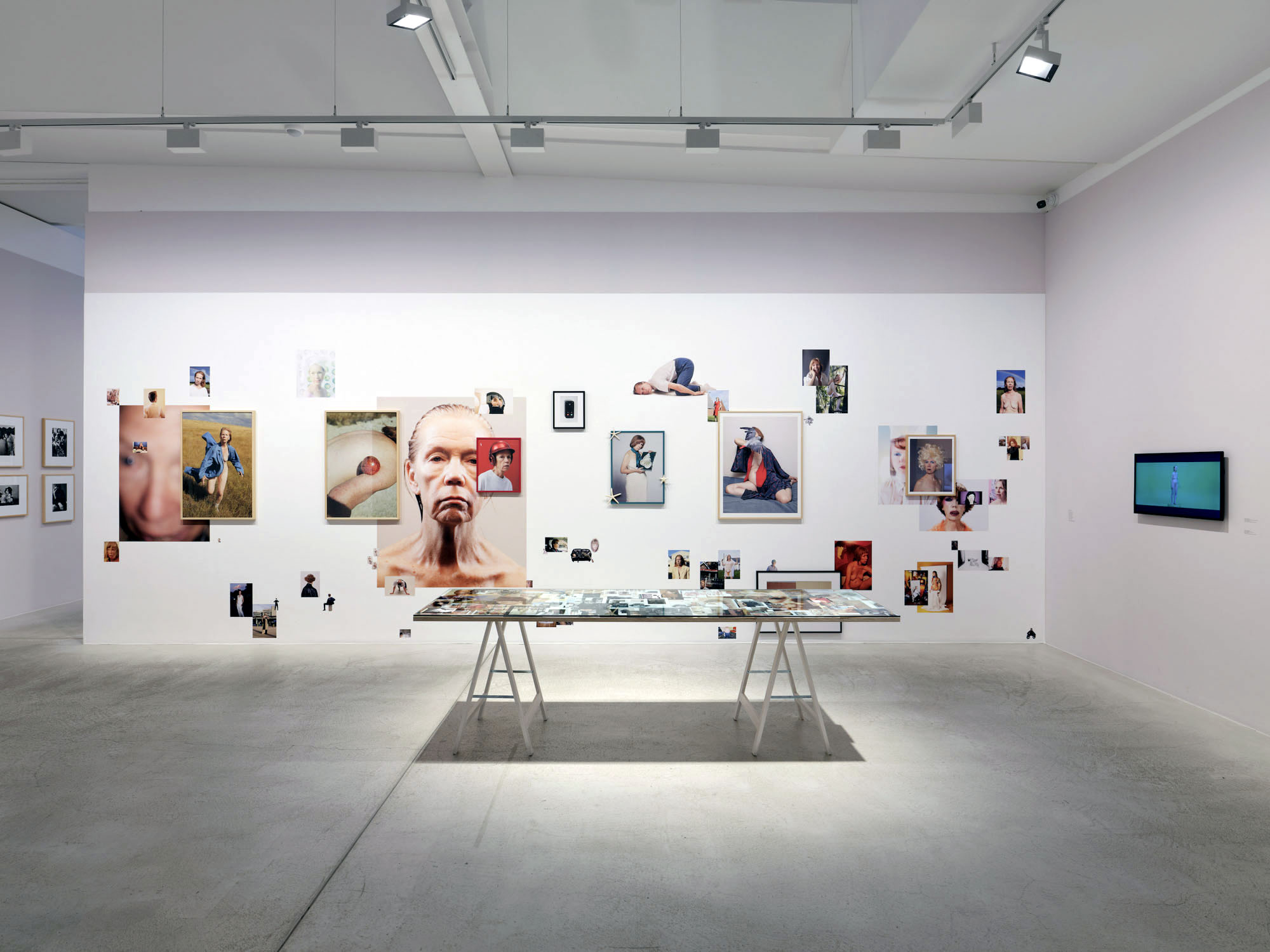
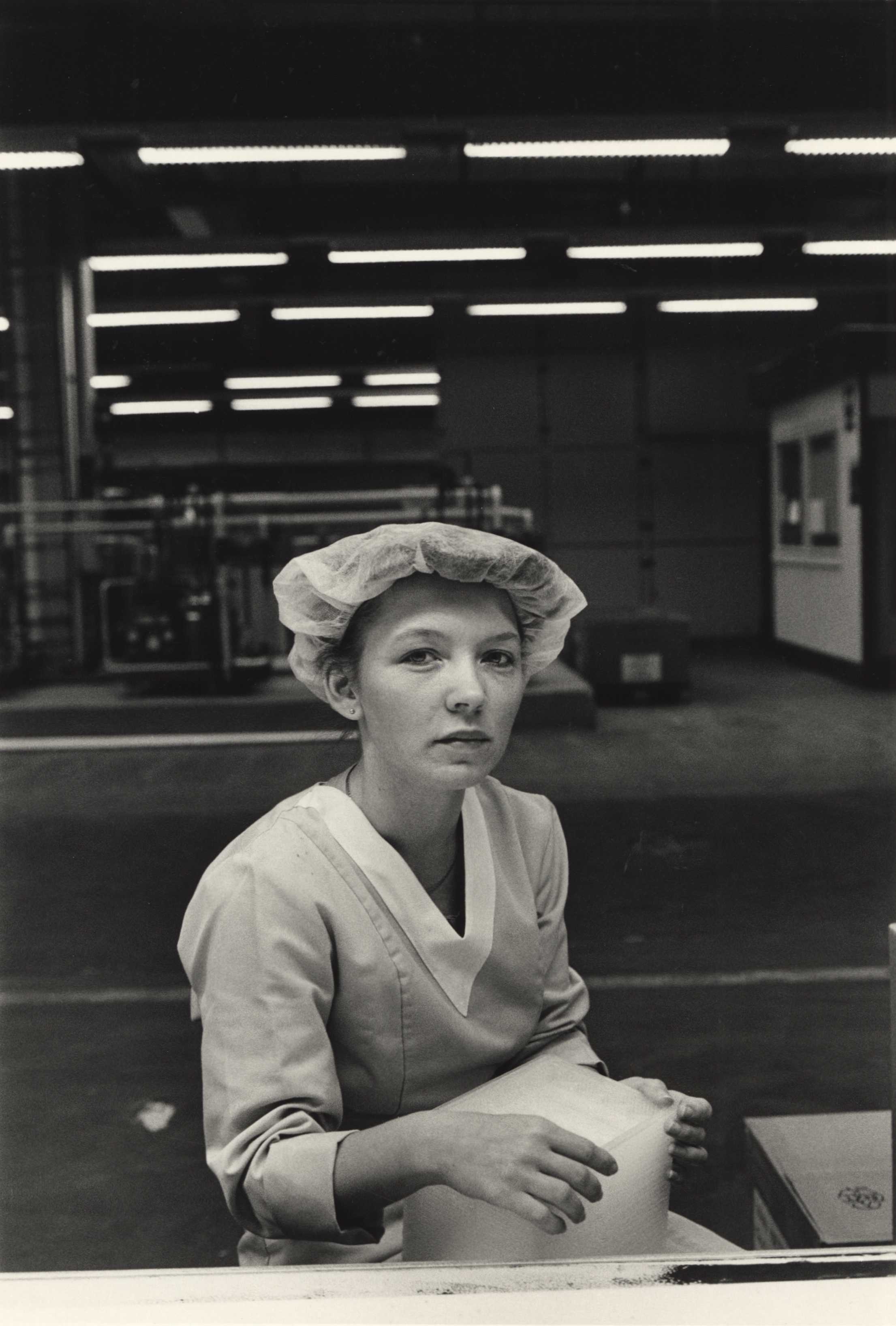
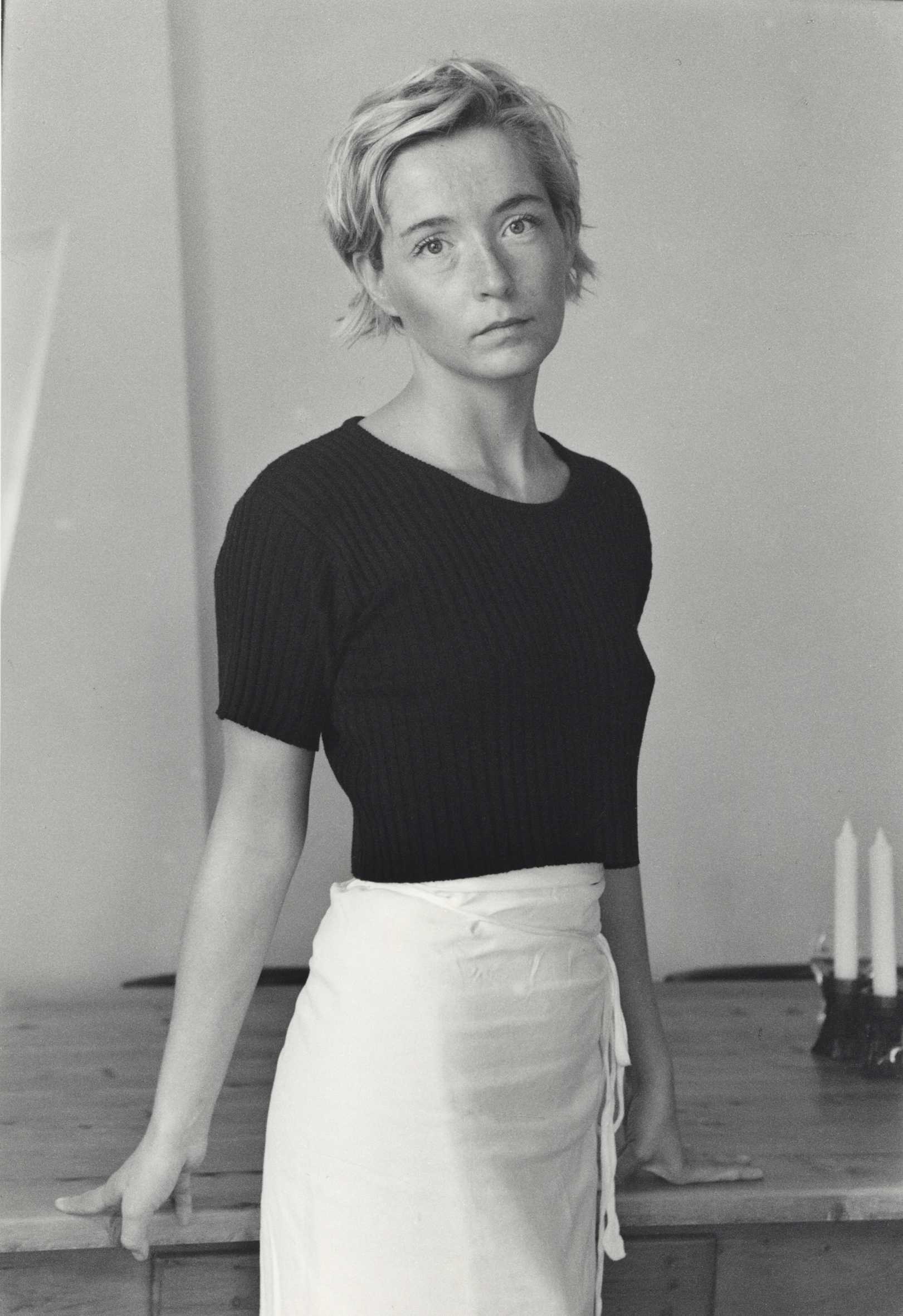
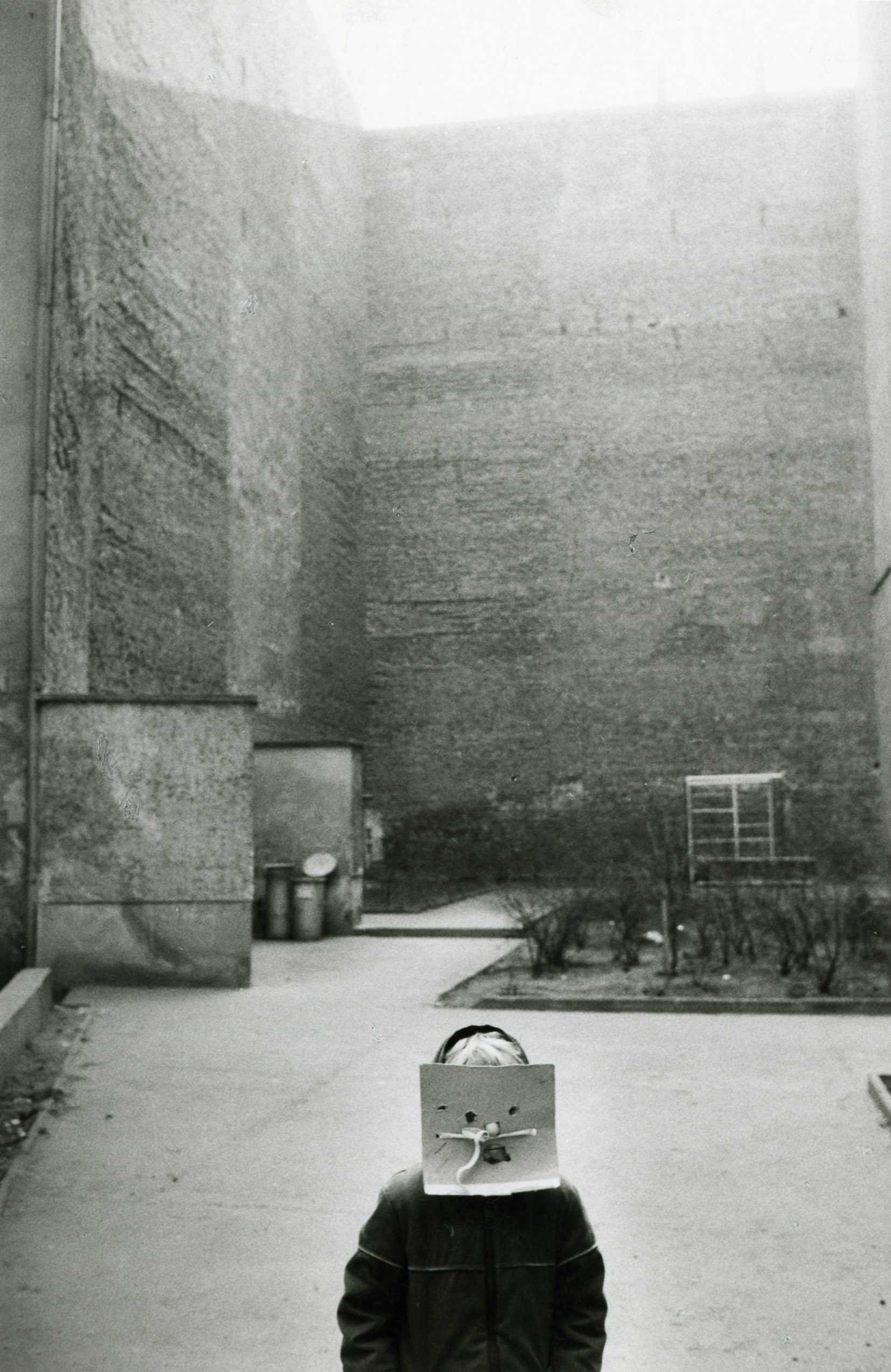
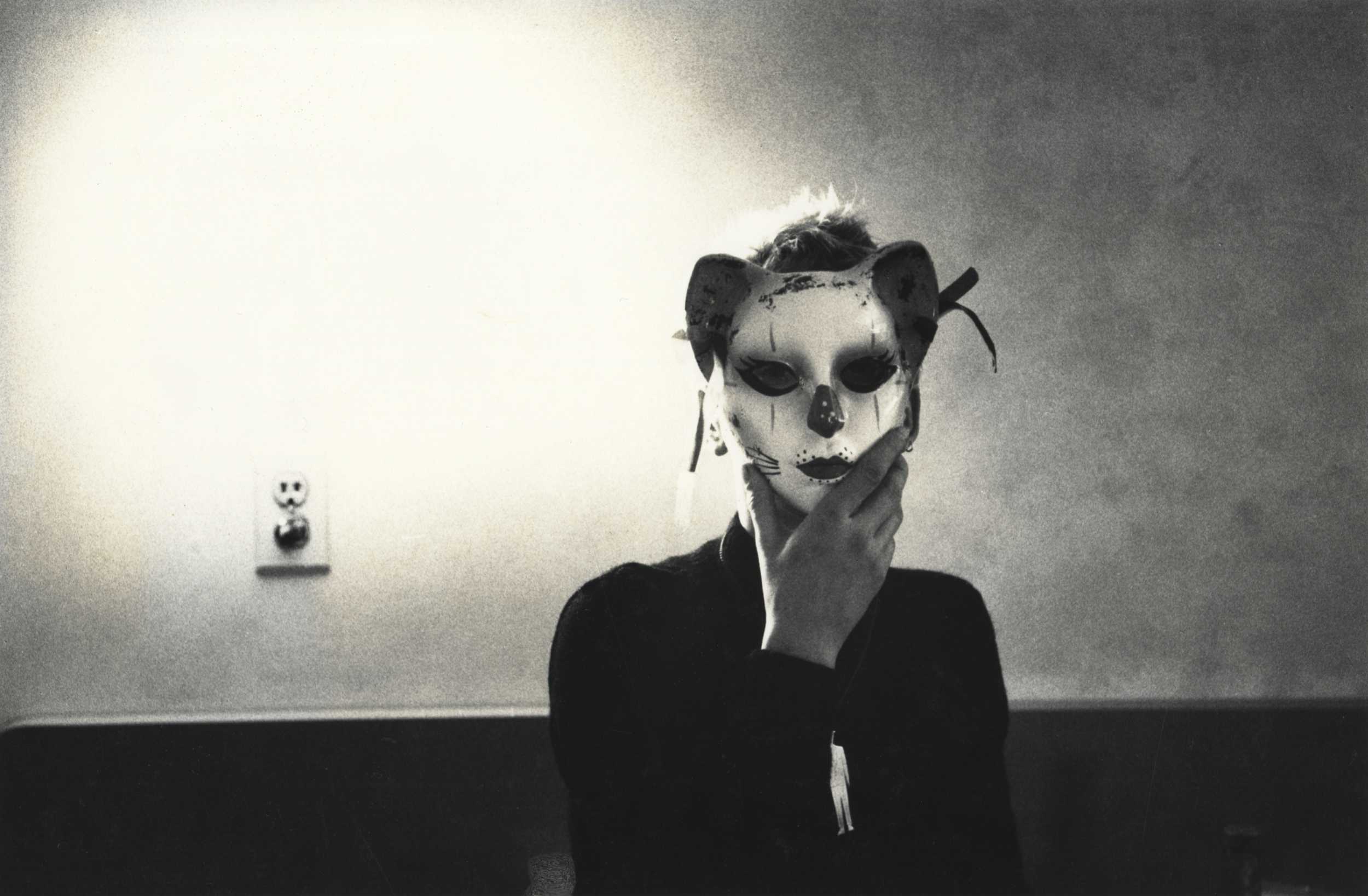
Exhibition: ‘Femme Fatale: Gaze – Power – Gender’ at the Hamburger Kunsthalle, Hamburg

Exhibition dates: 9th Dec 2022 – 10th April 2023

Curator: Dr. Markus Bertsch
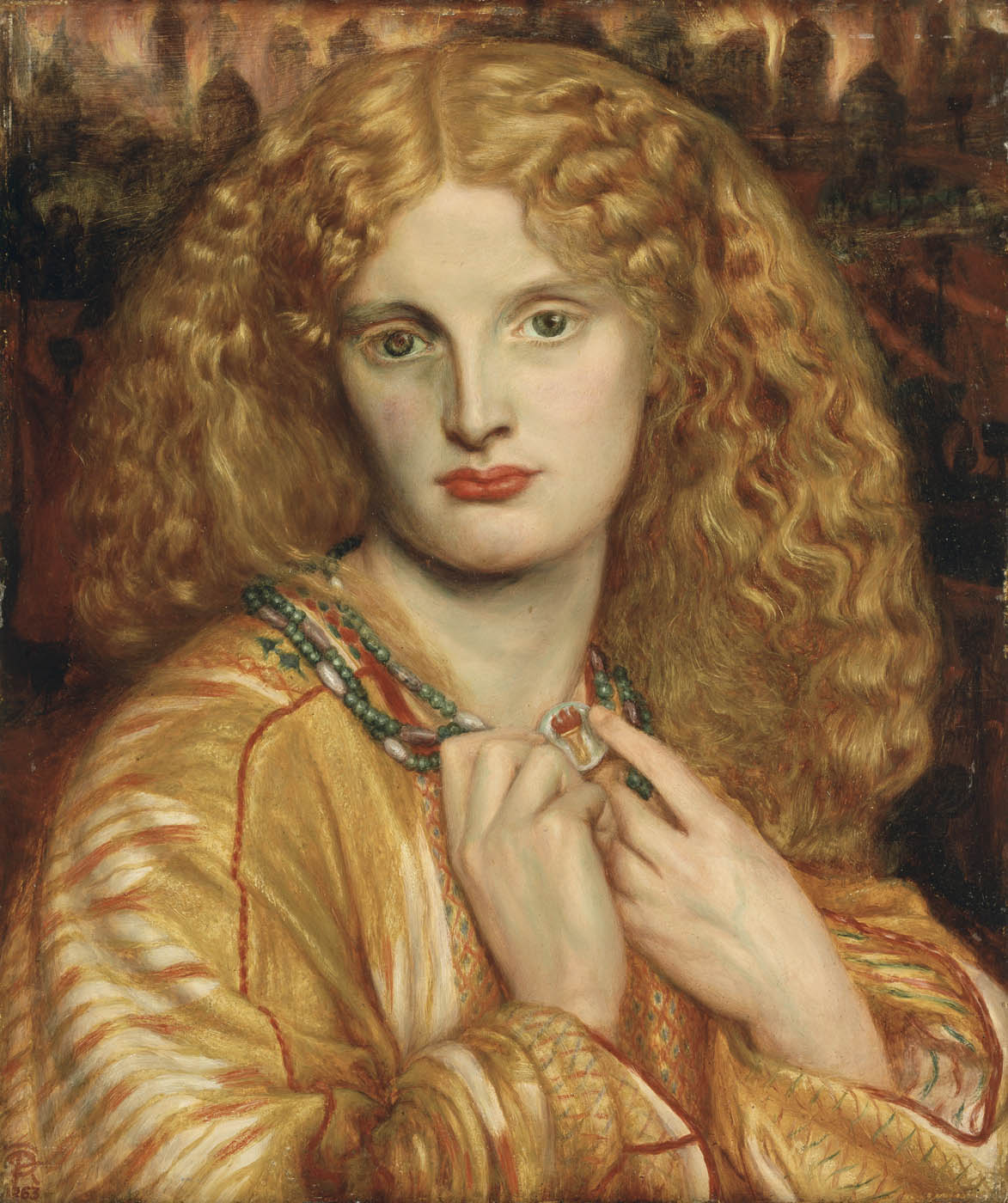
 

Dante Gabriel Rossetti (1828-1882) 'Helen of Troy' 1863


Dante Gabriel Rossetti (1828-1882)
Helen of Troy
1863
Oil on mahogany
32.8 x 27.7cm
© Hamburger Kunsthalle / bpk
Foto: Elke Walford


What a fascinating and inspired concept for an exhibition!

In order to understand the myth and construction of the femme fatale stereotype the exhibition investigates, through art and representation, concepts such as sexuality and its demonisation, the male and female gaze, white ideals of beauty, racism, Orientalism, anti-Semitism, power relations, hate, non-binary gaze, gender roles, myth and religion and black feminism. Such areas of breath are needed to examine the myth of the femme fatale.

I just wish the media images had included some photographs from the interwar avant-garde period by photographers such as Claude Cahun, Dora Maar, Eva Besnyö, Ilse Bing, Lotte Jacobi, Yva, Grete Stern, Ellen Auerbach, Aenne Biermann and Florence Henri for example – all of whom photographed the “New Woman” of the 1920s, an image which embodied an ideal of female empowerment based on real women making revolutionary changes in life and art. I hope the exhibition contains images by some of these photographers.

“The femme fatale is a myth, a projection, a construction. She symbolises a visually coded female stereotype: the sensual, erotic and seductive woman whose allegedly demonic nature reveals itself in her ability to lure and enchant men – often leading to fatal results. It is this likewise dazzling and clichéd image, long dominated by a male and binary gaze, that is in the focus of the exhibition Femme Fatale. Gaze – Power – Gender at the Hamburger Kunsthalle. Beyond exploring a range of artistic approaches to the theme from the early 19th century to the present, the show aims to critically examine the myth of the femme fatale in its genesis and historical transformation.” (Text from the Hamburger Kunsthalle website)

Dr Marcus Bunyan

PS. I have added further images and bibliographic information about the artists to the posting.


Many thankx to the Hamburger Kunsthalle for allowing me to publish the photographs in the posting. Please click on the photographs for a larger version of the image.


The male gaze places women in the context of male desire, essentially portraying the female body as eye candy for the heterosexual man. By valuing the desires of the male audience, the male gaze supports the self-objectification of women.

According to the Theory of Gender and Power (Robert Connell), the sexual division of power reproduces inequities in power between men and women which are maintained by social mechanisms such as the abuse of authority and control in relationships.


Femme Fatale


Pages from 'Doing Feminism – With Art!' booklet to the exhibition 'Femme Fatale. Gaze – Power – Gender' showing in the bottom posting, the room layout with sections to the exhibition


Pages from Doing Feminism – With Art! booklet to the exhibition Femme Fatale. Gaze – Power – Gender showing in the bottom posting, the room layout with sections to the exhibition


The femme fatale is a myth, a projection, a construction. She symbolises a visually coded female stereotype: the sensual, erotic and seductive woman whose allegedly demonic nature reveals itself in her ability to lure and enchant men – often leading to fatal results. It is this likewise dazzling and clichéd image, long dominated by a male and binary gaze, that is in the focus of the exhibition Femme Fatale. Gaze – Power – Gender at the Hamburger Kunsthalle. Beyond exploring a range of artistic approaches to the theme from the early 19th century to the present, the show aims to critically examine the myth of the femme fatale in its genesis and historical transformation.

The “classical” image of the femme fatale feeds above all on biblical and mythological female figures such as Judith, Salome, Medusa or the Sirens, who were widely portrayed as calamitous women in art and literature between 1860 and 1920. Characteristic of the femme fatale figure is the demonisation of female sexuality associated with these narratives. Around 1900, the femme fatale image was frequently projected onto real people, mainly actors, dancers or artists such as Sarah Bernhardt, Alma Mahler or Anita Berber. What is striking here is the simultaneity of important achievements of women’s emancipation and the increased appearance of this male-dominated image of women. In the sense of a counter-image that playfully picks up on aspects of the femme fatale figure, the New Woman, an ideal emerging well into the 1920s, also becomes important for the exhibition. A decisive caesura was set in the 1960s by feminist artists concerned with deconstructing the myth of the femme fatale – along with the corresponding viewing habits and pictorial traditions. Current artistic positions, in turn, deal with traces and appropriations of the archetypic image or establish explicit counter-narratives – often with reference to the #MeToo movement, questions of gender identities, female corporeality and sexuality, and by addressing the topic of the male gaze.

To investigate the constellations of gaze, power and gender that are constitutive for the image of the femme fatale and its transformations over time, the exhibition has assembled around 200 exhibits spanning a broad range of media and periods. On display will be paintings by Pre-Raphaelite artists (including Evelyn de Morgan, Dante Gabriel Rossetti, John William Waterhouse) alongside Symbolist works (such as Fernand Khnopff, Gustave Moreau, Edvard Munch and Franz von Stuck), works of Impressionism (including Lovis Corinth, Max Liebermann, Édouard Manet, Max Slevogt), of Expressionism and New Objectivity (Dodo, Jeanne Mammen, Gerda Wegener, among others). The featured positions of the early feminist avant-garde (including VALIE EXPORT, Birgit Jürgenssen, Ketty La Rocca, Maria Lassnig, Betty Tompkins) along with current works based on queer and intersectional feminist perspectives (Nan Goldin, Mickalene Thomas, Zandile Tshabalala, among others), build a bridge all the way to the present.

Text from the Hamburger Kunsthalle website


Chapters of the exhibition


Carl Joseph Begas (1794-1854) 'Die Lureley' 1835


Carl Joseph Begas (German, 1794-1854)
Die Lureley
1835
Oil on canvas
124.3 × 135.3cm
© Begas Haus – Museum für Kunst und Regionalgeschichte Heinsberg


Dangerous waters – Lorelei and her ‘fatal’ sisters

During the Romantic era, the element of water was often associated with the idea of dangerous femininity. The figure of Lorelei, in particular, was widely and diversely interpreted in numerous works of art, music and literature. Clemens Brentano laid the foundation for the legend of Lorelei with his ballad Zu Bacharach am Rheine…, written in 1801. Here, for the first time, a female figure was linked to the Lorelei – a large slate rock on the bank of the river Rhine that was known for producing an unusual echo. The broad popular appeal of this legend began with the publication of Heinrich Heine’s poem Die Lore-Ley in 1824 and continued to grow throughout the century. Although neither Brentano nor Heine stylised Lorelei as a femme fatale, many 19th-century artistic representations of this myth reduced the female figure to her siren-like, demonic qualities. The legend of Lorelei also has a remarkable resonance in contemporary art: in her video work “das Schöne muss sterben!”, for example, Gloria Zein transfers the narrative into the urban present, giving it an ironic twist and reflecting critically on the power of beauty; Aloys Rump traces the myth that surrounds this famous rock in the Rhine back to its material origins, exposing the Lorelei legend as pure invention and projection.

Aestheticized, demonized, sexualized: the femme fatale in the Victorian age

The 19th-century image of the femme fatale was largely shaped by the Pre-Raphaelite Brotherhood. This group of English artists around Dante Gabriel Rossetti and Edward Burne-Jones was founded in 1848. Drawing on ancient myths and works of English literature, the Pre-Raphaelites (as they were later known) established a very specific ideal of beauty. Their depictions above all featured female figures to whom destructive or even fatal qualities had traditionally been attributed, such as Lilith, Medea, Circe and Helen of Troy. The Pre-Raphaelites deliberately emphasised the contrast between the subjects’ mythological demonisation and their visualisation as sensual beings of ethereal beauty. Later artists who were influenced by the Pre-Raphaelites created increasingly eroticised depictions of women, portraying them as both an ideal and a vision of fear. John William Waterhouse’s painting of Circe, for example, explicitly links her power to her both enchantingly and threateningly seductive nature. John Collier’s highly sexualised interpretation of Lilith, meanwhile, presents the mythic figure primarily as an object of male desire. This white, Victorian ideal of femininity and beauty, along with its (re-)presentation in a museum context, is reflected by Sonia Boyce in her video installation Six Acts. This work emerged from a critical intervention she performed at Manchester Art Gallery in 2018.

Sexuality & Demonisation

The term femme fatale originally describes a sensual, erotically seductive woman who puts men in danger and plunges them into their misfortune – not seldom with deadly consequences. In his painting Lilith, John Collier also illustrated such a prototype of a femme fatale. Here, the woman’s body is excessively sexualised and her sexuality demonised. This narrative also suggests: a woman’s lust is something dangerous. Even today, women are often morally condemned when they live out their sexuality openly. How can that be? Female lust is declared taboo, while male lust is celebrated? That is indeed problematic. However: the figure of the femme fatale is by now often appropriated by women as an instrument for self-empowerment.

Doing Feminism – With Art! booklet to the exhibition


John William Waterhouse (1849-1917) 'Circe offering the cup to Ulysses' 1891


John William Waterhouse (1849-1917)
Circe offering the cup to Ulysses
1891
Oil on canvas
148 cm × 92cm
© Gallery Oldham


John William Waterhouse RA (6 April 1849 – 10 February 1917) was an English painter known for working first in the Academic style and for then embracing the Pre-Raphaelite Brotherhood’s style and subject matter. His artworks were known for their depictions of women from both ancient Greek mythology and Arthurian legend.

Born in Rome to English parents who were both painters, Waterhouse later moved to London, where he enrolled in the Royal Academy of Art. He soon began exhibiting at their annual summer exhibitions, focusing on the creation of large canvas works depicting scenes from the daily life and mythology of ancient Greece. Many of his paintings are based on authors such as Homer, Ovid, Shakespeare, Tennyson, or Keats. Waterhouse’s work is displayed in many major art museums and galleries, and the Royal Academy of Art organised a major retrospective of his work in 2009.

Text from the Wikipedia website


Binarity: male & female gaze

What is the male gaze actually all about?

The male gaze refers to the concept of a predominant masculine perspective; it represents the systematic use of male control in our society and its impact on us. The term was coined by feminist film theorist Laura Mulvey who in the 1970s drew attention to how women in films were mostly portrayed as objects catering to the fantasies of heterosexual males. It was soon applied to other genres such as fashion, literature, music and art – and widely adopted in the everyday world. Whether in film, advertising, in novels, on the street, at school, during training or at university: the male gaze is omnipresent. It condemns, objectifies, defines standards and ideals, oppresses and classifies: male= active, female=passive. We all grew up with the phenomenon and are confronted with it on an everyday basis. As a result, all of us, including women and non-binary people, have more or less internalised it. Whether consciously or unconsciously, especially these groups tend to see themselves through a kind of mirror, anticipating the male gaze. But: understanding the male gaze also means being able to unlearn it.

Doing Feminism – With Art! booklet to the exhibition


John Collier (English, 1850-1934) 'Lilith' 1887


John Collier (English, 1850-1934)
Lilith
1887
Oil on canvas
194 × 104cm (76 × 41 in)
Atkinson Art Gallery and Library, Southport, Merseyside, England
© The Atkinson
Public domain


Lilith is an 1889 painting by English artist John Collier, who worked in the style of the Pre-Raphaelite Brotherhood. The painting of the Jewish mythic figure Lilith is held in the Atkinson Art Gallery in Southport, England. It was transferred from Bootle Art Gallery in the 1970s.

Collier portrayed Lilith as a golden-haired, porcelain-skinned beautiful nude woman who fondles on her shoulder the head of a serpent, coiled around her body in a passionate embrace. Against the background of a dark, brown-green jungle, stands a naked female figure, whose pale skin and long blond hair falling down her back form a stark contrast with the forest. The head position and gaze of Lilith are turned away from the viewer, concentrating on the snake’s head resting on her shoulder. The snake encircles her body in several coils, starting around its closely spaced ankles, past the knee, to her lower abdomen, where it thereby conceals. Lilith supports the snake’s body with her hands in the area of ​​her upper body, so that the snake’s head can lie over her right shoulder up to her throat. Lilith’s head is bent towards the snake, her cheek nestles against the animal. The brown tones of the snake’s body stand out in contrast with the pale woman’s body, but take up the colour scheme of the surrounding jungle. Collier presented his painting inspired by fellow painter and poet Dante Gabriel Rossetti’s 1868 poem Lilith, or Body’s Beauty, which describes Lilith as the witch who loved Adam before Eve. Her magnificent tresses gave the world “its first gold,” but her beauty was a weapon and her charms deadly.

The magazine The British Architect described the work in 1887: “Here is a nude woman, whose voluptuous, round form is most gracefully represented, surrounded by a great serpent, the thickest part of which crosses it horizontally and cuts it in half; her head slides down her chest and she seems to be pulling it in tighter coils. The background is a coarse kind of green, repulsive and abominable.”

Text from the Wikipedia website


Dante Gabriel Rossetti (British, London 1828 - 1882 Birchington-on-Sea) Henry Treffry Dunn (British, Truro 1838 - 1899 London) 'Lady Lilith' 1867


Dante Gabriel Rossetti (British, London 1828 – 1882 Birchington-on-Sea)
Henry Treffry Dunn (British, Truro 1838 – 1899 London)
Lady Lilith
1867
Watercolour and gouache
20 3/16 X 17 5/16 in. (51.3 x 44cm)
The Metropolitan Museum of Art, New York, Rogers Fund, 1908
© The Metropolitan Museum of Art, New York


Fascinated by women’s physical allure, Rossetti here imagines a legendary femme fatale as a self-absorbed nineteenth-century beauty who combs her hair and seductively exposes her shoulders. Nearby flowers symbolise different kinds of love. In Jewish literature, the enchantress Lilith is described as Adam’s first wife, and her character is underscored by lines from Goethe’s Faust attached by Rossetti to the original frame, “Beware … for she excels all women in the magic of her locks, and when she twines them round a young man’s neck, she will not ever set him free again.” The artist’s mistress, Fanny Cornforth, is the sitter in this watercolour, which Rossetti and his assistant Dunn based on an oil of 1866 (Delaware Art Museum).

Text from the Metropolitan Museum of Art website


Lady Lilith is an oil painting by Dante Gabriel Rossetti first painted in 1866-1868 using his mistress Fanny Cornforth as the model, then altered in 1872-1873 to show the face of Alexa Wilding. The subject is Lilith, who was, according to ancient Judaic myth, “the first wife of Adam” and is associated with the seduction of men and the murder of children. She is shown as a “powerful and evil temptress” and as “an iconic, Amazon-like female with long, flowing hair.” …

A large 1867 replica of Lady Lilith, painted by Rossetti in watercolour, which shows the face of Cornforth, is now owned by New York’s Metropolitan Museum of Art. It has a verse from Goethe’s Faust as translated by Shelley on a label attached by Rossetti to its frame:

“Beware of her fair hair, for she excels
All women in the magic of her locks,
And when she twines them round a young man’s neck
she will not ever set him free again.”

Text from the Wikipedia website


White Ideals (of Beauty)

Apparently, the ideal is the white woman. She is thought to be pure, innocent and therefore endearing. This racist idea reaches from colonial times all the way to the present day. In 2022 alone, it can be found in several social media trends. One of them is the clean girl look on TikTok.

But what is behind all this and who is the trend actually for? The clean girl aesthetic gone viral is rather minimalistic: simple clothes, subtle make-up with delicate lip gloss and small gold creole earrings. With this look, young women want to represent themselves as so-called “girl bosses”, meaning women who have everything under control. This, however, is no more than a male fantasy. It has nothing to do with real people. The clean girl image also reinforces perceptions of which kind of women are more socially accepted. Namely, those who, like the clean girl, have “smooth and porcelain-like skin”. This Eurocentric ideal of beauty can already be detected in the nineteenth-century work Lady Lilith by Dante Gabriel Rossetti. Lady Lilith‘s skin is ivory white; she is combing her hair smooth, which is still wavy at the hairline. In the clean girl look hair is also straight, usually tied into a tight braid or chignon. Curly hair is excluded – and along with it especially Black people with Afro hair. Their natural appearance is thus portrayed as dirty in contrast to the allegedly pure clean girl look – a racist narrative that continues to try to position Black women in particular as inferior in society. Whereas, some of those characteristics appearing in the clean girl look originally were appropriated from Black Culture and then minimised: big gold creoles and gel-combed hairdos are just two of many examples. The clean girls with the most TikTok views represent this kind of standard beauty: thin, white and wearing expensive clothes. On the social media schoolyard, they are the ones who are considered as cool. But what they are doing while they are at it is bowing to racist, classist ideals that need to be made visible and discussed.

Doing Feminism – With Art! booklet to the exhibition


Evelyn de Morgan (English, 1855-1919) 'Medea' Nd


Evelyn de Morgan (English, 1855-1919)
Medea
Nd
Oil on canvas
148 × 88cm
© Williamson Art Gallery and Museum, Birkenhead; Wirral Museums Service
Purchased 1927


Evelyn De Morgan (30 August 1855 – 2 May 1919), née Pickering, was an English painter associated early in her career with the later phase of the Pre-Raphaelite Movement, and working in a range of styles including Aestheticism and Symbolism. Her paintings are figural, foregrounding the female body through the use of spiritual, mythological, and allegorical themes. They rely on a range of metaphors (such as light and darkness, transformation, and bondage) to express what several scholars have identified as spiritualist and feminist content.

De Morgan boycotted the Royal Academy and signed the Declaration in Favour of Women’s Suffrage in 1889. Her later works also deal with the themes of war from a pacifist perspective, engaging with conflicts like the Second Boer War and World War I.

Text from the Wikipedia website


Gustave Moreau (1826-1898) 'Oedipus and the Sphinx' 1864


Gustave Moreau (1826-1898)
Oedipus and the Sphinx
1864
Oil on canvas
206 x 104.8cm
© The Metropolitan Museum of Art, New York
Bequest of William H. Herriman, 1920


Racism

Racism means that people are subjected to depreciation exclusion or even to experiencing violence due to their origin, skin colour or religion. Racism comes in many forms. There is, for example, anti-Muslim, anti-Black or anti-Asian racism which is particularly directed against these groups. While such group based hostility was formerly justified above all by the “wrong” religious affiliation, from the 16th century on, allegedly scientific explanations became established. People were divided into different “races” from the time white people started enslaving Black people to then exploit them for economic profit in the new colonies. Today, most people are aware that there is no such thing as different “human races”. Instead, it is the different “social background” or “culture” that now is often used as an argument to racially stigmatise people. The ‘others’ may be described as ‘primitive’ and ‘uncultivated’, sometimes exoticised or sexualised. Men are portrayed as libidinous, women as erotic and, quite often, as their victims. The Indian postcolonialism theorist Gayatri Chakravorty Spivak critically pinpointed this colonial perspective with the sentence: “White men are saving brown women from brown men.” This ironic statement emphasises the sense of civilisational superiority of white colonisers who saw themselves as “saviours”, but often came to the country as rapists and, on top of that, oppressed the female population in their countries of origin.

Doing Feminism – With Art! booklet to the exhibition


Jean Delville (Belgian, 1867-1953) 'The Idol of Perversity' (L'idole de la perversite) 1891


Jean Delville (Belgian, 1867-1953)
The Idol of Perversity (L’idole de la perversite)
1891


Jean Delville, The Idol of Perversity (L’idole de la perversite), 1891. Delville was a Belgian symbolist painter, author, poet and Theosophist, studying mystical and occultist philosophies. Such philosophies concentrate mainly on seeking the true origins of the universe, specifically of the divine and natural kind, believing that knowledge of ancient pasts offers a path to true enlightenment and salvation. Delville was the leading patron of Belgian Idealist movement, specifically in art circa the 1890s, having a belief system that upheld art to higher standards of substance, believing that it should express higher spiritual truth, based on principles of Ideal, or spiritual Beauty. …

The goal of the living body is to spiritualise itself and to refine our material selves, meaning to elevate ourselves to the level of not requiring or wanting things that are just of material value. Without a spiritual path or goal, men and women that walk the earth become slaves to their material possessions, forever destined to succumb to the desires, passions, greed, and egotistic need to always seek power over one another. Under this belief, the physical world we live in becomes the land of Satan, and those without a spiritual goal become merely his slaves. According to Delville, the first step to true enlightenment is to gain power over earthly temptations, such as promiscuity and erotic temptation. Truly enlightened soul is one that can use the power of his mind to rise above the temptations of, what was believed “unquenched bestial desires of a woman”. In late nineteenth century femme fatale embodied the kind of misogynistic idea that women were lower on the evolutionary scale, and female sex was that of animalistic, monstrous and aggressive, hence, the femme fatale characterisation, meaning that women’s grotesque sexual desires led men away from their spiritual goals, and thus driving them to live a life in sin, forever slaves to the Devil. In this painting Delville portrays the femme fatale as an almost demonic entity, with the bellow angel as to show her looming over the viewer, with an almost phallic snake, reminiscent of Franz von Stuck’s Sin, slithering between her pointed breasts. This image is a direct representation of Delville’s esoteric ideologies of material versus spiritual.

Art Universal. “Jean Delville, The Idol of Perversity (L’idole de la perversite), 1891,” on the Art Universal website August 8, 2017 [Online] Cited 03/03/2023


Fernand Khnopff (1858-1921) 'Who Shall Deliver Me? (Christina Georgina Rossetti)' 1891


Fernand Khnopff (1858-1921)
Who Shall Deliver Me? (Christina Georgina Rossetti)
1891
Conté pen and coloured pencil on paper
21.9 x 13cm
© The Hearn Family Trust


Enigmatic images – the femme fatale in Symbolist art

Fantastical scenarios, imaginary dream worlds and psychological depths are the defining characteristics of Symbolism, a cultural movement that flourished throughout Europe from the 1880s onwards. The image of the femme fatale is also omnipresent in Symbolist art, but in these depictions, the female subjects often have an enigmatic, other-worldly appearance and their meaning is ambiguous. As the epitome of the cliché of ‘female mystery’, the sphinx is a prominent motif in Symbolist art. The image of this malevolent creature – a hybrid of woman, lion and bird – was strongly influenced by Gustave Moreau’s Oedipus and the Sphinx, an important early work by the painter. Moreau’s orientalised and eroticised interpretation of Salome as an ornamental figure also shaped the perception of her as a femme fatale. A similar composition featuring a vision of John the Baptist’s floating head is found in Odilon Redon’s Apparition. His figures, however, are even further removed from objective representation and concrete corporeality. These kinds of mystifying depictions were also interpreted and elaborated by other Symbolist artists, above all in Belgium and the Netherlands. In Fernand Khnopff’s subtle drawings, the femme fatale appears as a mysterious, ambiguous projection, addressing the themes of stereotypical femininity and androgyny.

Focussing on the body – interpretations of the femme fatale in Munich

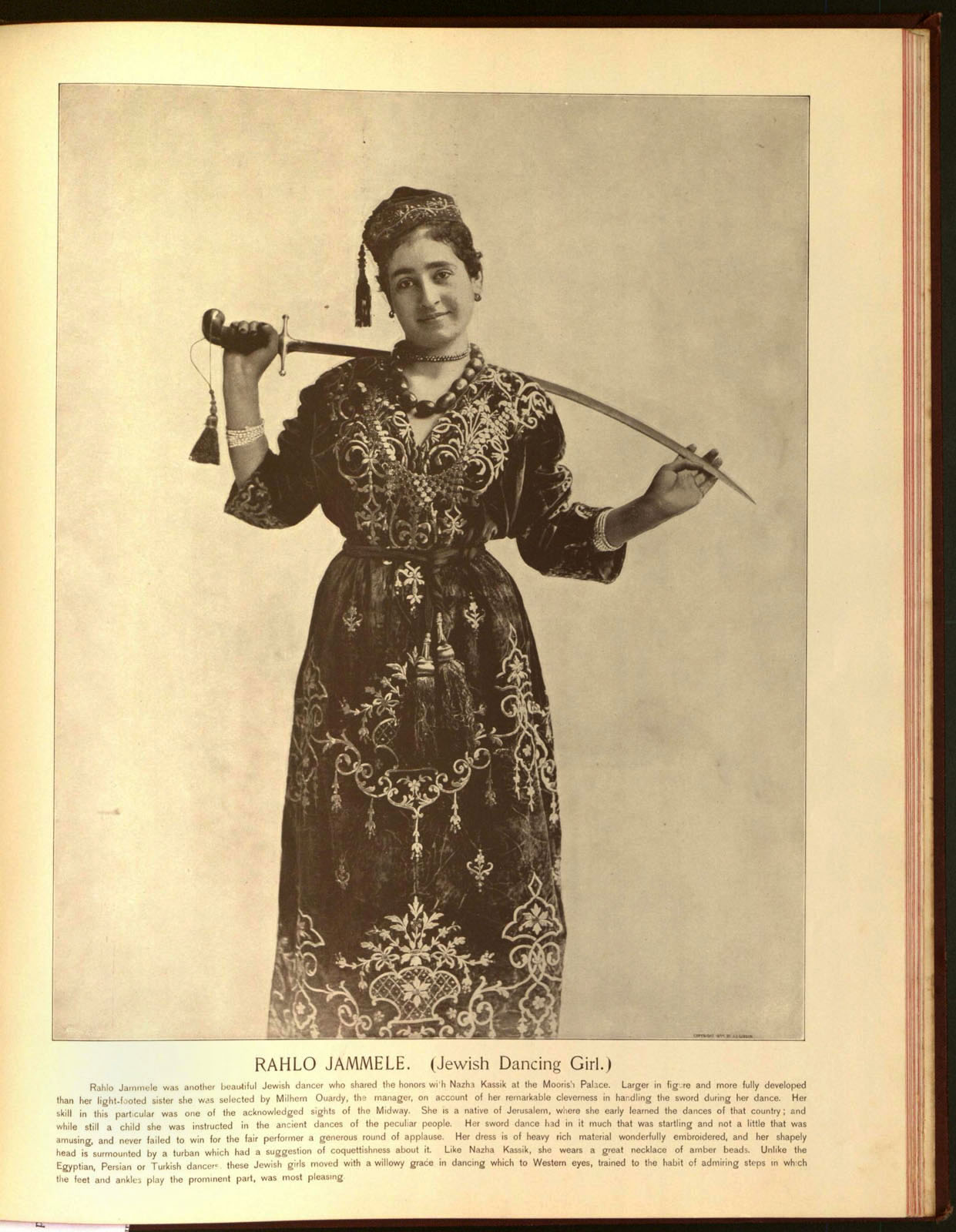
In contrast to the enigmatic dream worlds of French and Belgian Symbolism, the depictions of femmes fatales by artists of the Munich School focus more explicitly on women’s bodies. Carl Strathmann’s large-format interpretations of Gustave Flaubert’s historical novel Salammbô, which was frequently adapted in France, place the titular female figure in an ornamental Art Nouveau setting that is typical of the period. Franz von Stuck and Franz von Lenbach, on the other hand, focus on concrete physical realities; while their paintings are set in mythological and biblical contexts, they are mainly aimed at representing nudity. In Stuck’s interpretation of the Sphinx, for example, the subject is no longer depicted as a hybrid creature, but is a purely human, naked woman. Only the posture of the nude, who is reduced to her physicality and sensuality, recalls a sphinx. This kind of sexualization in images of femmes fatales often involves constructing a supposed ‘otherness’ of the depicted subject. Through the incorporation of orientalising elements and antisemitic attributions such as the stereotype of the ‘beautiful Jewess’, female subjects – above all Judith and Salome – are presented as alluring and desirable, but are at the same denigrated as ‘other’.

Orientalism

Turbans, veils, sabres, teacups, palm trees, colourful carpets and nude women in harems – this cliché-ridden image of the ‘Orient’ was spread in the West and was a major theme especially in nineteenth-century painting. In 1978, the Palestinian-American literature professor Edward Said published a book entitled Orientalism in which he characterised this image as a Western invention. By describing the ‘Orient’, meaning roughly those regions now called North Africa and the Near and Middle East, as ‘alien’ and ‘backward’, the West was able to present itself as culturally superior. This, at the same time, made it easier to justify imperialist ambitions to subjugate and exploit these regions. Orientalism has been typified by rejection and attraction alike: the people and customs of the region are portrayed as irrational, lazy and dishonest just as much as sensual, pleasure-oriented and seductive. A widespread symbol of this in painting was the figure of the “Odalisque”, a white slave girl, preferably drawn naked in the bath. She strikingly exemplifies the kind of fantasies that (mainly) white European men would live out in their depictions of the Orient: at once a ‘chaste’ victim of ‘Oriental’ tyrants and a ‘sinful’ seductress of Western conquerors. Many of these Orientalist clichés have survived to this day and can also be found, in anti-Muslim racisms, for example.

Doing Feminism – With Art! booklet to the exhibition


Bruno Piglhein (German, 1848-1894) 'Egyptian Sword Dancer' 1891


Bruno Piglhein (1848-1894)
Egyptian Sword Dancer
1891
Oil on canvas
138 × 89cm
Private collection
© Courtesy Kunkel Fine Art, München


Franz Von Stuck (German, 1863-1928) 'Judith and Holofernes' 1926


Franz Von Stuck (German, 1863-1928)
Judith and Holofernes
1926
Oil on canvas
157 × 83cm
Staatliche Schlösser, Gärten und Kunstsammlungen Mecklenburg-Vorpommern, Schwerin
© Staatliche Schlösser, Gärten und Kunstsammlungen Mecklenburg-Vorpommern, Staatliches Museum Schwerin
Foto: Elke Walford


Anti-Semitism

The term anti-Semitism describes a hostile attitude towards Jews. It manifests itself in various forms, from prejudice, to insults, to violence. Anti-Semitism, which has existed for thousands of years, is the oldest known form of group-specific hatred of people, regardless of gender. Its worst manifestation was during German National Socialism under Adolf Hitler when over six million Jewish people were murdered between 1933 and 1945 in Europe. What distinguishes anti-Semitism from other forms of discrimination is the idea of a cultural and economic superiority of the group being attacked, unlike, for example, racism or Islamophobia, where the counterpart is usually devalued. Instead of labelling Jews as backward, in stereotypes they often appear as representatives of a modern and sophisticated worldview, which is, however, portrayed as ‘decadent’ and ‘threatening’. Conspiracy theories also often contain anti-Semitic elements, as it is imagined that all Jewish people are wealthy, influential and well-connected and thus able to act as secret ‘string-pullers’ in international affairs. Anti-Semitic prejudices often refer to categories such as wealth and power, sexuality or external characteristics.

Visually, anti-Semitic body stereotypes are sometimes expressed through the depiction of large, crooked noses (‘hooknose’), bulging lips, narrow eyes, hunched posture, bowlegs and flat feet. Somewhat more subtle, but no less problematic, is the stereotype of the “beautiful Jewess”. This cliché image from art and literature around 1900 often showed Jewish women as smart, beautiful and seductive, but at the same time marked them as ‘foreign’ and ‘different’, for example, based on orientalising elements such as jewellery, etc.

Doing Feminism – With Art! booklet to the exhibition


Antonin Idrac (French, 1849-1884) 'Salammbô' 1882


Antonin Idrac (French, 1849-1884)
Salammbô
1882
Plaster
Height: 182cm (71.6 in); width: 53 cm (20.8 in); depth: 71cm (27.9 in)
Musée des Augustins
Public domain


Carl Strathmann (German, 1866-1939) 'Salammbô' 1894


Carl Strathmann (German, 1866-1939)
Salammbô
1894
Mixed media on canvas
187.5 x 287cm


Strathmann’s curious work occupies an intermediate position between the art of painting and the crafts. His paintings are strange concoctions studded with colored glass and artificial gems, foreshadowing similar extravagances by the Viennese Jugendstil painter Gustav Klimt. In Strathmann’s painting Salammbô, inspired by Flaubert’s novel, the Carthaginian temptress reclines on a carpet spread out on a flower-strewn meadow. Swathed in veils whose design is as complex as that of the harp beside her head, she submits to the kiss of the mighty snake that encircles her. Lovis Corinth described how Strathmann, while working on the large picture, gradually covered the originally nude model with “carpets and fantastic garments of his own invention so that in the end only a mystical profile and the fingers of one hand protruded from a jumble of embellished textiles. … coloured stones are sparkling everywhere; the harp especially is aglitter with fake jewels.” According to Corinth, Strathmann knew “how to glue and sew” these on the canvas “with admirable skill.”

Anonymous. “Carl Strathmann, Salammbô,” on the Dark Classics website 12/05/2011 [Online] Cited 01/03/2023


Arnold Böcklin (Swiss, 1827-1901) 'Sirens' 1875


Arnold Böcklin (Swiss, 1827-1901)
Sirens
1875
Tempera on canvas
Height: 46cm (18.1 in); width: 31cm (12.2 in)
Alte Nationalgalerie
Public domain


Arnold Böcklin (16 October 1827 – 16 January 1901) was a Swiss symbolist painter. …

Influenced by Romanticism, Böcklin’s symbolist use of imagery derived from mythology and legend often overlapped with the aesthetic of the Pre-Raphaelites. Many of his paintings are imaginative interpretations of the classical world, or portray mythological subjects in settings involving classical architecture, often allegorically exploring death and mortality in the context of a strange, fantasy world.

Böcklin is best known for his five versions (painted 1880 to 1886) of the Isle of the Dead, which partly evokes the English Cemetery, Florence, which was close to his studio and where his baby daughter Maria had been buried. An early version of the painting was commissioned by a Madame Berna, a widow who wanted a painting with a dreamlike atmosphere.

Clement Greenberg wrote in 1947 that Böcklin’s work “is one of the most consummate expressions of all that is now disliked about the latter half of the nineteenth century.”

Text from the Wikipedia website


Franz Von Stuck (1863-1928) 'Sphinx' 1904


Franz Von Stuck (German, 1863-1928)
Sphinx
1904
Oil on canvas
83 × 156.5cm
© Loan from the Federal Republic of Germany as a permanent loan to the Hessian State Museum in Darmstadt
Foto: Wolfgang Fuhrmannek, HLMD


Franz Ritter von Stuck (February 23, 1863 – August 30, 1928), born Franz Stuck, was a German painter, sculptor, printmaker, and architect. Stuck was best known for his paintings of ancient mythology, receiving substantial critical acclaim with The Sin in 1892. In 1906, Stuck was awarded the Order of Merit of the Bavarian Crown and was henceforth known as Ritter von Stuck. …

Stuck’s subject matter was primarily from mythology, inspired by the work of Arnold Böcklin. Large forms dominate most of his paintings and indicate his proclivities for sculpture. His seductive female nudes are a prime example of popular Symbolist content. Stuck paid much attention to the frames for his paintings and generally designed them himself with such careful use of panels, gilt carving and inscriptions that the frames must be considered as an integral part of the overall piece.

Text from the Wikipedia website


Gustav Adolf Mossa (1883–1971) 'The Satiated Siren' (Die gesättigte Sirene) 1905


Gustav Adolf Mossa (French, 1883-1971)
The Satiated Siren (Die gesättigte Sirene)
1905
Oil on canvas
81 × 54cm
Musée des Beaux-Arts, Nizza
© VG Bild-Kunst, Bonn 2022
Foto: Michel Graniou


Gustav-Adolf Mossa (28 January 1883 – 25 May 1971) was a French illustrator, playwright, essayist, curator and late Symbolist painter. …


Symbolist paintings

Mossa’s decade long Symbolist period (1900-1911) was his most prolific and began as a reaction to the recent boom of socialite leisure activity on the French Rivera, his works comically satirising or condemning what was viewed as an increasingly materialistic society and the perceived danger of the emerging New Woman at the turn of the century, whom Mossa appears to consider perverse by nature.

His most common subjects were femme fatale figures, some from Biblical sources, such as modernised versions of Judith, Delilah and Salome, mythological creatures such as Harpies or more contemporary and urban figures, such as his towering and dominant bourgeoise woman in Woman of Fashion and Jockey. (1906). His 1905 work Elle, the logo for the 2017 Geschlechterkampf exhibition on representations of gender in art, is an explicit example of Mossa’s interpretation of malevolent female sexuality, with a nude giantess sitting atop a pile of bloodied corpses, a fanged cat sitting over her crotch, and wearing an elaborate headress inscribed with the Latin hoc volo, sic jubeo, sit pro ratione voluntas (What I want, I order, my will is reason enough).

Many aspects of Mossa’s paintings of this period were also indictive of the decadent movement, with his references to Diabolism, depictions of lesbianism (such as his two paintings of Sappho), or an emphasis on violent, sadistic or morbid scenes.

Though these paintings are the subject of most present day exhibitions, scholarly articles and books on the artist, they were not released to the public until after Mossa’s death in 1971.

Text from the Wikipedia website


Inverted images – the femme fatale turns grotesque

In the late 19th century, artists began using exaggeration and caricature to highlight the grotesque, bizarre and absurd qualities of the femme fatale motif, suggesting that the traditional image of the wickedly seductive enchantress had become redundant. While these inverted images of the femme fatale illustrate the constructed nature of this concept, they in turn employ clichés of demonic femininity. Arnold Böcklin gives an ironic, grotesque twist to a popular artistic motif in his painting Sirens, where the typically emphasised seductiveness of the hybrid creatures appears to have the opposite effect. In Gustav-Adolf Mossa’s The Satiated Siren, meanwhile, the siren’s outstanding feature is her bloodthirsty instinct. In Carl Strathmann’s almost humorously exaggerated depiction of the Head of Medusa, on the other hand, Medusa’s petrifying gaze is no longer intended to shock the viewer. Although ancient myths still provided the subject matter for these interpretations, they were increasingly losing their exemplary function and could often only be transposed to the present in a grotesque guise. Aubrey Beardsley’s illustrations after Oscar Wilde’s play Salome (1893) were highly influential; while these also contained some vividly macabre motifs, the unmistakable ornamental aesthetic of defined lines and flat spatial planes made them appear less frightening.


Carl Strathmann (German, 1866-1939) 'Head of Medusa' c. 1897


Carl Strathmann (German, 1866-1939)
Head of Medusa
c. 1897
Watercolour and ink
69.8 cm x 69.5cm
Münchner Stadtmuseum, Sammlung
CC BY-SA 4.0


Carl Strathmann (11 September 1866, Düsseldorf – 29 July 1939, Munich) was a German painter in the Art Nouveau and Symbolist styles.

His father, also named Carl Strathmann, was a merchant and manufacturer, who later served as consul in Chile. His mother, Alice, was originally from Huddersfield, England, and was an art enthusiast. From 1882 to 1886, he studied at the Kunstakademie Düsseldorf, with Hugo Crola, Heinrich Lauenstein and Adolf Schill. After being dismissed for a “lack of talent”, he enrolled at the Grand-Ducal Saxon Art School, Weimar where, from 1888 to 1889, he studied in the master class taught by Leopold von Kalckreuth.

When Kalckreuth left, he did as well; moving to Munich, where he lived a Bohemian lifestyle as a free-lance artist, and met the painter Lovis Corinth, who became a lifelong friend and associate. In 1894, he painted one of his best known works: “Salammbô”, inspired by a novel of the same name by Gustave Flaubert. In this monumental painting (6 x 9 feet) Salammbô, a high priestess of the Carthaginians, is shown caressing a snake, as part of a ritual sacrifice. Many were horrified, calling it a “sadistic fantasy”. The scandal made him immediately famous.

Text from the Wikipedia website


Aubrey Beardsley (British, 1872-1898) 'The Toilette of Salome' (second version) 1893


Aubrey Beardsley (British, 1872-1898)
The Toilette of Salome (second version)
1893

Please note: This drawing may not be in the exhibition but Beardsley’s drawings of Salome are mentioned in the exhibition text (below)


Aubrey Beardsley (British, 1872-1898) 'J’ai baisé ta bouche Iokanaan' 1892-1893


Aubrey Beardsley (British, 1872-1898)
J’ai baisé ta bouche Iokanaan
1892-1893

Please note: This drawing may not be in the exhibition but Beardsley’s drawings of Salome are mentioned in the exhibition text (below)


Aubrey Beardsley (British, 1872-1898) 'John and Salome' 1893


Aubrey Beardsley (British, 1872-1898)
John and Salome
1893

Please note: This drawing may not be in the exhibition but Beardsley’s drawings of Salome are mentioned in the exhibition text (below)


Edvard Munch (Norwegian, 1863-1944) 'Madonna' 1895


Edvard Munch (Norwegian, 1863-1944)
Madonna
1895
Oil on canvas
90 × 71cm
Hamburger Kunsthalle, permanent loan of the Stiftung Hamburger Kunstsammlungen, acquired 1957
© SHK / Hamburger Kunsthalle / bpk
Public domain


Edvard Munch (1863-1944) 'Vampire in the forest' 1916-1918


Edvard Munch (Norwegian, 1863-1944)
Vampire in the forest
1916-1918
Oil on canvas
150 × 137cm
Munch Museet, Oslo
© Munchmuseet


Femme fatale, saint and vampire – the elevation and denigration of women in the art of Edvard Munch

Among the many images of the femme fatale that were created around 1900, Edvard Munch’s ambiguous, both positively and negatively connoted female figures occupy a place of their own. Existential questions and universal themes such as life, death, love, loss and grief are central to Munch’s art. Women are omnipresent in his compositions, appearing in a variety of roles and stereotypical depictions; at the same time, they are inseparably linked to the artist’s personal experience of life and love. The transfiguration of this experience often leads to the opposite extreme. Munch’s painting Madonna illustrates the contradictory aspects of his image of women: the depicted subject can be interpreted as a lustful femme fatale or as a saintly figure. The relationship and tension between the sexes is another leitmotif in Munch’s art. This is illustrated by his painting Vampire in the Forest, which leaves the viewer in doubt as to whether the depicted female figure is a loving woman or a bloodthirsty creature. Demonisations of femininity and female sexuality that threaten male existence appear throughout Munch’s oeuvre. They are as much an expression of his fears as of his self-stylisation as a victim – and once again reveal Munch’s image of the femme fatale to be a misogynistic projection.

Impressionist digressions – staged presentations from the theatrical to the nude

The theme of the femme fatale is even addressed in Impressionist art, which aimed to create immediate and realistic depictions rather than idealised representations. Here, however, the image was presented in very different ways. Lovis Corinth’s stage-like scenario shows a dramatically made-up, bare-breasted Salome bending over the head of John the Baptist. The abysmal aspect of her power is visualised above all through the sexualization of her body. The female figures in Max Liebermann’s interpretations of the biblical theme of Samson and Delilah, on the other hand, are far less eroticised. The choice of this subject – an unusual one for the artist – reveals his awareness of the popularity of the femme fatale motif. The lack of historicising details and focus on the strength of the austere-looking female figures, however, situate Liebermann’s stark images more decisively in the present than those of Corinth. The French sculptor Auguste Rodin also portrayed a femme fatale figure – but was evidently using this theme as a justification for an explicit nude. In his drawing, which takes its title from Gustave Flaubert’s novel Salammbô, the female subject is reduced to her sex: the reference to the fictional character is, therefore, merely a pretext.


Power Relations

Smash the Patriarchy! Free the Nipple!

Women and many non-binary people are confronted with various dress codes and rules of conduct in their everyday lives. The skirt should not be too short. Breastfeeding in public is taboo. A woman has to wear a bra in the office, otherwise there may be professional consequences. Above all, bodies perceived as female are being eroticised. The Free the Nipple movement is fighting against this. It’s a matter of choice: whether it’s a long or short skirt, bra or not – everyone decides for themselves. The breast perceived as female is also censored in social media.

The Free the Nipple movement has been criticised for not paying enough attention to the nuances concerning Black people and People of colour, for not pursuing an intersectional approach, but rather for primarily reflecting a white feminism.

Fighting for Female Freedom

In Spain, it was decided in May 2022 that catcalling should be banned. Catcalling? Many women experience obtrusive looks, being whistled at or hearing disrespectful comments about their appearance on the streets every day. Verbal sexual harassment is harmful and leaves its mark. Yet it still is often presented as an alleged compliment, also in films. In the 1968 performance Tapp- und Tastkino (Tap and Touch Cinema), VALIE EXPORT strapped a ‘scaled-down cinema’ in front of her bare chest. Passers-by had ‘public access’ for thirty seconds at a time during which they were allowed to touch her breasts. Interestingly, it was not VALIE EXPORT and her (upper) body that were thus exposed, but rather the passers-by who accepted this offer in public. Who is being embarrassed here and who is a voyeur? How are power and gaze relationships reversed here?

The Bechdel Test was introduced in 1985 by writer and cartoonist Alison Bechdel, namely with her comic dykes to watch out for. The test focuses on the stereotyping of women in film has only three rules:

1/ The movie has to have at least two women in it,
2/ Who talk to each other,
3/ About something other than a man.

Pretty simple criteria that don’t say much about whether a film is sexist!? Yet many films do not fulfil the criteria of the Bechdel Test.

Doing Feminism – With Art! booklet to the exhibition


Valie Export (Austrian, b. 1940) 'Tapp und Tastkino' / 'Tap and Touch Cinema' (detail) 1968


VALIE EXPORT (Austrian, b. 1940)
Tapp- und Tastkino (Tap and Touch Cinema)
1968
Video: Digibeta PAL, B/W, Sound, 1:08 min
© VALIE EXPORT / Courtesy Electric Arts Intermix (EAI), New York / VG Bild-Kunst, Bonn 2022 / SAMMLUNG VERBUND, Wien


Otto Greiner (German, 1869-1916) 'The Devil Showing Woman to the People' 1898


Otto Greiner (German, 1869-1916)
The Devil Showing Woman to the People
1898
From the five-part series Of Woman
Pen lithograph
70 × 55 cm
Museum der bildenden Künste, Leipzig
© bpk / Museum der bildenden Künste, Leipzig
Public domain


Otto Greiner (16 December 1869 – 24 September 1916) was a German painter and graphic artist. He was born in Leipzig and began his career there as a lithographer and engraver. He relocated to Munich around 1888 and studied there under Alexander Liezen-Mayer. Greiner’s mature style – characterised by unexpected spatial juxtapositions and a sharply focused, photographic naturalism – was strongly influenced by the work of Max Klinger, whom he met in 1891 while visiting Rome.


Where Does All the Hate Come From?

Hatecore

Misogyny is an attitude that refers to hatred of women (Ancient Greek: misos = hate, gyne = woman). It has existed for thousands of years all over the world. It can be seen in many historical works of art, in the extermination fantasies of Otto Greiner, for example, but also in our modern times. Since the emergence of the internet, misogyny has also increasingly manifested itself in the digital space, where people perceived as female are many times more likely than people perceived as male to be targeted, sexualised and threatened.

Doing Feminism – With Art! booklet to the exhibition


Otto Greiner (German, 1869-1916) 'The Mortar' 1900


Otto Greiner (German, 1869-1916)
The Mortar
1900
From the five-part series Of Woman
Pen lithograph, crimson print
62 × 46cm
Museum der bildenden Künste, Leipzig
© bpk / Museum der bildenden Künste, Leipzig


Lovis Corinth (German, 1858-1925) 'Salome II' 1899/1900


Lovis Corinth (German, 1858-1925)
Salome II
1899/1900
Oil on canvas
127 × 147cm
Museum der bildenden Künste Leipzig
© bpk / Museum der bildenden Künste, Leipzig / Ursula Gerstenberger


Lovis Corinth (21 July 1858 – 17 July 1925) was a German artist and writer whose mature work as a painter and printmaker realised a synthesis of impressionism and expressionism.

Corinth studied in Paris and Munich, joined the Berlin Secession group, later succeeding Max Liebermann as the group’s president. His early work was naturalistic in approach. Corinth was initially antagonistic towards the expressionist movement, but after a stroke in 1911 his style loosened and took on many expressionistic qualities. His use of colour became more vibrant, and he created portraits and landscapes of extraordinary vitality and power. Corinth’s subject matter also included nudes and biblical scenes.

Text from the Wikipedia website


Max Liebermann (German, 1847-1935) 'Samson and Delila' 1902


Max Liebermann (German, 1847-1935)
Samson and Delila
1902
Oil on canvas
151.2 x 212cm
© Städel Museum, Frankfurt am Main


Max Liebermann (20 July 1847 – 8 February 1935) was a German painter and printmaker, and one of the leading proponents of Impressionism in Germany and continental Europe. In addition to his activity as an artist, he also assembled an important collection of French Impressionist works.

The son of a Jewish banker, Liebermann studied art in Weimar, Paris, and the Netherlands. After living and working for some time in Munich, he returned to Berlin in 1884, where he remained for the rest of his life. He later chose scenes of the bourgeoisie, as well as aspects of his garden near Lake Wannsee, as motifs for his paintings. Noted for his portraits, he did more than 200 commissioned ones over the years, including of Albert Einstein and Paul von Hindenburg.

Text from the Wikipedia website


Becoming femme fatale: between projection and self-presentation

In the period around 1900, the image of the femme fatale was increasingly projected onto real people. A cult of female actors, dancers and artists emerged, above all in cities such as Paris, Vienna and Berlin. Femmes fatales were now also situated in the realm of theatre, cinema and variety entertainment. Male projection and active self-presentation both played their part in this development, and particular modern media served to disseminate corresponding depictions of women: Alfons Mucha’s posters of Sarah Bernhardt contributed significantly to the fact that in public perception, the image of Bernhardt as a person gradually merged with her theatrical roles – although the actress herself also cultivated her reputation as an eccentric figure. In the same way, many people in the public eye used the medium of photography to increase their popularity. Portrait photographs taken by Madame d’Ora, for example, were used to publicise Anita Berber and Sebastian Droste’s scandal-ridden show Dances of Vice, Horror and Ecstasy. The composer Alma Mahler was also among those who had their portraits taken at Atelier d’Ora. Her reputation as a femme fatale was, however, mainly shaped by Oskar Kokoschka. The painter developed an obsessive desire for Mahler during their affair and at the same time stylised her as a disastrous, destructive force – a demonisation that reached its climax in the destruction of a life-size fetish doll he had commissioned in his ex-lover’s likeness.


Madame d'Ora (Atelier d'Ora) 'Anita Berber and Sebastian Droste' 1922


Madame d’Ora (Atelier d’Ora)
Anita Berber and Sebastian Droste
1922
From “The Dances of Vice, Horror and Ecstasy”

Dora Kallmus (Madame d’Ora) (Austrian, 1881-1963), Arthur Benda (German, 1885-1969)
Anita Berber and Sebastian Droste in their dance Märtyrer [Martyrs]
1922
Gelatin silver print
Albertina, Vienna


Dora Philippine Kallmus (20 March 1881 – 28 October 1963), also known as Madame D’Ora or Madame d’Ora, was an Austrian fashion and portrait photographer.

In 1907, she established her own studio with Arthur Benda in Vienna called the Atelier d’Ora or Madame D’Ora-Benda. The name was based on the pseudonym “Madame d’Ora”, which she used professionally. D’ora and Benda operated a summer studio from 1921 to 1926 in Karlsbad, Germany, and opened another gallery in Paris in 1925. She was represented by Schostal Photo Agency (Agentur Schostal) and it was her intervention that saved the agency’s owner after his arrest by the Nazis, enabling him to flee to Paris from Vienna.

Her subjects included Josephine Baker, Coco Chanel, Tamara de Lempicka, Alban Berg, Maurice Chevalier, Colette, and other dancers, actors, painters, and writers.

Text from the Wikipedia website


Arthur Benda (23 March 1885, in Berlin – 7 September 1969, in Vienna) was a German photographer. From 1907 to 1938 he worked in the photo studio d’Ora in Vienna, from 1921 as a partner of Dora Kallmus and from 1927 under the name d’Ora-Benda as the sole owner. …

In 1906, Arthur Benda met photographer Dora Kallmus, who also trained with Perscheid. When she opened the Atelier d’Ora on Wipplingerstrasse in Vienna in 1907, Benda became her assistant. The Atelier d’Ora specialised in portrait and fashion photography. Kallmus and Benda quickly made a name for themselves and soon supplied the most important magazines. The peak of renown was reached when Madame d’Ora photographed the present nobility in 1916 on the occasion of the coronation of Emperor Charles I as King of Hungary.

In 1921, Arthur Benda became a partner in Atelier d’Ora, which also ran a branch in Karlovy Vary during the season. In 1927 Arthur Benda took over the studio of Dora Kallmus, who had run a second studio in Paris since 1925, and continued it under the name d’Ora-Benda together with his wife Hanny Mittler. In addition to portraits, he mainly photographed nudes that made the new company name known in men’s magazines worldwide. A major order from the King of Albania Zogu I, who had himself and his family photographed in 1937 for three weeks by Arthur Benda in Tirana secured Arthur Benda financially. In 1938 he opened a new studio at the Kärntnerring in Vienna, which he continued to operate under his own name after the Second World War.

Text from the Wikipedia website


Anita Berber (10 June 1899 – 10 November 1928) was a German dancer, actress, and writer who was the subject of an Otto Dix painting. She lived during the time of the Weimar Republic. …

Her hair was cut fashionably into a short bob and was frequently bright red, as in 1925 when the German painter Otto Dix painted a portrait of her, titled “The Dancer Anita Berber”. Her dancer friend and sometime lover Sebastian Droste, who performed in the film Algol (1920), was skinny and had black hair with gelled up curls much like sideburns. Neither of them wore much more than low slung loincloths and Anita occasionally a corsage worn well below her small breasts.

Her performances broke boundaries with their androgyny and total nudity, but it was her public appearances that really challenged taboos. Berber’s overt drug addiction and bisexuality were matters of public chatter. In addition to her addiction to cocaine, opium and morphine, one of Berber’s favourites was chloroform and ether mixed in a bowl. This would be stirred with a white rose, the petals of which she would then eat.

Aside from her addiction to narcotic drugs, she was also a heavy alcoholic. In 1928, at the age of 29, she suddenly gave up alcohol completely, but died later the same year. She was said to be surrounded by empty morphine syringes.

Text from the Wikipedia website


Anita Berber (1899-1928), and to a lesser extent her husband / dance partner Sebastian Droste (1892-1927), have come to epitomise the decadence within Weimar era Berlin, their colourful personal lives overshadowing to a large extent their careers in dance, film and literature. Yet the couple’s daring and provocative performances are being re-assessed within the history of the development of expressive dance, and their extraordinary book ‘Tänze des Lasters, des Grauens und der Ekstase’ (‘Dances of Vice, Horror and Ecstasy’-1922), is a ‘gesamkunstwerk’ (total work of art) of Expressionist ideology largely unrecognised outside a devoted cult following.


The book

Berber and Droste chose to express themselves almost exclusively through the Expressionist / Modernist ethos, which was in itself filtered through the angst of Germany during the Weimar period.

Expressionism had been in existence before Weimar and, like many art movements, it had no formal beginnings, as opposed to a ‘school’ of artists who might band together under a common technique. It was fundamentally a reaction against the Impressionists who were seen by the Modernists as merely portrayers of ‘reality’ but who had failed to add anything of the artists own interior processes such as intuition, imagination and dream. This new wave of artists found inspiration in painters such as Van Gogh and Matisse but also drew from writers such as Rimbaud, Baudelaire, and the Symbolists, together with the philosophy of Nietzsche and Freudian psychology.

Expressionists believed the artist should utilise “what he perceives with his innermost senses, it is the expression of his being; all that is transitory for him is only a symbolic image; his own life is his most important consideration. What the outside world imprints on him, he expresses within himself. He conveys his visions, his inner landscape and is conveyed by them”. Herwert Walden: Erster Deutscher Herbstsalaon (1913).

The image is the poem as portrayed in the book by D’Ora. Interestingly, it is doubted whether the dance was performed (at least in Vienna) topless. Once again, this would indicate that the book is to be considered as its own specific entity. The poems cite their inspirations: artists Wassily Kandinsky, Marc Chagall, Pablo Picasso and Matthias Grünewald and authors lsuch as Villiers De L’Isle Adam, Edgar Allan Poe, Paul Verlaine, E.T.A. Hoffman and Hanns Heinz Ewers.

Lapetitemelancolie. “Madame d’ora – photography for Dances of Vice, Horror, & Ecstasy written and danced, by Anita Berber & Sebastian Droste, 1923,” on the La Petite Melancolie website 14/09/2015 [Online] Cited 01/03/2023


Jeanne Mammen (German, 1890-1976) 'Man and Medusa' 1910-1914


Jeanne Mammen (German, 1890-1976)
Man and Medusa
1910-1914
Watercolour, pencil and ink drawing
24.7 x 21cm
Stiftung Stadtmuseum Berlin
© VG Bild-Kunst, Bonn 2022
Reproduction: Dorin Alexandru Ionita, Berlin


The New Woman – a counter-image to the femme fatale?

Strongly influenced by their experiences during the First World War, the artists associated with the New Objectivity (Neue Sachlichkeit) movement focused on present-day themes and realities. Their works reflected a changing society and a new relationship between the sexes: women were no longer only active in the domestic roles of wife and mother, but were now also participating in political and social life outside the home, wearing clothes that would traditionally be read as masculine, and pursuing careers – as artists and office workers, but also as revue dancers, waitresses or sex workers. With their bobbed hair, painted red lips, trouser suits, hats and cigarettes, they represented a new ideal: the New Woman. The image of the New Woman was omnipresent in illustrated women’s magazines and satirical journals of the time. The artist Jeanne Mammen, whose early work was greatly inspired by Symbolism, articulated women’s growing self-awareness and a new understanding of sexuality and gender in her paintings, while Gerda Wegener’s portraits of Lili Elbe drew attention to the existence of gender identities beyond the binarism of male and female. The motif of the femme fatale was now countered by a contemporary, emancipated ideal of womanhood that replaced traditional gender roles and stereotypes.
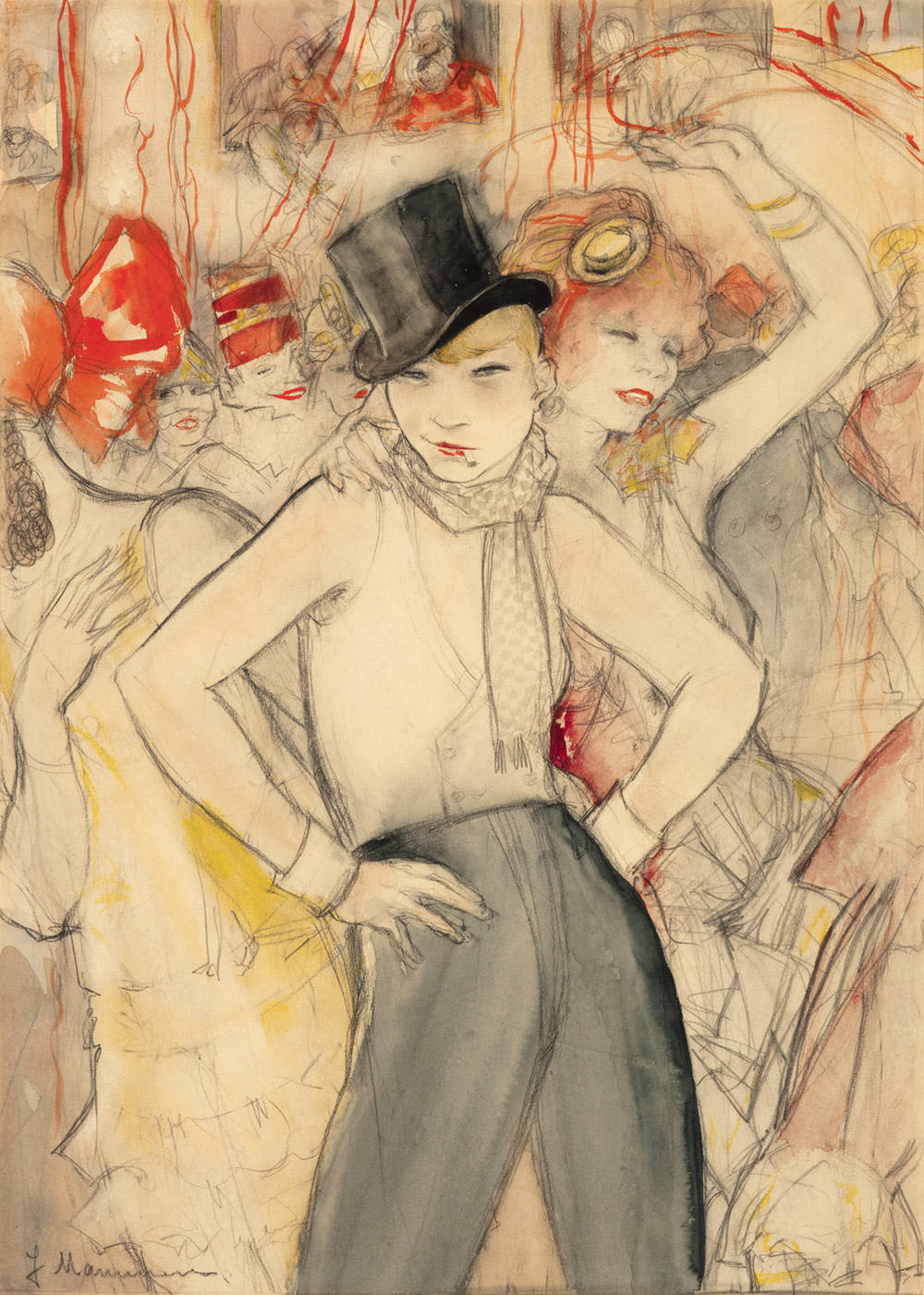
 

Jeanne Mammen (German, 1890-1976) 'She represents!' 1928


Jeanne Mammen (German, 1890-1976)
She represents!
1928
(In: Simplicissimus, 32, Nr. 47)
Three-colour print on paper
38.5 × 28cm
Stiftung Stadtmuseum Berlin, Jeanne Mammen Stiftung
© VG Bild-Kunst, Bonn 2022
Reproduction: Mathias Schormann


Fatale styles

Garçonne style

Black top hat slanting one way, cigarette slanting the other, red lips, short hair, men’s suit, challenging pose: this is how Berlin artist Jeanne Mammen saw the “New Woman” in the wild 1920s, the “garçonne” (feminine form of the French “garçon”, boy). She got rid of the corset, and with it the expectations of how women should dress or behave.

Snakes

Snakes are the perfect accessory to signal danger and seduction at the same time. Pure sex appeal! Remember: in the Bible, it is the nasty snake that persuades Eve to nibble from the tree of knowledge, and afterwards Adam and Eve are suddenly ashamed of being naked but also find it somehow exciting … Women are called snakes when they are considered manipulative and use their sex appeal to seduce men who supposedly don’t really want that. The combination of the naked female figure and snakes is particularly popular in the 19th century, when women had hardly any social power or status, but started rebelling against that. Strange coincidence, isn’t it?

Long flowing hair

Long Flowing Hair is considered a symbol of absolute femininity and seduction par excellence in nineteenth-century paintings. If it is shaggy or even made of snakes (beware: Medusa head!), this is supposed to indicate that its wearer is morally depraved. Conversely, in the twentieth century, short hair usually stands for emancipation from outdated gender images and for a free, sometimes queer sexuality.

Mirrors

“Women see themselves being looked at,” wrote the English art critic John Berger. Women looking at themselves (narcissistically) in the mirror in paintings are meant to prove the vanity of the female sex. Yet these paintings rather prove the dominance of the male gaze that turns women into objects through its constant scrutiny or even surveillance. Some say that the mirror in the paintings has now been replaced by computer or smartphone screens, in which especially women are reflected for the male gaze on social media. Do you see it that way too?

Doing Feminism – With Art! booklet to the exhibition


Franz von Lenbach (German, 1836-1904) 'Serpent Queen' 1894


Franz von Lenbach (German, 1836-1904)
Serpent Queen
1894
Oil on canvas
123 × 106cm
Kunstsammlung Züll, Sankt Augustin
© Kunstsammlung Züll, Sankt Augustin


Gerda Wegener (Danish, 1886-1940) 'Lili Elbe' c. 1928


Gerda Wegener (Danish, 1886-1940)
Lili Elbe
c. 1928
Watercolour

Please note: This watercolour may not be in the exhibition but Wegener’s paintings are mentioned in the exhibition text (above)


Gerda Wegener (Danish, 1886-1940) 'Lili with a Feather Fan' 1920


Gerda Wegener (Danish, 1886-1940)
Lili with a Feather Fan
1920

Please note: This art work may not be in the exhibition but Wegener’s paintings are mentioned in the exhibition text (above)


Gerda Wegener (Danish, 1886-1940) 'Queen of Hearts (Lili)' 1928


Gerda Wegener (Danish, 1885-1940)
Queen of Hearts (Lili)
1928

Please note: This art work may not be in the exhibition but Wegener’s paintings are mentioned in the exhibition text (above)


Sylvia Sleigh (American born Wales, 1916-2010) 'Lilith' 1967


Sylvia Sleigh (American born Wales, 1916-2010)
Lilith
1967
Acrylic on canvas
274.6 × 152.4cm
Rowan University Art Gallery, Glassboro, New Jersey
© Estate of Sylvia Sleigh
Foto: Karen Mauch Photography/Rowan University Art Gallery


Is There such a Thing as a non-binary Gaze?

The non-binary gaze does not exist! As long as we are living in a society dominated by men, there can be no non-binary gaze. Because it is not our own gender identity that decides how we look at others, but the system in which we live. And that, all over the world, is still patriarchy. So as long as we are living in social structures in which humanity is divided binarily into male and female, we cannot escape this gaze. For this, it does not matter where on the gender scale we locate ourselves, whether we characterise ourselves as male, female, non-binary or whatever. To have a female gaze, we would have to live in matriarchy. Therefore, under the global domination of male capitalist structures, there can be no queer, no trans (siehe LGBTQIA), no Black Gaze, because all these identities continue to be marginalised and discriminated against. Gazes, especially in art, are always connected with power, with external determinations, with conditioning. There can be no non-binary gaze for the sole reason that it would not classify living beings into different sexes, would not categorise them. In the required non-binary form of society – which would be interested in the equality of the different – this form of exercising power would not even exist.

But there would still be gazing wouldn’t there? Or does it mean that for that reason alone there can be no non-binary gaze?

The non-binary gaze is the future!

The male gaze divides people into men and women, into those who look and those who are looked at, into the active and the passive, into subjects and objects. The non-binary gaze abolishes “gender” as a distinguishing feature altogether because it has no interest in this type of category. Neither living beings nor anything else like colours, styles or smells are assigned to a single gender, but exist only for and from themselves. Individual features such as lipstick, stubble or breasts are not read as indicators of gender, but are perceived impartially and without this filter in their specific properties, such as shape, colour, structure etc. Therefore, this gaze does not exert any power, because it does not classify and evaluate what is being looked at into any existing categories. It does not look from top to bottom, not from bottom to top, not at individual parts or the overall view, but it does all this simultaneously with everyone, the gazers as well as those gazed at. The non-binary gaze has the power to destabilise our entire world order, because qualities and characteristics can now be perceived in a completely new way, without prejudices and evaluations. For this concerns not only human bodies but all forms of being that we can imagine.

Actually, it is interesting that we not only classify people, but also, for example, shapes – angular vs round – or smells – tart vs sweet – according to gender.

Doing Feminism – With Art! booklet to the exhibition


Maria Lassnig (Austrian, 1919-2014) 'Woman Power' 1979


Maria Lassnig (Austrian, 1919-2014)
Woman Power
1979
Oil on canvas
182 x 126cm
Albertina Wien – The ESSL Collection
© VG Bild-Kunst, Bonn 2022
Foto: Peter Kainz


Deconstructing, appropriating and retelling: abolishing the image of the femme fatale

The fight against the traditional image of the femme fatale began at the latest with the emergence of feminist art in the 1960s: feminist avant-garde artists challenged such outdated notions of women and began creating their own new narratives of femininity, sexuality and physicality. Self-portraiture and self-presentation, especially in the medium of photography, takes on a particular significance in the creation of self-empowering images of one’s own body. Female artists find many different ways to deal with the clichéd image of the femme fatale. Deconstructive approaches by artists such as Ketty La Rocca have contributed a great deal to dismantling this image, as have ironic and subversive appropriations by the likes of Birgit Jürgenssen. Other female artists reimagine the mythological figures who were long depicted as femmes fatales, presenting them, as Francesca Woodman did, in subtly restaged scenarios; depicting them as powerful goddesses – as seen, for example, in the works of Mary Beth Edelson; or, like Sylvia Sleigh, situating them outside the boundary of binary gender. Arresting representations of female corporeality, meanwhile, such as those created by Maria Lassnig and Dorothy Iannone, provide positive images that leave the narrative of demonic, deadly female sexuality far behind them.


Gender & Role Clichés

What does gender mean?

Gender describes the social, lived, perceived sex of a person. Gender is an English term, but is also used in German, precisely when it comes to social characteristics and gender identity. Gender is not limited to what is assigned to us at birth on the basis of physical characteristics (sex) but rather refers to socially constructed attributes, opportunities and relationships.

The teacher who says to you: “Well, your handwriting doesn’t look like that of a girl.” The colour pink is for girls and women, just like dresses and skirts; the colour blue and trousers are for boys and men. The latter should not cry, that would be weak. So, better for them to suppress their feelings? But then there is the saying “Boys will be boys”, meaning that’s just the way they all are. Boys are seen as wild and rebellious, girls as calm and understanding. But these are not biological traits; it’s the way we were brought up in a system of patriarchy. So, boys are allowed to get away with more, while girls are expected to put up with a lot of things. Role stereotypes hurt and reduce us all and press us into categories. Because they say: all people in a group should behave in the same way – which is pretty absurd.

Doing Feminism – With Art! booklet to the exhibition


Francesca Woodman (American, 1958-1981) 'Untitled, 1975-1980' 1975-1980


Francesca Woodman (American, 1958-1981)
Untitled, 1975-1980
1975-1980
Gelatin silver print

Please note: This image may not be in the exhibition but Woodman’s photographs are mentioned in the exhibition text (above)


Francesca Woodman (American, 1958-1981) 'House #4', Providence, Rhode Island, 1976


Francesca Woodman (American, 1958-1981)
House #4
Providence, Rhode Island, 1976
Gelatin silver print

Please note: This image may not be in the exhibition but Woodman’s photographs are mentioned in the exhibition text (above)


Nan Goldin (American, b. 1953) 'C performing as Madonna, Bangkok' 1992


Nan Goldin (American, b. 1953)
C performing as Madonna, Bangkok
1992
Archival pigment print, ed. #2/25
76.2 × 114.3cm
Courtesy of the artist and Marian Goodman Gallery, New York
© Nan Goldin


The varied afterlife of the femme fatale: contemporary (counter-)images

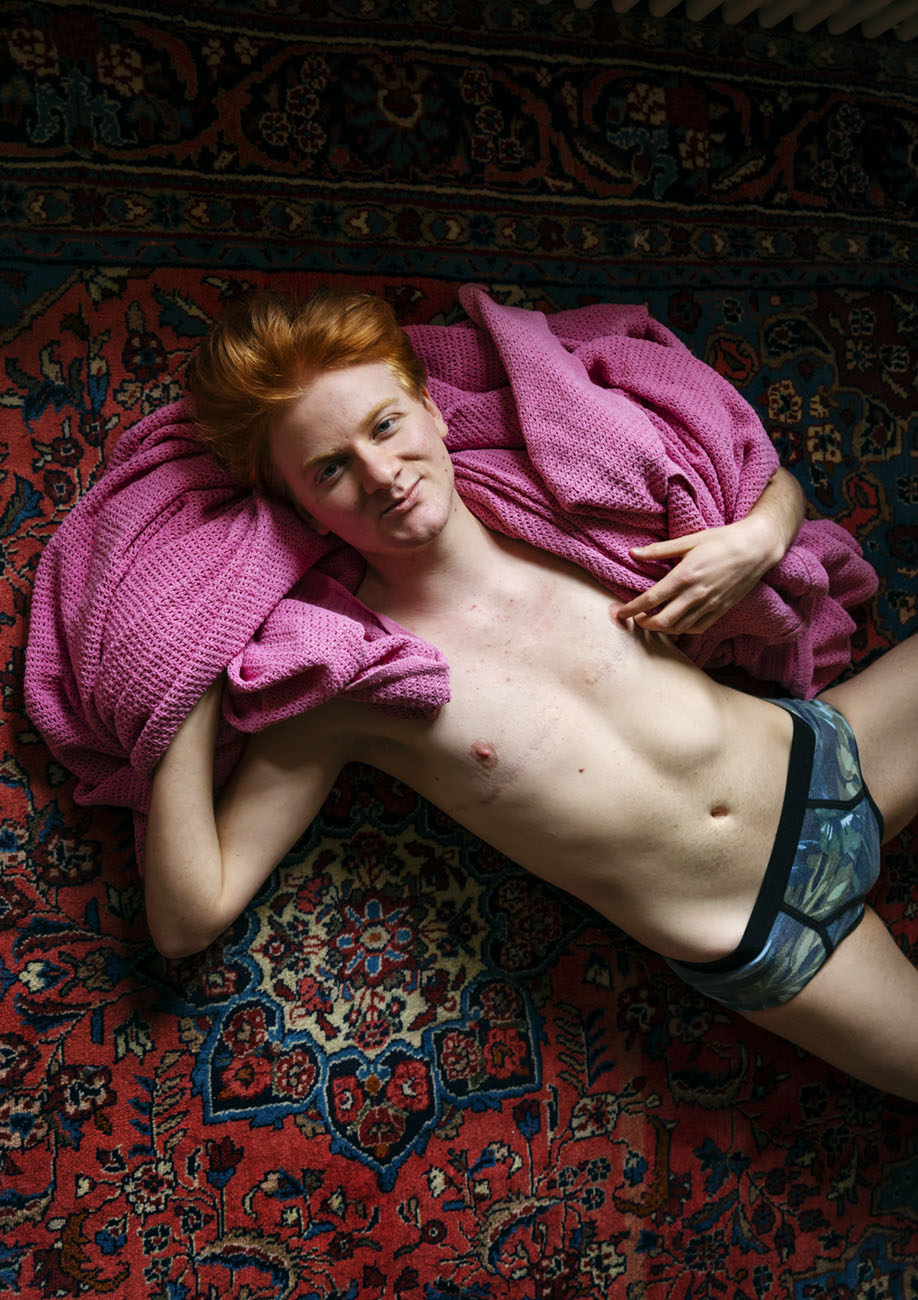
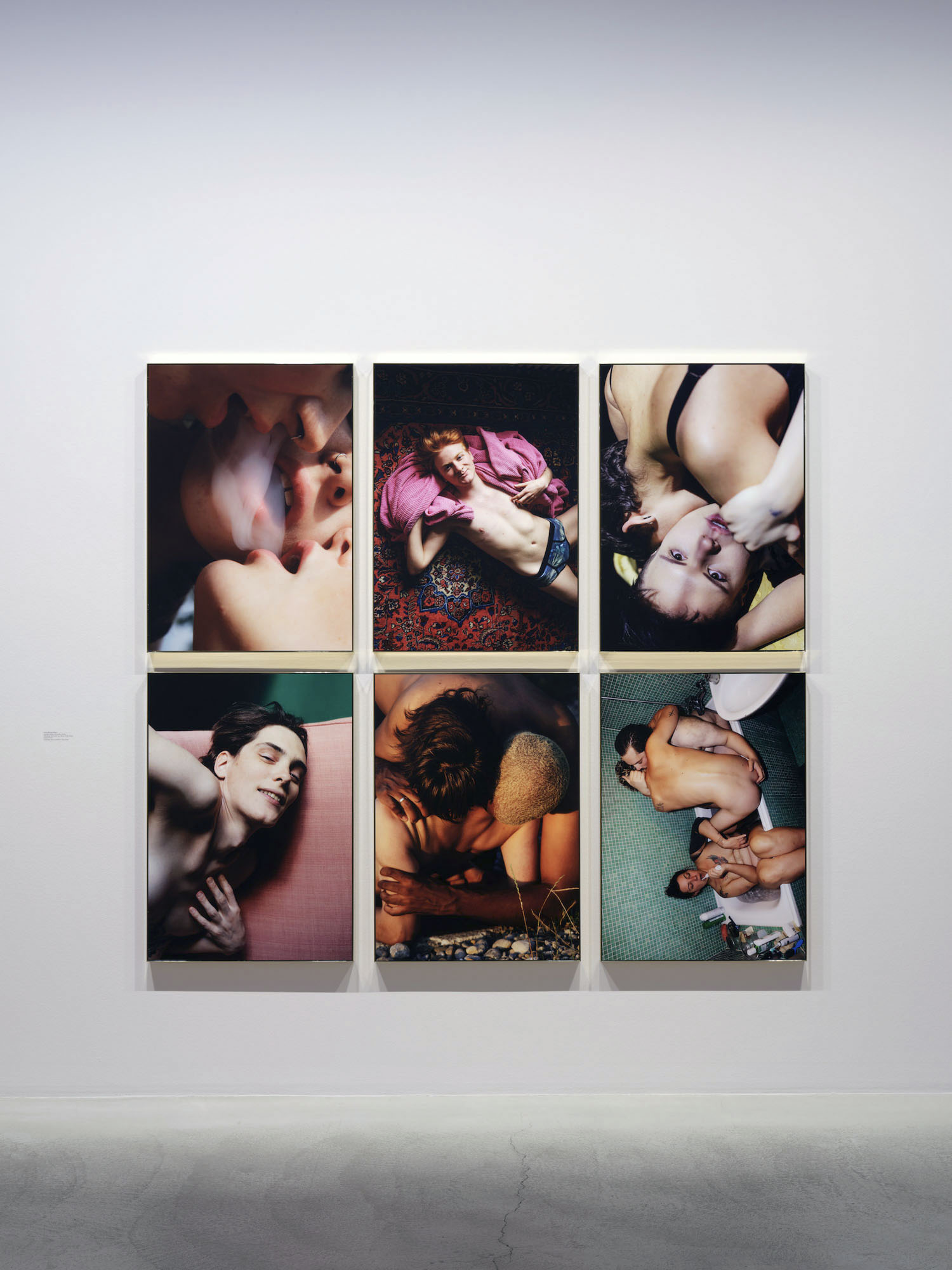
Nowadays there is no single, unambiguous vision of the femme fatale, and the counter-images are equally multifaceted. Artists examine traces of the clichéd concept, explore representations and adaptations of the femme fatale trope, reflect on the male gaze in art history, and consider gender identity, female physicality and sexuality from intersectional and queer feminist perspectives. In Jenevieve Aken’s work, for example, the ‘super femme fatale’ is a positively connoted, liberated (identificatory) figure who defies the constraints of a patriarchal society. Nan Goldin’s photographs show drag queens appropriating iconic figures who have long been stylised as femmes fatales, such as Marilyn Monroe or Madonna. In a similar way, Goldin’s video works place the mythological figures of Salome and the Sirens in new contexts. Betty Tompkins’ series of images highlight the fact that female sexuality is still being demonised today; her complex combinations of words and images reveal the continuities in a violently patriarchal art field, up to and including the #MeToo movement. Important counterpoints are also provided by artists such as Mickalene Thomas and Zandile Tshabalala, who deal with female beauty, physicality and sexuality through critical engagement with a white art canon.

Text from the Hamburger Kunsthalle website


Insectionality / Black Feminisms

Black women who are simply portrayed leading their everyday lives, without being reduced to their suffering or racial trauma experiences – unfortunately, this is a rarely shown image. The woman in the painting Lounging 1: G fabulous [below] is unmistakably depicted as Black. Next to her is a soft bathrobe. She is relaxing in a room with pompous wallpaper, on a fluffy carpet in front of a glamorous couch. Her material possessions, together with the fact that she is resting, are markers of luxury. For in the system of white supremacy, Black women are expected to live in a “hustle and grind culture”, where they continually have to prove themselves and try twice as hard as their white counterparts. Resting as a form of resistance is thus understood as a counter-movement and a radical political practice against social injustice. The slogan “rest is resistance” became famous on social media through the organisation The Nap Ministry. Though the woman in Lounging 1: G fabulous is nude, she is not depicted in a voyeuristic or sexist way – as Black women are in many works of European and American art history. The power of the gaze no longer lies with a voyeur, but in this case emanates from the sitter. Despite her nakedness, the image is in no way about conforming to a male gaze. The woman in the work simply shows herself as she is.

Likewise, Jenevieve Aken’s series The Masked Woman [below] is about self-fulfilment. Her self-portrayals show everyday scenes from the life of a woman in Nigeria who has decided against the role of the subordinate housewife. Instead, she leads a contented solo life as a “super femme fatale” – as she writes herself. A decision for a lifestyle that is not nearly as socially prestigious as living in a bourgeois nuclear family. Both works create new self-designations and show how extensive and multi-layered Black female identities are.

Doing Feminism – With Art! booklet to the exhibition


Zandile Tshabalala (South African, b. 1999) 'Lounging 1: G fabulous' 2021


Zandile Tshabalala (South African, b. 1999)
Lounging 1: G fabulous
2021
Acrylic and mixed media on canvas
120 × 200cm
Courtesy Privatsammlung Saskia Draxler und Christian Nagel
© Zandile Tshabalala / Privatsammlung Köln / Galerie Nagel Draxler Berlin / Köln / München


Jenevieve Aken (Nigeria, b. 1989) 'The Masked Woman' 2014


Jenevieve Aken (Nigeria, b. 1989)
The Masked Woman
2014
Photographs seven-part series
Courtesy of the artist
© Jenevieve Aken


The Masked Woman is a self-portrait series that explores representation of gender in Nigeria society through a performative lens. It attempts to avert the overarching male gaze by facing it head on with the artist’s own actions and choices. The images portray the solitary lifestyle of the “super femme fatale” character, choosing to achieve pleasure and contentment through self-fulfilment that not dictated by the subservient role as a house wife or defined through a man’s affection. While depicting a confident and sexually free woman, the subject’s mask and body language also suggest a nuanced tone of isolation which speaks to her stigmatization in a society that has limiting and strictly defined roles of what the proper woman should be. By diverting the status-quo and exercising freedom of choice, such women are perceived as extreme, eccentric, and outside of polite society in Nigeria. The series personifies a growing number of independent, professional women in Nigeria who at once assert their autonomy while also being ostracized by cultural norms. Rather than waiting for the narrative to be told from the outside, I choose to give birth to my own freedom, in hope that it will inspires other women in Nigeria to express their independence and free-will.

Jenevieve Aken. “The Masked Woman,” on the Jenevieve Aken website Nd [Online] Cited 04/03/2023


Jenevieve Aken (born 1989) is a Nigerian documentary, self-portrait and urban portrait photographer, focusing on cultural and social issues. Her work often revolves around her personal experiences and social issues surrounding gender roles. …


The Masked Woman

This is a black and white, self-portrait series meant to depict women and their social roles in Nigerian culture. The images depict the peace and self-fulfilment of a woman without the stigmatised overarching views of women in a Nigerian culture. The images also explore how women can feel constrained by the stereotypes of what a “proper women” should act like in society. These photos are meant to exemplify women who have broken these stigmas but feel isolated by the norms of the society. In this series Aken hopes to inspire Nigerian women to practice their freedom regardless of external stereotypes.

Text from the Wikipedia website


Myth & Religion

Lilith

Lilith was the first in various respects. Apparently, not only the Adam’s first wife who lived equally with him in the Garden of Eden, but also the first feminist, because she simply flew away when he demanded submission from her. Conveniently, as recorded in older Babylonian accounts, she was a hybrid being and had wings. Others imagined her as a hybrid between a woman and a serpent. Unfortunately, as a woman who was sexually independent, she evidently did not have a good image among the patriarchy, for she was said to bring sickness and death, to seduce and kill men, be infertile and kill newborn babies with the poisonous milk from her breast. In Jewish feminist theology, however, she stands for wisdom and strength because she was the first being to convince God to tell her his name – granting her unlimited power.

Judith

Judith is described in the Old Testament as a beautiful, wealthy and, besides this, pious widow who defended her Jewish homeland against the seizure by the Assyrian general Holofernes. She saved her mountain village of Bethulia by trusting in God completely and impressing Holofernes with her charm and wise speeches, so that she was able to sneak into his confidence. On the 40th day of the occupation, there was a celebration in Judith’s honour at which Holofernes got so drunk that Judith was able to cut off his head with her sword. The Assyrians left in horror and Judith retired to her quiet widowhood. Thanks to her deed, the overall trust in God was so great that no one could shake the Israeli community for a long time. In the Western world, the figure of Judith was often used as a motif in art, from the nineteenth century onwards with an increasingly eroticising, orientalising and anti-Semitic undertone. Judy Chicago, on the other hand, showed her as a feminist icon in her famous installation Dinner Party in the 1970s.

Medusa

Today, Medusa is mainly known for her extravagant hairstyle consisting exclusively of live snakes. How did this come about? There exist several variants of her story in Greek mythology, but the best known says that Pallas Athena happened to witness her husband Poseidon raping the beautiful Medusa. Instead of helping her and imprisoning him, she disfigured the rape victim forever by conjuring up: snakes on her head, pigs’ teeth, scaly skin, arms made of bronze and a tongue hanging out. Anyone who caught sight of her would henceforth turn to stone in horror. The artistic representation of the terrifying snake’s head has fascinated artists since ancient times, and even today it plays a role in films, games or even the logo of the Versace fashion label. It appears to be the perfect antithesis to the Western ideal of women – evil, tough and ugly – and, according to some research, could represent the transition from matriarchy to patriarchy, which went hand in hand with the demonisation of female strength.

Salome

Salome, who features prominently in the New Testament, albeit without being named, became famous for a dance: she danced so impressively and seductively at a feast that her powerful stepfather Herod assured her that he would grant her any wish in return. Her mother Herodias whispered in her ear what she wanted: the head of her adversary John the Baptist, who had publicly criticised the illegitimate marriage between her and Herod and thus humiliated her. The cut-off head was presented on a platter. In the nineteenth century, art was obsessed with this female figure, generally depicted as a lightly to barely clothed vamp who, because of her enthralling sex appeal, could only cost men their lives.

Madonna

When it comes to the idealisation of femininity, nearly everything conceivable in Christian societies comes together in the image of the Madonna figure. Since the first appearance of Madonna portraits from the second century onwards, the Mother of God has been painted as an absolute symbol of a pure, innocent and self-sacrificing femininity, typically one including and suggesting motherliness. Mostly, she is shown in these pictures with the little Child Jesus in her arms or lap. The figure Mater dolorosa, meaning Mother of Sorrows, refers to the pain of childbirth and the lifelong care of a child (particularly a divine one). But there are also other, sometimes surprising expressions and variations of these representations: for example, the Madonna lactans, a nursing Madonna with visible breast, the Black Madonnas or Madonnas with a body-encompassing, almond-shaped corona shaped like a vulva.

However, a Madonna is not always staged in a supernatural, maternal manner. She can also be depicted somewhere between the extremes of ‘saint’ or ‘whore’.

Doing Feminism – With Art! booklet to the exhibition


Franz von Stuck (German, 1863-1928) 'Head of Medusa' c. 1892


Franz von Stuck (German, 1863-1928)
Head of Medusa
c. 1892
Pastel on paper
26.5 × 32.5cm
Private collection
Courtesy Kunkel Fine Art, München
© Privatsammlung


Gustave Moreau (French, 1826-1898) 'The Apparition' After 1875


Gustave Moreau (French, 1826-1898)
The Apparition
After 1875
Oil on canvas
142 × 103cm
Paris, Musée Gustave Moreau
© bpk I RMN – Grand Palais I René-Gabriel Ojéda


Edvard Munch (Norwegian, 1863-1944) 'Madonna' 1895


Edvard Munch (Norwegian, 1863-1944)
Madonna
1895
Oil on canvas
90 × 71cm
Hamburger Kunsthalle, permanent loan of the Stiftung Hamburger Kunstsammlungen, acquired 1957
© SHK / Hamburger Kunsthalle / bpk
Public domain


Birgit Jürgenssen (Austrian, 1949-2003) 'Untitled (Olga)' 1979


Birgit Jürgenssen (Austrian, 1949-2003)
Birgit Jürgenssen Untitled (Olga)
1979
SX 70 Polaroid
10.5 x 8.7cm
© Birgit Jürgenssen, Estate Birgit Jürgenssen / VG Bild-Kunst, Bonn 2022; Courtesy Galerie Hubert Winter
Foto: pixelstorm


Birgit Jürgenssen (1949-2003) was an Austrian photographer, painter, graphic artist, curator and teacher who specialised in feminine body art with self-portraits and photo series, which have revealed a sequence of events related to the daily social life of a woman in its various forms including an atmosphere of shocking fear and common prejudices. She was acclaimed as one of the “outstanding international representatives of the feminist avant-garde”. She lived in Vienna. Apart from holding solo exhibitions of her photographic and other art works, she also taught at the University of Applied Arts Vienna and the Academy of Fine Arts Vienna.

Text from the Wikipedia website


With the epoch-spanning exhibition Femme Fatale: Gaze – Power – Gender, the Hamburger Kunsthalle is dedicating itself for the first time to diverse artistic treat-ments of the dazzling and clichéd image of the femme fatale. The stereotype of the erotic and seductive woman who holds men in her thrall, ultimately leading them to their downfall, has long been shaped by the male gaze and by a binary understanding of gender. The show will focus on various artistic manifestations of this theme dating from the early nineteenth century to the present while critically examining its origins and transformations: What historical changes and subsequent appropriation processes has the image of the femme fatale undergone? What role does it still play today? How do contemporary artists negotiate the gaze, power and gender constellations this image evokes in an effort to shift our perspective? The exhibition explores these questions based on some 200 exhibits across diverse media. On display are paintings by Pre-Raphaelite artists (Evelyn de Morgan, Dante Gabriel Rossetti, John William Waterhouse) as well as works of Symbolism (Fernand Khnopff, Gustave Moreau, Franz von Stuck), Impressionism (Lovis Corinth, Max Liebermann), Expressionism and New Objectivity (Dodo, Oskar Kokoschka, Jeanne Mammen, Edvard Munch, Gerda Wegener). Early feminist avant-garde artists (VALIE EXPORT, Birgit Jürgenssen, Maria Lassnig, Betty Tompkins), alongside recent works taking intersectional and (queer) feminist approaches (Jenevieve Aken – Philipp Otto Runge Foundation Fellow, Nan Goldin, Mickalene Thomas, Zandile Tshabalala) build a bridge to the present day. Among the paintings, drawings, prints, photographs, sculptures, installations and video works on view are a wealth of high-ranking international loans as well as major works from the collection of the Hamburger Kunsthalle. Highlights include Gustave Moreau’s major Symbolist work Oedipus and the Sphinx (1864), Edvard Munch’s painting Vampire in the Forest (1916-1918), Sonia Boyce’s much-discussed video installation Six Acts (2018), and Nan Goldin’s recent video works Sirens (2019-2021) and Salome (2019).

The “classical” image of the femme fatale was inspired mainly by biblical, mythological and literary figures (such as Judith, Salome, Medusa, Salambo and the Sirens) that were associated in art between 1860 and 1920 with the notion of mortal danger. Combining the feminine ideal with ominous portents, these pictures, often featuring stylised protagonists, convey a demonisation of female sexuality. Around 1900, this female image was increasingly projected onto real people, in particular actors, dancers and artists (such as Sarah Bernhardt, Alma Mahler and Anita Berber). Striking in this context is the simultaneous advancement of women’s emancipation and an upsurge in images of the femme fatale. The exhibition therefore also takes a look at the ideal of the New Woman that emerged in the 1920s as a counter-image that subtly takes up aspects of the femme fatale. Equally telling is the caesura that feminist artists brought about starting in the 1960s by radically deconstructing the myth and, with it, entrenched points of view and pictorial traditions. Contemporary artistic positions in turn address questions of gender identity, female corporeality and sexuality as well as the #MeToo movement and the male gaze. They track the traces and transformations of the image of the femme fatale or in other cases establish explicit counter-narratives.

The exhibition is accompanied by a particularly extensive art education programme: In addition to a diverse range of guided tours including livestreams of curator talks, a chatbot module will debut that lets visitors enter into a dialogue with six femme fatale figures from the art-works on view. A text-based dialogue system using artificial intelligence playfully tells background stories about the works and their artists. Developed jointly with the Stadtteilschule am Hafen, this module specifically addresses a younger target group. The Hamburger Kunsthalle is also offering audio descriptions for the first time. For selected exhibits, supplementary tactile copies are provided, which give people with visual impairments a way of accessing the exhibition independently by feeling contours. More audio tours are available in the Hamburger Kunsthalle app: for adults in German and English, for children from 8 years and older, and in simple language (both German). On the 4th Thursday of each month, a Salon fatal will dedicate itself to socially relevant topics that tie into the exhibition such as sexuality and the construction of beauty ideals. The salon will take the form of a reading, performance, panel discussion, concert or workshop, featuring changing guests. In cooperation with the Hamburger Kunsthalle, the Metropolis Kino is showing a film series on the theme of the femme fatale – from silent films to recent productions.

A free companion booklet, produced in collaboration with Missy Magazine, opens up intersectional and (queer) feminist perspectives on the show. The exhibition theme will also be explored in interdisciplinary depth in the accompanying catalogue (Kerber Verlag), scheduled for publication in early 2023. The catalogue will be available for 39 euros in the museum shop or for the bookstore price of 50 euros at http://www.freunde-der-kunsthalle.de.

Press release from Hamburger Kunsthalle


Birgit Jürgenssen (1949-2003) 'Untitled (Self with pelts)' 1974/1977


Birgit Jürgenssen (Austrian, 1949-2003)
Untitled (Self with pelts)
1974/1977


Blickmacht

The exhibition Femme Fatale: Gaze – Power – Gender is dedicated to the myth of seductive, ominous femininity – and its deconstruction. This is an extract from Ina Hildburg-Schneider in conversation with the exhibition organisers Markus Bertsch and Ruth Stamm translated from the German by Google Translate:


Do the artists of the time deal with their fears of the early emancipatory movements in the 19th century by depicting the femme fatale?

Stamm: I believe that the picture has something to do with a growing women’s movement in the 19th century, which became more and more institutionalised from 1865 – right up to women’s suffrage. This is exactly the time when the classic femme fatale images are created. But that’s not all. There are also a number of other aspects, further emancipation movements, but also associated fears and projections. Orientalism and anti-Semitism in particular play a role in the femme fatale image.

Bertsch: And the self-perception of the man has also been very different over time. This is often overlooked. There is the age of decadence in France, in which the male artist sees himself as frail and in this way stylises himself as the victim of the apparently overpowering women. Whether this is a firm conviction or a staging remains to be seen. The structure was immensely complex and allowed very different, sometimes contradictory readings of the femme fatale.

At the beginning of the 20th century, the role models for depicting the femme fatale changed. Now the works of art show “real” women. Who do you think of first?

Bertsch: I’m thinking of Sarah Bernhardt, Alma Mahler, Anita Berber. Suddenly living people were referred to as “femmes fatales”. They sometimes even adopted the characteristics of a femme fatale themselves – or, as in the case of Alma Mahler, they were the product of an obsession. Yes, Oskar Kokoschka went particularly far with his admiration for Alma Mahler. This is documented by a photo series in the exhibition.

Stamm: Kokoschka had a fetish doll made by the doll maker Hermine Moos after Alma Mahler, according to his very specific, sometimes explicitly physical ideas. However, his wish for a doll that was as lifelike as possible was not fulfilled – the result disappointed him greatly. The photos in our exhibition show the doll, which served as his model many times, draped in various poses. After Kokoschka had created a number of paintings and drawings based on the doll, some of which brought life to life, the story ended with its violent destruction. Ultimately, in this way, Kokoschka got rid of the figure of Mahler, which he stylised, obsessively sought out and at the same time demonised.

Is the First World War a turning point in the history of the motif?

Bertsch: I think so. Everything that was previously present as a mythical reference dissolves, and art faces the current political and social realities more strongly. Certain images of femininity are being phased out. The classic type of femme fatale is eroding and disappearing.

The “New Woman” developed in the interwar period – is she the female interpretation of the femme fatale?

Stamm: The New Woman was not a concrete antithesis to the femme fatale, but a new, quite stylised, emancipated image of women that developed with the growing women’s movement. In fact, this ideal was only lived by very few women from rather elitist circles who could afford it. The “type of woman” with bob haircuts and cigarettes that accompanies this has been reflected all the more in art and of course offers a completely different narrative than the femme fatale.

Jeanne Mammen is one of the early 20th century artists on display. She was educated in Paris and Brussels. Some of the sheets shown were created there. Can she create a “Homme fatale” with the heart stabber (Herzensstecher)?

Bertsch: She definitely does. The Herzensstecher is a figure that already fascinated me in the 2016 exhibition in Frankfurt, and that can be read as a counterpart to the overpowering femme fatale motif. Mammen is a very independent artist who brought together many spheres of influence in her work and had important teachers in Brussels in Jean Delville and Fernand Khnopff, both of whom are represented in our exhibition. Both of them addressed the relationship between the sexes in their art and in some cases already created androgynous figures. Mammen dealt productively with this symbolist heritage, but created independent, deviating images of masculinity and, above all, of femininity.

Markus Bertsch heads the 19th Century Collection at the Hamburger Kunsthalle and is curator.

Ruth Stamm is project assistant for the exhibition Femme Fatale: Gaze – Power – Gender.

Ina Hildburg-Schneider is an art historian and has been an editor at the Friends of the Kunsthalle since 2022.

Ina Hildburg-Schneider. “Blickmacht,” on the Freunde Der Kunsthalle website Nd [Online] Cited 03/03/2023


Dorothy Iannone (American, 1933-2022) 'The Statue Of Liberty' 1977


Dorothy Iannone (American, 1933-2022)
The Statue Of Liberty
1977
ColoUr silkscreen on paper
32 9/10 × 23 3/5 in (83.5 × 60cm)


Dorothy Iannone (August 9, 1933 – December 26, 2022) was an American visual artist. Her autobiographical texts, films, and paintings explicitly depict female sexuality and “ecstatic unity.” She lived and worked in Berlin, Germany. …

The majority of Iannone’s paintings, texts, and visual narratives depict themes of erotic love. Her explicit renderings of the human body draw heavily from the artist’s travels and from Japanese woodcuts, Greek vases, and visual motifs from Eastern religions, including Tibetan Buddhism, Indian Tantrism, and Christian ecstatic traditions like those of the seventeenth-century Baroque. Her small wooden statues of celebrities with visible genitals, including Charlie Chaplin and Jacqueline Kennedy, especially display with the artist’s interest in African tribal statues.

Text from the Wikipedia website


Mickalene Thomas (b. 1971) 'Racquel: Come to me' 2016


Mickalene Thomas (b. 1971)
Racquel: Come to me
2016
Rhinestones, acrylic, enamel and oil on wooden panel
274.6 × 213.7 × 5.1cm
Whitney Museum of American Art, New York;
Proposed gift from Rachel and Jimmy Levin © 2022
Digital image Whitney Museum of American Art / Licensed by Scala / VG Bild-Kunst, Bonn 2022


Glossary

Ableism

The term is derived from the English word “able” and denotes discrimination based on physical abilities. People whose bodies are deemed less “able” due to a disability or impairment, are socially and spatially excluded and devalued. An ableist society adopts a ‘healthy’ body as the norm and sees all others as (negative) aberrations. Ableism is, for example, when a person in a wheelchair is dependent on the help of others because buildings aren’t constructed barrier-free. Or when blind students at universities or educational institutions don’t have full access to all teaching materials.

Antisemitism

Hostile attitude toward Jews. It presents in various forms – from prejudice and verbal abuse to violence and murder. The gravest manifestation of antisemitism was German Nazism under Adolf Hitler, when between 1933 and 1945 more than six million Jewish people were murdered.

BIPoC

BIPoC is a political self-designation and short form for Black, Indigenous and People of Color. The short form BIPoC combines the communities referred to but also underlines their different experiences. Because of this, the term is sometimes used as an alternative for the term People of Color, to make Black people and indigenous identities explicitly visible and to emphasise that not all People of Color have the same experiences.

Black

Black is capitalised and is the politically correct and self-chosen term for Black people. The capital B emphasises social-political positioning within a society principally dominated by white people. The term Black is therefore not about biological characteristics but about socio-political affiliations. Black people are diverse and have completely diverse skin tones. As such, the term is more about highlighting the collective experiences that Black people have in this system and to emphasise their ongoing resistance.

Black Culture

The term Black Culture describes Black popular culture which deals mainly with entertainment, pleasure as well as knowledge and which is expressed via aesthetic codes and genres. It represents the identity and politics of Black cultures according to their beliefs, experiences and values. Although Black Culture encompasses all Black people worldwide, US-American Black pop culture is given the most attention.

Cis- and Transgenderism

Cis and trans are Latin words. Trans means “across” or “beyond” and, in relation to gender, refers to a person who does not identify with the sex assigned to them at birth and who experience themselves “beyond” it. Cis is, in a sense, the opposite. It can be translated as “on this side of” and indicates that someone lives within the boundaries of their assigned sex.

Classism

When recipients of state benefits are depicted as unwilling to work and unintelligent, this is an example of classism. Or when a working-class child is laughed at in university for not knowing certain trends or foreign words. Because people are not only discriminated against due to their gender and skin colour, but also because of the social and economic class they were brought up in. The term classism is even older than sexism and racism, the terms often associated with it: it was already in use in the 19th Century. Those who are poor and / or have less education due to a lack of resources are devalued in a classist society and have more difficulty accessing institutions seen as elitist.

Colonialism

Colonialism refers to a process of subjugation: one group of people goes to another group of people and imposes on it its rules, laws, language, customs, or religions in order to exploit it economically and culturally. When we speak of colonialism today, we mostly mean the process which began with the colonisation of the American continent by Europe’s ruling classes from the 15th century onwards and its negative consequences (such as racism, slavery, and exploitation) which can be still felt today.

Discrimination

Discrimination means the use of supposedly unambiguous distinctions to justify and rationalise unequal treatment. As a result of this unequal treatment, the persons discriminated against experience social disadvantages. Discrimination is an extensive system of social relationships, in which the discriminatory distinctions operate. Discrimination can therefore not be understood as a consequence of individual qualities. A by now very well known example for discrimination on a structural level is the Gender Pay Gap. This is the gap between the salaries of men and women as well as non-binary people for equal work. In 2022, women in Germany are still paid 18 percent less in terms of (gross) hourly wage than men.

Drag

The best-known examples are drag queens. A drag queen portrays, in a performative and artistic way, the appearance and behaviour of women, or rather femininity, a drag king the demeanour and outward appearance of men. This play with (exaggerated) femininity or masculinity is hence a show which is independent from the gender of the performer. The most famous drag practice is the embodiment of drag queens. These are often performed by queer men.

Empowerment

Mostly used as self-empowerment, it means to turn a disempowered situation into a more empowered one through certain actions. Often, this is a group process, for example, racially and sexually discriminated people who unite and fight for their cause and thus gain more confidence and, at best, more rights. This process may also take place symbolically, for example when young girls feel “empowered” by the encouraging writings of a feminist.

Eurocentrism

Eurocentrism means a view of the world that renders European history and so-called European principles as the primary measure of value. The term eurocentrism consequently makes evident global power relations and colonial historical thinking.

Feminism

Feminism is a social movement, which has already undergone several waves with different priorities, for example the achievement of women’s suffrage in the first wave or the legal equality of men and women in the second wave. While in the past many feminists assumed essentialist gender conceptions, meaning a clear distinction between only two genders – female and male – contemporary feminism is more inclusive. Often it no longer speaks of women but uses the term FLINTA*, which encompasses Female, Lesbian, Intersex, Trans and Agender and, with the asterisk, all others who identify as feminine. Earlier feminists had often focused on the concerns of middle-class, white, western women. But as part of an intersectional consideration of feminism, queer, PoC, trans and many more feminist voices have gained influence in recent decades. Initially, feminism was understood as the liberation of women from the patriarchy, but today it ideally refers to engagement for a world in which all forms of oppression, discrimination and exploitation will be abolished.

Gender and sex

Gender describes the social, lived, perceived sex of a person. Gender is an English term, but is also used in German, precisely when it comes to social characteristics and gender identity. Gender is not limited to what is assigned to us at birth on the basis of physical characteristics but rather refers to socially constructed attributes, opportunities and relationships.

Heteronormativity

When at day care little girls and boys, who are friends, are asked if they want one day to marry each other, this is an example of heteronormativity: a worldview in which heterosexuality is seen as the norm, as ‘normal’ and so what is desirable for everyone. A heteronormative society divides people into the binary categories of men and women, values men as more important and tends to be hostile towards queerness.

Hustle-Culture/Grind-Culture

Hustle-Culture/Grind-Culture describes a lifestyle, in which an aspiration to success and high-performance take priority. Long working hours and little rest are seen as the benchmarks of success.

Imperialism

Derived from the Latin word “imperium”, it means to pursue extended political and economic power outside one’s own (national) borders. By means of military or economic strategies, but also with the aid of culture and education, it is attempted to gain control over other countries or regions.

Intersectionality

The term intersectionality was coined in 1989 by lawyer, scholar and civil rights activist Kimberlé Williams Crenshaw. It is about the intersection and interaction of social identities and connected systems of oppression. Intersectionality focuses on the fact that people are often disadvantaged or benefit from several characteristics at once. Social, ethnic background, social and economic status as well as gender can be examples of such interconnected categories. A person may be Black and a woman, hence experiences racism and sexism. A white woman, on the other hand, experiences sexism too but benefits from her white privileges. Intersectional feminism therefore aims to recognise and make visible the multi-layered perspectives of people who experience overlapping forms of oppression.

LGBTQIA*

LGBTQIA* is an English-language collective term for ways of living and loving outside the heterosexual norm, which is now being used around the world. It is short form for Lesbian, Gay, Bi, Trans, Queer, Inter and Asexual. The asterisk stands for further identities that are perhaps not or not completely included therein, to leave no one out.

The male gaze

The male gaze is the concept of the male stare and stands for how systematically male control is applied and functions in our society. The term was coined by the feminist film theorist Laura Mulvey, who in the 1970s, brought attention to the fact that women in films were mostly represented as objects of male heterosexual fantasy.

Misogyny

Misogyny literally means “hatred of women” (from the ancient Greek: “misos” = “hate”, “gyne” = “woman”) and has been prevalent around the globe for thousands of years as a derogatory to murderous attitude towards about 50% of the world’s population.

(Non-) Binarity

If something is binary, it functions like a two-part system: there is always only the one and the other, like the two sides of a coin. Both mutually define each other. A binary gender system assumes that there are only men and women, and that everyone must belong to one of these two categories. Non-Binarity (NB) breaks up this rigid structure. Non-binary people, sometimes also called enbies (from NB), identify neither as man nor woman.

Objectification

Objectification describes the dehumanising treatment of certain people as things, hence as objects. The most common example is sexist objectification by men, who reduce women to sex-objects.

Orientalism

The term Orientalism exposes how the world has been divided into two parts: on the one side there is the supposedly modern, enlightened West, the ‘Occident’, which sees itself as the centre and protagonist of world events. The ‘Orient’ finds itself on the other side, depicted by the West as ‘backward’ and ‘unmodern’, yet at the same time as ‘exotic’ and ‘sensual’. According to the Palestinian-American literary scholar Edward Said, who published his influential book titled Orientalism in 1978, the ‘Orient’ was invented by Europeans in order to better dominate and exploit these regions.

Othering

With othering, a usually more powerful group, or individual, dissociates itself from another group characterising it as ‘alien’ and ‘different’, thus devaluing it and connoting it negatively. The group higher up in the power structure thus discriminates against the people described as ‘different’ who cannot defend themselves against these attributions.

Patriarchy

Patriarchy is a social system predominantly controlled and shaped by hetero-cis men. This means men determine the gender roles within society. Everything in the patriarchy is geared towards cis-men and they profit highly from such a system. Patriarchal structures are firmly established everywhere in our society. For example, for many in a heterosexual relationship it is still a given that the woman takes parental leave after a pregnancy to take care of the child while the father continues to work. Another example of patriarchal structures: the man is supposed to propose marriage. And after the wedding, the woman takes his name. A man’s power is thus always paramount, though emotions are denied to men. To cry, to be shy or insecure, or to take parental leave after the birth of a child – according to the patriarchy this is not how ‘real’ men behave. In this way men too are restricted by the patriarchy’s toxic masculinity.

People of Color

The term People of Color, PoC for short, is a self-designation and does not describe, like the terms Black and white, any particular skin tones. It is a matter of a position in society and an umbrella term for communities that experience marginalisation due to racism. The experienced racist discriminations vary and are far-reaching. To be asked every day “where are you from?” or be told “but your English is very good” are examples of this, as well as not being invited for a job interview because of one’s name or being threatened or attacked on the train.

Queer

If something is “queer” in English, it is actually peculiar or odd. Since the end of the 19th Century the word has been used derogatively for people who felt sexually attracted to their own gender. From the 1980s, this negative meaning was consciously and provocatively reversed by activists and the term was used positively. Today, many people who do not love heterosexually and / or live cisgendered, describe themselves as queer.

Racism

If people have to endure marginalisation or even violence because of their origin or their appearance, for example because of their skin colour or their religion, that is racism. Racism can take on many forms – for example anti- Muslim, anti-Black, or anti-Asian racism, that particularly targets these groups.

Sexism

Sexism is the discrimination against people because of their sex. “Blonde jokes”, unequal pay for equal work or unwanted wolf-whistles on the street – these are all examples of sexism. Since we still live in patriarchal societies in which men dominate, sexism affects people perceived as female. But men too can be restricted by patriarchal gender stereotypes such as “boys don’t cry” or “men don’t know about babies.”

Stereotyping

Stereotyping is the generalisation of a group of people. In the process, individuals and the differences between them are not considered. Instead, all people in this group are reduced to the same, often negative, characteristics.

Stigmatisation

Stigmatisation is a distinctly negative demarcation from other individuals or groups within a society. This may happen in interpersonal relationships, such as bullying in school, or on a structural level, when for example People of Color repeatedly experience rejection when searching for apartments, or when people with specific therapy experience are denied civil servant status. In this last case, derogatory characteristics are attributed to a mentally ill person by large sections of society, denying them full social acceptance.

White

White is the socio-politically correct description for white people. It is not a biological term, rather a position in society. The terms Black, PoC and BIPoC are capitalised because they are self-chosen terms. The term white, on the other hand, is written in lower case and often in italics. The call for concrete labelling of white, hence white people and white privileges, became louder through antiracist movements. Because being white, from a white perspective, is generally the norm. In this way, being white is often made invisible, while all non-white people are made visible and portrayed as supposedly ‘different’.

White Supremacy

White Supremacy is the ideology that white people, and all their ideas, actions and opinions are superior to those of BIPoC. White Supremacy is a self-sustaining system in that it marginalises People of Color though colonialism, exploitation and repression and so guarantees white people a continuous position of power.


This accompanying glossary is a cooperation between Missy Magazine and Hamburger Kunsthalle. It is published on the occasion of the exhibition.

Glossary

Concept and Realisation: Sonja Eismann, Melanie Fahden, Selvi Göktepe, Josephine Papke, Ruth Stamm, Andrea Weniger
Authors: Sonja Eismann, Josephine Papke
Editors: Nanda Bröckling, Melanie Fahden, Selvi Göktepe, Ruth Stamm, Andrea Weniger
English translation: Matthew Burbridge


Hamburger Kunsthalle
Glockengießerwall 20095 Hamburg
Phone: +49 (0)40-428 131 204

Opening hours:
Tuesdays to Sundays 10am – 6pm
Thursdays 10am – 9pm
Closed Mondays
Hamburger Kunsthalle website

LIKE ART BLART ON FACEBOOK

Back to top

Exhibition: ‘Documentary Genealogies: Photography 1848-1917’ at the Museo Nacional Centro de Arte Reina Sofía, Madrid

Exhibition dates: 16th November, 2022 – 27th February, 2023


Eugène Atget (French, 1857-1927) 'Sur les quais – La sieste / Les p'tits métiers de Paris' c. 1898-1900 from the exhibition 'Documentary Genealogies: Photography 1848-1917' at the Museo Nacional Centro de Arte Reina Sofía, Madrid, Nov 2022 - Feb 2023
 

Eugène Atget (French, 1857-1927)
Sur les quais – La sieste / Les p’tits métiers de Paris
On the quays – The siesta / The little jobs in Paris 

c. 1898-1900, printed 1904
Collotype
8.8 x 13.7cm
Museo Nacional Centro de Arte Reina Sofía


“While human truth may be ephemeral qualities like justice are not; the struggle is to define justice and to live it. And for artists to display it.”


Dr Marcus Bunyan


Another fascinating exhibition that extends the remit of “documentary” photography back to the earliest days of the medium and the “the empire of photography”: the rise of a new visual regime that became an instrument for the system of bourgeois, industrial and colonial culture in the second half of the nineteenth century.

In other words in the hands of the powerful (both national and personal) photography became an instrument which reinforced the entitlement and social position of the privileged while depriving the disenfranchised of a visual voice, and thus legitimacy and recognition of their plight. Photography also became the means to form a taxonomic ordering of supposed genetic deficiencies, ethnicities, criminals, homosexuals and revolutionaries, amongst others.

“The democratic promise of photography was long unfulfilled and remained, for over almost a century, an instrument in the hands of bourgeois culture and its means of representation. Thus, the portraits of the working and subaltern classes were an accidental and marginal incursion, an involuntary presence inside pictures with another intention.” (Press release)

Here I would disagree with the assertion that portraits of the working classes were an accidental and marginal incursion, an involuntary presence inside pictures with another intention. “Incursion” means an invasion or attack. “Involuntary” means done without will or conscious control. So images of the poor appear, without any conscious control, as an attack inside / against images that reinforce their prerogative meaning?

Perhaps the poor are just human beings that lived and breathed the same air as the photographer, that perchance appeared through serendipity in the images with no ulterior motive attached to their being … other than those that have been attached to their representation at a later date. Interpretations of photographs change over time and we have to think how these photographs would have been read when they were first taken.

The terms accidental and marginal are critical. In the work of politically engaged now called social documentary photographers – for example Lewis Hine, Jacob Riis, John Thomson, Hill and Adamson, O.G. Rejlander and Paul Martin – these artists captured photographs of the working classes that are neither accidental nor marginal. They are deliberate and provocative photographs taken to raise awareness of social conditions and injustice in order to bring about a change in the law (such as the anti-slavery laws and child labor laws in the United States) or a change in social conditions of the poor such as the state of slum housing  or tenement house evils for example.

There is nothing marginal about these photographs, no margin in which to ostracise, nor any accident of inclusion, for the human beings in them are placed front and centre before the public ‘in order’ to expose an immorality or injustice that was supposed to be hidden from view.

Dr Marcus Bunyan


Many thankx to the Museo Nacional Centro de Arte Reina Sofía for allowing me to publish the photographs in the posting. Please click on the photographs for a larger version of the image.


“During the 1830s, a period covered by [the novel] Middlemarch, much was changing in terms of class/social structure. During the Victorian era, the rates of people living in poverty increased drastically. This is due to many factors, including low wages, the growth of cities (and general population growth), and lack of stable employment. The poor often lived in unsanitary conditions, in cramped and unclean houses, regardless of whether they lived in a modern city or a rural town. Victorian attitudes towards the poor were rather muddled. Some believed that the poor were facing their situations because they deserved it, either because of laziness or because they were simply not worthy of fortune. However, some believed it was up to personal circumstances. It is important to note that many charities have their roots from this era in English history, because of how overwhelming the issue of poverty became at this time.”


Anonymous. “The life of the poor in Victorian England,” on the Cove website Nd [Online] Cited 23/02/2023


Installation view of the exhibition 'Documentary Genealogies: Photography 1848-1917' at the Museo Nacional Centro de Arte Reina Sofía, Madrid showing at centre Lewis Hine exhibition panels 1913-1914

At centre, Lewis Hine exhibition panels 1913-1914 (see below)

Installation view of the exhibition 'Documentary Genealogies: Photography 1848-1917' at the Museo Nacional Centro de Arte Reina Sofía, Madrid

Installation view of the exhibition 'Documentary Genealogies: Photography 1848-1917' at the Museo Nacional Centro de Arte Reina Sofía, Madrid

Installation view of the exhibition 'Documentary Genealogies: Photography 1848-1917' at the Museo Nacional Centro de Arte Reina Sofía, Madrid showing at left rear, pages from Carl Dammann's '[Races of Mankind]: Ethnological Photographic Gallery of the Various Races of Men' 1876

At left rear, pages from Carl Dammann’s [Races of Mankind]: Ethnological Photographic Gallery of the Various Races of Men 1876 (see below)

Installation view of the exhibition 'Documentary Genealogies: Photography 1848-1917' at the Museo Nacional Centro de Arte Reina Sofía, Madrid

Installation view of the exhibition 'Documentary Genealogies: Photography 1848-1917' at the Museo Nacional Centro de Arte Reina Sofía, Madrid showing Wounded men from the American Civil War

Wounded men from the American Civil War

Installation view of the exhibition 'Documentary Genealogies: Photography 1848-1917' at the Museo Nacional Centro de Arte Reina Sofía, Madrid showing pages from the book 'Oriental and Occidental Northern and Southern Portrait Types of the Midway Plaisance' by N.D. Thompson Publishing Company, 1894, photographs by unknown artists, with at centre left an image of Bachibonzouk, a Greek wearing traditional Turkish needlework and embroidery reminiscent of the uniforms worn by the Sultan's officers, as seen at the World's Columbian Exposition in Chicago, Illinois, 1893

Pages from the book Oriental and Occidental Northern and Southern Portrait Types of the Midway Plaisance by N.D. Thompson Publishing Company, 1894, photographs by unknown artists, with at centre left an image of Bachibonzouk, a Greek wearing traditional Turkish needlework and embroidery reminiscent of the uniforms worn by the Sultan’s officers, as seen at the World’s Columbian Exposition in Chicago, Illinois, 1893 (see below)


Installation views of the exhibition Documentary Genealogies: Photography 1848-1917 at the Museo Nacional Centro de Arte Reina Sofía, Madrid


Documentary Genealogies. Photography 1848-1917 starts from Walter Benjamin’s remark in his essay The Work of Art in the Age of Its Technological Reproducibility (1936) on the parallel emergence of photography and of socialism. Following such parallel allows the hypothesis that the ideas and iconographies used to represent the everyday life of the working class – which is the constitutive impulse for the rise of documentary discourse and practices in the 1920s, as a specific form of filmic and photographic poetics – were already latent or active in 1840s visual culture. The seminal figure of the bootblack on Boulevard du Temple [Boulevard of the Temple, 1838], one of Louis Daguerre’s first daguerreotypes, is the first appearance of the worker in photography: the root of the historical narrative around class relations and conflicts, an axis for the documentary discourse to come.

This exhibition presents a cartography of practices related to the appearance and evolution of representations of subaltern identities – workers, servants, proletarians, beggars, the deprived – stretching from the rise of photography to the turn of the century (more specifically, between the European revolutionary cycle of 1848 and the Russian Revolution in 1917), and inside the framework termed by historian André Rouillé as “the empire of photography”: the rise of a new visual regime that became an instrument for the system of bourgeois, industrial and colonial culture in the second half of the nineteenth century. Such subaltern figures can also be understood as metaphors of Charles Baudelaire’s famous and seminal condemnation to photography which he consigned to a subordinate position, as “the servant of the arts”. The democratic promise of photography was long unfulfilled and remained, for over almost a century, an instrument in the hands of bourgeois culture and its means of representation. Thus, the portraits of the working and subaltern classes were an accidental and marginal incursion, an involuntary presence inside pictures with another intention.

Documentary Genealogies. Photography 1848-1917 closes a series that began in 2011 in the Museo Reina Sofía with the exhibitions A Hard, Merciless Light. The Worker Photography Movement, 1926-1939 and continued in 2015 with Not Yet. On the Reinvention of Documentary and the Critique of Modernism, both of which offered an alternative narrative of the rise and evolution of documentary discourse in the history of photography, based on case studies at key moments in the twentieth century. This final exhibition contributes to this narrative from a different, proto-historical perspective: an observation of the early promises and potential of photography contained in the fact that the documentary idea and function are as old as photography itself.

Text from the Museo Nacional Centro de Arte Reina Sofía website


Louis Daguerre (French, 1787-1851) 'Boulevard du Temple' Between 24 April 1838 and 4 May 1838


Louis Daguerre (French, 1787-1851)
Boulevard du Temple
Between 24 April 1838 and 4 May 1838
Daguerreotype
Public domain

This image is not in the exhibition


Boulevard du Temple, Paris, 3rd arrondissement, Daguerreotype. Made in 1838 by inventor Louis Daguerre, this is believed to be the earliest photograph showing a living person. It is a view of a busy street, but because the exposure lasted for 4 to 5 minutes (see shutter speed Daguerre photo explained) the moving traffic left no trace. Only the two men near the bottom left corner, one apparently having his boots polished by the other, stayed in one place long enough to be visible. As with most daguerreotypes, the image is a mirror image.

Text from the Wikipedia website


Unknown photographer. 'Rahlo Jammele. (Jewish Dancing Girl.)' c. 1894 from the exhibition 'Documentary Genealogies: Photography 1848-1917' at the Museo Nacional Centro de Arte Reina Sofía, Madrid, Nov 2022 - Feb 2023


Unknown photographer
Rahlo Jammele. (Jewish Dancing Girl.)
c. 1894
From the book Oriental and Occidental Northern and Southern Portrait Types of the Midway Plaisance
N.D. Thompson Publishing Company, 1894


Unknown photographer. 'Jeanette Le Barre. (French Peasant Girl.)' c. 1894


Unknown photographer
Jeanette Le Barre. (French Peasant Girl.)
c. 1894
From the book Oriental and Occidental Northern and Southern Portrait Types of the Midway Plaisance
N.D. Thompson Publishing Company, 1894


Unknown photographer. 'William. (Samoan.)' c. 1894


Unknown photographer
William. (Samoan.)
c. 1894
From the book Oriental and Occidental Northern and Southern Portrait Types of the Midway Plaisance
N.D. Thompson Publishing Company, 1894


Oriental and Occidental Northern and Southern Portrait Types of the Midway Plaisance

N.D. Thompson Publishing Company, 1894

Putnam, F. W. (Frederic Ward), 1839-1915/ Oriental and occidental, northern and southern portrait types of the Midway Plaisance: a collection of photographs of individual types of various nations from all parts of the world who represented, in the Department of Ethnology, the manners, customs, dress, religions, music and other distinctive traits and peculiarities of their race: with interesting and instructive descriptions accompanying each portrait, together with an introduction. St. Louis : N.D. Thompson, 1894.


Paul Strand (American 1890-1976) 'Blind woman, New York' 1916 from the exhibition 'Documentary Genealogies: Photography 1848-1917' at the Museo Nacional Centro de Arte Reina Sofía, Madrid, Nov 2022 - Feb 2023


Paul Strand (American, 1890-1976)
Blind Woman
Camera Work 49/50, July 1917
Photoengraving on paper
23.3 x 16.7cm
Museo Nacional Centro de Arte Reina Sofía


Lewis Hine (American, 1874-1940) 'Making Human Junk' 1913-1914 from the exhibition 'Documentary Genealogies: Photography 1848-1917' at the Museo Nacional Centro de Arte Reina Sofía, Madrid, Nov 2022 - Feb 2023


Lewis Hine (American, 1874-1940)
Making Human Junk
Exhibition panel from the National Child Labor Committee Facsimile reconstruction
1913-1914
Image courtesy of Prints & Photographs Division, Library of Congress, Washington D.C.


Lewis Hine (American, 1874-1940) 'Children's Rights vs States' Rights' 1913-1914


Lewis Hine (American, 1874-1940)
Children’s Rights vs States’ Rights
Exhibition panel from the National Child Labor Committee Facsimile reconstruction
1913-1914
Image courtesy of Prints & Photographs Division, Library of Congress, Washington D.C.


George Bretz (American, 1842-1895) Miner using coal auger, Kohinoor Colliery, Eastern Pennsylvania c. 1884


George Bretz (American, 1842-1895)
Miner using coal auger, Kohinoor Colliery, Eastern Pennsylvania
c. 1884
Albumen paper
19.5 x 23cm
Photography Collection, University of Maryland, Baltimore County


George M. Bretz (1842-1895) was an American photographer who is best known for his photographs of the Northeastern Pennsylvania Coal Region and its coal miners.

A collection of Bretz’s original glass plate negatives from the Kohinoor Mine at the Shenandoah Colliery were recently rediscovered at the National Museum of American History. Taken circa 1884, this was one of the earliest fully illuminated photo shoots in an underground mine. These photographs were displayed at the 1884 World Cotton Centennial in New Orleans, and again at the 1893 World’s Columbian Exposition in Chicago. Bretz is also known for his photos of alleged Molly Maguires, radical coal miners who fought against unfair labor practices in the coal fields. For the rest of his life, Bretz was considered an authority on coal mining, and articles about his photography were widely published.

Text from the Wikipedia website


Coal mining was central to the lives of the people in Eastern Pennsylvania especially during the era of 1870 to 1895 when photographer George M. Bretz (1842-1895) lived and worked in Pottsville, the gateway to the Anthracite Coal Mining Region. Bretz achieved distinction if not fame for his photographs related to coal mining and the people who depended upon coal for their livelihood.

Born in Carlisle, Pennsylvania, Bretz worked at local businesses in Carlisle before heading to New York City where he worked successively for two companies in 1859. Letters of reference indicated that he had become a fine young businessman. He worked briefly in 1862 for a photographer before receiving an appointment as a clerk in the quartermaster’s department of the Union Army in Tennessee during the Civil War. Although he was not on the front lines, he was close enough to the war that being captured was often on his mind. He even wrote a will describing the disposition of his body in case he was killed. Serious illness rather than capture or death took him away from the war in 1863. He was sent home to Carlisle to recuperate, and did not rejoin the service until the next year when he became a clerk in the provost marshal’s office, a job that he held until the end of the war.

Photography became Bretz’s focus after the war. He and a friend opened a studio in Newville, Pennsylvania, and continued in operation until 1867 when Bretz went to work in the studio of A.M. Allen in Pottsville. In 1870, Bretz opened his own studio in Pottsville, and made sculptures as well as photographic portraits and landscape views. Among the portraits that Bretz made were images of the alleged Molly Maguires, radical coal miners who turned to violence against unfair labor practices in the coal fields. Bretz made portraits of the alleged Mollies in 1877 on the day before the ten men were to be hanged. Such iconic photographs became the rule rather than the exception for Bretz. In 1884 at the request of the Smithsonian Institution, Bretz descended into a coal mine to photograph miners at work. Using a dynamo that had been set up in the mine, electric light was generated to provide illumination. One critic at the time wrote: “Even in direct sunshine one would hardly undertake to photograph a heap of anthracite coal.” So successful were Bretz’s photographs in the mines, that he gained notoriety for his accomplishment. The photographs were displayed at the New Orleans World’s Industrial and Cotton Centennial Exposition in 1884, and again with additional images at the 1893 World’s Columbian Exposition in Chicago. For the rest of his life, Bretz was considered an authority on coal mining and articles about him were periodically published in newspapers and photography magazines.

Anonymous. “George Bretz Collection,” on the University of Maryland, Baltimore County (UMBC) website Nd [Online] Cited 02/02/2023


Unknown photographer. 'Work scenes from the Krupp Works at Essen' Nd


Unknown photographer
Work scenes from the Krupp Works at Essen: wheel tire transport
Nd
Silver chloride gelatin
22 x 18cm
Historisches Archiv Krupp, Essen


This exhibition presents a specific cartography within the set of practices that André Rouillé termed “the empire of photography”: the new visual regime created by the rise of photography in the bourgeois, industrial, and colonial cultural system in the mid-nineteenth century. Within this new visual regime, the exhibit traces the appearance and early evolution of the representations of subaltern subjectivities: hired-hands, beggars, workers, the unemployed, slaves, prison inmates, the sick, the ill and so on. The representation of the working classes will be the emancipatory impulse for the rise of documentary discourse in the 1920s, but it appears early on as an accidental or marginal interruption, a presence running against the grain in images that have another intention altogether.

1848

The historical narrative begins with the earliest photographic images of a revolution, namely the European revolutionary cycle of 1848. Contemporary historiography cites this “Springtime of the Peoples” as the moment when the proletariat acquired class consciousness, and as the starting point of working-class political struggles. A contradictory starting point, indeed. In January 1848, Karl Marx and Friedrich Engels released The Communist Manifesto with the famous diagnosis that the specter of communism was haunting Europe – to be confirmed a month later with the uprisings in Paris. However, shortly after in The Eighteenth Brumaire of Louis Bonaparte (1852), Marx would offer a critical interpretation of 1848 as a parody of the 1789 French Revolution: great world-historic events happen twice, first as tragedy, then as farce.

Image of the People

Beginning in the 1850s, photographic campaigns documenting national monuments, such as the Heliographic Mission in France, were one of the defining drives behind the rise of the “empire of photography”. The Heliographic Mission is a paradigm of how the discourse of national historic monuments was instrumental for the ideology of the nation-state and for nationalist discourses throughout Europe. Several European countries launched their own such campaigns, the pioneer in Spain being Charles Clifford. Clifford retraced Queen Isabella II’s travels in album form, which constitute the earliest photographic statement on the Spanish nation and its heritage. However, the bourgeois nationalist ideology underlying these campaigns and albums was countered by the appearance of certain figures of alterity around the periphery of these images: servants in palaces, the Roma in the Alhambra, small trade and work scenes, beggars, and picturesque street characters who appear spontaneously alongside the architecture.

The Other Half

A second catalyst for the “empire of photography” was the spatial reorganisation of historic urban centres according to the logic and demands of industrialisation. The expansions and reforms, undertaken around 1860 in cities such as Paris, Vienna, Barcelona, and Madrid, gave rise to photography campaigns of both the old streets and medieval city walls that were being demolished, as well as of the new avenues and urban infrastructure. Most emblematic of this process was Charles Marville’s documentation of Georges-Eugène Haussmann’s renovation of Paris, which also included images of construction workers and labourers.

As a counterpoint to these photographs of grand urban redevelopments, we find the first images of the urban proletariat. In the New York of the 1880s, muckraking journalist Jacob Riis photographed the miserable conditions of the Lower East Side working-class tenements. He used the images as slides in his public lectures and published the foundational book How the Other Half Lives (1890). With a similar focus and use at public slide lectures, in 1904 Hermann Drawe photographed the Viennese underworld of vagrants and the poor, in collaboration with journalist Emil Kläger. Their reportage was also published as a book. The turn-of-the-century urban peripheries, the terrains vagues [The French term ‘terrain vague’ is used by architects and urban planners to describe forgotten spaces which are left behind as a result of post-industrial urbanisation] created by the razing of the old city walls, and their poor inhabitants, or subproletarians, were photographed by Eugène Atget in Paris, by Heinrich Zille in Berlin, and by Ferdinand Ritter von Staudenheim in Vienna.

Men at Work

The promotion of the new industrial processes, and the grand feats of engineering and infrastructure – another facet of the mid-nineteenth-century construction of the modern nation-state – were also the target of the nascent photographic visual regime. World’s fairs were the mass events that closely followed and helped spread industrialisation. They were also a means for photography to burst into the public sphere. The Great Exhibition of 1851 in London was, in this sense, a key moment. In Spain, Charles Clifford was once again a pioneer, documenting such works as the Isabella II Canal – inaugurated in 1858 to definitely solve the issue of Madrid’s water supply. It is also in this context that the first images of factory labor and industrial workers appeared. The 1890 photographic studies of workers and machinery in the Krupp steelworks in Essen are possibly the pioneering images of the kind. They laid the basis for the most influential iconographies of industrial labor of the twentieth century.

Forced labour was often employed in the grand infrastructure projects, which attests to how industrial capitalism prospered upon the radical exploitation of the working class. In fact, some images of public works and penal colonies may easily be mistaken for one another. In the daguerreotypes of the works led by engineer Lucio del Valle, a pioneer in Spain for photographic documentation of public works, we see prison labourers in chains. Convicts and enslaved labourers are to be found, as well, in images of railroad construction and other work sites during the Civil War period in the United States, and also at the turn of the century in the mines of the Russian penal colony on Sakhalin Island. As part of his production for the Fortieth Parallel Survey, Timothy O’Sullivan reported underground mining using an innovative system of lighting. It is interesting to relate these images to the enigmatic scenes of the Paris catacombs taken by Nadar, souvenirs from a hellish underworld.

The Body and the Archive

Another subtext in photography’s rise during the colonial era is its inscription in modern technologies of social discipline and governance. Photography as a technology of industrialisation was part of a new episteme in the natural and social sciences, and contributed to a new archival unconscious that was symptomatic of the hegemony of positivism. While photography in service of geological exploration had its early golden age in the surveys of the US Western territories that began in the late 1860s after the Civil War. The first such survey was of the Fortieth Parallel, led by geologist Clarence King, with Timothy O’Sullivan as lead photographer.

The immense encyclopaedic catalog of human races by German photographer Carl Dammann, published from 1874 onward, is one of the great monuments to the aspirations of positivism in the study of human diversity. Photography changed the methodology of the human sciences. Another example is the art historian Aby Warburg’s study of Hopi Indians in the US southwest in 1895, which he thought of as a journey into the ancient pagan world and led to a famous slide conference in 1923. The trip and conference were instrumental for the emergence of Warburg’s iconological method, which would change the historiography of art by introducing a cultural or anthropological approach. However, it was the work on the Trobriand Islands, by Bronisław Malinowski and his collaborators around 1900, when the use of photography in fieldwork would finally reach maturity. A series of the Trobriand people photographs would later be published, in 1922, in a book that would be essential for modern ethnography, Argonauts of the Western Pacific.

The expansion of anthropological uses of photography in the last decades of the nineteenth century ran parallel to its rise in the medical and judiciary practices. The Civil War in the US yielded a notable corpus of anatomical photographs and various catalogs of the wounded, amputees, and deceased. In Europe, Nadar had already carried out some photographic experiments on medical issues around 1860, such as his research on “hermaphroditism.” Yet the great pioneer of photography in medical experimentation would be neurologist Jean-Martin Charcot, who studied the then so-called hysteria in women and other neuropsychiatric pathologies in the Parisian Hospital de Pitié-Salpêtrière, beginning in the 1870s. His illustrated publications from the following decade had a huge influence on modern neurology. These practices emerged at the same time as the judiciary and police use of photography, and the standardisation of modern methods of photographic identification, based on the work of Alphonse Bertillon in France, Cesare Lombroso in Italy, and Francis Galton in England. Just as medical photography is inextricable from discourses on health versus pathology or on deviations from the norm, police photography produces typologies of criminal and deviant personalities.

Revolution

The 1871 Paris Commune stands as a foundational experiment in working class self-government. It would become a legendary reference for the political culture of the workers’ movement. The Commune was also the first event to generate an extensive photographic market of a revolution, one which grew from the seeds of the 1848 Parisian daguerreotypes. As a consequence, a visual grammar for the future of revolutionary iconography was set – even if the multiple images of the uprising, produced industrially as albums and souvenirs, had in fact a counterrevolutionary focus. The visual catalog of the barricades, the destruction of monuments such as the Vendôme Column, and the burning of major institutional buildings such as the Paris city hall creates a dystopian, undisciplined image of the city in ruins – as corresponds to the time of uncertainty following the dissolution of the established governmental order.

Social Photography

Following the different revolutionary outbursts and the organisation of the workers’ movement throughout the nineteenth century, some improvements in social rights came about, as well as new public policies to ease the living conditions of the working class within a fledgling welfare state. Lewis Hine was a pioneer in the articulation of photography and social reform politics. Begun in 1907, his photographic work for the National Child Labor Committee “(NCLC)” makes him a founding figure.

Lewis Hine was a professor of photography at the Ethical Culture School in New York City. One of his students was Paul Strand, rendered the founder of photographic modernism because of his work begun in 1916. Influenced by the reception in New York of the Paris pictorial avant-garde, Strand published two portfolios in the modernist magazine Camera Work (1916 and 1917), jointly shaping a sort of manifesto for the future of photography. The 1930s were a time of ideological awakening for Strand, and he would become involved with the Photo League, the New York branch of the international Worker’s Photography Movement. His role as a link between an era that was coming to an end and another that was about to begin make him both the symbol and the most significant symptom of the ambiguity between factuality and idealisation that the documentary idea will carry throughout twentieth-century photography.

Text from the Museo Nacional Centro de Arte Reina Sofía


Charles François Thibault (French) 'Barricade de la Rue de la Faubourg du Temple' 25 June 1848


Charles François Thibault (French)
Barricade de la Rue de la Faubourg du Temple
25 June 1848
Daguerreotype, facsimile copy (original from 1848)
Musée Carnavalet – Histoire de Paris
CCO Paris Musées / Musee Carnavalet – Histoire de Paris


This daguerreotype is part of a series of two exceptional views of the barricades taken during the popular insurrection of June 1848. Disseminated in the form of woodcuts in the newspaper L’Illustration at the beginning of the following July, these photographs were realised by an amateur named Thibault, from a point of view overlooking the Rue Saint-Maur-Popincourt, June 25 and 26, before and after the assault. The first photographs reproduced in the press, they show the value of proof given to the medium in the processing of information since the middle of the nineteenth century, well before the development of photomechanical reproduction techniques. The inaccuracies and ghostly traces caused by a long exposure time limit the accuracy lent to the medium. Also the engraver allowed himself to “rectify” the views for the newspaper, adding clouds here and there and specifying the posture or the detail of the silhouettes. The remarkable interest of these daguerreotypes, however, resides in their indeterminate aspect. In fact, they reveal the singular temporality of these events: both short (since each second counts during the confrontations) and at the same time extended (in the moments of preparation and waiting). The temporalities proper to events and photography are thus combined in order to offer the perennial image of an invisible uprising and therefore always in potentiality.

Text from the Jeu de Paume website translated by Google translate


The first photo of an insurrectionary barricade

This photo was taken by a young photographer, by the name of Charles-François Thibault, at the level of no. 92 of the current rue du Faubourg-du-Temple on the morning of Sunday June 25, 1848. The insurrection is coming to an end, and only the last defences of the working-class districts of eastern Paris resist.

Thibault used twice, probably between 7 am and 8 am, his daguerreotype, a primitive process of photography which fixed the image on a metal plate. These two pictures are visible in Parisian museums, the first at the Carnavalet museum, the second (featured image) at the Musée d’Orsay. One distinguishes there in particular a flag planted in the axle of a wheel on the first barricade (which according to the researches of Olivier Ilh [La Barricade reversed, history of a photograph, Paris 1848, Editions du Croquant, 2016] carried the inscription “Democratic and social Republic”) as well as silhouettes of back.

These are the first pictures showing an insurrection and complete barricades. This scene is also regarded as the first photographic illustration of a report in the newspapers, since it was published a few days later in the form of engraving (one could not reproduce at the time directly the daguerreotype in a printed document) in the newspaper L’Illustration, with the caption “The barricade on rue Saint-Maur Popincourt on Sunday morning, from a plate daguerreotyped by M.Thibault.”

Anonymous text. “The first photo of a barricade,” on the Un Jour de Plus a Paris website [Online] Cited 11/11/2021.


On the Rue du Faubourg du Temple in June 1848. The shot is said to be the first photographic illustration of a newspaper report. The scene captured by this famous daguerreotype is the Rue du Faubourg du Temple during the bloody days of June 1848. The picture shows a barricade on an empty street at 7.30am, Sunday 25 June. On the following 8 July the newspaper L’Illustration published two of these shots as woodcuts. Against the backdrop of insurrection, they celebrated the return to order. Yet even though two of Thibault’s plates have been kept at the Orsay Museum, and another at the Carnavalet Museum, little is known about their author. The plates are nevertheless considered to be one of the founding events of the history of photography. Manifestly, the place photographed, the operator’s identity, the motive behind the shot: everything here is indeed enigmatic.

Olivier Ihl. “In the Eye of The Daguerreotype. On the Rue du Faubourg-du-Temple in June 1848.” Abstract. August 2018 on the Researchgate website [Online] Cited 03/02/2023


Unknown photographer (French) 'Barricade de la Rue de la Roquette, Place de Bastille' 18 March 1871


Unknown photographer (French)
Barricade de la Rue de la Roquette, Place de Bastille
18 March 1871
Albumen print
Album de photographies et d’articles de journaux sur la guerre Franco-Prussienne et la Commune de Paris
Album of photographs and newspaper articles on the Franco-Prussian War and the Paris Commune
1870-1871
Musée Carnavalet – Histoire de Paris
CCO Paris Musées / Musee Carnavalet – Histoire de Paris


Commune of Paris

Commune of Paris, also called Paris Commune, French Commune de Paris, (1871), was an insurrection of Paris against the French government from March 18 to May 28, 1871. It occurred in the wake of France’s defeat in the Franco-German War and the collapse of Napoleon III’s Second Empire (1852-70).

The National Assembly, which was elected in February 1871 to conclude a peace with Germany, had a royalist majority, reflecting the conservative attitude of the provinces. The republican Parisians feared that the National Assembly meeting in Versailles would restore the monarchy.

To ensure order in Paris, Adolphe Thiers, executive head of the provisional national government, decided to disarm the National Guard (composed largely of workers who fought during the siege of Paris). On March 18 resistance broke out in Paris in response to an attempt to remove the cannons of the guard overlooking the city. Then, on March 26, municipal elections, organised by the central committee of the guard, resulted in victory for the revolutionaries, who formed the Commune government. Among those in the new government were the so-called Jacobins, who followed in the French Revolutionary tradition of 1793 and wanted the Paris Commune to control the Revolution; the Proudhonists, socialists who supported a federation of communes throughout the country; and the Blanquistes, socialists who demanded violent action. The program that the Commune adopted, despite its internal divisions, called for measures reminiscent of 1793 (end of support for religion, use of the Revolutionary calendar) and a limited number of social measures (10-hour workday, end of work at night for bakers).

With the quick suppression of communes that arose at Lyon, Saint-Étienne, Marseille, and Toulouse, the Commune of Paris alone faced the opposition of the Versailles government. But the Fédérés, as the insurgents were called, were unable to organize themselves militarily and take the offensive, and, on May 21, government troops entered an undefended section of Paris. During la semaine sanglante, or “bloody week,” that followed, the regular troops crushed the opposition of the Communards, who in their defense set up barricades in the streets and burned public buildings (among them the Tuileries Palace and the City Hall [Hôtel de Ville]). About 20,000 insurrectionists were killed, along with about 750 government troops. In the aftermath of the Commune, the government took harsh repressive action: about 38,000 were arrested and more than 7,000 were deported.

“Commune of Paris” 1871 on the Britannica website [Online] Cited 03/02/2023


Bronislaw Malinowski (Polish-British, 1884-1942) 'The tasasoria on the beach of Kaulukuba: stepping the masts and getting the sails for the run' 1915-1916


Bronislaw Malinowski (Polish-British, 1884-1942)
The tasasoria on the beach of Kaulukuba: stepping the masts and getting the sails for the run
Plate from the book Argonauts of the Western Pacific
1915-1916
Gelatin silver print
LSE Library, The British Library of Political and Economic Science


Frederic Ballell (Spanish, 1864-1951) 'La Rambla. Enllustrador de sabates' (La Rambla. Shoeshiner) 1907-1908


Frederic Ballell (Spanish born Puerto Rico, 1864-1951)
La Rambla. Enllustrador de sabates (La Rambla. Shoeshiner)
1907-1908
© Arxiu Fotogràfic de Barcelona


Federico Ballell Maymí (Spanish, 1864-1951)

Federico Ballell Maymí (Guayama, 1864 – Barcelona, ​​1951) was a Spanish photojournalist, born in Puerto Rico. …

Work

Photo of the Garcia-Bravo couple April 12, 1913 published in Mundo Gráfico on April 30, 1913 as an advertisement for Capilar Americano distributed at the American Clinic in Barcelona by Juan Garcia-Bravo Menéndez.

Ballell’s photographic work is important due to its volume, the quality of his photographs and the wide range of topics covered. He was one of the founding members of the Barcelona Daily Press Association, where he participated until 1940. The work he did after the 1920s is little known. Reliable information on Ballell is not available again until 1944, when he contacted the Barcelona City Council , concerned about the future of his collection of negatives, which, in July 1945, would end up in the Historical Archive of the City of Barcelona.

His work has been exhibited on various occasions: thus, in April 2000 his first anthology was presented with the title “Frederic Ballell, photojournalist” at the Palacio de la Virreina. The figure of the photographer was presented with a selection of copies of the time to show the different photographic procedures used, in addition a thematic selection was presented again in large enlargements, which allowed showing the great thematic diversity treated by the photographer throughout of his trajectory. The same year a part of his production related to marine disasters was exhibited in the exhibition hall of the Historical Archive of the City of Barcelona with the title “Disaster”, organised by the Photographic Archive of Barcelona. These exhibitions were later exhibited in other places outside of Barcelona.

In 2010, an exhibition of a unique set of photographs was held at the headquarters of the Barcelona Photographic Archive, entitled “Frederic Ballell. La Rambla 1907-1908”. In this exhibition it was possible to see more than one hundred original photographs that offered a vision of La Rambla and the different characters that made it up. In this set of images, Ballell captured the daily evolution of one of the most important communication centres of the early 20th century.

Photographic background

Frederic Ballell’s photographic collection contains a wealth of information on life in Barcelona, ​​mainly in the first quarter of the 20th century. His participation in the important public acts of the moment make him a faithful follower of the evolution of citizen events, both urban and social. His constant presence led him to generate a corpus of some 2,600 photographs published only in Ilustració Catalana and Feminal between 1903 and 1917. Also in the magazine Actualidades since its creation in 1908.

He was a correspondent for Blanco y Negro, Nuevo Mundo, 1 ​ABC and La Esfera, where we found many images also published in this period.

His collection was acquired between June and July 1945 and the set of negatives entered the Historical Archive of the City of Barcelona. Subsequently, a selection of negatives was made that was taken to be printed in Francisco Fazio’s photographic workshop and made available to the public, those that were not printed were stored in the Archive depository. In 2000, after documentary research and physical conditioning of the negatives and positives, the entire collection was left for public consultation at the Photographic Archive of Barcelona .

Text translated from the Spanish Wikipedia website by Google Translate


Carl Dammann (German, 1819-1874) publisher. 'Amazonenstrom-Gebiet' 1873-1876


Carl Dammann (German, 1819-1874) publisher
Amazonenstrom-Gebiet (Amazon River area)
1873-1876
From [Races of Mankind]: Ethnological Photographic Gallery of the Various Races of Men 1876
Albumen, paper, cardboard
Museo Nacional de Antropologia MNA FD 4325


Carl Dammann (German, 1819-1874) publisher. 'Australian' 1873-1876


Carl Dammann (German, 1819-1874) publisher
Australian
1873-1876
From [Races of Mankind]: Ethnological Photographic Gallery of the Various Races of Men 1876
Albumen, paper, cardboard
Museo Nacional de Antropologia MNA FD 4350


Carl Dammann (German, 1819-1874) publisher. 'Brazilian Neger' 1873-1876


Carl Dammann (German, 1819-1874) publisher
Brazilian Neger
1873-1876
From [Races of Mankind]: Ethnological Photographic Gallery of the Various Races of Men 1876
Albumen, paper, cardboard
Museo Nacional de Antropologia MNA FD 4324


Carl Dammann (German, 1819-1874) publisher. 'Indischer Archipel' 1873-1876


Carl Dammann (German, 1819-1874) publisher
Indischer Archipel (Indian archipelago)
1873-1876
From [Races of Mankind]: Ethnological Photographic Gallery of the Various Races of Men 1876
Albumen, paper, cardboard
Museo Nacional de Antropologia MNA FD 4340


Carl Dammann (German, 1819-1874) publisher. 'Kaukasien' 1873-1876


Carl Dammann (German, 1819-1874) publisher
Kaukasien (Caucasian)
1873-1876
From [Races of Mankind]: Ethnological Photographic Gallery of the Various Races of Men 1876
Albumen, paper, cardboard
Museo Nacional de Antropologia MNA FD 4344


Carl Dammann (German, 1819-1874) publisher. 'Malaischer Archipel' 1873-1876


Carl Dammann (German, 1819-1874) publisher
Malaischer Archipel (Malay Archipelago)
1873-1876
From [Races of Mankind]: Ethnological Photographic Gallery of the Various Races of Men 1876
Albumen, paper, cardboard
Museo Nacional de Antropologia MNA FD 4341


Carl Dammann (German, 1819-1874) publisher. 'Mittel-Aegypten' 1873-1876


Carl Dammann (German, 1819-1874) publisher
Mittel-Aegypten (Central Egypt)
1873-1876
From [Races of Mankind]: Ethnological Photographic Gallery of the Various Races of Men 1876
Albumen, paper, cardboard
Museo Nacional de Antropologia MNA FD 4310


Carl Dammann (German, 1819-1874) publisher. 'Ostkuste von Afrika' 1873-1876


Carl Dammann (German, 1819-1874) publisher
Ostkuste von Afrika (Eastern coast of Africa)
1873-1876
From [Races of Mankind]: Ethnological Photographic Gallery of the Various Races of Men 1876
Albumen, paper, cardboard
Museo Nacional de Antropologia MNA FD 4308


Carl Dammann

Photographer based in Hamburg
Author of “Ethnological photographic gallery of the various races of men.”

C. Dammann
F.W. Dammann

Collectors of anthropological photographs and some were published in C. & F.W. Dammann, 1876, [Races of Mankind]: Ethnological Photographic Gallery of the Various Races of Men, (London: Trubner).

24 pages of plates: illustrations, portraits; 32 x 43cm
Cover title: Races of mankind


Museo Nacional Centro de Arte Reina Sofía
Sabatini Building
Santa Isabel, 52
Nouvel Building
Ronda de Atocha (with plaza del Emperador Carlos V)
28012 Madrid
Phone: (34) 91 774 10 00

Opening hours:
Monday 10.00am – 9.00pm
Tuesday Closed
Wednesday – Saturday 10.00am – 9.00pm
Sunday 12.30am – 2.30pm

Museo Nacional Centro de Arte Reina Sofía website

LIKE ART BLART ON FACEBOOK

Back to top

Exhibition: ‘Jan Groover. Laboratory of Forms’ at the Fondation Henri Cartier-Bresson, Paris

Exhibition dates: 8th November 2022 – 12th February 2023

Exhibition curators: Tatyana Franck, President of the French Institute Alliance Française in New York, former director of Photo Elysée Emilie and Delcambre Hirsch Agnès Sire, Artistic director, for the Paris version


Jan Groover (American, 1943-2012) 'Untitled' c. 1971 from the exhibition 'Jan Groover. Laboratory of Forms' at the Fondation Henri Cartier-Bresson, Paris, Nov 2022 - Feb 2023


Jan Groover (American, 1943-2012)
Untitled
c. 1971
Diptych
© Photo Elysée – Fonds Jan Groove


Formalism is everything

Well no. No it isn’t. Groover is not one of my favourite photographers but I acknowledge how she broadened the definition of what a photograph can be. But her photographs are too clinical for my taste. They leave me cold. I like a little serendipity and spirit in my photography…

A painter before she became a photographer.

All images are constructions.

She composed her photographs as artists compose their paintings.

She wanted to “reinvent everything”.

Still life were influenced by Edward Weston, Paul Outerbridge and Alfred Stieglitz.

The reality is in the detail.

Nothing was left to chance. Every photograph had a plan:

“Spotlight on the house sink: who would have thought that so much beauty was nestled there? Reflection of a fork, transparency of a glass, sliding of water, damaged enamel, burning of coffee: under its tight framing, effects and materials are intertwined. Nothing is left to chance, each arrangement is first sketched out in pencil, tested with Polaroid.”1


concept [of] space

elements [of] reality

perception [of] image

photographs [of] objects


Dr Marcus Bunyan


1/ Emmanuelle Lequeux. “Jan Groover, l’abstraction du réel,” on the Le Monde website 18 September 2019 [Online] Cited 10/01/2022. Translated from the French by Google Translate


Many thankx to the Fondation Henri Cartier-Bresson for allowing me to publish the photographs in the posting. Please click on the photographs for a larger version of the image.


“And then one day I had the thought that I didn’t want to have to make everything up, so I quit painting. Then I found out that you have to make everything up anyway.”


Jan Groover, in Pure invention: The Tabletop Still Life, 1990


“I had some wild concept that you could change space – which you can… If the thing doesn’t look like the way I want it to look, I’ll try something else.”


Jan Groover, 1994


Interview with Tatyana Franck around the Jan Groover. Laboratory of Forms exhibition

A singular artist, Jan Groover (1943-2012), of American origin, had a considerable impact on the recognition of colour photography. This exhibition, the first retrospective to be dedicated to her since her death in 2012, shows the evolution of her work, from her original polyptychs to the still lifes that she would produce throughout her life. Thanks to the donation of Jan Groover’s archives to Photo Elysée (Lausanne) in 2017, this exhibition, presented in 2019 in Lausanne, pays tribute to an artist who has constantly renewed herself, thus becoming part of the history of photography.


Jan Groover (American, 1943-2012) 'Untitled' c. 1971 from the exhibition 'Jan Groover. Laboratory of Forms' at the Fondation Henri Cartier-Bresson, Paris, Nov 2022 - Feb 2023


Jan Groover (American, 1943-2012)
Untitled
c. 1971
© Photo Elysée – Fonds Jan Groover


Jan Groover (American, 1943-2012) 'Untitled' c. 1975 from the exhibition 'Jan Groover. Laboratory of Forms' at the Fondation Henri Cartier-Bresson, Paris, Nov 2022 - Feb 2023


Jan Groover (American, 1943-2012)
Untitled
c. 1975
© Photo Elysée – Fonds Jan Groover


Jan Groover (American, 1943-2012) 'Untitled' c. 1975


Jan Groover (American, 1943-2012)
Untitled
c. 1975
© Photo Elysée – Fonds Jan Groover


Jan Groover (American, 1943-2012) 'Untitled' c. 1975


Jan Groover (American, 1943-2012)
Untitled
c. 1975
© Photo Elysée – Fonds Jan Groover


Exhibition

Born in the United States, singular artist Jan Groover (1943-2012) played a significant role in the appreciation of colour photography. In the first retrospective since her death in 2012, the exhibition shows the development of Groover’s work, from original polyptychs to still lifes she produced throughout her career. Thanks to a donation from the Jan Groover archives at Photo Elysée (Lausanne) in 2017, the exhibition, shown in Lausanne in 2019, pays tribute to an artist who constantly reinvented herself, thus leaving her mark on the history of photography.

Jan Groover took up photography as a sort of challenge. Noting that “photography wasn’t taken seriously” in the United States in the 1960s, she distanced herself from abstract painting, which she’d previously studied. In 1967, Groover bought her first camera in what she described as her “first adult decision.” Her fondness for abstraction and the pictorial can already be seen in her first series of polyptychs, where the subject is multiplied, divided, or hidden behind opaque forms to the point of negation.

Starting in the late 1970s, Groover turned to the still life, a traditional genre in pictorial art, experimenting with it until the end of her life through impressively diverse subjects, formats and techniques. At a time when documentary photography was at the forefront in magazines like LIFE, Groover applied her background in painting to photography, giving abstract photography due credit by creating images for the sake of form, far from signification and statement. On top of her still lifes, Groover also produced series on freeways, portraits, and Body Parts.

As an actor in rendering the photographic medium more versatile – a property then attributed to painting and drawing – Groover explored different creative techniques, as in the use of platinum and palladium prints for her urban series and portraits of close friends (John Coplans or Janet Borden, with whom she was in constant intellectual dialogue).

In Jan Groover. Laboratory of Forms, colour and black-and-white vintage prints are presented, along with the artist’s work materials (polaroids, notebooks, etc.). The exhibition explores Groover’s artistic process and gives us insight into the experimental nature of her work and her influence on modern photography.

Biography

Born on April 24, 1943, in Plainfield, New Jersey, Jan Groover first studied abstract painting at the Pratt Institute in New York before taking up photography, with the purchase of her first camera in the early 1970s. This marked the beginning of a diverse career made of polyptychs, series of shots of the same location, portraits and still lifes (a recurring theme of her art). In 1970, she earned a Master’s in Art Education from Ohio State University, Columbus. She then moved to New York with her partner, painter and art critic Bruce Boice.

In New York, a center of contemporary art, she gradually gained recognition on the art scene and experimented with other techniques in photography, like platinum/palladium prints.

In 1974, the Light Gallery put on her first solo exhibition, and in 1978 she received a grant from the federal agency National Endowment for the Arts. As a respected teacher at Purchase College, she taught photographers Gregory Crewdson, Laurie Simmons and Philip-Lorca diCorcia, for a few.

In 1987, the New York Museum of Modern Art (MoMA) held a retrospective on Groover’s work.

The Groover-Boice couple turned in this way on the New York art scene until 1991, the year they settled in the Dordogne region of France. Groover continued her series of still lifes despite falling ill in 1998. The couple gained French nationality in 2005. Jan Groover passed away a few years later, on January 1st, 2012.

Thanks to Bruce Boice’s donation, Photo Elysée in Lausanne was able to expand its collection with the archive of Jan Groover, including a great majority of her work as well as unpublished archival material from her studio. The museum ensures the conservation, study and distribution of the archive.

Text from the Fondation Henri Cartier-Bresson website


Jan Groover (American, 1943-2012) 'Untitled' Nd


Jan Groover (American, 1943-2012)
Untitled
Nd
© Photo Elysée – Fonds Jan Groover


Jan Groover (American, 1943-2012) 'Untitled' c. 1978


Jan Groover (American, 1943-2012)
Untitled
c. 1978
© Photo Elysée – Fonds Jan Groover


Jan Groover (American, 1943-2012) 'Untitled' c. 1978


Jan Groover (American, 1943-2012)
Untitled
c. 1978
© Photo Elysée – Fonds Jan Groover


In 1978, another radical turning point. Jan Groover focuses all her efforts on still life. Spotlight on the house sink: who would have thought that so much beauty was nestled there? Reflection of a fork, transparency of a glass, sliding of water, damaged enamel, burnt coffee: under its tight framing, effects and materials are intertwined. Nothing is left to chance, each arrangement is first sketched out in pencil, tested with Polaroid. In fact, she has never stopped painting: she simply does it with the elements of reality. Her challenge, “that the entire surface of the photo have the same magnetism and the same importance,” summarises the painter Bruce Boice, her husband.

Resounding success: her Kitchen Still Lifes establish her as an immense visual artist. In the eyes of Susan Kismaric, curator in the photography department at MoMA in New York, she invented “nothing less than a resplendent new way of seeing”. An “anomaly of the photographic world”? Some call it that. But of those who have a sacred heritage: initiated by Jan Groover, photographers Gregory Crewdson and Philip-Lorca diCorcia bring her composition lessons to incandescence.

Emmanuelle Lequeux. “Jan Groover, l’abstraction du réel,” on the Le Monde website 18 September 2019 [Online] Cited 10/01/2022. Translated from the French by Google Translate


Jan Groover (American, 1943-2012) 'Untitled' c. 1978


Jan Groover (American, 1943-2012)
Untitled
c. 1978
© Photo Elysée – Fonds Jan Groover


Jan Groover (American, 1943-2012) 'Untitled' c. 1978


Jan Groover (American, 1943-2012)
Untitled
c. 1978
© Photo Elysée – Fonds Jan Groover


Jan Groover (American, 1943-2012) 'Untitled (Ealan Wingate)' c. 1980


Jan Groover (American, 1943-2012)
Untitled (Ealan Wingate)
c. 1980
© Photo Elysée – Fonds Jan Groover


A summary inventory of Groover’s archive tallied a total of 11,663 negatives, 525 slides, and 9,485 paper prints, along with unpublished drawings and all of her camera equipment. “Jan Groover was not only interested in beautiful prints, but she was very much interested in techniques, and the artisanal way of making images,” says Franck. “We were very lucky to have been able to find a complete laboratory with all of her prints, negatives, everything was kept in her house.”

Marigold Warner. “Jan Groover: Laboratory of Forms,” on the British Journal of Photography website 8th November 2019 [Online] Cited 10/01/2022.


Jan Groover (American, 1943-2012) 'Untitled (Mel Bochner)' 1980


Jan Groover (American, 1943-2012)
Untitled (Mel Bochner)
1980
© Photo Elysée – Fonds Jan Groover


Jan Groover (American, 1943-2012) 'Untitled' 1983


Jan Groover (American, 1943-2012)
Untitled
1983
© Photo Elysée – Fonds Jan Groover


Jan Groover (American, 1943-2012) 'Untitled' c. 1981


Jan Groover (American, 1943-2012)
Untitled
c. 1981
© Photo Elysée – Fonds Jan Groover


Jan Groover (American, 1943-2012) 'Untitled' c. 1983


Jan Groover (American, 1943-2012)
Untitled
c. 1983
© Photo Elysée – Fonds Jan Groover


An unpublished exhibition, from the artist’s archive

This exhibition looks back over the life’s work of Jan Groover (1943- 2012), the American photographer whose personal collection was added to the Musée de l’Elysée’s collections in 2017. Based on a selection of archives from her personal collections, the exhibition evokes not only the artist’s years in New York but also her years in France – a less known part of her career. With the will to enrich research on Jan Groover, the exhibition displays the first results of the considerable work on the collection conducted by the museum – from the perspective both of conservation as well as historical documentation.

Formalism is everything

Taking Jan Groover’s statement as a guiding principle, the exhibition highlights the eminently plastic design pursued by the photographer throughout her career. Conducted in a spirit of endless experimentation, this research and the creative process it involves are emphasised not only by the presentation of early tests and experiments but also by the inclusion of unique documents, notes and preparatory notebooks.

In the early 1970s, abandoning her earlier vocation as a painter, Jan Groover began to attract attention with her photographic polyptychs constructed around the motifs of the road, cars and the urban environment. As the early stages of her formal and aesthetic explorations, they offer an opportunity to re-examine the reflections initiated at the time by the conceptual trend (especially with regard to notions of seriality and sequence).

By 1978, Jan Groover had radically changed subject, turning to still life. She embarked on pictures that were to form the main body of her work and thanks to which she remains to this day one of the eminent figures of the genre. Mostly created in her studio, her compositions use a variety of processes. In the 1980s, they actively contributed to the recognition of colour photography. Despite the indisputable pre-eminence of her photographs of objects, Jan Groover’s work is also studded with landscapes, bodies and portraits, often in monochrome. She developed a keen interest in the technique of platinum and palladium, which she studied in greater depth when she arrived in France, with several series in a very specific elongated format (banquet camera) concluding the exhibition.

Text from the Musée de l’Elysée website


Jan Groover (American, 1943-2012) 'Untitled' c. 1985


Jan Groover (American, 1943-2012)
Untitled
c. 1985
© Photo Elysée – Fonds Jan Groover


Jan Groover (American, 1943-2012) 'Untitled' c. 1989


Jan Groover (American, 1943-2012)
Untitled
c. 1989
© Photo Elysée – Fonds Jan Groover


Bruce Boice (American, b. 1941) 'Jan Groover' c. 1968


Bruce Boice (American, b. 1941)
Jan Groover
c. 1968
© Photo Elysée – Fonds Jan Groover


Tatyana Franck (author). 'Jan Groover. Laboratory of Forms' book cover 2019


Tatyana Franck (author)
Photo Elysée & Scheidegger and Spiess (publisher)
February, 2020 (date of publication)
ISBN 978-3858818386
192 pages
48 euros


This book accompanies the eponymous exhibition presented at Photo Elysée from September 18, 2019 to January 5, 2020, then at the Fondation Henri Cartier-Bresson from November 8, 2022 to February 12, 2023.

“Formalism is everything”: Jan Groover’s statement alone sums up the plastic ambition of a work that today embodies one of the key moments in the history of photography and the genre of still life.

Conducted through constant and varied experimentation, her research focused on forms and their ability to transform the perception of the image. In the early 1970s, the photographer was noticed by the New York art scene for her polyptychs based on the motifs of the car and the urban environment. Around 1978, Jan Groover radically changed the subject to still life, which would form the main part of his later work. Produced in the studio, her compositions use a variety of techniques; in the 1970s and 1980s, they actively contributed to the institutional and artistic recognition of colour photography. She then developed a great interest in a late 19th century process, the platinum-palladium.

Defending the historical and technical importance of her work, the publication thus puts Jan Groover’s work in perspective with the analysis of the archival finds given by her husband, Bruce Boice, to Photo Elysée.

Edited by Tatyana Franck

With contributions from Bruce Boice, Emilie Delcambre Hirsch, Paul Frèches, Tatyana Franck, Sarah Hermanson Meister, and Pau Maynés Tolosa

21 x 27 cm.
Texts in English


Fondation Henri Cartier-Bresson
79 rue des Archives
75003 Paris

Opening hours:
Tuesday – Sunday
11am – 7pm
Closed on Mondays

Fondation Henri Cartier-Bresson website

LIKE ART BLART ON FACEBOOK

Back to top

Exhibition: ‘Bill Brandt: Inside the Mirror’ at Tate Britain, London

Exhibition dates: 17th October, 2022 – 15th January, 2023

Curators: Bill Brandt: Inside the Mirror is curated by Carol Jacobi, Curator of British Art 1850-1915 and James Finch, Assistant Curator of 19th Century British Art at Tate Britain, supported by Yasufumi Nakamori, Senior Curator of International Art (Photography), Tate Modern.


Bill Brandt (British born Germany, 1904-1983) 'Woman Swimming' Nd from the exhibition 'Bill Brandt: Inside the Mirror' at Tate Britain, London, Oct, 2022 - Jan, 2023


Bill Brandt (British born Germany, 1904-1983)
Woman Swimming
Nd
Tate
Accepted by HM Government in lieu of inheritance tax from the Estate of Barbara Lloyd and allocated to Tate 2009
© The Estate of Bill Brandt


The swimmer is Moran Scott, who knew Brandt in Varengeville-sur-mer.


I have written about the German-British photographer Bill Brandt in other postings on Art Blart: Bill Brandt at the Fundación Mapfre, Madrid in 2021; and Bill Brandt: Shadow and Light at the Museum of Modern Art, New York in 2013. After viewing installation photographs of this exhibition at Tate Britain it seems a particularly sparse and limited representation of the great artists work.

Of interest are cabinets where we can see Brandt’s many photobooks and magazine spreads and observe the pairing of the images and their compositional rhymes, but some of these are facsimiles. We also notice the different cropping of the image Toppers (below) from the same image with a different title seen earlier, Hatter’s window, Bond Street (c. 1931-1935, below).

For me, the most exciting experience is seeing the double page magazine spread ‘The Perfect Parlourmaid’ from Picture Post magazine 29 July 1939 featuring photographs from Brandt’s book The English at Home (1936). I have never seen this before, nor many of the images the spread contains. It shows how the editors and photographer constructed the story they wanted to tell.

Dr Marcus Bunyan


Many thankx to Tate Britain for the four press images. Installation images are courtesy of my friend and artist Drager Meurtant who took them at my request. Many thankx to him for his effort.


British photographer Bill Brandt (1904-1983) was a leading photographer in the mid-20th century. This period of experimentation and rapid growth saw photography displayed in art galleries and seen by millions in illustrated magazines.

Brandt’s images of daily life merged documentary with art. He was inspired by many sources, from books such as Alice in Wonderland to the sculpture of Henry Moore and the film Citizen Kane.

This exhibition of works in Tate’s collection reveals how Brandt changed his practice throughout his career and crafted each photograph to capture the surreal beauty he saw in the everyday.


Installation view of the exhibition 'Bill Brandt: Inside the Mirror' at Tate Britain, London, October 2022 - January 2023


Installation view of the exhibition Bill Brandt: Inside the Mirror at Tate Britain, London, October 2022 – January 2023 showing at centre, Brandt’s Woman Swimming (modern mural enlargement, above)
Photo: Drager Meurtant


‘The photographer has to wait until something between dreaming and action occurs in the expression of the face.’


Bill Brandt


Installation view of the exhibition 'Bill Brandt: Inside the Mirror' at Tate Britain, London, October 2022 - January 2023 showing from left to right, Brandt's photographs 'Louise Nevelson's Eye' (1963); 'Pablo Picasso at "La Californie"' (1955); 'Georges Braque on the beach at Varengeville, Normandy' (1955); and 'Glenda Jackson' (1971)


Installation view of the exhibition Bill Brandt: Inside the Mirror at Tate Britain, London, October 2022 – January 2023 showing from left to right, Brandt’s photographs Louise Nevelson’s Eye (1963, below); Pablo Picasso at “La Californie” (1955, below); Georges Braque on the beach at Varengeville, Normandy (1955, below); and Glenda Jackson (1971, below)
Photo: Drager Meurtant


Installation view of the exhibition 'Bill Brandt: Inside the Mirror' at Tate Britain, London, October 2022 - January 2023 showing Brandt's photograph 'Louise Nevelson's Eye' (1963)


Installation view of the exhibition Bill Brandt: Inside the Mirror at Tate Britain, London, October 2022 – January 2023 showing Brandt’s photograph Louise Nevelson’s Eye (1963, below)
Photo: Drager Meurtant


Bill Brandt (British born Germany, 1904-1983) 'Louise Nevelson's Eye' 1963 from the exhibition 'Bill Brandt: Inside the Mirror' at Tate Britain, London, Oct, 2022 - Jan, 2023


Bill Brandt (British born Germany, 1904-1983)
Louise Nevelson’s Eye
1963
Gelatin silver print on paper, later print
© The Estate of Bill Brandt


Brandt’s first job as a photographer was in the studio of Grete Kolliner, in Vienna. Greta taught Brandt to compose and light the scene and modify the image in the darkroom to create the desired effect. in the studio of Man Ray in Paris, he learned the surreal potential of manipulating and distorting these techniques.

In the 1950s and 60s Brandt represented artists by their eyes, including the sculptor Louise Nevelson. Her gaze avoids us, suggesting inner thought. The extreme close-up makes her features unfamiliar and strange; their textures and reflections take on the vastness of a landscape.

Wall text


Bill Brandt (British born Germany, 1904-1983) 'Pablo Picasso at "La Californie"' 1955 from the exhibition 'Bill Brandt: Inside the Mirror' at Tate Britain, London, Oct, 2022 - Jan, 2023


Bill Brandt (British born Germany, 1904-1983)
Pablo Picasso at “La Californie”
1955
Gelatin silver print on paper, later print
© The Estate of Bill Brandt


Installation view of the exhibition 'Bill Brandt: Inside the Mirror' at Tate Britain, London, October 2022 - January 2023 showing Brandt's photograph 'Georges Braque on the beach at Varengeville, Normandy' (1955)


Installation view of the exhibition Bill Brandt: Inside the Mirror at Tate Britain, London, October 2022 – January 2023 showing Brandt’s photograph Georges Braque on the beach at Varengeville, Normandy (1955, below)
Photo: Drager Meurtant


Bill Brandt (British born Germany, 1904-1983) 'Georges Braque on the beach at Varengeville, Normandy' 1955


Bill Brandt (British born Germany, 1904-1983)
Georges Braque on the beach at Varengeville, Normandy
1955
Gelatin silver print on paper, later print
© The Estate of Bill Brandt


After the Second World War, Brandt could travel again and he spent time on the north and south French coast. He photographed artists Pablo Picasso and Georges Braque.

Picasso was 74 when Brandt photographed him in his villa on the Cote d’Azur, for the American magazine Harper’s Bazaar. Brandt wrote a self-deprecating account of Picasso avoiding the sitting. The portrait turned out relatively conventionally, the close-up head and preoccupied gaze sharp against the soft-focus complexities of the cluttered room.

Accepted by HM Government in Lieu of inheritance Tax and allocated to Tate 2019

Wall text


Bill Brandt (British born Germany, 1904-1983) 'Glenda Jackson' 1971


Bill Brandt (British born Germany, 1904-1983)
Glenda Jackson
1971
Tate
Gift Eric and Louise Franck London Collection 2013
© The Estate of Bill Brandt


Installation view of the exhibition 'Bill Brandt: Inside the Mirror' at Tate Britain, London, October 2022 - January 2023 showing from left to right, Brandt's photograph 'Louise Nevelson's Eye' (1963); 'Pablo Picasso at "La Californie"' (1955); 'Georges Braque on the beach at Varengeville, Normandy' (1955)


Installation view of the exhibition Bill Brandt: Inside the Mirror at Tate Britain, London, October 2022 – January 2023 showing from left to right, Brandt’s photograph Louise Nevelson’s Eye (1963, above); Pablo Picasso at “La Californie” (1955, above); Georges Braque on the beach at Varengeville, Normandy (1955, above)
Photo: Drager Meurtant


Installation view of the exhibition 'Bill Brandt: Inside the Mirror' at Tate Britain, London, October 2022 - January 2023

Installation view of the exhibition 'Bill Brandt: Inside the Mirror' at Tate Britain, London, October 2022 - January 2023 showing at left in the bottom image, Brandt's photograph 'Glenda Jackson' (1971) next to a modern mural enlargement


Installation views of the exhibition Bill Brandt: Inside the Mirror at Tate Britain, London, October 2022 – January 2023 showing at left in the bottom image, Brandt’s photograph Glenda Jackson (1971, above) next to a modern mural enlargement
Photos: Drager Meurtant


Installation view of the exhibition 'Bill Brandt: Inside the Mirror' at Tate Britain, London, October 2022 - January 2023 showing at right, Brandt's photograph 'Portrait of a Young Girl, Eaton Place' (1955) next to a modern mural enlargement

Installation view of the exhibition 'Bill Brandt: Inside the Mirror' at Tate Britain, London, October 2022 - January 2023 showing at right, Brandt's photograph 'Portrait of a Young Girl, Eaton Place' (1955) next to a modern mural enlargement


Installation views of the exhibition Bill Brandt: Inside the Mirror at Tate Britain, London, October 2022 – January 2023 showing at right, Brandt’s photograph Portrait of a Young Girl, Eaton Place (1955, below) next to a modern mural enlargement
Photos: Drager Meurtant


Citizen Kane

Brandt saw Orson Welles revolutionary film Citizen Kane many times after its release in 1941. Its style was openly artificial. Theatrical lighting, deep focus and wide angles distorted figures, making familiar settings appear strange and surreal.

‘I’d never seen a film in which real rooms were used and you could see everything, the ceiling, the terrific perspective. I was very much inspired by it and I thought I must make photographs like that.’

In 1944, Brandt bought a simpler camera, the Kodak Wide Angle. This type of camera was used by auctioneers or the police for recording merchandise and evidence, because it could capture a whole room. He began a series of experimental interiors that changed his photographic style.

Wall text


Bill Brandt (British born Germany, 1904-1983) 'Portrait of a Young Girl, Eaton Place' 1955


Bill Brandt (British born Germany, 1904-1983)
Portrait of a Young Girl, Eaton Place
1955
Tate
Gift Eric and Louise Franck London Collection 2013
© The Estate of Bill Brandt


Brandt photographed people in rooms with a Kodak Wide Angle camera. The lens was fixed and kept everything beyond four feet away in focus. Her profile is enlarged in contrast to the small, distant windows that appear sharp in the background.

Judith looms like Alice in Wonderland. Her pose creates a dreamlike effect and her eyes are in shadow. The formal interior recalls the beginning of Alice’s adventure. The empty chair adds to the uncanny atmosphere. A similar button-backed, seat featured in Alice Through the Looking Glass. It was a prop in many of Brandt’s photographs.

Gift of Eric and Louise Franck London Collection 2013

Wall text


Kodak wide angle view camera / Bill Brandt. The camera is equipped with a Carl Zeiss Protar 1:18 8.5cm lens. This very rare Kodak wide angle view camera is very slim, and does not have bellows. The front accepts interchangeable panels should the user wish to fit other suitable lenses. There is a spring-back with a ground glass, two plate holders and a transport case. Bill Brandt used one of these cameras for photographs in his book “Wide Angle Nudes”. Format 6.5 x 8.5 inches (16.5 x 21.5cm) The wide angle lens has a very large depth of field, and the aperture of f45 eliminates the need to focus. The field of view is 110° or the equivalent to a rectilinear lens of 14 or 15 mm on a 35 mm camera.

Anonymous text. “Wide angle KODAK View Camera / Bill Brandt,” on the Antiq Photo website [Online] Cited 05/11/2022


What Brandt had bought was a rare Kodak Wide Angle Camera with Zeiss Protar Lens, used by police for recording crime scenes. The wide angle lens captured the whole scene while the small f45 aperture gave full depth-of-field. Essentially it was a fixed focus box camera allowing untrained coppers to get the shot on the generous full plate film. The lens was a Carl Zeiss Jena f18 Protar of 85mm focal length, giving a very wide 110 degree angle of view, equivalent to 15mm lens on 35mm format.

These cameras are extremely rare, perhaps only made for the police force, but John Rushton’s website has one and you can see all the details. It is an original design, as the pictures show, with curious features such as the small “feet” on the back which allows you to lay it on the ground to shoot vertically up.

Greg Neville. “Bill Brandt’s camera,” on the Greg Neville photography blog October 26, 2015 [Online] Cited 05/11/2022. No longer available online


Wide-angle Kodak View camera


Wide-angle Kodak View camera


Today Tate Britain opens a free exhibition dedicated to celebrated British photographer Bill Brandt (1904-1983). 44 original photographs from across his career are displayed alongside the magazines and photobooks in which these images were most often seen. Entitled Bill Brandt: Inside the Mirror, this is Tate’s first Brandt exhibition. It reveals the secrets of his artistry and the fascinating ways he staged and refined his photographs. Drawn from Tate’s collection, the show includes many recent acquisitions which reflect Tate’s ongoing commitment to strengthening its holdings of photography.

Bill Brandt was first known as a photojournalist, renowned in the 1930s for his observations of British life and later for his landscapes, portraits and nudes. But his images were always carefully crafted to ‘enter the mirror’, as he put it, employing formal experimentation and artistic interventions to evoke the surreal beauty he saw in everyday life. This exhibition celebrates his theatrical direction of people and setting, his mastery of composition and abstraction, and his dialogues with the work of other artists.

Although Brandt’s images can appear candid and spontaneous, he did not capture people unaware. He worked closely with those he photographed, directing and lighting them to cast ‘the spell that charges the commonplace with beauty’. He sometimes waited for hours to capture effects at specific times of day – as in Woman Swimming – and some of his most mysterious scenes were taken at night. Brandt developed his own film and printed his own photographs, giving him further opportunities to rebalance light and dark, and change the composition through cropping and enlarging. He even used ink and pencil to alter prints, for example introducing plumes of smoke onto Hail, Hell & Halifax. The series of Brandt’s nudes shown in the exhibition include some of his best-known and most evocative works, which further explore his interest in altered perspectives, surreal effects and abstract compositions.

As well as being an artist in his own right, Brandt took inspiration from many other artists and art forms. The exhibition explores some of these conversations between his photographs and other imagery, from Gustave Doré’s engravings of London to Henry Moore’s air raid shelter drawings to Orson Welles’ 1941 movie Citizen Kane. Brandt’s handmade photobook ‘A Dream’ – which is being exhibited for the first time – reveals further influences, such as John Tenniel’s surreal illustrations to Alice in Wonderland and the dramatic shadows of Expressionist cinema. Brandt also became famous for his portraits of artists, such as the actor Glenda Jackson at home in the early 1970s, and an arresting close-up of sculptor Louise Nevelson’s eye.

The exhibition at Tate Britain coincides with a group of newly opened photography displays at Tate Modern. These include a room of recently acquired photographs by Martha Rosler, two photographic series by Laura Aguilar and Lyle Ashton Harris, and a selection of photobooks documenting the war in Bosnia. There is also a display of images from Liz Johnson Artur’s series Time don’t run here, depicting the Black Lives Matter protests in London over the summer of 2020, which is accompanied by a new book about Artur from Tate Publishing.

Press release from the Tate Museum


Installation view of the exhibition 'Bill Brandt: Inside the Mirror' at Tate Britain, London, October 2022 - January 2023 showing Brandt's photograph 'Race Goers, Auteuil Races, Paris' (1931)


Installation view of the exhibition : Inside the Mirror at Tate Britain, London, October 2022 – January 2023 showing Brandt’s photograph Race Goers, Auteuil Races, Paris (1931, below)
Photo: Drager Meurtant


Bill Brandt (British born Germany, 1904-1983) 'Race Goers, Auteuil Races, Paris' 1931


Bill Brandt (British born Germany, 1904-1983)
Race Goers, Auteuil Races, Paris
1931
Gelatin silver print on paper, later print
© The Estate of Bill Brandt


Brandt often photographed the spectacle of horse races. These racegoers are dressed in fashionable clothing of the time – Brandt mischievously mischievously twins their ties, collars and bowler hats. The sophisticated air is further subverted by their anxious matching gestures as they watch the race.

The softly focused natural setting contrasts with the sharply suited figures. Brandt enhanced this by brightening details such as the pocket handkerchief, scratched away to expose white paper. This print has been rephotographed from an earlier print.

Accepted by HM Government in Lieu of inheritance Tax and allocated to Tate 2019

Wall text


Installation view of the exhibition 'Bill Brandt: Inside the Mirror' at Tate Britain, London, October 2022 - January 2023

Installation view of the exhibition 'Bill Brandt: Inside the Mirror' at Tate Britain, London, October 2022 - January 2023 showing at left, Brandt's photograph 'Butcher in Notting Hill Gate' (1930); and at right, 'Regency Houses, Park Lane, Mayfair' (c. 1930-1939)


Installation view of the exhibition Bill Brandt: Inside the Mirror at Tate Britain, London, October 2022 – January 2023 showing at left, Brandt’s photograph Butcher in Notting Hill Gate (1930); and at right, Regency Houses, Park Lane, Mayfair (c. 1930-1939, below)
Photos: Drager Meurtant


Bill Brandt (British born Germany, 1904-1983) 'Regency Houses, Park Lane, Mayfair' c. 1930-1939


Bill Brandt (British born Germany, 1904-1983)
Regency Houses, Park Lane, Mayfair
c. 1930-1939
Gelatin silver print on paper, later print
© The Estate of Bill Brandt


A lorry, bus and carriage pass prosperous old houses whose blank windows give nothing away. This later exhibition print is larger then the version in The English At Home, with greater contrast to stress shape and pattern. The traffic is cropped to divert less attention from the rhythm of the railings. Shadows have been added to the curved facades so they stand out adjacent the flat ones.

Wall text


Installation view of the exhibition 'Bill Brandt: Inside the Mirror' at Tate Britain, London, October 2022 - January 2023 showing at centre, Brandt's photograph 'Hatter's window, Bond Street' (c. 1931-1935)


Installation view of the exhibition Bill Brandt: Inside the Mirror at Tate Britain, London, October 2022 – January 2023 showing at centre, Brandt’s photograph Hatter’s window, Bond Street (c. 1931-1935, below)
Photo: Drager Meurtant


Bill Brandt (British born Germany, 1904-1983) 'Hatter's window, Bond Street' c. 1931-1935


Bill Brandt (British born Germany, 1904-1983)
Hatter’s window, Bond Street
c. 1931-1935
Gelatin silver print on paper, later print
© The Estate of Bill Brandt


Staging

Like many photographers in Britain in the 1930s, Brandt made his name documenting contemporary society for illustrated magazines. Inspired by the success of the book Paris by Night (1933) by Hungarian-French photographer Brassaï, who was an early influence, Brandt published groundbreaking photobooks The English At Home (1936) and A Night in London (1937).

Brandt did not seek to capture people unaware or catch a decisive moment, as Henri Cartier-Bresson called it. He felt he could attempt a more meaningful kind of realism by engaging and gaining cooperation with those he photographed. The people in this room posed for him or were played by friends and family like a drawing he planned and sketched, staged and directed…

Wall text


Installation view of the exhibition 'Bill Brandt: Inside the Mirror' at Tate Britain, London, October 2022 - January 2023 showing at rear right, Brandt's photograph 'A Billingsgate Porter' (c. 1934)


Installation view of the exhibition Bill Brandt: Inside the Mirror at Tate Britain, London, October 2022 – January 2023 showing at rear right, Brandt’s photograph A Billingsgate Porter (c. 1934)
Photo: Drager Meurtant


Installation view of the exhibition 'Bill Brandt: Inside the Mirror' at Tate Britain, London, October 2022 - January 2023 showing Brandt's photograph 'Flowerseller in Hampstead, All a blowin' and a growin'' (1936)


Installation view of the exhibition Bill Brandt: Inside the Mirror at Tate Britain, London, October 2022 – January 2023 showing Brandt’s photograph Flowerseller in Hampstead, All a blowin’ and a growin’ (1936, below)
Photo: Drager Meurtant


Bill Brandt (British born Germany, 1904-1983) 'Flowerseller in Hampstead, All a blowin' and a growin'' 1936


Bill Brandt (British born Germany, 1904-1983)
Flowerseller in Hampstead, All a blowin’ and a growin’
1936
Gelatin silver print on paper, later print
© The Estate of Bill Brandt


Flower sellers were well-known figures from London life and literature during the Victorian and Edwardian eras (1837-1910), most famously Eliza Doolittle in George Bernard Shaw’s play, Pygmalion (1913). The bright noon day sun casts strong shadows on the flower seller’s face and feet. The black dress and had, perhaps strengthened in the printing, give her a solid silhouette. Her feathered hat stands out against the white sign.


Installation view of the exhibition 'Bill Brandt: Inside the Mirror' at Tate Britain, London, October 2022 - January 2023 showing Brandt's photograph 'Housewife, Bethnal Green' (1937)


Installation view of the exhibition Bill Brandt: Inside the Mirror at Tate Britain, London, October 2022 – January 2023 showing Brandt’s photograph Housewife, Bethnal Green (1937, below)
Photo: Drager Meurtant


Bill Brandt (British born Germany, 1904-1983) 'Housewife, Bethnal Green' 1937


Bill Brandt (British born Germany, 1904-1983)
Housewife, Bethnal Green
1937
Gelatin silver print on paper, later print
Gift of Eric and Louise Franck London Collection 2013
© The Estate of Bill Brandt


This young woman posed from Brandt at her work, but like many people he photographed, her name was not recorded. Brandt retouched the print to enhance stains on the apron and the pavement, playing into some stereotypes about the hardship of working-class life in Bethnal Green, a lower income area. The title and location tell us that she is cleaning her own step and is not a domestic worker. Brandt has enhanced the gleam of her wedding ring, suggesting this is her married home.

Wall text


Installation views of the exhibition 'Bill Brandt: Inside the Mirror' at Tate Britain, London, October 2022 - January 2023 showing the cover and pages from Brandt's photobook 'The English At Home' (1936)

Installation views of the exhibition 'Bill Brandt: Inside the Mirror' at Tate Britain, London, October 2022 - January 2023 showing the cover and pages from Brandt's photobook 'The English At Home' (1936)


Installation views of the exhibition Bill Brandt: Inside the Mirror at Tate Britain, London, October 2022 – January 2023 showing the cover and pages from Brandt’s photobook The English At Home (1936)
Photos: Drager Meurtant


The pictures of Brandt’s photobooks were carefully paired. He wrote that although he found the social contrast of the thirties ‘visually exciting… I never intended them for political propaganda.’ The 63 photographs in The English At Home were arranged to prompt visual and human comparisons, rather than political ones.

Cabinet text


Installation view of the exhibition 'Bill Brandt: Inside the Mirror' at Tate Britain, London, October 2022 - January 2023 showing 'All Dressed up for the Show' and 'All a blowin' and a growin'' from 'The English At Home' (1936)


All Dressed up for the Show
All a blowin’ and a growin’
From The English At Home (1936)
Photo: Drager Meurtant


Brandt’s titles often draw attention to conservations between the images; the men are ‘dressed up’ in buttonholes like those the flower seller trades. There are also compositional rhymes; the street sign in All a blowing’ and a growin’ mirrors he sign in All Dressed up for the Show.

Cabinet text


Bill Brandt. 'All Dressed up for the Show' From 'The English At Home' (1936)


All Dressed up for the Show
From The English At Home (1936)


Installation view of the exhibition 'Bill Brandt: Inside the Mirror' at Tate Britain, London, October 2022 - January 2023 showing Brandt's 'A Whitechapel Blind Beggar' and 'A Billingsgate Porter' from 'The English At Home' (1936)


A Whitechapel Blind Beggar
A Billingsgate Porter
From The English At Home (1936)
Photo: Drager Meurtant


As an immigrant to Britain, Brandt was interested in other incomers to the city. In this pair, the Italian porter, Ernie Delmonte faces a street vendor whose name is not recorded. Many sailors and dockworkers from countries that Britain had colonised lived in Whitechapel. This man may have been a veteran of the First World War.

The vendor is selling lottery tickets. Brandt’s title refers to the name of a Whitechapel pub, commemorating Henry de Montfort, a medieval aristocrat who lost his sight in battle and lived as a poor man in the area. It chimes with the vendor’s imperious presence, despite the shabby suit.

Cabinet text


Bill Brandt. 'A Whitechapel Blind Beggar' From 'The English At Home' (1936)


A Whitechapel Blind Beggar
From The English At Home (1936)


Bill Brandt. 'A Billingsgate Porter' From 'The English At Home' (1936)


A Billingsgate Porter
From The English At Home (1936)


Installation view of the exhibition 'Bill Brandt: Inside the Mirror' at Tate Britain, London, October 2022 - January 2023 showing 'Middle-class Tailors' and 'Toppers' from 'The English At Home' (1936)


Middle-class Tailors
Toppers
From The English At Home (1936)
Photo: Drager Meurtant


This pairing explores Brandt’s fascination with the language of clothes. Both photographs set high status garments in the working world of the trade. The untidy backgrounds of shop and workshop make visual and thematic connections. The ripple of silk in the jacket rhymes with the reflection in the vitrine. The dark and light heads of the tailors provide a surreally humorous echo of the dark and light top hats.

Cabinet text

NB. Notice the different cropping of the image Toppers from the same image with a different title seen earlier, Hatter’s window, Bond Street (c. 1931-1935, above) ~ Marcus


Bill Brandt. 'Toppers' From 'The English At Home' (1936)


Toppers
From The English At Home (1936)


Installation view of the exhibition 'Bill Brandt: Inside the Mirror' at Tate Britain, London, October 2022 - January 2023 showing 'Brighton Beach' and 'Brighton Belle' from 'The English At Home' (1936)


Brighton Beach
Brighton Belle
From The English At Home (1936)
Photo: Drager Meurtant


Bill Brandt. 'Brighton Beach' From 'The English At Home' (1936)


Brighton Beach
From The English At Home (1936)


Bill Brandt. 'Brighton Belle' From 'The English At Home' (1936)


Brighton Belle
From The English At Home (1936)


Installation view of the exhibition 'Bill Brandt: Inside the Mirror' at Tate Britain, London, October 2022 - January 2023 showing 'The Perfect Parlourmaid' from 'Picture Post' magazine 29 July 1939


‘The Perfect Parlourmaid’
Picture Post magazine 29 July 1939
Photo: Drager Meurtant


Installation view of the exhibition 'Bill Brandt: Inside the Mirror' at Tate Britain, London, October 2022 - January 2023 showing a double page magazine spread 'The Perfect Parlourmaid' from 'Picture Post' magazine 29 July 1939 featuring photographs from 'The English at Home' (1936)


Double page magazine spread ‘The Perfect Parlourmaid’ from Picture Post magazine 29 July 1939 featuring photographs from The English at Home (1936)
Photo: Drager Meurtant


In Brandt’s first book, The English at Home (1936), he juxtaposed the privileged and working classes, frequently using his friends and family as subjects. Pratt, the stern parlourmaid in the country house of one of the photographer’s wealthy uncles, was a particular favourite of Brandt’s, perhaps because she so thoroughly inhabited her role.

Text from the Metropolitan Museum of Art website


Installation view of the cover of Bill Brandt's photobook 'A Night in London' (1937) from the exhibition 'Bill Brandt: Inside the Mirror' at Tate Britain, London, October 2022 - January 2023


Installation view of the cover of Bill Brandt’s photobook A Night in London (1937)
Photo: Drager Meurtant


Installation view of the exhibition 'Bill Brandt: Inside the Mirror' at Tate Britain, London, October 2022 - January 2023 showing 'Homeless Girl' and 'Footsteps Coming Closer' from 'A Night in London' (1937)


Homeless Girl
Footsteps Coming Closer
From A Night in London (1937)
Photo: Drager Meurtant


Installation view of the exhibition 'Bill Brandt: Inside the Mirror' at Tate Britain, London, October 2022 - January 2023 showing 'Ride In A Handsom Cab' and 'Admiralty Arch Almost Empty Of Traffic' from 'A Night in London' (1937)


Ride In A Handsom Cab
Admiralty Arch Almost Empty Of Traffic
From A Night in London (1937)
Photo: Drager Meurtant


Installation view of the exhibition 'Bill Brandt: Inside the Mirror' at Tate Britain, London, October 2022 - January 2023 showing 'Unchanging London' which is Brandt's 'Tooting Broadway Tube Station' (1938)


(at right)

Unchanging London

which is

Bill Brandt (British born Germany, 1904-1983)
Tooting Broadway Tube Station
1938
Photo: Drager Meurtant


Installation view of the exhibition 'Bill Brandt: Inside the Mirror' at Tate Britain, London, October 2022 - January 2023 showing Brandt nudes from the 1950s


Installation view of the exhibition Bill Brandt: Inside the Mirror at Tate Britain, London, October 2022 – January 2023 showing Brandt nudes from the 1950s
Photo: Drager Meurtant


Installation view of the exhibition 'Bill Brandt: Inside the Mirror' at Tate Britain, London, October 2022 - January 2023 showing Brandt nudes from the 1950s


Installation view of the exhibition Bill Brandt: Inside the Mirror at Tate Britain, London, October 2022 – January 2023 showing Brandt’s nudes from the 1950s
Photo: Drager Meurtant


Installation view of the exhibition 'Bill Brandt: Inside the Mirror' at Tate Britain, London, October 2022 - January 2023 showing a 1950s Brandt nude


Installation view of the exhibition Bill Brandt: Inside the Mirror at Tate Britain, London, October 2022 – January 2023 showing a 1950s Brandt nude
Photo: Drager Meurtant


Bill Brandt (British born Germany, 1904-1983) 'Nude' 1954


Bill Brandt (British born Germany, 1904-1983)
Nude, London
1954
Gelatin silver print on paper, later print
© The Estate of Bill Brandt


Bill Brandt (British born Germany, 1904-1983) 'Nude, Camden Hill, London' 1956


Bill Brandt (British born Germany, 1904-1983)
Nude, Camden Hill, London
1956
Gelatin silver print on paper, later print
© The Estate of Bill Brandt


Interactive film of section 6 of Perspective of Nudes

Brandt’s book, Perspective of Nudes, published in 1961 (in the display case nearby) was divided into six sections. Throughout the book, images were paired so their compositions complemented each other. The last section can be viewed on this screen.


Installation view of the exhibition 'Bill Brandt: Inside the Mirror' at Tate Britain, London, October 2022 - January 2023

Installation view of the exhibition 'Bill Brandt: Inside the Mirror' at Tate Britain, London, October 2022 - January 2023


Bill Brandt (British born Germany, 1904-1983) 'Nude, Taxo d'Aval, France' 1957, later print


Bill Brandt (British born Germany, 1904-1983)
Nude, Taxo d’Aval, France
1957, later print
Tate
Accepted by HM Government in Lieu of Inheritance Tax and allocated to Tate 2019
© The Estate of Bill Brandt


Bill Brandt (British born Germany, 1904-1983) 'Nude, St. John's Wood, London' 1955 (installation view)


Bill Brandt (British born Germany, 1904-1983)
Nude, St. John’s Wood, London (installation view)
1955
Gelatin silver print on paper, later print
Accepted by HM Government in Lieu of inheritance Tax and allocated to Tate 2019
Photo: Drager Meurtant


In the 1950s, Brandt photographed in a more modern studio. The geometry of the paintings of his brother [in the background], Rolf, compliments the abstraction of the nudes. He experimented with distorting effects that were not dependent on the camera.

Wall text


Bill Brandt (British born Germany, 1904-1983) 'Nude, London' 1952 (installation view)


Bill Brandt (British born Germany, 1904-1983)
Nude, London (installation view)
1952
Gelatin silver print on paper, later print
Photo: Drager Meurtant


One of Brandt’s best-known nudes is unusual in its intimacy and focus on the sitter’s face. This later variation removes grey and the figure is flattened into black and white shapes. These contrast with touches of texture around the nipple and eyebrow, and three dimensionality at the curves of the eyes, lips and breast.

Wall text


Bill Brandt (British, born Germany 1904-1983) 'Nude, London' 1952


Bill Brandt (British born Germany, 1904-1983)
Nude, London
1952
Gelatin silver print on paper, later print
© The Estate of Bill Brandt


Tate Britain
Millbank, London SW1P 4RG
United Kingdom
Phone: +44 20 7887 8888

Opening hours:
10.00am – 18.00pm daily

Tate Britain website

LIKE ART BLART ON FACEBOOK

Back to top

Exhibition: ‘Samuel Fosso: The Man with a Thousand Faces’ at The Walther Collection, Neu-Ulm, Burlafingen, Germany

Exhibition dates: 29th May – 20th November, 2022

Curators: Clothilde Morette, Iheanyi Onwuegbucha, and Clara Stratmann


Samuel Fosso (Nigerian born Cameroon, b. 1962) '70's Lifestyle' 1974-1978 from the exhibition 'Samuel Fosso: The Man with a Thousand Faces' at The Walther Collection, Neu-Ulm, Burlafingen, Germany, May - Nov, 2022


Samuel Fosso (Nigerian born Cameroon, b. 1962)
70’s Lifestyle
1974-1978


“Samuel Fosso was only 13 years old when he started his own photography studio in Bangui, the capital of the Central African Republic, in September 1975. The previous year, he had carried out a five-month-long apprenticeship with a local photographer, thanks to the support of his uncle’s wife… [his uncle] bought him a large camera in Cameroon and agreed to open a photography studio for him. Fosso named it Studio Photo National, to reflect how the Central African Republic had gained independence from France in 1960.” (Press release)

In the evening, his commercial work complete, he would finish off a Kodak roll by taking staged self-portraits. Can you imagine being a precocious 13 year-old, running your own commercial studio, and then at the end of the day creating sets and costumes and taking on roles to reflect his interest in African and Black American style. As a young man he is finding his own identity through pose and play. “Using the camera as a mirror, he takes on and explores various roles. It’s a game of trying on identities that is familiar to teenagers in particular the world over, a game we play in an attempt to find ourselves, or rather to construct an individual identity.”1 It’s not just playing dress ups or charades: the photographs are an exciting investigation into the desire to find oneself, as an artist and as a human being. Whom am I, who can I be in this life?

Fast forward 20 years or so, and “Tati, the French, low-budget department store, commissioned Fosso, as well as the eminent Malian photographers Seydou Keïta and Malick Sidibé, to make a group of self-portraits recreating the African photo-studio environment. Upon learning that Keïta and Sidibé had already made their pictures in black-and-white, Fosso asked if he could make his in colour. His goal was to take a new direction in his work and capture a different mood from the images associated with African photography.” (press release) Fosso’s goal was to register a different mood of the African imagination, and not the images that were already associated with African photography.

This is where it takes the courage of your own convictions, an inherent sense of your creativity as an artist, and respect for yourself as a human being … to strike out and do something different from everyone else, to recognise the chance of taking a different path, to use your imagination to create something fresh and new. Fosso understood this was a crossroads in his life. He could carry on down the same path as Keïta and Sidibé or he could take a chance and strike out on his own, to create “a unique and long-term photographic project that critically and playfully examines identity, sexuality, gender, and African self-representation” through “self-portraiture and performative photography, transforming his body and envisioning compelling variations of postcolonial African identities.”

Fosso was on his way. More insightful series followed which reflect the artist’s personal and artistic trajectory and global politics, which oscillate between personal introspection and collective narratives: reenacting historical photos of pan-African liberation and civil rights movement leaders and celebrities, performing an imaginary Black Pope, embodying Mao Zedong in the series Emperor of Africa which highlights the neo-colonial relationship between China and debt-ridden African countries, and posing as members of the French colonial military sporting uniforms from the First and Second World War.

“By centering himself in performative photographic processes, Fosso’s ideas transcend mere self-representation or self-reflection to encompass explorations of what Okwui Enwezor called “self-constituted theatre of postcolonial identity.” In this “theatre,” there is a manifestation of the paradox of guise and masking, where Fosso does not attempt to recreate an individual but the idea of that person as “characters in a larger human drama.”” (Press release)

By placing himself at the centre of the theatre of postcolonial identity, and at the centre of (sometimes tragic) human dramas, the artist acts (it being theatre), and performs as a prosopopoeia (Greek) which is a rhetorical device (one which conveys a meaning with the goal of persuading the viewer towards considering a topic from a perspective), in which the artist communicates to the audience by speaking as another person. The term literally derives from the Greek roots prósopon “face, person”, and poiéin “to make, to do;”. Prosopopoeiae are used mostly to give another perspective on the action being described.2

Fosso is both himself and the Black Pope; Fosso is himself and he is also the Chairman. Indeed, Fosso offers a complex conceptual framework in order / in disorder, to understand alternative histories of postcolonial identity. What if there was a Black Pope? What if the Chinese bankroll the finances of African governments and then make them subservient to the will of the Chinese government? How are the privileges of colonial occupation and disenfranchisement being played out on Black bodies and Black cultures even to this day?

Through his different personas the artist allows himself to perform what would otherwise be hidden from view, crossing the threshold between reality and fiction. Crossing such a threshold through performative photography and ritual, “makes possible the emergence of a space of play which asserts that the world does not express a determinate and final order but is infinitely open to the emergence of new… forms of self-organization”3

New forms of identity that critique colonial and world histories. In this sense, Fosso is saying that African creativity and representation matters.

“So, when you ask me why I privilege my self-portraits, I believe the answer is rooted in the condition of my life and the meaning of self-representation.”

Dr Marcus Bunyan


1/ Anonymous. Press release from the exhibition Ladies and Gentlemen: The Camera as a Mirror at the Moderna Museet, Malmö, Sweden, February – April 2012. Press release

2/ See Anonymous. “Prosopopoeia,” on the Wikipedia website Nd [Online] Cited 12/11/2022

3/ Massie, Pascal. “Masks and the Space of Play,” in Research in Phenomenology Vol. 48, No. 1 (Feb 2018), p. 119. Abstract. Brill publishers.


Many thankx to The Walther Collection for allowing me to publish the photographs in the posting. Please click on the photographs for a larger version of the image. All images Courtesy of The Walther Collection.


Samuel Fosso (Nigerian born Cameroon, b. 1962) '70's Lifestyle' 1974-1978 from the exhibition 'Samuel Fosso: The Man with a Thousand Faces' at The Walther Collection, Neu-Ulm, Burlafingen, Germany, May - Nov, 2022


Samuel Fosso (Nigerian born Cameroon, b. 1962)
70’s Lifestyle
1974-1978


“My initial encounter with photographic images outside of the Central African Republic was purely through pictures in magazines, brought by young American Peace Corps volunteers who came to the Central African Republic to visit Pygmies. I was especially excited by the images of the African Americans and their sense of style. I was also very much taken with the style of the popular singer and musician Prince Nico Mbarga, who was very hot around West Africa in 1976 and 1977 with his record Sweet Mother. I wanted to replicate these two stylistic approaches in the studio with me, posing as a model.”

Text from the Samuel Fosso website / more images from the series can be found on the website


Samuel Fosso (Nigerian born Cameroon, b. 1962) '70's Lifestyle' 1974-1978 


Samuel Fosso (Nigerian born Cameroon, b. 1962)
70’s Lifestyle
1974-1978


Samuel Fosso (Nigerian born Cameroon, b. 1962) '70's Lifestyle' 1974-1978 


Samuel Fosso (Nigerian born Cameroon, b. 1962)
70’s Lifestyle
1974-1978


Samuel Fosso (Nigerian born Cameroon, b. 1962) '70's Lifestyle' 1974-1978 


Samuel Fosso (Nigerian born Cameroon, b. 1962)
70’s Lifestyle
1974-1978


Samuel Fosso was only 13 years old when he started his own photography studio in Bangui, the capital of the Central African Republic, in September 1975. The previous year, he had carried out a five-month-long apprenticeship with a local photographer, thanks to the support of his uncle’s wife. Acknowledging his nephew’s precocious talent, Fosso’s uncle, a cobbler with whom he was living, bought him a large camera in Cameroon and agreed to open a photography studio for him. Fosso named it Studio Photo National, to reflect how the Central African Republic had gained independence from France in 1960.

Besides photographing families and friends and taking people’s passport photos, he captured popular occasions, weddings, baptisms and ceremonies. In the evening, his commercial work complete, he would finish off a Kodak roll by taking staged self-portraits. “If I hadn’t finished the film, I used the last two or three for my own account, and I benefited from that to make my own works,” says Fosso when we meet at the home of his long-standing agent, Jean-Marc Patras, in Paris.

There were two other reasons why Fosso became impassioned about photography. One was that he desperately wanted to send photographs of himself to his grandmother in Nigeria. “Whenever I would make my self-portraits, I would send one picture to my grandmother to reassure her that everything was going well for me and keep one for myself,” Fosso says. The other reason is linked to his early infancy. Born in 1962 in Kumba, south-western Cameroon, to Nigerian parents of Igbo ethnicity, Fosso was born partly paralysed. His mother took him to Nigeria – where his grandfather was a ‘native doctor’, or ‘priest healer’ – to be cured, so he could walk normally. He remained there with his grandparents during the Biafran War, during which time his mother died. After the war ended, his uncle collected him and the pair returned to Cameroon for one year before moving to Bangui.

Fosso had missed out on the tradition of being photographed as a three-month-old baby due to his health condition. In an interview with the late Okwui Enwezor (the influential Nigerian-born curator, for a forthcoming Steidl monographic book, Samuel Fosso: Autoportrait), Fosso recounts: “Even though my mother believed I was a normal child, despite the fact that I was paralysed, there was still no photograph commissioned, even after one year, because my father did not see the need to waste money on a paralysed child. So, when you ask me why I privilege my self-portraits, I believe the answer is rooted in the condition of my life and the meaning of self-representation.”

As if to compensate for what had been denied to him, Fosso began asserting his identity and marking his presence, existence and vitality for life by experimenting with self-portraiture, nurturing the freedom this offered. It is a selection of these seminal photographs, titled Autoportrait/Self-portrait from 70s Lifestyle (1975-1978), made between the ages of 13-16… They show the young, slim-framed Fosso striking poses in front of theatrical backdrops and wearing elegant outfits made by a local tailor with fabrics he had purchased. In one image, Fosso – dressed in a white shirt, dark flared trousers and patterned jacket – is bowing slightly, a smile across his face, as if imagining that he is about to meet someone. In others, he has gloved hands on his hips, sporting just a pair of underpants, or he dons tasselled trousers and high-heeled boots.

For inspiration for his looks, Fosso would peruse catalogues, magazines and album covers. “I used American magazines, especially photos of black musicians like James Brown, and showed the magazine pictures to the tailor,” he recalls. “During the colonial years, [African] ministers were obliged to wear a suit and tie, so I chose to make seven photos of me wearing suits like the French. I would also design the décor.” Providing an insight into Fosso’s studio, the photographs show a large picture of Bangui on the wall and several curtains being used for backgrounds. They also offer a social commentary about modern life in Bangui during the post-independence years. Coincidentally, Fosso was making these works at the same time as Cindy Sherman was developing her Murder Mystery series (1976) and Bus Riders (1976) in New Jersey before her iconic Untitled Film Stills (1977-1980). In a similar vein, Fosso was becoming his own director and character, developing his form of self-expression.

Anna Sansom. “Me, Myself & I,” on the 1854 photography website 3 May 2020 [Online] Cited 23/10/2022


Samuel Fosso (Nigerian born Cameroon, b. 1962) '70's Lifestyle' 1974-1978


Samuel Fosso (Nigerian born Cameroon, b. 1962)
70’s Lifestyle
1974-1978


Samuel Fosso (Nigerian born Cameroon, b. 1962) '70's Lifestyle' 1974-1978 


Samuel Fosso (Nigerian born Cameroon, b. 1962)
70’s Lifestyle
1974-1978


Samuel Fosso (Nigerian born Cameroon, b. 1962) 'La femme américaine libérée des années 70' (The Liberated American Woman of the 1970s) 1997


Samuel Fosso (Nigerian born Cameroon, b. 1962)
La femme américaine libérée des années 70 (The Liberated American Woman of the 1970s)
1997
From the series Tati


“That’s how my Tati series (1997) began, because I did not want to go back to the black-and-white style as Keïta and Sidibé had done for their Tati commissions. Since there were three African photographers, I wanted my project to register a different mood of the African imagination, and not the images that were already associated with African photography. My goal was to take a new direction in my work.”

Text from the Samuel Fosso website / more images from the series can be found on the website


Samuel Fosso (Nigerian born Cameroon, b. 1962) 'Le Rocker' (The Rocker) 1997


Samuel Fosso (Nigerian born Cameroon, b. 1962)
Le Rocker (The Rocker)
1997
From the series Tati


Three years later, Tati, the French, low-budget department store, commissioned Fosso, as well as the eminent Malian photographers Seydou Keïta and Malick Sidibé, to make a group of self-portraits recreating the African photo-studio environment. Upon learning that Keïta and Sidibé had already made their pictures in black-and-white, Fosso asked if he could make his in colour. His goal was to take a new direction in his work and capture a different mood from the images associated with African photography.

In each photograph in the Tati (1997) series, Fosso changes like a chameleon, masquerading as various figures, exploring issues around gender and stereotypes. His image titled The Chief (the one who sold Africa to the colonists), above, which was printed on the cover of the catalogue of the travelling exhibition, Africa Remix: Contemporary Art of a Continent (2004-2007), questions the role of African chiefs in the slave trade. Fosso also transforms himself into a liberated woman, wearing brightly coloured trousers, high heels and a Panama hat, a bourgeois woman in a sequinned top holding a white fur, and to a sailor.

How did people react to these pictures? “People asked if I was homosexual and why I wanted to disguise myself as a woman; wearing women’s clothes was taboo,” he replies. “Now the mentality is changing a bit. Now people are asking why I wanted to do it. I thought of doing something about how black Americans were liberated in the 1960s and 70s, and the liberated woman.”

Anna Sansom. “Me, Myself & I,” on the 1854 photography website 3 May 2020 [Online] Cited 23/10/2022


Samuel Fosso (Nigerian born Cameroon, b. 1962) 'The Chief (who sold Africa to the Colonists)' 1997


Samuel Fosso (Nigerian born Cameroon, b. 1962)
The Chief (who sold Africa to the Colonists)
1997
From the series Tati


Samuel Fosso (Nigerian born Cameroon, b. 1962) 'The Golfer' 1997


Samuel Fosso (Nigerian born Cameroon, b. 1962)
The Golfer
1997
From the series Tati


Conceptual Framework

The Walther Collection presents a retrospective exhibition of photographic works by Samuel Fosso (b. 1962), one of the most renowned contemporary African artists working today. Spanning his five-decade career, Samuel Fosso: The Man with a Thousand Faces revisits bodies of work that explore issues central to the contemporary art scene. The exhibition retraces a career that oscillates between personal introspection and collective narratives through major series and lesser-known works from his youth.

Since the mid-1970s, Samuel Fosso has dedicated his artistic practice to self-portraiture and performative photography, transforming his body and envisioning compelling variations of postcolonial African identities. His early studio experiments and later series created innovative imagery that questioned ethnographic views of Africa as well as the economic imperatives of studio portraiture. Samuel Fosso: The Man with a Thousand Faces is presented across two galleries of The Walther Collection’s White Cube, bringing together a selection of works from all the artist’s series: early studio photography from the 1970s to 1990s is exhibited in the upper gallery and later works reflecting the artist’s personal and artistic trajectory and global politics are shown in the main gallery space.

Fosso’s work reflects the shifts that occurred in the history of photography in Africa when Africans began to turn the camera onto themselves and began to visualise and embody postcolonial perspectives. In 1975, at the age of thirteen, Fosso opened his Studio Photo Nationale in Bangui, the capital of the Central African Republic. By day he photographed paying clientele, highlighting their fashion and individual styles, depicting them in sometimes exuberant poses. At night, he focused the camera on himself. Fosso’s expressive black-and-white self-portraits from the 1970s reference West African popular culture, formulating a unique and long-term photographic project that critically and playfully examines identity, sexuality, gender, and African self-representation.

Another significant theme that runs through Fosso’s oeuvre is fashion as a powerful tool for expression, transformation, and image-making. In his words, ‘clothes help me tell the character’s story and share their own emotions… but most of all the clothes help me understand them.’ Several of his series examine how self-styling and (manipulation of) the mass media have shaped the representation of social and political ideals and selves.

While the series Tati (1997) investigates the transformative power of fashion through satirical representation, other photo essays such as Mémoire d’un ami (2000) explore themes of memory and ritual. Reconstructing a night in 1997, when the artist’s friend and neighbour was murdered by armed militia in Bangui, Fosso reflects on global socio-political issues through his photographic performance with astonishing vulnerability.

For the series African Spirits (2008), Fosso reenacted historical photos of pan-African liberation and civil rights movement leaders and celebrities, examining the power of iconography. The African and African-American figures represented in the series, like Angela Davis, Malcom X or Haile Selassie, are instantly recognisable through their iconic fashion and adopted poses, their masterful utilisation of self-styling imbuing them with undeniable power to create social and political impact.

Five years later, Fosso embodies Mao Zedong in the series Emperor of Africa (2013), manifesting the relationship between style and image again in a powerful project of political portraits, while at the same time highlighting the neo-colonial relationship between China and debt-ridden African countries.

The selection of two diptychs from the series ALLONZENFANS (2013) depicts Fosso’s intervention into the fraught history of France’s relationship with its former colonies. Fosso poses as members of the military sporting uniforms from the First and Second World War, alternating between a stern-looking soldier at attention and a smiling soldier at ease, drafted for the French regiments. Like African Spirits and Emperor of Africa, ALLONZENFANS illustrates the artist’s ongoing engagement with specific episodes of Africa’s and Europe’s history.

With the Black Pope (2017), Fosso confronts politics of religion between Europe and Africa, addressing the fact that, despite high populations of Roman Catholics on the continent, there has never been a pope of African heritage. While African Catholics hoped that this would be corrected during the 2013 conclave without success, Fosso’s evocative body of work created four years later, teases our imagination, and invites us to consider the improbable event of an African on the papal seat.

By presenting a wide spectrum of Fosso’s work, this comprehensive retrospective offers generous insight into how the artist’s practice deviates sharply from West African studio photography traditions established by Seydou Keïta and Malick Sidibé during the 1950s and 1960s – from his early work examining postcolonial African society’s burgeoning desires to his later conceptual work which explores the way photographs travel the world and change meaning over time. By centering himself in performative photographic processes, Fosso’s ideas transcend mere self-representation or self-reflection to encompass explorations of what Okwui Enwezor called “self-constituted theatre of postcolonial identity.” In this “theatre,” there is a manifestation of the paradox of guise and masking, where Fosso does not attempt to recreate an individual but the idea of that person as “characters in a larger human drama.”

Samuel Fosso was born in Kumba, Cameroon, in 1962 and raised in Nigeria. He fled the Biafran War as an adolescent, and in 1972 was taken in by his uncle in Bangui in the Central African Republic. After learning about photography from a neighbour, he set up his own photo studio at the age of 13.

Fosso was awarded the Afrique en Création prize in 1995 and was the recipient of the prestigious Prince Claus Award in 2001. His self-portraits are represented in the collections of international museums such as Tate Gallery in London, Centre Pompidou and musée du quai Branly – Jacques Chirac in Paris. In 2017, a solo exhibition of his work was held at the National Portrait Gallery in London. In 2020, the monograph Autoportrait, the first comprehensive survey of Fosso’s photographs was published by Steidl and The Walther Collection. Samuel Fosso lives and works between Nigeria and France.

Publications

On the occasion of the retrospective Samuel Fosso at MEP in 2021, Steidl has published a French edition of Autoportrait, the first comprehensive survey of Samuel Fosso’s oeuvre – originally co-published by The Walther Collection in 2020 – with essays and research by leading scholars and writers. Edited by Okwui Enwezor, it includes contributions by Quentin Bajac, Simon Baker, Yves Chatap, Elvira Dyangani Ose, Chika Okeke-Agulu, Oluremi C. Onabanjo, Jean Marc Patras, Terry Smith, Claire Staebler, James Thomas, and Artur Walther, as well as an in-depth conversation between Samuel Fosso and Okwui Enwezor.

SIXSIXSIX consists of 666 large-format Polaroid self-portraits, produced in an intensive process by Samuel Fosso with a small team in his Paris studio in 2015 and 2016. Shot against the same rich, coloured backdrop, these striking photographs depart from Fosso’s earlier self-portraits through their understated and stripped-back approach. Fosso’s challenge was to create 666 self-portraits each with a different bodily expression, reminding us of the link between his performances and photography. The publication opens with a conversation between Fosso and curator and critic Hans Ulrich Obrist.

About the Exhibition

Samuel Fosso: The Man with a Thousand Faces is a touring exhibition organised by the Maison Européenne de la Photographie (Paris) in collaboration with The Walther Collection (Neu-Ulm) and Huis Marseille (Amsterdam), with the support of Art Mentor Foundation Lucerne.

Text from The Walther Collection website


Samuel Fosso (Nigerian born Cameroon, b. 1962) 'Mémoire d'un ami' 2000


Samuel Fosso (Nigerian born Cameroon, b. 1962)
Mémoire d’un ami
2000


“When I work, it’s always a performance that I choose to undertake. It’s not a subject or an object; it’s one more human being. I link my body to this figure, because I want to translate its history.”

Text from the Samuel Fosso website / more images from the series can be found on the website


Samuel Fosso (Nigerian born Cameroon, b. 1962) 'Mémoire d'un ami' 2000


Samuel Fosso (Nigerian born Cameroon, b. 1962)
Mémoire d’un ami
2000


Samuel Fosso (Nigerian born Cameroon, b. 1962) 'Mémoire d'un ami' 2000


Samuel Fosso (Nigerian born Cameroon, b. 1962)
Mémoire d’un ami
2000


Samuel Fosso (Nigerian born Cameroon, b. 1962) 'Mémoire d'un ami' 2000


Samuel Fosso (Nigerian born Cameroon, b. 1962)
Mémoire d’un ami
2000


Samuel Fosso (Nigerian born Cameroon, b. 1962) 'Mémoire d'un ami' 2000


Samuel Fosso (Nigerian born Cameroon, b. 1962)
Mémoire d’un ami
2000


Samuel Fosso (Nigerian born Cameroon, b. 1962) 'Self-Portrait (Martin Luther King, Jr.)' 2008


Samuel Fosso (Nigerian born Cameroon, b. 1962)
Self-Portrait (Martin Luther King, Jr.)
2008
From the series African Spirits


“I see slavery as connected to all these questions of freedom, liberation, colonialism, and power. To me, slavery was the source, and I wanted to deal with it in a really deep way. My goal was to restage key images and figures in this history from King during the American civil rights movement to Kwame Nkrumah, Léopold Sédar Senghor, and Aimé Césaire during the independence and liberation of Africa. To my mind, all these struggles had one thing in common, and that is the history of slavery. And these figures were committed to the idea of freedom for black people in order to reclaim their culture and human dignity. This was the underlying concept of African Spirits.

Text from the Samuel Fosso website / more images from the series can be found on the website


Samuel Fosso (Nigerian born Cameroon, b. 1962) 'Self-Portrait (Angela Davis)' 2008


Samuel Fosso (Nigerian born Cameroon, b. 1962)
Self-Portrait (Angela Davis)
2008
From the series African Spirits


Fosso’s quest to pay homage to historical, political figures that had fought for black civil rights became more precise in his black-and-white series, African Spirits (2008), produced in Patras’ former gallery in Paris. Marking a decisive shift in direction, each photograph is based on a specific image of one of Fosso’s heroes that he faithfully reinterpreted, casting himself as a different character each time. This involved creating elaborate backdrops, hiring costumes and imitating facial expressions. In one, Fosso interprets Martin Luther King Jr’s mugshot following King’s arrest in Alabama in 1956 for his leadership role in the Montgomery bus boycott. Others see him assuming the identities of African-Americans such as Muhammad Ali and the political activist Angela Davis (above), African leaders such as Nelson Mandela, Léopold Senghor and Aimé Césaire, who co-founded the Négritude movement to restore the cultural identity of black Africans, and Keïta.

Anna Sansom. “Me, Myself & I,” on the 1854 photography website 3 May 2020 [Online] Cited 23/10/2022


Samuel Fosso (Nigerian born Cameroon, b. 1962) 'Self-Portrait (Muhammad Ali)' 2008


Samuel Fosso (Nigerian born Cameroon, b. 1962)
Self-Portrait (Muhammad Ali)
2008
From the series African Spirits


Samuel Fosso (Nigerian born Cameroon, b. 1962) 'Self-Portrait (Malcolm X)' 2008


Samuel Fosso (Nigerian born Cameroon, b. 1962)
Self-Portrait (Malcolm X)
2008
From the series African Spirits


Samuel Fosso (Nigerian born Cameroon, b. 1962) 'Emperor of Africa' 2013


Samuel Fosso (Nigerian born Cameroon, b. 1962)
Emperor of Africa
2013
From the series Emperor of Africa


“We cannot accept, because of Chinese money, the destruction of our environment. We must also preserve it for our children and for generations to come. This is what I wanted to say in Lagos, in 2013, on the occasion of my first exhibition in Nigeria, where my series Emperor of Africa was also presented for the first time. In this series, Mao is the emperor of this Africa that the Chinese have come to invade. It is the question of economic independence which arises after that of political independence.”

Text from the Samuel Fosso website / more images from the series can be found on the website


Samuel Fosso (Nigerian born Cameroon, b. 1962) 'Emperor of Africa' 2013


Samuel Fosso (Nigerian born Cameroon, b. 1962)
Emperor of Africa
2013
From the series Emperor of Africa


Samuel Fosso (Nigerian born Cameroon, b. 1962) 'Emperor of Africa' 2013


Samuel Fosso (Nigerian born Cameroon, b. 1962)
Emperor of Africa
2013
From the series Emperor of Africa


Samuel Fosso (Nigerian born Cameroon, b. 1962) 'ALLONZENFANS' 2013


Samuel Fosso (Nigerian born Cameroon, b. 1962)
ALLONZENFANS
2013


“I want to show the black man’s relationship to the power that oppresses him.”

Text from the Samuel Fosso website / more images from the series can be found on the website


Samuel Fosso (Nigerian born Cameroon, b. 1962) 'ALLONZENFANS' 2013


Samuel Fosso (Nigerian born Cameroon, b. 1962)
ALLONZENFANS
2013


Samuel Fosso (Nigerian born Cameroon, b. 1962) 'Black Pope' 2017


Samuel Fosso (Nigerian born Cameroon, b. 1962)
Black Pope
2017


“Samuel Fosso’s Black Pope explores the way religion and its symbols and objects that are used to create the narrative of a papal figure are so removed from the African context and culture that it almost promotes this idea of whiteness and white supremacy. In the history of the papacy, there has never been a black pope, while today the greatest number of Roman Catholics is actually in Africa.”

Azu Nwagbogu, 2017

Text from the Samuel Fosso website / more images from the series can be found on the website


Samuel Fosso (Nigerian born Cameroon, b. 1962) 'Black Pope' 2017


Samuel Fosso (Nigerian born Cameroon, b. 1962)
Black Pope
2017


Next came the series Allonzenfans (2013), in which Fosso reflects upon how France conscripted men from its West African colonies to fight in the First and Second World Wars, followed by Black Pope (2017), above. For the latter, Fosso was awarded the Infinity Art Award 2018 from the International Centre of Photography in New York. At the Rencontres de Bamako in 2017, one enlarged image from the series was presented alongside contact sheets comprising dozens of shots of Fosso enacting the Pope. In total, 70 unique portraits are being produced, according to Patras. In some, Fosso is reading the Bible, praying or holding the papal ferula while standing on a meteorite – an evident pun on Maurizio Cattelan’s sculpture, La Nona Ora (1999), an effigy of Pope John Paul II being crushed by a meteorite. The series alludes to Fosso’s hope that one day the Catholic Church will have a black pope. “I asked myself why there has never been a black pope, but now there’s been a Polish pope [John Paul II], a German pope [Benedict XVI] and now a pope from South America [Francis], so perhaps one day there’ll be a black pope,” Fosso says.

Anna Sansom. “Me, Myself & I,” on the 1854 photography website 3 May 2020 [Online] Cited 23/10/2022


Samuel Fosso (Nigerian born Cameroon, b. 1962) 'Black Pope' 2017


Samuel Fosso (Nigerian born Cameroon, b. 1962)
Black Pope
2017


Samuel Fosso (Nigerian born Cameroon, b. 1962) 'SIXSIXSIX' 2020


Samuel Fosso (Nigerian born Cameroon, b. 1962)
SIXSIXSIX
2020
Polaroid


“It’s neither the body that smiles, nor the body that cries, but a representation of life and all the misfortunes that strike us deep within. In the end, it’s about buried emotions that we ourselves create, and about exorcising my own resentment in the face of this situation.”

Text from the Samuel Fosso website / more images from the series can be found on the website


Samuel Fosso (Nigerian born Cameroon, b. 1962) 'SIXSIXSIX' 2020


Samuel Fosso (Nigerian born Cameroon, b. 1962)
SIXSIXSIX
2020
Polaroid


Samuel Fosso (Nigerian born Cameroon, b. 1962) 'SIXSIXSIX' 2020


Samuel Fosso (Nigerian born Cameroon, b. 1962)
SIXSIXSIX
2020
Polaroid


Fosso’s series, SixSixSix (2015) – presented at the National Portrait Gallery in 2017 – is the subject of a second new Steidl book due later this year. Over three weeks in a Parisian studio, Fosso posed shirtless, sitting on a chair, two or three times a day in front of a crimson backdrop, staring at the camera. This culminated in 666 unique Polaroid images that capture Fosso’s varying emotional states, from glum, sad, angry to happy. The classical framing of each self-portrait depicting Fosso’s face and shoulders, his body almost merging into the background, is identical. What differs is the emanating mood and facial expression, no two images being exactly the same.

The title of the series referring to the evil connotation of the figure 666 in the Bible, the work was made partly in response to the Central African Republic’s civil war from 2012-2014. “My house, studio and photography accessories were completely destroyed,” laments Fosso, who eventually managed to escape the violence and catch a flight to France as he had a French passport. Although his archive has been preserved by Patras and the negatives of his series are with Griffin Editions in New York, Fosso lost some of his early colour photographs when his studio was set alight. “Unhappiness has often struck my path – illness and war in my childhood, then wars and wars,” Fosso says.

Anna Sansom. “Me, Myself & I,” on the 1854 photography website 3 May 2020 [Online] Cited 23/10/2022


Samuel Fosso (Nigerian born Cameroon, b. 1962) 'SIXSIXSIX' 2020


Samuel Fosso (Nigerian born Cameroon, b. 1962)
SIXSIXSIX
2020
Polaroid


The Walther Collection
Reichenauer Strasse 21
89233 Neu-Ulm, Germany

Opening hours:
Thurs – Sunday 2 – 5pm
Public tours Saturday and Sunday at 3pm by appointment only

The Walther Collection website

LIKE ART BLART ON FACEBOOK

Back to top

Exhibition: ‘Mining Photography. The Ecological Footprint of Image Production’ at Museum für Kunst und Gewerbe Hamburg

Exhibition dates: 15th July – 31st October, 2022

Curators: The exhibition is curated by artist, author and curator Boaz Levin and Dr. Esther Ruelfs, Head of the Photography and New Media Collection at MK&G.

Artists: Ignacio Acosta, Lisa Barnard, F& D Cartier, Optics Division of the Metabolic Studio (Lauren Bon, Tristan Duke und Richard Nielsen), Susanne Kriemann, Mary Mattingly, Daphné Nan Le Sergent, Lisa Rave, Alison Rossiter, Robert Smithson, Simon Starling, Anaïs Tondeur, James Welling, Noa Yafe, Tobias Zielony


Mary Mattingly (American, b. 1979) 'Mineral Seep' 2016 from the exhibition 'Mining Photography. The Ecological Footprint of Image Production' at Museum für Kunst und Gewerbe Hamburg, July - Oct, 2022


Mary Mattingly (American, b. 1979)
Mineral Seep
2016
C-print
© Mary Mattingly


A worthy subject I had never really thought about. Kudos to the curators for digging into (pardon the pun) and conceptualising the “five chapters following the different materials used for photographic production: Copper for the daguerreotypes, fossil fuels and their derivatives such as coal and bitumen for the printing processes, silver for the widely used silver gelatin prints of the 20th century, Paper as a carrier material, and, today, rare earths and metals for our ever-shrinking cameras and smartphones, and the energy required for the so-called “cloud”.”

Something has to change very quickly because almost everything the human race produces seems to add to the burden of this earth. Consumerism, capitalism, money, power, greed. I despair of the human race saving the earth. We might end up with ‘being’ only to be confronted by ‘nothingness’.

Dr Marcus Bunyan


Many thankx to the Museum fur Kunst und Gewerbe Hamburg for allowing me to publish the photographs in the posting. Please click on the photographs for a larger version of the image.


Installation view of the exhibition 'Mining Photography. The Ecological Footprint of Image Production' at the Museum für Kunst und Gewerbe Hamburg


Installation view of the exhibition Mining Photography. The Ecological Footprint of Image Production at the Museum für Kunst und Gewerbe Hamburg showing at left, work from Anaïs Tondeur’s series Carbon Black


Installation view of the exhibition 'Mining Photography. The Ecological Footprint of Image Production' at the Museum für Kunst und Gewerbe Hamburg


Installation view of the exhibition Mining Photography. The Ecological Footprint of Image Production at the Museum für Kunst und Gewerbe Hamburg showing on the table the work of Ignacio Acosta; and at far right, a contemporary enlargement of G.H. Johnson’s Outdoor view of a large mining operation on the North Fork American River 1852 Daguerreotype enhanced with gold


The exhibition Mining Photography: The Ecological Footprint of Image Production is dedicated to the material history of key resources used for image production, addressing the social and political context of their extraction and waste and its relation to climate change. Using historical photographs and contemporary artistic positions as well as interviews with restorers, geologists, and climate researchers, the exhibition tells the story of photography as one of industrial production, showing the extent to which the medium has been deeply intertwined with human change of the environment. By focusing on the ways by which industrial image production has been materially and ideologically implicated in climate change, rather merely using it to depict its consequences, the exhibition employs a radically new perspective towards this subject.

Ever since its invention, photography has depended on the global extraction and exploitation of so-called natural resources. In the early 19th century, these were salt, fossil fuels such as bitumen and carbon, as well as copper and silver, which were all used for the first images on copper plates and for salt paper prints. By the late 20th century, the photographic industry was one of the most important consumers of silver, responsible, at its peak, for about a quarter of the metal’s global consumption. Today, with the advent of digital photography and the ubiquity of mobile devices, image production is contingent on rare earths and metals such as coltan, cobalt, and europium. Image storage and distribution also consume immense amounts of energy. One scholar recently observed that Americans produce more photographs every two minutes than were made in the entire nineteenth century. Mining Photography: The Ecological Footprint of Image Production is dedicated to the material history of key resources used for image production, addressing the social and political context of their extraction and waste and its relation to climate change. Using historical photographs and contemporary artistic positions as well as interviews with restorers, geologists, and climate researchers, the exhibition tells the story of photography as one of industrial production, showing the extent to which the medium has been deeply intertwined with human change of the environment. By focusing on the ways by which industrial image production has been materially and ideologically implicated in climate change, rather merely using it to depict its consequences, the exhibition employs a radically new perspective towards this subject.

The exhibition is divided into five chapters following the different materials used for photographic production: Copper for the daguerreotypes, fossil fuels and their derivatives such as coal and bitumen for the printing processes, silver for the widely used silver gelatin prints of the 20th century, Paper as a carrier material, and, today, rare earths and metals for our ever-shrinking cameras and smartphones, and the energy required for the so-called “cloud”.

Interviews with conservators, climate scientists, and geologists highlight various aspects of the production process in relation to its ecological footprint. The exhibition thus consists of historical materials used during different image production techniques, historical artefacts, contemporary works, as well as information conveyed by the interviews.

“Mining Photography” traces exemplary individual supply chains, and analyses how photography’s materiality – which remains invisible to naked eye – has changed over the years. For instance, it will ask where the copper and silver used for Hermann Biow’s daguerreotype of the polymath, explorer and mining officer Alexander von Humboldt came from?

The “Copper, Gold, and the Daguerreotype” section looks at the copperplates that were photography’s first image supports in the 1840s and 1850s. The plates were produced on an industrial scale, primarily in Paris, and sold around the world. Copper was refined in Wales, in the area of Swansea, powered by the burgeoning fossil fuel industry. Ores were shipped to England from all over the world and smelted there to be traded worldwide. Photography was dependent on the copper trade, and the rapid proliferation of the medium would have been inconceivable without fossil fuels, colonial expansion, and the exploitative extraction of minerals.

The photographs from the time of the gold rush give a clear indication of the impact of the extractive mining industry, providing a documentary record of both the destruction of the landscape and the self-enactment of the gold miners, who proudly present themselves to the camera as entrepreneurs. Their female counterparts, the “Pit Brow Women” from Wigan represent the invisible labor that accompanies an industrialised product like photography. Specially created for the exhibition, Ignacio Acosta’s Hygieia Watches Over Us links the copper sculpture depicting the personification of health and hygiene with the copper-producing company Aurubis in Hamburg. It is part of the artist’s “Copper Geographies” project (ongoing since 2010), which traces the international trade routes followed by copper originating from his native Chile.

In “Fossil Fuels, Coal, and Bitumen”, we focus on the use of soot or coal as a pigment that is mixed in with photographic dyes, as can be seen, for example, in works by Anaïs Tondeur, Oscar and Theodor Hofmeister, Eduard Arning, and Susanne Kriemann. The motifs that are shown present us with moor landscapes in which coal is mined. An authentic “material unconscious” is laid down here as picture content in the photographs. Another fossil fuel is light-sensitive bitumen, a naturally occurring asphalt that was used in photographic production. For the exhibition, Noa Yafe created a work that shows the Dead Sea landscapes in which this raw material naturally occurs.

“Paper and Its Coating” focuses on the materials cotton, cellulose, gelatin, and celluloid. Europe was the centre of paper production in the 19th century, with cotton or flax rags initially used to make it. In the period around 1860, cotton was planted and harvested in the southern states of the US using slave labor. It was then shipped to Europe, where it was processed into fabrics, which served, in the form of rags, as the basis for most of the paper that was produced. It was not until the 20th century that cellulose derived from wood was first used in paper production. The photographers Alison Rossiter and F&D Cartier explore the different materiality of historical photographic papers in “discovered” images with an abstract poetic quality. Animal products were a vital ingredient used for coating the papers. In the 19th century, it was eggs, followed in the 20th century by gelatin, most of which was obtained from the bones of cows. In their pictures, which centre in different ways on the materials used in photographic coating, Madame d’Ora and James Welling document and reflect upon the brutal reality of industrialised meat production. Another work, especially created for the exhibition by Tobias Zielony and based on research he conducted at the former Agfa Filmfabrik Wolfen, focuses on the aspects of labor and ecology in the photographic industry.

The precious metal silver forms the basis of the photographic image, which still relies on it today. Of all the raw materials dealt with in the exhibition, silver is absolutely key to the global photographic industry, which, at least for now, is at present its largest consumer. It is here that we get the clearest indication of the sheer quantity of material that is required. The works of Daphné Nan Le Sergent, Simon Starling, and Metabolic Studio’s Optics Division allude to the connections between silver mining’s colonial background, the extraction of the raw material, and the process of refining it. Sergent also shows how the metals’ market value has been a the influence of the market value of metals, a driving force behind photographic technical innovations, which it has made that has made them more lucrative. Rather than being brilliant individual success stories, inventions are only possible and fruitful at a particular time and under particular conditions: witness the work of Hercule Florence, whose parallel development of a photographic process in South America remained unknown.

Lastly, “The Weight of the Cloud: Rare Earths, Metals, Energy, and Waste” looks at the resources that are needed to produce, display, and store digital images. Mining rare earths requires considerable amounts of energy: together with the “conflict minerals”, they are built into our smartphones and data storage devices used in the distribution of images. The rare earths ultimately end up in the burgeoning mountains of e-waste in the Global South, which are constantly growing to keep pace with our hunger for new devices. Lisa Barnard’s research-based work The Canary and the Hammer looks at the aspect of recycling with a focus on the precious metal gold. Mary Mattingly tracks cobalt’s complex and often opaque supply chains, mapping their course and constantly updating her rendering of them in response to market events. Lisa Rave’s video essay centres on the rare-earth metal europium. The app developed by Christoph Knoth and Konrad Renner together with their students at the University of Fine Arts Hamburg (HFBK) allows visitors to look at their phones in terms of their durability and recyclability, enabling them to probe into their own energy consumption.

Historical Material and Loans

The exhibition shows historical works by Eduard Christian Arning, Hermann Biow and Oscar and Theodor Hofmeister, Jürgen Friedrich Mahrt and Hermann Reichling. Together with historical photographic material from the Agfa Fotohistorama Leverkusen, photographic material from the Eastman Kodak Archive, Rochester, the FOMU Antwerpen and mineral samples collected by Alexander von Humboldt from the collection of the Museum für Naturkunde, Berlin, they represent the wealth of photographic products and processes whose raw materials the exhibition focuses on.

The exhibition is curated by artist, author and curator Boaz Levin and Dr. Esther Ruelfs, Head of the Photography and New Media Collection at MK&G.

Catalogue

The exhibition will be accompanied by a publication (German/English) with contributions by Siobhan Angus, Nadia Bozak, Boaz Levin, Brett Neilson, Esther Ruelfs, Christoph Ribbat, Karen Soli, 174 pages, Spector Verlag, Leipzig

Press release from the Museum für Kunst und Gewerbe Hamburg


Tobias Zielony (German, b. 1973) 'Dunkelraum' 2022 from the exhibition 'Mining Photography. The Ecological Footprint of Image Production' at Museum für Kunst und Gewerbe Hamburg, July - Oct, 2022


Tobias Zielony (German, b. 1973)
Dunkelraum (Darkroom)
2022
Slide installation
© Tobias Zielony


Ever since its invention, photography has depended on the global extraction and exploitation of so called natural resources. In the early 19th century, these were salt, fossil fuels such as bitumen and carbon, and copper and silver, which were all used for the first images on copper plates and for salt paper prints. By the late 20th century, the photographic industry was one of the most important consumers of silver, responsible, at its peak, for over half of the metal’s global consumption. Today, with the advent of digital photography and the ubiquity of mobile devices, image production is contingent on rare earths and metals such as coltan, cobalt, and europium. The storage and distribution of images also generate immense amounts of CO2.

The exhibition is dedicated to the material history of the key resources used for photography. It traces the social and political context of their extraction and disposal and how this relates to climate change. Using historical photographs and contemporary artistic positions as well as interviews with a chemist, an activist, a restorer, a mineralogist, and a biologist, the exhibition tells the story of photography as one of industrial production, showing the extent to which the medium is implicated in climate change.

Copper and the Daguerreotype

In 1802, Alexander von Humboldt collected mineral samples containing copper and silver on his research trip through South and Central America. A good forty years later, the use of such materials made it possible for Humboldt to be photographed. Silver-coated copper plates were the first image supports to enjoy widespread usage in photography.  The silver layer of these daguerreotypes, made light sensitive by iodine, was applied to a base of copper, which resulted in plates that were both more robust and less expensive. In 1839, when the daguerreotype was invented, such silver-coated copper sheets, produced using the so-called Sheffield Plate technique, were an inexpensive material employed for a whole range of silver household items, from trays to candlesticks. In Paris alone, the production of daguerreotypes required 100 tons of copper a year, producing in 1851 almost a million whole plates. Photography thus benefited decisively from the upswing in copper processing.

Beginning in the early 18th century in Swansea, Wales, coal was used to smelt copper ore on an industrial scale far away from the site where it was found. By the 1840s, ores from Cuba, Mexico, Colombia, Chile, Peru, Australia, and New Zealand were being processed in Swansea smelting works, which now produced more than a third of the copper that was traded worldwide – not without consequences for people and the environment. A look at Swansea reveals that photography’s global success would have been inconceivable without the use of fossil fuels, colonial expansion, and the world-wide extraction of metal deposits.

Hermann Biow and Alexander von Humboldt

Photographic pioneer Hermann Biow’s clear, unfussy visual language quickly made him a sought-after portraitist in prominent circles. In 1850, his Deutsche Zeitgenossen (German Contemporaries) portfolio was published with copperplate engravings from his photographs of artists, scientists, and politicians. In 1847, Biow had also photographed the famous naturalist Alexander von Humboldt in Berlin for the project. Humboldt, whose goal it was to depict the entire physical world in one work, was employed as a mining official for the Prussian authorities before setting out in 1799 on his first major research trip through South, Central, and North America. He brought back from there samples of the metals that would be the key elements in Biow’s daguerreotypes half a century later. The silver- and copper-bearing minerals that he collected give a sense of how these raw materials occur in nature and how, after the complex processing steps, their materiality is ultimately concealed by the finished photograph. Humboldt also recorded the way these precious metals circulated between the continents – a requirement for the industrial-scale production of daguerreotype plates – in a map in his Geographical and Physical Atlas of the Kingdom of New Spain, published in 1811. There is still some dispute, however, as to whether Humboldt was the first to warn of the dangers of anthropogenic climate change when, in 1843, he raised the question in his publication Central-Asien of the extent to which humans were influencing the climate “by felling the forests, altering the arrangement of bodies of water, and developing large masses of steam and gas at the epicenters of industry.”

Hermann Biow (b. 1804 in Breslau, d. 1850 in Dresden) was a portrait painter and lithographer and an important pioneer of photography in Germany. His documentation of the devastation of Hamburg after the fire of 1842 was the first photo reportage in history. The natural scientist Alexander von Humboldt (b. 1769 in Berlin, d. 1859 in Berlin) was an early fan of photography and saw it as “one of the most delightful and wondrous discoveries” of his time, even if he never operated a camera himself.

Daguerreotypes of the Californian Gold Rush

When, in 1848, it became known that gold had been discovered in the bed of the American River, people headed west to California in their hundreds of thousands to seek their fortune, together with traders, merchants, and photographers. Every gold prospector was also a potential customer wanting to send home a photo after a successful dig. The gold rush led to a boom in early photography and became the first event in US history to be comprehensively documented in photographs. Many daguerreotypists travelled straight to the mines as itinerant photographers. They portrayed gold diggers in threadbare clothing with tools and weapons, thereby presenting the Californian adventurers as the antithesis of the sophisticated denizens of the big cities. At the same time, they recorded the ongoing evolution of the techniques used in gold prospecting. The prospectors started out manually washing the precious metal from the river sediment using pans. But in the 1850s companies began extracting gold on an industrial scale. Watercourses were diverted so that gold could be retrieved from the drained riverbeds; “hydraulic” mining applied high pressure jets of water to detach gold-bearing sediments from hillsides and cliffs; and explosives and heavy equipment were used to dig veins of gold from underground. The gold rush daguerreotypes are thus the first documentation too of environmentally destructive mining practices. Here, it is easy to miss the fact that the images also record the mining of a material that was necessary for their own production: gold chloride had been in constant use as a fixative for daguerreotypes since 1841. Mercury represents another link between mining and photography. While photographers’ use of it as a developing agent jeopardised their own health primarily, its accessory role in gold washing caused the contamination of entire rivers in the area around the mines.

Cartes de visite of pit brow women

The photographs show the women who, from the early 17th century on, worked unseen in Britain’s coal mines, first below ground, and later, following the passage of the Mines and Collieries Act (1842), carrying out the lower-paid jobs on the surface. As mine workers, they moved lumps of coal with shovels and carts and separated them from the gangue using large sieve pans. Their work was a major economic contributor to Britain’s industrial success. Coal was a key element underpinning many production sectors, and it was crucial for the processing of copper, which was used in manufacturing daguerreotype plates. The British poet Arthur J. Munby collected photographs of working-class women, which catered to his interest in sociology. He bought photographs of women workers distributed as cartes de visite and also had studio photographs taken that depicted the women in their work clothes and pit gear. Unlike the Californian prospectors, who presented themselves in daguerreotypes as gold rush entrepreneurs and adventurers, the women seen in these images had little in common with the classical notions of the Victorian era. The view they showed of women in dirty work clothes (including trousers) turned the pictures into collectible motifs. We see the women sitting with legs apart and hands on hips – self-reliant poses with strong male connotations – photographed in a studio setting, where the furnishings were at odds with their class affinities.

Ignacio Acosta

Created for the exhibition, Ignacio Acosta’s multimedia installation centres on forty photographs arranged in a four-row grid structure. They combine three motifs linked together in a visually associative network, straddling copper production and water consumption. In the topmost rank, we see a smokestack belonging to the Hamburg copper producer Aurubis AG rising aloft, paralleled by the sculpture of Hygieia, which is mounted on a fountain with her back turned on Hamburg’s city hall, looking towards the Chamber of Commerce. Acosta makes a connection between the resource-intensive and, above all, water intensive industry – a major source of pollution for the Elbe River – and the politically charged sculpture commemorating the dreadful cholera epidemic of 1892, which was caused by contaminated water. In the rows below, close-up views of the fountain are interlaced with stained rubber suits worn by Aurubis AG’s workers to protect themselves from sulfuric acid. Visual and material analogies arise, linking the copper parts of the bronze sculpture, which have been oxidised to a green patina, with the tokens of “dirty” work in the copper plant – a thematic examination of the relationships between industry, politics, and society in terms of water and resource consumption. Acosta delves deeper into these themes in a video interview with Klaus Baumgardt from the Hamburg-based environmental protection initiative “Save the Elbe.” This new installation thus expands on his work Copper Geographies, an investigation into the global mobility of mined copper that he began in 2010.

Text from the Museum für Kunst und Gewerbe Hamburg


John Cooper (British) 'Woman miner' 1860s from the exhibition 'Mining Photography. The Ecological Footprint of Image Production' at Museum für Kunst und Gewerbe Hamburg, July - Oct, 2022


John Cooper (British)
Woman miner
1860s
Carte de visite Trinity College Library, Cambridge


Installation view of the exhibition 'Mining Photography. The Ecological Footprint of Image Production' at the Museum für Kunst und Gewerbe Hamburg


Installation view of the exhibition Mining Photography. The Ecological Footprint of Image Production at the Museum für Kunst und Gewerbe Hamburg showing the work of Ignacio Acosta


Ignacio Acosta (Chilean, b. 1971) 'Computer Aid' 2015


Ignacio Acosta (Chilean, b. 1971)
Computer Aid
2015
© Ignacio Acosta


Ignacio Acosta (Chilean, b. 1971) 'Hygieia Watches Over Us' 2022 (detail)


Ignacio Acosta (Chilean, b. 1971)
Hygieia Watches Over Us (detail)
2022
Installation comprising 40 pigment prints and video
© Ignacio Acosta


Coal and Bitumen: Fossil Fuels and Moorland

The majority of photographic processes popular around 1900, such as pigment printing, rubber printing, and heliogravure, did not require silver. In pigment or carbon printing, charcoal powder or lampblack, which consists of nearly pure carbon, replaces the silver grains. The heliogravure technique uses plates coated with bitumen and pigments, which lend the images their colour. This section of the exhibition deals with different perceptions of the landscapes in which the raw materials were found and extracted: peat bogs and moors in northern Germany, bitumen in the area around the Dead Sea in Jordan.

The pictures produced by Reichling and Mahrt – natural scientist and farmer, respectively – document the transformation of the moors and the shift from peasant labour to turf cutting and industrialised peat extraction. At the turn of the 20th century, when the work of draining, reclaiming, and burning the moorland began on a large scale, the landscape, which had been transformed by human intervention, was also consciously aestheticised and presented as an artistic ideal.

The raw materials used to produce these images originated in the moors too. The coal dust used as a pigment is created from dead trees, enriched with solar energy, that over the course of millennia have been pressed first into peat and then into coal. The photographs by Louis Vignes, and Charles Nègre’s prints of these images, depict the landscape of the Dead Sea, an area where bitumen, a form of petroleum, occurs naturally. Nègre used this material to coat the plates for their production of Vignes’s photos. This knowledge makes evident the connection between the motif, the landscape from which the raw material is extracted, and bitumen. Although invisible at first, this material relation inscribes in the image a kind of second, unconscious history.

Theodor and Oscar Hofmeister

The Hofmeister brothers present the moorlands around Hamburg as an area imbued with longing. The white blooms of the cottongrass accentuate the charming, painterly qualities of the idealised landscape, which is rendered in vertical format in the style of Japanese woodblock prints. The Hofmeisters do not show the furrowed ground, marked by the incipient signs of systematic peat extraction, or the geometrical lines of the drainage ditches. Instead, our eye is drawn in by a walkway projecting into the picture at an angle. The technique of multicolour gum bichromate printing, which came into vogue in the 1890s, uses pigments to render the photographic masters as prints that are made more durable by the admixture of soot.

Theodor Hofmeister (b. 1868 in Hamburg, d. 1943 in Hamburg) and Oscar Hofmeister (b. 1871 in Hamburg, d. 1937 in Ichenhausen) were amateur photographers alongside their professional work (as businessman and legal clerk, respectively). Exponents of the Pictorialist approach, they began exhibiting their work internationally in 1895. They specialised in multicolour gum bichromate printing.

Jürgen Friedrich Mahrt and Hermann Reichling

Moorlands contain the organic commodity peat. Once it has been drained, dug, and dried, it can be burned as a source of energy. This usage has a long history and was of great importance until the emergence of the coal industry. As naturalists, Jürgen Friedrich Mahrt and Hermann Reichling recorded how peat cutting infringed on nature and documented the massive impact it had. While Mahrt’s hand-coloured photographs are illustrative of the arduous manual labor involved, Reichling’s work gives a palpable sense of the industrial scale of this undertaking. He often seeks out compositions that set up a contrast between the supposedly pristine moor – which represents such an important habitat – and the drastic impact of human agency. In this way, he clearly shows how the natural vegetation is inscribed with an industrial grid of furrows, which gives structure to the photographs’ pictorial space as a graphical raster. It becomes evident here how nature is turned into a commodity, how with every cut that is dug, whether with a spade or an excavator, sods of peat are removed from the earth as a monetisable product. The shots showing the edges of the peat in cross section – as documented by both photographers – also allude to the temporal dimension of the resource: in the right conditions, it takes a thousand years to produce 1 meter of peat from organic material. However, the climate is being damaged not only by the commercial exploitation of the moorlands but also by the process of draining them, which releases huge amounts of CO2.

Jürgen Friedrich Mahrt (b. 1881 in Elsdorf, d. 1940 in Rendsburg) was a farmer and Hermann Reichling (b. 1890 in Heiligenstadt, d. 1948 in Münster) a biologist. As self-taught photographers, they made a record of their cultural and natural surroundings. In the 1920s, Mahrt founded a private museum in Elsdorf in which he exhibited natural history dioramas and photographs. Reichling was director of Münster’s museum of natural history, Provinzialmuseum für Naturkunde, from 1921 to 1948.

Eduard Arning

If you look closely at Eduard Arning’s large-format gum bichromate print of an iron and steel works, it has a leathery look that resembles skin. The print’s surface structure contains the pigments that give it its murkily indistinct visual effect. This is produced in large part by a blue-black colour produced when larger amounts of soot were mixed into the pigments. The surface of the paper, which has been treated with pigments and a binding agent, is exposed: these areas become fixed, while less exposed parts are rinsed away and remain lighter. In this case, the result is a nocturnal view of an iron and steel works, whose chimneys spout fire and belch smoke. The leaping flames and brightly lit windows were added after the fact by Arning and convey a Romantic idea of industrial production at the turn of the 20th century. To the right of the picture, a shadowy heap of ore looms large in the foreground, while on the left a somewhat brighter swath leads the eye into the depths of the picture and the glowing entrance to the factory. Towering next to it is the monumental chimney from which soot rises – a symbol of industrial progress. This returns in material form as blue-black pigment, extending right to the frontmost plane of the picture and giving the dark pile of ore its shape.

Anaïs Tondeur

Anaïs Tondeur’s work Carbon Black sees her delving into soot particles, which were an essential component used in photographic methods at the turn of the 20th century. A product of industrial combustion processes, consisting almost exclusively of carbon, soot is carried by wind and air currents and does not usually fall to the ground until it is hundreds of kilometres from the site of emission. The black particles of carbon absorb the sun’s rays, warming the atmosphere and thus contributing to the melting of the ice caps. Soot enters the human body through the lungs as a fine dust measuring less than 2.5 micrometers – breathed into the alveoli, it is transported into the bloodstream and finds its way into the internal organs. Working together with two climate researchers, the artist set out on a fifteen-day expedition traversing the UK. Using airflow analyses, the team determined the trajectory of soot particles, a trail that led from Fair Isle in Scotland to the port of Folkestone in the south of England. At each stop on their journey, they took photographs of the horizon using a helmet camera, measured the concentration of particulate matter, and recovered soot particles from the air. Inserted into printer cartridges as pigment, these particles were then used to produce a landscape photograph whose colour characteristics are specific to the site where the picture was taken. The severity of the air pollution is thus given expression in the dramatic grey and black tones of the cloud constellations depicted.

Anaïs Tondeur (b. 1985 in France) studied at Central Saint Martins and at the Royal College of Arts in London. Her research-based work explores the dynamic realm connecting the natural sciences, anthropology, and mythic narratives.

Susanne Kriemann

The artist works with heliogravure, a manual printing technique that is now no longer used in practice: the copper plate is dusted with asphalt powder and printed using a highly pigmented paint mixed with soot. In 2017, Susanne Kriemann began accompanying scientists from the University of Jena on their research trips to investigate the renaturation of the uranium mining area formerly operated by SDAG Wismut in the Ore Mountains (Erzgebirge). Uranium ore, a highly radioactive substance, was mined there between 1949 and 1990. Today, its soil is severely contaminated with heavy metals. Kriemann uses photography for her artistic research on the project – her logging of contaminated plants stretches the medium to the very limits of what it can depict, as the radiation measured by the researchers cannot be seen in the photograph. Notwithstanding, Kriemann has devised a method that allows her to inscribe the radioactivity in the image: she harvests individual plants that she has previously photographed and processes them to produce different-coloured pigments, which she mixes with soot and uses to print her heliogravures. This technique allows her to include the plants directly in the work she creates. In this way, the radioactivity becomes a physical element in her images.

Susanne Kriemann (b. 1972 in Erlangen) studied at the Stuttgart State Academy of Art and Design (ABK Stuttgart) and the École nationale supérieure des Beaux-Arts in Paris. Her research-based work is concerned with the technical requirements and historical conditions of photographic production.

Robert Smithson

In his 1969 work Asphalt Rundown, Robert Smithson abandoned the gallery space completely to realise his first outdoor earthwork. In a stone quarry south of Rome, he had a truckload of hot, liquid asphalt tipped down an eroding slope. In choosing the quarry, he opted for a landscape that bore the marks of human intervention, the first link in a variety of industrial supply chains. Smithson’s Asphalt Lump from 1968 had already demonstrated his interest in industrial composites and nature as shaped by humanity: it was at this point that he was invited by the Konrad Fischer Galerie to conduct research on the slag heaps in the Ruhr, together with the photographer couple Bernd and Hilla Becher. In the work in Rome, the inky black mass covers the barren earth in next to no time, causing the ground to disappear beneath it as it pushes its way down the slope like a natural river, cooling and congealing.

Smithson conceived the sculpture as a symbol of frozen time. In his view, time does not simply pass – rather, it is deposited in an ongoing process like layers of sediment in the soil. As a language construct, Asphalt Rundown links into the idea of photographic images as frozen moments. On the material level, meanwhile, Smithson’s use of asphalt also alludes to Nicéphore Niépce’s heliographic experiments, where the hardening of asphalt on a tin plate under the action of light was used to record fleeting images and was thus a means to freeze time. The natural asphalt used by Niépce can be found as bitumen judaicum in the area around the Dead Sea, where the visual scenery bears a striking resemblance to Smithson’s artificially created volcanic landscape.

Robert Smithson (b. 1938 in Passaic, New Jersey, d. 1973 in Texas) gained a reputation as an early exponent of land art. He applied his conceptual approaches to a study of the relationships between humans and nature, drawing parallels between industrial and geological processes.

Honoré d’Albert de Luynes, Louis Vignes, Charles Nègre

The atlas Voyage d’exploration à la mer Morte is a documentary account of the 1864 scientific, archaeological, and artistic expedition to the Dead Sea basin and the interior of Jordan. Financed by Honoré d’Albert, duc de Luynes, an archaeologist, scientist, and art connoisseur, the expedition was accompanied by, among others, the geologist Louis Lartet and the photographer Louis Vignes. D’Albert subsequently commissioned Charles Nègre – who was one of France’s best-known photographers and had developed a photomechanical reproduction process – to translate Vignes’s photographs into an official report on the expedition using photogravure plates. The publication that came out of this process can still be termed a handmade book. Nègre was not merely an accomplished technician, he also had the eye of an art photographer and created intermediate tonalities and shadows for Vignes’s images, which turned out to have too much contrast. His prints, which are rich in detail and the play of light and shadow, were on occasion composed of several negatives, and, in some cases, the clouds were superimposed. The atlas shows, among other things, the sites where the natural deposits of bitumen were found: this was the basis, in turn, for the gravure printing process that Nègre refined.

Honoré Théodoric Paul Joseph d’Albert de Luynes (b. 1802 in Paris, d. 1867 in Rome) was a numismatist, archaeologist, collector, scholar, and art lover. Born into an aristocratic family, he was endowed with a considerable fortune and financed the research trip to Jordan, in which he also took part. Louis Vignes (b. 1831 in Bordeaux, d. 1896 in Paris) was an admiral in the French navy and an amateur photographer. Charles Nègre (b. 1820 in Grasse, d. 1880 in Grasse) was a painter and photographer as well as a technician and inventor of his own photogravure method.

Noa Yafe

At first glance, we see a two-dimensional image, and it is only when we get closer to what is apparently a photograph mounted in the exhibition space that we register the three-dimensional sculpture let into the wall surface, which opens up like a diorama into the space behind it. Noa Yafe’s sculptures are based on photographs: these are used as templates. It is often scientific images that capture her imagination. The artist deals with the verity of photography and the moment of illusion; at the same time, by turning photographs into objects, she also addresses materiality in an age in which images have become immaterial. The master for the work she made for the exhibition is the black-and-white photograph Vue Prise au dessus de Mar Saba (View over Mar Saba) of the Jordanian hillscape around the Dead Sea. The picture was taken by Louis Vignes and reproduced by Charles Nègre using the photogravure technique: it appeared in the atlas Voyage d’exploration à la mer Morte (Expedition to the Dead Sea, 1868-1874). The artist uses real materials for the “photograph” she constructs.

Noa Yafe (b. 1978 in Israel) studied at the HaMidrasha School of Art at Beit Berl College and at the School of Visual Arts in New York City. She works in the medium of photography and sculpture.

Text from the Museum für Kunst und Gewerbe Hamburg


Jürgen Friedrich Mahrt (German, 1882-1940) 'Making baked peat on Hartshoper Moor' c. 1930


Jürgen Friedrich Mahrt (German, 1882-1940)
Making baked peat on Hartshoper Moor
c. 1930
Gelatine silver paper, hand coloured
Collection Mahrt/Storm, Rendsburg/Berlin


Installation view of the exhibition 'Mining Photography. The Ecological Footprint of Image Production' at the Museum für Kunst und Gewerbe Hamburg


Installation view of the exhibition Mining Photography. The Ecological Footprint of Image Production at the Museum für Kunst und Gewerbe Hamburg showing the work of Robert Smithson


Robert Smithson (American, 1938-1973) 'Asphalt Rundown' 1969


Robert Smithson (American, 1938-1973)
Asphalt Rundown
1969
Documentary photograph
© Holt/Smithson Foundation VG Bild-Kunst, Bonn 2022


When the Bechers’ friend Robert Smithson poured oceans of glue down a hillside, or bulldozed dirt onto a shed until its roof cracked, he was mimicking the moves of heroic construction, not aiming to build anything.

Blake Gopnik. “Photography’s Delightful Obsessives,” on The New York Times website July 28, 2022 [Online] Cited 20/10/2022


Installation view of the exhibition 'Mining Photography. The Ecological Footprint of Image Production' at the Museum für Kunst und Gewerbe Hamburg


Installation view of the exhibition Mining Photography. The Ecological Footprint of Image Production at the Museum für Kunst und Gewerbe Hamburg showing work from Anaïs Tondeur’s series Carbon Black


Anaïs Tondeur (French, b. 1985) 'North Sea, 27.05.2017, Carbon Black Level (PM2.5): 13,8 µg/m' 2017-2018


Anaïs Tondeur (French, b. 1985)
North Sea, 27.05.2017, Carbon Black Level (PM2.5): 13,8 µg/m
2017-2018
From the series Carbon Black
15 Carbon ink prints photographs, carbon black particles, cartography
100 x 150cm


Despite the absence of industries, the inhabitants of the isle of Fair suffer from suffocation. As Anaïs Tondeur reached the island she sent her geographic coordinates to climate modellers Rita van Dingenen and Jean-Philippe Putaud (JRC, European Commission) who retraced the itinerary of the particulate matters meeting her. By means of atmospheric backward trajectory models and the analyses of anthropogenic emission of air pollutants, they could define the site of emission of the particles. This abstract trajectory line lead the artist to an expedition of 837 miles by foot, ferry, fishing boat and car unravelling the journey of the anthropic meteors.

She crystallised each day in a photograph of the sky as well as filtering black carbon particles she encountered through breathing masks. The particles were later extracted by scientist J.P Putaud and turned into ink. In point of fact, black carbon is a collateral form of soot, used for centuries as the primary component of Indian ink. The photographs are thus printed with some ink composed from the particles captured in the sky where they were shot.

Text from the Anaïs Tondeur website [Online] Cited 16/10/2022


Anaïs Tondeur (French, b. 1985) 'Edinburg, 30.05.2017, Carbon Black Level (PM2.5): 8,18 µg/m³' 2017-2018


Anaïs Tondeur (French, b. 1985)
Edinburg, 30.05.2017, Carbon Black Level (PM2.5): 8,18 µg/m³
2017-2018
From the series Carbon Black
15 Carbon ink prints photographs, carbon black particles, cartography
100 x 150cm


Installation view of the exhibition 'Mining Photography. The Ecological Footprint of Image Production' at the Museum für Kunst und Gewerbe Hamburg

Installation view of the exhibition 'Mining Photography. The Ecological Footprint of Image Production' at the Museum für Kunst und Gewerbe Hamburg

Installation view of the exhibition 'Mining Photography. The Ecological Footprint of Image Production' at the Museum für Kunst und Gewerbe Hamburg showing at left, heliogravures by Susanne Kriemann


Installation view of the exhibition Mining Photography. The Ecological Footprint of Image Production at the Museum für Kunst und Gewerbe Hamburg showing at left in the bottom photograph, heliogravures by Susanne Kriemann


Susanne Kriemann (German, b. 1972) 'Bitterkraut aus: Falsche Kamille, Wilde Möhre, Bitterkraut (Zyklus 2)' 2017


Susanne Kriemann (German, b. 1972)
Bitterkraut aus: Falsche Kamille, Wilde Möhre, Bitterkraut (Zyklus 2)
Bitterweed from: false chamomile, wild carrot, bitterweed (Cycle 2)
2017
Photogravure with ox-tongue pigment, 0.6 g soot on paper
80 x 60cm
© Susanne Kriemann


Paper and Its Coating: Cotton, Pulp, Gelatin, and Celluloid

The development of photography as a mass product, first made possible using paper as a material substrate, came at a cost. For most of the 19th century, photographic paper consisted primarily of rag made of cotton and flax. European manufacturers dominated the markets for textiles and paper throughout the century, but much of the raw material they used was sourced from the United States, which became cotton’s leading cultivator through its utilisation of slave labour and, after the Civil War, of share croppers and tenant farmers.

The cultivation of cotton was closely intertwined with the often-violent emergence of capitalism, precipitating the drainage of wetlands – whose ecosystems play a crucial role in carbon storage – and thus accelerating climate change. This cotton was then exported to Europe, where it was spun into clothes, which, when worn out, were collected by ragpickers – predominantly working-class children and women – and sold back to European paper mills, where women prepared them for pulping, removing buttons and bleaching them white using newly discovered toxic chlorine compounds.

The ever-increasing demand eventually led producers to seek an alternative to cotton. Perfected in Germany, wood pulping in entails the boiling of wood in sulfuric acid so as to separate it into individual cellulose fibres. The photo-paper industry’s use of animal-derived substances, such as albumin and gelatin, relied on industrialised farming and slaughter houses. A single photographic paper producer in Dresden used six million eggs a year for albumen coating, and as late as 1999 Kodak was still processing over thirty million kilos of cow skeletons every year.

Gevaert Photographic Paper

The 1964 merger of the German corporation Agfa AG and the Belgian company Gevaert Photo-Producten NV led to the creation of the Agfa- Gevaert Group. These two enterprises, each with a long tradition, combined to form one of the world’s leading producers of photographic goods, whose line extended from cameras to X-ray film. If we take, for example, black-and-white gelatin silver paper – one of Agfa-Gevaert’s core products and a staple of the photographic industry in general – it is still manufactured according to the same principles today. The paper substrate is coated with a layer of barium sulfate (also known as baryte), which covers the paper fibres and ensures that the emulsion of gelatin and light-sensitive silver halide grains applied at the end adheres to the base. The pictures from the Agfa archive offer an insight into this process. Although the layers were always built up in the same way, there was considerable variety in the photographic paper that was produced. The possible surfaces might be white or cream coloured, glossy or matte, smooth or textured and were available in up to six variants to allow the motif to be rendered with different degrees of contrast, from extra soft to ultra hard. Systematic research into photographic papers and their material properties did not start until a few years ago. One such example is the documentation of Gevaert papers by the FOMU Photo Museum in Antwerp, which should provide a better understanding of these products and facilitate their processing in both artistic and technical terms. A study of the packaging reveals that successful product lines were offered over a period of decades, even if their outer form changed with the times in line with contemporary tastes.

Alison Rossiter

Alison Rossiter’s photographic work is created without a camera or a lens, using expired photographic paper. Since 2007, the artist has collected approximately fifteen hundred packages of old photographic paper, starting from the late 19th century and representing every decade of the 20th. Rossiter mines what she describes as a “cross section of the history of photographic print materials” for their latent images – created by the effect on the paper over time of oxidation, light leaks, pollutants, or physical damage and then developed by the artist in the darkroom to reveal “found photograms.” At times, the artist marks the surface intentionally by pouring or pooling photographic developer directly onto the paper, or else limiting its contact with it, deftly combining chance and skill. The results are abstract images, fields of texture, spilled marks, and monochromes, in a subtle array of blacks, greys, and whites reminiscent of mid-century modernist painting. Each work’s title contains three facts: the manufacturer and type of paper, its expiration date as stated on its package, and the date that Rossiter processed the material. As indicated by its title, a work consisting of six prints included in the exhibition was produced using Gevaert Gevaluxe Velours paper, but their exact expiration date is unknown. First produced by Gevaert in 1933, Gevaluxe Velours was advertised by the company as the “most beautiful paper ever made” and is considered to this day to have been one the best commercially available papers due to its matte surface and intensely deep black shadows. A second work comprises of two images printed using an unnamed photographic paper produced by The Haloid Company, Rochester, for the US military. The abstract geometrical compositions’ material provenance reveals their connection to what could be called the military-photo-industrial-complex, but also hints at the origins of digital technologies within the photographic industries: in 1961 Haloid changed its name to Xerox Corporation, and would go on to invent some of the key technologies in personal computing.

F & D Cartier, Wait and See – The Never Taken Images

In 1998, F & D Cartier began investigating the materiality of photographic paper in a work group entitled Wait and See. For them, the work is an exploration of the rudiments of the medium and a way of engaging with the flood of photographic images produced in the digital age. In their installations, the artists use expired photographic papers dating from the years 1890 to 2000, which have lost some of their sensitivity but still respond to light. Their exposure in the exhibition space triggers an ongoing process of slow change as their appearance constantly alters. Without any recourse to a camera or photochemistry, the duo thus brings to life images that were never taken and examines their potential. At the same time, their radically simplified experiment, designed to record light and time, connects back to the early days of the medium, when developing photographic paper was still unusual and daylight exposure was the principal means of blackening the silver salts. The surprising colours produced by the undeveloped gelatin silver emulsions reveal another invisible aspect of analog photography: in this way, F & D Cartier’s experiment conveys a profound sense of the complexity of a material that was ubiquitous in the 20th century.

Françoise Cartier (b. 1952 in Tavannes) studied sculpture at École des Arts Appliqués in Bern; Daniel Cartier (b. 1950 in Biel/Bienne) studied photography at Zurich University of the Arts (ZHdK). Their experiments with photographic materials, which they embarked on together in 1995, have been devoted to themes relating to remembering, forgetting, and the passing of time.

James Welling

Throughout his career, James Welling has reflected on photography’s history and nature by examining the medium’s materiality through the lens of its most common components. Used as a binding layer for gelatin silver prints, gelatin’s prevalence in photographic images normally remains invisible to the naked eye. In this series, produced in 1984, Welling chose to portray the substance in a style reminiscent of product photography. Infused with black ink and then cooled, the sculpted chunks of gelatin were placed against a seamless white background, creating semi-abstract compositions with the appearance of shining coal or black glass. Welling’s work highlights photography’s artifice: reflecting on the way it is consciously and explicitly staged, its choice of subject, and its referential indeterminacy. This is accentuated by the fact that it is difficult at first to tell what exactly it is we are looking at. In his work, Welling often creates a delay between the moment an image is seen and the time viewers understand what it depicts. Here, what the image is of is exactly what it is made of: as if by sleight of hand, Welling reveals image and substrate to be one and the same, reflecting on all that is normally left out of the frame or taken for granted – or all that is hidden by it – when we normally think of what photography is, and what it does to the world.

James Welling (b. 1951, Connecticut, US) studied at Carnegie Mellon University and the University of Pittsburgh and later at the California Institute of the Arts in Valencia. Throughout his career, Welling has experimented with different photographic media, exploring the tensions within and between representation and abstraction and challenging the medium’s conventions.

Madame d’Ora

Between 1949 and 1953, Madame d’Ora produced an unsparing photographic study of two Parisian slaughterhouses, which she would go on to describe as her “great final work.” Built during the 19th century under Napoleonic decree and in keeping with Baron Haussmann’s vision, slaughterhouses such as the Abattoir Ivry Les Halles and Abattoir de Vaugirard signalled the emergence in France of industrialised meat production governed by capitalist imperatives. It was in such abattoirs that the repetitive, procedural, and rationalised mode of the factory was first introduced into the realm of animal slaughter, a practice that was later perfected in the US with the introduction of the assembly line. Enabled by such developments, the exponential growth of the cattle industry during the 19th century contributed to the dramatic acceleration in carbon emissions that began in those years. To this day, cattle are considered the number one agricultural source of greenhouse gases worldwide (responsible for about 14 percent of total human-induced emissions). Madame d’Ora’s images seem to dissect her subjects, portraying them with a sense of tactility and precision and, at times, of the absurd. In some images, skin is stretched across the picture plane, resulting in near abstraction, while, in others, pools of blood and rows of clipped and flayed corpses fill the frame to capacity, creating a mood of excess and serialised death. Evoking a mixture of detachment and brutality, distance and cruelty, reminiscent of the horrors of the 20th century, the series has often been read as an implicit response to the Holocaust, during which many of d’Ora’s family members, including her sister Anna, were killed. By documenting the unpleasant reality behind industrial meat production, an essential component in many everyday commodities – including the gelatin-silver paper used for these prints – d’Ora sheds light on a dark and often ignored aspect of modernity.

Madame d’Ora (née Dora Philippine Kallmus, b. 1881 in Vienna, d. 1963 in Frohnleiten, Austria) was an Austrian Jewish photographer and one of the most acclaimed portraitists of fin-de-siècle Vienna. After the war, d’Ora was commissioned to produce a series representing refugees and displaced persons by the United Nations. It was at that time too that she started working on her slaughterhouse series.

Tobias Zielony

For Blackbox Wolfen, Tobias Zielony has created a fictional archive of the AGFA-ORWO film factory in Wolfen, combining still images and interviews with former employees who worked in the factory’s darkrooms. Predominantly women, the workers had to perform their tasks in near pitch darkness, in extreme cold or heat, exposed to various toxic chemicals. For the GDR, filmstock represented a valuable commodity that could be traded with the Soviet Union in exchange for silver, oil, and gas. ORWO also supplied cinematographic material to other socialist countries, as well as non-socialist economies such as Egypt and Brazil. One of the biggest export markets for ORWO film was India, which needed stock for its burgeoning movie industry and provided sun-bleached cow bones, used for high-quality film gelatin, in exchange. Today, only a single small company exists in Wolfen, primarily producing a highly specialised black-and-white archival film. Used by the German Federal Archive, the film is said to survive for up to a thousand years once exposed if it is stored in dark and cold environments, such as Germany’s National archive, which is located deep underground in the decommissioned silver mine of

Tobias Zielony (b. 1973 in Wuppertal, Germany) studied photography at the University of Wales, Newport, and later at the Academy of Fine Arts (HGB) Leipzig. He is known for his photographic and filmic depictions of youth and subcultures, which employ a critical approach to documentary photography.

Text from the Museum für Kunst und Gewerbe Hamburg


Madame d'Ora (Dora Kallmus) (Austrian, 1881-1963) 'Severed cows legs in a Parisian abattoir' c. 1953-1954


Madame d’Ora (Dora Kallmus) (Austrian, 1881-1963)
Severed cows legs in a Parisian abattoir
c. 1953-1954
Gelatin silver print
Museum für Kunst und Gewerbe Hamburg


Madame d'Ora (Dora Kallmus) (Austrian, 1881-1963) 'Severed calf's head in a Parisian slaughterhouse' c. 1953-1954


Madame d’Ora (Dora Kallmus) (Austrian, 1881-1963)
Severed calf’s head in a Parisian slaughterhouse
c. 1953-1954
Gelatin silver print
31.7 × 24.5cm
Museum für Kunst und Gewerbe Hamburg


Unknown photographer. 'Raw paper storage, Agfa AG, Leverkusen' 1956


Unknown photographer
Raw paper storage, Agfa AG, Leverkusen
1956
C-print, mounted on cardboard
Agfa Collection, Museum Ludwig, Cologne
© Museum Ludwig


James Welling (American, b. 1951) 'Gelatin Photograph 45' 1984


James Welling (American, b. 1951)
Gelatin Photograph 45
1984
Inkjet print
50.8 × 40.6cm


F&D Cartier. 'Wait and See' 1998 - today


F&D Cartier
Wait and See
1998 – today
Exposure tests, untreated gelatin silver photographic papers from Leonar, Illingworth & Co., Hans Mahn & Co., Wephota
©F&D Cartier


Tobias Zielony (German, b. 1973) 'Dunkelraum' 2022


Tobias Zielony (German, b. 1973)
Dunkelraum (Darkroom)
2022
Slide installation
© Tobias Zielony


Silver

Since the advent of the medium, silver has been the basis of the photographic image and the most important raw material used in the photochemical industry. In the popular gelatin silver process, it is embedded in the gelatin layer of the photographic paper, and the light-sensitive material then registers the image. The final image consists of small particles of metallic silver that turn black when exposed to light, while the unexposed silver halide crystals are washed away.

It was only the automation of production and commercial film development services that enabled photography to become a veritable mass medium. The growing number of amateur photographers caused the industry’s  silver consumption to explode. Photography remained the largest consumer of silver worldwide, even after 1979, when a massive rise in the price of silver led to the development of smaller photographic formats such as 110 film as well as research into digital photography. Photography is interwoven with global trade, the extraction of raw materials, and colonialism. The exploitation of Cerro Rico (“Rich Mountain”) in the Potosí region of Bolivia started back in the 15th century, and until the mid-20th century most silver was sourced in North and South America.

The production of film and photographic paper and its development has always been accompanied by significant environmental pollution, through both its high levels of water consumption and the contamination of waste water with alkalis, acids, and traces of silver. The impact of such pollution is to this day clearly visible in the areas around Eastman Kodak’s headquarters in Rochester (USA) and the ORW Ofactories in Bitterfeld-Wolfen.

The recovery of silver from photographic waste was first developed for economic reasons during the 19th century but was only established as standard practice in photographic production in the 1960s. Today such recycling processes are important – and not just with regard to a single finite raw material.

Simon Starling

In his sculptural work, Starling zooms in on the materiality of the photograph, using an electron microscope to single out two silver particles in the emulsion of a historical photo and then rendering them, with the help of a computer program, at a magnification of 1:1,000,000. This rendering is converted into a stainless-steel three-dimensional sculpture that is larger than a person, its seemingly fluid polished surface creating a virtual effect. Starling has described the photograph as a “deposit of matter”, an image produced by an agglomeration of silver particles. His rendering has its origins in the materiality and documentary function of a stereo-photograph showing Chinese migrant workers who had been brought to Massachusetts in 1870 to break a strike in a shoe factory. Made in China because of lower production costs, the sculptures reverse the trajectory in this story of labour migration. The Nanjing Particles can also be regarded, therefore, as a work about the development of systems of global production. Starling treats photographs as material objects that need to be produced and preserved. In the process, photographs activate memory and knowledge, at times revealing stories that have been suppressed.

Simon Starling (b. 1967 in Epsom) studied art and photography at various institutions, including the Glasgow School of Art. He works in the area of conceptual art. Starling’s work draws on models of sustainability and wasteful extravagance to focus on the historical trajectories of exploitation.

Optics Division of the Metabolic Studio (Lauren Bon, Tristan Duke, and Richard Nielsen)

The dry expanse of Owens Lake in the California desert is not only the subject of the work by the artists’ collective, it also supplies the material for it. Liminal Prints Buried in Owens Lake shows two large format photographs buried in the mud of the lake, where they are being “developed.” These images are on show in the exhibition along with the utensils used for the purpose. The silver nugget on display is the silver from two years of photographic work – including the exposures from the AgH2O series – that has been recovered from the fixer by a process of electrolysis.

The group of works originated with the artists’ attempt to produce their own photographic materials. The members of Metabolic Studio collected silver from the disused Cerro Gordo mine, harvested halide salts from the bottom of the lake, and processed gelatin from cattle from the region. The darkroom was replaced by the nighttime darkness, and the chemicals by brine from the lakebed, which contains large quantities of sodium thiosulfate, a fixing agent employed since the invention of photography. This rarely occurring element is produced by the microorganisms present there – archaea – which metabolise sulfur. The lakebed develops the images and fixes them at the same time.

To create the photographs in the AgH2O series, the collective used its “Liminal Camera,” a shipping container that has been converted into a large-format camera. The container symbolises the global trade in silver and water and the overexploitation of these resources: the silver from the Owens Valley was mostly used by Eastman Kodak to produce film (the company also supplied Hollywood), while, from 1913 on, the water slaked the increasing thirst of Los Angeles’s expanding metropolis. By 1924, the lake was all but dry. The landscape in the photographs is itself a quotation: we are familiar with the steppe valley from Hollywood westerns and Ansel Adams’s landscape images.

Lauren Bon (b. 1962 in New Haven), Tristan Duke (b. 1981 in Campaign), and Richard Nielsen (b. 1966 in Vancouver) started Optics Division of the Metabolic Studio in 2010: the artists’ collective examines the relationship between Los Angeles and Owens Valley as part of an ongoing process.

Daphné Nan Le Sergent

The film L’image extractive (The Extractive Image) intercuts macro photography of a silver surface with black-and-white landscape shots showing silver and gold mining in the Americas. This takes us on a journey to Mexico’s mining regions. The video essay weaves together fact and fiction. It tells the story of how photography was invented: the artist does not begin her account in 1839 but rather starts with the discovery and mining of silver in South America. The film tells of the legendary El Dorado and recounts an alternative story of the medium’s invention set in Brazil, where photographic pioneer Hercule Florence secretly discovered a gold-based process at the same time as French inventors Daguerre and Arago made their own discoveries. This is followed by images of die stamping, of silver’s stock price, and of miners. On the soundtrack, the artist speaks of the photographic industry’s late 19th-century boom, which she associates with the introduction of the gold standard around 1870 and the devaluation of silver. She recalls how the vertiginous rise in the price of silver led to the invention of digital photography in 1985. She also suggests a link between the P. G. Morgan company’s interests in silver speculation and its promotional work in the field of art photography. Her narrative arc ranges from the gold rush to data mining. She uses haunting music to underscore the repetitive loop of images showing gold and silver prospecting and the landscape being scoured in search of gold nuggets. The textual layer of the film uses a staccato verse sequence to tell a hypothetical and speculative story, drawing on a plethora of historical facts from Le Sergent’s artistic research.

Daphné Le Sergent (b. 1975 in Seoul) grew up in Paris. Her work deals with geopolitical issues and the way they inscribe themselves in the bodies of individuals.

Text from the Museum für Kunst und Gewerbe Hamburg


Unknown photographer. 'Silver bars in the Kodak vault' 1945


Unknown photographer
Silver bars in the Kodak vault
1945
Gelatine silver paper
Kodak Historical Collection #003, Rare Books, Special Collections, and Preservation, University of Rochester
Used with permission from Eastman Kodak Company


Optics Division of the Metabolic Studio (Lauren Bon, Tristan Duke und Richard Nielsen) 'Lake Bed Developing Process' 2013


Optics Division of the Metabolic Studio (Lauren Bon, Tristan Duke und Richard Nielsen)
Lake Bed Developing Process
2013
© Optics Division of the Metabolic Studio


On moonless nights on the Owens Valley dry lakebed, to the soundtrack of KPPG Live on the radio, Lauren Bon and Optics Division’s Rich Nielsen and Tristan Duke use the valley as their photographic darkroom. They take light-sensitive photographic paper and bury it for the night in the concentrated salt brine. The lakebed’s bio- and geo-chemistry works on the paper with unconventional developing and fixing properties, yielding unique renderings of and by the lakebed. These unique photographs are developed and fixed by the chemicals in the lakebed, creating warm, earthy, and metallic tones.


Optics Division of the Metabolic Studio (Lauren Bon, Tristan Duke und Richard Nielsen) 'Owens Lake Panorama 1' Nd


Optics Division of the Metabolic Studio (Lauren Bon, Tristan Duke und Richard Nielsen)
Owens Lake Panorama 1
Nd
Silver gelatin print processed in Owens Dry Lakebed
© Optics Division of the Metabolic Studio


Daphné Nan Le Sergent (South Korean, b. 1975) 'L'image extractive' (The extractive image) 2021 (film still)


Daphné Nan Le Sergent (South Korean, b. 1975)
L’image extractive (The extractive image) (film still)
2021
Video, b/w and colour, sound, 20′
© Daphné Nan Le Sergent


Simon Starling (English, b. 1967) 'The Nanjing Particles' 2008


Simon Starling (English, b. 1967)
The Nanjing Particles
2008
Forged stainless steel
200 x 420 x 150cm and 200 x 450 x 170cm
Courtesy of the artist and Casey Kaplan, New York


The Weight of the Cloud: Rare Earths, Metals, Energy, and Waste

Digital photography’s materiality is even less visible than its analog predecessor. In 2021, it was estimated that over ninety percent of all images were taken using phones, with more than a trillion images produced that year alone. Most digital images are archived digitally or shared using “social media” platforms, which have developed in parallel with the rise of smart phones and their cameras and are fuelled by their visual content. User data, stored on the so-called cloud, is “mined” by tech companies for targeted advertising. Yet it’s not only data that is mined. The cloud – though advertised as ephemeral and virtual – is heavy with metals and waste. Digital photography relies on a vast material network: from the mining of metals and rare earths used for electronic circuitry to elaborate supply chains operating on a global scale, data storage facilities with ever-growing carbon emissions, and, ultimately, vast amounts of electronic waste. Fifty-four million tons of e-waste were generated in 2019 alone, with Northern Europe being responsible for the highest per capita waste globally. Most of it is exported to lower-income countries, causing environmental damage and increasing health risks. A single smart phone can require up to 75 elements for its production (out of the 118 elements in the periodic table), many of which – such as gold, tin, cobalt, coltan, and tungsten – are considered “conflict minerals,” whose trade involves forced labour and finances armed militias. Even small quantities of metal necessitate large amounts of mining: it has been estimated that 34 kilograms of ore would have to be mined to produce the metals that make up a single 129-gram iPhone.

Lisa Rave

Structured like a nautilus shell, with layers of narrative gradually unfolding and echoing each other in the process, Lisa Rave’s Europium makes visible connections between Papua New Guinea’s colonial past and the planned excavation of the rare earth element Europium from the Bismarck Sea. Using a combination of historical found footage, interviews, and performative sequences, the essay film revolves around the rare earth Europium, whose fluorescent qualities are used to validate European banknotes and to ensure the brilliance of colours on flat-screen surfaces. Pointing to the human and ecological violence inherent in the extraction of so-called resources and their transformation into monetary value, Rave directs her anthropological gaze back toward our own society, exposing the ghosts of the past as they appear in the technologies and screens that surround us.

Lisa Rave (b. 1979, London) is a Berlin-based artist and filmmaker. Rave studied experimental film at the University of Arts Berlin and photography at Bard College, New York. In her work, Rave connects the histories of colonial domination with current forms of extraction and ecological violence.

Mary Mattingly

Combining chalk-drawn maps of global supply chains, satellite imagery, staged photographs of sculptural assemblages, and documentary images, Mary Mattingly’s series Cobalt – a selection of which is shown in the exhibition – is an attempt to comprehend a system of immense scale, scope, and complexity that remains hidden in plain sight. Over 60 percent of the world cobalt extraction, the “blood diamond of batteries,” takes place in the Democratic Republic of Congo in dangerously precarious conditions. The extracted metal, mined predominantly as a by-product of copper or nickel, is purchased by Chinese manufacturers, who process and then retail it to clients in the consumer market. Cobalt is then used in our phone’s sensor components and lithium-ion batteries of all kinds (from laptops to vacuum cleaners to electric cars). Capable of withstanding extreme heat, the mineral is also used in weapons and alloyed steel and has been classified as a “strategic mineral” by the US, in an attempt to encourage its local mining and production. In Mattingly’s work, we can see different stages in cobalt’s life cycle: mineral seepage visible in an exposed cliff face; a recently opened mine in Michigan, whose manmade structures protrude from the natural landscape; an ore transportation station. Weaving them all together is an elaborate map, tracing its supply chain across its different stages. Mattingly’s work seeks to address the ways in which we are inevitably entangled in the violent and extractive logic of neoliberalism and its ecological toll. Through her attentive mapping, we see how even forms of critical representation are dialectically bound to a mode of production wrought by ecological devastation and radical inequality. It is only by recognising these conditions, Mattingly suggests, that we can begin to work toward changing them.

Mary Mattingly (b. 1979, Connecticut) studied at Parsons School of Design, New York, and the Pacific Northwest College of Art in Portland, Oregon. Mattingly creates photographs, sculptures, and large-scale public art projects that address climate change, thereby tracing connections between the social and economic forces behind the current political ecology impacting our environment.

Lisa Barnard

In the “The Fox and the Rooster” section of her extensive project The Canary and the Hammer, Lisa Barnard uses documentary photography to examine the economy of waste surrounding the precious metal gold. One of the most expensive materials on earth, gold is used in making our smartphones, cameras, and televisions, turning worn-out devices into a precious commodity. However, e-waste contains not only precious substances but also some that are extremely poisonous – metals such as lead, mercury, and cadmium, which are highly toxic for both humans and the environment. China, which is responsible for 10 million tons of toxic substances every year, is one of the world’s largest sources of e-waste as well as its biggest importer. In her research, the artist looks at China’s trade in illegal e-waste, in which gold is extracted from old devices using aqua regia, a highly explosive mixture of hydrochloric acid and nitric acid, whose name is derived from its ability to dissolve the precious metals gold and platinum. An illustration of this reaction can be found in alchemist Basilius Valentinus’s treatise “The Twelve Keys,” which was published in 1599. The work contains a woodcut showing a rooster (symbolising gold) eating a fox, which in turn is eating a rooster. The gold is dissolved not by the acid itself but rather by the products it creates when it reacts with the precious metal. Barnard’s choice of title thus makes reference to the potential dangers involved in recovering gold as well as to the mysterious aura that still surrounds it, even in the recycling loop that is a feature of the modern tech economy.

Lisa Barnard (b. 1967) studied photography at the University of Brighton and critical theory at the University of South Wales. Her documentary practice is concerned with current debates about materiality and global capitalism.

Mari Lebanidze, Cleo Miao, Leon Schweer, Marco Wesche with the mentoring of Prof. Christoph Knoth and Prof. Konrad Renner of the University of Fine Arts (HFBK) Hamburg – Digital Graphics class

Using the same sort of facial recognition technologies employed by tech companies to mine behavioural data for speculative value, Terraformed Self tracks exhibition visitors’ behaviour. Having identified people using their smartphone, the interactive installation informs visitors about their own contribution to the ecological footprint of digital image production using a playful game-like animation. How many selfies have been taken in front of this screen? How much carbon dioxide are they responsible for? What is the equivalent of a minute of scrolling on Instagram? While the work seems to invite visitors to take the obligatory exhibition selfie in front of the large, mirrored structure, it offers a sobering reflection on how our daily smartphone habits are implicated in a planetary system of resource extraction. The work is accompanied by an Instagram face filter – using the platform to reflect on its own footprint.

Digital Graphics class. Against the backdrop of omnipresent digital forms that mingle with artefacts from the past, the class, led by Prof. Christoph Knoth and Prof. Konrad Renner of the University of Fine Arts (HFBK) Hamburg, explores the integrity of modern technologies and conceives visual models in the context of culture and digital possibilities.

Text from the Museum für Kunst und Gewerbe Hamburg


Installation view of the exhibition 'Mining Photography. The Ecological Footprint of Image Production' at the Museum für Kunst und Gewerbe Hamburg


Installation view of the exhibition Mining Photography. The Ecological Footprint of Image Production at the Museum für Kunst und Gewerbe Hamburg showing the work of Mary Mattingly


Mary Mattingly (American, b. 1979) 'Eagle Mine' 2016


Mary Mattingly (American, b. 1979)
Eagle Mine
2016
© Mary Mattingly


Mary Mattingly (American, b. 1979) 'Ore Transport Station' 2016


Mary Mattingly (American, b. 1979)
Ore Transport Station
2016
© Mary Mattingly


Lisa Barnard (British, b. 1967) 'Broken mobile phone screen, Shenzhen, China' 2018


Lisa Barnard (British, b. 1967)
Broken mobile phone screen, Shenzhen, China
2018
© Lisa Barnard


Events in the history of capitalism, ecology, and photography

With excerpts from the time line compiled by Lukas Egger and Nils Güttler for the exhibition “Nach uns die Sintflut (After Us, the flood)” at Kunst Haus Wien

1492 Columbus arrives in the Americas, setting in motion a process described as the “Columbian exchange”: the movement of diseases, ideas, food, crops, and populations between the New World and the Old World brought about by European colonisation.

1556 Dere Metallica (On the Nature of Metals) by Georgius Agricola (Georg Bauer), is published. Illustrated with over 270 woodcuts, the treatise quickly became the authoritative text of its day on mining and helped popularise technical knowledge in the field.

1717 The German polymath Johann Heinrich Schulze (1687-1744) is the first to demonstrate the photosensitivity of silver salts.

1776 James Watt’s steam engine, originally invented and perfected to be used in mines, is introduced. Signalling the advent of the first industrial revolution, steam power allows for previously labour-intensive forms of production to become mechanised, especially in the textile industry. Coal is now an increasingly important energy source.

1800 While traveling in Venezuela, Alexander von Humboldt is one of the first scientists to describe the harmful effects of Human-induced climate change and its relation to colonialism, observing the adverse effects of the deforestation brought about by Europeans on the local soil quality and the moisture levels in the atmosphere.

1807 Claude and Nicéphore Niépce obtain a patent for the Pyréolophore (from Greek: pyr = fire, aeolos = the keeper of wind, and phore = carrier) one of the earliest internal combustion engines, fuelled by coal mixed with resin.

1827 Joseph Nicéphore Niépce produces the first Heliograph (Greek for “writing with sun”), by dissolving light-sensitive “bitumen of Judea,” a semi-solid form of petroleum, in oil of lavender, and applying a thin coating over a polished pewter plate.

1838 The first steam-powered crossing of the Atlantic ocean.

1839 Louis Daguerre presents the Daguerreotype before the French Académie des Sciences.

1840 William Henry Fox Talbot submits his first patent for an internal combustion engine titled “Obtaining Motive Power”. By 1852, he had registered four additional engine patents.

1844-1846 Wiliam Henry Fox Talbot publishes “The Pencil of Nature”, widely considered to be the first commercially published photo-illustrated book.

1846 Nitrocellulose (also known as “gun cotton”) is patented. It is used as an explosive in mines, as well as for the production of early – infamously flammable – cellulose film. It led to the invention of thermoplastic.

1851 A staggering 893,000 daguerreotype plates are produced in Paris alone in only one year. Converted to the standard portrait size of a quarter or eighth plates, 3-8 million portrait images could betaken.

1859 British glaciologist John Tyndall begins a series of laboratory experiments to demonstrate the significance of atmosphere gasses – including CO2 – for global warming.

1862 Writing for the US magazine Atlantic Monthly, Oliver Wendell Holmes estimates the annual consumption of precious metals for photography at ten tons of silver and half a ton of gold.

1870 Start of the Second Industrial Revolution, the electrification of production processes and of spheres of private life begins. Crude oil becomes increasingly important as a fuel for powering combustion engines.

1872 The correspondent of the English journal The Year-Book of Photography describes various methods of silver recovery from the developer fluids of photochemistry – for example, by reducing silver nitrate with the help of charcoal or by burning the papers and dissolving the ash with nitric acid and water.

1877 Founding of the Moorversuchsstation (Moor Experiment Station) in Bremen, the first NGO to campaign against moor burning. The first provisions pertaining to air pollution control are issued in a number of countries.

1888 The Eastman Kodak Company introduces the Kodak No.1 camera model, marking the beginning of the industrial processing of photographs in the laboratory. Advertised with the slogan “You press the button – we do the rest!,” the new camera and the company’s service relieved photographers of the chemical processing of their photos, introducing photography to a popular audience.

1901 The discovery of the Spindletop oilfield in Texas marks the dawn of the age of crude oil in the United States, which soon takes on a global dimension with the discovery of large oilfields in the Middle East and Venezuela.

1913 Henry Ford introduces a continual assembly line for the first time in automobile production, boosting productivity eightfold.

1945 The United States drops atomic bombs on Hiroshima and Nagasaki, heralding the beginning of the “nuclear age.” In the 1950s, the first commercially used nuclear power plants are introduced.

1947 Physicist Edwin Land introduces the firs tPolaroid camera in the USA.

1948 In their books Road to Survival and Our Plundered Planet, ornithologist William Vogt and palaeontologist Henry Fairfield Osborn warn of the devastating ecological consequences of global industrial capitalism.

1958 At the Mauna Loa Observatory in Hawaii, atmospheric scientist Charles David Keeling begins to take regular measurements of the CO2 concentrations in the Earth’s atmosphere. The data provides the basis for the Keeling Curve, which is now regarded as the measurement-based evidence of anthropogenic contribution to global warming.

1970 In the United States, some 20 million people take part in the first-ever “Earth Day”, an international day of environmental campaigning. The following year, the Greenpeace environmental organisation is founded in Vancouver.

1975 The first digital still camera is developed by Eastman Kodak’s engineer Steven Sasson.

1980 In what came to be known as “Silver Thursday,” silver prices reach an all-time high and immediately crash. Following a decade-long surge, which leads manufacturers to search for ways to reduce their dependency on the precious metal, a speculative frenzy sends the price up 713% within a year.

1992 The United Nations Conference on Environment and Development is held in Rio de Janeiro. Along with the 1972 Stockholm Conference, it is considered a milestone in the political implementation of global environmental and development efforts.

1993 The US office of industries lists photography as the principal application for silver in its yearly report, accounting for over 50 percent of U.S. silver fabrication demand that year.

1999 Toshiba launched the Camesse, the first cell phone with an integrated camera, which paved the way for much faster and broader communication based on pictures.

2000 Nobel laureate chemist Paul Crutzen and biologist Eugene F. Stoermer describe the effects of humans on the global environment as constituting a new human-dominated geological epoch: the Anthropocene. According to Crutzen and Stoermer, the Anthropocene started in the latter part of the eighteenth century, which marks the beginning of growing global concentrations of carbon dioxide and methane in the atmosphere. As they write, this date also happens to coincide with the commercial introduction of James Watt’s steam engine in 1786.

2010 Instagram is launched.

2011 Economist David Ruccio first publishes the term Capitalocene, describing capitalism as the driving force behind climate change.

2013 For the first time, a majority of the digital images produced are taken on phones.

2017 According to a report by the United Nations Environment Programme (UNEP), 12.6 million people die each year worldwide as a result of industrial pollution. The worst affected regions are South-East Asia, the Western Pacific, and Africa.

2018 In Sweden, schoolgirl and environmental activist Greta Thunberg initiates the “Skolstrejk för klimatet”, which soon resonates world wide and leads to the global “Fridays for Future” movement.

2020 It is estimated that 1.4 trillion digital images have been taken during 2020 alone, over 90% of which are taken on phones.

2030 In order to limit global warming to 1.5°C – a target meant to stave off severe climate disruptions that could exacerbate hunger, conflict, and drought worldwide – global greenhouse gas emissions must peak before 2025, at the latest, and be reduced by 43 percent by 2030.

Text from the Museum für Kunst und Gewerbe Hamburg


Museum für Kunst und Gewerbe Hamburg
Steintorplatz, 20099 Hamburg

Opening hours:
Tuesday to Sunday 10am – 6pm
Thursday 10am – 9pm
Closed Mondays

Museum fur Kunst und Gewerbe Hamburg website

LIKE ART BLART ON FACEBOOK

Back to top

Exhibition: ‘Chosen Family – Less Alone Together’ at the Fotomuseum Winterthur, Zurich, Switzerland

Exhibition dates: 11th June – 16th October, 2022


Richard Billingham (English, b. 1970) 'Untitled' 1990 from the exhibition 'Chosen Family – Less Alone Together' at the Fotomuseum Winterthur, Zurich, Switzerland, June - Oct, 2022


Richard Billingham (English, b. 1970)
Untitled
1990
From the series Ray’s a laugh, 1989-1996
© Richard Billingham


Blood is thicker than water (or so they say…)

Families – of whatever flavour, construction, empathy, vitriol, love, kindness, dis/affection – are depicted in photographs that shine light on photography’s treatment of the (elective) family and its representation of it as a social and cultural construct.

Today, there are so many alternatives to the “nuclear” family (what an irony that term is, although “nuclear” has links to the word “nucleus” ie, essential, long before the advent of nuclear energy) – that is a couple and their dependent children, regarded as a basic social unit – that it is a joy to celebrate the diversity of “family”, much to the annoyance and distaste of conservative, religious fundamentalists. Family can be anything that we would like to make it!

Personally, I envy those that had a blissful family childhood without the violence and abuse. I really can’t imagine what that would have been like, to have a mother and father that openly expressed love and kindness to their children. I am thankful I had a brother that I was close with, but even that was split asunder, not to be rekindled for many a year. But that upbringing has shaped who I am today. And now I surround myself with my straight and gay family.

As I say, families smamlies!

Can’t live with ’em, can’t live without them.

Dr Marcus Bunyan


Many thankx to the Fotomuseum Winterthur, Zurich for allowing me to publish the photographs in the posting. Please click on the photographs for a larger version of the image.


Family means (chosen) kinship, blood ties and sometimes lifelong bonds – and the perpetual renegotiation of boundaries, regardless of how much fondness and affection are involved. Kinship has at once nothing and everything to do with points of similarity and common ground in day-to-day life and with the ideas we have about everyday realities. We are part of a family – sometimes only on paper and sometimes as a community that is made up of friends who are devoted to one another over the course of their lives. Communities play a key role in today’s world: they are crucial to our decision-making and help to mould us and shape the way we think, feel and act.

The (chosen) family is depicted in different ways in photography and art: photographers document everyday family life and use the camera to capture moments of heightened emotion. Family members can also become partners in the photographic process, contributing to the act of image-making. This finds its way into the exhibition as well as genealogical projects in which artists set out to explore their own personal histories on the basis of the lives their ancestors lived.

Just like the photographic testimony we have of them, family stories speak of diversity, individuality and collectivity, intimacy and distance. Family and chosen family imply chaos and happiness, quirky habits and the sharing of everyday banalities and powerful feelings. At best, family and community represent a familiar slice of home.

Text from the Fotomuseum Winterthur website


Richard Billingham (English, b. 1970) 'Untitled' 1995 from the exhibition 'Chosen Family – Less Alone Together' at the Fotomuseum Winterthur, Zurich, Switzerland, June - Oct, 2022


Richard Billingham (English, b. 1970)
Untitled
1995
From the series Ray’s a laugh, 1989-1996
© Richard Billingham


Richard Billingham (English, b. 1970) 'Untitled' 1995


Richard Billingham (English, b. 1970)
Untitled
1995
From the series Ray’s a laugh, 1989-1996
© Richard Billingham


Charlie Engman (American, b. 1987) From the series 'MOM', 2009- (installation view)


Charlie Engman (American, b. 1987)
From the series MOM, 2009- (installation view)
© Charlie Engman
Photo: © Fotomuseum Winterthur / Conradin Frei


Charlie Engman (American, b. 1987) 'Baseball Mom' 2017 from the exhibition 'Chosen Family – Less Alone Together' at the Fotomuseum Winterthur, Zurich, Switzerland, June - Oct, 2022


Charlie Engman (American, b. 1987)
Baseball Mom
2017
From the series MOM, 2009-
© Charlie Engman


Charlie Engman (American, b. 1987) 'Blue Mom' 2017


Charlie Engman (American, b. 1987)
Blue Mom
2017
From the series MOM, 2009-
© Charlie Engman


Charlie Engman (American, b. 1987) 'Mom calling' 2019


Charlie Engman (American, b. 1987)
Mom calling
2019
From the series MOM, 2009-
© Charlie Engman


Charlie Engman (American, b. 1987) 'Mom in the Fields' 2014


Charlie Engman (American, b. 1987)
Mom in the Fields
2014
From the series MOM, 2009-
© Charlie Engman


Charlie Engman (American, b. 1987) 'Mom with Kage' 2013


Charlie Engman (American, b. 1987)
Mom with Kage
2013
From the series MOM, 2009-
© Charlie Engman


Seiichi Furuya (Japanese, b. 1950) 'Wien' 1983


Seiichi Furuya (Japanese, b. 1950)
Wien
1983
From the series Portrait of Christine Furuya, Graz/Wien, 1978-1984
© Seiichi Furuya and Galerie Thomas Fischer


Seiichi Furuya (Japanese, b. 1950) 'Graz' 1979


Seiichi Furuya (Japanese, b. 1950)
Graz
1979
From the series Portrait of Christine Furuya, Graz/Wien, 1978-1984
© Seiichi Furuya and Galerie Thomas Fischer


Pixy Liao (Chinese, b. 1979) 'Some Words Are Just Between Us' 2013


Pixy Liao (Chinese, b. 1979)
Some Words Are Just Between Us
2013
From the series Experimental Relationship, 2007-
© Pixy Liao


Pixy Liao (Chinese, b. 1979) 'Things We Talked About' 2013


Pixy Liao (Chinese, b. 1979)
Things We Talked About
2013
From the series Experimental Relationship, 2007-
© Pixy Liao


Pixy Liao (Chinese, b. 1979) 'It's Never Been Easy to Carry You' 2013


Pixy Liao (Chinese, b. 1979)
It’s Never Been Easy to Carry You
2013
From the series Experimental Relationship, 2007-
© Pixy Liao


Installation view of the exhibition 'Chosen Family – Less Alone Together' at the Fotomuseum Winterthur showing at left, Pixy Liao's work from the series 'Experimental Relationship' (2007-); and at right, Dayanita Singh's work from the series 'The Third Sex Portfolio' (1989-1999)


Installation view of the exhibition Chosen Family – Less Alone Together at the Fotomuseum Winterthur showing at left, Pixy Liao’s work from the series Experimental Relationship (2007-, above); and at right, Dayanita Singh’s work from the series The Third Sex Portfolio (1989-1999, below)
Photo: © Winterthur / Conradin Frei


Pixy Liao (Chinese, b. 1979) 'Carry The Weight Of You' 2017


Pixy Liao (Chinese, b. 1979)
Carry The Weight Of you
2017
From the series Experimental Relationship, 2007-
© Pixy Liao


Pixy Liao (Chinese, b. 1979) 'Find A Woman You Can Rely On' 2018


Pixy Liao (Chinese, b. 1979)
Find A Woman You Can Rely On
2018
From the series Experimental Relationship, 2007-
© Pixy Liao


The exhibition Chosen Family – Less Alone Together draws on international positions and works from the collection of Fotomuseum Winterthur to shed light on photography’s treatment of the (elective) family and its representation of it as a social and cultural construct. The artistic approaches on display are as varied as the different family stories they depict. In addition to the works of professional photographers and artists, the museum also presents personal photo albums, showing the family stories of people from Winterthur and from all over Switzerland.

The exhibition Chosen Family – Less Alone Together presents works by contemporary photographers who delve into their own family history, examining and exploring their past. Alba Zari‘s work involves a reappraisal of her own family history mediated by pictures from her family archive and contemporary photographic documents. The artist – who was born into a fundamentalist Christian sect – uses scraps of text and image fragments to investigate the history of her family and explore her own identity in the process. The photographer Lindokuhle Sobekwa also uses pictures to reconstruct events from the past. When he was just seven, his sister, who was six years older than him, disappeared without a trace and did not return until ten years later. With the help of a documentary photo book, Sobekwa attempts to create a picture – quite literally – of this formative point in his life, a time he knows very little about and which no one has spoken about for ages. Richard Billingham, meanwhile, grapples with his own history and biography by making a loving yet unsparing record of his parents’ life and day-to-day reality, in the process showing a domestic world shaped by poverty and addiction. Diana Markosian processes her family history in a short film featuring actors she cast in their roles and clever set photography. Her narrative video sequences re-enact her own childhood memories, which she stages as cinematic imagery. The film’s perspective is shaped by the experience of migration undergone by her mother, who left her husband after the break-up of the Soviet Union and moved with her children to the US to marry an American.

Other artists present themselves and members of their family in sometimes elaborately staged settings. By breaking open and re-enacting the family structures, their work reflects on the roles played by the individual family members and the photographers’ own position within this constellation. This way of exploring family dynamics turns members of the family into collaborative partners in the image-making process. Charlie Engman, for example, presents his ‘mom’ in settings that have little in common with our conception of a mother’s everyday reality: we may see her posing in a hydrogen-blonde wig, with blue eyeshadow and a fierce, challenging look, or climbing up a rope ladder fixed to a tree, wearing white knickers. Engman’s work playfully calls into question the one-dimensional image of the caring mother. Pixie Liao also takes a playful approach as she bucks classic role models: her portraits of herself together with her partner subtly subvert stereotypical ideas of men and women. The photographs show her partner resting his head on her shoulder or being held in her arms. Photographer Leonard Suryajaya, meanwhile, stages his parents and extended family using symbolically charged props in elaborately arranged environments fitted out with rugs and fabrics. The at times quirky interactions between individual members of the family are at odds with our idea of a conventional family portrait.

Other artistic explorations focus on the fact that family can be defined by much more than just (blood) kinship and is experienced via community constellations with deep bonds. These works show how photography can be a means of creating new ‘images of family’ that offer an alternative to middle-class notions of it. Their depictions of communities that exist outside traditional constellations challenge our concept of how a conventional family looks. Dayanita Singh, for example, took pictures of Mona Ahmed and her adopted daughter Ayesha during the 1990s. Ahmed identifies as a hijra, as part, that is, of a community that rejects a binary view of gender and the norms it imposes. Members of the community, which has existed for thousands of years, were criminalised under British colonial rule and they are still exposed to discrimination and violence today. As viewers of Singh’s work, we are confronted with images that challenge our idea of traditional families and communities. Photographer Mark Morrisroe also depicts a sense of cohesiveness apart from kinship in portraits of his friends and lovers – his gang – who were the hub of his daily activities and a pivotal element in his life. The pictures reveal the deep emotional connection between the protagonists, expressing complicity and a sense of belonging, an embodiment of the idea of elective family.

In addition to the works of international artists, Fotomuseum Winterthur is also exhibiting photo albums and presenting the stories of families from Winterthur and Switzerland in association with the pictures. As part of an open call, the museum is offering people the opportunity to share their personal family stories with visitors and to display their family photos in one of the exhibition spaces.

An exhibition of international loans and items from the collection of Fotomuseum Winterthur, curated by Nadine Wietlisbach with the support of Katrin Bauer. With works by Aarati Akkapeddi, Richard Billingham, Larry Clark, Charlie Engman, Seiichi Furuya, Nan Goldin, Pixy Liao, Diana Markosian, Anne Morgenstern, Mark Morrisroe, Dayanita Singh, Lindokuhle Sobekwa, Annelies Štrba, Leonard Suryajaya and Alba Zari. Christoph Merian Verlag will publish the book ChosenFamily – Less alone together as an adjunct to the exhibition.

Selection of Artists

Alba Zari (b. 1987) embarks on a forensic photographic search in her ongoing work Occult, which sets out to explore her family history. The Italian artist was born into the fundamentalist Christian sect The Children of God (now known as The Family International) after her grandmother and mother fell into its clutches at the ages of 33 and 13 respectively. The cult was discredited because it encouraged sex with minors and forced women into prostitution as a way to ‘recruit’ new members. Using her family archive as well as texts and visuals of the sect, archive images of other members and found material from the internet, Zari explores her own family history, while also reflecting on the propaganda tools and mechanisms deployed by the Children of God. The photographs in Zari’s work function both as source materials and as a medium in themselves. Her compilation of these different images not only indicates how photographs are used to spread untruths but also helps to reveal and expose them to critical view. The artist’s multimedia research thus renders an overall sense of the categories and symbols we use to define and represent family, yielding a picture that is at once self-reflexive and charged with social criticism.

Seiichi Furuya (b. 1950) took portrait pictures of his wife Christine Gössler over a period of several years. Furuya was fascinated by his partner from the moment they met and was deeply attached to her. For him, photography was a way to capture the numerous facets of the woman who was both his wife and the mother of his child. What was key here was not so much the finished picture but rather the brief, rapt moment of being face to face with one another. His photographs were not just an observation of his subject but also an act of self-discovery. The relationship between the couple came to a tragic end when Christine took her own life in 1985. Furuya’s hundreds of photographs of her are still an important element in his work today and, over the decades, he has repeatedly made new compilations of them. His preoccupation with them entails grief work. As he puts it, it is a way for him to pursue the ‘truth’, even if, in the end, he only ever finds himself back with his own version of the story.

What does a modern romantic relationship look like? How is its shape determined by the expectations of the individuals involved and by social preconceptions? Pixy Liao (b. 1979) focuses on these questions in her long-term photographic project Experimental Relationship, in which the artist presents herself with her partner in a range of staged situations. The couple switch between different modes at different times and may be serious or humorous, vulnerable or self-assured. When Liao met her partner in 2005, she quickly realised that he did not fit in with the conservative ideas that had informed her socialisation, and her received sense of gender roles began to unravel. Liao used this as an opportunity to examine their relationship – along with the cultural and social dynamics inscribed in it. In her photographs, it is Liao, then, who supports her partner as he lies across her shoulders or shows him stripped down to his underpants as she – herself fully clothed, it should be noted – tweaks his nipple. It is Liao who lays the man’s naked body across a table, using it as a serving dish from which to eat a papaya. Not only are gender stereotypes and clichés inverted in Liao’s work but their power dynamics are questioned and probed in a shared performative act in front of the camera.

Lindokuhle Sobekwa‘s (b. 1995) handmade photo book I Carry Her Photo with Me, is an attempt on the part of the South African documentary photographer to reconstruct the life of his sister Ziyanda, who disappeared in 2002 at the age of 13. She did not return to her family until ten years later, by which time she was seriously ill and died shortly afterwards. Sobekwa’s documentary research of places where his sister stayed allows him to make artistic assumptions about her life. It is not uncommon for people in South African townships to disappear. Sobekwa’s work thus not only deals with his very personal family history but also focuses on questions affecting society as a whole. The title of the book documents Sobekwa’s desire to preserve the memory of his sister, while also standing for the effort to enshrine in the collective memory the fates of other people who have disappeared.

For all the colourful patterned wallpaper and kitschy interior decorations they show, the photographs by British artist Richard Billingham (b. 1970) are not images of a stable family in a sheltered environment. Growing up in a precarious household, affected by alcoholism, violence and his parents’ lack of prospects, Billingham began working in 1989 – at the age of 19 – on a complex photographic portrait of a dysfunctional family constellation, a project that he would continue over a period of seven years. In a bid to productively confront his day-to-day sense of powerlessness, the young artist makes his own parents’ lack of agency the tragicomic subject of his photographs. The domestic poverty in the images, which is at once tragic and sensitively portrayed, was seen by art critics as a sociopolitical comment on the upheavals of the Thatcher era. However, Billingham’s Family Album should not simply be viewed as a metaphor representing a sociopolitical crisis – it is first and foremost autobiographical in form and a means of coping with the present.

Press release from the Fotomuseum Winterthur


Diana Markosian (American-Armenian, b. 1989) 'Christmas Morning' 2019


Diana Markosian (American-Armenian, b. 1989)
Christmas Morning
2019
From the series Santa Barbara, 2019-2020
© Diana Markosian and Galerie Les filles du Calvaire


Diana Markosian (American-Armenian, b. 1989)

Diana Markosian (born 1989) is an American artist of Armenian descent, working as a documentary photographer, writer, and filmmaker.

Markosian is known for her photo essays, including Inventing My Father, (2013-2014) about her relationship with her father, and 1915, (2015) about the lives of those who survived the Armenian genocide and the land from which they were expelled. Her most recent project, Santa Barbara, published by Aperture, reconstructs her mother’s journey from post-Soviet Russia to America, inspired by a 1980s American soap opera. Through a series of staged photographs and a narrative video, the artist reconsiders her family history from her mother’s perspective, relating to her for the first time as a woman rather than a parent, and coming to terms with the profound sacrifices her mother made to become an American.

Text from the Wikipedia website


Diana Markosian (American-Armenian, b. 1989) 'The Wedding' 2019


Diana Markosian (American-Armenian, b. 1989)
The Wedding
2019
From the series Santa Barbara, 2019-2020
© Diana Markosian and Galerie Les filles du Calvaire


Diana Markosian (American-Armenian, b. 1989) 'The Arrival' 2019


Diana Markosian (American-Armenian, b. 1989)
The Arrival
2019
From the series Santa Barbara, 2019-2020
© Diana Markosian and Galerie Les filles du Calvaire


My family arrived to America in 1996. My mother described it as the arrival to nowhere, with the hope of going somewhere.


Anne Morgenstern (German, b. 1976) From the series 'Whatever the Fuck You Want' 2018-2020


Anne Morgenstern (German, b. 1976)
From the series Whatever the Fuck You Want
2018-2020
© Anne Morgenstern


Anne Morgenstern (German, b. 1976) From the series 'Whatever the Fuck You Want' 2018-2020


Anne Morgenstern (German, b. 1976)
From the series Whatever the Fuck You Want
2018-2020
© Anne Morgenstern


Anne Morgenstern (German, b. 1976) From the series 'Whatever the Fuck You Want' 2018-2020


Anne Morgenstern (German, b. 1976)
From the series Whatever the Fuck You Want
2018-2020
© Anne Morgenstern


Anne Morgenstern (German, b. 1976) From the series 'Whatever the Fuck You Want' 2018-2020 (installation view)


Anne Morgenstern (German, b. 1976)
From the series Whatever the Fuck You Want 2018-2020 (installation view)
© Anne Morgenstern
Photo: © Fotomuseum Winterthur / Conradin Frei


Installation view of the exhibition 'Chosen Family – Less Alone Together' at the Fotomuseum Winterthur, Switzerland


Installation view of the exhibition Chosen Family – Less Alone Together at the Fotomuseum Winterthur showing at left the work of Mark Morrisroe (below), and at right, the work of Alba Zari (below)
Photo: © Winterthur / Conradin Frei


Mark Morrisroe (American, 1959-1989) 'Untitled (Lynelle)' c. 1985


Mark Morrisroe (American, 1959-1989)
Untitled (Lynelle)
c. 1985


Mark Morrisroe (American, 1959-1989)

Mark Morrisroe (January 10, 1959 – July 24, 1989) was an American performance artist and photographer. He is known for his performances and photographs, which were germane in the development of the punk scene in Boston in the 1970s and the art world boom of the mid- to late 1980s in New York City. By the time of his death he had created some 2,000 pieces of work…

His career as a photographer began when he was given a Polaroid Model 195 Land Camera. He experimented with unusual development techniques, receiving generous support of supplies, film, and chemicals from the Polaroid Corporation. Within his close circle of friends he soon laid claim to the “invention” of what are called “sandwich” prints – enlargements of double negatives of the same subject mounted on top of one another – which yielded an elaborate pictorial quality, producing a very iconic painterly impression in the final result, which over time he learned to use in an increasingly controlled way.

Early on, the artist recognised the intrinsic value of prints – irrespective of the medium used to produce them – as pictorial objects that he could manipulate, colour, paint and write on at will. Thus, Morrisroe scrawled comments, biographical notes and dedications on the side of his pictures, which made them very personal pieces of art. His photographs were mostly portraits, and his subjects included lovers, friends, hustlers, and people who visited his apartment. He also often incorporated stills from Super 8 films. There are a few photographs which incorporate landscapes and external shots.

Morrisroe died on July 24, 1989, aged 30, in Jersey City, New Jersey from complications of AIDS. His ashes are scattered in McMinnville, Oregon on the farm of his last boyfriend, Ramsey McPhillips. He is considered a member of the Boston School of Photography and his work is found in many important collections including that of the Whitney and MOCA of Los Angeles. The estate of Mark Morrisroe (Collection Ringier) is currently located at the Fotomuseum Winterthur.

Text from the Wikipedia website


Mark Morrisroe (American, 1959-1989) 'Ramsey (Lake Oswego)' 1986


Mark Morrisroe (American, 1959-1989)
Ramsey (Lake Oswego)
1986
Chromogenic print


What’s most amazing about this work is that much of it was executed in impromptu darkrooms the artist rigged up in his hospital bathrooms. Morrisroe’s courageous, unrelenting drive to keep making art is inspiring. The catalogue essayists clarify a body of work done in considerable isolation; there were no longer cute friends around to get naked with (except, perhaps, the artist’s last partner, Ramsey McPhillips). Very often Morrisroe was by himself. The black-and-white Polaroids of the artist nude, lying in the sunlight, his body wasted to a bony apparition of his former saturnine self, are among the most moving in the show.

Morrisroe died, but his spirit lives on – not only in the additional prints that will no doubt now come on the market in increasing numbers, but as the avatar of young video and performance artists, like Kalup Linzy and Ryan Trecartin, who wreak havoc with gender and identity. There’s also a renewed fervor over ’80s homoerotic work and its role in the American culture wars. The recent censorship of David Wojnarowicz’s video A Fire in My Belly (1986), removed from the exhibition “Hide/Seek: Difference and Desire in American Portraiture” at the National Portrait Gallery in Washington, D.C. (then screened at a dozen museums and acquired by New York’s Museum of Modern Art), provoked memories of the first fracas over Wojnarowicz’s work and NEA funding. Back then, in 1989, the controversial show was “Against Our Vanishing,” curated by Nan Goldin for Artists Space, and it included, posthumously, photographs by Morrisroe.

Brooks Adams. “Beautiful, Dangerous People,” on the Art in American website February 28, 2011 [Online] Cited 10/10/2022


Dayanita Singh (Indian, b. 1961) 'On his arrival each eunuch was greeted by me with garland of jasmine flowers. Ayesha's first birthday' 1990


Dayanita Singh (Indian, b. 1961)
On his arrival each eunuch was greeted by me with garland of jasmine flowers. Ayesha’s first birthday
1990
From the series The Third Sex Portfolio, 1989-1999
© Dayanita Singh


Dayanita Singh (Indian, b. 1961)

Dayanita Singh (born 18 March 1961) is an Indian photographer whose primary format is the book. She has published fourteen books.

Singh’s art reflects and expands on the ways in which people relate to photographic images. Her later works, drawn from her extensive photographic oeuvre, are a series of mobile museums allowing her images to be endlessly edited, sequenced, archived and displayed. Stemming from her interest in the archive, the museums present her photographs as interconnected bodies of work that are full of both poetic and narrative possibilities.

Publishing is also a significant part of Singh’s practice. She has created multiple “book-objects” – works that are concurrently books, art objects, exhibitions, and catalogues – often with the publisher Steidl. Museum Bhavan has been shown at the Hayward Gallery, London (2013), the Museum für Moderne Kunst, Frankfurt (2014), the Art Institute of Chicago, Chicago (2014) and the Kiran Nadar Museum of Art, New Delhi (2016).

Text from the Wikipedia website


Dayanita Singh (Indian, b. 1961) 'I get this strong urge to dance from within. Ayesha's second birthday' 1991


Dayanita Singh (Indian, b. 1961)
I get this strong urge to dance from within. Ayesha’s second birthday
1991
From the series The Third Sex Portfolio, 1989-1999
© Dayanita Singh


Dayanita Singh (Indian, b. 1961) 'Shalu dances on Ayesha's second birthday' 1991


Dayanita Singh (Indian, b. 1961)
Shalu dances on Ayesha’s second birthday
1991
From the series The Third Sex Portfolio, 1989-1999
© Dayanita Singh


Lindokuhle Sobekwa (South African, b. 1995) From the artist book 'I Carry Her Photo with Me' 2017


Lindokuhle Sobekwa (South African, b. 1995)
From the artist book I Carry Her Photo with Me
2017
Baryta paper
Artist book scan p. 3-4. 2014/2018
40cm x 60cm
Magnum Photo, Magnum Foundation, Gerhard Steidl, Subotzky Studios, David Krut Studios, Josh Ginsburg, Mark Sealy
© Lindokuhle Sobekwa and Magnum Photos


Lindokuhle Sobekwa (South African, b. 1995) From the artist book 'I Carry Her Photo with Me' 2017


Lindokuhle Sobekwa (South African, b. 1995)
From the artist book I Carry Her Photo with Me
2017
Baryta paper
Artist book scan p. 9-10. 2014/2018
40cm x 60cm
Magnum Photo, Magnum Foundation, Gerhard Steidl, Subotzky Studios, David Krut Studios, Josh Ginsburg, Mark Sealy
© Lindokuhle Sobekwa and Magnum Photos


Annelies Štrba (Swiss, b. 1947) 'Ån 22' From the series 'Filmstills aus Dawa-Video', 2001


Annelies Štrba (Swiss, b. 1947)
Ån 22
From the series Filmstills aus Dawa-Video, 2001
C-Print
40 x 50cm
© Annelies Štrba


Annelies Štrba (Swiss, b. 1947)

Annelies Štrba is a Swiss multimedia artist, who lives in the Zurich metropolitan area. She works with video, photography, and digital media to approach her subjects, which range from domestically themed images, portraiture, and both urban and natural landscapes.

Štrba combines photography, digital media, and film to chronicle her physical and emotional life. A mother of three, she has been documenting her family environment through her work for over four decades. Her best-known bodies of work, Shades of Time, AYA, NYIMA, and her most recent publication, Noonday, depict her immediate family including her three children, and five grandchildren. Although she is working with subject matter that is very personal and quite literally close to home, Štrba constructs a quality of fantastical narrative in her pictures, utilising combinations of the different mediums in her repertoire. While creating images that evoke fantastical emotion using technological processes, she simultaneously embraces a sense from 19th-century romanticism while addressing themes of domesticity and nature.

Štrba uses a digital camera to capture moments and figures in film and still, which she then colours with the aid of computer programs. This digital manipulation provides Štrba’s images with a sense of painterliness and allows her to abandon naturalism and realist details in favour of complex visual textures. She often photographs around the family homes just outside of Zurich or in the Swiss mountains, where they spend many weekends and holidays. The product is a personal and poetically abstract documentation of the life around her, capturing her subjects at the dining room table, grooming, in the chaos of untidy rooms, or surrounded by nature. Overall, a personal story is told of the intertwined lives and relationships, speaking to memories, reactions, and nostalgic realisation.

Text from the Wikipedia website


Annelies Štrba (Swiss, b. 1947) 'Ån 36' From the series 'Filmstills aus Dawa-Video', 2001


Annelies Štrba (Swiss, b. 1947)
Ån 36
From the series Filmstills aus Dawa-Video, 2001
C-Print
40 x 50cm
© Annelies Štrba


Annelies Štrba (Swiss, b. 1947) 'Ån 34' From the series 'Filmstills aus Dawa-Video', 2001


Annelies Štrba (Swiss, b. 1947)
Ån 34
From the series Filmstills aus Dawa-Video, 2001
© Annelies Štrba


Leonard Suryajaya (Chinese-Indonesian, b. 1988) 'Dad Duck' 2020


Leonard Suryajaya (Chinese-Indonesian, b. 1988)
Dad Duck
2020
From the series False Idol, 2016-2020
© Leonard Suryajaya


Leonard Suryajaya (Chinese-Indonesian, b. 1988) 'Good Neighbors' 2018


Leonard Suryajaya (Chinese-Indonesian, b. 1988)
Good Neighbors
2018
From the series False Idol, 2016-2020
© Leonard Suryajaya


Leonard Suryajaya (Chinese-Indonesian, b. 1988) 'Hoda' 2018


Leonard Suryajaya (Chinese-Indonesian, b. 1988)
Hoda
2018
From the series False Idol, 2016-2020
© Leonard Suryajaya


Leonard Suryajaya (Chinese-Indonesian, b. 1988) 'Virtual Reality' 2017


Leonard Suryajaya (Chinese-Indonesian, b. 1988)
Virtual Reality
2017
From the series False Idol, 2016-2020
© Leonard Suryajaya


Leonard Suryajaya (Chinese-Indonesian, b. 1988) 'Little Sissy' 2017


Leonard Suryajaya (Chinese-Indonesian, b. 1988)
Little Sissy
2017
From the series False Idol, 2016-2020
© Leonard Suryajaya


Leonard Suryajaya (Chinese-Indonesian, b. 1988) 'Two Bodies' 2017


Leonard Suryajaya (Chinese-Indonesian, b. 1988)
Two Bodies
2017
From the series False Idol, 2016-2020
© Leonard Suryajaya


Leonard Suryajaya (Chinese-Indonesian, b. 1988) From the series 'False Idol' 2016-2020 (installation view)


Leonard Suryajaya (Chinese-Indonesian, b. 1988)
From the series False Idol, 2016-2020 (installation view)
© Leonard Suryajaya
Photo: © Fotomuseum Winterthur / Conradin Frei


Alba Zari (Thailand, b. 1987) 'Family Archive' From the series 'Occult', 2019-


Alba Zari (Thailand, b. 1987)
Family Archive
From the series Occult, 2019-
© Alba Zari


Alba Zari (Thailand, b. 1987) 'Family Archive' From the series 'Occult', 2019-


Alba Zari (Thailand, b. 1987)
Family Archive
From the series Occult, 2019-
© Alba Zari


Poster for the exhibition 'Chosen Family – Less Alone Together' at the Fotomuseum Winterthur, Switzerland


Poster for the exhibition Chosen Family – Less Alone Together at the Fotomuseum Winterthur, Switzerland


Fotomuseum Winterthur
Grüzenstrasse 44 + 45
CH-8400
Winterthur (Zürich)

Opening hours:
Tuesday to Sunday 11am – 6pm
Wednesday 11am – 8pm
Closed on Mondays

Fotomuseum Winterthur website

LIKE ART BLART ON FACEBOOK

Back to top

Exhibition: ‘Sheroes of Photography Part IV: Sibylle Bergemann’ at Kicken Berlin

Exhibition dates: 24th June – 7th October, 2022


Sibylle Bergemann (German, 1941-2010) 'Schöneweide, Berlin' 1972, printed c. 1972 from the exhibition 'Sheroes of Photography Part IV: Sibylle Bergemann' at Kicken Berlin, June - Oct, 2022


Sibylle Bergemann (German, 1941-2010)
Schöneweide, Berlin
1972, printed c. 1972
Gelatin silver print
22.8 x 34cm
© Nachlass Sibylle Bergemann; Ostkreuz / Courtesy Kicken Berlin


This exhibition finishes tomorrow, Friday 7th October 2022.

I adore the small intimacies and dark German noir of the early 1970s – 1980s photographs of East Berlin and New York – papier-mâché models dancing, shop windows, desolate buildings, bound statues, ballroom encounters and alienated human beings. The photographs have a very pared back aesthetic, a very cool hands off, socialist feel to them.

Masks upon masks upon masks and hostile glances. People lonely, unhappy and isolated, rushing for work with nary a thought for each other. And then the ecstasy and fear of Mauerpark, Berlin (1996, below).

Taking the position of a slightly aloof observer, Bergemann’s urban landscapes and street scenes bare melancholy and beauty. The poetics of the everyday.

Dr Marcus Bunyan


Many thankx to Kicken Berlin for allowing me to publish the photographs in this post. Please click on the photographs for a larger version of the image.


Sibylle Bergemann (German, 1941-2010) 'Untitled (Mitte)' 1968, printed c. 1968 from the exhibition 'Sheroes of Photography Part IV: Sibylle Bergemann' at Kicken Berlin, June - Oct, 2022


Sibylle Bergemann (German, 1941-2010)
Untitled (Mitte)
1968, printed c. 1968
Gelatin silver print
26.5 x 17.8 cm
© Nachlass Sibylle Bergemann; Ostkreuz / Courtesy Kicken Berlin


Sibylle Bergemann (German, 1941-2010) 'Katharina Thalbach, Berlin' 1973, early print from the exhibition 'Sheroes of Photography Part IV: Sibylle Bergemann' at Kicken Berlin, June - Oct, 2022


Sibylle Bergemann (German, 1941-2010)
Katharina Thalbach, Berlin
1973, early print
Gelatin silver print
38.6 x 26cm
© Nachlass Sibylle Bergemann; Ostkreuz / Courtesy Kicken Berlin


Katharina Thalbach (German, actually Katharina Joachim genannt Thalbach, born 19 January 1954) is a German actress and stage director. She played theatre at the Berliner Ensemble and at the Volksbühne Berlin, and was actress in the film The Tin Drum. She worked as a theatre and opera director.


Sibylle Bergemann (German, 1941-2010) 'Berlin' 1975, printed c. 1975


Sibylle Bergemann (German, 1941-2010)
Berlin
1975, printed c. 1975
Gelatin silver print
29.1 x 20cm
© Nachlass Sibylle Bergemann; Ostkreuz / Courtesy Kicken Berlin


Installation view of the exhibition 'Sheroes of Photography Part IV: Sibylle Bergemann' at Kicken Berlin


Installation view of the exhibition Sheroes of Photography Part IV: Sibylle Bergemann at Kicken Berlin showing at left, Bergemann’s Kirsten, Hoppenrade (1975, below)


Sibylle Bergemann (German, 1941-2010) 'Kirsten, Hoppenrade' 1975, posthumous print 2016


Sibylle Bergemann (German, 1941-2010)
Kirsten, Hoppenrade
1975, posthumous print 2016
Gelatin silver print
29.1 x 43.3cm
© Nachlass Sibylle Bergemann; Ostkreuz / Courtesy Kicken Berlin


Installation view of the exhibition 'Sheroes of Photography Part IV: Sibylle Bergemann' at Kicken Berlin showing photographs from Sibylle Bergemann's 'Clärchens Ballhaus' (1976)


Installation view of the exhibition Sheroes of Photography Part IV: Sibylle Bergemann at Kicken Berlin showing photographs from Sibylle Bergemann’s Clärchens Ballhaus (1976, some photographs below)


Sibylle Bergemann (German, 1941-2010) 'Untitled' 1976, early print From the series 'Clärchens Ballhaus'


Sibylle Bergemann (German, 1941-2010)
Untitled
1976, early print
From the series Clärchens Ballhaus
Gelatin silver print
17 x 23.4cm
© Nachlass Sibylle Bergemann; Ostkreuz / Courtesy Kicken Berlin


Sibylle Bergemann (German, 1941-2010) 'Untitled' 1976, early print From the series 'Clärchens Ballhaus'


Sibylle Bergemann (German, 1941-2010)
Untitled
1976, early print
From the series Clärchens Ballhaus
Gelatin silver print
17.4 x 25.9cm
© Nachlass Sibylle Bergemann; Ostkreuz / Courtesy Kicken Berlin


Sibylle Bergemann (German, 1941-2010) 'Untitled' 1976, early print From the series 'Clärchens Ballhaus'


Sibylle Bergemann (German, 1941-2010)
Untitled
1976, early print
From the series Clärchens Ballhaus
Gelatin silver print
26.1 x 17.6cm
© Nachlass Sibylle Bergemann; Ostkreuz / Courtesy Kicken Berlin


Sibylle Bergemann (German, 1941-2010) 'Untitled' 1976, early print From the series 'Clärchens Ballhaus'


Sibylle Bergemann (German, 1941-2010)
Untitled
1976, early print
From the series Clärchens Ballhaus
Gelatin silver print
17.9 x 25.6cm
© Nachlass Sibylle Bergemann; Ostkreuz / Courtesy Kicken Berlin


Sibylle Bergemann (German, 1941-2010) 'Untitled' 1976, early print From the series 'Clärchens Ballhaus'


Sibylle Bergemann (German, 1941-2010)
Untitled
1976, early print
From the series Clärchens Ballhaus
Gelatin silver print
24.3 x 16.5cm
© Nachlass Sibylle Bergemann; Ostkreuz / Courtesy Kicken Berlin


Sibylle Bergemann (German, 1941-2010) 'Untitled' 1976, early print From the series 'Clärchens Ballhaus'


Sibylle Bergemann (German, 1941-2010)
Untitled
1976, early print
From the series Clärchens Ballhaus
Gelatin silver print
16.4 x 24.2cm
© Nachlass Sibylle Bergemann; Ostkreuz / Courtesy Kicken Berlin


Sibylle Bergemann (German, 1941-2010) 'Untitled' 1976, early print From the series 'Clärchens Ballhaus'


Sibylle Bergemann (German, 1941-2010)
Untitled
1976, early print
From the series Clärchens Ballhaus
Gelatin silver print
25.6 x 17.5cm
© Nachlass Sibylle Bergemann; Ostkreuz / Courtesy Kicken Berlin


Sibylle Bergemann (German, 1941-2010) 'Untitled' 1976, early print From the series 'Clärchens Ballhaus'


Sibylle Bergemann (German, 1941-2010)
Untitled
1976, early print
From the series Clärchens Ballhaus
Gelatin silver print
16.5 x 24.2cm
© Nachlass Sibylle Bergemann; Ostkreuz / Courtesy Kicken Berlin


Sibylle Bergemann (German, 1941-2010) 'Untitled' 1976, early print From the series 'Clärchens Ballhaus'


Sibylle Bergemann (German, 1941-2010)
Untitled
1976, early print
From the series Clärchens Ballhaus
Gelatin silver print
24.3 x 16.5cm
© Nachlass Sibylle Bergemann; Ostkreuz / Courtesy Kicken Berlin


Sibylle Bergemann (German, 1941-2010) 'Untitled' 1976, early print From the series 'Clärchens Ballhaus'


Sibylle Bergemann (German, 1941-2010)
Untitled
1976, early print
From the series Clärchens Ballhaus
Gelatin silver print
16.6 x 24.2cm
© Nachlass Sibylle Bergemann; Ostkreuz / Courtesy Kicken Berlin


Sibylle Bergemann (German, 1941-2010) 'Buchholz, Berlin' 1977, printed c. 1977-1979


Sibylle Bergemann (German, 1941-2010)
Buchholz, Berlin
1977, printed c. 1977-1979
Gelatin silver print
22.6 x 33.8cm
© Nachlass Sibylle Bergemann; Ostkreuz / Courtesy Kicken Berlin


Clärchens Ballroom

History

Fritz Bühler (1862-1929) and his wife Clara Bühler (1886-1971) opened Bühler’s Ballhaus on September 13, 1913, in the rear building at Auguststrasse 24/25. The house was built around 1895 with two halls: the dance hall on the ground floor and the hall of mirrors on the upper floor. After Fritz Bühler’s death, Clara initially continued to run the dance hall, popularly known as Clärchens Ballhaus after its owner, on her own. In 1932 she married Arthur Habermann (1885-1967), who supported her in her work. The front building was in World War IIdestroyed, but operations resumed after the end of the war. Clärchens Ballhaus always remained a private company during the GDR era. In 1965, after much pressure, the ruins of the former front building were removed, the area is still undeveloped today. From 1967 to 1989 the management of the ballroom went to Clärchen’s stepdaughter Elfriede Wolff (daughter of Arthur Habermann). Then their son Stefan took over the business. After German reunification, Clara Habermann’s biological daughter was granted the property, whose son in turn sold the building in 2003 as the next heir. The new owner, Hans-Joachim Sander, left the family business, which then ceased operations after 91 years.

After the previous operators left the Ballhaus on New Year’s Eve 2004, Christian Schulz and David Regehr took over the location and left it largely unchanged. Since then, the space in front of the Ballhaus has also been managed, where the front building stood before the Second World War. The hall of mirrors on the upper floor, which was only used as a storage room for years, has since been used as an event room.

In the summer of 2018 the house was bought by Yoram Roth. He chose the Berlin catering company Berlin Cuisine Jensen GmbH as a partner for the construction of a new restaurant and as the operator of the location, with which Clärchens Ballhaus reopened in July 2020.

Importance

Clärchen’s ball house is one of the last remaining ball houses from around 1900 in Berlin. During the GDR era, it was known to both East and West Germans as a meeting place. In the media it was repeatedly represented in reports, for example in the film by Wilma Pradetto about the cloakroom operator Günter Schmidtke, in the documentary Edith bei Clärchen ( Andreas Kleinert 1985) or on ZDF . It also served as a filming location for movies Stauffenberg (2004), Inglourious Basterds (2009) and We Do It For Money (2014). In 2019 Max Raabe’s MTV Unplugged concert was recorded in the Ballhaus .

In addition to evening events, dance courses also take place in the Ballhaus.

Text from the Wikipedia website


Sibylle Bergemann (German, 1941-2010) 'Volkspark Prenzlauer Berg, Berlin' 1978, printed c. 1989


Sibylle Bergemann (German, 1941-2010)
Volkspark Prenzlauer Berg, Berlin
1978, printed c. 1989
Gelatin silver print
22.8 x 34cm
© Nachlass Sibylle Bergemann; Ostkreuz / Courtesy Kicken Berlin


Installation view of the exhibition 'Sheroes of Photography Part IV: Sibylle Bergemann' at Kicken Berlin


Installation view of the exhibition Sheroes of Photography Part IV: Sibylle Bergemann at Kicken Berlin showing Bergemann’s Das Denkmal, Gummlin, Usedom, Dezember 1980 (1980, below)


Sibylle Bergemann (German, 1941-2010) 'Das Denkmal, Gummlin, Usedom, Dezember 1980' / 'The Monument, Gummlin, Usedom, December 1980' 1980, printed later


Sibylle Bergemann (German, 1941-2010)
Das Denkmal, Gummlin, Usedom, Dezember 1980 / The Monument, Gummlin, Usedom, December 1980
1980, printed later
Gelatin silver print
36.2 x 53.9cm
© Nachlass Sibylle Bergemann; Ostkreuz / Courtesy Kicken Berlin


Installation view of the exhibition 'Sheroes of Photography Part IV: Sibylle Bergemann' at Kicken Berlin showing at right, Bergemann's 'Berlin (Frieda)' (1982)


Installation view of the exhibition Sheroes of Photography Part IV: Sibylle Bergemann at Kicken Berlin showing at right, Bergemann’s Berlin (Frieda) (1982, below)


Sibylle Bergemann (German, 1941-2010) 'Berlin (Frieda)' 1982, printed c. 1982


Sibylle Bergemann (German, 1941-2010)
Berlin (Frieda)
1982, printed c. 1982
Gelatin silver print
25.3 x 38cm
© Nachlass Sibylle Bergemann; Ostkreuz / Courtesy Kicken Berlin


Installation view of the exhibition 'Sheroes of Photography Part IV: Sibylle Bergemann' at Kicken Berlin showing photographs from Bergemann's 'New York' series (1984)


Installation view of the exhibition Sheroes of Photography Part IV: Sibylle Bergemann at Kicken Berlin showing photographs from Bergemann’s New York series (1984, some photographs from the series below)


Sibylle Bergemann (German, 1941-2010) 'Untitled' 1984, early print From the series 'New York'


Sibylle Bergemann (German, 1941-2010)
Untitled
1984, early print
From the series New York
Gelatin silver print
25.7 x 38cm
© Nachlass Sibylle Bergemann; Ostkreuz / Courtesy Kicken Berlin


Installation view of the exhibition 'Sheroes of Photography Part IV: Sibylle Bergemann' at Kicken Berlin showing photographs from Bergemann's 'New York' series (1984)


Installation view of the exhibition Sheroes of Photography Part IV: Sibylle Bergemann at Kicken Berlin showing photographs from Bergemann’s New York series (1984, some photographs from the series below)


Sibylle Bergemann (German, 1941-2010) 'Untitled' 1984 From the series 'New York'


Sibylle Bergemann (German, 1941-2010)
Untitled
1984
From the series New York
Gelatin silver print, early print
29.2 x 44cm
© Nachlass Sibylle Bergemann; Ostkreuz / Courtesy Kicken Berlin


Sibylle Bergemann (German, 1941-2010) 'Untitled' 1984, early print From the series 'New York'


Sibylle Bergemann (German, 1941-2010)
Untitled
1984, early print
From the series New York
Gelatin silver print
25.7 x 38.5cm
© Nachlass Sibylle Bergemann; Ostkreuz / Courtesy Kicken Berlin


Sibylle Bergemann (German, 1941-2010) 'Untitled' 1984, early print From the series 'New York'


Sibylle Bergemann (German, 1941-2010)
Untitled
1984, early print
From the series New York
Gelatin silver print
30.5 x 45.6cm
© Nachlass Sibylle Bergemann; Ostkreuz / Courtesy Kicken Berlin


Sibylle Bergemann (German, 1941-2010) 'Untitled' 1984, early print from the series 'New York'


Sibylle Bergemann (German, 1941-2010)
Untitled
1984, early print
From the series New York
Gelatin silver print
29.7 x 44.5cm
© Nachlass Sibylle Bergemann; Ostkreuz / Courtesy Kicken Berlin


Sibylle Bergemann (German, 1941-2010) 'Union Square' 1984, early print From the series 'New York'


Sibylle Bergemann (German, 1941-2010)
Union Square
1984, early print
From the series New York
Gelatin silver print
24.1 x 36.1cm
© Nachlass Sibylle Bergemann; Ostkreuz / Courtesy Kicken Berlin


Sibylle Bergemann (German, 1941-2010) 'Untitled' 1984, early print From the series 'New York'


Sibylle Bergemann (German, 1941-2010)
Untitled
1984, early print
From the series New York
Gelatin silver print
23.9 x 36.4cm
© Nachlass Sibylle Bergemann; Ostkreuz / Courtesy Kicken Berlin


Sibylle Bergemann (German, 1941-2010) 'Untitled' 1984, early print From the series 'New York'


Sibylle Bergemann (German, 1941-2010)
Untitled
1984, early print
From the series New York
Gelatin silver print
19.2 x 29cm
© Nachlass Sibylle Bergemann; Ostkreuz / Courtesy Kicken Berlin


Sibylle Bergemann (German, 1941-2010) 'Untitled' 1984, early print From the series 'New York'


Sibylle Bergemann (German, 1941-2010)
Untitled
1984, early print
From the series New York
Gelatin silver print
30.1 x 44.5cm
© Nachlass Sibylle Bergemann; Ostkreuz / Courtesy Kicken Berlin


Sibylle Bergemann (German, 1941-2010) 'Untitled' 1984, early print From the series 'New York'


Sibylle Bergemann (German, 1941-2010)
Untitled
1984, early print
From the series New York
Gelatin silver print
39.4 x 26.4cm
© Nachlass Sibylle Bergemann; Ostkreuz / Courtesy Kicken Berlin


Sibylle Bergemann (German, 1941-2010) 'Untitled' 1984, early print From the series 'New York'


Sibylle Bergemann (German, 1941-2010)
Untitled
1984, early print
From the series New York
Gelatin silver print
23.3 x 34.7cm
© Nachlass Sibylle Bergemann; Ostkreuz / Courtesy Kicken Berlin


Sibylle Bergemann (German, 1941-2010) 'Untitled' 1984, early print From the series 'New York'


Sibylle Bergemann (German, 1941-2010)
Untitled
1984, early print
From the series New York
Gelatin silver print
28.2 x 18.8cm
© Nachlass Sibylle Bergemann; Ostkreuz / Courtesy Kicken Berlin


Installation view of the exhibition 'Sheroes of Photography Part IV: Sibylle Bergemann' at Kicken Berlin showing a photograph from Bergemann's 'New York' series (1984)


Installation view of the exhibition Sheroes of Photography Part IV: Sibylle Bergemann at Kicken Berlin showing a photograph from Bergemann’s New York series (1984, below)


Sibylle Bergemann (German, 1941-2010) 'Untitled' 1984, early print From the series 'New York'


Sibylle Bergemann (German, 1941-2010)
Untitled
1984, early print
From the series New York
Gelatin silver print
29 x 19.2cm
© Nachlass Sibylle Bergemann; Ostkreuz / Courtesy Kicken Berlin


As the fourth part of the exhibition series ‘Sheroes of Photography’ started last year and on the occasion of the artist’s comprehensive exhibition this summer at the Berlinische Galerie, Kicken Berlin will be showing a selection of rarely seen series from Sibylle Bergemann’s extensive oeuvre in a cooperation with her estate.

Sibylle Bergemann is considered one of the most important German photographers since the 1970s. Together with her husband, Arno Fischer, she assumed a key position in the GDR’s photo scene and published her works in renowned art and culture journals such as Sibylle, Sonntag and Das Magazin and in book publications. After reunification, she extended her radius to include West German and international commissions. A cofounder of Agentur Ostkreuz in 1990, she helped shape a responsible form of visual journalism. Her photographic essays reflected societal reality without whitewashing it and often moved symbolically beyond. Fashion and portrait photography were on equal footing among her central themes alongside urban landscapes and situative street scenes, just as was the poetics of the everyday. Sibylle Bergemann’s works are held by international museums and collections, including the Museum of Modern Art, New York; Tate Modern, London; Pinakothek der Moderne, Munich; and the Berlinische Galerie.

People and places significantly influenced and inspired Bergemann’s work. In Berlin, her home base, the photographer sought out the quiet places on the city’s edge, rather than the representative center, for both private and commissioned works. Travels to “non-socialist places abroad” were strictly regimented and nearly impossible. “I always had Fernweh,” or a longing for the faraway, Bergemann said reminiscing during a conversation with the Deutsche Börse Photography Foundation. Already in 1984, however, long before the fall of the Wall, she was able to travel to New York and Los Angeles as a member of the Verband Bildender Künstler (Association of Fine Artists).

From the early 1970s, Sibylle Bergemann assumed a position of observer in Berlin, participating in the situation, yet reserved. She had an eye for particular places and people, for unexpected encounters, for the particularities of foreign quotidian scenes, for melancholy and beauty. The transformations and transitory moments of the everyday never failed to draw the photographer’s attention, be it in the GDR, during the transition of reunification, or thereafter. She exposed a poetic and even visionary potential, such as in the series Das Denkmal (The Monument) about the Marx-Engels monument by sculptor Ludwig Engelhardt.

Her sense of nuance within a milieu, a social microcosm, is made visible in the series Clärchens Ballhaus from the 1970s. Another series about women in the working world in the early 1990s will be shown with several select examples for the first time publicly in Kicken Berlin’s exhibition. Women in a large variety of fields – offices, businesses, workshops, in both urban and rural settings, in primary and secondary sectors – stand before the camera to state their position, quite literally. They retain their own space and their own dignity, even when possibly in a state of upheaval.

Observing her foreign and uncertain but also intriguing and new surroundings, Bergemann moved first through the US and later Western Europe and Africa. In Manhattan she adopted a flaneur’s perspective, drifting through the concrete canyons, falling in step with the flow of people. Her images show her affinity to American masters of street photography like Walker Evans and Garry Winogrand and yet retain their own identity. The photographer turns her marvelling, roaming gaze to this Verwunderte Wirklichkeit (Astonished Reality, the title of a book by Bergemann from 1992).

With the faraway travels in the 1990s and new commissions, colour entered Bergemann’s work as a foundational element. In West Africa and on the edges of Western Europe, in Portugal, the photographer explored the feel and shape of local colours, eventually making them into a constitutive feature of her fashion photography. Strong contrasts were as crucial as finely graduated colour scales, both of which sensitively conveyed the genius loci of each place.

Text from the Kicken Berlin website


Biography

Sibylle Bergmann (German, 1941-2010) received a clerical training in East Berlin between 1958 and 1960. She subsequently held a white-collar job. From 1965 to 1967 she worked on the editorial staff of the monthly Das Magazin (The Magazine), where she developed an interest in photography. At this job she first met photographer Arno Fischer in 1966, with whom she lived until her death. He influenced her eventual decision to be an independent photographer, commencing her photographic training with Fischer in 1966. The apartment they shared in Berlin became an intellectual center for the alternative photography community in the GDR. From 1967 on, she worked as a freelance photographer for various magazines, such as for legendary fashion magazine Sibylle, and she became a member of the DIREKT group. In 1990 she became a founding member of Ostkreuz – Agentur der Fotografen (Agency of Photographers) in Berlin, and in 1994 a member of the Academy of the Arts in Berlin. In the 1990s she traveled extensively around the globe to take photos for internationally renowned magazines. Bergemann’s photographs focus on quiet, atmospheric moments, not on strong symbols or grand gestures. She sidestepped the prohibited ideas by opting for fashion photography and everyday shots of her immediate surroundings.

Press release from the Kicken Berlin website


Sibylle Bergemann (German, 1941-2010) 'Marisa and Liane, Sellin, Isle of Rügen' 1981


Sibylle Bergemann (German, 1941-2010)
Marisa and Liane, Sellin, Isle of Rügen
1981
Gelatin silver print, printed 1981
33.7 x 22.6cm
© Nachlass Sibylle Bergemann; Ostkreuz / Courtesy Kicken Berlin


Sibylle Bergemann (German, 1941-2010) 'Annette and Angela, Lustgarten, Berlin' 1982


Sibylle Bergemann (German, 1941-2010)
Annette and Angela, Lustgarten, Berlin
1982
Gelatin silver print
42.3 x 28.3 cm
© Nachlass Sibylle Bergemann; Ostkreuz / Courtesy Kicken Berlin


Installation view of the exhibition 'Sheroes of Photography Part IV: Sibylle Bergemann' at Kicken Berlin showing Bergemann's 'Das Denkmal (Berlin, Februar 1986)' (1986)


Installation view of the exhibition Sheroes of Photography Part IV: Sibylle Bergemann at Kicken Berlin showing Bergemann’s Das Denkmal (Berlin, Februar 1986) (1986, below)


Sibylle Bergemann (German, 1941-2010) 'Das Denkmal (Berlin, Februar 1986)' / 'The Monument (Berlin, February 1986)' 1986, early print


Sibylle Bergemann (German, 1941-2010)
Das Denkmal (Berlin, Februar 1986) / The Monument (Berlin, February 1986)
1986, early print
Gelatin silver print
38.1 x 53.9cm
© Nachlass Sibylle Bergemann; Ostkreuz / Courtesy Kicken Berlin


Installation view of the exhibition 'Sheroes of Photography Part IV: Sibylle Bergemann' at Kicken Berlin


Installation view of the exhibition Sheroes of Photography Part IV: Sibylle Bergemann at Kicken Berlin showing at left, photographs from Bergemann’s Workplace series (various dates, see below); and at right, Bergemann’s Berlin (Frieda) (1982, above)


Installation view of the exhibition 'Sheroes of Photography Part IV: Sibylle Bergemann' at Kicken Berlin showing photographs from Bergemann's 'Workplace' series (various dates)


Installation view of the exhibition Sheroes of Photography Part IV: Sibylle Bergemann at Kicken Berlin showing photographs from Bergemann’s Workplace series (various dates, see below)


Sibylle Bergemann (German, 1941-2010) 'Untitled' 1990, early print From the series 'Workplace'


Sibylle Bergemann (German, 1941-2010)
Untitled
1990, early print
From the series Workplace
Gelatin silver print
37 x 25cm
© Nachlass Sibylle Bergemann; Ostkreuz / Courtesy Kicken Berlin


Sibylle Bergemann (German, 1941-2010) 'Benedite Leuwarda, Hamburg' 1994, printed c. 1994


Sibylle Bergemann (German, 1941-2010)
Benedite Leuwarda, Hamburg
1994, printed c. 1994
From the series Workplace
Gelatin silver print
38 x 25.6cm
© Nachlass Sibylle Bergemann; Ostkreuz / Courtesy Kicken Berlin


Sibylle Bergemann (German, 1941-2010) 'Telekom, Dortmund' 1990, early print From the series 'Workplace'


Sibylle Bergemann (German, 1941-2010)
Telekom, Dortmund
1990, early print
From the series Workplace
Gelatin silver print
37 x 24.5cm
© Nachlass Sibylle Bergemann; Ostkreuz / Courtesy Kicken Berlin


Sibylle Bergemann (German, 1941-2010) 'Oderberger Straße, Berlin' 1990, printed c. 1990


Sibylle Bergemann (German, 1941-2010)
Oderberger Straße, Berlin
1990, printed c. 1990
Gelatin silver print
25.1 x 16.2cm
© Nachlass Sibylle Bergemann; Ostkreuz / Courtesy Kick


Installation view of the exhibition 'Sheroes of Photography Part IV: Sibylle Bergemann' at Kicken Berlin showing Bergemann's 'Frieda, New York' (1991)


Installation view of the exhibition Sheroes of Photography Part IV: Sibylle Bergemann at Kicken Berlin showing Bergemann’s Frieda, New York (1991, below)


Sibylle Bergemann (German, 1941-2010) 'Frieda, New York' 1991, printed c. 1991


Sibylle Bergemann (German, 1941-2010)
Frieda, New York
1991, printed c. 1991
Gelatin silver print
24.7 x 38cm
© Nachlass Sibylle Bergemann; Ostkreuz / Courtesy Kicken Berlin


Installation view of the exhibition 'Sheroes of Photography Part IV: Sibylle Bergemann' at Kicken Berlin showing Bergemann's 'Lily, Berlin' (1996)


Installation view of the exhibition Sheroes of Photography Part IV: Sibylle Bergemann at Kicken Berlin showing Bergemann’s Lily, Berlin (1996, below)


Sibylle Bergemann (German, 1941-2010) 'Lily, Berlin' 1996, printed c. 1996


Sibylle Bergemann (German, 1941-2010)
Lily, Berlin
1996, printed c. 1996
Gelatin silver print
27.9 x 41.2cm
© Nachlass Sibylle Bergemann; Ostkreuz / Courtesy Kicken Berlin


Sibylle Bergemann (German, 1941-2010) 'Mauerpark, Berlin' 1996


Sibylle Bergemann (German, 1941-2010)
Mauerpark, Berlin
1996
Gelatin silver print
© Nachlass Sibylle Bergemann; Ostkreuz / Courtesy Kicken Berlin


Installation view of the exhibition 'Sheroes of Photography Part IV: Sibylle Bergemann' at Kicken Berlin showing at left, Bergemann's 'Dakar' (2001); at centre, Bergemann's 'Raky, Dakar' (2001); and at right, Bergemann's 'Shibam, Jemen' (1999)


Installation view of the exhibition Sheroes of Photography Part IV: Sibylle Bergemann at Kicken Berlin showing at left, Bergemann’s Dakar (2001, below); at centre, Bergemann’s Raky, Dakar (2001, below); and at right, Bergemann’s Shibam, Jemen (1999, below)


Sibylle Bergemann (German, 1941-2010) 'Dakar' 2001, printed c. 2001


Sibylle Bergemann (German, 1941-2010)
Dakar
2001, printed c. 2001
C-print
43.9 x 32.1cm
© Nachlass Sibylle Bergemann; Ostkreuz / Courtesy Kicken Berlin


Sibylle Bergemann (German, 1941-2010) 'Raky, Dakar' 2001, printed c. 2001


Sibylle Bergemann (German, 1941-2010)
Raky, Dakar
2001, printed c. 2001
C-print
43.7 x 32cm
© Nachlass Sibylle Bergemann; Ostkreuz / Courtesy Kicken Berlin


Sibylle Bergemann (German, 1941-2010) 'Shibam, Jemen' 1999, printed c. 1999


Sibylle Bergemann (German, 1941-2010)
Shibam, Jemen
1999, printed c. 1999
C-print
44 x 32cm
© Nachlass Sibylle Bergemann; Ostkreuz / Courtesy Kicken Berlin


Sibylle Bergemann (German, 1941-2010) 'Seynabou, Dakar' 2001, printed c. 2001


Sibylle Bergemann (German, 1941-2010)
Seynabou, Dakar
2001, printed c. 2001
C-print
32,1 x 43.8cm
© Nachlass Sibylle Bergemann; Ostkreuz / Courtesy Kicken Berlin


Sibylle Bergemann (German, 1941-2010) 'Dakar' 2001, printed c. 2001


Sibylle Bergemann (German, 1941-2010)
Dakar
2001, printed c. 2001
C-print
© Nachlass Sibylle Bergemann; Ostkreuz / Courtesy Kicken Berlin


Sibylle Bergemann (German, 1941-2010) 'Cheick, Dakar' 2001, printed c. 2001


Sibylle Bergemann (German, 1941-2010)
Cheick, Dakar
2001, printed c. 2001
C-print
43.8 x 31.8cm
© Nachlass Sibylle Bergemann; Ostkreuz / Courtesy Kicken Berlin


Sibylle Bergemann (German, 1941-2010) 'Mad, Dakar' 2001, printed c. 2001


Sibylle Bergemann (German, 1941-2010)
Mad, Dakar
2001, printed c. 2001
C-print
43.9 x 32.1cm
© Nachlass Sibylle Bergemann; Ostkreuz / Courtesy Kicken Berlin


Sibylle Bergemann (German, 1941-2010) 'Raky, Dakar' 2001, printed c. 2001


Sibylle Bergemann (German, 1941-2010)
Raky, Dakar
2001, printed c. 2001
C-print
43.7 x 32.2cm
© Nachlass Sibylle Bergemann; Ostkreuz / Courtesy Kicken Berlin


Kicken Berlin
Kaiserdamm 118
14057 Berlin

Tuesday – Friday 2 – 6pm & by appointment

Kicken Berlin website

LIKE ART BLART ON FACEBOOK

Back to top

Exhibition: ‘Signs: Photographs by Jim Dow’ at the Nelson-Atkins Museum of Art, Kansas City

Exhibition dates: 7th May – 9th October, 2022


Jim Dow (American, b. 1942) '"Fortune Teller" Sign. US 79 & 80, Greenwood, Louisiana' 1975 from the exhibition 'Signs: Photographs by Jim Dow' at the Nelson-Atkins Museum of Art, Kansas City, May - Oct, 2022


Jim Dow (American, b. 1942)
“Fortune Teller” Sign. US 79 & 80, Greenwood, Louisiana
1975
Gelatin silver print
15 5/8 × 19 9/16 inches (39.7 × 49.68cm)
The Nelson-Atkins Museum of Art
Gift of the Hall Family Foundation


These photographs build on the lexicon of existing photographs of this type (Americurbana) from photographers such as Dorothea Lange, Berenice Abbott, Walker Evans, Margaret Bourke-White, Minor White and Harry Callahan. As such they add to the pantheon of known images on a subject. Dow studied with not just Harry Callahan, but also Walker Evans and Minor White, and these are early images in the development of the artist, when he was starting to find his artistic signature.

In some of the first images such as Lott’s Grocery Store. US 11, Bessemer, Alabama (1968, below) we can see Dow’s indebtedness to his teacher, Walker Evans’ vision; in other later photographs (1972 onwards) we see Dow’s concentration on detail, so that the sign fills the frame. In these contextless, groundless photographs the signs become floating signs, floating signifiers, where interpretation is left wholly up to the viewer.

In this sense, Dow is developing a different artistic and visual language to describe the American vernacular… graphic, isolated, strong and more than slightly surreal images that creep into the imagination as if in a bad dream. The robotic head covered in neon; the bowling ball struck through with an arrow; the diver like a swooping fighter plane; the skeletal horse and rider; and the look of fear on the child’s face as he gets inoculated. Weird tales and gothic fiction.

Dr Marcus Bunyan


Many thankx to The Nelson-Atkins Museum of Art for allowing me to publish the photographs in the posting. Please click on the photographs for a larger version of the image.


“Late in the fall of 1965, I met Walker Evans. I had no idea who he was or anything about his work. But his book ‘American Photographs’ completely changed the way I thought about photography. The pictures were descriptive, literate and distinct. They could be read slowly; information was packed into every square inch. They were intense but not dramatic. Rigorous in their making, they demanded attentive scrutiny. It was clear that I had a template for my education through a classic method: at first emulate, then lease the space and ultimately own the process, until taking pictures was no longer a re-enactment. …

I never travelled around the US to find myself. I went to find people, places and things I didn’t know about. Leaving familiar confines is an outward-facing process best done by car on older two- or three-lane roads, stopping, looking and listening every step of the way.”


Jim Dow in the book Signs: Photographs by Jim Dow


Vivid, clear-sighted images of American vernacular signage and architecture encountered along old US highways showcase the early black-and-white work of the acclaimed photographer Jim Dow.

The American photographer Jim Dow (b. 1942) is renowned for photographs that depict the built environment – he first gained attention for his panoramic triptychs of baseball stadiums – and for his skill at conveying the “human ingenuity and spirit” that suffuse the spaces. This book is the first to focus on Dow’s early black-and-white pictures, featuring more than 60 photographs made between 1967 and 1977, a majority of which have never before been published. Indebted to the work of Walker Evans, a key mentor of Dow’s, these photographs depict time-worn signage taken from billboards, diners, gas stations, drive-ins, and other small businesses. While still recognisable as icons of commercial Americana, without their context Dow’s signs impart ambiguous messages, often situated between documentation and abstraction. Including a new essay by Dow that reveals his own perspective on the development of the work, Signs suggests how these formative years honed the artist’s sensibility and conceptual approach.


Signs: Photographs by Jim Dow, with essays by Jim Dow and April M. Watson
Distributed for The Nelson-Atkins Museum of Art


Jim Dow (American, b. 1942) 'Lott's Grocery Store. US 11, Bessemer, Alabama' 1968 from the exhibition 'Signs: Photographs by Jim Dow' at the Nelson-Atkins Museum of Art, Kansas City, May - Oct, 2022


Jim Dow (American, b. 1942)
Lott’s Grocery Store. US 11, Bessemer, Alabama
1968
Gelatin silver print
3 3/4 × 4 3/4 inches (9.53 × 12.07cm)
The Nelson-Atkins Museum of Art
Gift of the Hall Family Foundation


Jim Dow (American, b. 1942) 'Abandoned Truck Stop. US 61/AR 150, near Number Nine, Arkansas' 1970 from the exhibition 'Signs: Photographs by Jim Dow' at the Nelson-Atkins Museum of Art, Kansas City, May - Oct, 2022


Jim Dow (American, b. 1942)
Abandoned Truck Stop. US 61/AR 150, near Number Nine, Arkansas
1970
Gelatin silver print
7 15/16 × 9 11/16 inches (20.14 × 24.61cm)
The Nelson-Atkins Museum of Art
Gift of the Hall Family Foundation


Jim Dow (American, b. 1942) 'Bowling Pin with Arrow. US 1, Branford, Connecticut' 1971


Jim Dow (American, b. 1942)
Bowling Pin with Arrow. US 1, Branford, Connecticut
1971
Gelatin silver print
7 7/8 x 9 11/16 inches (19.99 × 24.61cm)
The Nelson-Atkins Museum of Art
Gift of Jim and Jacquie Dow


Jim Dow (American, b. 1942) 'Horse Painting on Sign, Ranch Entrance. US 87, Billings, Montana' 1972


Jim Dow (American, b. 1942)
Horse Painting on Sign, Ranch Entrance. US 87, Billings, Montana
1972
Gelatin silver print
15 7/8 × 20 1/16 inches (40.31 × 50.95cm)
The Nelson-Atkins Museum of Art
Gift of the Hall Family Foundation


Jim Dow (American, b. 1942) 'Curlicue Arrow Sign. US 2, near Wenatchee, Washington' 1972


Jim Dow (American, b. 1942)
Curlicue Arrow Sign. US 2, near Wenatchee, Washington
1972
Gelatin silver print
7 15/16 × 9 5/8 inches (20.14 × 24.46cm)
The Nelson-Atkins Museum of Art
Gift of the Hall Family Foundation


Jim Dow (American, b. 1942) 'Rear of Screen, Van Nuys Drive-In Theatre. Old US 101, Van Nuys, California' 1973


Jim Dow (American, b. 1942)
Rear of Screen, Van Nuys Drive-In Theatre. Old US 101, Van Nuys, California
1973
Gelatin silver print
15 9/16 x 19 ½ inches (39.52 × 49.53cm)
The Nelson-Atkins Museum of Art
Gift of the Hall Family Foundation


Jim Dow (American, b. 1942) 'Detail, Diving Lady Sign. Near US 19, Blairsville, Georgia' 1973


Jim Dow (American, b. 1942)
Detail, Diving Lady Sign. Near US 19, Blairsville, Georgia
1973
Gelatin silver print
7 15/16 x 9 11/16 inches (20.14 × 24.61cm)
The Nelson-Atkins Museum of Art
Gift of the Hall Family Foundation


For American photographer Jim Dow, a road trip was not just an excuse to travel from one place to another; it provided an opportunity to find inspiration in the unique structures lining old U. S. highways. Between 1967 and 1977, a decade marking the first ten years of his career, Dow traveled over 150,000 miles on multiple cross-country road trips, photographing vernacular architecture, signage, and commercial billboards that conveyed a unique sense of human spirit and industry. A new, free exhibition at The Nelson-Atkins Museum of Art in Kansas City, Signs: Photographs by Jim Dow, draws visitors into Dow’s fascination with the everyday structures that constitute the landscapes we inhabit.

“Although most of Dow’s subjects have long since disappeared, the impetus to make one’s mark on the land through an assertion of livelihood, values, and aspiration remains,” said Julián Zugazagoitia, Menefee D. and Mary Louise Blackwell CEO & Director of the Nelson-Atkins. “There will always be a desire to express individual agency and creativity, and Dow’s photographs remind us that as difficult as that may be, it remains vital for understanding ourselves and our community.”

Signs: Photographs by Jim Dow opens May 7 and features 62 black-and-white photographs from the early part of Dow’s career, as well as a small selection of recent colour photographs that extend the themes forged during his formative years.

“Dow travelled on back roads rather than the interstate system,” said April M. Watson, Senior Curator of Photography. “He always sought unusual or unique subjects that stood apart from the corporate chains that had begun to dominate the social landscape, often isolating specific details so they appear unmoored from their immediate surroundings.”

Born in 1942, Dow grew up in Belmont, Massachusetts and attended the Rhode Island School of Design. As an undergraduate, he majored in graphic design, and in his senior year, had the good fortune to take his introductory photography classes with renowned photographer Harry Callahan. Thanks to Callahan’s influence, Dow was able to continue graduate studies at RISD, completing his MFA in photography in 1968.

A meeting with Walker Evans while Dow was in graduate school made a profound impact on him. Dow found Evans’s sophisticated embrace of vernacular American subject matter and straightforward, descriptive application of the medium to be revelatory. Between 1969 and 1971, he worked closely with Evans when printing Evans’s work for a career retrospective at the Museum of Modern Art in New York. In the late 1960s, Dow began searching for his own subject matter, taking numerous road trips. Roadside diners, drive-in movie theatres, ice cream stands, burger joints, billboards, gas stations, and small-town, storefront murals all became part of Dow’s regular roster of subjects, as he refined his own artistic vision. Grants from the National Endowment for the Arts in 1973, and a Guggenheim Fellowship in 1974 allowed Dow to continue his project.

This exhibition is accompanied by a fully illustrated catalogue with essays by Dow and Watson, distributed by Yale University Press. Signs: Photographs by Jim Dow runs through Oct. 9, 2022.


Jim Dow (American, b. 1942) 'Trailer Park Sign. US 27, Red Bank, Tennessee' 1973


Jim Dow (American, b. 1942)
Trailer Park Sign. US 27, Red Bank, Tennessee
1973
Gelatin silver print
7 7/8 × 9 11/16 inches (19.99 × 24.61cm)
The Nelson-Atkins Museum of Art
Gift of the Hall Family Foundation


Jim Dow (American, b. 1942) 'Neon Cowboy Sign. US 66, Duarte, California' 1973


Jim Dow (American, b. 1942)
Neon Cowboy Sign. US 66, Duarte, California
1973
Gelatin silver print
8 × 9 15/16 inches (20.32 × 25.22cm)
The Nelson-Atkins Museum of Art
Gift of the Hall Family Foundation


Jim Dow (American, b. 1942) 'Lady Reclining on La-Z-Boy Sign. PA 61, Shamokin, Pennsylvania' 1973


Jim Dow (American, b. 1942)
Lady Reclining on La-Z-Boy Sign. PA 61, Shamokin, Pennsylvania
1973
Gelatin silver print
8 × 9 15/16 inches (20.32 × 25.22cm)
The Nelson-Atkins Museum of Art
Gift of the Hall Family Foundation


Jim Dow (American, b. 1942) 'Coffee At It's Best Sign. US 11, Pittston, Pennsylvania' 1973


Jim Dow (American, b. 1942)
Coffee At It’s Best Sign. US 11, Pittston, Pennsylvania
1973
Gelatin silver print
8 x 9 15/16 inches
The Nelson-Atkins Museum of Art
Gift of the Hall Family Foundation


Jim Dow (American, b. 1942) '"Heated Pool" Sign at Motel. US 99, Bakersfield, California' 1975


Jim Dow (American, b. 1942)
“Heated Pool” Sign at Motel. US 99, Bakersfield, California
1975
Gelatin silver print
7 11/16 × 9 11/16 inches (19.53 × 24.61cm)
The Nelson-Atkins Museum of Art
Gift of the Hall Family Foundation


Jim Dow (American, b. 1942) 'Detail, Coy Getting on Inoculation Sign. US 20, Idaho Falls, Idaho' 1975


Jim Dow (American, b. 1942)
Detail, Coy Getting on Inoculation Sign. US 20, Idaho Falls, Idaho
1975
Gelatin silver print
15 7/8 × 19 7/8 inches (40.31 × 50.47cm)
The Nelson-Atkins Museum of Art
Gift of the Hall Family Foundation


“Jim was extremely fortunate to study with not just Harry Callahan, but also Walker Evans and Minor White; three of the most outstanding figures in photographic history, and all masters of black and white. His formal approach to his work obviously stems from their teaching, and in some ways, his love of “collecting culture” with his 8 x 10 view camera does as well. Like Evans and to some degree, Minor White, Jim is attracted to aspects of material culture which often speak to a fading history – that of small town America. He doesn’t seek out majestic or sublime subject matter, rather, he simply elevates the everyday. This characteristic of his work aligns him with other photographers working in colour in the 1970s and 80s, such as Stephen Shore, William Eggleston, and Joel Sternfeld who were all similarly enchanted with revealing the true textures of the world immediately around us and feeding our popular imaginations. And like his peers, Jim is indelibly part of the tried and true American tradition of hitting the road and traveling extensively to make his work. His wanderlust has led him throughout the country and he has amassed an impressive archive of the American vernacular in the process.”

Hannah Sloan, The Rose Gallery quoted in Aline Smithson. “Interview with Jim Dow: The Griffin Museum’s Focus Award recipient for Lifetime Achievement,” on the Lenscratch website October 24, 2014 [Online] Cited 31/08/2022


Jim Dow (American, b. 1942) 'Detail, School Crossing Sign. Albany, Georgia' 1975


Jim Dow (American, b. 1942)
Detail, School Crossing Sign. Albany, Georgia
1975
Gelatin silver print
7 11/16 x 9 5/8 inches
The Nelson-Atkins Museum of Art
Gift of the Hall Family Foundation


When Dow took to the road, he always sought unusual or unique subjects that stood apart from the ever-increasing presence of corporate chains. Rather than focusing on the entirety of his subjects, he often isolated specific details of image and text so that they appear unmoored from their immediate surroundings. Roadside diners, drive-in movie theatres, ice cream stands, burger joints, billboards, gas stations and small-town, storefront murals all became part of Dow’s regular roster, as he refined his own artistic vision and organically developed categories of subject matter. …

More often than not, Dow’s subjects bear the marks of time’s passage, evident in the weather-worn surfaces, outdated clichés, and stereotyped imagery that prevailed in mid-20th-century American consumer culture but had begun to deteriorate in the shifting socioeconomic and political landscape of the early 1970s. It is this sense of things passing out of one time period and into another that permeates Dow’s photographs, which are less of a particular time than about the passage of time itself. Though most of the subjects Dow photographed have long since disappeared, the impetus to make one’s mark on the land through an assertion of livelihood, values and aspiration remains. In a nation where economic prosperity relies on a perpetual renewal of tastes, trends and styles, there will always be a desire to express individual agency and creativity. Dow’s photographs remind us that as difficult as that endeavour may be in an era of monopolised, corporate consumption, it remains vital for understanding our sense of self and community.

April M. Watson, Senior Curator, Photography. “Signs: Photographs by Jim Dow,” on the K C Studio website March 11, 2022 [Online] Cited 31/08/2022


Jim Dow (American, b. 1942) 'Papier-mâché Elephant. US 202, Gwynedd, Pennsylvania' 1977


Jim Dow (American, b. 1942)
Papier-mâché Elephant. US 202, Gwynedd, Pennsylvania
1977
Gelatin silver print
7 15/16 × 9 7/8 inches (20.14 × 25.07cm)
The Nelson-Atkins Museum of Art
Gift of the Hall Family Foundation


Jim Dow (American, b. 1942) 'Hardware Store Painting on Wall. Nashville, Tennessee' 1977


Jim Dow (American, b. 1942)
Hardware Store Painting on Wall. Nashville, Tennessee
1977
Gelatin silver print
15 15/16 × 19 7/8 inches (40.46 × 50.47cm)
The Nelson-Atkins Museum of Art
Gift of the Hall Family Foundation


Jim Dow Trailer


'Signs: Photographs by Jim Dow' book cover


Signs: Photographs by Jim Dow book cover


The Nelson-Atkins Museum of Art
4525 Oak Street
Kansas City, MO 64111

Opening hours:
Thursday – Monday 10am – 5pm
Closed Tuesdays and Wednesdays

The Nelson-Atkins Museum of Art website

LIKE ART BLART ON FACEBOOK

Back to top

Exhibition: ‘Known and Strange: Photographs from the Collection’ at the V&A Photography Centre, London

Exhibition dates: 6th November, 2021 – 6th November, 2022


Tereza Zelenková (Czech, b. 1985) 'Georges Bataille's Grave, Vèzelay' 2013 from the exhibition Exhibition: 'Known and Strange: Photographs from the Collection' at the V&A Photography Centre, London, Nov 2021 - Nov, 2022


Tereza Zelenková (Czech, b. 1985)
Georges Bataille’s Grave, Vèzelay
2013
Gelatin silver print
Image: 23 x 29cm
Purchase funded by the Photographs Acquisition Group
© Tereza Zelenková


This is a fascinating and intelligent selection of photographs in the display Known and Strange: Photographs from the Collection at the V&A Photography Centre, London which highlights photography’s power to transform the familiar into the unfamiliar, and the ordinary into the extraordinary. Each series shows honesty and integrity of conceptualisation and purpose, evidenced through strong photographs that engage the viewer in the visual narrative.

The catch all ‘Known and Strange’ somehow seems inadequate to describe the myriad threads of intertextuality (the way that similar or related texts influence, reflect, or differ from each other) and intersectionality (the interconnected nature of social categorisations such as race, class, and gender as they apply to a given individual or group, regarded as creating overlapping and interdependent systems of discrimination or disadvantage) created by the nexus of this photographic display.

Of course, photographs can never been “known” in the truest sense: “A photograph, however much it may pretend to authenticity, must always in the final instance admit that it is not real, in the sense that what is in the picture is not here, but elsewhere.”1 Elsewhere, and always in the past. But if they cannot be known, this strangeness, their strangeness can open up a new language of visual literacy which offers the viewer new ways of approaching the world – by transcending past time into present future, time. By allowing the viewer the possibility of many different interpretations and points of view when looking at photographs. As Judy Weiser observes,

“Consider the situation of many people viewing the same photograph of a person very different from all of them. Each will be likely to perceive the photo’s subject a bit differently, depending on their own smaller differences from each other. Each person’s perceptions about that photo’s subject is indeed true and correct for that particular perceiver, even though possibly radically different from those of its other perceivers. If they can consciously recognise that all of them hold different truths about the photograph that are equally valid, they may begin to see that they need not feel threatened the next time they encounter a real-life person whose opinion or appearance is very different from theirs.”2

Following the last posting on Carnival attractions and circus photos where I showed photographs of burlesque and “girl revue” show fronts, the final and most essential selection in this posting – Susan Meiselas’ 1972-1975 Carnival Strippers series – goes behind the “front” to document the lives of women who performed striptease for small-town carnivals in New England, Pennsylvania and South Carolina. “Meiselas’ frank description of these women brought a hidden world to public attention, and explored the complex role the carnival played in their lives: mobility, money and liberation, but also undeniable objectification and exploitation. Produced during the early years of the women’s movement, Carnival Strippers reflects the struggle for identity and self-esteem that characterised a complex era of change.” (Booktopia)

Intense, intimate and revealing, the series proves that we can think we know something (the phenomenal) and yet photography reveals how strange and different each world is – whether that be in trying to understand the mind of the artist and what they intended in a constructed photograph or, in this case, having an impression of someone else’s life, a life we can perceive (through the “presence” of the photograph) but never truly know (the noumenal).

Dr Marcus Bunyan


1/ Annette Kuhn, The Power of the Image: Essays on Representation and Sexuality, Routledge and Kegan Paul, London, 1985, pp. 30-31.

2/ Judy Weiser, PhotoTherapy Techniques, Jossey-Bass Publishers, San Francisco, 1993, p. 18.


Many thankx to the V&A for allowing me to publish the photographs in the posting. Please click on the photographs for a larger version of the image.


This display highlights photography’s power to transform the familiar into the unfamiliar, and the ordinary into the extraordinary. Showcasing new acquisitions, it presents some of the most compelling achievements in contemporary art photography.


Tereza Zelenková (Czech, b. 1985) 'The Unseen' 2015 from the exhibition Exhibition: 'Known and Strange: Photographs from the Collection' at the V&A Photography Centre, London, Nov 2021 - Nov, 2022


Tereza Zelenková (Czech, b. 1985)
The Unseen
2015
Gelatin silver print
Image: 100 x 125cm
Purchase funded by the Photographs Acquisition Group
© Tereza Zelenková


Tereza Zelenkova is a Czech-born artist known for her imaginative exploration of mysticism. She is inspired by literature and philosophy, but also values intuition and coincidence as essential guides in her creative process. Zelenkova’s work peels back the layers of myth that build up over time, interrogating the historical past of places and people, probing at folklore and imparting a modern sense of Surrealism onto familiar things, such as the grave of Georges Bataille, the Moravian cave of Byci Skala, or a statue by Michelangelo in the V&A’s cast courts.

Text from the V&A website


The first photograph I’d like to talk about is The Unseen. I get asked quite often how this sits within the series and what has been the inspiration for the image. Although I rarely stage my photographs, I had a quite clear vision of this particular photograph. It is an amalgamation of two themes that somehow merged in my mind and crystalized into this heavily distilled vision that I then went on to stage and photograph. Ever since I remember, I’ve been interested in photography’s peculiar relationship with death. It may sound like a cliché now but it can’t be denied that photography, similarly as a reflection in a mirror, offers the viewer aside of the image of his or her likeness also a glimpse of his or her mortality. Moreover, as Václav Vanek writes* when he talks about the loneliness and “deathly anxiety that we feel when, while trying to find a companion, we keep finding only a mirror image of ourselves and ultimately our death, which is always present in such mirroring”. Photography offers us both a promise of immortality alongside the reminder of our discontinuity. At the same time, due to its peculiar relationship with time, its strange stillness and minute detail it promises to reveal a bit more, something beyond the ordinary image of ourselves, or the everyday reality. It lures us to believe that it can see what’s unseen to the naked eye, that it can trespass the ordinary notion of time, and even blur the thresholds between the worlds of living and those long gone. Most of the people will be probably familiar with spirit photography, in which the 19th century society believed to find a way of communicating with their deceased loved ones. What’s interesting to note in this case is that the automatism of photographic medium was one of the key elements in this wide spread belief of photography’s ability to capture the world of spirits. Automatism of photography suggested the medium’s detachment from the cognitive processes of the human brain and its ability to tap into the unconscious, be it individual or collective. Automatism played a vital role not only in communicating with spirits, but also in early modernist art, especially in Surrealism. We have remarkable examples of automatic drawings, paintings or writings. In the Czech Republic, there’s a very special collection of such automatic drawings from the early 20th century, that however don’t come from avant-garde artists but from ordinary people found in one small region right at the foot of the tallest Czech mountain range, Krkonoše (Giant Mountains in English). From the end of the 19th century up until 1945, there seemed to be a golden age of Spiritism, that was however very unique to the region due to people’s relative isolation, living in the secluded farmhouses scattered at the foot of the mountains and meeting at each other’s houses for regular Spiritistic séances mainly held to bring back relatives who died during the war. The local people often used automatic drawing to receive hallucinatory visions from the other side and the collections of these remarkable drawings can be found in a museum in Nova Paka, but their notoriety goes well beyond the Czech borders as some of the finest examples of the so called Art Brut. So this is the first ingredient of my photograph. The second one is much more visual and comes as a snippet from a Czech fairytale Goldielocks, written by one of the most famous Czech 19th century writers, Karel Jaromír Erben. The scene that I used as a base for my photograph comes from the 1970’s version of the tale and it is a moment when the main hero needs to recognise Goldielocks, the princess with golden hair, amongst her twelve sisters, even though their hair is covered with a veil. I’ve always found the scene rather surreal and it immediately connected for me with the popular image of ghosts. There’s also something ritualistic and esoteric about the whole thing.

* In an introduction to a J.J. Kolár’s short story At The Red Dragon’s in a compilation of Czech Romantic prose.

Tereza Zelenková. “The Unseen,” on the Der Greif website July 02, 2016 [Online] Cited 22/02/2022


Tereza Zelenková (Czech, b. 1985) 'Giuliano de Medici by Michelangelo' 2013


Tereza Zelenková (Czech, b. 1985)
Giuliano de Medici by Michelangelo
2013
Gelatin silver print
40 x 30cm
Purchase funded by the Photographs Acquisition Group
© Tereza Zelenková


Tereza Zelenková (Czech, b. 1985) 'Tripod, Meridian Hall' 2016


Tereza Zelenková (Czech, b. 1985)
Tripod, Meridian Hall
2016
Gelatin silver print
29 x 23cm
Purchase funded by the Photographs Acquisition Group
© Tereza Zelenková


Opening November 2021, Known and Strange: Photographs from the Collection will highlight photography’s power to transform the familiar into the unfamiliar, and the ordinary into the extraordinary.

Since its invention, photography has changed the way we see the world by inviting us to interpret reality in our own way. Known and Strange will focus on photography’s creative capacity to blur fact with fiction. The display will showcase over 50 recent contemporary acquisitions for the V&A permanent collection – created by established and emerging photographers across the globe – including Paul Graham, Susan Meiselas, Andy Sewell, Tereza Zelenková, Dafna Talmor, Zanele Muholi, Rinko Kawauchi, and Mitch Epstein. Each has expanded the ever-changing field of photography, both in terms  of stylistic experimentation and intellectual inquiry, and their work represents some of today’s most compelling achievements in contemporary photography.

The display title Known and Strange, originally from a line from the poem ‘Postscript’ by Seamus Heaney, is borrowed from a series of photographs by Andy Sewell and captures the sentiment of the works that will be presented in the display. Sewell’s series was taken on both sides of the Atlantic, taking as its visual and conceptual departure point places where internet cables are routed from the land to cross the seabed. The series – which will be presented in the display – explores the idea that the internet and the ocean, human communication and its related technologies, are both vast and unknowably strange.

Known and Strange will also feature diverse and innovative works within this broader theme, from Rinko Kawauchi’s focus on simple moments of illumination in everyday life and Mitch Epstein’s search for trees in New York City, to Zanele Muholi’s powerful series that exposes the persistent violence and discrimination faced by the South African Black LGBTQIA+ community. Tereza Zelenková – known for her imaginative explorations of mysticism – peels back the layers of myth that build up over time, whilst Dafna Talmor transforms her own photographs of landscapes by cutting them up and recombining them to create new hybrid compositions. In addition, the display will include over 20 photobooks by contemporary photographers, drawn from the collection of the National Art Library, further highlighting the innovation present in photography today.

The display will highlight the diversity of a medium that, through its malleability, allows for many different perspectives to be captured. As viewers, we can challenge everyday assumptions, be reminded of the world’s wonder, and perhaps poignantly, become aware that we might not be able to witness everything we want to during our own comparatively fleeting lives.

Press release from the V&A


Andy Sewell (British, b. 1978) 'Untitled' 2020


Andy Sewell (British, b. 1978)
Untitled
2020
From the series Known and Strange Things Pass
Pigment print
Purchase funded by Cecil Beaton Fund
© Andy Sewell


Andy Sewell (British, b. 1978) 'Untitled' 2020


Andy Sewell (British, b. 1978)
Untitled
2020
From the series Known and Strange Things Pass
Pigment print
Purchase funded by Cecil Beaton Fund
© Andy Sewell


“Known and Strange Things Pass is about the deep and complex entanglement of technology with contemporary life. It’s about the immediacy of touch and the commonplace miracle of action at a distance; the porosity of the boundaries that hold things apart, and the fragility of the bonds that lock them together.”

~ Eugenie Shinkle, 1000 Words Magazine


The photographs in this work are taken on either side of the Atlantic in places where the Internet is concentrated. Where the fibres come together, and almost everything we do online passes down a few impossibly narrow tubes, stretching along the seabed, connecting one continent to another.

Looking at these vast unknowable entities – the ocean and the Internet – we sense their strangeness. We can understand each conceptually but can only ever see or bump into small bits of them. They challenge our everyday assumptions and show us that the boundaries we put between things are more permeable than we might like to think. That the objects surrounding us daily, appearing so reliable and mundane, are actually parts of much larger, more complex, bodies extended across space and time.

The work is structured through the push and pull of intermeshing sequences. Things, in different times and places, intertwine and coexist. As we look closer, worlds we think of as separate dissolve into each other – the near and the distant, the ocean and the internet, the physical and the virtual, what we think of as natural with the cultural and technological.

Text from the Andy Sewell website [Online] Cited 22/04/2022


Installation view of 'Known and Strange: Photographs from the Collection' display at V&A (c) Victoria and Albert Museum, London


Installation view of Known and Strange: Photographs from the Collection display at V&A showing at middle left the work of Andy Sewell from the Known and Strange Things Pass series
© Victoria and Albert Museum, London


Installation view of 'Known and Strange: Photographs from the Collection' display at V&A (c) Victoria and Albert Museum, London showing the work of Andy Sewell from the 'Known and Strange Things Pass' series, installation of 20 framed prints (sizes 144 x 108cm to 28 x 21cm)


Installation view of Known and Strange: Photographs from the Collection display at V&A showing the work of Andy Sewell from the Known and Strange Things Pass series, installation of 20 framed prints (sizes 144 x 108cm to 28 x 21cm)
© Victoria and Albert Museum, London


Andy Sewell (British, b. 1978) 'Untitled' 2020


Andy Sewell (British, b. 1978)
Untitled
2020
From the series Known and Strange Things Pass
Pigment print
Purchase funded by Cecil Beaton Fund
© Andy Sewell


Andy Sewell (British, b. 1978) 'Untitled' 2020


Andy Sewell (British, b. 1978)
Untitled
2020
From the series Known and Strange Things Pass
Pigment print
Purchase funded by Cecil Beaton Fund
© Andy Sewell


Andy Sewell (British, b. 1978) 'Untitled' 2020


Andy Sewell (British, b. 1978)
Untitled
2020
From the series Known and Strange Things Pass
Pigment print
Purchase funded by Cecil Beaton Fund
© Andy Sewell


Andy Sewell (British, b. 1978) 'Untitled' 2020


Andy Sewell (British, b. 1978)
Untitled
2020
From the series Known and Strange Things Pass
Pigment print
Purchase funded by Cecil Beaton Fund
© Andy Sewell


Andy Sewell (British, b. 1978) 'Untitled' 2020


Andy Sewell (British, b. 1978)
Untitled
2020
From the series Known and Strange Things Pass
Pigment print
Purchase funded by Cecil Beaton Fund
© Andy Sewell


Andy Sewell (British, b. 1978) 'Untitled' 2020


Andy Sewell (British, b. 1978)
Untitled
2020
From the series Known and Strange Things Pass
Pigment print
Purchase funded by Cecil Beaton Fund
© Andy Sewell


Maurizio Anzeri (Italian, b. 1969) 'Lucy' 2018


Maurizio Anzeri (Italian, b. 1969)
Lucy
2018
Embroidery on gelatin silver print
292 x 444 mm
Purchase funded by the Photographs Acquisition Group
© Maurizio Anzeri


Italian artist Maurizio Anzeri lives and works in London. He uses delicate embroidery on vintage photographs that he finds at flea markets, creating otherworldly portraits and surreal landscapes. The subjects in Anzeri’s found photographs are transformed by his threadwork; the vintage photographs often appear at odds with the sharp lines and silky shimmer of the colourful threads. Through this combination of media, Anzeri’s works create a dimension where past and present converge.

Text from the V&A website


I work with sewing, embroidery and drawing to explore the essence of signs in their physical manifestation. I take inspiration from my own personal experience and observation of how, in other cultures, bodies themselves are treated as living graphic symbols. I then use sewing and embroidery in a further attempt to re-signify, and mark the space with a man-made sign, a trace. The intimate human action of embroidery is a ritual of making and reshaping stories and history of these people. I am interested in the relation between intimacy and the outer world.

~ Maurizio Anzeri


Maurizio Anzeri (Italian, b. 1969) 'Alex' 2018


Maurizio Anzeri (Italian, b. 1969)
Alex
2018
Embroidery on gelatin silver print
14 x 9cm
Purchase funded by the Photographs Acquisition Group
© Maurizio Anzeri


Maurizio Anzeri (Italian, b. 1969) Double and more, 5faces gent 2018


Maurizio Anzeri (Italian, b. 1969)
Double and more, 5faces gent
2018
Embroidery on gelatin silver print
82 x 20cm
Purchase funded by the Photographs Acquisition Group
© Maurizio Anzeri


Maurizio Anzeri (Italian, b. 1969) Double and more, 5faces gent 2018 (detail)


Maurizio Anzeri (Italian, b. 1969)
Double and more, 5faces gent (detail)
2018
Embroidery on gelatin silver print
82 x 20cm
Purchase funded by the Photographs Acquisition Group
© Maurizio Anzeri


Maurizio Anzeri (Italian, b. 1969) 'Heavenly Sounds Mountain Pink' 2018 (triptych)

Maurizio Anzeri (Italian, b. 1969) 'Heavenly Sounds Mountain Pink' 2018 (triptych)

Maurizio Anzeri (Italian, b. 1969) 'Heavenly Sounds Mountain Pink' 2018 (triptych)


Maurizio Anzeri (Italian, b. 1969)
Heavenly Sounds Mountain Pink (triptych)
2018
Embroidery on gelatin silver print
120 x 50cm (each)
Purchase funded by the Photographs Acquisition Group
© Maurizio Anzeri


Mitch Epstein (American, b. 1952) 'American Elm, Eastern Parkway, Brooklyn' 2012


Mitch Epstein (American, b. 1952)
American Elm, Eastern Parkway, Brooklyn
2012
From the series New York Arbor
Gelatin silver print
Purchase funded by Mark Storey and Carey Adina Karmel in memory of George Sassower
© Mitch Epstein


New York Arbor is a series of photographs of idiosyncratic trees that inhabit New York City; these pictures underscore the complex relationship between trees and their human counterparts. Rooted in New York’s parks, gardens, sidewalks, and cemeteries, some trees grow wild, some are contortionists adapting to their constricted surroundings, and others are pruned into prized specimens. Many of these trees are hundreds of years old and arrived as souvenirs and diplomatic gifts from abroad. As urban development closes in on them, New York’s trees surprisingly continue to thrive. The cumulative effect of these photographs is to invert people’s usual view of their city: trees no longer function as background, but instead dominate the human life and architecture around them.

Text from the Mitch Epstein website Nd [Online] Cited 22/04/2022


Zanele Muholi (South African, b. 1972) 'Bakhambile Skhosana, Natalspruit' 2010


Zanele Muholi (South African, b. 1972)
Bakhambile Skhosana, Natalspruit
2010
From the series Faces and Phases, 2007-2010
Gelatin silver print
Image: 76.5 x 50.5cm
© Zanele Muholi


Award-winning photographer Zanele Muholi’s images offer a bold stance against the stigmatisation of lesbian and gay sexualities in Africa and beyond. The ‘Faces and Phases’ series of black and white portraits by Zanele Muholi focuses on the commemoration and celebration of black lesbians’ lives. Muholi embarked on this project in 2007, taking portraits of women from the townships in South Africa. In 2008, after the xenophobic and homophobic attacks that led to the mass displacement of people in that country, she decided to expand the ongoing series to include photographs of woman from different countries. Collectively, the portraits are an act of visual activism. Depicting women of various ages and backgrounds, this gallery of images offers a powerful statement about the similarities and diversity that exist within the human race.

“I am producing this photographic document to encourage people to be brave enough to occupy space, brave enough to create without fear of being vilified … To teach people about our history, to re-think what history is all about, to re-claim it for ourselves, to encourage people to use artistic tools such as cameras as weapons to fight back … forcing the viewer to question their desire to gaze at images of my black figure”

Faces and Phases is a commemoration and celebration of black lesbians, Transgender individuals and Gender non-conforming people from South Africa and beyond. Muholi embarked on this project in 2006. To date, more than 500 portraits are part of this series. Collectively, the portraits are an act of visual activism, depicting participants of various ages, backgrounds and at different stages of their lives. Faces and Phases started months before the Civil Union Act was passed in 2006, legalising same-sex marriage in South Africa. Muholi was aware of the absence of this community from visual history. Choosing to photograph people they know, the artist has maintained these relationships across time, producing follow-up images of some participants in different periods of their lives. The project is a living archive, and Muholi continues to introduce the audience to new participants.

“[The project] started in 2006 and I dedicated it to a good friend of mine who died from HIV complications in 2007, at the age of twenty-five. I just realized that as black South Africans, especially lesbians, we don’t have much visual history that speaks to pressing issues, both current and also in the past. South Africa has the best constitution on the African continent and, dare I say, world – when it comes to recognizing LGBTI (Lesbian, Gay, Bisexual, Transgender, Intersex) persons and other sexual minorities. It is the only country on the continent that legalised same-sex marriage in 2006. I thought to myself that if you have remarkable women in America and around the globe, you equally have remarkable lesbian women in South Africa.

We should be counted and certainly counted on to write our own history and validate our existence. We should not feel that somebody owes us these liberties. So, it’s another way in which I personally claim my full citizenship as a South African photographer, as a South African female in this space, as a South African who identifies as black, and also as a lesbian. I’m basically saying we deserve recognition, respect, validation, and to have publications that mark and trace our existence.”

Anonymous text. “Zanele Muholi’s Faces & Phases,” on the Aperture Magazine website April 21, 2015 [Online] Cited 22/04/2022


Zanele Muholi (South African, b. 1972) 'Sosi Molotsane, Yeoville, Johannesburg' 2007


Zanele Muholi (South African, b. 1972)
Sosi Molotsane, Yeoville, Johannesburg
2007
From the series Faces and Phases, 2007-2010
Gelatin silver print
Image: 76.5 x 50.5cm
© Zanele Muholi


Zanele Muholi (South African, b. 1972) 'Nosipho 'Brown' Solundwana, Parktown, Johnannesburg' 2007


Zanele Muholi (South African, b. 1972)
Nosipho ‘Brown’ Solundwana, Parktown, Johnannesburg
2007
From the series Faces and Phases, 2007-2010
Gelatin silver print
Image: 76.5 x 50.5cm
© Zanele Muholi


Zanele Muholi (South African, b. 1972) 'Amogelang Senokwane, District Six, Cape Town' 2007


Zanele Muholi (South African, b. 1972)
Amogelang Senokwane, District Six, Cape Town
2007
From the series Faces and Phases, 2007-2010
Gelatin silver print
Image: 76.5 x 50.5cm
© Zanele Muholi


Rinko Kawauchi (Japanese, b. 1972) 'Untitled' 2011


Rinko Kawauchi (Japanese, b. 1972)
Untitled
2011
From the series Illuminance
C-type print
Image: 101 x 101cm
Purchased with the support of Prix Pictet
© Rinko Kawauchi courtesy PRISKA PASQUER, Cologne


These photographs are from the series Illuminance, which was nominated for the Deutsche Börse prize in 2012. In this series, Kawauchi continues with many of the themes and techniques that informed her earlier work, such as her focus on ordinary subjects and everyday situations. Her use of cropping and offhand composition as well as the subtle use of natural light evoke a dreamlike, poetical element in her photographs. Her focus in ‘Illuminance’ is on depicting the fundamental cycles of life within a personal interpretation, as well as exploring the seemingly inadvertent patterns that can be found in the natural world.

Text from the V&A website


Ten years after her precipitous entry onto the international stage, Aperture has published Illuminance (2011), the latest volume of Kawauchi’s work and the first to be published outside of Japan. Kawauchi’s photography has frequently been lauded for its nuanced palette and offhand compositional mastery, as well as its ability to incite wonder via careful attention to tiny gestures and the incidental details of her everyday environment. As Sean O’Hagan, writing in The Guardian in 2006, noted, “there is always some glimmer of hope and humanity, some sense of wonder at work in the rendering of the intimate and fragile.” In Illuminance, Kawauchi continues her exploration of the extraordinary in the mundane, drawn to the fundamental cycles of life and the seemingly inadvertent, fractal-like organisation of the natural world into formal patterns. Gorgeously produced as a clothbound volume with Japanese binding, this impressive compilation of previously unpublished images – which garnered Kawauchi a nomination for the Deutsche Börse Prize – is proof of her unique sensibility and ongoing appeal to lovers of photography.

Text from the Amazon website


In the words of the exhibition’s curator Verena Kaspar-Eisert:

The mindful awareness of what is special in simple things – which Rinko Kawauchi dedicates herself to in her photographs – must be contemplated on the background of the aesthetic concept of wabi-sabi. This philosophy postulates reduction, modesty and a symbiotic relationship with nature and is applied to many areas of life, whether architecture, dance, tea ceremonies or haiku poetry. Wabi-sabi allows room for “mistakes.” Applied to photography, the goal is not the “perfect photograph;” rather, expressivity and depth make a picture meaningful – and therein lies its beauty.

Anonymous text. “Illuminance,” on the Lens Culture website Nd [Online] Cited 22/04/2022


Installation view of 'Known and Strange: Photographs from the Collection' display at V&A showing at right the work of Rinko Kawauchi from the 'Illuminance' series


Installation view of Known and Strange: Photographs from the Collection display at V&A showing at right the work of Rinko Kawauchi from the Illuminance series
© Victoria and Albert Museum, London


Rinko Kawauchi (Japanese, b. 1972) 'Untitled' 2011


Rinko Kawauchi (Japanese, b. 1972)
Untitled
2011
From the series Illuminance
C-type print
Image: 101 x 101cm
Purchased with the support of Prix Pictet
© Rinko Kawauchi courtesy PRISKA PASQUER, Cologne


Rinko Kawauchi (Japanese, b. 1972) 'Untitled' 2011


Rinko Kawauchi (Japanese, b. 1972)
Untitled
2011
From the series Illuminance
C-type print
Image: 101 x 101cm
Purchased with the support of Prix Pictet
© Rinko Kawauchi courtesy PRISKA PASQUER, Cologne


A photograph has the power to transform the familiar into the unfamiliar,  and  to make the ordinary extraordinary.  Since its invention, photography has changed the way we see the world by  inviting  us to interpret reality in our own way.  Its creative capacity to blur fact with fiction is the focus of Known and Strange: Photographs from the Collection .

The display showcases over 50 recent contemporary acquisitions for the V&A’s permanent collection, created by internationally well-known names and emerging talents, including Paul Graham, Susan Meiselas, Maurizio Anzeri, Tom Lovelace, Pierre Cordier, Klea McKenna, Donna Ruff and James Welling. These artists have expanded the ever-changing field of photography, both through stylistic experimentation and intellectual inquiry. Individually and collectively, their work represents some of today’s most compelling achievements in contemporary photography.

The display highlights the diversity of a medium that, through its malleability, enables many different perspectives to be captured. As viewers, we can challenge everyday assumptions, be reminded of the world’s wonders and, perhaps poignantly, become aware that we might not be able to witness everything we want to during our own comparatively fleeting lives. The title Known and Strange, originally a line from the poem ‘Postscript’ by Seamus Heaney, is borrowed from a series of photographs by Andy Sewell. It captures the sentiment of the full collection of works on display.

The internet, carried by cables along the seabed, and the ocean above them are both vast and unknowably strange. In his series of photographs taken on either side of the Atlantic, Andy Sewell explores an entwining of ‘separate’ worlds – the immediate and distant, physical and virtual, natural and technological. Sewell describes how “the boundaries we put between things are more permeable than we might like to think. The objects surrounding us, appearing so reliable and mundane, are actually parts of much larger, more complex bodies extended across space and time”.

Tereza Zelenková is known for her imaginative explorations of mysticism. She is inspired by literature and philosophy, but also values intuition and coincidence as essential guides in her creative process. Zelenková’s work peels back the layers of myth that build up over time. Her photographs demonstrate how she interrogates the past, probing at folklore and overlaying a modern sense of surrealism onto objects that are loaded with history.

Dafna Talmor transforms her own photographs of landscapes by cutting them up and recombining them to create new hybrid compositions. Her work retains ghostly traces of the original locations through multiple negatives shot from different positions and places. She says “the idea that a single image is somehow insufficient is one that is also close to my own heart – particularly when that image fails to capture whatever it was about a site that motivated us to photograph it in the first place”.

Zanele Muholi‘s work exposes the persistent violence and discrimination faced by the South African Black LGBTQIA+ community. Describing themself as a visual activist, for this ongoing series Muholi photographed over 300 Black people living in South Africa who identify as lesbian, queer, trans or gender non-conforming, ranging from a soccer player to a dancer, a scholar to an activist. The portraits and their accompanying testimonies celebrate and empower each participant and, in Muholi’s words, are “a visual statement and an archive, marking, mapping and preserving an often-invisible community for posterity”.

Rinko Kawauchi focuses on simple moments encountered in everyday life: light caught in a mirror, spiderwebs threaded across garden plants or water splashing into a metal sink. Through the unusual compositional choices and the transformative effects of natural light, the objects take on a new meaning, changed into something poetic. The studies appear intimate and instinctive, capturing Kawauchi’s personal observations and encouraging the viewer to find beauty in the ordinary.

In search of trees, Mitch Epstein wandered the streets of New York City. This leaning elm, simultaneously restricted and protected by its concrete support, is a symbol of nature in an otherwise urban landscape. Epstein opens our eyes to the trees rooted in New York and their often-hidden presence in the city. His practice deals with looking and seeing, exploring the way that nature – its adaptability and endurance – can go almost unnoticed in a big city.

Anonymous text. “About the Known & Strange display,” on the V&A website Nd [Online] Cited 22/04/2022


Dafna Talmor. 'Untitled (NE-04040404-1)' 2015


Dafna Talmor
Untitled (NE-04040404-1)
2015
From the series Constructed Landscapes
C-type print
30.48 x 25.4cm
Purchase funded by the Photographs Acquisition Group
© Dafna Talmor


Constructed Landscapes is an ongoing project that stems from Talmor’s personal archive of photographs initially shot as mere keepsakes across different locations that include Venezuela, Israel, the US and UK. Produced by collaging medium format colour negatives, the process relies on experimentation, involving several incisions and configurations before a right match is achieved.

Transformed through the act of slicing and splicing, the resulting images are staged landscapes, a conflation combining the ‘real’ and the imaginary. Through this work, specific places initially loaded with personal meaning and political connotations, are transformed into a space of greater universality. Blurring place, memory and time, the work alludes to idealised and utopian spaces.

In Constructed Landscapes, condensing multiple time frames by collaging negatives to construct an image transfers the notion of the ‘decisive moment’ from the photographic act to the act of assembling and printing in the darkroom. In turn, fragments of varying source images collide and collude to create an illusory landscape; gaps and voids where negatives fail to meet or overlap mimic (and form new) elements of landscape, disrupting composition and distorting perspective.

In dialogue with the history of photography, Constructed Landscapes references Pictorialist processes of combination printing as well as Modernist experiments with the materiality of film. Whilst distinctly holding historical references, the work engages with contemporary discourse on manipulation, the analogue / digital divide and its effect on photography’s status.

Anonymous text. “Dafna Talmor | Constructed Landscapes,” on the Photofusion website Nd [Online] Cited 23/04/2022


Dafna Talmor. 'Untitled (JE-12121212-2)' 2015


Dafna Talmor
Untitled (JE-12121212-2)
2015
From the series Constructed Landscapes
C-type print
Purchase funded by the Photographs Acquisition Group
© Dafna Talmor


Installation view of 'Known and Strange: Photographs from the Collection' display at V&A showing at second right, Klea McKenna's 'Life Hours (4)' (2019); and at far right, Dafna Talmor's 'Untitled (JE-12121212-2)' (2015)


Installation view of Known and Strange: Photographs from the Collection display at V&A showing at second right, Klea McKenna’s Life Hours (4)
(2019, below); and at far right, Dafna Talmor’s Untitled (JE-12121212-2) (2015, above)
© Victoria and Albert Museum, London


Klea McKenna (American, b. 1980) 'Life Hours (4)' 2019


Klea McKenna (American, b. 1980)
Life Hours (4)
2019
From the series Generation
Gelatin silver photogram
Gift of Jim and Ruth Grover
© Klea McKenna


The strength of a photogram is that it physically meets its subject and records that touch, the mark of an interaction. Photography, throughout its short history, has been modelled after the vision of an eye; a lens opens to record the light reflecting off of the world around it. By subverting this intended use and making touch more primary than sight, I urge my already antiquated medium forward – asking it to transcribe texture, pressure and force – to read the surface of the world in a new way. I use simple materials – analog light-sensitive paper, my hands, a flashlight and sometimes an etching press – to make “photographic rubbings” and “photographic reliefs”. In darkness, I emboss the paper onto the surface of patterns from the landscape or artefacts of material culture and then cast light onto the resulting textures. This method of working feels simultaneously like reading braille, like prayer and like gambling. Risk, faith, and touching the unknowable are all part of my practice. This method is unruly, revealing nuance beyond what my eyes or fingertips can confirm and inventing new marks along the way: evidence of the friction and limitations of my materials. Yet, even when used in this crude and unbidden way, photography has a gift for describing the strange detail of reality.

In “Generation” I apply this method to textiles and clothing from the last two centuries, objects rich in touch, from the labor of their making to the marks of wear. With each alteration, mending, and use someone has inscribed themselves onto these textiles. Just as each garment was made through the patient labor of one woman’s body, so is it undone that way, worn-down slowly, deconstructed, or cannibalised to make something new. The history of textiles, of clothing and style is made up of a million stories of migration, cultural appropriation and women’s labor and sexuality. They each contain moments of aesthetic innovation and decades of ordinary devotion.

I begin by researching each garment’s origin, construction, intended meaning and broader representation, piecing together a possible history from the available world of text and images. This is a poetic form of research; simultaneously a inquiry into what one can learn from a physical object – history having inscribed itself on the material world – and an acknowledgement of how little I can know from this distance; how much these textures show only the surface of someone’s experience and nothing of it’s interior. My goal is to find a fracture, an insight that allows me to re-animate these objects and illuminate them. My inquiry is evidenced in “Legend”, a printed journal that is a companion piece and key to these photographic reliefs. When amassed, this deluge of reference images becomes a visual history not of the textiles themselves, but of changing notions of femininity and ornament and of the West’s relentless appropriation of traditional fashion, patterns and symbols. It is a glimpse into a chaotic flowchart of influences, trends and the migration of objects that has shaped what women make and wear. My process of applying pressure – even to the point of disintegration – is driven by a desire for haptic communication with a distant time and place.

Klea McKenna. “Generation,” on the Lens Culture website Nd [Online] Cited 24/02/2022


Donna Ruff (American, b. 1947) '23.3.16' 2016


Donna Ruff (American, b. 1947)
23.3.16
2016
From the series Migrant, 2011-2016
Hand-cut pattern on deacidified newspaper
Purchase funded by the Photographs Acquisition Group
© Donna Ruff


Ruff’s Migrant Series uses cover pages from The New York Times as a point of departure; she has reshaped them with intricate cutouts that offer an alternative reading. Her hand-cut templates prioritise images over journalistic framing, and in a sense, people over politics. Her intricate patterns reflect designs found in Moorish tile work and screens found in the Middle East, Spain, and North Africa, while many of the highlighted images feature migrants, some juxtaposed with text or images specific to American culture – an image of Donald Trump or a headline referencing a Kardashian.

iana McClure. “Ima Mfon: Nigerian Identities / Donna Ruff: The Migrant Series at Rick Wester Fine Art,” on the Photograph website April 8, 2017 [Online] Cited 22/04/2022


Susan Meiselas (American, b. 1948) 'Carnival Strippers' book cover 1975


Susan Meiselas (American, b. 1948)
Carnival Strippers book cover
1975


Susan Meiselas (American, b. 1948) 'Lena's first day, Essex Junction, VT' 1973


Susan Meiselas (American, b. 1948)
Lena’s first day, Essex Junction, VT
1973
From the series Carnival Strippers, 1972-1975, printed in 2016-2017
Gelatin silver print
292 x 444mm
Gift of Rafael Biosse Duplan
© Susan Meiselas/Magnum Photos. Courtesy Danziger Gallery


Susan Meiselas (American, b. 1948) 'Lena on the Bally Box, Essex Junction, Vermont' 1973


Susan Meiselas (American, b. 1948)
Lena on the Bally Box, Essex Junction, Vermont
1973
From the series Carnival Strippers, 1972-1975, printed in 2016-2017
Gelatin silver print
Gift of Rafael Biosse Duplan
© Susan Meiselas/Magnum Photos. Courtesy Danziger Gallery


From 1972 to 1975, Susan Meiselas spent her summers photographing women who performed striptease for small-town carnivals in New England, Pennsylvania and South Carolina. As she followed the shows from town to town, she captured the dancers on stage and off, their public performances as well as their private lives, creating a portrait both documentary and empathetic: “The recognition of this world is not the invention of it. I wanted to present an account of the girl show that portrayed what I saw and revealed how the people involved felt about what they were doing.” Meiselas also taped candid interviews with the dancers, their boyfriends, the show managers and paying customers, which form a crucial part of the book.

Meiselas’ frank description of these women brought a hidden world to public attention, and explored the complex role the carnival played in their lives: mobility, money and liberation, but also undeniable objectification and exploitation. Produced during the early years of the women’s movement, Carnival Strippers reflects the struggle for identity and self-esteem that characterised a complex era of change.

Text from the Booktopia website [Online] Cited 22/04/2022


Installation view of 'Known and Strange: Photographs from the Collection' display at V&A showing at left, the work of Susan Meiselas from the 'Carnival Strippers' series


Installation view of Known and Strange: Photographs from the Collection display at V&A showing at left, the work of Susan Meiselas from the Carnival Strippers series
© Victoria and Albert Museum, London


Susan Meiselas (American, b. 1948) 'The Star, Tunbridge, VT' 1975


Susan Meiselas (American, b. 1948)
The Star, Tunbridge, VT
1975
From the series Carnival Strippers, 1972-1975, printed in 2016-2017
Gelatin silver print
292 x 444mm
Gift of Rafael Biosse Duplan
© Susan Meiselas/Magnum Photos. Courtesy Danziger Gallery


Susan Meiselas (American, b. 1948) 'The Managers, Essex Junction, VT' 1974


Susan Meiselas (American, b. 1948)
The Managers, Essex Junction, VT
1974
From the series Carnival Strippers, 1972-1975, printed in 2016-2017
Gelatin silver print
292 x 444mm
Gift of Rafael Biosse Duplan
© Susan Meiselas/Magnum Photos. Courtesy Danziger Gallery


Susan Meiselas (American, b. 1948) 'New girl, Tunbridge, VT' 1975


Susan Meiselas (American, b. 1948)
New girl, Tunbridge, VT
1975
From the series Carnival Strippers, 1972-1975, printed in 2016-2017
Gelatin silver print
292 x 444mm
Gift of Rafael Biosse Duplan
© Susan Meiselas/Magnum Photos. Courtesy Danziger Gallery


Wary of photography’s power to shape our understanding of social, political and global issues and of the potentially complex ethical relationship between photographer and subject, Susan Meiselas has developed an immersive approach through which she gets to know her subjects intimately. Carnival Strippers is among her earliest projects and the first in which she became accepted by the community she was documenting. Over the summers of 1972 to 1975, she followed an itinerant, small-town carnival, photographing the women who performed in the striptease shows. She captured not only their public performances, but also their private lives. To more fully contextualise these images, Meiselas presents them with audio recordings of interviews with the dancers, giving them voice and a measure of control over the way they are presented.

Additional text from Seeing Through Photographs online course, Coursera, 2016

Text from the MoMA website [Online] Cited 23/04/2022


Susan Meiselas (American, b. 1948) 'End of the lot, Essex Junction, VT' 1973


Susan Meiselas (American, b. 1948)
End of the lot, Essex Junction, VT
1973
From the series Carnival Strippers, 1972-1975, printed in 2016-2017
Gelatin silver print
292 x 444mm
Gift of Rafael Biosse Duplan
© Susan Meiselas/Magnum Photos. Courtesy Danziger Gallery


Susan Meiselas (American, b. 1948) 'Shortie on the Bally, Barton, VT' 1974


Susan Meiselas (American, b. 1948)
Shortie on the Bally, Barton, VT
1974
From the series Carnival Strippers, 1972-1975, printed in 2016-2017
Gelatin silver print
292 x 444mm
Gift of Rafael Biosse Duplan
© Susan Meiselas/Magnum Photos. Courtesy Danziger Gallery


Susan Meiselas (American, b. 1948) 'Tentful of marks, Tunbridge, VT' 1974


Susan Meiselas (American, b. 1948)
Tentful of marks, Tunbridge, VT
1974
From the series Carnival Strippers, 1972-1975, printed in 2016-2017
Gelatin silver print
292 x 444mm
Gift of Rafael Biosse Duplan
© Susan Meiselas/Magnum Photos. Courtesy Danziger Gallery


Susan Meiselas (American, b. 1948) 'Before the show, Tunbridge, VT' 1973


Susan Meiselas (American, b. 1948)
Before the show, Tunbridge, VT
1973
From the series Carnival Strippers, 1972-1975, printed in 2016-2017
Gelatin silver print
292 x 444mm
Gift of Rafael Biosse Duplan
© Susan Meiselas/Magnum Photos. Courtesy Danziger Gallery


Susan Meiselas (American, b. 1948) 'Curtain call, Essex Junction, VT' 1973


Susan Meiselas (American, b. 1948)
Curtain call, Essex Junction, VT
1973
From the series Carnival Strippers, 1972-1975, printed in 2016-2017
Gelatin silver print
292 x 444mm
Gift of Rafael Biosse Duplan
© Susan Meiselas/Magnum Photos. Courtesy Danziger Gallery


Susan Meiselas (American, b. 1948) 'Lena in the motel, Barton, VT' 1974


Susan Meiselas (American, b. 1948)
Lena in the motel, Barton, VT
1974
From the series Carnival Strippers, 1972-1975, printed in 2016-2017
Gelatin silver print
292 x 444mm
Gift of Rafael Biosse Duplan
© Susan Meiselas/Magnum Photos. Courtesy Danziger Gallery


Susan Meiselas (American, b. 1948) 'Mitzi, Tunbridge, VT' 1974


Susan Meiselas (American, b. 1948)
Mitzi, Tunbridge, VT
1974
From the series Carnival Strippers, 1972-1975, printed in 2016-2017
Gelatin silver print
292 x 444mm
Gift of Rafael Biosse Duplan
© Susan Meiselas/Magnum Photos. Courtesy Danziger Gallery


Susan Meiselas (American, b. 1948) 'Playing strong, Tunbridge, VT' 1975


Susan Meiselas (American, b. 1948)
Playing strong, Tunbridge, VT
1975
From the series Carnival Strippers, 1972-1975, printed in 2016-2017
Gelatin silver print
292 x 444mm
Gift of Rafael Biosse Duplan
© Susan Meiselas/Magnum Photos. Courtesy Danziger Gallery


Susan Meiselas (American, b. 1948) 'Sammy, Essex Junction, VT' 1974


Susan Meiselas (American, b. 1948)
Sammy, Essex Junction, VT
1974
From the series Carnival Strippers, 1972-1975, printed in 2016-2017
Gelatin silver print
292 x 444mm
Gift of Rafael Biosse Duplan
© Susan Meiselas/Magnum Photos. Courtesy Danziger Gallery


Susan Meiselas (American, b. 1948) 'Teen Dream, Woodstock, VT' 1973


Susan Meiselas (American, b. 1948)
Teen Dream, Woodstock, VT
1973
From the series Carnival Strippers, 1972-1975, printed in 2016-2017
Gelatin silver print
292 x 444mm
Gift of Rafael Biosse Duplan
© Susan Meiselas/Magnum Photos. Courtesy Danziger Gallery


Victoria and Albert Museum
Cromwell Road
London
SW7 2RL
Phone: +44 (0)20 7942 2000

Opening hours:
Daily 10.00 – 17.30
Friday 10.00 – 21.30

V&A website

V&A Photography Centre website

LIKE ART BLART ON FACEBOOK

Back to top