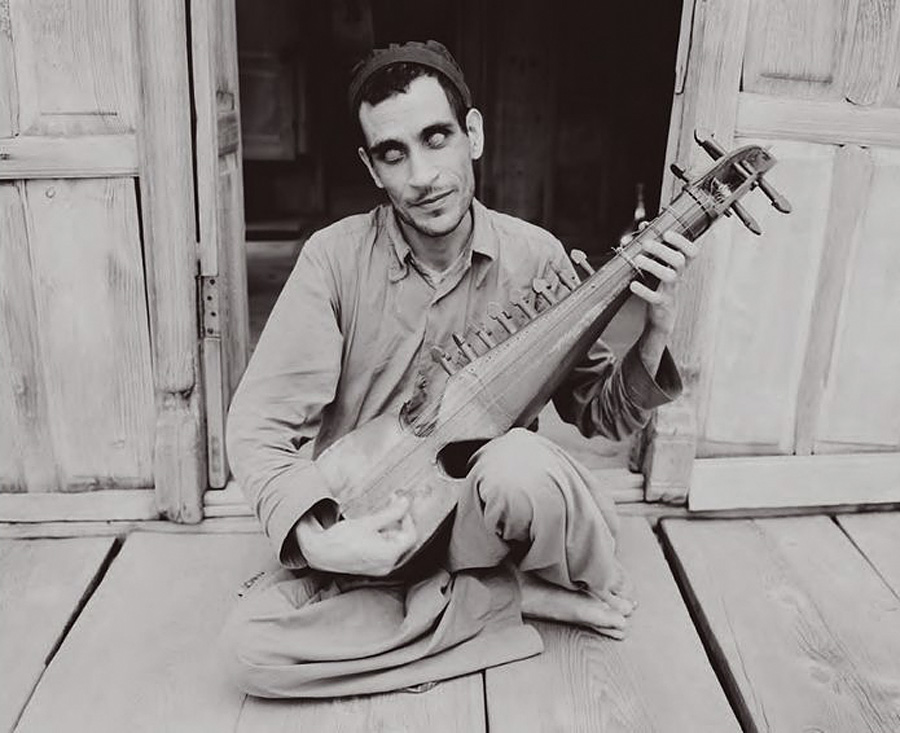
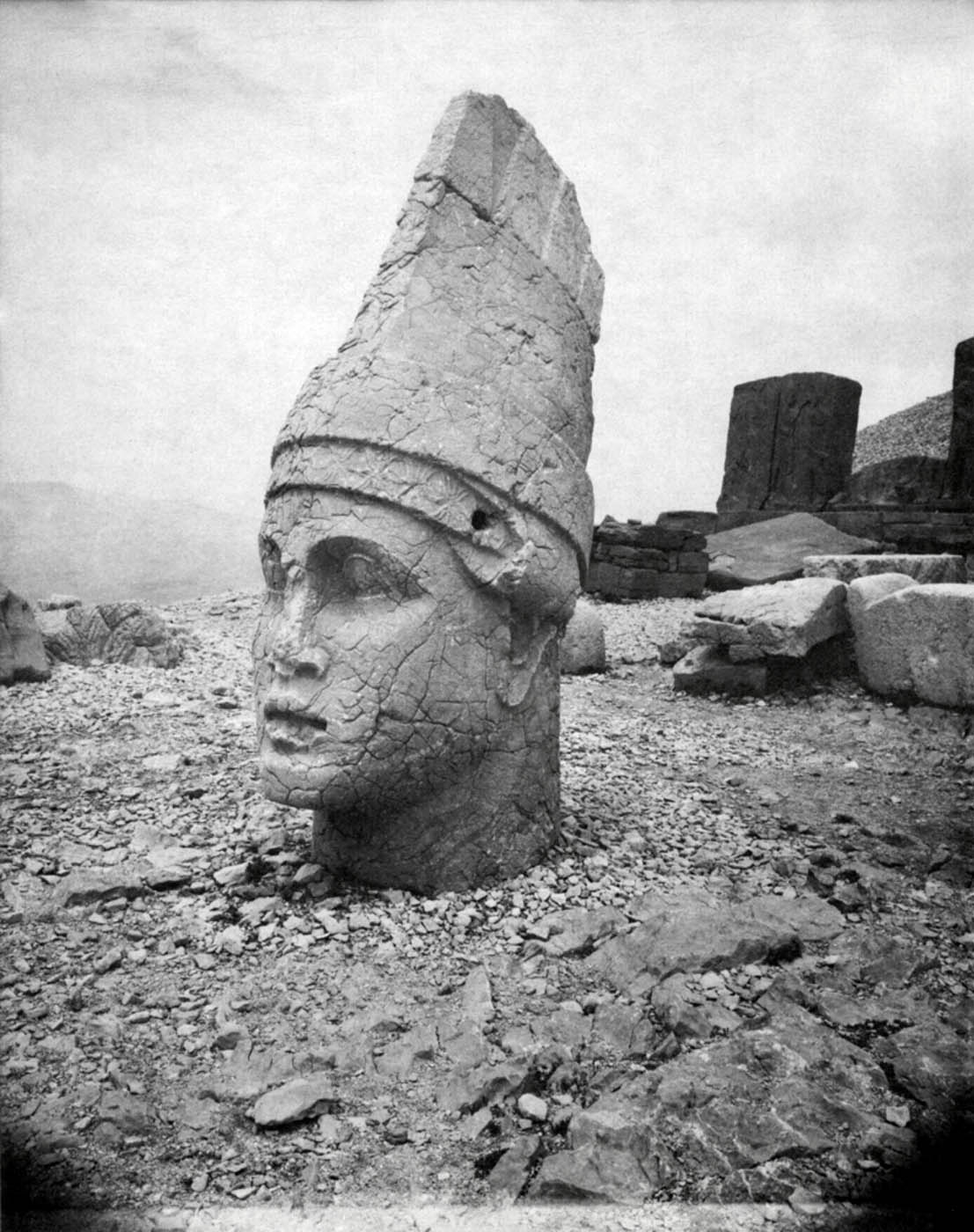
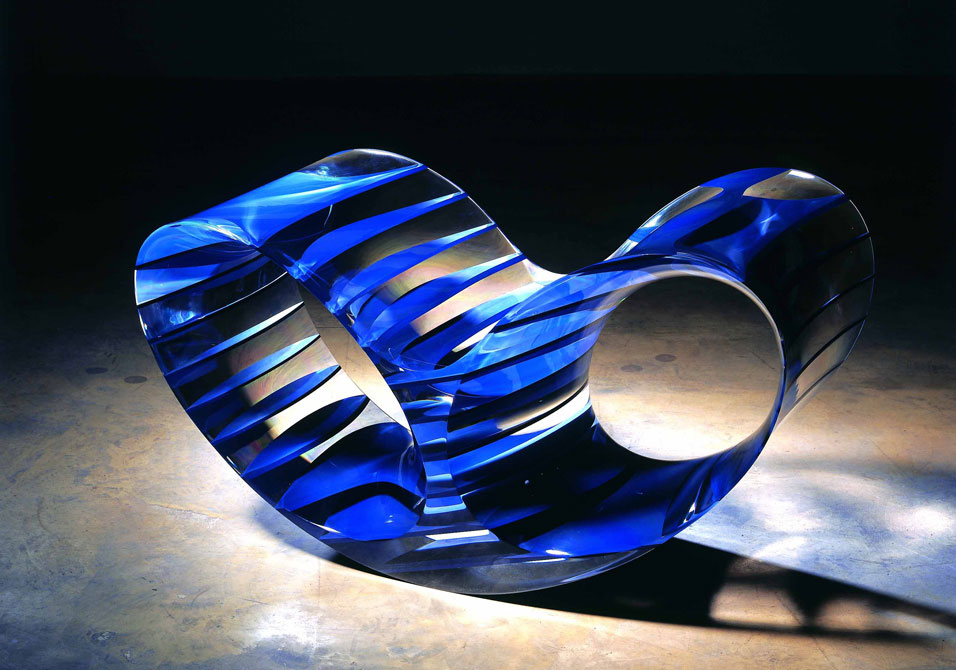
Exhibition: ‘Haunted: Contemporary Photography / Video / Performance’ at Solomon R. Guggenheim Museum, New York

Exhibition dates: 26th March – 6th September, 2010


Looks like a great exhibition – wish I was there to see it!


Many thankx to Claire Laporte and the Solomon R. Guggenheim Museum for allowing me to publish the photographs in the posting. Please click on the photographs for a larger version of the image.
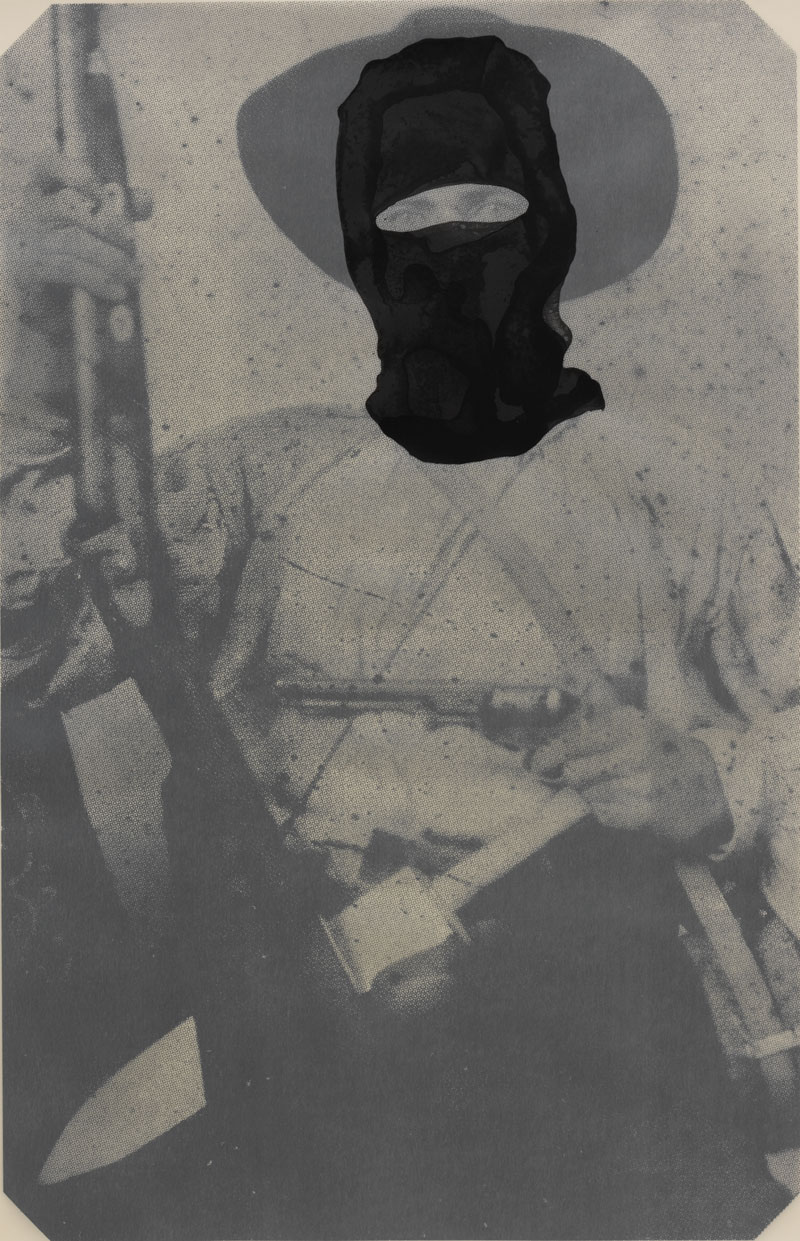
 

Adam Helms (American, b. 1974) 'Untitled Portrait (Santa Fe Trail)' 2007 from the exhibition 'Haunted: Contemporary Photography / Video / Performance' Guggenheim Museum, March - Sept, 2010


Adam Helms (American, b. 1974)
Untitled Portrait (Santa Fe Trail)
2007
Double-sided screenprint on paper vellum edition 2/2
101.3 x 65.7cm
Solomon R. Guggenheim Museum, New York, Purchased with funds contributed by the Photography Committee 2007.131


Idris Khan (British, b. 1978) 'Homage to Bernd Becher' 2007 from the exhibition 'Haunted: Contemporary Photography / Video / Performance' Guggenheim Museum, March - Sept, 2010


Idris Khan (British, b. 1978)
Homage to Bernd Becher
2007
Bromide print edition 1/6
49.8 x 39.7cm
Solomon R. Guggenheim Museum, New York, Purchased with funds contributed by the Photography Committee


Bernd Becher (German, 1931-2007) and Hilla Becher (German, 1934-2015) 'Water Towers' 1980 from the exhibition 'Haunted: Contemporary Photography / Video / Performance' Guggenheim Museum, March - Sept, 2010


Bernd Becher (German, 1931-2007) and Hilla Becher (German, 1934-2015)
Water Towers
1980
Nine gelatin silver prints
155.6 x 125.1cm
Solomon R. Guggenheim Museum, New York, Purchased with funds contributed by Mr. and Mrs. Donald Jonas
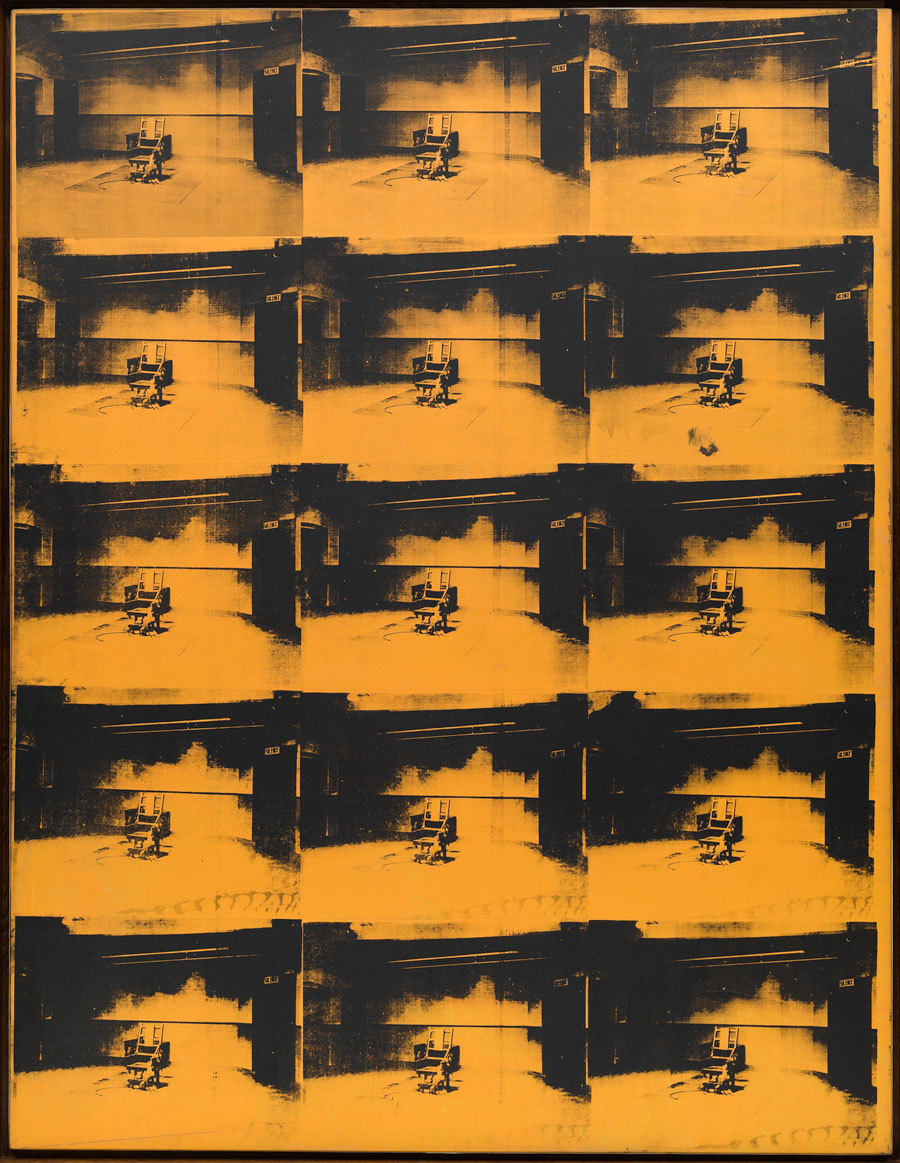
 

Andy Warhol (American, 1928-1987) 'Orange Disaster #5' 1963


Andy Warhol (American, 1928-1987)
Orange Disaster #5
1963
Acrylic and silkscreen enamel on canvas
269.2 x 207cm
Solomon R. Guggenheim Museum, New York, Gift, Harry N. Abrams Family Collection 74.2118
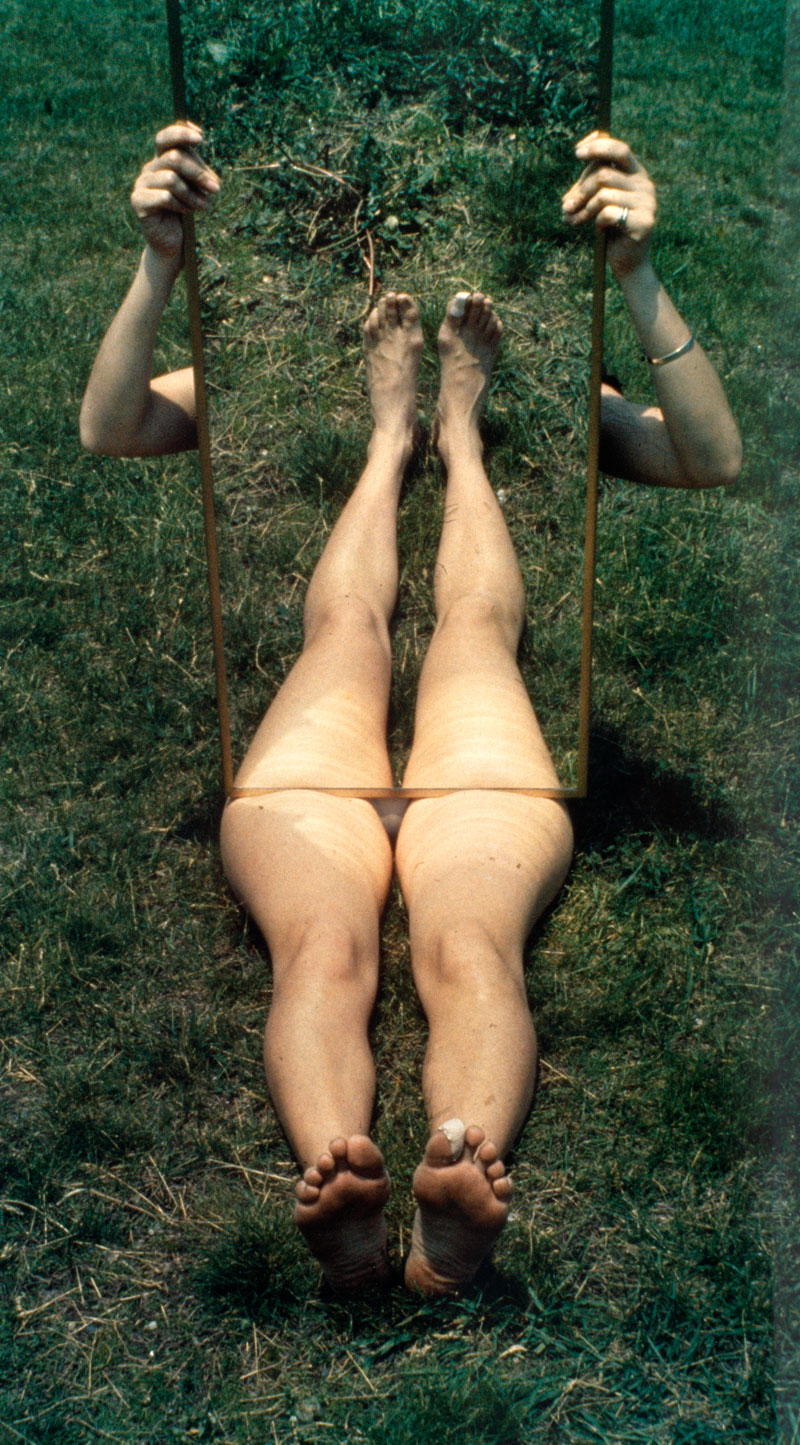
 

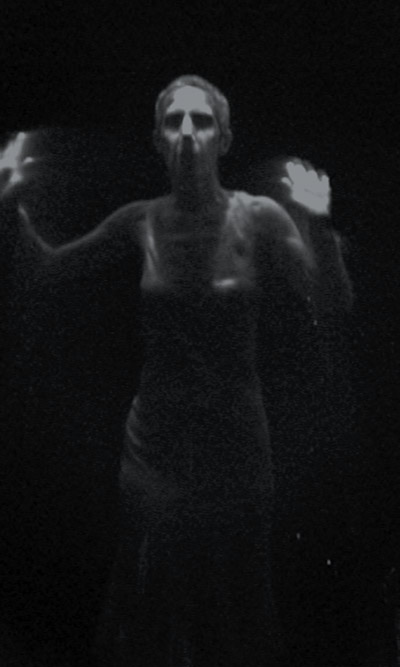
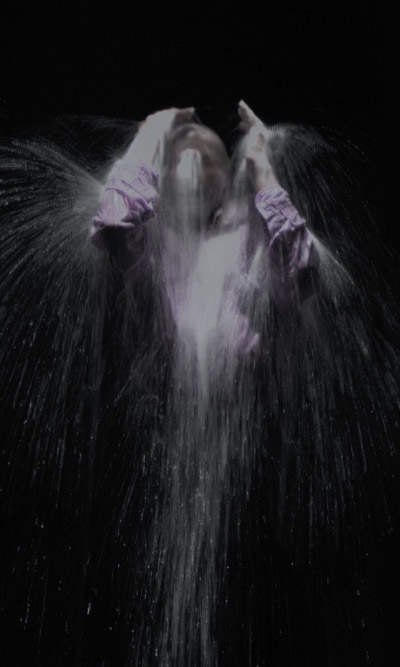
Joan Jonas (American, b. 1936) 'Mirror Piece I' 1969


Joan Jonas (American, b. 1936)
Mirror Piece I
1969
Chromogenic print
101 x 55.6cm
Solomon R. Guggenheim Museum, New York, Purchased with funds contributed by the Photography Committee
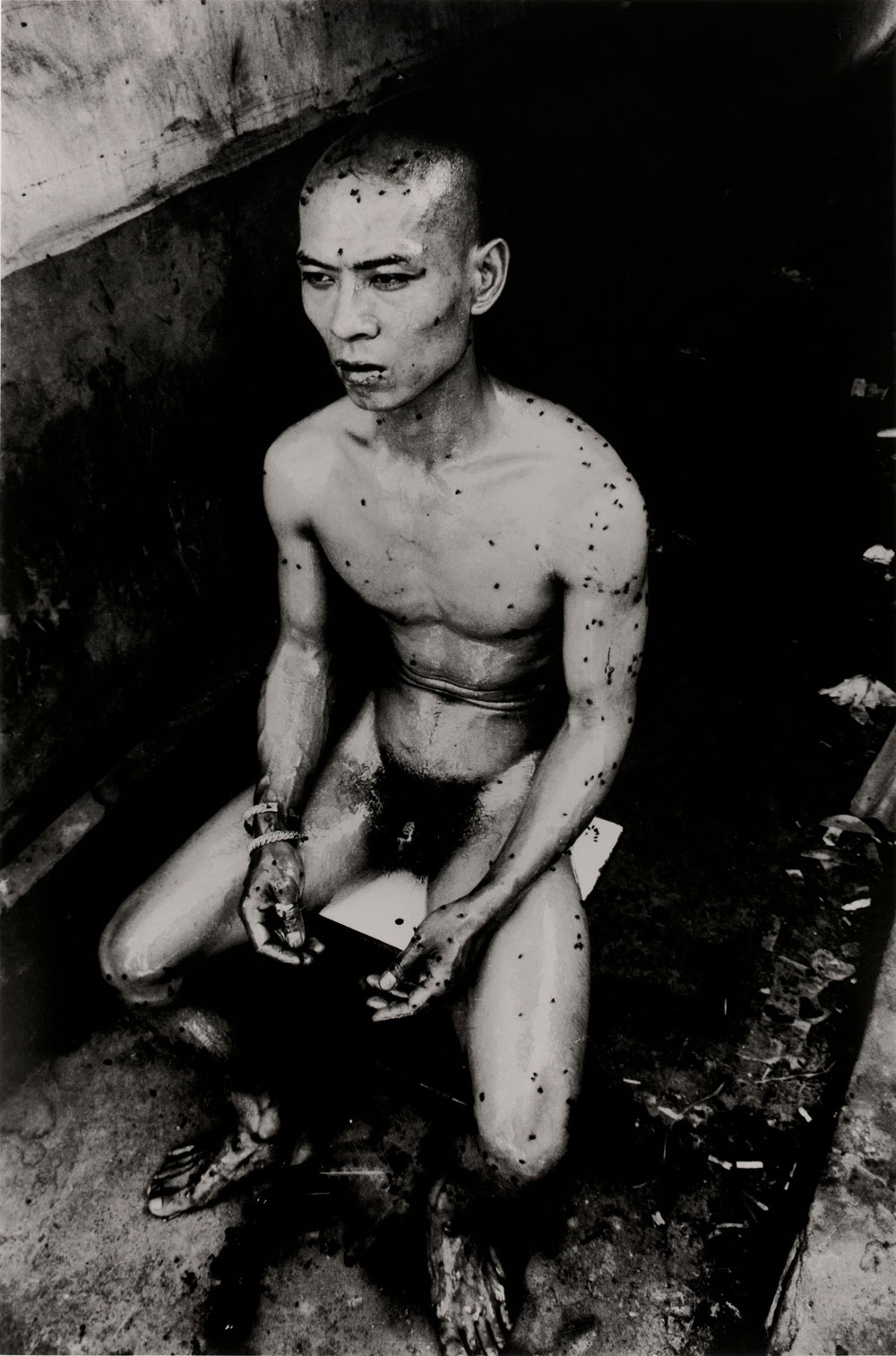
 

Zhang Huan (Chinese, b. 1965) '12 Square Meters' 1994


Zhang Huan (Chinese, b. 1965)
12 Square Meters
1994
Chromogenic print A.P. 3/5, edition of 15
149.9 x 99.7cm
Solomon R. Guggenheim Museum, New York, Purchased with funds contributed by Manuel de Santaren and Jennifer and David Stockman


Much of contemporary photography and video seems haunted by the past, by the history of art, by apparitions that are reanimated in reproductive mediums, live performance, and the virtual world. By using dated, passé, or quasi-extinct stylistic devices, subject matter, and technologies, such art embodies a longing for an otherwise unrecuperable past.

From March 26 to September 6, 2010, the Solomon R. Guggenheim Museum presents Haunted: Contemporary Photography / Video / Performance, an exhibition that documents this obsession, examining myriad ways photographic imagery is incorporated into recent practice. Drawn largely from the Guggenheim’s extensive photography and video collections, Haunted features some 100 works by nearly 60 artists, including many recent acquisitions that will be on view at the museum for the first time. The exhibition is installed throughout the rotunda and its spiralling ramps, with two additional galleries on view from June 4 to September 1, featuring works by two pairs of artists to complete Haunted’s presentation.

The works in Haunted: Contemporary Photography / Video / Performance range from individual photographs and photographic series to sculptures and paintings that incorporate photographic elements; projected videos; films; performances; and site-specific installations, including a new sound work created by Susan Philips for the museum’s rotunda. While the show traces the extensive incorporation of photography into contemporary art since the 1960s, a significant part of the exhibition will be dedicated to work created since 2001 by younger artists.

Haunted is organised around a series of formal and conceptual threads that weave themselves through the artworks on view:

Appropriation and the Archive

In the early 1960s, Robert Rauschenberg and Andy Warhol began to incorporate photographic images into their paintings, establishing a new mode of visual production that relied not on the then-dominant tradition of gestural abstraction but rather on mechanical processes such as screenprinting. In so doing, they challenged the notion of art as the expression of a singular, heroic author, recasting their works as repositories for autobiographical, cultural, and historical information. This archival impulse revolutionised art production over the ensuing decades, paving the way for a conceptually driven use of photography as a means of absorbing the world at large into a new aesthetic realm. Since then, a number of artists, including Bernd and Hilla Becher, Sarah Charlesworth, Douglas Gordon, Luis Jacob, Sherrie Levine, Richard Prince, Cindy Sherman, and Sara VanDerBeek, have pursued this archival impulse, amassing fragments of reality either by creating new photographs or by appropriating existing ones.
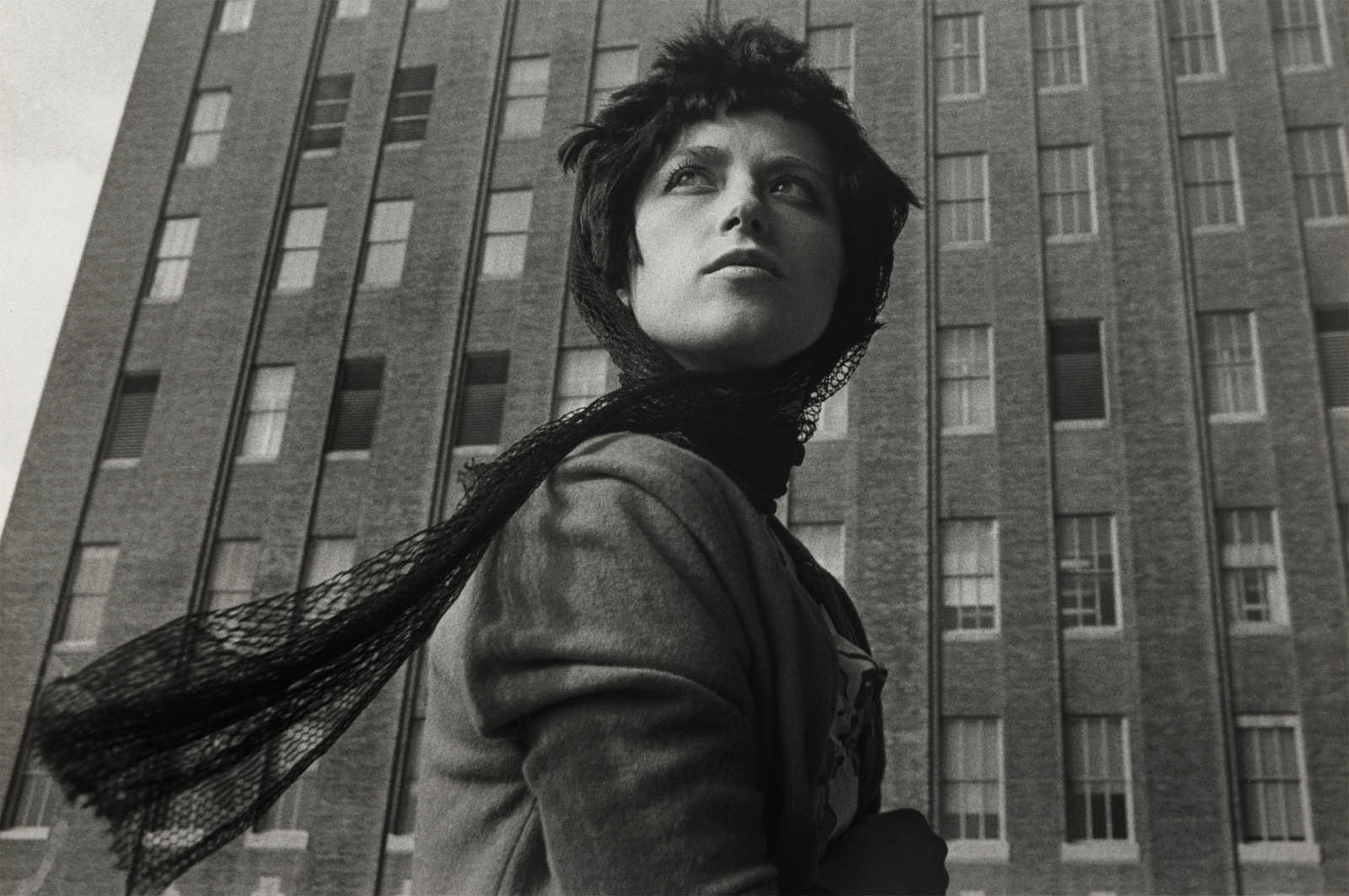
 

Cindy Sherman (American, b. 1954)
'Untitled Film Still #58' 1980


Cindy Sherman (American, b. 1954)
Untitled Film Still #58
1980
Gelatin silver print
20.3 x 25.4cm
Solomon R. Guggenheim Museum, Gift, Ginny Williams


“I’ve always played with make-up to transform myself, but everything, including the lighting, was self taught. I just learned things as I needed to use them. I absorbed my ideas for the women in these photos from every cultural source that I’ve ever had access to, including film, TV, advertisements, magazines, as well as any adult role models from my youth.”1

Cindy Sherman (b. 1954, Glen Ridge, N.J.) emerged onto the New York art scene in the early 1980s as part of a new generation of artists concerned with the codes of representation in a media-saturated era. Along with many artists working in the 1980s, Sherman explored photography as a way to reveal and examine the cultural constructions we designate as truth. Confronting the belief that photographs are truthful documents, Sherman’s fictional narratives suggested that photographs, like all forms of representation, are ideologically motivated. She is aware that the camera is not a neutral device but rather a tool that frames a particular viewpoint.

Sherman’s reputation was established early on with her Untitled Film Stills, a series of 69 black-and-white photographs that she began making in 1977, when she was twenty-three. In this series, the artist depicted herself dressed in the various melodramatic guises of clichéd B-movie heroines presented in 8 x 10 publicity stills from the 1950s and 1960s. In photograph after photograph, Sherman both acts in and documents her own productions. Although Sherman is both model and photographer, these images are not autobiographical. Rather, they memorialise absence and leave us searching for a narrative and clues to what may exist beyond the frame of the camera.

By the time Sherman made the Untitled Film Stills, black-and-white photography was already recognised as belonging to the past, and the styles she replicated were taken not from her own generation but from that of her mother’s. Sherman used wigs and makeup as well as vintage clothing to create a range of female characters. She sets her photos in a variety of locations, including rural landscapes, cities, and her own apartment. Although many of the pictures are taken by Sherman herself using an extended shutter release, for others she required help, sometimes enlisting friends and family. The characters she created include an ingénue finding her way in the big city, a party girl, a housewife, a woman in distress, a dancer, and an actress. In 1980 she completed the series and has said that she stopped when she ran out of clichés to depict. Unlike the media images they refer to, Sherman’s stills have a deliberate artifice that is heightened by the often-visible camera cord, slightly eccentric props, unusual camera angles, and by the fact that each image includes the artist rather than a recognisable actress or model. Sherman remains an important figure, with works in major collections around the globe, and continues to create striking, imaginative art.

Text from the Teacher’s Guide to the exhibition

1/ Cindy Sherman, quoted in Monique Beudert and Sean Rainbird, eds., Contemporary Art: The Janet Wolfson de Botton Gift, p. 99.


Landscape, Architecture, and the Passage of Time

Historically, one of photography’s primary functions has been to document sites where significant, often traumatic events have taken place. During the Civil War, which erupted not long after the medium was invented, a new generation of reporters sought to photograph battles, but due to the long exposure times required by early cameras, they could only capture the aftermath of the conflicts. These landscapes, strewn with the dead, now seem doubly arresting, for they capture past spaces where something has already occurred. Their state of anteriority, witnessed at such an early stage in the medium’s development, speaks to the very nature of a photograph, which possesses physical and chemical bonds to a past that disappears as soon as it is taken. As viewers, we are left with only traces from which we hope to reconstruct the absent occurrences in the fields, forests, homes, and offices depicted in the works in the exhibition. With this condition in mind, many artists, among them James Casebere, Spencer Finch, Ori Gersht, Roni Horn, Luisa Lambri, An-My Lê, Sally Mann, and Hiroshi Sugimoto, have turned to empty spaces in landscape and architecture, creating poetic reflections on time’s inexorable passing and insisting on the importance of remembrance and memorialisation.
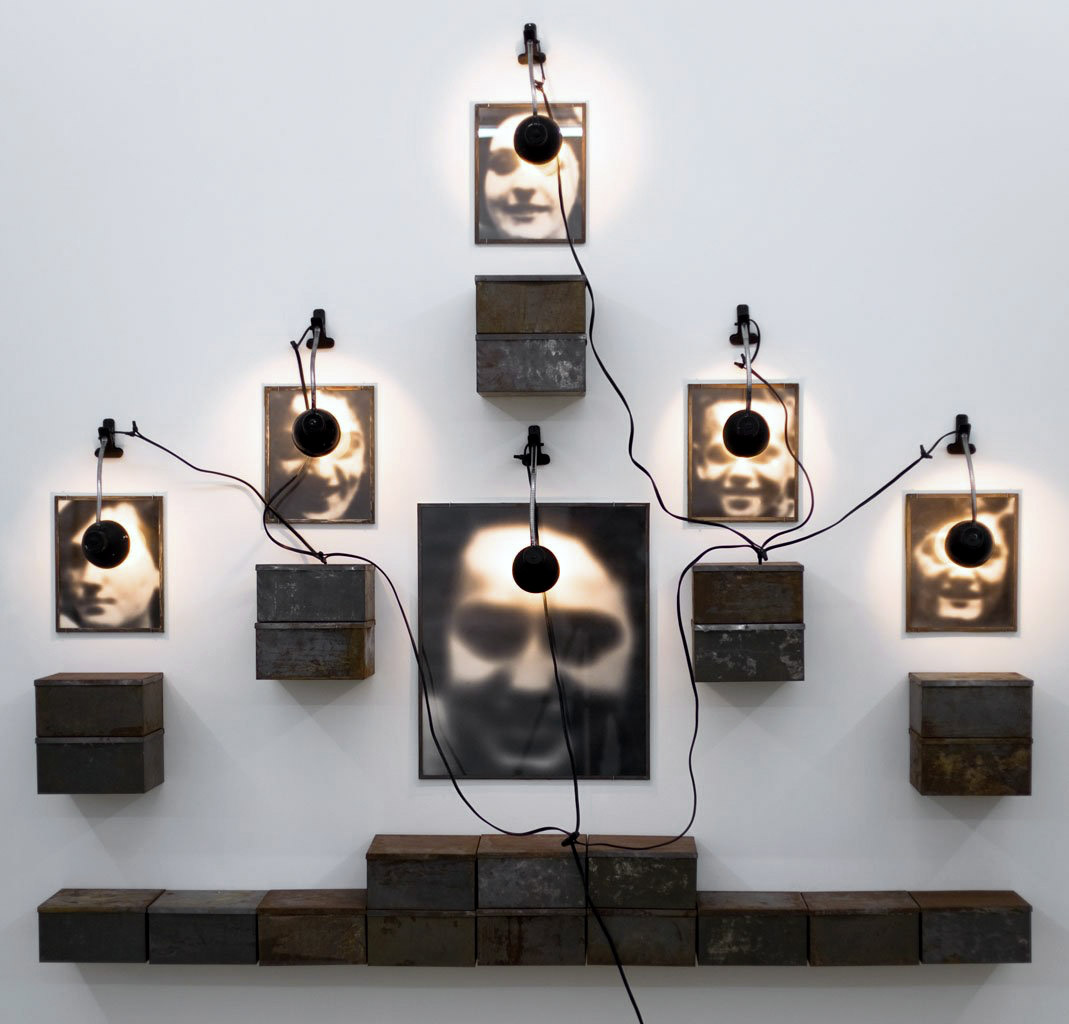
 

Christian Boltanski (French, 1944-2021) 'Autel de Lycée Chases' 1986-1987


Christian Boltanski (French, 1944-2021)
Autel de Lycée Chases
1986-1987
Six photographs, six desk lamps, and twenty-two tin boxes
170.2 x 214.6 x 24.1cm
Rubell Family Collection, Miami
© 2010 Artists Rights Society (ARS), New York/ADAGP, Paris


“A good work of art can never be read in one way. My work is full of contradictions. An artwork is open – it is the spectators looking at the work who make the piece, using their own background. A lamp in my work might make you think of a police interrogation, but it’s also religious, like a candle. At the same time it alludes to a precious painting, with a single light shining on it. There are many way of looking at the work. It has to be ‘unfocused’ somehow so that everyone can recognize something of their own self when viewing it.”1

The power of photography to recall the past has inspired many contemporary artists to use photographs to revisit the experience of historical events. In so doing, artists reconsider the photograph itself as an object imbued with history. They became aware that using the medium of photography would lend the elements of specificity and truth to their work.

Since the late 1960s, Christian Boltanski (b. 1944, Paris) has worked with photographs collected from ordinary and often ephemeral sources, endowing the commonplace with significance. Rather than taking original photographs to use in his installations, he often finds and rephotographs everyday documents – passport photographs, school portraits, newspaper pictures, and family albums – to memorialise everyday people. Boltanski seeks to create an art that is indistinguishable from life and has said, “The fascinating moment for me is when the spectator hasn’t registered the art connection, and the longer I can delay this association the better.”2 By appropriating mementos of other people’s lives and placing them in an art context, Boltanski explores the power of photography to transcend individual identity and to function instead as a witness to collective rituals and shared cultural memories.

In Boltanski’s 1986-1987 work Autel de Lycée Chases (which means “Altar to the Chases High School”) enlarged photographs of children are hung over a platform constructed from stacked tin biscuit boxes, which are rusted as if they have been ravaged by time. The black-and-white photographs look like artefacts from another era. An electric light illuminates each face while at the same time obscuring it. The arrangement gives no way to identify or connect the unnamed individuals.

The photos used in Autel de Lycée Chases were taken from a real-world source, the school photograph of the graduating class of 1931 from a Viennese high school for Jewish students. These students were coming of age in a world dominated by war and persecution, and it is likely that many perished over the next decade.

At once personal and universal in reference, Boltanski’s work serves as a monument to the dead, hinting at the Holocaust without naming it. Within this haunting environment, Boltanski intermingles emotion and history, sentimentality and profundity.

Text from the Teacher’s Guide to the exhibition

1/ Christian Boltanski, “Tamar Garb in conversation with Christian Boltanski,” in Christian Boltanski (London: Phaidon Press, 1997), p. 24.
2/ “Christian Boltanski: Lessons of Darkness”


Documentation and Reiteration

Since at least the early 1970s, photographic documentation, including film and video, has served as an important complement to the art of live performance, often setting the conditions by which performances are staged and sometimes obviating the need for a live audience altogether. Through an ironic reversal, artworks that revolved around singular moments in time have often come to rely on the permanence of images to transmit their meaning and sometimes even the very fact of their existence. For many artists, these documents take on the function of relics-objects whose meaning is deeply bound to an experience that is always already lost in the past. Works by artists such as Marina Abramović, Christian Boltanski, Sophie Calle, Tacita Dean, Joan Jonas, Christian Marclay, Robert Mapplethorpe, Ana Mendieta, and Gina Pane examine various aesthetic approaches inspired by the reiterative power of the photograph. Using photography not only to restage their own (and others’) performances but to revisit the bodily experience of past events, these artists have reconsidered the document itself as an object embedded in time, closely attending to its material specificity in their works.
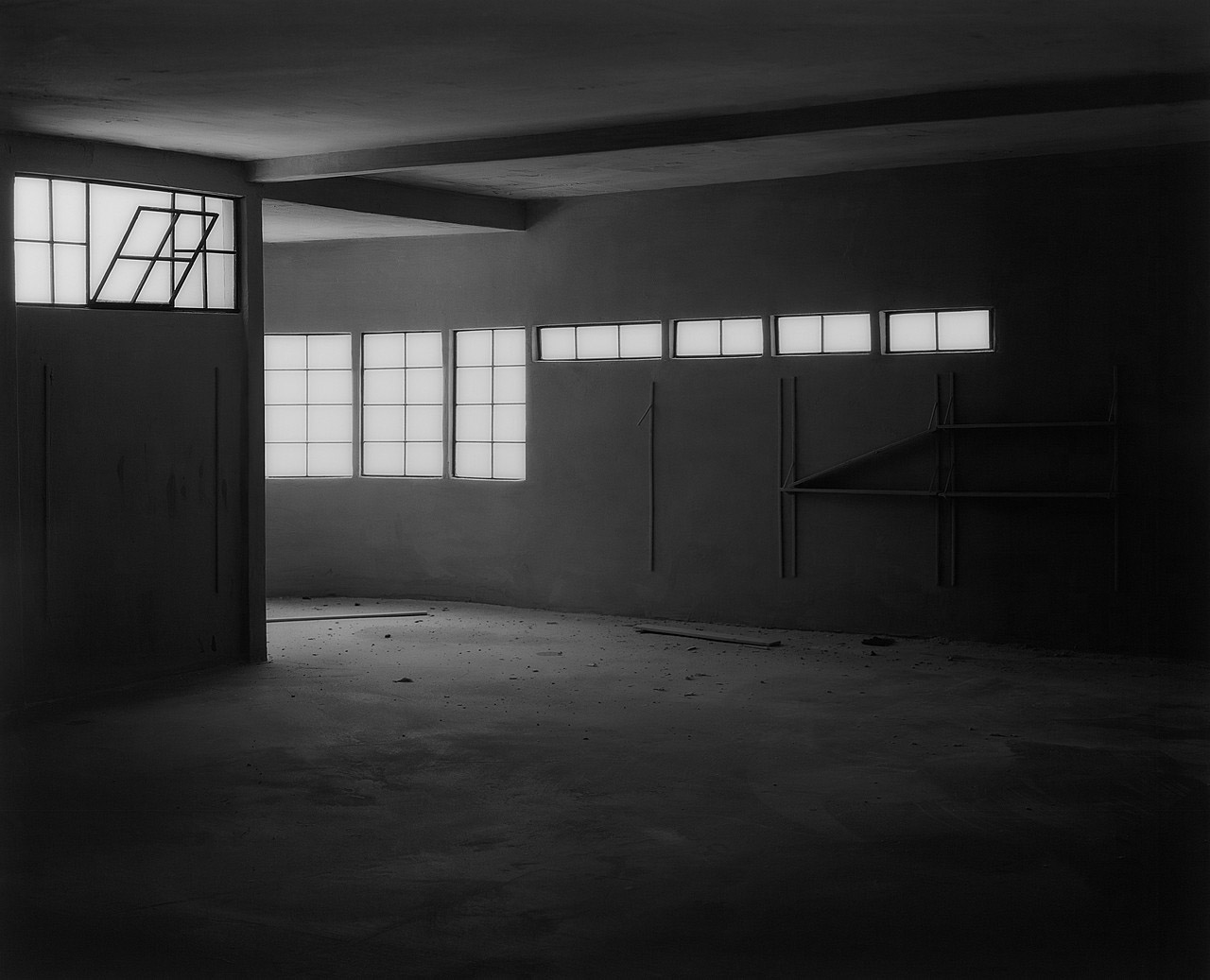
 

James Casebere (American, b. 1953) 'Garage' 2003


James Casebere (American, b. 1953)
Garage
2003
Chromogenic print, face-mounted to acrylic
181.6 x 223.5cm
Solomon R. Guggenheim Museum, New York
Anonymous gift


“Black and white had more to do with memory and the past. Color was too much about the present, I associated it with color TV, which was not a part of my past. I wanted the images to be related to a sense of history, let’s say, whether personal or social. And I think black and white adds a certain level of abstraction.”1

Since the mid-1970s James Casebere (b. 1953, Lansing, Michigan) has been carefully constructing architectural models and photographing them, yielding images somewhere between realism and obvious fabrication. His photographs are stripped of color and detail to evoke a sense of emotional place rather than the physicality of a place’s forms. Casebere is interested in the memories and feelings that are brought to mind by the architectural spaces he represents. The resulting works are dramatic, surreal, and remarkably true to life, embracing qualities of photography, architecture, and sculpture.

His tabletop models imitate the appearance of architectural institutions (home, school, library, prison) or common sites (tunnel, corridor, archway), representing the structures that occupy our everyday world. These models, made from such featureless materials as Foamcore, museum board, plaster, and Styrofoam, remain empty of detail and human figures. It is only when Casebere casts light on their bland surfaces and spartan interiors that the models are transformed. By eliminating the details, and taking advantage of dramatic lighting effects and the camera’s ability to flatten space, Casebere is able to transform familiar domestic spaces to find the extraordinary in the everyday. He asks viewers to rely on their memory to fill in the gaps and to create a context in which to understand his images.

Casebere stages his photographs to construct realities inspired by contemporary American visual culture that blur the line between fiction and fact. In this way, his images suggest psychologically charged spaces and have an otherworldly quality. The notion that these may be actual places seems plausible, but the lack of human presence leads us to wonder what has happened here. The viewer may imagine a human story within the abandoned spaces. Without people or colour, the photographs are about our own associations with these spaces and what they may represent.

Text from the Teacher’s Guide to the exhibition

1/ Roberto Juarez, “James Casebere,” Bomb 77 (Fall 2001)


Trauma and the Uncanny

When Andy Warhol created his silkscreen paintings of Marilyn Monroe in the wake of her death, he touched on the darker side of a burgeoning media culture that, during the Vietnam War, became an integral part of everyday life. Today, with vastly expanded channels for the propagation of images, events as varied as the terrorist attack on the World Trade Center and the deaths of celebrities such as Princess Diana and Michael Jackson have the ability to become traumatic on a global scale. Many artists, including Adam Helms, Nate Lowman, Adam McEwen, Cady Noland, and Anri Sala, have reexamined the strategy of image appropriation Warhol pioneered, attending closely to the ways political conflict can take on global significance. At the same time, photography has altered, or as some theorists argue, completely reconfigured our sense of personal memory. From birth to death, all aspects of our lives are reconstituted as images alongside our own experience of them. This repetition, which is mirrored in the very technology of the photographic medium, effectively produces an alternate reality in representation that, especially when coping with traumatic events, can take on the force of the uncanny. Artists such as Stan Douglas, Anthony Goicolea, Sarah Anne Johnson, Jeff Wall, and Gillian Wearing exploit this effect, constructing fictional scenarios in which the pains and pleasures of personal experience return with eerie and foreboding qualities.

Press release from the Solomon R. Guggenheim Museum website [Online] Cited 22/08/2010 no longer available online
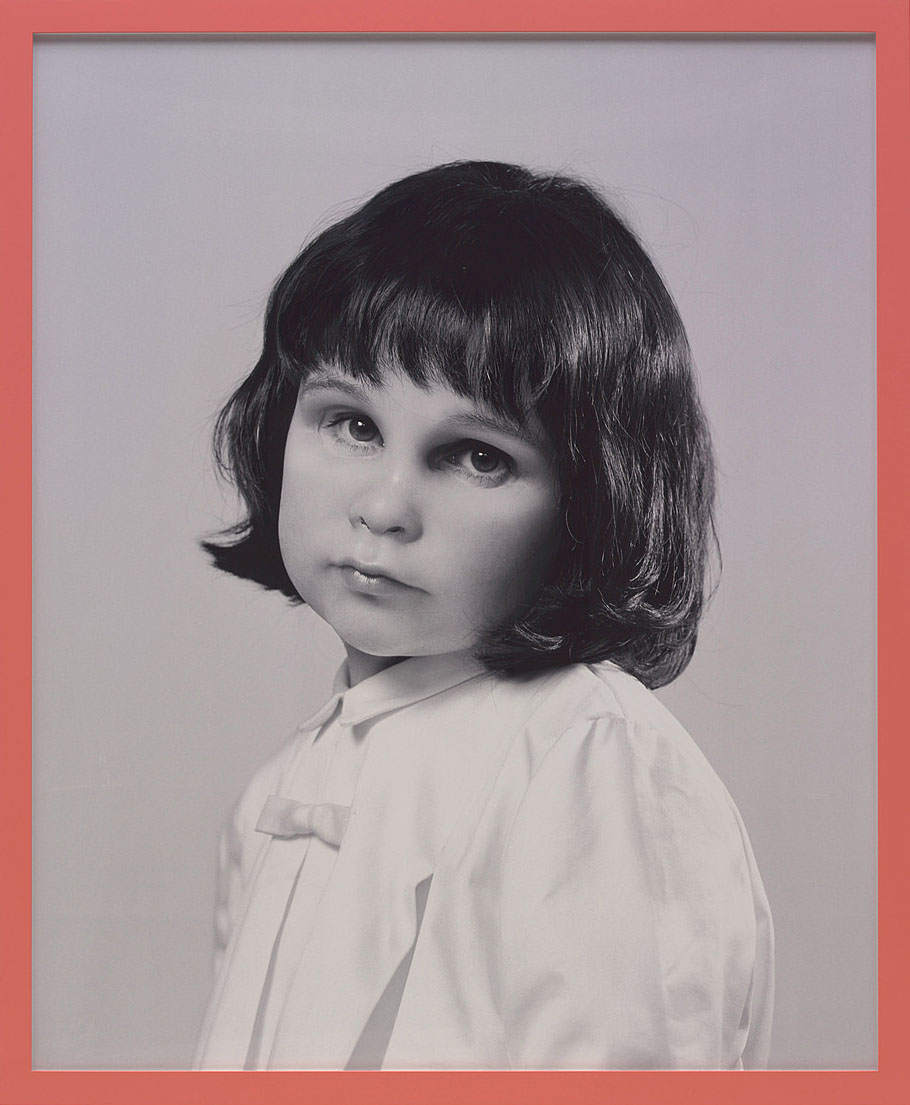
 

Gillian Wearing (British, b. 1963) 'Self-Portrait at Three Years Old' 2004


Gillian Wearing (British, b. 1963)
Self-Portrait at Three Years Old
2004
Chromogenic print
182 x 122cm
Solomon R. Guggenheim Museum, New York
Purchased with funds contributed by the International Directors Council and Executive Committee Members: Ruth Baum, Edythe Broad, Elaine Terner Cooper, Dimitris Daskalopoulos, Harry David, Gail May Engelberg, Shirley Fiterman, Nicki Harris, Dakis Joannou, Rachel Lehmann, Linda Macklowe, Peter Norton, Tonino Perna, Elizabeth Richebourg Rea, Mortim


“I taught myself to use a camera – it’s not very difficult to use a camera, but I never bothered looking at any textbooks on how to make a picture. I had a much more casual relation to it. For me at the time it was much more about the process rather than the results.”1

Photography has not only profoundly impacted our understanding of historical events, it has also changed the way we remember our personal histories. Beginning at birth, all aspects of our lives are recorded as images alongside our own experiences of them. These parallel recording devices, the camera and personal memory, produce alternate realities that may sometimes be synchronised but at other times are askew.

Gillian Wearing (b. 1963, Birmingham, England) uses masks as a central theme in her videos and photographs. The masks, which range from literal disguises to voice dubbing, conceal the identities of her subjects and free them to reveal intimate secrets. For her 2003 series of photographs Album, Wearing used this strategy to create an autobiographical work. Donning silicon prosthetics, she carefully reconstructed old family snapshots, transforming herself into her mother, father, uncle, and brother as young adults or adolescents. In one of the works, Wearing recreated her own self-portrait as a teenager – and in fact the artist considers all the photographs in this series as self-portraits. She explains: “I was interested in the idea of being genetically connected to someone but being very different. There is something of me, literally, in all those people – we are connected, but we are each very different.”2

To make the Album series, Wearing collaborated with a talented team (some of whom have worked for Madame Tussaud’s wax works) who sculpted, cast, painted, and applied hair to create the masks, wigs, and body suits used in these photographs. The elaborate disguises the artist wears, when combined with the snapshot “realism” of the original images on which they are based, create an eerie fascination that serves to reveal aspects of her identity rather than conceal it.

Self-Portrait at Three Years Old (2004) carries this role-playing further back in time. Confronting the viewer with her adult gaze through the eyeholes of the toddler’s mask, Wearing plays on the rift between interior and exterior and raises a multitude of provocative questions about identity, memory, and the truthfulness of the photographic medium. Wearing says, “What I love about photographs is that they give you a lot and also they withhold a lot.”3

Text from the Teacher’s Guide to the exhibition

1/ “Gillian Wearing,” interview by Leo Edelstein, Journal of Contemporary Art
2/ Quoted in Jennifer Bayles, “Acquisitions: Gillian Wearing,” Albright-Knox Art Gallery, Buffalo, NY (accessed January 25, 2010)
3/ Sebastian Smee, “Gillian Wearing: The art of the matter,” The Independent (London), October 18, 2003
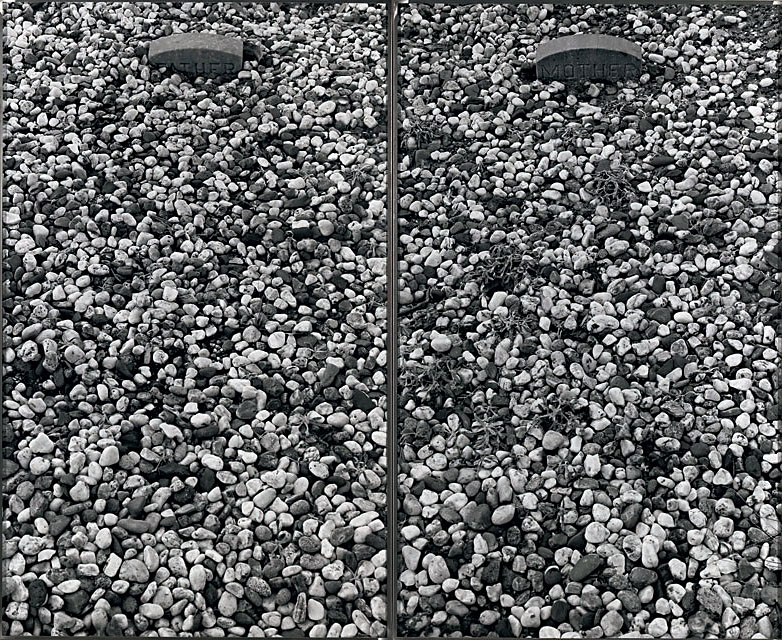
 

Sophie Calle (French, b. 1953) 'Father Mother (The Graves, #17)' 1990


Sophie Calle (French, b. 1953)
Father Mother (The Graves, #17)
1990
Two gelatin silver prints in artist’s frames edition 2/2
181.0 x 111.1cm each
Solomon R. Guggenheim Museum, New York, Gift, The Bohen Foundation


Ana Mendieta (Cuban American, 1948-1985) 'Untitled (Silueta Series)' 1978


Ana Mendieta (Cuban American, 1948-1985)
Untitled (Silueta series)
1978
Gelatin silver print
20.3 x 25.4cm
Solomon R. Guggenheim Museum, New York, Purchased with funds contributed by the Photography Committee
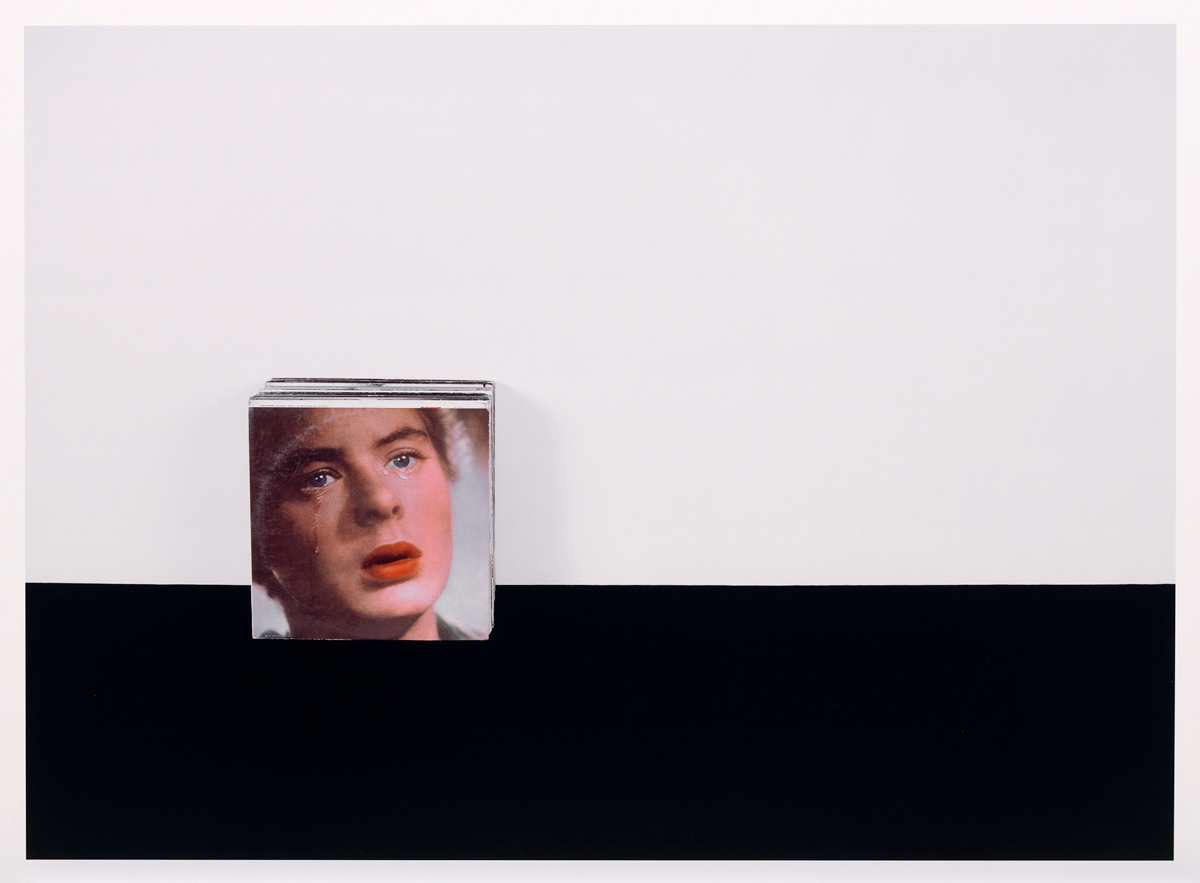
 

Anne Collier (American, b. 1970) 'Crying' 2005


Anne Collier (American, b. 1970)
Crying
2005
Chromogenic print edition 1/5
99.1 x 134 x 0.6cm
Solomon R. Guggenheim Museum, New York, Purchased with funds contributed by Mr. and Mrs. Aaron M. Tighe
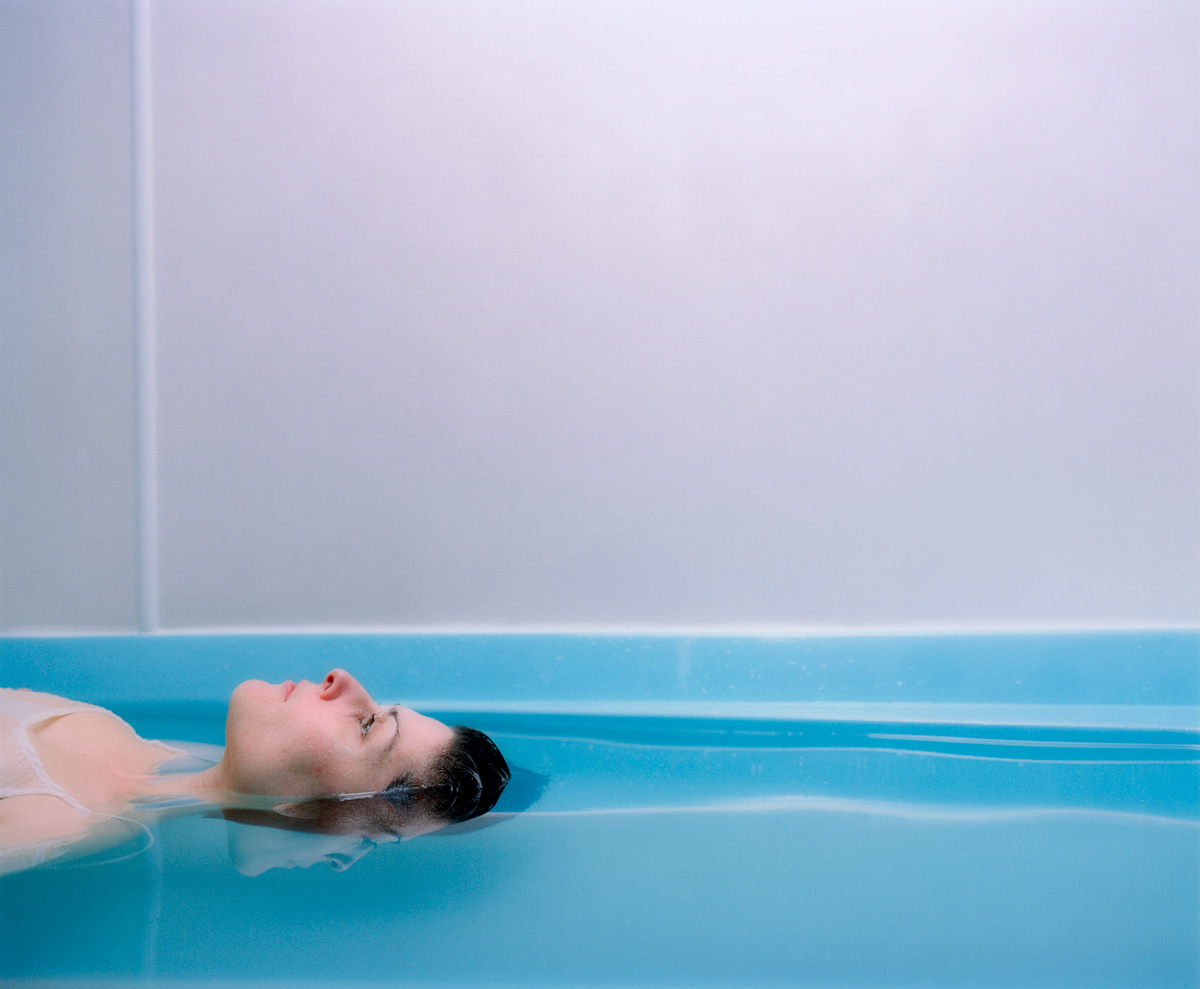
 

Miranda Lichtenstein (American, b. 1969) 'Floater' 2004


Miranda Lichtenstein (American, b. 1969)
Floater
2004
Chromogenic print edition 5/5
104.1 x 127cm
Solomon R. Guggenheim Museum, New York, Purchased with funds contributed by the Photography Committee


Sarah Anne Johnson (Canadian, b. 1976) 'Morning Meeting (from Tree Planting)' 2003


Sarah Anne Johnson (Canadian, b. 1976)
Morning Meeting (from Tree Planting)
2003
Chromogenic print edition
73.7 x 79.7cm
Solomon R. Guggenheim Museum, New York, Purchased with funds contributed by Pamela and Arthur Sanders; the Harriett Ames
Charitable Trust; Henry Buhl; the Heather and Tony Podesta Collection; Ann and Mel Schaffer; Shelley Harrison; and the Photography Committee


Sally Mann (American, b. 1951) 'Virginia' from the 'Mother Land' series 1992


Sally Mann (American, b. 1951)
Virginia from the Mother Land series
1992
Gelatin silver print
76.2 x 96.5cm
Solomon R. Guggenheim Museum, New York, Gift, The Bohen Foundation


Solomon R. Guggenheim Museum
1071 5th Avenue (at 89th Street)
New York

Opening hours:
Sunday – Monday, 11am – 6pm
Closed Tuesday
Wednesday – Friday 11am – 6pm
Saturday 11am – 8pm
Solomon R. Guggenheim Museum website

LIKE ART BLART ON FACEBOOK

Back to top

Exhibition: ‘Climate Capsules: Means of Surviving Disaster’ at Museum fur Kunst und Gewerbe Hamburg

Exhibition dates: 28th May – 12th September, 2010


Many thankx to Michaela Hille and Museum fur Kunst und Gewerbe Hamburg for allowing me to publish the photographs in the posting. Please click on the photographs for a larger version of the image.


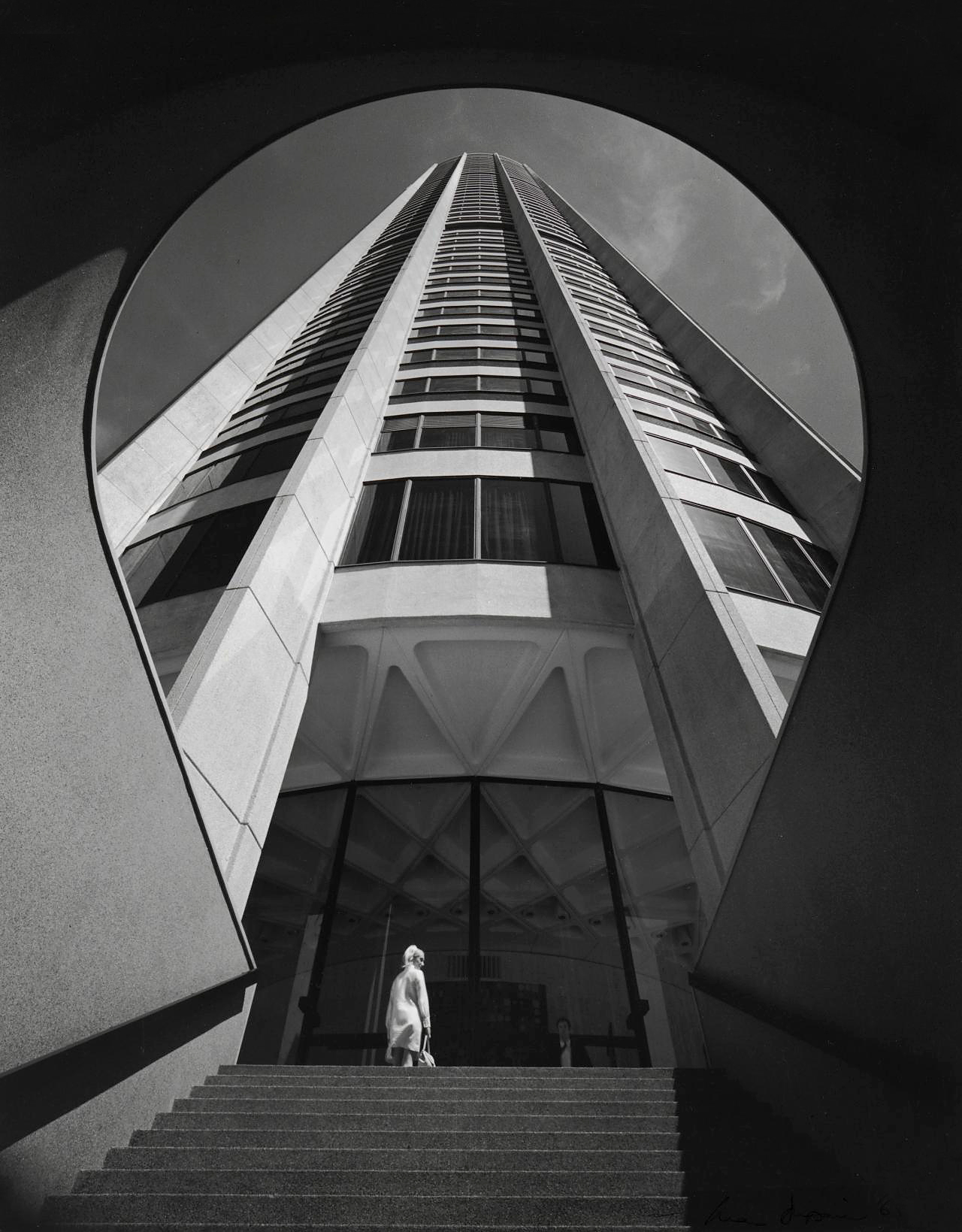
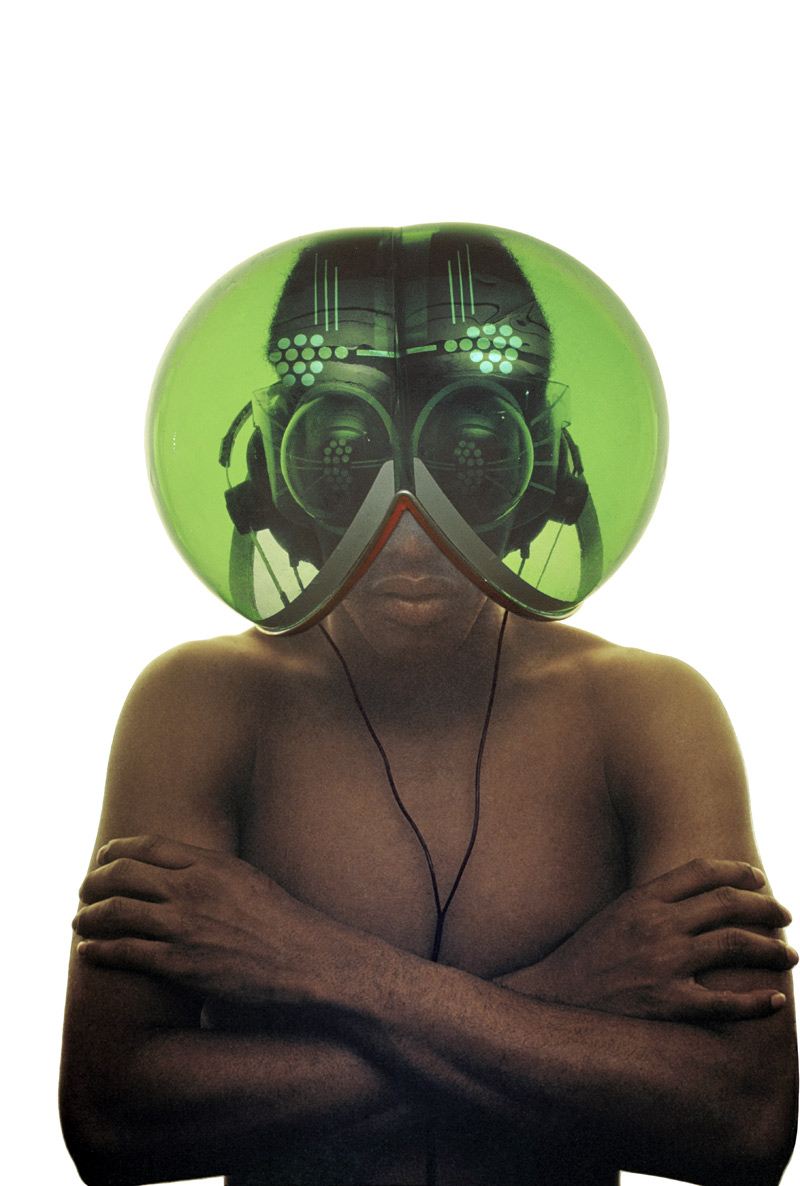
Haus-Rucker-Co (Laurids Ortner, Günter Zamp Kelp, Klaus Pinter) 'Flyhead (Environment Transformer)', Vienna, 1968 from the exhibition 'Climate Capsules: Means of Surviving Disaster' at Museum fur Kunst und Gewerbe Hamburg, may - September, 2010


Haus-Rucker-Co (Laurids Ortner, Gunter Zamp Kelp, Klaus Pinter)
Flyhead (Environment Transformer)
Vienna, 1968
Helmet consisting of two transparent green, symmetrical, hemispherical plastic fragments partially covered with foil. Inside the helmet, with the aid of a metal construction, audio-visual filters are arranged by means of which the normality of the surroundings is acoustically distorted and visually faceted.
Photo: Ben Rose, New York


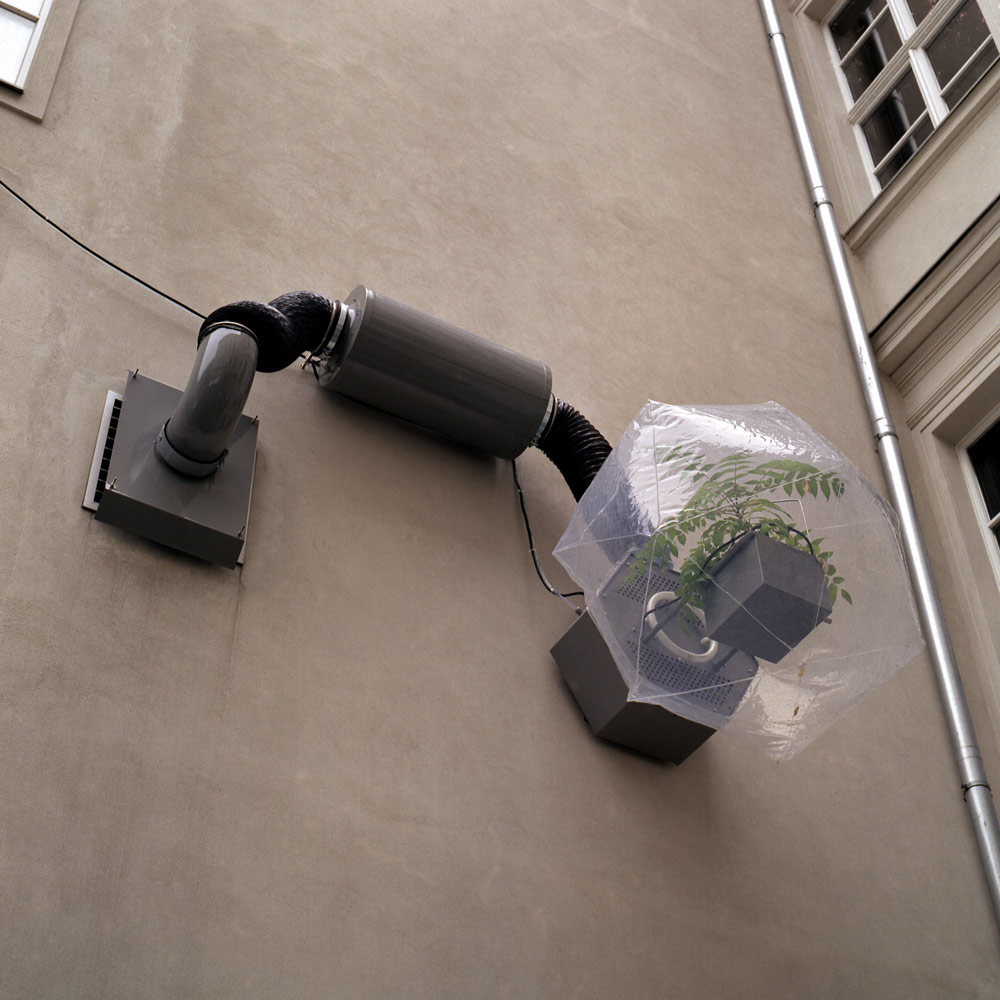
Ingo Vetter (Germany, b. 1968) 'Adaptation Laboratory' 2004 from the exhibition 'Climate Capsules: Means of Surviving Disaster' at Museum fur Kunst und Gewerbe Hamburg, may - September, 2010


Ingo Vetter (Germany, b. 1968)
Adaptation Laboratory
2004
Exhaust-operated greenhouse with tree of heaven (Ailanthus altissima)
Ingo Vetter
© Ingo Vetter for the Detroit Tree of Heaven Woodshop, 2004


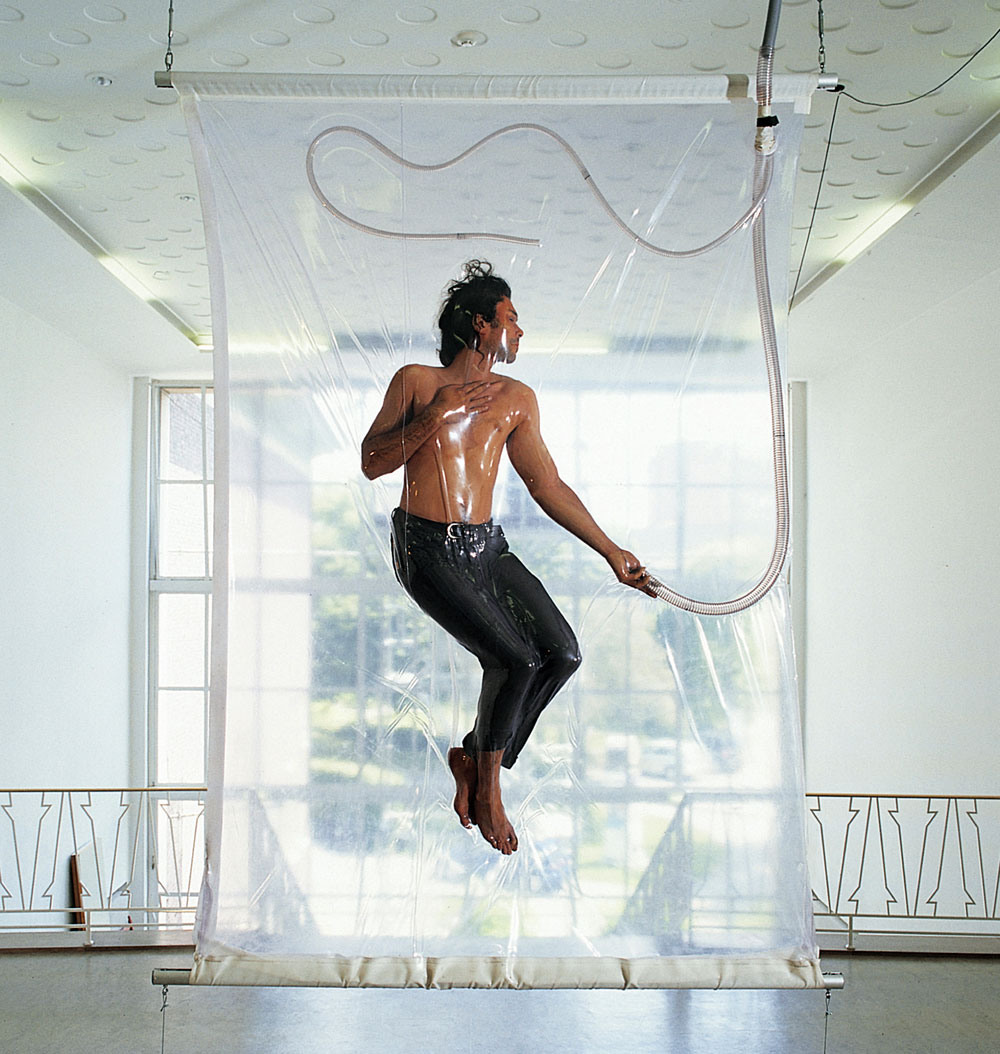
Lawrence Malstaf (Belgian, b. 1972) 'Shrink' 1995 from the exhibition 'Climate Capsules: Means of Surviving Disaster' at Museum fur Kunst und Gewerbe Hamburg, may - September, 2010


Lawrence Malstaf (Belgian, b. 1972)
Shrink
1995
Performative Installation
© Lawrence Malstaf/Galerie Fortlaan 17, Ghent (B)


In view of the advancing climate change, the exhibition Climate Capsules: Means of Surviving Disaster at the Museum fur Kunst und Gewerbe Hamburg poses the question: “How do we want to live in the future?” and draws attention to the socio-political consequences of coexistence under new climatic conditions. In view of the fact that the politicians are hesitant to enforce strict measures for climate protection and the citizens very sluggish about changing their habits, the change appears inevitable. The world community is accordingly confronted with the challenge of investigating various possible means of adapting to the climate change. This exhibition is the first to bring together historical and current climate-related models, concepts, strategies, experiments and utopias from the areas of design, art, architecture and urban development – pursuing not the aim of stopping the climate change, but envisioning means of surviving after disaster has struck. More than twenty-five mobile, temporary and urban capsules intended to make human life possible independently of the surrounding climatic conditions will be on view – from floating cities and body capsules to concepts for fertilising sea water or injecting the stratosphere with sulphur. A symposium, film programme, readings, performances and workshops will revolve around the interplay between design processes and political factors such as migration, border politics and resource conflicts, and investigate the consequences for social and cultural partitioning and exclusion.

The public discussion on the climate change concentrates primarily on preventing change by reducing climate damaging emissions. This reduction is to be achieved through new means of obtaining energy as well as the optimisation of energy consumption. The consumption-oriented lifestyle of the industrial nations is also to become more “environmentally friendly”; the citizens are called upon to change their habits. Emerging nations are admonished to avoid the mistakes made by the West from the start. There is not the slightest guarantee, however, that enough nations and enough people around the world will participate in such reductions, and that a “low-carbon culture” will become the globally predominant lifestyle. Nor does anyone know for sure whether the reduction goals presently being discussed will suffice to delay or stop the climate change, which is already measurable today. In the search for alternative solutions, there is a category discussed substantially less often in public: adaptation. Here strategies are developed which aim not to slow or stop the climate change but to adapt to its expected consequences. They include protective measures against flooding and overheating as well as geo-engineering, i.e. large-scale interventions in the global climate.

These technologies are usually subjected only to critical discussion with regard to their technical feasibility. Until now, their possible socio-political effects have for the most part been ignored. Their impact on the structure of the global society, however, can hardly be overestimated: in the endeavour to make life possible independently of outward climatic conditions, these strategies encourage spatial, social and political isolation. Ostensibly motivated by climate-related considerations, they could well lead to inclusion and exclusion on all levels of life, from the interpersonal to the global. They create the conditions for social segregation and global polarisation.

The exhibition Climate Capsules: Means of Surviving Disaster will focus primarily on application-oriented projects for climatological capsules from the areas of design, art, architecture, urban development and geoengineering. The show will reflect on the (political, cultural, socio-spatial) impact of these current adaptation strategies on society by means of contemporary artistic approaches and avant-garde concepts of the twentieth century. Historical projects in the context of the climate change will thus assume new meaning. The current artistic projects question the positivist perspective of their counterparts of the past, and offer the exhibition visitor a further level of sensory experience. The exhibition objects can be divided into five types: body capsules, living capsules, urban capsules, nature capsules and atmosphere capsules.

Body capsules

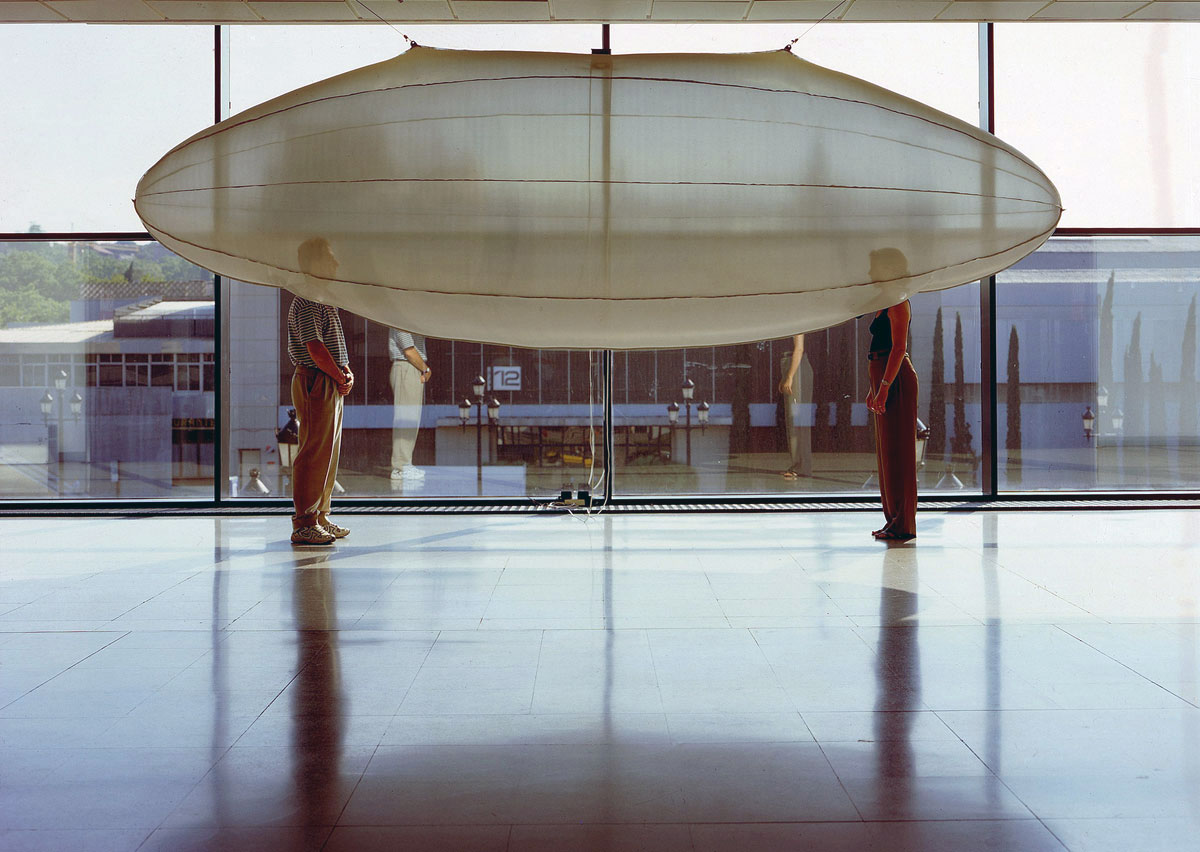
The exhibition begins with the interactive installation La Parole by Pablo Reinoso. Two visitors at a time can poke their heads into the inflatable textile construction and share the air they breathe as well as a common visual and audio space. The experience of this work raises the question as to how people can protect their bodies from contaminated air, pollutants, storms and aggressive solar radiation. Again and again in the course of the show, the visitor encounters “body capsules” addressing the topic of clothing as bodily protection from climatic conditions.

Living capsules

The objects belonging to this group extend the encapsulated space from the body encasement to the immediate living space. Utopian designs for mobile capsules of the 1960s such as the Walking City by Ron Herron (Archigram) still figured in the discussion emphasising temporary and mobile structures as experimental free spaces after ideas introduced by such architects as Constant or Yona Friedman. Today mobility is no longer just a question of freedom – the counterpart to voluntary mobility is flight, the spatial equivalent the temporary camp. The visitor thus stumbles across Michael Rokowitz’s paraSITE, for example, an inflatable tent which the artist developed in collaboration with the homeless person Bill Stone. Like the other tents in the series, it is designed for use in an exhaust air shaft. It can dock onto a building as a temporary parasite. In this context of precarious modi vivendi – brought about not least of all by global inequality (which is further aggravated by the climate change) and the resulting mass migration – what were once visionary temporary living concepts appear in a new light. They are not spaces of liberation, but of isolation.

Urban capsules

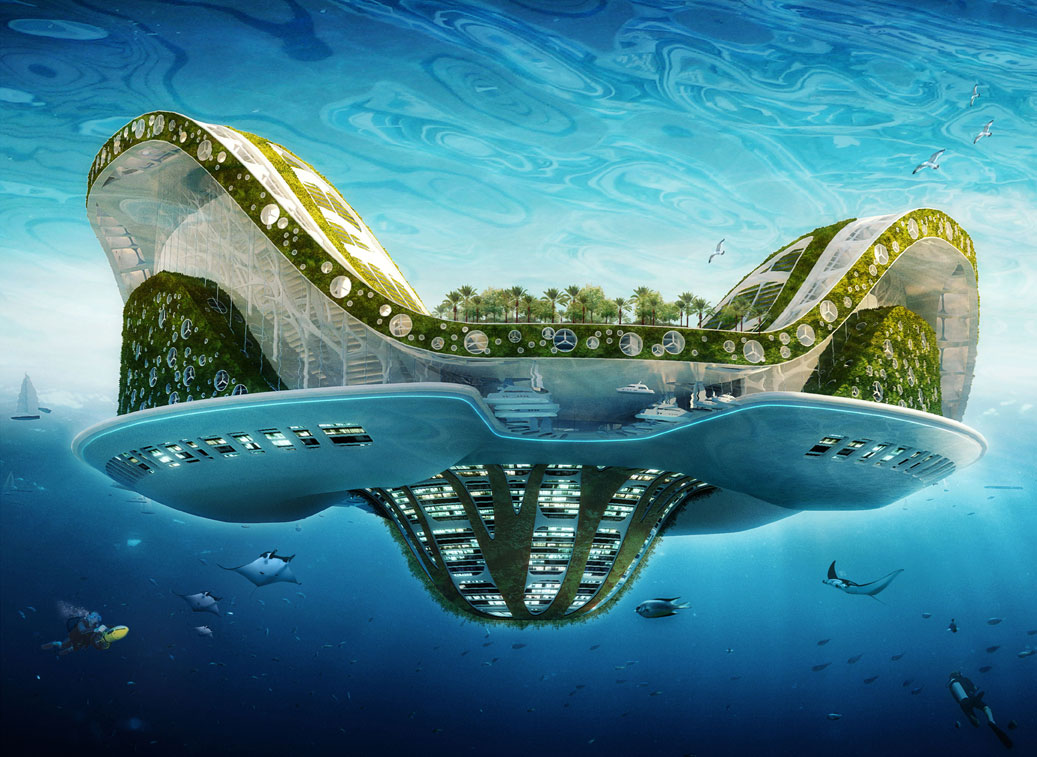
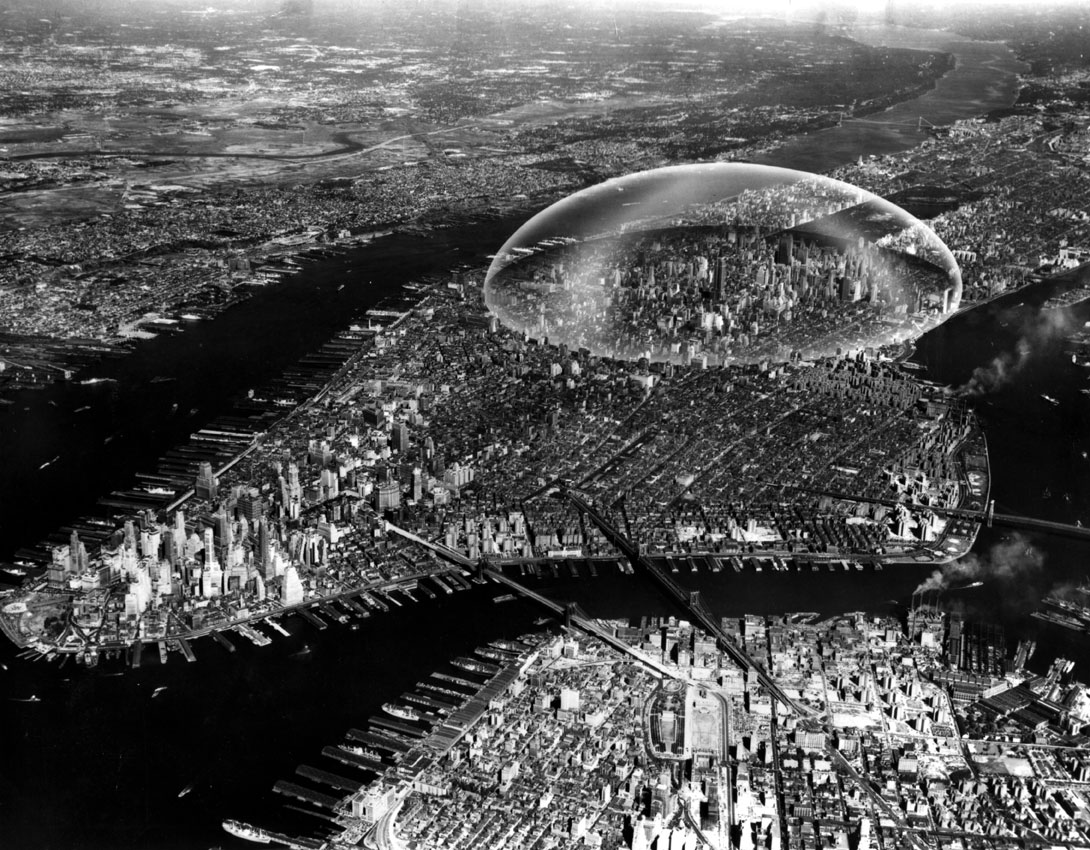
Cities are the largest energy consumers, and urbanisation continues to increase worldwide. Zero waste, zero emission, zero energy are the creeds of the present. Already in the 1950s, Richard Buckminster Fuller and Shoji Sadao sketched the utopia of a climatically self-sufficient reorganisation of the city with their Dome over Manhattan. In this vision, a huge dome covers a large proportion of the island. Today, these encapsulations from the outside are already being realised in conjunction with the design of internal climate worlds, whether on the scale of large building complexes or energy-self-sufficient cities such as Masdar by Norman Foster. Other concepts show that, against the background of imminent climate disasters, the urban system is conceived of increasingly as an autarchic unit, sealed from the outside world, and confronted with the need for the self-contained management of its ecological resources. This debate is carried to the furthest extreme by Vincent Callebaut’s conception for a floating city – Lilypad – intended as a haven for climate refugees.

Nature capsules

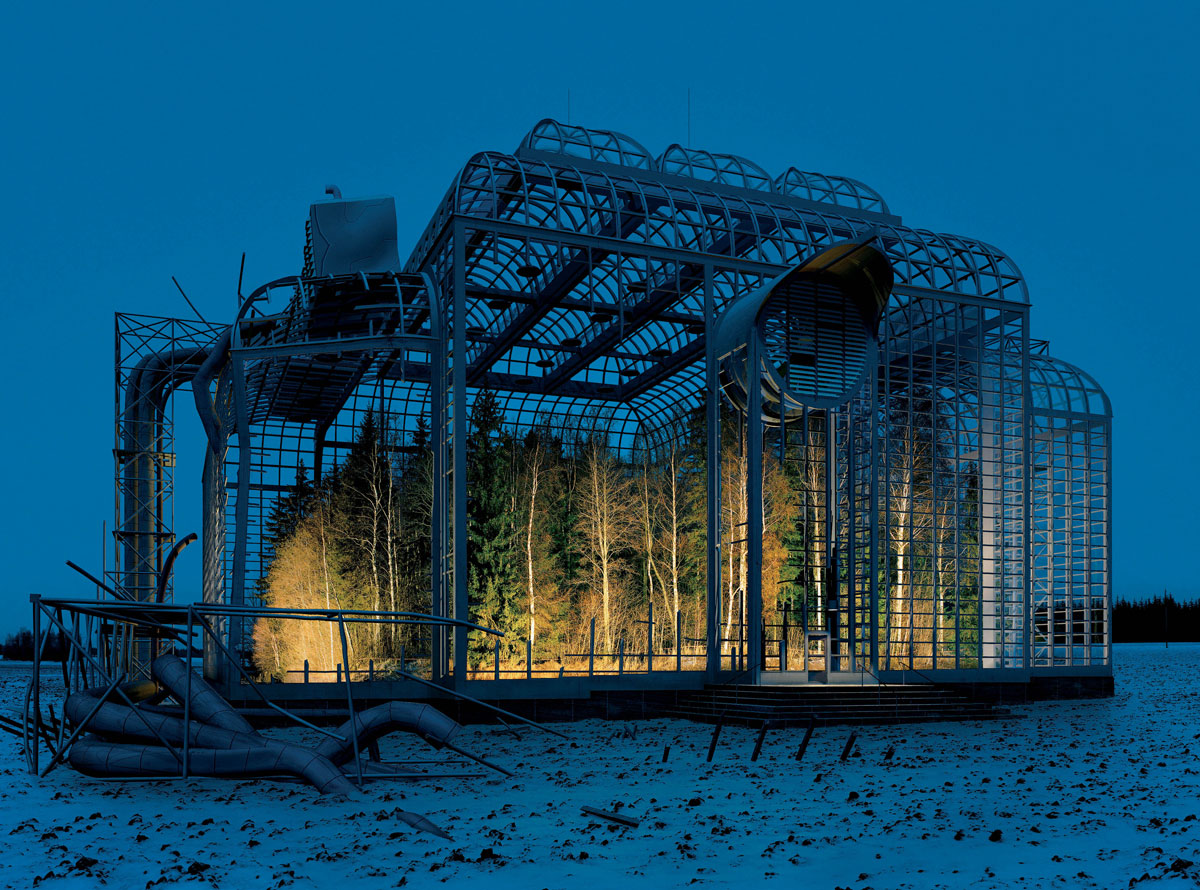
Just as the city is to be protected from the climatologically changing environment, nature is also to be elevated into a sphere of safe artificiality and preserved in nature capsules. Ecosystems are replicated by human hand on the micro level and sealed off from the outside. A concept which initially presents itself as a protective mechanism robs the flora and fauna assembled within it of their connection to the macrolevel ecosystem: Earth. The question arises: can that which is being protected inside such a capsule still be thought of as nature? Or is it a deceptively genuine human artefact? These considerations are made very vivid in Ilkka Halso’s photo series Museum of Nature, consisting of digital montages which insert forests, lakes and rivers into imaginary museum buildings.

Atmosphere capsules

The maximum scale of adaptive design strategies is reached with geo-engineering. With chemical or physical interventions, attempts are made to control climatological, geochemical and biochemical systems actively on the global level, and thus to moderate the climate. The historical forerunners of this development are psychoanalyst Wilhelm Reich’s para-scientific Cloudbusters and the U.S. Army’s Project Cirrus, both of which sought to influence the weather technically by different means. Today, various well-known scientists and research institutes are working on large-scale interventions aiming to protect the global climate from negative influences. Utopian proposals are juxtaposed with feasible projects such as endeavours to reduce global warming through the use of reflective white paint on roofs and streets. To date it is impossible to calculate the consequences of such far-reaching interventions, and they are nowhere near realisation. Yet the fact that they are discussed seriously indicates how close climatological developments have already come to the point where emission-reduction strategies become obsolete.

Participating artists, designers and architects: Anderson Anderson Architecture (US), Ant Farm (US), Richard Buckminster Fuller (US), Vincent Callebaut (B), Juan Downey (US), David Greene (GB), Tue Greenfort (DK), Ilkka Halso (FI), Haus-Rucker-Co (AT), Ron Herron (GB), Kouji Hikawa (JP), Christoph Keller (D), Lawrence Malstaf (B), Gustav Metzger (D), N55 (DK), Lucy Orta (GB), Michael Rakowitz (US), Pablo Reinoso (ARG/F), Shoji Sadao (US), Tomás Saraceno (planet earth), Werner Sobek (D), Jan-Peter E.R. Sonntag (D), Matti Suuronen (FI), Ingo Vetter (D).

Press release from the Museum fur Kunst und Gewerbe website [Online] Cited 17/08/2010 no longer available online


Pablo Reinoso (Argentine-French, b. 1955) 'La Parole' 1998


Pablo Reinoso (Argentine-French, b. 1955)
La Parole
1998
Fabric and electrically powered ventilators
length. 620cm, diam. 200cm
Pablo Reinoso
© Pablo Reinoso Studio


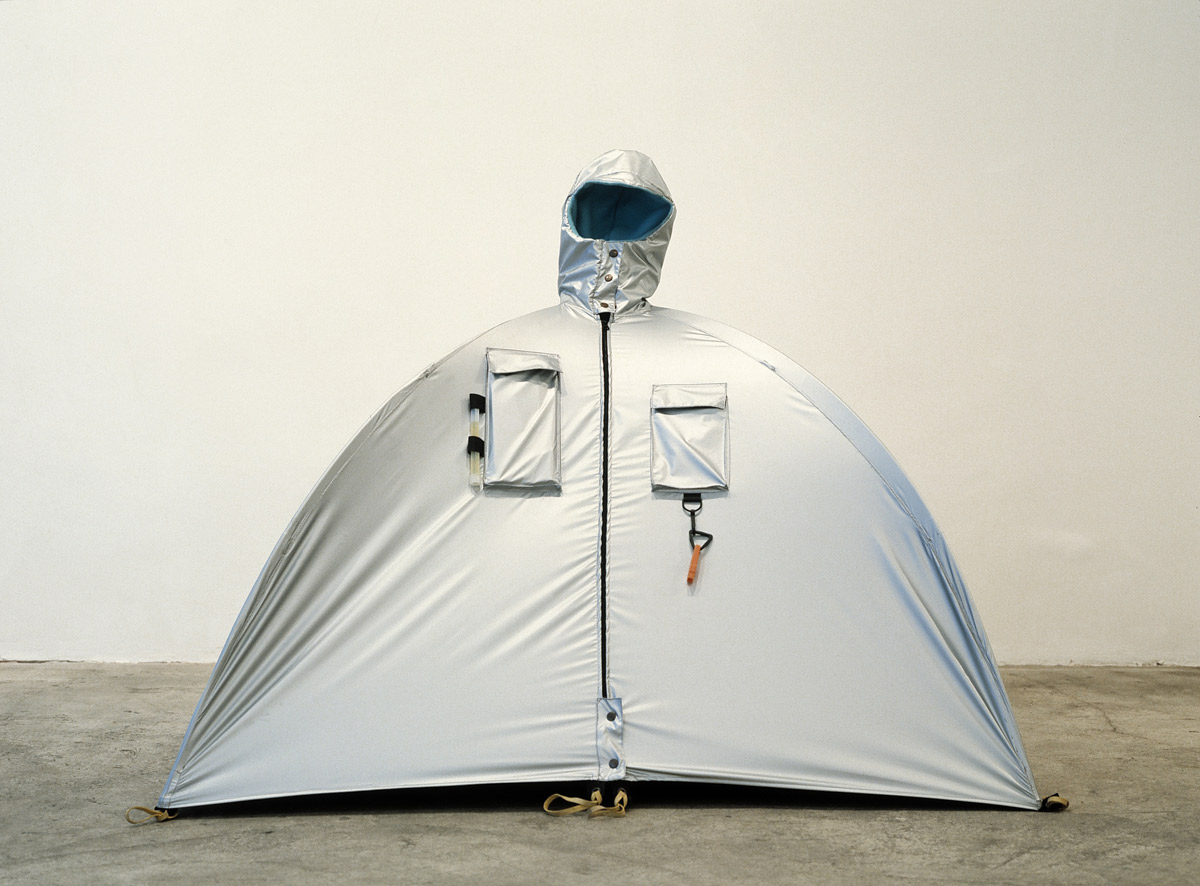
Lucy Orta (English, b. 1966) 'Refuge Wear – Habitent' 1992


Lucy Orta (English, b. 1966)
Refuge Wear – Habitent
1992
Polyamide encased in aluminium, polar fleece, aluminium tent poles, whistle, lantern, compass
125 x 125 x 125cm
Galleria Continua
Photo: Galerie Anne de Villepoix, Courtesy Galleria Continua, San Gimignano / Beijing / Le Moulin


Vincent Callebaut (Belgium, c. 1977) 'Lilypad, A Floating Ecopolis for Climate Refugees' 2008


Vincent Callebaut (Belgium, c. 1977)
Lilypad, A Floating Ecopolis for Climate Refugees
2008
Digital rendering, dimensions variable
© Vincent Callebaut Architectures


Richard Buckminster Fuller, Shoji Sadao. 'Dome over Manhattan' c. 1960


Richard Buckminster Fuller, Shoji Sadao
Dome over Manhattan
c. 1960
Silver gelatine print
34.9 x 46.7cm
Courtesy the Estate of R. Buckminster Fuller


Ilkka Halso (Finnish, b. 1965) 'Museum I' 2003


Ilkka Halso (Finnish, b. 1965)
Museum I
2003
from the work Museum of Nature


Museum für Kunst und Gewerbe Hamburg
Steintorplatz, 20099 Hamburg

Opening hours:
Tuesday to Sunday 10am – 6pm
Thursday 10am – 9pm
Museum fur Kunst und Gewerbe Hamburg website

LIKE ART BLART ON FACEBOOK

Back to top

Review: ‘Pondlurking’ by Tom Moore at Helen Gory Galerie, Prahran, Melbourne

Exhibition dates: 10th March – 3rd April, 2010


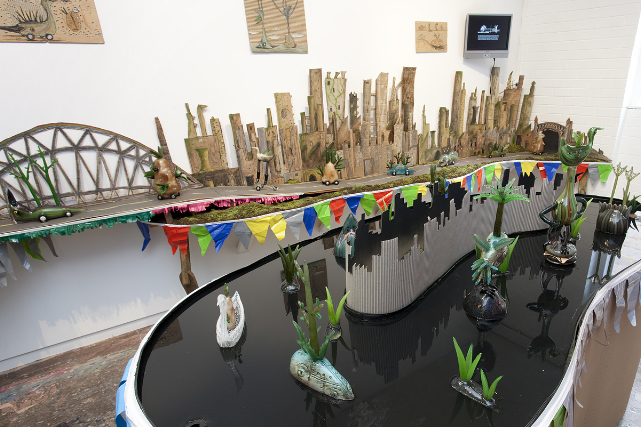
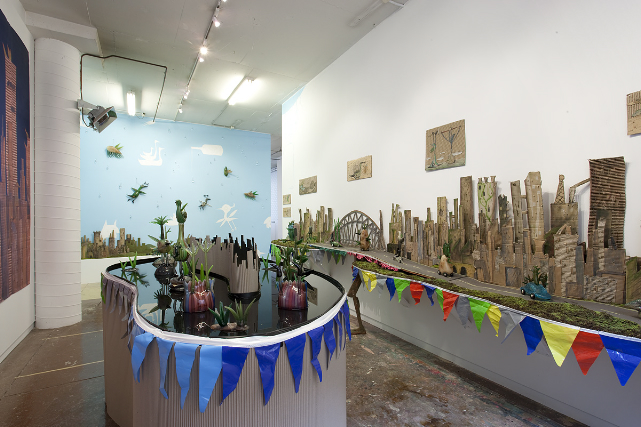
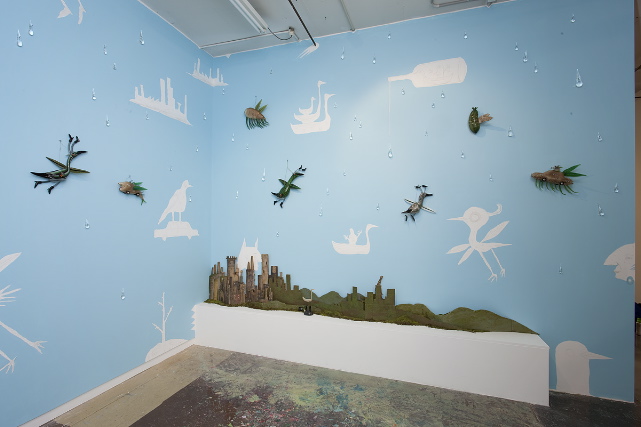
Tom Moore 'Pondlurking' installation photographs at Helen Gory Galerie, Prahran


Tom Moore Pondlurking installation photographs at Helen Gory Galerie, Prahran
Photo: Marcus Bunyan


My apologies to readers for the paucity of reviews of exhibitions in Melbourne recently. It is not that I haven’t been circulating around town to lots of exhibitions, far from it. The fact is that nothing has really rocked my boat, including my visit to a disappointing New 010 exhibition at ACCA, an exhibition redeemed only by the marvellous magnetic levitations of Susan Jacobs installation titled Being under no illusion (2010). Compared to the wealth of interesting work in New 09, work that still resides in my consciousness, the art in the current exhibition seems bland, the work ultimately and easily forgettable (a case of conceptual constipation?). Even though the exhibition lauds the collaboration between artists, designers, curators, architects, trades people and the kitchen sink in the production of the work, nothing substantive or lasting emerges.

No such problem exists with the exhibition Pondlurking by Tom Moore at Helen Gory Galerie in Prahran. Wow, this show is good!

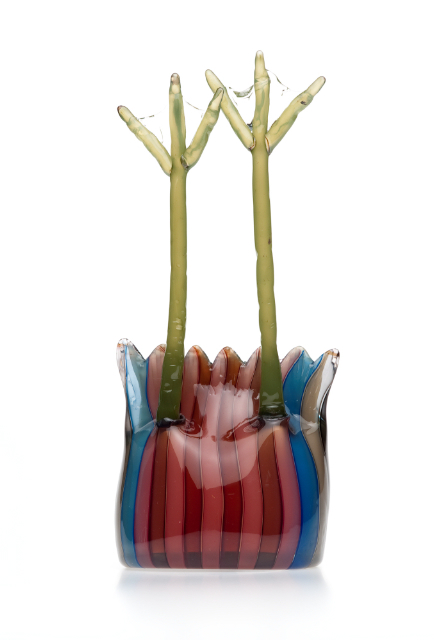
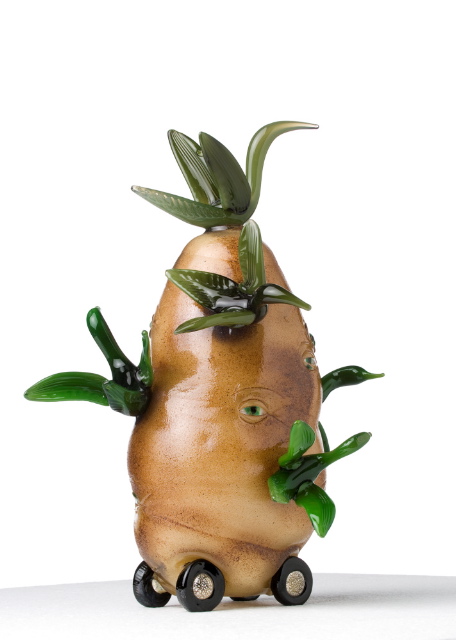
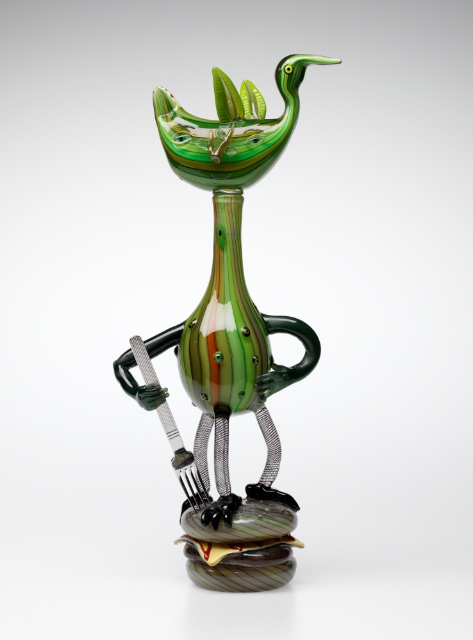
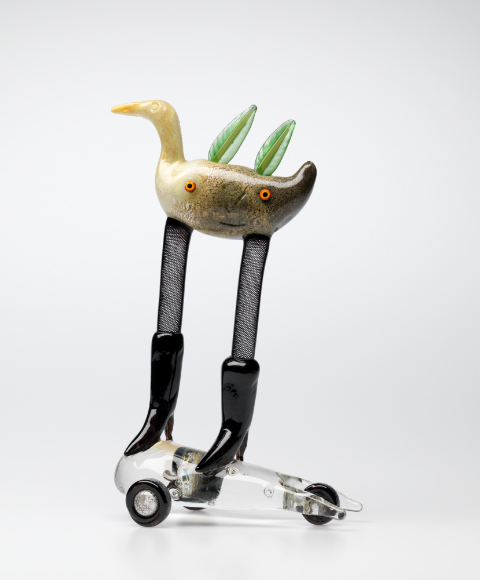
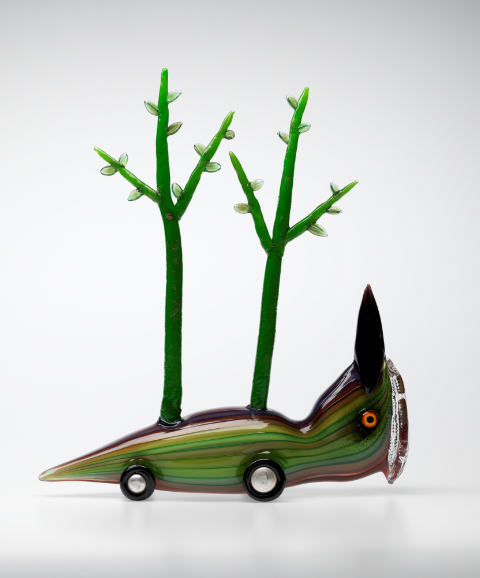
It produced in me an elation, a sense of exalted happiness, a smile on my dial that was with me the rest of the day. The installation features elegantly naive cardboard cityscape dioramas teeming with wondrous, whimsical mythological animals that traverse pond and undulating road. This bestiary of animals, minerals and vegetables (bestiaries were made popular in the Middle Ages in illustrated volumes that described various animals, birds and even rocks) is totally delightful. In the text Moving Right Along the curator Julie Ewington notes connections in Moore’s work to the Garden of Earthly Delights by Hieronymus Bosch, the porcelain monkey orchestras of Miessen, parti-coloured hose of Medieval costume, the animals from Dr Suess’s books for children and Venetian glass figurines to name but a few. Another curator Geoffrey Edwards notes Moore’s accomplished technical skill in glass making, his use of lattice and trellis work in the figures themselves, namely the use of vetro a fili (broadly spaced) and vetro a retorti (twisted spiral) glass cane patterns.

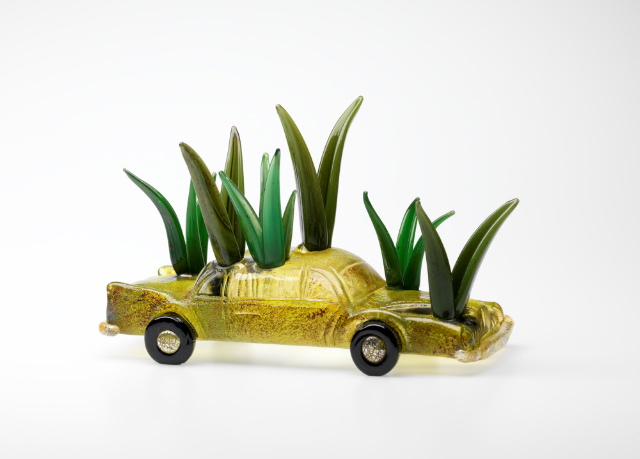
While all of this is true what really stands out is the presence of these objects, their joyousness. The technical and conceptual never get in the way of good art. The Surrealist imagining of a new world order (the destruction of traditional taxonomies) takes place while balanced on one foot (see the installation image at the top of the page). The morphogenesis of these creatures, as they build one upon another, turns the world upside down (as in Web Feet Duck Bum below). Multi-eyed potato cars, ducks with eyes wearing high heeled boots and three-legged devouring creatures segue from one state, condition, situation or element to another in a fluid condition of becoming. This morphogenesis is aided and abetted by the inherent fluidity of the glass medium itself skilfully used by Moore in the construction of his creatures. While the photographs below isolate the creatures within a contextless environment it is when the creatures are placed within the constructed environment so skilfully created by Moore that they come alive.

The interconnectedness of this fantastical world (the intertextual relationship of earth, water, air, life) seeks to break down the binaries of existence – good / bad, normal / mutation, presence / absence – until something else (e)merges. Through their metamorphosed presence in a carnivalesque world that is both weird and the wonderful, Moore’s creatures invite us to look at ourselves and our landscape more kindly, more openly and with a greater generosity of spirit.

Not to be missed!

Dr Marcus Bunyan


Many thankx to Nicola Stein and Helen Gory Galerie for allowing me to use the images below in the posting. All installation photographs © Marcus Bunyan


Tom Moore 'Pondlurking' installation photographs at Helen Gory Galerie, Prahran

Tom Moore 'Pondlurking' installation photographs at Helen Gory Galerie, Prahran

Tom Moore 'Pondlurking' installation photographs at Helen Gory Galerie, Prahran


Tom Moore Pondlurking installation photographs at Helen Gory Galerie, Prahran
Photos: Marcus Bunyan


Tom Moore (Australian) 'Stylish Car' 2008 from the exhibition 'Pondlurking' by Tom Moore at Helen Gory Galerie, Prahran, Melbourne, March - April, 2010


Tom Moore (Australian)
Stylish Car
2008


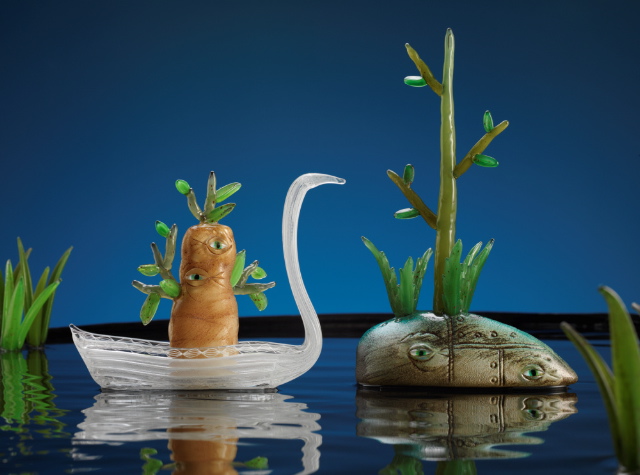
Tom Moore (Australian) 'Birdboat with passenger with a vengeance' (left) and 'Robot Island' (right) 2010 and 2009 from the exhibition 'Pondlurking' by Tom Moore at Helen Gory Galerie, Prahran, Melbourne, March - April, 2010


Tom Moore (Australian)
Birdboat with passenger with a vengeance (left) and Robot Island (right)
2010 and 2009


A candy striped fish pokes its head up, all lipstick-pink kissable lips as a voyaging duck sprouts tree-masts and becomes duck-ship-island captained by a lone gherkin boy. Delinquent birds rampage while a crested birdcar peacefully unfurls sweet green shoots. A cardboard city burns and there’s something odd lurking in the pond, metallic and curiously tuberous, it regards it all with a wary eye.

There’s a whole world at play here. Growing, flying and always moving, this isn’t ours turned upside down but something other, a unique universe bound together with a logic entirely its own. Tubers take to the air, birds grow wheels and everything overflows with energy, pushing out green tendrils toward each other.

Tom Moore’s gloriously appealing glass creatures spring from his own fantastical imagination and the rich seabeds of the mythical, imaginary and grotesque. From mediaeval bestiaries with their camel leopards and manticores, to misericord creatures through Lear and Seuss to Moore’s reimagining of an Colonial Australian epergne as a verdantly plumed robot bird with resplendent palm tree, his creatures reuse, recycle and recombine in their never ending metamorphoses.

There’s an irrepressible joyousness in these creatures constant flux as they burst the boundaries of animal / vegetable / mineral and do away with taxonomies and rationality, reinventing themselves in happy disregard of all humanity’s rules.

While lurking seems antithetical to all this busy-ness, to skylarking fatbirds and peripatetic potatoes, the will to knowledge at the core of all lurking is what propels this endless becoming. This insatiable urge to simply find out is the engine of this prolific universe. As duck becomes island and man becomes bird, Moore’s creatures ask an eternal ‘what if?’ and an insouciant ‘why not?’

This transformative energy inheres in the material itself, in the mutable and alchemical nature of glass, in the fusing and melding of forms as light is captured within and bounces off lustrous surfaces. As glass flows through its changeable states, like water, like rain, so do Moore’s folk transform and evolve.

It’s this continuous moving through forms that hints at other meanings. Sharing forms, being made as it were, of each other and sharing an essential nature, each creature reaches out to every other in a net of relations in an intricately connected universe. These deep bonds, seen in their loving regard for each other speak of the delicate structures and balance of ecosystems and an absolutely necessary attention to and care for the world.

For there are no humans here and it seems that it’s this carelessness, this lack of attention to the fragile connections between the world and its creatures that’s the reason. The cities burn and cars rightfully become compost.

This riotous parade has pulled the artist too into their exuberant tumble. Becoming man-bird and greeting the day with a drumming bird song he is the harbinger perhaps of a new order, one bright green and sparkling.

Jemima Kemp, 2010

Press release from the Helen Gory Galerie website [Online] 20/03/2010 no longer available online


Tom Moore (Australian) 'Web Feet Duck Bum' 2009 from the exhibition 'Pondlurking' by Tom Moore at Helen Gory Galerie, Prahran, Melbourne, March - April, 2010


Tom Moore (Australian)
Web Feet Duck Bum
2009


Tom Moore (Australian) 'Tasty Eyes With Five Friends' 2007


Tom Moore (Australian)
Tasty Eyes With Five Friends
2007


Tom Moore (Australian) 'Snarsenvorg the Devourer' 2008


Tom Moore (Australian)
Snarsenvorg the Devourer
2008


Tom Moore (Australian) 'Segway' 2009


Tom Moore (Australian)
Segway
2009


Tom Moore (Australian) 'Tree-Feet, Dollbird' 2008


Tom Moore (Australian)
Tree-Feet, Dollbird
2008


Helen Gory Galerie

This gallery is now closed

Tom Moore website

LIKE ART BLART ON FACEBOOK

Back to top

Exhibition: ‘The Eventuality of Daybreak’ by Alex Lukas at Glowlab, New York

Exhibition dates: 12th November – 6th December 2009


Alex Lukas (American, b. 1981) 'Untitled' 2009. Acrylic and silk screen on two book pages from the exhibition 'The Eventuality of Daybreak' at Glowlab, New York, Nov - Dec, 2009


Alex Lukas (American, b. 1981)
Untitled
2009
Acrylic and silk screen on two book pages


These are terrific – I want one!

A big thank you to Alex for allowing me to reproduce the images.

Dr Marcus Bunyan


Please click on the photographs for a larger version of the image.


Alex Lukas (American, b. 1981) 'Untitled' 2009. Acrylic and silk screen on two book pages from the exhibition 'The Eventuality of Daybreak' at Glowlab, New York, Nov - Dec, 2009


Alex Lukas (American, b. 1981)
Untitled
2009
Acrylic and silk screen on two book pages


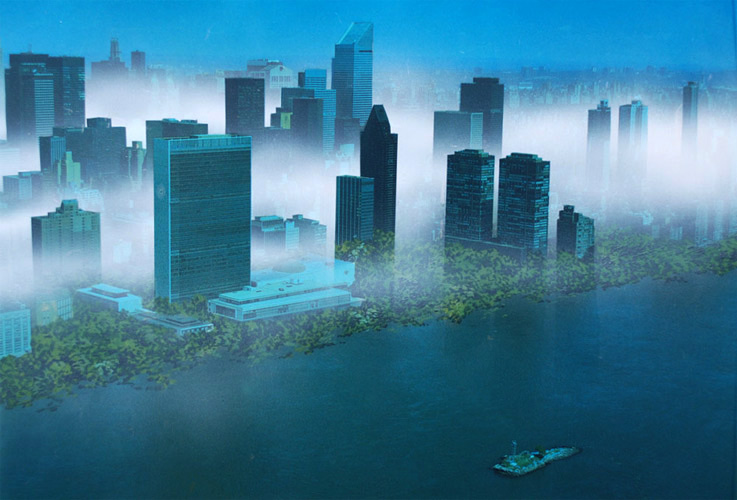
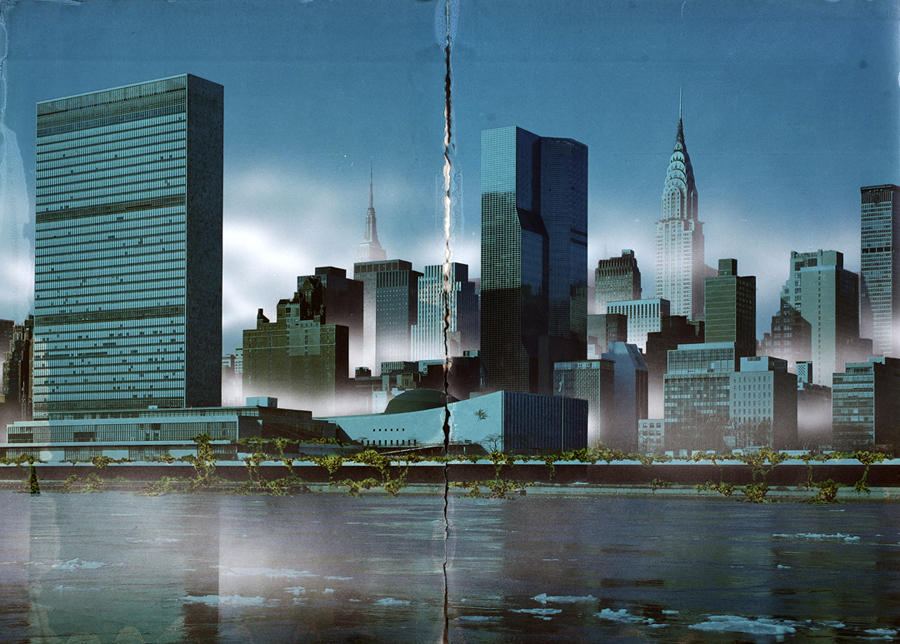
Glowlab is pleased to present The Eventuality of Daybreak, a solo exhibition by Alex Lukas featuring a new series of post-apocalyptic urban landscapes that blur the visual boundaries of fiction and reality.

Lukas’ work explores the existence of disaster, be it realised or fictitious, in contemporary society. Hyper-realistic motion pictures and unforgiving news footage depict seemingly identical – and equally riveting – facades of tragedy. The artist recognises that relentless visual bombardment has resulted in society’s desensitisation to the aesthetics of destruction.

For The Eventuality of Daybreak, Lukas has selected photographic spreads of well-known metropolises from vintage publications and uses them dually as canvas and unlikely subject. Through a deft handling of paint and carefully placed screen-printed passages, the artist pushes these ageing illustrations in futuristic contexts. Submerging these cities conceptually and physically, Lukas inundates images of American cities with layers of media representing cataclysmic floods and crippling overgrowth.

Also included in the exhibition are works on paper depicting near-future scenes of devastated landscapes – crumbling infrastructure, overturned trucks and telling signs of human despair. As a counterpoint to the underwater cities, these darkly atmospheric and barren vistas signal devastation through an unsettling sense of absence.

Lukas’ intentional use of dated imagery presented in tandem with contemporary situations forces the viewer to reconcile two differing ideologies of urban space. The artist’s work calls into question society’s collective acceptance of the urban environment as an arena of destruction, once thought unthinkable and now seemingly inevitable.

The Eventuality of Daybreak is Lukas’ first solo exhibition with Glowlab. Lukas’ work has also been exhibited in New York, Boston, Philadelphia, Los Angeles, San Francisco, London, Stockholm and Copenhagen as well as in the pages of Swindle Quarterly, Proximity Magazine, The San Francisco Chronicle, The Village Voice, The Drama and The New York Times Book Review. Lukas is a graduate of the Rhode Island School of Design and currently lives and works in Philadelphia, where he is a member of the artist collective Space 1026.

Press release on the Glowlab website [Online] Cited 20/11/2009 no longer available online


Alex Lukas (American, b. 1981) 'Untitled' 2009. Acrylic and silk screen on two book pages


Alex Lukas (American, b. 1981)
Untitled
2009
Acrylic and silk screen on two book pages


Alex Lukas (American, b. 1981) 'Untitled' 2009. Acrylic and silk screen on two book pages


Alex Lukas (American, b. 1981)
Untitled
2009
Acrylic and silk screen on two book pages


Alex Lukas (American, b. 1981) 'Untitled' 2009. Acrylic and silk screen on two book pages


Alex Lukas (American, b. 1981)
Untitled
2009
Acrylic and silk screen on two book pages


Alex Lukas. 'Untitled' 2009. Acrylic and silk screen on two book pages


Alex Lukas (American, b. 1981)
Untitled
2009
Acrylic and silk screen on two book pages


Glowlab

This gallery has now closed

Alex Lukas website

LIKE ART BLART ON FACEBOOK

Back to top

Review: ‘Heavenly Vaults’ by David Stephenson at John Buckley Gallery, Richmond

Exhibition dates: 7th – 28th November, 2009


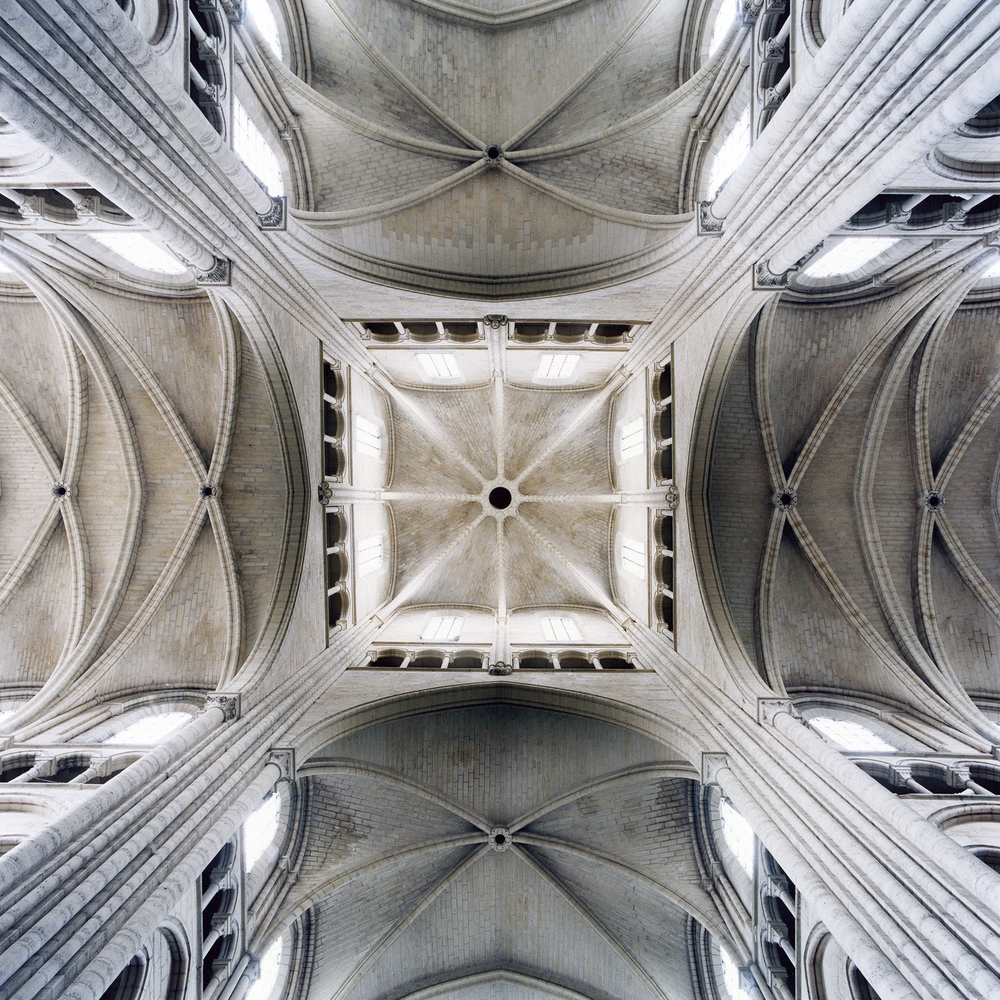
David Stephenson (Australian born America, b. 1955) 'Nave, Laon Cathedral, Laon, France' 2006/07 from the exhibition 'Heavenly Vaults' by David Stephenson at John Buckley Gallery, Richmond, Nov 2009


David Stephenson (Australian born America, b. 1955)
Nave, Laon Cathedral, Laon, France
2006/2007


I remember many years ago, in the mid-1990’s, seeing the wonderful Domes of David Stephenson displayed in Flinders Lane in what is now fortfivedownstairs gallery. They were a revelation in this light filled space, row upon row of luminous domes seemingly lit from within, filled with the sense of the presence of divinity. On the opposite wall of the gallery were row upon row of photographs of Italian graves depicting the ceramic photographic markers of Italian dead – markers of the impermanence of life. The doubled death (the representation of identity on the grave, the momento mori of the photograph) slipped quietly into the earth while opposite the domes ascended into heaven through their numinous elevation. The contrast was sublime.

Unfortunately the same cannot be said of the latest exhibition Heavenly Vaults by David Stephenson at John Buckley Gallery, Richmond.

The problems start with the installation of the exhibition. As you walk into the gallery the 26 Cibachrome photographs are divided symmetrically down the axis of the gallery so that the prints reflect each other at both ends and each side of the gallery. It is like walking down the nave of a cathedral and observing the architectural restraint of the stained glass windows without their illumination. Instead of the punctum of light flooding through the stained glass windows, the varying of intensities, the equanimity of the square prints all exactly the same size, all reflecting the position of the other makes for a pedestrian installation. Some varying of the print size and placement would have added much life and movement to a static ensemble.

Another element that needed work were the prints themselves which, with a few notable exceptions, seemed remarkably dull and lifeless (unlike their digital reproductions which, paradoxically, seem to have more life!). They fail to adequately represent the aspirations of the vaults as they soar effortlessly overhead transposing the earth bound into the heaven sent. In the earlier work on the domes (which can be found in the book Visions of Heaven: The Dome in European Architecture) the symmetry of the mandala-like domes with their light-filled inner illumination worked well with the square format of the images making the photographs stand as equivalents for something else, other ineffable states of being.

“The power of the equivalent, so far as the expressive-creative photographer is concerned, lies in the fact that he can convey and evoke feelings about things and situations and events which for some reason or other are not or can not be photographed. The secret, the catch and the power lies in being able to use the forms and shapes of objects in front of the camera for their expressive-evocative qualities. Or to say this in another way, in practice Equivalency is the ability to use the visual world as the plastic material for the photographer’s expressive purposes. He may wish to employ the recording power of the medium, it is strong in photography, and document. Or he may wish to emphasize its transforming power, which is equally strong, and cause the subject to stand for something else too.”1

As Minor White further observes,

“When the image mirrors the man
And the man mirrors the subject
Something might take over”2


When the distance between object and image and image and viewer collapses then something else may be revealed: Spirit.

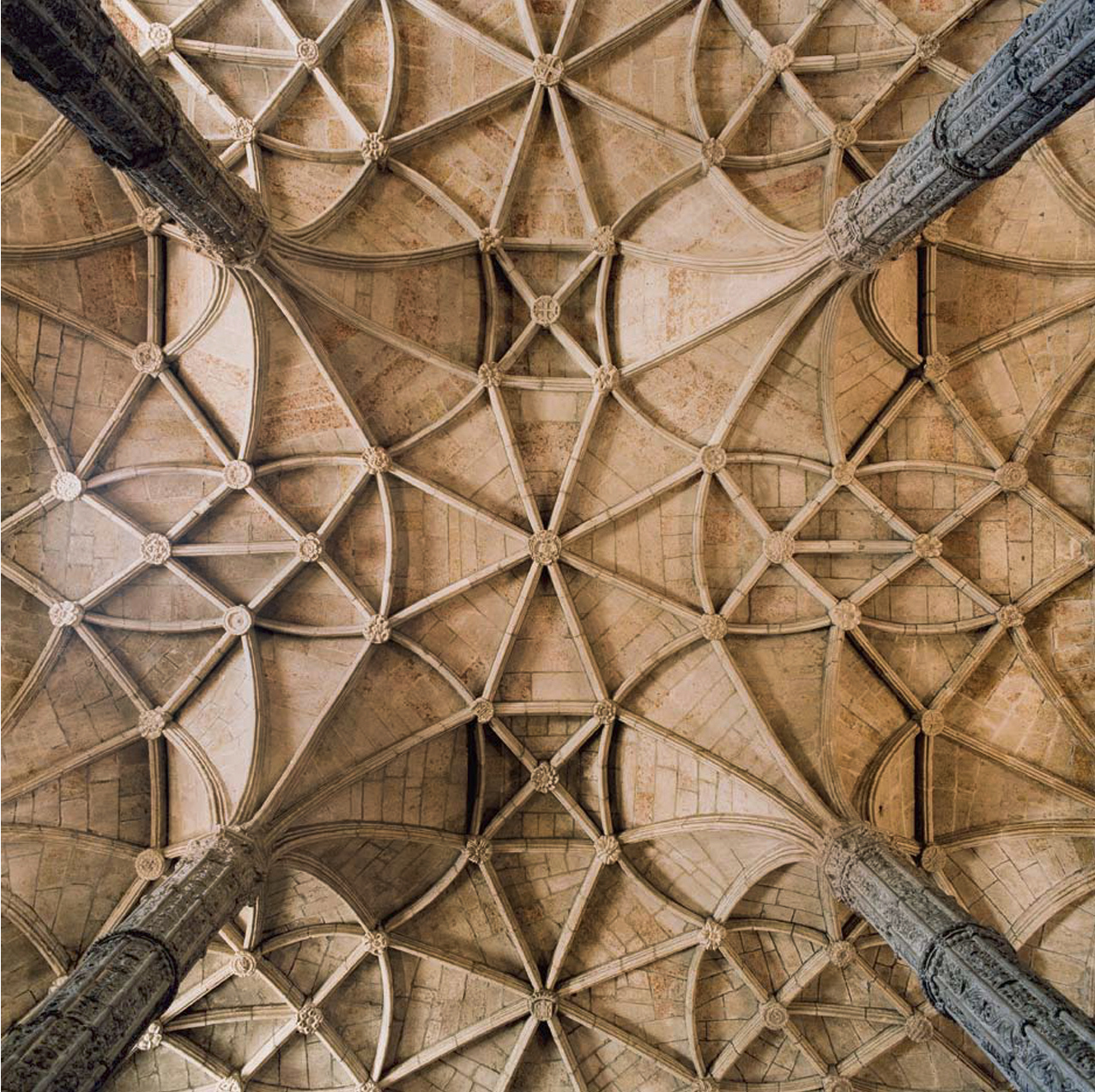
In this exhibition some of the singular images such as the Crossings, Choirs and Nave of the Church of Santa Maria, Hieronymite Monastery, Belém, Portugal (see photograph below) work best to achieve this revelation. They transcend the groundedness of the earthly plane through their inner ethereal light using a reductive colour palette and strong highlight/shadow detail. Conversely the diptychs and triptychs of Nave and Choir (see photographs below and above) fail to impress. The singular prints pinned to the gallery wall are joined together to form pairs and trios but in this process the ‘space between’ the prints (mainly white photographic paper), the breathing space between two or more photographs that balances their disparate elements, the distance that Minor White calls ‘ice / fire’, does not work. There is no tension, no crackle, no visual crossover of the arches and vaults, spandrels and flutes. Here it is dead space that drags all down with it.

I found myself observing without engagement, looking without wonder or feeling – never a good sign!

The photographs of Domes and Vaults have served David Stephenson well for numerous years but the concept has become tired, the inspiration in need of refreshment through other avenues of exploration – both physical and spiritual.

Dr Marcus Bunyan


1/ White, Minor. “Equivalence: The Perennial Trend,” in PSA Journal, Vol. 29, No. 7, pp. 17-21, 1963 [Online] Cited 08/05/2019

2/ White, Minor. “Three Canons,” from Mirrors, Messages, Manifestations. Viking Press, 1969


Many thankx to Daniel and John Buckley Gallery for allowing me to reproduce the photographs from the exhibition. Please click on the photographs for a larger version of the image.


David Stephenson (Australian born America, b. 1955) 'Choir, Laon Cathedral, Laon, France' 2006/07 from the exhibition 'Heavenly Vaults' by David Stephenson at John Buckley Gallery, Richmond, Nov 2009


David Stephenson (Australian born America, b. 1955)
Choir, Laon Cathedral, Laon, France
2006/2007


David Stephenson (Australian born America, b. 1955) 'St. Hugh’s Choir, Lincoln Cathedral, Lincoln, England' 2006/07 from the exhibition 'Heavenly Vaults' by David Stephenson at John Buckley Gallery, Richmond, Nov 2009


David Stephenson (Australian born America, b. 1955)
St. Hugh’s Choir, Lincoln Cathedral, Lincoln, England
2006/2007


Installation view of 'Heavenly Vaults' by David Stephenson at John Buckley Gallery, Richmond


Installation view of Heavenly Vaults by David Stephenson at John Buckley Gallery, Richmond
Photo: Marcus Bunyan


David Stephenson (Australian born America, b. 1955) 'Nave, Cathedral of St. Barbara, Kutná Hora, Czech Republic' 2008/09


David Stephenson (Australian born America 1955)
Nave, Cathedral of St. Barbara, Kutná Hora, Czech Republic
2008/2009


David Stephenson (Australian born America, b. 1955) 'Choir, Cathedral of St. Barbara, Kutná Hora, Czech Republic' 2008/09


David Stephenson (Australian born America 1955)
Choir, Cathedral of St. Barbara, Kutná Hora, Czech Republic
2008/2009


“While the subject of my photographs has shifted… my art has remained essentially spiritual – furthermore than two decades I have been exploring a contemporary expression of the sublime – a transcendental experience of awe with the vast space and time of existence.”


David Stephenson


Internationally renowned photographer David Stephenson has dedicated his practice to capturing the sublime in nature and architecture. Fresh from a successful exhibition at Julie Saul Gallery in New York, Stephenson returns to John Buckley Gallery for his third highly anticipated exhibition Heavenly Vaults. The exhibition will feature 26 selected prints from his latest monograph published by Princeton Architectural Press; Heavenly Vaults: From Romanesque to Gothic in European Architecture. Shaun Lakin, Director of the Monash Gallery of Art, will launch the book and exhibition at the opening, November 7th.

Stephenson began to photograph Gothic vaults in Spain and Portugal in 2003, while completing the work for his Domes project, and his first monograph Visions of Heaven: the Dome in European Architecture. He began to focus on the Vaults project in 2006, photographing Gothic churches and cathedrals in England, Belgium and France. With the assistance of an Australia Council Artist Fellowship in 2008-2009, Stephenson completed extensive fieldwork for the Vaults project, intensively photographing Romanesque and Gothic architecture in Italy, France, Spain, Portugal, Austria, the Czech Republic, Poland, and Germany. The exhibition at John Buckley Gallery coincides with the launch of his second monograph, Heavenly Vaults: from Romanesque to Gothic in European Architecture, published by Princeton Architectural Press, New York.

Even though the traditional systems the underpinned church architecture have lost their unequivocal power, David Stephenson’s photographs capture the resonance of those times. More importantly his work also suggest that the feelings of aspiration, transcendence, and infinity these buildings evoke in the viewer have an ongoing relevance beyond the religious setting and help us understand who and what we are.

Excerpt from Foreword, Heavenly Vaults, by Dr Isobel Crombie 2009


David Stephenson’s new book of photography is a love letter to the intricate, seemingly sui generis vaults of Europe’s Romanesque and Gothic cathedrals and churches.

Press release from the John Buckley website [Online] Cited 11/11/2009 no longer available online


David Stephenson (Australian born America, b. 1955) 'Nave, Church of Santa Maria, Hieronymite Monastery, Belém, Portugal' 2008/09


David Stephenson (Australian born America, b. 1955)
Nave, Church of Santa Maria, Hieronymite Monastery, Belém, Portugal
2008/2009


‘While the subject of my photographs has shifted from the landscapes of the American Southwest and Tasmania, and the minimal horizons of the Southern Ocean, and the icy wastes of Antarctica, to sacred architecture and the sky at both day and night, my art has remained essentially spiritual – for more than two decades I have been exploring a contemporary expression of the sublime – a transcendental experience of awe with the vast space and time of existence.’

David Stephenson 1998.1


With poetic symmetry the Domes series considers analogous ideas. It is a body of work which has been ongoing since 1993 and now numbers several hundred images of domes in countries including Italy, Spain, Portugal, Turkey, England, Germany and Russia. The typological character of the series reveals the shifting history in architectural design, geometry and space across cultures and time, demonstrating how humankind has continually sought meaning by building ornate structures which reference a sacred realm.2 Stephenson photographs the oculus – the eye in the centre of each cupola. Regardless of religion, time or place, this entry to the heavens – each with unique architectural and decorative surround – is presented as an immaculate and enduring image. Placed together, the photographs impart the infinite variations of a single obsession, while also charting the passage of history, and time immemorial.

1. Van Wyk, S. 1998. “Sublime space: photographs by David Stephenson 1989-1998,” National Gallery of Victoria, Melbourne np
2. Hammond, V. 2005. “The dome in European architecture,” in Stephenson, D. 2005, Visions of heaven: the dome in European architecture, Princeton Architectural Press, New York p. 190

© Art Gallery of New South Wales Photography Collection Handbook, 2007


David Stephenson (Australian born America, b. 1955) 'Choir, King's College Chapel, Cambridge, England' 2006/07


David Stephenson (Australian born America, b. 1955)
Choir, King’s College Chapel, Cambridge, England
2006/2007


David Stephenson (Australian born America, b. 1955) 'Crossing, York Minster, York, England' 2006/07


David Stephenson (Australian born America, b. 1955)
Crossing, York Minster, York, England
2006/2007


John Buckley Gallery

This gallery is now closed.

LIKE ART BLART ON FACEBOOK

Back to top

Review: ‘Connection is Solid’ by John Nicholson at Sophie Gannon Gallery, Richmond, Melbourne

Exhibition dates: 25th August – 19th September, 2009


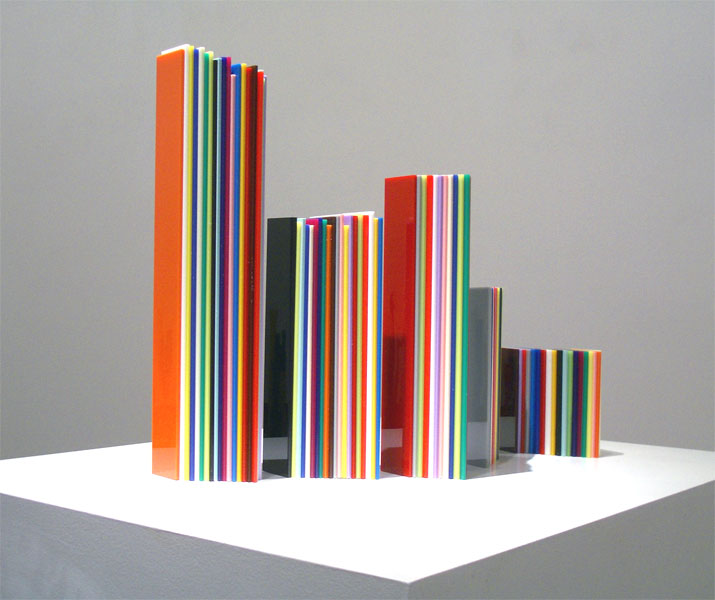
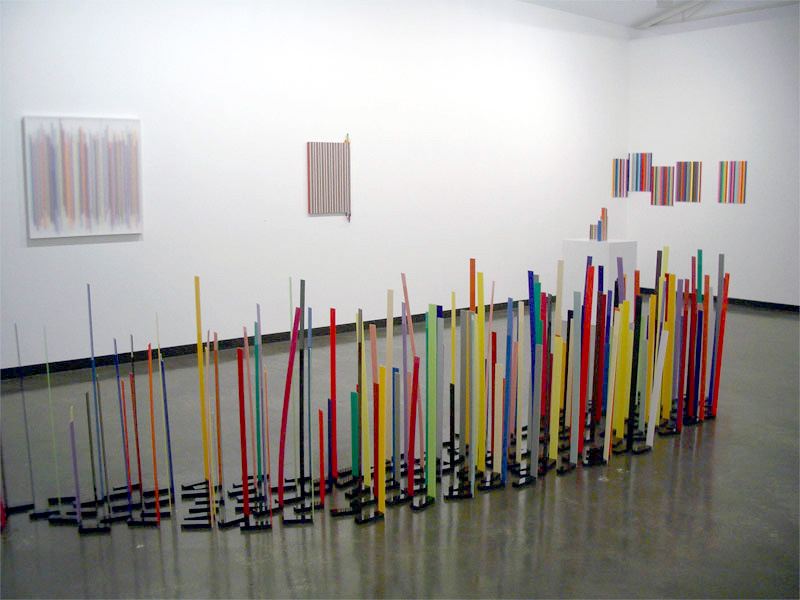
John Nicholson (Australian, b. 1970) 'Untitled' 2009 from the exhibition 'Connection is Solid' by John Nicholson at Sophie Gannon Gallery, Richmond, Melbourne, Aug - Sept, 2009


John Nicholson (Australian, b. 1970)
Aerial Navigation
2009


You could say that the essence of the cosmos is not matter, it is consciousness.

It is not the external world that is real – it is “maya”, an illusion, for the real world lies within.

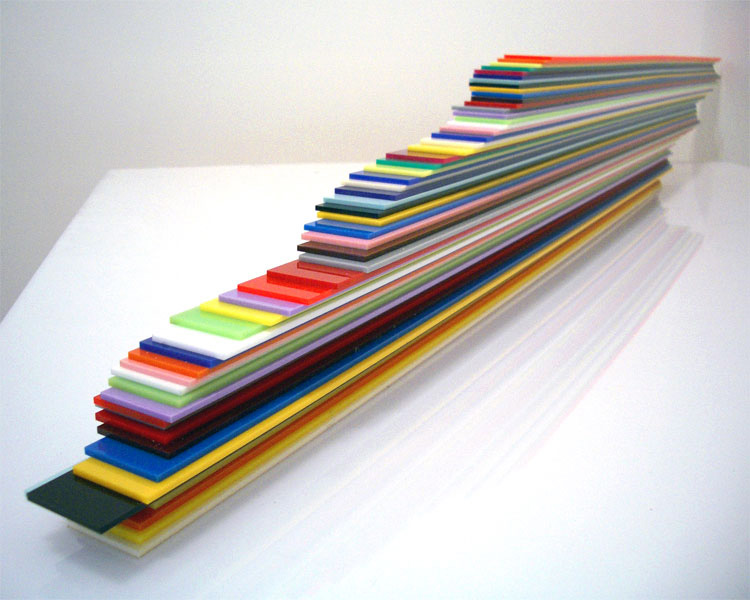
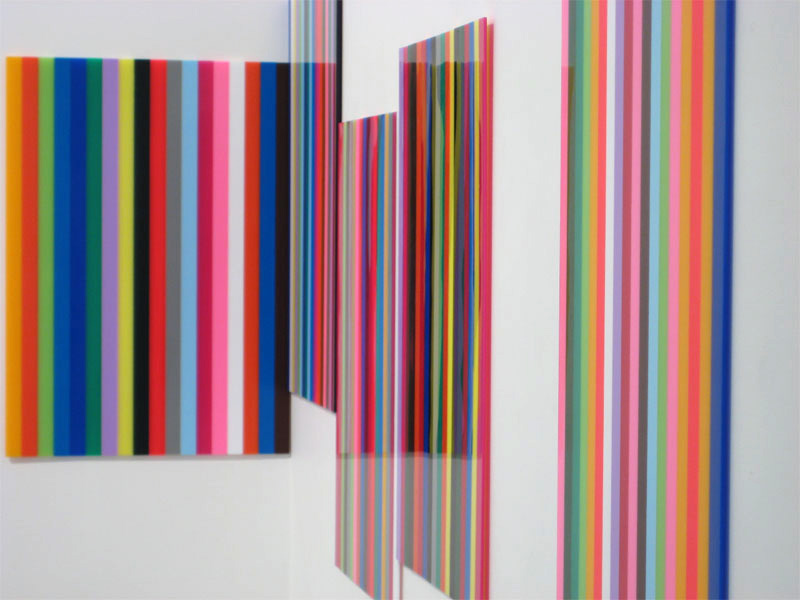
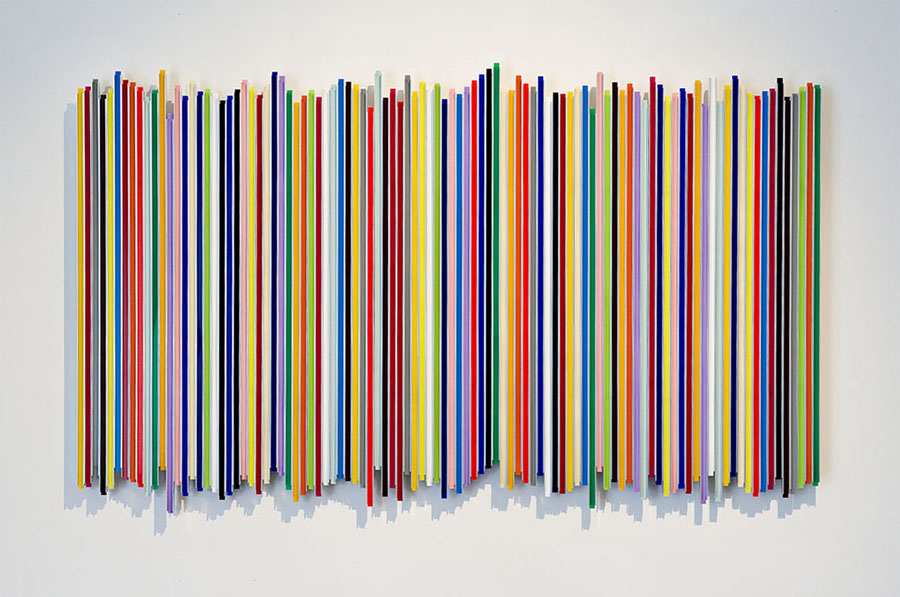
These works, with their striations, strata and suspension are emanations of that spirit – projections of the inner reality.

In terms of the ancient Chinese philosophy Lao Tzu we dream the butterfly and the butterfly is us. If you don’t ‘get’ these works, let go all pretensions and feel their colour as sound, as vibrations of energy.

Submerge yourself in their shape and form. Like DNA structure, a heart beat or the record of a seismic shock these works are music as art, the length of harmony quivering and slipping in our minds, before our eyes.

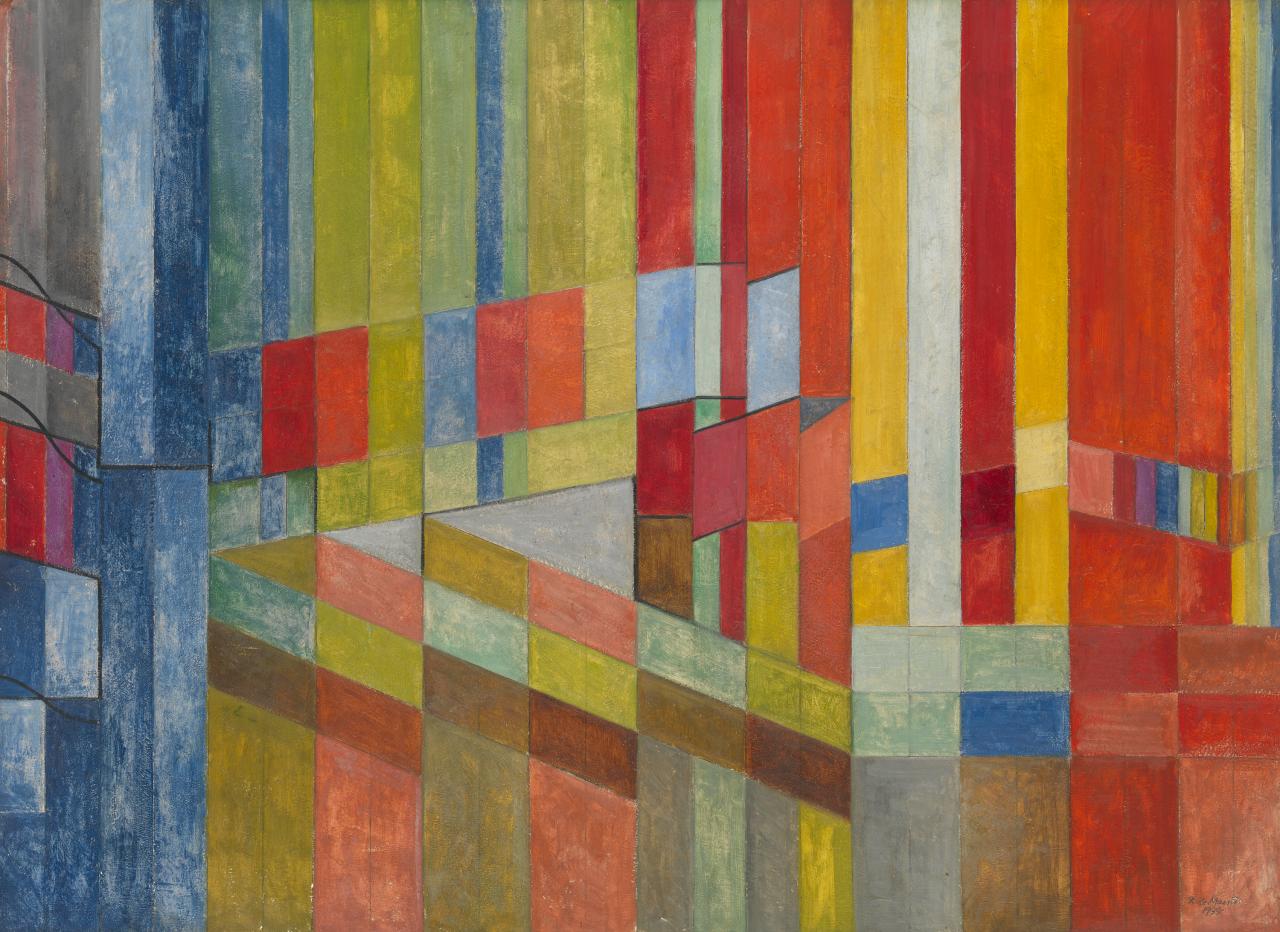
This is the colour music of Roy De Maistre’s paintings of the 1930’s updated to the 21st century. They are fugues of sound made physical entities, intertwining, coming and going. Here lines, tones and colours are organised in a parallel way – tone after tone, line after line. They are wavelengths of the interior made visible. The connection is solid and fluid at one and the same time; there are many connections to be discovered, many journeys to be made.

I hear them, I like them.

Dr Marcus Bunyan


Many thankx to Sophie Gannon Gallery for allowing me to publish the photographs in the posting. Please click on the photographs for a larger version of the image.


John Nicholson (Australian, b. 1970) 'Under the radar' 2009 from the exhibition 'Connection is Solid' by John Nicholson at Sophie Gannon Gallery, Richmond, Melbourne, Aug - Sept, 2009


John Nicholson (Australian, b. 1970)
Under the radar
2009
Photo: Marcus Bunyan


Installation view of 'Connection is Solid' by John Nicholson at Sophie Gannon Gallery, Melbourne

Installation view of 'Connection is Solid' by John Nicholson at Sophie Gannon Gallery, Melbourne


Installation views of Connection is Solid by John Nicholson at Sophie Gannon Gallery
Photos: Marcus Bunyan


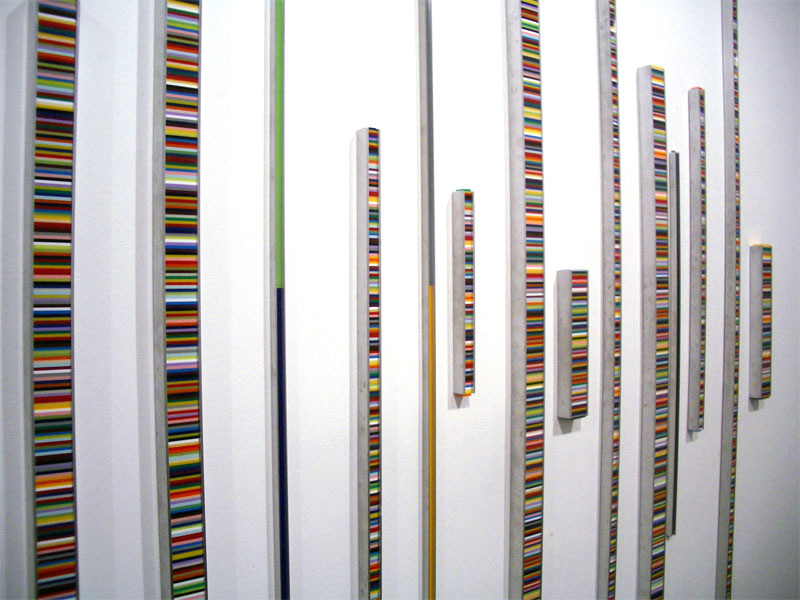
John Nicholson (Australian, b. 1970) 'Thrill seeker' 2009 (detail)


John Nicholson (Australian, b. 1970)
Thrill seeker (detail)
2009
Photo: Marcus Bunyan


Roy de Maistre (Australian, 1894-1968) 'Arrested Movement from a Trio' 1934


Roy de Maistre (Australian, 1894-1968)
Arrested Movement from a Trio
1934
Oil and pencil on composition board
72.3 × 98.8cm


John Nicholson (Australian, b. 1970) 'Slip' 2009


John Nicholson (Australian, b. 1970)
Slip
2009


John Nicholson (Australian, b. 1970) 'The wire might sense' 2009


John Nicholson (Australian, b. 1970)
The wire might sense
2009


John Nicholson (Australian, b. 1970) 'Swoop' 2009


John Nicholson (Australian, b. 1970)
Swoop
2009
Photo: Marcus Bunyan


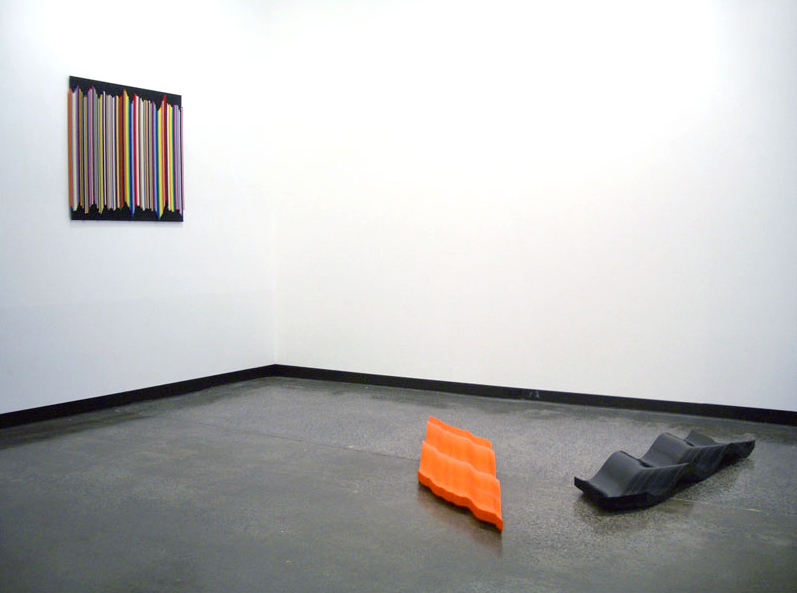
Installation view of 'Connection is Solid' by John Nicholson with on the wall 'Satellite Graffitti' (2009) and on the floor 'Cascade' (2009) and 'Swoop' (2009)


Installation view of Connection is Solid by John Nicholson with on the wall Satellite Graffitti (2009) and on the floor Cascade (2009) and Swoop (2009)
Photo: Marcus Bunyan


Sophie Gannon Gallery
2, Albert Street, Richmond, Melbourne

Opening hours:
Tuesday – Saturday 11am – 5pm

Sophie Gannon Gallery website

LIKE ART BLART ON FACEBOOK

Back to top

Review: ‘Modern Times: The Untold Story of Modernism in Australia’ at Heide Museum of Modern Art, Melbourne

Exhibition dates: 21st March – 12th July, 2009


Roy de Maistre (Australian, 1894-1968) 'Colour Composition derived from three bars of music in the Key of Green' 1935 from the exhibition 'Modern Times: The Untold Story of Modernism in Australia' at Heide Museum of Modern Art, Melbourne, March - July, 2009


Roy de Maistre (Australian, 1894-1968)
Colour Composition derived from three bars of music in the Key of Green
1935
Oil and pencil on composition board
Private Collection


Despite some interesting highlight pieces this is a patchy, thin, incoherent exhibition assembled by the Powerhouse Museum, Sydney now showing at Heide Museum of Modern Art, Melbourne. Featuring a hotchpotch of work ranging across fields such as drawing, architecture, photography, painting, film, graphic design, craft, advertising, Australiana and aboriginal works the exhibition attempts to tell the untold story of Modernism in Australia to little effect. Within the exhibition there is no attempt to define exactly what ‘Modernism’ is and therefore an investigation into Modernism in Australia is all the more confusing for the visitor as there seems to be no stable basis on which to build that investigation. Perhaps reading the catalogue would give a greater overview of the development of Modernism in Australia but for the average visitor to the exhibition there seems to be no holistic rationale for the inclusion of elements within the exhibition which, much like Modernism itself, seems eclectically gathered from all walks of life with little regard for narrative structure.

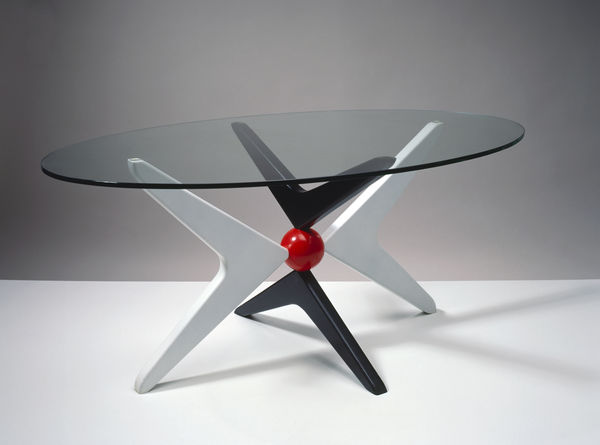
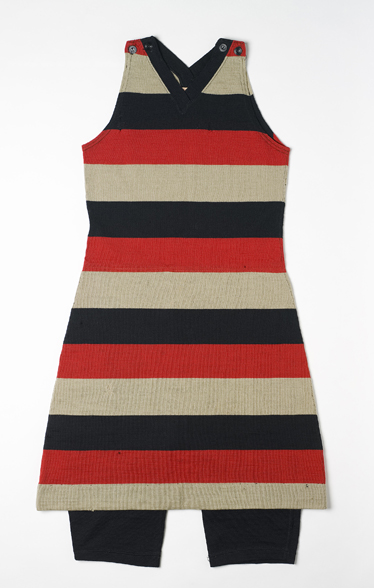
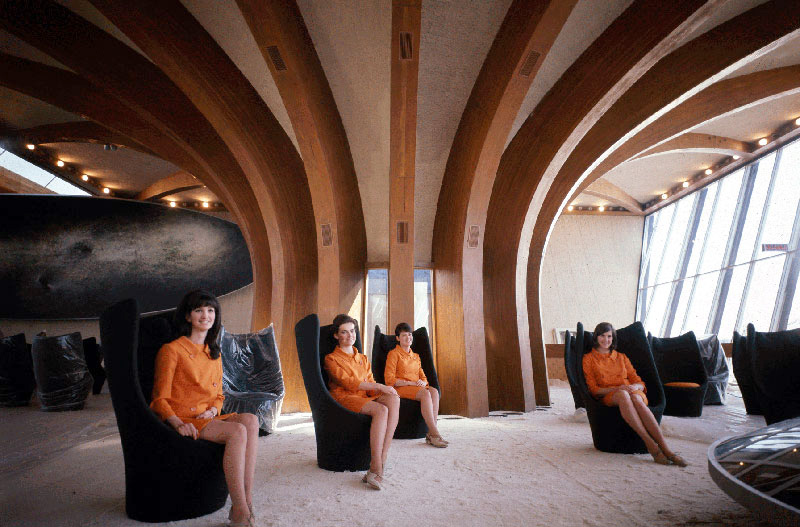
With work spanning five decades from 1917-1967 we are presented with, variously, Robert Klippel’s kitsch Boomerang table from 1955, Robin Boyd’s ‘House of Tomorrow’ from 1949, Wolfgang Sievers ‘new objective’ photographs, Berlei’s scientific system for calculating beauty in woman in use till the 1960s, swimsuits from the 1920s-1940s, Featherston chairs from the Australian pavilion at the 1967 Expo, a recreation of Australian architect Harry Seidler’s office (the most interesting part of this being the books he had in his office library: Frank Lloyd Wright, Mies van de Rohe and Concerning Town Planning by Le Corbusier) and the wind tunnel test model of the Sydney Opera House in wood from 1960. Etcetera, etcetera, etcetera …

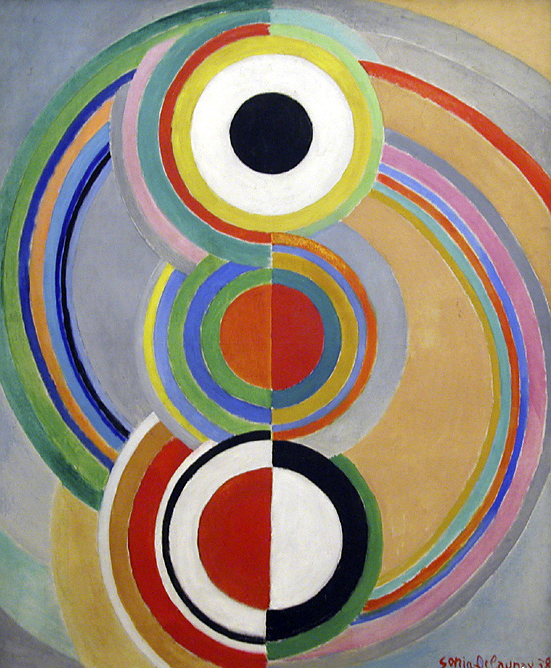
Highlight pieces include the above mentioned test model of the Sydney Opera House which is stunning in its scale and woodenness, in it’s simplicity of shape and form. Other highlight pieces are the colour music compositions of Roy de Maistre which were the tour de force of the show for me, true revelations in their rhythmic synchronic Moebius-like construction with layered planes of colour swirling in purples, greens and yellows. The large vintage photographic print of Sunbaker (1934) by Max Dupain was also a revelation with it’s earthy brown tones, the blending of the atmospheric out of focus foreground with the clouds behind, the architectural nature of the outline of the body almost like the outline of Uluru, the darkness of the head with the sensuality of the head and shoulders framed against the largeness of the hand resting on the sand. Lastly the two paintings and one rug by French artist Sonia Delaunay are a knockout. It says something about an exhibition when the best work in the show are two paintings by a French artist seemingly plucked at random to show external influences on Australian artists and designers.

While the exhibition does attempt to portray the breadth of the development of Modernism in Australia ultimately it falls well short in this endeavour. The most striking example of this shortcoming is the true star of the exhibition – the building that is Heide II itself. Commissioned by John and Sunday Reed and designed by the Victorian architect David McGlashan of the architectural firm McGlashan and Eversit in 1963 the building epitomises everything that is good about architectural Modernism and it’s form overshadows the exhibition itself. In this building we have beautiful spaces and volumes, an amazing staircase down into the lower area, suspended decking overlooking gardens, the blending of inside and outside areas, large expanses of glass to view the landscape, nooks and studies for privacy and the simplicity and eloquence of form that is Modernist design. With money one can indulge in the best of elitist Modernism. With position, position, position one can side steep the alienation of the city and the spread of surburbia where the dream of Australians owning a home of their own still continues in the vast, tasteless expanses of McMansion estates.

Robert Nelson in his review of this exhibition sees the car as creating the suburbs and Modernism as the emptying of the city after 6pm, the lessening of community and the devaluing of space he insists that there is little difference between a Californian bungalow in the suburbs and a utopian geometric neo-Corbusian box by Harry Seidler because they were equally shackled to motor transport.1 This is to miss the point.

Although Modernism in its basic form influenced most walks of life in Australia from swimsuit design to milk bars, from cinema to naturism, from bodies to advertising the most effective expressions of Modernism are architectural (as evidenced by Heide II) and were only open to those with money, power and position. Although Le Corbusier’s concept of public housing was a space ‘for the people’ the most interesting of his houses were the private commissions for wealthy clients. And so it proves here. One can imagine the parties on the deck at Heide II in the 1960s with men in their tuxedo and bow ties and woman in their gowns, or the relaxation of the Reed’s sitting in front of their fire in the submerged lounge. For the ordinary working class person Modernism brought a sense of alienation from the aspirational things one cannot buy in the world, an alienation that continues to this day; for the privileged few Modernism offered the exclusivity of elitism (or is it the elitism of exclusivity!) and an aspirational alienation of a different kind – that of the separation from the masses.

Go to Heide for the glorious gardens, the wonders of Heide II but don’t go to this exhibition expecting grand insights into the basis of Australian Modernism for that story, as Robert Nelson rightly notes, remains as yet untold.

Dr Marcus Bunyan


Many thankx to Heide Museum of Modern Art for allowing me to publish the art work in the posting. Please click on the photographs for a larger version of the image.

An excellent review of the exhibition by Jill Julius Matthews, “Modern times: The untold story of modernism in Australia,” (reCollections Volume 4 number 1) can be found on the Journal of the National Museum of Australia website [Online] Cited 20/02/2019


1/ “Emanating from Sydney’s Powerhouse Museum, Modern Times “explores how modernism transformed Australian culture from 1917 to 1967.” But something is missing. The overwhelming modern development in these 50 years was the proliferation of automotive transport, which redefined the layout and function of Australian cities.The cars created the suburbs; and as the individual bungalow drew out the vast dormitories of Sydney and Melbourne, the city centre was spiritually drained, dedicated to bureaucratic and commercial premises.The story at Heide emphasises the gradual triumph of the tall buildings of the CBD. It doesn’t really reflect how these abstract monuments didn’t contain a soul after 6pm.Although the project makes such a big deal of being interdisciplinary, the social history doesn’t have a robust geographical basis. And because of this, the exhibition and book fail to handle the new alienation that modernism brings: the evacuation of the city and the insularity of suburban people in bungalows with little street life and roads increasingly deemed unsafe for children.

What does it really matter if a house looks like a Californian bungalow or a utopian geometric neo-Corbusian box by Harry Seidler? In social terms, they’re structurally the same, equally retracting from a sense of community and equally shackled to motor transport. In this sense, the styles are immaterial, except that one of them gives you a feeling of intimacy while the other has a bit more light and is easily wiped with a sponge.

At the end of the chosen period, the folly of the dominant suburban pattern came to be understood in its dire ecological consequences. Alas, it was too late. The modernist devaluation of space had already occurred, and our whole society had been reorganised around petrol.”

Robert Nelson. The Age. Wednesday 6th May, 2009


Roy de Maistre (Australian, 1894-1968) 'Arrested Movement from a Trio' 1934 from the exhibition 'Modern Times: The Untold Story of Modernism in Australia' at Heide Museum of Modern Art, Melbourne, March - July, 2009


Roy de Maistre (Australian, 1894-1968)
Arrested Movement from a Trio
1934
Oil and pencil on composition board
72.3 × 98.8cm
National Gallery of Victoria, Melbourne


Roy de Maistre (Australian, 1894-1968) 'Rhythmic composition in yellow green minor' 1919


Roy de Maistre (Australian, 1894-1968)
Rhythmic composition in yellow green minor
1919
Oil on paperboard
85.3 x 115.3cm
Art Gallery of New South Wales
© Caroline de Mestre Walker


In late 1918, Roy de Maistre collaborated with fellow artist Roland Wakelin in exploring the relationship between art and music. Their experiments produced Australia’s first abstract paintings, characterised by high-key colour, large areas of flat paint and simplified forms. The works received critical acclaim, but modernist developments were largely derided by the conservative establishment.

This painting exemplifies de Maistre’s theory of colour harmonisation based on analogies between colours of the spectrum and notes of the musical scale. It is also aligned with de Maistre’s search for spiritual meaning through abstraction, akin to other artists such as Kandinsky who were interested in the ideas of the theosophy and anthroposophy movements, spiritualism and the occult.

Text from the Art Gallery of New South Wales website


Roy de Maistre (Australian, 1894-1968) 'Colour chart' c. 1919


Roy de Maistre (Australian, 1894-1968)
Colour chart
c. 1919
30.5 x 40.5cm
Oil on cardboard
Gift of the executors of the artist’s estate 1968
Art Gallery of New South Wales
© Caroline de Mestre Walker


Sonia Delaunay (Ukraine, b. 1885 moved Paris 1905-1979) 'Rhythm' 1938


Sonia Delaunay (Ukraine, b. 1885 moved Paris 1905-1979)
Rhythm
1938
Oil on canvas


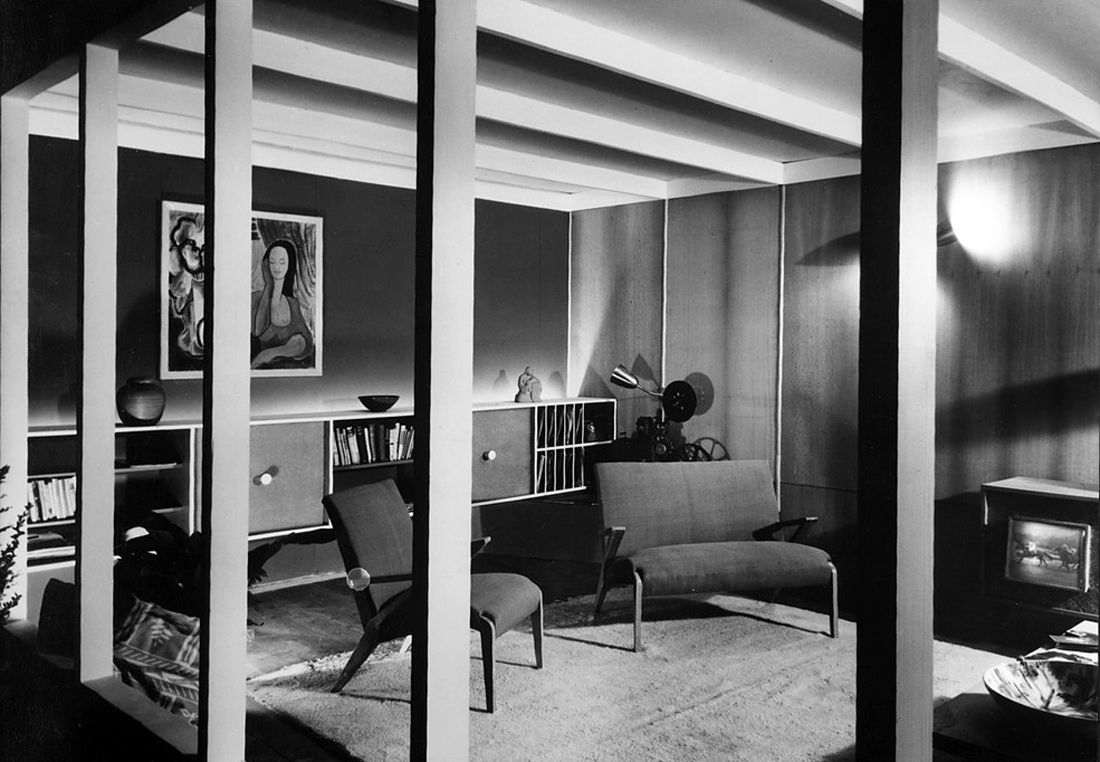
Wolfgang Sievers (German Australian 1913-2007) '"House of Tomorrow" exhibition at Exhibition Building, Melbourne' 1949


Wolfgang Sievers (Australian born Germany, 1913-2007)
“House of Tomorrow” exhibition at Exhibition Building, Melbourne
1949
Gelatin silver print
National Library of Australia


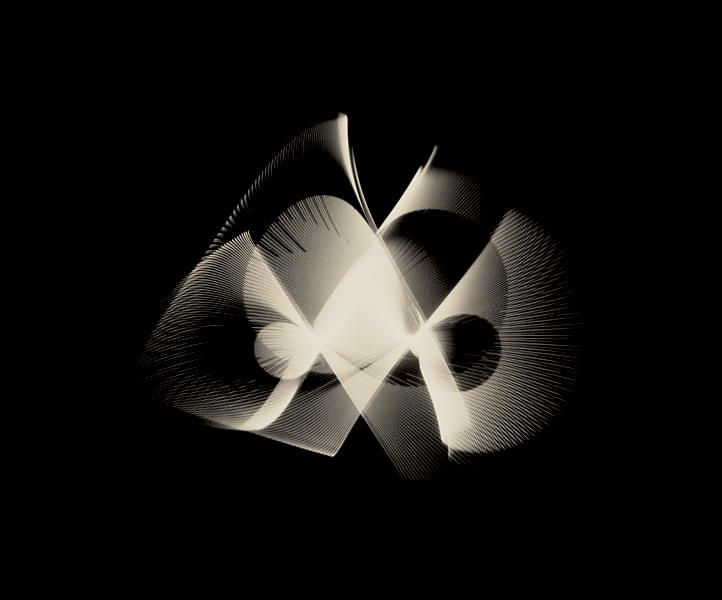
Stanislaus Ostoja-Kotkowski (Australian born Poland, 1922-1994) 'Nymphex' 1966


Stanislaus Ostoja-Kotkowski (Australian born Poland, 1922-1994)
Nymphex
1966
Gelatin silver photograph from electronic image
50.6 x 60.8cm
Gift of Dr George Berger 1978
Art Gallery of New South Wales
@ Estate of Stanislaus Ostoja-Kotkowski


Rayner Hoff (Australian born United Kingdom, 1894-1937) 'Decorative portrait - Len Lye' 1925


Rayner Hoff (Australian born United Kingdom, 1894-1937)
Decorative portrait – Len Lye
1925
Marble
30.5 x 22.5 x 16.5cm
Purchased 1938
Art Gallery of New South Wales


Max Dupain (Australian, 1911-1992) 'Sunbaker' 1934 printed 1937


Max Dupain (Australian, 1911-1992)
Sunbaker
1934 printed 1937
Gelatin silver print


Grace Cossington Smith (Australia, 1892-1984) 'Rushing' c. 1922


Grace Cossington Smith (Australia, 1892-1984)
Rushing
c. 1922
Oil on canvas on paperboard
65.6 x 91.3cm
Art Gallery of New South Wales
© Estate of Grace Cossington Smith


Cossington Smith captures the drama of a crowd in Rushing, which depicts commuters clamouring down to the ferries of Circular Quay to get home after work. The flying scarf and fallen hat emphasise the speed at which the travellers are moving and the peril and claustrophobia of a, mostly faceless, city crowd. The steep gangplank and diagonal composition accentuates the dynamism of the painting.

A brilliant colourist, Cossington Smith’s work of the early 1920s adopts a darker palette than the vivid colours she is usually associated with. Inspired by a visit to Sydney in 1920 by the tonalist painter and teacher Max Meldrum, her paintings became studies in tone, rather than colour, a practice she had abandoned by 1925.

Text from the Art Gallery of New South Wales website


Robert Klippel (Australian, 1920-2001) 'Boomerang' coffee table 1955


Robert Klippel (Australian, 1920-2001)
Boomerang coffee table
1955


The Powerhouse Museum travelling exhibition Modern times: the untold story of modernism in Australia explores how modernism transformed Australian culture from 1917 to 1967, a period of great social, economic, political and technological change. From the ideals of abstraction and functionalism to the romance of high-rise cities, new leisure activities and the healthy body, modernism encapsulated the possibilities of the twentieth century. This exhibition is the first interdisciplinary survey of the impact of modernism in Australia, spanning art, design, architecture, advertising, photography, film and fashion.

Modern times is presented at Heide across all four of the Museum’s gallery spaces. It unfolds in thematic sections highlighting key stories about international exchange, the modern body, modernist ‘primitivism’, the city, modern pools, and the Space Age. Comprising over 300 objects and artworks, it showcases works by major artists including Sidney Nolan, Margaret Preston, Albert Tucker, Grace Cossington Smith, Max Dupain, Wolfgang Sievers, and Clement Meadmore, key architects Robin Boyd, Roy Grounds and Harry Seidler, and designers Fred Ward and Grant and Mary Featherston. An installation, Cannibal Tours, by Madrid-based Australian artist Narelle Jubelin is a contemporary adjunct to the exhibition.

Inspired by the futurist visions of various European avant-gardes, modernist ideas were often controversial and shaped by many competing positions. Modern times reveals how these ideas were circulated and took hold in Australia, via émigrés, expatriates, exhibitions, films and publications. Australian contact with significant international modernist sources, such as the Bauhaus school in Germany, occurred through figures such as influential artist and teacher Ludwig Hirschfeld-Mack, who taught Bauhaus principles at Geelong Grammar, and renowned architect Harry Seidler, who played a central role in shaping the modern city in Australia. Hirschfeld-Mack’s extraordinary film Colour Light Play of 1923 is shown for the first time in Australia, and Seidler’s 1948 studio, designed on his arrival from New York, has been re-created for the exhibition.

While modernism was international in character, an ‘Australian modernism’ was first championed in the 1920s by artist Margaret Preston, whose promotion of Aboriginal forms and motifs was important to the understanding of their artistic value. Preston’s designs, Len Lye’s stunning animation Tusalava (1929), Robert Klippel’s boomerang table (c. 1955) and other works show the development of a vernacular modernism.

Other highlights of Modern times include works from the visionary experiment in colour theory by Roy de Maistre and Roland Wakelin in 1919, a model of Robin Boyd’s innovative House of Tomorrow (1949), the iconic Featherston wing sound chairs from the Australian pavilion at the 1967 Montreal Expo, and a large wooden model for Jørn Utzon’s Sydney Opera House.

Text from the Heide Museum of Art website [Online] Cited 06/06/2009. No longer available online


Athlete and movie-star Annette Kellerman's 'Modern Kellerman Bathing Suit for Women' which became commercially available by the mid-1920s. The one-piece bathing suit became Kellerman's trademark.


Athlete and movie-star Annette Kellerman’s Modern Kellerman Bathing Suit for Women which became commercially available by the mid-1920s. The one-piece bathing suit became Kellermans trademark
Gift of Dennis Wolanski Library, Sydney Opera House, 2000
Photo: Powerhouse Museum


'On hot summer days cool off with Tooth's KB Lager', advertising poster (about 1940)


On hot summer days cool off with Tooth’s KB Lager
About 1940
Advertising poster
Colour and process lithograph, artist name “Parker” in image lower right
100.4 x 75.4cm
Sydney Living Museums


Grant Featherston (Australian, 1922-1995) and Mary Featherston (Australian, b. London 1943, migrated to Australia 1952) 'Expo mark II sound chair' 1967


Grant Featherston (Australian, 1922-1995) and Mary Featherston (Australian, b. London 1943, migrated to Australia 1952)
Expo mark II sound chair
1967
Aristoc Industries
Polystyrene, polyurethane foam, Dunlopillo foam rubber, Pirelli webbing, fibreglass, hardwood, sound equipment, upholstery fabric
Powerhouse Collection


The Expo Mark II sound chair, adapted for the Australian domestic market after Expo 67 in Montreal.

A cloth-covered high back winged chair with a circular base. The chair has a circular orange cloth covered cushion in the base and an integral full-width headrest. Two 125mm diameter inserts are pressed into the top of the back of the chair where speakers are fitted inside it. There is a cylindrical knob on the side of the chair.


National Archives of Australia. 'A modernist vision of Australia - The interior of the Australian Pavilion at Expo 67 in Montreal' 1967


National Archives of Australia
A modernist vision of Australia: Grant and Mary Featherston’s wing sound chairs were a feature of the Australian Pavilion, designed by architect James Maccormick with exhibits selected by Robin Boyd, at Expo 67 in Montreal, 1967
1967


In 1967 Australia participated in the International and Universal Exposition held in Montreal, Canada. Australia’s Expo ’67 theme was the ‘Spirit of Adventure’. In the 30,000 square feet glass-walled Australian Pavilion, developed by the Australian Government and designed by Robin Boyd, exhibits explored Australian science, arts, people and development. The pavilion was designed as a ‘haven’ of ‘space and tranquillity’ floating above an Australian bushland setting. Inside, 240 innovative sound chairs offered ‘foot-weary Expo visitors’ the chance to hear the voices of famous Australians describing the exhibits, in French as well as English. The Great Barrier Reef was re-created in a lagoon beneath the pavilion while wallabies and kangaroos could be viewed in a sunken enclosure.

Text from the National Museum of Australia website [Online] Cited 20/02/2019


James Birrell (Australian, 1928-2019) 'View of the elevated restaurant, Centenary Pool, Brisbane' Nd


James Birrell (Australian, 1928-2019)
View of the elevated restaurant, Centenary Pool, Brisbane
Nd
Powerhouse Museum


“A major exhibition opening for Sydney Design 08 in August, Modern times looks closely at the transformation of modern city life. The advent of cars, freeways, skyscrapers and new entertainment such as cinemas, milk bars, swimming pools, cafes and pubs are all legacies of modernism as revealed through the exhibition. The exhibition spans five decades from 1917 to 1967 – a tumultuous period marked by global wars, economic depression, a technological revolution and major social changes – out of which a modern cosmopolitan culture was shaped.

“The modernist movement was inspired by various European avant-gardes that projected visions of a better future, shaped by many competing positions. It was through émigrés, expatriates, exhibitions and publications that modernism become known in Australia,” Ann Stephen said. Encompassing art, design and architecture, Modern times focuses on seven themes: 1. the human body, image and health; 2. international influences and exchanges; 3. Indigenous art and modernism; 4. Interdisciplinary projects with retailers; 5. city landscapes and urban life; 6. public pools and milk bars; and 7. the space age.

Several great modern public pools were designed in Australia initially as part of an international swimming boom in the 1930s and boosted by the 1956 Melbourne Olympics. These will be shown on a large, immersive, panoramic audio visual screen celebrating the most Australian of past-times, being poolside. The earliest 1920s swimming costumes by silent film star Annette Kellerman, several decades of Australian icon ‘Speedo’ cossies and an early bikini will also be on display.

The much-loved corner milk bar from the 1930s will also be recreated in the exhibition for visitors to enter, complete with lolly jars, milkshakes and a juke box.

Other story highlights in the exhibition include Robin Boyd’s ‘House of Tomorrow’ that featured at the 1949 Modern Home Exhibition in Melbourne; and Boyd’s memorable Australian pavilion at the 1967 Montreal Expo that showcased Australian design including the iconic Featherston wing sound chairs and hostess uniforms designed by Zara Holt, wife of then prime minister Harold Holt.

Modernism also inspired new forms of public art and design like the abstract fountains by Tom Bass on Sydney’s former P&O building and Robert Woodward’s El Alamein Memorial Fountain, a popular tourist site in Sydney’s Kings Cross. Modernism shaped an exultant explosion of experiment as part of the Space Age informing such spectacular architectural feats as Roy Grounds’ dome for the Australian Academy of Science in Canberra and Jørn Utzon’s internationally-acclaimed Sydney Opera House, both featured in the exhibition.”

Ruzan Haruriunyan, “Modern Times: Untold Story Of Modernism In Australia,” on the Huliq News website [Online] Cited 20/02/2019


Heide II exterior

Heide II interior


Hedie II photographs by Rory Hyde. More photos of Heide are on his Flickr photoset

Heide II – commissioned by John and Sunday Reed 1963, designed 1964, constructed 1964-1967

Designed by Melbourne architect David McGlashan of McGlashan Everist, it was intended as “a gallery to be lived in” and served as the Reeds’ residence between 1967 and 1980. The building is considered one of the best examples of modernist architecture in Victoria and awarded the Royal Institute of Architects (Victorian Chapter) Bronze Medal – the highest award for residential architecture in the State – in 1968. It is currently used to display works from the Heide Collection and on occasion projects by contemporary artists.

Text from the Wikipedia website


Max Dupain (Australian, 1911-1992) 'Australia Square Tower' 1968


Max Dupain (Australian, 1911-1992)
Australia Square: a keyhole to the future [Australia Square Tower]
1968
Gelatin silver print
49.9 × 39.2cm
Courtesy of Max Dupain and Associates


Jeff Carter (Australian, 1928-2010) 'At the Pasha Nightclub, Cooma' c. 1957-1959


Jeff Carter (Australian, 1928-2010)
At the Pasha Nightclub, Cooma
c. 1957-1959
Gelatin silver print


Modern Times: The Untold Story of Modernism in Australia, edited by Ann Stephen, Philip Goad and Andrew McNamara, Powerhouse Publishing, 2008 (paperback).

Heide Museum of Modern Art
7 Templestowe Road,
Bulleen, Victoria 3105

Opening hours:
Tuesday – Sunday
Public holidays
10am – 5pm

Heide Museum of Art website

LIKE ART BLART ON FACEBOOK

Back to top

Review: ‘Ocean Without A Shore’ video installation by Bill Viola at The National Gallery of Victoria, Melbourne

February 2009


Bill Viola – Ocean Without a Shore | TateShots

Bill Viola’s video installation, Ocean Without a Shore, is presented in the atmospheric setting of the church of San Gallo, Venice. Monitors positioned on three stone altars in the church show a succession of individuals slowly approaching out of darkness and moving into the light, as if encountered at the intersection between death and life. Viola talks about his artistic intentions and the technical challenges of the piece.


Originally installed inside the intimate 15th century Venetian church of San Gallo as part of the 2007 Venice Biennale (see above) incorporating its internal architecture into the piece using the three existing stone altars as support for the video screens, the installation has been recreated in a small darkened room at The National Gallery of Victoria in Melbourne. What an installation it is.

Deprived of the ornate surroundings of the altars of the Venetian chapel – altars of which Viola has said that, “… as per the original development of the origins of Christianity these alters actually are a place where the dead kind of reside and connect with those of us, the living, who are here on earth. And they really are a connection between a cross, between a tomb and an alter – a place to pray,”1 – the viewer is forced to concentrate on the images themselves. This is no bad thing, stripping away as it does a formalised, religious response to mortality.

In the work Viola combines the use of a primitive twenty five year old security black and white analogue video surveillance camera with a high definition colour video camera through the use of a special mirror prism system. This technology allows for the seamless combination of both inputs: the dead appear far off in a dark obscure place as grey ghosts in a sea of pulsating ‘noise’ and gradually walk towards you, crossing the invisible threshold of a transparent water wall that separates the dead from the living, to appear in the space transformed into a detailed colour image. As they do so the sound that accompanies the transformation grows in intensity reminding me of a jet aircraft. You, the viewer, are transfixed watching every detail as the ghosts cross-over into the light, through a water curtain.

The performances of the actors (for that is what they are) are slow and poignant. As Viola has observed, “I spent time with each person individually talking with them and you know when you speak with people, you realise then that everybody has experienced some kind of loss in their life, great and small. So you speak with them, you work with them, you spend time and that comes to the surface while we were working on this project together, you know? I didn’t want to over-direct them because I knew that the water would have this kind of visual effect and so they were able to, I think, use this piece on their own and a lot of them had their own stories of coming back and visiting a relative perhaps, who had died.”1

The resurrected are pensive, some wringing the hands, some staring into the light. One offers their hands to the viewer in supplication before the tips of the fingers touch the wall of water – the ends turning bright white as they push through the penumbrae of the interface. As they move forward the hands take on a stricken anguish, stretched out in rigour. Slowly the resurrected turn and return to the other side. We watch them as we watch our own mortality, life slipping away one day after another. Here is not the distraction of a commodified society, here is the fact of every human life: that we all pass.

The effect on the viewer is both sad but paradoxically uplifting. I cried.

A friend who I went with said that the images reminded her not of the dead temporarily coming back to life, but the birth of a new life – the breaking of water at the birth of a child. The performers seemed to her to behave like children brought anew into the world. One of my favourite moments was when the three screens were filled with just noise and a figure then appears out of the beyond, a dim and distant outline creating a transcendental moment. Unfortunately there are no images of these grainy figures. As noted below Viola uses a variety of different ethnic groups and cultures for his performers but the one very small criticism I have is they have no real individuality as people – there are no bikers with tattoos, no cross dressers, no punks because these do not serve his purpose. There is the black woman, the old woman, the middle aged man, the younger 30s man in black t-shirt: these are generic archetypes of humanity moulded to Viola’s artistic vision.

Viola has commented, “I think I have designed a piece that’s open ended enough, where the people and the range of people, the kind of people we chose are from various ethnic groups and cultures. And I think that the feeling of more this is a piece about humanity and it’s about the fragility of life, like the borderline between life and death is actually not a hard wall, it’s not to be opened with a lock and key, its actually very fragile, very tenuous.

You can cross it like that in an instant and I think religions, you know institutions aside, I think just the nature of our awareness of death is one of the things that in any culture makes human beings have that profound feeling of what we call the human condition and that’s really something I am really interested in. I think this piece really has a lot to do with, you know, our own mortality and all that that means.”1

These series of encounters at the intersection of life and death are worthy of the best work of this brilliant artist. He continues to astound with his prescience, addressing what is undeniable in the human condition.

Long may he continue.

Dr Marcus Bunyan


1/ TateShots. Venice Biennale: Bill Viola. 30 June 2007 [Online] Cited 23/09/2009. No longer available online


“The unfolding of consciousness, the revelation of beauty, present even after death, the moment of awe, the space without words, the emptiness that builds mountains, the joy of loving, the sorrow of loss, the gift of leaving something behind for the next traveler.”


Bill Viola


Bill Viola (American, 1951-2024)
Ocean Without A Shore (excerpt)
2007
Installation in the church of San Gallo, Venice


Bill Viola (American, 1951-2024)
Ocean Without A Shore (excerpt)
2007


Ocean Without a Shore is about the presence of the dead in our lives. The three stone altars in the church of San Gallo become portals for the passage of the dead to and from our world. Presented as a series of encounters at the intersection between life and death, the video sequence documents a succession of individuals slowly approaching out of darkness and moving into the light. Each person must then break through an invisible threshold of water and light in order to pass into the physical world. Once incarnate however, all beings realise that their presence is finite and so they must eventually turn away from material existence to return from where they came. The cycle repeats without end.”

Bill Viola
25 May 2007
Text © Bill Viola 2007


The work was inspired by a poem by the twentieth century Senegalese poet and storyteller Birago Diop:

Hearing things more than beings,
listening to the voice of fire,
the voice of water.
Hearing in wind the weeping bushes,
sighs of our forefathers.

The dead are never gone:
they are in the shadows.
The dead are not in earth:
they’re in the rustling tree,
the groaning wood,
water that runs,
water that sleeps;
they’re in the hut, in the crowd,
the dead are not dead.

The dead are never gone,
they’re in the breast of a woman,
they’re in the crying of a child,
in the flaming torch.

The dead are not in the earth:
they’re in the dying fire,
the weeping grasses,
whimpering rocks,
they’re in the forest, they’re in the house,
the dead are not dead.


Text from the Ocean Without A Shore website [Online] Cited 23/09/2009. No longer available online


Bill Viola (American, 1951-2024) 'Ocean Without A Shore' 2007 video still

Bill Viola (American, 1951-2024) 'Ocean Without A Shore' 2007 video still

Bill Viola (American, 1951-2024) 'Ocean Without A Shore' 2007 video insatllation

Bill Viola (American, 1951-2024) 'Ocean Without A Shore' 2007 video insatllation


Installation photographs of Ocean Without A Shore at the National Gallery of Victoria, Melbourne
Photos: Marcus Bunyan


Bill Viola (American, 1951-2024) 'Ocean Without A Shore' 2007 original video installation at church of San Gallo (still)


Bill Viola (American, 1951-2024)
Ocean Without A Shore (still)
2007
Original installation at church of San Gallo


NGV International
180 St Kilda Road, Melbourne

Open daily 10am-5pm

National Gallery of Victoria International website

Bill Viola website

LIKE ART BLART ON FACEBOOK

Back to top

Exhibition: ‘Odyssey: The Photographs of Linda Connor’ at Phoenix Art Museum

Exhibition dates: 30th November, 2008 – 8th March, 2009


Linda Connor (American, b. 1944) 'Prayer Flag and Chortens, Ladakh, India 1988' 1988 from the exhibition 'Odyssey: The Photographs of Linda Connor' at Phoenix Art Museum, Nov 2008 - March 2009


Linda Connor (American, b. 1944)
Prayer Flag and Chortens, Ladakh, India 1988
1988
Silver gelatin print


Connor’s photographs reveal the essence of her subjects, yielding a sense of timelessness while visually evoking the intangible. She uses a distinctive technique. A large-format view camera allows her to achieve remarkable clarity and rich detail. Her prints are created by direct contact of the 8 x 10-inch negative on printing out paper, exposed and developed using sunlight …

Connor embraces a wide range of subject matter, connecting the physical and the spiritual world. Just as sacred art evokes deep meaning even without an explicit understanding, Connor hopes her photographs serve a similar metaphorical function. Upon entering Chartres Cathedral, for example, one feels transported into another realm, regardless of religious beliefs. Connor’s images share this transformative nature as they transcend the boundaries of subject, culture, and time. She brings an equal amount of attention to a rock in the desert as she does when she photographs a temple.

Text from the Phoenix Art Museum website


Many thankx to the Phoenix Art Museum for allowing me to publish the photographs in the posting. Please click on the photographs for a larger version of the image.


Linda Connor (American, b. 1944) 'Windows and Thangkas, Ladakh' 1988 from the exhibition 'Odyssey: The Photographs of Linda Connor' at Phoenix Art Museum, Nov 2008 - March 2009


Linda Connor (American, b. 1944)
Windows and Thangkas, Ladakh
1988
Silver gelatin print


Linda Connor (American, b. 1944) 'Library of Prayer Books, Ladakh, India' 1988


Linda Connor (American, b. 1944)
Library of Prayer Books, Ladakh, India
1988
Silver gelatin print


Linda Connor is an American photographer who photographs spiritual and exotic locations including India, Mexico, Thailand, Ireland, Peru, and Nepal. Her photographs appear in a number of books, including Spiral Journey, a catalog of her exhibition at the Museum of Contemporary Photography in 1990 and Odyssey: Photographs by Linda Connor, published by Chronicle Books in 2008. Connor was awarded a National Endowment for the Arts grant in 1976 and 1988 and received a Guggenheim Fellowship in 1979. Connor’s work is included in the collections of the Art Institute of Chicago, Museum of Modern Art, San Francisco Museum of Modern Art, and the Victoria & Albert Museum in London.


Linda Connor (American, b. 1944) 'Portal Figures, Chartres Cathedral, France' 1989


Linda Connor (American, b. 1944)
Portal Figures, Chartres Cathedral, France
1989
Silver gelatin print


Linda Connor (American, b. 1944) 'Mudra, Mindroling Monastery, Tibet' 1993


Linda Connor (American, b. 1944)
Mudra, Mindroling Monastery, Tibet
1993
Silver gelatin print


Linda Connor (American, b. 1944)
'Blind Musician, Kashmir, India' 1985


Linda Connor (American, b. 1944)
Blind Musician, Kashmir, India
1985
Silver gelatin print


Linda Connor (American, b. 1944)
'Apollo, Mt. Nemrut, Turkey' 1992


Linda Connor (American, b. 1944)
Apollo, Mt. Nemrut, Turkey
1992
Silver gelatin print


Doris and John Norton Gallery for the Center for Creative Photography, Phoenix Art Museum
1625 N Central Ave, Phoenix, AZ 85004, USA

Opening hours:
Wednesday 10am – 9pm
Thursday – Sunday 10am – 5pm
Closed Monday and Tuesday

Center for Creative Photography, University of Arizona, Tucson
27th March – 21st June 2009

Phoenix Art Museum website

LIKE ART BLART ON FACEBOOK

Back to top

Exhibition: ‘Ron Arad: No Discipline’ at the Centre Pompidou, Paris

Exhibition dates: 20th November, 2008 – 16th March, 2009


Ron Arad (British born Israel, b. 1951) 'Acrylic Oh Void 2' 2004 from the exhibition 'Ron Arad: No Discipline' at the Centre Pompidou, Paris, Nov 2008 - March 2009


Ron Arad (British born Israel, b. 1951)
Acrylic Oh Void 2
2004
Armchair
66 x 115 x 58cm


One of my favourite designers!


The Centre Pompidou is to devote an exhibition to the work of British architect and designer Ron Arad, his first major one-person show in France. From its beginnings, the Centre has played a key role in presenting design and designers to the wider public, with exhibitions such as Design Français 1960-1990 (1988), Manifeste: 30 ans de création en perspective, 1960-1990 (1992) and D. Day, le design aujourd’hui (2005), as well as monographic exhibitions devoted to such figures as Carlo Mollino (1989), Ettore Sottsass (1994), Gaetano Pesce (1996), Philippe Starck (2003), Charlotte Perriand (2005), and now Ron Arad.

Born in Tel Aviv and trained at the Bezalel Academy of Art and Design in Jerusalem, Arad moved to London in 1973 to study at the Architectural Association. Having settled in the British capital, he has since produced a diverse array of objects, sinusoidal, elliptical or ovoid in form, from one-offs to limited editions to mass-produced pieces. Mention of Ron Arad’s name immediately brings to mind such pieces as the Bookworm bookshelf (1993) and the Tom Vac chair (1997) but, his ground breaking work, has taken him beyond conventional categorisation: a creator who recognises no a priori boundaries, who in his practice moves freely between architecture, design and the visual arts.

In 1987, he was invited by the Centre Pompidou to participate in the exhibition Nouvelles tendances: Les avant-gardes de la fin du XXème siècle, and he has several pieces in the design collection of the Musée national d’art moderne / Centre de création industrielle. This retrospective will present emblematic examples of Arad’s work as a designer, from prototypes to mass-produced objects, as well as a number of architectural projects, together with audio-visual documentation.

Ron Arad’s design for the exhibition in the Galerie Sud draws the visitor into a strikingly distinctive world. The first space offers an identical reproduction of his foyer and staircase for the Tel Aviv Opera House (1994), onto whose elliptical form is projected a film on the Holon Design Museum currently under construction, while plasma screens on the wall present some two dozen of his architectural projects. Beyond this reconstruction, a luminous divide revealing the mysterious silhouettes of objects beyond delimits an intermediate space in which are displayed one-off pieces, prototypes and limited editions. This long ribbon also encloses another space, visible from the street, where visitors and passers-by will find a scaffolding composed of a multitude tubes of varying diameters housing examples of mass-produced pieces, while others contain small screens showing videos. On the floor are more pieces, some of them mobile, equally visible from the street.

The work exhibited illustrates as well as Arad’s long-standing interest in technology, the way in which innovative research, materials engineering and the use of high-precision machinery are combined in unique experiments: sculptural chairs in carbon fibre or silicone, vases produced by stereolithography, lamps that receive and display text messages. And in his work for manufacturers, these technical and formal innovations find expression in the design of everyday objects. Arad’s architecture is equally idiosyncratic, identifiable by its deployment of a formal vocabulary that suggests the application of design to space, as in his Y’s Store for designer Yohji Yamamoto in Tokyo, the Duomo hotel in Italy, and the Holon Design Museum in Israel.

After the Centre Pompidou, the Ron Arad exhibition will be shown at MoMA, New York, from July 28 to October 19 2009, and then at the Stedelijk Museum, Amsterdam, in the Spring of 2010.

Press release from The Centre Pompidou website


Ron Arad (British born Israel, b. 1951) 'Big Soft Easy' 1990 from the exhibition 'Ron Arad: No Discipline' at the Centre Pompidou, Paris, Nov 2008 - March 2009


Ron Arad (British born Israel, b. 1951)
Big Soft Easy
1990
Armchair
Polyurethane padding and wooden structure. Textile covering warp and weft of 100% brushed wool in bright red colour. Beveled armrest foam
92 x 125 x 93cm
Purchase, 1992


Ron Arad (British born Israel, b. 1951) 'Uncut' 1997


Ron Arad (British born Israel, b. 1951)
Uncut
1997
Armchair
Vacuum cast aluminium sheet. Base in polished stainless steel. Unmoulding of the Tom Vac chair
83 x 98 x 89cm
Don de Facom, 1999


Ron Arad (British born Israel, b. 1951) 'FPE (Fantastic Plastic Elastic)' 1998


Ron Arad (British born Israel, b. 1951)
FPE (Fantastic Plastic Elastic)
1998
Chair
Polypropylene copolymer sheet coloured in the mass. Injection moulding. Painted extruded aluminium structure
80 x 43 x 55cm
Don de The Gallery Mourmans, 2003


'Rod Arad: No Discipline' catalogue cover


Rod Arad: No Discipline catalogue cover


Centre Pompidou
Place Georges-Pompidou
75004 Paris

Opening hours:
The Centre Pompidou is open every day except Tuesdays and May 1st – 11am to 9pm

Centre Pompidou website

LIKE ART BLART ON FACEBOOK

Back to top