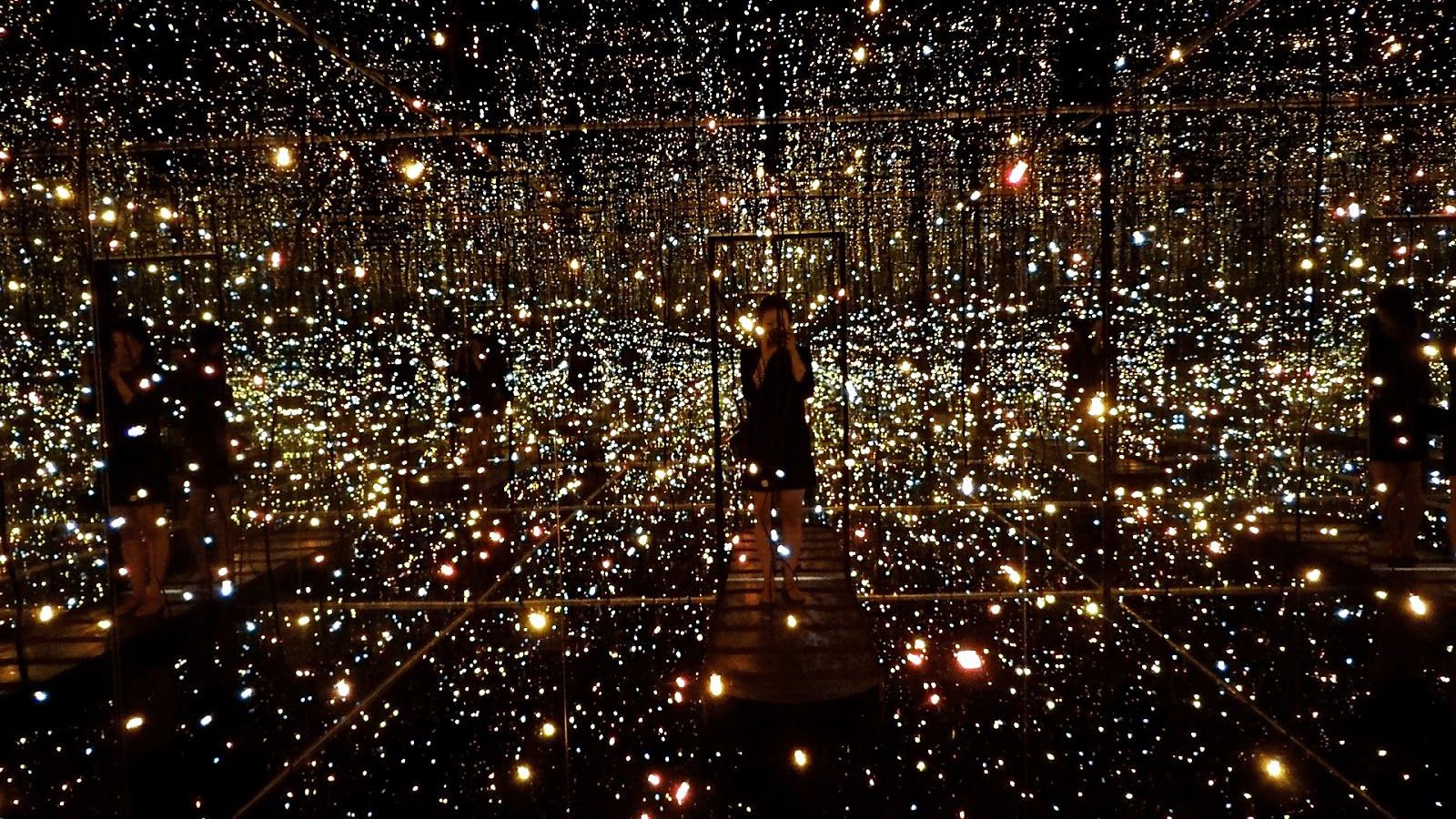
Exhibition: ‘Lutz Bacher / MATRIX 242’ at the Berkeley Art Museum and Pacific Film Archive (BAMPFA), University of California, Berkeley, San Francisco

Exhibition dates: 18th July – 7th October 2012


Many thankx to BAM/PFA for allowing me to publish the photographs in the posting. Please click on the photographs for a larger version of the image.


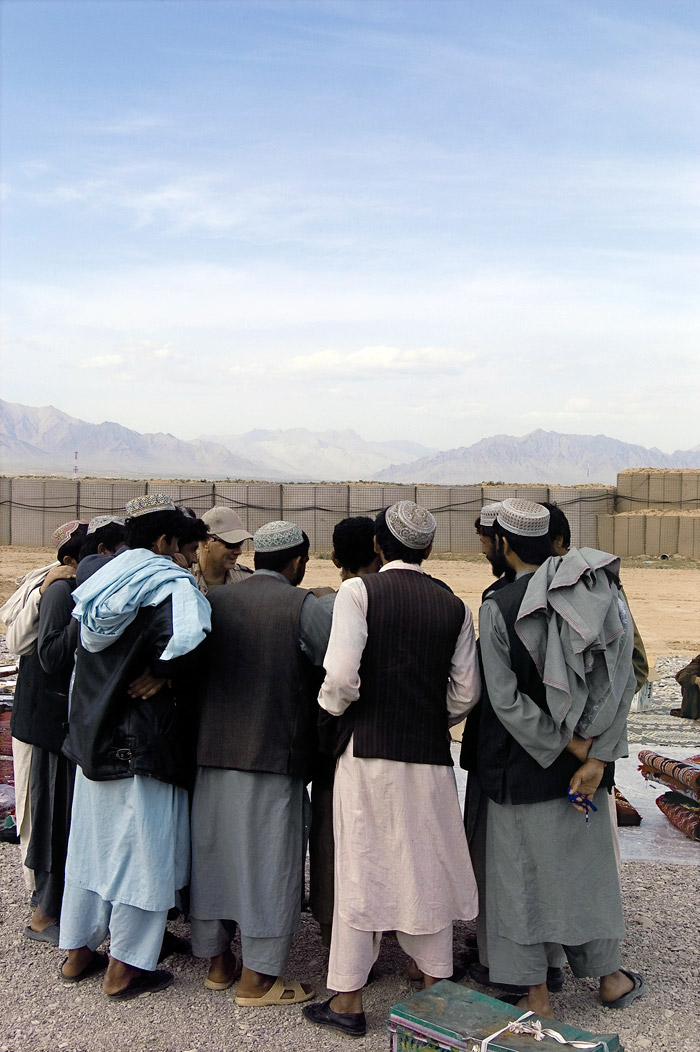
Lutz Bacher (American, 1943-2019) 'Bien Hoa' 2006-2007 (detail)

Lutz Bacher (American, 1943-2019) 'Bien Hoa' 2006-2007 (detail)


Lutz Bacher (American, 1943-2019)
Bien Hoa (detail)
2006-2007
inkjet print mounted on aluminium
24 x 36 in.
Courtesy of Ratio 3, San Francisco


Lutz Bacher (American, 1943-2019) 'Bien Hoa' 2006-2007 (detail)


Lutz Bacher (American, 1943-2019)
Bien Hoa (detail)
2006-2007
inkjet print mounted on aluminium
24 x 36 in.
Courtesy of Ratio 3, San Francisco


Since Lutz Bacher’s first MATRIX exhibition in 1993, the Berkeley-based artist has become a leading figure in contemporary art; she was the subject of a retrospective at MoMA PS1 in 2009 and was included in the 2012 Whitney Biennial. MATRIX 242 presents an important but rarely seen series from 2006-2007 that sheds light on the artist’s often elusive practice.

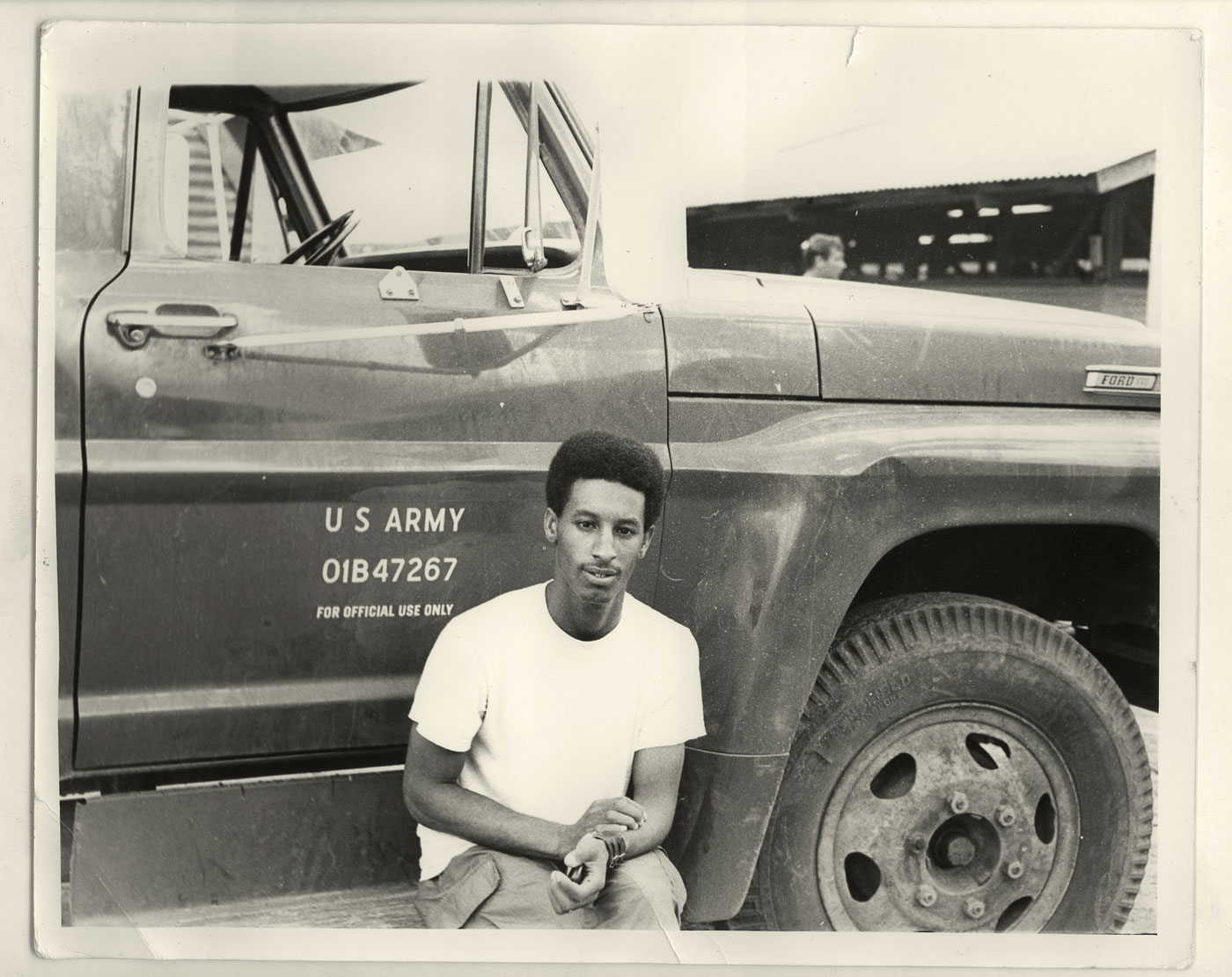
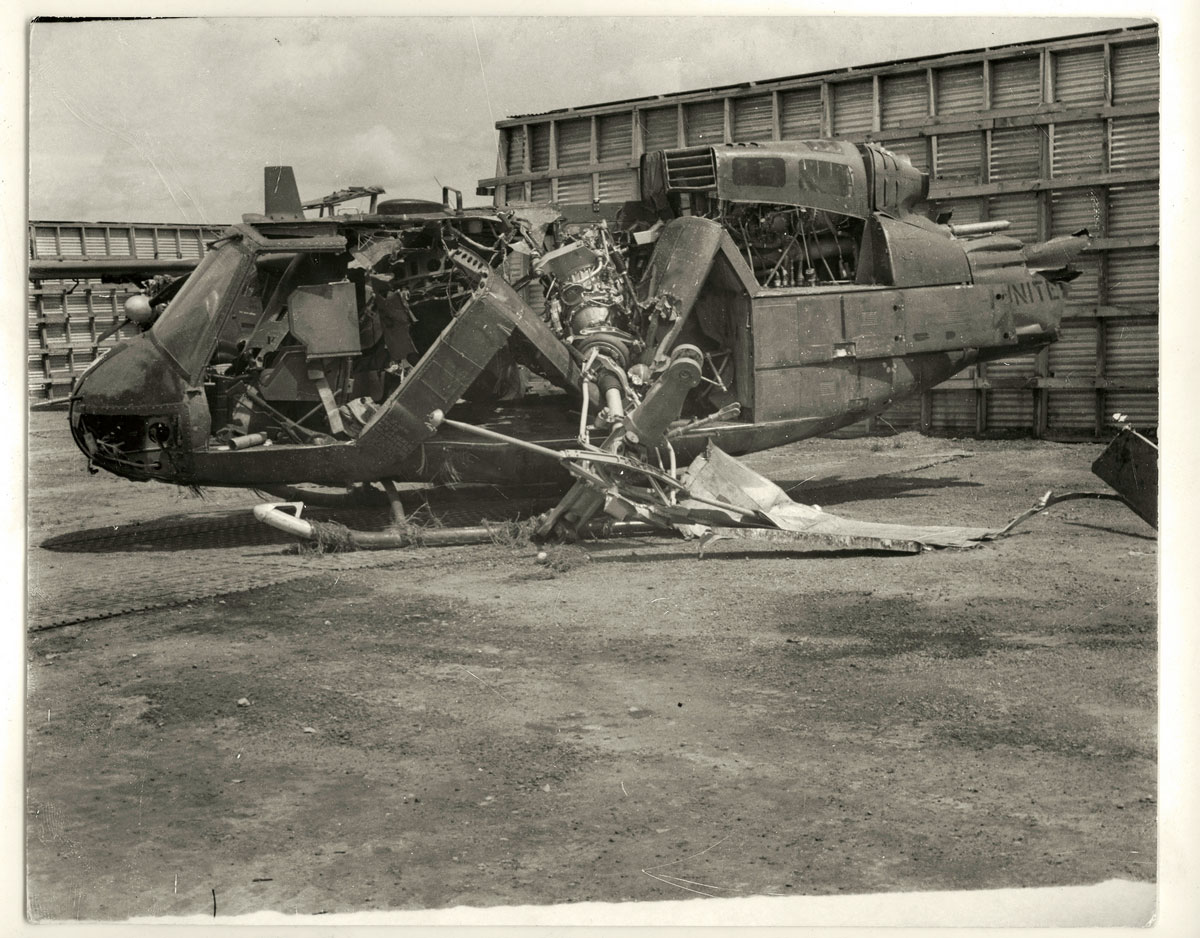
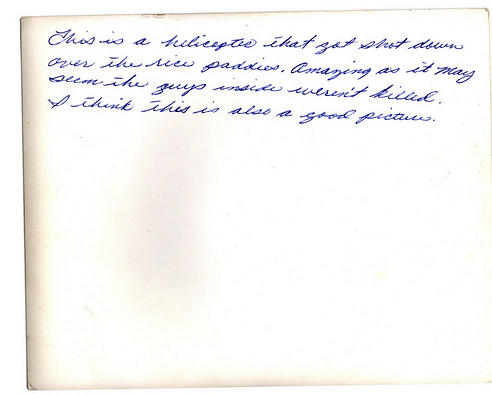
Bien Hoa is is based on a set of ten photographs Bacher discovered at a Berkeley salvage store. All of the photographs were created by an American soldier named Walter, who was stationed at Bien Hoa Air Base during the Vietnam War. Walter inscribed the backs of all but two of the pictures before mailing them home to his partner in Oakland. Bacher has enlarged and reprinted the photographs to hang above the verso of the originals, which disclose Walter’s annotations. These have a surprisingly casual tone, given what must have been the harrowing experience of being a soldier stationed in Vietnam. In some cases, Walter’s inscriptions sound almost like a tourist writing a postcard; in others, he seems to have been more concerned with the composition of the image than with the grisly content of a scene. “This is Bien Hoa looking at it from the Air Base. This is a pretty good picture. Now do you think that’s beautiful? Can you see the wire, keeping the people from attacking the Air Base? That’s what those fences are out there for.”

By strategically juxtaposing these images and texts, and placing them in a museum setting, Bacher reveals the slippery nature of perception. She prompts us to wonder, Why was Walter so concerned with the quality of his images? Why were these photographs discarded? What became of Walter?”

Text from the BAM/PFA website


Lutz Bacher (American, 1943-2019) 'Bien Hoa' 2006-2007 (detail)

Lutz Bacher (American, 1943-2019) 'Bien Hoa' 2006-2007 (detail)


Lutz Bacher (American, 1943-2019)
Bien Hoa (detail)
2006-2007
inkjet print mounted on aluminium
24 x 36 in.
Courtesy of Ratio 3, San Francisco


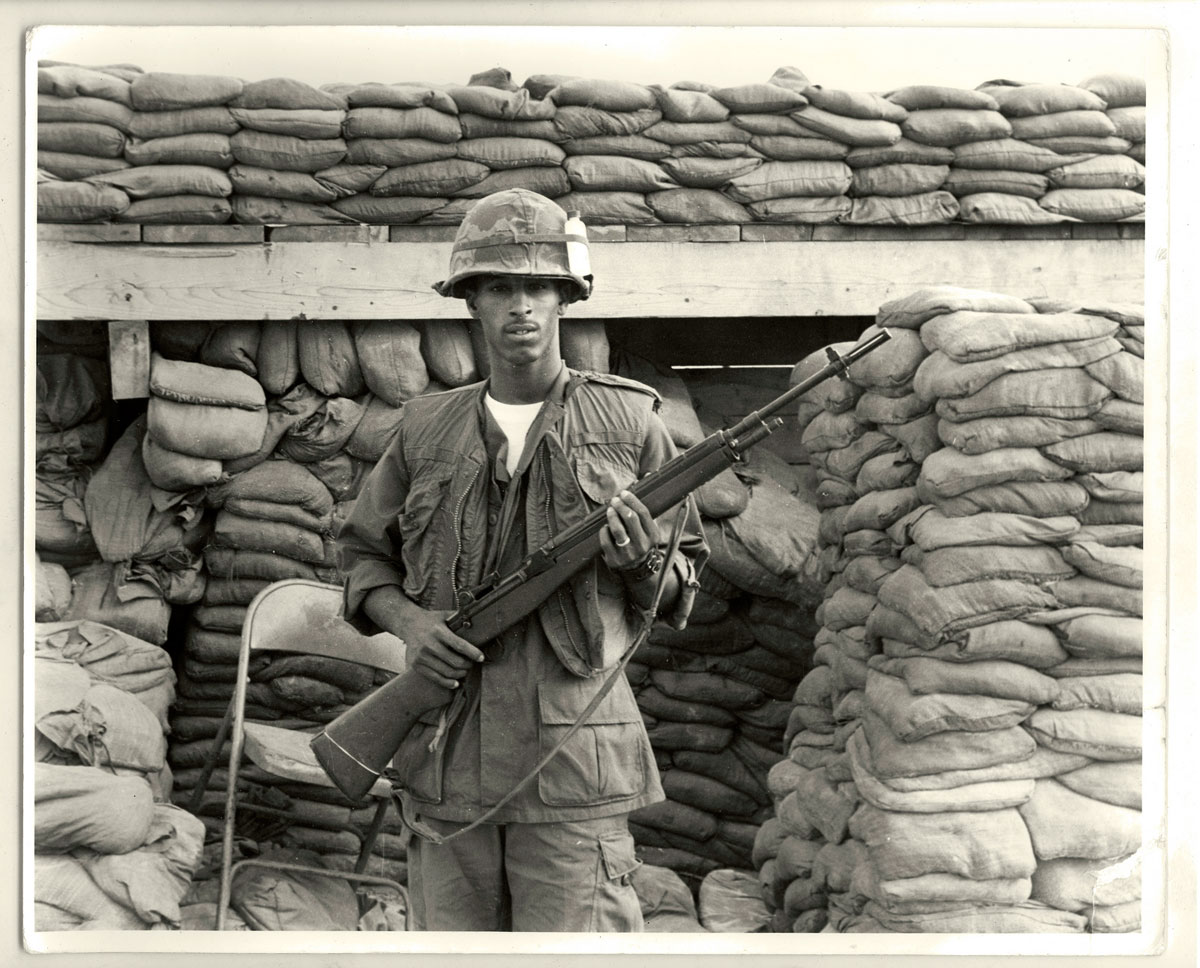
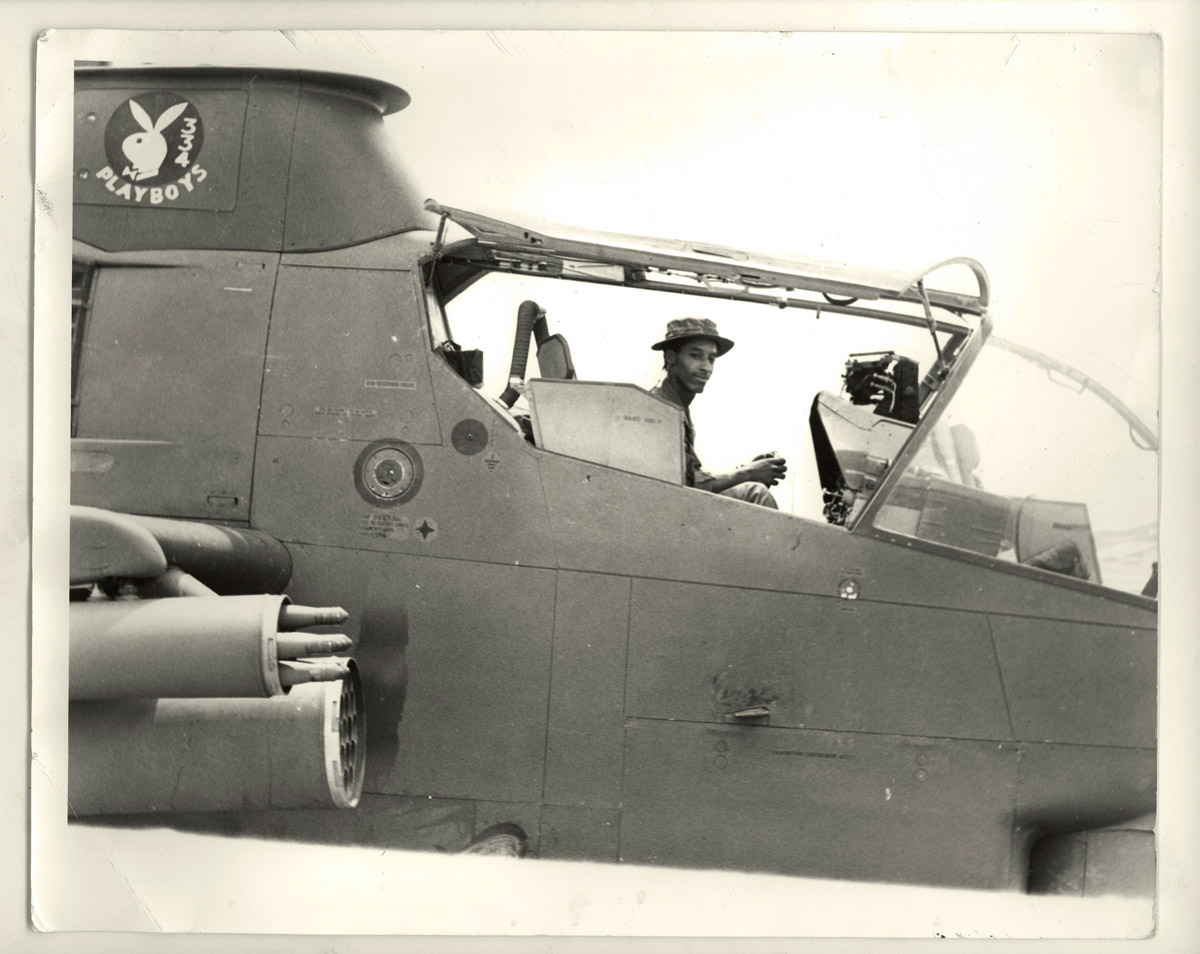
The ten photographic sets that make up Lutz Bacher’s Bien Hoa (2006-2007) are deceptively simple. Large colour inkjet images, reproductions of yellowed black-and-­white photographs, are presented above handwritten notes written on the backs of the original prints. The annotations were made by a man stationed at Vietnam’s Bien Hoa Air Force Base in 1969, identified only as Walter, who is alternately the author and the subject of the images. We see Walter posing at a military desk with his section chief, in an armed helicopter adorned with a playboy bunny, in front of sand ­bagged barracks, and at gunpoint, “surrendering” to a Vietnamese woman. Other photographs depict the bleak situation – burned-out helicopters, fire drills, and fences separating the base from the local town. Bacher found the cache of photographs, which had been mailed from Vietnam, at a Berkeley salvage store. Originally meant for an intimate audience, the photos are displaced by Bacher’s decision to remake them as her art. She channels the voice of an African American man fighting in the Vietnam War, decisively situating that voice, through her own authorship, in a new time and context.

On their own, the images are charged with America’s uneasy history of armed aggression and recall our complex legacy of racism and popular unrest; with Walter’s notes, however, that general discomfort becomes deeply personal. Referring to an image of himself seated inside a helicopter he writes: “This is a Huey Cobra, the badest [sic] Helicopter in Vietnam. Those are rockets on the side of the ship. I wish I could take off and come home. Your Man, Walter.” With his comments, Walter reveals feelings of complicity in the military apparatus of the war, as well as his desire to return home. It is hard not to wonder how Walter wound up in Vietnam and what became of him: was he drafted or enlisted by the many recruiters targeting African American neighbourhoods at the time, promising subsidies? Did he return home safely?

Presented, as they are here, in a museum setting, Walter’s self-conscious commentaries on his photographs take on new relevance. In some cases, Walter’s inscriptions sound almost like a tourist writing a postcard; in others, he seems to have been more concerned with the composition of the image than with the grisly content of a scene: “This is a practice session that the Fire Department has every now and then. They are practicing on a burning helicopter. I messed up on my border at the top of the picture.” Bacher’s enlargements invite us to hone in on these details and scrutinise the photographs aesthetically, as Walter directs: “This is Bien Hoa looking at it from the Air Base. This is a pretty good picture. Now do you think that’s beautiful? Can you see the wire, keeping the people from attacking the Air Base?” Walter’s grim interjections foil our sense of detached aesthetic judgment.

Likewise, Bacher, conspiring with Walter, complicates easy explanations of her work. Curiously, the only two photographs in the series that remain unannotated feature a gun. In the first, Walter poses solemnly in front of sandbagged barracks in full military uniform. In the second, he is dressed in Vietnamese garb, playfully surrendering at gunpoint to a local woman. This reversal, from American soldier to Vietnamese prisoner, illustrates not only the paradox of Walter’s situation, but also Bacher’s. Without captions to describe Walter’s feelings, it is unclear if he fought willingly or if, like many soldiers at that time, he was ambivalent about our presence in Vietnam, or perhaps even sympathised with the local’s desire to enact political change. Faced with these gaps in explanation, viewers are left to wonder about Walter’s intentions in setting up the photographs as he did, with this strange role reversal. The reasons for Bacher’s own reversal, exchanging her voice for Walter’s, is also left ambiguous.

Shifting between Walter, of whom nothing is known, and Bacher, Bien Hoa’s narrative refuses to be fixed in any one time or place. For that reason, the work feels contemporary, alive with the contradictions that make up our present moment. Bacher uses found images, objects, and text to confound easy understandings of authorship, gender, race, violence, and power. Despite being composed of discarded photographs, Bien Hoa resonates as a pivotal description of a fraught moment in United States history, yet this history still feels open to interpretation. Bacher, exhuming the photographs and aligning her voice with Walter’s, inverts any sense of their cohesion.”

Dena Beard
Assistant Curator
Exhibition brochure


Lutz Bacher (American, 1943-2019) 'Bien Hoa' 2006-2007 (detail)


Lutz Bacher (American, 1943-2019)
Bien Hoa (detail)
2006-2007
inkjet print mounted on aluminium
24 x 36 in.
Courtesy of Ratio 3, San Francisco


Lutz Bacher (American, 1943-2019) 'Bien Hoa' 2006-2007 (detail)


Lutz Bacher (American, 1943-2019)
Bien Hoa (detail)
2006-2007
inkjet print mounted on aluminium
24 x 36 in.
Courtesy of Ratio 3, San Francisco


Berkeley Art Museum and Pacific Film Archive

BAMPFA is located at 2155 Center Street
between Oxford Street and Shattuck Avenue, in downtown Berkeley
Phone: (510) 642-0808

Opening hours:
Thursday – Sunday, 11am – 7pm
Closed Mondays and Tuesdays

Berkeley Art Museum and Pacific Film Archive website

LIKE ART BLART ON FACEBOOK

Back to top

Exhibition: ‘Pacific Standard Time: Art in Los Angeles 1950-1980’ at Martin-Gropuis-Bau Berlin

Exhibition dates: 15th March – 10th June 2012

List of artists represented: Peter Alexander, John Altoon, Chuck Arnoldi, John Baldessari, Larry Bell, Billy Al Bengston, Karl Benjamin, Ed Bereal, Tony Berlant, Wallace Berman, Marjorie Cameron, Cameron, Vija Celmins, Judy Chicago, Mary Corse, Ronald Davis, Richard Diebenkorn, Laddie John Dill, Melvin Edwards, Frederick Eversley, Lorser Feitelson, Llyn Foulkes, Sam Francis, Joe Goode, Robert Graham, Frederick Hammersley, George Herms, David Hockney, Stephan von Huene, Craig Kauffman, Edward Kienholz, Helen Lundeberg, John Mason, Allan McCollum, John McLaughlin, Ron Miyashiro, Ed Moses, Lee Mullican, Bruce Nauman, Helen Pashgian, Ken Price, Noah Purifoy, Ed Ruscha, Betye Saar, Henry Takemoto, DeWain Valentine, Gordon Wagner, Norman Zammitt.


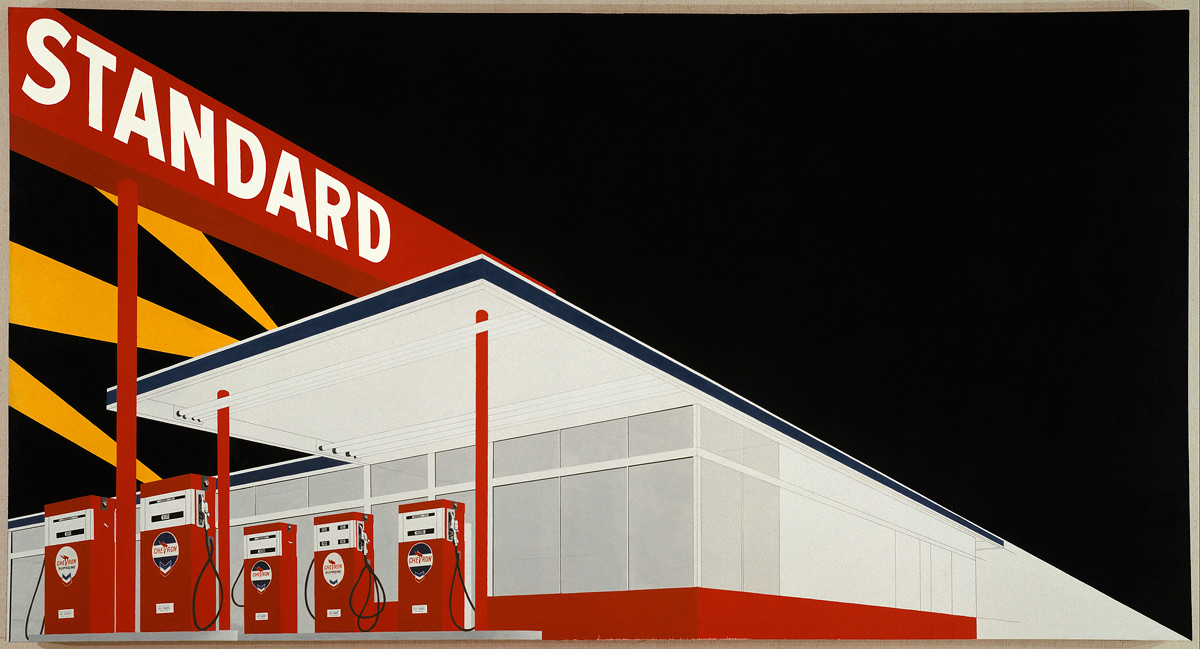
Ed Ruscha (American, b. 1937) 'Standard Station, Amarillo, Texas' 1963


Ed Ruscha (American, b. 1937)
Standard Station, Amarillo, Texas
1963
Oil on Canvas
Hood Museum of Art, Dartmouth College, Hanover, New Hampshire
Gift of James Meeker, Class of 1958, in memory of Lee English, Class of 1958, scholar, poet, athlete and friend to all


What a bumper posting – so much to enjoy and something for everyone!

Marcus


Many thankx to Martin-Gropuis-Bau for allowing me to publish the artwork in the posting. Please click on the photographs for a larger version of the image.


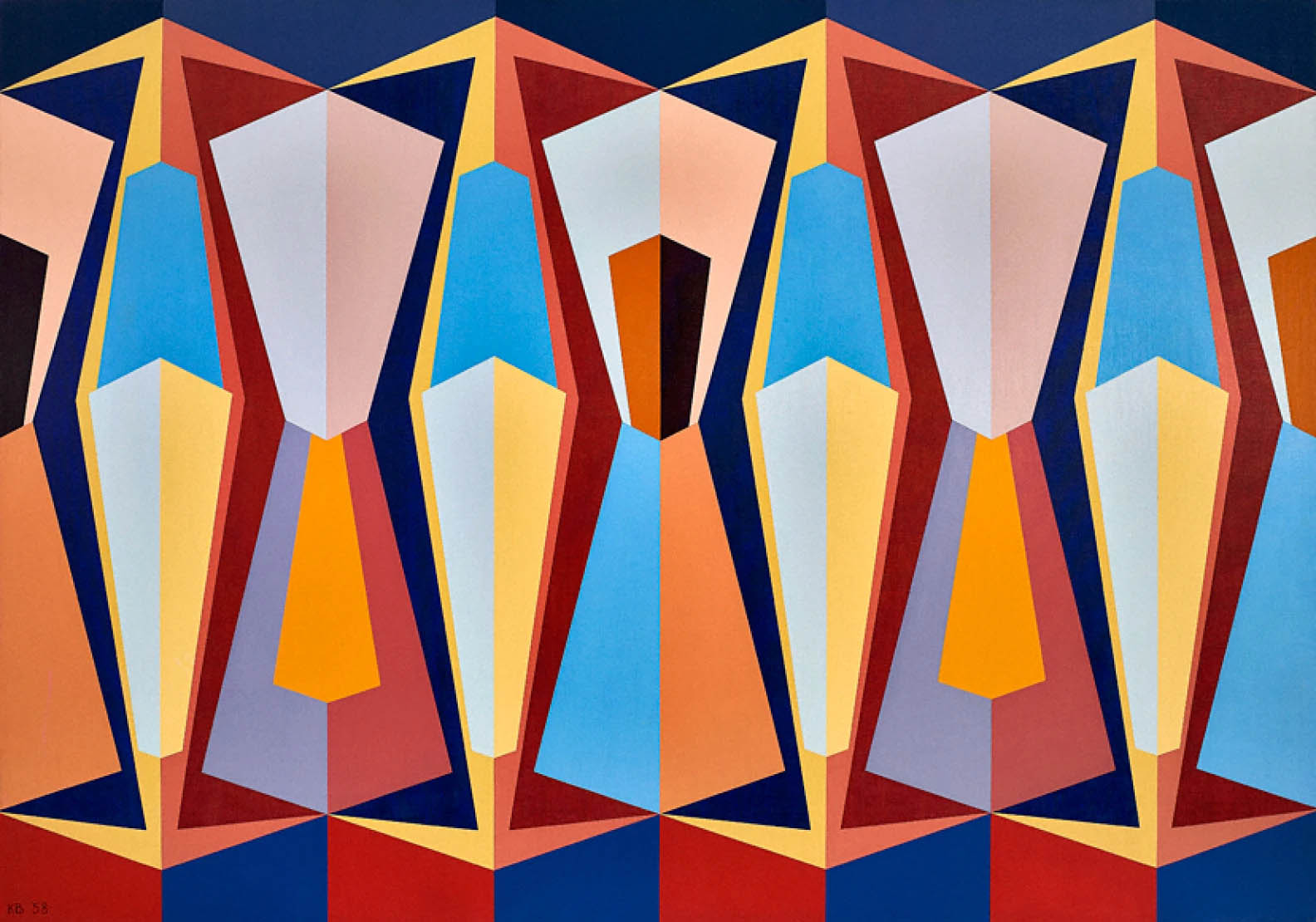
Karl Benjamin (American, 1925-2012) 'Stage II' 1959 


Karl Benjamin (American, 1925-2012)
Stage II
1959
Oil on canvas
50 x 70 inches; 127 x 177.8cm


Karl Stanley Benjamin (December 29, 1925 – July 26, 2012[1]) was an American painter of vibrant geometric abstractions, who rose to fame in 1959 as one of four Los Angeles–based Abstract Classicists and subsequently produced a critically acclaimed body of work that explores a vast array of color relationships. Working quietly at his home in Claremont, California, he developed a rich vocabulary of colors and hard-edge shapes in masterful compositions of tightly balanced repose or high-spirited energy. At once intuitive and systematic, the artist was, in the words of critic Christopher Knight, “a colorist of great wit and inventiveness.”

Text from the Wikipedia website


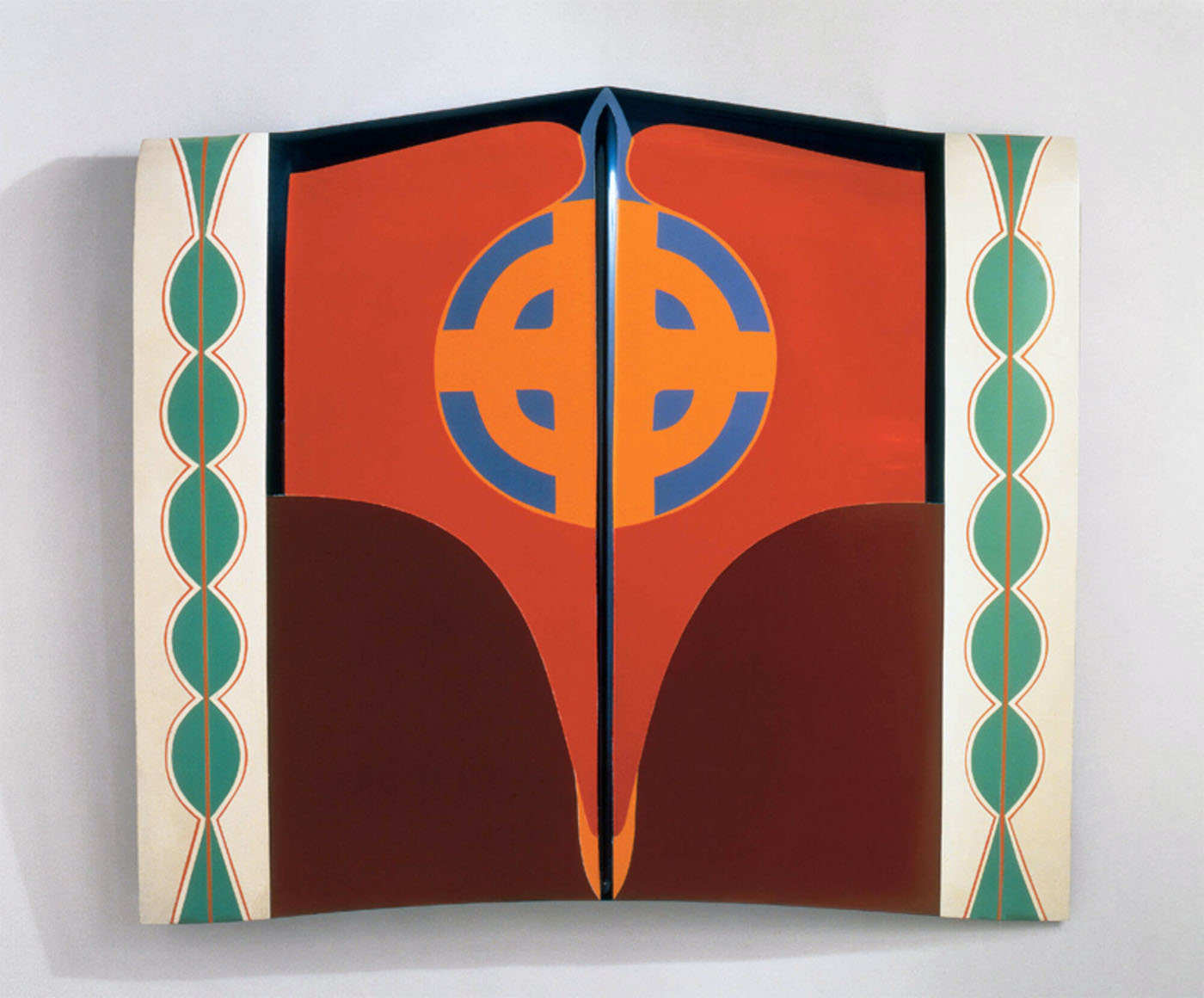
Judy Chicago (American, b. 1939) 'Car Hood' 1964


Judy Chicago (American, b. 1939)
Car Hood
1964
Sprayed acrylic and lacquer on car hood
109 x 125 x 11cm


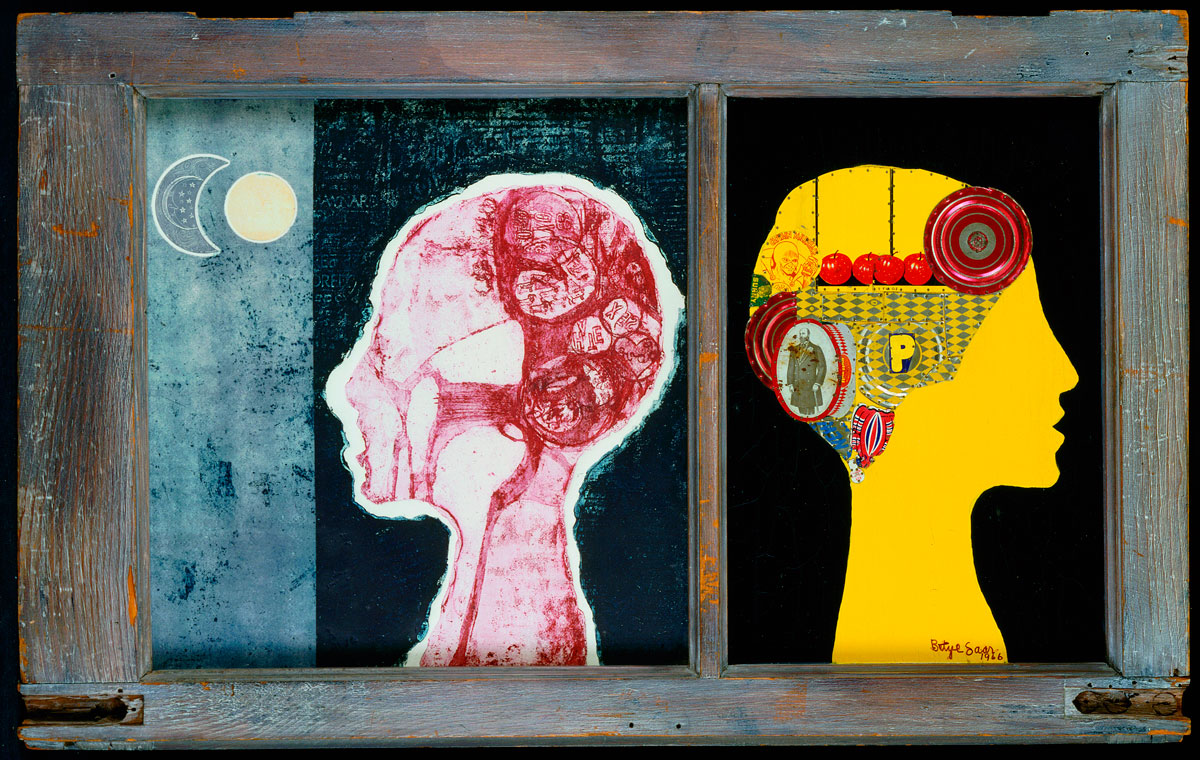
Betye Saar (African-American, b. 1926) 'The Phrenologer's Window' 1966


Betye Saar (African-American, b. 1926)
The Phrenologer’s Window
1966
Assemblage of two panel wood frame with print and collage
Private Collection; courtesy of Michael Rosenfeld Gallery, LLC, New York, NY


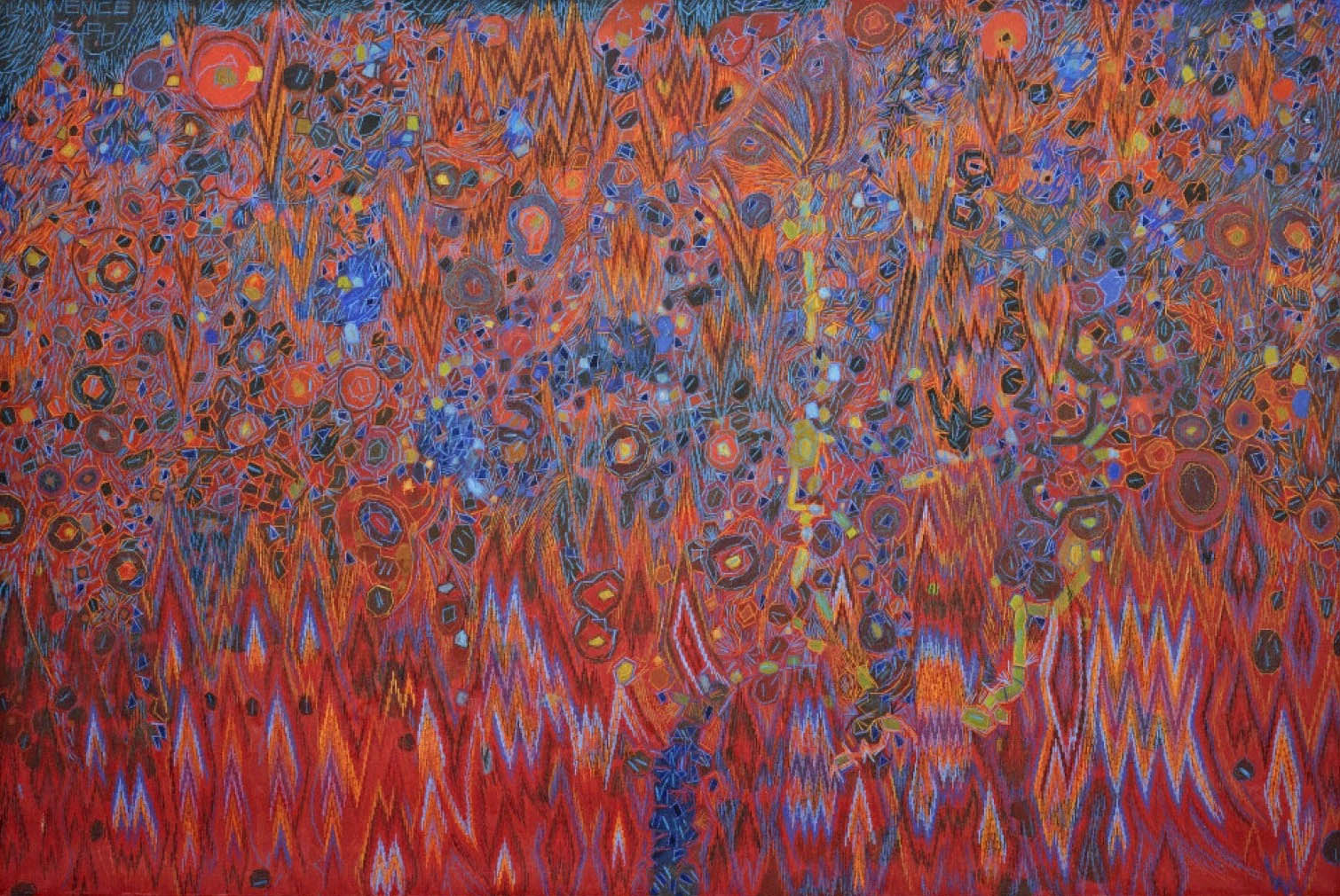
Lee Mullican (American, 1919-1998) 'Untitled (Venice)' 1967


Lee Mullican (American, 1919-1998)
Untitled (Venice)
1967
Oil on canvas


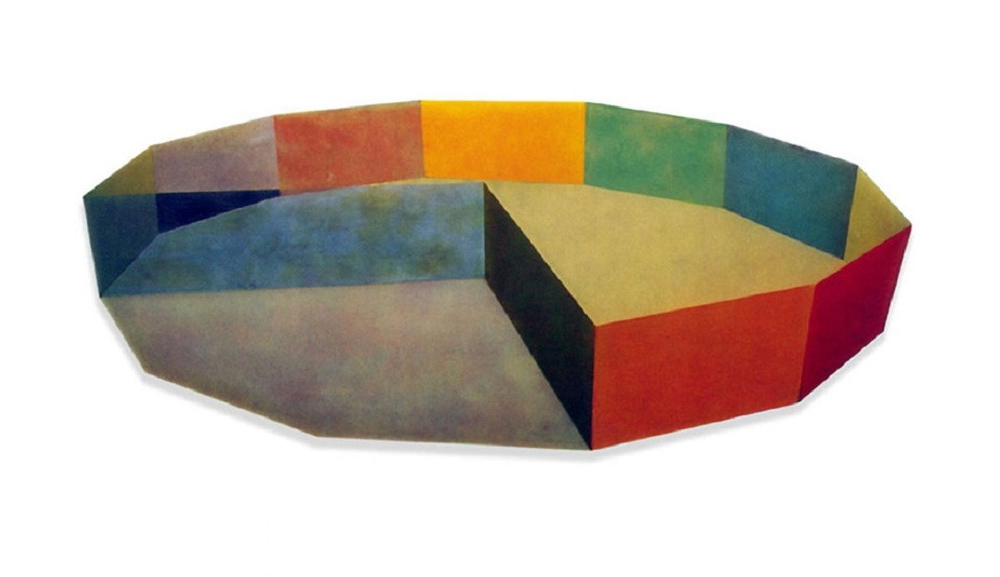
Ronald Davis (American, b. 1937) 'Vector' 1968


Ronald Davis (American, b. 1937)
Vector
1968
Polyester Resin and Fiberglass
60 1/2 x 132 inches (shaped)
Tate Gallery, London


Ronald “Ron” Davis (born 1937) is an American painter whose work is associated with geometric abstraction, abstract illusionism, lyrical abstraction, hard-edge painting, shaped canvas painting, color field painting, and 3D computer graphics. He is a veteran of nearly seventy solo exhibitions and hundreds of group exhibitions.


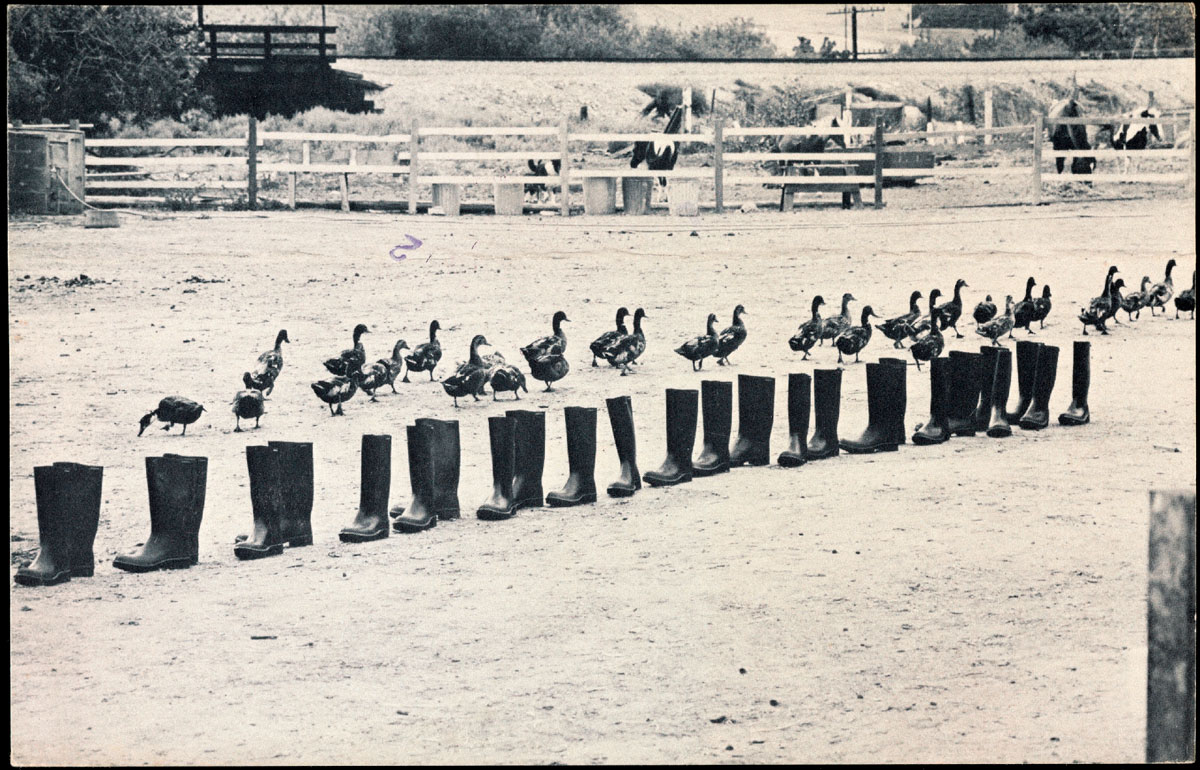
Eleanor Antin (American, b. 1935) '100 BOOTS Move On' 1971-1973


Eleanor Antin (American, b. 1935)
100 BOOTS Move On
1971-1973
Halftone reproduction
Getty Research Institute, Los Angeles, CA
© Eleanor Antin


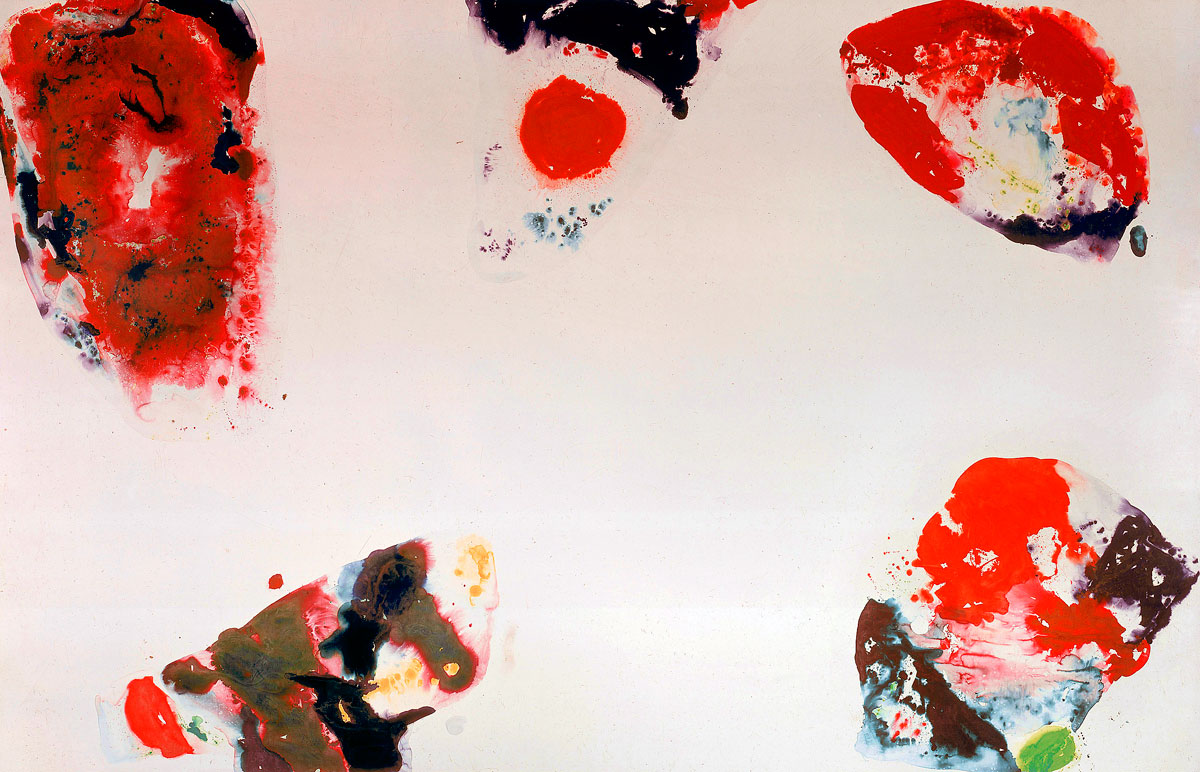
Sam Francis (American, 1923-1994) 'Berlin Red' 1969-1970


Sam Francis (American, 1923-1994)
Berlin Red
1969-1970
Acrylic on canvas
Nationalgalerie, Staatliche Museen zu Berlin
© Sam Francis Foundation, Cailfornia / VG Bild-Kunst, Bonn 2012
Foto: bpk / Nationalgalerie, SMB / Jörg P. Anders


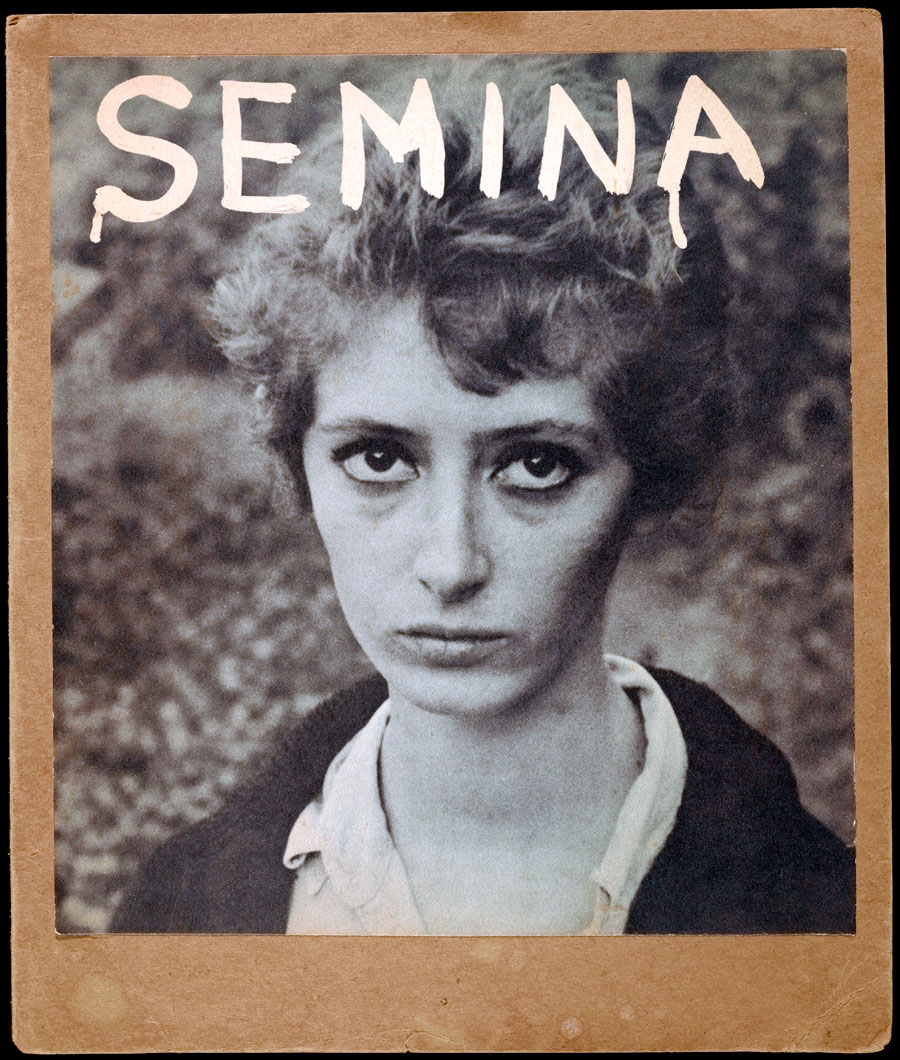
Wallace Berman (American, 1926-1976) 'Semina Cover with Wife (Photograph of Shirley Berman)' 1959


Wallace Berman (American, 1926-1976)
Semina Cover with Wife (Photograph of Shirley Berman)
1959
Halftone reproduction on cardstock
Getty Research Institute, Los Angeles, CA


The exhibition project Pacific Standard Time – Art in Los Angeles, 1950-1980 traces the development of the Los Angeles art scene during the post-war period, when the city on the Pacific hosted an impressively varied and versatile art scene, thus proving that it was more than Hollywood and a sprawling metropolis in the land of sunshine and palm trees. Pacific Standard Time features such internationally esteemed artists as John Baldessari, David Hockney, Edward Kienholz or Ed Ruscha as well as protagonists that are yet to be discovered like the abstract painters Helen Lundeberg and Karl Benjamin, the ceramicists Ken Price and John Mason, and sculptors such as De Wain Valentine.

The mega show – over 60 institutions and galleries in Los Angeles were involved – is taking the two main core exhibitions of the Getty Museum and the Getty Research Institute to Europe. The sole European venue is the Martin-Gropius-Bau in Berlin. The section of the exhibition that was to be seen in Los Angeles’ Getty Museum under the title of Crosscurrents in L.A. – Painting and Sculpture, 1950-1970, presents painting and sculpture. In the second part that was to be seen in Los Angeles under the title of Greetings from L.A. – Artists and Publics, 1950-1980, posters, artists’ catalogues, postcards, invitation cards and other memorabilia are shown which offer a deeper insight into the networks of the Los Angeles art scene at that time. For Berlin the show has been supplemented to include photographs by Julius Shulman, whose architectural shots defined the image of the Californian lifestyle in the 1950s. His incomparable sensibility and intuitive feel for composition and the ‘critical moment’ established him as a master of his craft.

Part One: Crosscurrents

The first part of the Berlin show brings together more than 70 works by over 50 artists and traces the rise of the Southern Californian art scene between 1945 and 1980. The list of names reads like a Who’s Who of today’s internationally esteemed artists, as people like John Baldessari, David Hockney, Edward Kienholz, Bruce Nauman or Ed Ruscha began their careers here.

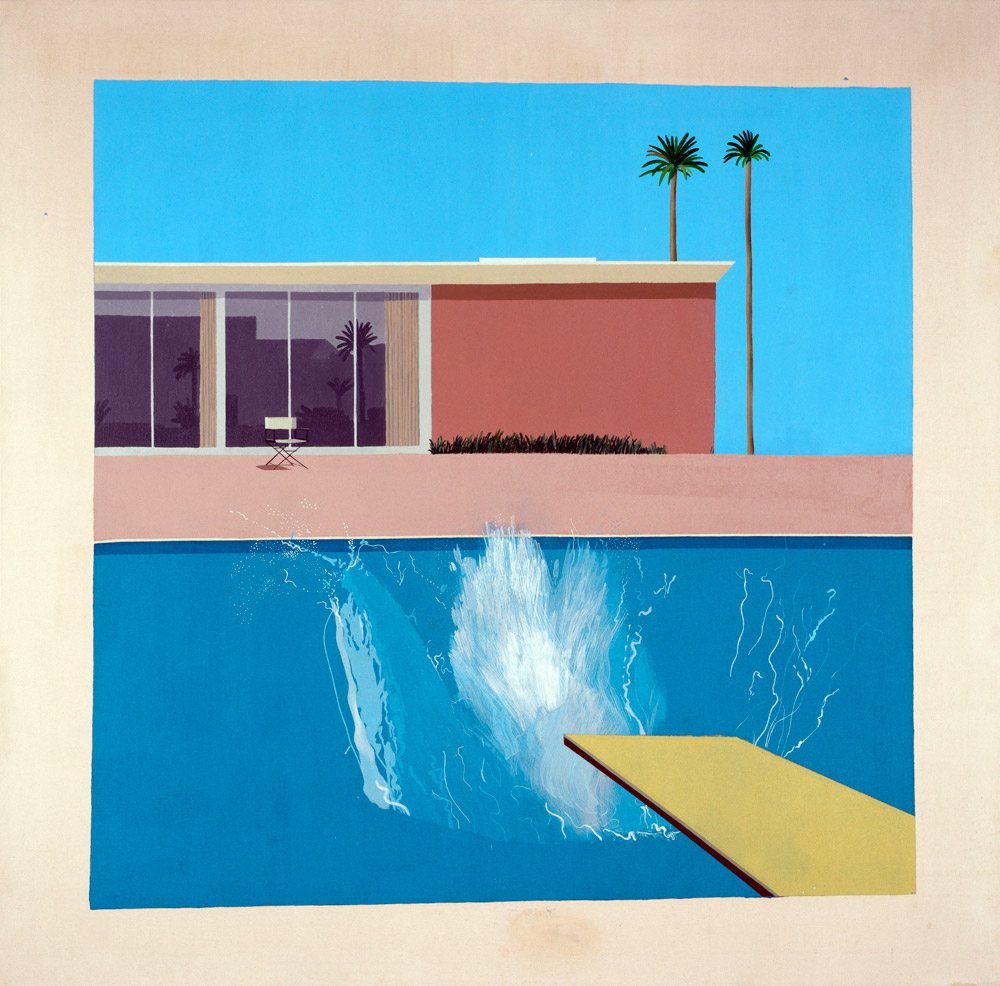
The entrée into Pacific Standard Time begins with British artist David Hockney’s iconic painting A Bigger Splash from the year 1967. It is one of the key pictures of the exhibition and stands for the hedonistic life under palm trees with permanent sunshine and never-ending parties.

The exhibition is structured both chronologically and thematically, comprising six sections that reflect the entire spectrum of the art trends that sprang up simultaneously in Los Angeles. Abstract works – ceramic sculptures and paintings of bleak clarity – are to be seen in the first section. The second section shows assemblage sculptures and collages by artists like George Herms, Wallace Berman and Ed Bereal, who paved the way for this artistic approach in the 1950s, and their successors, including many African-American artists. The third section documents the rise of Los Angeles to become an important art centre, while the fourth shows paintings by internationally recognised Los Angeles artists as Richard Diebenkorn, David Hockney and Ed Ruscha. It becomes clear that Southern California was one of the leading centres for large-format pop art and abstract painting in the 1960s. The fifth section examines how, at a time when painting was growing in significance on the Atlantic Coast of the USA, artists on the West Coast were beginning to extend their notions of traditional painting and sculpture, with perceptual phenomena and the material processes of artistic production coming to the fore. Here we find works that have arisen out of a collision between art and technology, such as a sculpture by De Wain Valentine, who uses industrial materials like polyester casting resin, or a canvas by Mary Corse, into which the smallest, high-grade reflecting glass microspheres have been worked. We are also introduced to a group of artists whose works show traces of their creation, such as those of Joe Goode, Allan McCollum, Ed Moses and Peter Alexander.

Berlin is supplementing the Getty exhibition by devoting a special room to the early international perception of art in Los Angeles. It will feature the works Berlin Red by Sam Francis, a 8 x 12 metre painting that was commissioned by Berlin’s Neue Nationalgalerie in 1969, and Volksempfängers (People’s Wireless) by Edward Kienholz. As a DAAD scholar Kienholz often lived in Berlin from 1973 on.

Another distinctive feature of the exhibition are the various room installations, including Stuck Red and Stuck Blue by James Turrell and Four Corner Piece by Bruce Nauman. In 1966 Turrell began working on his Light Room installations. In the work displayed in the Martin-Gropius-Bau that he designed in 1970, he uses light to dissolve the borders of spatial structures and transform them. In his Four Corner Piece from 1971 Bruce Nauman creates a particular spatial experience through the interplay of physical information vs. visual information.

Part Two: Greetings from L. A.

In the second part of the exhibition, elaborated by the Getty Research Institute, the Martin-Gropius-Bau shows over 200 objects – photographs, artists’ catalogues, books, posters, postcards, invitations, letters and artworks, of which many are on public view for the first time. We are given a sense of how Californian artists, through the involvement of a wide audience, brought art into contact with the general public. We also see how intensely the international networks linking groups of artists functioned.

Greetings from L.A. begins with Making the Scene and describes the gallery scene in Los Angeles from the 1950s to the 1970s. We are introduced to art dealers and collectors of the kind who congregated at La Cienega Boulevard – Rolf Nelson, Riko Mizuno and Betty Asher. On this gallery-lined boulevard, which crosses the Sunset Boulevard immortalised by Ed Ruscha, the reputation of Los Angeles as a city of modern and contemporary art was made.

Public Disturbances, the second section of the show, is devoted to three important exhibitions which drew fierce criticism and even led to arrests. Wallace Berman’s 1957 exhibition in the Ferus Gallery was closed down by the police. Violent controversies were triggered by the War Babies exhibition (1961) in the Huysman Gallery. There were also strong differences of opinion between the Los Angeles County Museum of Art (LACMA) and the Los Angeles County Board of Supervisors over the inclusion of Kienholz’s installation Back Seat Dodge ’38 (1964) in his grand retrospective of 1966.

The Private Assembly section of the exhibition focuses on the works created by Wallace Berman, George Herms, Charles Brittin and their circle in the 1950s and 1960s. The intimacy of these objects is explained not only by the unmistakable traces of artistic authorship they bear, but also by the fact that they were only accessible to a select, non-public audience. Mainly active outside the commercial gallery scene, this group of assemblage artists concentrated their energies on private artworks, which they handed over personally or sent by mail as a token of friendship.

The fourth section, Mass Media, introduces artists who selected the mass media as a model for their own art. Ed Ruscha, Allen Ruppersberg and Chris Burden occupied themselves with popular culture and mass production as alternative means of production and distribution. They used impersonal forms, such as those of objects or advertising materials commercially produced and sold as consumer goods. By avoiding conventional exhibition rooms, these artists reached a new public. They often exhibited anonymously, thus making the identity of artist and work secondary.

Art School as Audience, the fifth section of the exhibition, sheds light on the important role of art schools in the development of contemporary art forms. They served as the static pole, because in them artists constituted the audience of other fellow artists. The California Institute of the Arts, commonly known as CalArts, and its predecessor, the Chouinard Art Institute, were key venues for important groups of artists, as can be seen from the works of such students as Ed Ruscha and Joe Goode, and such teachers as John Baldessari, Miriam Schapiro and Judy Chicago. Other important forums were the new art faculties that came into existence at the universities and other higher education facilities in Los Angeles County. At the campuses of Irvine or San Diego in particular there was a stimulating audience for the experiments of such artists as Martha Rosler, Barbara Smith and Eleanor Antin.

The last section, The Art of Protest, examines how social and political developments mobilised artists to display their works in the street. In the 1960s Los Angeles became the scene of the first protests led by artists against the Vietnam War. This gave rise in 1966 to the construction of a Peace Tower at the corner of La Cienega and Sunset Boulevards. In the following decade it was feminism that moved many artists to become social activists, as can be seen from the work of Suzanne Lacy and Leslie Labowitz-Starus In Mourning and in Rage 1977, a highly esteemed protest performed on the steps of City Hall.

Greetings from L.A. offers a new look at art in Southern California by showing how the artists of this region changed the conventional relations between art and public and developed alternatives for a public role of art and its place in society.

The exhibition affords glimpses into some recently acquired archives, like those of Betty Asher, Hal Glicksman, George Herms, Wolfgang Stoerchle, High Performance magazine, the galleries of Rolf Nelson, Mizuno and Jan Baum as well as of the papers of Charles Brittin and Edmund Teske. These are supplemented by material from archives not normally associated with Southern California, such as the papers of the critics Irving Sandler, Barbara Rose and Lawrence Alloway of New York; of Marcia Tucker, the founder and curator of New York’s New Museum of Contemporary Art; and of the Kasmin Gallery, London.

Part Three: Julius Shulman

The last part of the Berlin exhibition shows over 50 photographs by Julius Shulman – the most important American photographer of architecture in the post-war period. For more than thirty years he photographed Modernist houses – built by Richard Neutra, Frank Lloyd Wright, or Frank Gehry – thus making many of them into architectural icons. The exhibition shows some of his key works.

Press release from Martin-Gropuis-Bau website


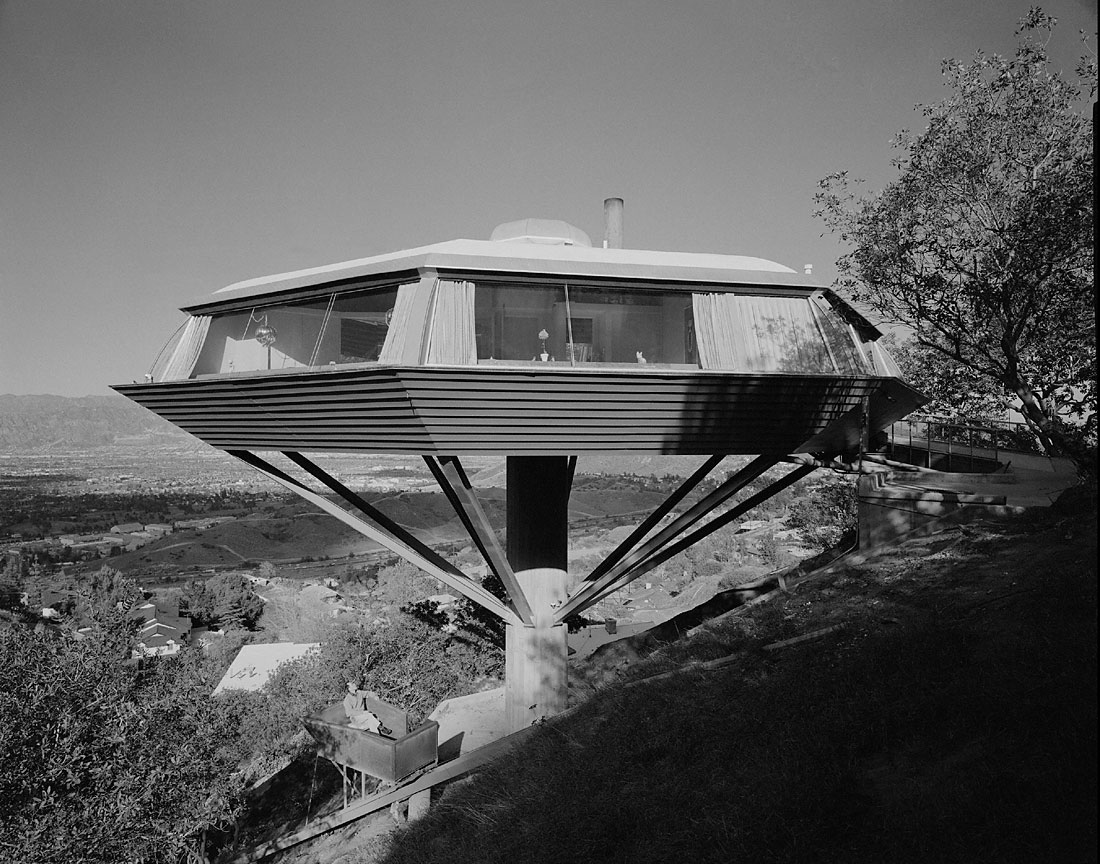
Julius Shulman (American, 1910-2009) 'Malin Residence, "Chemosphere”' 1960


Julius Shulman (American, 1910-2009)
Malin Residence, “Chemosphere”
1960
Gelatin silver print
Getty Research Institute, Los Angeles, CA
© J. Paul Getty Trust


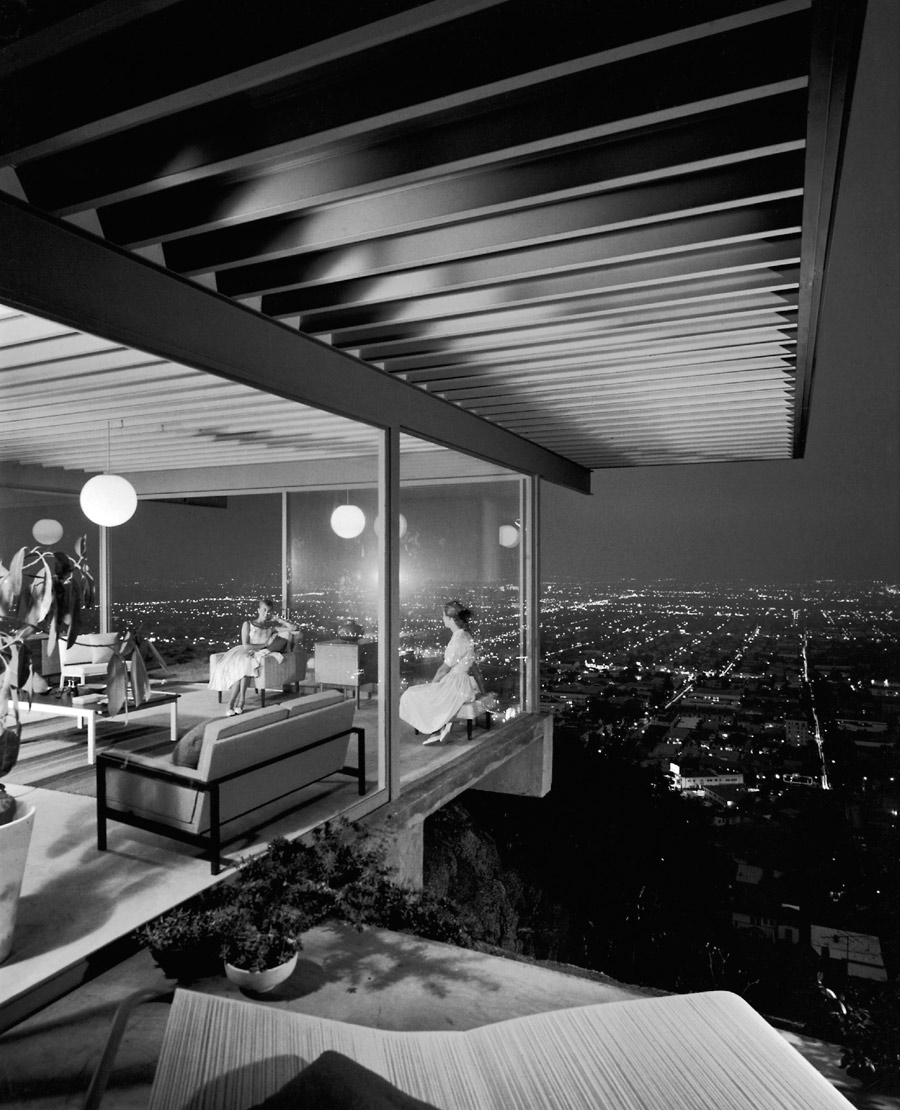
Julius Shulman (American, 1910-2009) 'Case Study House #22' 1960


Julius Shulman (American, 1910-2009)
Case Study House #22
1960
Gelatin silver print
Getty Research Institute, Los Angeles, CA
© J. Paul Getty Trust


Charles Brittin (American, 1928-2011) 'Peace Tower' 1966


Charles Brittin (American, 1928-2011)
Peace Tower
1966
Silver-dye bleach print
Getty Research Institute, Los Angeles, CA
© J. Paul Getty Trust


Peter Alexander (American 1939-2020) 'Cloud Box (Large)' 1966


Peter Alexander (American 1939-2020)
Cloud Box (Large)
1966
Cast polyester resin
Janis Horn and Leonard Feldman
© Peter Alexander
Foto: Brian Forrest


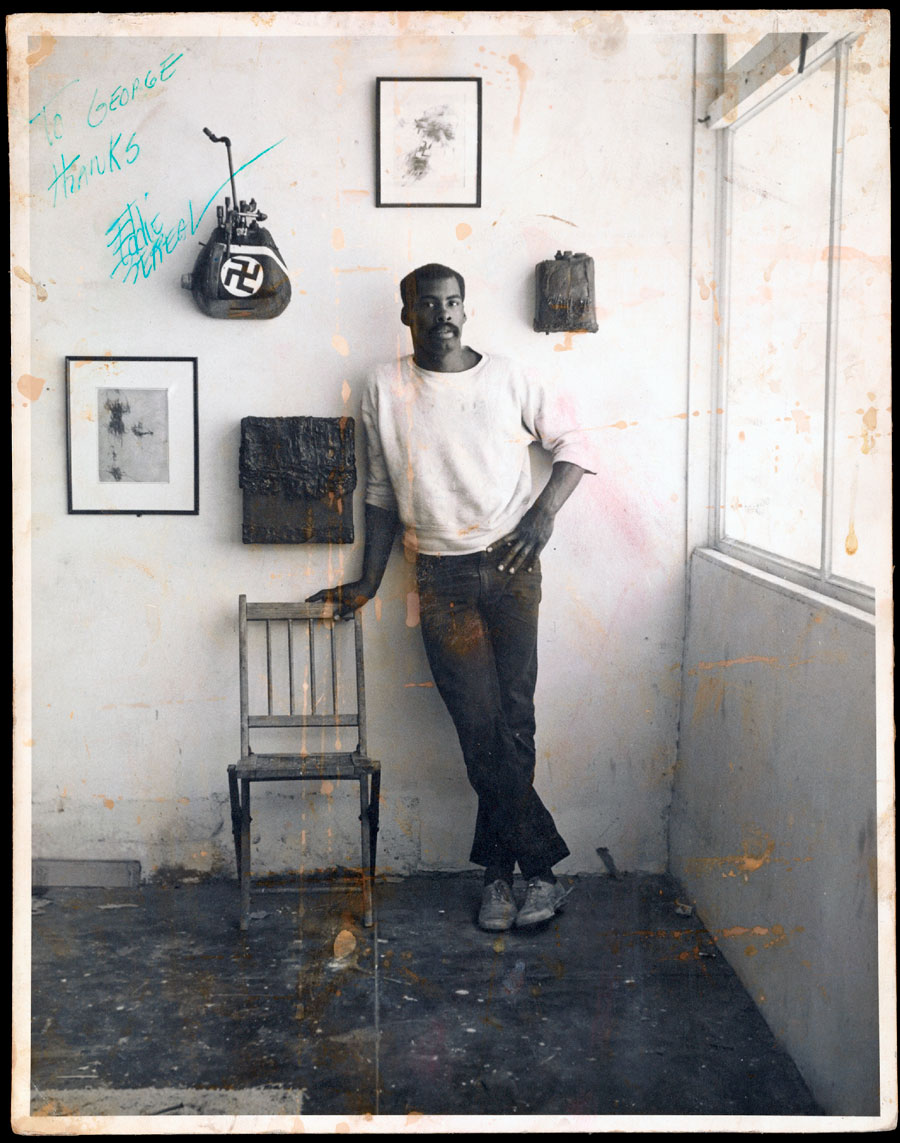
Jerry McMillan (American, b. 1936) 'Ed Bereal in His Studio' c. 1961


Jerry McMillan (American, b. 1936)
Ed Bereal in His Studio
c. 1961
Gelatin silver print mounted on board
Getty Research Institute, Los Angeles, CA
Gift of George Herms
© Jerry McMillan


David Hockney (British, b. 1937) 'A Bigger Splash' 1967


David Hockney (British, b. 1937)
A Bigger Splash
1967
Acrylic on canvas
96″ x 96″
© David Hockney
Tate Gallery, London, 2011


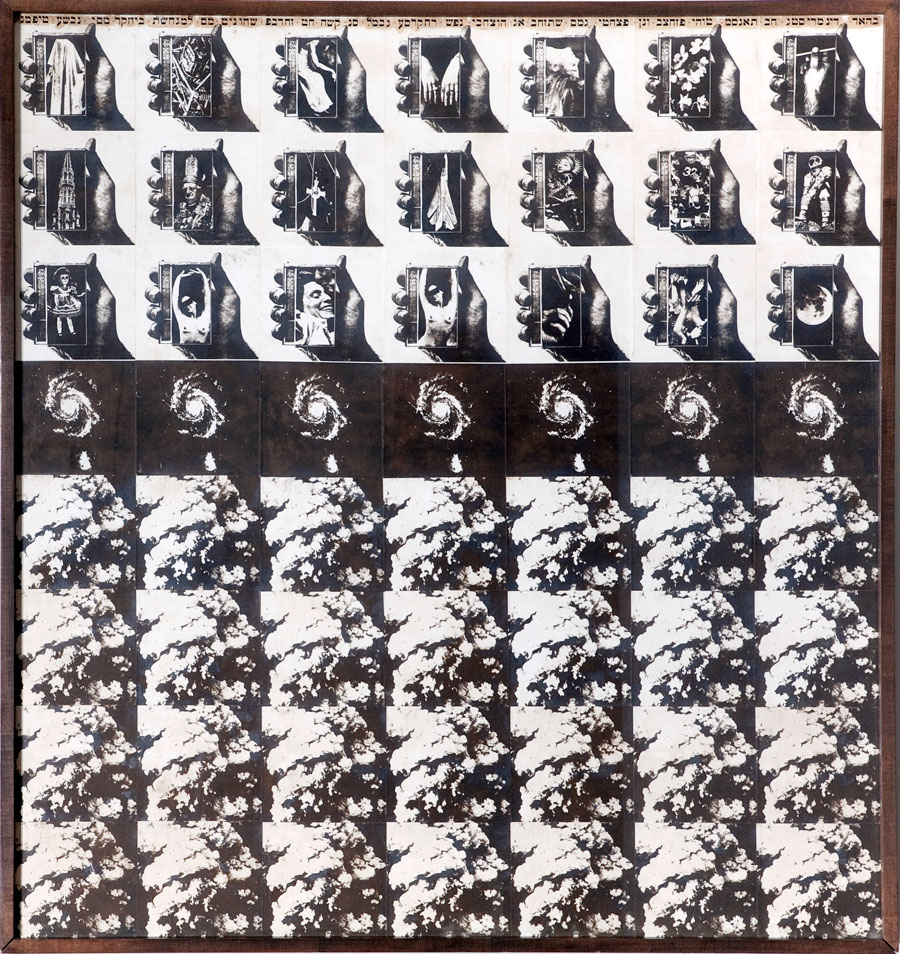
Wallace Berman (American, 1926-1976) 'Untitled (Verifax Collage)' 1969


Wallace Berman (American, 1926-1976)
Untitled (Verifax Collage)
1969
Verifax collage on board
Collection of Michael D. Fox, Berkeley CA, Courtesy Steven Wolf Fine Arts, San Francisco CA
© Courtesy of the Estate of Wallace Berman and Michael Kohn Gallery, Los Angeles
Foto: Joe Schopplein


Martin-Gropius-Bau Berlin
Niederkirchnerstraße 7
Corner Stresemannstr. 110
10963 Berlin
Phone: +49 (0)30 254 86-0

Opening Hours:
Wednesday to Monday 10 – 19hrs
Tuesday closed

Martin-Gropius-Bau website

LIKE ART BLART ON FACEBOOK

Back to top

Review: ‘Looking at Looking’ at the National Gallery of Victoria, Melbourne

Exhibition dates: 30th September 2011 – 4th March 2012
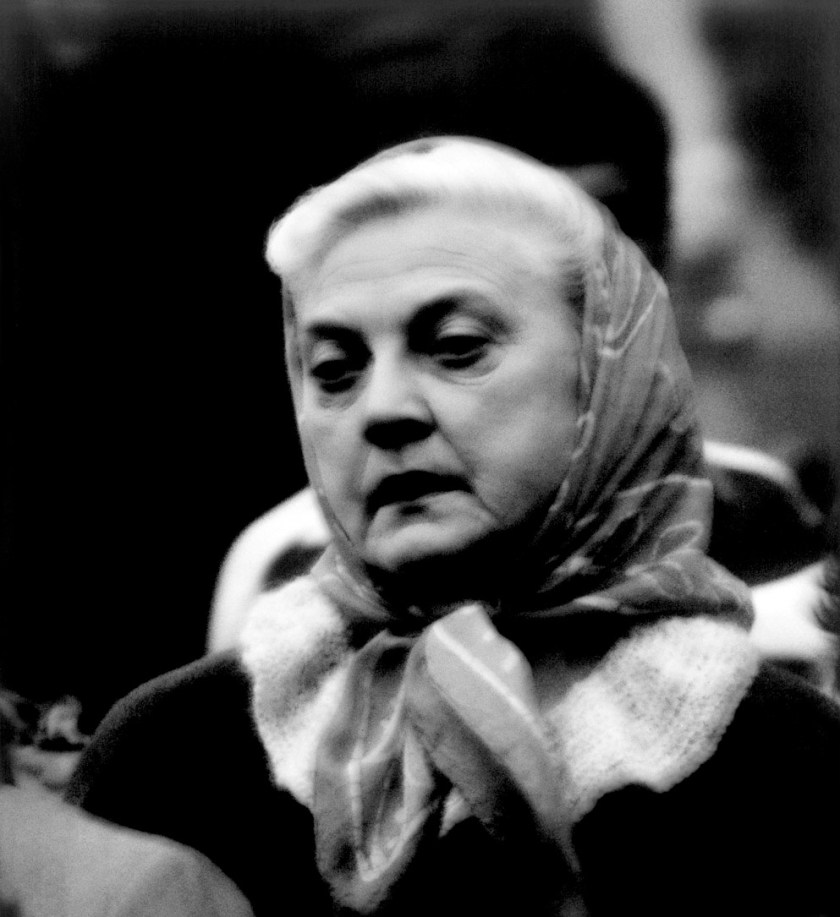
 

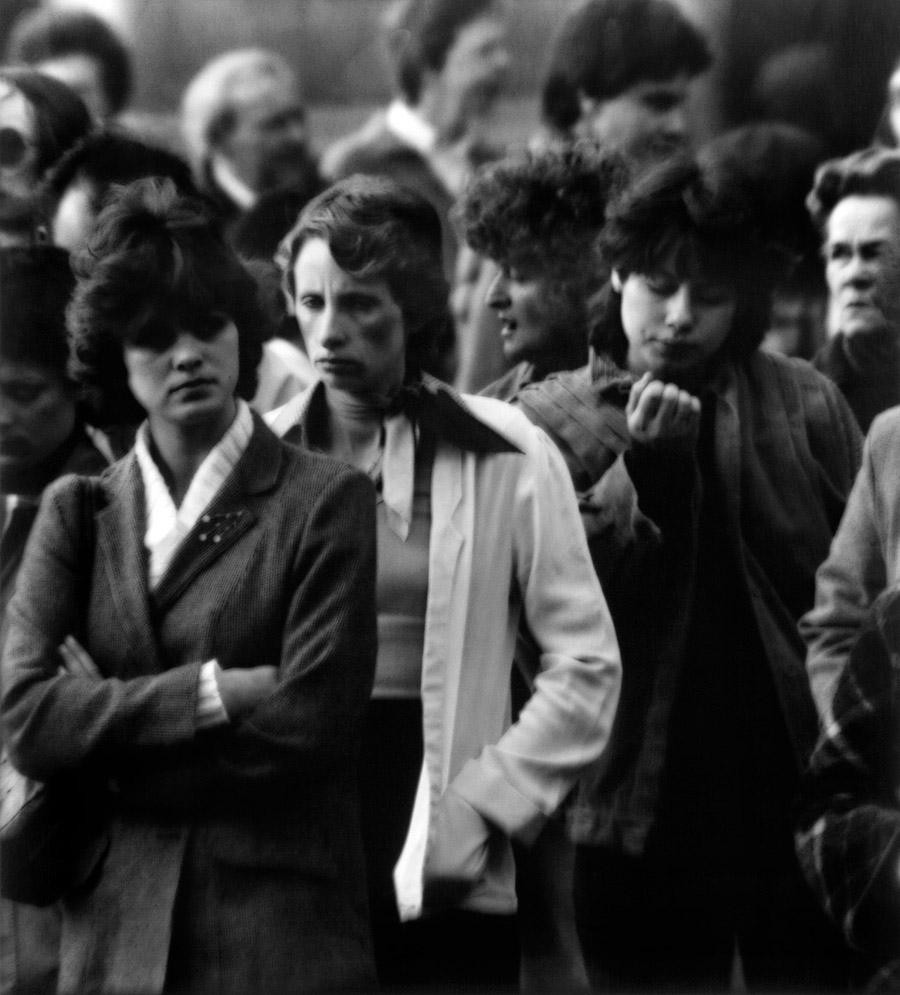
Bill Henson (Australian, b. 1955) 'Untitled 1980/82' 1980-1982


Bill Henson (Australian, b. 1955)
Untitled 1980/82
1980-1982
From the Untitled 1980/82 series 1980-1982
Gelatin silver photograph
43.0 x 38.8cm
National Gallery of Victoria, Melbourne
Anonymous gift, 1993
© Courtesy of the artist and Roslyn Oxley9 Gallery, Sydney


“The paradox is the more we seek to fix our vision of the world and to control it the less sure we are as to who we are and what our place is in the world.”


Marcus Bunyan 2011


This is a delightful, intimate exhibition at the National Gallery of Victoria that examines how looking through a camera directs and structures the way we see the world. The exhibition mines the same ground as one of my top exhibitions from last year, In camera and in public that was presented at the Centre for Contemporary Photography, Fitzroy.

Numerous artists use photography to examine the ways in which gender, race and sexuality have been ‘looked at’ in visual culture, including the politics of looking in relation to Indigenous cultures and identities. In I split your gaze (1997) by Brook Andrew, the artist has split the face of an Aboriginal man down the middle, and reassembled the face ear to ear. No longer can we look on the man as a whole because our gaze is split. Andrew is said to have “reclaimed” the image from colonial scientific, anthropological documentation but this presupposes some holistic whole existed a priori to white intervention. The split photograph does alter perception but to what extent it promotes a different reading, a postcolonial gaze that is understood as such by the viewer, is debatable.

Chi Peng poses more interesting gender reversals and masquerades. In Consubstantiality (2004, below) misaligned pairs of people, of androgynous face and hard to distinguish gender, are “reflected” in a pseudo mirror. Consubstantiality references the Christian principle describing the intertwined relationship of the Trinity (God the Father, the Son, and the Holy Spirit) as being of one essence, one being.

“Chi Peng uses digital technologies to manipulate photographic surfaces and often uses his own body and identity as a homosexual man living in China as a means of creating new ways of looking at himself and at the construction of identity… With powdered faces and bodies, the naked ‘reflections’ press the palms of their hands together across a pane of glass. At first glance, it is as though the photographer is intruding on a private scene, a moment of self-scrutiny in a mirror. However the hands do not quite align and the gazes diverge…”1

This self-reflexivity and its relation to the Lacan’s mirror stage in the development of male and female identity – in which the mirror can be looked at and looks back in return – lends these ethereal images real beauty and presence as they explore the psychology of identity and gender reversal.

“Photographers Ashley Gilbertson and John Imming, and collaborative artists Lyndell Brown and Charles Green have all used cameras to document war, and their works off three distinct views.The common link appears to be an engagement with ideas of the observer and the observed and questioning who is looking at whom, and why?”2 Attempting an apolitical view of the war in Iraq, Gilbertson was embedded with different US military outfits on numerous visits to the country between 2002-2008, reliant on them for his safety. Many of his “objective” photographs deal with representations of surveillance and covert looking from ‘within the ranks’. But not from within enemy ranks. The very fact of his embedding, his lying down within a disciplinary system of control and power, to shoot from one point of view, politicises his gaze.

Brown and Green’s painterly photograph features a tightly choreographed scene, “a market within a military camp in which traders were invited to sell their wares. The scene is indicative, however, of the ‘strained atmosphere’ prevalent when different cultures interact in military situations – seemingly harmonious but concealing the ‘control that was exerted in the selection of traders’.”3 This traditional tableau vivant sees the traders become actors on a stage, their gaze directed towards the female officer at the centre of the group holding a piece of clothing which is blocked from our view. We the viewer are excluded from the circle of gazes; we become other, looking at the looking of the traders. Their gaze and our gaze are at cross-purpose; we wish to become a player on the stage but are denied access and can only observe the spectacle from a distance. Excluded, the viewer feels disempowered, the photographic mise en scène leaving me unmoved.

John Imming’s photographs use found images from the Vietnam war, the first war in which photographers had unrestricted access and were given absolute freedom to record what they saw. Vietnam was a stage for intense exploration, photographers bombarding the public with images of extreme violence. Imming rephotographs images from the television screen using a Leica camera, abstracting them into darkly hued creatures, the borders miming the shape of early television screens. “The images become abstracted and our gaze is ‘reduced’ into blurred shapes of contrasting tones … His photographs force us to slow down the memories of the somewhat ephemeral television imagery and look deeply at what is being portrayed, and how.”4 These photographs fail in that task for they are very surface photographs. The photographs do not have the structure to support such a vision nor the support of beauty to prick the consciousness of the gaze. They are ugly images because war is ugly and abstracting them in order to ask the viewer to look deeply and have an incredible insight into the condition ‘war’ and how it is portrayed simply did not work for me.


The two standout works in the exhibition are Thomas Struth’s luminous photograph Pergamon Museum IV, Berlin (2001, below) and Bill Henson’s seminal (perhaps even ubiquitous) series Untitled 1980/82 (1980-1982, see above) – these photographs seem to be everywhere at the moment, perhaps a change is as good as a rest!

Struth’s magnificent large colour photograph is an investigation into the theatre of seeing. In the photograph Struth directs his cast and choreographs the visitors, the arrangement of the spectators re-assembling the open-ended narrative of the 2nd century Telephos frieze behind. “Similarities between the poses of the audience members and the poses of the carve relief figures gradually emerge, suggesting an unconscious dialogue between the viewers and the objects they regard. The result of Struth’s directorial mode of working is the creation of a type of theatre based on intersecting viewpoints, raising questions about the gaze of the spectator and the process of looking at works of art and each other.”5

Beholders observe beholders and the subjects of vision become historical, according to art historian Wold-Dieter Heilmeyer. Here I observe that:

~ The suffused light that falls from the skylight leaves no shadow.

~ A man who casts no shadow has no soul.

~ The shadow according to Jung is the seat of creativity. In this photograph there is no depth of field, the sculptures and the figures feel like they are almost on one plane.

~ None of the viewers looks at the camera, they avoid its probing gaze, passively becoming the feminine aspect – like the central raised figure, robbed of head and arms, being gazed upon from all sides. We, the viewer, are looking at the spectacle of the viewers looking at the frieze. Looking at looking the observer becomes the observed (surveillance camera where are you?)

~ Consider the freeze frame of the models as they posed for the sculptor all those years ago; the freeze frame of the sculptures themselves; the freeze frame of the spectators posing for the camera; the freeze frame of the photograph itself; and then consider the freeze frame of time and space as we stand before the photograph looking at it. Then notice the women in the photograph videotaping the scene, another excoriating layer that tears at the fabric of time and looking, that causes lacrimation for our absent soul. What a photograph!


The Henson photographs are presented in a wonderfully musical installation, mimicking the movement of the crowds portrayed. I republish below my comments on this series from the review of the In camera and in public exhibition.

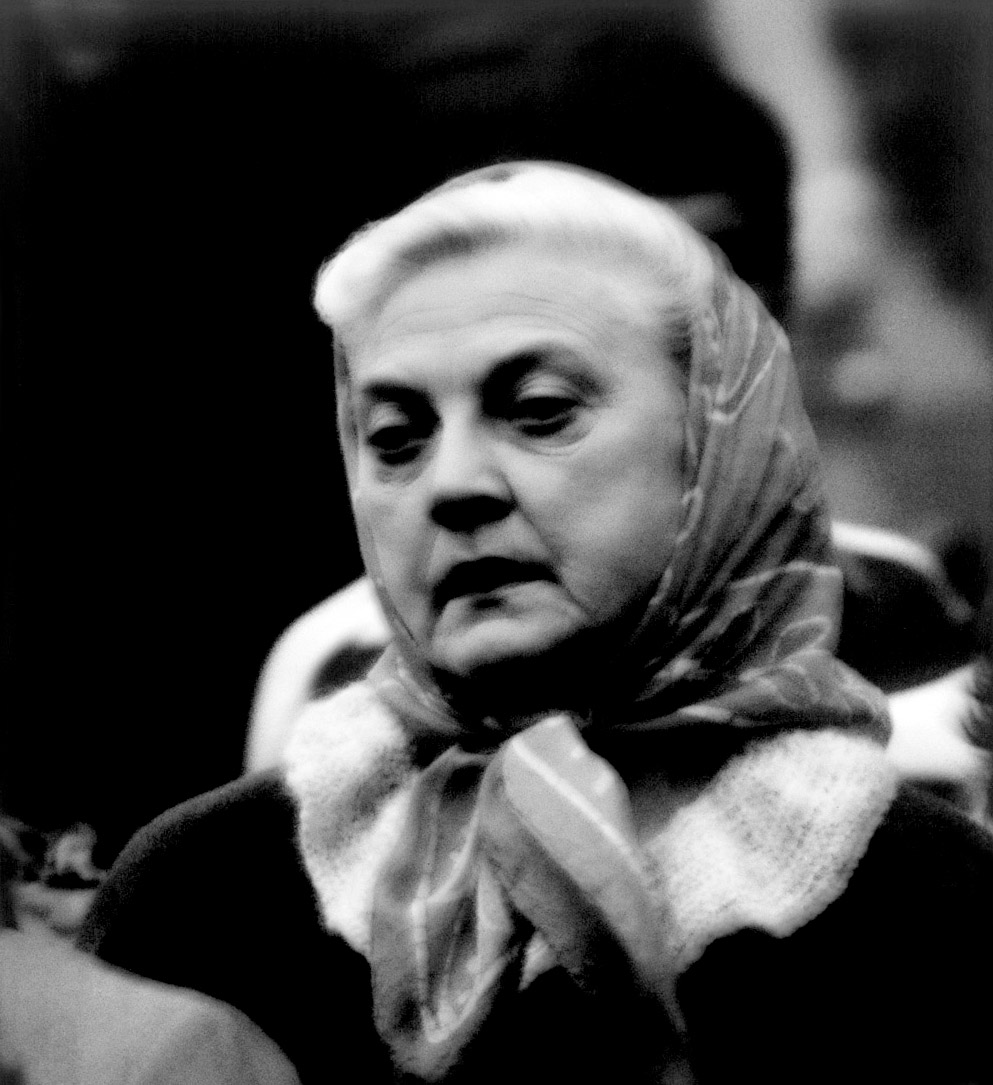
“A selection of photographs from the Crowd Series (1980-1982) by Bill Henson. Snapped in secret these black and white journalistic surveillance photographs (‘taken’ in an around Flinders Street railway station in Melbourne) have a brooding intensity and melancholic beauty. Henson uses a flattened perspective that is opposed to the principles of linear perspective in these photographs. Known as The Art of Describing6 and much used in Dutch still life painting of the 17th century to give equal weight to objects within the image plane, here Henson uses the technique to emphasise the mass and jostle of the crowd with their “waiting, solemn and compliant” people.

“When exhibiting the full series, Henson arranges the works into small groupings that create an overall effect of aberrant movement and fragmentation. From within these bustling clusters of images, individual faces emerge like spectres of humanity that will once again dissolve into the crowd … all apparently adrift in the flow of urban life. The people in these images have an anonymity that allows them to represent universal human experiences of alienation, mortality and fatigue.”7

Henson states, “The great beauty in the subject comes, for me, from the haunted space, that unbridgeable gap – which separates the profound intimacy and solitude of our interior world from the ‘other’… The business of how a child’s small hand appearing between two adults at a street crossing can suggest both a vulnerability, great tenderness, and yet also contain within it all of the power that beauty commands, is endlessly fascinating to me.”8 His observation is astute but for me it is the un/awareness of the people in these photographs that are their beauty, their insertion into the crowd but their isolation from the crowd and from themselves. As Maggie Finch observes, it is “that feeling of being both alone and private in a crowd, thus free but also exposed.”9

In the sociologist Erving Goffman’s terms the photographs can be seen as examples of what he calls “civil inattention”10 which is a carefully monitored demonstration of what might be called polite estrangement, the “facework” as we glance at people in the crowd, holding the gaze of the other only briefly, then looking ahead as each passes the other.

“Civil inattention is the most basic type of facework commitment involved in encounters with strangers in circumstances of modernity. It involves not just the use of the face itself, but the subtle employment of bodily posture and positioning which gives off the message “you may trust me to be without hostile intent” – in the street, public buildings, trains or buses, or at ceremonial gatherings, parties, or other assemblies. Civil inattention is TRUST as ‘background noise’ – not as a random collection of sounds, but as carefully restrained and controlled social rhythms. It is characteristic of what Goffman calls “unfocused interaction.””11

This is what I believe Henson’s photographs are about. Not so much the tenderness of the child’s hand but a fear of engagement with the ‘other’. As such they can be seen as image precursors to the absence/presence of contemporary communication and music technologies. How many times do people talk on their mobile phone or listen to iPods in crowds, on trams and trains, physically present but absenting themselves from interaction with other people. Here but not here; here and there. The body is immersed in absent presence, present and not present, conscious and not conscious, aware and yet not aware of the narratives of a ‘recipro/city failure’. A failure to engage with the light of place, the time of exposure and an attentiveness to the city.

As Susan Stewart insightfully observes,

“To walk in the city is to experience the disjuncture of partial vision/partial consciousness … The walkers of the city travel at different speeds, their steps like handwriting of a personal mobility. In the milling of the crowd is the choking of class relations, the interruption of speed, and the machine.”12

Dr Marcus Bunyan


Footnotes

1/ Finch, Maggie. Looking at Looking: The Photographic Gaze. Catalogue. Melbourne: National Gallery of Victoria, 2011, p. 10

2/ Ibid., p. 16

3/ Ibid., p. 21

4/ Ibid., p. 24

5/ Ibid., p. 7

6/ See Alpers, Svetlana. The Art of Describing: Dutch Art in the Seventeenth Century. University Of Chicago Press, 1984

7/ AnonBILL HENSON: early work from the MGA collection. Education Resource. A Monash Gallery of Art Travelling Exhibition [Online] Cited 14/10/2011. No longer available online

8/ Henson, Bill quoted in the exhibition catalogue. First published as a pdf for the exhibition In camera and in public Curated by Naomi Cass. Centre for Contemporary Photography, 16 September – 23 October 2011

9/ Stephens, Andrew. “Who’s watching you?” in The Saturday Age. 23rd September 2011 [Online] Cited 14/10/2011

10/ See  Goffman, E. Behaviour in Public Places. New York: Free Press, 1963

11/ Giddens, Anthony. The Consequences of Modernity. Cambridge: Polity Press, 1991, pp. 82-83

12/ Stewart, Susan. On Longing: Narratives of the Miniature, the Gigantic, the Souvenir, the Collection. Durham: Duke University Press, 1993, p. 2. Prologue


Many thankx to the National Gallery of Victoria for allowing me to publish the photographs in the posting. Please click on the photographs for a larger version of the image.
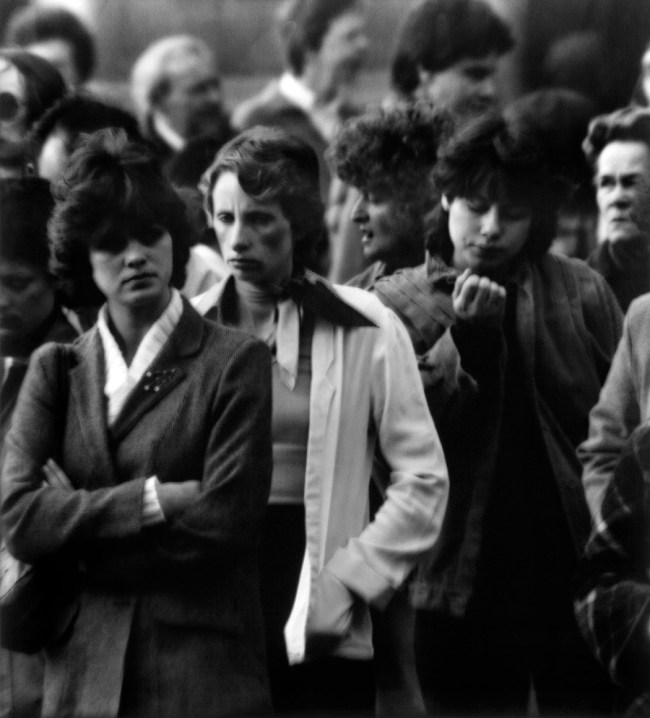


Bill Henson (Australian, b. 1955) 'Untitled 1980/82' 1980-1982


Bill Henson (Australian, b. 1955)
Untitled 1980/82
1980-1982
From the Untitled 1980/82 series 1980-1982
Gelatin silver photograph
43.0 x 38.8cm
National Gallery of Victoria, Melbourne
Anonymous gift, 1993
© Courtesy of the artist and Roslyn Oxley9 Gallery, Sydney


Bill Henson (Australian, b. 1955) 'Untitled 1980/82' 1980-1982


Bill Henson (Australian, b. 1955)
Untitled 1980/82
1980-1982
From the Untitled 1980/82 series 1980-1982
Gelatin silver photograph
29.2 x 47cm
National Gallery of Victoria, Melbourne
Anonymous gift, 1993
© Courtesy of the artist and Roslyn Oxley9 Gallery, Sydney


On 30 September the National Gallery of Victoria will present Looking at Looking: The Photographic Gaze, a unique exhibition exploring how photography can construct particular ways of looking. Looking at Looking will feature works by 10 Australian and international photographers including 20 photographs from Bill Henson’s Untitled 1980-82 series.

Drawn entirely from the NGV Collection, this exhibition will bring together a fascinating selection of photographs inviting the viewer to consider the diverse nature of the photographic gaze and explore the complex relationships between the subject, the photographer and the audience. The displayed photographs will include observations of people in crowds, surveillance images from war zones and photographs that explore different ways of looking at gender, race and identity.

Maggie Finch, Assistant Curator, Photography, NGV said: “The act of photographing people involves a process of observation and scrutiny. At times, photographers remain detached and anonymous while at other times they are complicit, directing their subjects and encouraging specific actions.”

Frances Lindsay, Deputy Director, NGV, said: “In the NGV’s 150th year this exhibition allows visitors to explore the dynamic relationship between the observer and the observed. This is a rare opportunity to view these photographs in a truly unique context.”

Looking at Looking will consider the anonymous photographer, one who is able to look without being looked at in return and consequently see more than otherwise possible. This idea is explored in Bill Henson’s series Untitled 1980-82, where the artist photographed people on city streets. Hung in a dense display, these photographs provide a psychological study of the nature of people when in a crowd.

Looking at Looking will feature works by Brook Andrew, Chi Peng, Anne Ferran, Ashley Gilbertson, Charles Green and Lyndell Brown, Bill Henson, John Immig, Thomas Struth and David Thomas.

Press release from the National Gallery of Victoria


Thomas Struth (German, b. 1954) 'Pergamon Museum IV, Berlin' 2001


Thomas Struth (German, b. 1954)
Pergamon Museum IV, Berlin
2001
Type C photograph
144.1 x 219.9cm
National Gallery of Victoria, Melbourne
Purchased with the assistance of The Bowness Family Fund for Contemporary Photography, 2008
© 2011 Thomas Struth
 

David Thomas (born Northern Ireland 1951, arrived Australia 1958) 'Amid history 2 (Large version)' 2006


David Thomas (born Northern Ireland 1951, arrived Australia 1958)
Amid history 2 (Large version)
2006
Enamel paint on type C photograph on aluminium and plastic
100 x 145cm
National Gallery of Victoria, Melbourne
Purchased, Victorian Foundation for Living Australian Artists, 2007 © the artist
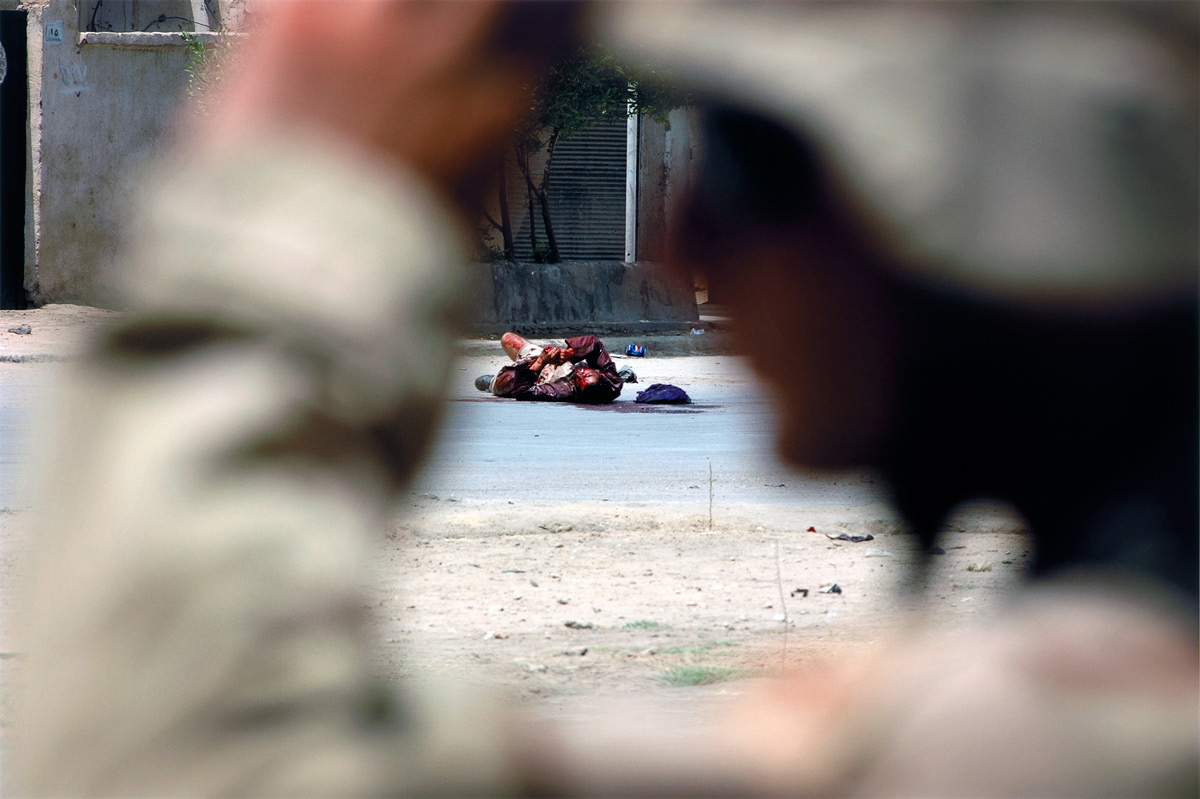
 

Ashley Gilbertson (Australian, b. 1978) 'A member of the Mahdi Army RPG team' 2004 from the 'Whiskey Tango Foxtrot' series 2004


Ashley Gilbertson (Australian, b. 1978)
A member of the Mahdi Army RPG team
2004
From the Whiskey Tango Foxtrot series 2004
Digital type C print
66.5 x 99.8cm
National Gallery of Victoria, Melbourne
Purchased, Victorian Foundation for Living Australian Artists, 2009
© Ashley Gilbertson / VII Network


John Immig (Dutch/Australian, 1935-2018) 'No title (T.V. images)' 1975-1976


John Immig (Dutch/Australian, 1935-2018)
No title (T.V. images)
1975-1976
From the Vietnam series 1975-1976
Gelatin silver photograph
20.2 x 25.3cm
National Gallery of Victoria, Melbourne
Purchased with the assistance of the Visual Arts Board, 1977
© John Immig


Chi Peng (Chinese, b. 1981) 'Consubstantiality' 2004


Chi Peng (Chinese, b. 1981)
Consubstantiality
2004
Type C photograph
87.5 x 116.7cm
National Gallery of Victoria, Melbourne
Purchased with the assistance of the NGV Foundation, 2004
© Chi Peng, courtesy of Red Gate Gallery, Beijing


Brook Andrew (Australian, b. 1970) 'I Split Your Gaze' 1997


Brook Andrew (Australian, b. 1970)
I Split Your Gaze
1997
Gelatin silver print
122.6 × 114cm (image and sheet)
National Gallery of Victoria, Melbourne
Purchased with funds from the Victorian Foundation for Living Australian Artists, 2005
© Brook Andrew/Copyright Agency, 2023
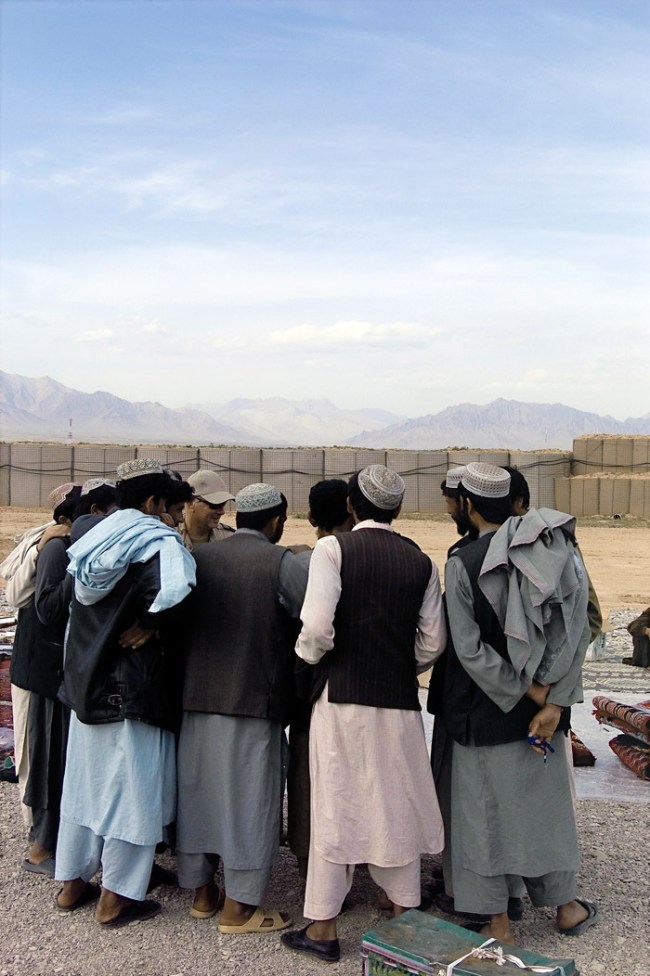
 

Charles Green (Australian, b. 1953) and Lyndell Brown (Australian, b. 1961) 'Afghan traders with soldiers, market, Taran Kowt Base Uruzgan Province, Afghanistan' 2007 printed 2009


Charles Green (Australian, b. 1953)
Lyndell Brown (Australian, b. 1961)
Afghan traders with soldiers, market, Taran Kowt Base Uruzgan Province, Afghanistan
2007 printed 2009
From The approaching storm series 2009
Inkjet print
155.0 x 107.5cm
National Gallery of Victoria, Melbourne
Purchased, Victorian Foundation for Living Australian Artists, 2009
© Courtesy of the Artists and Arc One Gallery, Melbourne


NGV International
180 St Kilda Road

Opening hours
Daily 10am – 5pm

National Gallery of Victoria website

LIKE ART BLART ON FACEBOOK

Back to top

Vale Dr John Cato (1926-2011)

February 2011


It is with much sadness that I note the death of respected Australian photographer and teacher Dr John Cato (1926-2011). Son of Australian photographer Jack Cato, who wrote one of the first histories of Australian photography (The Story of the Camera in Australia (1955)), John was apprentice to his father before setting up a commercial studio with Athol Shmith that ran from 1950-1971. Dr Cato then joined Shmith at the fledgling Prahran College of Advanced Education photography course in 1974, becoming head of the course when Shmith retired in 1979, a position he held until John retired in 1991.

I was fortunate enough to get to know John and his vivacious wife Dawn. I worked with him and co-curatored his retrospective with William Heimerman, ‘…and his forms were without number’ at The Photographers’ Gallery, South Yarra, in 2002. My catalogue essay from this exhibition is reproduced below.

John was always generous with his time and advice. His photographs are sensitive, lyrical renditions of the Australian landscape. He had a wonderful ear for the land and for the word, a musical lyricism that was unusual in Australian photographers of the early 1970s. He understood how a person from European background could have connection to this land, this Australia, without being afraid to express this sense of belonging; he also imaged an Aboriginal philosophy (that all spirits have a physical presence and everything physical has a spiritual presence) tapping into one of the major themes of his personal work: the mirror held up to reveal an’other’ world – the language of ambiguity and ambivalence (the dichotomy of opposites e.g. black / white, masculine / feminine) speaking through the photographic print.

His contribution to the art of photography in Australia is outstanding. What are the precedents for a visual essay in Australian photography before John Cato? I ask the reader to consider this question.

It would be fantastic if the National Gallery of Victoria could organise a large exhibition and publication of his work, gathering photographs from collections across the land, much like the successful retrospective of the work of John Davis held in 2010. Cato’s work needs a greater appreciation throughout Australia because of it’s seminal nature, containing as it does the seeds of later development for Australian photographers. His educational contribution to the development of photography as an art form within Australia should also be acknowledged in separate essays for his influence was immense. His life, his teaching and his work deserves nothing less.

Dr Marcus Bunyan


‘… and his forms were without number’

John Cato: A Retrospective of the Photographic Work 1971-1991

This writing on the photographic work of Dr John Cato from 1971-1991 is the catalogue essay to a retrospective of his work held at The Photographers’ Gallery in Prahran, Melbourne in 2002. Dr Cato forged his voice as a photographic artist in the early 1970s when photography was just starting to be taken seriously as an art form in Australia. He was a pioneer in the field, and became an educator in art photography. He is respected as one of Australia’s preeminent photographers of the last century.


With the arrival of ‘The New Photography’1 from Europe in the early 1930’s, the formalist style of Modernism was increasingly adopted by photographers who sought to express through photography the new spirit of the age. In the formal construction of the images, the abstract geometry, the unusual camera angles and the use of strong lighting, the representation ‘of the thing in itself’2 was of prime importance. Subject matter often emphasised the monumentality of the factory, machine or body/landscape. The connection of the photographer with the object photographed was usually one of sensitivity and awareness to an external relationship that resulted in a formalist beauty.

Following the upheaval and devastation of the Second World War, photography in Australia was influenced by the ‘Documentary’ style. This “came to be understood as involved chiefly with creating aesthetic experiences … associated with investigation of the social and political environment.”3 This new movement of social realism, “… a human record intimately bound with a moment of perception,”4 was not dissimilar to Henri Cartier-Bresson’s ‘decisive moment’ (images a la sauvette) where existence and essence are in balance.5

The culmination of the ‘Documentary’ style of photography was The Family of Man exhibition curated by Edward Steichen that toured Australia in 1959.6 This exhibition, seen many times by John Cato,7 had a theme of optimism in the unity and dignity of man. The structure of the images in ‘Documentary’ photography echoed those of the earlier ‘New Photography’.

Max Dupain “stressed the objective, impersonal and scientific character of the camera; the photographer could reveal truth by his prerogative of selection.”8 This may have been an objective truth, an external vocalising of a vision that concerned itself more with exterior influences rather than an internal meditation upon the subject matter.


John Cato (Australian, 1926-2011) 'Untitled' from the series 'Essay I, Landscapes in a Figure' 1971-1979


John Cato (Australian, 1926-2011)
Untitled from the series Essay I, Landscapes in a Figure
1971-1979
Silver gelatin photograph


In 1971, John Cato’s personal photographic work was exhibited for the first time as part of the group show Frontiers at the National Gallery of Victoria, Melbourne.9 Earth Song emerged into an environment of social upheaval inflamed by Australian involvement in the Vietnam War. It provided a group of enthusiastic people who were beginning to be interested in photography as art, an opportunity to see the world, and photography, through a different lens. The 52 colour photographic prints in Earth Song, were shown in a sequence that used melodic line and symphonic form as its metaphoric basis, standing both as individual photographs and as part of a total concept.10

In the intensity of the holistic vision, in the connection to the subconscious, the images elucidate the photographers’ search for a perception of the world. This involved an attainment of a receptive state that allowed the cracks, creases and angles inherent in the blank slate of creation to become meaningful. The sequence contained images that can be seen as ‘acts of revelation’,11confirmed and expanded by supporting photographs, and they unearthed a new vocabulary for the discussion of spiritual and political issues by the viewer. They may be seen as a metaphor for life.

The use of sequence, internal meditation and ‘revelation’, although not revolutionary in world terms,12 were perhaps unique in the history of Australian photography at that time. During the production of Earth Song, John Cato was still running a commercial studio in partnership with the photographer Athol Shmith and much of his early personal work was undertaken during holidays and spare time away from the studio. Eventually he abandoned being a commercial photographer in favour of a new career as an educator, but found this left him with even less time to pursue his personal work.13

Earth Song (1970-1971) was followed by the black and white sequences:


 Tree – A Journey18 images1971-1973 
 Petroglyphs14 images1971-1973 
 Seawind14 images1971-1975 
 Proteus18 images1974-1977 
 Waterway16 images1974-1979 


Together they form the extensive series Essay I, Landscapes in a Figure, parts of which are held in the permanent photography collection of the National Gallery of Victoria.14


John Cato (Australian, 1926-2011) 'Untitled' from the series 'Essay I, Landscapes in a Figure' 1971-1979


John Cato (Australian, 1926-2011)
Untitled from the series Essay I, Landscapes in a Figure
1971-1979
Silver gelatin photograph


The inspiration for Essay I and later personal work came from many sources. An indebtedness to his father, the photographer Jack Cato, is gratefully acknowledged. Cato also acknowledges the influence of literature: William Shakespeare (especially the Sonnets, and As You Like It), William Blake, Walt Whitman (Leaves of Grass), Lewis Carroll (Through the Looking Glass), the Bible; and of music (symphonic form), the mythology of the Dreamtime and Aboriginal rock paintings.15 Each body of work in Essay I was based on an expression of nature, the elements and the Creation. They can be seen as Equivalents16 of his most profound life experiences, his life philosophy illuminated in physical form.

John Cato was able to develop the vocabulary of his own inner landscape while leaving the interpretation of this landscape open to the imagination of the viewer. Seeing himself as a photographer rather than an artist, he used the camera as a tool to mediate between what he saw in his mind’s eye, the subjects he photographed and the surface of the photographic negative.17 Photographing ‘in attention’, much as recommended by the teacher and philosopher Krishnamurti,18 he hoped for a circular connection between the photographer and the subject photographed. He then looked for verification of this connection in the negative and, eventually, in the final print.

Essay II, Figures in a Landscape, had already been started before the completion of Essay I and it consists of three black and white sequences:


 Alcheringa11 images1978-1981 
 Broken Spears11 images1978-1983 
 Mantracks22 images in pairs1978-1983 


The photographs in Essay II seem to express “the sublimation of Aboriginal culture by Europeans”19 and, as such, are of a more political nature. Although this is not obvious in the photographs of Alcheringa, the images in this sequence celebrating the duality of reality and reflection, substance and shadow, it is more insistent in the symbology of Broken Spears and Mantracks. Using the metaphor of the fence post (white man / black man in Broken Spears) and contrasting Aboriginal and European ‘sacred’ sites (in pairs of images in Mantracks), John Cato comments on the destruction of a culture and spirit that had existed for thousands of years living in harmony with the land.

In his imaging of an Aboriginal philosophy (that all spirits have a physical presence and everything physical has a spiritual presence) he again tapped one of the major themes of his personal work: the mirror held up to reveal an’other’ world. Cato saw that even as they are part of the whole, the duality of positive / negative, black / white, masculine / feminine are always in conflict.20 In the exploration of the conceptual richness buried within the dichotomy of opposites, Cato sought to enunciate the language of ambiguity and ambivalence,21 speaking through the photographic print.

The theme of duality was further expanded in his last main body of work, Double Concerto: An Essay in Fiction:


 Double Concerto (Pat Noone)30 images1984-1990 
 Double Concerto (Chris Noone)19 images1985-1991 


Double Concerto may be seen as a critique of the power of witness and John Cato created two ‘other’ personas, Pat Noone and Chris Noone, to visualise alternative conditions within himself. The Essay explored the idea that if you send two people to the same location they will take photographs that are completely different from each other, that tell a distinct story about the location and their self:

“For the truth of the matter is that people have mixed feelings and confused opinions and are subject to contradictory expectations and outcomes, in every sphere of experience.”22

This slightly schizophrenic confusion between the two witnesses is further highlighted by Pat Noone using single black and white images in sequence. Chris Noone, on the other hand, uses multiple colour images joined together to form panoramic landscapes that feature two opposing horizons. The use of colour imagery in Double Concerto, with its link to the colour work of Earth Song, can be seen to mark the closing of the circle in terms of John Cato’s personal work. In Another Way of Telling, John Berger states that …

“Photography, unlike drawing, does not possess a language. The photographic image is produced instantaneously by the reflection of light; its figuration is not impregnated by experience or consciousness.”23


But in the personal work of John Cato it is a reflection of the psyche, not of light, that allows a consciousness to be present in the figuration of the photographic prints. The personal work is an expression of his self, his experience, his story and t(his) language, is our language, if we allow our imagination to speak.

Dr Marcus Bunyan 2002


Footnotes

1/ Newton, Gael. Shades of Light: Photography and Australia 1839-1988. Sydney: Australian National Gallery, William Collins, 1988, p. 109

2/ Newton, Gael. Max Dupain. Sydney: David Ell Press,1980, p. 34

3/ Ibid., p. 32

4/ Greenough, Sarah (et al). On the Art of Fixing a Shadow: 150 Years of Photography. Boston: National Gallery of Art, Bullfinch Press, 1989, p. 256

5/ Ibid., p. 256

6/ Newton, Gael. Shades of Light: Photography and Australia 1839-1988. Sydney: Australian National Gallery, William Collins, 1988, p. 131

7/ Ibid., p. 131

8/ Newton, Gael. Max Dupain. Sydney: David Ell Press, 1980, p. 32

9/ Only the second exhibition by Australian photographers at the National Gallery of Victoria, Melbourne

10/ Shmith, Athol. Light Vision No.1. Melbourne: Jean-Marc Le Pechoux (editor and publisher), Sept 1977, p. 21

11/ Berger, John and Mohr, Jean. Another Way of Telling. New York: Pantheon Books, 1982, p. 118

12/ Hall, James Baker. Minor White: Rites and Passages. New York: Aperture, 1978

13/ Conversation with the photographer 29/01/1997, Melbourne, Victoria

14/ Newton, Gael. Shades of Light: Photography and Australia 1839-1988. Sydney: Australian National Gallery, William Collins, 1988, p. 135, Footnote 7; p. 149

15/ Conversation with the photographer 22/01/1997, Melbourne, Victoria

16/ Norman, Dorothy. Alfred Stieglitz. New York: Aperture, 1976, p. 5

17/ Ibid.,

18/ Krishnamurti. Beginnings of Learning. London: Penguin, 1975, p. 131

19/ Strong, Geoff. Review. The Age. Melbourne, 28/04/1982

20/ Conversation with the photographer 22/01/1997, Melbourne, Victoria

21/ The principal definition for ambiguity in Websters Third New International Dictionary is: “admitting of two or more meanings … referring to two or more things at the same time.”
That for ambivalence is “contradictory and oscillating subjective states.”
Quoted in Davis, Fred. Fashion, Culture and Identity. Chicago: University of Chicago Press, 1992, p. 21.

22/ Levine, Donald. The Flight From Ambiguity. Chicago: University of Chicago Press, 1985

23/ Berger, John and Mohr, Jean. Another Way of Telling. New York: Pantheon Books, 1982, p. 95


LIKE ART BLART ON FACEBOOK

Back to top
Exhibition: ‘Yayoi Kusama: Mirrored Rooms’ at Museum of Contemporary Art (MCA), Sydney

Exhibition dates: 24th February – 8th June, 2009

Curators: Jaap Guldemond (Museum Boijmans Van Beuningen), Franck Gautherot & Seungduk Kim (Le Consortium, Dijon)

MCA Curatorial Liaison: Judith Blackall


“Discover the work of internationally acclaimed Japanese artist Yayoi Kusama with this major exhibition that spans decades of her artistic practice.

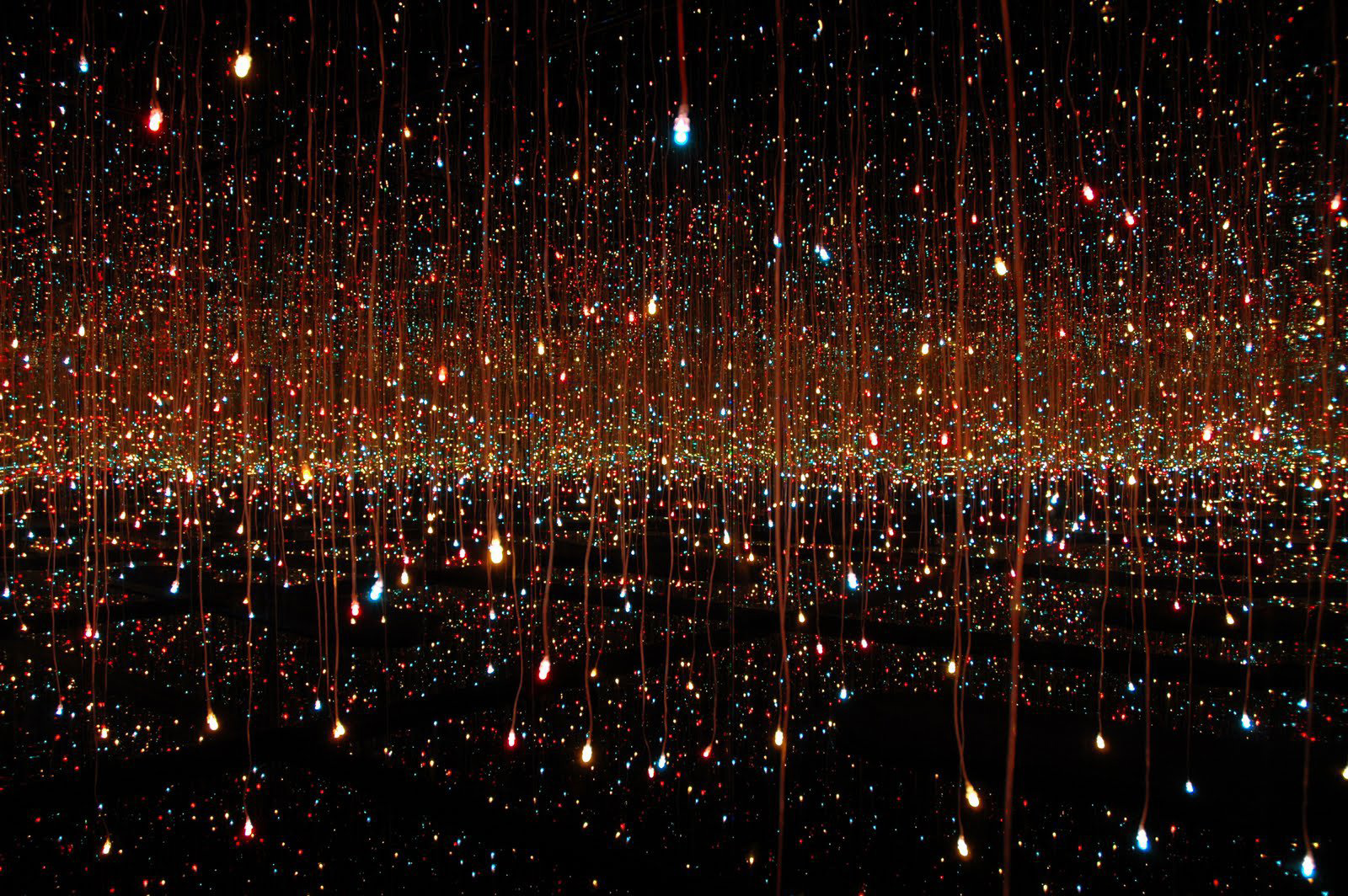
Yayoi Kusama: Mirrored Years demonstrates the enduring force of Yayoi Kusama. Renowned early installations such as Infinity Mirror Room – Phalli’s Field (1965) along with recent immersive environments including Fireflies on the Water (2000) and Clouds (2008) provide insight into the creative energy of this extraordinary artist and her lifelong preoccupation with the perceptual, visual and physical worlds.

Working across different media and forms that include painting, collage, sculpture, installation and film, as well as performance and its documentation, Kusama creates works that reveal a fixation with repetition, pattern and accumulation. Describing herself as an “obsessive artist”, her work is intensely sensual, infused with autobiographical, psychological and sexual content.”

Text from the MCA website [Online] Cited 12/03/2009. No longer available online


Many thanks to Ed Jansen for the use of his installation photographs of this exhibition at Museum Boijmans Van Beuningen, Rotterdam in 2008. See the whole set of his photographs on Flickr. Please click on the photographs for a larger version of the image.


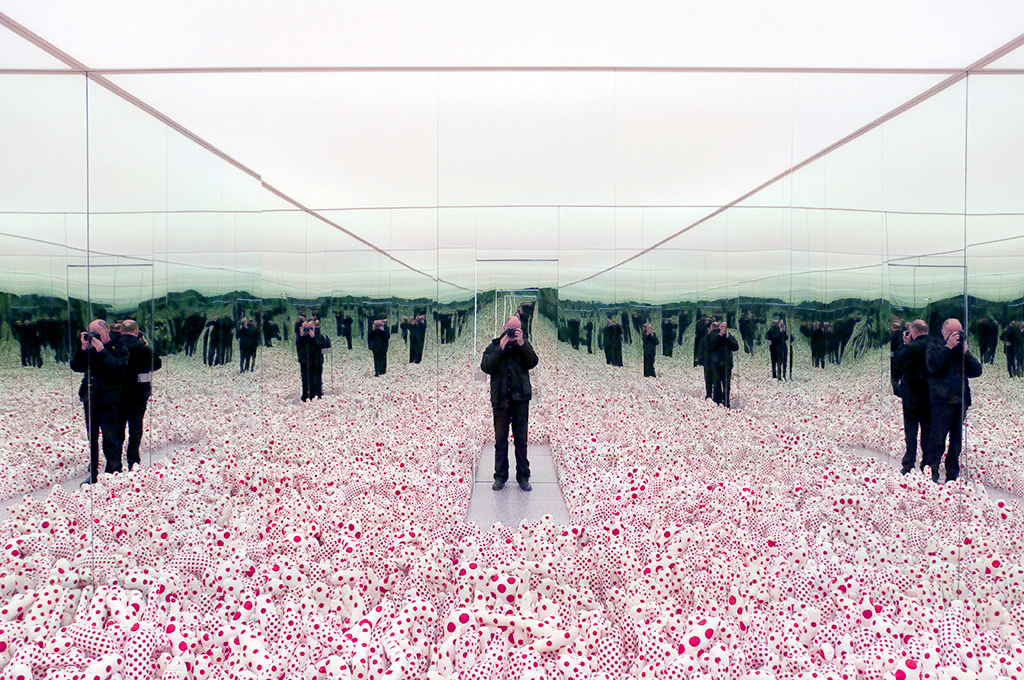
Yayoi Kusama (Japanese, b. 1929) 'Infinity Mirror Room - Phalli's Field' 1965 from the exhibition 'Yayoi Kusama: Mirrored Rooms' at Museum of Contemporary Art (MCA), Sydney, Feb - June, 2009


Yayoi Kusama (Japanese, b. 1929)
Infinity Mirror Room – Phalli’s Field
1965


Yayoi Kusama (Japanese, b. 1929) 'Infinity Mirror Room - Phalli's Field' 1965 from the exhibition 'Yayoi Kusama: Mirrored Rooms' at Museum of Contemporary Art (MCA), Sydney, Feb - June, 2009

Yayoi Kusama (Japanese, b. 1929) 'Infinity Mirror Room - Phalli's Field' 1965


Yayoi Kusama (Japanese, b. 1929)
Infinity Mirror Room – Phalli’s Field
1965
Museum Boijmans Van Beuningen, Rotterdam, 2008
Photo: Ed Jansen


Rewind 1960

Visual hallucinations of polka dots since childhood have inspired the most significant works of this avant-gardist, who says creating art “saved” her during her lifelong battle with mental illness.

Interview by Natalie Reilly

This photograph [see above, top, for the image of her in 1965] shows a creative work that I made in New York in 1960. I was 31 years old at the time and my inspiration was the inundation and proliferation of polka dots. The work represents the evolution of my original formative process. Of all the pieces I have made, I like this one the best. It was my intention to create an interminable image by using mirrors and multiplying red polka dots.

I was born in Nagano Prefecture , a mountainous region in Japan. The youngest of four children, I have one sister and two brothers.

Since childhood, I have loved to paint pictures and create art forms. [Kusama has suffered from obsessive thinking and visual hallucinations since early childhood. the hallucinations – often of polka dots, or “nets” as she calls them – have become the inspiration for much of her work.] I did many artworks in great numbers in my younger days.

I went to Seattle in 1957 where I had my first solo exhibition in the US. I moved  to New York in 1958. Japan in those days was too conservative for avant-garde art to be accepted. [By 1961, Kusama was an active participant in the avant-garde movement in New York. Her art, which often included performance and controversial themes such as nudity and protests against the Vietnam War, drew acclaim for art critics and other artists such as Andy Warhol and Claes Oldenburg.]

I was deeply moved by the efforts the artists in New York were making then to develop a new history for art. I owe what I am today to many people in the art circles in Japan, the US and Europe who enthusiastically supported my art and gave me a boost into the international art scene.

Artists Georgia O’Keefe and Joseph Cornell were among the many friends who helped me, including Donald Judd and [writer and activist] Lucy Lippard who appreciated the originality of my art.  [In 1962 at the height of her success in New York, Kusama’s mental health began to suffer as she grew more paranoid about other artists copying her work. Late that year, she covered up all the windows in her studio in an attempt to “shut out the world”, and by November she was hospitalised after suffering a nervous breakdown.]

I came back to Japan in 1973, because my health had deteriorated. I wanted to create art in a quiet atmosphere. I once said, “if it were not for art, I would have killed myself a long time ago” an that’s still true. I do art in order to pursue my philosophy of life seeking truth in art.

Reilly, Natalie. “Rewind 1960,” in Boleyn, Alison (ed.,). Sunday Life: The Sunday Age Magazine. Melbourne: Fairfax Magazines. February 15th 2009, p. 30.


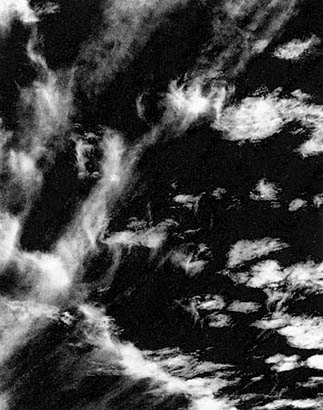
Yayoi Kusama (Japanese, b. 1929) 'Clouds' 1999 and 'Love Forever' 2005 from the exhibition 'Yayoi Kusama: Mirrored Rooms' at Museum of Contemporary Art (MCA), Sydney, Feb - June, 2009


Yayoi Kusama (Japanese, b. 1929)
Clouds 1999 and Love Forever 2005
Museum Boijmans Van Beuningen, Rotterdam, 2008
Photo: Ed Jansen


Yayoi Kusama (Japanese, b. 1929) 'Clouds' 2008 (installation view at MCA)


Yayoi Kusama (Japanese, b. 1929)
Clouds (installation view at MCA)
2008
Image courtesy the artist, Yayoi Kusama Studio, Victoria Miro Gallery, London and Ota Fine Arts, Tokyo and © the artist


Yayoi Kusama (Japanese, b. 1929) 'Stars Infinity (A.B.C)' 2003 (installation view MCA)


Yayoi Kusama (Japanese, b. 1929)
Stars Infinity (A.B.C) (installation view at MCA)
2003
Image courtesy and © the artist


This exhibition explored the extraordinary work of Japanese artist Yayoi Kusama. It revealed the coherence of her practice over many years and highlighted the freshness and innovation she brings to themes investigated throughout her life. Describing herself as an ‘obsessive artist’, her work is intensely sensual, infused with autobiographical, psychological and sexual content.

Kusama was born in 1929, in Matsumoto City, Nagano Prefecture, Japan. She demonstrated a passion for art from an early age and went on to study Nihonga painting, a formal Japanese technique using ground pigment and animal glues. Excited by the promise of the post-war international art scene, Kusama moved to New York in 1958. Her first New York solo exhibition a year later was an outstanding success and she became renowned as an innovative and adventurous young artist with her large Infinity Net canvases; Accumulation sculptures of everyday objects completely covered with soft, sewn and stuffed protuberances; environments such as the Infinity Mirror Room-Phalli’s Field (1965) and performances and Happenings. In 1966 she exhibited Narcissus Garden, a field of mirrored spheres in the gardens of the Venice Biennale, creating a sensation with an extraordinarily beautiful and compelling new version of her accumulations.

Kusama was energetic, talented, strategic and courageous at a time of fervent development in the art world, in a city that was exciting and notoriously competitive. During the ‘60s and ‘70s she was an active presence in Europe as well – in 1962 she was the only female artist to take part in the widely acclaimed Nul (Zero) international group exhibition at the Stedelijk Museum in Amsterdam. She returned to Tokyo in 1973.

Yayoi Kusama: Mirrored Years juxtaposed seminal works from the 1960s with more recent installations, films, paintings, floor pieces and silkscreen prints on canvas, and included major new works. The exhibition reflected Kusama’s lifelong obsession with repetition, pattern and aggregation, and her perceptions – visual, physical and sensory. It demonstrated her originality, creativity and uncompromising vision across many different techniques. Her work has been highly influential to new generations of artists and designers and she remains one of the most respected artists working today.

Organised by Museum Boijmans Van Beuningen, Rotterdam, Netherlands.
Presented in association with City Gallery, Wellington, New Zealand.

Anonymous. “Yayoi Kusama: Mirrored Years,” on the MCA website Nd [Online] Cited 13/06/2022


Yayoi Kusama (Japanese, b. 1929) 'Fireflies on the Water' 2000

Yayoi Kusama (Japanese, b. 1929) 'Fireflies on the Water' 2000


Yayoi Kusama (Japanese, b. 1929)
Fireflies on the Water
2000


Yayoi Kusama (Japanese, b. 1929) 'The Moment of Regeneration' 2004


Yayoi Kusama (Japanese, b. 1929)
The Moment of Regeneration
2004


Yayoi Kusama (Japanese, b. 1929) 'The Moment of Regeneration' 2004 (installation view at MCA)


Yayoi Kusama (Japanese, b. 1929)
The Moment of Regeneration (installation view at MCA)
2004
Image courtesy the artist, Yayoi Kusama Studio, Victoria Miro Gallery, London and Ota Fine Arts, Tokyo and © the artist


Yayoi Kusama (Japanese, b. 1929) 'Walking on the Sea of Death' 1981 (installation view at MCA)


Yayoi Kusama (Japanese, b. 1929)
Walking on the Sea of Death (installation view at MCA)
1981
Image courtesy the artist, Yayoi Kusama Studio, Victoria Miro Gallery, London and Ota Fine Arts, Tokyo and © the artist


Yayoi Kusama (Japanese, b. 1929) 'Narcissus Garden' 1966


Yayoi Kusama (Japanese, b. 1929)
Narcissus Garden (at the Venice Biennale, Italy)
1966


Yayoi Kusama (Japanese, b. 1929) 'The Earth in Late Summer' 2004 (installation view MCA)


Yayoi Kusama (Japanese, b. 1929)
The Earth in Late Summer (installation view MCA)
2004
Image courtesy the artist, Yayoi Kusama Studio, Victoria Miro Gallery, London and Ota Fine Arts, Tokyo and © the artist


Yayoi Kusama (Japanese, b. 1929) 'I'm here but nothing' 2000- (installation view MCA)


Yayoi Kusama (Japanese, b. 1929)
I’m here but nothing (installation view MCA)
2000-
Image courtesy the artist, Yayoi Kusama Studio, Victoria Miro Gallery, London and Ota Fine Arts, Tokyo and © the artist


Yayoi Kusama (Japanese, b. 1929) 'Invisible Life' 2000


Yayoi Kusama (Japanese, b. 1929)
Invisible Life
2000


Museum of Contemporary Art (MCA)
140 George Street
The Rocks, Sydney, Australia

Opening hours:
Daily 11am – 5pm

Yayoi Kusama website

Museum of Contemporary Art website

LIKE ART BLART ON FACEBOOK

Back to top