Exhibition: ‘David Goldblatt: No Ulterior Motive’ at Fundación MAPFRE, Madrid

Exhibition dates: 30th May – 25th August 2024

Curators: Judy Ditner, Leslie M. Wilson and Matthew S. Witkovsky


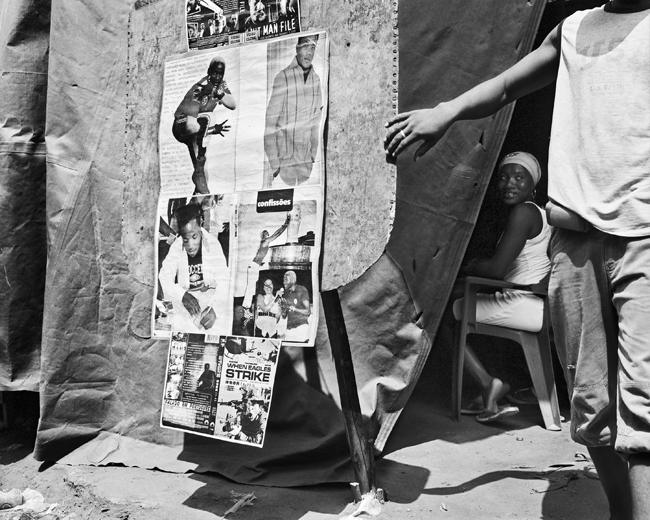
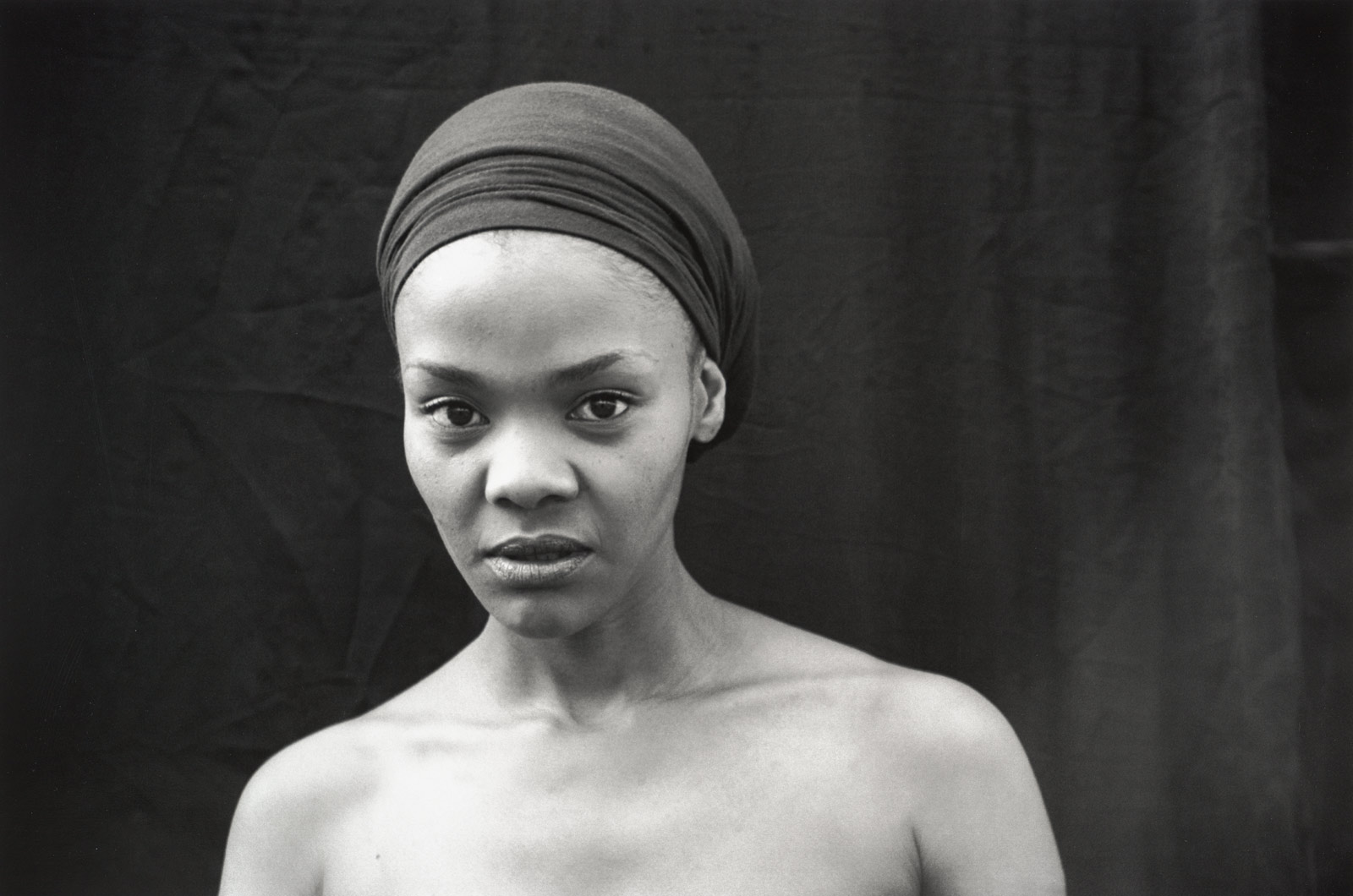
David Goldblatt (South African, 1930-2018) 'Yaksha Modi, the daughter of Chagan Modi, in her father's shop before its destruction under the Group Areas Act, 17th Street, Fietas, Johannesburg' 1976


David Goldblatt (South African, 1930-2018)
Yaksha Modi, the daughter of Chagan Modi, in her father’s shop before its destruction under the Group Areas Act, 17th Street, Fietas, Johannesburg
1976
From the series Fietas
Gelatin silver print
The Art Institute of Chicago, promised donation of Cecily Cameron and Derek Schrier
© The David Goldblatt Legacy Trust


David Goldblatt writing history

To keep this archive relevant I am constantly refreshing the postings to make sure all the links work, all the videos are still available, and all the bibliographic information about the photographers is up to date.

With the switch to the new template I am having to refresh every page that I have published since 2008 which is a mammoth task. Every time I search the Internet for an artist and their dates I say a little “thank you” when I find an artist is still living… for their creativity and energy is still present in the world. Unfortunately what I have found is that so many photographers have passed away since I started Art Blart in 2008, many within the last 8-10 years.

This is not surprising, people die! But we seem to be loosing that generation of photographers who were born in the 1920s-1940s who actually made a difference to the world and how we live in it. How they viewed the world in their own unique way and used photography to advocate for a fairer world free from war, discrimination and injustice. Photographs making a difference. As Lewis Hine observed, “Photography can light up darkness and expose ignorance.”

I find it very sad that every time a creative person dies you can no longer have a conservation with that person about their passion, their vision, their understanding of the world around them and how they photographed it. All we have left are their photographs, their lived consciousness if you like, as to what was important for them to photograph during their lifetime: family, friends, people, environment, spirit, protest, war, whatever … and what values they held fast to in order to picture the “improvised realities of everyday life.”

We are loosing a generation of photographers.

We are loosing a generation of photographers that captured an image of human existence as a reflection of reality, a truth lived in the world (rather than postmodern fragmentation, posthuman or AI).

At a time when the last fighter pilot who fought in the Battle of Britain in 1940 just turned 105 in July 2024 (Group Captain John Allman Hemingway, DFC, AE – one of the few that saved Britain), a large proportion of the artists listed below were born before or in the shadow of the cultural and ideological conflict that was the global conflagration of the Second World War. The grew up suffering the vicissitudes of war, bombing, death, rationing, deprivations, genocide and mass migration. They grew up knowing of the threat to their freedom and survival. They grew up with a heightened sense of the value of human life and the need to record that humanity. As my friend and photographer Joyce Evans (Australian, 1929-2019) eloquently said:

“We believed we had an obligation, neither social nor political, to make a difference. We were brought up as children to believe that we had an obligation to make that difference.

If we can find out what we are… that is the artist. This goes to the core element of your being, and the core element of your enquiry remains the same.

If the core part of your life is the search for the truth then that becomes a core part of your identity for the rest of your life. It becomes embedded in your soul.”1


I suggest that David Goldblatt was one such artist who was brought up to believe that he had a obligation to make a difference. And it was through the truth of his photographs that he made that difference.

Goldblatt was “the grandson of Lithuanian-Jewish migrants, who left Europe for South Africa in the 1890s to escape religious persecution. Goldblatt was born in the small gold-mining town of Randfontein in 1930 and later lived and worked in Johannesburg.”2

“In 1910 Chinese indentured labourers were repatriated and replaced by migrant black labour, many recruited from neighbouring territories. In 1921-1922 The Rand Rebellion/ Revolt saw white mine workers protest the industry’s attempt to replace semi-skilled white men with cheap black labour leaving about 200 people dead, more than 1,000 injured, 15,000 men out of work and a slump in gold production. The government came under pressure to protect skilled white workers in mining and three Acts were passed that gave employment opportunities to whites and introduced a plan for African segregation. In 1948 apartheid was legislated.”3

During the Second World War, “South Africa made significant contributions to the Allied war effort. Some 135,000 white South Africans fought in the East and North African and Italian campaigns, and 70,000 Blacks and Coloureds served as labourers and transport drivers… The war proved to be an economic stimulant for South Africa, although wartime inflation and lagging wages contributed to social protests and strikes after the end of the war. Driven by reduced imports, the manufacturing and service industries expanded rapidly, and the flow of Blacks to the towns became a flood. By the war’s end, more Blacks than whites lived in the towns. They set up vast squatter camps on the outskirts of the cities and improvised shelters from whatever materials they could find. They also began to flex their political muscles. Blacks boycotted a Witwatersrand bus company that tried to raise fares, they formed trade unions, and in 1946 more than 60,000 Black gold miners went on strike for higher wages and improved living conditions.”4

Goldblatt was a first generation migrant who grew up surrounded by the oppression of blacks in a small gold-mining town. He lived through the Second World War and as a human being and a Jew would know of the atrocities of the concentration camps. He started taking photographs when he was a teenager in the late 1940s after the war ended and just after the beginning of apartheid. All of these events – black oppression, Jewish genocide, and apartheid – would have affected his outlook on life and his values. He is quoted as saying, “Apartheid became very much the central area of my work, but my real preoccupation was with our values … how did we get to be the way we are?”5

How does any human being believe that their values are “right” and more valuable than those of another culture? that then leads them into conflict with other people who have different values? or to a belief that they are superior to another race? Such is the case with white supremacy and apartheid, a word used to describe a racist program of tightened segregation and discrimination.

Early in his career, to get subjects for his photographs, David Goldblatt posted “classified advertisements in local newspapers requesting sitters for his portraits. Goldblatt’s ads for his personal work often included a note of reassurance, one of which gave [this] exhibition its title: “I would like to photograph people in their homes in Johannesburg, Randburg and Sandton. There will be no charge and one free print will be supplied. Further copies at cost price. There is no catch and no ulterior motive.””6

The phrase “no ulterior motive” is part misnomer.

Leslie Wilson and Yechen Zhao have observed that while “Goldblatt’s use of “no ulterior motive” was supposed to allay concerns that he was trying to take advantage of his sitters,” Goldblatt was also fully aware of the use he wanted to put his photographs. “Even as he positioned himself as a photographer without an ulterior motive, Goldblatt certainly had an intention for the resulting photographs: to use them in service of understanding and representing South African social relations.”7

Goldblatt was fully aware, fully attentive and informed about the history his country – “the history of South Africa’s mining industry, white middle class, forced segregation of black and Asian communities into townships under the Group Areas Act” – and he used his photographs to objectively document social conditions in South Africa, photographs which were then published in magazines and books for wider distribution.

Unlike the more overtly activist photographs of the legendary Ernest Cole (which led to Cole fleeing South Africa after the publication of his book House of Bondage in 1967), Goldblatt’s photographs are quieter and more insidious in their criticism of the structures of the apartheid system. Through the quietness of everyday photographs, through the dignity of his subjects and through the elision of violence, Goldblatt subtly chisels away at the foundations of oppression and injustice in South African society. As Susan Aurinko observes, “One might argue that in his own silent way, he was an activist, using his camera to expose things that should never have been allowed to happen.”8

With the waning of a generation of social documentary photographers around the world who wrote history through their photographs, we leave ourselves open and vulnerable to the duplicity and misinformation of current media trends (including the viral promulgation of images).9 Photographs of truth and substance can still make a difference. I repeat the quote from Lewis Hine earlier in this text: “Photography can light up darkness and expose ignorance.”

With the rise of the far right around the contemporary world, the forces of darkness must be opposed; truth and justice must, can and will be upheld. Ignorance is not strength.

Dr Marcus Bunyan


Here are some of the artists that I have had to update their details:

Abbas (Iranian, 1944-2018)
John Baldessari (American, 1931-2020)
Hilla Becher (German, 1934-2015)
Richard Benson (American, 1943-2017)
James Bidgood (American, 1933-2022)
Geta Brâtescu (Romanian, 1926-2018)
Anna Blume (German, 1937-2020)
Jimmy Caruso (Canadian, 1926-2021)
Christo
 (Bulgaria, 1935-2020)
John Cohen (American, 1932-2019)
Joan Colom (Spanish, 1921-2017)
Marie Cosindas (American, 1923-2017)
Barbara Crane (American, 1928-2019)
Bill Cunningham (American, 1929-2016)
Destiny Deacon (Australian, Kuku/Erub/Mer, 1957-2024)
Maggie Diaz (American Australian, 1925-2016)
Elliott Erwitt (American, 1928-2023)
Joyce Evans (Australian, 1929-2019)
Larry Fink (American, 1941-2023)
Robert Frank 
(Swiss, 1924-2019)
Vittorio Garatti (Italian, 1927-2023)
David Goldblatt (South African, 1930-2018)
Arlene Gottfried (American, 1950-2017)
F. C. Gundlach (German, 1926-2021)
Károly Halász (Hungarian, 1946-2016)
Dave Heath (American, 1931-2016)
Fred Herzog (Canadian born Germany, 1930-2019)
Ken Heyman (American, 1930-2019)
Thomas Hoepker (German, 1936-2024)
Frank Horvat (Italian, 1928-2020)
Hillert Ibbeken (German, 1935-2021)
Vo Anh Khanh (Vietnamese, 1936-2023)
Jean Mohr (Swiss, 1925-2018)
Sigrid Neubert (German, 1927-2018)
Floris Neusüss (German, 1937-2020)
Ranjith Kally (South African, 1925-2017)
Sy Kattelson (American, 1923-2018)
Chris Killip (British, 1946-2020)
William Klein (French born America, 1926-2022)
Karl Lagerfeld (German, 1933-2019)
Rosemary Laing (Australian, 1959-2024)
Ian Lobb (Australian, 1948-2023)
Ulrich Mack (German, 1934-2024)
Mary Ellen Mark (American, 1940-2015)
Elfriede Mejchar (Austrian, 1924-2020)
Sonia Handelman Meyer (American, 1920-2022)
Santu Mofokeng (South African, 1956-2020)
Floris Neusüss (German, 1937-2020)
Marvin E. Newman (American, 1927-2023)
Terry O’Neill (British, 1938-2019)
Polixeni Papapetrou (Australian, 1960-2018)
Marlo Pascual (American, 1972-2020)
Peter Peryer (New Zealand, 1941-2018)
Marc Riboud (French, 1923-2016)
Robert Rooney (Australian, 1937-2017)
Lucas Samaras (American born Greece, 1936-2024)
Jurgen Schadeberg (South African born Germany, 1931-2020)
Michael Schmidt (German, 1945-2014)
Malick Sidibé (Malian, 1935-2016)
Michael Snow (Canadian, 1928-2023)
Frank Stella (American, 1936-2024)
Louis Stettner (American, 1922-2016)
Charles H. “Chuck” Stewart (American, 1927-2017)
Jerry N. Uelsmann (American, 1934-2022)
Bill Viola (American, 1951-2024)
John F Williams (Australian, 1933-2016)
Michael Wolf (German, 1954-2019)
Ida Wyman (American, 1926-2019)
George S. Zimbel (American-Canadian, 1929-2023)

Footnotes

1/ Joyce Evans in conversation with Marcus Bunyan 2019

2/ Anonymous. “David Goldblatt,” on the MCA website October 2018 [Online] Cited 06/08/2024

3/ Anonymous. “Brief History of Gold Mining in South Africa,” on the Mining for Schools website 2022 [Online] Cited 06/08/2024

4/ Alan S. Mabin and Julian R.D. Cobbing. “World War II in South Africa,” on the Britannica website last updated Aug 5, 2024 [Online] Cited 06/08/2024

5/ David Goldblatt quoted in Anonymous. “David Goldblatt,” on the MCA website October 2018 [Online] Cited 06/08/2024

6/ Leslie Wilson and Yechen Zhao. “In the Room with David Goldblatt,” on the Art Institute of Chicago website December 19, 2023 [Online] Cited 11/07/2024

7/ Ibid.,

8/ Susan Aurinko. “Painful Truths: A Review of David Goldblatt at the Art Institute of Chicago,” on the New City Art website December 22, 2023 [Online] Cited 07/07/2024

9/ “… the French philosopher and critic, Paul Virilio, speaking of contemporary images, described them as ‘viral’. He suggests that they communicate by contamination, by infection. In our ‘media’ or ‘information’ society we now have a ‘pure seeing’; a seeing without knowing.”

Paul Virilio. “The Work of Art in the Electronic Age,” in Block No. 14, Autumn, 1988, pp. 4-7 quoted in Roberta McGrath. “Medical Police”,  in Ten.8 No. 14, 1984 quoted in Simon Watney and Sunil Gupta. “The Rhetoric of AIDS,” in Tessa Boffin and Sunil Gupta (eds.,). Ecstatic Antibodies: Resisting the AIDS Mythology. London: Rivers Osram Press, 1990, p. 143.


Many thankx to Fundación MAPFRE for allowing me to publish the photographs in the posting. Please click on the photographs for a larger version of the image.


“… the kind of photography that I am interested in is much closer to writing than to painting. Because making a photograph is rather like writing a paragraph or a short piece, and putting together a whole string of photographs is like producing a piece of writing in many ways. There is the possibility of making coherent statements in an interesting, subtle, complex way.”


David Goldblatt


“Apartheid became very much the central area of my work, but my real preoccupation was with our values … how did we get to be the way we are?”


David Goldblatt


“While Goldblatt’s style and method vary from one series to the next, the constant impartiality and benevolence of his gaze are perhaps what best describe his unique approach to social documentary photography at the crossroads with fine art. He never judges his subjects, but seeks to expose the most insidious dynamics of discrimination in the everyday – that is, in the simple ways people and their surroundings present themselves before his eyes. His work is all the more subtle in that it doesn’t always engage head-on with politics, or at least at first glance.”


Violaine Boutet de Monvel. “David Goldblatt and the Legacy of Apartheid,” on the Aperture website March 2018 [Online] Cited 30/04/2024


One of Goldblatt’s early methods for accessing such intimate spaces, in addition to word of mouth and fortuitous encounters, was to post classified advertisements in local newspapers requesting sitters for his portraits. Goldblatt’s ads for his personal work often included a note of reassurance, one of which gave our exhibition its title: “I would like to photograph people in their homes in Johannesburg, Randburg and Sandton. There will be no charge and one free print will be supplied. Further copies at cost price. There is no catch and no ulterior motive.”

In the most practical sense, Goldblatt’s use of “no ulterior motive” was supposed to allay concerns that he was trying to take advantage of his sitters. But this message also conveys the promise of a transparent and straightforward photographic encounter, a working method that cuts across his body of work. …

Even as he positioned himself as a photographer without an ulterior motive, Goldblatt certainly had an intention for the resulting photographs: to use them in service of understanding and representing South African social relations. He applied his analysis, captions, and sequencing to the pictures and presented them to a broad public audience. At first, much of Goldblatt’s work appeared in magazines and journals, but he labored to publish his photographs in books, finding them the ideal format to crystallize his perspective on South African people, history, and land.


Leslie Wilson and Yechen Zhao. “In the Room with David Goldblatt,” on the Art Institute of Chicago website December 19, 2023 [Online] Cited 11/07/2024


The renowned South African photographer David Goldblatt (Randfontein, Union of South Africa, British Empire 1930 – Johannesburg, 2018, South Africa) dedicated his life to documenting his country and its people. His photography focused on capturing issues related to South African society and politics, subjects that are essential today for a visual understanding of one of history’s most painful processes: apartheid.

David Goldblatt: No Ulterior Motive, organised in collaboration with the Art Institute of Chicago and the Yale University Art Gallery, is the first exhibition to delve into the connections and dialogues Goldblatt established with other photographers from different geographical and generational backgrounds who, like him, focused on representing the social and environmental changes taking place in their respective countries. Moreover, this ambitious project abounds in rare, old or unpublished material, and is exceptional in that it presents some series in their entirety. For all these reasons, the exhibition is intended as a fitting tribute to David Goldblatt, as well as the beginning of a new chapter in the study of his work.

Exhibition co-organised by The Art Institute of Chicago and the Yale University Art Gallery, New Haven, in collaboration with Fundación MAPFRE, Madrid.

Text from the Fundación MAPFRE
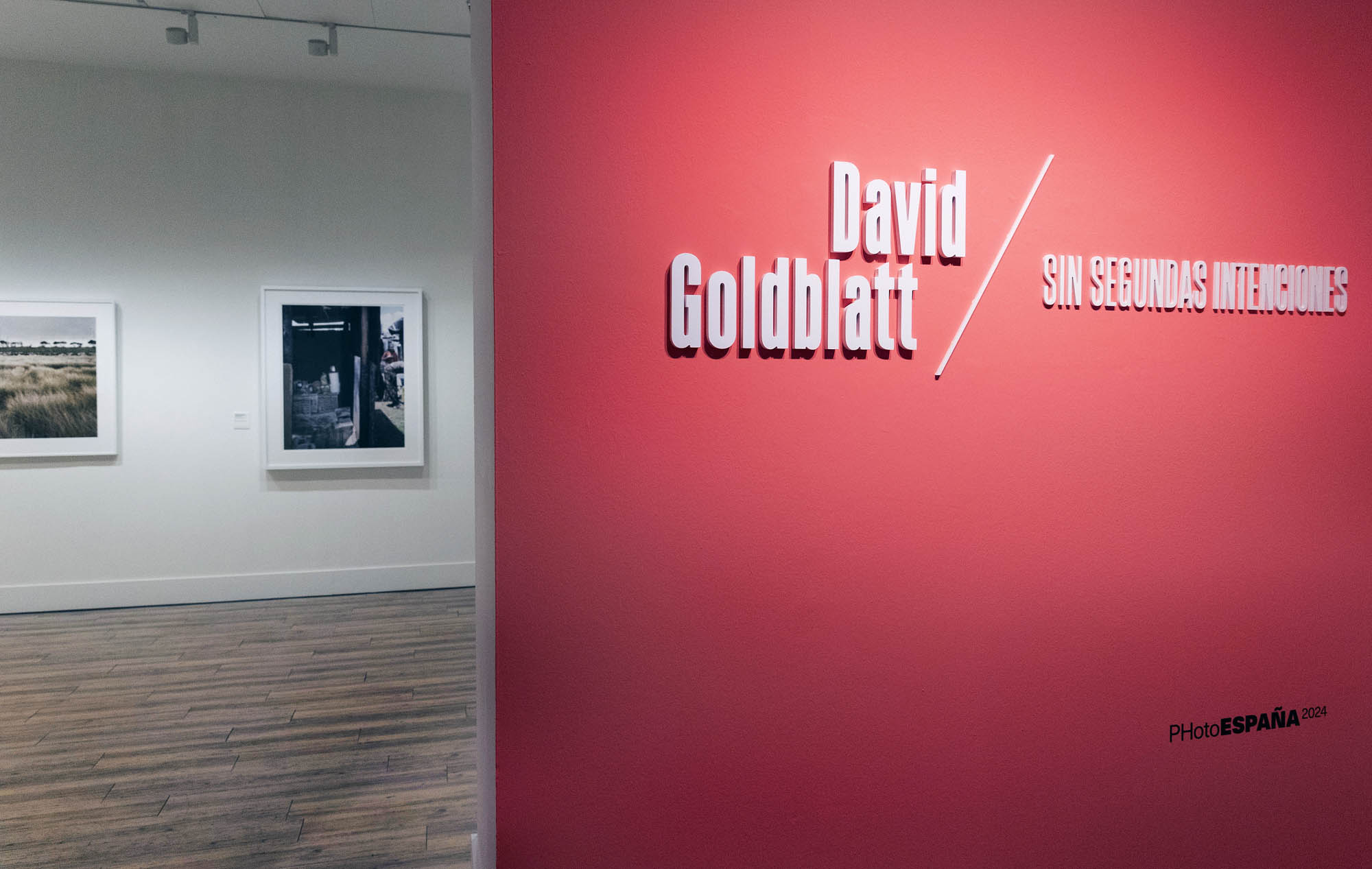
 

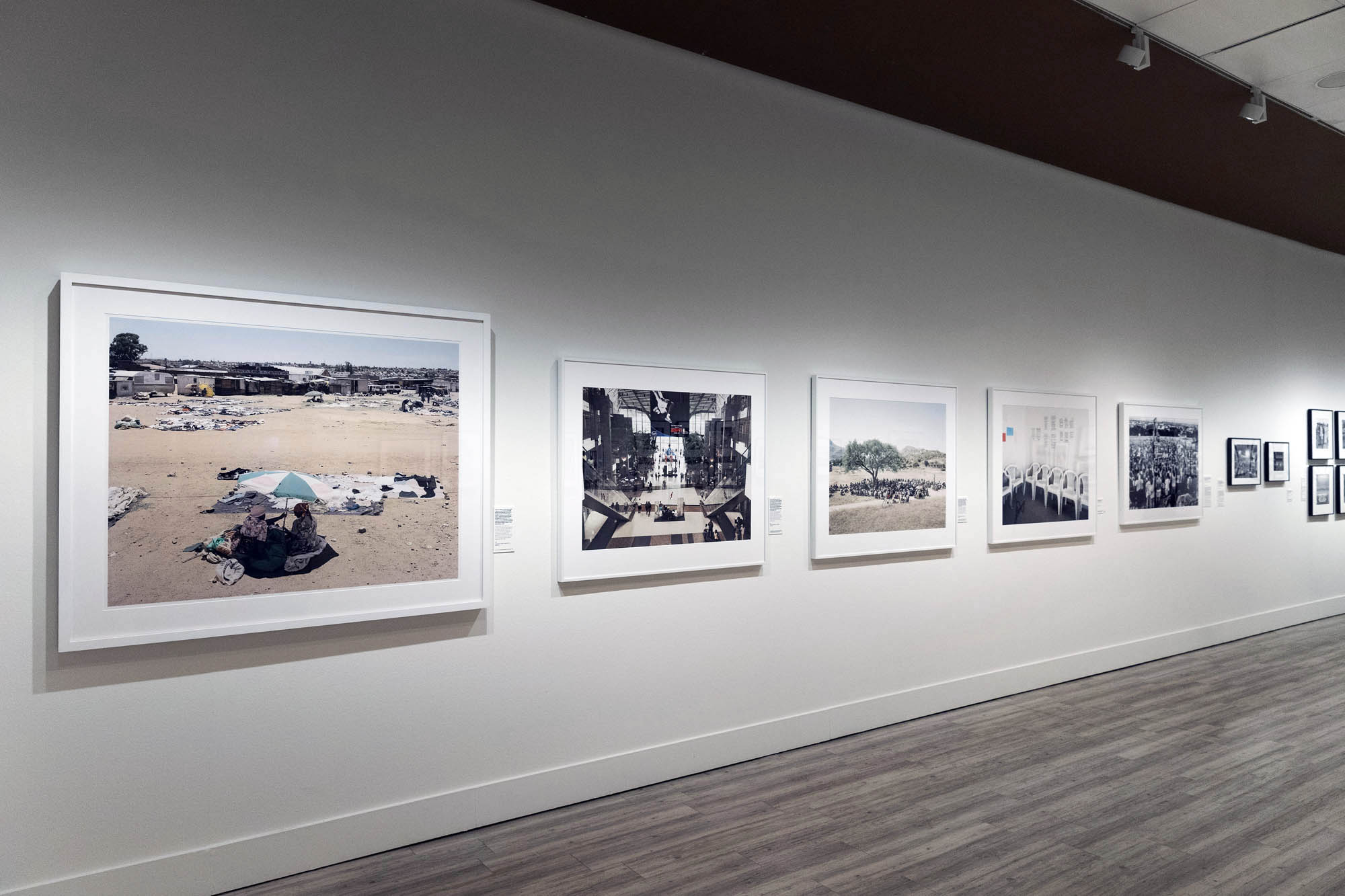
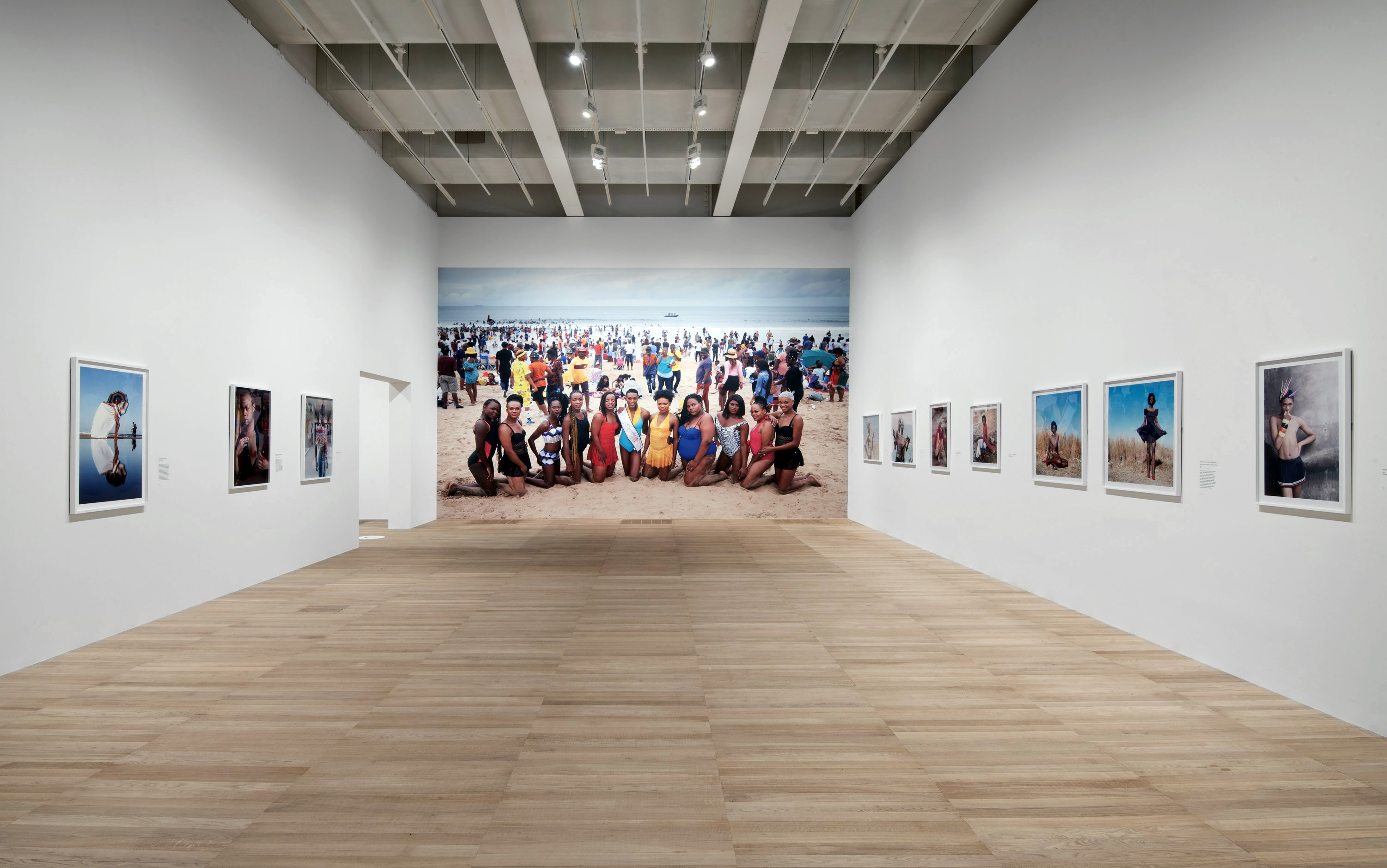
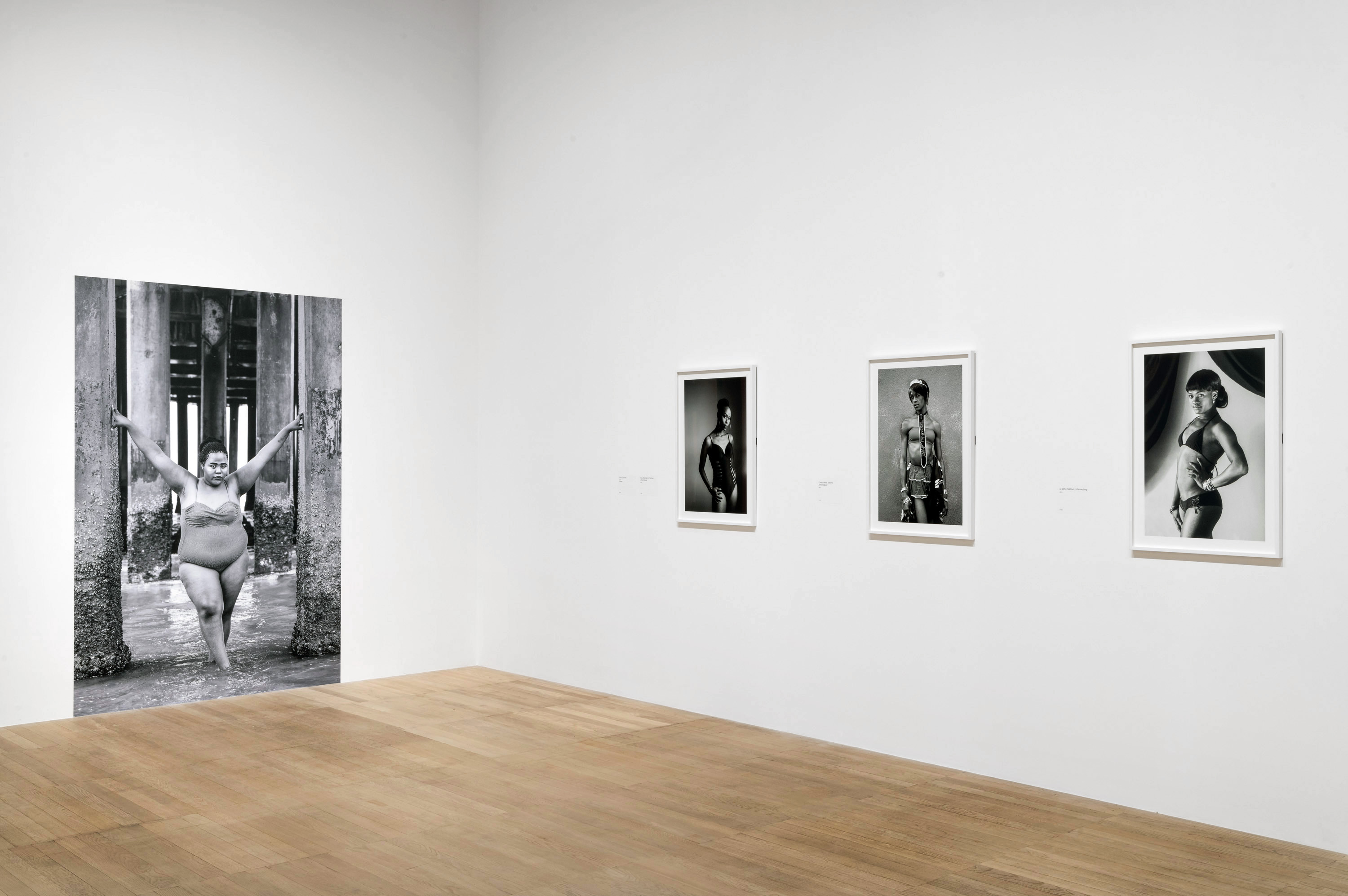
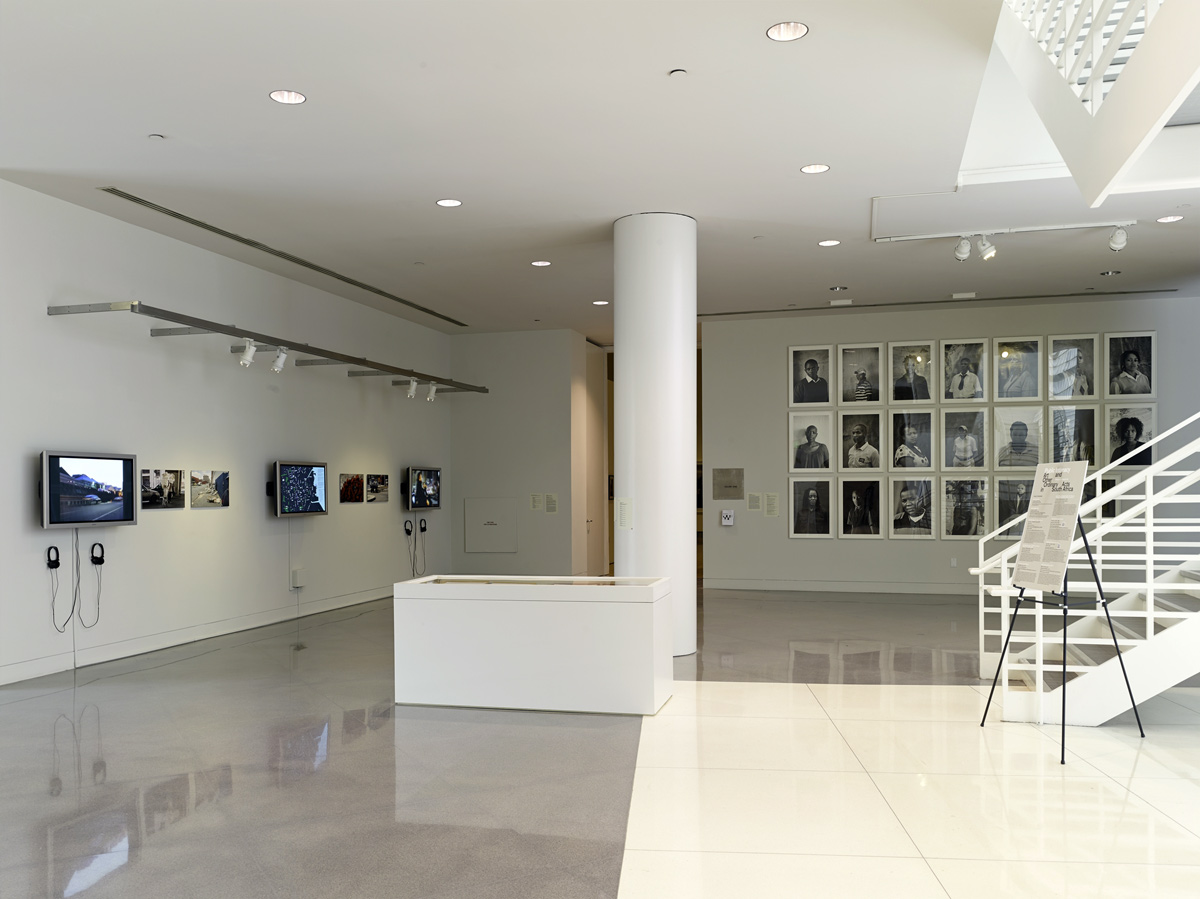
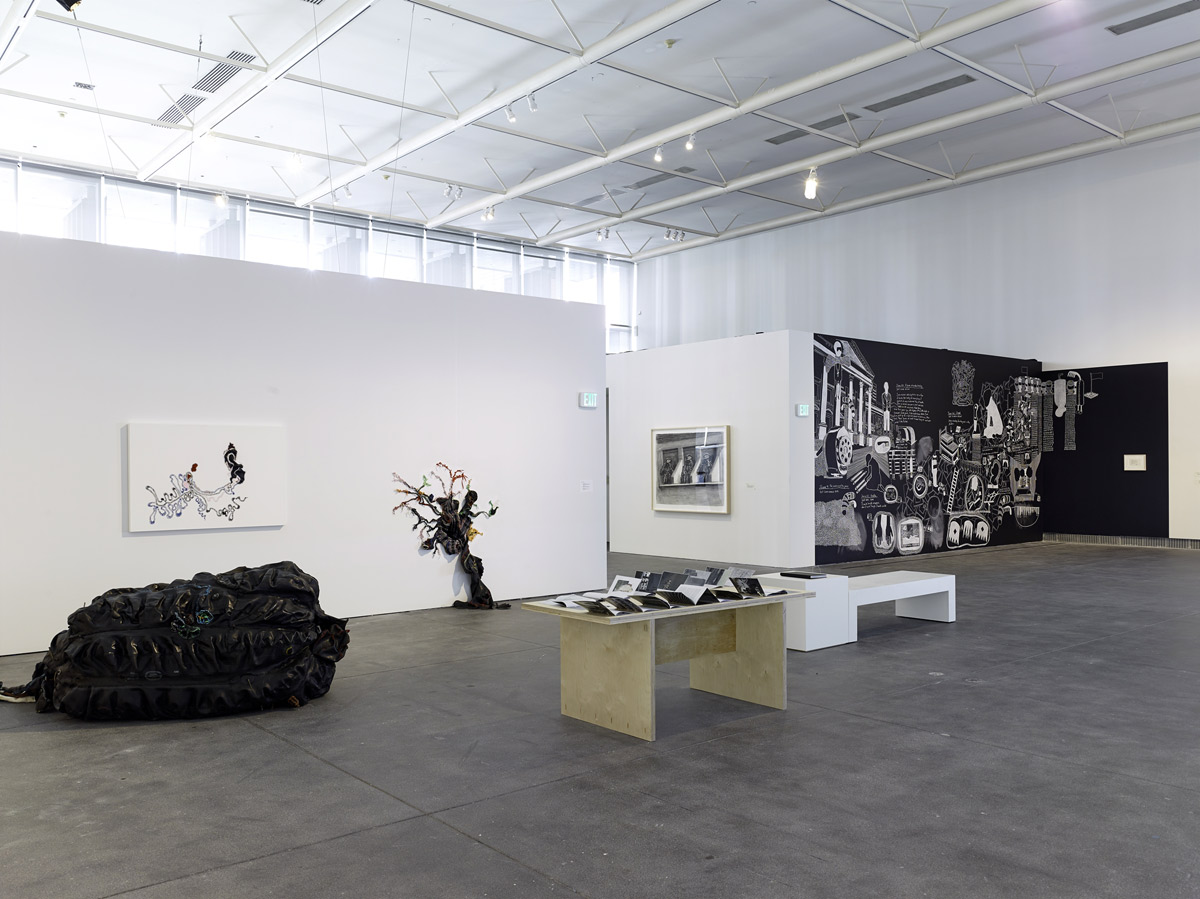
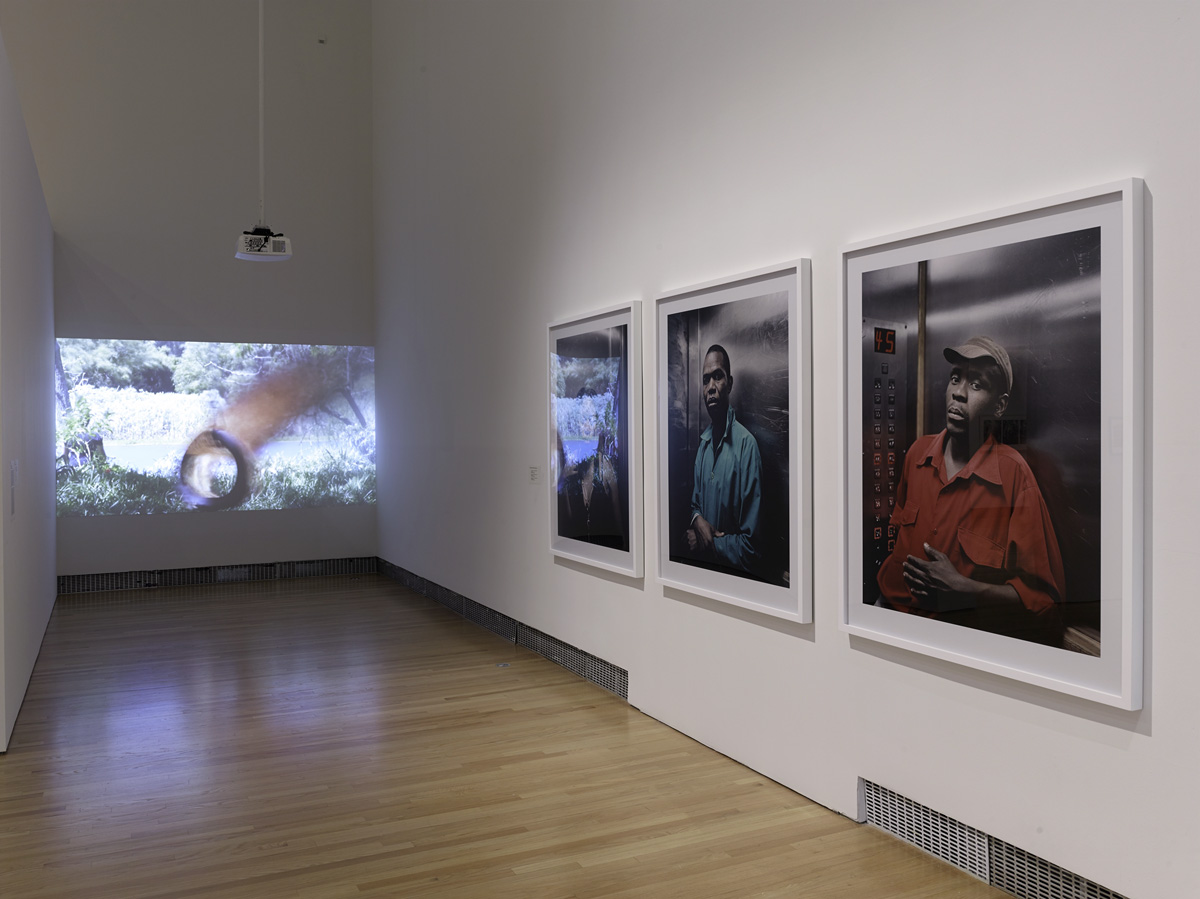
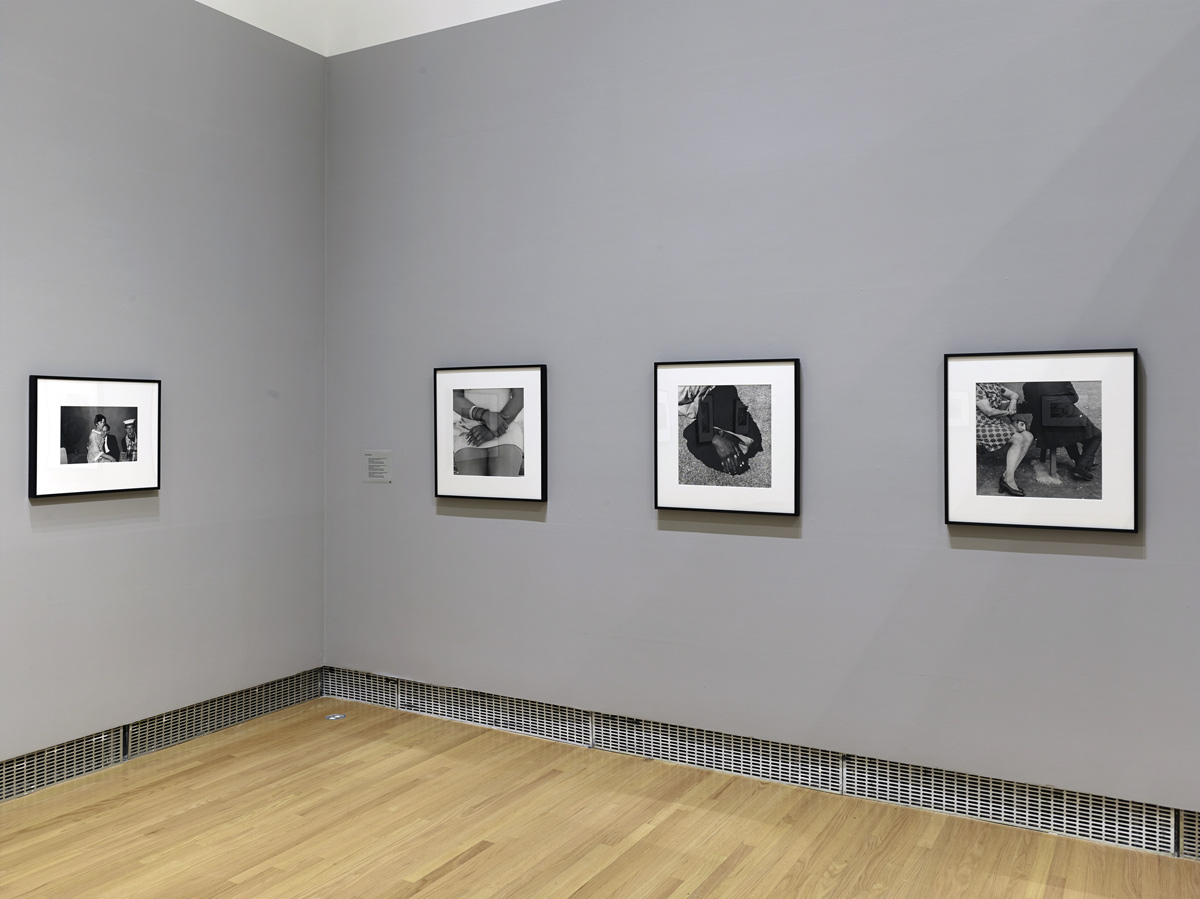
Installation view of the exhibition 'David Goldblatt: No Ulterior Motive' at Fundación MAPFRE, Madrid 

Installation view of the exhibition 'David Goldblatt: No Ulterior Motive' at Fundación MAPFRE, Madrid 


Installation views of the exhibition David Goldblatt: No Ulterior Motive at Fundación MAPFRE, Madrid
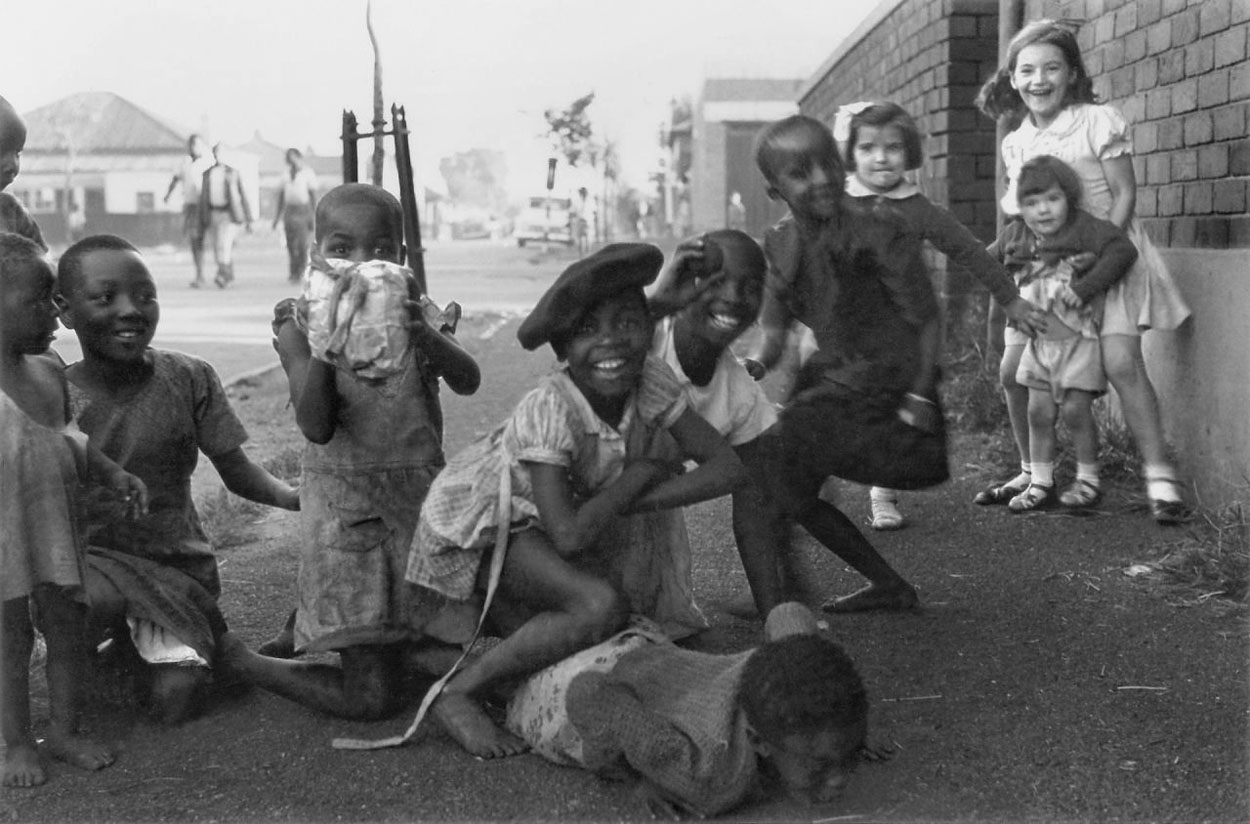
 

David Goldblatt (South African, 1930-2018) 'Children on the border between Fietas and Mayfair, Johannesburg' 1949, printed later


David Goldblatt (South African, 1930-2018)
Children on the border between Fietas and Mayfair, Johannesburg
1949, printed later
Gelatin silver print
Yale University Art Gallery, New haven, Connecticut, purchased with a gift from Jane P. Watkins, M.P.H. 1979; with the Leonard C. Hanna, Jr., Class of 1913, Fund; and with support from the Reinecke Rare Book and Manuscript Library
© The David Goldblatt Legacy Trust


Goldblatt caught this raucous scene during his initial foray into photography just after high school. The spontaneous interaction of children of different races on a city street clashed with the country’s emerging politics at mid-century. The year before Goldblatt made this image, a white nationalist movement fomented by Afrikaners – an ethnic group descended predominantly from Dutch settlers – had come to political power as the National Party. In 1949 the government passed legislation to authorise new racial classifications and urban racial segregation. They subsequently allocated the neighbourhoods of Fietas (known officially as Pageview) and Mayfair as areas for white residents only, enforcing segregation by fines and compulsory resettlement.

Wall text from the exhibition
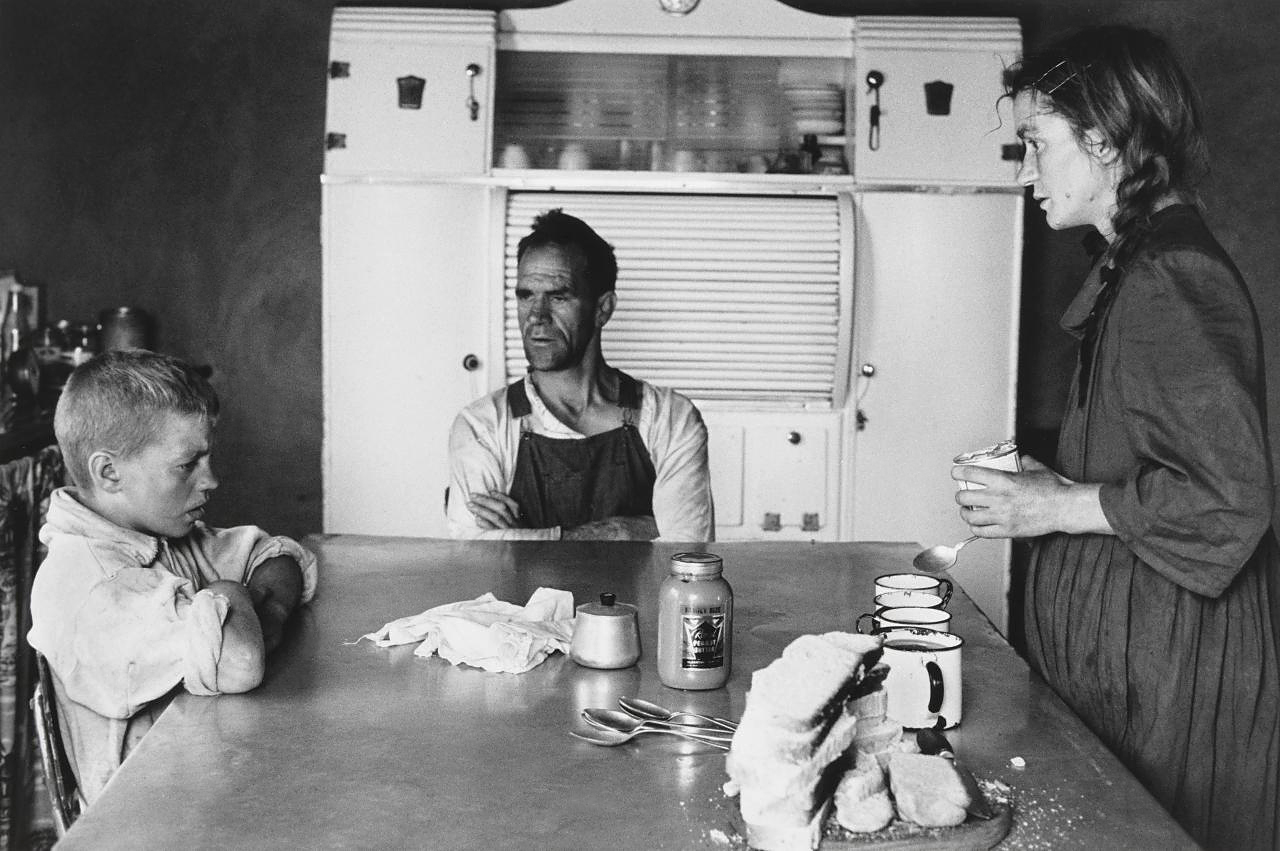
 

David Goldblatt (South African, 1930-2018) 'A plot-holder, his wife, and their eldest son at lunch, Wheatlands, Randfontein' 1962, printed later


David Goldblatt (South African, 1930-2018)
A plot-holder, his wife, and their eldest son at lunch, Wheatlands, Randfontein
1962, printed later
Gelatin silver print
Yale University Art Gallery, New haven, Connecticut, purchased with a gift from Jane P. Watkins, M.P.H. 1979; with the Leonard C. Hanna, Jr., Class of 1913, Fund; and with support from the Reinecke Rare Book and Manuscript Library
© The David Goldblatt Legacy Trust


The artistic career of South African artist David Goldblatt (1930, Randfontein – 2018, Johannesburg) embraced both a wide geographical spread of his country and a wide variety of human situations portraying the day-to-day life of his fellow citizens during and after apartheid. From his beginnings in 1950, his work – which he has progressively reflected in numerous books – has gone hand in hand with the historical, political, social and economic evolution of South Africa. From 1999 onwards, Goldblatt adopted colour for his work, which focused on the harsh living conditions of the post-apartheid period.

Goldblatt photographed with great objectivity the “watchmen”, dissidents, settlers and victims of that regime, the cities they lived in, their buildings, the inside of their homes… His images provide an extensive and touching visual record of the racist apartheid regime, a record that never explicitly shows its violence but clearly reveals all that it represented, as he himself pointed out: […] I avoid violence. And I wouldn’t know how to handle it as a photographer if I found myself caught up in a violent scene […] But then I’ve long since realised – it took me a few years to realise – that events in themselves are not so interesting to me as the conditions that led to the events. These conditions are often quite commonplace, and yet full of what is imminent. Immanent and imminent.

David Goldblatt. No ulterior motive gathers together nearly 150 works that show the continuity and strength of his work and also offers, for the first time, connections to other South African photographers from one to three generations later who acknowledge their debt to Goldblatt as a mentor who believed deeply in the value of exchange and debate, as well as in the importance of expressing one’s own opinions.

Text from the Fundación MAPFRE website


David Goldblatt (South African, 1930-2018) 'A plot holder with the daughter of his servant, Wheatlands, Randfontein' 1962


David Goldblatt (South African, 1930-2018)
A plot holder with the daughter of his servant, Wheatlands, Randfontein
1962
Gelatin silver print
The Art Institute of Chicago, promised donation of Cecily Cameron and Derek Schrier
© The David Goldblatt Legacy Trust
 

David Goldblatt (South African, 1930-2018) 'The son of an ostrich farmer waits with a labourer for the day's work to begin, near Oudtshoorn, Cape Province (Western Cape)' [El hijo de un criador de avestruces espera junto a un jornalero a que comience la jornada de trabajo, cerca de Oudtshoorn, Provincia del Cabo Occidental] 1966


David Goldblatt (South African, 1930-2018)
The son of an ostrich farmer waits with a labourer for the day’s work to begin, near Oudtshoorn, Cape Province (Western Cape) [El hijo de un criador de avestruces espera junto a un jornalero a que comience la jornada de trabajo, cerca de Oudtshoorn, Provincia del Cabo Occidental]
1966
Gelatin silver print
The Art Institute of Chicago, promised donation of Cecily Cameron and Derek Schrier
© The David Goldblatt Legacy Trust


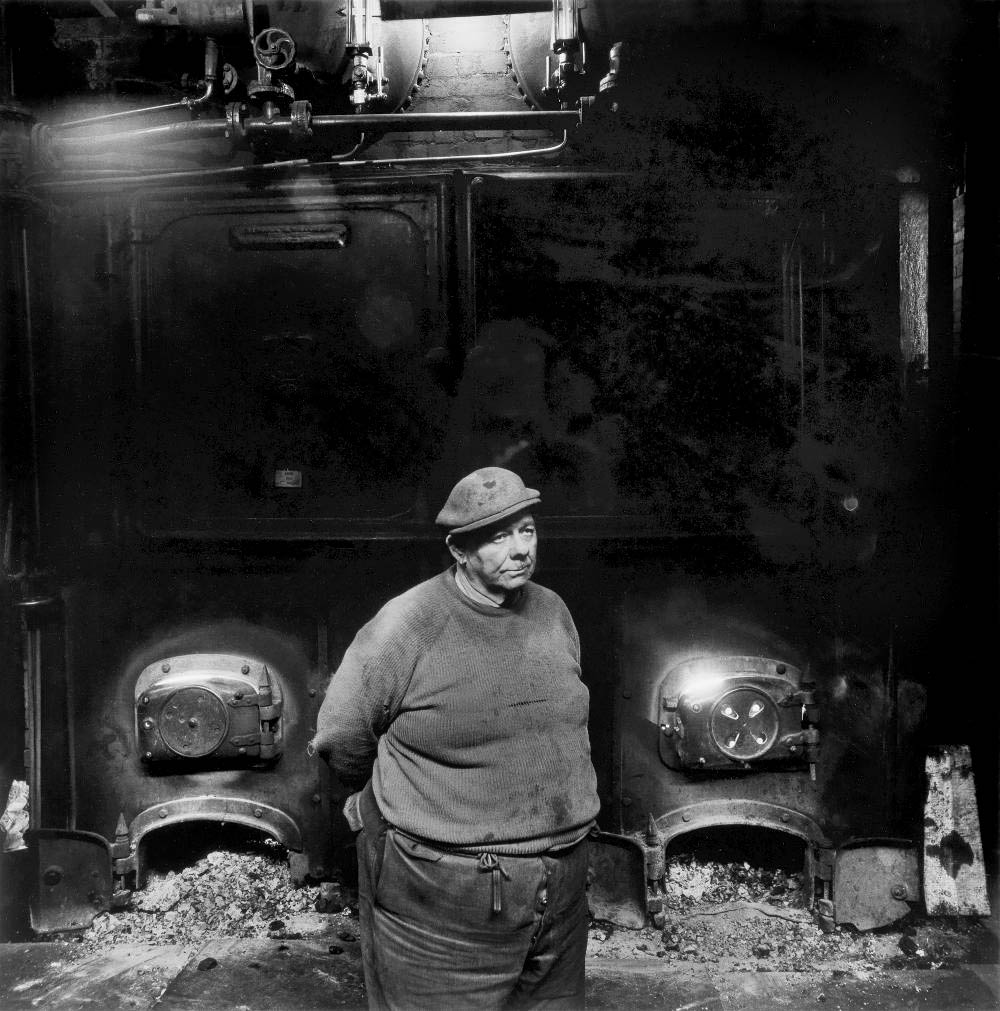
David Goldblatt (South African, 1930-2018) 'Joe Maloney, boiler-hose attendant, City Deep Gold Mine' 1966


David Goldblatt (South African, 1930-2018)
Joe Maloney, boiler-hose attendant, City Deep Gold Mine
1966
Gelatin silver print
The Art Institute of Chicago, promised donation of Cecily Cameron and Derek Schrier
© The David Goldblatt Legacy Trust


David Goldblatt (South African, 1930-2018) '"Boss Boy" detail, Battery Reef, Randfontein Estates Gold Mine' 1966, printed later


David Goldblatt (South African, 1930-2018)
“Boss Boy” detail, Battery Reef, Randfontein Estates Gold Mine
1966, printed later
Platinum print
Yale University Art Gallery, New haven, Connecticut, purchased with a gift from Jane P. Watkins, M.P.H. 1979; with the Leonard C. Hanna, Jr., Class of 1913, Fund; and with support from the Reinecke Rare Book and Manuscript Library
© The David Goldblatt Legacy Trust


European settlement began at the Cape in 1652. The oldest modern structure still in existence is, appropriately, the Castle in Cape Town erected between 1666 and 1679 as a fortress to consolidate that settlement against growing opposition by indigenous people. The core of the history of this land in the 333 years since 1666 is its domination by white people, the subjection to them by force and institutionalised economic dependence of black people, and of sporadic and latterly of massively growing opposition by blacks and disaffected whites to the system of domination.

White hegemony approached its ultimate expression in the past thirty-nine years with the emergence of Afrikaner nationalism as the overwhelmingly ascendant social force in this society. The apotheosis of that force is the ideology of apartheid. There is hardly any part of life in this country that has not been profoundly affected by the quest for power, the determination to hold onto it, and the expression of that power through apartheid of the Afrikaner Nationalists and of their supporters and fellow travellers of other origins.

Innumerable structures of every imaginable kind and not a few ruins bear witness to the huge thrust of these movements across our land.

Now, Afrikaner nationalism, though by no means spent, is in decline. Change, probably convulsive, to something as yet unclear has begun. The first structures based in countervailing forces and ideology have made their tentative appearance.

David Goldblatt from the book “Structures,” 1987, p. 42


The fabric of this society permeates everything I do. I don’t know if this is the case with other photographers. I would dearly love to be a lyrical photographer. Every so often I try to branch out and rid myself of these concerns, but it rarely happens. You take your first breath of fresh air and you have compromised.

Recently I became very aware of the people thrown into detention. There is the elementary fact that is lost sight of in this country, that they are put in detention without trial, without recourse to the courts. Has become necessary here to remind ourselves of this fact. I have catalogued the faces fo some fo the people who have been in detention with something of their life and what happened to them in detention. I have also me with some who have been abused in detention. The photographs might in some small way, through their publication, act as a deterrent to further abuse or even to detention without trial itself. As the struggle for the survival of the apartheid system becomes more acute, so the system becomes more restrictive, especially with regard to the flow of information. We are going into a period of long darkness when the restrictions with become more severe. I am aware of photographing things that are disappearing and need to be documented, but in another sense I have a private mission to document what is happening in this country to form a record. There are many other photographers engaged in this. I regard this aspect of our work as very important, so that in the future, when the time comes, people will know what happened here, what transpired.

David Goldblatt from the book “Structures,” 1987, p. 68


David Goldblatt (South African, 1930-2018) 'Gang on surface work, Rustenberg Platinum Mine, Rustenburg, North-West Province' [Cuadrilla en trabajos de superficie, mina de platino de Rustenberg, Provincia del Noroeste] 1971


David Goldblatt (South African, 1930-2018)
Gang on surface work, Rustenberg Platinum Mine, Rustenburg, North-West Province [Cuadrilla en trabajos de superficie, mina de platino de Rustenberg, Provincia del Noroeste]
1971
Carbon ink print
Yale University Art Gallery, New haven, Connecticut, purchased with a gift from Jane P. Watkins, M.P.H. 1979; with the Leonard C. Hanna, Jr., Class of 1913, Fund; and with support from the Reinecke Rare Book and Manuscript Library
© The David Goldblatt Legacy Trust
 

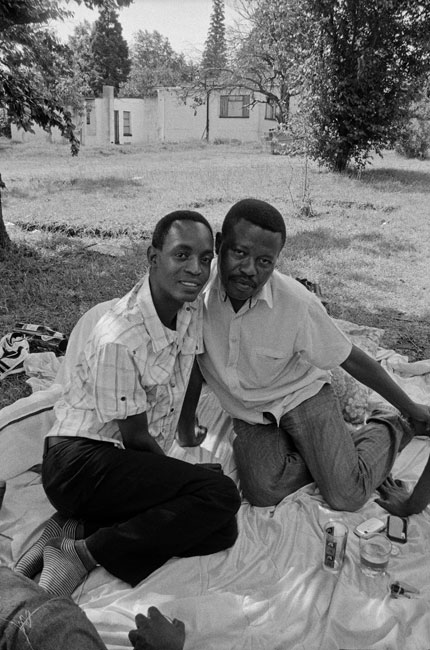
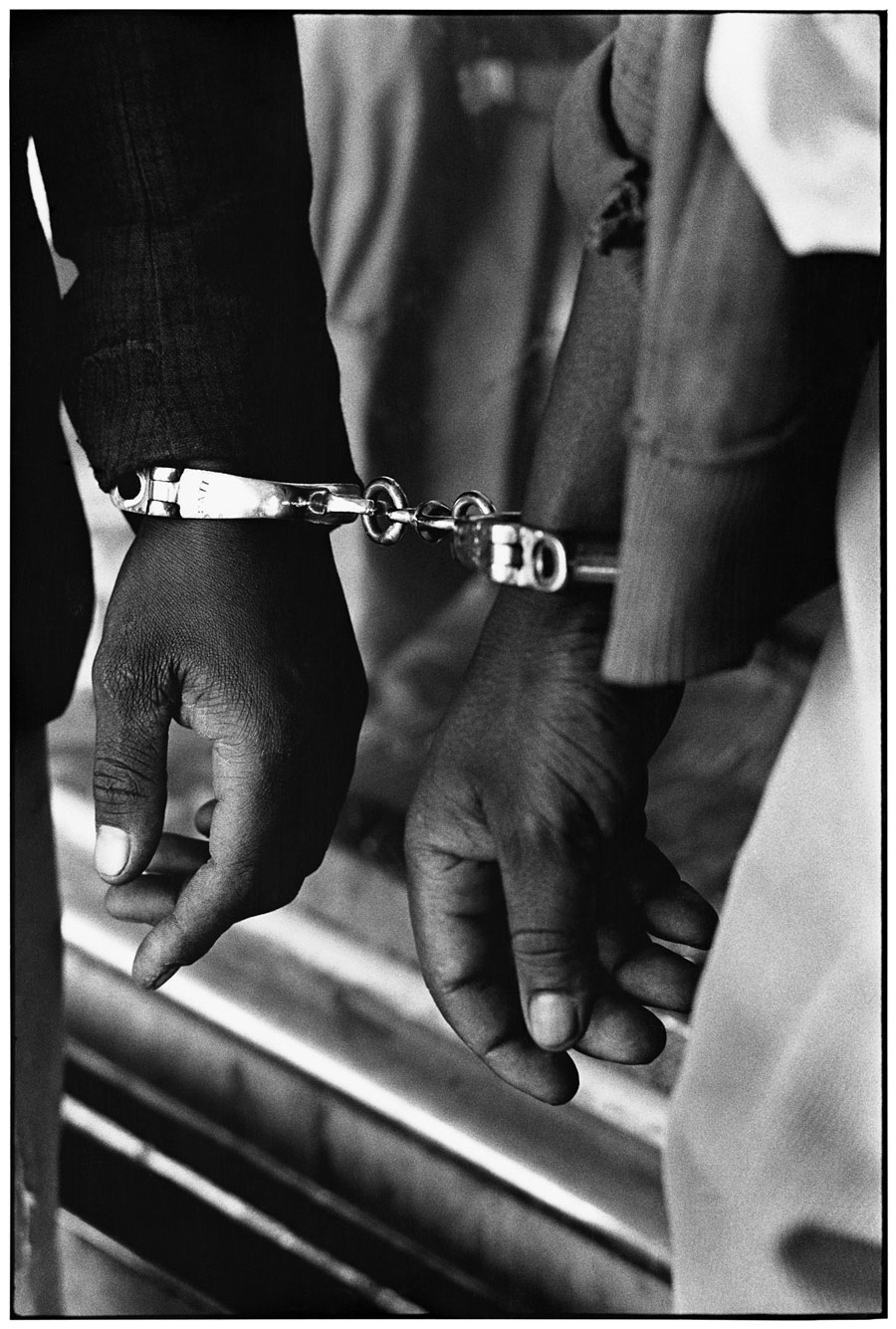
David Goldblatt (South African, 1930-2018) 'Young men with dompas (an identity document that every African had to carry), White City, Jabavu, Soweto' 1972


David Goldblatt (South African, 1930-2018)
Young men with dompas (an identity document that every African had to carry), White City, Jabavu, Soweto
1972
Gelatin silver print
Yale University Art Gallery, New haven, Connecticut, purchased with a gift from Jane P. Watkins, M.P.H. 1979; with the Leonard C. Hanna, Jr., Class of 1913, Fund; and with support from the Reinecke Rare Book and Manuscript Library
© The David Goldblatt Legacy Trust


Two men lean against one another tenderly as one holds up an identification document called a passbook. under the Pass Laws Act of 1952, all Black South Africans over the age of 16 were required to carry such identification at all times. Passbooks were also known as dompas, a term deriving from the phrase “dumb pass,” used to openly mock this hated tool for enforcing apartheid. Anyone stopped by police without a passbook or official permission to be in a given area could be penalised with arrest or fines. Policies that restricted the movement of Black people throughout the country have a long history in South Africa and were a key target of resistance movements.

Wall text from the exhibition


David Goldblatt (South African, 1930-2018) 'In the office of the funeral parlour, Orlando West, Soweto' [En la oficina de la funeraria, Orlando West, Soweto] 1972


David Goldblatt (South African, 1930-2018)
In the office of the funeral parlour, Orlando West, Soweto [En la oficina de la funeraria, Orlando West, Soweto]
1972
Gelatin silver print
The Art Institute of Chicago, promised donation of Cecily Cameron and Derek Schrier
© The David Goldblatt Legacy Trust


In his photographs of office and office workers, Goldblatt often teased out the continuities between professional and private identities. The two women in this photograph are dressed for winter on Earth, but the art on the walls hearkens to a journey to outer space. At this moment in 1972, apartheid was so firmly in place that, for many, change was almost unthinkable – perhaps akin to landing on the moon. The artwork brings the prospect of liberty and the sheer thrill of adventure into an otherwise ordinary setting. Of course, the art might not have been their choice at all, but the photograph holds open the possibility that these women have a stake in missions long thought impossible.

Wall text from the exhibition


David Goldblatt (South African, 1930-2018) 'Lulu Gebashe and Solomon Mlutshana, who both worked in a record shop in the city, Mofolo Park' [Lulu Gebashe y Solomon Mlutshana, que trabajaban en una tienda de discos de la ciudad, Mofolo Park] 1972


David Goldblatt (South African, 1930-2018)
Lulu Gebashe and Solomon Mlutshana, who both worked in a record shop in the city, Mofolo Park [Lulu Gebashe y Solomon Mlutshana, que trabajaban en una tienda de discos de la ciudad, Mofolo Park]
1972
Carbon ink print
Yale University Art Gallery, New haven, Connecticut, purchased with a gift from Jane P. Watkins, M.P.H. 1979; with the Leonard C. Hanna, Jr., Class of 1913, Fund; and with support from the Reinecke Rare Book and Manuscript Library
© The David Goldblatt Legacy Trust


David Goldblatt (South African, 1930-2018) 'Miriam Diale, 5357 Orlando East, Soweto, 18 October 1972' [Miriam Diale, Orlando East n.º 5357, Soweto, 18 de octubre de 1972] 1972


David Goldblatt (South African, 1930-2018)
Miriam Diale, 5357 Orlando East, Soweto, 18 October 1972 [Miriam Diale, Orlando East n.º 5357, Soweto, 18 de octubre de 1972]
1972
Carbon ink print
Yale University Art Gallery, New haven, Connecticut, purchased with a gift from Jane P. Watkins, M.P.H. 1979; with the Leonard C. Hanna, Jr., Class of 1913, Fund; and with support from the Reinecke Rare Book and Manuscript Library
© The David Goldblatt Legacy Trust


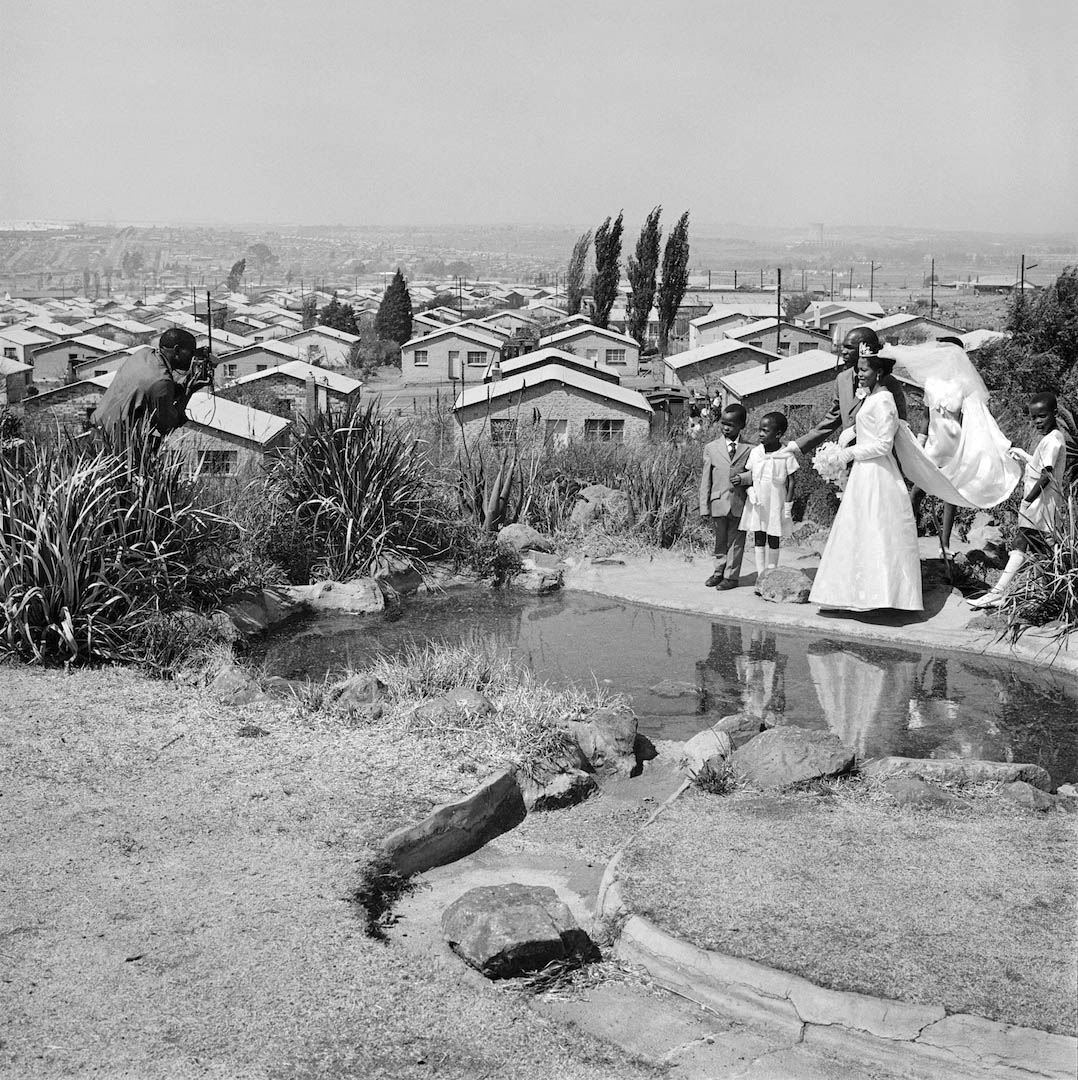
David Goldblatt (South African, 1930-2018) 'Wedding photography at the Oppenheimer Memorial, Jabavu, Soweto' 1972, printed later


David Goldblatt (South African, 1930-2018)
Wedding photography at the Oppenheimer Memorial, Jabavu, Soweto
1972, printed later
Carbon ink print
Yale University Art Gallery, New haven, Connecticut, purchased with a gift from Jane P. Watkins, M.P.H. 1979; with the Leonard C. Hanna, Jr., Class of 1913, Fund; and with support from the Reinecke Rare Book and Manuscript Library
© The David Goldblatt Legacy Trust


The grandson of Lithuanian refugees, David Goldblatt was born in Randfontein in 1930 and spent most of his life in Johannesburg. From a very young age he showed an interest in photography and took his first images when he was only eighteen. After the death of his father, in 1963 he decided to become a professional photographer.

David Goldblatt scrupulously examined the history and politics of South Africa, where he witnessed the rise of apartheid, its brutal segregationist policies and its eventual disappearance. His sensitive photographs offer a vision of daily life under this regime and in the complex period that followed, when he moved from black and white to colour in his work.

Employing great objectivity, Goldblatt photographed dissidents, settlers and victims of apartheid, the cities where they lived, their buildings, the interior of their homes, etc. His images configure a wide-ranging and moving visual record of this racist regime, a record which, while never explicitly showing its violence, clearly reveals everything it represented, as the artist himself pointed out: “I avoid violence. And I wouldn’t know how to handle it as a photographer if I found myself caught up in a violent scene […] But then I’ve long since realised – it took me a few years to realise – that events in themselves are not so interesting to me as the conditions that led to the events. These conditions are often quite commonplace, and yet full of what is imminent. Immanent and imminent.

In 1998 David Goldblatt was the first South African to be the subject of a solo exhibition at the Museum of Modern Art (MoMA) in New York. His work has been recognised with the Hasselblad (2006) and Henri Cartier-Bresson (2009) prizes and the International Center of Photography award (2013). In 2016 he was made a knight of the Order of Arts and Letters by the French government. He died in Johannesburg in 2018 at the age of eighty-eight.

David Goldblatt: No Ulterior Motive brings together around 150 works from several of the artist’s series with the aim of revealing the continuity of his work while also and for the first time establishing a dialogue with the work of other South African photographers of between one and three generations subsequent to Goldblatt, such as Lebohang Kganye, Ruth Seopedi Motau and Jo Ractliffe. Also on display are three mock-ups of books by Goldblatt, an aspect of his work to which he gave great importance.

The works on display are from the collections of The Art Institute of Chicago and Yale University Art Gallery and include important recent acquisitions of photographs by Goldblatt. Having been shown at The Art Institute of Chicago between December 2023 and March 2024, Fundación MAPFRE is now presenting the exhibition at its venue on Paseo de Recoletos, Madrid, until August this year. It will then be seen next year at Yale University Art Gallery, New Haven (Connecticut).

David Goldblatt: No Ulterior Motive is curated by Judy Ditner (Yale University Art Gallery, New Haven), Leslie M. Wilson and Matthew S. Witkovsky (The Art Institute of Chicago).


Key themes in the exhibition

Apparent tranquility

Throughout his career Goldblatt avoided the most difficult and shocking incidents that were a daily reality under apartheid. Rather, he considered that depicting everyday life, “the quiet and commonplace where nothing ‘happened'”, allowed the viewer to draw their own conclusions. The content was implicit in the apparent tranquility and in the very precise captions that accompany these images, which show ongoing, daily expressions of racism and the economic, social and political exploitation of the Black population under white rule.

Goldblatt, No Ulterior Motive

Goldblatt’s status as a white man allowed him greater freedom of movement and he took advantage of that privilege to document life in South Africa in the most honest and direct way possible. In the early 1970s he published a classified ad which read: “I would like to photograph people in their homes […]. No ulterior motive.” Nonetheless, this impartiality concealed a critical perspective towards his country’s people, history and geography.

Apartheid

In 1948 the National Party, one of the most visible entities representing Afrikaners (a European, colonising ethnic group mainly comprising descendants of the Dutch, North Germans and French), came to power in South Africa. This minority of European origin then proceeded to institute apartheid as a State policy while promoting the ideology that people of different racial origins could not live together in equality and harmony. Successive governments reinforced the legacy of racist oppression against non-white peoples (indigenous Africans, people of Asian origin and those of mixed race), who made up more than 80% of the population. In 1990 segregation laws began to be eliminated, the activity of the African National Congress was legalised and its most important leader, Nelson Mandela, who was elected president of South Africa in 1993, was released from prison.

Press release from Fundación MAPFRE


David Goldblatt (South African, 1930-2018) ;Sylvia Gibbert in her apartment, Melrose, Johannesburg; [Sylvia Gibbert en su apartamento, Melrose, Johannesburgo] 1974


David Goldblatt (South African, 1930-2018)
Sylvia Gibbert in her apartment, Melrose, Johannesburg [Sylvia Gibbert en su apartamento, Melrose, Johannesburgo]
1974
Gelatin silver print
The Art Institute of Chicago, promised donation of Cecily Cameron and Derek Schrier
© The David Goldblatt Legacy Trust


David Goldblatt (South African, 1930-2018) 'Ozzie Docrat with his daughter Nassima in his shop before its destruction under the Group Areas Act, Fietas, Johannesburg' [Ozzie Docrat con su hija Nassima en su tienda antes de ser destruida en virtud de la Ley de Agrupación por Áreas, Fietas, Johannesburgo] 1977


David Goldblatt (South African, 1930-2018)
Ozzie Docrat with his daughter Nassima in his shop before its destruction under the Group Areas Act, Fietas, Johannesburg [Ozzie Docrat con su hija Nassima en su tienda antes de ser destruida en virtud de la Ley de Agrupación por Áreas, Fietas, Johannesburgo]
1977
From the series Fietas
Carbon ink print
Yale University Art Gallery, New haven, Connecticut, purchased with a gift from Jane P. Watkins, M.P.H. 1979; with the Leonard C. Hanna, Jr., Class of 1913, Fund; and with support from the Reinecke Rare Book and Manuscript Library
© The David Goldblatt Legacy Trust


“I feel as though my teeth are being pulled out one by one. I run by tongue over the spaces and I try to remember the shape of what was there.” These words, spoken to Goldblatt by shop owner Ozzie Docrat, express what many residents must have experienced during their forced removal from the Johannesburg suburb of Fietas in the 1970s. Throughout the mid-20th century, Fietas was exceptional for the endurance of it multiracial, interfaith community of working- and middle-class people in the face of encroaching segregationist housing policies. In 1977, however, the government forced out Indian families like the Docrats, along with other people of color, to make this area exclusive to whites.

Wall text from the exhibition


David Goldblatt (South African, 1930-2018) 'Sunday morning: A not-White family living illegally in the "White" group area of Hillbrow, Johannesburg' [Domingo por la mañana: una familia no blanca viviendo ilegalmente en la zona "blanca" de Hillbrow, Johannesburgo] 1978


David Goldblatt (South African, 1930-2018)
Sunday morning: A not-White family living illegally in the “White” group area of Hillbrow, Johannesburg [Domingo por la mañana: una familia no blanca viviendo ilegalmente en la zona “blanca” de Hillbrow, Johannesburgo]
1978
Pigmented inkjet print
Yale University Art Gallery, New haven, Connecticut, purchased with a gift from Jane P. Watkins, M.P.H. 1979; with the Leonard C. Hanna, Jr., Class of 1913, Fund; and with support from the Reinecke Rare Book and Manuscript Library
© The David Goldblatt Legacy Trust


“Over the course of a career that spanned more than six decades, Goldblatt went looking for scenes like this one – quiet and tender, while also deeply revealing of the structures and values that constituted South African society. Though the family appears to be right at home, Goldblatt’s title shares that they were living illegally in the Johannesburg neighborhood of Hillbrow, violating laws that, under the system of segregation known as apartheid, dictated where different racial groups were permitted to reside. The cozy scene is therefore profoundly fragile because the family faced the persistent threat of removal.

This image powerfully presents the tensions that were central to what Goldblatt pursued through photography: soft furnishings and brutal laws, proximity and distance, access and exclusion, and informality and formality.”

Leslie Wilson and Yechen Zhao. “In the Room with David Goldblatt,” on the Art Institute of Chicago website December 19, 2023 [Online] Cited 11/07/2024
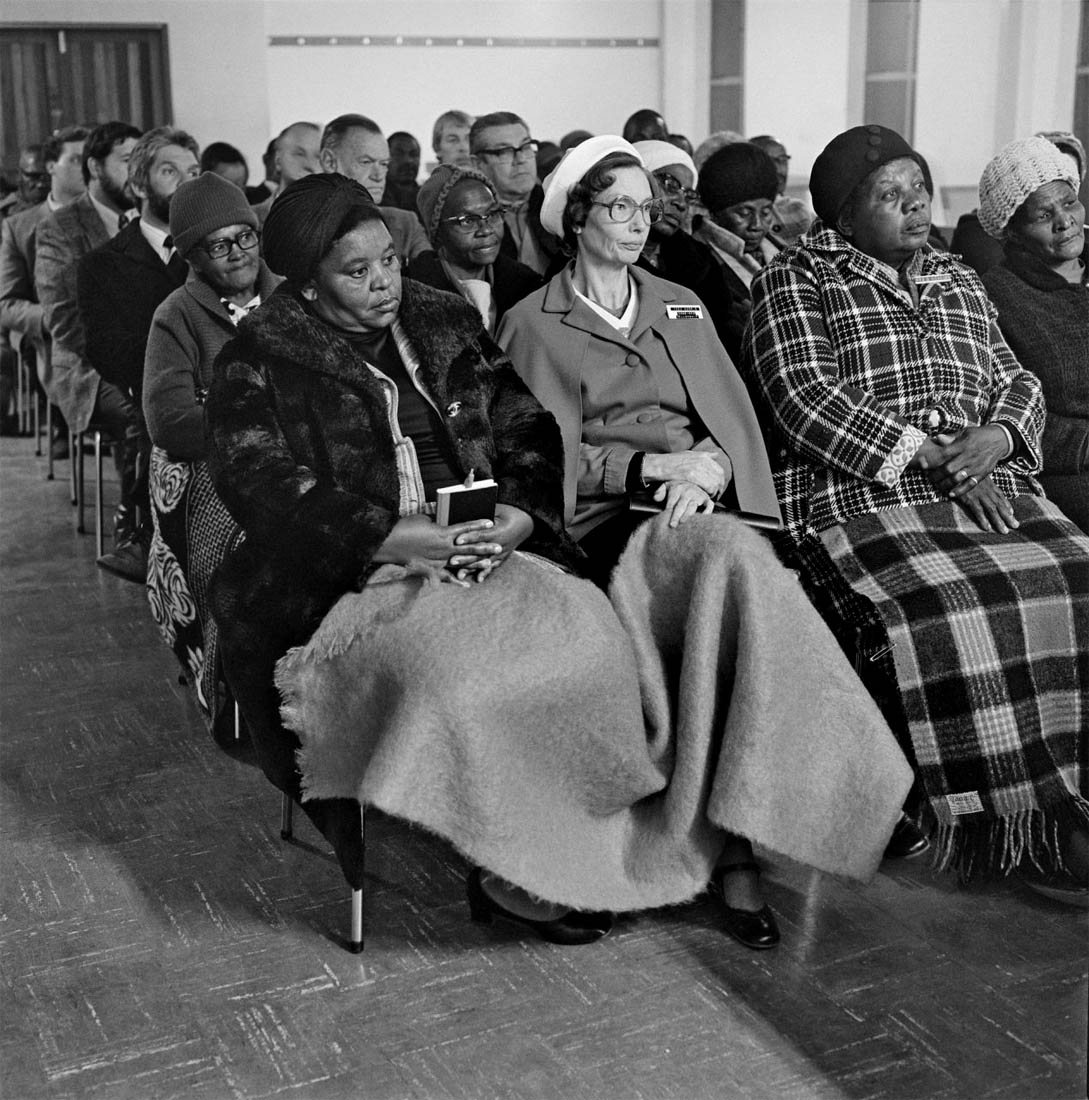
 

David Goldblatt (South African, 1930-2018) 'Methodists meet to find ways of reducing the racial, cultural, and class barriers that divide them, 3 July 1980' 1980, printed later


David Goldblatt (South African, 1930-2018)
Methodists meet to find ways of reducing the racial, cultural, and class barriers that divide them, 3 July 1980
1980, printed later
Gelatin silver print
Yale University Art Gallery, New haven, Connecticut, purchased with a gift from Jane P. Watkins, M.P.H. 1979; with the Leonard C. Hanna, Jr., Class of 1913, Fund; and with support from the Reinecke Rare Book and Manuscript Library
© The David Goldblatt Legacy Trust
 

Throughout South Africa and even across the continent, religion bears a complicated history embroiled in legacies of colonisation, oppression, and apartheid. Religion holds power. It was through the cross and the bullet that the continent was dissected by European powers. It was through the pages of the Bible that apartheid was theologically justified, and it was through the Dutch Reformed Church of white Afrikaners that “the races” were declared separate as mandated by God. Yet, it was also through the World Alliance of Reformed Churches that apartheid was acknowledged as heresy. It was through the Christian ethos and through ubuntu that Archbishop Desmond Tutu guided the post-apartheid Truth and Reconciliation Commission through ways of healing in a society bifurcated into “European” and “Non-White;” “have” and “have-not;” “believer” and “unbeliever.” Religion has the power to both destroy and heal a nation.

In a discussion about life under apartheid, my South African friend designated as “Coloured” – a category in between “White” and “Black African” – revealed that his parents were once denied communion on Sunday morning due to their sin of attending a “white church” while being of color. Whiteness meant purity and closeness with God; anything less than was deemed as “separate,” “other,” “unworthy” – “impure.” The sharing of bread and wine in the Christian tradition is meant to signify connection between people and between the divine. The denial of such connection, of saying that one was unworthy to drink from the same chalice because of one’s race or ethnicity, is an ultimate denial of humanity. It is an affront to the very word “communion” and an insult to fellowship. Religion was co-opted to subjugate and enforce a system of racial hierarchy. Sunday morning saw no race-mixing amongst God’s children.

Trevor O’Connor. “Religion in South Africa: The Power to Destroy and Heal a Nation,” on the Berkley Center for Religion, Peace & World Affairs website November 16, 2018 [Online] Cited 11/07/2024


David Goldblatt (South African, 1930-2018) 'Saturday morning at the hypermarket: Semifinal of the Miss Lovely Legs Competition, 28 June 1980' [Sábado por la mañana en el hipermercado: semifinal del concurso Miss Piernas Bonitas, 28 de junio de 1980] 1980


David Goldblatt (South African, 1930-2018)
Saturday morning at the hypermarket: Semifinal of the Miss Lovely Legs Competition, 28 June 1980 [Sábado por la mañana en el hipermercado: semifinal del concurso Miss Piernas Bonitas, 28 de junio de 1980]
1980
Carbon ink print
Yale University Art Gallery, New haven, Connecticut, purchased with a gift from Jane P. Watkins, M.P.H. 1979; with the Leonard C. Hanna, Jr., Class of 1913, Fund; and with support from the Reinecke Rare Book and Manuscript Library
© The David Goldblatt Legacy Trust


David Goldblatt (South African, 1930-2018) 'Apostolic Faith Mission (AGS), Birchleigh, Kempton Park, 28 December 1983' [Misión de la Fe Apostólica (AGS, en afrikáans), Birchleigh, Kempton Park, 28 de diciembre de 1983] 1983


David Goldblatt (South African, 1930-2018)
Apostolic Faith Mission (AGS), Birchleigh, Kempton Park, 28 December 1983 [Misión de la Fe Apostólica (AGS, en afrikáans), Birchleigh, Kempton Park, 28 de diciembre de 1983]
1983
Gelatin silver print
The Art Institute of Chicago, promised donation of Cecily Cameron and Derek Schrier
© The David Goldblatt Legacy Trust


Goldblatt’s photographs of churches were so beautiful. They were wonderful architectural images, but they were deep with meaning capturing the issues of a missionary religion in a nonnative land. They symbolise the conflicts within the country which mirrored issues throughout other parts of the world. When I thought about South Africa it was about apartheid and relationships between blacks and whites, I had not considered the impact of western religion on the indigenous population (I should have because it is an issue still in our country today), nor did I know about the issues with the Muslim population in the country. In researching the issue of religion further, it appears the conflicts and violence in South Africa related to it appear to be ongoing to this day.

William Carl Valentine. “David Goldblatt: No Ulterior Motive,” on the William Carl Valentine website June 15, 2024 [Online] Cited 06/07/2024


David Goldblatt (South African, 1930-2018) 'Thirteen kilometres of this coastline were a White Group Area, Bloubergstrand, Cape Town, 9 January 1986' [Trece kilómetros de esta costa eran una zona reservada para blancos, Bloubergstrand, Ciudad del Cabo, 9 de enero de 1986] 1986


David Goldblatt (South African, 1930-2018)
Thirteen kilometres of this coastline were a White Group Area, Bloubergstrand, Cape Town, 9 January 1986 [Trece kilómetros de esta costa eran una zona reservada para blancos, Bloubergstrand, Ciudad del Cabo, 9 de enero de 1986]
1986
Carbon ink print
Yale University Art Gallery, New haven, Connecticut, purchased with a gift from Jane P. Watkins, M.P.H. 1979; with the Leonard C. Hanna, Jr., Class of 1913, Fund; and with support from the Reinecke Rare Book and Manuscript Library
© The David Goldblatt Legacy Trust


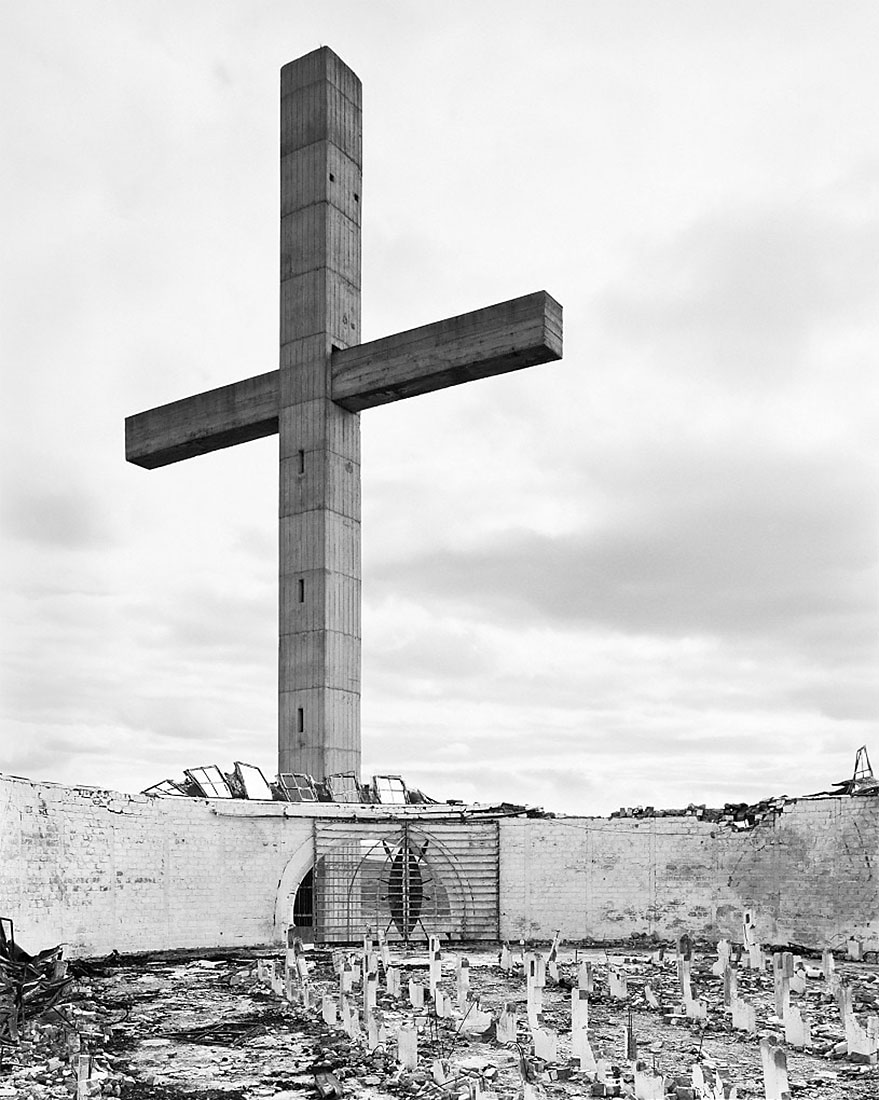
David Goldblatt (South African, 1930-2018) 'Assegais, shield, and 23-metre-high cross of the Nederduitse Gereformeerde Kerk in Afrika, (Dutch Reformed Mission Church to Africans), which stands above Dingane's destroyed capital, uMgungundlovu. The church was burnt down in 1985; Dinganestad, Natal' 1989, printed later


David Goldblatt (South African, 1930-2018)
Assegais, shield, and 23-metre-high cross of the Nederduitse Gereformeerde Kerk in Afrika, (Dutch Reformed Mission Church to Africans), which stands above Dingane’s destroyed capital, uMgungundlovu. The church was burnt down in 1985; Dinganestad, Natal
1989, printed later
Carbon ink print
Yale University Art Gallery, New haven, Connecticut, purchased with a gift from Jane P. Watkins, M.P.H. 1979; with the Leonard C. Hanna, Jr., Class of 1913, Fund; and with support from the Reinecke Rare Book and Manuscript Library
© The David Goldblatt Legacy Trust


David Goldblatt (1930-2018) scrupulously examined the history and politics of South Africa, where he witnessed the rise of apartheid, its divisive and brutal policies, and its eventual demise. His sensitive photographs offer a view of daily life under the apartheid system and its complex aftermath. Goldblatt was drawn, in his own words, “to the quiet and commonplace where nothing ‘happened’ and yet all was contained and immanent.” Accompanied by precise captions, his images expose everyday manifestations of racism and point to Black dispossession – economic, social, and political – under white rule.

The grandson of Lithuanian Jews who had fled Europe in the 1890s, Goldblatt spent most of his life in Johannesburg. Although not part of the ascendant Dutch Protestant community, his position as a white man allowed him greater freedom of movement and he leveraged this privilege to document life in South Africa as honestly and straightforwardly as possible. In the early 1970s, he placed a classified ad: “I would like to photograph people in their homes […]. No ulterior motive.” Yet this professed impartiality masked a critical perspective toward South Africa’s people, history, and geography.

Goldblatt first took up the camera in 1948, the year the apartheid system was introduced, and over the next seven decades he assiduously photographed South Africa’s people, landscape, and built environment. Recognising the layered connections in his oeuvre, this exhibition proceeds thematically rather than chronologically: here, black-and-white photographs taken during the period of institutionalised segregation are interwoven with his work in colour from the 1990s on. Six thematic sections explore Goldblatt’s engagement with apartheid, its contradictions, and its multifaceted legacy.
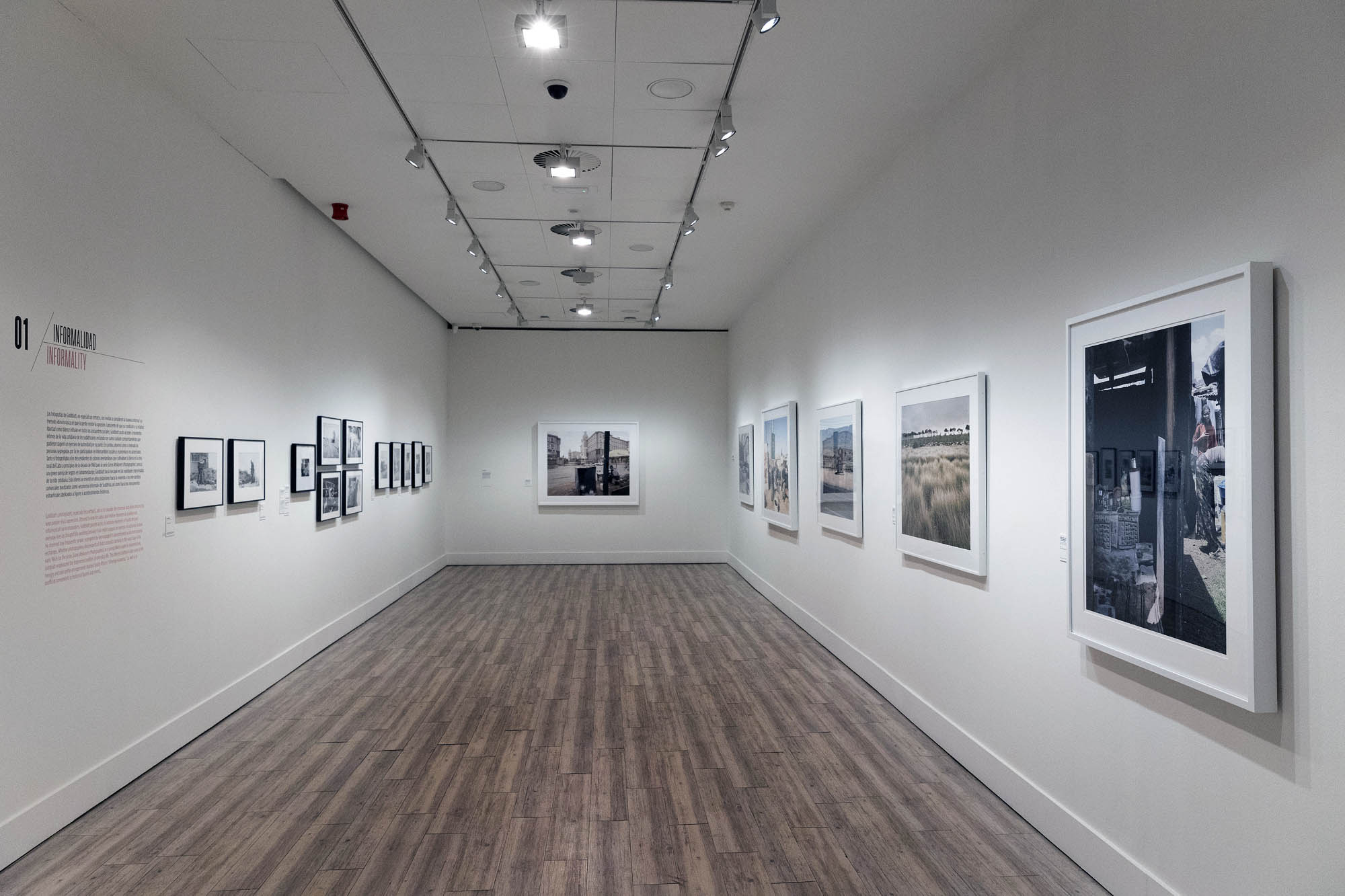
 

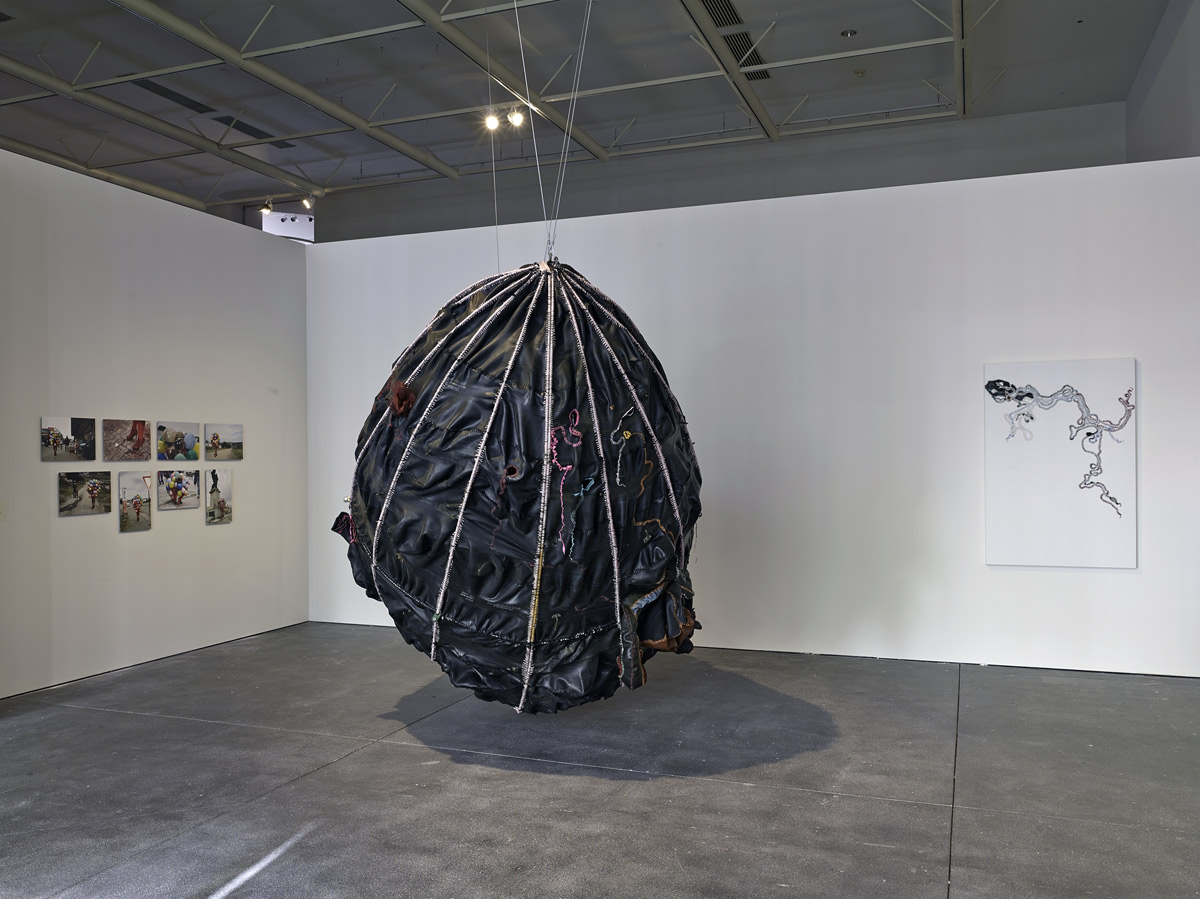
Installation view of the exhibition 'David Goldblatt: No Ulterior Motive' at Fundación MAPFRE, Madrid showing at left, wall text from the section 'Informality'


Installation view of the exhibition David Goldblatt: No Ulterior Motive at Fundación MAPFRE, Madrid showing at left, wall text from the section ‘Informality’ (see below)


1/ Informality

Goldblatt’s photographs, especially his portraits, ask us to consider the informal and often idiosyncratic ways people resist oppression. Attuned to how his status and relative freedom as a white man influenced all social encounters, Goldblatt gained access to intimate moments of South Africans’ everyday lives by thoughtfully avoiding behaviour that might suggest an exercise of authority. Instead, he observed how frequently people segregated by law engaged in unsanctioned social and economic exchanges. Whether photographing descendants of Dutch colonists farming in the rural Cape in the early 1960s for the series Some Afrikaners Photographed, or a young Black couple in Johannesburg, Goldblatt emphasised the improvised realities of everyday life. This interest shifted in later years to the housing and mercantile arrangements dubbed South Africa’s “informal economy,” as well as to unofficial monuments to historical figures and events.

2/ Working people

Even as the architects of apartheid sought to separate South Africans, the system functioned through an economic structure that placed people into tense proximity on a daily basis. White families hired Black workers to raise their children and clean their homes; mines owned and managed by whites depended on people of color to perform the most dangerous labor. Government-dictated racial categories profoundly shaped the jobs that people could hold, creating strict hierarchies in workplaces. Goldblatt highlighted these inequalities with pictures like one of a domestic worker rushing to meet her employer. At the same time, he attended to how people retained a sense of self and dignity in their labor, as in his portraits of mineworkers who chose to pose for his camera in their traditional clothing.

3/ Extraction

Born in the mining town of Randfontein, Goldblatt began his career by looking at the extractive economy built by colonial ventures to exploit its natural resources. Goldblatt created his earliest series, On the Mines (1964–73), while working as a photographer for the country’s biggest mining corporations. The series showed how a predominantly Black migrant labor force performed the most dangerous work in gold and platinum mines, work that primarily enriched their white bosses. Decades later, the photographer found similar manifestations of inequality while recording the toxic legacy of asbestos mining and its disproportionate impact on Black communities.

4/ Near/Far

The white supremacist National Party, led by Afrikaners (descendants of predominantly Dutch settlers) and English-speaking whites, attempted to impose distance between people of different racial categories in South Africa. Goldblatt looked at how the National Party government pulled people from their homes to realise its vision of racial segregation, dispossessing and dispersing Black and Indian residents to make room for new white neighbourhoods.

However, the exclusive urban centres the party sought to create could not function without a daily influx of labourers and domestic workers from the country’s diverse population. Goldblatt was interested in the ways closeness continued to manifest even when distance was dictated by law, a status quo that also affected his relationship with the people he photographed. These images wryly register the constant collision of segregated groups in public and private spaces throughout the country.

5/ Disbelief

The illogic of apartheid led to widespread skepticism and practices of self-delusion among those who actively perpetuated the system. The photographs in this section capture the sense of disbelief with the labyrinthine, endlessly rewritten laws intended to legitimise a morally bankrupt system of abuse and oppression. Goldblatt rendered this state of affairs in brilliant deadpan, giving visual form to the incredulity that all but the most cynical and opportunistic beneficiaries of apartheid must have felt. Fortress-like churches of the Dutch Reformed Protestant faith mix with absurd scenes of suburban leisure in whites-only areas, while stony or stoic gazes meet moments of sudden demolition. Even after the official end of apartheid, Goldblatt continued to photograph sites that inspired feelings of disbelief as seen in his photographs of incomplete housing developments.

6/ Assembly

How do people come together in a country divided by segregation? In everything, from the bench they could sit on to where they could live, South Africans were physically separated by race. In the 1950s, protests against these new policies were common, but in the decades that followed, the government introduced increasingly brutal tactics to repress dissent and severely curtailed the right to assemble.

Goldblatt avoided straightforward depictions of open rebellion, seeing his country’s political struggles as clearly in the routine occasions that brought people together by choice or necessity. In later decades, he engaged more with overtly political subjects, turning his camera to newly elected lawmakers and young South Africans openly protesting colonial legacies in their post-apartheid society.

7/ Connections

Beyond his own work, Goldblatt was committed to aiding future generations of South African photographers. He helped found the Market Photo Workshop in 1989 to offer instruction and support to emerging, socially engaged photographers, hoping the school would be “a small counter to the ethnic surgery that had so successfully separated South Africans under apartheid.” Today, it remains a centre of education and community for photography in Johannesburg. Lebohang Kganye, Sabelo Mlangeni, Ruth Seopedi Motau, and Zanele Muholi are alumni with close ties to Goldblatt, who was a friend and mentor. All have explored themes of belonging, loss, memory, migration, and representation while uncovering original, often deeply personal ways to examine South Africa’s people, places, and policies.

Like Goldblatt, the artists in this gallery – Ernest Cole, Santu Mofokeng, and Jo Ractliffe – use the camera to reflect critically on their country’s society and politics. Cole used his camera to confront sweeping social, political, and environmental change from the 1950s to the 1980s. Mofokeng was a member of the Afrapix collective of South African documentary photographers throughout the 1980s. A former student of Goldblatt, he received his first long-term position in photography in part through Goldblatt’s recommendation. Ractliffe’s landscape photographs address issues of displacement and conflict, capturing the traces of often violent histories. She knew Goldblatt as a friend and colleague and has taught at the Market Photo Workshop, a vitally important school for photography in Johannesburg whose alumni are featured in gallery 3.

Text from the exhibition


David Goldblatt (South African, 1930-2018) 'Victoria Cobokana, housekeeper, in her employer's dining room with her son Sifiso and daughter Onica, Johannesburg, June 1999. Victoria died of AIDS on 13 December 1999, Sifiso dies of AIDS on 12 January 2000, Onica died of AIDS in May 2000, June 1999' 1999


David Goldblatt (South African, 1930-2018)
Victoria Cobokana, housekeeper, in her employer’s dining room with her son Sifiso and daughter Onica, Johannesburg, June 1999. Victoria died of AIDS on 13 December 1999, Sifiso dies of AIDS on 12 January 2000, Onica died of AIDS in May 2000, June 1999
1999
Pigmented inkjet print
The Art Institute of Chicago, Promised gift of Cecily Cameron and Derek Schrier
© The David Goldblatt Legacy Trust
 

One might argue that in his own silent way, he was an activist, using his camera to expose things that should never have been allowed to happen. A single color image seems to define the show – in it, a housekeeper sits in her employer’s dining room with her two children on her lap. Behind her a round window forms a halo around her wrapped head, Madonna-like. The didactic tells us that all three of them died of AIDS within months. Such is the inequity of South Africa, quietly portrayed by David Goldblatt over seven decades.

Susan Aurinko. “Painful Truths: A Review of David Goldblatt at the Art Institute of Chicago,” on the New City Art website December 22, 2023 [Online] Cited 07/07/2024


David Goldblatt (South African, 1930-2018) 'Swerwers, nomadic sheep shearers and farmworkers descended from the San hunter-gatherers and Khoi pastoralists. Without work for four months they lived in the gang, the corridor between farms, fences and roads, hunting, fishing when they could, and eating roadkill, near Nuwe Rooiberg, Northern Cape, 18 September 2002' [Swerwers, esquiladores de ovejas y trabajadores agrícolas nómadas, descendientes de los cazadores-recolectores san y de los pastores khoi. Sin trabajo durante cuatro meses, vivían en el paso, el corredor que hay entre las vallas de las granjas y las carreteras, cazando, pescando cuando podían y comiendo animales atropellados, cerca de Nuwe Rooiberg, Cabo Septentrional, 18 de septiembre de 2002] 2002, printed 2005


David Goldblatt (South African, 1930-2018)
Swerwers, nomadic sheep shearers and farmworkers descended from the San hunter-gatherers and Khoi pastoralists. Without work for four months they lived in the gang, the corridor between farms, fences and roads, hunting, fishing when they could, and eating roadkill, near Nuwe Rooiberg, Northern Cape, 18 September 2002 [Swerwers, esquiladores de ovejas y trabajadores agrícolas nómadas, descendientes de los cazadores-recolectores san y de los pastores khoi. Sin trabajo durante cuatro meses, vivían en el paso, el corredor que hay entre las vallas de las granjas y las carreteras, cazando, pescando cuando podían y comiendo animales atropellados, cerca de Nuwe Rooiberg, Cabo Septentrional, 18 de septiembre de 2002]
2002, printed 2005
Pigmented inkjet print
The Art Institute of Chicago, Promised gift of Cecily Cameron and Derek Schrier
© The David Goldblatt Legacy Trust


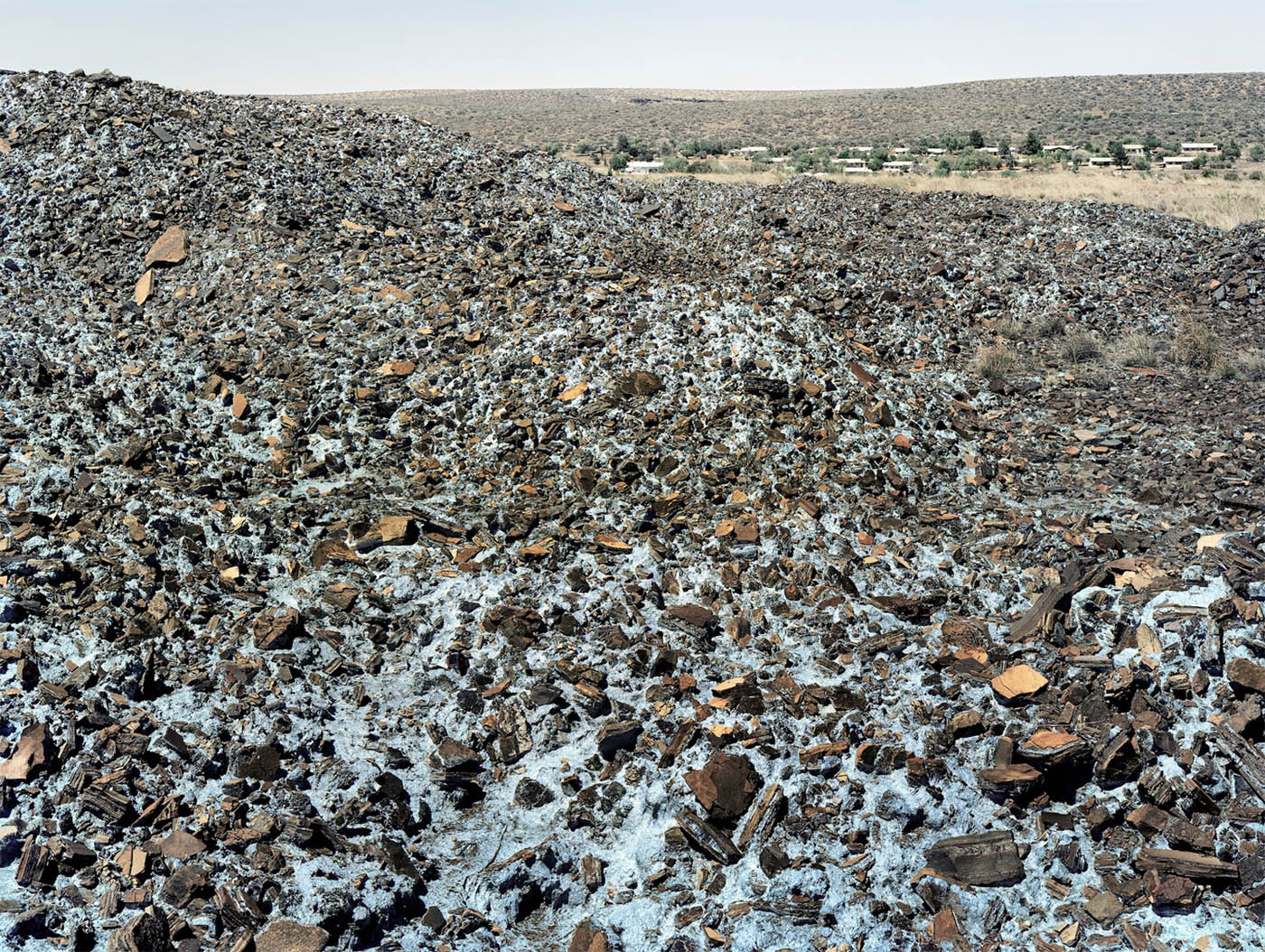
David Goldblatt (South African, 1930-2018) 'Highly carcinogenic blue asbestos waste on the Owendale Asbestos Mine tailings dump, near Postmasburg, Northern Cape. The prevailing wind was in the direction of the mine officials' houses at right. 21 December, 2002' 2002, printed 2005


David Goldblatt (South African, 1930-2018)
Highly carcinogenic blue asbestos waste on the Owendale Asbestos Mine tailings dump, near Postmasburg, Northern Cape. The prevailing wind was in the direction of the mine officials’ houses at right. 21 December, 2002
2002, printed 2005
Pigmented inkjet print
© The David Goldblatt Legacy Trust
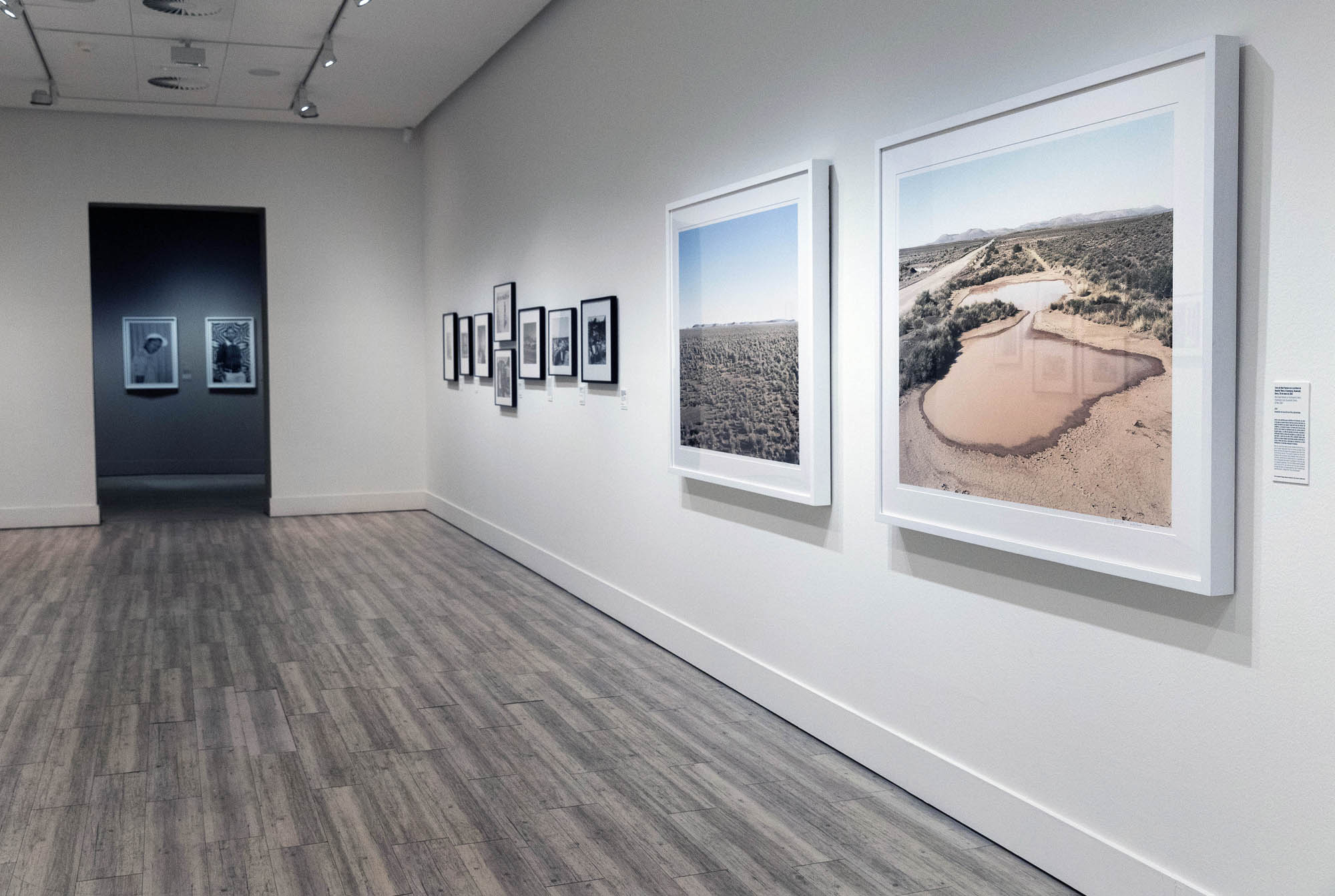
 

Installation view of the exhibition David Goldblatt: No Ulterior Motive at Fundación MAPFRE, Madrid showing at right, Goldblatt's 'Near Brak Pannen on the Beaufort West-Fraserburg road, Nuweveld, Karoo, 30 May 2004'


Installation view of the exhibition David Goldblatt: No Ulterior Motive at Fundación MAPFRE, Madrid showing at right, Goldblatt’s Near Brak Pannen on the Beaufort West-Fraserburg road, Nuweveld, Karoo, 30 May 2004 (2004, below)
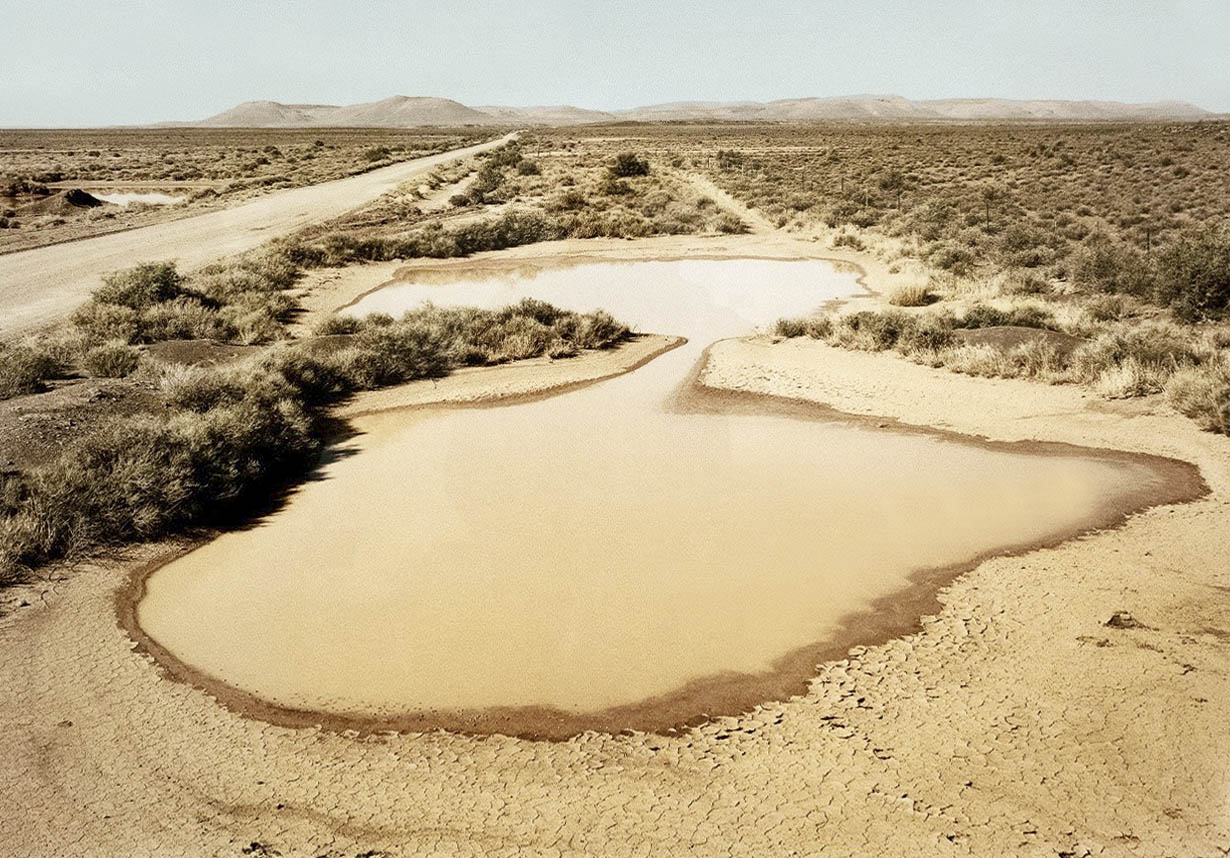
 

David Goldblatt (South African, 1930-2018) 'Near Brak Pannen on the Beaufort West-Fraserburg road, Nuweveld, Karoo, 30 May 2004' 2004


David Goldblatt (South African, 1930-2018)
Near Brak Pannen on the Beaufort West-Fraserburg road, Nuweveld, Karoo, 30 May 2004
2004
Pigmented inkjet print
The Art Institute of Chicago, promised gift of Cecily Cameron and Derek Schrier


Next to a road that shoots arrow-straight to the horizon, a pool of water evaporates from the intense sunlight of the Karoo, the semi-arid region that separates Cape Town from South Africa’s interior. The scarcity of water and the harsh climate in this enormous area impeded white settlers from centuries, an the lack of grand natural or manmade features confounded their desire to assimilate it into their idea of a beautiful landscape. From the 2000s onward Goldblatt made much of his new work by driving great distances through the Karoo. He appreciated the way it resisted easy aestheticisation, calling it the “fuck-all landscape.”

Wall text from the exhibition


David Goldblatt (South African, 1930-2018) 'Incomplete houses, part of a stalled municipal development of 1,000 houses. The funding allocation was made in 1998, building started in 2003. Officials and a politician gave various reasons for the stalling of the scheme: Shortage of water, theft of materials, problems with sewage disposal, problems caused by the high clay content of the soil, and shortage of funds. By August 2006, 420 houses had been completed, Lady Grey, Eastern Cape, 5 August 2006' [Casas sin terminar, parte de una promoción municipal de 1.000 viviendas paralizada. La financiación se consignó en 1998 y la construcción empezó en 2003. Los funcionarios y un político dieron varias razones para la paralización del proyecto: escasez de agua, robo de materiales, problemas con la evacuación de aguas residuales, problemas causados por el alto contenido de arcilla del suelo y escasez de fondos. En agosto de 2006 se habían terminado 420 viviendas, Lady Grey, Cabo Oriental, 5 de agosto de 2006] 2006


David Goldblatt (South African, 1930-2018)
Incomplete houses, part of a stalled municipal development of 1,000 houses. The funding allocation was made in 1998, building started in 2003. Officials and a politician gave various reasons for the stalling of the scheme: Shortage of water, theft of materials, problems with sewage disposal, problems caused by the high clay content of the soil, and shortage of funds. By August 2006, 420 houses had been completed, Lady Grey, Eastern Cape, 5 August 2006 [Casas sin terminar, parte de una promoción municipal de 1.000 viviendas paralizada. La financiación se consignó en 1998 y la construcción empezó en 2003. Los funcionarios y un político dieron varias razones para la paralización del proyecto: escasez de agua, robo de materiales, problemas con la evacuación de aguas residuales, problemas causados por el alto contenido de arcilla del suelo y escasez de fondos. En agosto de 2006 se habían terminado 420 viviendas, Lady Grey, Cabo Oriental, 5 de agosto de 2006]
2006
Pigmented inkjet print
Yale University Art Gallery, New haven, Connecticut, purchased with a gift from Jane P. Watkins, M.P.H. 1979; with the Leonard C. Hanna, Jr., Class of 1913, Fund; and with support from the Reinecke Rare Book and Manuscript Library
© The David Goldblatt Legacy Trust
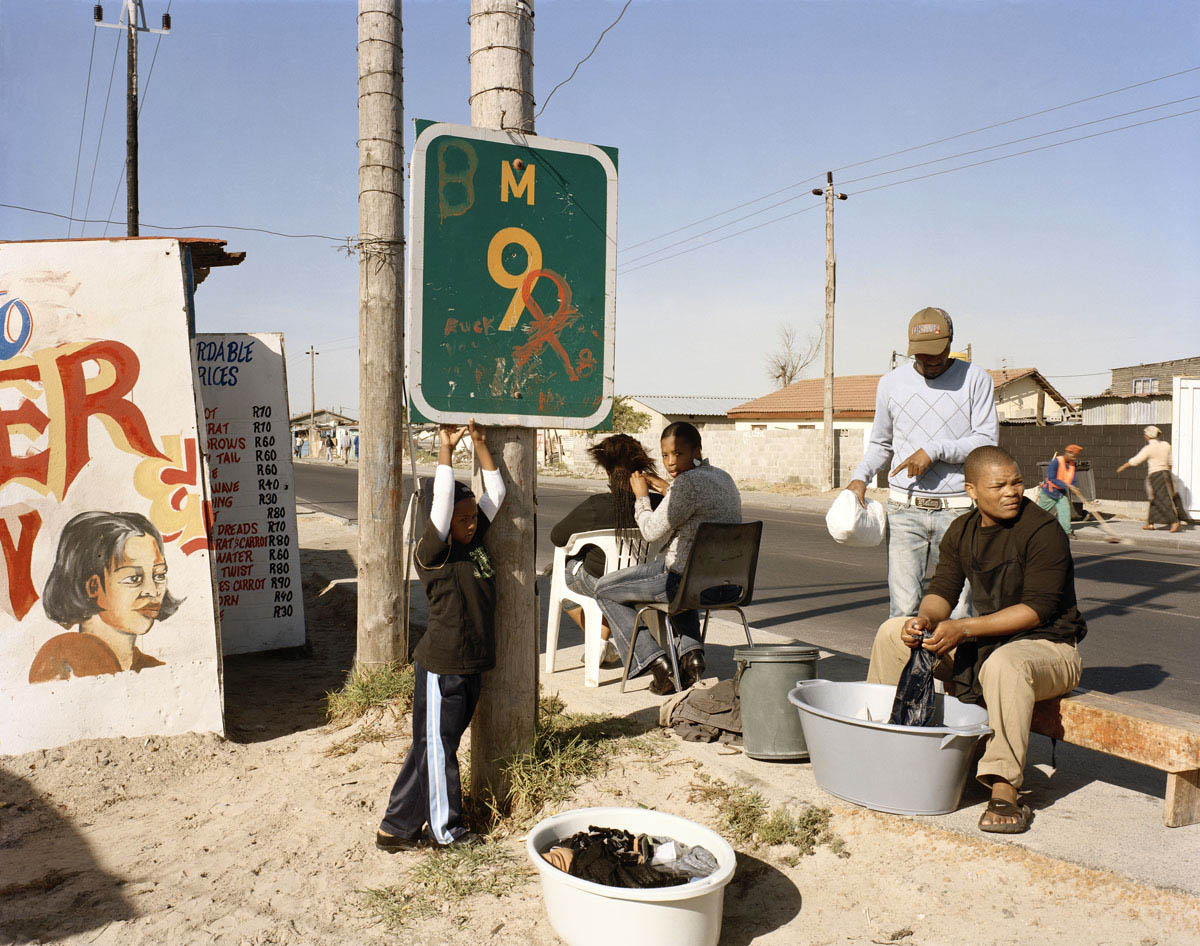
 

David Goldblatt (South African, 1930-2018) 'At Kewin Kwaneles Takwaito Barber, Landsdowne Road, Cape Town in the time of AIDS, 16 May 2007' 2007


David Goldblatt (South African, 1930-2018)
At Kewin Kwaneles Takwaito Barber, Landsdowne Road, Cape Town in the time of AIDS, 16 May 2007
2007
Pigmented inkjet print
The Art Institute of Chicago, promised gift of Cecily Cameron and Derek Schrier


David Goldblatt (South African, 1930-2018) 'The dethroning of Cecil John Rhodes, after the throwing of human feces on the statue and the agreement of the university to the demands of students for its removal, the University of Cape Town, 9 April 2015' [El derrocamiento de Cecil John Rhodes después de arrojar heces humanas contra la estatua y de que la universidad accediera a las demandas de los estudiantes para su retirada, Universidad de Ciudad del Cabo, 9 de abril de 2015] 2015


David Goldblatt (South African, 1930-2018)
The dethroning of Cecil John Rhodes, after the throwing of human feces on the statue and the agreement of the university to the demands of students for its removal, the University of Cape Town, 9 April 2015 [El derrocamiento de Cecil John Rhodes después de arrojar heces humanas contra la estatua y de que la universidad accediera a las demandas de los estudiantes para su retirada, Universidad de Ciudad del Cabo, 9 de abril de 2015]
2015
Carbon ink print
Yale University Art Gallery, New haven, Connecticut, purchased with a gift from Jane P. Watkins, M.P.H. 1979; with the Leonard C. Hanna, Jr., Class of 1913, Fund; and with support from the Reinecke Rare Book and Manuscript Library
© The David Goldblatt Legacy Trust


Here, Goldblatt joined a mass of onlookers recording the removal of the statue of 19th-century British mining magnate Cecil John Rhodes at the University of Cape Town (UCT). Rhodes vastly expanded European colonial rule on the African continent and exploited local labour to amass immense wealth. Disgusted by what they viewed as a symbol of white supremacy, student activists successfully campaigned to take down the statue honouring Rhodes.

UCT responded to this and related student protests by forming a committee to evaluate art on campus, intending to remove or hide problematic works from view. While Goldblatt had promised his archive to the university, he became concerned that this committee might censor art ad free speech. He ultimately withdrew his offer in 2017, bequeathing his archive to Yale University instead. In response to this decision, scholar Njabulo S. Ndebele has asked. “Was Goldblatt worried that the photographs would not survive the tests of freedom, even after they had survived those of oppression?”

Wall text from the exhibition


Fundación MAPFRE
Recoletos Exhibition Hall
Paseo Recoletos 23, 28004 Madrid

Opening hours:
Mondays (except holidays): 2pm – 8pm
Tuesday to Saturday: 11am – 8pm
Sunday and holidays: 11am – 7pm

Fundación MAPFRE website

LIKE ART BLART ON FACEBOOK

Back to top

Exhibition: ‘Zanele Muholi’ at Tate Modern, London

Exhibition dates: 11th November 2020 – 31st May 2021

Curators: Yasufumi Nakamori, Senior Curator and Sarah Allen, Assistant Curator with Kerryn Greenberg, Head of International Collection Exhibitions, Tate and formerly Curator, Tate Modern.


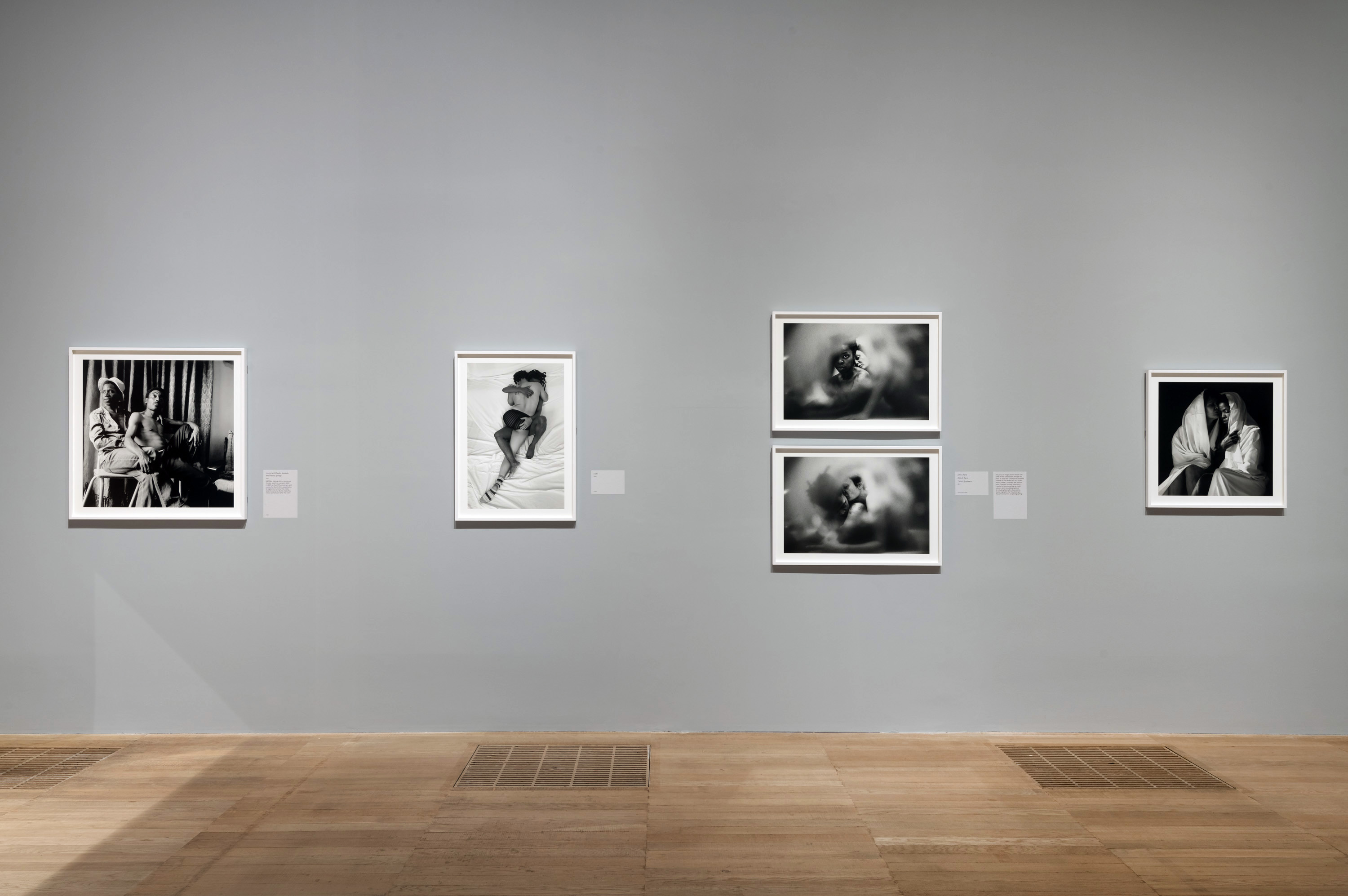
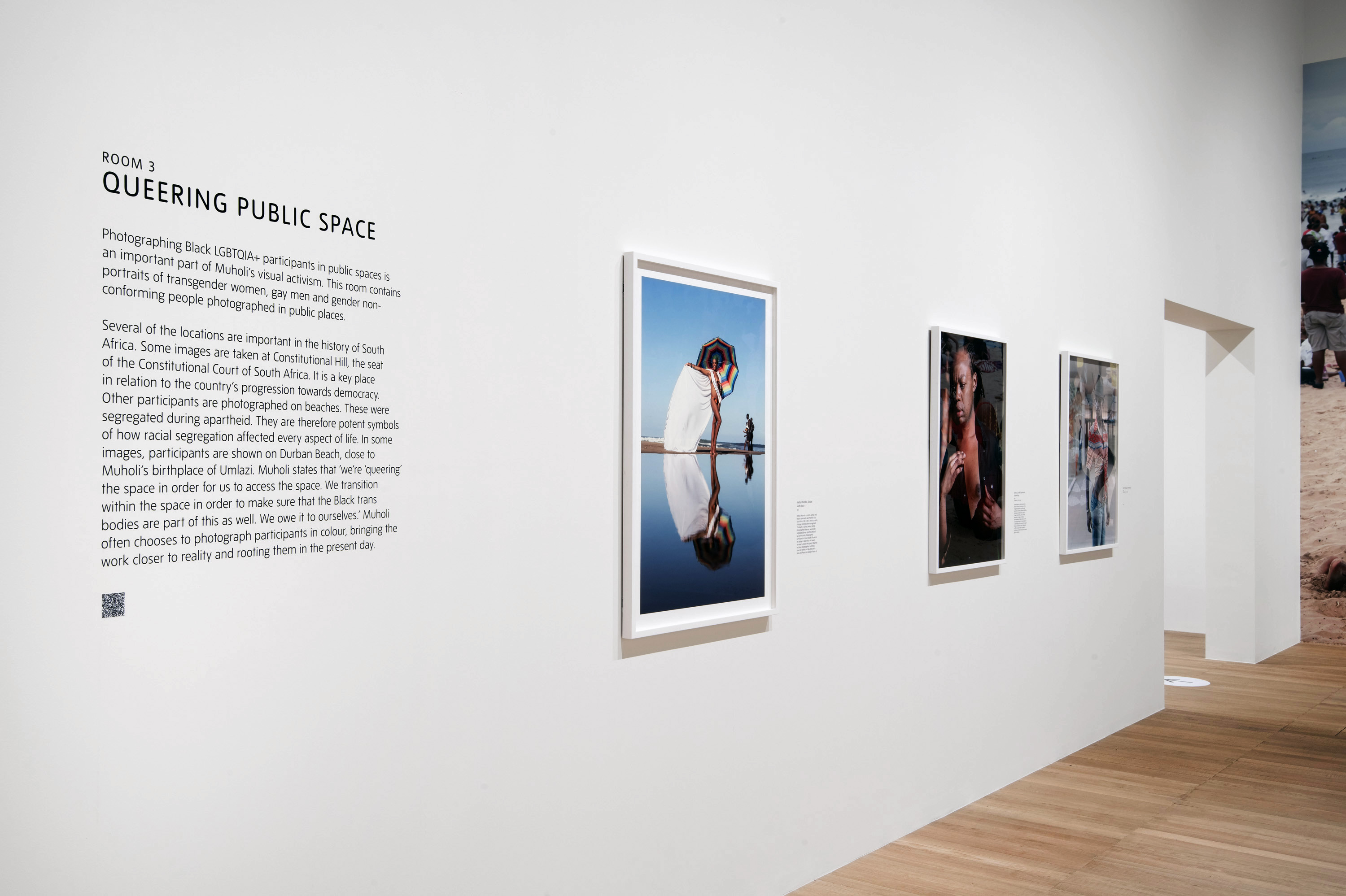
Installation Photograph of 'Zanele Muholi' Exhibition, Tate Modern, November 2020


Installation photograph of Zanele Muholi Exhibition, Tate Modern, November 2020
Photo © Andrew Dunkley


Unclassified fabulousness

There are so many words that you can say about an artist and their work. So many unnecessary words. All you have to do is look at the work. Does it speak to you? does it make you feel, does it empower you?

For me, artists either have it or they don’t… and in this case, visual activist Zanele Muholi possesses it by the bucketful. Panache, flair, downright unclassified fabulousness, call it what you want. They just have it.

They are powerful, they are strong, they are courageous, they tell great stories, they make you question history, they make you analyse what you think you know, they challenge your memories, they make you feel something about their participants, they make you want to fight for LGBTQIA+ social rights. They make you want to stand up and fight for equality and freedom for everyone. No person is an island, alone by themselves; we should all be equal under this cosmic sky.

The older I get the less tolerant I get of the stupidity of the human race and its non-evolution, in terms of spirit of self. When is the human race going to just grow up! Ditch the patriarchy, misogyny, colonialism, racial and socio-economic oppression. Appreciate difference, value the quality of every human being, debunk the dogma of religion, curtail the power of corporations and live in harmony with the earth. Not f…ing much to ask is it, after all these thousands of years.

I won’t live to see it, but with artists like Muholi, there is hope for humanity yet. Unclassifiable. Beautiful. Hail the Dark Lioness – all power to them.

Dr Marcus Bunyan


Many thankx to the Tate Britain for allowing me to publish the photographs in the posting. Please click on the photographs for a larger version of the image.


Tate Modern presents the first major mid-career survey of visual activist Zanele Muholi in the UK. Born in South Africa, Muholi came to prominence in the early 2000s with photographs that sought to envision black lesbian, gay, bisexual, trans, queer and intersex lives beyond deviance or victimhood.


“My mission is to re-write a Black queer and trans visual history of South Africa for the world to know of our resistance and existence at the height of hate crimes in South Africa and beyond.”

“In my world, every human is beautiful.”


Zanele Muholi


“Muholi prefers to be called an activist rather than an artist. Art, for them, is a means to an end, a tool to convey messages about social empowerment and visibility. “Zanele Muholi’s visual activism is not an occupation. It’s a lifestyle,” Kerryn Greenberg explains. “It’s something that occupies them day and night – whether they receive a call from someone in the community needing money to pay for a hospital appointment, or consoling those who’ve lost someone close to them in an act of violence, or giving some kind of public address at a wedding or a funeral. It’s about being a very active member of the community, and a public voice within that community.”


Maisie Skidmore. “Yes, but why? Zane Muholi,” on the We Present website [Online] Cited 11 April 2021


“The connection that Muholi has with their participants (which they are eager to distinguish from the word “subject,” which implies a distanced gaze) translates to the viewer, who, in looking at these images, is immediately welcomed into a space of understanding and empathy. Muholi also often highlights the voices of the participants in their shows, books and events. …

The political agenda of the 260 photographs on display – which critique centuries of anti-Black sentiment, oppression and erasure – echoes the rallying cry of the Black Lives Matter movement and the racial justice reckoning it has inspired worldwide. “Muholi’s work takes on an enormous importance within the context of Black Lives Matter because of its potential to educate audiences and promote mutual understanding,” said Sarah Allen. Each piece makes a clear visual statement: not only that Black queer lives matter but also that Black queer lives are nuanced, cherished and deserve to be celebrated.”


Cassidy George. “Zanele Muholi’s Photographs Celebrate Radical, Queer, Black Beauty,” on the W Magazine website 11/03/2020 [Online] Cited 11/05/2021


Zanele Muholi – ‘In My World, Every Human is Beautiful’ / Tate

Visual activist, Zanele Muholi, uses photography and film to document and explore issues of race and representation and to celebrate the LGBTQIA+ community in South Africa and beyond. Here they talk about how the power of images can show LGBTQIA+ people of South Africa, and QTIPOC people worldwide, that they are not alone. Watch as they introduce us to four key bodies of work and the ideas behind them.


Zanele Muholi: In Conversation with Lady Phyll / Artist’s Talk / Tate Exchange

Watch an in conversation between Muholi and Lady Phyll of UK Black Pride. Together, they discuss what difficult love looks like for QTIPOC communities in South Africa and Britain and the importance of chosen families.

This talk forms a part of From a Place of Love, a collaboration between Tate Exchange’s Love programme and UK Black Pride, whose theme for 2020 is home.


Born in 1972 and raised in Umlazi, a township on South Africa’s eastern coast, Muholi had a childhood shaped by the racial brutality of Apartheid – a white supremacist regime that systematically oppressed and displaced South Africa’s non white population for half a century. Muholi was an adolescent when Apartheid absolved and South Africa’s constitution was rewritten in 1996, with the intention of ushering a new era of equality. Even though South Africa’s constitution was the first in the world to outlaw discrimination based on sexual orientation, as a young queer person, Muholi was constantly reminded that the violent realities of gay life in South Africa did not align with this utopic vision of the future. Homophobia, queerphobia and transphobia remained rampant, and in South Africa, Black lesbians and transgender men are among the most at risk, and are often victims of heinous hate crimes, like “corrective” rape, abduction and murder. Drawing inspiration from the work of the American photographer Nan Goldin, whose early photographs documented queer culture and the HIV epidemic through intimate portraits of her family and friends, Muholi embarked on a mission to commemorate the battles and triumphs of her community with pictures.

Cassidy George. “Zanele Muholi’s Photographs Celebrate Radical, Queer, Black Beauty,” on the W Magazine website 11/03/2020 [Online] Cited 11/05/2021


Zanele Muholi is a South African visual activist whose pronouns are they/them/theirs. Their work tells the stories of Black LGBTQIA+ (Lesbian, Gay, Bisexual, Transgender, Queer, Intersex, Agender, Asexual) lives in South Africa and beyond. Their photography raises awareness of injustices and aims to educate, while creating positive visual histories for under and mis-represented communities. Muholi also turns the camera on themself, making self-portraits that address race, history and representation. This exhibition charts Muholi’s emergence as an activist in the early 2000s to the present day.

During the 1990s, South Africa underwent major social and political change. Apartheid was officially abolished in 1994. This was a political and social system of racial segregation underpinned by white minority rule. Anyone who was not classified as white was actively oppressed by the regime. Apartheid continued the segregation that had begun under the Dutch and British colonial regimes in the late 19th century. The apartheid regime also upheld injustice and discrimination based on gender and sexuality. While the 1996 Constitution of the Republic of South Africa was the first in the world to outlaw discrimination based on sexual orientation, the LGBTQIA+ community remains a target for prejudice, hate crimes and violence.


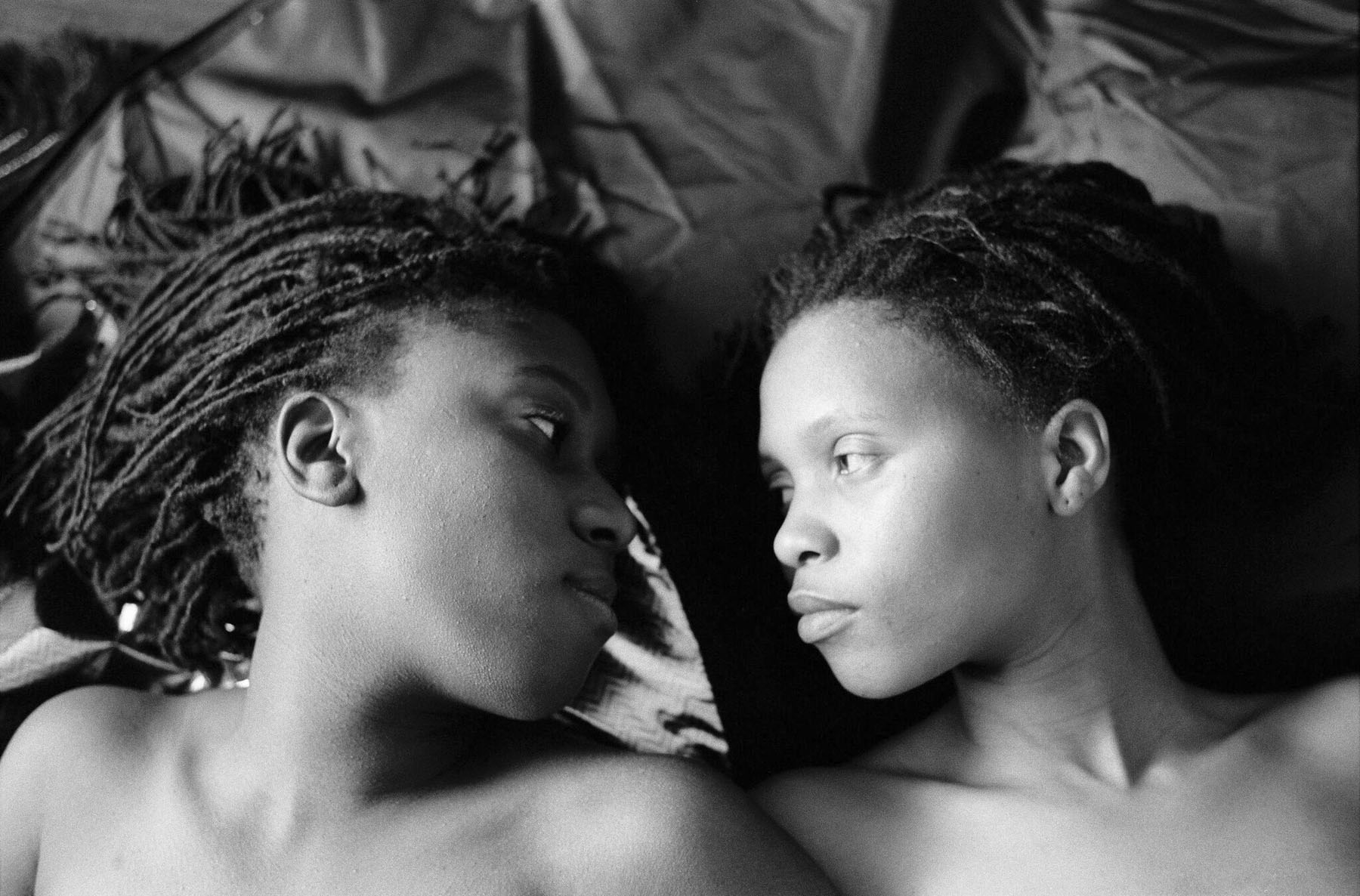
Installation photograph of Room 1 of the 'Zanele Muholi' exhibition, Tate Modern, November 2020 showing photographs from the series 'Only Half the Picture' (2002-2006)

Installation photograph of Room 1 of the 'Zanele Muholi' exhibition, Tate Modern, November 2020 showing photographs from the series 'Only Half the Picture' (2002-2006)


Installation photographs of Room 1 of the Zanele Muholi exhibition, Tate Modern, November 2020 showing photographs from the series Only Half the Picture (2002-2006)
Photos © Andrew Dunkley


Room 1: Only Half The Picture

This room incudes work from Muholi’s first series Only Half the Picture (2002-2006). It documents survivors of hate crimes living across South Africa and its townships. Under apartheid, townships were established as residential areas for those who had been evicted from places designated as ‘white only’. The people Muholi photographs – their participants – are presented with compassion, dignity and courage in the face of ongoing discrimination. The series also includes images of intimacy, expanding the narrative beyond victimhood. Muholi reveals the pain, love and defiance that exist within the Black LGBTQIA+ community in South Africa.

Exhibition room guide text


Zanele Muholi. 'Aftermath' 2004


Zanele Muholi (South African, b. 1972)
Aftermath
2004
From the series Only Half the Picture
Photograph, gelatin silver print on paper
600 x 395mm
Courtesy of the Artist and Stevenson, Cape Town/Johannesburg and Yancey Richardson, New York
© Zanele Muholi


Zanele Muholi. 'ID Crisis' 2003


Zanele Muholi (South African, b. 1972)
ID Crisis
2003
From the series Only Half the Picture
Photograph, gelatin silver print on paper
325 x 485mm
Courtesy of the Artist and Stevenson, Cape Town/Johannesburg and Yancey Richardson, New York
© Zanele Muholi


The exhibition opens with a group of deceptively gentle images. In the first, Aftermath (2004), a torso is cropped from waist to knees, hands modestly clasped in front of Jockey shorts, a huge scar running down the person’s right leg almost like a piece of body art. In another, Ordeal (2003), hands wring out a cloth in an enamel basin of water placed on a floor. A third image shows a cropped, seated figure, again waist to thighs, hands folded in their lap, plastic hospital ties around their wrists. These pictures have a softness and beauty which completely belies the fact that their subjects are all survivors of sexual violence and “corrective rape”.

As the caption to the last picture, Hate crime survivor I, Case number (2004) explains, “Corrective rape is a term used to describe a hate crime in which a person is raped because of their perceived sexual orientation or gender identity. The intended consequence of such acts is to enforce heterosexuality and gender conformity.” This horrific practice is by no means unique to South Africa, but the term seems to have originated there – feminist activist Bernedette Muthien used it during an interview with Human Rights Watch in 2001 – and its effects on the community resonate throughout this exhibition.

Anonymous. “Zanele Muholi, Tate Modern,” on the Something I’m Working On website Wednesday 30th December 2020 [Online] Cited 11/05/2021


Installation photograph of Room 2 of the 'Zanele Muholi' exhibition, Tate Modern, November 2020


Installation photograph of Room 2 of the Zanele Muholi exhibition, Tate Modern, November 2020
Photo © Andrew Dunkley


Room 2: Being

This room features work from Muholi’s series Being (2006 – ongoing). The portraits capture moments of intimacy between couples, as well as their daily life and routines. Muholi addresses the misconception that queer life is ‘unAfrican’, a falsehood emerging in part out of the belief that same-sex orientation was a colonial import to Africa. Each couple is shown in the private spaces they share. Muholi explains how ‘lovers and friends consented to participate in the project, willing to bare and express their love for each other.’

Commenting on this series they say, ‘my photography is never about lesbian nudity. It is about portraits of lesbians who happen to be in the nude.’ This series dismantles the white patriarchal gaze and rejects negative or heteronormative images, common in political and social systems that uphold heterosexuality as the norm or default sexual orientation.

Since slavery and colonialism, images of us African women have been used to reproduce heterosexuality and white patriarchy, and these systems of power have so organised our everyday lives that it is difficult to visualise ourselves as we actually are in our respective communities. Moreover, the images we see rely on binaries that were long prescribed for us (heterosexual / homosexual, male/female, African / unAfrican). From birth on, we are taught to internalise their existences, sometimes forgetting that if bodies are connected, connecting, the sensuousness goes beyond simplistic understandings of gender and sexuality.


Exhibition room guide text


Zanele Muholi. 'Katlego Mashiloane and Nosipho Lavuta, Ext. 2, Lakeside, Johannesburg' 2007


Zanele Muholi (South African, b. 1972)
Katlego Mashiloane and Nosipho Lavuta, Ext. 2, Lakeside, Johannesburg
2007
From the series Being (2006 – ongoing)
Courtesy of the Artist and Stevenson, Cape Town/Johannesburg and Yancey Richardson, New York
© Zanele Muholi


Zanele Muholi (South African, b. 1972) 'Katlego Mashiloane and Nosipho Lavuta, Ext. 2, Lakeside, Johannesburg' 2007


Zanele Muholi (South African, b. 1972)
Katlego Mashiloane and Nosipho Lavuta, Ext. 2, Lakeside, Johannesburg
2007
From the series Being (2006 – ongoing)
Courtesy of the Artist and Stevenson, Cape Town/Johannesburg and Yancey Richardson, New York
© Zanele Muholi


Zanele Muholi (South African, b. 1972) 'Beloved V' 2005


Zanele Muholi (South African, b. 1972)
Beloved V
2005
From the series Being (2006 – ongoing)
Courtesy of the Artist and Stevenson, Cape Town/Johannesburg and Yancey Richardson, New York
© Zanele Muholi


Zanele Muholi. 'Busi Mdaki and Malesedi Nthute, Johannesburg' 2007


Zanele Muholi (South African, b. 1972)
Busi Mdaki and Malesedi Nthute, Johannesburg
2007
From the series Being (2006 – ongoing)
Courtesy of the Artist and Stevenson, Cape Town/Johannesburg and Yancey Richardson, New York
© Zanele Muholi


Zanele Muholi (South African, b. 1972) 'TommyBoys' 2004


Zanele Muholi (South African, b. 1972)
TommyBoys
2004
From the series Being (2006 – ongoing)
Courtesy of the Artist and Stevenson, Cape Town/Johannesburg and Yancey Richardson, New York
© Zanele Muholi


In “TommyBoys,” a colour photograph, two muscular figures in tracksuit pants sit on a tarmac. One, in a red T-shirt, sits with her hands folded against her chest, while next to her, the second uses her white vest to wipe something from her eyes. (“Tommy Boy” is a word used in South Africa, like “butch,” to refer to a masculine-presenting lesbian.)

Text from the New York Times website


Zanele Muholi. 'Busi Sigasa, Braamfontein, Johannesburg' 2006


Zanele Muholi (South African, b. 1972)
Busi Sigasa, Braamfontein, Johannesburg
2006
Courtesy of the Artist and Stevenson, Cape Town/Johannesburg and Yancey Richardson, New York
© Zanele Muholi


Installation photograph of Room 3 of the 'Zanele Muholi' exhibition, Tate Modern, November 2020 showing the section 'Queering Public Space'

Installation photograph of Room 3 of the 'Zanele Muholi' exhibition, Tate Modern, November 2020 showing the section 'Queering Public Space'

Installation photograph of Room 3 of the 'Zanele Muholi' exhibition, Tate Modern, November 2020 showing the series 'Miss Lesbian I-VII, Amsterdam' (2009)


Installation photographs of Room 3 of the Zanele Muholi exhibition, Tate Modern, November 2020 showing in the bottom photograph the series Miss Lesbian I-VII, Amsterdam (2009)
Photos © Andrew Dunkley


Room 3: Queering Public Space

Photographing Black LGBTQIA+ participants in public spaces is an important part of Muholi’s visual activism. This room contains portraits of transgender women, gay men and gender non-conforming people photographed in public places.

Several of the locations are important in the history of South Africa. Some images are taken at Constitutional Hill, the seat of the Constitutional Court of South Africa. It is a key place in relation to the country’s progression towards democracy. Other participants are photographed on beaches. These were segregated during apartheid. They are therefore potent symbols of how racial segregation affected every aspect of life. Participants are often shown on Durban Beach, close to Muholi’s birthplace of Umlazi.

Muholi states that ‘we’re ‘queering’ the space in order for us to access the space. We transition within the space in order to make sure that the Black trans bodies are part of this as well. We owe it to ourselves.’ Muholi often chooses to photograph participants in colour, bringing the work closer to reality and rooting them in the present day.

Exhibition room guide text


Zanele Muholi. 'Miss D'vine II' 2007


Zanele Muholi (South African, b. 1972)
Miss D’vine II
2007
Lambda print
765 x 765 mm
Courtesy of the Artist and Stevenson, Cape Town/Johannesburg and Yancey Richardson, New York
© Zanele Muholi


Zanele Muholi (South African, b. 1972) 'Miss Lesbian VII, Amsterdam' 2009


Zanele Muholi (South African, b. 1972)
Miss Lesbian VII, Amsterdam
2009
C-print
86.5 x 60.5cm
Courtesy of the Artist and Stevenson, Cape Town/Johannesburg and Yancey Richardson, New York
© Zanele Muholi


Tate Modern presents the first major UK survey of visual activist Zanele Muholi.

Zanele Muholi is one of the most acclaimed photographers working today, and their work has been exhibited all over the world. With over 260 photographs, this exhibition presents the full breadth of their career to date.

Muholi describes themself as a visual activist. From the early 2000s, they have documented and celebrated the lives of South Africa’s Black lesbian, gay, trans, queer and intersex communities.

In the early series Only Half the Picture, Muholi captures moments of love and intimacy as well as intense images alluding to traumatic events – despite the equality promised by South Africa’s 1996 constitution, its LGBTQIA+ community remains a target for violence and prejudice.

In Faces and Phases each participant looks directly at the camera, challenging the viewer to hold their gaze. These images and the accompanying testimonies form a growing archive of a community of people who are risking their lives by living authentically in the face of oppression and discrimination.

Other key series of works, include Brave Beauties, which celebrates empowered non-binary people and trans women, many of whom have won Miss Gay Beauty pageants, and Being, a series of tender images of couples which challenge stereotypes and taboos.

Muholi turns the camera on themself in the ongoing series Somnyama Ngonyama – translated as ‘Hail the Dark Lioness’. These powerful and reflective images explore themes including labour, racism, Eurocentrism and sexual politics.​

Exhibition organised by Tate Modern in collaboration with the Maison Européenne de la Photographie, Paris, Gropius Bau, Berlin and Bildmuseet at Umeå University.

Text from the Tate Modern website


Tate Modern presents the first major UK survey of South African visual activist Zanele Muholi. Muholi (b. 1972) came to prominence in the early 2000s with photographs that told the stories of black lesbian, gay, bisexual, trans, queer and intersex lives in South Africa. Over 300 photographs are brought together to present the full breadth of Muholi’s career to date, from their very first body of work Only Half the Picture, to their on-going series Somnyama Ngonyama. These works challenge dominant ideologies and representations, presenting the participants in their photographs as fellow human beings bravely existing in the face of prejudice, intolerance and often violence.

During the 1990s, South Africa underwent major social and political changes. While the country’s 1996 post-apartheid constitution was the first in the world to outlaw discrimination based on sexual orientation, the LGBTQIA+ community remains a target for violence and prejudice to this day. In the early series Only Half the Picture Muholi aimed to depict the complexities of gender and sexuality for the individuals of the queer community. The collection includes moments of love and intimacy as well intense images alluding to traumatic events in the lives of the participants. Muholi also began an ongoing visual archive of portraits, Faces and Phases, which commemorates and celebrates black lesbians, transgender people and gender non-conforming individuals. Each participant looks directly at the camera, challenging the viewer to hold their gaze, while individual testimonies capture their stories. The images and testimonies form a living and growing archive of this community in South Africa and beyond.

The exhibition includes several other key series of works, including Brave Beauties, which celebrates empowered non-binary people and trans women, many of whom have won Miss Gay Beauty pageants, and Being, a series of tender images of couples which challenge stereotypes and taboos. Images like Melissa Mbambo, Durban also attempt to reclaim public spaces for black and queer communities, such as a beach in Durban which was racially segregated during apartheid. Within these series, Muholi tells collective as well as individual stories. They challenge preconceived notions of deviance and victimhood, encourage viewers to address their own misconceptions, and create a shared sense of understanding and solidarity.

More recently, Muholi has begun an acclaimed series of dramatic self-portraits entitled Somnyama Ngonyama (‘Hail the Dark Lioness’ in Zulu). Turning the camera on themself, the artist adopts different poses, characters and archetypes to address issues of race and representation. From scouring pads and latex gloves to rubber tires and cable ties, everyday materials are transformed into politically loaded props and costumes. The resulting images explore themes of labour, racism, Eurocentrism and sexual politics, often commenting on events in South Africa’s history and Muholi’s experiences as a South African black queer person traveling abroad. By enhancing the contrast in the photographs, Muholi also emphasises the darkness of their skin tone, reclaiming their blackness with pride and re-asserting its beauty. Muholi has created some new self-portraits for this series which are being shown at Tate Modern for the first time.

Zanele Muholi is co-curated by Yasufumi Nakamori, Senior Curator and Sarah Allen, Assistant Curator with Kerryn Greenberg, Head of International Collection Exhibitions, Tate and formerly Curator, Tate Modern. The exhibition is organised by Tate Modern in collaboration with the Maison Européenne de la Photographie in Paris, Gropius Bau in Berlin and Bildmuseet at Umeå University. Supported by the Zanele Muholi Exhibition Supporters Circle, Tate Americas Foundation, Tate International Council, Tate Patrons and Tate Members . Research supported by Hyundai Tate Research Centre: Transnational in partnership with Hyundai Motor.

About Zanele Muholi

Zanele Muholi was born in Umlazi, Durban and lives in Johannesburg. They studied at the Market Photo Workshop in Johannesburg, and Ryerson University, Toronto. Co-founder of the Forum for the Empowerment of Women, and founder of Inkanyiso, a forum for queer and visual media, Muholi is also an honorary professor at the University of the Arts Bremen, Germany. Solo exhibitions of Muholi’s work have been hosted around the world, including at the Goethe-Institut, Johannesburg (2012); Brooklyn Museum, New York (2015); Stedelijk Museum Amsterdam (2017); Autograph ABP, London (2017-) and Museo de Arte moderno de Buenos Aires (2018). Muholi has won numerous awards, including the Lucie Humanitarian Award (2019), the 2019 ‘Best Photography Book Award’ by the Kraszna-Krausz Foundation for their book Somnyama Ngonyama: Hail, The Dark Lioness (Aperture), the Rees Visionary Award by Amref Health Africa (2019); a fellowship from the Royal Photographic Society, UK (2018); France’s Chevalier de l’Ordre des Arts et des Lettres (2017); the Mbokodo Award in the category of Visual Arts (2017);the ICP Infinity Award for Documentary and Photojournalism (2016); the Fine Prize for an emerging artist at the Carnegie International (2013); a Prince Claus Award (2013); and both the Casa África award for best female photographer and a Fondation Blachère award at Les Rencontres de Bamako biennial of African photography (2009). Somnyama Ngonyama was shown at the 58th Venice Biennale (2019); Faces and Phases was shown at dOCUMENTA 13 (2012) and the 55th Venice Biennale (2013).

Muholi’s pronouns are they, them, their.

Press release from the Tate website


Installation photograph of Room 4 of the 'Zanele Muholi' exhibition, Tate Modern, November 2020 showing photographs from the series 'Brave Beauties' (2014 - ongoing)

Installation photograph of Room 4 of the 'Zanele Muholi' exhibition, Tate Modern, November 2020 showing photographs from the series 'Brave Beauties' (2014 - ongoing)


Installation photographs of Room 4 of the Zanele Muholi exhibition, Tate Modern, November 2020 showing photographs from the series Brave Beauties (2014 – ongoing)
Photos © Andrew Dunkley


Room 4: Brave Beauties

Brave Beauties (2014 – ongoing) is a series of portraits of trans women, gender non-conforming and non-binary people. Many of them are also beauty pageant contestants. Queer beauty pageants offer a space of resistance within the Black LGBTQIA+ community in South Africa. They are a place where individuals can realise and express their beauty outside heteronormative and white supremacist cultures. Muholi has commented that these participants ‘enter beauty pageants to change mind-sets in the communities they live in, the same communities where they are most likely to be harassed, or worse.’

This series is also inspired by fashion magazine covers. Muholi has questioned whether ‘South Africa as a democratic country would have an image of a trans woman on the cover of a magazine.’ These images aim to challenge queerphobic and transphobic stereotypes and stigmas.

As with all of Muholi’s images, the portraits are created through a collaborative process. Muholi and the participant determine the location, clothing and pose together, focusing on producing images that are empowering for both the participant and the audience.

Exhibition room guide text


Zanele Muholi (South African, b. 1972) 'Sazi Jali, Durban' 2020


Zanele Muholi (South African, b. 1972)
Sazi Jali, Durban
2020
Courtesy of the Artist and Stevenson, Cape Town/Johannesburg and Yancey Richardson, New York
© Zanele Muholi


Zanele Muholi (South African, b. 1972) 'Somizy Sincwala, Parktown' 2014


Zanele Muholi (South African, b. 1972)
Somizy Sincwala, Parktown
2014
Courtesy of the Artist and Stevenson, Cape Town/Johannesburg and Yancey Richardson, New York
© Zanele Muholi


The series Brave Beauties, started in 2014, is “a series of portraits of trans women, gender non-conforming and non-binary people. Many of them are also beauty pageant contestants.” The queer beauty pageant is many things: a celebration – and redefinition – of beauty, a declaration of independence by contestants, a challenge to “heteronormative and white supremacist cultures,” and an attempt, as Muholi puts it, “to change mind-sets in the communities [the contestants] live in, the same communities where they are most likely to be harassed or worse.”

Anonymous. “Zanele Muholi, Tate Modern,” on the Something I’m Working On website Wednesday 30th December 2020 [Online] Cited 11/05/2021


Zanele Muholi (South African, b. 1972) 'Dimpho Tsotetsi, Parktown' 2014


Zanele Muholi (South African, b. 1972)
Dimpho Tsotetsi, Parktown
2014
Courtesy of the Artist and Stevenson, Cape Town/Johannesburg and Yancey Richardson, New York
© Zanele Muholi


What I really want to talk about is beauty. Because I think for Muholi, that’s kind of where it all stems from, is recognising beauty in things that you might not expect. Muholi has said “All I want to see is beauty. And that doesn’t mean you have to smile, or try harder. Just be.”

I think that’s very much linked to the history of Apartheid, of course […] As a Black person being told constantly ‘your hair isn’t straight enough’, ‘you should look like this’, ‘you should look like that’ and that being legislated under Apartheid. But it’s also what is in the magazines, this idea of the perfect beauty. Muholi’s counteracting them, saying actually, none of that is relevant. It’s about being the beauty that you want to be.

There’s a really great series called Brave Beauties, which […] pictures trans women and gender non-binary individuals, many of whom have been in beauty pageants, occupying space. Demanding attention. And being absolutely stunningly beautiful. And you kind think, ‘yeah, what are our notions of beauty, what are these kind of constructions that are absolutely false?’

Kerryn Greenberg


Zanele Muholi. 'Eva Mofokeng II, Parktown, Johannesburg' 2014


Zanele Muholi (South African, b. 1972)
Eva Mofokeng II, Parktown, Johannesburg
2014
Courtesy of the Artist and Stevenson, Cape Town/Johannesburg and Yancey Richardson, New York
© Zanele Muholi


Installation photograph of Room 5 of the 'Zanele Muholi' exhibition, Tate Modern, November 2020


Installation photograph of Room 5 of the Zanele Muholi exhibition, Tate Modern, November 2020
Photo © Andrew Dunkley


Room 5: Collectivity

Collectivity lies at the heart of Muholi’s work. Many of Muholi’s large network of collaborators are members of their collective, Inkanyiso. This means ‘light’ in isiZulu, Muholi’s first language and one of 11 official languages in South Africa. Inkanyiso’s mission is to ‘Produce, educate and disseminate information to many audiences, especially those who are often marginalised or sensationalised by the mainstream media.’ Queer Activism = Queer Media, is the collective’s motto.

Self-organisation, mentorship and skill sharing are central to Muholi’s collaborative activity. This room features images that are collaboratively made. Whether documenting public events such as Pride marches and protests, or private events such as marriages and funerals, these images form an ever-expanding visual archive. By recording the existence of the Black LGBTQIA+ community, they resist erasure.

Exhibition room guide text


Zanele Muholi (South African, b. 1972) 'Lerato Dumse, Muntu Masombuka’s Funeral, Johannesburg' 2014


Zanele Muholi (South African, b. 1972)
Lerato Dumse, Muntu Masombuka’s Funeral, Johannesburg
2014
Courtesy of the Artist and Stevenson, Cape Town/Johannesburg and Yancey Richardson, New York
© Zanele Muholi


Room 6: Faces and Phases

Muholi began their ongoing series Faces and Phases in 2006. The project currently totals 500+ works. As a collective portrait, it celebrates, commemorates and archives the lives of Black lesbians, transgender and gender non-conforming individuals.

It is important to mark, map and preserve our mo(ve)ments through visual histories for reference and posterity so that future generations will note that we were here.


Many of these portraits are the result of a long and sustained relationship and collaboration. Muholi often returns to photograph the same person over time. Faces refers to the person being photographed. Phases signifies a transition from one stage of sexuality or gender expression and identity to another. It also marks the changes in the participants’ daily lives, including ageing, education, work experience and marriage. The gaps in the grid indicate individuals that are no longer present in the project, or a portrait yet to be taken. One wall in the exhibition is dedicated to the participants who have passed away.

Faces and Phases forms a living archive that visualises Muholi’s belief that ‘we express our gendered, radicalised, and classed selves in rich and diverse ways.’

Exhibition room guide text


Installation photograph of Room 6 of the 'Zanele Muholi' exhibition, Tate Modern, November 2020 showing Muholi's series 'Faces and Phases' (2006 - ongoing)

Installation photograph of Room 6 of the 'Zanele Muholi' exhibition, Tate Modern, November 2020 showing Muholi's series 'Faces and Phases' (2006 - ongoing)

Installation photograph of Room 6 of the 'Zanele Muholi' exhibition, Tate Modern, November 2020 showing Muholi's series 'Faces and Phases' (2006 - ongoing)


Installation photographs of Room 6 of the Zanele Muholi exhibition, Tate Modern, November 2020 showing Muholi’s series Faces and Phases (2006 – ongoing)
Photos © Andrew Dunkley


Faces and Phases is an ongoing series whereby the artist was seeking to document and photograph Black lesbians, trans men and gender non-conforming individuals. There’s now a mass of these incredibly beautiful portraits, which generally are presented in a grid, to show that, actually […] giving visibility to these people is a life’s work. There are many portraits of the same individuals over the course of a number of years. So you can see how people age, how they transition, sometimes, and how the way they present themselves, alters.

It is about acknowledging pain and trauma, and trying to heal people, and heal oneself through those images. Images that Muholi wants their community, to be proud of, and feel well represented by.

Kerryn Greenberg


Death is a constant presence in Muholi’s community and work. The largest space in this exhibition is given to Faces and Phases (2006 – ongoing), a collection of portraits – 500, and counting. The images “celebrate, commemorate and archive the lives of Black lesbians, transgender and gender non-conforming individuals.” People appear more than once. Some spots on the walls are empty, marking a portrait yet to be taken or a participant no longer there. One wall is dedicated to those who have passed away.

Anonymous. “Zanele Muholi, Tate Modern,” on the Something I’m Working On website Wednesday 30th December 2020 [Online] Cited 11/05/2021


Zanele Muholi. 'Tumi Mokgosi, Yeoville, Johannesburg' 2007


Zanele Muholi (South African, b. 1972)
Tumi Mokgosi, Yeoville, Johannesburg
2007
Courtesy of the Artist and Stevenson, Cape Town/Johannesburg and Yancey Richardson, New York
© Zanele Muholi


Zanele Muholi. 'Nosipho Solundwana, Parktown, Johannesburg' 2007


Zanele Muholi (South African, b. 1972)
Nosipho Solundwana, Parktown, Johannesburg
2007
Courtesy of the Artist and Stevenson, Cape Town/Johannesburg and Yancey Richardson, New York
© Zanele Muholi


Zanele Muholi. 'Manucha, Muizenberg, Cape Town' 2010


Zanele Muholi (South African, b. 1972)
Manucha, Muizenberg, Cape-Town
2010
Courtesy of the Artist and Stevenson, Cape Town/Johannesburg and Yancey Richardson, New York
© Zanele Muholi


Zanele Muholi. 'Nokuthula Dhladhla, Berea, Johannesburg' 2007


Zanele Muholi (South African, b. 1972)
Nokuthula Dhladhla, Berea, Johannesburg
2007
Courtesy of the Artist and Stevenson, Cape Town/Johannesburg and Yancey Richardson, New York
© Zanele Muholi


Zanele Muholi. '"TK" Tekanyo, Gaborone, Botswana' 2010


Zanele Muholi (South African, b. 1972)
TK Tekanyo, Gaborone, Botswana
2010
Courtesy of the Artist and Stevenson, Cape Town/Johannesburg and Yancey Richardson, New York
© Zanele Muholi


Zanele Muholi. 'Zukiswa Gaca Makhaza, Khayelitsha, Cape Town' 2010


Zanele Muholi (South African, b. 1972)
Zukiswa Gaca Makhaza, Khayelitsha, Cape-Town
2010
Courtesy of the Artist and Stevenson, Cape Town/Johannesburg and Yancey Richardson, New York
© Zanele Muholi


Zanele Muholi (South African, b. 1972) 'Marcel Kutumela, Alexandra, Johannesburg' 2008


Zanele Muholi (South African, b. 1972)
Marcel Kutumela, Alexandra, Johannesburg
2008
Courtesy of the Artist and Stevenson, Cape Town/Johannesburg and Yancey Richardson, New York
© Zanele Muholi


Zanele Muholi. 'Lungile Cleo Dladla, KwaThema, Community Hall, Springs, Johannesburg' 2011


Zanele Muholi (South African, b. 1972)
Lungile Cleo Dladla, KwaThema, Community Hall, Springs, Johannesburg
2011
Courtesy of the Artist and Stevenson, Cape Town/Johannesburg and Yancey Richardson, New York
© Zanele Muholi


Installation photograph of Room 7 of the 'Zanele Muholi' exhibition, Tate Modern, November 2020


Installation photograph of Room 7 of the Zanele Muholi exhibition, Tate Modern, November 2020
Photo © Andrew Dunkley


Room 7: Sharing Stories

From their earliest days as an activist, Muholi sought to record first-hand testimonies and experiences of Black LGBTQIA+ people. Giving participants a platform to tell their own story, in their own words, has been an enduring goal. They have said:

Each and every person in the photos has a story to tell but many of us come from spaces in which most Black people never had that opportunity. If they had it at all, their voices were told by other people. Nobody can tell our story better than ourselves.


In this room, eight participants share stories of their lives and experiences as members of the LGBTQIA+ community in South Africa. Some of them feature in the Faces and Phases project in the previous room. The interviews have been conducted and produced by Muholi’s collaborators, some of whom are members of Inkanyiso. Some testimonies do not use Muholi’s preferred gender pronouns they, them, theirs.

Exhibition room guide text


Installation photograph of Room 8 of the 'Zanele Muholi' exhibition, Tate Modern, November 2020 showing Muholi's series 'Somnyama Ngonyama: Hail the Dark Lioness'

Installation photograph of Room 8 of the 'Zanele Muholi' exhibition, Tate Modern, November 2020 showing Muholi's series 'Somnyama Ngonyama: Hail the Dark Lioness'

Installation photograph of Room 8 of the 'Zanele Muholi' exhibition, Tate Modern, November 2020 showing Muholi's series 'Somnyama Ngonyama: Hail the Dark Lioness'


Installation photographs of Room 8 of the Zanele Muholi exhibition, Tate Modern, November 2020 showing Muholi’s series Somnyama NgonyamaHail the Dark Lioness
Photos © Andrew Dunkley


Room 8: Somnyama NgonyamaHail the Dark Lioness

Somnyama Ngonyama (2012 – ongoing) is a series in which Muholi turns the camera on themself to explore the politics of race and representation. The portraits are photographed in different locations around the world. They are made using materials and objects that Muholi sources from their surroundings.The images refer to personal reflections, colonial and apartheid histories of exclusion and displacement, as well as ongoing racism. They question acts of violence and harmful representations of Black people. Muholi’s aim is to draw out these histories in order to educate people about them and to facilitate the processing of these traumas both personally and collectively.

Muholi considers how the gaze is constructed in their photographs. In some images they look away. In others they stare the camera down, asking what it means for ‘a Black person to look back’. When exhibited together the viewer is surrounded by a network of gazes. Muholi increases the contrast of the images in this series, which has the effect of darkening their skin tone.

I’m reclaiming my Blackness, which I feel is continuously performed by the privileged other.


The titles of the works in the series remain in isiZulu, Muholi’s first language. This is part of their activism, taking ownership of and pride in their language and identity. It encourages a Western audience to understand and pronounce the names. This critiques what happened during colonialism and apartheid. Then, Black people were often given English names by their employers or teachers who refused to remember or pronounce their real names.

Exhibition room guide text


Zanele Muholi. 'Julile I, Parktown, Johannesburg' 2016


Zanele Muholi (South African, b. 1972)
Julile I, Parktown, Johannesburg
2016
Courtesy of the Artist and Stevenson, Cape Town/Johannesburg and Yancey Richardson, New York
© Zanele Muholi


Zanele Muholi. 'Fisani, Parktown' 2016


Zanele Muholi (South African, b. 1972)
Fisani, Parktown
2016
Courtesy of the Artist and Stevenson, Cape Town/Johannesburg and Yancey Richardson, New York
© Zanele Muholi


Zanele Muholi. 'Thulani II, Parktown' 2015


Zanele Muholi (South African, b. 1972)
Thulani II, Parktown
2015
Courtesy of the Artist and Stevenson, Cape Town/Johannesburg and Yancey Richardson, New York
© Zanele Muholi


Zanele Muholi. 'Ziphelele, Parktown' 2016


Zanele Muholi (South African, b. 1972)
Ziphelele, Parktown
2016
Courtesy of the Artist and Stevenson, Cape Town/Johannesburg and Yancey Richardson, New York
© Zanele Muholi


Zanele Muholi. 'MaID IV, New York' 2018


Zanele Muholi (South African, b. 1972)
MaID-IV, New York
2018
Courtesy of the Artist and Stevenson, Cape Town/Johannesburg and Yancey Richardson, New York
© Zanele Muholi


Zanele Muholi. 'Yaya Mavundla, Parktown, Johannesburg' 2014


Zanele Muholi (South African, b. 1972)
Yaya Mavundla, Parktown, Johannesburg
2014
Courtesy of the Artist and Stevenson, Cape Town/Johannesburg and Yancey Richardson, New York
© Zanele Muholi


Zanele Muholi. 'Roxy Msizi Dlamini, Parktown, Johannesburg' 2017


Zanele Muholi (South African, b. 1972)
Roxy Msizi Dlamini, Parktown, Johannesburg
2017
Courtesy of the Artist and Stevenson, Cape Town/Johannesburg and Yancey Richardson, New York
© Zanele Muholi


Zanele Muholi. 'Ntozakhe II, Parktown' 2016


Zanele Muholi (South African, b. 1972)
Ntozakhe II, Parktown
2016
Courtesy of the Artist and Stevenson, Cape Town/Johannesburg and Yancey Richardson, New York
© Zanele Muholi


Zanele Muholi (South African, b. 1972) 'Sebenzile, Parktown' 2016


Zanele Muholi (South African, b. 1972)
Sebenzile, Parktown
2016
Courtesy of the Artist and Stevenson, Cape Town/Johannesburg and Yancey Richardson, New York
© Zanele Muholi


As Muholi’s career started to take off internationally, they were traveling a huge amount in hotel rooms. They were exposed to the usual hassles of border immigration and airports, where racial profiling is still a reality, and entering spaces that are historically white. [They were] very conscious of the feeling that perhaps they were not quite wanted there, despite having been invited.

In 2012, they began to make a series of self-portraits, which actually I think are more accurately presented as self-projections, rather than self-portraits. In them, there is this sense of unapologetic selfhood. The sense that actually, you can be Black, you can encompass many histories, and projecting that in a really powerful way.

These photographs are often taken in situations, as I said, away from home, where Muholi might not have access to the same camera each time. And the light conditions are very variable. So, you’ll see that when they’re printed, they’re at very different scales, and that is representative of the fact that they’ve been made on the hop.

The itineracy of the lifestyle is very much evident in the pictures themselves, but also in the titles. They’re often titled in isiZulu, the artist’s home language. But then there will be the place in which they’ve been made, and that could be New York, that could be Norway, you know, a whole range of different locations.

Kerryn Greenberg


Zanele Muholi. 'Zazi II, Boston' 2019


Zanele Muholi (South African, b. 1972)
Zazi II, Boston
2019
Courtesy of the Artist and Stevenson, Cape Town/Johannesburg and Yancey Richardson, New York
© Zanele Muholi


Zanele Muholi. 'Xiniwe at Cassilhaus' 2016


Zanele Muholi (South African, b. 1972)
Xiniwe at Cassilhaus
2016
Courtesy of the Artist and Stevenson, Cape Town/Johannesburg and Yancey Richardson, New York
© Zanele Muholi


The unforgettable works in Somnyama NgonyamaHail the Dark Lioness are a divine ode to Black women past and present, in Africa and beyond. In this series of black and white self portraits, Muholi becomes the participant, encouraging viewers to question what they were taught to find beautiful, and why. Often adorning themselves with different domestic materials as a tribute to their mother, who was a domestic worker for a white family (and resultantly absent from Muholi’s childhood), Muholi alludes to the broader history of colonisation and enslavement. Muholi also uses symbolically loaded poses and props which both summon and challenge visual stereotypes of African women and oppressive white beauty standards. By drawing on familiar aesthetic tropes, like fashion magazine covers and advertisements, Muholi dismantles the Western narrative by replacing the typically white bodies and faces that fill these frames with depictions of radical, queer, Black beauty.

Cassidy George. “Zanele Muholi’s Photographs Celebrate Radical, Queer, Black Beauty,” on the W Magazine website 11/03/2020 [Online] Cited 11/05/2021


Zanele Muholi. 'Vile, Gothenburg, Sweden' 2015


Zanele Muholi (South African, b. 1972)
Vile, Gothenburg, Sweden
2015
Courtesy of the Artist and Stevenson, Cape Town/Johannesburg and Yancey Richardson, New York
© Zanele Muholi


Zanele Muholi. 'Somnyama Ngonyama II, Oslo' 2015


Zanele Muholi (South African, b. 1972)
Somnyama Ngonyama II, Oslo
2015
Courtesy of the Artist and Stevenson, Cape Town/Johannesburg and Yancey Richardson, New York
© Zanele Muholi


Zanele Muholi. 'Bona, Charlottesville' 2015


Zanele Muholi (South African, b. 1972)
Bona, Charlottesville
2015
Courtesy of the Artist and Stevenson, Cape Town/Johannesburg and Yancey Richardson, New York
© Zanele Muholi


Zanele Muholi. 'Bester VIII, Philadelphia' 2018


Zanele Muholi (South African, b. 1972)
Bester VIII, Philadelphia
2018
Courtesy of the Artist and Stevenson, Cape Town/Johannesburg and Yancey Richardson, New York
© Zanele Muholi


Bester I

“This self-portrait is a special tribute to my late mother who passed on in 2009. She worked as a domestic worker for 42 years and was forced to retire due to ill health. After retirement she never lived long enough to enjoy her life at home with her family and grandchildren.

This photo is also a dedication to all the domestic workers around the globe who are able to fend for their families despite meagre salaries and make ends meet.

With this image I looked at how different people can use the materials of daily life for multiple purposes. The pegs lend an unexpected aesthetic to this photo and allow it to be read differently in the fashion world; the same goes for the striped mat. The pegs themselves can be seen as functional art in this regard. The striped doormat can also be used as shawl, but in this case it was meant for something else.

What people call a prop, I call material. The viewer is forced to rethink how they think about the materials – and their history.

I looked directly at the camera in order to create a sense of questioning or confrontation which could be read by viewers in different ways.”

~ Zanele Muholi, March 2017


Zanele Muholi. 'Bester I, Mayotte' 2015


Zanele Muholi (South African, b. 1972)
Bester I, Mayotte
2015
Courtesy of the Artist and Stevenson, Cape Town/Johannesburg and Yancey Richardson, New York
© Zanele Muholi


Zanele Muholi. 'Muholi Buhlalu I, The Decks, Cape Town' 2019


Zanele Muholi (South African, b. 1972)
Buhlalu I, The Decks, Cape Town
2019
Courtesy of the Artist and Stevenson, Cape Town/Johannesburg and Yancey Richardson, New York
© Zanele Muholi


Zanele Muholi. 'Qiniso, The Sails, Durban' 2019


Zanele Muholi (South African, b. 1972)
Qiniso, The Sails, Durban
2019
Courtesy of the Artist and Stevenson, Cape Town/Johannesburg and Yancey Richardson, New York
© Zanele Muholi


Somnyama Ngonyama, Hail the Dark Lioness

In this work, Muholi has darkened their skin and whitened their eyes, and composed the picture in the manner of a classical, perfectly-lit studio portrait, posing with found objects as “costume” – a footstool as a helmet, say. There is so much to unpick in these images – references to colonialism, Apartheid, to the politics of race and representation, to femininity and “women’s work”. Muholi presents us with a kaleidoscope of views of injustice, equal parts beautiful and brutal.

The intellectual focus of every picture is slightly different. Zamile, KwaThema (2016) shows Muholi draped in a striped blanket, as used in South African prisons during Apartheid. In Quinso, The Sails, Durban (2019) Muholi’s hair is adorned with silvery Afro combs, a symbol of African and African diaspora cultural pride. In Nolwazi II, Nuoro, Italy (2015) their hair is stuffed with pens – a reference to the “pencil test” whereby, under Apartheid, if a pencil pushed into a person’s hair fell out they were “classified as white”.

Anonymous. “Zanele Muholi, Tate Modern,” on the Something I’m Working On website Wednesday 30th December 2020 [Online] Cited 11/05/2021


Zanele Muholi (South African, b. 1972) 'Nolwazi II, Nuoro, Italy' 2015


Zanele Muholi (South African, b. 1972)
Nolwazi II, Nuoro, Italy
2015
Courtesy of the Artist and Stevenson, Cape Town/Johannesburg and Yancey Richardson, New York
© Zanele Muholi


Zanele Muholi. 'Lulamile, Room 107 Day Inn Hotel, Burlington' 2017


Zanele Muholi (South African, b. 1972)
Lulamile, Room 107 Day Inn Hotel, Burlington
2017
Courtesy of the Artist and Stevenson, Cape Town/Johannesburg and Yancey Richardson, New York
© Zanele Muholi


Zanele Muholi. 'Untitled' Nd


Zanele Muholi (South African, b. 1972)
Untitled
Nd
Courtesy of the Artist and Stevenson, Cape Town/Johannesburg and Yancey Richardson, New York
© Zanele Muholi


FEW Stop the War on Women's Bodies poster c. 2005


FEW Stop the War on Women’s Bodies poster
c. 2005


Room 9: Tracing Contexts

Muholi defines themself as a visual activist. They were born in 1972 during the height of apartheid in South Africa. Today their work celebrates LGBTQIA+ identity in the new era of democracy after apartheid was brought to an end in 1994, while also addressing the ongoing risks that the community face. Muholi has spoken about this being the very means through which they ‘claim their full citizenship’. The artist’s place within South African histories of activism, both as they relate to apartheid and the emergence of queer activism, are explored in this timeline. The timeline helps to highlight particular contexts from which Muholi’s work emerges and remains deeply rooted.

Zanele Muholi: Glossary

The terms included in this glossary are culturally complex and nuanced. Whilst the co-authors and editors of this text have attempted to reflect this, it is worth noting that the interpretations offered here are not definitive, as the meanings of many of the terms herein are deeply subjective and are consistently contested, debated and re-evaluated.

Ally

An individual who actively supports the social movements and rights of LGBTQIA+ and other marginalised identities, but who does not identify as LGBTQIA+ or as a member of said marginalised groups.

Apartheid

A former policy / oppressive system that was officially implemented in South Africa from 1948 until 1994, to enforce racial segregation and political, economic and social discrimination against people of colour or anyone who was not classified as white. The word ‘apartheid’ is an Afrikaans word meaning ‘apartness’. The term has also been used to refer to global forms of institutionalised / systemic racial and socio-economic oppression that is still prevalent in societies across the world.

Asexual

An umbrella term used to describe those with a variation of romantic and/or sexual attraction, including a lack of attraction. The term can also describe people who are emotionally, psychologically and intellectually attracted to people, or where their attraction is not limited to physical sexual expression.

Assignment

Within the dominant culture informed by Western scientific models that classify gender and sex as binary, gender and sex are commonly assigned at birth based on external biological sex characteristics (genitalia) and reproductive functions. A vulva-bearing child is typically assigned female at birth (commonly shortened to ‘AFAB’), while a penis bearing child is typically assigned male at birth (commonly shortened to ‘AMAB’). AFAB and AMAB are terms commonly used by transgender, gender-non-conforming and non-binary people to demonstrate that the sex and / or gender one was assigned at birth may not necessarily match one’s true gender identity.

Bisexual

An umbrella term used to describe a romantic and / or sexual orientation towards more than one gender. Bisexual people may describe themselves using one or more of a variety of terms, including (but not limited to) pansexual and queer.

Black

Capitalise when used to describe someone’s race, ethnicity or culture, unless the individual or group self-identifies otherwise.

Black Lesbian Feminism

A political identity, movement and school of thought that incorporates perspectives, experiences and politics around race, gender, class and sexual orientation, and surfaces the inextricable links between them.

Butch

A term used in queer culture to describe someone who often (but not always) expresses themselves in a typically masculine way. This term should not be used to describe someone unless they expressly identify as such.

Cis / Cisgender

A term used to describe someone whose gender identity matches the sex and gender they were assigned at birth.

Civil Union

Also known as a civil partnership, a civil union is a legally recognised arrangement which grants most or all of the rights, responsibilities and legal consequences of a marriage except the title itself. Civil unions were created primarily to provide recognition in law for same-sex couples and partnerships.

‘Corrective Rape’

A term used to describe a hate crime in which a person is raped because of their perceived sexual orientation or gender identity. The intended consequence of such acts is to enforce heterosexuality and gender conformity.

Family

A term widely used by queer and trans people to identify other queer and trans people. Also known as ‘chosen family’.

Femme

A term used in LGBTQIA+ culture to describe someone who often (but not always) expresses themselves in a typically feminine way. This term should not be used to describe someone unless they expressly identify as such.

Gay

A term used to refer to a man, trans person or non-binary person who tends to have a romantic and / or sexual orientation towards men. The term can also be used more broadly and colloquially to describe a same-sex or queer orientation.

Gender

Often expressed in terms of masculinity and femininity, gender is culturally determined and is assumed from the sex assigned at birth. One’s gender is made up of one’s gender identity (a person’s innate sense of their own gender) and gender expression (how a person outwardly expresses their gender).

Gender Binary

The system of dividing gender into two distinct categories – man and woman – thus excluding non-binary and gender-nonconforming individuals.

Gender Dysphoria

Used to describe a person’s discomfort or distress because there is a mismatch between their sex assigned at birth and their gender identity.

Gender Non-conforming / Non-conformity

A person who does not conform to the binary gender categories that society prescribes (man and woman) through their gender identity/expression.

Hate Crime

Any incident that may or may not constitute a criminal offence, perceived as being motivated by prejudice or hate. The perpetrators seek to demean and dehumanise their victims, whom they consider different from them based on actual or perceived race, ethnicity, gender, age, sexual orientation, disability, health status, nationality, social origin, religious convictions, culture, language or other characteristics.

Heteronormativity

A socio-political system that, predicated on the gender binary, upholds heterosexuality as the norm or default sexual orientation.

Heteronormativity encompasses a belief that people fall into distinct and ‘complementary’ genders (men and women) with natural roles in life. It assumes that sexual, romantic and marital relations are most fitting between a cisgender man and a cisgender woman, positioning all other sexual orientations as ‘deviations’.

Homonationalism

A form of LGBTQIA+ advocacy that frames LGBTQIA+ rights in nationalistic terms that privilege North American and European expressions over those of the Middle East and the Global South, particularly Africa.

Homonationalism sees the conceptual realignment of LGBTQIA+ activism to fit the goals and ideologies of both neoliberalism and the far right in order to justify racist, classist, Islamophobic and xenophobic perspectives. This framing is based on prejudices that migrant people are supposedly homophobic, and that western society is egalitarian.

Homophobia

The fear or dislike of someone based on prejudice or negative attitudes, beliefs or views about LGBTQIA+ people.

Homosexual

A person who has a romantic and / or sexual orientation towards someone of the same gender. ‘Homosexual’ is often considered a more medical term. The terms ‘lesbian’ and ‘gay’ are now more generally used.

Intersectionality

Emerging from the traditions of critical race theory, womanism and Black feminist thought, intersectionality encompasses the study of overlapping or intersecting social identities and related systems of oppression, domination or discrimination. The term was formalised by legal scholar Kimberlé Crenshaw in 1989 in a discussion around Black women’s employment in the US. Intersectionality rejects the notion of universal experiences of womanhood in favour of a more holistic assessment of how one’s race, class, ethnicity, age, ability, sexuality, nationality and religion can impact one’s experience of womanhood or gender, but also how these social inequalities intertwine with and shape one another.

Intersex

A term used to describe a person who may have biological attributes that do not fit with societal assumptions about what constitutes ‘male’ or ‘female’. These biological variations may manifest in different ways and at different stages throughout an individual’s life. Being intersex relates to biological sex characteristics and is distinct from a person’s sexual orientation or gender identity.

isiNgqumo

A type of language used amongst the LGBTQIA+ community in South Africa, mostly among the Nguni people.

isiStabane / Stabane

A slur or derogatory isiZulu term used in vernacular language to refer to a person who is from the LGBTQIA+ community in the Southern African context. Translated into English, the term means a person who is born with both male and female ‘parts’.

Lesbian

A term used to refer to a woman, trans person or non-binary person who tends to have a romantic and / or sexual orientation towards women or non-binary femmes.

LGBTQIA+

An acronym standing for lesbian, gay, bisexual, transgender, queer, intersex and asexual. This is not an exhaustive list, as denoted by the inclusion of the plus symbol, which nods to the varying sexual orientations and gender identities that exist around the world.

Lobola

Also known as lobolo, lobola is a customary practice of marriage whereby the bridegroom’s family and kin transfer certain goods to the bride’s family in order to validate a customary marriage. Historically this was in the form of cattle, but today monetary payment is preferred, depending on the bride’s family.

MSM

An acronym standing for men who have sex with men. MSM may or may not identify as gay, queer or bisexual.

Necklacing

A practice of extrajudicial torture and execution whereby a burning rubber tyre is forced around a person’s neck. Under apartheid, necklacing was sometimes used within the Black community to punish those who were perceived to have collaborated with the apartheid government.

Non-binary

An umbrella term for people whose gender identity does not sit comfortably with ‘man’ or ‘woman’ (also often referred to as genderqueer). Non-binary identities are varied and can include people who identify with some aspects of binary identities, while others reject them entirely.

Outed

When an LGBTQIA+ person’s sexual orientation or gender identity is disclosed without their consent.

Pansexual

A term that refers to a person whose romantic and/or sexual attraction towards others is not limited by sex or gender.

Passbook (dompas) / Reference book

An identification book or document that every person of colour or anyone who was not classified as white had to carry under the pass laws of apartheid. The book was made up of two parts. One part had a laminated identity card that featured the name of the bearer, their ethnic affiliation, the date the card was issued, the signature of an official and a black and white portrait photograph. The other part included five sections which listed information on permissions to enter urban areas, record of required medical examinations, names and addresses of employers, work status and receipts for tax payments. Colloquially, among the Black South African population, these passes were often referred to derogatorily as the dompas, an Afrikaans term literally meaning ‘dumb’ / ‘stupid pass’.

Patriarchy

A social hierarchy that privileges and prioritises men over women and other gender identities.

Pencil Test

A racist, dehumanising test that was devised to assist authorities in racial classification under apartheid. When officials were unsure if a person should be classified as white or of colour, a pencil would be pushed into their hair. If the pencil fell out, signalling that their hair was straight rather than curly, kinky or coily, the person ‘passed’ and was ‘classified’ as white.

People / Person of Colour (POC)

A term used to denote someone who is not considered white. The term is used to emphasise the common experiences of systemic racism amongst people of colour.

Pinkwashing

A term with multiple meanings, but that commonly refers to the appropriation of the LGBTQIA+ movement in order to promote some corporate or political agenda. The term is used to describe the practices of entities who market themselves as ‘gay-friendly’ to gain favour with progressives, while simultaneously masking aspects of their practices that are violent and undemocratic.

Pronouns

Words we use to refer to people’s gender in conversation – for example, ‘he’ or ‘she’, or gender-neutral pronouns such as ‘they’.

QTIPOC

An acronym standing for queer, trans and intersex people of colour.

Queer

An umbrella term used by those who reject heteronormativity. Although some people view the word as a slur, it was reclaimed by the queer community, who have embraced it as an empowering and subversive identity.

Safe space

An environment that enables all persons, including sexual and gender minorities, to be free to express themselves without fear of discrimination or violation of their rights and dignity. Individual actions and reactions are key in upholding or violating a safe space.

Sangoma

A traditional African healer who specialises in treating people’s spiritual and physical diseases by looking into their past and future and connecting them with the ancestors. Healers believe that they are called by their ancestors to take on this important and respected position in society.

Sex

Sex is distinct from gender. Sex is assigned to a person at birth on the basis of biological sex characteristics (genitalia) and reproductive
functions.

Transgender

An umbrella term used to describe people whose gender is not the same as, or does not sit comfortably with, the sex they were assigned at birth. Some transgender people are binary-identified and others are not.

Transition

The steps a trans person may take to live in the gender with which they identify. Each person’s transition involves different processes. For some this involves medical intervention or gender affirming healthcare such as hormone therapy and surgeries (medical transition), but not all trans people want or are able to have this. Transitioning might also involve things such as telling friends and family, dressing differently, changing one’s pronouns (social transition) and changing official documents (legal transition).

Transmisogynoir

A term that characterises the marginalisation of Black trans women and transfeminine people and captures the intersection of transphobia, racism and misogyny. It is used to denote the fact that Black trans women experience a different, racialised form of misogyny that is compounded with transphobia.

Transmisogyny

A term capturing the interlocking discrimination of transphobia and misogyny. Transmisogyny includes negative attitudes, hate and discrimination toward transgender individuals who fall on the feminine side of the gender spectrum, particularly trans women and transfeminine people.

Transphobia

The fear or dislike of someone based on the fact that they are transgender, including the denial / refusal to accept their gender identity.

White Supremacy

A racist ideology in which people defined and perceived as white are positioned as superior to and should dominate people of other races, and the practices based on this ideology.

WSW

An acronym standing for women who have sex with women. WSW may or may not identify as lesbian, queer or bisexual.

Zulu

A Bantu ethnic group and language of Southern Africa situated within the Nguni people. They are a branch of the southern Bantu and have close ethnic, linguistic and cultural ties with the Swazi and Xhosa. The Zulu are South Africa’s largest ethnic group, with an estimated population of 10 million, residing mainly in the province of KwaZulu-Natal.


Tate Modern
Bankside
London SE1 9TG
United Kingdom

Opening hours:
Sunday – Thursday 10.00 – 18.00
Friday – Saturday 10.00 – 22.00

Tate Modern website

LIKE ART BLART ON FACEBOOK

Back to top

Exhibition: ‘The Aftermath of Conflict: Jo Ractliffe’s Photographs of Angola and South Africa’ at The Metropolitan Museum of Art, New York

Exhibition dates: 24th August 2015 – 3rd January 2016


Jo Ractliffe (South African, b. 1961) 'Template for digging graves, Pomfret' 2013


Jo Ractliffe (South African, b. 1961)
Template for digging graves, Pomfret
2013
Inkjet print, 2015
Height: 14 3/16 in. (36 cm)
Width: 17 11/16 in. (45 cm)
On loan from the artist, courtesy Stevenson, Cape Town and Johannesburg
© Jo Ractliffe. Courtesy of Stevenson, Cape Town and Johannesburg


The photograph as unoccupied land

To be frank, I am not enamoured of these photographs. They seem to be conceptual ideas masquerading as documentary photographs that evidence a lazy way of seeing the world, one in which the untold narrative has become an empty spectacle. The story, such as it is, is only narrativised by the accompanying text. If an image cannot stand on its own two feet in and of itself without lines of text to support its supposition, then it is not doing its job properly.

The framing is sloppy and the focus of the images is poor. For example, the focus of Template for digging graves, Pomfret (above) is the shadow at the front of the photograph, where the real focus should have been the template and the graves beyond with their horizontals and verticals. This would have made for a much stronger photograph because the foreground and the background are extraneous to the image.

Ractliffe really needs to look at the documentary photographers of the 19th century to see how it is done. The aftermath of conflict photographs of the American Civil War by photographers such as Matthew Brady, Alexander Gardner and Timothy O’Sullivan (and here I am not talking about the battlefield photographs) have a robust narrative quality that this artist could only ever hope to achieve. Their photographs possess a clear and consistent vision, a deep aesthetic that is emergent, based on transparence, a ruddy darkness and textural ambience – rather than an aesthetic that is superficially descriptive of surfaces.

This lack of understanding of the depth of contested place / disputed histories can be no better illustrated than in the diptych The battlefield at Cuito Cuanavale (2009, below) whose photographs really say nothing about what went on here. The photographs are prescriptive (relating to the imposition or enforcement of a rule or method) statements constructed by the artist, with no emotion and little ambience or feeling for subject matter. They are not even very good descriptive photographs of the landscape. Photographs such as Mural depicting Fidel Castro, Agostinho Neto and Leonid Brezhnev, circa 1975, Viriambundo (2009, below) and Details of tiled murals at the Fortaleza De São Miguel, depicting Portuguese explorations in Africa (2007, below) are worse, recording inarticulate artefacts at a level best reserved for student work.

By far the most interesting and powerful photograph is Roadside stall on the way to Viana (2007, below). This photograph is memorable as so many of the other are not, because it possesses a sense of disposition, of alienation, ambience and the weight of history all bound up in those hanging bodies.

Dr Marcus Bunyan


Many thankx to The Metropolitan Museum of Art for allowing me to publish the photographs in the posting. Please click on the photographs for a larger version of the image.


Jo Ractliffe (South African, b. 1961) 'Vacant plot near Atlantico Sul' 2007


Jo Ractliffe (South African, b. 1961)
Vacant plot near Atlantico Sul
2007
From the series Terreno Ocupado
Inkjet print, 2015
On loan from the artist, courtesy Stevenson, Cape Town and Johannesburg
© Jo Ractliffe. Courtesy of Stevenson, Cape Town and Johannesburg


This coarse, grassy landscape appears at first glance to be empty, yet the billboard declaring “Terreno Ocupado” – Portuguese for “occupied land” – reveals this site in Luanda as both active and politically charged. It points to Angola’s long history of occupation and territorial turmoil, from the arrival of Portuguese explorers in 1483 through to the tangled twentieth-century conflicts that spilled over into neighbouring countries. It also points to the contested terrain that is today’s Luanda. With this image, the opening photograph of the first series, Ractliffe sets the scene for her exploration of land, borders, and displacement, themes which thread through all the works featured here.


Jo Ractliffe (South African, b. 1961) 'Woman and her baby, Roque Santeiro market' 2007


Jo Ractliffe (South African, b. 1961)
Woman and her baby, Roque Santeiro market
2007
From the series Terreno Ocupado
Inkjet print, 2015
On loan from the artist, courtesy Stevenson, Cape Town and Johannesburg
© Jo Ractliffe. Courtesy of Stevenson, Cape Town and Johannesburg


Conflict between Luanda’s population and its governing elites forms an undercurrent to this photograph of a young woman carrying a baby across litter-strewn ground, observed by a man wearing a military beret. In September 2010, three years after Ractliffe took these photographs and following a protracted dispute between the government and the local community, the Luandan authorities closed down Roque Santeiro and relocated it to a new Chinese-built facility at Panguila, some twelve miles to the north. Although the government cited concerns over insanitary conditions and organised crime, critics argued that the relocation had more to do with repossessing prime real estate for new luxury apartments.


Jo Ractliffe (South African, b. 1961) 'Woman on the footpath from Boa Vista to Roque Santeiro market' 2007


Jo Ractliffe (South African, b. 1961)
Woman on the footpath from Boa Vista to Roque Santeiro market
2007
From the series Terreno Ocupado
Inkjet print, 2015
On loan from the artist, courtesy Stevenson, Cape Town and Johannesburg
© Jo Ractliffe. Courtesy of Stevenson, Cape Town and Johannesburg


Apparently out of breath and clutching a plastic bag, the woman in the foreground of this photograph is making her way up a faintly visible footpath and out of Ractliffe’s field of vision. A digger perches on the cliff top above her, and in the middle distance, a cluster of dwellings clings precariously to the litter-strewn side of the ravine. Boa Vista – “good view” – is one of Luanda’s largest shanty towns, and at the time of this photograph was home to over 50,000 people. Following landslides in 2001 which killed several residents, parts of the neighbourhood were bulldozed and over 4,000 families were evicted from their homes and relocated to tents in other parts of the city while awaiting the construction of their new accommodation.


Jo Ractliffe (South African, b. 1961) 'Video club, Roque Santeiro market' 2007


Jo Ractliffe (South African, b. 1961)
Video club, Roque Santeiro market
2007
Inkjet print, 2015
Height: 14 3/16 in. (36cm) Width: 17 11/16 in. (45cm)
On loan from the artist, courtesy Stevenson, Cape Town and Johannesburg
© Jo Ractliffe. Courtesy of Stevenson, Cape Town and Johannesburg


Before its closure in 2010, Roque Santeiro was renowned as the biggest open-air market in sub-Saharan Africa, and the centre of Angola’s informal economy. Established in the 1980s and named after a popular Brazilian soap opera, it flourished during the Angolan Civil War as streams of refugees fled the countryside and came to Luanda, searching for new livelihoods. Everything was for sale in its makeshift stalls, from household items, food, and clothes, to contraband alcohol, cars, and livestock. In this photograph Ractliffe focuses on one of the market’s many video clubs, which were housed in military-style tents and screened action movies on televisions powered by generators.


Jo Ractliffe (South African, b. 1961) ''God with us', Pomfret' 2011


Jo Ractliffe (South African, b. 1961)
‘God with us’, Pomfret
2011
Inkjet print, 2015
Height: 17 11/16 in. (45cm) Width: 22 1/16 in. (56cm)
On loan from the artist, courtesy Stevenson, Cape Town and Johannesburg
© Jo Ractliffe. Courtesy of Stevenson, Cape Town and Johannesburg


The abandoned mining town of Pomfret is located in the far north of South Africa, near the border with Botswana. After the closure of its asbestos mine, the town was converted into a military base and used to accommodate 32 Battalion, an elite Special Forces unit made up of Angolan soldiers. When the unit was disbanded in 1993, most of the veterans and their families stayed in Pomfret, living in abject conditions without basic services and under constant threat of eviction. Ractliffe has spoken of finding graves there marked only with “Born Angola”; for the veterans whose paths ended here, death in Pomfret was “the final displacement”.


Jo Ractliffe (South African, b. 1961) 'Unidentified memorial in the desert, south of Namibe I' 2009


Jo Ractliffe (South African, b. 1961)
Unidentified memorial in the desert, south of Namibe I
2009
From the series As Terras do Fim do Mundo
Inkjet print, 2015
On loan from the artist, courtesy Stevenson, Cape Town and Johannesburg
© Jo Ractliffe. Courtesy of Stevenson, Cape Town and Johannesburg


In this photograph, an assemblage of objects perches on a stony outcrop, surrounded by a barren expanse of desert. The long pole protruding from the pile is topped with a ragged banner, announcing the presence of this unusual memorial, but giving little away about its exact significance. Ractliffe took this photograph close to the Cuban base at Namibe on Angola’s southwestern coast, where an extensive network of trenches, bunkers, and anti-aircraft defences is located. As Ractliffe has remarked: “there are some very poignant things in the landscape, like these markers, that seem to say ‘I have been here, people have been here.'”


Jo Ractliffe (South African, b. 1961) 'The battlefield at Cuito Cuanavale' 2009 (diptych left)

Jo Ractliffe (South African, b. 1961) 'The battlefield at Cuito Cuanavale' 2009 (diptych right)


Jo Ractliffe (South African, b. 1961)
The battlefield at Cuito Cuanavale (diptych left and right)
2009
From the series As Terras do Fim do Mundo
Inkjet prints, 2015
On loan from the artist, courtesy Stevenson, Cape Town and Johannesburg
© Jo Ractliffe. Courtesy of Stevenson, Cape Town and Johannesburg


Reflecting on this diptych, Ractliffe has observed that “Quite often, sites of significance don’t evidence their historical weight.” It is true that the calm landscape – muddy riverbanks weaving through a marsh – together with the small size of these prints belies the huge historical importance of their subject. In 1987-1988, during the Angolan Civil War, Cuito Cuanavale was the site of the biggest battle in Africa since World War II. On one side was the armed wing of Agostinho Neto’s government, supported by their Cuban allies; on the other side was the rebel group UNITA, supported by the South African Defence Force. The outcome of the battle is still widely disputed, with both sides claiming victory.


Jo Ractliffe (South African, b. 1961) 'Thorn tree, Platfontein' 2012


Jo Ractliffe (South African, b. 1961)
Thorn tree, Platfontein
2012
Inkjet print, 2015
Height: 14 3/16 in. (36cm) Width: 17 11/16 in. (45cm)
On loan from the artist, courtesy Stevenson, Cape Town and Johannesburg
© Jo Ractliffe. Courtesy of Stevenson, Cape Town and Johannesburg


In this photograph and the next one, “Playing soccer with marbles, Platfontein”, the placement of personal objects in a seemingly unforgiving setting hints at the tension between resilience and vulnerability negotiated by the resident community. The settlement of Platfontein is now home to veterans of 31/201 Battalion, a South African Special Forces unit made up of Angolan and Namibian San trackers who became tied up in the independence conflicts in Angola and Namibia. After the conflicts ended, many of the San veterans were relocated to Schmidtsdrift, but had to live in tents for 14 years because of a competing claim on the land from local communities. The veterans ultimately accepted financial compensation, which enabled them to buy land at Platfontein, pictured here.


Jo Ractliffe (South African, b. 1961) 'Playing soccer with marbles, Platfontein' 2012


Jo Ractliffe (South African, b. 1961)
Playing soccer with marbles, Platfontein
2012
Inkjet print, 2015
Height: 10 1/4 in. (26cm) Width: 12 13/16 in. (32.5cm)
On loan from the artist, courtesy Stevenson, Cape Town and Johannesburg
© Jo Ractliffe. Courtesy of Stevenson, Cape Town and Johannesburg


In this photograph and the previous one, “Thorn tree, Platfontein”, the placement of personal objects in a seemingly unforgiving setting hints at the tension between resilience and vulnerability negotiated by the resident community. The settlement of Platfontein is now home to veterans of 31/201 Battalion, a South African Special Forces unit made up of Angolan and Namibian San trackers who became tied up in the independence conflicts in Angola and Namibia. After the conflicts ended, many of the San veterans were relocated to Schmidtsdrift, but had to live in tents for 14 years because of a competing claim on the land from local communities. The veterans ultimately accepted financial compensation, which enabled them to buy land at Platfontein, pictured here.


Jo Ractliffe (South African, b. 1961) 'Veteran soldiers of 'Omega' 31/201 Battalion, Paulo Cassanga and Automover Kakenge, Schmidtsdrift (portrait under instruction)' 2012


Jo Ractliffe (South African, b. 1961)
Veteran soldiers of ‘Omega’ 31/201 Battalion, Paulo Cassanga and Automover Kakenge, Schmidtsdrift (portrait under instruction)
2012
Inkjet print, 2015
Height: 14 3/16 in. (36cm)
Width: 17 11/16 in. (45cm)
On loan from the artist, courtesy Stevenson, Cape Town and Johannesburg
© Jo Ractliffe. Courtesy of Stevenson, Cape Town and Johannesburg


The veterans’ experiences are given added poignancy in this portrait, in which they stand in front of a tarpaulin hanging untidily from a derelict building. Automover Kakenge, standing on the right, is the leader of a group of San veterans who refused to move to Platfontein after their land claim at Schmidtsdrift was unsuccessful. Kakenge has stated that “Schmidtsdrift was the ending for us […]. When we were relocated from Namibia, we had to swear, “South Africa is our land, and our house is here in Schmidtsdrift.” This attachment to the land and buildings at Schmidtsdrift is the endpoint of what Ractliffe refers to as an “epic narrative of displacement”.


Jo Ractliffe (South African, b. 1961) 'On the Road to Cuito Cuanavale I' 2009


Jo Ractliffe (South African, b. 1961)
On the Road to Cuito Cuanavale I
2009
On loan from the artist, courtesy Stevenson, Cape Town and Johannesburg
© Jo Ractliffe. Courtesy of Stevenson, Cape Town and Johannesburg


Jo Ractliffe (South African, b. 1961) 'Donkey, Pomfret Asbestos Mine' 2011


Jo Ractliffe (South African, b. 1961)
Donkey, Pomfret Asbestos Mine
2011
From the series The Borderlands
Inkjet print, 2015
On loan from the artist, courtesy Stevenson, Cape Town and Johannesburg
© Jo Ractliffe. Courtesy of Stevenson, Cape Town and Johannesburg


The Aftermath of Conflict: Jo Ractliffe’s Photographs of Angola and South Africa at The Metropolitan Museum of Art beginning August 24 features 23 works produced over the past 10 years by South African artist Jo Ractliffe (born 1961). The photographs examine the landscapes of Angola and South Africa as sites of conflict and contention. Focusing on the aftermath of the Angolan Civil War and the intertwined conflict known in South Africa as the “Border War,” her photographs address themes of dispossession, history, memory, and erasure. The exhibition highlights Ractliffe’s engagement with the land and structures of Angola’s capital, Luanda, as well as with places in the Angolan and South African countryside where unmarked mass graves, minefields, and former military testing sites reveal the complex traces of the past in the present.

The 23 works on loan from the artist include single images, diptychs, and triptychs selected from three photographic series: Terreno Ocupado (2007), As Terras do Fim do Mundo (2010), and The Borderlands (2013). In Terreno Ocupado, Ractliffe establishes the city of Luanda as a multilayered place of both historical dispute and present-day struggle. Photographs highlighting the Portuguese colonial occupation of Angola and its imprint on the built environment appear alongside works depicting the often harsh economic conditions of Luanda today. By focusing on the structural instability of the city’s shanty towns, as well as the longer history of political instability threading through their foundations, these photographs question what it means for land to be occupied, abandoned, and struggled over.

The works selected from 2010’s As Terras do Fim do Mundo highlight traces of the Border War, a conflict fought in rural Angola and present-day Namibia between South Africa and its allies on one side and, on the other, the exiled Namibian liberation movement, the Angolan government, and their allies. For this series, Ractliffe traveled alongside ex-soldiers returning to the desolate places where they had fought. The images produced on these trips include photographs of unmarked mass graves, minefields, and other often-inconspicuous signs of past conflict, showing how landscape can function as a repository of histories and memories and yet not be apparent at first glance. Most of the photographs in this series appear devoid of human presence, but in a triptych featuring mural representations of the conflict’s three key political leaders – Fidel Castro, Agostinho Neto, and Leonid Brezhnev – Ractliffe points more directly to notions of individual agency, culpability, and experience.

For her most recent series, The Borderlands, Ractliffe sought out sites in South Africa that were intricately connected to the history of the Border War and photographed their inhabitants amid their surroundings. The people she photographed, often the subjects of forced relocation and living in precarious conditions, exist at the intersection of the region’s troubled history and challenging present. Works from this series show how histories of violence and dispossession under apartheid intersect with these militarised landscapes.

The Aftermath of Conflict has been organised to coincide with the special exhibition Kongo: Power and Majesty, which focuses on works created by artists in present-day Angola between the 16th and 19th centuries (on view at the Metropolitan Museum September 17, 2015 – January 3, 2016). The landscapes captured by Ractliffe consider a more recent chapter of Angola’s history. The Aftermath of Conflict: Jo Ractliffe’s Photographs of Angola and South Africa is curated by Yaëlle Biro, Associate Curator in the Department of Africa, Oceania, and the Americas at the Metropolitan Museum, together with Dr Evelyn Owen, the 2013-2015 Mellon Curatorial Fellow at The Africa Center, New York, in collaboration with the Museum’s Department of Modern and Contemporary Art and Department of Photographs.

Text from The Metropolitan Museum of Art


Jo Ractliffe (South African, b. 1961) 'Man maintaining the lawn of the Monumento de Agostinho Neto' 2007


Jo Ractliffe (South African, b. 1961)
Man maintaining the lawn of the Monumento de Agostinho Neto
2007
Inkjet print, 2015
Height: 13 3/4 in. (35cm) Width: 13 3/4 in. (35cm)
On loan from the artist, courtesy Stevenson, Cape Town and Johannesburg
© Jo Ractliffe. Courtesy of Stevenson, Cape Town and Johannesburg


This monument to Angola’s first president Agostinho Neto (1922-1979) was erected in 2001-2002 as a gift from North Korea. Neto, a doctor and poet, was a founder of the MPLA (People’s Movement for the Liberation of Angola) and led the party during Angola’s struggle for independence from Portugal. When the Portuguese withdrew from Angola on November 11, 1975, with help from Cuba and in the face of competing anti-colonial factions, the MPLA seized control of Luanda and Neto became president. He went on to cultivate closer ties with the Soviet Union and other communist states. In this photograph, Ractliffe contrasts the heroic figure symbolising freedom from colonialism shown on the monument’s pedestal with the everyday heroism of a man pushing a heavy lawnmower.


Jo Ractliffe (South African, b. 1961) Banco Nacional de Angola 2007 (diptych left)

Jo Ractliffe (South African, b. 1961) Banco Nacional de Angola 2007 (diptych right)


Jo Ractliffe (South African, b. 1961)
Banco Nacional de Angola (diptych left and right)
2007
Inkjet prints, 2015
Height: 17 11/16 in. (45cm) Width: 17 11/16 in. (45cm)
On loan from the artist, courtesy Stevenson, Cape Town and Johannesburg
© Jo Ractliffe. Courtesy of Stevenson, Cape Town and Johannesburg


The National Bank of Angola building was designed by Portuguese architect Vasco Regaleira and inaugurated in 1956 by Portuguese president Francisco Lopes. The building’s pink exterior, with its imposing dome and colonnade, was intended to fit in with other colonial-style buildings in Luanda. The bank’s lavish décor provides a dramatic contrast to many of Ractliffe’s other photographs of the city, especially the marble atrium, which features tiled murals portraying the arrival of the Portuguese in Angola. In the image to the right (bottom above), Portuguese explorers are depicted disembarking from their ship and erecting a padrão; these large limestone markers were inscribed with the Portuguese coat of arms and positioned at key locations along the coast by Portuguese navigator Diogo Cão in 1483. An original padrão is currently on view in the exhibition Kongo: Power and Majesty.


Jo Ractliffe (South African, b. 1961) 'Roadside stall on the way to Viana' 2007


Jo Ractliffe (South African, b. 1961)
Roadside stall on the way to Viana
2007
From the series Terreno Ocupado
Inkjet print, 2015
On loan from the artist, courtesy Stevenson, Cape Town and Johannesburg
© Jo Ractliffe. Courtesy of Stevenson, Cape Town and Johannesburg


In this photograph and the next one, “Wreck of a Chinese ship at Ilha”, stretches of bare ground in and around Luanda form the backdrop to ghostly signs of economic activity. Workmen’s overalls dangle from a tree at a roadside stall next to a taxi rank, and a grounded ship basks on a deserted beach while other vessels float offshore. Before it capsized in the mid-2000s, this ship transported and housed Chinese workers drawn to Angola by the many Chinese-run infrastructure projects in the country. These images reflect Angola’s diverse economy where a globalised workforce and the informal sector both play important roles, yet the absence of the workers themselves is striking.


Jo Ractliffe (South African, b. 1961) 'Details of tiled murals at the Fortaleza De São Miguel, depicting Portuguese explorations in Africa 2' 2007


Jo Ractliffe (South African, b. 1961)
Details of tiled murals at the Fortaleza De São Miguel, depicting Portuguese explorations in Africa 2
2007
Inkjet print, 2015
Height: 13 3/4 in. (35cm)
Width: 13 3/4 in. (35cm)
On loan from the artist, courtesy Stevenson, Cape Town and Johannesburg
© Jo Ractliffe. Courtesy of Stevenson, Cape Town and Johannesburg


Jo Ractliffe (South African, b. 1961) 'Details of tiled murals at the Fortaleza De São Miguel, depicting Portuguese explorations in Africa 4' 2007


Jo Ractliffe (South African, b. 1961)
Details of tiled murals at the Fortaleza De São Miguel, depicting Portuguese explorations in Africa 4
2007
Inkjet print, 2015
Height: 13 3/4 in. (35cm) Width: 13 3/4 in. (35cm)
On loan from the artist, courtesy Stevenson, Cape Town and Johannesburg
© Jo Ractliffe. Courtesy of Stevenson, Cape Town and Johannesburg


This photograph and the previous one were taken inside the Fortaleza de São Miguel, a fort originally built in 1576 by Paulo Dias de Novais, the explorer who “founded” Luanda. It later became the administrative heart of the Portuguese colony of Angola in its important role as a trading centre and slaving hub. In 1938 the fort was transformed into the home of the Museum of Angola, and the tiled murals shown here were commissioned at this time. Depicting the flora, fauna and history of Angola, these cobalt-blue 18th-century style tiles were inspired by early modern European prints depicting the Kongo and Angola kingdoms, and represented an attempt to legitimise the ongoing Portuguese presence in the country. Sources included Olfert Dapper’s 1668 “Description of Africa” from which the map fragment shown here is drawn.


Jo Ractliffe (South African, b. 1961) Decommissioned military outpost, Schmidtsdrift 2012 (triptych left)

Jo Ractliffe (South African, b. 1961) Decommissioned military outpost, Schmidtsdrift 2012 (triptych middle)

Jo Ractliffe (South African, b. 1961) Decommissioned military outpost, Schmidtsdrift 2012 (triptych right)


Jo Ractliffe (South African, b. 1961)
Decommissioned military outpost, Schmidtsdrift (triptych left, middle and right)
2012
From the series The Borderlands
Inkjet prints, 2015
On loan from the artist, courtesy Stevenson, Cape Town and Johannesburg
© Jo Ractliffe. Courtesy of Stevenson, Cape Town and Johannesburg


In this triptych, Ractliffe’s focal point is a ghostly ensemble of deserted military buildings. Schmidtsdrift’s original inhabitants were forcibly relocated in the 1950s-1970s under the apartheid regime’s policy of racial segregation. From 1974 the emptied settlement was used as a military training base by the South African Defence Force, which was fighting against the exiled Namibian liberation movement and the Angolan army in a conflict later referred to in South Africa as the “Border War”. Now that the war is over, the decommissioned buildings remain, testifying to the region’s past conflicts and histories of forced relocation.


Jo Ractliffe (South African, b. 1961) 'Mural depicting Fidel Castro, Agostinho Neto and Leonid Brezhnev, circa 1975, Viriambundo' 2009

Jo Ractliffe (South African, b. 1961) Mural depicting Fidel Castro, Agostinho Neto and Leonid Brezhnev, circa 1975, Viriambundo 2009 (detail)

Jo Ractliffe (South African, b. 1961) Mural depicting Fidel Castro, Agostinho Neto and Leonid Brezhnev, circa 1975, Viriambundo 2009 (detail)

Jo Ractliffe (South African, b. 1961) Mural depicting Fidel Castro, Agostinho Neto and Leonid Brezhnev, circa 1975, Viriambundo 2009 (detail)


Jo Ractliffe (South African, b. 1961)
Mural depicting Fidel Castro, Agostinho Neto and Leonid Brezhnev, circa 1975, Viriambundo (details)
2009
Inkjet prints, 2015
Height: 15 3/4 in. (40cm) Width: 19 11/16 in. (50cm)
On loan from the artist, courtesy Stevenson, Cape Town and Johannesburg
© Jo Ractliffe. Courtesy of Stevenson, Cape Town and Johannesburg


The central figure of Agostinho Neto, Angola’s anti-colonial leader and president from 1975-79, is flanked by Cuban revolutionary Fidel Castro on the left, and Soviet leader Leonid Brezhnev on the right. This mural personifies the threats of African Nationalism and Communism that propelled South Africa to become involved in the Border War. It highlights the fact that the Angolan Civil War was also a Cold War battleground, with Cuba and the Soviet Union on the side of Neto’s party, the MPLA (People’s Movement for the Liberation of Angola), and South Africa and the United States supporting UNITA (National Union for the Total Independence of Angola). Here, all three men still command a presence despite their faded, cartoon-like rendering.


The Metropolitan Museum of Art
1000 Fifth Avenue at 82nd Street
New York, New York 10028-0198
Phone: 212-535-7710

Opening hours:
Sunday – Tuesday, and Thursday: 10am – 5pm
Friday and Saturday: 10am – 9pm
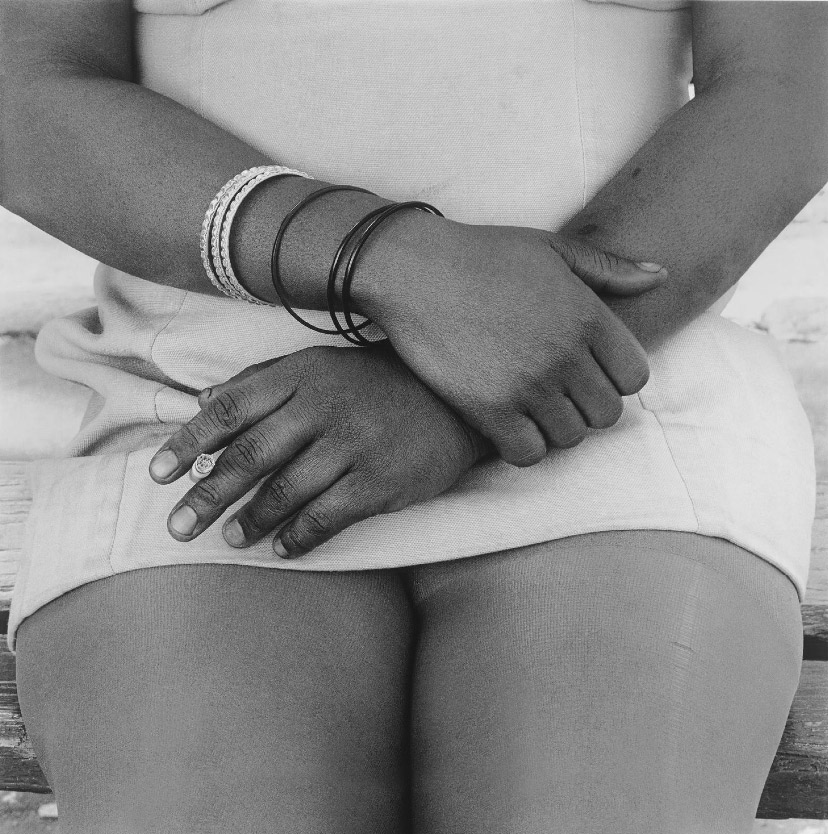
Closed Wednesday

The Metropolitan Museum of Art website
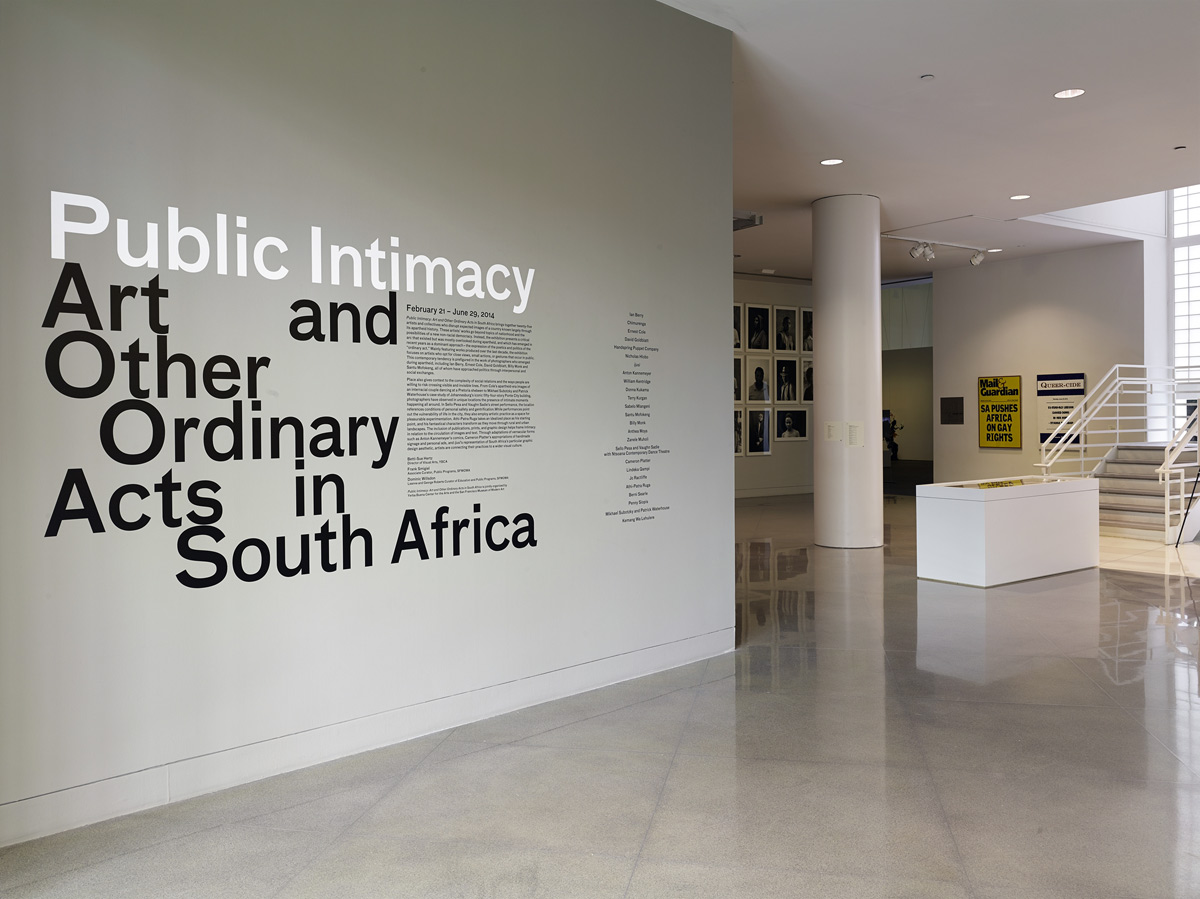
LIKE ART BLART ON FACEBOOK

Back to top

Exhibition: ‘Public Intimacy: Art and Other Ordinary Acts in South Africa’ at the Yerba Buena Center for the Arts, San Francisco

Exhibition dates: 21st February – 29th June 2014

Exhibition artists

Public Intimacy presents

~ Photography by Ian Berry, Ernest Cole, David Goldblatt, Terry Kurgan, Sabelo Mlangeni, Santu Mofokeng, Billy Monk, Zanele Muholi, Lindeka Qampi, Jo Ractliffe, and Mikhael Subotzky and Patrick Waterhouse
~ Video works by William Kentridge, Donna Kukama, Anthea Moys, and Berni Searle
~ Painting and sculpture by Nicholas Hlobo and Penny Siopis
~ Puppetry by Handspring Puppet Company
~ Publications, prints, graphic works, and public interventions by Chimurenga, ijusi (Garth Walker), Anton Kannemeyer, and Cameron Platter
~ Performances by Athi-Patra Ruga, Kemang Wa Lehulere, and Sello Pesa and Vaughn Sadie with Ntsoana Contemporary Dance Theatre


Santu Mofokeng (South Africa, 1956-2020) 'Opening Song, Hand Clapping and Bells' 1986


Santu Mofokeng (South Africa, 1956-2020)
Opening Song, Hand Clapping and Bells
1986
From the series Train Church
Pigment print
9 13/16 x 13 3/4 in. (25 x 35cm)
© Santu Mofokeng


Continuing my fascination with South African art and photography, here is another exhilarating collection of work from an exhibition jointly arranged between SFMOMA and the Yerba Buena Center for the Arts, San Francisco. This art has so much joy, life, movement and “colour”. I particularly like The Future White Women of Azania series by Athi-Patra Ruga, who presented his work at the 55th Venice Biennale in the African pavilion. Thank god not another rehashed colonial image, even though he is working with the tropes of myth and the history of Africa as a contemporary response to the post-apartheid era.

Dr Marcus Bunyan


Many thankx to SFMOMA and Yerba Buena Center for the Arts for allowing me to publish the installation photographs in the posting. Most of the other photographs were gathered from the internet. Please click on the photographs for a larger version of the image.


“Disrupting expected images of South Africa, the 25 contemporary artists and collectives featured in Public Intimacy eloquently explore the poetics and politics of the everyday. This collaboration with Yerba Buena Center for the Arts presents pictures from SFMOMA’s collection of South African photography alongside works in a broad range of media, including video, painting, sculpture, performance, and publications – most made in the last five years, and many on view for the first time on the West Coast. Coinciding with the 20th anniversary of democracy in South Africa, Public Intimacy reveals the nuances of human interaction in a country still undergoing significant change, vividly showing public life there in a more complex light.”

Text from the SFMOMA website


Santu Mofokeng (South Africa, 1956-2020) 'Leading in Song, Johannesburg – Soweto Line' 1986


Santu Mofokeng (South Africa, 1956-2020)
Leading in Song, Johannesburg – Soweto Line
1986
From the series Train Church
Pigment print
9 13/16 x 13 3/4 in. (25 x 35cm)
© Santu Mofokeng


Santu Mofokeng (South Africa, 1956-2020) 'Hands in Worship, Johannesburg – Soweto Line' 1986


Santu Mofokeng (South Africa, 1956-2020)
Hands in Worship, Johannesburg – Soweto Line
1986
From the series Train Church
Pigment print
9 13/16 x 13 3/4 in. (25 x 35cm)
© Santu Mofokeng


These images, by the South African photographer Santu Mofokeng, ostensibly depict scenes of segregated transport during apartheid. Yet in their composition they evoke something more: the rhythms and textures of everyday life. Taken from within and among a crowd of commuters, the pictures seem to sway with the velocity of the train carriage. Shards of light blur the edges of figures, interplaying with shifting shadows as passengers move in unison. Titled “Train Church,” Mofokeng’s series was made during a few weeks in 1986, and in South Africa it became veritably synonymous with his name. Mofokeng, who died in January, at the age of sixty-three, was a photographer whose body of work – both images and text – waded through themes of history and land, memory and spirituality, and helped shape the course of South African photography.

Oluremi C. Onabanjo. “How Santu Mofokeng Shaped South African Photography,” on The New Yorker website February 24, 2020 [Online] Cited 10/04/2021.


Santu Mofokeng (South Africa, 1956-2020) 'Supplication, Johannesburg – Soweto Line' 1986


Santu Mofokeng (South Africa, 1956-2020)
Supplication, Johannesburg – Soweto Line
1986
From the series Train Church
Pigment print
9 13/16 x 13 3/4 in. (25 x 35cm)
© Santu Mofokeng


Ian Berry (British, b. 1934) 'Guests at a 'moffie'drag party' Cape Town, South Africa, 1960


Ian Berry (British, b. 1934)
Guests at a ‘moffie’drag party
Cape Town, South Africa, 1960
Silver gelatin photograph


Ian Berry was born in Lancashire, England. He made his reputation in South Africa, where he worked for the Daily Mail and later for Drum magazine. He was the only photographer to document the massacre at Sharpeville in 1960, and his photographs were used in the trial to prove the victims’ innocence.

He moved to South Africa in 1952, where he soon taught himself photography. He worked under the tutelage of Roger Madden, a South African photographer who had been an assistant to Ansel Adams. After some time as an amateur photographer, Berry began photographing communities and weddings. During this period he met Jürgen Schadeberg, also a European immigrant and photographer. Schadeberg was offered a position with the new African Sunday newspaper eGoli but declined, suggesting Berry apply for the position instead. After working there only 10 months, the newspaper closed, and Berry began working for the Benoni City Times, but he soon became more interested in freelance work.

Berry returned to Great Britain and traveled for some time but returned to South Africa in the early 1960s and worked for the Daily Mail. Later Tom Hopkinson, previously editor of the British Picture Post, hired Berry to work for Drum magazine. He was in Sharpeville on 21 March 1960, when a peaceful protest turned violent, leading to the deaths of 69 people and the wounding of 178 others by police. There were no other photographs documenting the events, and Berry’s were entered into evidence in the court proceedings proving that the victims had done nothing wrong. Berry was invited by Henri Cartier-Bresson to join Magnum Photos in 1962 when he was based in Paris; five years later he became a full member. In 1964 he moved to London and began working for Observer Magazine. He has since traveled the globe, documenting social and political strife in China, Republic of Congo, Czechoslovakia, Ethiopia, Israel, Ireland, Vietnam, and the former Soviet Union. He has contributed to publications including Esquire, Fortune, Geo, Life, National Geographic, Paris-Match, and Stern.

Text from the Wikipedia website


Billy Monk (South African, 1937-1982) 'The Catacombs, 30 September 1967' 1967, printed 2011


Billy Monk (South African, 1937-1982)
The Catacombs, 30 September 1967
1967, printed 2011
Gelatin silver print
10 1/16 x 14 15/16 in. (25.56 x 37.94 cm)
Collection SFMOMA, Accessions Committee Fund purchase
© Estate of Billy Monk


Billy Monk (South African, 1937-1982) 'The Catacombs, 5 February 1968' 1968, printed 2011


Billy Monk (South African, 1937-1982)
The Catacombs, 5 February 1968
1968, printed 2011
Gelatin silver print
11 x 16 in. (27.94 x 40.64cm)
Courtesy of Stevenson, Cape Town and Johannesburg
© Estate of Billy Monk


William John Monk (died 31 July 1982) was a South African, known for his photographs of a Cape Town nightclub between 1967 and 1969, during apartheid. In 2012 a posthumous book was published, Billy Monk: Nightclub Photographs. …

When Monk’s work as a bouncer did not work out he took up photography. Still working in The Catacombs, he began to make his living taking pictures of the diverse clientele in a seedy bar. He used a Pentax camera, with a 35 mm focal-length lens, a small flash and Ilford FP4 film. Monk stopped taking pictures in 1969. His photographs show a variety of the underbelly of Cape Town life at the time – ranging from old men with young wives and gay couples, to midgets and mixed race relationships, he shows a side of life under apartheid that is rarely seen elsewhere.

Discovery of his work

Monk’s work was discovered in 1979 by Jac de Villiers, when he moved into Monk’s old studio. Not only were they already well constructed by the photographer, they were also impeccably annotated with dates and names, which made curation a simple and enjoyable process. The first exhibition of Monk’s work took place at the Market Gallery in Johannesburg in 1982 – and although Monk could not attend the event it was subject to much critical acclaim.

Apartheid

Monk was working during apartheid in South Africa – a time when the colour of your skin was indicative of where you could live, work, who you could marry, and where you could drink. The underground lifestyle of The Catacombs allowed for dissent. Monk chose to take pictures originally as a way of making money, by selling them to his clients.

His photographs reveal a variety of clientele. Some are sloppy, some are neat and put together. Many of the women are heavily made up with short dresses, and almost all the photographs are highly sexually charged. The photographs reveal much of what was not allowed under apartheid rule – specifically a variety of same sex and mixed race couples.

Text from the Wikipedia website


Zanele Muholi (South Africa, b. 1972) 'Nomonde Mbusi, Berea, Johannesburg' 2007


Zanele Muholi (South Africa, b. 1972)
Nomonde Mbusi, Berea, Johannesburg
2007
From the Faces and Phases series
Gelatin silver print
23 13/16 in. x 34 1/16 in. (60.5 cm x 86.5cm)
Courtesy of the artist and Stevenson, Cape Town and Johannesburg
© Zanele Muholi


Zanele Muholi, born 1972

Muholi’s work addresses the reality of what it is to be LGBT (lesbian, gay, bisexual, transgender) in South Africa. She identifies herself as a visual activist, dealing with issues of violation, violence and prejudice that she and her community face, despite South Africa’s progressive constitution.

In Faces and Phases, she sets out to give visibility to black lesbians and to celebrate the distinctiveness of individuals through the traditional genre of portraiture. The portraits are taken outdoors with a hand-held camera to retain spontaneity and often shown in a grid to highlight difference and diversity. In the series Beulahs, she shows young gay men, wearing Zulu beads and other accessories usually worn by women, who invert normative gender codes in both costume and pose. At the same time her photographs evoke tourist postcards and recycled stereotypes of Africans and recall traditional anthropological and ethnographic iconography.

Faces and Phases, is a group of black and white portraits that I have been working on from 2006 until now – it has become a lifetime project. The project is about me, the community that I’m part of. I was born in the township: I grew up in that space. Most of us grew up in a household where heterosexuality was the norm. When you grow up, you think that the only thing that you have to become as a maturing girl or woman is to be with a man; you have to have children, and also you need to have lobola or “bride price” paid for you. For young men, the expectation for them is to be with women and have wives and procreate: that’s the kind of space which most of us come from. We are seen as something else by society – we are seen as deviants. We’re not going to be here forever, and I wanted to make sure that we leave a history that is tangible to people who come after us.”

Zanele Muholi, interviewed by Tamar Garb, South Africa, 2010.
Text from the V&A website


David Goldblatt (South Africa, 1930-2018) 'Woman smoking, Fordsburg, Johannesburg' 1975


David Goldblatt (South Africa, 1930-2018)
Woman smoking, Fordsburg, Johannesburg
1975
Pigment inkjet print
23 5/8 in. x 29 1/2 in. (60 cm x 75cm)
Collection SFMOMA, Accessions Committee Fund purchase
© David Goldblatt


David Goldblatt HonFRPS (29 November 1930 – 25 June 2018) was a South African photographer noted for his portrayal of South Africa during the period of apartheid. After apartheid had ended he concentrated more on the country’s landscapes. What differentiates Goldblatt’s body of work from those of other anti-apartheid artists is that he photographed issues that went beyond the violent events of apartheid and reflected the conditions that led up to them. His forms of protest have a subtlety that traditional documentary photographs may lack: “[M]y dispassion was an attitude in which I tried to avoid easy judgments. … This resulted in a photography that appeared to be disengaged and apolitical, but which was in fact the opposite.”


Jointly organised by the San Francisco Museum of Modern Art (SFMOMA) and Yerba Buena Center for the Arts (YBCA), Public Intimacy: Art and Other Ordinary Acts in South Africa brings together 25 artists and collectives who disrupt expected images of a country known through its apartheid history. The exhibition features an arc of artists who look to the intimate encounters of daily life to express the poetics and politics of the “ordinary act,” with work primarily from the last five years as well as photographic works that figure as historical precedents. On view at YBCA February 21 through June 29, 2014, Public Intimacy presents more than 200 works in a wide range of mediums, many of them making U.S. or West Coast debuts.

The exhibition joins SFMOMA’s important and growing collection of South African photography with YBCA’s multidisciplinary purview and continued exploration of the Global South. Significant documentary photography is paired with new photographs and work in other mediums, including video, painting, sculpture, performance, and publications, to reveal the multifaceted nuances of everyday life in a country still undergoing significant change. Coinciding with the 20th anniversary of democracy in South Africa, Public Intimacy looks at the way artists imagine present and future possibilities in South Africa. A new orientation emerges through close-up views of street interactions, portraiture, fashion and costume, unfamiliar public actions, and human imprints on the landscape.

The exhibition’s three curators – Betti-Sue Hertz, director of visual arts at YBCA; Frank Smigiel, associate curator of public programs at SFMOMA; and Dominic Willsdon, Leanne and George Roberts Curator of Education and Public Programs at SFMOMA – developed the show after visits to South Africa, where they met with artists, curators, and critics. The exhibition – and a companion publication to be published in fall 2014 – grew out of this research.

“Although South Africa’s political history remains vital to these artists and is important for understanding their work, Public Intimacy offers a more subtle view of the country through personal moments,” said Hertz. “It goes against expectations in order to reveal the smaller gestures and illuminate how social context has affected artists and how they work.”

“The familiar image of contemporary South Africa as a place of turmoil is, of course, not the whole story,” added Willsdon. “The art in this exhibition restages how those violent incidents fit in the broader realm of human interactions – a way of showing public life there in a more complex light.”

“Another central aspect of the exhibition is live performance,” said Smigiel. “Three major live works will unfold both in and outside the gallery context, offering a way to situate and reframe San Francisco through the lens of what artists are producing in South Africa.”

Public Intimacy is part of SFMOMA’s collaborative museum exhibitions and extensive off-site programming taking place while its building is temporarily closed for expansion construction through early 2016. As neighbours across Third Street in San Francisco, YBCA and SFMOMA have partnered in the past on various performance and exhibition projects, but Public Intimacy represents the deepest collaboration of shared interests to date between the two institutions. It also brings together SFMOMA’s approach to curating live art and YBCA’s multidisciplinary interest in exhibitions, social practice, and performances.

Exhibition highlights

While the exhibition explores new approaches to daily life in post-apartheid South Africa, it also makes visible the continued commitment of artists to activism and contemporary politics. Beginning with photographs from the late 1950s and after, the exhibition includes vital moments in the country’s documentary photography – from Ian Berry’s inside look at an underground drag ball to Billy Monk’s raucous nightclub photos – each capturing a moment of celebration within different social strata of South African society. Ernest Cole’s photographs of miners’ hostels and bars and Santu Mofokeng’s stirring photographs of mobile churches on commuter trains reveal everyday moments both tender and harsh.

David Goldblatt’s photographs depict the human landscape in apartheid and after, providing the genesis of the idea of “public intimacy.” Over decades of photographs in urban, suburban, and rural locations, Goldblatt has chronicled the changing nature of interpersonal engagement in South Africa. At the same time, they provide a historical backdrop and visual precedent for other artists in the exhibition, including Zanele Muholi and Sabelo Mlangeni.

Muholi has won several awards for her powerful photographic portraits as well as her activism on behalf of black lesbians in South Africa. Although best known for her photographs – in particular her Faces and Phases series – Muholi continuously experiments with an expanded practice including documentary film, beadwork, text, and her social-action organisation Inkanyiso, which gives visibility to conditions facing lesbians of colour in her country. “Sexual politics has been looked at less than racial politics in South Africa, but in many ways, the two have always been intertwined,” said Willsdon.

Mikhael Subotzky and Patrick Waterhouse bring another perspective to the upheavals of life in the city of Johannesburg with works from their Ponte City (2008-10) series, comprised of photographs, video, and a publication offering various views of this centrally located and iconic 54-story building. The works illustrate the struggles facing many native and immigrant South Africans in the years following the dissolution of apartheid, including stalled economic growth and social opportunities.

In contrast to the daily realities pictured in photographic works in the exhibition, Athi-Patra Ruga’s ongoing performance series The Future White Women of Azania (2010-present) features fantastical characters – usually played by the artist – whose upper bodies sprout colourful balloons while their lower bodies pose or process in stockings and high heels. Ruga’s Azania is a changing utopia, and Smigiel notes the shift: “The balloons are filled with liquid, and as the figure moves through the streets, they start popping, so the character dissolves and reveals a performer, and the liquid spills out and into a rather sloppy line drawing.” A new iteration of the series, The Elder of Azania, will premiere in the YBCA Forum during the exhibition’s opening weekend.

Chimurenga, an editorial collective working at the intersection of pan-African culture, art, and politics produces publications, events, and installations. Founded in 2002 by Ntone Edjabe, the collective has created the Chimurenga Library, an online archiving project that profiles independent pan-African paper periodicals from around the world. Expanding upon this concept, their presence in Public Intimacy will have two elements: a text and media resource space in YBCA’s galleries and an intervention at the San Francisco Public Library main branch that will explore the history of pan-African culture in the Bay Area, scheduled to open in late May.

Providing one of the most personally vulnerable moments in the exhibition, Penny Siopis’s series of 90 small paintings on enamel, Shame (2002), provokes a visceral reaction. With red paint reminiscent of blood and bruises, Siopis mixes colour and text in an attempt to convey emotion rather than narrative. While she is interested in the guilt and embarrassment most frequently associated with shame, she also looks at the possibility for empathy that emerges from traumatic experiences.

In all of these works, explains Hertz, “We are looking at how art and activism align, but we’re also interested in how politics is embedded in less obviously political practices, such as Sabelo Mlangeni’s photographs of mining workers’ hostels, Penny Siopis’s powerful painting series about human vulnerability, or Nicholas Hlobo’s large-scale, organically shaped sculptures made primarily of rubber.

Text from the SFMOMA website


Installation view of the exhibition 'Public Intimacy: Art and Other Ordinary Acts in South Africa' at the Yerba Buena Center for the Arts, San Francisco

Installation view of the exhibition 'Public Intimacy: Art and Other Ordinary Acts in South Africa' at the Yerba Buena Center for the Arts, San Francisco

Installation view of the exhibition 'Public Intimacy: Art and Other Ordinary Acts in South Africa' at the Yerba Buena Center for the Arts, San Francisco

Installation view of the exhibition 'Public Intimacy: Art and Other Ordinary Acts in South Africa' at the Yerba Buena Center for the Arts, San Francisco

Installation view of the exhibition 'Public Intimacy: Art and Other Ordinary Acts in South Africa' at the Yerba Buena Center for the Arts, San Francisco

Installation view of the exhibition 'Public Intimacy: Art and Other Ordinary Acts in South Africa' at the Yerba Buena Center for the Arts, San Francisco


Installation views of the exhibition Public Intimacy: Art and Other Ordinary Acts in South Africa at the Yerba Buena Center for the Arts, San Francisco with, in the last photo, Nicholas Hlobo, Umphanda ongazaliyo (installation view), 2008; rubber, ribbon, zips, steel, wood, plaster; ICA Boston; © Nicholas Hlobo; photo: John Kennar.


Sabelo Mlangeni (South Africa, b. 1980) 'Couple Bheki and Sipho' 2009


Sabelo Mlangeni (South Africa, b. 1980)
Couple Bheki and Sipho
2009
From the series Country Girls
Gelatin silver print
40 x 30cm
Courtesy the artist and Stevenson, Cape Town and Johannesburg
© Sabelo Mlangeni


Figures & Fictions: Sabelo Mlangeni from Victoria and Albert Museum on Vimeo.


Anton Kannemeyer (South Africa, b. 1967) 'D is for dancing ministers' 2006


Anton Kannemeyer (South Africa, b. 1967)
D is for dancing ministers
2006
From the series Alphabet of Democracy
Lithograph on Chine Collé
22 1/16 x 24 in. (56 x 61cm)
Courtesy the artist and Stevenson, Cape Town and Johannesburg
© Anton Kannemeyer


Anton Kannemeyer (born 1967) is a South African comics artist, who sometimes goes by the pseudonym Joe Dog.

Anton Kannemeyer was born in Cape Town. He studied graphic design and illustration at the University of Stellenbosch, and did a Master of Arts degree in illustration after graduating. Together with Conrad Botes, he co-founded the magazine Bitterkomix in 1992 and has become revered for its subversive stance and dark humour. He has been criticised for making use of “offensive, racist imagery”. Kannemeyer himself said that he gets “lots of hate mail from white Afrikaners”.

His works challenge the rigid image of Afrikaners promoted under Apartheid, and depict Afrikaners having nasty sex and mangling their Afrikaans. “X is for Xenophobia”, part of his “Alphabet of Democracy”, depicts Ernesto Nhamwavane, a Mozambican immigrant who was burnt alive in Johannesburg in 2008. Some of Kannemeyer’s works deal with the issues of race relations and colonialism, by appropriating the style of Hergé’s comics, namely from Tintin in the Congo. In “Pappa in Afrika”, Tintin becomes a white African, depicted either as a white liberal or as a racist white imperialist in Africa. In this stereotyped satire, the whites are superior, literate and civilised, and the blacks are savage and dumb. In “Peekaboo”, a large acrylic work, the white African is jumping up in alarm as a black man figure pokes his head out of the jungle shouting an innocuous ‘peekaboo!’ A cartoon called “The Liberals” has been interpreted as an attack on white fear, bigotry and political correctness: a group of anonymous black people (who look like golliwogs) are about to rape a white lady, who calls her attackers “historically disadvantaged men”.

Text from the Wikipedia website


Terry Kurgan (South Africa, b. 1958) 'Hotel Yeoville' 2012


Terry Kurgan (South Africa, b. 1958)
Hotel Yeoville
2012
Digital print on bamboo hahnemulle paper
Courtesy the artist
© Terry Kurgan


Penny Siopis (South Africa, b. 1953) 'Untitled' from the series 'Shame' 2002


Penny Siopis (South Africa, b. 1953)
Untitled from the series Shame
2002
Paint on enamel
© Penny Siopis


Siopis established herself as one of the most talented and challenging artists in South Africa and beyond, by working across painting, installation and film, bringing together diverse references and materials in ways that disturb disciplinary boundaries and binaries.

Concepts of time run through all her work often manifesting in the actual physical changes of her materials; in her early cake paintings oil paint is made to be unnaturally affected by gravity, age and decay; in her films using archival footage time is marked as much by the effects of age on the celluloid as by the historical period caught in the sweep of the camera; in her accumulations of found objects in her installations, ideas of the heirloom come to the fore with her ongoing conceptual work Will (1997- ) – in which she bequeaths objects to beneficiaries – being the ultimate time piece only becoming complete on her death; her glue and ink paintings index flux as they record the material transformation that happens when viscous glue matter reacts with pigment, gravity, the artist’s bodily gestures, and the drying effects of the air.

Siopis sees her art practice as ‘open form’, operating as an intimate model in which the physical changes of her materials can be extrapolated into a larger ethics of personal and political transformation. According to Achille Mbembe this quality marks her interest in process as a perpetual state of becoming and entails “the crafting of an unstable relation between form and formlessness, in the understanding that the process of becoming proceeds in ways that are almost always unpredictable and at times accidental.”

Shame paintings

Siopis began the Shame paintings in 2002 and they became a key feature of her exhibition Three Essays on Shame (2005), an intervention in the museum of Sigmund Freud, once his house, in London. It was part of a project that marked the centenary of Freud’s groundbreaking publication Three Essays on the Theory of Sexuality. Responding to Freud, Siopis’ installation consisted of three parts located in Freud’s study (with the famous couch), dining room and bedroom and titled Voice, Gesture and Memory. The small paintings shown in a grid in this room were presented as a frieze in the Memory section of the original exhibition. The artist invokes this exhibition here through the arrangement of some of the objects from the installation on a table reminiscent of that in Freud’s dining room, where she had placed Baubo, one of Freud’s objects from his collection of antiquities. Baubo is a small terracotta figurine who gestures to her genitalia in a provocative way, an act some have interpreted as a show of shame that speaks of both vulnerability and empowerment.

In the installation Siopis also evoked a complex dialogue between Freud’s ideas and her personal experiences by inserting references (voice recordings and objects) to the traumatic proceedings of the South African Truth and Reconciliation Commission and colonial and apartheid history. Once again she was interested in binding the traces of human vulnerability and the dramatic effects of sweeping historical narratives.

In this body of work Siopis manipulates thick and gooey lacquer gel paint, used in home-craft to create stained glass and coloured mirror effects on surfaces. For her it is a physical process that moulds anxiety into form. It translates the result of childhood trauma that we know as shame onto a painted surface. Through the reflective qualities of the medium Siopis blends the bodily sensation with the experience of being looked at, both of which define shame. The use of language in the form of ready-made rubber stamped clichés that clash with the raw power of this familiar emotion further underscores the ‘unspeakable’ character of the experience.

Text from the Wikipedia website


Athi-Patra Ruga (South Africa, b. 1984) 'The Future White Women of Azania' 2012


Athi-Patra Ruga (South Africa, b. 1984)
The Future White Women of Azania
2012
Performed as part of Performa Obscura in collaboration with Mikhael Subotzky
Commissioned for the exhibition Making Way, Grahamstown, South Africa
Photo: Ruth Simbao, courtesy Athi-Patra Ruga and WHATIFTHEWORLD/GALLERY


Athi-Patra Ruga (South Africa, b. 1984) 'The Future White Women of Azania' 2012


Athi-Patra Ruga (South Africa, b. 1984)
The Future White Women of Azania
2012
Performed as part of Performa Obscura in collaboration with Mikhael Subotzky
Commissioned for the exhibition Making Way, Grahamstown, South Africa
Photo: Ruth Simbao, courtesy Athi-Patra Ruga and WHATIFTHEWORLD/GALLERY


Athi-Patra Ruga (born in 1984) is a South African artist who uses performance, photography, video, textiles, and printmaking to explore notions of utopia and dystopia, material and memory. His work explores the body in relation to sensuality, culture, and ideology, often creating cultural hybrids. Themes such as sexuality, HIV/AIDS, African culture, and the place of queerness within post-apartheid South Africa also permeate his work. …

Future White Women of Azania (FWWoA, 2010-2016)

FWWoA consists of several works, including performance, tapestry, sculpture, video, and photography creating a saga. FWWoA is an allegory of post apartheid nationalism, where Ruga then becomes the “elder” or historian. Creating this constellationary history, drawing references from pre Xhosa history and post apartheid South Africa, tells the history of the non-dynastic line of queens who rule the lands of Azania. Ruga’s works are attentive to the demands for justice for his ancestors and the need for radical transformation in the future, to shatter the ideologies of “rainbowism”. By using Azania as the framework for a critical history of South Africa, FWWoA reveals the silencing of black voices that extends back to the first moments of colonial contact, while also addressing the impossible and unrealized ideologies of forgiveness, reconciliation and redemption practiced in a post apartheid South African.

Azania’s allegorical capacity derives from its status as a symbol of a liberated South Africa during the anti-apartheid struggle. However, the term has a specific history that complicates such dreams. The place name ‘Azania’ first appears in The Periplus of the Erythraean Sea (40 AD) to refer to the lands of southern and eastern Africa. By designating the lands of Africa as ‘Azania’, Ruga understands the label as one example in a long history of constructing Africa as uninhabited until European colonial contact.

Ruga’s tapestries in the FWWoA saga chronicles allegorical depictions of queens, maps, and other iconography of Azania. The struggles of the non-dynastic line of queens depicting signifiers of an Azanian national identity: national seal, crest, flower, maps, while also including Ruga’s long standing interest in popular culture. Taking inspirations from Gustave Eiffel’s ‘Statue of Liberty’ or Eugene Delacroix’s ‘Liberty Leading the People’, Ruga brings about the idea of objectifying the woman’s body as the conflict, but in his own work creates them as powerful but passive. In his work ‘The Lands of Azania’, Ruga reworks the map of Eastern Africa. Insetting a national animal, the saber-tooth zebra, the Azanian flag, and giving several countries new names. Throughout the geography of Azania he further explores the overlaps of exile and diaspora in the African and Jewish communities.

A narrative with five characters, a national flower, crest and animal including the rainbow coloured balloon characters. One of Ahti-Patra’s goals was to make a myth accessible even for children. A cute figure that has the capacity to be festive, create fanfare yet become disquieting when it violently pops and bleeds.

Text from the Wikipedia website


Athi-Patra Ruga (South Africa, b. 1984) 'The Night of the Long Knives I' 2013


Athi-Patra Ruga (South Africa, b. 1984)
The Night of the Long Knives I
2013


Archival inkjet Print on Photorag Baryta
202 x 157cm


The Future White Woman of Azania is an ongoing series of performances first conceived in 2010 and evolving to engage new definitions of nationhood in relation to the autonomous body. In the enactment of the site-specific work commissioned for the 55th Venice Biennale, the performance takes the form of an absurdist funerary procession. The participants are the ABODADE – the sisterhood order of Azania and the central protagonist – The Future White Woman.

“Azania, as a geographic location, is first described in 1stCentury Greek records of navigation and trade, The Peryplus of the Erythrean Sea and is thought to refer to a portion of the East and Southern African coast. The word Azania itself is thought to have been derived from an Arabic word referring to the ‘dark-skinned inhabitants of Africa.’

Azania is then eulogised in the black consciousness movement as a pre-colonial utopian black homeland – this Promised Land, referenced in struggle songs, political sermons and African Nationalist speeches. In Cold War pop culture, Marvel Comics used Azania as a fictional backdrop to a Liberation story that bares a close resemblance to the situation that was Apartheid in Old South Africa… so it is at once a mythical and faintly factual place/state that this performance unfolds… Who are the Azanians for what it’s worth? It is in this liminal state that the performance unfolds…”

Seeking to radically reimage the potential of Azania and its inhabitants, the performance questions the mythical place that we mourn for and asks who its future inhabitants may be. Using the “Nation-Finding language of pomp and procession,” Ruga proposes a bold and iconoclastic break with the past Utopian promise of the elders and instead presents us with a new potential and hybridity.

Text from the Athi-Patra Ruga blog March 17, 2015 [Online] Cited 08/04/2021.


Athi-Patra Ruga (South Africa, b. 1984) 'Uzuko' 2013


Athi-Patra Ruga (South Africa, b. 1984)
Uzuko
2013
Wool, thread and artificial flowers on tapestry canvas
200 x 180 cm


Athi-Patra Ruga is one of a handful of artists, working in South Africa today, who has adopted the tropes of myth as a contemporary response to the post-apartheid era. Ruga has always worked with creating alternative identities that sublimate marginalised experience into something strangely identifiable.

In The Future White Women of Azania he is turning his attention to an idea intimately linked to the apartheid era’s fiction of Azania – a Southern African decolonialised arcadia. It is a myth that perhaps seems almost less attainable now than when the Pan Africanist Congress (PAC) appropriated the name in 1965 as the signifier of an ideal future South Africa – then at least was a time to dream more optimistically largely because the idea seemed so infinitely remote.

But Ruga, in his imaginings of Azania, has stuck closer to the original myth, situating it in Eastern Africa as the Roman, Pliny the Elder, did in the first written record of the name. Here Ruga in his map The Lands of Azania (2014-2094) has created lands suggestive of sin, of decadence and current politics. Countries named Palestine, Sodom, Kuntistan, Zwartheid and Nunubia are lands that reference pre-colonial, colonial and biblical regions with all their negative and politically disquieting associations. However, in what seems like something of a response to the ‘politically’ embroidered maps of the Italian artist Alighiero e Boetti, Ruga infers that the politicisation of words are in a sense prior to the constructed ideology of the nation state.

What is more Azania is a region of tropical chromatic colours, which is populated with characters whose identities are in a state of transformation. At the centre of the panoply of these figures stands The Future White Woman whose racial metamorphosis, amongst a cocoon of multi-coloured balloons, suggests something disturbing, something that questions the processes of a problematic cultural assimilation. And it is here that the veracity of the myth of a future arcadia is being disputed if not entirely rejected.

To be sure, unlike Barthes’ suggestion in his essay ‘Myth Today’, Ruga is not creating myth in an act that depoliticises, simplifying form in order to perpetuate the idea of an erroneous future ‘good society’. Instead, placing himself in amongst the characters in a lavish self portrait Ruga imagines himself into the space of the clown or jester (much like the Rococo painter Watteau did in his painting ‘Giles’), into the space of interpreter as well as a cultural product of the forces outside of his own control.

Ruga’s Azania is a world of confusing transformations whose references are Rococo and its more modern derivative Pop. But whatever future this myth is foreshadowing, with its wealth, its tropical backdrop, its complicated and confusing identities, it is not a place of peaceful harmony – or at least not one that is easily recognisable. As Ruga adumbrated at a recent studio visit, his generation’s artistic approach of creating myths or alternative realities is in some ways an attempt to situate the traumas of the last 200 years in a place of detachment. That is to say at a farsighted distance where their wounds can be contemplated outside of the usual personalised grief and subjective defensiveness.

Statement from WHATIFTHEWORLD.com on the Empty Kingdom website [Online] Cited 20/06/2014. No longer available online


Mikhael Subotzky and Patrick Waterhouse. 'Ponte City from Yeoville Ridge' 2008


Mikhael Subotzky and Patrick Waterhouse
Ponte City from Yeoville Ridge
2008
Lightjet chromogenic print
Courtesy the artists and Goodman Gallery
© Mikhael Subotzky and Patrick Waterhouse


Mikhael Subotzky and Patrick Waterhouse. 'Ponte City, Johannesburg' 2008


Mikhael Subotzky and Patrick Waterhouse
Ponte City, Johannesburg
2008
Lightjet chromogenic print
Courtesy the artists and Goodman Gallery
© Mikhael Subotzky and Patrick Waterhouse


Mikhael Subotzky and Patrick Waterhouse. 'Ponte City, Johannesburg' 2008


Mikhael Subotzky and Patrick Waterhouse
Ponte City, Johannesburg
2008
Lightjet chromogenic print
Courtesy the artists and Goodman Gallery
© Mikhael Subotzky and Patrick Waterhouse


Mikhael Subotzky and Patrick Waterhouse. 'Cleaning the Core, Ponte City, Johannesburg' 2008


Mikhael Subotzky and Patrick Waterhouse
Cleaning the Core, Ponte City, Johannesburg
2008
Lightjet chromogenic print
49 7/16 x 59 1/16 in. (125.5 x 150cm)
Courtesy the artists and Goodman Gallery
© Mikhael Subotzky and Patrick Waterhouse


Mikhael Subotzky and Patrick Waterhouse. 'Untitled I, Ponte City, Johannesburg' 2008


Mikhael Subotzky and Patrick Waterhouse
Untitled I, Ponte City, Johannesburg
2008
Lightjet chromogenic print
Courtesy the artists and Goodman Gallery
© Mikhael Subotzky and Patrick Waterhouse


Originally intended as a nuclear point in the upwardly mobile social cartography of Johannesburg’s Hillbrow, the 173 meter-high cylindrical apartment building Ponte City became an urban legend, and an essential part of visual renderings of the city. It was the conflicted spectacle of Ponte City that drew South African photographer, Mikhael Subotzky and Patrick Waterhouse, a British artist, to look more closely in rather than at the tower.


Mikhael Subotzky and Patrick Waterhouse. 'Lift Portrait 2, Ponte City, Johannesburg (0328)' 2008


Mikhael Subotzky and Patrick Waterhouse
Lift Portrait 2, Ponte City, Johannesburg (0328)
2008
C-print mounted on Dibond
124 cm x 151.5cm


Yerba Buena Center for the Arts
701 Mission Street
San Francisco, CA 94103

Opening hours:
Sunday and Wednesday noon – 6.00pm
Thursday – Saturday noon – 8.00pm
Free First Tuesday of the month noon – 8.00pm

SFMOMA website

LIKE ART BLART ON FACEBOOK

Back to top

Exhibition: ‘Apartheid and After’ at Huis Marseille – Museum for Photography, Amsterdam

Exhibition dates: 15th March – 8th June 2014

Curators: Els Barents, David Goldblatt

Artists: David Goldblatt met Paul Alberts, Pieter Hugo, Santu Mofokeng, Sabelo Mlangeni, Zanele Muholi, Jo Ractliffe, Michael Subotzky, Guy Tillim, Graeme Williams and others, and the Market Photo Workshop in Johannesburg


Santu Mofokeng (South African, 1956-2020) 'Sunflowers harvest, Vaalrand farm, Bloemhof' 1988


Santu Mofokeng (South African, 1956-2020)
Sunflowers harvest, Vaalrand farm, Bloemhof
1988
From the Bloemhof Series, 1988-1989, 1994


A raft of exhibitions finishing on the 8th June 2014 means a lot of postings over the next few days. This posting continues my fascination with African photography. The two excellent photographs by David Goldblatt are the stand out here, along with the portrait by Mikhael Subotzky.

Marcus


Many thankx to Huis Marseille for allowing me to publish the photographs in the posting. Please click on the photographs for a larger version of the image.


Santu Mofokeng (South African, 1956-2020) 'Windmill, Vaalrand' 1988


Santu Mofokeng (South African, 1956-2020)
Windmill, Vaalrand
1988
From the Bloemhof Series, 1988-1989, 1994


Jo Ractliffe (South African, b. 1961) 'Military watchtower in a domestic garden, Riemvasmaak' 2013


Jo Ractliffe (South African, b. 1961)
Military watchtower in a domestic garden, Riemvasmaak
2013
From The Borderlands (2011-2013)


Jo Ractliffe (South African, b. 1961) 'Playing soccer with marbles, Platfontein' 2012


Jo Ractliffe (South African, b. 1961)
Playing soccer with marbles, Platfontein
2012
From The Borderlands (2011-2013)


Graeme Williams (South African, b. 1958) 'Kempton Park' Nd


Graeme Williams (South African, b. 1958)
Kempton Park
Nd
From Previously Important Places series 1990s -2013


The Emperors Palace Casino and Chariots Entertainment World was build on the site [ in… add please date and place… ]? were the negotiations leading up to the Convention for a Democratic South Africa (CODESA) took place. Now, at the very same place  a statue of the Roman Emperor Caesar Augustus greets visitors at the entrance of the afore mentioned  entertainment centre.


Pieter Hugo (South African, b. 1976) 'In Sipho Ntsibande's Home, Soweto' 2013


Pieter Hugo (South African, b. 1976)
In Sipho Ntsibande’s Home, Soweto
2013
from the series Kin, 2013


Guy Tillim (South African, b. 1962) 'Neri James, Petros Village, Malawi' 2006


Guy Tillim (South African, b. 1962)
Neri James, Petros Village, Malawi
2006
from the series Petros Village, 2006


“The scars left in South Africa’s collective memory by its apartheid regime were also inscribed visually on its collective retina. There is less consensus, however, on the period of ‘truth and reconciliation’ after political apartheid came to an end in South Africa in 1990. The exhibition Apartheid and After addresses the question: where did photographers whose earlier work had opposed the apartheid regime point their cameras after 1980?

They include David Goldblatt, for instance, now an éminence grise of South African photography whose exhibition Cross Sections hung in Huis Marseille and others. Has South African democracy been given a face? Where is the real development happening? And where are the scars? Has South African national identity got stuck on a runaway merry-go-round, as the South African visual artist William Kentridge has suggested? One thing is clear: after apartheid, most South African photographers continued to make their own country their work domain, and in doing so they have gained a considerable international reputation.”


“It is astonishing to think that until the beginning of the 1990s, merely two decades ago, modern and contemporary African photography was largely in the shadows.”

Okwui Enwezor in Events of the Self: Portraiture and Social Identity: Contemporary African Photography from the Walther Collection, Steidl, 2013, p. 23.


David Goldblatt (South African, 1930-2018) 'Child minder, Joubert Park, Johannesburg, 1975 (no.11)' 1975


David Goldblatt (South African, 1930-2018)
Child minder, Joubert Park, Johannesburg, 1975 (no.11)
1975
From the series Particulars, 2003 (publishing date)


David Goldblatt (South African, 1930-2018) 'Man on a beach, Joubert Park, Johannesburg, 1975 (no. 2)' 1975


David Goldblatt (South African, 1930-2018)
Man on a beach, Joubert Park, Johannesburg, 1975 (no. 2)
1975
From the series Particulars, 2003 (publishing date)


Sabelo Mlangeni (South African, b. 1980) 'Coming to Johannesburg I, January, 2011' 2011


Sabelo Mlangeni (South African, b. 1980)
Coming to Johannesburg I, January, 2011
2011


Sabelo Mlangeni (South African, b. 1980) 'Coming to Johannesburg I, January, 2011' 2011


Sabelo Mlangeni (South African, b. 1980)
Coming to Johannesburg I, January, 2011
2011


Daniel Naudé (South African, b. 1984) 'Africanis 23. Richmond, Northern Cape, 298 January 2009' 2009


Daniel Naudé (South African, b. 1984)
Africanis 23. Richmond, Northern Cape, 298 January 2009
2009


Mikhael Subotzky (South African, b. 1981) 'Joseph Dlamini (Eye test), Matsho Tsmombeni squatter camp' 2012


Mikhael Subotzky (South African, b. 1981)
Joseph Dlamini (Eye test), Matsho Tsmombeni squatter camp
2012
From the series Retinal Shift


Graeme Williams (South African, b. 1958) 'Nelson Mandela speaks at CODESA, 199..?' Nd


Graeme Williams (South African, b. 1958)
Nelson Mandela speaks at CODESA, 199..?
Nd
From Previously Important Places series 1990s-2013


Zanele Muholi (South African, b. 1972) 'Being (T)here (Amsterdam)' 2009

Zanele Muholi (South African, b. 1972) 'Being (T)here (Amsterdam)' 2009

Zanele Muholi (South African, b. 1972) 'Being (T)here (Amsterdam)' 2009


Zanele Muholi (South African, b. 1972)
Being (T)here (Amsterdam)
2009


This slideshow requires JavaScript.


Paul Alberts (South African, 1946-2010) 'The portraits of the applicants' 1994

Paul Alberts (South African, 1946-2010) 'The portraits of the applicants' 1994

Paul Alberts (South African, 1946-2010) 'The portraits of the applicants' 1994

Paul Alberts (South African, 1946-2010) 'The portraits of the applicants' 1994


Paul Alberts (South African, 1946-2010)
The portraits of the applicants
1994


As the 1994 election approached in South-Africa many blacks living in small towns and rural areas had never been officially identified. In order to speed up these otherwise slow procedures, Charmaine and Paul Alberts set up an official, but temporary office and studio to process applications. The portraits of the applicants were taken before a paper back drop in the community hall of Majwemasweu. Each person held a slate with a number that corresponded to the number of the film and exposure, plus their name and place where they lived.


Huis Marseille – Museum for Photography
Keizersgracht 401
1016 EK Amsterdam

Opening hours:
Daily 10am – 6pm
Thursday 10am – 9pm

Huis Marseille – Museum for Photography website

LIKE ART BLART ON FACEBOOK

Back to top

Exhibition: ‘Pieter Hugo: This Must Be The Place – Selected Works 2003-2012’ at the Ludwig Museum of Contemporary Art, Budapest

Exhibition dates: 24th May – 11th August 2013


Pieter Hugo (South African, b. 1976) 'The Hyena Men of Abuja, Nigeria' 2005


Pieter Hugo (South African, b. 1976)
The Hyena Men of Abuja, Nigeria
2005
From the series The Hyena & Other Men
© Pieter Hugo
Courtesy of Stevenson, Cape Town/Johannesburg and Yossi Milo, New York


I have not seen enough of the other series of Pieter Hugo to make an informed decision, but work from the The Hyena & Other Men (2005-2007) and Permanent Error (2009-2010) series, the most often reproduced, is certainly strong. Whether I am fully convinced by his singular frontality is another matter…

Dr Marcus Bunyan

Many thankx to the Ludwig Museum of Contemporary Art for allowing me to publish the photographs in the posting. Please click on the photographs for a larger version of the image.


Installation view of the exhibition 'Pieter Hugo: This Must Be The Place – Selected Works 2003-2012' at the Ludwig Museum of Contemporary Art, Budapest showing work from Hugo's 'The Hyena and Other Men' Nigeria, 2005-2007 


Installation view of the exhibition Pieter Hugo: This Must Be The Place – Selected Works 2003-2012 at the Ludwig Museum of Contemporary Art, Budapest showing work from Hugo’s The Hyena and Other Men Nigeria, 2005-2007
Exhibition view © Tamás Bujnovszky / Ludwig Museum – Museum of Contemporary Art, Archives


Installation view of the exhibition 'Pieter Hugo: This Must Be The Place – Selected Works 2003-2012' at the Ludwig Museum of Contemporary Art, Budapest showing work from Hugo's 'The Hyena and Other Men' Nigeria, 2005-2007 


Installation view of the exhibition Pieter Hugo: This Must Be The Place – Selected Works 2003-2012 at the Ludwig Museum of Contemporary Art, Budapest showing work from Hugo’s The Hyena and Other Men Nigeria, 2005-2007
Exhibition view © Tamás Bujnovszky / Ludwig Museum – Museum of Contemporary Art, Archives


Pieter Hugo (South African, b. 1976) 'The Hyena Men of Abuja, Nigeria' 2005


Pieter Hugo (South African, b. 1976)
The Hyena Men of Abuja, Nigeria
2005
From the series The Hyena & Other Men
© Pieter Hugo
Courtesy of Stevenson, Cape Town/Johannesburg and Yossi Milo, New York


The hyena men are itinerants: they never spend more than two days anywhere. I found them in a shanty town near Abuja, the capital. Despite the language barrier we got to know each other pretty quickly. Outside of Lagos and Port Harcourt, I didn’t see a single white person in Nigeria. So I probably seemed as odd to them as a guy walking a hyena in the street seemed to me.

We smoked some weed to break the ice. It turned out they weren’t debt collectors – they were more like town criers, traditional storytellers who performed in the streets and sold potions after their shows. It reminded me of stories I’d read about eastern European circus troupes in the 1930s – except instead of bears, these guys had hyenas, baboons and pythons.

Seeing them perform was unforgettable. It was a huge spectacle. They would beat drums to draw in the crowds, then take the muzzles off the hyenas. Next they’d put their arms and even their heads between the animals’ jaws. The aim was to convince the audience they had special powers, and that the audience could acquire them too, if they bought their potions.

At first I tried photographing the street shows, but there was just too much going on. Then I realised that the relationship between man and beast was more interesting than all the fireworks of the performance. There was something very strange going on between the guys and the hyenas, bordering on sadomasochism. These animals had been taken out of the wild as pups. They couldn’t return. They were entirely dependent on these guys for food. And these men were dependent on the animals for their livelihoods. They needed each other, but it wasn’t an easy symbiosis. …

I love how confrontational this shot is. At no point did I tell him how to pose. It’s all him. He flexed his bicep, stared straight at me, while his hyena jumped all over him. Then in the background, there’s this kind of Mad Max landscape strewn with broken-down trucks, though you can hardly see them because of the light. It was Harmattan season, a time between November and March when the sands of the Sahara blow over western Africa creating this murky, diffused lighting, which I love. It’s a simple shot with an incredible economy. I wish I could take more like it.

Interview by Edward Siddons. “Pieter Hugo’s best photograph: the hyena men of Nigeria,” on the Guardian website Thursday 19 Jul 2018 [Online] Cited 09/07/2024


Pieter Hugo (South African, b. 1976) 'Naasra Yeti, Agbogbloshie Market, Accra, Ghana' 2009


Pieter Hugo (South African, b. 1976)
Naasra Yeti, Agbogbloshie Market, Accra, Ghana
2009
From the series Permanent Error (2009-2010)
© Pieter Hugo
Courtesy of Stevenson, Cape Town/Johannesburg and Yossi Milo, New York


Pieter Hugo (South African, b. 1976) 'Aissah Salifu, Agbogbloshie Market, Accra, Ghana' 2010


Pieter Hugo (South African, b. 1976)
Aissah Salifu, Agbogbloshie Market, Accra, Ghana
2010
From the series Permanent Error (2009-2010)
© Pieter Hugo
Courtesy of Stevenson, Cape Town/Johannesburg and Yossi Milo, New York


Installation view of the exhibition Pieter Hugo: This Must Be The Place – Selected Works 2003-2012 at the Ludwig Museum of Contemporary Art, Budapest showing at second right, Hugo's 'Obechukwu Nwoye, Enugu' 2008-2009; and at right, 'Escort Kama. Enugu, Nigeria' 2008 (below) both from the series 'Nollywood' (2008-2009)


Installation view of the exhibition Pieter Hugo: This Must Be The Place – Selected Works 2003-2012 at the Ludwig Museum of Contemporary Art, Budapest showing at second right, Hugo’s Obechukwu Nwoye, Enugu 2008-2009; and at right, Escort Kama. Enugu, Nigeria 2008 (below) both from the series Nollywood (2008-2009)
Exhibition view © Tamás Bujnovszky / Ludwig Museum – Museum of Contemporary Art, Archives


Pieter Hugo (South African, b. 1976) 'Escort Kama. Enugu, Nigeria' 2008


Pieter Hugo (South African, b. 1976)
Escort Kama. Enugu, Nigeria
2008
From the series Nollywood (2008-2009)
© Pieter Hugo
Courtesy of Stevenson, Cape Town/Johannesburg and Yossi Milo, New York


Pieter Hugo (South African, b. 1976) 'Chris Nkulo and Patience Umeh. Enugu, Nigeria' 2008


Pieter Hugo (South African, b. 1976)
Chris Nkulo and Patience Umeh. Enugu, Nigeria
2008
From the series Nollywood (2008-2009)
© Pieter Hugo
Courtesy of Stevenson, Cape Town/Johannesburg and Yossi Milo, New York


Pieter Hugo’s (b. Johannesburg, 1976) career is quite young, yet his photography is already so comprehensive that we can rightly speak of a consistent oeuvre. Since 2003 Hugo has photographed people and themes exclusively in sub-Saharan Africa. Daily life in post-colonial Africa, the complex conditions after the end of apartheid in his own land and the impact of global trade and commerce are themes that circulate throughout his intriguing series.

Pieter Hugo spends long periods of time photographing his extensive series in order to capture intimate and often bizarre moments. His use of a large-format camera requires patience and trust between photographer and subject, which is visible in straightforward expressions and candid interactions. There is a moment of calm and even timelessness in these works that allows the viewer to engage more fully with the subject matter.

The political diversity of a continent that is rapidly transforming – some note that Africa will be a global economic power of the future – is portrayed by Pieter Hugo with the clarity of familiar painting genres such as landscape, portraiture, group portraiture and still life. The subjects of his photography: the elderly, the poor, the blind, street artists, soap actors, close family and friends – form a social tableau that is at once personalised while also presenting a more universal image of Africa at the beginning of the twenty first century.

The initial motivation for the series The Hyena & Other Men (2005-2007) comes from a cell phone camera image Pieter Hugo discovered on the internet. The image concerns a group of performers who travel throughout Nigeria with tamed hyenas and other wild animals and collect money from their choreographed public performances. Hugo embarked on two separate trips to document this remarkable nomadic group up close. Hugo presents the complex relationship between animal and owner, capturing moments of calm and tenderness amidst situations full of drama and spectacle.

The Agbogbloshie market on the outskirts of Accra (Ghana) is the thematic of the Permanent Error series (2009-2010), which is mainly a dumping site for the technological waste of the western world. Here computers and other electronic equipment are collected and burned by inhabitants, often children, to extract precious raw materials. These machines formerly representing prosperity and progress are here transformed into only noxious and life threatening vapours. The charred ground, grey sky and scattered groups of foragers and cattle seem isolated from the world, but are in fact one of the last links in a chain of global commerce. Despite the harsh surroundings, the subjects stand tall, identified by full name and framed in the style of classical portraiture.

Nollywood (2008-2009) is the third largest film industry in the world, releasing between 500 and 1,000 movies each year. It produces movies on its own terms, telling stories that appeal to and reflect the lives of its public: it is a rare instance of self-representation on such a scale in Africa. The continent has a rich tradition of story-telling that has been expressed abundantly through oral and written fiction, but has never been conveyed through the popular media before. Stars are local actors; plots confront the public with familiar situations of romance, comedy, witchcraft, bribery, prostitution. The narrative is overdramatic, deprived of happy endings, tragic. The aesthetic is loud, violent, excessive; nothing is said, everything is shouted.

At a morgue in the township of Khayelitsha in Cape Town, Pieter Hugo turns his camera to individuals who have died of AIDS related illnesses. In The Bereaved (2005) as with many of his other series, Hugo gives first and last names of his subjects. Such a personal statement challenges the anonymity of AIDS statistics in South Africa. Ten years after the Rwandan Genocide, Pieter Hugo captures the unimaginable violence of these events through leftover fragments (Vestiges of a Genocide, 2004). The absence of human life is disturbingly present in the images. Bones are preserved with lime so as not to disintegrate. Heavy dust and dirt create an organic seal over the remains. While these substances often signify what is past and forgotten, the items in the photographs are preserved artificially and naturally for all to remember.

The series entitled Messina / Musina (2006) deals with the inhabitants of a small town on the border of Zimbabwe in South Africa’s Limpopo Province. The title reflects the correction of an earlier colonial misspelling of the town’s name (Messina), as well as the transition taking place at this geographical and social periphery.

In Pieter Hugo’s studio portraits of the elderly, the blind and people with albinism – Looking Aside, 2003-2006 – there is a direct and confrontational engagement between the viewer and the subjects. The viewer is made to feel uncomfortable and immobilised by the subject’s gaze. In There’s a Place in Hell for Me and My Friends (2011) – a recent series of portraits realised in the same spirit and adopting a stripped back, close-up and confrontationally direct approach – Hugo explores similar territory [to his earlier series Looking Aside] but from practically the opposite angle. In this case, the subjects are simply the photographer and his friends, who represent an array of ethnicities but are not particularly atypical, abnormal or ‘unusual’ in a genetic sense. Instead they are rendered unusually, portrayed in a heightened monotone with their skin transformed into a range of exaggerated black spots and dark tones.

With Kin (2011), his most autobiographical series to date, Pieter Hugo reflects on his own family and deep ambivalence towards the notion of home. Personal moments such as the pregnancy of his wife, the birth of their child and an operation of his mother are interspersed with national icons: open landscapes, anthropological museums and references to historical places and figures in South Africa. The recent and historical, private and public, rich and poor, ugly and beautiful interact closely in this series and represent the social complexities of post-apartheid South Africa.

Press release from the Ludwig Museum of Contemporary Art website


Installation view of the exhibition 'Pieter Hugo: This Must Be The Place – Selected Works 2003-2012' at the Ludwig Museum of Contemporary Art, Budapest showing work from Hugo's 'Vestiges of a Genocide' Rwanda, 2004


Installation view of the exhibition Pieter Hugo: This Must Be The Place – Selected Works 2003-2012 at the Ludwig Museum of Contemporary Art, Budapest showing work from Hugo’s Vestiges of a Genocide Rwanda, 2004
Exhibition view © Tamás Bujnovszky / Ludwig Museum – Museum of Contemporary Art, Archives

Vestiges of a Genocide

Rwanda, 2004

Ten years after the Rwandan Genocide, Pieter Hugo captures the unimaginable violence of these evens through leftover fragments. The absence of human life is disturbingly person in the images. Bones are preserved with lime so as not to disintegrate. Heavy dust and dirt create an organic seal over the remains. While these substances often signify what is past and forgotten, the items in the photographs are preserved artificially and naturally for all to remember.

Wall text from the exhibition


Pieter Hugo (South African, b. 1976) 'John Kwesi, Wild Honey Collector, Techiman District, Ghana' 2005


Pieter Hugo (South African, b. 1976)
John Kwesi, Wild Honey Collector, Techiman District, Ghana
2005
From the series Wild Honey Collectors Ghana 2005
© Pieter Hugo
Courtesy of Stevenson, Cape Town/Johannesburg and Yossi Milo, New York


Pieter Hugo (South African, b. 1976) 'The Honourable Justice Unity Dow' 2005


Pieter Hugo (South African, b. 1976)
The Honourable Justice Unity Dow
2005
© Pieter Hugo
Courtesy of Stevenson, Cape Town/Johannesburg and Yossi Milo, New York


Installation view of the exhibition 'Pieter Hugo: This Must Be The Place – Selected Works 2003-2012' at the Ludwig Museum of Contemporary Art, Budapest showing work from Hugo's 'Looking Aside: Studio Portraits' South Africa, 2003-2006


Installation view of the exhibition Pieter Hugo: This Must Be The Place – Selected Works 2003-2012 at the Ludwig Museum of Contemporary Art, Budapest showing work from Hugo’s Looking Aside: Studio Portraits South Africa, 2003-2006
Exhibition view © Tamás Bujnovszky / Ludwig Museum – Museum of Contemporary Art, Archives


Looking Aside: Studio Portraits

South Africa, 2003-2006

In Pieter Hugo’s studio portraits of the elderly, the blind and people with albinism there is a direct and confrontational engagement between the viewer and the subjects. The viewer is made to feel uncomfortable and immobilised by the subject’s gaze.

Wall text from the exhibition


Pieter Hugo (South African, b. 1976) 'Steven Mohapi, Johannesburg' 2003


Pieter Hugo (South African, b. 1976)
Steven Mohapi, Johannesburg
2003
From the series Looking Aside: Studio Portraits South Africa, 2003-2006
© Pieter Hugo
Courtesy of Stevenson, Cape Town/Johannesburg and Yossi Milo, New York


Pieter Hugo (South African, b. 1976) 'Themba Tshabalala, Cape Town' 2011


Pieter Hugo (South African, b. 1976)
Themba Tshabalala, Cape Town
2011
From the series There’s a Place in Hell for Me and My Friends
© Pieter Hugo
Courtesy of Stevenson, Cape Town/Johannesburg and Yossi Milo, New York


Installation view of the exhibition 'Pieter Hugo: This Must Be The Place – Selected Works 2003-2012' at the Ludwig Museum of Contemporary Art, Budapest showing work from Hugo's 'There's a Place in Hell for Me and My Friends', 2011


Installation view of the exhibition Pieter Hugo: This Must Be The Place – Selected Works 2003-2012 at the Ludwig Museum of Contemporary Art, Budapest showing work from Hugo’s There’s a Place in Hell for Me and My Friends, 2011
Exhibition view © Tamás Bujnovszky / Ludwig Museum – Museum of Contemporary Art, Archives


There’s a Place in Hell for Me and My Friends

2011

In There’s a Place in Hell for Me and My Friends, a recent series of portraits that adopts a stripped back, close-up confrontationally direct approach – Hugo explores similar territory (to his earlier series Looking Aside, above) but from practically the opposite angle. In this case the subjects are simply the photographer and his friends, who represent an array of ethnicities but are not particularly atypical, abnormal or ‘unusual’ in a genetic sense. Instead they are rendered unusually, portrayed in a heightened monotone with their skin transformed into a range of exaggerated black spots and dark tones.

Wall text from the exhibition


Pieter Hugo (South African, b. 1976) 'Ashleigh McLean' 2011


Pieter Hugo (South African, b. 1976)
Ashleigh McLean
2011
From the series There’s a Place in Hell for Me and My Friends
© Pieter Hugo
Courtesy of Stevenson, Cape Town/Johannesburg and Yossi Milo, New York


Pieter Hugo (South African, b. 1976) 'Yasser Booley, Cape Town' 2011


Pieter Hugo (South African, b. 1976)
Yasser Booley, Cape Town
2011
From the series There’s a Place in Hell for Me and My Friends
© Pieter Hugo
Courtesy of Stevenson, Cape Town/Johannesburg and Yossi Milo, New York


Ludwig Museum of Contemporary Art
1095 Budapest Komor Marcell Street 1
Hungary 06 1 555-3444

Opening hours:
Tuesday – Sunday: 10.00 – 18.00
Closed on Mondays

Ludwig Museum of Contemporary Art website

LIKE ART BLART ON FACEBOOK

Back to top

Exhibition: ‘Distance and Desire: Encounters with the African Archive Part I’ at The Walther Collection, Neu-Ulm, Germany

Exhibition dates: 9th June 2013 – 17th May 2015


Santu Mofokeng (South African, 1956-2020) 'The Black Photo Album / Look at me: 1890-1950' 1997


Santu Mofokeng (South African, 1956-2020)
The Black Photo Album / Look at me: 1890-1950
1997
© Santu Mofokeng / Courtesy of Lunetta Bartz, MAKER, Johannesburg


Another group of interesting colonial African photographs from The Walther Collection. Similar in scope to the 20 volume series The American Indian (1906-1930) by ethnologist and photographer Edward S. Curtis which “documented as much American Indian (Native American) traditional life as possible before that way of life disappeared,” (Wikipedia), A. M. Duggan-Cronin’s 11 volume series The Bantu Tribes of South Africa (1928-1954), “set out to depict what he considered the disappearing indigenous populations of South Africa.” Disappearance and loss are the all to ready themes of these recorders of vanishing races.

“Santu Mofokeng’s The Black Photo Album / Look at Me: 1890-1950 introduces the concept of the photographic archive as both a repository of documents and an assemblage of representations ” (media release). In this work Mofokeng juxtaposes images of “civilised” natives – images urban black working- and middle-class families had commissioned, requested, or tacitly sanctioned without evidence of coercion – with text that spurns, questions or challenges official integrationist policies taking their model from colonial officials and settlers. “The images depicted here reflect their sensibilities, aspirations and their self-image.”

The artist asks:

“Are these mere solemn relics of disrupted narratives or are these images expressive of the general human predicament?”

“Who is gazing”

“Who are these people?”

“What were their aspirations?”

“Did these images serve to challenge prevailing western perceptions of the African?”

“Do these images serve as testimony of mental colonisation?”


Dr Marcus Bunyan


Many thankx to The Walther Collection for allowing me to publish the photographs in the posting. Please click on the photographs for a larger version of the image.


A.M. Duggan-Cronin (South African born Ireland, 1874-1954) 'Korana Girl, Kimberley, South Africa' c. 1900-1930


A.M. Duggan-Cronin (South African born Ireland, 1874-1954)
Korana Girl, Kimberley, South Africa
c. 1900-1930
Gelatin-silver developed-out print
Paper: 5.67 x 3.86 inches (14.4 x 9.8cm)
The Walther Collection


Part I: The Black House: Santu Mofokeng and A.M. Duggan-Cronin

A juxtaposition of A. M. Duggan-Cronin’s The Bantu Tribes of South Africa and Santu Mofokeng’s The Black Photo Album / Look at Me: 1890-1950 introduces the concept of the photographic archive as both a repository of documents and an assemblage of representations. Duggan-Cronin, an Irish South African who lived in the mining town of Kimberley, set out to depict what he considered the disappearing indigenous populations of South Africa. His monumental study, entitled The Bantu Tribes of South Africa, published between 1928-1954, includes photographs, descriptive captions, and anthropological essays. In addition to presenting all eleven Bantu Tribes books, a complete sequence of photogravure plates from The Nguni: Baca, Hlubi, Xesibe (1954) will be on view, alongside a selection of vintage gelatin-silver prints by Duggan-Cronin, which had previously circulated as individual objects.

In contrast to Duggan-Cronin’s renowned and contested ethnographic vision of African heritage, Santu Mofokeng’s The Black Photo Album / Look at Me: 1890-1950 portrays the modern self-representation of African subjects. In the early 1990s, the artist collected family studio portraits from late-nineteenth and early-twentieth century South Africa and transformed the images into a slide show, complete with narratives about the sitters. He also produced a series of gelatin-silver print reproductions of the portraits, which are on view together with a selection of the project’s original vintage prints and Mofokeng’s research notes. Envisioned as a “counter-archive,” The Black Photo Album challenges fixed ideas most often associated with images of Africans.

By placing these two bodies of work alongside one another, Part I of Distance and Desire opens up the question of the “African Archive,” understood here not so much as an official repository of documents and objects but as a contested assemblage of representations that have helped to construct and project a dominant image of Africans that is now under pressure and revision.

Press release from The Walther Collection website


A.M. Duggan-Cronin (South African born Ireland, 1874-1954) 'The Late Chief Jonathan Molapo' South Africa, early twentieth century


A.M. Duggan-Cronin (South African born Ireland, 1874-1954)
The Late Chief Jonathan Molapo
South Africa, early twentieth century
The Walther Collection


A.M. Duggan-Cronin (South African born Ireland, 1874-1954) 'Woman of Middle Age at Moitšupeli’s' South Africa, early twentieth century


A.M. Duggan-Cronin (South African born Ireland, 1874-1954)
Woman of Middle Age at Moitšupeli’s
South Africa, early twentieth century
The Walther Collection


Alfred Martin Duggan-Cronin was an Irish-born South African photographer who undertook several photographic and collecting expeditions in South Africa and adjacent territories between 1919 and 1939, in the course of which he documented people and rural life throughout the subcontinent. Based in Kimberley, it was while working in the mine compounds that he initially encountered African migrant workers, stimulating an interest in ethnographic subjects. Duggan-Cronin was born on 17 May 1874 in Innishannon, County Cork, Ireland, and died on 25 August 1954 in Kimberley, South Africa. …

Duggan-Cronin embarked on the first of his major ethnographic endeavours in 1919 when he went to the Langeberg to photograph the San people living there – the first of many expeditions into Kimberley’s Southern African hinterland. Between the world wars he travelled some 128 000 kilometres, making at least 18 expeditions to photograph the peoples of southern Africa. He was accompanied by his Mfengu assistant, Richard Madela, on some of these expeditions.

A significant number of his photographs were published in The Bantu Tribes of South Africa: Reproductions of Photographic Studies by A.M. Duggan-Cronin, eleven volumes of which appeared under the imprint of the McGregor Memorial Museum, Kimberley, between 1928 and 1954. In 1925 he opened his first ‘Bantu Gallery’ at his home on Kimberley’s outskirts, his collection of some 8,000 photographs and ethnographic objects being more permanently housed at what was named the Duggan-Cronin Bantu Gallery at The Lodge in Kimberley from the late 1930s.

Text from the Wikipedia website


A.M. Duggan-Cronin (South African born Ireland, 1874-1954) 'A Morolong Youth' South Africa, early twentieth century


A.M. Duggan-Cronin (South African born Ireland, 1874-1954)
A Morolong Youth
South Africa, early twentieth century
The Walther Collection


A.M. Duggan-Cronin (South African born Ireland, 1874-1954) 'Bomvana Initiates' 1930


A.M. Duggan-Cronin (South African born Ireland, 1874-1954)
Bomvana Initiates
1930
The Walther Collection


Bomvana

According to their own tradition, the Bomvana originate from the AmaNgwane people of KwaZulu-Natal. The AmaBomvana are descended from Nomafu, the first of the AmaNgwana tribe and from Bomvu, who gave rise to the AmaBomvu tribe. Bomvu’s Great Son, Nyonemnyam, carried on the Bomvu dynasty. His son Njilo is the progenitor of the AmaBomvana. The AmaBomvana people left Natal in 1650 to settle in Pondoland after a dispute over cattle. After the death of Njilo’s wife, their grandson Dibandlela refused to send, in accordance with custom, the isizi cattle to his grandfather. This led to an open dispute. Dibandlela fled with his supporters and their cattle to settle in Pondoland.

The AmaBomvana remained in Pondoland until 1837. After experiencing two centuries of tribal wars, the amaBomvana were driven out of Pondoland into the area east of the Mbashe river, including the present-day Cwebe reserve and they put themselves under the wing of the Gcaleka, with permission from King Hintsa, who was the Paramount of all states in the Eastern Cape.

They are historically related and share a common lineage with the AmaMpondomise, AmaXesibe, AbakwaMkhize, AmaBomvu and AmaMpondo as they all have related cultural similarities. The passing of four centuries since their division and the influence of neighboring tribal groups have brought about the linguistic and cultural differences, and differences in their rituals and rites of passage that we observe today.

Text from the Wikipedia website


A.M. Duggan-Cronin (South African born Ireland, 1874-1954) 'Ovambo (Ogandjera) Woman' 1936


A.M. Duggan-Cronin (South African born Ireland, 1874-1954)
Ovambo (Ogandjera) Woman
1936
The Walther Collection


Ongandjera

Ongandjera (from “aagandji yiiyela”, place of gold metal thread beads) is a tribal area near Okahao in the Omusati Region in northern Namibia. Ongandjera is the birthplace of Sam Nujoma, the country’s first president, and of Pendukeni Iivula-Ithana who was the secretary-general of South West Africa People’s Organisation (SWAPO) from 2007 to 2012.

Historically part of Ovamboland, Ongandjera is the seat of a traditional kingship, the Ongandjera Traditional Authority. In 1917, South Africa stripped the rulers of seven kingships, including Ongandjera, of their authority to rule their territory. Nevertheless, the position of King of the Ongandjera was continued. Following Namibia’s independence, the king of Ongandjera declared the royal family restored.

Text from the Wikipedia website


Santu Mofokeng (South African, 1956-2020) 'The Black Photo Album / Look at Me: 1890-1950' 1997


Santu Mofokeng (South African, 1956-2020)
The Black Photo Album / Look at Me: 1890-1950
1997
(Bishop Jacobus G. Xaba and his family? Photographer: Deale, Bloemfontein, Orange River Colony, c. 1890s)
© Santu Mofokeng / Courtesy of Lunetta Bartz, MAKER, Johannesburg


Santu Mofokeng (South African, 1956-2020) 'The Black Photo Album / Look at Me: 1890-1950' 1997


Santu Mofokeng (South African, 1956-2020)
The Black Photo Album / Look at Me: 1890-1950
1997
(Unidentified photographer, Moeti and Lazarus Fume)
© Santu Mofokeng / Courtesy of Lunetta Bartz, MAKER, Johannesburg


Santu Mofokeng (South African, 1956-2020) 'The Black Photo Album / Look at Me: 1890-1950' 1997


Santu Mofokeng (South African, 1956-2020)
The Black Photo Album / Look at Me: 1890-1950
1997
(Scholtz Studio, Lindley, Ouma Maria Letsipa, née van der Merwe, with her daughter Minkie, Orange River Colony, c. 1900s)
© Santu Mofokeng / Courtesy of Lunetta Bartz, MAKER, Johannesburg


Santu Mofokeng (South African, 1956-2020) 'The Black Photo Album / Look at Me: 1890-1950' 1997


Santu Mofokeng (South African, 1956-2020)
The Black Photo Album / Look at Me: 1890-1950
1997
(Unidentified photographer, South Africa, early twentieth century)
© Santu Mofokeng / Courtesy of Lunetta Bartz, MAKER, Johannesburg


Santu Mofokeng (South African, 1956-2020) 'The Black Photo Album / Look at Me: 1890-1950' 1997


Santu Mofokeng (South African, 1956-2020)
The Black Photo Album / Look at Me: 1890-1950
1997
(Unidentified photographer, Elizabeth and Jan van der Merwe, Johannesburg, c. 1900s)
© Santu Mofokeng / Courtesy of Lunetta Bartz, MAKER, Johannesburg


Santu Mofokeng (South African, 1956-2020) 'The Black Photo Album / Look at Me: 1890-1950' 1997


Santu Mofokeng (South African, 1956-2020)
The Black Photo Album / Look at Me: 1890-1950
1997
(Unidentified photographer, Elliot Phakane, Bethlehem Location, c. 1900s)
© Santu Mofokeng / Courtesy of Lunetta Bartz, MAKER, Johannesburg


Santu Mofokeng (South African, 1956-2020) 'The Black Photo Album / Look at Me: 1890-1950' 1997


Santu Mofokeng (South African, 1956-2020)
The Black Photo Album / Look at Me: 1890-1950
1997
(Unidentified photographer, c. 1900s)
© Santu Mofokeng / Courtesy of Lunetta Bartz, MAKER, Johannesburg


Santu Mofokeng (South African, 1956-2020) 'The Black Photo Album / Look at Me: 1890-1950' 1997


Santu Mofokeng (South African, 1956-2020)
The Black Photo Album / Look at Me: 1890-1950
1997
(Unidentified photographer, c. 1900s)
© Santu Mofokeng / Courtesy of Lunetta Bartz, MAKER, Johannesburg


Santu Mofokeng (South African, 1956-2020) 'The Black Photo Album / Look at Me: 1890-1950' 1997


Santu Mofokeng (South African, 1956-2020)
The Black Photo Album / Look at Me: 1890-1950
1997
(Unidentified subjects, Clifton Studio, Braamfontein c.1900s)
© Santu Mofokeng / Courtesy of Lunetta Bartz, MAKER, Johannesburg


The Walther Collection
Reichenauer Strasse 21
89233 Neu-Ulm, Germany

Opening hours:
Thurs – Sunday 2 – 5pm

The Walther Collection website

LIKE ART BLART ON FACEBOOK

Back to top

Exhibition: ‘Concrete – Photography and Architecture’ at Fotomuseum Winterthur, Zurich

Exhibition dates: 2nd March – 20th May 2013


Anonymous photographer.
 'Hardstrasse with Hardbrücke in construction' 1972


Anonymous photographer
Hardstrasse with Hardbrücke in construction
1972
Gelatin silver print
8.8 x 12.6cm
Baugeschichtliches Archiv der Stadt Zürich


When creating this archive, so much of my time is spent cleaning up clearly inadequate media images, an example of which can be seen below. I have become very adept at this process and my thoughts are this: would you want to be the artist whose work is displayed to the public in a remarkably decomposed manner, one not up to a standard of any artist who cares about their prints and reputation? I certainly would not. It is a wonder to me that museums and galleries spend thousands of dollars staging exhibitions and producing costly catalogues and yet cannot spend a tiny proportion of time, money and care on their media images to promote artist and said exhibition. I had to spend a lot of time on over half of these images to bring them up to presentable standard.

Having said that, there are some cracking photographs in this posting. The Sugimoto is sublime, Walker Evans so muscular, Lucien Hervé a masterpiece of light and texture, and Moriz Nähr a symphony of light and tone, to name but a few. I hope you enjoy all the effort it takes to bring these images to you.

Dr Marcus Bunyan


Many thankx to the Fotomuseum Winterthur, Zurich for allowing me to publish the photographs in the posting. Please click on the photographs for a larger version of the image.


Michael Wesely (German, b. 1963)
 'Canadian Embassy, Leipziger Platz, Berlin (5.2.2003 – 28.4.2005)' 
C-print


Michael Wesely (German, b. 1963)
Canadian Embassy, Leipziger Platz, Berlin (5.2.2003 – 28.4.2005)

C-print
125 x 175cm
Galerie Fahnemann, Berlin
© Michael Wesely/Courtesy Galerie Fahnemann


Michael Wesely (born 1963 in Munich) is a German art photographer who is best known for his photos of cities, buildings, landscapes, and still lives of flowers taken with a special ultra-long exposure technique. …

Wesely’s works deal with the subject of time and the change that takes place over time. Due to the extremely long exposure and the special bulb he uses, those elements that move the least dominate his images, while those moving will later be seen as transparent figures or the outlines of newly erect buildings overlapping. The pictures “reveal the passage of time by showing the changing skyline, the skeletons of cranes. the rise of new buildings, and the disappearance of others. Beams of sunlight, the residue of the ever-changing positions (tithe earth and sun, are also evident, like a palimpsest of seasons”. Everything that ever happened on the scene during exposure (during weeks, months, or even up to two or three years) will be seen in one single picture. Wesely’s photographs have been described as a metaphor on the change of Berlin after 1989 because “at once strikingly energetic and ghostly and uninhabited. This formal paradox aptly describes Berlin, which had only been unified for ten years at the time the images were taken. In that way, the photographs offer a larger commentary on time’s passage.”

Text from the Wikipedia website


William Henry Fox Talbot (English, 1800-1877) 'The Bridge of Sighs, St. John’s College, 
Cambridge' 1845


William Henry Fox Talbot (English, 1800-1877)
The Bridge of Sighs, St. John’s College, 
Cambridge
1845
Salt print from calotype negative
16.4 x 20.6cm
Museum Folkwang Essen


Charles Marville (French, 1813-1879) '24, Rue Bièvre, Paris' 1865-1869


Charles Marville (French, 1813-1879)
24, Rue Bièvre, Paris
1865-1869
Albumin print
27.4 x 36.6cm
Collection Thomas Walther


Lucien Hervé (Hungarian, 1910-2007) 'Le Corbusier: Façade of the Secretariat Building, Chandigarh, 1961' 1961


Lucien Hervé (Hungarian, 1910-2007)
Le Corbusier: Façade of the Secretariat Building, Chandigarh, 1961
1961
Gelatin silver print
25.5 x 25.4cm
Canadian Centre for Architecture, Montréal
© Estate Lucien Hervé


Lucien Hervé is considered to be one of the great architectural photographers of the 20th century. He collaborated with Le Corbusier from 1949 until the architect’s death in 1965, developing a great rapport. Le Corbusier even once pronounced Hervé to have ‘the soul of an architect.’ In 1949, Hervé travelled from Paris to Marseille to see Le Corbusier’s recently designed housing complex, Unité d’Habitation. Awed by the groundbreaking modern design, Hervé took 650 photographs of it in a single day and it was from then onwards they worked closely with one another.

Through light and shadow, he defined the dialogue between substance and form. By delineating a strong contrast between the light and shadows in his subject as well as placing emphasis on building details, Hervé was able to communicate the depth of a room, the surface of a wall, or the strength of a building’s framework.

Born 1910 in Hungary, Hervé (born László Elkán) moved to Paris at the age of 19 and earned French citizenship in 1938. During World War II, he was captured by the Germans, escaped and became a member of the French Resistance under the name of Lucien Hervé, which he kept thereafter. After the war he left politics behind to write for art journals. It was one of his editors, in fact, who suggested he visit Unité d’Habitation. Hervé began experimenting with photography, over or underexposing images and often severely cropping them to attain unusual compositions following the work of avant-garde artists such as Piet Mondrian, László Moholy-Nagy, and Alexander Rodchenko.

Text from the Michael Hoppen Gallery website


F. C. Gundlach (German, 1926-2021) '"Op Art" bathing suit by Sinz, Vouliagmeni/Greece' 1966


F. C. Gundlach (German, 1926-2021)
“Op Art” bathing suit by Sinz, Vouliagmeni/Greece
1966
Gelatin silver print
50 x 50cm
F.C. Gundlach, Hamburg
© F.C. Gundlach


Laurence Bonvin (Swiss, b. 1967)
 'Blikkiesdorp, Cape Town, South Africa' 2009


Laurence Bonvin (Swiss, b. 1967)
Blikkiesdorp, Cape Town, South Africa
2009
Inkjet print
40 x 50cm
Courtesy the artist
© Laurence Bonvin


Laurence Bonvin (born 1967 in Sierre) is a Swiss photographer and director living between Berlin, Valais and Lisbon. Her documentary approach has for many years focused on the phenomena of transformation in urban and natural environments.


Architectures and cities are both volumes and images alike. We experience them directly, physically and sensually, as well as through pictures. Pictures speak a language of their own. They offer a discourse that is quite unlike the physical experience of architecture. They transform volume into surface; distil matter into forms and signs – rarely, if ever, leaving it as it is. That is probably why so many architects try to get involved in determining the image of their buildings. Concrete – Photography and Architecture seeks to approach the singular and complex relationship between architecture and photography in light-hearted, narrative and dialectical ways. The exhibition explores issues of history and ideology, as well as the specifics of form and material, in the photographic image.

The visual appeal of destroyed or dilapidated buildings is also addressed, as are their powerful demonstrations of power and exclusivity, fragility and beauty. To what extent does photography influence not only the way architecture is perceived, but also the way it is designed? How does an image bring architecture to life, and at what point does it become uncanny? How do settlements develop into cities? Or, in sociological terms: how do work and life interconnect differently in, say, Zurich and Winterthur, as opposed to, say, Calcutta? And how do skyscrapers and living spaces translate into the flat, two-dimensional world of photography?

Concrete – Photography and Architecture is not, however, chronologically arranged. Instead, it is based on compelling positions, counterpositions and thematic fields that connect various concrete, fundamental and historical aspects. Alongside everyday buildings and prestigious architecture, structured by horizontal and vertical axes, alongside homes and houses, utopian fantasies, design and reality, an important aspect of the exhibition is the compelling appeal of architectural decay due to the passage of time, through both natural and deliberate destruction. It is almost as though photography were providing a moral reminder even such magnificence and presence, whether hewn in stone or cast in concrete, has its weaknesses too.

Architecture has always been an important platform for the frequently heated discussion of ideas and views, zeitgeist and weltanschauung, everyday life and aesthetics. Architecture is the bold materialisation of private and public visions, functionality and avant-garde art alike. It is, as Slavoj Žižek puts it, ideology in stone. Photography and architecture both play an undisputed role in our everyday lives. They confront us on a daily basis, often without our even noticing, and they influence how we think, act and live in subliminal and lasting ways. Concrete – Photography and Architecture provides visual answers to the question of what it is that makes up the intimate yet complex relationship between architecture and photography, architect and photographer.

The exhibition presents more than 400 photographs and groups of works from the 19th, 20th and 21st centuries, including William Henry Fox Talbot, Domenico Bresolin and Charles Marville as well as Germaine Krull, Lucia Moholy and Julius Shulman, and spanning an arc to contemporary works by Georg Aerni, Iwan Baan, Luisa Lambri and Hiroshi Sugimoto. Projects such as the long-term observations of Schlieren photography or Wolfgang Scheppe’s Migropolis show how the art of photography is playing an increasingly important role as an instrument of research and knowledge. The exhibition is accompanied by a lavishly illustrated book published by Scheidegger & Spiess, with some 300 colour and black-and-white pictures, essays by Jochen Becker, Johannes Binotto, Verena Huber Nievergelt, Michael Jakob, Nicoletta Leonardi, Lorenzo Rocha, Caspar Schärer, Aveek Sen and Urs Stahel as well as a conversation with Annette Gigon, Meret Ernst and Armin Linke.

Press release from the Fotomuseum Winterthur website


Guido Guidi. '#1176 01 29 1997 3:30PM Looking Southeast' From 'Carlo Scarpa's Tomba Brion' 
1997


Guido Guidi (Italian, b. 1941)
#1176 01 29 1997 3:30PM Looking Southeast
From Carlo Scarpa’s Tomba Brion
1997
C print
19.5 x 24.6cm
Courtesy the artist
© Guido Guidi


Guido Guidi (born January 1, 1941) is an Italian photographer. His work, spanning over more than 40 years, has focused in particular on rural and suburban geographies in Italy and Europe. He photographs places that are normally overlooked. His published works include In Between Cities, Guardando a Est, A New Map of Italy and Veramente.

Guidi began experimenting in the late 1960s with pseudo-documentary images that interrogated photography’s objectivity. Influenced by neorealist film and conceptual art, in the 1970s he began investigating Italy’s man-altered landscape. Working in marginal and decayed spaces with an 8×10 large format camera, he creates dense sequences intended as meditations on the meaning of landscape, photography, and seeing. Later he investigated the life and death of modernist architecture, with projects on Scarpa, van der Rohe, and Le Corbusier. Photography for Guidi is something autobiographical. It is synonymous with inhabiting, and the camera is the instrument that allows him to observe, appropriate and collect what lies beyond his doorstep.

“Guidi was a leading voice in the resurgence of Italian photography of the 1970s and 1980s”. “Since then, working mostly in colour with a large-format camera, he has patiently returned to the same places – his native Romagna and the area around Venice – documenting the shift from a rural to a post-industrial landscape.”

Text from the Wikipedia website


Tobias Zielony (German, b. 1973)
 'Le Vele di Scampia' 2009


Tobias Zielony (German, b. 1973)
Le Vele di Scampia
2009
Blu Ray photoanimation
8.57 min
Courtesy Koch Oberhuber Wolff, Berlin
© Tobias Zielony/ KOW


Hiroshi Sugimoto (Japanese, b. 1948) 'Seagram Building, New York City' 1997


Hiroshi Sugimoto (Japanese, b. 1948)
Seagram Building, New York City
1997
Gelatin silver print
58.4 x 47cm
Canadian Centre for Architecture, Montreal
© Hiroshi Sugimoto/Courtesy of Gallery Koyanagi Tokyo


Aage Strüwing (Danish, 1913-1989) 'Arne Jacobsen: Rødovre Town Hall' 1955


Aage Strüwing (Danish, 1913-1989)
Arne Jacobsen: Rødovre Town Hall
1955
Gelatin silver print
23.7 x 17cm
EPFL Archives de la construction moderne, Lausanne
© Estate Strüwing


Moriz Nähr (Austrian, 1859-1945) 
'Stiegenhaus im Haus Stonborough-Wittgenstein' 1928 (composite cleaned)


Moriz Nähr (Austrian, 1859-1945)

Stiegenhaus im Haus Stonborough-Wittgenstein [Staircase in the house Stonborough-Wittgenstein] (composite cleaned)
1928


Moriz Nähr (Austrian, 1859-1945) '
Stiegenhaus im Haus Stonborough-Wittgenstein' 1928


Moriz Nähr (Austrian, 1859-1945)

Stiegenhaus im Haus Stonborough-Wittgenstein (Staircase in the house Stonborough-Wittgenstein)
1928
Silbergelatine Abzug
13.8 x 8.9cm
Albertina, Wien
© Estate Moriz Nähr


Moriz Nähr (1859-1945) is one of the most important innovators of photography in “Vienna around 1900”. His photographic oeuvre is mentioned today in the same breath as that of the famous Parisian photographer Eugène Atget. Nähr enjoyed a life-long artist’s friendship with Gustav Klimt and was connected with the artist through a special network of eminent personalities from the arts, culture and philosophy. Numerous portrait photographs of Klimt emphatically document the two artists’ bond. Klimt was also inspired by Nähr’s photographic motifs, as illustrated by the conformities in the photographer’s pictures and Klimt’s painting Beech Forest I created in 1902. The legends surrounding Moriz Nähr are based on the one hand on his close ties with Gustav Klimt and the Vienna Secession and on the other hand on his connections with the family of Ludwig Wittgenstein and the imperial Habsburg family, especially with the heir to the throne Archduke Franz Ferdinand, who appointed him court photographer in 1908. Owing to his work as a freelance photographer as well as to his various commissions, he has left behind a multi-faceted oeuvre comprising not only landscape-, architecture-, and portrait photography but also street photography (Scenes from the Naschmarkt, 1918) as well as photographs documenting exhibitions (Vienna Secession).

Anonymous. “Moriz Nähr: Photographer of Viennese Modernism,” on the Leopold Museum website 2018 [Online] Cited 14/07/2024


Haus Wittgenstein, also known as the Stonborough House and the Wittgenstein House) is a house in the modernist style designed and built on the Kundmanngasse, Vienna, by the Austrian architect Paul Engelmannand the Austrian philosopher Ludwig Wittgenstein.

In November 1925, Wittgenstein’s sister Margaret Stonborough-Wittgenstein commissioned Engelmann to design and build a large townhouse. Margaret also invited her brother to help with the design in part to distract him from an incident that had happened while he had been a primary school teacher: he had hit a boy for getting an answer wrong and the boy had collapsed. The architect was Paul Engelmann, someone Wittgenstein had come to know while training to be an Artillery Officer in Olmutz. Engelmann designed a spare modernist house after the style of Adolf Loos: three rectangular blocks. Wittgenstein showed a great interest in the project and in Engelmann’s plans and poured himself into the project for over two years. He focused on the windows, doors, door knobs, and radiators, demanding that every detail be exactly as he specified, to the point where everyone involved in the project was exhausted. One of the architects, Jacques Groag, wrote in a letter: “I come home very depressed with a headache after a day of the worst quarrels, disputes, vexations, and this happens often. Mostly between me and Wittgenstein.” When the house was nearly finished he had a ceiling raised 30mm so the room had the exact proportions he wanted.

Waugh writes that Margaret eventually refused to pay for the changes Wittgenstein kept demanding, so he bought himself a lottery ticket in the hope of paying for things that way. It took him a year to design the door handles, and another to design the radiators. Each window was covered by a metal screen that weighed 150 kg, moved by a pulley Wittgenstein designed. Bernhard Leitner, author of The Architecture of Ludwig Wittgenstein, said of it that there is barely anything comparable in the history of interior design: “It is as ingenious as it is expensive. A metal curtain that could be lowered into the floor.”

The house was finished by December 1928, and the family gathered there that Christmas to celebrate its completion. Describing the work, Ludwig’s eldest sister, Hermine, wrote: “Even though I admired the house very much, I always knew that I neither wanted to, nor could, live in it myself. It seemed indeed to be much more a dwelling for the gods than for a small mortal like me”. Paul Wittgenstein, Ludwig’s brother, disliked it, and when Margaret’s nephew came to sell it, he reportedly did so on the grounds that she had never liked it either. Wittgenstein himself found the house too austere, saying it had good manners, but no primordial life or health. He nevertheless seemed committed to the idea of becoming an architect: the Vienna City Directory listed him as “Dr Ludwig Wittgenstein, occupation: architect” between 1933 and 1938.

After World War II, the house became a barracks and stables for Russian soldiers. It was owned by Thomas Stonborough, son of Margaret until 1968 when it was sold to a developer for demolition. For two years after this the house was under threat of demolition. The Vienna Landmark Commission saved it – after a campaign by Bernhard Leitner – and made it a national monument in 1971, and since 1975 it has housed the cultural department of the Bulgarian Embassy.

Text from the Wikipedia website


Lala Aufsberg (German, 1907-1976) 'Cathedral of Light' c. 1937


Lala Aufsberg (German, 1907-1976)
Cathedral of Light
c. 1937
Gelatin silver print
24 x 18cm
Town Archive Nuremberg
© Photo Marburg


Lala Aufsberg (actually, Ida Louise Aufsberg, born 26 February 1907 in Sonthofen, May 18, 1976) was a well-known art photographer. After attending primary school and six years of school for Higher daughters in Immenstadt she began training for the 1932 photo dealer in Oberstdorf. After completion of the training Lala Aufsberg moved to Nuremberg, where she worked in the photographers’ studios of Seitz and Rosemary. In 1931 she joined the photo club of friends of photography in Nuremberg.

From April 1938 Lala Aufsberg attended the State School of Applied Arts and Crafts in Weimar, Department Lichtbildnerei at Walter Hege. In July 1938, she passed the exam for the master photographer’s craft, and in the same year returned to Sonthofen and opened a photographic studio. In the years 1937 and 1938 she documented the Nazi Party rallies in Nuremberg (see above photograph). She received her first artistic job in the years 1941-1942, in which she photographed the murals in churches and monasteries in Carinthia and Styria. Owned by the University of Marburg “German documentation center for art history” – Bildarchiv Foto Marburg (listed in UNESCO Archives Portal) acquired 1976/1977 and 1996, the Lala-Aufsberg archive with about 46,000 art history, black and white negatives in sizes 6 x 6 and 9 x 12 and 103,000 photos.


Walker Evans (American, 1903-1975) 
'Chrysler Building under construction, New York' 1929


Walker Evans (American, 1903-1975)

Chrysler Building under construction, New York
1929
Gelatin silver print
16.8 x 8.3cm
Canadian Centre for Architecture, Montréal
© Walker Evans Archive, The Metropolitan Museum of Art


Fotomuseum Winterthur
Grüzenstrasse 44 + 45
CH-8400
Winterthur (Zürich)

Opening hours:
Tuesday to Sunday 11am – 6pm
Wednesday 11am – 8pm
Closed on Mondays

Fotomuseum Winterthur website

LIKE ART BLART ON FACEBOOK

Back to top

Exhibition: ‘Distance and Desire: Encounters with the African Archive Part III: Poetics and Politics’ at The Walther Collection Project Space, New York: Part 2

Exhibition dates: 22nd March – 18th May 2013

PLEASE NOTE: THIS POSTING CONTAINS PHOTOGRAPHS OF FEMALE NUDITY – IF YOU DO NOT LIKE PLEASE DO NOT LOOK, FAIR WARNING HAS BEEN GIVEN


Unidentified photographer. 'Dressing hair. Women of the E. Coast. Africa' Tanzania, early twentieth century


Unidentified photographer, inscribed:
Dressing hair. Women of the E. Coast. Africa
Tanzania, early twentieth century
Gelatin or collodion printed-out print mounted on album page


“Distance invokes travel, geographic dichotomies, estrangement, otherness, and separation in time. Whereas desire implies proximity, closeness, affect, and unfulfilled longing.”


Part 2 of the posting about the exhibition Distance and Desire: Encounters with the African Archive Part III. I have added notes under some of the photographs to give context to the tribes, the people and the titles of the photographs. For more information see The New Yorker: Photo Booth’s interview with curator South African scholar Tamar Garb.

See Part 1 of the posting.

Dr Marcus Bunyan


Many thankx to The Walther Collection for allowing me to publish the photographs in the posting. Please click on the photographs for a larger version of the image.


Samuel Baylis Barnard (English, 1841-1916) 'Damara Servant Girl, S. Africa' South Africa, late nineteenth century


Samuel Baylis Barnard (English, 1841-1916), inscribed:
Damara Servant Girl, S. Africa
South Africa, late nineteenth century
Albumen print


Unidentified photographer. 'Photograph of a young woman' East Africa, Early twentieth century


Unidentified photographer
Photograph of a young woman
East Africa, Early twentieth century
Gelatin-silver developed-out print


Samuel Baylis Barnard (English, 1841-1916) 'Zulu Kaffir' South Africa, late nineteenth century


Samuel Baylis Barnard (English, 1841-1916), inscribed:
Zulu Kaffir
South Africa, late nineteenth century
Albumen print


Unidentified photographer. 'Studio photograph of a man' East Africa, late nineteenth century


Unidentified photographer
Studio photograph of a man
East Africa, late nineteenth century
Albumen print


This man is from the Hadendowa tribe, eastern Sudan.

Hadendoa (or Hadendowa) is the name of a nomadic subdivision of the Beja people, known for their support of the Mahdiyyah rebellion during the 1880s to 1890s. The area historically inhabited by the Hadendoa is today parts of Sudan, Egypt and Eritrea.


Unidentified photographer. 'Monsiga Chief of Mafeking' South Africa, late nineteenth century


Unidentified photographer, inscribed:
Monsiga Chief of Mafeking
South Africa, late nineteenth century
Gelatin or collodion printed-out print mounted on album page


Mahikeng – formerly, and still commonly, known as Mafikeng and historically Mafeking in English – is the capital city of the North-West Province of South Africa. It is best known internationally for the Siege of Mafeking, the most famous engagement of the Second Boer War.

Located close to South Africa’s border with Botswana, Mahikeng is 1,400 km (870 mi) northeast of Cape Town and 260 km (160 mi) west of Johannesburg. In 2001, it had a population of 49,300. In 2007, Mafikeng was reported to have a population of 250,000 of which the CBD constitutes between 69,000 and 75,000. It is built on the open veld at an elevation of 1,500 m (4,921 ft), by the banks of the Upper Molopo River. The Madibi goldfields are some 15 km (9.3 mi) south of the town.


A. James Gribble. 'Masupa. Kaffir Chief & sons. Basutoland' South Africa, late nineteenth century


A. James Gribble, inscribed:
Masupa. Kaffir Chief & sons. Basutoland
South Africa, late nineteenth century
Albumen print


Basutoland or officially the Territory of Basutoland, was a British Crown colony established in 1884 after the Cape Colony’s inability to control the territory. It was divided into seven administrative districts; Berea, Leribe, Maseru, Mohales Hoek, Mafeteng, Qacha’s Nek and Quthing.

Basutoland was renamed the Kingdom of Lesotho upon independence from the United Kingdom on October 4, 1966.


W. Rausch (South African, 1862-1900) 'Indaba of Induna Chiefs, Buluwayo' Zimbabwe, 1890s


W. Rausch (South African, 1862-1900), inscribed:
Indaba of Induna Chiefs, Buluwayo
Zimbabwe, 1890s
Gelatin or collodion printed-out print mounted on card


InDuna (plural: izinDuna) is a Zulu title meaning advisor, great leader, ambassador, headman, or commander of group of warriors. It can also mean spokesperson or mediator as the izinDuna often acted as a bridge between the people and the king. The title was reserved for senior officials appointed by the king or chief, and was awarded to individuals held in high esteem for their qualities of leadership, bravery or service to the community. The izinDuna would regularly gather for an indaba to discuss important issues. An indaba is an important conference held by the izinDuna (principal men) of the Zulu or Xhosa peoples of South Africa. (Text from Wikipedia)

William Rausch was born in Cape Colony, South Africa in 1862. Eventually he made his way to Bulawayo where established himself as a photographer. His earliest photos date from 1895. He is one of four photographers listed in Matabeleland during this time: C. Hines, C. H. Newberry, J. Parkin, and W. Rausch. The Rhodesia Scientific Association (1899) lists Rausch as having won a prize for his Rhodesian photographs. He died of pneumonia at Memorial Hospital on 24 September, 1900. H. A. de Beers was appointed as executor and his estate was finalised 24 January 1901.


Unidentified photographer. 'Studio photograph of a man' South Africa, late nineteenth century


Unidentified photographer
Studio photograph of a man
South Africa, late nineteenth century
Carte de visite


Gray Brothers (Diamond Fields) 'Zulu / Young Warrior in fighting order, and in skin Kaross. Armed with hatchet and assegai' South Africa. c. 1870s


Gray Brothers (Diamond Fields), inscribed:
Zulu / Young Warrior in fighting order, and in skin Kaross. Armed with hatchet and assegai
South Africa. c. 1870s
Carte de visite


G. F. Williams. 'Studio photograph of two women' South Africa, c. 1870s


G. F. Williams
Studio photograph of two women
South Africa, c. 1870s
Carte de visite


Lawrence Brothers, Cape Town (attr.). 'Kaffir girl' South Africa, c. 1870s


Lawrence Brothers, Cape Town (attr.), inscribed:
Kaffir girl
South Africa, c. 1870s
Carte de visite


The partners of Lawrence Bros. were James Lawrence and Colin Gibb Lawrence and they were doing business from Ashley street, Cape Town in 1864. Left for England in 1865. James employed his brothers Alexander and Colin Gibb as his assistants and later joined with Colin in a partnership.

Kaffir (/ˈkæfər/,Afrikaans: “kaffer”, Sarnami: “kafri”) is an ethnic slur which is used in reference to black Africans in South Africa. Derived from the Arabic word Kafir meaning “nonbeliever”, particularly of Islam.


Unidentified photographer. 'Portrait of King Khama III' South Africa, early twentieth century


Unidentified photographer
Portrait of King Khama III
South Africa, early twentieth century


Khama III (1837?-1923), also known as Khama the Good, was the kgosi (meaning chief or king) of the Bamangwato people of Bechuanaland (now Botswana), who made his country a protectorate of the United Kingdom to ensure its survival against Boer and Ndebele encroachments.

After Khama became king in 1875, after overthrowing his father Sekgoma and elbowing away his brother Kgamane his ascension came at a time of great dangers and opportunities. Ndebele incursions from the north (from what is now Zimbabwe), Boer and “mixed” trekkers from the south, and German colonialists from the West, all hoping to the seize his territory and its hinterlands. He answered these challenges by aligning his state with the administrative aims of the British, which provided him with cover and support, and, relatedly, by energetically expanding his own control over a much wider area than any “kgosi” before him. Khama converted to Christianity, which moved him to criminalise sectarianism and to deprecate the institutions favoured by traditionalists. At Khama’s request stringent laws were passed against the importation of alcohol.

Text from the Wikipedia website


G. T. Ferneyhough (attr.) and unidentified photographers. 'Albumen prints mounted to album page' South Africa, last third of the nineteenth century


G. T. Ferneyhough (attr.) and unidentified photographers
Albumen prints mounted to album page
South Africa, last third of the nineteenth century


G. T. Ferneyhough (attr.), Crewes & Van Laun (attr.), H. F. Gros (attr.), and unidentified photographers. 'Album page with photographs of Cetshwayo and his family, Chief Sekhukhune, and unidentified persons' South Africa, last third of the nineteenth century


G. T. Ferneyhough (attr.), Crewes & Van Laun (attr.), H. F. Gros (attr.), and unidentified photographers
Album page with photographs of Cetshwayo and his family, Chief Sekhukhune, and unidentified persons
South Africa, last third of the nineteenth century


The bottom right hand text says, “Cetshwayo’s wives who came to England.” Obviously on the ship that took the King to England in 1882 (see below)


Invading Zululand

Lieutenant-General Sir Frederic Thesiger, 2nd Baron Chelmsford, led the invasion of Zululand on 11 January, with British centre column crossing at Rorke’s Drift. Additional British forces massed at Lower Drift on the Thukela River, near the coast, and on the north-western border near Utrecht.

Isandlawana and Rorke’s Drift

Despite an early success at Isandlwana (22 January) where 24,000 Zulu warriors overran the British camp of 1,700 – over 1,300 British and Imperial troops were annihilated (only 60 of the survivors were Europeans). That evening the small garrison at Rorke’s Drift regained British self-respect by defending the (hospital) station against a force of more than 3,000 Zulu warriors.

Defeat at Ulundi

Cetshwayo’s army was finally defeated at oNdini (Ulundi) on 4 July 1879 and his royal homestead burnt to the ground. Although Cetshwayo escaped from oNdini, he was soon captured in the Ngome Forest by British dragoons (28 August). He was informed by Shepstone that he was to be exiled from Zululand and that the nation would be divided into 13 independent chiefdoms under the authority of the British.

Exile

On 15 September 1879 Cetshwayo was dispatched to Cape Town. He was held as a prisoner of war until February 1881 when he was transferred from the castle to Oude Molen, a farm on the Cape Flats.

“In 1882 Cetshwayo was permitted to travel to England for audience with Queen Victoria – he petitioned for his return to Zululand as ruler. He was a hit amongst London society and became a favourite of the public.”

Cetshwayo was returned in secret to Zululand on 10 January 1883. He was met at Port Durnford by Sir Theophilus Shepstone (who was brought out of retirement for the process). Shepstone arranged the details of Cetshwayo’s restoration (29 January), but he was not permitted an army to defend his somewhat reduced ‘nation’ – part of the arrangement was that the north of Zululand was to be put under the control of his rival, Zibhebhu kaMaphitha.

Defeat and Retreat

By March 1883 Zibhebhu was moving against Cetshwayo’s supporters in his assigned northern territory and Cetshwayo’s uSuthu marched against him. The uSuthu were defeated and driven into Transvaal and back south to oNdini. The civil war between Cetshwayo and Zibhebhu ranged across the Mahlabathini plain and the uSuthu was once again defeated. Whilst Cetshwayo and his 15-year old heir, Dinizulu, were able to escape the capital of oNdini and hide out in the Nkandla forest, theuSuthu leadership was decimated. Cetshwayo was escorted to Eshowe by Henry Francis Fynn jr, the British Resident in Zululand, on the 15 October 1883.

A Disputed Cause of Death

On the afternoon of 8 February 1884 Cetshwayo died. Although officially recorded as a heart attack (Surgeon Scott, the resident military medical officer, was refused permission to do an autopsy and so could record no other cause). However an abortive assassination attempt (by poison) was made against Mnyamana kaNgqengelele, chief of the Buthelezi and Cetshwayo’s chief inDuna, around the same so time it seems likely that Cetshwayo was also poisoned.

Text from the African History website [Online] Cited 11/05/2013 no longer available online


Unidentified photographers. 'Albumen prints mounted to album page' South Africa, late nineteen century


Unidentified photographers
Albumen prints mounted to album page
South Africa, late nineteen century


Unidentified Photographer. 'Native Policemen' South Africa, late nineteen century


Unidentified photographer
Native Policemen
South Africa, late nineteen century
from Albumen prints mounted to album page


Unidentified Photographer. 'Portrait of a Man' (detail) South Africa, late nineteen century


Unidentified Photographer
Portrait of a Man (detail)
South Africa, late nineteen century
from Albumen prints mounted to album page


Notice how the white spots have been painted on by the photographer after exposure, presumably to “exoticise” the noble savage.


Unidentified photographers. 'Album page' South Africa, late nineteenth century


Unidentified photographers
Album page
South Africa, late nineteenth century


The Walther Collection Project Space
Suite 718, 508-526 West 26th Street
New York
Phone: +1 212 352 0683

Opening hours:
Wednesday – Saturday 12pm – 6pm

The Walther Collection website

LIKE ART BLART ON FACEBOOK

Back to top