European photographic research tour: V&A Photography Centre, London

Visited October 2019 posted May 2020


Unknown photographer. 'Photograph of Allied War exhibition, Serbian Section, V&A' 1917 (installation view)


Unknown photographer
Photograph of Allied War exhibition, Serbian Section, V&A (installation view)
1917
Gelatin silver print
The Royal Photographic Society Collection at the V&A Museum
Photo: Marcus Bunyan


The older I grow, the more exponentially I appreciate and love these early photographs. Imagine having a collection like this!

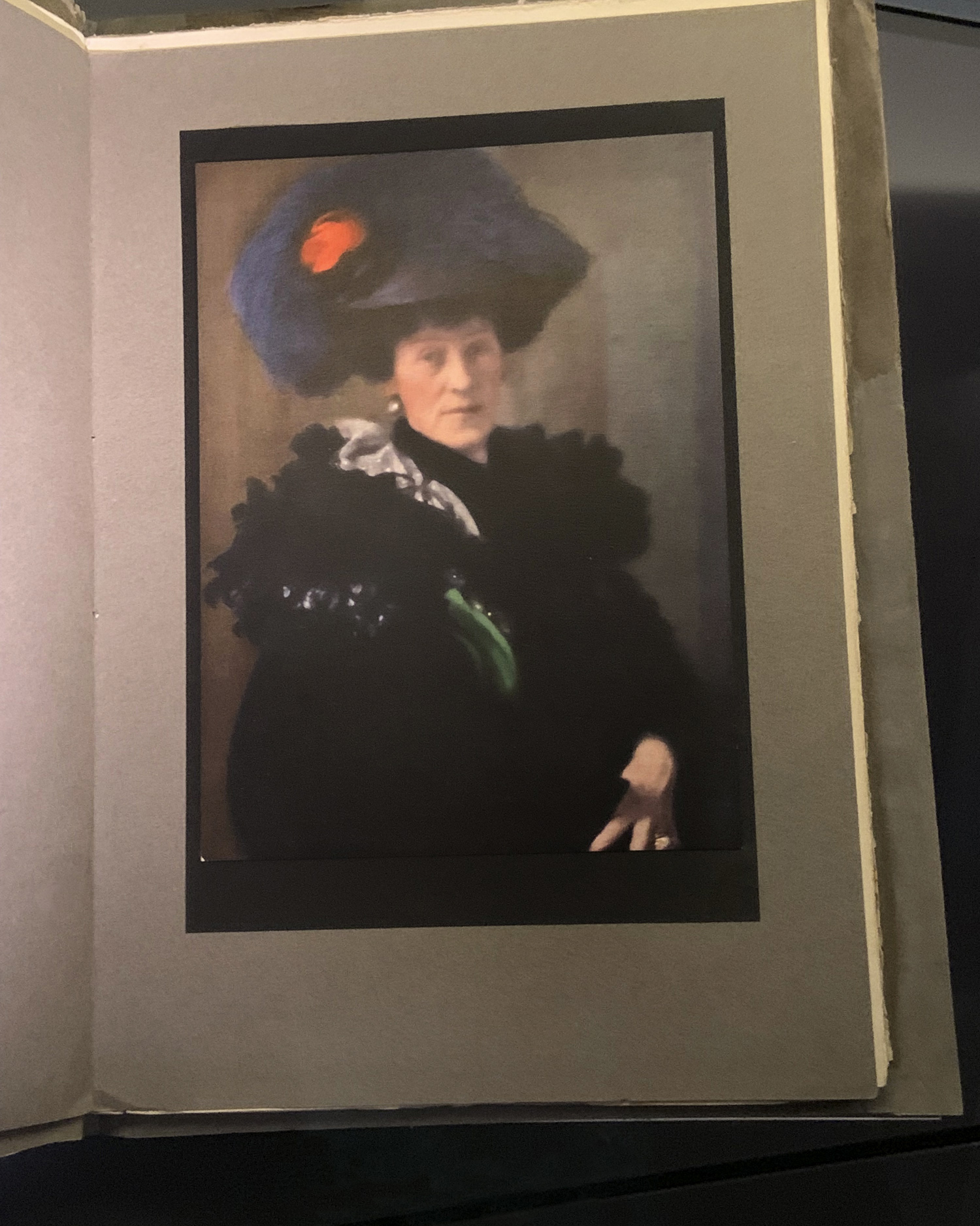
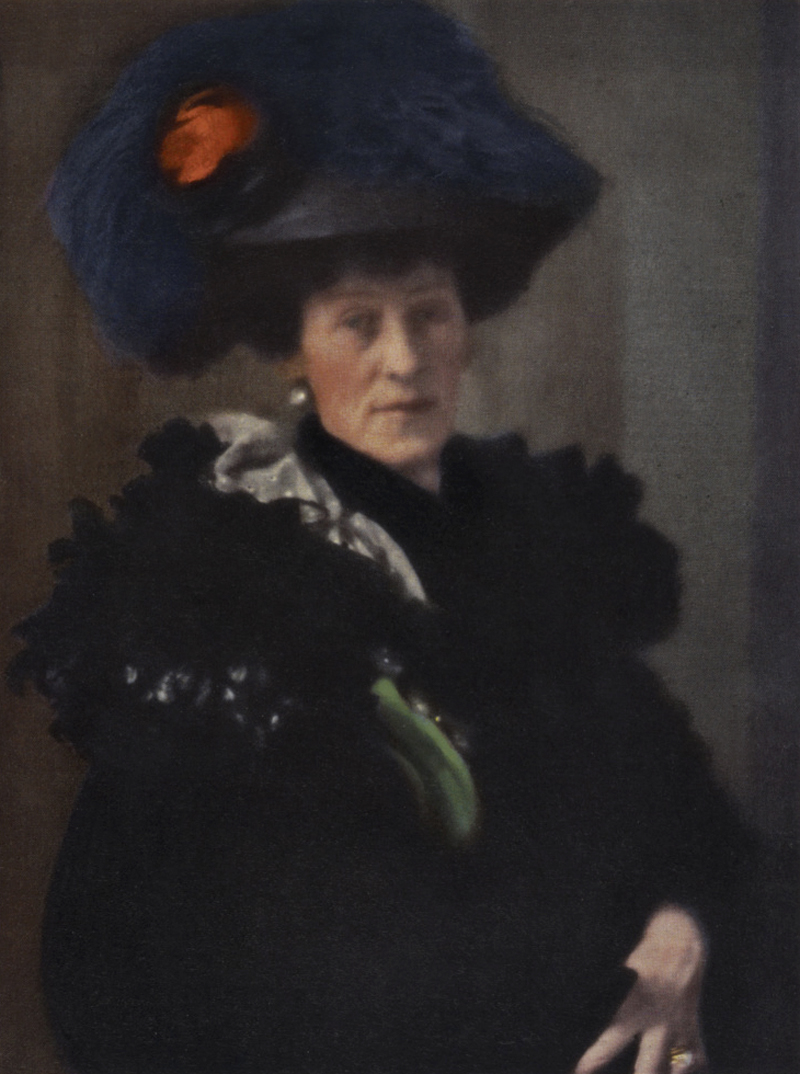
Wonderful to see Edward Steichen’s Portrait – Lady H (1908, below) as I have a copy of Camera Work 22 in my collection.

Dr Marcus Bunyan


All iPhone images © Dr Marcus Bunyan. Please click on the photographs for a larger version of the image.


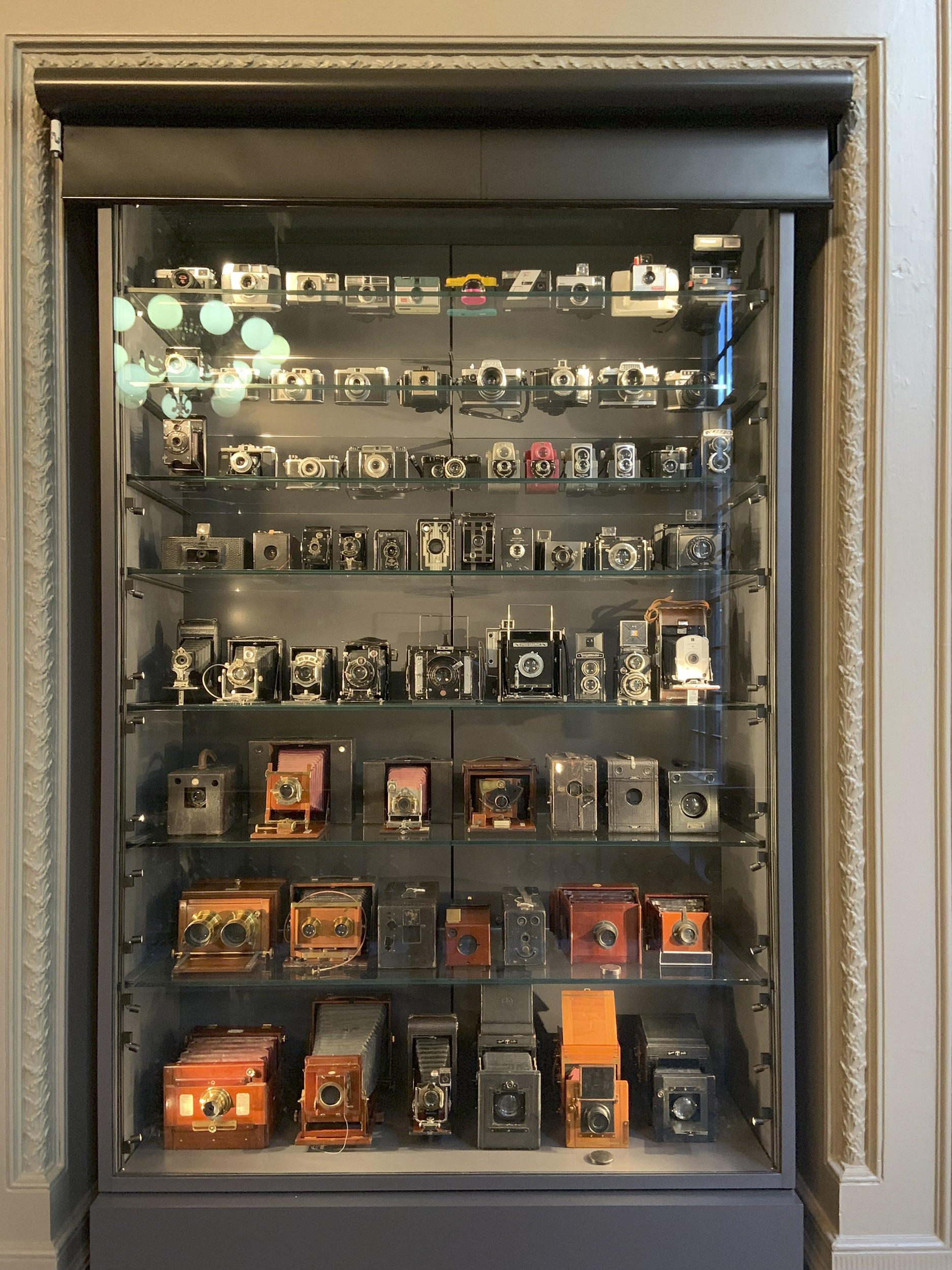
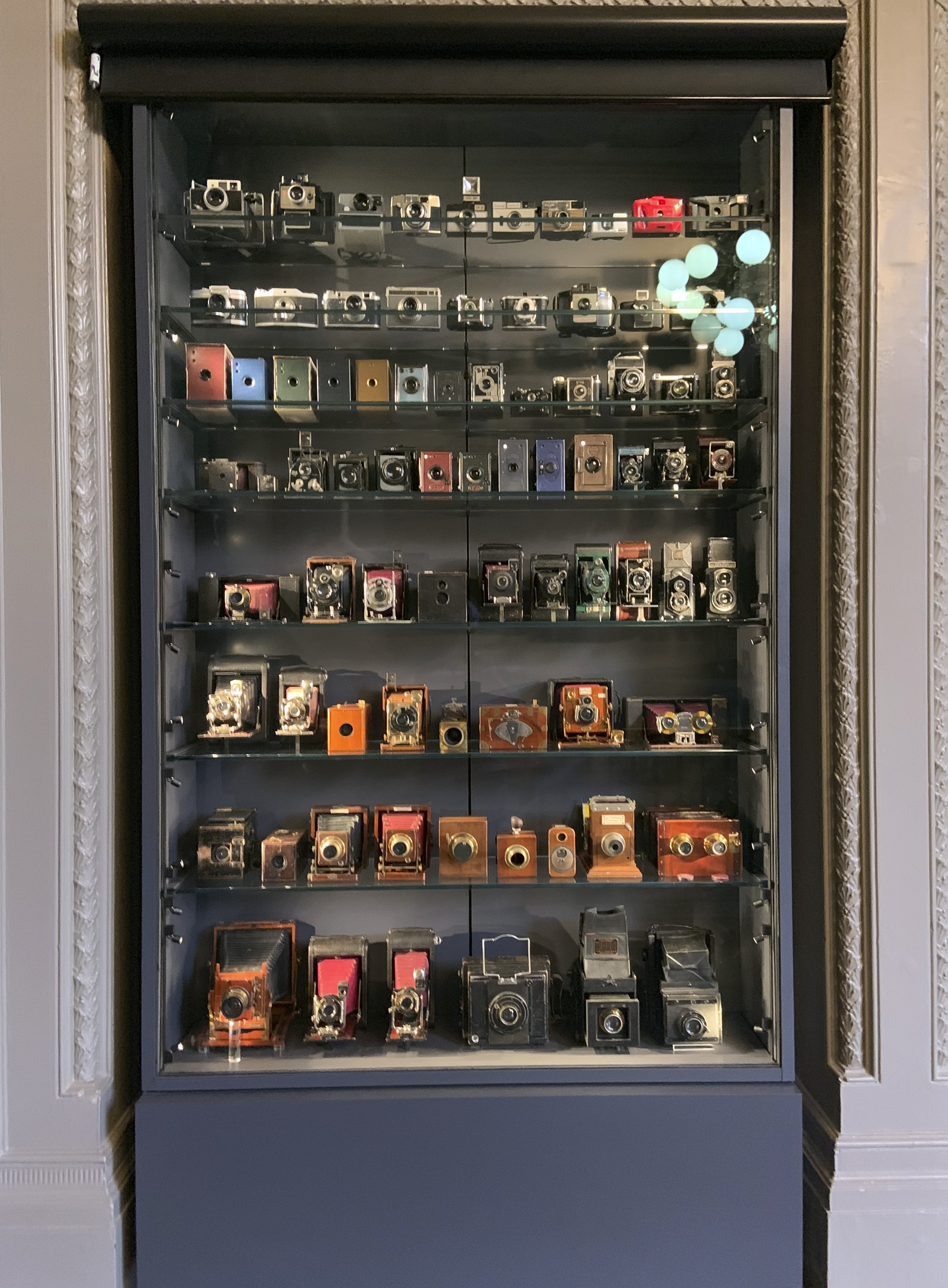
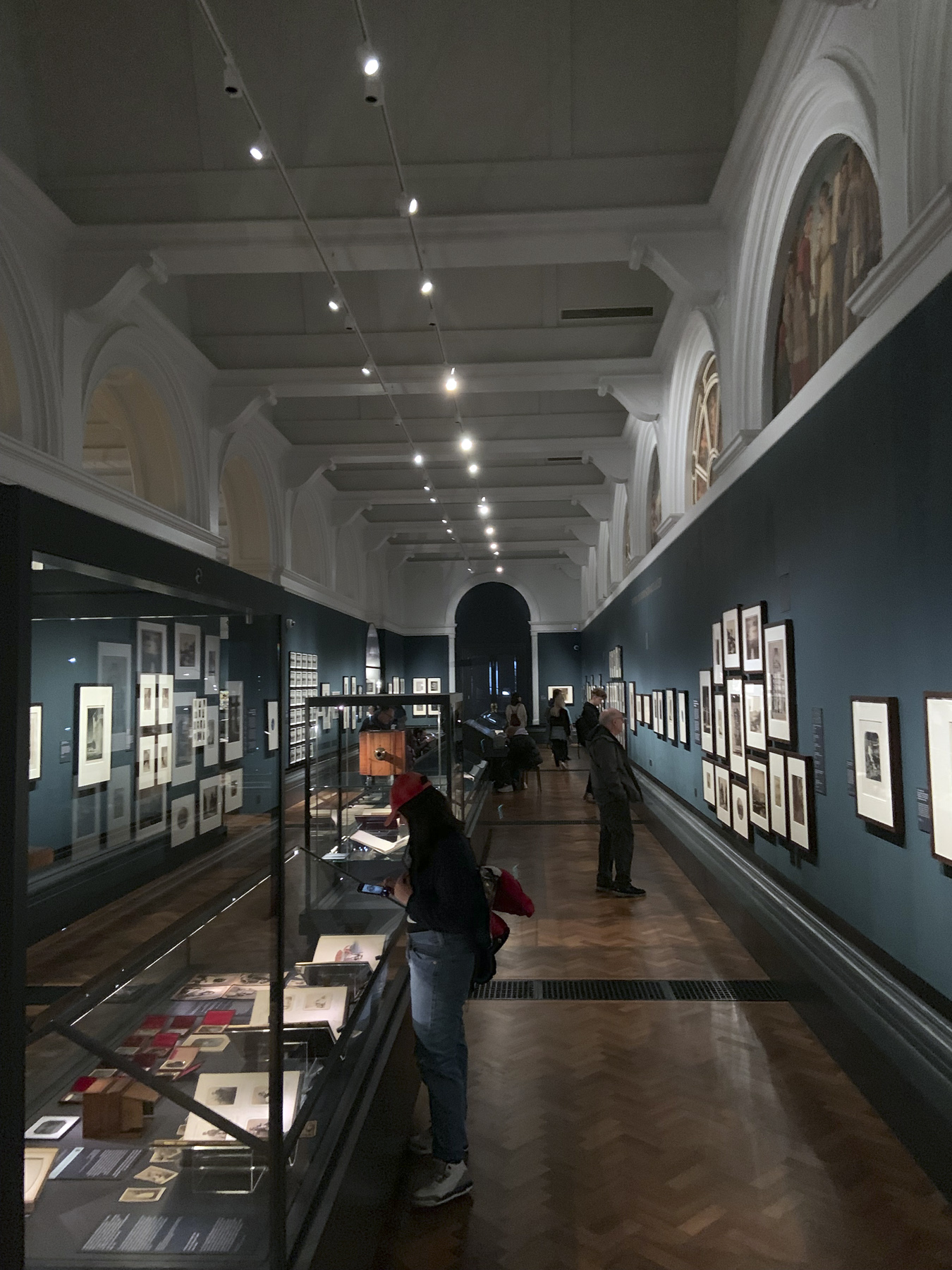
The V&A has been collecting photographs since 1856, the year the Museum was founded, and it was one of the first museums to present photography exhibitions. Since then the collection has grown to be one of the largest and most important in the world, comprising around 500,000 images. The V&A is now honoured to have added the Royal Photographic Society (RPS) collection to its holdings, which contains around 270,000 photographs, an extensive library, and 6,000 cameras and pieces of equipment associated with leading artists and photographic pioneers.

Take a behind-the-scenes look at our world class photography collection following the transfer of the Royal Photographic Society (RPS) Collection, which has enabled a dramatic reimagining of the way photography is presented at the V&A. The photographs curators introduce a series of five highlights that are on display in the new Photography Centre, which opened on 12th October 2018. The first phase of the centre will more than double the space dedicated to photography at the Museum.

Text from the V&A and YouTube websites


Unknown photographer. 'Photograph of Allied War exhibition, Serbian Section, V&A' 1917


Unknown photographer
Photograph of Allied War exhibition, Serbian Section, V&A (installation view)
1917
Gelatin silver print
The Royal Photographic Society Collection at the V&A Museum
Photo: Marcus Bunyan


The V&A has been collecting and exhibiting photographs since the 1850s. This image shows part o a photographic exhibition held over 100 years ago in the same galleries you are standing in today. The exhibition presented a densely packed display of images depicting the Allied Powers during the First World War.
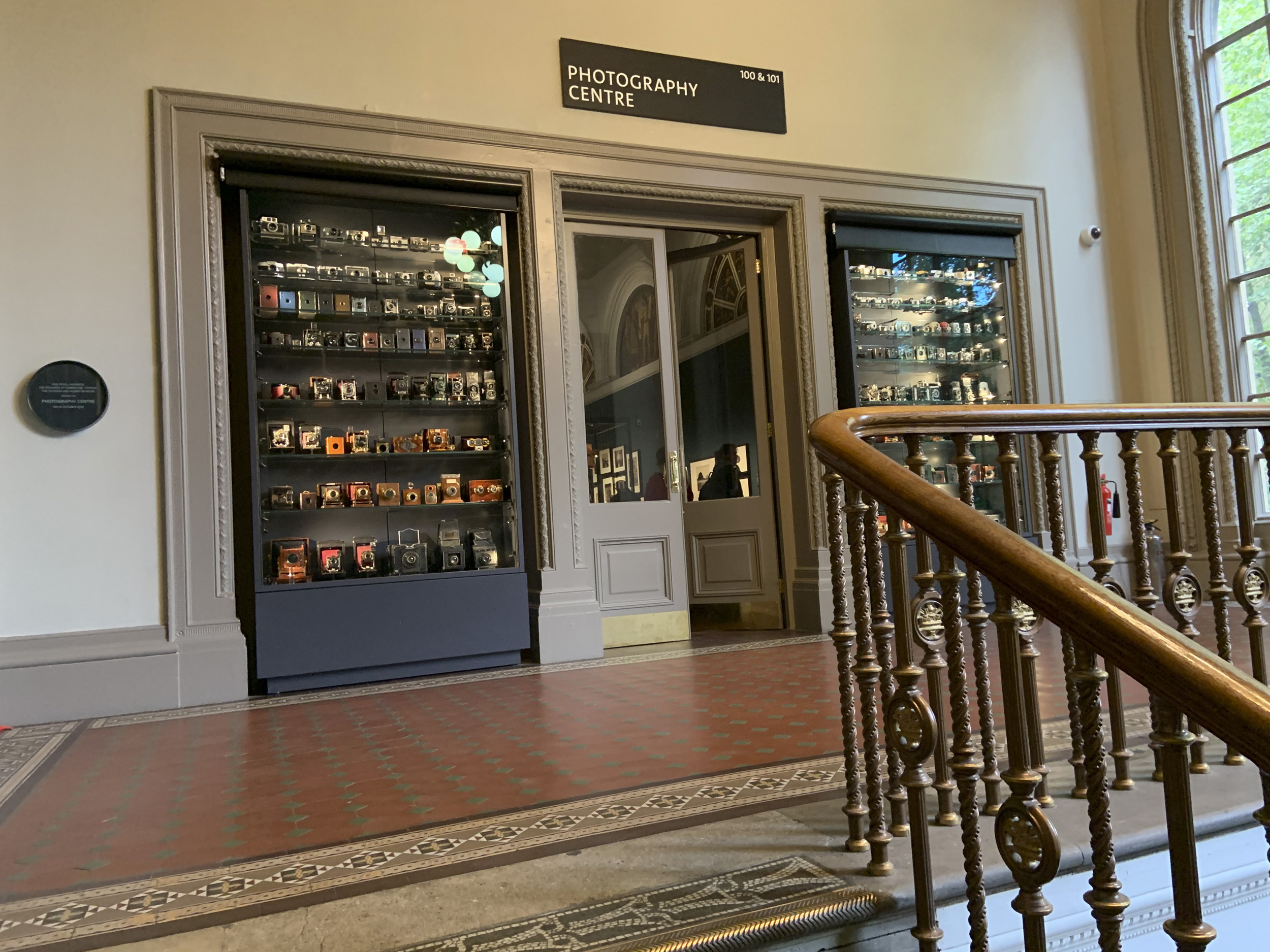
 

Installation view of the V&A Photography Centre, London

Installation view of the V&A Photography Centre, London

Installation view of the V&A Photography Centre, London

Installation view of the V&A Photography Centre, London

Wall text from the V&A Photography Centre, London

Installation view of the V&A Photography Centre, London


Installation views of the V&A Photography Centre, London
Photos: Marcus Bunyan


Joseph Nicéphore Niépce (French, 1765-1833) 'Christ Carrying his Cross' 1827 (installation view)

Joseph Nicéphore Niépce (French, 1765-1833) 'Christ Carrying his Cross' 1827 (installation view)


Joseph Nicéphore Niépce (French, 1765-1833)
Christ Carrying his Cross (installation views)
1827
Heliograph on pewter plate
The Royal Photographic Society Collection at the V&A Museum
Photos: Marcus Bunyan


The French inventor Niépce made the earliest surviving photographic images, which he called ‘heliographs’ or ‘sun-writing’. Only 16 are thought to still exist. Although Niépce experimented with light-sensitive plates inside a camera, he made most of his images, including this one, by placing engravings of works by other artists directly onto a metal plate. He would probably have had the resulting heliographs coated in ink and printed.


Joseph Nicéphore Niépce (French, 1765-1833) 'Christ Carrying his Cross' 1827 (installation view)


Joseph Nicéphore Niépce (French, 1765-1833)
Christ Carrying his Cross (installation view)
1827
Heliograph on pewter plate
The Royal Photographic Society Collection at the V&A Museum
Photo: Marcus Bunyan


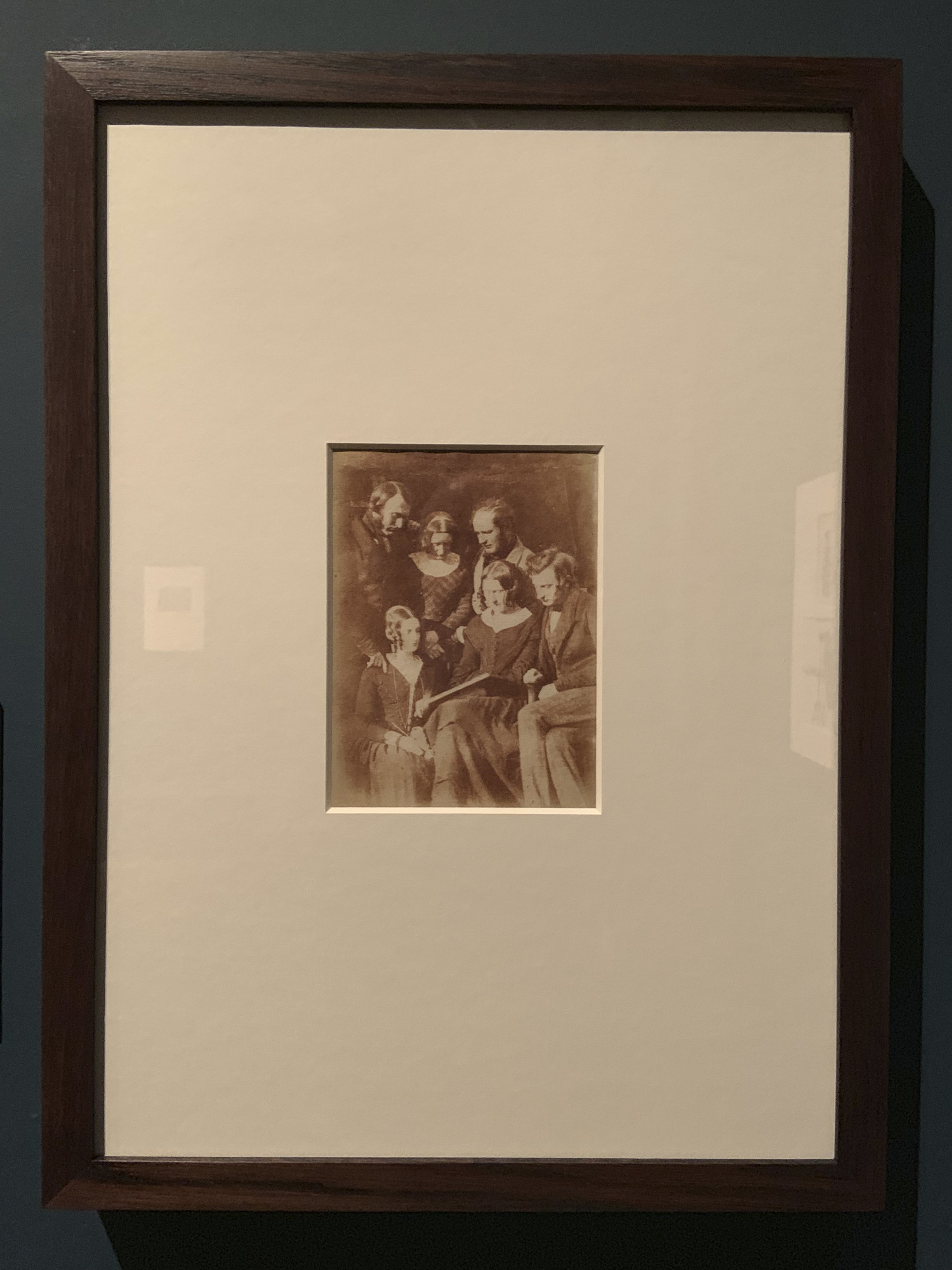
David Octavius Hill (Scottish, 1802-70) and Robert Adamson (Scottish, 1821-48) 'The Adamson Family' 1843-1845 (installation view)


David Octavius Hill (Scottish, 1802-1870) and Robert Adamson (Scottish, 1821-1848)
The Adamson Family (installation view)
1843-1845
Salted paper print
The Royal Photographic Society Collection at the V&A Museum
Photo: Marcus Bunyan


The partnership between Scottish painter Hill and chemist Adamson merged the art and science of photography. The pair initially intended to create preliminary studies for Hill’s paintings, but soon recognised photography’s artistic potential. With Hill’s knowledge of composition and lighting, and Adamson’s considerable sensitivity and dexterity in handling the camera, together they produced some of the most accomplished photographic portraits of their time.


William Henry Fox Talbot (British, 1800-77) 'The Haystack' 1844 from  the V&A Photography Centre, London 2019


William Henry Fox Talbot (British, 1800-1877)
The Haystack
1844
From The Pencil of Nature
Salted paper print
The Royal Photographic Society Collection at the V&A Museum


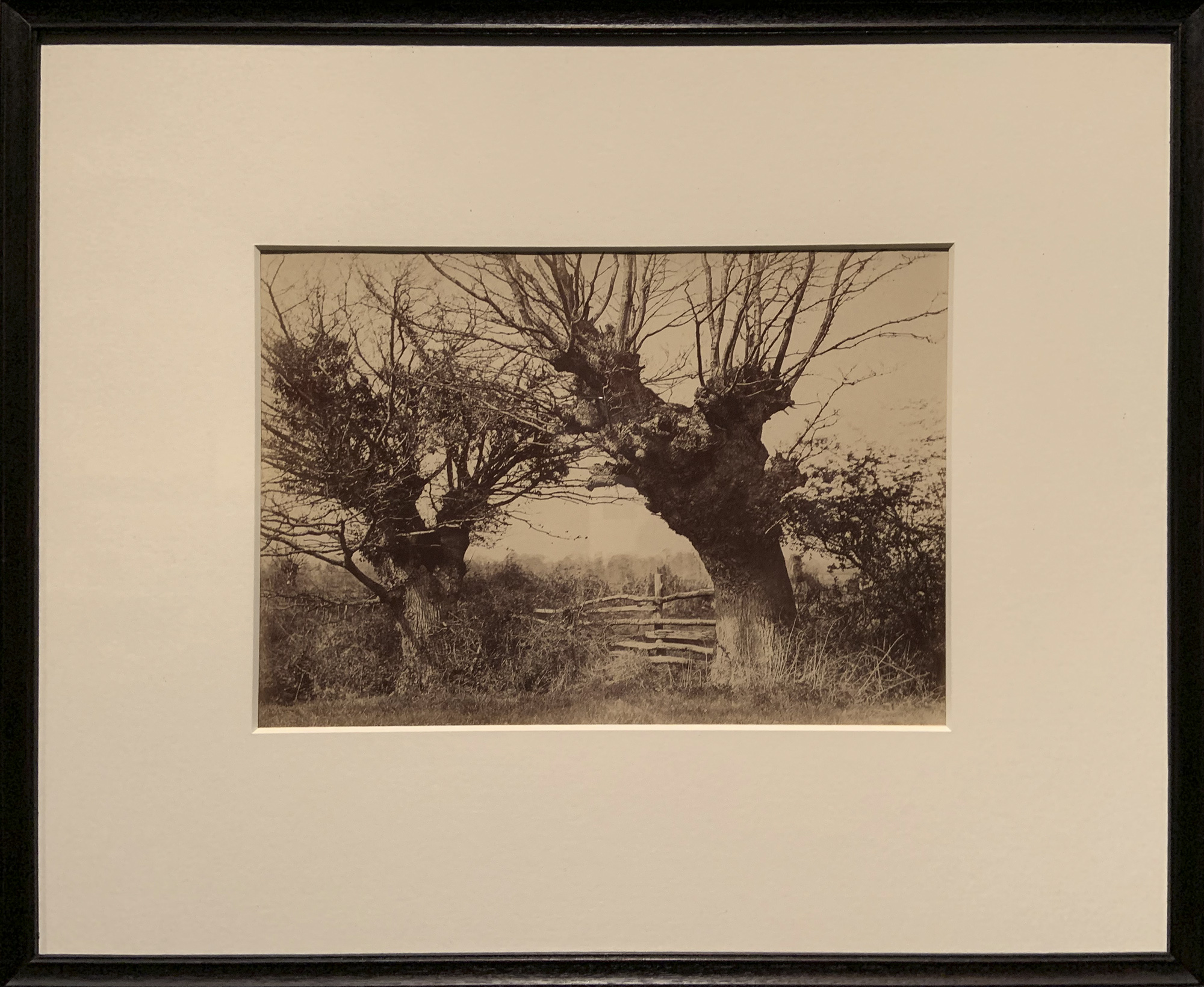
Benjamin Brecknell Turner (British, 1815-94) 'Hedgerow Trees, Clerkenleap' 1852-1854 (installation view)

Benjamin Brecknell Turner (British, 1815-94) 'Hedgerow Trees, Clerkenleap' 1852-1854 (installation view)


Benjamin Brecknell Turner (British, 1815-1894)
Hedgerow Trees, Clerkenleap (installation views)
1852-1854
Albumen print; Calotype negative
The Royal Photographic Society Collection at the V&A Museum
Photos: Marcus Bunyan


Turner took out a licence to practice ‘calotype’ photography from Talbot in 1848. He contact-printed positive images from paper negatives. The negative (below) and its corresponding positive (above) are reunited here to illustrate this process, but the pairing as you see them would not have been the photographer’s original intention for display. Although unique negatives were sometimes exhibited in their own right, only showing positive prints was the norm.


Benjamin Brecknell Turner (British, 1815-94) 'Hedgerow Trees, Clerkenleap' 1852-1854 (installation view)


Benjamin Brecknell Turner (British, 1815-1894)
Hedgerow Trees, Clerkenleap (installation view)
1852-1854
Albumen print; Calotype negative
The Royal Photographic Society Collection at the V&A Museum
Photo: Marcus Bunyan


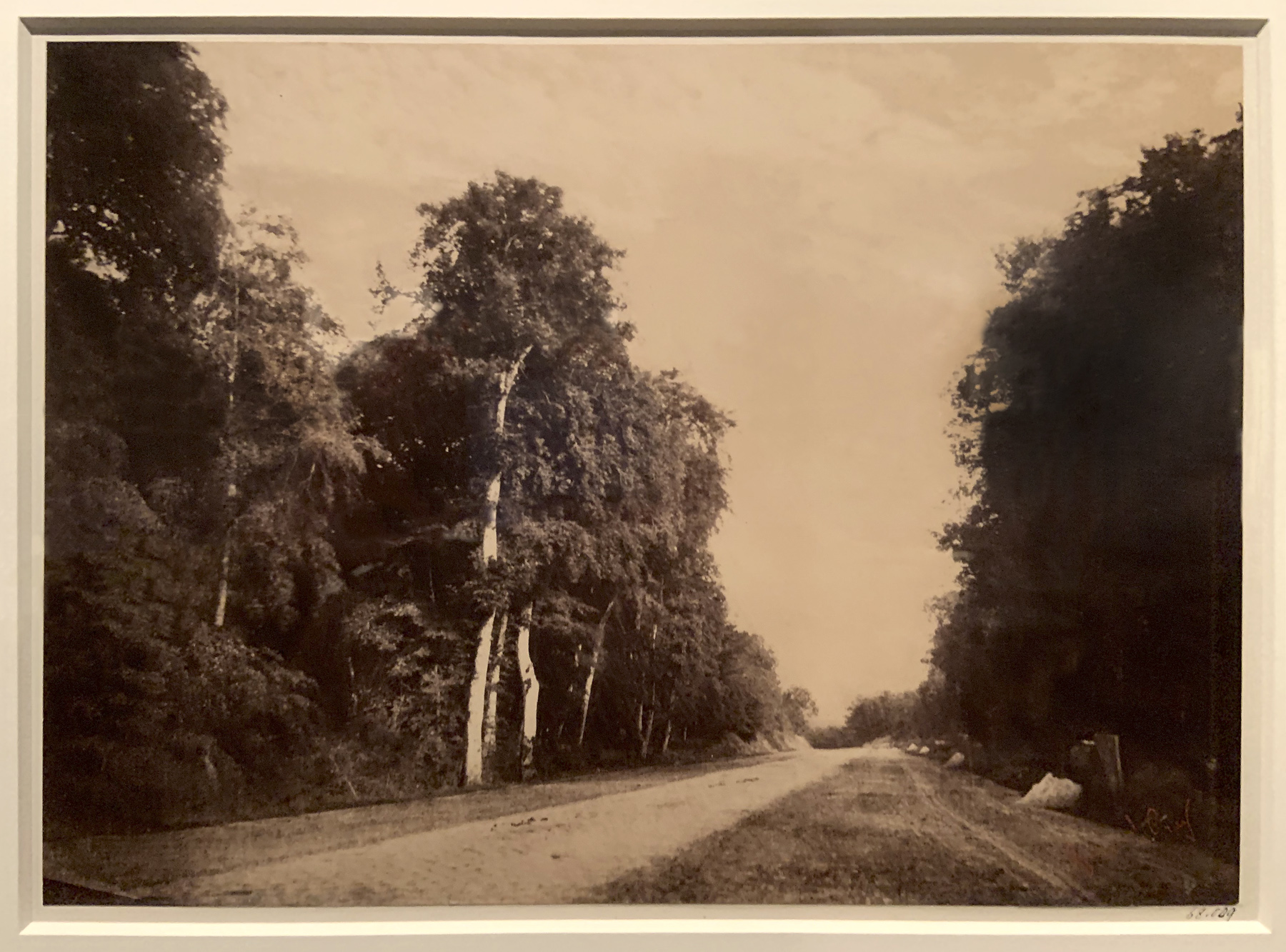
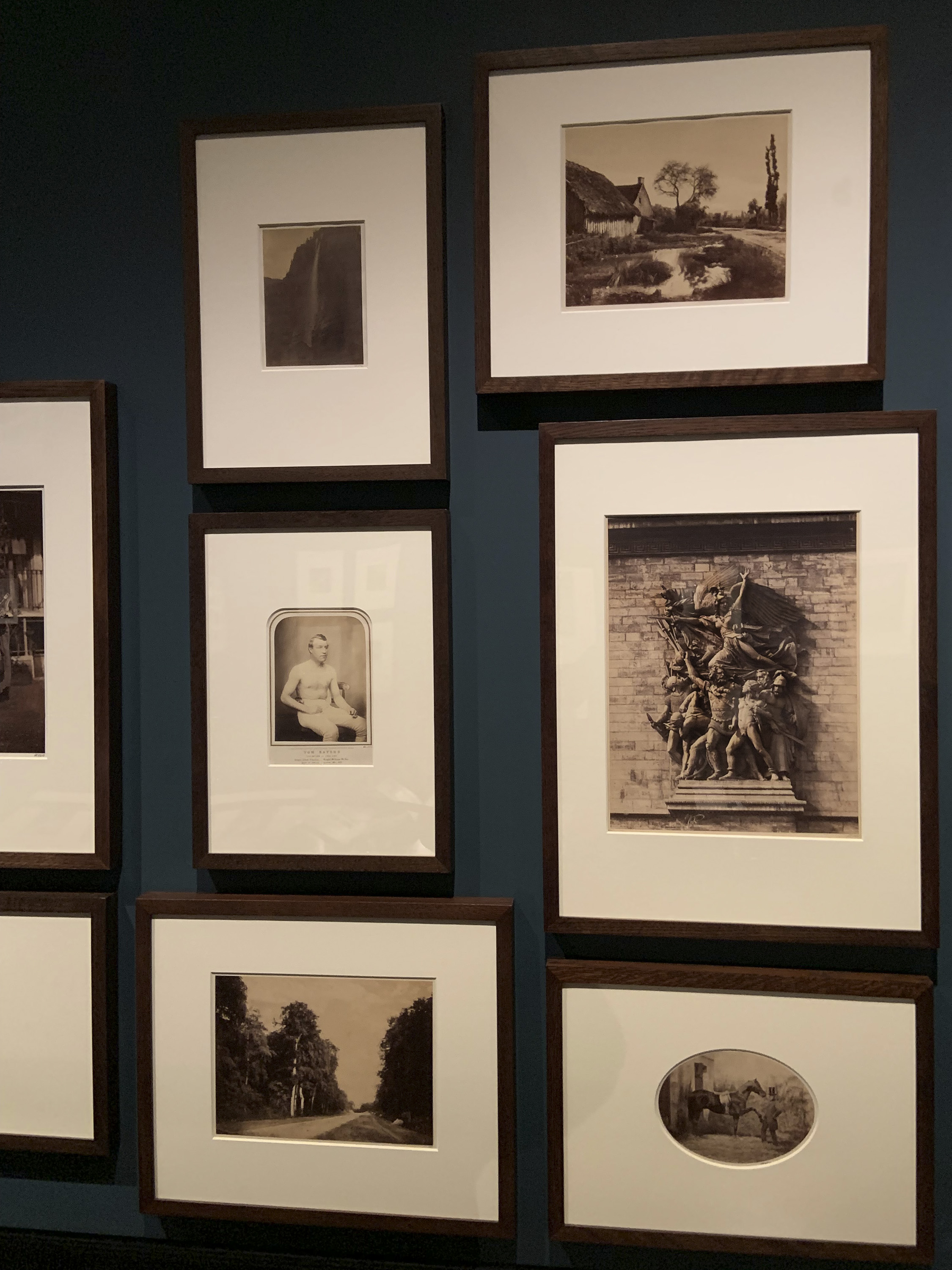
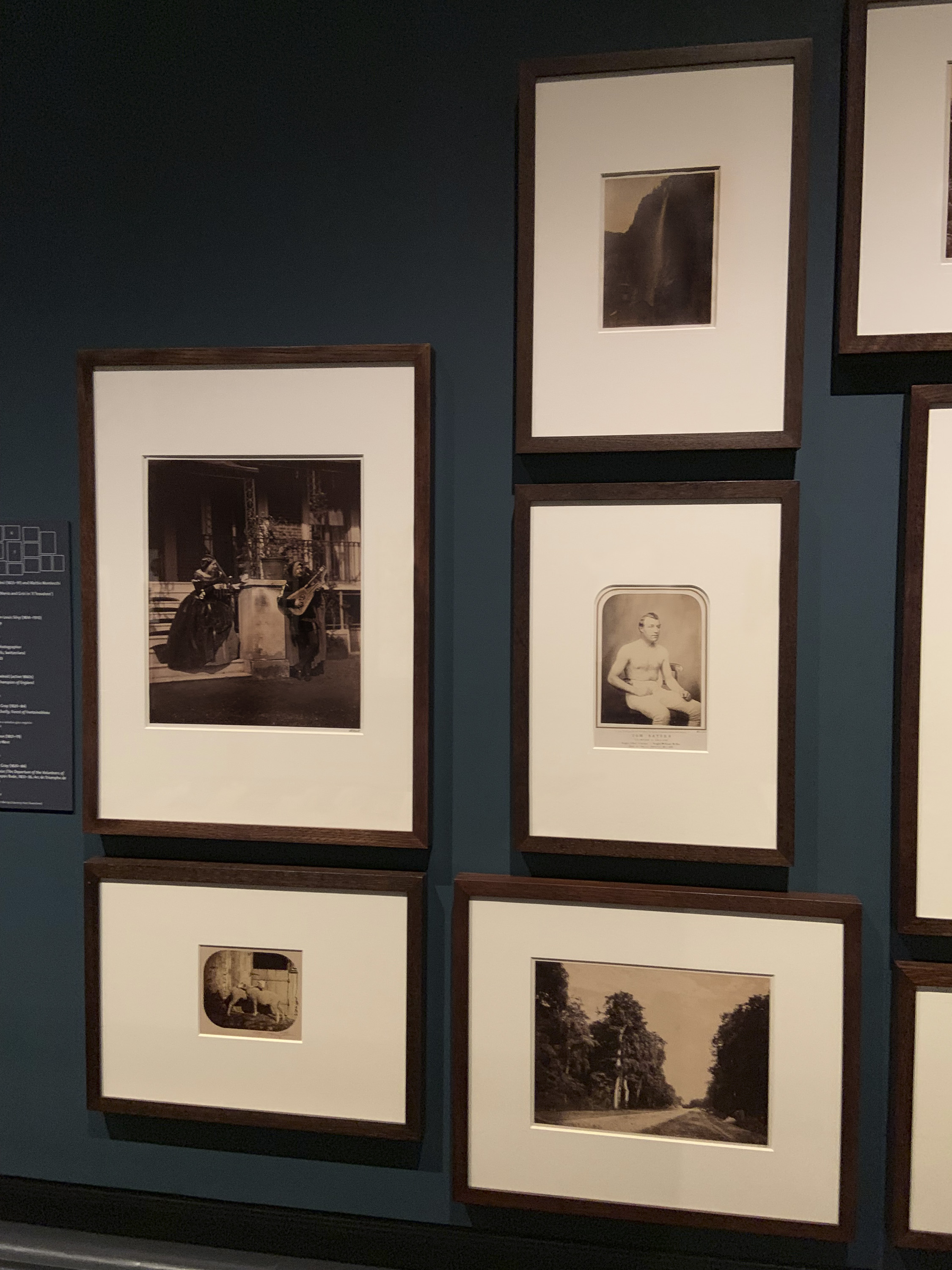
Gustave Le Gray (French, 1820-84) 'The Road to Chailly, Forest of Fontainebleau' 1852 (installation view)


Gustave Le Gray (French, 1820-1884)
The Road to Chailly, Forest of Fontainebleau (installation view)
1852
Albumen print from a collodion glass negative
Bequeathed to the V&A by Chauncey Hare Townshend
Photo: Marcus Bunyan


Installation view of the V&A Photography Centre, London

Installation view of the V&A Photography Centre, London

Wall text from the V&A Photography Centre, London


Installation views of the V&A Photography Centre, London
Photos: Marcus Bunyan


Gustave Le Gray (French, 1820-84) 'The Marseillaise (The Departure of the Volunteers of 1792), by Francois Rude, 1833-35, Arc de Triomphe de l’Etoile, Paris' 1852 (installation view)


Gustave Le Gray (French, 1820-1884)
The Marseillaise (The Departure of the Volunteers of 1792), by Francois Rude, 1833-35, Arc de Triomphe de l’Etoile, Paris (installation view)
1852
Albumen print
Bequeathed to the V&A by Chauncey Hare Townshend
Photo: Marcus Bunyan


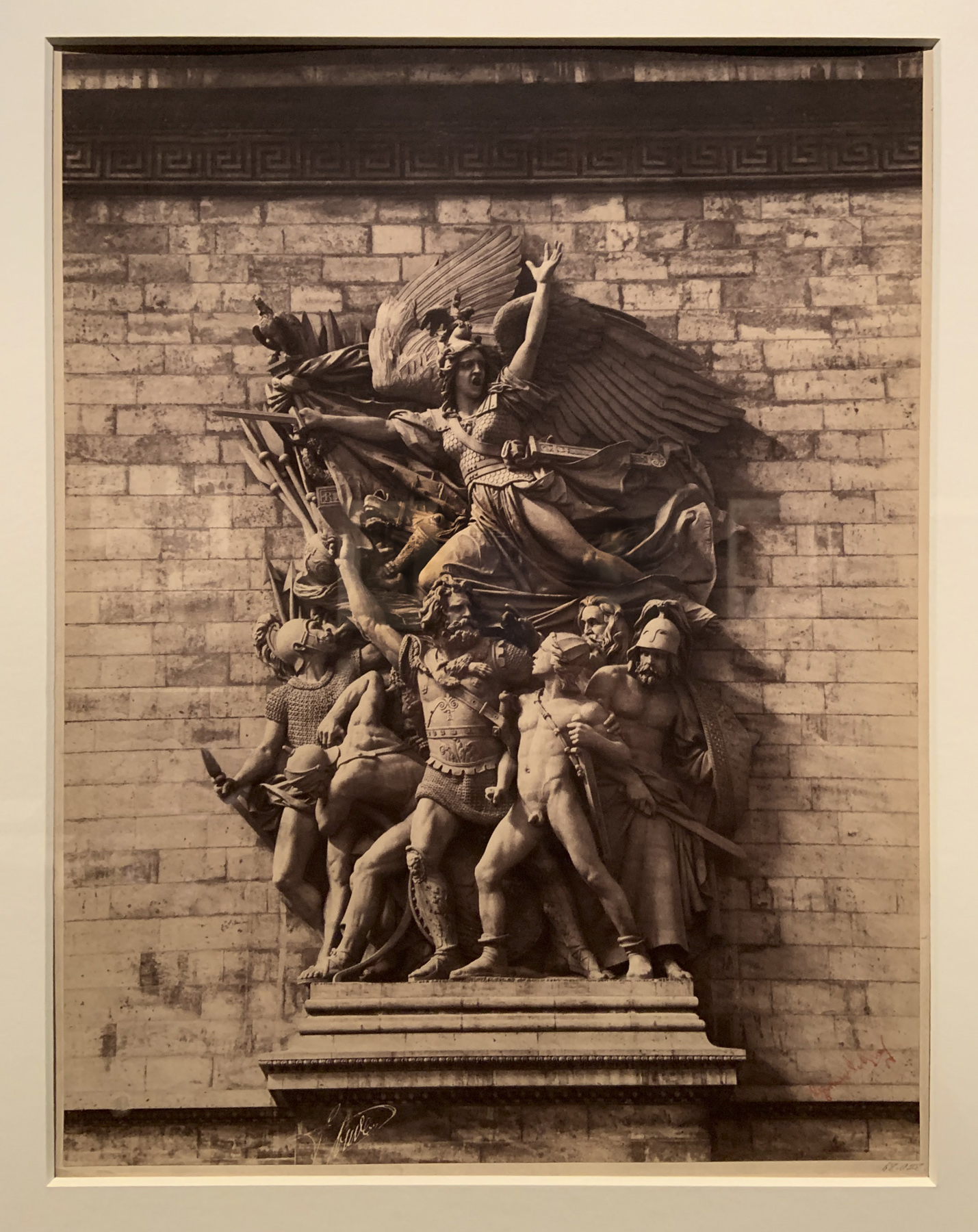
Gustave Le Gray (French, 1820-1884) 'The Marseillaise (The Departure of the Volunteers of 1792), by Francois Rude, 1833-1835, Arc de Triomphe de l’Etoile, Paris' 1852 (installation view)


Gustave Le Gray (French, 1820-1884)
The Marseillaise (The Departure of the Volunteers of 1792), by Francois Rude, 1833-35, Arc de Triomphe de l’Etoile, Paris (installation view)
1852
Albumen print
Bequeathed to the V&A by Chauncey Hare Townshend
Photo: Marcus Bunyan


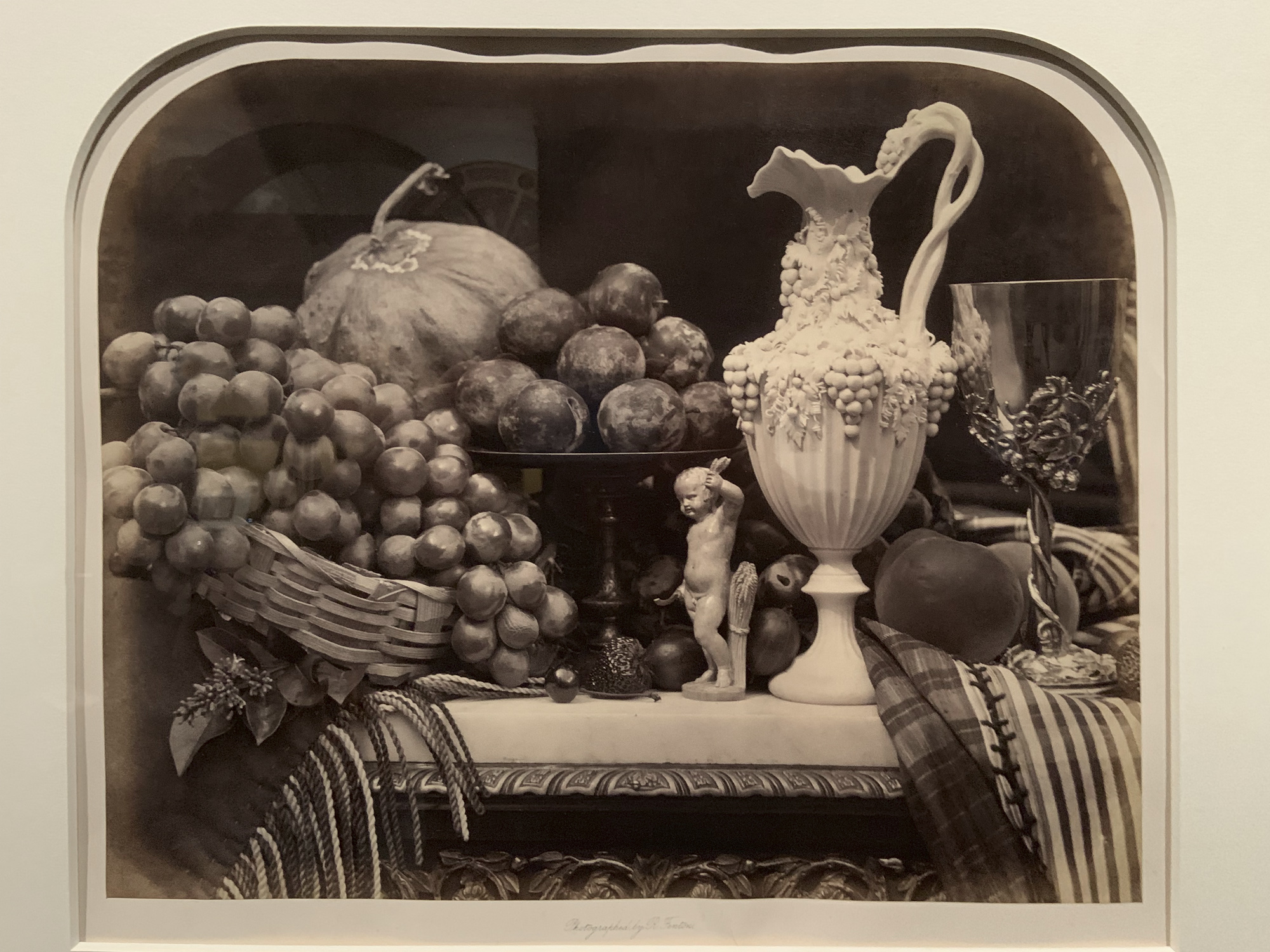
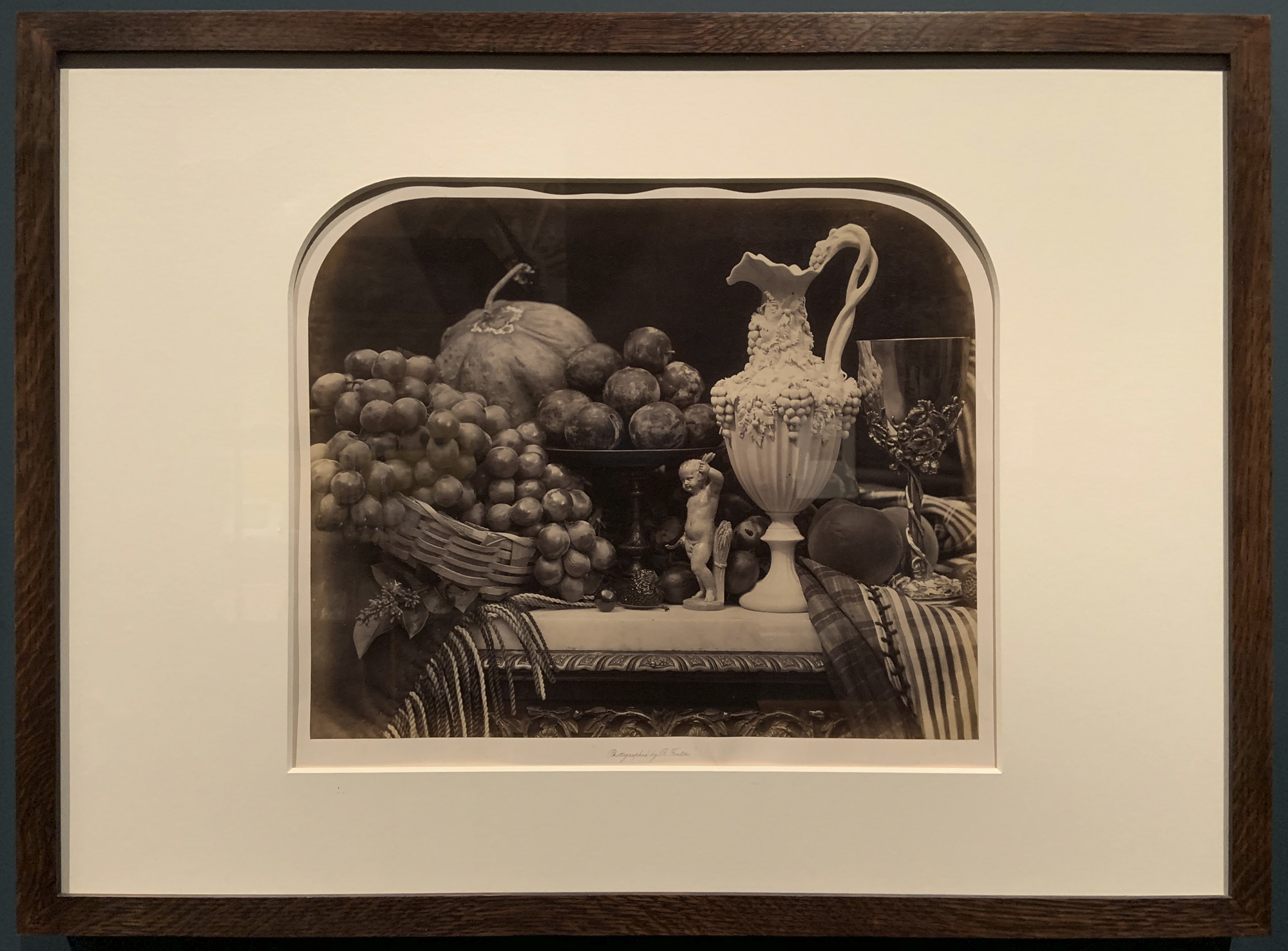
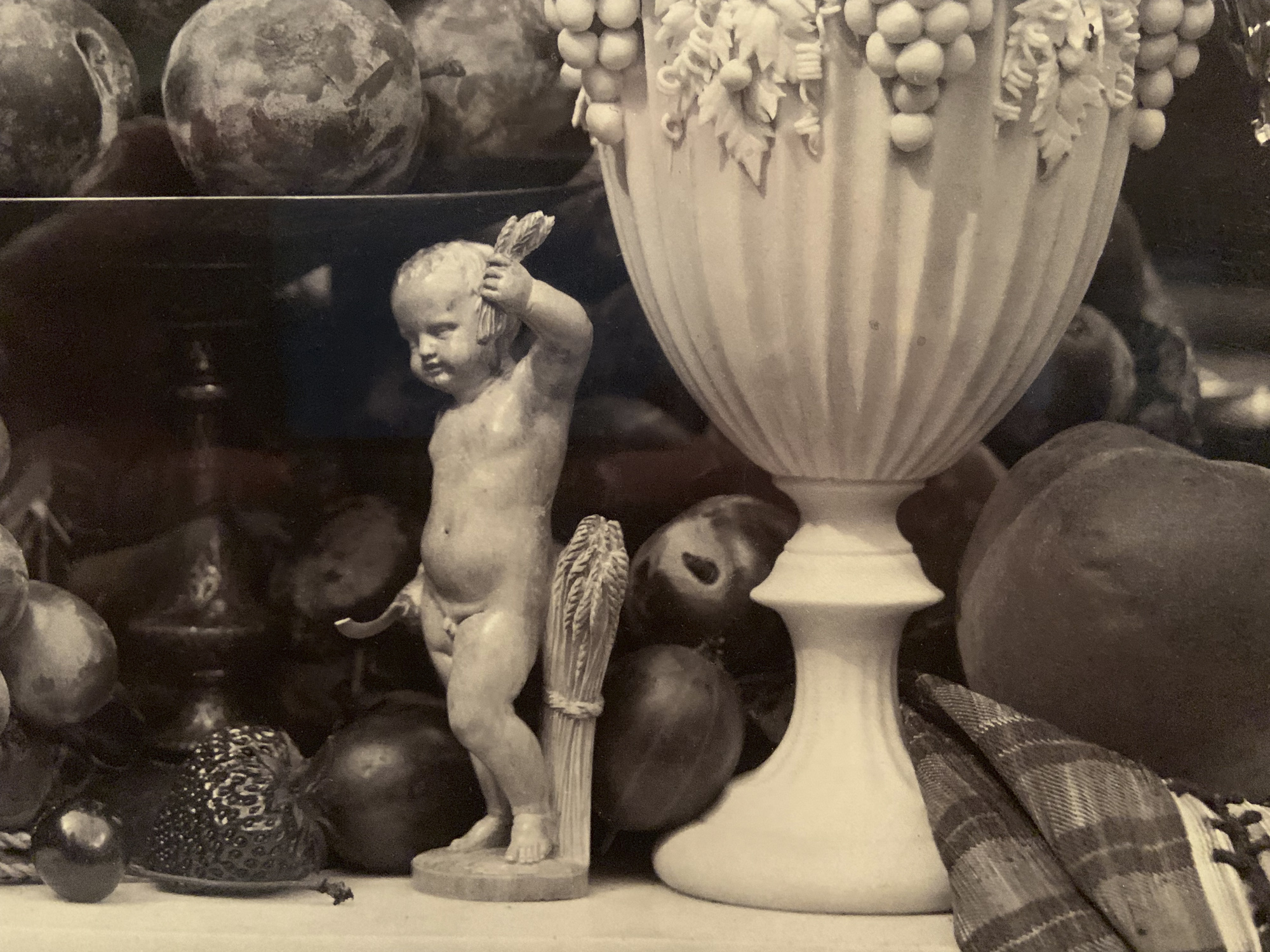
Roger Fenton (British, 1819-1869) 'Parian Vase, Grapes and Silver Cup' 1860 (installation view)


Roger Fenton (British, 1819-1869)
Parian Vase, Grapes and Silver Cup (installation view)
1860
Albumen print
The Royal Photographic Society Collection at the V&A Museum
Photo: Marcus Bunyan
 

Fenton was one of the most versatile and technically brilliant photographers of the 19th century. He excelled at many subjects, including war photography, portraiture, architecture and landscape. He also made a series of lush still lives. Here, grapes, plums and peaches are rendered in exquisite detail, and the silver cup on the right reflects a camera tripod.


Roger Fenton (British, 1819-1869) 'Parian Vase, Grapes and Silver Cup' 1860 (installation view)


Roger Fenton (British, 1819-1869)
Parian Vase, Grapes and Silver Cup (installation view)
1860
Albumen print
The Royal Photographic Society Collection at the V&A Museum
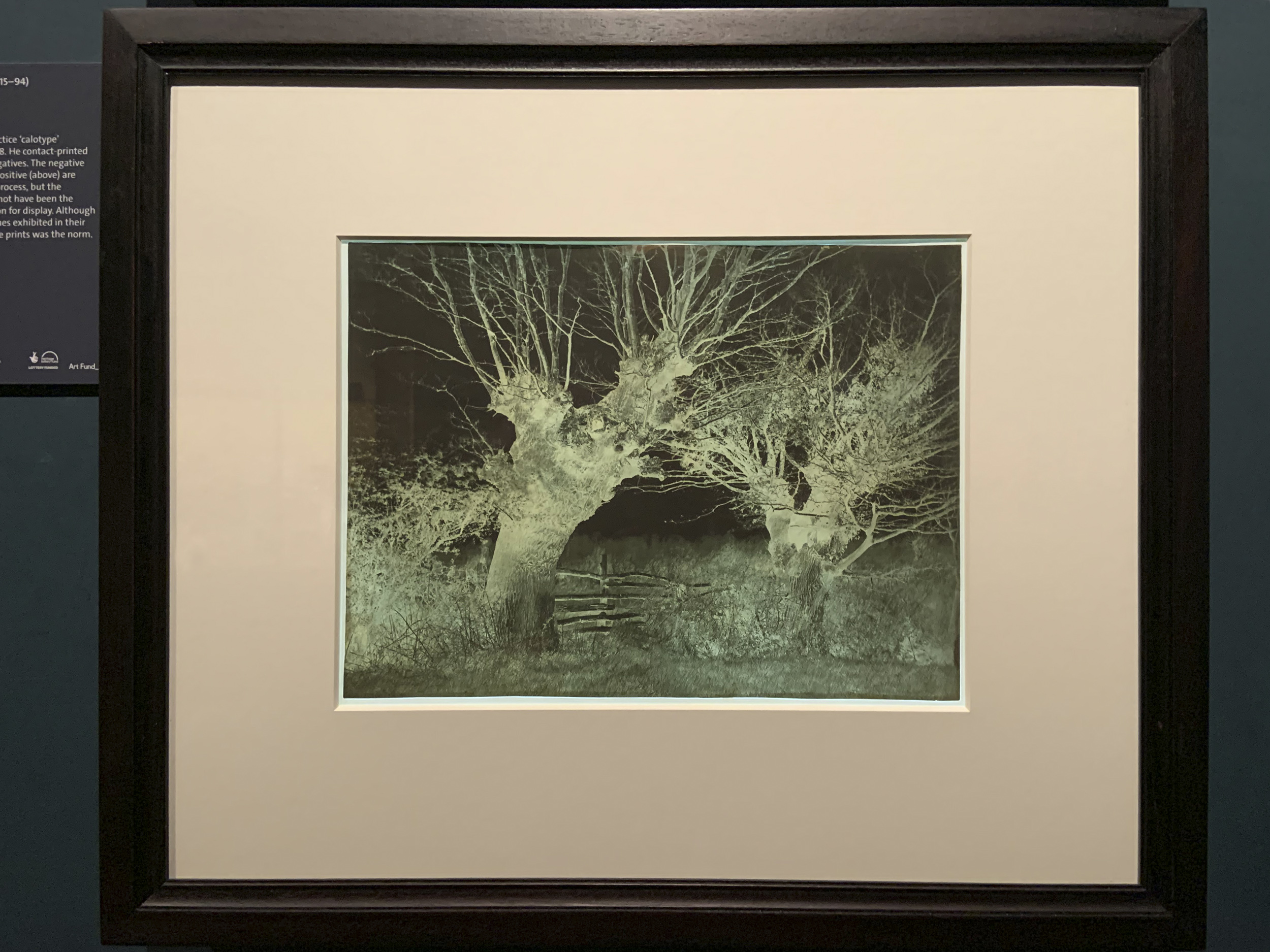
Photo: Marcus Bunyan


Roger Fenton (British, 1819-1869) 'Parian Vase, Grapes and Silver Cup' 1860 (installation view)


Roger Fenton (British, 1819-1869)
Parian Vase, Grapes and Silver Cup (installation view)
1860
Albumen print
The Royal Photographic Society Collection at the V&A Museum
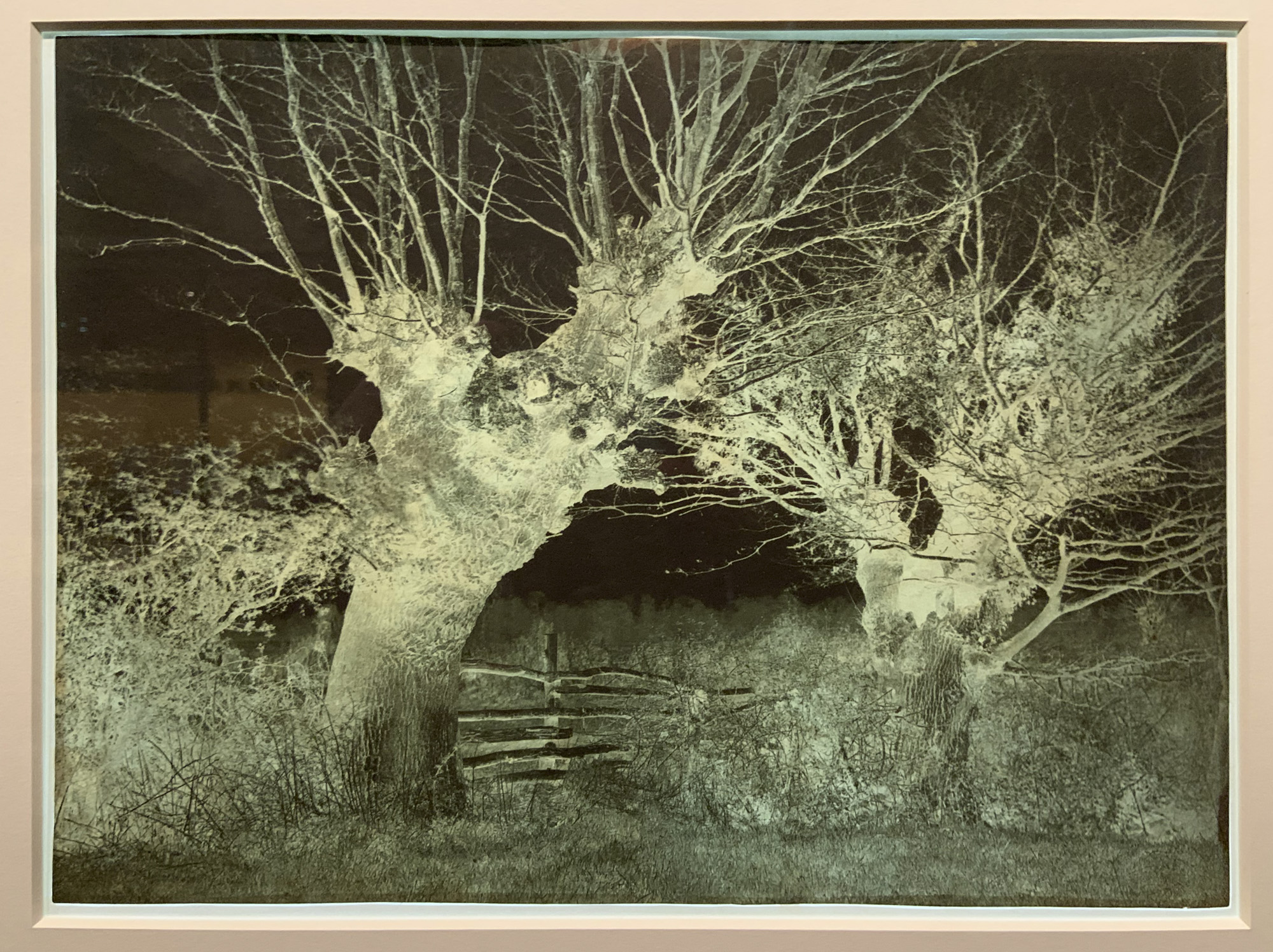
Photo: Marcus Bunyan
 

Roger Fenton (British, 1819-1869) 'Parian Vase, Grapes and Silver Cup' 1860 (installation view detail)


Roger Fenton (British, 1819-1869)
Parian Vase, Grapes and Silver Cup (installation view detail)
1860
Albumen print
The Royal Photographic Society Collection at the V&A Museum
Photo: Marcus Bunyan


Roger Fenton (British, 1819-1869) 'Still Life with Fruit and Decanter' 1860 from the V&A Photography Centre, London 2019


Roger Fenton (British, 1819-1869)
Still Life with Fruit and Decanter
1860
Albumen print
The Royal Photographic Society Collection at the V&A Museum


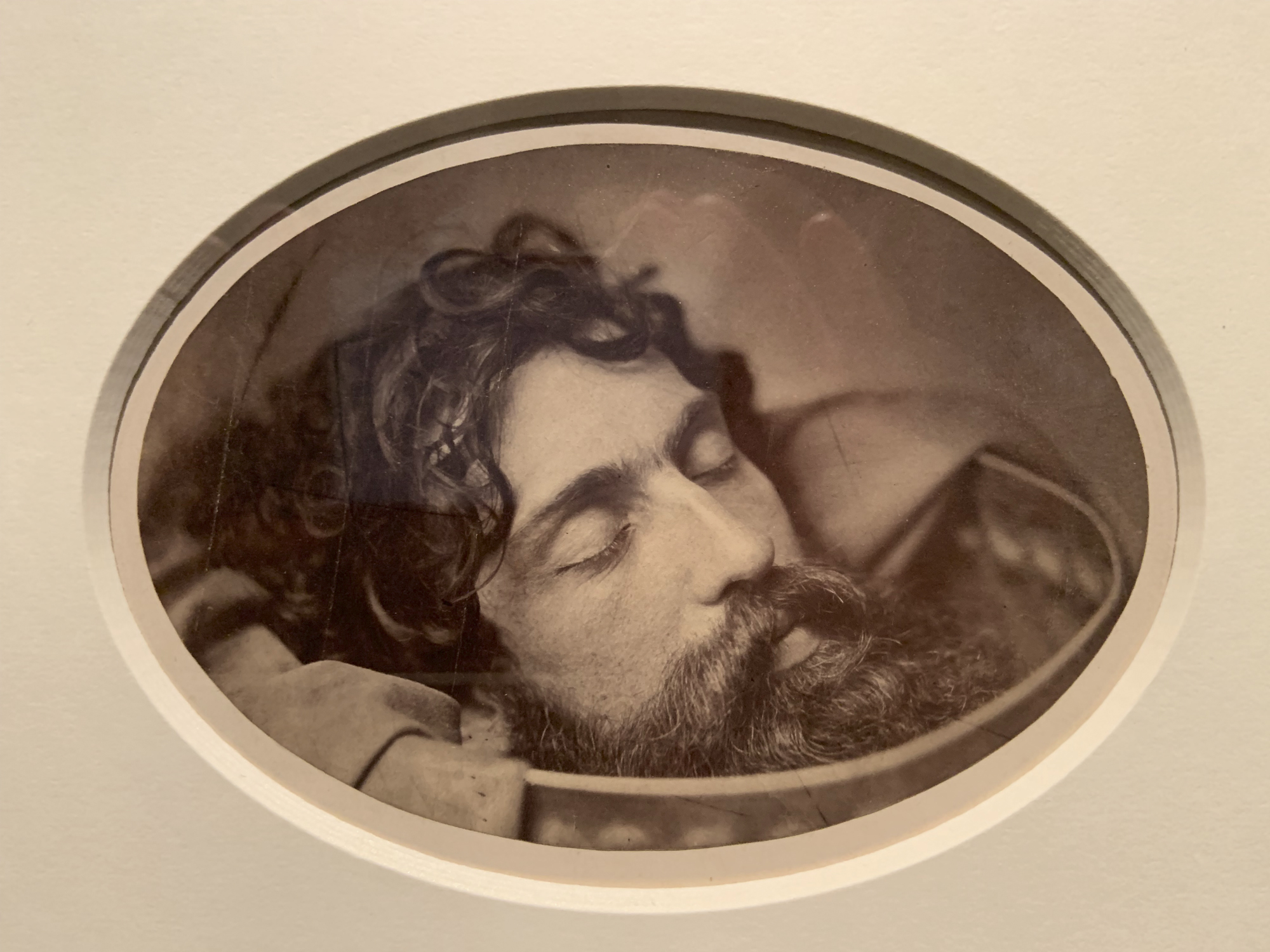
Oscar Gustaf Rejlander (British born Sweden, 1813-1875) 'Head of St John the Baptist on a Charger' c. 1856 (installation view)


Oscar Gustaf Rejlander (British born Sweden, 1813-1875)
Head of St John the Baptist on a Charger (installation view)
c. 1856
Albumen print
The Royal Photographic Society Collection at the V&A Museum
Photo: Marcus Bunyan


Rejlander probably intended this photograph to be part of a larger composition telling the biblical story of Salome, in which the severed head of John the Baptist was presented to her on a plate. Rejlander never made the full picture, however, and instead produced multiple prints of the head alone.


Oscar Gustaf Rejlander (British born Sweden, 1813-75) 'Head of St John the Baptist on a Charger' c. 1856 (installation view)


Oscar Gustaf Rejlander (British born Sweden, 1813-1875)
Head of St John the Baptist on a Charger (installation view)
c. 1856
Albumen print
The Royal Photographic Society Collection at the V&A Museum


Francis Frith (British, 1822-1898) 'Th', from Egypt, Sinai, and Jerusalem: A Series of Twenty Photographic Views by Francis Frith 1858 (published 1860 or 1862) (installation view)


Francis Frith (British, 1822-1898)
The Pyramids of Dahshoor [Dahshur], from the East, from Egypt, Sinai, and Jerusalem: A Series of Twenty Photographic Views by Francis Frith (installation view)
1858 (published 1860 or 1862)
Albumen print
The Royal Photographic Society Collection at the V&A Museum
Photo: Marcus Bunyan


Frith’s photographs were popular and circulated widely, both because of their architectural interest and because they often featured sites mentioned in the Bible. Photographs of places described in biblical stories brought a new level of realism to a Christian Victorian audience, previously only available through the interpretations of a painter or illustrator.


Francis Frith (British, 1822-1898) 'Th', from Egypt, Sinai, and Jerusalem: A Series of Twenty Photographic Views by Francis Frith 1858 (published 1860 or 1862) (installation view)


Francis Frith (British, 1822-1898)
The Pyramids of Dahshoor [Dahshur], from the East, from Egypt, Sinai, and Jerusalem: A Series of Twenty Photographic Views by Francis Frith (installation view)
1858 (published 1860 or 1862)
Albumen print
The Royal Photographic Society Collection at the V&A Museum
Photo: Marcus Bunyan


Francis Frith (British, 1822-98) 'The Pyramids of Dahshoor [Dahshur], from the East, from Egypt, Sinai, and Jerusalem: A Series of Twenty Photographic Views by Francis Frith' 1858 (published 1860 or 1862) from the V&A Photography Centre, London 2019


Francis Frith (British, 1822-1898)
The Pyramids of Dahshoor [Dahshur], from the East, from Egypt, Sinai, and Jerusalem: A Series of Twenty Photographic Views by Francis Frith
1858 (published 1860 or 1862)
Albumen print
The Royal Photographic Society Collection at the V&A Museum
Photo: Marcus Bunyan


Installation view of the V&A Photography Centre, London


Installation view of the V&A Photography Centre, London
Photo: Marcus Bunyan


Gustave Le Gray (French, 1820-1884) 'Solar Effect in the Clouds – Ocean' 1856-1859 (installation view)


Gustave Le Gray (French, 1820-1884)
Solar Effect in the Clouds – Ocean (installation view)
1856-1859
Albumen Print
Bequeathed to the V&A by Chauncey Hare Townshend
Photo: Marcus Bunyan
 

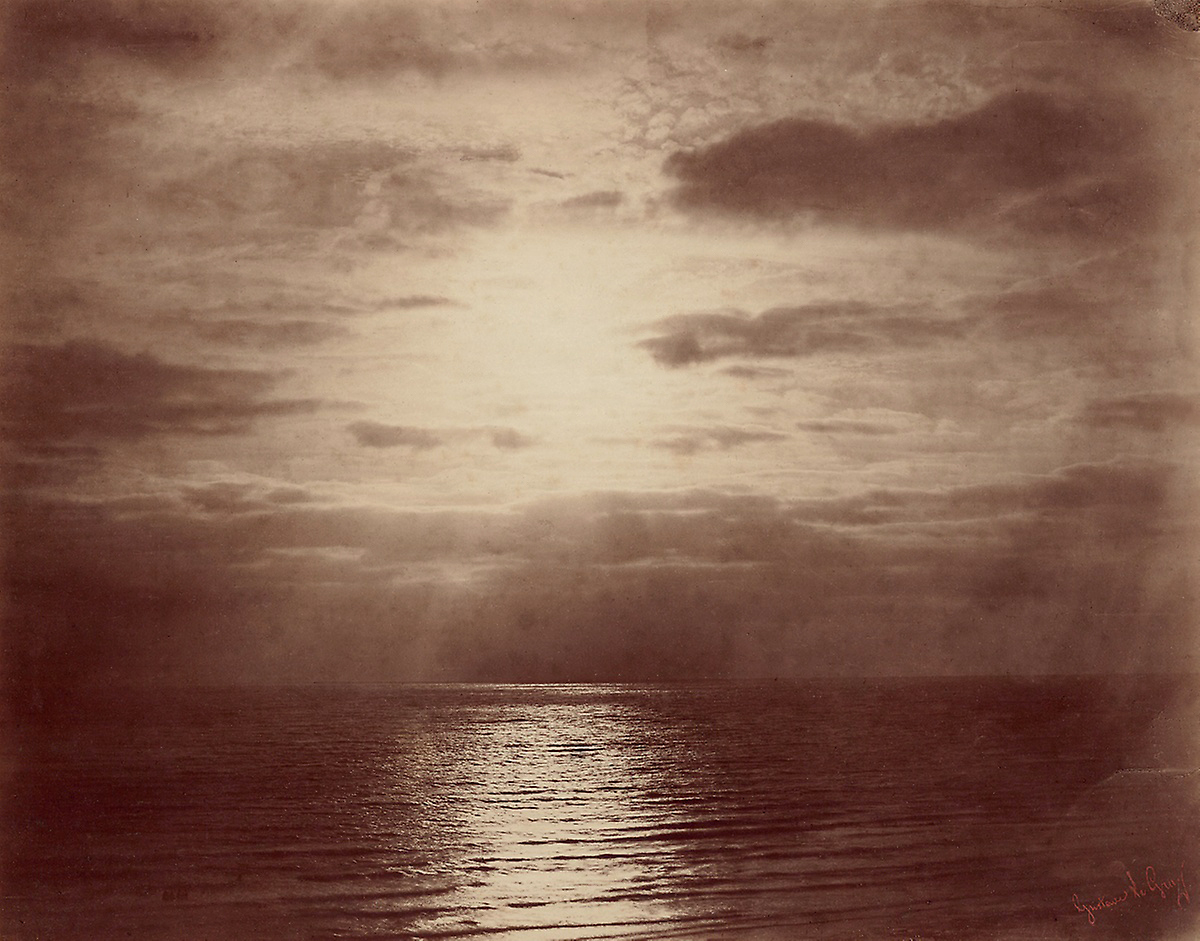
Gustave Le Gray (French, 1820-1884) 'Solar Effect in the Clouds – Ocean' 1856-1859


Gustave Le Gray (French, 1820-1884)
Solar Effect in the Clouds – Ocean
1856-1859
Albumen Print
Art Institute of Chicago
Creative Commons Zero (CC0)


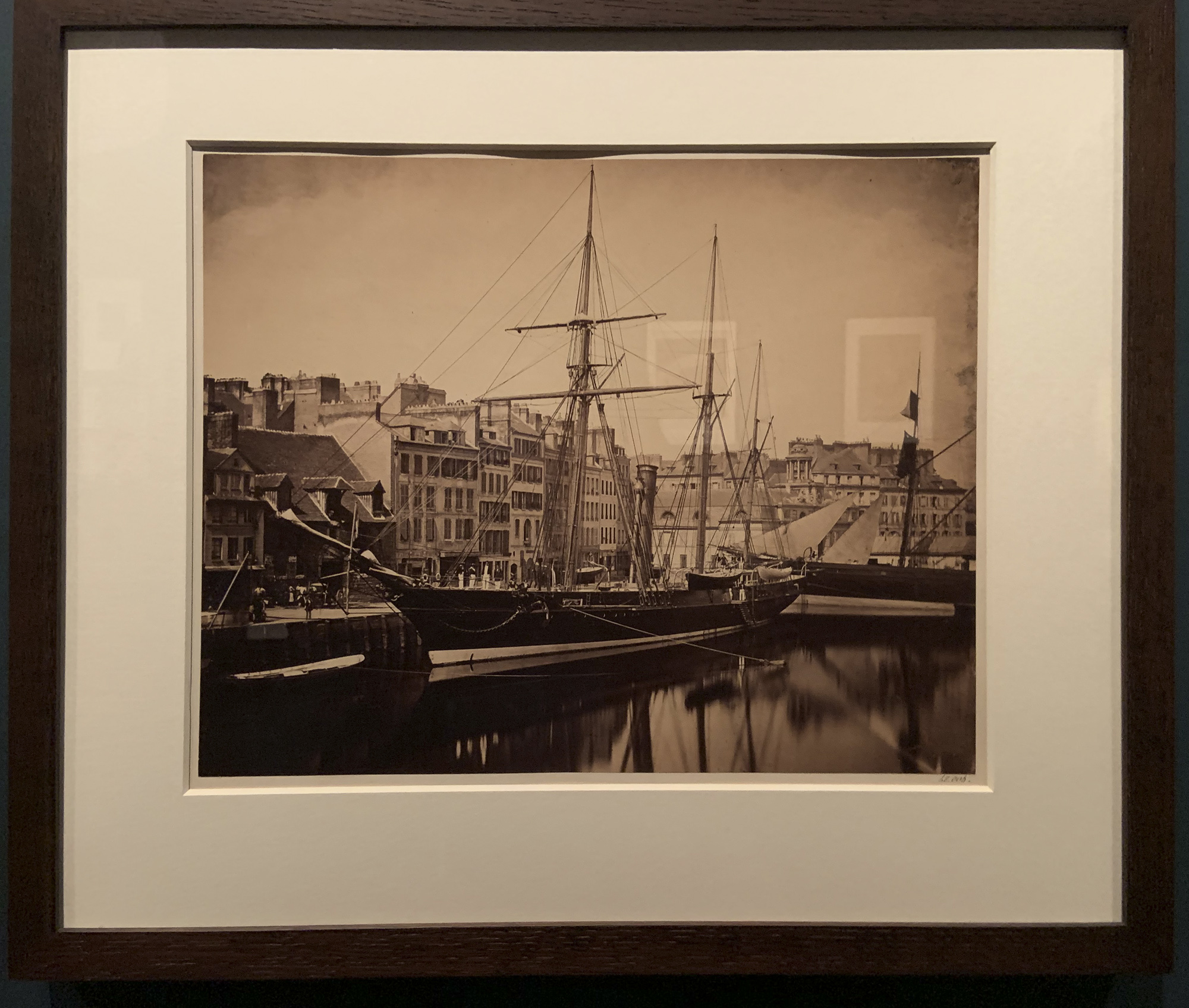
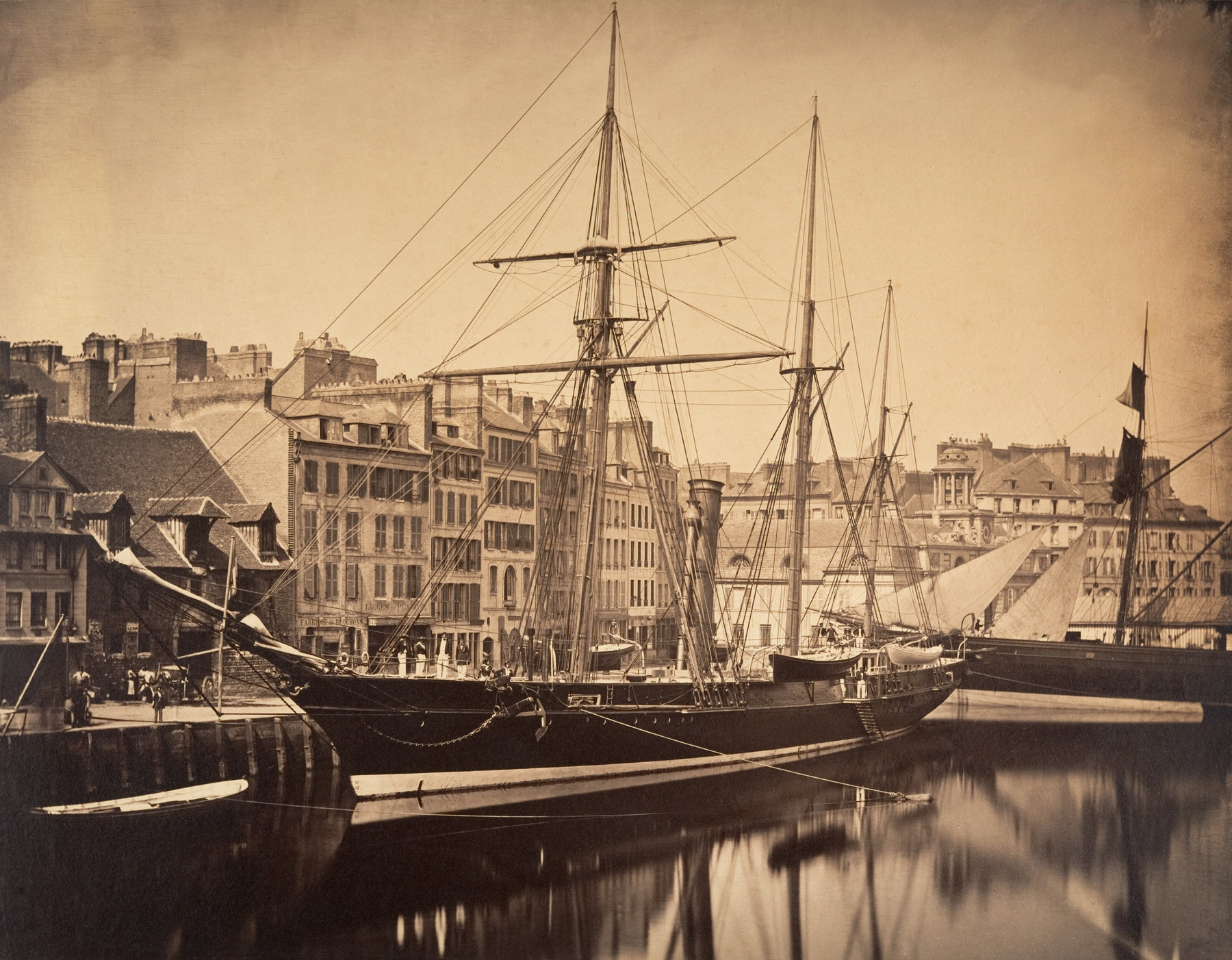
Gustave Le Gray (French, 1820-1884) 'The Imperial Yacht, La Reine Hortense, Le Havre' 1856-1857 (installation view)


Gustave Le Gray (French, 1820-1884)
The Imperial Yacht, La Reine Hortense, Le Havre (installation view)
1856-1857
Albumen print
Bequeathed to the V&A by Chauncey Hare Townshend
Photo: Marcus Bunyan
 

Gustave Le Gray (French, 1820-1884) 'The Imperial Yacht, La Reine Hortense, Le Havre' 1856-1857 (installation view)


Gustave Le Gray (French, 1820-1884)
The Imperial Yacht, La Reine Hortense, Le Havre (installation view)
1856-1857
Albumen print
Bequeathed to the V&A by Chauncey Hare Townshend
Photo: Marcus Bunyan


Gustave Le Gray (French, 1820-1884) 'The Imperial Yacht, La Reine Hortense, Le Havre' 1856-1857


Gustave Le Gray (French, 1820-1884)
The Imperial Yacht, La Reine Hortense, Le Havre
1856-1857
Albumen print
The Metropolitan Museum of Art
Public domain


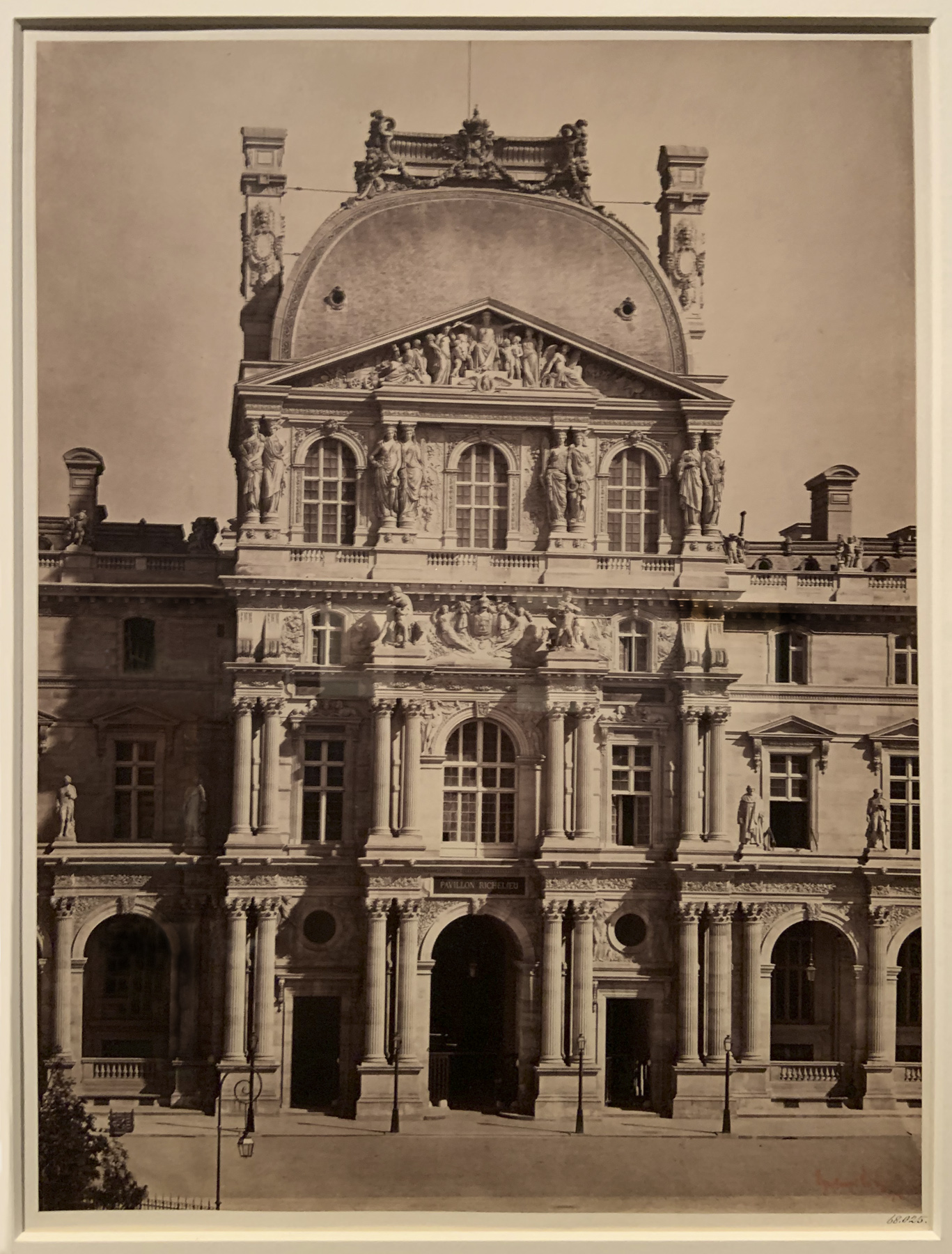
Gustave Le Gray (French, 1820-1884) 'Pavilion Richelieu, Louvre, Paris' 1857-1859 (installation view)


Gustave Le Gray (French, 1820-1884)
Pavilion Richelieu, Louvre, Paris (installation view)
1857-1859
Albumen print
Bequeathed to the V&A by Chauncey Hare Townshend
Photo: Marcus Bunyan
 

Gustave Le Gray (French, 1820-1884) 'Pavilion Richelieu, Louvre, Paris' 1857-1859 (installation view)


Gustave Le Gray (French, 1820-1884)
Pavilion Richelieu, Louvre, Paris (installation view)
1857-1859
Albumen print
Bequeathed to the V&A by Chauncey Hare Townshend
Photo: Marcus Bunyan
 

Roger Fenton (British, 1819-1869) 'Balaclava from Guard’s Hill, the Crimea' 1855 (installation view)


Roger Fenton (British, 1819-1869)
Balaclava from Guard’s Hill, the Crimea (installation view)
1855
Albumen print
Bequeathed to the V&A by Chauncey Hare Townshend
Photo: Marcus Bunyan


Roger Fenton (British, 1819-1869) 'Balaclava from Guard’s Hill, the Crimea' 1855 (installation view)


Roger Fenton (British, 1819-69)
Balaclava from Guard’s Hill, the Crimea (installation view)
1855
Albumen print
Bequeathed to the V&A by Chauncey Hare Townshend
Photo: Marcus Bunyan


Julia Margaret Cameron (British born India, 1815-1879) 'Lucia' 1864-1865 (installation view)


Julia Margaret Cameron (British, born India, 1815-1879)
Lucia (installation view)
1864-1865
Albumen print
The Royal Photographic Society Collection at the V&A Museum
Photo: Marcus Bunyan
 

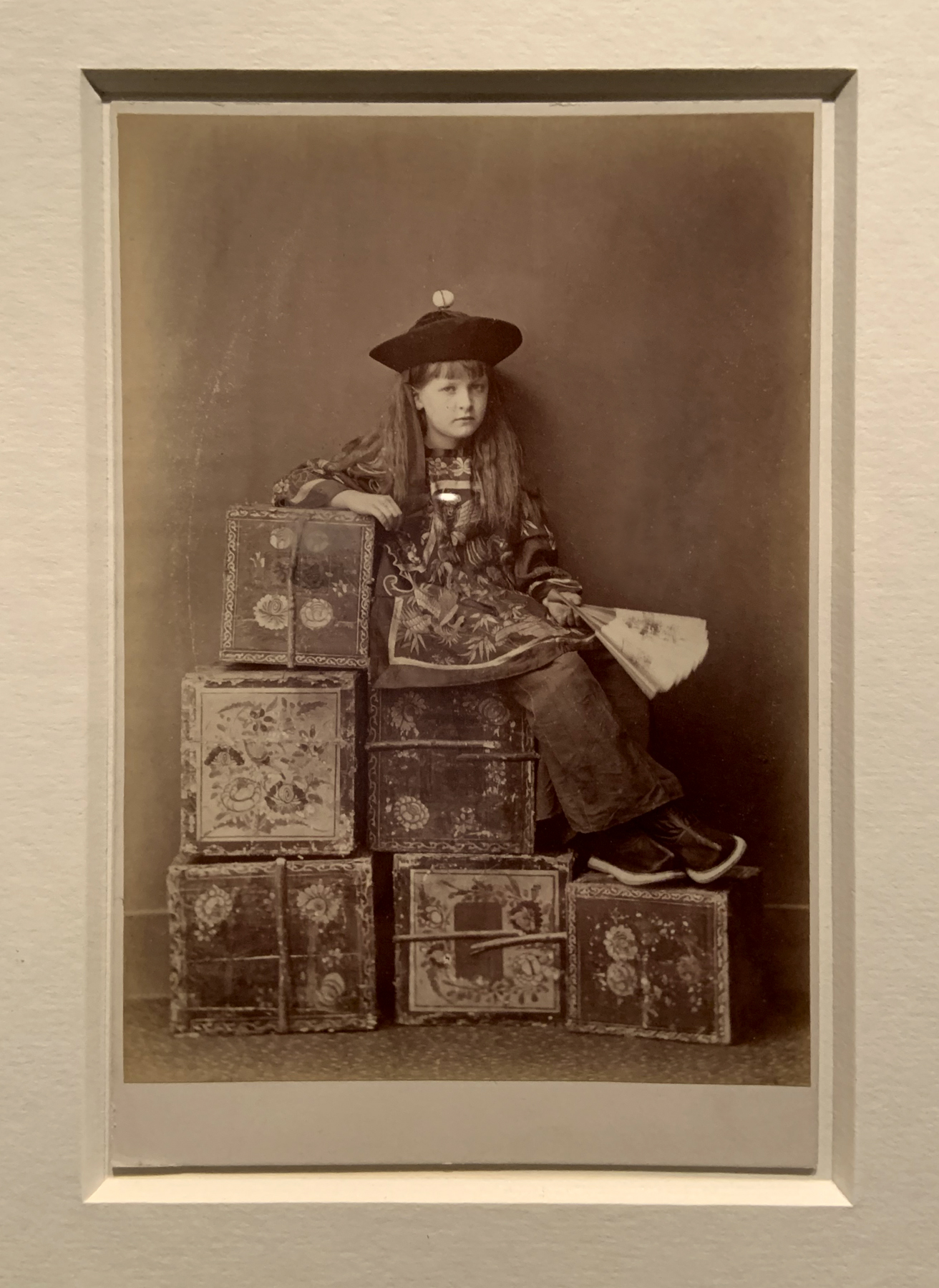
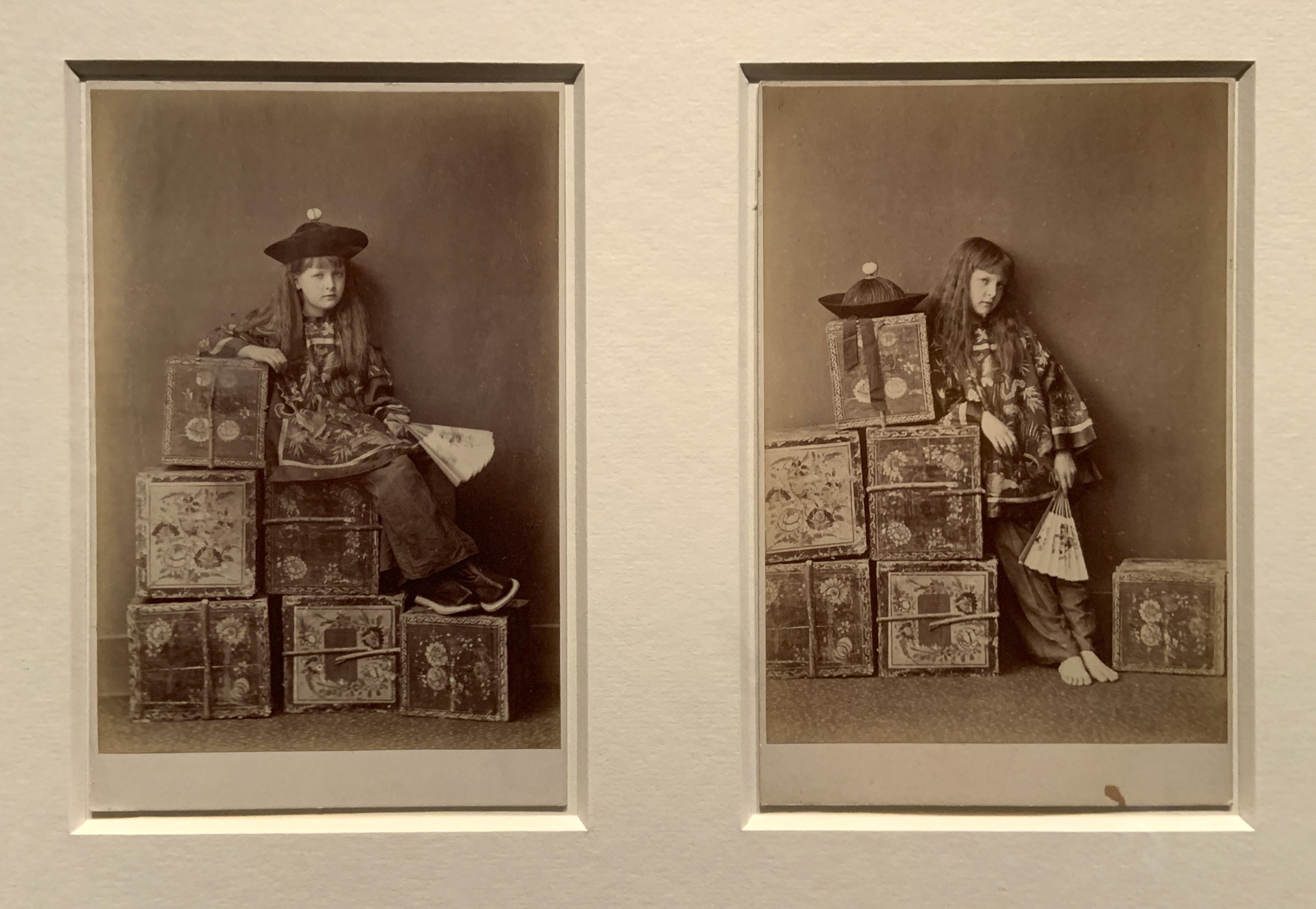
Charles Lutwide Dodgson (also known as Lewis Carroll)(British, 1832-1898) 'Tea Merchant (On Duty)' and 'Tea Merchant (Off Duty)' 1873 (installation view)


Charles Lutwide Dodgson (also known as Lewis Carroll)(British, 1832-1898)
Tea Merchant (On Duty) and Tea Merchant (Off Duty) (installation view)
1873
Albumen prints
The Royal Photographic Society Collection at the V&A Museum
Photo: Marcus Bunyan


Lewis Carroll is best known as the author of Alice’s Adventures in Wonderland, but he was also an accomplished amateur photographer. Approximately half of his photographs are portraits of children, sometimes wearing foreign costumes or acting out scenes. Here, Alexandra ‘Xie’ Kitchen, his most frequent child sitter, poses in Chinese dress on a stack of tea chests.


Charles Lutwide Dodgson (also known as Lewis Carroll)(British, 1832-1898) 'Tea Merchant (On Duty)' 1873 (installation view)


Charles Lutwide Dodgson (also known as Lewis Carroll)(British, 1832-1898)
Tea Merchant (On Duty) (installation view)
1873
Albumen prints
The Royal Photographic Society Collection at the V&A Museum
Photo: Marcus Bunyan


Charles Lutwide Dodgson (also known as Lewis Carroll)(British, 1832-1898) 'Tea Merchant (Off Duty)' 1873 (installation view)


Charles Lutwide Dodgson (also known as Lewis Carroll)(British, 1832-1898)
Tea Merchant (Off Duty) (installation view)
1873
Albumen prints
The Royal Photographic Society Collection at the V&A Museum
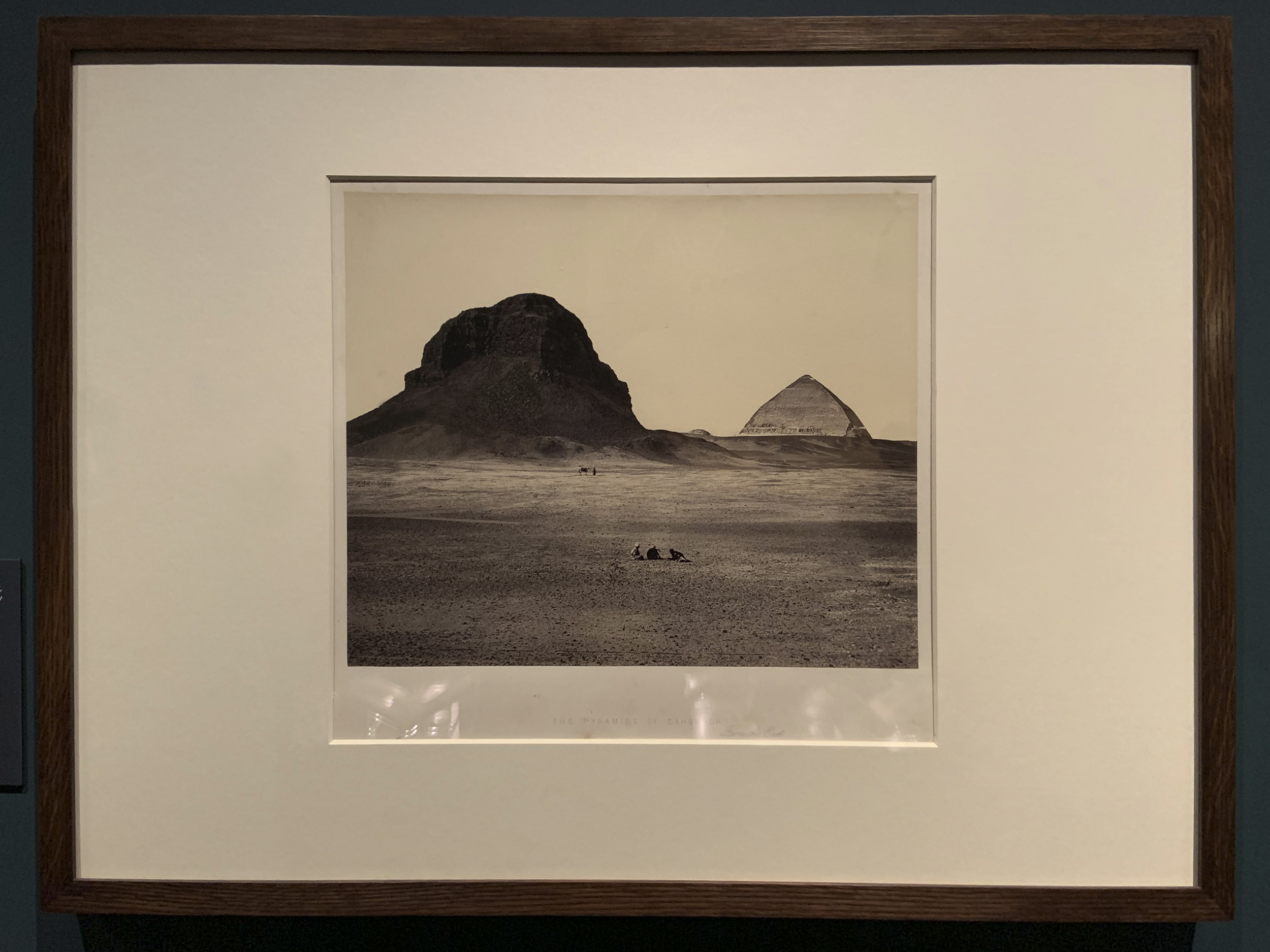
Photo: Marcus Bunyan


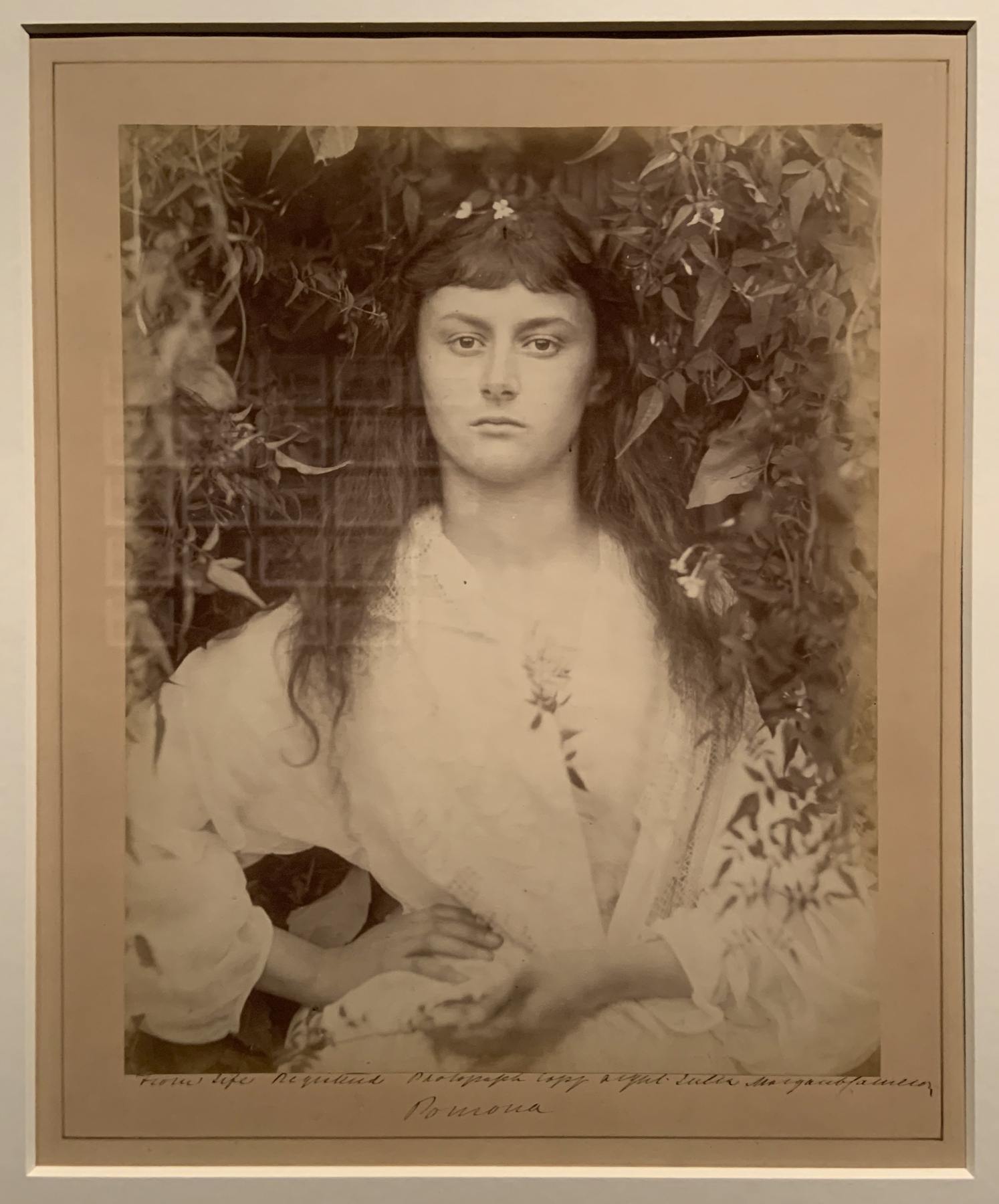
Julia Margaret Cameron (British, born India, 1815-1879) 'Pomona' 1887 (installation view)


Julia Margaret Cameron (British, born India, 1815-1879)
Pomona (installation view)
1887
Albumen print
The Royal Photographic Society Collection at the V&A Museum
Photo: Marcus Bunyan


The South Kensington museum (now the V&A) was the only museum to collect and exhibit Julia Margaret Cameron’s during her lifetime. This is one of several studies she made of Alice Liddell, who as a child had modelled for the author and photographer Lewis Carroll and inspired his novel Alice’s Adventures in Wonderland. Cameron, Carroll and Liddell moved in overlapping artistic and intellectual circles. Here, surrounded by foliage, a grown-up Alice poses as the Roman goddess of orchards and gardens.


Julia Margaret Cameron (British, born India, 1815-1879) 'Pomona' 1887 (installation view)


Julia Margaret Cameron (British, born India, 1815-1879)
Pomona (installation view)
1887
Albumen print
The Royal Photographic Society Collection at the V&A Museum
Photo: Marcus Bunyan


Installation view of the V&A Photography Centre, London


Installation view of the V&A Photography Centre, London
Photo: Marcus Bunyan


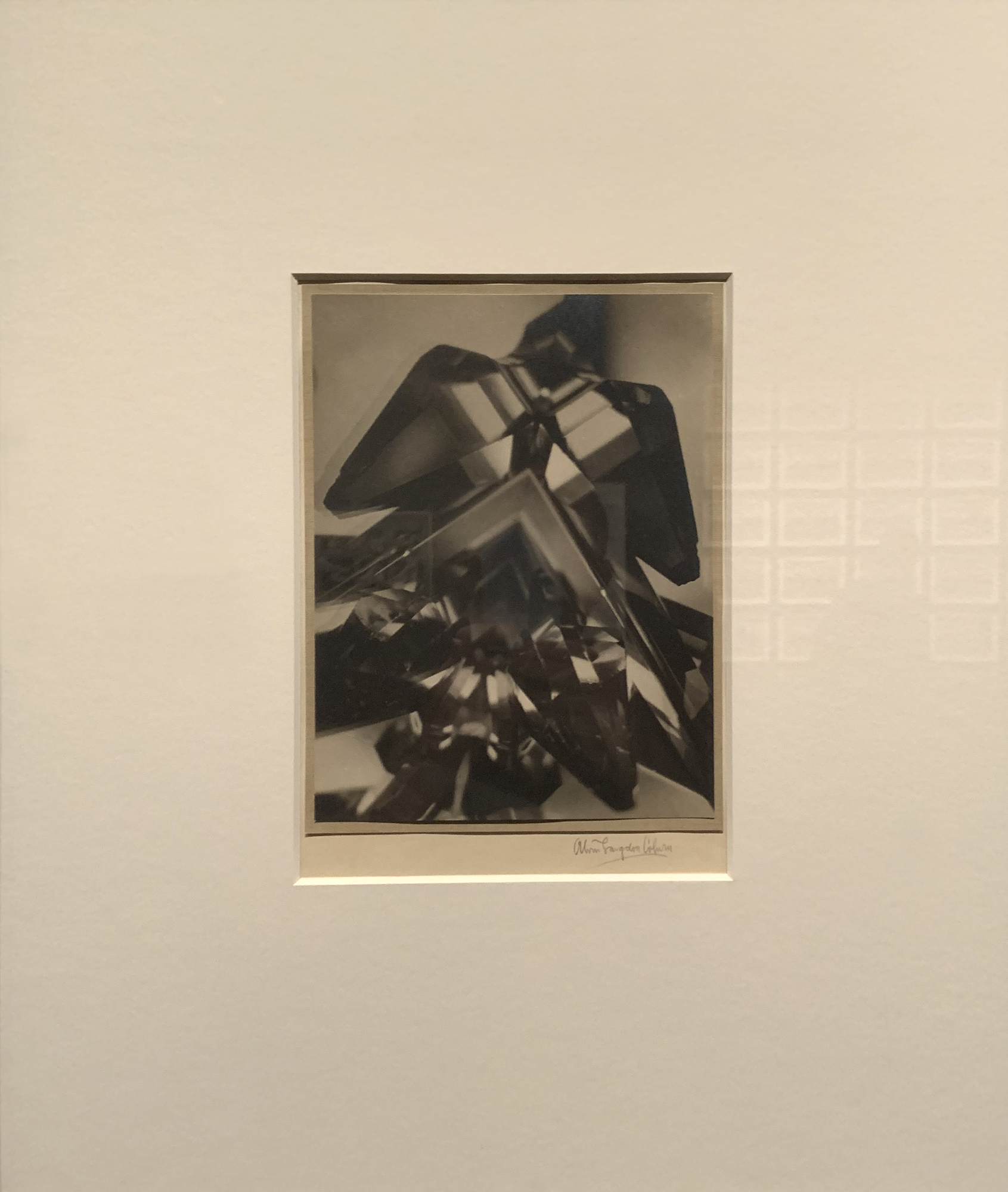
Alvin Langdon Coburn (American 1882-1966) 'Frederick Holland Day' 1900 (installation view)


Alvin Langdon Coburn (American 1882-1966)
Frederick Holland Day (installation view)
1900
Gum platinum print
The Royal Photographic Society Collection at the V&A Museum
Photo: Marcus Bunyan
 

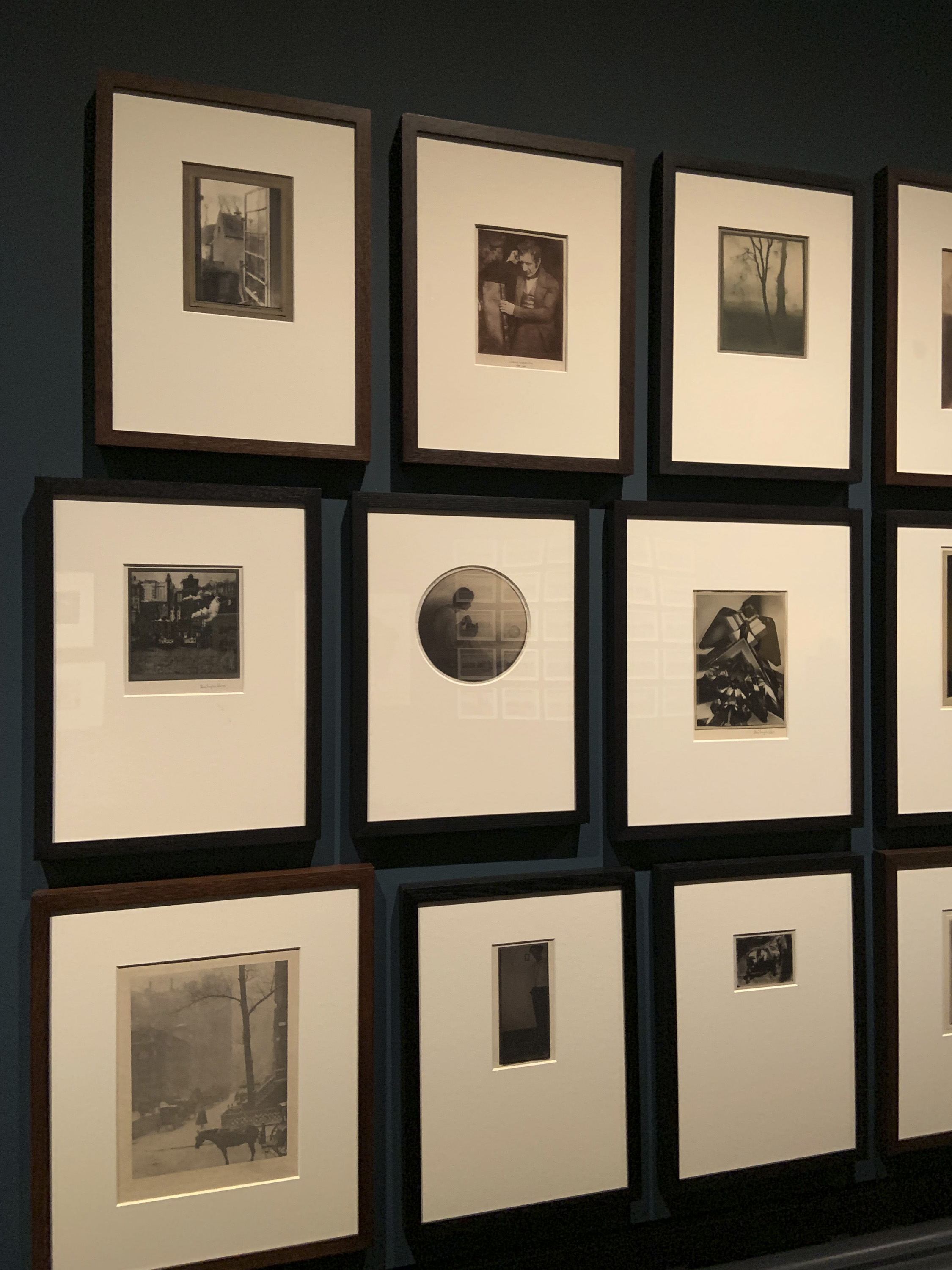
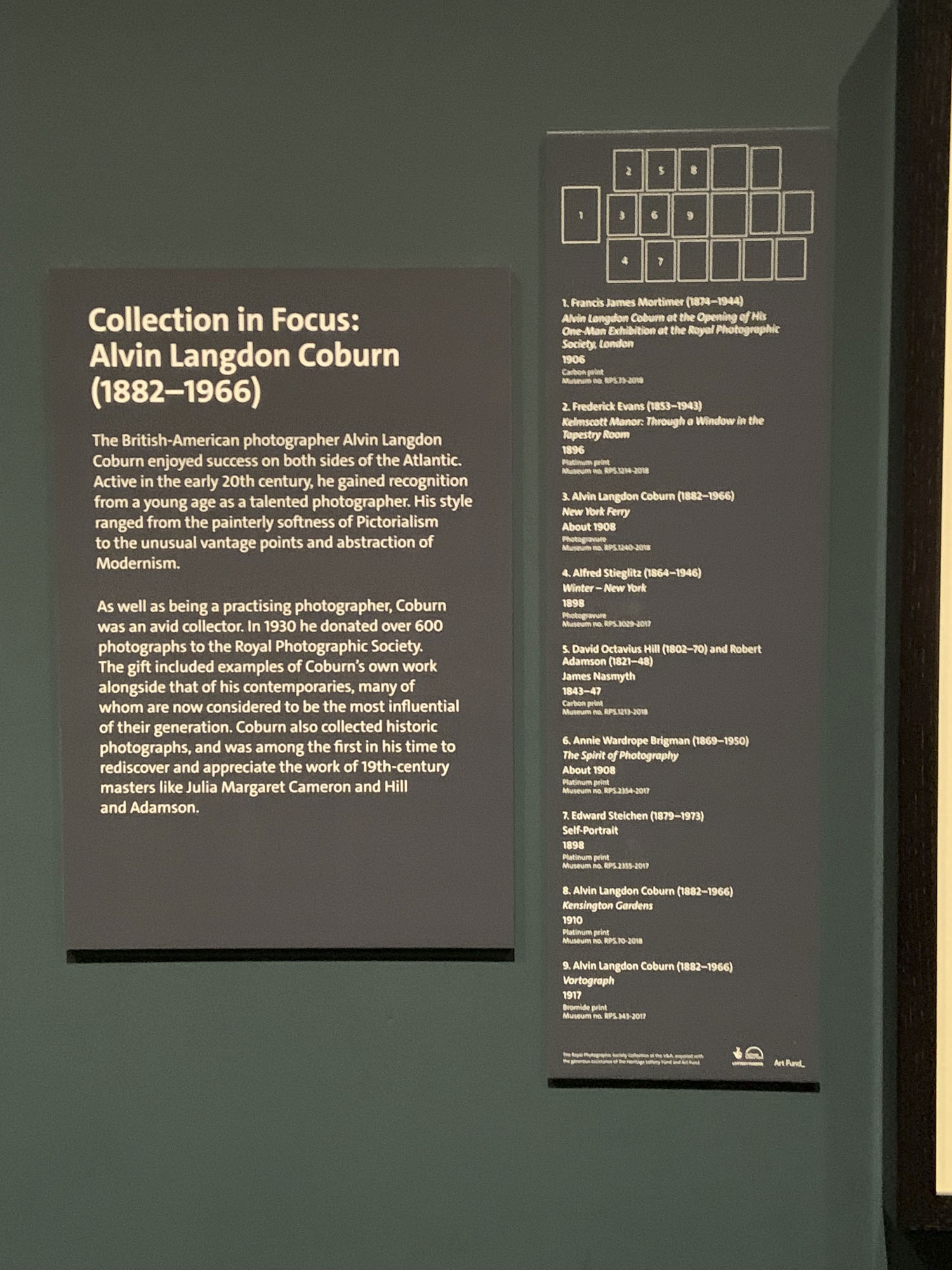
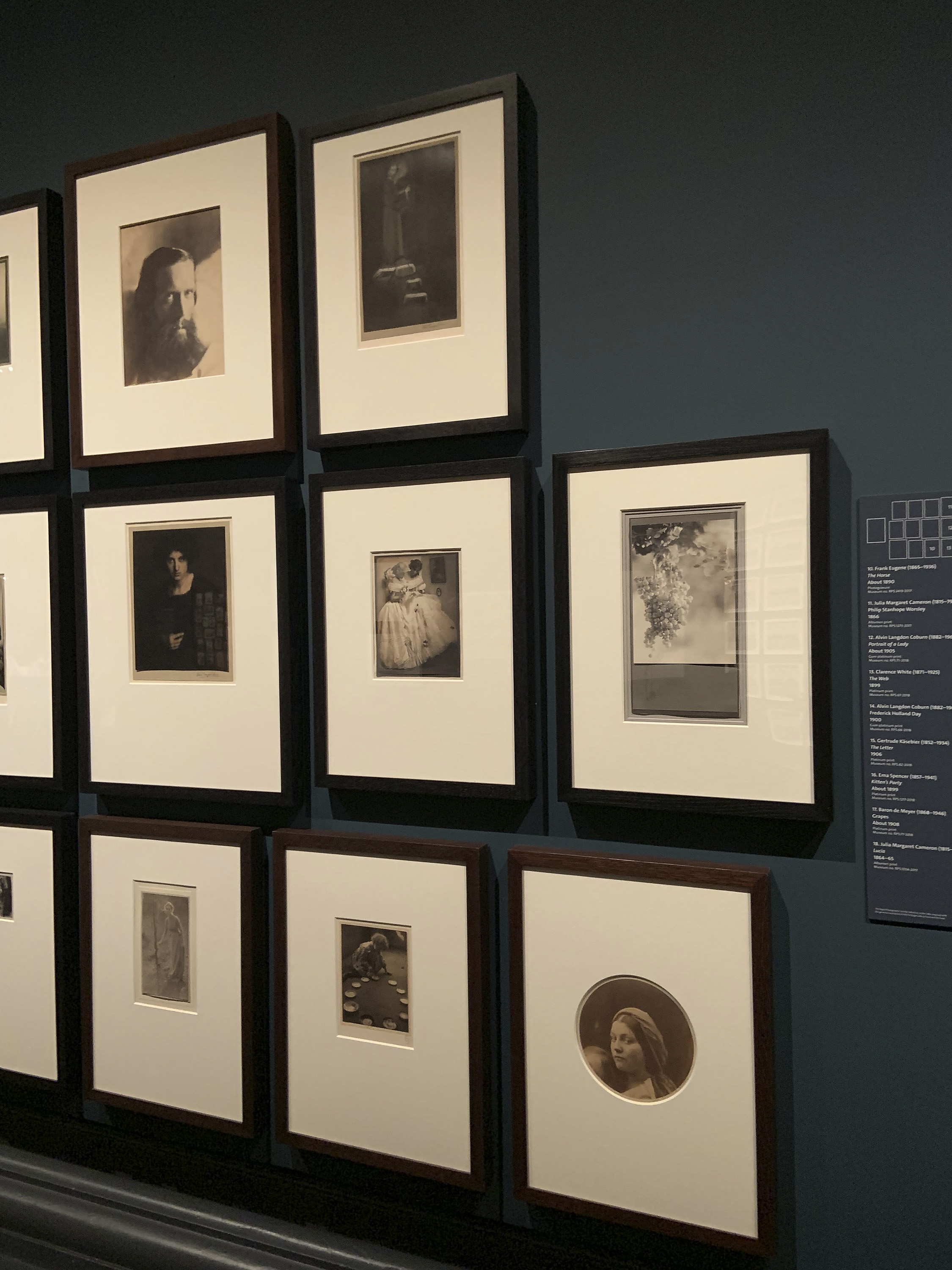
The British-American photographer Alvin Langdon Coburn enjoyed success on both sides of the Atlantic. Active in the early 20th century, he gained recognition from a young age as a talented photographer. His style ranged from the painterly softness of Pictorialism to the unusual vantage points and abstraction of Modernism. As well as being a practising photographer, Coburn was an avid collector. In 1930 he donated over 600 photographs to the Royal Photographic Society. The gift included examples of Coburn’s own work alongside that of his contemporaries, many of whom are now considered to be the most influential of their generation. Coburn also collected historic photographs, and was among the first in his time to rediscover and appreciate the work of 19th-century masters like Julia Margaret Cameron and Hill and Adamson.


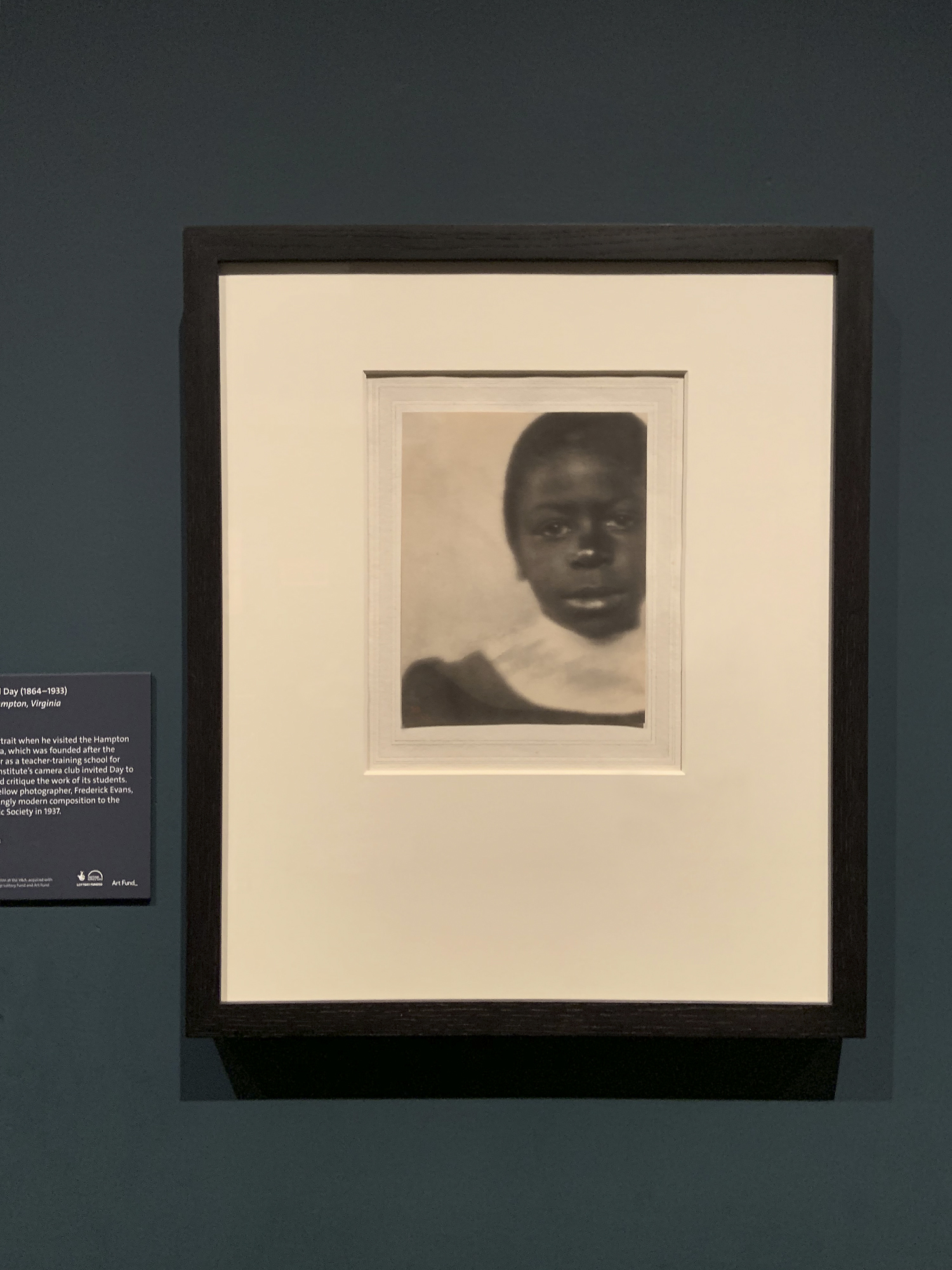
Fredrick Holland Day (American, 1864-1933) 'Head of a Girl, Hampton, Virginia' 1905 (installation view)


Fredrick Holland Day (American, 1864-1933)
Head of a Girl, Hampton, Virginia (installation view)
1905
Gum platinum print
The Royal Photographic Society Collection at the V&A Museum
Photo: Marcus Bunyan


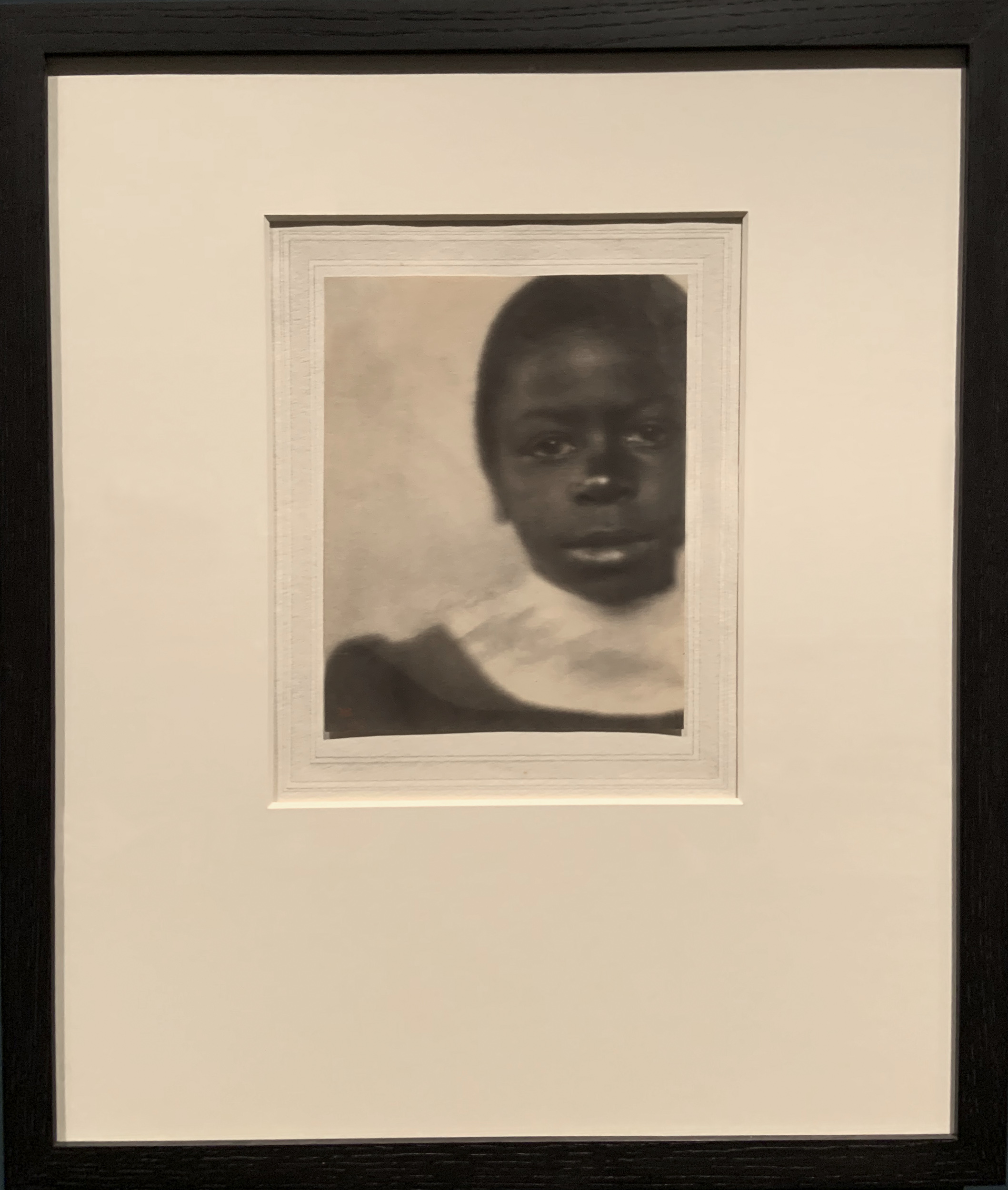
Day made this portrait when he visited the Hampton Institute in Virginia, which was founded after the American Civil War as a teacher-training school for freed slaves. The institute’s camera club invited Day to visit the school and critique the work of its students. Day’s friend and fellow photographer, Frederick Evans, donated this strikingly modern composition to the Royal Photographic Society in 1937.


Fredrick Holland Day (American, 1864-1933) 'Head of a Girl, Hampton, Virginia' 1905 (installation view)


Fredrick Holland Day (American, 1864-1933)
Head of a Girl, Hampton, Virginia (installation view)
1905
Gum platinum print
The Royal Photographic Society Collection at the V&A Museum
Photo: Marcus Bunyan


Fredrick Holland Day (American, 1864-1933) 'Head of a Girl, Hampton, Virginia' 1905 (installation view)


Fredrick Holland Day (American, 1864-1933)
Head of a Girl, Hampton, Virginia (installation view)
1905
Gum platinum print
The Royal Photographic Society Collection at the V&A Museum
Photo: Marcus Bunyan
 

Fredrick Holland Day (American, 1864-1933) 'Head of a Girl, Hampton, Virginia' 1905


Fredrick Holland Day (American, 1864-1933)
Head of a Girl, Hampton, Virginia
1905
Gum platinum print
The Royal Photographic Society Collection at the V&A Museum


Gertrude Käsebier (American, 1852-1934) 'The Letter' 1906


Gertrude Käsebier (American, 1852-1934)
The Letter
1906
Platinum print
The Royal Photographic Society Collection at the V&A Museum


Käsebier studied painting before opening a photography studio in New York. Her Pictorialist photographs often combine soft focus with experimental printing techniques. These sisters were dressed in historic costume for a ball, but their pose transforms a society portrait into a narrative picture. In a variant image, they turn to look at the framed silhouette on the wall.


Installation view of the V&A Photography Centre, London

Wall text from the V&A Photography Centre, London


Installation views of the V&A Photography Centre, London
Photo: Marcus Bunyan


Francis James Mortimer (British, 1874-1944) 'Alvin Langdon Coburn at the Opening of His One-Man Exhibition the Royal Photographic Society, London' 1906 (installation view)


Francis James Mortimer (British, 1874-1944)
Alvin Langdon Coburn at the Opening of His One-Man Exhibition the Royal Photographic Society, London (installation view)
1906
Carbon print
The Royal Photographic Society Collection at the V&A Museum
Photo: Marcus Bunyan


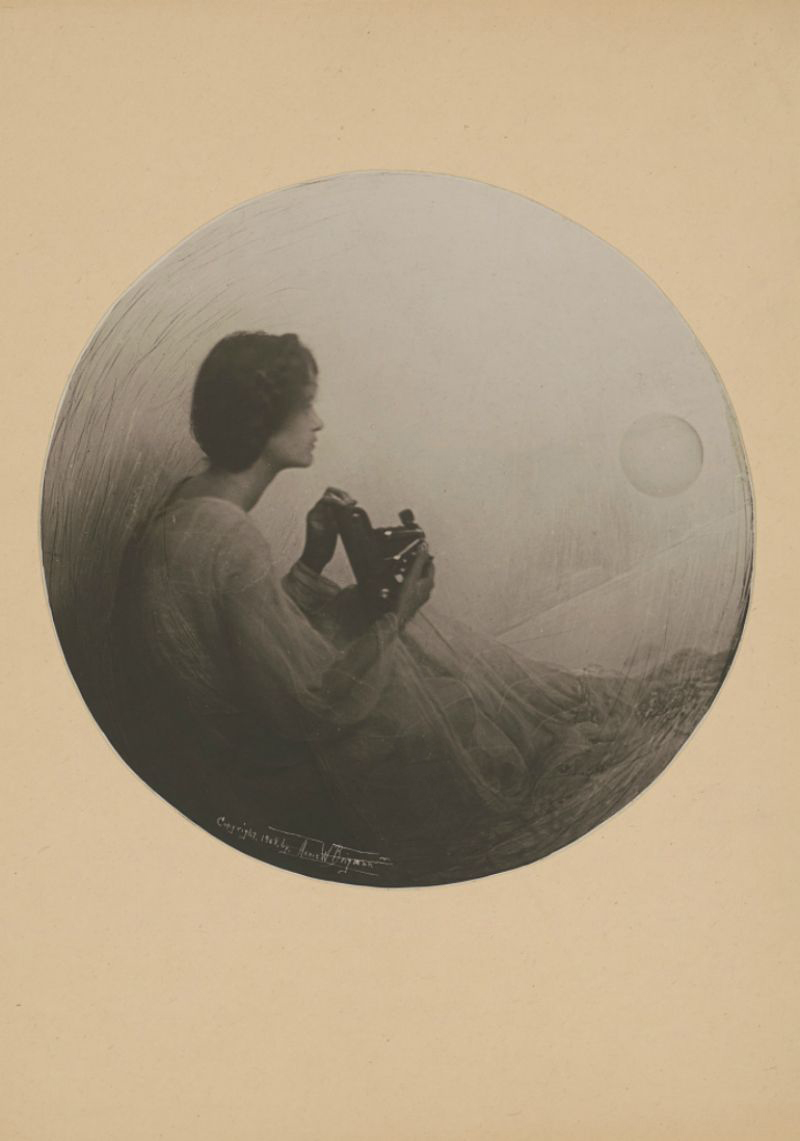
Annie Wardrope Brigman (American, 1869-1950) 'The Spirit of Photography' c. 1908


Annie Wardrope Brigman (American, 1869-1950)
The Spirit of Photography
c. 1908
Platinum print
The Royal Photographic Society Collection at the V&A Museum


Alvin Langdon Coburn (American 1882-1966) 'Kensington Gardens' 1910 (installation view)


Alvin Langdon Coburn (American 1882-1966)
Kensington Gardens (installation view)
1910
Platinum print
The Royal Photographic Society Collection at the V&A Museum
Photo: Marcus Bunyan


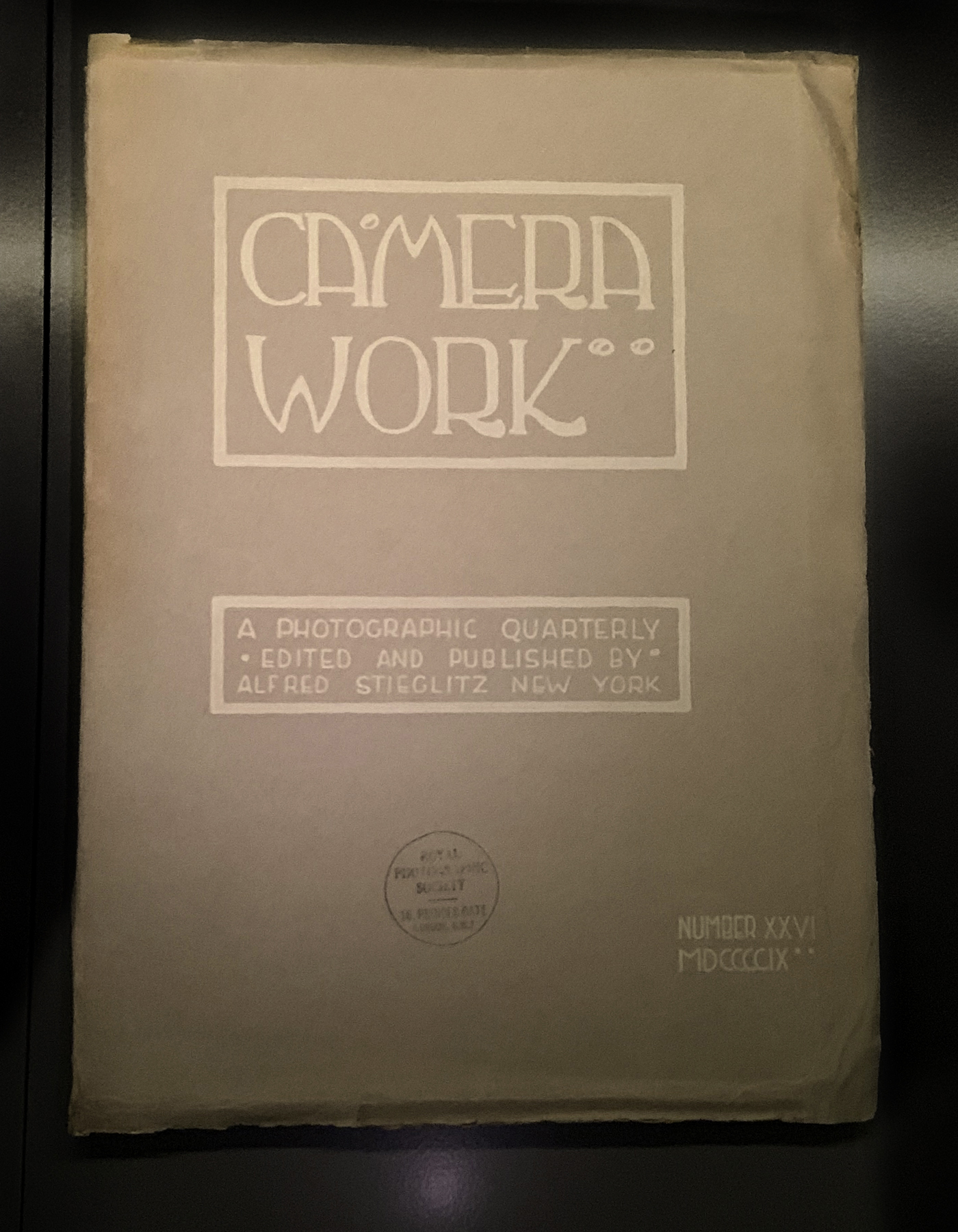
Cover of 'Camera Work'


Cover of Camera Work Number XXVI (installation view)
Photo: Marcus Bunyan


Edward Steichen (American, 1879-1973) 'Portrait – Lady H' 1908 from 'Camerwork 22'


Edward Steichen (American, 1879-1973)
Portrait – Lady H (installation view)
1908
Camera Work 22
1908
Photogravure
The Royal Photographic Society Collection at the V&A Museum
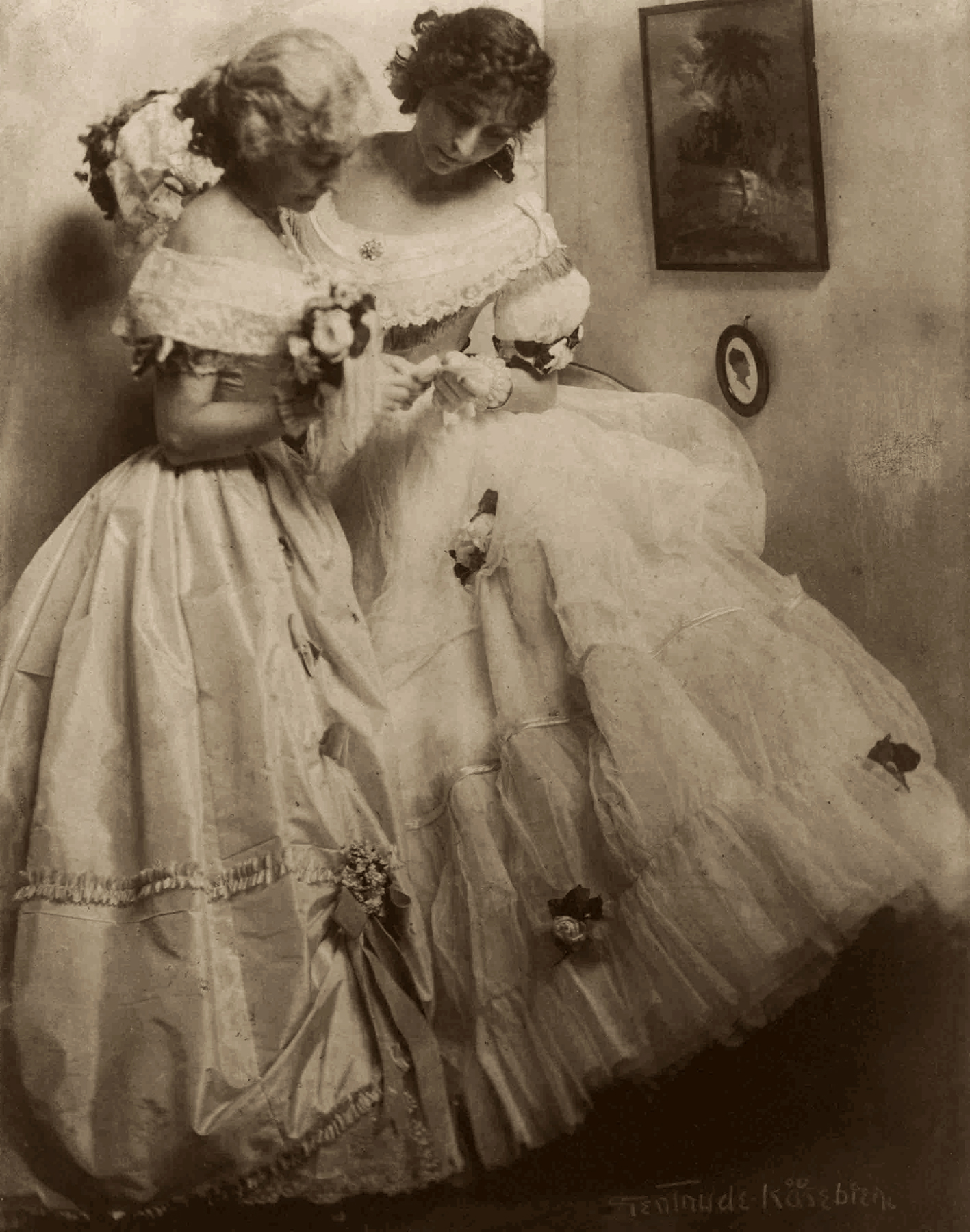
Photo: Marcus Bunyan


Edward Steichen (American, 1879-1973) 'Portrait – Lady H' 1908 from 'Camerwork 22'


Edward Steichen (American, 1879-1973)
Portrait – Lady H
1908
Camera Work 22
1908
Photogravure
The Royal Photographic Society Collection at the V&A Museum


Paul Strand (American, 1890-1976) 'New York' 1916 from 'Camerwork 48' (installation view)


Paul Strand (American, 1890-1976)
New York (installation view)
1916
Camera Work 48
1916
Photogravure
The Royal Photographic Society Collection at the V&A Museum
Photo: Marcus Bunyan


Alfred Stieglitz (American, 1864-1946) was an American photographer, publisher, writer and gallery owner. From 1903-1917, he published the quarterly journal Camera Work, which featured portfolios of exquisitely printed photogravures (a type of photograph printed in ink), alongside essays and reviews. Camera Work promoted photography as an art form, publishing the work of Pictorialist photographers who drew inspiration from painting, and reproducing 19th-century photographs. It also helped to introduce modern art to American audiences, including works by radical European painters such as Matisse and Picasso.


Alvin Langdon Coburn (American 1882-1966) 'Vortograph' 1917 (installation view)


Alvin Langdon Coburn (American 1882-1966)
Vortograph (installation view)
1917
Bromide print
The Royal Photographic Society Collection at the V&A Museum
Photo: Marcus Bunyan


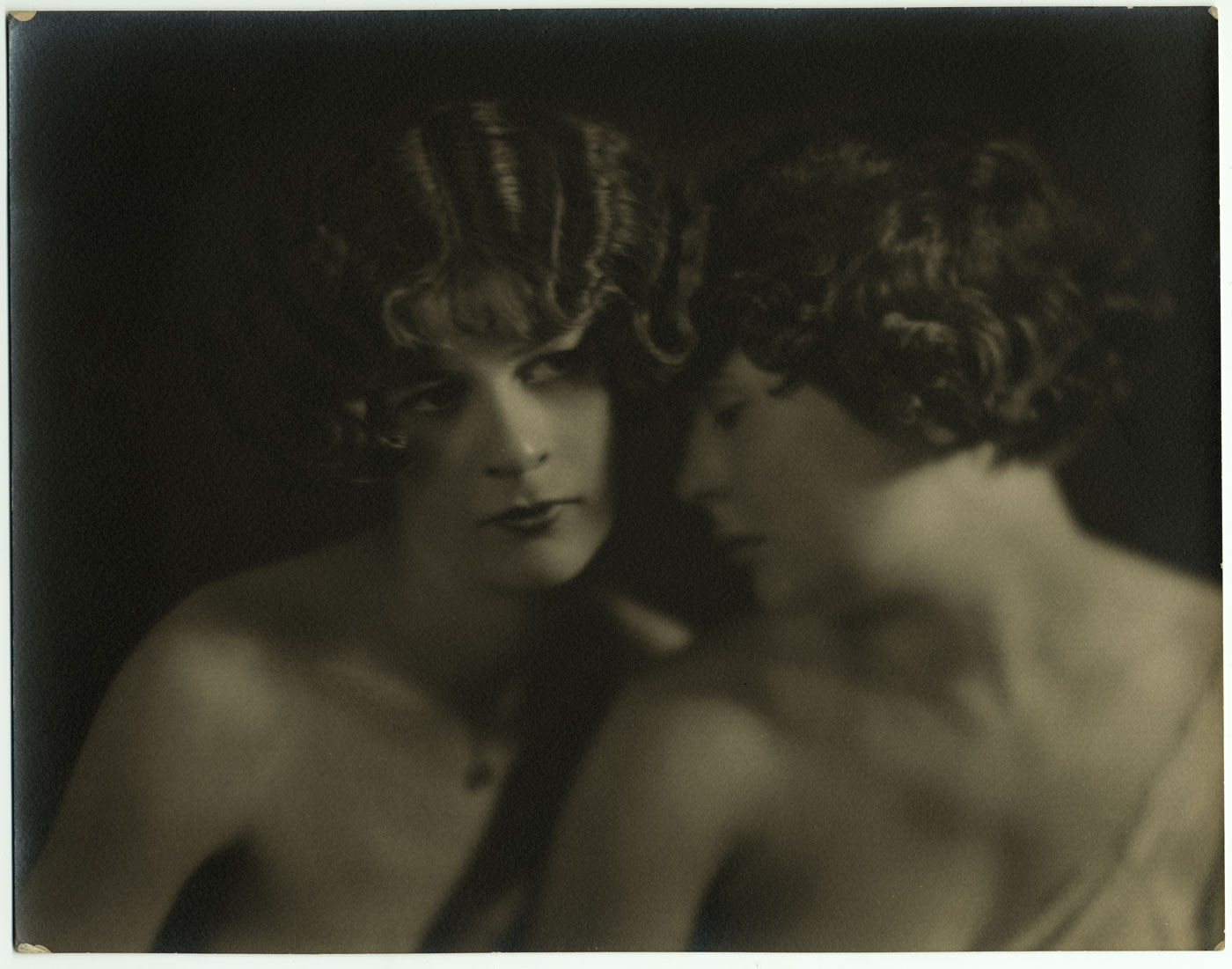
Rudolph Koppitz. 'Movement Study' 1925


Rudolph Koppitz (American, 1884-1936)
Bewegungsstudie (Movement Study)
1926
Carbon print
The Royal Photographic Society Collection at the V&A Museum


Koppitz was a leading art photographer in Vienna between the two World Wars, as well as a master of complex printing processes, including the pigment, gum and broccoli process of transfer printing. Tis dynamic and sensual composition captures dancers from the Vienna State Opera Ballet frozen mid-movement.


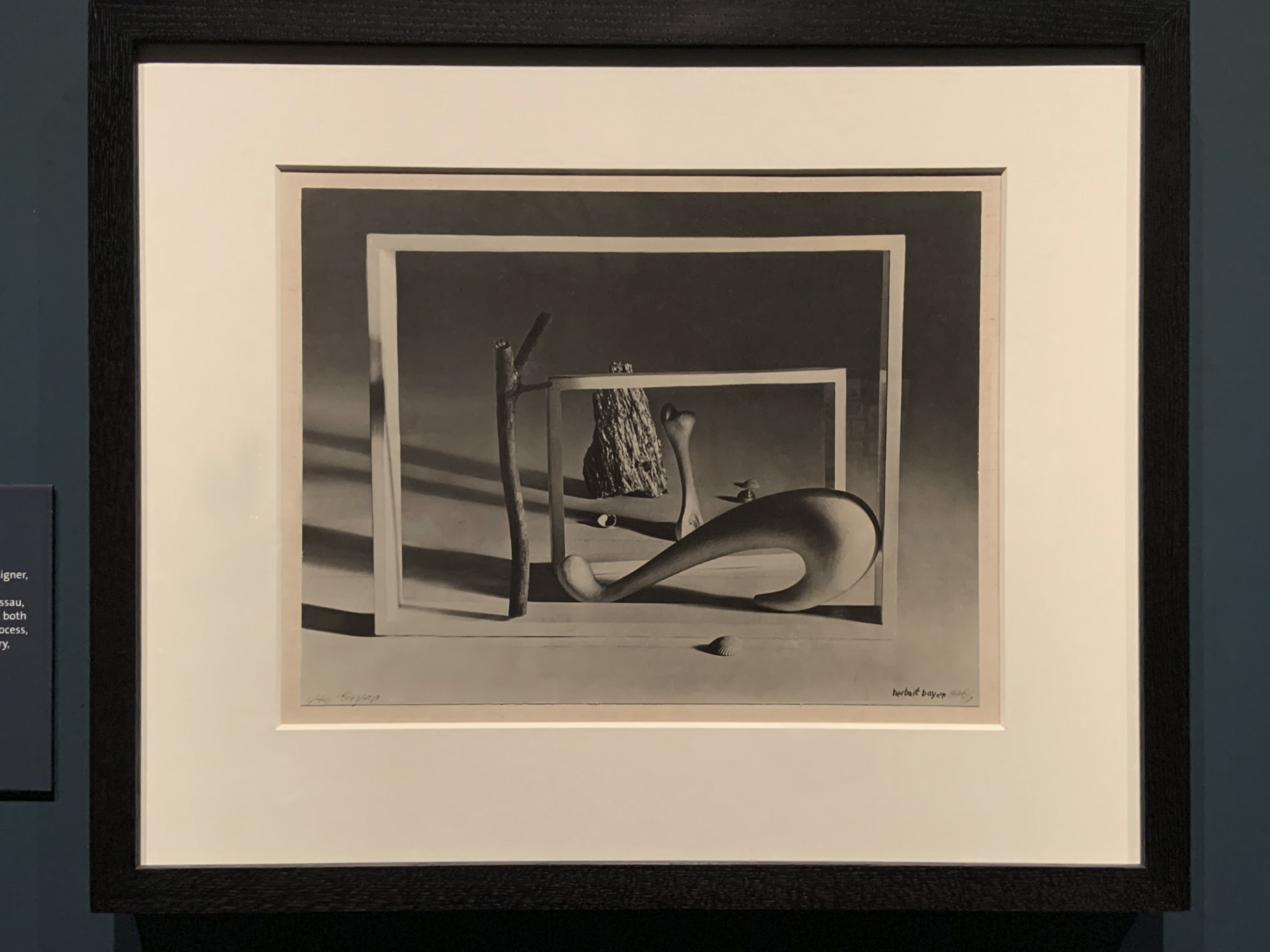
Herbert Bayer (Austrian American, 1900-1985) 'Shortly Before Dawn' 1932-1939 (installation view)


Herbert Bayer (Austrian American, 1900-85)
Shortly Before Dawn (installation view)
1932-39
Gelatin silver print
The Royal Photographic Society Collection at the V&A Museum
Photo: Marcus Bunyan


Bayer had a varied and influential career as a designer, painter, photographer, sculptor, art director and architect. He taught at the Bauhaus school in Dessau, Germany, and later began to use photomontage, both in his artistic and advertising work. Using this process, he combined his photographs with found imagery, producing surreal or dreamlike pictures.


Herbert Bayer (Austrian American, 1900-1985) 'Shortly Before Dawn' 1932-1939 (installation view)


Herbert Bayer (Austrian American, 1900-85)
Shortly Before Dawn (installation view)
1932-39
Gelatin silver print
The Royal Photographic Society Collection at the V&A Museum
Photo: Marcus Bunyan


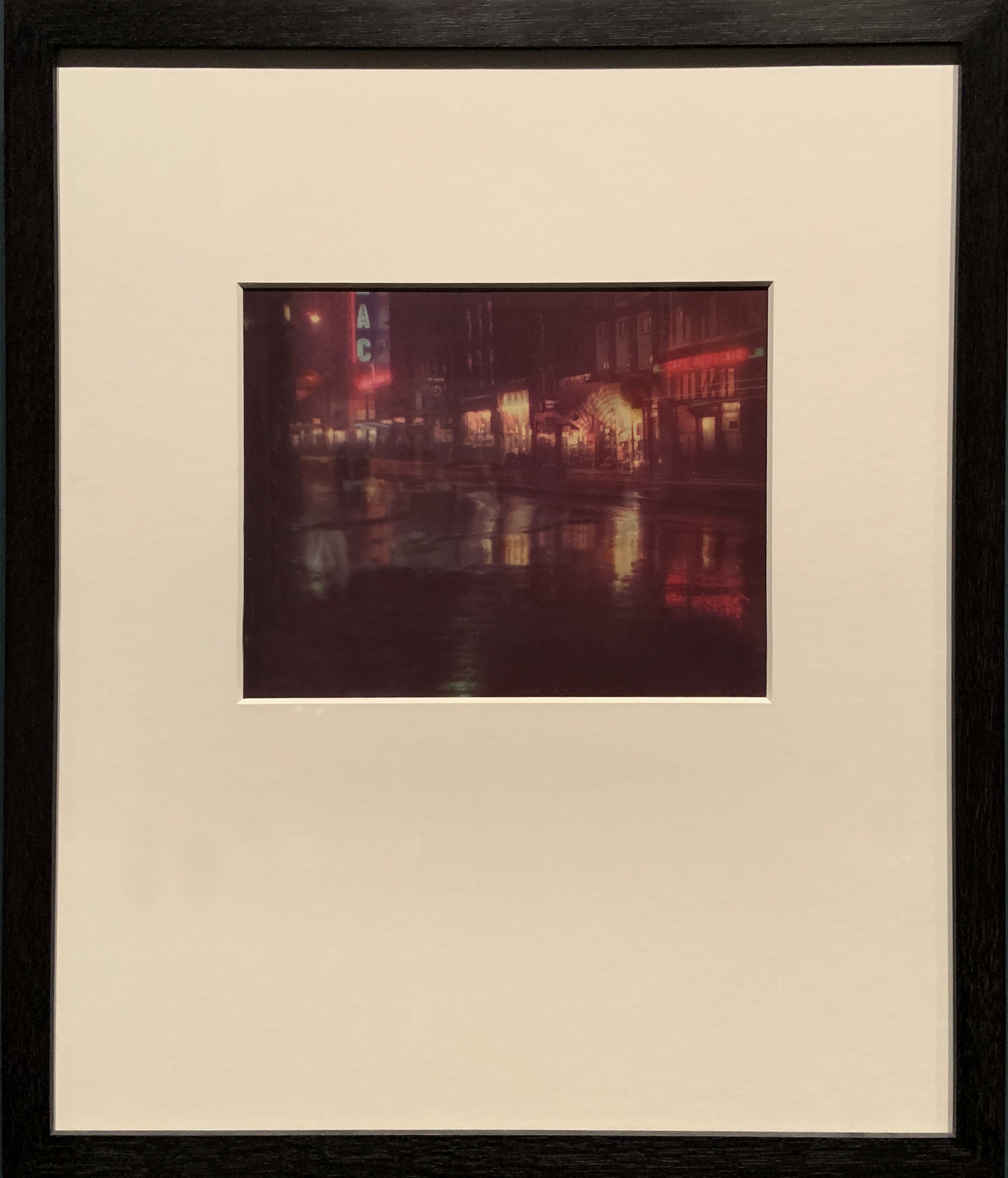
Bernard Eilers (Dutch, 1878-1951) 'Reguliersbreestraat, Amsterdam' 1934 (installation view)


Bernard Eilers (Dutch, 1878-1951)
Reguliersbreestraat, Amsterdam (installation view)
1934
Foto-choma Eilers
Given by Joan Luckhurst Eilers
Photo: Marcus Bunyan


In the 1930s, the Dutch photographer Bernard Eilers developed an experimental new photographic colour separation process known as ‘Foto-chroma Eilers’. Although the process was short-lived, Eilers successfully used this technique to produce prints like this of great intensity and depth of colour. Here, the misty reflections and neon lights create an atmospheric but modern view of a rain-soaked Amsterdam at night.


Bernard Eilers (Dutch, 1878-1951) 'Reguliersbreestraat, Amsterdam' 1934 (installation view)


Bernard Eilers (Dutch, 1878-1951)
Reguliersbreestraat, Amsterdam (installation view)
1934
Foto-choma Eilers
Given by Joan Luckhurst Eilers
Photo: Marcus Bunyan


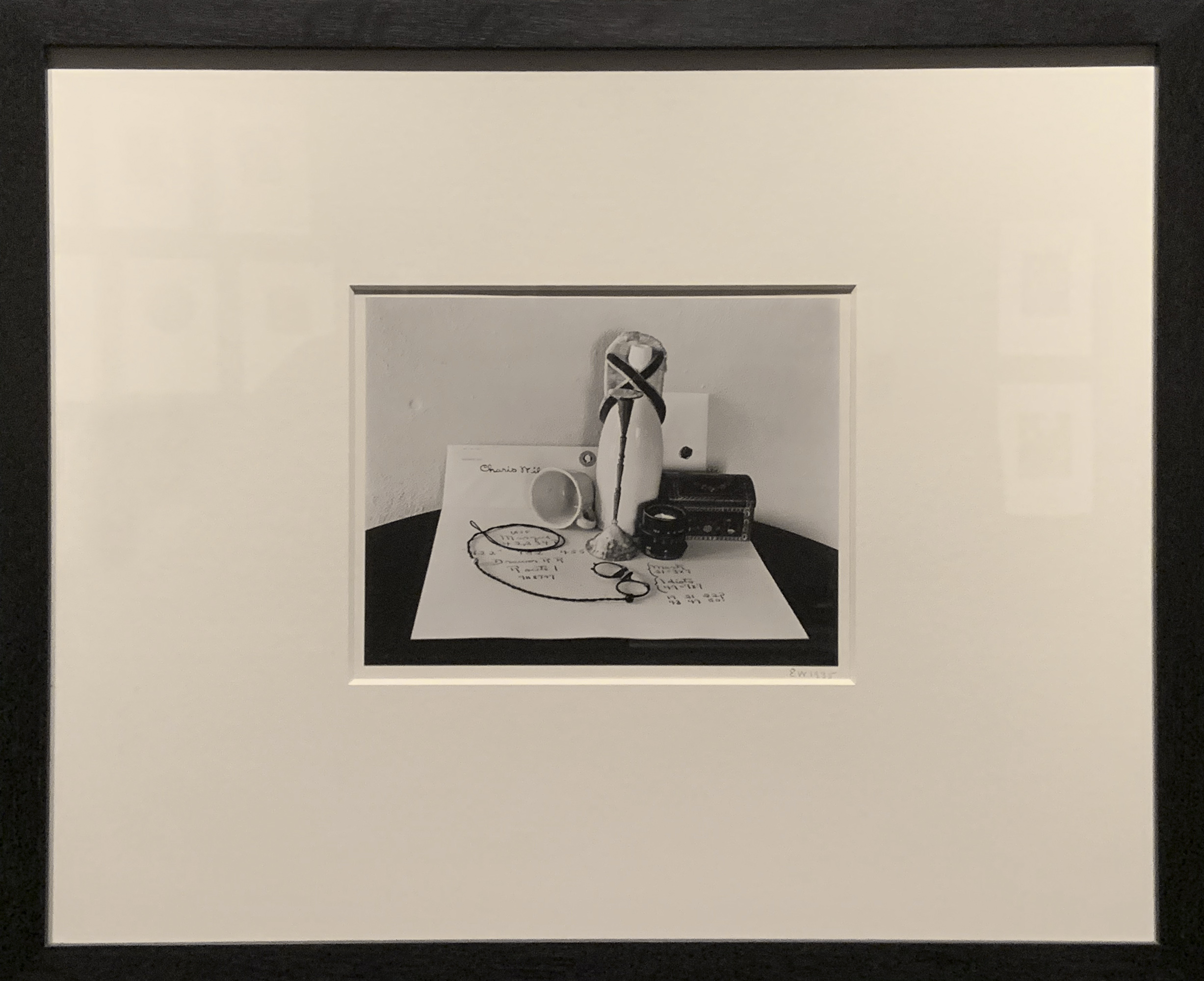
Edward Weston (American, 1886-1958) 'Valentine to Charis' 1935 (installation view)


Edward Weston (American, 1886-1958)
Valentine to Charis (installation view)
1935
Gelatin silver print
The Royal Photographic Society Collection at the V&A Museum
Photo: Marcus Bunyan


When Weston met the model and writer Charis Wilson in 1934, he was immediately besotted. This valentine to her contains a cluster of objects arranged as a still life, including the photographer’s camera lens and spectacles. Some of the objects seem to hold a special significance that only the lovers could understand. The numbers on the right possibly refer to their ages – there were almost thirty years between them.


Horst P. Horst (German-American, 1906-1999) 'Portrait of Gabrielle ('Coco') Chanel' 1937 (installation view)


Horst P. Horst (German-American, 1906-1999)
Portrait of Gabrielle (‘Coco’) Chanel
1937
Gelatin silver print
The Royal Photographic Society Collection at the V&A Museum

Variant, American Vogue, 1 December 1937, p. 86: ‘Fashion: Mid-Season Prophecies’

Caption reads: Chanel in her fitted, three-quarters coat / Mademoiselle Chanel, in one of her new coats that are making the news – a three quarters coat buttoned tightly and trimmed with astrakham like her cap. 01/12/1937


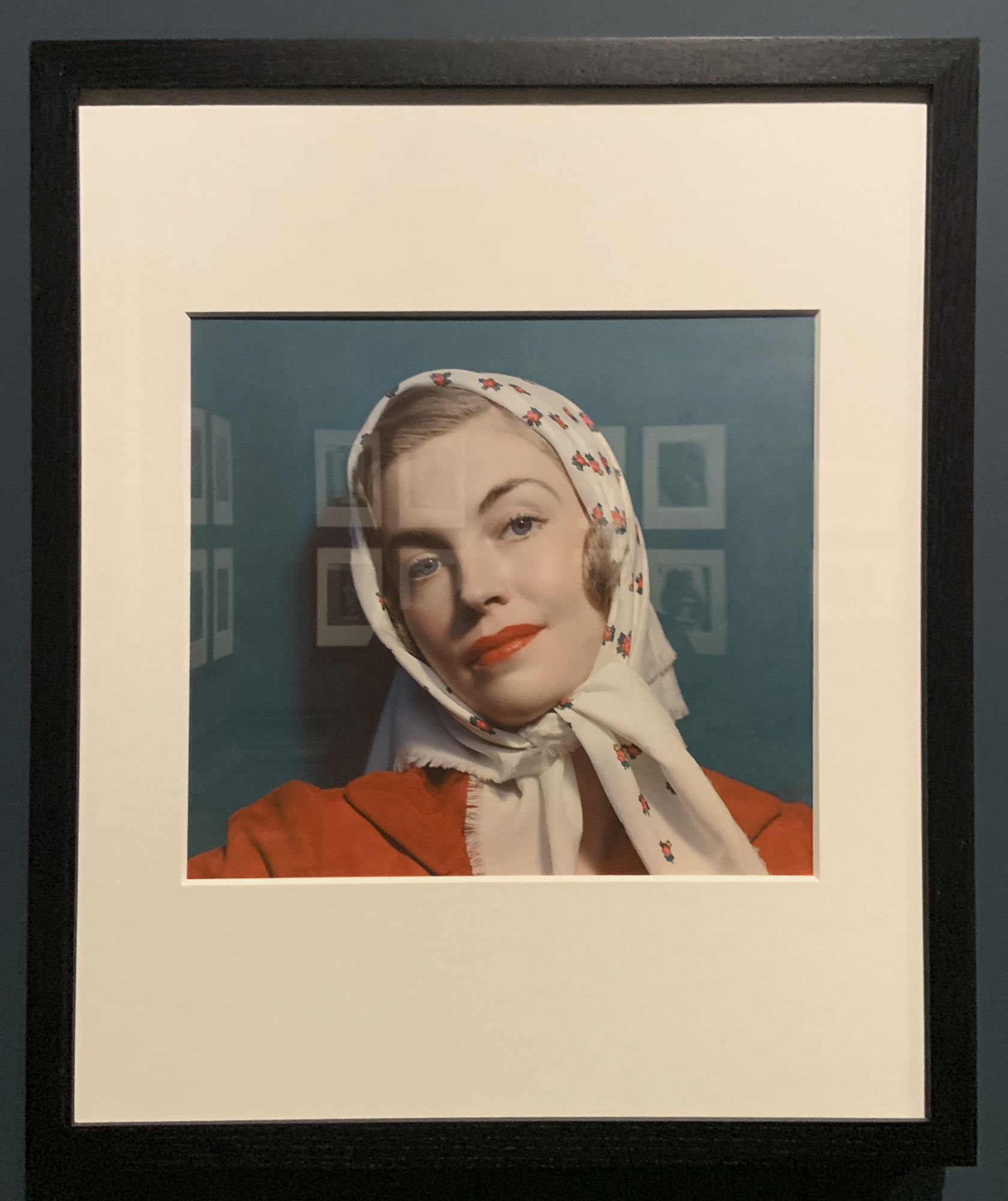
Nickolas Muray (American, 1892-1965) 'Women with headscarf, 'McCall’s' Cover, July 1938' 1938 (installation view)


Nickolas Muray (American, 1892-1965)
Women with headscarf, McCall’s Cover, July 1938 (installation view)
1938
Tricolour carbro print
The Royal Photographic Society Collection at the V&A Museum


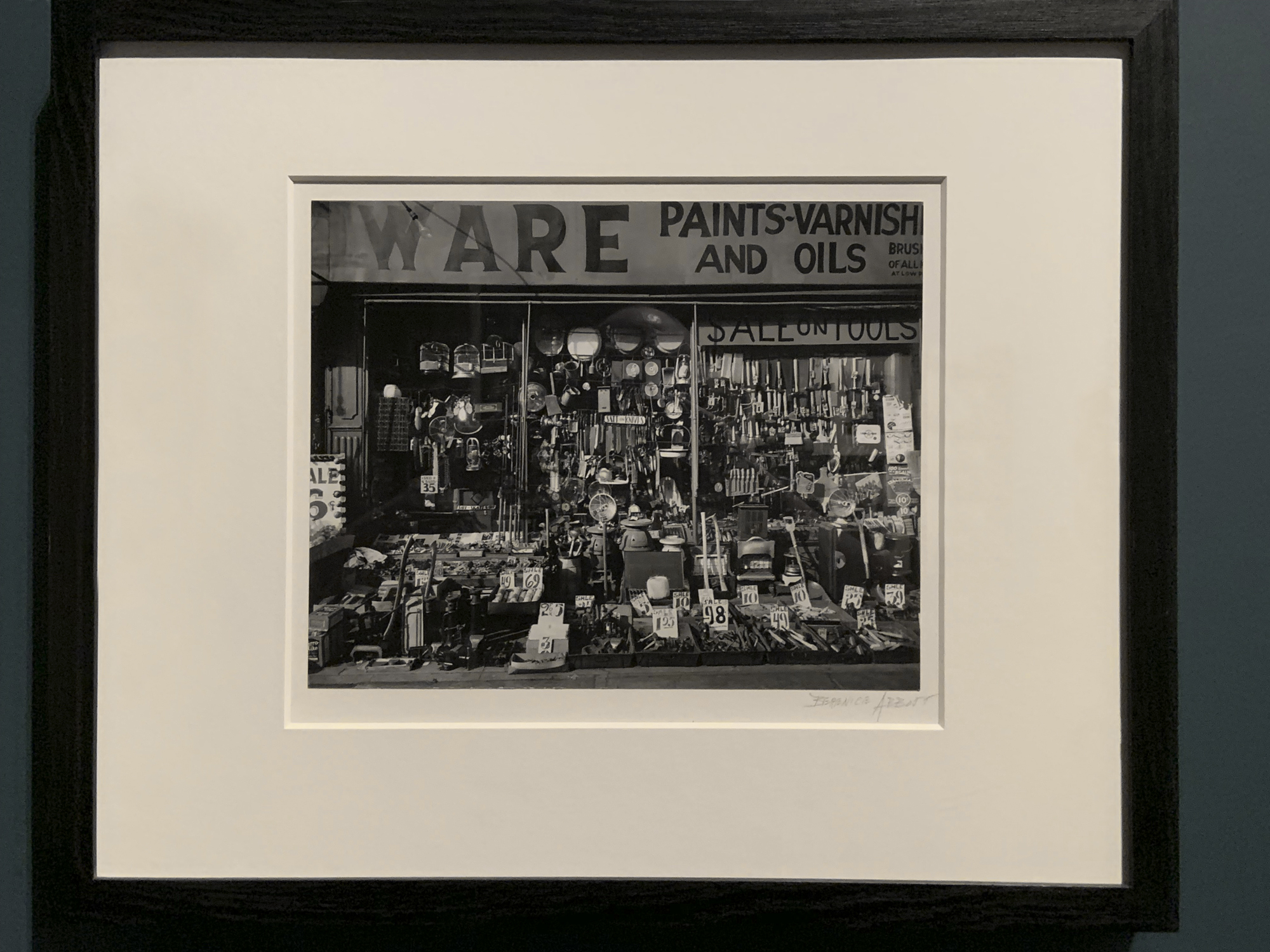
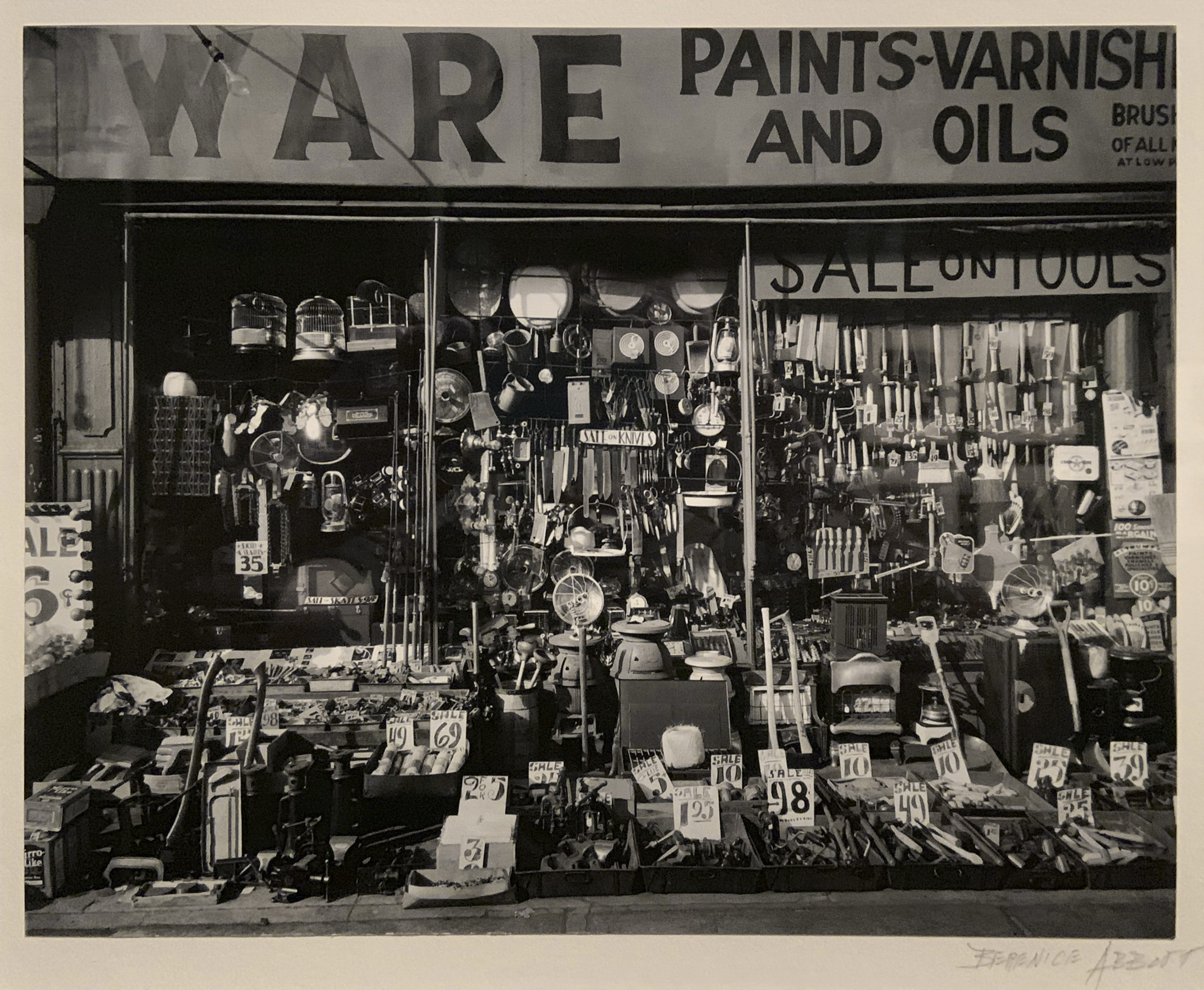
Berenice Abbott (American, 1898-1991) 'Hardware Store' 1938 (installation view)


Berenice Abbott (American, 1898-1991)
Hardware Store (installation view)
1938
Gelatin silver print
The Royal Photographic Society Collection at the V&A Museum
Photo: Marcus Bunyan


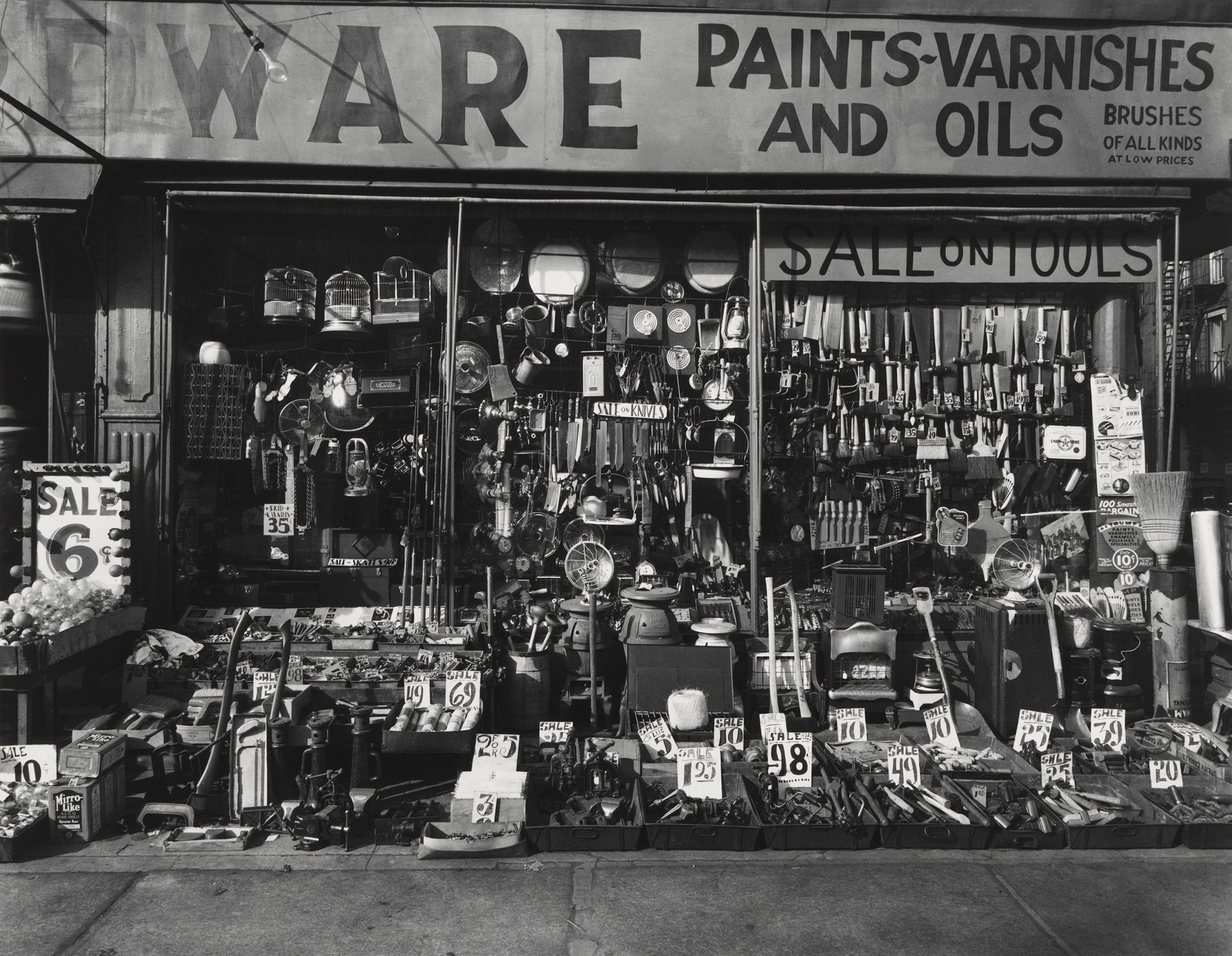
Between 1935 and 1939, the Federal Art Project emptied Abbott to make a series of photographs entitled Changing New York, documenting the rapid development and urban transformation of the city. This picture shows the facade of a downtown hardware store, its wares arranged in a densely-packed window display with extend onto the pavement.


Berenice Abbott (American, 1898-1991) 'Hardware Store' 1938 (installation view)


Berenice Abbott (American, 1898-1991)
Hardware Store (installation view)
1938
Gelatin silver print
The Royal Photographic Society Collection at the V&A Museum
Photo: Marcus Bunyan


Berenice Abbott (American, 1898-1991) 'Hardware Store' 1938


Berenice Abbott (American, 1898-1991)
Hardware Store
1938
Gelatin silver print
The Royal Photographic Society Collection at the V&A Museum


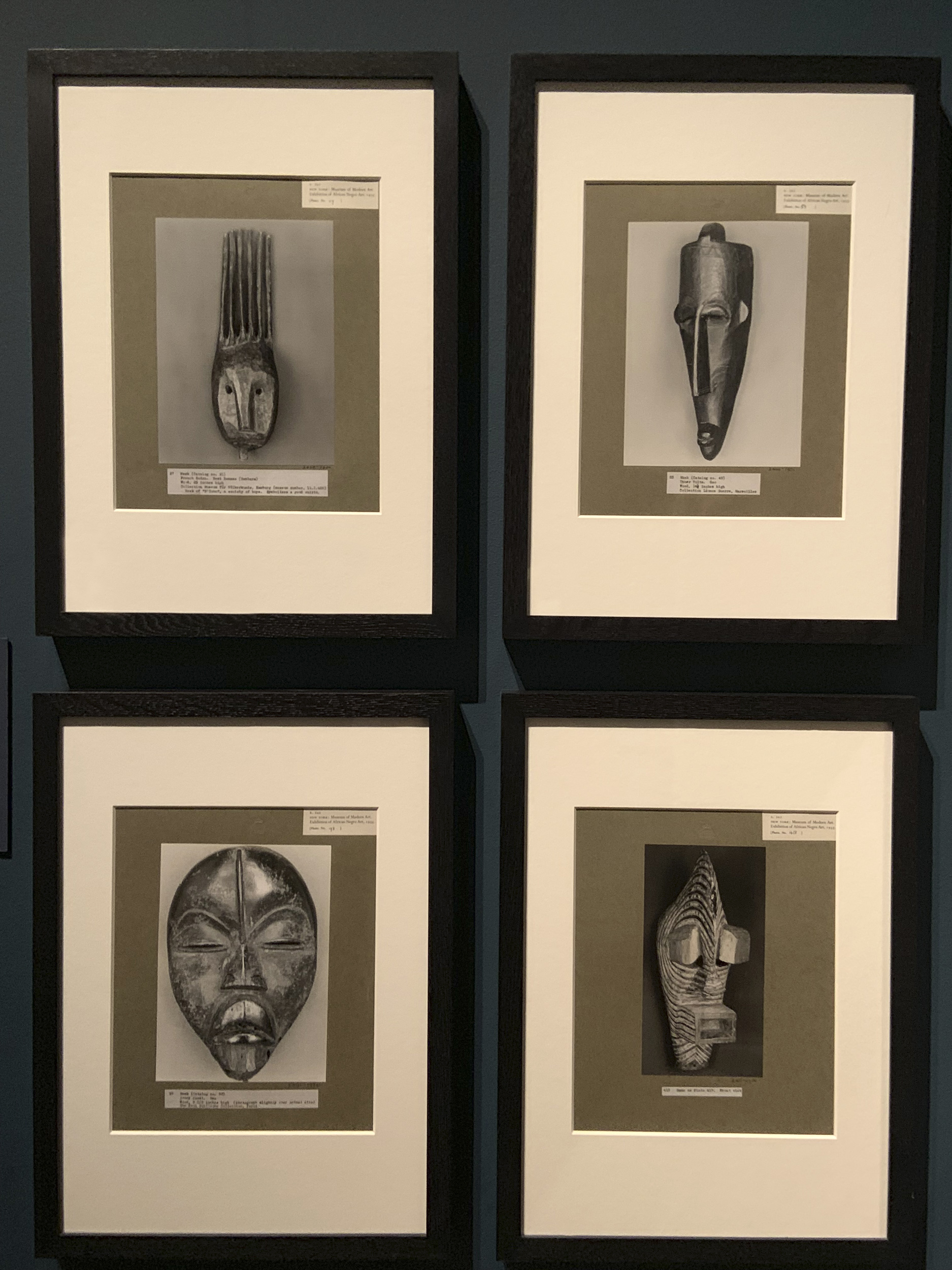
Walker Evans (American, 1903-1975) 'Photographs of African masks, from an exhibition entitled African Negro Art at the Museum of Modern Art, New York' 1935 (installation view)


Walker Evans (American, 1903-75)
Photographs of African masks, from an exhibition entitled African Negro Art at the Museum of Modern Art, New York (installation view)
1935
Gelatin silver prints
The Royal Photographic Society Collection at the V&A Museum
Photo: Marcus Bunyan


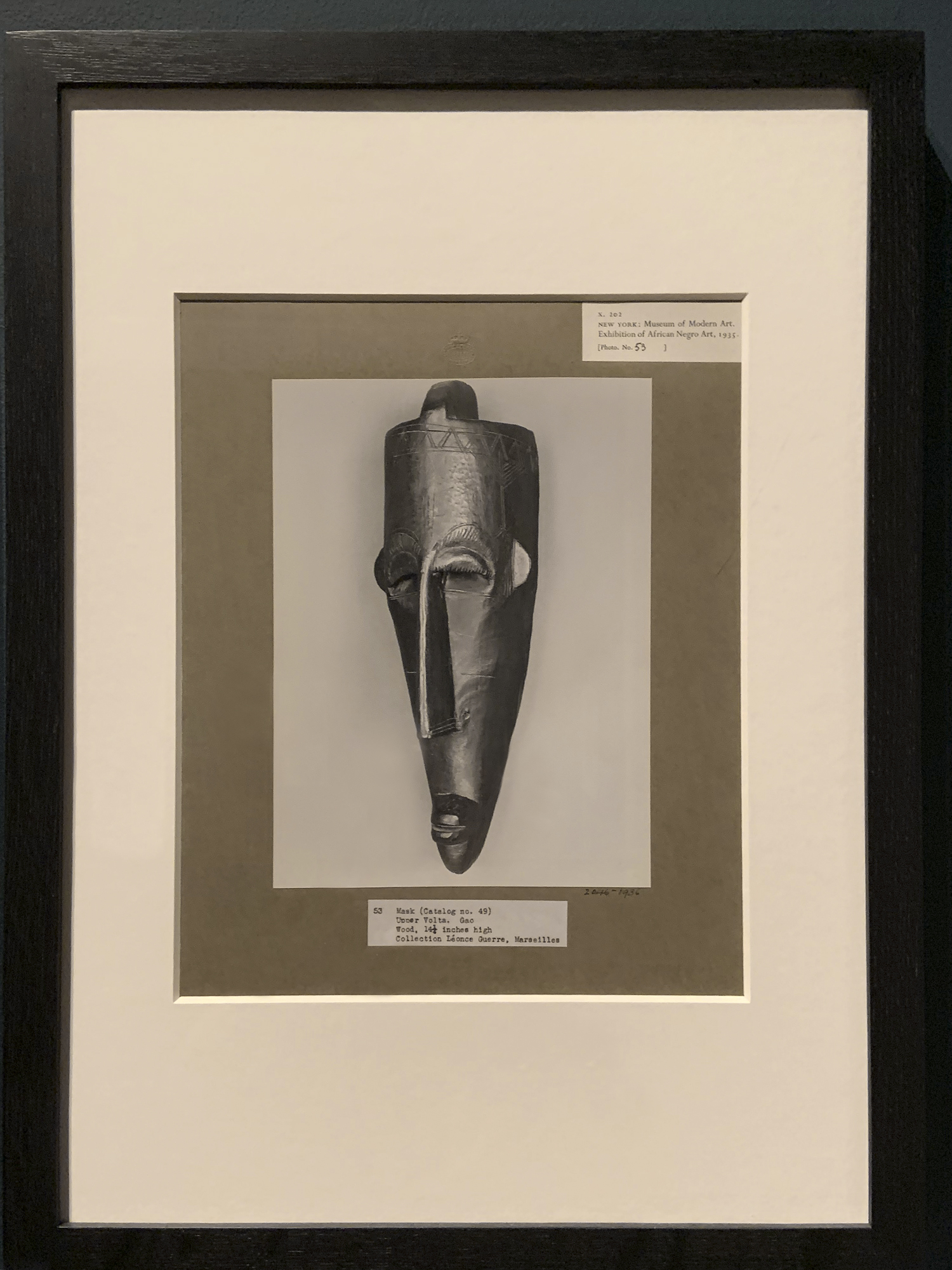
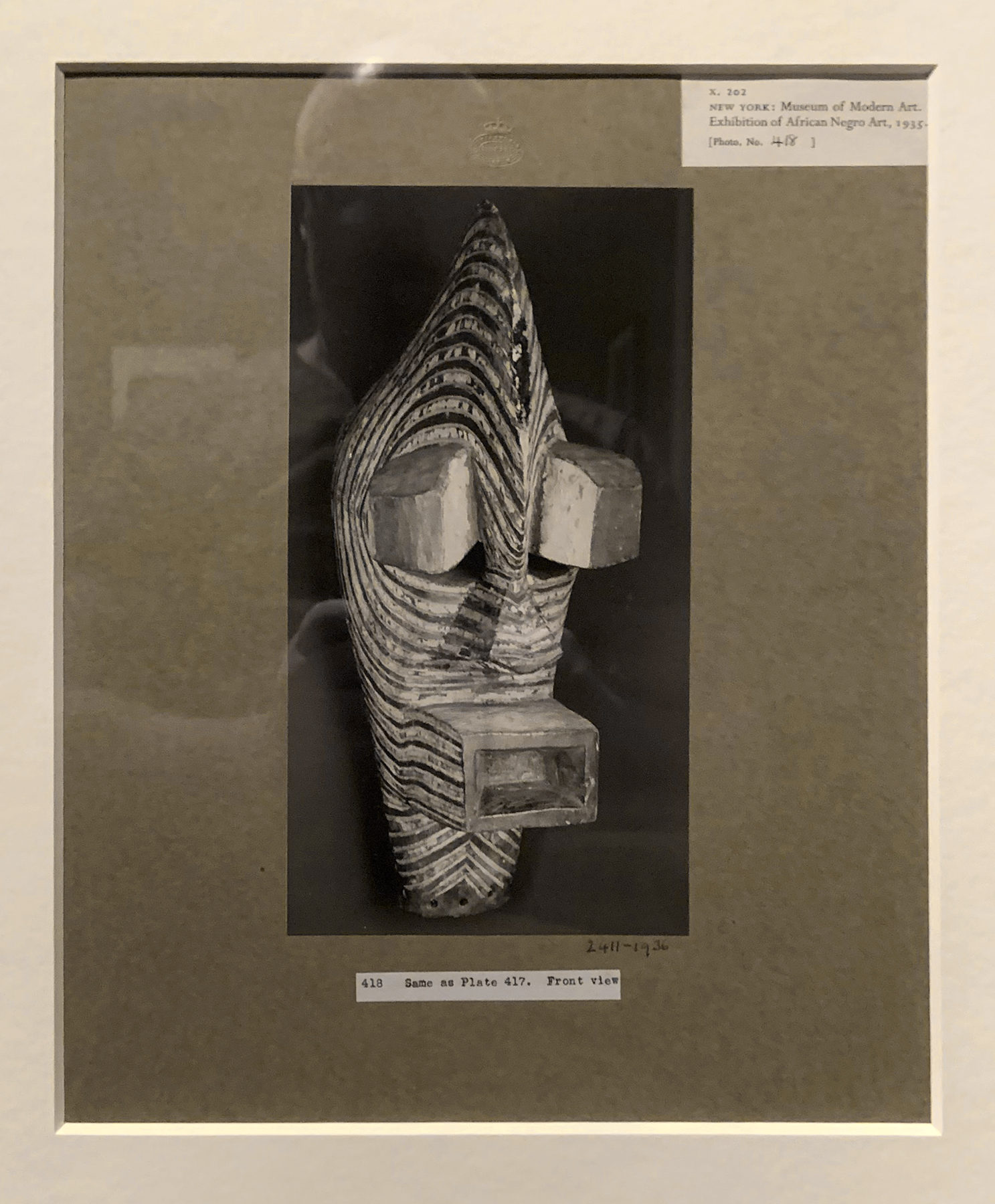
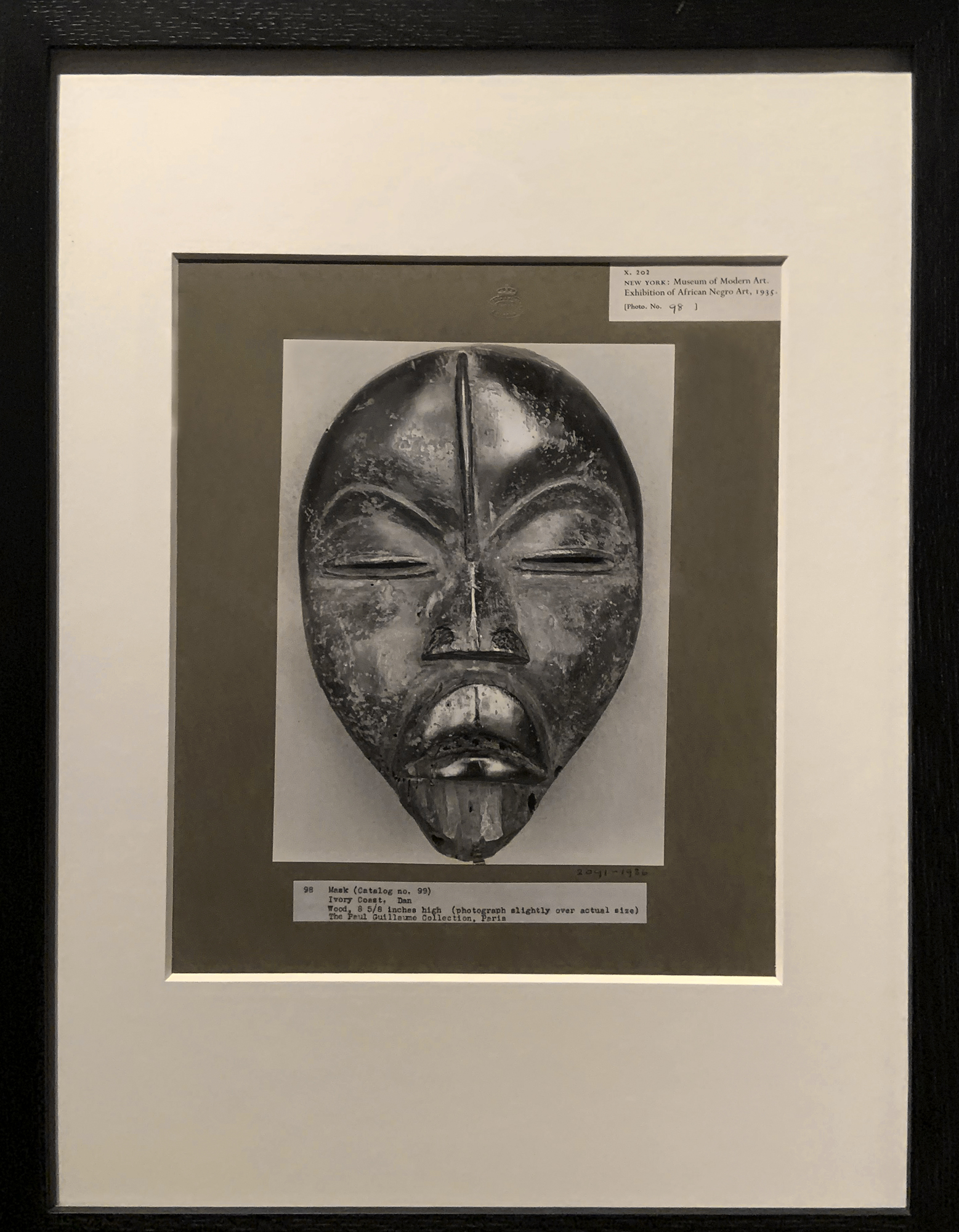
In 1935, the Museum of Modern Art commissioned Evans to photograph objects in its major exhibition of African art. Using his 8 x 10 inch view camera, he highlighted the artistry and detail of the objects, alternating between front, side and rear views. In total, Evans produced 477 images, and 17 complete sets of them were printed. Several of these sets were donated to colleges and libraries in America, and the V&A bought one set in 1936 to better represent African art in its collection.

The term ‘negro’ is given here in its original historical context.


Walker Evans (American, 1903-1975) 'Photograph of African mask, from an exhibition entitled African Negro Art at the Museum of Modern Art, New York' 1935 (installation view)


Walker Evans (American, 1903-75)
Photograph of African mask, from an exhibition entitled African Negro Art at the Museum of Modern Art, New York (installation view)
1935
Gelatin silver prints
The Royal Photographic Society Collection at the V&A Museum
Photo: Marcus Bunyan


Walker Evans (American, 1903-1975) 'Photograph of African mask, from an exhibition entitled African Negro Art at the Museum of Modern Art, New York' 1935 (installation view)


Walker Evans (American, 1903-75)
Photograph of African mask, from an exhibition entitled African Negro Art at the Museum of Modern Art, New York (installation view)
1935
Gelatin silver prints
The Royal Photographic Society Collection at the V&A Museum
Photo: Marcus Bunyan


Walker Evans (American, 1903-1975) 'Photograph of African mask, from an exhibition entitled African Negro Art at the Museum of Modern Art, New York' 1935 (installation view)


Walker Evans (American, 1903-75)
Photograph of African mask, from an exhibition entitled African Negro Art at the Museum of Modern Art, New York (installation view)
1935
Gelatin silver prints
The Royal Photographic Society Collection at the V&A Museum
Photo: Marcus Bunyan


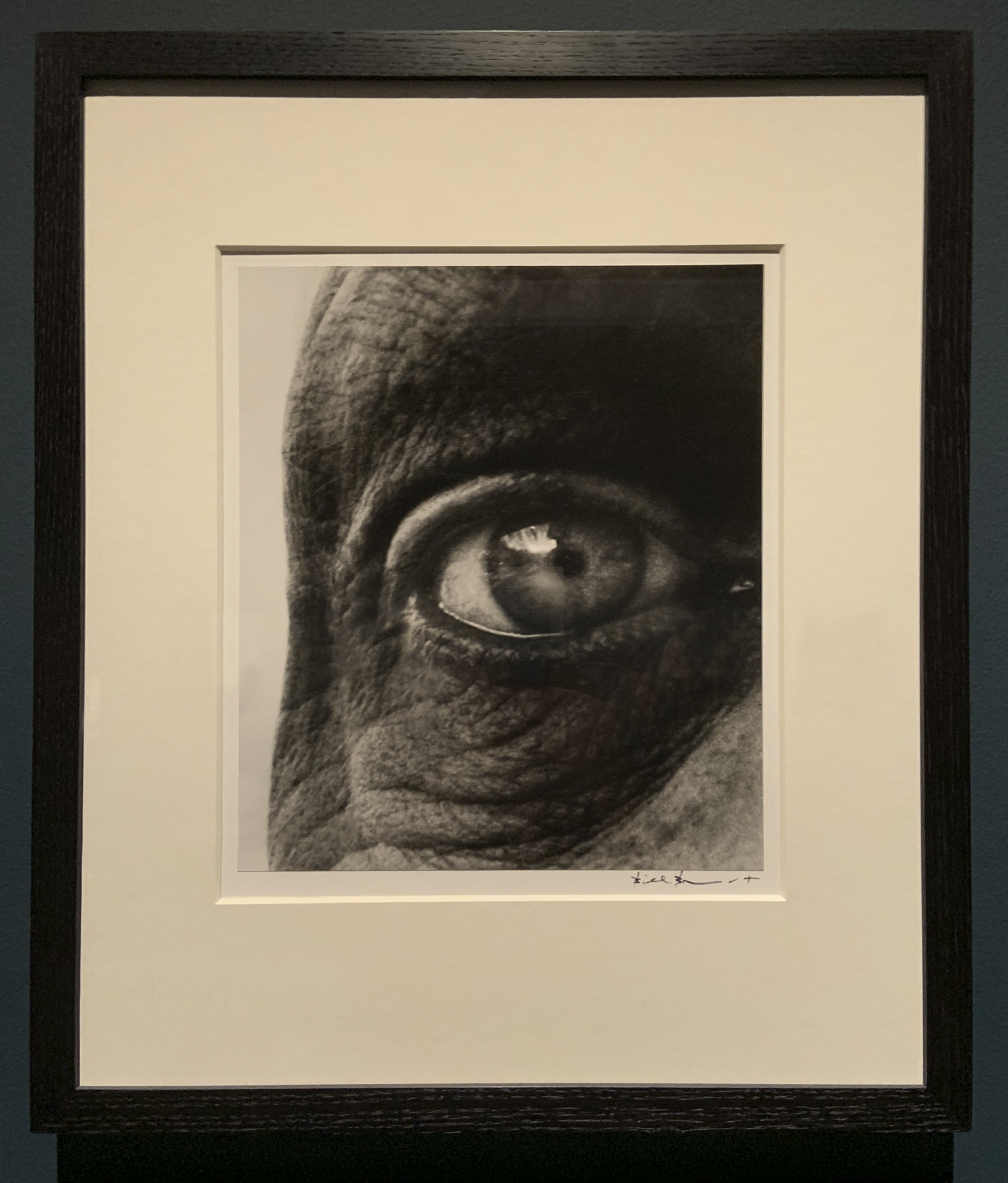
Bill Brandt (British, 1904-1983) 'Dubuffet’s Right Eye, Alberto Giacometti’s Left Eye, Louise Nevelson’s Eye, Max Ernst’s Left Eye' 1960-1963 (installation view)


Bill Brandt (British, 1904-1983)
Dubuffet’s Right Eye
Alberto Giacometti’s Left Eye
Louise Nevelson’s Eye
Max Ernst’s Left Eye (installation view)
1960-1963
Gelatin silver print
The Royal Photographic Society Collection at the V&A Museum
Photo: Marcus Bunyan


Bill Brandt (British, 1904-1983) 'Dubuffet’s Right Eye' 1960-1963 (installation view)


Bill Brandt (British, 1904-83)
Dubuffet’s Right Eye (installation view)
1960-1963
Gelatin silver print
The Royal Photographic Society Collection at the V&A Museum
Photo: Marcus Bunyan


German-born Brandt moved to London in the 1930s. In his long and varied career, he made many compelling portraits of people including Ezra Pound, Dylan Thomas, the Sitwell family, Robert Graves and E.M. Forster. For this series he photographed the eyes of well-known artists over several years, creating a substantial collection of intense and unique portraits. The pictures play upon ideas of artistic vision and the camera lens, which acts as a photographer’s ‘mechanical eye’.


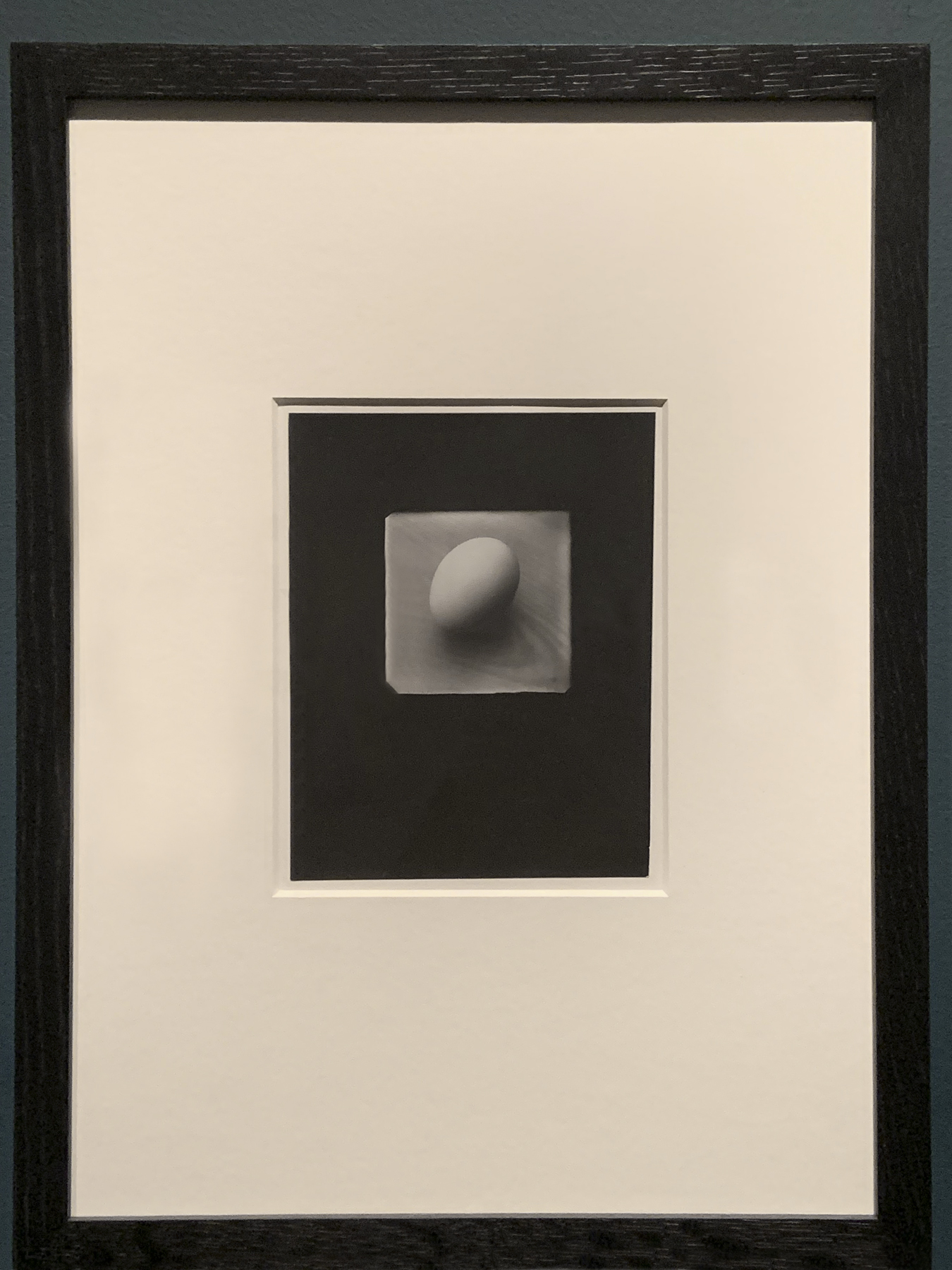
Josef Sudek (Czech, 1896-1976) 'Simple Still Life, Egg' 1950 (installation view)


Josef Sudek (Czech, 1896-1976)
Simple Still Life, Egg (installation view)
1950
Gelatin silver print
The Royal Photographic Society Collection at the V&A Museum
Photo: Marcus Bunyan


Throughout his career, Sudek used various photographic styles but always conveyed an intensely lyrical vision of the world. Here, his formal approach to a simple still life presents a poetic statement, and evokes an atmosphere of contemplation. Sudek’s motto and advice to his students – ‘hurry slowly’ – encapsulates his legendary patience and the sense of meditative stillness in his photographs.


Otto Steiner (German, 1915-1978) 'Luminogram' 1952 (installation view)


Otto Steiner (German, 1915-1978)
Luminogram (installation view)
1952
Gelatin silver print
The Royal Photographic Society Collection at the V&A Museum
Photo: Marcus Bunyan


Otto Steiner (German, 1915-1978) 'Luminogram' 1952 (installation view)


Otto Steiner (German, 1915-1978)
Luminogram (installation view)
1952
Gelatin silver print
The Royal Photographic Society Collection at the V&A Museum
Photo: Marcus Bunyan


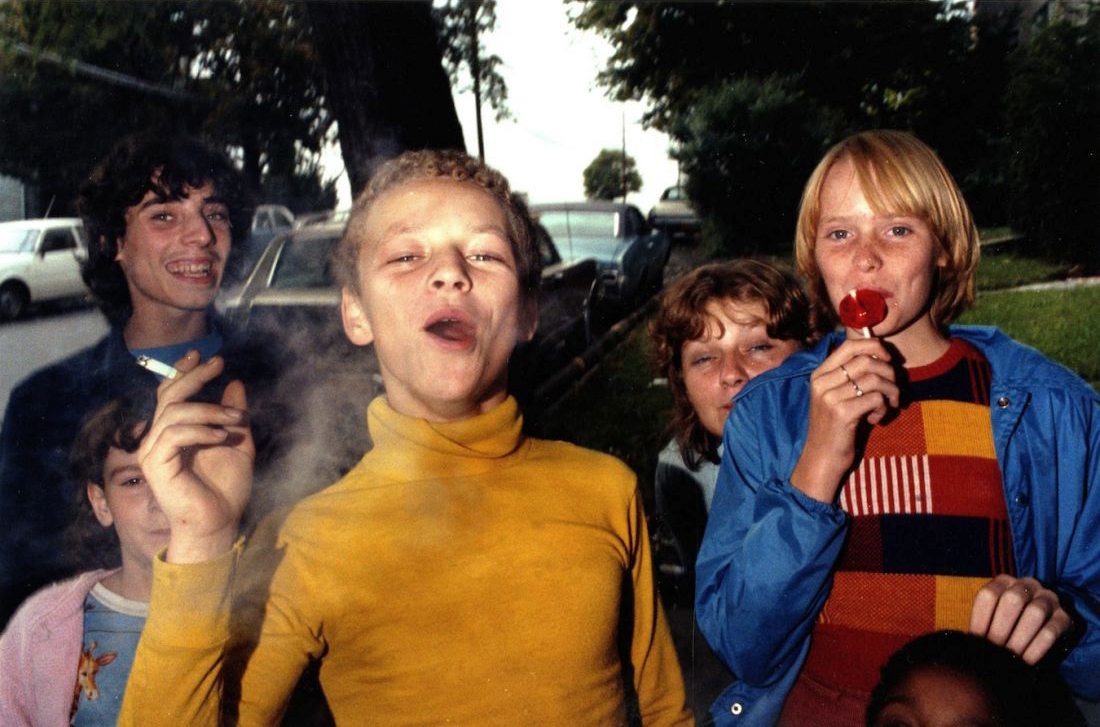
Mark Cohen (American, b. 1943) 'True Color' 1974-1987 (installation view)

Mark Cohen (American, b. 1943) 'True Color' 1974-1987 (installation view)


Mark Cohen (American, b. 1943)
True Color (installation views)
1974-1987
Portfolio of thirty dye transfer prints, printed in 2007
American Friends of the V&A through the generosity of The Michael G. and C. Jane Wilson 2007 Trust
Photos: Marcus Bunyan


Known for his dynamic street photography, Cohen’s work presents a fragmented, sensory image of his hometown of Wiles-Barre, Pennsylvania. This set of pictures was taken at a time when colour photography was just beginning to be recognised as a fine art. Until the 1970s, colour had largely been associated with other advertising or family snapshots, and was not thought of as a legitimate medium for artists. Cohen and other photographers like William Eggleston transferred this perception using the dye-transfer printing process. Although complicated and time-consuming, the technique results in vibrant and high quality colour prints.


Mark Cohen (American, b. 1943) 'True Color' 1974-1987 (installation view detail)


Mark Cohen (American, b. 1943)
True Color (installation view detail)
1974-1987
Portfolio of thirty dye transfer prints, printed in 2007
American Friends of the V&A through the generosity of The Michael G. and C. Jane Wilson 2007 Trust
Photo: Marcus Bunyan


Mark Cohen (American, b. 1943) 'True Color' 1974-1987 (installation view detail)


Mark Cohen (American, b. 1943)
True Color (installation view detail)
1974-1987
Portfolio of thirty dye transfer prints, printed in 2007
American Friends of the V&A through the generosity of The Michael G. and C. Jane Wilson 2007 Trust
Photo: Marcus Bunyan


Graham Smith (British, b. 1947) 'What she wanted & who she got' 1982  (installation view)


Graham Smith (British, b. 1947)
What she wanted & who she got (installation view)
1982
Gelatin silver print
The Royal Photographic Society Collection at the V&A Museum
Photo: Marcus Bunyan


Since the 1980s, Graham Smith has been photographing his hometown of South Bank near Middlesbrough. His images convey his deep sensitivity towards the effects of changing working conditions on the former industrial north-east. In this photograph, despite the suggested humour of the title, we are left wondering who the couple are and what the nature of their relationship might be.


Jan Kempenaers (b. 1968) 'Spomenik #3' 2006


Jan Kempenaers (Belgian, b. 1968)
Spomenik #3
2006
C-type print


The Kosmaj monument in Serbia is dedicated to soldiers of the Kosmaj Partisan detachment from World War II.


Jan Kempenaers (b. 1968) 'Spomenik #4' 2007


Jan Kempenaers (Belgian, b. 1968)
Spomenik #4
2007
C-type print


This monument, authored by sculptor Miodrag Živković, commemorates the Battle of Sutjeska, one of the bloodiest battles of World War II in the former Yugoslavia.


Kempenaers toured the balkans photographing ‘Spomeniks’ – monuments built in former Yugoslavia in the 1960s and ’70s on the sites of Second World War battles and concentration camps. Some have been vandalised in outpourings of anger against the former regime, while others are well maintained. In Kempenaers’ photographs, the monuments appear otherworldly, as if dropped from outer space into a pristine landscape.


Installation view of the V&A Photography Centre, London


Installation view of the V&A Photography Centre, London
Photo: Marcus Bunyan


Victoria and Albert Museum
Cromwell Road
London
SW7 2RL
Phone: +44 (0)20 7942 2000

Opening hours:
Daily 10.00 – 17.45
Friday 10.00 – 22.00
V&A website

V&A Photography Centre website

LIKE ART BLART ON FACEBOOK

Back to top

Exhibition: ‘The Gender Show’ at George Eastman House, Rochester, New York

Exhibition dates: 15th June – 13th October 2013


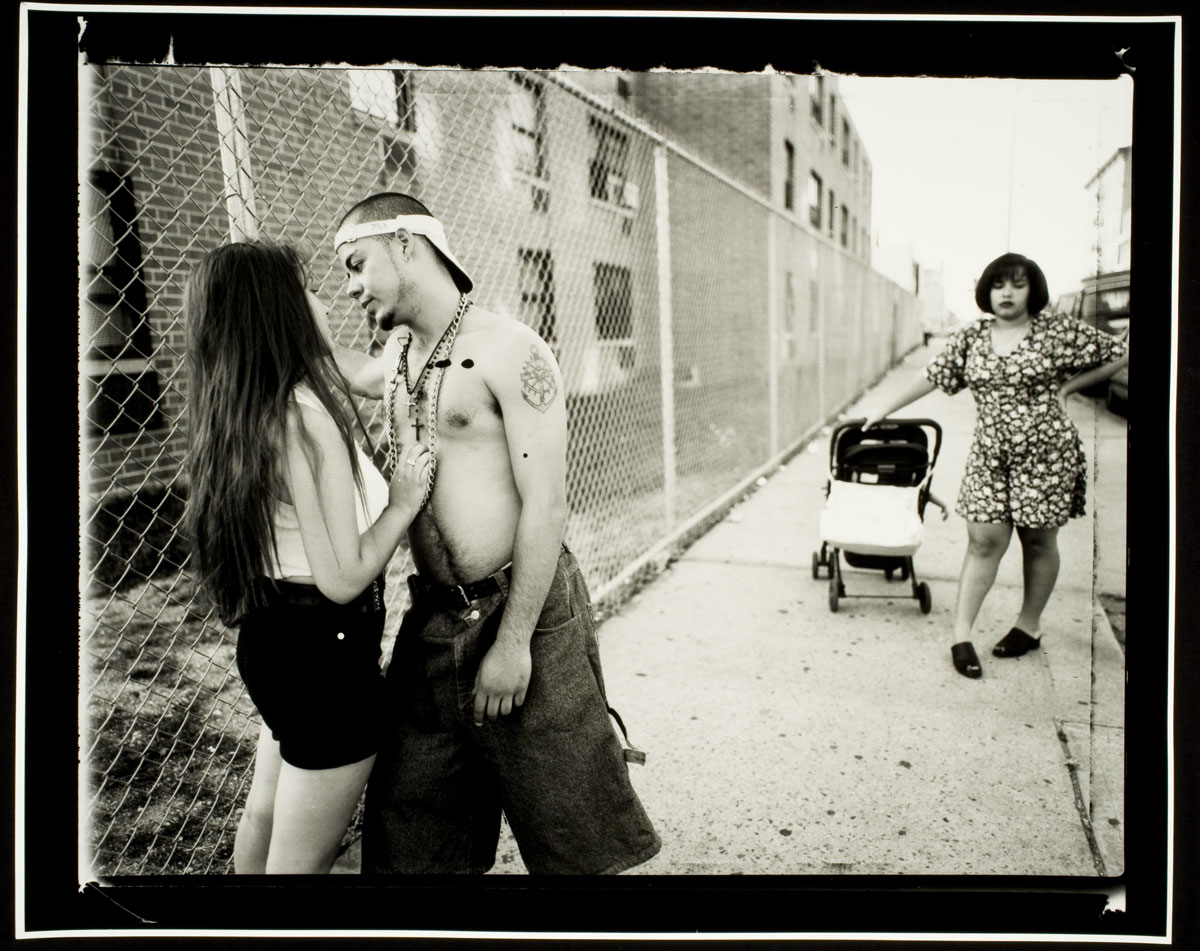
Vincent Cianni (American, b. 1952) 'Anthony hitting on Giselle, Vivien waiting, Lorimer Street, Williamsburg, Brooklyn' From the series 'We Skate Hardcore' 1996


Vincent Cianni (American, b. 1952)
Anthony hitting on Giselle, Vivien waiting, Lorimer Street, Williamsburg, Brooklyn
1996
From the series We Skate Hardcore
Gelatin silver print
Purchased with funds from Mary Cianni
© Vincent Cianni


I am so sick of museums and art galleries not allowing me to publish photographs that I collect freely available elsewhere on the web to illustrate their exhibitions.

1/ I am promoting the exhibition free for them to over 9,000 people over 3 days
2/ The images are freely available elsewhere on the web
3/ I am promoting artists so that the work is more widely known, and that can only be a positive for the artist (and the price of their art through greater recognition)
4/ The images are 72dpi jpg – what do they think, that people are going to rip them off. They are such low quality anyway who cares!


If artist’s are so precious about their work, even when someone is trying to promote it, then perhaps they should stop making art. Or perhaps it’s the archives and institutions, the patriarchies, that are just too protective of their precious mother-load.

Photography and photographs are ubiquitous. They are taken in the world and live in that world, not stuffed in some curators drawer or surrounded by a circle under the letter ©


This exhibition seems to have a finger in every gender pie without going hard core or in depth at anything. There seems to be no rhyme or reason, no catalogue to the exhibition (as far as I can ascertain), and no indication on how the exhibition is structured, even in the press release. How you would hope to cover such a broad topic in one exhibition is beyond me. That given, there are some fascinating photographs from the exhibition in this posting. My personal favourites in the posting are:

~ Donald York, Jr. standing beside his father’s wrecker, Millerton, New York by Mark Goodman (1974, below). Ah, the jouissance of youth (jouissance means enjoyment, in terms both of rights and property, and of sexual orgasm). Here “junior” is possessing the masculinity of his father’s truck while at the same time emphasising his youthful sexuality with short shorts, naked body, tilt of the hips, pose of the arm and slight cock of the head replete with hair falling over the eyes. There is a certain prepossession about this Donald York, a sexual knowing as he flirts with the camera. Beautiful image

~ Greta Garbo by Edward Steichen (1928, below). My god, how would you be as a photographer looking in the ground glass to see this visage staring back at you. Strength of character, vulnerability and eyes that seem to bore right through you. Face framed with black surmounted by pensive hands. A masterpiece

~ Ophelia Study No. 2 by Julia Margaret Cameron (1867, below). What an impression. Wistful, delicate, a ghostly slightly mad presence with hardly an existence but oh so memorable (Ophelia is a fictional character in the play Hamlet by William Shakespeare that suffers from “erotomania, a malady conceived in biological and emotional terms which is a type of delusion in which the affected person believes that another person, usually a stranger, high-status or famous person, is in love with him or her.”(Wikipedia)) Madness and sexuality. The divine Miss Julia does it again…

Dr Marcus Bunyan


Please click on the photographs for a larger version of the image.


Mark Goodman (American b. 1946) 'Donald York, Jr. standing beside his father's wrecker, Millerton, New York' 1974


Mark Goodman (American, b. 1946)
Donald York, Jr. standing beside his father’s wrecker, Millerton, New York
1974
Gelatin silver print
Gift of Dr and Mrs Maurice Miller
© Mark Goodman


Elias Goldensky (American born Russia, 1867-1943) 'Head and shoulders study' c. 1920


Elias Goldensky (American born Russia, 1867-1943)
Head and shoulders study
c. 1920
Gelatin silver print
Gift of 3M Company
Ex-collection of Louis Walton Sipley


Lewis W. Hine (American, 1874-1940) 'Greek Wrestling Club' c. 1910


Lewis W. Hine (American, 1874-1940)
Greek Wrestling Club
c. 1910
From the series Hull House, Chicago
Gelatin silver print
Transfer from Photo League Lewis Hine Memorial Committee; ex-collection of Corydon Hine


Nickolas Muray (American born Hungary, 1892-1965) 'Douglas Fairbanks, Jr. & Joan Crawford' c. 1930


Nickolas Muray (American born Hungary, 1892-1965)
Douglas Fairbanks, Jr. & Joan Crawford
c. 1930
Gelatin silver print
Gift of Mrs. Nickolas Muray
© Nickolas Muray Archives


Victor Keppler (American, 1904-1987) 'First Hair Cut' 1943


Victor Keppler (American, 1904-1987)
First Hair Cut
1943
Gelatin silver print
Gift of the photographer


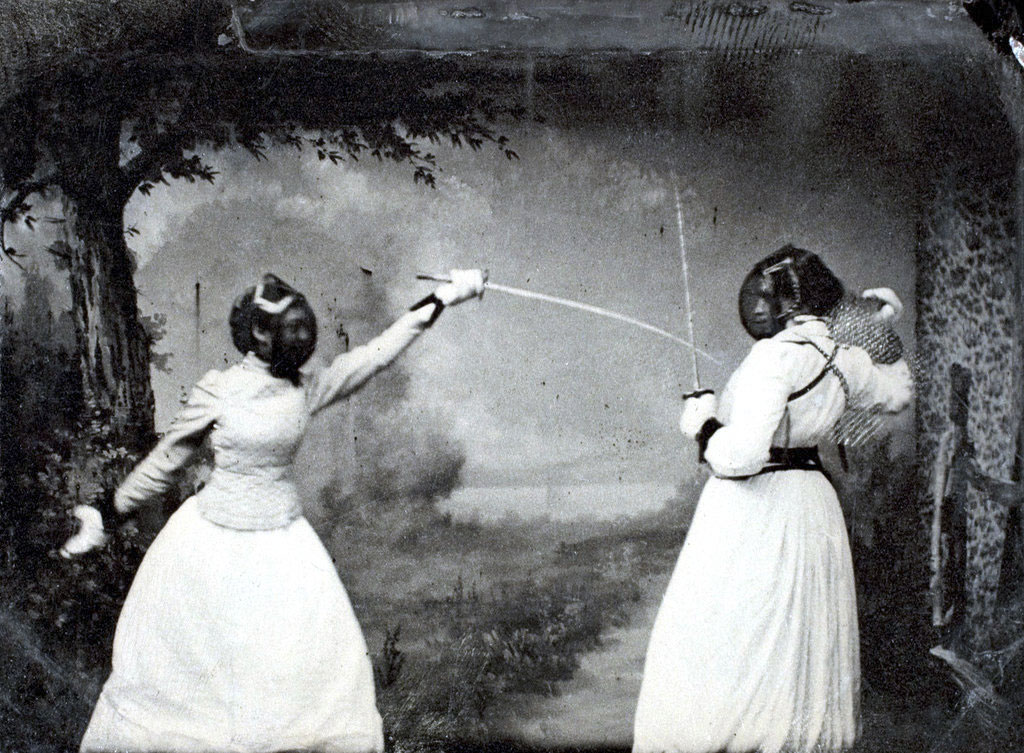
Unidentified Photographer. 'Two women fencing' June 16, 1891


Unidentified Photographer
Two women fencing
June 16, 1891
Tintype
Museum Collection


Lewis W. Hine (American, 1874-1940) 'The boys learn to cook' c. 1935


Lewis W. Hine (American, 1874-1940)
The boys learn to cook
c. 1935
From the series The Ethical Culture Schools NYC
Gelatin silver print
Transfer from Photo League Lewis Hine Memorial Committee
Ex-collection of Corydon Hine


Mary Ellen Mark (American, 1940-2015) 'Hispanic Girl with Her Brother, Dallas, Texas' 1987


Mary Ellen Mark (American, 1940-2015)
Hispanic Girl with Her Brother, Dallas, Texas
1987, print c. 1991 by Sarah Jenkins
From the series Urban Poverty
Gelatin silver print
Gift of the photographer
© Mary Ellen Mark


In common use, the word gender may refer to biological sex, self-identity, perceived identity, or imposed identity. Gender can be both fluid and ambiguous. Many of the ways we express and identify gender are based on visual clues. George Eastman House is proud to present The Gender Show, an exhibition that explores ways gender has been presented in photographs, ranging from archetypal to non-traditional to subversive representations, with a special emphasis on the performances that photography can encourage or capture.

With a collection that spans over 170 years of photography, Eastman House is uniquely able to thoughtfully examine our changing cultural and social landscape, in which evolving ideas of gender are framed as photographic images. The Gender Show offers the opportunity to see important photographs from our collection in a new context. The Gender Show sets the stage for a lively discussion of both photographic and cultural conventions and can be enjoyed by a variety of audiences for both its subject matter and content. Those interested in material, visual, and popular culture; gender, identity, and equality; and photographic history will find this exhibition captivating.

George Eastman House’s exhibition The Gender Show will explore how photographs, from the mid-19th century to today, have portrayed gender – from archetypal to non-traditional to subversive representations – with a special emphasis on the performances that the act of photographing or being photographed can encourage or capture. The Gender Show, presenting over 200 works, draws primarily from the Eastman House collection, which spans more than 170 years, and also features contemporary art photographs and videos on loan from artists and private collectors. The exhibition will be on view from June 15 through October 13, 2013.

The Gender Show is the first major Eastman House exhibition organised under the direction of Dr. Bruce Barnes, who assumed the role of Ron and Donna Fielding Director last October. “This exhibition is an extraordinary survey of how photographers and their subjects have presented gender over the course of more than 150 years,” said Barnes. “George Eastman House is uniquely able to review the ever-changing cultural and social landscape through depictions of gender ranging from innocent assertion to elaborate masquerade.”

From the Eastman House collection are photographs by many of the biggest names in the history of the medium – including Julia Margaret Cameron, August Sander, Edward Steichen, Nickolas Muray, Brassaï, Robert Frank, Andy Warhol, Barbara Norfleet, Mary Ellen Mark, Cindy Sherman, and Chuck Samuels – as well as rarely seen vernacular photographs, in the form of cabinet cards depicting early vaudeville and music-hall stars. The exhibition will also present works by contemporary artists, including photographs by Janine Antoni, Rineke Dijkstra, Debbie Grossman, Catherine Opie, and Gillian Wearing, and videos by artists Jen DeNike, Kalup Linzy, and Martha Rosler.

“Since before Duchamp photographed Rrose Sélavy, his female alter-ego, artists have used photography to explore issues of identity, sex and gender,” said Barnes. “In recent decades, the artist’s identity and gender have been an increasingly prominent theme within photography. This exhibition offers a unique opportunity to see works by leading contemporary artists in the context of photographs from our world-class collection.”

Included in The Gender Show are tintypes and daguerreotypes by unknown artists; advertising images; self-portraits by artists, sometimes in disguise; and portraits of celebrities who in their time were a paragon of their own gender or of androgyny. Subjects include Sarah Bernhardt, Joan Crawford and Douglas Fairbanks Jr., Marlene Dietrich, Greta Garbo, Marilyn Monroe, Paul Newman, and Arnold Schwarzenegger. Additional famous subjects presented in the show include Frida Kahlo, Auguste Rodin, Franklin Roosevelt with Winston Churchill and Joseph Stalin, and Andy Warhol.

Press release from the George Eastman House website


B. J. Falk (American, 1853-1925) 'Verona Jarbeau' c. 1885


B. J. Falk (American, 1853-1925)
Verona Jarbeau
c. 1885
Albumen print
Museum Collection


Cabinet card of 19th century burlesque artist Verona Jarbeau. Comedienne Verona Jarbeau dressed in masculine costume, and carrying a big stick.


Nickolas Muray (American born Hungary, 1892-1965) 'Gloria De Haven' 1947


Nickolas Muray (American born Hungary, 1892-1965)
Gloria De Haven
1947
Carbro print
Gift of Mrs. Nickolas Muray
© Nickolas Muray Archives


Nickolas Muray (American born Hungary, 1892-1965) 'Torso' c. 1927


Nickolas Muray (American born Hungary, 1892-1965)
Torso
c. 1927
Descriptive Title: Torso, Hubert Julian Stowitts
Gelatin silver print
Gift of Mrs. Nickolas Muray
© Nickolas Muray Archives


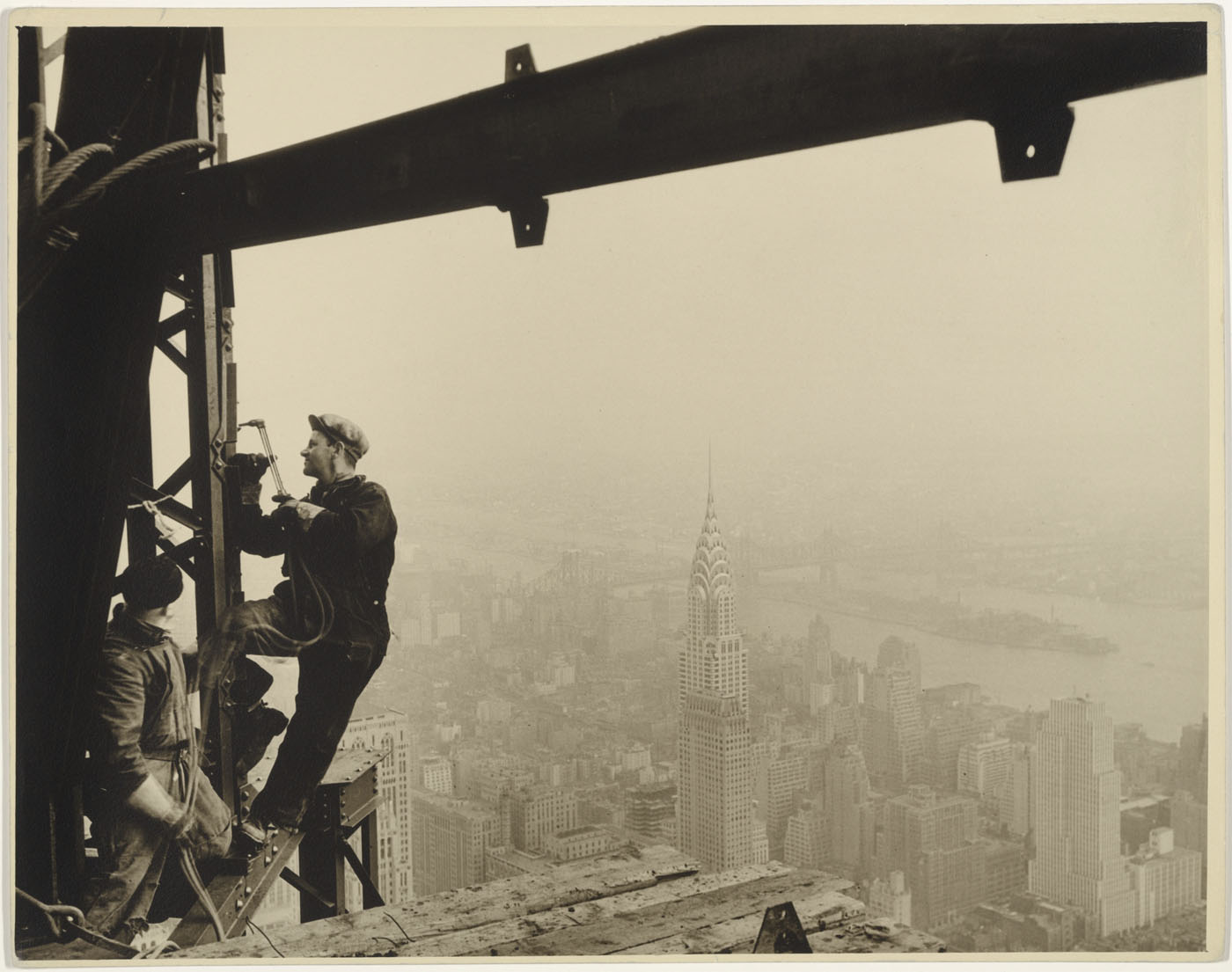
Lewis W. Hine (American, 1874-1940) 'Guiding a beam' From the series 'Empire State building' c. 1931


Lewis W. Hine (American, 1874-1940)
Guiding a beam
From the series Empire State building
c. 1931
Gelatin silver print
Transfer from Photo League Lewis Hine Memorial Committee
Ex-collection of Corydon Hine


Debbie Grossman (American, b. 1977) 'Jessie Evans-Whinery, homesteader, with her wife Edith Evans-Whinery and their baby' From the series 'My Pie Town'


Debbie Grossman (American, b. 1977)
Jessie Evans-Whinery, homesteader, with her wife Edith Evans-Whinery and their baby
Nd
From the series My Pie Town
Collection of the Artist, courtesy of Julie Saul Gallery
© Debbie Grossman


Debbie Grossman’s series My Pie Town reworks and re-imagines a body of images of Pie Town, New Mexico, originally photographed by Russell Lee for the United States Farm Security Administration in 1940. Using Photoshop to modify Lee’s pictures, Debbie Grossman has created an imaginary, parallel world – a Pie Town populated exclusively by women.


Jessica Todd Harper (American, b. 1976) 'Self-Portrait With Christopher and My Future In-Laws' 2001, print 2013


Jessica Todd Harper (American, b. 1976)
Self-Portrait With Christopher and My Future In-Laws
2001, print 2013
Inkjet print
Gift of the photographer
© Jessica Todd Harper


Lejaren à Hiller (American, 1880-1969) 'Men posed in front of backdrop with ship' c. 1950


Lejaren à Hiller (American, 1880-1969)
Men posed in front of backdrop with ship
c. 1950
Carbro print
Gift of 3M Company, ex-collection Louis Walton Sipley
© Visual Studies Workshop


Melissa Ann Pinney (American, b. 1953) 'Bat Mitzvah Dance, Knickerbocker Hotel, Chicago' 1991, print 2003


Melissa Ann Pinney (American, b. 1953)
Bat Mitzvah Dance, Knickerbocker Hotel, Chicago
1991, print 2003
Chromogenic print
Gift of Richard S. Press
© Melissa Ann Pinney


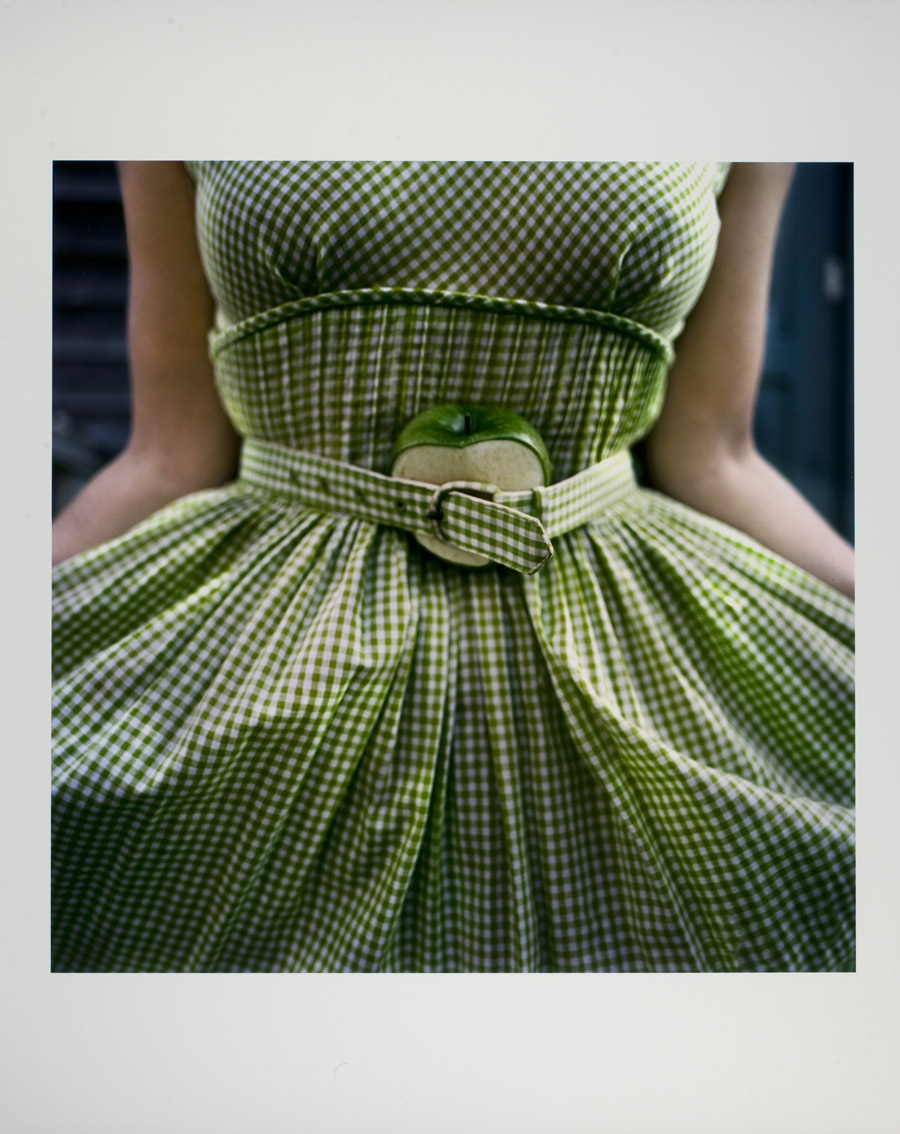
Cig Harvey (British, b. 1973) 'Gingham Dress with Apple' c. 2003


Cig Harvey (British, b. 1973)
Gingham Dress with Apple
c. 2003
Chromogenic print
Gift of the photographer
© Cig Harvey


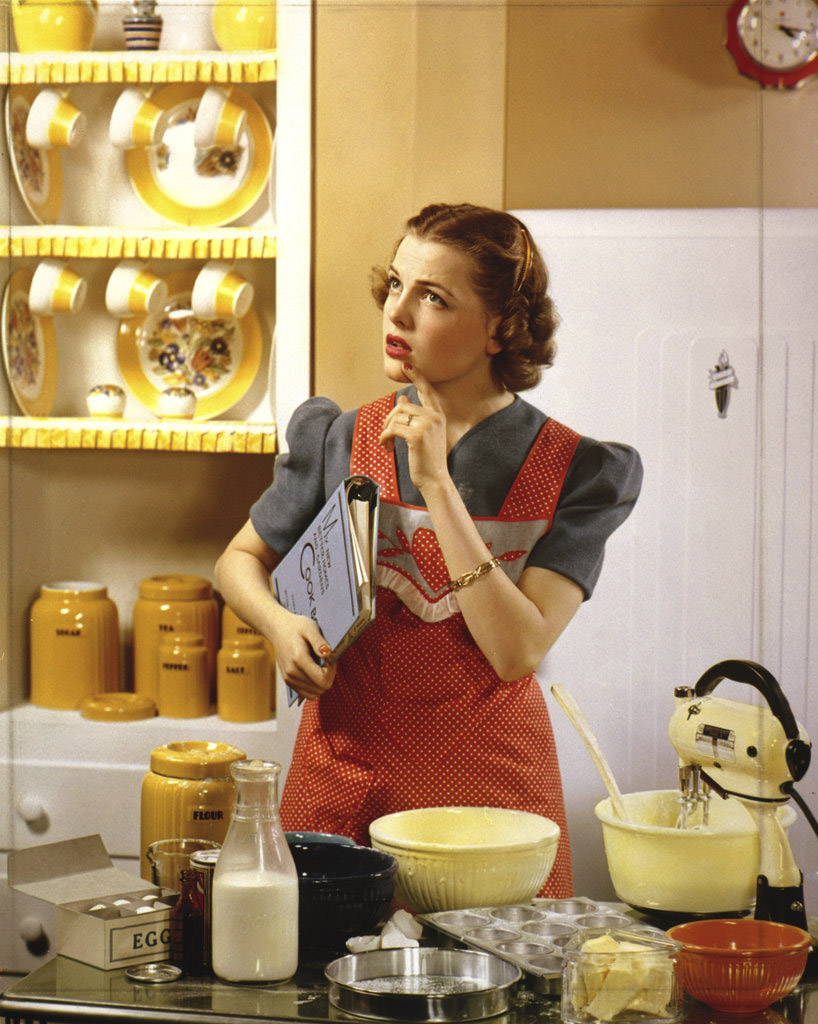
Victor Keppler (American, 1904-1987) 'Housewife in Kitchen' 1939


Victor Keppler (American, 1904-1987)
Housewife in Kitchen
1939
Digital Inkjet reproduction, 2012


Julia Margaret Cameron (British, 1815-1879) 'Ophelia Study No. 2' 1867


Julia Margaret Cameron (British, 1815-1879)
Ophelia Study No. 2
1867
Albumen print
Gift of Eastman Kodak Company
Ex-collection Gabriel Cromer


James Jowers (American, 1938-2009) 'New Orleans' 1970


James Jowers (American, 1938-2009)
New Orleans
1970
Gelatin silver print
Gift of the photographer
© George Eastman House


William Mortensen (American, 1897-1965) 'Preparing for the Sabbot' c. 1926


William Mortensen (American, 1897-1965)
Preparing for the Sabbot
c. 1926
Gelatin silver print
Gift of Dr. C.E.K. Mees


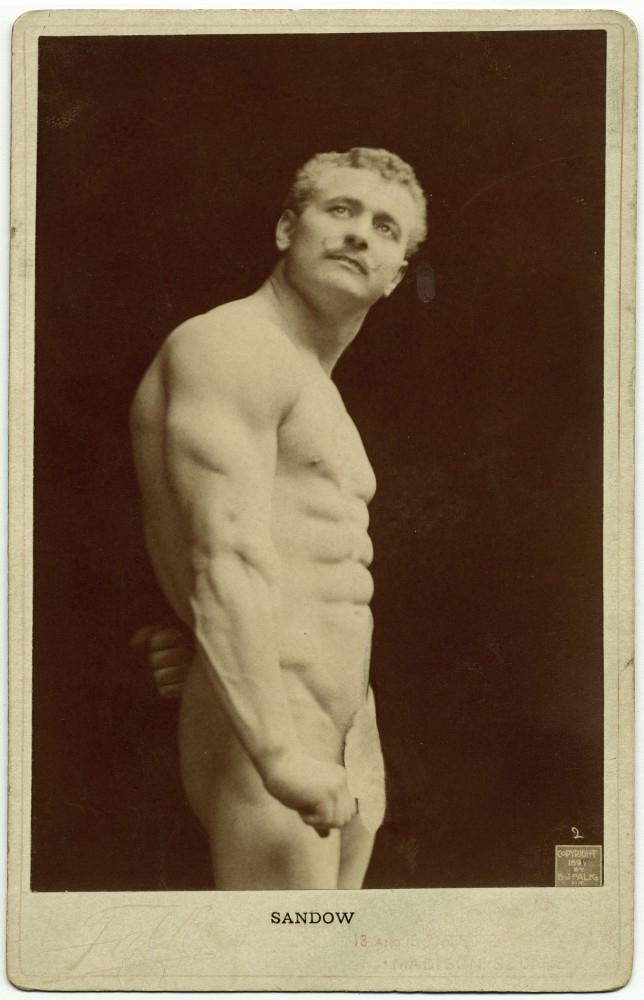
B. J. Falk (American, 1853-1925) 'Sandow' c. 1895


B. J. Falk (American, 1853-1925)
Sandow
c. 1895
Albumen print
Gift of Charles Carruth


Baron Wilhelm von Gloeden (German, 1856-1931) 'Youth with wreath on head' c. 1900


Baron Wilhelm von Gloeden (German, 1856-1931)
Youth with wreath on head
c. 1900
Albumen print
Anonymous gift


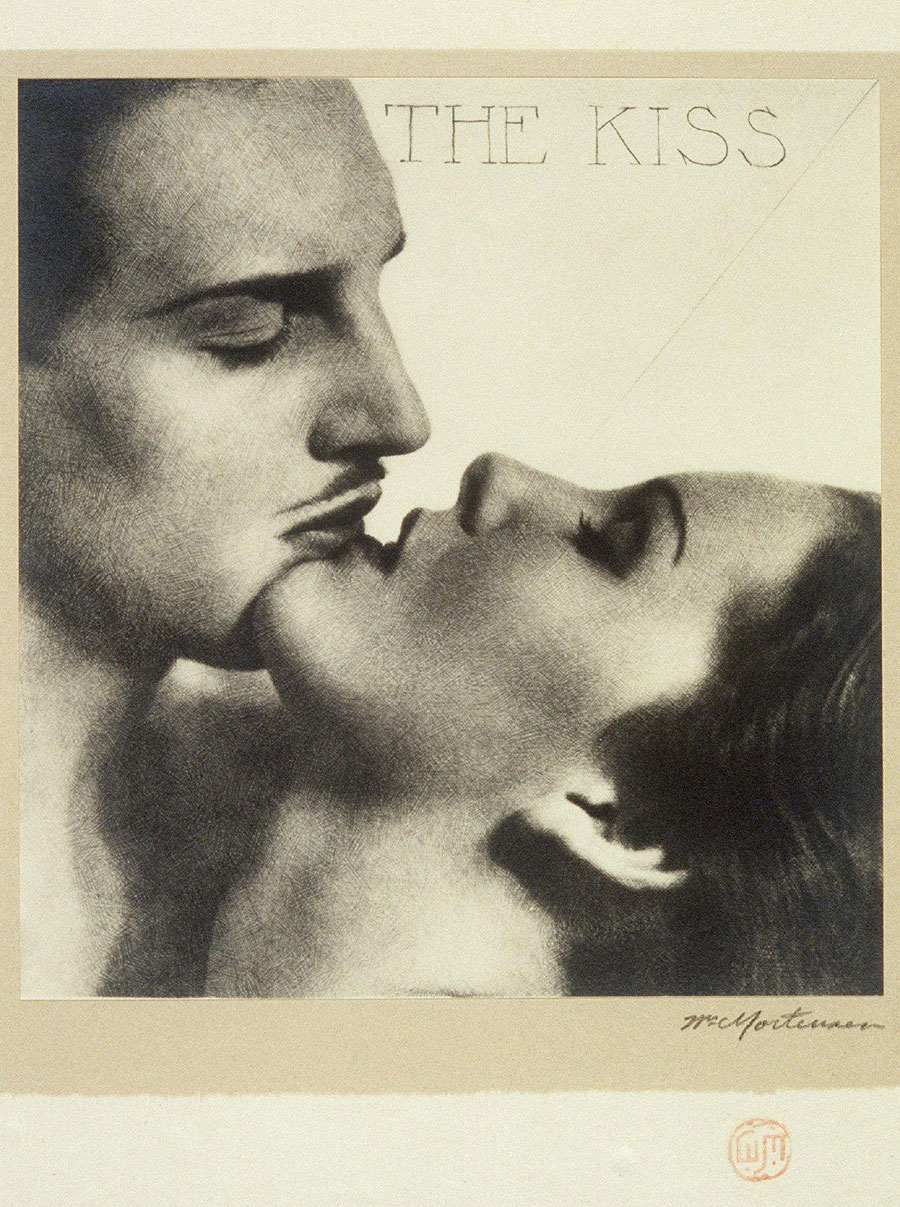
William Mortensen (American, 1897-1965) 'The Kiss' From the portfolio 'Pictorial Photography' c. 1930


William Mortensen (American, 1897-1965)
The Kiss
c. 1930
From the portfolio Pictorial Photography
Gelatin silver print
Gift of Dr. C.E.K. Mees


Anne Noggle (American, 1922-2005) 'Lois Hollingsworth Zilner, Woman Air force Service Pilot, WWII' 1984, print 1986


Anne Noggle (American, 1922-2005)
Lois Hollingsworth Zilner, Woman Air force Service Pilot, WWII
1984, print 1986
Gelatin silver print
Purchased with funds from Charina Foundation
© Anne Noggle


Edward Steichen (American born Luxembourg, 1879-1973) 'Marlene Dietrich, The Teuton Siren' 1931


Edward Steichen (American born Luxembourg, 1879-1973)
Marlene Dietrich, The Teuton Siren
1931
Gelatin silver contact print
Bequest of Edward Steichen by direction of Joanna T. Steichen
© Estate of Edward Steichen


Nickolas Muray (American born Hungary, 1892-1965) 'Marilyn Monroe .... Actress' 1952


Nickolas Muray (American born Hungary, 1892-1965)
Marilyn Monroe … Actress
1952
Carbro print
Gift of Michael Brooke Muray, Nickolas Christopher Muray, and Gustav Schwab
© Nickolas Muray Archives


George Eastman House
900 East Avenue
Rochester, NY 14607

Opening hours:
Tues – Sat 10am – 5pm
Sunday 11am – 5pm
Closed Mondays

George Eastman House website

LIKE ART BLART ON FACEBOOK

Back to top

Exhibition: ‘Saul Leiter: New York Reflections’ at the Jewish Historical Museum, Amsterdam

Exhibition dates: 24th October 2011 – 4th March 2012


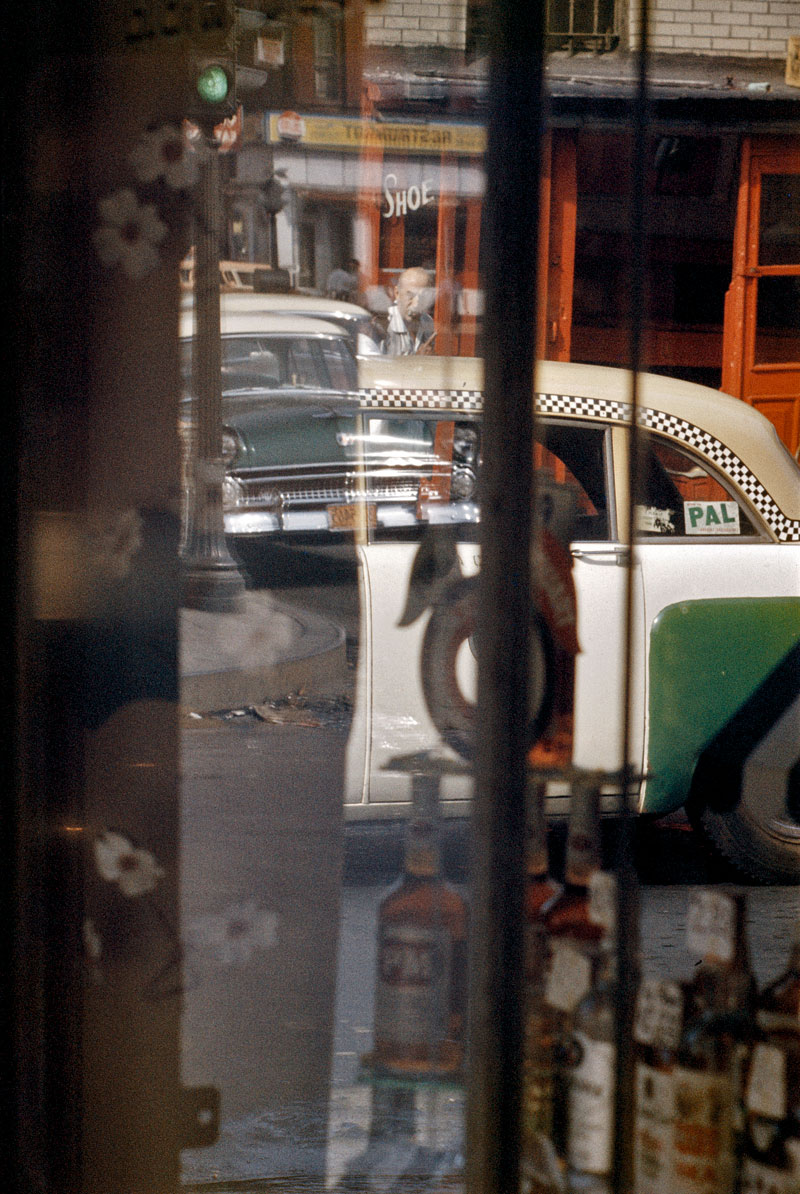
Saul Leiter (American, 1923-2013) 'Taxi' 1957


Saul Leiter (American, 1923-2013)
Taxi
1957
© Saul Leiter, Collection Howard Greenberg Gallery, New York


“I must admit that I am not a member of the ugly school. I have a great regard for certain notions of beauty even though to some it is an old fashioned idea. Some photographers think that by taking pictures of human misery, they are addressing a serious problem. I do not think that misery is more profound than happiness.”

“Seeing is a neglected enterprise.”


Saul Leiter


“Leiter’s sensibility… placed him outside the visceral confrontations with urban anxiety associated with photographers such as Robert Frank or William Klein. Instead, for him the camera provided an alternate way of seeing, of framing events and interpreting reality. He sought out moments of quiet humanity in the Manhattan maelstrom, forging a unique urban pastoral from the most unlikely of circumstances.”


Martin Harrison. ‘Saul Leiter Early Color’


The first of two postings on the underrated, underexposed American photographer Saul Leiter. These photographs are a delightful surprise! Some, like Through Boards (1957, below) are as illuminating as any Rothko going around. His art is not of the documentary gaze but of a brief glimpse, glanz, refulgence of desire ∞ snatched from the nonlinearity of time ∞ cleft in(to) its fabric. What wonderfully composed reflections they are. I absolutely adore them.

The media release states, “… but where his color photography is concerned, he cannot be compared with any other photographer. In the 1940s and 1950s, Leiter was virtually the only non-commercial photographer working in color.” Galleries must beware such bombastic claims: other photographers working in colour in the 1940s-50s include Paul OuterbridgeLászló Moholy-NagyNickolas MurayJack Smith, Eliot Porter and William Eggleston to name but a few (also see the posting on the exhibition Beyond COLOR: Color in American Photography, 1950-1970).

The second posting will be from a major retrospective of his work at The House of Photography at Deichtorhallen.

Perhaps this photographer is finally getting the accolades he so rightly deserves.

Dr Marcus Bunyan


Many thankx to the Jewish Historical Museum for allowing me to publish the photographs in the posting. Please click on the photographs for a larger version of the image.


Saul Leiter (American, 1923-2013) 'Haircut' 1956


Saul Leiter (American, 1923-2013)
Haircut
1956
© Saul Leiter, Collection Howard Greenberg Gallery, New York


Saul Leiter (American, 1923-2013) 'Through Boards' 1957


Saul Leiter (American, 1923-2013)
Through Boards
1957
© Saul Leiter, Courtesy Howard Greenberg Gallery, New York


Saul Leiter (American, 1923-2013) 'Harlem' 1960


Saul Leiter (American, 1923-2013)
Harlem
1960
© Saul Leiter, Collection Howard Greenberg Gallery, New York


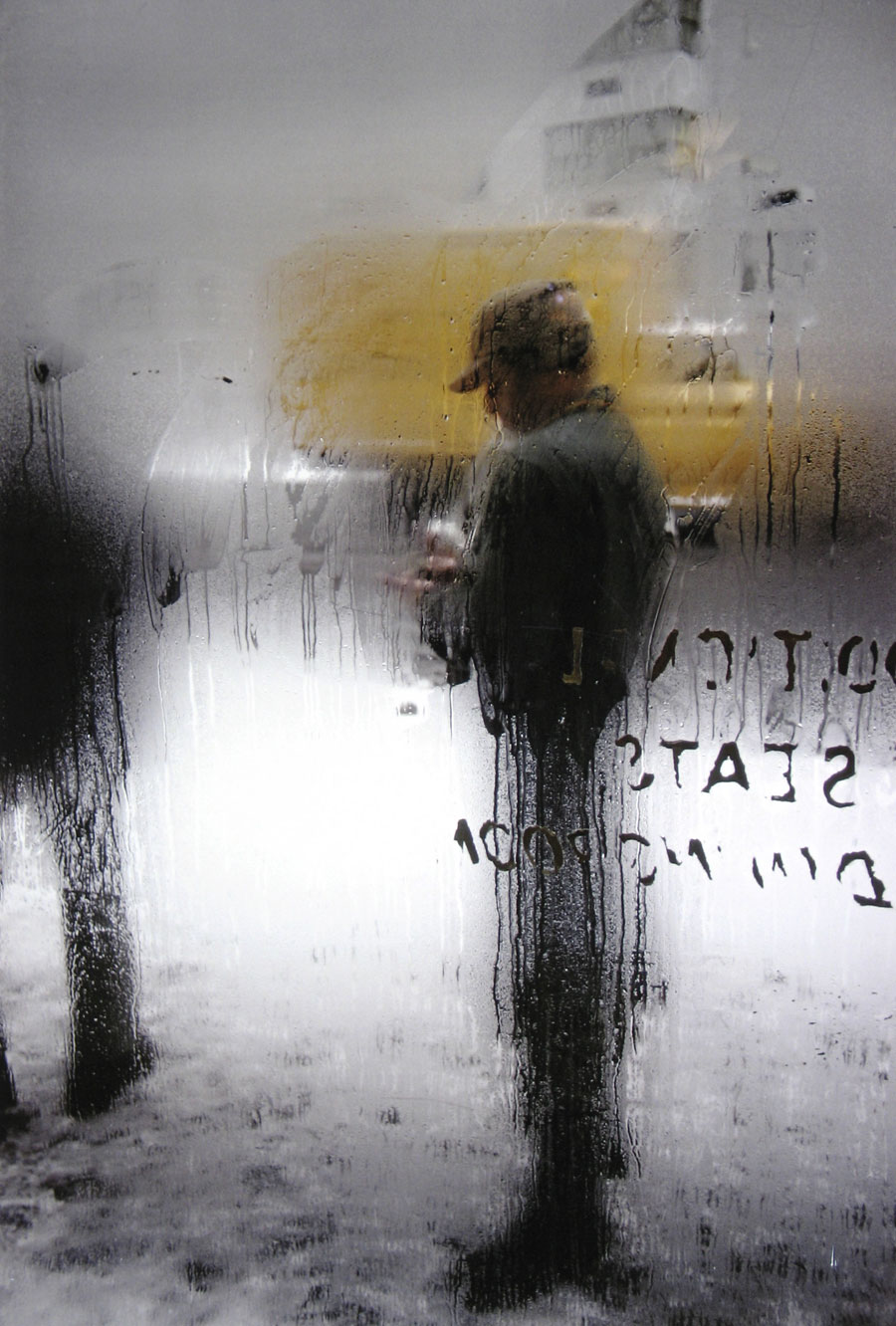
Saul Leiter (American, 1923-2013) 'Snow' 1960


Saul Leiter (American, 1923-2013)
Snow
1960
© Saul Leiter, Collection Howard Greenberg Gallery, New York


From 24 October 2011 to 4 March 2012 the JHM is presenting a retrospective exhibition of the work of the American photographer and painter Saul Leiter (1923-2013). Following a long period of obscurity, Leiter’s work has recently been rediscovered in the United States and Europe. This is the first exhibition of his work in the Netherlands.

Saul Leiter is celebrated particularly for his painterly colour photographs of the street life in New York, which he produced between 1948 and 1960. Amid the hectic life of the city he captured tranquil moments of everyday beauty. He was able to transform mundane objects – a red umbrella in a snowstorm, a foot resting on a bench in the metro, or a human figure seen through the condensation on a pane of glass – into what has been described as ‘urban visual poetry’. His photographs are frequently layered, near-abstract compositions of reflections and shadows, which recall paintings by abstract expressionists such as Mark Rothko and Willem de Kooning, with whom Leiter felt a strong affinity.

Saul Leiter is seen as belonging to the New York School of Photographers, a group of innovative artists, most of them Jewish, who achieved fame in New York in the period 1936-1963, primarily with their images of the street and their documentary photography. His black-and-white work displays a lyricism, dreaminess and surrealism that might prompt comparison with photographers such as Ted Croner, Leon Levinstein and Louis Faurer, but where his colour photography is concerned, he cannot be compared with any other photographer. In the 1940s and 1950s, Leiter was virtually the only non-commercial photographer working in colour.

Born in Pittsburgh, Leiter was destined to become a rabbi like his father. But his growing interest in art led him to abandon his religious studies. Instead, he went to New York and dedicated himself to painting. His friendship there with the abstract expressionist painter Richard Pousette-Dart, who was experimenting with photography, and the work of the photographer Henri Cartier-Bresson, inspired Leiter to take up photography. His friendship with the photographer W. Eugene Smith was another inspiring influence.

The exhibition Saul Leiter: New York Reflections was prepared by the JHM in collaboration with the Howard Greenberg Gallery in New York. Besides over 60 colour and 40 black-and-white examples of his street photography, a small selection of fashion photographs, paintings, and painted photographs will be shown. Visitors will also be able to watch a recent documentary about Leiter by the British film maker Tomas Leach. This autumn, the publisher Steidl will be publishing the third edition of Early Color, the first book of Leiter’s photographs, compiled in 2006 by Martin Harrison of the Victoria & Albert Museum in London.

Press release from the Jewish Historical Museum website


Saul Leiter (American, 1923-2013) 'Foot on El' 1954


Saul Leiter (American, 1923-2013)
Foot on El
1954
© Saul Leiter, Courtesy Howard Greenberg Gallery, New York


Saul Leiter (American, 1923-2013) 'Taxi' 1956


Saul Leiter (American, 1923-2013)
Taxi
1956
© Saul Leiter, Courtesy Howard Greenberg Gallery, New York


Saul Leiter (American, 1923-2013) 'Reflection' 1958


Saul Leiter (American, 1923-2013)
Reflection
1958
© Saul Leiter, Courtesy Howard Greenberg Gallery, New York


Saul Leiter (American, 1923-2013) 'Paris' 1959


Saul Leiter (American, 1923-2013)
Paris
1959
© Saul Leiter, Collection Howard Greenberg Gallery, New York


Saul Leiter (American, 1923-2013) 'Walk with Soames' Nd


Saul Leiter (American, 1923-2013)
Walk with Soames
Nd
© Saul Leiter, Courtesy Howard Greenberg Gallery, New York


Jewish Historical Museum
Nieuwe Amstelstraat
1
1011 PL Amsterdam
Phone: +31 (0)20 5 310 310

Opening hours:
Daily from 10.00 – 17.00

Jewish Historical Museum website

LIKE ART BLART ON FACEBOOK

Back to top

Exhibition: ‘Frida Kahlo: Through the Lens of Nickolas Muray’ at the Albright-Knox Art Gallery, Buffalo NY

Exhibition dates: 8th May – 5th July, 2009


Nickolas Muray (American, 1892-1965) 'Frida with Olmeca Figurine, Coyoacan' 1939 from the exhibition 'Frida Kahlo: Through the Lens of Nickolas Muray' at the Albright-Knox Art Gallery, Buffalo NY, May - July, 2009


Nickolas Muray (American, 1892-1965)
Frida with Olmeca Figurine, Coyoacan
1939
Colour print, assembly (Carbro) process


Forty-seven exquisite colour and black-and-white photographs of the Mexican artist Frida Kahlo by the American photographer Nickolas Muray are featured in this exhibition organised and circulated by Smith Kramer Fine Art Services. Muray and Kahlo first met in Mexico in 1931 and soon began a love affair that lasted ten years and continued as an enduring friendship throughout their lives. The photographs, selected from the Nickolas Muray Archives, capture the exotic mystery and proud beauty of Frida Kahlo through the eyes of this accomplished portrait photographer, who loved her deeply. Organised at the Albright-Knox by Associate Curator Holly E. Hughes, the exhibition will also include reproductions of Kahlo’s letters to Muray, explanatory wall texts, and an educational brochure.

Text from the Albright-Knox Art Gallery website [Online] Cited 01/05/2009. No longer available online


Many thankx to the Albright-Knox Art Gallery for allowing me to publish the photographs in the posting. Please click on the photographs for a larger version of the image.


Nickolas Muray (American, 1892-1965) 'Frida, Mexico, 1940' c. 1940 from the exhibition 'Frida Kahlo: Through the Lens of Nickolas Muray' at the Albright-Knox Art Gallery, Buffalo NY, May - July, 2009


Nickolas Muray (American, 1892-1965)
Frida, Mexico, 1940
c. 1940
Colour print, assembly (Carbro) process


Nickolas Muray (American, 1892-1965) 'Frida with her sister Cristina, Nickolas Muray, and Rosa Covarrubias, Coyoacán' 1939


Nickolas Muray (American, 1892-1965)
Frida with her sister Cristina, Nickolas Muray, and Rosa Covarrubias, Coyoacán
1939
Colour print, assembly (Carbro) process


Nickolas Muray (American, 1892-1965) 'Frida Painting the Two Fridas, Coyoacan' 1939


Nickolas Muray (American, 1892-1965)
Frida Painting the Two Fridas, Coyoacan
1939
Silver gelatin print


Nickolas Muray (American, 1892-1965) 'Frida with Nick in her Studio, Coyoacán' 1941


Nickolas Muray (American, 1892-1965)
Frida with Nick in her Studio, Coyoacán
1941
Silver gelatin print


Nickolas Muray (American, 1892-1965) 'Frida with Granizo, Coyoacán' 1939


Nickolas Muray (American, 1892-1965)
Frida with Granizo, Coyoacán
1939
Silver gelatin print


Nickolas Muray (American, 1892-1965) 'Frida in the Dining Area, Coyoacán' 1941


Nickolas Muray (American, 1892-1965)
Frida in the Dining Area, Coyoacán
1941
Gelatin silver print


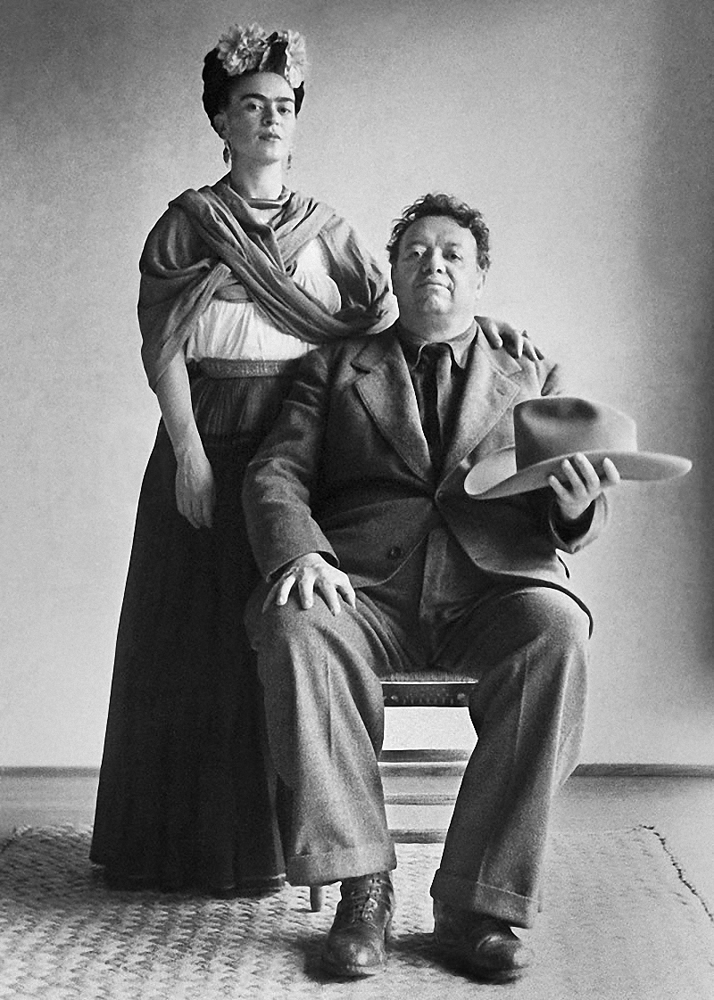
Nickolas Muray (American, 1892-1965) 'Frida and Diego, San Angel' 1941


Nickolas Muray (American, 1892-1965)
Frida and Diego, San Angel
1941
Gelatin silver print


Nickolas Muray (American, 1892-1965) 'Frida Kahlo' c. 1940


Nickolas Muray (American, 1892-1965)
Frida Kahlo
c. 1940
Colour print, assembly (Carbro) process


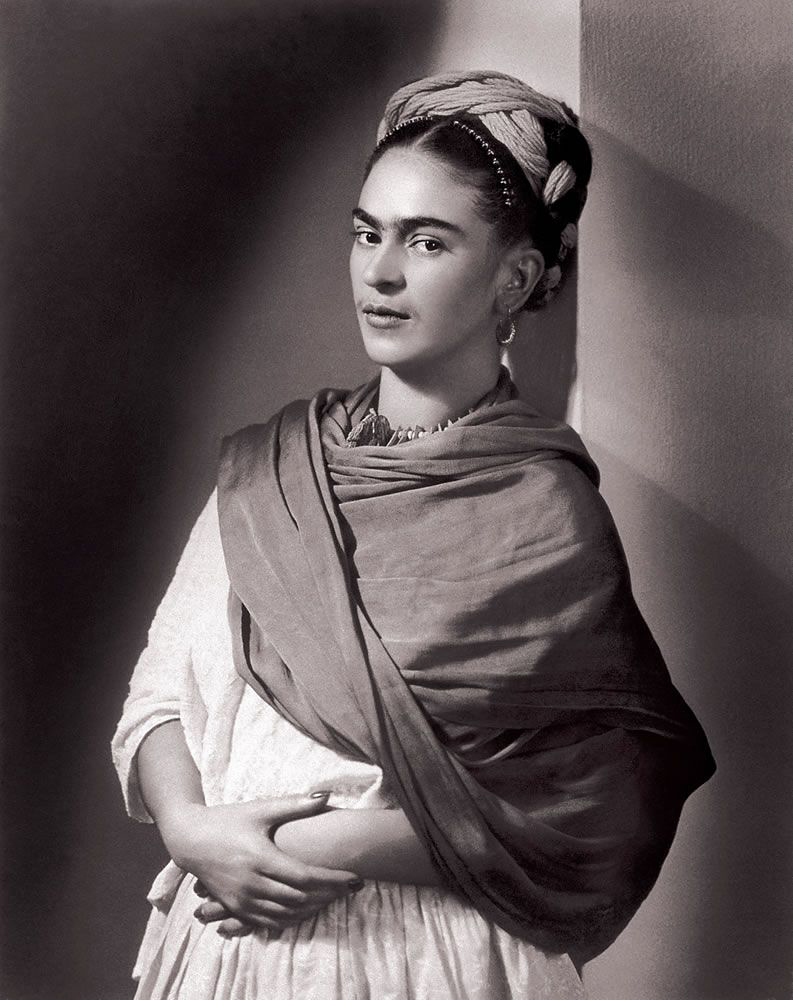
Nickolas Muray (American, 1892-1965) 'The Breton Portrait' 1939


Nickolas Muray (American, 1892-1965)
The Breton Portrait
1939
Silver gelatin print


Nickolas Muray (American, 1892-1965) 'Frida with Magenta Rebozo, New York' 1939


Nickolas Muray (American, 1892-1965)
Frida with Magenta Rebozo, New York
1939
Colour print, assembly (Carbro) process


Nickolas Muray (American, 1892-1965) 'Frida with Magenta Rebozo, New York' 1939


Nickolas Muray (American, 1892-1965)
Frida with Magenta Rebozo, New York
1939
Colour print, assembly (Carbro) process


Nickolas Muray

In 1913, with the threat of war in Europe, Muray sailed to New York City, and was able to find work as a colour printer in Brooklyn.

By 1920, Muray had opened a portrait studio at his home in Greenwich Village, while still working at his union job as an engraver. In 1921 he received a commission from Harper’s Bazaar to do a portrait of the Broadway actress Florence Reed; soon after he was having photographs published each month in Harper’s Bazaar, and was able to give up his engraving job. In 1922 he also made a portrait of the dancer Desha Delteil.

Muray quickly became recognised as an important portrait photographer, and his subjects included most of the celebrities of New York City. In 1926, Vanity Fair sent Muray to London, Paris, and Berlin to photograph celebrities, and in 1929 hired him to photograph movie stars in Hollywood. He also did fashion and advertising work. Muray’s images were published in many other publications, including Vogue, Ladies’ Home Journal, and The New York Times.

Between 1920 and 1940, Muray made over 10,000 portraits. His 1938 portrait of Frida Kahlo, made while Kahlo sojourned in New York, attending her exhibit at the Julien Levy Gallery, became the best known and loved portrait made by Muray. Muray and Kahlo were at the height of a ten-year love affair in 1939 when the portrait was made. Their affair had started in 1931, after Muray was divorced from his second wife and shortly after Kahlo’s marriage to Mexican muralist painter Diego Rivera. It outlived Muray’s third marriage and Kahlo’s divorce and remarriage to Rivera by one year, ending in 1941. Muray wanted to marry, but when it became apparent that Kahlo wanted Muray as a lover, not a husband, Muray took his leave for good and married his fourth wife, Peggy Muray. He and Kahlo remained good friends until her death, in 1954.

After the market crash, Muray turned away from celebrity and theatrical portraiture, and become a pioneering commercial photographer, famous for his creation of many of the conventions of colour advertising. He was considered the master of the three-color carbro process. His last important public portraits were of Dwight David Eisenhower in the 1950s.

Text from the Wikipedia website


Nickolas Muray (American, 1892-1965) 'Frida With Hand at Her Throat, Mexico City' 1940


Nickolas Muray (American, 1892-1965)
Frida With Hand at Her Throat, Mexico City
1940
Colour print, assembly (Carbro) process


Nickolas Muray (American, 1892-1965) 'Frida leaning on a sculpture by Mardonio Magaña, Coyoacán, Mexico' 1940


Nickolas Muray (American, 1892-1965)
Frida leaning on a sculpture by Mardonio Magaña, Coyoacán, Mexico
1940
Colour print, assembly (Carbro) process


Nickolas Muray (American, 1892-1965) 'Frida in Pink and Green Blouse, Coyoacán' 1938


Nickolas Muray (American, 1892-1965)
Frida in Pink and Green Blouse, Coyoacán
1938
Colour print, assembly (Carbro) process


Nickolas Muray (American, 1892-1965) 'Friday on White Bench, New York' 1939


Nickolas Muray (American, 1892-1965)
Frida on White Bench, New York
1939
Colour print, assembly (Carbro) process


An exhibition of photographs of the acclaimed Mexican artist Frida Kahlo taken by her friend and lover, the internationally renowned portrait photographer Nickolas Muray (1892-1965), will be on view at the Albright-Knox Art Gallery from May 8 through July 5, 2009. Frida Kahlo: Through the Lens of Nickolas Muray, From the Collection of the Nickolas Muray Archives celebrates Kahlo’s life and work and comprises approximately fifty colour and black-and-white photographs, along with archival material, including excerpts from letters between Kahlo and Muray. The installation in Buffalo will feature Frida Kahlo’s Self- Portrait with Monkey, 1938, from the Albright-Knox Art Gallery’s Permanent Collection.

Born in Hungary in 1892, Nickolas Muray came to the United States in 1913, marking the beginning of his forty-five-year career living and working in New York City. Originally hired by Condé Nast Publications to prepare illustrations for magazines, in 1920 Muray set up a photography studio at his home in Greenwich Village. Following an assignment in 1921 for Harper’s Bazaar magazine to photograph the Broadway star Florence Reed, Muray’s career as a portrait and celebrity photographer took off. Soon he was photographing “everybody who was anybody” and his work was regularly featured in such publications as Vanity Fair, Vogue, and Ladies’ Home Journal.

Nickolas Muray and Frida Kahlo first met in Mexico in 1931 and soon began a love affair that lasted ten years and continued as a friendship that endured all their lives. The images included in this exhibition, dating from 1937 to 1940, were taken during the height of the couple’s on-again, off-again, ten-year love affair. The photographs included were selected from the Nickolas Muray Archives and capture the exotic mystery and proud beauty of Frida Kahlo through the eyes of this accomplished portrait photographer who loved her deeply.

Text from the Artdaily.org website


Frida Kahlo (Mexican, 1907-1954) 'Self-Portrait with Monkey' 1938


Frida Kahlo (Mexican, 1907-1954)
Self-Portrait with Monkey
1938
Oil on masonite
40.6 cm × 30.5cm (16.0 in × 12.0 in)
Albright-Knox Art Gallery, Buffalo, New York


Of her 143 self-portraits, 55 include Kahlo’s pets. It is as though she saw them as an extension of her own self and being. Spider monkeys are known to have long, spindly legs and arms that look almost disproportionate to their body. Their strange appearance may have reflected Kahlo’s own discomfort with her physical body. Having contracted polio at an early age, she had one leg that was thinner than the other. She used colourful, large skirts to cover the disfigurement.

Kahlo doted on her pet monkeys. In her self-portraits, they are often shown sitting close to her, physically enfolding or grasping her in some way. They appear to be protective, friendly and gentle.

In many cultures, monkeys are used to symbolise lascivious, or primal behaviour. They are a mirror image of man, reminding him of his animal nature and close proximity to the natural world. Through monkeys, man sees his own connection to the animal kingdom with its uncontrollable, primal urges. In renaissance art, fettered monkeys were often used to symbolise men who are entrapped or bound by their desires.

In Kahlo’s paintings, monkeys do not appear in this way. They are more gentle, child-like and tender. Partially due to their wild natures, monkeys are often associated with fertility or lust in Mexican mythology. Kahlo’s trust and connection with her pets may have been in part due to her own feelings of inadequacy and frustration around her inability to carry to children. One of the reasons feminists celebrate Kahlo’s work is her unabashed claim to her own sexuality. She was not afraid to acknowledge her own sexual feelings or desires.

In Kahlo’s painting, the monkeys appear loyal. It feels as though Kahlo is connected with the creatures in some way. There is a bond there. Never the less, the monkeys also often appear by Kahlo’s shoulder or back, reflecting the image of a ‘monkey on your back’, a phrase commonly used to describe a problem or burden of some kind. With their association with animal nature, disfigured or primal humanity and lascivious primal urges, Kahlo may have felt at once supported by and burdened by her connection to her animal ancestors.

Extract from Kitty Jackson. “Symbolism in Art: Frida Kahlo – Self Portrait with Monkey,” on the ArtDependence Magazine website, September 4, 2017 [Online] Cited 20/01/2019


Nickolas Muray (American, 1892-1965) 'Frida in Front of the Cactus Organ Fence, San Angel' 1938


Nickolas Muray (American, 1892-1965)
Frida in Front of the Cactus Organ Fence, San Angel
1938
Colour print, assembly (Carbro) process


Nickolas Muray (American, 1892-1965) 'Frida with Blue Satin Blouse, New York' 1939


Nickolas Muray (American, 1892-1965)
Frida with Blue Satin Blouse, New York
1939
Colour print, assembly (Carbro) process


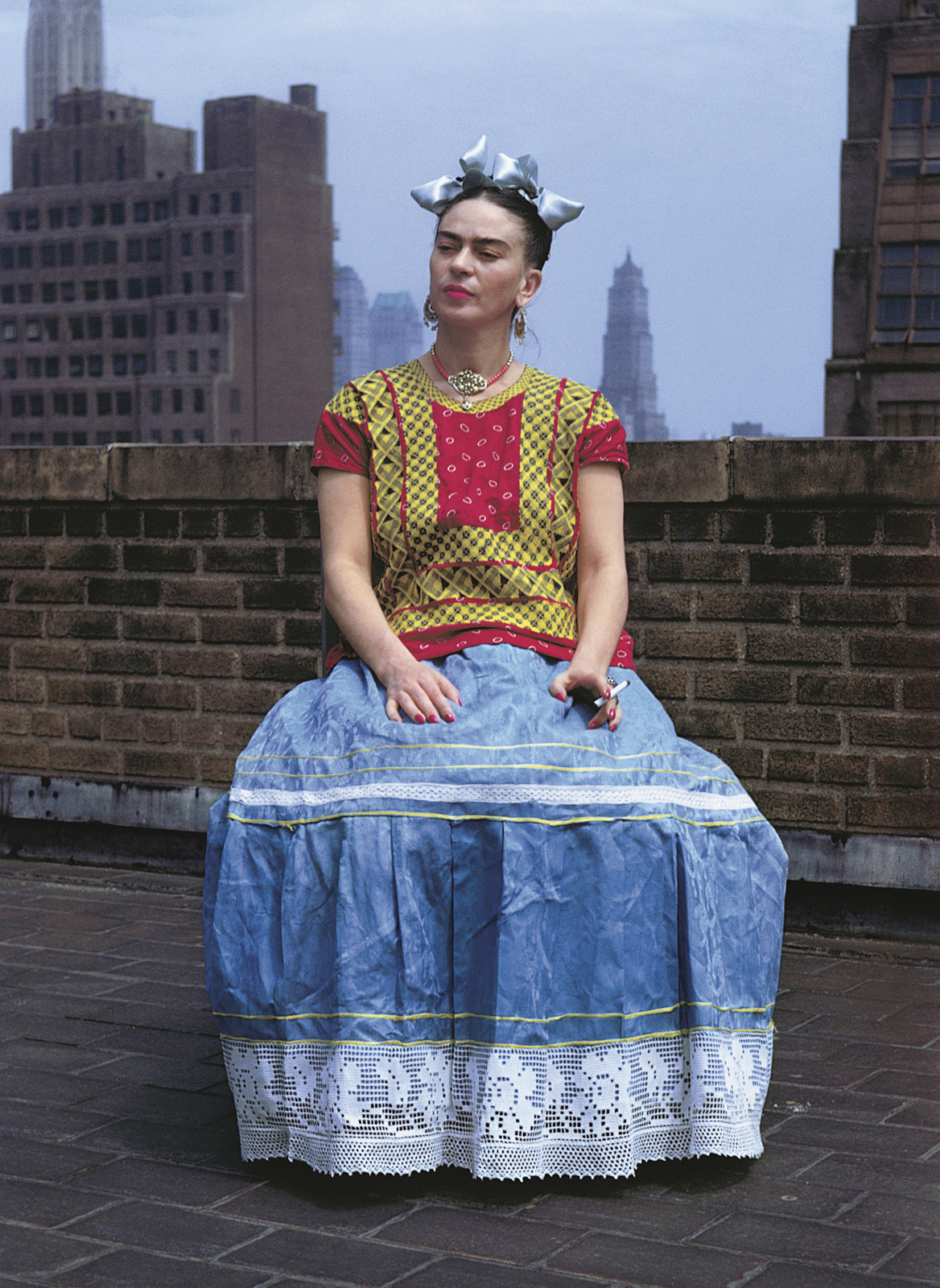
Nickolas Muray (American, 1892-1965) 'Frida on Rooftop, New York' 1946


Nickolas Muray (American, 1892-1965)
Frida on Rooftop, New York
1946
Colour print, assembly (Carbro) process


Nickolas Muray (American, 1892-1965) 'Cristina and Frida, New York' 1946


Nickolas Muray (American, 1892-1965)
Cristina and Frida, New York
1946
Colour print, assembly (Carbro) process


Albright-Knox Art Gallery
1285 Elmwood Avenue
Buffalo, New York 14222-1096

Opening hours:
Tuesday – Sunday 10am – 5pm
Closed Mondays, Tuesdays, and Independence, Thanksgiving, Christmas, and New Year’s Days

Albright-Knox Art Gallery website

LIKE ART BLART ON FACEBOOK

Back to top

Exhibition: ‘Portraits of New York: Photographs from the MoMA’ at La Casa Encendida, Madrid

Exhibition dates: 27th March – 14th June, 2009

Curator: Sarah Hermanson Meister, associate curator of MoMA’s Department of Photography


Many thankx to La Casa Encendida for allowing me to publish the photographs in the posting. Please click on the photograph for a larger version of the image.


Paul Strand (American, 1890-1976) 'Wall Street, New York' 1915 from the exhibition 'Portraits of New York: Photographs from the MoMA' at La Casa Encendida, Madrid, March - June, 2009


Paul Strand (American, 1890-1976)
Wall Street
1915
Platinum palladium print


Wall Street is a platinum palladium print photograph by the American photographer Paul Strand taken in 1915. There are currently only two vintage prints of this photograph with one at the Whitney Museum of American Art (printed posthumously) and the other, along with negatives, at the Philadelphia Museum of Art. This photograph was included in Paul Strand, circa 1916, an exhibition of photographs that exemplify his push toward modernism.

It depicts a scene of everyday life in Manhattan’s Financial District. Workers are seen walking past the J.P. Morgan & Co. building in New York City on the famous Wall Street, of which the photograph takes its name. The photograph is famous for its reliance on the sharpness and contrast of the shapes and angles, created by the building and the workers, that lead to its abstraction. This photograph is considered to be one of Strand’s most famous works and an example of his change from Pictorialism to straight photography. Strand moved from the posed to portraying the purity of the subjects. It is one of several images that stand as marks of the turn to modernism in photography. …

Technique

This photograph depicts the J.P. Morgan building in New York City. Strand photographed “people hurrying to work past the banking building” situated on Wall Street, from which the photo takes its name. the subject depicted is a real-life subject without manipulation. The depiction of the real nature of the medium and the subject is an example of straight photography. There is no focal point, with the lines converging off of the frame of the image. The financial building take majority of the frame. Emphasis is placed on the strong shapes created by the architecture of the building. The workers are included in the image, but are faceless and are trumped in size by the massive square shapes from the building they walk past. Also, the workers are captured in motion which on film makes them appear blurry. This aesthetic that Strand creates in Wall Street is his break toward the modern, the straight photography, demonstrating that Pictorialism is no longer part of his aesthetic. Strand captured the building with clean, sharp lines. The building is covered in the high contrast, chiaroscuro. It is heavily in the shadows, but still creates an overwhelming presence over the people that walk past it. These people are also shrouded in the contrast made evident with the clean lines and black and white nature of his photos and photography as a medium. The people jump from their places, being the dark figures in the light of the sun that beams in from the left of the frame.

Strand fills the image with his recognisable aesthetic. The photo is platinum print, one of the materials frequently used by photographers of the time. Strand was unique in how he printed his photos. As stated on the George Eastman House website section Notes on Photography, Strand would make large prints from small negatives. He also left them in their matte condition that was inherent with platinum print. With his printing techniques, he “added a richness to the image.” As with the time, the photo is entirely black and white. There is a heavy contrast with the black and white areas of the photo. Strand creates diagonal shapes that pull emphasis to subject of the building and away from the people.

Aspects

Having taken Hine’s class at the Ethical Culture Fieldston School, social change became important to Strand and appeared often in his art. As a pupil of Hine, Strand learned of the social aspect his work could have. With Wall Street, he sought to portray a social message. He captured the faceless people next to the looming financial building in order to give a warning. Strand shows “the recently built J.P. Morgan Co. building, whose huge, dark recesses dwarf the passersby with the imposing powers of uniformity and anonymity.” The people cannot escape the overwhelming power that this modern establishment will have on their future and the future of America. He warns us to not be the small people that look almost ant-like next to this building that has a massive amount of control over the American economy.

Text from the Wikipedia website


Unidentified photographer. 'Brooklyn Bridge' c. 1914


Unidentified photographer
Brooklyn Bridge
c. 1914
Gelatin silver print
7 5/8 × 9 9/16″ (19.4 × 24.3cm)
Museum of Modern Art, New York
The New York Times Collection


La Casa Encendida presents an exhibition organised by the Museum of Modern Art (MoMA), New York, which showcases a fundamental part of the institution’s assets: its photography collection. Portraits of New York: Photographs from the MoMA offers an overview of the history of photography against the backdrop of this iconic metropolis through the work of more than 90 artists.

For the show’s curator Sarah Hermanson Meister, associate curator of the MoMA’s Department of Photography, “Portraits of New York amply reflects the history of synergies between this medium and the Big Apple during a period of important transformations for both. The photographs generated by the restless and constant commitment of numerous photographs to New York City have played a fundamental role in determining how New Yorkers perceive the city and themselves. These photographs have also defined the city’s image in the world’s imagination.”

Featured artists include Berenice Abbott, Diane Arbus, Richard Avedon, Margaret Bourke-White, Henri Cartier-Bresson, Harry Callahan, Walker Evans, Andreas Feininger, Larry Fink, Robert Frank, Lee Friedlander, Lewis W. Hine, William Klein, Irving Penn, Cindy Sherman, Edward Steichen, Thomas Struth and Garry Winogrand.

Text from the La Casa Encendida website


Lewis Wickes Hine (American, 1874-1940) 'Welders on the Empire State Building' c. 1930


Lewis Wickes Hine (American, 1874-1940)
Welders on the Empire State Building
c. 1930
Gelatin silver print
10 5/8 × 13 5/8″ (27 × 34.6cm)
Museum of Modern Art, New York
Committee on Photography Fund


Ted Croner (American, 1922–2005) 'Central Park South' 1947-1948 from the exhibition 'Portraits of New York: Photographs from the MoMA' at La Casa Encendida, Madrid, March - June, 2009


Ted Croner (American, 1922–2005)
Central Park South
1947-1948
Silver gelatin print
10 15/16 x 13 3/4″ (27.8 x 34.9cm)
Gift of the photographer
Museum of Modern Art, New York


Ted Croner (1922-2005) was an American photographer, described as an influential member of the New York school of photography during the 1940s and 1950s. His images are said to represent the best example of this movement.

Born in Baltimore in 1922 and raised in North Carolina, Croner developed an interest in photography while in high school. He honed his skills while serving as an aerial photographer in World War II before settling in New York City in 1947. At the urging of fashion photographer Fernand Fonssagrives, he enrolled in Alexey Brodovitch’s class at The New School where he studied with Diane Arbus, Richard Avedon and Lisette Model. During this period he produced many of his most memorable images including “Taxi, New York Night, 1947-48”, which appears on the cover of Bob Dylan’s 2006 album, Modern Times. Another of Croner’s photographs was used on the cover of Luna’s album Penthouse.

Croner also had a successful career as a fashion and commercial photographer – his work was published in Harper’s Bazaar and Vogue. He also worked extensively with corporations such as Coca-Cola and Chase Manhattan Bank. Croner is best known for his haunting night images of New York City taken in the 1940s and 1950s. He was one of several important photographers who belonged to the New York school of photography.

Text from the Wikipedia website


Arthur Fellig (Weegee) (American, 1899-1968) 'Coney Island' 1940


Arthur Fellig (Weegee) (American, 1899-1968)
Coney Island
July 22, 1940
Silver gelatin print
10 5/16 x 13 11/16″ (26.2 x 34.8cm)
Anonymous gift
Museum of Modern Art, New York
© 2019 Weegee/ICP/Getty Images


Photographs from the MoMA, which will provide an in-depth look at an essential component of the MoMA’s assets: its photography collection. Curated by Sarah Hermanson Meister, associate curator of the museum’s department of photography, the exhibition offers an overview of the history of photography through the work of over 90 artists, with the iconic city as a backdrop. It includes some of the most prestigious names in photography, such as Berenice Abbott, Diane Arbus, Harry Callahan, Henri Cartier-Bresson, Walter Evans, Lee Friedlander, Helen Levitt, Cindy Sherman, Irving Penn and Alfred Stieglitz.

For Sarah Hermanson Meister, associate curator of the MoMA’s Department of Photography, “Portraits of New York amply reflects the history of synergies of this medium and of the Big Apple during a period of important transformations for both. The photographs generated by the restless and constant commitment of numerous photographers to the city of New York have played a fundamental role in determining how New Yorkers perceive the city and themselves. These photographs have also defined the city’s image in the world’s imagination.

[…] The urban landscape of the city is a combination of the old and the new in constant evolution, and these physical transformations are repeated in the demographic changes that have characterised the city since the 1880s, when massive waves of immigrants began to arrive. This same diversity can be seen in the photography of New York of the past four decades. Just as its architects are inspired and limited by surrounding structures and building codes, and just as its inhabitants learn and rub up against each other and previous generations, so too the photographers of New York transport the visual memory of a an extensive and extraordinary repertoire of images of the city. They take on the challenge of creating new works that go beyond traditions and respond to what is new in New York.”

The exhibition curator continues: “Throughout the 20th century, numerous artists have felt inspired by New York’s combination of glamour and rawness. The city – which acquired its modernity at the same pace as photography, and in an equally impetuous and undisciplined way – has always been a theme of particular vitality for photographers, both those who have visited the city and those who live in it. On one occasion, faced with the challenge of capturing the essence of New York with a camera, the photographer Berenice Abbott wondered, “How shall the two-dimensional print in black and white suggest the flux of activity of the metropolis, the interaction of human beings and solid architectural constructions, all impinging upon each other in time?” Each of the photographs reproduced here is a unique response to that question.

New York may not be the capital of the United States, but it prides itself on being the capital of the world. Its inhabitants are intimate strangers, its avenues are constantly teeming and its buildings are absolutely unmistakeable, though they are packed so close together that it is impossible to see just one. The New York subway runs twenty-four hours a day, which has earned it the sobriquet of “the city that never sleeps.” It is the model for Gotham City, the disturbing metropolis that Batman calls home, and a symbol of independence and a wellspring of opportunities in a wide variety of films, from Breakfast at Tiffany‘s to Working Girl. And this is just a sample of the captivating and abundant raw material that the city offers to artists, regardless of the medium in which they work. However, it is the convergence of photographers in this city – in this place that combines anonymity and community, with its local flavour and global ambitions – that has created the ideal setting for the development of modern photography.

Text from the La Casa Encendida website [Online] Cited 28/04/2009. No longer available online


Bruce Davidson (American, b. 1933) 'Untitled' from the 'Brooklyn Gang' series 1959


Bruce Davidson (American, b. 1933)
Untitled from the Brooklyn Gang series
1959
Silver gelatin print
6 3/4 x 10″ (17.1 x 25.4cm)
Museum of Modern Art, New York
© 2019 Magnum Photos, Inc. and Bruce Davidson


Cindy Sherman (American, b. 1954)
'Untitled Film Still #21' 1978


Cindy Sherman (American, b. 1954)
Untitled Film Still #21
1978
Silver gelatin print
7 1/2 x 9 1/2″ (19.1 x 24.1cm)
Horace W. Goldsmith Fund through Robert B. Menschel
Museum of Modern Art, New York
© 2019 Cindy Sherman


Each of Sherman’s sixty-nine Untitled Film Stills (1977-80), presents a female heroine from a movie we feel we must have seen. Here, she is the pert young career girl in a trim new suit on her first day in the big city. Among the others are the luscious librarian (#13), the chic starlet at her seaside hideaway (#7), the ingenue setting out on life’s journey (#48), and the tough but vulnerable film noir idol (#54). To make the pictures, Sherman herself played all of the roles or, more precisely, played all of the actresses playing all of the roles. In other words, the series is a fiction about a fiction, a deft encapsulation of the image of femininity that, through the movies, took hold of the collective imagination in postwar America – the period of Sherman’s youth, and the crucible of our contemporary culture.

In fact, only a handful of the Untitled Film Stills are modelled directly on particular roles in actual movies, let alone on individual stills of the sort that the studios distribute to publicise their films. All the others are inventive allusions to generic types, and so our sure sense of recognition is all the more telling. It tells us that, knowingly or not, we have absorbed the movie culture that Sherman invites us to examine as a powerful force in our lives.

Publication excerpt from The Museum of Modern Art, MoMA Highlights, New York: The Museum of Modern Art, revised 2004, originally published 1999, p. 295.


Diane Arbus (American, 1923-1971) 'Woman with Veil on Fifth Avenue, N.Y.C' 1968


Diane Arbus (American, 1923-1971)
Woman with Veil on Fifth Avenue, N.Y.C
1968
Silver gelatin print
Museum of Modern Art, New York


Nickolas Muray (American, 1892-1965) 'Babe Ruth' c. 1927


Nickolas Muray (American, 1892-1965)
Babe Ruth
c. 1927
Gelatin silver print
13 3/8 × 10 7/16″ (33.9 × 26.5cm)
Museum of Modern Art, New York
Gift of Mrs. Nickolas Muray


Berenice Abbott (American, 1891-1991) 'Night View, New York City' 1932


Berenice Abbott (American, 1891-1991)
Night View, New York City (New York at Night)
1932
Silver gelatin print
12 7/8 x 10 9/16″ (32.7 x 26.9cm)
Museum of Modern Art, New York
© 2019 Berenice Abbott/Commerce Graphics


La Casa Encendida
Ronda Valencia, 2 28012 Madrid

Opening hours:
La Casa Encendida is open from Monday to Sunday from 10am to 10pm every day of the year except national and Community of Madrid holidays

La Casa Encendida website

LIKE ART BLART ON FACEBOOK

Back to top