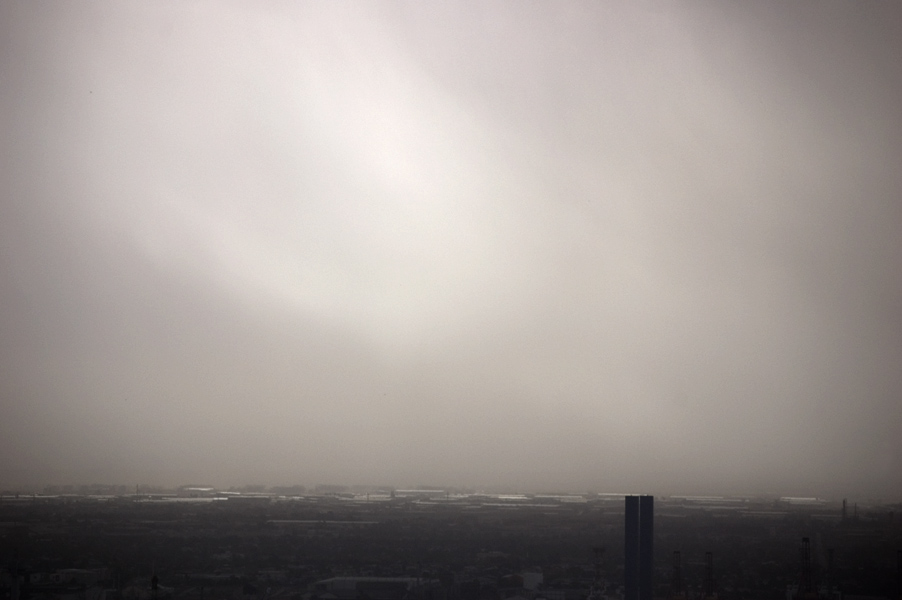
Review: ‘Order and disorder: archives and photography’ at the National Gallery of Victoria International, Melbourne

Exhibition dates: 18th October, 2008 – 19th April, 2009


Patrick Pound (New Zealander, b. 1962, worked in Australia 1989- ) 'Writing in a library' 1996 from the exhibition 'Order and disorder: archives and photography' at the National Gallery of Victoria International, Melbourne, October, 2008 - April, 2009


Patrick Pound (New Zealander, b. 1962, worked in Australia 1989- )
Writing in a library
1996
Photocopies, oil stick, card
169.4 x 127.2cm (image); 180.2 x 137.2cm (sheet)
National Gallery of Victoria, Melbourne
Purchased, 1997
© Patrick Pound  


“These fragments I have shored against my ruins.”


T.S. Eliot


An interesting exhibition is presented in the [now closed] permanent third floor photography gallery at NGV International, Melbourne on a subject that deserved a much more rigorous investigation than could been undertaken in this small gallery space. Presenting single works by Ed Ruscha, Bernd and Hilla Becher, Patrick Pound, Robert Rooney, Simon Obarzanek, Penelope Davis, Candid Hofer, Linda Judge and Charles Green and Lyndell Brown the works seek to investigate the nature of the relationship between photography and the archive, between the semi-permanences of an archival memory and the spaces of a transgressive intertexuality marked by fragmentary, ironic counter-performances.

As noted in the catalogue essay by NGV curator Maggie Finch the archive is a place for holding knowledge that contains elements of truth and error, order and disorder; archives are able to shape history and memory, depending on how, when and by whom the records are accessed. Any disruption of order, governance and authority can lead to alternative readings and interpretations as the arcane ‘mysteries’ of the methods of classification are overturned. Since Victorian times when the body came under the self-surveillance of the camera and was found wanting, photographs have documented the faces of criminals, the physiognomy of degeneration and the fever of war.

As Yiannis Papatheodorou has observed when reviewing Jacques Derrida Mal d’Archive,

“Derrida declares that since the dominant power of the archive derives from the economy of knowledge, it also provides the institutional responsibility of the interpretation. The localisation of the information transforms the inscription, provided by the function of the archive, into the impression of a memory’s trace, conscious or unconscious …

The preservation of memory, the access to information, the “resources” of the sources and the working environment are not just the representation of a future memory. They are active practices and discourses that create hierarchies and exclusions. The archives are the languages of the past, activated however dialogically, according to scientific and social demands. The content of our choice is marked by the way we are seeking information. Far from being an abstract principle, our choice is an ideologically oriented negotiation closely related to the politics of interpretation.”1


And there’s the rub. Not only is this exhibition a reordering of an unpublished memory (for that is what an archive is, a unique unpublished memory), it is also a reiteration of the authority of the gallery itself, the “institutional responsibility of the interpretation.”2 Deciding what was in this exhibition and what to leave out creates hierarchies of inclusion and exclusion – and in this case the inclusions are mainly ‘safe’ works, ones that challenge the ontology of existence, the cataloguing of reality in a slightly ironic way but oh – nothing too shocking! nothing too disordered! Nothing here then of the archive of images that substantiate the horrors of war, the trans/disfiguration of men in both World Wars for example. There are few images to haunt us, none to refresh our memories in a problematic way.

The more successful pieces, the works that challenge the order of the archive (“what is no longer archived in the same way is no longer lived in the same way”)3, are the ones by Ed Ruscha, Penelope Davis and Simon Obarzaneck (all below).

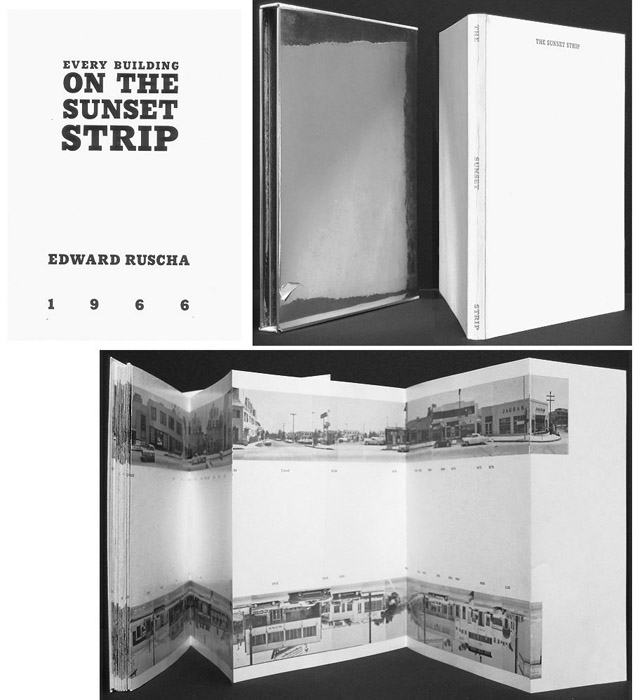
Ruscha’s vertical inverted cityscape is trapped in a display cabinet opened out on the horizontal plane in concertina format, like one of those optical illusion images in which you see an image looking from one direction and a different image from the other direction. Ruscha’s personal experience of driving down Sunset Strip in Los Angeles and his anthropological recording of the urban experience has been disseminated in a mass produced ‘artists’ book. No unique unpublished archive here. Beneath the facades of the shops other narratives emerge – images are stitched together, cars chopped off, people dismembered – all in a very linear, conceptual way; a journey from one point to another, one that is both subjective (the voice  and hand of the author) and objective (the en masse production of the book).

As Chris Balaschak has noted, “The images, taken during the day, capture only the facades of the buildings. Ignorance is given to cars or people, both of which are often cut in half between separate exposures. The imperfections of matching the facades are cracks along Ruscha’s drive. Through these cracks we find Ruscha, not such an anonymous author after all. Splitting cars in two, and mismatching facades we become keenly aware of the passage of time. The facades of buildings may appear as stage sets but they are active points on other itineraries, anticipating future and past narratives.”4


This is Ruscha’s trace through the city but also our intersection with his journey, our chance to make our own itineraries as Balaschak (in his insightful writing) rightly points out. The fragmentary dismembering becomes the space between, the disorder of the linear into a heterotopic space of remembering. We the viewer create our own narrative, flitting through the cracks in the archive of memory, the photographer, the author of our own journey.

Penelope Davis photograms are luminous objects. She makes resin casts of the spine of discarded books and places the casts directly onto photographic paper and then exposes them to light. The books glow and hover in the blackness, the words on the spine reversed. Stripped of their context, of their memory, they become ethereal books, phantom texts, liminal images that hover between what is known and what is imagined. As Davis has said, “Most people assume that when they look at a photo that they are looking at the thing photographed – but they are not. They are looking at a photo. Books and photographic images and archives are enigmatic – you can’t be sure of a singular definition or meaning.”

Davis is ‘messing around’ with the idea of veracity, the truth of photography and the ordering of the archive of our mind through the images we collate. We seek to grasp the original memory of an event, of the reading and ordering of our life through images and none is available to us, for as Foucault has observed memories are only ever fragmentary and distorted representations, partial truths a best. Like Jorge Luis Borges’ journey into the infinite universe of The Library of Babel, for Foucault the psyche is not an archive but a mirror, like the shining silver foil surface of the cover of the Ed Ruscha book:

“The search for the self is a journey into a mental labyrinth that takes random courses and ultimately ends at impasses. The memory fragments recovered along the way cannot provide us with a basis for interpreting the overall meaning of the journey. The meanings that we derive from our memories are only partial truths, and their value is ephemeral. For Foucault, the psyche is not an archive but only a mirror. To search the psyche for the truth about ourselves is a futile task because the psyche can only reflect the images we have conjured up to describe ourselves. Looking into the psyche, therefore, is like looking into the mirror image of a mirror. One sees oneself reflected in an image of infinite regress. Our gaze is led not toward the substance of our beginnings but rather into the meaninglessness of previously discarded images of the self.”5


This leads us nicely onto the images of Simon Obarzanek.

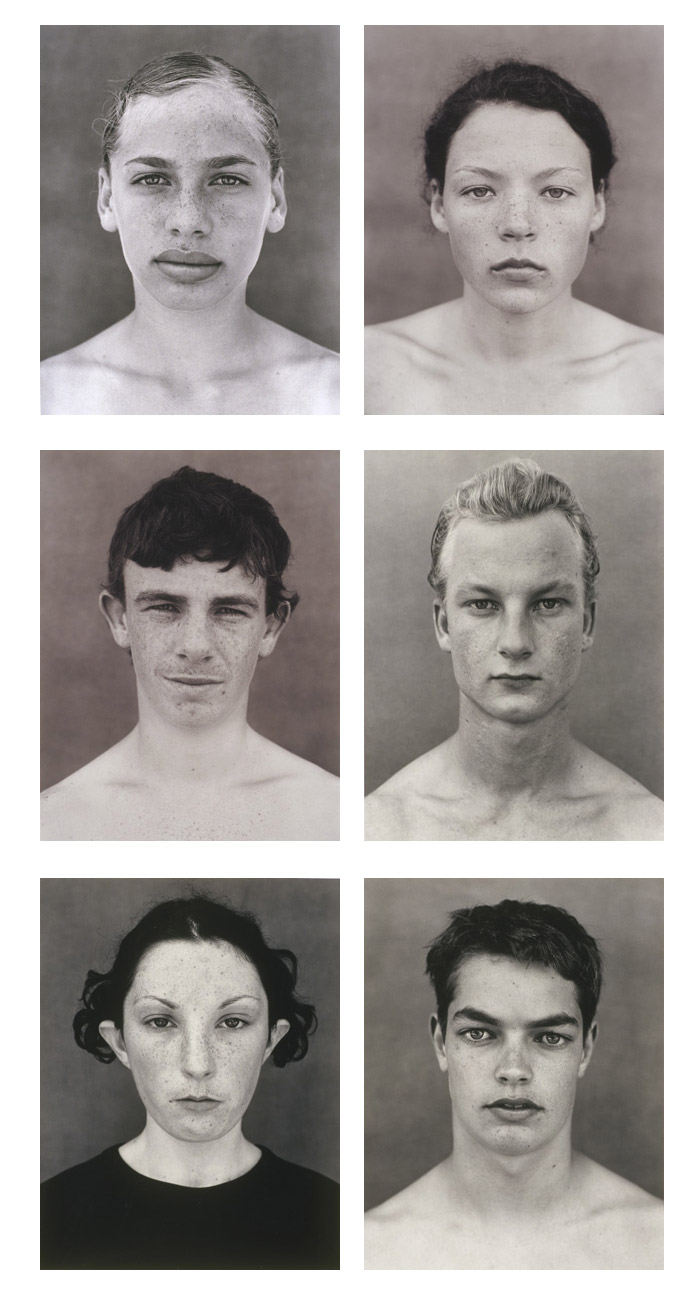
In a fantastic series of photographs, the only ones of this exhibition that seemed to haunt me (as Susan Sontag says images do), Obarzanek photographs people in an ordered, almost scientific, manner. Photographed face on against a non-contextual background using a low depth of field, these repetitive, collective, unnamed people remind me of the images of Galton. But here the uniformity is overwhelmed by quirky differences – the placement of eyes and lips seem large offering a strange, surreal physiognomy. These images resonate, the challenge, they remain with you, they question the order of things as no other photograph in this exhibition does. From simplicity comes eloquence.

To finish I must address the elephant in the room, in fact two elephants!

There is not one digital photograph contained in the exhibition, the work being collage, Type C colour or black and white silver gelatin prints. There is no mention in the catalogue of the crisis of cultural memory that is now permeating our world. Some believe the ever expanding digital archive, the Internet, threatens our lived memories “amidst the process of the ‘digitisation of culture’ and the new possibilities of storing.”6 This vision entails the fear of loosing cultural contents, hitting the delete button so that  memory passes into forgetting. This is a vision to which I do not subscribe, but the issue needed to be addressed in this exhibition: how are digital technologies altering our re-assemblance of memory, altering photography’s ability inherent ability to record, store and organise visual images? What about the aura of the original or was there never such a thing?

Furthermore, it would seem that with photographs becoming less and less a fixed essence; with the meaning of the photograph more and more divorced from its referent; with the spectators look the key to reading photographs; and the performance of the photograph a cut and paste reality… then perhaps we are left not with the two polar opposites of order and disorder but some orthogonal spaces in-between.

The second elephant in the room in the gallery space itself.

Whilst the curators of photography at the National Gallery of Victoria do an amazing job running large exhibitions such as the Andreas Gursky and Rennie Ellis shows that have starred this year, the NGV ‘International’ is shooting itself in the foot with the current permanent photography gallery space. Small, jaded and dour it seems an addendum to other larger spaces in the gallery and to be honest photography and Melbourne deserves better. Personally I feel more alive in the fashion gallery that is on the floor below and that, for an photographer, is a hard thing to say.

As the theme for this exhibition deserved a greater in depth investigation so the gallery needs to expand it’s horizons and give the permanent photography gallery a redesign and overhaul. Where is the life and passion of contemporary photography displayed in a small space for all to see in a gallery that sees itself as ‘International’? In an occularcentric world the key word is intertexuality: the gallery space should reflect the electri-city, the mixing of a gallery design ethos with images to surround us in a space that makes us passionate about contemporary photography. Now that would really be a new order of things!

Dr Marcus Bunyan


1/ Papatheodorou, Yiannis. History in the promised land of memory. Review of  Jacques Derrida, Mal d’Archive, Paris, Éd. Galilée, 1995 [Online] Cited on 20th March 2009 (no longer available online)

2/ “The archive is understood as collective reservoir of knowledge fulfilling diverse functions and conditioned by three main factors: conservation, selection and accessibility. How are contents stored and which media are used to conserve them? What is selected for storage and what is decided to be cleared out and thus forgotten? Who decides what is archived and who has access to the resources? All these questions paint the archive as a political space where relations of power cross aspects of culture and collective identity.”
Assmann, A. (2003) Erinnerungsräume, Formen und Wandlungen des kulturellen Gedächtnis. [Memory Spaces, Forms and Transformations of Cultural Memory] Special paperback editon, 1st edition publ. 1999, München: Beck, p. 343-346

3/ Derrida, Jacques. (1996) Archive Fever, A Freudian Impression. Transl. by E. Prenowitz, p. 18 orig. publ. as Mal d’Archive: une impression freudienne in 1995, Chicago, London: The University of Chicago Press

4/ Balaschak, Chris. Itineraries [part 3] [Online] Cited on 20th March 2009 (no longer available online)

5/ Hutton, Patrick. “Foucault, Freud, and the Technologies of the Self,” in Martin, Luther and Gutman, Huck and Hutton, Patrick (eds.,). Technologies of the Self: A Seminar with Michel Foucault. London: Tavistock Publications, 1988, p. 139

6/ Featherstone, M. (2000) “Archiving Cultures,” in British Journal of Sociology, 51(1), pp. 161-184


Many thankx to the National Gallery of Victoria for allowing me to publish the images in the posting. Please click on the photographs for a larger version of the image.

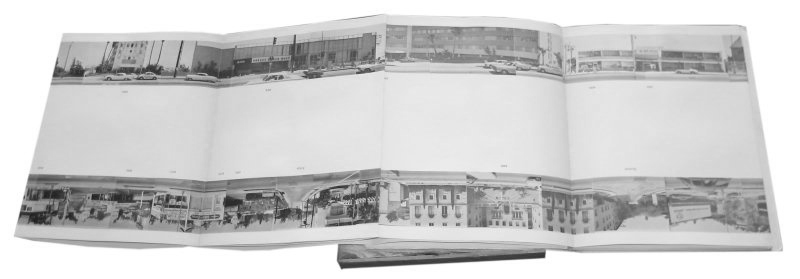


Ed Ruscha (American, b. 1937) 'Every Building on Sunset Strip' 1966 from the exhibition 'Order and disorder: archives and photography' at the National Gallery of Victoria International, Melbourne, October, 2008 - April, 2009

Ed Ruscha (American, b. 1937) 'Every Building on Sunset Strip' 1966 from the exhibition 'Order and disorder: archives and photography' at the National Gallery of Victoria International, Melbourne, October, 2008 - April, 2009

Ed Ruscha (American, b. 1937) 'Every Building on Sunset Strip' 1966

Ed Ruscha (American, b. 1937) 'Every Building on Sunset Strip' 1966


Ed Ruscha (American, b. 1937)
Every building on the Sunset Strip
1966
Artist book: photo-offset lithographs, letterpress, concertina, cardboard cover, silver-coated plastic-covered slipcase, 1st edition
17.8 x 760.7cm (open); 17.8 x 14.4 x 0.8cm (closed); 18.6 x 14.6 x 1.4cm (slipcase)
Private collection, Melbourne
© Ed Ruscha, courtesy Gagosian Gallery, New York


Penelope Davis (Australian, b. 1963) 'Shelf' 2008


Penelope Davis (Australian, b. 1963)
Shelf
2008
From the Fiction-Non-Fiction series 2007-2008
Type C photograph
90.0 x 70.0cm
National Gallery of Victoria, Melbourne
Purchased, Victorian Foundation for Living Australian Artists, 2008


Archives contain elements of truth and error, order and disorder and are infinitely fascinating. As both collections of records and repositories of data, archives are able to shape history and memory depending on how, when and by whom the materials are accessed. Their vastness allows for multiple readings to be unravelled over time.

Photography is naturally associated with archives because of its inherent ability to record, store and organise visual images. With this in mind, this exhibition brings together artists drawn largely from the permanent collection of the NGV who explore the idea of archives as complex, living and occasionally mysterious systems of knowledge. Several of the selected artists act as archivists, collecting and ordering their own unique bodies of photographs, while others create disorder by critiquing the ideas and systems of archives.

Text from the NGV International website [Online] Cited 13/06/2022


Simon Obarzanek (Israeli/Australian, b. 1968, worked in United States 1995-2001) '6 faces from 123 faces' 2000-2002


Simon Obarzanek (Israeli/Australian, b. 1968, worked in United States 1995-2001)
6 faces from 123 faces
2000-2002
Gelatin silver photographs
(a) 33.1 x 25.4cm; (b) 33.4 x 25.4cm; (c) 33.2 x 25.3cm; (d) 33.4 x 25.4cm; (e) 33.4 x 25.4cm; (f) 33.4 x 25.4cm
National Gallery of Victoria, Melbourne
Purchased with funds arranged by Loti Smorgon for Contemporary Australian Photography, 2003
© Simon Obarzanek


Simon Obarzanek (Israeli/Australian 1968-, worked in United States 1995-2001) 'Box Hill girl' 2000-2002


Simon Obarzanek (Israeli/Australian, b. 1968, worked in United States 1995-2001)
Box Hill girl
2000-2002
Gelatin silver photograph
33.4 × 25.4cm
National Gallery of Victoria, Melbourne
Purchased with funds arranged by Loti Smorgon for Contemporary Australian Photography, 2003
© Simon Obarzanek


Simon Obarzanek (Israeli/Australian 1968-, worked in United States 1995-2001) 'Boy with eyes' 2000-2002


Simon Obarzanek (Israeli/Australian, b. 1968, worked in United States 1995-2001)
Boy with eyes
2000-2002
Gelatin silver photograph
33.4 × 25.4cm
National Gallery of Victoria, Melbourne
Purchased with funds arranged by Loti Smorgon for Contemporary Australian Photography, 2003
© Simon Obarzanek


Candida Höfer (German, b. 1944) 'Teylers Museum Haarlem II' 2003


Candida Höfer (German, b. 1944)
Teylers Museum Haarlem II
2003
Type C photograph
150.0 x 120.0cm
National Gallery of Victoria, Melbourne
Purchased, 2004
© Candida Höfer/VG Bild-Kunst, Bonn. Licensed by Copyright Agency, Australia


Bernd and Hilla Becher (German, 1931-2007 and 1934-2015) 'Coal tipple, Goodspring, Pennsylvania' 1975


Bernd and Hilla Becher (German, 1931-2007 and 1934-2015)
Coal tipple, Goodspring, Pennsylvania
1975
From the Artists and photographs folio 1975
Gelatin silver photographs
24.0 × 33.9cm (image and sheet) 40.7 × 49.6cm (support)
National Gallery of Victoria, Melbourne
Purchased, 1976


NGV International
180 St Kilda Road

Opening hours:
10am – 5pm daily

National Gallery of Victoria website

LIKE ART BLART ON FACEBOOK

Back to top

Opening 3: Review: ‘Show Court 3’ and ‘Mood Bomb’ by Louise Paramor at Nellie Castan Gallery, Melbourne

Exhibition dates: 5th March – 28th March, 2009

Opening: Thursday 5th March, 2009


Louise Paramor (Australian, b. 1964) 'Show Court 3 (II)' 2009


Louise Paramor (Australian, b. 1964)
Show Court 3 (II)
2009


Boarding a train at Flinders Street we emerge at South Yarra station to stroll down to River Street for our third opening of the night at Nellie Castan Gallery. We are greeted by the ever gracious Nellie Castan who has just returned from an overseas trip to Europe where she was soaking up the wonders of Rome amongst other places. For the latest exhibition in the gallery Louise Paramor is presenting two bodies of work: Show Court 3 and Mood Bomb (both 2009). Lets look at Show Court 3 first as this work has older origins.

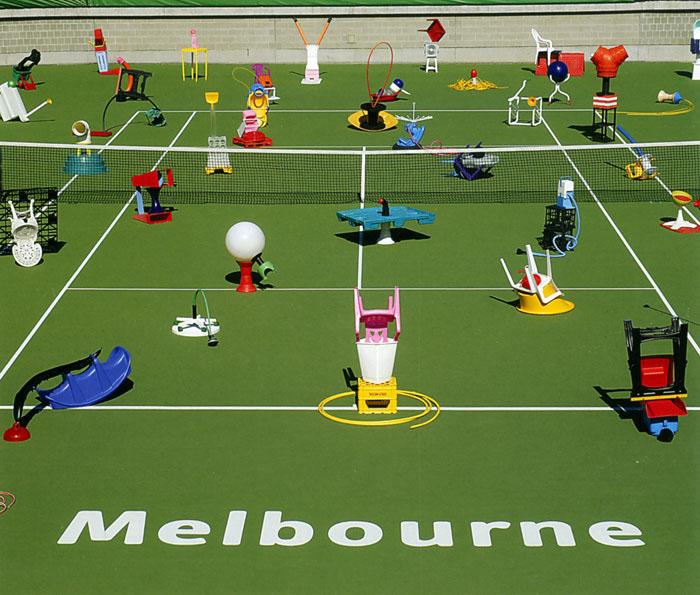
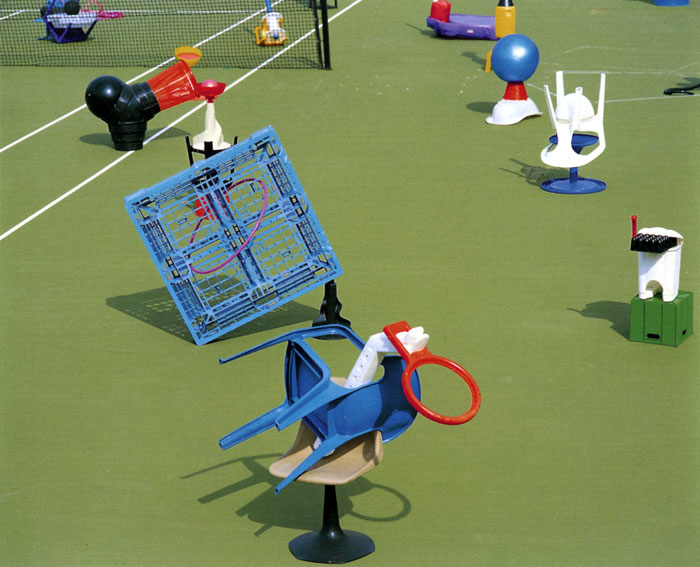
Originally exhibited in 2006 at Nellie Castan under the title Jam Session the sculptures from this exhibition and many more beside (75 in all) were then installed in 2007 on show court 3 at Melbourne & Olympic Parks, hence the title of the installation. In the smaller gallery in 2009 we have six Lambda photographic prints that are records of this installation plus a video of the installation and de-installation of the work.

While interesting as documentary evidence of the installation these photographs are thrice removed from the actual sculptures – the sculptures themselves, the installation of the sculptures on court and then the photographs of the installation of the sculptures. The photographs lose something in this process – the presence or link back to the referentiality of the object itself. There is no tactile suggestiveness here, no fresh visual connections to be made with the materials, no human interaction. The intertextual nature of the objects, the jamming together of found pieces of bright plastic to make seductive anthropomorphic creatures that ‘play’ off of each other has been lost.

What has been reinforced in the photographs is a phenomena that was observed in the actual installation.

“The sculptures created a jarring visual disruption when placed in a location normally associated with play and movement. The stadium seating surrounding the tennis court incited an expectation of entertainment; a number of viewers sat looking at the sculptures, as though waiting for them to spin and jump around. But mostly, the exhibition reversed the usual role of visitors to place where one sits and watches others move; here the objects on the tennis court were static and the spectators moved around.” (2007)1

In the photographs of these objects and in the installation itself what occurs is an inversion of perception, a concept noted by the urbanist Paul Virilio.2 Here the objects perceive us instead of us perceiving the object: they stare back with an oculocentric ‘suggestiveness’ which is advertising’s raison d’être (note the eye sculpture above). In particular this is what the photographs suggest – a high gloss surface, an advertising image that grabs our attention and forces us to look but is no longer a powerful image.

In the main gallery was the most interesting work of the whole night – experiments of abstraction in colour “inspired by the very substance of paint itself.” Made by pouring paint onto glass and then exhibiting the smooth reverse side, these paintings are not so much about the texture of the surface (as is Dale Frank’s work below) but a more ephemeral thing: the dreamscapes of the mind that they promote in the viewer, the imaginative connections that ask the viewer to make. Simpler and perhaps more refined than Frank’s work (because of the smooth surface, the lack of the physicality of the layering technique? because of the pooling of amoebic shapes produced, not the varnish that accumulates and recedes?) paint oozes, bleeds, swirls, drips upwards and blooms with a sensuality of intense love. They are dream states that allow the viewer to create their own narrative with the title of the works offering gentle guides along the way: Girl with Flowers, Lovers, Mood Bomb, Emerald God, Mama, and Animal Dreaming to name just a few. To me they also had connotations of melted plastic, almost as if the sculptures of Show Court 3 had dissolved into the glassy surface of a transparent tennis court.

These are wonderfully evocative paintings. I really enjoyed spending time with them.

Dr Marcus Bunyan


1/ O’Neill, Jane. Louise Paramor: Show Court 3. Melbourne: Nellie Castan Gallery, 2009

2/ Virilio, Paul. The Vision Machine. (trans. Julie Rose). Bloomington: Indiana University Press, 1994, pp. 62-63


Many thankx to Nellie Castan Gallery for allowing me to publish the photographs in the posting. Please click on the photographs for a larger version of the image.


Louise Paramor (Australian, b. 1964) 'Show Court 3 (VI)' 2009


Louise Paramor (Australian, b. 1964)
Show Court 3 (VI)
2009


Louise Paramor (Australian, b. 1964) 'Show Court 3' 2009 (detail)


Louise Paramor (Australian, b. 1964)
Show Court 3 (detail)
2009


Louise Paramor (Australian, b. 1964) 'Show Court 3' 2009 (detail)


Louise Paramor (Australian, b. 1964)
Show Court 3 (detail)
2009


Louise Paramor (Australian, b. 1964) Opening night crowd in front of 'Sky Pilot' (left) and 'Mama' (right) 2009


Louise Paramor (Australian, b. 1964)
Opening night crowd in front of Sky Pilot (left) and Mama (right)
2009
Paint on glass


Louise Paramor (Australian, b. 1964) Opening night crowd in front of 'Green Eyed Monster' (right) and 'Sky Pilot' (right) 2009


Louise Paramor (Australian, b. 1964)
Opening night crowd in front of Green Eyed Monster (right) and Sky Pilot (right)
2009
Paint on glass


Louise Paramor (Australian, b. 1964) Opening night crowd in front of 'Pineapple Express' 2009


Louise Paramor (Australian, b. 1964)
Opening night crowd in front of Pineapple Express
2009
Paint on glass


Louise Paramor (Australian, b. 1964) 'A Dog and His Master' 2009 (detail)


Louise Paramor (Australian, b. 1964)
A Dog and His Master (detail)
2009
Paint on glass


Louise Paramor (Australian, b. 1964) 'Lovers' 2009


Louise Paramor (Australian, b. 1964)
Lovers
2009
Paint on glass


Dale Frank (Australian, b. 1959) '2. One conversation gambit you hear these days: 'Do you rotate?' An interesting change of tack? No suck luck. 'Do you rotate?' simply fishes for information about the extent of your collection. Do you have enough paintings to hang a different one in your dining room every month?' 2005


Dale Frank (Australian, b. 1959)
2. One conversation gambit you hear these days: ‘Do you rotate?’ An interesting change of tack? No suck luck. ‘Do you rotate?’ simply fishes for information about the extent of your collection. Do you have enough paintings to hang a different one in your dining room every month?
2005


Louise Paramor (Australian, b. 1964) 'Mood Bomb' 2009


Louise Paramor (Australian, b. 1964)
Mood Bomb
2009
Paint on glass


Louise Paramor (Australian, b. 1964) 'Slippery Slope' 2009 (detail)


Louise Paramor (Australian, b. 1964)
Slippery Slope (detail)
2009
Paint on glass


Louise Paramor (Australian, b. 1964) 'Green Eyed Monster' 2009 (detail)


Louise Paramor (Australian, b. 1964)
Green Eyed Monster (detail)
2009
Paint on glass


Nellie Castan Gallery, Melbourne

This gallery closed in December 2013

LIKE ART BLART ON FACEBOOK

Back to top

Opening 2: ‘New work’ by Richard Grigg at Block Projects, Melbourne

Exhibition dates: 5th March – 28th March, 2009

Opening: Thursday 5th March, 2009


Richard Grigg. 'New work' opening night crowd at Block Projects, Melbourne


Richard Grigg (Australian)
New Work exhibition
Opening night crowd at Block Projects, Melbourne


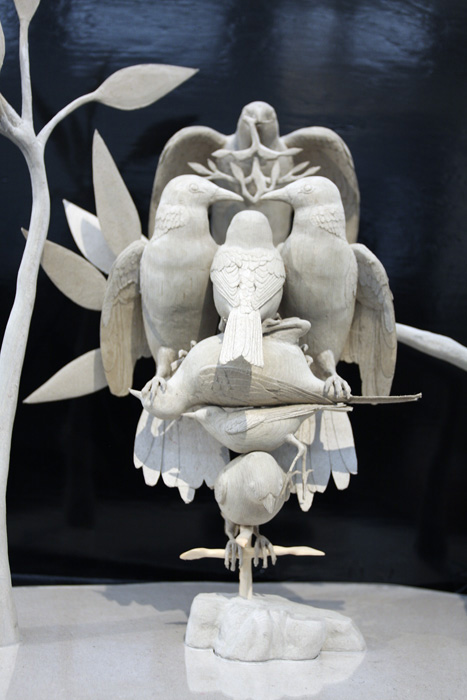
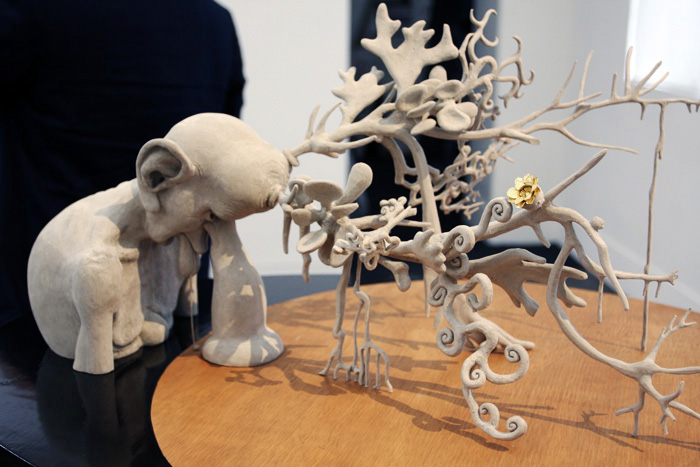
Moving down Flinders Lane we ascended to the fourth floor and entered the beautiful light filled gallery space at Block Projects to view the ‘new work’ of Richard Grigg. An eclectic mix of sculpture, painting, drawing, and collage was presented. Preparatory drawings for one of the sculptures, a pencil drawing of two old men debating, a canvas of a camera in tempera, gold leaf and gesso vie for attention with the two standout pieces of the show: No more songs at funerals/hero today gone tomorrow (2007) and He can’t read well because of his horns (2009), surrealist sculptures both made of compressed cardboard (below).

These two sculptures are fantastic: the first forming a skull made out of birds perched on a cross surmounted by a bird holding an olive branch, the title deliciously ironic; the second a stooped gargoyle like creature with a massive extrusion for a nose, hanging tongue dripping saliva and phantasmagorical protrusions emerging from it’s head making it impossible for the creature to ‘read well’ in both the metaphorical and literal sense. This is a beautiful but grotesque primordial fantasy with the horns putting roots down in the soil like the roots of a mangrove tree, a gold leaf flower blooming at their outer reaches, the creature exhausted by the effort of trying to keep his head up.

Unfortunately the rest of the exhibition lacked core strength: conceptually the show is not strong. Evidence of beauty in decay and concerns about the process of ageing vie with environmental contexts; slippages in time (The Moment Between) contrast with cameras and their sight lines; Pinocchio lies under a shroud with a camera trapped in the back of a horse drawn cart (Dream of Rest). Apparently, the cameras do not signify the capturing of the frozen moment of beauty but they are there because the artist’s father collected cameras. To me they seemed to be defining the nature of our interaction with the world, the surface of the image controlling the interface between technology and earth.

One of the problems with undertaking an exhibition titled New Work is the assumption that the new work being produced hangs together holistically and tells a not necessarily linear narrative story but one that the viewer can investigate, question, and tease the pertinent concepts from – something the viewer can hang their hat on (perhaps the horns of a dilemma!) This was not the case here. The bits n bobs approach of this exhibition falls slightly flat but go see the show for the two sculptures – they alone are worth the effort!

Dr Marcus Bunyan


Many thankx to Block Projects for allowing me to publish the photographs in the posting. Please click on the photographs for a larger version of the image.


Richard Grigg (Australian) 'No more songs at funerals/hero today gone tomorrow' 2007-2009


Richard Grigg (Australian)
No more songs at funerals/hero today gone tomorrow
2007-2009
Layered boxboard, wood dowel, glue, pine, black gloss enamel, Perspex


Richard Grigg (Australian) 'He can't read well because of his horns' 2009


Richard Grigg (Australian)
He can’t read well because of his horns
2009
Layered boxboard, gold leaf, wood dowel, glue, pine, black gloss enamel, wood stain


Richard Grigg (Australian) 'Dream of Rest' 2007


Richard Grigg (Australian)
A Late Night Story
2007
pencil on paper


Richard Grigg (Australian) 'Older than the value of beauty' 2009


Richard Grigg (Australian)
Older than the value of beauty (detail)
2009
Tempera, gold leaf and gesso on board


Richard Grigg (Australian) 'Cloak' 2008


Richard Grigg (Australian)
Cloak
2008
Tempera, gold leaf and gesso on board


Block Projects
Level 1 / 252 Church Street
Richmond Victoria 3121 Australia
Phone: +61 3 9429 0660

Opening hours:
Wednesday – Saturday: 12pm – 5pm

formerly at

Level 4, 289 Flinders Lane,
Melbourne 3000

Block Projects website

LIKE ART BLART ON FACEBOOK

Back to top

Opening 1: Review: ‘Continuous Moment: Bad Infinity’ by Damiano Bertoli at The Narrows, Melbourne

Exhibition dates: 5th March – 28th March, 2009

Opening: Thursday 5th March, 2009


Damiano Bertoli (Australian, 1969-2021) 'Continuous Moment: Bad Infinity' 2009 video still

Damiano Bertoli (Australian, 1969-2021) 'Continuous Moment: Bad Infinity' 2009 video still


Damiano Bertoli (Australian, 1969-2021)
Continuous Moment: Bad Infinity
2009
Video stills


In a busy night of openings in Melbourne we arrive to watch, to be a spectator and voyeur at Damiano Bertoli’s new twin video installation at The Narrows on Flinders Lane, ensconced in the darkness of the gallery space. The looped installation features on the left scenes from the original Miami Vice TV series and on the right approximate scenes from the 2006 feature film of the same name. The synchronicity of the two splices of time moving in and out of register is uncanny. We have memories of these appearances, flickering signifiers embedded in our psyche which are called to presence in the space between screen and viewer as we add our own layer of temporal distortion to the unfolding events.

In an erudite catalogue note Bertoli expounds on the nature of the performative and the question of authorship by analysing Glenn Gould’s two recordings of J. S. Bach’s Goldberg Variations, one recorded at the beginning of his career and one in the final year of his life. Bertoli posits that Gould used counterpoint “as a formal construct for its capacity to produce ‘an explosion of simultaneous idea’s’ … as a solution for his dissatisfaction with singularity and linear definition.”

He notes that, “As an interpreter of others work, Gould occupied a position of equivalence – we are aware that we are listening to Bach and Gould – simultaneously … These co-existing yet distinct voices move in and out of synchronicity, as does the listener’s experience of Gould’s interpretation (actually an interpretation of an interpretation) as the latter version iterates and embodies the version which precedes it. We are constantly comparing the two, as is Gould.”

This is quite true but I do not think the metaphor can be so literally applied to the video installation Bertoli has constructed. Firstly Gould’s interpretations and our recognition of them requires knowledge of the authoritative voice of the author as composer and the author as performer: Bach and Gould. Conversely in the videos the directors are unknown by most and the actors anonymous except by those with specific memory of appearances. There is no contrapuntal fugue like working of the sound or images in search of the purity of musical ideas – the dialogue talks over each other and splice cuts jump the scene from one location to another – forming a fractured hypertextual narrative driven by the spectacular gaze of the viewer, a simularcrum of the ‘real’. The simultaneity of being in three worlds at once is the world of simulacra not of equivalence.

As Ron Burnett has observed

“Video creates what I will describe as a logic of the present while simultaneously producing an image-event in the past. This generates a somewhat different temporal context than we are normally accustomed to – a mixture of present and past that is both, and neither, simultaneously. The disjuncture that results is part of the attraction but also part of what makes the electronic image so puzzling. It suggests that history has already been made while one continues to make it. It is this suppleness that allowed broadcasters for example to repeat the Rodney King beating in Los Angeles over and over again, as if each showing would somehow reconstitute the event, as if to prove that this was not a dramatisation, not a fiction. In order to gain control over the many disjunctures, repetition was used … But this only validates the contradictions, proposing that the disjunctures in time and place can be controlled, that there is some way of gaining authority over the impact of the event as image.”1


I would argue that what Bertoli’s installation does offer is a release from inert rationalist geometries, a deterritorialization and reterritorialization of temporal time in a heterotopic space, juxtaposing in a single real place several spaces, several sites that are in themselves incompatible. These are layered images of hyper-performativity and hypermediacy, where the fragmented images become a process and a performance, where the spectator becomes the screen not the author.

As Baudrillard has said, “Today we live in the imaginary world of the screen, of the interface and the reduplication of contiguity and networks. All our machines are screens. We too have become screens, and the interactivity of men has become the interactivity of screens. Nothing that appears on the screen is meant to be deciphered in depth, but actually to be explored instantaneously, in an abreaction immediate to meaning.”2

Here is the immediacy of continuous time – the removal of psychological depth, the reduction of life to a series continuous presents and surface phenomena that repeat over and over again. Is this bad infinity? We will never know… as we can never have knowledge of infinity. It is a noumenal concept, an event known only to the imagination, independent of the senses.

This is an interesting and fun installation. Well worth a visit.

Dr Marcus Bunyan


1/ Burnett, Ron. Cultures of Vision: Images, Media, & the Imaginary. Bloomington: Indiana University Press, 1995, p. 249

2/ Baudrillard, Jean. Xerox and Infinity (trans. Agitac). Paris: Touchepas, 1988, p. 7


Many thankx to The Narrows gallery for allowing me to publish the photographs in the posting. Please click on the photographs for a larger version of the image.


    Damiano Bertoli Continuous Moment: Bad Infinity (2009)


    Damiano Bertoli (Australian, 1969-2021) 'Continuous Moment: Bad Infinity' 2009 video still

    Damiano Bertoli (Australian, 1969-2021) 'Continuous Moment: Bad Infinity' 2009 video still

    Damiano Bertoli (Australian, 1969-2021) 'Continuous Moment: Bad Infinity' 2009 video still


    Damiano Bertoli (Australian, 1969-2021)
    Continuous Moment: Bad Infinity
    2009
    video stills


    Vale Damiano Bertoli (1969-2021)

    In September, artist Damiano Bertoli passed away unexpectedly at the age of 52. Bertoli was a staple in the Melbourne art community. He could be relied upon to regularly attend openings and see most exhibitions. Along the way, he would dish out wit, sarcasm and charm. Seeing him across a crowded room, he would go cross-eyed as a form of greeting, breaking the ice with humour. Bertoli had a rich and expansive artistic practice, spanning collage, film, sculpture, installation, even theatre, but he was equally known for his large personality. In preparation for this piece, I spoke to several of Bertoli’s closest friends who had many things to say about him, but some underlying themes proved unanimous. He possessed a great sense of curiosity and generosity; he loved sharing knowledge; he built rich relationships with others through engagement with art; and that he has left behind a massive legacy – albeit one that could have been much, much bigger.

    Read more about Damiano Bertoli’s legacy.  Amelia Winata. “Damiano Bertoli 1969-2021,” on the MeMO website 13 Oct 2021 [Online] Cited 12/06/2022


    Damiano Bertoli (Australian, 1969-2021) 'Continuous Moment: Bad Infinity' 2009 video still

    Damiano Bertoli. 'Continuous Moment: Bad Infinity' 2009 video still


    Damiano Bertoli (Australian, 1969-2021)
    Continuous Moment: Bad Infinity
    2009
    video stills


    The Narrows

    This gallery is now closed.

    LIKE ART BLART ON FACEBOOK

    Back to top

    Review: ‘all about … blooming’ exhibition by JUNKO GO at Gallery 101, Melbourne

    Exhibition dates: 25th February – 14th March, 2009


    Junko Go (Australian born Japan, b. 1955) 'Opium Poppy' 2008


    Junko Go (Australian born Japan, b. 1955)
    Opium Poppy
    2008


    “One person’s heaven is another’s nightmare. Seeing both sides to every story can be a blessing and a curse. Good and bad, right and wrong, purity and impurity are inextricably linked.”


    A delicate, refined but strong presence is felt in the work of Junko Go in the her new exhibition ‘all about … blooming’ at Gallery 101, Melbourne. Nominally landscape painting about flowers but featuring thoughts and ideas about the seed, the shoot, pollen and the breath of life the work addresses the essence of what it is to be human and live compassionately on this earth in an intelligent and profound way.

    Denying the nihilism of abstract expressionism each mark is fully considered by being attentive to the connection between brush, hand and meaning. Almost childlike in their use of charcoal and acrylic her dogs, crosses and flowers, jottings and dashes, rain and rivers, seeds and people show a Zen like contemplation in the marks she makes on the canvas – just so. A releasement towards things is proffered, a letting go of the ego to create an awareness of just being. There is genuine warmth and humility to this work.

    In Opium Poppy (2008, above) the darkness of the nightmare is represented by the black marks, ascending like Jacob’s ladder balanced by the mandala like poppies whose petals seem like feathers of a bird’s wing – a flight of fancy both good and bad. In Pollen (2009) bees swarm around a sunflower leaving traces of their presence, a bird flies close to a tiny blue cloud, the sun burst forth in a tiny patch of aqua colour, and people hug arm in arm. As Go says, “Bees in a flower bear pollen unawares and play a crucial roll for the plant to survive. Our love, kindness, warmth and wisdom affect one another unawares and play a crucial roll for our planet to survive.” In New Shoot (2008, below) the puzzle of our existence, the nature of our existential being is laid bare for all to see.

    In Seeds (2008) Go reminds us that rather than being focused on what we hoped for, we must make the most of whatever opportunities we are blessed with. This means being aware of the gifts one possesses, not the distance between ‘I’ and want, need and desire – now! The seed of our experience – the calm before the force that propelled us into existence – is already present within us.

    Go’s musings on the existential nature of our being are both full and empty at one and the same time and help us contemplate the link to the breath of the sublime. In the end Go’s paintings are about endings and beginnings, about being strong or not, about the infinity of the seed and about our responses to living in harmony on this planet. Through the seed, the shoot, the flower and the earth access may be granted to the sublime and this perfectly sums up the work of this artist, a reflection of her energy and radiance transferred to the canvas. I loved it.

    Dr Marcus Bunyan


    Many thankx to Gallery 101 for allowing me to publish the art work in the posting. Please click on the art work for a larger version of the image.


    Junko Go (Australian born Japan, b. 1955) 'New Shoot' 2008


    Junko Go (Australian born Japan, b. 1955)
    New Shoot
    2008


    “Each of us is born to fill a special place in this world. In the process, we sometimes have trouble finding our niche. Life is like a jigsaw puzzle in which we make every effort to find our own place that makes a right connection with others, with the world and even with the whole universe.”


    Junko Go (Australian born Japan, b. 1955) 'Red Hot Poker' 2009


    Junko Go (Australian born Japan, b. 1955)
    Red Hot Poker
    2009


    “Push and pull our inner strength. Sometimes, we need courage to take risks in confronting pain and loss in order to gain a deep and profound experience.”


    “We live in a world where high achievers are congratulated, yet true achievements are not related to what we can get done, but to how deeply we aware of how wonderful it is to be alive. In this exhibition, flowers are not only a predominant source of visual inspiration, looking at them also engenders a kind of appreciation and wonder. The fragile and ephemeral flower provokes in me an awareness of the human condition that reveals the true nature of our existence.

    My goal is to create images which are strong and soft, bold and precise, beautiful and ugly, figurative and abstract, all at once. My greatest challenge is to make art about what it is to be human … What really matters in art making to me is a kind of awareness – a being able to say, ‘I am as I am’.”

    Text from the artist statement


    Gallery 101

    Gallery 101 is no longer open.

    LIKE ART BLART ON FACEBOOK

    Back to top

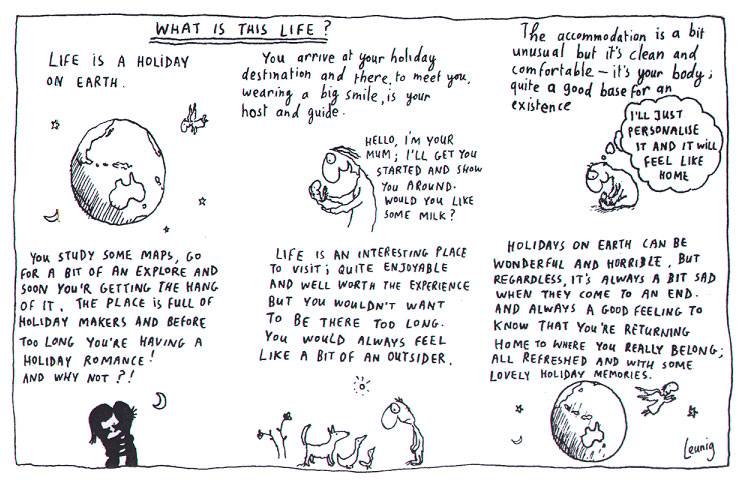
    Cartoon: Michael Leunig. ‘What is This Life?’ 2009

    February 2009


    What a wonderful invocation of life, to life!

    Marcus


    Please click on the image for a larger version of the cartoon.


    Michael Leunig (Australian, 1945-2024) 'What is This Life?' 2009


    Michael Leunig (Australian, 1945-2024)
    What is This Life?
    2009


    Michael Leunig on Wikipedia

    LIKE ART BLART ON FACEBOOK

    Back to top

    Review: ‘Ocean Without A Shore’ video installation by Bill Viola at The National Gallery of Victoria, Melbourne

    February 2009


    Bill Viola – Ocean Without a Shore | TateShots

    Bill Viola’s video installation, Ocean Without a Shore, is presented in the atmospheric setting of the church of San Gallo, Venice. Monitors positioned on three stone altars in the church show a succession of individuals slowly approaching out of darkness and moving into the light, as if encountered at the intersection between death and life. Viola talks about his artistic intentions and the technical challenges of the piece.


    Originally installed inside the intimate 15th century Venetian church of San Gallo as part of the 2007 Venice Biennale (see above) incorporating its internal architecture into the piece using the three existing stone altars as support for the video screens, the installation has been recreated in a small darkened room at The National Gallery of Victoria in Melbourne. What an installation it is.

    Deprived of the ornate surroundings of the altars of the Venetian chapel – altars of which Viola has said that, “… as per the original development of the origins of Christianity these alters actually are a place where the dead kind of reside and connect with those of us, the living, who are here on earth. And they really are a connection between a cross, between a tomb and an alter – a place to pray,”1 – the viewer is forced to concentrate on the images themselves. This is no bad thing, stripping away as it does a formalised, religious response to mortality.

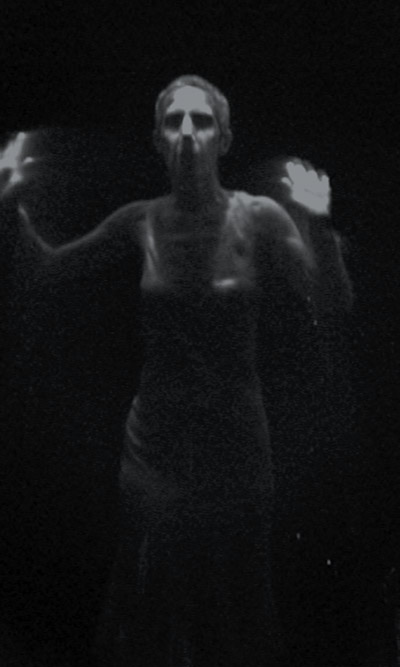
    In the work Viola combines the use of a primitive twenty five year old security black and white analogue video surveillance camera with a high definition colour video camera through the use of a special mirror prism system. This technology allows for the seamless combination of both inputs: the dead appear far off in a dark obscure place as grey ghosts in a sea of pulsating ‘noise’ and gradually walk towards you, crossing the invisible threshold of a transparent water wall that separates the dead from the living, to appear in the space transformed into a detailed colour image. As they do so the sound that accompanies the transformation grows in intensity reminding me of a jet aircraft. You, the viewer, are transfixed watching every detail as the ghosts cross-over into the light, through a water curtain.

    The performances of the actors (for that is what they are) are slow and poignant. As Viola has observed, “I spent time with each person individually talking with them and you know when you speak with people, you realise then that everybody has experienced some kind of loss in their life, great and small. So you speak with them, you work with them, you spend time and that comes to the surface while we were working on this project together, you know? I didn’t want to over-direct them because I knew that the water would have this kind of visual effect and so they were able to, I think, use this piece on their own and a lot of them had their own stories of coming back and visiting a relative perhaps, who had died.”1

    The resurrected are pensive, some wringing the hands, some staring into the light. One offers their hands to the viewer in supplication before the tips of the fingers touch the wall of water – the ends turning bright white as they push through the penumbrae of the interface. As they move forward the hands take on a stricken anguish, stretched out in rigour. Slowly the resurrected turn and return to the other side. We watch them as we watch our own mortality, life slipping away one day after another. Here is not the distraction of a commodified society, here is the fact of every human life: that we all pass.

    The effect on the viewer is both sad but paradoxically uplifting. I cried.

    A friend who I went with said that the images reminded her not of the dead temporarily coming back to life, but the birth of a new life – the breaking of water at the birth of a child. The performers seemed to her to behave like children brought anew into the world. One of my favourite moments was when the three screens were filled with just noise and a figure then appears out of the beyond, a dim and distant outline creating a transcendental moment. Unfortunately there are no images of these grainy figures. As noted below Viola uses a variety of different ethnic groups and cultures for his performers but the one very small criticism I have is they have no real individuality as people – there are no bikers with tattoos, no cross dressers, no punks because these do not serve his purpose. There is the black woman, the old woman, the middle aged man, the younger 30s man in black t-shirt: these are generic archetypes of humanity moulded to Viola’s artistic vision.

    Viola has commented, “I think I have designed a piece that’s open ended enough, where the people and the range of people, the kind of people we chose are from various ethnic groups and cultures. And I think that the feeling of more this is a piece about humanity and it’s about the fragility of life, like the borderline between life and death is actually not a hard wall, it’s not to be opened with a lock and key, its actually very fragile, very tenuous.

    You can cross it like that in an instant and I think religions, you know institutions aside, I think just the nature of our awareness of death is one of the things that in any culture makes human beings have that profound feeling of what we call the human condition and that’s really something I am really interested in. I think this piece really has a lot to do with, you know, our own mortality and all that that means.”1

    These series of encounters at the intersection of life and death are worthy of the best work of this brilliant artist. He continues to astound with his prescience, addressing what is undeniable in the human condition.

    Long may he continue.

    Dr Marcus Bunyan


    1/ TateShots. Venice Biennale: Bill Viola. 30 June 2007 [Online] Cited 23/09/2009. No longer available online


    “The unfolding of consciousness, the revelation of beauty, present even after death, the moment of awe, the space without words, the emptiness that builds mountains, the joy of loving, the sorrow of loss, the gift of leaving something behind for the next traveler.”


    Bill Viola


    Bill Viola (American, 1951-2024)
    Ocean Without A Shore (excerpt)
    2007
    Installation in the church of San Gallo, Venice


    Bill Viola (American, 1951-2024)
    Ocean Without A Shore (excerpt)
    2007


    Ocean Without a Shore is about the presence of the dead in our lives. The three stone altars in the church of San Gallo become portals for the passage of the dead to and from our world. Presented as a series of encounters at the intersection between life and death, the video sequence documents a succession of individuals slowly approaching out of darkness and moving into the light. Each person must then break through an invisible threshold of water and light in order to pass into the physical world. Once incarnate however, all beings realise that their presence is finite and so they must eventually turn away from material existence to return from where they came. The cycle repeats without end.”

    Bill Viola
    25 May 2007
    Text © Bill Viola 2007


    The work was inspired by a poem by the twentieth century Senegalese poet and storyteller Birago Diop:

    Hearing things more than beings,
    listening to the voice of fire,
    the voice of water.
    Hearing in wind the weeping bushes,
    sighs of our forefathers.

    The dead are never gone:
    they are in the shadows.
    The dead are not in earth:
    they’re in the rustling tree,
    the groaning wood,
    water that runs,
    water that sleeps;
    they’re in the hut, in the crowd,
    the dead are not dead.

    The dead are never gone,
    they’re in the breast of a woman,
    they’re in the crying of a child,
    in the flaming torch.

    The dead are not in the earth:
    they’re in the dying fire,
    the weeping grasses,
    whimpering rocks,
    they’re in the forest, they’re in the house,
    the dead are not dead.


    Text from the Ocean Without A Shore website [Online] Cited 23/09/2009. No longer available online


    Bill Viola (American, 1951-2024) 'Ocean Without A Shore' 2007 video still

    Bill Viola (American, 1951-2024) 'Ocean Without A Shore' 2007 video still

    Bill Viola (American, 1951-2024) 'Ocean Without A Shore' 2007 video insatllation

    Bill Viola (American, 1951-2024) 'Ocean Without A Shore' 2007 video insatllation


    Installation photographs of Ocean Without A Shore at the National Gallery of Victoria, Melbourne
    Photos: Marcus Bunyan


    Bill Viola (American, 1951-2024) 'Ocean Without A Shore' 2007 original video installation at church of San Gallo (still)


    Bill Viola (American, 1951-2024)
    Ocean Without A Shore (still)
    2007
    Original installation at church of San Gallo


    NGV International
    180 St Kilda Road, Melbourne

    Open daily 10am-5pm

    National Gallery of Victoria International website

    Bill Viola website

    LIKE ART BLART ON FACEBOOK

    Back to top

    Photographs: Marcus Bunyan. ‘Momentum’ 2009

    February 2009


    Marcus Bunyan (Australian, b. 1958) 'Untitled' from the series 'Momentum' 2009


    Marcus Bunyan (Australian, b. 1958)
    Untitled from the series Momentum
    2009
    Digital colour photograph


    Momentum

    A new body of work – the first of 2009 – is now online.

    All 30 images can be seen on my website.

    Marcus

    Photographs are available from this series for purchase. As a guide, a digital colour 16″ x 20″ costs $1000 plus tracked and insured shipping. For more information please see my Store web page.


    Marcus Bunyan (Australian, b. 1958) 'Untitled' from the series 'Momentum' 2009


    Marcus Bunyan (Australian, b. 1958)
    Untitled from the series Momentum
    2009
    Digital colour photograph


    Marcus Bunyan (Australian, b. 1958) 'Untitled' from the series 'Momentum' 2009


    Marcus Bunyan (Australian, b. 1958)
    Untitled from the series Momentum
    2009
    Digital colour photograph


    Marcus Bunyan (Australian, b. 1958) 'Untitled' from the series 'Momentum' 2009


    Marcus Bunyan (Australian, b. 1958)
    Untitled from the series Momentum
    2009
    Digital colour photograph


    Marcus Bunyan (Australian, b. 1958) 'Untitled' from the series 'Momentum' 2009


    Marcus Bunyan (Australian, b. 1958)
    Untitled from the series Momentum
    2009
    Digital colour photograph


    Marcus Bunyan (Australian, b. 1958) 'Untitled' from the series 'Momentum' 2009


    Marcus Bunyan (Australian, b. 1958)
    Untitled from the series Momentum
    2009
    Digital colour photograph


    Marcus Bunyan (Australian, b. 1958) 'Untitled' from the series 'Momentum' 2009


    Marcus Bunyan (Australian, b. 1958)
    Untitled from the series Momentum
    2009
    Digital colour photograph


    Marcus Bunyan website

    LIKE ART BLART ON FACEBOOK

    Back to top

    Review: ‘Bowerhouse Blues’ exhibition by Mary Newsome, Gallery 101, Melbourne

    Exhibition dates: 3rd February – 21st February, 2009


    Mary Newsome (Australian, b. 1936) 'Bowerhouse Blues' installation photograph with 'The Bowerhouse' centre


    Mary Newsome (Australian, b. 1936)
    Bowerhouse Blues installation photograph with The Bowerhouse centre
    2009


    This is a slight bouffant of an exhibition by Mary Newsome at Gallery 101, Collins St., Melbourne.

    “The exhibition consists of separate collections to do with blue, centring on the Bowerhouse with its beckoning light. The ideas came from several different directions.” And what directions they are.

    Firstly, the idea of the lonely male bowerbird at the Museum of Victoria, given blue biros as solace after killing his last mate. Secondly, Oscar Wilde trying to live with his blue china toying with Yves Klein and his uber-dimensionality, the invisible blue becoming visible. Then we have finger painting as a child upgraded to paste painting “which is finger painting under a more adult name”; and more – poetry, yes! by famous poets, sandwiched with shells and cans and bits of glass and plastic and pottery and pegs all offered up to the god of the azure.

    Artefacts litter the floor around the edge of the gallery, media wash across the walls. A silkscreen here and a painting of blue and white china there, watercolours of a view out of a blue curtained Cornish cottage, a blue seascape, the “royal-ness” of a blue tampons collage, three-dimensional objects, acrylics, crayon, pencil, oils and stencils. The Bowerhouse itself, like a blue ‘red light’ house with flashing blue light inside and heart on top. And so it goes.

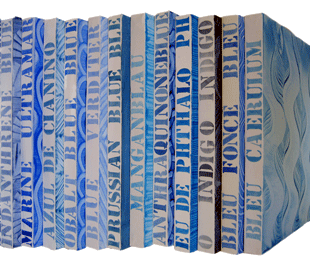
    There are some interesting small single-pigment blue acrylics that have geometric and anamorphic shapes painted upon them with stencilled names of the colour along the spine of the canvases. There are also a couple of competent oils and silkscreens of tea sets in a dresser with cups hanging from hooks.

    The works date from 1980 to the present day – and “without fully realising it” the artist has looked through her work over the past 30 years and come across lots and lots of blue. Any artist worth their salt knows their oevure indelibly from front to back. It seems inconceivable to me that this epiphany has occurred without the artist not fully understanding the importance of the colour blue to their art practice before now.

    Recently I have been reading a book called Distraction (Damon Young. Distraction: A Philosopher’s Guide to Being Free. Melbourne: Melbourne University Publishing, 2008). The book surmises that distraction is often a matter of what one values in the world. The book demonstrates that the opposite of a life of distraction is one of grateful appreciation, based on patient, sensitive, and thoughtful attention to the world. In this exhibition we have a perfect example of distraction: the noise of the collective work has subsumed its individual charms. The work seems forced into a conceptualisation not of it’s making. Everything seems laboured to the point where all the fun has been squeezed from it and, in the end, it just left me feeling the blues.

    Dr Marcus Bunyan


    Photographs by Tim Gresham
    Images courtesy of Gallery 101


    Mary Newsome (Australian, b. 1936) 'Blue Colours' 2008


    Mary Newsome (Australian, b. 1936)
    Blue Colours
    2008


    Mary Newsome (Australian, b. 1936) 'Bowerhouse Blues' installation photograph 2009


    Mary Newsome (Australian, b. 1936)
    Bowerhouse Blues
    2009
    Installation photograph


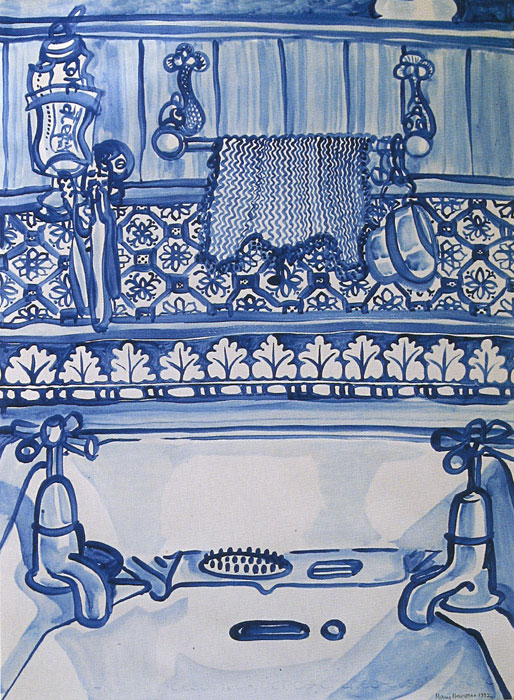
    Mary Newsome (Australian, b. 1936) 'Bathroom Sink' 1992


    Mary Newsome (Australian, b. 1936)
    Bathroom Sink
    1992


    Mary Newsome (Australian, b. 1936) 'What Bliss There is in Blueness' 2009


    Mary Newsome (Australian, b. 1936)
    What Bliss There is in Blueness
    Extract from Laughter in the Dark, 1989 by Vladimir Nabokov
    2009


    Mary Newsome (Australian, b. 1936) 'Royal Tampons' collage


    Mary Newsome (Australian, b. 1936)
    Royal Tampons
    2009
    Collage


    Gallery 101

    This gallery is no longer open.

    LIKE ART BLART ON FACEBOOK

    Back to top

    Photographs: ‘Melbourne firestorm’ by Marcus Bunyan

    Date: 7th February, 2009


    Marcus Bunyan (Australian, b. 1958) 'On Port Phillip Bay' 2009


    Marcus Bunyan (Australian, b. 1958)
    On Port Phillip Bay
    2009

    Port Phillip Bay in the morning from the 48th floor of a tower in Southbank, Melbourne


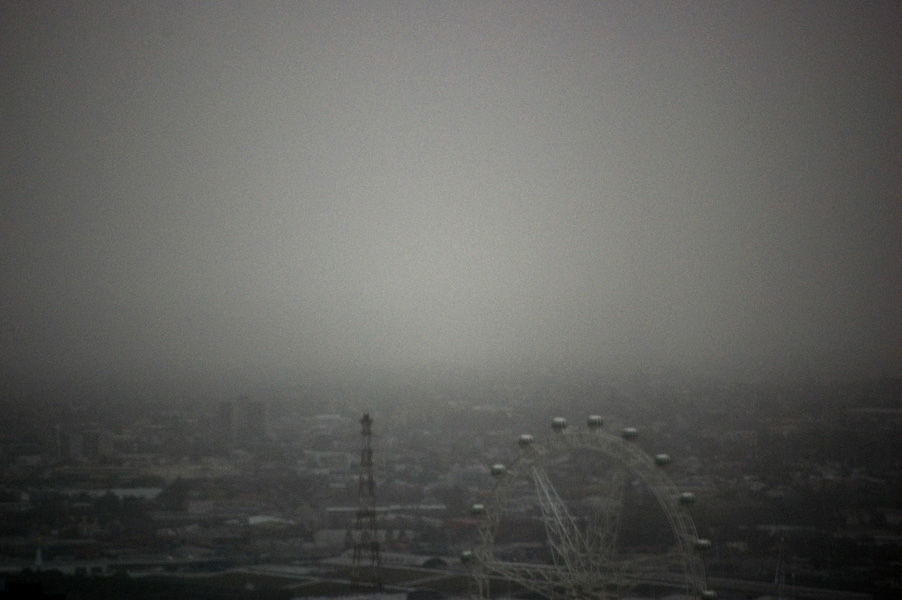
    Melbourne’s hottest day ever 46.4 degrees. Firestorms to the north of the city, Port Phillip Bay completely obscured, very strange light seen from 48th floor. The day, 7th February 2009, is now known as the Black Saturday bushfires.

    180 people died and 414 were injured as a result of the fires.

    It was a very scary day. I cannot imagine what it would have been like to have been there, up close. My condolences to all those that lost loved ones.

    Dr Marcus Bunyan


    Please click on the photographs for a larger version of the image.


    Marcus Bunyan (Australian, b. 1958) 'On Port Phillip Bay' 2009


    Marcus Bunyan (Australian, b. 1958)
    On Port Phillip Bay
    2009

    Port Phillip Bay during firestorm, in the afternoon from the 48th floor of a tower in Southbank, Melbourne


    Marcus Bunyan (Australian, b. 1958) 'Looking towards the docks, Melbourne' 2009


    Marcus Bunyan (Australian, b. 1958)
    Looking towards the docks, Melbourne
    2009

    Looking towards the docks, Melbourne, during the firestorm


    Marcus Bunyan (Australian, b. 1958) 'Looking across the city' 2009


    Marcus Bunyan (Australian, b. 1958)
    Looking across the city
    2009

    Looking across the city with the Melbourne Star Observation Wheel (at the time called the Southern Star) in the foreground


    Black Saturday bushfires

    The Black Saturday bushfires were a series of bushfires that ignited or were burning across the Australian state of Victoria on and around Saturday, 7 February 2009 and were Australia’s all-time worst bushfire disasters. The fires occurred during extreme bushfire-weather conditions and resulted in Australia’s highest ever loss of life from a bushfire; there were 180 fatalities, and 414 were injured as a result of the fires.

    As many as 400 individual fires were recorded on 7 February. Following the events of 7 February 2009 and its aftermath, that day has become widely referred to in Australia as Black Saturday.

    Background

    A week before the fires, a significant heatwave affected southeastern Australia. From 28-30 January, Melbourne broke temperature records by experiencing three consecutive days above 43°C (109 °F), with the temperature peaking at 45.1°C (113.2°F) on 30 January, the third hottest day in the city’s history.

    The wave of heat was caused by a slow moving high-pressure system that settled over the Tasman Sea, with a combination of an intense tropical low located off the North West Australian coast and a monsoon trough over northern Australia, which produced ideal conditions for hot tropical air to be directed down over southeastern Australia.

    The February fires commenced on a day when several localities across the state, including Melbourne, recorded their highest temperatures since records began in 1859. On 6 February 2009 – the day before the fires started – the Premier of Victoria John Brumby issued a warning about the extreme weather conditions expected on 7 February: “It’s just as bad a day as you can imagine and on top of that the state is just tinder-dry. People need to exercise real common sense tomorrow”. The Premier went on to state that it was expected to be the “worst day [of fires conditions] in the history of the state”.

    Events of 7 February 2009

    A total of 358 firefighting personnel, mainly from the Country Fire Authority (CFA) and Department of Sustainability and Environment (DSE), were deployed across the state on Friday evening (6 February) in anticipation of the extreme conditions the following day. By mid-morning Saturday, hot northwesterly winds in excess of 100 kilometres per hour (62 mph) hit the state, accompanied by extremely high temperatures and extremely low humidity; a total fire ban was declared for the entire state of Victoria.

    As the day progressed, all-time record temperatures were being reached. Melbourne hit 46.4°C (115.5°F), the hottest temperature ever recorded for the city and humidity levels dropped to as low as two percent. The McArthur Forest Fire Danger Index reached unprecedented levels, ranging from 160 to over 200. This was higher than the fire weather conditions experienced on Black Friday in 1939 and Ash Wednesday in 1983.

    Around midday, as wind speeds were reaching their peak, an incorrectly-rigged SWER line was ripped down at Kilmore East. This sparked a bushfire that would become the deadliest and most intense firestorm ever experienced in Australia’s post-1788 history. The overwhelming majority of fire activity occurred between the afternoon of 7 February and 7:00 pm, when wind speed and temperature were at their highest, and humidity at its lowest.

    Casualties

    A total of 180 people were confirmed to have died as a result of the fires. The figure was originally estimated at 14 on the night of 7 February, and steadily increased over the following two weeks to 210. It was feared that it could rise as high as 240-280, but these figures were later revised down to 173 after further forensic examinations of remains, and after several people previously believed to be missing were located. This figure was later increased to 180 after several people succumbed to their injuries. …
    Among the dead in the Kinglake West area were former Seven Network and Nine Network television personality Brian Naylor, and his wife Moiree. Actor Reg Evans and his partner, artist Angela Brunton, residing on a small farm in the St Andrews area, also died in the Kinglake area fire. Ornithologist Richard Zann perished in the Kinglake fire, together with his wife Eileen and daughter Eva.

    Fatalities

    General statistics

    ~ 164 people died in the fires themselves, 12 died later in hospital, and 4 died from other causes including car crashes

    ~ Out of the 180 deaths, 100 were male, 73 were female, and 7 were unidentified

    ~ There were 164 Australians, 9 foreign nationals, and 7 people of unidentified nationalities killed in the bushfires. The foreign nationals comprised citizens of:

    ~ Greece (2)
    ~ Indonesia (2)
    ~ Philippines (2)
    ~ Chile (1)
    ~ New Zealand (1)
    ~ United Kingdom (1)

    ~ 7 of the deaths occurred in bunkers of both fire-specific and non-fire-specific design

    ~ 1 firefighter, David Balfour, 47, from Gilmore, ACT, was killed near Cambarville on the night of 17 February, when a burnt-out tree fell on him as he attached a hose to a fire tanker

    Location of deaths

    ~ Inside houses (113)
    ~ Outside houses (27)
    ~ In vehicles (11)
    ~ In garages (6)
    ~ Near vehicles (5)
    ~ On roadways (5)
    ~ Attributed to or associated with the fire but not within fire location (4)
    ~ On reserves (1)
    ~ In sheds (1)
    ~ Unknown locations (7)

    Text from the Wikipedia website


    Marcus Bunyan (Australian, b. 1958)
'Looking across Melbourne' 2009


    Marcus Bunyan (Australian, b. 1958)
    Looking across Melbourne
    2009


    Marcus Bunyan. 'Looking across the city


    Marcus Bunyan (Australian, b. 1958)
    Looking across Melbourne
    2009

    Looking across Melbourne, Bolte Bridge towers in the foreground


    More images from the set on Flickr website

    LIKE ART BLART ON FACEBOOK

    Back to top