Exhibition: ‘Capa in Color’ at Jeu de Paume – Château de Tours

Exhibition dates: 21st November, 2015 – 29th May, 2016

Curator: Cynthia Young, curator at Robert Capa archives


Robert Capa (American, 1913-1954) 'American crewmen stand in front of a B-17 bomber' England 1942 from the exhibition 'Capa in Color' at Jeu de Paume – Château de Tours, Nov 2015 - May 2016


Robert Capa (American, 1913-1954)
American crewmen stand in front of a B-17 bomber that is being prepared to take off from a Royal Air Force base for a daylight bombing raid over occupied France. This B-17 was one of the first 300 to be brought overseas by the US Army Air Forces
England, 1942
International Center of Photography, New York
© Robert Capa/International Center of Photography/Magnum Photos


To be honest, Robert Capa was not the most natural colour photographer, especially when you compare him to the likes of Paul Outerbridge and Saul Leiter who were working at around the same time. Even the official text from Jeu de Paume that accompanies the exhibition is littered with descriptions like “uninspired”, “the color photographs lack focus”, or worse, “Fleur Cowles at Look and Len Spooner at Illustrated were disappointed with the color images.”

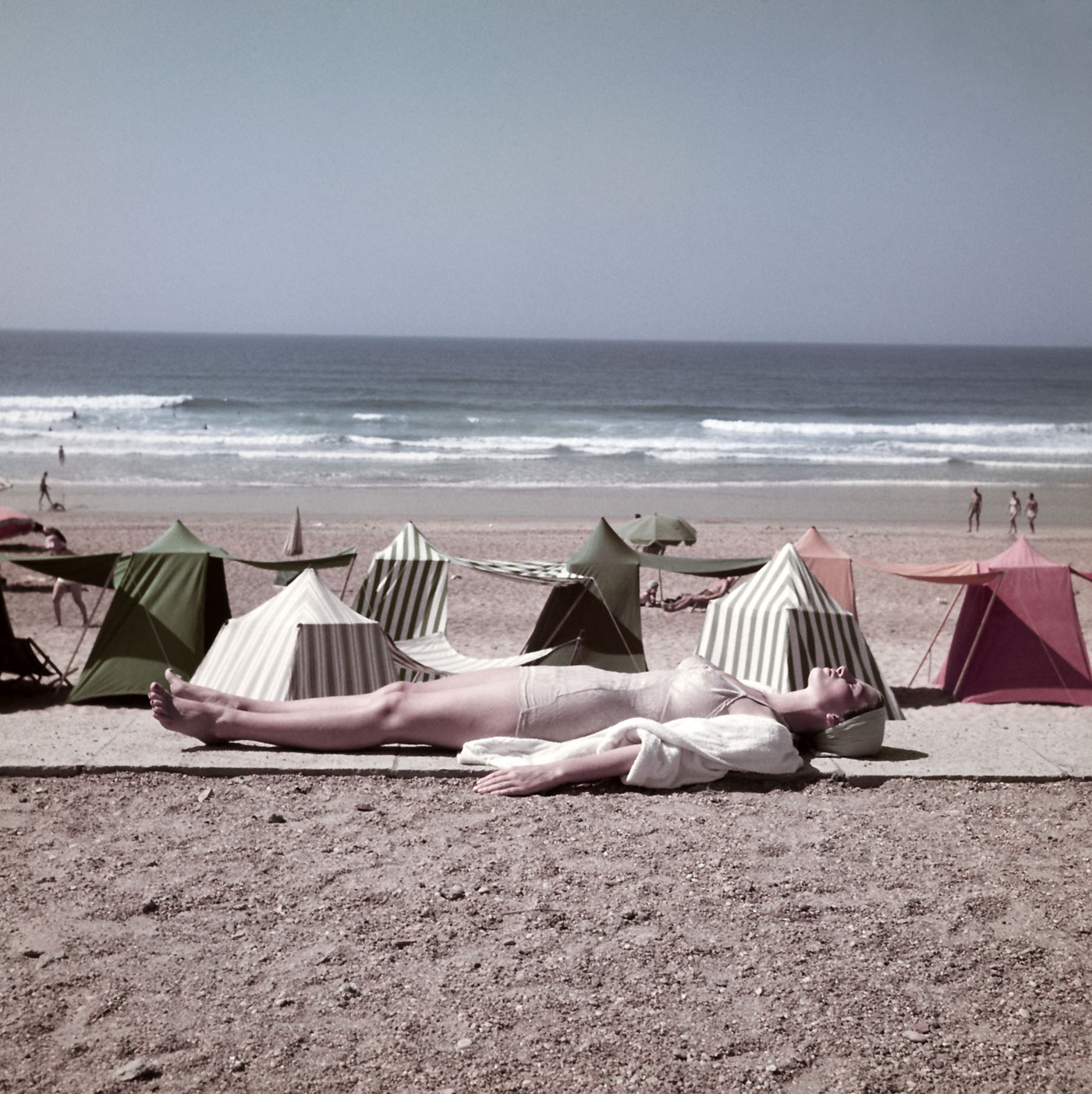
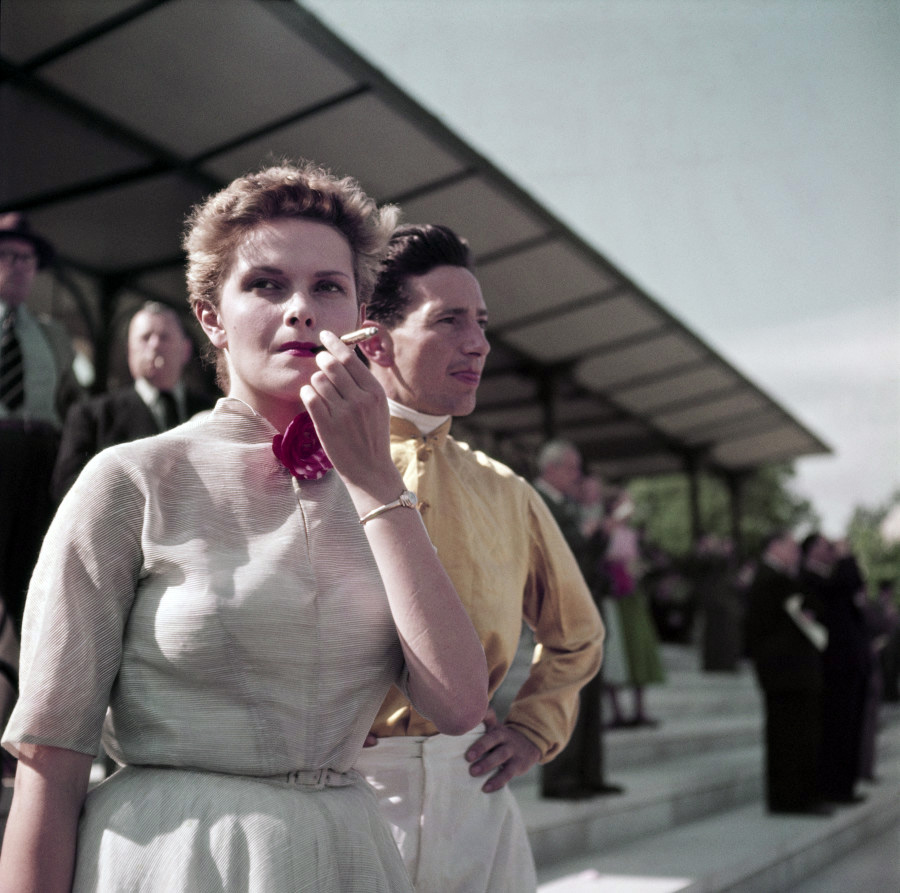
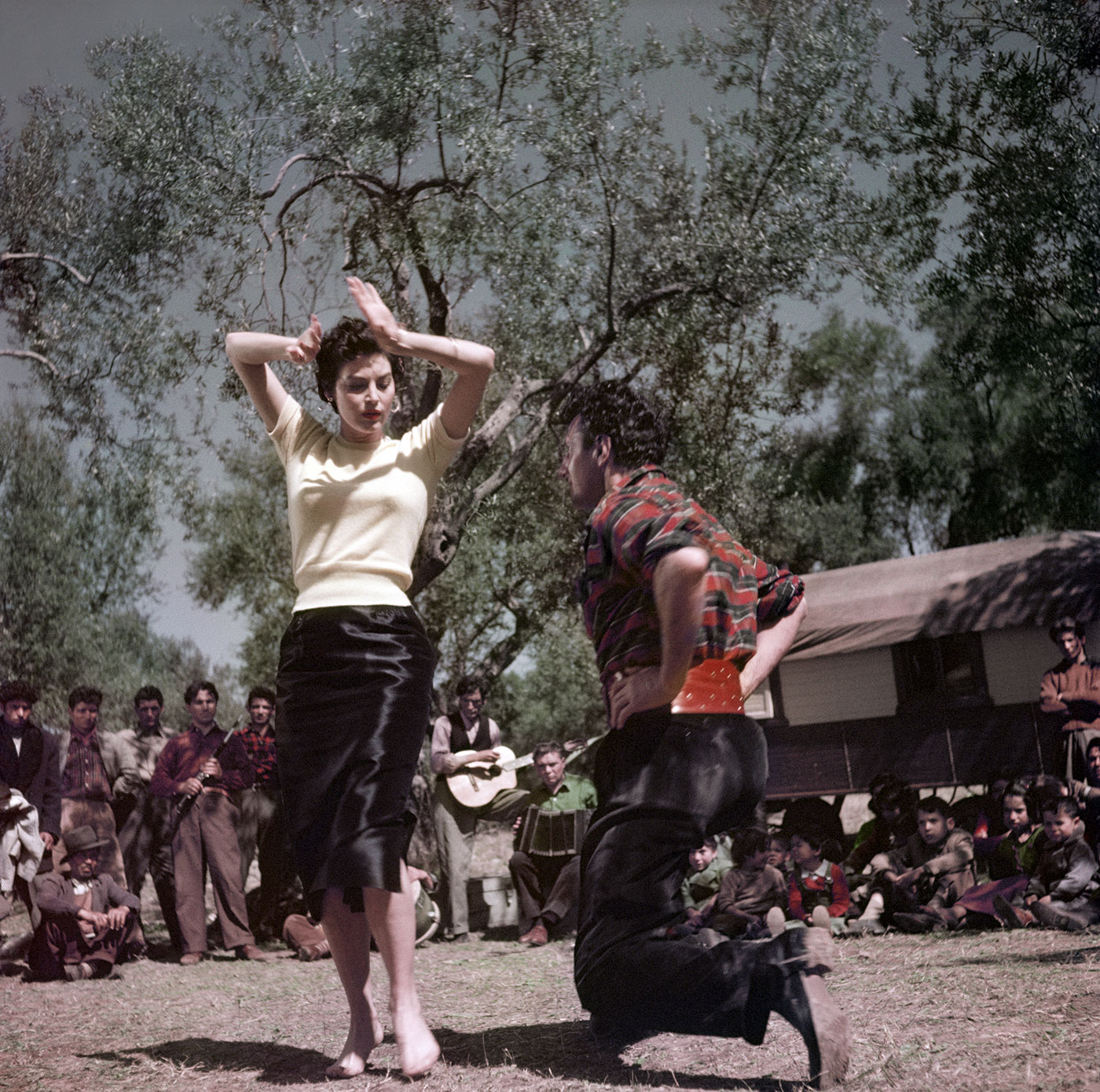
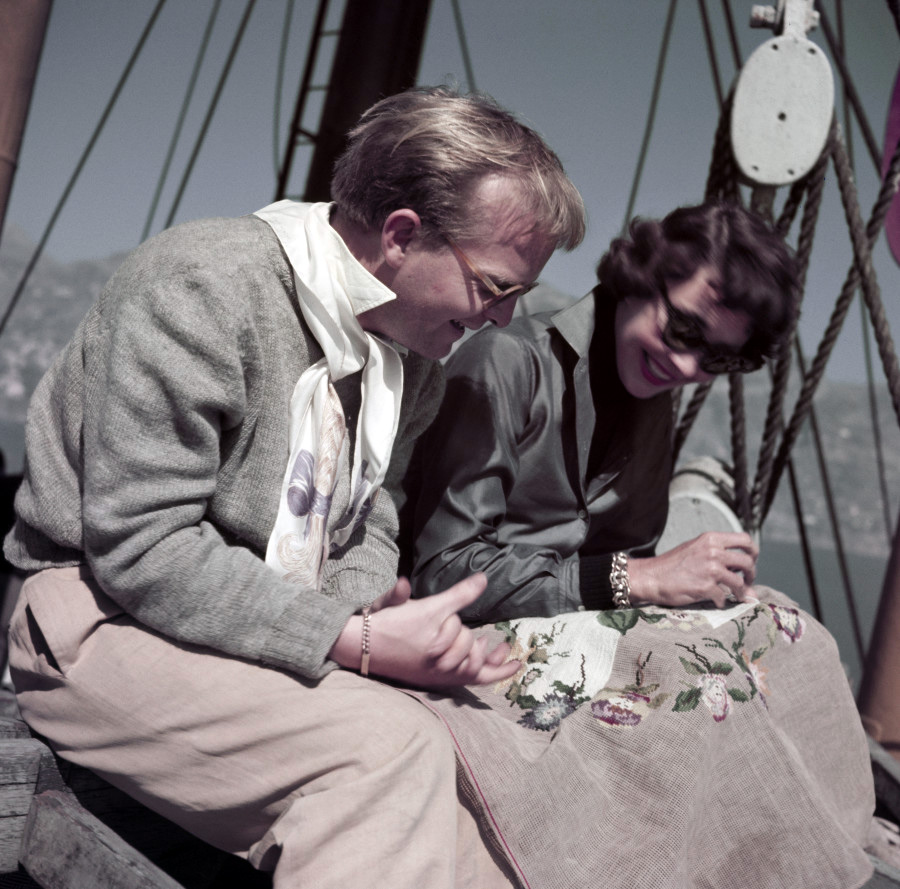
His work in this medium is what I would call “observational” colour photography. The images are best when the subject is intimate, human and ‘on set’, preferably using a limited palette with splashes of subdued colour – such as in the gorgeous Model wearing Dior on the banks of the Seine, Paris, France (1948), the delicate Woman on the beach, Biarritz, France (1951), and the simpatico duo of Humphrey Bogart and Peter Lorre on the set of ‘Beat the Devil’, Ravello, Italy (April 1953) and Truman Capote and Jennifer Jones on the set of ‘Beat the Devil’, Ravello, Italy (April 1953). The photographs of Ava Gardner on set are also cracking images for their vitality and overall balance, as is the almost monochromatic Gen X girl, Colette Laurent, at the Chantilly racetrack, France (1952). Other ensemble tableaux might as well have been shot in black and white, such as Spectators at the Longchamp Racecourse, Paris, France (c. 1952).

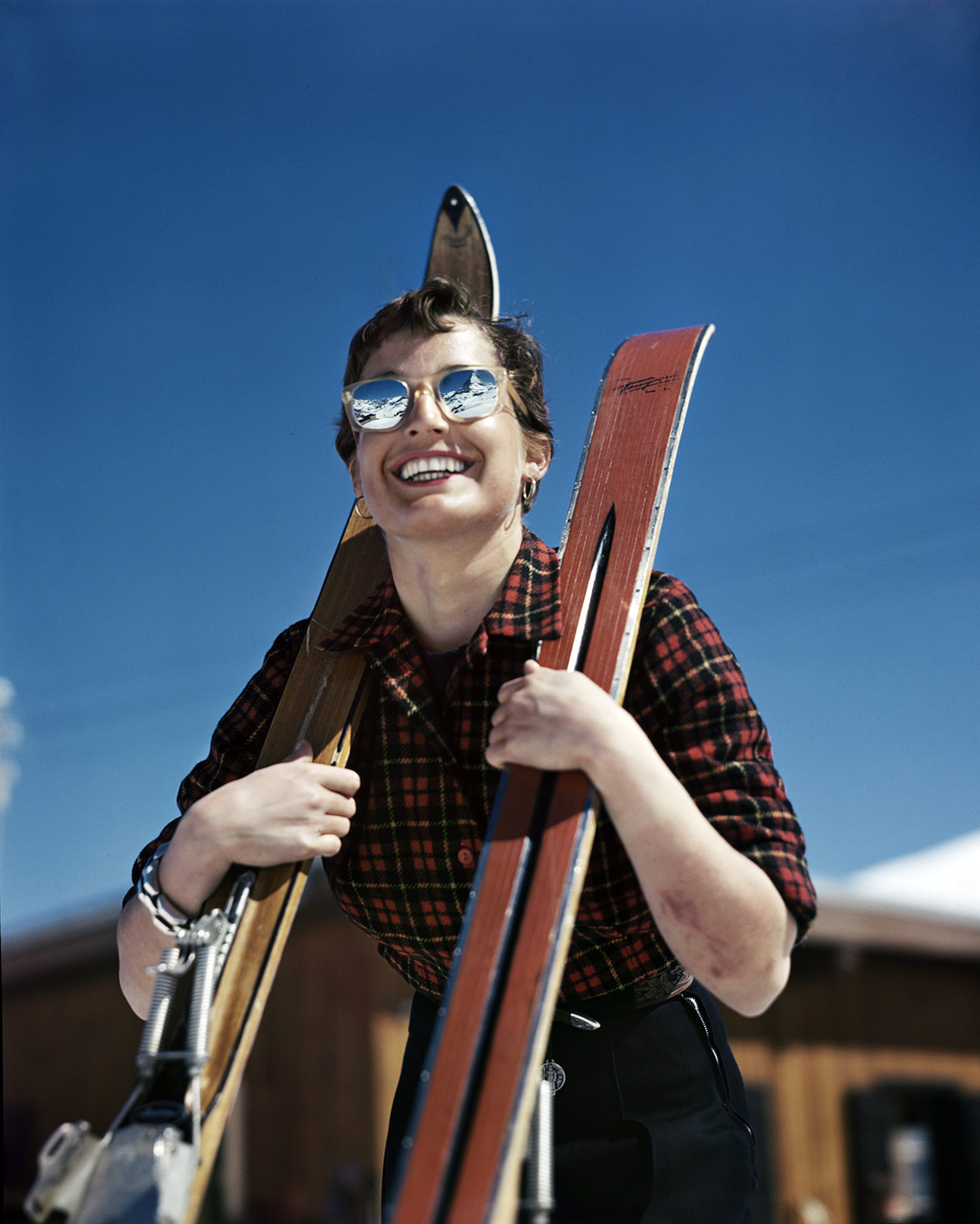
Capa too often resorts to one or two strong primary colours for effect, as in Capucine, French model and actress, on a balcony, Rome, Italy (August 1951), Rambaugh Family Circus, Indiana, USA (1949) or American Judith Stanton, Zermatt, Switzerland (1950). In the the former two images the composition doesn’t work with the colour; only in the latter does it become a vigorous and joyous structural element.

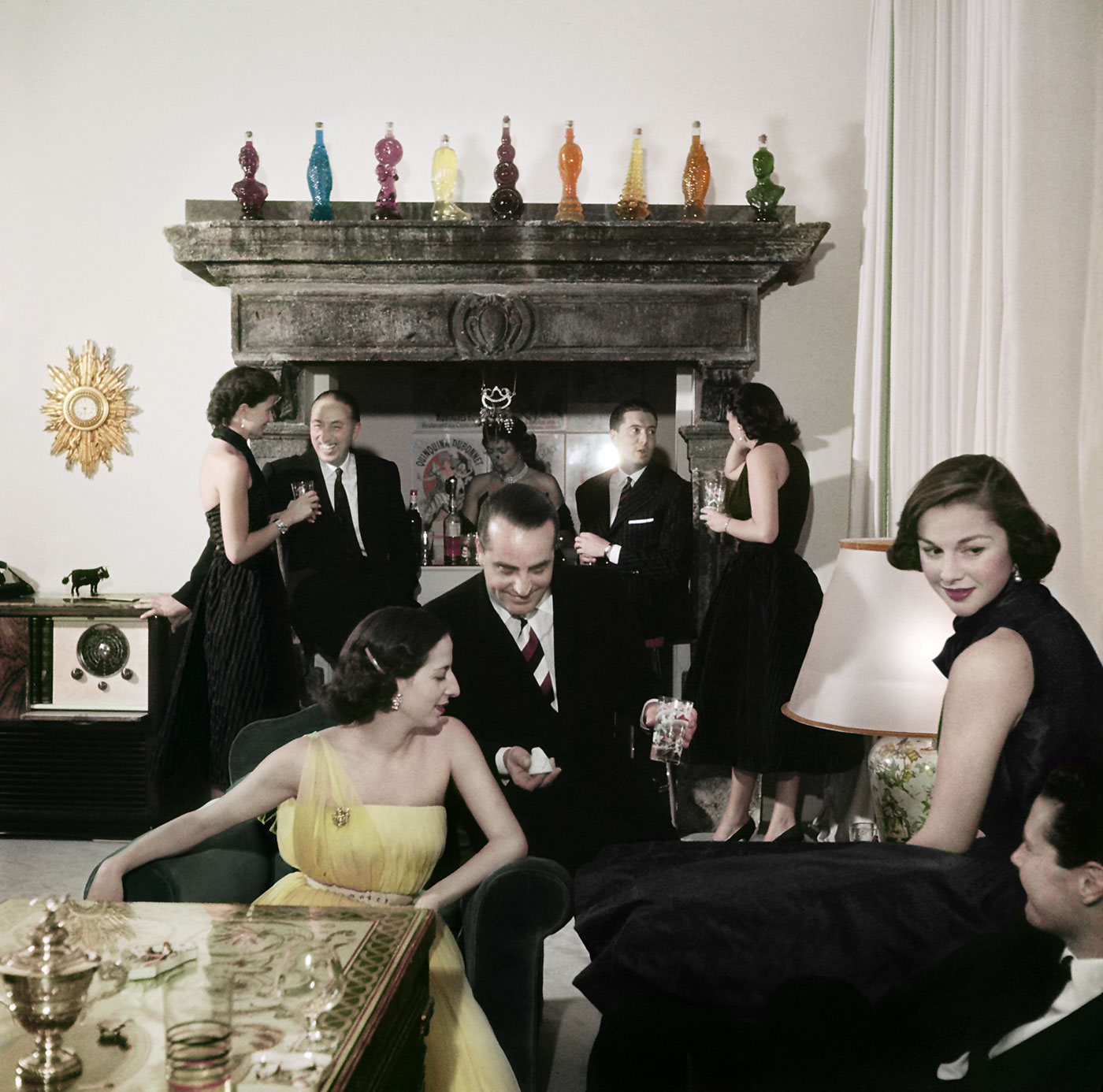
Sometimes I think that Capa didn’t exactly know what to do with colour – Woman at an ice bar, Zürs, Austria (1949-1950) and Party, Rome, Italy (August 1951) are not very good at all – but here we must acknowledge an artist experimenting with a relatively new commercial medium, even as he seeks to sell these images to his clients.

Capa in Color is at his best when he employs subtlety, constructing strong human compositions with nuanced placement of shades and hues.

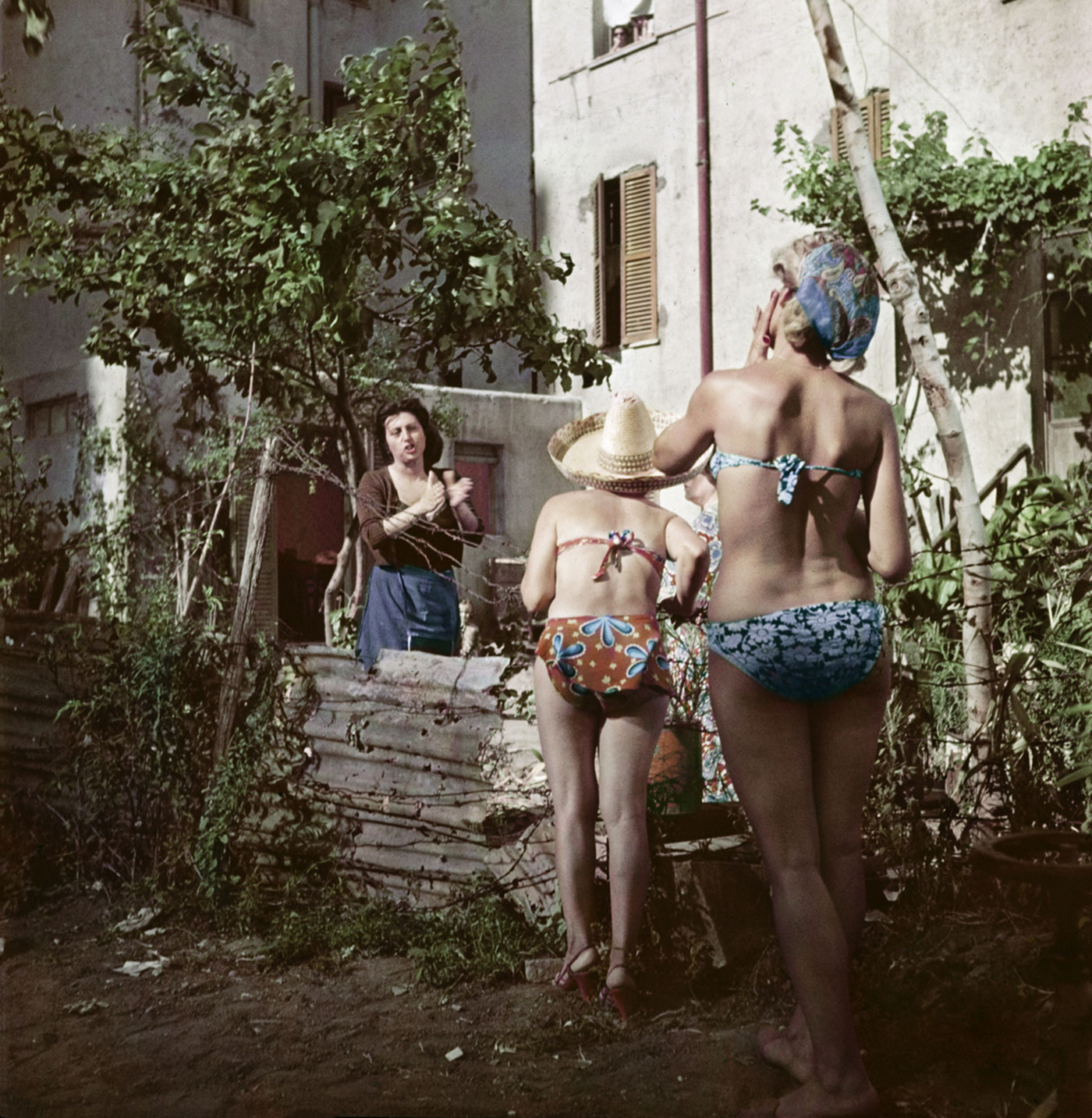
One of the most complex images in the posting is Anna Magnani on the set of Luchino Visconti’s ‘Bellissima’ (Rome, 1951-1952). Just look at this image: your eye plays over the surface, investigating every nook and cranny, every modular plane. The blue of the skirt, the brown of the top, the patterns of the two bikinis and the earthiness of tree and earth. I am reminded of the paintings of Paul Cézanne.

Dr Marcus Bunyan


Many thankx to Jeu de Paume for allowing me to publish the photographs in the posting. Please click on the photographs for a larger version of the image.


The first exhibition dedicated to Capa’s fourteen years of color photographs, Capa in Color has an ambition to evaluate and place these photographs in the timeline of his career and of their period. Capa in Color shows how color photography renewed his vision and how his work gained from a new sensibility after the war, by readapting his compositions in colour, but also to a public attracted to entertainment and to the discovery of new types of images.


Robert Capa et la couleur – Portrait filmé/videoportrait from Jeu de Paume / magazine on Vimeo.


Robert Capa (American, 1913-1954) 'Regata, Lofoten Island, Hankoe' Norway, 1951 from the exhibition 'Capa in Color' at Jeu de Paume – Château de Tours, Nov 2015 - May 2016


Robert Capa (American, 1913-1954)
Regata, Lofoten Island, Hankoe
Norway, 1951
International Center of Photography, New York
© Robert Capa/International Center of Photography/Magnum Photos


Recently presented at the International Center of Photography and now available for travel, Capa in Color presents Robert Capa’s colour photographs to the European public for the first time. Although he is recognised almost exclusively as a master of black-and-white photography, Capa began working regularly with colour film in 1941 and used it until his death in 1954. While some of this work was published in the magazines of the day, the majority of these images have never been printed or seen in any form.

Capa in Color includes over 150 contemporary colour prints by Capa, as well as personal papers and tear sheets from the magazines in which the images originally appeared. Organised by Cynthia Young, curator of Capa Collections at ICP, the exhibition presents an unexpected aspect of Capa’s career that has been previously edited out of posthumous books and exhibitions, and show how he embraced colour photography and integrated it into his work as a photojournalist in the 1940s and 1950s.

Robert Capa’s (1913-1954) reputation as one of history’s most notable photojournalists is well established. Born Endre Ernö Friedmann in Budapest and naturalised as a U.S. citizen in 1946, he was deemed “The Greatest War Photographer in the World” by Picture Post in a late 1938 publication of his Spanish Civil War photographs. During World War II, he worked for such magazines as Collier’s and Life, extensively portraying preparation for war as well as its devastating aftermath. His best-known images symbolised for many the brutality and valour of war and changed the public perception of, and set new standards for, war photography.

July 27, 1938, while in China for eight months covering the Sino-Japanese war, Robert Capa wrote to a friend at his New York agency, “… send 12 rolls of Kodachrome with all instructions; … Send it “Via Clipper” because I have an idea for Life“. Although no colour film from China survives except for four prints published in the October 17, 1938, issue of Life, Capa was clearly interested in working with colour photography even before it was widely used by many other photojournalists.

In 1941, he photographed Ernest Hemingway at his home in Sun Valley, Idaho, in colour, and used colour for a story about crossing the Atlantic on a freighter with an Allied convoy, published in the Saturday Evening Post. While Capa is best known for the black-and-white images of D-Day, he also used colour film sporadically during World War II, most notably to photograph American troops and the French Camel Corps in Tunisia in 1943.

Capa’s use of colour film exploded in his postwar stories for magazines such as Holiday (USA ), Ladies’ Home Journal (USA ), Illustrated (UK), and Epoca (Italy). These photographs, which until now have been seen only in magazine spreads, brought the lives of ordinary and exotic people from around the world to American and European readers alike, and were markedly different from the war reportage that had dominated Capa’s early career. Capa’s technical ability coupled with his engagement with human emotion in his prewar black-and-white stories enabled him to move back and forth between black and white and colour film and integrate colour to complement the subjects he photographed. These early stories include photographs of Moscow’s Red Square from a 1947 trip to the USS R with writer John Steinbeck and refugees and the lives of new settlers in Israel in 1949-50. For the Generation X project, Capa traveled to Oslo and northern Norway, Essen, and Paris to capture the lives and dreams of youth born before the war.

Capa’s photographs also provided readers a glimpse into more glamorous lifestyles that depended on the allure and seduction of colour photography. In 1950, he covered fashionable ski resorts in the Swiss, Austrian, and French Alps, and the stylish French resorts of Biarritz and Deauville for the burgeoning travel market capitalised on by Holiday magazine. He even tried fashion photography by the banks of the Seine and on the Place Vendôme. Capa also photographed actors and directors on European film sets, including Ingrid Bergman in Roberto Rossellini’s Viaggio in Italia, Orson Welles in Black Rose, and John Huston’s Moulin Rouge. Additional portraiture in this period included striking images of Picasso, on the beach near Vallauris, France with his young son Claude.

Capa carried at least two cameras for all of his postwar stories: one with black-and-white film and one with colour, using a combination of 35mm and 4 x 5 Kodachrome and medium-format Ektachrome film, emphasising the importance of this new medium in his development as a photographer. He continued to work with colour until the end of his life, including in Indochina, where he was killed in May 1954. His colour photographs of Indochina presage the colour images that dominated the coverage from Vietnam in the 1960s.

Capa in Color is the first museum exhibition to explore Capa’s fourteen-year engagement with colour photography and to assess this work in relation to his career and period in which he worked. His talent with black-and-white composition was prodigious, and using colour film halfway through his career required a new discipline. Capa in Color explores how he started to see anew with colour film and how his work adapted to a new postwar sensibility. The new medium required him to readjust to colour compositions, but also to a postwar audience, interested in being entertained and transported to new places.

Press release from Jeu de Paume


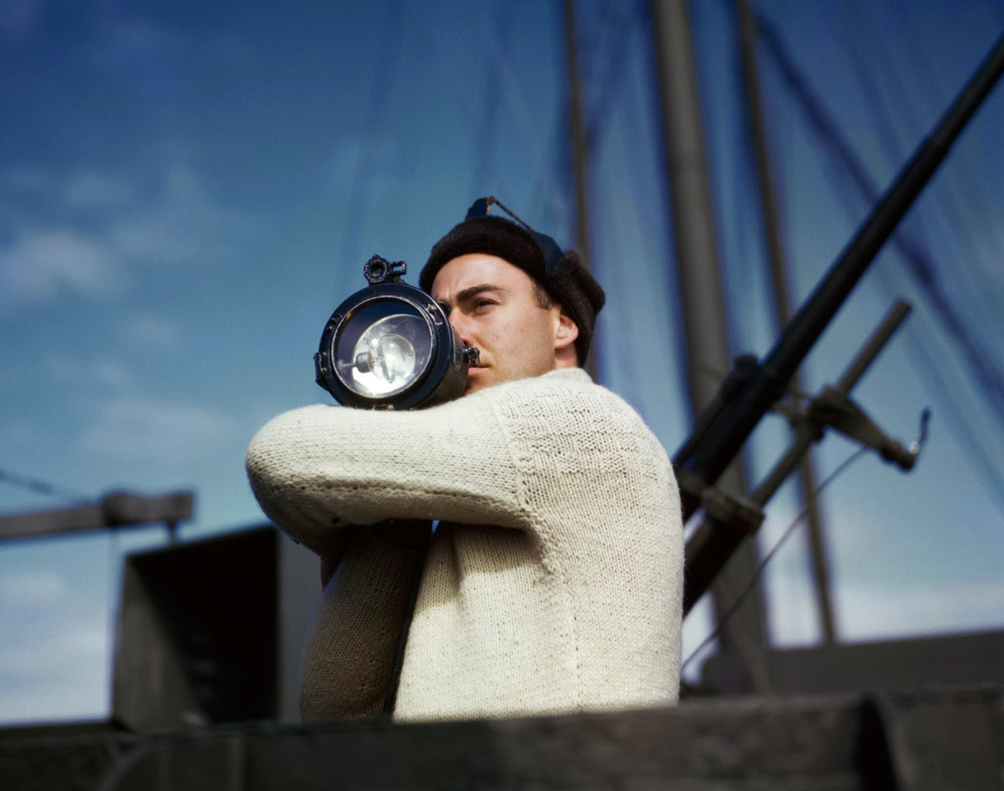
Robert Capa (American, 1913-1954) 'A crewman signals another ship of an Allied convoy across the Atlantic from the US to England' 1942


Robert Capa (American, 1913-1954)
A crewman signals another ship of an Allied convoy across the Atlantic from the US to England
1942
International Center of Photography, New York
© Robert Capa/International Center of Photography/Magnum Photos


It is surprising, even shocking to some, that famous photojournalist Robert Capa (born Budapest 1913, died Indochina 1954) photographed in colour, and not just occasionally, but regularly after 1941. His coloured work is essentially unknown. Capa is considered a master of black-and-white war photography, a man who documented some of the most important political events of Western Europe in the mid-twentieth century. His photographs of 1930s Paris, the Spanish Civil War, World War II, postwar Europe, and his last images in Indochina are known to us in black-and-white. None of the posthumous retrospective projects of his work have included colour, with a few rare exceptions..

Capa first experimented with colour in 1938, two years after Kodak developed Kodachrome, the first colour roll film. While in China covering the Sino-Japanese War, he wrote to a friend at his New York agency, Pix, “Please immediately send 12 rolls of Kodachrome with all instructions; whether special filters are needed, etc. – in short, all I should know. Send it ‘Via Clipper’, because I have an idea for Life“. Only four colour images from China were published, but Capa’s enthusiasm for colour was born. He photographed with colour film again in 1941 and for the next two years he fought hard to persuade editors to buy his colour images in addition to the black-and-white. After the war, the magazines were eager to include colour and his colour assignments increased. For the rest of his life, he almost always carried at least two cameras: one for black-and-white and one for colour film.


Robert Capa (American, 1913-1954) 'American Captain Jay F. Shelley stands in front of "The Goon," a B-17 bomber, before a raid over Italy, Tunisia, 1943' 1943


Robert Capa (American, 1913-1954)
American Captain Jay F. Shelley stands in front of “The Goon,” a B-17 bomber, before a raid over Italy, Tunisia, 1943
1943
International Center of Photography, New York
© Robert Capa/International Center of Photography/Magnum Photos


Jay F. Shelley, Sr., 88, of Yuma,formerly of Scottsdale, Arizona, entered Eternity on June 6, 2004. Jay was born May 16, 1916, in Long Beach, California. He was a decorated B-17 Bomber Pilot during WWII and flew 54 combat missions. He received a degree in business administration with a major in accounting from University of Montana. Jay worked as an accountant until 1979 when he retired with his wife to Scottsdale, Arizona. Capt. Jay F Shelley was assigned to the 301st BG 32nd Squadron.


Robert Capa (American, 1913-1954) 'Damaged plane hosed down with chemicals after landing on belly following a raid over Occupied France, England, July 1941' 1941


Robert Capa (American, 1913-1954)
Damaged plane hosed down with chemicals after landing on belly following a raid over Occupied France, England, July 1941
1941
International Center of Photography, New York
© Robert Capa/International Center of Photography/Magnum Photos


The plane is a Bristol Blenheim.


Robert Capa (American, 1913-1954) 'An American B-17 gunner awaits take off from a Royal Air Force base for a daylight bombing raid over occupied France' England, 1942


Robert Capa (American, 1913-1954)
An American B-17 gunner awaits take off from a Royal Air Force base for a daylight bombing raid over occupied France
England, 1942
International Center of Photography, New York
© Robert Capa/International Center of Photography/Magnum Photos


World War II

In 1941, Capa produced his first colour film story for the Saturday Evening Post, about crossing the Atlantic from New York on a convoy. Once in England, he was also able to sell these images to the English magazine Illustrated, because the two magazines did not have the same readerships.

He made the crossing again the next year, carrying a larger format camera that made bigger, more spectacular portraits of the ship’s crew. The turnaround time for Kodachrome film was several weeks. As Kodak maintained secrecy surrounding the formula, the undeveloped film had to go to a special Kodak processing plant and then returned to the photographer. It was not ideal for timely news. The magazines published few of Capa’s colour images from the UK, but he persisted in using it. In 1943, he entered the battlefields of World War II in North Africa, first traveling on a troop ship from England to Casablanca. His last colour images from the war were taken on a boat from Tunisia to Sicily in July 1943, where he debarked and moved up to Naples with America soldiers over the following months. It appears that for the rest of the war he did not use colour film, apparently discouraged by a combination of the slow shutter speed of the film, long processing times, and the uneven commitment to his colour images by the magazines.


Robert Capa (American, 1913-1954) 'Rambaugh Family Circus, Indiana, USA' 1949


Robert Capa (American, 1913-1954)
Rambaugh Family Circus, Indiana, USA
1949
International Center of Photography, New York
© Robert Capa/International Center of Photography/Magnum Photos


USA

Soon after his return from England, in the fall of 1941, Capa traveled to Sun Valley, Idaho, to do a story for life on his friends, the writers Ernest Hemingway and Martha Gellhorn, whom he had met during the Spanish Civil War. After World War II, Capa sought out new relationships with magazines and holiday became one of his most important supporters.

A glamorous travel magazine that featured New Yorker – caliber writers, Holiday was launched in 1946 by the Philadelphia-based Curtis Publishing Company, which also carried The Saturday Evening Post and Ladies’ Home Journal. Born in full colour, it was a peacetime publication catering to an ideal of American postwar prosperity. Holiday covered American cities, but immediately assigned stories on stylish international hot spots, places readers could dream of visiting with the advent in 1947 of nonstop transatlantic flights. In 1950, Holiday sent Capa to Indianapolis, and while his pictures of a nuclear family of five exploring the city are uninspired, he also photographed a family-run traveling circus. Despite Capa’s lukewarm attitude toward American culture, the colour images present a strong vision of American small-town life.


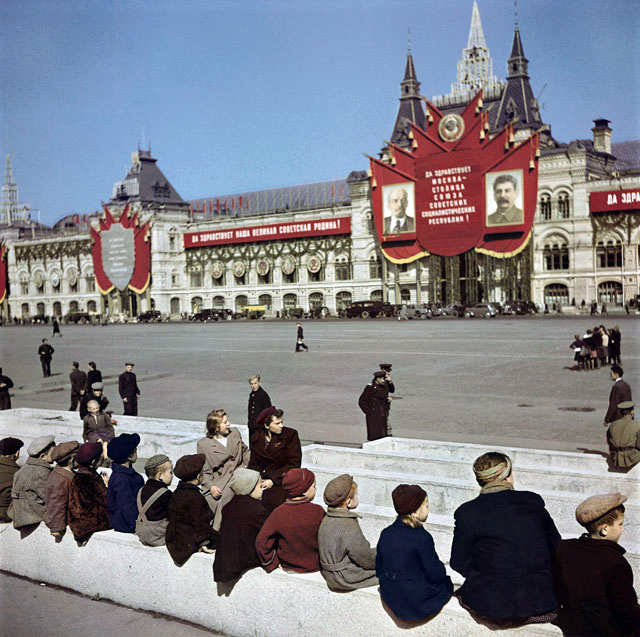
Robert Capa (American, 1913-1954) 'Young visitors waiting to see Lenin's Tomb at Red Square' Moscow 1947


Robert Capa (American, 1913-1954)
Young visitors waiting to see Lenin’s Tomb at Red Square
Moscow, 1947
International Center of Photography, New York
© Robert Capa/International Center of Photography/Magnum Photos


USSR

The year 1947 was a turning point in Capa’s life. He founded Magnum, the photographers cooperative agency he had dreamed of since 1938. The same year, he traveled to the Soviet Union, a trip that he had wanted to make in 1937 and then in 1941, both times unable to obtain a visa or magazine support for the trip.

He teamed up with writer John Steinbeck to report on the lives and opinions of ordinary Russians in opposition to Cold War rhetoric. Their adventures were published in the book A Russian Journal the following year and syndicated in newspapers and international picture magazines. Although the colour images were well represented in the magazines and on the cover of Illustrated for a special issue, Capa did not shoot much colour film in the Soviet Union, and no colour was included in A Russian Journal, except for the cover. Either he deemed only a few places worthy of the new medium format Ektachrome colour film that did not require special processing – chiefly Moscow and collective farms in the Ukraine and Georgia – or he had only a limited amount of film and used it sparingly. The images of Red Square take full advantage of colour film.


Robert Capa (American, 1913-1954) 'Pablo Picasso playing in the water with his son Claude, near Vallauris, France' 1948


Robert Capa (American, 1913-1954)
Pablo Picasso playing in the water with his son Claude, near Vallauris, France
1948
International Center of Photography, New York
© Robert Capa/International Center of Photography/Magnum Photos


Picasso

Some of Capa’s colour works were considerably less successful than his black-and-white photographs. This was the case with his 1948 feature on Picasso, originally sold to look as a story about the artist’s pottery, but as Capa failed to take pictures of the pottery, it became a story about Picasso and his family.

He instructed his Magnum colleague Maria Eisner: “Look gave me a definite assignment but no price so you have to insist on $200 pro black and white and $300 pro coloured page, and $250 for expenses. If they are not willing to pay a reasonable sum, you can withdraw, but Madame Fleurs Cowles was so positive on this matter and the pictures are so exclusive that I could be very surprise[d] if this doesn’t work”. Both Fleur Cowles at Look and Len Spooner at Illustrated were disappointed with the colour images, although delighted with the story, which included Capa’s now famous picture of Picasso holding a sun umbrella over his ravishing young artist girlfriend, Françoise Gilot, parading on the beach.

Hungary

In 1948, Holiday sent Capa to his native Budapest and commissioned him to write the accompanying article. Capa had been widely praised for the hilarious and self-deprecating 1947 book about his wartime exploits, slightly out of focus, so the editors were hardly taking risk by asking him to write a long article.

Holiday used four colour images in the November 1949 issue. Unlike the glamorous destinations the magazine usually covered or that Capa would later cover for them, the images and accompanying article, one of the strongest texts he wrote about a place, functioned more as a letter from Budapest. He observes with fascination and humour the clashing end of one empire with the start of another, bittersweet against the reality of what his childhood city had become. While he seemed to have had more colour film on this assignment than in Russia, it was expensive to buy and process, so he still conserved, and there are many more black-and-white negatives of similar scenes than in colour.

Morocco

Capa’s 1949 trip to Morocco was one of the few postwar stories he made concerning a political subject, but it was a complicated sell and failed as an international news story.

The assignment was muddled from the start, as it combined Moroccan politics, lead mines, and the filming of The Black Rose with Orson Welles. Paris Match first published some of the pictures in a piece about the annual tour of the country by the Moroccan leader Sultan Sidi Mohammed. Illustrated published a story with only black-and-white images about the strange effects of the Marshall Plan, in which as a French colony Morocco received American aid through France, although the French General was not recognised as the leader in charge by the U.S. State Department. Some of the best images are portraits of the Moroccan people.


Robert Capa (American, 1913-1954) 'Construction of the new settlements for workers, Neguev Desert, outside Be'er Sheva, Israel' 1949-1950


Robert Capa (American, 1913-1954)
Construction of the new settlements for workers, Neguev Desert, outside Be’er Sheva, Israel
1949-1950
International Center of Photography, New York
© Robert Capa/International Center of Photography/Magnum Photos


Robert Capa (American, 1913-1954) 'Former shop near Jaffa gate, Jerusalem, Israel' 1949


Robert Capa (American, 1913-1954)
Former shop near Jaffa gate, Jerusalem, Israel
1949
International Center of Photography, New York
© Robert Capa/International Center of Photography/Magnum Photos


Israel

Capa’s big geopolitical assignment of the late 1940s took him to Israel. He first traveled there in 1948 to cover the Arab-Israeli war, then returned in 1949, for Holiday and Illustrated, with writer Irwin Shaw.

He came back in 1950 to continue photographing the new nation in transition, focusing on the influx of refugees arriving from Europe and neighbouring Arab countries, the ongoing repair of the physical destruction, portraits of immigrants, agricultural work, kibbutzim, and various Jewish festivities. While there is only one colour image from the 1948 trip, of the Altalena ship burning in the water off the beach in Tel Aviv – a result of the conflict between extreme right-wing Irgunists and the Israeli government – by the time Capa arrived in 1949, he seemed to have all the colour film he needed. His Israel stories were picked up by all the major international picture news magazines, spurred by the 1950 publication Report on Israel, with text by Shaw and photos by Capa.


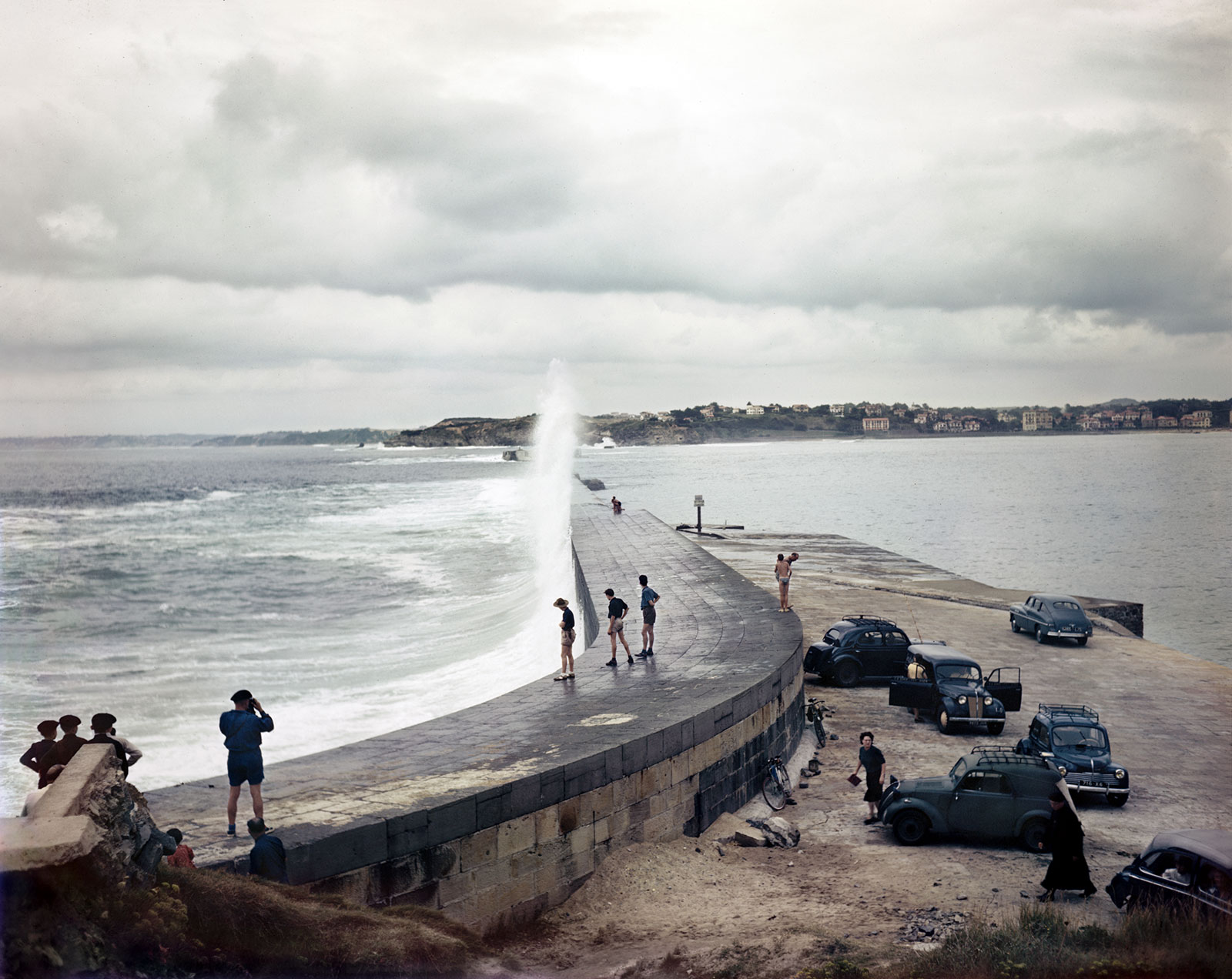
Robert Capa (American, 1913-1954) 'Jetty, Socoa, near Saint-Jean-de-Luz, France' August 1951


Robert Capa (American, 1913-1954)
Jetty, Socoa, near Saint-Jean-de-Luz, France
August 1951
International Center of Photography, New York
© Robert Capa/International Center of Photography/Magnum Photos


Robert Capa (American, 1913-1954) 'Woman on the beach, Biarritz, France' August 1951


Robert Capa (American, 1913-1954)
Woman on the beach, Biarritz, France
August 1951
International Center of Photography, New York
© Robert Capa/International Center of Photography/Magnum Photos


Deauville and Biarritz

Following the success of his skiing story, Capa proposed a piece on French seaside resorts. In the summer of 1950, he traveled to Deauville in Normandy, with its racetrack and casino, photographing only in black-and-white (all that appeared in Illustrated).

He knew he could do more with the story and pitched it to Holiday as a double feature with Biarritz, in Basque Country. A year later, he returned to Deauville with colour film to photograph the scene, capturing the mix of social classes at the horse races. He then traveled to Biarritz, covering the beach, nightlife, and traditional folklore. For this story, the black-and-white and colour images complement each other – the colour adding details to the black-and-white, which set the stage. The layout, not published until September 1953, balances the colour and black-and-white with Capa’s humorous, self-deprecating text about his time in each resort.


Robert Capa (American, 1913-1954) 'Capucine, French model and actress, on a balcony, Rome, Italy' August 1951


Robert Capa (American, 1913-1954)
Capucine, French model and actress, on a balcony, Rome, Italy
August 1951
International Center of Photography, New York
© Robert Capa/International Center of Photography/Magnum Photos


Capucine (French, 1928-1990)

Capucine (6 January 1928 – 17 March 1990) was a French fashion model and actress known for her comedic roles in The Pink Panther (1963) and What’s New Pussycat? (1965). She appeared in 36 films and 17 television productions between 1948 and 1990. At age 17, while riding in a carriage in Paris, she was noticed by a commercial photographer. She became a fashion model, working for fashion houses Givenchy and Christian Dior. She adopted the name, “Capucine” (French for nasturtium). She met Audrey Hepburn while modelling for Givenchy in Paris. The two would remain close friends for the rest of Capucine’s life.

In 1957, film producer Charles K. Feldman spotted Capucine while she was modelling in New York City. Feldman brought her to Hollywood to learn English and study acting under Gregory Ratoff. She was signed to a contract with Columbia Pictures in 1958 and landed her first English-speaking role in the film Song Without End (1960) for which she was nominated for a Golden Globe Award. Over the next few years, Capucine made six more major motion pictures. They included North to Alaska (1960), a comedy, as a prostitute who becomes the love interest of John Wayne, and Walk on the Wild Side (1962), in which she portrayed a redeemed hooker, before moving to Switzerland in 1962.

Much of 1963’s hit film The Pink Panther was shot in Europe. A crime comedy that led to a number of sequels, the film starred David Niven and Peter Sellers along with Capucine. The risqué comedy What’s New Pussycat? (1965), which co-starred Sellers and Peter O’Toole, was filmed entirely in France. She continued making films in Europe until her death.

Text from the Wikipedia website


Robert Capa (American, 1913-1954) 'Party, Rome, Italy' August 1951


Robert Capa (American, 1913-1954)
Party, Rome, Italy
August 1951
International Center of Photography, New York
© Robert Capa/International Center of Photography/Magnum Photos


Rome

In his article on Norway for Holiday, Capa wrote: “I have revisited Budapest because i happen to have been born there, and because the place offered only a short season for revisiting. I even got to Moscow, which usually offers no revisiting at all. I kept on revisiting Paris because I used to live there before the war; London, because I lived there during the war; and Rome, because I was sorry that I had never lived there at all.”

Capa traveled to Rome for Holiday in 1951 and his pictures were published in April 1952, with a text authored by Alan Moorehead. A writer for The New Yorker at the time of the Rome assignment, Moorehead had been a correspondent for the Daily Express of London during World War II, and he and Capa had been together in North Africa, Sicily, and Normandy. Capa’s accompanying colour photographs pursued a glamorous city filled with beautiful people engaged in endless partying, reflecting a Rome removed from postwar destruction and entering the period of La Dolce Vita.


Robert Capa (American, 1913-1954) 'American Judith Stanton, Zermatt, Switzerland' 1950


Robert Capa (American, 1913-1954)
American Judith Stanton, Zermatt, Switzerland
1950
International Center of Photography, New York
© Robert Capa/International Center of Photography/Magnum Photos


Robert Capa (American, 1913-1954) 'Woman at an ice bar, Zürs, Austria' 1949-1950


Robert Capa (American, 1913-1954)
Woman at an ice bar, Zürs, Austria
1949-1950
International Center of Photography, New York
© Robert Capa/International Center of Photography/Magnum Photos


Skiing

Skiing was one of Capa’s favourite pastimes and he vacationed annually in Klosters, Switzerland, to relax and recuperate. In 1948, he and a Magnum colleague were trying to drum up a story on Megève, France, a popular ski resort for Parisians, on its “dual personality … simple peasant life and gay, café society set.”

Capa photographed in Zürs, Austria, in early 1949, for a Life story, although the magazine ultimately killed it. Holiday pulled in after Life dropped out and, in late 1949, signed on to a feature about the great skiing resorts of Austria, Switzerland, and France, which would become one of Capa’s most joyous and successful colour stories. In fact, it was arguably better in colour, which provided the additional elements of glitter and humour that black-and-white often missed. For two months, he traveled from the Austrian resorts of Kitzbühel, St. Anton, Zürs, and Lech, to the Swiss towns of Davos, Klosters, and Zermatt, then over the French border to Val d’Isère. In each place, he found a glamorous circle to depict: director Billy Wilder and writer Peter Viertel from Hollywood, young international ski champions, and current and ex-European royalty, including the Queen and Prince of Holland. Everyone was healthy and the mood festive. Capa found a relaxed, casual confidence in his subjects.


Robert Capa (American, 1913-1954) 'Spectators at the Longchamp Racecourse, Paris, France' c. 1952


Robert Capa (American, 1913-1954)
Spectators at the Longchamp Racecourse, Paris, France
c. 1952
International Center of Photography, New York
© Robert Capa/International Center of Photography/Magnum Photos


Robert Capa (American, 1913-1954) 'Model wearing Dior on the banks of the Seine, Paris, France' 1948


Robert Capa (American, 1913-1954)
Model wearing Dior on the banks of the Seine, Paris, France
1948
International Center of Photography, New York
© Robert Capa/International Center of Photography/Magnum Photos


Paris

Paris was Capa’s de facto home from 1933 to 1939 and then as his postwar base, usually in a back room of the elegant Hotel Lancaster off the Champs-Élysées, where he was friend with the owner.

Holiday‘s editor Ted Patrick commissioned Capa to provide photographs for a special issue on Paris in 1952, and Capa brought in other Magnum colleagues – Henri Cartier-Bresson, Chim, and the young Dennis Stock. The magazine included texts by Irwin Shaw, Paul Bowles, Ludwig Bemelmans, Art Buchwald, and Colette, among others, and is a romantic paean to the city, almost a stage set for romance, gastronomy, and history. Some of Capa’s best images from this story are the quirkiest ones and play with the contrasts that he seemed to revel in, between the young and old, human and animal, high-life and low-life, particularly at the horse races, about which he noted: “The sport of kings is also the sport of concierges”. For his photographs of plein air painters, Capa wrote: “Place du Tertre is a painter’s paradise. A few stops from Sacré Coeur we find an old gentleman in beard and beret looking like an American movie producer’s idea of the kind of French painter found in Montmartre”.


Robert Capa (American, 1913-1954) 'Gen X girl, Colette Laurent, at the Chantilly racetrack, France' 1952


Robert Capa (American, 1913-1954)
Gen X girl, Colette Laurent, at the Chantilly racetrack, France
1952
International Center of Photography, New York
© Robert Capa/International Center of Photography/Magnum Photos


Generation X

Capa developed Generation X, also known as Gen X, for Magnum on the mark of the half century in late 1949. McCall’s was originally behind the project, but had pulled out by 1951, when Capa insisted on injecting more political content.

Holiday filled the void and supported the project all the way to a three-part series published in early 1953. Capa observed, “it was one of those projects, of which many are born in the minds of people who have big ideas and little money. The funny thing about this project is that it was accomplished.” He assigned the photographers, including Chim, Cartier-Bresson, and Eve Arnold, to each create a portrait of a boy and/or girl in countries where they were already working or had worked. Each subject answered a detailed questionnaire about his or her life, family, personal beliefs, and goals. The project eventually included twenty-four individuals in fourteen countries on five continents. Capa photographed all his subjects – a French girl, a German boy, and Norwegian boy and girl – in colour and black-and-white, but only the Norwegian photos were published in colour. Capa’s biographer Richard Whelan suggested that Capa’s depiction of the French girl, Colette Laurent, was an oblique portrait of himself at the time: “Her life is superficial, artificial on the surface and holds none of the good things except the material ones.”


Robert Capa (American, 1913-1954) 'Ava Gardner on the set of 'The Barefoot Contessa', Tivoli, Italy' 1954


Robert Capa (American, 1913-1954)
Ava Gardner on the set of ‘The Barefoot Contessa’, Tivoli, Italy
1954
International Center of Photography, New York
© Robert Capa/International Center of Photography/Magnum Photos


Robert Capa (American, 1913-1954) 'Ava Gardner on the set of The Barefoot Contessa, Tivoli, Italy' 1954


Robert Capa (American, 1913-1954)
Ava Gardner on the set of ‘The Barefoot Contessa’, Tivoli, Italy
1954
International Center of Photography, New York
© Robert Capa/International Center of Photography/Magnum Photos


Robert Capa (American, 1913-1954) 'Humphrey Bogart and Peter Lorre on the set of Beat the Devil, Ravello, Italy' April 1953


Robert Capa (American, 1913-1954)
Humphrey Bogart and Peter Lorre on the set of ‘Beat the Devil’, Ravello, Italy
April 1953
International Center of Photography, New York
© Robert Capa/International Center of Photography/Magnum Photos


Robert Capa (American, 1913-1954) 'Truman Capote and Jennifer Jones on the set of Beat the Devil, Ravello, Italy' April 1953


Robert Capa (American, 1913-1954)
Truman Capote and Jennifer Jones on the set of ‘Beat the Devil’, Ravello, Italy
April 1953
International Center of Photography, New York
© Robert Capa/International Center of Photography/Magnum Photos


Robert Capa (American, 1913-1954) 'Jeffrey Hunter on the set of 'Single-Handed (Sailor of the King)'' Malta, 1952


Robert Capa (American, 1913-1954)
Jeffrey Hunter on the set of ‘Single-Handed (Sailor of the King)’
Malta, 1952
International Center of Photography, New York
© Robert Capa/International Center of Photography/Magnum Photos


Robert Capa (American, 1913-1954) 'John Huston at the café Les Deux Magots during the filming of 'Moulin Rouge'' Paris, 1952


Robert Capa (American, 1913-1954)
John Huston at the café Les Deux Magots during the filming of ‘Moulin Rouge’
Paris, 1952
International Center of Photography, New York
© Robert Capa/International Center of Photography/Magnum Photos


Robert Capa (American, 1913-1954) 'Anna Magnani on the set of Luchino Visconti's 'Bellissima'' Rome, 1951-1952


Robert Capa (American, 1913-1954)
Anna Magnani on the set of Luchino Visconti’s ‘Bellissima’
Rome, 1951-1952
International Center of Photography, New York
© Robert Capa/International Center of Photography/Magnum Photos


Robert Capa (American, 1913-1954) 'Ingrid Bergman and George Sanders on the set of 'Viaggio in Italia'' Naples, April 1953


Robert Capa (American, 1913-1954)
Ingrid Bergman and George Sanders on the set of ‘Viaggio in Italia’
Naples, April 1953
International Center of Photography, New York
© Robert Capa/International Center of Photography/Magnum Photos


On the set

Capa was friends with a number of movie stars and directors and incorporated them into his professional work. He met John Huston in Naples in 1944, while Huston was making films for the Army Signal Corps, and Ingrid Bergman in 1945 when she was filming in Paris, before beginning a one-year love affair.

As part of his 1948 trip to Morocco, he included a story on The Black Rose and its star Orson Welles. He photographed the set of Huston’s Beat the Devil, written by Truman Capote and filmed in the hillside town of Ravello, Italy. The cast visited the set of Viaggio in Italia in nearby Almalfi with Bergman, Roberto Rossellini, and George Sanders and Capa also dipped down to Paestum with his friend Martha Gellhorn, casting her as a caryatid in the ancient ruins. Capa covered another Huston film, Moulin Rouge, about the life of painter Toulouse Lautrec, shot in Paris and at Shepparton Studios near London. Capa’s colour portraits of the actors eschew traditional head shots and capture the varied pace and playful moments on the set.


Robert Capa (American, 1913-1954) 'Spectators along the procession route in Piccadilly Circus before the coronation of Queen Elizabeth II, London, England' February 6, 1953


Robert Capa (American, 1913-1954)
Spectators along the procession route in Piccadilly Circus before the coronation of Queen Elizabeth II, London, England
February 6, 1953
International Center of Photography, New York
© Robert Capa/International Center of Photography/Magnum Photos


London and Japan

In 1953, Capa traveled to London to cover the coronation of the young Elizabeth II with friends Humphrey Bogart and John Huston. His colour images of crowds waiting for the parade of guests before the coronation, for which he used 35mm Kodachrome, suggest a new interest in colour for colour’s sake.

In 1954, he received an invitation from Mainichi Press to travel to Japan for six weeks with Japanese cameras and an unrestricted amount of film to shoot what he liked in return for images they could publish. The trip was an easy one, but the colour photographs lack focus. He wandered around markets, documented foreign signs, watched people visiting temples and shrines, and photographed Children’s Day in Osaka, but they are little better than tourist snaps. Only a few images of a May Day workers’ celebration in Tokyo, in bright colours, show some engagement, reminiscent of his 1930s images of workers in France and Spain.


Robert Capa (American, 1913-1954) 'On the road from Namdinh to Thaibinh, Indochina (Vietnam)' May 1954


Robert Capa (American, 1913-1954)
On the road from Namdinh to Thaibinh, Indochina (Vietnam)
May 1954
International Center of Photography, New York
© Robert Capa/International Center of Photography/Magnum Photos


Robert Capa (American, 1913-1954) 'West of Namdinh, Indochina (Vietnam)' May 1954


Robert Capa (American, 1913-1954)
West of Namdinh, Indochina (Vietnam)
May 1954
International Center of Photography, New York
© Robert Capa/International Center of Photography/Magnum Photos


Indochina

In 1953, Capa expressed his readiness “to get back to real work, and soon. What and where I do not know, but the Deauville and Biarritz and motley movie period is over.”

In the same letter, he writes of his desire to go to “Indochina, or any other proposition which would get me back to reporting on my own type of territory”. While in Japan the next year, Capa received a cable from Life asking him to cover for their photographer in Indochina. The assignment was only for a few weeks and would bring in some needed money. He reached Hanoi on May 9 and on May 25, with Time reporter John Mecklin and Scripps-Howard correspondent John Lucas, left Mandihn with two cameras, a Contax with black-and-white film, and a Nikon with colour film. Their convoy traveled along a dirt road lined by rice paddies. Moving toward Thaibinh, Capa left the convoy and walked on by himself. He photographed the soldiers advancing through the fields, and as he climbed the dike along the road, he stepped on a land mine and was killed. While the colour images are some of the strongest war pictures he made, none were used in the press at the time, probably in part because of the extra time required to process the colour film.


Jeu de Paume – Château de Tours
25 avenue André Malraux
37000 Tours

Opening hours:
Tuesday to Sunday: 2pm – 6pm
Closed Mondays

Jeu de Paume – Château de Tours

LIKE ART BLART ON FACEBOOK

Back to top

Exhibition: ‘The Time Between: The Sequences of Minor White’ at the Museum of Photographic Arts, San Diego

Exhibition dates: 20th October, 2015 – 31st January, 2016

Curator: Paul Martineau, Associate Curator of Photographs at the J. Paul Getty Museum


Minor White (American, 1908-1976) 'Jupiter Portfolio' 1975


Minor White (American, 1908-1976)
Jupiter Portfolio
1975
Portfolio of 12 gelatin silver prints

~ Please click on the photograph to see a larger version of the sequence, and then click again to enlarge the photographs ~


This is such a disappointing posting… not for the quality of the work, which is exceptional, but for the lack of it.

I have been waiting for this exhibition for a very long time and asked MoPA for the press images:

1/ Nine were supplied from the Jupiter Portfolio, NOT even the whole sequence, to illustrate the exhibition
2/ The images supplied were so small as to be more than useless
3/ I then wrote to the Minor White Archive at Princeton University asking for more images. No reply


So I have scanned the images from the Jupiter Portfolio myself so that at least you can see one whole MW sequence online. You can feel the space between the images, that frisson between two disparate images (what MW calls ice/fire) that is part of ** what you should FEEL in your HEART – if you click on the small horizontal photograph below to see the sequence in larger photographs.

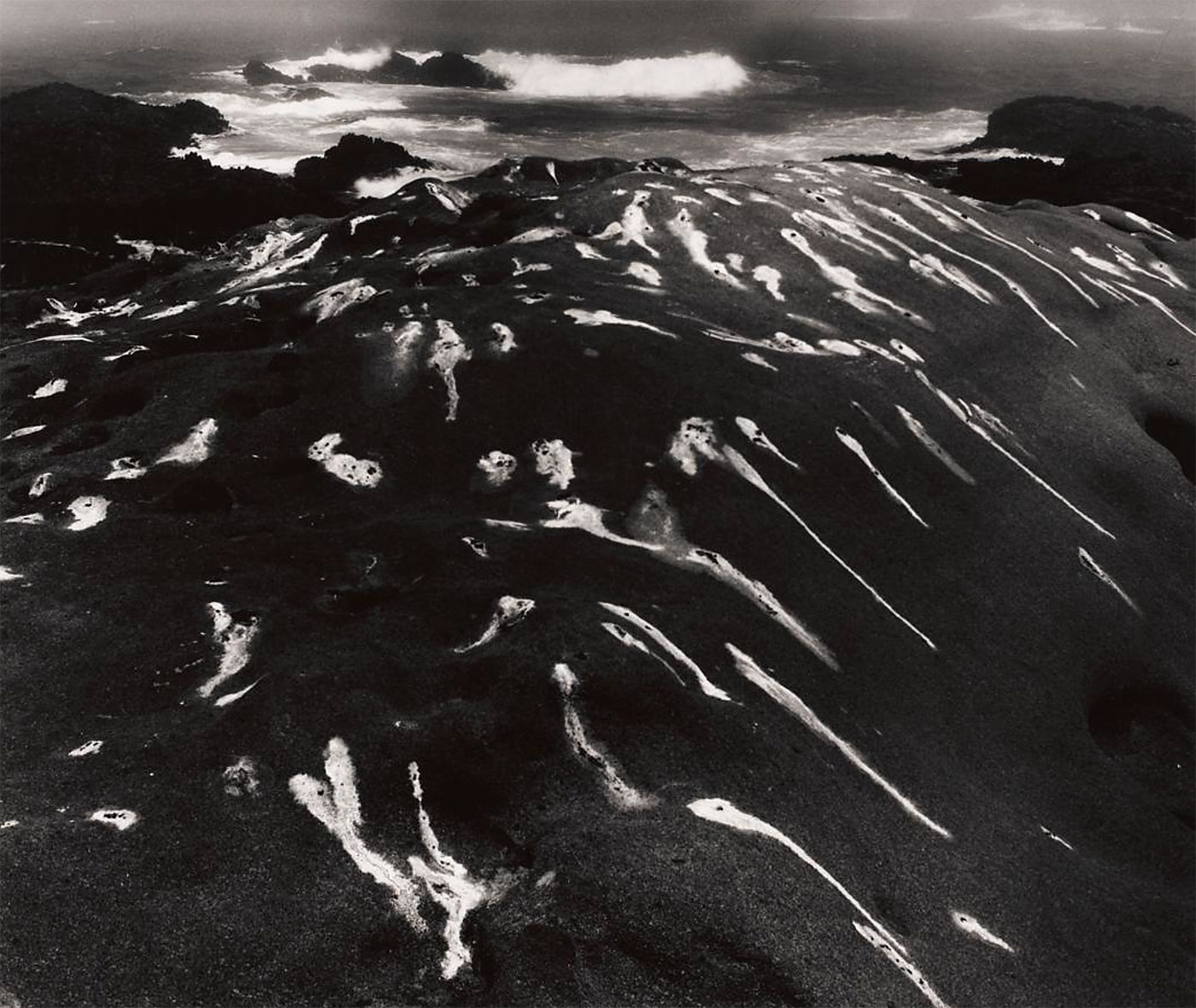
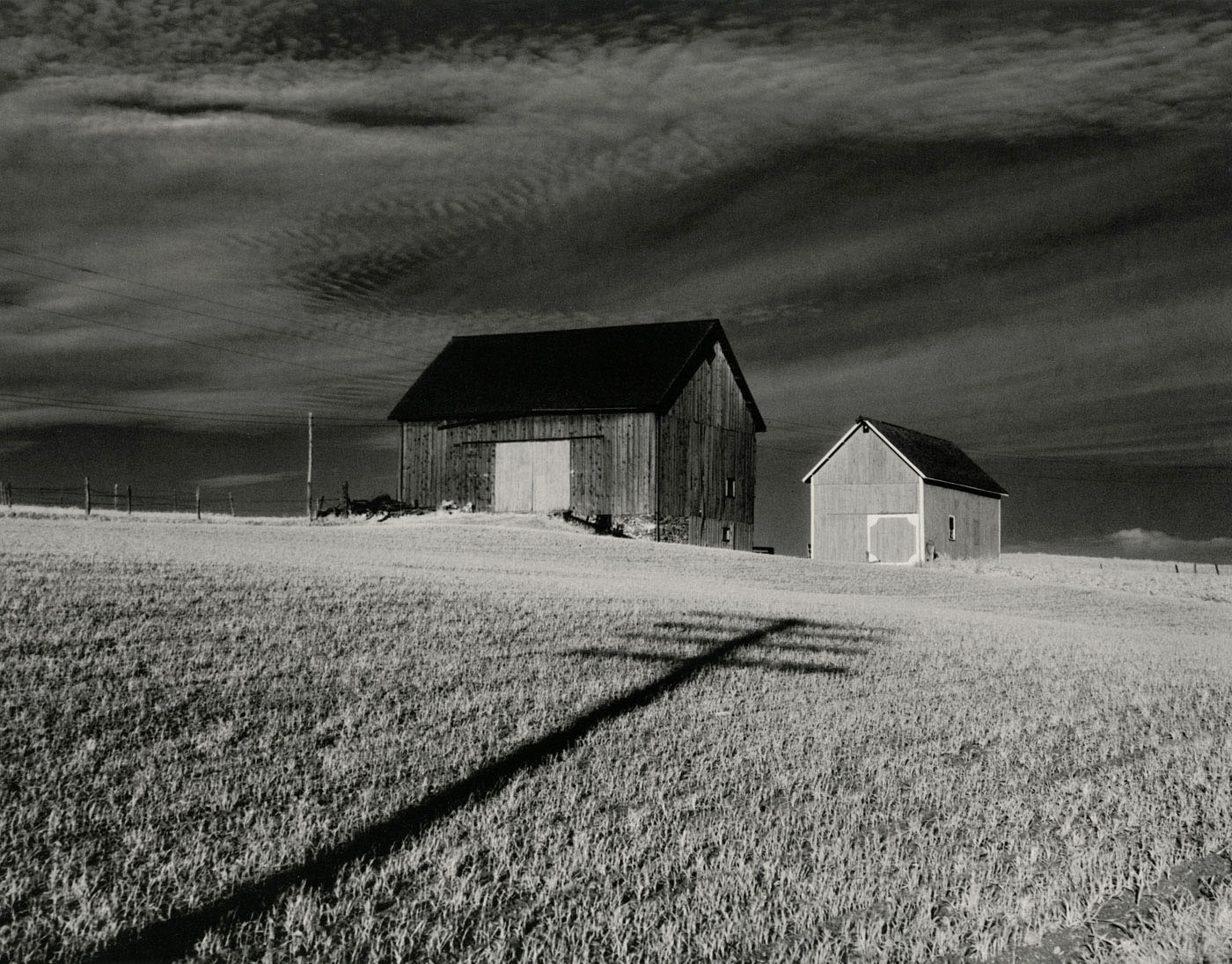
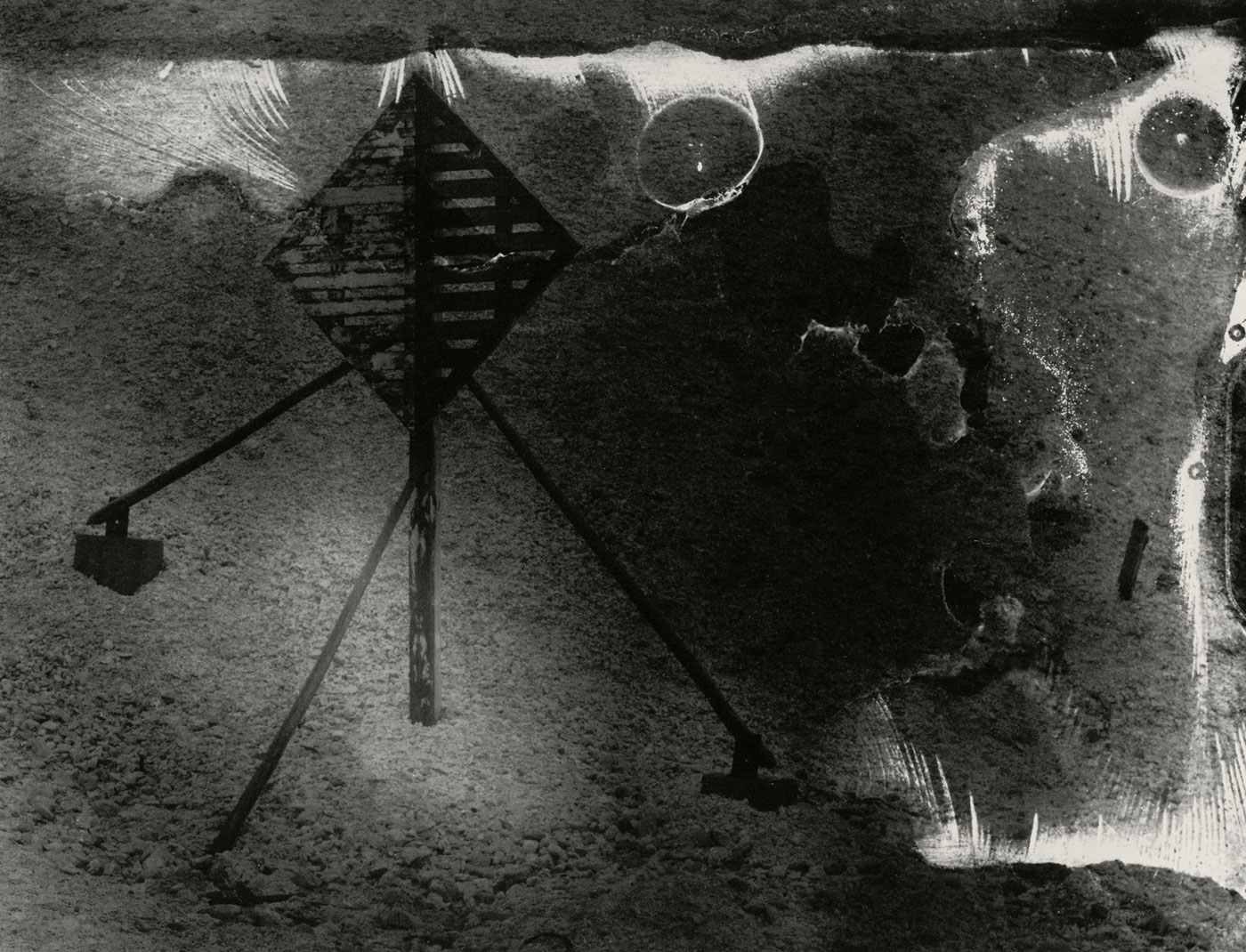
In the sequence we have the line of light over the sea in the first image, Devil’s Slide, San Mateo County, California (1947), which is then picked up in the line of the upper thigh and buttock in the second image Nude Foot, San Francisco (1947) with its gorgeous sensuality. Again, that line is illuminated in the third image Columbus Avenue, San Francisco (1949) by the white above the sandblaster’s head, while the heart shape arrow points back to the buttock in the previous image, perhaps subconsciously referencing White’s homosexuality. The white lettering of this image is then intensified, expanded and abstracted in the next image, Birdlime and Surf, Point Lobos, California (1951), these markings then flowing through into the lines of the telegraph pole in the infra red photograph of two barns Vicinity of Danville, New York (1955).

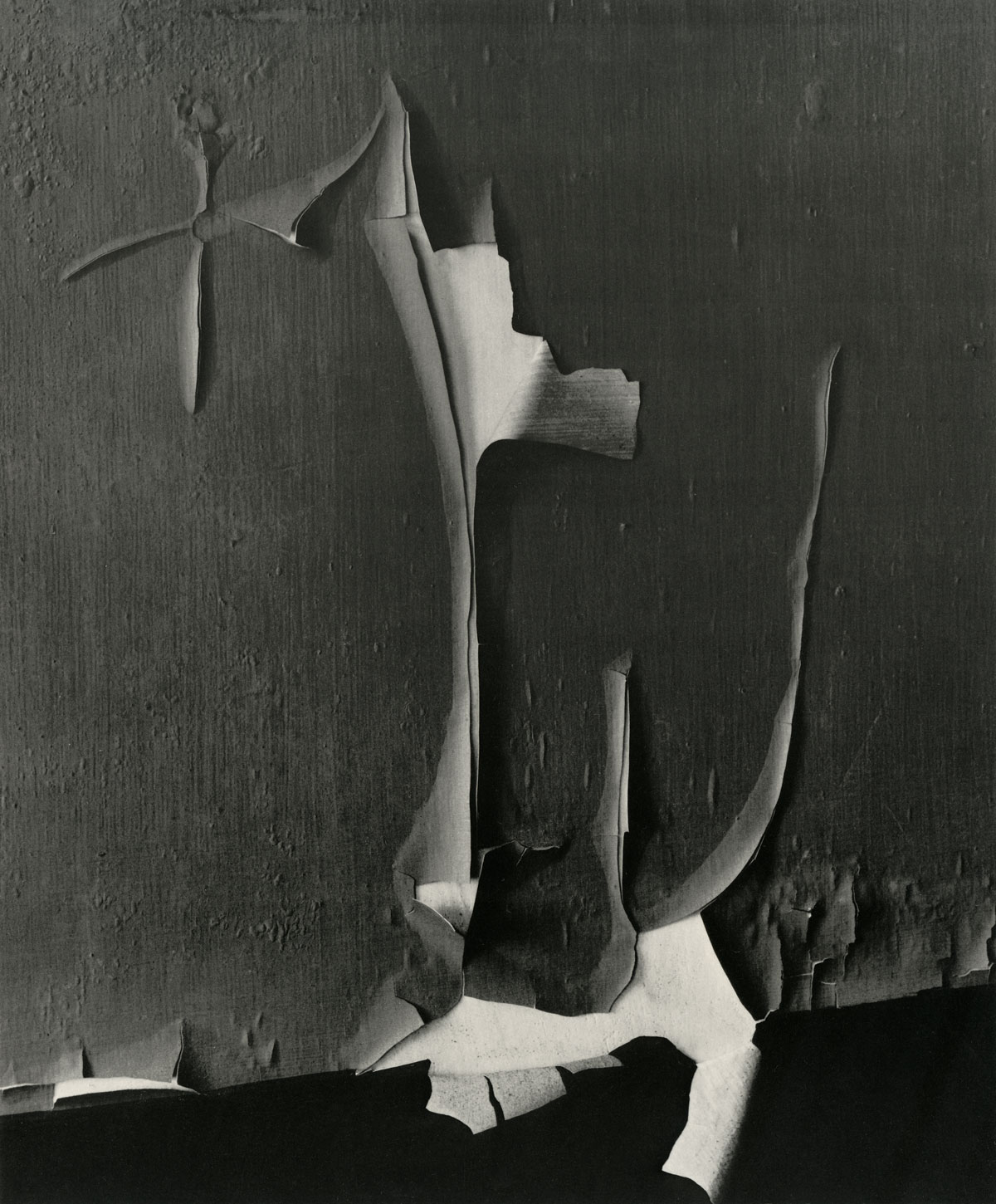
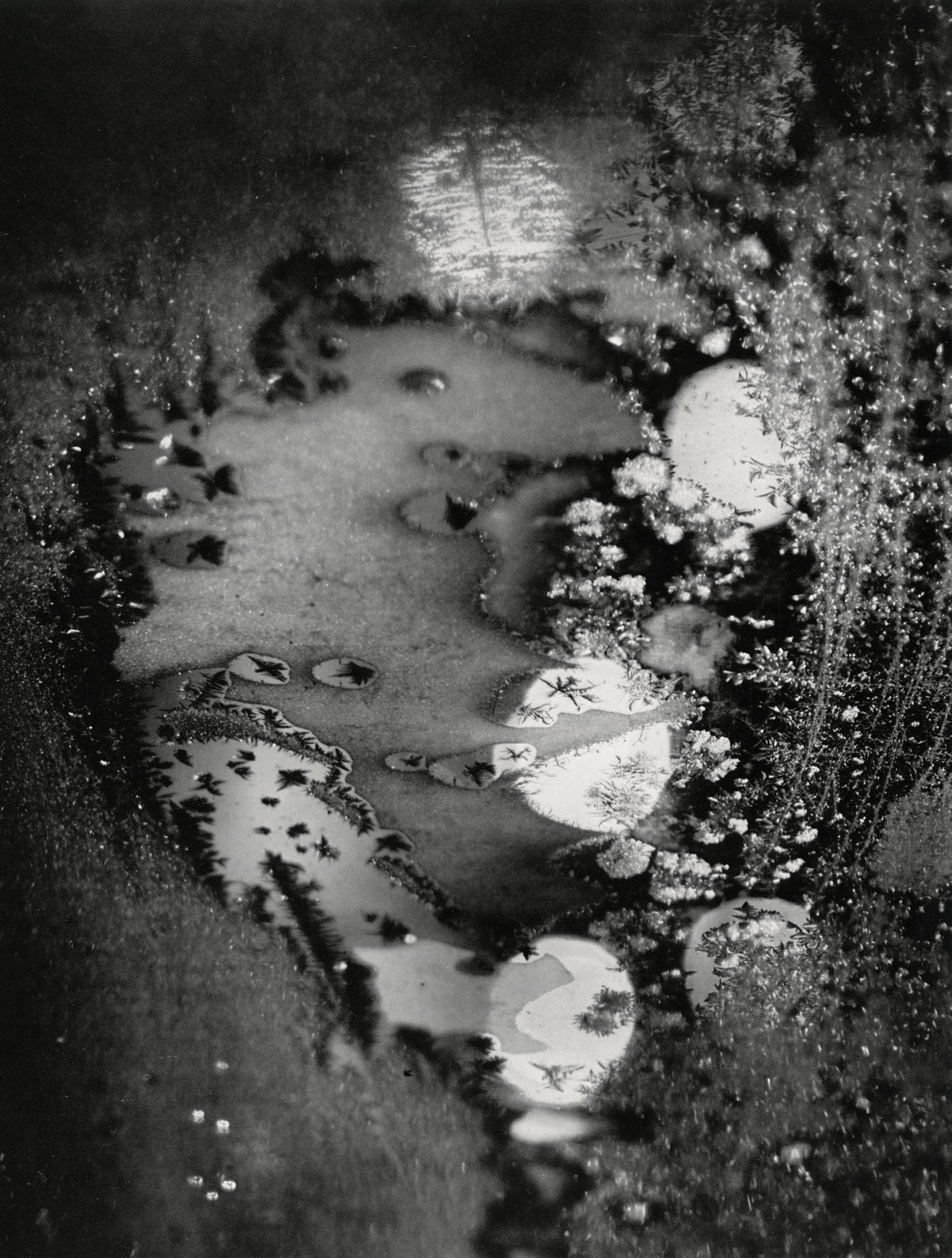
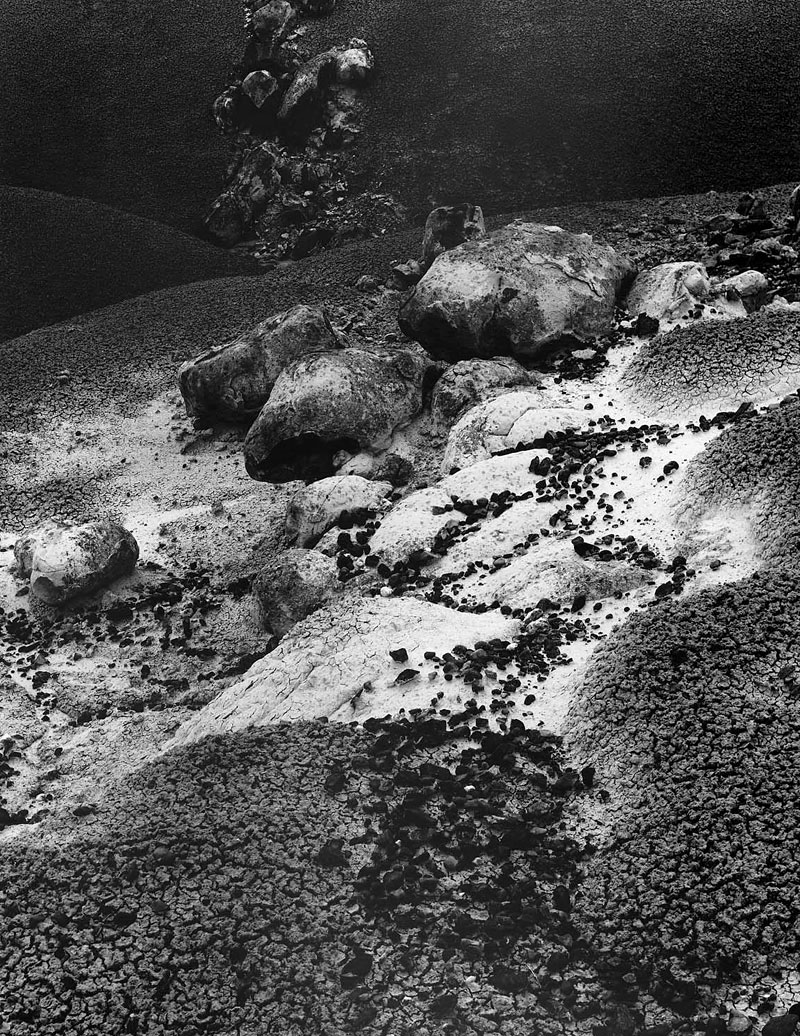
Transposing down a pitch, MW then turns these lines from the horizontal plane to the vertical and they descend softly into the swirling cosmos of Windowsill Daydreaming, Rochester, New York (1958), one of my favourite photographs by the artist for its indeterminate, morphic “air.” These striations and nodules of presence are then repeated in varying forms through the next four images – through peeling paint, ice crystals, rock and the darkly printed ivy and wood. These photographs move you through the elements, like a piece of music. The markings on wood in Ivy, Portland, Oregon (1964) are then echoed in the marker in the photograph Cape Breton, Nova Scotia (1970), to be finally stretched and elongated vertically in the sublime Vermont (1971).

Just imagine holding this composition, this music (“visual literacy”) in your head for nigh on 28 years before you sequenced these images, before you had them all together and you knew what you needed to say… as a human being and as an artist.

** The time between does indeed reference White’s belief that the space between the images is as important as the image itself, but it is also the ability of the images to speak to images further down the line (and time) of the sequence, and further down the line of the imagination. How seeds planted earlier in the sequence can reappear as puncture, prick, punctum, spirit, revelation even, the closer we come in meditation and a sense of quietness to the photographs. This is the joy of the art of Minor White.

To finish let me say a couple of things. As far as I can ascertain, this is about the only complete sequence of his online. It is such a pity that so great an artist, who taught photography as art to the world (and was my absolute hero when I started studying photography in 1991), should not have his work available to be seen as it should be seen, in a sequence. Free for everyone to see around the world, to study and to understand what he was trying to say with his revelatory art.

I am so over museums trying to protect what they have, instead of spreading the love and the understanding of the art. They are custodians of the art NOT the owners. Some of them should remember that…

Dr Marcus Bunyan

PS. Minor White was always the person I most looked up to when I started photography as I tried to photograph in meditation, forming a link between myself, the object back through the camera to the film, hoping for some form of revelation in the negative and the subsequent print. MW, Paul Strand and Eugene Atget, with a bit of Stieglitz and Aaron Siskind thrown in for good measure, where my guiding stars.


Please click on the photographs for a larger version of the image.


“Photographs side by side cannot help being mutually affected. Transpose them, the meaning changes.”


Minor White, 1976


Minor White (American, 1908–1976) 'Jupiter Portfolio' 1975 Portfolio of 12 gelatin silver prints


Minor White (American, 1908-1976)
Jupiter Portfolio
1975
Portfolio of 12 gelatin silver prints


The Museum of Photographic Arts (MOPA) presents an original exhibition dedicated to the work and legacy of American photographer Minor White (1908-1976) in The Time Between: The Sequences of Minor White.

The exhibition is the first major museum examination solely focusing on White’s sequences, a unique style of presentation he refined throughout his career. As a poet, writer, educator, curator and photographer, White believed in the power of images to be transformed when positioned sequentially, creating a new whole and a new level of interpretation, said MOPA Executive Director Deborah Klochko.

“One the most important American photographers of the 20th century, White’s work is still vital and important 40 years after his death,” Klochko said. “The title of the exhibition, The Time Between, references White’s belief that the space between the images is as important as the image itself.”

Many of the images in The Time Between are considered to be White’s most iconic. The exhibition features two bound albums, three digital sequences and eight print sequences presented together for the first time as White intended. White promoted the idea of “visual literacy,” which teaches the reading of images, similar to how his sequences encourage viewers to see the images in a larger context.

Press release from MOPA


Grouping photographs was Minor White’s preferred mode of presentation, and the sequence, of all his arrangements, was his most sophisticated form of pictorial expression.

Initially the sequence was an outgrowth of White’s work in poetry. However, in the realm of photographic art, perhaps his most important inspiration was the sequences of Alfred Stieglitz begun in the 1920s. Stieglitz taught that no all photographs need function as individual or summational works, but that certain images in a structured context could serve in support of others and could create a total statement more complex and multifaceted than single works alone or loose assortments of related pictures.

In addition to the influence of Stieglitz’s sequences, White learned a great deal about laying out of photographs from Nancy Newhall at the Museum of Modern Art in New York in 1945-46. She had been influenced by Stieglitz’s work and by her conversations with him beginning in the late 1930s, and it was she who encouraged Minor White to meet Stieglitz.

While White was at the museum, Nancy Newhall was organising a retrospective of Edward Weston’s photographs. Her installation of this exhibition was a revelation to him. Nancy Newhall was gifted in her understanding of photographs and had a remarkable feeling for the dynamics of expression in pictorial art and an acute sensitivity for the photographer’s unique approach. Her interpretation of the iconographic elements contained in individual photographs was superb, and the way in which she could create a sympathetic ordering of such pictures was extraordinary.

Minor White’s sequences, highly structured groupings of pictures with similar formats, sometimes contain ten, twenty, or thirty photographs. They need to be studied in a state of concentration, or heightened awareness, and involve recognition of both the content and feeling, the intellectual and emotional aspects, of each image in relation to its adjacent images. However, one must read the images as an ensemble, in their cumulative assertion of a complex and inter-connected idea, to sense the import of the artist’s statement.

Describing the sequence as “a cinema of stills,” Minor White wrote, “The time between photographs is filled by the beholder, first of all from himself, then from what he can read in the implications of design, the suggestions springing from treatment, and any symbolism that might grow from within the work itself … The meaning appears in the mood they [the symbols] raise in the beholder; and the flow of the sequence eddies in the river of his associations as he passes from picture to picture.”

Reading White’s sequences depends on understanding both the symbolic and the descriptive capabilities of his photography…

“The Sequence,” from Bunnell, Peter. Minor White: The Eye That Shapes. The Art Museum, Princeton University, 1989, p. 231


Minor White (American, 1908–1976) 'Devil's Slide, San Mateo County, California' 1947


Minor White (American, 1908-1976)
Devil’s Slide, San Mateo County, California
1947
No. 1 from Jupiter Portfolio, sequenced 1975
Gelatin silver print
The Minor White Archive, Princeton University Art Museum, bequest of Minor White
© Trustees of Princeton University


Minor White (American, 1908–1976) 'Nude Foot, San Francisco' 1947


Minor White (American, 1908-1976)
Nude Foot, San Francisco
1947
No. 2 from Jupiter Portfolio, sequenced 1975
Gelatin silver print
The Minor White Archive, Princeton University Art Museum, bequest of Minor White
© Trustees of Princeton University


Minor White (American, 1908–1976) 'Columbus Avenue, San Francisco' 1949


Minor White (American, 1908-1976)
Columbus Avenue, San Francisco
1949
No. 3 from Jupiter Portfolio, sequenced 1975
Gelatin silver print
The Minor White Archive, Princeton University Art Museum, bequest of Minor White
© Trustees of Princeton University


Minor White (American, 1908–1976) 'Birdlime and Surf, Point Lobos, California' 1951


Minor White (American, 1908-1976)
Birdlime and Surf, Point Lobos, California
1951
No. 4 from Jupiter Portfolio, sequenced 1975
Gelatin silver print
The Minor White Archive, Princeton University Art Museum, bequest of Minor White
© Trustees of Princeton University


Minor White (American, 1908–1976) 'Vicinity of Danville, New York' 1955


Minor White (American, 1908-1976)
Vicinity of Danville, New York
1955
No. 5 from Jupiter Portfolio, sequenced 1975
Gelatin silver print
The Minor White Archive, Princeton University Art Museum, bequest of Minor White
© Trustees of Princeton University


Minor White (American, 1908–1976) 'Windowsill Daydreaming, Rochester, New York' 1958


Minor White (American, 1908-1976)
Windowsill Daydreaming, Rochester, New York
1958
No. 6 from Jupiter Portfolio, sequenced 1975
Gelatin silver print
The Minor White Archive, Princeton University Art Museum, bequest of Minor White
© Trustees of Princeton University


Minor White (American, 1908–1976) 'Rochester, New York' 1959


Minor White (American, 1908-1976)
Rochester, New York
1959
No. 7 from Jupiter Portfolio, sequenced 1975
Gelatin silver print
The Minor White Archive, Princeton University Art Museum, bequest of Minor White
© Trustees of Princeton University


Minor White (American, 1908–1976) 'Beginnings, Rochester, New York' 1962


Minor White (American, 1908-1976)
Beginnings, Rochester, New York
1962
No. 8 from Jupiter Portfolio, sequenced 1975
Gelatin silver print
The Minor White Archive, Princeton University Art Museum, bequest of Minor White
© Trustees of Princeton University


Minor White (American, 1908-1976) 'Notom, Utah' 1963


Minor White (American, 1908-1976)
Notom, Utah
1963
No. 9 from Jupiter Portfolio, sequenced 1975
Gelatin silver print
The Minor White Archive, Princeton University Art Museum, bequest of Minor White
© Trustees of Princeton University


Minor White (American, 1908-1976) 'Ivy, Portland, Oregon' 1964


Minor White (American, 1908-1976)
Ivy, Portland, Oregon
1964
No. 10 from Jupiter Portfolio, sequenced 1975
Gelatin silver print
The Minor White Archive, Princeton University Art Museum, bequest of Minor White
© Trustees of Princeton University


Minor White (American, 1908–1976) 'Cape Breton, Nova Scotia' 1970


Minor White (American, 1908-1976)
Cape Breton, Nova Scotia
1970
No. 11 from Jupiter Portfolio, sequenced 1975
Gelatin silver print
The Minor White Archive, Princeton University Art Museum, bequest of Minor White
© Trustees of Princeton University


Minor White (American, 1908-1976) 'Vermont' 1971


Minor White (American, 1908-1976)
Vermont
1971
No. 12 from Jupiter Portfolio, sequenced 1975
Gelatin silver print
The Minor White Archive, Princeton University Art Museum, bequest of Minor White
© Trustees of Princeton University


Museum of Photographic Arts
1649 El Prado
San Diego, CA 92101
Phone: 619.238.7559

Opening hours:
Thursday – Sunday: 11.00 am – 4.00 pm

MOPA website

LIKE ART BLART ON FACEBOOK

Back to top

Exhibition: ‘Polixeni Papapetrou: The Dreamkeepers’ at Stills Gallery, Sydney

Exhibition dates: 28th March – 5th May 2012


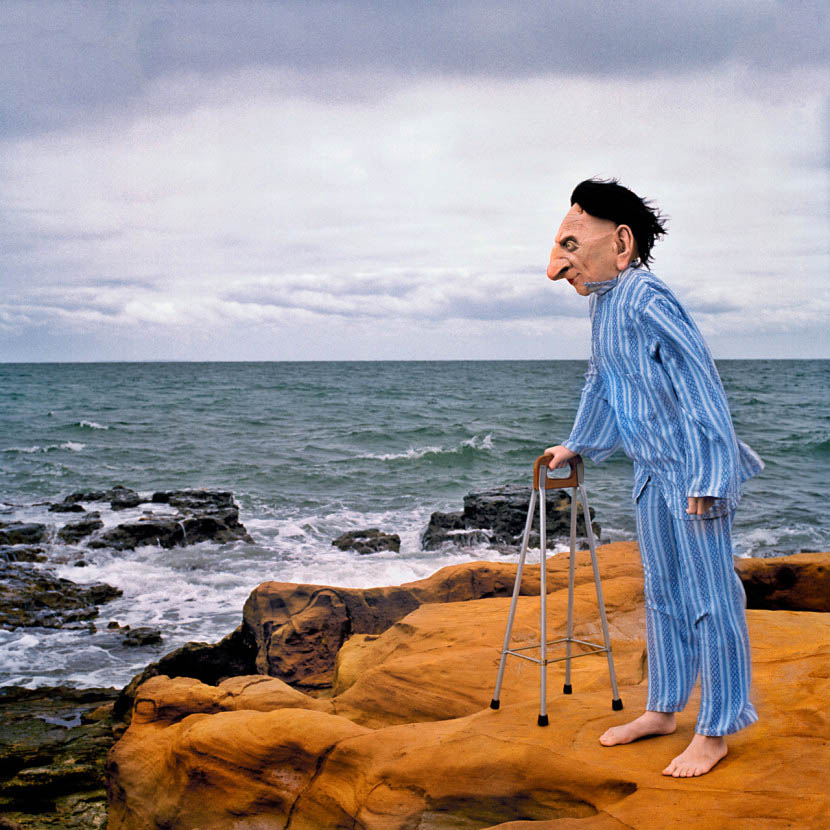
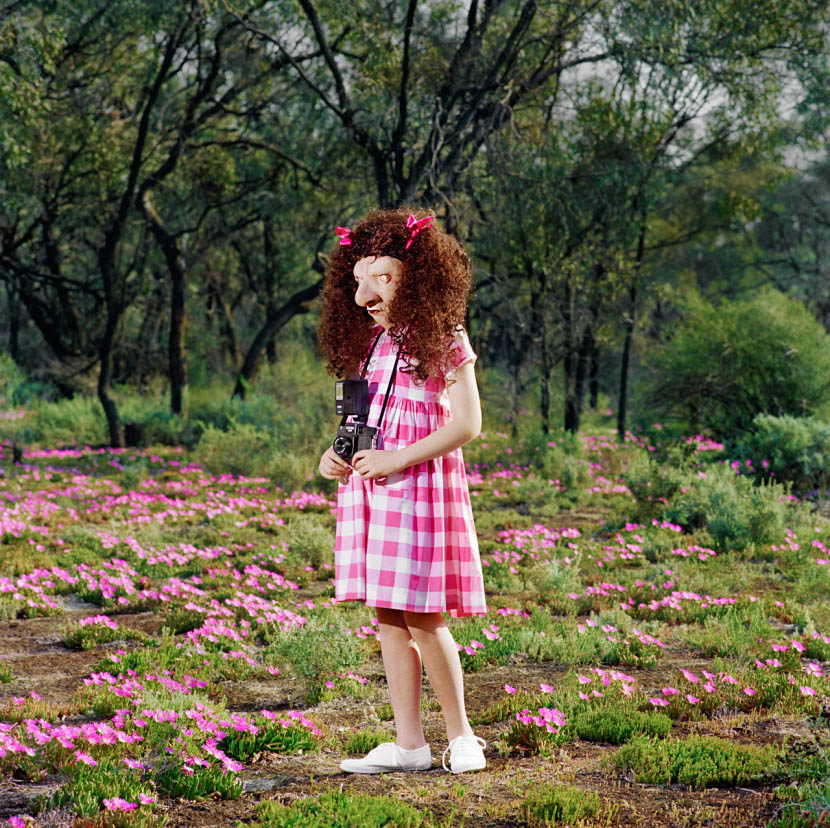
Polixeni Papapetrou (Australian, 1960-2018) 'The Wanderer No. 3' 2012


Polixeni Papapetrou (Australian, 1960-2018)
The Wanderer No. 3
2012
From The Dreamkeepers
Pigment print
105 x 105cm


I absolutely love these. The colours, the spaces, the ambiguous vistas, the fantastical archetypes, the fables. What springs to mind, with the use of masks to disguise youth positioned within the decorous landscape, is the notion of “passing”. Passing on (as in dying), passing through (as in travelling), in passing (as in an aside) and just “passing” (passing yourself off as someone or something else) to hide your true character or feelings. Gay men did this in the 1950s and 60s all the better to fit into society, for if it was found that you were homosexual you could loose your job, your apartment and even your life. Of course, there is also the passing of time, the longing for misspent youth in these masked ephebes and adolescent women. Age shall not weary them…

Wandering, dreaming, remembering, keeping, collecting, counting. These neophytes on the path of life, both old/wise, young/hidden pass through (into?) our dreams. Papapetrou creates visions that elude the senses, visions that slip between dreaming and waking, between conscious and subconscious realms. As John Berger and Jean Mohr have observed,

“Cameras are boxes for transporting appearances. Are the appearances which a camera transports a construction, a man-made cultural artefact, or are they, like a footprint in the sand, a trace naturally left by something that has passed? The photographer choses the events he photographs. This choice can be thought of as a cultural construction. The space for this construction is, as it were, cleared by his rejection of what he did not choose to photograph.”1

As an artist Papapetrou has the intelligence to leave this nature/nurture question open in her photographs. Her skill as an artist is in choosing the right things to photograph. This enables her creatures to pass through liminal spaces, the space of our consciousness. Through this process a trace will always be left with us, for this is a strong body of work, well realised, in passing.

Dr Marcus Bunyan


1/ Berger, John and Mohr, Jean. Another Way of Telling. New York: Pantheon Books, 1982, pp. 92-93.


Many thankx to Stills Gallery for allowing me to publish the photographs in the posting. Please click on the photographs for a larger version of the image.


Polixeni Papapetrou (Australian, 1960-2018) 'The Wave Counter' 2011


Polixeni Papapetrou (Australian, 1960-2018)
The Wave Counter
2011
From The Dreamkeepers
Pigment print
105 x 105cm


Polixeni Papapetrou (Australian, 1960-2018) 'The Mystical Mothers' 2011


Polixeni Papapetrou (Australian, 1960-2018)
The Mystical Mothers
2011
From The Dreamkeepers
Pigment print
105 x 105cm


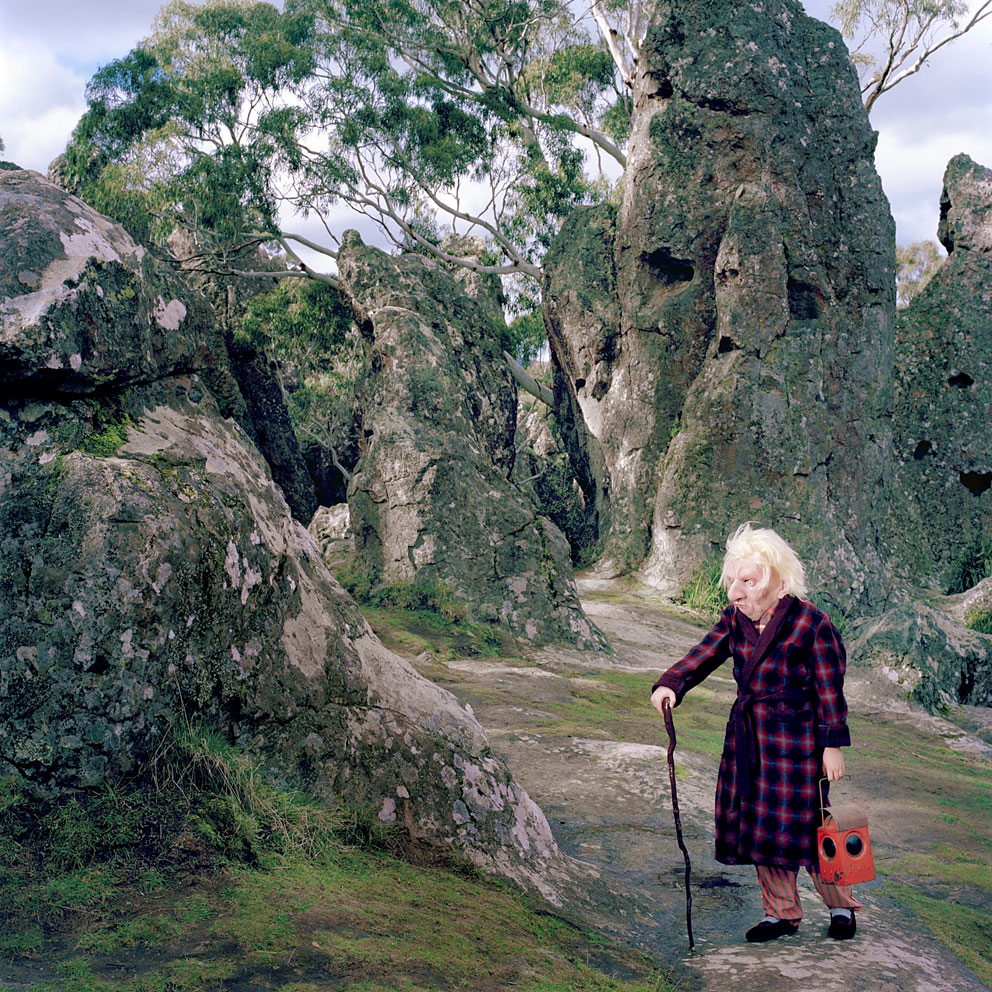
Polixeni Papapetrou (Australian, 1960-2018) 'The Lantern Keeper' 2012


Polixeni Papapetrou (Australian, 1960-2018)
The Lantern Keeper
2012
From The Dreamkeepers
Pigment print
105 x 105cm


“These transitional places in one’s life are often the most creative, and as we grapple for answers and clarity what is often realized is ambiguity and confusion that reigns supreme. Like fairy stories, Papapetrou uses absurdity to make symbolic sense of world she struggles to understand.”


Susan Bright. Between Worlds catalogue 2009


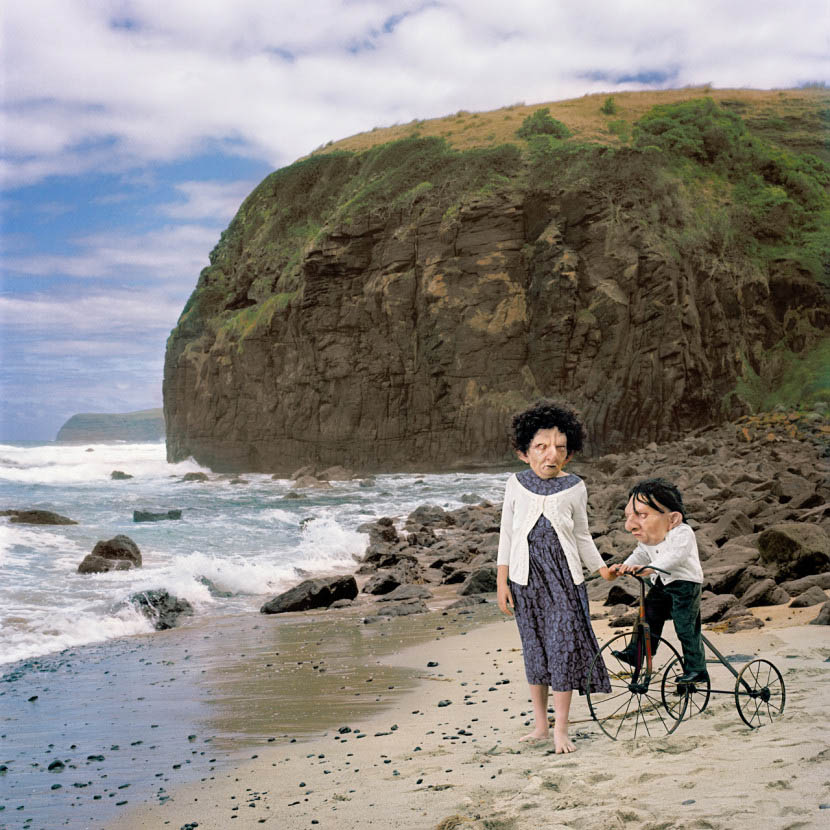
In Polixeni Papapetrou’s work there is identification with the world of children that is rare and remarkable. She sees children themselves as ‘between worlds’, between infancy and adulthood. Yet she does more than identify, creating fantastical worlds that only adults can truly understand and relate to.

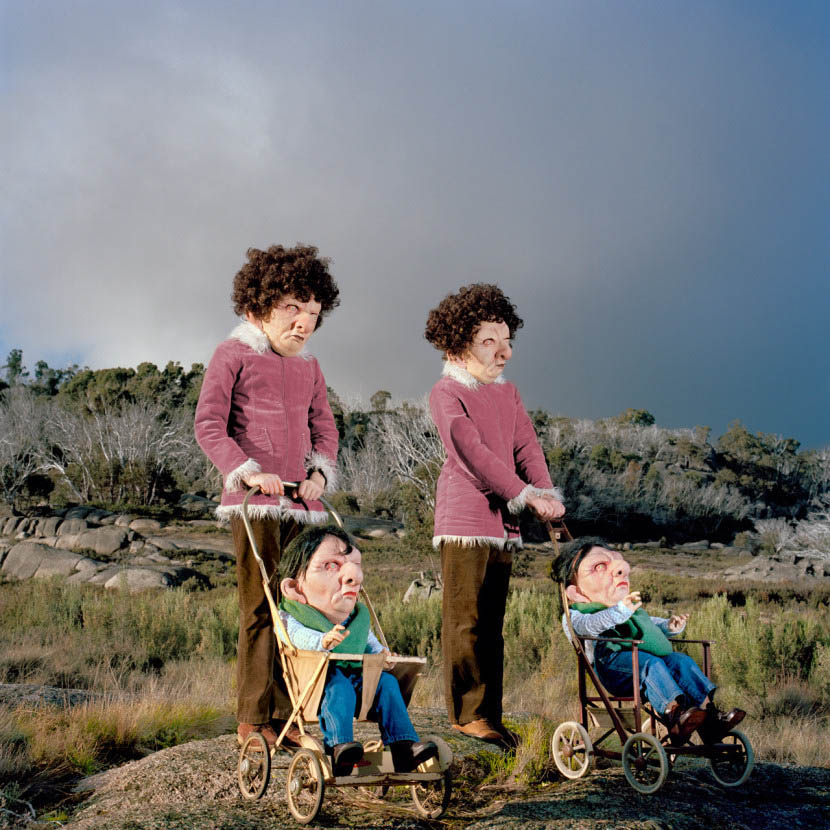
A man in blue striped pyjamas stands on a rock by the sea, leaning into the wind. His body seems young yet he supports himself with a walking frame. His face is old, oversized, a little grotesque. He is The Wavecounter. Like the other characters in Polixeni Papapetrou’s series The Dreamkeepers, he is lithe in body yet gnarly of physiognomy, both young and old. Gazing out in contemplation these dream keepers look with anticipation to the future, or is it with nostalgia to the past? The timeless backdrops of shoreline or hilltop reflect this ambiguity, echoing through landscape the collapsing of thresholds and blurring of boundaries.

Papapetrou’s art practice has involved collaboration with her children and their friends for over 10 years. As they have grown and transformed so too have the roles they perform and spaces they inhabit. It is the awkward evolution of adolescence that informs the in-between space of The Dreamkeepers. To parallel the cripplingly self-conscious yet powerfully self-realising period of our lives, Papapetrou engages part reality, part fantasy from which a space of unreality emerges, the space of archetype. Here the anonymity afforded by masks separates her adolescent actors from who they really are, and allows them to stand in for us all. In this way, Papapetrou asks us to consider how masks, whether symbolic or literal, not only conceal identity, but also expand and transform it.

The aged masks do so in The Dreamkeepers by confounding adolescence, as the characters exude a quiet lack of self-consciousness, despite their disturbing appearance. They arouse a gentle pathos, reminding us of our own shapeshifting, of time playing out on our bodies and minds. The abstract meeting of these two ages may indicate the latent wisdom and self-acceptance that only realises with maturity, or the cyclical nature of our life spans that inevitably brings us back to the vulnerability of youth. In either case the work is a powerful testament to the surrendering of childhood.

Also on exhibition is a small selection of works from Papapetrou’s current work in progress. Using ghillie suits, she transforms her actors into animate objects – rocks with life and seaweed with attitude.

Press release from the Stills Gallery website


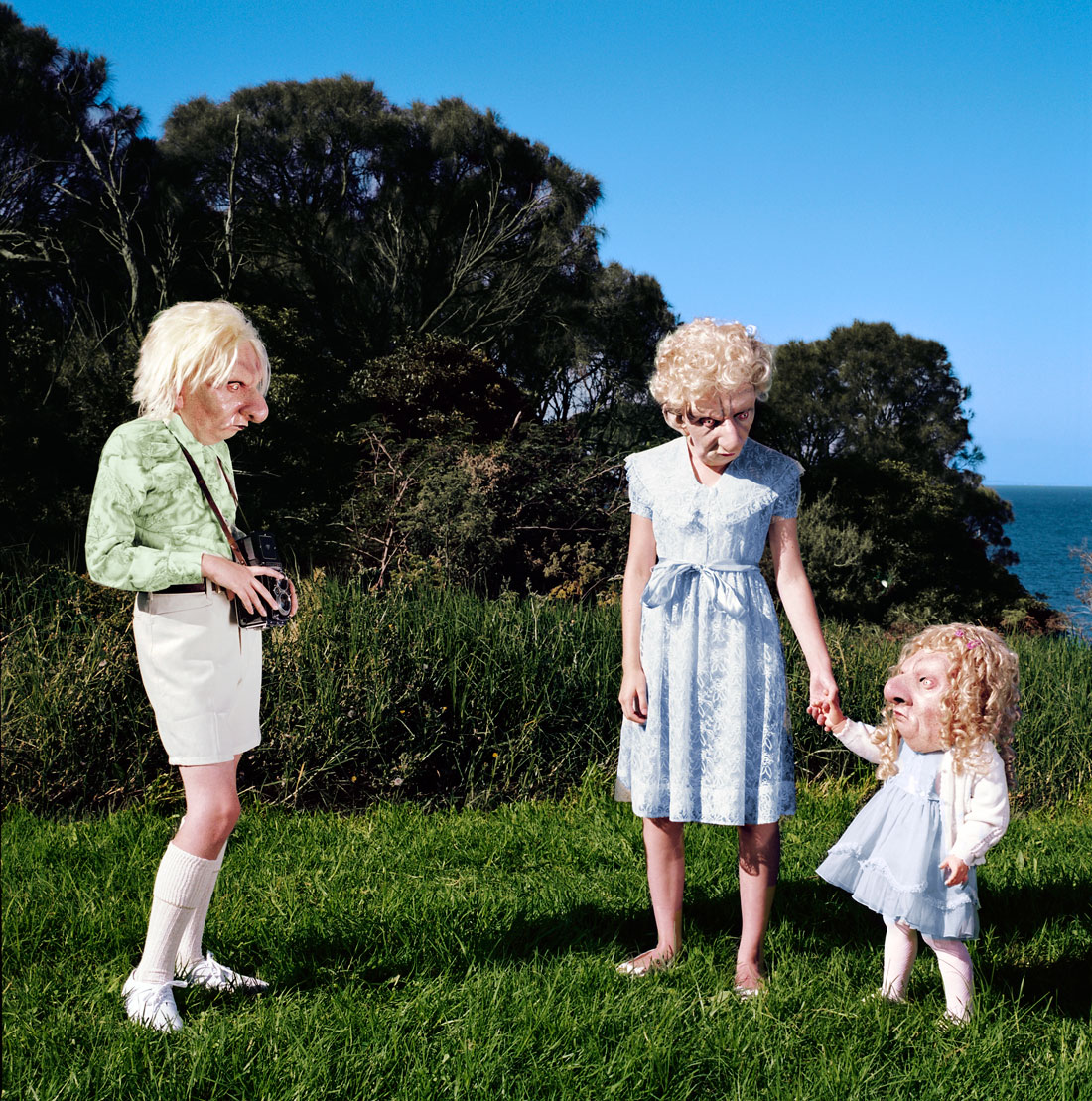
Polixeni Papapetrou (Australian, 1960-2018) 'The Holiday Makers' 2011


Polixeni Papapetrou (Australian, 1960-2018)
The Holiday Makers
2011
From The Dreamkeepers
Pigment print
105 x 105cm


Polixeni Papapetrou (Australian, 1960-2018) 'The Mender' 2011


Polixeni Papapetrou (Australian, 1960-2018)
The Mender
2011
From The Dreamkeepers
Pigment print
105 x 105cm


Polixeni Papapetrou (Australian, 1960-2018) 'The Joy Pedlars' 2011


Polixeni Papapetrou (Australian, 1960-2018)
The Joy Pedlars
2011
From The Dreamkeepers
Pigment print
105 x 105cm


Polixeni Papapetrou (Australian, 1960-2018) 'The Shell Collectors' 2012


Polixeni Papapetrou (Australian, 1960-2018)
The Shell Collectors
2012
From The Dreamkeepers
Pigment print
105 x 105cm


Polixeni Papapetrou (Australian, 1960-2018) 'The Lighthouse Keepers' 2011


Polixeni Papapetrou (Australian, 1960-2018)
The Lighthouse Keepers
2011
From The Dreamkeepers
Pigment print
105 x 105cm


Polixeni Papapetrou (Australian, 1960-2018) 'The Photographer' 2011


Polixeni Papapetrou (Australian, 1960-2018)
The Photographer
2011
From The Dreamkeepers
Pigment print
105 x 105cm


Stills Gallery

This gallery has now closed.

Stills Gallery website

LIKE ART BLART ON FACEBOOK

Back to top

Review: ‘Guo Jian paintings’ at Arc One Gallery, Melbourne

Exhibition dates: 30th June – 25th July, 2009


Guo Jian (Chinese-Australian, b. 1962) 'No.c' 2009


Guo Jian (Chinese-Australian, b. 1962)
No.c
2009
Acrylic on canvas
152 x 213cm


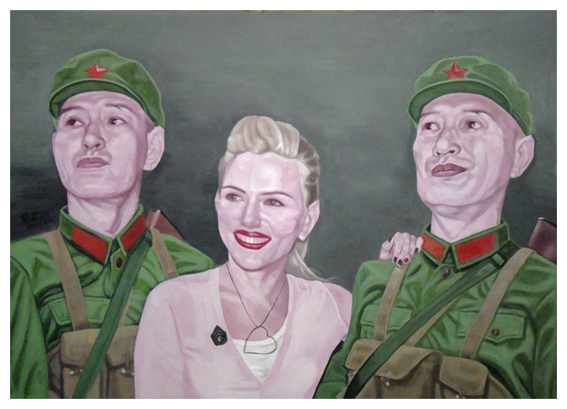
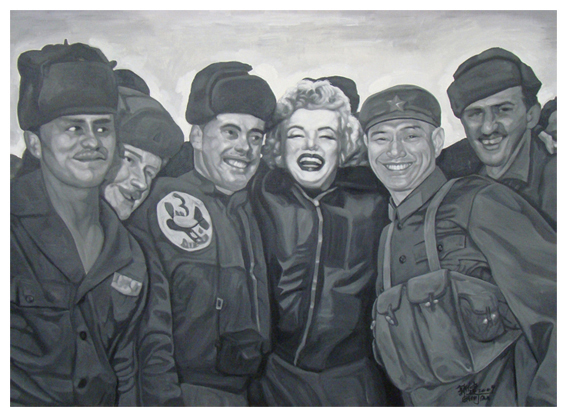
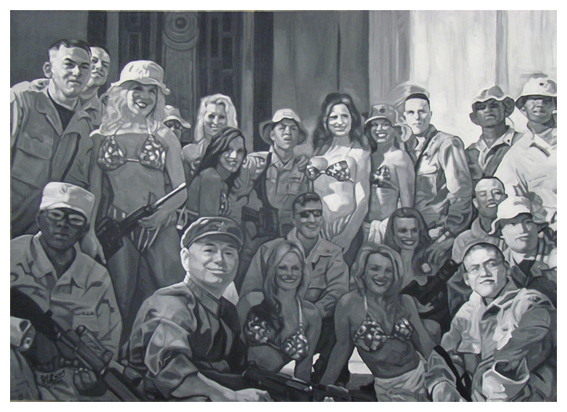
This exhibition of eight new paintings and one older work by Chinese artist Guo Jian presented at Arc One Gallery in Melbourne is, with the exception of one outstanding painting, a disappointment. The new work addresses, variously, themes of consumerism, stardom, sex appeal, the military and Chinese culture. Using old photographs as reference and inserting the body and face of the artist into the canvases, Jian examines the paradoxes that exist between Western / American and Chinese culture to limited effect.

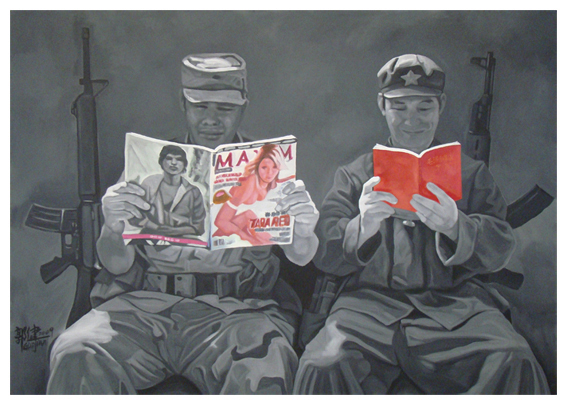
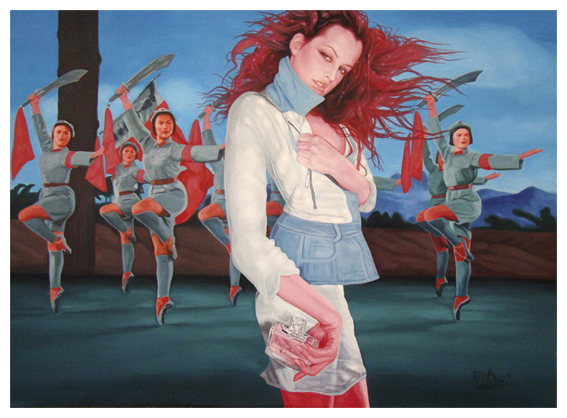
Using a restricted colour palette in each painting Jian’s ‘mise en scène’ places American soldiers and babes wearing bikinis of distorted American flags with the artist as lone Chinese soldier – his face pulled into focus while the other figures almost become cut-outs with the overlay of a “blur filter” softening their features. In another set piece Untitled 3 (2009) a seductive woman with flaming red hair and half open jacket holds a bottle of Chloe perfume in her hand while behind Chinese female military dancers brandish swords and red flags. In No.g (2009) two soldiers with guns propped behind them read contrasting books – one the ‘Little Red Book’ and the other ‘A Big Naughty Girly Magazine’. Marilyn and Madonna feature heavily, pastiches in a built environment – all pink and fleshy with a silver heart (perhaps it should have been a Purple Heart).

The iconography in these staged ‘tableaux vivants’ is a one shot idea repeated in all eight paintings. The themes seem hackneyed, their language a bricolage of ironic archetypes that don’t have anything new to say about the subject matter but repeat things we know already: vis a vis that Chinese society is struggling to cope with the burden of becoming a consumer culture. On reflection, the new paintings have not impinged on my consciousness – always a sign whether the work really has made a connection. However, the single work from 2003 is a different beast.

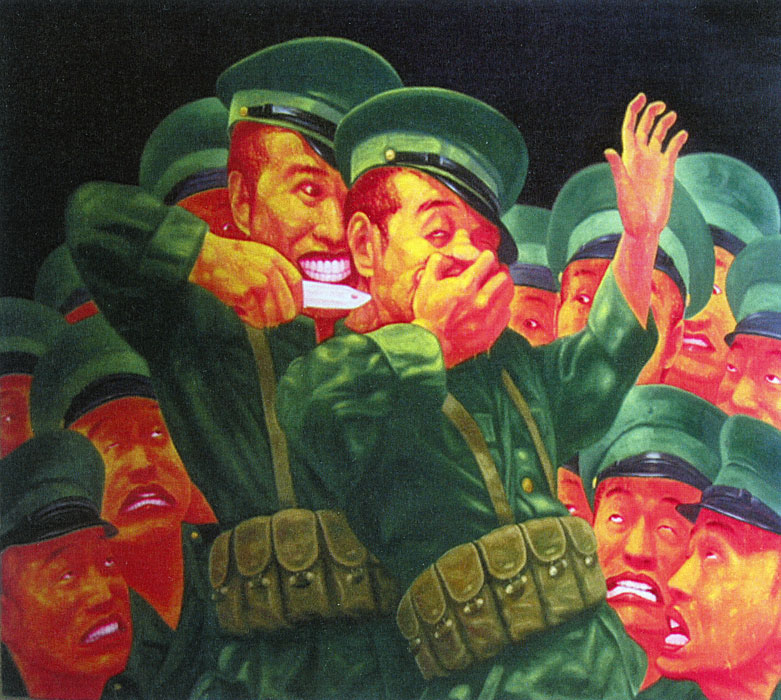
The Training from the series The Day Before I Went Away (2003) is a hypnotic, mesmerising and powerful work, lurid even, with it’s hyper-real colours and maniacal faces, eyes rolling in the back of heads, barring of teeth, the hand over the mouth, the upraised hand, the glistening white of the blade – oh the lust for blood!

This painting is so evocative it shames the new work by comparison – you think about this work, you remember it!

Here is the passion and insightfulness of the artist. Danger and terror grab you and shake you and force you to think about the human condition. This is what I want art to do in whatever way it can – subtly, quietly, psychologically, forcefully. Great art challenges us to look, feel and think. Unfortunately the new work, while clever on a superficial level, fails to deliver.

Dr Marcus Bunyan


Many thankx to the Arc One Gallery for allowing me to publish the art work in the posting.


Guo Jian (Chinese-Australian, b. 1962) 'No.d' 2009


Guo Jian (Chinese-Australian, b. 1962)
No.d
2009
Acrylic on canvas
152 x 213cm


“This series is about looking at the persuasion or morale boosting efforts for soldiers from another perspective. I considered how starlets and celebrities are deployed in the West – often not dissimilarly to the way Chinese Entertainment Soldiers are used to influence and motivate in my part of the world.” ~ Guo Jian


Guo Jian (Chinese-Australian, b. 1962) 'No.f' 2009


Guo Jian (Chinese-Australian, b. 1962)
No.f
2009
Acrylic on canvas
152 x 213cm


Guo Jian (Chinese-Australian, b. 1962) 'No.g' 2009


Guo Jian (Chinese-Australian, b. 1962)
No.g
2009
Acrylic on canvas
152 x 213cm


Guo Jian (Chinese-Australian, b. 1962) 'Untitled 3' 2009


Guo Jian (Chinese-Australian, b. 1962)
Untitled 3
2009
Acrylic on canvas
152 x 213cm


Born in China in 1963, Jian was raised in a controlled political environment. He served over three years in the Peoples Liberation Army and bore witness to the horrific Tiananmen Square massacre in 1989, where he assisted carrying the wounded to the hospital.

Jian’s personal atlas of history continues to feed his visual commentary. His voice is both satirical and erotic, challenging and confronting. He plays with irony and foreplay to exploit and raise potent questions surrounding propaganda and manipulation.

“As I have grown older, I have realised that all of the education I have received is rarely practical in real life. Reality and education are conflicting. The way in which you inherently view the world is influenced by education which is the perspectives of others. Our surrounding environment defines our perception of ‘right’ and ‘wrong’, ‘enemy’ and ‘friend’, ‘them’ and ‘us’. But, if you dare to open your eyes and liberate your mind, you will find that the world is not exactly the way you have been told. Put your feet into someone else’s shoes to think about the world and your own life differently. For me, if the surroundings change, are combined, are old or new, it doesn’t matter. My life is defined relative to my self-experience and the things I have heard or seen. From this perspective, I have discovered the freedom to reopen my eyes to a new world and to new possibilities.”

Guo Jian

Text from the press release on the Arc One Gallery website [Online] Cited 10/07/2009. No longer available online


Guo Jian (Chinese-Australian, b. 1962) 'The Training' from the series 'Te Day Before I Went Away' 2003


Guo Jian (Chinese-Australian, b. 1962)
The Training from the series The Day Before I Went Away
2003


Arc One Gallery
45 Flindes Lane
Melbourne, Victoria 3000

Opening hours:
Wednesday – Saturday 11am – 5pm

Arc One Gallery website

LIKE ART BLART ON FACEBOOK

Back to top

Exhibition: ‘Gay Icons’ at the National Portrait Gallery, London

Exhibition dates: 2nd July – 18th October 2009


Jill Furmanovsky (British, b. 1953) 'K.D. Lang, Le Meridien Hotel, London' 1992


Jill Furmanovsky (British, b. 1953)
K.D. Lang, Le Meridien Hotel, London
1992
Gelatin silver print
© Jill Furmanovsky


“How I wish this selection had been available to me when I was young and trying to make sense of my reactions to the world. How inspirational to have had portraits of the great and the good staring out at me telling me that I was not by any measure on my own.”

“… it is her [K.D. Lang’s] androgynous good looks and tendency to strut on the stage which warms many lesbian hearts.”

~ Sandi Toksvig


Many thankx to the National Portrait Gallery for allowing me to publish the photographs in the posting. Please click on the photographs for a larger version of the image.


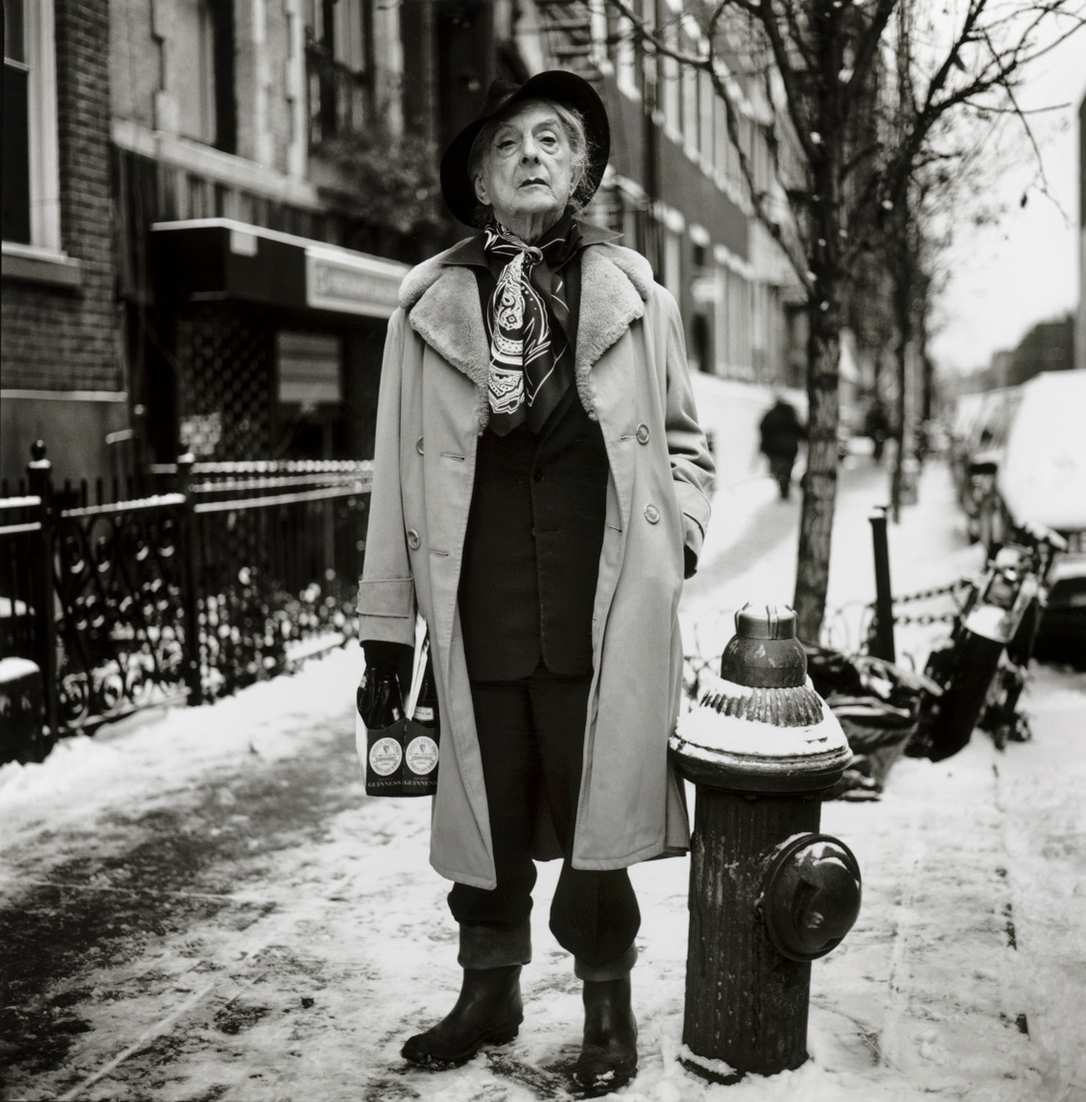
Fergus Greer (English, b. 1961) 'Quentin Crisp' 1989


Fergus Greer (English, b. 1961)
Quentin Crisp
1989
Bromide fibre print
10 1/2 in. x 10 3/8 in. (267 mm x 264 mm)
Given by Fergus Greer, 2006
© National Portrait Gallery, London
© Fergus Greer


The first portrait exhibition to celebrate the contribution of gay people and gay icons to history and culture. 60 photographs selected by Waheed Alli, Alan Hollinghurst, Elton John, Jackie Kay, Billie Jean King, Ian McKellen, Chris Smith, Ben Summerskill, Sandi Toksvig and Sarah Waters.

An important photography exhibition, Gay Icons, at the National Portrait Gallery (2 July – 18 October 2009) will celebrate the contribution of gay people – and the significance of the gay icon – to history and culture. Ten selectors have worked with the Gallery to make their own personal choices of six individuals, their ‘icons’. Not only does this exhibition include many well-known icons, who may or may not be gay themselves, it also reveals some surprises and will encourage a wide audience to think about familiar faces in new ways.

The Gay Icons shown in the exhibition will include those people, living or dead, whatever their sexual orientation or interests, who the ten individual selectors regard as inspirational, or as a personal icon. Gay Icons brings together portraits of those people who are regarded as especially significant to each of the selectors, alongside those of the selectors themselves, all prominent gay figures in contemporary culture and society.

Coinciding with the fortieth anniversary of the Stonewall Riots in New York, this exhibition focuses on portraits of both historical and modern figures. The choices provide a fascinating range of inspiring figures – some very famous, some heroic, others relatively unknown. Each icon is presented with information about their personal, and sometimes public, significance, some of it relating to the sitter but much of it linked to the selectors who have been prepared to share their experiences and feelings in their own exhibition texts.

Themes running through the exhibition include inspiration and how the ‘icons’ have inspired each selector in an extremely personal sense to realise their full potential, human rights, stemming from the specific consideration of sexuality, and how this might lead us to consider parallels between the struggles of different minority groups, re-discovery, or rescuing the reputations of figures who might otherwise have been forgotten or, worse, actively disregarded and surprise at some of the perhaps unexpected choices.

The project was developed from an initial proposal made by Bernard Horrocks, Copyright Officer, at the Gallery. The concept quickly evolved to include invitations to ten gay people – each distinguished in different fields – to act as selectors. They were chosen in consultation with their Chair, Sandi Toksvig.

Each selector could freely choose six ‘icons’, although the Gallery decided to limit the choices to photographic portraits, and therefore to subjects who had lived, more or less, within the last 150 years. This also seemed appropriate because within this same period homosexuality was gradually accepted and made legitimate in Britain.

The selectors are Lord Waheed Alli, Alan Hollinghurst, Sir Elton John, Jackie Kay, Billie Jean King, Sir Ian McKellen, Lord Chris Smith, Ben Summerskill, Sandi Toksvig and Sarah Waters.

Sitters include artists Francis Bacon and David Hockney, civil rights campaigner Harvey Milk, writers Quentin Crisp, Joe Orton, Dame Daphne Du Maurier, Patricia Highsmith and Walt Whitman, composer Pyotr Tchaikovsky, musicians k.d. lang, Will Young and Village People, entertainers Ellen DeGeneres, Kenneth Williams and Lily Savage, and Nelson Mandela and Diana, Princess of Wales. Their fascinating stories will be illustrated by sixty photographic portraits including works by Andy Warhol, Linda McCartney, Snowdon, Polly Borland, Fergus Greer, Terry O’Neill and Cecil Beaton.

Sandy Nairne, Director of the National Portrait Gallery, London, says: “Gay Icons is an exhibition in which inspiring stories – both private and public – are shared. These are stories of brave lives and significant achievements, told through iconic photographic images chosen by selectors who are themselves icons.

Text from the National Portrait Gallery website [Online] Cited 10/07/2009. No longer available online


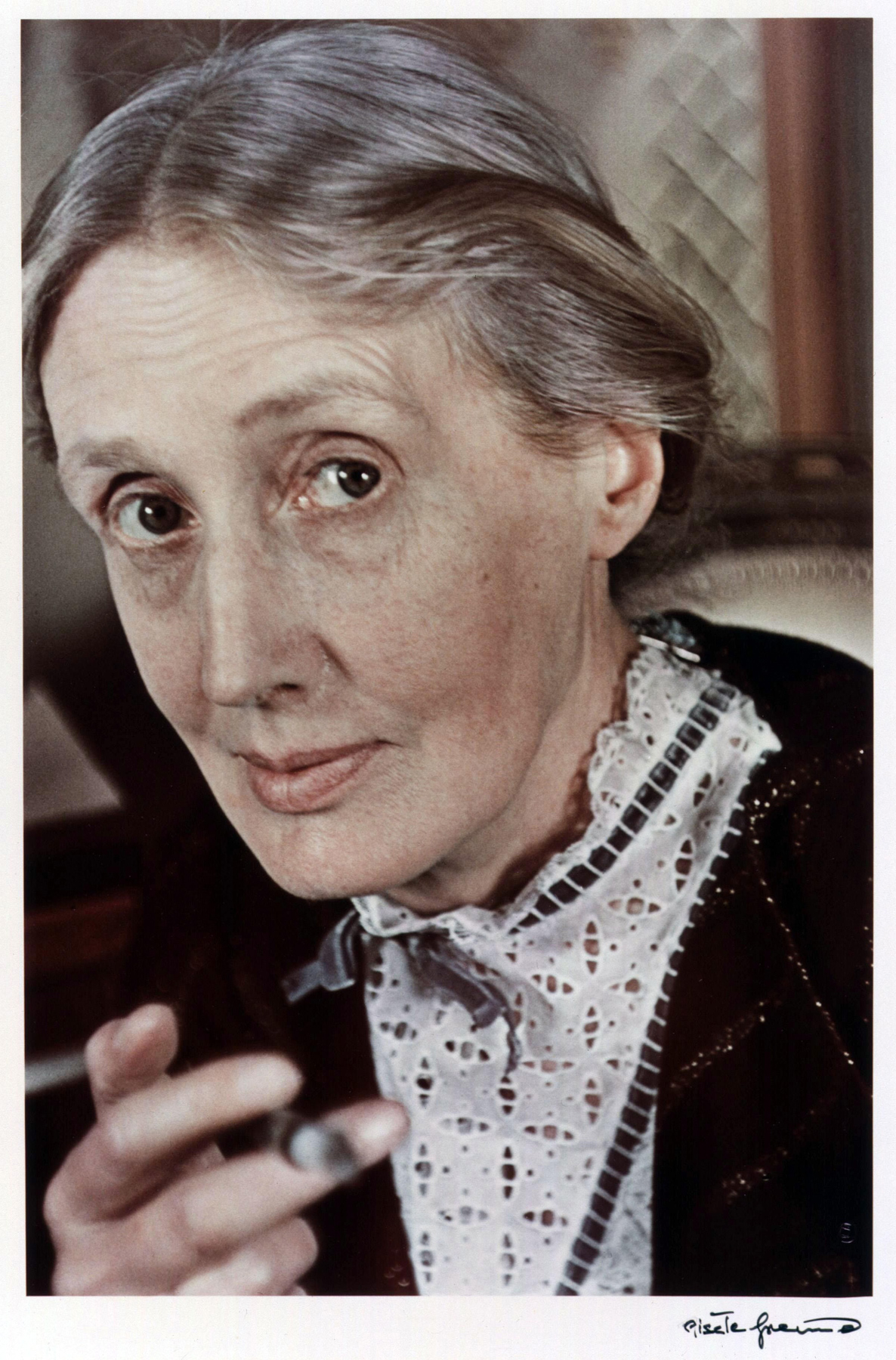
Gisèle Freund (French born Germany, 1908-2000) 'Virginia Woolf' 1939


Gisèle Freund (French born Germany, 1908-2000)
Virginia Woolf
1939
© Gisèle Freund


Gisèle Freund (born Gisela Freund; December 19, 1908 in Schöneberg District, Berlin – March 31, 2000 in Paris) was a German-born French photographer and photojournalist, famous for her documentary photography and portraits of writers and artists. Her best-known book, Photographie et société (1974), is about the uses and abuses of the photographic medium in the age of technological reproduction. In 1977, she became President of the French Association of Photographers, and in 1981, she took the official portrait of French President François Mitterrand.

She was made Officier des Arts et Lettres in 1982 and Chevalier de la Légion d’honneur, the highest decoration in France, in 1983. In 1991, she became the first photographer to be honoured with a retrospective at the Musée National d’art Moderne in Paris (Centre Georges Pompidou).

Freund’s major contributions to photography include using the Leica Camera (with its 36 frames) for documentary reportage and her early experimentation with Kodachrome and 35 mm Agfacolor, which allowed her to develop a “uniquely candid portraiture style” that distinguishes her in 20th century photography.

She is buried at the Montparnasse Cemetery in Paris, France near her home and studio at 12 rue Lalande.

See her full entry on the Wikipedia website


Harper & Brothers. 'Patricia Highsmith' 1942 


Harper & Brothers
Patricia Highsmith
1942
Gelatin silver print
© Patricia Highsmith Collection, Swiss National Library / Swiss Literary Archives, Bern


“… is a significant writer by any standard, but she deserves honouring as a lesbian and gay icon on the strength of one novel alone, The Price of Salt, a wonderfully complex and upbeat representation of lesbian love.”

~ Sarah Waters


Patricia Highsmith (January 19, 1921 – February 4, 1995) was an American novelist and short story writer best known for her psychological thrillers, including her series of five novels featuring the character Tom Ripley. She wrote 22 novels and numerous short stories throughout her career spanning nearly five decades, and her work has led to more than two dozen film adaptations. Her writing derived influence from existentialist literature, and questioned notions of identity and popular morality. She was dubbed “the poet of apprehension” by novelist Graham Greene.

Her first novel, Strangers on a Train, has been adapted for stage and screen numerous times, notably by Alfred Hitchcock in 1951. Her 1955 novel The Talented Mr. Ripley has been adapted numerous times for film, theatre, and radio. Writing under the pseudonym “Claire Morgan,” Highsmith published the first lesbian novel with a happy ending, The Price of Salt, in 1952, republished 38 years later as Carol under her own name and later adapted into a 2015 film.

Text from the Wikipedia website


Paul Morrissey (American, 1938-2024) 'Joe Dallesandro' 1968


Paul Morrissey (American, 1938-2024)
Joe Dallesandro
1968
Gelatin silver print
© Paul Morrissey, 1968


Joseph Angelo D’Allesandro III (born December 31, 1948), better known as Joe Dallesandro, is an American actor and Warhol superstar. Having also crossed over into mainstream roles like mobster Lucky Luciano in The Cotton Club, Dallesandro is generally considered to be the most famous male sex symbol of American underground films of the 20th century, as well as a sex symbol of gay subculture.

Dallesandro starred in the 1968 film produced by Andy Warhol, Flesh, as a teenage street hustler. Rolling Stone magazine in 1970 declared his second starring vehicle, Trash, the “Best Film of the Year”, making him a star of the youth culture, sexual revolution and subcultural New York City art collective of the 1970s. Dallesandro also starred in 1972’s Heat, another Warhol film that was conceived as a parody of Sunset Boulevard. …

Underground film career

Dallesandro met Andy Warhol and Paul Morrissey in 1967 while they were shooting Four Stars, and they cast him in the film on the spot. Warhol would later comment “In my movies, everyone’s in love with Joe Dallesandro.”

Dallesandro played a hustler in his third Warhol film, Flesh (1968), where he had several nude scenes. Flesh became a crossover hit with mainstream audiences, and Dallesandro became the most popular of the Warhol stars. New York Times film critic Vincent Canby wrote of him: “His physique is so magnificently shaped that men as well as women become disconnected at the sight of him”

As Dallesandro’s underground fame began to cross over into the popular culture, he appeared on the cover of Rolling Stone in April 1971. He was also photographed by some of the top celebrity photographers of the time: Francesco Scavullo, Annie Leibovitz, Richard Avedon.

Dallesandro appeared in Lonesome Cowboys (1968), Trash (1970), Heat (1972), Andy Warhol’s Frankenstein, and Andy Warhol’s Dracula (both 1974), also directed by Morrissey. These last two films were shot in Europe. After filming was complete, he chose not to return to the U.S. He appeared in Serge Gainsbourg’s Je t’aime moi non plus (France, 1976), which starred Gainsbourg’s wife, British actress Jane Birkin.

Text from the Wikipedia website


Lewis Morley (Australian born Hong Kong, 1925-2013) 'Joe Orton' 1965


Lewis Morley (Australian born Hong Kong, 1925-2013)
Joe Orton
1965
Bromide print
20 in. x 16 1/8 in. (508 mm x 410 mm)
Given by the photographer, Lewis Morley, 1992
© Lewis Morley Archive/National Portrait Gallery, London


Gay Icons explores gay social and cultural history through the unique personal insights of ten high profile gay figures, who have selected their historical and modern icons.

The chosen icons, who may or may not be gay themselves, have all been important to each selector, having influenced their gay sensibilities or contributed to making them who they are today. They include artists Francis Bacon and David Hockney; writers Daphne du Maurier and Quentin Crisp; composers Pyotr Tchaikovsky and Benjamin Britten; musicians k.d. lang, the Village People and Will Young; entertainers Ellen DeGeneres, Lily Savage and Kenneth Williams; sports stars Martina Navratilova and Ian Roberts and political activists Harvey Milk and Angela Mason.

Their fascinating and inspirational stories will be illustrated by over sixty photographic portraits including works by Andy Warhol, Snowdon and Cecil Beaton together with specially commissioned portraits of the selectors by Mary McCartney. McCartney. All are set in a striking exhibition design conceived by renowned theatre designer, Robert Jones …

This exhibition brings together ten selectors, chaired by Sandi Toksvig, each of whom is a prominent gay figure in contemporary culture and society. Each selector was asked to name six people, who may or may not be gay, whom they personally regard as inspirational, or an icon for them.

Their choices provide a fascinating range of figures – some heroic, some very famous, others less well known. In the exhibition the selectors write about their choices and share their own convictions, experiences and feelings. The display also features specially commissioned portraits of the selectors by Mary McCartney.

Anonymous text. “Gay Icons,” on the National Portrait Gallery website [Online] Cited 18/06/2022. No longer available online


Ian Berry (English, b. 1934) 'Nelson Mandela' 1994


Ian Berry (English, b. 1934)
Nelson Mandela
1994
Gelatin silver print
© Ian Berry/Magnum Photos


“He has touched my heart, just as he has influenced the hearts and minds of people all over the world.”

~ Billie Jean King

“The great single picture is emotionally satisfying, whereas getting a good journalistic story is more about being a professional”

~ Ian Berry


Ian Berry was born in Lancashire, England. He made his reputation in South Africa, where he worked for the Daily Mail and later for Drum magazine. He was the only photographer to document the massacre at Sharpeville in 1960, and his photographs were used in the trial to prove the victims’ innocence.

Henri Cartier-Bresson invited Ian Berry to join Magnum in 1962 when he was based in Paris. He moved to London in 1964 to become the first contract photographer for the Observer Magazine. Since then assignments have taken him around the world: he has documented Russia’s invasion of Czechoslovakia; conflicts in Israel, Ireland, Vietnam and the Congo; famine in Ethiopia; apartheid in South Africa. The major body of work produced in South Africa is represented in two of his books: Black and Whites: L’Afrique du Sud (with a foreword by the then French president François Mitterrand), and Living Apart (1996). During the last year, projects have included child slavery in Ghana and the Spanish fishing industry.

Important editorial assignments have included work for National GeographicFortuneSternGeo, national Sunday magazines, EsquireParis-Match and LIFE. Ian Berry has also reported on the political and social transformations in China and the former USSR.

Anonymous text. “Ian Berry,” on the Magnum website [Online] Cited 16/03/2019


Unknown photographer. 'Bessie Smith' c. 1920s


Unknown photographer
Bessie Smith
c. 1920s
Gelatin silver print
Frank Driggs Collection/Getty Images
© 1925 Getty Images


“A feisty woman who always stood up for herself… She was bisexual and practically an alcoholic – the perfect icon.”

~ Jackie Kay


Bessie Smith (April 15, 1894 – September 26, 1937) was an American blues singer. Nicknamed the Empress of the Blues, she was the most popular female blues singer of the 1920s and 1930s. She is often regarded as one of the greatest singers of her era and was a major influence on fellow blues singers, as well as jazz vocalists.

Read her full entry on the Wikipedia website


Howard Coster (British, 1885-1959) 'Sylvia Townsend Warner' 1934


Howard Coster (British, 1885-1959)
Sylvia Townsend Warner
1934
Half-plate film negative
Transferred from Central Office of Information, 1974
© National Portrait Gallery, London


Sylvia Townsend Warner (6 December 1893 – 1 May 1978) was an English novelist and poet. She also made a contribution to musicology as a young woman.


Bertram Park (British, 1883-1972) 'Ronald Firbank' 1917 (detail)


Bertram Park (British, 1883-1972)
Ronald Firbank (detail)
1917


“He [Ronald Firbank] is celebrated as a master of high camp, but he was also a radical technician and radical homosexualiser of the novel.”

~ Alan Hollinghurst


Bertram Park (British, 1883-1972) 'Ronald Firbank' 1917


Bertram Park (British, 1883-1972)
Ronald Firbank
1917


Bertram Charles Percival Park, OBE, (1883-1972) was a portrait photographer whose work included British and European royalty. Engravings of his photographs were widely used on British and British Commonwealth postage stamps, currency, and other official documents in the 1930s. His theatrical portraits were the source for two paintings by Walter Sickert. With his wife Yvonne Gregory, he also produced a number of photographic books of the female nude. He was an expert in the cultivation of the rose and the editor of The Rose Annual.

Text from the Wikipedia website


Arthur Annesley Ronald Firbank (17 January 1886 – 21 May 1926) was an innovative English novelist. His eight short novels, partly inspired by the London aesthetes of the 1890s, especially Oscar Wilde, consist largely of dialogue, with references to religion, social-climbing, and sexuality.


Unknown Photographer. 'Winifred Atwell' c. 1950s (detail)


Unknown photographer
Winifred Atwell (detail)
c. 1950s
Courtesy of Getty Images


“Winifred Atwell’s piano performances were simply captivating. She showed me what was possible and was a total inspiration.”

~ Elton John


Una Winifred Atwell (27 February or 27 April 1910 or 1914 – 28 February 1983) was a Trinidadian pianist who enjoyed great popularity in Britain and Australia from the 1950s with a series of boogie-woogie and ragtime hits, selling over 20 million records. She was the first black person to have a number-one hit in the UK Singles Chart and is still the only female instrumentalist to do so.

Read the full entry about this amazing women on the Wikipedia website


Elliott and Fry. 'Alan Turing' 1951 (detail)


Elliott and Fry
Alan Turing (detail)
29 March 1951
© National Portrait Gallery, London


Elliott & Fry was a Victorian photography studio founded in 1863 by Joseph John Elliott (14 October 1835 – 30 March 1903) and Clarence Edmund Fry (1840 – 12 April 1897). For a century the firm’s core business was taking and publishing photographs of the Victorian public and social, artistic, scientific and political luminaries. In the 1880s the company operated three studios and four large storage facilities for negatives, with a printing works at Barnet.

The firm’s first address was 55 & 56 Baker Street in London, premises they occupied until 1919. The studio employed a number of photographers, including Francis Henry Hart and Alfred James Philpott in the Edwardian era, Herbert Lambert and Walter Benington in the 1920s and 1930s and subsequently William Flowers. During World War II the studio was bombed and most of the early negatives were lost, the National Portrait Gallery holding all the surviving negatives. With the firm’s centenary in 1963 it was taken over by Bassano & Vandyk.

Text from the Wikipedia website


Elliott and Fry. 'Alan Turing' 29 March 1951


Elliott and Fry
Alan Turing
29 March 1951
Vintage bromide print on photographer’s mount
6 3/8 x 4 5/8 in. (162 mm x 117 mm)
Given by the sitter’s mother, Ethel Sara Turing (née Stoney), 1956
© National Portrait Gallery, London


“Turing was one of the most brilliant men of the first half of the twentieth century, but the refusal of post-war society to accept his sexuality drove him to commit suicide… We can and should honour him now.”

~ Chris Smith


National Portrait Gallery
St Martin’s Place
London WC2H 0HE

Opening hours:
Closed until 2023

National Portrait Gallery website

LIKE ART BLART ON FACEBOOK

Back to top

Review: ‘Double Infinitives’ by Marco Fusinato at Anna Schwartz Gallery, Melbourne

Exhibition dates: 25th June – 25th July, 2009


Marco Fusinato (Australian, b. 1964) 'Double Infinitive 3' 2009


Marco Fusinato (Australian, b. 1964)
Double Infinitive 3
2009


Double Infinitives by Marco Fusinato at Anna Schwartz Gallery, Melbourne is an excellent exhibition of large UV ink on aluminium images sourced by Fusinato from the print media.

The images are made up of a dot pattern familiar to those who have examined photographs in the print media closely. Larger and smaller clusters of dots form the light and shade of the image. As you move closer to the works they dissolve into blocks of dots and become and optical illusion like Op Art from the 1960s. Fusinato contrasts this dot structure with the inclusion of flat panels of black ink to the left and right hand side of the images. The section lines that run through the images (for they are not one single image but made up of panels) also adds to the optical nature of the work as the lines cut the conflagrations, literally stitching the seams/scenes together.

Each image contains an individual holding a rock enclosed in the milieu and detritus of a riot; the figures are grounded in the earth and surrounded by fire but in their obscurity, in the veiling of their eyes, the figures seem present but absent at one and the same time. They become ghosts of the fire.

Fire consumes the bodies. The almost cut out presence of the figures, their hands clutching, throwing, saluting become mute. Here the experience of the sound, colour and movement of an actual riot is silenced in the flatness and smoothness of the images. The images possess the intensity of a newspaper reality ‘blown up’ to a huge scale by Fusinato (see the installation photograph below to get an idea of the effect). The punctum of the riot, that prick of consciousness that Barthes so liked, is translated into a silenced studium of the aluminium surface; an aural history (the sound) / oral history (the telling of the story) trapped in the structure of silence.

There is a double jeopardy – the dissolution of the image into dots and the disintegration of the body into fire. In one of the images the upraised arm and hand of one of the rioters holds a rock with what appears to be a figure on it, surrounded by fire. To me the arm turned into one of the burning Twin Towers with smoke and fire pouring from it (see the first photograph in the installation photograph below).

My only concern about the images were the black panels, perhaps too obvious a tool for the purpose the artist intended. Maybe the needed some small texture, like a moire pattern to reference the contours of a map and continue the topographical and optical theme. Perhaps they just needed to be smaller or occasionally placed as thin strips down the actual image itself but these are small quibbles. Overall this is an fantastic exhibition that I enjoyed immensely. The images are literally ripped from the matrix of time and space and become the dot dot dot of the addendum. What Fusinato does so excellently is to make us pause and stare, to recognise the flatness of these figures and the quietness of violence that surrounds us.

Music – Noise  – Silence
Flatness – Advertising – Earth – Fire
Rock – Space – Memory

Dr Marcus Bunyan


Many thankx to Anna Schwartz Gallery for allowing me to publish the photographs in the posting. Please click on the photographs for a larger version of the image.


Marco Fusinato (Australian, b. 1964) 'Double infinitive I' 2009


Marco Fusinato (Australian, b. 1964)
Double infinitive 1
2009


Marco Fusinato (Australian, b. 1964) 'Double Infinitive 4' 2009


Marco Fusinato (Australian, b. 1964)
Double Infinitive 4
2009


A selection of images from the print media of the decisive moment in a riot in which a protagonist brandishes a rock against a backdrop of fire. Each image is from a different part of the world, from the early twenty-first century, and is blown up to history-painting scale using the latest commercial print technologies.

Text by Marco Fusinato on his website


Installation of Marco Fusinato 'Double Infinitives' exhibition at Anna Schwartz Gallery, Melbourne


Installation of Marco Fusinato Double Infinitives exhibition at Anna Schwartz Gallery, Melbourne


Double Infinitives

“Unheard music is better than heard.”

Greek proverb of late antiquity


“That music be heard is not essential – what it sounds like may not be what it is.”

Charles Ives, Essays Before a Sonata


“The proposition of Jacques Attali’s Noise is different. He says that while noise is a deadly weapon, silence is death.”

David Rattray, “How I Became One of the Invisible,” Semiotext(e), 1992.


The explosive communal act of rioting is most commonly delivered to an audience suspended in the stillness and silence of a photographic image. Noise is not removed in this process, it is almost amplified: the sound and action that deliver this singularly captured moment into existence are infinite, as all things remain while they are imagined, before they are anchored down by express articulation.

Photographic representation can easily be accused of subverting the truth of events, not because what is seen in the image has not transpired, but because static images leave so much space around them for multiple narratives to be constructed. The still image is totally contingent on the consciousness that confronts it. By contrast, the near-totality of videos can give too much away …

Sourced by Fusinato from print media published in the last few years, these images of rioting all contain an individual clutching a rock, bathed in the refractory glow of a nearby fire. The image has become prototypical, so much so that it lacks the sensation of spontaneity requisite to produce a riot. (Apropos to this predictability, Fusinato would check global newspapers after every forum or conference of global financial authorities, often finding the image he was looking for).

Double Infinitives is a succinct allegory for the reluctance to compromise comfort overpowering radical impulses. Conversations suggest this is a conflict frequently experienced by artists. Deprived of a volatile political reality, we experience radicalism through images that act as small ruptures, reminders that the world we live in might be more severely charged than our individual experiences allow. Fusinato’s works flatten these images of volatility onto a smooth slate: they are similar and radiate with the vexed beauty of sameness. A riot is a mad and brutal spectacle, a theatre that is often documented as if it were a play. Hugely expanded in scale and rendered in the suffused gloss of advertising, the real possibility of violence that these works infer deepens the layers of the fiction rather than comprising an indicator of human concern. Those things with which we come into such gentle contact that their thorns barely prick …

Liv Barrett
June 2009

Text from the Anna Schwartz Gallery website [Online] Cited 10/07/2009. No longer available online


Marco Fusinato (Australian, b. 1964) 'Double Iinfinitive 2' 2009


Marco Fusinato (Australian, b. 1964)
Double Iinfinitive 2
2009


Marco Fusinato (Australian, b. 1964) 'Double Iinfinitive 2' 2009 (detail)


Marco Fusinato (Australian, b. 1964)
Double Iinfinitive 2 (detail)
2009


Marco Fusinato (Australian, b. 1964) 'Double Iinfinitive 5' 2009


Marco Fusinato (Australian, b. 1964)
Double Iinfinitive 5
2009


Anna Schwartz Gallery
185 Flinders Lane
Melbourne, Victoria 3000

Opening hours:
Tuesday – Friday 12 – 5pm
Saturday 1 – 5pm

Anna Schwartz Gallery website

LIKE ART BLART ON FACEBOOK

Back to top

Exhibition: ‘Ricky Maynard: Portrait of a Distant Land’ at Museum of Contemporary Art (MCA), Sydney

Exhibition dates: 4th June – 23rd August, 2009


Many thankx to the MCA for allowing me to publish the photographs in the posting. Please click on the photographs for a larger version of the image.


Ricky Maynard (Australian, b. 1953)
'Coming Home' 2005


Ricky Maynard (Australian, b. 1953)
Coming Home
2005
From the series Portrait of a Distant Land
Gelatin silver photograph, selenium toned
37.4 × 54.1cm
© Ricky Maynard


I can remember coming here as a boy in old wooden boats to be taught by my grandparents and my parents. I’ll be 57 this year and I have missed only one year when my daughter Leanne was born. Mutton birding is my life. To me it’s a gathering of our fellas where we sit and yarn, we remember and we honour all of those birders who have gone before us. Sometimes I just stand and look out across these beautiful islands remembering my people and I know I’m home. It makes me proud to be a strong Tasmanian black man. This is something that they can never take away from me.

Murray Mansell, Big Dog Island, Bass Strait, 2005


Ricky Maynard (Australian, b. 1953) 'The Healing Garden, Wybalenna, Flinders Island, Tasmania' 2005


Ricky Maynard (Australian, b. 1953)
The Healing Garden, Wybalenna, Flinders Island, Tasmania
2005
From the series Portrait of a Distant Land
Gelatin silver photograph, selenium toned
34.0 x 52.0 cm
© Ricky Maynard


This winter the Museum of Contemporary Art presents a major survey of photographic works by documentary photographer Ricky Maynard, encompassing more than two decades of the artist’s practice.

Portrait of a Distant Land features more than 60 evocative and captivating photographic works, drawn from six bodies of work, which document the lives and culture of Maynard’s people, the Ben Lomond and Cape Portland peoples of Tasmania.

The exhibition is curated by MCA Aboriginal and Torres Strait Islander Programs Keith Munro and is presented at the MCA from 4 June until 23 August 2009. Born in Launceston, Tasmania in 1953 Maynard is a self taught documentary photographer now based on Flinders Island in the Bass Strait between Tasmania and mainland Australia.

Maynard first came to prominence in the late 1980s with a photographic essay about Aboriginal mutton bird farmers and he has continued to document physical and social landscapes which form a visual record and representation of Aboriginal and Torres Strait Islander people in Australia.

“For me, photographs have always been personal and I hope to convey the intimacy of a diary. Photography has the ability to tell stories about the world and how the photograph has power to frame a culture,” said Maynard, describing his practice.

The works presented in Portrait of a Distant Land survey a broad range of themes and issues facing Aboriginal and Torres Strait Islander people today. It includes photographs which document sites significant to Maynard’s people: ranging from serenely beautiful landscapes which follow the song lines, tribal movements and historical displacement routes of his ancestors, to the confrontational and emotionally-charged images of Indigenous people incarcerated in the South Australian prison system.

The six photographic series by Maynard which are featured in the exhibition are The Moonbird People (1985-1988), No More Than What You See (1993), Urban Diary (1997), In The Footsteps of Others (2003), Returning To Places That Name Us (2000) and Portrait of a Distant Land (2005- ). Together these works create a form of visual diary of multiple landscapes derived from collective oral histories of Maynard’s people.”

Press release from the MCA website [Online] Cited 05/07/2009. No longer available online


Ricky Maynard (Australian, b. 1953) ‘Arthur, Wik elder’ from the series ‘Returning to places that name us’ 2000


Ricky Maynard (Australian, b. 1953)
Arthur, Wik Elder
2000
From the series Returning to Places that Name Us
Gelatin silver photograph
96.1 x 121.4cm
© Ricky Maynard


The owner of an enviable collection of antique cameras, Maynard is a lifelong student of the history of photography, particularly of the great American social reformers Jacob Riis, Lewis Hines, Dorothea Lange and Walker Evans. He is interested in the power of the uninflected image – of sheer veracity – as an agent of record and change. Maynard’s images cut through the layers of rhetoric and ideology that inevitably couch black history (particularly Tasmanian history) to present images of experience itself. ‘To know the meaning of a culture you must recognise the limits and meaning of your own,’ the artist explains. ‘You can see its facts but not its meaning. We share meaning by living it.’ Maynard’s photographs are, he says, about ‘leaving proof’ – about ‘… life in passing and in complicated times’.

The word ‘Wik’ has come to denote a historic decision of the High Court of Australia rather than the name of the Indigenous peoples from the western Cape York Peninsula in northern Queensland. In his intimate portraits of elders from these communities, Maynard aims to unpick this abstraction. Etched on each face is the complexity of an unspoken life story, delineated, one imagines, by hardship, perseverance and the burden – and wealth – of an extraordinary living memory. As he wrote in his artist’s statement for the exhibition Returning to Places that Name Us in 2001, ‘… I wanted a presence and portraits that spoke, and through this process to present an idea, rather than preach messages’. In this series, Maynard achieves his aim of capturing meanings that no other medium could convey.

Hannah Fink in ‘Tradition today: Indigenous art in Australia’, Art Gallery of New South Wales, Sydney, 2004

© Art Gallery of New South Wales. Text from the Art Gallery of New South Wales website [Online] Cited 14/03/2019


Ricky Maynard (Australian, b. 1953) 'Gladys Tybingoomba' 2001


Ricky Maynard (Australian, b. 1953)
Gladys Tybingoomba
2001
From the series Returning To Places That Name Us
Gelatin silver photograph
© Ricky Maynard


Ricky Maynard (Australian, b. 1953) 'Custodians' from the series 'Portrait of a Distant Land' 2005


Ricky Maynard (Australian, b. 1953)
Custodians
2005
From the series Portrait of a Distant Land
Gelatin silver photograph, selenium toned
43.0 x 41.2cm
© Ricky Maynard


Ricky Maynard (Australian, b. 1953) 'Vansittart Island' from the series 'Portrait of a Distant Land' 2007


Ricky Maynard (Australian, b. 1953)
Vansittart Island
2007
From the series Portrait of a Distant Land
Gelatin silver photograph, selenium toned
33.9 x 52.1cm
© Ricky Maynard


Ricky Maynard (Australian, b. 1953) 'The Spit' from the series 'Portrait of a Distant Land' 2007


Ricky Maynard (Australian, b. 1953)
The Spit
2007
From the series Portrait of a Distant Land
Gelatin silver photograph, selenium toned
41.8 x 50.4cm
© Ricky Maynard


Ricky Maynard (Australian, b. 1953) 'The Mission' 2005 From the series 'Portrait of a Distant Land'


Ricky Maynard (Australian, b. 1953)
The Mission
2005
From the series Portrait of a Distant Land
Gelatin silver photograph, selenium toned
43.0 x 41.2cm
© Ricky Maynard


Maynard is a lifelong student of the history of photography, particularly of the great American social reformers Jacob Riis, Lewis Hines, Dorothea Lange and Walker Evans. Maynard’s images cut through the layers of rhetoric and ideology that inevitably couch black history (particularly Tasmanian history) to present images of experience itself. His visual histories question ownership; he claims that ‘the contest remains over who will image and own this history… we must define history, define whose history it is, and define its purpose as well as the tools used for the telling it’.

In Portrait of a distant land Maynard addresses the emotional connection between history and place. He uses documentary style landscapes to illustrate group portraits of Aboriginal peoples’ experiences throughout Tasmania. Each work combines several specific historical events, creating a narrative of shared experience – for example The Mission relies on historical records of a small boy whom Europeans christened after both his parents died in the Risdon massacre. This work highlights the disparity between written, oral and visual histories, as Maynard attempts to create ‘a combination of a very specific oral history as well as an attempt to show a different way of looking at history in general’.

Text from the Art Gallery of New South Wales website [Online] Cited 14/03/2019


Museum of Contemporary Art (MCA)
140 George Street
The Rocks, Sydney, Australia

Opening hours: 10am – 5pm daily

MCA website

LIKE ART BLART ON FACEBOOK

Back to top

Review: ‘Apocrypha’ photographs by Julie Davis and Alex Rizkalla at Place Gallery, Richmond

Exhibition dates: 17th June – 11th July 2009


Apocrypha (from the Greek word ἀπόκρυφα, meaning “those having been hidden away”) are texts of uncertain authenticity, or writings where the authorship is questioned.

Definition from the Wikipedia website


Julie Davis (Australian, b. 1959) and Alex Rizkalla (Australian, b. 1950) 'Apocrypha #1' (left) and 'Apocrypha #4' (right) 2008


Julie Davis (Australian, b. 1959) and Alex Rizkalla (Australian, b. 1950)
Apocrypha #1 (left) and Apocrypha #4 (right)
2008


“Intuitively we know the definition of the output from this process lies hidden within each object, seemingly carved into the underside of their skin, although we cannot see it. But actually it is not carved, it is the three-dimensional tracing of the original. The original becomes a throw-away. It is obsolete. The point of origin lies no longer within an object but at the heart of the creative impulse.”


Vanessa Mooney


Apocrypha is an interesting, if slight, exhibition of eleven photographs by Julie Davis and Alex Rizkalla at Place Gallery in Richmond. Conceptually the work is resolved if not pushed to any great depth, the small photographs of sarcophagi like casements and moulds addressing issues surrounding the absence / presence of the original object and the subsequent loss of identity. In their masking, the objects photographed hide an inner identity that has gone missing; the headless figures, like faceless mummies, protect something that has existed since early man – the inner spiritual machinations of belief – that are embedded within the existential nature of our being. Identity has been rubbed out and spirit is splitting apart the moulds trying to escape the confines of mortality, only held in check by the wooden pegs and ropes.

Like the sutures of the human skull, the marks on the casements (see below right image) try to align form across space and time but these objects are grounded in a contextless backgrounds, seemingly floating free of earthly constraints. Here we have a double tracing – that of the tracing of the original object that has been thrown away (see Vanessa Mooney quotation above) and the tracing of the indexicality of the object by the photograph – the re-presentation of an original that no longer exists. There is a double loss through this re-retracing that fits perfectly with the title Apocrypha – as the photographs become texts of uncertain authenticity.

Where the exhibition is less successful is in the physical presence of the photographs and their aesthetic qualities. While Vanessa Mooney asserts that the photographs are “meticulous in their detail and exact in their depth and texture” this assertion is untrue. From a technical point of view the photographs are soft in focus and lack depth of field. The ropes are fuzzy and the lack of depth of field in the focus plane from front to back adds to a lack of presence that the photographs needed to counterbalance the conceptual idea of apocrypha. I am also unsure about the scale of the photographs – there seems something in-between about the size of the images, neither here nor there. Aesthetically they needed either more presence (through being bigger), or more intensity through a jewel like nature in being smaller, again to counterbalance the conceptual themes. Finally, being surrounded by these eleven photographs in the gallery gives you the feeling of a ‘one shot’ idea that needed further investigation and refinement, an idea that needed to be pushed further. While the actual ideas themselves are interesting the work itself is too simple, too slight to hold the attention and reveal layers of meaning over time.

Dr Marcus Bunyan


Many thankx to Place Gallery for allowing me to publish the photographs in the posting.


Julie Davis (Australian, b. 1959) and Alex Rizkalla (Australian, b. 1950) 'Apocrypha #5' (left) and 'Apocrypha #7' (right) 2008


Julie Davis (Australian, b. 1959) and Alex Rizkalla (Australian, b. 1950)
Apocrypha #5 (left) and Apocrypha #7 (right)
2008


The Father, The Son And Apocrypha

We all have faith that we must lodge somewhere: you; the microscope, me; the earth, and the artist? There are two stories present. The first is Apocrypha, a series of works by Davies and Rizkalla and the second is something you cannot see but will soon know.

Davies and Rizkalla present to us Apocrypha; a series of photographs that are meticulous in their detail and exact in their depth and texture. It is an evocative title and encapsulates the resonance of the objects. What we can see is clear – plaster moulds used by someone, somewhere for casting objects. The clarity of the details of rope, wedges of wood and the depth of the seam tell us of the real working nature of them. The inversion here from background process to foreground subject matter is not for irony’s sake but to evoke the simultaneous banality and sacredness of the transformative creative process. It is documented honestly before the viewer, and yet, the mystery remains. Intuitively we know the definition of the output from this process lies hidden within each object, seemingly carved into the underside of their skin, although we cannot see it. But actually it is not carved, it is the three-dimensional tracing of the original. The original becomes a throw-away. It is obsolete. The point of origin lies no longer within an object but at the heart of the creative impulse.

Tony Scalzo, my father-in-law, was drawn to this process. While the creation of a religious icon amused his communist leanings the irresistible pull of the transformation from dust and water to artefact must have, I feel, fulfilled a greater need to live through making. Countless times he would present to us his recent army of saints or holy persons (Padre Pio was a boom time) to be sold through his community, and would scoff and laugh at how he could make an object that to others was an icon. He would point to the shed, the latex, the plaster dust as if to dispel the mystery, and yet the mystery remained.

Perhaps the final mystery is the process, the collaboration that has come about since Tony passed away and his son Stefano came into possession of the simple and unusual collection. Stefano like his father is drawn to the creative process. So innately aware of the artist, his father, he approached Julie and Alex with these as gifts that are, in a way, not his to give. As a custodian might he passed on the objects and communicated his intuitive knowledge of their meaning. One plus one equals three. The result, Apocrypha, is like a window that was obscured and now has been opened. We can see with clarity what was unseen, but known, before. Apocrypha silently demonstrates the entwining of faith and mystery in the creative life of all.”

Vanessa Mooney

Text from the Place Gallery website [Online] Cited 09/03/2019. No longer available online


Julie Davis (Australian, b 1959) and Alex Rizkalla (Australian, b. 1950) 'Apocrypha #8' (left) and 'Apocrypha #9' (right) 2008


Julie Davis (Australian, b 1959) and Alex Rizkalla (Australian, b. 1950)
Apocrypha #8 (left) and Apocrypha #9 (right)
2008


Place Gallery
20, Tennyson Street, Richmond

Openng hours:
Wednesday – Saturday 11.00am – 5.00pm
Closed Sundays

Place Gallery website

LIKE ART BLART ON FACEBOOK

Back to top

Exhibition: ‘LE MONDE v. DER MOND’ by Matthew Hale at The Narrows, Melbourne

Exhibition dates: 18th June – 11th July, 2009


Matthew Hale. Installation view of DER MOND v LE MONDE at The Narrows, Melbourne


Installation view of LE MONDE v. DER MOND by Matthew Hale at The Narrows, Melbourne with n.n. (2008) centre bottom, and Page 93 of MIRIAM DIVORCEE (2008) centre right


Below is the only text I could find on the work – some of which was displayed in London earlier this year.

Many thankx to Warren from The Narrows for allowing me to publish the photographs in the posting. Please click on the photographs for a larger version of the image. Photographs 1, 4 and 6 are © Tobias Titz 2009.

Dr Marcus Bunyan


DER MOND v LE MONDE is Mathew Hale’s first solo exhibition in London for five years. It consists of five works: one two-projector and one three-projector slide piece; a constructed painting (that could equally be described as a wall-mounted sculpture); and two large collage works …

Hale’s work has many possible points of departure: a found photograph, a scrap of paper, a page torn from an instructive and obscure book, a bit of out-moded pornography, some anachronistic advertising from the 1970s or 1980s and so forth. Once plucked from a huge collection of such material amassed in his domestic studio space, the work evolves like an unplanned journey – both moving away and turning back on itself … The path of discovery in Hale’s work is the subject of his work, providing it with narrative and process.

With its roots in the collage traditions of political photomontage, dadaist assemblage and free associative surrealism, Hale’s work prioritises process over methodology or style. It activates a complex web of references that takes in history, politics, literature, and philosophy, as much as it does sex, religion, art, architecture and popular culture. To engage with the work is to become carried along by clues that lead to other clues and then circuitously lead somewhere else unexpected yet somehow familiar. Sometimes the clues are visual, sometimes they are language based, often they are both. Even when the work is finished and exhibited it is in a state of flux, the meaning is not fixed. Hale likes slippage of meaning and this constant state of ambiguity and openness for (mis)interpretation or confusion. He explains the title of the show as follows: ‘[in German] … and strikingly weirdly, “der Mond” means “The Moon” and, as we all know, “Le Monde” means “The Earth”. How can a word flip so totally by crossing a border? I am making a work for the show which hinges on their being apparently identical (almost) and yet meaning precisely the opposite – I wonder how it happened.’

Text from the London exhibition of this work (note with title reversed!), on the Peer website [Online] Cited 23/06/2009. No longer available online


Matthew Hale (British, b. 1962) 'Page 93 of MIRIAM DIVORCEE' 2008


Matthew Hale (British, b. 1962)
Page 93 of MIRIAM DIVORCEE
2008
Paper collage
69 x 103cm


Matthew Hale (British, b. 1962) 'Page 150 of MIRIAM DIVORCEE' 2008 (detail)


Matthew Hale (British, b. 1962)
Page 150 of MIRIAM DIVORCEE (detail)
2008
Paper collage


Matthew Hale (British, b. 1962) 'n.n.' 2008


Matthew Hale (British, b. 1962)
n.n.
2008
Rifle, paper collage
69 x 153cm


Matthew Hale (British, b. 1962) 'Page 145 of MRS. GILLRAY' 2009


Matthew Hale (British, b. 1962)
Page 145 of MRS. GILLRAY
2009
Paper collage


Matthew Hale (British, b. 1962) 'Page 48 of DIE NEUE MIRIAM' 2008


Matthew Hale (British, b. 1962)
Page 48 of DIE NEUE MIRIAM
2008
Paper collage


Review in Art Monthly, June 2009


Review in Art Monthly, June 2009 from the Peer website [Online] Cited 23/06/2009. No longer available online


The Narrows

This gallery has now closed

The Narrows website

LIKE ART BLART ON FACEBOOK

Back to top

Exhibition: ‘ARTIST ROOMS: Celmins, Gallagher, Hirst, Katz, Warhol, Woodman’ at the Scottish National Gallery of Modern Art, Edinburgh

Exhibition dates: 14th March – 18th November, 2009


Francesca Woodman (American, 1958-1981) 'From Angel Series, Roma, September 1977' 1977


Francesca Woodman (American, 1958-1981)
From Angel Series, Roma, September 1977
1977
Gelatin silver print
93 x 93 mm
Acquired jointly with the Tate through The d’Offay Donation with assistance from the National Heritage Memorial Fund and the Art Fund 2008
© Courtesy of George and Betty Woodman


Shining brightly in the firmament the star of the show is, undoubtedly, the supremely talented Francesca Woodman. What an artist – both photographer and subject, here and there, enigmatic, sensual, psychotic, beautiful, playful, and desperate. Who is she; who are we.

Baldly put, “Francesca Woodman’s photographs explore issues of gender and self, looking at the representation of the body in relation to its surroundings… Found objects and suggestive props are carefully placed to create unsettling, surreal or claustrophobic scenarios. Her photographs are produced in thematic series’, relating to specific props, places or situations. In combining performance, play and self-exposure, Woodman’s photographs create extreme and often disturbing psychological states.”

Her photographs are so much more. They promote in the attentive viewer a ghostly insistence that you could be her – in vulnerability, in presence, in fear of suffering, for our death. Who are we that is represented, what is our place in this lonely world, how do we interact with our shadow? “In concealing or encrypting her subjects she reminds the viewer that photographs flatten and distort, never offering the whole truth about a subject.” No. This is no truth.

It is that they offer glimpses of another world, not flattened or distorted, but a lens to focus on the microcosm of the infinite spirit. The personal as universal truth.

Dr Marcus Bunyan


Many thankx to the Scottish National Gallery of Modern Art for allowing me to publish the photographs in the posting. Please click on the photographs for a larger version of the image.


Francesca Woodman (American, 1958-1981) 'Space², Providence, Rhode Island, 1975-1978' 1975-1978


Francesca Woodman (American, 1958-1981)
Space², Providence, Rhode Island, 1975-1978
1975-1978
Gelatin silver print on paper
139 x 139 mm
Acquired jointly with the Tate through The d’Offay Donation with assistance from the National Heritage Memorial Fund and the Art Fund 2008
© Courtesy of George and Betty Woodman


Throughout 2009, 18 museums and galleries across the UK will be showing over 30 ARTIST ROOMS from the collection created by the dealer and collector, Anthony d’Offay, and acquired by Tate and the National Galleries of Scotland in February 2008. This is the first time a national collection has been shared and shown simultaneously across the UK, and has only been made possible through the exceptional generosity of independent charity The Art Fund and, in Scotland, of the Scottish Government.

The opening displays at the Scottish National Gallery of Modern Art in Edinburgh this spring will include the work of Vija Celmins, Ellen Gallagher, Damien Hirst, Alex Katz, Andy Warhol, and Francesca Woodman. Highlights will include Celmins’ beautiful, delicate images of seas, deserts and the night sky, a complete series of landscape and portrait paintings by the American painter Alex Katz and Francesca Woodman’s intimate, surrealist-influenced photographs. Damien Hirst, the most prominent British artist of today, will feature in an expanded display across several rooms. This will bring together works from ARTIST ROOMS – such as the iconic Away from the Flock (an early example of Hirst’s animals in formaldehyde) and a recent butterfly painting – with additional loans from further collections.

The ARTIST ROOMS display at the Gallery of Modern Art is dedicated to Vija Celmins’ ethereal images of seas, deserts and the night sky, a complete series of landscape and portrait paintings by Alex Katz, and Francesca Woodman’s intimate, surrealist-influenced photographs. Photographs by Warhol and paintings by Ellen Gallagher will also be included. Damien Hirst will feature in an expanded display, which will bring together works from ARTIST ROOMS – such as the iconic Away from the Flock and a recent butterfly painting – with additional loans from further collections.

American artist Vija Celmins makes paintings, drawings and prints. Using charcoal, graphite and erasers she produces delicate images based on photographs of the sea, deserts, the night sky and other natural phenomena.

The ARTIST ROOMS collection comprises 24 works on paper by Celmins, including three unique drawings. Web #1 is typical of her fragile images and is the first of nine works on the theme of the spider’s web. It is accompanied by a series of four ‘web’ prints which echo the web-like construction of the universe. Other works in the collection include an important series from the entitled Concentric Bearings which explores different images of turning space.

Celmins works focus on something small and individual in the context of vastness. The images they depict seem fragile because they record a specific human glimpse through a telescope or camera which is temporary and frozen in time. …

Damien Hirst is the most prominent artist to have emerged from the British art scene in the 1990s. Hirst’s work forces viewers to question their understanding of issues such as the fragility of life, our reluctance to confront death and decay and other dilemmas of human existence.

He is best known for his Natural History works – large-scale sculptures featuring dead animals floating in Minimalist looking vitrines – but also for his mirrored pharmacy cabinets lined with shelves full of evenly spaced drug bottles, pills, sea shells or cigarette butts, and his paintings, which he produces in series.

An example of these, included in ARTIST ROOMS, is the early Controlled Substances Key Painting (Spot 4a). Also included in ARTIST ROOMS is the key work Away from the Flock, featuring a sheep floating in formaldehyde. The large butterfly diptych Monument to the Living and the Dead, 2006 was made specifically for ARTIST ROOMS. …

American photographer Francesca Woodman has eighteen rare vintage black and white photographs in ARTIST ROOMS. They have a timeless unique quality. The artist began taking photographs at the age of thirteen and though she was only twenty two when she took her own life, she left behind a substantial body of work.

Francesca Woodman’s photographs explore issues of gender and self, looking at the representation of the body in relation to its surroundings. She puts herself in the frame most often, although these are not conventional self-portraits as she is either partially hidden, or concealed by slow exposures that blur her moving figure into a ghostly presence.

Found objects and suggestive props are carefully placed to create unsettling, surreal or claustrophobic scenarios. Her photographs are produced in thematic series’, relating to specific props, places or situations. In combining performance, play and self-exposure, Woodman’s photographs create extreme and often disturbing psychological states.

Andy Warhol is one of the most influential American artists to emerge in the post-war period. ARTIST ROOMS includes an impressive selection of 232 works which span the artist’s entire work. This display focuses on a group of stitched photographs from the collection.

After graduating and moving to New York in 1949, Warhol quickly became established as one of the city’s most sought after commercial illustrators, working for magazines such as Glamour and Harper’s Bazaar. However, it was in the early-sixties that he began to produce the work for which he is most celebrated.

As the most famous proponent of Pop Art, his earliest ‘pop’ works depict consumer goods and images from the press. This evolved to reveal his enduring fascination with celebrity and mortality, with many of his most powerful images touching on these themes.

ARTIST ROOMS comprises a superb array of important works representing all phases of Warhol’s career and a cross-section of media. Warhol explored the medium of photography extensively and began producing stitched photographs in 1986. Returning to his earlier predilection for repetition, Warhol used multiple prints of the same photographs that he then had sewn together to form a composite work of art. By repeating the same image, Warhol could extend the abstract design to the whole work and emphasise the broader significance of what might seem to be peculiarly singular and oddball.”

Text from the Scottish National Gallery of Modern Art website [Online] Cited 25/06/2009. No longer available online


Vija Celmins (Latvian-American, b. 1938) 'Web #1' 1999


Vija Celmins (Latvian-American, b. 1938)
Web #1
1999
Mezzotint on paper
Acquired jointly with the Tate through The d’Offay Donation with assistance from the National Heritage Memorial Fund and the Art Fund 2008
© Vija Celmins


Celmins’s intense monochromatic images, based on photographs, focus on small and individual marks in the context of vastness. The images seem fragile because they record a specific human glimpse through a camera which is ephemeral and frozen in time. Celmins’s serial exploration of her subjects, including spider webs, allows the artist to exploit the distinct characteristics of the variety of media she uses. This meticulous, translucent web is typical of her apparently fragile, ephemeral images. These images echo the web-like construction of the universe, a further preoccupation of the artist. Celmins has explained: “Maybe I identify with the spider. I’m the kind of person who works on something forever and then works on the same image again the next day.”

Text from the Tate website


Vija Celmins (Latvian-American, b. 1938) 'Untitled (Web 1)' 2001


Vija Celmins (Latvian-American, b. 1938)
Untitled (Web 1)
2001
Mezzotint on paper
175 x 194 mm
Acquired jointly with the Tate through The d’Offay Donation with assistance from the National Heritage Memorial Fund and the Art Fund 2008
© Vija Celmins


Damien Hirst (English, b. 1965) 'Controlled Substances Key Painting (Spot 4a)' 1994


Damien Hirst (English, b. 1965)
Controlled Substances Key Painting (Spot 4a)
1994
Acrylic paint on canvas
Support: 1220 x 1224 x 40 mm
Frame: 1307 x 1303 x 81 mm
Acquired jointly with the Tate through The d’Offay Donation with assistance from the National Heritage Memorial Fund and the Art Fund 2008


This canvas is constructed using a grid of dots of different colours, accompanied by letters in alphabetical order that seem to dissect and reorganise the very matter of painting into cells. Hirst has said that he only painted five of his spot paintings himself, since he found them so boring to paint and could not do them as well as his assistants. But the key thing about these works is their conceptual clarity – the potentiality of making an infinite number and variety of paintings, based on size and colour of the dots and size and shape of the canvases. Like Andy Warhol, whom Hirst greatly admires, Hirst has set up a sort of factory with assistants to help him make his works of arts. Like Warhol, Hirst retains central control of what and how it is produced.

Text from the Tate website


Damien Hirst (English, b. 1965) 'Away from the flock' 1995


Damien Hirst (English, b. 1965)
Away from the flock
1995
Glass, stainless steel, Perspex, acrylic paint, lamb and formaldehyde solution
960 x 1490 x 510 mm
Acquired jointly with the Tate through The d’Offay Donation with assistance from the National Heritage Memorial Fund and the Art Fund 2008
© Damien Hirst and Science Ltd. All rights reserved, DACS 2019


Francesca Woodman (American, 1958-1981) 'Eel Series, Roma, May-August 1977' 1977


Francesca Woodman (American, 1958-1981)
Eel Series, Roma, May 1977 – August 1978
1977
Gelatin silver print
219 x 219 mm
Acquired jointly with the Tate through The d’Offay Donation with assistance from the National Heritage Memorial Fund and the Art Fund 2008
© Courtesy of George and Betty Woodman


Woodman lies naked, in a vulnerable state, the curve of her body echoing the curved form of the eel. She has printed several similar versions of this image with her body on either side of the eel. While Woodman was studying in Rome between 1977 and 1978 she came into contact with the Symbolist work of Max Klinger, whose influence can be seen in this series. The image is sexually charged, yet in placing herself on both sides of the camera Woodman hovers between being in control and being defenceless, exploring the ways in which femininity can be portrayed. The photograph is not a self-portrait in the conventional sense, as it explores the possibilities of representation, instead of revealing the artist’s identity.

Text from the Tate website


Francesca Woodman (American, 1958-1981) 'Untitled, 1975-1980' 1975-1980


Francesca Woodman (American, 1958-1981)
Untitled, 1975-1980
1975-1980
Gelatin silver print on paper and ink
144 x 144 mm
Acquired jointly with the Tate through The d’Offay Donation with assistance from the National Heritage Memorial Fund and the Art Fund 2008
© Courtesy of George and Betty Woodman


Francesca Woodman (American, 1958-1981) 'Untitled, 1975-1980' 1975-1980


Francesca Woodman (American, 1958-1981)
Untitled, 1975-1980
1975-1980
Gelatin silver print on paper
141 x 140 mm
Acquired jointly with the Tate through The d’Offay Donation with assistance from the National Heritage Memorial Fund and the Art Fund 2008
© Courtesy of George and Betty Woodman


Crouched against a dilapidated interior, Woodman conceals her face with her hand. The combination between the vintage pattern of her dress and the peeling wall behind her create an antique, romantic air. Woodman’s photographs exhibit many influences, from Symbolism and Surrealism to fashion photography and Baroque painting. She explores issues of gender and self, looking at the representation of the body in relation to its surroundings. Woodman usually puts herself in the frame, although these are not conventional self-portraits, since as she is either partially hidden, or concealed by slow exposures that blur her moving figure into a ghostly presence. This underlying fragility is emphasised by the small and intimate format of the photographs.


ARTISTS ROOMS Essay

American photographer Francesca Woodman has eighteen rare vintage black and white photographs in ARTIST ROOMS, acquired from a collection once owned by the artist’s boyfriend. Woodman’s photographs exhibit many influences, from symbolism and surrealism to fashion photography and Baroque painting. They have a timeless quality that is ethereal and unique.

The artist began taking photographs at the age of thirteen, and though she was only twenty two when she took her own life, she left behind a substantial body of work. Francesca Woodman’s photographs explore issues of gender and self, looking at the representation of the body in relation to its surroundings.

She puts herself in the frame most often, although these are not conventional self-portraits as she is either partially hidden, or concealed by slow exposures that blur her moving figure into a ghostly presence. This underlying vulnerability is further emphasised by the small and intimate format of the photographs. We often see her in otherwise deserted interior spaces, where her body seems to merge with its surroundings, covered by sections of peeling wallpaper, half hidden behind the flat plane of a door, or crouching over a mirror. Found objects and suggestive props are carefully placed to create unsettling, surreal or claustrophobic scenarios.

Her photographs are produced in thematic series, relating to specific props, places or situations. Woodman was exposed to the symbolic work of Max Klinger whilst studying in Rome from 1977-78 and his influence can clearly be seen in many photographic series, such as Eel Series, Roma and Angel Series, Roma.

In combining performance, play and self-exposure, Woodman’s photographs create extreme and often disturbing psychological states. In concealing or encrypting her subjects she reminds the viewer that photographs flatten and distort, never offering the whole truth about a subject.

Text from the Scottish National Gallery of Modern Art website [Online] Cited 05/03/2019


Andy Warhol (American, 1928-1987) 'Trash cans' 1986


Andy Warhol (American, 1928-1987)
Trash cans
1986
4 photographs, gelatin silver print on paper and thread
Support: 698 x 543 mm
Acquired jointly with the Tate through The d’Offay Donation with assistance from the National Heritage Memorial Fund and the Art Fund 2008


Warhol’s stitched photographs depict a wide range of subjects including signs, objects, celebrities, nude models and buildings. Trash Cans is one of many that focus on everyday and ordinary objects and can be related to some of Warhol’s best-known pop works, in which common objects and consumer goods (for example Brillo boxes, Coca-Cola bottles, and Campbell’s soup cans) are isolated from their everyday context so as to foreground their individual aesthetic value. Many of Warhol’s pop works are also composed of repetitious images, for example his screenprints in which identical images are repeated numerous times across a canvas, such as Marilyn Diptych 1962 (Tate T03093). It is thus useful to compare Trash Cans with Warhol’s screenprints featuring multiple images of Campbell’s soup cans – especially given the similarities between the shapes of the different receptacles.

Text from the Tate website


Andy Warhol (American, 1928-1987) 'I am blind' 1976-1986


Andy Warhol (American, 1928-1987)
I am blind
1976-1986
9 photographs, gelatin silver print on paper
Frame: 1315 x 1066 x 26 mm
Acquired jointly with the Tate through The d’Offay Donation with assistance from the National Heritage Memorial Fund and the Art Fund 2008


Andy Warhol (American, 1928-1987) 'Venus in Shell' 1976-1986


Andy Warhol (American, 1928-1987)
Venus in Shell
1976-1986
4 photographs, gelatin silver print on paper and thread
700 x 542 mm
Acquired jointly with the Tate through The d’Offay Donation with assistance from the National Heritage Memorial Fund and the Art Fund 2008


Scottish National Gallery of Modern Art
75 Belford Road, Edinburgh, EH4 3DR

Opening hours:
Open daily, 10am – 5pm
Admission free

Scottish National Gallery of Modern Art website

LIKE ART BLART ON FACEBOOK

Back to top