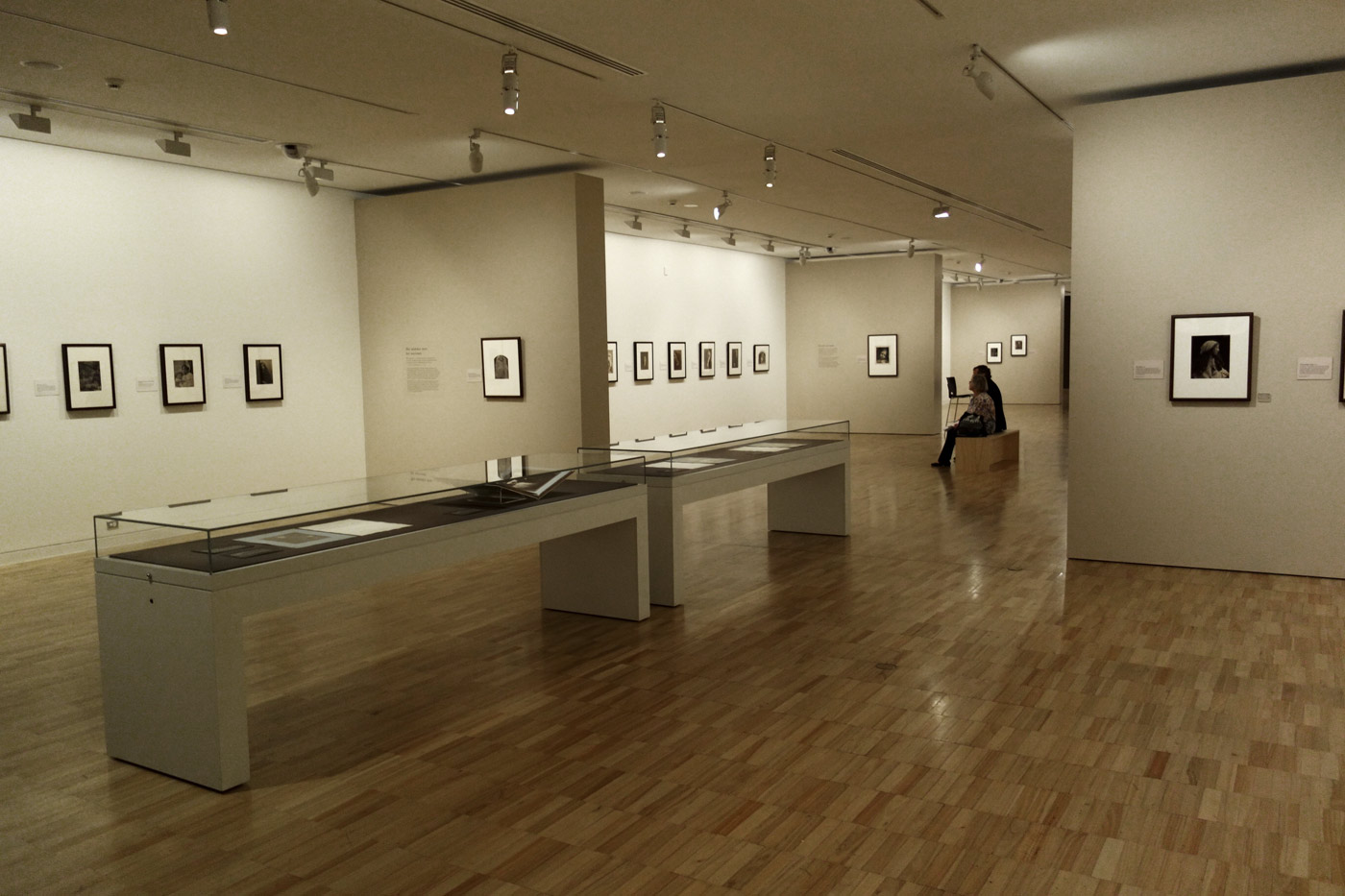
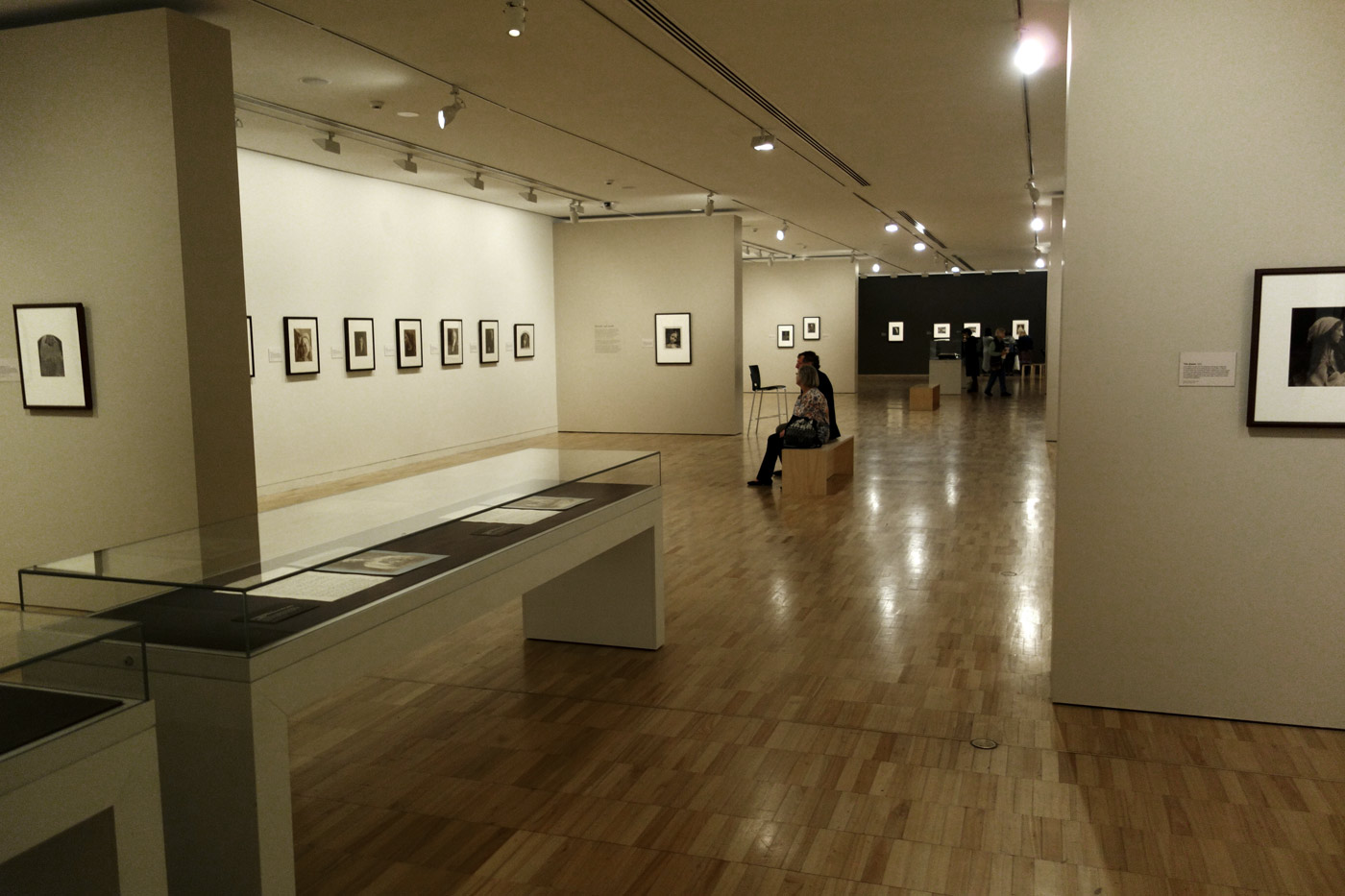
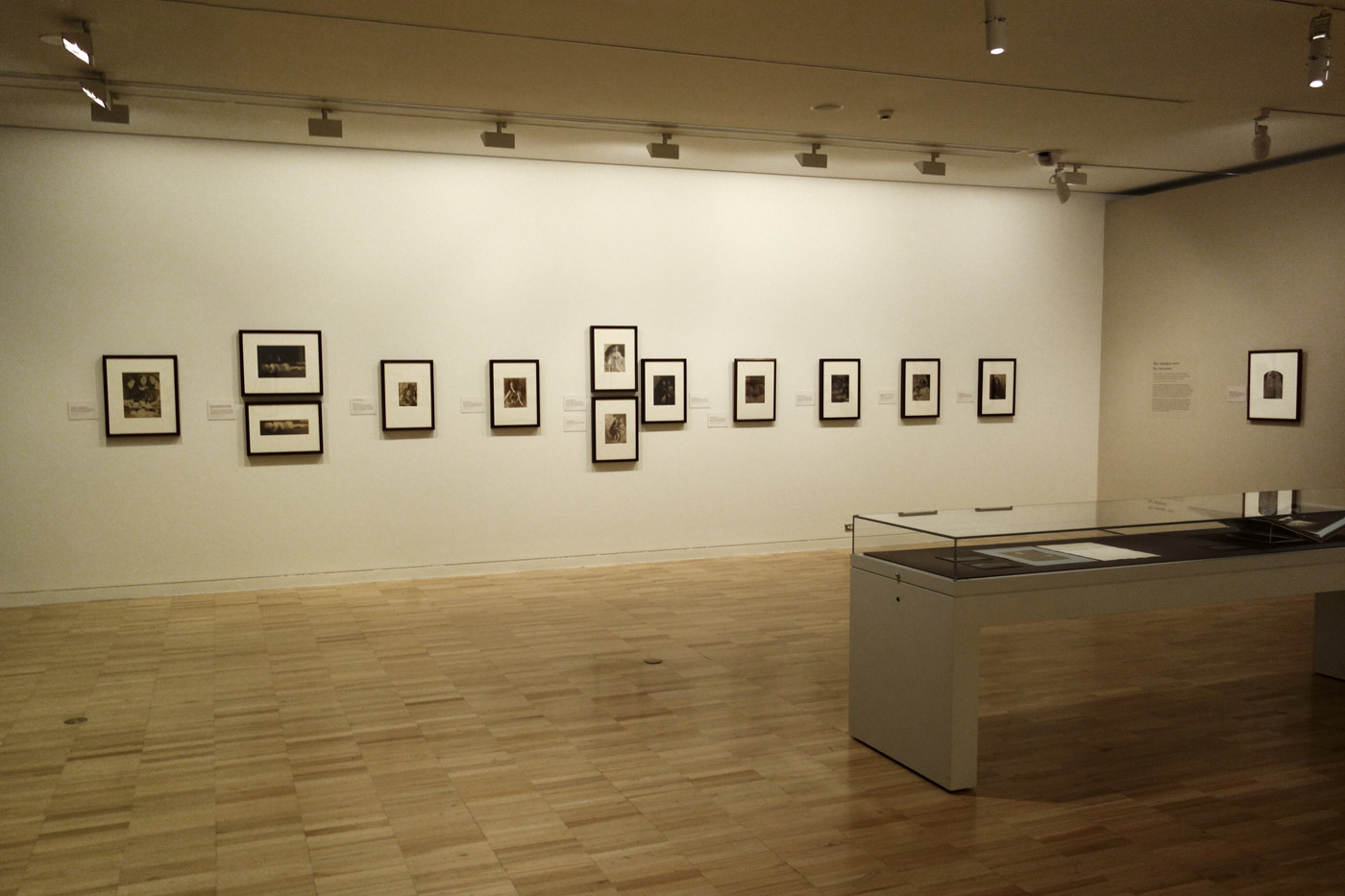
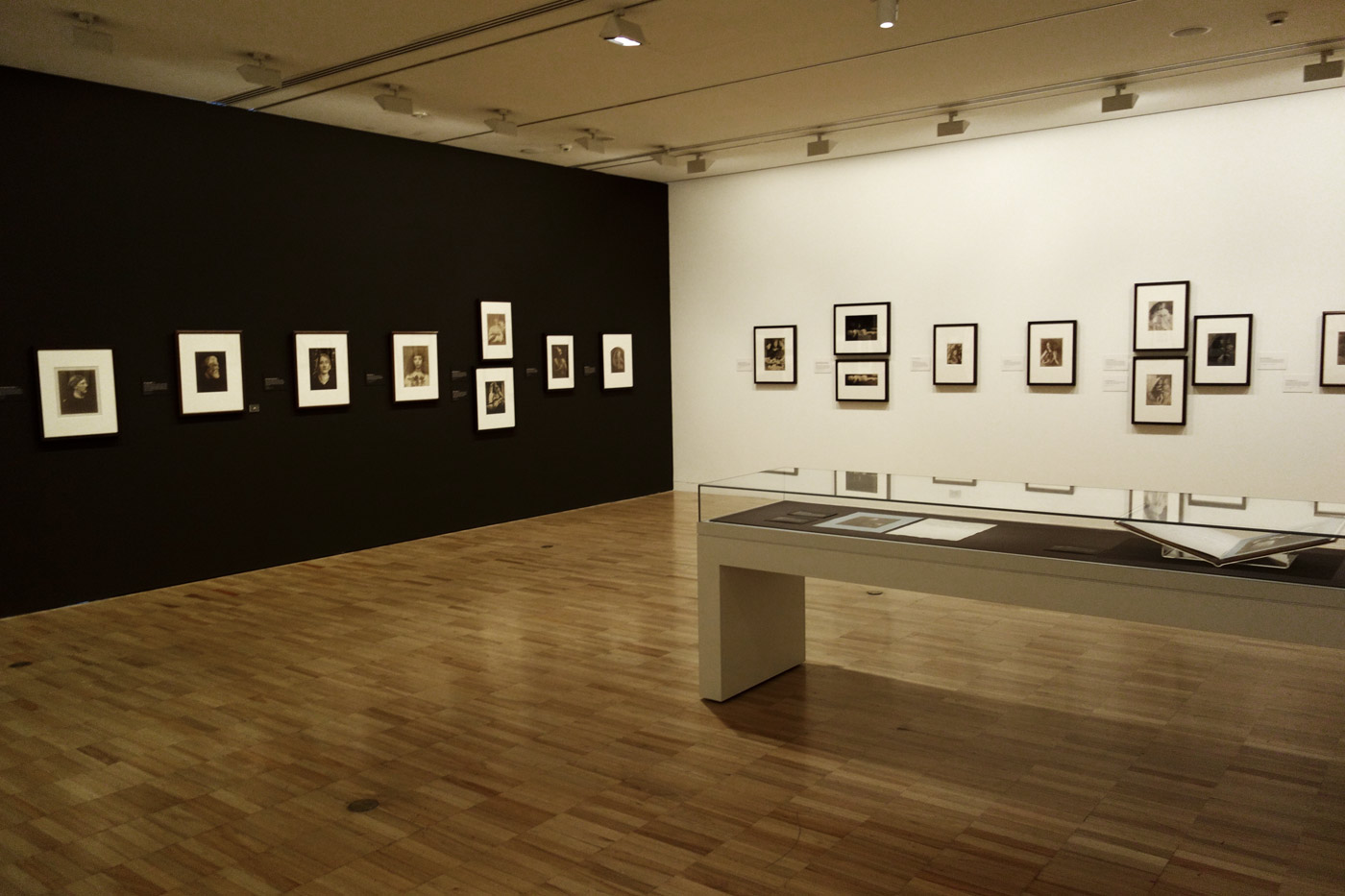
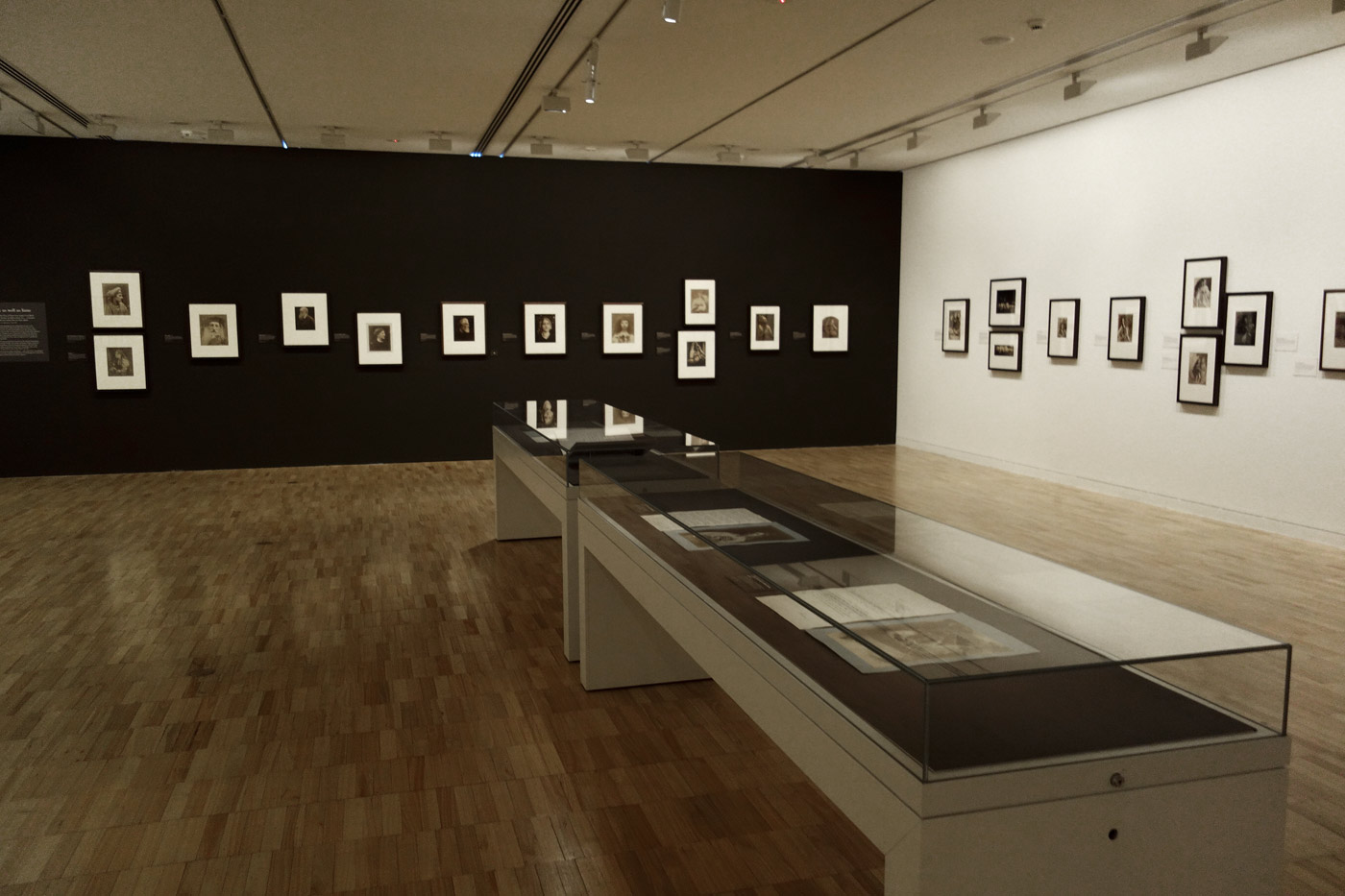
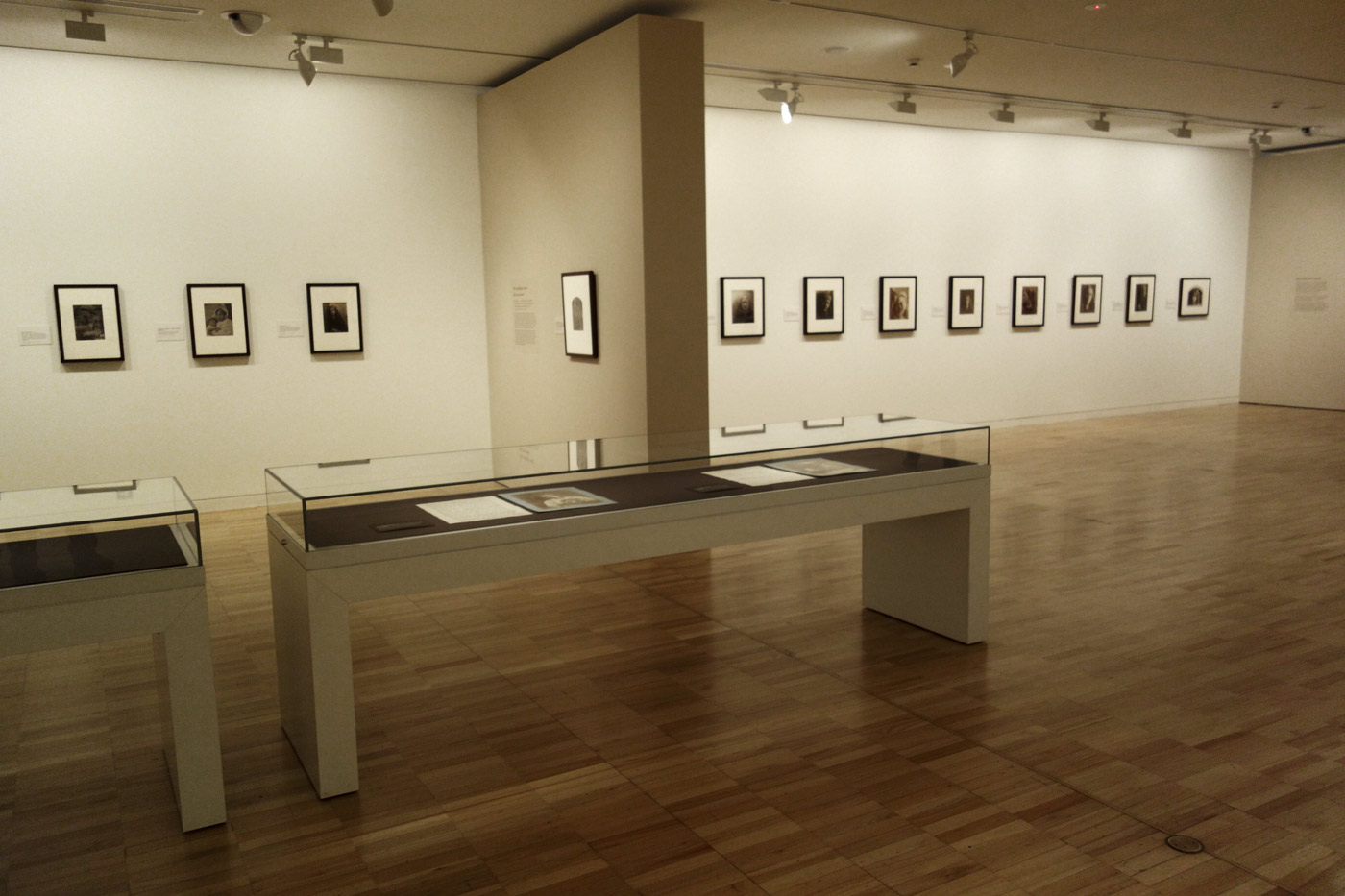
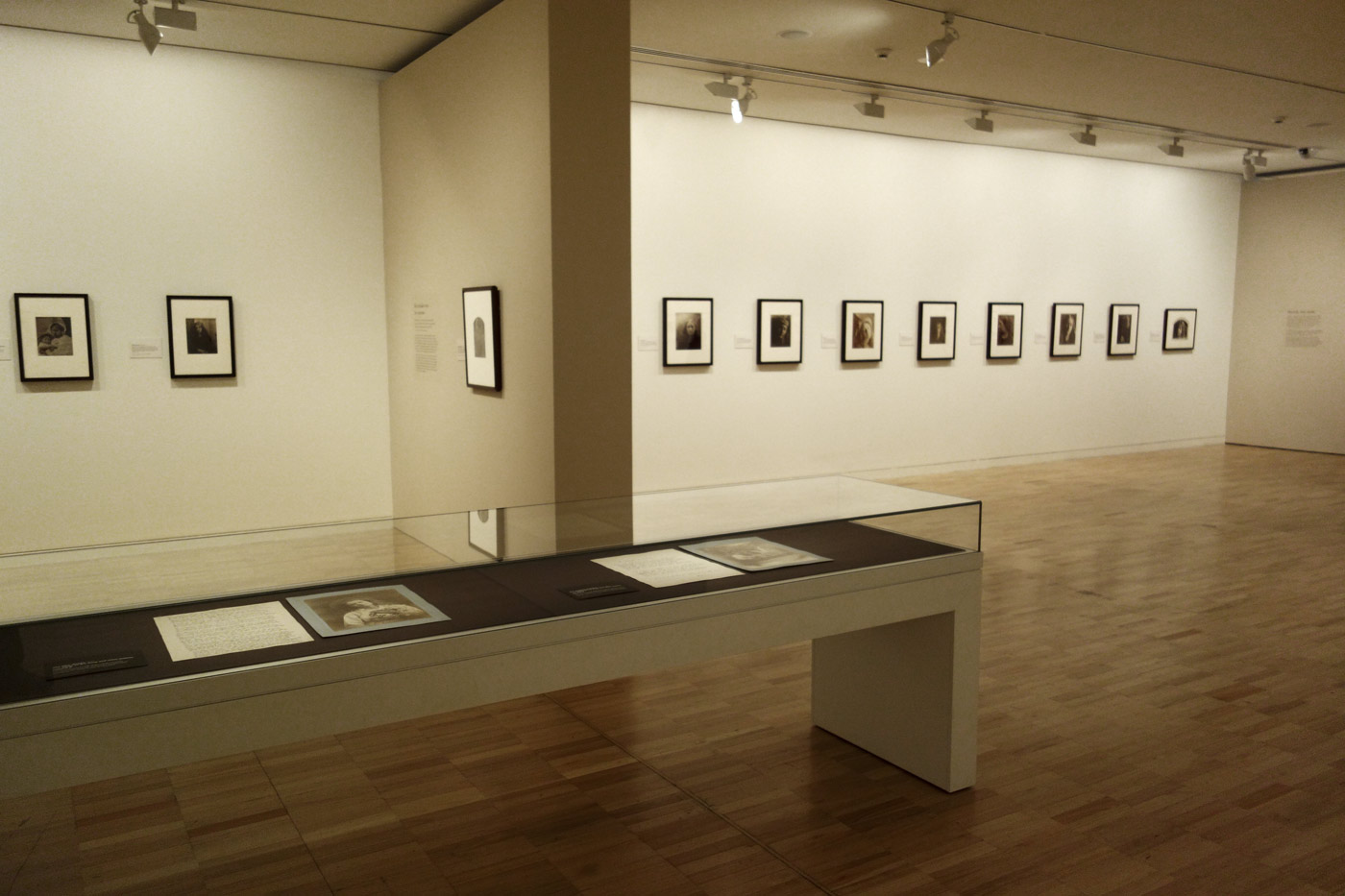
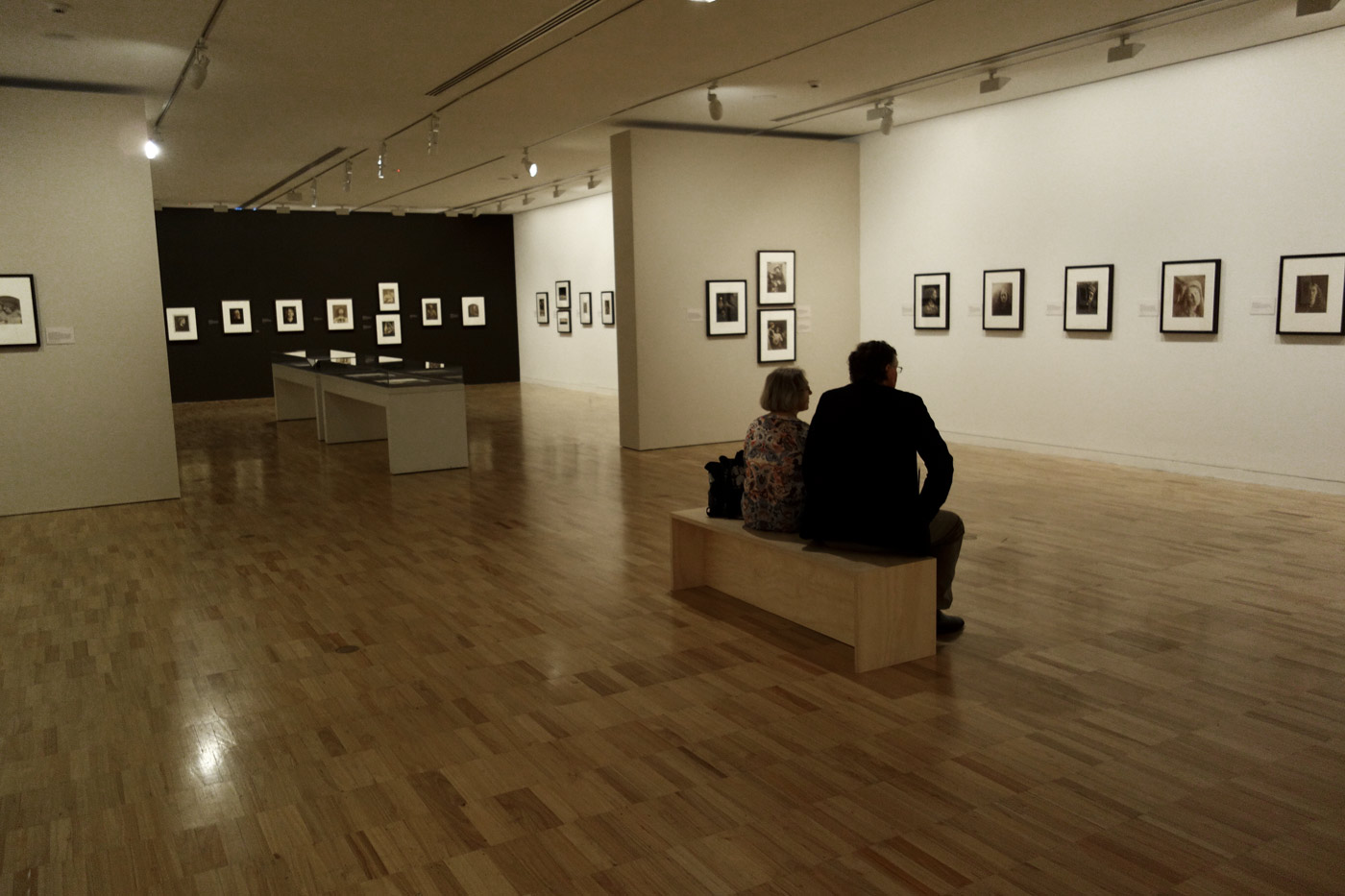
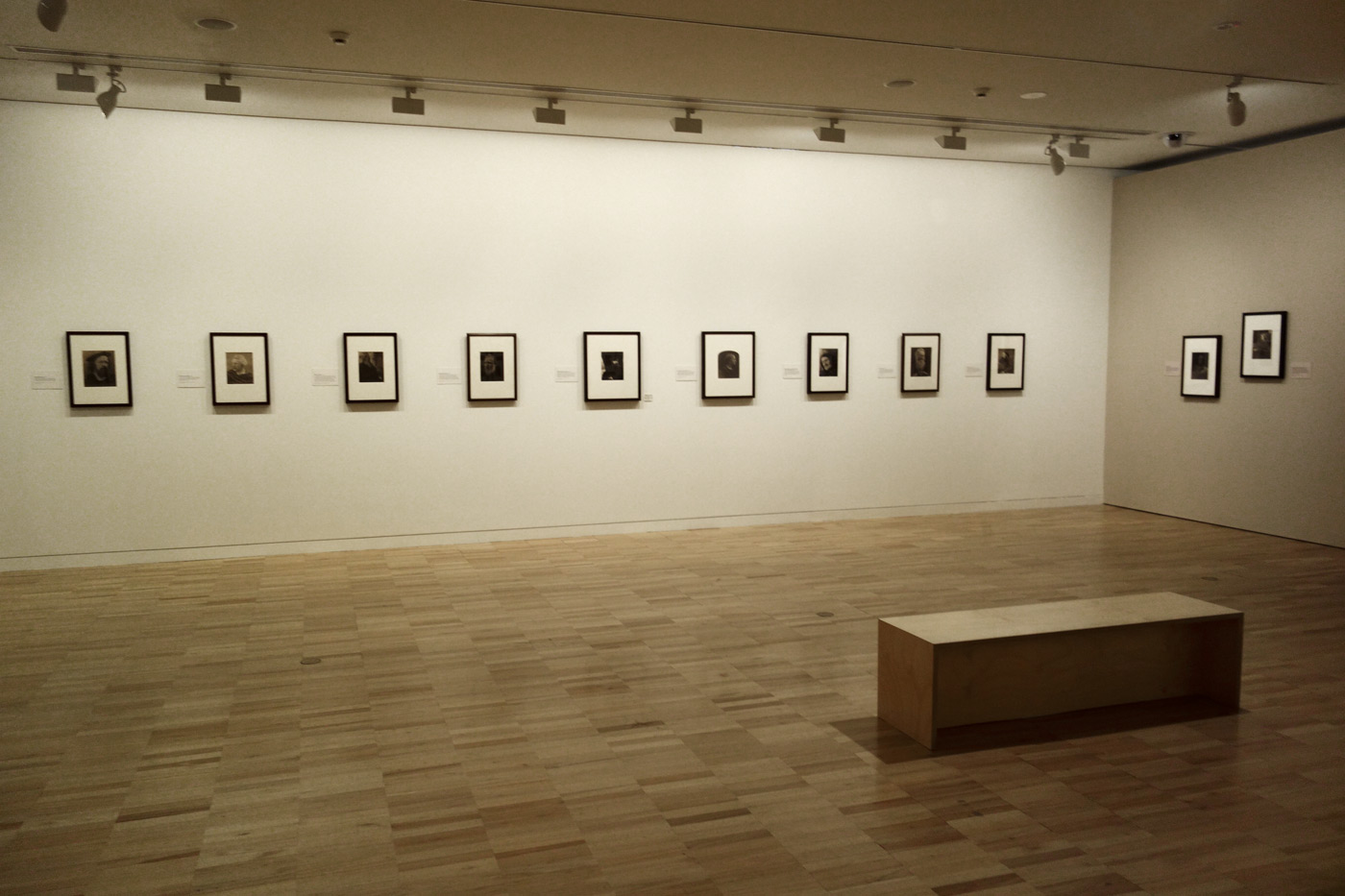
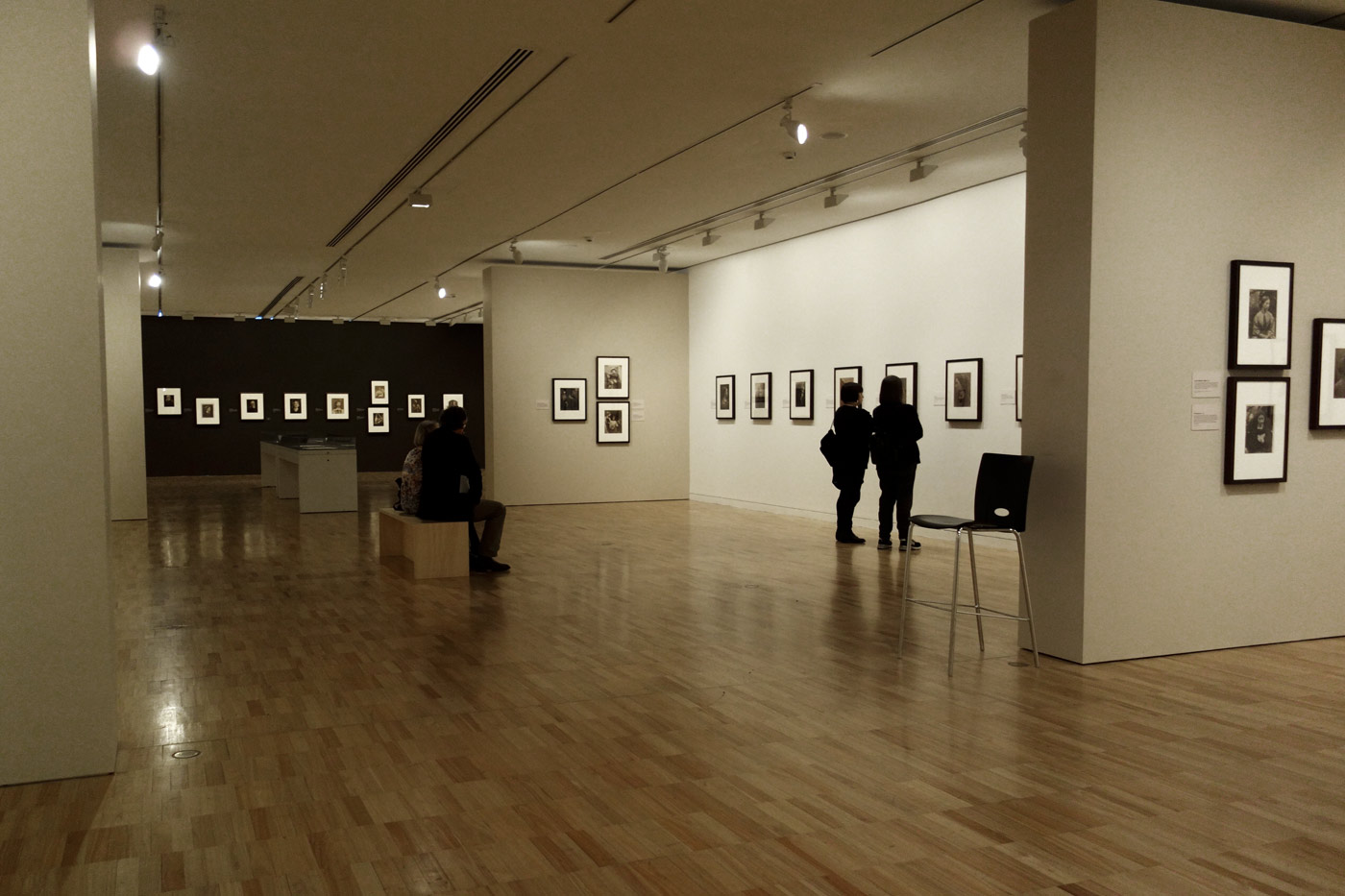
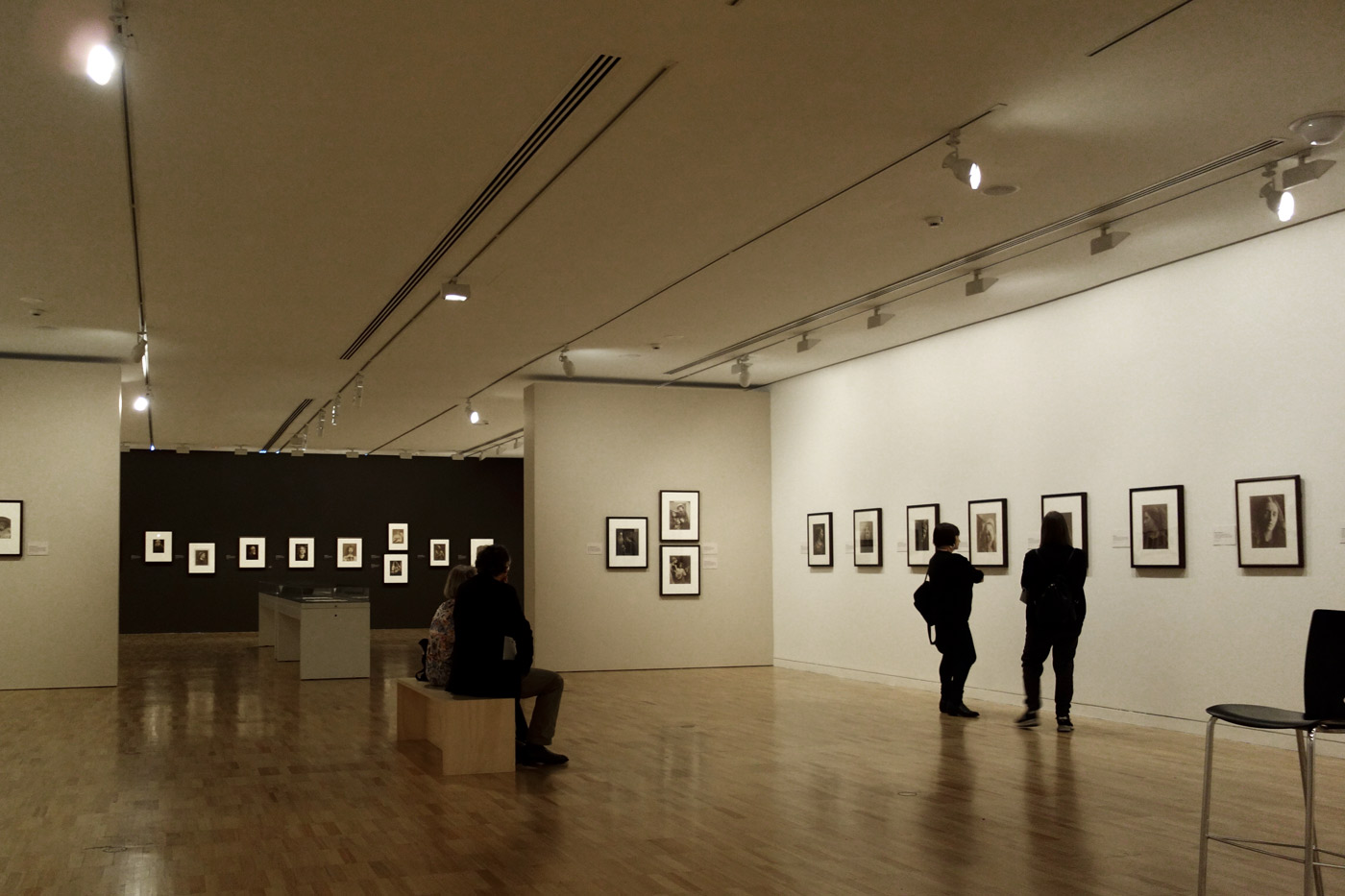
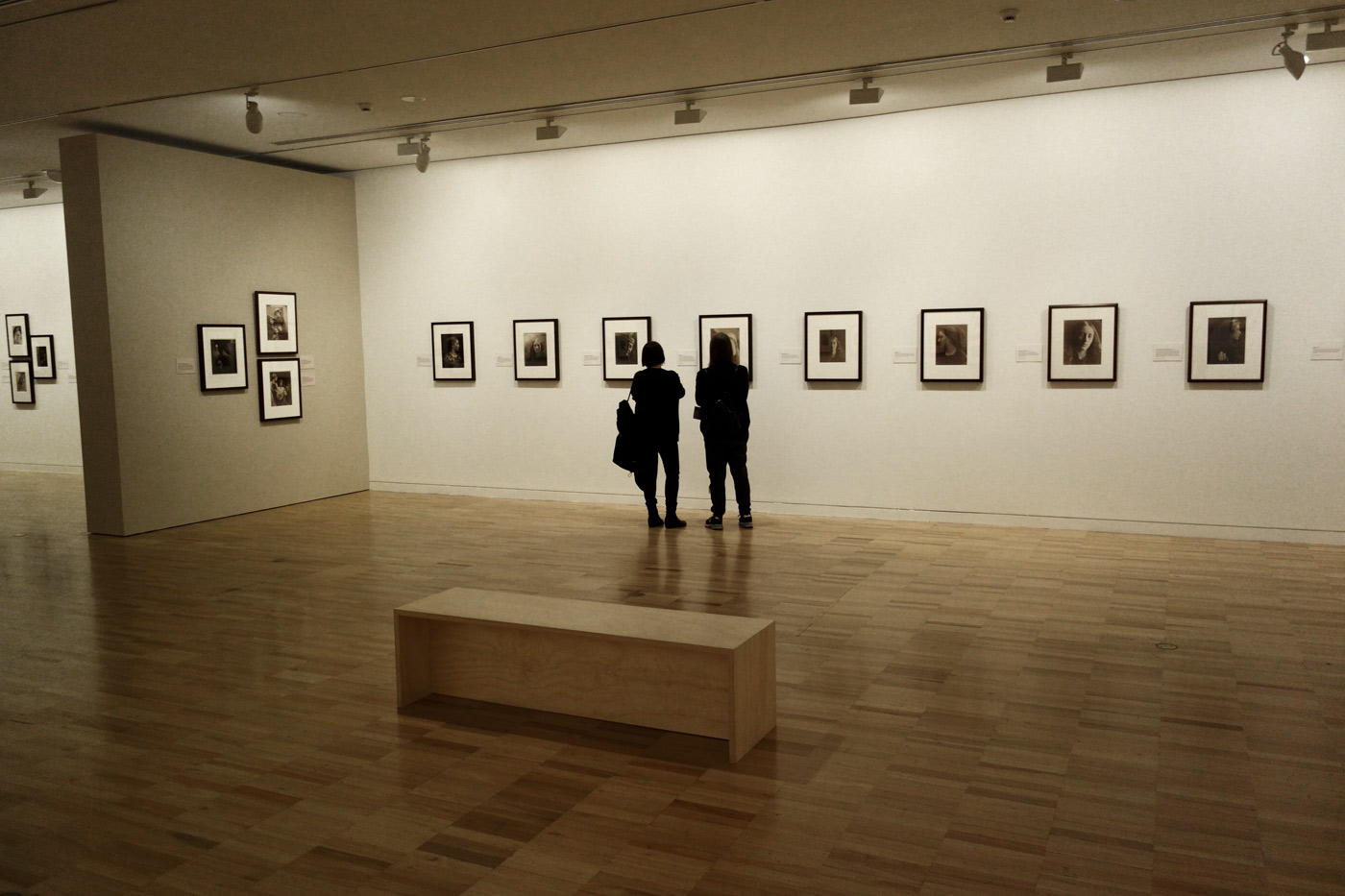
Exhibition: ‘Sight Reading: Photography and the Legible World’ at the Morgan Library & Museum, New York

Exhibition dates: 19th February – 30th May, 2016

Co-curators: Joel Smith, the Morgan’s Richard L. Menschel Curator and Department Head of Photography, and Lisa Hostetler, Curator in Charge of Photography at the Eastman Museum
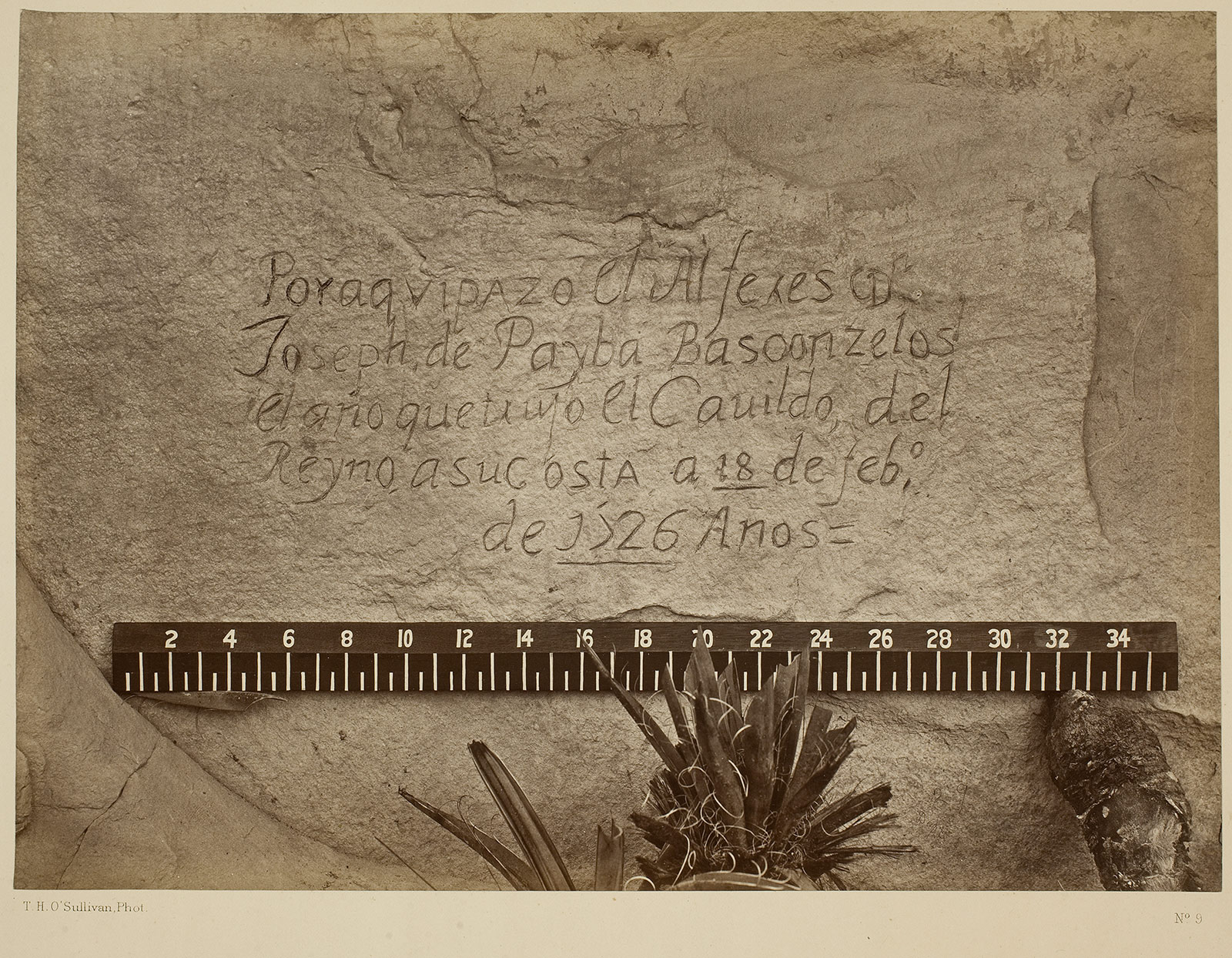
 

Timothy H. O'Sullivan (American born Ireland, 1840-1882) 'Historic Spanish Record of the Conquest, South Side of Inscription Rock' 1873 from the exhibition 'Sight Reading: Photography and the Legible World' at the Morgan Library & Museum, New York, Feb - May, 2016


Timothy H. O’Sullivan (American born Ireland, 1840-1882)
Historic Spanish Record of the Conquest, South Side of Inscription Rock
1873
From the album Geographical Explorations and Surveys West of the 100th Meridian
Albumen silver print
George Eastman Museum, purchase


In 1873 O’Sullivan joined Lieutenant George Wheeler’s Geographic Survey in New Mexico and Arizona. At El Morro, a sandstone promontory covered with ancient petroglyphs and historic-era inscriptions, the photographer singled out this handsomely lettered sentence to record and measure. It states: By this place passed Ensign Don Joseph de Payba Basconzelos, in the year in which he held the Council of the Kingdom at his expense, on the 18th of February, in the year 1726. Nearby, the rock record now bears another inscription that reads T. H. O’Sullivan.


This looks to be a fascinating exhibition. I wish I could see it.

While Sight Reading cuts across conventional historical and geographic divisions, with the exhibition being organised into nine “conversations” among diverse sets of works, we must always remember that these “themes” are not exclusory to each other. Photographs do cross nominally defined boundaries and themes (as defined by history and curators) so that they can become truly subversive works of art.

Photographs can form spaces called heterotopia, “a form of concept in human geography elaborated by philosopher Michel Foucault, to describe places and spaces that function in non-hegemonic conditions. These are spaces of otherness, which are neither here nor there, that are simultaneously physical and mental, such as the space of a phone call or the moment when you see yourself in the mirror… Foucault uses the term “heterotopia” (French: hétérotopie) to describe spaces that have more layers of meaning or relationships to other places than immediately meet the eye.”1

In photographs, there is always more than meets the eye. There is the association of the photograph to multiple places and spaces (the histories of that place and space); the imagination of the viewer and the memories they bring to any encounter with a photograph, which may change from time to time, from look to look, from viewing to viewing; and the transcendence of the photograph as it brings past time to present time as an intimation of future time. Past, present and future spacetime are conflated in the act of just looking, just being. Positioning this “‘annihilation of time and space’ as a particular moment in a dynamic cycle of rupture and recuperation enables a deliberate focus on the process of transition.”2 And that transition, Doreen Massey argues, ignores often-invisible contingencies that define spaces those relations that have an effect upon a space but are not visible within it.3

Photographs, then, form what Deleuze and Guattari call assemblages4, where the assemblage is “the processes by which various configurations of linked components function in an intersection with each other, a process that can be both productive and disruptive. Any such process involves a territorialization; there is a double movement where something accumulates meanings (re-territorialization), but does so co-extensively with a de-territorialization where the same thing is disinvested of meanings. The organization of a territory is characterized by such a double movement … An assemblage is an extension of this process, and can be thought of as constituted by an intensification of these processes around a particular site through a multiplicity of intersections of such territorializations.”5 In other words, when looking at a photograph by William Henry Fox Talbot or Timothy H. O’Sullivan today, the meaning and interpretation of the photograph could be completely different to the reading of this photograph in the era it was taken. The photograph is a site of both de-territorialization and re-territorialization – it both gains and looses meaning at one and the same time, depending on who is looking at it, from what time and from what point of view.

Photographs propose that there are many heterotopias in the world, many transitions and intersections, many meanings lost and found, not only as spaces with several places of/for the affirmation of difference, but also as a means of escape from authoritarianism and repression. We must remember these ideas as we looking at the photographs in this exhibition.

Dr Marcus Bunyan


Footnotes

1/ Heterotopia (space) on the Wikipedia website [Online] Cited 27/05/2016.

2/ McQuire, Scott. The Media City. London: Sage Publications, 2008, p. 14.

3/ Massey, Doreen. Space, Place and Gender. Cambridge: Polity Press, 1994, p. 5 in Wood, Aylish. “Fresh Kill: Information technologies as sites of resistance,” in Munt, Sally (ed.,). Technospaces: Inside the New Media. London: Continuum, 2001, pp. 163-164.

4/ Deleuze, Gilles and Guattari, Felix. A Thousand Plateaus: Capitalism and Schizophrenia. Minneapolisand London: University of Minneapolis Press, 1987.

5/ Wood, Aylish. “Fresh Kill: Information technologies as sites of resistance,” in Munt, Sally (ed.,). Technospaces: Inside the New Media. London: Continuum, 2001, p.166


Many thankx to the Morgan Library & Museum for allowing me to publish the text and photographs in the posting. Please click on the photographs for a larger version of the image.


'Sight Reading: Photography and the Legible World' exhibition sections


Sight Reading: Photography and the Legible World exhibition sections


As its name declares, photography is a means of writing with light. Photographs both show and tell, and they speak an extraordinary range of dialects.

Beginning February 19 the Morgan Library & Museum explores the history of the medium as a lucid, literate – but not always literal – tool of persuasion in a new exhibition, Sight Reading: Photography and the Legible World. A collaboration with the George Eastman Museum of Film and Photography, the show features more than eighty works from the 1840s to the present and reveals the many ways the camera can transmit not only the outward appearance of its subject but also narratives, arguments, and ideas. The show is on view through May 30.

Over the past 175 years, photography has been adopted by, and adapted to, countless fields of endeavour, from art to zoology and from fashion to warfare. Sight Reading features a broad range of material – pioneering x-rays and aerial views, artefacts of early photojournalism, and recent examples of conceptual art – organised into groupings that accentuate the variety and suppleness of photography as a procedure. In 1936, artist László Moholy-Nagy (1895-1946) defined “the  illiterate of the future” as someone “ignorant of the use of the camera as well as the pen.” The JPEG and the “Send” button were decades away, but Moholy-Nagy was not the first observer to argue that photography belonged to the arts of commentary and persuasion. As the modes and motives of camera imagery have multiplied, viewers have continually learned new ways to read the information, and assess the argument, embodied in a photograph.

“Traditional narratives can be found throughout the Morgan’s collections, especially in its literary holdings,” said Colin B. Bailey, director of the Morgan. “Sight Reading encourages us to use a critical eye to read and discover the stories that unfold through the camera lens and photography, a distinctly modern, visual language. We are thrilled to collaborate with the Eastman Museum, and together unravel a rich narrative, which exemplifies photography’s deep involvement in the stories of modern art, science, and the printed page.”

The exhibition

Sight Reading cuts across conventional historical and geographic divisions. Featuring work by William Henry Fox Talbot (1800-1877), Eadweard Muybridge (1830-1904), John Heartfield (1891-1968), Lewis Hine (1874-1940), Harold Edgerton (1903-1990), John Baldessari (1931-2020), Sophie Calle (b. 1953), and Bernd and Hilla Becher (1931-2007; 1934-2015), among many others, the exhibition is organised into nine “conversations” among diverse sets of works.

I. The Camera Takes Stock

Photography’s practical functions include recording inventory, capturing data imperceptible to the human eye, and documenting historical events. In the first photographically illustrated publication, The Pencil of Nature (1845), William Henry Fox Talbot used his image Articles of China to demonstrate that “the whole cabinet of a … collector … might be depicted on paper in little more time than it would take him to make a written inventory describing it in the usual way.” Should the photographed collection suffer damage or theft, Talbot speculated, “the mute testimony of the picture … would certainly be evidence of a novel kind” before the law.

A century later, Harold Edgerton, an electrical engineer at the Massachusetts Institute of Technology, used the pulsing light of a stroboscope to record states of matter too fleeting for the naked eye. Gun Toss, an undated image of a spinning pistol, is not a multiple exposure: the camera shutter opened and closed just once. But during that fraction of a second, seven bright flashes of light committed to film a seven-episode history of the gun’s trajectory through space.
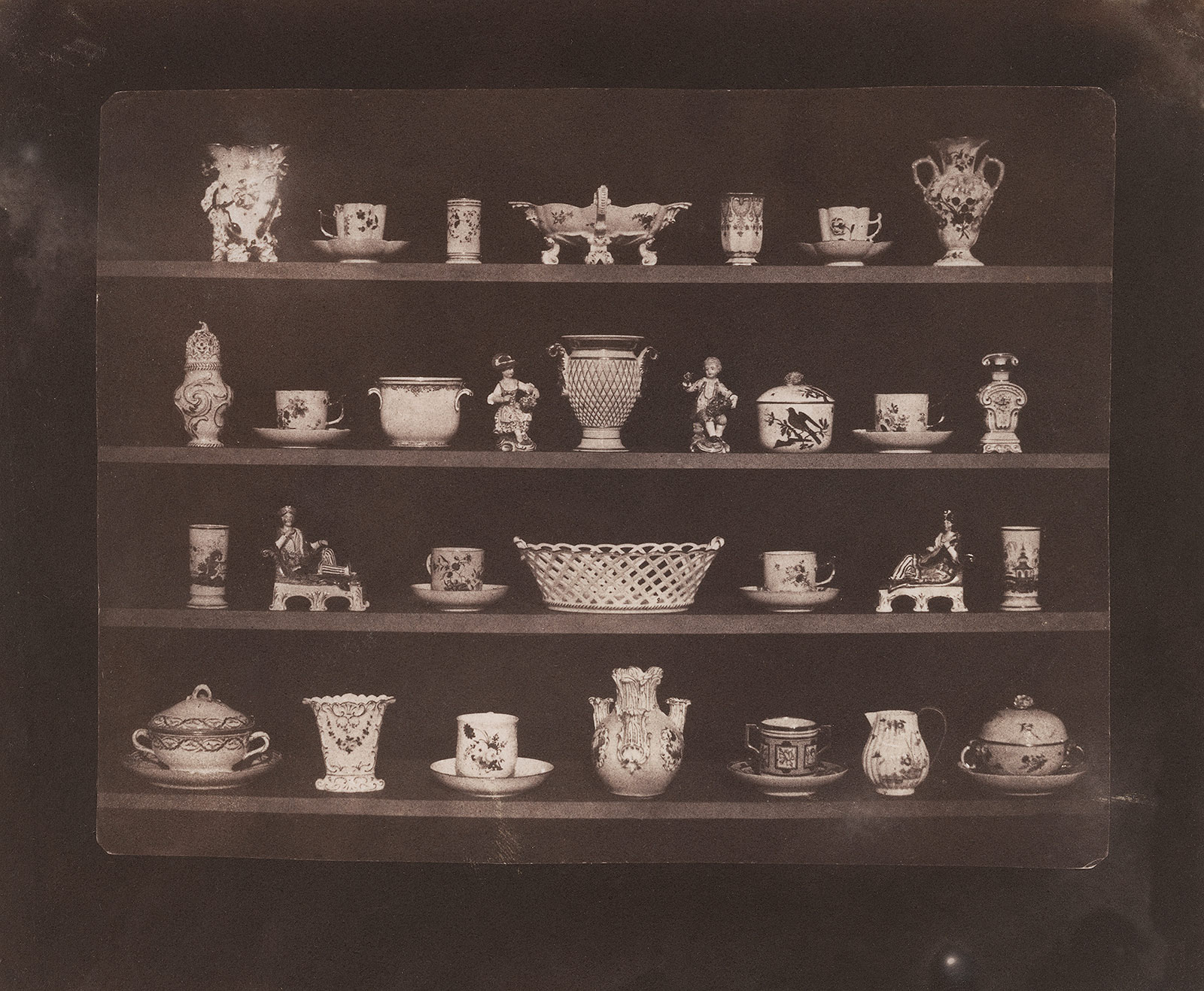
 

William Henry Fox Talbot (British, 1800-1877) 'Articles of China' c. 1843, printed c. 1845 from the exhibition 'Sight Reading: Photography and the Legible World' at the Morgan Library & Museum, New York, Feb - May, 2016


William Henry Fox Talbot (British, 1800-1877)
Articles of China
c. 1843, printed c. 1845
Salted paper print from calotype negative
Collection of Richard and Ronay Menschel


In The Pencil of Nature (1845), the first photographically illustrated publication, Talbot used Articles of China to demonstrate that “the whole cabinet of a … collector … might be depicted on paper in little more time than it would take him to make a written inventory describing it in the usual way.” Should the collection suffer damage or theft, Talbot added, “the mute testimony of the picture … would certainly be evidence of a novel kind” before the law.


Harold Edgerton (American, 1903-1990) 'Gun Toss' 1936-1950


Harold Edgerton (American, 1903-1990)
Gun Toss
1936-1950
Gelatin silver print
Collection of Richard and Ronay Menschel


Edgerton, an electrical engineer, used the rapidly pulsing light of a stroboscope to record states of matter too fleeting to be perceived by the naked eye. This image of a spinning pistol is not a multiple exposure: the camera shutter opened and closed just once. But during that fraction of a second, seven bright flashes of light committed to film a seven-episode history of the gun’s trajectory through space.

 

John Pfahl (American, 1939-2020) 'Wave Theory I–V, Puna Coast, Hawaii, March 1978' 1978


John Pfahl (American, 1939-2020)
Wave Theory I-V, Puna Coast, Hawaii, March 1978
1978
From the series Altered Landscapes
Chromogenic development (Ektacolor) process prints, 1993
George Eastman Museum, purchase


In this sequence, Pfahl twisted the conventions of photographic narrative into a perceptual puzzle. The numbered views appear to chronicle a single event: a wave breaking on the shore. Close inspection, however, reveals that the numeric caption in each scene is made of string laid on the rock in the foreground. The exposures, then, must have been made over a span of at least several minutes, not seconds – and in what order, one cannot say.


II. Crafting A Message

The camera is widely understood to be “truthful,” but what photographs “say” is a product of many procedures that follow the moment of exposure, including page layout, captioning, and cropping of the image. During World War I, military personnel learned to interpret the strange, abstract looking images of enemy territory made from airplanes. Their specialised training fundamentally altered the nature of wartime reconnaissance, even as the unusual perspective unique to aerial photography introduced a new dialect into the expanding corpus of modern visual language. An Example of an Annotated Photograph with Local Names of Trenches Inserted (1916), on view in the exhibition, shows that the tools of ground strategy soon included artificial bunkers and trenches, designed purely to fool eyes in the sky.

In László Moholy-Nagy’s photocollages of the late 1920s, figures cut out of the plates in mass market magazines appear in new configurations to convey messages of the artist’s devising. Images such as Massenpsychose (Mass Psychosis) (1927) propose a new kind of visual literacy for the machine age. To contemporary eyes, Moholy’s collages seem to foreshadow cut-and-paste strategies that would later characterise the visual culture of cyberspace.
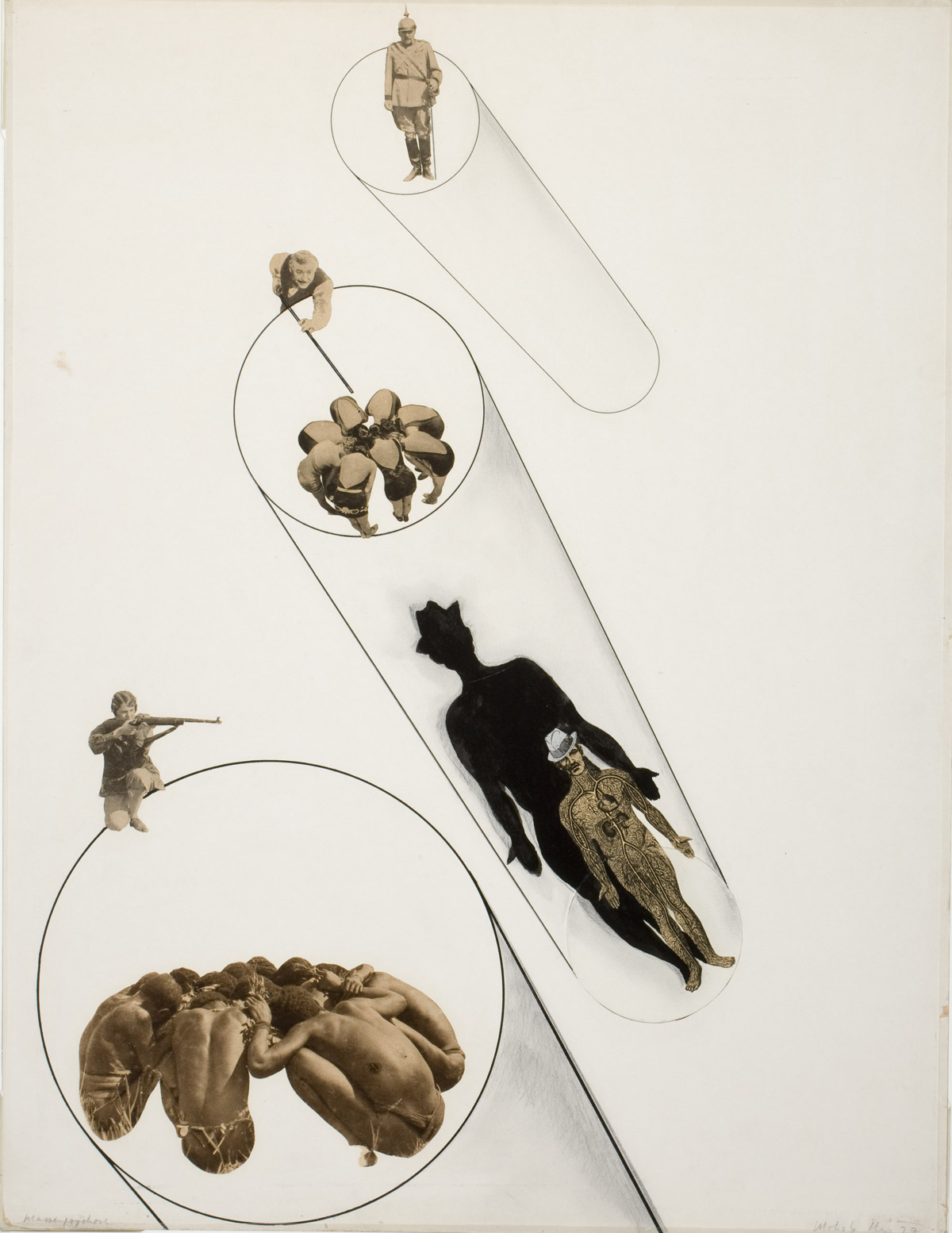
 

László Moholy-Nagy (American born Hungary, 1895-1946) 'Massenpsychose' (Mass Psychosis) 1927


László Moholy-Nagy (American born Hungary, 1895-1946)
Massenpsychose (Mass Psychosis)
1927
Collage, pencil, and ink
George Eastman Museum, Purchased with funds provided by Eastman Kodak Company


To make his photocollages of the late 1920s, Moholy-Nagy cut figures out of photographs and photomechanical reproductions and arranged them into new configurations that convey messages of his own devising. By extracting the images from their original context and placing them into relationships defined by drawn shapes and volumes, he suggested a new visual literacy for the modern world. In this world – one in which images course through mass culture at a psychotic pace – a two-dimensional anatomical drawing acquires sufficient volume to cast a man’s shadow and a circle of bathing beauties cues up for a pool sharp. To contemporary eyes, the language of Moholy-Nagy’s photo collages seems to foreshadow strategies common to the visual culture of cyberspace.
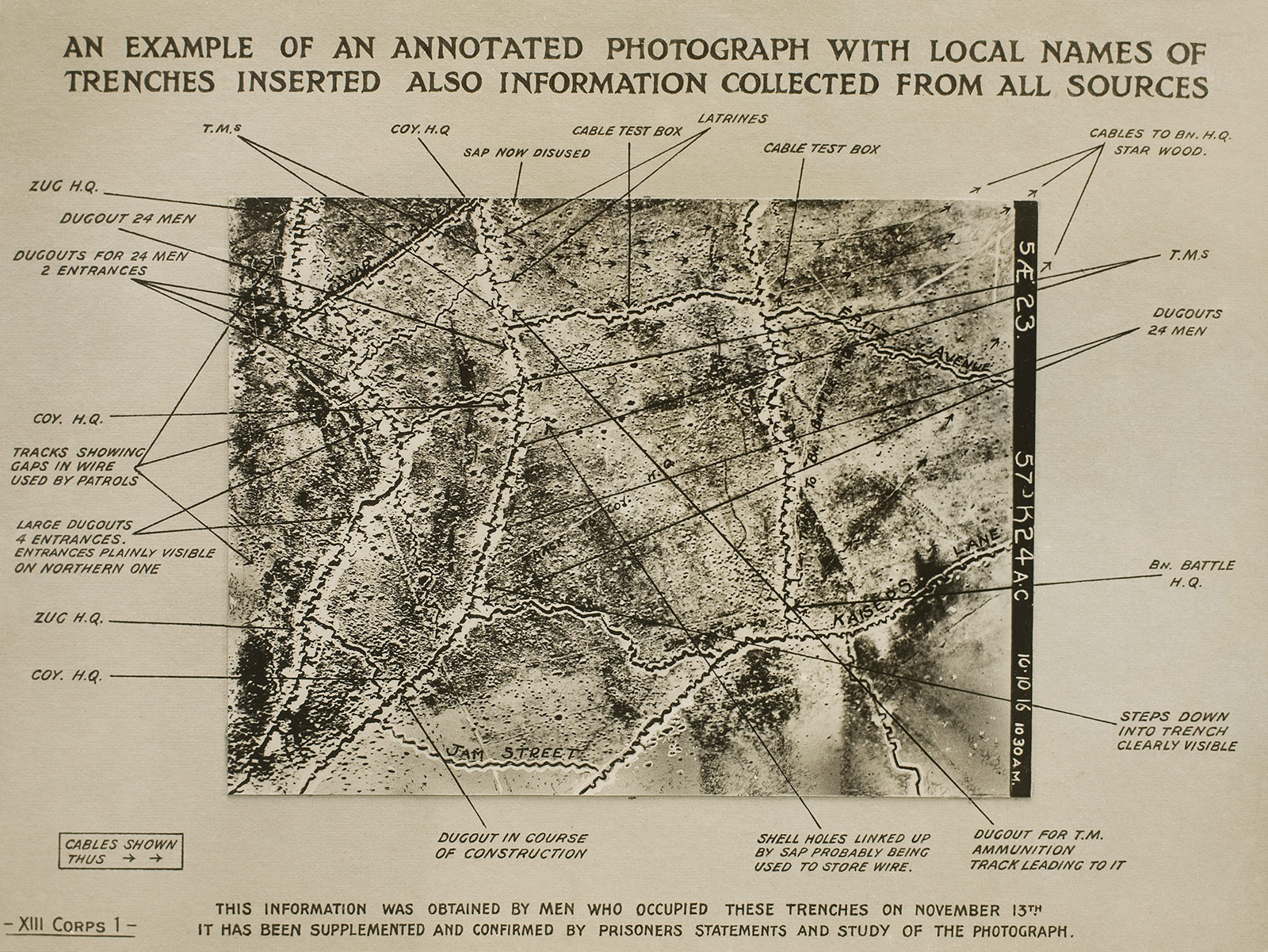
 

Unidentified maker. 'An Example of an Annotated Photograph with Local Names of Trenches Inserted' c. 1916


Unidentified maker
An Example of an Annotated Photograph with Local Names of Trenches Inserted
c. 1916
Gelatin silver print
George Eastman Museum


During World War I, aerial photography progressed from a promising technological experiment to a crucial strategic operation. As advances in optics and engineering improved the capabilities of cameras and aircraft, military personnel learned to identify topographic features and man-made structures in the images recorded from above. Such training fundamentally altered the significance and practice of wartime reconnaissance. At the same time, the unusual perspective unique to aerial photography introduced a new dialect into the expanding corpus of modern visual language.
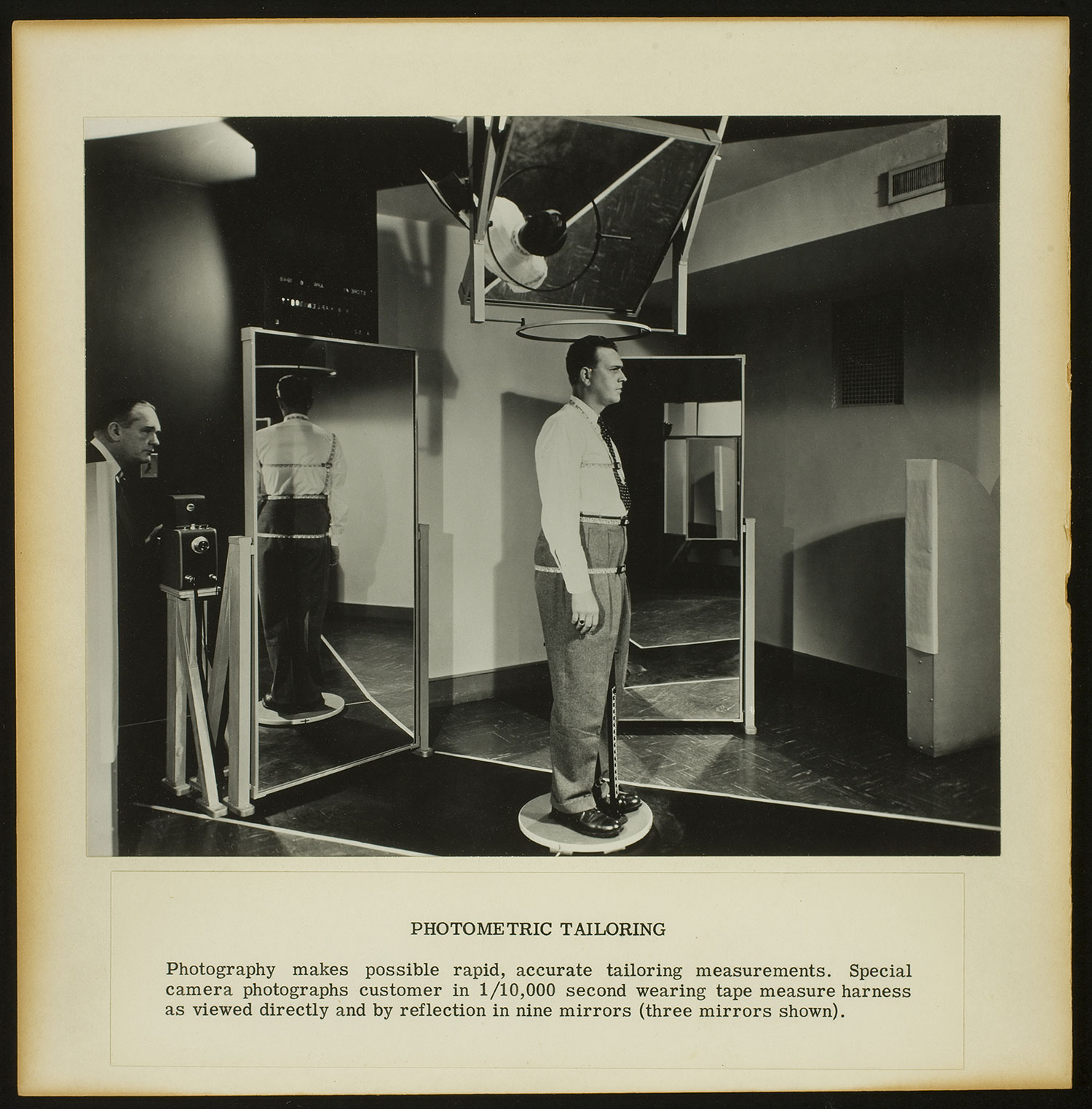
 

PhotoMetric Corporation, 1942-1974 'PhotoMetric Tailoring' c. 1942-1948


PhotoMetric Corporation, 1942-1974
PhotoMetric Tailoring
c. 1942-1948
Gelatin silver prints
George Eastman Museum


In an effort to streamline the field of custom tailoring, textile entrepreneur Henry Booth devised a method for obtaining measurements by photographing customers with a special camera and angled mirrors. The system was said to be foolproof, making it possible for any sales clerk to operate it. The resulting slides were sent to the manufacturer along with the customer’s order. A tailor translated the images into physical measurements using a geometric calculator, and the company mailed the finished garment to the customer.


III. Photographs in Sequence

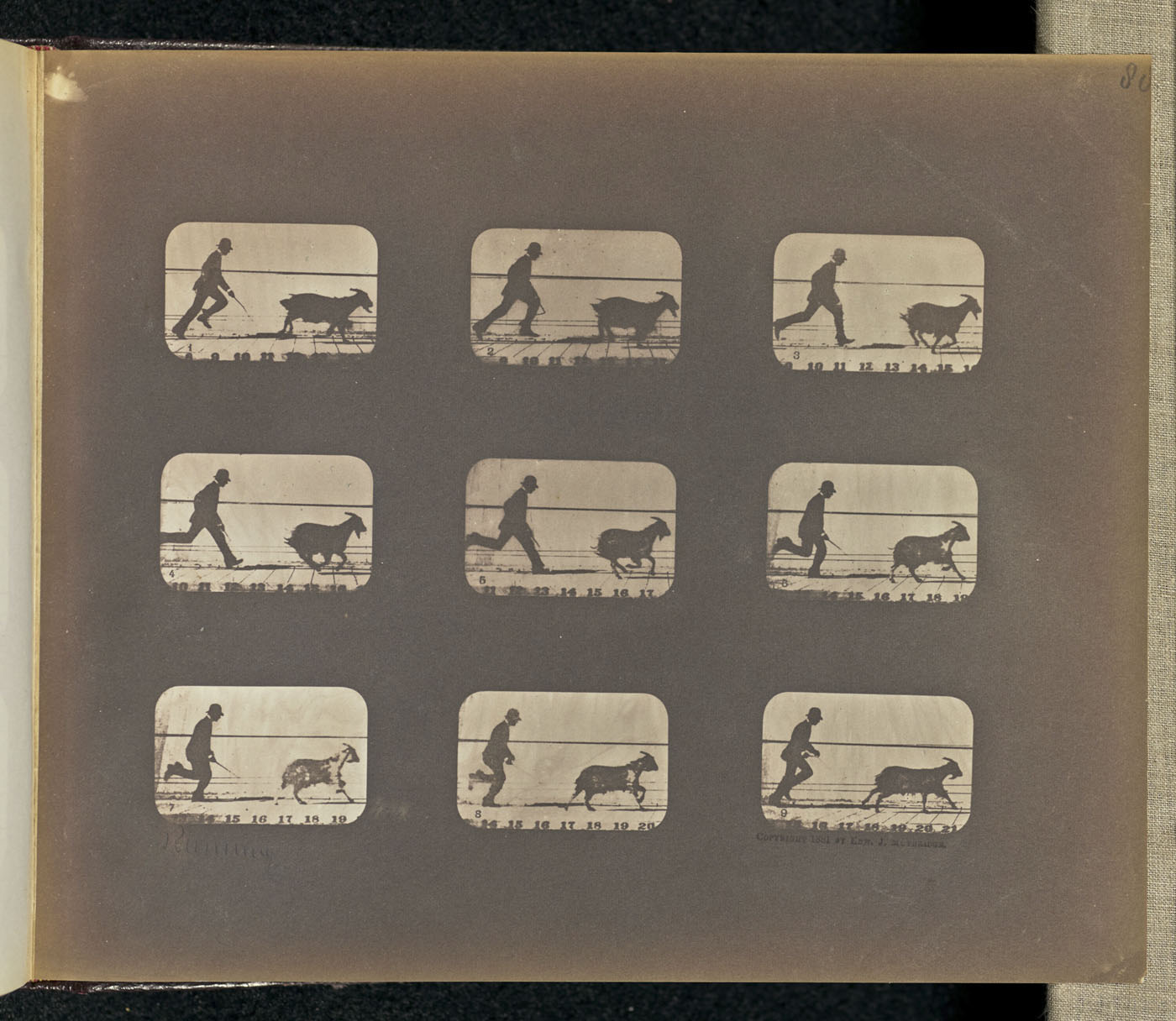
Photography’s debut in the late 1830s happened to coincide with the birth of the modern comic strip. Ultimately the narrative photo sequence would lead to the innovations that gave rise to cinema, another form of storytelling altogether. Exact contemporaries of one another, Eadweard J. Muybridge in the United States and Étienne-Jules Marey (1830-1904) in France both employed cameras to dissect human movement. Muybridge used a bank of cameras positioned to record a subject as it moved, tripping wires attached to the shutters. The result was a sequence of “stop-action” photographs that isolated gestures not otherwise visible in real time. Beginning in 1882, Marey pursued motion studies with a markedly different approach. In the works for which he is best known, he exposed one photographic plate multiple times at fixed intervals, recording the arc of movement in a single image.
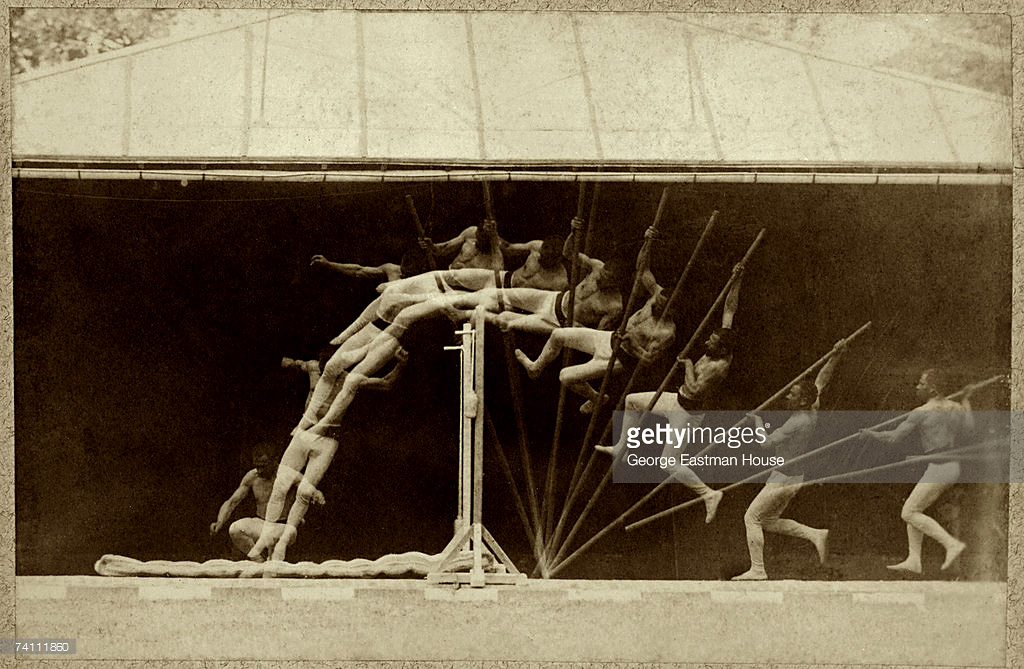
 

Étienne Jules Marey (French, 1830-1904) 'Chronophotographic study of man pole vaulting' c. 1890


Étienne Jules Marey (French, 1830-1904)
Chronophotographic study of man pole vaulting
c. 1890
Albumen silver print
George Eastman Museum, Exchange with Narodni Technical Museum


Exact contemporaries, Muybridge and Marey (the former in the United States, the latter in France) both employed cameras to dissect human movement. Muybridge used a bank of cameras positioned and timed to record a subject as it moved, tripping wires attached to the shutters. The result was a sequence of “stop-action” photographs that isolated gestures not otherwise visible in real time. Beginning in 1882, Marey took a markedly different approach. In the works for which he is best known – such as the image of the man pole-vaulting – he exposed a single photographic plate multiple times at fixed intervals, recording the arc of movement in a single image. In Marey’s chronophotograph of a man on a horse, the action reads from bottom to top. The convention of arranging sequential photographic images from left to right and top to bottom, on the model of written elements on a page, was not yet firmly established.
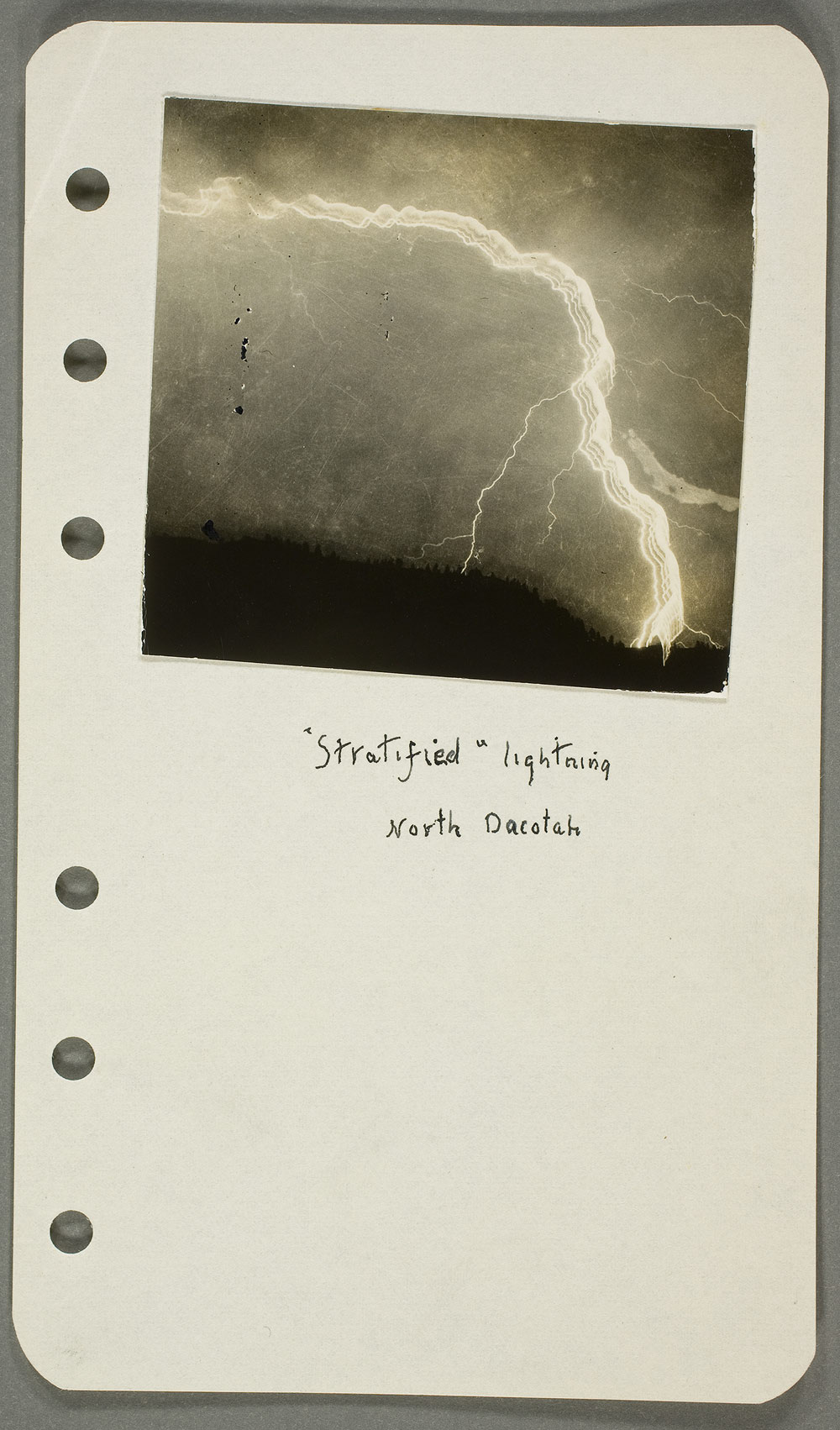
 

William N. Jennings (American, b. England, 1860-1946) 'Notebook pages with photographs of lightning' c. 1887


William N. Jennings (American, b. England, 1860-1946)
Notebook pages with photographs of lightning
c. 1887
Gelatin silver prints mounted onto bound notepad paper
George Eastman Museum, Gift of 3M Foundation; Ex-collection of Louis Walton Sipley


With his first successful photograph of a lightning bolt on 2 September 1882, Jennings dispelled the then widely held belief – especially among those in the graphic arts – that lightning traveled toward the earth in a regular zigzag pattern. Instead, his images revealed that lightning not only assumed an astonishing variety of forms but that it never took the shape that had come to define it in art.
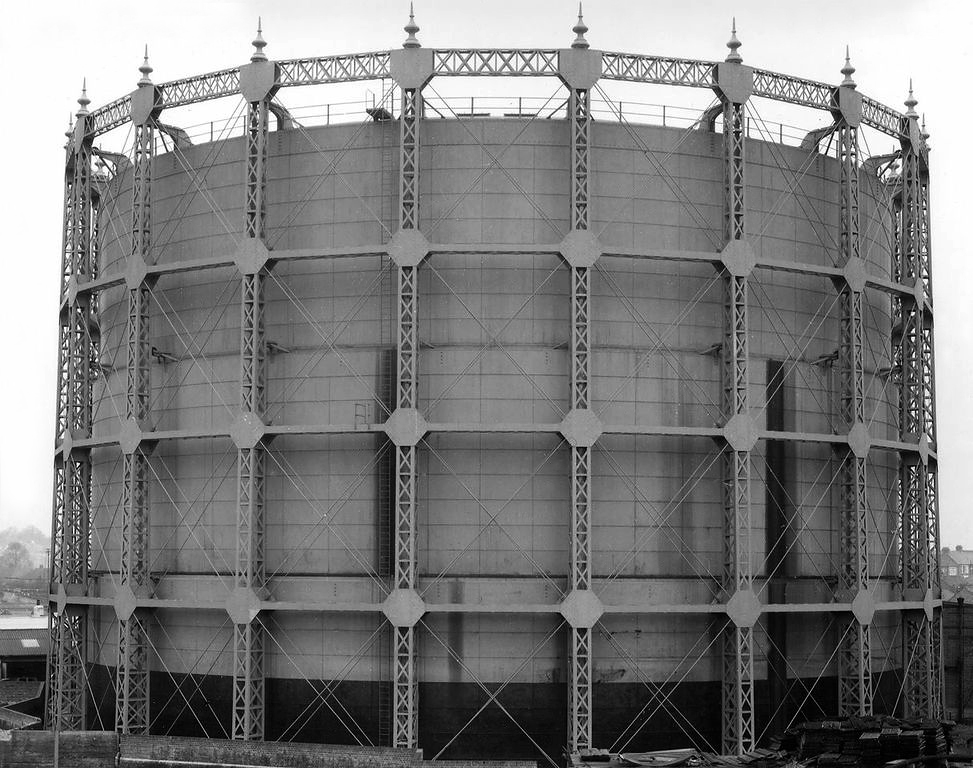
 

Bernd Becher (German, 1931-2007) Hilla Becher (German, 1934-2015) 'Industriebauten' 1968

Bernd Becher (German, 1931-2007) Hilla Becher (German, 1934-2015) 'Industriebauten' 1968


Bernd Becher (German, 1931-2007)
Hilla Becher (German, 1934-2015)
Industriebauten
1968
Gelatin silver prints in presentation box
George Eastman Museum, Purchase


The photographs in this portfolio were made only a few years into what would become the Bechers’ decades-long project of systematically documenting industrial architecture in Europe and the United States. The straightforward and rigidly consistent style of their work facilitates side-by-side comparison, revealing the singularity of structures that are typically understood to be generic.


IV. The Legible Object

Some photographs speak for themselves; others function as the amplifier for objects that can literally be read through the image. In her series Sorted Books, American artist Nina Katchadourian (b. 1968) composes statements by combining the titles of books drawn from the shelves of libraries and collections. Indian History for Young Folks, 2012, shows three books from the turn of the twentieth century that she found in the Delaware Art Museum’s M.G. Sawyer Collection of Decorative Bindings. The viewer’s eye silently provides punctuation: “Indian history for young folks: Our village; your national parks.” Though at first glance it appears merely to arrange words into legible order, Katchadourian’s oblique statement – half verbal, half visual – would be incomplete if divorced from the physical apparatus of the books themselves.
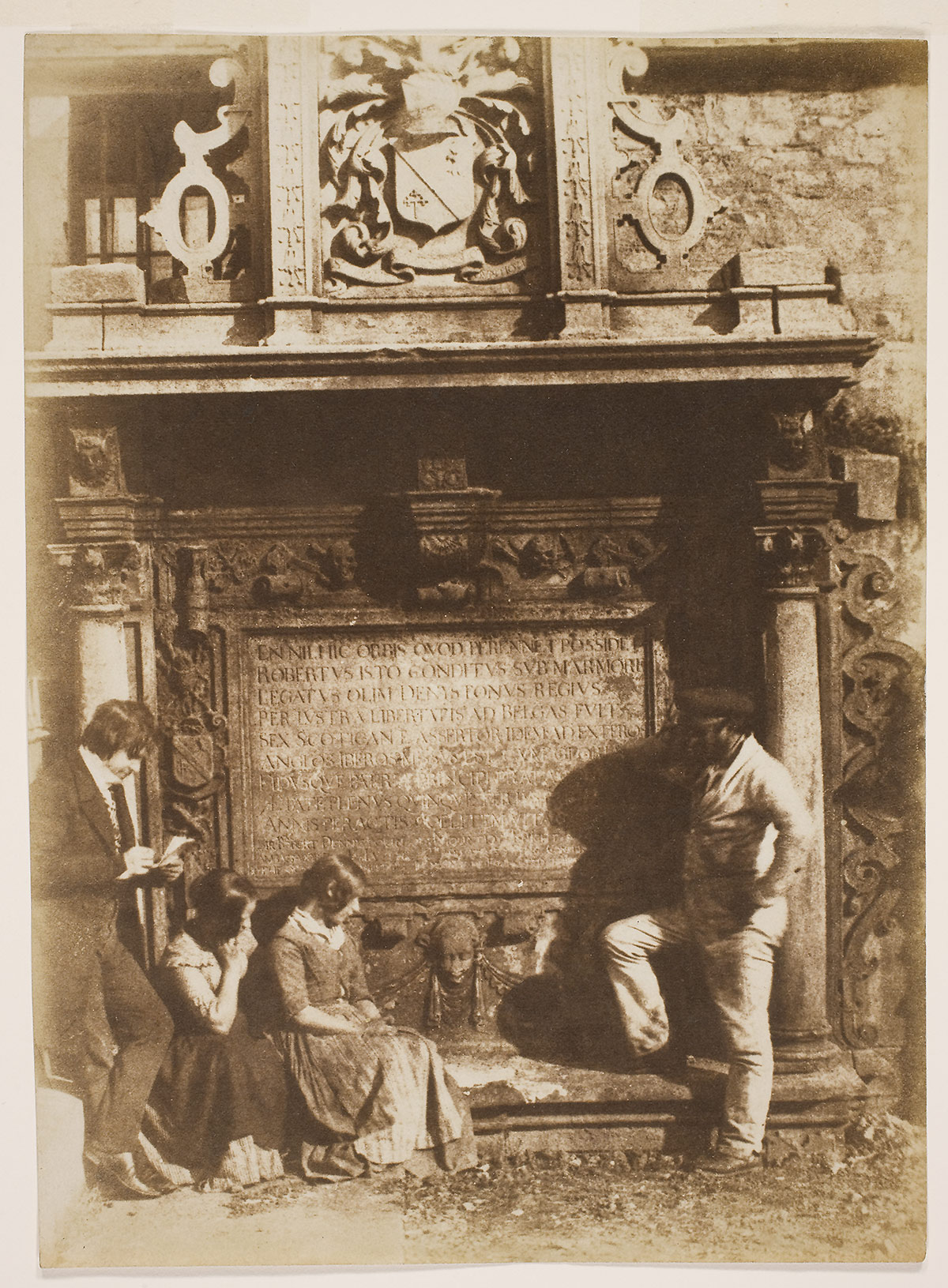
 

David Octavius Hill (Scottish, 1802-1870) Robert Adamson (Scottish, 1821-1848) 'The Artist and the Gravedigger (Denistoun Monument, Greyfriars Churchyard, Edinburgh)' c. 1845


David Octavius Hill (Scottish, 1802-1870)
Robert Adamson (Scottish, 1821-1848)
The Artist and the Gravedigger (Denistoun Monument, Greyfriars Churchyard, Edinburgh)
c. 1845
Salted paper print from calotype negative
George Eastman Museum, Gift of Alvin Langdon Coburn


Hill, his two nieces, and an unidentified man pose for the camera at the tomb of Robert Denistoun, a seventeenth-century Scottish ambassador. Contemplative poses helped the sitters hold still during the long exposure, even while turning them into sculptural extensions of the monument. Hill puts pen to paper, perhaps playing the part of a graveyard poet pondering mortality. Above him, the monument’s Latin inscription begins: “Behold, the world possesses nothing permanent!”
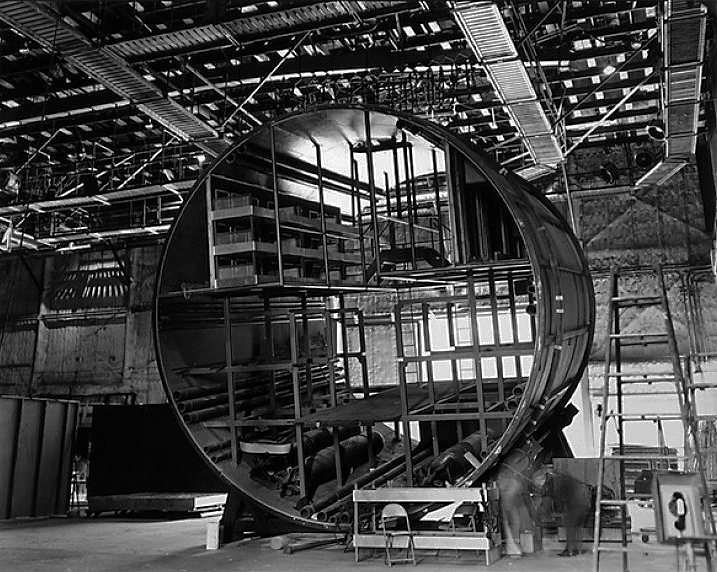
 

Robert Cumming (American, 1943-2021) 'Submarine cross-section; feature film, "Gray Lady Down" - Stage #12, March 14, 1977' 1977


Robert Cumming (American, 1943-2021)
Submarine cross-section; feature film, “Gray Lady Down” – Stage #12, March 14, 1977
1977
Inkjet print
George Eastman Museum, Gift of Nash Editions


In the Studio Still Lifes he photographed on the backlots of Universal Studios, Cumming sought to portray the mechanisms behind cinema vision “in their real as opposed to their screen contexts.” Admiring yet subversive, his documents use strategies native to the still camera – distance, point of view, and clear-eyed testimony – to translate Hollywood’s familiar illusions into worksites where “marble is plywood, stone is rubber, … rooms seldom have ceilings, and when the sun shines indoors, it casts a dozen shadows.”


Nina Katchadourian (American, b. 1968) 'Indian History for Young Folks' 2012


Nina Katchadourian (American, b. 1968)
Indian History for Young Folks
2012
From Once Upon a Time in Delaware / In Quest of the Perfect Book
Chromogenic print
The Morgan Library Museum, Purchase, Photography Collectors Committee


In her ongoing series Sorted Books, Katchadourian composes statements by combining the titles of books from a given library – in this case, the M. G. Sawyer Collection of Decorative Bindings at the Delaware Art Museum. Though her compositions are driven by the need to arrange words in a legible order, Katchadourian’s oblique jokes, poems, and koans would be incomplete if divorced from the cultural information conveyed by the physical books themselves.


V. The Photograph Decodes Nature

As early as 1840, one year after photography’s invention was announced, scientists sought to deploy it in their analysis of the physical world. Combining the camera with the microscope, microphotographs recorded biological minutiae, leading to discoveries that would have been difficult, if not impossible, to obtain by observing subjects in real time. Similarly, the development of X-ray technology in 1895 allowed scientists to see and understand living anatomy to an unprecedented degree. Such innovations not only expanded the boundaries of the visible world but also introduced graphic concepts that would have a profound impact on visual culture. In other ways, too, nature has been transformed in human understanding through the interpretive filter of the lens, as seen in Sight Reading in the telescopic moon views of astronomers Maurice Loewy (1833-1907) and Pierre Henri Puiseux (1855-1928) and in the spellbinding aerial abstractions of William Garnett (1916-2006).
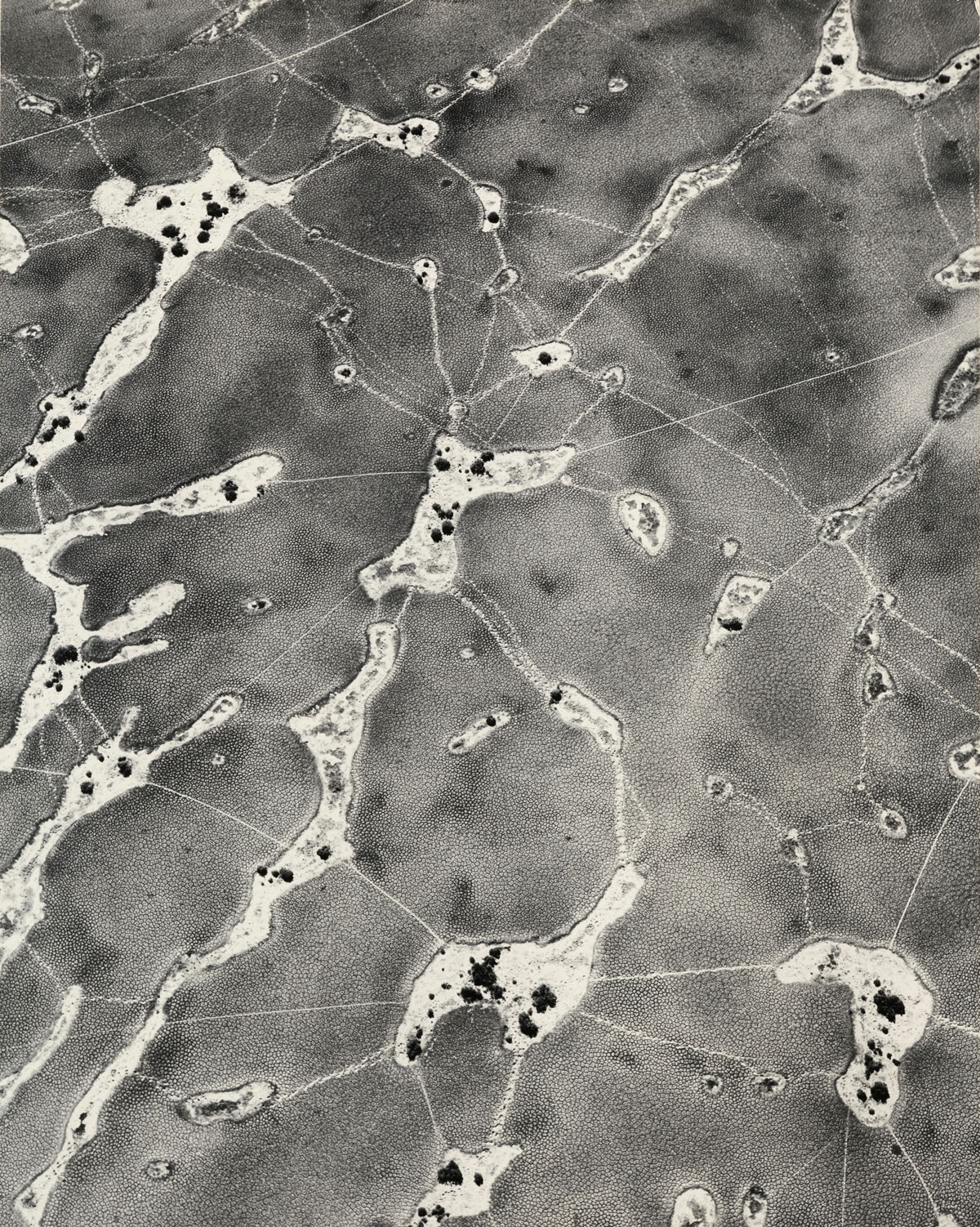
 

William Garnett (American, 1916-2006) 'Animal Tracks on Dry Lake' 1955


William Garnett (American, 1916-2006)
Animal Tracks on Dry Lake
1955
Gelatin silver print
The Morgan Library & Museum, Purchased on the Charina Endowment Fund


After making films for the U.S. Signal Corps during World War II, Garnett used GI-Bill funding to earn a pilot’s license. By the early 1950s, he had the field of artistic aerial landscape virtually to himself. This print, showing the ephemeral traces of wildlife movement on a dry lake bed, appeared in Diogenes with a Camera IV (1956), one in a series of exhibitions at the Museum of Modern Art that highlighted the great variety of ways in which artists used photography to invent new forms of visual truth.
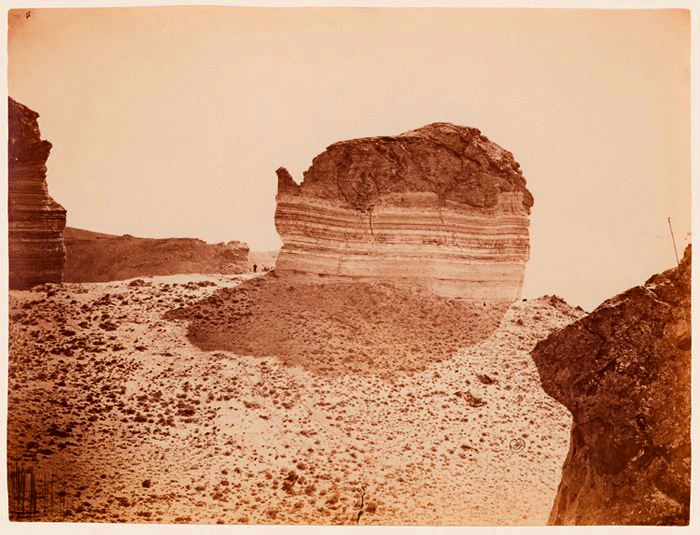
 

William Henry Jackson (American, 1843-1942) '"Tea Pot" Rock' 1870


William Henry Jackson (American, 1843-1942)
“Tea Pot” Rock
1870
Albumen silver print
George Eastman Museum, Purchase


Jackson made this photograph as a member of the survey team formed by Ferdinand V. Hayden to explore and document the territory now known as Yellowstone National Park. Hayden’s primary goal was to gather information about the area’s geological history, and Jackson’s photographs record with precision and clarity the accumulated layers of sediment that allow this natural landmark to be fit into a geological chronology. The human figure standing at the left of the composition provides information about the size of the rock, demonstrating that photographers have long recognised the difficulty of making accurate inferences about scale based on photographic images.
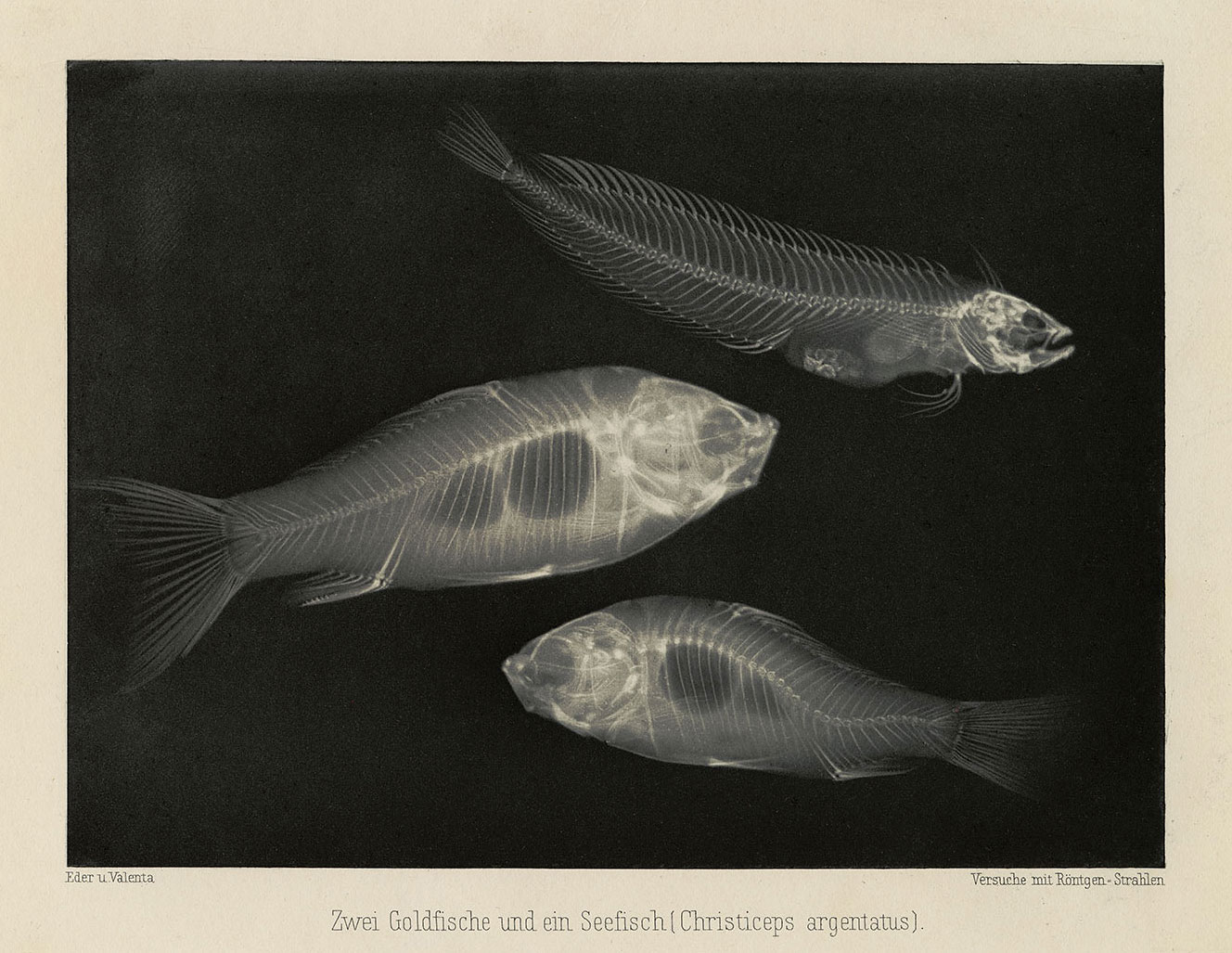
 

Dr. Josef Maria Eder (Austrian, 1855-1944) Eduard Valenta (Austrian, 1857-1937) 'Zwei Goldfische und ein Seefisch (Christiceps argentatus)' 1896


Dr Josef Maria Eder (Austrian, 1855-1944)
Eduard Valenta (Austrian, 1857-1937)
Zwei Goldfische und ein Seefisch (Christiceps argentatus)
Two goldfish and a sea fish (Christiceps argentatus)
1896
From the book Versuche über Photographie mittelst der Röntgen’schen Strahlen (Experiments on photography using X-rays)
Photogravure
George Eastman Museum, Gift of Eastman Kodak Company; Ex-collection of Josef Maria Eder


As early as 1840 – a year after photography’s invention was announced – scientists sought to deploy it in their analysis of the physical world. Combining the camera with the microscope, microphotographs recorded biological minutiae, leading to discoveries that would have been difficult, if not impossible, to obtain by observing subjects in real time. Similarly, the development of x-ray technology in 1895 allowed doctors to study living anatomy to an unprecedented degree. Such innovations not only expanded the boundaries of the visible world but also introduced graphic concepts that would have a profound impact on visual culture.
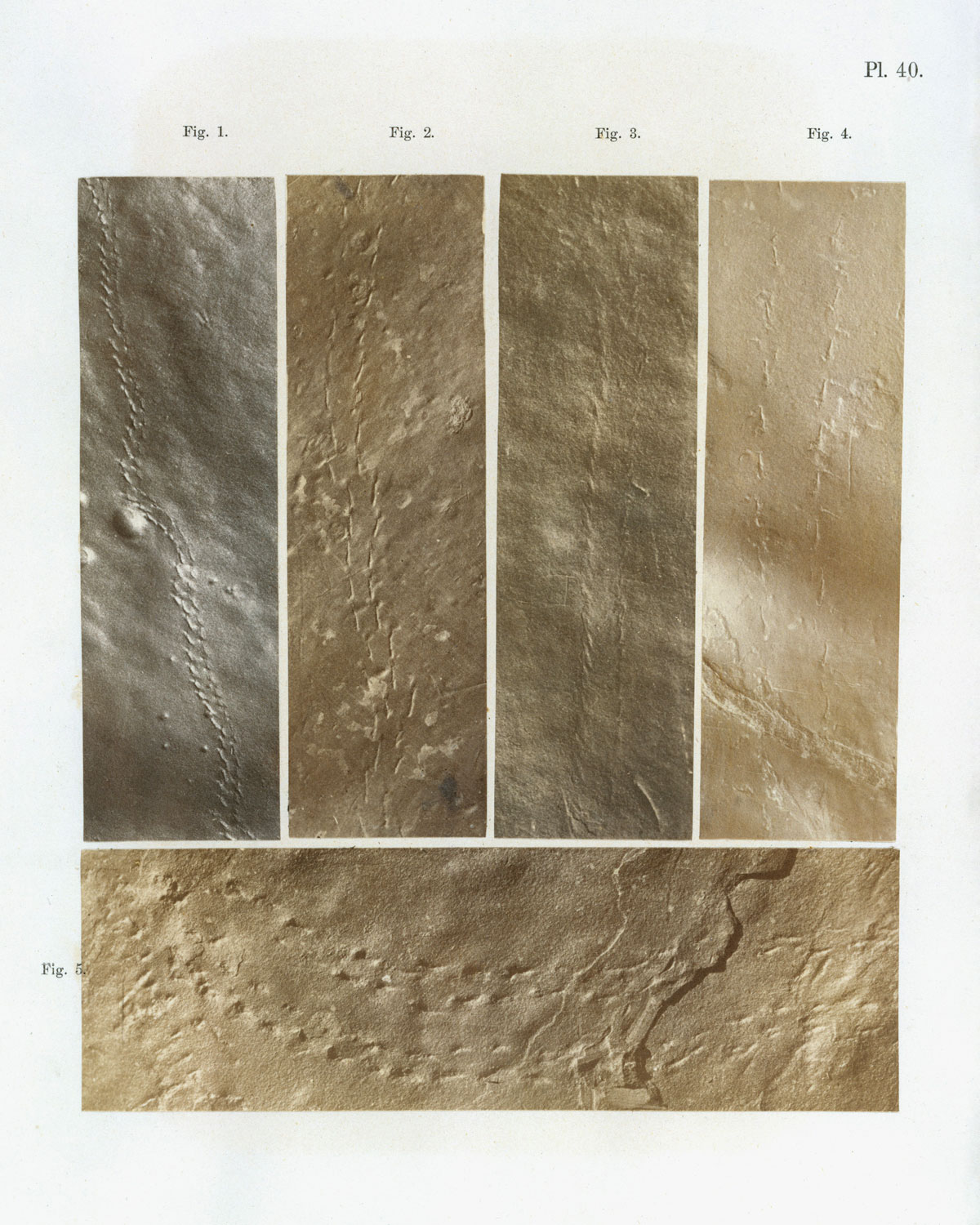
 

Dr James Deane (American, 1801-1858) 'Ichnographs from the Sandstone of Connecticut River' 1861


Dr James Deane (American, 1801-1858)
Ichnographs from the Sandstone of Connecticut River
1861
Book illustrated with 22 salted paper prints and 37 lithographs
George Eastman Museum, Gift of Alden Scott Boyer


These photographs, which depict traces of fossils discovered in a sandstone quarry, illustrate a book written by Massachusetts surgeon James Deane, who was the author of texts on medicine as well as natural history. Published posthumously using his notes and photographs as a guide, the volume is an early demonstration of photography’s potential as a tool of scientific investigation.


VI. The Photograph Decodes Culture

The photograph not only changed but to a great extent invented the modern notion of celebrity. Modern-age celebrities live apart from the general public, but their faces are more familiar than those of the neighbours next door. Since the mid-nineteenth century, viewers have come to “know” the famous through accumulated photographic sightings, which come in formats and contexts that vary as much as real-life encounters do. In four images that would have communicated instantly to their intended viewers in 1966, Jean-Pierre Ducatez (b. 1970) portrayed the Beatles through closeups of their mouths alone. The graphic shorthand employed by Jonathan Lewis in his series The Pixles is of a more recent variety, but he, too, relies on the visual familiarity conferred by tremendous celebrity. Each print in the series reproduces the iconic art of a Beatles album cover at life size (12 x 12 inches) but extremely low resolution (12 x 12 pixels). Like celebrities themselves, perhaps, the images look more familiar to the eye at a distance than close-up.


Unidentified maker. 'U. S. Grant' c. 1862


Unidentified maker
U. S. Grant
c. 1862
Albumen silver print
George Eastman Museum, Purchase
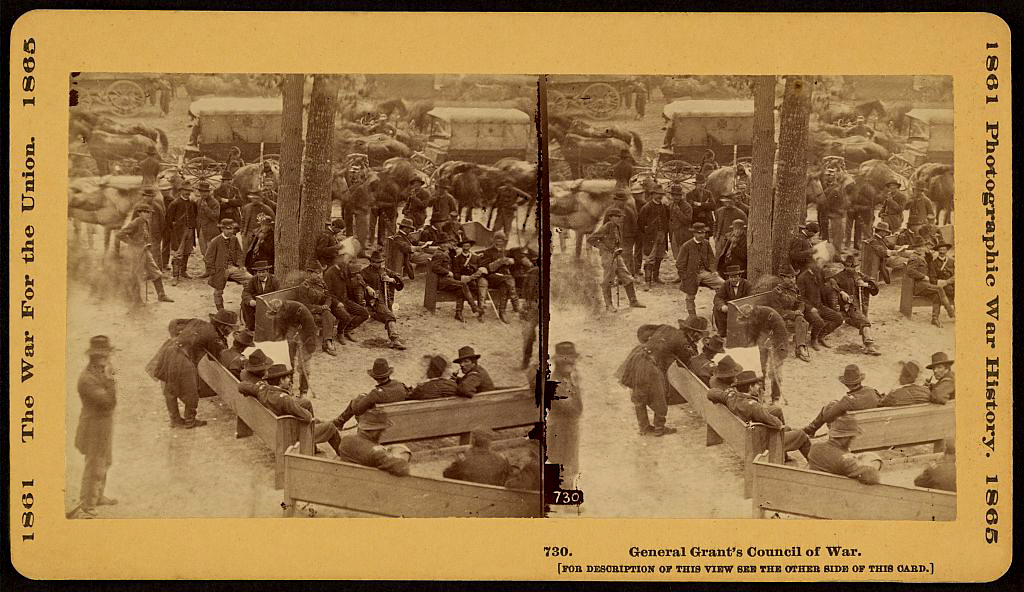
 

Timothy H. O'Sullivan (American born Ireland, 1840-1882) 'A Council of War at Massaponax Church, Va. 21st May, 1864. Gens. Grant and Meade, Asst. Sec. of War Dana, and Their Staff Officers' 1864


Timothy H. O’Sullivan (American born Ireland, 1840-1882)
A Council of War at Massaponax Church, Va. 21st May, 1864. Gens. Grant and Meade, Asst. Sec. of War Dana, and Their Staff Officers
1864
From the series Photographic Incidents of the War
Albumen silver print stereograph
George Eastman Museum, Gift of Albert Morton Turner


Modern celebrities live apart from the general public, yet their faces are more familiar than those of the neighbors next door. Since the mid-nineteenth century, viewers have come to “know” the famous through accumulated photographic sightings, which come in formats and contexts that vary as much as real-life encounters do. First as a Union hero in the American Civil War and later as president, Ulysses S. Grant (1822-1885) lived in the public imagination through news images, popular stereographs, campaign buttons, and ultimately the (photo-based) face on the $50 bill. Grant was even a subject for Francois Willème’s patented process for generating a sculpted likeness out of photographs made in the round – an early forerunner to the technology of 3-D printing.

 

Jonathan Lewis (British, b. 1970) 'Abbey Road' 2003


Jonathan Lewis (British, b. 1970)
Abbey Road
2003
From The Pixles
Inkjet print
George Eastman Museum, By exchange with the artist

 

Jonathan Lewis (British, b. 1970) 'Please Please Me' 2003


Jonathan Lewis (British, b. 1970)
Please Please Me
2003
From The Pixles
Inkjet print
George Eastman Museum, By exchange with the artist

 

Jonathan Lewis (British, b. 1970) 'Rubber Soul' 2003


Jonathan Lewis (British, b. 1970)
Rubber Soul
2003
From The Pixles
Inkjet print
George Eastman Museum, By exchange with the artist


Synecdoche is a poetic device in which a part stands in for the whole. (In the phrase “three sails set forth,” sails mean ships.) In four images that would have communicated instantly to their intended viewers in 1966, Ducatez portrayed the Beatles solely through close-ups of their mouths. The graphic shorthand Lewis employs in his series The Pixles is of a more recent variety, though he, too, relies on the visual familiarity conferred by tremendous celebrity. Each print in the series reproduces a Beatles album cover at life size (12 x 12 inches) but extremely low resolution (12 x 12 pixels).


VII. Meaning is on the Surface

Photographs are not just windows onto the world but pieces of paper, which can themselves be inscribed or otherwise altered in ways that enrich or amend their meaning. The group portrait Joint Meeting of the Railway Surgeons Association, Claypool Hotel, Indianapolis (1920) is contact printed, meaning that the negative was the same size as the print. After the portrait sitting, the photographer appears to have presented the developed film to the sixty-four sitters for signing during the three days they were assembled for their convention. The result is a document that unites two conventional signifiers of character: facial features and the autograph.
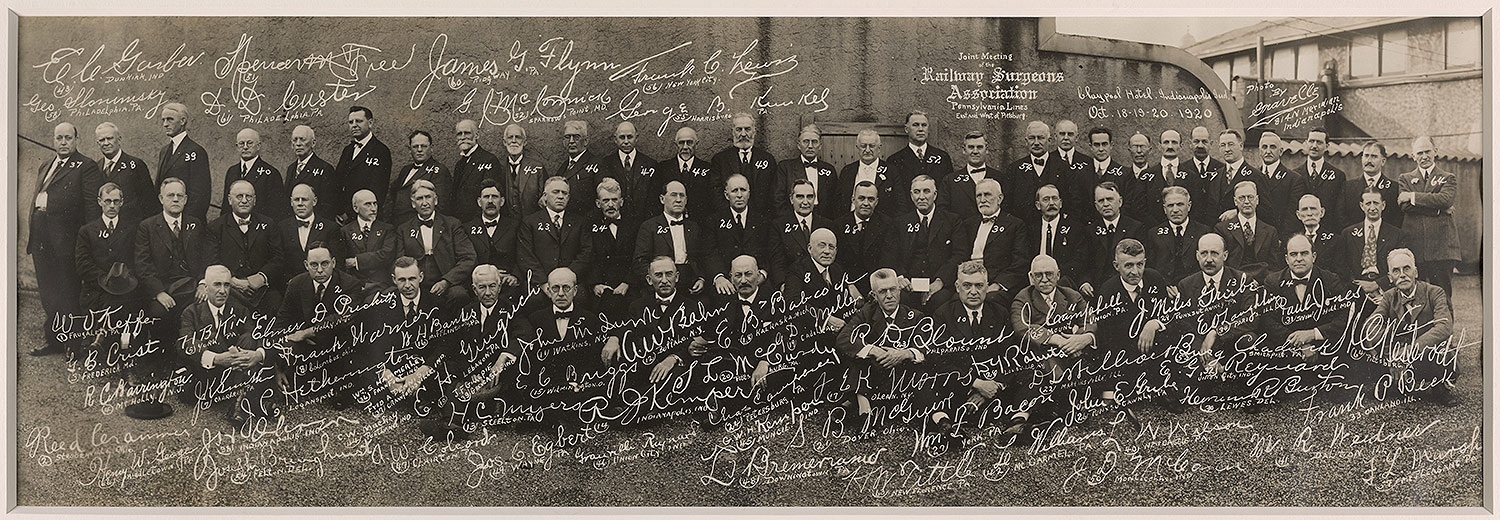
 

Gravelle Studio, Indianapolis (American, active 1920) 'Joint Meeting of the Railway Surgeons Association, Claypool Hotel, Indianapolis' 1920


Gravelle Studio, Indianapolis (American, active 1920)
Joint Meeting of the Railway Surgeons Association, Claypool Hotel, Indianapolis
1920
Gelatin silver print
The Morgan Library & Museum, Purchased as the gift of Peter J. Cohen


Panoramic group portraits such as this are made using a banquet camera, which admits light through a narrow vertical slit while rotating on its tripod. This image was contact printed, meaning the negative was the same size as the print. The photographer appears to have presented the developed film to the sixty-four sitters for signing during the three days they were assembled. The result is a document that unites two conventional signifiers of character: facial features and the autograph.
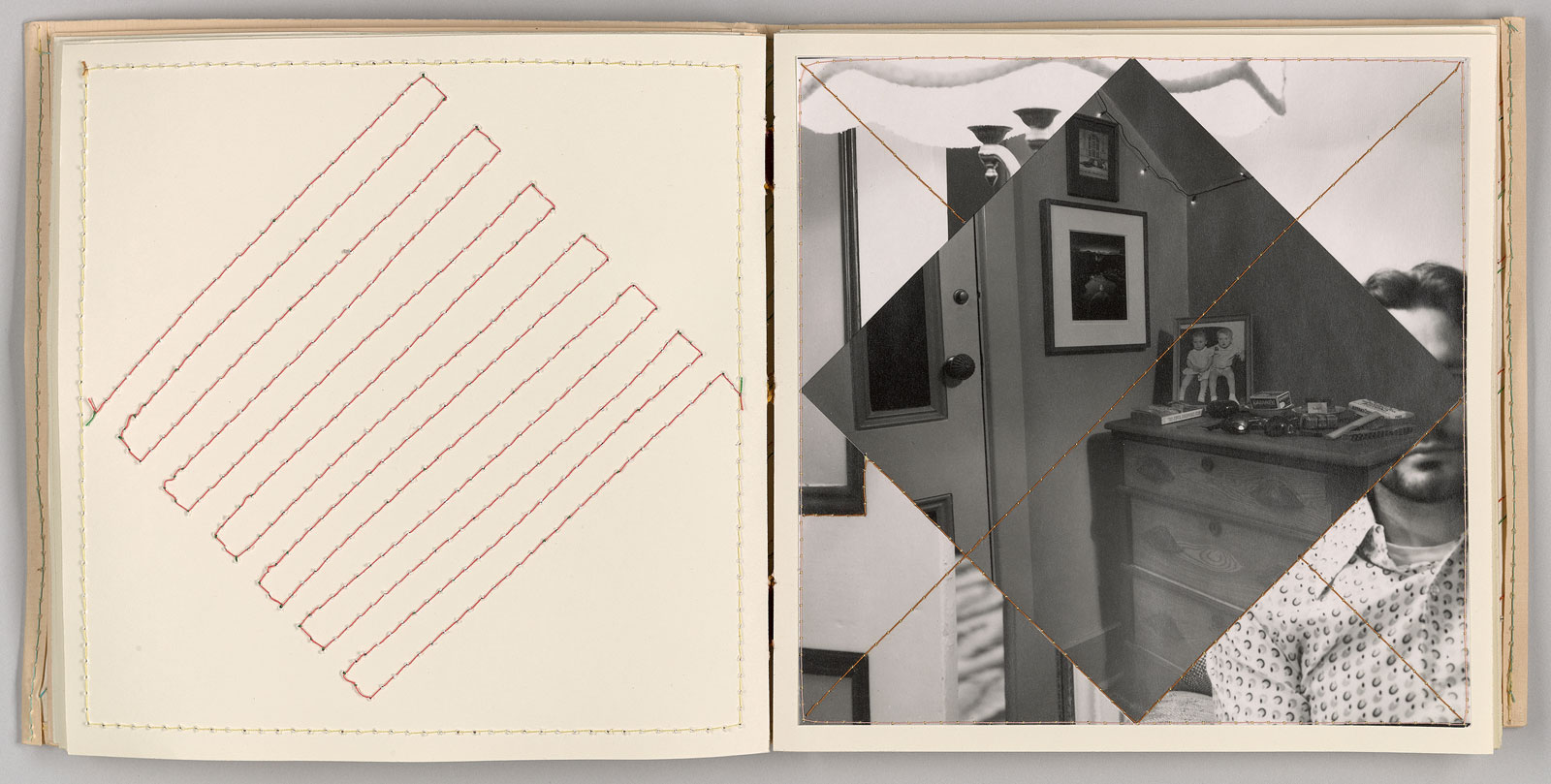
 

Keith Smith (American, b. 1938) 'Book 151' 1989


Keith Smith (American, b. 1938)
Book 151
1989
Bound book of gelatin silver prints, thread, and leather
Collection of Richard and Ronay Menschel


This unique object unites the arts of photography, quilting, and bookmaking. The composite image on each right-hand page appears to be made of prints cut apart and sewn together. In fact, Smith began by printing patchwork-inspired photomontages in the darkroom. He then stitched along many of the borders where abutting images meet, creating the illusion of a photographic crazy quilt.


VIII. Photography and the Page

News of the world took on a newly visual character in the 1880s, when the technology of the halftone screen made it practical, at last, to render photographs in ink on the printed page.

Among the earliest examples of photojournalism is Paul Nadar’s (1820-1910) “photographic interview” with Georges Ernest Boulanger, a once-powerful French politician. The article’s introduction explains that the photographs were printed alongside the text in order to provide evidence of the encounter and to illustrate Boulanger’s dynamic body language during the conversation.
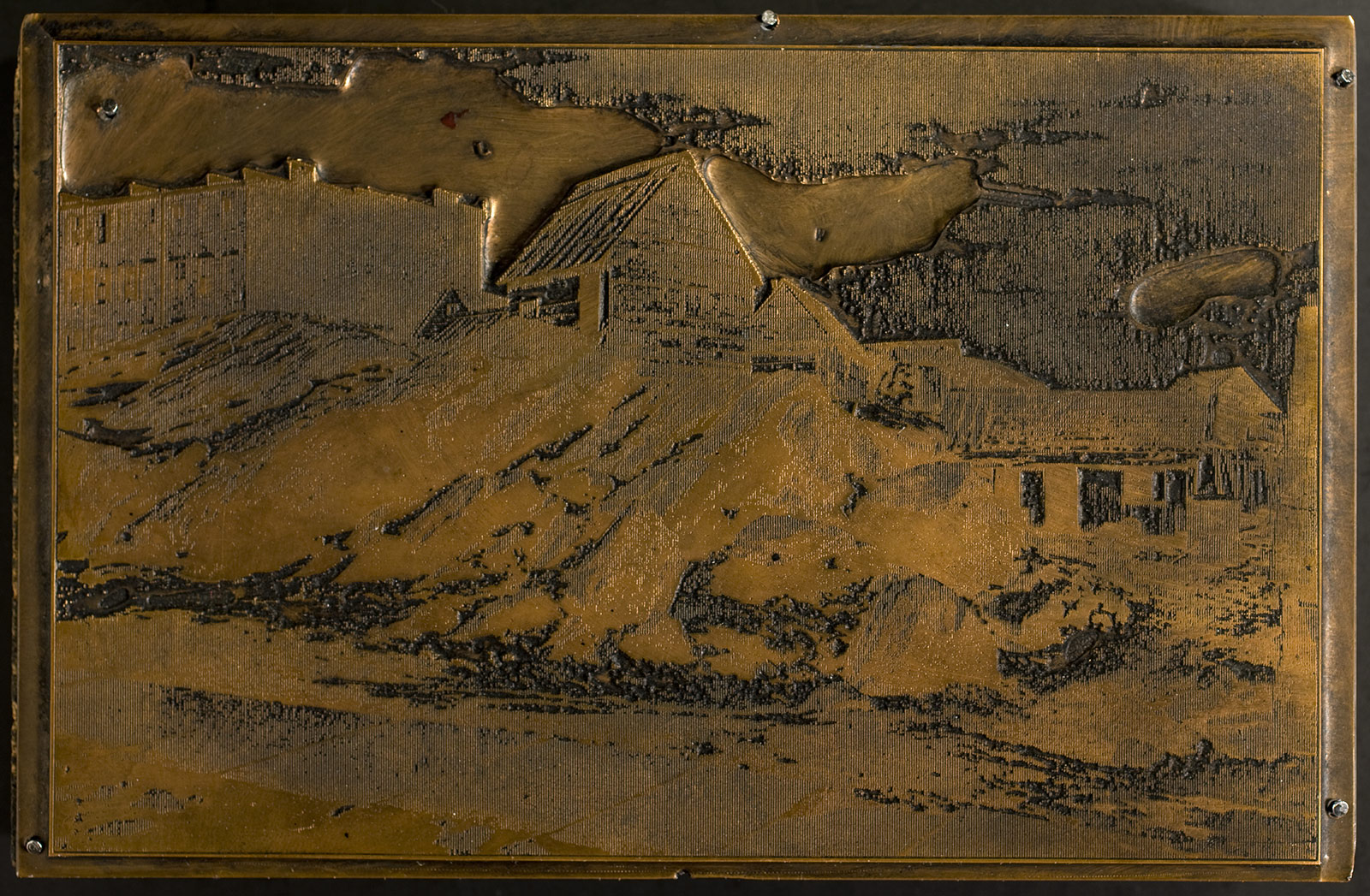
 

Stephen Henry Horgan (American, 1854-1941) 'Shanty Town' April 1880


Stephen Henry Horgan (American, 1854-1941)
Shanty Town
April 1880
Photomechanical printing plate A Scene in Shantytown, New York, c. 1928
Lithograph
George Eastman Museum, Gift of 3M Foundation; Ex-collection of Louis Walton Sipley


Paul Nadar (French, 1856-1939) 'Interview with Georges Ernest Jean Marie Boulanger' 1889


Paul Nadar (French, 1856-1939)
Interview with Georges Ernest Jean Marie Boulanger
1889
Le Figaro, 23 November 1889
Photomechanical reproduction
George Eastman Museum, gift of Eastman Kodak Company; ex-collection Gabriel Cromer


Among the earliest examples of photojournalism is Nadar’s “photographic interview” with Georges Ernest Boulanger, a once-powerful French politician who had fallen out of public favour by the time this was published. The article’s introduction explains that the photographs were printed alongside the text in order to provide evidence of the encounter and to illustrate Boulanger’s body language during the conversation.


Lewis W. Hine (American, 1874-1940) 'Italian Family Looking for Lost Baggage, Ellis Island' 1905


Lewis W. Hine (American, 1874-1940)
Italian Family Looking for Lost Baggage, Ellis Island
1905
Ellis Island Group, 1905
Gelatin silver print
George Eastman Museum, Gift of Photo League Lewis Hine Memorial Committee


In an effort to counter American xenophobia in the early years of the twentieth century, Hine photographed immigrants as they arrived at Ellis Island, composing his images to stir sympathy and understanding among viewers. He understood the importance of disseminating his photographs and actively sought to publish them in newspapers, magazines, and pamphlets. The white outline in the photograph on the right instructs the designer and printer where to crop the image for a photomontage featuring figures from multiple portraits.
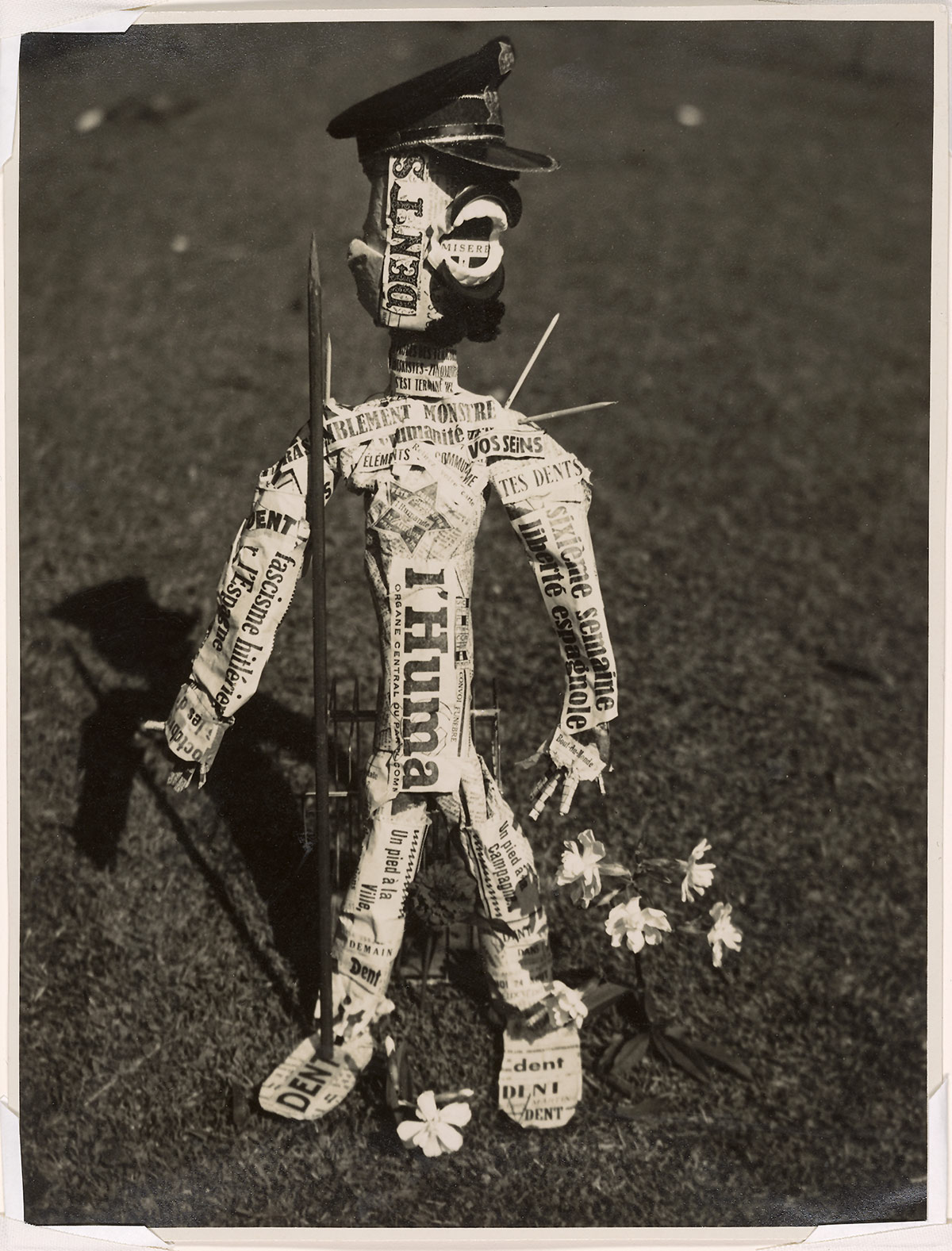
 

Claude Cahun (French, 1894-1954) 'La Poupée' (Puppet) 1936


Claude Cahun (French, 1894-1954)
La Poupée (Puppet)
1936
Gelatin silver print
Collection of Richard and Ronay Menschel
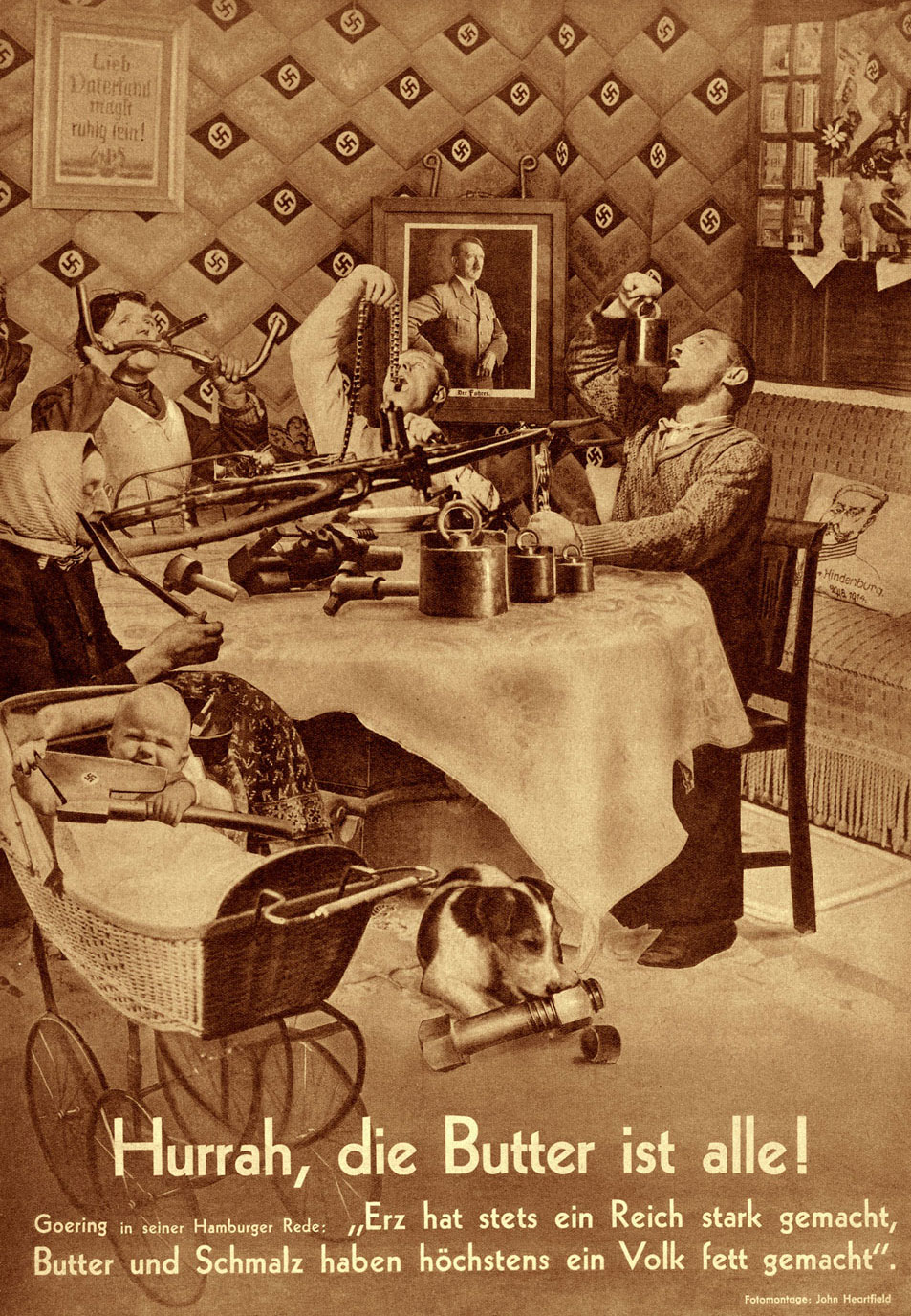
 

John Heartfield (German, 1891-1968) 'Hurrah, die Butter ist alle!' (Hooray, the Butter Is Finished!) 1935


John Heartfield (German, 1891-1968)
Hurrah, die Butter ist alle! (Hooray, the Butter Is Finished!)
1935
Rotogravure
George Eastman Museum, purchase


This is one of 237 photomontages that Heartfield created between 1930 and 1938 for the antifascist magazine Arbeiter-Illustrierte-Zeitung (Worker’s Pictorial Newspaper). It is a parody of the “Guns Before Butter” speech in which Hermann G.ring exhorted German citizens to sacrifice necessities in order to aid the nation’s rearmament. The text reads: “Iron ore has always made an empire strong; butter and lard have at most made a people fat.” Heartfield combined details from several photographs to conjure the image of a German family feasting on tools, machine parts, and a bicycle in a swastika-laden dining room, complete with a portrait of Hitler, a framed phrase from a popular Franco-Prussian war-era song, and a throw pillow bearing the likeness of recently deceased president Paul von Hindenburg.
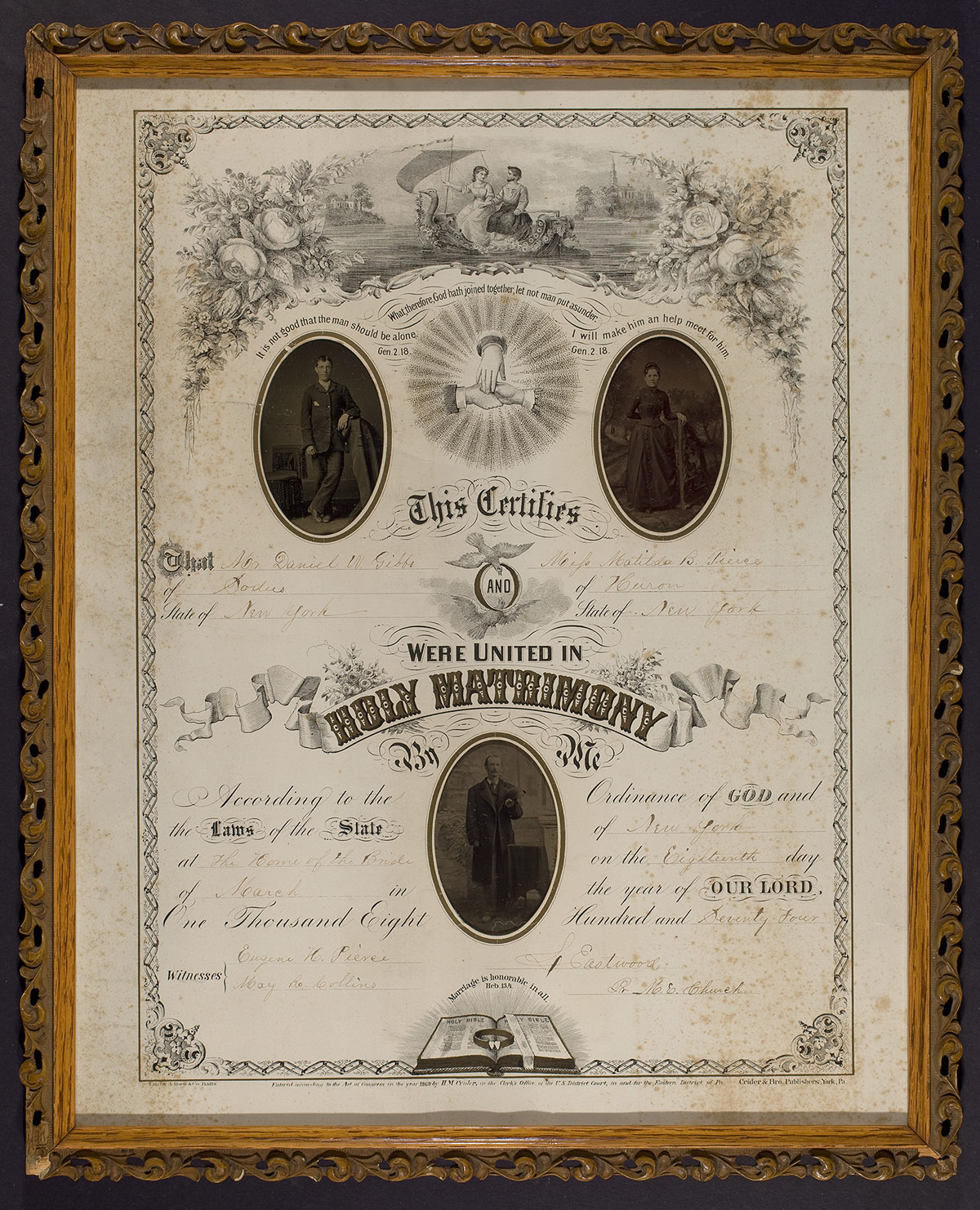
 

Unidentified maker. 'Certificate of Marriage between Daniel W. Gibbs and Matilda B. Pierce' c. 1874


Unidentified maker
Certificate of Marriage between Daniel W. Gibbs and Matilda B. Pierce
c. 1874
Tintypes in prepared paper mount
George Eastman Museum, Purchase


Graphic cousins to one other, these wedding certificates are equipped with precut windows for photographs of the bride, groom, and officiant. The portraits, in partnership with the printed and inscribed text on the forms, contribute both to the documentary specificity of the certificates and to their value as sentimental souvenirs.


IX. Empire of Signs

The plethora of signs, symbols, and visual noise endemic to cities has attracted photographers since the medium’s invention. Their records of advertisers’ strident demands for attention, shopkeepers’ alluring displays, and the often dizzying architectural density of metropolitan life chronicle sights that are subject to change without notice. The photographer’s perspective on contemporary social life – whether it is anecdotal, as in John Thompson’s (1837-1921) Street Advertising from Street Life in London (1877), or haunting, as in Eugène Atget’s (1857-1927) Impasse des Bourdonnais (c. 1908) – is embedded in each image.


John Thomson (Scottish, 1837-1921) 'Street Advertising' 1877


John Thomson (Scottish, 1837-1921)
Street Advertising
1877
From Street Life in London, 1877
Woodburytype
George Eastman Museum, Gift of Alden Scott Boyer


Eugène Atget (French, 1857-1927) 'Impasse des Bourdonnais' c. 1908


Eugène Atget (French, 1857-1927)
Impasse des Bourdonnais
c. 1908
Albumen silver print
George Eastman Museum, Purchase
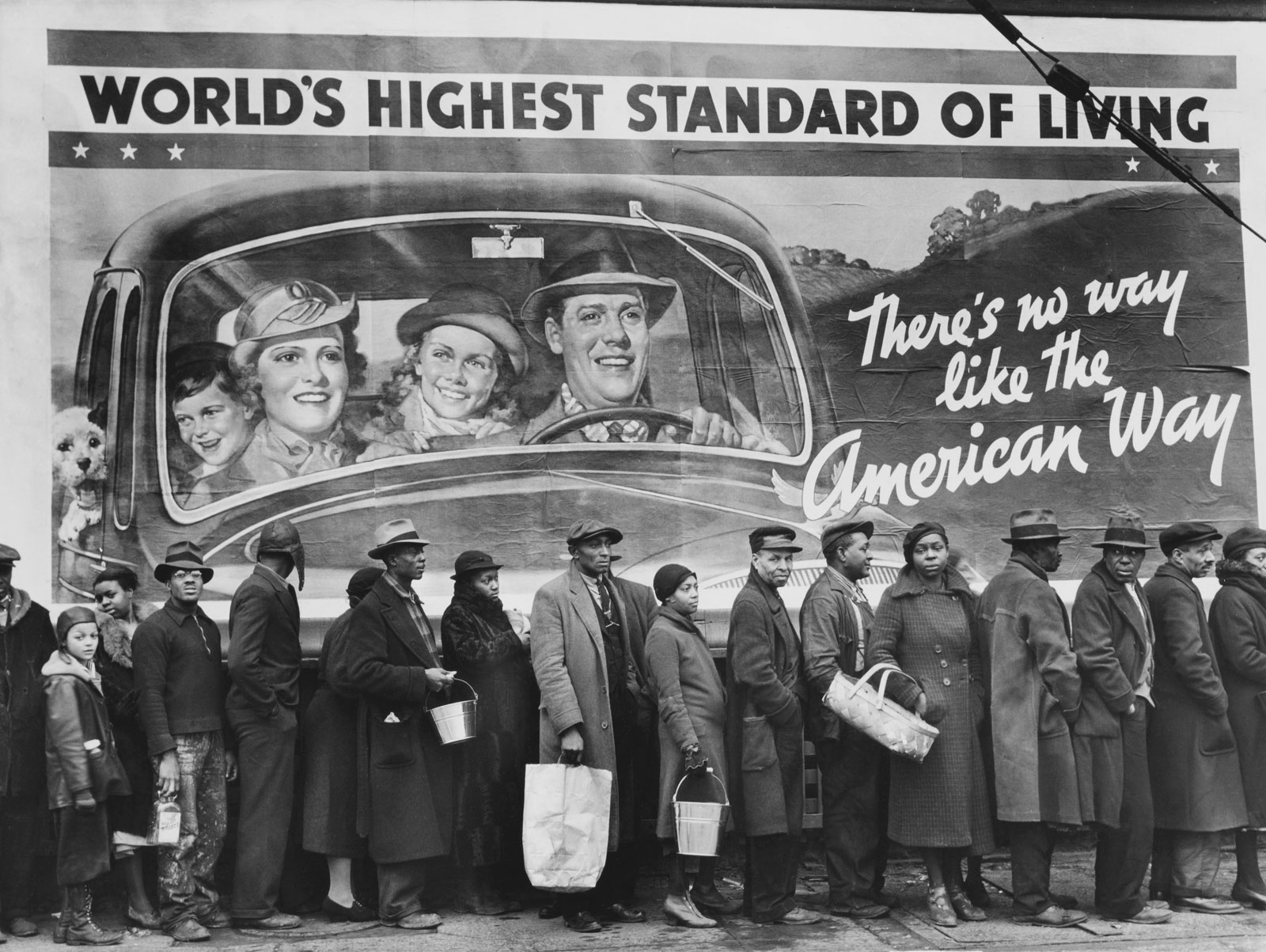
 

Margaret Bourke-White (American, 1904-1971) 'At the Time of the Louisville Flood' 1937


Margaret Bourke-White (American, 1904-1971)
At the Time of the Louisville Flood
1937
Gelatin silver print
George Eastman Museum


The plethora of signs, symbols, and visual noise endemic to cities has attracted photographers since the medium’s invention. Their records of advertisers’ strident demands for attention, shopkeepers’ alluring displays, and the often dizzying architectural density of metropolitan life chronicle sights that are subject to change without notice. The photographer’s perspective on contemporary social life – whether it is ironic, as in Margaret Bourke-White’s image of a line of flood victims before a billboard advertising middle-class prosperity, or bemused, as in Ferenc Berko’s photograph of columns of oversized artificial teeth on the street – is embedded in each image.
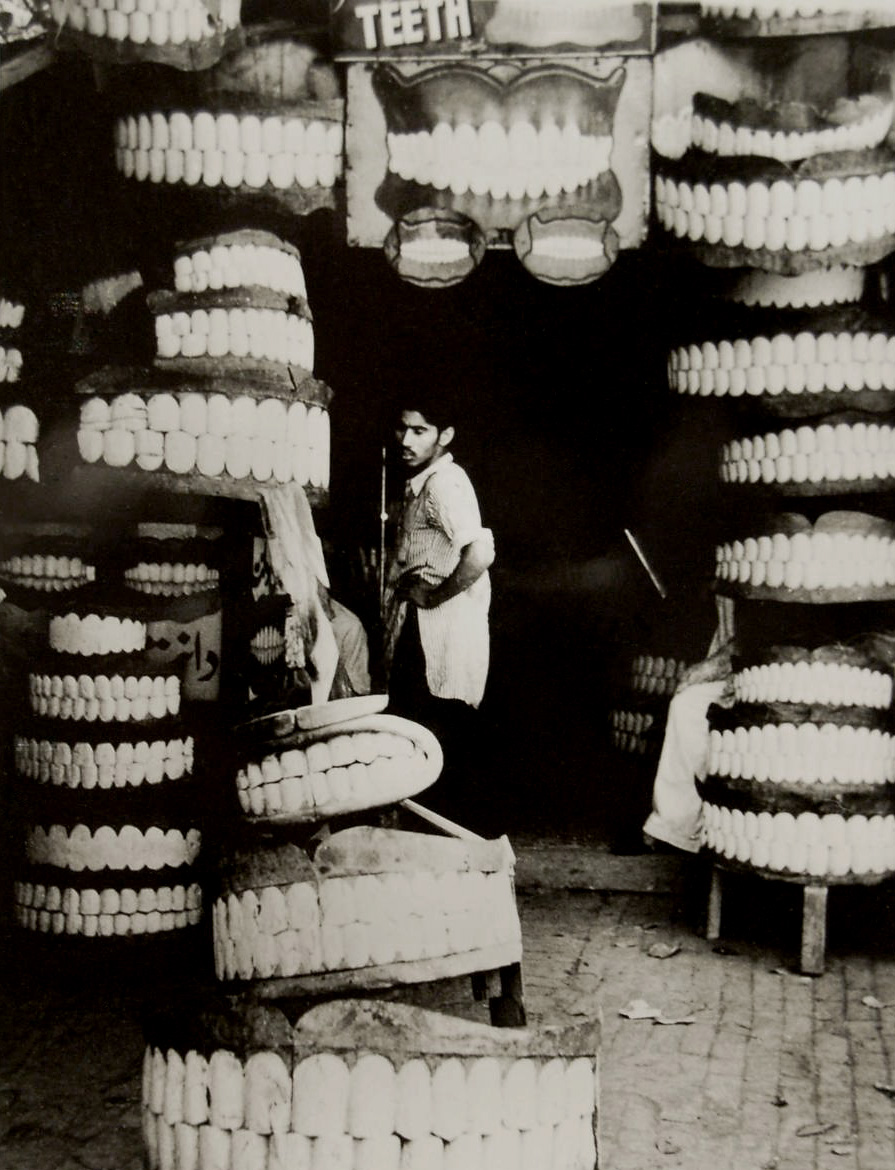
 

Ferenc Berko (American born Hungary, 1916-2000) 'Rawalpindi, India' 1946


Ferenc Berko (American born Hungary, 1916-2000)
Rawalpindi, India
1946
Gelatin silver print
George Eastman House, Gift of Katharine Kuh
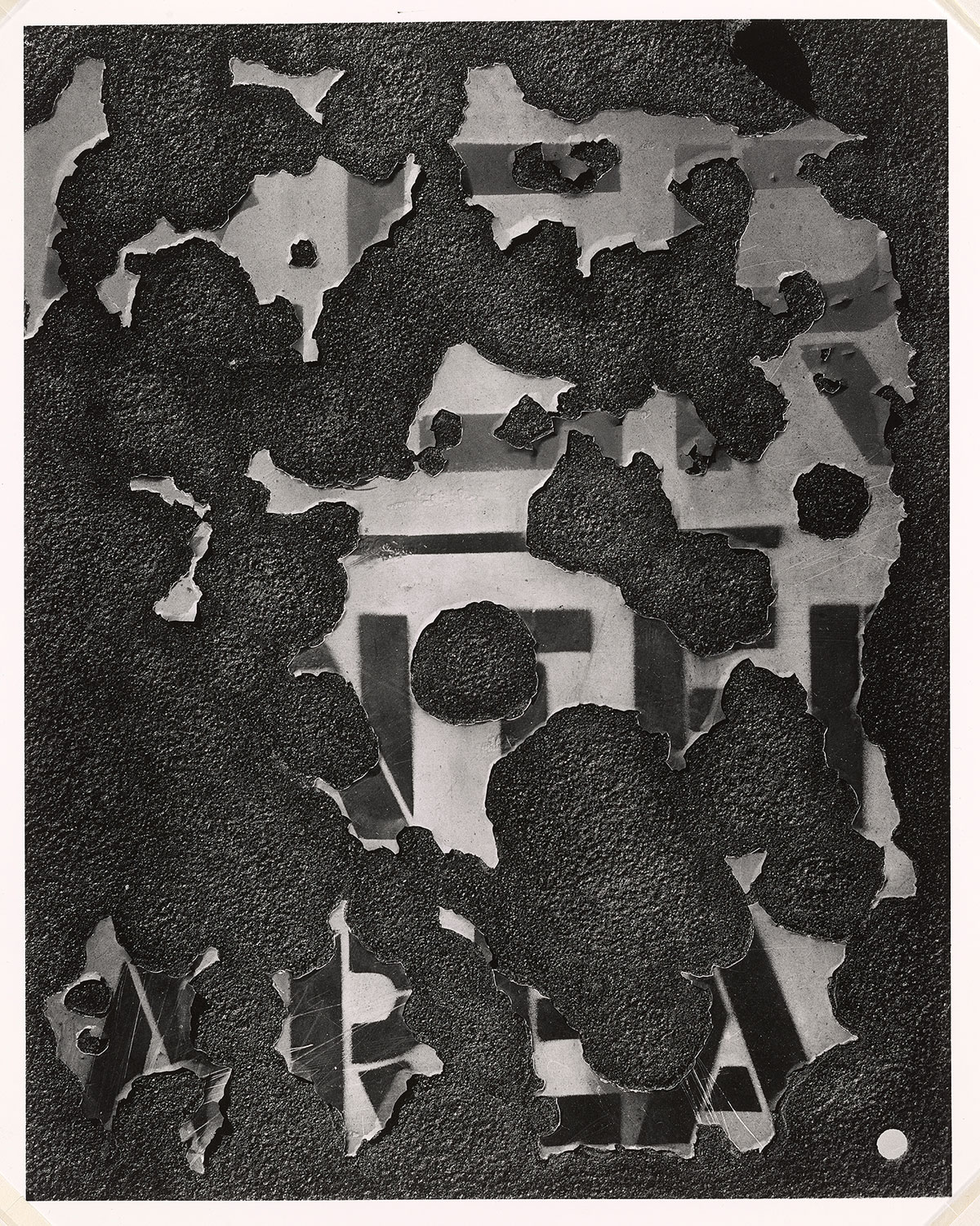
 

Aaron Siskind (American, 1903-1991) 'New York 6' 1951


Aaron Siskind (American, 1903-1991)
New York 6
1951
Gelatin silver print
The Morgan Library & Museum, Gift of Richard and Ronay Menschel
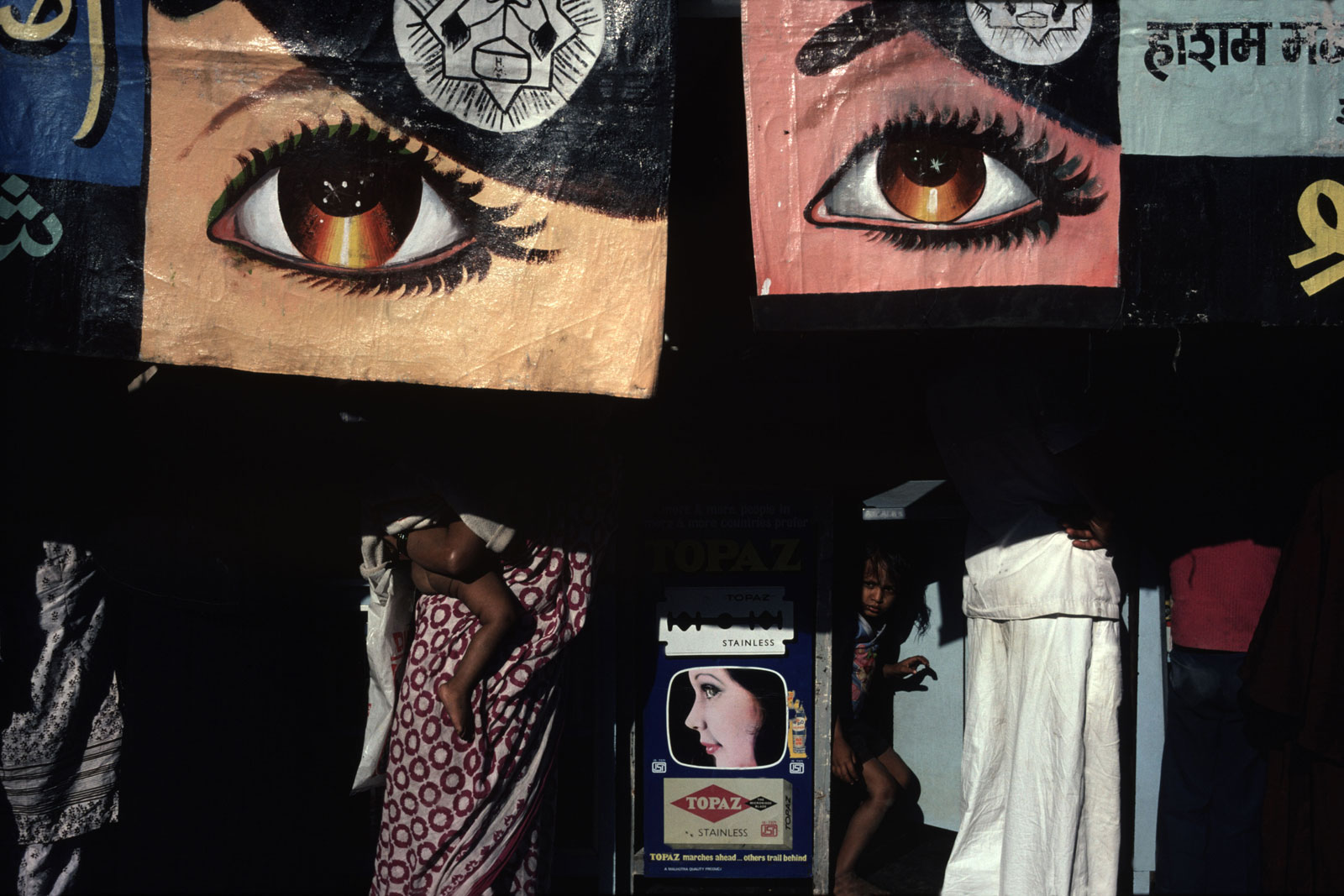
 

Alex Webb (American, b. 1952) 'India' 1981


Alex Webb (American, b. 1952)
India
1981
Chromogenic development print
George Eastman Museum, Purchased with funds from Charina Foundation


The Morgan Library & Museum
225 Madison Avenue, at 36th Street
New York, NY 10016-3405
Phone: (212) 685-0008

Opening hours:
Tuesday – Thursday, Saturday – Sunday: 10.30am – 5pm
Friday: 10.30am – 7pm
Closed Mondays

The Morgan Library & Museum website

LIKE ART BLART ON FACEBOOK

Back to top

Text/Exhibition: ‘Julia Margaret Cameron: from the Victoria and Albert Museum, London’ at the Art Gallery of New South Wales (AGNSW), Sydney Part 2

Exhibition dates: 14th August – 25th October 2015

Curator: Dr Marta Weiss


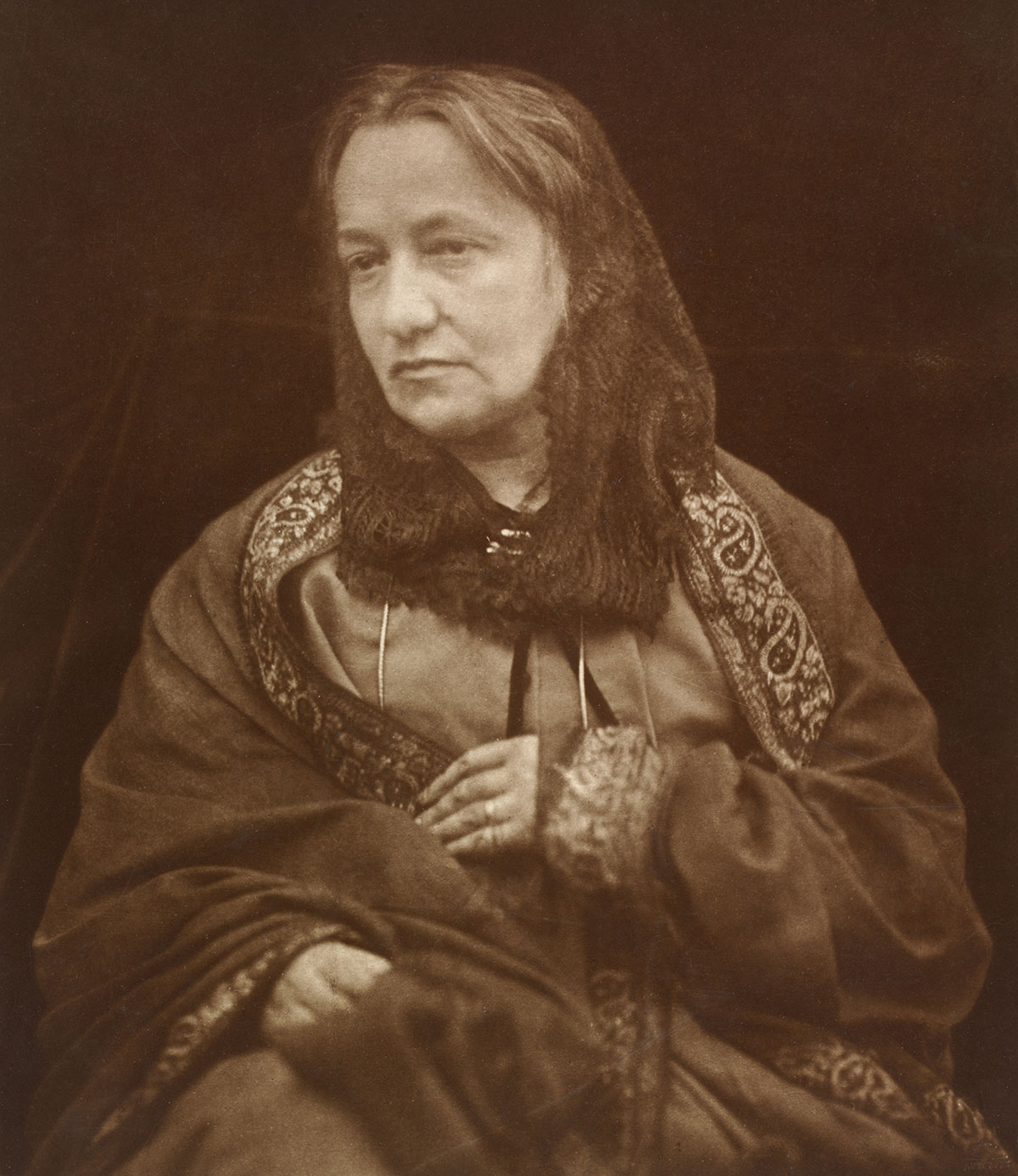
Julia Margaret Cameron (British born India, 1815-1879) 'Portrait of Julia Margaret Cameron by her son' about 1870


Julia Margaret Cameron (British born India, 1815-1879)
Portrait of Julia Margaret Cameron by her son
about 1870
© Victoria and Albert Museum, London


The road less travelled

It was a flying visit to Sydney to see the Julia Margaret Cameron exhibition at the Art Gallery of New South Wales. The trip was so very worthwhile, for I had never seen JMC’s large contact photographs “in the flesh” before, let alone over 100 vintage prints from the Victoria and Albert Museum collection. They did not disappoint. This exhibition is one of the photographic highlights of the year.

When you think about it, here is one the world’s top ten photographers of all time – a woman, taking photographs within the first twenty five years of the birth of commercial photography, using rudimentary technology and chemicals – whose photographs are still up there with the greatest ever taken. Still recognisable as her own and no one else’s after all these years. That is a staggering achievement – and tells you something about the talent, tenacity and perspicacity of the women… that she possessed and illuminated such a penetrating discernment – a clarity of vision and intellect which provides a deep understanding and insight into the human condition.

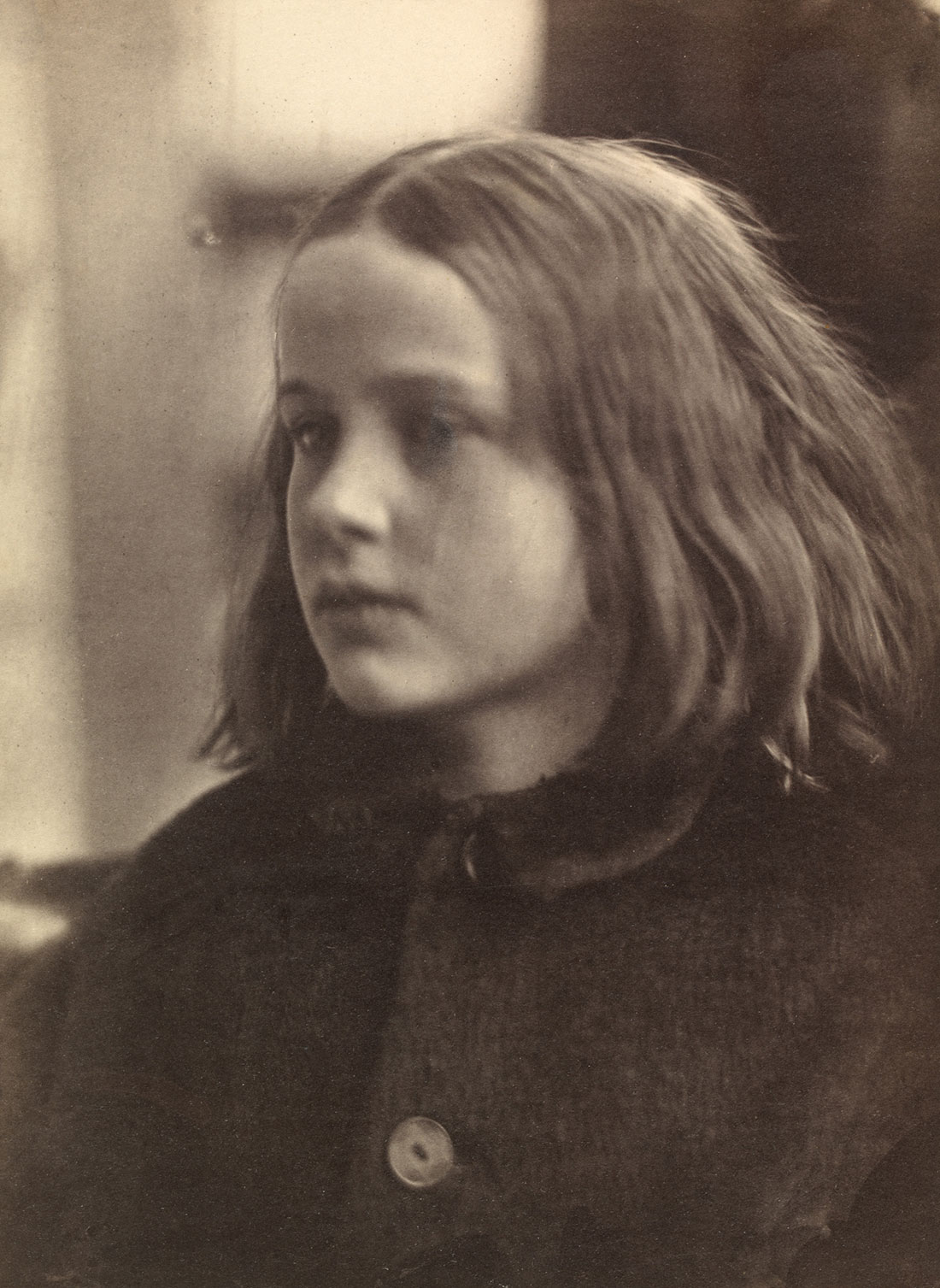
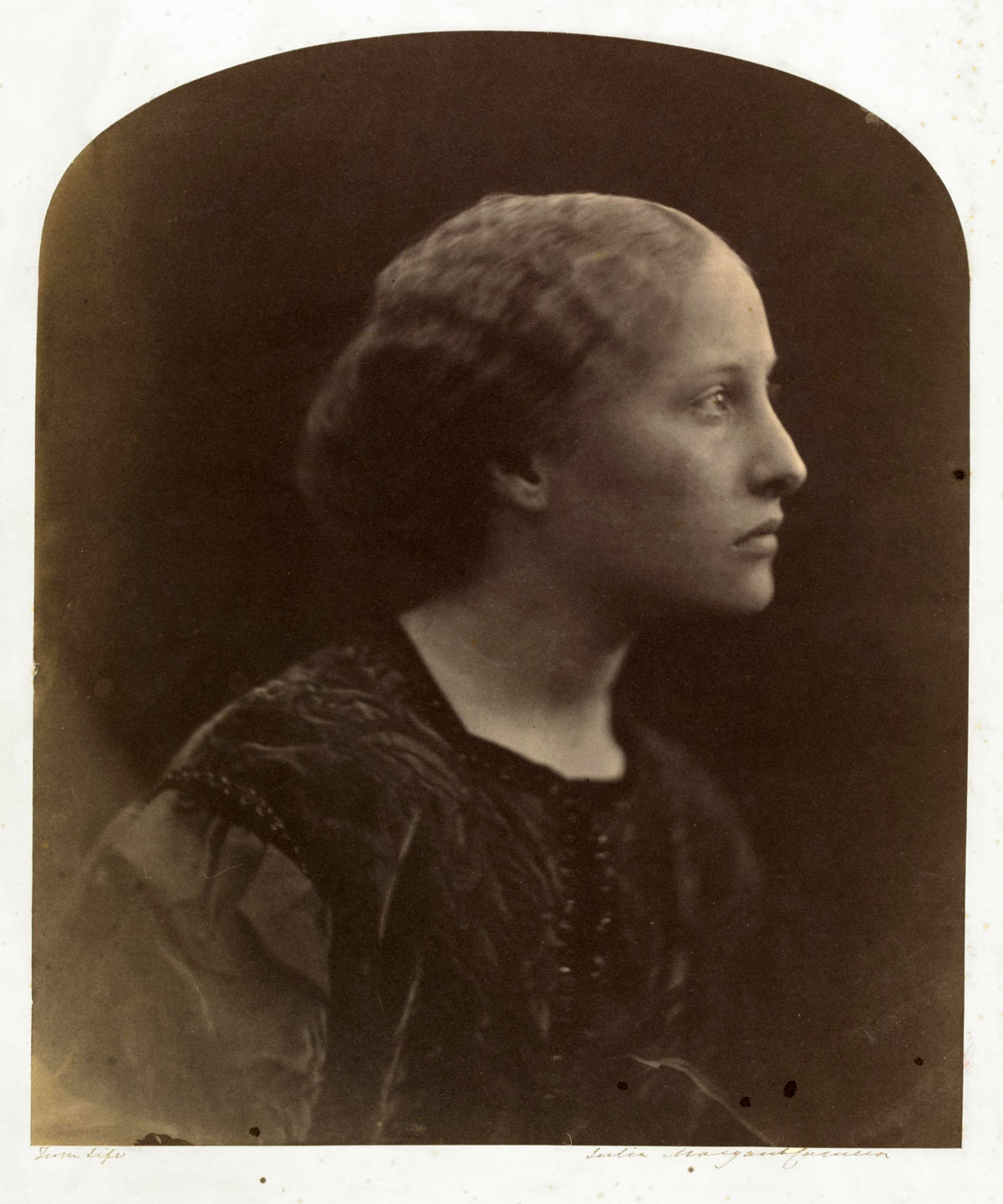
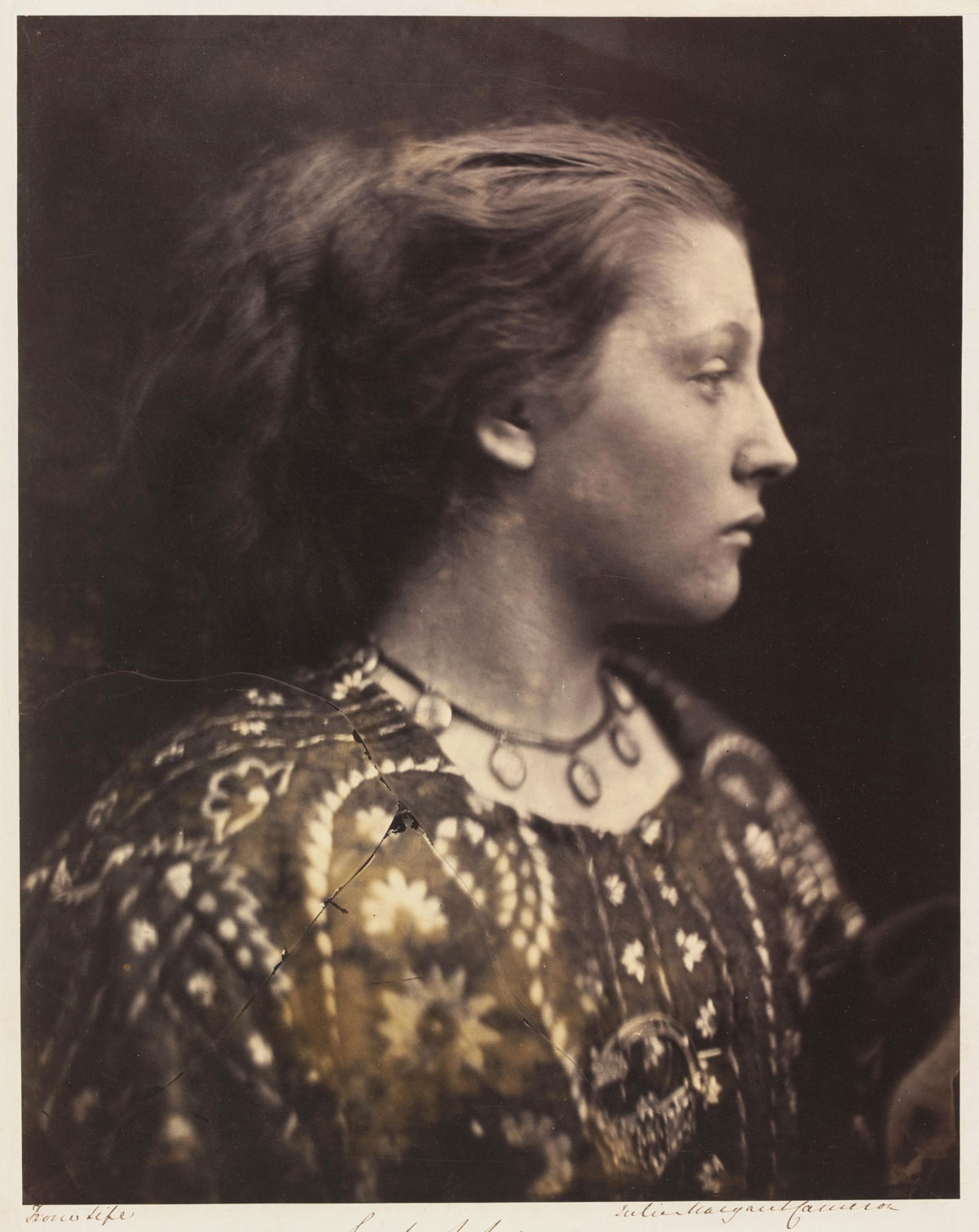
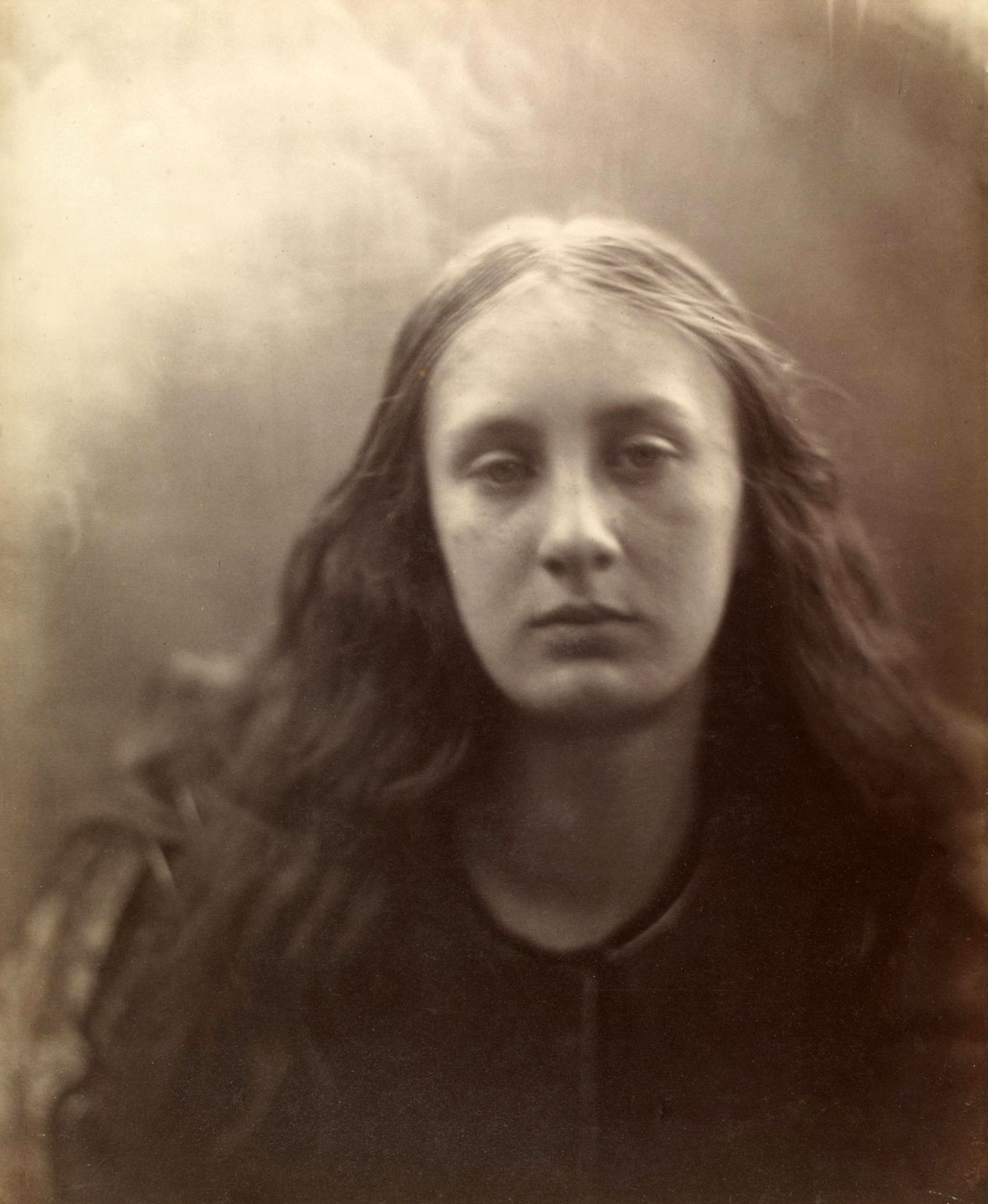
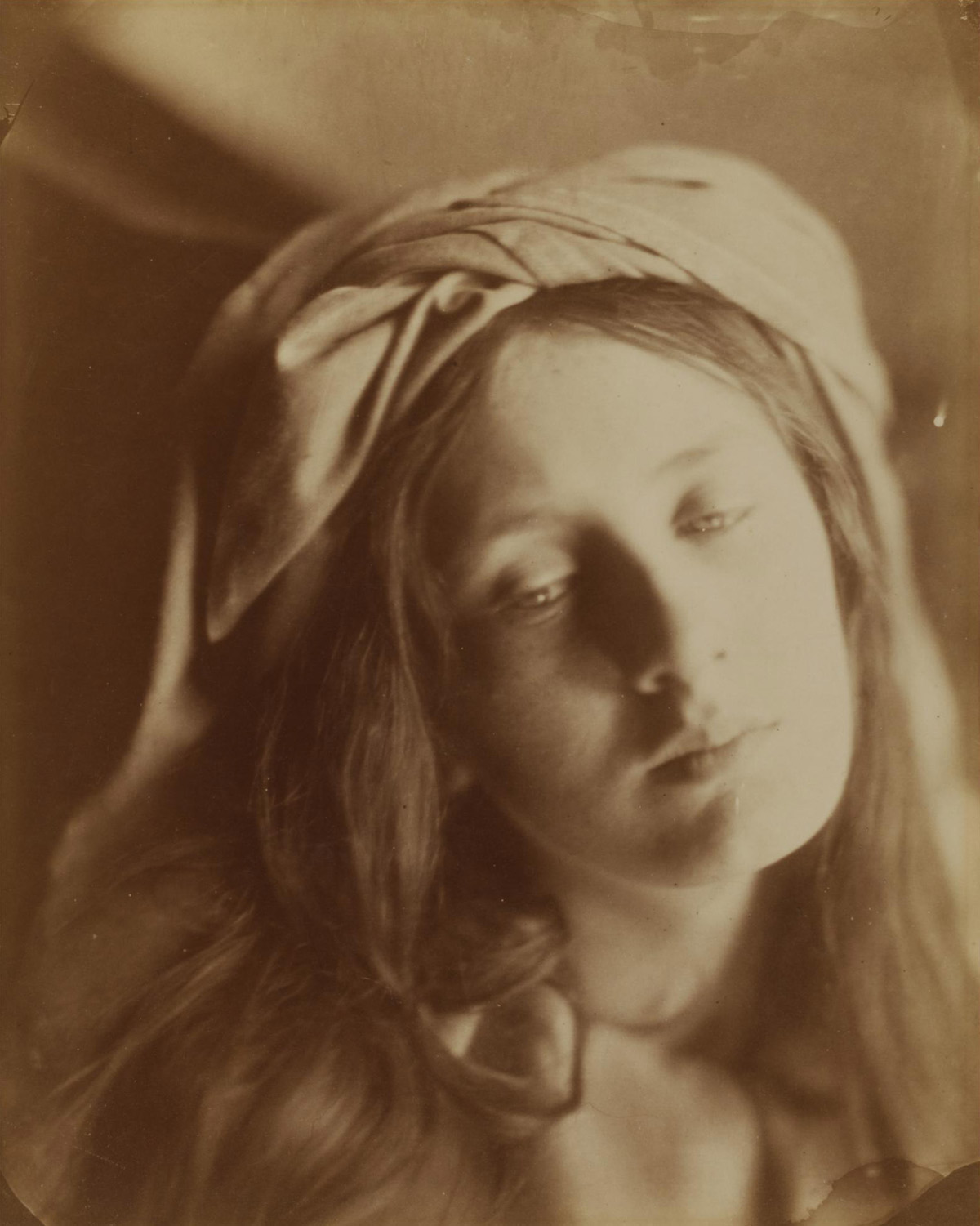
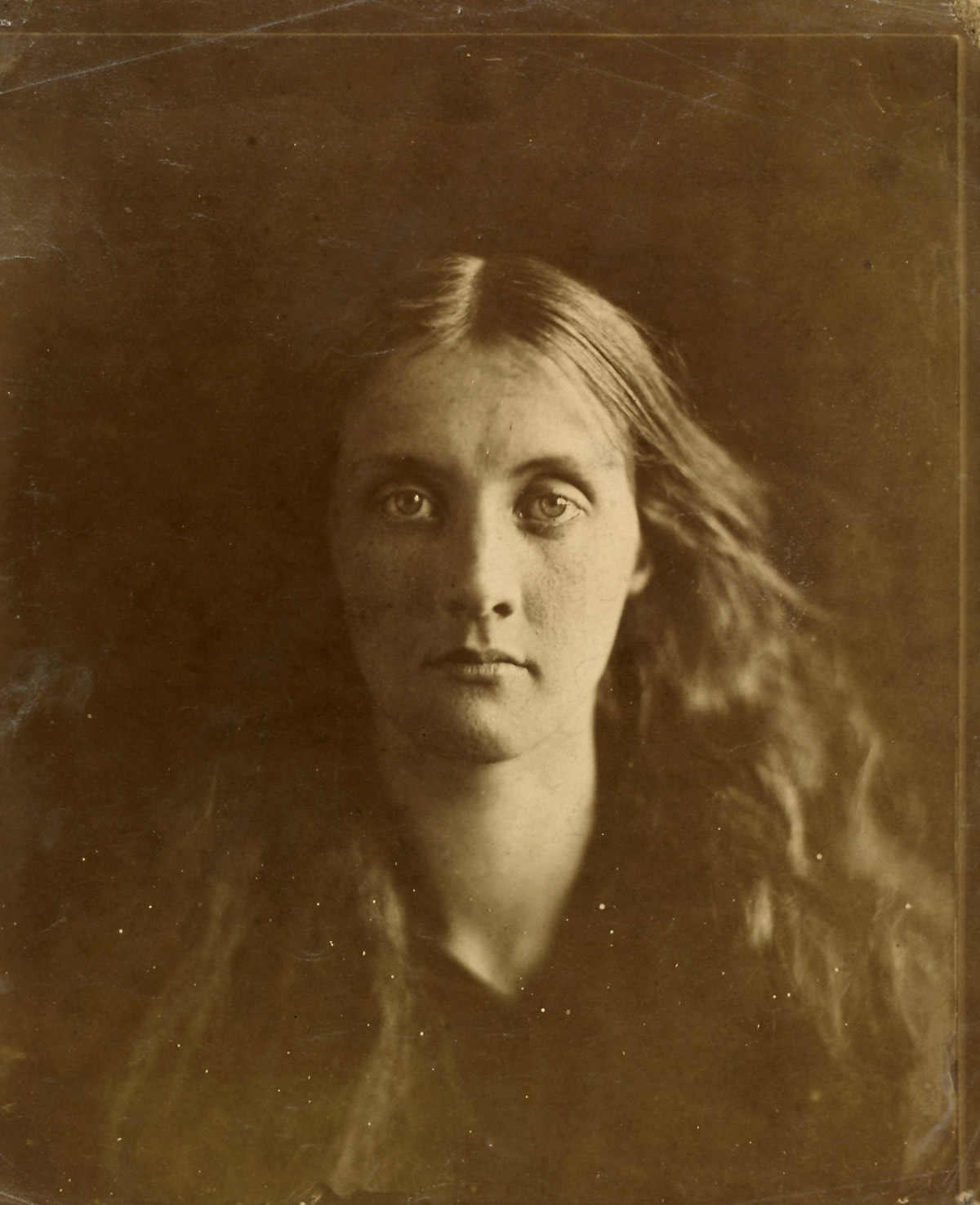
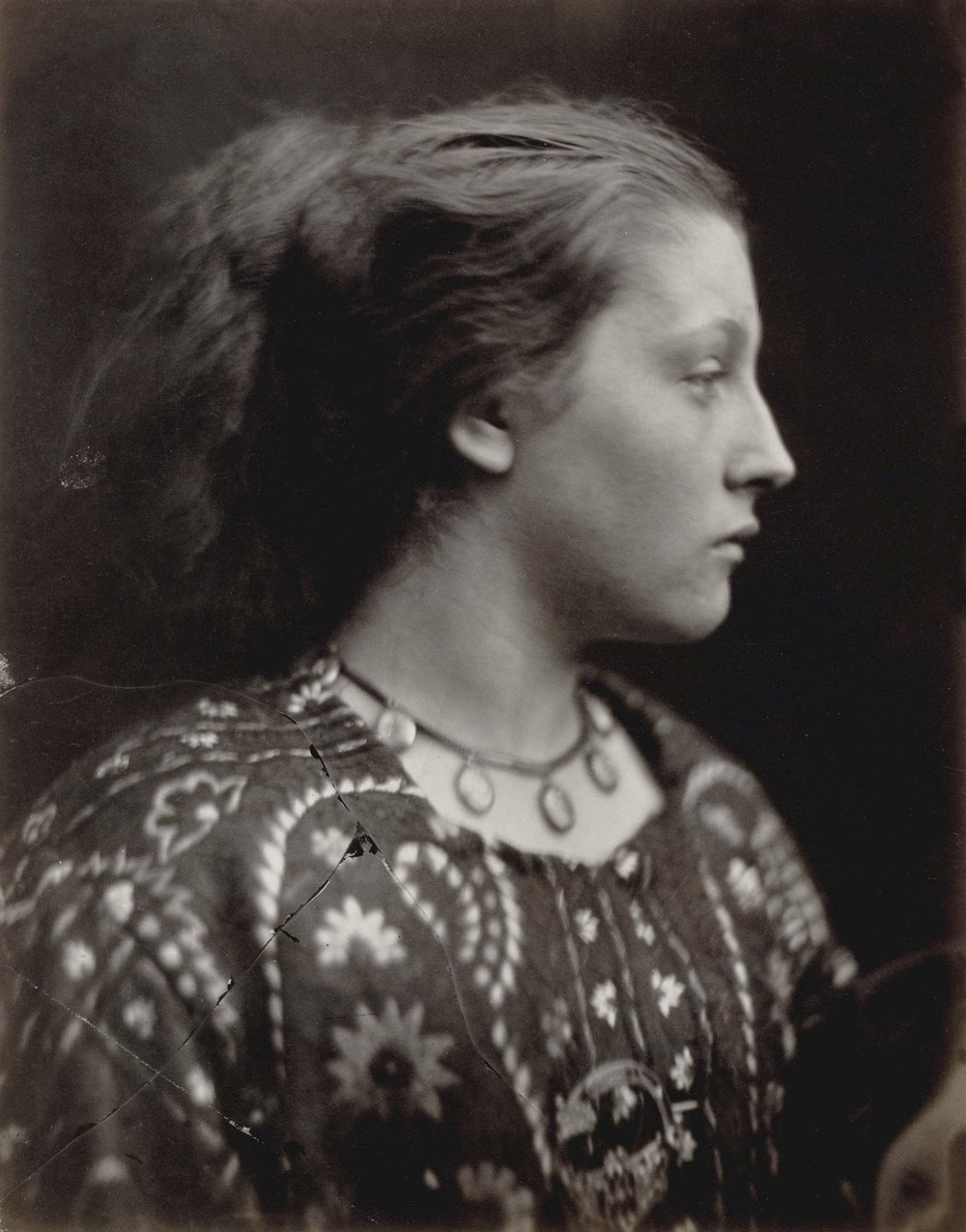
Annie; ‘My first success’ (1864, below) points the way to the later development of her mature style. Although not entirely successful, the signature low depth of field and wonderful use of light are already present in this image. Compare this to Lady Adelaide Talbot (1865, below), only a year later, and you can see that her development as an artist is phenomenal. JMC pushes and pulls the face of the sitter within the image plane. In a sequence from the exhibition (enlarge the installation image, below) we have (from left to right), female in profile facing right with light from right Sappho (1865); female lower 2/3rds right with light from front above Christabel (1866); female looking at camera, soft, dark moody lighting hitting only one the side of the face and embroidered cap Zoe / Maid of Athens (1866); now a different tilt of the jaw, lighter print Beatrice (1866, below); a frontal portrait with dark background, pin sharp face and hair to the front and back of the face out of focus Julia Jackson (1867, below), then female portraits facing left, the head filling the upper left corner; looking down in three-quarter profile with light from the right, filling the frame; and then upper right, small face, with the rest falling off into darkness.


Installation view of the exhibition 'Julia Margaret Cameron: from the Victoria and Albert Museum, London' at the Art Gallery of New South Wales, Sydney


There is something so magical about how JMC can frame a face, emerging from darkness, side profile, filling the frame, top lit. Soft out of focus hair with one point of focus in the image. Beautiful light. Just the most sensitive capturing of a human being, I don’t know what it is… a glimpse into another world, a ghostly world of the spirit, the soul of the living seen now before they are dead.

While it is very interesting to see her failures, or what she perceived as her failures – not so much a failure of vision but mainly a failure of technique: cracking of the plates, under development, defective unmounted impressions – presented in the exhibition, plus all her techniques for developing and amending the photograph – double printing, reverse printing, scratching onto the negative and painting on the print (all techniques later used by the Pictorialists) – it is the low depth of field, wonderful tones and the quality of the light that so impresses with her work. Her portraits have a real but very fluid and ethereal presence. Material, maternal, touch, sublime, religious, allegorical, mythological, and beautiful. She would focus her lens until she thought the subject was beautiful “instead of screwing on the lens to the more definite focus which all other photographers insist upon.”

She has, of course, been seen as a precursor to Pictorialism, but personally I do not get that feeling from her photographs, even though the artists are using many of the same techniques. Her work is based on the reality of seeing beauty, whereas the Pictorialists were trying to make photography into art by emulating the techniques of etching and painting. While the form of her images owes a lot to the history of classical sculpture and painting, to Romanticism and the Pre-Raphaelites, she thought her’s was already art of the highest order. She did not have to mask its content in order to imitate another medium. Others, such as the curator of the exhibition Marta Weiss, see her as a proto-modernist, precursor to the photographs of Stieglitz and Sander and I would agree. There is certainly a fundamental presence to JMC’s photographs, so that when you are looking at them, they tend to touch your soul, the eyes of some of the portraits burning right through you; while others, others have this ambiguity of meaning, of feeling, as if removed from the everyday life.

Unfortunately, her legacy and her baton has not been taken up in contemporary photography, other than through her love child Sally Mann. One of the main problems with contemporary portrait photography, perhaps any type of contemporary photography, is that anything goes. And what goes is usually linked to the photographer’s desire. It is not about the reality of the subject, but just a refraction of the desires of the photographer reflected in the subject. Many photographers today are not real photographers at all… they are just a pimp to their own ideas. There is a 100% co-relation between their vision and their work which leaves no room for ambiguity. There is no longer the interesting and lovely space between what is attempted and how the photographer would like it to be, as in JMC. Where the shortcomings are welcomed (she embraced flaws, cracks, thumb prints) and it all seems a marvellous activity. She was dedicated to the task of extracting the beauty of this ambiguity, through taking hours preparing plates, through sitting, developing and washing. She took her shortcomings and folded them back into her work so that there seems to be a type of perfection to it. Of course, there isn’t. “These fulfilled her photographic vision, a rejection of ‘mere conventional topographic photography – map-making and skeleton rendering of feature and form’ in favour of a less precise but more emotionally penetrating form of portraiture.”1 By contrast, the surface in contemporary “topographic” photography is just a paper thin reflection of the photographer themselves, nothing more.

The road to spirituality is the road less travelled. It is full of uncertainty and confusion, but only through exploring this enigma can we begin to approach some type of inner reality. Julia Margaret Cameron, in her experiments, in her dogged perseverance, was on a spiritual journey of self discovery. In Philip Roth’s Exit Ghost, he suggests Richard Strauss’ Four Last Songs as the ideal music for a scene his character has written:

“Four Last Songs. For the profundity that is achieved not by complexity but by clarity and simplicity. For the purity of the sentiment about death and parting and loss. For the long melodic line spinning out and the female voice soaring and soaring. For the repose and composure and gracefulness and the intense beauty of the soaring. For the ways one is drawn into the tremendous arc of heartbreak. The composer drops all masks and, at the age of eighty-two, stands before you naked. And you dissolve.”

These words are an appropriate epithet for the effect of the photographs of Julia Margaret Cameron in this year 2015, the 200th anniversary of her birth.

Dr Marcus Bunyan

Word count: 1,336

1/ Anonymous. “A Study of the Cenci,” on the V&A website Nd [Online] Cited 20/10/2015


Many thankx to the AGNSW and the Victoria and Albert Museum for allowing me to publish the photographs in the posting. Please click on the photographs for a larger version of the image.

NB: it would have been great to see more of the later work as this exhibition mainly focuses on the period 1864-1869 (probably the bulk of what is in the Victoria and Albert Museum collection). Also, in the expansive, open galleries, some colour on the walls would have been good. When JMC exhibited her work it would have been on coloured walls, probably with multiple mounts of different colours as well. It would also have been nice to see some of the signatures on the work, as some of them reveal intimate facts about the sitter/theme.


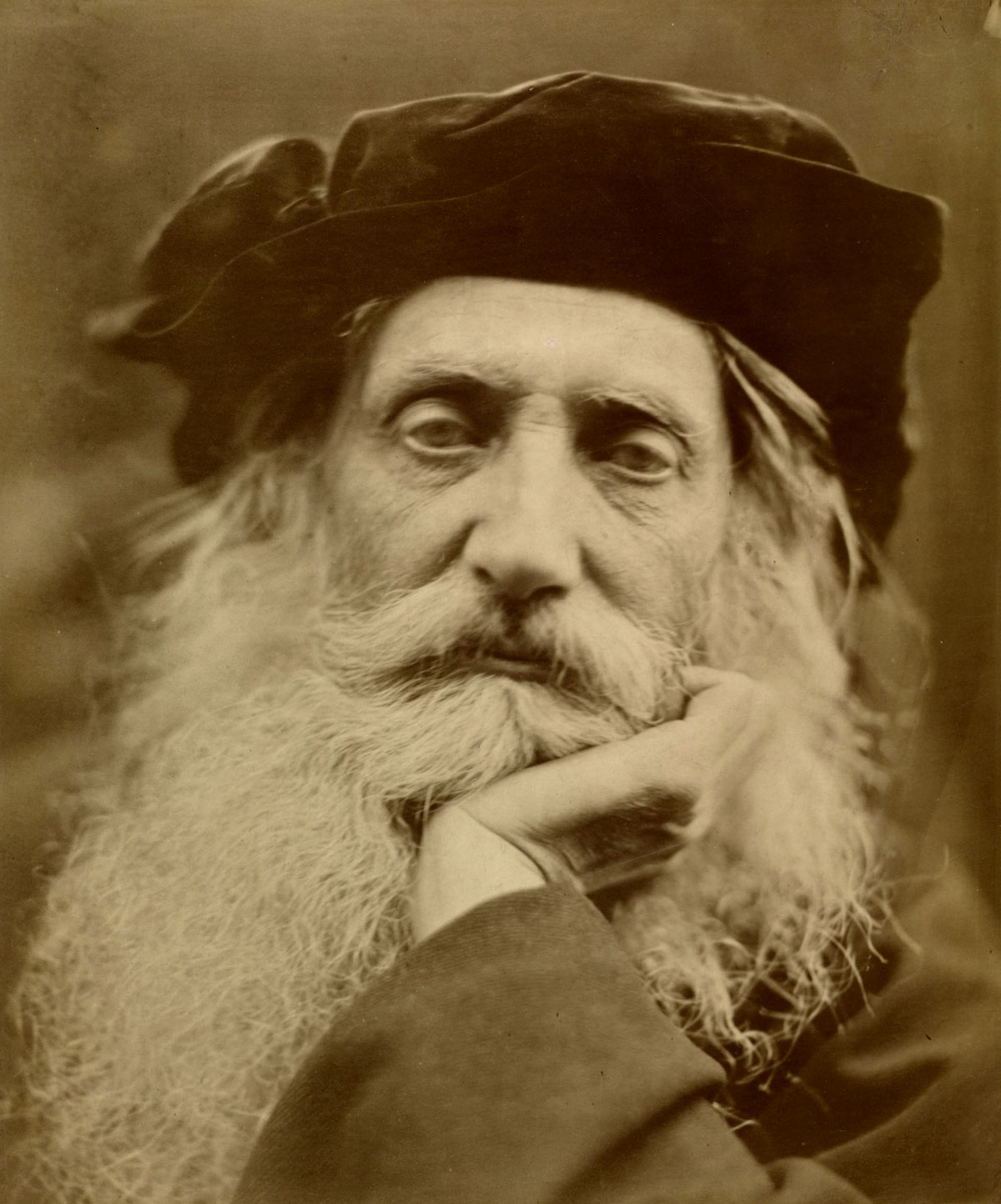
When Cameron photographed her intellectual heroes such as Alfred Tennyson, Sir John Herschel and Henry Taylor, her aim was to record ‘the greatness of the inner as well as the features of the outer man.’

‘When I have such men before my camera my whole soul has endeavoured to do its duty towards them in recording faithfully the greatness of the inner as well as the features of the outer man. The photograph thus taken has been almost the embodiment of a prayer’.


Julia Margaret Cameron 1867


‘When … coming to something which, to my eye, was very beautiful, I stopped there instead of screwing on the lens to the more definite focus which all other photographers insist upon’.


Julia Margaret Cameron


Julia Margaret Cameron (British born India, 1815-1879) 'Mrs. Herbert Duckworth' 1872


Julia Margaret Cameron (British born India, 1815-1879)
Mrs. Herbert Duckworth
1872
© Victoria and Albert Museum, London


Julia Margaret Cameron’s powerful portraits of her niece and goddaughter Julia Jackson depict her as herself, rather than a religious or literary character. Cameron generally reserved this approach for her male sitters. This is one of a series of portraits in which the dramatically illuminated Jackson fearlessly returns the camera’s gaze. Cameron’s niece, here given her married name, once again regards the camera directly, but with an air of sadness rather than confidence. Her husband had died after just three years of marriage. Cameron inscribed one version of this photograph ‘My own cherished Niece and God Child / Julia Duckworth / a widow at 24’.


Julia Margaret Cameron (British born India, 1815-1879) 'Annie; 'My first success'' 1864


Julia Margaret Cameron (British born India, 1815-1879)
Annie; ‘My first success’
1864
© Victoria and Albert Museum, London


Julia Margaret Cameron was 48 when she received a camera as a gift from her daughter and son-in-law. It was accompanied by the words, ‘It may amuse you, Mother, to try to photograph during your solitude at Freshwater.’ Cameron had compiled albums and even printed photographs before, but her work as a photographer now began in earnest. Cameron made this portrait of Annie Philpot, the daughter of a local family, within a month of receiving her first camera. She inscribed some prints of it ‘My first success’ and later wrote of her excitement, ‘I was in a transport of delight. I ran all over the house to search for gifts for the child. I felt as if she entirely had made the picture.’

Cameron’s mentor and friend, the artist G.F. Watts wrote to Cameron, ‘Please do not send me valuable mounted copies … send me any … defective unmounted impressions, I shall be able to judge just as well & shall be just as much charmed with success & shall not feel that I am taking money from you.’ This is one of approximately 67 in the V&A’s collection that was recently discovered to have belonged to him. Many are unique, which suggests that Cameron was not fully satisfied with them. Some may seem ‘defective’ but others are enhanced by their flaws. All of them contribute to our understanding of Cameron’s working process and the photographs that did meet her standards.


Julia Margaret Cameron (British born India, 1815-1879) 'Lady Adelaide Talbot' May 1865


Julia Margaret Cameron (British born India, 1815-1879)
Lady Adelaide Talbot
May 1865
Albumen print from wet collodion glass negative
Given by Julia Margaret Cameron, 28 & 31 July 1865
© Victoria and Albert Museum, London


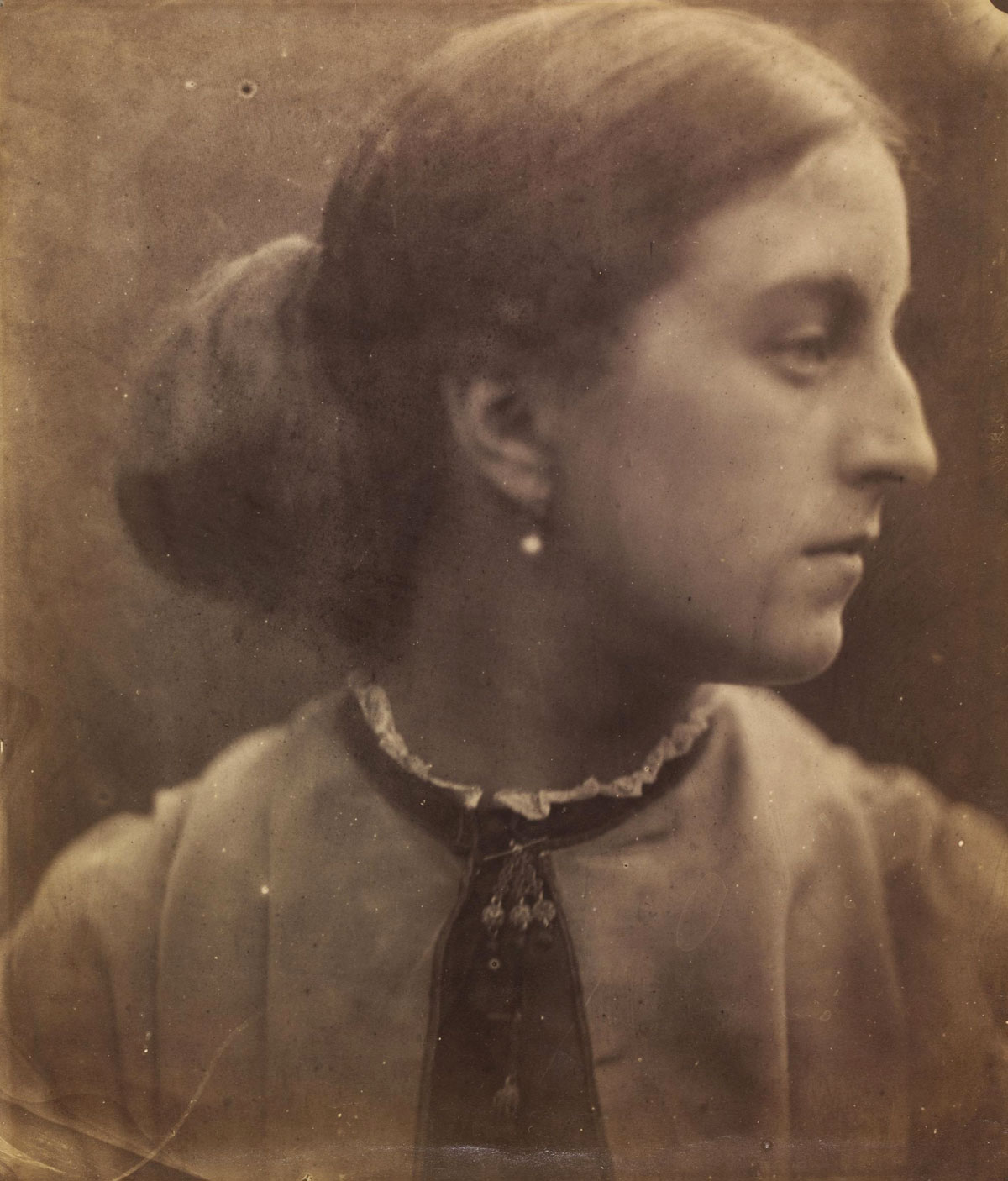
In this close-up profile, Lady Talbot gazes out of the frame with determination. Instead of a tangle of branches and leaves, the background is neutral. The focus is soft and the light coming from the right traces the sitter’s profile. This photograph looks more distinctively like the work of Julia Margaret Cameron and shows the development of her signature style.


Julia Margaret Cameron (British born India, 1815-1879) 'Lady Adelaide Talbot' May 1865 'Il Penseroso; Come pensive nun devout and pure, Sober, stedfast and demure; Portrait or rather Study of Lady Adelaide Talbot' May 1865


Julia Margaret Cameron (British born India, 1815-1879)
Il Penseroso; Come pensive nun devout and pure, Sober, stedfast and demure; Portrait or rather Study of Lady Adelaide Talbot
May 1865
Albumen print from wet collodion glass negative
Given by Julia Margaret Cameron, 27 September 1865
© Victoria and Albert Museum, London


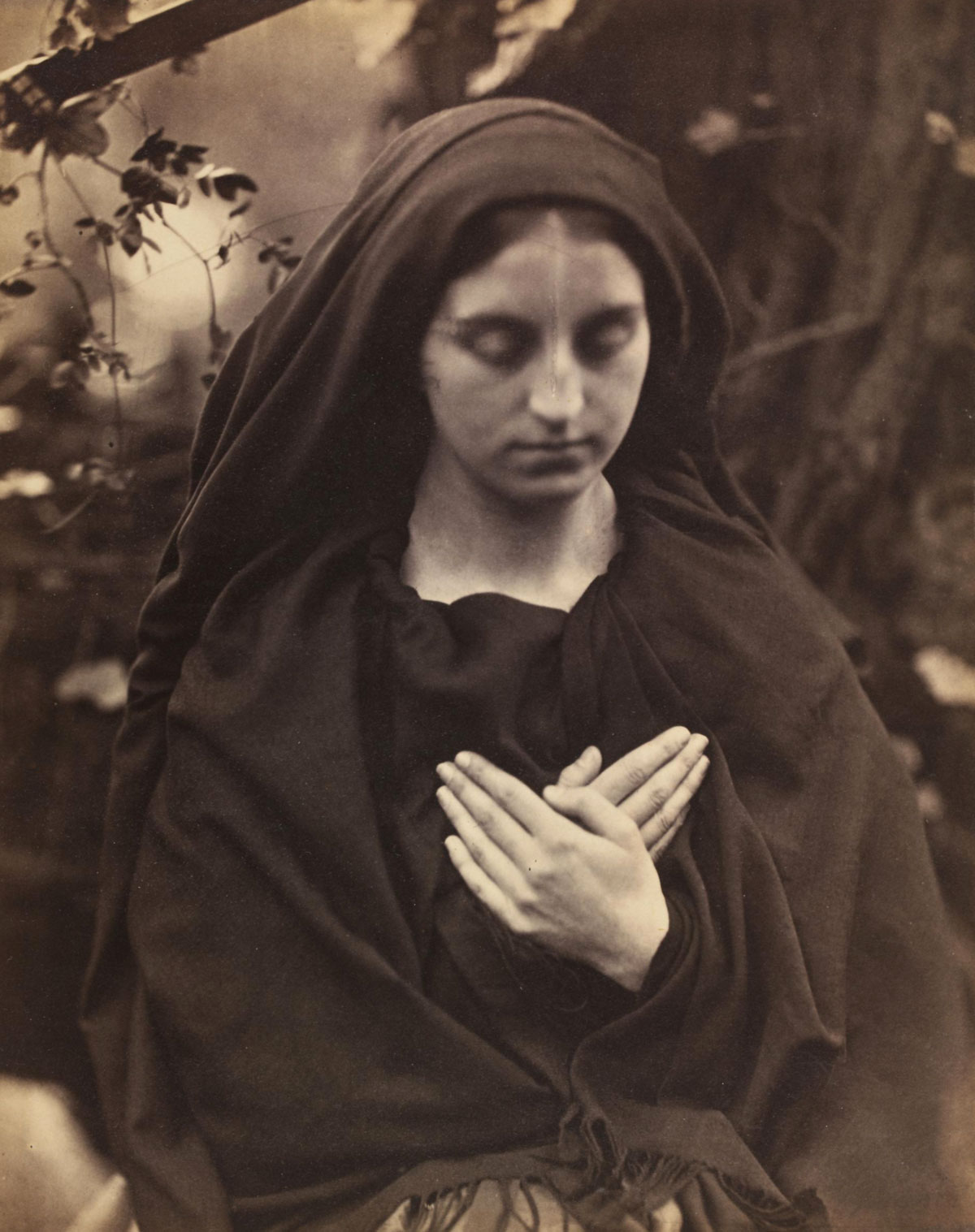
Here Lady Adelaide Talbot appears not as herself, but as Melancholy, the personification of pensive sadness, that John Milton evoked in his poem Il Penseroso (about 1631). Draped in a shawl that hides her everyday clothing, her hands form a V on her chest, in a theatrical gesture. Cameron inscribed this print with two lines from the poem, ‘Come pensive Nun, devout and pure, / Sober, stedfast, and demure’.


Julia Margaret Cameron (British born India, 1815-1879) 'Christiana Fraser-Tytler' c. 1864-1865


Julia Margaret Cameron (British born India, 1815-1879)
Christiana Fraser-Tytler
c. 1864-1865
Albumen print from wet collodion glass negative
Given by Mrs Margaret Southam, 1941
© Victoria and Albert Museum, London


Christiana Fraser-Tytler modelled for other Julia Margaret Cameron photographs together with her sisters. One of them, Mary, an artist and designer, later married the artist G.F. Watts. This print originally belonged to either Watts or his wife. It came from the Watts estate, which was sold after Mary’s death in 1938.


Julia Margaret Cameron (British born India, 1815-1879) 'Sappho' 1865


Julia Margaret Cameron (British born India, 1815-1879)
Sappho
1865
Albumen print from wet collodion glass negative
Given by Alan S. Cole, 19 April 1913
© Victoria and Albert Museum, London


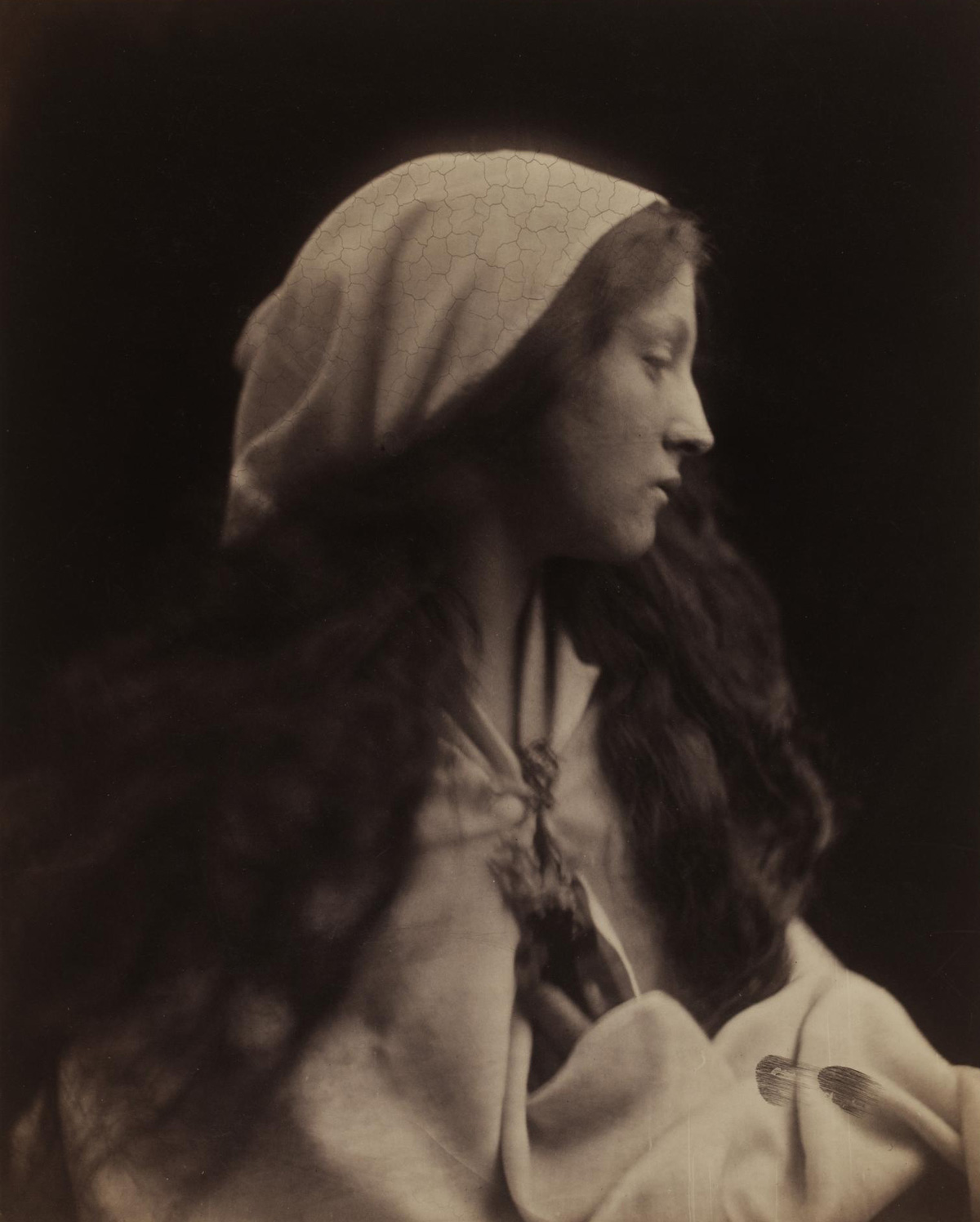
In late 1865 Julia Margaret Cameron began using a larger camera, which held a 15 x 12-inch glass negative. Early the next year she wrote to Henry Cole with great enthusiasm – but little modesty – about the new turn she had taken in her work. Cameron initiated a series of large-scale, close-up heads. These fulfilled her photographic vision, a rejection of ‘mere conventional topographic photography – map-making and skeleton rendering of feature and form’ in favour of a less precise but more emotionally penetrating form of portraiture.

This striking version of Sappho is in keeping with Cameron’s growing confidence as an artist. Mary Hillier’s classical features stand out clearly in profile while her dark hair merges with the background. The decorative blouse balances the simplicity of the upper half of the picture. Cameron was clearly pleased with the image since she printed multiple copies, despite having cracked the negative.


Julia Margaret Cameron (British born India, 1815-1879) 'Christabel' 1866


Julia Margaret Cameron (British born India, 1815-1879)
Christabel
1866
Albumen print from wet collodion glass negative
Given by Alan S. Cole, 19 April 1913
© Victoria and Albert Museum, London


The title refers to a poem by Samuel Taylor Coleridge about a virtuous maiden who is put under a spell by an evil sorceress. Cameron wrote of photographs such as this, ‘when … coming to something which, to my eye, was very beautiful, I stopped there instead of screwing on the lens to the more definite focus which all other photographers insist upon’.


Julia Margaret Cameron (British born India, 1815-1879) 'Beatrice' 1866


Julia Margaret Cameron (British born India, 1815-1879)
Beatrice
1866
Albumen print from wet collodion glass negative
Given by Alan S. Cole, 19 April 1913
© Victoria and Albert Museum, London


Cameron based the pose, drapery, and sad expression of her model on a painting attributed to Guido Reni. The subject is the 16th-century Italian noblewoman Beatrice Cenci who was executed for arranging the murder of her abusive father. One review admired Cameron’s soft rendering of ‘the pensive sweetness of the expression of the original picture’ while another mocked her for claiming to have photographed a historical figure ‘from the life’.


Julia Margaret Cameron (British born India, 1815-1879) 'Julia Jackson' 1866


Julia Margaret Cameron (British born India, 1815-1879)
Julia Jackson
1867
Albumen print from wet collodion glass negative
Given by Mrs Margaret Southam, 1941
© Victoria and Albert Museum, London


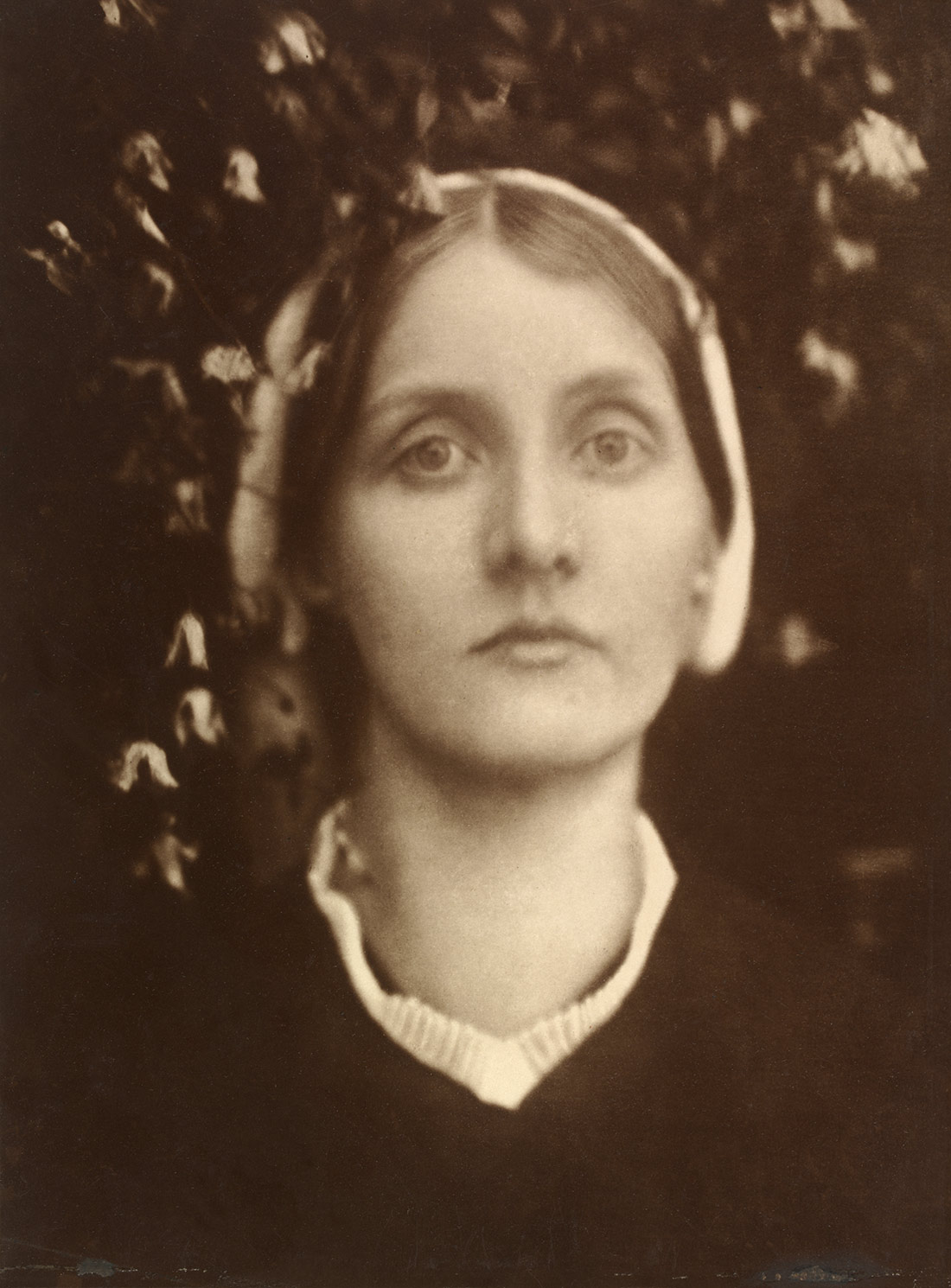
Cameron’s powerful portraits of her niece and goddaughter Julia Jackson depict her as herself, rather than a religious or literary character. Cameron generally reserved this approach for her male sitters. This is one of a series of portraits in which the dramatically illuminated Jackson fearlessly returns the camera’s gaze.

Cameron’s good friend Anne Thackeray Ritchie recalled in 1893, ‘Sitting to her was a serious affair, and not to be lightly entered upon. We came at her summons, we trembled (or we should have trembled had we dared to do so) when the round black eye of the camera was turned upon us, we felt the consequences, what a disastrous waste of time and money and effort, might ensue from any passing quiver of emotion.’


Julia Margaret Cameron (British born India, 1815-1879) 'Hosanna' 1865


Julia Margaret Cameron (British born India, 1815-1879)
Hosanna
1865
© Victoria and Albert Museum, London


Julia Margaret Cameron (British born India, 1815-1879) 'Vivien and Merlin from Illustrations to Tennyson's Idylls of the King' 1874


Julia Margaret Cameron (British born India, 1815-1879)
Vivien and Merlin from Illustrations to Tennyson’s Idylls of the King
1874
© Victoria and Albert Museum, London


Julia Margaret Cameron (British born India, 1815-1879) 'Vivien and Merlin from Illustrations to Tennyson's Idylls of the King' 1874 (detail)


Julia Margaret Cameron (British born India, 1815-1879)
Vivien and Merlin from Illustrations to Tennyson’s Idylls of the King (detail)
1874
© Victoria and Albert Museum, London


Installation view of the exhibition 'Julia Margaret Cameron: from the Victoria and Albert Museum, London' at the Art Gallery of New South Wales, Sydney

Installation view of the exhibition 'Julia Margaret Cameron: from the Victoria and Albert Museum, London' at the Art Gallery of New South Wales, Sydney

Installation view of the exhibition 'Julia Margaret Cameron: from the Victoria and Albert Museum, London' at the Art Gallery of New South Wales, Sydney

Installation view of the exhibition 'Julia Margaret Cameron: from the Victoria and Albert Museum, London' at the Art Gallery of New South Wales, Sydney

Installation view of the exhibition 'Julia Margaret Cameron: from the Victoria and Albert Museum, London' at the Art Gallery of New South Wales, Sydney

Installation view of the exhibition 'Julia Margaret Cameron: from the Victoria and Albert Museum, London' at the Art Gallery of New South Wales, Sydney

Installation view of the exhibition 'Julia Margaret Cameron: from the Victoria and Albert Museum, London' at the Art Gallery of New South Wales, Sydney

Installation view of the exhibition 'Julia Margaret Cameron: from the Victoria and Albert Museum, London' at the Art Gallery of New South Wales, Sydney

Installation view of the exhibition 'Julia Margaret Cameron: from the Victoria and Albert Museum, London' at the Art Gallery of New South Wales, Sydney

Installation view of the exhibition 'Julia Margaret Cameron: from the Victoria and Albert Museum, London' at the Art Gallery of New South Wales, Sydney

Installation view of the exhibition 'Julia Margaret Cameron: from the Victoria and Albert Museum, London' at the Art Gallery of New South Wales, Sydney

Installation view of the exhibition 'Julia Margaret Cameron: from the Victoria and Albert Museum, London' at the Art Gallery of New South Wales, Sydney

Installation view of the exhibition 'Julia Margaret Cameron: from the Victoria and Albert Museum, London' at the Art Gallery of New South Wales, Sydney

Installation view of the exhibition 'Julia Margaret Cameron: from the Victoria and Albert Museum, London' at the Art Gallery of New South Wales, Sydney

Installation view of the exhibition 'Julia Margaret Cameron: from the Victoria and Albert Museum, London' at the Art Gallery of New South Wales, Sydney


Installation views of the exhibition Julia Margaret Cameron: from the Victoria and Albert Museum, London at the Art Gallery of New South Wales, Sydney
Photos: Marcus Bunyan


Julia Margaret Cameron’s career as a photographer began in 1863 when her daughter gave her a camera. Cameron began photographing everyone in sight. Because of the newness of photography as a practice, she was free to make her own rules and not be bound to convention. The kinds of images being made at the time did not interest Cameron. She was interested in capturing another kind of photographic truth. Not one dependent on accuracy of sharp detail, but one that depicted the emotional state of her sitter.

Cameron liked the soft focus portraits and the streak marks on her negatives, choosing to work with these irregularities, making them part of her pictures. Although at the time Cameron was seen as an unconventional and experimental photographer, her images have a solid place in the history of photography.

Most of Cameron’s photographs are portraits. She used members of her family as sitters and made photographs than concentrated on their faces. She was interested in conveying their natural beauty, often asking female sitters to let down their hair so as to show them in a way that they were not accustomed to presenting themselves. In addition to making stunning and evocative portraits both of male and female subjects, Cameron also staged tableaux and posed her sitters in situations that simulated allegorical paintings.

Text from the Victoria and Albert Museum website


Julia Margaret Cameron (British born India, 1815-1879)  'Lady Elcho / A Dantesque Vision' 1865


Julia Margaret Cameron (British born India, 1815-1879)
Lady Elcho / A Dantesque Vision
1865
Albumen print from wet collodion glass negative
Given by Mrs Margaret Southam, 1941
© Victoria and Albert Museum, London


Julia Margaret Cameron’s earliest photographic subjects were family and friends, many of whom were eminent literary figures. These early portraits reveal how she experimented with dramatic lighting and close-up compositions, features that would become her signature style. In May 1865 Cameron used her sister’s London home, Little Holland House, as her photographic headquarters. Her sister Sara Prinsep, together with her husband Thoby, had established a cultural salon there centred around the artist George Frederic Watts, who lived with them. Cameron photographed numerous members of their circle on the lawn. These included artists, writers and collectors and Henry Cole, the director of the South Kensington Museum.

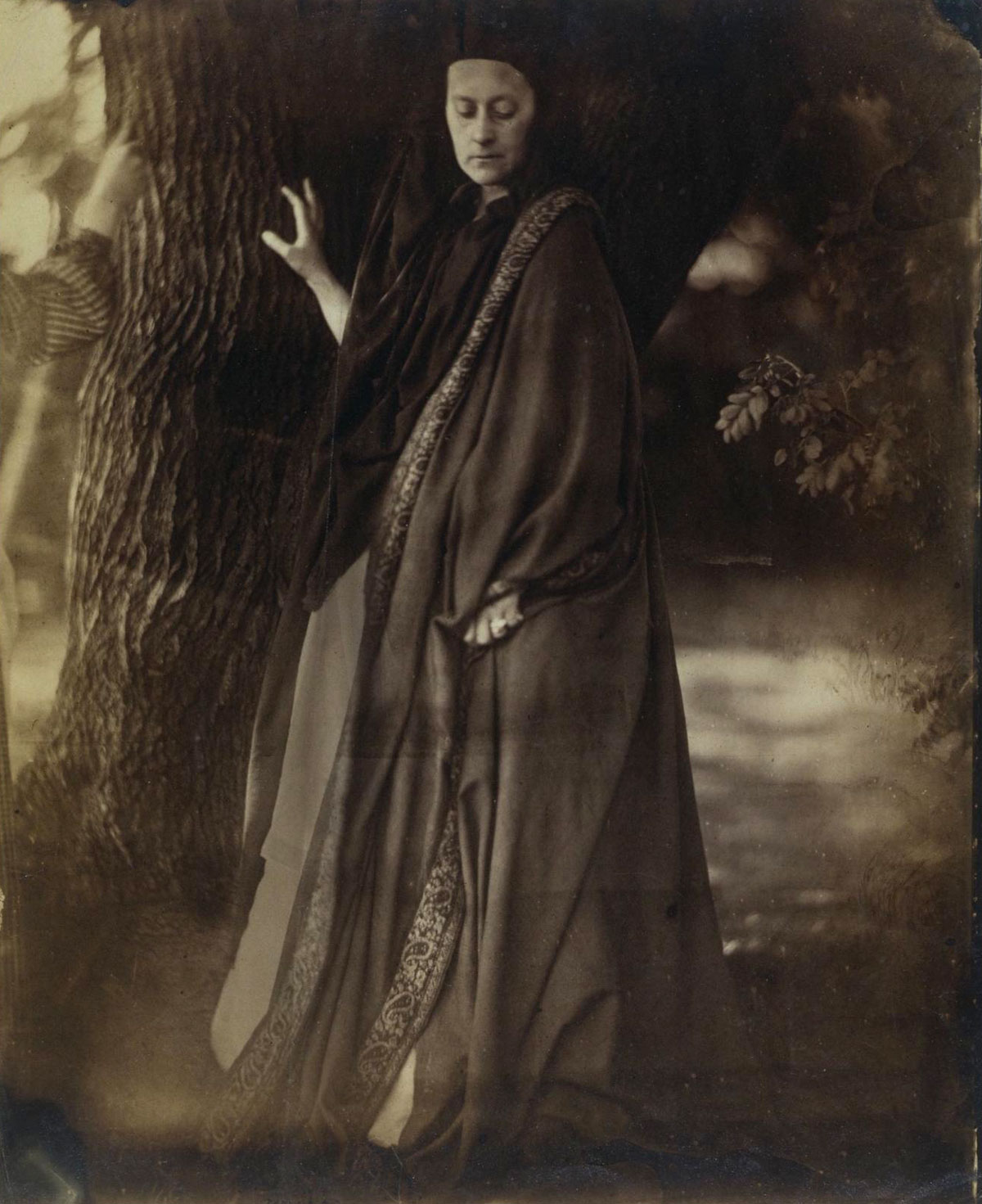
Cameron clothed Lady Elcho in flowing draperies to suggest a character out of Dante, author of the 14th-century poem the Divine Comedy. Cameron wears the same large, paisley-edged shawl in the portrait by her son. The fragmented female figure at the far left of the frame may have been assisting Cameron.


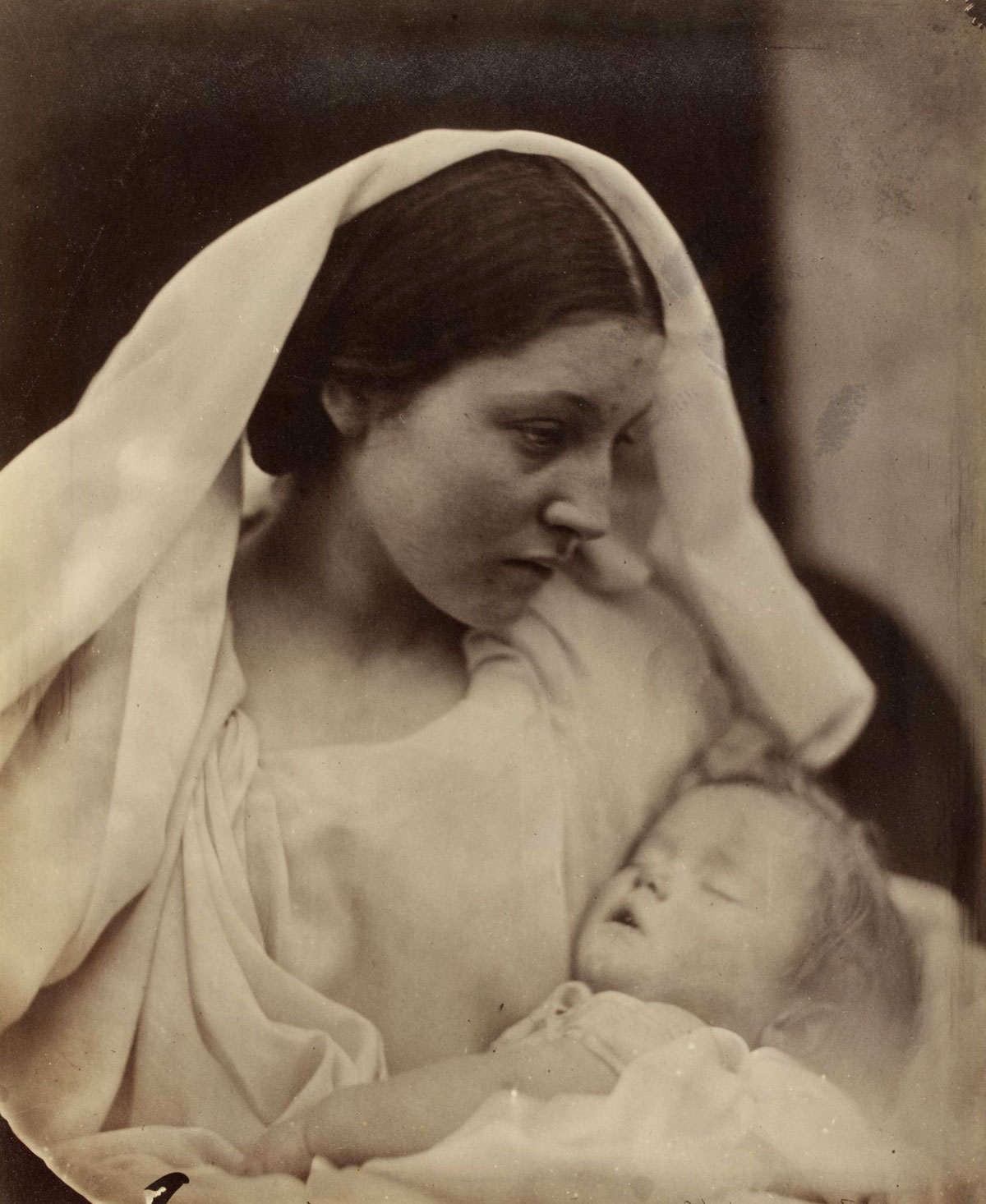
Julia Margaret Cameron (British born India, 1815-1879) 'Resting in Hope; La Madonna Riposata' 1864


Julia Margaret Cameron (British born India, 1815-1879)
Resting in Hope; La Madonna Riposata
1864
Albumen print from wet collodion glass negative
Purchased from Julia Margaret Cameron, 17 June 1865
© Victoria and Albert Museum, London


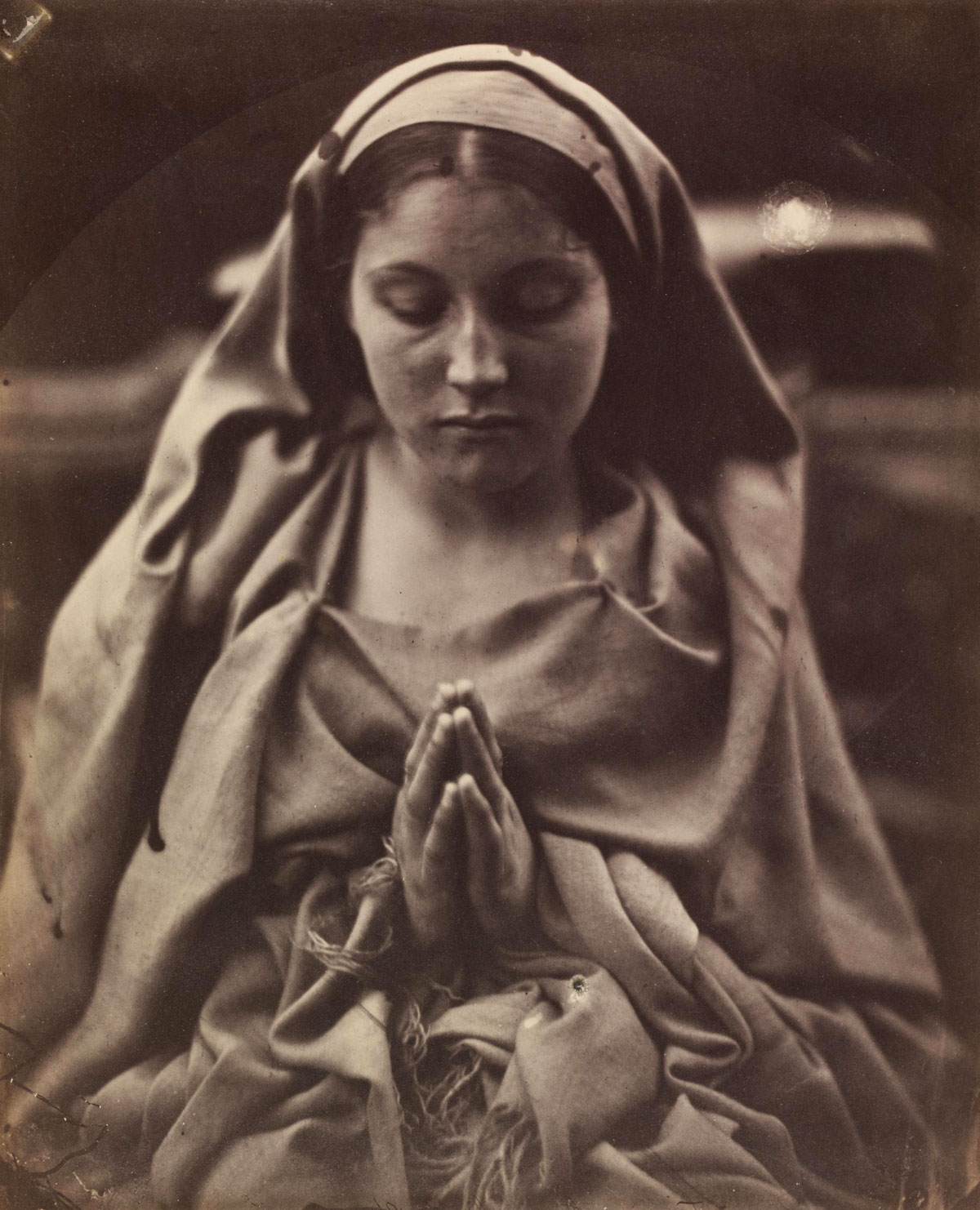
Many of the photographs purchased by the South Kensington Museum (now the Victoria and Albert Museum) from Julia Margaret Cameron were ‘Madonna Groups’ depicting the Virgin Mary and the infant Christ. Her housemaid Mary Hillier posed as the Virgin Mary so often she became known locally as ‘Mary Madonna’.  Like many of her contemporaries, Cameron was a devout Christian. As a mother of six, the motif of the Madonna and child held particular significance for her. In aspiring to make ‘High Art’, Cameron aimed to make photographs that could be uplifting and morally instructive.

As in many of Cameron’s depictions of the subject, the Madonna is holding a sleeping child. This had practical advantages as the infant was less likely to move during the long exposure. It was also suggestive of death, a grim reality for many Victorian families and a reference to the Pietà, a subject in Christian art in which the Virgin Mary cradles the dead Christ.


Julia Margaret Cameron (British born India, 1815-1879) 'The Shadow of the Cross' August 1865


Julia Margaret Cameron (British born India, 1815-1879)
The Shadow of the Cross
August 1865
Albumen print from wet collodion glass negative
Given by Julia Margaret Cameron, 27 September 1865
© Victoria and Albert Museum, London


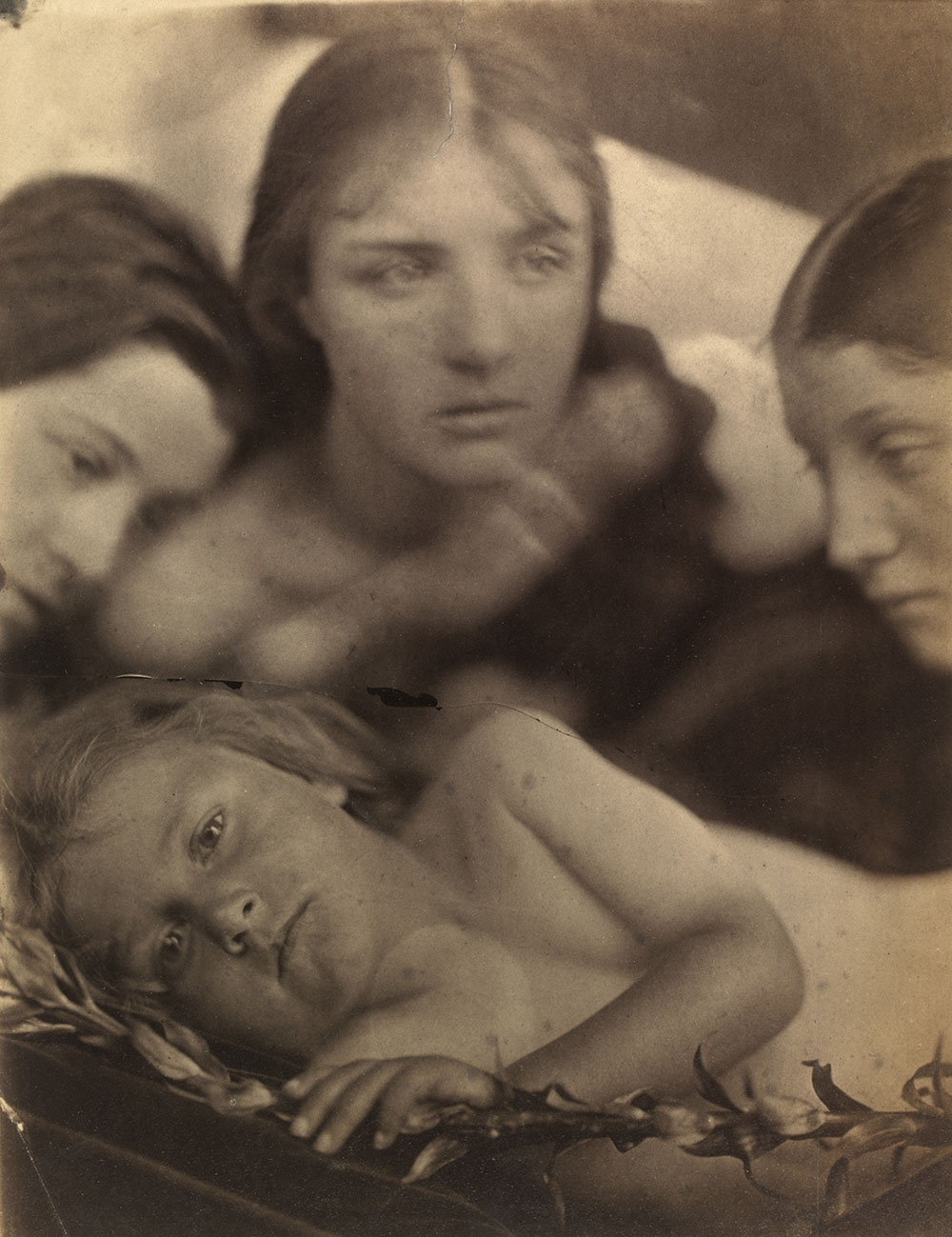
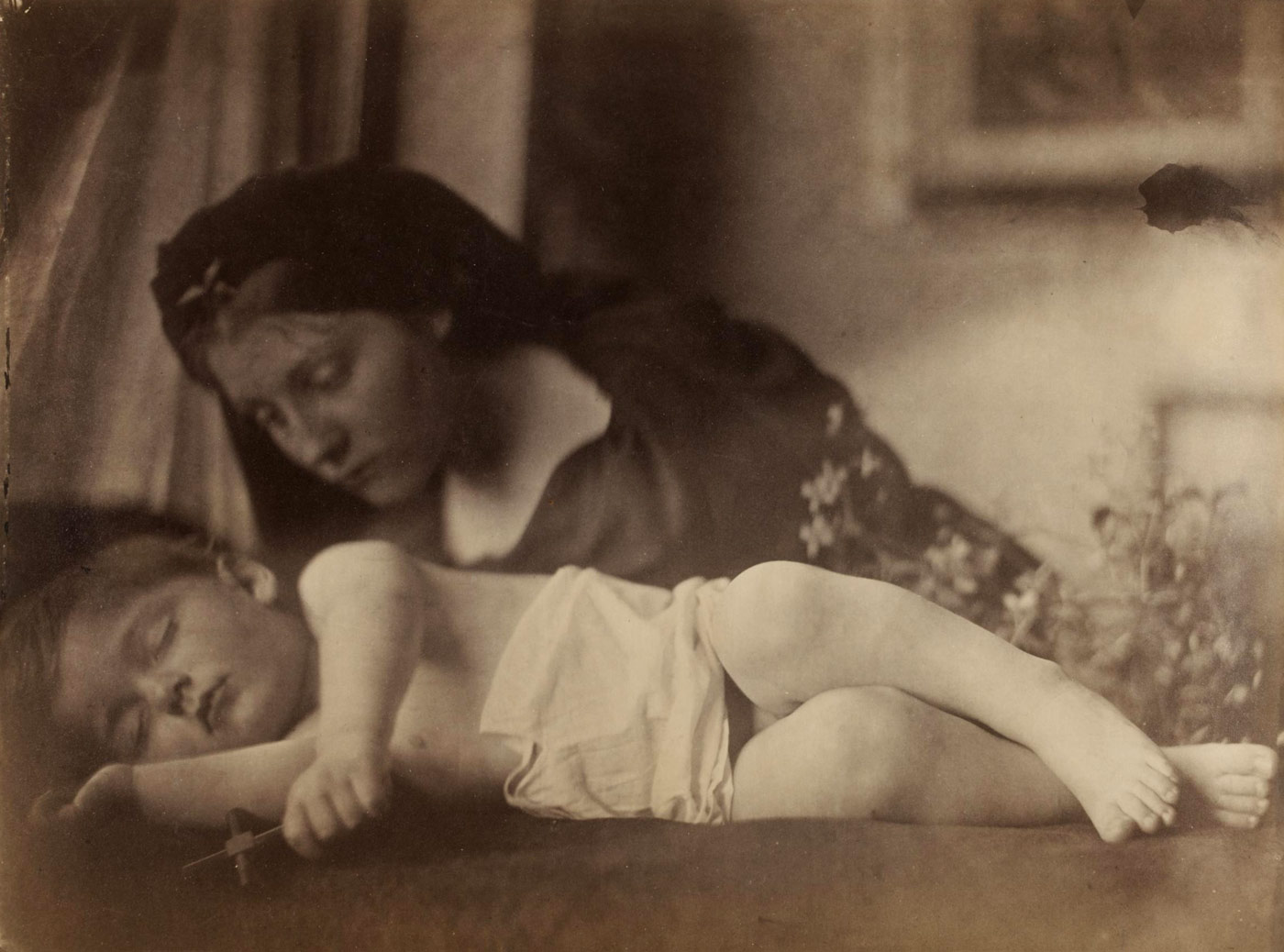
With the addition of a small wooden cross and female model in drapery, Cameron transformed a portrait of her sleeping grandson into an image of the Virgin Mary and the infant Christ. The mother leaning over the child prefigures Mary mourning over the body of her son, who had died on the cross. The framed pictures and curtain in the background reveal the setting as a domestic interior.


Julia Margaret Cameron (British born India, 1815-1879) 'Devotion' 1865


Julia Margaret Cameron (British born India, 1815-1879)
Devotion
1865
Albumen print from wet collodion glass negative
Given by Julia Margaret Cameron, 27 September 1865
© Victoria and Albert Museum, London


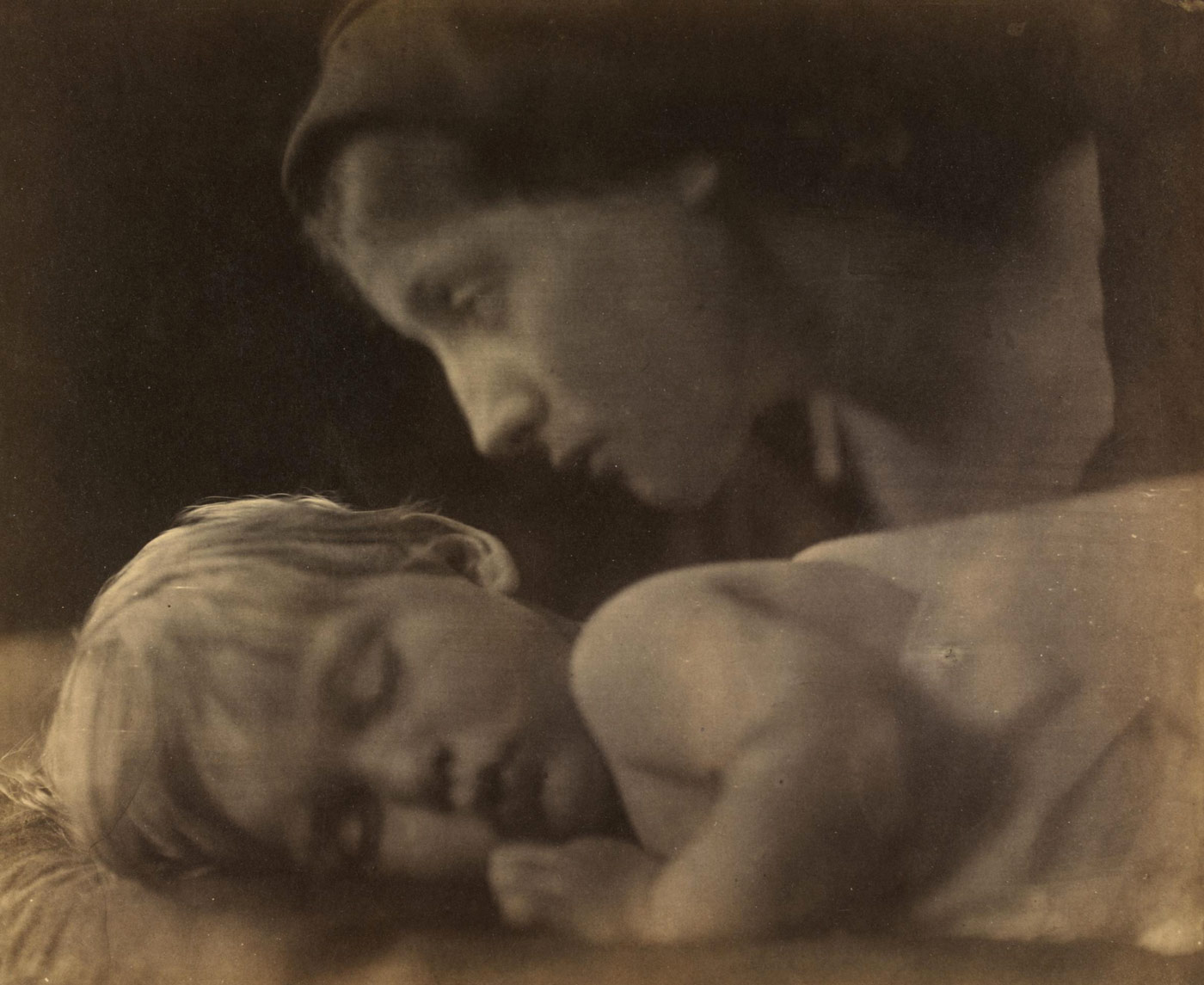
In this unusual horizontal composition, the close-up figures of the sleeping Christ child and the Madonna nearly fill the frame. The title suggests both Christian concepts and the theme of motherhood. Next to the title Cameron wrote: ‘From Life My Grand child age 2 years & 3 months’, making the image simultaneously a religious study and a family portrait.


Julia Margaret Cameron (British born India, 1815-1879) 'St. Agnes' 1864


Julia Margaret Cameron (British born India, 1815-1879)
St. Agnes
1864
Albumen print from wet collodion glass negative
Purchased from Julia Margaret Cameron, 17 June 1865
© Victoria and Albert Museum, London


This image may have been inspired by poems by Alfred Tennyson and John Keats based on the legend that virgins dream of their future husbands on St Agnes Eve (20 January). To suggest the night, Julia Margaret Cameron printed the photograph dark and added a moon by hand. The sitter is Mary Hillier, Cameron’s housemaid and one of her ‘most beautiful and constant’ models.


Julia Margaret Cameron (British born India, 1815-1879) 'The Dream' 1869


Julia Margaret Cameron (British born India, 1815-1879)
The Dream
1869
Albumen print from wet collodion glass negative
Given by Alan S. Cole, 19 April 1913
© Victoria and Albert Museum, London


In 1869, Julia Margaret Cameron wrote to Sir Henry Cole, the founding director of the South Kensington Museum (now the Victoria and Albert Museum) of the ‘cruel calamity … which has over taken 45 of my Gems – a honey comb crack extending over the picture appearing at any moment and beyond any power to arrest.’ Cameron blamed her ‘fatally perishable’ photographic chemicals, while members of the Photographic Society suspected the damp climate of the Isle of Wight. Today’s theory is that failure to sufficiently wash the negatives after fixing them caused the problem.

John Milton’s poem On his deceased Wife (about 1658) tells of a fleeting vision of his beloved returning to life in a dream. On this mount she included G. F. Watts’ assessment: ‘quite divine’. Cameron was particularly distraught by the crackling that befell this negative. She seemed not to be bothered, however, by the two smudged fingerprints in the lower right, which form a kind of inadvertent signature.


Julia Margaret Cameron (British born India, 1815-1879) 'Henry Taylor' October 10, 1867


Julia Margaret Cameron (British born India, 1815-1879)
Henry Taylor
October 10, 1867
Albumen print from wet collodion glass negative
Given by Window & Grove, 1963
© Victoria and Albert Museum, London


When Julia Margaret Cameron photographed her intellectual heroes such as Alfred Tennyson, Sir John Herschel and Henry Taylor, her aim was to record ‘the greatness of the inner as well as the features of the outer man.’ Another motive was to earn money from prints of the photographs, since her family’s finances were precarious. Within her first year as a photographer she began exhibiting and selling through the London gallery Colnaghi’s. She used autographs to increase the value of some portraits.

For this portrait of her close friend, the playwright and poet Taylor, Cameron broke from her practice of photographing male heads emerging from darkness. As with some of her female heads, the sitter’s face fills the frame, while his sleeve and beard flow beyond its confines.


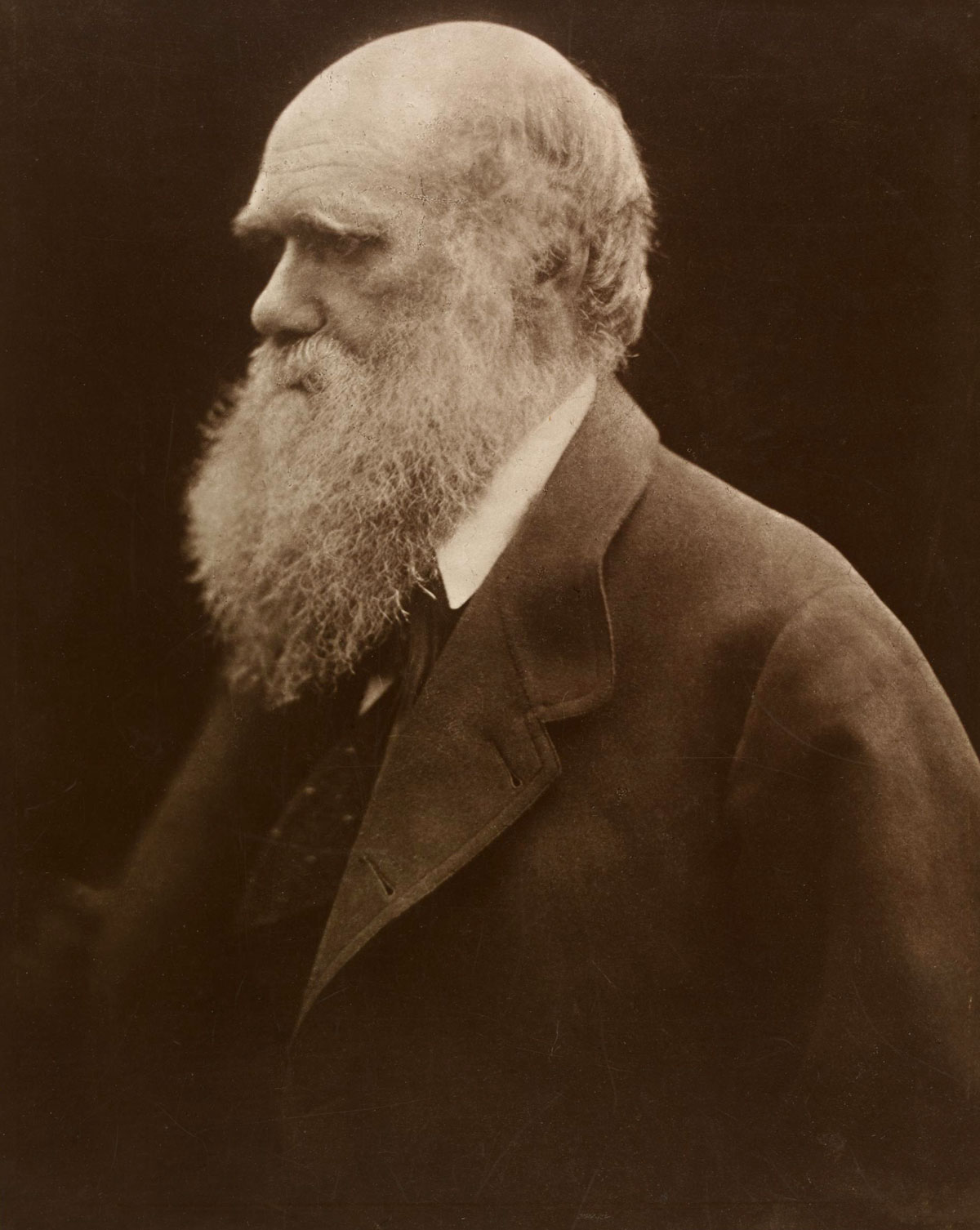
Julia Margaret Cameron (British born India, 1815-1879) 'Charles Darwin' 1868; printed 1875


Julia Margaret Cameron (British born India, 1815-1879)
Charles Darwin
1868; printed 1875
Carbon print from copy negative
Given by Mrs Ida S. Perrin, 1939
© Victoria and Albert Museum, London


The naturalist Charles Darwin and his family rented a cottage in Freshwater from the Camerons in the summer of 1868. By 27 July, Colnaghi’s was advertising, ‘we are glad to observe her gallery of great men enriched by a very fine portrait of Charles Darwin’. Due to the sitter’s celebrity, Cameron later had this portrait reprinted as a more stable carbon print. When Cameron photographed her intellectual heroes such as Alfred Tennyson, Sir John Herschel and Henry Taylor, her aim was to record ‘the greatness of the inner as well as the features of the outer man.’


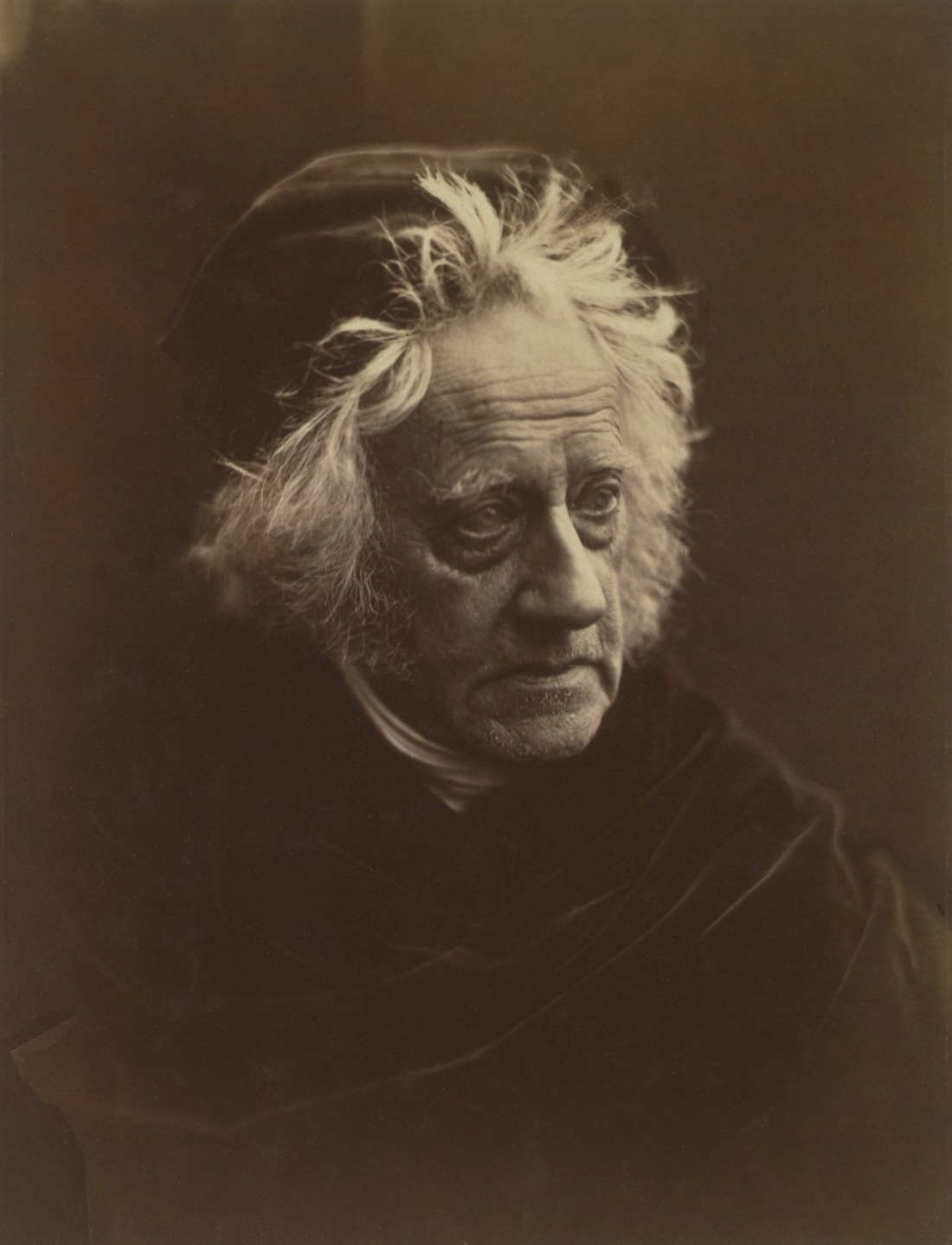
Julia Margaret Cameron (British born India, 1815-1879) 'Portrait of Herschel' 1867


Julia Margaret Cameron (British born India, 1815-1879)
Portrait of Herschel
April 1867
Albumen print from wet collodion glass negative
Given by Window & Grove, 1963
© Victoria and Albert Museum, London


Herschel was an eminent scientist who made important contributions to astronomy and photography. Cameron wrote of this sitting, ‘When I have such men before my camera my whole soul has endeavoured to do its duty towards them in recording faithfully the greatness of the inner as well as the features of the outer man. The photograph thus taken has been almost the embodiment of a prayer.’


Art Gallery of New South Wales
Art Gallery Road, The Domain
Sydney NSW 2000, Australia

Opening hours:
Open every day 10am – 5pm
except Christmas Day and Good Friday

Art Gallery of New South Wales website

LIKE ART BLART ON FACEBOOK

Back to top

Exhibition: ‘Victorian London in Photographs 1839 to 1901’ at the London Metropolitan Archives

Exhibition dates: 5th May – 29th October 2015


Henry Flather (British, 1839-1901) 'Building the Metropolitan Railway' 1862


Henry Flather (British, 1839-1901)
Building the Metropolitan Railway
1862
© City of London: London Metropolitan Archives


This photograph by Henry Flather shows workers at Baker Street as they construct London’s first Tube line.


This is a fascinating exhibition about the history of London portrayed through Victorian era photographs.

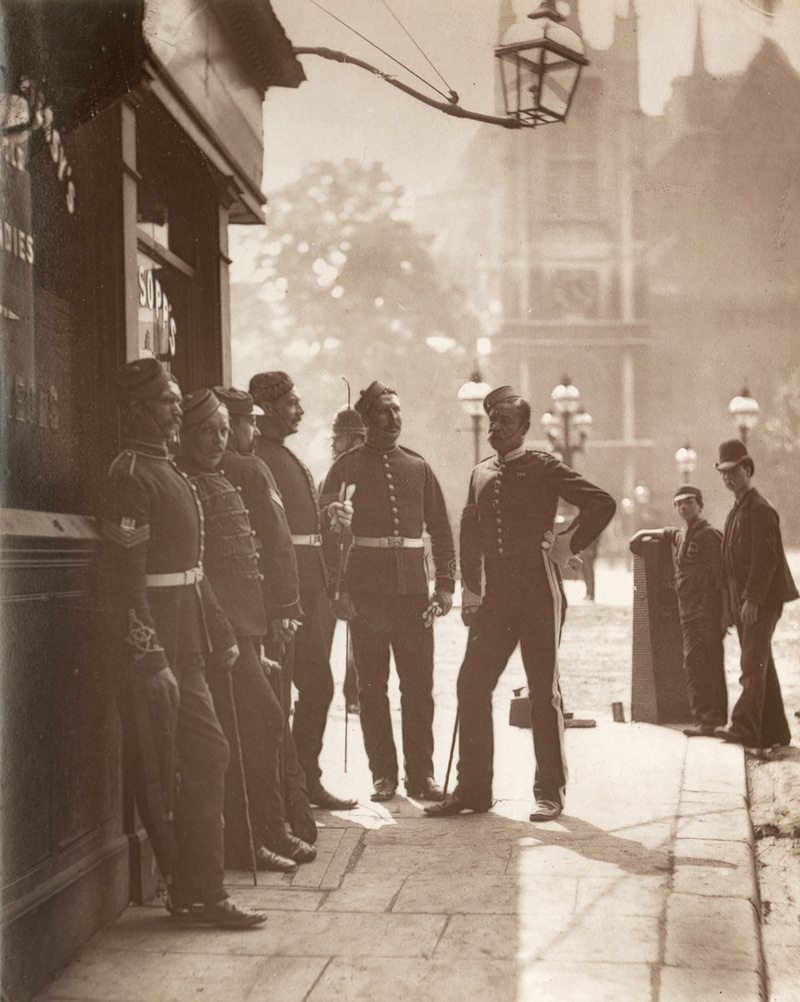
The best photographs in the posting are by John Thomson. The composition of these images is exemplary with their eloquent use of light and low depth of field. The seemingly nonchalant but obviously staged positioning of the figures is coupled with superb rendition of light in photographs such as Old Furniture, London Nomades and Recruiting Sergeants At Westminster (all 1877, below).

The details are intriguing, such as shooting contre-jour or into the light in Recruiting Sergeants At Westminster with one of the soldiers and the two street lads in the distance staring directly at the camera. This seems to be a technique of Thomson’s, for there is always one person in his intimate group photographs staring straight at the camera, which in this era is unusual in itself. The women on the steps of the Romany caravan stares straight at the camera, one of the two children framed in the doorway behind slightly blurred, telling us the length of the exposure.

Then we have the actual characters themselves. With his tall hat and what seems to be scars around his mouth, the man centre stage in The Cheap Fish Of St. Giles’s (1877, below) reminds me of that nasty character Bill Sikes out of Charles Dicken’s immortal Oliver Twist (1837-39). And the poverty stricken from the bottom of the barrel… the destitute women and baby in The “Crawlers” – Portrait of a destitute woman with an infant (1877, below). “The abject misery into which they are plunged is not always self sought and merited; but is, as often, the result of unfortunate circumstances and accident.” It must have been so tough in that era to survive every day in London. See Matthew Beaumont. Nightwalking: A Nocturnal History of London, Chaucer to Dickens. London and New York: Verso, 2015.

Dr Marcus Bunyan


Many thankx to the London Metropolitan Archives for allowing me to publish the photographs in the posting. Please click on the photographs for a larger version of the image.


Philip Henry Delamotte (British, 1821-1889) 'Setting up the Colossi of Rameses the Great' 1854


Philip Henry Delamotte (British, 1821-1889)
Setting up the Colossi of Rameses the Great, The Crystal Palace
1854
© City of London: London Metropolitan Archives


Philip Henry Delamotte was commissioned to record the disassembly of the Crystal Palace in Hyde Park in 1852, and its reconstruction and expansion at Sydenham, a project finished in 1854. This image, entitled Setting up the Colossi of Rameses the Great, is part of an incredible set of photographs which record a large scale project in fascinating detail.


Anonymous photographer. 'Opening ceremony of the Blackwall Tunnel' 1897


Anonymous photographer
Opening ceremony of the Blackwall Tunnel
1897
© City of London: London Metropolitan Archives


This image shows the opening ceremony of the Blackwall Tunnel. The tunnel was finally opened by the then Prince of Wales (Edward VII) in 1897, having been originally proposed in the 1880’s. It was constructed using a ‘tunnel shield’ to create the tunnel and remove debris. A major engineering project of the period, the tunnel was created to improve commerce and trade in the East End by providing a Thames crossing for a mixture of foot, cycle, horse-drawn and vehicular traffic.


Anonymous photographer. 'St Paul's Cathedral' c. 1855


Anonymous photographer
St Paul’s Cathedral
c. 1855
© City of London: London Metropolitan Archives


This photograph was taken from Southwark Bridge by an anonymous photographer. The foreground shows London’s lost wharf buildings, including Iron Wharf and Bull Wharf.


George Washington Wilson (Scottish, 1823-1893) and Charles Wilson (photographers) Marion & Co (publishers) 'Piccadilly, London' 1890


George Washington Wilson (Scottish, 1823-1893) and Charles Wilson (photographers)
Marion & Co
(publishers)
Piccadilly, London
1890
© City of London: London Metropolitan Archives


The name derives from ‘picadil’, a fashionable stiff collar of the early seventeenth century. The Aberdeen photographers George Washington Wilson and his son Charles specialised in high quality topographical views. This image is believed to be the work of the Wilsons, many of which were published by the firm of Marion & Co. The distinctive viewpoint is several feet above the carriageway. The photographers and their large format camera were driven round London in a covered wagon hired from Pickfords removals firm. This method allowed them to take candid photographs of streets and people.


Life in Victorian London Exposed

The arrival of photography in London in 1839 would change the way people saw their city, and each other, forever. Quite suddenly it was possible to see life captured ‘in the flesh’, rather than as an artist’s sketch or painting. The new medium was embraced as a means of recording the progress of grand engineering projects and revealing the shocking poverty that haunted the capital’s poorer districts.

The collections at London Metropolitan Archives contain an extraordinary range of photographs from Queen Victoria’s reign, recording the city and its people in stunning detail. Whether in carefully posed studio portraits or images of people gathered in the street, it seems that almost everyone wanted to be recorded on camera. This exhibition delves into these collections to present some of most striking images of the era; from the first known photograph of London to the opening of Blackwall Tunnel at the end of the century, taking in the Crystal Palace, the first Tube line and the harsh realities of life on the city’s streets. This free exhibition runs from Tuesday 5th May to Thursday 8th October at London Metropolitan Archives.

Images on display will include photographs from these astonishing Victorian collections:

Street Life in London

The industrial and social developments of the nineteenth century and their effect on the city and by extension the poor in Britain were subjects of interest and detailed study in the Victorian period. Street Life in London by Adolphe Smith and John Thomson was an early use of photography as a medium to expose the lives of London’s poor and dispossessed in the late 1870’s. (More images from the book can be found on the LSE Digital Library website)

Preserving the Disappearing City

In March 1875 a letter appeared in The Times calling attention to the immanent demolitions affecting The Oxford Arms, a lovely but ramshackle seventeenth century coaching inn near to the Old Bailey. A response came a few days later, in the same column, announcing that a photographic record would be made. The group of historians and photographers responsible for this initiative called themselves Society for Photographing Relics of Old London. Between 1875 and 1886 they published 120 beautifully composed photographs of buildings. These images of a City swept away by the new Victorian world provide a surprising and beautiful record of a long forgotten London.

The Crystal Palace

Constructed for The Great Exhibition of 1851 in Hyde Park, the Crystal Palace remains an enduring and enticing ‘lost’ icon of Victorian London. The building was re-erected in Sydenham in 1852 and photographer Philip Henry Delamotte was engaged to record the full process, creating 160 images which begin with the first girder going into the ground and end with Victoria and Albert’s appearance at the opening ceremony. The many fabulous highlights include Roman and Egyptian courts, a cast of the Sphinx, the dinosaurs of Crystal Palace Park and an incredible recreation of the Colossi of Aboo Simbel.


H. L. Lawrence (British) 'Portrait of a woman' Nd


H. L. Lawrence (British)
Portrait of a woman
Nd
Cabinet card
© City of London: London Metropolitan Archives


Replacing the smaller carte de visite in the 1870’s, cabinet cards were a popular way to share and collect images of friends and acquaintances.


Anonymous photographer. 'Portrait of a boy, The Ragged School' c. 1860


Anonymous photographer
Portrait of a boy, The Ragged School
c. 1860
© City of London: London Metropolitan Archives


This photograph is taken from a case book of the Ragged School Union which provides biographical information and images of a group of boys who were prepared for emigration to Canada.


John Thomson (Scottish, 1837-1921) (publisher). 'Portrait of a destitute woman with an infant' 1877


John Thomson (Scottish, 1837-1921)
The “Crawlers” – Portrait of a destitute woman with an infant
1877
© City of London: London Metropolitan Archives


This image was published in 1877 by John Thomson in Street Life in London, alongside stories written by Adolphe Smith.

“Some of these crawlers are not, however, so devoid of energy as we might at first be led to infer. A few days’ good lodging and good food might operate a marvellous transformation. The abject misery into which they are plunged is not always self sought and merited; but is, as often, the result of unfortunate circumstances and accident. The crawler, for instance, whose portrait is now before the reader, is the widow of a tailor who died some ten years ago. She had been living with her son-in-law, a marble stone-polisher by trade, who is now in difficulties through ill-health. It appears, however, that, at best, “he never cared much for his work,” and innumerable quarrels ensued between him, his wife, his mother-in-law, and his brother-in-law, a youth of fifteen. At last, after many years of wrangling, the mother, finding that her presence aggravated her daughter’s troubles, left this uncomfortable home, and with her young son descended penniless into the street. From that day she fell lower and lower, and now takes her seat among the crawlers of the district.”


The industrial and social developments of the 19th century and their effect on the city and by extension the poor in Britain were subjects of interest and detailed study in the Victorian period. Street Life in London by Adolphe Smith and John Thomson is a good example of this and in particular, its use of early photographic processes.

Adolphe Smith was an experienced journalist connected to social reform movements. While John Thomson was a photographer who had spent considerable time in the Far East, especially China, and central to his work was the photography of streets and individuals at work. Produced in 12 monthly issues, starting in February 1877, each issue had three stories accompanied by a photograph. Most of the text was written by Smith, although two are attributed to Thomson – London Nomades and Street Floods in Lambeth. The images were staged as tableau rather than being spontaneous street scenes and the relatively new process – Woodburytype – was used to reproduce the images consistently in large numbers for the publication.

Text from the London Metropolitan Archives Facebook page


Anonymous photographer. 'Portrait of actor William Terriss' late 19th century


Anonymous photographer
Theatre magazine (producer)
Portrait of actor William Terriss
late 19th century
© City of London: London Metropolitan Archives


This is a typical example of the portraits of performers produced by the Theatre magazine between 1878 and 1897. Known for heroic roles such as Robin Hood, Terriss was murdered outside the Adelphi Theatre in 1897.


William Terriss (20 February 1847 – 16 December 1897), born as William Charles James Lewin, was an English actor, known for his swashbuckling hero roles, such as Robin Hood, as well as parts in classic dramas and comedies. He was also a notable Shakespearean performer. He was the father of the Edwardian musical comedy star Ellaline Terriss and the film director Tom Terriss.

Athletic as a child, Terriss briefly joined the merchant navy and tried several professions abroad and at home. Adopting the stage name William Terriss, he made his first stage appearance in 1868 and was first in the West End in Tom Robertson’s Society in 1871. In the same year he had major successes in Robin Hood and Rebecca and quickly established himself as one of Britain’s most popular actors. In 1880, he joined Henry Irving’s company at the Lyceum Theatre, appearing in Shakespeare plays.

In 1885, he met 24-year-old Jessie Millward, with whom he starred in The Harbour Lights by G. R. Sims and Henry Pettitt. They toured Britain and America together. Terriss played the hero parts in Adelphi melodramas from the late 1880s, among other roles. In 1897, he was stabbed to death by a deranged actor, Richard Archer Prince, at the stage door of the Adelphi Theatre, where he was appearing. Terriss’s ghost is supposed to haunt Covent Garden tube station and the Adelphi Theatre.

Text from the Wikipedia website


Henry Dixon (British, 1820-1893) 'The Oxford Arms Coaching Inn' 1875


Henry Dixon (British, 1820-1893)
The Oxford Arms Coaching Inn
1875
© City of London: London Metropolitan Archives


Shot by Henry Dixon as part of the ‘Society for Photographing Relics of Old London’ project to record heritage on the verge of destruction as Victorian London re-invented itself. Amongst the subjects recorded were the galleried coaching inns which had existed in some form since the time of Chaucer and which were swept away by the coming of the railways. Most ended their days as slum dwellings before being demolished. Only one, the George, now survives.


John Thomson (Scottish, 1837-1921) (publisher) 'Old Furniture' 1877


John Thomson (Scottish, 1837-1921) (publisher)
Old Furniture
1877
© City of London: London Metropolitan Archives


This image was published in 1877 by John Thomson in Street Life in London, alongside stories written by Adolphe Smith.

“At the corner of Church Lane, Holborn, there was a second-hand furniture dealer, whose business was a cross between that of a shop and a street stall. The dealer was never satisfied unless the weather allowed him to disgorge nearly the whole of his stock into the middle of the street, a method which alone secured the approval and custom of his neighbours. As a matter of fact, the inhabitants of Church Lane were nearly all what I may term “street folks” – living, buying, selling, transacting all their business in the open street. It was a celebrated resort for tramps and costers of every description, men and women who hawk during the day and evening the flowers, fruits and vegetables they buy in the morning at Covent Garden. When, however, the question of improving this district was first broached, Church Lane stood condemned as an unwholesome over-crowded, thoroughfare, and the houses on either side are now almost entirely destroyed, and the inhabitants have been compelled to migrate to other more distant and less convenient parts of the metropolis.”


John Thomson (Scottish, 1837-1921) (publisher) 'Recruiting Sergeants At Westminster' 1877


John Thomson (Scottish, 1837-1921) (publisher)
Recruiting Sergeants At Westminster
1877
© City of London: London Metropolitan Archives


This image was published in 1877 by John Thomson in Street Life in London, alongside stories written by Adolphe Smith.

“Recruiting in London is almost exclusively circumscribed to the district stretching between the St. George’s Barracks, Trafalgar Square, and Westminster Abbey. Throughout London it is known that all information concerning service in the army can be obtained in this quarter, and intending recruits troop down to this neighbourhood in shoals, converging, as the culminating point of their peregrinations, towards the celebrated public-house at the corner of King Street and Bridge Street. It is under the inappropriate and pacific sign-board of the ‘Mitre and Dove’ that veteran men of war meet and cajole young aspirants to military honours. Here may be seen every day representatives of our picked regiments. […]

“The most prominent figure in the accompanying photograph, standing with his back to the Abbey, and nearest to the kerb stone, is that of Sergeant Ison, who is always looked upon with more than ordinary curiosity as the representative of the 6th Dragoon Guards, or Carbineers – a regiment which of late has been chiefly distinguished for having included in its ranks no less a person than Sir Roger Tichborne himself! To the Carbineer’s right we have the representatives of two heavy regiments, Sergeant Titswell, of the 5th Dragoon Guards, and Sergeant Badcock, of the 2nd Dragoons, or Scots Greys; the latter is leaning against the corner of the public-house. Close to him may be recognized the features of Sergeant Bilton, of the Royal Engineers, while Sergeant Minett, of the 14th Hussars, turns his head towards Sergeant McGilney, of the 6th Dragoons, or Enniskillen, whose stalwart frame occupies the foreground. This group would not, however, have been complete without giving a glimpse at Mr. Cox, the policeman, to whose discretion and pacific interference may be attributed the order which is generally preserved even under the most trying circumstances at the ‘Mitre and Dove.'”


John Thomson (Scottish, 1837-1921) (publisher) 'The Cheap Fish Of St. Giles's' 1877


John Thomson (Scottish, 1837-1921) (publisher)
The Cheap Fish Of St. Giles’s
1877
© City of London: London Metropolitan Archives


A street market in the notorious St Giles in the Fields area, noted as one of the worst slums in Britain during the Victorian period, 1877.

This image was published in 1877 by John Thomson in Street Life in London, alongside stories written by Adolphe Smith.

“Awaiting the moment when the costermonger is able to procure a barrow of his own he must pay eighteen pence per week for the cost of hiring. Then he must beware of the police, who have a knack of confiscating these barrows, on the pretext that they obstruct the thoroughfare and of placing them in what is termed the Green Yard, where no less than a shilling per day is charged for the room the barrow is supposed to occupy. At the same time, its owner will probably be fined from half a crown to ten shillings so that altogether it is much safer to secure a good place in a crowded street market. In this respect, Joseph Carney, the costermonger, whose portrait is before the reader, has been most fortunate. He stands regularly in the street market that stretches between Seven Dials and what is called Five Dials, making his pitch by a well-known newsagent’s, whose shop serves as a landmark. Like the majority of his class, he does not always sell fish, but only when the wind is propitious and it can be bought cheaply. On the day when the photograph was taken, he had succeeded in buying a barrel of five hundred fresh herrings for twenty five shillings. Out of these he selected about two hundred of the largest fish, which he sold at a penny each, while he disposed of the smaller herrings at a halfpenny.

“Trade was brisk at that moment, though the fish is sometimes much cheaper. Indeed, I have seen fresh herrings sold at five a penny; and this is all the more fortunate, as notwithstanding the small cost, they are, with the exception of good salmon, about the most nutritious fish in the market.”


John Thomson (Scottish, 1837-1921) (publisher) 'London Nomades' 1877


John Thomson (Scottish, 1837-1921) (publisher)
London Nomades
1877
© City of London: London Metropolitan Archives


This image was published in 1877 by John Thomson in Street Life in London, alongside stories written by Adolphe Smith.

“The class of Nomades with which I propose to deal makes some show of industry. These people attend fairs, markets, and hawk cheap ornaments or useful wares from door to door. At certain seasons this class ‘works’ regular wards, or sections of the city and suburbs. At other seasons its members migrate to the provinces, to engage in harvesting, hop-picking, or to attend fairs, where they figure as owners of ‘Puff and Darts’, ‘Spin ’em rounds’, and other games. […]

“The accompanying photograph, taken on a piece of vacant land at Battersea, represents a friendly group gathered around the caravan of William Hampton, a man who enjoys the reputation among his fellows, of being ‘a fair-spoken, honest gentleman’. Nor has subsequent intercourse with the gentleman in question led me to suppose that his character has been unduly overrated. […]

“He honestly owned his restless love of a roving life, and his inability to settle in any fixed spot. He also held that the progress of education was one of the most dangerous symptoms of the times, and spoke in a tone of deep regret of the manner in which decent children were forced now-a-days to go to school. ‘Edication, sir! Why what do I want with edication? Edication to them what has it makes them wusser. They knows tricks what don’t b’long to the nat’ral gent. That’s my ‘pinion. They knows a sight too much, they do! No offence, sir. There’s good gents and kind ‘arted scholards, no doubt. But when a man is bad, and God knows most of us aint wery good, it makes him wuss. Any chaps of my acquaintance what knows how to write and count proper aint much to be trusted at a bargain.’ […]

“The dealer in hawkers’ wares in Kent Street, tells me that when in the country the wanderers ‘live wonderful hard, almost starve, unless food comes cheap. Their women carrying about baskets of cheap and tempting things, get along of the servants at gentry’s houses, and come in for wonderful scraps. But most of them, when they get flush of money, have a regular go, and drink for weeks; then after that they are all for saving… They have suffered severely lately from colds, small pox, and other diseases, but in spite of bad times, they still continue buying cheap, selling dear, and gambling fiercely.’ […]

“Declining an invitation to ‘come and see them at dominoes in a public over the way’, I hastened to note down as fast as possible the information received word for word in the original language in which it was delivered, believing that this unvarnished story would at least be more characteristic and true to life.”


Unknown photographer. 'Trafalgar Square' c. 1867


Unknown photographer
Trafalgar Square
c. 1867
© City of London : London Metropolitan Archives


The first proposal for a square on the site of the former King’s Mews was drawn up by John Nash. It was part of King George IV’s extravagant vision for the west end curtailed by his death in 1830. Trafalgar Square was completed between 1840 and 1845 by Sir Charles Barry. There had been proposals to erect a monument to Horatio Nelson since his death at Trafalgar in 1805 but it was 1838 before a committee was formed to raise funds and consider proposals. William Railton’s design was chosen from dozens of entrants and his impressive Devonshire granite column with its statue of Nelson by E. H. Baily was erected in 1839-1843. It was already attracting photographers before the scaffolding was dismantled. The four lions at the base of the column were originally to be in stone rather than bronze but it was 1857 before a commission was given to the artist Sir Edwin Landseer (1802-1873). This photograph shows two of the lions when newly positioned some ten years later.


Unknown photographer. 'Construction of Tower Bridge' 1892


Unknown photographer
Construction of Tower Bridge
1892
© City of London : London Metropolitan Archives


London Bridge was the only crossing over the river Thames in London until the eighteenth century, after which a number of bridges and tunnels were constructed. Perhaps the most famous of these is Tower Bridge. There were a number of designs for different types of bridges but the City of London Corporation decided on a bascule (French for see-saw) design. This remarkable anonymous photograph was taken two years before the bridge opened.


London Metropolitan Archives
40 Northampton Road,
London EC1R 0HB
Phone: 0207 332 3820

Opening hours:
Monday – Thursday 10am – 4pm
Friday closed

*Please note: on Tuesdays, Wednesdays and Thursdays all computers, microfilm readers, photocopiers and printers will be turned off by 7.25pm and original documents must be returned to staff by 7.25pm so that the building can close at 7.30pm.

London Metropolitan Archives website

LIKE ART BLART ON FACEBOOK

Back to top

Exhibition: ‘Salt and Silver: Early Photography 1840-1860’ at Tate Britain, London

Exhibition dates: 25th February – 7th June 2015

Curators: Carol Jacobi, Curator, British Art 1850-1915, Tate Britain, Simon Baker, Curator, Photography and International Art, Tate, and Hannah Lyons, Assistant Curator, 1850-1915, Tate


'Salt and Silver' exhibition at Tate Britain


“Salt prints are the very first photographs on paper that still exist today. Made in the first twenty years of photography, they are the results of esoteric knowledge and skill. Individual, sometimes unpredictable, and ultimately magical, the chemical capacity to ‘fix a shadow’ on light sensitive paper, coated in silver salts, was believed to be a kind of alchemy, where nature drew its own picture.”


These salted paper prints, one of the earliest forms of photography, are astonishing. The delicacy and nuance of shade and feeling; possessing a soft, luxurious aesthetic that is astounding today… but just imagine looking at these images at the time they were taken. The shock, the recognition, the delight and the romance of seeing aspects of your life and the world around you, near and far, drawn in light – having a physical presence in the photographs before your eyes. The aura of the original, the photograph AS referent – unlike contemporary media saturated society where the image IS reality, endlessly repeated, divorced from the world in which we live.

The posting has taken a long time to put together, from researching the birth and death dates of the artists (not supplied), to finding illustrative texts and biographies of each artist (some translated from the French). But the real joy in assembling this posting is when I sequence the images. How much pleasure does it give to be able to sequence Auguste Salzmann’s Terra Cotta Statuettes from Camiros, Rhodes followed by three Newhaven fishermen rogues (you wouldn’t want to meet them on a dark night!), and then the totally different feel of Fenton’s Group of Croat Chiefs. Follow this up with one of the most stunning photographs of the posting, Roger Fenton’s portrait Captain Mottram Andrews, 28th Regiment (1st Staffordshire) Regiment of Foot of 1855 and you have a magnificent, almost revelatory, quaternity/eternity.

Dr Marcus Bunyan


Many thankx to Tate Britain for allowing me to publish the photographs in the posting. Please click on the photographs for a larger version of the image.


Calvert Jones. 'The Fruit Sellers' c. 1843


Calvert Jones (Welsh, December 4, 1804 – November 7, 1877)
The Fruit Sellers
c. 1843
Photograph, salted paper print from a paper negative


David Hill and Robert Adamson. 'Five Newhaven fisherwomen' c. 1844


David Hill (Scottish, 1802-1870) and Robert Adamson (Scottish, 1821-1848)
Five Newhaven fisherwomen

c. 1844
Photograph, salted paper print from a paper negative


David Hill and Robert Adamson. 'The Gowan [Margaret and Mary Cavendish]' c. 1843-1848


David Hill (Scottish, 1802-1870) and Robert Adamson (Scottish, 1821-1848)
The Gowan [Margaret and Mary Cavendish]
c. 1843-1844
Photograph, salted paper print from a paper negative


Salt and Silver: Early Photography 1840-1860 is the first major exhibition in Britain devoted to salt prints, the earliest form of paper photography. The exhibition features some of the rarest and best early photographs in the world, depicting daily activities and historic moments of the mid 19th century. The ninety photographs on display are among the few fragile salt prints that survive and are seldom shown in public. Salt and Silver: Early Photography 1840-1860 opens at Tate Britain on 25 February 2015.

In the 1840s and 50s, the salt print technique introduced a revolutionary new way of creating photographs on paper. It was invented in Britain and spread across the globe through the work of British and international photographers – artists, scientists, adventurers and entrepreneurs of their day. They captured historic moments and places with an immediacy not previously seen, from William Henry Fox Talbot’s images of a modern Paris street and Nelson’s Column under construction, to Linnaeus Tripe’s dramatic views of Puthu Mundapum, India and Auguste Salzmann’s uncanny studies of statues in Greece.

In portraiture, the faces of beloved children, celebrities, rich and poor were recorded as photographers sought to catch the human presence. Highlights include Fox Talbot’s shy and haunting photograph of his daughter Ela in 1842 to Nadar’s images of sophisticated Parisians and Roger Fenton’s shell-shocked soldiers in the Crimean war.

William Henry Fox Talbot unveiled this ground-breaking new process in 1839. He made the world’s first photographic prints by soaking paper in silver iodide salts to register a negative image which, when photographed again, created permanent paper positives. These hand-made photographs ranged in colour from sepia to violet, mulberry, terracotta, silver-grey, and charcoal-black and often had details drawn on like the swishing tail of a horse. Still lifes, portraits, landscapes and scenes of modern life were transformed into luxurious, soft, chiaroscuro images. The bold contrasts between light and dark in the images turned sooty shadows into solid shapes. Bold contrasts between light and dark turned shadows into abstract shapes and movement was often captured as a misty blur. The camera drew attention to previously overlooked details, such as the personal outline of trees and expressive textures of fabric.

In the exciting Victorian age of modern invention and innovation, the phenomenon of salt prints was quickly replaced by new photographic processes. The exhibition shows how, for a short but significant time, the British invention of salt prints swept the world and created a new visual experience.

Salt and Silver: Early Photography 1840 – 1860 is organised in collaboration with the Wilson Centre for photography. It is curated by Carol Jacobi, Curator, British Art 1850-1915, Tate Britain, Simon Baker, Curator, Photography and International Art, Tate, and Hannah Lyons, Assistant Curator, 1850-1915, Tate. ‘Salt and Silver’ – Early Photography 1840-1860 is published by Mack to coincide with the exhibition and will be accompanied by a programme of talks and events in the gallery.

Press release from the Tate website


William Fox Talbot. 'Scene in a Paris Street' 1843


William Henry Fox Talbot (British, 11 February 1800 – 17 September 1877)
Scene in a Paris Street
1843
Photograph, salted paper print from a paper negative


By 1841, Talbot had dramatically reduced, from many minutes to just seconds, the exposure time needed to produce a negative, and on a trip to Paris to publicise his new calotype process he took a picture from his hotel room window, an instinctive piece of photojournalism. The buildings opposite are rendered in precise and exquisite detail, the black and white stripes of the shutters neat alternations of light and shade. In contrast to the solidity of the buildings are the carriages waiting on the street below; the wheels, immobile, are seen in perfect clarity, while the skittish horses are no more than ghostly blurs.

Florence Hallett. “Salt and Silver, Tate Britain: Early photographs that brim with the spirit of experimentation,” on The Arts Desk website, Wednesday, 25 February 2015 [Online] Cited 03/06/2015.


William Henry Fox Talbot. 'Nelson’s Column Under Construction, Trafalgar Square' 1844


William Henry Fox Talbot (British, 11 February 1800 – 17 September 1877)
Nelson’s Column Under Construction, Trafalgar Square
1844
Salted paper print from a glass plate negative


William Henry Fox Talbot. 'Nelson's Column Under Construction, Trafalgar Square' 1844


William Henry Fox Talbot (British, 11 February 1800 – 17 September 1877)
Nelson’s Column Under Construction, Trafalgar Square
1844
Salted paper print from a glass plate negative


This is the first exhibition in Britain devoted to salted paper prints, one of the earliest forms of photography. A uniquely British invention, unveiled by William Henry Fox Talbot in 1839, salt prints spread across the globe, creating a new visual language of the modern moment. This revolutionary technique transformed subjects from still lifes, portraits, landscapes and scenes of daily life into images with their own specific aesthetic: a soft, luxurious effect particular to this photographic process. The few salt prints that survive are seldom seen due to their fragility, and so this exhibition, a collaboration with the Wilson Centre for Photography, is a singular opportunity to see the rarest and best early photographs of this type in the world.

“The technique went as follows: coat paper with a silver nitrate solution and expose it to light, thus producing a faint silver image. He later realised if you apply salt to the paper first and then spread on the silver nitrate solution the resulting image is much sharper. His resulting photos, ranging in colour from sepia to violet, mulberry, terracotta, silver-grey, and charcoal-black, were shadowy and soft, yet able to pick up on details that previously went overlooked – details like the texture of a horse’s fur, or the delicate silhouette of a tree.”

Priscilla Frank. “The First Paper Photographs Were Made With Salt, And They Look Like This,” on the Huffington Post website 03/06/2015 [Online] Cited 03/06/2015.


William Henry Fox Talbot. 'Cloisters, Lacock Abbey' 1843


William Henry Fox Talbot (British, 11 February 1800 – 17 September 1877)
Cloisters, Lacock Abbey
1843


William Henry Fox Talbot (11 February 1800 – 17 September 1877)

William Henry Fox Talbot (11 February 1800 – 17 September 1877) was a British scientist, inventor and photography pioneer who invented the salted paper and calotype processes, precursors to photographic processes of the later 19th and 20th centuries. Talbot was also a noted photographer who made major contributions to the development of photography as an artistic medium. He published The Pencil of Nature (1844), which was illustrated with original prints from some of his calotype negatives. His work in the 1840s on photo-mechanical reproduction led to the creation of the photoglyphic engraving process, the precursor to photogravure. Talbot is also remembered as the holder of a patent which, some say, affected the early development of commercial photography in Britain. Additionally, he made some important early photographs of Oxford, Paris, Reading, and York.


William Henry Fox Talbot. 'Study of China' 1844


William Henry Fox Talbot (British, 11 February 1800 – 17 September 1877)
Study of China
1844
© Wilson Centre for Photography


William Henry Fox Talbot. 'Plaster Bust of Patroclus' before February 1846


William Henry Fox Talbot (British, 11 February 1800 – 17 September 1877)
Plaster Bust of Patroclus
before February 1846
© Wilson Centre for Photography


John Beasly Greene. 'El Assasif, Porte de Granit Rose, No 2, Thébes' 1854


John Beasly Greene (French-American, 1832-1856)
El Assasif, Porte de Granit Rose, No 2, Thébes
1854
Salted paper print from a waxed plate negative


John Beasly Greene (French-American, 1832-1856)

A French-born archeologist based in Paris and a student of photographer Gustave Le Gray, John Beasly Greene became a founding member of the Société Française de Photographie and belonged to two societies devoted to Eastern studies. Greene became the first practicing archaeologist to use photography, although he was careful to keep separate files for his documentary images and his more artistic landscapes.

In 1853 at the age of nineteen, Greene embarked on an expedition to Egypt and Nubia to photograph the land and document the monuments and their inscriptions. Upon his return, Louis Désiré Blanquart-Evrard published an album of ninety-four of these photographs. Greene returned to Egypt the following year to photograph and to excavate at Medinet-Habu in Upper Egypt, the site of the mortuary temple built by Ramses III. In 1855 he published his photographs of the excavation there. The following year, Greene died in Egypt, perhaps of tuberculosis, and his negatives were given to his friend, fellow Egyptologist and photographer Théodule Devéria.

Text from the Getty Museum website


James Robertson and Felice Beato. 'Pyramids at Giza' 1857


James Robertson (British, 1813-1888) and Felice Beato (Italian-British, 1832 – 29 January 1909)
Pyramids at Giza
1857
Photograph, salted paper print from a glass plate negative


James Robertson (British, 1813-1888)

James Robertson (1813-1888) was an English photographer and gem and coin engraver who worked in the Mediterranean region, the Crimea and possibly India. He was one of the first war photographers.

Robertson was born in Middlesex in 1813. He trained as an engraver under Wyon (probably William Wyon) and in 1843 he began work as an “engraver and die-stamper” at the Imperial Ottoman Mint in Constantinople. It is believed that Robertson became interested in photography while in the Ottoman Empire in the 1840s.

In 1853 he began photographing with British photographer Felice Beato and the two formed a partnership called Robertson & Beato either in that year or in 1854 when Robertson opened a photographic studio in Pera, Constantinople. Robertson and Beato were joined by Beato’s brother, Antonio on photographic expeditions to Malta in 1854 or 1856 and to Greece and Jerusalem in 1857. A number of the firm’s photographs produced in the 1850s are signed Robertson, Beato and Co. and it is believed that “and Co.” refers to Antonio.

In late 1854 or early 1855 Robertson married the Beato brothers’ sister, Leonilda Maria Matilda Beato. They had three daughters, Catherine Grace (born in 1856), Edith Marcon Vergence (born in 1859) and Helen Beatruc (born in 1861). In 1855 Robertson and Felice Beato travelled to Balaklava, Crimea where they took over reportage of the Crimean War from Roger Fenton. They photographed the fall of Sevastopol in September 1855. Some sources have suggested that in 1857 both Robertson and Felice Beato went to India to photograph the aftermath of the Indian Rebellion, but it is more probable that Beato travelled there alone. Around this time Robertson did photograph in Palestine, Syria, Malta, and Cairo with either or both of the Beato brothers.

In 1860, after Felice Beato left for China to photograph the Second Opium War and Antonio Beato went to Egypt, Robertson briefly teamed up with Charles Shepherd back in Constantinople. The firm of Robertson & Beato was dissolved in 1867, having produced images – including remarkable multiple-print panoramas – of Malta, Greece, Turkey, Damascus, Jerusalem, Egypt, the Crimea and India. Robertson possibly gave up photography in the 1860s; he returned to work as an engraver at the Imperial Ottoman Mint until his retirement in 1881. In that year he left for Yokohama, Japan, arriving in January 1882. He died there in April 1888.

Text from the Wikipedia website


James Robertson. 'Base of the Obelisk of Theodosius, Constantinople' 1855


James Robertson (British, 1813-1888)
Base of the Obelisk of Theodosius, Constantinople
1855
Salted paper print from a glass plate negative


Exhibition of intriguing images that charts the birth of photography

Another week, another photography show about death. It’s not officially about death, mind you; it’s officially about the years 1840 to 1860, when photographers made their images on paper sensitised with silver salts. The process was quickly superseded, but the pictures created this way have a beautiful artistic softness and subtlety of tone, quite apart from the fact that every single new photograph that succeeded represented a huge leap forward in the development of the medium. You see these early practitioners start to grasp the scope of what might be possible. Their subjects change, from ivy-covered walls and carefully posed family groups to more exotic landscapes and subjects: Egypt, India, the poor, war.

By the time you get to Roger Fenton’s portrait Captain Lord Balgonie, Grenadier Guards of 1855 you have an inkling of how photography is changing how we understand life, for ever. Balgonie is 23. He looks 50. His face is harrowed by his service in the Crimean War, his eyes bagged with fatigue, fear and what the future may hold. He survived the conflict, but was broken by it, dying at home two years after this picture was taken. That is yet to come: for now, he is alive.

This sense of destiny bound within a picture created in a moment is what is new about photography, and you start to see it everywhere, not just in the images of war. It’s in William Henry Fox Talbot’s The Great Elm at Lacock: a huge tree against a mottled sky, battered by storms. It’s in John Beasly Greene’s near-abstract images of Egyptian statuary, chipped, cracked, alien. And it’s in the portraits of Newhaven fisherwomen by DO Hill and Robert Adamson (their cry was ‘It’s not fish, it’s men’s lives’). In a world where death is always imminent, photography arrives as the perfect way to preserve life, and the perfect way to leave your mark, however fleeting.

Chris Waywell. “Salt and Silver: Early Photography 1840-1860,” on the Time Out London website 22 July 2015 [Online] Cited 18/12/2022


Eugene Piot. 'Le Parthénon de l'Acropole d'Athens' 1852


Eugene Piot (French, 1812-1890)
Le Parthénon de l’Acropole d’Athens
1852
Photograph, salted paper print from a paper negative
© Wilson Centre for Photography


Eugène Piot was a French journalist, art critic, art collector and photographer. His pen name was Nemo. Piot was born in Paris.


Paul Marés. 'Ox cart in Brittany' c. 1857


Paul Marés (French)
Ox cart in Brittany
c. 1857
Photograph, salted paper print from a paper negative


One of the most beautiful photographs in this exhibition is Paul Marès Ox Cart, Brittany, c. 1857. At first it seems a picturesque scene of bucolic tranquillity, the abandoned cart an exquisite study in light and tone. But on the cottage wall are painted two white crosses, a warning – apparently even as recently as the 19th century – to passers-by that the household was afflicted by some deadly disease. Photography’s ability to indiscriminately aestheticise is a dilemma that has continued to present itself ever since, especially in the fields of reportage and war photography.

Florence Hallett. “Salt and Silver, Tate Britain: Early photographs that brim with the spirit of experimentation,” on The Arts Desk website, Wednesday, 25 February 2015 [Online] Cited 03/06/2015.


Jean-Baptiste Frénet. 'Horse and Groom' 1855


Jean-Baptiste Frénet (French – Lyon, 31 January 1814 – Charly, 12 August 1889)
Horse and Groom
1855
Salted paper print from a glass plate negative
© Wilson Centre for Photography


Around 1850 Frénet meets in Lyon personalities involved in the nascent photography, and he has to discover this technique to reproduce the frescoes he painted in Ainay. Curious, he is passionate about this new medium that offers him a respite space in the setbacks he suffers with his painting.

Frénet applies the stereotyped views taken of the time involving heavy stagings and is one of the first to practice the instant, the familiar and intimate subject. Five years before Nadar he produces psychological portraits and engages in close-up. He sees photography as an art, the opinion which has emerged in the first issue of the magazine La Lumière (The Light), text of the young and ephemeral gravure company founded in 1851. Frénet open a professional practice photography in 1866 and 1867 in Lyon. Unknown to the general public, his photographic work was discovered in 2000 at the sale of his photographic collection, many parts were purchased by the Musée d’Orsay.

Translated from the French Wikipedia website


Edouard Denis Baldus (French, 1813-1889) 'The Floods of 1856, Brotteaux Quarter of Lyon' 1856


Edouard Denis Baldus (French, 1813-1889)
The Floods of 1856, Brotteaux Quarter of Lyon
1856
Photograph, salted paper print from a waxed paper negative
© Wilson Centre for Photography


In June 1856, in the midst of his work at the Louvre, Baldus set out on a brief assignment, equally without precedent in photography, that was in many ways its opposite: to photograph the destruction caused by torrential rains and overflowing rivers in Lyon, Avignon, and Tarascon. From a world of magnificent man-made construction, he set out for territory devastated by natural disaster; from the task of re-creating the whole of a building in a catalogue of its thousand parts, he turned to the challenge of evoking a thousand individual stories in a handful of transcendent images. Baldus created a moving record of the flood without explicitly depicting the human suffering left in its wake. The “poor people, tears in their eyes, scavenging to find the objects most indispensable to their daily needs,” described by the local Courier de Lyon, are all but absent from his photographs of the hard-hit Brotteaux quarter of Lyon, as if the destruction had been of biblical proportions, leaving behind only remnants of a destroyed civilization.

Daniel, Malcolm. “Édouard Baldus (1813-1889),” in Heilbrunn Timeline of Art History. New York: The Metropolitan Museum of Art, 2000 [Online] Cited 16/12/2022


Auguste Salzmann. 'Terra Cotta Statuettes from Camiros, Rhodes' 1863


Auguste Salzmann (French, born April 14, 1824 in Ribeauvillé (Alsace) and died February 24, 1872 in Paris)
Terra Cotta Statuettes from Camiros, Rhodes
1863
© Wilson Centre for Photography


Auguste Salzmann (French, 1824-1872) painter, photographer and archaeologist who pioneered the use of photography in the recording of historic sites. He excavated archaeological material in Rhodes in collaboration with Alfred Biliotti.


David Hill and Robert Adamson. 'Newhaven fishermen' c. 1845


David Hill (Scottish, 1802-1870) and Robert Adamson (Scottish, 1821-1848)
Newhaven fishermen
c. 1845
Photograph, salted paper print from a paper negative
© Wilson Centre for Photography


Roger Fenton. 'Cossack Bay, Balaclava' 1855


Roger Fenton (British, 28 March 1819 – 8 August 1869)
Cossack Bay, Balaclava
1855


It is likely that in autumn 1854, as the Crimean War grabbed the attention of the British public, that some powerful friends and patrons – among them Prince Albert and Duke of Newcastle, secretary of state for war – urged Fenton to go the Crimea to record the happenings. He set off aboard HMS Hecla in February, landed at Balaklava on 8 March and remained there until 22 June. The resulting photographs may have been intended to offset the general unpopularity of the war among the British people, and to counteract the occasionally critical reporting of correspondent William Howard Russell of The Times. The photographs were to be converted into woodblocks and published in the less critical Illustrated London News. Fenton took Marcus Sparling as his photographic assistant, a servant known as William and a large horse-drawn van of equipment…

Despite summer high temperatures, breaking several ribs in a fall, suffering from cholera and also becoming depressed at the carnage he witnessed at Sebastopol, in all Fenton managed to make over 350 usable large format negatives. An exhibition of 312 prints was soon on show in London and at various places across the nation in the months that followed. Fenton also showed them to Queen Victoria and Prince Albert and also to Emperor Napoleon III in Paris. Nevertheless, sales were not as good as expected.

Text from the Wikipedia website


Roger Fenton. 'Group of Croat Chiefs' 1855


Roger Fenton (British, 28 March 1819 – 8 August 1869)
Group of Croat Chiefs
1855
Salted paper print from a glass plate negative


Roger Fenton. 'Captain Mottram Andrews, 28th Regiment (1st Staffordshire) Regiment of Foot' 1855


Roger Fenton (British, 28 March 1819 – 8 August 1869)
Captain Mottram Andrews, 28th Regiment (1st Staffordshire) Regiment of Foot
1855
Salted paper print from a glass plate negative
© Wilson Centre for Photography


Roger Fenton. 'Cantiniére' 1855


Roger Fenton (British, 28 March 1819 – 8 August 1869)
Cantiniére
1855
Salted paper print from a glass plate negative
© Wilson Centre for Photography


A woman who carries a canteen for soldiers; a vivandière.


Roger Fenton. 'Captain Lord Balgonie, Grenadier Guards' 1855


Roger Fenton (British, 28 March 1819 – 8 August 1869)
Captain Lord Balgonie, Grenadier Guards
1855
Photograph, salted paper print from a paper negative


Roger Fenton. 'Captain Lord Balgonie, Grenadier Guards' 1855


Roger Fenton (British, 28 March 1819 – 8 August 1869)
Captain Lord Balgonie, Grenadier Guards
1855
Photograph, salted paper print from a paper negative


If I had to choose a figure it would be the Franco-American, archaeological photographer John Beasly Greene. His career was short and dangerous, he died at 24, but he challenged the trend towards clarity that dominated his field. Instead, he used the limits of the medium – burn-out, shadow, halation and the beautiful grainy texture of the print itself – to explore the poetic ambiguity of Egyptian sites.

This revolutionary photographic process transformed subjects, still lifes, portraits, landscapes and scenes of daily life into images. It brings it’s own luxurious aesthetic, soft textures, matt appearance and deep rich red tones, the variations seen throughout this exhibition is fascinating to observe. It’s also an incredible opportunity to view the original prints in an exhibition format, which has never been done before on a scale like this before.

The process starts with dipping writing paper in a solution of common salt, then partly drying it, coating it with silver nitrate, then drying it again, before applying further coats of silver nitrate, William Henry Fox Talbot pioneered what became known as the salt print and the world’s first photographic print! The specifically soft and luxurious aesthetic became an icon of modern visual language.

The few salt prints that survive are rarely seen due to their fragility. This exhibition is extremely important to recognise this historical process as well as a fantastic opportunity to see the rarest and best up close of early photographs of this type in the world.

Anon. “Salt and Silver: Early Photography 1840-1860,” on the Films not dead website [Online] Cited 03/06/2015. No longer available online.


Félix Nadar. 'Mariette' c. 1855


Félix Nadar (Gaspard Félix Tournachon) (French, 6 April 1820 – 23 March 1910)
Mariette
c. 1855
Photograph, salted paper print from a glass plate negative
© Wilson Centre for Photography


Tournachon’s nickname, Nadar, derived from youthful slang, but became his professional signature and the name by which he is best known today. Poor but talented, Nadar began by scratching out a living as a freelance writer and caricaturist. His writings and illustrations made him famous before he began to photograph. His keenly honed camera eye came from his successful career as a satirical cartoonist, in which the identifying characteristic of a subject was reduced to a single distinct facet; that skill proved effective in capturing the personality of his photographic subjects.

Nadar opened his first photography studio in 1854, but he only practiced for six years. He focused on the psychological elements of photography, aiming to reveal the moral personalities of his sitters rather than make attractive portraits. Bust- or half-length poses, solid backdrops, dramatic lighting, fine sculpturing, and concentration on the face were trademarks of his studio. His use of eight-by-ten-inch glass-plate negatives, which were significantly larger than the popular sizes of daguerreotypes, accentuated those effects.

At one point, a commentator said, “[a]ll the outstanding figures of [the] era – literary, artistic, dramatic, political, intellectual – have filed through his studio.” In most instances these subjects were Nadar’s friends and acquaintances. His curiosity led him beyond the studio into such uncharted locales as the catacombs, which he was one of the first persons to photograph using artificial light.

Text from the Getty Museum website. For more information on this artist please see the MoMA website.


Lodoisch Crette Romet. 'A Lesson of Gustave Le Gray in His Studio' 1854


Lodoisch Crette Romet (1823-1872)
A Lesson of Gustave Le Gray in His Studio [Antoine-Emile Plassan]
1850-1853
24.2 x 17.7cm
Photograph, salted paper print from a paper negative


Jean-Baptiste Frénet. 'Women and girls with a doll' c. 1855


Jean-Baptiste Frénet (French – Lyon, 31 January 1814 – Charly, 12 August 1889)
Women and girls with a doll
c. 1855
© Wilson Centre for Photography


John S. Johnston. 'One of Dr Kane’s Men [possibly William Morton]' c. 1857


John S. Johnston (American, c. 1839 – December 17, 1899)
One of Dr Kane’s Men [possibly William Morton]
c. 1857


John S. Johnston was a late 19th-century maritime and landscape photographer. He is known for his photographs of racing yachts and New York City landmarks and cityscapes. Very little is known about his life. He was evidently born in Britain in the late 1830s, and was active in the New York City area in the late 1880s and 1890s. He died in 1899.


William Morton

“Belief in the Open Polar Sea theory subsided until the mid-1800s, when Elisha Kent Kane set forth on a number of expeditions north with hopes of finding this theorised body of water. On an 1850s expedition organised by Kane, explorer William Morton, believing he discovered the Open Polar Sea, described a body of water containing

“Not a speck of ice… As far as I could discern, the sea was open… The wind was due N(orth) – enough to make white caps, and the surf broke in on the rocks in regular breakers.”


Morton, however, did not find the Open Polar Sea – he found a small oasis of water. Morton’s quote is likely tinged with a desire to raise the spirits of his boss, Kane, who saw the Polar Sea as a possible utopia, an area brimming with life amidst a harsh arctic world.”

Keith Veronese. “The Open Polar Sea, a balmy aquatic Eden at the North Pole?” on the Gizmodo website 4/20/12 [Online] Cited 03/06/2015.


David Hill and Robert Adamson. 'Thought to be Elizabeth Rigby' c. 1844


David Hill (Scottish, 1802-1870) and Robert Adamson (Scottish, 1821-1848)
Thought to be Elizabeth Rigby
c. 1844
Photograph, salted paper print from a paper negative


Jean-Baptiste Frenet. 'Thought to be a Mother and Son' c. 1855


Jean-Baptiste Frénet (French – Lyon, 31 January 1814 – Charly, 12 August 1889)
Thought to be a Mother and Son
c. 1855
Photograph, salted paper print from a collodion negative transferred from glass to paper support


William Fox Talbot. 'The Photographer's Daughter, Ela Theresa Talbot' 1843-1844


William Henry Fox Talbot (British, 11 February 1800 – 17 September 1877)
The Photographer’s Daughter, Ela Theresa Talbot
1843-1844


Roger Fenton. 'Portrait of a Woman' c. 1854


Roger Fenton (British, 28 March 1819 – 8 August 1869)
Portrait of a Woman
c. 1854
Photograph, salted paper print from a glass plate negative


John Wheeley Gough. 'Gutch Abbey Ruins' c. 1858


John Wheeley Gough (British, 1809-1862)
Gutch Abbey Ruins
c. 1858
© Wilson Centre for Photography


John Wheeley Gough (British, 1809-1862)

John Wheeley Gough Gutch (1809-1862) was a British surgeon and editor. He was also a keen amateur naturalist and geologist, and a pioneer photographer.

In 1851, Dr. Gutch gave up his medical practice to become a messenger for Queen Victoria, and he began photographing the many cities he visited on his diplomatic missions. During a trip to Constantinople, he became seriously ill, resulting in permanent partial paralysis that ended his public service career. While undergoing experimental treatments in Malvern, England, Dr. Gutch again turned to photography as a cure for his melancholy. His works were exhibited throughout London and Edinburgh from 1856-1861, and he became a frequent contributor to the Photographic Notes publication. Dr. Gutch’s camera of choice was Frederick Scott Archer’s wet-plate camera because he liked the convenience of developing glass negatives within the camera, which eliminated the need for a darkroom. However, the camera proved too cumbersome for him to handle, and had to be manipulated by one of his photographic assistants. His photographs were printed on salt-treated paper and were placed into albums he painstakingly decorated with photographic collages.

Dr. Gutch’s “picturesque” photographic style was influenced by artist William Gilpin. Unlike his mid-nineteenth century British contemporaries who recorded urban expansion, he preferred focusing on ancient buildings, rock formations, archaeological ruins, and tree-lined streams. In 1857, an assignment for Photographic Notes took him to Scotland, northern Wales, and the English Lake District, where he photographed the lush settings, but not always to his satisfaction. Two years’ later, he aspired to photograph and document the more than 500 churches in Gloucestershire, a daunting and quite expensive task. He fitted his camera with a Ross Petzval wide-angle lens and managed to photograph more than 200 churches before illness forced him to abandon the ambitious project. Fifty-three-year-old John Wheeley Gough Gutch died in London on April 30, 1862.

Anonymous text. “John Wheeley Gough Gutch,” on the Historic Camera website Nd [Online] Cited 03/06/2015.


William Fox Talbot. 'The Great Elm at Lacock' 1843-1845


William Henry Fox Talbot (British, 11 February 1800 – 17 September 1877)
The Great Elm at Lacock
1843-1845
Photograph, salted paper print from a paper negative
© Wilson Centre for Photography


Tate Britain
Millbank, London SW1P 4RG
United Kingdom
Phone: +44 20 7887 8888

Opening hours:
10.00am – 18.00pm daily

Tate Britain website

LIKE ART BLART ON FACEBOOK

Back to top

Exhibition: ‘Captain Linnaeus Tripe: Photographer of India and Burma, 1852-1860’ at the National Gallery of Art, Washington Part 1

Exhibition dates: 21 September 2014 – 4th January 2015


Linnaeus Tripe (British, 1822-1902) 'Gun Wharf – Devonport' 1852-1854


Linnaeus Tripe (British, 1822-1902)
Gun Wharf – Devonport
1852-1854
23.1 × 33cm (9 1/8 × 13 in.)
Wilson Centre for Photography, London


To my mind, Captain Linnaeus Tripe is one of the best of the Victorian photographers.

So early on in the history of photography, for such a short period of time (much like Julia Margaret Cameron in this regard), Tripe’s photographs are so much more than just his foresight in recognising that photography could be an effective tool for conveying information about unknown cultures and regions. As noted, “Tripe’s schooling as a surveyor, where the choice of viewpoint and careful attention to visual details were essential, gave his photographs their distinctive aesthetic rigour.” But it is more than just tools and trade. There is that indefinable magic of a master artist.

You only have to feel the impressive space of the open deck of Quarterdeck of HMS “Impregnable” (1852-1854, below) with that pendulous cross-beam pressing down from on high or understand the light in Pugahm Myo: Distant View of Gauda-palen Pagoda, August 20-24, 1855 (below) – how gorgeous is that image – and observe the subtleties of composition in seemingly unprepossessing vistas like Tsagain Myo: View near the Irrawadi River, August 29-30, 1855 and Tsagain Myo: A Roadway, August 29-30, 1855 (below) to understand what inspiration and insight this man had.

I could look at these images every day of my life and never get bored with them.

Dr Marcus Bunyan


Many thankx to the National Gallery of Art for allowing me to publish the photographs in the posting. Please click on the photographs for a larger version of the image. Most of the text underneath the images is from the British Library website


“The dynamic vision Tripe brought to these large, technically complex photographs and the lavish attention he paid to their execution indicate that his aims were artistic as well.”


Linnaeus Tripe (British, 1822-1902) 'Quarterdeck of HMS "Impregnable",' 1852-1854


Linnaeus Tripe (British, 1822-1902)
Quarterdeck of HMS “Impregnable”
1852-1854
27 x 34.8cm (10 5/8 x 13 3/4 in.)
National Gallery of Art, Washington
The Sarah and William L Walton Fund, Diana and Mallory Walker Fund, and The Horace W. Goldsmith Foundation through Robert and Joyce Menschel


Linnaeus Tripe (British, 1822-1902) 'Ye-nan-gyoung: Tamarind Tree, August 14-16, 1855' 1855


Linnaeus Tripe (British, 1822-1902)
Ye-nan-gyoung: Tamarind Tree, August 14-16, 1855
1855
26.3 × 34.7cm (10 3/8 × 13 5/8 in.)
Courtesy Robert Hershkowitz, Charles Isaacs, Hans P. Kraus Jr.


Photograph by Linnaeus Tripe of a tamarind tree, with a pagoda on the hillside in the background, at Yenangyaung in Burma (Myanmar), from a portfolio of 120 prints. Tripe was the official photographer attached to a British diplomatic mission to King Mindon Min of Burma in 1855. This followed the British annexation of Pegu after the Second Anglo-Burmese War in 1852. Aside from official duties, the mission was instructed to gather information regarding the country and its people. Tripe’s architectural and topographical views are of great documentary importance as they are among the earliest surviving photographs of Burma. Yenangyaung was a town in west-central Myanmar on the Ayeyarwady (Irrawaddy), the centre of the most productive oil-fields in the country. Tamarind is commonly used in Burmese cuisine and the tamarind tree is widespread in Burma. It is also used as raw material in joss-stick production.


Linnaeus Tripe (British, 1822-1902) 'Pugahm Myo: Distant View of Gauda-palen Pagoda, August 20-24, 1855' 1855


Linnaeus Tripe (British, 1822-1902)
Pugahm Myo: Distant View of Gauda-palen Pagoda, August 20-24, 1855
1855
25.3 × 34.1cm (10 × 13 3/8 in.)
Lent by The Metropolitan Museum of Art
Purchase, The Buddy Taub Foundation, Dennis A. Roach and Jill Roach, Directors, and Alfred Stieglitz Society Gifts, 2012
© The Metropolitan Museum of Art


Photograph by Linnaeus Tripe with a distant view of the Gawdawpalin temple in the Pagan (Bagan) region of Burma (Myanmar), from a portfolio of 120 prints. With this portfolio of architectural and topographical views, Tripe, an officer from the Madras Infantry, created an early photographic record of Burma. The 1855 British Mission to Burma was instructed to persuade the Burmese king Mindon Min to accept the annexation of Pegu (Lower Burma) following the Anglo-Burmese War of 1852. ICapital of the first kingdom of Burma from the 11th to the 14th century, Pagan is one of the most important archaeological sites in South East Asia, with the remains of over 2000 stupas, temples and monasteries scattered over a 30 km radius. One of the most beautiful and graceful of Pagan’s temples, the Late Period Gawdawpalin or Throne of Obeisance was begun in the reign of Narapatisithu (1174-1211) and completed by Nadaungmya (ruled 1211-1234). Tripe wrote, “Taken from the top of Thapinyu. [That-byin-nu]. The ruins of all shapes and sizes seen in this view, give an idea of the manner in which they are scattered for about eight miles along the river [the Irrawaddy], to a depth of sometimes three miles.”


Linnaeus Tripe (British, 1822-1902) 'Pugahm Myo: Thapinyu Pagoda, August 20-24, 1855' 1855


Linnaeus Tripe (British, 1822-1902)
Pugahm Myo: Thapinyu Pagoda, August 20-24, 1855
1855
25.1 × 34.5cm (9 7/8 × 13 5/8 in.)
Lent by The Metropolitan Museum of Art
Purchase, The Buddy Taub Foundation, Dennis A. Roach and Jill Roach, Directors, and Alfred Stieglitz Society Gifts, 2012
© The Metropolitan Museum of Art


Photograph by Linnaeus Tripe of the That-byin-nu temple in the Pagan (Bagan) region of Burma (Myanmar), from a portfolio of 120 prints. With this portfolio of architectural and topographical views, Tripe, an officer from the Madras Infantry, created an early photographic record of Burma. The 1855 British Mission to Burma was instructed to persuade the Burmese king Mindon Min to accept the annexation of Pegu (Lower Burma) following the Anglo-Burmese War of 1852. It was also the intention of the British to collect information about the country. They travelled in Burma from August to early November 1855, stopping at various places to allow Linnaeus Tripe, the official photographer, and the mission’s artist, Colesworthy Grant, to perform their duties. Capital of the first kingdom of Burma from the 11th to the 14th century, Pagan is one of the most important archaeological sites in South East Asia, with the remains of over 2000 stupas, temples and monasteries scattered over a 30 km radius. Tripe wrote of the That-byin-nu, “Or ‘the Omniscient’. It is about 230 feet square, and 200 feet high; divided into two stages, each stage into two stories. An arched corridor passes round each stage, with arched doorways opening outwards; opposite those on the ground story are sitting figures of Gautama. In the centre of each side of the lower stage, is a projecting wing with a lofty doorway, opening into a vestibule: this forms a centre porch to the corridor, a colossal seated figure of Gautama facing it. The centre of the building is a solid mass of masonry terminated by a bulging pyramidal spire crowned by a tee. Its date is about 1100 A.D.” The temple is the tallest construction in Pagan, towering to 61 ms. Built by King Alaungsitthu in the middle of the 12th century, its square plan is the most elaborate of the middle period of building in Pagan (c.1120-1170).


Linnaeus Tripe (British, 1822-1902) 'Tsagain Myo: View near the Irrawadi River, August 29-30, 1855' 1855


Linnaeus Tripe (British, 1822-1902)
Tsagain Myo: View near the Irrawadi River, August 29-30, 1855
1855
26.2 × 34.2cm (10 1/4 × 13 1/2 in.)
National Gallery of Art, Washington, Stephen G. Stein Fund


Photograph by Linnaeus Tripe of a view at Sagaing in Burma (Myanmar), from a portfolio of 120 prints. The view is on the bank of the Irrawaddy (Ayeyarwady), looking towards a building raised on piles over the water. Tripe wrote in the accompanying letterpress, “The Irrawadi at the time of the freshes, inundates the country from some distance from its banks; the necessity therefore of building on piles, as above seen is very evident.”


Linnaeus Tripe (British, 1822-1902) 'Tsagain Myo: Ruined Tazoung, August 29-30, 1855' 1855


Linnaeus Tripe (British, 1822-1902)
Tsagain Myo: Ruined Tazoung, August 29-30, 1855
1855
27 × 34.2cm (10 5/8 × 13 1/2 in.)
National Gallery of Art, Washington, Stephen G. Stein Fund


Innovative British photographer Captain Linnaeus Tripe (1822-1902) captured some of the earliest photographs of India and Burma (now Myanmar). In the first major traveling exhibition of his work, Captain Linnaeus Tripe: Photographer of India and Burma, 1852-1860 – on view at the National Gallery of Art, Washington, from September 21, 2014, through January 4, 2015 – approximately 60 photographs taken between 1854 and 1860 document the dramatic landscapes and the architecture of celebrated religious and secular sites in India and Burma, several of which are now destroyed.

“Tripe occupies a special place in the history of 19th-century photography for his foresight in recognising that photography could be an effective tool for conveying information about unknown cultures and regions,” said Earl A. Powell III, director, National Gallery of Art. “We are delighted to premiere this exhibition for visitors interested in photography, architecture, and history, and we hope that these captivating images provide inspiration to all.”

The exhibition is organised by the National Gallery of Art and The Metropolitan Museum of Art in association with the Victoria and Albert Museum. After Washington, the exhibition will be on view at The Metropolitan Museum of Art, New York, from February 24 through May 25, 2015, and the Victoria and Albert Museum, London, from June 24 through October 11, 2015.

Exhibition highlights

Arranged chronologically, the exhibition traces Tripe’s work from his earliest photographs made in England (1852-1854) during an extended leave from his first deployment in India, to those created on expeditions to the south Indian kingdom of Mysore (1854), to Burma (1855), and again to south India (1857-1858). His primary subjects range from archaeological sites and monuments, ancient and contemporary religious and secular buildings, to geological formations and landscape vistas.

Tripe first took photographs of English dockyards, ships undergoing repairs, and breakwaters – subjects of importance to the military. Photographs such as Quarterdeck of HMS “Impregnable” (1852-1854) distinguish his work from fellow amateurs, who preferred picturesque landscapes and genre scenes.

Tripe returned to India to work for the East India Company during a transitional time in the history of Great Britain, India, and Burma. By 1854 the company was the world’s largest and most powerful commercial enterprise as well as the virtual ruler of India and Burma. Administration of this vast area generated a need for collecting data, maps, surveys, drawings, and eventually photographs. Inspired by his employer’s interests, Tripe made a privately funded expedition to Mysore in south India, where he used his newly mastered photographic skills to document ancient sites and produced such images as Hullabede: Suli Munduppum from the Northeast (1854).

“Tripe’s training as a surveyor, where the choice of viewpoint and careful attention to visual details were essential, was key to the artistic success of his photographs,” said Sarah Greenough, senior curator and head, department of photographs, National Gallery of Art.

In 1855, Tripe and a topographic watercolour artist traveled along with a mission to Burma that sought to secure a peace treaty. During the expedition to Upper Burma, Tripe made more than 200 negatives, which he selected, retouched, printed, and compiled into portfolios, each with 120 original photographs, including Ye-nan-gyoung: Tamarind Tree (1855) and Pugahm Myo: Distant View of Gauda-palen Pagoda (1855).

The mission’s ultimate destination was the royal Burmese city of Amerapoora, where Tripe made nearly 100 negatives. For the presentation portfolio of this expedition, he arranged his photographs as if giving a tour of the city: from the residency compound, past a monumental Gautama – the most popular Burmese representation of the historical Buddha – to the western suburbs. Twenty-six original photographs from his Burma expedition will be on view.

Tripe was appointed photographer to the Madras Presidency in 1856, a British administrative subdivision covering much of southern India. He considered this a great honour and proposed that his work should be the “first attempt at illustrating in a complete and systematic manner the state of a country by means of photography.”

This project secured his status as the first to photograph extensively in south India – documenting the country’s holiest temples to the Hindu gods Shiva and Vishnu as well as efforts at modernisation by the British and the widespread influence of the East India Company. His work in south India generated more than 290 large-format negatives, which he made into nine portfolios, a total of 17,745 prints, 30 of which will be on display.

The exhibition will also showcase Tripe’s 19-foot-long panorama, Tanjore: Great Pagoda, Inscriptions around Bimanum (1858) – the first of its kind in photography – recording the ancient Tamil inscriptions that run around the base of the Brihadishvara Temple at Tanjore in south India. To accomplish this technical marvel, Tripe circled the temple taking 21 separate exposures, which he joined and retouched to create the final composition.

To help visitors appreciate Tripe’s technical achievements, the installation features a final gallery with photographs by a number of Tripe’s contemporaries, explaining the photographic printing and retouching practices that distinguish his work.

Captain Linnaeus Tripe (1822-1902)

From an upper-middle-class family in Devonport, England, Tripe joined the British East India Company in 1839 and was assigned to the 12th Madras Native Infantry. After several years of deployment in India, he returned to England in 1851 and began to explore an interest in photography. In 1853 he joined the Photographic Society of London.

Reflecting his military training as an officer in the British army, Tripe had great technical success in India and Burma, even though the tropical heat and humidity affected photographic chemistry. Yet Tripe’s destiny as a photographer was linked to the fate of the British Empire in India. Despite his professional achievements and technical innovations, rebellions in the late 1850s prompted a new era of oversight and regulations for the recently nationalised East India Company, and the British government took over the administration and rule of India, making it a crown colony. Tripe was forced to close his studio in 1860 because of cost-cutting measures, and he almost completely abandoned photography as a result.

Curators

The exhibition curators are Sarah Greenough, senior curator and head, department of photographs, National Gallery of Art; Malcolm Daniel, curator in charge, department of photography, Museum of Fine Arts, Houston; and Roger Taylor, professor emeritus of photographic history, De Montfort University, Leicester.

Press release from the National Gallery of Art


Linnaeus Tripe (British, 1822-1902) 'Pugahm Myo: Carved Doorway in Courtyard of Shwe Zeegong Pagoda, August 20-24 or October 23, 1855' 1855


Linnaeus Tripe (British, 1822-1902)
Pugahm Myo: Carved Doorway in Courtyard of Shwe Zeegong Pagoda, August 20-24 or October 23, 1855
1855
32.5 × 26.9cm (12 3/4 × 10 5/8 in.)
National Gallery of Art, Washington, Diana and Mallory Walker Fund


Photograph by Linnaeus Tripe of a carved doorway of the Shwezigon temple in the Pagan (Bagan) region of Burma (Myanmar), from a portfolio of 120 prints. Capital of the first kingdom of Burma from the 11th to the 14th century, Pagan is one of the most important archaeological sites in South East Asia, with the remains of over 2000 stupas, temples and monasteries scattered over a 30 km radius. An important place of pilgrimage in Pagan, the Shwezigon’s lower terraces were apparently built by Anawrahta (ruled 1044-1077) and the rest of the edifice was built by Kyanzittha (ruled 1084-1113). Tripe wrote of this picture, “This is in the Court of Shwe Zeegong. It is ruinous and out of the perpendicular, but very interesting, and, being one of many in the same court and all differing, shows how fertile in design the Burmese are.”


Linnaeus Tripe (British, 1822-1902) 'Tsagain Myo: A Roadway, August 29-30, 1855' 1855


Linnaeus Tripe (British, 1822-1902)
Tsagain Myo: A Roadway, August 29-30, 1855
1855
24.5 × 34.1cm (9 5/8 × 13 3/8 in.)
Lent by The Metropolitan Museum of Art
Purchase, The Buddy Taub Foundation, Dennis A. Roach and Jill Roach, Directors, and Alfred Stieglitz Society Gifts, 2012
© The Metropolitan Museum of Art


Photograph by Linnaeus Tripe of a road at Sagaing in Burma (Myanmar), from a portfolio of 120 prints. Tripe, an officer from the Madras Infantry, was the official photographer attached to a British diplomatic mission to King Mindon Min of Burma in 1855. This followed the British annexation of Pegu after the Second Anglo-Burmese War in 1852. Mandalay in central Burma was the capital of the last Burmese kingdom. Clustered around it on the banks of the Irrawaddy (Ayeyarwady) river are other earlier capitals, such as Ava (Inwa), Amarapura and Sagaing. The latter, 21 kms south-west of Mandalay, is on the opposite bank of the river from Ava and has long been revered as the religious centre of Burma. People come from all over the country to meditate at Sagaing, popularly described as ‘Little Pagan’ since there are hundreds of stupas and monasteries at this site. Founded in 1315 by a Shan chieftain, it was capital for only a few decades before the kings shifted to Ava.


Linnaeus Tripe (British, 1822-1902) 'Amerapoora: Wooden Bridge, September 1–October 21, 1855' 1855


Linnaeus Tripe (British, 1822-1902)
Amerapoora: Wooden Bridge, September 1 – October 21, 1855
1855
22.3 × 32.4cm (8 3/4 × 12 3/4 in.)
Lent by The Metropolitan Museum of Art
Purchase, The Buddy Taub Foundation, Dennis A. Roach and Jill Roach, Directors, and Alfred Stieglitz Society Gifts, 2012
© The Metropolitan Museum of Art


Photograph by Linnaeus Tripe, from a portfolio of 120 prints, showing a view of the wooden bridge at Amarapura in Burma (Myanmar). The bridge spans the seasonal Taungthaman Lake to the south of Amarapura and is 1.5 kms long. Built by a mayor, U Bein, in 1784, it was constructed from teak posts salvaged from the ruined former capital city of Ava (Inwa). Tripe wrote of this view, “Carried over the west limb of the Lake on piles about 7 feet apart with some openings (bridged with loose planks) for the passage through of large boats.”


Linnaeus Tripe (British, 1822-1902) 'Amerapoora: Colossal Statue of Gautama Close to the North End of the Wooden Bridge, September 1 - October 21, 1855' 1855


Linnaeus Tripe (British, 1822-1902)
Amerapoora: Colossal Statue of Gautama Close to the North End of the Wooden Bridge, September 1 – October 21, 1855
1855
24.7 x 33.3cm (9 3/4 x 13 1/8 in.)
Collection of Charles Isaacs and Carol Nigro


Photograph by Linnaeus Tripe of a statue of the seated Buddha, near the U Bein bridge at Amarapura in Burma (Myanmar). Amarapura was the site of the first British Embassy to Burma in 1795, and played host again to Tripe’s Mission. Tripe wrote of this Buddha surrounded by small pagodas, ‘Its height is about 37 and a half feet above the throne’.


Linnaeus Tripe (British, 1822-1902) 'Amerapoora: View on the Lake, September 1 - October 21, 1855' 1855


Linnaeus Tripe (British, 1822-1902)
Amerapoora: View on the Lake, September 1 – October 21, 1855
1855
22.4 × 34.8cm (8 7/8 × 13 3/4 in.)
Courtesy Robert Hershkowitz, Charles Isaacs, Hans P. Kraus Jr.


Photograph by Linnaeus Tripe with a general view looking across Taungthaman Lake to the city of Amarapura in Burma (Myanmar). Amarapura was designed upon a square mandala, or diagram illustrating cosmological ideas. Each of the twelve city gates, three along each wall, was surmounted by a Burmese style pavilion known as a pyat-that. The city was encircled by a moat, inside which the streets were built upon a grid pattern. The photographer wrote of this view, “Taken from the causeway crossing the Toung-deman lake at its eastern extremity. A glimpse of the city is caught on the left.”


Linnaeus Tripe (British, 1822-1902) 'Amerapoora: Shwe-doung-dyk Pagoda, September 1-October 21, 1855' 1855


Linnaeus Tripe (British, 1822-1902)
Amerapoora: Shwe-doung-dyk Pagoda, September 1 – October 21, 1855
1855
25.8 × 34.6cm (10 1/8 × 13 5/8 in.)
Lent by The Metropolitan Museum of Art
Purchase, The Buddy Taub Foundation, Dennis A. Roach and Jill Roach, Directors, and Alfred Stieglitz Society Gifts, 2012
© The Metropolitan Museum of Art


Linnaeus Tripe (British, 1822-1902) 'Amerapoora: Toung-lay-lou-tiy Kyoung, September 1-October 21, 1855' 1855


Linnaeus Tripe (British, 1822-1902)
Amerapoora: Toung-lay-lou-tiy Kyoung, September 1 – October 21, 1855
1855
26.6 × 33.5cm (10 1/2 × 13 1/4 in.)
National Gallery of Art, Washington, Stephen G. Stein Fund


Photograph by Linnaeus Tripe of a kyaung (monastery) at Amarapura in Burma (Myanmar). This view shows close-up detail of carved stonework at the entrance to the kyaung. Tripe wrote, “Monasteries are usually built of wood, this is of brick, its style too is uncommon in many of its details.”


National Gallery of Art
National Mall between 3rd and 7th Streets
Constitution Avenue NW, Washington

Opening hours:
Open daily 10.00am – 5.00pm

National Gallery of Art website

LIKE ART BLART ON FACEBOOK

Back to top

Exhibition: ‘Julia Margaret Cameron’ at The Metropolitan Museum of Art, New York

Exhibition dates: 9th August 2013 – 5th January 2014


Julia Margaret Cameron (British born India, Calcutta 1815 - 1879 Kalutara, Ceylon) 'King Lear and his Three Daughters' 1872


Julia Margaret Cameron (British born India, Calcutta 1815 – 1879 Kalutara, Ceylon)
King Lear and his Three Daughters
1872
Albumen silver print from glass negative
Bequest of Maurice B. Sendak, 2013
The Metropolitan Museum of Art


The three Liddell sisters – Lorina, Elizabeth, and Alice – posed with the photographer’s husband playing the tragically deceived King Lear in one of Cameron’s few Shakespearean compositions. Goneril and Regan whisper false flattery in the ageing king’s ear while the truly devoted but disinherited Cordelia – here unadorned and dressed in white – stands before him, an embodiment of disillusioned innocence.


The first posting of a new year, and finally I get to do a posting on one of the greatest photographers of all time. Nobody has ever taken portraits like JMC before or since. What a unique vision, different from everyone else: “directed light, soft focus, and long exposures that allowed the sitters’ slight movement to register in her pictures, instilling them with a sense of breath and life.”

The portrait of Sir John Herschel (April 1867, below) is one of the most famous portraits in the history of photography. What a magnificent achievement, to capture the spirit of this human being on a glass plate… “Our Julia” as my friend Joyce Evans lovingly calls her. It’s funny how everyone takes her to their heart.

Dr Marcus Bunyan


Many thankx to the The Metropolitan Museum of Art for allowing me to publish the photographs in the posting. Please click on the photographs for a larger version of the image.


Julia Margaret Cameron (British born India, Calcutta 1815 - 1879 Kalutara, Ceylon) 'Sappho' 1865


Julia Margaret Cameron (British born India, Calcutta 1815 – 1879 Kalutara, Ceylon)
Sappho
1865
Albumen silver print from glass negative
The Rubel Collection, Purchase, Jennifer and Joseph Duke and Anonymous Gifts, 1997
The Metropolitan Museum of Art


Mary Hillier, a beautiful young house servant at Dimbola, Cameron’s home in Freshwater, was often pressed into photographic service, frequently in the role of the Virgin Mary. She managed to assume her various guises in a remarkably unselfconscious way, projecting both gentleness and strength of character. Hillier is also the model for Cameron’s Sappho, a profile portrait in the Florentine Quattrocento style, perhaps inspired by the chromolithographic reproductions of Italian paintings distributed by the Arundel Society, of which Cameron was a member. The image has great presence, so much so that Cameron decided to print it even though she broke the negative. Precisely what the picture has to do with the Greek poet of Lesbos is unclear, especially since Cameron inscribed another print of the same image Adriana. The titles of two close variants reveal that, by looking left instead of right, Hillier was apparently transformed from Sappho into Dora or, when photographed from one step further back, Clio. Although Cameron often set out to portray a certain ideal, she also titled pictures after the fact, sometimes because the image seemed to embody the character of a certain literary or biblical figure, but sometimes, one suspects, quite simply because there was more of a market for images of the Virgin, Sappho, or Christabel than for portraits of the photographer’s niece or a parlour maid from the Isle of Wight.


Julia Margaret Cameron (British born India, Calcutta 1815 - 1879 Kalutara, Ceylon) 'The Mountain Nymph Sweet Liberty' 1866


Julia Margaret Cameron (British born India, Calcutta 1815 – 1879 Kalutara, Ceylon)
The Mountain Nymph Sweet Liberty
1866
Albumen silver print from glass negative
Harris Brisbane Dick Fund, 1941
The Metropolitan Museum of Art


In Cameron’s The Mountain Nymph Sweet Liberty, Miss Keene, an arresting model about whom we know nothing but her last name, stares directly at the camera (and, by extension, at the viewer), her hair loose and her eyes open wide. Filling the frame, she seems to step out of the picture. The photograph takes its title from John Milton’s poem L’Allegro, a celebration of life’s pleasures:

Come, and trip it as you go
On the light fantastic toe;
And in thy right hand lead with thee
The mountain nymph, sweet Liberty.

Cameron sent the photograph to her friend, the renowned scientist Sir John Herschel, who wrote back, “That head of the ‘Mountain Nymph Sweet liberty’ (a little farouche & égarée [timid and distraught] by the way, as if first let loose & half afraid that it was too good to last) is really a most astonishing piece of high relief. She is absolutely alive and thrusting out her head from the paper into the air. This is your own special style.” Herschel seized upon the photograph’s most striking quality, its startling sense of presence and of psychological connection with the viewer.


Julia Margaret Cameron (British born India, Calcutta 1815 - 1879 Kalutara, Ceylon) 'Zoe, Maid of Athens' 1866


Julia Margaret Cameron (British born India, Calcutta 1815 – 1879 Kalutara, Ceylon)
Zoe, Maid of Athens
1866
Albumen silver print from glass negative
The Rubel Collection, Purchase, Lila Acheson Wallace, Ann Tenenbaum and Thomas H. Lee, and Muriel Kallis Newman Gifts, 1997
The Metropolitan Museum of Art


Here Cameron photographed May Prinsep, her sister’s adopted daughter. By allowing Prinsep’s slight movement and by intentionally softening the focus, Cameron instilled a sense of breath and soul in this living apparition, for the true subject of her photograph was a poetic evocation of love and longing. “Maid of Athens, ere we part, / Give, oh, give me back my heart!” begin the verses composed by Lord Byron as he departed Greece in 1810. In the poem that inspired Cameron, Byron swore “By those tresses unconfined, / Wooed by each Aegean wind; / By those lids whose jetty fringe / Kiss thy soft cheeks’ blooming tinge; / By those wild eyes like the roe, / Zoë mou sas agapo [My life, I love you].”


Julia Margaret Cameron (British born India, Calcutta 1815 - 1879 Kalutara, Ceylon) 'Christabel' 1866


Julia Margaret Cameron (British born India, Calcutta 1815 – 1879 Kalutara, Ceylon)
Christabel
1866
Albumen silver print from glass negative
Harris Brisbane Dick Fund, 1941
The Metropolitan Museum of Art (41.21.26)


“Yea, she doth smile, and she doth weep,
Like a youthful hermitess,
Beauteous in a wilderness.”


Samuel Taylor Coleridge


Coleridge’s unfinished poem “Christabel” (1816) tells the story of a young woman debased by sorcery. A dark poem, full of rolling fog and lesbian innuendo, “Christabel” was the kind of tale that appealed to the Victorian palate – a soup of sexual transgression and moral repair. Cameron rarely made portraits of women; rather, when she photographed them, they appeared as representations of some biblical, mythological, or literary figure. Cameron’s niece, May Prinsep, who would later marry Hallam Tennyson, son of the poet laureate, appears here as the ethereal Christabel before her corruption. Cameron’s long exposure time and distinct soft-focus technique lend the work its idealising gravitas even while, paradoxically, intensifying the realistic presence of the individual before the lens. For all her “high art” aspirations, Cameron was always quick to note that her images were “from life.”


Julia Margaret Cameron (British born India, Calcutta 1815 - 1879 Kalutara, Ceylon) '[Kate Keown]' 1866


Julia Margaret Cameron (British born India, Calcutta 1815 – 1879 Kalutara, Ceylon)
[Kate Keown]
1866
Albumen silver print from glass negative
Gilman Collection, Purchase, Jennifer and Joseph Duke Gift, 2005
The Metropolitan Museum of Art


In spring and summer 1866, having purchased a new, larger camera capable of making twelve-by-fifteen-inch negatives, Cameron produced a series of twelve “life-sized heads,” including this angelic study of tender sorrow somewhat in the style of Botticelli. Throughout her work, poetic truth was valued above photographic truthfulness. She conveyed a sense of life and breath and of honest emotion through careful lighting, her models’ slight movement during long exposures, a shallow depth of field, and softness of focus. “My first successes in my out-of-focus pictures were a fluke,” Cameron wrote. “That is to say, that when focusing and coming to something which, to my eye, was very beautiful, I stopped there instead of screwing on the lens to the more definite focus which all other photographers insist on.” In so doing, she gave the feeling of both flesh and spirit without, in Rejlander’s words, “an exaggerated idea of the bark of the skin.”


Julia Margaret Cameron (British born India, Calcutta 1815 - 1879 Kalutara, Ceylon) 'Mrs. Herbert Duckworth' 1867


Julia Margaret Cameron (British born India, Calcutta 1815 – 1879 Kalutara, Ceylon)
Mrs. Herbert Duckworth
1867
Albumen silver print from glass negative
32.8 x 23.7cm (12 15/16 x 9 5/16 in.)
Gilman Collection, Purchase, Alfred Stieglitz Society Gifts, 2005


This portrait of Julia Jackson, which is usually trimmed to an oval, suggests an antique cameo carved in deep relief. Its success lies partly in its subject’s actual beauty and partly in the way the photographer modelled it to suggest Christian and classical ideals of purity, strength, and grace. The photograph was made the year Julia married Herbert Duckworth. Three years later she was a widow and the mother of three children.

Her second marriage, in 1878, to the great Victorian intellectual Sir Leslie Stephen, produced the painter Vanessa Bell and the writer Virginia Woolf. In her novel To the Lighthouse (1927), Virginia portrayed her mother as the searching, sensitive Mrs. Ramsay, ever suspended in thought. “She bore about with her, she could not help knowing it, the torch of her beauty; she carried it erect into any room that she entered.”


Julia Margaret Cameron (British born India, Calcutta 1815 - 1879 Kalutara, Ceylon) 'Alice Liddell / Pomona' 1872


Julia Margaret Cameron (British born India, Calcutta 1815 – 1879 Kalutara, Ceylon)
Alice Liddell / Pomona
1872
Albumen silver print from glass negative
David Hunter McAlpin Fund, 1963
The Metropolitan Museum of Art


Alice Liddell (1852-1934) – who, as a child, was Lewis Carroll’s muse and frequent photographic model – posed for Cameron a dozen times in August and September 1872. Against a dense background of foliage and bedecked with flowers, the twenty-year-old Liddell was photographed by Cameron as the embodiment of fruitful abundance, Pomona, Roman goddess of gardens and fruit trees.


One of the greatest portraitists in the history of photography, Julia Margaret Cameron (1815-1879) blended an unorthodox technique, a deeply spiritual sensibility, and a Pre-Raphaelite-inflected aesthetic to create a gallery of vivid portraits and a mirror of the Victorian soul. Julia Margaret Cameron, on view at the Metropolitan Museum of Art beginning August 19, 2013, is the first New York City museum exhibition devoted to Cameron’s work in nearly a generation and the first ever at the Met. The showing of 35 works is drawn entirely from the Metropolitan’s rich collection, including major works from the Rubel Collection acquired in 1997 and the Gilman Collection acquired in 2005. The exhibition is made possible by The Hite Foundation, in memory of Sybil Hite.

When she received her first camera in December 1863 as a Christmas gift from her daughter and son-in-law, Cameron was 48, a mother of six, and a deeply religious, well-read, somewhat eccentric friend of many notable Victorian artists, poets, and thinkers. “From the first moment I handled my lens with a tender ardour,” she wrote, “and it has become to me as a living thing, with voice and memory and creative vigour.” Condemned by some contemporaries for sloppy craftsmanship, she purposely avoided the perfect resolution and minute detail that glass negatives permitted, opting instead for carefully directed light, soft focus, and long exposures that allowed the sitters’ slight movement to register in her pictures, instilling them with a sense of breath and life.

The exhibition features masterpieces from each of her three major bodies of work: portraits of men “great thro’ genius” including the poet Alfred, Lord Tennyson, scientist Sir John Herschel, and philosopher Thomas Carlyle; women “great thro’ love” including relatives, neighbours, and household staff, often titled as literary, historical, or biblical subjects; and staged groupings such as her illustrations for Tennyson’s Idylls of the King, her Annunciation in the style of Perugino, or her depiction of King Lear and his daughters. Julia Margaret Cameron is organised by Malcolm Daniel, Senior Curator in the Department of Photographs at The Metropolitan Museum of Art.”

Press release from The Metropolitan Museum of Art website


Julia Margaret Cameron (British born India, Calcutta 1815 - 1879 Kalutara, Ceylon) 'Philip Stanhope Worsley' 1866


Julia Margaret Cameron (British born India, Calcutta 1815 – 1879 Kalutara, Ceylon)
Philip Stanhope Worsley
1866
Albumen silver print from glass negative
Gilman Collection, Purchase, The Horace W. Goldsmith Foundation Gift through Joyce and Robert Menschel, 2005
The Metropolitan Museum of Art


On February 21, 1866, Cameron wrote to Henry Cole, director of the South Kensington Museum, “I have been for 8 weeks nursing poor Philip Worsley on his dying bed… The heart of man cannot conceive a sight more pitiful than the outward evidence of the breaking up of his whole being.” An Oxford-educated poet who translated the Odyssey and part of the Iliad into Spenserian verse, Worsley died of tuberculosis at the age of thirty the following May. Cameron’s portrait, made the year of his death, vividly conveys the intensity of Worsley’s intellectual life and something of its tragedy. To her subject’s hypnotic gravity she added intimations of sacrifice, engulfing the dying poet in dramatic darkness.


Julia Margaret Cameron (British born India, Calcutta 1815 - 1879 Kalutara, Ceylon) 'Alfred, Lord Tennyson' July 4, 1866


Julia Margaret Cameron (British born India, Calcutta 1815 – 1879 Kalutara, Ceylon)
Alfred, Lord Tennyson
July 4, 1866
Albumen silver print from glass negative
The Rubel Collection, Purchase, Lila Acheson Wallace, Michael and Jane Wilson, and Harry Kahn Gifts, 1997
The Metropolitan Museum of Art


When Cameron’s husband retired in 1848 from the Calcutta Council of Education and the Supreme Council of India, they moved to England, settling first in Tunbridge Wells, near Charles’s old friend the poet Henry Taylor, and later in Putney Heath, near the poet laureate Alfred, Lord Tennyson and his wife. For Cameron, these men were not merely friends and neighbours, but also intellectual, spiritual, and artistic advisors. In 1860, while her husband was in Ceylon checking on the family coffee plantations, Cameron visited the Tennysons’ new home at Freshwater on the Isle of Wight and promptly purchased two cottages next door, which she joined together as the new family home. Cameron’s friendship and determination knew no bounds – indeed, her kindness could be overbearing at times. It took three years of pleading before Cameron convinced Tennyson (who jokingly referred to her models as “victims”) to sit for his portrait.


Julia Margaret Cameron (British born India, Calcutta 1815 - 1879 Kalutara, Ceylon) 'Sir John Herschel' April 1867


Julia Margaret Cameron (British born India, Calcutta 1815 – 1879 Kalutara, Ceylon)
Sir John Herschel
April 1867
Albumen silver print from glass negative
The Rubel Collection, Promised Gift of William Rubel
The Metropolitan Museum of Art


No commercial portrait photographer of the period would have portrayed Herschel as Cameron did here, devoid of classical columns, weighty tomes, scientific attributes, and academic poses – the standard vehicles for conveying the high stature and classical learning that one’s sitter possessed (or pretended to possess). To Cameron, Herschel was more than a renowned scientist; he was “as a Teacher and High Priest,” an “illustrious and revered as well as beloved friend” whom she had known for thirty years. Naturally, her image of him would not be a stiff, formal effigy. Instead, she had him wash and tousle his hair to catch the light, draped him in black, brought her camera close to his face, and photographed him emerging from the darkness like a vision of an Old Testament prophet.


Julia Margaret Cameron (British born India, Calcutta 1815 - 1879 Kalutara, Ceylon) 'A Study' 1865-66


Julia Margaret Cameron (British born India, Calcutta 1815 – 1879 Kalutara, Ceylon)
A Study
1865-66
Albumen silver print from glass negative
34.4 x 26.4cm (13 9/16 x 10 3/8 in.)
Bequest of James David Nelson, in memory of Samuel J. Wagstaff Jr., 1990


This image, also titled After Perugino / The Annunciation, is one of more than 130 religiously themed images inspired by Cameron’s deep Christian devotion and her artistic admiration of Italian painting of the early Renaissance. Such photographs adhere to traditional iconography only in the broadest sense. Here, for example, Cameron follows the precedent of paintings of the Annunciation in which the angel Gabriel presents a lily – symbol of purity – to the Virgin Mary. More important, however, Cameron’s sincerity of sentiment imbues her work with an aura of devotion and claims for it a place equal to sacred art of the past.


Julia Margaret Cameron (British born India, Calcutta 1815 - 1879 Kalutara, Ceylon) 'The Parting of Lancelot and Guinevere' 1874


Julia Margaret Cameron (English, 1815-1879)
The Parting of Lancelot and Guinevere
1874
Albumen silver print from glass negative
David Hunter McAlpin Fund, 1952
The Metropolitan Museum of Art


In 1874 Tennyson asked Cameron to make photographic illustrations for a new edition of his Idylls of the Kings, a recasting of the Arthurian legends. Responding that both knew that “it is immortality to me to be bound up with you,” Cameron willingly accepted the assignment. Costuming family and friends, she made some 245 exposures to arrive at the handful she wanted for the book. Ultimately – and predictably – she was unhappy with the way her photographs looked reduced in scale and translated into wood engravings, and she chose to issue a deluxe edition, at her own risk, that included a dozen full size photographic prints in each of two volumes.


The Metropolitan Museum of Art
1000 Fifth Avenue at 82nd Street
New York, New York 10028-0198
Phone: 212-535-7710

Opening hours:
Thursday – Tuesday 10am – 5pm

The Metropolitan Museum of Art website

LIKE ART BLART ON FACEBOOK

Back to top

Exhibition: ‘In Focus: Still Life’ at The J. Paul Getty Museum, Los Angeles

Exhibition dates: 14th September 2010 – 23rd January, 2011


Many thankx to The J. Paul Getty Museum for allowing me to publish the photographs in the posting. Please click on the photographs for a larger version of the image.


Thomas Richard Williams (English, 1824-1871) 'The Sands of Time' 1850-1852 from the exhibition 'In Focus: Still Life' at The J. Paul Getty Museum


Thomas Richard Williams (English, 1824-1871)
The Sands of Time
1850-1852
Stereo-daguerreotype
The J. Paul Getty Museum, Los Angeles


This daguerreotype stereograph image by Thomas Richard Williams is a still life memento mori composition. An assemblage of a human skull, an hourglass with the sand running out, an extended compass, and a book abandoned mid-read with eyeglasses placed upside down on the page, the image evokes the temporary nature of mortal life and the inevitability of death. The objects also refer to intellectual pursuits and to the inevitable triumph of the soul over the mind.


Armand-Pierre Séguier (French, 1803-1876) 'Still Life with Plaster Casts' 1839-1842 from the exhibition 'In Focus: Still Life' at The J. Paul Getty Museum


Armand-Pierre Séguier (French, 1803-1876)
Still Life with Plaster Casts
1839-1842
Daguerreotype 8 x 6 in.
The J. Paul Getty Museum, Los Angeles


Baron Séguier was part of a small circle of amateurs that surrounded Jacques-Louis-Mandé Daguerre. Daguerre invented the daguerreotype, the process announced to the world in 1839 that produces highly detailed positive images on silver-coated copper plates. Some of the first successful daguerreotypes depicted arrangements of small-scale plaster copies of sculpture. The exceptionally long exposure times precluded the use of living models, a problem that would not be resolved until about 1841.


Louis-Rémy Robert (French, 1811-1882) '[Still Life with Statuette and Vases]' Negative 1855; print 1870s from the exhibition 'In Focus: Still Life' at The J. Paul Getty Museum


Louis-Rémy Robert (French, 1811-1882)
[Still Life with Statuette and Vases]
Negative 1855; print 1870s
Carbon print
32.4 × 26.2cm (12 3/4 × 10 5/16 in.)
The J. Paul Getty Museum, Los Angeles


Roger Fenton (English, 1819-1869) '[Still Life with Game and Gun]' about 1859 from the exhibition 'In Focus: Still Life' at The J. Paul Getty Museum


Roger Fenton (English, 1819-1869)
[Still Life with Game and Gun]
About 1859
Albumen silver print
19.8 × 17.6cm (7 13/16 × 6 15/16 in)
The J. Paul Getty Museum, Los Angeles


Charles Aubry (French, 1811-1877) '[An Arrangement of Tobacco Leaves and Grass]' about 1864 from the exhibition 'In Focus: Still Life' at The J. Paul Getty Museum


Charles Aubry (French, 1811-1877)
[An Arrangement of Tobacco Leaves and Grass]
about 1864
Albumen silver print
Image: 47 x 37.3cm (18 1/2 x 14 11/16 in.)
The J. Paul Getty Museum, Los Angeles


After working as a designer of patterns for carpets, fabrics, and wallpapers, Aubry formed a company to manufacture plaster casts and make photographs of plants and flowers. His detailed prints of natural forms were intended to replace the lithographs traditionally used by students of industrial design. This close-up of a delicate arrangement of leaves and grasses on a lace-covered background appears as if a slight movement of air could disturb it.


Eadweard J. Muybridge (American born England, 1830-1904) 'The Attitudes of Animals in Motion' Negative 1878-1879; print 1881 from the exhibition 'In Focus: Still Life' at The J. Paul Getty Museum


Eadweard J. Muybridge (American born England, 1830-1904)
The Attitudes of Animals in Motion
Negative 1878-1879; print 1881
Iron salt process
Closed: 19.5 × 24.7 × 3.1cm (7 11/16 × 9 3/4 × 1 1/4 in.)
The J. Paul Getty Museum, Los Angeles


“… A photograph is made by one of the 24 cameras at every 12 inches of progress, made by the animal during a single stride. The length of each stride may be calculated by the line of consecutive numbers arranged parallel with the track, a number being placed every 12 inches of distance.”

~ Eadweard J. Muybridge


The possibility for moving pictures originated from a rich man’s bet: whether or not a galloping horse ever had all four feet off the ground at any time during its stride. Because the unaided eye cannot see such an instantaneous event, Leland Stanford hired Eadweard Muybridge to photograph his racehorse, Occidental. After Muybridge produced the proof to win the bet, he continued his motion experiments and documented them in this album. He wrote the above passage on the album’s first page, describing his methodical approach of rigging twenty-four cameras with electromagnetic shutters – tripped by wires as an animal ran across a track.

Photographs of the cameras show how wires were attached to modified lens shutters; others depict the racetrack, where a long shed with the battery of cameras faced a track with a wall behind to silhouette subjects. Most pages depict animals and humans walking, running, and jumping before the cameras. Muybridge later devised the zoopraxiscope, a rotating device that animated sequences of images.


Frederick H. Hollyer (English, 1837-1933) 'Lilies' about 1885 from the exhibition 'In Focus: Still Life' at The J. Paul Getty Museum


Frederick H. Hollyer (English, 1837-1933)
Lilies
About 1885
Platinum print
33.7 × 19.1cm (13 1/4 × 7 1/2 in)
The J. Paul Getty Museum, Los Angeles


Baron Adolf De Meyer (American, 1868-1949) 'Glass and Shadows' 1905 from the exhibition 'In Focus: Still Life' at The J. Paul Getty Museum


Baron Adolf De Meyer (American, 1868-1949)
Glass and Shadows
1905
Photogravure
Image: 8 3/4 x 6 9/16 in
The J. Paul Getty Museum, Los Angeles


During the first decade of the 20th century, photographers such as De Meyer and Heinrich Kühn helped advance the idea that photography should emulate other forms of art. Here De Meyer photographed several glass objects through a scrim. The thin woven fabric softens the backlit objects, replicating the subtle tonal effects prized in etchings by artists from Rembrandt Harmensz van Rijn to James McNeill Whistler.


Heinrich Kühn (Austrian born Germany, 1866-1944) '[Tea Still-life, Version III]' 1907 from the exhibition 'In Focus: Still Life' at The J. Paul Getty Museum


Heinrich Kühn (Austrian born Germany, 1866-1944)
[Tea Still-life, Version III]
1907
Platinum print
27.5 × 37.8cm (10 13/16 × 14 7/8 in.)
The J. Paul Getty Museum, Los Angeles


The J. Paul Getty Museum presents In Focus: Still Life, a survey of some of the innovative ways photographers have explored and refreshed this traditional genre, on view at the Getty Center in the Center for Photographs from September 14, 2010 – January 23, 2011.

“Still life photography has served as both a conventional and an experimental form during periods of significant aesthetic and technological change,” said Paul Martineau, assistant curator, Department of Photographs, the J. Paul Getty Museum, and curator of the exhibition. “One of our goals for the exhibition was to show how still life photographs can be both traditional and surprising.”

With its roots in antiquity, the term “still life” is derived from the Dutch word stilleven, coined during the 17th century, when painted examples enjoyed immense popularity throughout Europe. The impetus for a new term came as artists created compositions of increasing complexity, bringing together a greater variety of objects to communicate allegorical meanings. Still life featured prominently in the early experiments of the pioneers of the photographic medium and, more than 170 years later, it continues to be a significant motif for contemporary photographers.

Drawn exclusively from the Museum’s collection, the exhibition includes photographs by Charles Aubry, Henry Bailey, Hans Bellmer, Jo Ann Callis, Sharon Core, Baron Adolf De Meyer, Walker Evans, Roger Fenton, Frederick H. Hollyer, Heinrich Kühn, Sigmar Polke, Man Ray, Albert Renger-Patzsch, Paul Outerbridge, Louis-Rémy Robert, Baron Armand-Pierre Séguier, Paul Strand, Josef Sudek, and Thomas R. Williams.

The exhibition is arranged chronologically and includes a broad range of photographic processes, from daguerreotypes and albumen silver prints made in the 19th century to gelatin silver prints, and cibachrome prints made in the 20th century, to digital prints from the 21st century.

Newly acquired works will be on display for the first time: Still Life with Triangle and Red Eraser (1985) by American Irving Penn, Lorikeet with Green Cloth (2006) by Australian Marian Drew, and Blow Up: Untitled 15 (2007) by Israeli Ori Gersht (Gersht loosely based his Blow Up series on traditional floral still life paintings. His arrangements of flowers are frozen and then detonated. The explosion is captured using synchronised digital cameras, with the fragmentary detritus caught in remarkable detail. 

This diptych (pair) belies the notion of still life as something motionless as it explores the relationships among painting and photography, art and science, and creation and destruction.)

For Bowl with Sugar Cubes, photographer André Kertész created a still life out of a simple bowl, spoon, and sugar cubes, demonstrating the photographer’s interest in the compositional possibilities of layering basic geometric forms on top of one another – three rectangles in a circle (sugar cubes and bowl) and a circle in a square (bowl and the cropped printing paper). A visual sophistication is achieved through his adroit use of simple objects and dramatic lighting.

Other selections from In Focus: Still Life include Edward Weston’s Bananas and Orange, which depicts a symmetrical fan of bananas punctuated by one oddly shaped orange, and Frederick Sommer’s The Anatomy of a Chicken, which uses the discarded parts of a chicken to create a visual commentary. Influenced by Surrealism, Sommer embraced unexpected juxtapositions and literary allusions to express his intellectual and philosophical ideas. In Anatomy of a Chicken, a severed head, three sunken eyes, and eviscerated organs glisten on a white board. Evoking biblical imagery, medieval grotesques, and heraldic emblems, Sommer calls on the viewer to consider the endless cycle of birth and death, the cruel reality of the food chain, and man’s role in this violence.

In Focus: Still Life will be the seventh installation of the ongoing In Focus series of exhibitions, thematic presentations of photographs from the Getty’s permanent collection. Previous exhibitions focused on The Nude, The Landscape, The Portrait, Making a Scene (staged photographs), The Worker, and most recently, Tasteful Pictures.

Press release from The J. Paul Getty Museum website


Paul Strand (American, 1890-1976) '[Black Bottle]' negative about 1919; print 1923-1939 from the exhibition 'In Focus: Still Life' at The J. Paul Getty Museum


Paul Strand (American, 1890-1976)
[Black Bottle]
Negative about 1919; print 1923-1939
Gelatin silver, on Cykora paper print
Image (trimmed to mount): 32.7 x 24.8 cm (12 7/8 x 9 3/4 in.)
Sheet: 34.4 x 27.1cm (13 9/16 x 10 11/16 in.)
Mount (irregular): 35.1 x 27.8 cm (13 13/16 x 10 15/16 in.)
The J. Paul Getty Museum, Los Angeles
© Aperture Foundation


“The photographer’s problem is to see clearly the limitations and at the same time the potential qualities of his medium, for it is precisely here that honesty no less than intensity of vision is the prerequisite of a living expression. This means a real respect for the thing in front of him expressed in terms of chiaroscuro… “

So wrote Paul Strand two years before he made this negative of a black bottle sitting in a white sink. Through the manipulation of light and dark tones, Strand transformed this ordinary subject matter. The four overflow drain holes become graphic markings in the upper left, while the muted grey shadow cast by the bottle assumes an almost-human form against the porcelain. The diagonals of light that illuminate the scene appear like radiant beams.


Albert Renger-Patzsch (German, 1897-1966) 'Flatirons for Shoe Manufacture, Fagus Factory' (Bügeleisen für Schuhfabrikation, Fagus-Werk, Alfeld) 1926 from the exhibition 'In Focus: Still Life' at The J. Paul Getty Museum


Albert Renger-Patzsch (German, 1897-1966)
Flatirons for Shoe Manufacture, Fagus Factory (Bügeleisen für Schuhfabrikation, Fagus-Werk, Alfeld)
1926
Gelatin silver print
Sheet: 22.9 × 16.8cm (9 × 6 5/8 in)
© Albert Renger-Patzsch Archiv / Ann u. Jürgen Wilde, Zülpich / Artists Rights Society (ARS), New York


“We still don’t sufficiently appreciate the opportunity to capture the magic of material things. The structure of wood, stone, and metal can be shown with a perfection beyond the means of painting… To do justice to modern technology’s rigid linear structure… only photography is capable of that.”

So wrote Albert Renger-Patzsch in 1927 about the camera’s innate ability to depict the Industrial Age. Here he studied the materials of identically shaped, finished wooden handles and industrially produced steel heads, while also representing the flatirons as an army of tools standing at attention like bowling pins. Renger-Patzsch’s photograph celebrates the beauty of the commonplace object.


Frederick Sommer (American born Italy, 1905-1999) 'The Anatomy of a Chicken' 1939 from the exhibition 'In Focus: Still Life' at The J. Paul Getty Museum


Frederick Sommer (American born Italy, 1905-1999)
The Anatomy of a Chicken
1939
Gelatin silver print
Image: 24.1 x 19.1cm (9 1/2 x 7 1/2 in)
© Frederick and Frances Sommer Foundation
The J. Paul Getty Museum, Los Angeles


Man Ray (Emmanuel Radnitzky) (American, 1890-1976) 'Dead Leaf' 1942 from the exhibition 'In Focus: Still Life' at The J. Paul Getty Museum


Man Ray (Emmanuel Radnitzky) (American, 1890-1976)
Dead Leaf
1942
Gelatin silver print
Image: 9 1/2 x 7 13/16 in
© Man Ray Trust ARS-ADAGP
The J. Paul Getty Museum, Los Angeles


Remarkable for its starkness, this photograph of a brittle castor bean leaf appeared with four others by Man Ray in the October 1943 issue of Minicam Photography. In his caption for the image, Man Ray wrote with uncharacteristic poignancy of the knowledge that “the dying leaf would be completely gone tomorrow.” It is tempting to interpret the melancholy sentiment of the work in terms of the artist’s growing discontent concerning his lack of recognition and financial success in Los Angeles and his fear that the work he left behind in France might be destroyed during the war.

Here, Man Ray applies an avant garde sensibility to the tradition of memento mori.


Marie Cosindas (American, 1923-2017) 'Asparagus Still Life I' 1967 from the exhibition 'In Focus: Still Life' at The J. Paul Getty Museum


Marie Cosindas (American, 1923-2017)
Asparagus Still Life I
1967
Polaroid Polarcolor 58 instant print
8.9 × 11.4cm (3 1/2 × 4 1/2 in)
The J. Paul Getty Museum, Los Angeles
© Marie Cosindas


Cosindas was among the first photographers to embrace the potential of Polaroid colour film during the early 1960s. She varied her use of camera filters, exposure times, lighting temperature, and development times to achieve portraits and still lifes that resemble paintings in their vibrant use of colour.

For Asparagus Still Life I, Cosindas created an elaborate assemblage of fruits, vegetables, flowers, and vessels to evoke the luxurious bounty of 17th-century Dutch banquet paintings.


Irving Penn (American, 1917-2009) 'Still Life with Triangle and Red Eraser, New York, 1985' from the exhibition 'In Focus: Still Life' at The J. Paul Getty Museum


Irving Penn (American, 1917-2009)
Still Life with Triangle and Red Eraser, New York, 1985
1985
Dye-bleach print
Image: 22 3/4 x 18 1/8 in (57.8 x 46cm)
The J. Paul Getty Museum, Los Angeles


Still life derives from the Dutch word stilleven, coined in the 17th century when paintings of objects enjoyed immense popularity throughout Europe. The impetus for this term came as artists created compositions of greater complexity, bringing together a wider variety of objects to communicate allegorical meanings.

Still life has come to serve, like landscape or portraiture, as a category within art. Although it typically refers to depictions of inanimate things, because it incorporates a vast array of influences from different cultures and periods in history, it has always resisted precise definition.

This exhibition presents some of the innovative ways photographers have explored and refreshed this traditional genre. During the 19th century, still life photographs tended to resemble still life paintings, with similar subjects and arrangements. Beginning in the 20th century, still life photographs have mirrored the subjects and styles that have more broadly concerned photographers in their time.

A New Medium

Still life featured prominently in the experiments of photography inventors Jacques-Louis-Mandé Daguerre and William Henry Fox Talbot. They did this in part, for practical reasons: the exceptionally long exposure times of their processes precluded the use of living models.

In the late 1830s, Baron Armand-Pierre Séguier, a close associate of Daguerre, created this elegant daguerreotype that features small-scale copies of famous sculptures in the Louvre and Uffizi museum collections.

In the mid-1800s, Charles Aubry was an accomplished practitioner of still-life photography who came to the medium by way of his professional interest in applied arts and industrial design. After working as a pattern designer for carpets, fabrics, and wallpapers, he formed a company to manufacture plaster casts and make photographs of plants and flowers.

Aubrey’s detailed prints of natural forms – like this close-up of plants on a lace-covered background – were intended to replace lithographs traditionally used by students of industrial design.

Photography as Art

By the first decade of the 20th century, art photographers like Baron Adolf de Meyer employed soft-focus lenses and painterly darkroom techniques to make photographs that resembled drawings and prints. The vogue at the time was to produce images that reflected a handcrafted approach, while asserting photography as an art medium in its own right.

Here, De Meyer photographed an arrangement of objects through a scrim. The pattern of thin, woven fabric softens the backlit objects and helps replicate the subtle tonal effects prized in etchings and aquatints.

Modernism

Several decades into the twentieth-century, the American artist Man Ray emerged as a pioneer of two European art movements, Dada and Surrealism, in which the element of surprise figured prominently. This image seems both unusual for Man Ray in its apparent straight-forward approach, but also typical in its somewhat dark emotional tone.

By selecting a dead leaf with a claw-like appearance and photographing it against a wood-grain board, Man Ray updated the concept of memento mori (“remember that you must die”), a motif popular in centuries-old still-life paintings.

New Directions

In that same vein, the best contemporary still-life photographs recall past styles of art while containing a paradox relevant to today. Contemporary photographer Sharon Core became known for re-creations of painter Wayne Thiebaud’s pop-art dessert tableaux. Her series of still-life compositions, inspired by the 18th-century American painter Raphaelle Peale, followed.

For this series, entitled Early American, Core studied the compositional structure of his paintings, replicated the mood of the lighting, and when she couldn’t find the right vegetables and flowers, grew her own from heirloom seeds.

The stilled lives of objects have served so well as both experimental and conventional forms in the past, that still life may well be the anchor that allows photographers to explore new and yet unimagined depths.

Anonymous. “In Focus: Still Life,” from the J. Paul Getty Museum website [Online] Cited 02/01/2020


Edward Weston (American, 1886 - 1958) 'Bananas and Orange' April 1927 from the exhibition 'In Focus: Still Life' at The J. Paul Getty Museum


Edward Weston (American, 1886-1958)
Bananas and Orange
April 1927
Gelatin silver print
Image: 18.9 x 23.7cm (7 7/16 x 9 5/16 in)
© 1981 Arizona Board of Regents, Center for Creative Photography
The J. Paul Getty Museum, Los Angeles


Simultaneous with his work on shells and nudes, Edward Weston began photographing bananas, gourds, and other still-life subjects. He was staying close to his studio in 1927, partly because he found his growing Los Angeles surroundings unappealing and partly to be available for portrait commissions. But he also realised during this time that art could be modern without depicting industrial themes. As he wrote in his daybook, “Are not shells, bodies, clouds as much of today as machines? Does it make any difference what subject matter is used to express a feeling toward life!.”

In 1928 Weston moved to San Francisco and opened a portrait studio with his son Brett (1911-1993), who had chosen to become a photographer himself. In December of that year the two packed up and moved to Carmel, a small town along the coast with a significant population of artists. It was there that Weston began focusing attention on peppers, which he typically ate after photographing them. Those who followed his output commonly saw sexual content in his still-life compositions, although he repeatedly denied having directly intended such allusions. He resented those who pigeonholed his work in this way, calling them “the sexually unemployed belching gaseous irrelevancies from an undigested Freudian ferment!” He wrote in his daybook that he photographed peppers because “of the endless variety in form manifestations, because of their extraordinary surface texture, because of the power, the force suggested in their amazing convolutions!” At the same time, however, Weston was aware that the simplified, heightened reality of his presentations, whether they be of nudes, vegetables, fruits, or his later dunes, could conjure up other associations. He was keenly interested in the idea that “all basic forms are so closely related as to be visually equivalent!”

Weston’s work during the late 1920s and early 1930s was well received. Arthur Millier, an avant-garde critic, reviewed it frequently in the Los Angeles Times, and it was exhibited in modern art galleries in Los Angeles, San Francisco, and Carmel.

Brett Abbott. Edward Weston, In Focus: Photographs from the J. Paul Getty Museum (Los Angeles: J. Paul Getty Museum, 2005), 56. © 2005, J. Paul Getty Trust.


André Kertész (American born Hungary, 1894-1985) '[Bowl with Sugar Cubes]' 1928 from the exhibition 'In Focus: Still Life' at The J. Paul Getty Museum


André Kertész (American born Hungary, 1894-1985)
[Bowl with Sugar Cubes]
1928
Gelatin silver print
Image: 16.7 x 16.4cm (6 9/16 x 6 1/2 in)
© Estate of André Kertész
The J. Paul Getty Museum, Los Angeles


While living in Paris as a young photographer during the 1920s, Kertész became intrigued by still life, a motif that he continually returned to throughout his long career. Bowl with Sugar Cubes demonstrates his interest in the compositional possibilities of layering basic geometric forms on top of one another – three rectangles in a circle (sugar cubes and a bowl) and a circle in a square (the bowl and the cropped printing paper). Visual sophistication is achieved through his adroit use of simple objects and dramatic lighting.


Jo Ann Callis (American, b. 1940) 'Untitled (Strawberry Pie), #2' 1993 from the exhibition 'In Focus: Still Life' at The J. Paul Getty Museum


Jo Ann Callis (American, b. 1940)
Untitled (Strawberry Pie), #2
1993
Silver-dye bleach print
27.9 × 35.5cm (11 × 14 in)
The J. Paul Getty Museum, Los Angeles
© Jo Ann Callis


Marian Drew (Australian, b. 1960) 'Lorikeet with Green Cloth' 2006 from the exhibition 'In Focus: Still Life' at The J. Paul Getty Museum


Marian Drew (Australian, b. 1960)
Lorikeet with Green Cloth
2006
Digital pigment print
Image: 71.8 x 89.5cm (28 1/4 x 35 1/4 in.)
Sheet: 73 x 90.2cm (28 3/4 x 35 1/2 in.)
© Marian Drew
Purchased with funds provided by the Photographs Council of the J. Paul Getty Museum, Los Angeles


Drew’s tabletop still life compositions feature fruits, vegetables, and dead animals and birds presented as game. While the unusual angles and lustrous colours bring to mind paintings by Paul Cézanne, the richness of the fabrics and dramatic lighting look back to 17th-century examples. Road kill gives Drew’s photographs a dynamic twist that calls into question mankind’s stewardship of the earth and its creatures.


Ori Gersht (Israeli, b. 1967) 'Blow Up No. 15' from 'Time After Time' (2007) from the exhibition 'In Focus: Still Life' at The J. Paul Getty Museum


Ori Gersht (Israeli, b. 1967)
Blow Up: Untitled 15
2007
Digital chromogenic prints
Purchased with funds provided by the Photographs Council of the J. Paul Getty Museum
The J. Paul Getty Museum, Los Angeles
© Ori Gersht


Sharon Core (American, b. 1965) 'Early American - Still Life with Steak' 2008 from the exhibition 'In Focus: Still Life' at The J. Paul Getty Museum


Sharon Core (American, b. 1965)
Early American – Still Life with Steak
2008
Chromogenic print
Image: 17 3/16 x 23 7/16 in
© Sharon Core
Purchased with funds provided by the Photographs Council of the J. Paul Getty Museum
The J. Paul Getty Museum, Los Angeles


Core studied the compositional structure and lighting of still life paintings by Raphaelle Peale for a series of photographs she titled Early American. When she found it difficult to find vegetables that looked like the examples in Peale’s paintings, she grew her own from heirloom seeds. Core’s methodical approach yields compositions that hover between past and present.


The J. Paul Getty Museum
1200 Getty Center Drive
Los Angeles, California 90049

Opening hours:
Tuesday – Friday, Sunday 10am – 5.30pm
Saturday 10am – 8pm
Closed Mondays
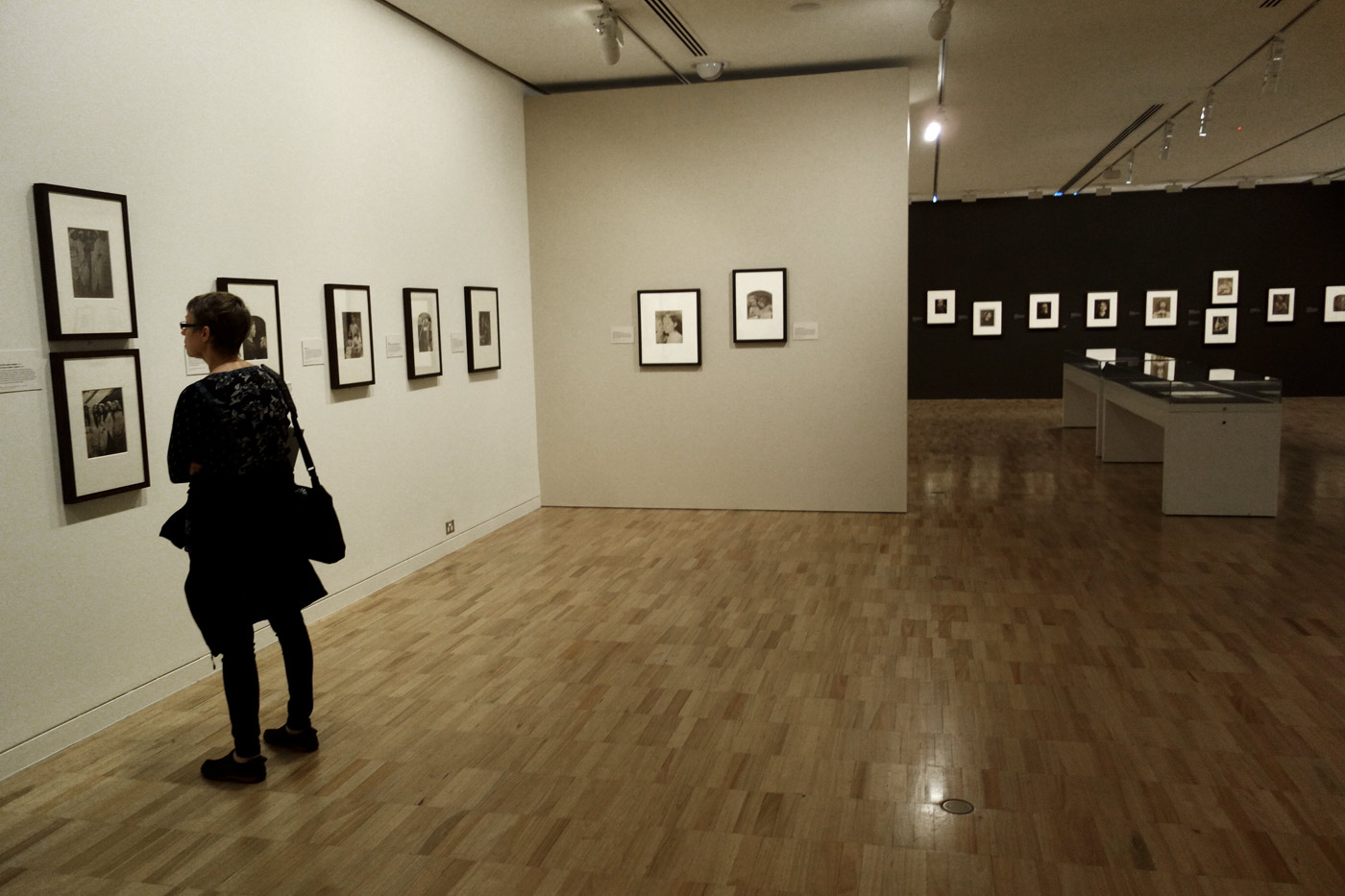
The J. Paul Getty Museum website

LIKE ART BLART ON FACEBOOK

Back to top