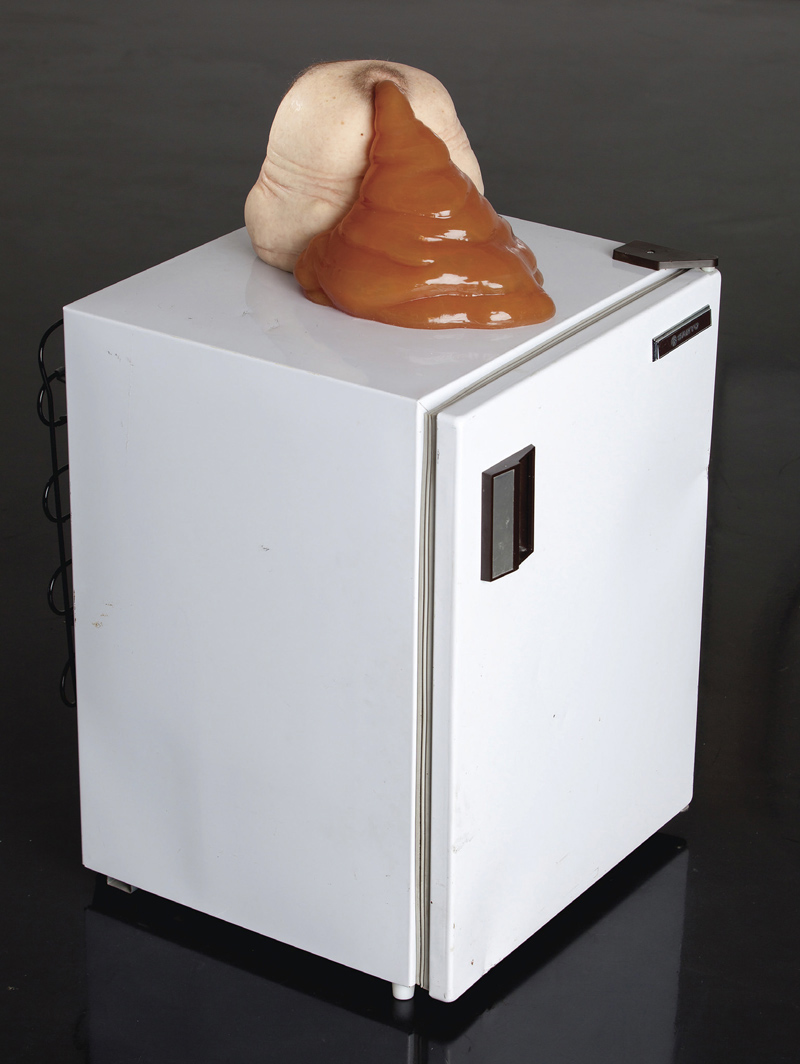
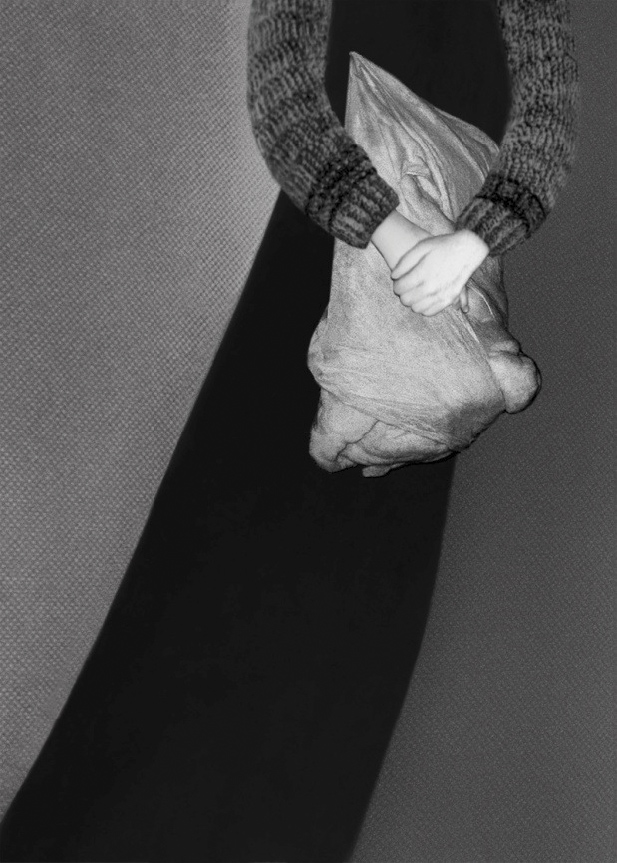
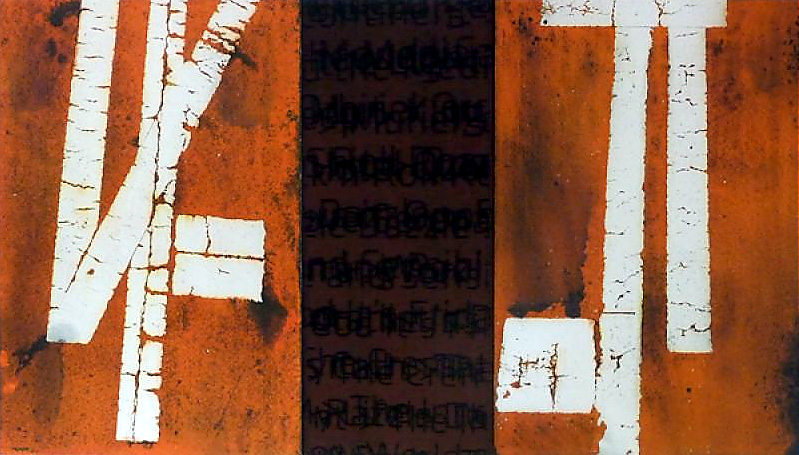
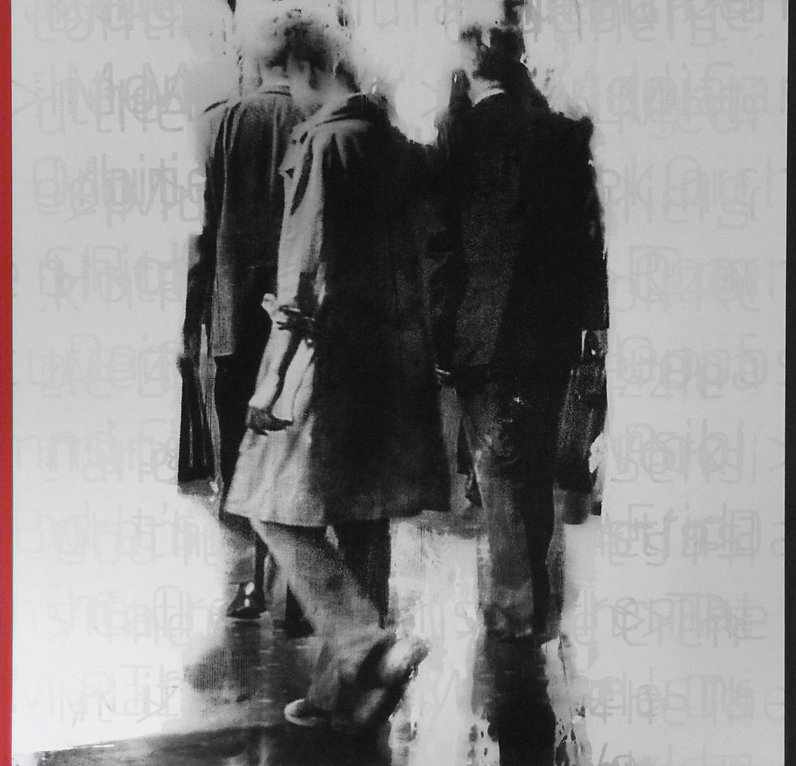
Text: ‘Un/settling Aboriginality’ Dr Marcus Bunyan / Exhibition: ‘Brook Andrew: 52 Portraits’ at Tolarno Gallery, Melbourne

Exhibition dates: 15th June – 20th July 2013


Many thankx to Tolarno Gallery for allowing me to publish the photographs in the posting. Please click on the photographs for a larger version of the image.

Download the text Un/settling Aboriginality (1.1Mb pdf)


Un/settling Aboriginality

Dr Marcus Bunyan

Abstract

This text investigates the concepts of postcolonialism / neo-colonialism and argues that Australia is a neo-colonial rather than a postcolonial country. It examines the work of two Australian artists in order to understand how their work is linked to the concept of neo-colonialism and ideas of contemporary Aboriginal identity, Otherness, localism and internationalism.

Keywords

postcolonialism, postcolonial, art, neo-colonialism, Australian art, Australian artists, Aboriginal photography, hybridism, localism, internationalism, Otherness, Australian identity, Brook Andrew, Ricky Maynard, Helen Ennis.


Australia and postcolonialism / neo-colonialism

Defining the concept of postcolonialism is difficult. “To begin with, “post-colonial” is used as a temporal marker referring to the period after official decolonisation,”1 but it also refers to a general theory that Ania Loomba et al. call “the shifting and often interrelated forms of dominance and resistance; about the constitution of the colonial archive; about the interdependent play of race and class; about the significance of gender and sexuality; about the complex forms in which subjectivities are experienced and collectivities mobilized; about representation itself; and about the ethnographic translation of cultures.”2

“Postcolonial theory formulates its critique around the social histories, cultural differences and political discrimination that are practised and normalised by colonial and imperial machineries… Postcolonial critique can be defined as a dialectical discourse which broadly marks the historical facts of decolonisation. It allows people emerging from socio-political and economic domination to reclaim their sovereignty; it gives them a negotiating space for equity.”3

While colonialism and imperialism is about territory, possession, domination and power,4 postcolonialism is concerned with the history of colonialism, the psychology of racial representation and the frame of representation of the ‘Other’. It addresses the ongoing effects of colonialism and imperialism even after the colonial period has ended.
“Past and present inform each other, each implies the other and… each co-exists with the other.”5 Even after colonialism has supposedly ended there will always be remains that flow into the next period. What is important is not so much the past itself but its bearing upon cultural attitudes of the present and how the uneven relationships of the past are remembered differently.6 While the aims of postcolonialism are transformative, its objectives involve a wide-ranging political project – to reorient ethical norms, turn power structures upside down and investigate “the interrelated histories of violence, domination, inequality and injustice”7 and develop a tradition of resistance to the praxis of hegemony.

McCarthy and Dimitriadis posit three important motifs in postcolonial art.8 Briefly, they can be summarised as follows:

1/ A vigorous challenge to hegemonic forms of representation in Western models of classical realism and technologies of truth in which the eye of the Third World is turned on the West and challenges the ruling narrating subject through multiple perspectives and points of view.

2/ A rewriting of the narrative of modernity through a joining together of the binaries ‘centre’ and ‘periphery’, ‘developed’ and ‘underdeveloped’, and ‘civilised’ and ‘primitive’. “Culture, for these [postcolonial] artists, is a crucible of encounter, a crucible of hybridity in which all of cultural form is marked by twinness of subject and other.”9

3/ A critical reflexivity and thoughtfulness as elements of an artistic practice of freedom. This practice looks upon traditions with dispassion, one in which all preconceived visions and discourses are disrupted, a practice in which transformative possibilities are not given but have to worked for in often unpredictable and counter-intuitive ways.


According to Robert Young the paradigm of postcolonialism is to “locate the hidden rhizomes of colonialism’s historical reach, of what remains invisible, unseen, silent or unspoken” to examine “the continuing projection of past conflicts into the experience of the present, the insistent persistence of the afterimages of historical memory that drive the desire to transform the present.”10 This involves an investigation into a dialectic of visibility and invisibility where subjugated peoples were present but absent under the eye of the coloniser through a refusal of those in power to see who or what was there. “Postcolonialsm, in its original impulse, was concerned to make visible areas, nations, cultures of the world which were notionally acknowledged, technically there, but which in significant other senses were not there…”11 In other words, to acknowledge the idea of the ‘Other’ as a self determined entity if such an other should ever exist because, as Young affirms, “Tolerance requires that there be no “other,” that others should not be othered. We could say that there can be others, but there should be no othering of “the other.”12

The “Other” itself is a product of racial theory but Young suggests that “the question is not how to come to know “the other,” but for majority groups to stop othering minorities altogether, at which point minorities will be able to represent themselves as they are, in their specific forms of difference, rather than as they are othered.”13 Unfortunately, with regard to breaking down the divisiveness of the same-other split, “As soon as you have employed the very category of “the other” with respect to other peoples or societies, you are imprisoned in the framework of your own predetermining conceptualisation, perpetuating its form of exclusion.”14 Hence, as soon as the dominant force names the “other” as a paradigm of society, you perpetuate its existence as an object of postcolonial desire. This politics of recognition can only be validated by the other if the other choses to name him or herself in order to “describe a situation of historical discrimination which requires challenge, change and transformation… Othering was a colonial strategy of exclusion: for the postcolonial, there are only other human beings.”15

Important questions need to be asked about the contextual framework of postcolonialism as it is linked to race, culture, gender, settler and native: “When does a settler become coloniser, colonised and postcolonial? When does a race cease to be an oppressive agent and become a wealth of cultural diversities of a postcolonial setting? Or in the human history of migrations, when does the settler become native, indigenous, a primary citizen? And lastly, when does the native become truly postcolonial?”16


This last question is pertinent with regard to Australian culture and identity. It can be argued that Australia is not a postcolonial but a neo-colonial country. Imperialism as a concept and colonialism as a practice are still active in a new form. This new form is neo-colonialism. Rukundwa and van Aarde observe that, “Neo-colonialism is another form of imperialism where industrialised powers interfere politically and economically in the affairs of post-independent nations. For Cabral (in McCulloch 1983: 120-121), neo-colonialism is “an outgrowth of classical colonialism.” Young (2001: 44-52) refers to neo-colonialism as “the last stage of imperialism” in which a postcolonial country is unable to deal with the economic domination that continues after the country gained independence. Altbach (1995: 452-56) regards neo-colonialism as “partly planned policy” and a “continuation of the old practices”.”17

Australia is not a post-independent nation but an analogy can be made. The Australian government still interferes with the running of Aboriginal communities through the NT Intervention or, as it is more correctly known, Northern Territory National Emergency Response Act 2007. Under the Stronger Futures legislation that recently passed through the senate, this intervention has been extended by another 10 years. “Its flagship policies are increased government engagement, income management, stabilisation, mainstreaming, and the catch cries “closing the gap” and “real jobs”.”18 As in colonial times the government has control of a subjugated people, their lives, income, health and general wellbeing, instead of partnering and supporting Aboriginal organisations and communities to take control of their futures.19

Further, Australia is still a colony, the Queen of England is still the Queen of Australia; Britannia remains in the guise of the “Commonwealth.” Racism, an insidious element of the colonial White Australia Policy (which only ended in 1973), is ever prevalent beneath the surface of Australian society. Witness the recent racial vilification of Sydney AFL (Aussie Rules!) player Adam Goodes by a teenager20 and the inexcusable racial vilification by Collingwood president Eddie McGuire when he said that Goodes could be used to promote the musical King Kong.21

“The dialectics of liberation from colonialism, whether political, economic, or cultural, demand that both the colonizer and the colonized liberate themselves at the same time.”22 This has not happened in Australia. The West’s continuing political, economic and cultural world domination has “lead to a neo-colonial situation, mistakenly called post-coloniality, which does not recognize the liberated other as a historical subject (in sociological theory, a historical subject is someone thought capable of taking an active role in shaping events) – as part of the historical transforming processes of modernity.”23 As has been shown above, Aboriginal communities are still thought incapable of taking an active role in shaping and administering their own communities. The result of this continuation of old practices is that Australia can be seen as a neo-colonial, not postcolonial, country.

Kathryn Trees asks, “Does post-colonial suggest colonialism has passed? For whom is it ‘post’? Surely not for Australian Aboriginal people at least, when land rights, social justice, respect and equal opportunity for most does not exist because of the internalised racism of many Australians. In countries such as Australia where Aboriginal sovereignty, in forms appropriate to Aboriginal people, is not legally recognised, post-colonialism is not merely a fiction, but a linguistic manoeuvre on the part of some ‘white’ theorists who find this a comfortable zone that precludes the necessity for political action.”24


Two Australian artists, two different approaches

There are no dots or cross-hatching in the work of Ricky Maynard or Brook Andrew; no reference to some arcane Dreaming, for their work is contemporary art that addresses issues of identity and empowerment in different ways. Unlike remote Indigenous art that artist Richard Bell has labelled ‘Ooga Booga Art’ (arguing that it is based upon a false notion of tradition that casts Indigenous people as the exotic other, produced under the white, primitivist gaze),25 the work of these two artists is temporally complex (conflating past, present and future) and proposes that identity is created at the intersection of historically shifting subject positions, which destabilises any claim to an ‘authentic’ identity position and brings into question the very label ‘Aboriginal’ art and ‘Aboriginality’. By labelling an artist ‘Aboriginal’ or ‘gay’ for example, do you limit the subject matter that those artists can legitimately talk about, or do you just call them artists?

As Stephanie Radok has speculated, “surely as long as we call it Aboriginal art we are defining it ethnically and foregrounding its connection to a particular culture, separating it from other art and seeing it as a gift, a ‘present’ from another ethnography.”26 Be that as it may, artists can work from within a culture, a system, in order to critique the past in new ways: “The collective efforts of contemporary artists… do not reflect an escapist return to the past but a desire to think about what the past might now mean in new, creative ways.”27

Ways that un/settle Aboriginality through un/settling photography, in this case.


Since the 1980s photographers addressing Indigenous issues have posed an alternative reality or viewpoint that, “articulates the concept of time as a continuum where the past, present and future co-exist in a dynamic form. This perspective has an overtly political dimension, making the past not only visible but also unforgettable.”28 The perspective proposes different strategies to deliberately unsettle white history so that “the future is as open as the past, and both are written in tandem.”29

Artists Ricky Maynard and Brook Andrew both critique neo-colonialism from inside the Western gallery system using a relationship of interdependence (Aboriginal/colonial) to find their place in the world, to help understand who they are and, ex post facto, to make a living from their art. They both offer an examination of place, space and identity construction through what I call ‘the industry of difference’.

Ricky Maynard works with a large format camera and analogue, black and white photography in the Western documentary tradition to record traditional narratives of Tasmanian Aboriginal people in order to undermine the myth that they were all wiped off the face of the planet by colonisation. Through his photography he re-identifies the narratives of a subjugated and supposedly exterminated people, narratives that are thousands of years old, narratives that challenge a process of Othering or exclusion and which give voice to the oppressed.

Portrait of a Distant Land is done through the genre of documentary in a way that offers authenticity and honest image making in the process. It has to deal with all those ethical questions of creating visual history, the tools to tell it with and how we reclaim our own identity and history from the way we tell our own stories. It comes from the extension of the way the colonial camera happened way back in the 19th century and how it misrepresented Aboriginal people. The Government anthropologists and photographers were setting up to photograph the dying race. Of course it simply wasn’t true. That was a way that colonial people wanted to record their history. You see those earlier colonial and stereotypical images of Aboriginal people in historic archives, their photographic recordings were acts of invasion and subjugation used for their own purpose.”30


Ricky Maynard (Australian, b. 1953) 'Coming Home' 2005


Ricky Maynard (Australian, b. 1953)
Coming Home
2005
from Portrait of a Distant Land
Gelatin silver print
34 x 52cm, edition of 10 + 3 AP


“I can remember coming here as a boy in old wooden boats to be taught by my grandparents and my parents.

I’ll be 57 this year and I have missed only one year when my daughter Leanne was born. Mutton birding is my life. To me it’s a gathering of our fella’s where we sit and yarn we remember and we honour all of those birders who have gone before us. Sometimes I just stand and look out across these beautiful islands remembering my people and I know I’m home. It makes me proud to be a strong Tasmanian black man.

This is something that they can never take away from me.”

Murray Mansell Big Dog Island, Bass Strait, 2005 31
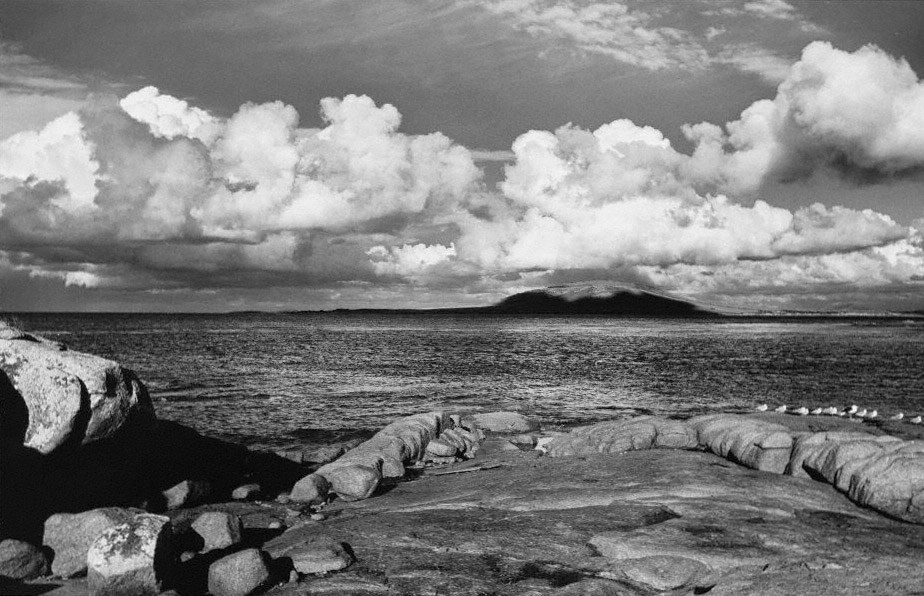
 

Ricky Maynard (Australian, b. 1953) 'Vansittart Island, Bass Strait, Tasmania' 2005


Ricky Maynard (Australian, b. 1953)
Vansittart Island, Bass Strait, Tasmania
2005
from Portrait of a Distant Land
Gelatin silver print
34 x 52cm, edition of 10 + 3 AP


“As late as 1910 men came digging on Vansittart and Tin Kettle Islands looking for skeletons here. We moved them where none will find them, at the dead of night my people removed the bodies of our grandmothers and took them to other islands, we planted shamrocks over the disturbed earth, so the last resting place of those girls who once had slithered over the rocks for seals will remain a secret forever.”

Old George Maynard 1975 32
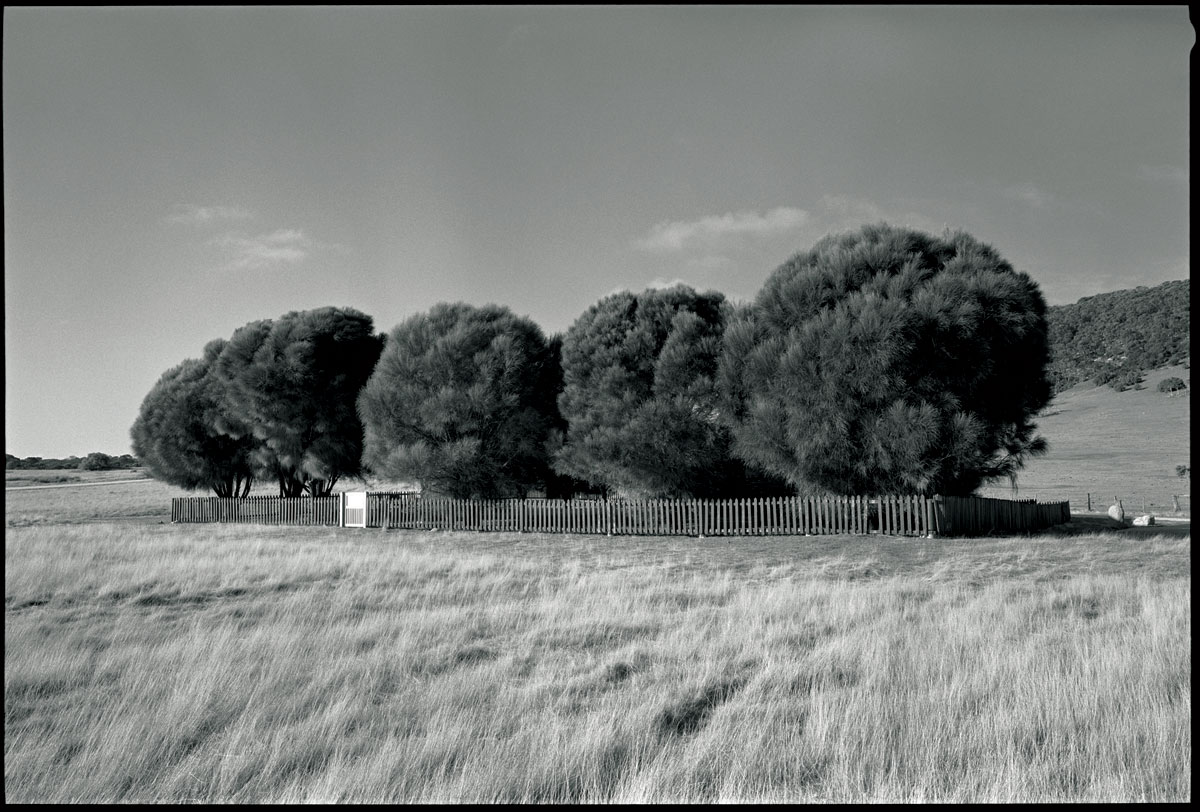
 

Ricky Maynard (Australian, b. 1953) 'The Healing Garden, Wybalenna, Flinders Island, Tasmania' 2005


Ricky Maynard (Australian, b. 1953)
The Healing Garden, Wybalenna, Flinders Island, Tasmania
2005
from Portrait of a Distant Land
Gelatin silver print
34 x 52cm, edition of 10 + 3 AP


“It’s pretty important you know, the land, it doesn’t matter how small, it’s something, just a little sacred site, that’s Wybalenna. There was a massacre there, sad things there, but we try not to go over that. Where the bad was we can always make it good.”

Aunty Ida West 1995 Flinders Island, Tasmania 33


Maynard’s photographs are sites of contestation, specific, recognisable sites redolent with contested history. They are at once both local (specific) and global (addressing issues that affect all subjugated people and their stories, histories). Through his art practice Maynard journeys from the periphery to the centre to become a fully recognised historical subject, one that can take an active role in shaping events on a global platform, a human being that aims to create what he describes as “a true visual account of life now.”34 But, as Ian McLean has noted of the work of Derrida on the idea of repression, what returns in such narratives is not an authentic, original Aboriginality but the trace of an economy of repression: “Hence the return of the silenced nothing called Aboriginal as the being and truth of the place, is not the turn-around it might seem, because it does not reinstate an original Aboriginality, but reiterates the discourses of colonialism.”35

Sad and poignant soliloquies they may be, but in these ‘true’ visual accounts it is the trace of repression represented through Western technology (the camera, the photograph) and language (English is used to describe the narratives, see above) that is evidenced in these critiques of neo-colonialism (a reiteration of the discourses of colonialism) – not just an authentic lost and reclaimed Aboriginality – for these photographs are hybrid discourses that are both local/global, European/Indigenous.

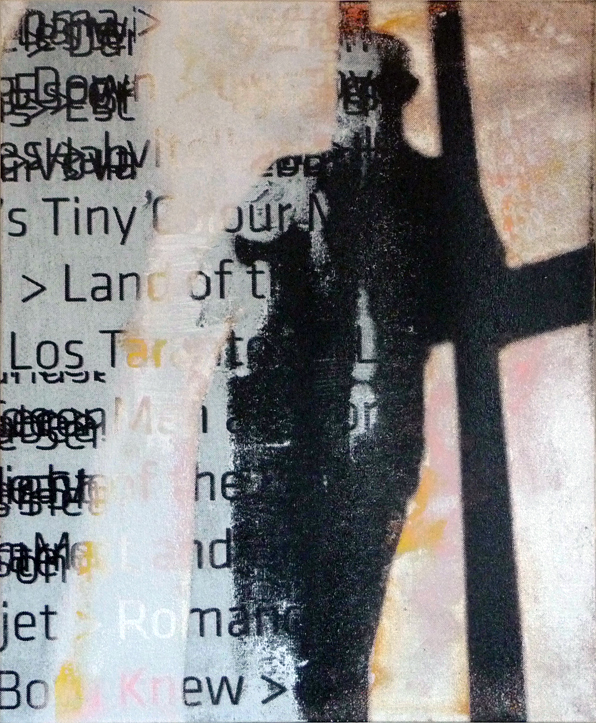
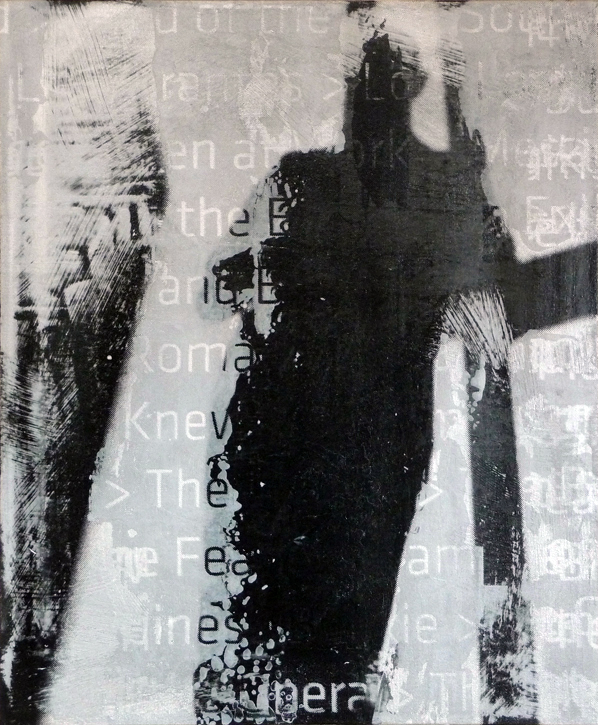
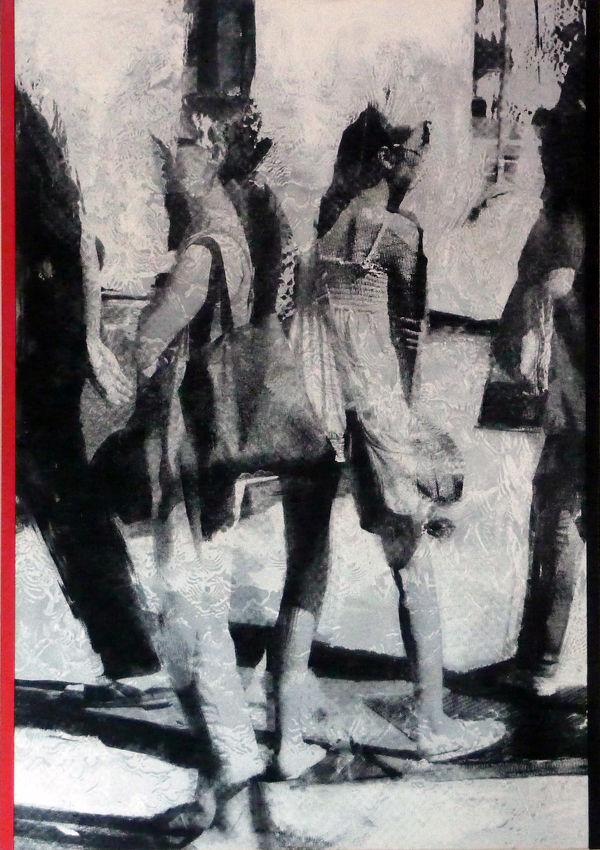
In his art practice Brook Andrew pursues a more conceptual mutli-disciplinary approach, one that successfully mines the colonial photographic archive to interrogate the colonial power narrative of subjugation, genocide, disenfranchisement through a deconstructive discourse, one that echoes with the repetitions of coloniality and evidences the fragments of racism through the status of appearances. “Through his persistent confrontation with the historical legacy of physiognomia in our public Imaginary”36 in video, neon, sculpture, craniology, old photography, old postcards, music, books, ethnography and anthropology, Andrew re-images and reconceptualises the colonial archive. His latest body of work 52 Portraits (Tolarno Galleries 15 June – 20 July 2013), is “a play on Gerhard Richter’s 48 Portraits projects, which lifted images of influential Western men from the pages of encyclopaedias, 52 Portraits shifts the gaze to the ubiquitous and exotic other.”37 The colonial portraits are screen-printed in black onto silver-coated canvases giving them an ‘other’ worldly, alien effect (as of precious metal), which disrupts the surface and identity of the original photographs. Variously, the unnamed portraits taken from his personal collection of old colonial postcards re-present unknown people from the Congo, Africa, Argentina, Ivory Coast, Brazil, Algeria, Australia, South America, etc… the images incredibly beautiful in their silvered, slivered reality (as of the time freeze of the camera), replete with fissures and fractures inherent in the printing process. Accompanying the series is an installation titled Vox: Beyond Tasmania (2013), a Wunderkammer containing a skeleton and colonial artefacts, the case with attached wooden trumpet (reminding me appropriately of His Master’s Voice) that focuses the gaze upon an anonymous skull, an unknowable life from the past. In the catalogue essay for the exhibition, Ian Anderson observes, “His view is global – and even though my response is highly local – I too see the resonances of a global cultural process that re-ordered much of humanity through the perspective of colonizing peoples.”38

While this may be true, it is only true for the limited number of people that will see the exhibition – usually white, well-educated people, “The realities of the commercial art world are such that it is chiefly the white upper crust that will see these works. Make of that what you will.”39 Through a lumping together of all minority people – as though multiple, local indigeneties can be spoken for through a single global indigeneity – Andrew seems to want to speak for all anonymous Indigenous people from around the world through his ‘industry of difference’. Like colonialism, this speaking is again for the privileged few, as only they get to see these transformed images, in which only those with money can afford to buy into his critique.

Personally, I believe that Andrew’s constant remapping and re-presentation of the colonial archive in body after body of work, this constant picking at the scab of history, offers no positive outcomes for the future. It is all too easy for an artist to be critical; it takes a lot more imagination for an artist to create positive images for a better future.


Conclusion

By the mid-eighties black and indigenous subjectivities were no longer transgressive and the ‘black man’s’ burden’ had shifted from being a figure of oblivion to that of a minority voice.40 Black subjectivities as minority identities use the language of difference to envisage zones of liberation in which marginality is a site of transformation. But, as Ian McLean asks, “Have these post or anti-colonial identities repulsed the return of coloniality?”41 In the fight against neo-colonialism he suggests not, when the role of minority discourses “are simultaneously marginalised and occupy an important place in majority texts.”42 Periphery becomes centre becomes periphery again. “Minority artists are not left alone on the periphery of dominant discourse. Indeed, they are required to be representatives of, or speak for, a particular marginalised community; and because of this, their speech is severely circumscribed. They bear a ‘burden of representation’.”43 McLean goes on to suggest the burden of representation placed on Aboriginal artists is one that cannot be escaped. The category ‘Aboriginal’ is too over determined. Aboriginal artists, like gay artists addressing homosexuality, can only address issues of race, identity and place.44

“Aboriginal artists must address issues of race, and all on the stage of an identity politics. Black artists, it seems, can perform only if they perform blackness. Reduced to gestures of revolt, they only reinforce the scene of repression played out in majority discourses of identity and otherness. Allowed to enter the field of majority language as divergent and hence transgressive discourses which police as much as they subvert the boundaries of this field, they work to extend certain boundaries necessary to Western identity formations, but which its traditions have repressed. In other words, minority discourses are complicit with majority texts.”45

As social constructs (the heart of the political terrain of imperial worlds) have been interrogated by artists, this has led to the supposed dissolution of conceptual binaries such as European Self / Indigenous Other, superior / inferior, centre / periphery.46 The critique of neo-colonialism mobilises a new, unstable conceptual framework, one that unsettles both imperialist structures of domination and a sense of an original Aboriginality. Counter-colonial perspectives might critique neo-colonial power through disruptive inhabitations of colonialist constructs (such as the photograph and the colonial photographic archive) but they do so through a nostalgic reworking and adaptation of the past in the present (through stories that are eons old in the case of Ricky Maynard or through appropriation of the colonial photographic archive in the case of Brook Andrew). Minority discourses un/settle Aboriginality in ways not intended by either Ricky Maynard or Brook Andrew, by reinforcing the boundaries of the repressed ‘Other’ through a Western photographic interrogation of age-old stories and the colonial photographic archive.

Both Maynard and Andrew picture identities that are reductively marshalled under the sign of minority discourse, a discourse that re-presents a field of representation in a particularly singular way (addressed to a privileged few). The viewer is not caught between positions, between voices, as both artists express an Aboriginal (not Australian) subjectivity, one that reinforces a black subjectivity and oppression by naming Aboriginal as ‘Other’ (here I am not proposing “assimilation” far from it, but inclusion through difference, much as gay people are now just members of society not deviants and outsiders).

Finally, what interests me further is how minority voices can picture the future not by looking at the past or by presenting some notion of a unitary representation (local / global) of identity, but by how they can interrogate and image the subject positions, political processes, cultural articulation and critical perspectives of neo-colonialism in order that these systems become the very preconditions to decolonisation.

Dr Marcus Bunyan
July 2013

Word count: 3,453 excluding image titles and captions.


Endnotes

1/ Abraham, Susan. “What Does Mumbai Have to Do with Rome? Postcolonial Perspectives on Globalization and Theology,” in Theological Studies 69, 2008, pp. 376-93 cited in Kenzo, Mabiala Justin-Robert. What Is Postcolonialism and Why Does It Matter: An African Perspective. Nd [Online] Cited 13/06/2013. No longer available online

2/ Loomba, Ania et al. “Beyond What? An Introduction,” in Loomba, Ania et al. (ed.,). Postcolonial Studies and Beyond. Durham, N.C.: Duke University, 2005, pp. 1-38

3/ Rukundwa, Lazare S and van Aarde, Andries G. “The formation of postcolonial theory,” in HTS Teologiese Studies / Theological Studies 63(3), 2007, p. 1174

4/ “Neither imperialism nor colonialism is a simple act of accumulation and acquisition. Both are supported and perhaps even impelled by impressive ideological formations that include notions that certain territories and people require and beseech domination, as well as forms of knowledge affiliated with domination: the vocabulary of classic nineteenth-century imperial cultural is plentiful with such words and concepts as ‘inferior’ or ‘subject races’, ‘subordinate people’, ‘dependency’, ‘expansion’, and ‘authority’.”
Said, Edward. “Overlapping Territories, Intertwined Histories,” in Said, Edward. Culture and Imperialism. London: Chatto and Windus, 1993, p. 8

5/ Ibid., p. 2

6/ Ibid., p. 19

7/ Young, Robert J.C. “Postcolonial Remains,” in New Literary History Vol. 43. No. 1. Winter 2012, p. 20

8/ See McCarthy, Cameron and Dimitriadis, Greg. “The Work of Art in the Postcolonial Imagination,” in Discourse: Studies in the Cultural Politics of Education 21(1), 2000, p. 61

9/ Ibid., p. 61

10/ Young, Op. cit., p. 21

11/ Young, Ibid., p. 23

12/ “Critical analysis of subjection to the demeaning experience of being othered by a dominant group has been a long-standing focus for postcolonial studies, initiated by Frantz Fanon in his Black Skin, White Masks (1952).”
Young, Robert J.C. “Postcolonial Remains,” in New Literary History Vol. 43. No. 1. Winter 2012, p. 36

13/ Ibid., p. 37

14/ Ibid., p. 38

15/ Ibid., p. 39

16/ Rukundwa, Op cit., p. 1173

17/ Ibid., p. 1173

18/ Anon. “The 30-year cycle: Indigenous policy and the tide of public opinion” on The Conversation website 06/06/2012 [Online] Cited 16/06/2013

19/ Karvelas, Patricia. “Senate approves Aboriginal intervention by 10 years,” on The Australian website June 29, 2012 [Online] Cited 16/06/2013. No longer available online

20/ ABC/AAP. “AFL: Adam Goodes racially abused while leading Sydney to Indigenous Round win over Collingwood Sat May 25, 2013” on the ABC News website [Online] Cited 15/06/2013

21/ Anon. “Eddie McGuire, Adam Goodes and ‘apes’: a landmark moment in Australian race relations,” on The Conversation website, 31 May 2013 [Online] Cited 15/06/2013

22/ Araeen, Rasheed. “The artist as a post-colonial subject and this individual’s journey towards ‘the centre’,” in King, Catherine. View of Difference. Different Views of Art. Yale University Press, 1999, p. 232

23/ Ibid.,

24/ Trees, Kathryn. “Postcolonialism: Yet Another Colonial Strategy?” in Span, Vol. 1, No. 36, 1993, pp. 264-265 quoted in Heiss, Anita. “Post-Colonial-NOT!” in Dhuuluu Yala (To Talk Straight): Publishing Aboriginal Writing in Australia. Canberra: Aboriginal Studies Press, 2003, pp. 43-46

25/ Skerritt, Henry F. “Drawing NOW: Jus’ Drawn'” in Art Guide Australia, September/ October 2010, pp. 34-35 [Online] Cited 17/06/2013.

26/ Ibid.,

27/ Ennis, Helen. “The Presence of the Past,” in Ennis, Helen. Photography and Australia. London: Reaktion Books, 2007, p. 141

28/ Ibid., p. 135

29/ Ibid., “Black to Blak,” p. 45

30/ Maynard, Ricky quoted in Perkins, Hetti. Art + Soul. Melbourne: The Miegunyah Press, Melbourne University Publishing, 2010, p. 85

31/ Mansell, Murray quoted on the Stills Gallery website [Online] Cited 22/06/2013

32/ Maynard, George quoted on the Stills Gallery website [Online] Cited 22/06/2013

33/ West, Ida quoted on the Stills Gallery website [Online] Cited 22/06/2013

34/ Maynard, Ricky. “The Craft of Documentary Photography,” in Phillips, Sandra. Racism, Representation and Photography. Sydney, 1994, p. 115 quoted in Ennis, Helen. Photography and Australia. London: Reaktion Books, 2007, p. 106

35/ McLean, Ian. “Post colonial: return to sender” 1998 paper delivered as the Hancock lecture at the University of Sydney on 11/11/1998 as part of the annual conference of the Australian Academy of Humanities which had as its theme: ‘First Peoples Second Chance Australia In Between Cultures’

36/ Papastergiadis, Nikos. “Brook Andrew: Counterpoints and Harmonics.” Catalogue essay for Brook Andrew’s exhibition 52 Portraits at Tolarno Galleries, Melbourne, June 2013

37/ Rule, Dan. “Brook Andrew: 52 Portraits,” in Arts & Entertainment, Lifestyle, in The Saturday Age newspaper, June 29th 2013, p. 5

38/ Anderson, Pangkarner Ian. “Re-Assembling the trophies and curios of Colonialism & the Silent Terror.” Catalogue essay for Brook Andrew’s exhibition 52 Portraits at Tolarno Galleries, Melbourne, June 2013

39/ Rule, Dan. Op. cit.,

40/ McLean, Ian. “Post colonial: return to sender” 1998

41/ Ibid.,

42/ Ibid.,

43/ Ibid.,

44/ “Whether they like it or not, they [Aboriginal artists] bear a burden of representation. This burden is triply inscribed. First, they can only enter the field of representation or art as a disruptive force. Second, their speaking position is rigidly circumscribed: they are made to speak as representatives of a particular, that is, Aboriginal community. Third, this speaking is today made an essential component of the main game, the formation of Australian identity – what Philip Batty called ‘Australia’s desire to know itself through Aboriginal culture’.”
McLean, Ian. “Post colonial: return to sender” 1998

45/ Ibid.,

46/ Jacobs observes, “As the work on the nexus of power and identity within the imperial process has been elaborated, so many of the conceptual binaries that were seen as fundamental to its architecture of power have been problematised. Binary couplets like core / periphery, inside / outside. Self / Other, First World / Third World, North / South have given way to tropes such as hybridity, diaspora, creolisation, transculturation, border.”
Jacobs, J. M. “(Post)colonial spaces,” Chapter 2 in Edge of Empire. London: Routledge, 1996, p. 13


Bibliography

Anderson, Pangkarner Ian. “Re-Assembling the trophies and curios of Colonialism & the Silent Terror.” Catalogue essay for Brook Andrew’s exhibition 52 Portraits at Tolarno Galleries, Melbourne, June 2013

Araeen, Rasheed. “The artist as a post-colonial subject and this individual’s journey towards ‘the centre’,” in King, Catherine. View of Difference. Different Views of Art. Yale University Press, 1999, p. 232

ABC/AAP. “AFL: Adam Goodes racially abused while leading Sydney to Indigenous Round win over Collingwood Sat May 25, 2013” on the ABC News website [Online] Cited 15/06/2013.

Abraham, Susan. “What Does Mumbai Have to Do with Rome? Postcolonial Perspectives on Globalization and Theology,” in Theological Studies 69, 2008, pp. 376-93 cited in Kenzo, Mabiala Justin-Robert. What Is Postcolonialism and Why Does It Matter: An African Perspective. Nd [Online] Cited 13/06/2013

Anon. “Eddie McGuire, Adam Goodes and ‘apes’: a landmark moment in Australian race relations,” on The Conversation website, 31 May 2013 [Online] Cited 15/06/2013

Anon. “The 30-year cycle: Indigenous policy and the tide of public opinion,” on The Conversation website 06/06/2012 [Online] Cited 16/06/2013

Ennis, Helen. “The Presence of the Past,” in Ennis, Helen. Photography and Australia. London: Reaktion Books, 2007, p. 141

Heiss, Anita. “Post-Colonial-NOT!” in Dhuuluu Yala (To Talk Straight): Publishing Aboriginal Writing in Australia. Canberra: Aboriginal Studies Press, 2003, pp. 43-46

Jacobs, J. M. “(Post)colonial spaces,” Chapter 2 in Edge of Empire. London: Routledge, 1996, p. 13

Karvelas, Patricia. “Senate approves Aboriginal intervention by 10 years,” on The Australian website June 29, 2012 [Online] Cited 16/06/2013

Kenzo, Mabiala Justin-Robert. What Is Postcolonialism and Why Does It Matter: An African Perspective. Nd [Online] Cited 13/06/2013.

King, Catherine. View of Difference. Different Views of Art. Yale University Press, 1999

Loomba, Ania et al. “Beyond What? An Introduction,” in Loomba, Ania et al. (ed.,). Postcolonial Studies and Beyond. Durham, N.C.: Duke University, 2005, pp. 1-38

Maynard, Ricky. “The Craft of Documentary Photography,” in Phillips, Sandra. Racism, Representation and Photography. Sydney, 1994, p.115 quoted in Ennis, Helen. Photography and Australia. London: Reaktion Books, 2007, p. 106

McCarthy, Cameron and Dimitriadis, Greg. “The Work of Art in the Postcolonial Imagination,” in Discourse: Studies in the Cultural Politics of Education 21(1), 2000, p. 61

McLean, Ian. “Post colonial: return to sender” 1998 paper delivered as the Hancock lecture at the University of Sydney on 11/11/1998 as part of the annual conference of the Australian Academy of Humanities which had as its theme: ‘First Peoples Second Chance Australia In Between Cultures’

Papastergiadis, Nikos. “Brook Andrew: Counterpoints and Harmonics.” Catalogue essay for Brook Andrew’s exhibition 52 Portraits at Tolarno Galleries, Melbourne, June 2013

Perkins, Hetti. Art + Soul. Melbourne: The Miegunyah Press, Melbourne University Publishing, 2010, p. 85

Phillips, Sandra. Racism, Representation and Photography. Sydney, 1994, p. 115

Rukundwa, Lazare S and van Aarde, Andries G. “The formation of postcolonial theory” in HTS Teologiese Studies/Theological Studies 63(3), 2007, p. 1174

Rule, Dan. “Brook Andrew: 52 Portraits,” in Arts & Entertainment, Lifestyle, in The Saturday Age newspaper, June 29th 2013, p. 5

Said, Edward. “Overlapping Territories, Intertwined Histories,” in Said, Edward. Culture and imperialism. London: Chatto and Windus, 1993, p. 8

Skerritt, Henry F. “Drawing NOW: Jus’ Drawn'” in Art Guide Australia, September/ October 2010, pp. 34-35 [Online] Cited 17/06/2013

Trees, Kathryn. “Postcolonialism: Yet Another Colonial Strategy?” in Span, Vol. 1, No. 36, 1993, pp. 264-265 quoted in Heiss, Anita. “Post-Colonial-NOT!” in Dhuuluu Yala (To Talk Straight): Publishing Aboriginal Writing in Australia. Canberra: Aboriginal Studies Press, 2003, pp. 43-46

Young, Robert J.C. “Postcolonial Remains,” in New Literary History Vol. 43. No. 1. Winter 2012, p. 20


Brook Andrew (Australian, b. 1970) 'Portrait 19 (Manitoba, Canada)' 2013


Brook Andrew (Australian, b. 1970)
Portrait 19 (Manitoba, Canada)
2013
Mixed media on Belgian linen
70 x 55 x 5cm
Edition of 3 + 2 AP
Real photo postcard
Title: An Old Savage of Manitoba


Brook Andrew (Australian, b. 1970) 'Portrait 9 (Arab)' 2013


Brook Andrew (Australian, b. 1970)
Portrait 9 (Arab)
2013
Mixed media on Belgian linen
70 x 55 x 5cm
Edition of 3 + 2 AP
Real photo postcard
Title: Danseuse arabe
Publisher: Photo Garrigues Tunis – 2008
Inscribed on front: Tunis 20/8/04


Brook Andrew (Australian, b. 1970) 'Portrait 7 (Australia)' 2013


Brook Andrew (Australian, b. 1970)
Portrait 7 (Australia)
2013
Mixed media on Belgian linen
70 x 55 x 5cm
Edition of 3 + 2 AP
Title: “An Australian Wild Flower”
Pub. Kerry & Co., Sydney One Penny Stamp with post mark on image side of card. No Address.


Brook Andrew (Australian, b. 1970) 'Portrait 40 (Unknown)' 2013


Brook Andrew (Australian, b. 1970)
Portrait 40 (Unknown)
2013
Mixed media on Belgian linen
70 x 55 x 5cm
Edition of 3 + 2 AP
Title: “Typical Ricksha Boys.”
R.111. Copyright Pub. Sapsco Real Photo, Pox 5792, Johannesburg
Pencil Mark €5


Brook Andrew (Australian, b. 1970) 'Portrait 44 (Syria)' 2013


Brook Andrew (Australian, b. 1970)
Portrait 44 (Syria)
2013
Mixed media on Belgian linen
70 x 55 x 5cm Edition of 3 + 2 AP
Real photo postcard
Title: Derviches tourneurs á Damas
Printed on verso: Turquie, Union Postal Universelle, Carte postale


Brook Andrew (Australian, b. 1970) 'Vox: Beyond Tasmania' 2013

Brook Andrew (Australian, b. 1970) 'Vox: Beyond Tasmania' 2013

Brook Andrew (Australian, b. 1970) 'Vox: Beyond Tasmania' 2013

Brook Andrew (Australian, b. 1970) 'Vox: Beyond Tasmania' 2013 (detail)

Brook Andrew (Australian, b. 1970) 'Vox: Beyond Tasmania' 2013 (detail)

Brook Andrew (Australian, b. 1970) 'Vox: Beyond Tasmania' 2013 (detail)


Brook Andrew (Australian, b. 1970)
Vox: Beyond Tasmania (full piece and detail shots)
2013
Timber, glass and mixed media
267 x 370 x 271cm


Brook Andrew’s newest exhibition is a blockbuster comprising 52 portraits, all mixed media and all measuring 70 x 55 x 5cm. The portraits are of unknown people from Africa, Argentina, Ivory Coast, Syria, Sudan, Japan, Australia … They are based on 19th century postcards which Brook Andrew has collected over many years. These postcards were originally made for an international market interested in travel.

‘Colonial photographers made a trade in photographic images, which were on sold as postcards and souvenirs,’ writes Professor Ian Anderson in Re-assembling the trophies and curios of Colonialism & the Silent Terror. According to Brook Andrew, ‘names were not recorded when Indigenous peoples were photographed for ethnographic and curio purposes. The history and identity of these people remain absent.  In rare instances, some families might know an ancestor from a postcard.’

The exhibition takes it title from a book of drawings by Anatomist Richard Berry: TRANSACTIONS of the ROYAL SOCIETY OF VICTORIA. Published in 1909, Volume V of this rare book contains FIFTY-TWO TASMANIA CRANIA – tracings of 52 Tasmanian Aboriginal skulls that were at the time mainly in private collections.

‘These skulls,’ says Brook Andrew, ‘represented a pan-international practice of collecting Aboriginal skulls as trophies, a practice dependent on theories of Aboriginal people being part of the most primitive race of the world, hence a dying species. This theory activated many collections and grave robbing simultaneously.’

In 52 Portraits Brook Andrew delves into hidden histories such as the ‘dark art of body-snatching’ and continues his fascination with the meaning of appearances. ‘He zooms in on the head and torso of young men and women,’ says Nikos Papastergiadis. ‘Brook Andrew’s exhibition, takes us to another intersection where politics and aesthetics run in and over each other.’

The original images embody the colonial fantasies of innocence and backwardness, as well as more aggressive, but tacit expression of the wish to express uninhibited sexual availability. Brook Andrew aims to confront both the lascivious fascination that dominated the earlier consumption of these images and prudish aversions and repressive gaze that informs our more recent and much more ‘politically correct’ vision. His images make the viewer consider the meaning of these bodies and his focus also directs a critical reflection on the assumptions that frame the status of these images.

The centre piece of the exhibition is a kind of Wunderkammer containing all manner of ‘curiosities’ including a skull, drawings of skulls, a partial skeleton, photographs, diaries, glass slides, a stone axe and Wiradjuri shield. Titled Vox: Beyond Tasmania, the Wunderkammer/Gramophone plays out stories of Indigenous peoples.

In the interplay between the 52 Portraits and Vox: Beyond Tasmania, Brook Andrew aims to stir and open our hearts with his powerful 21st century ‘memorial’.

Press release from the Tolarno Galleries website


Tolarno Galleries
Level 4
104 Exhibition Street
Melbourne VIC 3000
Australia
Phone: 61 3 9654 6000

Opening hours:
Tuesday – Friday 10am – 5pm
Saturday 1pm – 4pm

Tolarno Galleries website

LIKE ART BLART ON FACEBOOK

Back to top

Review: ‘Louise Bourgeois: Late Works’ at Heide Museum of Modern Art, Melbourne

Exhibition dates: 24th November 2012 – 11th March 2013

Louise Bourgeois & Australian Artists
13 October 2012 – 14 April 2013


'Louise Bourgeois: Late Works' installation view Heide Museum of Modern Art, Melbourne Photograph: John Gollings 2012


Louise Bourgeois: Late Works installation view
Heide Museum of Modern Art, Melbourne
Photograph: John Gollings 2012


Tough Love

This is a tough, stimulating exhibition of late works by Louise Bourgeois at Heide Museum of Modern Art, Melbourne. All the main themes of the artist’s work explored over many years are represented in these late works: memory, emotion, anxiety, family, relationships, childhood, pain, desire and eroticism are all present as are female subjectivity and sexuality, expressed through the body. As the quotation above by Bourgeois states, her body became her sculpture.

I am no expert on the work of the artist. But what I will try and enunciate are my feelings when viewing the exhibition. Firstly, I thought the drawings by Louise Bourgeois in Heide II were the most magical thing that I saw all day; they seemed to be the well spring of her creativity, the initial thought sketched quickly and imperiously. Secondly, series such as Dawn (2007, below) and The Waiting Hours (2007), assemblages of cut fragments of her dresses and other textiles used to create spiral three-dimensional realities, were the most beautiful, peaceful Zen based works in the exhibition possessing as they did a calm, resolved, mandala-like presence. Lastly, the main group of sculptures were, for me, hard to look at. A series of severed heads, dismembered bodies, tapestry fragments, spiders, bones, an orrery-like planetarium, pendulous objects stuck with needles, kitchen implements and the house brought back memories of my own childhood.

I was born in the late 1950’s to a mother who didn’t really want to have children, to a mother who was already being beaten up by an abusive husband before she was even married, who lived on a remote, isolated farm in the middle of nowhere. I can’t imagine what my mother went through in those early years raising two children – with no hope of help or escape, with no women’s refuge to flee to, stuck there doing her best to protect her children and herself from a violent, mentally ill man. You cannot imagine the torment I went through for the first 18 years of my life, trying to protect my mother when I was old enough, creating my own worlds to escape the reality of the present (which is why I probably became an artist, to still create my own worlds). There were good times at Christmas and bonfire night, but the best part was growing up on the land, learning the rhythms of nature, learning to drive on a tractor and combine harvester, but always in the back of your mind was the instant of abuse lurking around the corner, the inherent violence of life. It is only now, as I have grown older, that I can truly appreciate the dire predicament that my mother was in and acknowledge a profound sense of gratitude towards her protection of me as a baby and child.

That is why this exhibition is, for me, tough love. The emotions of Bourgeois’ sculptures are close to the bone. As Jason Smith observes, “Bourgeois saw her mother as rational, patient and stoic in her nurturing, in contrast to the temperament of her father whom she regarded as irrationally emotional, unreasonable and capable of psychological cruelty. Bourgeois became aware at an early age that she was living in a time and social environment in which women and their identities were subordinate to men.”As Bourgeois says of the spider (her mother), “she was deliberate, clever, patient, soothing, reasonable, dainty, subtle, indispensable, neat and as useful as a spider. She could also defend herself, and me.” This is what my mother did as well, at great cost to herself.

Bourgeois’ work gives me an overall feeling of immersion in a world view, one that transcends the pain and speaks truth to power. Bourgeois confronted the emotion, memory or barrier to communication that generated her mood and the work. She observed, “My art is an exorcism. My sculpture allows me to re-experience fear, to give it a physicality, so that I am able to hack away at it.” By weaving, stitching and sewing Bourgeois threaded the past through the present and enacted, through artistic performance, a process of repair and reconstruction, giving meaning and shape to frustration and suffering. I have not been so lucky. My mother refuses to discuss the past, will not even come close to the subject for the pain is so great for her. I am left with a heaviness of heart, dealing with the demons of the past that constantly lurk in the memory of childhood, that insistently impinge on the man I am today. Louise Bourgeois’ sculptures brought it all flooding back as the work of only a great artist can, forcing me to become an ethical witness to her past, my past. A must see exhibition this summer in Melbourne.

Dr Marcus Bunyan


Many thankx to curator and Director Jason Smith and Heide Museum of Modern Art for allowing me to publish the photographs in the posting. Please click on some of the photographs for a larger version of the image.


“What counts, our whole purpose, is to try to understand what we are about, to scrutinise ourselves… Every day you have to abandon your past or accept it, and then, if you cannot accept it, you become a sculptor.”

“The fears of the past were connected with the functions of the body, they reappear through the body. For me, sculpture is the body. My body is my sculpture.”


Louise Bourgeois


“What images can art find for depicting femaleness from within, as distinct from the familiar male conventions of looking at it from the outside, from the eye-line of another gender?” Hughes questioned in a commentary that implied no precedents. “… [Her] influence on young artists has been enormous.”


Robert Hughes quoted by Annemarie Kiely on the Vogue Living Blog [Online] Cited 28/02/2013 no longer available online


“Yes, there are the oft-told stories of the father and the mistress, but it is Bourgeois’s intense love of her mother and her [mother’s] death that completely transformed her life… The art ultimately became about her never-ending grief… and her continuing desire  as a woman. It’s still so potent; not just as a memory, but as a constant.”


Jason Smith, Curator, Director and CEO of Heide quoted by Annemarie Kiely on the Vogue Living Blog [Online] Cited 28/02/2013 no longer available online


'Louise Bourgeois: Late Works' installation view Heide Museum of Modern Art, Melbourne Photograph: John Gollings 2012


Louise Bourgeois: Late Works installation view
Heide Museum of Modern Art, Melbourne
Photograph: John Gollings 2012


“The friend (the spider – why the spider?) because my best friend was my mother and she was deliberate, clever, patient, soothing, reasonable, dainty, subtle, indispensable, neat and as useful as a spider. She could also defend herself, and me.”


Louise Bourgeois, from Ode to my Mother, 1995


Louise Bourgeois (French-American, 1911-2010) 'Spider' 1997 (detail)


Louise Bourgeois (French-American, 1911-2010)
Spider (detail)
1997
Steel, tapestry, wood, glass, fabric, rubber, silver, gold, bone
449.6 × 665.5 × 518.2cm
The Easton Foundation, New York, NY
Photograph: John Gollings 2012


Louise Bourgeois (French-American, 1911-2010) 'Dawn' 2007 (detail)


Louise Bourgeois (French-American, 1911-2010)
Dawn (detail)
2007
Fabric book, 12 pages
12 1/4 x 9 3/4 inches each


Around 1996, aged 85, Bourgeois began to mine her closets for the garments and textiles that she had worn, collected and stored over a lifetime, and use them to make sculpture and ‘fabric drawings’, continuing her lifelong recall and articulations of familial dysfunction, desire and fear, anger and remorse, isolation and connectedness. In the recycling and reconstruction of her clothing and collected textiles Bourgeois intensified her work’s expression of the human body and of life’s episodes (those as daughter, wife, mother, woman, artist). The materiality of these works testifies to the impression of Bourgeois’ past on her psyche and on reparative acts of making through which her past was reconciled in her present. The beauty of the past for Bourgeois resided in the nurturing, repairing, fortifying and protective tendencies of her mother, which she aligned with the processes of stitching and assembling.

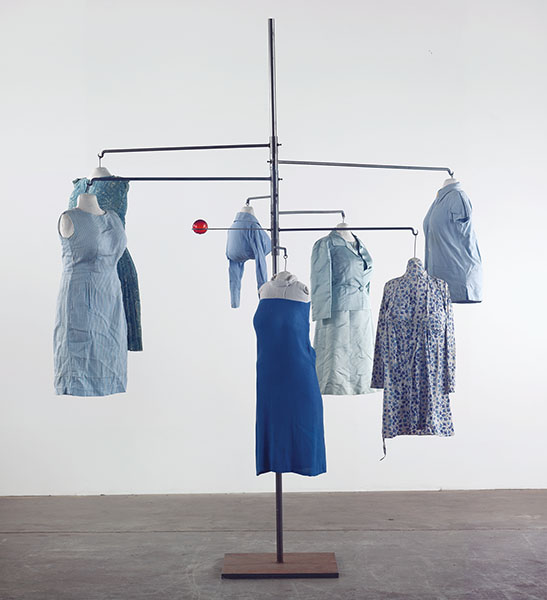
Blue Days (1996) is one of a number of works in which Bourgeois suspended, stuffed and shaped her dresses and shirts, sometimes adding abstract sculptural elements like the red glass sphere that operates here like a nucleus around which the new sculptural bodies circulate. With its intimate relation to the skin and contours of the body, to time and seasons, clothing was used for its power to summon memory: ‘You can retell your life … by the shape, weight, colour and smell of those clothes in your closet. They are like the weather, the ocean, changing all the time.’

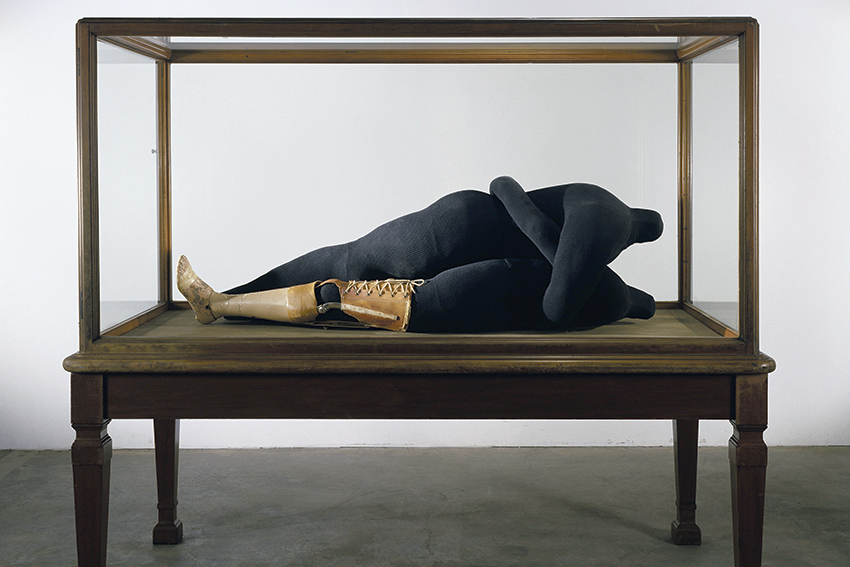
In other works Bourgeois’ fragmented figures and anatomical parts give physical form to anxieties rising from unfulfilled desire, acts of betrayal, losses or thwarted communication. Couple IV embodies the dark confusion of the child happening upon the sexual embrace of the adults. The copulating, decapitated lovers appear as an encased ‘archaeological specimen’ and signal Bourgeois’ fraught obsession not only with the infidelities of her father, but also with sex itself. For Bourgeois there is ‘a fatal attraction not towards one or the other, but to the phenomena of copulation … I am exasperated by the vision of the copulating couple, and it makes me so furious … that I chop their heads [off]. This is it … I turn violent. The sewing is a defence. I am so afraid of the things I might do. The defence is to do the opposite of what you want to do.’

Louise Bourgeois’ practice was an elaborate articulation of an existence in which the sculpting world and the living world were one. Her late works summoned the past and confronted the present, and the passage of time, by using the very garments in which the experiences of her life, loves and longings resided.

Jason Smith, Curator, Director and CEO, Heide Museum of Modern Art. “Louise Bourgeois,” on The Melbourne Review website, November 2012 [Online] Cited 26/02/2013 no longer available online


Louise Bourgeois (French-American, 1911-2010) 'Blue Days' 1996


Louise Bourgeois (French-American, 1911-2010)
Blue Days
1996
cloth, steel, glass
292.1 × 205.7 × 241.3cm
Courtesy Cheim & Read and Hauser & Wirth
© Louise Bourgeois Trust / Licensed by VAGA, New York / Viscopy, Sydney


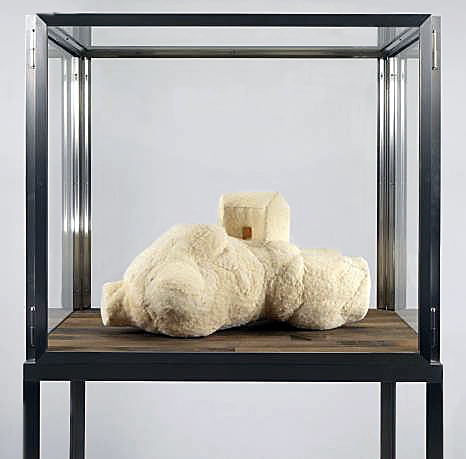
Louise Bourgeois (French-American, 1911-2010) 'Femme Maison' 2001


Louise Bourgeois (French-American, 1911-2010)
Femme Maison
2001
fabric, steel
35.6 × 38.1 × 66cm
Courtesy Cheim & Read and Hauser & Wirth
© Louise Bourgeois Trust / Licensed by VAGA, New York / Viscopy, Sydney


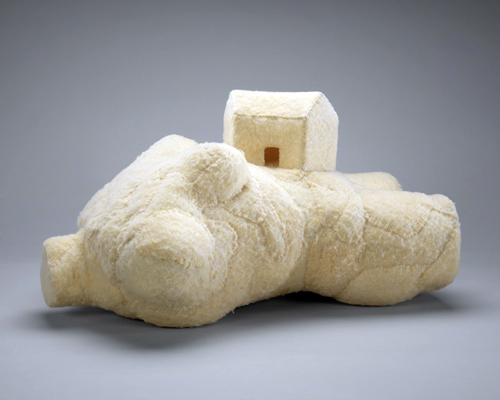
Louise Bourgeois (French-American, 1911-2010) 'Femme Maison' 2001


Louise Bourgeois (French-American, 1911-2010)
Femme Maison (detail)
2001
fabric, steel
35.6 × 38.1 × 66cm
Courtesy Cheim & Read and Hauser & Wirth
© Louise Bourgeois Trust / Licensed by VAGA, New York / Viscopy, Sydney


Note that Femme Maison and other artworks are encased in ‘cells’. In one sense, the cell encases and protects the artwork; however, Louise Bourgeois’ intention was to use the cell also as a way of containing the memory held within the work.

The hybrid form of Femme Maison – with its dual translations to ‘woman house’ or housewife – appeared in drawings, paintings and sculpture, and in degrees of abstraction and figuration, from the mid 1940s onwards. In this key late work the textured fabric affirms the central relationship of woman with the domestic space. Stories of the house and the home defined Bourgeois’ identity. The architectural house and its contents – especially the table, bed and chair – and the familial home and its occupants, were the structures that shaped Bourgeois’ unstable sense of self, and her relationships with others. This work plays on the house literally growing out of the woman’s body (the nurturing mother) or, conversely, pinning her dismembered body to the ground, registering the paralysing power of fear, and recalling a painful childhood.


Louise Bourgeois (French-American, 1911-2010) 'Knife Figure' 2002


Louise Bourgeois (French-American, 1911-2010)
Knife Figure
2002
fabric, steel, wood
22.2 × 76.2 × 19.1cm
Courtesy Cheim & Read and Hauser & Wirth
© Louise Bourgeois Trust / Licensed by VAGA, New York / Viscopy, Sydney


Louise Bourgeois (French-American, 1911-2010) 'Untitled' 2002


Louise Bourgeois (French-American, 1911-2010)
Untitled
2002
Tapestry and aluminium
43.2 x 30.5 x 30.5cm
Courtesy Cheim & Read and Hauser & Wirth
© Louise Bourgeois Trust
Photo: Christopher Burke


Louise Bourgeois (French-American, 1911-2010) 'Couple IV' 1997


Louise Bourgeois (French-American, 1911-2010)
Couple IV
1997
fabric, leather, stainless steel, plastic
50.8 × 165.1 × 77.5cm
Courtesy Cheim & Read and Hauser & Wirth
© Louise Bourgeois Trust / Licensed by VAGA, New York / Viscopy, Sydney


Louise Bourgeois (French-American, 1911-2010) 'Untitled' 2002


Louise Bourgeois (French-American, 1911-2010)
Untitled
2002
Tapestry, aluminium
43.2 x 30.5 x 30.5cm
The Easton Foundation, New York, NY.


Louise Bourgeois (French-American, 1911-2010) 'Cinq' 2007


Louise Bourgeois (French-American, 1911-2010)
Cinq
2007
fabric, stainless steel
61 × 35.6 × 35.6cm
Courtesy Cheim & Read and Hauser & Wirth
© Louise Bourgeois Trust / Licensed by VAGA, New York / Viscopy, Sydney


Heide Museum of Modern Art is proud to present two major exhibitions featuring the work of Louise Bourgeois. The first, Louise Bourgeois: Late Works includes over twenty, key works direct from the late artist’s studio in New York. The second exhibition, Louise Bourgeois and Australian Artists presents a selection of works by contemporary Australian artists who have been inspired by Bourgeois alongside prints and drawings from her vast graphic oeuvre. Louise Bourgeois (1911-2010) was one of the most inventive, provocative and influential artists of the twentieth century. Although her work has been exhibited extensively overseas, it has rarely been seen in Australia, and only once in significant depth, at the National Gallery of Victoria (NGV) in 1995 in an exhibition curated by then NGV curator Jason Smith. Louise Bourgeois: Late Works focuses on Bourgeois’s use of fabric in sculpture and what she termed ‘fabric drawings’. A preoccupation with memory and time, human relationships, fear and its annihilation, sexuality and the erotic body, are all emphases of Bourgeois’ final works.

Louise Bourgeois: Late Works is the first exhibition in Australia to survey the work of this profoundly important artist since her death in 2010 and has been curated by Jason Smith, now Heide Director & CEO – in close collaboration with the Bourgeois studio, New York – as a follow up to the 1995 exhibition at the NGV. Focusing on the final fifteen years of Bourgeois’ career, the exhibition examines the use of fabric in her works, and includes 18 sculptures, two suites of ‘fabric drawings’, watercolours, embroidered texts and lithographs never before seen in Australia. In the fabric works the processes of deconstructing and reconstructing, are applied to the contents of Bourgeois’ closets. The recycling of her garments, collected textiles and tapestry fragments intensifies her work’s expression of self-portraiture, and the profound personal experiences that defined her life and art.

Fabric was important to Louise Bourgeois, who grew up in her parents’ tapestry making business. In 1996, in her mid-eighties, Bourgeois began to transform the garments and textiles that she had worn, collected and stored over a lifetime into sculptures and ‘fabric drawings’. For her, sewing was an act of healing or reparation, linked to memories of her mother who ‘would sit out in the sun and repair a tapestry or a petit point’, an image of calm amid more distressing family dynamics.

Central to the exhibition is Spider, 1997 one of the Bourgeois’ Cells sculptures which is dominated, enclosed and protected by a gargantuan spider – a recurring and powerful motif in the artist’s work. Bourgeois created her spider sculptures partly in tribute to her mother, saying: ‘Like a spider, my mother was a weaver. Spiders are helpful and protective, just like my mother’. The female body and female subjectivity are concentrations in the exhibition.

The familial, biographical stories that provided life-long fuel for Bourgeois’ art are well known: her parents’ tapestry workshop in which she learnt the value of art as a form of reparation; her father’s public infidelity; her mother’s betrayal and early death; her complex sense of abandonment; her constant analysis of self; her belief in art a form of exorcism and as a potential reconciliation with the past.

Another highlight of the exhibition is the haunting Couple IV 1997, depicting a pair of copulating, and decapitated, lovers. The embracing figures are cast in the black of mourning, and appear as an encased ‘archaeological specimen’ in the vitrine. The work signals Bourgeois’ fraught obsession with the past, the infidelities of her father, and with sex itself.

Surrealism and pathos combine in Bourgeois’ smaller, intimate works like Knife figure 2002 and Untitled 2002. Here we see a dark side of the domestic with the knife and the whisk looming threateningly large in relation to the prone, dismembered bodies. In their colouration and homely material qualities they inspire tenderness and protection, yet as with so many of Bourgeois’ bodies, each remains cut off from the world and isolated to deal with its fate.”

Press release from the Heide Museum of Modern Art website


Louise Bourgeois & Australian Artists

This exhibition looks at relationships, both real and imagined, between the art of Louise Bourgeois (1911-2010) and that of ten Australian artists, in the rare context of a solo Bourgeois exhibition at Heide. Some pay direct homage to Bourgeois’ work or consider similar themes, while the connection of others registers more instinctually, on the level of a shared psychological intensity. Many of the works are rooted in memory and emotion, with a core that remains indecipherable – they do not illustrate or explain.

Forged regardless of fashion or fortune, Bourgeois’ oeuvre gave several artists in this exhibition the impetus to use personal subject matter as a creative source in the late 1980s and 1990s, an era when a cool, detached conceptualism dominated. Many share Bourgeois’ subjective focus and use the human body as a vehicle for self-expression, while for others her work’s formal precision and constant reinvention inspire. All respond to the exemplary fusion in Bourgeois’ art between inner compulsion and formal discipline, instinct and intelligence.

The Australian artists are Del Kathryn Barton, Pat Brassington, Janet Burchill, Carolyn Eskdale, Brent Harris, Joy Hester, Kate Just, Patricia Piccinini, Heather B. Swann.

Statement from the from the Heide Museum of Modern Art website


Janet Burchill (Australian, b. 1955) 'Following the Blind Leading the Blind' 1997


Janet Burchill (Australian, b. 1955)
Following the Blind Leading the Blind
1997
Synthetic polymer and enamel paint on wood
144.6 × 142.6 × 29.8cm
National Gallery of Victoria, Melbourne Purchased 1999


“The grid is a very peaceful thing, because nothing can go wrong … everything is complete. There is no room for anxiety … everything has a place. Everything is welcome.”


Louise Bourgeois


I had a weak-at-the-knees, tingle-all-over moment when I saw Louise Bourgeois’ work for the first time about fifteen years ago in Los Angeles. Yes I am a CRAZY fan. And, yes, it’s true I lay under her big spider in Tokyo and cried…

These are the releases I hope for in our vast world of art. Encounters when the artwork is somehow so inexplicably intimate, so beyond, so seemingly effortless that there can be no defence. In these moments there is an opening-up within the body, the mind, within all the senses … an experience of recognition, relief and awe that informs one’s deeper creative makeup.


Del Kathryn Barton


Del Kathryn Barton (Australian, b. 1972) 'no other side' 2012


Del Kathryn Barton (Australian, b. 1972)
no other side
2012
(one part of nine)
Dupion silk and embroidery cotton
9 parts, each 42 × 45cm
In collaboration with Karen Barton
Courtesy of the artist and Roslyn Oxley9 Gallery, Sydney


“I guess every artist has other practices that they aspire to. Louise Bourgeois’ practice – by which I mean the combination of the works, the way that they were made, the artist and the way that she conducted herself – is such a practice for me. The way that she worked for so long, and continued to develop her work in good times and bad, as well as the way that her works are so much of their times but at the same time not quite in sync with them inspires me. The fact that I hardly know the work she made prior to her fifties demonstrates the truth of the idea that art is a lifetime project that can continue to evolve as an artist matures. And then, of course, there is the work itself.”


Patricia Piccinini


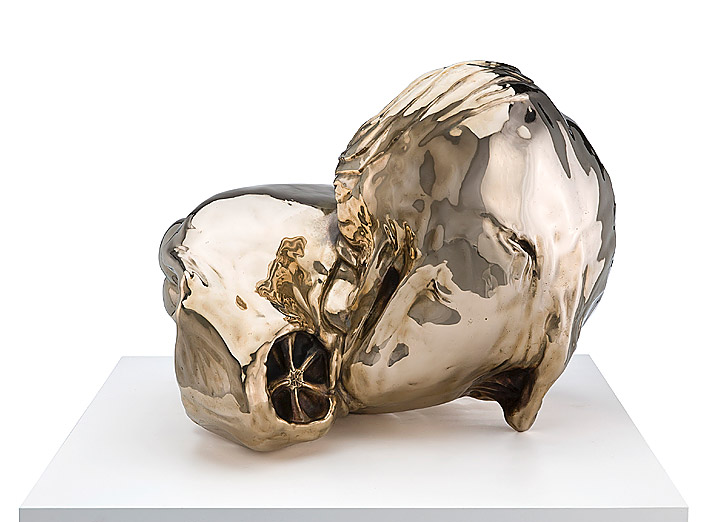
Patricia Piccinini (Australian, b. 1965) 'The Uprising' 2008 bronze


Patricia Piccinini (Australian, b. 1965)
The Uprising
2008
Bronze


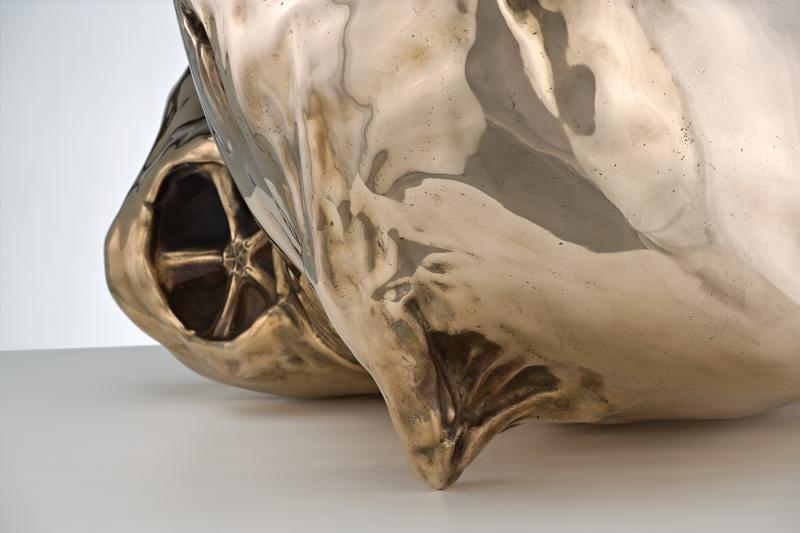
Patricia Piccinini (Australian, b. 1965) 'The Uprising' 2008 bronze (detail)


Patricia Piccinini (Australian, b. 1965)
The Uprising (detail)
2008
Bronze


“The massive aorta-like The Uprising, with its labyrinthine musculature, is a much stranger work. It establishes a bridge between the Vespa stags and the transgenic creatures, while being simultaneously amorphous and representational. Corporeal and mechanical, it suggests the plastic, porous, and uncertain world of the new nature that is at the core of the figurative works. For this reason it is physically sited at the boundary between natural history and art history…”


Juliana Engberg


Patricia Piccinini (Australian, b. 1965) 'Nectar' 2012


Patricia Piccinini (Australian, b. 1965)
Nectar
2012
Silicone, fibreglass, human hair, refrigerator edition 1/6
83 × 48 × 51cm
Courtesy of the artist, Tolarno Galleries, Melbourne, and Haunch of Venison, London and New York


“Taking her cue from the vague boundaries of the biotech world, ‘where it is difficult to figure exactly where the good becomes tainted and the bad becomes justifiable’, Piccinini considers her own hybrid creations, however abject or grotesque, as lovable, associated with fecundity, growth and optimism. Like Bourgeois, she presents strange couplings of the animal and the human, that despite their de-formations always convey intimacy and warmth. Here the title Nectar suggests that there may be something nourishing in what might otherwise appear as a failed experiment.”

Text from educational pdf


Pat Brassington (Australian, b. 1942) 'House guest #2' 2007


Pat Brassington (Australian, b. 1942)
House guest #2
2007


Pat Brassington (Australian, b. 1942) 'The Guardian' 2009


Pat Brassington (Australian, b. 1942)
The Guardian
2009
Pigment print on paper edition 6/8
112 × 87.5cm
Heide Museum of Modern Art, Melbourne
Purchased with funds from the Robert Salzer Foundation 2009


Louise Bourgeois at Heide Museum

A behind-the-scenes look at how the works of Louise Bourgeois, including her famous Spider were installed at Heide Museum.


Heide Museum of Modern Art
7, Templestowe Road
Bulleen, Victoria 3105

Opening hours:
(Heide II and Heide III)
Tuesday, Wednesday, Sunday, 10am – 5pm
Thursday – Saturday, 10am – 8pm

Heide Museum of Modern Art website

LIKE ART BLART ON FACEBOOK

Back to top

Review: ‘Photographic abstractions’ at the Monash Gallery of Art (MGA), Melbourne

Exhibition dates: 3rd August – 30th September 2012

Artists: Andrew Browne, John Cato, Jo Daniell, John Delacour, Peter Elliston, Joyce Evans, Chantel Faust, Susan Fereday, Anthony Figallo, George Gittoes, John Gollings, Graeme Hare, Melinda Harper, Paul Knight, Peter Lambropoulos, Bruno Leti, Anne MacDonald, David Moore, Grant Mudford, Harry Nankin, Ewa Narkiewicz, John Nixon, Rose Nolan, Jozef Stanislaw Ostoja-Kotkowski, Robert Owen, Wes Placek, Susan Purdy, Scott Redford, Jacky Redgate, Wolfgang Sievers, David Stephenson, Mark Strizic and Rick Wood.


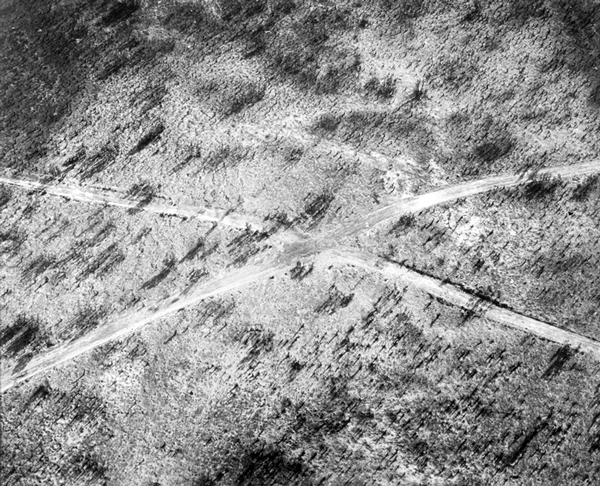
John Gollings (Australia, b. 1944) 'Untitled' 1988 From the series 'Bushfire aerials'


John Gollings (Australia, b. 1944)
Untitled
1988
From the series Bushfire aerials
Gelatin silver print
45.5 x 56.0cm
Monash Gallery of Art, City of Monash Collection
© courtesy of the artist


Dropping the abstract ball

There are some excellent works in this interestingly themed exhibition at the Monash Gallery of Art. Unfortunately the exhibition, the theme and the work are let down by two curatorial decisions. Before I address those issues I will give my insight into some of the work presented:

~ A wonderful print of Sisters of Charity, Washington DC by David Moore (1956) where the starched cornettes of the sisters reminded me of paper doves. The kicker or punctum in this image is the hand of one of the sisters pointing skywards/godwards

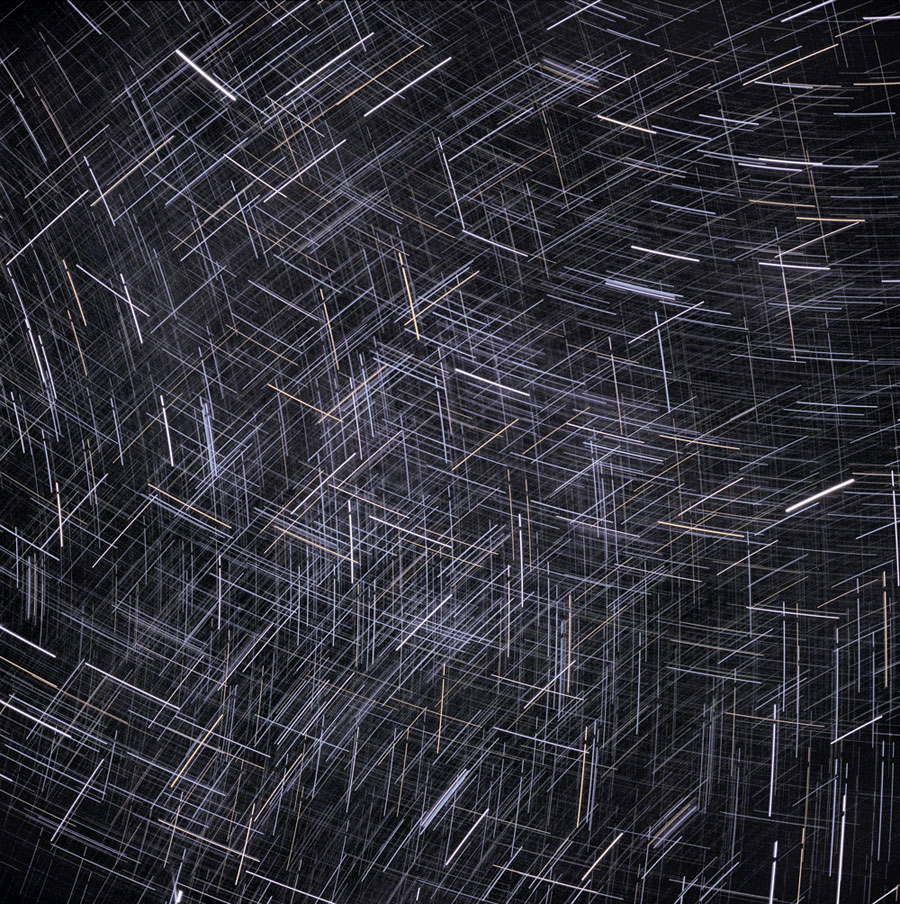
~ Wonderful David Stephenson Star Drawing. I always like photographs from this series. Taken in Central Australia using as many as 72 multiple exposures, Stephenson used a set of rules for each exposure – deciding on the length and amount of exposure and how far he would rotate the camera between each exposure before embarking on the creation of each image. The construction of the image was pre-determined  but because of the movement of the earth and stars over a couple of hours, the result always incorporated an element of chance. Stephenson draws with light that is millions of years old, the source of which may not exist by the time the light falls on Stephenson’s photographic plate (the star might be dead)

~ John Gollings Untitled from the Bushfire series. Beautiful, luminous black and white silver gelatin prints of tracks in bushfire affected areas. These aerial photographs make the surface of the earth seem like the surface of the skin complete with hairs and wrinkles. In process they reference the New Topographics exhibition of 1975, where the mapping of the landscape is etched into the surface of the photographic print, where the pictorial plane records the environment like the marks on an etching plate. “The pictures were stripped of any artistic frills and reduced to an essentially topographic state, conveying substantial amounts of visual information but eschewing entirely the aspects of beauty, emotion and opinion.”

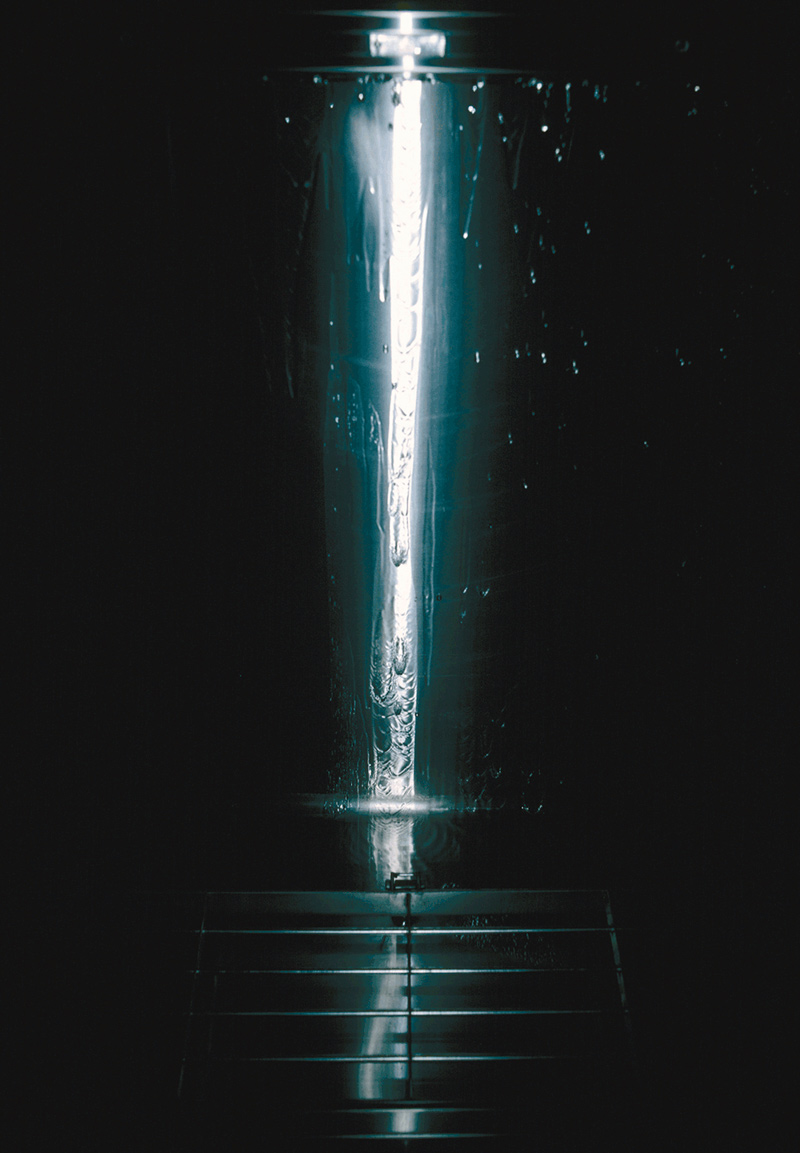
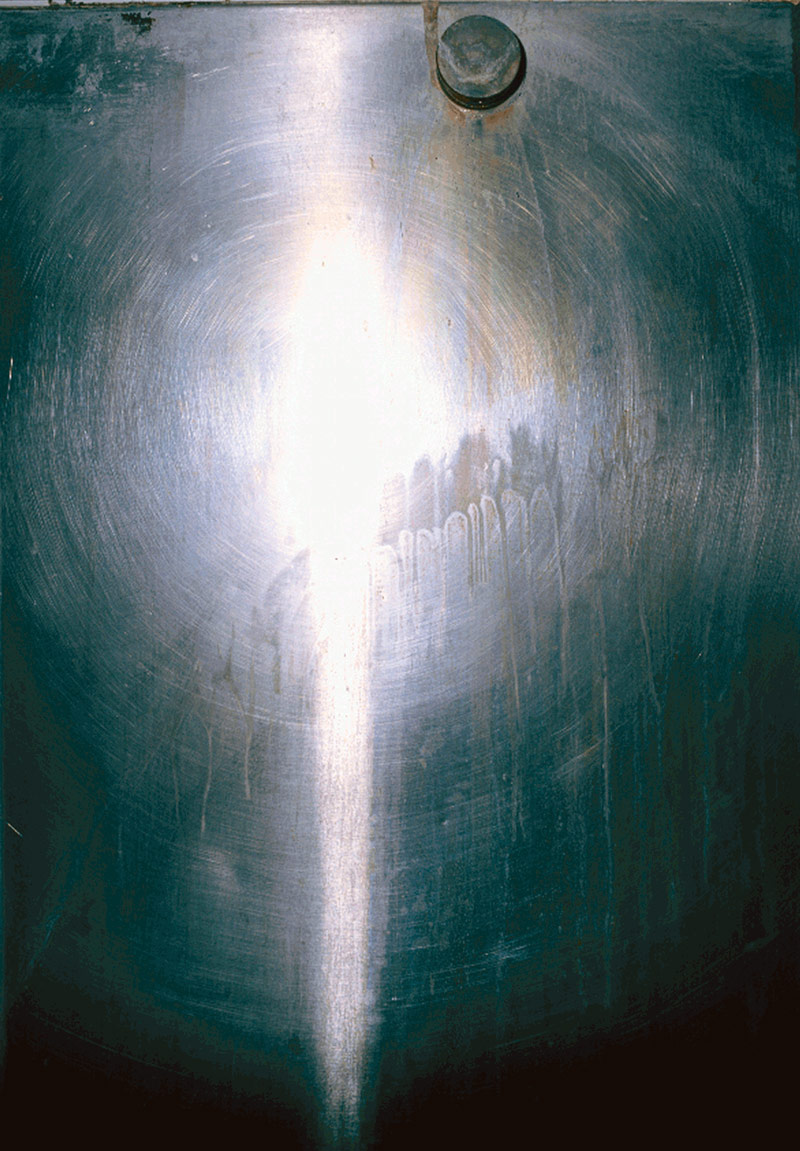
~ The beautiful Scott Redford Urinal photographs where the subject becomes secondary to the abstract visual elements as the flash bounces off the metal surfaces. Tight camera angles and a limited colour palette cause an almost transcendent composition. The swirls and markings and the sword-like quality of the central image (see below) remind me of Excalibur rising from the lake, dripping water.

~ Four photographs by John Cato, one each from Petroglyph 1971-79, Waterway 1971-79, Proteus 1971-79 and Tree – a journey 1971-79. These were incredibly beautiful and moving photographs, abstractions of the natural world. You need to be reminded what an amazing artist John was, one of the very best Australian photographers, his poetic photographs are cosmological in their musicology and composition

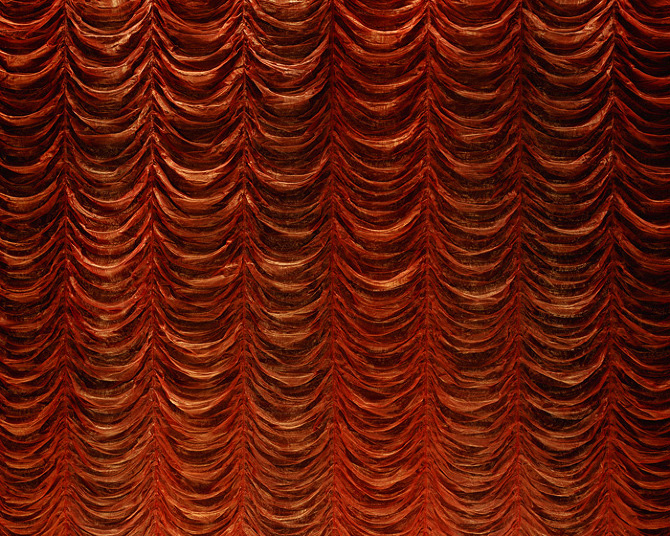
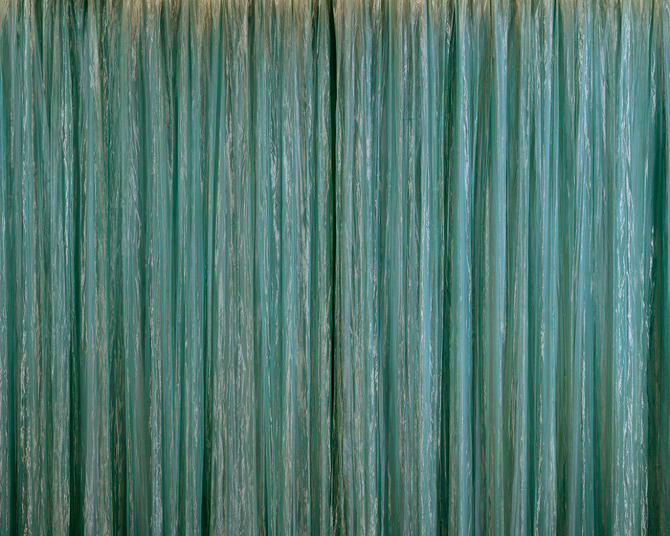
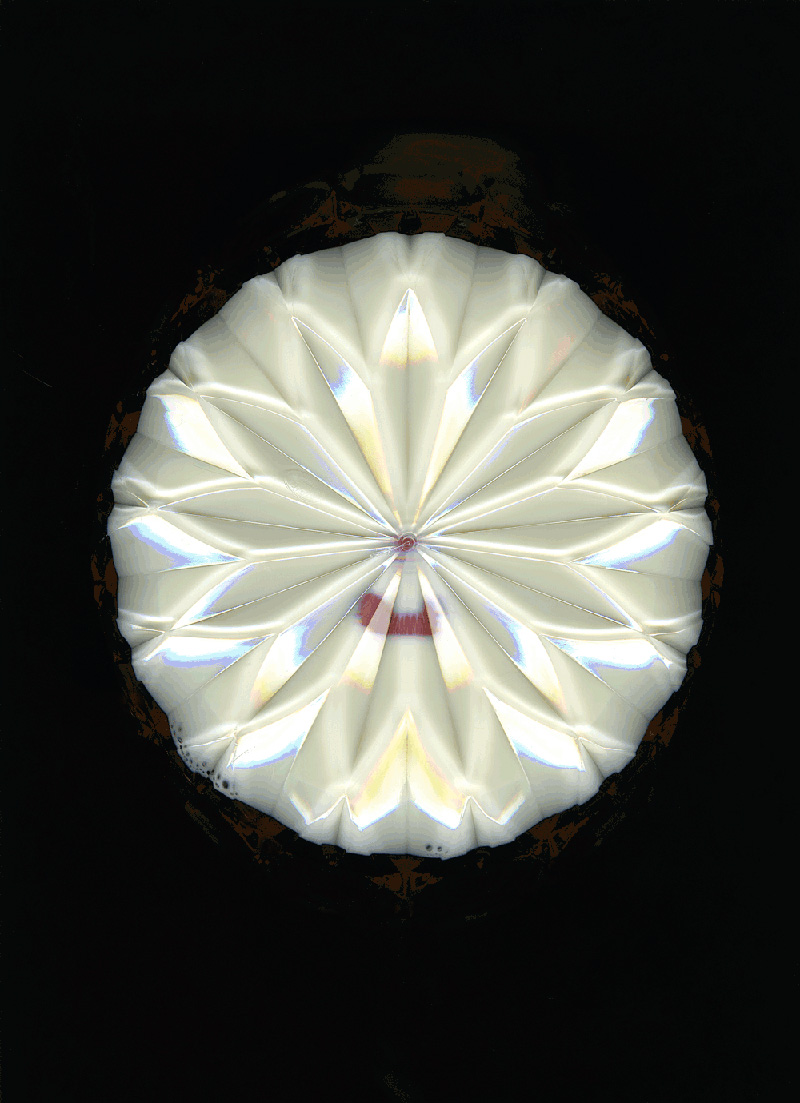
~ Two photographs from Paul Knight’s outstanding Cinema curtain series (below). For me there was a textural, sensory experience here, an intimacy with the subject matter that forced me to focus on the surface of the photograph, the flat plane of the photographic print, itself a highly abstract form. Amazing

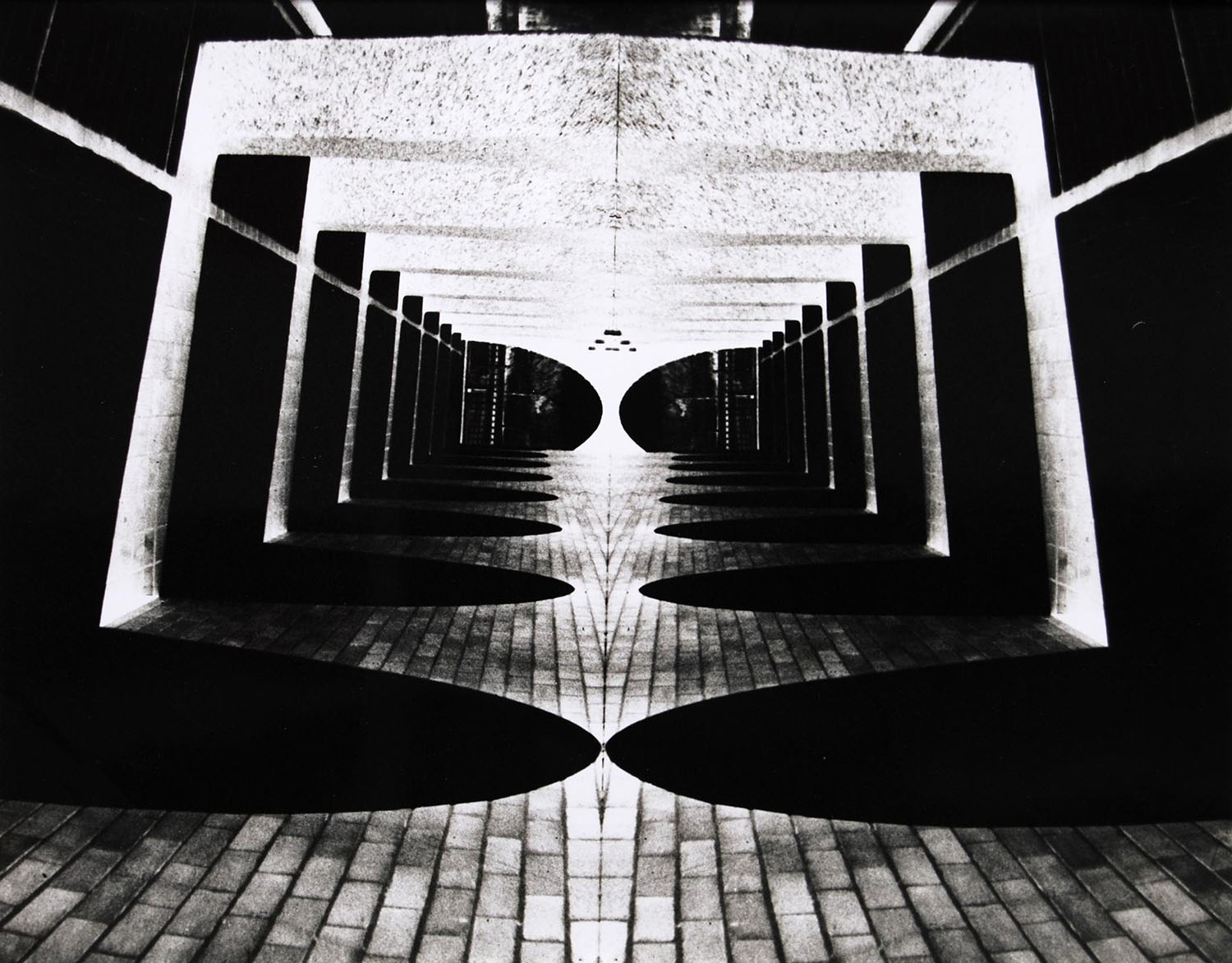
~ My particular favourite in the exhibition were the unknown to me works of the artist Jozef Stanislaw Ostoja-Kotkowski (see the two images directly below). These photographs were the most delightful surprise of the exhibition – landscapes of the mind that had great feeling and focus, felt movement, space, flow of light and energy. This was wonderfully nuanced work that I wanted to see more of


Some excellent work then that was let down by two curatorial decisions. The first was the amount of work in the exhibition by each artist – a couple of prints here, another three small prints there – that really never gave the viewer chance to fully engage with the outcomes that the artist was trying to achieve nor explore the process that the artist was using. I know this was a group exhibition trying to highlight work from the collection but a more useful contribution would have been less artist’s in the exhibition with greater work from each, allowing for a more focused exhibition.

Far more serious, however, was the lack of any text that placed the work in a socio-cultural context. At the beginning of the exhibition there was 5 short paragraphs on a wall as you enter the space with mundane insights such as:

~ Photographic language engages the senses and imagination and challenges the way we “look” at the world
~ Through the use of cropping and obscure angle the familiar is made unfamiliar
~ Colour, shape and form (geometric patterns) are important
~ Some artists’ eliminate the camera altogether through photograms, scanner, collage
~ Use of multiple exposures, distortion, mirroring
~ By drilling down into the substances and processes of photography we can reflect on the very nature of photography itself
~ Exploring geometry and patterns found in nature and the built environment or alluding to more intangible themes such as time, mortality and spirituality


I have précised the five paragraphs but that’s all you get!

The only other information comes from brief wall texts accompanying each artist and these sound bites really don’t give any social and cultural context to the artist, the time they lived in or the social themes that would have influenced the work. For example, who would know from this exhibition that the artist John Cato was one of the first photographers in Australia to create visual tone poems using images of the Australian landscape, one of the first to work in sequences of images and who would go on to be a teacher of great repute, helping other emerging photographic artists at a critical time in the development of Australian art photography. Nobody. Also, I wanted to know more about the “substances” and “processes” of photography in regard to photographic abstraction. There was no serious theoretical enquiry, no educational component offered to the viewer here.

While money might be tight there is really no excuse for this lack of creditable, researched, insightful information. You don’t need a catalogue, all you need is a photo-stated 4-6 page essay to be given to visitors (if they desire to have one, if they want the information). It doesn’t take money it takes will to inform and educate the viewer about this important aspect of Australian photographic history. For a subject so engaging this was most disappointing. In this particular case the curators really did drop the abstract ball.

Dr Marcus Bunyan


Many thankx to the Monash Gallery of Art for allowing me to publish the photographs in the posting. Please click on the photographs for a larger version of the image.


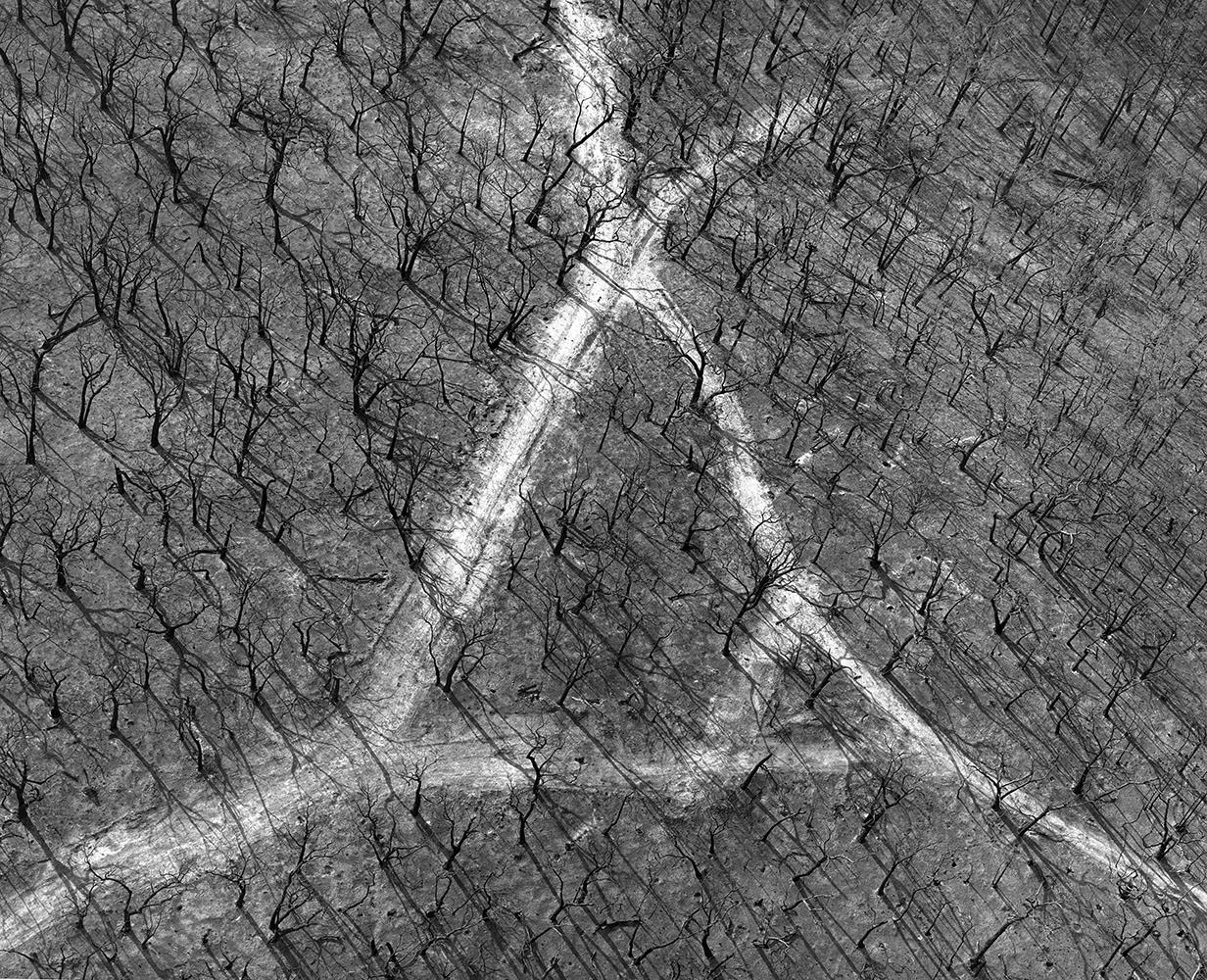
John Gollings (Australia, b. 1944) 'Untitled' 1988 From the series 'Bushfire aerials'


John Gollings (Australia, b. 1944)
Untitled
1988
From the series Bushfire aerials
Gelatin silver print
45.5 x 55.0cm
Monash Gallery of Art, City of Monash Collection
© courtesy of the artist


While John Gollings is best known for his work as an architectural photographer, he has produced a number of works that hone in on the Australian landscape. This aerial photograph looks down onto a landscape that has been scorched by bushfire. Viewed from above, without any horizon line to give a sense of scale or orientation to the terrain, this charred topography takes on the appearance of hairy, stubbled skin. Gollings uses this ambiguity to great effect, making the dirt tracks look like wounds that have scarred the surface of the earth, and the effects of smoke and ash look like bruises. In this respect, the use of aerial photography has allowed the images to be read as abstract ciphers of ecological trauma.

Text from the Monash Gallery of Arts website


David Stephenson (born USA 1955 arrived Australia 1982) 'Star drawing 1996/402' 1996 From the series 'Star drawings' 1995-2006


David Stephenson (born USA 1955 arrived Australia 1982)
Star drawing 1996/402
1996
From the series Star drawings 1995-2006
Chromogenic print, printed 2008
55.8 x 55.8cm
Monash Gallery of Art, City of Monash Collection
© courtesy of the artist, John Buckley Gallery Melbourne, Boutwell Draper Gallery, Sydney and Bett Gallery, Hobart


In a career spanning over 40 years, David Stephenson has consistently used photography to transcend visible reality, photographing built and natural environments to explore abstract, intangible themes such as time, mortality and spirituality. Stephenson made these Star drawings in Central Australia, overlaying as many as 72 different exposures to make one work. For each photograph he used a list of predetermined rules. For instance, he would decide on the length and number of exposures and how far he would rotate his camera between each exposure before embarking on the creation of each image. The images, each of which took a couple of hours to produce, were in this sense pre-planned; however, the amount of variables involved such as the movement of the earth and the stars during each shoot, meant the result always incorporated an element of chance. Interested in the idea that photography is essentially drawing with light, Stephenson’s series of experimental abstract patterns is not so much about documenting the night sky as it is about conceptually exploring the nature of light, time and photography itself.

Text from the Monash Gallery of Arts website


Paul Knight (Australia, b. 1976) 'Cinema curtain #3' 2004


Paul Knight (Australia, b. 1976)
Cinema curtain #3
2004
Chromogenic print
43.5 x 55.0cm
Monash Gallery of Art, City of Monash Collection
© courtesy of the artist


The function of the stage curtain in the cinema was to help suspend the illusion of reality in the moving image of the film. The idea being that the plain white screen behind the curtain was never seen without the moving image on it. So the illusion always existed behind the curtain and was simply masked-off from us by it. This is partly why the image was alway projected onto the curtain for a moment before it was opened, to ensure that we never saw the dead white screen. These works use this function of the cinema stage curtain as a way of engaging with the meta-reality offered by the flat-plane of a photographic print. Utilising the lure of aesthetics and pattern to bring the viewer onto the folded membrane of the curtain and onto the essentially flat plane of the print. Both give way to a potential of volume.

Text from the Paul Knight website [Online] Cited 21/09/2012 no longer available online


Paul Knight (Australia, b. 1976) 'Cinema curtain #4' 2004


Paul Knight (Australia, b. 1976)
Cinema curtain #2
2004
Chromogenic print
43.5 x 55.0cm
Monash Gallery of Art, City of Monash Collection
© courtesy of the artist


Jozef Stanislaw Ostoja-Kotkowski (born Poland 1922 arrived Australia 1949 died 1994) 'Australia Square – Sydney' 1971 From the series 'Inscape 871'


Jozef Stanislaw Ostoja-Kotkowski (born Poland 1922 arrived Australia 1949 died 1994)
Australia Square – Sydney
1971
From the series Inscape 871
Gelatin silver print
29.4 x 24.0cm
Monash Gallery of Art, City of Monash Collection
© courtesy of the artist


Originally trained as a painter, Jozef Stanislaw Ostoja-Kotkowski was interested in the advancement of art materials and techniques. He worked across a variety of media, including painting, sculpture, photography, electronic sound and light projections. He was also interested in combining different art forms and experimented with blending photography with music and sound.

Ostoja-Kotkowski played a key role in the development of experimental photography as well as electronic art in Australia. While his subjects were taken from the real world, they were photographically distorted and abstracted so that many became unrecognisable. He used this technique to create the series Inscape 871, examples of which are exhibited here. Inscape refers to an inner landscape, or images of the mind, while 871 refers to the month and year the works were completed. This series was included in the National Gallery of Victoria’s exhibition Frontiers (1971), which featured five Australian experimental photographers.

Text from the Monash Gallery of Arts website


Jozef Stanislaw Ostoja-Kotkowski (born Poland 1922 arrived Australia 1949 died 1994) 'Untitled' c. 1971


Jozef Stanislaw Ostoja-Kotkowski (born Poland 1922 arrived Australia 1949 died 1994)
Untitled
c. 1971
Gelatin silver print
29.4 x 24.0cm
Monash Gallery of Art, City of Monash Collection
Donated by Ken Scarlett 2004
© courtesy of the Estate of J S Ostoja-Kotkowski


Anne MacDonald (Australia, b. 1960) 'Cloth (red velvet)' 2004


Anne MacDonald (Australia, b. 1960)
Cloth (red velvet)
2004
Ink-jet print
105 x 70cm
Collection of the artist
© courtesy of the artist and Bett Gallery, Hobart


John Cato (Australian, 1926-2011) 'Tree – a journey' 1971-1979


John Cato (Australian, 1926-2011)
Tree – a journey
1971-1979
From the series Essay I
Gelatin silver print
35.5 x 27.5cm
Monash Gallery of Art, City of Monash Collection
© courtesy of the John Cato Estate


Chantal Faust (Australian, b. 1980) 'Waiting' 2007


Chantal Faust (Australian, b. 1980)
Waiting
2007
From the series Milk
Chromogenic print
80.0 x 58.0cm
Collection of the artist
© courtesy of the artist


Like much of Chantal Faust’s photographic work, her series Milk was produced using a digital flatbed scanner, a method that allowed her to generate photographs without the use of a camera. The series documents milk being drunk from a bowl and can be linked to the tradition of 1960s and 1970s ‘process art’. During the late 20th century, photography was often employed by artists who wanted to document performance-based art actions and activities. Faust’s ‘action’ of slurping milk from a bowl is a playful extension of this tradition.

Text from the Monash Gallery of Art website


Chantal Faust. 'Lap Milk' 2007


Chantal Faust (Australian, b. 1980)
Lap Milk
2007
From the series Milk
Chromogenic print
80.0 x 58.0cm
Collection of the artist
© courtesy of the artist


Drawing on MGA’s collection of Australian photographs, Photographic abstractions highlights the work of 33 Australian artists who use photography to achieve abstract effects. Ranging from modernist geometric abstraction and the psychedelic experiments and conceptual projects of the 1970s, through to recent explorations of pixelated pictorial space, this exhibition surveys a rich history of abstract Australian art photography. Photography is traditionally recognised for its ability to depict, record and document the world. However, this exhibition sets out to challenge these assumptions. As co-curator of the exhibition and MGA Curator Stephen Zagala states, “The artists in this exhibition are less concerned with documenting the world and more interested in engaging the senses, exciting the imagination and making the ordinary appear extraordinary.”

Some artists have eliminated the camera altogether, preferring the effects that can be achieved with photograms and digital scans. Other artists have experimented with multiple exposures, mirrored images, irregular lenses and the printing of the usually discarded stubs of negatives. Co-curator and MGA Curatorial Assistant Stella Loftus-Hills says, “Photography has always been tied to abstraction. Some of the first photographs ever produced were abstract and subsequent photographers have sought out abstract compositions in their work.”

One highlight of the exhibition is a selection of works by the iconic Australian photographer David Moore, who experimented with abstract photography alongside his more well-known figurative work. In Moore’s Blue collage (1983) the process of cutting bands of colour from existing photographs to create a new composition celebrates the artist’s imagination above and beyond the camera’s ability to capture content.

Artists include Andrew Browne, John Cato, Jo Daniell, John Delacour, Peter Elliston, Joyce Evans, Chantel Faust, Susan Fereday, Anthony Figallo, George Gittoes, John Gollings, Graeme Hare, Melinda Harper, Paul Knight, Peter Lambropoulos, Bruno Leti, Anne MacDonald, David Moore, Grant Mudford, Harry Nankin, Ewa Narkiewicz, John Nixon, Rose Nolan, Jozef Stanislaw Ostoja-Kotkowski, Robert Owen, Wes Placek, Susan Purdy, Scott Redford, Jacky Redgate, Wolfgang Sievers, David Stephenson, Mark Strizic and Rick Wood.

Press release from the MGA website


David Moore (Australian, 1927-2003) 'Sun patterns within the Sydney Opera House' 1962


David Moore (Australian, 1927-2003)
Sun patterns within the Sydney Opera House
1962
Gelatin silver print, printed 2005
37.75 x 25.0cm
Monash Gallery of Art, City of Monash Collection
© courtesy of the Estate of David Moore


David Moore (Australian, 1927-2003) 'Sisters of Charity' 1956


David Moore (Australian, 1927-2003)
Sisters of Charity, Washington DC
1956
Gelatin silver print
30.5 x 19.5cm
Monash Gallery of Art, City of Monash Collection
© courtesy of the Estate of David Moore


Robert Owen (Australian, b. 1937) 'Street, Burano, Italy' 1978


Robert Owen (Australian, b. 1937)
Street, Burano, Italy
1978
Silver dye bleach print
20 x 25cm
Monash Gallery of Art, City of Monash Collection
© courtesy of the artist and Arc One Gallery, Melbourne


Robert Owen (Australian, b. 1937) 'Green Sheet, Burano, Italy' 1978


Robert Owen (Australian, b. 1937)
Green Sheet, Burano, Italy
1978
Silver dye bleach print
Monash Gallery of Art, City of Monash Collection
© courtesy of the artist and Arc One Gallery, Melbourne


Scott Redford (Australian, b. 1962) 'Urinal (Broadbeach)' 2000-2001


Scott Redford (Australian, b. 1962)
Urinal (Broadbeach)
2000-2001
From the Urinals series 1988-2001
Chromogenic print
Collection of the artist
© courtesy of the artist


Scott Redford (Australian, b. 1962) 'Urinal (Surfer's Paradise)' 2000-2001


Scott Redford (Australian, b. 1962)
Urinal (Surfer’s Paradise)
2000-2001
From the Urinals series 1988-2001
Chromogenic print
Collection of the artist
© courtesy of the artist


Scott Redford (Australian, b. 1962) 'Urinal (Fortitude Valley)' 2000-01


Scott Redford (Australian, b. 1962)
Urinal (Fortitude Valley)
2000-2001
From the Urinals series 1988-2001
Chromogenic print
Collection of the artist
© courtesy of the artist


Redford’s photographs of urinals… dialogue with art historical motifs that precede discourses of minimal art and postmodern understandings of the abject. In representing the site of male urination, they evoke the oxidation paintings of Andy Warhol, who directed young men to piss onto canvases prepared with copper oxide, resulting in compelling abstract imagery… All of that is in Redford’s photographs and at the same time they are completely empty and quiet and contemplative… They are pure sensory experience like rainfall, even transcendent in their purity. They are concerned with beauty, but they are beyond debates about beauty. They are indifferent and in this they are transcendent.

Chapman, Christopher. “Scott Redford’s urinals,” in Redford, Scott et.al. Bricks are Heavy (exhibition catalogue). Brisbane: Institute of Modern Art, pp. 6-7.


Monash Gallery of Art
860 Ferntree Gully Road, Wheelers Hill
Victoria 3150 Australia
Phone: +61 3 8544 0500

Opening hours:
Tuesday – Friday 10am – 5pm
Saturday – Sunday 10am – 4pm
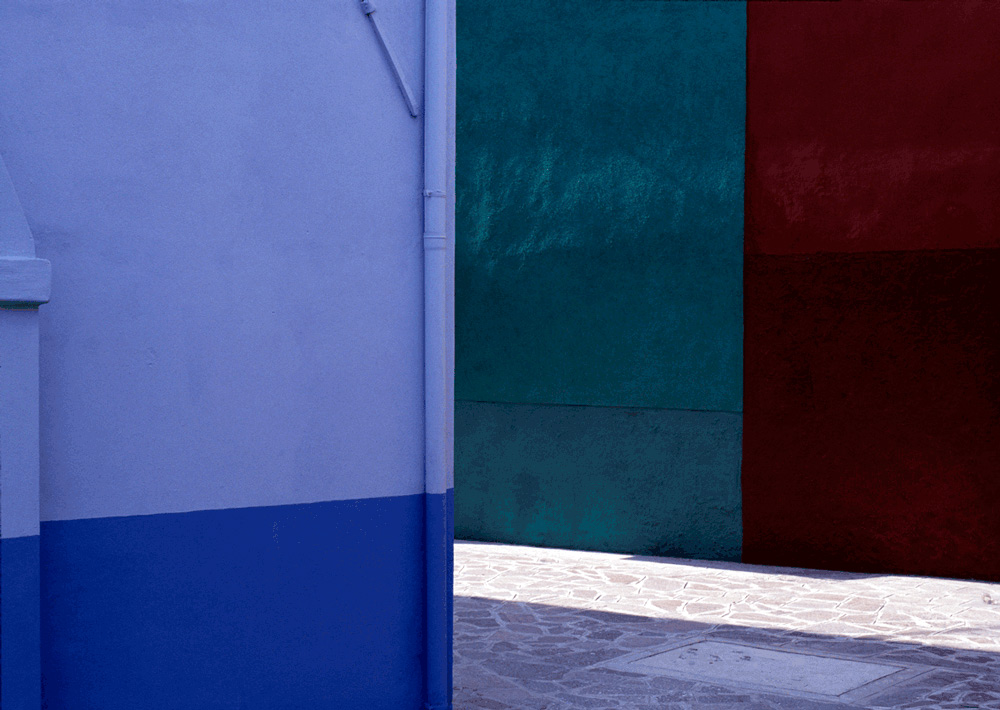
Mon/public holidays: closed

Monash Gallery of Art website

LIKE ART BLART ON FACEBOOK

Back to top

Review: ‘Looking at Looking’ at the National Gallery of Victoria, Melbourne

Exhibition dates: 30th September 2011 – 4th March 2012


Bill Henson (Australian, b. 1955) 'Untitled 1980/82' 1980-1982


Bill Henson (Australian, b. 1955)
Untitled 1980/82
1980-1982
From the Untitled 1980/82 series 1980-1982
Gelatin silver photograph
43.0 x 38.8cm
National Gallery of Victoria, Melbourne
Anonymous gift, 1993
© Courtesy of the artist and Roslyn Oxley9 Gallery, Sydney


“The paradox is the more we seek to fix our vision of the world and to control it the less sure we are as to who we are and what our place is in the world.”


Marcus Bunyan 2011


This is a delightful, intimate exhibition at the National Gallery of Victoria that examines how looking through a camera directs and structures the way we see the world. The exhibition mines the same ground as one of my top exhibitions from last year, In camera and in public that was presented at the Centre for Contemporary Photography, Fitzroy.

Numerous artists use photography to examine the ways in which gender, race and sexuality have been ‘looked at’ in visual culture, including the politics of looking in relation to Indigenous cultures and identities. In I split your gaze (1997) by Brook Andrew, the artist has split the face of an Aboriginal man down the middle, and reassembled the face ear to ear. No longer can we look on the man as a whole because our gaze is split. Andrew is said to have “reclaimed” the image from colonial scientific, anthropological documentation but this presupposes some holistic whole existed a priori to white intervention. The split photograph does alter perception but to what extent it promotes a different reading, a postcolonial gaze that is understood as such by the viewer, is debatable.

Chi Peng poses more interesting gender reversals and masquerades. In Consubstantiality (2004, below) misaligned pairs of people, of androgynous face and hard to distinguish gender, are “reflected” in a pseudo mirror. Consubstantiality references the Christian principle describing the intertwined relationship of the Trinity (God the Father, the Son, and the Holy Spirit) as being of one essence, one being.

“Chi Peng uses digital technologies to manipulate photographic surfaces and often uses his own body and identity as a homosexual man living in China as a means of creating new ways of looking at himself and at the construction of identity… With powdered faces and bodies, the naked ‘reflections’ press the palms of their hands together across a pane of glass. At first glance, it is as though the photographer is intruding on a private scene, a moment of self-scrutiny in a mirror. However the hands do not quite align and the gazes diverge…”1

This self-reflexivity and its relation to the Lacan’s mirror stage in the development of male and female identity – in which the mirror can be looked at and looks back in return – lends these ethereal images real beauty and presence as they explore the psychology of identity and gender reversal.

“Photographers Ashley Gilbertson and John Imming, and collaborative artists Lyndell Brown and Charles Green have all used cameras to document war, and their works off three distinct views.The common link appears to be an engagement with ideas of the observer and the observed and questioning who is looking at whom, and why?”2 Attempting an apolitical view of the war in Iraq, Gilbertson was embedded with different US military outfits on numerous visits to the country between 2002-2008, reliant on them for his safety. Many of his “objective” photographs deal with representations of surveillance and covert looking from ‘within the ranks’. But not from within enemy ranks. The very fact of his embedding, his lying down within a disciplinary system of control and power, to shoot from one point of view, politicises his gaze.

Brown and Green’s painterly photograph features a tightly choreographed scene, “a market within a military camp in which traders were invited to sell their wares. The scene is indicative, however, of the ‘strained atmosphere’ prevalent when different cultures interact in military situations – seemingly harmonious but concealing the ‘control that was exerted in the selection of traders’.”3 This traditional tableau vivant sees the traders become actors on a stage, their gaze directed towards the female officer at the centre of the group holding a piece of clothing which is blocked from our view. We the viewer are excluded from the circle of gazes; we become other, looking at the looking of the traders. Their gaze and our gaze are at cross-purpose; we wish to become a player on the stage but are denied access and can only observe the spectacle from a distance. Excluded, the viewer feels disempowered, the photographic mise en scène leaving me unmoved.

John Imming’s photographs use found images from the Vietnam war, the first war in which photographers had unrestricted access and were given absolute freedom to record what they saw. Vietnam was a stage for intense exploration, photographers bombarding the public with images of extreme violence. Imming rephotographs images from the television screen using a Leica camera, abstracting them into darkly hued creatures, the borders miming the shape of early television screens. “The images become abstracted and our gaze is ‘reduced’ into blurred shapes of contrasting tones … His photographs force us to slow down the memories of the somewhat ephemeral television imagery and look deeply at what is being portrayed, and how.”4 These photographs fail in that task for they are very surface photographs. The photographs do not have the structure to support such a vision nor the support of beauty to prick the consciousness of the gaze. They are ugly images because war is ugly and abstracting them in order to ask the viewer to look deeply and have an incredible insight into the condition ‘war’ and how it is portrayed simply did not work for me.


The two standout works in the exhibition are Thomas Struth’s luminous photograph Pergamon Museum IV, Berlin (2001, below) and Bill Henson’s seminal (perhaps even ubiquitous) series Untitled 1980/82 (1980-1982, see above) – these photographs seem to be everywhere at the moment, perhaps a change is as good as a rest!

Struth’s magnificent large colour photograph is an investigation into the theatre of seeing. In the photograph Struth directs his cast and choreographs the visitors, the arrangement of the spectators re-assembling the open-ended narrative of the 2nd century Telephos frieze behind. “Similarities between the poses of the audience members and the poses of the carve relief figures gradually emerge, suggesting an unconscious dialogue between the viewers and the objects they regard. The result of Struth’s directorial mode of working is the creation of a type of theatre based on intersecting viewpoints, raising questions about the gaze of the spectator and the process of looking at works of art and each other.”5

Beholders observe beholders and the subjects of vision become historical, according to art historian Wold-Dieter Heilmeyer. Here I observe that:

~ The suffused light that falls from the skylight leaves no shadow.

~ A man who casts no shadow has no soul.

~ The shadow according to Jung is the seat of creativity. In this photograph there is no depth of field, the sculptures and the figures feel like they are almost on one plane.

~ None of the viewers looks at the camera, they avoid its probing gaze, passively becoming the feminine aspect – like the central raised figure, robbed of head and arms, being gazed upon from all sides. We, the viewer, are looking at the spectacle of the viewers looking at the frieze. Looking at looking the observer becomes the observed (surveillance camera where are you?)

~ Consider the freeze frame of the models as they posed for the sculptor all those years ago; the freeze frame of the sculptures themselves; the freeze frame of the spectators posing for the camera; the freeze frame of the photograph itself; and then consider the freeze frame of time and space as we stand before the photograph looking at it. Then notice the women in the photograph videotaping the scene, another excoriating layer that tears at the fabric of time and looking, that causes lacrimation for our absent soul. What a photograph!


The Henson photographs are presented in a wonderfully musical installation, mimicking the movement of the crowds portrayed. I republish below my comments on this series from the review of the In camera and in public exhibition.

“A selection of photographs from the Crowd Series (1980-1982) by Bill Henson. Snapped in secret these black and white journalistic surveillance photographs (‘taken’ in an around Flinders Street railway station in Melbourne) have a brooding intensity and melancholic beauty. Henson uses a flattened perspective that is opposed to the principles of linear perspective in these photographs. Known as The Art of Describing6 and much used in Dutch still life painting of the 17th century to give equal weight to objects within the image plane, here Henson uses the technique to emphasise the mass and jostle of the crowd with their “waiting, solemn and compliant” people.

“When exhibiting the full series, Henson arranges the works into small groupings that create an overall effect of aberrant movement and fragmentation. From within these bustling clusters of images, individual faces emerge like spectres of humanity that will once again dissolve into the crowd … all apparently adrift in the flow of urban life. The people in these images have an anonymity that allows them to represent universal human experiences of alienation, mortality and fatigue.”7

Henson states, “The great beauty in the subject comes, for me, from the haunted space, that unbridgeable gap – which separates the profound intimacy and solitude of our interior world from the ‘other’… The business of how a child’s small hand appearing between two adults at a street crossing can suggest both a vulnerability, great tenderness, and yet also contain within it all of the power that beauty commands, is endlessly fascinating to me.”8 His observation is astute but for me it is the un/awareness of the people in these photographs that are their beauty, their insertion into the crowd but their isolation from the crowd and from themselves. As Maggie Finch observes, it is “that feeling of being both alone and private in a crowd, thus free but also exposed.”9

In the sociologist Erving Goffman’s terms the photographs can be seen as examples of what he calls “civil inattention”10 which is a carefully monitored demonstration of what might be called polite estrangement, the “facework” as we glance at people in the crowd, holding the gaze of the other only briefly, then looking ahead as each passes the other.

“Civil inattention is the most basic type of facework commitment involved in encounters with strangers in circumstances of modernity. It involves not just the use of the face itself, but the subtle employment of bodily posture and positioning which gives off the message “you may trust me to be without hostile intent” – in the street, public buildings, trains or buses, or at ceremonial gatherings, parties, or other assemblies. Civil inattention is TRUST as ‘background noise’ – not as a random collection of sounds, but as carefully restrained and controlled social rhythms. It is characteristic of what Goffman calls “unfocused interaction.””11

This is what I believe Henson’s photographs are about. Not so much the tenderness of the child’s hand but a fear of engagement with the ‘other’. As such they can be seen as image precursors to the absence/presence of contemporary communication and music technologies. How many times do people talk on their mobile phone or listen to iPods in crowds, on trams and trains, physically present but absenting themselves from interaction with other people. Here but not here; here and there. The body is immersed in absent presence, present and not present, conscious and not conscious, aware and yet not aware of the narratives of a ‘recipro/city failure’. A failure to engage with the light of place, the time of exposure and an attentiveness to the city.

As Susan Stewart insightfully observes,

“To walk in the city is to experience the disjuncture of partial vision/partial consciousness … The walkers of the city travel at different speeds, their steps like handwriting of a personal mobility. In the milling of the crowd is the choking of class relations, the interruption of speed, and the machine.”12

Dr Marcus Bunyan


Footnotes

1/ Finch, Maggie. Looking at Looking: The Photographic Gaze. Catalogue. Melbourne: National Gallery of Victoria, 2011, p. 10

2/ Ibid., p. 16

3/ Ibid., p. 21

4/ Ibid., p. 24

5/ Ibid., p. 7

6/ See Alpers, Svetlana. The Art of Describing: Dutch Art in the Seventeenth Century. University Of Chicago Press, 1984

7/ AnonBILL HENSON: early work from the MGA collection. Education Resource. A Monash Gallery of Art Travelling Exhibition [Online] Cited 14/10/2011. No longer available online

8/ Henson, Bill quoted in the exhibition catalogue. First published as a pdf for the exhibition In camera and in public Curated by Naomi Cass. Centre for Contemporary Photography, 16 September – 23 October 2011

9/ Stephens, Andrew. “Who’s watching you?” in The Saturday Age. 23rd September 2011 [Online] Cited 14/10/2011

10/ See  Goffman, E. Behaviour in Public Places. New York: Free Press, 1963

11/ Giddens, Anthony. The Consequences of Modernity. Cambridge: Polity Press, 1991, pp. 82-83

12/ Stewart, Susan. On Longing: Narratives of the Miniature, the Gigantic, the Souvenir, the Collection. Durham: Duke University Press, 1993, p. 2. Prologue


Many thankx to the National Gallery of Victoria for allowing me to publish the photographs in the posting. Please click on the photographs for a larger version of the image.


Bill Henson (Australian, b. 1955) 'Untitled 1980/82' 1980-1982


Bill Henson (Australian, b. 1955)
Untitled 1980/82
1980-1982
From the Untitled 1980/82 series 1980-1982
Gelatin silver photograph
43.0 x 38.8cm
National Gallery of Victoria, Melbourne
Anonymous gift, 1993
© Courtesy of the artist and Roslyn Oxley9 Gallery, Sydney


Bill Henson (Australian, b. 1955) 'Untitled 1980/82' 1980-1982


Bill Henson (Australian, b. 1955)
Untitled 1980/82
1980-1982
From the Untitled 1980/82 series 1980-1982
Gelatin silver photograph
29.2 x 47cm
National Gallery of Victoria, Melbourne
Anonymous gift, 1993
© Courtesy of the artist and Roslyn Oxley9 Gallery, Sydney


On 30 September the National Gallery of Victoria will present Looking at Looking: The Photographic Gaze, a unique exhibition exploring how photography can construct particular ways of looking. Looking at Looking will feature works by 10 Australian and international photographers including 20 photographs from Bill Henson’s Untitled 1980-82 series.

Drawn entirely from the NGV Collection, this exhibition will bring together a fascinating selection of photographs inviting the viewer to consider the diverse nature of the photographic gaze and explore the complex relationships between the subject, the photographer and the audience. The displayed photographs will include observations of people in crowds, surveillance images from war zones and photographs that explore different ways of looking at gender, race and identity.

Maggie Finch, Assistant Curator, Photography, NGV said: “The act of photographing people involves a process of observation and scrutiny. At times, photographers remain detached and anonymous while at other times they are complicit, directing their subjects and encouraging specific actions.”

Frances Lindsay, Deputy Director, NGV, said: “In the NGV’s 150th year this exhibition allows visitors to explore the dynamic relationship between the observer and the observed. This is a rare opportunity to view these photographs in a truly unique context.”

Looking at Looking will consider the anonymous photographer, one who is able to look without being looked at in return and consequently see more than otherwise possible. This idea is explored in Bill Henson’s series Untitled 1980-82, where the artist photographed people on city streets. Hung in a dense display, these photographs provide a psychological study of the nature of people when in a crowd.

Looking at Looking will feature works by Brook Andrew, Chi Peng, Anne Ferran, Ashley Gilbertson, Charles Green and Lyndell Brown, Bill Henson, John Immig, Thomas Struth and David Thomas.

Press release from the National Gallery of Victoria


Thomas Struth (German, b. 1954) 'Pergamon Museum IV, Berlin' 2001


Thomas Struth (German, b. 1954)
Pergamon Museum IV, Berlin
2001
Type C photograph
144.1 x 219.9cm
National Gallery of Victoria, Melbourne
Purchased with the assistance of The Bowness Family Fund for Contemporary Photography, 2008
© 2011 Thomas Struth


David Thomas (born Northern Ireland 1951, arrived Australia 1958) 'Amid history 2 (Large version)' 2006


David Thomas (born Northern Ireland 1951, arrived Australia 1958)
Amid history 2 (Large version)
2006
Enamel paint on type C photograph on aluminium and plastic
100 x 145cm
National Gallery of Victoria, Melbourne
Purchased, Victorian Foundation for Living Australian Artists, 2007 © the artist


Ashley Gilbertson (Australian, b. 1978) 'A member of the Mahdi Army RPG team' 2004 from the 'Whiskey Tango Foxtrot' series 2004


Ashley Gilbertson (Australian, b. 1978)
A member of the Mahdi Army RPG team
2004
From the Whiskey Tango Foxtrot series 2004
Digital type C print
66.5 x 99.8cm
National Gallery of Victoria, Melbourne
Purchased, Victorian Foundation for Living Australian Artists, 2009
© Ashley Gilbertson / VII Network


John Immig (Dutch/Australian, 1935-2018) 'No title (T.V. images)' 1975-1976


John Immig (Dutch/Australian, 1935-2018)
No title (T.V. images)
1975-1976
From the Vietnam series 1975-1976
Gelatin silver photograph
20.2 x 25.3cm
National Gallery of Victoria, Melbourne
Purchased with the assistance of the Visual Arts Board, 1977
© John Immig


Chi Peng (Chinese, b. 1981) 'Consubstantiality' 2004


Chi Peng (Chinese, b. 1981)
Consubstantiality
2004
Type C photograph
87.5 x 116.7cm
National Gallery of Victoria, Melbourne
Purchased with the assistance of the NGV Foundation, 2004
© Chi Peng, courtesy of Red Gate Gallery, Beijing


Brook Andrew (Australian, b. 1970) 'I Split Your Gaze' 1997


Brook Andrew (Australian, b. 1970)
I Split Your Gaze
1997
Gelatin silver print
122.6 × 114cm (image and sheet)
National Gallery of Victoria, Melbourne
Purchased with funds from the Victorian Foundation for Living Australian Artists, 2005
© Brook Andrew/Copyright Agency, 2023


Charles Green (Australian, b. 1953) and Lyndell Brown (Australian, b. 1961) 'Afghan traders with soldiers, market, Taran Kowt Base Uruzgan Province, Afghanistan' 2007 printed 2009


Charles Green (Australian, b. 1953)
Lyndell Brown (Australian, b. 1961)
Afghan traders with soldiers, market, Taran Kowt Base Uruzgan Province, Afghanistan
2007 printed 2009
From The approaching storm series 2009
Inkjet print
155.0 x 107.5cm
National Gallery of Victoria, Melbourne
Purchased, Victorian Foundation for Living Australian Artists, 2009
© Courtesy of the Artists and Arc One Gallery, Melbourne


NGV International
180 St Kilda Road

Opening hours
Daily 10am – 5pm

National Gallery of Victoria website

LIKE ART BLART ON FACEBOOK

Back to top

Artwork: Alan Constable camera. Opening night photographs: ‘Movement and Emotion’ at Arts Project Australia, Melbourne

Exhibition dates: 20th October – 26th November 2011


Dr Marcus Bunyan holdling his new Alan Constable camera at the opening of Movement and Emotion 2011. More of Alan's cameras can be seen behind.


Dr Marcus Bunyan holding his new Alan Constable camera at the opening of Movement and Emotion 2011.
More of Alan’s cameras can be seen behind.


I have added a new Alan Constable camera to my collection. Yah!

The one I have chosen is very unusual. The camera has a third eye and a stunning glaze. The exhibition features the work of three Arts Project Australia artists: Alan Constable, Chris O’Brien and Terry Williams. All three artists explore machine aesthetics within their practice.

I really do hope that the National Gallery of Victoria purchases some of these cameras. They are the most unusual and beautiful sculptural pieces I have seen in a long time.

Dr Marcus Bunyan


Many thankx to Art Project Australia for allowing me to publish the photographs in the posting. Please click on the photographs for a larger version of the image. See more images from the Movement and Emotion exhibition.


Alan Constable (Australian, b. 1956) 'Not titled (three lens red camera)' 2011


Alan Constable (Australian, b. 1956)
Not titled (three lens red camera)
2011


Marcus with jeweller Marianne Cseh at right looking at the Alan Constable camera


Marcus with jeweller Marianne Cseh at right looking at the Alan Constable camera


Opening night crowd at 'Movement and Emotion'


Opening night crowd at Movement and Emotion, Arts Project Australia


Opening night, with at left curator Paul Hodges, artist Jodie Noble (seated), myself and at right, Jonah Jones, President of the board of Arts Project Australia


Opening night, with at left curator and artist Paul Hodges, artist Jodie Noble (seated), myself and, at right, Jonah Jones, President of the board of Arts Project Australia


Dr Marcus Bunyan giving the opening night speech at the exhibition 'Movement and Emotion' at Arts Project Australia


Dr Marcus Bunyan giving the opening night speech for the exhibition Movement and Emotion. Read the opening night speech. I was so nervous my jeweller friend Marianne said she could see my hands shaking from where she was standing in the crowd!!


Artist Catherine Staughton standing in front of her work


Artist Catherine Staughton standing in front of her work


Arts Project Australia

Studio
24 High Street
Northcote Victoria 3070
Phone: + 61 3 9482 4484

Gallery
Level 1 Perry Street building
Collingwood Yards
Enter via 35 Johnson Street or 30 Perry Street, Collingwood
Phone: +61 477 211 699

Opening hours:
Wednesday – Friday 11am – 5pm
Saturday & Sunday 12 – 4pm
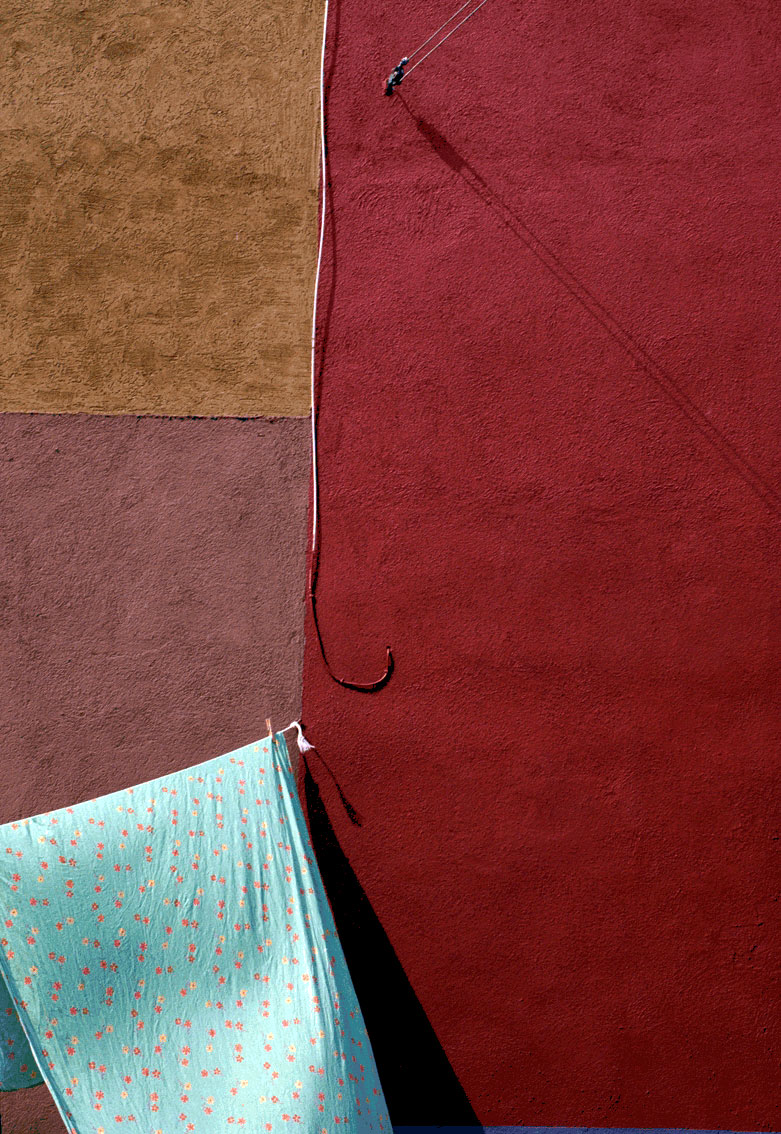
Arts Project Australia website

LIKE ART BLACK ON FACEBOOK

Back to top

Exhibition: ‘Photography & place: Australian landscape photography, 1970s until now’ at the Art Gallery of New South Wales, Sydney

Exhibition dates: 16th March – 29th May 2011


Debra Phillips (Australian, b. 1958) 'Untitled 7 (view from model plane launch area)' 2001


Debra Phillips (Australian, b. 1958)
Untitled 7 (view from model plane launch area)
2001
From the series The world as puzzle
Two Type C photographs
68 x 80cm each
Image courtesy the artist and BREENSPACE, Sydney
© Debra Phillips


Hot on the heels of my reviews of Stormy Weather: Contemporary Landscape Photography at NGV Australia and Sidney Nolan: Drought Photographs at Australian Galleries, Melbourne comes the exhibition Photography & place: Australian landscape photography, 1970s until now at the Art Gallery of New South Wales. An insightful, eloquent text by Vigen Galstyan (Assistant curator, photographs, AGNSW) accompanies the posting.

Dr Marcus Bunyan


Many thankx to Susanne Briggs for her help and to the Art Gallery of New South Wales for allowing me to publish the photographs and the text in the posting. Please click on the photographs for a larger version of the image.


Douglas Holleley (Australia, United States of America, b. 1949) 'Bottle-brush near Sleaford Bay, South Australia' 1979


Douglas Holleley (Australia, United States of America, b. 1949)
Bottle-brush near Sleaford Bay, South Australia
1979
Four SX-70 Polaroid photographs
61 x 76cm
AGNSW collection, purchased 1982
© Douglas Holleley


Australian born and American based photographer Douglas Holleley has experimented with many aberrant photographic techniques over the course of his career. Holleley received a Bachelor of Arts in Psychology in 1971 at Macquarie University before relocating to America to undertake a Master of Fine Arts, studying at the Visual Studies Workshop in Rochester, New York between 1974 and 1976. Founded by Nathan Lyons in 1969 and affiliated with important photographers including Minor White and Frederick Sommers, the Visual Studies Workshop was a bedrock institution that fostered innovative photographic practice from the 1970s onwards. It was here that Holleley received tutelage from Ansel Adams in 1975. His early photographic output includes hand coloured black and white photographs as well as photograms and gridded arrangements of Polaroids. He later began experimenting with digital photography, applying the same principles of the photogram to his experiments with a flatbed scanner.

During the time spent studying photography in America in the 1970s Holleley became interested in Polaroid technology. When he returned to Australia in 1979, before later relocating permanently to America, Holleley commenced an extensive photographic project of documenting the Australian bush with a Polaroid SX-70 camera, effectively becoming one of the first professional practitioners of the medium in the country. The resulting images were presented as a series and published as a book – Visions of Australia – in 1980. Employing a refined formalist vocabulary, Holleley produced photographic mosaics by arranging his Polaroids into gridded compositions.

Dissected, disassembled and then collated within the pictorial frame, the landscape in Holleley’s works becomes slightly unnatural and detached. These works negate linear single point perspective by focusing on the ground and reducing the scene to a formal composite. Here, the expanse of the view and the horizon does not dominate the space of the image. The tessellating images produce a ‘whole’ that is slightly misaligned and unsettled. In some works, the photographer’s shadow is visible. It asserts itself as an ambivalent presence that is not tethered to the scene. This spectral form heightens the sense of disquiet that pervades the images.

Text from the Art Gallery of New South Wales website [Online] Cited 16/01/2020


Ian North (New Zealand, b. 1945) 'Canberra suite no 2' 1980, printed c. 1984


Ian North (New Zealand, b. 1945)
Canberra suite no 2
1980, printed c. 1984
From the series Canberra suite 1980-81
Type C photograph
37 x 45.7cm
AGNSW collection, gift of the artist
© Ian North


Ian North (New Zealand, b. 1945) 'Canberra suite no 7' 1980, printed c. 1984


Ian North (New Zealand, b. 1945)
Canberra suite no 7
1980, printed c. 1984
From the series Canberra suite 1980-81
Type C photograph
37 x 45.7cm
AGNSW collection, gift of the artist
© Ian North


Ian North is an Adjunct Professor of Visual Arts at both the University of Adelaide and the University of South Australia. He is a photographer, painter and writer, and was the founding curator of photography at the National Gallery of Australia 1980-1984. Throughout his career, he has been concerned with the legacy of Australian landscape, the impact of colonial narratives and their established visual conventions and, as a consequence, the politics of representing the subject. …

North’s methodology is concerned with the processes of vision and interaction as they have shaped the landscape. In Canberra Suite North presents an encyclopaedic record of Walter Burley Griffin’s intricately designed city, exploring the spatial interface between nature and humanity. The works are absent of human life – reminiscent of Ed Ruscha’s Twenty-six Gasoline Stations. The emotional ambivalence of the images is reflected in their use of colour, like that of postcards. As one of the first instances of larger format colour art photography in Australia, the images topographically map space as a depersonalised, banal subject. Yet their colour, like that of landscape painting, highlights flora, revealing the number of non-native plants included in Canberra’s design. As such, these artefacts of North’s private wanderings and systemic mode of looking are able to subtly critique colonialism.

Text from the Art Gallery of New South Wales website [Online] Cited 16/01/2020


EARTH SCANS AND BUSH RELEVANCES: Photography & place in Australia, 1970s till now

For many of us, landscape is a noun. A view from the window or the balcony, a strange immaterial ‘thing’ that makes people exclaim in awe, point to in pride, recall nostalgically, pose in front of or be used to bump up real estate prices. If one is an urban dweller, which most Australians are, then the landscape exists essentially as a mirage, something to create in the backyard, occasionally look at on holidays or hang on the walls. However, noted American cultural theorist and art historian W. J. T. Mitchell has proposed that we should think of landscape as a verb: an act of creation on our part that engenders cultural constructs, national identities and shared mythologies.

Photography & place is an exhibition that investigates this process of ‘landscaping’ through the work of 18 Australian photographers between the 1970s and now. Their significant contribution to representation of landscape broke new ground in what has always been a confounding topic. Indeed, as Judy Annear has pointed out in a 2008 essay in Broadsheet magazine, the practice of documenting and interpreting the notion of ‘place’ in Australian photography has been fragmentary in comparison to traditions in America, Europe or New Zealand. This reluctance to focus on the natural environment is perhaps a residue of the ‘terra nullius’ polemic, which shifted the attention of many photographers on the building of colonial Australia. Photography from the mid 19th to the early 20th century by photographers such as Charles Bayliss and Nicholas Caire actively documented the conquest of nature by white settlers, or presented views of untouched wilderness as epitomes of the picturesque: endless waterfalls, lakes, forests in twilights, enigmatic caves and an occasional nymph like creature prancing. Despite Bayliss’ efforts to show the indigenous people on their land, they are, as Helen Ennis observed in her 2007 book Photography and Australia, conspicuous by their absence: the land that we see surrounding them in early Australian photography by the likes of J.W. Lindt is often a mass-produced painted studio backdrop.

The advent of modernism in the 1930s only served to entrench the photographers deeper into the urban space. ‘Place’ is the city and it is here that industry, progress and culture shapes the Australian identity. It is still difficult to dislodge the iconic images of Max Dupain and David Moore as epitomes of Australianness, promulgated as they were through countless renditions in mass media and consumer culture. But as post-modern anxiety started to seep through the patchwork of the Australian dream, it was landscape that many critically informed photographers turned to as a tool for analysis and revision.

A number of factors conflated in the mid 1970s, engendering a radical shift in perspectives. One of the primary forces that began to reshape the approaches to landscape in Australian photography was the awareness of new artistic movements taking place in USA and Europe. The enormously influential exhibition New Topographics: Photographs of a Man-Altered Landscape held in 1975 at the George Eastman House, Rochester, consolidated the spread of minimalist and conceptually informed photography which was avidly embraced by a younger generation of Australian photographers. One can also cite the rise of the Australian greens movement in Tasmania, the increasing awareness of Indigenous cultures and rights and not the least, the phenomenon of university-educated photographers as key milestones during this decade.

Lynn Silverman, Douglas Holleley, Jon Rhodes, Wes Stacey and Marion Marrison were among the practitioners who pointed their lenses out of the city, often exploring the fringes of human settlement and sometimes as in the case of Silverman, Stacey and Holleley, venturing into the desert. The element that collectively stamps their work is the ostensible fragmentation of the landscape. Instead of the holistic, positivist postcard views of Australia, we get something resembling a lunar vista. The palpable sense of alienation in American expatriate Lynn Silverman’s striking Horizons series from 1979 echoes in the disorienting grid-based Polaroid assemblages by Holleley conjuring up a space that appears hostile and to a degree indifferent to our presence. The foreignness of these landscapes is not necessarily a malevolent force as was customary to show in a slate of Australian New Wave films of the 70s and 80s. Rather a much more meditative stance is taken in regards to our relationship to a place which has been claimed without being understood or in many ways respected. Ingeborg Tyssen’s photographs hint at existing presences, forms and phenomena which are full of life and meaning that remain perpetually unresolved to an outsider. The imported paradigms of Western culture can not take root in this environment. One could easily define the landscape photography of this period in Lynn Silverman’s words as “an orienting experience” and a belated attempt at a proper reconnaissance of the land.

The coolly detached outlook that underlines the investigative drive of most of these photographers is magnified by their adoption of serial or multi-panel formats. It was certainly a way to expand and collapse the accepted faculties of the pictorial field, challenging and questioning the accepted notions of photographic ‘truth’. Jon Rhodes demonstrates the inherent power of this simple device in his cinematically sequential Gurkawey, Trial Bay, NT 1974, which transforms a seemingly wild and uninhabitable swamp into a joyful playground of an Aboriginal child.

In some instances the photographic approach is more concerned with elucidating the nature of the photographic image itself and the way it can influence and control our perception. As Arnold Hauser has lucidly described in his groundbreaking Social History of Art, images have always been used to secure and infer political power. As such, the metamorphosis of a visual representation into an iconographic one carries within it an element of danger as images begin to seduce the viewer away from objectivity. Indeed, images of Australia have been the most relentlessly and carefully used signifiers in promoting a (colonial) national consciousness by political, commercial and cultural institutions. In this light, it is not difficult to see the works of Wes Stacey and Ian North as acts of iconoclasm. Stacey’s droll and gently parodic series The road 1973-1975, charts a snapshot journey that goes nowhere. Seemingly random, half-glimpsed shots of empty dirt roads, sunburnt grass mounds and endless highways emanate a sense of rootlessness and displacement, negating any possibility of objectification or identification with the landscape. Instead of epic grandeur and jingoism we get something that is confronting, uncomfortably real and in no way ‘advertisable’.

‘The Real’ is even more startling in Ian North’s subversive Canberra suite 1980-81, where the utopian dream capital has been reduced to banal ‘documents’ of depopulated, custom-made suburbia. The hyperreal concreteness of North’s Canberra gives the city an aura of a De Chiricoesque waking nightmare. In line with the set practices of conceptual photography of the period, North has distilled his images from any sign of formal mediation, forcing the viewer to focus on the raw content. It is through this forensic directness that the strange incongruity of human intervention within the landscape becomes ostensible.

Daniel Palmer has noted that North’s images “are highly prescient of much photography produced by artists in Australia today”. Certainly by the 1980s photographers became more actively engaged in analysing the nature / culture median. Strongly influenced by feminist and post-colonial theory, a number of practitioners used photography as a medium to document ideas rather than objective reality. Anne Ferran and Simryn Gill are particularly notable in this regard. Both artists are concerned with the historical and political dimensions of the locations they chose to photograph, resulting in multi-layered and complex strategies that require more involved intellectual interaction from the audience. Gill’s ‘staged’ photographs relate to us the agency of nature and time upon the cultural environment. Synthesis and amalgamation of outwardly irreconcilable elements – imported plants, Australian bush, cotton shirts – slowly, but surely melt into new, as yet unknown entities in Rampant 1999. The force of inevitable decay is absolute yet imbued with generative power as well. Exploring the constantly shifting certainties of what constitutes a ‘place’ the artist draws the audience into questioning its own role in this transformative process.

Ferran takes a more archaeological position in relation to her subject matter. Her eerie surveys of rather ordinary grass mounds in the series Lost to worlds 2008 become evocative paeans to obliterated lives, once we learn that the mounds are all that remain of the factories where convict women were sent to work. Looking at these shimmering ghost worlds one is reminded of Walter Benjamin’s essay The Ruin where the writer analyses the capacity of ruins to reveal the “philosophical truth content”. It is through this allegorical device that Ferran achieves a degree of rehabilitation for the absent histories she photographs.

History, in its manifold and troubling guises, is directly ‘exposed’ in the landscapes of Ricky Maynard, Michael Riley and Rosemary Laing. As Indigenous photographers, Maynard and Riley have played an important role in translating the cultural and political status of Aboriginal peoples into a ‘language’ that is universally understood. Their work remains firmly rooted in the traditions of contemporary art, yet the heavily symbolical slant shows a more ardent and personal engagement with the Australian landscape. Riley’s expressionistic series flyblown 1998 sums up in a few strategically juxtaposed metaphors the spiritual dimension of the landscape, while simultaneously revealing the diverging connotations of Australia’s fundamentally divided identity. The colonial legacy is shown as one of conquest and domination that clashes with the artist’s engagement with country. Maynard’s Portrait of a distant land 2005, explores the same dichotomy in more site specific terms. After permanently settling in Flinders Island, Maynard decided to return to the portrayal of Tasmanian Aborigines, taking a more collaborative approach. He sees this as a way of bypassing the propensity of the photographic image “to subjugate its subjects”. The resulting series is a profoundly poetic treatment that rises above social documentation to suggest the wider implications of historical change and disclose the ability of people to overcome what the artist has described as victimisation through a deeply compassionate relationship with the land. Ultimately Maynard gives us an edifying testimony to the affirmative power of the landscape as collective memory.

Interest in the political aspects of landscape photography has continued unabated into the 21st century. Yet a more philosophically inclined thread has become evident in the last two decades. No longer is it enough to deconstruct and pull apart ideas about landscape’s relationship to identity and nationhood. What photographers like Bill Henson, David Stephenson, Simone Douglas and Rosemary Laing question is the very possibility (or impossibility) of seeing itself. If positioning oneself in relation to nature seems like a distinct, albeit problematic proposition in the 1970s and 80s, the later works in the exhibition are resolutely ambivalent on the subject.

What can one grab onto when faced with the endless expanses of white in Stephenson’s The ice 1992, the terrifying darkness of Henson’s night scenes or the infuriating haze of Douglas’s twilight worlds? Perhaps the only recourse is to dissolve into the beckoning ‘forever’ of the vanishing point in Laing’s To walk on a sea of salt 2004. This void is not a boundary point between nature and culture – it is where culture ends and an entirely new state of consciousness begins: the realm of the sublime and the imagination. As history seems no longer to be trustworthy, ‘place’ can only be constructed as a metaphysical entity. It is a curious turnabout in some ways that echoes some of the early, turn-of-the-century encounters with the Australian landscape by photographers such as John Paine and Norman C. Deck. The sense of fear and awe towards the unfamiliar environment permeates their images, transcending the merely investigative / didactic motives of most colonial photography. What has eventuated from walking into this environment? Subjugation? Destruction? Incomprehension? Indifference? By going back to the point zero of the void and the sublime, contemporary photography negotiates a second attempt at engagement with nature through a renewed and deeper understanding of humanity’s symbiotic relationship with this life-giving force.

Vigen Galstyan
Assistant curator, photographs1


1/ Galstyan, Vigen. “EARTH SCANS AND BUSH RELEVANCES: Photography & place in Australia, 1970s till now,” in Look gallery magazine. Sydney: Art Gallery Society of New South Wales, 2011, pp. 25-29.


Rosemary Laing (Australian, b. 1959) 'After Heysen' 2005


Rosemary Laing (Australian, b. 1959)
After Heysen
2005
Type C photograph
110 x 252cm
On loan from The Australian Club, Melbourne
Image courtesy of the arts & Tolarno Galleries, Melbourne
© Rosemary Laing


Rosemary Laing (Australian, b. 1959) 'to walk on a sea of salt' 2004


Rosemary Laing (Australian, b. 1959)
to walk on a sea of salt
2004
Type C photograph
110 x 226.7cm
Image courtesy of the arts & Tolarno Galleries, Melbourne
© Rosemary Laing


Jon Rhodes (Australian, b. 1947) 'Hobart, Tasmania' 1972-75 from the album 'Australia'


Jon Rhodes (Australian, b. 1947)
Hobart, Tasmania
1972-75
From the album Australia
1 of 53 gelatin silver photographs
11.9 x 17.7cm
Art Gallery of New South Wales, purchased 1980
© Jon Rhodes


Jon Rhodes (Australian, b. 1947) 'Tuncester, New South Wales' 1972-75 from the album 'Australia'


Jon Rhodes (Australian, b. 1947)
Tuncester, New South Wales
1972-75
From the album Australia
1 of 53 gelatin silver photographs
11.9 x 17.7cm
Art Gallery of New South Wales, purchased 1980
© Jon Rhodes


Michael Riley (Australian, 1960-2004) 'Untitled' 1998 from the series 'flyblown'


Michael Riley (Australian, 1960-2004)
Untitled
1998
From the series flyblown
Pigment print
82 x 107.8cm
Art Gallery of New South Wales, Sydney
Anonymous gift to the Aboriginal & Torres Strait Islander and Photography collections 2010
© Michael Riley Estate. Licensed by Viscopy, Sydney


Michael Riley (Australian, 1960-2004) 'Untitled' 1998 from the series 'flyblown'


Michael Riley (Australian, 1960-2004)
Untitled
1998
From the series flyblown
Pigment print
82 x 107.8cm
Art Gallery of New South Wales, Sydney
Anonymous gift to the Aboriginal & Torres Strait Islander and Photography collections 2010
© Michael Riley Estate. Licensed by Viscopy, Sydney


Michael Riley received his first introduction to photography through a workshop at the Tin Sheds Gallery in Sydney, 1982. A Wiradjuri / Kamilaroi man, the artist moved to Sydney from Dubbo in his late teens. He became part of a circle of young Indigenous artists drawn together in the city at that time. A founding member of the Boomalli Aboriginal Artists Co-operative Riley was also a key participant in the first exhibition of Indigenous photographers at the Aboriginal Artists Gallery, Sydney in 1986 (curator Ace Bourke). In 2003 Riley’s work was selected for the Istanbul Biennial, and in 2006 his work was permanently installed at Musée de quai Branly, Paris. A major retrospective toured nationally in 2006-2008.

Riley’s fine art photography began in black and white but he quickly progressed to large-scale colour, a format that also expanded the cinematic qualities of his images, no doubt reflecting the influence film and video were having upon the artist as he worked simultaneously with these media. He produced, for example, the documentaries Blacktracker and Tent boxers for ABC television in the late nineties.

The photographic series flyblown bears a close relationship to the film Empire which Riley created in 1997. Like the film, these photographs give expression to the artist’s concern with the impact of European culture upon that of Australia’s Indigenous population, specifically, as he described it, the ‘sacrifices Aboriginal people made to be Christian’ (Avril Quaill, ‘Marking our times: selected works of art from the Aboriginal and Torres Straight Islander Collection at the National Gallery of Australia’, National Gallery of Australia, Canberra 1996 p. 66).

Christian iconography looms large in the series, as it has across much of Riley’s work. In flyblown, an imposing reflective cross is raised in the sky. Repeated in red, gold and blue its presence is inescapable. A symbol capable of inspiring awe, fear, devotion, Riley also engages with its elegiac qualities so that it functions as memorial marker. Another image depicting a bible floating face down in water conceptualises the missionary deluge, perhaps; submersion and loss through baptism, definitely.

flyblown reverberates with a subtle ominous hum – the quiet tension that precedes a storm. The parched earth beneath a dead galah seems to ache for the rain and water promised in the other images of clouds and dark skies. The nourishment Christianity offered and the inadvertent drowning of traditional culture that often followed is implied.

Visually linking the natural environment with religious symbolism Riley articulates Indigenous spirituality’s connections to country and widens his examination beyond to examine the sustained environmental damage. The negative side effects of pastoralist Australia are indicated by contrasting images of the long grass of cattle pastures with that of drought and wildlife death.

Riley’s success in articulating these issues and complexities, incorporating religious iconography so laden by history and meaning is a testament to his sensitivity and subtlety. Allowing room for ambiguity, Riley provides space for the mixed emotions of the subject and its history.

Text from the Art Gallery of New South Wales website [Online] Cited 16/01/2020


Simryn Gill (Singapore, Malaysia, Australia, b. 1959) 'Untitled' 1999 from the series 'Rampant'


Simryn Gill (Singapore, Malaysia, Australia, b. 1959)
Untitled
1999
From the series Rampant
Gelatin silver photograph
25 x 24cm
AGNSW collection, gift of the artist, 2005
© Simryn Gill


In Rampant, Simryn Gill turned her eye once more on Australia ‘… to see if I could find friends among the local flora’. This series of photographs was shot in sub-tropical northern New South Wales and shows unnerving images of trees and plants dressed up in clothes. In the photographs these ghostly forms are seen lingering in groves of introduced plants such as bamboo, bananas, sugar cane and camphor laurels. The plants are dressed in lungis and sarongs, generic clothing from South and South- East Asia, where many of these plants originate. Rampant is a form of memento mori, a record of the aspirations that saw plants only too successfully introduced into a pristine terrain which was unable to offer any resistance to their feral ways.

French philosopher Gaston Bachelard condenses his complex thinking on creativity and the human imagination into the metaphor of a tree, with its living, evolving growth and the simultaneity of being earth bound and heaven reaching, symbolising both the real and ideal.1 However, what happens when that tree is a camphor laurel, an admirable thing in its native land but out of place and wrecking havoc along the creeks of rural New South Wales?

Many once-useful species are now noxious weeds and over-successful colonisers, despised for their commonness, their success, their over-familiarity, and for being where we feel they should not be. They disrupt the order we would like to impose and remind us of our fallibility when attempting to play god and create our own earthly Edens. The language of natural purity that we use to protect our landscape also resonates with the nationalist rhetoric used to police our borders and to decide who are acceptable new arrivals and who are illegal aliens, often determined through scales of economic and social usefulness.

Text from the Art Gallery of New South Wales website [Online] Cited 16/01/2020


1/ Gaston Bachelard, ‘The totality of the root image’, On poetic imagination and reverie, editor and translator Colette Graudin, Spring Publications, Quebec, 1987, p. 85.


    Anne Ferran (Australian, b. 1949) 'Untitled' 2008 from the series 'Lost to worlds'


    Anne Ferran (Australian, b. 1949)
    Untitled
    2008
    From the series Lost to worlds
    Gelatin silver print
    © Anne Ferran


    Anne Ferran (Australian, b. 1949) 'Untitled' 2008


    Anne Ferran (Australian, b. 1949)
    Untitled
    2008
    From the series Lost to worlds
    Gelatin silver print
    © Anne Ferran


    Wesley Stacey (Australia, b. 1941) 'The road: Outback to the city 3' 1973-1975


    Wesley Stacey (Australia, b. 1941)
    The road: Outback to the city 3
    1973-1975
    Folio 1 from “The Road” a portfolio of 280 photographs
    Fuji Colour machine print
    © Wesley Stacey


    Wesley Stacey (Australia, b. 1941) 'The road: Surfers to Hobart 15' 1973-1975


    Wesley Stacey (Australia, b. 1941)
    The road: Surfers to Hobart 15
    1973-1975
    Folio 16 from “The Road” a portfolio of 280 photographs
    Fuji Colour machine print
    © Wesley Stacey


    Wesley Stacey (Australia, b. 1941) 'The road: Port Hedland / Wittenoon / Roeburne, WA 14' 1973-1975


    Wesley Stacey (Australia, b. 1941)
    The road: Port Hedland/Wittenoon/Roeburne, WA 14
    1973-1975
    Folio 10 from “The Road” a portfolio of 280 photographs
    Fuji Colour machine print
    © Wesley Stacey


    Art Gallery of New South Wales
    Art Gallery Road, The Domain, Sydney NSW 2000, Australia

    Opening hours:
    Open every day 10am – 5pm
    except Christmas Day and Good Friday

    Art Gallery of New South Wales website

    LIKE ART BLART ON FACEBOOK

    Back to top

    Review: ‘NETWORKS (cells & silos)’ at Monash University Museum of Art (MUMA), Caulfield

    Exhibition dates: 1st February – 16th April 2011


    Installation photograph of one of the galleries in the exhibition 'NETWORKS (cells & silos)' at Monash University Museum of Art (MUMA) with Nick Mangan's 'Colony' (2005) in the foreground


    Installation photograph of one of the galleries in the exhibition NETWORKS (cells & silos) at the newly opened Monash University Museum of Art (MUMA) with Nick Mangan’s Colony (2005) in the foreground
    Photo: Marcus Bunyan


    This is a vibrant and eclectic exhibition at MUMA, one of the best this year in Melbourne. The curator Geraldine Barlow has gathered together some impressive, engaging works that are set off to good effect in the new gallery spaces. I spent a long and happy time wandering around the exhibition and came away visually satiated and intellectually stimulated.

    The exhibition “explores the connections between artistic representation of networks; patterns and structures found in nature; and the rapidly evolving field of network science, communications and human relations.” (text from MUMA)

    Networks connect – they describe (abstract) connections between people and things. Networks map simple or complex systems and can be real or an abstract representation of those systems. Networks form a nexus, “a sort of concentrated nodal point among a series of chains of markers” that reveals the centralising structure of networks (such as Facebook and Google). Robert Nelson in his review of this exhibition in The Age notes, “Geert Lovink and Ned Rossiter [in their catalogue essay] describe the way networks paradoxically disorganise you, creating a disempowering messy grid of protocols that colonise your headspace … It’s commonplace to celebrate networks because they stimulate excitement about belonging, about extending your reach and joining in. These hopes are as pervasive as the networks themselves. But in structural terms, networks are also insidiously colonising and hierarchical, built on the principle of the rich becoming richer and the poor becoming more dependent.”1

    I believe that networks can also be altruistic and non-heirarchical, offering a horizontal consciousness rather than a vertical one: points of view and perspectives on the world that open up these (virtual) spaces to fluidity, mutation, transgression and subversion. Catherine Lumby observes that,

    “The contradictory, constantly shifting nature of contemporary information and image flows tends to erode the moral authority of any social order, patriarchal or otherwise. It is this very collapse which has arguably fuelled social revolutions such as feminism and gay and lesbian rights, but which equally disrupts attempts by some to ground them in identity politics.”2

    Critical to understanding the construction of these constantly shifting networks in contemporary society are the concepts of weaving and intertexuality. Intertextuality is the concept that texts do not live in isolation, “caught up as they are in a system of references to other books, other texts, other sentences: it is a node within a network… Its unity is variable and relative (Foucault, 1973)3. In other words the network is decentred and multiple allowing the possibility of transgressive texts or the construction of a work of art through the techniques of assemblage (Deleuze and Guattari) – a form of fluid, associative networking that is now the general condition of art production.4

    Infection of the network (by viruses for example) disrupts the pattern/randomness binary and may lead to mutations, ‘differance’ in Derrida’s terminology, spaces that are both fluid and fixed at one and the same time; neither here nor there.


    On to (some of) the work.

    Masato Takasaka’s series of fibre-tipped pen and pencil on paper, Information Superhighway (2006-07), are wonderful, kaleidoscopic works – inventive and fun, full of rhizomic, multi-layered dimensionality. Nick Mangan’s mixed media sculpture Colony (2005, see photograph below) is a spiky, totemic, figurative creature made of axe, shovel and hammer handles and riddled with holes like driftwood that looks like a bizarre, Medieval torture instrument.

    Bryan Spiers paintings Shadowmath and New descending (both 2010, see photograph below) are excellent, puzzle-like reinterpretations of delicate, Futuristic movements. As he describes them, “I think of my paintings as puzzles or visual toys. They are images to be manipulated by the viewer; reconfigured, recomposed, expanded upon. Trajectories of change are implied by repeated shapes and graded colour transitions. They describe a continuum to be followed to its logical conclusion outside of the picture plane. This leads to the dissolution of the image, proposing new images yet to be made.”

    Heath Bunting’s 3 panel work from The Status project (all 2010) features interrelated data sets that reach a “level of absurdity in attempting to relate radically different but inter-related information.” This mind mapping schematic of connections (coloured connections with labels, markers and legends) based around Bristol, England has some unbelievable entries if you look really closely:

    ~ A1072 Able to provide natural person date of birth 2010
    ~ A1073 Able to access the Internet
    ~ A1003 A terrorist
    ~ A1047 Providing instruction or training in the use of imaginary firearms such as sticks
    ~ A1088 Providing training in leopard crawling


    Aaron Koblin’s beautiful video Flight patterns (2010) offers a mapping of thousands of plane journeys across the USA over time (based on East Coast time) so that the explosion of their frequency becomes like a fireworks display. Andrew McQualter’s fantastic acrylic paint wall drawings Three propositions, one example (2010-11), painted directly onto the gallery wall show various people, isolated from each other and from the viewer, talking and listening to their iPhones. As Robert Nelson comments, “They’re isolated individuals, all on their own plane, presumably doing social networking or communicating. If you walked past them, they wouldn’t respond because, with heads bowed, they’re absorbed in another reality. Their hands and minds are busy with a reality elsewhere.”

    Present but not present, (not) here and there at the same time. This is a critical debate in contemporary culture: do these type of networks lessen our ability to build friendships and connections in the real world or are they just another element in our rhizomic network of associations that help with our interconnectivity: utopian or dystopian or equal measure of both? Does it really matter?

    From the UK Kit Wise’s large digital print on aluminium series (including KTM SEA MOW RUH 2010, see below) are effective, offering solarised, negative, brightly coloured collages of seemingly atomised cities (the titles refer to the cities airport abbreviation codes). Mass Ornament (2009) by American artist Natalie Bookchin is one of my favourite works in the exhibition. In a horizontal panel of wall mounted screens play videos of people dancing in their bedroom. Bookchin has gleaned these gems from uploaded personal videos on YouTube – there are handstands, contortions, tap dancing, all manner of performances (some then deleted by the performer) – then collated by the artist and set to a Broadway-type music number. Mesmeric and amazing!

    Koji Ryui’s spatial constructions Extended network towards the happy end of the universe (2007-2011, see photograph below) are made of bendy, plastic drinking straws of different colours, encased and moulded into cellular shapes (reminding me of the white of the Melbourne Recital Centre exterior). Trailing off these structures in different colours are airborne-like filaments similar to the plant Old Man’s Beard. “Ryui repeats and arranges these objects in space to create peculiar environments and accidental narratives. In his installations, relationships or spaces between objects are equally as important as the objects themselves.” Wonderful.

    Last but not least my favourite work in the exhibition: heart of the air you can hear by Sandra Selig (2011, see photographs below). The photographs do not do the work justice. Made simply from spun polyester, nails and paint this Spirograph-like construction is beautiful in its resonance and colour, captivating in its complexity. Built into a corner of the gallery the work floats at eye level, twists and turns and changes intensity of colour when viewed from different angles. From the front it looks like a spaceship out of Star Wars woven by light!


    There are many other excellent works in the exhibition that I have not mentioned. Some of the work disrupts the continual reiteration of norms by weaving a lack of fixity into the network’s existence. Other work visually makes comment on and reinforces the structure of such networks. Whichever it is this is a truly engaging exhibition that no single body, let alone a networked one, should miss.

    Dr Marcus Bunyan


    1/ Nelson, Robert. “Networks, Cells and Silos” review in The Age newspaper. Melbourne: Fairfax Media, 23/02/2011 [Online] Cited 23/03/2011

    2/ Lumby, Catharine. “Nothing Personal: Sex, Gender and Identity in The Media Age,” in Matthews, Jill (ed.,). Sex in Public: Australian Sexual Cultures. St. Leonards: Allen and Unwin, 1997, pp. 14-15

    3/ Foucault, Michel cited in Thumlert, Kurt. Intervisuality, Visual Culture, and Education. [Online] Cited 01/04/2011 no longer available online

    4/ “To understand the production of art at the end of tradition, which in our lifetime means art at the end of modernism, requires, as the postmodern debate has shown, a careful consideration of the idea of history and the notion of ending. Rather than just thinking ending as the arrival of the finality of a fixed chronological moment, it can also be thought as a slow and indecisive process of internal decomposition that leaves in place numerous deposits of us, in us and with us – all with a considerable and complex afterlife. In this context all figuration is prefigured. This is to say that the design element of the production of a work of art, the compositional, now exists prior to the management of form of, and on, the picture plane. Techniques of assemblage, like montage and collage – which not only juxtaposed different aesthetics but also different historical moments, were the precursors of what is now the general condition of production.”
    Fry, Tony. “Art Byting the Dust,” in Hayward, Phillip. Culture, Technology and Creativity in the Late Twentieth Century. London: John Libbey and Company, 1990, pp. 169-170


    Many thankx to Monash University Museum of Art for allowing me to publish the text and photographs in the posting. Please click on the photographs for a larger version of the image.


    Kerrie Poliness (Australian, b. 1962) 'Blue Wall Drawing #1' 2007-2011


    Kerrie Poliness (Australian, b. 1962)
    Blue Wall Drawing #1
    2007-2011
    Photo: Marcus Bunyan


    Hilarie Mais (British/Australian, b. 1952) 'The waiting - anon' 1986


    Hilarie Mais (British/Australian, b. 1952)
    The waiting – anon
    1986
    Photo: Marcus Bunyan


    An interview with the curator: Geraldine Barlow

    Where did your interest in networks come from?

    I’ve long been fascinated by network maps of human relationships – the graphical representation of something seemingly so complex and multi-layered. The structure of the brain and how this relates to theories of mind is also an area of personal interest. Our society, bodies and relationships are all made up of different kinds of networks, and artists have long been interested in mapping out these structures. I realised some time ago that the visual representation of networks might make for an interesting exhibition, from this point on I collected and ‘tested’ different ideas of what the exhibition might include.

    How is this explored in the exhibition?

    Human relationships feature in some of the works in the exhibition, but not all. I hope the exhibition offers a wide variety of links between people’s familiar world and daily experiences on the one hand, and more abstract ideas on the other.

    There are a number of works from the Monash University Collection included in the exhibition. Can you tell us about these and why you selected them?

    The Monash University Collection is a great source of inspiration, it is a wonderful collection, but also, I think any artwork considered closely and over time opens up in surprising ways and offers unexpected insights, working with the works in the collection over a period of years allows me to think about them in a long and slow way.

    Dorothy Braund’s work Christ with the disciples listening 1966 was given to the University in 1974. It is a very beautiful formal painting of a series of shaded circles and ellipses. At first glance it is simple and seems to represent a ring of figures, their heads and bodies gathered together. On closer examination it is not so clear where one figure ends and another begins, as a whole the clustered forms seem to operate more like a cell. Historically this cell of men and the ideas attributed to them has had a profound impact, in their day they might have been seen as a kind of terrorist cell.

    Through the sensitive composition and balance of abstract form, the artist has created a complex representation of the relationships between people: the ways in which we are both connected to each other, and yet might also circulate ideas in a tight ‘Chinese whispers’ type circle. This work was painted in 1966, long before our current awareness of social and telecommunications networks, but it can still offer us insights in our contemporary world and the way we relate to each other.

    How did the new gallery space affect the installation of the exhibition?

    The exhibition was slowly forming in my mind, even as Kerstin Thompson’s wonderful gallery space was being designed and built. The gallery has offered a wonderful armature and character for the exhibition to work with, hopefully in the manner of a conversation. Kerstin was been very interested in understand and reflecting the essential structure of the building, not building over what was pre-existing. The exhibition like-wise has an interest in structural models, geometries and patterns – in finding a balance between the regular and the slightly warped. In the central corridor which runs down the spine of the gallery, Thompson has chosen to leave the mechanical services exposed, to allow the essential structure of the building to be a form of ornament. Many of the artists in the exhibition also have an interest in the relationship between structure and ornament.


    Sandra Selig (Australian, b. 1972) 'heart of the air you can hear' 2011


    Sandra Selig (Australian, b. 1972)
    heart of the air you can hear
    2011
    Photo: Marcus Bunyan


    Sandra Selig (Australian, b. 1972) 'heart of the air you can hear' 2011 (detail)


    Sandra Selig (Australian, b. 1972)
    heart of the air you can hear (detail)
    2011
    Photo: Marcus Bunyan


    Koji Ryui (Australian/Japanese, b. 1976) 'Extended network towards the happy end of the universe' 2007-2011


    Koji Ryui (Australian/Japanese, b. 1976)
    Extended network towards the happy end of the universe
    2007-2011
    Photo: Marcus Bunyan


    The connections between artistic representations of networks and the rapidly evolving field of network science are the subject of the latest exhibition at the Monash University Museum of Art (MUMA).

    Presenting the work of Australian and international artists, NETWORKS (cells & silos) reflects the organising principles and dynamics of our increasingly networked society, and related patterns found in organic, social and engineered forms.

    MUMA’s Senior Curator, Geraldine Barlow conceived and developed the exhibition as a way of continuing the dialogue about the role and effect of different networks in society.

    “Art and aesthetics are often treated as very separate enclaves from science, physics and mathematics,” Barlow says. “But art offers us a way to re- contextualise our associations and interactions with the networks around us and look at the effect they have on us. I hope the exhibition will prompt people to think about the networks in their lives and how they mould and shape us.”

    A key inspiration for the exhibition was Annamaria Tallas’ documentary, How Kevin Bacon Cured Cancer, which features the work of network scientist Albert-László Barabási.

    “The documentary explores the thesis that all networks – both natural and man-made – conform to a similar mathematical formula, with the same patterns emerging over and again,” Barlow said.

    The artworks featured in NETWORKS (cells & silos) explore networks as diverse as those found in urban planning and cities, biology, organisations, travel and of course social networks, as well as the dual qualities of hyper-connectedness and isolation that technology has heightened in modern life.

    Extending the dialogue about the possibilities of networks is of great interest to MUMA Director, Max Delany, particularly in the university context.

    “Within a university we have a vast array of specialist disciplines – science, technology, humanities – all having conversations about how the world is and where we want to be heading,” Delany says. “Often these conversations are held in isolation from each other, but considered together, and from the standpoint of artists, the possibilities of collaborative networks become very exciting.”

    This collaboration can be seen in Kerrie Poliness’ work Blue Wall Drawing #1 (2007/2011). Students from Monash University have created the piece, following the formal and conceptual guidelines set out by the artist. Each version of Poliness’ work creates unique patterns and networks as the collaborative team choose how to implement the drawing rules which are structured to allow a different outcome in each space where they are applied.

    The exhibition’s accompanying publication contains essays from curator Geraldine Barlow, network and social theorists Geert Lovink and Ned Rossiter, and science documentary filmmaker Annamaria Tallas, all exploring the exhibition’s theme. Digital and hard copies are available on request.

    Press release from the Monash University Museum of Art


    Bryan Spier (Australian) 'Shadowmath' 2010 (and) 'New descending' 2010 (installation view)


    Bryan Spier (Australian)
    Shadowmath and New descending (installation view)
    both 2010
    Photo: Marcus Bunyan


    Kit Wise (Australian born England, b. 1975) 'KTM SEA MOW RUH' 2010


    Kit Wise (Australian born England, b. 1975)
    KTM SEA MOW RUH
    2010
    Digital photograph


    Monash University Museum of Art (MUMA)
    Ground Floor, Building F.
    Monash University Caulfield campus
    900 Dandenong Road
    Caulfield East, VIC 3145
    Phone: +61 3 9905 4217

    Opening hours:
    Tuesday – Friday 10am – 5pm
    Saturday 12 – 5pm

    Monash University Museum of Art (MUMA) website

    LIKE ART BLART ON FACEBOOK

    Back to top

    Exhibition: ‘Subterranean’ at Arts Project Australia, Northcote

    Exhibition dates: 19th March – 27th April 2011

    Curator: Katie Jacobs


    Kate Knight. 'Not titled (blue and green bird)' 2009


    Kate Knight (Australian)
    Not titled (blue and green bird)
    2009
    ceramic
    7 x 30 x 7cm
    Image courtesy the artist and Arts Project Australia


    One of the most – no, the most vibrant and exciting place to visit at last year’s Melbourne Art Fair was the Arts Project Australia stand. What a buzz the place had! They have an interesting gallery in Northcote that is well worth a visit. Coming up at the end of April is a retrospective of the work of Alan Constable that spans twenty years – including the wonderful cameras he makes. Posting about this exhibition to follow.

    Dr Marcus Bunyan


    Many thankx to Arts Project Australia for allowing me to publish the photographs in the posting. Please click on the photographs for a larger version of the image.


    Valerio Ciccone (Australian, b. 1970) 'Fish' 2010


    Valerio Ciccone (Australian, b. 1970)
    Fish
    2010
    ceramic
    3.5 x 24 x 15cm
    Image courtesy the artist and Arts Project Australia


    Bold in form and colour to the intricate and subtle, Subterranean is an exhibition that celebrates the possibilities of the ceramic form at Arts Project Australia from Saturday 19 March until Wednesday 27 April 2011.

    From domestic and functional forms to work referencing popular culture and narrative fiction, this exhibition showcases the possibilities of ceramics.

    The imitative nature of clay has inspired many Arts Project artists. Popular culture, narrative fiction and two-dimensional images from National Geographic magazines provide the foundation for new sculptures by Rebecca Scibilia, Tim Noble and Ruth Howard.

    Several of the featured artists are also interested in the functional potential of ceramics, specifically that of domestic ceramic objects such as vases and teapots. Fiona Longhurst and Kaye McDonald are inspired by existing ceramic items to create their own exquisite versions with intricate detailed surface drawings and colourful glaze patterns.

    The artistic process is one of technical experimentation, investigation and discovery, seen in the ceramic work of Valerio Ciccone, Alan Constable, Kelvin Heffernan, Paul Hodges, Ruth Howard, Thomas Iacono, Kate Knight, Fiona Longhurst, Chris Mason, Karen McCullough, Kaye McDonald, Cameron Noble, Jodie Noble, Tim Noble, Chris O’Brien, Lisa Reid, Rebecca Scibilia, Malcolm Sturrock and Terry Williams.

    Subterranean has been curated by Katie Jacobs.

    Arts Project Australia is a not for profit organisation that has been supporting artists with intellectual disabilities since 1974. Our inner city studio and gallery exist to nurture and promote artists as they develop their body of work. We rely on government funds, personal and philanthropic donations and commissions from artwork sales to continue our work.

    Text from Arts Project Australia


    Kaye McDonald. 'Not titled (orange mug)' 2010


    Kaye McDonald (Australian, b. 1946)
    Not titled (orange mug)
    2010
    ceramic
    16 x 11 x 9cm
    Image courtesy the artist and Arts Project Australia


    Malcolm Sturrock (Australian, b. 1944) 'Not titled (rabbit in red jumper)' 2010


    Malcolm Sturrock (Australian, b. 1944)
    Not titled (rabbit in red jumper)
    2010
    ceramic
    29 x 19 x 12cm
    Image courtesy the artist and Arts Project Australia


    Arts Project Australia

    Studio
    24 High Street
    Northcote Victoria 3070
    Phone: + 61 3 9482 4484

    Gallery
    Level 1 Perry Street building
    Collingwood Yards
    Enter via 35 Johnson Street or 30 Perry Street, Collingwood
    Phone: +61 477 211 699

    Opening hours:
    Wednesday – Friday 11am – 5pm
    Saturday & Sunday 12 – 4pm
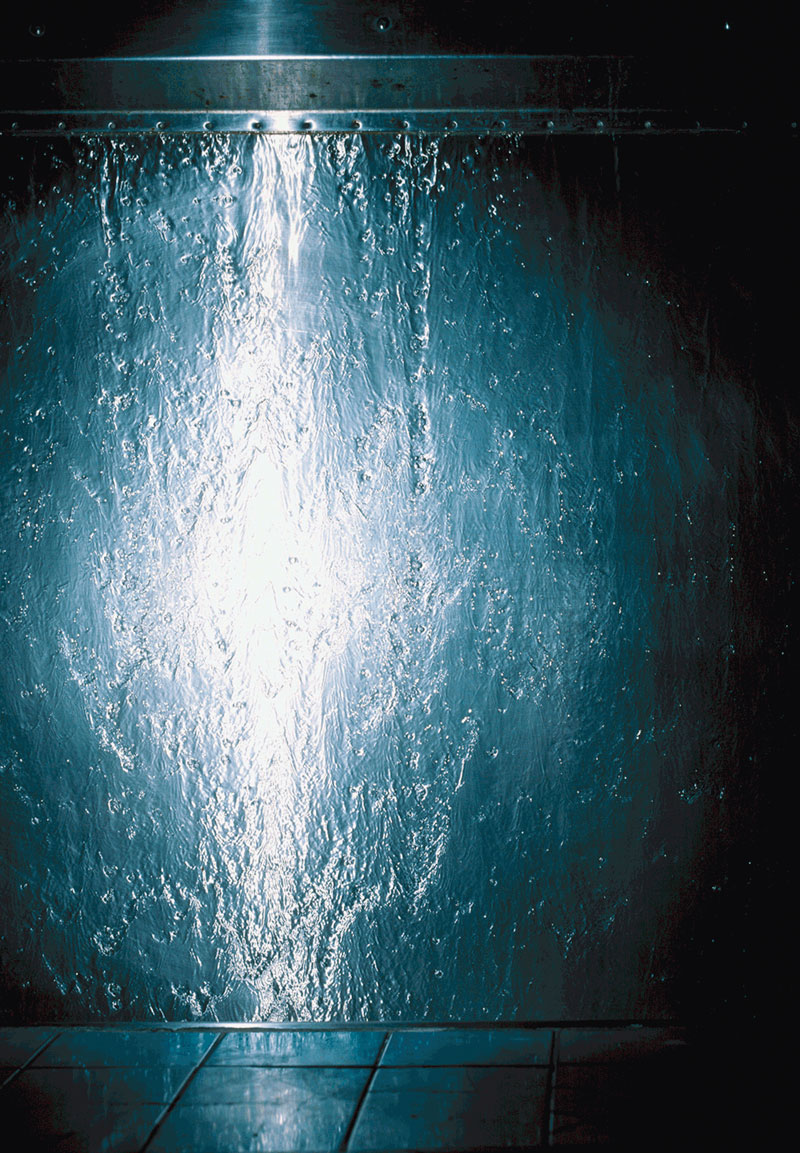
    Arts Project Australia website

    LIKE ART BLART ON FACEBOOK

    Back to top

    Exhibition: ‘The Navigators’ at Karen Woodbury Gallery, Melbourne

    Exhibition dates: 5th May – 29th May 2010

    Artists: Lionel Bawden, Penny Byrne, Nicholas Folland, Locust Jones, Rhys Lee, Rob McHaffie, Derek O’Connor, Alex Spremberg, Madonna Staunton


    Lionel Bawden (Sydney, b. 1974) 'formless worlds move through me' 2010 from the exhibition 'The Navigators' at Karen Woodbury Gallery, Melbourne, May 2010
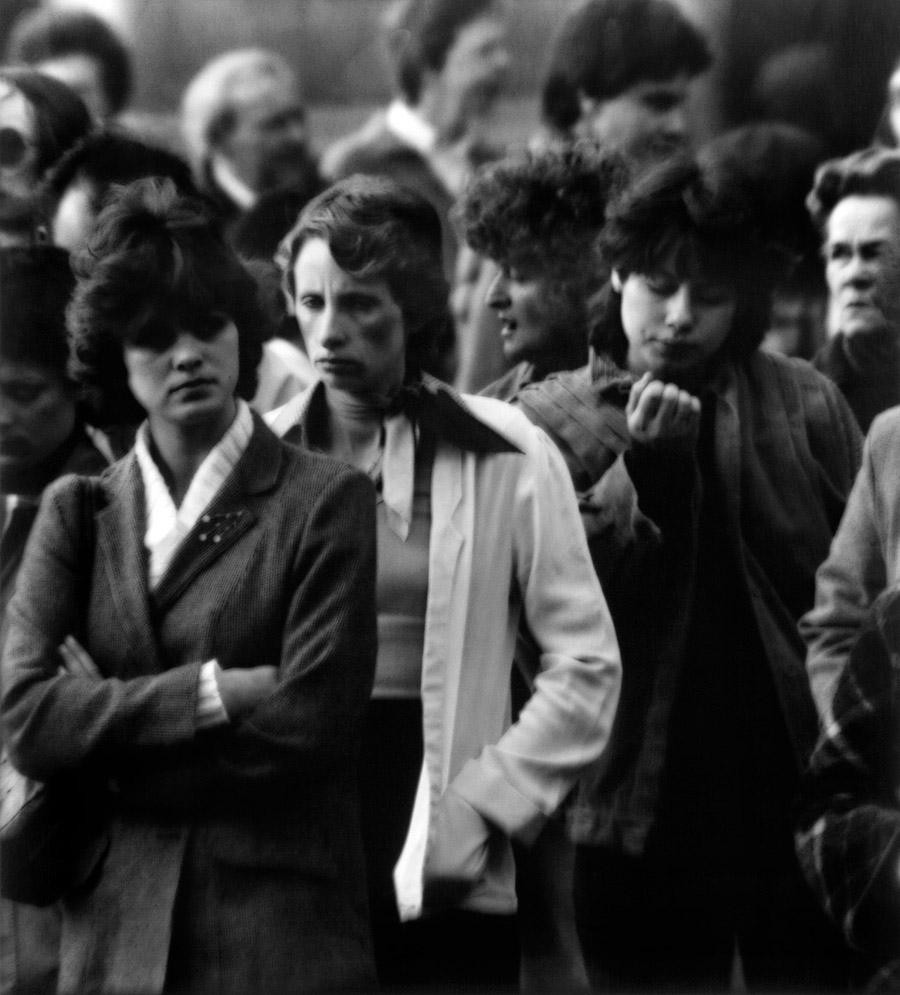
     

    Lionel Bawden (Australian, b. 1974)
    formless worlds move through me
    2010
    Coloured Staedtler pencils, epoxy, incralac
    51.0 x 51.0 x 9.5cm
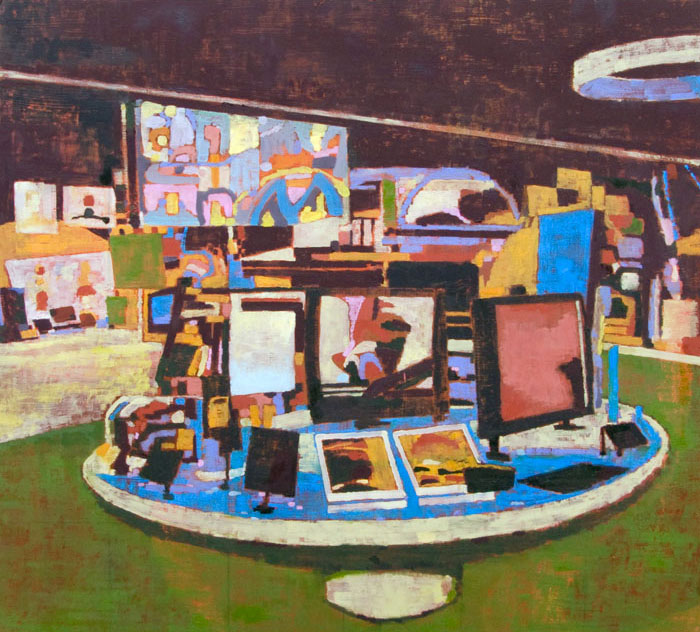


    Some good work in this exhibition – especially the Staedtler hexagonal coloured pencil constructions by Lionel Bawden. Beautifully crafted by hand they remind me of ghosts, the ‘millefiori’ (thousand flowers) of Italian glass and the inside of caverns with their stalactites.

    Dr Marcus Bunyan


    Many thankx to the Karen Woodbury Gallery for allowing me to publish the photographs in the posting. Please click on the photographs for a larger version of the image.


    Alex Spremberg (Australian, born Germany 1950) 'Inside skins' 2002 from the exhibition 'The Navigators' at Karen Woodbury Gallery, Melbourne, May 2010


    Alex Spremberg (Australian born Germany, b. 1950)
    Inside skins
    2002


    These artists have been selected for their interest in ideas of assemblage and re-use of pre-existing materials. Working across a range of media, each artist in the exhibition employs a process of manipulation to create completely different concepts and forms with their finished works. These works comprise of found objects and assembled from disparate elements, scavenged or foraged by the artists and juxtaposed in inventive ways. All works included in The Navigators take on their own form and imbue a new meaning to the original source materials.

    Not originally intended as art materials, yet these artists have seen potential for a new idea in the materials; creating a new thought for the object. The original useful element of the preformed material thus comes under more aesthetic and creative significance. The impetus for such artistic practice is located in a desire by these artists to re-use, re-model, reshape and recycle within their practices. Despite an obvious interest and emphasis in the materiality of the works, the conceptual underpinning are the key motivation within these varying works and pose questions regarding the value of the objects within society. The artists included in The Navigators are continuously surveying and navigating their practice, allowing for deeper exploration in their work.

    The exhibition will include various two and three-dimensional objects that interact with each other in unique ways. In the example of Lionel Bawden’s sculptures, his work exploits hexagonal coloured pencils as a sculptural material, reconfiguring and carving into amorphous shapes. Here the rich qualities of colour are explored as pencils are carved, shaped and fused together. Bawden explores themes of flux, transformation, rhythm and repetition as preconditions to our experience of the physical world. Bawden’s wall mounted works ‘the caverns of temporal suspension’ explore shapes within and outside the work as they hover ominously, melting, conjoined, growing, in transformation. These works are at the forefront of his current practice.

    Penny Byrne’s work makes use of vintage porcelain sculptures that are adorned with a range of materials. Through this process, Byrne makes the base sculptures appear starkly different to that of the original, taking on new connotations that are often humorous and quirky but also convey political and social issues. In her work Mercury Rising. Hunted, Slaughtered, Eaten vintage porcelain dolphins and new plastic Manga figurines are employed to relate to the annual Japanese slaughter of tens of thousands dolphins as highlighted in the documentary ‘The Cove’. The Japanese eat the dolphins and then suffer mercury poisoning due to the high mercury levels in the dolphins flesh, leading to symptoms of madness.

    Nicholas Folland’s Navigator sculptures are indicative Folland’s continued interest in utilising, modifying and experimenting with various sourced materials. These sculptures comprise of various upturned intricately detailed crystal objects that sit above a wood panelled shelf. These glass object are lit and act as beacons or floating satellite cities. Folland personifies the intrepid creative explorer via his navigation of various found materials.

    Locust Jones’ three-dimensional globes are made from papier mache and pictorially and graphically convey global issues. These works sit on the floor and allow the viewer to orient themselves around the works allowing for a detached, objective perspective on contemporary societal issues. The quickly worked surfaces reflect a stream of consciousness in process. Imagery and themes are taken from various media such as the Internet, photojournalism, film culture and nightly news broadcasts.

    The two sculptures in the exhibition by Rhys Lee imbue associations of debris and deal with found objects such as a money box, a dead bird and a clowns face. These trophy-like pieces are decorated by old, worn and found vintage materials that engage with the everyday. The intimate scale of these works do not account for the potency of symbolism and accumulation of collected ideas. The blistered silver patina and bronze sculptures allude to a dark gothic sentiment that extends beyond the morphing forms. The shapes have been smashed, manipulated and stuck back together again resulting in frozen miniature icons that represent a contemporary zest for defiance.

    Rob McHaffie’s works comprise a pastiche of painted anonymous unrelated objects and shapes that somehow come together to create unlikely compositions and formations. The highly skilled execution of McHaffie’s paintings attracts the viewer, who is then faced with a banality in subject matter, often of depictions of clothing, crumpled paper, plants and disfigured creatures and figures. These perfectly rendered images of everyday objects are unsettling in their clarity and realism, which are then skewed, moulded and displaced in unlikely relationships. There is a sense of a deliberate haphazard nature to McHaffie’s work that draws upon a range of elements brought together to mimic something else. Humour surfaces through this stylistic creative process.

    Derek O’Connor’s re-worked painting collages resemble distorted and fragmented realities and stories via the manipulation and playful technique of alteration and re-use of book covers and record album and EP covers. O’Connor’s characteristic gestural sweeping luscious brushstrokes are employed with precision yet allow for organic spontaneity. The old material takes on new meaning and are given new life via O’Connor’s creations.

    Alex Spremberg’s work Inside Skins highlights the artist’s accidental processes at work. This sculptural piece was made as an ancillary to his broader practice – working with acrylic, enamel and varnish on board and canvas. These objects where literally created via chance – an after thought that was noticed to be a finished piece in its own right. Left to dry within their containers these ‘skins’ were extracted and proved to provide aesthetic attraction and conceptual ideas of the ready-made.

    The mainstay of Madonna Staunton’s practice surrounds the physicality of assemblage. Essentially she is a collage artist. The components of her two- and three-dimensional assemblages are usually drawn from old, faded and battered discards such as frames and chairs that are carefully put together in new ways and given another life. A play between precision and randomness animates her work. Her sensitivity to tonal and formal arrangement always remains acute during this process and the results are austerely and chaotically beautiful.

    Press release from the Karen Woodbury Gallery website [Online] Cited 20/05/2010 no longer available online


    Nicholas Folland (Australian, b. 1967) 'Navigators 1' 2008 from the exhibition 'The Navigators' at Karen Woodbury Gallery, Melbourne, May 2010


    Nicholas Folland (Australian, b. 1967)
    Navigators 1
    2008
    Glassware, table and lightbox
    25.0 x 110.0 x 87.0cm


    Nicholas Folland (Australian, b. 1967) 'Navigators 2' 2008


    Nicholas Folland (Australian, b. 1967)
    Navigators 2
    2008
    Glassware, table and lightbox
    25.0 x 110.0 x 87.0cm


    Karen Woodbury Gallery

    This gallery has now closed.

    LIKE ART BLART ON FACEBOOK

    Back to top

    Four exhibitions in Albert Street, Richmond: Pamela Rataj at Anita Traverso Gallery, Claudia Damichi at Sophie Gannon Gallery, Steve Randall at John Buckley Gallery and Robert Boynes at Karen Woodbury Gallery

    April 2010


    Four interesting exhibitions in Albert Street, Richmond – from the beautiful, formed leather sculptures of Pamela Rataj to the wonderfully vibrant tropical bird, chair and decorative pattern paintings of Claudia Damichi; from the intensely observed canvas environments of Steve Randall to the post-photographic silk-screen textualisations of Robert Boynes. Well worth a visit on a Saturday afternoon!

    As always, many thankx to the galleries for allowing me to publish the images in this posting. Please click on the images for a larger version.

    ~ Pamela Rataj. The Morphology of Forgetting at Anita Traverso Gallery. 7th April – 1st May 2010

    ~ Claudia Damichi. The Bitter Sweet at Sophie Gannon Gallery. 30th March – 25th April 2010

    ~ Steve Rendall. Security, Storage and Recreation at John Buckley Gallery. 8th April – 1st May 2010

    ~ Robert Boynes. Postscript at Karen Woodbury Gallery. 7th April – 1st May 2010


    Pamela Rataj. The Morphology of Forgetting at Anita Traverso Gallery

    7th April – 1st May 2010


    Pamela Rataj. 'Tangent Bundle' 2009


    Pamela Rataj (Australian)
    Tangent Bundle
    2009


    Pamela Rataj. 'Ravel' 2009


    Pamela Rataj (Australian)
    Ravel
    2009


    Pamela Rataj. 'Kairos' 2009


    Pamela Rataj (Australian)
    Kairos
    2009


    How to draw a boundary between self and other, past time and today?

    Patterns and forms in nature often resemble one another, connecting life forms in unexpected ways. Tide lines left in the sand resemble the grains found in a piece of wood, and the veins in a leaf or those in a hand.

    The age lines in the trunk of a tree form as each outer layer covers the one preceding it and echoes its shape. This makes me think of the way past experience resurfaces as memory, receding or becoming more important at different times in our lives, as each new experience envelopes our previous states of being and yet is shaped by them.

    The wrapped and layered forms in The Morphology of Forgetting explore coexistence and connection.

    I dedicate this exhibition to my parents, whose recent deaths have helped me appreciate memory as a way to connect through time.

    Pamela Rataj 2010

    Press release from the Anita Traverso Gallery website [Online] Cited 10/04/2010. No longer available online


    Pamela Rataj (Australian) 'Faisceaux 1' 2009


    Pamela Rataj (Australian)
    Faisceaux 1
    2009


    Pamela Rataj. 'Faisceaux 4' 2009


    Pamela Rataj (Australian)
    Faisceaux 4
    2009


    Claudia Damichi. The Bitter Sweet at Sophie Gannon Gallery

    30th March – 25th April 2010


    Claudia Damichi (Australian, b. 1972) 'Birds eye' 2010


    Claudia Damichi (Australian, b. 1972)
    Birds eye
    2010
    Acrylic on canvas
    46 x 41cm


    Claudia Damichi (Australian, b. 1972) 'Star Gazer' 2009


    Claudia Damichi (Australian, b. 1972)
    Star Gazer
    2009
    Acrylic on canvas
    46 x 41cm


    Claudia Damichi (Australian, b. 1972) 'Gridlock' 2010


    Claudia Damichi (Australian, b. 1972)
    Gridlock
    2010
    Acrylic on canvas
    41 x 46cm


    Claudia Damichi (Australian, b. 1972) 'Reading between the lines' 2010


    Claudia Damichi (Australian, b. 1972)
    Reading between the lines
    2010
    Acrylic on canvas
    46 x 41cm


    Claudia Damichi’s surrealist still life paintings are characterised by vivid colours, elaborate patterns and distorted spatial proportions. In her paintings of domestic interiors, flowers, birds and furniture, colour is inflated and scale is playfully manipulated – solitary domestic interiors are reconfigured into places of fantasy and illusion. Inspired by the enduring aesthetic of modern industrial design, her surreal and theatrically staged scenarios self-consciously conjure a sense of the absurd. Graphic patterning, high-croma colour and whimsical compositions foster worlds that are at once playful and claustrophobic, satirical and real, tapping into an ambiguous nostalgia that leaves the viewer feeling that anything is possible.

    Visit the Sophie Gannon website


    Claudia Damichi (Australian, b. 1972) 'Look out' 2010


    Claudia Damichi (Australian, b. 1972)
    Look out
    2010
    Acrylic on canvas
    46 x 56cm


    Steve Rendall. Security, Storage and Recreation at John Buckley Gallery

    8th April – 1st May 2010


    Steven Rendall (Australian born Britain, b. 1969; Australia from 2000) 'Archive 1' 2010


    Steven Rendall (Australian born Britain, b. 1969; Australia from 2000)
    Archive 1
    2010
    Oil on linen


    Steven Rendall (Australian born Britain, b. 1969; Australia from 2000) 'Archive 2' 2010


    Steven Rendall (Australian born Britain, b. 1969; Australia from 2000)
    Archive 2
    2010
    Oil on linen


    Citing the British artist Walter Sickert as an important influence on his painterly style, Rendall’s work displays a form and content that has attracted the attention of both critics and collectors. A key work in the exhibition is a large-scale painting on un-stretched linen titled Fountain (Rosemary’s Baby) that sprawls across 4.5m. Certain fountains, along with other apparently arbitrary images of television monitors, speedboats, clothing racks, shelving units and museum interiors are recurring motifs in Rendall’s paintings.

    Rendall aims to ‘collect and synthesise’ images from around his home and en route to and from his Brunswick studio. Passing observations of window displays, charity shops and various light industrial warehouses are registered and recorded in conjunction with the accumulation of promotional flyers spruiking leisure activities and museum experiences. This shambolic collection of images is transcribed into an array of compositions in Rendall’s paintings. Images occasionally materialise in unlikely places, such as the spectral diver’s head that is resting on a warehouse shelf in the appropriately titled Storage.

    In the exhibition Security, Storage and Recreation, you are invited to enter the image bank of Steven Rendall; a ‘wake in fright’ experience where one can become immersed and caught up in the maelstrom of the artist’s visual language – a sequence of painterly dreams each similar yet different to the last.”

    Press release from the John Buckley Gallery website [Online] Cited 10/04/2010 no longer available online


    Steven Rendall (Australian born Britain, b. 1969; Australia from 2000) 'Flat Screens (Green)' 2010


    Steven Rendall (Australian born Britain, b. 1969; Australia from 2000)
    Flat Screens (Green)
    2010
    Oil on linen


    Steven Rendall (Australian born Britain, b. 1969; Australia from 2000) 'Pipes' 2010


    Steven Rendall (Australian born Britain, b. 1969; Australia from 2000)
    Pipes
    2010
    Oil on linen


    Steven Rendall (Australian born Britain, b. 1969; Australia from 2000) 'Claustrophobia' 2010


    Steven Rendall (Australian born Britain, b. 1969; Australia from 2000)
    Claustrophobia
    2010
    Oil on linen


    Steven Rendall (Australian born Britain, b. 1969; Australia from 2000) 'Redacted 2' 2010


    Steven Rendall (Australian born Britain, b. 1969; Australia from 2000)
    Redacted 2
    2010
    Oil on linen


    Robert Boynes. Postscript at Karen Woodbury Gallery

    7th April – 1st May 2010


    Robert Boynes (Australian, b. 1942) 'Street Runner' 2010


    Robert Boynes (Australian, b. 1942)
    Street Runner
    2010
    Acrylic on canvas and velvet
    120 x 242cm


    Robert Boynes (Australian, b. 1942) 'Days that we forgot' 2010


    Robert Boynes (Australian, b. 1942)
    Days that we forgot
    2010
    Acrylic on canvas


    Robert Boynes (Australian, b. 1942) 'Signal Driver' 2010


    Robert Boynes (Australian, b. 1942)
    Signal Driver
    2010
    Acrylic on canvas and velvet
    120 x 190cm


    Postscript is Robert Boynes’ second solo exhibition with Karen Woodbury Gallery. This series continues with his exploration of urban themes, contemporary experience and experimentation into ways of using paint. In this most recent body of work Robert has employed the use of text in juxtaposition to various materials such as wood and velvet. The text conveys a feeling of noise and urban clatter, acting as a context and environment for the figures within the work.

    His technique involves transferring photographic images to large silk screens and dragging paint through the mesh onto canvas. Robert thus has control in the manipulation of colour, density and translucency of the images. This process results in still moments that magnify and investigate everyday observable reality. The anonymous figures are juxtaposed with text and layering of saturated, contrasting colours, appearing objectified and ghostly.

    These works embody a filmic quality, the multi-panelled paintings signify fragmented narratives and enquire into perceptions of time and space.

    Text from the Karen Woodbury Gallery website [Online] Cited 10/04/2010 no longer available online


    Robert Boynes (Australian, b. 1942) 'Body Type' 2 2010


    Robert Boynes (Australian, b. 1942)
    Body Type 2
    2010
    Acrylic on canvas


    Robert Boynes (Australian, b. 1942) 'Body Type 3' 2010


    Robert Boynes (Australian, b. 1942)
    Body Type 3
    2010
    Acrylic on canvas


    Robert Boynes (Australian, b. 1942) 'Things we leave behind' 2009


    Robert Boynes (Australian, b. 1942)
    Things we leave behind
    2009
    Acrylic on canvas
    120 x 180cm


    Robert Boynes (Australian, b. 1942) 'The layered moment' 2009


    Robert Boynes (Australian, b. 1942)
    The layered moment
    2009
    Acrylic on canvas


    Robert Boynes (Australian, b. 1942) 'Postscript' 2009


    Robert Boynes (Australian, b. 1942)
    Postscript
    2009
    Acrylic on canvas
    120 x 124cm


    All galleries have closed except for Sophie Gannon Gallery, Richmond.

    Sophie Gannon Gallery
    2 Albert Street Richmond VIC 3121 Australia
    Phone: +61 3 9421 0857

    Sophie Gannon Gallery website

    LIKE ART BLART ON FACEBOOK

    Back to top