Exhibition: ‘Oscar Rejlander: Artist Photographer’ at the J. Paul Getty Museum, Getty Center, Los Angeles

Exhibition dates: 12th March – 9th June, 2019

Curators: Lori Pauli, curator of photographs at the National Gallery of Canada, and Karen Hellman, assistant curator of photographs at the J. Paul Getty Museum


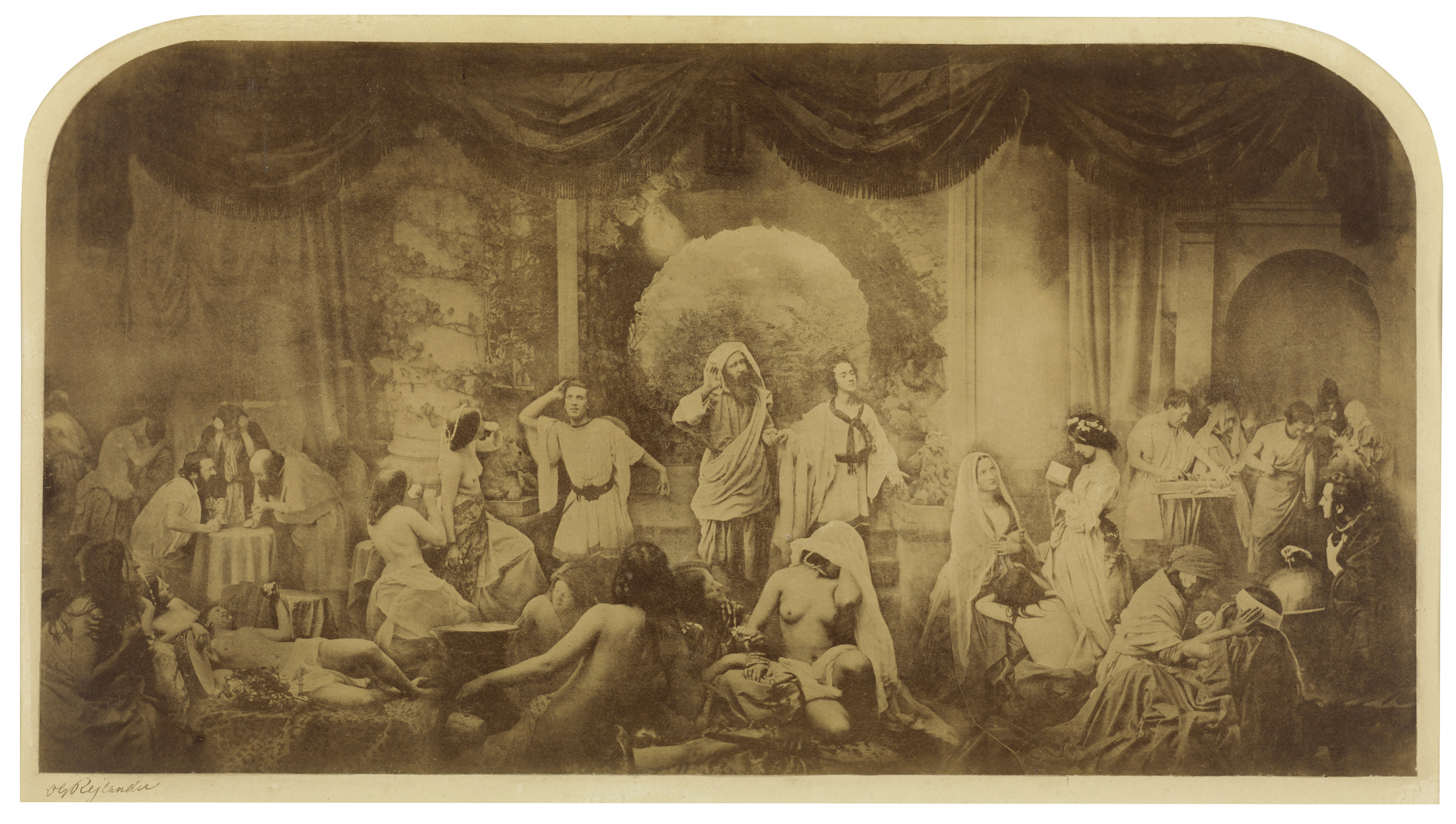
Oscar G. Rejlander (British born Sweden, 1813-1875) 'The Two Ways of Life' 1856-1857 from the exhibition 'Oscar Rejlander: Artist Photographer' at the J. Paul Getty Museum, Getty Center, Los Angeles, March - June, 2019


Oscar G. Rejlander (British born Sweden, 1813-1875)
Two Ways of Life (Hope in Repentance)
1857
Albumen silver print
21.8 x 40.8cm (8 9/16 x 16 1/16 in.)
Moderna Museet, Stockholm


Oscar Rejlander, the father of photography, sets in motion many of the later developments of photographic art.

I could wax lyrical about the light, staging and humour of the images; the allegorical, religious and emotional portraits; the influence of photography on painting; the spontaneous act caught on film (Eh!); the combination printing, precursor to digital manipulation (Two Ways of Life); the costume dramas (The Comb Seller); or the presaging of the work of August Sander (The Juggler). But I won’t.

Instead, I just want you to think about the period in which these photographs were made – that Dickensian era of archetypal humanity, intricate narrative. I want you to feel that these reality pictures are alive and how they transcend the time of their creation through the lyricism of the print.

From the mind of the artist to works of art that stare down that cosmic time shift, from cradle to grave.

Marcus


Many thanks to the J. Paul Getty Museum for allowing me to publish the photographs in the posting. Please click on the photographs for a larger version of the image.


“It is the mind of the artist, and not the nature of his materials which makes his production a work of art.”


Oscar G. Rejlander


Oscar Gustav Rejlander is best known for his work “Two Ways of Life,” a masterpiece for which he used over 32 different negatives. It took him around six weeks to create it and over 3 days to produce a final print.


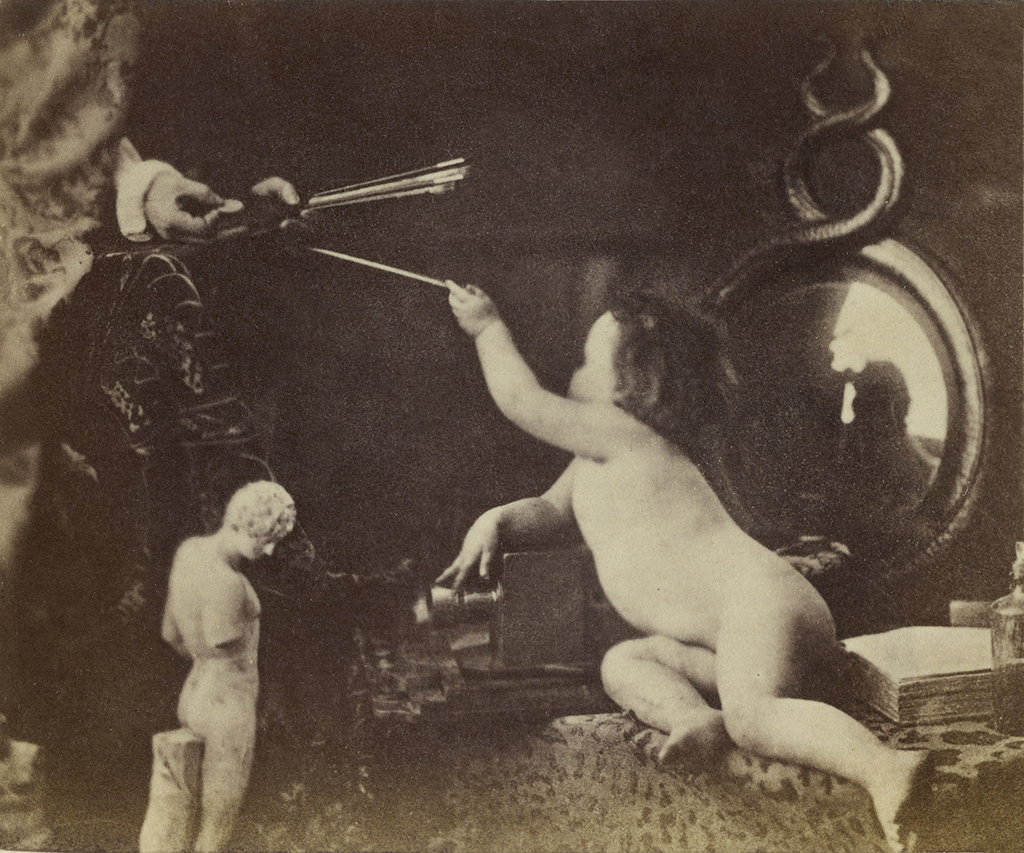
Oscar G. Rejlander (British born Sweden, 1813-1875) 'The Infant Photography Giving the Painter an Additional Brush' c. 1856 from the exhibition 'Oscar Rejlander: Artist Photographer' at the J. Paul Getty Museum, Getty Center, Los Angeles, March - June, 2019


Oscar G. Rejlander (British born Sweden, 1813-1875)
The Infant Photography Giving the Painter an Additional Brush
c. 1856
Albumen silver print
6 × 7.1cm (2 3/8 × 2 13/16 in.)
Courtesy The J. Paul Getty Museum, Los Angeles


After emigrating from Sweden to England in 1839 and taking up photography in 1852, he became one of the first to recognise photography’s potential as a “handmaid of art” – exemplified by early photographs like “The Infant Photography Giving the Painter an Additional Brush.” This tiny print served to demonstrate how photography could preserve an allegorical scene for a painter’s extended study. It also functioned as a self-portrait and hinted at Rejlander’s hidden ambitions: reflected in the convex mirror, he presents himself as a modern-day Jan van Eyck.

Extract from Dana Ostrander. “The Overlooked Legacy of Oscar Rejlander, Who Elevated Photography to an Art,” on the Hyperallergic website April 2, 2019 [Online] Cited 06/06/2019


Oscar G. Rejlander (British born Sweden, 1813-1875) 'Non Angeli sed Angli (Not Angels but Anglos), after Raphael’s Sistine Madonna' c. 1854-1856


Oscar G. Rejlander (British born Sweden, 1813-1875)
Non Angeli sed Angli (Not Angels but Anglos), after Raphael’s Sistine Madonna
c. 1854-1856
Albumen silver print
20.5 x 26.3cm (8 1/16 x 10 3/8 in.)
Princeton University Art Museum
Museum purchase, David H. McAlpin, Class of 1920, Fund


Oscar G. Rejlander (British born Sweden, 1813-1875) 'Mary Constable and Her Brother' 1866


Oscar G. Rejlander (British born Sweden, 1813-1875)
Mary Constable and Her Brother
1866
Albumen silver print
16.8 x 22.1cm (6 5/8 x 8 11/16 in.)
The Metropolitan Museum of Art, Gilman Collection
Purchase, Harriette and Noel Levine Gift, 2005


Oscar G. Rejlander (British born Sweden, 1813-1875) 'The Bachelor's Dream' c. 1860


Oscar G. Rejlander (British born Sweden, 1813-1875)
The Bachelor’s Dream
c. 1860
Albumen silver print
13.9 x 19.6cm (5 1/2 x 7 11/16 in.)
George Eastman Museum, purchase
Photo: Courtesy of the George Eastman Museum


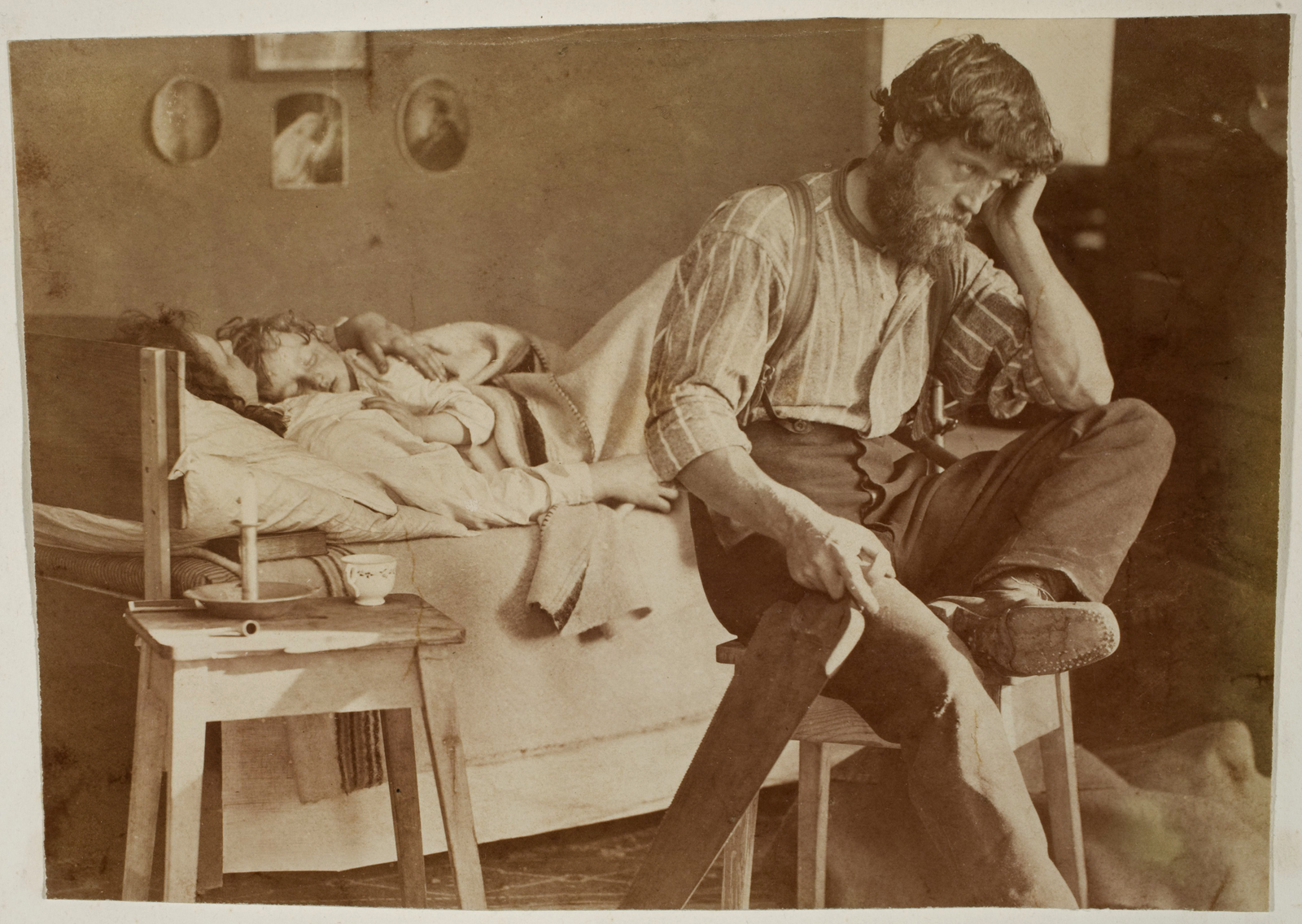
Oscar G. Rejlander (British born Sweden, 1813-1875) 'Hard Times (The Out of Work Workman's Lament)' 1860


Oscar G. Rejlander (British born Sweden, 1813-1875)
Hard Times (The Out of Work Workman’s Lament)
1860
Albumen silver print
13.8 x 19.7cm (5 7/16 x 7 3/4 in.)
George Eastman Museum, purchase
Photo: Courtesy of the George Eastman Museum


Oscar G. Rejlander (British born Sweden, 1813-1875) 'Head of St. John the Baptist in a Charger' c. 1860


Oscar G. Rejlander (British born Sweden, 1813-1875)
Head of St. John the Baptist in a Charger
c. 1860
Albumen silver print
14.1 x 17.8cm (5 9/16 x 7 in.)
George Eastman Museum, purchase
Photo: Courtesy of the George Eastman Museum


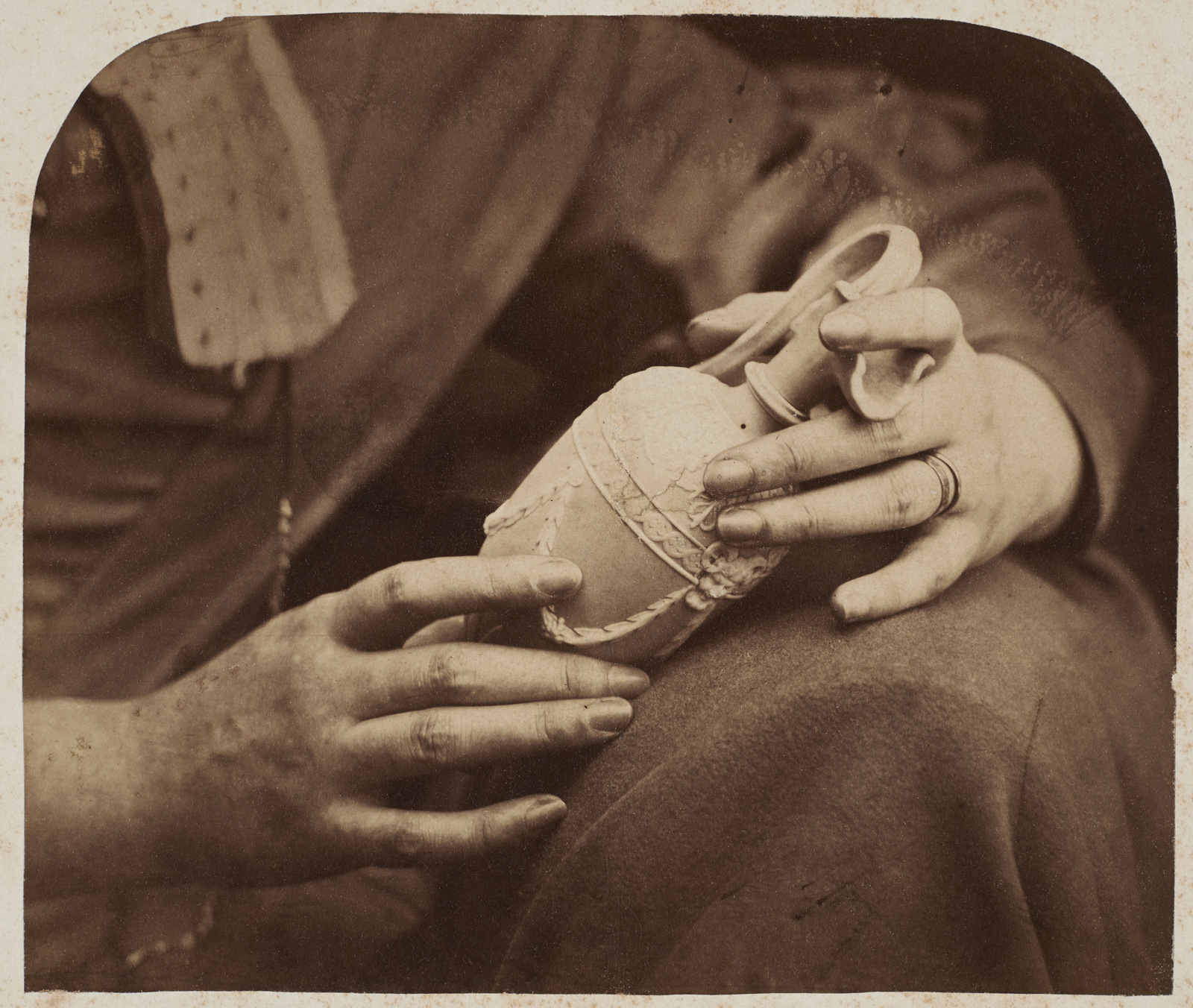
Oscar G. Rejlander (British born Sweden, 1813-1875) 'Study of Hands' 1856


Oscar G. Rejlander (British born Sweden, 1813-1875)
Study of Hands
1856
Albumen silver print
14.8 x 17.6cm (5 13/16 x 6 15/16 in.)
National Gallery of Canada, Ottawa
Purchased 2014


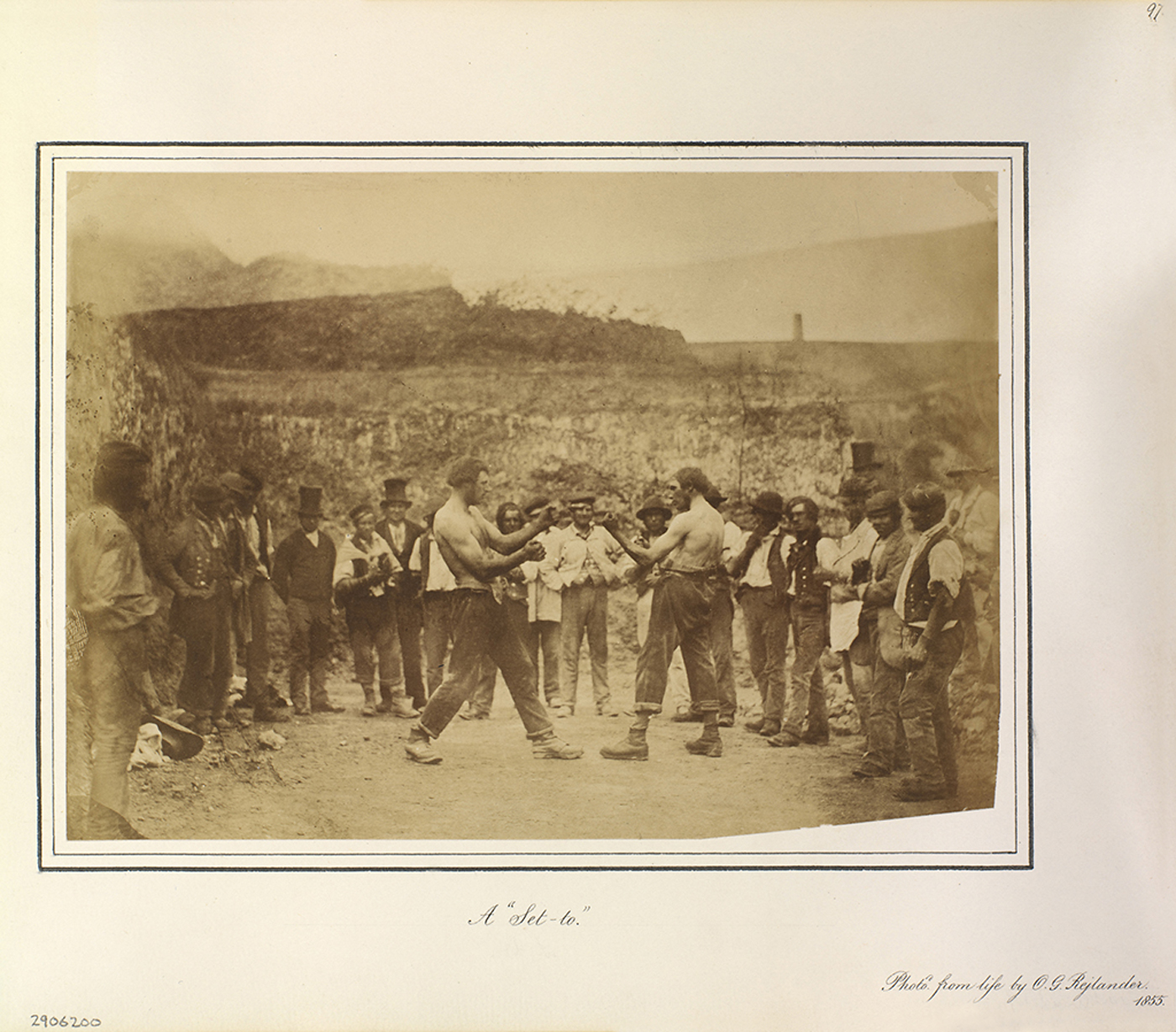
Oscar G. Rejlander (British born Sweden, 1813-1875) 'A "Set To"' 1855


Oscar G. Rejlander (British born Sweden, 1813-1875)
A “Set To”
1855
In “Prince Albert’s Calotype Album,” vol. 2, about 1860
Salted paper print
15 x 21cm (5 7/8 x 8 1/4 in.)
Royal Collection Trust
© Her Majesty Queen Elizabeth II 2019


Oscar G. Rejlander (British, born Sweden, 1813-1875) was one of the 19th century’s greatest innovators in the medium of photography, counting Queen Victoria, Prince Albert, Charles Darwin, Lewis Carroll and Julia Margaret Cameron among his devotees. Nevertheless, the extent of Rejlander’s work and career has often been overlooked. Oscar Rejlander: Artist Photographer, on view March 12 – June 9, 2019 at the J. Paul Getty Museum, Getty Center, Los Angeles, is the first exhibition to explore the prolific career of the artist who became known as “the father of art photography,” and whose bold experimentation with photographic techniques early in the medium’s development and keen understanding of human emotion were ahead of their time.

The exhibition features 150 photographs that demonstrate Rejlander’s remarkable range, from landscapes and portraits to allegories and witty commentaries on contemporary society, alongside a selection of his early paintings, drawings, and prints.

“Rejlander tells us in his writings that ‘It is the mind of the artist, and not the nature of his materials, which makes his production a work of art’,” says Timothy Potts, director of the J. Paul Getty Museum. “While technologies have dramatically changed, some of the fundamental issues that Rejlander grappled with in his photographs still resonate with photographic practice today. His photographs, though made a century and a half ago, are both meticulously of their time and timeless, foreshadowing many later achievements of the medium through to the digital age.”

Oscar G. Rejlander was born in Sweden and moved to England in 1839, working first as a painter before turning to photography in 1852. He made a living as a portrait photographer while experimenting with photographic techniques, most notably combination printing, in which parts of multiple negatives were exposed separately and then printed to form a single picture. Rejlander moved to London in 1862, where his business continued to grow and where his wife, Mary Bull, worked alongside him in his photography studios.

Portraits and Images of Everyday Life

Portraiture, particularly of members of the higher ranks of London society, was Rejlander’s main professional activity and supported his livelihood. Art critics and clients alike admired his skill with lighting as well as the natural and seemingly spontaneous expressions he was able to capture. Rejlander photographed some of the most important figures of the day, including the English scientist Charles Darwin, known for his theory of evolution, and poets Alfred Lord Tennyson and Henry Taylor. He also guided the first photographic efforts of the writer and mathematician Charles Lutwidge Dodgson (known as Lewis Carroll), the creator of Alice’s Adventures in Wonderland, as well as photographer Julia Margaret Cameron.

From the beginning of his career as a photographer, Rejlander was keenly interested in depicting the activities of ordinary people, particularly the middle and lower classes of society. It was through his staged domestic images that he illustrated familial relationships with tenderness and humour, often using models and props to re-create in his studio the scenes he had witnessed in the streets, from young boys who swept up dirt and debris in exchange for tips, to street vendors such as “flower girls” who offered bouquets for sale to passersby. Like a modern street photographer, Rejlander chose his compositions and subjects based on what he saw and heard, realising the final images in the studio.

In 1863 Rejlander constructed a unique iron, wood, and glass “tunnel studio,” where the sitter, positioned in the open, light-filled part of the studio, would look into the darker part of the room where the camera and operator were situated, nearly invisible. The pupils of the sitters’ eyes expanded, allowing for “more depth and expression,” as a writer observed in Photographic News. In addition to this technique, Rejlander often exploited his own unique ability to enact exaggerated emotions to assist his subjects. Charles Darwin illustrated many of Rejlander’s expressive photographs in The Expression of the Emotions in Man and Animals, published in 1872.

Combination Printing and Two Ways of Life

Rejlander holds an important place in the history of photography primarily because of the groundbreaking way he applied the technique of combination printing. On view in the exhibition is the most ambitious example of the artist’s pioneering experimentation, the epic photograph, Two Ways of Life, or Hope in Repentance (1857). It attracted immediate attention upon its exhibition both for its large size and the ambition of its production, which included the combination printing of over 30 separate wet collodion on glass negatives, a process that took more than three days.

The work represents an intricate allegory of two opposing philosophies of life: Vice and Virtue. In the centre of the picture, a wise man guides a younger man to the right, toward a life of virtue – work, study, and religion. To the left, a second young man is tempted by the call of desire, gambling, idleness, and vice. Prince Albert may have worked with Rejlander on the overall conception of the picture, and he and Queen Victoria purchased three versions for their art collection.

Despite this support from the Royal Family, Two Ways of Life divided the photographic community, with professional photographers considering it a technical tour de force, and amateurs seeing it as not only artificial in production but also immoral in its subject. However, it remains one of finest examples of combination printing to come from this period.

Art and Photography

Today, the debate about photography’s status as an art may be obsolete, but the arts community in 19th-century Britain was passionately divided over Rejlander’s chosen medium. Rejlander strongly advocated the view that photography was an independent art, while he was also convinced that a photograph could help artists by providing an effective substitute for working from live models. He was possibly the first to provide artists with visual references for their work in photographs, creating figure studies in a range of poses and costumes, including close-ups of hands, feet, drapery, and even fleeting facial expressions. Although many painters were reluctant to disclose their reliance on photography, several collected Rejlander’s photographs, including George Frederic Watts (English, 1817-1904) and Henri Fantin-Latour (French, 1836-1904).

Paintings also strongly influenced Rejlander’s choice of subjects, leading him not only to imitate the styles of artists but also to re-create the figures found in their compositions. He frequently photographed actors or models posing as a “Madonna,” a “Devotee,” a “Disciple,” or specific Christian figures such as John the Baptist. He may have intended these studies, as well as others showing figures in classical robes, for artists to consult as well.

“What we hope comes through in the exhibition is Rejlander’s humanity and humour, as well as his humble nature, particularly evident in the fact that he often sent his work to exhibitions under the name ‘amateur’,” says Karen Hellman, assistant curator of photographs at the Getty Museum. “His explanation: ‘When I compare what I have done with what I think I ought to do, and some day hope I shall do, I think of myself as only an amateur, after all – that is to say, a beginner’.”

Oscar Rejlander: Artist Photographer, is on view March 12 – June 9, 2019 at J. Paul Getty Museum, Getty Center. The exhibition is curated by Lori Pauli, curator of photographs at the National Gallery of Canada, and Karen Hellman, assistant curator of photographs at the J. Paul Getty Museum.

Press release from the J. Paul Getty Museum


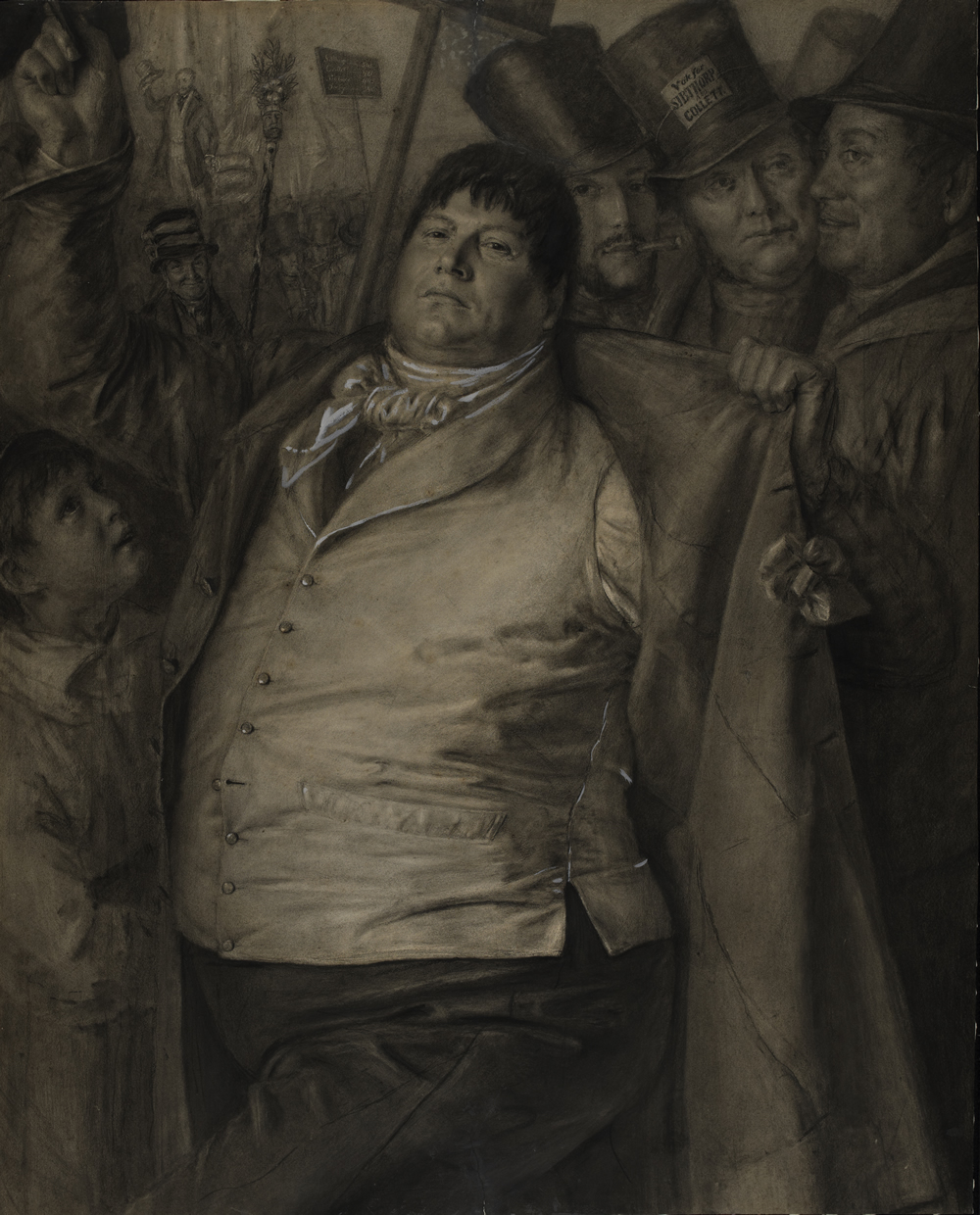
Oscar G. Rejlander (British born Sweden, 1813-1875) 'Mr. Collett's Return' 1841


Oscar G. Rejlander (British born Sweden, 1813-1875)
Mr. Collett’s Return
1841
Black chalk, charcoal and white wash highlights on paper (backed)
92.8 × 74.4cm
The Collection: Art and Archaeology in Lincolnshire (Usher Gallery, Lincoln)


Attributed to Oscar G. Rejlander (British born Sweden, 1813-1875) '[Landscape]' c. 1855


Attributed to Oscar G. Rejlander (British born Sweden, 1813-1875)
[Landscape]
c. 1855
Salted paper print
22.3 × 19.7cm
National Gallery of Canada, Ottawa
Purchased 2014


Oscar G. Rejlander (British born Sweden, 1813-1875) 'The Sailor Boy' 1855, printed 1873


Oscar G. Rejlander (British born Sweden, 1813-1875)
The Sailor Boy
1855, printed 1873
Carbon print
19 x 16cm (7 1/2 x 6 5/16 in.)
Royal Collection Trust
© Her Majesty Queen Elizabeth II 2019


Oscar G. Rejlander (British born Sweden, 1813-1875) 'Ariadne' 1857


Oscar G. Rejlander (British born Sweden, 1813-1875)
Ariadne
1857
Albumen print from a wet collodion negative
Paul Mellon Fund
Courtesy National Gallery of Art, Washington


“I believe photography will make painters better artists and more careful draughtsmen. You may test their figures by photography. In Titian’s Venus and Adonis, Venus has her head turned in a manner that no female could turn it and at the same time shows so much of her back. Her right leg also is too long. I have proved the correctness of this opinion by photography with variously shaped female models.” ~ Oscar G. Rejlander 1863

“He was perhaps the first to market photographic nude studies to artists, and he even used them to test the anatomical accuracy of the Old Masters. His photograph “Ariadne” was created, in part, to expose the unnatural pose and elongated feminine proportions in Titian’s “Venus and Adonis.” Many of Rejlander’s contemporaries came to rely on these nude studies, and the exhibition contains at least three originally owned by the painter Henri Fantin-Latour.”

Extract from Dana Ostrander. “The Overlooked Legacy of Oscar Rejlander, Who Elevated Photography to an Art,” on the Hyperallergic website April 2, 2019 [Online] Cited 06/06/2019


Oscar G. Rejlander (British born Sweden, 1813-1875) 'Madonna and Child with St. John the Baptist' c. 1860


Oscar G. Rejlander (British born Sweden, 1813-1875)
Madonna and Child with St. John the Baptist
c. 1860
Albumen silver print
17.8 × 12.4cm (7 × 4 7/8 in.)
Courtesy The J. Paul Getty Museum, Los Angeles


Oscar G. Rejlander (British born Sweden, 1813-1875) 'Young Lady in a Costume' c. 1860


Oscar G. Rejlander (British born Sweden, 1813-1875)
Young Lady in a Costume
c. 1860
Albumen silver print
Courtesy National Gallery of Canada, Ottawa


Oscar G. Rejlander (British born Sweden, 1813-1875) 'Eh!' negative about 1854-1855; print about 1865


Oscar G. Rejlander (British born Sweden, 1813-1875)
Eh!
negative about 1854-1855; print about 1865
Albumen silver print
8.9 x 5.9cm (3 1/2 x 2 5/16 in.)
The J. Paul Getty Museum, Los Angeles


Oscar G. Rejlander (British born Sweden, 1813-1875) 'The First Negative' 1857


Oscar G. Rejlander (British born Sweden, 1813-1875)
The First Negative
1857
Albumen silver print
29 x 15cm (11 7/16 x 5 7/8 in.)
Musée d’Orsay, Paris Photo
© RMN-Grand Palais / Art Resource, NY / Patrice Schmidt


In “The First Negative,” Rejlander restages Pliny’s account of the origins of painting, boldly suggesting that the act of tracing a shadow is more akin to creating a photographic negative than a painting.


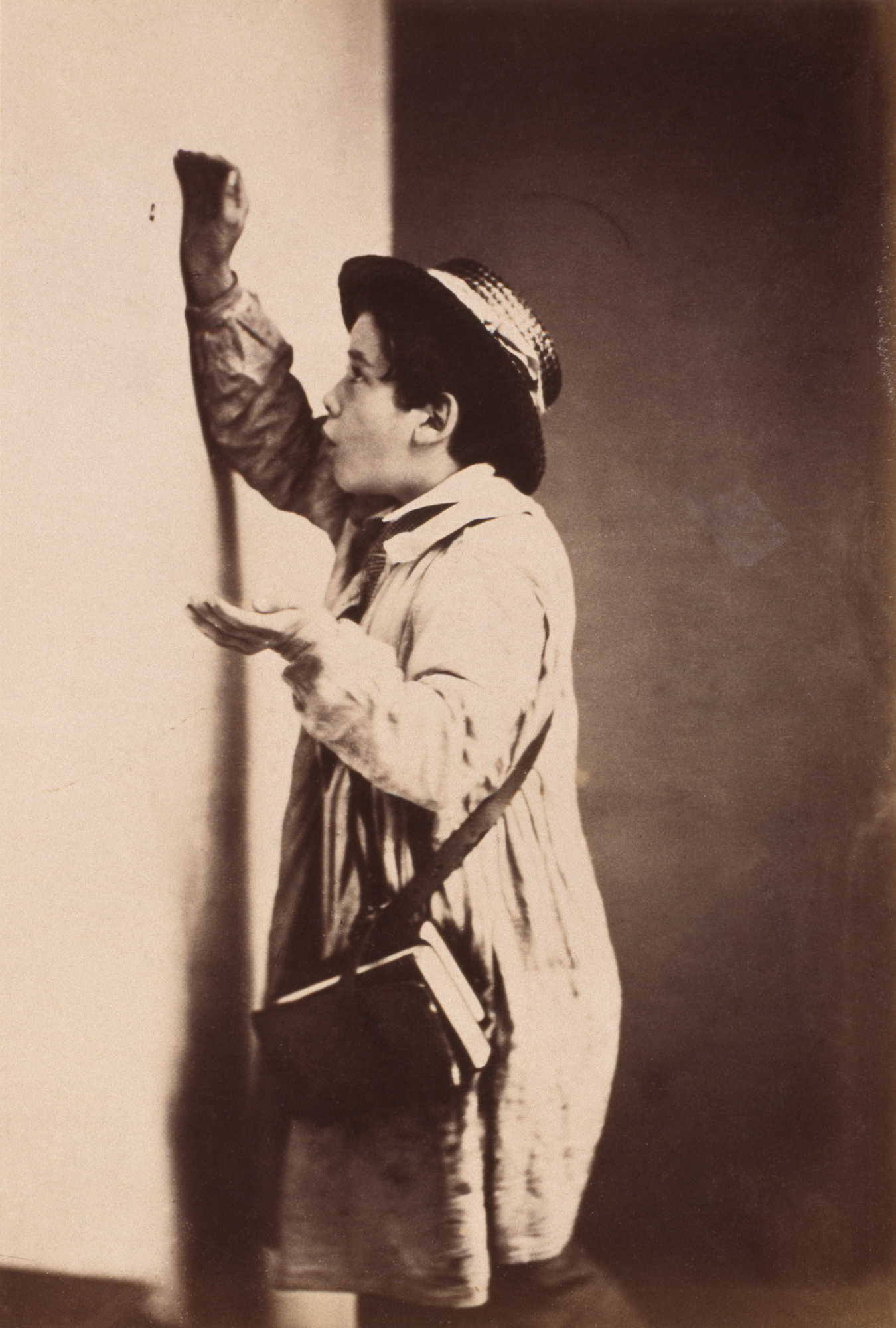
Oscar G. Rejlander (British born Sweden, 1813-1875) 'The Participles, or Grammar for Little Boys: Catching' 1857


Oscar G. Rejlander (British born Sweden, 1813-1875)
The Participles, or Grammar for Little Boys: Catching
1857
Albumen silver print
18.7 x 12.7cm (7 3/8 x 5 in.)
Moderna Museet, Stockholm


Oscar G. Rejlander (British born Sweden, 1813-1875) 'The Participles, or Grammar for Little Boys: Caught' 1857


Oscar G. Rejlander (British born Sweden, 1813-1875)
The Participles, or Grammar for Little Boys: Caught
1857
Albumen silver print
20.3 x 15.7cm (8 x 6 3/16 in.)
The J. Paul Getty Museum, Los Angeles


Oscar G. Rejlander (British born Sweden, 1813-1875) 'Mr. Coleman as Belphegor' c. 1857, printed later


Oscar G. Rejlander (British born Sweden, 1813-1875)
Mr. Coleman as Belphegor
c. 1857, printed later
Platinum print
18.2 x 14.4cm (7 3/16 x 5 11/16 in.)
The Royal Photographic Society Collection at the V&A, acquired with the generous assistance of the Heritage Lottery Fund and Art Fund Image
© Victoria & Albert Museum, London


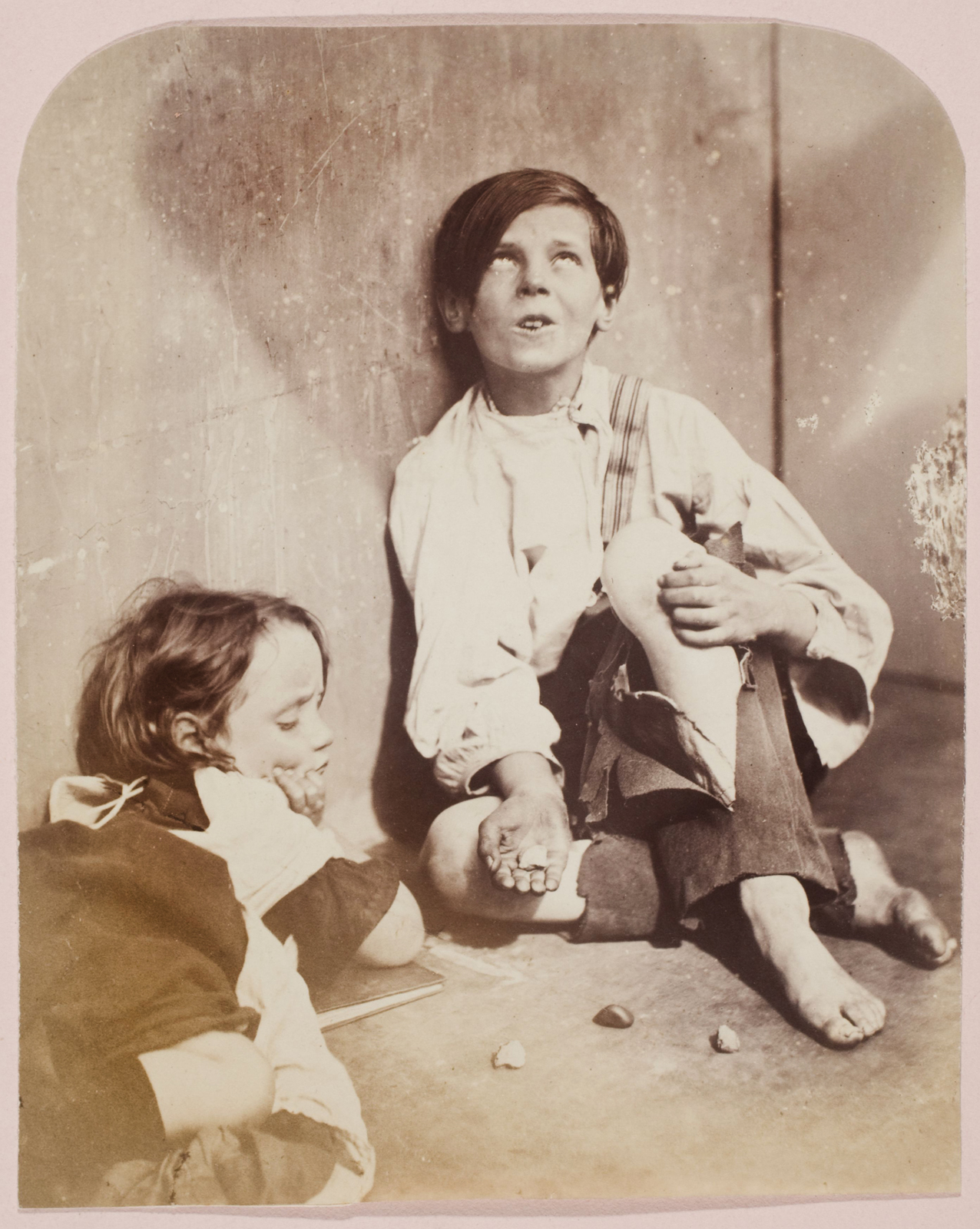
Oscar G. Rejlander (British born Sweden, 1813-1875) 'Please Give Us a Copper' c. 1866-1868


Oscar G. Rejlander (British born Sweden, 1813-1875)
Please Give Us a Copper
c. 1866-1868
Albumen silver print
17.9 x 12.6cm (7 1/16 x 4 15/16 in.)
Princeton University Art Museum. Museum purchase


A copper is a brown coin of low value made of copper or bronze.


Oscar G. Rejlander (British born Sweden, 1813-1875) 'The Juggler' c. 1865, printed later


Oscar G. Rejlander (British born Sweden, 1813-1875)
The Juggler
c. 1865, printed later
Platinum print
19.5 x 14.6cm (7 11/16 x 5 3/4 in.)
The Royal Photographic Society Collection at the V&A, acquired with the generous assistance of the Heritage Lottery Fund and Art Fund Image
© Victoria and Albert Museum, London


Oscar G. Rejlander (British born Sweden, 1813-1875) 'Enchanted by a Parrot (Mary Rejlander?)' c. 1860


Oscar G. Rejlander (British born Sweden, 1813-1875)
Enchanted by a Parrot (Mary Rejlander?)
c. 1860
Albumen silver print
Image (approx.): 50 x 30cm (19 11/16 x 11 13/16 in.)
William Talbott Hillman Collection
Photo: Hans P. Kraus, Jr., New York


Oscar G. Rejlander (British born Sweden, 1813-1875) 'The Cup that Cheers' c. 1860


Oscar G. Rejlander (British born Sweden, 1813-1875)
The Cup that Cheers
c. 1860
Albumen silver print
19.9 x 15cm (7 13/16 x 5 7/8 in.)
Princeton University Art Museum
Museum purchase, gift of Mr. and Mrs. Max Adler


Oscar G. Rejlander (British born Sweden, 1813-1875) 'Knuckle Bones' 1860


Oscar G. Rejlander (British born Sweden, 1813-1875)
Knuckle Bones
1860
Albumen silver print
15.4 x 12.5cm (6 1/16 x 4 15/16 in.)
George Eastman Museum, purchase
Photo: Courtesy of the George Eastman Museum


Knucklebones

Knucklebones, also known as TaliFivestones, or Jacks, is a game of ancient origin, usually played with five small objects, or ten in the case of jacks. Originally the “knucklebones” (actually the astragalus, a bone in the ankle, or hock) were those of a sheep, which were thrown up and caught in various manners. Modern knucklebones consist of six points, or knobs, projecting from a common base, and are usually made of metal or plastic. The winner is the first player to successfully complete a prescribed series of throws, which, though similar, differ widely in detail. The simplest throw consists in either tossing up one stone, the jack, or bouncing a ball, and picking up one or more stones or knucklebones from the table while it is in the air. This continues until all five stones or knucklebones have been picked up. Another throw consists in tossing up first one stone, then two, then three and so on, and catching them on the back of the hand. Different throws have received distinctive names, such as “riding the elephant”, “peas in the pod”, “horses in the stable”, and “frogs in the well”.

Text from the Wikipedia website


Oscar G. Rejlander (British born Sweden, 1813-1875) '"Father Times" (Where's the Cat?)' c. 1860


Oscar G. Rejlander (British born Sweden, 1813-1875)
“Father Times” (Where’s the Cat?)
c. 1860
Albumen paper print
16.5 x 14.2cm (6 1/2 x 5 9/16 in.)
Wilson Centre for Photography


Oscar G. Rejlander (British born Sweden, 1813-1875) 'Night in Town (Poor Jo, Homeless)' before 1862; print after 1879


Oscar G. Rejlander (British born Sweden, 1813-1875)
Night in Town (Poor Jo, Homeless)
before 1862; print after 1879
Carbon print
20.3 x 15.7cm (8 x 6 3/16 in.)
National Gallery of Canada, Ottawa
Purchased 1993


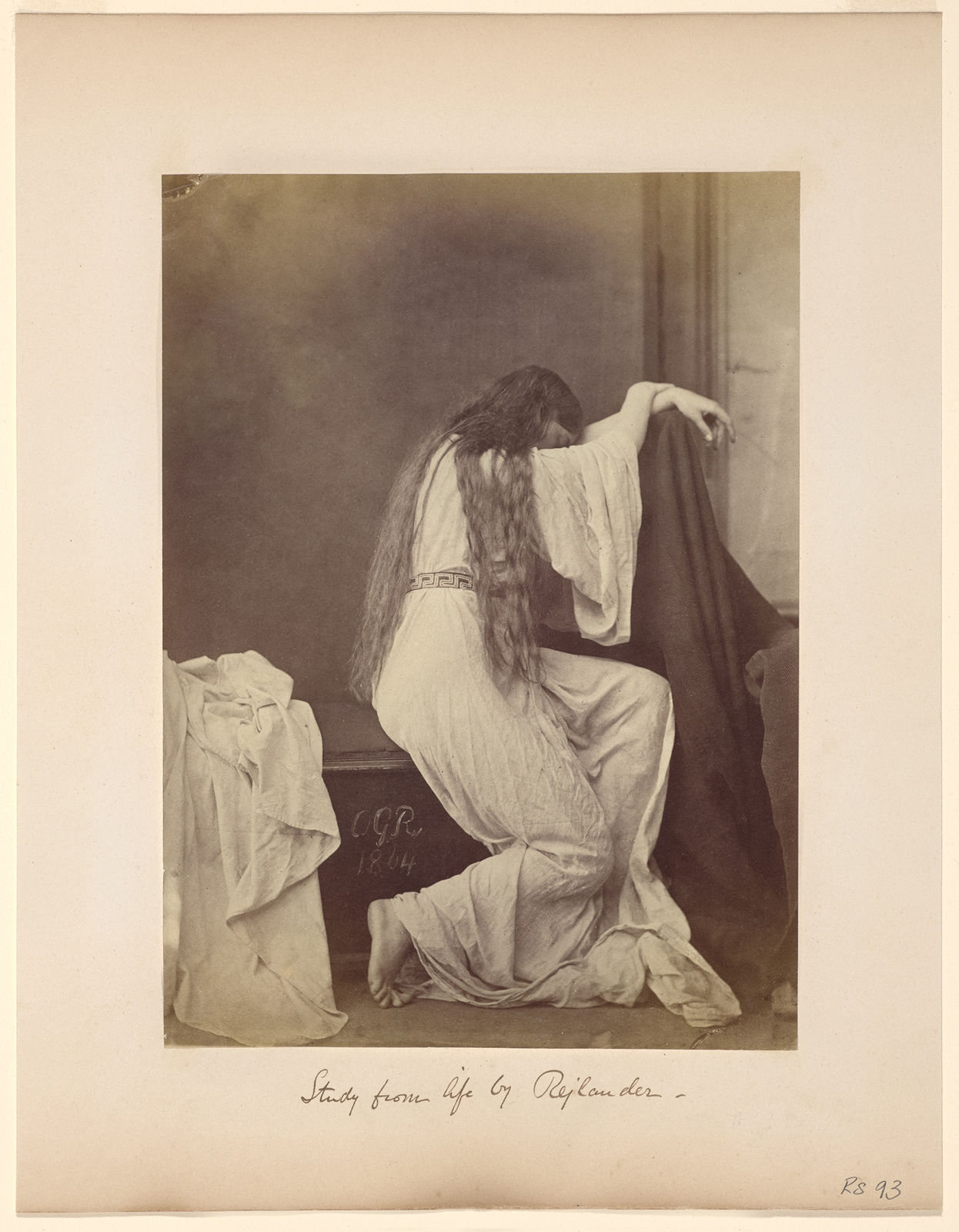
Oscar G. Rejlander (British born Sweden, 1813-1875) 'Grief (Hidden Her Face, Yet Visible Her Anguish)' 1864


Oscar G. Rejlander (British born Sweden, 1813-1875)
Grief (Hidden Her Face, Yet Visible Her Anguish)
1864
Albumen silver print
19.6 x 14cm (7 11/16 x 5 1/2 in.)
Fine Arts Museums of San Francisco, M. H. de Young Memorial Museum. Gift of John H. Rubel


Oscar G. Rejlander (British born Sweden, 1813-1875) 'The Comb Seller (Oscar and Mary Rejlander)' c. 1860


Oscar G. Rejlander (British born Sweden, 1813-1875)
The Comb Seller (Oscar and Mary Rejlander)
c. 1860
Albumen silver print
20 x 14.9cm (7 7/8 x 5 7/8 in.)
University of New Mexico Art Museum, Albuquerque. Gift of Eleanor and Van Deren Coke


Oscar G. Rejlander (British born Sweden, 1813-1875) 'Lionel Tennyson' c. 1863


Oscar G. Rejlander (British born Sweden, 1813-1875)
Lionel Tennyson
c. 1863
Albumen print from a wet collodion negative
Image (oval): 18.3 x 14.3cm (7 3/16 x 5 5/8 in.)
National Gallery of Art, Washington, Paul Mellon Fund


Oscar G. Rejlander (British born Sweden, 1813-1875) 'Mental Distress (Mother's Darling)' 1871


Oscar G. Rejlander (British born Sweden, 1813-1875)
Mental Distress (Mother’s Darling)
1871
Carbon print of a polychrome drawing from a photograph
54 x 43.2cm (21 1/4 x 17 in.)
The Royal Photographic Society Collection at the V&A, acquired with the generous assistance of the Heritage Lottery Fund and Art Fund Image
© Victoria & Albert Museum, London


Oscar G. Rejlander (British born Sweden, 1813-1875) 'Lewis Carroll (Charles Lutwidge Dodgson)' 1863


Oscar G. Rejlander (British born Sweden, 1813-1875)
Lewis Carroll (Charles Lutwidge Dodgson)
1863
Albumen silver print
8.9 x 5.9cm (3 1/2 x 2 5/16 in.)
The Metropolitan Museum of Art, Gilman Collection
Purchase, Sam Salz Foundation Gift, 2005


Oscar G. Rejlander (British born Sweden, 1813-1875) 'Allegorical Study (Sacred and Profane Love)' c. 1860


Oscar G. Rejlander (British born Sweden, 1813-1875)
Allegorical Study (Sacred and Profane Love)
c. 1860
Albumen paper print
12 x 17.5cm (4 3/4 x 6 7/8 in.)
Wilson Centre for Photography


Oscar G. Rejlander (British born Sweden, 1813-1875) 'Bad Temper' Negative about 1865; print later


Oscar G. Rejlander (British born Sweden, 1813-1875)
Bad Temper
Negative about 1865; print later
Albumen paper print
The Royal Photographic Society Collection at the V&A, acquired with the generous assistance of the Heritage Lottery Fund and Art Fund, Image
© Victoria & Albert Museum, London


Oscar G. Rejlander (British born Sweden, 1813-1875) 'Henry Taylor' 1863


Oscar G. Rejlander (British born Sweden, 1813-1875)
Henry Taylor
1863
Albumen silver print
20.2 x 15cm (7 15/16 x 5 7/8 in.)
Spencer Museum of Art, University of Kansas
Gift of Dr. and Mrs. William D. Paden


Sir Henry Taylor KCMG (18 October 1800 – 27 March 1886) was an English dramatist and poet, Colonial Office official, and man of letters.


Oscar G. Rejlander (British born Sweden, 1813-1875) 'Self-Portrait with Parrot' c. 1865


Oscar G. Rejlander (British born Sweden, 1813-1875)
Self-Portrait with Parrot
c. 1865
In “Album of Photographs by Oscar G. Rejlander,” 1856-72
Albumen silver print
Closed: 37.4 x 27.6 x 0.3cm (14 3/4 x 10 7/8 x 1/8 in.)
Sir Nicholas Mander Collection


The J. Paul Getty Museum
1200 Getty Center Drive
Los Angeles, California 90049

Opening hours:
Daily 10am – 5.30pm
Monday closed

The J. Paul Getty Museum website

LIKE ART BLACK ON FACEBOOK

Back to top

Exhibition: ‘Victorian Giants: The Birth of Art Photography’ at the National Portrait Gallery, London Part 2

Exhibition dates: 1st March – 20th May, 2018

Victorian Giants: The Birth of Art Photography is curated by Phillip Prodger PhD, Head of Photographs at the National Portrait Gallery, London


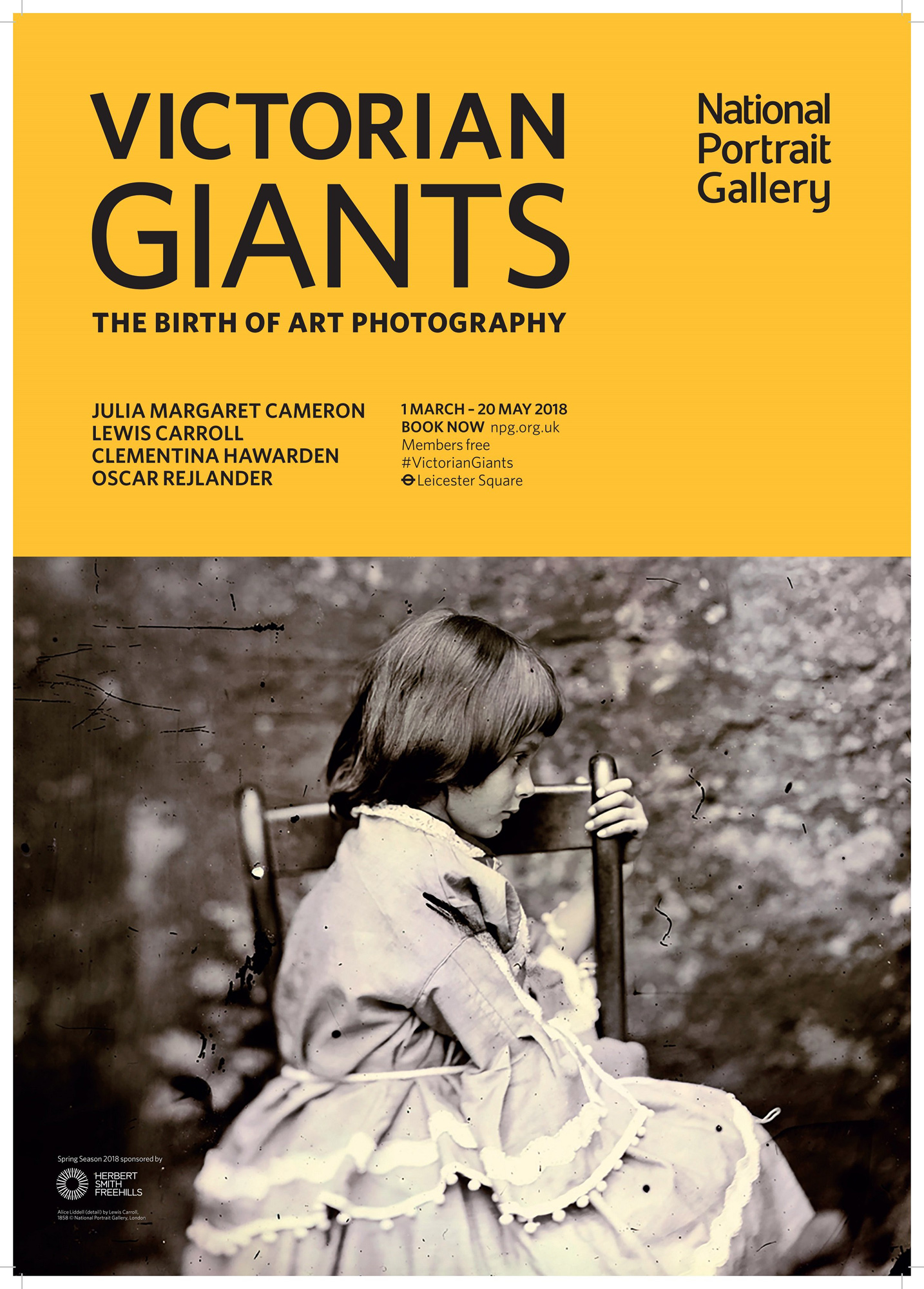
Poster for the exhibition 'Victorian Giants: The Birth of Art Photography' at the National Portrait Gallery, London


Poster for the catalogue for the exhibition Victorian Giants: The Birth of Art Photography at the National Portrait Gallery, London


Oh Clementina! the light, the stars!

There is enough text in the posting for me not to really have to say anything. It’s all there…

Art, influence, technology;
Classical, formal, diaristic;
Intimacy, mystery, atmospheric;
Motherhood, sexuality, feminist identity, nascent womanhood;
‘Profil perdu’ (French, ‘lost profile’, which refers to a portrait in which the profile cannot be seen), mirror, loss, duplication and replication, illusion, and fetish

… all woven into a performative, psychological, expressive and creative (self) portraiture.

The real stars of the show are most definitely the women… the avant-garde artists of their era.

Dr Marcus Bunyan

View part 1 of the posting


Many thankx to the National Portrait Gallery, London for allowing me to publish the photographs in the posting. Please click on the photographs for a larger version of the image.


“The women are the real stars of this exhibition. Their pictures are bolder and bigger, more imaginative and more daring. They portray people with a raw reality that is not just the result of the collodion method but a powerful, visionary insight.

Hawarden’s pictures of Victorian women have an intimacy that transcends time and a mystery that asserts the autonomy of her subjects. They are feminist, and gothic too, in their eerie atmosphere. In an 1863-4 picture called ‘Photographic Study’, she poses a young woman by a mirror so that we see her twice. The “real” woman is in brooding profile while her reflection is a shadowy full-face image. The effect is spookily absorbing as we become witnesses to her melancholic introspection.

Hawarden’s ultra-sharp yet shadow-rich prints create unresolved stories featuring women free to show who they really are. None of them look happy. All are curiously defiant – these pictures anticipate those of the 1970s US artist Francesca Woodman. As portraits of women created by women, these Victorian photographers’ subversive creations have almost no precedents.

Not that Cameron looked to the handful of earlier women artists as models. She was trying to be a new Rembrandt: her portraits consciously compete with the masterpieces of the baroque age. While the painted portraits of male Victorian artists such as John Everett Millais and George Frederic Watts are period pieces at best, her great 1866 photograph Mountain Nymph, Sweet Liberty (Mrs Keene) with its subtle mix of resolution and suggestiveness brings us face to face with someone whose eyes hold ours and whose mind is as real to us as her tangled hair. There is a sensitivity to the magic of being human in Cameron’s portraits that makes her the greatest British artist of her time. This exhibition puts her in a brilliantly delineated context of experiment and imagination, the first avant-garde artist of the camera.”


Extract from Jonathan Jones. “Victorian Giants: the Birth of Art Photography review – the triumph of the female gaze,” on The Guardian website Friday 2 March 2018 [Online] Cited 14/02/2022


This major exhibition is the first to examine the relationship between four ground-breaking Victorian artists: Julia Margaret Cameron (1815-1879), Lewis Carroll (1832-1898), Lady Clementina Hawarden (1822-1865) and Oscar Rejlander (1813-1875). Drawn from public and private collections internationally, the exhibition features some of the most breath-taking images in photographic history. Influenced by historical painting and frequently associated with the Pre-Raphaelite Brotherhood, the four artists formed a bridge between the art of the past and the art of the future, standing as true giants in Victorian photography.


Clementina Hawarden (British, 1822-1865)

Her life cruelly cut short by pneumonia at the age of forty-two, Clementina Maude, Viscountess Hawarden produced some 800 photographs in her lifetime, nearly all are of her eight children posed in poignant tableaux. She began to photograph on her family’s estate, outside Tipperary, around 1857, later moving to Princes Gardens, London, near Hyde Park. Frequently compared to Cameron, she was much admired by Carroll, and on her death, Rejlander wrote her obituary.

Wall text from the exhibition


“In that vein, the greatest discovery in the exhibition is a thrillingly strange image by Hawarden, to my mind always the most intriguing photographer of the four. Hawarden was a Scottish countess who had ten children. She photographed all of her daughters repeatedly, and there were so many of them it’s hard to keep track. Her photographs, which are often classical in their formal qualities, nevertheless anticipate the diaristic work of the 20th century photographers Sally Mann and Nan Goldin. They often contain more than one girl, and often feature mirrors, so that everything is about multiplication or reflection – an effect that might also be seen as a form of self-portraiture in the mother of so many.”

Gaby Wood. “A jewel-like show of photographs Victorian Giants, National Portrait Gallery, review,” on The Telegraph website 27th February 2018 [Online] Cited 14/02/2022


Her photographic years were brief but prolific. Hawarden produced over eight hundred photographs between 1857 and her sudden death in 1864. During this time she gave birth to three of her eight children. Lady Hawarden’s photographic focus remained on her children. There is only one photograph believed to feature the Viscountess Hawarden, yet it could also be a portrait of her sister Anne Bontine.

A collection of 775 portraits were donated to the Victoria and Albert Museum, London in 1939 by Hawarden’s granddaughter, Clementina Tottenham. The photographs were torn, or cut, from family albums for reasons that are still unclear. This accounts for the torn or trimmed corners which are now considered a hallmark of Hawarden’s work.

Carol Mavor writes extensively about the place of Hawarden’s work in the history of Victorian photography as well as contemporary interpretations of the work. She states, “Hawarden’s pictures raise significant issues of gender, motherhood, and sexuality as they relate to photography’s inherent attachments to loss, duplication and replication, illusion, fetish.” (Mavor, Carol (1999). Becoming: the photographs of Clementina, Viscountess Hawarden (1st ed.). Durham, NC: Duke University Press.)

Text from the Wikipedia website


Clementina Hawarden (British, 1822-1865) 'Photographic Study, 5 Princes Gardens (Clementina Maude)' 1863-1864 from the exhibition 'Victorian Giants: The Birth of Art Photography' at the National Portrait Gallery, London , March - May, 2018


Clementina Hawarden (British, 1822-1865)
Photographic Study, 5 Princes Gardens (Clementina Maude)
1863-1864
from The Photographic Study Series by Clementina, Lady Hawarden
Albumen silver print from glass negative
Given by Lady Clementina Tottenham
© Victoria and Albert Museum, London


“Although her work has often been linked to that of Julia Margaret Cameron, the best known woman photographer of the Victorian epoch, Clementina Hawarden struck out into areas and depicted moods unknown to the art photographers of her age.”

~ Graham Ovenden 1974


This remarkable photograph shows a woman gazing into a mirror, but not at her own reflection. Instead, the picture was carefully arranged so that the woman’s face is seen in profile, while only her reflection looks back out of the mirror. Hawarden excelled at producing ambiguous narrative photographs such as this one, suggesting the rich inner life of the subject, without telling a clear story. The heroes of her pictures are nearly always women, who seem all but trapped in domestic interiors.

Wall text from the exhibition


Clementina Hawarden (British, 1822-1865) 'Photographic Study (Clementina Maude)' early 1860s from the exhibition 'Victorian Giants: The Birth of Art Photography' at the National Portrait Gallery, London , March - May, 2018


Clementina Hawarden (British, 1822-1865)
Photographic Study (Clementina Maude)
early 1860s
Albumen print from wet collodion negative
20.1 x 14.4cm (7 15/16 x 5 11/16 in.)
Gilman Collection, Purchase, Harriette and Noel Levine Gift, 2005
© Metropolitan Museum of Art


Clementina, Lady Hawarden, is a poetic, if elusive, presence among nineteenth-century photographers. As a devoted mother, her life revolved around her eight children. She took up photography in 1857; using her daughters as models, she created a body of work remarkable for its technical brilliance and its original depiction of nascent womanhood. Lady Hawarden showed her work in the 1863 and 1864 exhibitions of the Photographic Society. With the exception of a few rare examples, her photographs remained in the possession of her family until 1939, when the more than eight hundred images were donated to the Victoria and Albert Museum. Only recently have they been the objects of research, publication, and exhibition.

Clementina Maude, her mother’s preferred model, is seen here in a reflective pose against a star-studded wall. The casual placement of the shawl on the table and the girl’s loose hair contribute to the feeling of intimacy. In the airy room time seems to be suspended. The sensuous curves of the table legs, the soft weight of the crushed velvet, and the crispness of the starry wallpaper are enhanced by the skilful handling of the collodion technique. The composition, devoid of Victorian clutter, brings together light, shadow, and compositional elements in a spare and appealing interplay. In contrast to the prevailing fashion of giving literary or sentimental titles to portraits of young women, Lady Hawarden titled her works simply “Photographic Study.”

Text from the Metropolitan Museum of Art website


Clementina Hawarden (British, 1822-1865) 'Photographic Study (Clementina and Isabella Grace Maude)' 1863-1864


Clementina Hawarden (British, 1822-1865)
Photographic Study (Clementina and Isabella Grace Maude)
1863-1864
Albumen print from wet collodion negative
© Victoria and Albert Museum, London


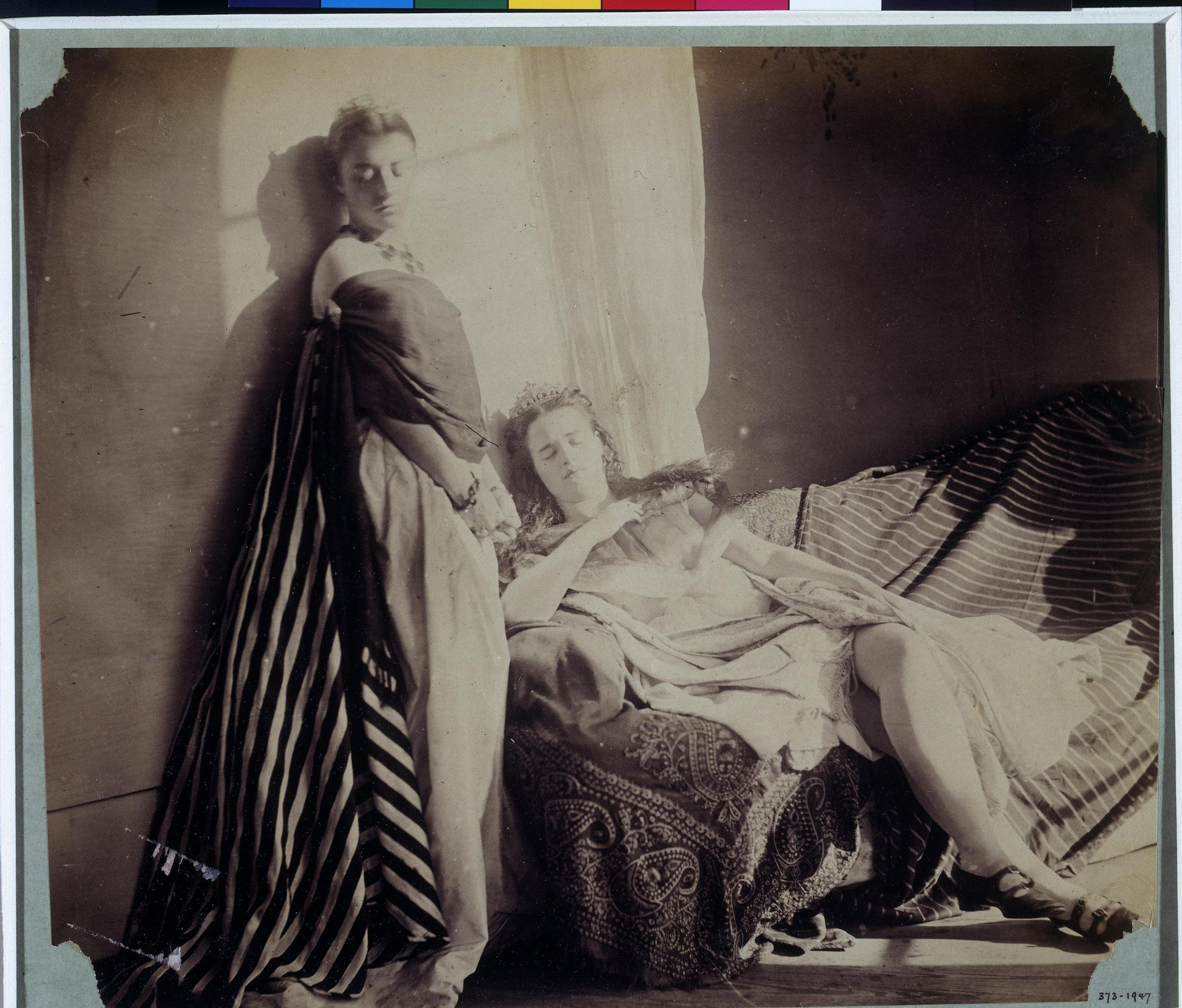
Hawarden frequently dressed up her sitters and arranged them in enigmatic narratives like this one. Although not derived from any known painting, the manner of dress, including the cloak and tricorn hat of the male figure (actually one of Hawarden’s daughters dressed up), suggest an eighteenth century reference.

Wall text from the exhibition


Clementina Hawarden (British, 1822-1865) 'Photographic Study (Florence Elizabeth and Clementina Maude)' 1863-1864


Clementina Hawarden (British, 1822-1865)
Photographic Study (Florence Elizabeth and Clementina Maude)
1863-1864
Albumen print from wet collodion negative
© Victoria and Albert Museum, London


Working from upstairs rooms at 5 Princes Gardens, near to the South Kensington Museum (where both she and Julia Margaret Cameron were frequent visitors), Hawarden used light streaming from large floor to ceiling windows to illuminate her pictures. Her subjects were usually her children, especially her daughters Clementina, Florence, and Isabella Grace, whom she posed in domestic tableaux.

Both Carroll and Rejlander knew and admired Hawarden. On at least one occasion, Rejlander photographed her daughter Isabella Grace; after Hawarden’s death, he also photographed her youngest daughter, Antonia.

Wall text from the exhibition


Clementina Hawarden (British, 1822-1865) Hawarden. 'Isabella Grace and Clementina Maude, 5 Princes Gardens' c. 1863-1864


Clementina Hawarden (British, 1822-1865)
Hawarden Isabella Grace and Clementina Maude, 5 Princes Gardens
c. 1863-1864
Albumen print from wet collodion negative
Given by Lady Clementina Tottenham
© Victoria and Albert Museum, London


Virginia Dodier thinks that this photograph belongs to an ‘Orientalist’ series. Here, Lady Hawarden gives her drawing room a tent-like atmosphere. Such scenes were popularised by the painter J. F. Lewis, and Roger Fenton exhibited his photographic ‘Nubian Series’ in 1859. Dodier writes that the idea of Orientalism allowed European artists to ‘evoke sensuality on the premise of presenting quasi-ethnographical information about the customs of the East’. The idea of the fancy dress or allegorical portrait stems from an earlier tradition in English art. They are found, for example, in the work of the painter Sir Joshua Reynolds (1723-1792).

Text from the Victoria and Albert Museum website


Lady Clementina Hawarden: Themes & Style (extract)

With careful choice of props, clothing, mirrors, balcony, and posture, Hawarden produced exquisite studies of her adolescent daughters. The figures and dress are the main subject, carefully framed in the room, and often in front of the balcony. The city beyond often provides a blurred background.

The writer Carol Mavor in Becoming: The Photographs of Clementina, Viscountess Hawarden suggests that the often provocative poses of Hawarden’s daughters are significant. The Victorians were bothered by the idea of sexuality and adolescence, and in 1861 the Offences Against the Person Act raised the age of consent from 10 to 12. This was also the year in which Hawarden began to make this kind of photograph, though there is no evidence that she was deliberately exploring this controversial topic.

Hawarden liked to use natural light in her studio at her South Kensington home, in a way that was seen at the time as ‘daring’. She placed mirrors to reflect light and used them to explore the idea of ‘the double’, just as other photographers (and occasionally Hawarden herself) used a stereoscopic camera to produce twin prints.

From around 1862 Hawarden concentrated on photographing her daughters in costume tableaux, a popular subject at the time. Costumes from the dressing up box are combined with dresses at the height of fashion to produce beautiful and detailed studies that confound the contemporary with the make-believe.

Text from the Victoria and Albert Museum website [Online] Cited 16/05/2018. No longer available online


Clementina Hawarden (British, 1822-1865) 'Photographic Study (Clementina and Florence Elizabeth Maude)' 1859-1861


Clementina Hawarden (British, 1822-1865)
Photographic Study (Clementina and Florence Elizabeth Maude)
1859-1861
Uncut stereo albumen print


Figure 60 and 61 of the catalogue for the exhibition 'Victorian Giants: The Birth of Art Photography' at the National Portrait Gallery, London


Figure 60 and 61 of the catalogue for the exhibition Victorian Giants: The Birth of Art Photography at the National Portrait Gallery, London


Figure 112 and 113 of the catalogue for the exhibition 'Victorian Giants: The Birth of Art Photography' at the National Portrait Gallery, London


Figure 112 and 113 of the catalogue for the exhibition Victorian Giants: The Birth of Art Photography at the National Portrait Gallery, London


Oscar Rejlander (British born Sweden, 1813-1875)

According to his naturalisation papers, Rejlander was born in Stockholm on October 19, 1813. He was the son of Carl Gustaf Rejlander, a stonemason and Swedish Army Officer. During his youth, his family moved to the Swedish-speaking community in Rauma, Finland (then Russia). In the 1830s, he relocated to England, initially settling in Lincoln, England. In the 1850s he abandoned his original profession as a painter and portrait miniaturist, apparently after seeing how well a photograph captured the fold of a sleeve.

He set up as a portraitist in the industrial Midlands town of Wolverhampton, probably around 1846. In the early 1850s he learned the wet-collodion and waxed-paper processes at great speed with Nicholas Henneman in London, and then changed his business to that of a photography studio. He undertook genre work and portraiture. Rejlander also produced nude studies, mainly for use as studies by painters. There are no known erotic photographs of children by Rejlander. His so-called ‘Charlotte Baker’ photograph is a well-known forgery, produced by convicted child sex offender Graham Ovenden by Ovenden’s friend Howard Grey in the 1970s, rephotographed and printed to look antique by Ovenden. No person by the name Charlotte Baker ever seems to have posed for Rejlander.

Rejlander undertook many experiments to perfect his photography, including combination printing, which he did not invent; however, he created more elaborate and convincing composite photographs than any prior photographer. He had articles feature in the Wolverhampton Chronicle, on 15 November 1854 an article called “Improvement in Calotypes, by Mr. O.G. Rejlander, of Wolverhampton” it suggests that by 1854 he was experimenting with combination printing from several negatives. He was a friend of photographer Charles Lutwidge Dodgson (better known by the nom de plume Lewis Carroll), who collected Rejlander’s work and corresponded with him on technical matters. Rejlander later created one of the best known and most revealing portraits of Dodgson.

Rejlander participated in the Paris Exhibition of 1855. In 1856 he made his best-known allegorical work, The Two Ways of Life. This was a seamlessly montaged combination print made of thirty-two images (akin to the use of Photoshop today, but then far more difficult to achieve) in about six weeks. First exhibited at the Manchester Art Treasures Exhibition of 1857, the work shows a man being lured to paths of vice or virtue by good and bad angels. The image’s partial nudity, which showed real women as they actually appeared and not the idealised forms then common in Victorian art, was deemed ‘indecent’ by some. Rejlander was also accused of using prostitutes as models, although Rejlander categorically denied this and no proof was ever offered. Reservations about the work subsided when Queen Victoria ordered a 10-guinea copy to give to Prince Albert. Victoria and Albert would go on to purchase three copies of the work, all of which are now lost. …

Rejlander moved his studio to Malden Road, London around 1862 and largely abandoned her early experiments with double exposure, photomontage, photographic manipulation and retouching. Instead, he became one of Britain’s leading portraitists, creating pictures with psychological charge. He became a leading expert in photographic techniques, lecturing and publishing widely, and sold work through bookshops and art dealers. He also found subject-matter in London, photographing homeless London street children to produce popular ‘social-protest’ pictures such as “Poor Joe,” also known as “Homeless”. …

Rejlander’s ideas and techniques were taken up by other photographers and this, to some extent, justifies labelling him as the father of art photography.

Text from the Wikipedia website


Oscar Rejlander (British born Sweden, 1813-1875) 'Charles Darwin' 1871


Oscar Rejlander (British born Sweden, 1813-1875)
Charles Darwin
1871
Albumen print
© Moderna Museet, Stockholm


Starting in the late 1860s, Charles Darwin began collecting photographs for use in the research that would eventually become his book The Expression of the Emotions in Man and Animals (1872). Hoping to find authentic photographs, that captured emotional expressions as they actually occurred, he visited print shops and studios in London, and contacted several photographers hoping to commission new pictures. Few, if any, of the photographs he acquired met his ambitious expectations.

In April, 1871, Darwin wrote, ‘I am now rich in photographs, for I have found in London Rejlander, who for years has had a passion for photographing all sorts of chance expressions, exhibited on various occasions … instantaneously.’ Rejlander would go on to become the main contributor of photographs to Darwin’s book.

Wall text from the exhibition


Oscar Rejlander (British born Sweden, 1813-1875) 'The Two Ways of Life' 1856-1857


Oscar Rejlander (British born Sweden, 1813-1875)
The Two Ways of Life
1856-1957
Albumen print, made from approximately 32 separate negatives
Moderna Museet, Stockholm


One of the most famous pictures in photographic history, Rejlander’s Two Ways of Life caused a sensation when it was exhibited at the Manchester Art Treasures exhibition in 1857. To make it, Rejlander combined some thirty-two separate negatives (there were variations between printings, and it is not always clear where negatives begin and end). Some viewers were offended by the nudes, whose bodies appear frank and realistic compared to the ideal fantasies painters were expected to produce. Others objected to its ambition, since Rejlander seemed to be saying that photography could be used to produce pictures just as meaningful, and as artistically composed, as any painting.

To make Two Ways of Life, Rejlander had to arrange the various subjects within it at the right size to maintain visual perspective. This was a challenge, since enlargement and reduction of negatives was not yet possible in the darkroom. The only way he could change the size of something in the negative was to rephotograph it.

This is the finest known print of the photograph, which is also known in a reduced form. The photograph is a parable featuring Rejlander himself, who stands in the middle, listening to ‘good’ and ‘bad’ angels luring him to paths of vice and virtue. Queen Victoria and Prince Albert loved the picture and bought three copies, none of which survive.

Wall text from the exhibition


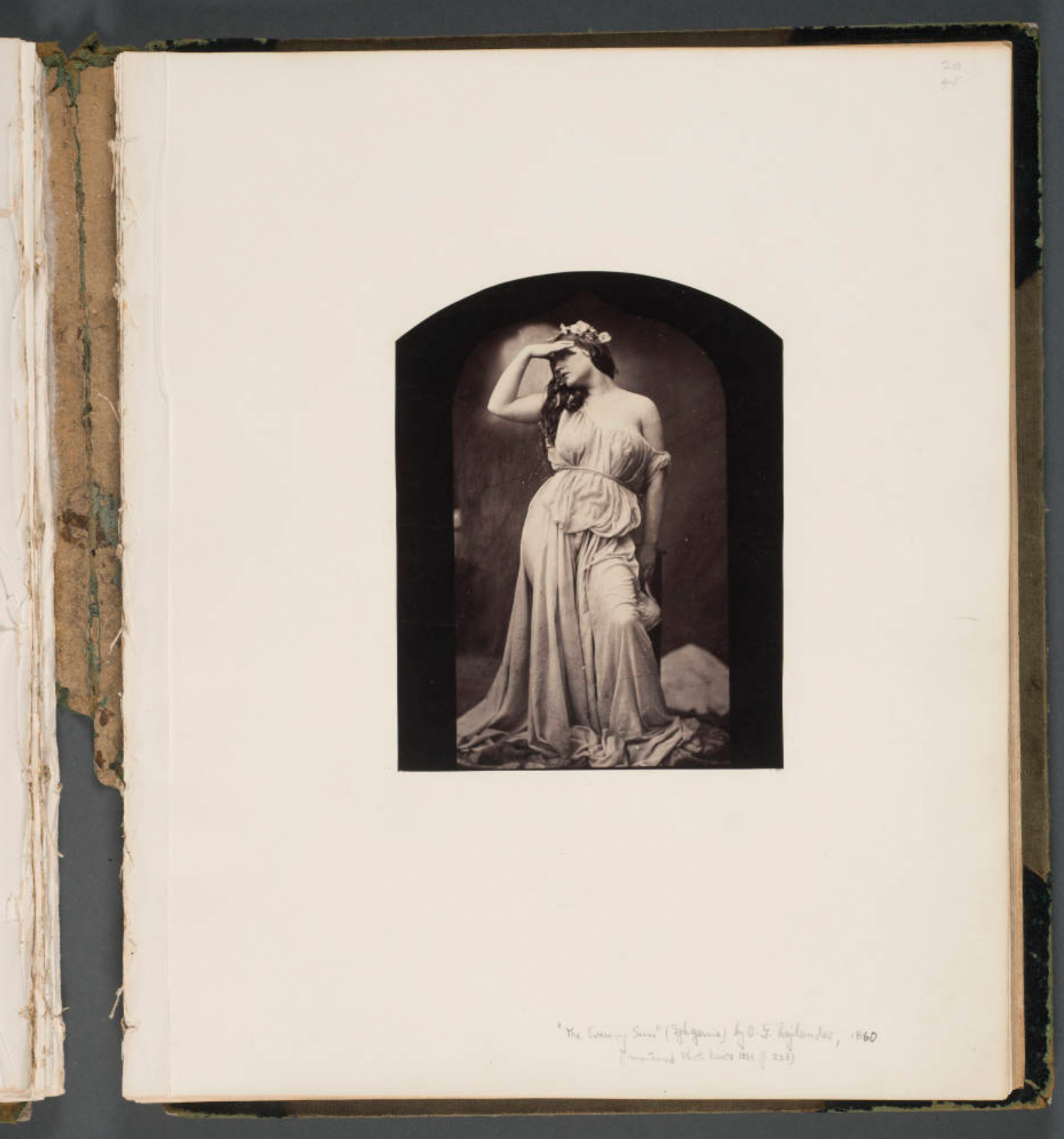
Oscar Rejlander (British born Sweden, 1813-1875) 'The Evening Sun (Iphigenia)' c. 1860


Oscar Rejlander (British born Sweden, 1813-1875)
The Evening Sun (Iphigenia)
c. 1860
© Gernsheim Collection, Harry Ransom Centre, The University of Texas at Austin


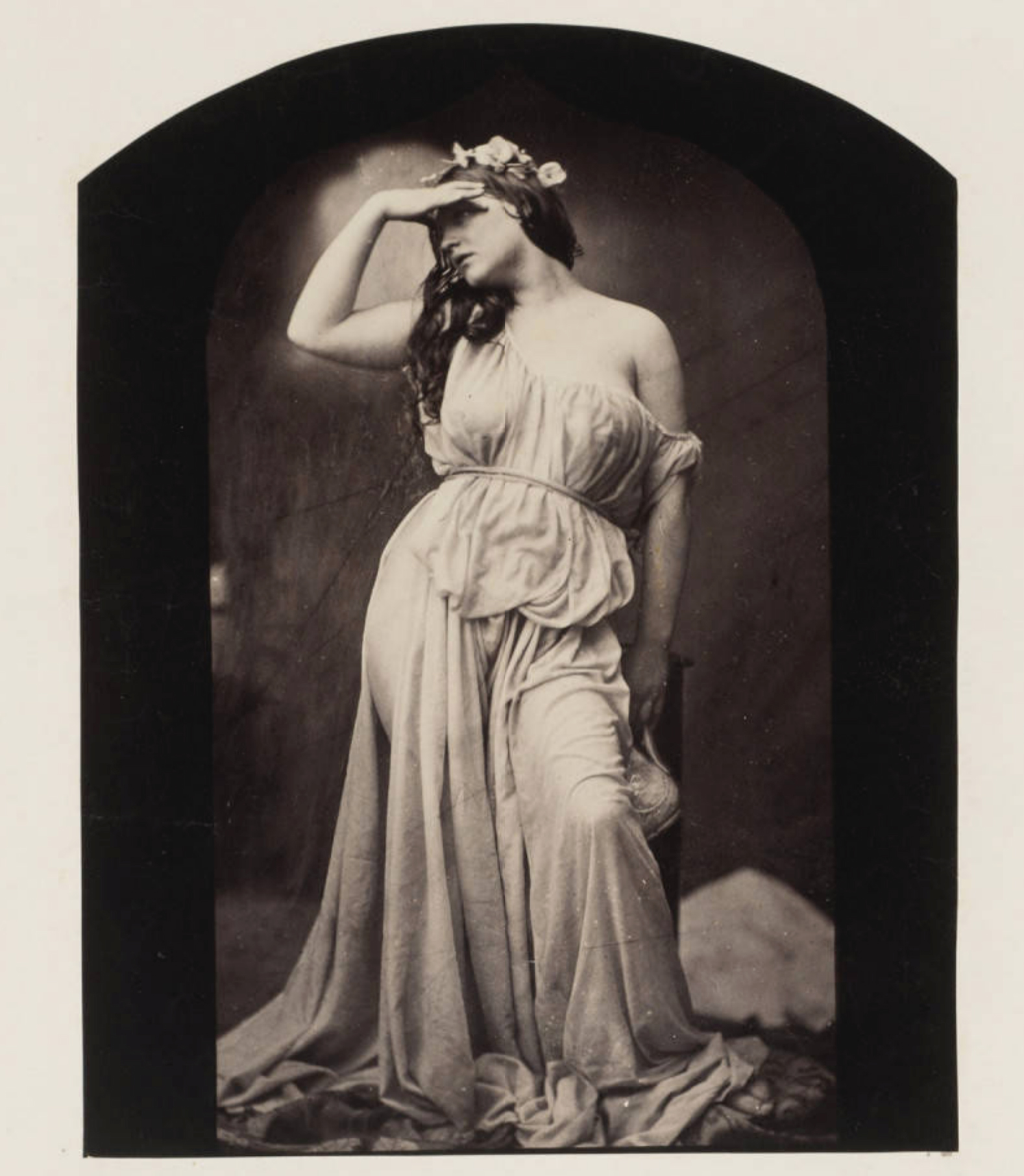
Oscar Rejlander (British born Sweden, 1813-1875) 'The Evening Sun (Iphigenia)' c. 1860


Oscar Rejlander (British born Sweden, 1813-1875)
The Evening Sun (Iphigenia)
c. 1860
© Gernsheim Collection, Harry Ransom Centre, The University of Texas at Austin


Oscar Rejlander (British born Sweden, 1813-1875) 'The Evening Sun (Iphigenia)' c. 1860 (detail)


Oscar Rejlander (British born Sweden, 1813-1875)
The Evening Sun (Iphigenia) (detail)
c. 1860
© Gernsheim Collection, Harry Ransom Centre, The University of Texas at Austin


Iphigenia was a daughter of King Agamemnon who appears in legends about the Trojan War. When her father accidentally offended the goddess Artemis, he was forced to sacrifice Iphigenia to appease the goddess so that she would allow his ships to sail to Troy. She was tricked into going to the town of Aulis under the pretence that she would marry the heroic warrior Achilles. In some versions she was killed, while in others she was rescued by Artemis.

Wall text from the exhibition


Oscar Rejlander (British born Sweden, 1813-1875) 'Ariadne' 1857


Oscar Rejlander (British born Sweden, 1813-1875)
Ariadne
1857
Albumen print from a wet collodion negative


Oscar Rejlander (British born Sweden, 1813-1875) 'Nude female study' c. 1867


Oscar Rejlander (British born Sweden, 1813-1875)
Nude female study
c. 1867
Albumen print
7 3/4 x 5 3/8 in. (196 x 138mm) overall
Given by Stephan Loewentheil, 2017
© National Portrait Gallery, London


Rejlander produced a number of nude studies which he sold to painters for use as studies. He considered these pictures significant because they pointed up errors historically made by painters when depicting human anatomy. Although he was happy for painters to use photographs to improve their paintings, he also saw accuracy of depiction as one of the things that made photography special when compared to other art forms.

Wall text from the exhibition


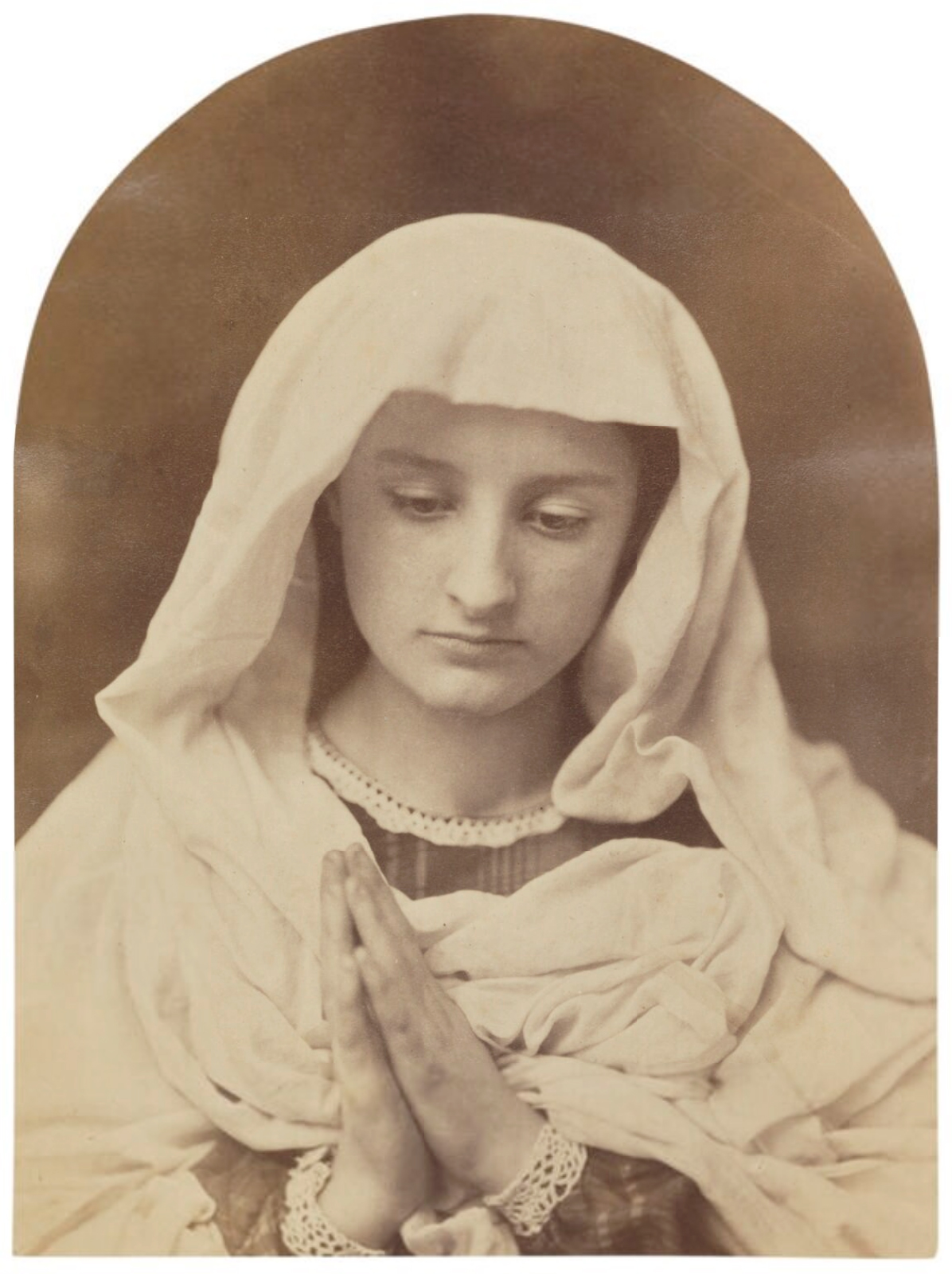
Oscar Rejlander (British born Sweden, 1813-1875) 'The Virgin in prayer' c. 1857


Oscar Rejlander (British born Sweden, 1813-1875)
The Virgin in prayer (after Sassoferrato)
c. 1857
albumen print
6 7/8 x 5 7/8 in. (174 x 150mm) overall
Purchased with help from the Art Fund, Jane and Michael Wilson and Stephen Barry, 2015
© National Portrait Gallery, London


This photograph is a based on the famous painting The Virgin in Prayer painted by the Italian Baroque painter Sassoferrato 1640-1650, now in the collection of the National Gallery, London. The rise of public art spaces in Britain in the nineteenth century, including the National Gallery (1824), and the National Portrait Gallery (1856), provided inspiration for countless photographers. Rejlander was particularly enthusiastic about restaging famous paintings, often in order to demonstrate mistakes that painters had made in scale and perspective. The process was fun, and the results fuelled the debate about photography’s role among the arts.

Wall text from the exhibition


Oscar Rejlander (British born Sweden, 1813-1875) 'The Virgin in prayer (after Sassoferrato)' c. 1857


Oscar Rejlander (British born Sweden, 1813-1875)
The Virgin in prayer (after Sassoferrato)
c. 1857
Albumen print
7 3/4 x 5 3/4 in. (196 x 146mm) overall
Given by Stephan Loewentheil, 2017
© National Portrait Gallery, London


Oscar Rejlander (British born Sweden, 1813-1875) 'Unknown young woman' 1860-1866


Oscar Rejlander (British born Sweden, 1813-1875)
Unknown young woman
1860-1866
Albumen print
7 3/8 x 5 1/4 in. (188 x 134mm) overall
Purchased with help from the Art Fund, Jane and Michael Wilson and Stephen Barry, 2015
© National Portrait Gallery, London


Oscar Rejlander (British born Sweden, 1813-1875) 'Untitled (unknown sitter, possibly Rejlander's wife, Mary)' c. 1863


Oscar Rejlander (British born Sweden, 1813-1875)
Untitled (unknown sitter, possibly Rejlander’s wife, Mary)
c. 1863
Printed by Julia Margaret Cameron
Albumen print from wet collodion glass negative
Given by Mrs Margaret Southam, 1941
© Victoria and Albert Museum, London


Cameron invited Rejlander to the Isle of Wight in 1863. Before the visit, Rejlander provided her with some of his own negatives, so that she could practise printing. She experimented with some, decorating them with ferns. This picture, which descended through Cameron’s family, was once believed to have been made by her. However, it is now recognised as one of the pictures Cameron printed from a Rejlander negative. The subject is one who frequently appears in Rejlander’s work, and may even have been his wife, Mary.

Wall text from the exhibition


Oscar Rejlander (British born Sweden, 1813-1875) 'Unknown young woman' 1863-1866


Oscar Rejlander (British born Sweden, 1813-1875)
Unknown young woman
1863-1866
Albumen print
8 1/8 x 5 7/8 in. (205 x 149mm) overall
Purchased with help from the Art Fund, Jane and Michael Wilson and Stephen Barry, 2015
© National Portrait Gallery, London


Oscar Rejlander (British born Sweden, 1813-1875) ''Sleep' (Mary Rejlander (née Bull))' c. 1855


Oscar Rejlander (British born Sweden, 1813-1875)
‘Sleep’ (Mary Rejlander (née Bull))
c. 1855
Albumen print
6 1/8 x 6 5/8 in. (156 x 167mm) overall
Purchased with help from the Art Fund, Jane and Michael Wilson and Stephen Barry, 2015
© National Portrait Gallery, London


Oscar Rejlander (British born Sweden, 1813-1875) 'Minnie Constable' 1860-1866


Oscar Rejlander (British born Sweden, 1813-1875)
Minnie Constable
1860-1866
Albumen print
7 1/2 x 5 3/4 in. (192 x 146mm) overall
Purchased with help from the Art Fund, Jane and Michael Wilson and Stephen Barry, 2015
© National Portrait Gallery, London


Oscar Rejlander (British born Sweden, 1813-1875) ''Art must assist Photography' (Putto as Allegory of Painting)' 1856


Oscar Rejlander (British born Sweden, 1813-1875)
‘Art must assist Photography’ (Putto as Allegory of Painting)
1856
Albumen print
4 3/4 x 3 5/8 in. (120 x 93mm) overall
Purchased with help from the Art Fund, Jane and Michael Wilson and Stephen Barry, 2015
© National Portrait Gallery, London


Oscar Rejlander (British born Sweden, 1813-1875) 'Oscar Gustav Rejlander; Mary Rejlander (née Bull)' 1860-1866


Oscar Rejlander (British born Sweden, 1813-1875)
Oscar Gustav Rejlander; Mary Rejlander (née Bull)
1860-1866
Albumen print
8 5/8 x 6 1/4 in. (219 x 158mm) overall
Purchased with help from the Art Fund, Jane and Michael Wilson and Stephen Barry, 2015
© National Portrait Gallery, London


Oscar Rejlander (British born Sweden, 1813-1875) 'Unknown woman' 1860-1866


Oscar Rejlander (British born Sweden, 1813-1875)
Unknown woman
1860-1866
Albumen print
8 x 5 3/4 in. (202 x 147mm) overall
Purchased with help from the Art Fund, Jane and Michael Wilson and Stephen Barry, 2015
© National Portrait Gallery, London


Oscar Rejlander (British born Sweden, 1813-1875) ''A devotee' (Unknown woman)' 1860-1866


Oscar Rejlander (British born Sweden, 1813-1875)
‘A devotee’ (Unknown woman)
1860-1866
Albumen print
8 5/8 x 6 1/4 in. (219 x 158mm) overall
Purchased with help from the Art Fund, Jane and Michael Wilson and Stephen Barry, 2015
© National Portrait Gallery, London


Oscar Rejlander (British born Sweden, 1813-1875) 'Purify my heart' also known as 'The Little Sisters' c. 1862


Oscar Rejlander (British born Sweden, 1813-1875)
Purify my heart also known as The Little Sisters
c. 1862
Albumen print
5 x 4 1/8 in. (127 x 105mm) overall
Given by Stephan Loewentheil, 2017
© National Portrait Gallery, London


This photograph shows two sisters side by side in profile, their hands clasped in prayer. One girl seems almost to be a mirror reflection of the other. Rejlander exhibited versions of this photograph with two different titles. Purify My Heart is a reference to the biblical passage James 4:8: ‘Draw nigh to God, and he will draw nigh to you. Cleanse your hands, ye sinners; and purify your hearts, ye double minded.’ Lewis Carroll admired this photograph and purchased a copy for his personal collection.

Wall text from the exhibition


Oscar Rejlander (British born Sweden, 1813-1875) 'Unknown young woman' 1863-1866


Oscar Rejlander (British born Sweden, 1813-1875)
Unknown young woman
1863-1866
Albumen print
8 1/8 x 5 7/8 in. (205 x 149 mm) overall
Purchased with help from the Art Fund, Jane and Michael Wilson and Stephen Barry, 2015
© National Portrait Gallery, London


National Portrait Gallery
St Martin’s Place
London, WC2H 0HE

Opening hours:
Open daily: 10.30 – 18.00
Friday and Saturday: 10.30 – 21.00

National Portrait Gallery website

LIKE ART BLART ON FACEBOOK

Back to top

Exhibition: ‘Dream States: Contemporary Photographs and Video’ at the Metropolitan Museum of Art, New York

Exhibition dates: 16th May – 30th October, 2016

Curators: Mia Fineman, Associate Curator; and Beth Saunders, Curatorial Assistant in the Department of Photographs at The Metropolitan Museum of Art


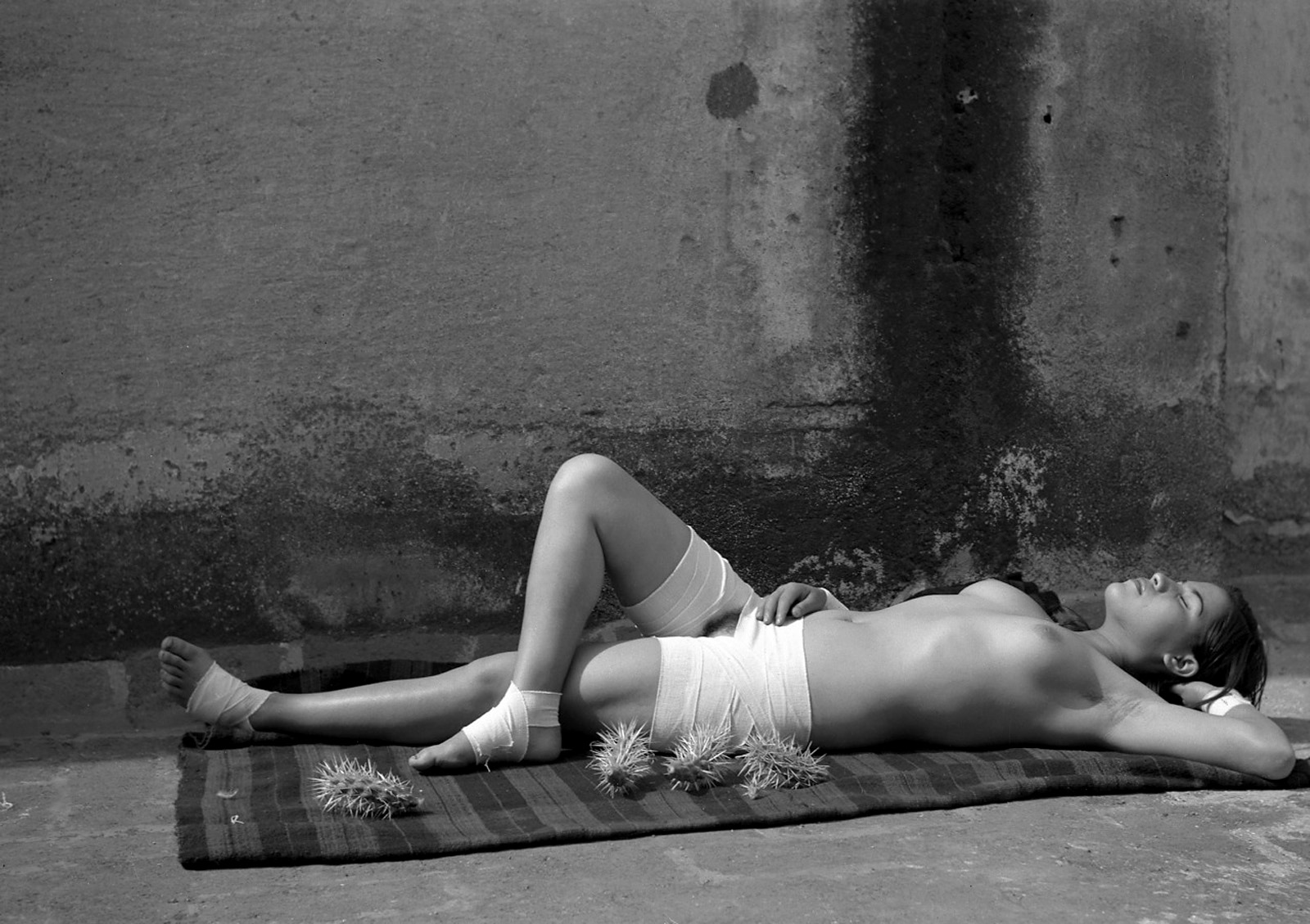
Manuel Alvarez Bravo (Mexican, 1902-2002) 'La Buena Fama Durmiendo (The Good Reputation Sleeping)' 1939, printed c. 1970s from the exhibition 'Dream States: Contemporary Photographs and Video' at the Metropolitan Museum of Art, New York, May - Oct, 2016


Manuel Alvarez Bravo (Mexican, 1902-2002)
La Buena Fama Durmiendo (The Good Reputation Sleeping)
1939, printed c. 1970s
Gelatin silver print
Mat: 16 × 20 in. (40.6 × 50.8cm)
The Elisha Whittelsey Collection, The Elisha Whittelsey Fund, 1973


The best fun I had with this posting was putting together the first twelve images. They seem to act as ‘strange attractors’, a feeling recognised by the curators of the exhibition if you view the first installation photograph by Anders Jones, below.

Dr Marcus Bunyan


Many thankx to photographer Anders Jones and the Duggal website for allowing me to publish the installation photographs in the posting.


Artists have always turned to dreams as a source of inspiration, a retreat from reason, and a space for exploring imagination and desire. In the history of photography, dreams have been most closely associated with the Surrealists, who pushed the technical limits of the medium to transform the camera’s realist documents into fantastical compositions. Whereas their modernist explorations were often bound to psychoanalytic theories, more recently contemporary photographers have pursued the world of sleep and dreams through increasingly open-ended works that succeed through evocation rather than description.

This exhibition takes a cue from the artists it features by displaying a constellation of photographs that collectively evoke the experience of a waking dream. Here, a night sky composed of pills, a fragmented rainbow, a sleeping fairy-tale princess, and an alien underwater landscape illuminate hidden impulses and longings underlying contemporary life. Drawn entirely from The Met collection, Dream States features approximately 30 photographs and video works primarily from the 1970s to the present.

Text from the Metropolitan Museum of Art


Anselm Kiefer (German born Donaueschingen, b. 1945) 'Brünnhilde Sleeps' 1980 from the exhibition 'Dream States: Contemporary Photographs and Video' at the Metropolitan Museum of Art, New York, May - Oct, 2016


Anselm Kiefer (German born Donaueschingen, b. 1945)
Brünnhilde Sleeps
1980
Acrylic and gouache on photograph
23 x 32 7/8in. (58.4 x 83.5cm)
Denise and Andrew Saul Fund, 1995
© Anselm Kiefer


Near the end of Wagner’s second opera of the Ring Cycle, Die Walküre (The Valkyrie), the Valkyrie Brünnhilde, having attempted to help the sibling lovers Siegmund and Sieglinde against their father’s wishes, is punished for her betrayal. Wotan puts her to sleep and surrounds her with a ring of fire (she will be awakened in turn by her nephew Siegfried, the incestuous son of Siegmund and Sieglinde, in the third opera of the cycle).

Kiefer portrays the dormant Brünnhilde as French actress Catherine Deneuve in François Truffaut’s film Mississippi Mermaid, using a photograph he snapped in a movie house in 1969. In the film, Deneuve plays a deceitful mail-order bride who comes to the island of Réunion to marry a plantation owner, played by Jean-Paul Belmondo. Aside from the parallels of love and betrayal in both the Ring Cycle and Truffaut’s film, Kiefer thought the choice of Deneuve for Brünnhilde both ironic and amusing: she was for him “the contrary of Brünnhilde. Very slim, very French, very cool, very sexy,” hinting that no man would go through fire to obtain Wagner’s corpulent, armoured Valkyrie.


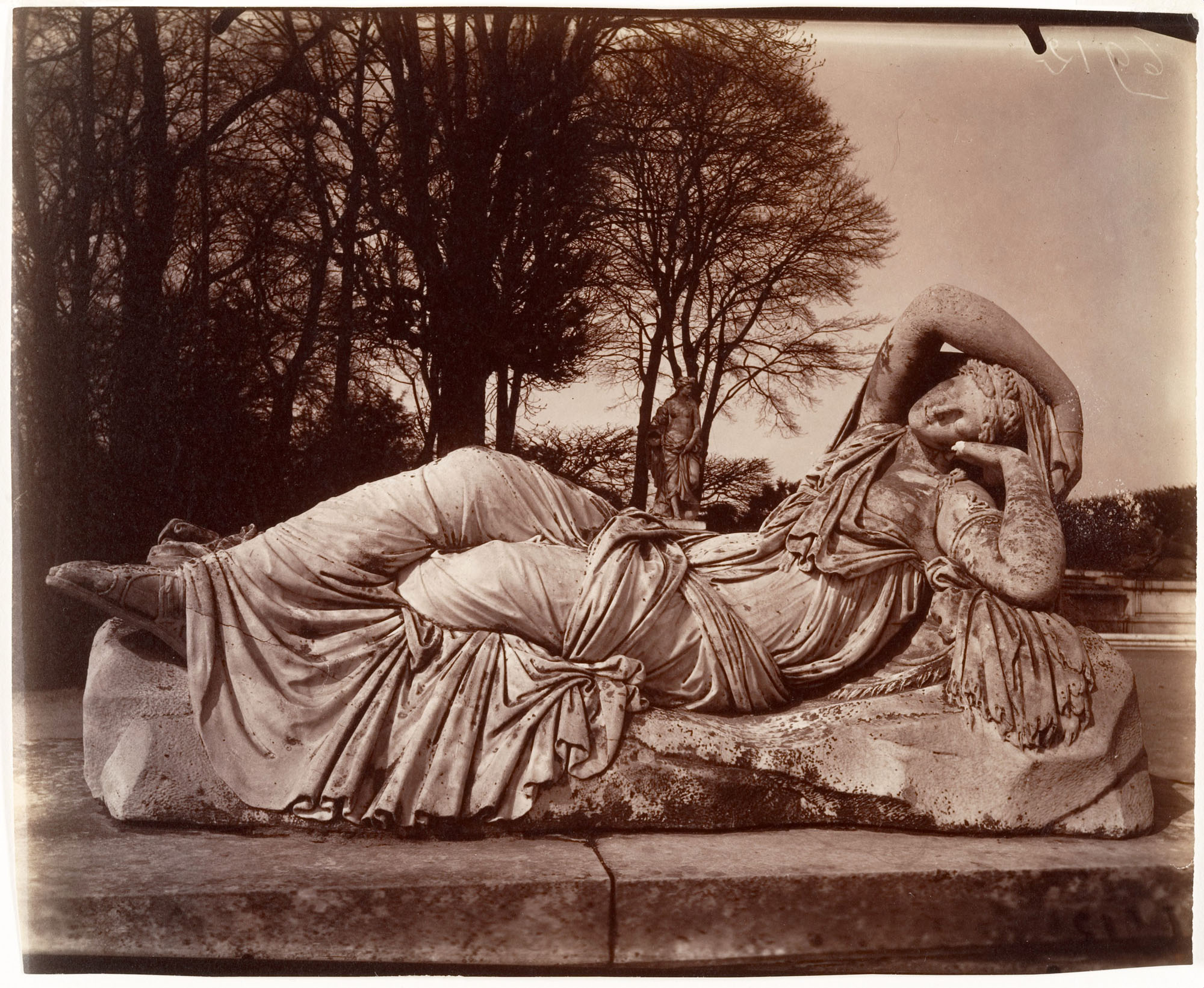
Eugène Atget (French, Libourne 1857-1927 Paris) 'Versailles' 1924-1925


Eugène Atget (French, Libourne 1857-1927 Paris)
Versailles
1924-25
Salted paper print from glass negative
Image: 17.5 x 21.9cm (6 7/8 x 8 5/8 in.)
Sheet: 18 × 21.9cm (7 1/16 × 8 5/8 in.)
Mat: 40.6 × 50.8cm (16 × 20 in.)
Gilman Collection, Purchase, Ann Tenenbaum and Thomas H. Lee Gift, 2005


From 1898 until his death in 1927, Atget exhaustively documented the remains of Old Paris: the city’s streets, monuments, interiors, and environs. Among the last entries in this self-directed preservationist effort was a series of images of landscapes and sculpture in the parks of Saint-Cloud and Versailles. Here, the photographer records a statue of a sleeping Ariadne, the mythical Cretan princess abandoned by her lover Theseus on the island of Naxos. Atget’s simultaneously realistic and otherworldly photographs inspired the Surrealist artist Man Ray, who reproduced four of them in a 1926 issue of the journal La Révolution Surréaliste, thus presenting the elder photographer as a modernist forerunner.


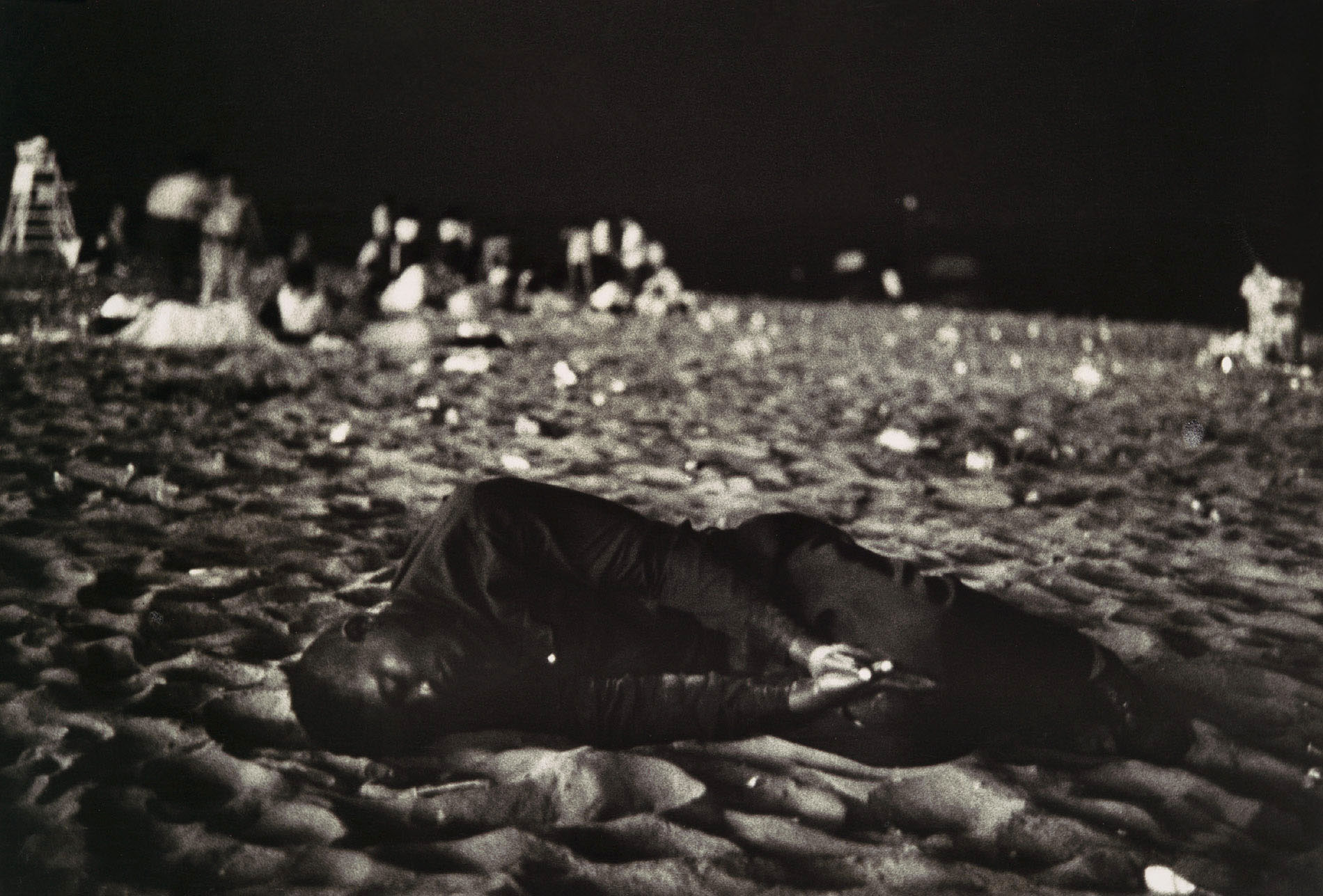
Robert Frank (American, 1924-2019) 'Fourth of July, Coney Island' 1958


Robert Frank (American, 1924-2019)
Fourth of July, Coney Island
1958
Gelatin silver print
Image: 26 x 35.6 cm (10 1/4 x 14 in.)
Mat: 47 × 57.2cm (18 1/2 × 22 1/2 in.)
Purchase, Alfred Stieglitz Society Gifts, 2002
© 2005 Robert Frank


As he traveled around the country in 1955-1956 making the photographs that would constitute his landmark book, The Americans, Frank’s impression of America changed radically. He found less of the freedom and tolerance imagined by postwar Europeans, and more alienation and racial prejudice simmering beneath the happy surface. His disillusionment is poignantly embodied in this image of a disheveled African-American man disengaged from the crowd and asleep in a foetal position amid the debris of an Independence Day celebration on Coney Island.

This was one of the last still photographs Frank made before he devoted his creative energy to filmmaking in the early 1960s. As such, it may be interpreted as an elegy to still photography; the lone figure functions as a surrogate for Frank himself, as he turned his back on Life – like photojournalism to concentrate on the more personal, dreamlike imagery of his films.


Shannon Bool (Canadian, b. 1972) 'Vertigo' 2015


Shannon Bool (Canadian, b. 1972)
Vertigo
2015
Gelatin silver print
Image: 7 13/16 × 11 13/16 in. (19.8 × 30cm)
Gift of Shannon Bool and Daniel Faria Gallery, 2015
© Shannon Bool


This photogram – made without a camera by placing a collage of transparencies on a photosensitive sheet of paper and exposing it to light – is part of a series portraying psychoanalysts and their patients. Here, a patient on a Freudian couch is seen from above; the figure, sheathed in patterns of Maori origin, appears to come apart at the seams under the analyst’s scrutiny.


Nan Goldin (American, born Washington, D.C., 1953) 'French Chris on the Convertible, NYC' 1979


Nan Goldin (American, born Washington, D.C., 1953)
French Chris on the Convertible, NYC
1979
Silver dye bleach print
Image: 50.8 x 61cm (20 x 24in.)
Mat: 63.5 × 81.3cm (25 × 32 in.)
Purchase, The Horace W. Goldsmith Foundation Gift, through Joyce and Robert Menschel, 2001
© Nan Goldin Courtesy Matthew Marks Gallery


Following in the tradition of Robert Frank and Helen Levitt, Goldin is her generation’s greatest practitioner of the “snapshot aesthetic” in photography – the intimate, diaristic mode that yields images that, in the right hands, are both spontaneous and carefully seen, tossed off and irreducibly right. In this early work, the artist has captured her friend as a Chatterton of the Lower East Side, lying across the back of a blue convertible with shirt open, eyes closed, and an empty can of Schaeffer beer by his side instead of arsenic – a contemporary vision of glamorous surrender for our own time.


Arthur Tress (American, b. 1940) 'Boy in Flood Dream, Ocean City, New Jersey' 1972


Arthur Tress (American, b. 1940)
Boy in Flood Dream, Ocean City, New Jersey
1972
Gelatin silver print
Mat: 18 × 18 in. (45.7 × 45.7cm)
Gift of the artist, 1973


In the late 1960s, Tress began audio-recording children recounting their dreams and nightmares. He then collaborated with the young people, who acted out their tales for the camera, and published the resulting surreal images in the 1972 book The Dream Collector. Many of the children shared common nightmare scenarios such as falling, drowning, and being trapped, chased by monsters, or humiliated in the classroom. Here, a young boy clings to the roof of a home that has washed ashore as if after a flood. The desolate landscape evokes the sort of non-place characteristic of dreams and conveys feelings of loneliness and abandonment.


Installation view of the exhibition 'Dream States: Contemporary Photography and Video' at the Metropolitan Museum of Art Photo by Anders Jones


Installation view of the exhibition Dream States: Contemporary Photography and Video at the Metropolitan Museum of Art featuring at lower right, Nan Goldin’s French Chris on the Convertible, NYC (1979)
Photo: Anders Jones


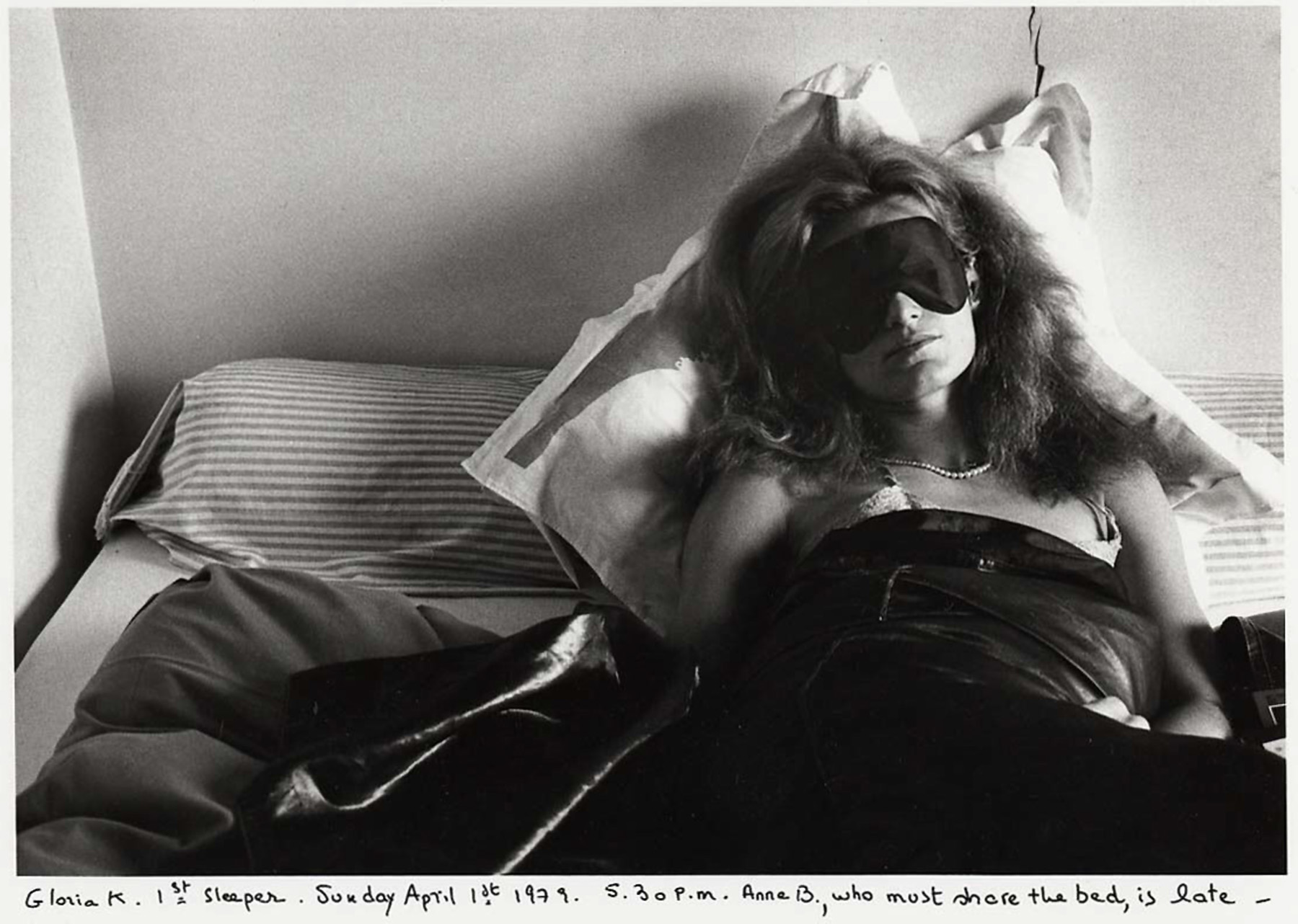
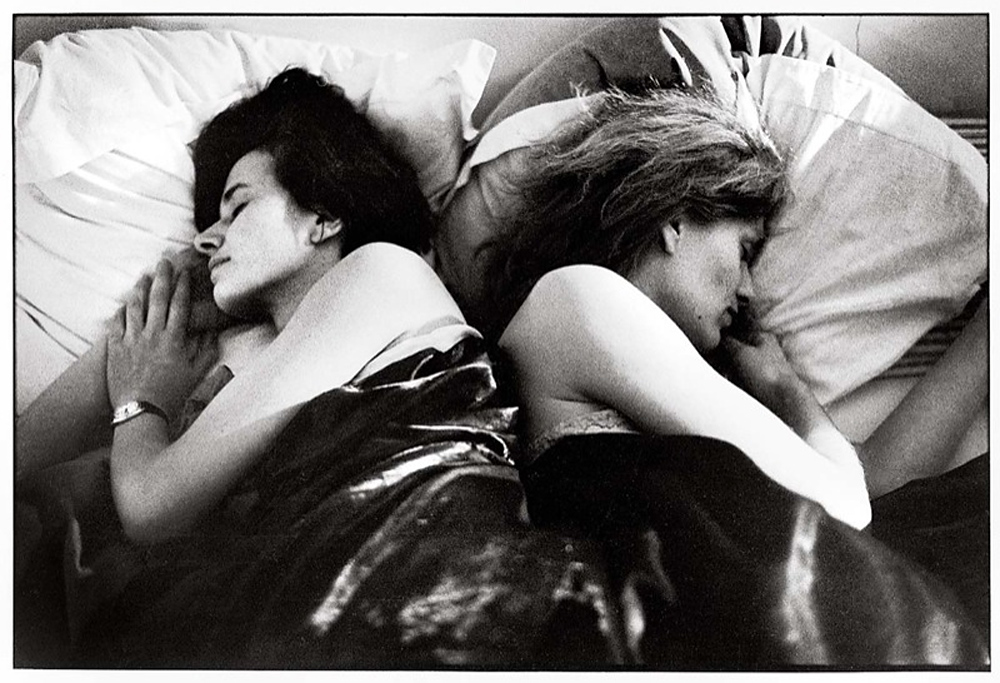
Sophie Calle (French, born Paris, 1953) 'Gloria K., first sleeper. Anne B., second sleeper' 1979


Sophie Calle (French, born Paris, 1953)
Gloria K., first sleeper. Anne B., second sleeper
1979
Gelatin silver prints
Image: 12.6 x 18.4cm (4 15/16 x 7 1/4in.)
Mat: 35.6 × 43.2cm (14 × 17 in.)
Gift of the artist and Olivier Renaud-Clement, in memory of Gilles Dusein, 2000
© Sophie Calle


Sophie Calle (French, born Paris, 1953) 'Gloria K., first sleeper. Anne B., second sleeper' 1979


Sophie Calle (French, born Paris, 1953)
Gloria K., first sleeper. Anne B., second sleeper
1979
Gelatin silver prints
Image: 12.6 x 18.4cm (4 15/16 x 7 1/4in.)
Mat: 35.6 × 43.2cm (14 × 17 in.)
Gift of the artist and Olivier Renaud-Clement, in memory of Gilles Dusein, 2000
© Sophie Calle


While obviously indebted to the deadpan photo-text combinations of Conceptualism, Calle’s art is as purely French at its core as the novels of Marguerite Duras and the films of Alain Resnais – an intimate exploration of memory, desire, and obsessive longing. The artist’s primary method involves a perfectly calibrated interplay between narrative and image, both of which steadily approach their object of desire only to find another blind spot-that which can never be captured through language or representation.

This work is the first segment of Calle’s first work, The Sleepers (1979), in which the artist invited twenty-nine friends and acquaintances to sleep in her bed consecutively between April 1 and April 9, during which time she photographed them once an hour and kept notes recording each encounter. All the elements of Calle’s art-from the voyeuristic inversion of the private sphere (rituals of the bedroom) and the public (the book or gallery wall) to the use of serial, repetitive structures-are present here in embryonic form.


Paul Graham (British, b. 1956) 'Senami, Christchurch, New Zealand' 2011


Paul Graham (British, b. 1956)
Senami, Christchurch, New Zealand
2011
Chromogenic print
Image: 44 1/4 in. × 59 in. (112.4 × 149.9cm)
Purchase, Vital Projects Fund Inc. Gift, through Joyce and Robert Menschel and Hideyuki Osawa Gift, 2015


Graham’s series, Does Yellow Run Forever?, juxtaposes three groups of photographs: rainbows arcing over the Irish countryside, the facades of pawn-and-jewellery shops in New York, and tender studies of his partner asleep. The thematic links between the images (the rainbow’s mythical pot of gold, the sparkling objects in the Harlem window display, and a sleeping dreamer) may seem obvious, even pat, but Graham’s photographs transmute those clichés into a constellation of deep feeling. These luminous vignettes evoke a sense of longing and pathos, the quest for something permanent amid the illusory and devalued.


Peter Hujar (American, Trenton, New Jersey 1934-1987 New York) 'Girl in My Hallway' 1976


Peter Hujar (American, Trenton, New Jersey 1934-1987 New York)
Girl in My Hallway
1976
Gelatin silver print
Image: 37 x 37.1cm (14 9/16 x 14 5/8 in.)
Mat: 63.5 × 63.5cm (25 × 25 in.)
Purchase, Alfred Stieglitz Society Gifts, 2006
© The Peter Hujar Archive, L.L.C.


Brassaï (French born Romania, Brașov 1899-1984 Côte d'Azur) 'A Vagrant Sleeping in Marseille' 1935, printed 1940s


Brassaï (French born Romania, Brașov 1899-1984 Côte d’Azur)
A Vagrant Sleeping in Marseille
1935, printed 1940s
Gelatin silver print
Image: 17.2 x 23.3cm (6 3/4 x 9 3/16in.)
Mat: 43.2 × 35.6cm (17 × 14 in.)
Gift of the artist, 1980
Copyright © Gilberte Brassaï


The inevitable suggestion that the homeless, hungry man sprawled on the sidewalk might be dreaming of a finely dressed and improbably large salad links Brassaï’s photograph to the work of the Surrealists. Although he frequently depicted thugs, vagrants, and prostitutes, he did so without judgment or political motive; his were pictures meant to delight or perplex the eye and mind-not to prompt a social crusade.


Installation view of the exhibition 'Dream States: Contemporary Photography and Video' at the Metropolitan Museum of Art showing at left, Paul Graham's 'Gold Town Jewellery, East Harlem, New York' (2012); and at right, Paul Graham's 'Senami, Christchurch, New Zealand' (2011), both from the series 'Does Yellow Run Forever'?


Installation view of the exhibition Dream States: Contemporary Photography and Video at the Metropolitan Museum of Art showing at left, Paul Graham’s Gold Town Jewellery, East Harlem, New York (2012); and at right, Paul Graham’s Senami, Christchurch, New Zealand (2011), both from the series Does Yellow Run Forever?
Photo: Anders Jones


The psychological fluidity of the medium has been noted before by the Met. In 1993, to celebrate its purchase of the Gilman Collection, the curator Maria Morris Hambourg chose to call her exhibition The Waking Dream. The title came from Keats’s “Ode to a Nightingale” and suggested, in Hambourg’s words, “the haunting power of photographs to commingle past and present, to suspend the world and the artist’s experience of it in unique distillations.”

Conceptual latitude can benefit curators, giving them plenty of room to manoeuvre in making their selections, or it can be a detriment if a loose framework has so many sides that it won’t support an argument.

Dream States suffers from the latter, even though the leeway of the title allows splendid pictures in disparate styles to be displayed together. Organised by associate curator Mia Fineman and assistant curator Beth Saunders around a theme that isn’t notably pertinent or provocative, the show has no discernible reason for being. It isn’t stocked with recent purchases – fewer than ten of the works entered the collection in this decade – and it isn’t tightly edited. To quality for inclusion here a photograph need only depict someone lying down or with eyes closed. A “dream state” seems to be loosely defined. It can be as a starry or cloudless sky; a tree-less landscape; inverted or abstract imagery; or something blurry.

Richard B. Woodward. “Dream States: Contemporary Photography and Video @Met,” on the Collector Daily website July 11, 2016 [Online] Cited 06/10/2016


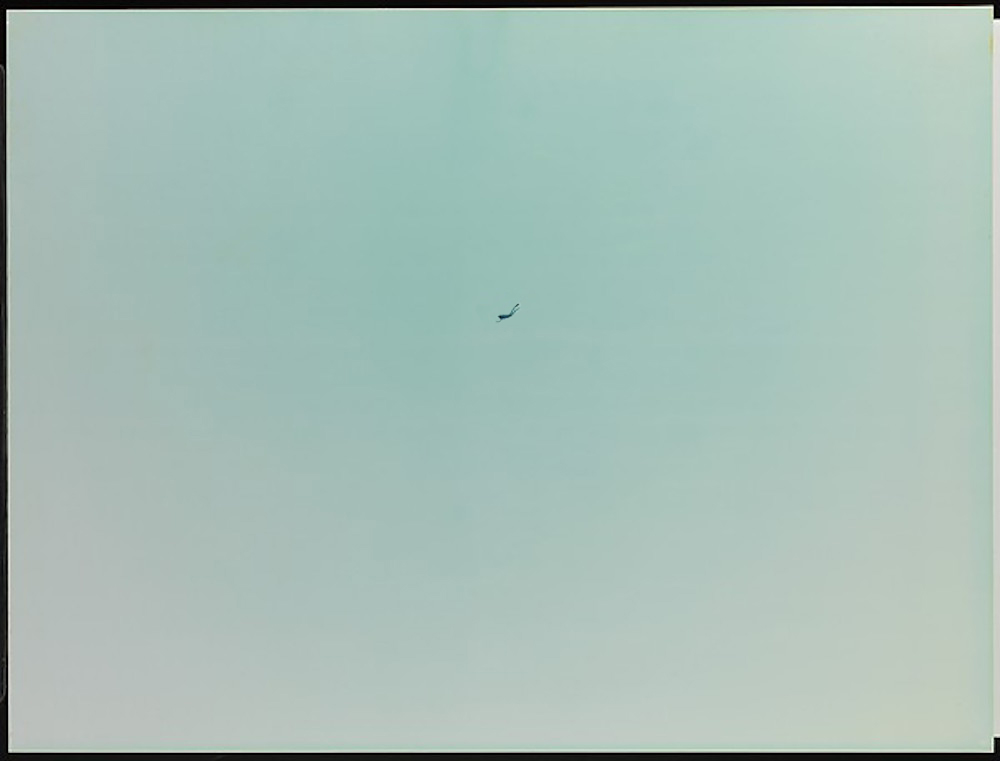
Jack Goldstein (American born Canada, 1945-2003) 'The Pull' 1976


Jack Goldstein (American born Canada, 1945-2003)
The Pull
1976
Chromogenic prints
Frame: 76.2 x 101.6cm (30 x 40 in.) each
Purchase, The Buddy Taub Foundation Gift and Vital Projects Fund Inc. Gift, through Joyce and Robert Menschel, 2009
© The Estate of Jack Goldstein


Born in the postwar baby boom, Goldstein grew up surrounded by the products of the rapidly expanding media culture-movies, television, newspapers, magazines, and advertisements of all kinds. Young artists such as Goldstein went on to be educated in the rigorous and reductive principles of Minimal and Conceptual art during the 1970s but knew from personal experience that images shape our sense of the world and who we are, rather than vice versa; they made their art reflect that secondhand relationship to reality.

In this early work, Goldstein has lifted, or “appropriated,” images of a deep sea diver, a falling figure, and a spaceman from unknown printed sources – isolating them from their original contexts and setting them at a very small scale against monochromatic backgrounds (green for sea, blue for sky, and white for space), as if the viewer were seeing them from a great distance. Because the viewer is unlikely to have seen such figures firsthand, that distance is not merely spatial but also epistemological in nature-the images trigger memories based not on original encounters but on reproductions of experience. The Pull – Goldstein’s only photographic work in a career that spanned painting, performance, film, and sound recordings – was included in “Pictures,” a seminal 1977 exhibition at Artist’s Space in New York, which also introduced the public to other young artists making use of appropriation, such as Sherrie Levine, Robert Longo, and Troy Brauntuch.


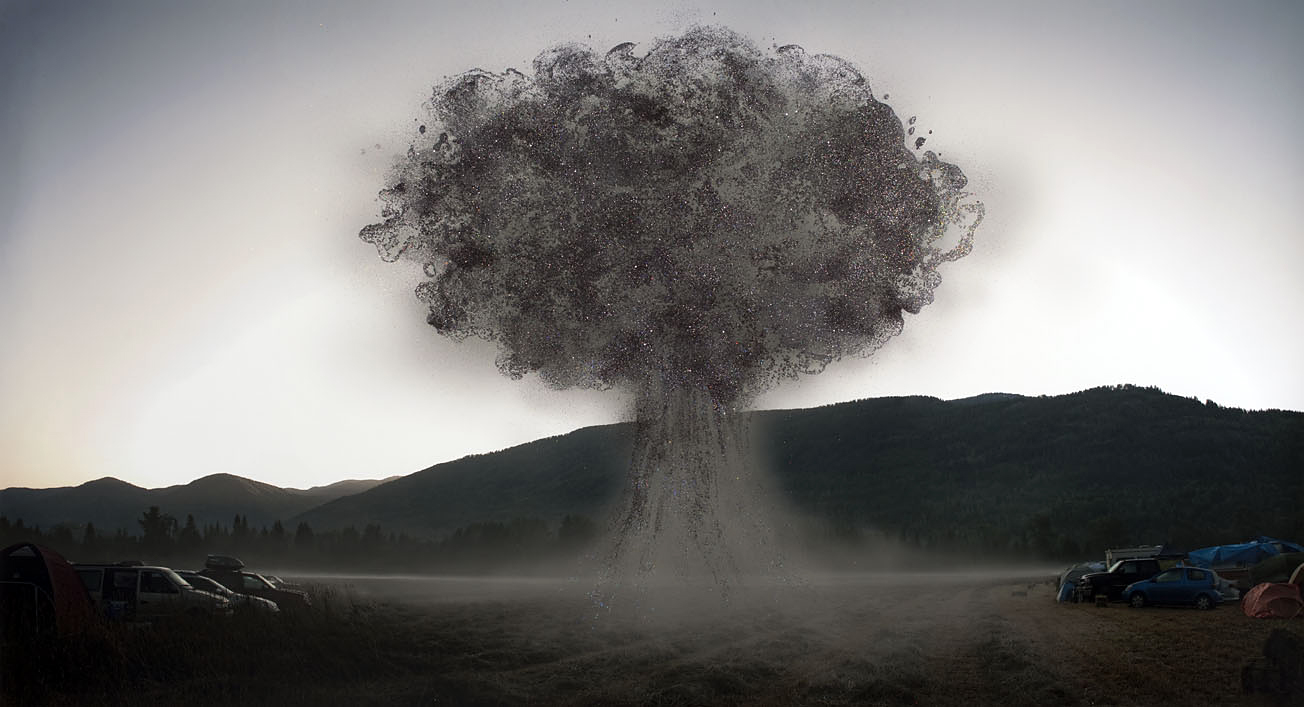
Sarah Anne Johnson (Canadian, b. 1976) 'Glitter Bomb' 2012


Sarah Anne Johnson (Canadian, b. 1976)
Glitter Bomb
2012
Chromogenic print with glitter and acrylic paint
Sheet: 29 7/8 in. × 53 in. (75.9 × 134.6cm)
Purchase, Funds from Various Donors in memory of Randie Malinsky, 2016
© Sarah Anne Johnson


Johnson works primarily with photography but also employs a variety of other media – sculpted figurines, dioramas, paint, ink, and bursts of glitter – to amplify the emotional power of her images. Glitter Bomb belongs to a series exploring the bacchanalian culture of summer music festivals. At once ominous and ecstatic, the image evokes the blissed-out mind-set of young revellers taking part in a modern-day rite of passage.


Oliver Wasow (American, b. 1960) 'Float' 1984-2008, printed 2009


Oliver Wasow (American, b. 1960)
Float
1984-2008, printed 2009
Inkjet prints
Frame: 17.3 x 22.3cm (6 13/16 x 8 3/4 in.)
Overall: 116.8 x 152.4cm (46 x 60 in.)
Purchase, Vital Projects Fund Inc. Gift, through Joyce and Robert Menschel, 2010
© Oliver Wasow


Wasow has a long-standing fascination with science fiction, apocalyptic fantasies, and documentation of unidentified flying objects. In his many pictures of mysterious floating disks and orbs, the artist courts doubt by running found images through a battery of processes, including drawing, photocopying, and superimposition, to create distortions. The resulting photographs play with the human propensity to invest form with meaning, offering just enough detail to spur the imagination.


Fred Tomaselli (American born Santa Monica, California, 1956) 'Portrait of Laura' 2015


Fred Tomaselli (American born Santa Monica, California, 1956)
Portrait of Laura
2015
Gelatin silver print with graphite
Image: 16 in. × 19 15/16 in. (40.6 × 50.6cm)
Mat: 24 3/4 × 25 3/4 in. (62.9 × 65.4cm)
Purchase, Vital Projects Fund Inc. Gift, through Joyce and Robert Menschel, 2016
© Fred Tomaselli


This “portrait” of the artist’s wife, Laura, belongs to an ongoing series he calls “chemical celestial portraits of inner and outer space.” Tomaselli creates likenesses based on each sitter’s astrological sign and the star map for his or her date of birth. Placing sugar and pills on photographic paper and exposing it to light, he produces a photogram of the corresponding constellation and names the stars after the various drugs the subject remembers consuming, from cold medicine to cocaine. The result is an unconventional map of identity that cleverly weds the mystical and the pharmacological.


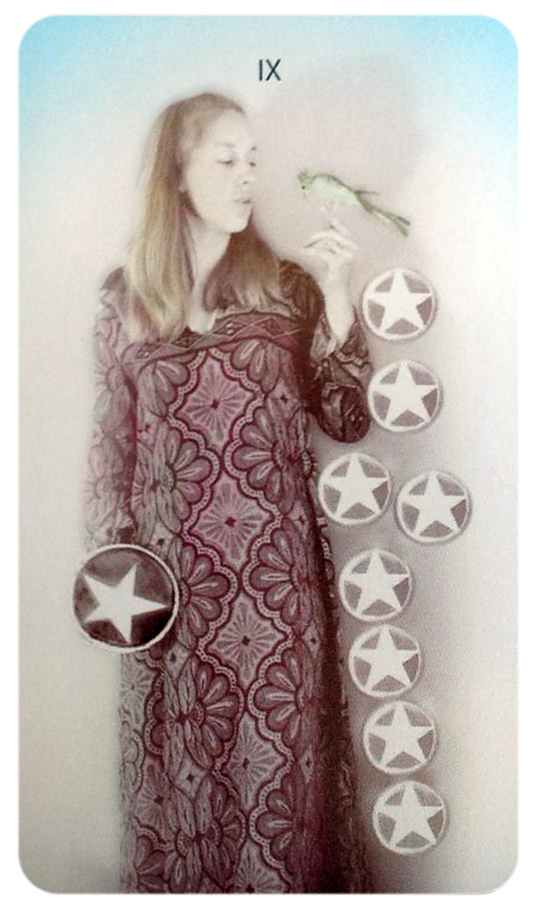
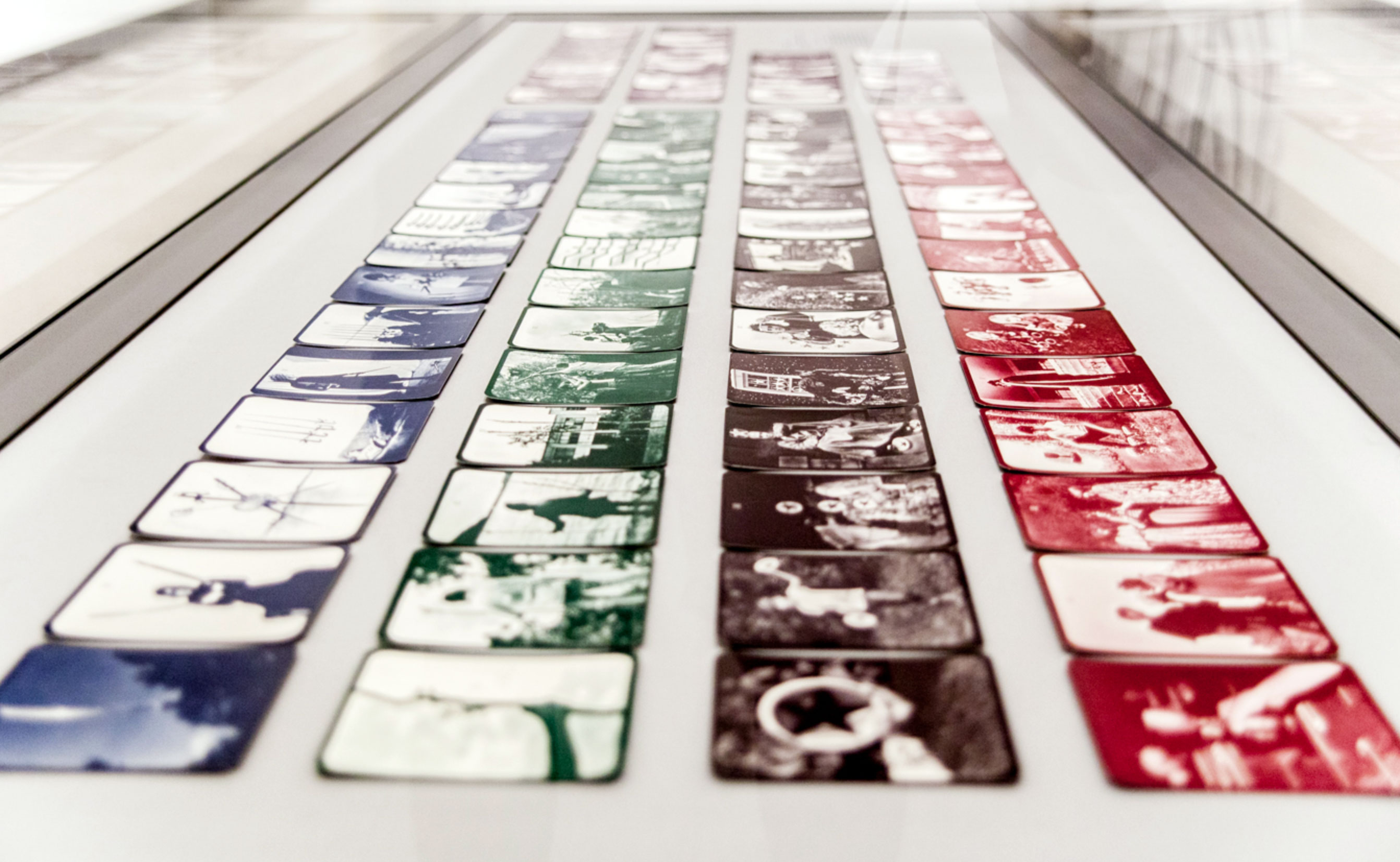
Bea Nettles (American, born Gainesville, Florida, 1946) 'Mountain Dream Tarot: A Deck of 78 Photographic Cards' 1975

Bea Nettles (American, born Gainesville, Florida, 1946) 'Mountain Dream Tarot: A Deck of 78 Photographic Cards' 1975

Bea Nettles (American, born Gainesville, Florida, 1946) 'Mountain Dream Tarot: A Deck of 78 Photographic Cards' 1975

Bea Nettles (American, born Gainesville, Florida, 1946) 'Mountain Dream Tarot: A Deck of 78 Photographic Cards' 1975


Bea Nettles (American, born Gainesville, Florida, 1946)
Mountain Dream Tarot: A Deck of 78 Photographic Cards
1975
Photographically illustrated tarot cards
Purchase, Dorothy Levitt Beskind Gift, 1977


The idea to create a set of photographic tarot cards came to Nettles in a dream during the summer of 1970, while she was on an artist’s residency in the mountains of North Carolina. She subsequently reinterpreted the ancient symbolism of the traditional tarot deck, enlisting friends and family members as models for photographs that she augmented with hand-painted additions. In 2007 the image Nettles created for the Three of Swords card was used as the disc graphic for Bruce Springsteen’s album Magic.


Installation view of the exhibition 'Dream States: Contemporary Photography and Video' at the Metropolitan Museum of Art Photo by Anders Jones showing Bea Nettles' 'Mountain Dream Tarot: A Deck of 78 Photographic Cards' (1975)


Installation view of the exhibition Dream States: Contemporary Photography and Video at the Metropolitan Museum of Art showing Bea Nettles’ Mountain Dream Tarot: A Deck of 78 Photographic Cards (1975)
Photo: Anders Jones


Artists often turn to dreams as a source of inspiration, a retreat from reason, and a space for exploring imagination and desire. In the history of photography, dream imagery has been most closely associated with the Surrealists, who used experimental techniques to bridge the gap between the camera’s objectivity and the internal gaze of the mind’s eye. While those modernist explorations were often bound to psychoanalytic theories, other photographers have pursued the world of sleep and dreams through deliberately open-ended works that succeed through evocation rather than description. The exhibition Dream States: Contemporary Photographs and Video presents 30 photographs and one video drawn from The Met collection, all loosely tied to the subjective yet universal experience of dreaming. The exhibition is on view at the Museum from May 16 through October 30, 2016.

Many of the works take the surrender of sleep as their subject matter. In photographs by Robert Frank, Danny Lyon, and Nan Goldin, recumbent figures appear vulnerable to the wandering gaze of onlookers, yet their inner worlds remain out of reach. Images of bodies floating and falling conjure the tumultuous world of dreams, and landscapes are made strange through the camera’s selective vision. Highlights include photographs by Paul Graham from his recent series Does Yellow Run Forever (2014); images from Sophie Calle’s earliest body of work, The Sleepers (1979), in which she invited friends and acquaintances to sleep in her own bed while she watched; and Anselm Kiefer’s Brünnhilde Sleeps (1980), a hand-painted photograph featuring French actress Catherine Deneuve recast as a Wagnerian Valkyrie. Also featured are recently acquired works by Shannon Bool, Sarah Anne Johnson, Jim Shaw, and Fred Tomaselli.

Dream States: Contemporary Photographs and Video is organised by Mia Fineman, Associate Curator; and Beth Saunders, Curatorial Assistant in the Department of Photographs at The Metropolitan Museum of Art.

Text from the Metropolitan Museum of Art


Grete Stern (Argentinian born Germany, 1904-1999) 'Sueño No. 1: "Articulos eléctricos para el hogar" (Dream No. 1: "Electrical Household items")' c. 1950


Grete Stern (Argentinian born Germany, 1904-1999)
Sueño No. 1: “Articulos eléctricos para el hogar” (Dream No. 1: “Electrical Household items”)
c. 1950
Gelatin silver print
Image: 26.6 x 22.9cm (10 1/2 x 9 in.)
Frame: 63.5 x 76.2cm (25 x 30 in.)
Twentieth-Century Photography Fund, 2012


In 1948 the Argentine women’s magazine Idilio introduced a weekly column called “Psychoanalysis Will Help You,” which invited readers to submit their dreams for analysis. Each week, one dream was illustrated with a photomontage by Stern, a Bauhaus-trained photographer and graphic designer who fled Berlin for Buenos Aires when the Nazis came to power. Over three years, Stern created 140 photomontages for the magazine, translating the unconscious fears and desires of its predominantly female readership into clever, compelling images. Here, a masculine hand swoops in to “turn on” a lamp whose base is a tiny, elegantly dressed woman. Rarely has female objectification been so erotically and electrically charged.


Adam Fuss (British, b. 1961) 'From the series "My Ghost"' 1999


Adam Fuss (British, b. 1961)
From the series “My Ghost”
1999
Gelatin silver print
184.9 x 123.3cm (72 13/16 x 48 9/16 in.)
Purchase, The Horace W. Goldsmith Foundation Gift, through Joyce and Robert Menschel, 2000
© Adam Fuss


With his large-scale photograms, Fuss has breathed new life into the cameraless technique that became the hallmark of modernist photographers such as Man Ray and László Moholy-Nagy in the 1920s. He created this image by blowing thick clouds of smoke over a sheet of photographic paper and exposing it to a quick flash of light. Evoking the wizardry of a medieval alchemist, Fuss fixes a permanent image of evanescence.


The Metropolitan Museum of Art
1000 Fifth Avenue at 82nd Street
New York, New York 10028-0198
Phone: 212-535-7710

Opening hours:
Sunday – Tuesday and Thursday: 10am – 5pm
Friday and Saturday: 10am – 9pm
Closed Wednesday

The Metropolitan Museum of Art website

LIKE ART BLART ON FACEBOOK

Back to top

Exhibition: ‘Naked Before the Camera’ at the Metropolitan Museum of Art, New York

Exhibition dates: 27th March – 9th September 2012

WARNING: this posting contains photographs of nudity. If you do not like please do not look.


Many thankx to the Metropolitan Museum of Art for allowing me to publish the photographs in the posting. Please click on the photographs for a larger version of the image.


Franck-François-Genès Chauvassaignes (French, 1831 - after 1900) 'Untitled [Female Nude in Studio]' 1856-1859


Franck-François-Genès Chauvassaignes (French, 1831 – after 1900)
Untitled [Female Nude in Studio]
1856-1859
Salted paper print from glass negative
19.1 x 15.2cm (7.5 x 6 in.)
Metropolitan Museum of Art
Purchase, The Horace W. Goldsmith Foundation Gift, through Joyce and Robert Menschel, 1998
Public domain


This corner of a painter’s atelier somewhere in France in the middle of the nineteenth century is scarcely tethered to time or place; it could as easily be a loft in New York today or, had photography existed four centuries earlier, a studio in the Italian Renaissance. What is surprising here is the absence of even the thinnest disguise – no swags of drapery, elaborate coiffure, or skeins of beads as are commonly found in the work of other purveyors of “studies for artists.” Here, the model is utterly naked. With her intelligent head and dirty feet, this young woman helped found the matter-of-fact modelling sorority joined a decade later by Édouard Manet’s Olympia.

Text from the Metropolitan Museum of Art website


Félix-Jacques-Antoine Moulin (French, 1800 - after 1875) 'Untitled [Two Standing Female Nudes]' c. 1850


Félix-Jacques-Antoine Moulin (French, 1800 – after 1875)
Untitled [Two Standing Female Nudes]
c. 1850
Daguerreotype
Visible: 14.5 x 11.1cm (5 11/16 x 4 3/8 in.)
Metropolitan Museum of Art
The Rubel Collection, Purchase, Anonymous Gift and Lila Acheson Wallace Gift, 1997
Public domain


Although Moulin was sentenced in 1851 to a month in jail for producing images that, according to court papers, were “so obscene that even to pronounce the titles… would be to commit an indecency,” this daguerreotype seems more allied to art than to erotica. Instead of the boudoir props and provocative poses typical of hand-coloured pornographic daguerreotypes, Moulin depicted these two young women utterly at ease, as unselfconscious in their nudity as Botticelli’s Venus.

Text from the Metropolitan Museum of Art website


Unknown photographer (French) '[Seated Female Nude]' c. 1850


Unknown photographer (French)
[Seated Female Nude]
c. 1850
Daguerreotype
9.1 x 6.9cm (3 9/16 x 2 11/16 in.)
Metropolitan Museum of Art
Credit Line: Gilman Collection, Gift of The Howard Gilman Foundation, 2005
Public domain


This daguerreotype was surely intended to serve artistic purposes, but the odd twist of the body and the strange relationship of the three visible limbs seem to render it inappropriate for artistic emulation. Such tension between an artistic ideal and realistic means – between the classicism of an academic pose and the awkwardness of the camera’s rendering of human movement – seems emblematic of the dilemma faced by the nascent medium striving to be an art.

Text from the Metropolitan Museum of Art website


Julien Vallou de Villeneuve (French, 1795-1866) '[Standing Female Nude]' c. 1853


Julien Vallou de Villeneuve (French, 1795-1866)
[Standing Female Nude]
c. 1853
Salted paper print from paper negative
12 x 16cm (4 3/4 x 6 5/16 in.)
Metropolitan Museum of Art
Purchase, Lila Acheson Wallace Gift, 1993
Public domain


A student of the painter Jean François Millet (1814-1875) and a lithographer of scenes of daily life, costume, and erotica in the 1820s and 1830s, Vallou reportedly took up photography in the early 1840s. Because his early photographs have not been identified, it has been assumed that they depicted naked women, a subject for which it was to improper to acknowledge authorship.

Between 1851 and 1855, Vallou made a series of small-scale paper photographs of female nudes that he marketed (and legally registered) as models for artists. Vallou’s nudes have long been associated with those of Gustave Courbet (1819-1877), who is known to have used photographs in his painting process. Though no absolute one-to-one correspondence can be pointed to, there are some striking similarities in pose, and the heavy, soporific quality of Vallou’s models is very close to Courbet’s concept of the nude.

Text from the Metropolitan Muesum of Art website


Eugène Durieu (French, 1800-1874) 'Untitled [Seated Female Nude]' 1853-1854


Eugène Durieu (French, 1800-1874)
Untitled [Seated Female Nude]
1853-1854
Albumen silver print from glass negative
6 13/16 × 4 11/16 in. (17.3 × 11.9cm)
Metropolitan Museum of Art
Gilman Collection, Purchase, Mr. and Mrs. Henry R. Kravis Gift, 2005
Public domain


Durieu was a lawyer and early advocate and practitioner of photography in France who, in 1853-1854, made a series of photographic studies of nude and costumed figures as models for artists. The French Romantic painter Eugène Delacroix helped him pose the figures and later praised the prints, from which he sketched, as “palpable demonstrations of the free design of nature.” While the painter saw the accurate transcription of reality as a virtue of photography, Durieu knew that a good photograph was not simply the result of the correct use of the medium but, more significantly, an expression of the photographer’s temperament and vision. In an important article he emphasised the interpretative nature of the complex manipulations in photography and explained that the photographer must previsualise his results so as to make a “picture,” not just a “copy.”

This photograph proves Durieu’s point: through the elegant contours of the drapery, the smooth modelling of the flesh, and the grace and restraint of the pose, the picture attains an artistic poise that combines Delacroix’s sensuality with Ingres’s classicism, and rivals both.

Text from the Metropolitan Museum of Art website


Charles Alphonse Marlé (French, 1821 - after 1867) 'Untitled [Standing Male Nude]' c. 1855


Charles Alphonse Marlé (French, 1821 – after 1867)
Untitled [Standing Male Nude]
c. 1855
Salted paper print from paper negative
25.7 x 17.6cm (10 1/8 x 6 15/16 in.)
Metropolitan Museum of Art
Purchase, Ezra Mack Gift and The Horace W. Goldsmith Foundation Gift through Joyce and Robert Menschel, 1991


Marlé’s photograph was probably intended as an aid for painters and sculptors. The jury-rigged arrangement of podium, books, and potted tree, as well as the painting held in the background by a studio assistant, may strike the modern viewer as an incongruous contrast to the heroic gesture of the model. Marlé and those who bought his photograph, however, would have been absorbed by the grand academic pose and likely would have thought the awkward accoutrements of little consequence.

Text from the Metropolitan Museum of Art website


Nadar (French, Paris 1820 - 1910 Paris) '[Standing Female Nude]' 1860-1861


Nadar (French, Paris 1820 – 1910 Paris)
[Standing Female Nude]
1860-1861
20.2 x 13.3cm (7 15/16 x 5 1/4 in.)
Metropolitan Museum of Art
Purchase, The Horace W. Goldsmith Foundation Gift, through Joyce and Robert Menschel, 1991
Public Domain


Famed for his portraits of writers, artists, and left-wing politicians, Nadar is known to have photographed only three female nudes. This one was made at the behest of the painter Jean-Léon Gérôme to assist in the process of painting Phryné before the Areopagus, displayed at the Salon of 1861. Gérôme’s painting depicts the moment when the famous courtesan Phryné, on trial for impiety, is suddenly unveiled by her lawyer; persuaded by Phryné’s divine beauty, the jurors acquit her.

Like Phryné, who is said to have modelled for the ancient Greek painter Apelles and other artists of antiquity, Nadar’s model, Marie-Christine Leroux (1820-1863), was widely sought by artists of her time and was the basis for the character Musette in Henri Murger’s Scènes de la vie de bohème.

Text from the Metropolitan Museum of Art website


Depicting the human body has been among the greatest challenges, preoccupations, and supreme achievements of artists for centuries. The nude – even in generalised or idealised renderings – has triggered impassioned discussions about sin, sexuality, cultural identity, and canons of beauty, especially when the chosen medium is photography, with its inherent accuracy and specificity. Through September 9, 2012, Naked before the Camera, an exhibition of more than 60 photographs selected from the renowned holdings of The Metropolitan Museum of Art, surveys the history of this subject and explores some of the motivations and meanings that underlie photographers’ fascination with the nude.

“In every culture and across time, artists have been captivated by the human figure,” commented Thomas P. Campbell, Director of the Metropolitan. “In Naked before the Camera, we see how photographers have used their medium to explore this age-old subject and create compelling new images.”

The exhibition begins in the 19th century, when photographs often served artists as substitutes for live models. Such “studies for artists” were known to have been used by the French painter Gustave Courbet, whose Woman with a Parrot (1866), for instance, is strikingly similar to photographer Julien Vallou de Villeneuve’s Female Nude of 1853. Even when their stated purpose was to aid artists, however, the best of these 19th-century photographs of the nude were also intended as works of art in their own right. Two recently acquired photographs, made in the mid-1850s by an unknown French artist, are striking examples. Not only are they larger than all other photographic nudes from the time, they stand out due to an extraordinary surface pattern that interrupts the images and suggests a view through gossamer or a photograph printed on finely pleated silk rather than paper. The elegant Female Nude harkens back to an Eve or Venus and is vignetted by the camera lens as if seen through a peephole, while her male counterpart is shown in strict profile in a pose that recalls precedents from antiquity. Each figure draws from the past while being presented in a strikingly modern way, without any equivalent among other 19th-century studies for artists.

Not all photographers of the nude were motivated by artistic desire. The second section of Naked before the Camera includes photographs made for medical and forensic purposes, as ethnographic studies, as tools to analyse anatomy and movement, and – not surprisingly – as erotica. The lines between such categories were not always clearly drawn; some photographers called their images “studies for artists” merely to evade the censors, while viewers of the G. W. Wilson Studio’s Zulu Girls (1892-93) or Paul Wirz’s ethnographic photographs of scantily clad Indonesians from the 1910s and 1920s were undoubtedly titillated by the blending of exoticism and eroticism.

Beginning in the fertile period of modernist experimentation that followed on the heels of World War I, photographers such as Brassaï, Man Ray, Hans Bellmer, André Kertész, and Bill Brandt found in the human body a perfect vehicle for both visual play and psycho-sexual exploration. In Distortion #6 (1932) by André Kertész, a woman’s body is stretched and pulled in the reflections of a fun-house mirror – a figure from a Surrealist dream that stands in stark contrast to the images of perfect feminine beauty by earlier photographers.

In mid-20th-century America, photographers more often communicated an intimate connection with their subjects. Following the example of Alfred Stieglitz’s famed portraits of Georgia O’Keeffe, photographers such as Edward Weston, Harry Callahan, and Emmet Gowin made many nude studies of their wives. Callahan’s photograph of his wife and daughter, Eleanor and Barbara, Chicago (1954), for instance, gives the viewer access to a private, tender moment of intimacy.

In the wake of the sexual revolution of the 1960s and the AIDS crisis that began in the 1980s, artists began to think of the body as a politicised terrain and explored issues of identity, sexuality, and gender. Diane Arbus’s Retired man and his wife at home in a nudist camp one morning, N.J. (1963) and A naked man being a woman, N.Y.C. (1968), Larry Clark’s untitled image (1972-1973) from the series Teenage Lust, and Hannah Wilke’s Snatch Shot with Ray Gun (1978) are among the works featured in the concluding section of the exhibition.

Press release from the Metropolitan Museum of Art website


Unknown photographer (French) '[Nude with Mirror]' c. 1850


Unknown photographer (French)
[Nude with Mirror]
c. 1850
Daguerreotype
Dimensions: visible: 7 x 5.7cm (2 3/4 x 2 1/4 in.)
Metropolitan Museum of Art
The Rubel Collection, Purchase, Lila Acheson Wallace Gift, 1997
Public domain


Julien Vallou de Villeneuve (French, 1795-1866) '[Reclining Female Nude]' c. 1853


Julien Vallou de Villeneuve (French, 1795-1866)
[Reclining Female Nude]
c. 1853
Salted paper print from paper negative
11.8 x 16.0cm (4 5/8 x 6 5/16 in.)
Metropolitan Museum of Art
Purchase, Lila Acheson Wallace Gift, 1993
Public domain


A student of the painter Jean François Millet and a lithographer of scenes of daily life, costume, and erotica in the 1820s and 1830s, Vallou reportedly took up photography in the early 1840s, but his early photographs have not been identified. Perhaps they depicted naked women, a subject for which it was improper to acknowledge authorship.

Between 1851 and 1855, however, Vallou made a series of photographs of female nudes that he marketed (and legally registered) as models for artists. Vallou’s nudes have long been associated with those of Gustave Courbet, who is known to have used photographs in his painting process. Although no absolute one-to-one correspondence can be pointed to, the heavy soporific quality of Vallou’s models is very close to Courbet’s concept of the nude, and the reclining figure displayed here is strikingly similar in pose to the painter’s Woman with a Parrot (1866), on view in the galleries for nineteenth-century painting.

Text from the Metropolitan Museum of Art website


Gustave Le Gray (French, 1820-1884) 'Nu féminin allongé sur un canapé Récamier' (Female nude lying on a Recamier sofa) c. 1856


Gustave Le Gray (French, 1820-1884)
Nu féminin allongé sur un canapé Récamier (Female nude lying on a Recamier sofa)
c. 1856
Albumen silver print from glass negative
21.7 x 32.9cm (8 9/16 x 12 15/16 in.)
Metropolitan Museum of Art
Gilman Collection, Purchase, The Horace W. Goldsmith Foundation Gift, through Joyce and Robert Menschel, 2005
Public domain


The central figure in French photography of the 1850s, Le Gray was a master of many genres including landscape and seascape, architectural photography, and portraiture. Only four nude studies by Le Gray are known, however, each in a single example. In this striking image, the photographer departed from the usual academic treatment of the nude, such as he might have learned from his years in the painting studio of Paul Delaroche, in favor of a more psychologically charged spirit. The daybed’s velvet upholstery, the tassels on the pillow, and the heavy curtain fabric have a reassuring and familiar presence, but the serpentine locks of hair evoke Medusa and hint at strangulation, while the legs and feet cross and tense in the manner of a crucifixion. Withdrawn in sleep – or is it death? – the beautiful young woman reminds one of a drowning victim, an Ophelia freshly recovered from the Seine, a theme favoured by the painters and poets of Paris.

Text from the Metropolitan Museum of Art website


Unknown photographer (French) '[Standing Female Nude]' c. 1856


Unknown photographer (French)
[Standing Female Nude]
c. 1856
Salted paper print from collodion glass negative
43.4 x 28.3cm (17 1/16 x 11 1/8 in.)
Metropolitan Museum of Art
Purchase, Louis V. Bell, Harris Brisbane Dick, Fletcher, and Rogers Funds and Joseph Pulitzer Bequest; Edwynn Houk and Hans P. Kraus Jr., Alfred Stieglitz Society, Robert Mapplethorpe Foundation, Anonymous, Adam R. Rose and Peter R. McQuillan, Joseph M. Cohen, Susan and Thomas Dunn, Kurtz Family Foundation, W. Bruce and Delaney H. Lundberg, Christian Keesee Charitable Trust, and Robert A. Taub Gifts; and Funds from various donors, 2012
Public domain


The original impulse behind these boldly ambitious figure studies may have been to aid a painter or sculptor, but they are nonetheless without parallel in the early history of photography. Enlarged to the size of drawn académies – drawings of the live model that were a standard part of art instruction in France – their scale alone sets them apart from the more modest productions of Vallou de Villeneuve, Durieu, and other artists of the 1850s. More unusually, the images are interrupted by a surface pattern that gives the impression that the photographs are printed on finely pleated silk rather than paper – likely the result of a technical error. Instead of wiping clean his glass-plate negatives and starting over as virtually all other photographers would have done, this artist recognised that the pattern created a veil that, like time or memory, removed the images from their merely utilitarian purpose and elevated them from the mundane to the realm of art.

Just as the eye and mind may be pleasantly torn between bravura brushwork and the ostensible subject of a painting, there is a tension here between the beauty of the subject – the elegant female draped in gossamer; the strict profile and geometric setting of the male – and the visible traces of their creation, such as the flowing surface pattern and the strong vignetting of the female, which suggests a view spied through a peephole.

Text from the Metropolitan Museum of Art website


Unknown photographer (French) '[Standing Male Nude]' c. 1856


Unknown photographer (French)
[Standing Male Nude]
c. 1856
Salted paper print from collodion glass negative
43.4 x 28.4cm (17 1/16 x 11 3/16 in.)
Metropolitan Museum of Art
Purchase, Louis V. Bell, Harris Brisbane Dick, Fletcher, and Rogers Funds and Joseph Pulitzer Bequest; Edwynn Houk and Hans P. Kraus Jr., Alfred Stieglitz Society, Robert Mapplethorpe Foundation, Anonymous, Adam R. Rose and Peter R. McQuillan, Joseph M. Cohen, Susan and Thomas Dunn, Kurtz Family Foundation, W. Bruce and Delaney H. Lundberg, Christian Keesee Charitable Trust, and Robert A. Taub Gifts; and funds from various donors, 2012
Public domain
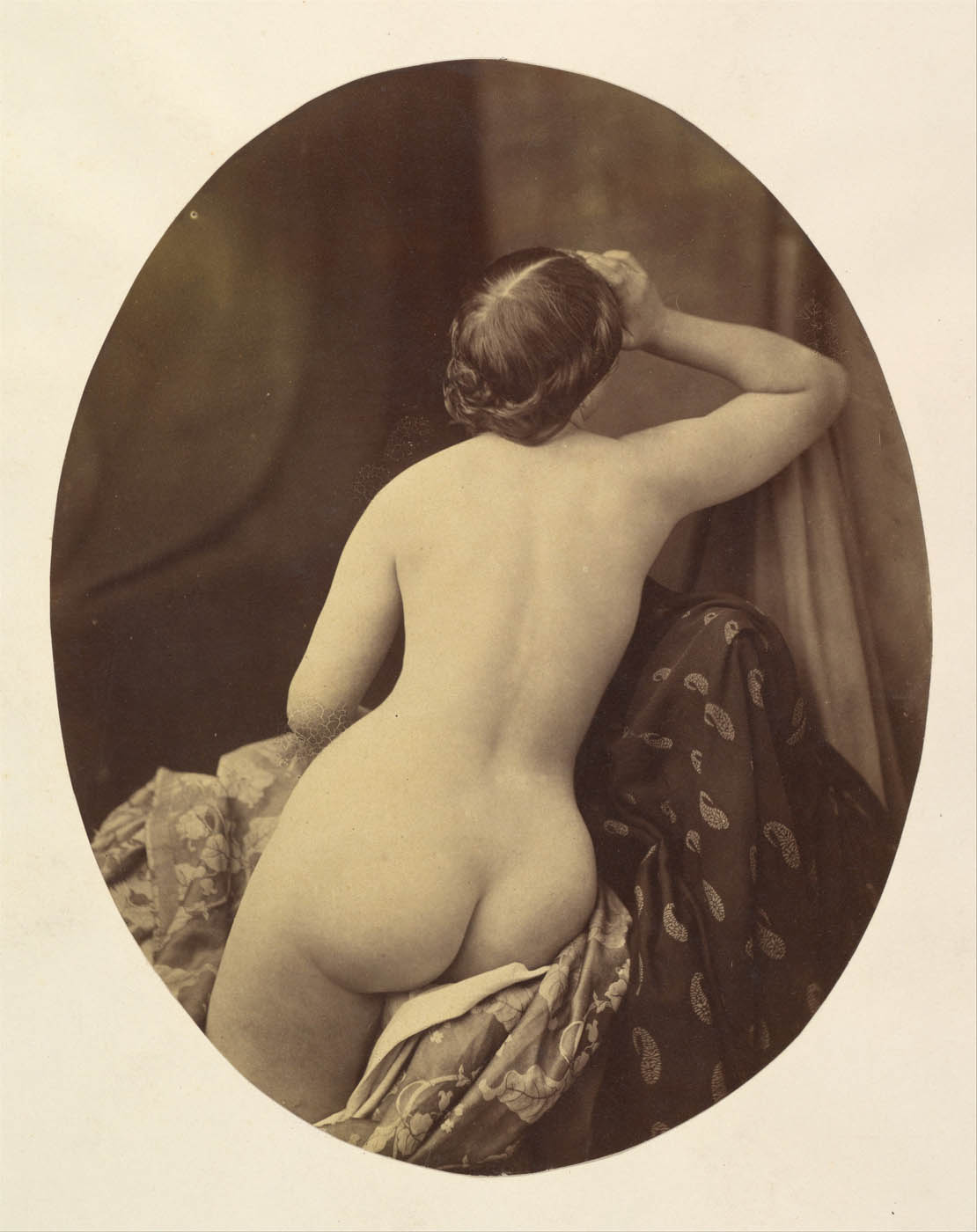
 

Oscar Gustav Rejlander (British born Sweden, 1813-1875) 'Ariadne' 1857


Oscar Gustav Rejlander (British born Sweden, 1813-1875)
Ariadne
1857
Albumen silver print from glass negative
Mount: 16 1/16 in. × 13 1/16 in. (40.8 × 33.2cm)
Image: 8 1/4 × 6 1/2 in. (21 × 16.5cm); oval
Metropolitan Museum of Art
Gilman Collection, Purchase, The Horace W. Goldsmith Foundation Gift, through Joyce and Robert Menschel, 2005
Public domain


Working in a place – Victorian England – where any photographic nude was considered offensive because the process implied not only the “nastiness” of the artist and vendor, but also “the degradation of the person who serves as model on the occasion,” Rejlander sought to ally his work with that of noted painters. This nude study is one of a series based on figures in the work of Raphael, Titian, Correggio, Rubens, Murillo, and Gainsborough; the precedent here is Titian’s Venus and Adonis, and Rejlander’s intention was to show how the painter adhered to or strayed from the ways a real body can twist and turn. Critic A. H. Wall defended the propriety of Rejlander’s Studies from the Nude, saying, “Refined and ennobled by art, real beauty, palpable flesh and blood, speaks of nothing but its own inherent loveliness.”

Such references to painting did not always afford adequate protection, however. Writing of Rejlander’s famous Two Ways of Life, photographer and critic Thomas Sutton wrote, “There is no impropriety in exhibiting such works of art as Etty’s Bathers Surprised by a Swan or the Judgment of Paris but there is impropriety in allowing the public to see photographs of nude prostitutes, in flesh-and-blood truthfulness and minuteness of detail.”

Text from the Metropolitan Museum of Art website


Unknown photographer (French) '[Female Nude with Mask]' c. 1870


Unknown photographer (French)
[Female Nude with Mask]
c. 1870
Albumen silver print from glass negative
26 x 19.1cm (10 1/4 x 7 1/2 in.)
Metropolitan Museum of Art
Gilman Collection, Gift of The Howard Gilman Foundation, 2005
Public domain


Even as she seems to part her tresses to expose her naked body, the model here masks her face in an effort to conceal her identity. While drawing, painting, and sculpture of the human figure commonly involve elements of transformation, idealisation, or the combination of features from various models, photography usually presents a recognisable image of its subject. It was not uncommon, therefore, for models who routinely posed nude for artists in other media to hide their faces when standing naked before the camera. For the viewer – not always an artist looking for help in figure drawing – the mask added an element of erotic frisson.

Text from the Metropolitan Museum of Art website
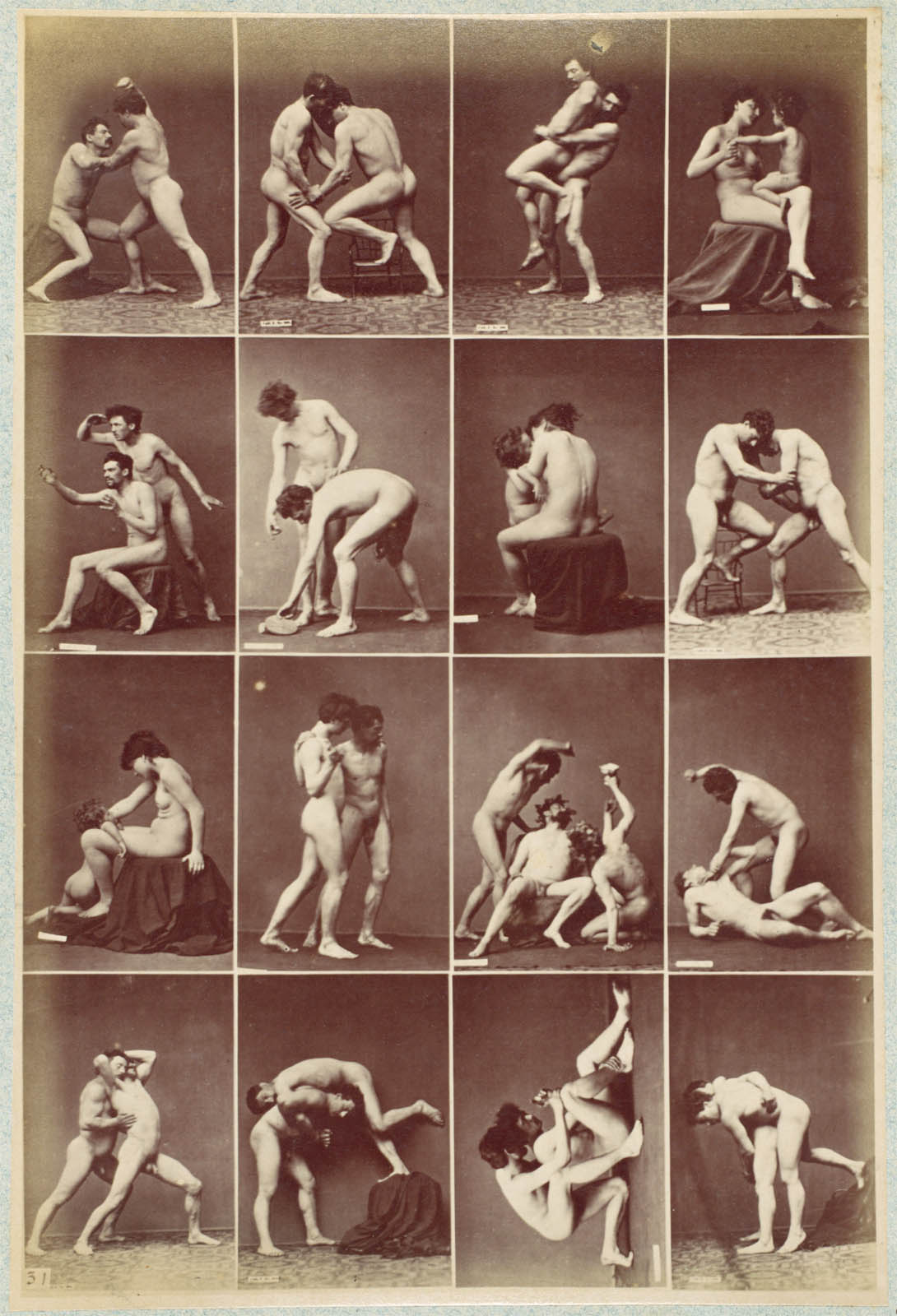
 

Louis Igout (French, 1837-1881)(Photographer) A. Calavas (French)(Editor) 'Plate from Album d'Études – Poses' c. 1880


Louis Igout (French, 1837-1881)(Photographer)
A. Calavas (French)(Editor)
Plate from Album d’Études – Poses
c. 1880
Albumen silver prints from glass negatives
Metropolitan Museum of Art
Purchase, The Horace W. Goldsmith Foundation Gift, through Joyce and Robert Menschel, 1993
Public domain


This album is an excellent example of the type of photography produced in the nineteenth century as an aid to artists in the study of contour, modelling, and proportion, and as a vocabulary of expression, gesture, and pose sanctioned by the art of antiquity and the Old Masters. Groupings representing Cain and Abel, the Drunken Silenus, Hercules and Antaeus, the Dying Gaul, the Cnidian Aphrodite, and others are recognisable among the photographs. Single prints showing sixteen small images, such as the page shown here, served as a type of stock catalogue, allowing clients to survey a broad range of possible poses and order larger prints of those which best served their needs.

Text from the Metropolitan Museum of Art website
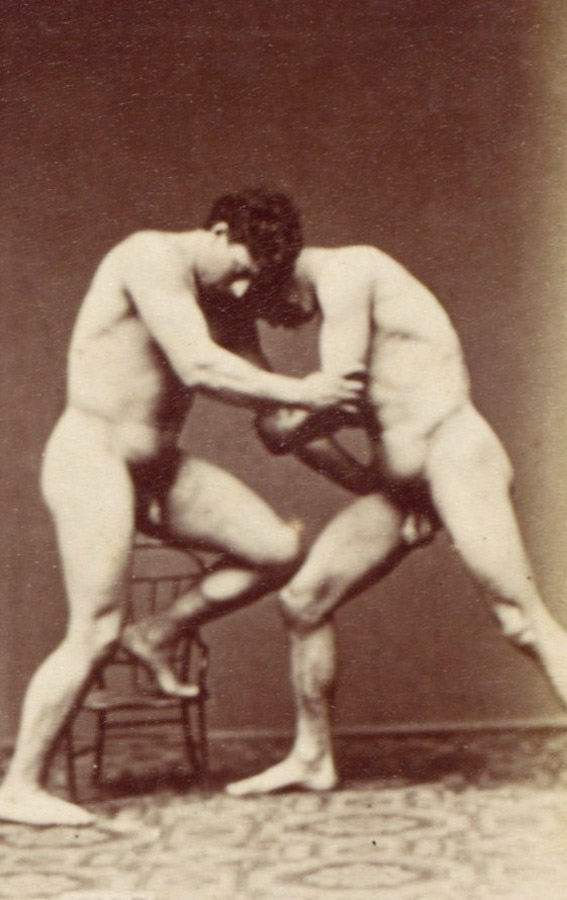
 

Louis Igout (French, 1837-1881)(Photographer) A. Calavas (French)(Editor) 'Plate from Album d'Études – Poses' c. 1880 (detail)

Louis Igout (French, 1837-1881)(Photographer) A. Calavas (French)(Editor) 'Plate from Album d'Études – Poses' c. 1880 (detail)

Louis Igout (French, 1837-1881)(Photographer) A. Calavas (French)(Editor) 'Plate from Album d'Études – Poses' c. 1880 (detail)


Louis Igout (French, 1837-1881)(Photographer)
A. Calavas (French)(Editor)
Plate from Album d’Études – Poses (details)
c. 1880
Albumen silver prints from glass negatives
Metropolitan Museum of Art
Purchase, The Horace W. Goldsmith Foundation Gift, through Joyce and Robert Menschel, 1993
Public domain


Thomas Eakins (American, 1844-1916) '(Thomas Eakins and John Laurie Wallace on a Beach)' c. 1883


Thomas Eakins (American, Philadelphia, Pennsylvania 1844–1916 Philadelphia, Pennsylvania)
[Thomas Eakins and John Laurie Wallace on a Beach]
c. 1883
Platinum print
25.5 x 20.4cm (10 1/16 x 8 1/16 in.), irregular
Metropolitan Museum of Art
David Hunter McAlpin Fund, 1943
Public domain


The great American painter and photographer Thomas Eakins was devoted to the scientific study of the human form and committed to its truthful representation. While he and his students at the Pennsylvania Academy of the Fine Arts were surrounded by casts of classical sculpture, Eakins declared that he did not like “a long study of casts. … At best they are only imitations, and an imitation of imitations cannot have so much life as an imitation of life itself.” Photography provided an obvious solution.

This photograph, in which Eakins and a student affected the elegant contrapposto stances of classical sculpture, was probably taken during an excursion with students to Manasquan Inlet at Point Pleasant, New Jersey, during the summer of 1883. Valuing his photographs not only as studies for paintings but also for their own sake, Eakins carefully printed the best images on platinum paper. In this case, he went to the additional trouble of enlarging the original, horizontally formatted image and cropping it vertically to better contain the perfectly balanced figures.

Text from the Metropolitan Museum of Art website
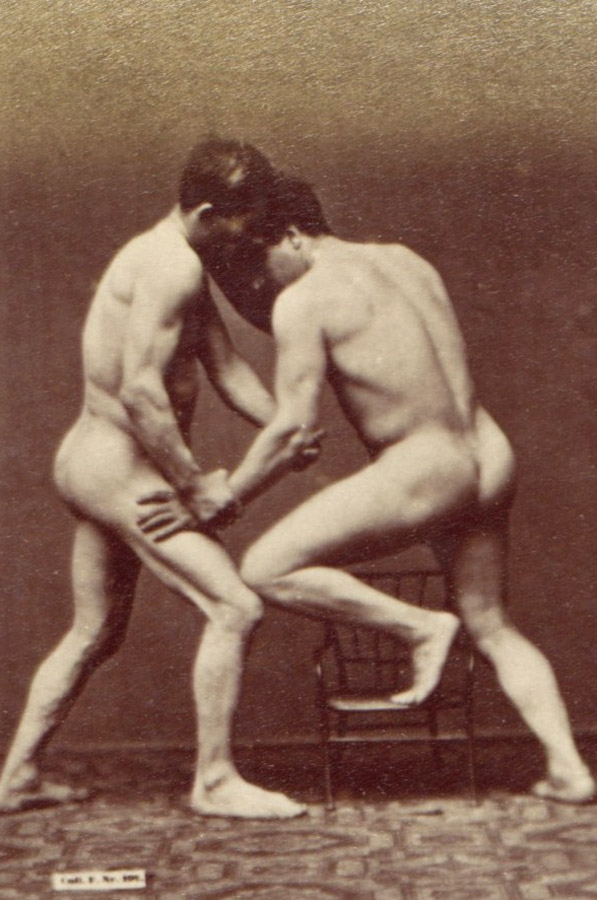
 

Albert Londe (French, 1858-1917) Paul Marie Louis Pierre Richer (French, 1849-1933) '[Male Musculature Study]' c. 1890


Albert Londe (French, 1858-1917)
Paul Marie Louis Pierre Richer (French, 1849-1933)
[Male Musculature Study]
c. 1890
Albumen silver print
Image: 14.9 x 9.6 cm (5 7/8 x 3 3/4 in.)
Mount: 14.9 x 9.9 cm (5 7/8 x 3 7/8 in.)
Metropolitan Museum of Art
Gift of Charles Isaacs and Carol Nigro, 2012


Author of a treatise on the importance of the camera in medical practice, Albert Londe declared, “the photographic plate is the scientist’s true retina.” In collaboration with a laboratory director and professor of anatomy at the École des Beaux-Arts, Londe found that photographs intended for physiological analysis could also serve artistic applications. Their careful portraits of athletes – whether taken with stop-action cameras specially designed by Londe or in static poses such as the example here – were used in scientific texts on musculature and became templates for illustrations to aid artists in rendering ideally proportioned figures.

Text from the Metropolitan Museum of Art website
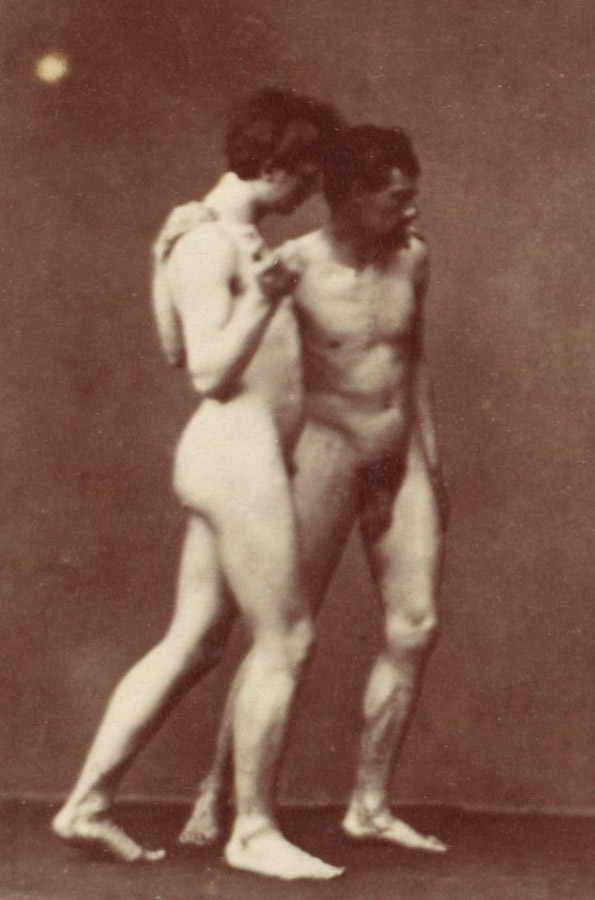
 

Guglielmo Plüshow (Italian born Germany, 1852–1930) '[Young Male Nude Seated on Leopard Skin]' 1890s-1900s


Guglielmo Plüshow (Italian born Germany, 1852–1930)
[Young Male Nude Seated on Leopard Skin]
1890s-1900s
Albumen silver print from glass negative
22.2 x 16.2cm (8 3/4 x 6 3/8 in.)
Metropolitan Museum of Art
Museum Accession
Creative Commons CC0 1.0 Universal Public Domain Dedication


Censors have long struggled to keep pace with evolving technology and expanding distribution networks of photographic erotica. In nineteenth-century France, government officials regularly seized thousands of photographs similar to the daguerreotype displayed here, which were deemed lewd.

Male nudity has frequently been subject to stricter control than pornography featuring women. The Arcadian photographs of Plüshow and his cousin and student Wilhelm von Gloeden were avidly collected in the late nineteenth century, but in the 1930s many of their prints and negatives, considered deviant by the Italian Fascist government, were destroyed. For much of the twentieth century, it was illegal in the United States to mail photographs that might be judged prurient, forcing photographers to mask genitalia and pubic hair with strategic props or with overpainting that could be easily removed by purchasers. Sale of erotic male physique magazines and bodybuilder pin-ups, ostensibly circulated to promote fitness, was legalised in a 1962 Supreme Court ruling, which concluded that “portrayals of the male nude cannot fairly be regarded as more objectionable than many portrayals of the female nude that society tolerates.”

Text from the Metropolitan Museum of Art website
 

Attributed to Alphonse Bertillon (French, 1853–1914) 'Assasination of C. Lecomte 711 Rue des Martyrs' 1901-1908 From 'Album of Paris Crime Scenes'


Attributed to Alphonse Bertillon (French, 1853–1914)
Assasination of C. Lecomte 711 Rue des Martyrs
1901-1908
From Album of Paris Crime Scenes
Gelatin silver print
Overall: 24.3 x 31cm (9 9/16 x 12 3/16in.)
Page: 23 x 29cm (9 1/16 x 11 7/16 in.)
Metropolitan Museum of Art
Gilman Collection, Purchase, The Howard Gilman Foundation Gift, 2001
Public domain


Alphonse Bertillon, the chief of criminal identification for the Paris police department, developed the mug shot format and other photographic procedures used by police to register criminals. Although the images in this extraordinary album of forensic photographs were made by or under the direction of Bertillon, it was probably assembled by a private investigator or secretary who worked at the Paris prefecture. Photographs of the pale bodies of murder victims are assembled with views of the rooms where the murders took place, close-ups of objects that served as clues, and mug shots of criminals and suspects. Made as part of an archive rather than as art, these postmortem portraits, recorded in the deadpan style of a police report, nonetheless retain an unsettling potency.

Text from the Metropolitan Museum of Art website
 

Attributed to Alphonse Bertillon (French, 1853–1914) 'Untitled' 1901-1908 From 'Album of Paris Crime Scenes'


Attributed to Alphonse Bertillon (French, 1853–1914)
Untitled
1901-1908
From Album of Paris Crime Scenes
Gelatin silver print
Overall: 24.3 x 31cm (9 9/16 x 12 3/16in.)
Page: 23 x 29cm (9 1/16 x 11 7/16 in.)
Metropolitan Museum of Art
Gilman Collection, Purchase, The Howard Gilman Foundation Gift, 2001
Public domain
 

Attributed to Alphonse Bertillon (French, 1853–1914) 'Untitled' 1901-1908 From 'Album of Paris Crime Scenes'


Attributed to Alphonse Bertillon (French, 1853–1914)
Untitled
1901-1908
From Album of Paris Crime Scenes
Gelatin silver print
Overall: 24.3 x 31cm (9 9/16 x 12 3/16in.)
Page: 23 x 29cm (9 1/16 x 11 7/16 in.)
Metropolitan Museum of Art
Gilman Collection, Purchase, The Howard Gilman Foundation Gift, 2001
Public domain


Lady Ottoline Violet Anne Cavendish-Bentinck Morrell (British, 1873-1938) '[Cavorting by the Pool at Garsington]' c. 1916


Lady Ottoline Violet Anne Cavendish-Bentinck Morrell (British, 1873-1938)
[Cavorting by the Pool at Garsington]
c. 1916
Gelatin silver print
8.8 x 6.3cm (3 7/16 x 2 7/16 in.)
Metropolitan Museum of Art
Gilman Collection, Purchase, The Horace W. Goldsmith Foundation Gift, through Joyce and Robert Menschel, 2005
Creative Commons CC0 1.0 Universal Public Domain Dedication


Rebelling against the narrow values of upper-class Edwardian society, Lady Ottoline Morrell, an eccentric hostess to Bloomsbury, surrounded herself in London and on her estate at Garsington with a large circle of friends including Bertrand Russell, W. B. Yeats, D. H. Lawrence, T. S. Eliot, Virginia Woolf, Aldous Huxley, and E. M. Forster. These images of an improvised dance show Lady Ottoline’s ten-year-old daughter, Julian, and her slightly older companions embroiled in a naked whirl, pagan in its exuberance, that reflects the emancipated attitudes of the photographer’s circle.

Text from the Metropolitan Museum of Art website


Lady Ottoline Violet Anne Cavendish-Bentinck Morrell (British, 1873-1938) '[Cavorting by the Pool at Garsington]' c. 1916


Lady Ottoline Violet Anne Cavendish-Bentinck Morrell (British, 1873-1938)
[Cavorting by the Pool at Garsington]
c. 1916
Gelatin silver print
8.8 x 6.2cm (3 7/16 x 2 7/16 in.)
Metropolitan Museum of Art
Gilman Collection, Purchase, The Horace W. Goldsmith Foundation Gift, through Joyce and Robert Menschel, 2005
Creative Commons CC0 1.0 Universal Public Domain Dedication


Edward Weston (American, Highland Park, Illinois 1886 - 1958 Carmel, California) '[Nude]' 1925


Edward Weston (American, Highland Park, Illinois 1886 – 1958 Carmel, California)
[Nude]
1925
Gelatin silver print
Image: 14.8 x 23.4 cm (5 13/16 x 9 3/16 in.)
Mount: 35.2 x 43.9 cm (13 7/8 x 17 5/16 in.)
Metropolitan Museum of Art
Gilman Collection, Purchase, Ann Tenenbaum and Thomas H. Lee Gift, 2005
© Center for Creative Photography, Arizona Board of Regents
Public domain


In his early attempts to merge the realism of photography with the expressive effect of abstract art, Weston honed in on close-up details of his subjects. That the faces of his models were often cropped or averted served practical as well as aesthetic purposes, enabling the photographs to be read as figure studies rather than as individual portraits while also protecting the privacy of the friends and lovers who served as models.

Text from the Metropolitan Museum of Art website


George Platt Lynes (American, East Orange, New Jersey 1907–1955 New York) '[Male Nude]' 1930s


George Platt Lynes (American, East Orange, New Jersey 1907–1955 New York)
[Male Nude]
1930s
Gelatin silver print
24.5 x 18.9cm (9 5/8 x 7 7/16 in.)
Metropolitan Museum of Art
Ford Motor Company Collection, Gift of Ford Motor Company and John C. Waddell, 1987
© Estate of George Platt Lynes
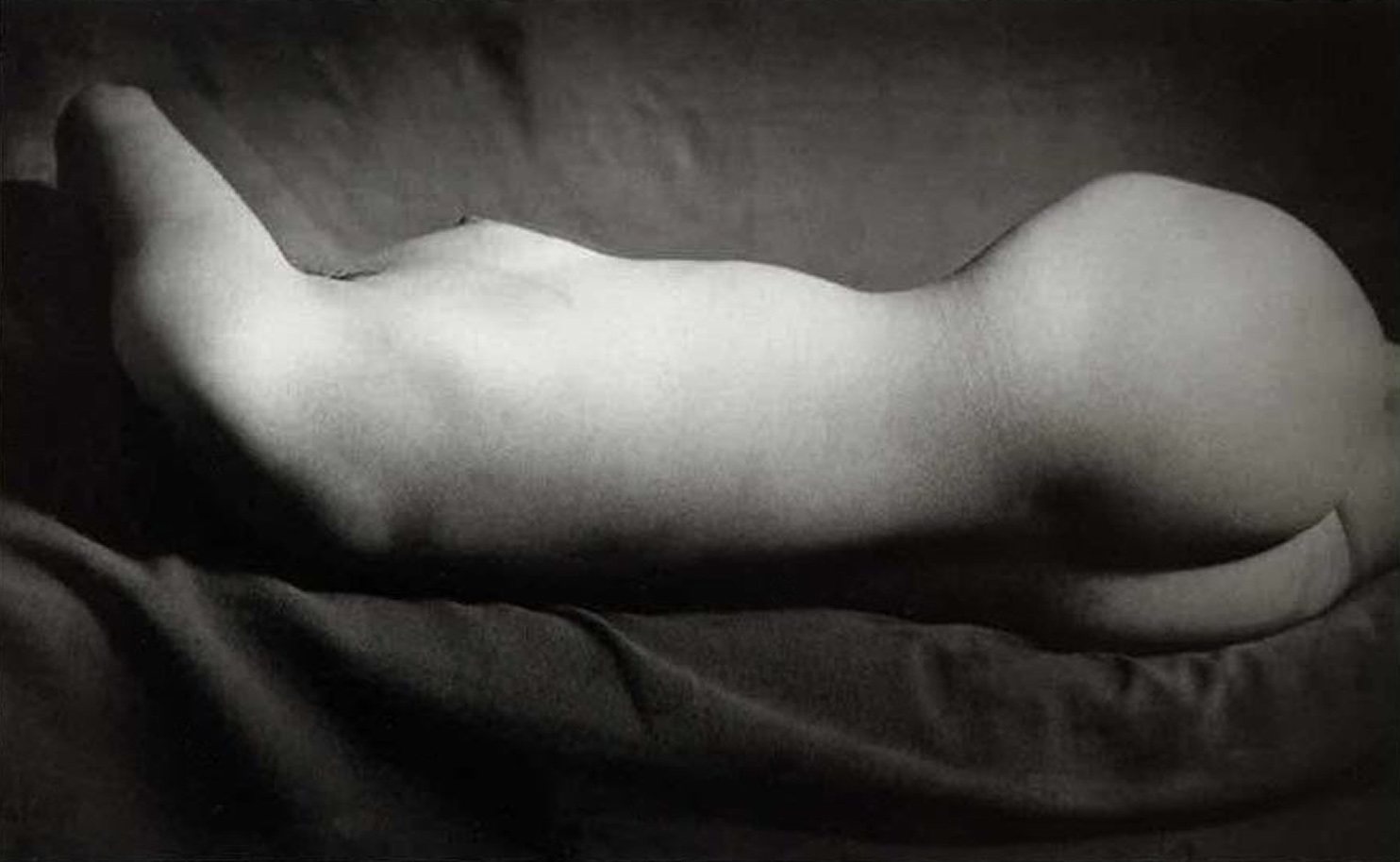
 

Brassaï (French born Romania, Brasov 1899 - 1984 Côte d'Azur) 'Nude' 1931-1934


Brassaï (French born Romania, Brasov 1899 – 1984 Côte d’Azur)
Nude
1931-1934
Gelatin silver print
14.1 x 23.5cm (5 9/16 x 9 1/4 in.)
Metropolitan Museum of Art
Twentieth-Century Photography Fund, 2007
© The Estate of Brassai


One of the most radically abstract of Brassaï’s nudes, this image was published in 1933 in the inaugural issue of the avant-garde magazine Minotaure. With the figure’s head and legs cut off by the picture’s edges, the twisting, truncated torso seems to float in space like an apparition – an ambiguous, organic form with an uncanny resemblance to a phallus. This transformation of the female figure into a fetish object is a hallmark of Surrealism that reflects the important influence of Freud’s psychoanalytic theory on European art of the early twentieth century.

Text from the Metropolitan Museum of Art website
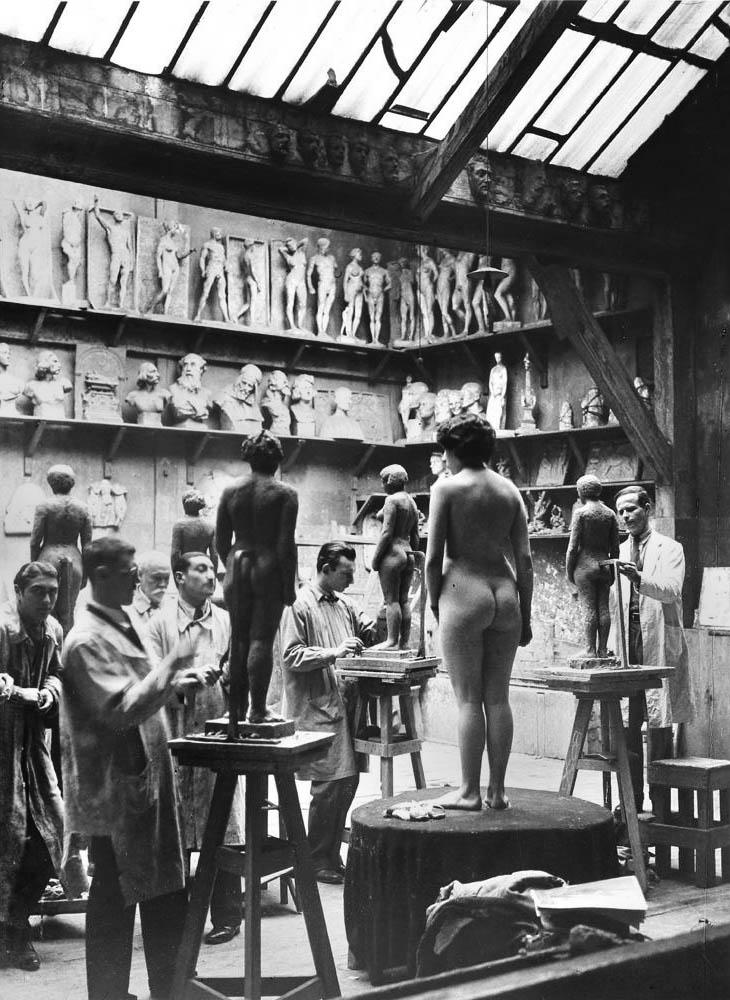
 

Brassaï (French born Romania, Brasov 1899 - 1984 Côte d'Azur) 'L'Académie Julian' 1931, printed 1950s


Brassaï (French born Romania, Brasov 1899 – 1984 Côte d’Azur)
L’Académie Julian
1931, printed 1950s
Gelatin silver print
29.7 x 23.7cm (11 11/16 x 9 5/16 in.)
Metropolitan Museum of Art
Gilman Collection, Purchase, The Horace W. Goldsmith Foundation Gift, through Joyce and Robert Menschel, 2005
© Estate Brassaï Succession – Paris
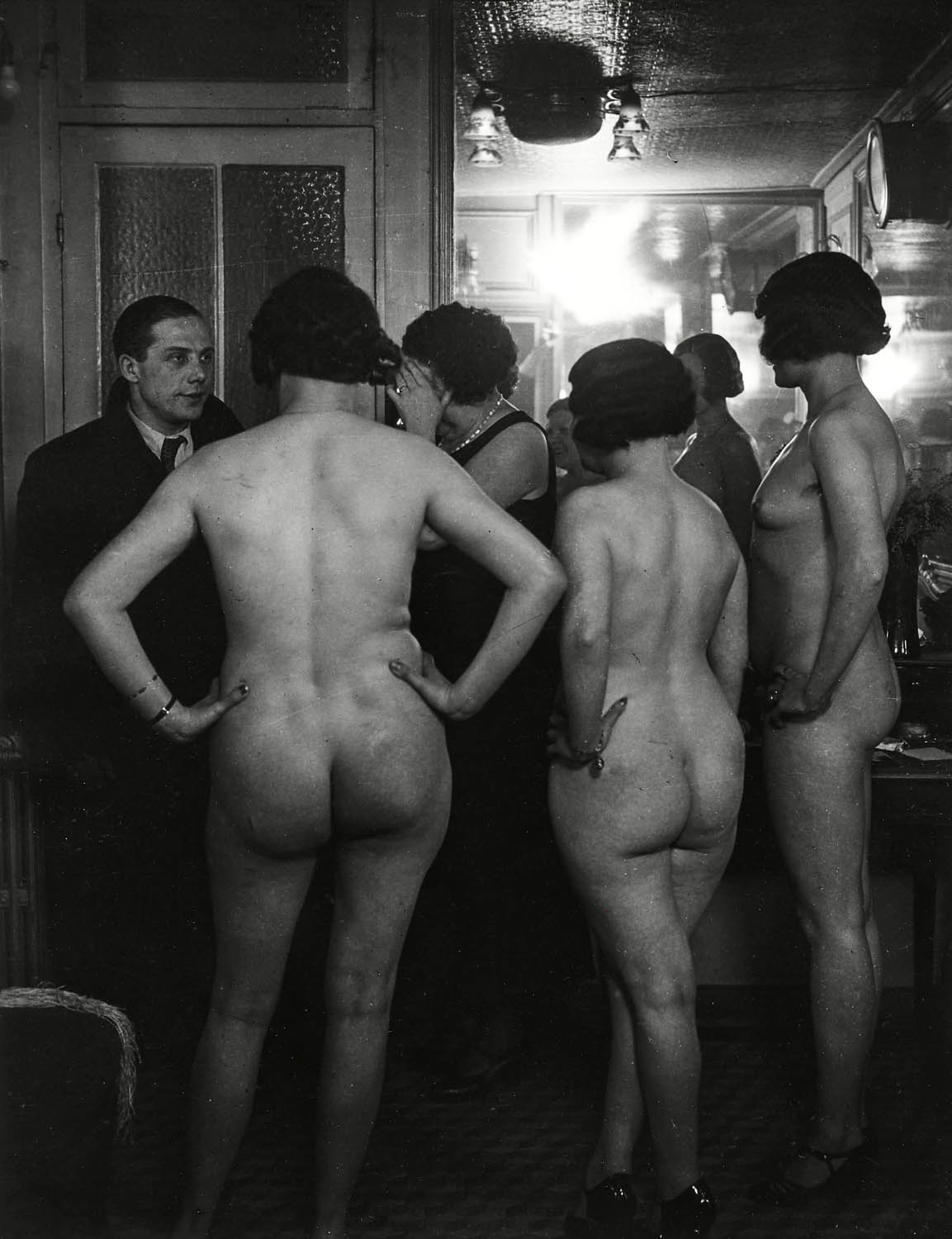
 

Brassaï (French born Romania, Brasov 1899 - 1984 Côte d'Azur) 'Introductions at Suzy's' 1932-1933


Brassaï (French born Romania, Brasov 1899 – 1984 Côte d’Azur)
Introductions at Suzy’s
1932-1933, printed later
Gelatin silver print
23.1 x 16.8cm (9 1/16 x 6 5/8 in.)
Metropolitan Museum of Art
Ford Motor Company Collection, Gift of Ford Motor Company and John C. Waddell, 1987
© Estate Brassaï Succession – Paris


Brassaï made his name as a chronicler of the night, with images that ranged from reflections on wet cobblestones to the denizens of bars and brothels. Like so many of his photographs, Introductions at Suzy’s was not an impromptu scene caught by an undetected observer but rather a carefully constructed tableau meant to highlight the dynamic between buttoned-up bourgeois clients and Suzy’s bevy of prostitutes, naked but for their bracelets and high heels. The “client” was actually Brassaï’s friend and bodyguard; the “girls,” however, were not stand-ins.

Text from the Metropolitan Museum of Art website


Brassaï (French, 1899-1984) 'Chez Suzy / Armoire à glace dans un hôtel de passe, rue Quincampoix' (Mirrored cabinet in a brothel, rue Quincampoix) 1932, printed 1950s


Brassaï (French, 1899-1984)
Chez Suzy / Armoire à glace dans un hôtel de passe, rue Quincampoix (Mirrored cabinet in a brothel, rue Quincampoix)
1932, printed 1950s
Gelatin silver print
23.3 x 16.8cm (9 3/16 x 6 5/8 in.)
Metropolitan Museum of Art
Warner Communications Inc. Purchase Fund, 1980
© Estate Brassaï Succession – Paris


A keen observer of Parisian nightlife in the 1930s, Brassaï was drawn to the visual conundrums and optical innuendos of everyday life. The play of reflections and absences in this image, made in a Paris brothel, suggests the materialization of subconscious impulses. Evoking Freud’s definition of desire as the sensation arising from a perceived absence of remembered pleasure, this blatantly sexual scene suggests but withholds a specific narrative.

Text from the Metropolitan Museum of Art website
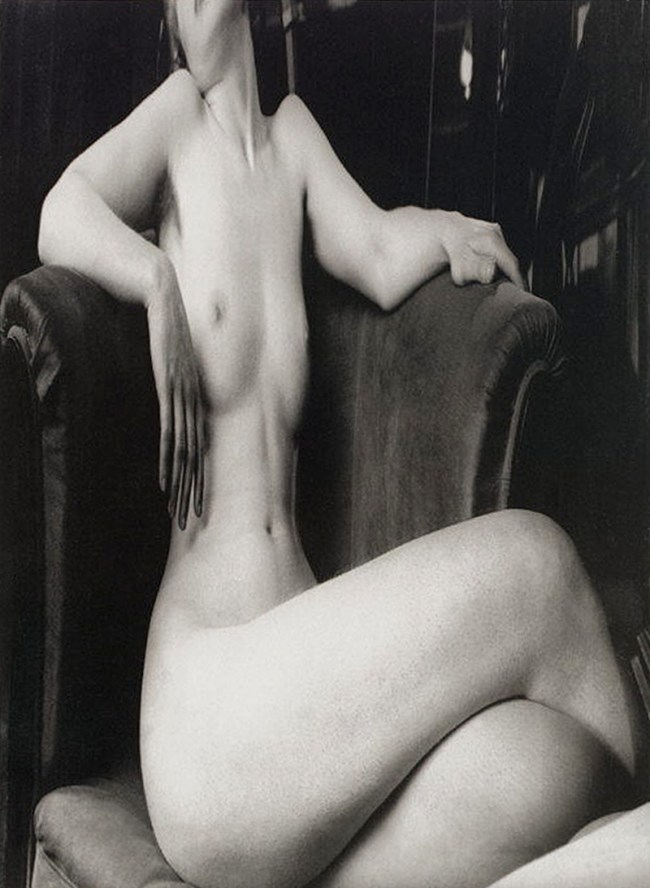
 

André Kertész (American born Hungary, Budapest 1894 - 1985 New York City) 'Distortion #6' 1932


André Kertész (American born Hungary, Budapest 1894 – 1985 New York City)
Distortion #6
1932
Gelatin silver print
23.4 x 17.3cm (9 3/16 x 6 13/16 in.)
Metropolitan Museum of Art
Ford Motor Company Collection, Gift of Ford Motor Company and John C. Waddell, 1987
© The Estate of André Kertész / Higher Pictures


Although Kertesz had long been interested in mirrors, reflections, and the idea of distorting the human figure, he did not seriously investigate their photographic possibilities until 1933, when the risqué French magazine Le Sourire commissioned him to make a series of figure studies. Using a funhouse mirror from a Parisian amusement park, Kertesz, who had never photographed nudes before, spent four weeks making about two hundred negatives.

Kertész accentuated the narrow ribcage and long waist of the ideal contemporary woman by photographing his model in a carnival mirror. If the top half of this beautiful nude resembles those Modigliani painted, the swell of the haunch recalls Mannerist nudes and their nineteenth-century revivals, especially Ingres’ grande odalisque.

Text from the Metropolitan Museum of Art website
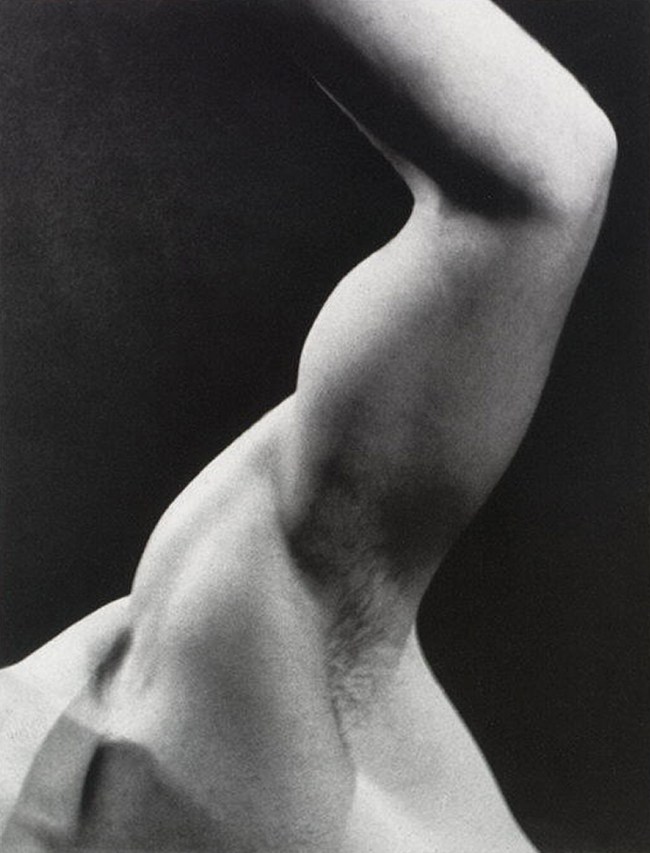
 

Man Ray (American, Philadelphia, Pennsylvania 1890 - 1976 Paris) 'Arm' c. 1935


Man Ray (American, Philadelphia, Pennsylvania 1890 – 1976 Paris)
Arm
c. 1935
Gelatin silver print
29.7 x 23.0cm (11 11/16 x 9 1/16 in.)
Metropolitan Museum of Art
Ford Motor Company Collection, Gift of Ford Motor Company and John C. Waddell, 1987
© 2012 Man Ray Trust / Artists Rights Society (ARS), NY / ADAGP, Paris


Man Ray’s photograph of an arm is cropped so abstractly that it seems to metamorphose into other body parts – a knee, a calf, a thigh – or into some utterly unidentifiable yet heroic form. This image appeared on the cover of Formes Nues (1935), which also included the work of Brassaï, László Moholy-Nagy, Franz Roh, and George Platt Lynes, among others.

In the magazine’s introduction, Man Ray wrote, “were it not for the fact that photography permits me to seize and to possess the human body and face in more than a temporary manner, I should quickly have tired of this medium.”

Text from the Metropolitan Museum of Art website


Paul Outerbridge Jr. (American, New York 1896 - 1959 Laguna Beach, California) 'Nude with Mask and Hat' c. 1936


Paul Outerbridge Jr. (American, New York 1896 – 1959 Laguna Beach, California)
Nude with Mask and Hat
c. 1936
Carbro print
43.3 x 30.0cm (17 1/16 x 11 13/16 in.)
Metropolitan Museum of Art
Warner Communications Inc. Purchase Fund, 1977


Outerbridge was a successful commercial photographer, but although he found such work stimulating, he also made photographs as a means of personal expression throughout his career. Photographing nude models in colour in the 1930s was challenging – not only in the difficulty of correctly capturing skin tones using complicated new processes, but also because finding a venue to publish or exhibit the work was unlikely. Although he began by posing his models in the manner of painted masterpieces, Outerbridge’s compositions became increasingly provocative in the late 1930s. The sexualised charge and commercial palette of works such as this were not in keeping with attitudes of the period and were not shown during the artist’s lifetime.

Text from the Metropolitan Museum of Art website


Hans Bellmer (German born Poland, Katowice 1902–1975 Paris) 'La Poupée' 1936


Hans Bellmer (German born Poland, Katowice 1902–1975 Paris)
La Poupée
1936
Gelatin silver print with applied colour
Mount: 9 5/8 in. × 7 1/2 in. (24.5 × 19cm)
Image: 5 5/16 × 5 9/16 in. (13.5 × 14.1cm)
Metropolitan Museum of Art
Ford Motor Company Collection, Gift of Ford Motor Company and John C. Waddell, 1987
© 2024 Artists Rights Society (ARS), New York


In his nightmarish tableaux of mutilated and reassembled dolls posed in domestic interiors, Bellmer grappled with the base condition of the human body and with the bodily fragment as fetish object. Mannequins and dolls – simultaneously familiar and strange – supplied the material for his primal expressions of terror and awe, which often evoked the innocent violence and latent sexuality of childhood games. Whether they are read as Freudian emblems of the uncanny or as ominous harbingers of Nazi atrocities, Bellmer’s images exemplify the Surrealist view of the female body as the source of simultaneous fascination and revulsion.

Text from the Metropolitan Museum of Art website


Edward Weston (American 1886-1958) 'Nude' 1936, printed c. 1954


Edward Weston (American, Highland Park, Illinois 1886 – 1958 Carmel, California)
Printer: Brett Weston (American, Los Angeles, California 1911-1993 Kona, Hawaii) or Cole Weston (American, 1919-2003)
Nude on Sand, Oceano
1936, printed c. 1954
Gelatin silver print
19.1 x 24.2cm (7 1/2 x 9 1/2 in.)
David Hunter McAlpin Fund, 1957
© Center for Creative Photography, Arizona Board of Regents


Charis Wilson, the model for this series, admitted to being shocked upon seeing Weston’s nudes for the first time, as she had previously known only the romantically retouched photographs of depilated bodies then popular. In studying Weston’s work she found, “I couldn’t get past the simple amazement at how real they were. Then I began to see the rhythmic patterns, the intensely perceived sculptural forms, the subtle modulations of tone, of which these small, perfect images were composed. And I began to appreciate the originality of the viewpoint that had selected just these transitory moments and made them fast against the current of time.”

Text from the Metropolitan Museum of Art website
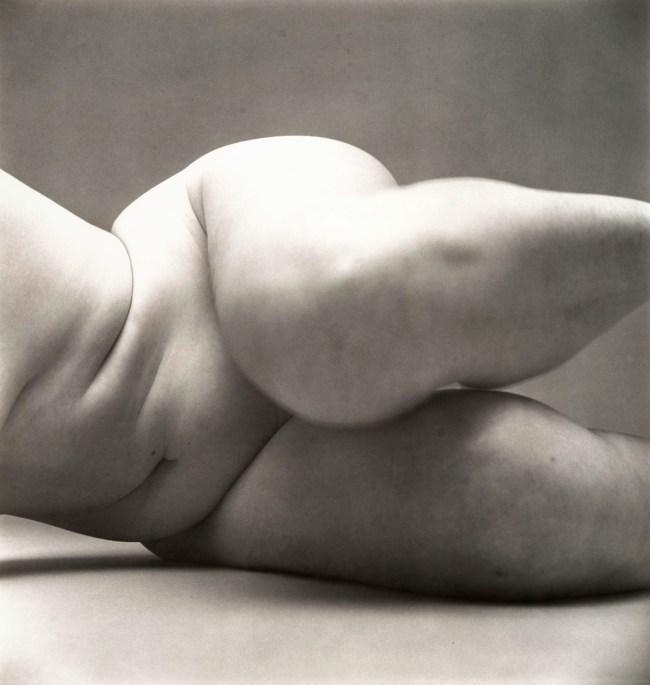
 

Irving Penn (American, Plainfield, New Jersey 1917 - 2009 New York City) 'Nude No. 57' 1949-1950


Irving Penn (American, Plainfield, New Jersey 1917 – 2009 New York City)
Nude No. 57
1949-1950
Gelatin silver print
39.4 x 37.5cm (15 1/2 x 14 3/4 in.)
Metropolitan Museum of Art
Gift of the artist, 2002
© 1950-2002 Irving Penn


By 1950, Penn was a well-known Vogue portrait and fashion photographer but had already made, privately, a major series of nudes – a personal but lesser-known body of work. During the week, he photographed models wearing fashionable clothes for the magazine, but weekends and evenings he made studies of female nudes. The women were full-bodied and the photographs unorthodox, recalling the form and spirit of archaic fertility idols.

Text from the Metropolitan Museum of Art website


Harry Callahan (American, 1912-1999) 'Eleanor and Barbara' 1954, printed 1970s


Harry Callahan (American, 1912-1999)
Eleanor and Barbara
1954
Gelatin silver print
22.8 x 22.1cm (9 x 8 11/16 in.)
Metropolitan Museum of Art
Gift of Joyce and Robert Menschel, 1993
© The Estate of Harry Callahan; Courtesy Pace/MacGill Gallery, New York


Muses throughout his career, Callahan’s wife and daughter played, posed, and aged before his lens. With their attention to the physicality of light, however, Callahan’s photographs transcend mere family portraiture by calling attention to the simple beauty of life’s fleeting moments. “He just liked to take the pictures of me,” Eleanor recalled in her nineties. “In every pose. Rain or shine. And whatever I was doing. If I was doing the dishes or if I was half asleep. And he knew that I never, never said no. I was always there for him. Because I knew that Harry would only do the right thing.”

Eleanor Callahan died in February 2012 at the age of ninety-five.

Text from the Metropolitan Museum of Art website
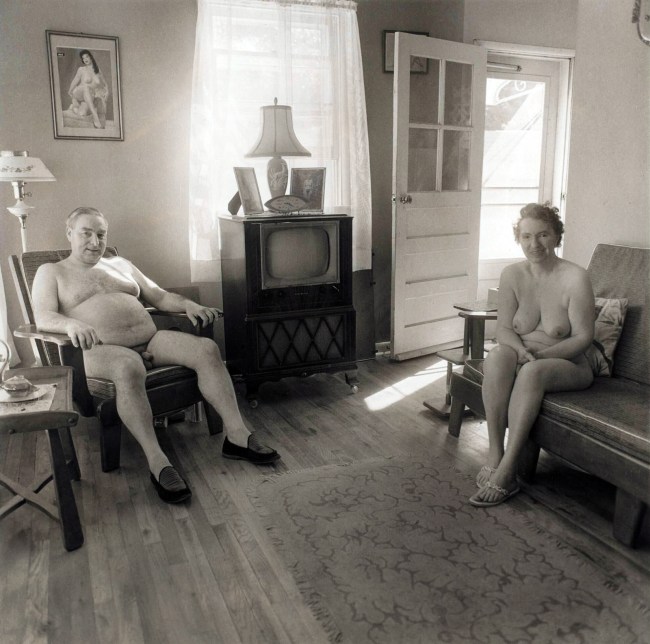
 

Diane Arbus (American, 1923-1971) 'Retired man and his wife at home in a nudist camp one morning, N.J.' 1963


Diane Arbus (American, 1923-1971)
Retired man and his wife at home in a nudist camp one morning, N.J.
1963
Gelatin silver print
39.9 × 37.9cm (15 11/16 × 14 15/16 in.)
Metropolitan Museum of Art
Purchase, Joyce Frank Menschel, and Ann Tenenbaum and Thomas H. Lee Gifts; Louis V. Bell, Harris Brisbane Dick, Fletcher, and Rogers Funds and Joseph Pulitzer Bequest; and Marlene Nathan Meyerson Family Foundation, Twentieth-Century Photography Fund, Diana Barrett and Robert Vila, Elizabeth S. and Robert J. Fisher, Charlotte and Bill Ford, Lita Annenberg Hazen Charitable Trust and Hazen Polsky Foundation Inc., Jennifer and Joseph Duke, Jennifer and Philip Maritz, Saundra B. Lane, The Jerry and Emily Spiegel Family Foundation and Pamela and Arthur Sanders, Anonymous, and The Judith Rothschild Foundation Gifts, 2007
© The Estate of Diane Arbus


Arbus’s interest in the tension between revelation and concealment comes into starkest focus in the portraits she made at Sunshine Park, a family nudist camp in New Jersey. While nudism might be considered the ultimate form of exposure, it often required a different kind of cover-up. As the artist remarked in an unpublished article written for Esquire magazine in 1966: “For many of these people, their presence here is the darkest secret of their lives, unsuspected by relatives, friends, and employers in the outside world, the disclosure of which might bring disgrace.”

Text from the Metropolitan Museum of Art website
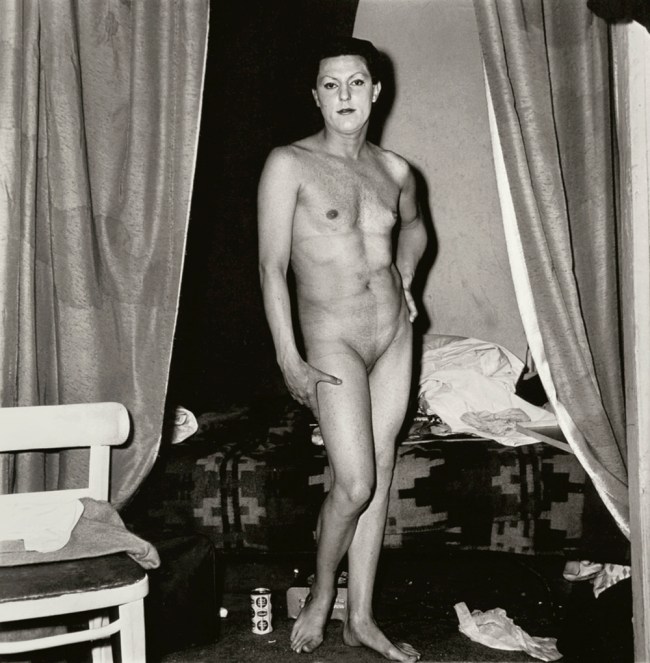
 

Diane Arbus (American, 1923-1971) 'A naked man being a woman, N.Y.C.' 1968


Diane Arbus (American, 1923-1971)
A naked man being a woman, N.Y.C.
1968
Gelatin silver print
38.2 x 36.2cm
Metropolitan Museum of Art
Purchase, Joyce Frank Menschel, and Ann Tenenbaum and Thomas H. Lee Gifts; Louis V. Bell, Harris Brisbane Dick, Fletcher, and Rogers Funds and Joseph Pulitzer Bequest; and Marlene Nathan Meyerson Family Foundation, Twentieth-Century Photography Fund, Diana Barrett and Robert Vila, Elizabeth S. and Robert J. Fisher, Charlotte and Bill Ford, Lita Annenberg Hazen Charitable Trust and Hazen Polsky Foundation Inc., Jennifer and Joseph Duke, Jennifer and Philip Maritz, Saundra B. Lane, The Jerry and Emily Spiegel Family Foundation and Pamela and Arthur Sanders, Anonymous, and The Judith Rothschild Foundation Gifts, 2007
© The Estate of Diane Arbus


Mark Morrisroe (American, 1959-1989) 'Untitled [Two Men in Silhouette]' c. 1987


Mark Morrisroe (American, 1959-1989)
Untitled [Two Men in Silhouette]
c. 1987
Gelatin silver print
28.4 x 20.8cm (11 3/16 x 8 3/16 in.)
Metropolitan Museum of Art
Twentieth-Century Photography Fund, 2009
© The Estate of Mark Morrisroe (Ringier Collection) at Fotomuseum Winterthur


Sexuality and mortality – which many would say are central preoccupations of humankind – are key to Morrisroe’s biography and art. The son of a drug-addicted mother, a teenage hustler, and a precocious punk queer, Morrisroe carried a bullet (shot by a disgruntled john) in his chest from the age of eighteen and consequently walked with a limp that added one more element to his outsider self-image. Sex and death were persistent themes in his work, with pronounced poignancy after his 1986 AIDS diagnosis. In this work, Morrisroe has taken a page from a gay S&M magazine, cut out the shapes of two naked men, and used the sheet as a negative to print a unique image in which the figures – literally absent – appear as dark silhouettes against a netherworld of sexual activity.

Text from the Metropolitan Museum of Art website


The Metropolitan Museum of Art
1000 Fifth Avenue at 82nd Street
New York, New York 10028-0198
Phone: 212-535-7710

Opening hours:
Thursday – Tuesday 10am – 5pm
Closed Wednesday

The Metropolitan Museum of Art website

LIKE ART BLART ON FACEBOOK

Back to top