Exhibition: ‘Edward S. Curtis: One Hundred Masterworks’ at the Palm Springs Art Museum

Exhibition dates: 20th February – 29th May, 2016

Curator: Christopher Cardozo
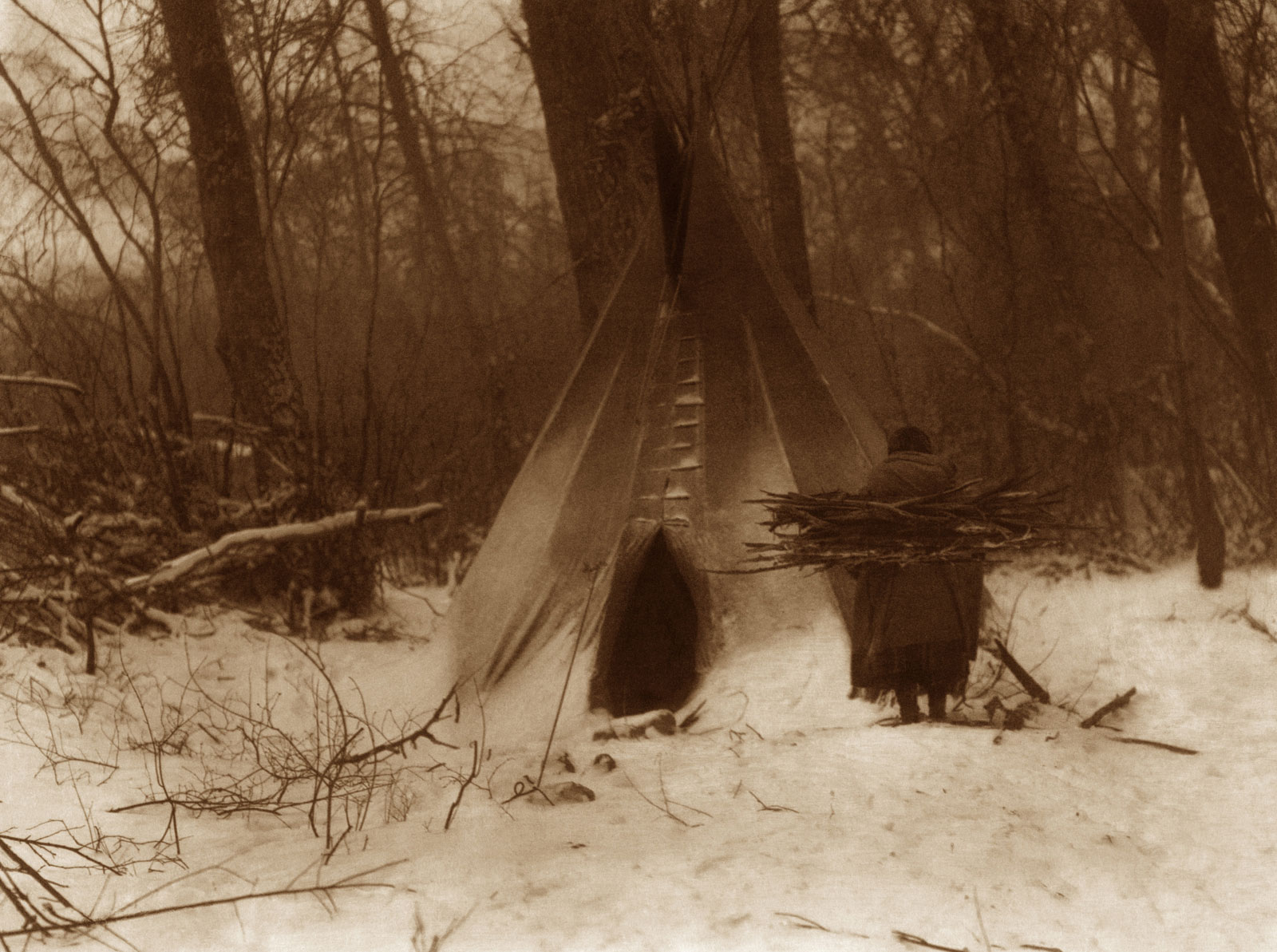
 

Edward S. Curtis (American, 1868-1952) 'Winter – Apsaroke' 1908 from the exhibition 'Edward S. Curtis: One Hundred Masterworks' at the Palm Springs Art Museum, Feb - May, 2016


Edward S. Curtis (American, 1868-1952)
Winter – Apsaroke
1908
Photogravure
Courtesy of the Christopher G. Cardozo Collection


Not only was he one of the greatest ethnographic photographers of all time (as well as being an ethnographer recording more than 10,000 songs on a primitive wax cylinder, and writing down vocabularies and pronunciation guides for 75 languages) … he was also an aesthetic photographer. Looking at his photographs you can feel that he adhered to the principles of the nature and appreciation of beauty situated within the environment of the Native American cultures and peoples. He had a connection to the people and to the places he was photographing.

Curtis created a body of work unparrallleled in the annals of photography – an ethnographic study of an extant civilisation before it vanished (or so they thought at the time). Such a project stretched over thirty years, producing 45-50 thousand negatives “many of them on glass and some as large as fourteen by seventeen inches” of which 2,200 original photographs appeared in his magnum opus:

The North American Indian: a twenty-volume, twenty-portfolio set of books hand – bound in leather, with hand-set letter press text and hand -pulled photogravure prints, all printed on handmade, imported etching stock. [It] contained more than 2,200 original photographs, printed in photogravure, and nearly 4,000 pages of anthropological text including transcriptions of language and music. Each set included twenty quarto-size volumes containing approximately seventy-five original photogravures and two hundred pages of text. The volumes were supplemented by bound portfolios, each containing approximately thirty-six oversize gravures on eighteen-by-twenty-two-inch etching stock. Curtis offered subscribers their choice of three premium handmade papers: Dutch Van Gelder, Japanese Vellum, and India Proof Paper (commonly known as tissue).” (Text from the Cardoza Fine Art website)

While all great photographers have both technical skill and creative ability it is the dedication of this artist to his task over so many years that sets him apart. That dedication is critically coupled with his innate ability to capture the “spirit” of the Native American cultures and peoples, their humanity. In other hands this material could have felt dead but as the text from the Cardoza Fine Art website states:

“Having become deeply impassioned by the power and dignity of the American Indian, Curtis began to realise for the first time that he might create a record preserving the history of these magnificent people and their extraordinary culture. In the same letter to Grinnell, Curtis went on to say, “But I can start-and sell prints of my pictures as I go along. I’m a poor man, but I’ve got my health, plenty of steam, and something to work for.” Curtis was thirty-two years old, with a family and a thriving business. His willingness to put at risk everything he had worked for up until then is a testament to his enlightened view of humanity, the strength of his individualism, and his creative genius… Yet Curtis had no way of knowing that he was about to embark on a thirty-year odyssey that would have unforeseen tragic consequences; his wife would divorce him, and he would lose his family, his financial success, and his physical and emotional health – all in the pursuit of his big dream.”

He might have been a poor man but he was strong in spirit. You can feel it in his work. And he had a vision – “It’s such a big dream, I can’t see it all.”

For that dream and for his inspiration, we are eternally grateful.

Dr Marcus Bunyan


Many thankx to the Palm Springs Art Museum for allowing me to publish the photographs in the posting. Please click on the photographs for a larger version of the image. All texts about each tribe are taken from the Wikipedia website.


“When he started in 1896, Indians were at their low ebb, with a total population that had dwindled to less than 250,000. Many scholars thought they would disappear within a generation’s time. Curtis set out to document lifestyle, creation myths and language. He recorded more than 10,000 songs on a primitive wax cylinder, and wrote down vocabularies and pronunciation guides for 75 languages.”


Thomas Eagan, biographer of Edward S. Curtis


“One of Curtis’ enthusiastic early backers, Theodore Roosevelt – who authored the introduction to Volume One – was, “like many of Curtis’ eventual supporters,” writes Valerie Daniels, “more interested in obtaining a record of vanishing Native American cultures as a testament to the superiority of his own civilization than out of any concern over their situation or recognition of his own role in the process.” Though Curtis did not necessarily share these views, and later became “radical in his admonition of government policies toward Native Americans,” he also had to please his financiers and his audience, most of whom would have felt the way Roosevelt did. We should bear this cultural context in mind as we take in Curtis’ work, and ask how it shaped the creation and reception of this truly impressive record of both American history and American myth.”


Anonymous. “1,000+ Haunting & Beautiful Photos of Native American Peoples, Shot by the Ethnographer Edward S. Curtis (Circa 1905),” on the Open Culture website, May 17th, 2016 [Online] Cited 25/05/2016


Edward S. Curtis (American, 1868-1952) 'A Mono Home' 1924 from the exhibition 'Edward S. Curtis: One Hundred Masterworks' at the Palm Springs Art Museum, Feb - May, 2016


Edward S. Curtis (American, 1868-1952)
A Mono Home
1924
Photogravure
Courtesy of the Christopher G. Cardozo Collection


Mono

The Mono /ˈmn/ are a Native American people who traditionally live in the central Sierra Nevada, the Eastern Sierra (generally south of Bridgeport), the Mono Basin, and adjacent areas of the Great Basin…

Throughout recorded history, the Mono have also been known as “Mona,” “Monache,” or “Northfork Mono,” as labeled by E.W. Gifford, an ethnographer studying people in the vicinity of the San Joaquin River in the 1910s. The tribe’s western neighbours, the Yokuts, called them monachie meaning “fly people” because fly larvae was their chief food staple and trading article. That led to the name Mono. The Mono referred to themselves as Nyyhmy in the Mono language; a full blooded Mono person was called cawu h nyyhmy.

Today, many of the tribal citizens and descendants of the Mono tribe inhabit the town of North Fork (thus the label “Northfork Mono”) in Madera County. People of the Mono tribe are also spread across California in: the Owens River Valley; the San Joaquin Valley and foothills areas, especially Fresno County; and in the San Francisco Bay Area.
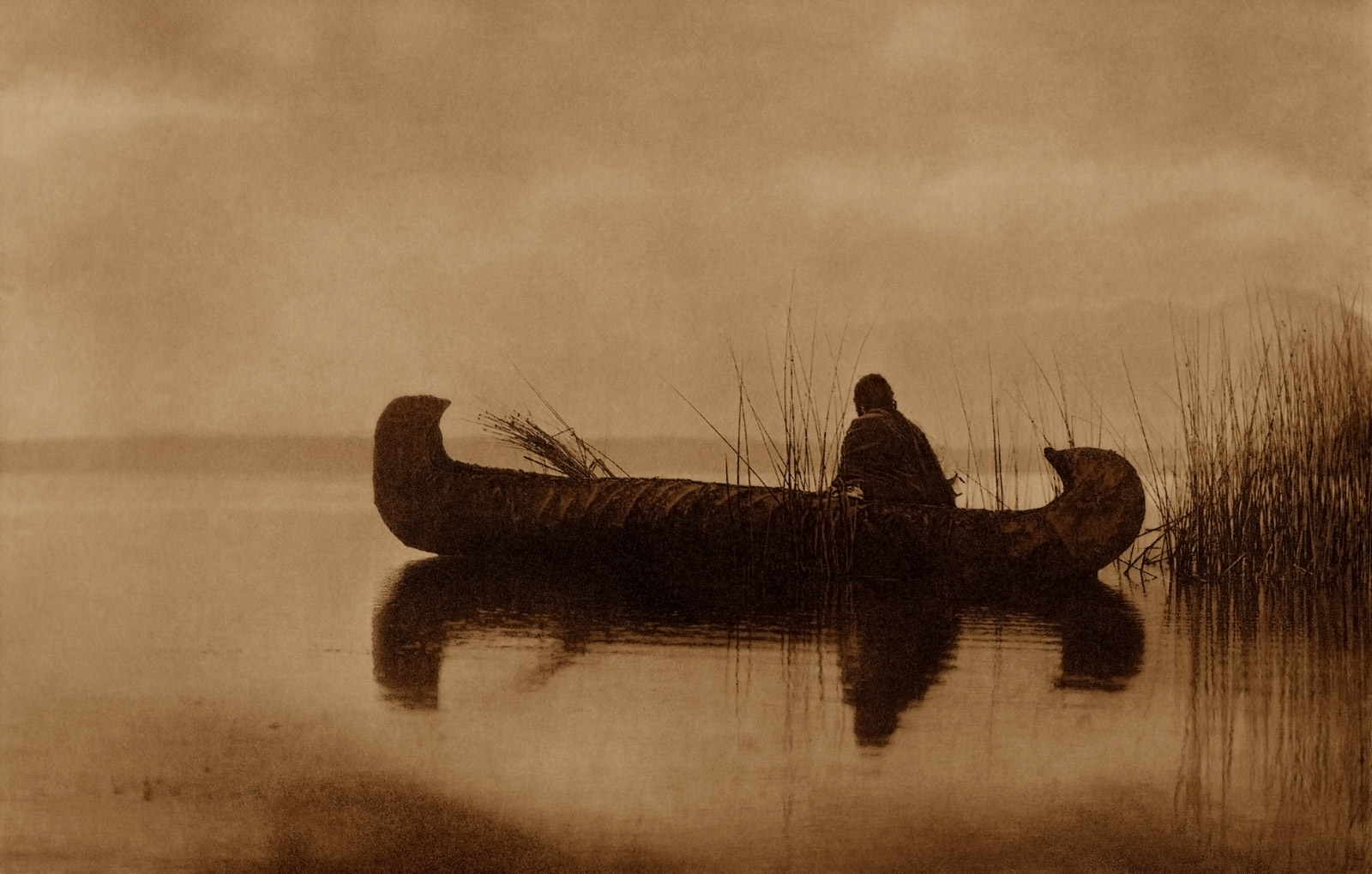
 

Edward S. Curtis (American, 1868-1952) 'Kutenai Duck Hunter' 1910


Edward S. Curtis (American, 1868-1952)
Kutenai Duck Hunter
1910
Photogravure
Courtesy of the Christopher G. Cardozo Collection


Kutenai / Ktunaxa

The Ktunaxa (English pronunciation:  /tʌˈnɑːhɑː/ tun-ah-hah; Kutenai pron. [ktunʌ́χɑ̝]), also known as Kutenai (English /ˈktnni/), Kootenay (predominant spelling in Canada) and Kootenai (predominant spelling in the United States), are an indigenous people of North America. There are four bands that form the Ktunaxa Nation and the historic allied and through intermarriage kindred Shuswap Indian Band in British Columbia, in Montana together with the Bitterroot Salish (also known as Flathead) and Upper Pend d’Oreilles they are part of the Confederated Salish and Kootenai Tribes of the Flathead Nation. There are also the Kootenai Tribe of Idaho in Idaho and small populations in Washington in the United States, where they are part of the Confederated Tribes of the Colville Reservation.

The Kutenai language is an isolate, unrelated to the languages of neighbouring peoples… The Ktunaxa people today live in southeastern British Columbia, Washington State, Idaho, and Montana. In Montana they are known as Ksanka. Ktunaxa is the term that these tribes call themselves, which is pronounced Ta-na-ha, with a barely perceptible ‘k’ sound at the beginning of the word. Traditionally these people have been known as Kootenay or Kootenai, which is an anglicisation of the Blackfoot word used to refer to the Ktunaxa, so in some of their tribal organisations and activities, the Ktunaxa refer to themselves as Kootenay, or in Montana, Kootenai.
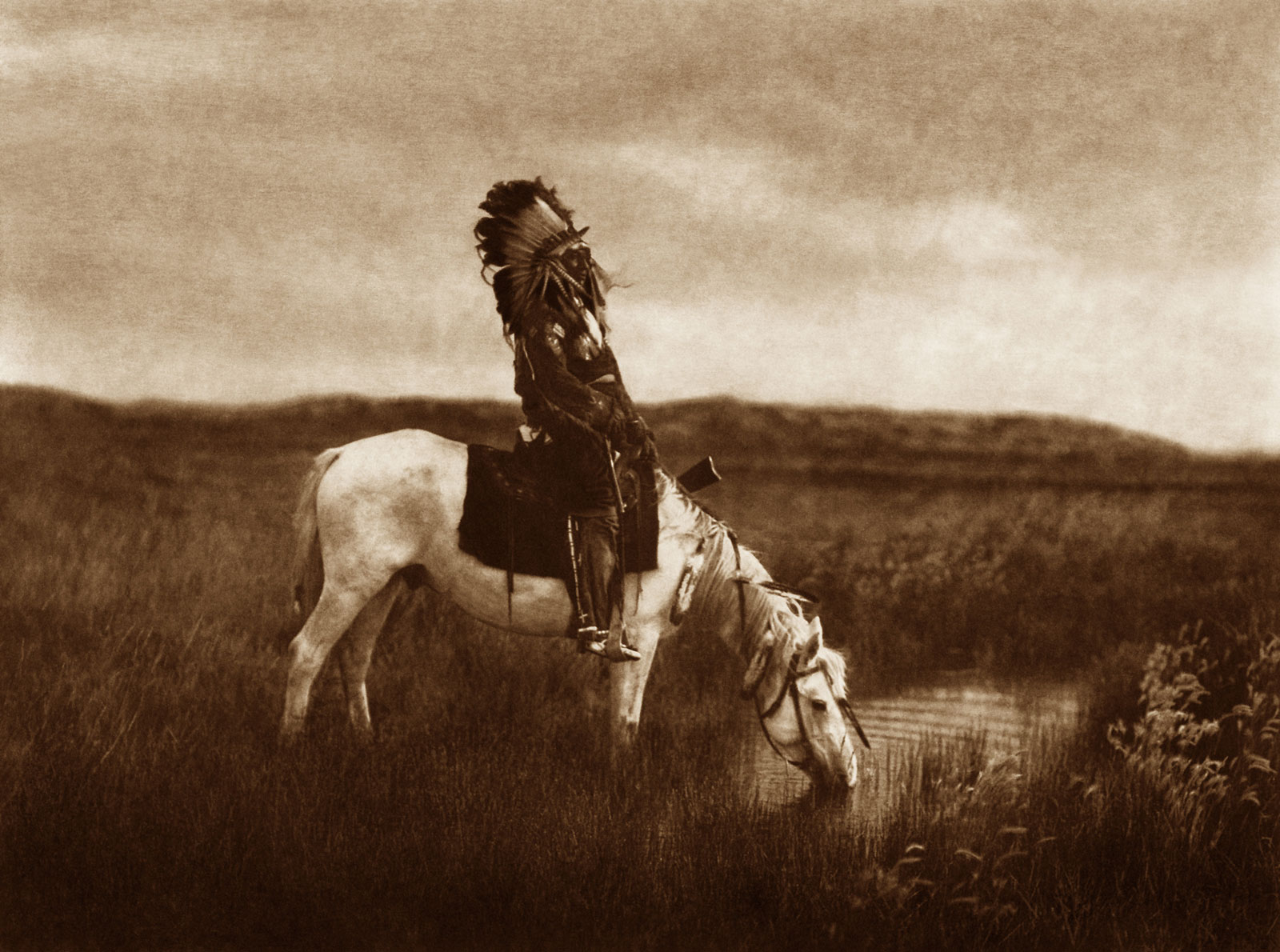
 

Edward S. Curtis (American, 1868-1952 'An Oasis in the Badlands' 1905


Edward S. Curtis (American, 1868-1952)
An Oasis in the Badlands
1905
Photogravure
Courtesy of the Christopher G. Cardozo Collection


This classic Curtis image was made in the heart of the Bad Lands of South Dakota. The subject is Red Hawk who was born 1854 and was a fierce warrior who ultimately engaged in 20 battles, including the Custer fight in 1876. This lyrical image is widely considered to be Curtis’ most important and beautiful Great Plains peopled landscape. Curtis loved the visual and metaphorical qualities of water, and the image conveys the beauty of water as an aesthetic element. The compelling composition and subject matter have helped make this one of Curtis’ most sought-after images, even one hundred years after it was originally created.

Text from Cardoza Fine Art website


Edward S. Curtis (American, 1868-1952) 'Canyon de Chelly – Navaho' 1904


Edward S. Curtis (American, 1868-1952)
Canyon de Chelly – Navaho
1904
Photogravure
Courtesy of the Christopher G. Cardozo Collection


Canyon de Chelly

Canyon de Chelly long served as a home for Navajo people before it was invaded by forces led by future New Mexico governor Lt. Antonio Narbona in 1805. In 1863 Col. Kit Carson sent troops to either end of the canyon to defeat the Navajo population within. The resulting devastation led to the surrender of the Navajos and their removal to Bosque Redondo, New Mexico.

Navaho

The Navajo (Navajo: Diné or Naabeehó) are a Native American people of the Southwestern United States. They are the second largest federally recognised tribe in the United States with 300,460 enrolled tribal members as of 2015. The Navajo Nation constitutes an independent governmental body that manages the Navajo reservation in the Four Corners area, including over 27,000 square miles of land in Arizona, Utah, and New Mexico. The Navajo language is spoken throughout the region with most Navajo speaking English as well.

The states with the largest Navajo populations are Arizona (140,263) and New Mexico (108,306). Over three-quarters of the Navajo population reside in these two states.

The Long Walk

Beginning in the spring of 1864, around 9,000 Navajo men, women and children were forced to embark on a trek of over 300 miles (480 km) to Fort Sumner, New Mexico for internment at Bosque Redondo. The internment at Bosque Redondo was a failure for many reasons as the government failed to provide an adequate supply of water, wood, provisions, and livestock for 4,000-5,000 people. Large scale crop failure and disease were also endemic during this time, as well as raids by other tribes and civilians. In addition, a small group of Mescalero Apaches, long enemies of the Navajo, had been relocated to the area resulting in conflicts. In 1868, a treaty was negotiated between Navajo leaders and the Federal government allowing the surviving Navajo to return to a reservation on a portion of their former homeland. The Navajos were not provided with much protection that other enemies of the Navajos would swoop in and take Navajo women and children back to their camps and force them to work as slaves. While at Bosque Redondo the government did not provide the Navajos with food or shelter and some Navajos froze during the winter because of poor shelters that they had to make on their own.
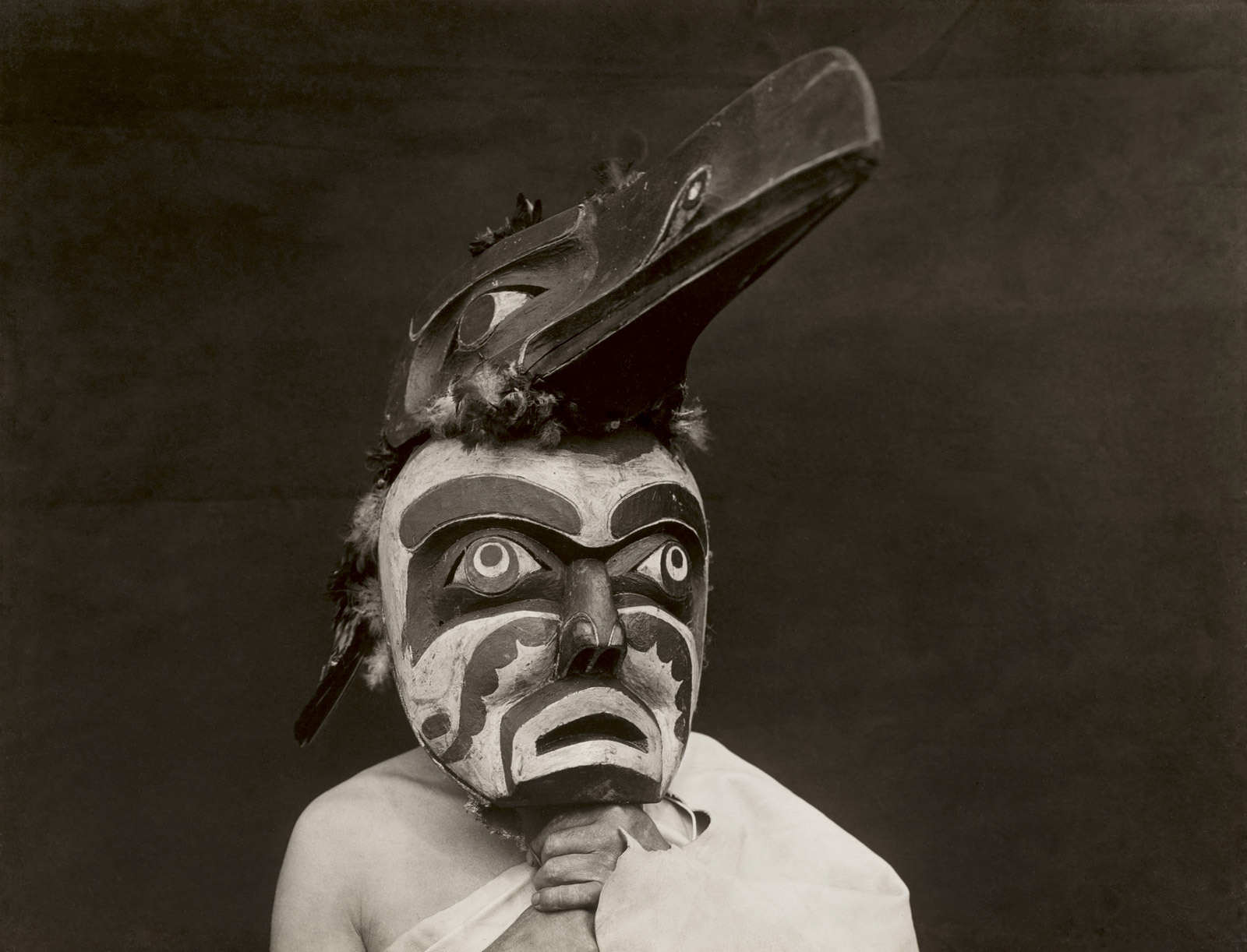
 

Edward S. Curtis (American, 1868-1952) 'Untitled (Raven-ma) – Qagyuhl' 1914


Edward S. Curtis (American, 1868-1952)
Untitled (Raven-ma) – Qagyuhl
1914
Gelatin silver
Courtesy of the Christopher G. Cardozo Collection
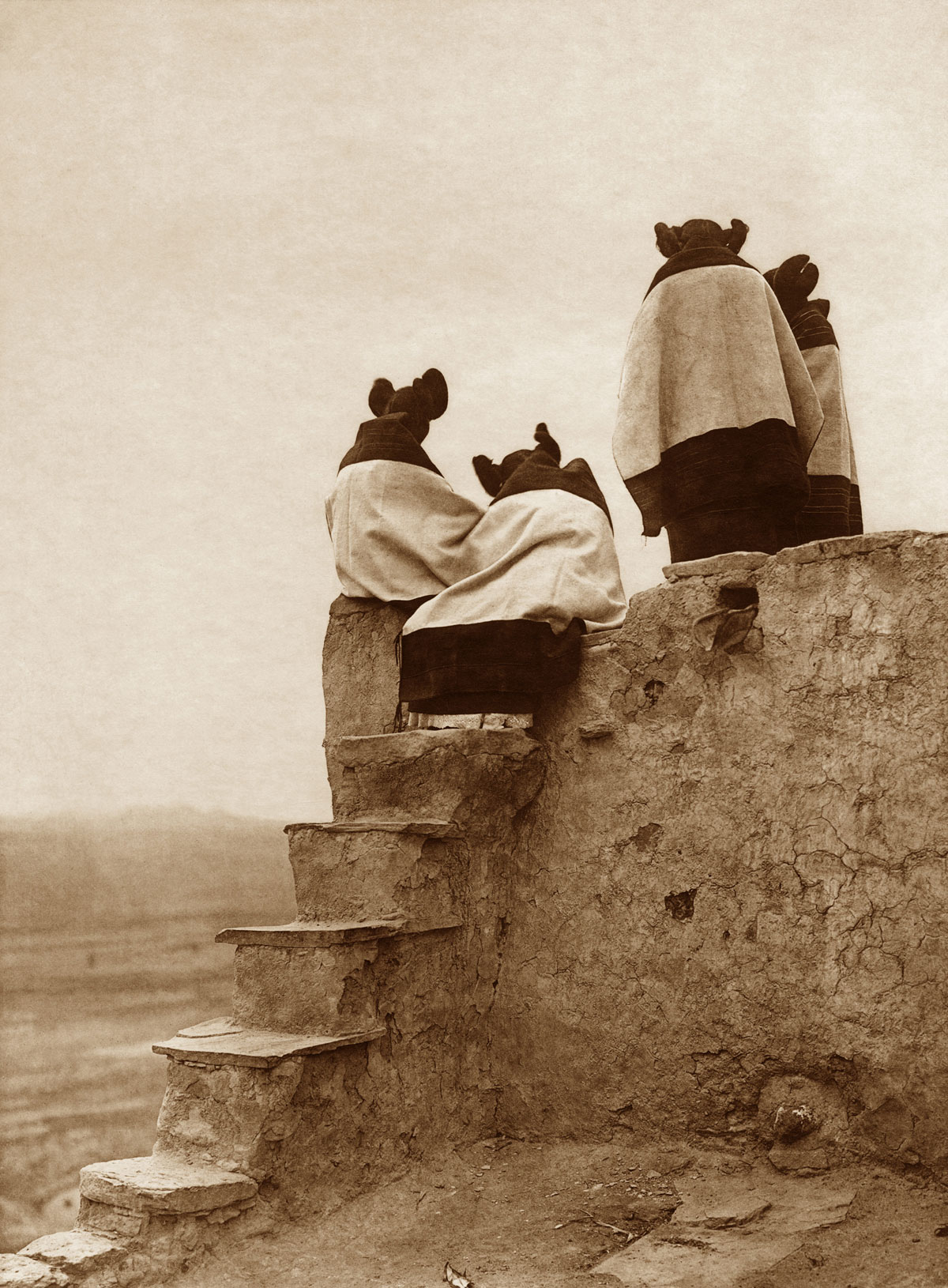
 

Edward S. Curtis (American, 1868-1952) 'Watching the Dancers' 1906


Edward S. Curtis (American, 1868-1952)
Watching the Dancers
1906
Photogravure
Courtesy of the Christopher G. Cardozo Collection


Three Hopi girls, wrapped in heavy blankets and wearing the squash blossom hairstyle of maidens, sit and stand on an adobe rooftop, watching a pueblo dance below. A fourth girl is hidden behind the girl at right, with only a single twist of her hair visible over the standing girl’s shoulder. The standing girl glances suspiciously at the photographer, Edward Curtis, who has invaded the girls’ privacy with his camera’s presence. In this photograph, the onlookers have themselves become an event to be witnessed.

Text from the J. Paul Getty Museum website


Curtis visited the Hopi on multiple occasions and went as early as 1900, went back in 1902, 1904, 1906, 1911, 1912, and 1919, so dating which images where shot when can pose something of a challenge, but he does note that the traditional squash blossom hairdo was discontinued by the second decade of the twentieth century. In these early images, “Watching the Dancers” and “The Hopi Maiden,” Curtis captured young unwed women at a time when they still wore their hair in the traditional style. So one can understand that such images confirmed his, and other’s views, that traditional ways of life where passing, and for Curtis, it confirmed the popular view, which his images helped to cement in the popular imagination – that Native Americans were a “vanishing race.”

Ken Gonzales-Day. “The Hopi Maiden and Watching the Dancers,” on the scalar.usc website Nd [Online] Cited 02/02/2023


Hopi

The Hopi are a Native American tribe, who primarily live on the 2,531.773 sq mi (6,557.26 km2) Hopi Reservation in northeastern Arizona. As of 2010, there were 18,327 Hopi in the United States, according to the 2010 census. The Hopi language is one of the 30 of the Uto-Aztecan language family. The majority of Hopi people are enrolled in the Hopi Tribe of Arizona but some are enrolled in the Colorado River Indian Tribes…

The name Hopi is a shortened form of their autonym, Hopituh Shi-nu-mu (“The Peaceful People” or “Peaceful Little Ones”). The Hopi Dictionary gives the primary meaning of the word “Hopi” as: “behaving one, one who is mannered, civilised, peaceable, polite, who adheres to the Hopi way.” In the past, Hopi sometimes used the term “Hopi” and its cognates to refer to the Pueblo peoples in general, in contrast to other, more warlike tribes. Hopi is a concept deeply rooted in the culture’s religion, spirituality, and its view of morality and ethics. To be Hopi is to strive toward this concept, which involves a state of total reverence and respect for all things, to be at peace with these things, and to live in accordance with the instructions of Maasaw, the Creator or Caretaker of Earth. The Hopi observe their traditional ceremonies for the benefit of the entire world.

Traditionally, Hopi are organised into matrilineal clans. When a man marries, the children from the relationship are members of his wife’s clan. These clan organisations extend across all villages. Children are named by the women of the father’s clan. On the twentieth day of a baby’s life, the women of the paternal clan gather, each woman bringing a name and a gift for the child. In some cases where many relatives would attend, a child could be given over forty names, for example. The child’s parents generally decide the name to be used from these names. Current practice is to either use a non-Hopi or English name or the parent’s chosen Hopi name. A person may also change the name upon initiation into one of the religious societies, such as the Kachina society, or with a major life event.

The Hopi have always viewed their land as sacred. Agriculture is a very important part of their culture, and their villages are spread out across the northern part of Arizona. The Hopi and the Navajo did not have a conception of land being bounded and divided. They lived on the land that their ancestors did. On December 16, 1882 President Arthur passed an executive order creating a reservation for the Hopi. It was much smaller than the Navajo reservation, which was the largest in the country.
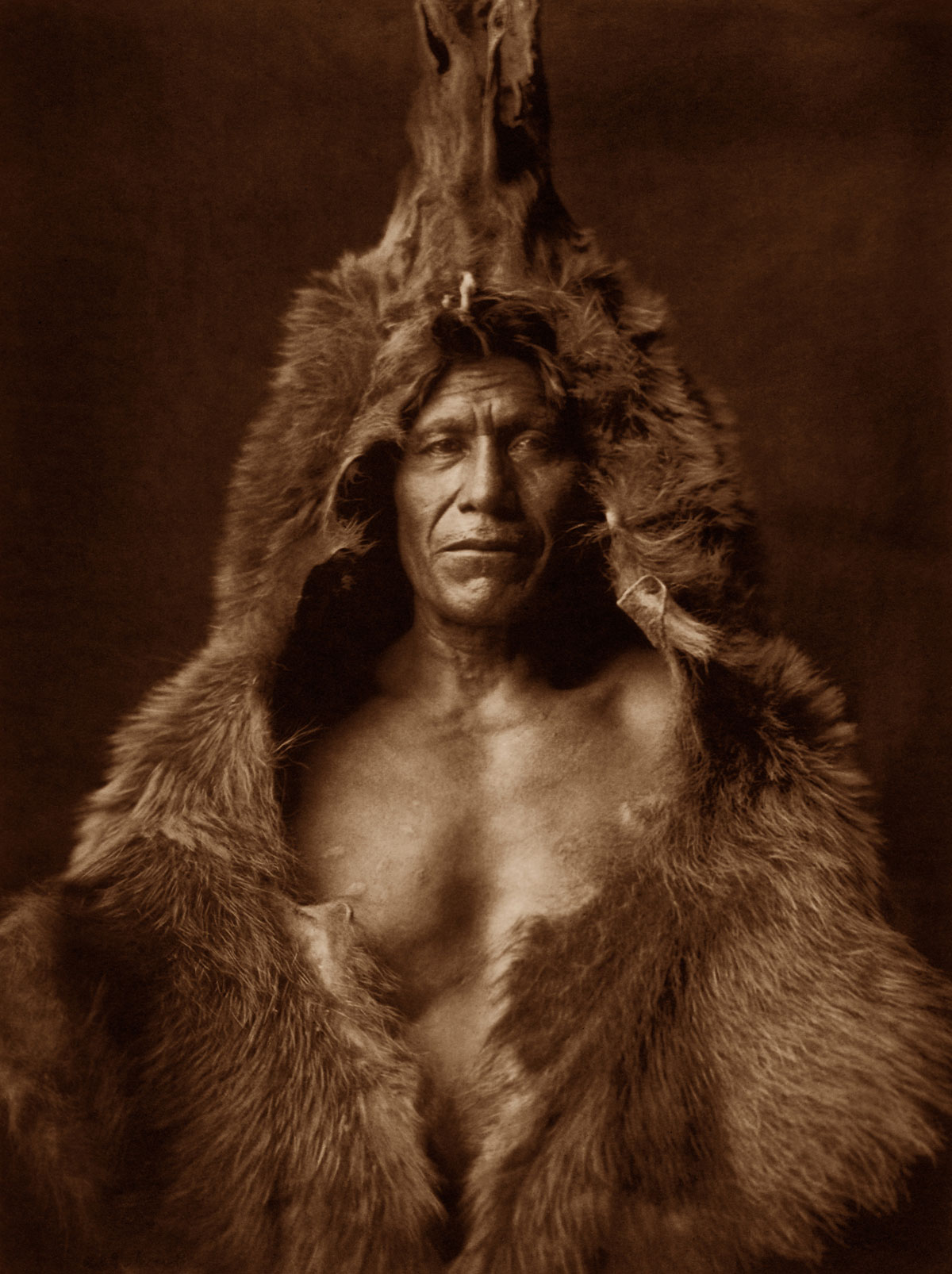
 

Edward S. Curtis (American, 1868-1952) 'Bear's Belly – Arikara' 1908


Edward S. Curtis (American, 1868-1952)
Bear’s Belly – Arikara
1908
Photogravure
Courtesy of the Christopher G. Cardozo Collection


Born in 1847 in the present day North Dakota, Bear’s Belly was a highly respected and honoured warrior and became a member of the Bears in the Medicine Fraternity. He acquired his bearskin in a dramatic battle in which he single-handedly killed three bears, thus gaining his personal “medicine”. This image was printed as a photogravure, plate 150 from Portfolio V, with the text below from the accompanying Volume V of Curtis’ The North American Indian.

Born in 1847 at Fort Clark in the present North Dakota. He had no experience in war when at the age of nineteen he joined Custer’s scouts at Fort Abraham Lincoln, having been told by old men of the tribe that such a course was the surest way to gain honours. Shortly after his arrival, Custer led a force into the Black Hills country; in the course of which, the young Arikara counted two first coups and one second. Bear’s Belly fasted once. Going to an old man for advice, he was taken to the outskirts of the village to an old buffalo skull, commanded to strip, smear his body with white clay, and sit in front of the skull. When he had taken the assigned position, the old man held up a large knife and an awl while he addressed the buffalo skull: “this young man sits in front of you, and is going to endure great suffering. Look upon him with great favour, you and Neshanu, and give him a long, prosperous life.” With that he cut pieces of skin from the faster’s breast and held them out to the buffalo skull. Bear’s Belly married at the age of nineteen. He became a member of the Bears in the medicine fraternity and relates the following story of an occurrence connected with that event:

“Needing a bearskin in my medicine-making, I went, at the season when the leaves were turning brown, into the White-Clay hills. All the thought of my heart that day was to see a bear and kill him. I passed an eagle trap, but did not stop: it was a bear I wanted, not an eagle. Coming suddenly to the brink of a cliff I saw me three bears. My heart wished to go two ways: I wanted a bear. But to fight three was hard. I decided to try it, and, descending, crept up to within forty yards of them, where I stopped to look around for a way of escape if they charged me. The only way out was by the cliff, and as I could not climb well in moccasins I removed them. One bear was standing with his side toward me, another was walking slowly toward him on the other side. I waited until the second one was close to the first and pulled the trigger. The farther one fell; the bullet had passed through the body of one and into the brain of the other. The wounded one charged, and I ran, loading my rifle, then turned and shot again, breaking his backbone. He lay there on the ground only ten paces from me and I see his face twitching. A noise caused me to remember the third bear, which I saw rushing upon me only six or seven paces away, I was yelling to keep up my courage and the bear was growling in his anger. He rose on his hind legs, and I shot, with my gun nearly touching his chest. He gave a howl and ran off. The bear with the broken back was dragging himself about with his forelegs, and I went to him and said, “I came looking for you to be my friend, to be with me always.” Then I reloaded my gun and shot him through the head. His skin I kept, but the other two I sold.”

Text from the Cardoza Fine Art website, November 23, 2011 [Online] Cited 21/05/2016. No longer available online
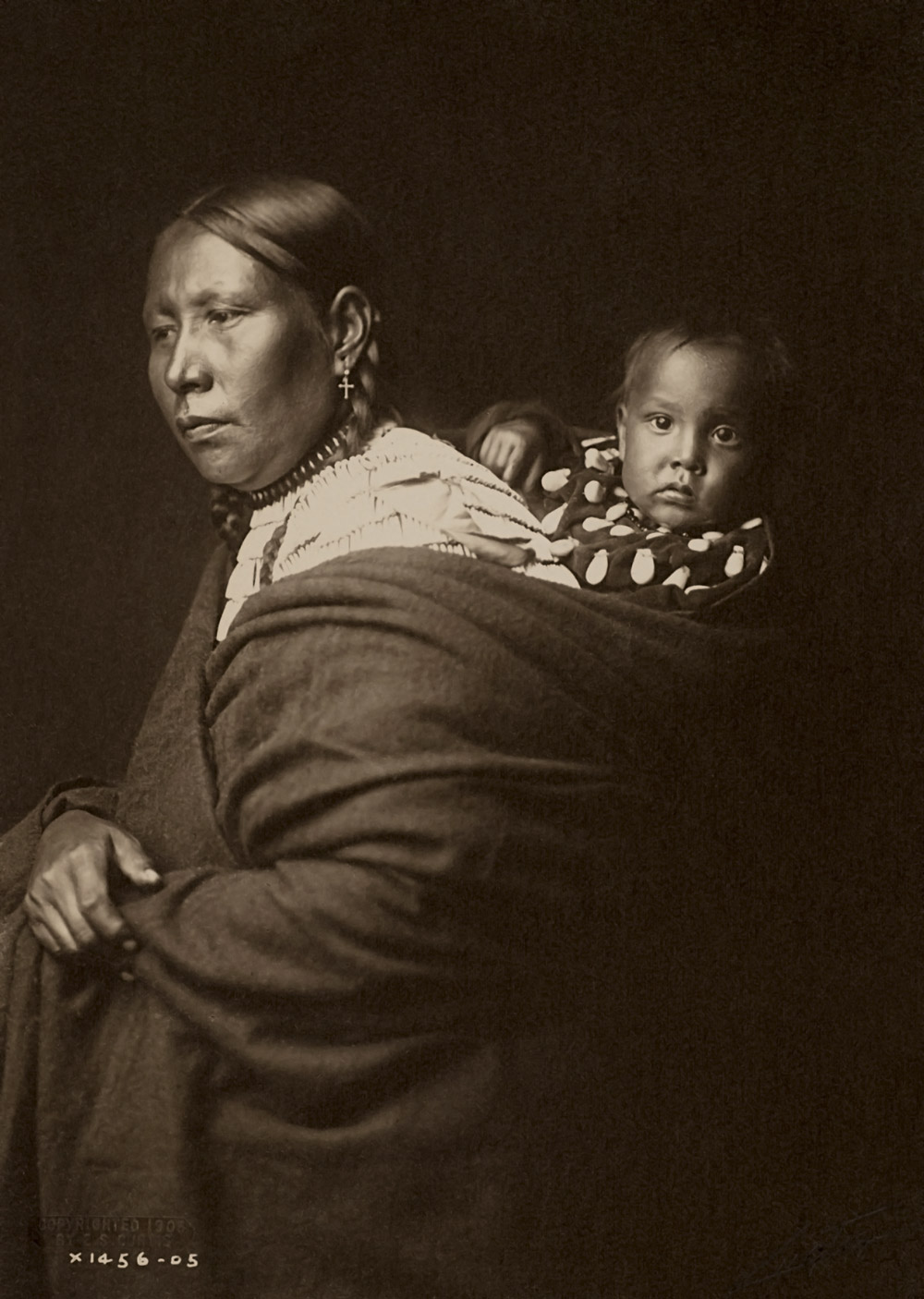
 

Edward S. Curtis (American, 1868-1952) 'Sioux Mother and Child' 1905


Edward S. Curtis (American, 1868-1952)
Sioux Mother and Child
1905
Platinum print
Courtesy of the Christopher G. Cardozo Collection


Sioux

The Sioux /ˈs/ are a Native American tribe and First Nations band government in North America. The term can refer to any ethnic group within the Great Sioux Nation or any of the nation’s many language dialects. The Sioux comprise three major divisions based on language variety and subculture: the Santee, the Yankton-Yanktonai, and the Lakota.

The Santee (Isáŋyathi; “Knife”) reside in the extreme east of the Dakotas, Minnesota and northern Iowa. The Yankton and Yanktonai (Iháŋktȟuŋwaŋ and Iháŋktȟuŋwaŋna; “Village-at-the-end” and “Little village-at-the-end”), collectively also referred to by the endonym Wičhíyena, reside in the Minnesota River area. They are considered to be the middle Sioux, and have in the past been erroneously classified as Nakota. The Lakota, also called Teton (Thítȟuŋwaŋ; possibly “Dwellers on the prairie”), are the westernmost Sioux, known for their hunting and warrior culture.

Today, the Sioux maintain many separate tribal governments scattered across several reservations, communities, and reserves in North Dakota, South Dakota, Nebraska, Minnesota, and Montana in the United States; and Manitoba and southern Saskatchewan in Canada.
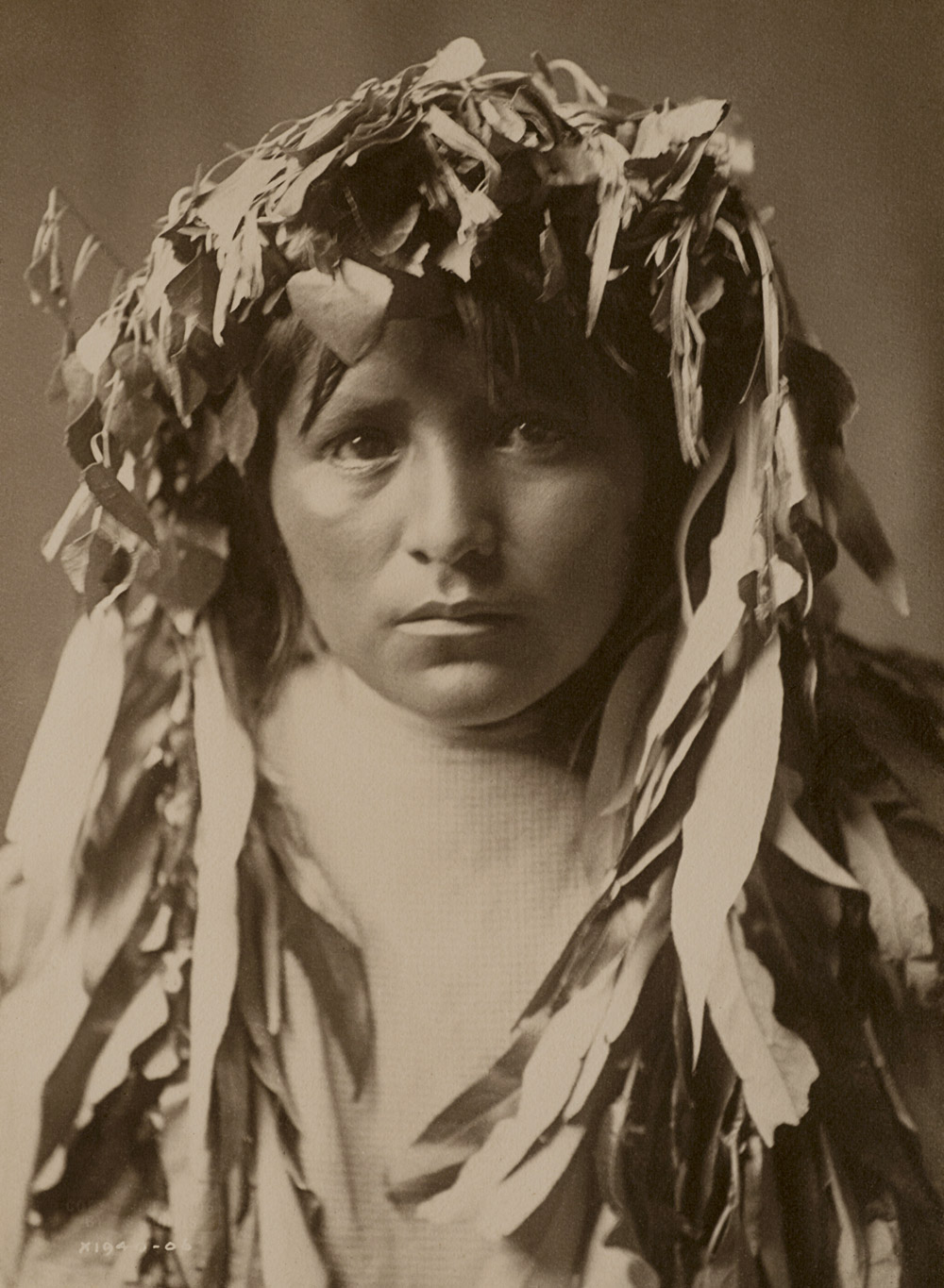
 

Edward S. Curtis (American, 1868-1952) 'The Apache Maiden' 1906


Edward S. Curtis (American, 1868-1952)
The Apache Maiden
1906
Platinum print
Courtesy of the Christopher G. Cardozo Collection


Palm Springs Art Museum is presenting the extraordinary Edward S. Curtis: One Hundred Masterworks exhibition, featuring vintage photographs that represent an important historical documentary of the Indians of North America; and Changing the Tone: Contemporary American Indian Photographers, showcasing works by living artists of Native American heritage. The exhibitions are on view now through May 29, 2016.

Beginning in 1900, Edward S. Curtis (1868-1952) set out on a monumental quest to create an unprecedented, comprehensive record of the Indians of North America. The culmination of his 30-year project led to his magnum opus, “The North American Indian,” a twenty-volume, twenty-portfolio set of handmade books containing a selection of over 2,200 original photographs. Today One Hundred Masterworks stands as a landmark in the history of photography, book publishing, ethnography, and the history of the American West, producing an art historical record of enormous and irreplaceable importance.

One Hundred Masterworks presents an extraordinary selection of vintage photographs by Curtis that highlight both iconic and little known images that reveal the aesthetic, emotional, and spiritual qualities of his art. The exhibition showcases seven photographic print mediums including photogravure, platinum, goldtone (orotone), toned and un-toned gelatin silver, cyanotype, and gold-toned printing-out paper prints. Arranged by geographic region, the exhibition includes a selection of Curtis’s most compelling and rare photographs that look beyond the documentary nature of his work to focus on his aesthetic and technical contributions to the art of photography. Accompanying the exhibition is a 184-page catalogue available for purchase at the Museum Store at Palm Springs Art Museum.

In conjunction with Edward S. Curtis: One Hundred Masterworks, the museum presents a special installation of photographs taken by Curtis on loan from the collections of the Agua Caliente Band of Cahuilla Indians and Agua Caliente Cultural Museum, along with a selection of Native American objects from Palm Springs Art Museum’s permanent collection.

The exhibition Edward S. Curtis: One Hundred Masterworks has been organised by the Foundation for the Exhibition of Photography, Minneapolis / New York City / Paris / Lausanne, in collaboration with Palm Springs Art Museum. The Palm Springs showing is funded in part by the museum’s Western Art Council and its Gold Sponsors Donna MacMillan and Harold Matzner, and Mary Ingebrand-Pohlad, along with support from Carol and Jim Egan, Terra Foundation for American Art through Board Member Gloria Scoby, Luc Bernard and Mark Prior, and the museum’s Photography Collection Council. Exhibition Season Sponsors are Dorothy Meyerman and Marion and Bob Rosenthal.

Changing the Tone: Contemporary American Indian Photographers features photographs and videos by artists of Native American heritage including Gerald Clarke, Will Wilson, Kent Monkman, Nicholas Galanin, Shelley Niro, and Lewis de Soto. In images that reflect on portraiture, cultural heritage, and their relationship to the land, these artists offer diverse perspectives on Native American identity as well as on critical issues around photography as a documentary medium, i.e., the extent to which it is fact, fiction, or some combination of both. These works provide a contemporary context for Curtis’s historical photographs. Changing the Tone is organised by Palm Springs Art Museum with generous support from Roswitha Kima Smale and John Renner.

Press release from the Palm Springs Art Museum


More images from the exhibition

These reproductions are freely available online (from websites such as the Library of Congress and Wikipedia).
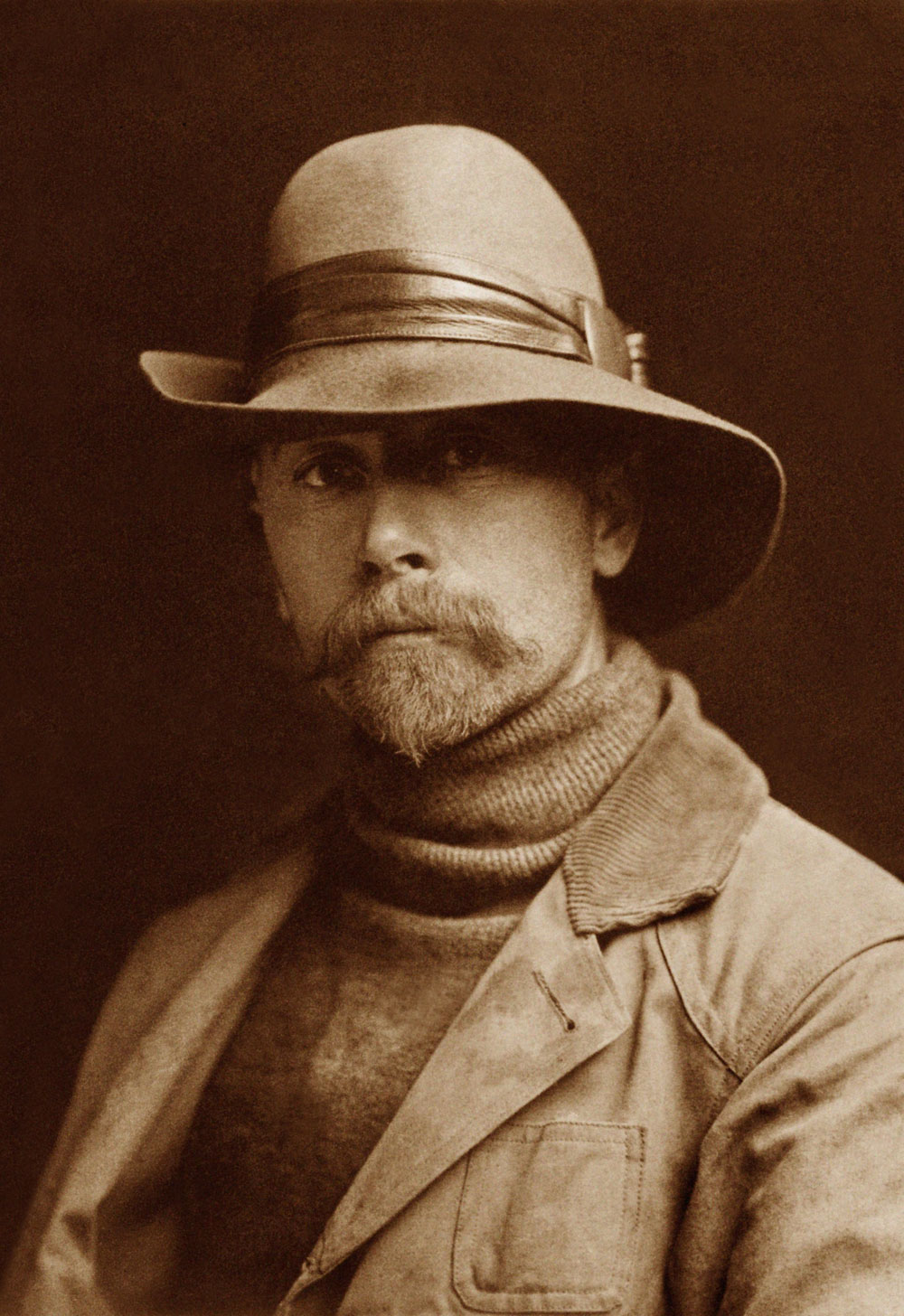
 

Edward S. Curtis (American, 1868-1952) 'Self Portrait' 1899


Edward S. Curtis (American, 1868-1952)
Self Portrait
1899
Photogravure
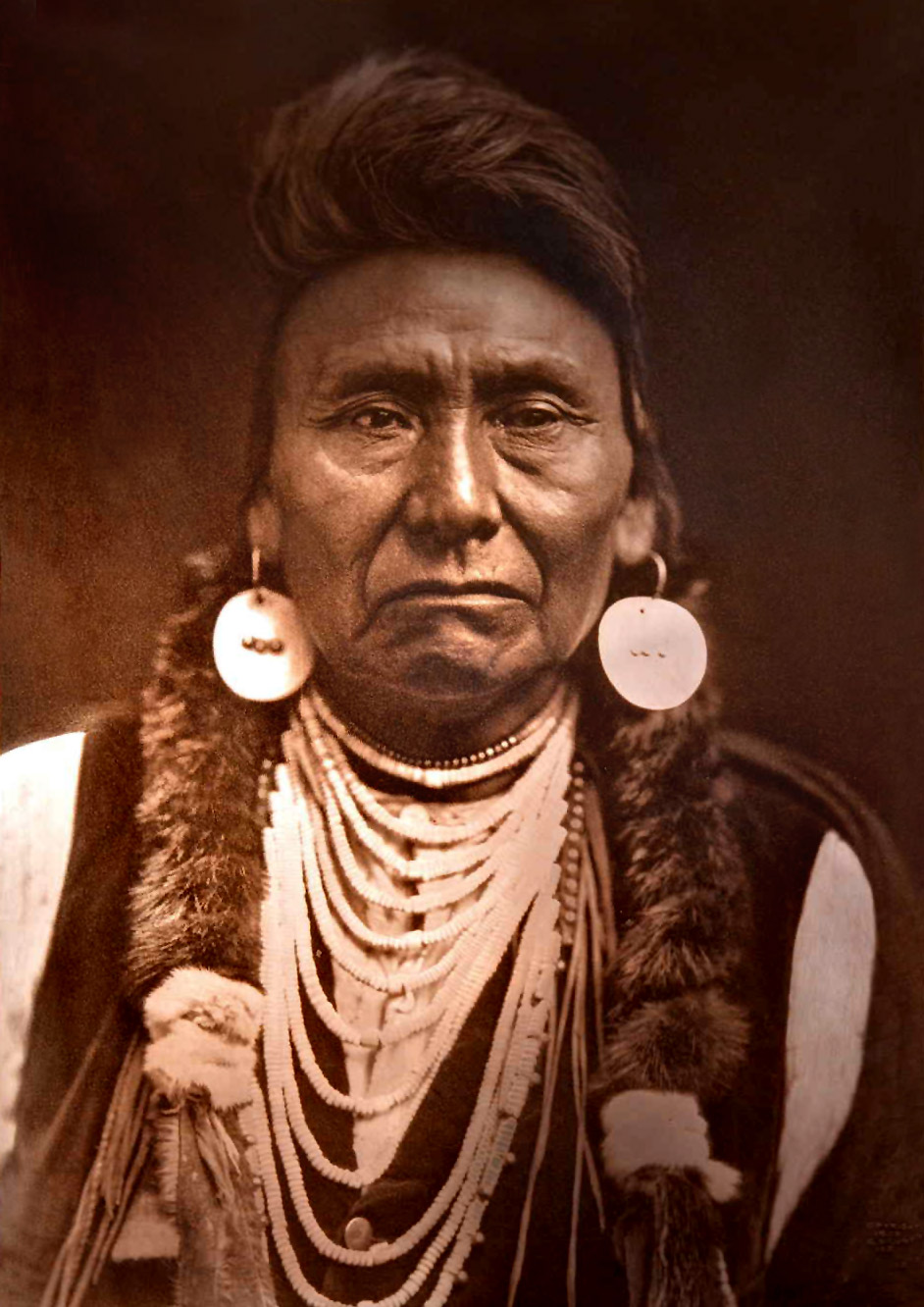
 

Edward S. Curtis (American, 1868-1952) 'Chief Joseph - Nez Perce' 1903


Edward S. Curtis (American, 1868-1952)
Chief Joseph – Nez Perce
1903
Photogravure


The earth is the mother of all people, and all people should have equal rights upon it.

I believe much trouble would be saved if we opened our hearts more.

Treat all men alike. Give them the same law. Give them an even chance to live and grow.

It does not require many words to speak the truth.


Chief Joseph

Hin-mah-too-yah-lat-kekt, Hinmatóowyalahtq̓it in Americanist orthography, popularly known as Chief Joseph or Young Joseph (March 3, 1840 – September 21, 1904), succeeded his father Tuekakas (Chief Joseph the Elder) as the leader of the Wal-lam-wat-kain (Wallowa) band of Nez Perce, a Native American tribe indigenous to the Wallowa Valley in northeastern Oregon, in the interior Pacific Northwest region of the United States.

He led his band during the most tumultuous period in their contemporary history when they were forcibly removed from their ancestral lands in the Wallowa Valley by the United States federal government and forced to move northeast, onto the significantly reduced reservation in Lapwai, Idaho Territory. A series of events that culminated in episodes of violence led those Nez Perce who resisted removal, including Joseph’s band and an allied band of the Palouse tribe, to take flight to attempt to reach political asylum, ultimately with the Lakota led by Sitting Bull, who had sought refuge in Canada.

They were pursued eastward by the U.S. Army in a campaign led by General Oliver O. Howard. This 1,170-mile (1,900km) fighting retreat by the Nez Perce in 1877 became known as the Nez Perce War. The skill with which the Nez Perce fought and the manner in which they conducted themselves in the face of incredible adversity led to widespread admiration among their military adversaries and the American public.

Coverage of the war in United States newspapers led to widespread recognition of Joseph and the Nez Perce. For his principled resistance to the removal, he became renowned as a humanitarian and peacemaker. However, modern scholars, like Robert McCoy and Thomas Guthrie, argue that this coverage, as well as Joseph’s speeches and writings, distorted the true nature of Joseph’s thoughts and gave rise to a “mythical” Chief Joseph as a “red Napoleon” that served the interests of the Anglo-American narrative of manifest destiny.

Nez Perce

‘The Nez Perce’ /ˌnɛzˈpɜːrs/ (autonym: Niimíipu) are an Indigenous people of the Plateau, who live in the Pacific Northwest region of the United States, which is on the Columbia River Plateau. They are federally recognized as the Nez Perce Tribe and currently govern their reservation in Idaho. Anthropologists have written that the Nez Perce descend from the Old Cordilleran Culture, which moved south from the Rocky Mountains and west into lands where the tribe coalesced. Their name for themselves is Nimíipuu (pronounced [nimiːpuː]), meaning, “The People,” in their language, part of the Sahaptin family…

Nez Perce is a misnomer given by the interpreter of the Lewis and Clark Expedition at the time they first encountered the Nez Perce in 1805. It was a French term meaning “pierced nose.” This is an inaccurate description of the tribe. They did not practice nose piercing or wearing ornaments. The “pierced nose” tribe lived on and around the lower Columbia River in the Pacific Northwest and are commonly called the Chinook tribe by historians and anthropologists. The Chinook relied heavily upon salmon, as did the Nez Perce. The peoples shared fishing and trading sites but the Chinook were much more hierarchical in their social arrangements.
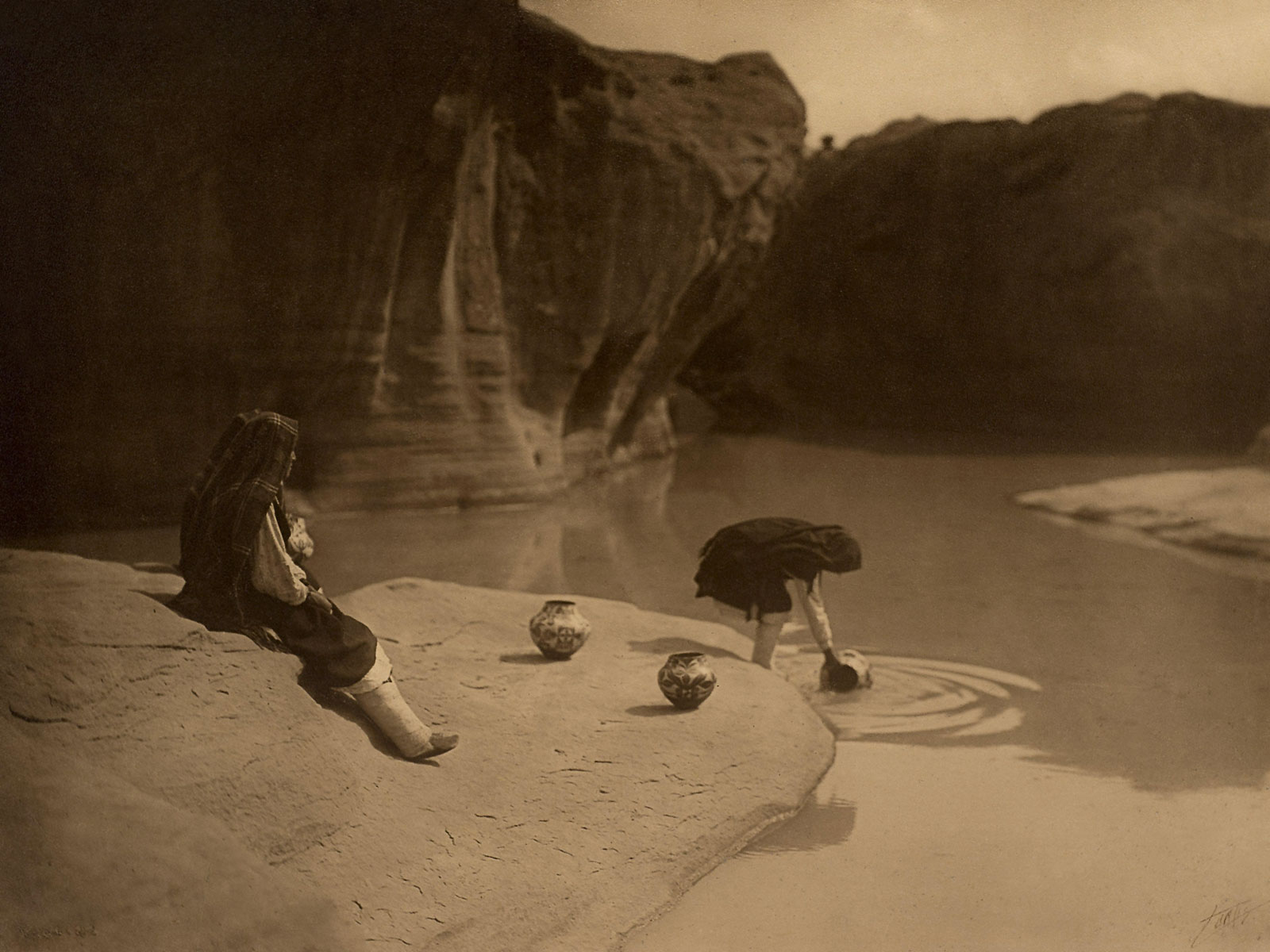
 

Edward S. Curtis (American, 1868-1952) 'At the Old Well – Acoma' 1904


Edward S. Curtis (American, 1868-1952)
At the Old Well – Acoma
1904
Photogravure


Acoma Pueblo (/ˈækəmə/; Western Keresan: Haak’u; Zuni: Hakukya; Navajo: Haak’oh) is a Native American pueblo approximately 60 miles (97 km) west of Albuquerque, New Mexico in the United States. Three villages make up Acoma Pueblo: Sky City (Old Acoma), Acomita, and Mcartys. The Acoma Pueblo tribe is a federally recognised tribal entity. The historical land of Acoma Pueblo totaled roughly 5,000,000 acres (2,000,000 ha). Only 10% of this land remains in the hands of the community within the Acoma Indian Reservation.
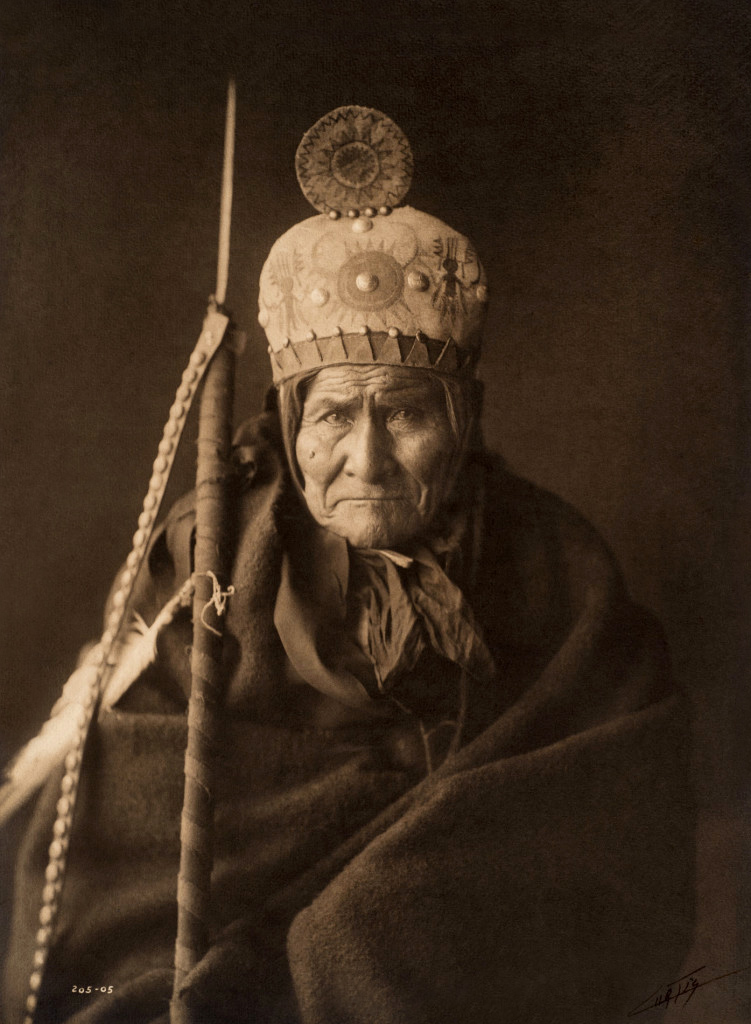
 

Edward S. Curtis (American, 1868-1952) 'Geronimo – Apache' 1905


Edward S. Curtis (American, 1868-1952)
Geronimo – Apache
1905
Platinum print


Geronimo

Geronimo (Mescalero-Chiricahua: Goyaałé [kòjàːɬɛ́] “the one who yawns”; June 16, 1829 – February 17, 1909) was a prominent leader from the Bedonkohe band of the Chiricahua Apache tribe. From 1850 to 1886 Geronimo joined with members of three other Chiricahua Apache bands – the Chihenne, the Chokonen and the Nednhi – to carry out numerous raids as well as resistance to US and Mexican military campaigns in the northern Mexico states of Chihuahua and Sonora, and in the southwestern American territories of New Mexico and Arizona. Geronimo’s raids and related combat actions were a part of the prolonged period of the Apache-American conflict, that started with American settlement in Apache lands following the end of the war with Mexico in 1848…

Geronimo was not counted a chief among the Apache. At any one time, only about 30 to 50 Apaches would be numbered among his personal following. However, since he was a superb leader in raiding and revenge warfare he frequently led numbers larger than his own following. Among Geronimo’s own Chiricahua tribe many had mixed feelings about him – while respected as a skilled and effective leader of raids or warfare, he emerges as not very likeable, and he was not widely popular among the other Apache. Nevertheless, Apache people stood in awe of Geronimo’s “powers” which he demonstrated to them on a series of occasions. These powers indicated to other Apaches that Geronimo had super-natural gifts that he could use for good or ill. In eye-witness accounts by other Apaches Geronimo was able to become aware of events, as they happened, though they were at a far distant place, and he was able to anticipate events that were in the future. He also demonstrated powers to heal other Apaches.

Apache

The Apache (/əˈpæ/; French: [a.paʃ]) are culturally related Native American tribes from the Southwestern United States and Northern Mexico. These indigenous peoples of North America speak Southern Athabaskan languages, which are related linguistically to Athabaskan languages in Alaskaand western Canada. Apache people traditionally have lived in Eastern Arizona, Northern Mexico (Sonora and Chihuahua), New Mexico, West Texas, and Southern Colorado. Apacheria, their collective homelands, consists of high mountains, sheltered and watered valleys, deep canyons, deserts, and the southern Great Plains…

Apache groups are politically autonomous. The major groups speak several different languages and developed distinct and competitive cultures. The current post-colonial division of Apache groups includes Western Apache, Chiricahua, Mescalero, Jicarilla, Lipan, and Plains Apache (also known as the Kiowa-Apache). Apache groups live in Oklahoma and Texas and on reservations in Arizona and New Mexico. Apache people have moved throughout the United States and elsewhere, including urban centres.
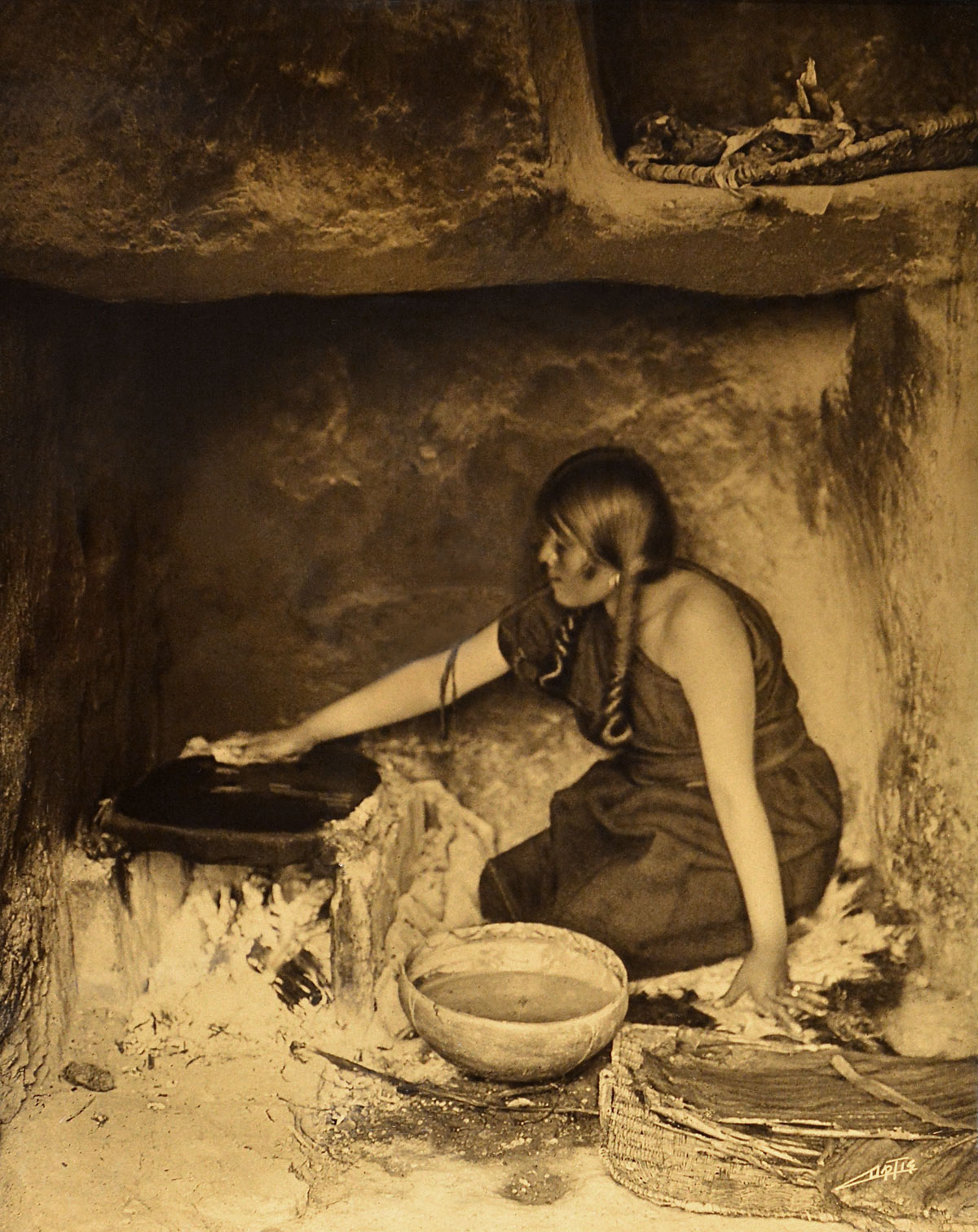
 

Edward S. Curtis (American, 1868-1952) 'The Piki Maker' 1906


Edward S. Curtis (American, 1868-1952)
The Piki Maker
1906
Vintage goldtone


Piki is a bread made from corn meal used in Hopi cuisine.
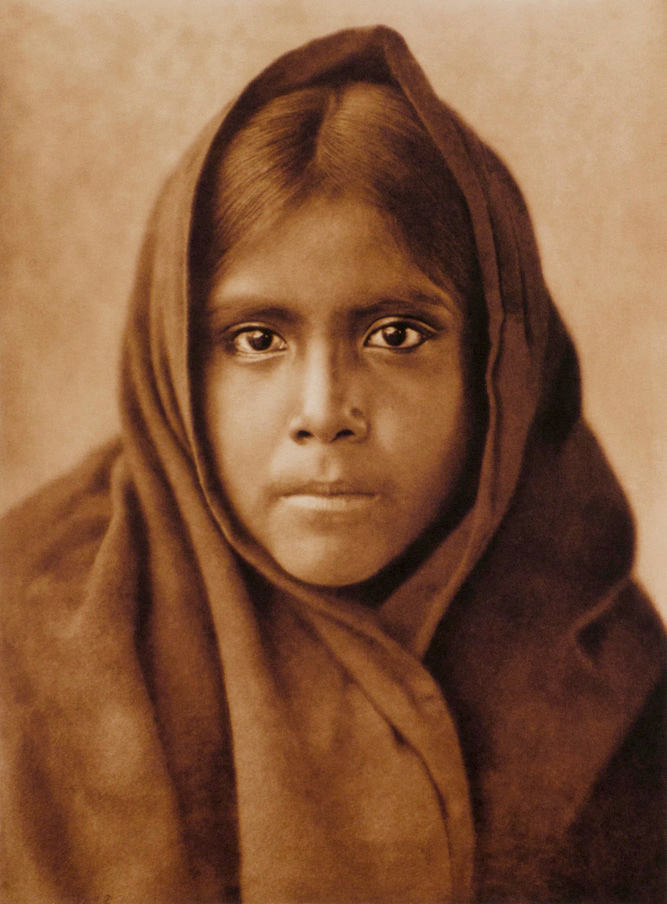
 

Edward S. Curtis (American, 1868-1952) 'Qahatika Girl' 1907


Edward S. Curtis (American, 1868-1952)
Qahatika Girl
1907
Photogravure


Qahatika

The Qahatika (or Kohatk) were a Native American tribe of the Southwestern United States. They were apparently a sub-tribe of the Tohono O’Odham, and lived in the vicinity of present-day Quijotoa, Arizona.

According to Edward Sheriff Curtis, the Qahatika belonged to the Pima group of tribes and lived in five villages “in the heart of the desert south of the Gila River”, about forty miles from the Pima reservation. A legend said that after the Pima suffered defeat in a war with Apache, the tribe fled and split. One splinter of the tribe, the ancestors of Qahatika, went into the barren desert and settled there in separation from other Pimas. The Qahatika, according to Curtis, managed to find land suitable for growing wheat. Their method of “dry farming” relied exclusively on winter rainfall: the soil near their villages was capable of retaining winter moisture for a whole season, and a few winter rains guaranteed a fair crop in summer. The Qahatika seen by Curtis were “almost identical in appearance” to Pima and Papago. They retained the Pima art of basket weaving and developed their own tradition of pottery. Their houses were built almost exclusively of dried giant cactus carcasses.
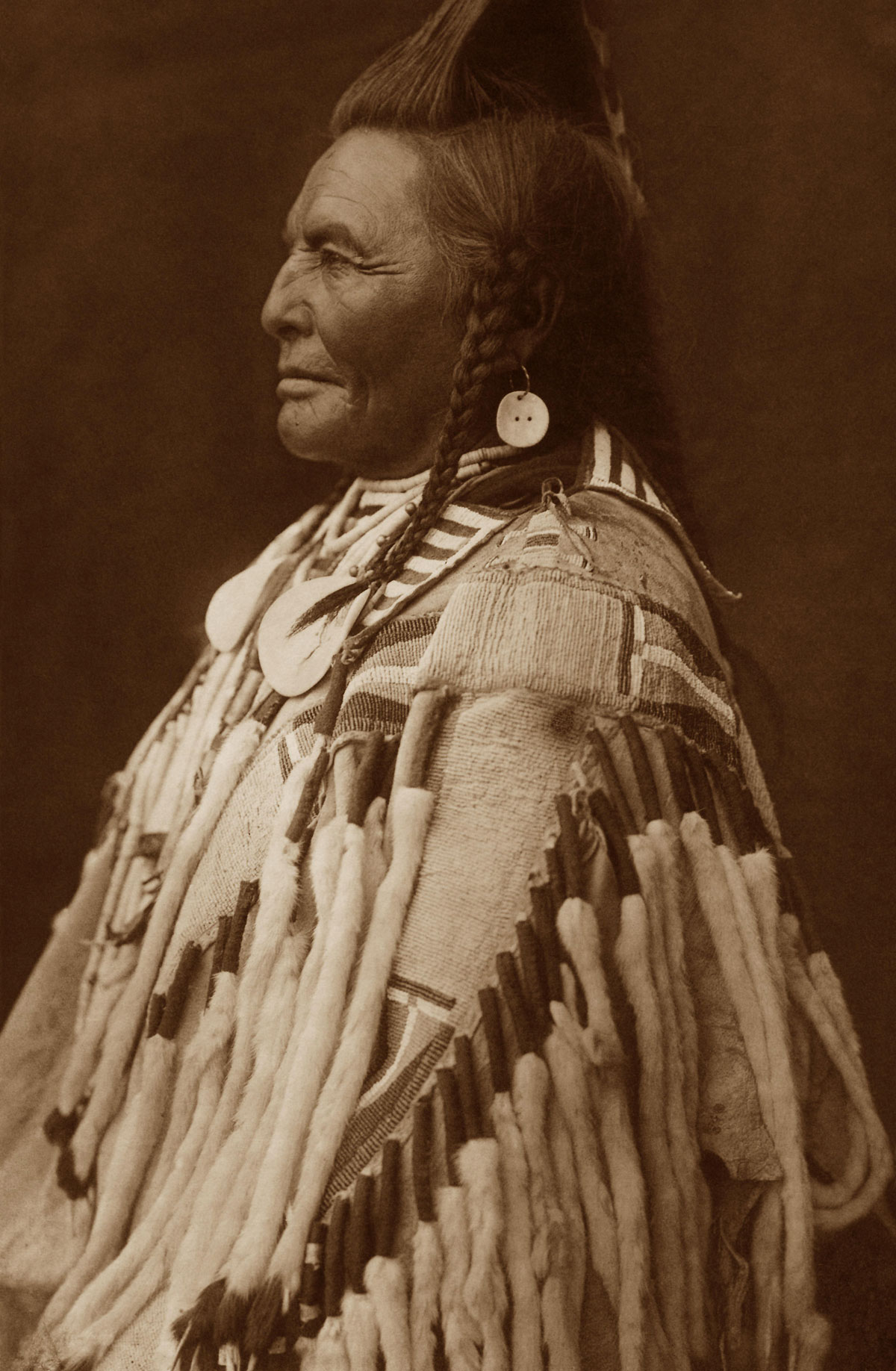
 

Edward S. Curtis (American, 1868-1952) 'Shot in the Hand – Apsaroke' 1908


Edward S. Curtis (American, 1868-1952)
Shot in the Hand – Apsaroke
1908
Photogravure


Crow or Apsaroke

The Crow, called the Apsáalooke in their own Siouan language, or variants including Absaroka, are Native Americans, who in historical times lived in the Yellowstone River valley, which extends from present-day Wyoming, through Montana and into North Dakota, where it joins the Missouri River. Today, they are enrolled in the federally recognised Crow Tribe of Montana.

Pressured by the Ojibwe and Cree peoples (the Iron Confederacy), who had earlier and better access to guns through the fur trade, they had migrated there from the Ohio Eastern Woodland area to settle south of Lake Winnipeg, Canada. From there, they were pushed to the west by the Cheyennes. Both the Crow and the Cheyennes were then pushed farther west by the Lakota (Sioux), who took over the territory from the Black Hills of South Dakota to the Big Horn Mountains of Montana; the Cheyennes finally became close allies of the Sioux, but the Crows remained bitter enemies of both Sioux and Cheyennes. The Crow were generally friendly with the whites and managed to retain a large reservation of over 9300km despite territorial losses. Since the 19th century, Crow people have been concentrated on their reservation established south of Billings, Montana. They also live in several major, mainly western, cities. Tribal headquarters are located at Crow Agency, Montana.
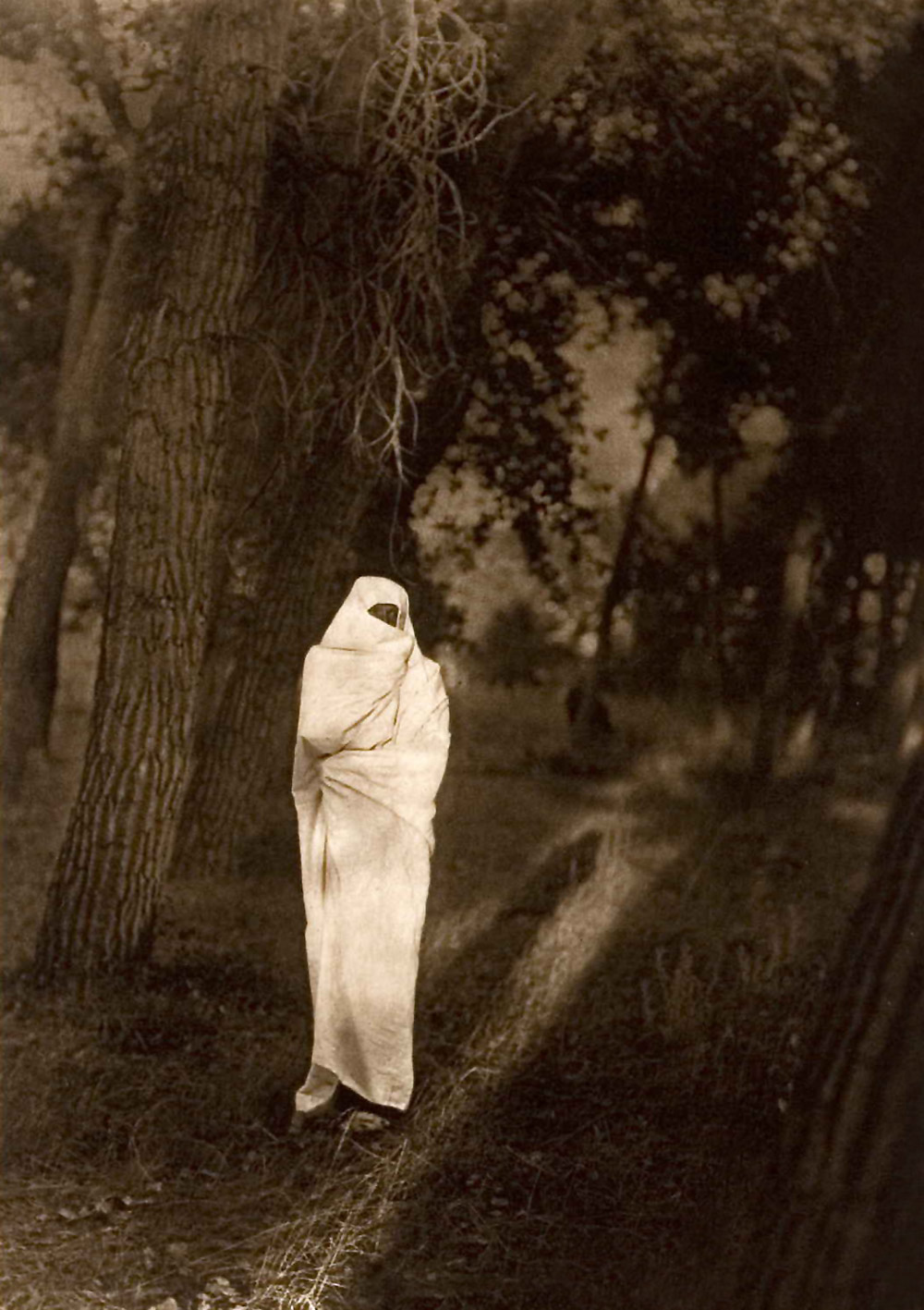
 

Edward S. Curtis (American, 1868-1952) 'Waiting in the Forest – Cheyenne' 1910


Edward S. Curtis (American, 1868-1952)
Waiting in the Forest – Cheyenne
1910
Photogravure


Cheyenne

The Cheyenne (/ʃˈæn/ shy-an) are one of the groups of indigenous people of the Great Plains and their language is of the Algonquian language family. The Cheyenne comprise two Native American groups, the Só’taeo’o or Só’taétaneo’o (more commonly spelled as Suhtai or Sutaio) and the Tsétsêhéstâhese (also spelled Tsitsistas). These tribes merged in the early 19th century. Today, the Cheyenne people are split into two federally recognised groups: Southern Cheyenne, who are enrolled in the Cheyenne and Arapaho Tribes in Oklahoma, and the Northern Cheyenne, who are enrolled in the Northern Cheyenne Tribe of the Northern Cheyenne Indian Reservation in Montana.


Palm Springs Art Museum
101 Museum Drive
Palm Springs CA 92262

Opening hours:
Thursday 12 – 8pm
Friday – Sunday 10am – 5pm

Palm Springs Art Museum website

LIKE ART BLART ON FACEBOOK

Back to top

Exhibition: ‘Capa in Color’ at Jeu de Paume – Château de Tours

Exhibition dates: 21st November, 2015 – 29th May, 2016

Curator: Cynthia Young, curator at Robert Capa archives


Robert Capa (American, 1913-1954) 'American crewmen stand in front of a B-17 bomber' England 1942 from the exhibition 'Capa in Color' at Jeu de Paume – Château de Tours, Nov 2015 - May 2016


Robert Capa (American, 1913-1954)
American crewmen stand in front of a B-17 bomber that is being prepared to take off from a Royal Air Force base for a daylight bombing raid over occupied France. This B-17 was one of the first 300 to be brought overseas by the US Army Air Forces
England, 1942
International Center of Photography, New York
© Robert Capa/International Center of Photography/Magnum Photos


To be honest, Robert Capa was not the most natural colour photographer, especially when you compare him to the likes of Paul Outerbridge and Saul Leiter who were working at around the same time. Even the official text from Jeu de Paume that accompanies the exhibition is littered with descriptions like “uninspired”, “the color photographs lack focus”, or worse, “Fleur Cowles at Look and Len Spooner at Illustrated were disappointed with the color images.”

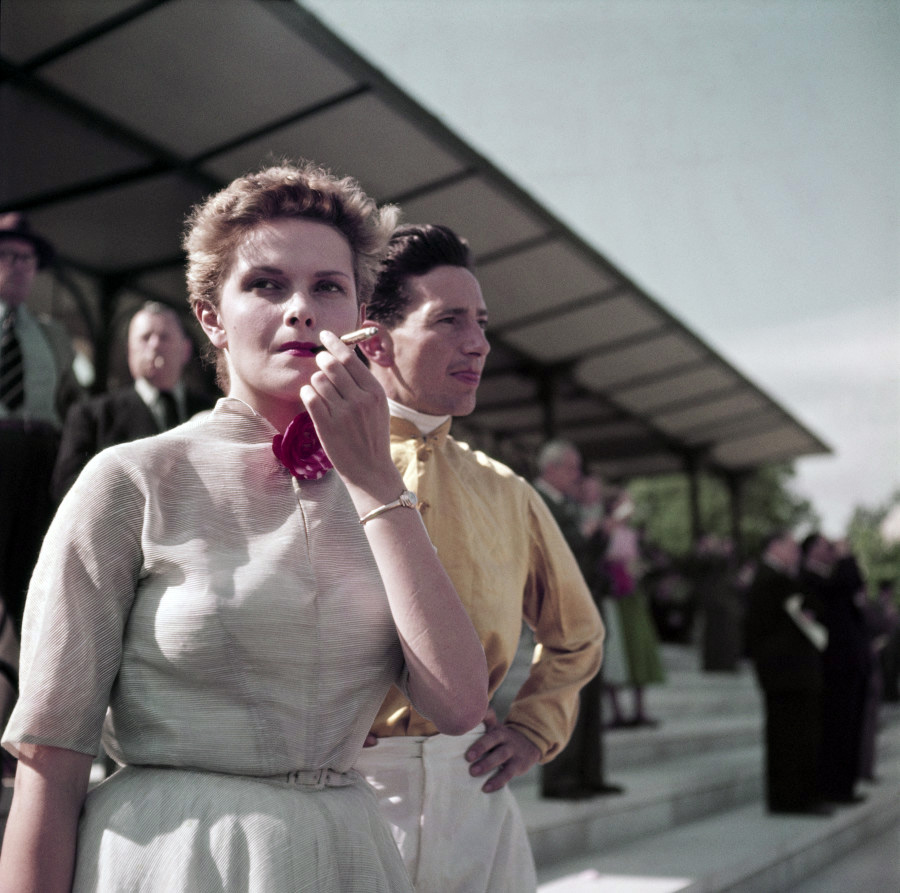
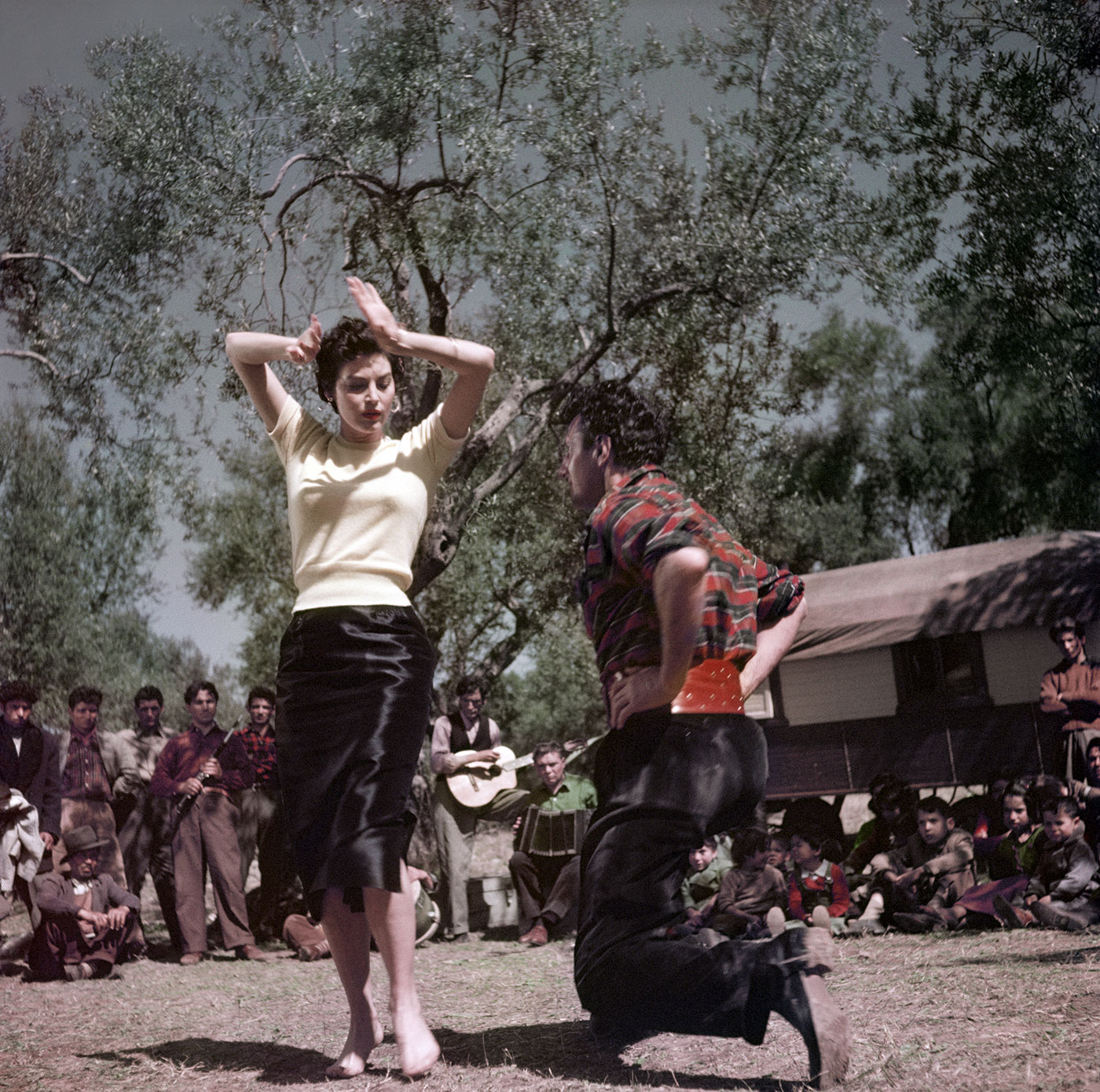
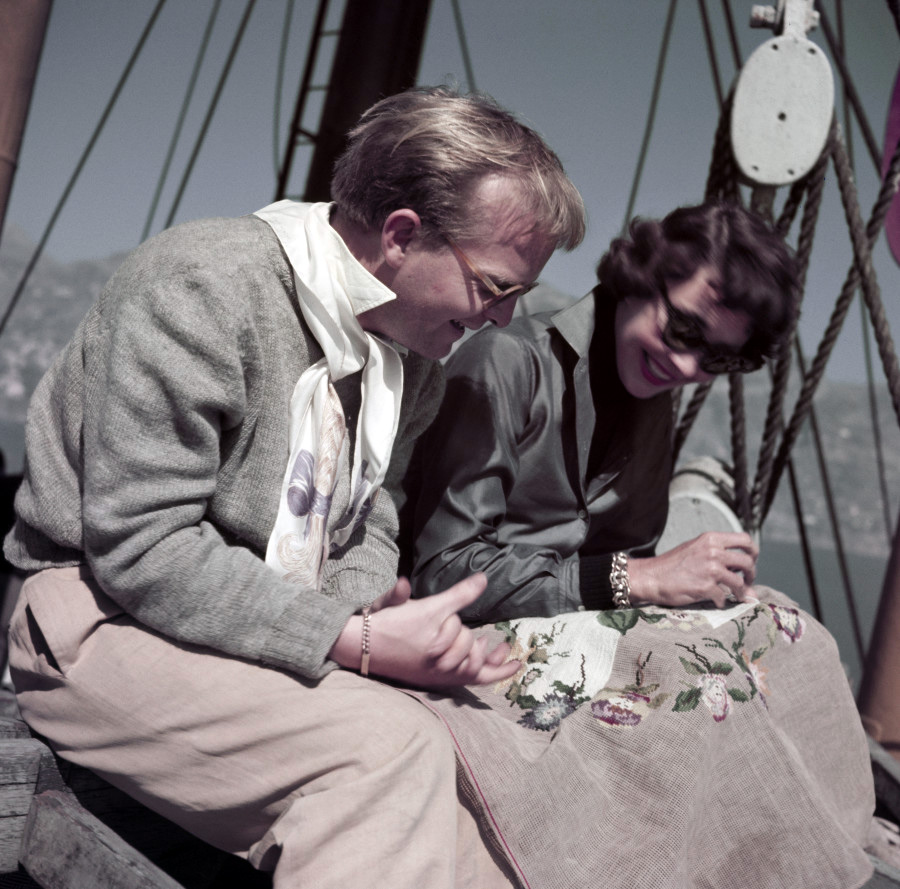
His work in this medium is what I would call “observational” colour photography. The images are best when the subject is intimate, human and ‘on set’, preferably using a limited palette with splashes of subdued colour – such as in the gorgeous Model wearing Dior on the banks of the Seine, Paris, France (1948), the delicate Woman on the beach, Biarritz, France (1951), and the simpatico duo of Humphrey Bogart and Peter Lorre on the set of ‘Beat the Devil’, Ravello, Italy (April 1953) and Truman Capote and Jennifer Jones on the set of ‘Beat the Devil’, Ravello, Italy (April 1953). The photographs of Ava Gardner on set are also cracking images for their vitality and overall balance, as is the almost monochromatic Gen X girl, Colette Laurent, at the Chantilly racetrack, France (1952). Other ensemble tableaux might as well have been shot in black and white, such as Spectators at the Longchamp Racecourse, Paris, France (c. 1952).

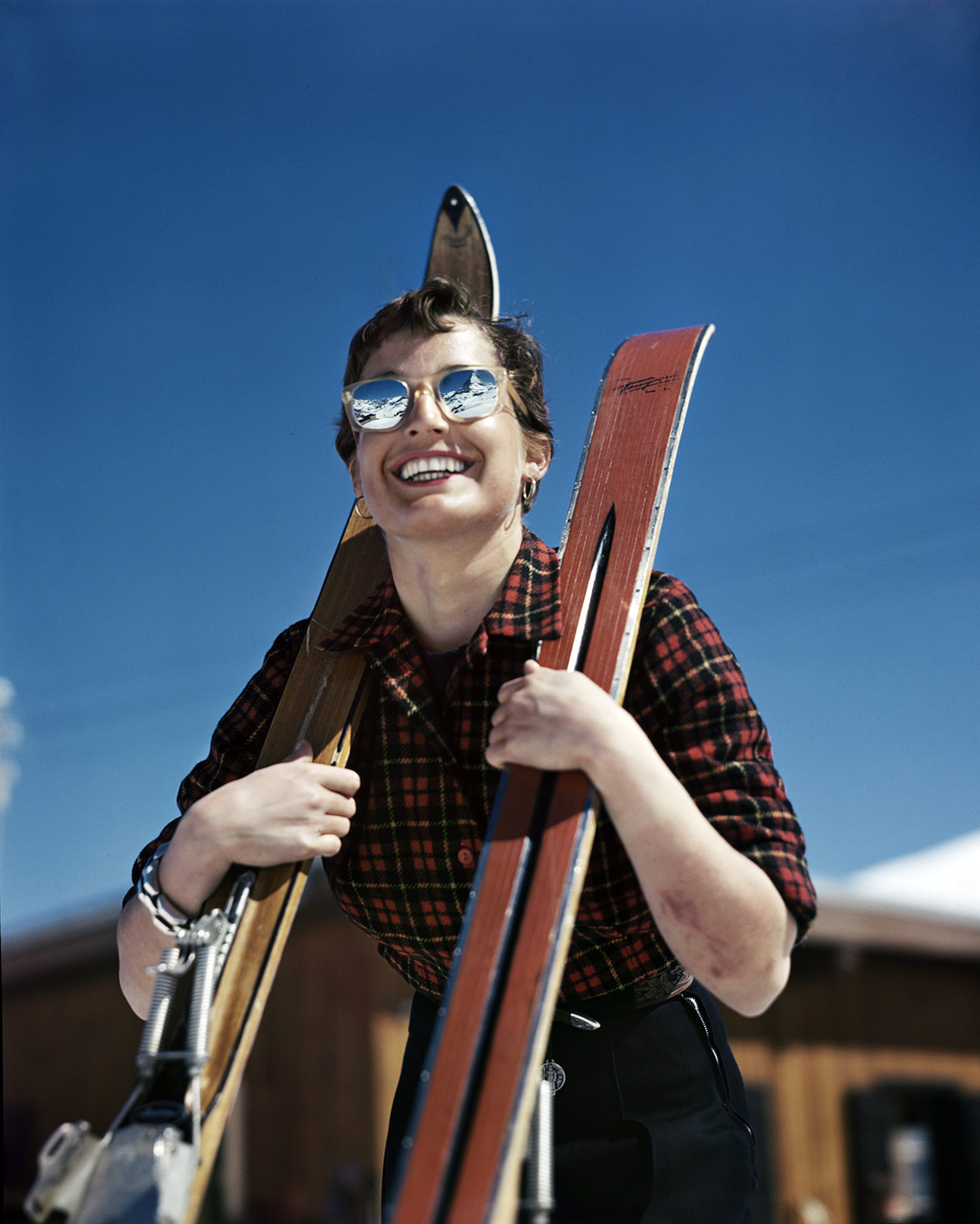
Capa too often resorts to one or two strong primary colours for effect, as in Capucine, French model and actress, on a balcony, Rome, Italy (August 1951), Rambaugh Family Circus, Indiana, USA (1949) or American Judith Stanton, Zermatt, Switzerland (1950). In the the former two images the composition doesn’t work with the colour; only in the latter does it become a vigorous and joyous structural element.

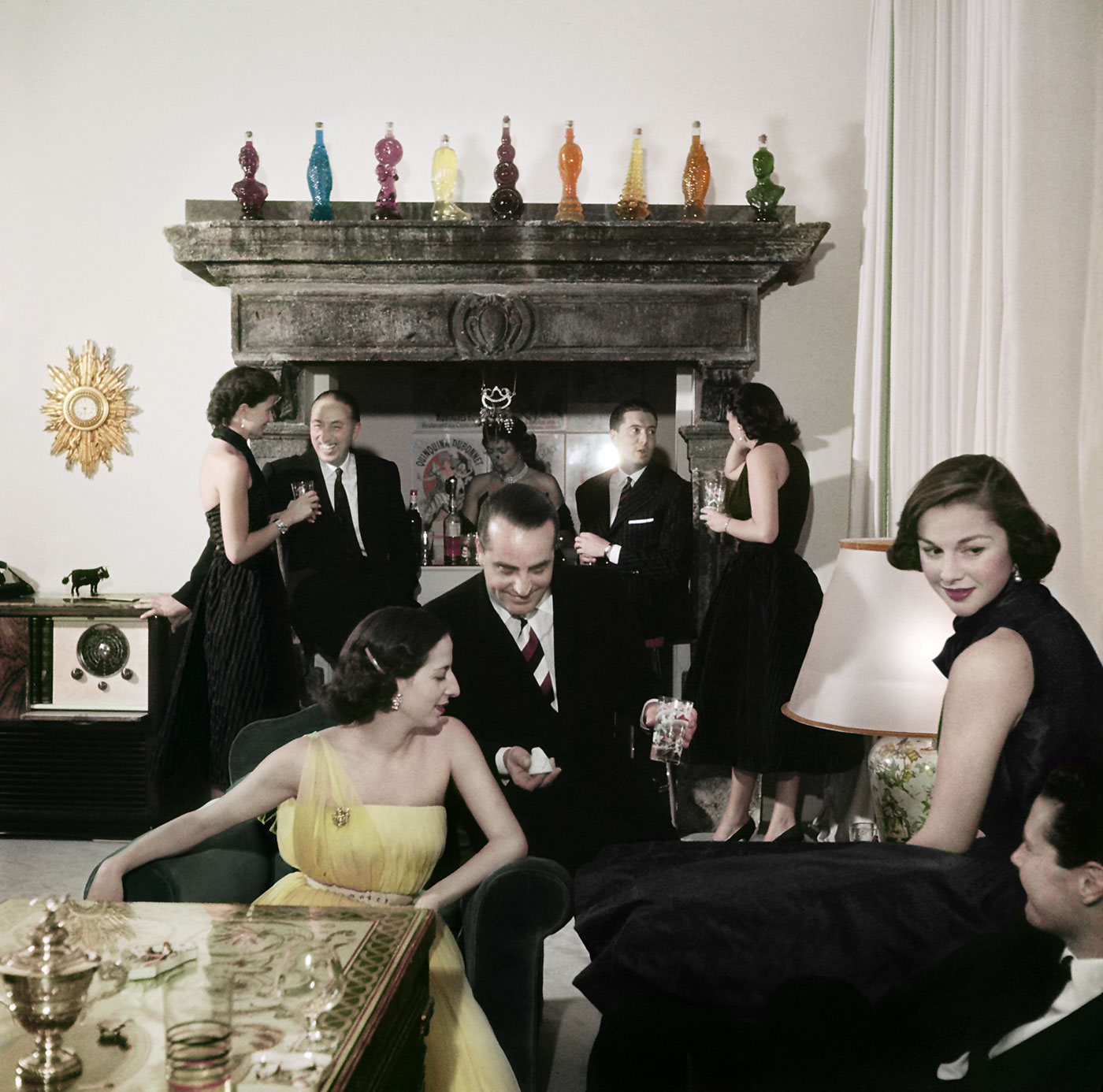
Sometimes I think that Capa didn’t exactly know what to do with colour – Woman at an ice bar, Zürs, Austria (1949-1950) and Party, Rome, Italy (August 1951) are not very good at all – but here we must acknowledge an artist experimenting with a relatively new commercial medium, even as he seeks to sell these images to his clients.

Capa in Color is at his best when he employs subtlety, constructing strong human compositions with nuanced placement of shades and hues.

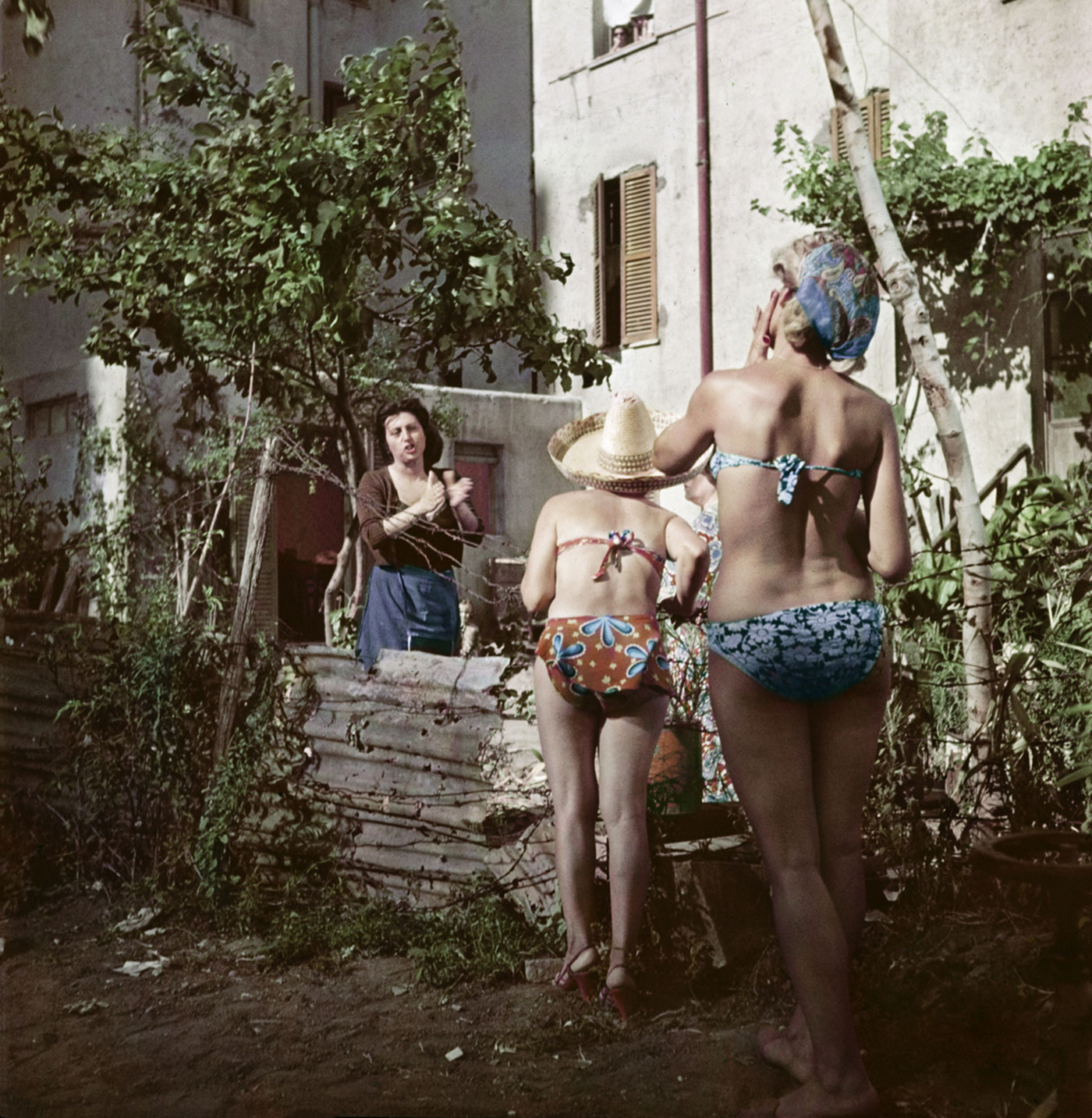
One of the most complex images in the posting is Anna Magnani on the set of Luchino Visconti’s ‘Bellissima’ (Rome, 1951-1952). Just look at this image: your eye plays over the surface, investigating every nook and cranny, every modular plane. The blue of the skirt, the brown of the top, the patterns of the two bikinis and the earthiness of tree and earth. I am reminded of the paintings of Paul Cézanne.

Dr Marcus Bunyan


Many thankx to Jeu de Paume for allowing me to publish the photographs in the posting. Please click on the photographs for a larger version of the image.


The first exhibition dedicated to Capa’s fourteen years of color photographs, Capa in Color has an ambition to evaluate and place these photographs in the timeline of his career and of their period. Capa in Color shows how color photography renewed his vision and how his work gained from a new sensibility after the war, by readapting his compositions in colour, but also to a public attracted to entertainment and to the discovery of new types of images.


Robert Capa et la couleur – Portrait filmé/videoportrait from Jeu de Paume / magazine on Vimeo.


Robert Capa (American, 1913-1954) 'Regata, Lofoten Island, Hankoe' Norway, 1951 from the exhibition 'Capa in Color' at Jeu de Paume – Château de Tours, Nov 2015 - May 2016


Robert Capa (American, 1913-1954)
Regata, Lofoten Island, Hankoe
Norway, 1951
International Center of Photography, New York
© Robert Capa/International Center of Photography/Magnum Photos


Recently presented at the International Center of Photography and now available for travel, Capa in Color presents Robert Capa’s colour photographs to the European public for the first time. Although he is recognised almost exclusively as a master of black-and-white photography, Capa began working regularly with colour film in 1941 and used it until his death in 1954. While some of this work was published in the magazines of the day, the majority of these images have never been printed or seen in any form.

Capa in Color includes over 150 contemporary colour prints by Capa, as well as personal papers and tear sheets from the magazines in which the images originally appeared. Organised by Cynthia Young, curator of Capa Collections at ICP, the exhibition presents an unexpected aspect of Capa’s career that has been previously edited out of posthumous books and exhibitions, and show how he embraced colour photography and integrated it into his work as a photojournalist in the 1940s and 1950s.

Robert Capa’s (1913-1954) reputation as one of history’s most notable photojournalists is well established. Born Endre Ernö Friedmann in Budapest and naturalised as a U.S. citizen in 1946, he was deemed “The Greatest War Photographer in the World” by Picture Post in a late 1938 publication of his Spanish Civil War photographs. During World War II, he worked for such magazines as Collier’s and Life, extensively portraying preparation for war as well as its devastating aftermath. His best-known images symbolised for many the brutality and valour of war and changed the public perception of, and set new standards for, war photography.

July 27, 1938, while in China for eight months covering the Sino-Japanese war, Robert Capa wrote to a friend at his New York agency, “… send 12 rolls of Kodachrome with all instructions; … Send it “Via Clipper” because I have an idea for Life“. Although no colour film from China survives except for four prints published in the October 17, 1938, issue of Life, Capa was clearly interested in working with colour photography even before it was widely used by many other photojournalists.

In 1941, he photographed Ernest Hemingway at his home in Sun Valley, Idaho, in colour, and used colour for a story about crossing the Atlantic on a freighter with an Allied convoy, published in the Saturday Evening Post. While Capa is best known for the black-and-white images of D-Day, he also used colour film sporadically during World War II, most notably to photograph American troops and the French Camel Corps in Tunisia in 1943.

Capa’s use of colour film exploded in his postwar stories for magazines such as Holiday (USA ), Ladies’ Home Journal (USA ), Illustrated (UK), and Epoca (Italy). These photographs, which until now have been seen only in magazine spreads, brought the lives of ordinary and exotic people from around the world to American and European readers alike, and were markedly different from the war reportage that had dominated Capa’s early career. Capa’s technical ability coupled with his engagement with human emotion in his prewar black-and-white stories enabled him to move back and forth between black and white and colour film and integrate colour to complement the subjects he photographed. These early stories include photographs of Moscow’s Red Square from a 1947 trip to the USS R with writer John Steinbeck and refugees and the lives of new settlers in Israel in 1949-50. For the Generation X project, Capa traveled to Oslo and northern Norway, Essen, and Paris to capture the lives and dreams of youth born before the war.

Capa’s photographs also provided readers a glimpse into more glamorous lifestyles that depended on the allure and seduction of colour photography. In 1950, he covered fashionable ski resorts in the Swiss, Austrian, and French Alps, and the stylish French resorts of Biarritz and Deauville for the burgeoning travel market capitalised on by Holiday magazine. He even tried fashion photography by the banks of the Seine and on the Place Vendôme. Capa also photographed actors and directors on European film sets, including Ingrid Bergman in Roberto Rossellini’s Viaggio in Italia, Orson Welles in Black Rose, and John Huston’s Moulin Rouge. Additional portraiture in this period included striking images of Picasso, on the beach near Vallauris, France with his young son Claude.

Capa carried at least two cameras for all of his postwar stories: one with black-and-white film and one with colour, using a combination of 35mm and 4 x 5 Kodachrome and medium-format Ektachrome film, emphasising the importance of this new medium in his development as a photographer. He continued to work with colour until the end of his life, including in Indochina, where he was killed in May 1954. His colour photographs of Indochina presage the colour images that dominated the coverage from Vietnam in the 1960s.

Capa in Color is the first museum exhibition to explore Capa’s fourteen-year engagement with colour photography and to assess this work in relation to his career and period in which he worked. His talent with black-and-white composition was prodigious, and using colour film halfway through his career required a new discipline. Capa in Color explores how he started to see anew with colour film and how his work adapted to a new postwar sensibility. The new medium required him to readjust to colour compositions, but also to a postwar audience, interested in being entertained and transported to new places.

Press release from Jeu de Paume


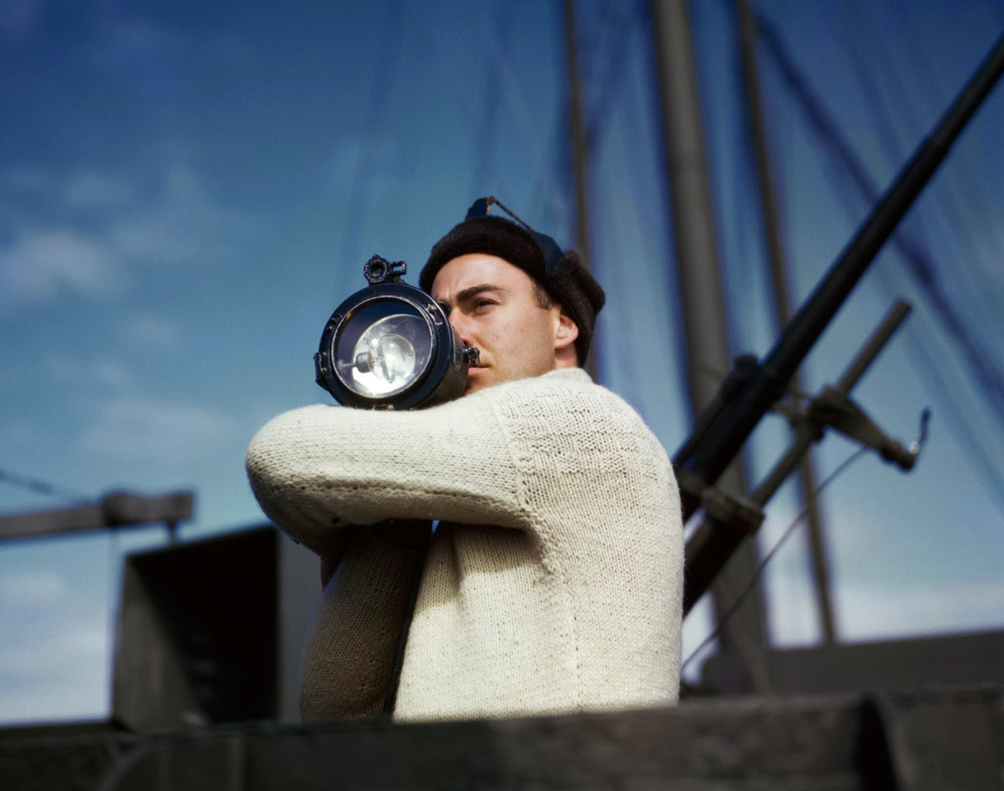
Robert Capa (American, 1913-1954) 'A crewman signals another ship of an Allied convoy across the Atlantic from the US to England' 1942


Robert Capa (American, 1913-1954)
A crewman signals another ship of an Allied convoy across the Atlantic from the US to England
1942
International Center of Photography, New York
© Robert Capa/International Center of Photography/Magnum Photos


It is surprising, even shocking to some, that famous photojournalist Robert Capa (born Budapest 1913, died Indochina 1954) photographed in colour, and not just occasionally, but regularly after 1941. His coloured work is essentially unknown. Capa is considered a master of black-and-white war photography, a man who documented some of the most important political events of Western Europe in the mid-twentieth century. His photographs of 1930s Paris, the Spanish Civil War, World War II, postwar Europe, and his last images in Indochina are known to us in black-and-white. None of the posthumous retrospective projects of his work have included colour, with a few rare exceptions..

Capa first experimented with colour in 1938, two years after Kodak developed Kodachrome, the first colour roll film. While in China covering the Sino-Japanese War, he wrote to a friend at his New York agency, Pix, “Please immediately send 12 rolls of Kodachrome with all instructions; whether special filters are needed, etc. – in short, all I should know. Send it ‘Via Clipper’, because I have an idea for Life“. Only four colour images from China were published, but Capa’s enthusiasm for colour was born. He photographed with colour film again in 1941 and for the next two years he fought hard to persuade editors to buy his colour images in addition to the black-and-white. After the war, the magazines were eager to include colour and his colour assignments increased. For the rest of his life, he almost always carried at least two cameras: one for black-and-white and one for colour film.


Robert Capa (American, 1913-1954) 'American Captain Jay F. Shelley stands in front of "The Goon," a B-17 bomber, before a raid over Italy, Tunisia, 1943' 1943


Robert Capa (American, 1913-1954)
American Captain Jay F. Shelley stands in front of “The Goon,” a B-17 bomber, before a raid over Italy, Tunisia, 1943
1943
International Center of Photography, New York
© Robert Capa/International Center of Photography/Magnum Photos


Jay F. Shelley, Sr., 88, of Yuma,formerly of Scottsdale, Arizona, entered Eternity on June 6, 2004. Jay was born May 16, 1916, in Long Beach, California. He was a decorated B-17 Bomber Pilot during WWII and flew 54 combat missions. He received a degree in business administration with a major in accounting from University of Montana. Jay worked as an accountant until 1979 when he retired with his wife to Scottsdale, Arizona. Capt. Jay F Shelley was assigned to the 301st BG 32nd Squadron.


Robert Capa (American, 1913-1954) 'Damaged plane hosed down with chemicals after landing on belly following a raid over Occupied France, England, July 1941' 1941


Robert Capa (American, 1913-1954)
Damaged plane hosed down with chemicals after landing on belly following a raid over Occupied France, England, July 1941
1941
International Center of Photography, New York
© Robert Capa/International Center of Photography/Magnum Photos


The plane is a Bristol Blenheim.


Robert Capa (American, 1913-1954) 'An American B-17 gunner awaits take off from a Royal Air Force base for a daylight bombing raid over occupied France' England, 1942


Robert Capa (American, 1913-1954)
An American B-17 gunner awaits take off from a Royal Air Force base for a daylight bombing raid over occupied France
England, 1942
International Center of Photography, New York
© Robert Capa/International Center of Photography/Magnum Photos


World War II

In 1941, Capa produced his first colour film story for the Saturday Evening Post, about crossing the Atlantic from New York on a convoy. Once in England, he was also able to sell these images to the English magazine Illustrated, because the two magazines did not have the same readerships.

He made the crossing again the next year, carrying a larger format camera that made bigger, more spectacular portraits of the ship’s crew. The turnaround time for Kodachrome film was several weeks. As Kodak maintained secrecy surrounding the formula, the undeveloped film had to go to a special Kodak processing plant and then returned to the photographer. It was not ideal for timely news. The magazines published few of Capa’s colour images from the UK, but he persisted in using it. In 1943, he entered the battlefields of World War II in North Africa, first traveling on a troop ship from England to Casablanca. His last colour images from the war were taken on a boat from Tunisia to Sicily in July 1943, where he debarked and moved up to Naples with America soldiers over the following months. It appears that for the rest of the war he did not use colour film, apparently discouraged by a combination of the slow shutter speed of the film, long processing times, and the uneven commitment to his colour images by the magazines.


Robert Capa (American, 1913-1954) 'Rambaugh Family Circus, Indiana, USA' 1949


Robert Capa (American, 1913-1954)
Rambaugh Family Circus, Indiana, USA
1949
International Center of Photography, New York
© Robert Capa/International Center of Photography/Magnum Photos


USA

Soon after his return from England, in the fall of 1941, Capa traveled to Sun Valley, Idaho, to do a story for life on his friends, the writers Ernest Hemingway and Martha Gellhorn, whom he had met during the Spanish Civil War. After World War II, Capa sought out new relationships with magazines and holiday became one of his most important supporters.

A glamorous travel magazine that featured New Yorker – caliber writers, Holiday was launched in 1946 by the Philadelphia-based Curtis Publishing Company, which also carried The Saturday Evening Post and Ladies’ Home Journal. Born in full colour, it was a peacetime publication catering to an ideal of American postwar prosperity. Holiday covered American cities, but immediately assigned stories on stylish international hot spots, places readers could dream of visiting with the advent in 1947 of nonstop transatlantic flights. In 1950, Holiday sent Capa to Indianapolis, and while his pictures of a nuclear family of five exploring the city are uninspired, he also photographed a family-run traveling circus. Despite Capa’s lukewarm attitude toward American culture, the colour images present a strong vision of American small-town life.


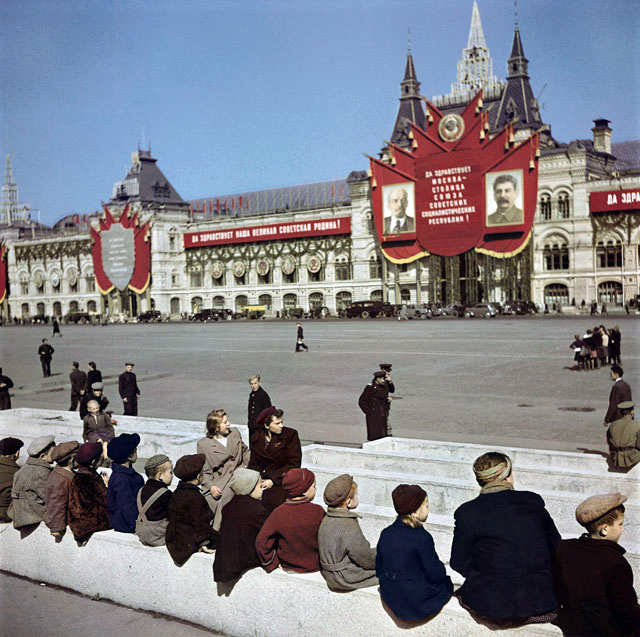
Robert Capa (American, 1913-1954) 'Young visitors waiting to see Lenin's Tomb at Red Square' Moscow 1947


Robert Capa (American, 1913-1954)
Young visitors waiting to see Lenin’s Tomb at Red Square
Moscow, 1947
International Center of Photography, New York
© Robert Capa/International Center of Photography/Magnum Photos


USSR

The year 1947 was a turning point in Capa’s life. He founded Magnum, the photographers cooperative agency he had dreamed of since 1938. The same year, he traveled to the Soviet Union, a trip that he had wanted to make in 1937 and then in 1941, both times unable to obtain a visa or magazine support for the trip.

He teamed up with writer John Steinbeck to report on the lives and opinions of ordinary Russians in opposition to Cold War rhetoric. Their adventures were published in the book A Russian Journal the following year and syndicated in newspapers and international picture magazines. Although the colour images were well represented in the magazines and on the cover of Illustrated for a special issue, Capa did not shoot much colour film in the Soviet Union, and no colour was included in A Russian Journal, except for the cover. Either he deemed only a few places worthy of the new medium format Ektachrome colour film that did not require special processing – chiefly Moscow and collective farms in the Ukraine and Georgia – or he had only a limited amount of film and used it sparingly. The images of Red Square take full advantage of colour film.


Robert Capa (American, 1913-1954) 'Pablo Picasso playing in the water with his son Claude, near Vallauris, France' 1948


Robert Capa (American, 1913-1954)
Pablo Picasso playing in the water with his son Claude, near Vallauris, France
1948
International Center of Photography, New York
© Robert Capa/International Center of Photography/Magnum Photos


Picasso

Some of Capa’s colour works were considerably less successful than his black-and-white photographs. This was the case with his 1948 feature on Picasso, originally sold to look as a story about the artist’s pottery, but as Capa failed to take pictures of the pottery, it became a story about Picasso and his family.

He instructed his Magnum colleague Maria Eisner: “Look gave me a definite assignment but no price so you have to insist on $200 pro black and white and $300 pro coloured page, and $250 for expenses. If they are not willing to pay a reasonable sum, you can withdraw, but Madame Fleurs Cowles was so positive on this matter and the pictures are so exclusive that I could be very surprise[d] if this doesn’t work”. Both Fleur Cowles at Look and Len Spooner at Illustrated were disappointed with the colour images, although delighted with the story, which included Capa’s now famous picture of Picasso holding a sun umbrella over his ravishing young artist girlfriend, Françoise Gilot, parading on the beach.

Hungary

In 1948, Holiday sent Capa to his native Budapest and commissioned him to write the accompanying article. Capa had been widely praised for the hilarious and self-deprecating 1947 book about his wartime exploits, slightly out of focus, so the editors were hardly taking risk by asking him to write a long article.

Holiday used four colour images in the November 1949 issue. Unlike the glamorous destinations the magazine usually covered or that Capa would later cover for them, the images and accompanying article, one of the strongest texts he wrote about a place, functioned more as a letter from Budapest. He observes with fascination and humour the clashing end of one empire with the start of another, bittersweet against the reality of what his childhood city had become. While he seemed to have had more colour film on this assignment than in Russia, it was expensive to buy and process, so he still conserved, and there are many more black-and-white negatives of similar scenes than in colour.

Morocco

Capa’s 1949 trip to Morocco was one of the few postwar stories he made concerning a political subject, but it was a complicated sell and failed as an international news story.

The assignment was muddled from the start, as it combined Moroccan politics, lead mines, and the filming of The Black Rose with Orson Welles. Paris Match first published some of the pictures in a piece about the annual tour of the country by the Moroccan leader Sultan Sidi Mohammed. Illustrated published a story with only black-and-white images about the strange effects of the Marshall Plan, in which as a French colony Morocco received American aid through France, although the French General was not recognised as the leader in charge by the U.S. State Department. Some of the best images are portraits of the Moroccan people.


Robert Capa (American, 1913-1954) 'Construction of the new settlements for workers, Neguev Desert, outside Be'er Sheva, Israel' 1949-1950


Robert Capa (American, 1913-1954)
Construction of the new settlements for workers, Neguev Desert, outside Be’er Sheva, Israel
1949-1950
International Center of Photography, New York
© Robert Capa/International Center of Photography/Magnum Photos


Robert Capa (American, 1913-1954) 'Former shop near Jaffa gate, Jerusalem, Israel' 1949


Robert Capa (American, 1913-1954)
Former shop near Jaffa gate, Jerusalem, Israel
1949
International Center of Photography, New York
© Robert Capa/International Center of Photography/Magnum Photos


Israel

Capa’s big geopolitical assignment of the late 1940s took him to Israel. He first traveled there in 1948 to cover the Arab-Israeli war, then returned in 1949, for Holiday and Illustrated, with writer Irwin Shaw.

He came back in 1950 to continue photographing the new nation in transition, focusing on the influx of refugees arriving from Europe and neighbouring Arab countries, the ongoing repair of the physical destruction, portraits of immigrants, agricultural work, kibbutzim, and various Jewish festivities. While there is only one colour image from the 1948 trip, of the Altalena ship burning in the water off the beach in Tel Aviv – a result of the conflict between extreme right-wing Irgunists and the Israeli government – by the time Capa arrived in 1949, he seemed to have all the colour film he needed. His Israel stories were picked up by all the major international picture news magazines, spurred by the 1950 publication Report on Israel, with text by Shaw and photos by Capa.


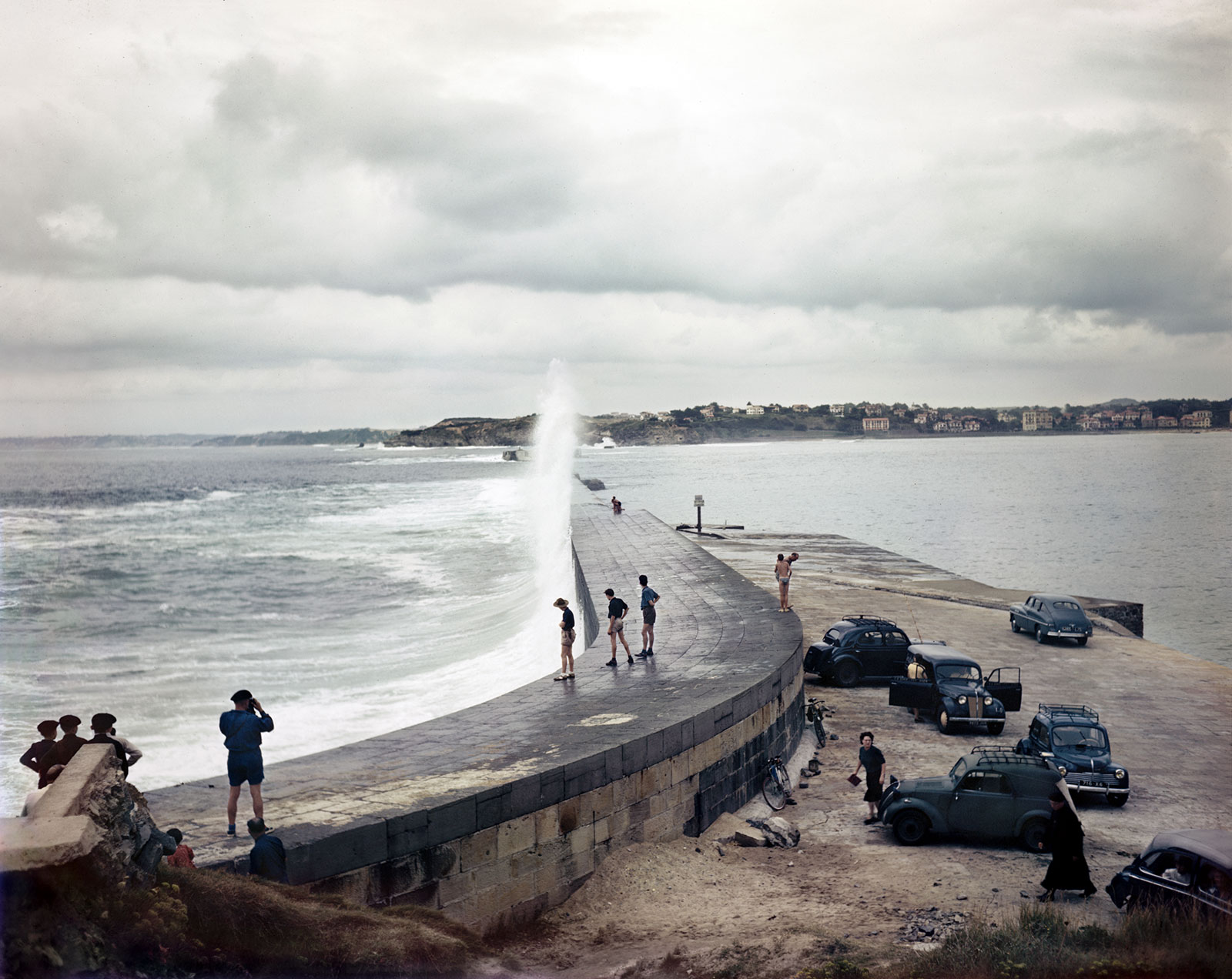
Robert Capa (American, 1913-1954) 'Jetty, Socoa, near Saint-Jean-de-Luz, France' August 1951


Robert Capa (American, 1913-1954)
Jetty, Socoa, near Saint-Jean-de-Luz, France
August 1951
International Center of Photography, New York
© Robert Capa/International Center of Photography/Magnum Photos


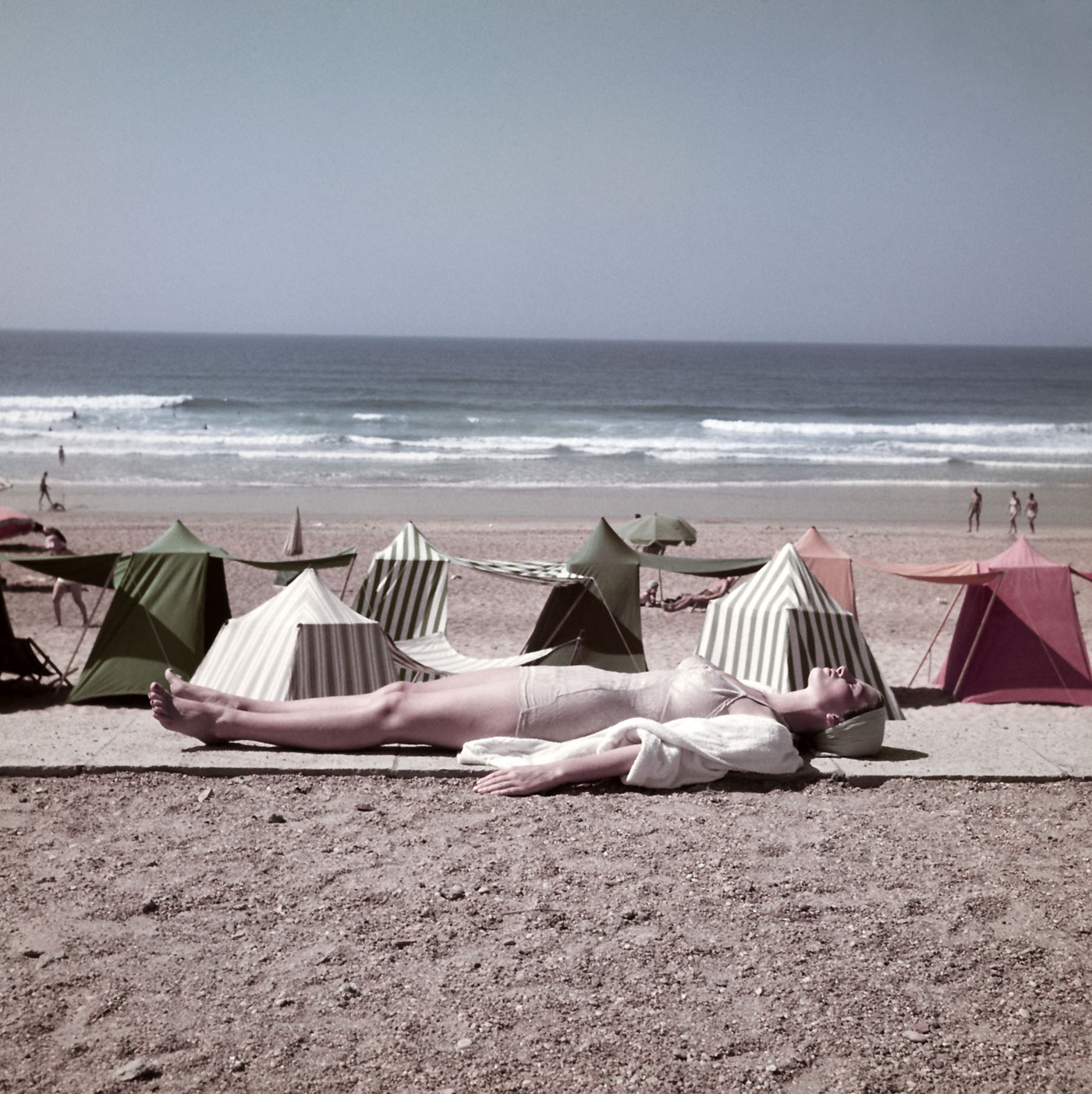
Robert Capa (American, 1913-1954) 'Woman on the beach, Biarritz, France' August 1951


Robert Capa (American, 1913-1954)
Woman on the beach, Biarritz, France
August 1951
International Center of Photography, New York
© Robert Capa/International Center of Photography/Magnum Photos


Deauville and Biarritz

Following the success of his skiing story, Capa proposed a piece on French seaside resorts. In the summer of 1950, he traveled to Deauville in Normandy, with its racetrack and casino, photographing only in black-and-white (all that appeared in Illustrated).

He knew he could do more with the story and pitched it to Holiday as a double feature with Biarritz, in Basque Country. A year later, he returned to Deauville with colour film to photograph the scene, capturing the mix of social classes at the horse races. He then traveled to Biarritz, covering the beach, nightlife, and traditional folklore. For this story, the black-and-white and colour images complement each other – the colour adding details to the black-and-white, which set the stage. The layout, not published until September 1953, balances the colour and black-and-white with Capa’s humorous, self-deprecating text about his time in each resort.


Robert Capa (American, 1913-1954) 'Capucine, French model and actress, on a balcony, Rome, Italy' August 1951


Robert Capa (American, 1913-1954)
Capucine, French model and actress, on a balcony, Rome, Italy
August 1951
International Center of Photography, New York
© Robert Capa/International Center of Photography/Magnum Photos


Capucine (French, 1928-1990)

Capucine (6 January 1928 – 17 March 1990) was a French fashion model and actress known for her comedic roles in The Pink Panther (1963) and What’s New Pussycat? (1965). She appeared in 36 films and 17 television productions between 1948 and 1990. At age 17, while riding in a carriage in Paris, she was noticed by a commercial photographer. She became a fashion model, working for fashion houses Givenchy and Christian Dior. She adopted the name, “Capucine” (French for nasturtium). She met Audrey Hepburn while modelling for Givenchy in Paris. The two would remain close friends for the rest of Capucine’s life.

In 1957, film producer Charles K. Feldman spotted Capucine while she was modelling in New York City. Feldman brought her to Hollywood to learn English and study acting under Gregory Ratoff. She was signed to a contract with Columbia Pictures in 1958 and landed her first English-speaking role in the film Song Without End (1960) for which she was nominated for a Golden Globe Award. Over the next few years, Capucine made six more major motion pictures. They included North to Alaska (1960), a comedy, as a prostitute who becomes the love interest of John Wayne, and Walk on the Wild Side (1962), in which she portrayed a redeemed hooker, before moving to Switzerland in 1962.

Much of 1963’s hit film The Pink Panther was shot in Europe. A crime comedy that led to a number of sequels, the film starred David Niven and Peter Sellers along with Capucine. The risqué comedy What’s New Pussycat? (1965), which co-starred Sellers and Peter O’Toole, was filmed entirely in France. She continued making films in Europe until her death.

Text from the Wikipedia website


Robert Capa (American, 1913-1954) 'Party, Rome, Italy' August 1951


Robert Capa (American, 1913-1954)
Party, Rome, Italy
August 1951
International Center of Photography, New York
© Robert Capa/International Center of Photography/Magnum Photos


Rome

In his article on Norway for Holiday, Capa wrote: “I have revisited Budapest because i happen to have been born there, and because the place offered only a short season for revisiting. I even got to Moscow, which usually offers no revisiting at all. I kept on revisiting Paris because I used to live there before the war; London, because I lived there during the war; and Rome, because I was sorry that I had never lived there at all.”

Capa traveled to Rome for Holiday in 1951 and his pictures were published in April 1952, with a text authored by Alan Moorehead. A writer for The New Yorker at the time of the Rome assignment, Moorehead had been a correspondent for the Daily Express of London during World War II, and he and Capa had been together in North Africa, Sicily, and Normandy. Capa’s accompanying colour photographs pursued a glamorous city filled with beautiful people engaged in endless partying, reflecting a Rome removed from postwar destruction and entering the period of La Dolce Vita.


Robert Capa (American, 1913-1954) 'American Judith Stanton, Zermatt, Switzerland' 1950


Robert Capa (American, 1913-1954)
American Judith Stanton, Zermatt, Switzerland
1950
International Center of Photography, New York
© Robert Capa/International Center of Photography/Magnum Photos


Robert Capa (American, 1913-1954) 'Woman at an ice bar, Zürs, Austria' 1949-1950


Robert Capa (American, 1913-1954)
Woman at an ice bar, Zürs, Austria
1949-1950
International Center of Photography, New York
© Robert Capa/International Center of Photography/Magnum Photos


Skiing

Skiing was one of Capa’s favourite pastimes and he vacationed annually in Klosters, Switzerland, to relax and recuperate. In 1948, he and a Magnum colleague were trying to drum up a story on Megève, France, a popular ski resort for Parisians, on its “dual personality … simple peasant life and gay, café society set.”

Capa photographed in Zürs, Austria, in early 1949, for a Life story, although the magazine ultimately killed it. Holiday pulled in after Life dropped out and, in late 1949, signed on to a feature about the great skiing resorts of Austria, Switzerland, and France, which would become one of Capa’s most joyous and successful colour stories. In fact, it was arguably better in colour, which provided the additional elements of glitter and humour that black-and-white often missed. For two months, he traveled from the Austrian resorts of Kitzbühel, St. Anton, Zürs, and Lech, to the Swiss towns of Davos, Klosters, and Zermatt, then over the French border to Val d’Isère. In each place, he found a glamorous circle to depict: director Billy Wilder and writer Peter Viertel from Hollywood, young international ski champions, and current and ex-European royalty, including the Queen and Prince of Holland. Everyone was healthy and the mood festive. Capa found a relaxed, casual confidence in his subjects.


Robert Capa (American, 1913-1954) 'Spectators at the Longchamp Racecourse, Paris, France' c. 1952


Robert Capa (American, 1913-1954)
Spectators at the Longchamp Racecourse, Paris, France
c. 1952
International Center of Photography, New York
© Robert Capa/International Center of Photography/Magnum Photos


Robert Capa (American, 1913-1954) 'Model wearing Dior on the banks of the Seine, Paris, France' 1948


Robert Capa (American, 1913-1954)
Model wearing Dior on the banks of the Seine, Paris, France
1948
International Center of Photography, New York
© Robert Capa/International Center of Photography/Magnum Photos


Paris

Paris was Capa’s de facto home from 1933 to 1939 and then as his postwar base, usually in a back room of the elegant Hotel Lancaster off the Champs-Élysées, where he was friend with the owner.

Holiday‘s editor Ted Patrick commissioned Capa to provide photographs for a special issue on Paris in 1952, and Capa brought in other Magnum colleagues – Henri Cartier-Bresson, Chim, and the young Dennis Stock. The magazine included texts by Irwin Shaw, Paul Bowles, Ludwig Bemelmans, Art Buchwald, and Colette, among others, and is a romantic paean to the city, almost a stage set for romance, gastronomy, and history. Some of Capa’s best images from this story are the quirkiest ones and play with the contrasts that he seemed to revel in, between the young and old, human and animal, high-life and low-life, particularly at the horse races, about which he noted: “The sport of kings is also the sport of concierges”. For his photographs of plein air painters, Capa wrote: “Place du Tertre is a painter’s paradise. A few stops from Sacré Coeur we find an old gentleman in beard and beret looking like an American movie producer’s idea of the kind of French painter found in Montmartre”.


Robert Capa (American, 1913-1954) 'Gen X girl, Colette Laurent, at the Chantilly racetrack, France' 1952


Robert Capa (American, 1913-1954)
Gen X girl, Colette Laurent, at the Chantilly racetrack, France
1952
International Center of Photography, New York
© Robert Capa/International Center of Photography/Magnum Photos


Generation X

Capa developed Generation X, also known as Gen X, for Magnum on the mark of the half century in late 1949. McCall’s was originally behind the project, but had pulled out by 1951, when Capa insisted on injecting more political content.

Holiday filled the void and supported the project all the way to a three-part series published in early 1953. Capa observed, “it was one of those projects, of which many are born in the minds of people who have big ideas and little money. The funny thing about this project is that it was accomplished.” He assigned the photographers, including Chim, Cartier-Bresson, and Eve Arnold, to each create a portrait of a boy and/or girl in countries where they were already working or had worked. Each subject answered a detailed questionnaire about his or her life, family, personal beliefs, and goals. The project eventually included twenty-four individuals in fourteen countries on five continents. Capa photographed all his subjects – a French girl, a German boy, and Norwegian boy and girl – in colour and black-and-white, but only the Norwegian photos were published in colour. Capa’s biographer Richard Whelan suggested that Capa’s depiction of the French girl, Colette Laurent, was an oblique portrait of himself at the time: “Her life is superficial, artificial on the surface and holds none of the good things except the material ones.”


Robert Capa (American, 1913-1954) 'Ava Gardner on the set of 'The Barefoot Contessa', Tivoli, Italy' 1954


Robert Capa (American, 1913-1954)
Ava Gardner on the set of ‘The Barefoot Contessa’, Tivoli, Italy
1954
International Center of Photography, New York
© Robert Capa/International Center of Photography/Magnum Photos


Robert Capa (American, 1913-1954) 'Ava Gardner on the set of The Barefoot Contessa, Tivoli, Italy' 1954


Robert Capa (American, 1913-1954)
Ava Gardner on the set of ‘The Barefoot Contessa’, Tivoli, Italy
1954
International Center of Photography, New York
© Robert Capa/International Center of Photography/Magnum Photos


Robert Capa (American, 1913-1954) 'Humphrey Bogart and Peter Lorre on the set of Beat the Devil, Ravello, Italy' April 1953


Robert Capa (American, 1913-1954)
Humphrey Bogart and Peter Lorre on the set of ‘Beat the Devil’, Ravello, Italy
April 1953
International Center of Photography, New York
© Robert Capa/International Center of Photography/Magnum Photos


Robert Capa (American, 1913-1954) 'Truman Capote and Jennifer Jones on the set of Beat the Devil, Ravello, Italy' April 1953


Robert Capa (American, 1913-1954)
Truman Capote and Jennifer Jones on the set of ‘Beat the Devil’, Ravello, Italy
April 1953
International Center of Photography, New York
© Robert Capa/International Center of Photography/Magnum Photos


Robert Capa (American, 1913-1954) 'Jeffrey Hunter on the set of 'Single-Handed (Sailor of the King)'' Malta, 1952


Robert Capa (American, 1913-1954)
Jeffrey Hunter on the set of ‘Single-Handed (Sailor of the King)’
Malta, 1952
International Center of Photography, New York
© Robert Capa/International Center of Photography/Magnum Photos


Robert Capa (American, 1913-1954) 'John Huston at the café Les Deux Magots during the filming of 'Moulin Rouge'' Paris, 1952


Robert Capa (American, 1913-1954)
John Huston at the café Les Deux Magots during the filming of ‘Moulin Rouge’
Paris, 1952
International Center of Photography, New York
© Robert Capa/International Center of Photography/Magnum Photos


Robert Capa (American, 1913-1954) 'Anna Magnani on the set of Luchino Visconti's 'Bellissima'' Rome, 1951-1952


Robert Capa (American, 1913-1954)
Anna Magnani on the set of Luchino Visconti’s ‘Bellissima’
Rome, 1951-1952
International Center of Photography, New York
© Robert Capa/International Center of Photography/Magnum Photos


Robert Capa (American, 1913-1954) 'Ingrid Bergman and George Sanders on the set of 'Viaggio in Italia'' Naples, April 1953


Robert Capa (American, 1913-1954)
Ingrid Bergman and George Sanders on the set of ‘Viaggio in Italia’
Naples, April 1953
International Center of Photography, New York
© Robert Capa/International Center of Photography/Magnum Photos


On the set

Capa was friends with a number of movie stars and directors and incorporated them into his professional work. He met John Huston in Naples in 1944, while Huston was making films for the Army Signal Corps, and Ingrid Bergman in 1945 when she was filming in Paris, before beginning a one-year love affair.

As part of his 1948 trip to Morocco, he included a story on The Black Rose and its star Orson Welles. He photographed the set of Huston’s Beat the Devil, written by Truman Capote and filmed in the hillside town of Ravello, Italy. The cast visited the set of Viaggio in Italia in nearby Almalfi with Bergman, Roberto Rossellini, and George Sanders and Capa also dipped down to Paestum with his friend Martha Gellhorn, casting her as a caryatid in the ancient ruins. Capa covered another Huston film, Moulin Rouge, about the life of painter Toulouse Lautrec, shot in Paris and at Shepparton Studios near London. Capa’s colour portraits of the actors eschew traditional head shots and capture the varied pace and playful moments on the set.


Robert Capa (American, 1913-1954) 'Spectators along the procession route in Piccadilly Circus before the coronation of Queen Elizabeth II, London, England' February 6, 1953


Robert Capa (American, 1913-1954)
Spectators along the procession route in Piccadilly Circus before the coronation of Queen Elizabeth II, London, England
February 6, 1953
International Center of Photography, New York
© Robert Capa/International Center of Photography/Magnum Photos


London and Japan

In 1953, Capa traveled to London to cover the coronation of the young Elizabeth II with friends Humphrey Bogart and John Huston. His colour images of crowds waiting for the parade of guests before the coronation, for which he used 35mm Kodachrome, suggest a new interest in colour for colour’s sake.

In 1954, he received an invitation from Mainichi Press to travel to Japan for six weeks with Japanese cameras and an unrestricted amount of film to shoot what he liked in return for images they could publish. The trip was an easy one, but the colour photographs lack focus. He wandered around markets, documented foreign signs, watched people visiting temples and shrines, and photographed Children’s Day in Osaka, but they are little better than tourist snaps. Only a few images of a May Day workers’ celebration in Tokyo, in bright colours, show some engagement, reminiscent of his 1930s images of workers in France and Spain.


Robert Capa (American, 1913-1954) 'On the road from Namdinh to Thaibinh, Indochina (Vietnam)' May 1954


Robert Capa (American, 1913-1954)
On the road from Namdinh to Thaibinh, Indochina (Vietnam)
May 1954
International Center of Photography, New York
© Robert Capa/International Center of Photography/Magnum Photos


Robert Capa (American, 1913-1954) 'West of Namdinh, Indochina (Vietnam)' May 1954


Robert Capa (American, 1913-1954)
West of Namdinh, Indochina (Vietnam)
May 1954
International Center of Photography, New York
© Robert Capa/International Center of Photography/Magnum Photos


Indochina

In 1953, Capa expressed his readiness “to get back to real work, and soon. What and where I do not know, but the Deauville and Biarritz and motley movie period is over.”

In the same letter, he writes of his desire to go to “Indochina, or any other proposition which would get me back to reporting on my own type of territory”. While in Japan the next year, Capa received a cable from Life asking him to cover for their photographer in Indochina. The assignment was only for a few weeks and would bring in some needed money. He reached Hanoi on May 9 and on May 25, with Time reporter John Mecklin and Scripps-Howard correspondent John Lucas, left Mandihn with two cameras, a Contax with black-and-white film, and a Nikon with colour film. Their convoy traveled along a dirt road lined by rice paddies. Moving toward Thaibinh, Capa left the convoy and walked on by himself. He photographed the soldiers advancing through the fields, and as he climbed the dike along the road, he stepped on a land mine and was killed. While the colour images are some of the strongest war pictures he made, none were used in the press at the time, probably in part because of the extra time required to process the colour film.


Jeu de Paume – Château de Tours
25 avenue André Malraux
37000 Tours

Opening hours:
Tuesday to Sunday: 2pm – 6pm
Closed Mondays

Jeu de Paume – Château de Tours

LIKE ART BLART ON FACEBOOK

Back to top

Exhibition: ‘In Focus: Daguerreotypes’ at The J. Paul Getty Museum, Getty Center, Los Angeles

Exhibition dates: 3rd November, 2015 – 20th March, 2016

Curator: Karen Hellman, Assistant Curator of Photographs in the Department of Photographs at The J. Paul Getty Museum


Unknown maker (American) 'Portrait of Young Girl with a Guitar' c. 1850 from the exhibition 'In Focus: Daguerreotypes' at the J. Paul Getty Museum, Getty Center, Los Angeles, Nov 2015 - March 2016


Unknown maker (American)
Portrait of Young Girl with a Guitar
c. 1850
Daguerreotype
1/6 plate
Open: 9.2 x 15.2cm (3 5/8 x 6 in.)
Graham Nash Collection


The last in my trilogy of postings on 19th century photography features a rather uninspiring collection of daguerreotypes. Perhaps there were better ones in the exhibition.

Of most interest to me are two:

Nude Woman in Photographer’s Studio (c. 1850, below) with its almost van Gogh-esque perspective of the figure, chair and rug. The image is also notable for the daguerreotypes of men who stare down on the women from the wall behind: the objectification of the male gaze – of the photographer and of the observers. This daguerreotype also reminds me of the later haunting photographs by E. J. Bellocq (1873-1949) of the prostitutes of Storyville, New Orleans.

Joseph-Philibert Girault de Prangey’s ghostly, evocative Facade and North Colonnade of the Parthenon on the Acropolis, Athens (1842, below). Can you imagine being shown this full plate, I repeat, full plate daguerreotype of one of the wonders of Ancient Greece just 3 years after the public announcement of the invention of photography. You would have never seen many, if any, images of foreign places in your life before, and that moment of initiation into the magic arts of photography would have taken on the deepest significance. Even now, the effect of this plate on the imagination and consciousness of the viewer is outstanding.

The rest of the daguerreotypes in this posting are more prosaic: vaguely interesting still life vanitas or portrait social documentation. If you were not told that these were images of a president of the United States, the inventor of the daguerreotype, or the writer Edgar Allen Poe they could be any “Portrait of a man” or “Portrait of a woman”.

It’s amazing how even at this early stage of photography the codification of the image, its semiotic language if you like, was intimately tied up with the caption and text that accompanied it. Of course, unless we know that it’s called the Eiffel Tower then a photograph of the object without that knowledge would mean very little; but as soon as that title is present in collective consciousness, then anywhere an image of that structure is found, it is already known as such.

Now there’s a good idea for an exhibition: the influence of the title on the interpretation of the photographic image. ‘(Un)titled images’ anyone?

Dr Marcus Bunyan


Many thankx to the J. Paul Getty Museum for allowing me to publish the photographs in the posting. Please click on the photographs for a larger version of the image.


James Maguire (American, 1816-1851) '[Portrait of Zachary Taylor]' 1847 from the exhibition 'In Focus: Daguerreotypes' at the J. Paul Getty Museum, Getty Center, Los Angeles, Nov 2015 - March 2016


James Maguire (American, 1816-1851)
[Portrait of Zachary Taylor]
1847
Daguerreotype
1/4 plate
Image: 7.9 x 5.4cm (3 1/8 x 2 1/8 in.)
Mat: 12.7 x 10.8cm (5 x 4 1/4 in.)
The J. Paul Getty Museum, Los Angeles


James Maguire (American, 1816-1851)

James Maguire (American, 1816-1851) Daguerreotypist, dealer in daguerreian supplies; active Tuscaloosa, Ala., before 1842; New Orleans 1842-50; Natchez, Miss., 184; Vicksburg, Miss., 1842; Plaquemine, La., 1842; Baton rouge, La., 1842; Belfast, Ireland, 1844; London, England, 1844; Paris, France, 1844.

According to his obituary, James Maguire was born in Belfast, Ireland, around 1815. By early 1842 he had learned the daguerreian art from Frederick A. P. Barnard and Dr. William H. Harrington in Tuscaloosa, Alabama. Maguire was one of the earliest daguerreians to establish a permanent gallery in New Orleans. In that city on January 28, 1842 he advertised that he had opened a portrait gallery at 31 Canal Street, upstairs, where he would “remind a short time.” …

Maguire’s New orleans gallery flourished during the Mexican War, when the city enjoyed a boom as a key shipping centre and rendezvous for troops bound for Mexico…

When General Zachary Taylor passed through New Orleans in late 1847 on his triumphant return from the Mexican War, he favoured Acquire by sitting for his portrait. The Daily Picayune noted not January 11, 1848, that Macquire’s portrait was ‘the best and most striking likeness of ‘Old Zach’ we have yet seen of him anywhere.”

Peter E. Palmquist and Thomas R. Kailbourn. Pioneer Photographers from the Mississippi to the Continental Divide: A Biographical Dictionary 1839-1865. Stanford: Stanford University Press, 2005, pp. 411-412.

Zachary Taylor (American, 1784-1850)

Zachary Taylor (November 24, 1784 – July 9, 1850) was the 12th President of the United States, serving from March 1849 until his death in July 1850. Before his presidency, Taylor was a career officer in the United States Army, rising to the rank of major general.

Taylor’s status as a national hero as a result of his victories in the Mexican-American War won him election to the White House despite his vague political beliefs. His top priority as president was preserving the Union, but he died seventeen months into his term, before making any progress on the status of slavery, which had been inflaming tensions in Congress.

Text from the Wikipedia website


Unknown maker (American) 'Nude Woman in Photographer's Studio' c. 1850


Unknown maker (American)
Nude Woman in Photographer’s Studio
c. 1850
Daguerreotype
1/6 plate
Image: 9.5 x 7.6cm (3 3/4 x 3 in.)
Graham Nash Collection


Unknown maker (American) 'Nude Woman in Photographer's Studio' c. 1850 (detail)


Unknown maker (American)
Nude Woman in Photographer’s Studio (detail)
c. 1850
Daguerreotype
1/6 plate
Image: 9.5 x 7.6cm (3 3/4 x 3 in.)
Graham Nash Collection


Unknown maker (American) 'Portrait of Edgar Allan Poe' late May - early June 1849


Unknown maker (American)
Portrait of Edgar Allan Poe
late May – early June 1849
Daguerreotype
1/2 plate
Image: 12.2 x 8.9cm (4 13/16 x 3 1/2 in.)
Mat (and overmat): 15.6 x 12.7cm (6 1/8 x 5 in.)
Object (whole): 17.9 x 14.9cm (7 1/16 x 5 7/8 in.)
The J. Paul Getty Museum, Los Angeles


Unknown maker (American) 'Portrait of a Nurse and a Child' c. 1850


Unknown maker (American)
Portrait of a Nurse and a Child
c. 1850
Daguerreotype, hand-coloured
1/6 plate
Image: 6.2 x 4.8cm (2 7/16 x 1 7/8 in.)
Mat: 8.3 x 7.1cm (3 1/4 x 2 13/16 in.)
The J. Paul Getty Museum, Los Angeles


Charles Richard Meade (American, 1826-1858) 'Portrait of Louis-Jacques-Mandé Daguerre' 1848


Charles Richard Meade (American, 1826-1858)
Portrait of Louis-Jacques-Mandé Daguerre
1848
Daguerreotype, hand-coloured
1/2 plate
Image: 15.7 x 11.5cm (6 3/16 x 4 1/2 in.)
Mat: 16 x 12cm (6 5/16 x 4 13/16 in.)
Object (whole): 22.1 x 17.8cm (8 11/16 x 7 in.)
The J. Paul Getty Museum, Los Angeles


Louis Daguerre (French, 1787-1851)

Louis Daguerre (1787 – 10 July 1851) was born in Cormeilles-en-Parisis, Val-d’Oise, France. He was apprenticed in architecture, theatre design, and panoramic painting to Pierre Prévost, the first French panorama painter. Exceedingly adept at his skill of theatrical illusion, he became a celebrated designer for the theatre, and later came to invent the diorama, which opened in Paris in July 1822.

In 1829, Daguerre partnered with Nicéphore Niépce, an inventor who had produced the world’s first heliograph in 1822 and the first permanent camera photograph four years later. Niépce died suddenly in 1833, but Daguerre continued experimenting, and evolved the process which would subsequently be known as the daguerreotype. After efforts to interest private investors proved fruitless, Daguerre went public with his invention in 1839. At a joint meeting of the French Academy of Sciences and the Académie des Beaux Artson 7 January of that year, the invention was announced and described in general terms, but all specific details were withheld. Under assurances of strict confidentiality, Daguerre explained and demonstrated the process only to the Academy’s perpetual secretary François Arago, who proved to be an invaluable advocate. Members of the Academy and other select individuals were allowed to examine specimens at Daguerre’s studio. The images were enthusiastically praised as nearly miraculous, and news of the daguerreotype quickly spread. Arrangements were made for Daguerre’s rights to be acquired by the French Government in exchange for lifetime pensions for himself and Niépce’s son Isidore; then, on 19 August 1839, the French Government presented the invention as a gift from France “free to the world”, and complete working instructions were published. In 1839, he was elected to the National Academy of Design as an Honorary Academician.

Daguerre died on 10 July 1851 in Bry-sur-Marne, 12 km (7 mi) from Paris. A monument marks his grave there.

Text from the Wikipedia website


James P. Weston (American, active South America about 1849 and New York 1851-1852 and 1855-1857) '[Portrait of an Asian Man in Top Hat]' c. 1856


James P. Weston (American, active South America about 1849 and New York 1851-1852 and 1855 -1857)
[Portrait of an Asian Man in Top Hat]
c. 1856
Daguerreotype, hand-coloured
1/9 plate
Image: 5.4 x 4.3cm (2 1/8 x 1 11/16 in.)
Mat: 6.4 x 5.1cm (2 1/2 x 2 in.)
Open: 5.1 x 10.8cm (2 x 4 1/4 in.)
The J. Paul Getty Museum, Los Angeles


A “mirror with a memory,” a daguerreotype is a direct-positive photographic image fixed on a silver-coated metal plate. The earliest form of photography, this revolutionary invention was announced to the public in 1839. In our present image-saturated age, it is difficult to imagine a time before the ability to record the world in the blink of an eye and the touch of a fingertip. This exhibition, drawn from the Getty Museum’s permanent collection with loans from two private collections, presents unique reflections of people, places, and events during the first two decades of the medium.

Popularly described as “a mirror with a memory,” the daguerreotype was the first form of photography to be announced to the world in 1839 and immediately captured the imagination of the public. The “Daguerreotypomania” that followed may seem surprising today, as photographs have become an omnipresent part of contemporary life. In Focus: Daguerreotypes, on view from November 3, 2015 – March 20, 2016 at the Getty Center, offers the photography enthusiast and the general visitor alike a unique opportunity to view rare and beautiful examples of this early photographic process. The works in the exhibition are drawn from the Getty Museum’s exceptional collection of more than two thousand daguerreotypes alongside loans from the outstanding private collections of musician Graham Nash and collector Paul Berg.

“Today, photographs can be taken, edited, and deleted within seconds and are the principal record of our everyday lives,” says Timothy Potts, director of the J. Paul Getty Museum. “It takes a leap of the imagination to appreciate what they represented to the pioneer inventors and to the public of the day. This exhibition explores how these first captured images – fragile, one-of-a-kind works – were treasured, not only by those who were just discovering the possibilities of the medium, but by those being photographed as well.”

By the mid-1840s, exposure times and costs had decreased markedly and, as a result, daguerreotypes became more accessible to a broader audience. Over the years, attempts were made to enhance the capabilities of the daguerreotype. To make up for the deficiency of colour, many portrait daguerreotypists employed former miniature painters to hand-paint each plate; an example of which is Portrait of a Woman with a Mandolin (1860), where light specks of colour enhance the ornamentation on the costume. Daguerreotypes were also nearly impossible to reproduce, though some attempts were made, including making the daguerreotype plate into a printing plate. Examples of this process will be on view in the exhibition.

Inside the Portrait Studio

Daguerreotype studios were plentiful by the mid-19th century, and each studio developed novel ways to create distinctive and personal images for its customers. Confined to a well-lit indoor or outdoor location, many daguerreotypists would stage everyday scenes that might include painted backdrops of domestic interiors and subjects posing as if in conversation or seated at tables with everyday props. As it was extremely difficult to capture a smiling face without blurring the features, most sitters wore somber expressions. An unusual exception on view in the exhibition is Portrait of a Father and Smiling Child (about 1855).

Customers remarked on the incredible fidelity of the silver image and praised it as a means of preserving a loved one’s presence. Some family members – often children – passed away before they could pose for the camera, and their likenesses were preserved in post-mortem portraits, as in Carl Durheim’s (Swiss, 1810-1890) Postmortem Portrait of a Child (about 1852), which creates the illusion of quiet slumber rather than death.

Prominent and well-known members of society also had their daguerreotype portraits taken, which made their likenesses more accessible to the public than ever before. “The exhibition will include daguerreotypes of the Duke of Wellington, Edgar Allen Poe, and Queen Kalama of Hawaii,” says Karen Hellman, assistant curator of photographs in the J. Paul Getty Museum’s Department of Photographs and curator of the exhibition. “Because of the unique direct positive process, we find ourselves face to face with these historical figures.”

Outside the Portrait Studio

Some of the first subjects for the daguerreotype process were ancient monuments and far-off cityscapes that were previously accessible only to a small, educated elite. Some photographers traveled long distances to capture these remote locales; the exhibition includes images of the Parthenon in Athens, the Pantheon in Rome, and the Temple of Seti I in Egypt. Others trained their lenses closer to home, focusing on vernacular architecture or such structures of national significance as John Plumbe Jr.’s (American, born Wales, 1809-1857) 1846 image of the United States Capitol.

Despite its inability to capture fleeting moments, the daguerreotype nevertheless was used to document historical events. The exhibition includes images of parades and military festivals as well as pivotal historical moments, such as Ezra Greenleaf Weld’s (American, 1801-1874) image of the 1850 Fugitive Slave Law Convention in Cazenovia, New York.

Because it was perceived as a faithful record, it was difficult to elevate the daguerreotype to the status of an art form. Nevertheless some photographers attempted to expand their studio practice to create more artistic scenes, such as The Sands of Time (1850-52), a still-life by Thomas Richard Williams (English, 1825-1871) that features books, glasses, an hourglass, and a human skull. Daguerreotypes were sometimes used for scientific experimentation, as is the case with Antoine Claudet, who used the medium as an instrument to measure focal distance.

The exhibition also features a selection of distinctive daguerreotype cases – wrapped in leather or decorated with oil painting, shell inlay, and gold foil. These elaborate cases emphasise the care that families took in protecting these treasured images, and the value they held from generation to generation.

In Focus: Daguerreotypes is on view November 3, 2015-March 20, 2016 at the J. Paul Getty Museum, Getty Center. The exhibition is curated by Karen Hellman, assistant curator of photographs in the Getty Museum’s Department of Photographs.

Press release from the J. Paul Getty Museum


William Langenheim (American, born Germany, 1807-1874) 'Portrait of Frederick Langenheim' c. 1848


William Langenheim (American, born Germany, 1807-1874)
Portrait of Frederick Langenheim
c. 1848
Daguerreotype
1/4 plate
Image: 8.9 x 7cm (3 1/2 x 2 3/4 in.)
Mat: 10.6 x 8.3cm (4 3/16 x 3 1/4 in.)
The J. Paul Getty Museum, Los Angeles


As a young man, William Langenheim emigrated to the United States from Germany. He settled in Texas, where he served in the Mexican-American War under General Samuel Houston and helped to recapture the Alamo in 1836. In 1840 William moved to Philadelphia with his brother Frederick. They opened a daguerreian gallery in Philadelphia’s Mercantile Exchange, displaying samples of their work to build their clientele. Their daguerreotype business flourished, placing the brothers among the first successful commercial photographers in America. 

Upon learning of William Henry Fox Talbot’s calotype process, William Langenheim acquired the patent rights for the United States, but that investment proved to be a failure. Although the calotype was never commercially successful for them, the Langenheims used the process and exhibited a calotype panorama at the Crystal Palace Exposition in London in 1851. They were later pioneers in the use of the stereograph and the lantern slide. After William’s death, Frederick sold the photographic business.

Text from The J. Paul Getty Museum website


In 1841-1842, William and Frederick Langenheim opened a daguerreotype studio in Philadelphia. Known for their technical innovations the former journalists were not the city’s first but were certainly its most celebrated photographers. The brothers pioneered a technique of hand-coloring daguerreotypes (1846), purchased Henry Talbot’s United States patent for paper photography (1849), invented a system of making negatives and positives on glass (1848-1850), and introduced stereoscopic photography to the American public (1850).

Text from The Metropolitan Museum of Art website


Carl Durheim (Swiss, 1810-1890) 'Postmortem of a Child' c. 1852


Carl Durheim (Swiss, 1810-1890)
Postmortem of a Child
c. 1852
Daguerreotype, hand-coloured
1/4 plate
Image: 6.8 x 9.4cm (2 11/16 x 3 11/16 in.)
Object (whole): 12.7 x 15.1cm (5 x 5 15/16 in.)
The J. Paul Getty Museum, Los Angeles


Carl or Charles Durheim was a lithographer and photographer with a studio in Bern, Switzerland. According to a label affixed on the back of one of his daguerreotypes, his studio specialized in lithography, pen and crayon drawings, cartes-de-visite, and daguerreotype portraits. The studio also featured a glass pavilion, a sure selling point in the early years when photographs were made using sunlight.


Unknown maker (American) 'Portrait of a Family' c. 1850


Unknown maker (American)
Portrait of a Family
c. 1850
Framed: 35.6 x 40.6cm (14 x 16 in.)
Graham Nash Collection


Unknown maker (American) 'Portrait of a Family' c. 1850 (detail)


Unknown maker (American)
Portrait of a Family (detail)
c. 1850
Framed: 35.6 x 40.6cm (14 x 16 in.)
Graham Nash Collection


Théodore Maurisset (French, active 1834-1859) 'La Daguerreotypomanie (Daguerreotypomania)' December 1839


Théodore Maurisset (French, active 1834-1859)
La Daguerreotypomanie (Daguerreotypomania)
December 1839
Lithograph
Image: 26 x 35.7cm (10 1/4 x 14 1/16 in.)
The J. Paul Getty Museum, Los Angeles, Gift of Samuel J. Wagstaff, Jr.


Very little is known about Theodore Maurisset. He was a painter, lithographer, engraver, and caricaturist in Paris who is best remembered for his caricature of daguerreotypy published in 1839.


Louis-Jacques-Mandé Daguerre began investigating the possibilities of copying an image from nature using sunlight and chemicals in the early 1820s and entered into a partnership in 1829 with Nicéphore Niépce, who was also experimenting with similar concepts. Daguerre made the first successful daguerreotype in 1837, four years after Niépce’s death. In the summer of 1839 the French government agreed to pay Daguerre along with Niépce’s son a pension for their lifetimes in exchange for patent rights to the daguerreotype process and then immediately transferred the rights into the public domain. Once the secret procedures and chemical formulas were made known, the need for users to pay royalties or license fees to Daguerre was eliminated, causing a great rush by opportunity seekers. The situation was very different across the Channel, where licensing fees still had to be paid to William Henry Fox Talbot for the right to use his processes. Similarly, in order to use Daguerre’s process in England, a licensing fee had to be paid to entrepreneur Richard Beard, who had the sole patent rights for daguerreotypes in England, Wales, and the British colonies.

Théodore Maurisset’s lithograph playfully presents a time when vast crowds would line up to have their likenesses made. It chronicles the many ways entrepreneurs hoped to cash in on the craze, from selling supplies and equipment to giving lessons on how to make a daguerreotype. 

Maurisset imagines a world dominated by photography and where even time, in the form of a camera-like clock, is measured by it. Notice the engravers to the right of center who are committing suicide because their jobs have been taken away by the advent of the camera. In a comically exaggerated way, Maurisset was expressing the fears of artists about a discovery many believed posed a threat to their profession.

Adapted from Weston Naef, The J. Paul Getty Museum Handbook of the Photographs Collection (Los Angeles: J. Paul Getty Museum, 1995), 32. © 1995 The J. Paul Getty Museum on The J. Paul Getty Museum website [Online] Cited 23/12/2025


Horatio B. King (American, 1820-1889) 'Seth Eastman at Dighton Rock, July 7, 1853' 1853


Horatio B. King (American, 1820-1889)
Seth Eastman at Dighton Rock, July 7, 1853
1853


Dighton Rock

The Dighton Rock is a 40-ton boulder, originally located in the riverbed of the Taunton River at Berkley, Massachusetts (formerly part of the town of Dighton). The rock is noted for its petroglyphs (“primarily lines, geometric shapes, and schematic drawings of people, along with writing, both verified and not.”), carved designs of ancient and uncertain origin, and the controversy about their creators. In 1963, during construction of a coffer dam, state officials removed the rock from the river for preservation. It was installed in a museum in a nearby park, Dighton Rock State Park. In 1980 it was listed on the National Register of Historic Places (NRHP).

Seth Eastman (American, 1808-1875)

Seth Eastman (1808-1875) and his second wife Mary Henderson Eastman (1818 – 24 February 1887) were instrumental in recording Native American life. Eastman was an artist and West Point graduate who served in the US Army, first as a mapmaker and illustrator. He had two tours at Fort Snelling, Minnesota Territory; during the second, extended tour he was commanding officer of the fort. During these years, he painted many studies of Native American life. He was notable for the quality of his hundreds of illustrations for Henry Rowe Schoolcraft’s six-volume study on Indian Tribes of the United States (1851-1857), commissioned by the US Congress. From their time at Fort Snelling, Mary Henderson Eastman wrote a book about Dakota Sioux life and culture, which Seth Eastman illustrated. In 1838, he was elected into the National Academy of Design as an Honorary Academician…

Having retired as a Union brigadier general for disability during the American Civil War, Seth Eastman was reactivated when commissioned by Congress to make several paintings for the US Capitol. Between 1867 and 1869, he painted a series of nine scenes of American Indian life for the House Committee on Indian Affairs. In 1870 Congress commissioned Eastman to create a series of 17 paintings of important U.S. forts, to be hung in the meeting rooms of the House Committee on Military Affairs. He completed the paintings in 1875.

Text from the Wikipedia website


In 1849 Horatio B. King operated a daguerreotypy studio in Boston at 121 Washington Street. In 1850 he moved to Taunton, Massachusetts, where he maintained various studios and residences until 1876. On at least one occasion, he collaborated with draftsman and painter Seth Eastman near Taunton. Little else is known about his life or career.

Text from The J. Paul Getty Museum website


Thomas Richard Williams (English, 1825-1871) 'The Sands of Time' 1850-1852


Thomas Richard Williams (English, 1825-1871)
The Sands of Time
1850-1852
Stereo-daguerreotype
Two 1/6 plates
Image (each): 7 x 5.9cm (2 3/4 x 2 5/16 in.)
Object (whole): 8.3 x 17.1cm (3 1/4 x 6 3/4 in.)
The J. Paul Getty Museum, Los Angeles


Thomas Richard Williams (English, 1825-1871) 'The Sands of Time' 1850-1852 (detail)


Thomas Richard Williams (English, 1825-1871)
The Sands of Time (detail)
1850-1852
Stereo-daguerreotype
Two 1/6 plates
Image (each): 7 x 5.9cm (2 3/4 x 2 5/16 in.)
Object (whole): 8.3 x 17.1cm (3 1/4 x 6 3/4 in.)
The J. Paul Getty Museum, Los Angeles


Thomas Richard Williams (British, 1824-1871)

Thomas Richard Williams (5 May 1824 – 5 April 1871) was a British professional photographer and one of the pioneers of stereoscopy.

Williams’s first business was in London around 1850. He is known for his celebrated stereographic daguerreotypes of the Crystal Palace. He also did portrait photography, now in the Getty Museum’s archives, which he regarded as his greatest success…

Williams’ first studio in Lambeth served both as business and home. Here, “Williams rapidly acquired a fine reputation as portraitist. One source describes how the vicinity of the studio was often ‘blocked with a dozen carriages awaiting the visitors at Mr. Williams’ studio.’ His portraits were exquisitely crafted, and displayed a restrained elegance which became his hallmark.”

Soon his success allowed him to open a studio separate from his home, in Regent Street in 1854. With over twenty photography studios nearby competition was keen – and included his former mentor and teacher, Claudet. “Williams, with his characteristic discretion and low-key approach, did not advertise his business or put up large signs to attract clientele. It seems, though, that the gentry beat a path to his door, and his stereoscopic portraits became highly popular.”

While the mainstay of his business was his stereoscopic (3-D) portraits, he was coming into his own with an artistic vision of what photography could and would become. He became one of the first photographers on record to shoot still life and other artistic compositions. These images became popular to the point that they became “part of the birth of a new genre that was to become the stereoscopic boom of the 1850s.” The Victorians loved them; sales boomed.

In the mid-1850s, Williams contracted with the London Stereoscopic Company to publish his images. The LSC published the work of many eminent stereo photographers, including William England, and was able to mass-produce his works, which helped meet growing demand for his prints.

The LSC published three stereoscopic series by Williams.

His “First Series” was made up of portraits, artistic compositions and still life, many taken in his studio. Dr. Brian May and Elena Vidal write: “The still life studies, with their fine detail and careful composition, showed a clear influence from the 17th century Dutch painting tradition, and a profound knowledge of the iconography surrounding this genre. Photographs such as ‘The Old Larder,’ ‘Mortality’ and ‘Hawk and Duckling’ are superb examples of the unique power of stereography, with their superb three-dimensional compositions, and wealth of detail, which, combined with an outstanding artistic sensibility, resulted in images of astonishing finesse. Another remarkable group of images in this series, entitled “The Launching of the Marlborough”, taken on 31 July 1855, was highly praised in the Victorian press, since they embodied the achievement of ‘instantaneous’ photography, executed as they were from a moving boat, and managing to ‘freeze’ the waves on the surface of the sea.”

The second series was “The Crystal Palace,” this time at Sydenham, as the original Palace in Hyde Park had been dismantled. “The quality of Williams’ original daguerreotypes from this event are such that, though they contain images of hundreds of people, individual facial features of Queen Victoria and her party are clearly discernible.” …

May and Vidal write, “Through his work, Williams is now widely recognised as pivotal in the history of stereoscopic photography, since his stereo cards were the first examples of photographic art for its own sake ever to achieve wide commercial success.”

Text from the Wikipedia website


Joseph-Philibert Girault de Prangey (French, 1804-1892) 'Facade and North Colonnade of the Parthenon on the Acropolis, Athens' 1842


Joseph-Philibert Girault de Prangey (French, 1804-1892)
Facade and North Colonnade of the Parthenon on the Acropolis, Athens
1842
Daguerreotype
Whole plate
Image: 18.8 x 24cm (7 3/8 x 9 7/16 in.)
Object (whole): 18.8 x 24cm (7 3/8 x 9 7/16 in.)
The J. Paul Getty Museum, Los Angeles


Joseph-Philibert Girault de Prangey (French, 1804-1892)

Until recently, pioneering daguerreotypist Joseph-Philibert Girault de Prangey was unknown in the world of fine-art photography. His extraordinary images were discovered in a storeroom of his estate in the 1920s and only made known some eighty years later. 

Girault de Prangey studied painting at the École des Beaux-Arts in Paris and learned daguerreotypy in 1841, the same year inventor Louis-Jacques-Mandé Daguerre publicly demonstrated the process. Girault de Prangey may have learned photography from Daguerre himself, or from Hippolyte Bayard, with whom he shared a mutual artist friend. 

Aside from his creative interests, Girault de Prangey was an avid student of Ancient Near East architecture and in 1842 embarked on a three-year tour of Italy, Greece, Egypt, Turkey, Syria, and Palestine. He carried hundreds of pounds of photography equipment and made more than 800 daguerreotypes. His pictures of the Acropolis are the earliest surviving photographs of the famous site. 

After returning to his home in Langres, France, Girault de Prangey made watercolor and pen-and-ink studies after his photographs and created a small-edition publication of lithographs from them. He also made stereographs of his estate and the exotic plants he collected. Girault de Prangey was apparently quite proud of his Near East photographs but did not exhibit or otherwise make them known before his death in 1892.

Text from The J. Paul Getty Museum website


Alphonse-Louis Poitevin (French, 1819-1882) 'The Pantheon, Paris' 1842


Alphonse-Louis Poitevin (French, 1819-1882)
The Pantheon, Paris
1842
Daguerreotype
1/2 plate
Image: 15.1 x 10.2cm (5 15/16 x 4 in.)
Mat: 21.5 x 15.6cm (8 7/16 x 6 1/8 in.)
Object (whole): 27.9 x 21.9cm (11 x 8 5/8 in.)
The J. Paul Getty Museum, Los Angeles


Alphonse-Louis Poitevin, a chemical engineer, photographed landscapes near his family home, as well as his coworkers at the saltworks factory at Montmorot, France. He was known for his use of carbon printing and photolithography, both photomechanical processes. By the mid-1850s he was printing work by other photographers, including Nadar.


Unknown maker (American) 'Portrait of a Young Man in a Top Hat' c. 1850s


Unknown maker (American)
Portrait of a Young Man in a Top Hat
c. 1850s
Daguerreotype
1/9 plate
Open: 7.3 x 12.4cm (2 7/8 x 4 7/8 in.)
Graham Nash Collection


Attributed to Dr. Hugo Stangenwald (Austrian born Germany, 1829-1899) 'Portrait of Queen Kalama of Hawaii' c. 1853-1854


Attributed to Dr. Hugo Stangenwald (Austrian born Germany, 1829-1899)
Portrait of Queen Kalama of Hawaii
c. 1853-1854
Daguerreotype, hand-coloured
1/16 plate
Image: 3 x 2.5cm (1 3/16 x 1 in.)
Mat: 4.1 x 3.5cm (1 5/8 x 1 3/8 in.)
Open: 5.1 x 8.9cm (2 x 3 1/2 in.)
The J. Paul Getty Museum, Los Angeles


Kalama Hakaleleponi Kapakuhaili (1817 – September 20, 1870) was a Queen consort of the Kingdom of Hawai’i alongside her husband, Kauikeaouli, who reigned as King Kamehameha III. Her second name is Hazelelponi in Hawaiian.

Dr Hugo Stangenwald was an Austrian physician and pioneer photographer who arrived in Honolulu in 1853.

“In January 1853m Stangenwald landed at Hilo, on the island of Hawaii, aboard a British brig. He was bound for Sydney, Australia, with his partner, Stephen Goodfellow, recently a resident of San Franciso. Together, as Stangenwald and Goodfellow, they found a profitable field of enterprise taking portraits of American missionaries and views of Hawaiian scenery during what was to have been a temporary stay. Missionary titus Coan called Stangenwald “the chief artist” and “a physician (so reported),” and summed him up as “a pleasant and pious young man.” On February 10, Coan wrote that Stangenwald and Goodfellow “are now using up all the faces in Hilo, and they soon with be through.” Can added that their prices were comparatively moderate; they charged “3$ for the smallest plates in a neat case, and a frame in proportion to the size, the amount of gold in ornamentation.” This helpful missionary went so far as to enlist the help of his colleagues in Honolulu to assist Stangenwald and Goodfellow in establishing themselves in that town.

By March 26, Stangenwald and Goodfellow were advertising the imminent opening of the daguerreian rooms next to the shoe store of J. H. Woods in Honolulu. After a week engaged in setting up their equipment and adjusting there work to the light, they were prepared to take portraits and “correct views of gentlemen’ residences, vessels, machinery and parts of the city … without reversing.” When a devastating outbreak of smallpox hit Honolulu in May, Goodfellow elected to dissolve his partnership with Stangenwald and resume his voyage to Australia. Stangenwald decided to remain in Hawaii.”

Peter E. Palmquist and Thomas R. Kailbourn. Pioneer Photographers of the Far West: A Biographical Dictionary 1840-1865. Stanford: Stanford University Press, 2000, p. 515.


Unknown maker (American) '[Portrait of an Unidentified Daguerreotypist Displaying a Selection of Daguerreotypes] / Daguerreotypist (?) Displaying Thirteen Daguerreotypes' 1845


Unknown maker (American)
[Portrait of an Unidentified Daguerreotypist Displaying a Selection of Daguerreotypes] / Daguerreotypist (?) Displaying Thirteen Daguerreotypes
1845
Daguerreotype, hand-coloured
1/6 plate
Image: 6.7 x 5.2cm (2 5/8 x 2 1/16 in.)
Mat: 8.3 x 7cm (3 1/4 x 2 3/4 in.)
Open: 8.9 x 15.2cm (3 1/2 x 6 in.)
The J. Paul Getty Museum, Los Angeles


Unknown maker (American) '[Chinese Woman with a Mandolin]' 1860


Unknown maker (American)
[Chinese Woman with a Mandolin]
1860
Daguerreotype, hand-coloured
1/4 plate
Image: 9 x 6.5cm (3 9/16 x 2 9/16 in.)
Mat: 10.8 x 8.3cm (4 1/4 x 3 1/4 in.)
Open: 12.7 x 20.6cm (5 x 8 1/8 in.)
The J. Paul Getty Museum, Los Angeles


Unknown maker (American) '[Chinese Woman with a Mandolin]' 1860 (detail)


Unknown maker (American)
[Chinese Woman with a Mandolin] (detail)
1860
Daguerreotype, hand-coloured
1/4 plate
Image: 9 x 6.5cm (3 9/16 x 2 9/16 in.)
Mat: 10.8 x 8.3cm (4 1/4 x 3 1/4 in.)
Open: 12.7 x 20.6cm (5 x 8 1/8 in.)
The J. Paul Getty Museum, Los Angeles


Unknown maker (American) 'Portrait of a Girl Holding a Doll' c. 1845


Unknown maker (American)
Portrait of a Girl Holding a Doll
c. 1845
Daguerreotype
Framed: 24.1 x 19.1cm (9 1/2 x 7 1/2 in.)
Graham Nash Collection


Auguste Belloc (French, 1800-1867) 'Portrait of a Woman' May 1844


Auguste Belloc (French, 1800-1867)
Portrait of a Woman
May 1844
Daguerreotype
Image: 10.2 x 7.6cm (4 x 3 in.)
Framed: 24.8 x 22.9cm (9 3/4 x 9 in.)
Graham Nash Collection


Auguste Belloc (French, 1800-1867) 'Portrait of a Woman' May 1844 (detail)


Auguste Belloc (French, 1800-1867)
Portrait of a Woman (detail)
May 1844
Daguerreotype
Image: 10.2 x 7.6cm (4 x 3 in.)
Framed: 24.8 x 22.9cm (9 3/4 x 9 in.)
Graham Nash Collection


Auguste Belloc (French, 1800-1867)

Auguste Belloc (French, 1800-1867) was born in the beginning of the 19th century, in Montrabe, located in the Southwest of France (Haute-Garonne).

He began his career as a painter of miniatures and watercolours. Belloc’s first photographic studio was mentioned in 1851. Practicing daguerreotype, he became involved in wet collodion development and improved the wax coating process, helping the pictures to keep their wet-like luster.

But the most important research he led was about color stereoscopy (3 dimensional photography). Known for his nudes and portraits, he looked for the best way to express the reality and found a new method. This practice considered erotic photography and was declared illegal by the police in 1856 and 1860.

Marion Perceval. “Auguste Belloc,” in John Hannavy (ed.,). Encyclopedia of Nineteenth-Century Photography. Routledge, 2008, p. 146.


The J. Paul Getty Museum
1200 Getty Center Drive
Los Angeles, California 90049

Opening hours:
Daily 10am – 5pm

The J. Paul Getty Museum website

LIKE ART BLART ON FACEBOOK

Back to top

Photography: Alexander Gardner: ‘Memories of the War. Illustrations of the Grand Review’ and Matthew Brady photographs of the Grand Review

March 2016


Mathew B. Brady. 'Untitled [Spectators massing for the Grand Review of the Armies, 23-24 May 1865, at the side of the crepe-draped U.S. Capitol, flag at half mast following the assassination of President Abraham Lincoln]' 1865


Mathew B. Brady (born Lake George, NY 1823 – died New York City 1896)
Untitled [Spectators massing for the Grand Review of the Armies, 23-24 May 1865, at the side of the crepe-draped U.S. Capitol, flag at half mast following the assassination of President Abraham Lincoln]
1865


The Grand Review of the Armies, Washington, 23-24 May, 1865

Location

Pennsylvania Avenue, Northwest, Washington, D.C.

Participants

George Gordon Meade
Army of the Potomac
William T. Sherman
Army of the Tennessee
Army of Georgia


In this, the second of three consecutive postings on nineteenth century photography, I compare and contrast the photographs that Alexander Gardner and Mathew Brady took of the official celebrations that marked the close of the American Civil War: The Grand Review of the Armies held over two hot days in Washington, 23-24 May, 1865.

In the last post, Dark Fields of the Republic: Alexander Gardner Photographs, 1859-1872, we examined the establishment of the rivalry between Brady and Gardner. The latter had been assistant to Brady for many years including the first two years of the war, before setting up his own studio in Washington, only a few blocks from the studio of his former employer.

In this post we have a chance to compare the styles of the photographers side-by-side, an experience almost unique in the annals of early photography: two great photographers taking images of the same event, possibly at the same time (they could have been photographing on different days, it being a two day event). It is fascinating to compare the placement of the camera by each artist and the feeling that they wanted to convey in the representation of the event.

In the image Untitled [Presidential reviewing stand and mounted cavalry] (1865, below), Gardner places the camera at head high level and fills the foreground with a melee of swirling men on horses, the blurred movement of such belying the length of the exposure. In this photograph the Presidential reviewing stand beyond is of secondary importance for the photographer, compared to the atmosphere, the “air” that he creates with skirmish happening in front the camera.

By contrast, Brady positions his camera high up above the crowd looking down on the spectacle in his image Reviewing Stand in Front of the Executive Mansion, Washington, D.C., May, 1865 (below), layering his image with four separate delineations: the crowd in front which grounds the image; the blur of the soldiers, wonderfully previsualised by Brady using the length of his exposure; the bulk of the Reviewing Stand; and the trees and sky beyond.

There is no right or wrong here, for they are both strong images. For a feeling of atmosphere, the surging and swirling of horses, then the Gardner is most effective but for me, the Brady is the more successful image in imparting the magic and cultural significance of the event. The reviewing stand still has a strong presence but it is the sea of blurred bodies that carries you along with the marching armies.

We can compare another two camera positions used by both artists, this time as they photographed the armies as they marched down Pennsylvania Avenue. In all of Gardner’s photographs of this location his camera is obliquely offset to the avenue and slightly above the crowd so that we, the viewer, only get a glimpse of the Capitol building in the distance through the dust raised by the horses hooves. There is no vanishing point in these images and the oblique perspective allows Gardner to give the viewer a wonderful sense of the scale of the Review, as wagons stretch away into the distance, as bayonets flash in the sun. Imagine the smell of such a scene, of horse shit, of sweating men in thick uniforms, the crowd with umbrellas open to protect them from the heat of the May day sun.

By contrast, in Brady’s stereocard and image Grand Review, Pennsylvannia Avenue, May, 1865 (both below), the artist positions his camera high up above the crowd with a view directly down Pennsylvania Avenue with the Capitol building clearly seen in the distance. In one image, Brady grounds his composition with the serried ranks of bystanders at the bottom of the image, while in the stereocard he allows the lines of advancing horses to lead the eye of the viewer back into the interior of the image. Again, there is no right or wrong to either approach and they both have elements to commend them. In this instance, I like the approach that Gardner has taken: the position of the camera is more intimate, and you really get a feeling of getting down and dirty in amongst the crowds at the event, viewing the bounteous strength of the army as it disappears into the hazy distance.

In general, having extensively viewed the photographs of each artist of this event, I can say that Mathew Brady seems to be the more inventive of the two artists. In the last two photographs in the posting, Brady’s Untitled [Presidential reviewing stand, Washington, D.C., May, 1865] (below) he does something that Gardner never did: photograph the reviewing stand from the reverse angle (as the cavalry march blearily away); and photograph the reviewing stand in the dying light, after the parade was over for the day. This is the most poignant image, focusing as it does on the empty wooden stands and the tree in front of it, not the reviewing stand. Brady could have easily moved further up the road but he pulls back and lets our eyes play over the empty scene.

Of course there is always a danger to presume that these differences have always been there. One photographer may have bitterly forced the other into taking a particular vantage point, considering that they may have been within shouting distance of each other. However, it is evident these two artists had a clear opinion of where history was going and only got reinforcement from their subject matter on these opinions. Today, we live in murky times – we can see everywhere – where nothing can be trusted in its appearance… it is a swamp. How different the “view” seemed to Brady and Gardner (mankind / war / peace / great men / great ideas) compared to the nexus in which we live today.

Finally, I note that other cultural markers of significance can be seen in one of Brady’s photographs. These are the names of the battles that appear on the canopy of the Presidential reviewing stand (see Reviewing Stand in Front of the Executive Mansion, Washington, D.C., May, 1865, details below).

Elsevime (?)
Savannah
Vicksburg
Fort Donelson
Shiloh
Resaca
… River!
South Mountain
Bentonville
Pea Ridge
Stone River


These are not the names of the major battles that we remember as being the most important and mythical today: Gettysburg, Bull Run, Antietam, Atlanta. I was fascinated by these battles appearing on the Presidential Reviewing Stand, so I have included research and colour lithographs on each battle. At the time these engagements were obviously thought worthy of high honour even as now they fade from our memory.

Dr Marcus Bunyan


Please click on the photographs for a larger version of the image.


The Grand Review of the Armies: Twelve Alexander Gardner Albumens

“Beginning with the surrender of Gen. Robert E. Lee and his Army of Northern Virginia on April 9, 1865, the Civil War was coming to an end. Two and a half weeks later, on April 26, Gen. Joseph E. Johnston surrendered his Army of Tennessee to Gen. William T. Sherman. On May 10, President Andrew Johnson declared that armed resistance had essentially come to an end. The very same day down in Georgia, Confederate President Jefferson Davis, on the run since early April, was captured. As the conflict was winding down, the armies in the field were making their way back to the nation’s capital which was still in mourning from the death of President Lincoln one month earlier. President Johnson felt a change was needed in Washington and ordered a grand military parade through the streets.

Three armies – the Army of the Potomac, the Army of the Tennessee, and the Army of Georgia – participated in the Grand Review of the Armies on May 23 and 24, 1865, as thousands lined the streets. Prominent Washington photographer, Alexander Gardner, formerly the staff photographer for the Army of the Potomac under Gen. George B. McClellan, documented the procession.

Each photograph measures 3.75″ x 2.75″ and is affixed to an Alexander Gardner mount to an overall size of 9.25″ x 7.75″. Each photograph is surrounded by an ornate border, below which is printed: “Memories of the War. Illustrations of the Grand Review. Washington, D.C., May 23 and 24, 1865.” Five of the images show the review stand of the president, adorned in patriotic décor, where President Johnson, politicians, and prominent citizens of Washington sat to watch the parade. An additional five images show the soldiers, consisting of cavalry, infantry, and a wagon train, headed up Pennsylvania Avenue (in two of the photographs, the dome of the Capitol Building can be seen at the end of the street). The remaining two images show soldiers on the march and civilians in wagons and on horseback moving down unidentified streets.

Within a week of the review, the armies of the Republic began to disband and the men began their return home.”

Text from the Heritage Auctions website


Alexander Gardner. "Untitled [Presidential reviewing stand]," from the folio 'Memories of the War. Illustrations of the Grand Review' 1865

Alexander Gardner. "Untitled [Presidential reviewing stand]," from the folio 'Memories of the War. Illustrations of the Grand Review' 1865

Alexander Gardner. "Untitled [Presidential reviewing stand]," from the folio 'Memories of the War. Illustrations of the Grand Review' 1865 (detail)


Alexander Gardner (Scottish-American, 1821-1882)
Untitled [Presidential reviewing stand] (and detail)
From the folio Memories of the War. Illustrations of the Grand Review.
1865
3.75″ x 2.75″
Albumen photograph on card


A Grand Review, Presidential Reviewing Stand

The Presidential Reviewing stand in front of the White House on Pennsylvania Avenue during the Grand Review of the victorious Union armies in Washington, DC, May 23 and 24 of 1865. It is occupied by President Andrew Johnson and his cabinet, Generals Ulysses S. Grant and William T. Sherman and other military officers. President Johnson and General Grant are clearly visible seated next to each other in the front row.


Alexander Gardner. "Untitled [Presidential reviewing stand and mounted cavalry]," in the folio 'Memories of the War. Illustrations of the Grand Review' 1865

Alexander Gardner. "Untitled [Presidential reviewing stand and mounted cavalry]," in the folio 'Memories of the War. Illustrations of the Grand Review' 1865

Alexander Gardner. "Untitled [Presidential reviewing stand and mounted cavalry]," in the folio 'Memories of the War. Illustrations of the Grand Review' 1865 (detail)


Alexander Gardner (Scottish-American, 1821-1882)
Untitled [Presidential reviewing stand and mounted cavalry] (and detail)
From the folio Memories of the War. Illustrations of the Grand Review.
1865
3.75″ x 2.75″
Albumen photograph on card


Mathew B. Brady. 'Reviewing Stand in Front of the Executive Mansion, Washington, D.C., May, 1865' 1865, printed early 1880s


Mathew B. Brady (born Lake George, NY 1823 – died New York City 1896)
Reviewing Stand in Front of the Executive Mansion, Washington, D.C., May, 1865
1865, printed early 1880s
Albumen silver print
Sheet and image: 6 1/2 x 9 in. (16.5 x 22.9 cm)
Smithsonian American Art Museum


Mathew B. Brady. 'Reviewing Stand in Front of the Executive Mansion, Washington, D.C., May, 1865' 1865


Mathew B. Brady (born Lake George, NY 1823 – died New York City 1896)
Reviewing Stand in Front of the Executive Mansion, Washington, D.C., May, 1865
1865, printed early 1880s
Albumen silver print
Library of Congress Prints and Photographs


Mathew B. Brady. 'Reviewing Stand in Front of the Executive Mansion, Washington, D.C., May, 1865' 1865 (detail of name of battles)

Mathew B. Brady. 'Reviewing Stand in Front of the Executive Mansion, Washington, D.C., May, 1865' 1865 (detail of name of battles)

Mathew B. Brady. 'Reviewing Stand in Front of the Executive Mansion, Washington, D.C., May, 1865' 1865 (detail of name of battles)


Mathew B. Brady (born Lake George, NY 1823 – died New York City 1896)
Reviewing Stand in Front of the Executive Mansion, Washington, D.C., May, 1865 (detail of name of battles)
1865, printed early 1880s
Albumen silver print
Library of Congress Prints and Photographs


Elsevime (?)
Savannah
Vicksburg
Fort Donelson
Shiloh
Resaca
… River!
South Mountain
Bentonville
Pea Ridge
Stone River


Savannah

Throughout the war whites feared that the city was vulnerable to Union attack. Yet when the end came in late 1864, it originated not from the sea, but from the Georgia interior, as General William Tecumseh Sherman led his massive army southeast from Atlanta, sweeping through a largely defenseless state and entering Savannah on the morning of December 21, 1864. The night before, Confederate forces, several thousand strong, had staged an ignominious retreat across the Savannah River to South Carolina. The weary city, blacks and whites alike, rejoiced at the sight of U. S. troops marching down the Bay, the street running parallel to the river and showcasing the city’s largest warehouses and merchants’ offices. Truly, Sherman had liberated the city-and not only for black people, for most of the city’s whites were thoroughly sick of the carnage, and of the conflict that had robbed them of so much and turned their world upside down.

Jacqueline Jones. “Savannah in the Civil War”


Siege of Vicksburg

The Siege of Vicksburg (May 18 – July 4, 1863) was the final major military action in the Vicksburg Campaign of the American Civil War. In a series of maneuvers, Union Maj. Gen. Ulysses S. Grant and his Army of the Tennessee crossed the Mississippi River and drove the Confederate Army of Vicksburg led by Lt. Gen. John C. Pemberton into the defensive lines surrounding the fortress city of Vicksburg, Mississippi.

When two major assaults (May 19 and 22, 1863) against the Confederate fortifications were repulsed with heavy casualties, Grant decided to besiege the city beginning on May 25. With no reinforcement, supplies nearly gone, and after holding out for more than forty days, the garrison finally surrendered on July 4. This action (combined with the surrender of Port Hudson to Maj. Gen. Nathaniel P. Banks on July 9) yielded command of the Mississippi River to the Union forces, who would hold it for the rest of the conflict.

The Confederate surrender following the siege at Vicksburg is sometimes considered, when combined with Gen. Robert E. Lee’s defeat at Gettysburg by Maj. Gen. George G. Meade the previous day, the turning point of the war. It cut off the states of Arkansas, Louisiana, and Texas from the rest of the Confederacy, as well as communication with Confederate forces in the Trans-Mississippi Department for the remainder of the war.

Text from the Wikipedia website


Kurz and Allison (American publisher, founded 1880) 'Siege of Vicksburg - 13, 15, & 17 Corps, Commanded by Gen. U.S. Grant, assisted by the Navy under Admiral Porter – Surrender, July 4, 1863' 1888


Kurz and Allison (American publisher, founded 1880)
Siege of Vicksburg – 13, 15, & 17 Corps, Commanded by Gen. U.S. Grant, assisted by the Navy under Admiral Porter – Surrender, July 4, 1863
1888
Lithograph, colour


Kurz and Allison were a major publisher of chromolithographs in the late 19th century. Based at 267-269 Wabash Avenue in Chicago, they built their reputation on large prints published in the mid-1880s depicting battles of the American Civil War. In all, a set of 36 battle scenes were published from designs by Louis Kurz (1835-1921), himself a veteran of the war. Kurz, a native of Salzburg, Austria, had emigrated to the United States in 1848.

While the prints were highly inaccurate and considered naive fantasies like Currier and Ives prints, they were still sought after. They did not pretend to mirror the actual events but rather attempted to tap people’s patriotic emotions.

Text from the Wikipedia website


Fort Donelson

The Battle of Fort Donelson was fought from February 11 to 16, 1862, in the Western Theater of the American Civil War. The capture of the fort by Union forces opened the Cumberland River, an important avenue for the invasion of the South. The success elevated Brig. Gen. Ulysses S. Grant from an obscure and largely unproven leader to the rank of major general, earning him the nickname “Unconditional Surrender” Grant in the process (using his first two initials, “U.S.”).

The battle followed the capture of Fort Henry on February 6. Grant moved his army 12 miles overland to Fort Donelson on February 12 and 13 and conducted several small probing attacks. (Although the name was not yet in use, the troops serving under Grant were the nucleus of the Union’s Army of the Tennessee.) On February 14, U.S. Navy gunboats under Flag Officer Andrew H. Foote attempted to reduce the fort with naval gunfire, but were forced to withdraw after sustaining heavy damage from Donelson’s water batteries.

On February 15, with their fort surrounded, the Confederates, commanded by Brig. Gen. John B. Floyd, launched a surprise attack against Grant’s army, attempting to open an avenue of escape. Grant, who was away from the battlefield at the start of the attack, arrived to rally his men and counterattack. Despite achieving a partial success and opening the way for a retreat, Floyd lost his nerve and ordered his men back to the fort. On the following morning, Floyd and his second-in-command, Brig. Gen. Gideon J. Pillow, panicked and relinquished command to Brig. Gen. Simon Bolivar Buckner (later Governor of the Commonwealth of Kentucky), who agreed to accept the unconditional surrender terms offered by Grant.

Grant was courteous to Buckner following the surrender and offered to loan him money to see him through his impending imprisonment, but Buckner declined. The surrender was a humiliation for Buckner personally, but also a strategic defeat for the Confederacy, which lost more than 12,000 men, 48 artillery pieces and much equipment, as well as control of the Cumberland River, which led to the evacuation of Nashville. This army was the first of three Confederate armies that Grant would capture during the war. (The second was John C. Pemberton’s at the Siege of Vicksburg and the third Robert E. Lee’s Army of Northern Virginia at Appomattox). Buckner also turned over considerable military equipment and provisions, which Grant’s hungry troops needed badly. More than 7,000 Confederate prisoners of war were eventually transported from Fort Donelson to Camp Douglas in Chicago; others were sent elsewhere throughout the North. Buckner was held as a prisoner at Fort Warren in Boston until he was exchanged that August.

The casualties at Fort Donelson were heavy primarily because of the large Confederate surrender. Union losses were 2,691 (507 killed, 1,976 wounded, 208 captured/missing), Confederate 13,846 (327 killed, 1,127 wounded, 12,392 captured/missing).

Text from Wikipedia website


Kurz and Allison (American publisher, founded 1880) 'Battle of Fort Donelson – Capture of Generals S.B. Buckner and his army, February 16th 1862' c. 1887


Kurz and Allison (American publisher, founded 1880)
Battle of Fort Donelson – Capture of General S.B. Buckner and his army, February 16th 1862
c. 1887
Lithograph, colour


L. Prang & Co. (American publisher, founded 1860) Thulstrup, Thure de, 1848-1930, artist. 'Battle of Shiloh / Thulstrup, April 6-7, 1862' c. 1888


L. Prang & Co. (American publisher, founded 1860)
Thulstrup, Thure de, (1848-1930), artist
Battle of Shiloh, April 6-7, 1862
c. 1888
Chromolithograph


Louis Prang (American, 1824-1909)

Louis Prang (March 12, 1824 – June 15, 1909) was an American printer, lithographer, publisher, and Georgist. …

In 1856, Prang and a partner created a press, Prang and Mayer, to produce lithographs. The company specialised in prints of buildings and towns in Massachusetts. In 1860, he bought out his partner, creating L. Prang & Company and began work in colour printing of advertising and other forms of business materials. The firm became quite successful, and became known for war maps, printed during the American Civil War and distributed by newspapers. …

In June 1886, Prang published a series of prints under the title Prang’s War Pictures: Aquarelle Facsimile Prints. These became popular and helped inspire a genre of such prints, particularly the series issued by Kurz and Allison. However, Prang aimed at a more modern and individual treatment, as opposed to the panoramic style of Kurz and Allison, and before them, Currier and Ives.

Text from the Wikipedia website


Shiloh

The Battle of Shiloh, also known as the Battle of Pittsburg Landing, was a major battle in the Western Theater of the American Civil War, fought April 6-7, 1862, in southwestern Tennessee. A Union army under Maj. Gen. Ulysses S. Grant had moved via the Tennessee River deep into Tennessee and was encamped principally at Pittsburg Landing on the west bank of the river. Confederate forces under Generals Albert Sidney Johnston and P. G. T. Beauregard launched a surprise attack on Grant there. The Confederates achieved considerable success on the first day, but were ultimately defeated on the second day.

On the first day of the battle, the Confederates struck with the intention of driving the Union defenders away from the river and into the swamps of Owl Creek to the west, hoping to defeat Grant’s Army of the Tennessee before the anticipated arrival of Maj. Gen. Don Carlos Buell’s Army of the Ohio. The Confederate battle lines became confused during the fierce fighting, and Grant’s men instead fell back to the northeast, in the direction of Pittsburg Landing. A position on a slightly sunken road, nicknamed the “Hornet’s Nest”, defended by the men of Brig. Gens. Benjamin M. Prentiss’s and W. H. L. Wallace’s divisions, provided critical time for the rest of the Union line to stabilise under the protection of numerous artillery batteries. Gen. Johnston was killed during the first day of fighting, and Beauregard, his second in command, decided against assaulting the final Union position that night.

Reinforcements from Buell and from Grant’s own army arrived in the evening and turned the tide the next morning, when the Union commanders launched a counterattack along the entire line. The Confederates were forced to retreat from the bloodiest battle in United States history up to that time, ending their hopes that they could block the Union advance into northern Mississippi.

In the immediate aftermath of the battle, Northern newspapers vilified Grant for his performance during the battle on April 6. Reporters, many far from the battle, spread the story that Grant had been drunk, falsely alleging that this had resulted in many of his men being bayoneted in their tents because of a lack of defensive preparedness. Despite the Union victory, Grant’s reputation suffered in Northern public opinion. Many credited Buell with taking control of the broken Union forces and leading them to victory on April 7. Calls for Grant’s removal overwhelmed the White House. President Lincoln replied with one of his most famous quotations about Grant: “I can’t spare this man; he fights.” Sherman emerged as an immediate hero, his steadfastness under fire and amid chaos atoning for his previous melancholy and his defensive lapses preceding the battle. Today, however, Grant is recognised positively for the clear judgment he was able to retain under the strenuous circumstances, and his ability to perceive the larger tactical picture that ultimately resulted in victory on the second day.

The two-day battle of Shiloh, the costliest in American history up to that time, resulted in the defeat of the Confederate army and frustration of Johnston’s plans to prevent the joining of the two Union armies in Tennessee. Union casualties were 13,047 (1,754 killed, 8,408 wounded, and 2,885 missing); Grant’s army bore the brunt of the fighting over the two days, with casualties of 1,513 killed, 6,601 wounded, and 2,830 missing or captured. Confederate casualties were 10,699 (1,728 killed, 8,012 wounded, and 959 missing or captured). The dead included the Confederate army’s commander, Albert Sidney Johnston; the highest ranking Union general killed was W. H. L. Wallace. Both sides were shocked at the carnage. None suspected that three more years of such bloodshed remained in the war and that eight larger and bloodier battles were yet to come.

Text from Wikipedia website


Resaca

The Battle of Resaca was part of the Atlanta Campaign of the American Civil War. The battle was waged in both Gordon and Whitfield counties, Georgia, May 13-15, 1864. It ended inconclusively with the Confederate Army retreating. The engagement was fought between the Military Division of the Mississippi (led by Maj. Gen. William T. Sherman) on the side of the Union and the Army of Tennessee (Gen. Joseph E. Johnston) for the Confederates.

Johnston had withdrawn his forces from Rocky Face Ridge to the hills around Resaca. On May 13, the Union troops tested the Confederate lines to pinpoint their whereabouts. The next day full scale fighting occurred, and the Union troops were generally repulsed except on the Confederate right flank where Sherman did not fully exploit his advantage. On May 15, the battle continued with no advantage to either side until Sherman sent a force across the Oostanaula River, at Lay’s Ferry, using newly delivered Cumberland pontoon bridges and advanced towards Johnston’s railroad supply line. Unable to halt this Union turning movement, Johnston was forced to retire.

Unable to halt the Union turning movement caused by Sherman’s crossing of the Oostanaula, Johnston was forced to retire, burning the railroad span and a nearby wagon bridge in the early morning of May 16. After the Union repaired the bridges and transported more men over, they continued in the pursuit of the Confederates, leading to the Battle of Adairsville on May 17. There were 6,100 combined casualties: 3,500 for the Union and 2,600 for the Confederacy.

Text from Wikipedia website


Kurz and Allison (American publisher, founded 1880) 'Battle of Resaca – May 13-15, 1864' c. 1889


Kurz and Allison (American publisher, founded 1880)
Battle of Resaca – May 13-15, 1864
c. 1889
Lithograph, colour


Robert Knox Sneden (American, 1832-1918) 'The Battle of Crampton's Gap : 5 miles south of Turner's Gap, South Mountain, Md. September 14th 1862' 1862-1865


Robert Knox Sneden (American, 1832-1918)
The Battle of Crampton’s Gap : 5 miles south of Turner’s Gap, South Mountain, Md. September 14th 1862
1862-1865


A regional view of South Mountain in Frederick County, Md., showing the location of Crampton’s Gap in relation to Sharpsburg, Middletown, Burkittsville, and Brownsville, Md. Illustrates the position of Confederate forces (Anderson’s division commanded by Lafayette McLaws) and the Unions VI Corps, 1st and 2nd divisions during this engagement, part of the larger Antietam, or Maryland Campaign.


Robert Knox Sneden (American, 1832-1918)

Robert Knox Sneden (1832-1918) was an American landscape painter and a map-maker for the Union Army during the American Civil War. He was a prolific illustrator and memoirist documenting the war and other events. …

Civil War

Sneden left Brooklyn in 1861 to enlist in the 40th New York Volunteer Infantry Regiment, or the Mozart Regiment, of the Army of the Potomac. He served as a quartermaster when his regiment camped near Leesburg Turnpike. Starting from January 12, 1862, Sneden served on Samuel P. Heintzelman’s III Corps staff, at first, as a draughtsman on map work, later, as a topographical engineer. On March 22, 1862, Sneden embarked with Heintzelman for the Peninsula Campaign, participating in the Battle of Williamsburg, Battle of Seven Pines, Battle of Savage’s Station, and Battle of Glendale. Returning to Northern Virginia, he took part in the Second Battle of Bull Run. He was assigned to the defenses of Washington, D.C., first in Alexandria, Virginia, then at Arlington House.

In October, 1863, after the Battle of Bristoe Station, he was assigned to David B. Birney’s division, participating in the Battle of Kelly’s Ford. He was assigned to the staff of general William H. French, during the abortive Battle of Mine Run.

Prisoner-of-War

On November 27, 1863, Sneden was captured by Confederate rangers under John S. Mosby and became a prisoner-of-war for the next thirteen months. In November 1863, he was held at a tobacco warehouse next to Libby Prison, where he suffered from typhoid fever. On February 22, 1864, after a prison escape, prisoners were shipped to a new camp in Georgia. Sneden was placed in the notorious Andersonville Prison, but continued making clandestine drawings. Altogether, he sketched scenes of prison life in Savannah and Millen, Georgia, and in Florence and Charleston, South Carolina. On December 11, 1864, he was exchanged at Charleston.

Text from the Wikipedia website


South Mountain

The Battle of South Mountain – known in several early Southern accounts as the Battle of Boonsboro Gap – was fought September 14, 1862, as part of the Maryland Campaign of the American Civil War. Three pitched battles were fought for possession of three South Mountain passes: Crampton’s, Turner’s, and Fox’s Gaps. Maj. Gen. George B. McClellan, commanding the Union Army of the Potomac, needed to pass through these gaps in his pursuit of Confederate General Robert E. Lee’s Army of Northern Virginia. Despite being significantly outnumbered, Lee’s army delayed McClellan’s advance for a day before withdrawing.

By dusk, with Crampton’s Gap lost and his position at Fox’s and Turner’s Gaps precarious, Lee ordered his outnumbered forces to withdraw from South Mountain. McClellan was now in position to destroy Lee’s army before it could concentrate. Union casualties of 28,000 engaged were 2,325 (443 killed, 1,807 wounded, and 75 missing); Confederates lost 2,685 (325 killed, 1560 wounded, and 800 missing) of 18,000. The Battle of South Mountain was an important morale booster for the defeat-stricken Army of the Potomac. The New York World wrote that the battle “turn[ed] back the tide of rebel successes” and “the strength of the rebels is hopelessly broken.” Lee contemplated the end of his Maryland campaign. However, McClellan’s limited activity on September 15 after his victory at South Mountain condemned the garrison at Harpers Ferry to capture and gave Lee time to unite his scattered divisions at Sharpsburg for the Battle of Antietam on September 17.

Text from the Wikipedia website


Bentonville

The Battle of Bentonville (March 19-21, 1865) was fought in Bentonville, North Carolina, near the town of Four Oaks, as part of the Carolinas Campaign of the American Civil War. It was the last battle between the armies of Union Maj. Gen. William T. Sherman and Confederate Gen. Joseph E. Johnston.

As the right wing of Sherman’s army under command of Maj. Gen. Oliver O. Howard marched toward Goldsborough, the left wing under command of Maj. Gen. H. W. Slocum encountered the entrenched men of Johnston’s army. On the first day of the battle, the Confederates attacked the XIV Corps and routed two divisions, but the rest of Sherman’s army defended its positions successfully. The next day, as Sherman sent reinforcements to the battlefield and expected Johnston to withdraw, only minor sporadic fighting occurred. On the third day, as skirmishing continued, the division of Maj. Gen. Joseph A. Mower followed a path into the Confederate rear and attacked. The Confederates were able to repulse the attack as Sherman ordered Mower back to connect with his own corps. Johnston elected to withdraw from the battlefield that night.

As a result of the overwhelming enemy strength and the heavy casualties his army suffered in the battle, Johnston surrendered to Sherman little more than a month later at Bennett Place, near Durham Station. Coupled with Gen. Robert E. Lee’s surrender earlier in April, Johnston’s surrender represented the effective end of the war.

During the battle, the Confederates suffered a total of nearly 2,600 casualties: 239 killed, 1,694 wounded, and 673 missing. About half of the casualties were lost in the Army of Tennessee.[30] The Union army lost 194 killed, 1,112 wounded, and 221 missing, for a total of 1,527 casualties. The wounded were treated at the house of John Harper, with several of the wounded who died being buried next to the Harper family cemetery.

Text from the Wikipedia website


Kurz and Allison (American publisher, founded 1880) 'Battle of Pea Ridge, Ark., March 6-8, 1862' c. 1889


Kurz and Allison (American publisher, founded 1880)
Battle of Pea Ridge, Ark., March 6-8, 1862
c. 1889
Chromolithograph
56 x 71.8cm (sheet)


Pea Ridge

The Battle of Pea Ridge (also known as the Battle of Elkhorn Tavern) was a land battle of the American Civil War, fought on March 6-8, 1862, at Pea Ridge in northwest Arkansas, near Garfield. Union forces led by Brig. Gen. Samuel R. Curtis moved south from central Missouri, driving Confederate forces into northwestern Arkansas. Maj. Gen. Earl Van Dorn reorganised the Confederate army and launched a counter-offensive, hoping that a victory would enable the Confederates to recapture northern Arkansas and Missouri. In a two–day battle, Curtis held off the Confederate attack on the first day and drove Van Dorn’s force off the field on the second day. The outcome of the battle essentially cemented Union control of Missouri and northern Arkansas. The battle was one of the few during the war in which a Confederate army outnumbered its Union opponent.

Federal forces reported 203 killed, 980 wounded and 201 missing for a total of 1,384 casualties. Of these, Carr’s 4th Division lost 682, almost all in its action on the first day, and Davis’ 3rd Division lost 344. Both Asboth and Carr were wounded but remained in command of their divisions. Van Dorn reported his losses as 800 killed and wounded, with between 200 and 300 prisoners, but these are probably too low. A more recent estimate is that the Confederates suffered approximately 2,000 casualties in the Battle of Pea Ridge. These losses included a large proportion of senior officers. Generals McCulloch, McIntosh, and William Y. Slack were killed or mortally wounded, and Price wounded. Among colonels, Hébert was captured, and Benjamin Rives was mortally wounded, with two other colonels captured and one wounded.

Text from the Wikipedia website


Kurz and Allison (American publisher, founded 1880) 'Illustration of the Battle of Stones River, which occurred on December 31, 1862 and January 2-3, 1863' 1891


Kurz and Allison (American publisher, founded 1880)
Illustration of the Battle of Stones River, which occurred on December 31, 1862 and January 2-3, 1863. Commanding the forces were General Rosecrans for the Union and General Bragg for the Confederacy. General Rosecrans (left) rallies his troops at Stones River
1891
Lithograph, color


Stones River

The Battle of Stones River or Second Battle of Murfreesboro (in the South, simply the Battle of Murfreesboro), was fought from December 31, 1862, to January 2, 1863, in Middle Tennessee, as the culmination of the Stones River Campaign in the Western Theater of the American Civil War. Of the major battles of the Civil War, Stones River had the highest percentage of casualties on both sides. Although the battle itself was inconclusive, the Union Army’s repulse of two Confederate attacks and the subsequent Confederate withdrawal were a much-needed boost to Union morale after the defeat at the Battle of Fredericksburg, and it dashed Confederate aspirations for control of Middle Tennessee.

Union Maj. Gen. William S. Rosecrans’s Army of the Cumberland marched from Nashville, Tennessee, on December 26, 1862, to challenge General Braxton Bragg’s Army of Tennessee at Murfreesboro. On December 31, each army commander planned to attack his opponent’s right flank, but Bragg struck first. A massive assault by the corps of Maj. Gen. William J. Hardee, followed by that of Leonidas Polk, overran the wing commanded by Maj. Gen. Alexander M. McCook. A stout defense by the division of Brig. Gen. Philip Sheridan in the right center of the line prevented a total collapse and the Union assumed a tight defensive position backing up to the Nashville Turnpike. Repeated Confederate attacks were repulsed from this concentrated line, most notably in the cedar “Round Forest” salient against the brigade of Col. William B. Hazen. Bragg attempted to continue the assault with the corps of Maj. Gen. John C. Breckinridge, but the troops were slow in arriving and their multiple piecemeal attacks failed.

Fighting resumed on January 2, 1863, when Bragg ordered Breckinridge to assault the well-fortified Union position on a hill to the east of the Stones River. Faced with overwhelming artillery, the Confederates were repulsed with heavy losses. Aware that Rosecrans was receiving reinforcements, Bragg chose to withdraw his army on January 3 to Tullahoma, Tennessee.

Total casualties in the battle were 24,645: 12,906 on the Union side and 11,739 for the Confederates. Considering that only about 76,400 men were engaged, this was the highest percentage of killed and wounded of any major battle in the Civil War, higher in absolute numbers than the infamous bloodbaths at Shiloh and Antietam earlier that year. Four brigadier generals were killed or mortally wounded: Confederate James E. Rains and Roger W. Hanson; Union Edward N. Kirk and Joshua W. Sill.

Text from Wikipedia website


Alexander Gardner (Scottish-American, 1821-1882) 'Grand Review' 1865


Alexander Gardner (Scottish-American, 1821-1882)
Grand Review, Washington, D.C.
1865
Albumen photographs on Stereocard


Alexander Gardner (Scottish-American, 1821-1882) 'Grand Review' 1865 (detail)


Alexander Gardner (Scottish-American, 1821-1882)
Grand Review, Washington, D.C. (detail)
1865
Albumen photographs on Stereocard


Mathew B. Brady (born Lake George, NY 1823 - died New York City 1896) 'Grand Review Pennsylvania Avenue, May, 1865' 1865


Mathew B. Brady (born Lake George, NY 1823 – died New York City 1896)
Grand Review, Pennsylvania Avenue, May, 1865
1865
Stereocard


Mathew B. Brady (born Lake George, NY 1823 - died New York City 1896) 'Grand Review, Pennsylvania Avenue, May, 1865' 1865


Mathew B. Brady (born Lake George, NY 1823 – died New York City 1896)
Grand Review, Pennsylvannia Avenue, May, 1865
1865


Civil War Slang

* indicates word is still in general use today

bark juice – alcohol
camp canard – army gossip
cracker line – supply line for moving troops
duds- clothes
greenbacks – money
*high-falutin – fancy
*in a huff – irritated or annoyed
knock into a cocked hat – to beat someone up
*let ‘er rip – to let something happen
lucifers – matches
not by a jug full – “no way”
*row – a fight
sawbones – surgeon
*skedaddle – run away
sparking – courting a girl
Sunday soldiers/parlor soldiers – bad soldiers, insult
*uppity – snobbish, arrogant
wallpapered – drunk
*forage – go through nearby farms for food
sacred soil – ground in Virginia
paper collar man – a rich man
vittles – food
fresh fish – new soldiers
bones – dice


Alexander Gardner. 'Untitled [Presidential reviewing stand, Washington, D.C., May, 1865]' from the folio 'Memories of the War. Illustrations of the Grand Review' 1865

Alexander Gardner. 'Untitled [Presidential reviewing stand, Washington, D.C., May, 1865]' from the folio 'Memories of the War. Illustrations of the Grand Review' 1865

Alexander Gardner. 'Untitled [Presidential reviewing stand, Washington, D.C., May, 1865]' from the folio 'Memories of the War. Illustrations of the Grand Review' 1865 (detail)


Alexander Gardner (Scottish-American, 1821-1882)
Untitled [Presidential reviewing stand, Washington, D.C., May, 1865] (and detail)
From the folio Memories of the War. Illustrations of the Grand Review
1865
3.75″ x 2.75″
Albumen photograph on card


Alexander Gardner. 'Untitled [Presidential reviewing stand, Washington, D.C., May, 1865]' from the folio 'Memories of the War. Illustrations of the Grand Review' 1865

Alexander Gardner. 'Untitled [Presidential reviewing stand, Washington, D.C., May, 1865]' from the folio 'Memories of the War. Illustrations of the Grand Review' 1865


Alexander Gardner (Scottish-American, 1821-1882)
Untitled [Presidential reviewing stand, Washington, D.C., May, 1865]
From the folio Memories of the War. Illustrations of the Grand Review
1865
3.75″ x 2.75″
Albumen photograph on card


Alexander Gardner. 'Untitled [Presidential reviewing stand, Washington, D.C., May, 1865]' from the folio 'Memories of the War. Illustrations of the Grand Review' 1865 (detail)

Alexander Gardner. 'Untitled [Presidential reviewing stand, Washington, D.C., May, 1865]' from the folio 'Memories of the War. Illustrations of the Grand Review' 1865

Alexander Gardner. 'Untitled [Presidential reviewing stand, Washington, D.C., May, 1865]' from the folio 'Memories of the War. Illustrations of the Grand Review' 1865


Alexander Gardner (Scottish-American, 1821-1882)
Untitled [Presidential reviewing stand, Washington, D.C., May, 1865] (and detail)
From the folio Memories of the War. Illustrations of the Grand Review
1865
3.75″ x 2.75″
Albumen photograph on card


Alexander Gardner. 'Untitled [Gand Review, Pennsylvania Avenue, Washington, D.C., May, 1865]' from the folio 'Memories of the War. Illustrations of the Grand Review' 1865

Alexander Gardner. 'Untitled [Gand Review, Pennsylvania Avenue, Washington, D.C., May, 1865]' from the folio 'Memories of the War. Illustrations of the Grand Review' 1865


Alexander Gardner (Scottish-American, 1821-1882)
Untitled [Gand Review, Pennsylvania Avenue, Washington, D.C., May, 1865]
From the folio Memories of the War. Illustrations of the Grand Review
1865
3.75″ x 2.75″
Albumen photograph on card


Over a Two-day period in Washington, D.C., May 23-24, 1865, the immense, exultant victory parade of the Union’s main fighting forces in many ways brought the Civil War to its conclusion. With the nation’s new president, Andrew Johnson, declaring on May 10 that all armed resistance was “virtually at an end,” plans commenced for the review. It would far eclipse the two victory celebrations held before the assassination of Abraham Lincoln and bring Washington out of its formal mourning period for the slain president.

William Tecumseh Sherman’s Army of Georgia, just finishing its 2,000-mile march through the heart of the Confederacy, arrived from North Carolina and bivouacked around the capital near George Gordon Meade’s Army of the Potomac. Though the two armies camped on opposite sides of the river, the troops met up with one another in the taverns and brothels of Washington, D.C., where the customary rivalries led to numerous fistfights. Sherman, concerned that Meade’s army would outshine his own in the upcoming parade, was not immune from the rivalry either, ordering some last-minute drilling and spit and polish sessions to whip his ragged troops into marching shape, Sherman knew they could not match the close-order discipline that the Army of the Potomac perfected.

The parade’s first day was devoted to Meade’s force, which, as the capital’s defending army, was a crowd favorite. May 23 was a clear, brilliantly sunny day. Starting from Capitol Hill, the Army of the Potomac marched down Pennsylvania Avenue before virtually the entire population of Washington, a throng of thousands cheering and singing favourite Union marching songs. At the reviewing stand in front of the White House were President Johnson, General-in-Chief Ulysses S. Grant, and top government officials. Leading the day’s march, General Meade dismounted in front of the stand and joined the dignitaries to watch the parade. His army made an awesome sight: a force of 80,000 infantrymen marching 12 across with impeccable precision, along with hundreds of pieces of artillery and a seven-mile line of cavalrymen that alone took an hour to pass. One already famous cavalry officer, George Armstrong Custer, gained the most attention that day-either by design or because his horse was spooked when he temporarily lost control of his mount, causing much excitement as he rode by the reviewing stand twice.

The next day was Sherman’s turn. Beginning its final march at 9 A.M. on another beautiful day, his 65,000-man army passed in review for six hours, with less precision, certainly, than Meade’s forces, but with a bravado that thrilled the crowd. Along with the lean, tattered, and sunburnt troops was the huge entourage that had followed Sherman’s on his march to the sea: medical workers, labourers, black families who fled from slavery, the famous “bummers” who scavenged for the army’s supplies, and a menagerie of livestock gleaned from the Carolina and Georgia farms. Riding in front of his conquering force, Sherman later called the experience “the happiest and most satisfactory moment of my life.”

For the thousands of soldiers participating in both days of the parade, it was one of their final military duties. Within a week of the Grand Review, the Union’s two main armies were both disbanded.

Anonymous. “Review of the Grand Armies,” on Shotgun’s Home of the American Civil War website Nd [Online] Cited 03/03/2016. No longer available online


On May 10, Johnson had declared that the rebellion and armed resistance was virtually at an end, and had made plans with government authorities for a formal review to honour the troops. One of his side goals was to change the mood of the capital, which was still in mourning following the assassination of Abraham Lincoln the month before at Ford’s Theater. Three of the leading Federal armies were close enough to participate in the procession. The Army of the Tennessee arrived via train. The Army of Georgia, also under the command of William T. Sherman, had just completed its Carolinas Campaign and had accepted the surrender of the largest remaining Confederate army, that of Joseph E. Johnston. It arrived from North Carolina in mid-May and camped around the capital city in various locations, across the Potomac River from the Army of the Potomac, fresh off its victories over Robert E. Lee in Virginia. It had arrived in Washington on May 12. Officers in the three armies who had not seen each other for some time (in some cases since before the war) communed and renewed acquaintances, while at times, the common infantrymen engaged in verbal sparring (and sometimes fisticuffs) in the town’s taverns and bars over which army was superior. Sherman, concerned that his Westerners would not present as polished an image as the eastern army, drilled his forces and insisted that uniforms be cleaned, buttons and brass shined, and that bayonets glistened.

At 9:00 a.m. on a bright sunny May 23, a signal gun fired a single shot and Maj. Gen. George Gordon Meade, the victor of Gettysburg, led the estimated 80,000 men of Army of the Potomac down the streets of Washington from Capitol Hill down Pennsylvania Avenue past crowds that numbered into the thousands. The infantry marched with 12 men across the road, followed by the divisional and corps artillery, then an array of cavalry regiments that stretched for another seven miles. The mood was one of gaiety and celebration, and the crowds and soldiers frequently engaged in singing patriotic songs as the procession of victorious soldiers snaked its way towards the reviewing stand in front of the White House, where President Johnson, general-in-chief Ulysses S. Grant, senior military leaders, the Cabinet, and leading government officials awaited. At the head of his troops, Meade dismounted when he arrived at the reviewing stand and joined the dignitaries to salute his men, who passed for over six hours.

On the following day at 10:00 a.m., Sherman led the 65,000 men of the Army of the Tennessee and the Army of Georgia, with an uncharacteristic semblance of military precision, past the admiring celebrities, most of which had never seen him before. For six hours under bright sunshine, the men who had marched through Georgia and those who had defeated John Bell Hood’s army in Tennessee now paraded in front of joyous throngs lining the sidewalks. People peered from windows and rooftops for their first glimpse of this western army. Unlike Meade’s army, which had more military precision, Sherman’s Georgia force was trailed by a vast crowd of people who had accompanied the army up from Savannah – freed blacks, labourers, adventurers, scavengers, etc. At the very end was a vast herd of cattle and other livestock that had been taken from Carolina farms.

Within a week after the celebrations, the two armies were disbanded and many of the volunteer regiments and batteries were sent home to be mustered out of the army.

Although there would be further guerrilla actions (particularly with respect to armed criminal factions, such as the James-Younger Gang) and racial violence in the South (including the rise of the Ku Klux Klan), military conflict between the North and the South had ended. The disbandment of the Union armies and the return home of fathers, brothers, and sons signalled to the population at large that they could begin their return to a normal life and that the end had come for the American Civil War.

Text from the Wikipedia website


Matthew Brady (American, 1822-1896) 'Self Portrait' c. 1861-1862


Matthew Brady (American, 1822-1896)
Self Portrait
c. 1861-1862


James Gardner (American, 1832 - ?) 'Portrait of Alexander Gardner' 1863


James Gardner (American, 1832 – ?)
Portrait of Alexander Gardner
1863
Albumen silver print


Alexander Gardner, shown here in an 1863 Albumen silver print, died at age 61 on Dec. 10, 1882 in his home on Virginia Avenue SW. He was buried two days later in Northeast Washington’s Glenwood Cemetery after a large, well-attended funeral that was noted by the press. Mathew B. Brady, his former employer and rival Civil War photographer, outlived him by almost 14 years. But Brady, who was in his early 70s, died penniless in New York City on Jan. 15, 1896. His body was shipped to Washington, where he was buried in Congressional Cemetery in his late wife’s family plot. He was placed in a grave already occupied by two relatives, after a funeral that cost $6. The two photography pioneers, who once had Washington studios blocks from each other, are now at rest just four miles apart.

Courtesy National Portrait Gallery, Smithsonian Institution


Alexander Gardner. 'Untitled [Gand Review, Pennsylvania Avenue, Washington, D.C., May, 1865]' from the folio 'Memories of the War. Illustrations of the Grand Review' 1865

Alexander Gardner. 'Untitled [Gand Review, Pennsylvania Avenue, Washington, D.C., May, 1865]' from the folio 'Memories of the War. Illustrations of the Grand Review' 1865


Alexander Gardner (Scottish-American, 1821-1882)
Untitled [Gand Review, Pennsylvania Avenue, Washington, D.C., May, 1865]
From the folio Memories of the War. Illustrations of the Grand Review
1865
3.75″ x 2.75″
Albumen photograph on card


Alexander Gardner. 'Untitled [Gand Review, Pennsylvania Avenue, Washington, D.C., May, 1865]' from the folio 'Memories of the War. Illustrations of the Grand Review' 1865

Alexander Gardner. 'Untitled [Gand Review, Pennsylvania Avenue, Washington, D.C., May, 1865]' from the folio 'Memories of the War. Illustrations of the Grand Review' 1865

Alexander Gardner. 'Untitled [Gand Review, Pennsylvania Avenue, Washington, D.C., May, 1865]' from the folio 'Memories of the War. Illustrations of the Grand Review' 1865 (detail)


Alexander Gardner (Scottish-American, 1821-1882)
Untitled [Gand Review, Pennsylvania Avenue, Washington, D.C., May, 1865] (and detail)
From the folio Memories of the War. Illustrations of the Grand Review
1865
3.75″ x 2.75″
Albumen photograph on card


Alexander Gardner. 'Untitled [Gand Review, Pennsylvania Avenue, Washington, D.C., May, 1865]' from the folio 'Memories of the War. Illustrations of the Grand Review' 1865

Alexander Gardner. 'Untitled [Gand Review, Pennsylvania Avenue, Washington, D.C., May, 1865]' from the folio 'Memories of the War. Illustrations of the Grand Review' 1865 (detail)


Alexander Gardner (Scottish-American, 1821-1882)
Untitled [Gand Review, Pennsylvania Avenue, Washington, D.C., May, 1865]
From the folio Memories of the War. Illustrations of the Grand Review
1865
3.75″ x 2.75″
Albumen photograph on card


Alexander Gardner. 'Untitled [Gand Review, Pennsylvania Avenue, Washington, D.C., May, 1865]' from the folio 'Memories of the War. Illustrations of the Grand Review' 1865

Alexander Gardner. 'Untitled [Gand Review, Pennsylvania Avenue, Washington, D.C., May, 1865]' from the folio 'Memories of the War. Illustrations of the Grand Review' 1865

Alexander Gardner. 'Untitled [Gand Review, Pennsylvania Avenue, Washington, D.C., May, 1865]' from the folio 'Memories of the War. Illustrations of the Grand Review' 1865 (detail)


Alexander Gardner (Scottish-American, 1821-1882)
Untitled [Gand Review, Pennsylvania Avenue, Washington, D.C., May, 1865] (and detail)
From the folio Memories of the War. Illustrations of the Grand Review
1865
3.75″ x 2.75″
Albumen photograph on card


Alexander Gardner (Scottish-American, 1821-1882) 'Untitled [Gand Review, Washington, D.C., May, 1865]' from the folio 'Memories of the War. Illustrations of the Grand Review' 1865

Alexander Gardner (Scottish-American, 1821-1882) 'Untitled [Gand Review, Washington, D.C., May, 1865]' from the folio 'Memories of the War. Illustrations of the Grand Review' 1865


Alexander Gardner (Scottish-American, 1821-1882)
Untitled [Gand Review, Washington, D.C., May, 1865]
From the folio Memories of the War. Illustrations of the Grand Review
1865
3.75″ x 2.75″
Albumen photograph on card


Alexander Gardner (Scottish-American, 1821-1882) 'Untitled [Gand Review, Washington, D.C., May, 1865]' from the folio 'Memories of the War. Illustrations of the Grand Review' 1865

Alexander Gardner (Scottish-American, 1821-1882) 'Untitled [Gand Review, Washington, D.C., May, 1865]' from the folio 'Memories of the War. Illustrations of the Grand Review' 1865

Alexander Gardner (Scottish-American, 1821-1882) 'Untitled [Gand Review, Washington, D.C., May, 1865]' from the folio 'Memories of the War. Illustrations of the Grand Review' 1865 (detail)


Alexander Gardner (Scottish-American, 1821-1882)
Untitled [Gand Review, Washington, D.C., May, 1865] (and detail)
From the folio Memories of the War. Illustrations of the Grand Review
1865
3.75″ x 2.75″
Albumen photograph on card


Mathew B. Brady (born Lake George, NY 1823 - died New York City 1896) 'Untitled [Presidential reviewing stand, Washington, D.C., May, 1865]' 1865


Mathew B. Brady (born Lake George, NY 1823 – died New York City 1896)
Untitled [Presidential reviewing stand, Washington, D.C., May, 1865]
1865


Mathew B. Brady (born Lake George, NY 1823 - died New York City 1896) 'Untitled [Presidential reviewing stand, Washington, D.C., May, 1865]' 1865 (detail)


Mathew B. Brady (born Lake George, NY 1823 – died New York City 1896)
Untitled [Presidential reviewing stand, Washington, D.C., May, 1865] (detail)
1865


Detail of the photograph of the reviewing stand in front of the White House shows a number of VIPs, including (left to right) Ulysses S. Grant, the blurred figure of Edwin Stanton, President Andrew Johnson, Wesley Merritt (as commander of the cavalry corps in Philip Sheridan’s absence, he sat next to the president as his corps passed), George Gordon Meade, Secretary of the Navy Gideon Welles, Postmaster William Dennison, William T. Sherman, and Quartermaster General Montgomery Meigs

Text from the Library of Congress


Mathew B. Brady (born Lake George, NY 1823 - died New York City 1896) 'Untitled [Presidential reviewing stand, Washington, D.C., May, 1865]' 1865


Mathew B. Brady (born Lake George, NY 1823 – died New York City 1896)
Untitled [Presidential reviewing stand, Washington, D.C., May, 1865]
1865


Presidential reviewing stand from the reverse angle. After the crowds have gone… exposure time can be gauged from the blurred figures.


LIKE ART BLART ON FACEBOOK

Back to top

Exhibition: ‘The Time Between: The Sequences of Minor White’ at the Museum of Photographic Arts, San Diego

Exhibition dates: 20th October, 2015 – 31st January, 2016

Curator: Paul Martineau, Associate Curator of Photographs at the J. Paul Getty Museum


Minor White (American, 1908-1976) 'Jupiter Portfolio' 1975


Minor White (American, 1908-1976)
Jupiter Portfolio
1975
Portfolio of 12 gelatin silver prints

~ Please click on the photograph to see a larger version of the sequence, and then click again to enlarge the photographs ~


This is such a disappointing posting… not for the quality of the work, which is exceptional, but for the lack of it.

I have been waiting for this exhibition for a very long time and asked MoPA for the press images:

1/ Nine were supplied from the Jupiter Portfolio, NOT even the whole sequence, to illustrate the exhibition
2/ The images supplied were so small as to be more than useless
3/ I then wrote to the Minor White Archive at Princeton University asking for more images. No reply


So I have scanned the images from the Jupiter Portfolio myself so that at least you can see one whole MW sequence online. You can feel the space between the images, that frisson between two disparate images (what MW calls ice/fire) that is part of ** what you should FEEL in your HEART – if you click on the small horizontal photograph below to see the sequence in larger photographs.

In the sequence we have the line of light over the sea in the first image, Devil’s Slide, San Mateo County, California (1947), which is then picked up in the line of the upper thigh and buttock in the second image Nude Foot, San Francisco (1947) with its gorgeous sensuality. Again, that line is illuminated in the third image Columbus Avenue, San Francisco (1949) by the white above the sandblaster’s head, while the heart shape arrow points back to the buttock in the previous image, perhaps subconsciously referencing White’s homosexuality. The white lettering of this image is then intensified, expanded and abstracted in the next image, Birdlime and Surf, Point Lobos, California (1951), these markings then flowing through into the lines of the telegraph pole in the infra red photograph of two barns Vicinity of Danville, New York (1955).

Transposing down a pitch, MW then turns these lines from the horizontal plane to the vertical and they descend softly into the swirling cosmos of Windowsill Daydreaming, Rochester, New York (1958), one of my favourite photographs by the artist for its indeterminate, morphic “air.” These striations and nodules of presence are then repeated in varying forms through the next four images – through peeling paint, ice crystals, rock and the darkly printed ivy and wood. These photographs move you through the elements, like a piece of music. The markings on wood in Ivy, Portland, Oregon (1964) are then echoed in the marker in the photograph Cape Breton, Nova Scotia (1970), to be finally stretched and elongated vertically in the sublime Vermont (1971).

Just imagine holding this composition, this music (“visual literacy”) in your head for nigh on 28 years before you sequenced these images, before you had them all together and you knew what you needed to say… as a human being and as an artist.

** The time between does indeed reference White’s belief that the space between the images is as important as the image itself, but it is also the ability of the images to speak to images further down the line (and time) of the sequence, and further down the line of the imagination. How seeds planted earlier in the sequence can reappear as puncture, prick, punctum, spirit, revelation even, the closer we come in meditation and a sense of quietness to the photographs. This is the joy of the art of Minor White.

To finish let me say a couple of things. As far as I can ascertain, this is about the only complete sequence of his online. It is such a pity that so great an artist, who taught photography as art to the world (and was my absolute hero when I started studying photography in 1991), should not have his work available to be seen as it should be seen, in a sequence. Free for everyone to see around the world, to study and to understand what he was trying to say with his revelatory art.

I am so over museums trying to protect what they have, instead of spreading the love and the understanding of the art. They are custodians of the art NOT the owners. Some of them should remember that…

Dr Marcus Bunyan

PS. Minor White was always the person I most looked up to when I started photography as I tried to photograph in meditation, forming a link between myself, the object back through the camera to the film, hoping for some form of revelation in the negative and the subsequent print. MW, Paul Strand and Eugene Atget, with a bit of Stieglitz and Aaron Siskind thrown in for good measure, where my guiding stars.


Please click on the photographs for a larger version of the image.


“Photographs side by side cannot help being mutually affected. Transpose them, the meaning changes.”


Minor White, 1976


Minor White (American, 1908–1976) 'Jupiter Portfolio' 1975 Portfolio of 12 gelatin silver prints


Minor White (American, 1908-1976)
Jupiter Portfolio
1975
Portfolio of 12 gelatin silver prints


The Museum of Photographic Arts (MOPA) presents an original exhibition dedicated to the work and legacy of American photographer Minor White (1908-1976) in The Time Between: The Sequences of Minor White.

The exhibition is the first major museum examination solely focusing on White’s sequences, a unique style of presentation he refined throughout his career. As a poet, writer, educator, curator and photographer, White believed in the power of images to be transformed when positioned sequentially, creating a new whole and a new level of interpretation, said MOPA Executive Director Deborah Klochko.

“One the most important American photographers of the 20th century, White’s work is still vital and important 40 years after his death,” Klochko said. “The title of the exhibition, The Time Between, references White’s belief that the space between the images is as important as the image itself.”

Many of the images in The Time Between are considered to be White’s most iconic. The exhibition features two bound albums, three digital sequences and eight print sequences presented together for the first time as White intended. White promoted the idea of “visual literacy,” which teaches the reading of images, similar to how his sequences encourage viewers to see the images in a larger context.

Press release from MOPA


Grouping photographs was Minor White’s preferred mode of presentation, and the sequence, of all his arrangements, was his most sophisticated form of pictorial expression.

Initially the sequence was an outgrowth of White’s work in poetry. However, in the realm of photographic art, perhaps his most important inspiration was the sequences of Alfred Stieglitz begun in the 1920s. Stieglitz taught that no all photographs need function as individual or summational works, but that certain images in a structured context could serve in support of others and could create a total statement more complex and multifaceted than single works alone or loose assortments of related pictures.

In addition to the influence of Stieglitz’s sequences, White learned a great deal about laying out of photographs from Nancy Newhall at the Museum of Modern Art in New York in 1945-46. She had been influenced by Stieglitz’s work and by her conversations with him beginning in the late 1930s, and it was she who encouraged Minor White to meet Stieglitz.

While White was at the museum, Nancy Newhall was organising a retrospective of Edward Weston’s photographs. Her installation of this exhibition was a revelation to him. Nancy Newhall was gifted in her understanding of photographs and had a remarkable feeling for the dynamics of expression in pictorial art and an acute sensitivity for the photographer’s unique approach. Her interpretation of the iconographic elements contained in individual photographs was superb, and the way in which she could create a sympathetic ordering of such pictures was extraordinary.

Minor White’s sequences, highly structured groupings of pictures with similar formats, sometimes contain ten, twenty, or thirty photographs. They need to be studied in a state of concentration, or heightened awareness, and involve recognition of both the content and feeling, the intellectual and emotional aspects, of each image in relation to its adjacent images. However, one must read the images as an ensemble, in their cumulative assertion of a complex and inter-connected idea, to sense the import of the artist’s statement.

Describing the sequence as “a cinema of stills,” Minor White wrote, “The time between photographs is filled by the beholder, first of all from himself, then from what he can read in the implications of design, the suggestions springing from treatment, and any symbolism that might grow from within the work itself … The meaning appears in the mood they [the symbols] raise in the beholder; and the flow of the sequence eddies in the river of his associations as he passes from picture to picture.”

Reading White’s sequences depends on understanding both the symbolic and the descriptive capabilities of his photography…

“The Sequence,” from Bunnell, Peter. Minor White: The Eye That Shapes. The Art Museum, Princeton University, 1989, p. 231


Minor White (American, 1908–1976) 'Devil's Slide, San Mateo County, California' 1947


Minor White (American, 1908-1976)
Devil’s Slide, San Mateo County, California
1947
No. 1 from Jupiter Portfolio, sequenced 1975
Gelatin silver print
The Minor White Archive, Princeton University Art Museum, bequest of Minor White
© Trustees of Princeton University


Minor White (American, 1908–1976) 'Nude Foot, San Francisco' 1947


Minor White (American, 1908-1976)
Nude Foot, San Francisco
1947
No. 2 from Jupiter Portfolio, sequenced 1975
Gelatin silver print
The Minor White Archive, Princeton University Art Museum, bequest of Minor White
© Trustees of Princeton University


Minor White (American, 1908–1976) 'Columbus Avenue, San Francisco' 1949


Minor White (American, 1908-1976)
Columbus Avenue, San Francisco
1949
No. 3 from Jupiter Portfolio, sequenced 1975
Gelatin silver print
The Minor White Archive, Princeton University Art Museum, bequest of Minor White
© Trustees of Princeton University


Minor White (American, 1908–1976) 'Birdlime and Surf, Point Lobos, California' 1951


Minor White (American, 1908-1976)
Birdlime and Surf, Point Lobos, California
1951
No. 4 from Jupiter Portfolio, sequenced 1975
Gelatin silver print
The Minor White Archive, Princeton University Art Museum, bequest of Minor White
© Trustees of Princeton University


Minor White (American, 1908–1976) 'Vicinity of Danville, New York' 1955


Minor White (American, 1908-1976)
Vicinity of Danville, New York
1955
No. 5 from Jupiter Portfolio, sequenced 1975
Gelatin silver print
The Minor White Archive, Princeton University Art Museum, bequest of Minor White
© Trustees of Princeton University


Minor White (American, 1908–1976) 'Windowsill Daydreaming, Rochester, New York' 1958


Minor White (American, 1908-1976)
Windowsill Daydreaming, Rochester, New York
1958
No. 6 from Jupiter Portfolio, sequenced 1975
Gelatin silver print
The Minor White Archive, Princeton University Art Museum, bequest of Minor White
© Trustees of Princeton University


Minor White (American, 1908–1976) 'Rochester, New York' 1959


Minor White (American, 1908-1976)
Rochester, New York
1959
No. 7 from Jupiter Portfolio, sequenced 1975
Gelatin silver print
The Minor White Archive, Princeton University Art Museum, bequest of Minor White
© Trustees of Princeton University


Minor White (American, 1908–1976) 'Beginnings, Rochester, New York' 1962


Minor White (American, 1908-1976)
Beginnings, Rochester, New York
1962
No. 8 from Jupiter Portfolio, sequenced 1975
Gelatin silver print
The Minor White Archive, Princeton University Art Museum, bequest of Minor White
© Trustees of Princeton University


Minor White (American, 1908-1976) 'Notom, Utah' 1963


Minor White (American, 1908-1976)
Notom, Utah
1963
No. 9 from Jupiter Portfolio, sequenced 1975
Gelatin silver print
The Minor White Archive, Princeton University Art Museum, bequest of Minor White
© Trustees of Princeton University


Minor White (American, 1908-1976) 'Ivy, Portland, Oregon' 1964


Minor White (American, 1908-1976)
Ivy, Portland, Oregon
1964
No. 10 from Jupiter Portfolio, sequenced 1975
Gelatin silver print
The Minor White Archive, Princeton University Art Museum, bequest of Minor White
© Trustees of Princeton University


Minor White (American, 1908–1976) 'Cape Breton, Nova Scotia' 1970


Minor White (American, 1908-1976)
Cape Breton, Nova Scotia
1970
No. 11 from Jupiter Portfolio, sequenced 1975
Gelatin silver print
The Minor White Archive, Princeton University Art Museum, bequest of Minor White
© Trustees of Princeton University


Minor White (American, 1908-1976) 'Vermont' 1971


Minor White (American, 1908-1976)
Vermont
1971
No. 12 from Jupiter Portfolio, sequenced 1975
Gelatin silver print
The Minor White Archive, Princeton University Art Museum, bequest of Minor White
© Trustees of Princeton University


Museum of Photographic Arts
1649 El Prado
San Diego, CA 92101
Phone: 619.238.7559

Opening hours:
Thursday – Sunday: 11.00 am – 4.00 pm

MOPA website

LIKE ART BLART ON FACEBOOK

Back to top

Exhibition: ‘Multitude, Solitude: The Photographs of Dave Heath’ at the Philadelphia Museum of Art

Exhibition dates: 19th September – 20th December, 2015

Curators: Keith F. Davis, Senior Curator of Photography at The Nelson-Atkins Museum of Art and Peter Barberie, The Brodsky Curator of Photographs, Alfred Stieglitz Center, Philadelphia Museum of Art


Dave Heath (American, 1931-2016) 'Kansas City, Missouri, March 1967' from the exhibition 'Multitude, Solitude: The Photographs of Dave Heath' at the Philadelphia Museum of Art, Sept - Dec, 2015


Dave Heath (American, 1931-2016)
Kansas City, Missouri, March 1967
1967 (negative); 1968 (print)
Gelatin silver print
7 1/8 x 10 1/2 inches (18.1 x 26.7cm)
The Nelson-Atkins Museum, Kansas City, Missouri: Gift of the Hall Family Foundation


Following on from the magnificent Francesca Woodman, here we have an artist from a previous period who investigates aspects of alienation, despair, loss and hope. These are of the era:

Post-McCarthyism but still caught in that cataclysm / Henri Cartier-Bresson / Irving Penn / Ansel Adams / Saturday Evening Post / Allen Ginsberg / Beat Generation / emerging counterculture of the 1960s.

It is an Americana (the despairing history, geography and culture of the United States) with an elusive meaning and a aesthetic that seems to be tight … but one that can’t stand to be scratched.

While some of the images are memorable (such as Vengeful Sister, Chicago, 1956) there is not much living, lying underneath. Nothing that reveals itself to me over time, that makes me return to the image again and again, for insight and, possibly, refreshment. A little hope and much sadness.

Dr Marcus Bunyan


Many thankx to the Philadelphia Museum of Art for allowing me to publish the photographs in the posting. Please click on the photographs for a larger version of the image.


“City streets were Heath’s first studio: Philadelphia; Chicago; New York, where he came to prominence; and later Toronto. Isolation is a prevailing theme: Subjects gaze cryptically into the camera, their expressions unreadable. Often they stare beyond the frame, lost in thought. Crowds of individuals populate a single location, but don’t interact; disconnected, in their own worlds.

The dispossessed and alienated are Heath’s subjects, and he wrote his autobiography with their images: children with ragged clothes and dirty faces, stone-faced or crying, hardly ever smiling. A sweet-faced girl with tangled hair and huge light eyes stares out from the cover of Heath’s masterwork A Dialogue with Solitude, as if to say, “Here I am,” and nothing more…

Heath, who had to find his way alone, photographed passengers looking out of car windows and riding in elevated trains, going who knows where? Many photos are of just one person, and even the group shots set one occupant apart. Faces are expressionless, but their eyes are full of sorrow, uncertainty, loneliness, fear. We recognise that look: the one we all have when our public mask falls away and our faces betray the thoughts that wake us in the middle of the night.”


Pamela J.  Forsythe. “Alone together,” on the Broad Street Review website October 18, 2015 [Online] Cited 07/09/2015. No longer available online


Dave Heath (American, 1931-2016) 'Berkeley, California, 1964' from the exhibition 'Multitude, Solitude: The Photographs of Dave Heath' at the Philadelphia Museum of Art, Sept - Dec, 2015


Dave Heath (American, 1931-2016)
Berkeley, California, 1964
1964
Gelatin silver print
4 5/8 x 6 13/16 inches (11.7 x 17.3cm)
The Nelson-Atkins Museum, Kansas City, Missouri: Gift of the Hall Family Foundation


Dave Heath (American, 1931-2016) 'Erin Freed, New York City, 1963'


Dave Heath (American, 1931-2016)
Erin Freed, New York City, 1963
1963
Gelatin silver print
7 5/16 x 8 3/4 inches (18.6 x 22.2cm)
The Nelson-Atkins Museum, Kansas City, Missouri: Gift of the Hall Family Foundation


Dave Heath (American, 1931-2016) 'Carl Dean Kipper, Korea, 1953-54'


Dave Heath (American, 1931-2016)
Carl Dean Kipper, Korea, 1953-54
1953-1954
Gelatin silver print
6 3/4 x 9 3/4 inches (17.1 x 24.8cm)
The Nelson-Atkins Museum of Art, Kansas City, Missouri: Gift of Hallmark Cards, Inc.,


Dave Heath (American, 1931-2016) 'Philadelphia, 1952'


Dave Heath (American, 1931-2016)
Philadelphia, 1952
1952
The Nelson-Atkins Museum, Kansas City, Missouri: Gift of the Hall Family Foundation


Experience Dave Heath’s bittersweet vision of modern life in his powerful photographs of loss and hope.

From a crowd gathered in Central Park to solitary figures lost in thought, Dave Heath’s images conjure feelings of alienation and a desire for human connection. Multitude, Solitude highlights the photographer’s black-and-white pictures of the 1950s and 1960s, an intense period of self-discovery and innovation for the artist. During these pivotal years, Heath developed groundbreaking approaches to narrative and image sequence, producing exquisite individual prints, handmade book maquettes, his poetic masterwork, A Dialogue with Solitude, and multimedia slide presentations. His sensitive explorations of loss, pain, love, and hope reveal Heath to be one of the most original photographers of those decades.

This exhibition is the first comprehensive survey of Heath’s deeply personal early work. Abandoned by both his parents by the age of four, Heath lived in Philadelphia foster homes and in an orphanage until the age of sixteen. The turmoil of his childhood profoundly shaped Heath and his artistic vision. Just before his sixteenth birthday, he encountered a poignant photo-essay about foster care in Life magazine, and became intrigued by photography’s potential to transcend simple reportage. Almost entirely self-taught, Heath channeled his feelings of abandonment into a body of work that underscores the importance and difficulties of human contact and interaction. Multitude, Solitude reaffirms Heath’s status as a key figure in twentieth-century photography and highlights his deeply empathetic sensibility.

About the artist

Born in Philadelphia in 1931, Dave Heath became interested in photography as a teenager. In the following years he trained himself in the craft, taking courses in commercial art, working in a photo-processing lab, and studying paintings at the Philadelphia Museum of Art. While stationed in Korea with the US Army, he photographed his fellow soldiers, creating images that are at once candid and subdued. In 1957 Heath moved to New York City and established himself as a major artistic talent.Heath taught at the Dayton Art Institute, Ohio, and Moore College of Art, Philadelphia, before moving in 1970 to Toronto, where he headed the photography program at Ryerson University for many years. His work is in the collections of leading museums, including The Nelson-Atkins Museum of Art, Kansas City, Missouri; the Philadelphia Museum of Art; the Museum of Modern Art, New York; the Art Institute of Chicago; and the National Gallery of Canada, Ottawa.

Heath’s major monograph, A Dialogue with Solitude, was published in 1965 and reprinted in 2000. His work has been included in important historical studies and surveys, such as Robert M. Doty’s Photography in America (1974); John Szarkowski’s Mirrors and Windows: American Photography Since 1960 (1978); James Borcoman’s Magicians of Light: Photographs from the Collection of the National Gallery of Canada (1993); and Keith F. Davis’s An American Century: From Dry-Plate to Digital (1999).

Text from the Philadelphia Museum of Art website


Dave Heath (American, 1931-2016) 'Drowning Scene, Central Park, New York City, 1957'


Dave Heath (American, 1931-2016)
Drowning Scene, Central Park, New York City, 1957
1957
Gelatin silver print
6 3/8 x 9 9/16 inches (16.2 x 24.3cm)
The Nelson-Atkins Museum, Kansas City, Missouri: Gift of the Hall Family Foundation


Dave Heath (American, 1931-2016) 'Drowning Scene, Central Park, New York City, 1957' (detail)


Dave Heath (American, 1931-2016)
Drowning Scene, Central Park, New York City, 1957 (detail)
1957
Gelatin silver print
6 3/8 x 9 9/16 inches (16.2 x 24.3cm)
The Nelson-Atkins Museum, Kansas City, Missouri: Gift of the Hall Family Foundation


Dave Heath (American, 1931-2016) 'Vengeful Sister, Chicago, 1956'


Dave Heath (American, 1931-2016)
Vengeful Sister, Chicago, 1956
1956
Gelatin silver print
7 3/16 x 8 15/16 inches (18.3 x 22.7cm)
The Nelson-Atkins Museum, Kansas City, Missouri: Gift of the Hall Family Foundation


Dave Heath (American, 1931-2016) '7 Arts Coffee Gallery, New York City, 1959'


Dave Heath (American, 1931-2016)
7 Arts Coffee Gallery, New York City, 1959
1959
Gelatin silver print
7 3/4 x 8 3/4 inches
The Nelson-Atkins Museum, Kansas City, Missouri: Gift of the Hall Family Foundation


Dave Heath (American, 1931-2016) 'New York City, 1958-59'


Dave Heath (American, 1931-2016)
New York City, 1958-59
1958-1959
Gelatin silver print
7 x 8 5/8 inches
The Nelson-Atkins Museum, Kansas City, Missouri: Gift of the Hall Family Foundation


Dave Heath (American, 1931-2016) '5th Avenue at 43rd Street, New York City, 1958'


Dave Heath (American, 1931-2016)
5th Avenue at 43rd Street, New York City, 1958
1958
Gelatin silver print
6 1/2 x 9 3/4 inches
The Nelson-Atkins Museum, Kansas City, Missouri: Gift of the Hall Family Foundation


Dave Heath (American, 1931-2016) 'Santa Barbara, California, 1964'


Dave Heath (American, 1931-2016)
Santa Barbara, California, 1964
1964
Gelatin silver print
5 x 7 9/16 inches (12.7 x 19.2cm)
The Nelson-Atkins Museum, Kansas City, Missouri: Gift of the Hall Family Foundation


Dave Heath, (Canadian born United States, 1931-2016) 'Rochester, New York' 1958


Dave Heath (American, 1931-2016)
Rochester, New York, 1958
1958
Gelatin silver print
6 9/16 x 9 13/16 inches (16.7 x 24.9cm)
The Nelson-Atkins Museum, Kansas City, Missouri: Gift of Hallmark Cards, Inc.,


Dave Heath (American, 1931-2016) 'Washington Square, New York City, 1959-1960'


Dave Heath (American, 1931-2016)
Washington Square, New York City, 1959-1960
1959-1960
Gelatin silver print
7 1/2 x 9 1/4 inches
The Nelson-Atkins Museum, Kansas City, Missouri: Gift of the Hall Family Foundation


Forever the outsider

Heath left Philadelphia to serve in the Korean War, where he photographed fellow soldiers and his impressions of war. Soon after his return, he departed for Chicago, where he worked as a photographer’s assistant. He began to assemble handmade books, grouping photos into themed essays and putting text to the images, establishing the template he would use in A Dialogue with Solitude.

Relocating to New York in 1957, Heath studied with photojournalist W. Eugene Smith, refining his photo essay technique and adopting Smith’s practice of making fine art prints of his work. He took photos with available light, in the street and at favourite haunts like Washington Square Park and Seven Arts Coffee Gallery, mounting the Dialogue exhibition in 1963. In that same year, he won his first Guggenheim.

Accepting life on its own terms

When Dialogue went to print in 1965, Heath employed the same editorial control he had with earlier creations, selecting, sizing, and laying out every photo, dictating typeface and size, and selecting text from famous authors, such as William Butler Yeats, Hermann Hesse, and T.S. Eliot. Only in the preface did he use his own words:

“Pressed from all sides by the rapid pace of technological progress and increased authoritarian control, many people are caught up in an anguish of alienation. Adrift and without sense of purpose, they are compelled to engage in a dialogue with the inmost depths of their being in a search for renewal.” He concludes, “What I have endeavoured to convey in my work is not a sense of futility… but an acceptance… that the pleasures and joys of life are fleeting and rare.”

The final sections convey a few of those pleasurable moments: In two photos entitled Chicago (1956), a small boy stands, head thrown back in exultation, and two boys mug for the camera. In Fifth Avenue, New York City (1960), a father snuggles his baby to his face, looking over the child’s head protectively, and in Barbara Freed and Her Son Sean, New York City (1959), a toddler heads toward a pair of outstretched female hands. Heath selected the final excerpt from Eliot’s “Journey of the Magi”:

All this was a long time ago, I remember,
And I would do it again, but set down
This set down
This: were we led all that way for
Birth or Death?


Pamela J.  Forsythe. “Alone together” on the Broad Street Review website October 18, 2015 [Online] Cited 07/09/2015. No longer available online


Dave Heath (American, 1931-2016) 'Greenwich Village, New York City, 1957'


Dave Heath (American, 1931-2016)
Greenwich Village, New York City, 1957
1957
Gelatin silver print
12 5/8 x 9 9/16 inches (32.1 x 24.3cm)
The Nelson-Atkins Museum, Kansas City, Missouri: Gift of the Hall Family Foundation


Dave Heath (American, 1931-2016) 'New York City, 1962'


Dave Heath (American, 1931-2016)
New York City, 1962
1962
Gelatin silver print
10 13/16 x 7 7/16 inches (27.5 x 18.9cm)
The Nelson-Atkins Museum, Kansas City, Missouri: Gift of the Hall Family Foundation


Dave Heath (American, 1931-2016) 'Chicago, 1956'


Dave Heath (American, 1931-2016)
Chicago, 1956
1956
Gelatin silver print
12 9/16 x 8 9/16 inches (31.9 x 21.7cm)
The Nelson-Atkins Museum, Kansas City, Missouri: Gift of the Hall Family Foundation


Dave Heath (American, 1931-2016) 'Chicago, 1956'


Dave Heath (American, 1931-2016)
Chicago, 1956
1956
Gelatin silver print
9 3/4 x 6 5/8 inches
The Nelson-Atkins Museum, Kansas City, Missouri: Gift of the Hall Family Foundation


Dave Heath (American, 1931-2016) 'Chicago, 1956'


Dave Heath (American, 1931-2016)
Chicago, 1956
1956
Gelatin silver print
10 x 8 inches
The Nelson-Atkins Museum, Kansas City, Missouri: Gift of the Hall Family Foundation


Dave Heath (American, 1931-2016) 'Washington Square, New York City, 1960'


Dave Heath (Canadian, born United States, 1931)
Washington Square, New York City, 1960
1960
Gelatin silver print
12 5/8 x 8 5/8 inches (32.1 x 21.9cm)
The Nelson-Atkins Museum, Kansas City, Missouri: Gift of the Hall Family Foundation


Dave Heath (American, 1931-2016) 'Washington Square, New York City, 1958'


Dave Heath (American, 1931-2016)
Washington Square, New York City, 1958
1958
Gelatin silver print
12 5/8 x 8 3/8 inches (32.1 x 21.3cm)
The Nelson-Atkins Museum, Kansas City, Missouri: Gift of the Hall Family Foundation


Dave Heath (American, 1931-2016) 'Howard Crawford, c. 1953-54'


Dave Heath (American, 1931-2016)
Howard Crawford, c. 1953-54
c. 1953-1954
Gelatin silver print
13 1/2 x 9 1/4 inches
The Nelson-Atkins Museum, Kansas City, Missouri: Gift of the Hall Family Foundation


Philadelphia Museum of Art
26th Street and the Benjamin Franklin Parkway
Philadelphia, PA 19130

Opening hours:
Thursday – Monday: 10am – 5pm
Closed Tuesday and Wednesday

Philadelphia Museum of Art website

LIKE ART BLART ON FACEBOOK

Back to top

Exhibition: ‘Francesca Woodman. On Being an Angel’ at Moderna Museet, Stockholm

Exhibition dates: 5th September, 2015 – 6th December, 2015

Curator: Anna Tellgren


Francesca Woodman (American, 1958-1981) 'On Being an Angel', Providence, Rhode Island, 1976 from the exhibition 'Francesca Woodman. On Being an Angel' at Moderna Museet, Stockholm, Sept - Dec, 2015


Francesca Woodman (American, 1958-1981)
On Being an Angel
Providence, Rhode Island, 1976
Gelatin silver print
© George and Betty Woodman


The artist as chimerical creature

Francesca Woodman (1958-1981) achieved more in eight years of artistic creativity than many artists achieve in a lifetime.

As a viewer you can read whatever you want into her photographs: feminism, surrealism, psychoanalytical theory, avant-garde, sexuality, gender, identity, sadness, happiness, joy. One of Francesca Woodman’s teachers was Aaron Siskind but you can also feel echoes of Diane Arbus, the conceptual, narrative mystery of Duane Michals, the postmodern generation of Cindy Sherman (1977 onwards) and, someone who nobody mentions as an influence, the darkness of Ralph Eugene Meatyard (family members enacting symbolic dramas in masks, often set in abandoned places). Woodman also places masks on or off of her face. Further, “There are similarities in style to surrealistic photography, such as Woodman’s frequent use of mirrors, doubles, shadows, gloves, hands, swans, fish, eels, masks, and sexual symbols. Photographers such as Hans Bellmer, Claude Cahun, and Man Ray spring to mind.”1

Here, I see the influence of Carl Jung in her work, specifically in Jungian psychology, the shadow or “shadow aspect” of the self (traces and silhouettes) which may refer to an unconscious aspect of the personality which the conscious ego does not identify in itself. This shadow aspect may be positive or negative. “Everyone carries a shadow,” Jung wrote, “and the less it is embodied in the individual’s conscious life, the blacker and denser it is.”2 This shadow aspect can be see in the photograph Untitled, Providence, Rhode Island, 1976 (below).

Another element embedded in the work is that of the Mirror stage, which is a concept in the psychoanalytic theory of Jacques Lacan. “The mirror stage is based on the belief that infants recognise themselves in a mirror (literal) or other symbolic contraption which induces apperception (the turning of oneself into an object that can be viewed by the child from outside themselves) from the age of about 15 to 18 months… Lacan believed that the mirror stage represented a permanent structure of subjectivity, or as the paradigm of “Imaginary order”.”3 The basis of the Imaginary order is the formation of the ego in the “mirror stage”. “Since the ego is formed by identifying with the counterpart or specular image, “identification” is an important aspect of the imaginary. The relationship whereby the ego is constituted by identification is a locus of “alienation”, which is another feature of the imaginary, and is fundamentally narcissistic.”4 This imaginary order can be seen in photographs such as Self-deceit #1, Rome, Italy, 1978 (below), where the image and even the title alludes to a form of self-alienation.

Riffing on the “highly influential writings of French philosophers and cultural critics such as Michel Foucault, Roland Barthes, and Julia Kristeva that were just beginning to be made available in translation. Among these thinkers’ central ideas was that identity was not organic and innate, but manufactured and learned through highly refined social constructions of gender, race, sexuality, and citizenship”5, Woodman’s work can also be seen to embody and ennoble these subjective and surrealist constructions (of self).

The artist is a CHIMERICAL CREATURE. Imaginary, visionary. Woodman’s transformations, her interior elements, become part of the wall or the house. She vanishes “from the room, out of the picture, at any given second.” A preoccupation with the body / her own body, and the dichotomy of subject-object, also adds multiple meanings and complexity to Woodman’s work. Her many angel images (and also images of umbrellas – Mary Poppins was released in 1964 when Woodman was growing up) suggest movement and the ability to fly, a fascination that found its ultimate expression when she jumped off a building in lower Manhattan at the age of 22.

We can read of all these things into the image/inary of Francesca Woodman if we want to. But they are not necessary to admire or appreciate her work. All we have to do is look at the photographs themselves; just return to the work. Here was a young artist, a young human being, expressing themselves through photography. She was just going for it and, as Corey Keller (a curator of photography at the San Francisco Museum of Modern Art) has noted, her youth was the source of her potency.

“Art students are drawn to the conviction she brought to her work and, in contrast to the cool slickness of the digital, it embraces tactility and decay in a very sensual and seductive way.” Keller sees Woodman’s youth not as a liability, but as the source of her potency, though she admits the issue of her self-portraits continues to be fraught. “They are certainly an expression of selfhood. She’s not interested in images of women in general, for example, and even when the subject of the photograph is not herself physically, one always has the sense it is about her psychically.””6

While she may not have fully understood the layered nuances of French philosophy and Jungian psychology she INTUITIVELY knew what she was doing and what she wanted to achieve and capture in her work. There are lots of other photographers around the world that work in this same idiom, at art school and as mature artists, but none have that special something that Woodman has, something that one cannot quite put your finger on.

It is … a gap we can see across but cannot map.

Woodman is one of the greats. In her few short years as an artist, she achieved immortality through her images. Her narrative – one of youth and vitality, of self exploration and transformation – is no myth. For she is legend.

Dr Marcus Bunyan


Footnotes

1/ Tellgren, Anna. Francesca Woodman: On Being an Angel (50kb pdf). 2015, pp. 13-14

2/ Shadow (psychology) on the Wikipedia website [Online] Cited 04/12/2015

3/ Mirror stage on the Wikipedia website [Online] Cited 04/12/2015

4/ The Imaginary (psychoanalysis) on the Wikipedia website [Online] Cited 04/12/2015

5/ Eklund, Douglas. “The Pictures Generation,” Heilbrunn Timeline of Art History on The Metropolitan Museum of Art website [Online] Cited 04/12/2015

6/ Corey Keller quoted in Cooke, Rachel. “Searching for the real Francesca Woodman,” on The Guardian website, Sunday 31 August 2014 [Online] Cited 04/12/2015


Many thankx to the Moderna Museet, Stockholm for allowing me to publish the photographs in the posting. Please click on the photographs for a larger version of the image.


Francesca Woodman (American, 1958-1981) 'On Being an Angel #1', Providence, Rhode Island, 1977 from the exhibition 'Francesca Woodman. On Being an Angel' at Moderna Museet, Stockholm, Sept - Dec, 2015


Francesca Woodman (American, 1958-1981)
On Being an Angel #1
Providence, Rhode Island, 1977
Gelatin silver print
© George and Betty Woodman


The American photographer Francesca Woodman (1958-1981) created a body of fascinating photographic works in a few intense years before her premature death. Her oeuvre has been the object of numerous in-depth studies and major exhibitions in recent years, and her photographs have inspired artists all over the world. Francesca Woodman began photographing in her teens and studied at the Rhode Island School of Design from 1975 to 1978. Her output is usually divided into periods, from her early works, her years as a student in Providence, Italy (1977-1978), the Mac Dowell Colony, and, lastly, New York from 1979 until she died. The collection she left behind consists of a few hundred gelatin silver prints, but she also tried other techniques, such as large-format diazotypes, colour photography and video.

Woodman’s photographs explore gender, representation, sexuality and body. Her production includes several self-portraits, using herself and her friends as models. The figures are often placed behind furniture and other interior elements; occasionally, the images are blurred in such a way that their identity is hidden from the viewer. The intimate nature of the subject matter is enhanced by the small formats. Woodman worked in unusual settings such as derelict buildings, using mirrors and glass to evoke surrealist and occasionally claustrophobic moods.

Moderna Museet will present some hundred photographs by Francesca Woodman, with a selection from the series and themes she explored. The exhibition is produced by Moderna Museet in association with Betty and George Woodman and the Estate of Francesca Woodman. Alongside this exhibition, Moderna Museet will present a compilation of photography from the same period from its collection, to show Francesca Woodman in context and expand the perspective on her oeuvre to the public.

Text from the Moderna Museet


Francesca Woodman (American, 1958-1981) From 'Angel' series, Rome, Italy, 1977


Francesca Woodman (American, 1958-1981)
From Angel series
Rome, Italy, 1977
Gelatin silver print
© George and Betty Woodman


Francesca Woodman (American, 1958-1981) From 'Angel' series, Rome, Italy, 1977-1978


Francesca Woodman (American, 1958-1981)
From Angel series
Rome, Italy, 1977-1978
Gelatin silver print
© George and Betty Woodman


Francesca Woodman (American, 1958-1981) 'Charlie the Model # 5', Providence, Rhode Island, 1976-1977


Francesca Woodman (American, 1958-1981)
Charlie the Model #5
Providence, Rhode Island, 1976-1977
Gelatin silver print
© George and Betty Woodman


Francesca Woodman (American, 1958-1981) From 'Eel' series, Venice, Italy, 1978


Francesca Woodman (American, 1958-1981)
From Eel series
Venice, Italy, 1978
Gelatin silver print
© George and Betty Woodman


Francesca Woodman (American, 1958-1981) 'House #4', Providence, Rhode Island, 1976


Francesca Woodman (American, 1958-1981)
House #4
Providence, Rhode Island, 1976
Gelatin silver print
© George and Betty Woodman


Francesca Woodman (American, 1958-1981) From the 'three kinds of melon in four kinds of light' series, Providence, Rhode Island, 1976


Francesca Woodman (American, 1958-1981)
From the three kinds of melon in four kinds of light series
Providence, Rhode Island, 1976
Gelatin silver print
© George and Betty Woodman


The American photographer Francesca Woodman (1958-1981) created a body of fascinating photographic works in a few intense years before her premature death. Her oeuvre has been shown in number of major exhibitions in recent years, and her photographs have inspired artists all over the world.

Woodman’s photographs explore gender, representation, sexuality and body. The intimate nature of the subject matter is enhanced by the small formats. Her production includes several portraits, using herself and her friends as models. The figures are often placed behind furniture and other interior elements; occasionally, the images are blurred and the models hidden from the viewer. Woodman worked in settings such as derelict buildings, using mirrors and glass, evoking surrealist and at times even claustrophobic moods.

Francesca Woodman began photographing in her teens and studied at the Rhode Island School of Design from 1975 to 1978. Her output is usually divided into periods: the early works, her years as a student in Providence, Italy (1977-1978), the Mac Dowell Colony, and, lastly, New York from 1979 until she died. The collection she left behind consists of several hundred gelatin silver prints, but she also tried other techniques, such as large-format diazotypes and video.

Francesca Woodman. On being an angel presents 102 photographs and one video, representing most of the artist’s series and themes. The exhibition is produced by Moderna Museet in association with the Estate of Francesca Woodman. Alongside this exhibition, Moderna Museet presents a compilation of photography from the same period from its collection, to show Francesca Woodman in context and expand the perspective on her oeuvre to the public.

Biography

Francesca Woodman was born into a family of artists in Denver, Colorado, on April 3, 1958. Her mother, Betty, was a sculptor, her father, George, a painter and photographer, and her brother, Charlie, was a video artist.

Italy

The family often traveled to Italy and lived in Florence for a year between 1965 and 1966. Then they returned home to Boulder, Colorado, and Francesca continued her schooling. In 1968 her parents bought a farmhouse outside of Florence in Antella, and there they would spend their summers. Italy and its language, culture, and art history were frequent sources of inspiration for Francesca Woodman.

Providence

Woodman started taking pictures as a teenager and had attended a few art courses before she moved to Providence to study at the Rhode Island School of Design (RISD) in 1975. The college is among the oldest art schools in the United States, and the well-known photographer Aaron Siskind was one of her teachers. While at college, she lived in her studio in an industrial area where many of her pictures from that time were created. Between 1977 and 1978 Francesca Woodman spent a year in Rome as part of the school’s honours program. In the fall of 1978, she earned her BFA and exhibited the series Swan Song (1978) at the graduate show in RISD’s Woods-Gerry Gallery.

New York

Months later, in January 1979, Woodman moved to New York, where she lived at various addresses while looking for work. She spent the summer together with her boyfriend, Benjamin Moore, in Stanwood, Washington. Over the course of the next year, she exhibited her work at a number of smaller galleries and experimented with new techniques such as large format diazotypes, and colour images. She was a fellow at the MacDowell Colony in Peterborough, New Hampshire, in the summer of 1980. There, she worked on a series of images exploring the relationship between nature and her body, among other projects. In early 1981, her artist’s book Some Disordered Interior Geometries was published by Synapse Press in Philadelphia. This was one of seven notebooks (including photographs that were glued in) that she worked with from 1976 onwards. Francesca Woodman took her own life on January 19, 1981.

Previous exhibitions

The first major retrospective of Francesca Woodman’s work was produced in 1986 by Ann Gabhart in collaboration with Rosalind Krauss for the Wellesley College Museum. It then toured a number of museums at American universities. Her first European exhibition was held in 1992 by Shedhalle in Zurich and the Westfälischer Kunstverein in Münster and was shown in the spring of 1993 at The Finnish Museum of Photography, in the Cable Factory in Helsinki. On its way there, it stopped for two months at Kulturhuset in Stockholm. The critic Lars O Ericsson wrote in Dagens Nyheter that the exhibition may have been the most important one to see in the capital at the time. To date, at least fifty separate exhibitions of Woodman’s photography have been held in Europe and the United States.

Photography from the Moderna Museet Collection

In connection to the exhibition with Francesca Woodman, Moderna Museet presents a selection of photographs from the same period from its collection, to show her in context. In Francesca Woodman’s active years in the late 1970s and early 1980s, photography was in a period of transition. Many photographers who had worked with classic black and white photography were experimenting with other forms and were pushing the documentary tradition towards more subjective and surrealist projects.

The United States paved the way in this development, and when many started working more professionally with photography, it was institutionalised. This shift in the field eventually spread to Europe. Major photographic exhibitions were held at The Museum of Modern Art in New York, featuring artists such as Diane Arbus, Robert Frank, and Lee Friedlander, all of whom were influential to many younger photographers.

One of Francesca Woodman’s teachers was Aaron Siskind. His photography is often compared to that of Harry Callahan, since both were active for many years as teachers at the Institute of Design at the Illinois Institute of Technology in Chicago, and later at the Rhode Island School of Design in Providence. Another figure in American post-war photography is Minor White, who also had influence as a teacher. White wrote about and taught methods for understanding and interpreting photographs. New Topographics. Photographs of a Man-Altered Landscape (1975) was a significant exhibition. It was held at the International Museum of Photography at George Eastman House in Rochester and one of the featured artists was Lewis Baltz. Other notable photographers in the new American wave were personalities as diverse as Robert Mapplethorpe, Melissa Shook, and Jerry Uelsmann.

But it was also then, from 1977 forward, that Cindy Sherman started working on her break-out series Untitled Film Stills. Sherman is an artist of the postmodern generation, and it is not known if Woodman had been aware of the so-called Pictures Generation. Duane Michals stood for a more conceptual approach. He was one of the photographers who we know interested Woodman.

Diazotype

In the spring of 1980 Francesca Woodman started working on Blueprint for a Temple, where she was recreating the facade of a Greek temple using models draped in tunics similar to caryatids. The series began with a collection of details from bathrooms in New York, reminiscent of classical motifs. From having worked on a smaller scale, she had now moved on to truly large formats, some several meters in size.

These pictures are often categorised as blueprints, referring to a method of reproduction most frequently used for architectural plans. This is a contact print process on photosensitive paper; white lines on a blue background distinguish the finished product. (Other types of paper produced different background colours.)

The technique Woodman used was diazotype: a dry photographic process on paper coated with diazonium compounds, which are sensitive to blue and UV light and developed by ammonia vapour. Woodman experimented with this technique. She created the largest of these images by hanging a long sheet of photosensitive diazo paper on the wall of a darkroom. A photographic slide was projected onto the paper from a slide projector, often for hours. The paper was then developed in a diazo processor at a company that made commercial reproductions of architectural plans. The result was a set of magnificent works in blue, purple, and sepia tones.

Text from the Moderna Museet, Stockholm website


Francesca Woodman (American, 1958-1981) 'About Being My Model', Providence, Rhode Island, 1976


Francesca Woodman (American, 1958-1981)
About Being My Model
Providence, Rhode Island, 1976
Gelatin silver print
© George and Betty Woodman


Francesca Woodman (American, 1958-1981) 'Spring in Providence # 2', Providence, Rhode Island, 1976


Francesca Woodman (American, 1958-1981)
Spring in Providence #2
Providence, Rhode Island, 1976
Gelatin silver print
© George and Betty Woodman


Francesca Woodman (American, 1958-1981) 'Self-deceit #1', Rome, Italy, 1978


Francesca Woodman (American, 1958-1981)
Self-deceit #1
Rome, Italy, 1978
Gelatin silver print
© George and Betty Woodman


Francesca Woodman (American, 1958-1981) 'Untitled', Providence, Rhode Island, 1975-1978


Francesca Woodman (American, 1958-1981)
Untitled
Providence, Rhode Island, 1975-78
Gelatin silver print
© George and Betty Woodman


Francesca Woodman (American, 1958-1981) 'Untitled', Rome, Italy, 1977-1978


Francesca Woodman (American, 1958-1981)
Untitled
Rome, Italy, 1977-1978
Gelatin silver print
© George and Betty Woodman


Francesca Woodman (American, 1958-1981) 'Untitled', New York, 1979-1980


Francesca Woodman (American, 1958-1981)
Untitled
New York, 1979-1980
Gelatin silver print
© George and Betty Woodman


Francesca Woodman (American, 1958-1981) 'Untitled', Providence, Rhode Island, 1976


Francesca Woodman (American, 1958-1981)
Untitled
Providence, Rhode Island, 1976
Gelatin silver print
© George and Betty Woodman


Francesca Woodman (American, 1958-1981) 'Untitled', New York, 1979-1980


Francesca Woodman (American, 1958-1981)
Untitled
New York, 1979-1980
Gelatin silver print
© George and Betty Woodman


Moderna Museet’s first exhibition this autumn features the American photographer Francesca Woodman, whose oeuvre has been the subject of numerous in-depth studies and major exhibitions in recent years. Her photography has inspired generations of artists and photographers around the world. Woodman has been called a prodigy, and those who met her testify to her as a young woman who was always working and looking for themes and material for her photographs. Examining Francesca Woodman’s aesthetic oeuvre is a challenge and an adventure.

Francesca Woodman’s (1958-1981) photographs explore gender, representation and body. Her aesthetic world reveals surrealist influences, with frequent use of mirrors, doubles, shadows, masks, and sexual symbols, bringing to mind the works of photographers such as Hans Bellmer, Claude Cahun and Man Ray. Woodman’s output includes several portraits using herself and her friends as models. The intimate nature of the subject matter is enhanced by the small formats. Transformation emerges as a theme in many of Woodman’s images, for example in one of her strongest and eeriest series, House from 1976, in which she gradually merges with the walls, the torn wallpaper and the open fireplace.

“Francesca Woodman created a body of fascinating photographic works in a few intense years before her premature death. Her images reference history and the history of photography, but they also reflect their time, while unlocking new interpretations. She is deeply personal, and so her themes become universal. All of this is what On Being an Angel is about,” says curator Anna Tellgren.

Francesca Woodman began photographing in her teens and studied at the Rhode Island School of Design from 1975 to 1978. Her output is usually divided into periods, from her early works, her years as a student in Providence, in Italy (1977-1978), at the MacDowell Colony, and, lastly, in New York from 1979 until she died. Analyses of her work are often linked to her biography and chronology. During her active years, Woodman produced thousands of images and she also tried other techniques such as large-format diazotypes, colour photography and video. Some eight hundred photographs have been preserved. The words, short sentences, or quotations she scrawled on many of her prints have since given those pieces their titles.

The exhibition Francesca Woodman. On Being an Angel is comprised of 102 photographs and one video by Francesca Woodman, and selections from most of her thematic groups and series are represented, including Polka Dots (1976), the From Angel series (1977), Swan Song (1978), Charlie the Model (1976-1977) and her large Caryatid (Study for a Temple Project) (1980). In Woodman’s active years in the late 1970s and early 1980s, photography was in a period of transition. Many photographers who had worked with classic black and white photography were experimenting with other forms, pushing the documentary tradition towards more subjective and surrealist projects. Alongside the exhibition, Moderna Museet will present a selection of photography from the same period from its collection, to show Francesca Woodman in context.

Text from the Moderna Museet


Francesca Woodman (American, 1958-1981) 'Untitled', Providence, Rhode Island, 1976


Francesca Woodman (American, 1958-1981)
Untitled
Providence, Rhode Island, 1976
Gelatin silver print
© George and Betty Woodman


Francesca Woodman (American, 1958-1981) 'Space2', Providence, Rhode Island, 1975-1976


Francesca Woodman (American, 1958-1981)
Space2
Providence, Rhode Island, 1975-1976
Gelatin silver print
© George and Betty Woodman


Francesca Woodman (American, 1958-1981) 'From Space2', Providence, Rhode Island, 1976


Francesca Woodman (American, 1958-1981)
From Space2
Providence, Rhode Island, 1976
Gelatin silver print
© George and Betty Woodman


Francesca Woodman (American, 1958-1981) 'Untitled', Providence, Rhode Island, 1975-1978


Francesca Woodman (American, 1958-1981)
Untitled
Providence, Rhode Island, 1975-1976
Gelatin silver print
© George and Betty Woodman


Francesca Woodman (American, 1958-1981) 'Untitled', New York, 1979-1980


Francesca Woodman (American, 1958-1981)
Untitled
New York, 1979-1980
Gelatin silver print
© George and Betty Woodman


Francesca Woodman (American, 1958-1981) 'Untitled', New York, 1979


Francesca Woodman (American, 1958-1981)
Untitled
New York, 1979
© George and Betty Woodman


Francesca Woodman (American, 1958-1981) 'Untitled', New York, 1979


Francesca Woodman (American, 1958-1981)
Untitled
New York, 1979
© George and Betty Woodman


Francesca Woodman (American, 1958-1981) '(Study for Temple Project)', New York, 1980


Francesca Woodman (American, 1958-1981)
(Study for Temple Project)
New York, 1980
© George and Betty Woodman


Moderna Museet, Stockholm

Moderna Museet is ten minutes away from Kungsträdgården, and twenty minutes from T-Centralen or Gamla Stan. Walk past Grand Hotel and Nationalmuseum on Blasieholmen, opposite the Royal Palace. After crossing the bridge to Skeppsholmen, continue up the hill. The entrance to Moderna Museet and Arkitekturmuseet is on the left-hand side.

Opening hours:
Tuesday – Sunday 10-18
Monday closed

Moderna Museet website

LIKE ART BLART ON FACEBOOK

Back to top

Exhibition: ‘Wayne Gudmundson: Trees of Burgundy’ at Joseph Bellows Gallery, La Jolla, California

Exhibition dates: 7th November – 23rd December, 2015


Wayne Gudmundson (American, b. 1949) 'Saizy, France #13' 2014 from the exhibition 'Wayne Gudmundson: Trees of Burgundy' at Joseph Bellows Gallery, La Jolla, California, Nov - Dec, 2015


Wayne Gudmundson (American, b. 1949)
Saizy, France #13
2014
Gelatin silver print
16 x 20 inches


There is a Cartier Bresson of a group of roadside trees that makes a heart.
There is the photography of Wim Wenders in “Kings of the Road.”
There is Robert Adams and a 19th century European sensibility (eg. Gustave Le Gray) all rolled into one.

The more expansive vistas such as #4 and #14 don’t really work for me, but the darker, more chthonic narratives such as #6-9 are excellent. They need some more “tiny work” – but they are very good.

The prints are 16 x 20 inch gelatin silver prints from a 4 x 5 view camera negative.

Dr Marcus Bunyan


Many thankx to Joseph Bellows Gallery for allowing me to publish the photographs in the posting. Please click on the photographs for a larger version of the image.


Henri Cartier-Bresson (French, 1908-2004) 'Brie, France, June 1968'


Henri Cartier-Bresson (French, 1908-2004)
Brie, France, June 1968
1968
Silver gelatin print


Kings of the Road (German: Im Lauf der Zeit) is a 1976 German road movie directed by Wim Wenders.


Gustave Le Gray (French, 1820-1884) 'Trees along the Pavé de Chailly' 1852


Gustave Le Gray (French, 1820-1884)
Trees along the Pavé de Chailly
1852
Salted paper print from paper negative
9-7/16 x 13 inches


Wayne Gudmundson (American, b. 1949) 'Saizy, France #3' 2014 from the exhibition 'Wayne Gudmundson: Trees of Burgundy' at Joseph Bellows Gallery, La Jolla, California, Nov - Dec, 2015


Wayne Gudmundson (American, b. 1949)
Saizy, France #3
2014
Gelatin silver print
16 x 20 inches


Wayne Gudmundson (American, b. 1949) 'Saizy, France #12' 2014


Wayne Gudmundson (American, b. 1949)
Saizy, France #12
2014
Gelatin silver print
16 x 20 inches


Wayne Gudmundson (American, b. 1949) 'Saizy, France #6' 2014


Wayne Gudmundson (American, b. 1949)
Saizy, France #6
2014
Gelatin silver print
16 x 20 inches


Wayne Gudmundson (American, b. 1949) 'Saizy, France #7' 2014


Wayne Gudmundson (American, b. 1949)
Saizy, France #7
2014
Gelatin silver print
16 x 20 inches


Wayne Gudmundson (American, b. 1949) 'Saizy, France #8' 2014


Wayne Gudmundson (American, b. 1949)
Saizy, France #8
2014
Gelatin silver print
16 x 20 inches


Wayne Gudmundson (American, b. 1949) 'Saizy, France #9' 2014


Wayne Gudmundson (American, b. 1949)
Saizy, France #9
2014
Gelatin silver print
16 x 20 inches


Joseph Bellows Gallery is pleased to announce its upcoming exhibition, Wayne Gudmundson: Trees of Burgundy. This exhibition will open on November 7th and continue through December 23rd, 2015. Accompanying and complementing this solo exhibition will be a group themed show, entitled Regarding Trees. It will feature a remarkable collection of both vintage and contemporary tree images by a selection of the medium’s most celebrated photographers.

In the exhibition Trees of Burgundy, Gudmundson depicts the beauty of the French countryside through observing the tree-lined roads within Saizy, a small farming community in the Burgundy region of France. In his eloquently organised photographs, he shows the viewer how these trees interact with, and in some measure create the landscape to which they belong; a richly layered landscape that suggests the possibility of narrative, real or imagined.

Wayne Gudmundson is a highly regarded photographer whose work has been written about by such luminaries in the field as Robert Adams, Ben Lifson, and Frank Gohlke. His photographs have been featured in numerous books including his 2007 monograph, A Considered View: The Photographs of Wayne Gudmundson.

Serving as a counterpart to Gudmundson’s exhibition, Regarding Trees will comprise a diverse survey of exceptional tree photographs. The exhibition presents vintage and contemporary works that encompass many styles and processes of picture making. It will feature photographs by: Ansel Adams, Edward Weston, Paul Caponigro, John Szarkowski, Barbara Bosworth, Gregory Conniff, Linda Connor, Koichiro Kurita, Ben Nixon, Debbie Fleming Caffery, Rhondal Mckinney, Tom Zetterstrom and others.

Press release from the Joseph Bellows Gallery


Wayne Gudmundson (American, b. 1949) 'Saizy, France #14' 2014


Wayne Gudmundson (American, b. 1949)
Saizy, France #14
2014
Gelatin silver print
16 x 20 inches


Wayne Gudmundson (American, b. 1949) 'Saizy, France #4' 2014


Wayne Gudmundson (American, b. 1949)
Saizy, France #4
2014
Gelatin silver print
16 x 20 inches


Wayne Gudmundson (American, b. 1949) 'Saizy, France #1' 2014


Wayne Gudmundson (American, b. 1949)
Saizy, France #1
2014
Gelatin silver print
16 x 20 inches


Wayne Gudmundson (American, b. 1949) 'Saizy, France #5' 2014


Wayne Gudmundson (American, b. 1949)
Saizy, France #5
2014
Gelatin silver print
16 x 20 inches


Wayne Gudmundson (American, b. 1949) 'Saizy, France #2' 2014


Wayne Gudmundson (American, b. 1949)
Saizy, France #2
2014
Gelatin silver print
16 x 20 inches


Joseph Bellows Gallery
7661 Girrard Avenue
La Jolla, California
Phone: 858 456 5620

Opening hours:
Tuesday – Saturday 11am – 5pm and by appointment

Joseph Bellows Gallery website

LIKE ART BLART ON FACEBOOK

Back to top

Exhibition: ‘In Focus: Animalia’ at the J. Paul Getty Museum, Getty Center, Los Angeles

Exhibition dates: 26th May – 18th October, 2015

Curator: Arpad Kovacs, Assistant Curator of Photographs at the J. Paul Getty Museum


Daniel Naudé (South African, b. 1984) 'Africanis 17. Danielskuil, Northern Cape, 25 February 2010' 2010 from the exhibition 'In Focus: Animalia' at the J. Paul Getty Museum, Getty Center, Los Angeles, May - Oct, 2015


Daniel Naudé (South African, b. 1984)
Africanis 17. Danielskuil, Northern Cape, 25 February 2010
2010
Chromogenic print
60 x 60cm (23 5/8 x 23 5/8 in.)
The J. Paul Getty Museum, Los Angeles
© Daniel Naudé


Some of the photographs in this posting are sad, others are just gruesome.

One animal’s in/humanity to many others.

Dr Marcus Bunyan


Many thankx to the J. Paul Getty Museum for allowing me to publish the photographs in the posting. Please click on the photographs for a larger version of the image.


Taryn Simon (American, b. 1975) 'White Tiger (Kenny)' 2007 from the exhibition 'In Focus: Animalia' at the J. Paul Getty Museum, Getty Center, Los Angeles, May - Oct, 2015


Taryn Simon (American, b. 1975)
White Tiger (Kenny), Selective Inbreeding Turpentine Creek Wildlife Refuge and Foundation Eureka Springs, Arkansas
2007
The J. Paul Getty Museum, Los Angeles
© Taryn Simon


In the United States, all living white tigers are the result of selective inbreeding to artificially create the genetic conditions that lead to white fur, ice-blue eyes and a pink nose. Kenny was born to a breeder in Bentonville, Arkansas on February 3, 1999. As a result of inbreeding, Kenny is mentally retarded and has significant physical limitations. Due to his deep-set nose, he has difficulty breathing and closing his jaw, his teeth are severely malformed and he limps from abnormal bone structure in his forearms. The three other tigers in Kenny’s litter are not considered to be quality white tigers as they are yellow-coated, crosseyed, and knock-kneed.


Frank Haes (British, 1832-1916) 'The South African Cheetah (Felis Jubata.)' c. 1865


Frank Haes (British, 1832-1916)
The South African Cheetah (Felis Jubata.)
c. 1865
Albumen silver print
8.2 x 17.2cm (3 1/4 x 6 3/4 in.)
The J. Paul Getty Museum, Los Angeles


Frank Haes (British, 1832-1916) 'The South African Cheetah (Felis Jubata.)' c. 1865 (detail)


Frank Haes (British, 1832-1916)
The South African Cheetah (Felis Jubata.) (detail)
c. 1865
Albumen silver print
8.2 x 17.2cm (3 1/4 x 6 3/4 in.)
The J. Paul Getty Museum, Los Angeles


Frank Haes (British, 1832-1916) 'The Zebra, Burchell's, or Dauw. (Asinus Burchellii.)' c. 1865


Frank Haes (British, 1832-1916)
The Zebra, Burchell’s, or Dauw. (Asinus Burchellii.)
c. 1865
Albumen silver print
8.3 x 17.2cm (3 1/4 x 6 3/4 in.)
The J. Paul Getty Museum, Los Angeles


Frank Haes (British, 1832-1916) 'The Zebra, Burchell's, or Dauw. (Asinus Burchellii.)' c. 1865 (detail)


Frank Haes (British, 1832-1916)
The Zebra, Burchell’s, or Dauw. (Asinus Burchellii.) (detail)
c. 1865
Albumen silver print
8.3 x 17.2cm (3 1/4 x 6 3/4 in.)
The J. Paul Getty Museum, Los Angeles


Frank Haes (British, 1832-1916) 'The Tiger. (Felis Tigris.)' c. 1865


Frank Haes (British, 1832-1916)
The Tiger. (Felis Tigris.)
c. 1865
Albumen silver print
8.2 x 17.1cm (3 1/4 x 6 3/4 in.)
The J. Paul Getty Museum, Los Angeles


Frank Haes (British, 1832-1916) 'The Tiger. (Felis Tigris.)' c. 1865 (detail)


Frank Haes (British, 1832-1916)
The Tiger. (Felis Tigris.) (detail)
c. 1865
Albumen silver print
8.2 x 17.1cm (3 1/4 x 6 3/4 in.)
The J. Paul Getty Museum, Los Angeles


Capt. Horatio Ross (British, 1801-1886) '[Dead stag in a sling]' c. 1850s - 1860s


Capt. Horatio Ross (British, 1801-1886)
[Dead stag in a sling]
c. 1850s – 1860s
Albumen silver print
27.9 x 33.2cm (11 x 13 1/16 in.)
The J. Paul Getty Museum, Los Angeles


Capt. Horatio Ross (British, 1801-1886) '[Dead stag in a sling]' c. 1850s - 1860s (detail)


Capt. Horatio Ross (British, 1801-1886)
[Dead stag in a sling] (detail)
c. 1850s – 1860s
Albumen silver print
27.9 x 33.2cm (11 x 13 1/16 in.)
The J. Paul Getty Museum, Los Angeles


Animals have never been camera shy – almost since the introduction of the medium in 1839, they have appeared in photographs. While early photographs typically depicted animals that were tame, captive, or dead, modern and contemporary artists have delved into the interdependent relationship between man and beast.

Drawn entirely from the J. Paul Getty Museum’s photographs collection, In Focus: Animalia, on view May 26-October 18, 2015 at the Getty Center, illustrates some of the complex relationships between people and animals. From an intimate studio portrait with dog and owner to the calculated cruelty of inbreeding practices, these photographs offer nuanced views of the animal kingdom.

“It is easy to understand why artists choose animals for their subject matter – their lives are profoundly intertwined with our own, often eliciting powerful emotions,” says Timothy Potts, Director of the J. Paul Getty Museum. “Whether seen as beloved pets, kept in zoos, or threatened by human activity, animals continue to fascinate and act as catalysts for artistic creativity. This exhibition highlights the many different ways in which animals as subject matter have served as an endearing theme for photographers throughout history right up to the present day.”

Photographs of pets, working animals, taxidermied game, and exotic beasts in newly opened zoos circulated widely during the second half of the 19th century. Early daguerreotypes required a subject to remain still for several minutes to ensure that the image would not blur, so photographing moving animals posed a problem. In Study of a White Foal (about 1845) the Swiss nobleman and amateur daguerreotypist Jean-Gabriel Eynard (1775-1863), focused the lens of his camera on a foal at rest, a moment when its movements were limited, in order to make a successful picture.

By the early 1850s most major cities in Europe and America could boast studios specialising in daguerreotype photography. Customers sat for portraits in order to preserve their own images, and also commissioned photographs of their family members and loved ones, including pets. In Dog Sitting on a Table (about 1854; artist unknown) an eager dog is photographed sitting on a tasseled pedestal. The slight blurring of the head, indicating movement during exposure, betrays the barely contained energy of this otherwise well-trained animal.

The mid-19th century saw increasing demand for stereoscopic photographs – two nearly identical prints made with a double lens camera that created a three-dimensional image when viewed in a stereoscope viewer. Frank Haes (British, 1832-1916) made a reputation for himself by photographing animals at the London Zoo, much to the delight of those fascinated by hippos, lions, zebras, and other exotic beasts. Eadweard J. Muybridge’s (American, born England, 1830-1904) pioneering work in motion studies are best remembered for his depictions of animals. Devising a system for successively tripping the shutters of up to 24 cameras, Muybridge created the illusion of movement in a galloping horse.

Artists have also relied on animals to convey symbolism and to represent fantastical worlds. A photograph by Alfred Stieglitz (American, 1864-1946) of a harnessed and castrated horse serves as a critical metaphor for American identity in the early 1920s, which Stieglitz viewed as materialist and culturally bankrupt. An elaborately staged photograph by Sandy Skoglund (American, b. 1946) presents a dreamlike atmosphere filled with handmade, larger-than-life sculptures of goldfish that create a scene at once playful and disturbing. Recently-acquired works by Daniel Naudé (South African, b. 1984) depict portraits of wild dogs the photographer found on the arid plains of South Africa. Made from a low vantage point, individual dogs are cast against broad views of the landscape, and the photographs harken back to the equestrian portrait tradition popular during the 17th century. Taryn Simon’s photograph of a caged white tiger (American, b. 1975) demonstrates the oftentimes debilitating results of the inbreeding practices utilised to obtain highly desired traits such as a white coat. This work illuminates the mistakes and failures of human intervention into a territory governed by natural selection.

In Focus: Animalia is on view May 26 – October 18, 2015 at the J. Paul Getty Museum, Getty Center. The exhibition will be accompanied by the publication of Animals in Photographs (Getty Publications) by Arpad Kovacs.

Press release from the J. Paul Getty Museum website


Sandy Skoglund (American, b. 1946) 'Revenge of the Goldfish' 1981


Sandy Skoglund (American, b. 1946)
Revenge of the Goldfish
1981
Color photograph
27 1/2″ x 35″
Individually hand-made ceramic goldfish by the artist, with live models in painted set
The J. Paul Getty Museum, Los Angeles
© 1981 Sandy Skoglund


Like many of her other works, such as Radioactive Cats and Fox Games, the piece is a set composed of props and human models, which Skoglund poses and then photographs. In the piece, a child sits on the edge of a bed while an adult sleeps next to him. The set of the scene is a monochromatic blue, with contrasting bright orange goldfish floating through the room. The goldfish in the piece were sculpted by Skoglund out of terracotta and bring an element of fantasy to an otherwise normal scene. According to Skoglund, “If the fish are eliminated the image shows nothing unusual; just a room with two people in bed.” The piece was first on display at the Saint Louis Art Museum in 1981. Since then, the piece has been in several collections at various museums, including Smith College Museum of Art, Dallas Museum of Art, Akron Art Museum, and Amon Carter Museum of American Art. Smith College Museum of Art also owns the original installation.

Text from the Wikipedia website


Eadweard J. Muybridge (American born England, 1830-1904) 'Running (Galloping)' 1878-1881


Eadweard J. Muybridge (American born England, 1830-1904)
Running (Galloping)
1878-1881
Iron salt process
18.9 x 22.6cm (7 7/16 x 8 7/8 in.)
The J. Paul Getty Museum, Los Angeles


Unknown maker (American) 'Portrait of a Girl with her Deer' c. 1854


Unknown maker (American)
Portrait of a Girl with her Deer
c. 1854
Daguerreotype 1/4 plate
Image: 6.9 x 9cm (2 11/16 x 3 9/16 in.)
Plate: 8.1 x 10.7cm (3 3/16 x 4 3/16 in.)
Mat: 8.2 x 10.6cm (3 3/16 x 4 3/16 in.)
The J. Paul Getty Museum, Los Angeles


Unknown maker (American) 'Portrait of a Girl with her Deer' c. 1854 (detail)


Unknown maker (American)
Portrait of a Girl with her Deer (detail)
c. 1854
Daguerreotype 1/4 plate
Image: 6.9 x 9cm (2 11/16 x 3 9/16 in.)
Plate: 8.1 x 10.7cm (3 3/16 x 4 3/16 in.)
Mat: 8.2 x 10.6cm (3 3/16 x 4 3/16 in.)
The J. Paul Getty Museum, Los Angeles


William Eggleston (American, b. 1939) 'Memphis' Negative 1971; print 1974


William Eggleston (American, b. 1939)
Memphis
Negative 1971; print 1974
Dye imbibition print
32.9 x 47.9cm (12 15/16 x 18 7/8 in.)
The J. Paul Getty Museum, Los Angeles
© Eggleston Artistic Trust


Keith Carter (American, b. 1948) 'Goodbye to a Horse' 1993


Keith Carter (American, b. 1948)
Goodbye to a Horse
1993
Gelatin silver print
39 x 39.2cm (15 3/8 x 15 7/16 in.)
The J. Paul Getty Museum, Los Angeles, Gift of Daniel Greenberg and Susan Steinhauser
© Keith Carter


André Kertész (American born Hungary, 1894-1985) '[Wooden Mouse and Duck]' 1929


André Kertész (American born Hungary, 1894-1985)
[Wooden Mouse and Duck]
1929
Gelatin silver print
20.9 x 16.7cm (8 1/4 x 6 9/16 in.)
The J. Paul Getty Museum, Los Angeles
© Estate of André Kertész


Alfred Stieglitz (American, 1864-1946) 'Spiritual America'
 1923


Alfred Stieglitz (American, 1864-1946)
Spiritual America

1923
Gelatin silver print
The J. Paul Getty Museum, Los Angeles


Unknown maker (American) '[Dog sitting on a table]' c. 1854


Unknown maker (American)
[Dog sitting on a table]
c. 1854
Hand-coloured daguerreotype 1/6 plate
Image: 6.8 x 5.7cm (2 11/16 x 2 1/4 in.)
Mat: 8.3 x 7cm (3 1/4 x 2 3/4 in.)
The J. Paul Getty Museum, Los Angeles


Hiro (American born China, 1930-2021) 'David Webb, Jeweled Toad, New York, 1963' 1963


Hiro (American born China, 1930-2021)
David Webb, Jeweled Toad, New York, 1963
1963
Dye imbibition print
50.2 x 39.1cm (19 3/4 x 15 3/8 in.)
The J. Paul Getty Museum, Los Angeles, Purchased with funds provided by the Photographs Council
© Hiro


Legendary photographer Yasuhiro Wakabayashi, known as “Hiro,” the man whose fashion photography revolutionized the medium as an art form and defined the aesthetic of a generation, died this week at the age of 90.

Though the son of Japanese parents, Hiro was born in Shanghai, China, in 1930, one year before the outbreak of the Sino-Japanese War. He and his family eventually repatriated to Japan in 1946, but it wasn’t long after that he relocated to New York City. There, Hiro became an apprentice to Richard Avedon, whose iconic and exclusively black-and-white photography brought a new facet to fashion photography: stark portraiture that bordered on the surreal and often showed celebrities and other high-profile figures as they were, not gilded by fashion editors.

By 1956, Hiro had become a staff photographer for the fashion magazine Harper’s Bazaar, where he remained until the mid-1970s. He opened his own New York studio in 1958, just months after the untimely death of fashion icon Christian Dior. A decade earlier, Dior had debuted his “New Look,” which was a strikingly architectural approach to fashion that emphasized the female figure by casting it in dresses designed to accentuate a “figure eight,” with pronounced shoulders and hips and a tiny waist. Dior’s simple silhouettes dominated the fashion and art world just as Hiro was coming of age into it.

Hiro, similar to his mentor Avedon, dealt in stark, clean images with elements of the surreal. One collector described his work as a “simple but elegant design with sophisticated technique and striking color.”

“A diamond-and-ruby Harry Winston necklace draped on the hoof of a Black Angus steer. A pyramid of Cartier watches set in a luminous lunar landscape of vivid green and shocking blue. A mysterious woman in the dunes at twilight, floating like a ghost off the ground in a windblown black nightgown,” wrote the New York Times’s Robert D. McFadden in a description of Hiro’s most famous images. His work was more “brilliant and infinitely more beautiful than reality.”

Beyond simply beautiful, Hiro’s photography is known for its precision: light, lines, objects all precisely placed and measured to create works reminiscent of surrealist artists such as Salvador Dali and Renee Magritte. The effect was something phantasmagorical but adamantly, elegantly real.

His life itself was surreal. His father was a Japanese linguist living in Shanghai putatively for the purpose of creating a Japanese-Chinese dictionary. However, the New York Times noted in Hiro’s obituary, his father might have actually been a spy. Following the end of World War II, Hiro and his family returned home to a changed, and occupied, Japan reeling in the aftermath of Hiroshima and Nagasaki. Amid that chaos, Hiro became “fascinated with Jeeps, Red Fox beer cans and other artifacts of American culture.” He collected fashion magazines and saved for a camera, honing his skills until he could travel to the United States, where he worked entry-level jobs until he was able to score the coveted New York apprenticeship with Avedon.

He became an American citizen in 1990.

Hiro eventually became so influential in fashion photography that American Photographer dedicated an issue entirely devoted to Hiro’s work, provocatively asking, “Is this man America’s greatest photographer?”

“Hiro stands as one of the pre-eminent photographers of his adopted country,” the 1982 magazine said. “With the pragmatic brilliance of a Renaissance master, Hiro has changed the way photographs look, and with an endlessly inventive technique has changed the way photographers work.”

Yasuhiro Wakabayashi is survived by his wife, designer Elizabeth Clark, two sons, and several grandchildren, as well as a remarkable body of work that will continue to live on far after.

Emily Zanotti. “Hiro Wakabayashi, 1930-2021,” on the Yahoo News! website August 20, 2021 [Online] Cited 25/12/2022. No longer available online


Soon Tae (Tai) Hong (South Korean, b. 1934) 'Chong Ju' 1970


Soon Tae (Tai) Hong (South Korean, b. 1934)
Chong Ju
1970
Gelatin silver print
24.8 x 20cm (9 3/4 x 7 7/8 in.)
The J. Paul Getty Museum, Los Angeles
© Hong Soon Tae (Tai)


William Wegman (American, b. 1943) 'In the Box/Out of the Box [right]' 1971


William Wegman (American, b. 1943)
In the Box/Out of the Box [right]
1971
Gelatin silver print
35.4 x 27.7cm (13 15/16 x 10 7/8 in.)
The J. Paul Getty Museum, Los Angeles
© William Wegman


William Wegman (American, b. 1943) 'In the Box/Out of the Box [left]' 1971


William Wegman (American, b. 1943)
In the Box/Out of the Box [left]
1971
Gelatin silver print
35.5 x 27.7cm (14 x 10 7/8 in.)
The J. Paul Getty Museum, Los Angeles
© William Wegman


The J. Paul Getty Museum
1200 Getty Center Drive
Los Angeles, California 90049

Opening hours:
Daily 10am – 5pm

The J. Paul Getty Museum website

LIKE ART BLART ON FACEBOOK

Back to top

Exhibition: ‘When we share more than ever’ at Museum für Kunst und Gewerbe Hamburg

Exhibition dates: 19th June – 20th September, 2015

A project for the Triennial of Photography Hamburg 2015

Curators: Dr des. Esther Ruelfs and Teresa Gruber

Invited artists: Laia Abril, Ai Weiwei, Regula Bochsler, Natalie Bookchin, Heman Chong, Aurélien Froment, David Horvitz, Trevor Paglen, Doug Rickard, Taryn Simon, Jens Sundheim, Penelope Umbrico | From the Photography and New Media Collection of the MKG: Fratelli Alinari, Hanns-Jörg Anders, Nobuyoshi Araki, Francis Bedford, Félix Bonfils, Adolphe Braun, Natascha A. Brunswick, Atelier d’Ora / Benda, Minya Diez-Dührkoop, Rudolf Dührkoop, Harold E. Edgerton, Tsuneo Enari, Andreas Feininger, Lotte Genzsch, Johann Hamann, Theodor und Oscar Hofmeister, Thomas Höpker, Lotte Jacobi, Gertrude Käsebier, Kaku Kurita, Atelier Manassé, Hansi Müller-Schorp, Eardweard Muybridge, Arnold Newman, Terry Richardson, Max Scheler, Hildi Schmidt-Heins, Hiromi Tsuchida, Carl Strüwe, Léon Vidal, and more


Doug Rickard (American, b. 1968) '95zLs' 2012 from the exhibition 'When we share more than ever' at Museum für Kunst und Gewerbe Hamburg, June - Sept, 2015


Doug Rickard (American, b. 1968)
95zLs
2012
From the series N.A., 2011-2014
Archival Pigment Print
Courtesy Yossi Milo Gallery, New York
© Doug Rickard


A fascinating exhibition about the processes of archiving and transferring images and the associated interaction, combining historic and contemporary images to illuminate various chapters: “Sharing a Portrait,” “Sharing a Group,” “Sharing Memories,” “Sharing a Product,” “Sharing Lust,” “Sharing Evidence,” “Sharing Knowledge,” “Sharing the World,” “Sharing a Collection,” and “Sharing Photographs”.

“The chapters juxtapose historical and contemporary works in order to illuminate how the use and function of photographic images have changed and which aspects have remained the same despite the digital revolution. The exhibition begins with photography used in the service of people: to record a life, create a sense of community, or share memories. The following chapters deal with applied contexts, such as advertising photographs, erotic photography, photojournalism, scientific photography, and travel photos.”

“Conceived in archive format, the exhibition explores the archive’s possible forms and uses. The featured works from the collection were selected from the MKG’s holdings of some 75,000 photographs to show how different photographic practices have been assimilated over the years. The springboard for our reflections was the question of how the digital era of picture sharing has changed the function of a museum collection of photography, seeing as today digital image collections are just a mouse click away on online archives such as Google Images.”

But it could have been so much more, especially with 75,000 photographs to choose from. Looking at the plan for the exhibition and viewing the checklist would suggest that the small amount of work in each of the ten chapters leaves little room for any of the themes to be investigated in depth. Any one of these chapters would have made an excellent exhibition in its own right. What an opportunity missed for a series of major exhibitions that examined each important theme.

Dr Marcus Bunyan


Many thankx to the Museum für Kunst und Gewerbe Hamburg for allowing me to publish the photographs in the posting. Please click on the photographs for a larger version of the image.

Text in the posting is from the booklet When We Share More Than Ever.

Editors: Sabine Schulze, Esther Ruelfs, Teresa Gruber
Text editors: Esther Ruelfs, Teresa Gruber
Authors: Teresa Gruber (TG), Beate Pittnauer (BP), Esther Ruelfs (ER), Sven Schumacher (SS), Annika Sellmann (AS), Taryn Simon (TS), Johan Simonsen (JS), Emma Stenger (ES) Grafikdesign
Graphic design exhibition and booklet: Studio Mahr
Translation German-English: Jennifer Taylor


Sharing memories

Creating mementoes is one of the central functions of photography. In David Horvitz’s case, it is the mobile phone camera that gives two people a feeling of togetherness. The bond is created through an action. On two different continents, both people stand at the seaside at the same time, recording and sending images of the sunrise and sunset with their iPhones.

Photography connects us with the subject or the person depicted – even beyond the bounds of the time. The photo is an imprint; it transmits to us something that was once really there. Like a fingerprint or a footprint, it remains closely related to what it captures. This special quality of photography predestined it from the start to be a medium of memory. The daguerreotype of a little girl presented in the exhibition is framed by a braid of the child’s hair. The idea of carrying part of a loved one with us and thus generating a special feeling of closeness is reflected in the practice of making friendship or mourning jewellery out of hair – and in the way we treasure portrait photographs as keepsakes of those we love.

Emotional relationships can also be expressed by a certain photographic motif or by the body language of the sitters. The arms of the sisters in the photo by Gertrude Käsebier are closely intertwined, as are the hands of the couple in the daguerreotype by Carl Ferdinand Stelzner. The relationship between photographer and subject may also be the focus of the work. Natascha Brunswick as well as Rudolf Dührkoop and Käsebier use the camera, for example, to capture and hold onto intimate moments with their own families.

Dr des. Esther Ruelfs


David Horvitz (American, b. 1982) 'The Distance of a Day' 2013 from the exhibition 'When we share more than ever' at Museum für Kunst und Gewerbe Hamburg, June - Sept, 2015


David Horvitz (American, b. 1982)
The Distance of a Day
2013
Digital video on two iPhones, 12 min.
Courtesy Chert, Berlin
© David Horvitz


David Horvitz

With artworks in the form of books, photographs, installations, and actions, David Horvitz often explores varying conceptions of time and space, as well as interpersonal relationships and the dissemination of images via the internet. His work The Distance of a Day brings together all of these topics. With reference to the linguistic origin of the word “journey,” which defined the distance a traveler could cover in a day, Horvitz looks for two places located at opposite ends of the globe that are exactly one day apart. While his mother watches the sun set on a beach in his native California, the artist observes the sun rising over a Maldives island. Both document their simultaneous impressions with an iPhone, a device that today serves both for temporal and spatial orientation and which, as a communication medium, enables us to overcome the limits of space and time. Because it is a conceptual part of the performance, the iPhone is also used in the exhibition as a playback device.

Teresa Gruber


Carl Ferdinand Stelzner (German, 1805-1894) 'Unknown couple' 1830-1880


Carl Ferdinand Stelzner (German, 1805-1894)
Unknown couple
1830-1880
Framed daguerrotype
15.2 x 17.2cm
© Museum für Kunst und Gewerbe Hamburg


Carl Ferdinand Stelzner (German, 1805-1894) 'Unknown couple' 1830-1880 (detail)


Carl Ferdinand Stelzner (German, 1805-1894)
Unknown couple (detail)
1830-1880
Framed daguerrotype
15.2 x 17.2cm
© Museum für Kunst und Gewerbe Hamburg


Sharing a portrait

“Maxime carried portraits of actresses in every pocket. He even had one in his cigarette case. From time to time he cleared them all out and moved the ladies into an album (…) which already contained the portraits of Renee’s friends.”

This scene from Émile Zola’s The Kill testifies to the fad that started in the 1860s for mass-produced photographic calling cards, or “cartes de visite.” Contemporaries spoke of “cartomania” – long before anyone could imagine an artist like Ai Weiwei, who has posted 7,142 photographs on his Instagram profile since 2014. With the “invasion of the new calling card pictures,” photography left the private sphere of the middle-class family and fostered new social relationships. The demand for images of celebrities from politics, art, and literature grew as well.

“Galleries of contemporaries” and artist portraits like those produced by Lotte Jacobi and Arnold Newman responded to an avid interest in the physical and physiognomic appearance of well-known people. The photographers tried to capture not only the person’s likeness but also his character, whether inclose-ups that zero in on individual facial expressions or in staged portraits in which the surroundings give clues to the sitter’s personality.

What has changed since then is above all how we handle such images. The photographs that Minya Diez-Dührkoop took of the upper-class daughter Renate Scholz trace her growth and development in pleasingly composed studio portraits. In today’s Internet communities and on smartphones by contrast we encounter the portrait as a profile picture. This signature image, changeable at any time, may be a selfie or selected from a steadily growing pool of snapshots shared among friends.

Dr des. Esther Ruelfs


Ai Weiwei (Chinese, b. 1957) '16 June, 2014'


Ai Weiwei (Chinese, b. 1957)
16 June, 2014
Photo posted on Instagram, (https://instagram.com/aiww/)
Courtesy Ai Weiwei Studio
© Ai Weiwei


Ai Weiwei (Chinese, b. 1957) 'March 9, 2015'


Ai Weiwei (Chinese, b. 1957)
March 9, 2015
Photo posted on Instagram, (https://instagram.com/aiww/)
Courtesy Ai Weiwei Studio
© Ai Weiwei


Ai Weiwei (Chinese, b. 1957) 'January 30, 2015'


Ai Weiwei (Chinese, b. 1957)
January 30, 2015
Photo posted on Instagram, (https://instagram.com/aiww/)
Courtesy Ai Weiwei Studio
© Ai Weiwei


Minya Diez-Dührkoop (German, 1873-1929) 'Portraits of Renate Scholz' 1920-1939


Minya Diez-Dührkoop (German, 1873-1929)
Portraits of Renate Scholz
1920-1939
Silver gelatine prints, various formats
© Museum für Kunst und Gewerbe Hamburg


Minya Diez-Dührkoop (German, 1873-1929) 'Portraits of Renate Scholz' 1920-1939 (detail)


Minya Diez-Dührkoop (German, 1873-1929)
Portrait of Renate Scholz (detail)
1920-1939
Silver gelatine prints, various formats
© Museum für Kunst und Gewerbe Hamburg


Minya Diez-Dührkoop. 'Portraits of Renate Scholz' 1920-1939 (detail)


Minya Diez-Dührkoop (German, 1873-1929)
Portrait of Renate Scholz (detail)
1920-1939
Silver gelatine prints, various formats
© Museum für Kunst und Gewerbe Hamburg


Sharing a group

The photography pioneer William Henry Fox Talbot (1800-1877) notes in his serialised book The Pencil of Nature, published in six parts between 1844 and 1846: “Groups of figures take no longer time to obtain than single figures would require, since the camera depicts them all at once, however numerous they may be.” For groups such as the middle-class family, colleagues in a profession or company, or leisure-time clubs – all of which took on renewed importance in the 19th century – the new technology provided an affordable way to preserve their feeling of community for posterity. The professional photographer was able to stage for the camera a picture designed to convey the self-image of the group. The Hamburg-based photographer Johann Hamann and the Studio Scholz were active around the turn of the 19th century, when the demand for professional group and family portraits reached a high point.

The classic commissioned group portrait still persists today in the form of class photos. These document each individual’s curriculum vitae while serving both as nostalgic souvenirs and as a basis for building a relationship network that can be maintained via websites such as stayfriends.com. On the Internet and especially on Facebook, new types of groups are being generated whose members share specific interests or traits. The artist Natalie Bookchin delves into the phenomenon of the virtual group in her work Mass Ornament, for which she collected amateur videos from YouTube showing people dancing alone and arranged them into an ensemble. She thus examines the possibilities offered by the World Wide Web to bring together crowds of people who are in reality each alone in front of their own screen.

Teresa Gruber


Natalie Bookchin (American, b. 1962) 'Mass Ornament' 2009


Natalie Bookchin (American, b. 1962)
Mass Ornament
2009
Video, 7 Min.
Courtesy of the artist
© Natalie Bookchin


Natalie Bookchin (American, b. 1962) 'Mass Ornament' 2009 (detail)


Natalie Bookchin (American, b. 1962)
Mass Ornament (detail)
2009
Video, 7 Min.
Courtesy of the artist
© Natalie Bookchin


Natalie Bookchin (American, b. 1962) 'Mass Ornament' 2009


Natalie Bookchin (American, b. 1962)
Mass Ornament
2009
Video, 7 Min.
Courtesy of the artist
© Natalie Bookchin


Natalie Bookchin (American, b. 1962) 'Mass Ornament' 2009 (detail)


Natalie Bookchin (American, b. 1962)
Mass Ornament (detail)
2009
Video, 7 Min.
Courtesy of the artist
© Natalie Bookchin


Natalie Bookchin

Natalie Bookchin borrowed the title for her video from the prominent sociologist and film theorist Siegfried Kracauer. In his 1927 essay The Mass Ornament, Kracauer described the American dance troupe known as the Tiller Girls as the embodiment of capitalist production conditions after the First World War. He equated the automaton-like movements of the anonymous, interchangeable dancers with the assembly-line work in the factories. Bookchin’s work can likewise be understood as social commentary. She collects video clips of people dancing in front of webcams set up in their homes, which are posted on YouTube for all the world to see. The montage of such clips into a group choreography with almost synchronous dance moves paints a picture of individuals who share favourite songs, idols, and yearnings.

Instead of using today’s pop songs as soundtrack, Bookchin revives the movie music from Busby Berkeley’s Gold Diggers and Leni Riefenstahl’s Triumph of the Will (both from 1935). She thus generates an alienating effect while also reflecting on both the positive and negative connotations of movement in a group and of mass media.

Teresa Gruber


Johann Hamann (German, 1859-1935) 'The Women’s Department Forms an Artful Pyramid' 1903


Johann Hamann (German, 1859-1935)
The Women’s Department Forms an Artful Pyramid
1903
Albumen print
8.6 x 11.4cm
© Museum für Kunst und Gewerbe Hamburg


Johann Hamann

The Hamburg photographer Johann Hamann opened his first daylight studio in 1889 in Hamburg’s Gängeviertel but is better known for his work outside the studio. By using a magnesium powder flash, he succeeded in portraying individuals and especially groups in a natural environment even in poor lighting conditions. Butchers, cobblers, and gymnasts posed with their props and wearing their specific “uniforms” before his camera. From 1899 to 1906, Hamann produced a complete set of photos of ship captains working for the Hamburg-based shipping line HAPAG, on behalf of which he also photographed the emigration halls on Veddel Island in the Elbe River. His group photographs provide insights into the working life and club activities in the Hanseatic city around the turn of the century, and are often characterised by situational humour.

Teresa Gruber


Sharing knowledge

A droplet whirling off a rotating oil can, the impact of a falling drop of milk, or a bullet in flight are phenomena whose speed makes them imperceptible to the naked eye. With the help of a telescope or microscope, we can look into the distance and observe things that are too far away, or enlarge things that are too small to see, and with the aid of photography these things can then be captured in images that can be shared.

The objects of artist Trevor Paglen’s interest are military spy satellites, which he locates based on information on amateur websites and then captures using elaborate special cameras. His work draws on the aesthetics of scientific photography, inquiring into our faith in the objectivity of such images – a credibility that runs through the entire history of photography.

With the positivist mood pervading the 19th century, photography was associated much more closely with science than with art. Surveying and recording were central functions assigned to the new medium. The photographic work of Eadweard J. Muybrigde, Harold E. Edgerton, and Impulsphysik GmbH Hamburg-Rissen is associated with this applied context.

Already during the 19th century, however, the confidence invested in photography as a medium for capturing reality was being challenged by the exploration of borderline areas verging on the irrational and by metaphysical speculations. Myth and science overlapped here, especially when it came to recording invisible phenomena such as ultraviolet light, heat rays, and X-rays. These trends are evident in Carl Strüwe’s photomicrographs, which in his proclaimed “New Order” combine the aesthetics of scientific photography with esoteric notions of the archetype.

Dr des. Esther Ruelfs


Unknown photographer. Griffith & Griffith (publisher). 'Full Moon' 1850-1900


Unknown photographer
Griffith & Griffith
(publisher)
Full Moon
1850-1900
Albumen print on cardboard
8.8 x 17.8cm
© Museum für Kunst und Gewerbe Hamburg


Unknown photographer. Griffith & Griffith (publisher). 'Full Moon' 1850-1900 (detail)


Unknown photographer
Griffith & Griffith
 (publisher)
Full Moon (detail)
1850-1900
Albumen print on cardboard
8.8 x 17.8cm
© Museum für Kunst und Gewerbe Hamburg


One year after the invention of the daguerreotype in 1839, a photographic image was already made of the moon. The first stereographic photographs were presented by the chemist and amateur astronomer Warren de la Rue in 1858. Stereo images, which enjoyed great popularity in the latter half of the 19th century, consist of two photographs, which display a scene from slightly different perspectives, thus imitating the viewing angle of the human eyes and generating a spatial impression of the subject when viewed through a stereoscope.

Because the moon is too far from the earth to be able to photograph it from two different angles at once, a stereo photograph is only possible by taking into account optical libration, or the apparent “oscillation” of the moon. Due to the earth’s elliptical orbit, the half of the moon visible from earth is not always exactly the same. For a stereo photograph like the one the publisher Griffith & Griffith offered – certainly not as a scientific document – the shots that were combined were taken at an interval of several months.

Teresa Gruber


Trevor Paglen (American, b. 1974) 'MISTY 2/DECOY near Altair (Decoy Stealth Satellite; USA 144db)' 2010


Trevor Paglen (American, b. 1974)
MISTY 2/DECOY near Altair (Decoy Stealth Satellite; USA 144db)
2010
C-Print
101.6 x 127cm
Courtesy Galerie Thomas Zander, Köln
© Trevor Paglen


More pictures are being taken and digitised than ever before, innumerable snapshots pile up on hard disks and in clouds, are shared via the Internet and commented on. But portals such as Facebook and Flickr as well as professional databases only supersede older forms of archiving, transferring material, and interaction. For the Triennial of Photography Hamburg 2015, the Museum für Kunst und Gewerbe Hamburg (MKG) is examining these new collections and forms of usage. The MKG sees the future-oriented motto of the Triennial, “The Day Will Come,” as an opportunity to reflect on the sharing of images, under the title: When We Share More Than Ever. The exhibition shows how today’s rampant exchange of digital photos links in with the history of the analogue medium. In fact, photography has been a means of capturing, storing, and communicating visual impressions ever since its early days in the 19th century. In ten chapters, selected contexts are examined in which collecting and sharing images has played – and still plays – a role. More than 200 historical works from the MKG’s collection are set in counterpoint against twelve contemporary artistic projects. The present-day artists reflect in their works on the ways digital photography is used as well as on the mechanisms and implications of new media. They focus on the Internet as a new picture archive, with collections of images such as Apple Maps or photos on eBay, and on images such as those exchanged via mobile phones. Important aspects are the digital image collection as a research resource and inspiration for contemporary art, and the relevance of the classic analogue collection in relation to today’s often-invoked image overkill.

The exhibition is conceived as a kind of archive in order to explore the archive’s possible forms and uses. The featured works from the collection were selected from the MKG’s holdings of some 75,000 photographs to show how different photographic practices have been assimilated over the years. Rather than being a collection of only art photography, the MKG archive reflects the everyday uses of the medium. It gathers together various photographic applications, whether the scientific photos taken at an institute for impulse physics, the fashion spread created by Terry Richardson for Sisley, or Max Scheler’s report on Liverpool’s club scene for Stern magazine.

The chapters “Sharing a Portrait,” “Sharing a Group,” “Sharing Memories,” “Sharing a Product,” “Sharing Lust,” “Sharing Evidence,” “Sharing Knowledge,” “Sharing the World,” “Sharing a Collection,” and “Sharing Photographs” juxtapose historical and contemporary works in order to illuminate how the use and function of photographic images have changed and which aspects have remained the same despite the digital revolution. The exhibition begins with photography used in the service of people: to record a life, create a sense of community, or share memories. The following chapters deal with applied contexts, such as advertising photographs, erotic photography, photojournalism, scientific photography, and travel photos.

We share memories: While in the old days a manageable number of photographs found their way into albums, which were then taken out and perused on special family occasions, on today’s sharing platforms thousands of images are constantly being shared and “liked” around the clock. The works on view include pictures of Renate Scholz, whose affluent parents had the studio photographer Minya Diez-Dührkoop record each stage of her growth and development for fifteen years in annual portrait sessions. Studio portraits have been replaced today by snapshots, while the family photo album is complemented by the Internet portal Instagram. Ai Weiwei began in 2006 to post his diary photos in a text/image blog, which was taken offline by the Chinese authorities in 2009. Since 2014 he has been publishing daily picture messages on Instagram which are readable across language barriers.

We share the world: Starting in 1860, the Fratelli Alinari produced photographs that brought the art treasures of Italy to living rooms everywhere. As an armchair traveler, the 19th-century burgher could feel like a conqueror of far-off lands. Today, the same kind of cultural appropriation takes place instead on computer screens. Regula Bochsler and Jens Sundheim explore landscapes and cities via webcams and Apple Maps. And instead of traveling like a photojournalist to real-world hotbeds of social ferment, Doug Rickard journeys to the dark reaches of the YouTube universe. He shows us ostensibly private scenes not meant for public consumption – drug abuse, racial and sexual violence. The low-resolution, heavily pixelated stills excerpted from mobile phone videos suggest authenticity and turn us into silent witnesses and voyeurs.

We share knowledge: From its earliest days, photography has been indispensable for storing and sharing the results of scientific research and military expeditions. Trevor Paglen uses powerful precision astronomical telescopes to make “invisible” things visible, for example the American “Misty 2” stealth satellites used for reconnaissance, or a dummy put in place by the military intelligence service. In order to locate these satellites, Paglen actively participates in various networks set up by amateur satellite observers.

We share image collections: Before the invention of Google Image Search, analogue photo collections provided an opportunity to compare images. Museum archive cabinets can be seen as a precursor to today’s digital image databases. The Internet is increasingly taking on the function of a picture library, opening up new possibilities for classification and research. Artists like Taryn Simon investigate image collections to ascertain their ordering systems and their implications. Who controls what images we get to see and which ones vanish in the depths of the archives? Part of this chapter is the project “Sharing Blogs“.

The exhibition is dedicated to the broader question of how the function of a museum collection of photography has changed in the digital era, when vast digital image archives are only a mouse click away thanks to Google Image Search. The exhibits are arranged on a horizontal axis, in keeping with modern notions of how a database is set up. Everything is thus presented on a “neutral” plane, and the visitors are tasked with placing the images in context with the help of a “search aid” in the form of a booklet.”

Press release from Museum für Kunst und Gewerbe Hamburg


Sharing the World

Google Earth and the 3D Flyover feature of the Apple Maps software make the world accessible to all of us through images. The idea of a comprehensive photographic world archive that would be available to the general public began to spread soon after the invention of photography. In parallel with the expansion of the railway network in the mid-19th century, photographic societies were founded in France and the United Kingdom with plans to make, archive, and preserve pictures of cities, cultural heritage, and landscapes. Governments organised expeditions to photograph their dominions, and photographers and companies began specialising in producing picturesque scenes echoing the tradition of painted landscapes and engraved vedutes, developing a successful business model with international sales channels. Views of popular tourist attractions – for example famous buildings in Italy – were offered as an early form of souvenir. At the same time, such pictures allowed the Biedermeier burgher back home in his living room to become an armchair traveler without taking on the exertions and expense of visiting far-off places – just as the Internet surfer is able to do today.

Artistic works such as those by Regula Bochsler confront representations of reality on the World Wide Web that are ostensibly democratic and yet are in fact controlled by corporations. Bochsler has culled subjective images from the liquefied, constantly updated parallel universe and given them a lasting material form.

Teresa Gruber


Jens Sundheim (German, b. 1970) From the series '100100 Views of Mount Fuji' 2008-2010


Jens Sundheim (German, b. 1970)
From the series 100100 Views of Mount Fuji
2008-2010
Digital C-type prints
100 x 130cm
© Jens Sundheim


Regula Bochsler (Swiss, b. 1958) 'Downtown # 1' 2013


Regula Bochsler (Swiss, b. 1958)
Downtown # 1
2013
From the series The Rendering Eye, 2013
Inkjet print
80 x 100cm
© Regula Bochsler
Images based on Apple Maps


Regula Bochsler

For her project The Rendering Eye, the historian Regula Bochsler has been traveling through a virtual parallel universe since 2013 using the 3D flyover feature in Apple Maps. Unlike Google Streetview, Apple Maps gives the viewer a volumetric impression of cities and landscapes. In order to create these views, the mapped zones are scanned from an airplane using several cameras aligned at different angles. With the help of vector graphics as well as actual maps and satellite images, the software then automatically merges the countless overlapping photographs into a realistic view. The program was developed for the purpose of steering military rockets by the Swedish defence company Saab, which sold it to Apple in 2011 for around 240 million dollars. Under the pressure of competition from Google, Apple released its app before some major development bugs could be fixed. In her surreal-looking, carefully composed views of American cities, Bochsler preserves for posterity the image errors ( so-called “glitches”) in the program, which are gradually being corrected and disappearing, as well as the still-visible areas where photographs taken at different times are patched together. The result is an apocalyptic vision of a world of technoid artificiality and absolute control.

Teresa Gruber


Unknown photographer. 'Wissower Klinken, Photochrom Zürich' 1890


Unknown photographer
Wissower Klinken, Photochrom Zürich
1890
Photochromic print
16.5 x 22.2cm
© Museum für Kunst und Gewerbe Hamburg


Trevor Paglen (American, b. 1974) 'Detachment 3, Air Force Flight Test Center #2 Groom Lake, NV/ Distance ~ 26 Miles' 2008


Trevor Paglen (American, b. 1974)
Detachment 3, Air Force Flight Test Center #2 Groom Lake, NV/ Distance ~ 26 Miles
2008
C-Print
101.6 x 127cm
Courtesy Galerie Thomas Zander, Köln
© Trevor Paglen


Sharing evidence

Catastrophes and events are documented today by eyewitnesses at close range and communicated over the Internet. Mobile phone cameras even enable images to be transmitted directly: people involved in the incidents can share their perspective with a wide audience, the poor quality of the pixelated images often being perceived as a guarantee of their authenticity and credibility. The artist Doug Rickard also relies on this effect when he provides inside glimpses of marginal areas of American society on YouTube, assembling them to create picture stories that can be compared to classic photo reportage. By the early 1900s, photographic images were already established as evidence and information material that could be printed in newspapers. During World War II, the suitability of the medium as a means for objective documentation was then fundamentally called into question as photos were exploited for political propaganda purposes. Nevertheless, photojournalism experienced a heyday in the 1960s and 70s, before serious competition in the form of television posed a threat to print media and many magazines discontinued publication. Photographers such as Thomas Hoepker and Max Scheler supplied personal picture essays to Stern magazine in Hamburg that gave readers a look at different countries and told of the destinies of various individuals. With today’s citizen journalism, the evidential value of the photographic image seems to have once again regained its importance.

Teresa Gruber


Hanns-Jörg Anders (German, b. 1942) 'Riots in Northern Ireland' 1969


Hanns-Jörg Anders (German, b. 1942)
Riots in Northern Ireland
1969
Silver gelatine print
25.8 x 38.8cm
© Hanns-Jörg Anders – Red. STERN


Hanns-Jörg Anders (b. 1942) 'Unrests in Northern Ireland (Londonderry)' 1969


Hanns-Jörg Anders (German, b. 1942)
We want peace, Londonderry, Northern Ireland
May 1969
Silver gelatine print
25.8 x 38.8cm
© Hanns-Jörg Anders – Red. STERN


Sharing lust

In 1859, Charles Baudelaire derided the “thousands of greedy eyes” indulging in the shameless enjoyment of “obscene” photographs. He was referring in particular to stereoscopic images, which convey a realistic corporeal impression of piquant subjects when seen through a special optical device. In parallel with the spread of the photographic medium, the sales of erotic and pornographic pictures grew into a lucrative business. European production centres for such material were located around 1900 in the cities of Paris, Vienna, and Budapest. Illegal pictures could be had from vendors operating near train stations or through discreet mail-order. Two daguerreotypes in the Photography and New Media Collection bear witness to the early days of this pictorial tradition.

Starting in the 1910s, the new vogue for magazines and pin-ups coming out of the USA served to democratise and popularise erotic imagery. Studio Manassé in Vienna, for example, supplied numerous magazines with such photographs. While erotic imagery was increasingly co-opted by advertising, a new industry arose: the pornographic film, which increasingly competed with print media. Today, the spread of pornographic imagery on the Internet has taken on immense proportions, while digital technology has led to a boom in the sharing of amateur photos and films, as well as their commercialisation. Laia Abril shows by-products of this online marketing of private sex in her video work Tediousphilia.

Teresa Gruber


William H. Rau (American, 1855-1920) 'An Intruder' 1897


William H. Rau (American, 1855-1920)
An Intruder
1897
Albumen print on cardboard
8.8 x 17.8cm
© Museum für Kunst und Gewerbe Hamburg


Nobuyoshi Araki (Japanese, b. 1940) From the series 'Kimbaku' 1983


Nobuyoshi Araki (Japanese, b. 1940)
From the series Kimbaku
1983
Silver gelatin print
26 x 33.4cm
© Nobuyoshi Araki


Nobuyoshi Araki

Fragmented through artfully knotted ropes, the nude bodies of young women in Nobuyoshi Araki’s photographs are turned into objects of voyeuristic curiosity. Critical opinions in the literature are divided, with some emphasising the pictorial character of the images and others accusing the photographer of a sexist point of view catering to the exotic tastes of the European public. Araki’s photographs have thus set off a discussion on where to draw the line between pornography and art.

Araki’s photos were exhibited in the West for the first time in 1992. The show featured views of Tokyo, still lifes, and female nudes that dealt with love, loss, and sexuality – all intertwined into a very personal narration. From that point forward, the perception of Araki’s images became very selective, and at the latest with Tokyo Lucky Hole (1997) the obscene aspect came to the fore. In the 1980s, the photographer explored the escalating sex and entertainment boom in Tokyo. Araki himself insists on varied applications for his photographs. He displays them in a wide range of exhibition venues, from soup kitchens to museums, and publishes his images in art books as well as in porn magazines, S&M periodicals, and popular calendars. The images in the collection of the MKG were acquired in the mid-1980s, at a time when Araki was still unknown in Europe. The choices made already anticipate the selective perception of his work in the 1990s.

Dr des. Esther Ruelfs


Laia Abril (Spanish, b. 1986) 'Tediousphilia' 2014


Laia Abril (Spanish, b. 1986)
Tediousphilia
2014
Video, c. 4 min.
© Laia Abril/INSTITUTE


Laia Abril

Laia Abril’s series Tediousphilia shows young couples who set up a webcam in their bedroom in order to earn money by giving customers an intimate peek at their ostensibly private sex lives. This online peepshow concept is a phenomenon of the commercialisation of private sex on the internet. Abril is interested in the moments before the sexual act, taking a look behind the scenes, as it were, where the couples succumb to the lethargy of waiting while the camera is already rolling. The title is thus composed of the word tedious and the Greek term philia, indicating a preference or inclination, referring to the embracing of boredom before the impending performance. These “pre-intimate” moments seem almost more real and personal than what we imagine the pseudo-private performances must be like. The images of the waiting lovers illuminate the voyeuristic relationship between audience and performer, between private and public, focusing, as in other works by Abril, on themes such as sexuality, intimacy, and the media representation of human bodies.

Emma Stenger


Sharing products

Since the 1920s, consumer products have been advertised primarily through photographic images. Fuelled by the rapidly developing field of advertising and by advances in printing techniques, advertising photos began to proliferate in newspapers and magazines and on billboards. Advertisers increasingly relied on the suggestive power of the photographic images rather than on text or drawings as before.

Johannes Grubenbecher had his students take pictures of objects of daily use as a way of preparing them for work in the advertising field. The arrangement of object shots demonstrates the form and materiality of the items and reflect the image language of the 1920s, which focused on functionality and faithfulness to materials. By contrast, the commercial photographs by Hildi Schmidt-Heins and Arthur Benda from the 1930s stylise the objects as consumer fetishes. Benda has draped a silk nightgown as though it had just slipped off a woman’s shoulders and onto the floor in order to whet the observer’s desires, which he should then transfer onto the goods.

Today, nothing has changed in the fetishisation of merchandise through professional product photography. New, however, are the non-professional snapshots on consumer-to-consumer platforms such as eBay. Household items that are no longer needed are photographed by the owners themselves for sale to others. Penelope Umbrico uses this imagery in her work. She has collected photographs of tube televisions – an outdated technique – and presents them as a comment on the changes in our use of images brought about by inexpensive and ubiquitous digital photography, making pictures easy to upload to the appropriate platforms.

Dr des. Esther Ruelfs


Hildi Schmidt-Heins (German, b. 1915) 'Gartmann Schokolade' 1937


Hildi Schmidt-Heins (German, b. 1915)
Gartmann Schokolade
1937
Tempera on silver gelatine print
17.3 x 23cm
© Archiv Schmidt Heins


The sandwich boards created by Hildi Schmidt-Heins for the Stuhr Coffee Roastery and the Gartmann Chocolate Factory appeared as still images on Hamburg’s movie screens in 1937. She used open packaging so that potential customers could see the food product inside and also recognise it easily in the store. Her few commissions for advertisements came from her photography lecturer Johannes Grubenbecher during her studies at the Hansa Academy for Visual Arts. Schmidt-Heins focused in her studies on typeface design, attending the class conducted by the graphic designer Hugo Meier-Thur. Her silver gelatin prints with tempera lettering present a method of visual communication that fuses typography with product photography. Later, the photographer dedicated herself to the documentation of workspaces, taking pictures of workshops.

Annika Sellmann


Penelope Umbrico (American, b. 1957) 'Signals Still' 2011


Penelope Umbrico (American, b. 1957)
Signals Still
2011
C-Prints
23 x 30cm
Courtesy Mark Moore Gallery, USA, and XPO Gallery, Paris
© Penelope Umbrico


In her tableau Signals Still, Penelope Umbrico presents a collection of six sets of eleven photographs each of illuminated, imageless screens. The product photos were taken by the owners of the devices in order to provide proof of their working order to potential buyers. Umbrico scours consumer-to-consumer marketplaces like eBay and Craigslist for such images and groups them into individual types. By transforming the intangible pixel images into C-prints on Kodak paper, Umbrico then distances them from their original function as digital communication media. The artist appropriates the found material and imposes on it a shift in meaning. Minimal deviations in the angle of the shot and variations in the forms and colours of the monochromatic snowy light surfaces combine to form a collective template. The promise of modern technology – progress and mass availability – is juxtaposed with its somber flip side of obsolescence and superfluity. Umbrico’s use of contemporary digital media unites the tired flicker of the television screens into a chorus singing the requiem of an era.

Annika Sellmann


Sharing collections

“According to which criteria should a collection be organised? Perhaps by individual lectures, by masters, chronologically, topographically, or by material?” asked the curator Wilhelm Weimar in 1917. His query was prompted by the production of a slide cabinet holding 7,600 slides. His solution was to furnish each image carrier with a numerical code, so that they could be cross-referenced with a card catalogue in which the objects were filed under various keywords. His search aid was an early form of database.

Like this slide collection, the photographic reproductions created by Léon Vidal and Adolphe Braun to record and disseminate art treasures can also be understood as precursors to digital databases. Today, search engines such as Google Images are available to anyone with an Internet connection, presenting with their infinite number of comparison pictures a plethora of new possibilities for ordering and research, and supplanting the function of the photographic collection as image database. Photographs are no longer bound as physical media to a single storage location but have become immaterial and thus available anytime, anywhere. Images that once slumbered in archives, organised by strict criteria for ease of retrieval, become in Aurélien Froment’s film weightless ephemera. A magician moves them through space with a sweep of his hand, just as the modern user swipes his pictures across the digital interface.

Taryn Simon is also interested in such image ordering systems and how the images in them are accessed. By entering identical search terms in various national image search engines in her Image Atlas and then examining the standardised search results, she inquires into what the new archives remember and what they forget.

Dr des. Esther Ruelfs


'Glass diapositives for slide lectures from the archive of the MKG' Nd


Glass diapositives for slide lectures from the archive of the MKG
Nd
© Museum für Kunst und Gewerbe Hamburg


'Glass diapositives for slide lectures from the archive of the MKG' Nd (detail)

'Glass diapositives for slide lectures from the archive of the MKG' Nd (detail)

'Glass diapositives for slide lectures from the archive of the MKG' Nd (detail)


Glass diapositives for slide lectures from the archive of the MKG (detail)
Nd
© Museum für Kunst und Gewerbe Hamburg


In the late 1890s, photography’s triumphant advance also had an impact on the everyday work of the MKG. Under Justus Brinckmann, the museum’s first director, the objects in the collection were regularly recorded for the files with the help of a camera. The self-taught photographer Wilhelm Weimar, initially employed by the museum as a draftsman, thus managed in the course of fifteen years to produce some 1,700 shots of pieces in the collection. The prints were mounted on cardboard and filed according to functional groups. In case of theft or suspected counterfeiting, the object photos also served Brinckmann as evidence hat could be sent by post within a network of museums.

Art history as an academic discipline worked from the outset with photographic reproductions, which made it possible to compare far-flung works and to bring them together in a shared historical context. In his essay Le Musée imaginaire, author André Malraux even makes the claim that the history of art has been tantamount since the 19th century to the “history of the photographable.” The over 7,000 slides the museum has preserved of its own holdings and other objects, together with architectural images and exhibition photographs, were assembled for use in slide presentations, compellingly illustrating this idea of a museum without walls which can be rearranged at will according to prevailing contemporary thinking.

Annika Sellmann


Aurélien Froment (France, b. 1976) 'Théâtre de poche' 2007


Aurélien Froment (France, b. 1976)
Théâtre de poche
2007
with Stéphane Corréas
HD video with sound, c. 12 min.
Courtesy of the artist and Marcelle Alix, Paris
© Aurélien Mole


Aurélien Froment

The work Théâtre de Poche (2007) showcases in a seemingly infinite black space a contemporary form of magic with images. A magician in a trance-like state pushes photographs across an invisible surface like an iPhone user swiping through information on his touch screen. His sweeping motions pass through thin air, like those of a player at a Wii station. Froment thus connects these gestures, obviously influenced by contemporary electronic user interfaces, with a centuries old magic technique. The images, consisting of family photos, playing cards, found film stills, reproductions of non-European art, and arts and crafts items, are rearranged in new juxtapositions. They are resorted, lined up, and rethought, recalling Aby Warburg’s panels for his Mnemosyne Atlas. The artist is interested here in the discrepancy between sign and meaning, exploring how it shifts when the images are placed in new contexts and new, weightless archives.

Dr des. Esther Ruelfs


Sharing photographs

At the end of the 19th century, more and more amateur and professional photographers came together in the major cities of Europe to form groups. They shared the conviction that photography should be seen as an independent artistic medium, and they sought a forum in which to present their works. Magazines such as Camera Work, which was distributed internationally, as well as joint exhibitions, encouraged lively exchanges about stylistic developments and technical procedures while serving to expand and strengthen the network. The Pictorialists saw their pictures not as a mere medium for communicating information or as illustrations: they instead shared the photographs themselves as pictures in their own right, with a focus on their composition and the details of their execution.

The Hofmeister brothers put their artworks into circulation as photo postcards. The artist Heman Chong picks up on this popular tradition of collecting and sharing images by reproducing his numerous photographs as cards, taking recourse to the “old” medium of the postcard to highlight the fact that photographs are today mainly immaterial images shared via the Internet.

Platforms like Instagram and Flickr define themselves as global “photo communities” with millions of users and thousands of uploads per second. Image data is archived there, groups founded, albums curated, and an interactive space created through keywording with tags and comment functions. For the exhibition When We Share More Than Ever, examples of such virtual galleries are presented with commentary on the blog http://sharingmorethanever.tumblr.com/.

Teresa Gruber


Theodor (German, 1868-1943) and Oscar Hofmeister (German, 1871-1937) 'Postcards' 1910s and 1920s


Theodor (German, 1868-1943) and Oscar Hofmeister (German, 1871-1937)
Postcards
1910s and 1920s
Silver gelatine prints
14.8 x 10.6cm
3 Intaglio prints
14 x 8.9cm
© Museum für Kunst und Gewerbe Hamburg


Theodor (German, 1868-1943) and Oscar Hofmeister (German, 1871-1937) 'Postcards' 1910s and 1920s (detail)

Theodor (German, 1868-1943) and Oscar Hofmeister (German, 1871-1937) 'Postcards' 1910s and 1920s (detail)

Theodor (German, 1868-1943) and Oscar Hofmeister (German, 1871-1937) 'Postcards' 1910s and 1920s (detail)

Theodor (German, 1868-1943) and Oscar Hofmeister (German, 1871-1937) 'Postcards' 1910s and 1920s (detail)


Theodor (German, 1868-1943) and Oscar Hofmeister (German, 1871-1937)
Postcards (details)
1910s and 1920s
Silver gelatine prints
14.8 x 10.6cm
3 Intaglio prints
14 x 8.9cm
© Museum für Kunst und Gewerbe Hamburg


Theodor and Oscar Hofmeister

Theodor and Oscar Hofmeister, one a merchant and the other a judicial employee, discovered their passion for photography in the 1890s. Upon viewing international photography exhibitions at the Hamburger Kunsthalle, they became acquainted with the Viennese Pictorialists and were inspired to adopt similarly picturesque imagery coupled with advanced technical implementation. Starting in 1895, they began to exhibit their work and were soon recognised internationally as specialists in the multicolour gum bichromate printing process. Some of their large-format one-off images are found in the collection of the MKG.

A good idea of the brothers’ prodigious productivity and clever marketing is however supplied by their landscape scenes, which Munich publisher Hermann A. Wiechmann reproduced using the rotogravure process. He published these scenes taken on rambles through the countryside, meant to reflect the “characteristic effect” of various parts of the country and hence the “German soul,” in over twenty “homeland books,” combining them with poems by German authors, as well as in portfolios and as “Hofmeister picture postcards.” The Hofmeister brothers themselves amassed an extensive collection of postcards of their own making – addressed in some cases to family members – as well as copies of postcards by other photographers.

Teresa Gruber


Heman Chong (Malaysia, b. 1977) 'God Bless Diana' 2000-2004


Heman Chong (Malaysia, b. 1977)
God Bless Diana
2000-2004
Installation with postcards
© Heman Chong


Heman Chong (Malaysia, b. 1977) 'God Bless Diana' 2000-2004 (detail)


Heman Chong (Malaysia, b. 1977)
God Bless Diana (detail)
2000-2004
Installation with postcards
© Heman Chong


Heman Chong

In his conceptual works, the artist, writer, and curator Heman Chong often deals with social practices and different kinds of archives. The installation God Bless Diana presents 550 postcards as if in a museum shop display. The artist is alluding here to the contemporary flood of commercial and private photographs, inviting the viewer to respond and make his own selections. Chong offers viewers scenes evoking ephemeral traces and grotesque situations he has filtered out of the daily big-city jungle in Beijing, London, New York, and Singapore and captured on analogue 35mm film. In contrast to the data in an Internet image archive, the postcards are actual material objects: for one euro, as symbolic antipode to the exorbitant art market prices, the exhibition visitor can purchase his favourites among these works, take them home with him, and use them to curate his own “show” or as the bearer of a written message, thus sharing them with friends.

Teresa Gruber


Museum für Kunst und Gewerbe Hamburg
Steintorplatz, 20099 Hamburg

Opening hours:
Tuesday to Sunday 10am – 6pm
Thursday 10am – 9pm
Closed Mondays

Museum fur Kunst und Gewerbe Hamburg website

LIKE ART BLART ON FACEBOOK

Back to top