Exhibition: ‘Erwin Blumenfeld (1897-1969) Photographs, drawings and photomontages’ at Jeu de Paume, Paris

Exhibition dates: 15th October 2013 – 26th January 2014


Erwin Blumenfeld (American-German, 1897-1969) 'Grauenfresse / Hitler, Holland, 1933' 1933


Erwin Blumenfeld (American-German, 1897-1969)
Grauenfresse / Hitler, Holland, 1933
1933
Collage and ink on photomontage (gelatin silver print, double-exposition). Printed later
Collection Helaine and Yorick Blumenfeld, Courtesy of Modernism Inc., San Francisco
© The Estate of Erwin Blumenfeld


Considering the nature of Blumenfeld’s collages such as Grauenfresse / Hitler, Holland, 1933 and Minotaur / Dictator I would say that the artist was very, very lucky to escape to America in 1941. Let us remember all those that were not so fortunate…

Marcus


Many thankx to Jeu de Paume for allowing me to publish the photographs in the posting. Please click on the photographs for a larger version of the image.


“In 1940 Blumenfeld was interned as a German Jew in France, first in Montbard, then in Loriol, Le Vernet, and Catus. He made a daring escape with his family in 1941, returning via Casablanca to New York, where he subsequently lived and worked until his death.” (press release)

“After Blumenfeld returned to France, during World War II, Blumenfeld and his family spent time in Vézelay with Le Corbusier and Romain Rolland. He was incarcerated at Camp Vernet and other concentration camps. His daughter Lisette (who had just turned 18) was incarcerated at the Gurs internment camp. Luckily Blumenfeld was bunked next to the husband of the woman Lisette was bunked next to. Through postcards and letters the Blumenfeld family of five managed to reunite. In 1941 they obtained a visa and escaped to North Africa and then New York.”

Text from the Wikipedia website


Erwin Blumenfeld (American-German, 1897-1969) 'Minotaur / Dictator' [Minotaure / Dictateur] The Minotaur or The Dictator Paris, c. 1937


Erwin Blumenfeld (American-German, 1897-1969)
Minotaur / Dictator [Minotaure / Dictateur]
The Minotaur or The Dictator
Paris, c. 1937
Vintage gelatin silver print
Collection Yvette Blumenfeld Georges Deeton / Art+Commerce, New York, Gallery Kicken Berlin, Berlin


The Vichy Policy on Jewish Deportation

Paul Webster

Jewish Statute

Despite autonomy from German policies, Pétain brought in legislation setting up a Jewish Statute in October 1940. By then about 150,000 Jews had crossed what was known as the Demarcation Line to seek protection from Vichy in the south – only to find they were subjected to fierce discrimination along lines practised by the Germans in the north.

Jews were eventually banned from the professions, show business, teaching, the civil service and journalism. After an intense propaganda campaign, Jewish businesses were ‘aryanised’ by Vichy’s Commission for Jewish Affairs and their property was confiscated. More than 40,000 refugee Jews were held in concentration camps under French control, and 3,000 died of poor treatment during the winters of 1940 and 1941. The writer Arthur Koestler, who was held at Le Vernet near the Spanish frontier, said conditions were worse than in the notorious German camp, Dachau.

During 1941 anti-Semitic legislation, applicable in both zones, was tightened. French police carried out the first mass arrests in Paris in May 1941when 3,747 men were interned. Two more sweeps took place before the first deportation train provided by French state railways left for Germany under French guard on 12 March 1942. On 16 July 1942, French police arrested 12,884 Jews, including 4,501 children and 5,802 women, in Paris during what became known as La Grande Rafle (‘the big round-up’). Most were temporarily interned in a sports stadium, in conditions witnessed by a Paris lawyer, Georges Wellers.

‘All those wretched people lived five horrifying days in the enormous interior filled with deafening noise … among the screams and cries of people who had gone mad, or the injured who tried to kill themselves’, he recalled. Within days, detainees were being sent to Germany in cattle-wagons, and some became the first Jews to die in the gas chambers at Auschwitz.

Vichy crimes

Many historians consider that an even worse crime was committed in Vichy-controlled southern France, where the Germans had no say. In August 1942, gendarmes were sent to hunt down foreign refugees. Families were seized in their houses or captured after manhunts across the countryside. About 11,000 Jews were transported to Drancy in the Paris suburbs, the main transit centre for Auschwitz. Children as young as three were separated from their mothers – gendarmes used batons and hoses – before being sent to Germany under French guard, after weeks of maltreatment.

During 1942, officials sent 41,951 Jews to Germany, although the deportations came to a temporary halt when some religious leaders warned Vichy against possible public reaction. Afterwards, arrests were carried out more discreetly. In 1943 and 1944, the regime deported 31,899 people – the last train left in August 1944, as Allied troops entered Paris. Out of the total of 75,721 deportees, contained in a register drawn up by a Jewish organisation, fewer than 2,000 survived.

Revolt and aftermath

The number of dead would have been far higher if the Italian fascist leader, Benito Mussolini, had not ordered troops in France to defy German-French plans for mass round ups in Italian-occupied south-eastern France. Thousands were smuggled into Italy after Italian generals said that ‘no country can ask Italy, cradle of Christianity and law, to be associated with these (Nazi) acts’. After the Italian surrender in September 1943, arrests in the area restarted, but by then French public opinion had changed. Escape lines to Switzerland and Spain had been set up, and thousands of families risked death to shelter Jews. Since the war, Israel has given medals to 2,000 French people, including several priests, in recognition of this, and of the fact that about 250,000 Jews survived in France.

Post-war indifference to anti-Semitic persecution pushed the issue into the background until Serge Klarsfield, a Jewish lawyer whose Romanian father died in Germany, reawakened the national conscience. He tracked down the German chief of the Secret Service in Lyon, Klaus Barbie, who was hiding in Bolivia but was subsequently jailed for life in 1987. His case threw light on Vichy’s complicity in the Holocaust. Klarsfeld’s efforts were frustrated by the Socialist president of France at this time, Francois Mitterrand, who had been an official at Vichy and was decorated by Pétain. It was not until 1992 that one of Barbie’s French aides, Paul Touvier, who had been a minor figure in wartime France, was jailed for life for his crimes.

Facing facts

French courts, responding to Mitterrand’s warnings that trials would cause civil unrest, blocked other prosecutions, including that of the Vichy police chief, René Bousquet, who organised the Paris and Vichy zone mass arrests. He was assassinated by a lone gunman in June 1993. It was not until Mitterrand retired in 1995 that France began to face up to its responsibility in the persecution of Jews. When the new right-wing president, Jacques Chirac, came to power, he immediately condemned Vichy as a criminal regime and two years later the Catholic Church publicly asked for forgiveness for its failure to protect the Jews.

But the most significant step forward was the trial in 1997 of Maurice Papon, 89, for crimes concerning the deportation of Jews from Bordeaux. He had served as a cabinet minister after the war, before losing a 16-year legal battle to avoid trial. He was released from jail because of poor health, but his ten-year prison sentence has been interpreted as official recognition of French complicity in the Holocaust, although there are still those who continue to defend his actions.

Since the trial, France has opened up hidden archives and offered compensation to survivors – and ensured that schools, where history manuals used not to mention France’s part in the deportations, now have compulsory lessons on Vichy persecution. While anti-Semitism is still a social problem in France, there is no official discrimination, and today’s 600,000-strong Jewish community is represented at every level of the establishment, including in the Catholic Church, where the Archbishop of Paris is Cardinal Jean-Marie Lustiger.

Extract from Paul Webster. “The Vichy Policy on Jewish Deportation,” on the BBC History website, 17/02/2011 [Online] Cited 23/01/2021


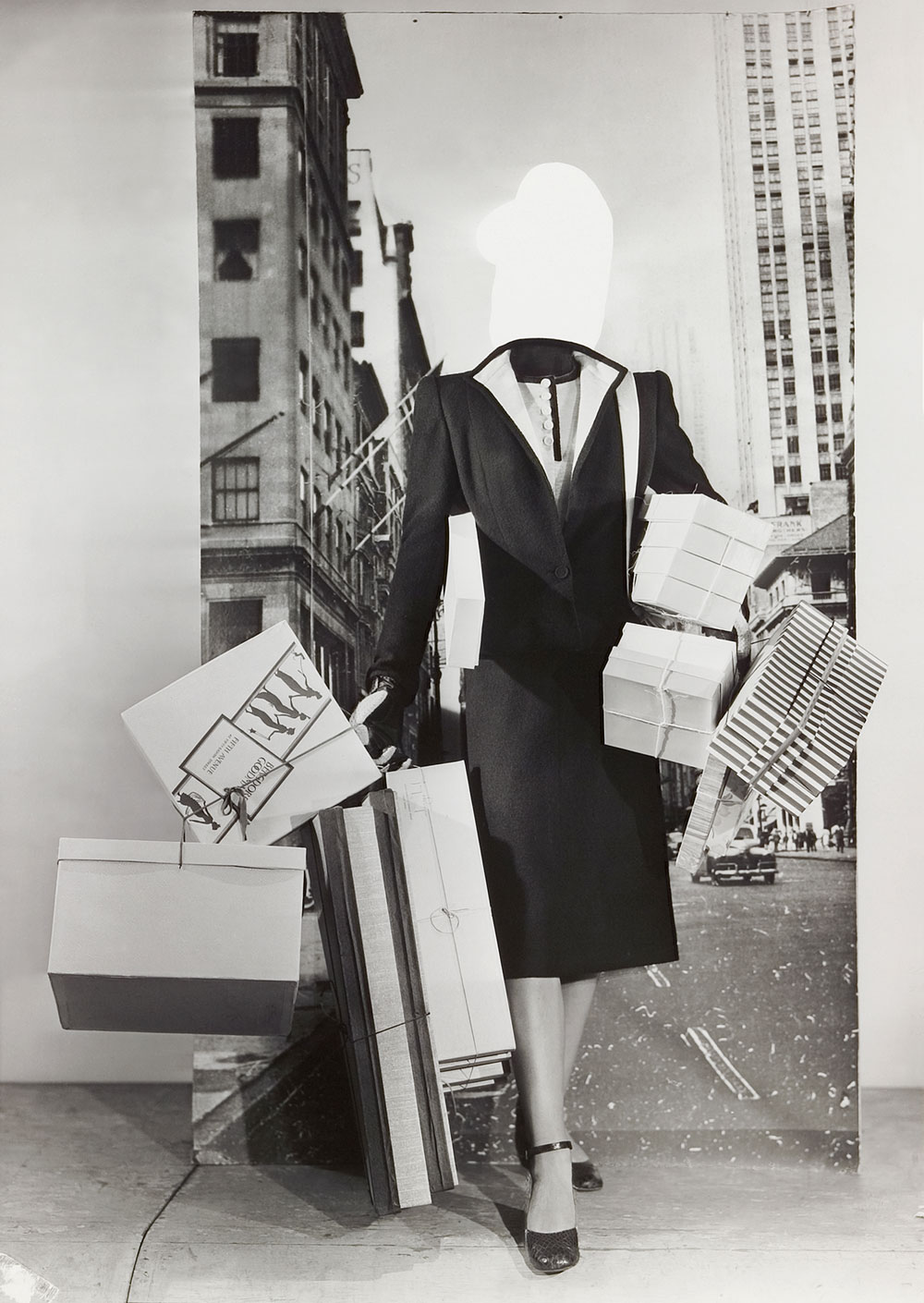
Erwin Blumenfeld (American-German, 1897-1969) 'Mode-Montage' c. 1950


Erwin Blumenfeld (American-German, 1897-1969)
Mode-Montage
c. 1950
Vintage gelatin silver print
Collection Helaine et Yorick Blumenfeld
Courtesy of Modernism Inc., San Francisco
© The Estate of Erwin Blumenfeld


Erwin Blumenfeld (American-German, 1897-1969) 'Marguerite von Sivers sur le toit du studio 9, rue Delambre' [Marguerite von Sivers on the roof of Blumenfeld’s studio at 9, rue Delambre] Paris, 1937


Erwin Blumenfeld (American-German, 1897-1969)
Marguerite von Sivers sur le toit du studio 9, rue Delambre [Marguerite von Sivers on the roof of Blumenfeld’s studio at 9, rue Delambre]
Paris, 1937
Vintage gelatin silver print
Collection Yvette Blumenfeld Georges Deeton / Art+Commerce, New York, Gallery Kicken Berlin, Berlin
© The Estate of Erwin Blumenfeld


Erwin Blumenfeld (American-German, 1897-1969) 'Untitled [Natalia Pasco]' 1942


Erwin Blumenfeld (American-German, 1897-1969)
Untitled [Natalia Pasco]
1942
Vintage gelatin silver print
Collection Henry Blumenfeld
© The Estate of Erwin Blumenfeld


Erwin Blumenfeld (American-German, 1897-1969) 'Voile mouillé' [Wet veil] Paris, 1937


Erwin Blumenfeld (American-German, 1897-1969)
Voile mouillé [Wet Veil]
Paris, 1937
Vintage gelatin silver print
Collection particulière, Suisse
© The Estate of Erwin Blumenfeld


Erwin Blumenfeld (American-German, 1897-1969) 'Cecil Beaton' 1946


Erwin Blumenfeld (American-German, 1897-1969)
Cecil Beaton
1946
Vintage silver gelatin print
Collection particulière, Suisse
© The Estate of Erwin Blumenfeld
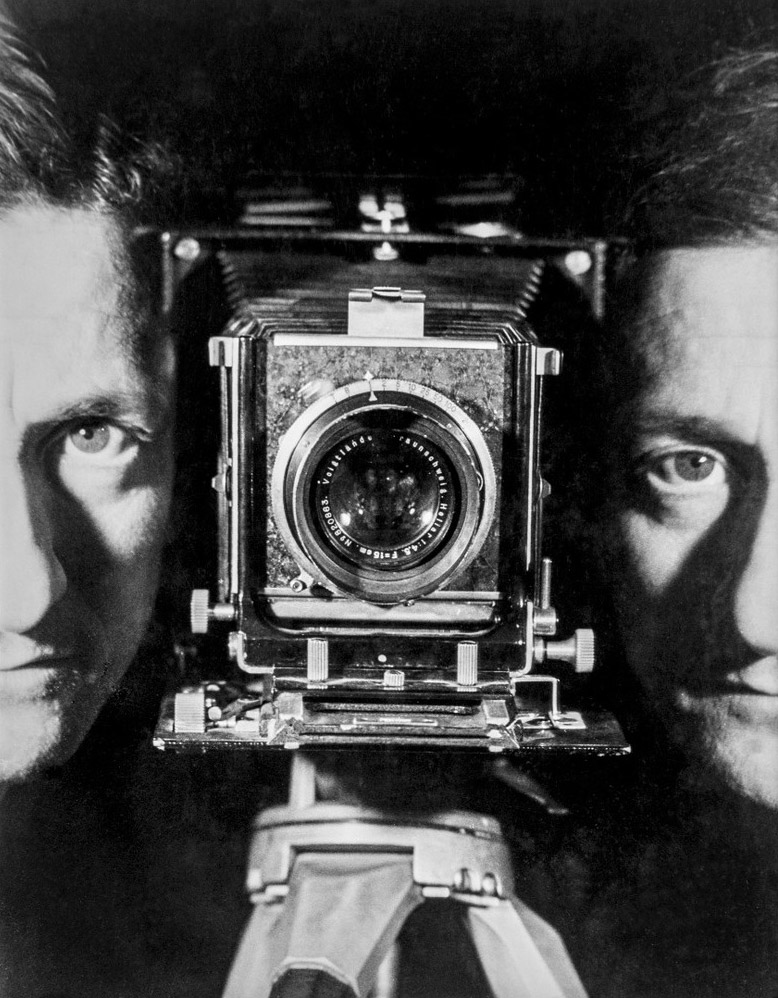
 

Erwin Blumenfeld (American-German, 1897-1969) 'Self-Portrait' Paris, c. 1937


Erwin Blumenfeld (American-German, 1897-1969)
Self-Portrait
Paris, c. 1937
Gelatin silver print. Printed later
Collection Helaine and Yorick Blumenfeld
© The Estate of Erwin Blumenfeld


Erwin Blumenfeld (American-German, 1897-1969) 'Untitled (Self-Portrait)' 1945


Erwin Blumenfeld (American-German, 1897-1969)
Untitled (Self-Portrait)
1945


Erwin Blumenfeld’s life and work impressively document the socio-political context of artistic development between the two World Wars, while highlighting the individual consequences of emigration. The exhibition devoted to Erwin Blumenfeld’s multi-layered œuvre brings together over 300 works and documents from the late 1910s to the 1960s, and encompasses the various media explored by the artist throughout his career: drawings, photographs, montages and collages.

This exhibition traces his visual creativity and encompasses the early drawings, the collages and montages, which mostly stem from the early 1920s, the beginnings of his portrait art in Holland, the first black and white fashion photographs of the Paris period, the masterful colour photography created in New York and the urban photos taken toward the end of his life.

The retrospective also showcases his drawings, many of which have never been shown before, as well as his early collages and photomontages, shedding fascinating light on the evolution of his photographic oeuvre and revealing the full extent of his creative genius. The now classic motifs of his experimental black-and-white photographs can be seen alongside his numerous self-portraits and portraits of famous and little-known people, as well as his fashion and advertising work.

In the first years of his career, he worked only in black and white, but as soon as it became technically possible he enthusiastically used colour. He transferred his experiences with black-and-white photography to colour; applying them to the field of fashion, he developed a particularly original repertoire of forms. The female body became Erwin Blumenfeld’s principal subject. In his initial portrait work, then the nudes he produced while living in Paris and, later on, his fashion photography, he sought to bring out the unknown, hidden nature of his subjects; the object of his quest was not realism, but the mystery of reality

Blumenfeld’s work was showcased most recently in France in a 1981 show at the Centre Pompidou, which focused on his fashion photography, in 1998 at the Maison Européenne de la Photographie, as well as more recently in the exhibition Blumenfeld Studio, Colour, New York, 1941-1960 (Chalon-sur-Saône, Essen, London).

Press release from the Jeu de Paume website


“Bringing together over three hundred works and documents dating from the late 1910s to the 1960s, this exhibition, the first in France to showcase the multilayered aspects of Erwin Blumenfeld’s oeuvre, encompasses the various media explored by the artist throughout his career: drawing, photography, montage, and collage.

The life and work of Erwin Blumenfeld (Berlin, 1897 – Rome, 1969) provides an impressive record of the socio-political context of artistic development between the two World Wars, while highlighting the individual consequences of emigration. Erwin Blumenfeld, a German Jew, only spent a few years in his country of birth. It was only in 1919, when he was in self-imposed exile in the Netherlands, that Blumenfeld began to take a deeper interest in photography, particularly the photographic process and above all the artistic possibilities offered by darkroom experiments. For a short while, he ran an Amsterdam-based portrait studio that doubled as an exhibition space, before moving to Paris in 1936, where the art dealer Walter Feilchenfeldt helped him rent a studio in the rue Delambre. That same year, his photographs were exhibited at the Galerie Billiet, while the following year saw his first beauty cover, for Votre Beauté magazine. In 1938 he received a visit from leading fashion photographer Cecil Beaton, who helped him to obtain a contract with the French Vogue. Blumenfeld travelled to New York, returning in 1939, shortly before the outbreak of war, to become Harper’s Bazaar’s fashion correspondent in Paris.

In 1940 he was interned as a German Jew in France, first in Montbard, then in Loriol, Le Vernet, and Catus. He made a daring escape with his family in 1941, returning via Casablanca to New York, where he subsequently lived and worked until his death. It was in New York that Blumenfeld’s astonishing career as a much sought after, highly paid fashion photographer really took off, first of all in the studio he shared with Martin Munkácsi, then from 1943 in his own premises. The contract he signed with the publishers Condé Nast in 1944 marked the beginning of ten years of remarkable photography and cover shots for various magazines in the company’s stable. Following on from his experimental black-and-white shots of the 1930s, he began playing with colour. The present exhibition includes, besides photographs, both magazine work and early experimental films made for the Dayton department store in Minneapolis, his leading advertising customer.

Not until 1960 did Blumenfeld return to Berlin for a visit. He devoted the following years to finishing his autobiography, begun in the 1950s. The work was completed in 1969 with the help of his assistant Marina Schinz, but was only published in 1975, initially in French translation, then in the original German in 1976. His book My One Hundred Best Photos was also released posthumously, in 1979.

Drawings, Montages, and Collages

Between 1916 and 1933 Erwin Blumenfeld produced a fairly limited number of drawings and montages. As a young man he was very interested in literature, writing poems and short stories. And as early as 1915 he mentioned that he was interested in writing an autobiography. Almost all of his montages and collages include drawings and snippets of language. He plays with written and printed words and typography, juxtaposing names, concepts, and places to create ironic commentaries and provocative titles. His collages typically combine drawing, language, and cut-outs of original or printed photographs. He also often used letter stationery to form a background, leaving bare spaces. In 1918 Blumenfeld made the acquaintance of the Dadaist George Grosz; two years later he and Paul Citroen wrote to Francis Picabia in the name of the Hollandse Dadacentrale, but neither was present at the First International Dada Fair in Berlin in 1920. That same year, Blumenfeld began using the pseudonyms Erwin Bloomfeld and Jan Bloomfield, as documented in his Dadaist publications and in some of his collages. The drawings in the present exhibition, most of which have never been shown in public, were produced in Berlin and the Netherlands. Only a handful of them are dated. They are quick sketches from life or from imagination, rough cartoons and acid caricatures, in pencil, ink, watercolour, or coloured pencil – whatever was to hand. Blumenfeld was clearly fascinated by the quality and immediacy of drawing as a medium, and, as these works reveal, it certainly stimulated his playful side.

Self-Portraits

Blumenfeld took his first photographs as a schoolboy, using himself as one of his first subjects. The earliest date from the 1910s, but he continued taking self-portraits to the end of his life. The young man with the dreamy gaze turned into the louche bohemian with a cigarette, then the carefully staged photographer experimenting with his camera. His self-portraits are not the product of excessive vanity, but rather playful experiments, with and without masks, models, and other grotesque objects such as a calf’s head, all used to create witty images.

Portraits

Blumenfeld’s first steps in professional photography were in portraiture. He started “learning by doing” in the early 1920s in Amsterdam, where he had opened the ladies handbag store Fox Leather Company. This is where he took portraits of customers, using a darkroom in the back of the store. Comparison of the contact sheets from the time with the blow-ups taken from them clearly shows, right from the outset, the importance in Blumenfeld’s work of the finishing in the lab. The final images display extremely tight framing, high levels of contrast, and lighting that creates dramatic, even devilish, effects. When he arrived in Paris in 1936 his first photographs were portraits, featuring among others Henri Matisse and Georges Rouault. Although he quickly entered the Paris fashion scene, he retained a strong interest in portraiture throughout the remainder of his life.

Nudes

Blumenfeld’s earliest, highly narrative nudes date from his time in the Netherlands, but the subject only became a passion during his Paris years from 1936 on, when he discovered the work of French avant-garde photographers. His admiration for them is particularly evident in his nude photographs, as is the influence of Man Ray’s work. The bodies of the women in these images were surfaces onto which he projected his artistic imagination. He cut them up, solarised them, and transformed them into abstract imagery through the play of light and shadow. The faces of his nudes from the 1930s are only rarely visible, the women remaining somewhat mysterious entities. The nudes Blumenfeld produced in the 1950s after he had settled in New York tended to be more concrete, illustrative works.

Architecture

The black-and-white architectural photographs that Erwin Blumenfeld took in the 1930s feature buildings and urban spaces from various experimental and abstract perspectives. The Eiffel Tower, for instance, is captured in sharp reliefs of light and shade, while the photographs of Rouen Cathedral are intended to draw the viewer’s visual attention to the building’s specific forms. Blumenfeld expresses his artistic vision and his knowledge of Gothic architecture by focusing on the abstraction of details. During the 1950s and 1960s Blumenfeld used a 35mm camera for cityscapes. The exhibition showcases three of these colour slide projects for the first time. They feature New York, Paris, and Berlin – three places that made a mark on his art and also shaped his career.

The Dictator

In 1933, according to his autobiography, Blumenfeld reacted to Hitler’s rise to power in Germany with a photomontage. This outstanding piece of work, probably his most famous photograph, symbolises and anticipates the dictator’s dehumanisation. Following on from the political themes in some of his early collages, he here combined different negatives – a skull and a portrait of Hitler – to make a single print. In one of these montages he included a swastika, while in a different portrait “bleeding eyes” were added later on the surface. Later on, in Paris, he photographed a calf’s head, using this subject to compose different images. One in which he placed the animal’s head on a woman’s torso was titled The Minotaure or The Dictator. This image, which does not refer to a specific figure, is obviously intended to be allegorical. In 1941 Blumenfeld was able to escape from the Nazis with his family to New York.

Fashion

Blumenfeld’s move to Paris in 1936 marked the beginning of his career as a fashion photographer, although he had already had contacts with magazines in Paris while living in Amsterdam. The work that appeared in French publications in the late 1930s raised Blumenfeld’s profile as a modernist photographer and brought him to the attention of the famous British photographer Cecil Beaton, who visited him in his studio in 1938 and helped him sign his first contract with the French edition of Vogue. When Blumenfeld made his first trip to New York following his sensational set of fashion photographs on the Eiffel Tower, he came home with a new contract as Paris fashion correspondent for Harper’s Bazaar. He was only able to file his reports for a year before he was interned in various prison camps across France. In 1941 he was able to escape from German-occupied France to New York with his family. In the first half of the 1950s, he drew on his experiments in black-and-white photography to develop an exceptionally original artistic repertoire, reflected in his use of colour and his fashion work.

Ute Eskildsen
Curator of the exhibition
Translated from German by Susan Pickford


Erwin Blumenfeld (American-German, 1897-1969) 'Three Graces (1947), New York' 1947


Erwin Blumenfeld (American-German, 1897-1969)
Three Graces (1947), New York
1947


Leslie Petersen appears here in a triple variation inspired by Botticelli’s Primavera. The photograph, was intended to show off a gown by Cadwallader. The final image is made of two shots. The two on the right are similar but with different degrees of sharpness. The pose on the left is different.

Text from Phaidon


Erwin Blumenfeld (American-German, 1897-1969) 'Nude (Lisette)' Paris, 1937


Erwin Blumenfeld (American-German, 1897-1969)
Nude (Lisette)
Paris, 1937
Gelatin silver print, negative print, solarisation. Vintage print
Collection Yvette Blumenfeld Georges Deeton / Art + Commerce, New York, Gallery Kicken Berlin, Berlin
© The Estate of Erwin Blumenfeld


Erwin Blumenfeld (American-German, 1897-1969) 'Charlie' 1920


Erwin Blumenfeld (American-German, 1897-1969)
Charlie
1920
Collage, Indian ink, watercolour and pencil on paper
Collection Helaine and Yorick Blumenfeld
© The Estate of Erwin Blumenfeld


Erwin Blumenfeld (American-German, 1897-1969) 'Untitled, New York, 1944' 1944


Erwin Blumenfeld (American-German, 1897-1969)
Untitled, New York, 1944
1944
Gelatin silver print. Vintage print
Collection Henry Blumenfeld
© The Estate of Erwin Blumenfeld


Erwin Blumenfeld (American-German, 1897-1969) 'In hoc signo vinces [in this sign you will conquer]' 1967


Erwin Blumenfeld (American-German, 1897-1969)
In hoc signo vinces [in this sign you will conquer]
1967
Gelatin silver print. Vintage print
Private collection, Switzerland
© The Estate of Erwin Blumenfeld


Erwin Blumenfeld (American-German, 1897-1969) 'Audrey Hepburn' New York, 1950


Erwin Blumenfeld (American-German, 1897-1969)
Audrey Hepburn
New York, 1950
Vintage silver gelatin print
Collection particulière, Suisse.
© The Estate of Erwin Blumenfeld


Audrey Hepburn is wearing a hat designed by Blumenfeld and made by Mister Fred, one of New York’s most talented milliners. Blumenfeld here uses a system of mirrors showing the front and back of the hat and allowing infinite repetition of the motif.

Text from Phaidon


Erwin Blumenfeld (American-German, 1897-1969) 'Untitled [Homme agenouillé avec tour]' [Kneeling man with tower] 1920


Erwin Blumenfeld (American-German, 1897-1969)
Untitled [Homme agenouillé avec tour] [Kneeling man with tower]
1920
Indian ink, ink, watercolor and collage on paper
Collection Henry Blumenfeld.
© The Estate of Erwin Blumenfeld
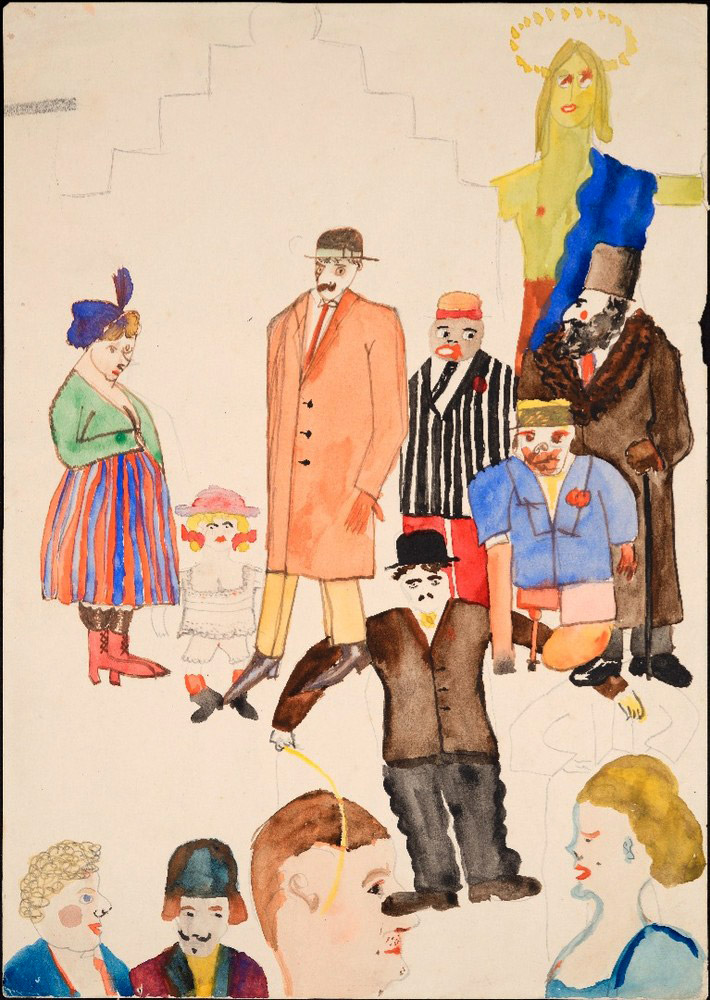
 

Erwin Blumenfeld (American-German, 1897-1969) 'Group with Chaplin' Early 1920's


Erwin Blumenfeld (American-German, 1897-1969)
Group with Chaplin
Early 1920’s
Gouache and pencil on paper
Collection Henry Blumenfeld
© The Estate of Erwin Blumenfeld
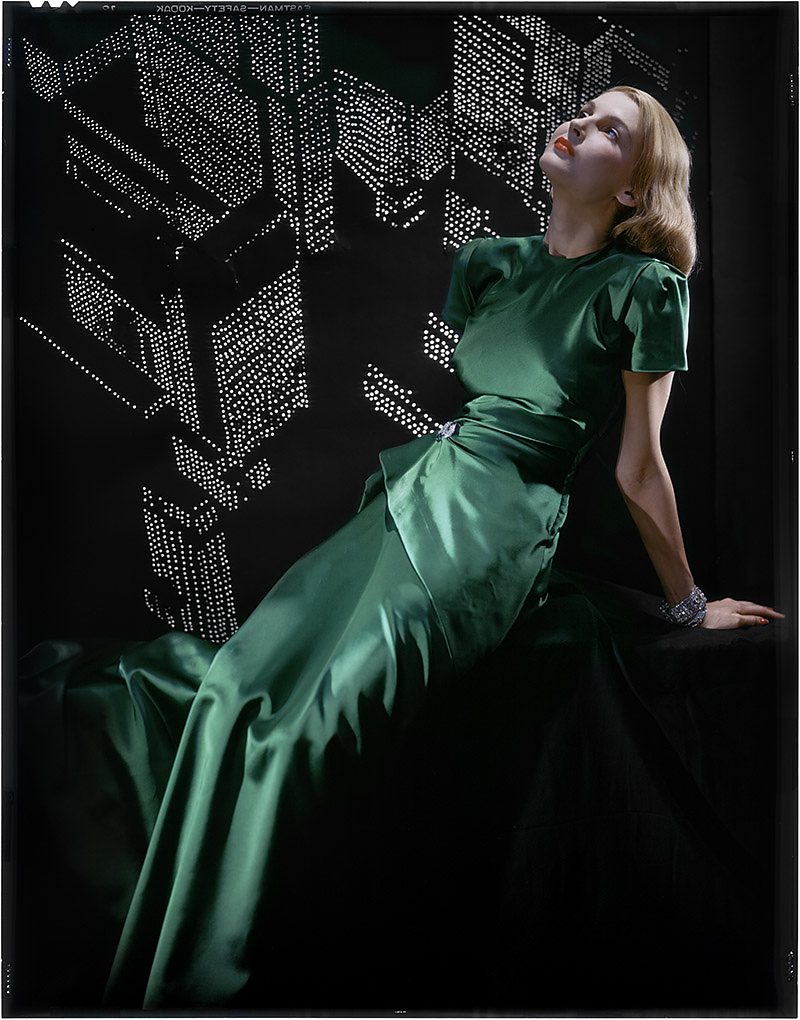
 

Erwin Blumenfeld (American-German, 1897-1969) 'Untitled (Green dress)' 1946


Erwin Blumenfeld (American-German, 1897-1969)
Untitled (Green dress)
1946


Erwin Blumenfeld (American-German, 1897-1969) 'Do your part for the Red Cross' [Soutenez la Croix-Rouge] 1945


Erwin Blumenfeld (American-German, 1897-1969)
Do your part for the Red Cross [Soutenez la Croix-Rouge]
1945
Variante de la photographie de couverture de Vogue US, 15 mars 1945
Variant of a cover photograph of Vogue, “Do your part for the Red Cross”, New York, March 15th, 1945
Impression jet d’encre sur papier Canson baryta, tirage posthume (2012).
Collection Henry Blumenfeld.
© The Estate of Erwin Blumenfeld


A model, a red cross: fashion and current affairs superimposed. The background to this humanitarian appeal is the liberation of the concentration camps and the aid brought to prisoners of war. Blumenfeld reinterprets these humanitarian signs just as he blurs those of fashion.

Text from Phaidon


Erwin Blumenfeld (American-German, 1897-1969) Variant of the photograph published in Life Magazine entitled "The Picasso Girl" [The young woman of Picasso] (model: Lisette) c. 1941-1942


Erwin Blumenfeld (American-German, 1897-1969)
Variante de la photographie parue dans Life Magazine et intitulée “The Picasso Girl” [La jeune femme Picasso]
Variant of the photograph published in Life Magazine entitled “The Picasso Girl” [The young woman of Picasso]
(model: Lisette)
c. 1941-1942
Inkjet printing on Canson baryta paper, posthumous print (2012)
Collection Henry Blumenfeld
© The Estate of Erwin Blumenfeld


Erwin Blumenfeld (American-German, 1897-1969) Three profiles. Variant of the photograph published in the article "Color and lighting" Photograph Annual of 1952


Erwin Blumenfeld (American-German, 1897-1969)
The young woman of Picasso
Trois profils. Variante de la photographie parue dans l’article “Color and lighting” [Couleur et éclairage], de Photograph Annual 1952
Three profiles. Variant of the photograph published in the article “Color and lighting” Photograph Annual of 1952
1952
Inkjet printing on Canson baryta paper, posthumous print (2012)
Collection Henry Blumenfeld
© The Estate of Erwin Blumenfeld


Jeu de Paume
1, Place de la Concorde
75008 Paris
métro Concorde
Phone: 01 47 03 12 50

Opening hours:
Tuesday – Sunday 11am – 7pm
Closed Monday

Jeu de Paume website

LIKE ART BLART ON FACEBOOK

Back to top

Exhibition: ‘Bob Mizer and Tom of Finland’ at The Museum Of Contemporary Art, Los Angeles (MOCA)
Exhibition dates: 2nd November 2013 – 26th January 2014
MOCA Pacific Design Center

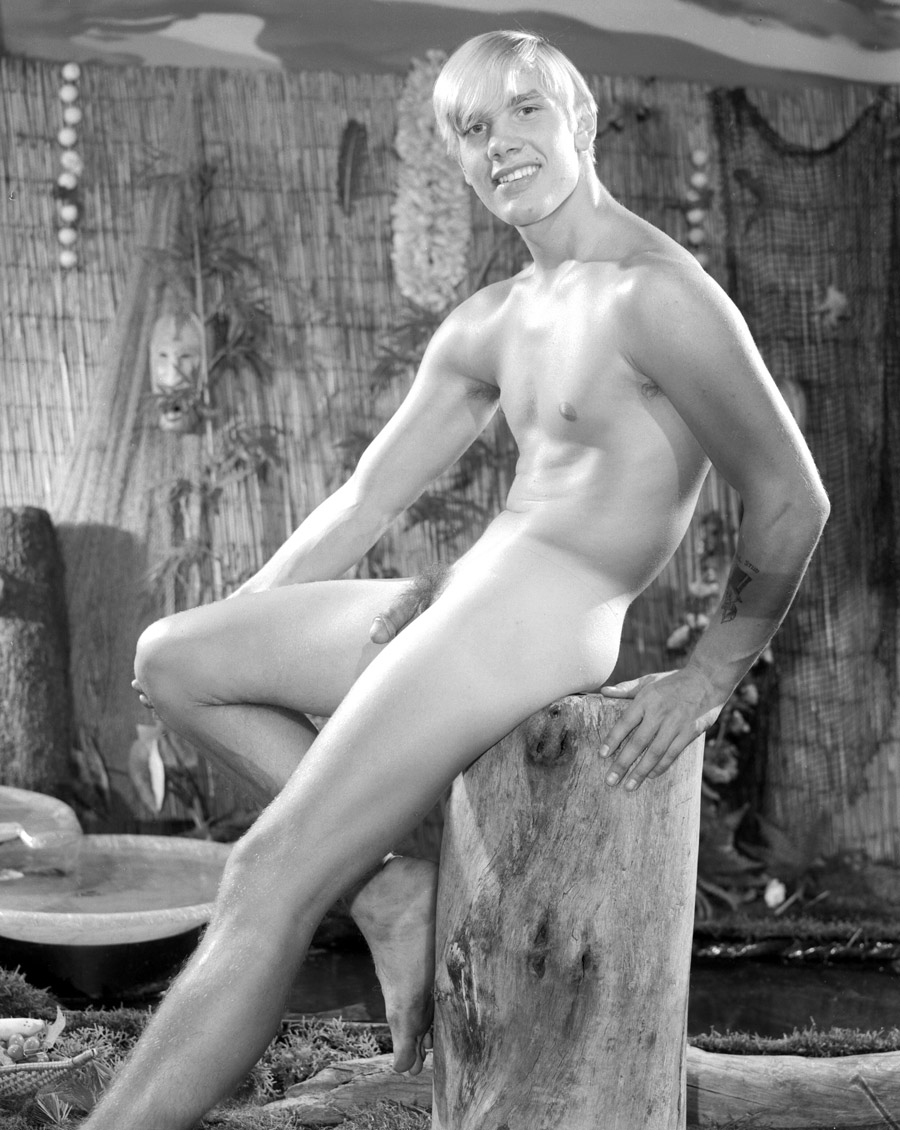
PLEASE NOTE: THIS POSTING CONTAINS ART WORK OF MALE NUDITY AND EROTIC IMAGES OF GAY MALE SEX – IF YOU DO NOT LIKE PLEASE DO NOT LOOK, FAIR WARNING HAS BEEN GIVEN


Bob Mizer (American, 1922-1992) 'Physique Pictorial Volume 16 Number 4, February 1968' 1968


Bob Mizer (American, 1922-1992)
Physique Pictorial Volume 16 Number 4, February 1968
1968
Publication
Printed with permission of Bob Mizer Foundation, Inc .


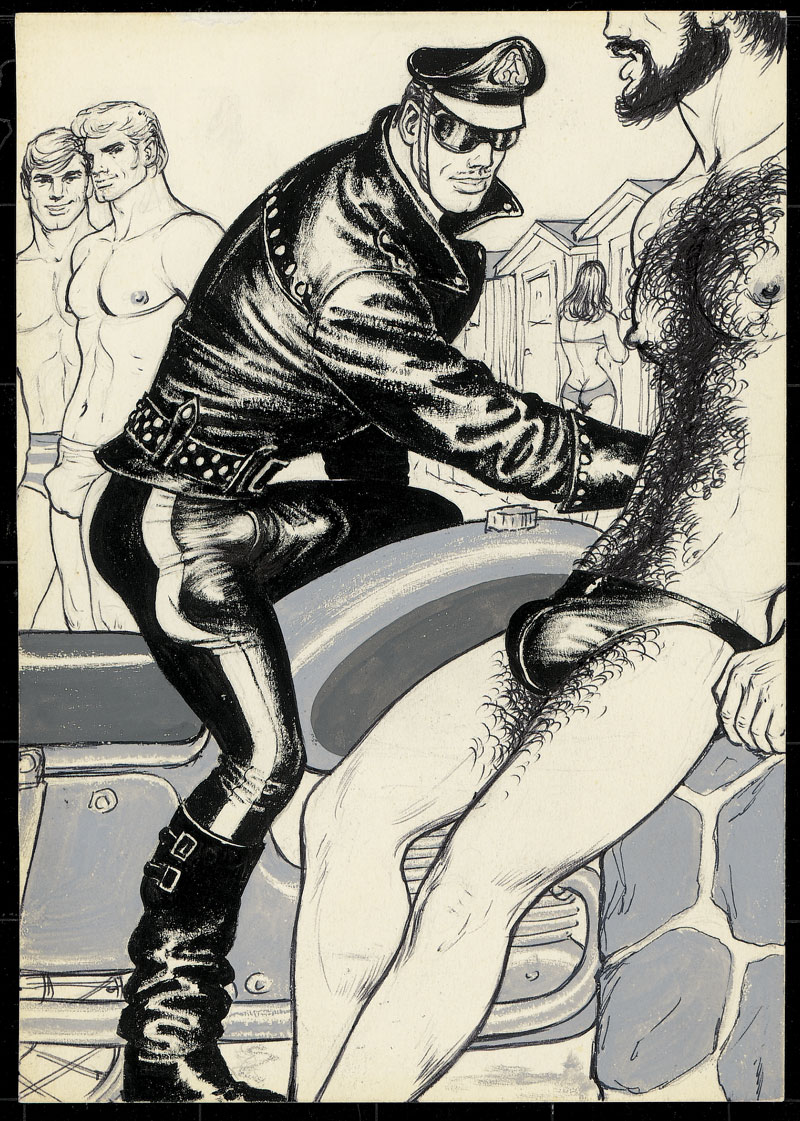
What a fantastic pairing in this exhibition and in their relationship in real life. We must remember that Tom of Finland was a ground-breaking artist, one of the very first to picture masculine gay men, “robbing straight homophobic culture of its most virile and masculine archetypes (bikers, hoodlums, lumberjacks, cops, cowboys and sailors) and recasting them – through deft skill and fantastic imagination – as unapologetic, self-aware and boastfully proud enthusiasts of gay sex.”

He would have only just been in his twenties when he started drawing men in the early 1940s, inspired by the soldiers and uniforms he saw around him from the Second World War. With no outward gay culture in Finland, let alone in America until the late 1960s, just imagine being an artist producing this kind of erotic imagery at that time. To go on to be the seminal figure in the creation of gay leather culture… what an impact this artist had on gay and popular culture. Of course, as tastes were liberalised in the era of free love, Stonewall and after, the muscles of his hunks became bigger, the size of their endowments larger and the actions portrayed became more open and transparent (as can be seen from Untitled (From Beach Boy 2 story), 1971, below).

During my PhD research I visited the One Institute/International Gay and Lesbian Archives Collection, University of Southern California, Los Angeles, to investigate the cross-over between physique magazines and early gay pornography magazines of the 1960s to early 1970s. I was interested to see whether the muscular mesomorphic bodies of the physique magazines crossed straight over into the first gay pornography magazines. To my surprise, the answer was that they did not.

After the American Supreme Court ruled on obscenity laws in the late 1960s, the first gay pornography magazines started appearing. The earliest gay porn magazine in the One Institute / IGLA collection, Action Line. No.1. San Francisco: Mark Vaughn Associates. 1969, features mostly smooth but natural bodies, not as built as in physique magazines, with nude young men with full erections lying next too each other touching. There is no sex, no sucking or fucking. Only a year later, in 1970, the story is different. In Album 1501: A Study of Sexual Activity Between Males. Los Angeles: Greyhuff Publishing, 1970 their is sexual intercourse pictured between men in an openly available publication for the first time.

Bodies in this magazine are smooth, young toned men, much as in the early photographs of George Platt Lynes (such as those of Charles ‘Tex’ Smutney, Charles ‘Buddy’ Stanley, and Bradbury Ball). They are also similar to the bodies in the photographs that Lynes submitted to the Zurich published homosexual magazine Der Kries after he found out that he had cancer, during the last years of his life (under the pseudonym Roberto Rolf late 1940s – early 1950s). The participants in Album 1501 perform sex on each other in a lounge room lit by strong lights (shadows on walls). The black and white photographs, well shot, feature in a magazine that is about 5″ wide and 10″ high, well laid out and printed. The magazine is a thin volume and features just the two models in one sex scene of them undressing each other and then having sex. One man wears a Pepsi-Cola T-shirt at first and he also has tattoos one of which says ‘Cheri’. The photographs almost have a private feel to them.

In their introduction the publishers disclaim any agreement with the content of the magazine and are only publishing it for the freedom of everybody to study the material in the privacy of their own homes. In other words male to male sex is a natural phenomenon and the publication is educational. This was a common ploy in early nudist and pornographic publications (along with classical themes) that was used to justify the content – to claim that the material was for private educational purposes only:

Introduction.

“Publishers of material dealing frankly with sexual activity have suffered greatly in the past because of society’s anxiety over the existence and propagation of such material. But the real issue is why should such material dealing with sexual activity be any less valid or acceptable than material dealing with other facets of human behaviour? …
This book was produced so that all interested adults may have an opportunity to acquire it for their own private interests in matters relating to sex …
Our publication of this book is not to be construed that we agree with, condone or encourage any of the behaviour depicted herein. However, sexual activity between males is a fact of life and interested adults should not be denied an opportunity to study this, or any other, facet of human behaviour.”


The Publishers


It is interesting to note the progression from physique magazines and models in posing pouches in 1966-68 (such as the photographs of Bob Mizer featured in this posting), then to full erection and stories of anal penetration in Action Line in 1969, to full on photographs of gay sex in this magazine in 1970. Bodies are all smooth, quite solid, toned natural physiques, not as ‘built’ as in earlier physique magazines, but still featuring younger smooth men and not older heavier set men. It was not until the development of the clone, leatherman and magazines such a Colt from Colt Studios that Tom of Finland’s muscular mesomorphic leatherman took hold in the popular gay imagination.

Even in the mid 1970’s companies such as Colt Studios, which has built a reputation for photographing hunky, very well built masculine men, used classical themes in their photography of muscular young men. Most of the early Colt magazines have photographs of naked young men that are accompanied by photographs and illustrations based on classical themes. In their early magazines quite a large proportion of the bodies were hirsute or had moustaches as was popular with the ‘clone’ image at the time. Later Colt models of the early 1980’s tend towards the buff, tanned, stereotypical muscular mesomorph in even greater numbers. Sometimes sexual acts are portrayed in Colt magazines but mainly they are not. It is the “look” of the body and the face that the viewers desiring gaze is directed towards – not the sexual act itself.

Photographers such as Bob Mizer from Athletic Model Guild produced more openly homoerotic images. In his work from the 1970’s full erections are not prevalent but semi-erect penises do feature, as do revealing “moon” shots from the rear focusing on the arsehole as a site for male libidinal desires. A less closeted, more open expression of homosexual desire can be seen in the photographs of the male body in the 1970’s.

Dr Marcus Bunyan


Many thankx to The Museum Of Contemporary Art (MOCA) for allowing me to publish the art work in the posting. Please click on the photographs for a larger version of the image.


Tom of Finland (Touko Laaksonen, Finnish, 1920-1991) 'Untitled' 1962


Tom of Finland (Touko Laaksonen, Finnish, 1920-1991)
Untitled
1962
Graphite on paper
12.00″ x 9.50″
ToFF Cat. #62.27, Collection of Volker Morlock
© 1962 Tom of Finland Foundation


Bob Mizer (American, 1922-1992) 'Physique Pictorial Volume 11 Number 4, May 1962' 1962


Bob Mizer (American, 1922-1992)
Physique Pictorial Volume 11 Number 4, May 1962
1962
Publication
Printed with permission of Bob Mizer Foundation, Inc .


Bob Mizer (American, 1922-1992) 'Physique Pictorial Volume 7 Number 1, 1957' 1957


Bob Mizer (American, 1922-1992)
Physique Pictorial Volume 7 Number 1, 1957
1957
Publication
Printed with permission of Bob Mizer Foundation, Inc .


Bob Mizer (American, 1922-1992) 'Physique Pictorial Volume 10 Number 4, April 1961' 1961


Bob Mizer (American, 1922-1992)
Physique Pictorial Volume 10 Number 4, April 1961
1961
Publication
Printed with permission of Bob Mizer Foundation, Inc .


Tom of Finland (Touko Laaksonen, Finnish, 1920-1991) 'Untitled' (1 of 4 from 'Circus Life' series) 1961


Tom of Finland (Touko Laaksonen, Finnish, 1920-1991)
Untitled (1 of 4 from Circus Life series)
1961
Graphite on paper
12.25″ x 9.75″
Bob Mizer/AMG Collection, Tom of Finland Foundation Permanent Collection #61.11
© 1961 Tom of Finland Foundation


Bob Mizer (American, 1922-1992) 'Jim Horn, Los Angeles' c. 1966


Bob Mizer (American, 1922-1992)
Jim Horn, Los Angeles
c. 1966
Vintage large-format black and white negative
Silver gelatin print
8 x 10 inches
Printed with permission of Bob Mizer Foundation, Inc .


Bob Mizer (American, 1922-1992) 'Untitled [Barry Maurer, Hand on Gun], Los Angeles' c. 1961


Bob Mizer (American, 1922-1992)
Untitled [Barry Maurer, Hand on Gun], Los Angeles
c. 1961
Vintage large-format black and white negative
Silver gelatin print
8 x 10 inches
Printed with permission of Bob Mizer Foundation, Inc .


Bob Mizer (American, 1922-1992) 'Untitled [Larry Lamb, with Tumbleweed], Los Angeles' c. 1959


Bob Mizer (American, 1922-1992)
Untitled [Larry Lamb, with Tumbleweed], Los Angeles
c. 1959
Vintage large-format black and white negative
Silver gelatin print
8 x 10 inches
Printed with permission of Bob Mizer Foundation, Inc .


Tom of Finland (Touko Laaksonen, Finnish, 1920-1991) 'Untitled' 1968


Tom of Finland (Touko Laaksonen, Finnish, 1920-1991)
Untitled
1968
Graphite on paper
12.94″ x 9.38″
ToFF Cat. #68.06, Collection of Volker Morlock
© 1968 Tom of Finland Foundation


Tom of Finland (Touko Laaksonen, Finnish, 1920-1991) 'Youthful Innocence' 1969


Tom of Finland (Touko Laaksonen, Finnish, 1920-1991)
Youthful Innocence
1969
The New Biker Stud – Bob Mizer title
Graphite on paper
11.75″ x 8.50″
ToFF Cat. #69.02, Collection of Volker Morlock
© 1969 Tom of Finland Foundation


Tom of Finland (Touko Laaksonen, Finnish, 1920-1991) 'Untitled' (No.1 from 'Cyclist and the Farm Boy' series) 1973


Tom of Finland (Touko Laaksonen, Finnish, 1920-1991)
Untitled (No.1 from Cyclist and the Farm Boy series)
1973
Graphite on paper
11″ x 8″
Bob Mizer/AMG Collection, Tom of Finland Foundation Permanent Collection #73.10
© 1973 Tom of Finland Foundation


Bob Mizer (American, 1922-1992) 'Untitled [Ray Hornsby, Motorcycle], Los Angeles' c. 1957


Bob Mizer (American, 1922-1992)
Untitled [Ray Hornsby, Motorcycle], Los Angeles
c. 1957
Vintage large-format black and white negative
Silver gelatin print
8 x 10 inches
Printed with permission of Bob Mizer Foundation, Inc .


“To my mind, there is no clearer representation of Mizer’s almost manic attempts to condense the joyful, celebratory chaos of his daily photo shoots down to their most selectively stupendous moments than his catalogue boards.” ~ artist and exhibition co-curator Richard Hawkins


The Museum of Contemporary Art, Los Angeles (MOCA), is proud to present Bob Mizer and Tom of the Finland, the first American museum exhibition devoted to the art of Bob Mizer (1922-1992) and Touko Laaksonen, aka “Tom of Finland” (1920-1991), two of the most significant figures of twentieth century erotic art and forefathers of an emergent post-war gay culture. The exhibition features a selection of Tom of Finland’s masterful drawings and collages, alongside Mizer’s rarely seen photo-collage “catalogue boards” and films, as well as a comprehensive collection of his groundbreaking magazine Physique Pictorial, where drawings by Tom were first published in 1957. Organised by MOCA Curator Bennett Simpson and guest co-curator Richard Hawkins, the exhibition is presented with the full collaboration of the Bob Mizer Foundation, El Cerrito, and the Tom of Finland Foundation, Los Angeles.

Tom of Finland is the creator of some of the most iconic and readily recognisable imagery of post-war gay culture. He produced thousands of images beginning in the 1940s, robbing straight homophobic culture of its most virile and masculine archetypes (bikers, hoodlums, lumberjacks, cops, cowboys and sailors) and recasting them – through deft skill and fantastic imagination – as unapologetic, self-aware and boastfully proud enthusiasts of gay sex. His most innovative achievement though, worked out in fastidious renderings of gear, props, settings and power relations inherent therein, was to create the depictions that would eventually become the foundation of an emerging gay leather culture. Tom imagined the leather scene by drawing it; real men were inspired by it … and suited themselves up.

Bob Mizer began photographing as early as 1942 but, unlike many of his contemporaries in the subculture of illicit physique nudes, Mizer took the Hollywood star-system approach and founded the Athletic Model Guild in 1945, a film and photo studio specialising in handsome natural-bodied (as opposed to exclusively musclebound, the norm of the day) boy-next-door talent. In his myriad satirical prison dramas, sci-fi flix, domesticated bachelor scenarios and elegantly captivating studio sessions, Mizer photographed and filmed over 10,000 models at a rough estimate of 60 photos a day, seven days a week for almost 50 years. Mizer always presented a fresh-faced and free, unashamed and gregarious, totally natural and light-hearted approach to male nudity and intimate physical contact between men. For these groundbreaking perspectives in eroticised representation alone, Mizer ranks with Alfred Kinsey at the forefront of the sexual revolution.

Though Laaksonen did not move to Los Angeles until the 1970s, he had long known of Mizer and the photographer’s work through Physique Pictorial, the house publication and sales tool for Athletic Model Guild. It was to this magazine that the artist first sent his drawings and it was Mizer, finding the artworks remarkable and seeking to promote them on the magazine’s cover, but finding the artist’s Finnish name too difficult for his clientele, who is responsible for the now famous “Tom of Finland” pseudonym.

By the time the gay liberation movement swept through the United States in the late 1960s, both Tom of Finland and Bob Mizer were already well-known and widely celebrated as veritable pioneers of gay art. Decades before Stonewall and the raid on the Black Cat these evocative and lusty representations of masculine desire and joyful, eager sex between men proliferated and were disseminated worldwide at a time when the closet was still very much the norm – there was no such thing as a gay community. If these artists were not ahead of their time, they might just have foreseen and even invented a time.

Spanning five decades, the exhibition seeks a wider appreciation for Tom of Finland and Bob Mizer’s work, considering their aesthetic influence on generations of artists, both gay and straight, among them, Kenneth Anger, Rainer Werner Fassbinder, David Hockney, G.B. Jones, Mike Kelley, Robert Mapplethorpe, Henrik Olesen, Jack Pierson, John Waters, and Andy Warhol. The exhibition also acknowledges the profound cultural and social impact both artists have made, especially in providing open, powerful imagery for a community of desires at a time when it was still very much criminal. Presenting the broader historical context and key aspects of their shared interests and working relationship, as well as more in-depth solo rooms dedicated to each artist, the exhibition establishes the art historical importance of the staggering work of these legendary figures.

In addition to approximately 75 finished and preparatory drawings by Tom of Finland spanning 1947-1991, the exhibition includes a selection of Tom’s never before exhibited scrapbook collages, and examples of his serialised graphic novels, including the legendary leatherman Kake, as well as a selection of Mizer’s “catalogue boards,” AMG films, and a complete set of Physique Pictorial magazine. An accompanying publication includes texts by the exhibition co-curators and a selection of images.

Press release from the MOCA website


Bob Mizer (American, 1922-1992) 'Untitled [Ray Hornsby, with Skull Staff], Los Angeles' c. 1957


Bob Mizer (American, 1922-1992)
Untitled [Ray Hornsby, with Skull Staff], Los Angeles
c. 1957
Vintage large-format black and white negative
Silver gelatin print
8 x 10 inches
Printed with permission of Bob Mizer Foundation, Inc .


Bob Mizer (American, 1922-1992) 'Untitled [Ernie Rabb, Pointed Pistol], Los Angeles' c. 1957


Bob Mizer (American, 1922-1992)
Untitled [Ernie Rabb, Pointed Pistol], Los Angeles
c. 1957
Vintage large-format black and white negative
Silver gelatin print
8 x 10 inches
Printed with permission of Bob Mizer Foundation, Inc .


Tom of Finland (Touko Laaksonen, Finnish, 1920-1991) 'Untitled' (From 'Beach Boy 1' story) 1971


Tom of Finland (Touko Laaksonen, Finnish, 1920-1991)
Untitled (From Beach Boy 1 story)
1971
Pen and ink, gouache on paper
8.25″ x 5.75″
COQ International Collection, Tom of Finland Foundation Permanent Collection #71.24
© 1971 Tom of Finland Foundation


Tom of Finland (Touko Laaksonen, Finnish, 1920-1991) 'Untitled' (From 'Jungle Seafood' story) 1972


Tom of Finland (Touko Laaksonen, Finnish, 1920-1991)
Untitled (From Jungle Seafood story)
1972
Pen and ink, gouache on paper
8.63″ x 6.94″
Tom of Finland Foundation Permanent Collection #72.41
© 1972 Tom of Finland Foundation


Bob Mizer (American, 1922-1992) 'Untitled [Larry Lamb, Profile with Chains], Los Angeles' c. 1959


Bob Mizer (American, 1922-1992)
Untitled [Larry Lamb, Profile with Chains], Los Angeles
c. 1959
Vintage large-format black and white negative
Silver gelatin print
8 x 10 inches
Printed with permission of Bob Mizer Foundation, Inc .


Bob Mizer (American, 1922-1992) 'Untitled [Dennis Schreffer, Wand Balance], Los Angeles' c. 1957


Bob Mizer (American, 1922-1992)
Untitled [Dennis Schreffer, Wand Balance], Los Angeles
c. 1957
Vintage large-format black and white negative
Silver gelatin print
8 x 10 inches
Printed with permission of Bob Mizer Foundation, Inc .


Bob Mizer (American, 1922-1992) 'Untitled [Dennis Schreffer with Portrait], Los Angeles' c. 1957


Bob Mizer (American, 1922-1992)
Untitled [Dennis Schreffer with Portrait], Los Angeles
c. 1957
Vintage large-format black and white negative
Silver gelatin print
8 x 10 inches
Printed with permission of Bob Mizer Foundation, Inc .


Tom of Finland (Touko Laaksonen, Finnish, 1920-1991) 'Untitled' (From 'Beach Boy 2' story) 1971


Tom of Finland (Touko Laaksonen, Finnish, 1920-1991)
Untitled (From Beach Boy 2 story)
1971
Pen and ink, gouache on paper
8.25″ x 5.25″
Tom of Finland Foundation Permanent Collection #71.45
© 1971 Tom of Finland Foundation


Tom of Finland (Touko Laaksonen, Finnish, 1920-1991) 'Untitled' (From 'Beach Boy 2' story) 197


Tom of Finland (Touko Laaksonen, Finnish, 1920-1991)
Untitled (From Beach Boy 2 story)
1971
Pen and ink, gouache on paper
8.25″ x 5.25″
Tom of Finland Foundation Permanent Collection #71.58
© 1971 Tom of Finland Foundation


Bob Mizer (American, 1922-1992) 'Athletic Model Guild Catalog Board, David Elliott. [Double-sided; This side Page 1 of SW series]' c. 1965


Bob Mizer (American, 1922-1992)
Athletic Model Guild Catalog Board, David Elliott. [Double-sided; This side Page 1 of SW series]
c. 1965
Photographs mounted to matboard and mixed media
Printed with permission of Bob Mizer Foundation, Inc .
The Museum of Contemporary Art, Los Angeles
Proposed purchase with funds provided by the Photography Committee
The Bob Mizer Foundation & INVISIBLE-EXPORTS, New York


Bob Mizer (American, 1922-1992) 'Athletic Model Guild Catalog Board, David Elliott. [Double-sided; This side Page 2 of SW series]' c. 1965


Bob Mizer (American, 1922-1992)
Athletic Model Guild Catalog Board, David Elliott. [Double-sided; This side Page 2 of SW series]
c. 1965
Photographs mounted to matboard and mixed media
Printed with permission of Bob Mizer Foundation, Inc .
The Museum of Contemporary Art, Los Angeles
Proposed purchase with funds provided by the Photography Committee
The Bob Mizer Foundation & INVISIBLE-EXPORTS, New York


Bob Mizer (American, 1922-1992) 'Athletic Model Guild Catalog Board, Ernie Rabb. [Double-sided; This side Page 57 of XT series]' c. 1957


Bob Mizer (American, 1922-1992)
Athletic Model Guild Catalog Board, Ernie Rabb. [Double-sided; This side Page 57 of XT series]
c. 1957
Photographs mounted to matboard and mixed media
Printed with permission of Bob Mizer Foundation, Inc .
The Museum of Contemporary Art, Los Angeles
Proposed purchase with funds provided by the Photography Committee
The Bob Mizer Foundation & INVISIBLE-EXPORTS, New York


Bob Mizer (American, 1922-1992) 'Athletic Model Guild Catalog Board, Ernie Rabb. [Double-sided; This side Page 58 of XT series]' c. 1957


Bob Mizer (American, 1922-1992)
Athletic Model Guild Catalog Board, Ernie Rabb. [Double-sided; This side Page 58 of XT series]
c. 1957
Photographs mounted to matboard and mixed media
Printed with permission of Bob Mizer Foundation, Inc .
The Museum of Contemporary Art, Los Angeles
Proposed purchase with funds provided by the Photography Committee
The Bob Mizer Foundation & INVISIBLE-EXPORTS, New York


Tom of Finland (Touko Laaksonen, Finnish, 1920-1991) 'Untitled' (From 'Beach Boy 2' story) 1971


Tom of Finland (Touko Laaksonen, Finnish, 1920-1991)
Untitled (From Beach Boy 2 story)
1971
Pen and ink, gouache on paper
8.25″ x 5.25″
Tom of Finland Foundation Permanent Collection #71.61
© 1971 Tom of Finland Foundation


MOCA Pacific Design Center

The design center has permanently closed.

MOCA website

LIKE ART BLART ON FACEBOOK

Back to top

Exhibition: ‘Photography at NOMA’ at The New Orleans Museum of Art

Exhibition dates: 10th November 2013 – 19th January 2014


André Kertész (American born Hungary, 1894-1985) 'Leger's Studio' 1926 - 1927


André Kertész (American born Hungary, 1894-1985)
Leger’s Studio
1926-1927
Gelatin silver print
Image: 3 1/8 x 4 1/4in. (8 x 10.8cm)
The New Orleans Museum of Art
Museum purchase, Women’s Volunteer Committee Fund


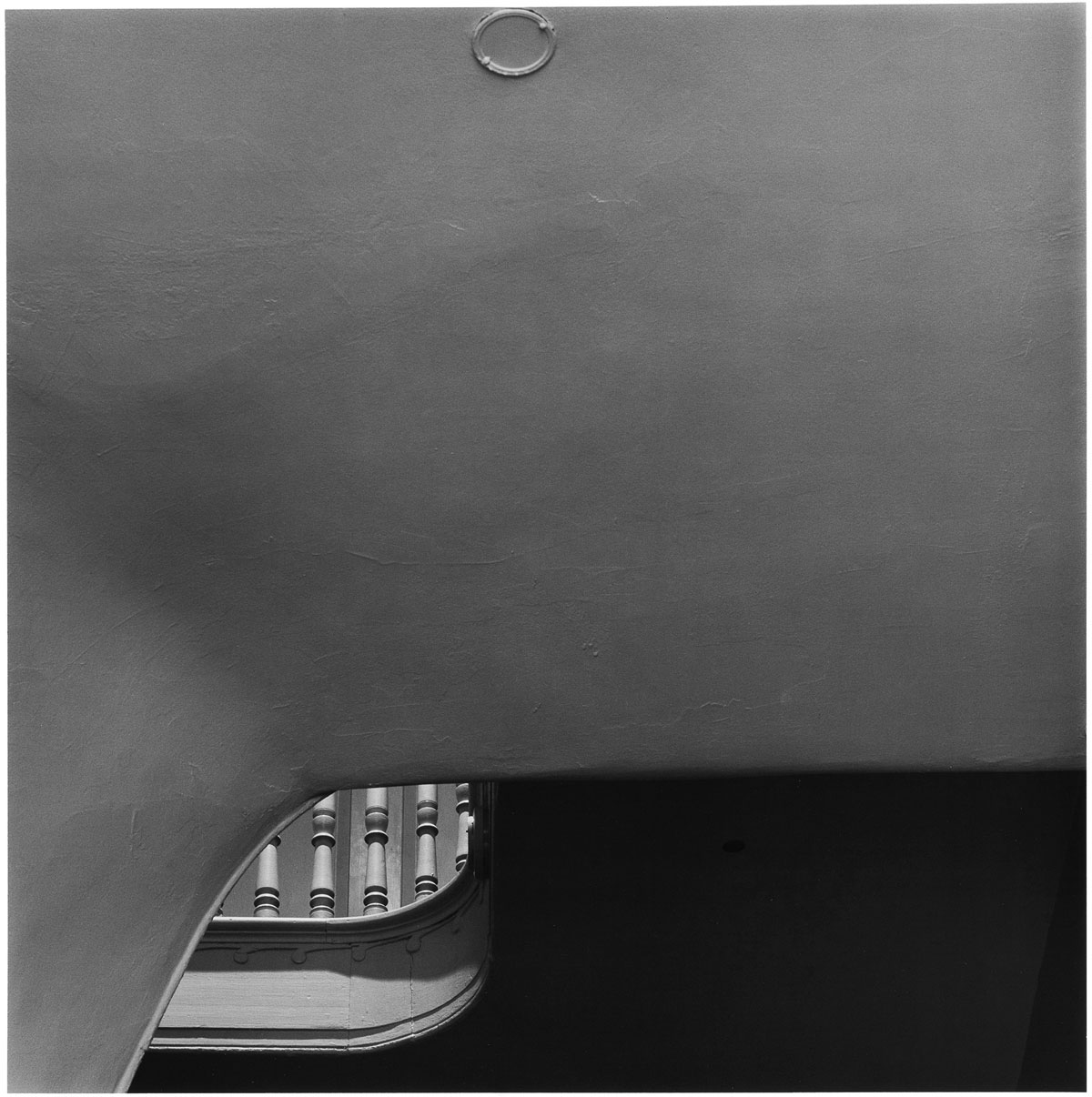
There are some rare and beautiful photographs in this posting. I have never seen the Kertész (Leger’s Studio 1926-1927) with its wonderful structure and tonality nor the unusual Mapplethorpe (Staircase, 1140 Royal 1982). I particularly like the Bellocq (Bedroom Mantel, Storyville c. 1911-1913) with its complex medley of shapes and images.

Marcus


Many thankx to The New Orleans Museum of Art for allowing me to publish the photographs in the posting. Please click on the photographs for a larger version of the image.


Lee Friedlander (American, b. 1934) 'Untitled (Self-Portrait Reflected in Window, New Orleans)' c. 1965


Lee Friedlander (American, b. 1934)
Untitled (Self-Portrait Reflected in Window, New Orleans)
c. 1965
Gelatin silver print
Image: 7 x 10 3/4 in. (17.6 x 27.2cm)
Mount: 11 x 14 in. (27.9 x 35.5cm)
The New Orleans Museum of Art
Museum purchase through the National Endowment for the Arts Grant


Robert Frank (American, 1924-2019) 'Canal Street, New Orleans' 1955


Robert Frank (American, 1924-2019)
Canal Street, New Orleans
1955
Gelatin silver print
Image: 11 x 13 4/5 in. (28 x 35.2cm)
The New Orleans Museum of Art
Museum purchase through the National Endowment for the Arts and Museum Purchase Funds


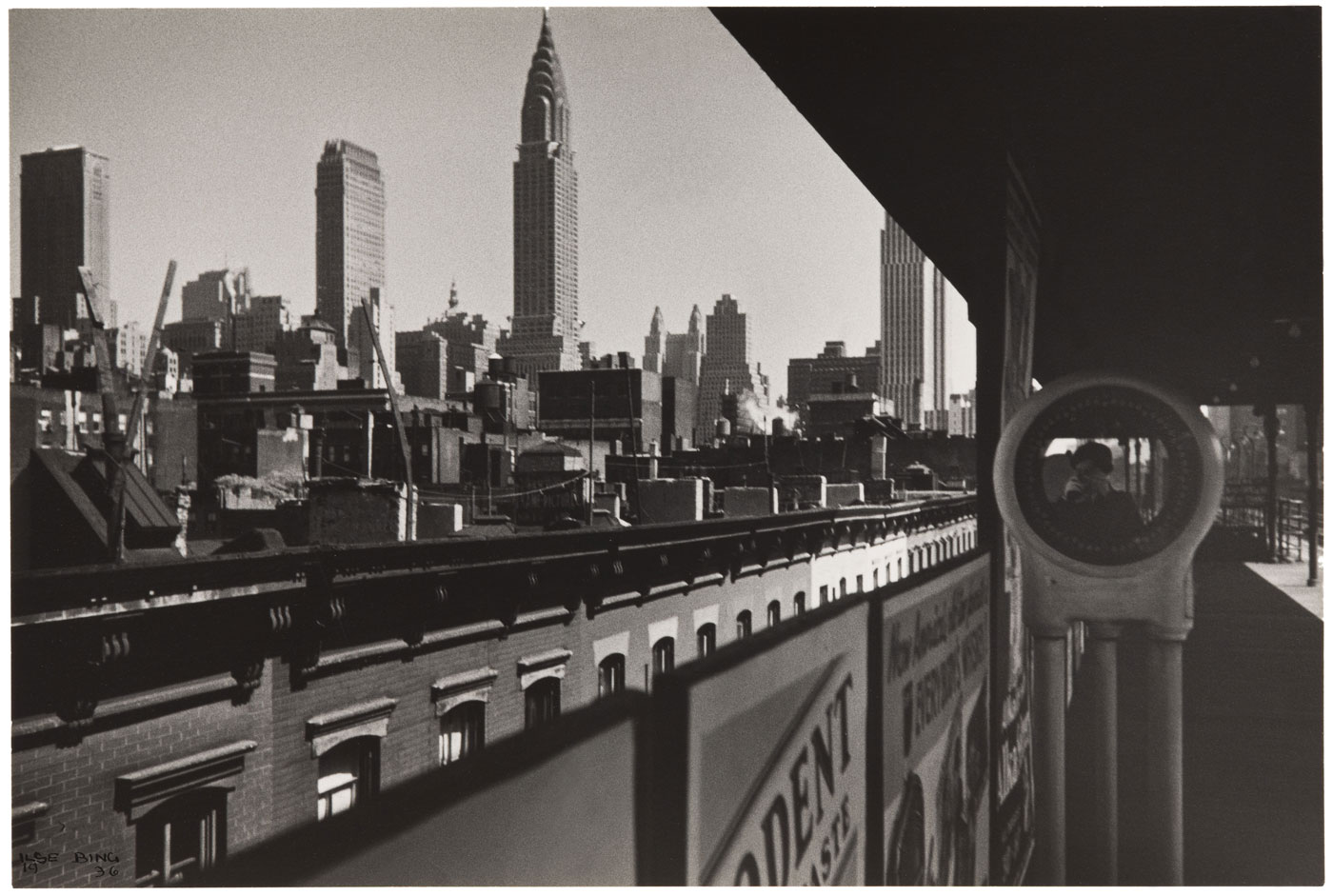
Ilse Bing (American, 1899-1998) 'New York, The Elevated and Me' 1936


Ilse Bing (American, 1899-1998)
New York, The Elevated and Me
1936
Gelatin silver print
Image: 7 15/16 x 11 in. (18.6 x 28cm)
The New Orleans Museum of Art
Museum purchase through the National Endowment for the Arts Matching Grant
© Estate of Ilse Bing


Henri Cartier-Bresson (French, 1908-2004) 'Louisiana' 1947, printed circa 1975


Henri Cartier-Bresson (French, 1908-2004)
Louisiana
1947, printed c. 1975
Gelatin silver print
Image: 9 5/8 x 14 3/16 in. (24.4 x 36cm)
Paper: 12 x 16 in. (30.3 x 40.4cm)
The New Orleans Museum of Art
Museum purchase, General Acquisition Fund


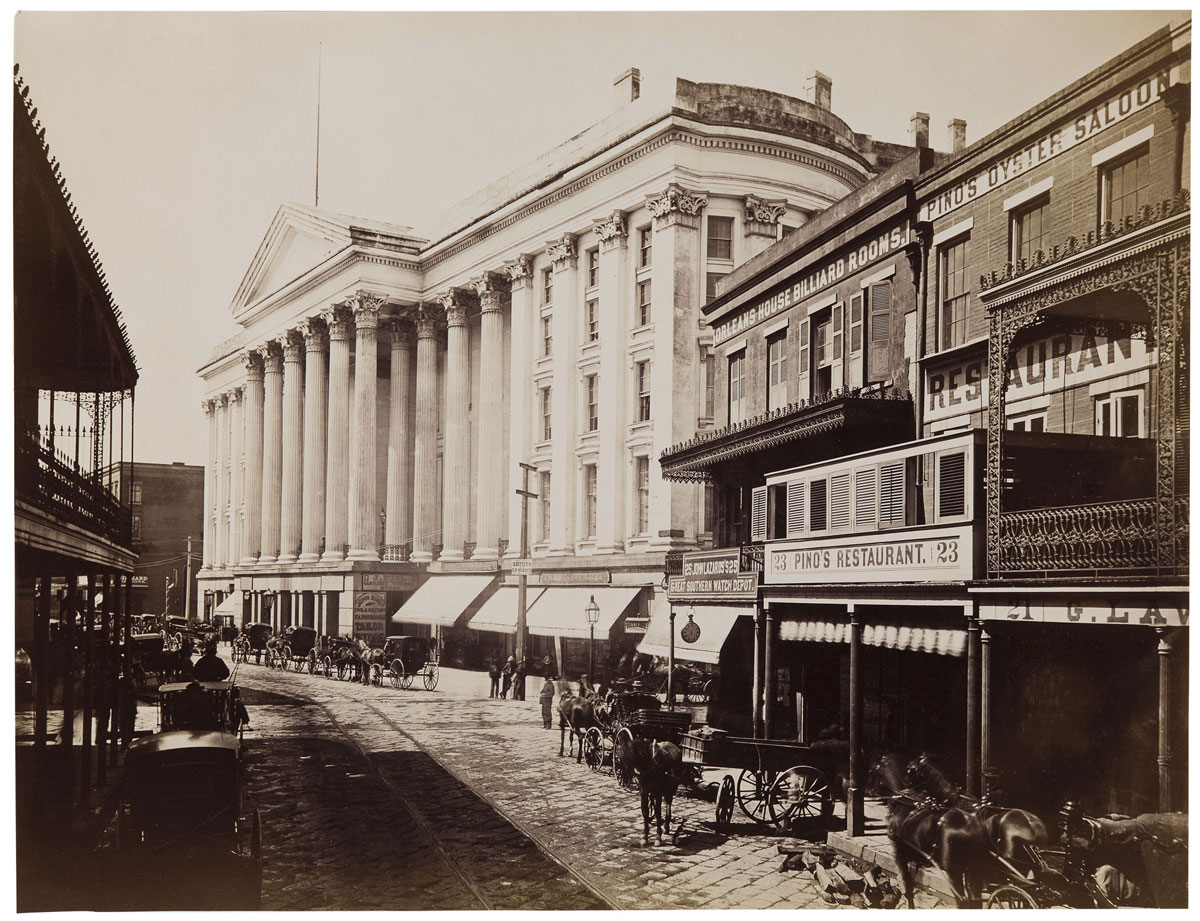
Theodore Lilienthal (American, 1829-1894) 'Charles Hotel, New Orleans' c. 1867


Theodore Lilienthal (American, 1829-1894)
Charles Hotel, New Orleans
c. 1867
Albumen print
Image: 10 3/4 x 13 13/16 in. (27.2 x 35.1cm)
Mount: 17 x 22 1/4 in. (43.3 x 56.6cm)
The New Orleans Museum of Art
Museum Purchase


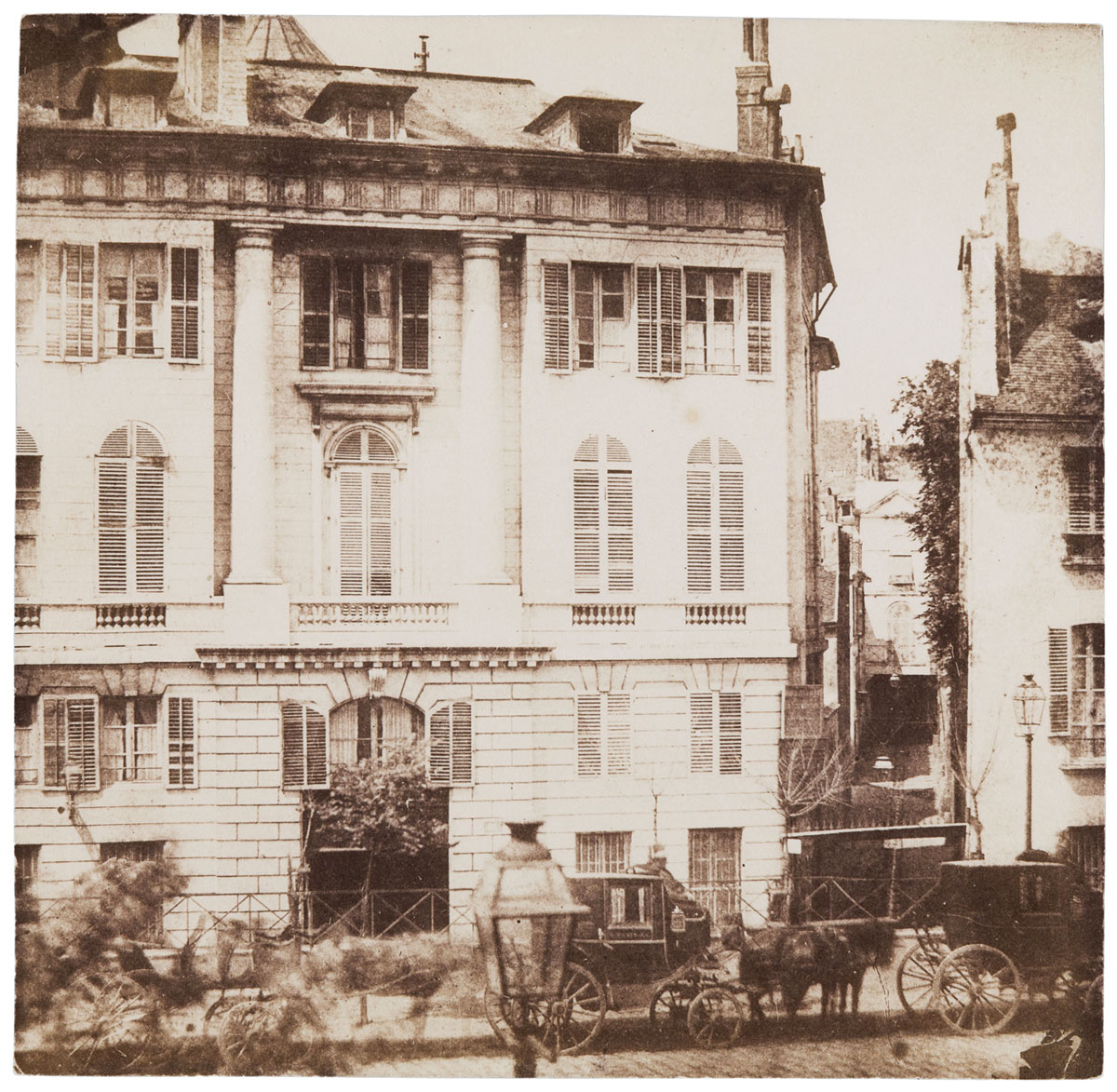
Featuring masterworks by photographers Edward Weston, William Henry Fox Talbot, André Kertész, Robert Mapplethorpe, and many more, the New Orleans Museum of Art’s upcoming exhibition, Photography at NOMA, explores the Museum’s rich permanent photography collection through a selection of some of its finest works from the early 1840s to the 1980s.

The first comprehensive presentation of works from NOMA’s collection since the 1970s, the exhibition includes over 130 of the most important photographs in the Museum’s collection and presents rare and unusual examples from throughout photography’s history. On view November 10, 2013 through January 19, 2014, the exhibition highlights the tremendous depth and breadth of the Museum’s collection and includes photographs made as works of art as well as advertising images, social documents, and more. The photographers featured in the exhibition range from some of the most recognisable names in the field, including Henri Cartier-Bresson, Robert Frank, and Lewis Hine, to unknown photographers – reflecting the vast spectrum of photographic activity since the medium’s inception in the 19th century.

“NOMA began collecting photographs seriously in the early 1970s when photography was not commonly found in American art museum collections. Today our holdings include nearly 10,000 works, representing a broad range of creative energy and achievement,” said Susan Taylor, NOMA’s Director. “Our collection has strong roots in New Orleans history. Our city has long been an epicentre for the work of established and emerging photographers and we are delighted to share this aspect of New Orleans history with our audiences.”

“Since its origins, photography has infiltrated every aspect of modern life, from art to war, and religion to politics and many of these applications are represented in NOMA’s extensive collection,” said Russell Lord, Freeman Family Curator of Photographs. “Despite the collection’s long history, it remains one of the best kept secrets in this country. Photography at NOMA is an opportunity to re-examine and bring to the fore the diverse range of works found in the collection.”

Since the 1970s, NOMA has built an extensive collection of photographs that represents a wide range of achievement in that medium from the 1840s to the present. Today the collection comprises nearly 10,000 works with images by some of the most significant photographic artists including Berenice Abbott, Ansel Adams, Diane Arbus, Ilse Bing, and Edward Steichen, among many others. The collection includes examples that reflect photography’s international scope, from an 1843 view from his hotel window in Paris by William Henry Fox Talbot to a view of Mount Fuji by Kusakabi Kimbei, but it is also strong in photographs made in and around New Orleans by regional and national photographers such as E. J. Bellocq, Walker Evans, Clarence John Laughlin, and Robert Polidori.

Photography at NOMA features works by Berenice Abbott, Ansel Adams, Diane Arbus, Henri Cartier-Bresson, Walker Evans, Robert Frank, Robert Mapplethorpe, William Henry Fox Talbot, and Edward Weston, among many others.

Press release from the NOMA website


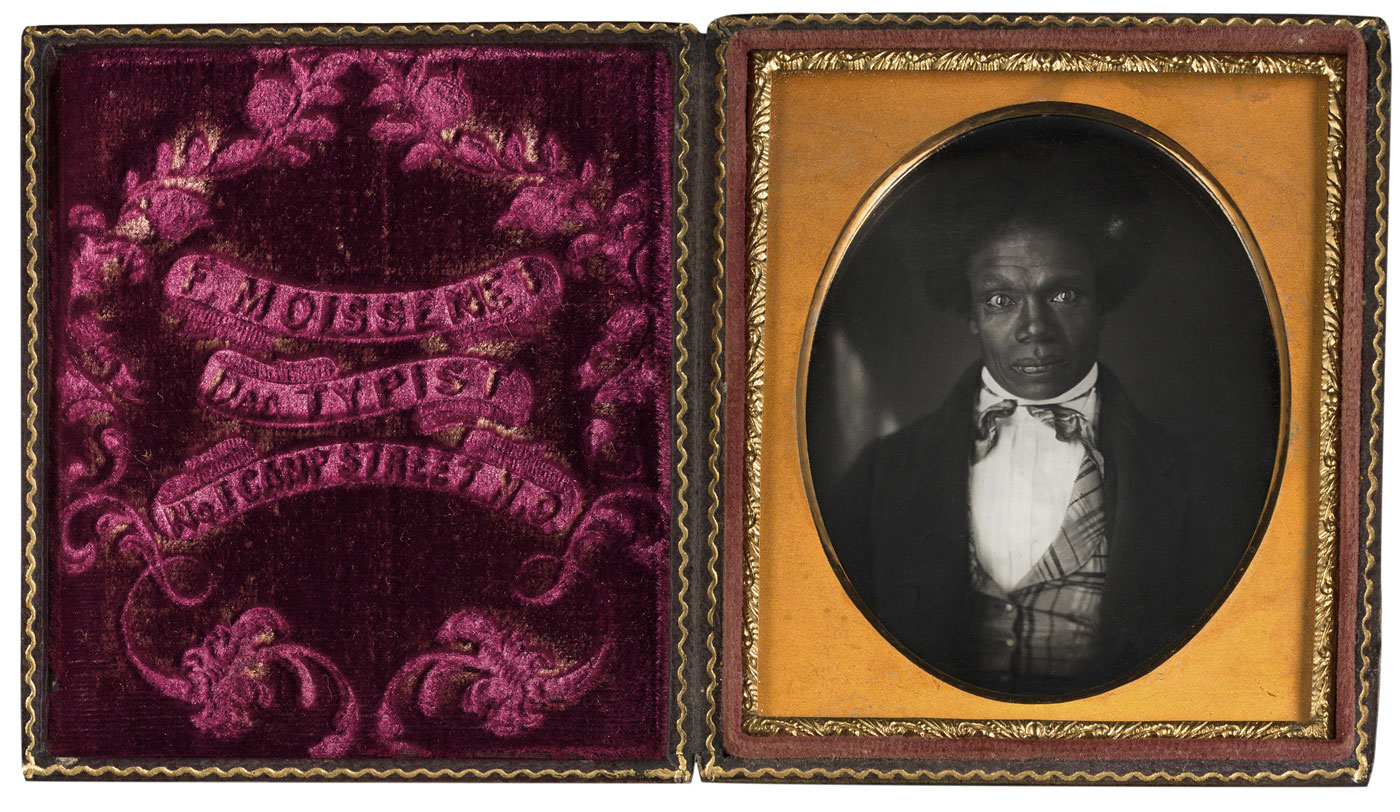
Felix Moissenet (American, b. circa 1814) 'Freeman' c. 1855


Felix Moissenet (American, b. circa 1814)
Freeman
c. 1855
Sixth plate daguerreotype
Image: 3 1/4 x 2 3/4 in. (8 x 6.8cm)
Case (open): 3 5/8 x 6 3/8 in. (9.2 x 16.1cm)
The New Orleans Museum of Art
Museum purchase


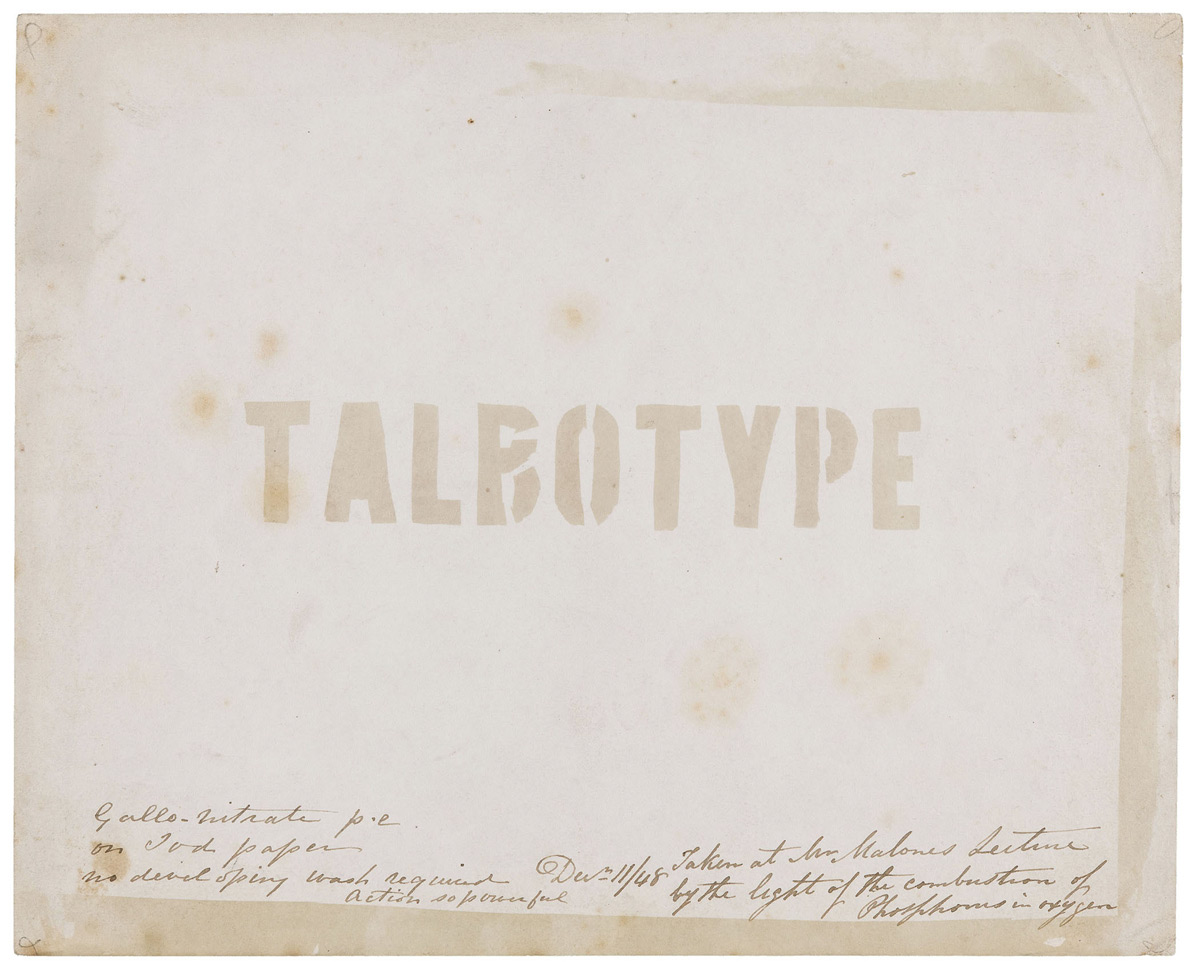
Thomas Augustine Malone (British, 1823-1867) 'Demonstration of the Talbotype' December 11, 1848


Thomas Augustine Malone (British, 1823-1867)
Demonstration of the Talbotype
December 11, 1848
Calotype (Talbotype) negative
7 3/8 x 9 2/16 in. (18.8 x 23.3cm)
The New Orleans Museum of Art
Museum purchase


Robert Mapplethorpe (American, 1946-1989) 'Staircase, 1140 Royal' 1982


Robert Mapplethorpe (American, 1946-1989)
Staircase, 1140 Royal
1982
Gelatin silver print
Image: 15 1/5 x 15 1/5 in. (38.5 x 38.5cm)
Paper: 20 x 16 in. (50.6 x 40.4cm)
The New Orleans Museum of Art
Promised gift from H. Russell Albright, MD


William Henry Fox Talbot (British, 1800-1877) 'View of the Paris Boulevards from the First Floor of the Hôtel de Louvais, Rue de la Paix' 1843


William Henry Fox Talbot (British, 1800-1877)
View of the Paris Boulevards from the First Floor of the Hôtel de Louvais, Rue de la Paix
1843
Salted paper print from a paper negative
Image: 6 3/8 x 6 3/4 in. (16.2 x 17.1cm)
Paper: 7 1/2x 9 in. (19 x 23cm)
The New Orleans Museum of Art
Museum purchase, 1977 Acquisition Fund Drive


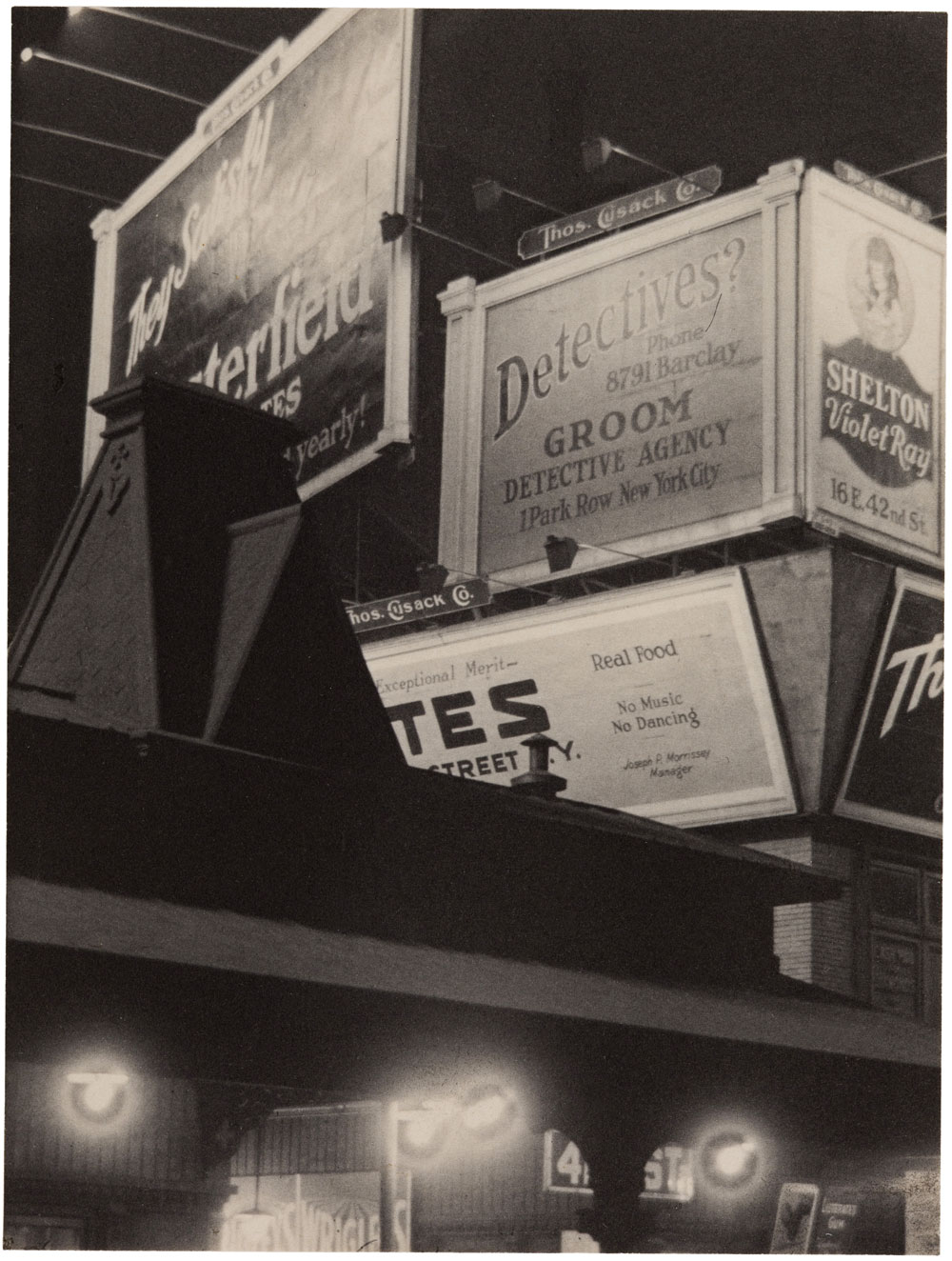
Paul Outerbridge (American, 1896-1958) 'Groom Detective Agency' 1923


Paul Outerbridge (American, 1896-1958)
Groom Detective Agency
1923
Platinum print
Image: 4 1/2 x 3 1/2 in. (11.5 x 9cm)
Paper: 14 x 11 in. (35.5 x 28cm)
Paul Outerbridge, Jr.
© 2013 G. Ray Hawkins Gallery, Beverly Hills, CA


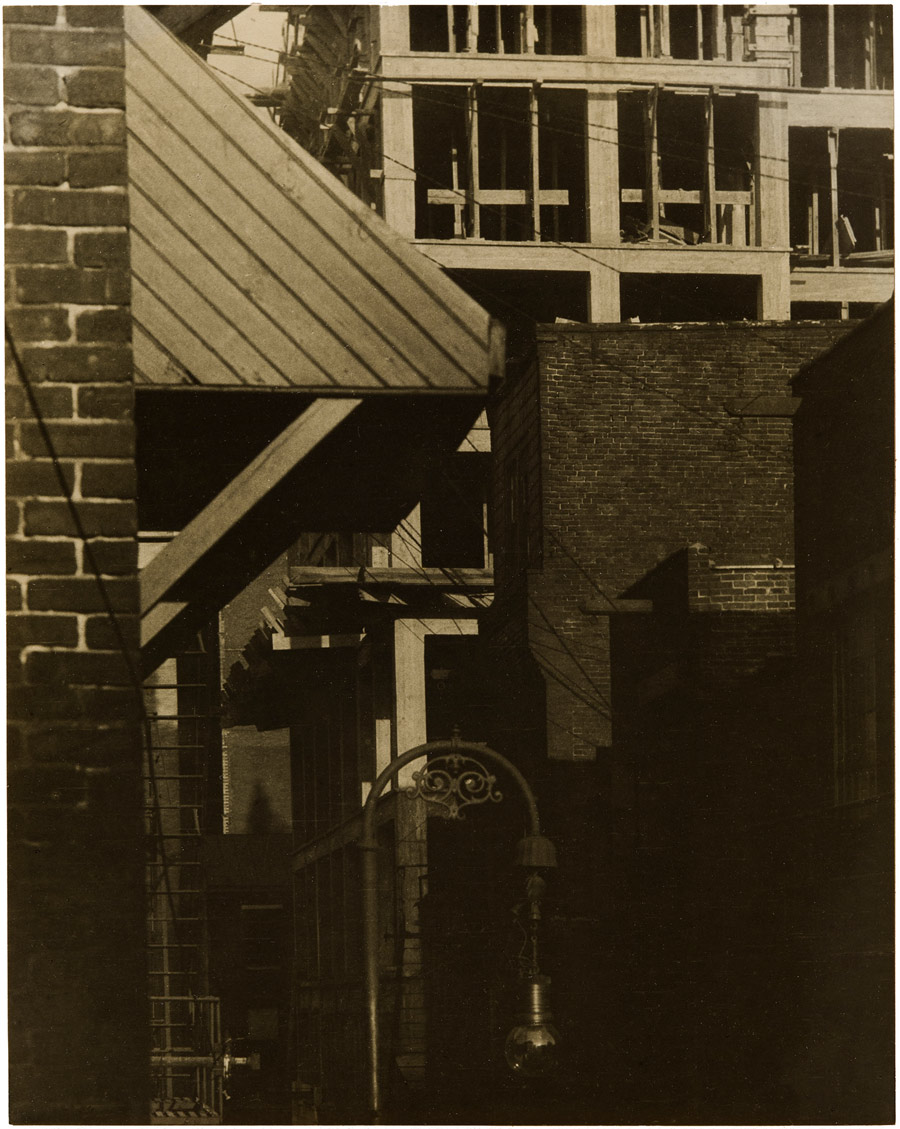
Morton Schamberg (American, 1881-1918) 'Cityscape' 1916


Morton Schamberg (American, 1881-1918)
Cityscape
1916
Gelatin silver print
Image: 9 1/2 x 7 1/2 in. (24 x 19cm)
Mount: 15 3/4 x 13 in. (40 x 33cm)
The New Orleans Museum of Art
Museum purchase, Women’s Volunteer Committee Fund


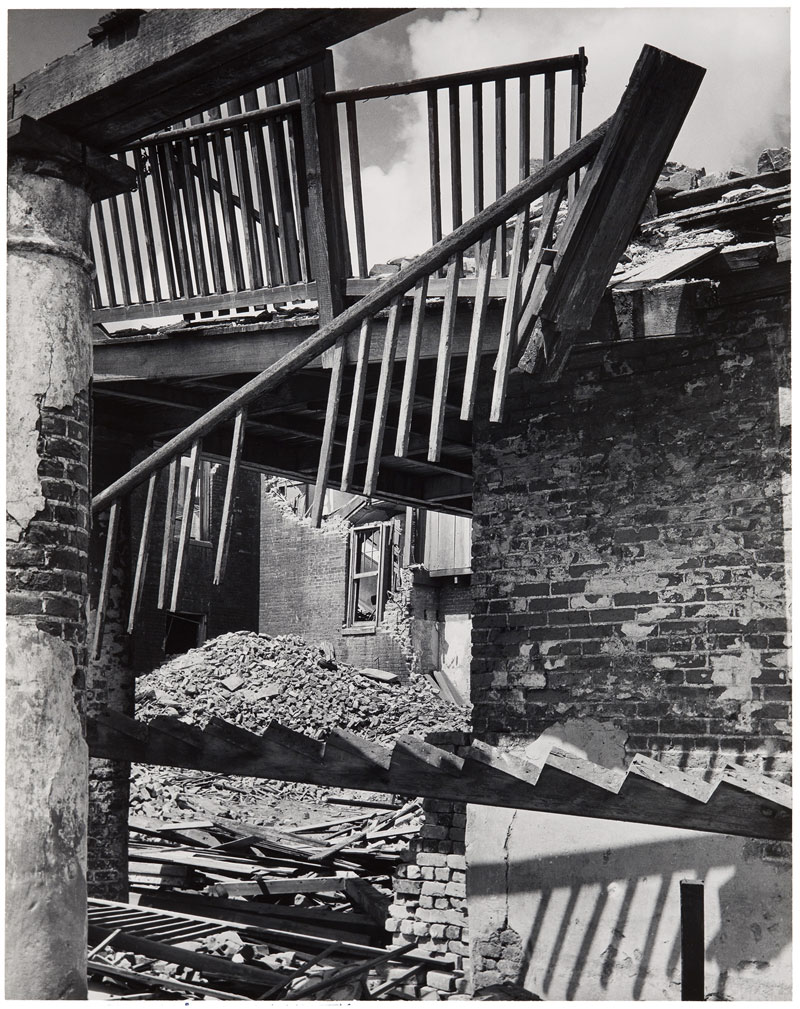
Clarence John Laughlin (American, 1905-1985) 'A Mangled Staircase (No. 2)' 1949


Clarence John Laughlin (American, 1905-1985)
A Mangled Staircase (No. 2)
1949
Gelatin silver print
Image: 13 1/2 x 10 13/16 in. (34.2 x 27.5cm)
Mount: 17 x 14 in. (43 x 35.5cm)
The New Orleans Museum of Art
Bequest of Clarence John Laughlin


E. J. Bellocq (American, 1873-1949) 'Bedroom Mantel, Storyville' c. 1911-1913


E. J. Bellocq (American, 1873-1949)
Bedroom Mantel, Storyville
c. 1911-1913
Glass negative
Plate: 10 x 8 in. (25.2 20.2cm)
Museum purchase


Lewis Hine (American, 1874-1940) '[Mechanic and Steam Pump]' c. 1930


Lewis Hine (American, 1874-1940)
[Mechanic and Steam Pump]
c. 1930
Gelatin silver print
Image: 9 1/2 x 7 in. (24.3 x 17.6cm)
Paper: 10 x 8 in. (25.2 x 20.3cm)
The New Orleans Museum of Art
Museum Purchase


The New Orleans Museum of Art
One Collins Diboll Circle, City Park
New Orleans, LA 70124
Phone: (504) 658-4100

Opening hours:
Tuesday – Sunday: 10am – 5pm
Closed Mondays

The New Orleans Museum of Art website

LIKE ART BLART ON FACEBOOK

Back to top

Exhibition: ‘Gordon Parks: The Making of an Argument’ at The New Orleans Museum of Art

Exhibition dates: 12th September 2013 – 12th January 2014


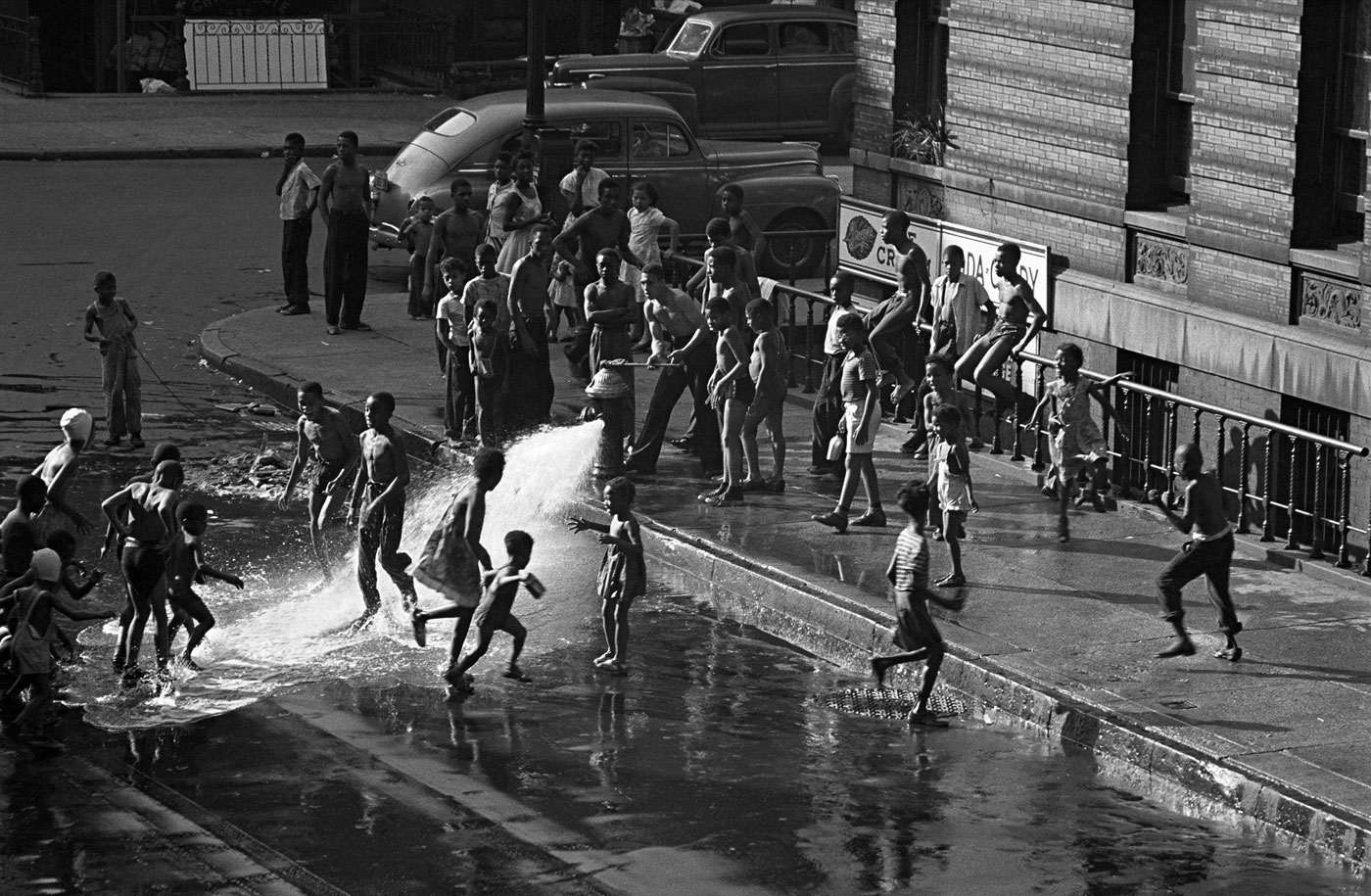
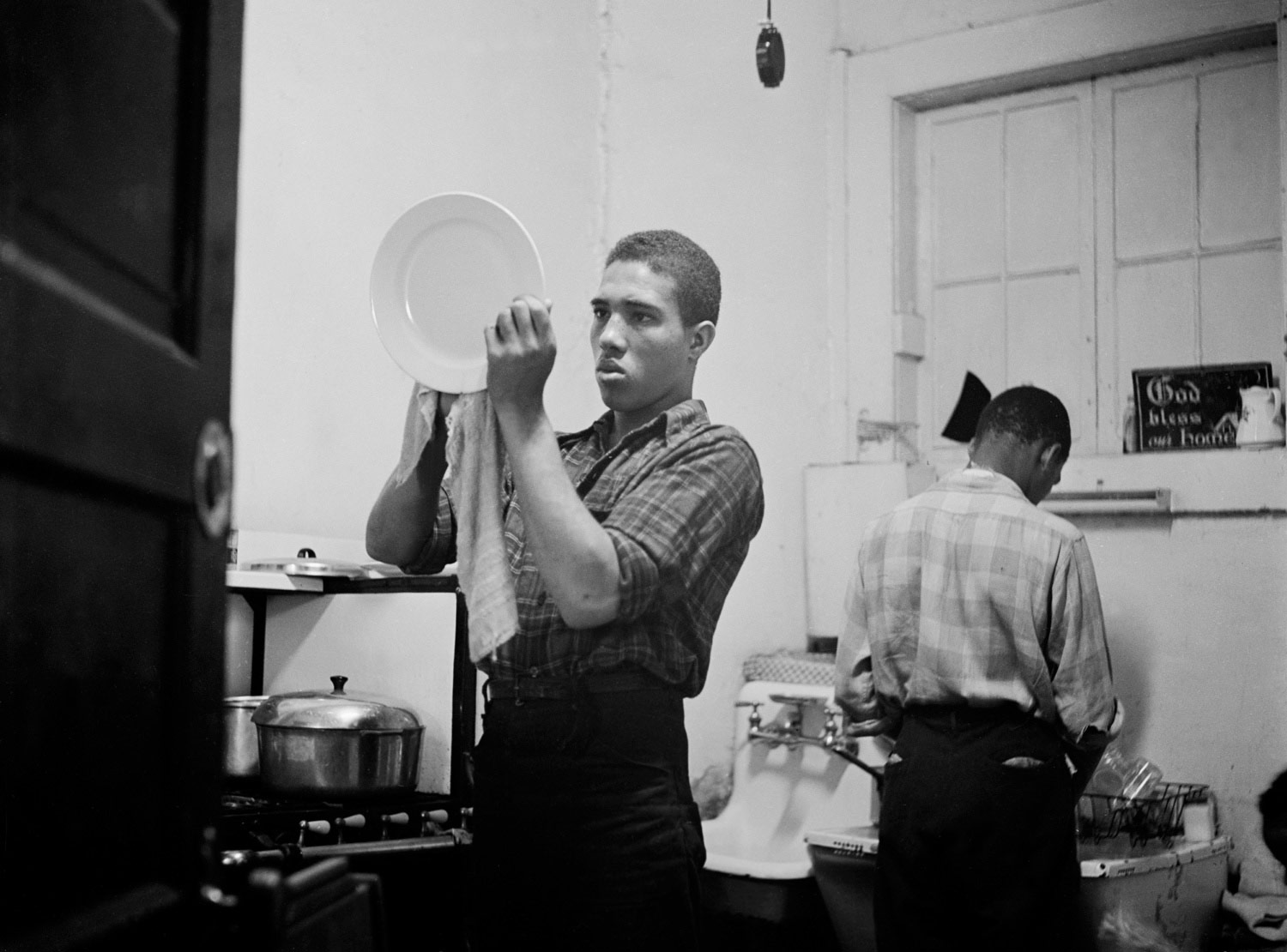
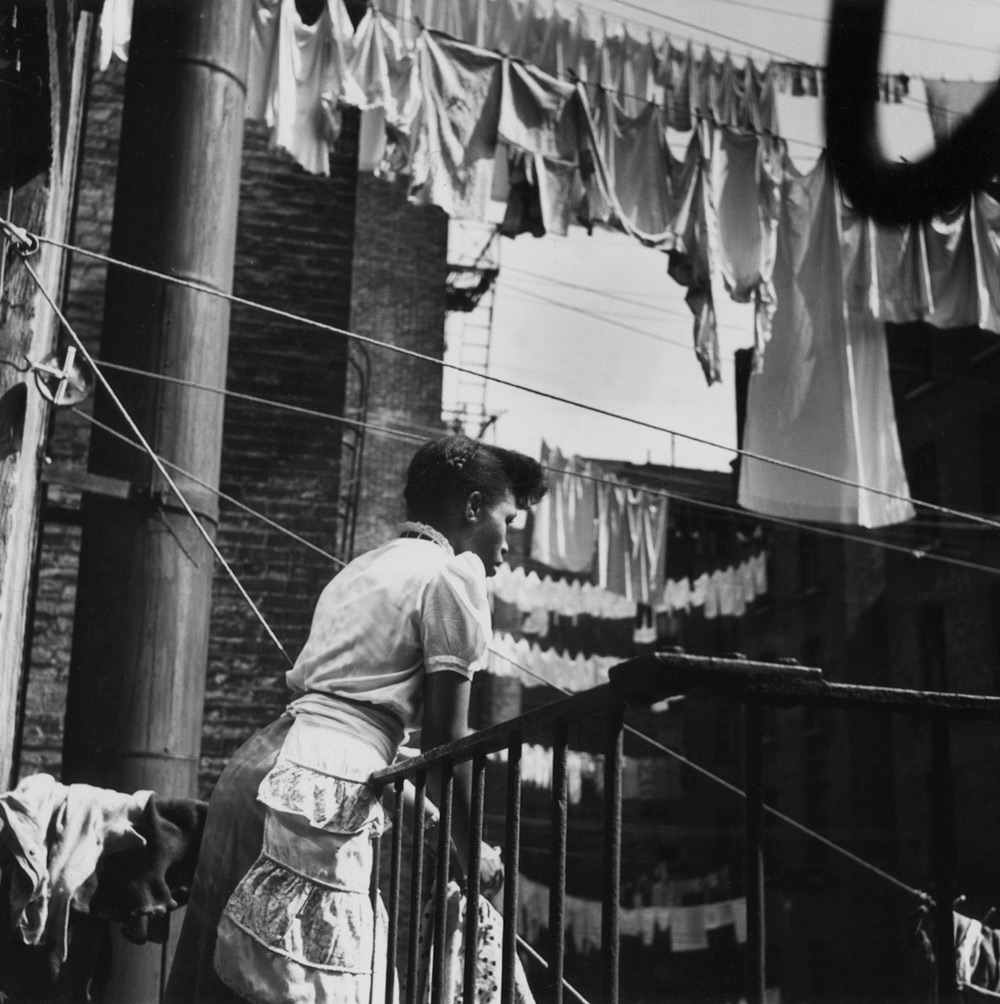
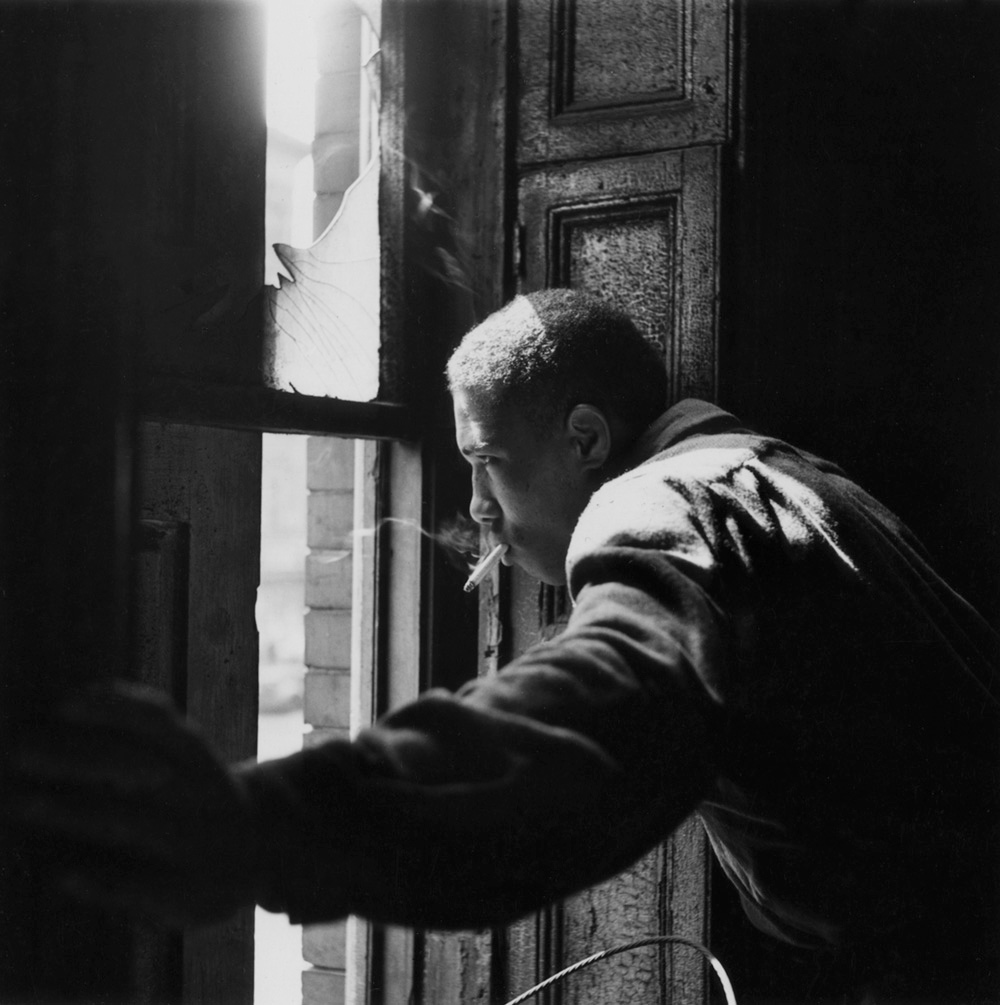
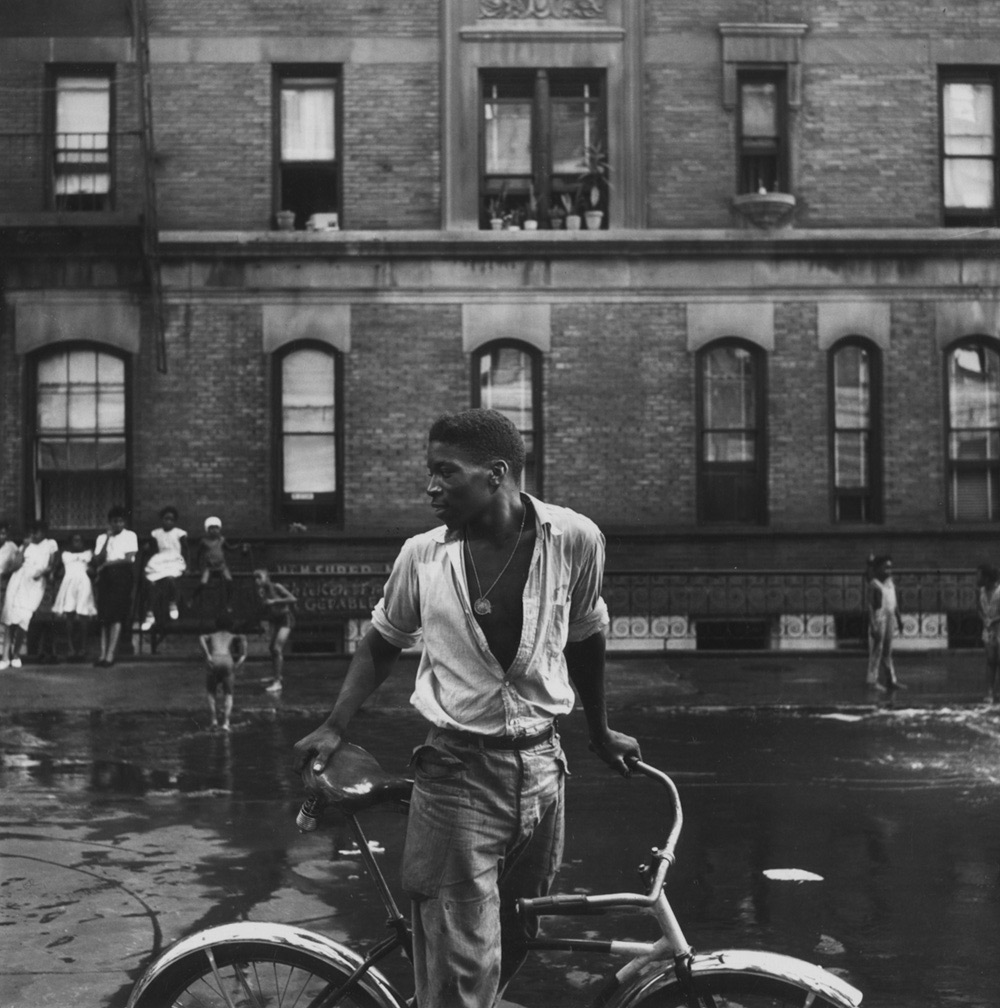
Gordon Parks (American, 1912-2006) 'Untitled, Harlem, New York' 1948


Gordon Parks (American, 1912-2006)
Untitled, Harlem, New York
1948
Gelatin silver print, printed later
Courtesy The Gordon Parks Foundation


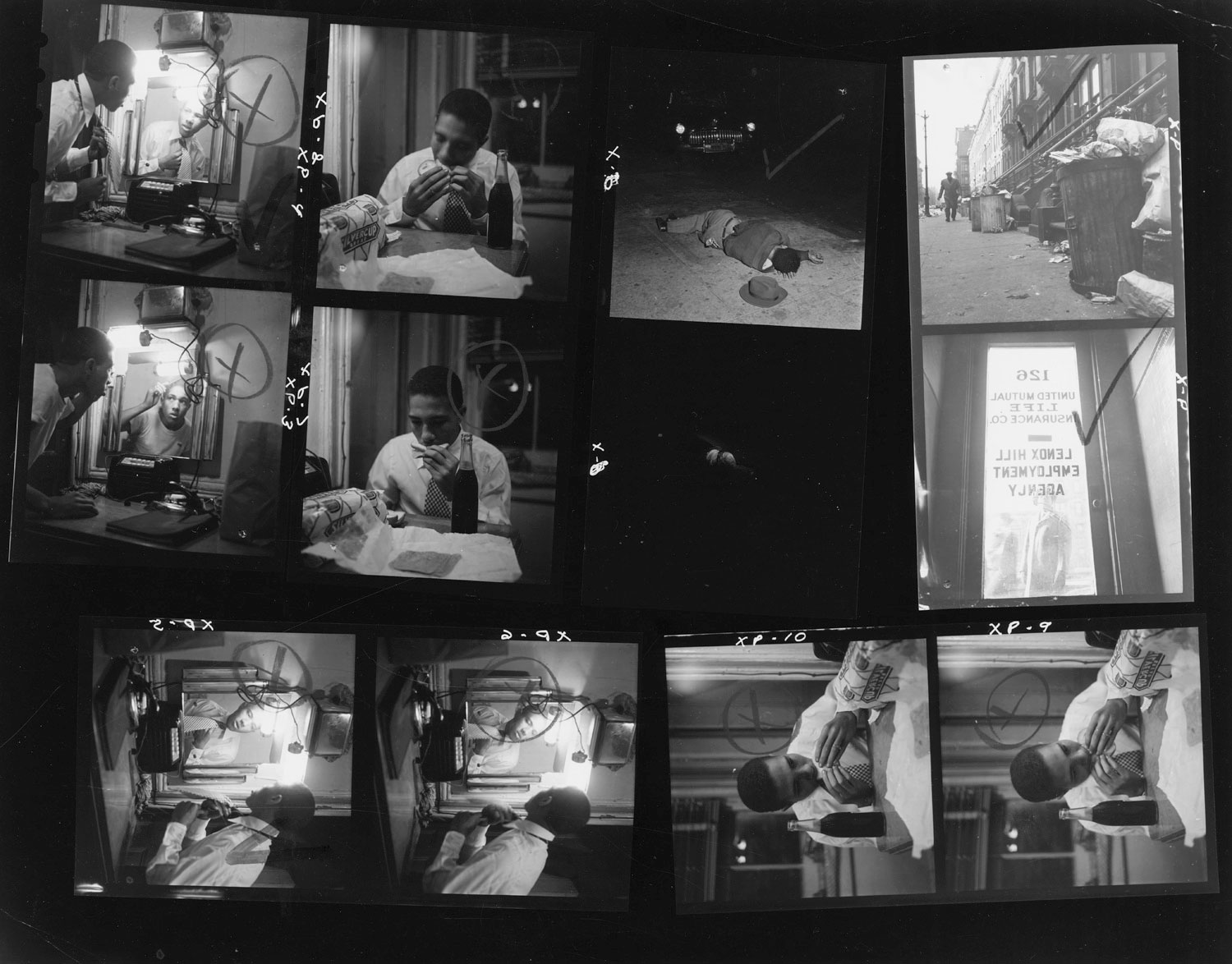
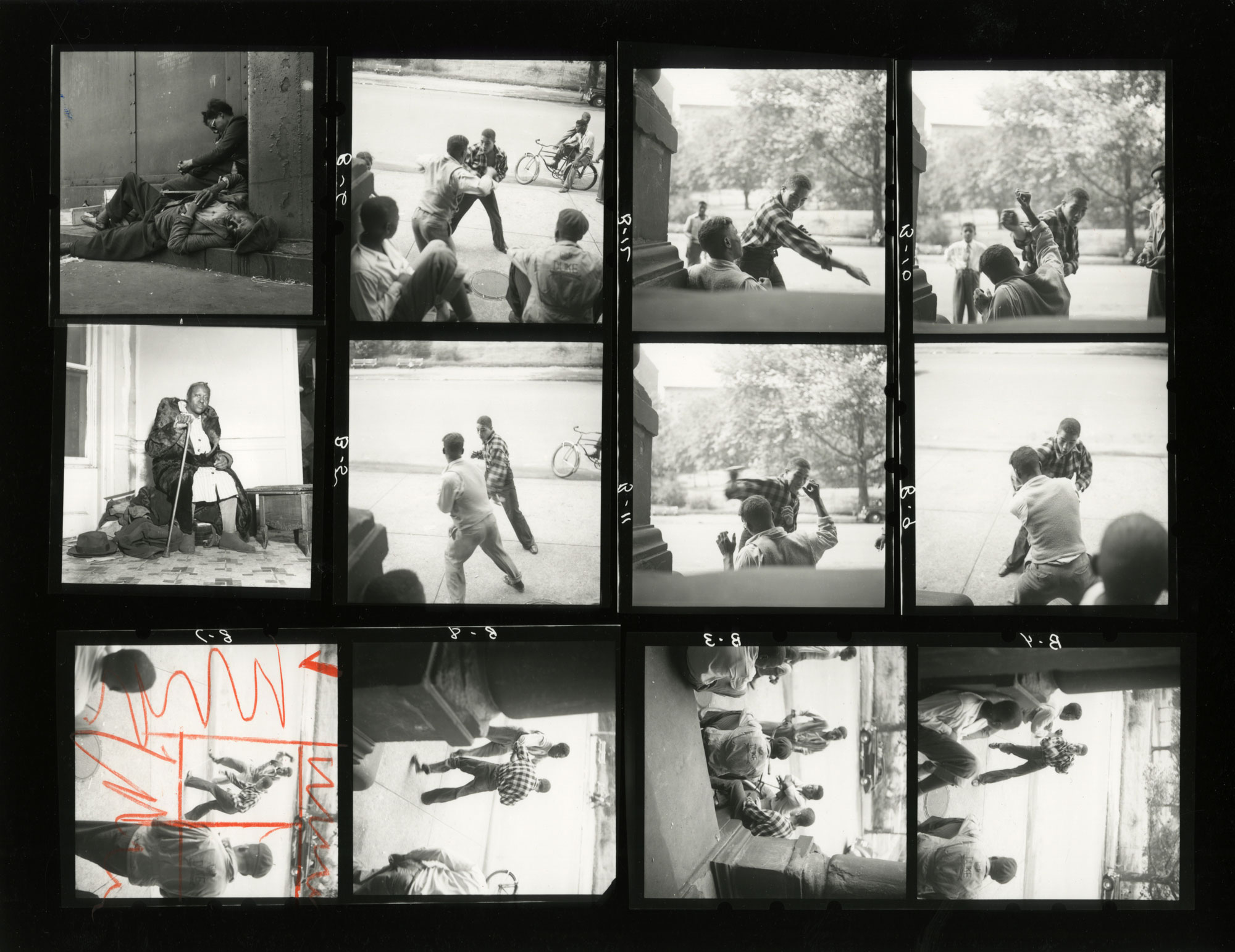
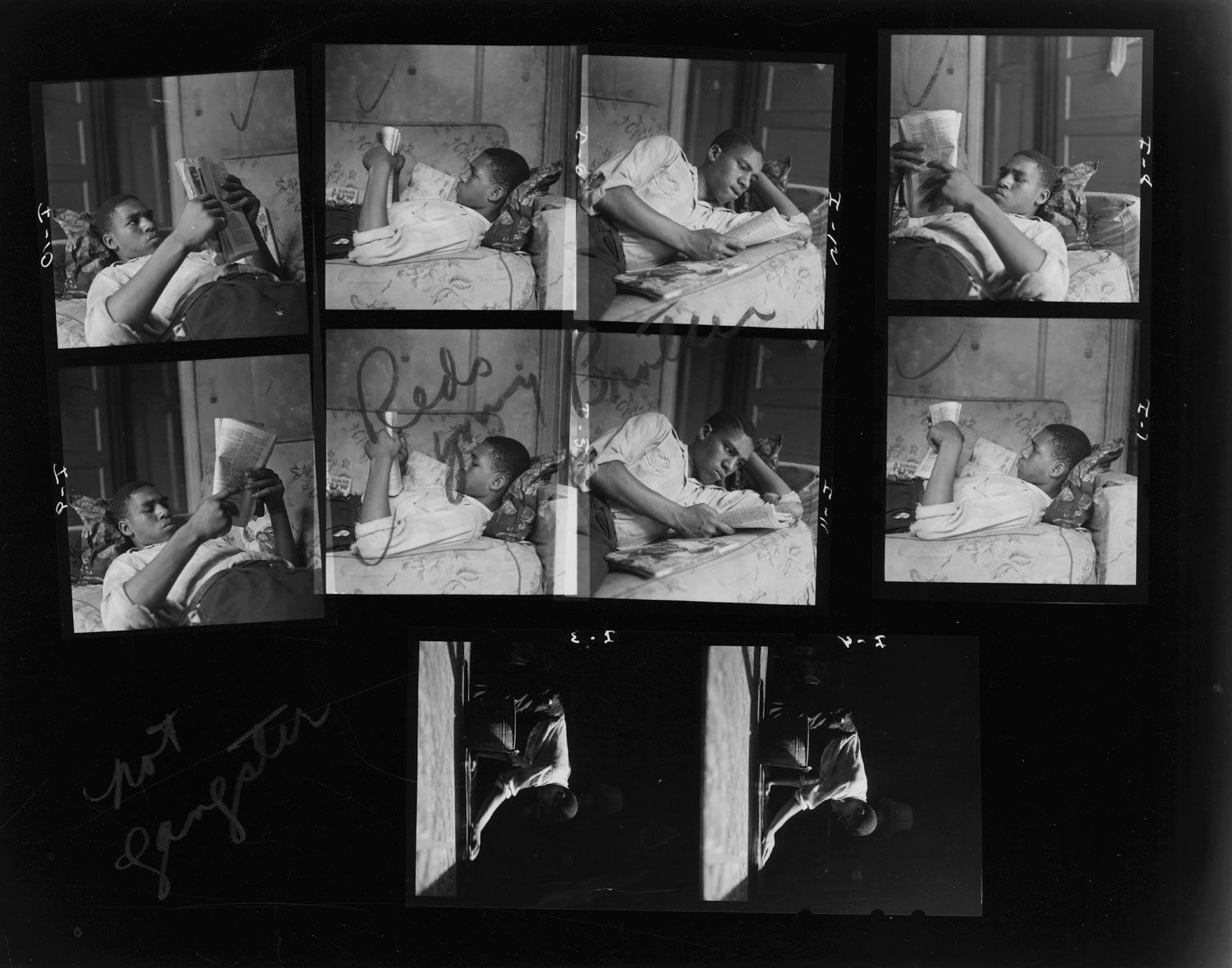
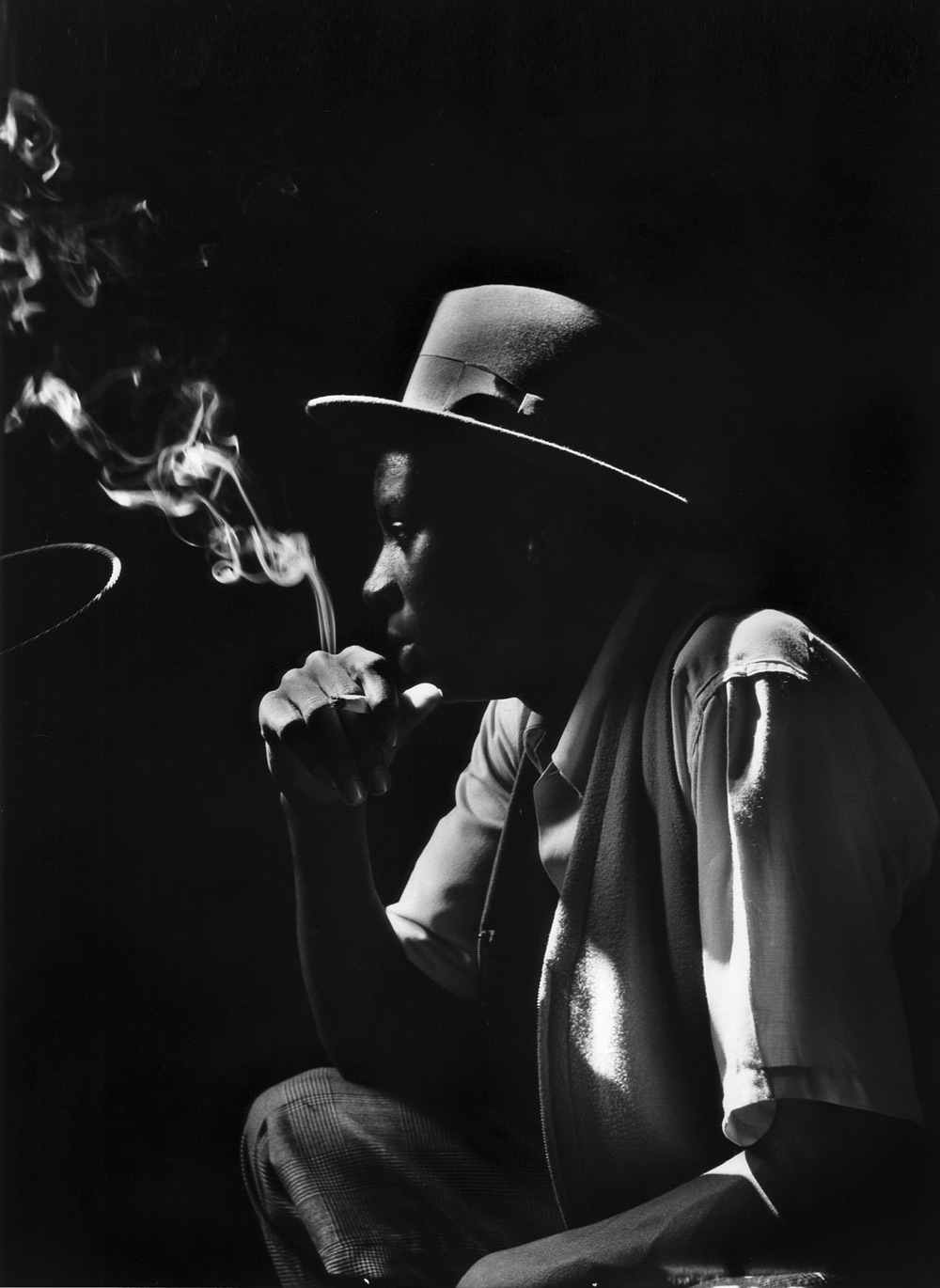
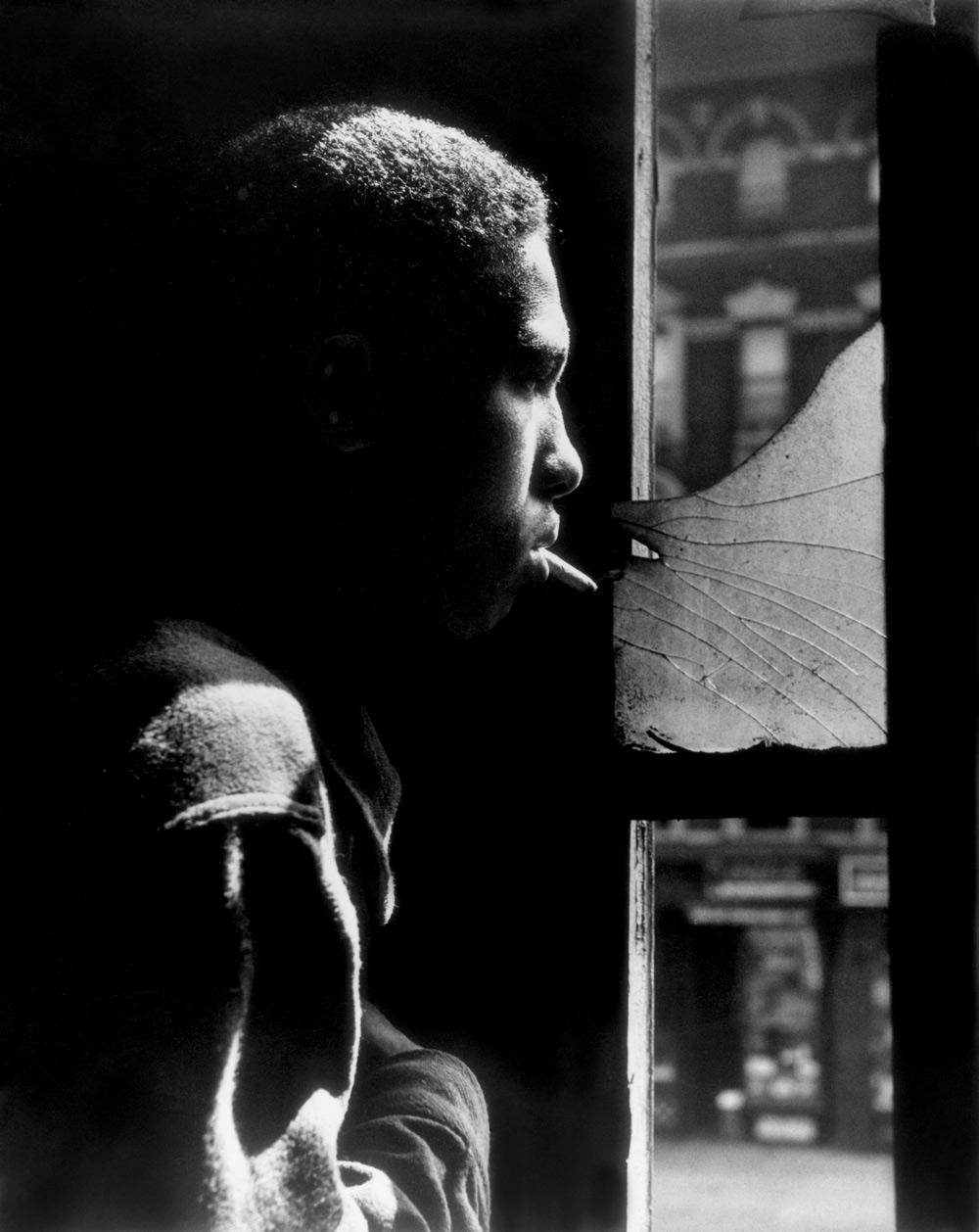
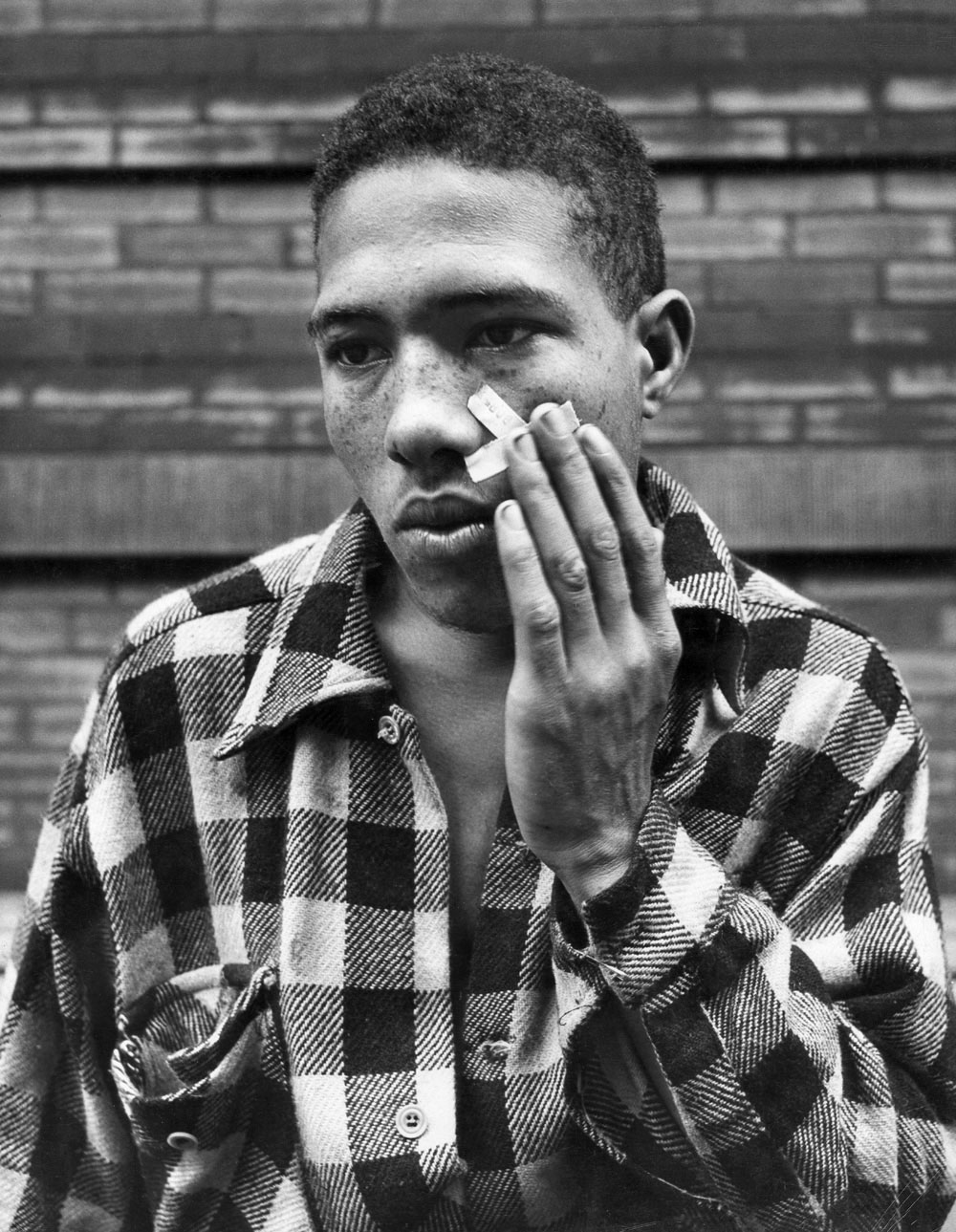
Another great photographer with a social conscience. Fantastic to observe the dynamics of the proof sheets and how the images were cropped for final publication. The angles, the angles of Red’s young brother are illuminating, to see how the photographer framed his subject, what worked, what didn’t. There is a relatively new boxed set of the complete works of this artist published by Stiedl titled Gordon Parks Collected Works (2012).

Dr Marcus Bunyan


Many thankx to The New Orleans Museum of Art for allowing me to publish the photographs in the posting. Please click on the photographs for a larger version of the image.


“”The Making of an Argument” evaluates the editorial decisions made by the magazine and, in doing so, comments on how the context in which a picture is presented can drastically alter its message. “In order to meet the expectations set up by the subtitle and the opening text, an overwhelming majority of the pictures selected underscore violence, fear, frustration, aggression, or despair. Of the twenty-one images reproduced, only five strike a lighter note,” writes Russell Lord, the curator of photographs at NOMA. Lord also notes that the ways the images were cropped and darkened further functioned to convey the magazine’s intended message.”

Genevieve Fussell. “Gordon Parks: The Making of an Argument,” on The New Yorker website October 28, 2013 [Online] Cited 19/01/2021


Gordon Parks (American, 1912-2006) 'Untitled, Harlem, New York' 1948


Gordon Parks (American, 1912-2006)
Untitled, Harlem, New York
1948
Gelatin silver print, printed later
Courtesy The Gordon Parks Foundation


Gordon Parks (American, 1912-2006) 'Untitled, Harlem, New York' 1948


Gordon Parks (American, 1912-2006)
Untitled, Harlem, New York
1948
Gelatin silver print, printed later
Courtesy The Gordon Parks Foundation


Gordon Parks (American, 1912-2006) 'Untitled, Harlem, New York' 1948


Gordon Parks (American, 1912-2006)
Untitled, Harlem, New York
1948
Gelatin silver print, printed later
Courtesy The Gordon Parks Foundation


Gordon Parks (American, 1912-2006) 'Untitled, Harlem, New York' 1948


Gordon Parks (American, 1912-2006)
Untitled, Harlem, New York
1948
Gelatin silver print, printed later
Courtesy The Gordon Parks Foundation


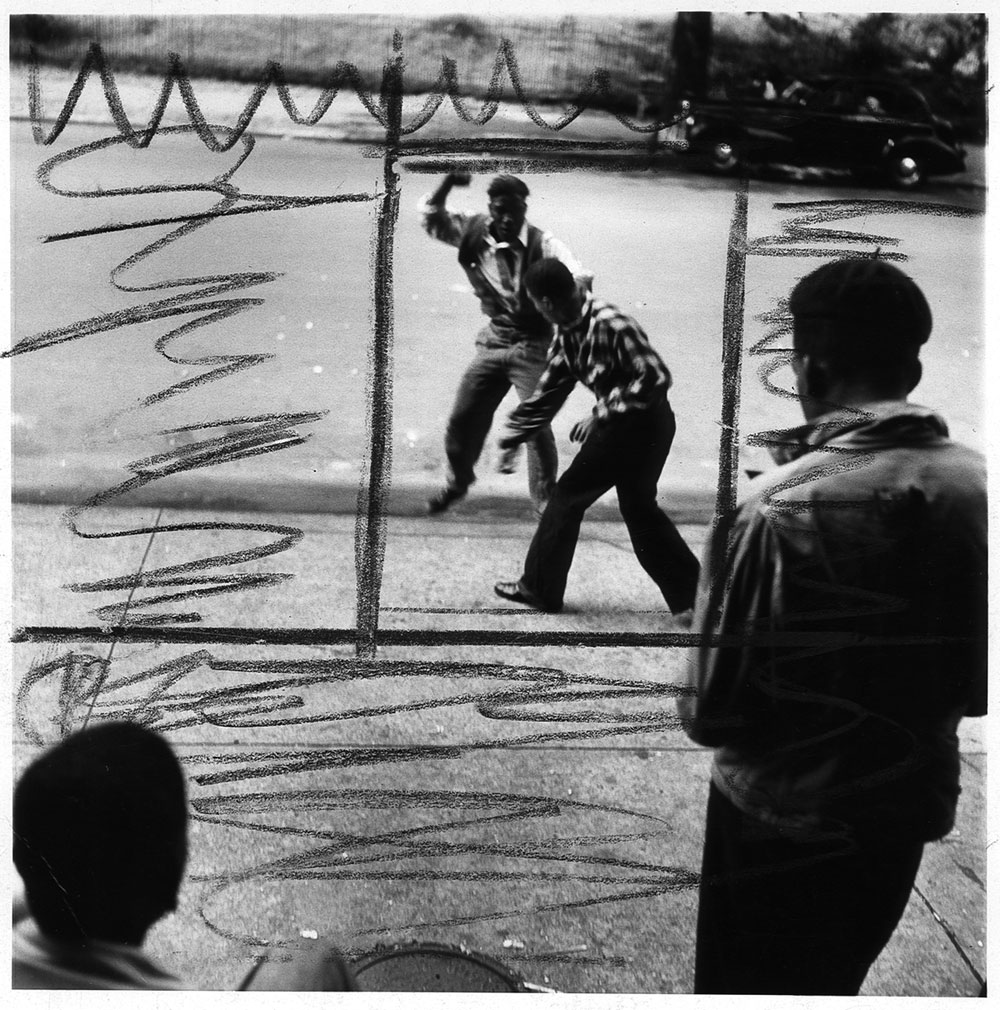
This image shows both the full frame image that Gordon Parks shot and the cropped selection, framed in editor’s marking pen, that was ultimately published in Life magazine. The cropped version dramatically heightens the intensity of the image, bringing the viewer closer to the fight (see proof sheet below).


Gordon Parks (American, 1912-2006) 'Untitled, Harlem, New York' 1948


Gordon Parks (American, 1912-2006)
Untitled, Harlem, New York
1948
Gelatin silver print, printed later
Courtesy The Gordon Parks Foundation


Gordon Parks (American, 1912-2006) 'Untitled, Harlem, New York' 1948


Gordon Parks (American, 1912-2006)
Untitled, Harlem, New York
1948
Gelatin silver print, printed later
Courtesy The Gordon Parks Foundation


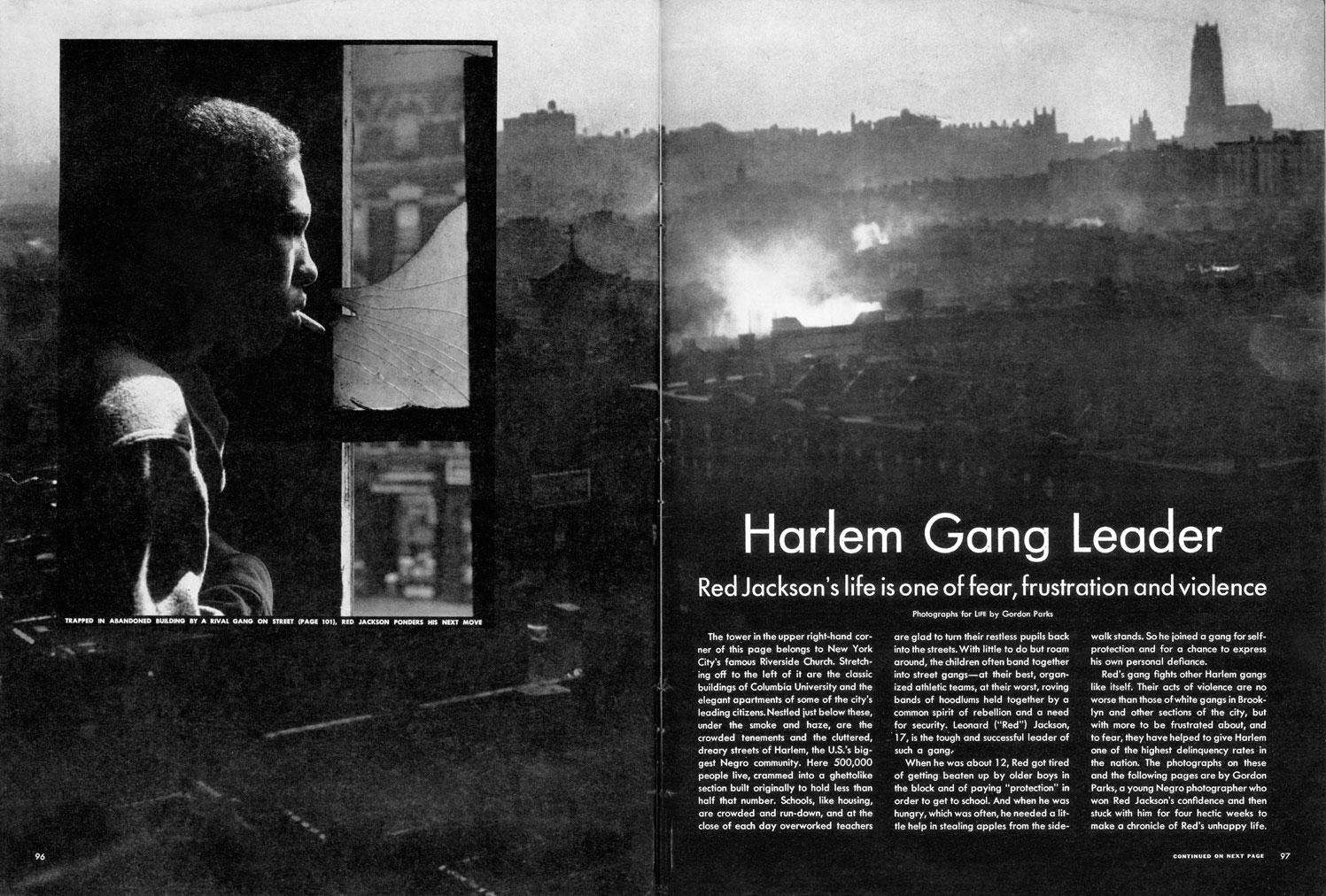
The opening spread of "Harlem Gang Leader," Life, November 1, 1948


The opening spread of “Harlem Gang Leader,” Life, November 1, 1948


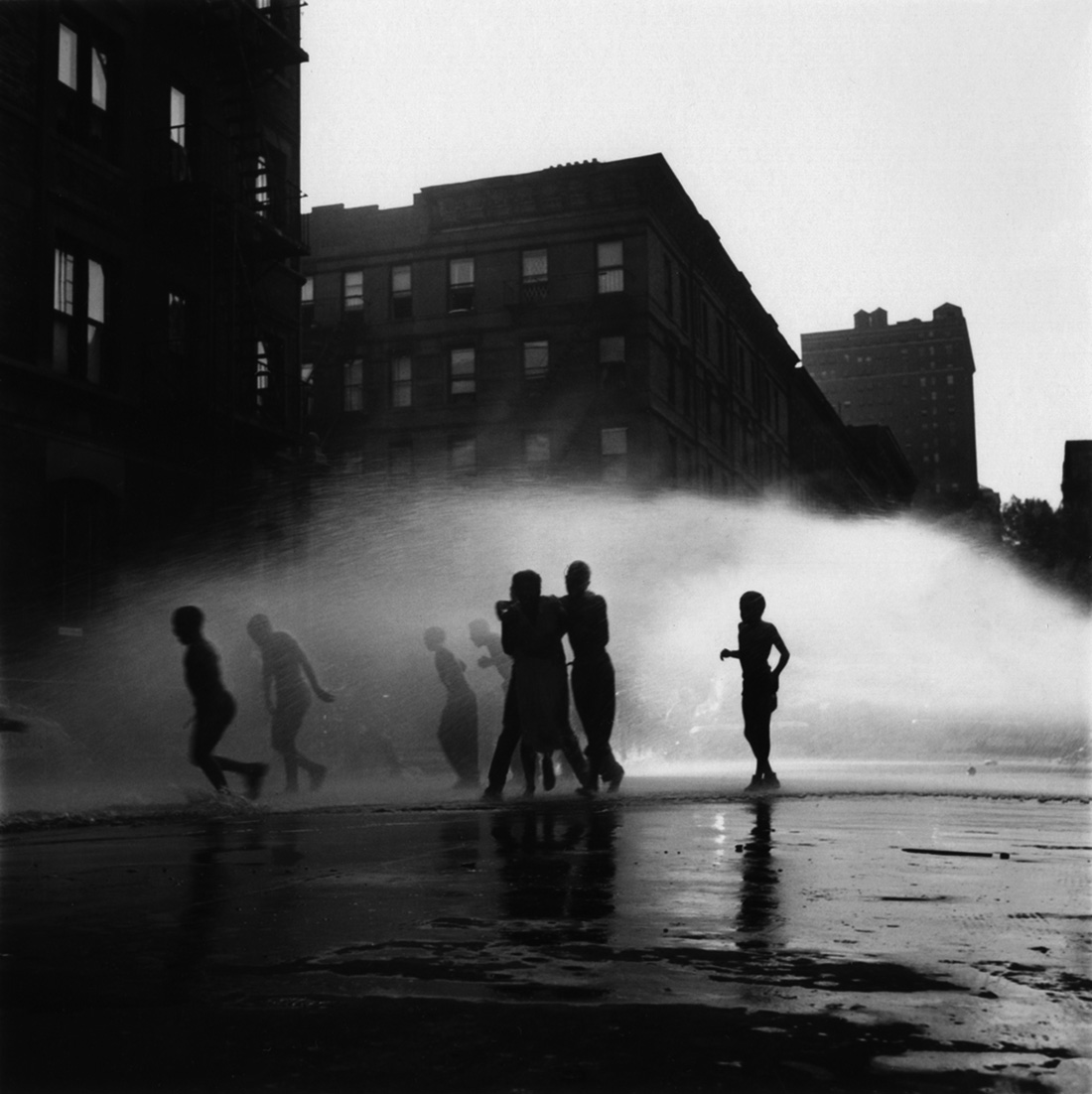
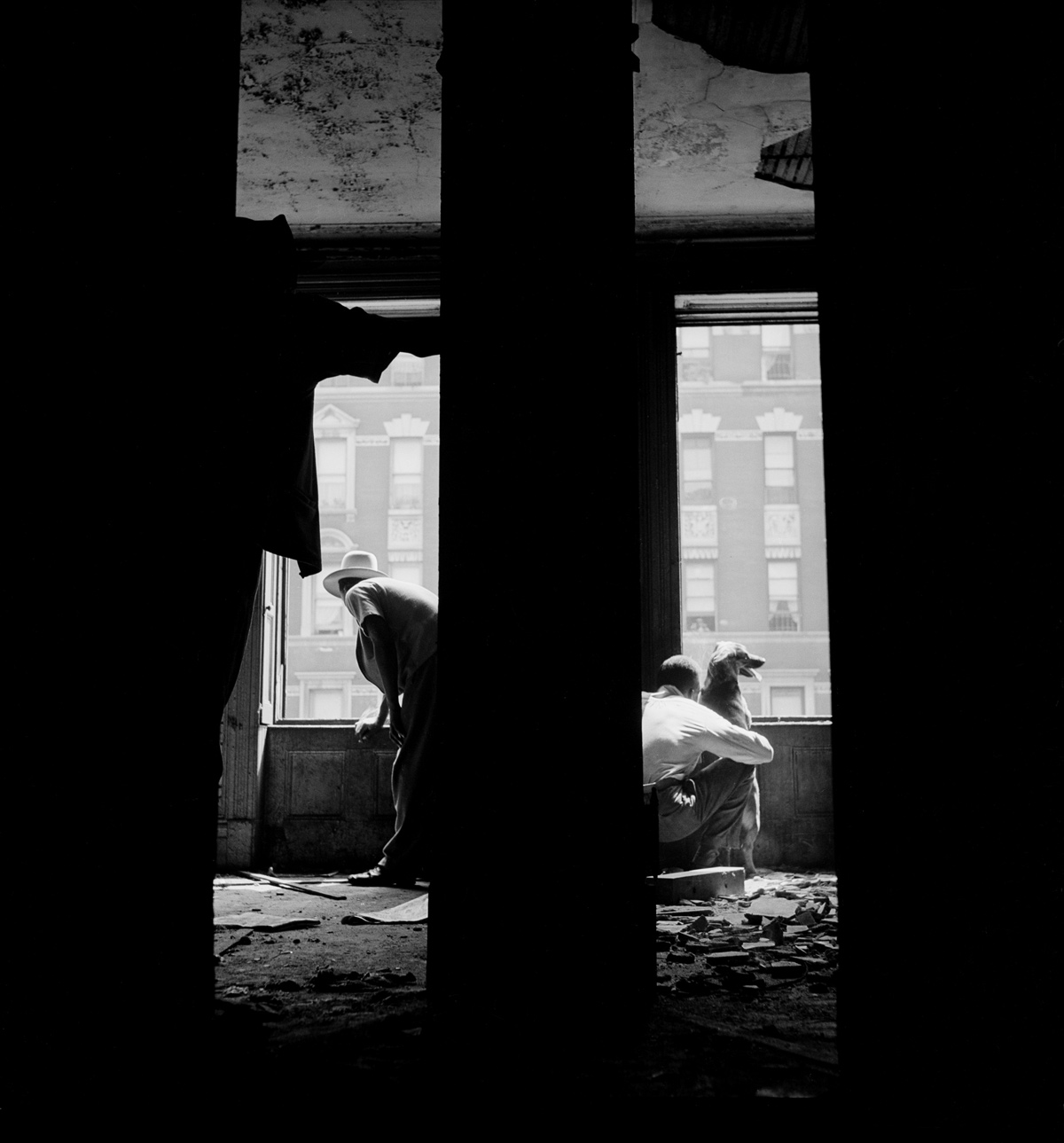
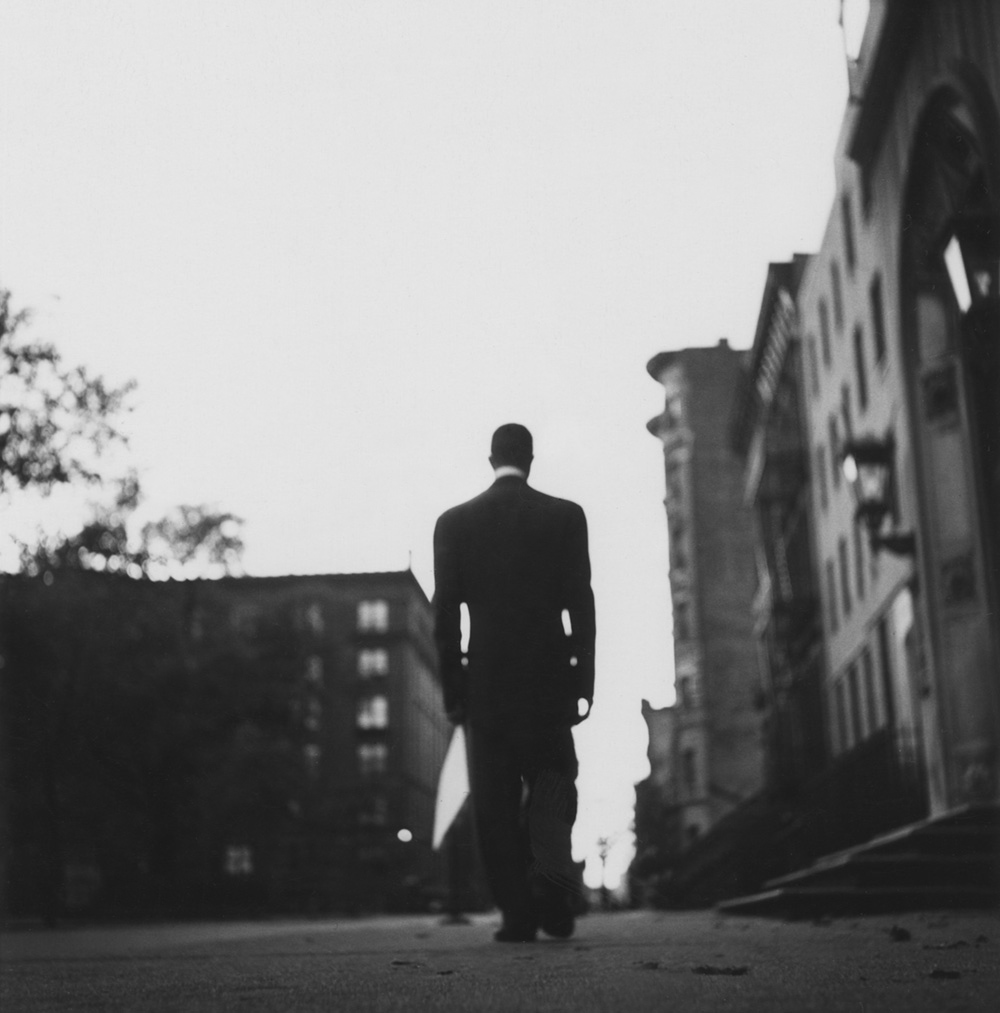
This exhibition explores the making of Gordon Parks’ first photographic essay for Life magazine in 1948, “Harlem Gang Leader.” After gaining the trust of one particular group of gang members and their leader, Leonard “Red” Jackson, Parks produced a series of photographs that are artful, poignant, and, at times, shocking. From this large body of work (Parks made hundreds of negatives) the editors at Life selected twenty-one pictures to print in the magazine, often cropping or enhancing details in the pictures in the process. Gordon Parks: The Making of an Argument traces this editorial process and parses out the various voices and motives behind the production of the picture essay.

The exhibition considers Parks’ photographic practice within a larger discussion about photography as a narrative device. Featuring vintage photographs, original issues of Life magazine, contact sheets, and proof prints, the exhibition raises important questions about the role of photography in addressing social concerns, its use as a documentary tool, and its function in the world of publishing…

“This project raises important questions about the role of photography in addressing social concerns, its use as a documentary tool, and its function in the world of publishing,” said Susan M. Taylor, NOMA’s Director. “We are delighted to be working with The Gordon Parks Foundation on this exhibition since it is a project that addressed many of the major issues that Parks would explore throughout his career.”

In 1948, Gordon Parks began a professional relationship with Life magazine that would last twenty-two years. For his first project, he proposed a series of pictures about the gang wars that were then plaguing Harlem, believing that if he could draw attention to the problem then perhaps it would be addressed through social programs or government intervention. As a result of his efforts, Parks gained the trust of one particular group of gang members and their leader, Leonard “Red” Jackson, and produced a series of pictures of them that are artful, emotive, poignant, touching, and sometimes shocking. From this larger body of work, twenty-one pictures were selected for reproduction in a graphic and adventurous layout in Life magazine.

At each step of the selection process – as Parks chose each shot, or as the picture editors at Life re-selected from his selection – any intended narrative was complicated by another curatorial voice. Curator Russell Lord notes, “By the time the reader opened the pages of Life magazine, the addition of text, and the reader’s own biases further rendered the original argument into a fractured, multi-layered affair. The process leads to many questions: ‘What was the intended argument?’ and ‘Whose argument was it?’.”

Gordon Parks: The Making of an Argument examines these questions through a close study of how Parks’ first Life picture essay was conceived, constructed and received.”

Press release from the NOMA website


Gordon Parks (American, 1912-2006) 'Untitled, Harlem, New York' 1948


Gordon Parks (American, 1912-2006)
Untitled, Harlem, New York
1948
Gelatin silver print, printed later
Courtesy The Gordon Parks Foundation


Gordon Parks (American, 1912-2006) 'Untitled, Harlem, New York' 1948


Gordon Parks (American, 1912-2006)
Untitled, Harlem, New York
1948
Gelatin silver print, printed later
Courtesy The Gordon Parks Foundation


Gordon Parks (American, 1912-2006) 'Untitled, Harlem, New York' 1948


Gordon Parks (American, 1912-2006)
Untitled, Harlem, New York
1948
Gelatin silver print, printed later
Courtesy The Gordon Parks Foundation


Gordon Parks (American, 1912-2006) 'Untitled, Harlem, New York' 1948


Gordon Parks (American, 1912-2006)
Untitled, Harlem, New York
1948
Gelatin silver print, printed later
Courtesy The Gordon Parks Foundation


Gordon Parks (American, 1912-2006) 'Untitled, Harlem, New York' 1948


Gordon Parks (American, 1912-2006)
Untitled, Harlem, New York
1948
Gelatin silver print, printed later
Courtesy The Gordon Parks Foundation


Gordon Parks (American, 1912-2006) 'Untitled, Harlem, New York' 1948


Gordon Parks (American, 1912-2006)
Untitled, Harlem, New York
1948
Gelatin silver print, printed later
Courtesy The Gordon Parks Foundation


Gordon Parks (American, 1912-2006) 'Untitled, Harlem, New York' 1948


Gordon Parks (American, 1912-2006)
Untitled, Harlem, New York
1948
Gelatin silver print, printed later
Courtesy The Gordon Parks Foundation


Gordon Parks (American, 1912-2006) 'Untitled, Harlem, New York' 1948


Gordon Parks (American, 1912-2006)
Untitled, Harlem, New York
1948
Gelatin silver print, printed later
Courtesy The Gordon Parks Foundation


The New Orleans Museum of Art
One Collins Diboll Circle, City Park
New Orleans, LA 70124
Phone: (504) 658-4100

Opening hours:
Tuesday – Sunday 10am – 5pm
Closed Mondays

The New Orleans Museum of Art website

LIKE ART BLART ON FACEBOOK

Back to top

Exhibition: ‘Alexander Calder: Avant-Garde in Motion’ at the Kunstsammlung Nordrhein-Westfalen, Düsseldorf

Exhibition dates: 7th September 2013 – 12th January 2014


Many thankx to the Kunstsammlung Nordrhein-Westfalen for allowing me to publish the photographs in the posting. Please click on the photographs for a larger version of the image.


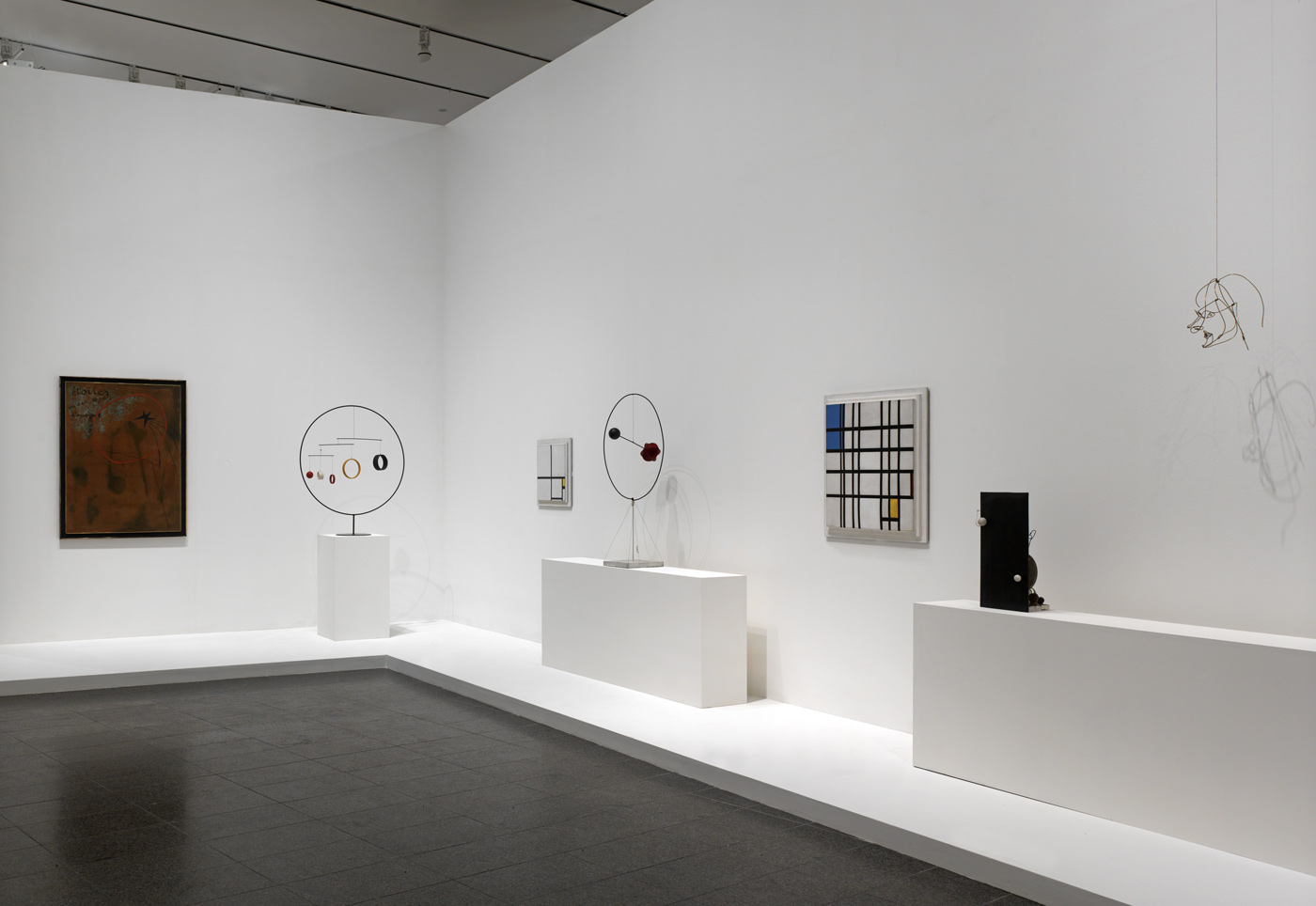
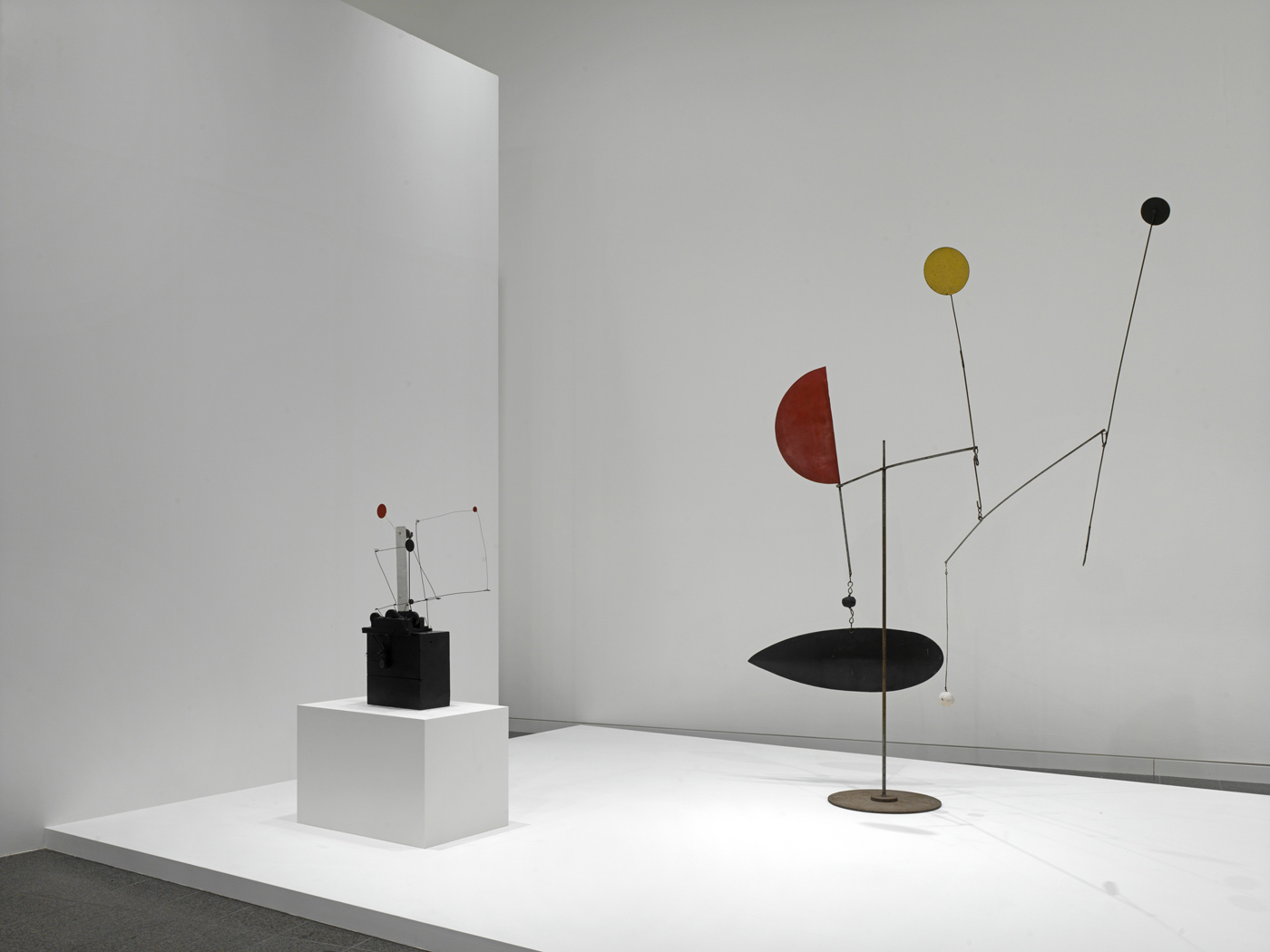
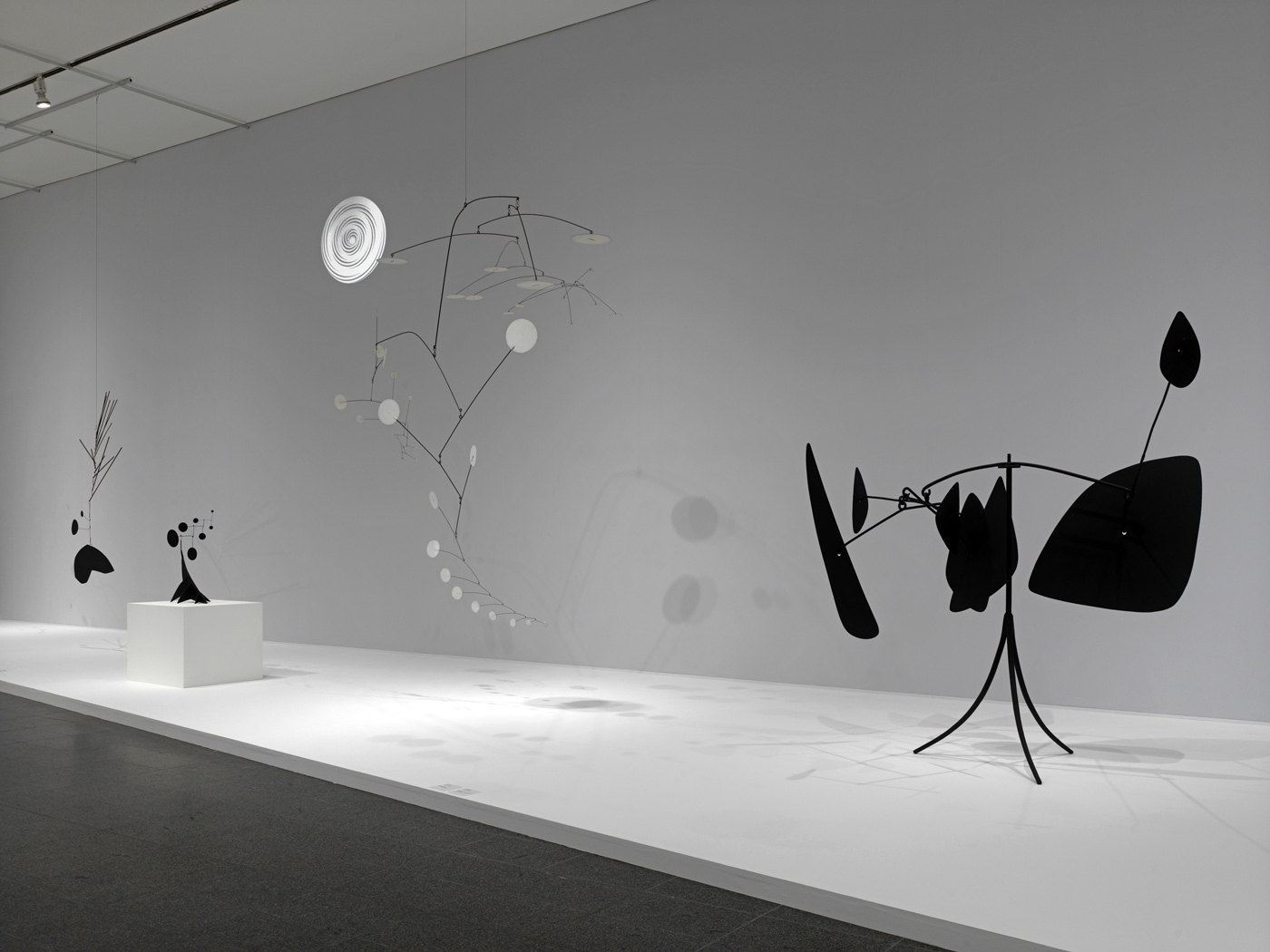
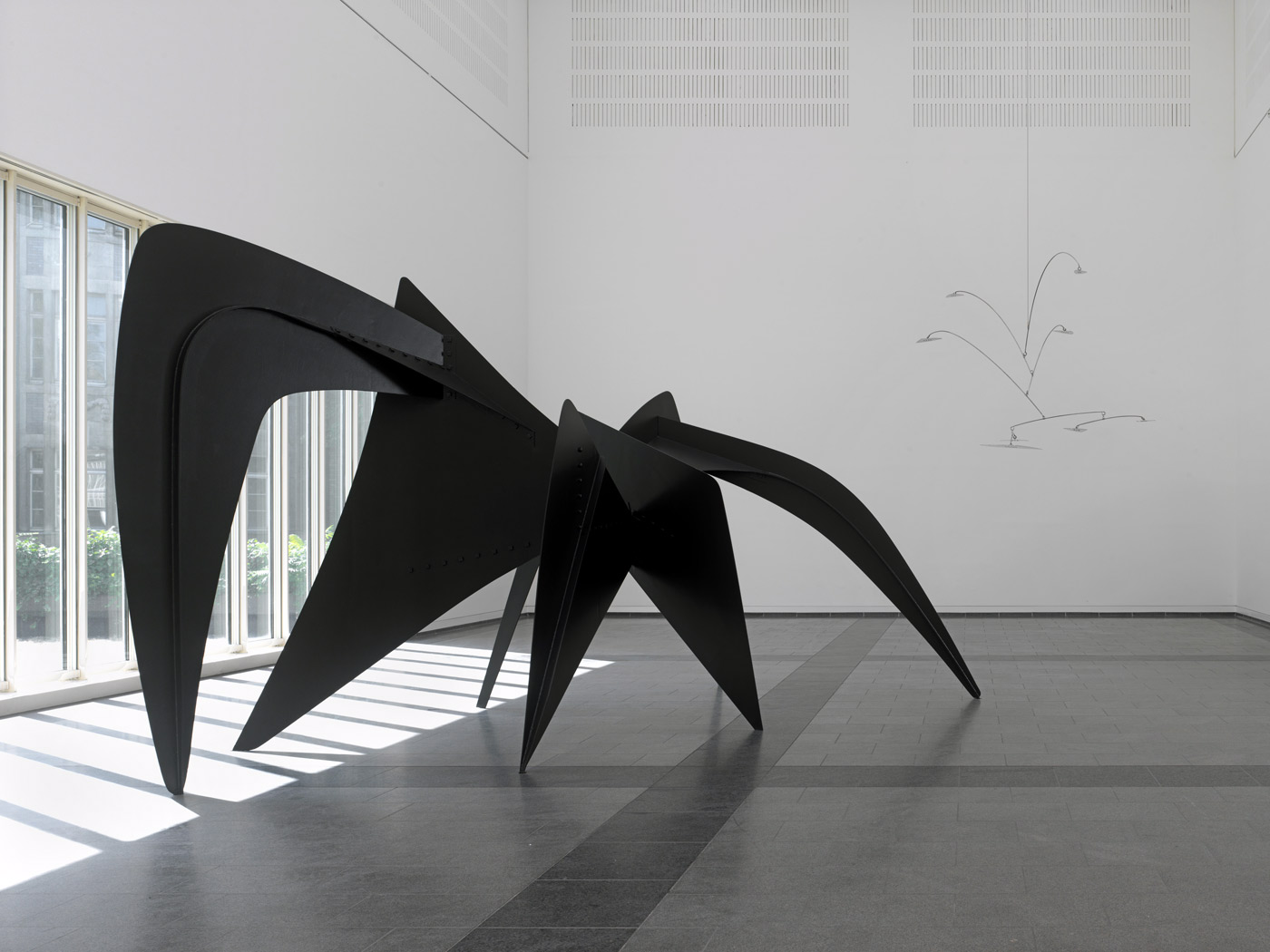
Installation photograph of the exhibition 'Alexander Calder: Avant-Garde in Motion' at the Kunstsammlung Nordrhein-Westfalen, Düsseldorf

Installation photograph of the exhibition 'Alexander Calder: Avant-Garde in Motion' at the Kunstsammlung Nordrhein-Westfalen, Düsseldorf

Installation photograph of the exhibition 'Alexander Calder: Avant-Garde in Motion' at the Kunstsammlung Nordrhein-Westfalen, Düsseldorf

Installation photograph of the exhibition 'Alexander Calder: Avant-Garde in Motion' at the Kunstsammlung Nordrhein-Westfalen, Düsseldorf


Alexander Calder: Avant-Garde in Motion
Installation photographs
Fotos: Achim Kukulies, © Calder Foundation, New York / Artists’ Rights Society (ARS), New York
© Kunstsammlung NRW


“These hesitations and resumptions, gropings and fumblings, sudden decisions and, most especially, marvellous swan-like nobility make Calder’s mobiles strange creatures, mid-way between matter and life.”


Jean-Paul Sartre, 1946


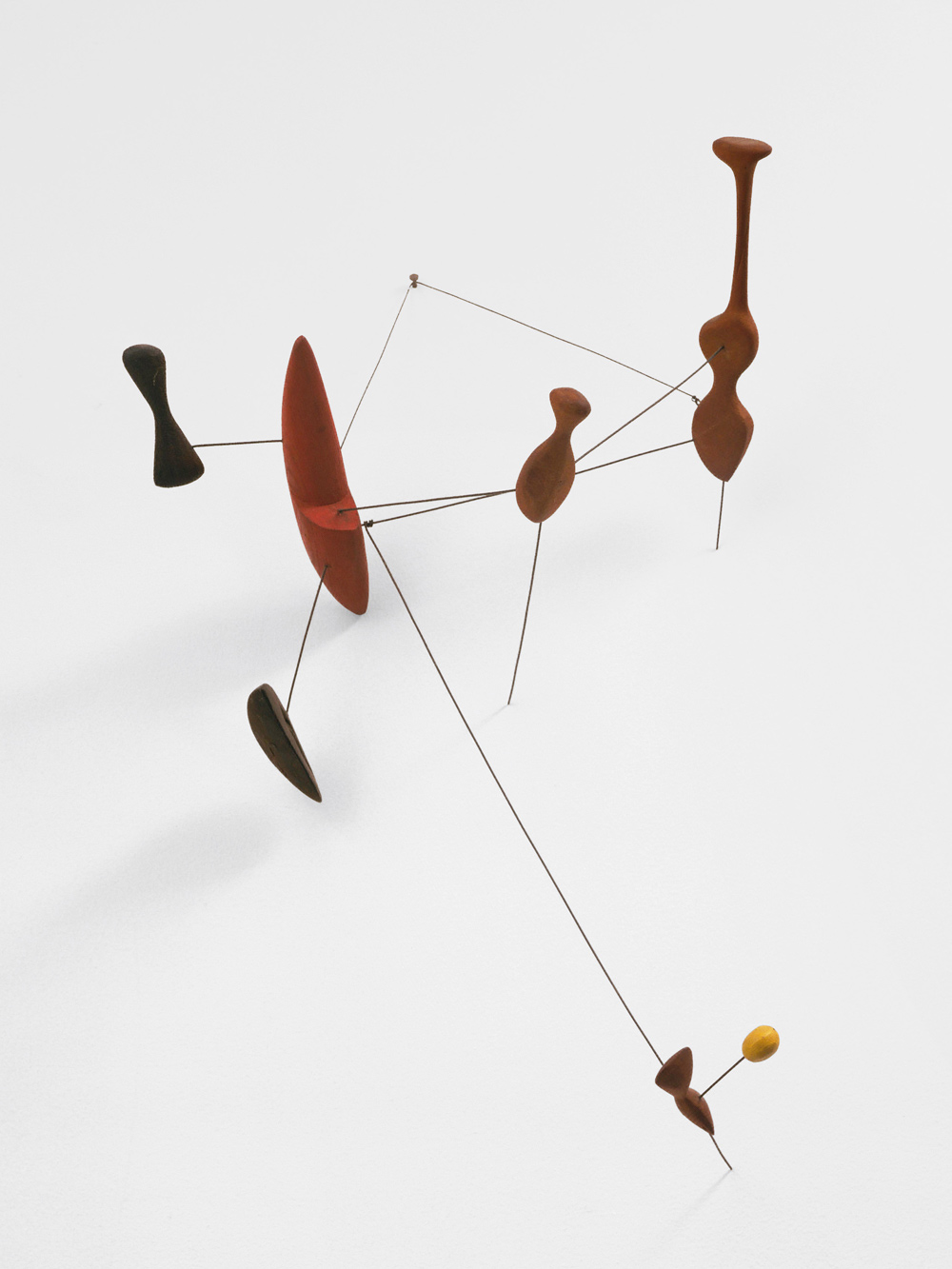
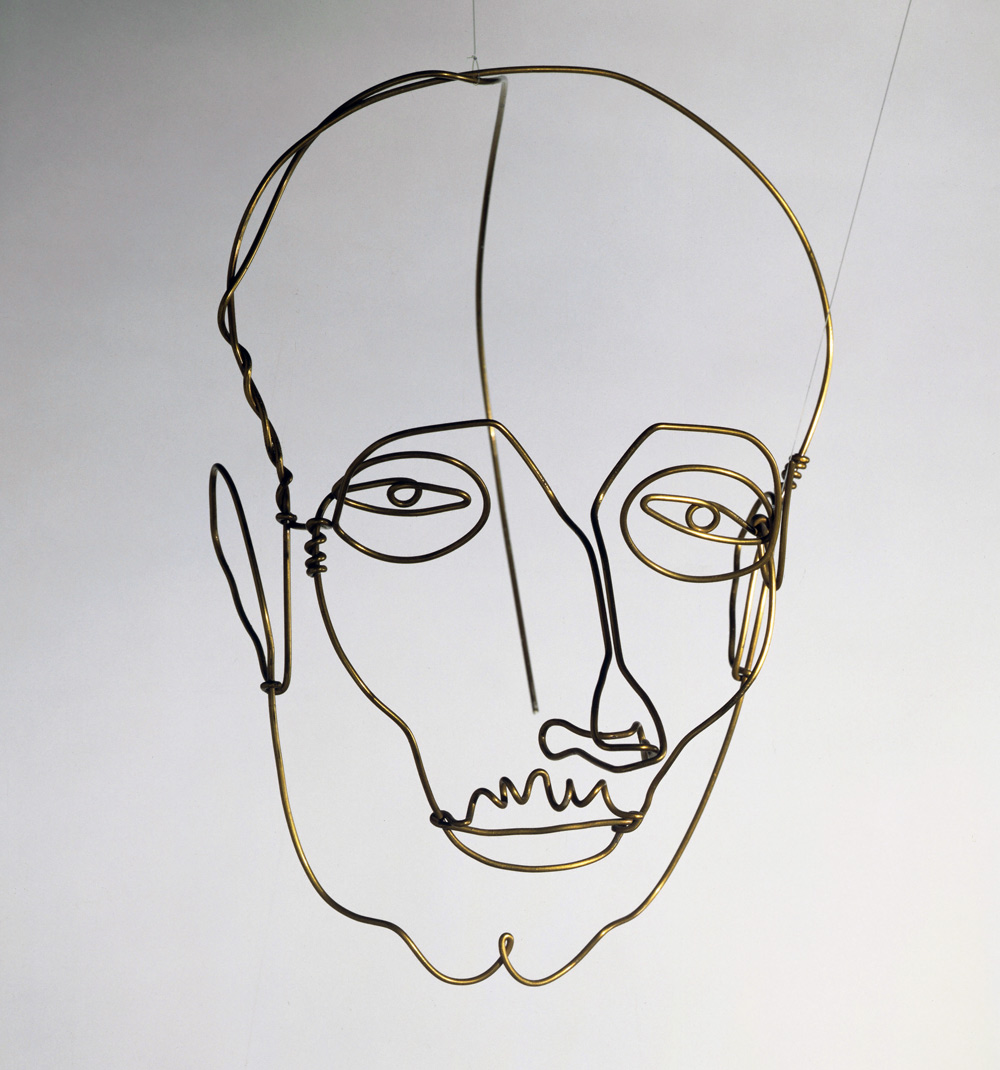
For the first time in 20 years, a German museum is presenting a major selection of works by the American sculptor Alexander Calder (1898-1976). With the exhibition Alexander Calder: Avant-Garde in Motion, the Kunstsammlung Nordrhein-Westfalen invites art lovers to reevaluate Calder as an astonishingly multifaceted member of the twentieth century avant-garde. Never before has the artistic oeuvre of this pioneer of Kineticism been presented in its surprising proximity and intimate interplay with the experimental film and music of its time. This approach highlights the intellectual universality of an artist whose mobiles are familiar worldwide today.

The focus of the exhibition at the K20 Grabbeplatz is the 1930s and 1940s, documenting Calder’s path toward abstraction and his lifelong friendships with members of the European avant-garde. On view in two exhibition halls are approximately 70 works, ranging from small-scale works in wood and sheet metal to the monumental steel stabile Le Tamanoir (1963), weighing 2300 kilograms, on loan from Rotterdam. A special architectural feature of this presentation is the long, accessible catwalk in the Kleehalle, which will offer visitors unexpected perspectives of the suspended mobiles.

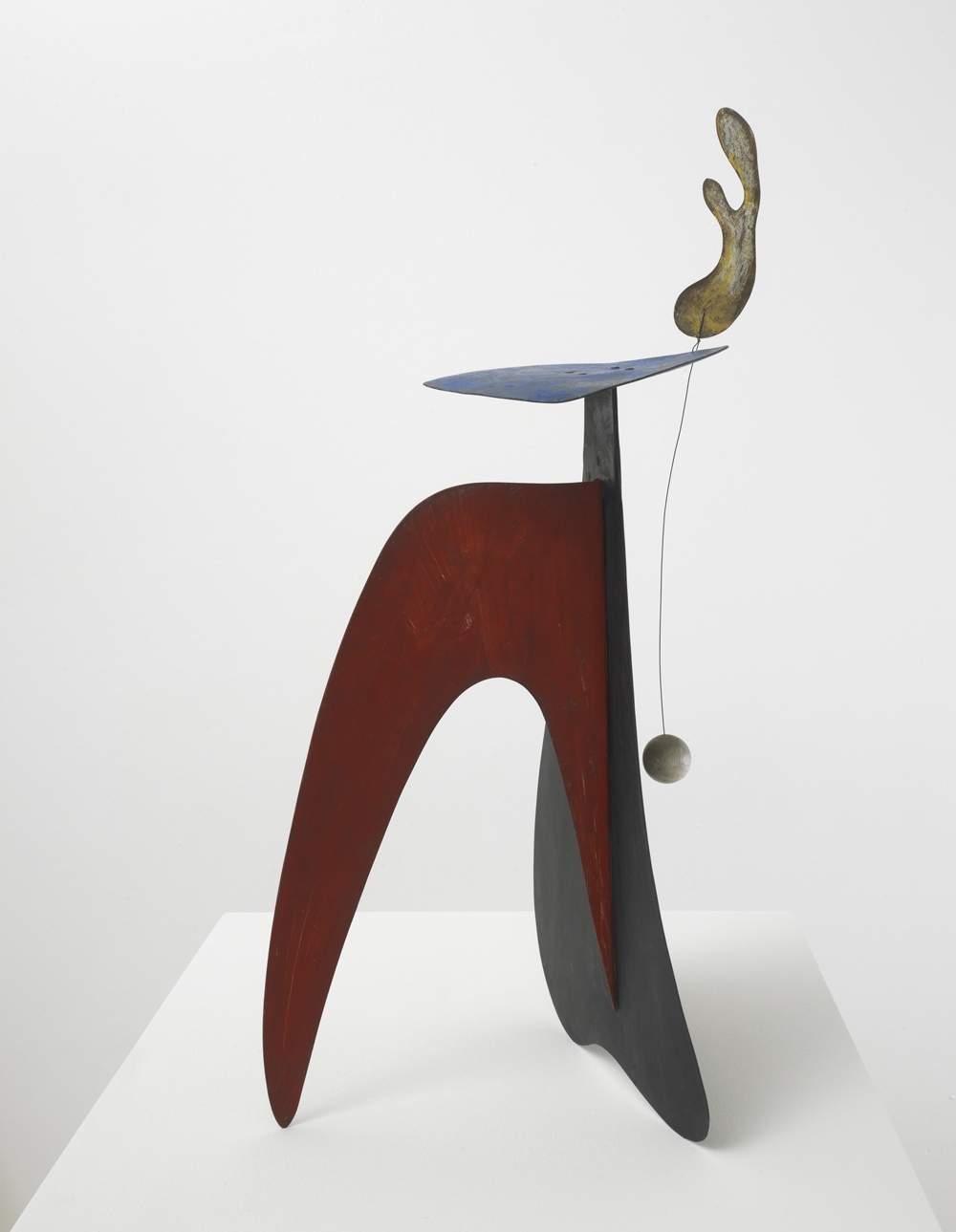
For the Düsseldorf exhibition, Calder’s first solo show of abstract works at the Galerie Percier in Paris in 1931, has been partially documented as a crucial station on the path toward his singular formal language. His artistic friendships during his time in Paris are highlighted by important individual paintings by Piet Mondrian, Joan Miró, and Hans Arp that are found today in the collection of the Kunstsammlung Nordrhein-Westfalen. The impulse that initiated this major exhibition project was modest in proportions: in 2008, the sculpture Untitled, dating from 1936, was acquired by the Federal State of North-Rhine Westphalia, and hence and came into the possession of the Kunstsammlung. This work is among Calder’s relatively unknown “noise-mobiles,” which generate sound through the gentle pendular movement of a ball that hangs from a wire. A complex work, Untitled connects various phases of Calder’s career, pointing toward the beginning of the wire sculptures of the 1920s and also the “sonorous” mobiles of the later period, which are set in motion by air currents. The forms of the individual elements signal Calder’s turn toward abstraction, but also resemble the organic language typical of the works of Arp and Miró.

Like no other American artist, and in a way comparable only with his friend Man Ray, Calder was a consistent member of Parisian avant-garde circles between 1926 and 1933. He was recognised by the main representatives of a range of artistic tendencies, yet never allowed himself to be drawn into the rivalry between abstraction and Surrealism. During these years, Calder moved uninhibitedly between various orientations, positioning his work in the field of tension residing between Mondrian’s cool geometric compositional structures and the biomorphic, playful abstractions of Miró and Arp. The exhibition features in particular the abstract works Calder produced after a legendary and pivotal experience in Paris: in the fall of 1930, he visited Mondrian’s studio and was deeply impressed by the space’s total composition, in particular by the black-and-white structuring of a wall on which coloured rectangles were mounted for study purposes. In his autobiography, Calder characterises his visit to this environment as a “shock” that prompted him to reevaluate his artistic production to date.

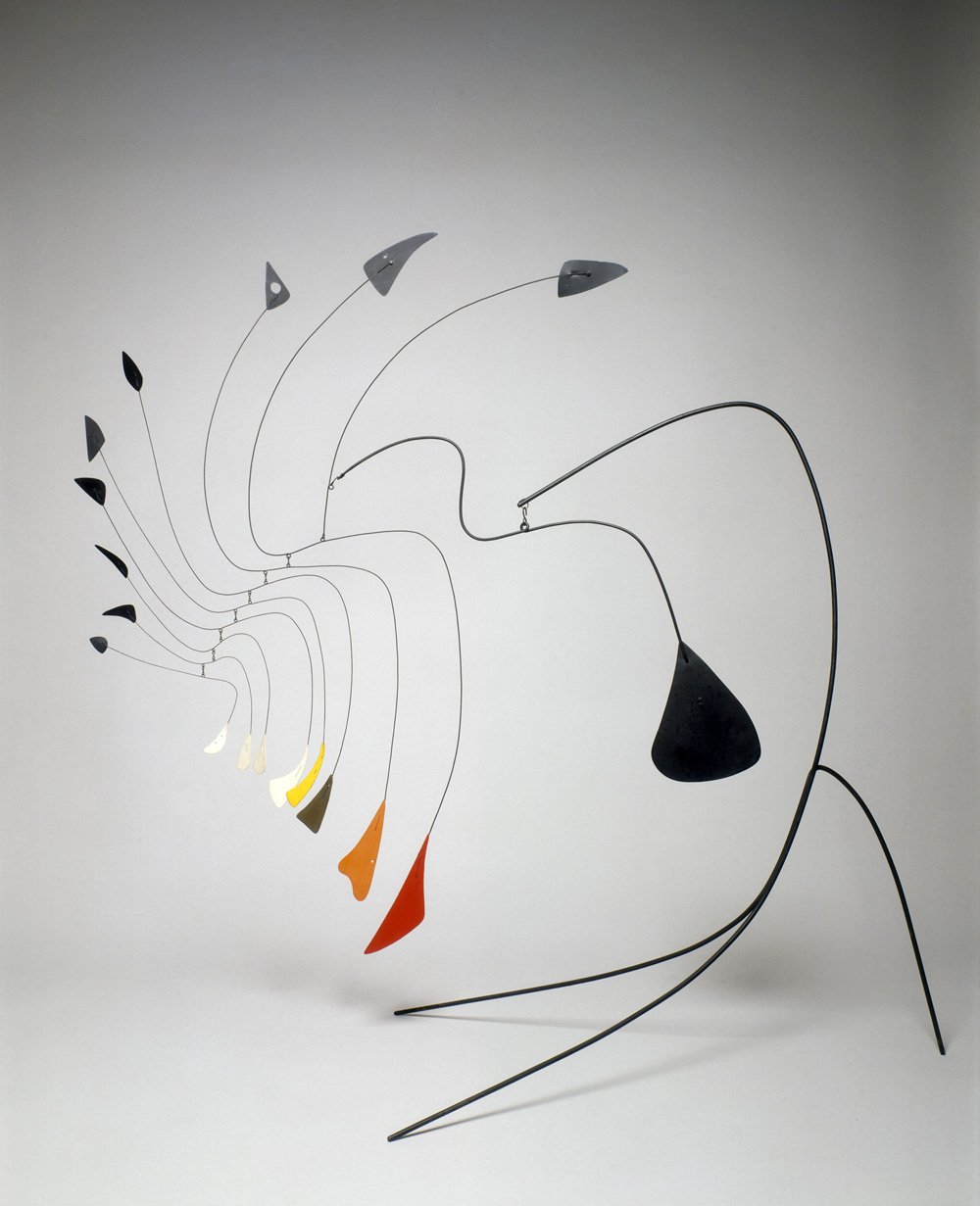
During the ensuing weeks, he produced abstract paintings exclusively – a brief intermezzo. Subsequently, he developed his first nonobjective, spatial wire constructions. In the autumn of 1931, the influences of the preceding years found a more distinct expression in Calder’s art when he produced the first moving sculptures by a system of motors or cranks. Marcel Duchamp gave them the name “mobile,” a word that means both “motion” and “motive” in French. The mechanics were abandoned as Calder developed hanging kinetic sculptures, which are linked together by wires and joints and held in a state of equilibrium; through the principle of contingent and dynamic rotation, the individual parts continually form new and unanticipated constellations. As a counterpart to the mobiles, Calder developed immobile constructions, which Hans Arp dubbed “stabiles” in 1932.

Contributing to our understanding of Calder’s works are experimental films, likely seen by Calder during his time in Paris, in which movement and rotation are thematised in their most various facets. During the 1920s, many artists in Calder’s intimate circle were preoccupied with the medium of cinema and the moving image, for example Fernand Léger with Ballet Mechanique (1924), Marcel Duchamp with Anémic Cinéma (1926), and Man Ray with Le Retour à la Raison (1923). In the exhibition, these experimental films will be screened as part of the broader context of Calder’s studies of movement and space. Indispensable to a comprehensive presentation of Calder’s involvement in the historic avant-garde is a consideration of the experimental music of the time: Calder cultivated friendships with the composers Edgard Varèse, Virgil Thomson, and John Cage, among others. Calder was intensively preoccupied with contemporary music, which is also incorporated into the exhibition. And it seems likely that it also exerted an influence on the “noise-mobiles,” for which the randomness of sound events plays an important role.”

Alexander Calder: Avant-Garde in Motion is on show at the Kunstsammlung Nordrhein-Westfalen, in two large exhibition halls at the K20 Grabbeplatz in Düsseldorf. In the Klee Hall the visitor will experience Calder’s early sculptures – set against works by trend-setting fellow artists, such as Mondrian, Miró and Arp, as well as artistic and documentary films. In the high Grabbehall, by contrast, the large mobiles and stabiles will be exhibited to impressive effect by allowing the individual shapes to move freely. Here the visitor can experience how the artist makes playful use of space and proportions. At various points throughout the exhibition, Calder’s mobiles enter into a dialogue with experimental music dating from the 1920s onwards, ranging from compositions by Edgar Varèse to those of John Cage. This illustrates how Calder constantly sought inspiration from other branches of the arts and broadened his own horizons.

Press release from the Kunstsammlung Nordrhein-Westfalen website


Alexander Calder (American, 1898-1976) 'Quatre systèmes rouges' (mobile) 1960


Alexander Calder (American, 1898-1976)
Quatre systèmes rouges (mobile)
1960
Iron, steel wire, colour
155 x 200 x 200cm
Louisiana Museum of Modern Art, Humlebæk, Dänemark, Donation: The New Carlsberg Foundation
© 2013 Calder Foundation, New York / Artists Rights Society (ARS), New York
Foto: Louisiana Museum of Modern Art, Humlebæk, Dänemark
Foto: © 2013 Calder Foundation, New York / Artists Rights Society (ARS), New York
© Kunstsammlung NRW


Alexander Calder (American, 1898-1976) 'Araignée d'oignon' (Onion peeler) c. 1940


Alexander Calder (American, 1898-1976)
Araignée d’oignon (Onion peeler)
c. 1940
21.8 × 35 × 36.5cm
Iron
Moderna Museet, Stockholm
© 2013 Calder Foundation, New York / Artists Rights Society (ARS), New York, Foto: Moderna Museet, Stockholm
Foto: © 2013 Calder Foundation, New York / Artists Rights Society (ARS), New York
Foto: Moderna Museet, Stockholm
© Kunstsammlung NRW


Alexander Calder (American, 1898-1976) 'Constellation with Red Object' 1943


Alexander Calder (American, 1898-1976)
Constellation with Red Object
1943
Wood, steel wire, colour
62.2 x 38.7 x 24.1cm
The Museum of Modern Art, New York, James Thrall Soby Fund, 1943
© 2013 Calder Foundation, New York / Artists Rights Society (ARS), New York
Foto: © 2012 Digital image, The Museum of Modern Art, New York/ Scala, Florence
© Kunstsammlung NRW


Alexander Calder (American, 1898-1976) 'Little Spider' c. 1940


Alexander Calder (American, 1898-1976)
Little Spider
c. 1940
Sheet metal, steel wire, colour
111.1 x 127 x 139.7cm
National Gallery of Art, Washington, Gift of Mr. and Mrs. Klaus G. Perls
© 2013 Calder Foundation, New York / Artists Rights Society (ARS), New York
Foto: Image courtesy of the National Gallery of Art, Washington
Foto: © 2013 Calder Foundation, New York / Artists Rights Society (ARS), New York
Foto: Image courtesy of the National Gallery of Art, Washington
© Kunstsammlung NRW


Alexander Calder (American, 1898-1976) 'Performing Seal' 1950


Alexander Calder (American, 1898-1976)
Performing Seal
1950
83.8 × 58.4 × 91.4cm
Sheet metal, steel wire, colour
Museum of Contemporary Art Chicago. The Leonard and Ruth Horwich Family Loan
© 2013 Calder Foundation, New York / Artists Rights Society (ARS), New York
Foto: Nathan Keay, © Museum of Contemporary Art Chicago
Foto: © 2013 Calder Foundation, New York / Artists Rights Society (ARS), New York
Foto: Nathan Keay, © Museum of Contemporary Art Chicago
© Kunstsammlung NRW


Alexander Calder (American, 1898-1976) 'Portrait of a Man' c. 1928


Alexander Calder (American, 1898-1976)
Portrait of a Man
c. 1928
Messingdraht
32.5 x 22.2 x 34.2cm
The Museum of Modern Art, New York. Gift of the artist, 1966
© 2013 Calder Foundation, New York / Artists Rights Society (ARS), New York
Foto: © 2012 Digital image, The Museum of Modern Art, New York/ Scala, Florence
© Kunstsammlung NRW


Alexander Calder (American, 1898-1976) 'Upstanding T' 1944


Alexander Calder (American, 1898-1976)
Upstanding T
1944
Bronze
78 x 37 x 25cm
Calder Foundation, New York
© 2013 Calder Foundation, New York / Artists Rights Society (ARS), New York
Foto: Courtesy Calder Foundation, New York / Art Resource, New York
Foto: © 2013 Calder Foundation, New York / Artists Rights Society (ARS), New York
Foto: Courtesy Calder Foundation, New York / Art Resource, New York
© Kunstsammlung NRW


Alexander Calder (American, 1898-1976) 'Ohne Titel' (Untitled) 1936


Alexander Calder (American, 1898-1976)
Ohne Titel (Untitled)
1936
Standing Mobile (stehendes Mobile)
Steel sheets, steel wire, wooden ball, black, gray, red, blue and yellow painted
75.5 x 32.8 x 41cm
Kunstsammlung Nordrhein-Westfalen, Düsseldorf, Leihgabe des Landes Nordrhein-Westfalen
© 2013 Calder Foundation, New York / Artists Rights Society (ARS), New York
Foto: Achim Kukulies, Düsseldorf
Foto: © 2013 Calder Foundation, New York / Artists Rights Society (ARS), New York
Foto: Achim Kukulies, Düsseldorf
© Kunstsammlung NRW


Alexander Calder (American, 1898-1976) 'Untitled' c. 1934


Alexander Calder (American, 1898-1976)
Untitled
c. 1934
Steel tube, round bar, wood, wire, paint, string
114.5 x 94cm
Calder Foundation, New York
© 2013 Calder Foundation, New York / Artists Rights Society (ARS), New York
Foto: Courtesy Calder Foundation, New York / Art Resource, New York
Foto: © 2013 Calder Foundation, New York / Artists Rights Society (ARS), New York
Foto: Courtesy Calder Foundation, New York / Art Resource, New York
© Kunstsammlung NRW


Alexander Calder (American, 1898-1976) 'Cello on a spindle' 1936


Alexander Calder (American, 1898-1976)
Cello on a spindle
1936
158 × 118 × 90cm
Metal, wood, lead, colour
Kunsthaus Zürich
© 2013 Calder Foundation, New York / Artists Rights Society (ARS), New York
Foto: Kunsthaus Zürich
Foto: © 2013 Calder Foundation, New York / Artists Rights Society (ARS), New York
Foto: Kunsthaus Zürich
© Kunstsammlung NRW


Kunstsammlung Nordrhein-Westfalen
Grabbeplatz 5
D-40213 Düsseldorf

Opening hours:
Tuesday – Friday 10am – 6pm
Saturdays, Sundays, holidays 11am – 6pm
Mondays closed

Kunstsammlung Nordrhein-Westfalen website

LIKE ART BLART ON FACEBOOK

Back to top

Exhibition: ‘City of Abstractions: Brett Weston in New York, 1944-45’ at 1285 Avenue of the Americas Art Gallery, New York

Exhibition dates: 30th September 2013 – 10th January 2014


Brett Weston (American, 1911-1993) '[Air vents, New York]' 1945


Brett Weston (American, 1911-1993)
[Air vents, New York]
1945
Image: 10 3/4 x 13 13/16 in. (27.3 x 35.1cm)
Gelatin silver print
Gift of the Brett Weston Archive, from the collection of Christian Keesee, 2003


Out of the 84 images online on eMuseum I have picked just 13 from the exhibition for this posting. While the press release is loquacious in its praise for these 8 x 10 view camera photographs – and Weston’s subjective and abstract view of the city with it’s flattened and abstracted deep space “distinguished by an attention to the formal values of linearity, depth, and contrast” – only the few that I have focused on here really work to any considerable degree.

Most of the photographs seem mundane, prosaic experiments in form, shape and detail. Church door, Bowery, New York and Wrought iron fence, New York (both c. 1945, below) are better examples of detail photographs by Weston, but other than their formal qualities they are pretty boring images. More interesting is the photograph Stoop with broom, arrow, and pushcart, New York (1944, below) with its cacophony of shapes and angles, form, light and shadow.

While most photographs in the posting have some interesting qualities, the only real show stopper is Air vents, New York (1944, below). This is a beautifully resolved modernist image which contrasts the air vents as sculptural objects with the city skyline beyond. Here Weston manipulates deep space (without deep focus / large depth of field) as part of the mise en scène, placing the significant props in different planes of the picture while successfully flattening the whole tableau vivant at the same time. The rendition of light is handsomely controlled, the air vents becoming Brancussi-like sculptures or some form of alien creature.

Dr Marcus Bunyan


Many thankx to the International Center of Photography and the Avenue of the Americas Art Gallery for allowing me to publish the photographs in the posting. Please click on the photographs for a larger version of the image.


Brett Weston (American, 1911-1993) '[42nd Street at First Avenue, New York]' c. 1945


Brett Weston (American, 1911-1993)
[42nd Street at First Avenue, New York]
c. 1945
Image: 7 3/4 x 9 3/4 in. (19.7 x 24.8cm)
Gelatin silver print
Gift of the Brett Weston Archive, from the collection of Christian Keesee, 2003


Brett Weston (American, 1911-1993) '[Oceano Dunes, California]' 1934


Brett Weston (American, 1911-1993)
[Oceano Dunes, California]
1934
Image: 10 5/8 x 13 13/16 in. (27 x 35.1cm)
Gelatin silver print
Gift of the Brett Weston Archive, from the collection of Christian Keesee, 2003


Brett Weston (American, 1911-1993) '[Stoop with broom, arrow, and pushcart, New York]' 1944


Brett Weston (American, 1911-1993)
[Stoop with broom, arrow, and pushcart, New York]
1944
Image: 10 1/4 x 13 5/8 in. (26 x 34.6cm)
Gelatin silver print
Gift of the Brett Weston Archive, from the collection of Christian Keesee, 2003


Brett Weston (American, 1911-1993) '[Airshafts, New York]' c. 1945


Brett Weston (American, 1911-1993)
[Airshafts, New York]
c. 1945
Image: 13 13/16 x 10 11/16 in. (35.1 x 27.1cm)
Gelatin silver print
Gift of the Brett Weston Archive, from the collection of Christian Keesee, 2003


Brett Weston (American, 1911-1993) '[Courtyard, New York]' c. 1945


Brett Weston (American, 1911-1993)
[Courtyard, New York]
c. 1945
Image: 19 x 15 1/4 in. (48.3 x 38.7cm)
Gelatin silver print
Gift of the Brett Weston Archive, from the collection of Christian Keesee, 2003


Brett Weston (1911-1993) is widely regarded as one of the leading photographers of the 20th century. He is known primarily for his bold compositions based on Western landscapes and natural forms, and for his extraordinary printing style. Weston was among a small group of California photographers in the 1930s, known as the Group f/64, who favoured large-format view cameras, straight and uncropped images, and stark black-and-white prints, often contact printed. This group included Ansel Adams and Brett Weston’s father, Edward Weston. But Brett Weston’s style became even more radical when he was drafted into the army during World War II, and, in 1944, sent to the Army Pictorial Center in New York. There, in addition to routine Army work, Weston explored the streets of New York with his large 8 x 10 view camera. Over the next two years, Weston took over 300 photographs, each distinguished by an attention to the formal values of linearity, depth, and contrast. Turning away from the documentary style that characterised much of the photography of New York in the preceding decade, notably Berenice Abbott’s project Changing New York (1939), Weston pioneered a highly subjective and abstract view of the city, often focusing on details such as the finial on an iron railing or ivy on the side of a building. In pictures like Air Vents (1944) and Whelans Drugstore (1944), Weston flattened and abstracted the deep space of the New York cityscape creating rich, two-dimensional black-and-white images. This approach would govern the most prolific period of Weston’s work in the late 1940s and 1950s, when he utilised this highly polished style to photograph Western dunes, beaches, rocks, and vegetation.

This exhibition includes over 100 photographs, drawn largely from the collection of the International Center of Photography. The exhibition is a collaboration between the International Center of Photography, the Brett Weston Archive, and the host Gallery of the Americas. It is organised by Brian Wallis, Chief Curator at the International Center of Photography, and Julie Maguire, Director of the Brett Weston Archive.

Please note that this exhibition is at the 1285 Avenue of the Americas Art Gallery between 51st and 52nd Streets.

Press release from the ICP website


Brett Weston (American, 1911-1993) '[House, Ewing Street, Staten Island, New York]' c. 1945


Brett Weston (American, 1911-1993)
[House, Ewing Street, Staten Island, New York]
c. 1945
Image: 10 x 8 in. (25.4 x 20.3cm)
Paper: 10 x 8 in. (25.4 x 20.3cm)
Gelatin silver print
Gift of the Brett Weston Archive, from the collection of Christian Keesee, 2003


Brett Weston (American, 1911-1993) '[Sutton Place, New York]' c. 1945


Brett Weston (American, 1911-1993)
[Sutton Place, New York]
c. 1945
Image: 10 x 8 in. (25.4 x 20.3cm)
Paper: 10 x 8 in. (25.4 x 20.3 cm)
Gelatin silver print
Gift of the Brett Weston Archive, from the collection of Christian Keesee, 2003


Brett Weston (American, 1911-1993) '[Skylight and fences, Midtown, New York]' c. 1945


Brett Weston (American, 1911-1993)
[Skylight and fences, Midtown, New York]
c. 1945
Image: 10 x 8 in. (25.4 x 20.3cm)
Gelatin silver print
Gift of the Brett Weston Archive, from the collection of Christian Keesee, 2003


Brett Weston (American, 1911-1993) '[Wrought iron fence, New York]' c. 1945


Brett Weston (American, 1911-1993)
[Wrought iron fence, New York]
c. 1945
Image: 9 9/16 x 6 13/16 in. (24.3 x 17.3cm)
Gelatin silver print
Gift of Christian K. Keesee, 2012


Brett Weston (American, 1911-1993) '[Church door, Bowery, New York]' c. 1945


Brett Weston (American, 1911-1993)
[Church door, Bowery, New York]
c. 1945
Image: 9 1/2 x 7 9/16 in. (24.1 x 19.2cm)
Gelatin silver print
Gift of the Brett Weston Archive, from the collection of Christian Keesee, 2003


Brett Weston (American, 1911-1993) '[Pillars and tree, New York]' 1944


Brett Weston (American, 1911-1993)
[Pillars and tree, New York]
1944
Image: 10 x 8 in. (25.4 x 20.3cm)
Gelatin silver print
Gift of the Brett Weston Archive, from the collection of Christian Keesee, 2003


Brett Weston (American, 1911-1993) '[St. Francis Grocery & Fruit, New York]' c. 1945


Brett Weston (American, 1911-1993)
[St. Francis Grocery & Fruit, New York]
c. 1945
Image: 9 1/2 x 7 9/16 in. (24.1 x 19.2cm)
Gelatin silver print
Gift of Christian K. Keesee, 2012


International Center of Photography
79 Essex Street, New York, NY 10002
between Delancey Street and Broome Street

Opening hours:
Wednesday – Monday 11am – 7pm

ICP website

ICP exhibition website

LIKE ART BLART ON FACEBOOK

Back to top

Exhibition: ‘At the Window: The Photographer’s View’ at the J. Paul Getty Museum, Getty Center, Los Angeles

Exhibition dates: 1st October 2013 – 5th January 2014


Robert Frank (Swiss, 1924-2019) 'Trolley - New Orleans' 1955


Robert Frank (Swiss, 1924-2019)
Trolley – New Orleans
1955
Gelatin silver print
Image: 22.9 x 34cm (9 x 13 3/8 in.)
Trish and Jan de Bont


Another fascinating exhibition from the J. Paul Getty Museum that features classic photographs and some that I have never seen before. In my opinion, the two most famous photographs of windows have to be Minor White’s rhapsodic Windowsill Daydreaming, Rochester (1958, below) and Paul Strand’s Wall Street (1915, below, originally known as Pedestrians raked by morning light in a canyon of commerce) which, strangely, is not included in the exhibition. I can’t understand this omission as this is the seminal image of windows in the history of photography.

Dr Marcus Bunyan


Many thankx to the J. Paul Getty Museum for allowing me to publish the photographs in the posting. Please click on the photographs for a larger version of the image.


Paul Strand (American, 1890-1976 'Wall Street, New York' 1915


Paul Strand (American, 1890-1976)
Wall Street
1915
Platinum print


In this photo, taken by morning light 1915, the recently built J.P. Morgan Co. building appears sinister and foreboding and dwarfs (perhaps consumes even) the humanity of suited men and women, their long shadows dragging behind them, walked alongside its facade.

Paul Strand studied under Lewis Hine and Alfred Steiglitz. Although he set up in New York as a portrait photographer, Strand often visited Stieglitz’s gallery to see the new European painting which it exhibited. In 1914-1915, under the influence of this new form of art, Strand turned from soft-focus Pictoralism towards abstraction. It was in this spirit that the above photo was taken, originally named, “Pedestrians raked by morning light in a canyon of commerce”. Strand did not intended to show Wall Street in a bad light, he admitted. However, as the Great Depression happened (criticism was squarely towards Wall Street back then as it is today) and Strand turned more communist, he later spoke of “sinister windows” and “blind shapes” inherent in the above picture.

The photo, now simply titled “Wall Street”, was one of six Paul Strand pictures Stieglitz published in Camera Work. In three of the six pictures, humanity strides out from abstract ideas, and each figure was a study in itself – an irregular item complimented by modular formats that surround it. Another set of eleven Strand photos were published in the magazine’s final issue in 1917, and those pictures, overwhelmingly endorsed by Stieglitz as ‘brutally direct’ made Strand’s reputation.

Alex Selwyn-Holmes. “Wall Street by Paul Strand,” on the Iconic Photos blog, December 2010 [Online] Cited 12/01/2021


Arthur Rothstein (American, 1915-1985) 'Girl at Gee's Bend' 1937


Arthur Rothstein (American, 1915-1985)
Girl at Gee’s Bend
1937
Silver gelatin print
Image: 40 x 49.7cm (15 3/4 x 19 9/16 in.)
The J. Paul Getty Museum, Los Angeles


Edmund Collein (German, 1906-1992) '[Four Women Looking Through Window]' about 1928


Edmund Collein (German, 1906-1992)
[Four Women Looking Through Window]
about 1928
Gelatin silver print
Image: 8.2 x 11.1cm (3 1/4 x 4 3/8 in.)
The J. Paul Getty Museum, Los Angeles
© Ursula Kirsten-Collein, Berlin


Walker Evans (American, 1903-1975) 'Wall Street Windows' about 1929


Walker Evans (American, 1903-1975)
Wall Street Windows
about 1929
Gelatin silver print
Image: 29.8 x 19.2cm (11 3/4 x 7 9/16 in.)
The J. Paul Getty Museum, Los Angeles
© Walker Evans Archive, The Metropolitan Museum of Art


William Henry Fox Talbot (English, 1800-1877) '[The Milliner's Window]' before January 1844


William Henry Fox Talbot (English, 1800-1877)
[The Milliner’s Window]
before January 1844
Salted paper print from a Calotype negative
Image: 14.3 x 19.5cm (5 5/8 x 7 11/16 in.)
The J. Paul Getty Museum, Los Angeles


Paul Strand (American, 1890-1976) 'Barn Window and Ice, East Jamaica, Vermont' 1943


Paul Strand (American, 1890-1976)
Barn Window and Ice, East Jamaica, Vermont
1943
Gelatin silver print
Image (trimmed to mount): 19.4 x 24.3cm (7 5/8 x 9 9/16 in.)
The J. Paul Getty Museum, Los Angeles
© Aperture Foundation


Brett Weston (American, 1911-1993) 'Rain Drops' 1953


Brett Weston (American, 1911-1993)
Rain Drops
1953
Gelatin silver print
Image: 20.2 x 25cm (7 15/16 x 9 13/16 in.)
The J. Paul Getty Museum, Los Angeles, Gift of Christian K. Keesee
© The Brett Weston Archive


Sebastião Salgado (Brazilian, b. 1944) 'Ho Chi Minh City, Vietnam' Negative 1995; print 2009


Sebastião Salgado (Brazilian, b. 1944)
Ho Chi Minh City, Vietnam
Negative 1995; print 2009
Gelatin silver print
Image: 34.3 x 51.4cm (13 1/2 x 20 1/4 in.)
The J. Paul Getty Museum, Los Angeles
© Sebastião Salgado


In many respects, the window was where photography began. As early as 1826, the sill of an upstairs window in the home of the French inventor Joseph Nicéphore Niépce served as a platform for his photographic experiments. His View from the Window at Le Gras is today considered to be the first photograph. Since then, the window motif in photographs has functioned formally as a framing device and conceptually as a tool for artistic expression. It is also tied metaphorically to the camera itself which is, at its most rudimentary, a “room” (the word camera means “chamber”) and its lens a “window” through which images are projected and fixed. The photographs in At the Window: A Photographer’s View, on view October 1, 2013 – January 5, 2014 at the J. Paul Getty Museum, Getty Center, explore varying aspects of the window as frame or mirror – formally or metaphorically – for photographic vision.

“The Getty Museum’s extensive collection allows us to explore themes and subjects within the history of photography that highlight not only the most famous masters and iconic images they produced, but also less obvious subjects, methods and practitioners of the medium whose contributions have not yet been fully acknowledged. At the Window is one such an exhibition, and holds in store many surprises, even for those who know the field well,” explains Timothy Potts, director of the J. Paul Getty Museum. “The exhibition also allows us to celebrate a substantial body of work that was recently added to the collection with funds provided by the Museum’s Photographs Council, whose mission it is to help us support the growth of the collection, and a number of highly important loans from private collections.”

Shop Windows and Architecture

Featured in the exhibition is an exceedingly rare early photograph, William Henry Fox Talbot’s The Milliner’s Window (before January 1844) which depicts not an actual window but a carefully constructed one: shelves were placed outdoors and propped in front of black cloth, while various ladies’ hats were arranged to simulate the look of a shop display. Throughout the history of photography, actual shop fronts have been a popular subject and reflections in their windows a source for unexpected juxtapositions. This motif is well represented in the exhibition with photographs by William Eggleston, Eugène Atget, and Walker Evans.

Photographers have also taken an interest in the distinctive formal arrangements made possible by the architectural facades found in a cityscape. André Kertész’s Rue Vavin, Paris (1925), a view from his apartment window, is one of the first photographs he took upon arriving in Paris from Budapest. Photographers like Alfred Stieglitz carefully framed their views of urban exteriors, using the window as a unifying device within the composition.

The Window as Social Documentary

While windows provide an opportunity to observe life beyond a single room, the camera’s lens opens a window to the world at large. Arthur Rothstein believed in photography’s ability to enact social change – his Girl at Gee’s Bend (1937) features a young girl framed in the window of her log-and-earth home in Alabama, highlighting the schism between magazine images and the actual lives of most Americans at the time. Similarly, Robert Frank’s Trolley – New Orleans (1955) frames racial segregation through windows in a trolley, while Sebastião Salgado’s Ho Chi Minh City, Vietnam (negative 1995; print 2009) uses the barely separated windows of a housing structure to evoke the cramped quarters and dire economic situation of its inhabitants.

The Window as a Conceptual Tool

Artists have used the window in other novel ways, whether to create an enigmatic mood or suggest a suspenseful scene. In Gregory Crewdson’s Untitled (2002) from the series Twilight, the image of a woman standing in a room and turned toward a window creates a suspended, unsettling moment of anticipation that is never resolved. In her Stranger series (2000), Shizuka Yokomizo actively engages subjects by sending letters to randomly selected apartment residents, asking them to stand in front of a window at a particular date and time in order to be photographed. Uta Barth’s diptych …and of time (2000), where the path of a window’s light and shadow is followed across the wall of the artist’s living room, illustrates something the artist phrased as “ambient vision.”

“The window has been a recurrent and powerful theme for photographers from the beginning of the medium,” explains Karen Hellman, assistant curator of photographs at the J. Paul Getty Museum and curator of the exhibition. “In a collection such as the Getty’s that is particularly rich in work by important photographers from the beginnings of the medium to the present day, the motif provides a unique way to travel through the history of photography.”

The Window in Photographs (Getty Publications, $24.95, hardcover) investigates the recurrence of windows both as a figurative and literal theme throughout the history of photography. From the very vocabulary we use to describe cameras and photographic processes to the subjects of world-renowned photographers, windows have long held powerful sway over artists working in the medium. When documented on film, windows call into question issues of representation, the malleability of perception, and the viewer’s experience of the photograph itself, and the window’s evocative power is often rooted in the interplay between positive and negative, darkness and light, and inside and out.

Yet despite the ubiquity of windows in photography, this subject has been rarely addressed head on in a single exhibition or publication. From the birth of the Daguerreotype to the development of digital imagery, this volume presents a full account of the motif of the window as a symbol of photographic vision. Its eighty featured colour plates, all drawn from the Getty Museum’s permanent collection, are arranged thematically rather than chronologically, allowing the window’s many uses in photography to be highlighted and explored stylistically. Including images from all-star contributors such as Uta Barth, Gregory Crewdson, William Eggleston, Walker Evans, Robert Frank, and Minor White, The Window in Photographs is a remarkable examination of a theme that has inspired photographers for over a century. This book is published to coincide with the exhibition At the Window: The Photographer’s View at the J. Paul Getty Museum from October 1, 2013 to January 5, 2014.

Press release from the J. Paul Getty Museum website


Minor White (American, 1908-1976) 'Windowsill daydreaming' 1958


Minor White (American, 1908-1976)
Windowsill Daydreaming, Rochester
Negative July 1958; print 1960
Gelatin silver print, selenium toned
Image: 28.6 x 22.2cm (11 1/4 x 8 3/4 in.)
The J. Paul Getty Museum, Los Angeles,
Purchased in part with funds provided by the Greenberg Foundation
© Trustees of Princeton University, Minor White Archive


Charles Swedlund (American, b. 1935) 'Buffalo, NY' about 1970


Charles Swedlund (American, b. 1935)
Buffalo, NY
about 1970
Gelatin silver print
Image: 18.7 x 15.9cm (7 3/8 x 6 1/4 in.)
The J. Paul Getty Museum, Los Angeles
Purchased in part with funds provided by an anonymous donor in memory of James N. Wood
© Charles Swedlund


Walker Evans (American, 1903-1975) 'Penny Picture Display, Savannah' 1936


Walker Evans (American, 1903-1975)
Penny Picture Display, Savannah / Photographer’s Window Display, Birmingham, Alabama / Studio Portraits, Birmingham, Alabama
1936
Gelatin silver print
Image: 25.6 x 19.9cm (10 1/16 x 7 7/8 in.)
The J. Paul Getty Museum, Los Angeles


Eugène Atget (French, 1857-1927) 'Petit Bacchus, 61, rue St. Louis en l'Ile' (The Little Bacchus Café, rue St. Louis en l'Ile) 1901-1902


Eugène Atget (French, 1857-1927)
Petit Bacchus, 61, rue St. Louis en l’Ile (The Little Bacchus Café, rue St. Louis en l’Ile)
1901-1902
Albumen silver print
Image: 22.1 x 17.8cm (8 11/16 x 7 in.)
The J. Paul Getty Museum, Los Angeles


Alfred Stieglitz (American, 1864-1946) '[From My Window at the Shelton, North]' 1931


Alfred Stieglitz (American, 1864-1946)
[From My Window at the Shelton, North]
1931
Gelatin silver print
Image (trimmed to mount): 24.3 x 19.1cm (9 9/16 x 7 1/2 in.)
The J. Paul Getty Museum, Los Angeles
© Georgia O’Keeffe Museum


Yuki Onodera (Japanese, b. 1962) 'Look Out the Window, No. 18' 2000


Yuki Onodera (Japanese, b. 1962)
Look Out the Window, No. 18
2000
Gelatin silver print
Image: 59 x 49.2cm (23 1/4 x 19 3/8 in.)
The J. Paul Getty Museum, Los Angeles, Purchased with funds provided by the Photographs Council
© Yuki Onodera


Shizuka Yokomizo (Japanese, b. 1966) 'Stranger (15)' 1998-2000


Shizuka Yokomizo (Japanese, b. 1966)
Stranger (15)
1998-2000
Chromogenic print
Mount: 124.5 x 104.9cm (49 x 41 5/16 in.)
The J. Paul Getty Museum, Los Angeles,
Purchased with funds provided by the Photographs Council
© Shizuka Yokomizo


Alex Prager (American, b. 1979) 'Megan' 2007


Alex Prager (American, b. 1979)
Megan
2007
Chromogenic print
Framed: 125.7 x 62.9cm (49 1/2 x 24 3/4 in.)
Michael and Jane Wilson


Gregory Crewdson (American, b. 1962) 'Untitled' from the series 'Twilight' 2002


Gregory Crewdson (American, b. 1962)
Untitled from the series Twilight
2002
Chromogenic print
Image: 122 x 152cm (48 1/16 x 59 13/16 in.)
The J. Paul Getty Museum, Los Angeles
Gift of Trish and Jan de Bont
© Gregory Crewdson


Uta Barth (German, b. 1958) 'Untitled (...and of time. #4)' 2000


Uta Barth (German, b. 1958)
Untitled (…and of time. #4)
2000
Chromogenic print
Image: 88.9 x 114.3cm (35 x 45 in.)
The J. Paul Getty Museum, Los Angeles
© 2000 Uta Barth


The J. Paul Getty Museum
1200 Getty Center Drive
Los Angeles, California 90049

Opening hours:
Tuesday – Friday 10am – 5.30pm
Saturday 10am – 8pm
Sunday 10am – 5.30pm
Monday closed

The J. Paul Getty Museum website

LIKE ART BLART ON FACEBOOK

Back to top

Exhibition: ‘Abelardo Morell: The Universe Next Door’ at the J. Paul Getty Museum, Getty Center, Los Angeles

Exhibition dates: 1st October 2013 – 5th January 2014


Abelardo Morell (American born Cuba, b. 1948) 'Paper Bag' 1992


Abelardo Morell (American born Cuba, b. 1948)
Paper Bag
1992
Inkjet print
Image: 57.2 x 45.7cm (22 1/2 x 18 in.)
Courtesy of the artist and Edwynn Houk Gallery, New York
© Abelardo Morell, courtesy of Edwynn Houk Gallery, New York


The J. Paul Getty Museum puts on some amazing exhibitions, and this is no exception. For me the strength of this artist lies in his black and white work. I am not so enamoured with the camera obscura, unexpected juxtapositions of objects or tent-camera images. They seem prosaic and lack the magic of the black and white work.

The artist’s distinctive take on domestic interiors and family life is beguiling. Damp footprints on a bathroom floor with the most glorious light; the dark maw of a open paper bag; toy blocks ascending skywards; jumble of letters on a monolithic refrigerator door; the shadow of a house made into a house (amazing!); and the portents of darkness to come as Brady looks at his shadow. You cannot forget these images, they impinge on your consciousness. As for the colour images, they seem insignificant, superfluous when compared with these resonances.

Dr Marcus Bunyan


Many thankx to the J. Paul Getty Museum for allowing me to publish the photographs in the posting. Please click on the photographs for a larger version of the image.


Abelardo Morell (American born Cuba, b. 1948) 'Curiouser and Curiouser' 1998


Abelardo Morell (American born Cuba, b. 1948)
Curiouser and Curiouser
1998
Inkjet print
Image: 57.2 x 45.7cm (22 1/2 x 18 in.)
Courtesy of the artist and Edwynn Houk Gallery, New York
© Abelardo Morell, courtesy of Edwynn Houk Gallery, New York


Abelardo Morell (American born Cuba, b. 1948) 'Lisa and Brady Behind Glass' 1986


Abelardo Morell (American born Cuba, b. 1948)
Lisa and Brady Behind Glass
1986
Inkjet print
Image: 57.2 x 45.7cm (22 1/2 x 18 in.)
Courtesy of the artist and Edwynn Houk Gallery, New York
© Abelardo Morell, courtesy of Edwynn Houk Gallery, New York


Abelardo Morell (American born Cuba, b. 1948) 'Toy Blocks' 1987


Abelardo Morell (American born Cuba, b. 1948)
Toy Blocks
1987
Inkjet print
Image: 57.2 x 45.7cm (22 1/2 x 18 in.)
Courtesy of the artist and Edwynn Houk Gallery, New York
© Abelardo Morell, courtesy of Edwynn Houk Gallery, New York


Abelardo Morell (American born Cuba, b. 1948) 'Refrigerator' 1987


Abelardo Morell (American born Cuba, b. 1948)
Refrigerator
1987
Inkjet print
Image: 57.2 x 45.7cm (22 1/2 x 18 in.)
Courtesy of the artist and Edwynn Houk Gallery, New York
© Abelardo Morell, courtesy of Edwynn Houk Gallery, New York


Abelardo Morell (American born Cuba, b. 1948) 'Footprints' 1987


Abelardo Morell (American born Cuba, b. 1948)
Footprints
1987
Inkjet print
Image: 57.2 x 45.7 cm (22 1/2 x 18 in.)
High Museum of Art, Atlanta, purchased with funds from the Friends of Photography
© Abelardo Morell, courtesy of Edwynn Houk Gallery, New York


Abelardo Morell (American born Cuba, b. 1948) 'Laura and Brady in the Shadow of Our House' 1994


Abelardo Morell (American born Cuba, b. 1948)
Laura and Brady in the Shadow of Our House
1994
Gelatin silver print
Image: 45.7 x 57.2cm (18 x 22 1/2 in.)
The Art Institute of Chicago, gift of Abelardo Morell
© Abelardo Morell, courtesy of Edwynn Houk Gallery, New York


Abelardo Morell (American born Cuba, b. 1948) 'Book of Revolving Stars' 1994


Abelardo Morell (American born Cuba, b. 1948)
Book of Revolving Stars
1994
Inkjet print
Image: 45.7 x 57.2cm (18 x 22 1/2 in.)
Courtesy of the artist and Edwynn Houk Gallery, New York
© Abelardo Morell, courtesy of Edwynn Houk Gallery, New York


Abelardo Morell (American born Cuba, b. 1948) 'Light Bulb' 1991


Abelardo Morell (American born Cuba, b. 1948)
Light Bulb
1991
Gelatin silver print
Image: 45.7 x 57.2cm (18 x 22 1/2 in.)
The Art Institute of Chicago, Comer Foundation Fund
© Abelardo Morell, courtesy of Edwynn Houk Gallery, New York


Abelardo Morell (American born Cuba, b. 1948) 'Camera Obscura: Houses Across the Street in Our Bedroom, Quincy, MA' 1991


Abelardo Morell (American born Cuba, b. 1948)
Camera Obscura: Houses Across the Street in Our Bedroom, Quincy, MA
1991
Gelatin silver print
Image: 79.2 x 103.2 cm (31 3/16 x 40 5/8 in.)
The J. Paul Getty Museum, Los Angeles, promised gift of Daniel Greenberg and Susan Steinhauser
© Abelardo Morell, courtesy of Edwynn Houk Gallery, New York


Abelardo Morell (American born Cuba, b. 1948) 'Two Forks Under Water' 1993


Abelardo Morell (American born Cuba, b. 1948)
Two Forks Under Water
1993
Inkjet print
Image: 57.2 x 45.7cm (22 1/2 x 18 in.)
Courtesy of the artist and Edwynn Houk Gallery, New York
© Abelardo Morell, courtesy of Edwynn Houk Gallery, New York


Abelardo Morell (American born Cuba, b. 1948) 'Book with Wavy Pages' 2001


Abelardo Morell (American born Cuba, b. 1948)
Book with Wavy Pages
2001
Gelatin silver print
Image: 57.2 x 45.7cm (22 1/2 x 18 in.)
Lent by the artist, courtesy Edwynn Houk Gallery, New York
© Abelardo Morell, courtesy of Edwynn Houk Gallery, New York


Abelardo Morell (American born Cuba, b. 1948) 'Motion Study of Falling Pitchers' 2004


Abelardo Morell (American born Cuba, b. 1948)
Motion Study of Falling Pitchers
2004
Gelatin silver print
Image: 57.2 x 45.7cm (22 1/2 x 18 in.)
The Art Institute of Chicago, promised gift of Daniel Greenberg and Susan Steinhauser
© Abelardo Morell, courtesy of Edwynn Houk Gallery, New York


Abelardo Morell (American born Cuba, b. 1948) 'Brady Looking at his Shadow' 1991


Abelardo Morell (American born Cuba, b. 1948)
Brady Looking at his Shadow
1991
Inkjet print
Image: 57.2 x 45.7cm (22 1/2 x 18 in.)
High Museum of Art, Atlanta, purchased with funds from Bert and Cathy Clark
© Abelardo Morell, courtesy of Edwynn Houk Gallery, New York


Over the past 25 years, Abelardo Morell (American, born Cuba, 1948) has become internationally renowned for photographs that push the boundaries of the medium while exploring visual surprise and wonder. Throughout his career, he has looked at things with a fresh vision and investigated simple optics in myriad forms. Abelardo Morell: The Universe Next Door, on view October 1, 2013 – January 5, 2014 at the J. Paul Getty Museum, Getty Center, traces the artist’s innovative work as he has continued to mine the essential strangeness and complexity of photography. The exhibition was organised by The Art Institute of Chicago, in association with the J. Paul Getty Museum, Los Angeles, and the High Museum of Art, Atlanta.

“Abelardo Morell is one of this country’s great contemporary photographers whose very distinctive achievement is celebrated in this first major survey of his work,” explains Timothy Potts, director of the J. Paul Getty Museum. “The exhibition also celebrates the growth of the holdings of Morell at three major museums, which have recently been augmented through the generosity of Dan Greenberg and Susan Steinhauser, who have promised significant groups of works by the artist to each institution’s permanent collection.”

Morell came to the United States as a teenager. He attended Bowdoin College in Maine, and later completed an MFA in photography at Yale University. In 1986 he began creating large-format pictures around his home, examining common household objects with childlike curiosity. As a professor at the Massachusetts College of Art and Design, he experimented with optics in his teaching and initiated a series of images in which he turned entire rooms into camera obscuras, capturing the outside world as projected onto interior surfaces. These visual experiments and endless exploration of the medium are at the heart of the work on view in the exhibition.

From a Child’s Perspective

The earliest photographs in the exhibition date from the mid-1980s, when the birth of his son, Brady, led Morell to a radical shift in his work. Looking inward at his own family life, Morell found novel subject matter in domestic interiors. He set aside his hand-held camera in favor of a large-format view camera that necessitated a more deliberate style and elicited a wealth of tactile detail from his subjects. Of this shift, Morell writes: “I started making photographs as if I were a child myself. This strategy got me to look at things around me more closely, more slowly, and from vantage points I hadn’t considered before.” This technique can be seen in Refrigerator (negative, 1987; print, 2012), where Morell portrays a common refrigerator as a giant monolith with jumbled letters on it, evoking the preverbal vision of a child. This concept recurs in Toy Blocks (negative, 1987; print, 2012), where toy blocks photographed from a steep perspective on the floor are made to seem like a mysterious Tower of Babel, as they might to a small child.

Camera Obscura Experiments

The basis for all photography, the principle of the camera obscura (Latin for “dark chamber”) has been known since antiquity. In 1991, Morell began transforming entire rooms into cameras by covering the windows and inserting a small hole. He used a second camera to photograph the superimposition of the outside world as projected onto various interiors. Morell started by making black-and-white pictures in his own home before traveling before traveling in search of other compelling subjects for his uncanny, disorienting images. Morell made a pilgrimage to photograph Lacock Abbey, the country house of William Henry Fox Talbot (British, 1800-1877), one of the inventors of photography. Talbot’s era was an ideal model for the camera obscura work, as the general interest in a variety of intersecting subject matter at that time mirrored Morell’s own interest in uniting science, art, philosophy, and religion.

In 2005, Morell turned to creating camera obscura works in colour, eventually incorporating technical refinements that made his photographs less raw and immediate and more explicitly constructed. In View of the Brooklyn Bridge in the Bedroom (2009), bold red sheets serve as a reminder of the bed as a site of intimacy, contrasting with the public space of the Brooklyn Bridge. This strange juxtaposition also evokes a dreamlike state, as the outdoor image floats just above the bed.

Tent Camera Images

In 2010, following the example of 19th century photographers such as Carleton Watkins (American, 1829-1916) and William Henry Jackson (American, 1843-1942), Morell set out to capture the grandeur of the American wilderness. At Big Bend National Park in Texas, he began experimenting with a portable tent camera featuring a periscope lens on top, which projected the scene outside onto the ground. Morell found it appealing that what was overlooked because it was underfoot – something so common and shared – formed the backdrop for these images. In Tent Camera Image on Ground: El Capitan from Cathedral Beach, Yosemite National Park, California (2012), Morell followed Carleton Watkins’s path into Yosemite, where he used the tent camera to create a landscape that is no longer fresh and pristine, but set against such modern visual disruptions as bike tracks in the dirt.

Additional Experiments

Also on view in the exhibition are additional visual experiments employed by Morell, including a simulation of Eadweard Muybridge’s early use of stop-motion using a water pitcher and wine glass, as well as optical curiosities like dappled sunlight under trees, which Morell said results from hundreds of “tiny cameras” that form in the minute spaces between leaves. While in residence at two museums – the Isabella Stewart Gardner Museum in Boston in 1998, and the Yale University Art Gallery in New Haven in 2008 – Morell created photographs that involve unexpected juxtapositions that explore how the presentation of art affects its meaning. By moving sculptures and paintings in close proximity to one another, he created what he called “an impossible conversation” between works of art. In Nadelman / Hopper (negative, 2008; print, 2012), he positioned a bust by Elie Nadelman (American, 1882-1946) in front of a painting by Edward Hopper (American, 1882-1967) for a composition in the vein of Surrealist painter Giorgio de Chirico (Italian, 1888-1978).

“Morell is driven by his unflagging intellectual curiosity and his love of the medium of photography,” said Paul Martineau, associate curator of photographs and curator of the exhibition at the Getty Museum. “His work is grounded in the past, but it also contains an unexpected twist that causes us to reexamine what we think we know. I am delighted to be able to share this unique collection of photographs with our visitors.”

Abelardo Morell: The Universe Next Door is on view October 1, 2013 – January 5, 2014 at the J. Paul Getty Museum, Getty Center. The exhibition was on view at the the Art Institute of Chicago from June 1 – September 2, 2013, and will be on view at the High Museum of Art, Atlanta from February 22 – May 18, 2014. The exhibition is curated by Paul Martineau, associate curator in the Department of Photographs at the J. Paul Getty Museum, Elizabeth Siegel, associate curator of photography at the Art Institute of Chicago, and Brett Abbott, curator of photography at the High Museum of Art, Atlanta, where it travels after the Getty. Funding for the exhibition catalogue was provided by the Robert Mapplethorpe Foundation. Generous in-kind support for the exhibition was provided by Tru Vue Inc. and Gemini Moulding Incc.

Press release from the J. Paul Getty Museum website


Abelardo Morell (American born Cuba, b. 1948) 'Nadelman/Hopper, Yale University Art Gallery' 2008


Abelardo Morell (American born Cuba, b. 1948)
Nadelman/Hopper, Yale University Art Gallery
2008
Inkjet print
Image: 61 x 76.2cm (24 x 30 in.)
Courtesy of Bonni Benrubi Gallery, New York
© Abelardo Morell, courtesy of Edwynn Houk Gallery, New York


Abelardo Morell (American born Cuba, b. 1948) 'Tent-Camera Image On Ground: Rooftop View Of The Brooklyn Bridge' 2010


Abelardo Morell (American born Cuba, b. 1948)
Tent-Camera Image On Ground: Rooftop View Of The Brooklyn Bridge
2010
Inkjet print
Image: 76.2 x 101.6cm (30 x 40 in.)
Courtesy of the artist and Edwynn Houk Gallery, New York
© Abelardo Morell, courtesy of Edwynn Houk Gallery, New York


Abelardo Morell (American born Cuba, b. 1948) 'Tent-Camera Image on Ground: View of the Golden Gate Bridge from Battery Yates' 2012


Abelardo Morell (American born Cuba, b. 1948)
Tent-Camera Image on Ground: View of the Golden Gate Bridge from Battery Yates
2012
Inkjet print
Image: 57.2 x 76.2cm (22 1/2 x 30 in.)
Courtesy of the artist and Edwynn Houk Gallery, New York
© Abelardo Morell, courtesy of Edwynn Houk Gallery, New York


Abelardo Morell (American born Cuba, b. 1948) 'Tent-Camera Image on Ground: View of the Grand Canyon from Trailview Overlook' 2012


Abelardo Morell (American born Cuba, b. 1948)
Tent-Camera Image on Ground: View of the Grand Canyon from Trailview Overlook
2012
Inkjet print
Image: 57.2 x 76.2cm (22 1/2 x 30 in.)
Courtesy of Bonni Benrubi Gallery, New York
© Abelardo Morell, courtesy of Edwynn Houk Gallery, New York


Abelardo Morell (American born Cuba, b. 1948) 'Tent-Camera Image on Ground: View of the Yosemite Valley from Tunnel View' 2012


Abelardo Morell (American born Cuba, b. 1948)
Tent-Camera Image on Ground: View of the Yosemite Valley from Tunnel View
2012
Inkjet print
Image: 57.2 x 76.2cm (22 1/2 x 30 in.)
Courtesy of the artist and Edwynn Houk Gallery, New York
© Abelardo Morell, courtesy of Edwynn Houk Gallery, New York


Abelardo Morell (American born Cuba, b. 1948) 'Upright Camera Obscura Image of the Piazzeta San Marco Looking Southeast in Office' 2007


Abelardo Morell (American born Cuba, b. 1948)
Upright Camera Obscura Image of the Piazzeta San Marco Looking Southeast in Office
2007
Inkjet print
Image: 61 x 76.2cm (24 x 30 in.)
The Art Institute of Chicago, gift of the artist in memory of David Feingold, 2013.1
© Abelardo Morell, courtesy of Edwynn Houk Gallery, New York


Abelardo Morell (American born Cuba, b. 1948) 'Camera Obscura: View of the Brooklyn Bridge in Bedroom' 2009


Abelardo Morell (American born Cuba, b. 1948)
Camera Obscura: View of the Brooklyn Bridge in Bedroom
2009
Inkjet print
Image: 79 x 101.6cm (31 1/8 x 40 in.)
The J. Paul Getty Museum, Los Angeles, Purchased with funds provided by Richard and Alison Crowell, Daniel Greenberg and Susan Steinhauser and anonymous donors in honour of James N. Wood
© Abelardo Morell, courtesy of Edwynn Houk Gallery, New York


Abelardo Morell (American born Cuba, b. 1948) 'Camera Obscura Image of Santa Maria della Salute in Palazzo Bedroom, Venice, Italy' 2006


Abelardo Morell (American born Cuba, b. 1948)
Camera Obscura Image of Santa Maria della Salute in Palazzo Bedroom, Venice, Italy
2006
Inkjet print
Image: 101.6 x 76.2cm (40 x 30 in.)
Lent by the artist, courtesy Edwynn Houk Gallery, New York
© Abelardo Morell, courtesy of Edwynn Houk Gallery, New York


The J. Paul Getty Museum
1200 Getty Center Drive
Los Angeles, California 90049

Opening hours:
Tuesday – Friday 10am – 5.30pm
Saturday 10 am – 9pm
Sunday 10am – 5.30pm
Monday closed

The J. Paul Getty Museum website

LIKE ART BLART ON FACEBOOK

Back to top

Videos: William Klein

December 2013


William Klein: In Pictures from Tate Modern


William Klein – Photographer Technique & Process

William Klein talks about his works, technique and process.

William Klein (1928-2022) is an American-born French photographer and filmmaker noted for his ironic approach to both media and his extensive use of unusual photographic techniques in the context of photojournalism and fashion photography. He was ranked 25th on Professional Photographer’s list of 100 most influential photographers.

Klein trained as a painter, studying under Fernand Léger and found early success with exhibitions of his work. He soon moved on to photography and achieved widespread fame as a fashion photographer for Vogue and for his photo essays on various cities. He has directed feature-length fiction films, numerous short and feature-length documentaries and has produced over 250 television commercials.

He has been awarded the Prix Nadar in 1957, the Royal Photographic Society’s Centenary Medal and Honorary Fellowship (HonFRPS) in 1999, and the Outstanding Contribution to Photography Award at the Sony World Photography Awards in 2012.


LIKE ART BLART ON FACEBOOK

Back to top

Exhibition: ‘Detroit 1968: Photographs by Enrico Natali’ at Joseph Bellows Gallery, La Jolla, CA – Part 2

Exhibition dates: 2nd November – 21st December 2013


Enrico Natali (American, b. 1933) 'Ford Motor Company press conference, Detroit, 1968' 1968


Enrico Natali (American, b. 1933)
Ford Motor Company press conference, Detroit, 1968
1968
Gelatin silver print


The second tranche of images from the artist Enrico Natali demonstrate his command of visual space. Groups of people face away from the camera, then towards it (image above and below), people clutch at each other or walk in opposite directions (next two images). There is the comparison of races, between abject poverty and young people dressed in fur going to the prom. There is the silence of the singular women in the office, and the (op)posed camaraderie of the Detroit Bolt and Nut Company workers (1968, below). Above all, there is light and shade coupled with a sensitive understanding of how human beings interact – with themselves and the camera. Newlywed couple, Detroit, 1968 (1968, below) is a case in point: the clock on the wall, the record player with single, the hand on the shoulder and the ash lengthening on the cigarette complement the presence of the couple and the wonderful look on their faces. Somehow Natali adds genuine charisma to these people, a dignity and poignancy that makes these photographs memorable.

Dr Marcus Bunyan


Many thankx to Joseph Bellows Gallery for allowing me to publish the photographs in the posting. Please click on the photographs for a larger version of the image.


Enrico Natali (American, b. 1933) 'Office workers, Detroit, 1968' 1968


Enrico Natali (American, b. 1933)
Office workers, Detroit, 1968
1968
Gelatin silver print


Enrico Natali (American, b. 1933) 'Couple at Metropolitan Beach, Detroit, 1968' 1968


Enrico Natali (American, b. 1933)
Couple at Metropolitan Beach, Detroit, 1968
1968
Gelatin silver print


Enrico Natali (American, b. 1933) 'Pedestrians at the corner of Jefferson Avenue and Conners, Detroit, 1968' 1968


Enrico Natali (American, b. 1933)
Pedestrians at the corner of Jefferson Avenue and Conners, Detroit, 1968
1968
Gelatin silver print


Enrico Natali (American, b. 1933) 'High school prom, Detroit, 1968' 1968


Enrico Natali (American, b. 1933)
High school prom, Detroit, 1968
1968
Gelatin silver print


Enrico Natali (American, b. 1933) 'Secretary with abstract painting, Detroit, 1968' 1968


Enrico Natali (American, b. 1933)
Secretary with abstract painting, Detroit, 1968
1968
Gelatin silver print


Enrico Natali (American, b. 1933) 'Detroit Bolt and Nut Company workers, Detroit, 1968' 1968


Enrico Natali (American, b. 1933)
Detroit Bolt and Nut Company workers, Detroit, 1968
1968
Gelatin silver print


Enrico Natali (American, b. 1933) 'Computer room, Detroit, 1968' 1968


Enrico Natali (American, b. 1933)
Computer room, Detroit, 1968
1968
Gelatin silver print


Enrico Natali (American, b. 1933) 'Ann Davis at home with her daughter and son, Detroit, 1968' 1968


Enrico Natali (American, b. 1933)
Ann Davis at home with her daughter and son, Detroit, 1968
1968
Gelatin silver print


Enrico Natali (American, b. 1933) 'Couple at home with their daughter, Detroit, 1968' 1968


Enrico Natali (American, b. 1933)
Couple at home with their daughter, Detroit, 1968
1968
Gelatin silver print


Enrico Natali (American, b. 1933) 'Jim and Judy Yardley with their dogs, Sport and Barney, Detroit, 1968' 1968


Enrico Natali (American, b. 1933)
Jim and Judy Yardley with their dogs, Sport and Barney, Detroit, 1968
1968
Gelatin silver print


Enrico Natali (American, b. 1933) 'Pool player in an east side poolroom, Detroit, 1968' 1968


Enrico Natali (American, b. 1933)
Pool player in an east side poolroom, Detroit, 1968
1968
Gelatin silver print


Enrico Natali (American, b. 1933) 'Typesetter at work, Detroit, 1968' 1968


Enrico Natali (American, b. 1933)
Typesetter at work, Detroit, 1968
1968
Gelatin silver print


Enrico Natali (American, b. 1933) 'Dean Turner with his parents and cat, Detroit, 1968' 1968


Enrico Natali (American, b. 1933)
Dean Turner with his parents and cat, Detroit, 1968
1968
Gelatin silver print


Enrico Natali (American, b. 1933) 'Father and child at the Detroit Auto Show, Detroit, 1968' 1968


Enrico Natali (American, b. 1933)
Father and child at the Detroit Auto Show, Detroit, 1968
1968
Gelatin silver print


Enrico Natali (American, b. 1933) 'Enrico Natali's son, Vincenzo Natali, on the day of his birth, Detroit, 1968' 1968


Enrico Natali (American, b. 1933)
Enrico Natali’s son, Vincenzo Natali, on the day of his birth, Detroit, 1968
1968
Gelatin silver print


Enrico Natali (American, b. 1933) 'Suburban girls shopping in downtown Detroit, Detroit, 1968' 1968


Enrico Natali (American, b. 1933)
Suburban girls shopping in downtown Detroit, Detroit, 1968
1968
Gelatin silver print


Enrico Natali (American, b. 1933) 'Man with injured knee at the beach smoking, Detroit, 1968' 1968


Enrico Natali (American, b. 1933)
Man with injured knee at the beach smoking, Detroit, 1968
1968
Gelatin silver print


Enrico Natali (American, b. 1933) 'Beauty salon client smoking, Detroit, 1968' 1968


Enrico Natali (American, b. 1933)
Beauty salon client smoking, Detroit, 1968
1968
Gelatin silver print


Enrico Natali (American, b. 1933) 'Gala hostess, Detroit, 1968' 1968


Enrico Natali (American, b. 1933)
Gala hostess, Detroit, 1968
1968
Gelatin silver print


Enrico Natali (American, b. 1933) 'Woman outside a tire factory waiting for the bus, Detroit, 1968' 1968


Enrico Natali (American, b. 1933)
Woman outside a tire factory waiting for the bus, Detroit, 1968
1968
Gelatin silver print


Enrico Natali (American, b. 1933) 'Spectators at an Armed Forces Day parade, Detroit, 1968' 1968


Enrico Natali (American, b. 1933)
Spectators at an Armed Forces Day parade, Detroit, 1968
1968
Gelatin silver print


Enrico Natali (American, b. 1933) 'High school student in mini dress, Detroit, 1968' 1968


Enrico Natali (American, b. 1933)
High school student in mini dress, Detroit, 1968
1968
Gelatin silver print


Enrico Natali (American, b. 1933) 'Couple outside of an art museum, Detroit, 1968' 1968


Enrico Natali (American, b. 1933)
Couple outside of an art museum, Detroit, 1968
1968
Gelatin silver print


Enrico Natali (American, b. 1933) 'Woman at an art exhibition in Grosse Pointe, Detroit, 1968' 1968


Enrico Natali (American, b. 1933)
Woman at an art exhibition in Grosse Pointe, Detroit, 1968
1968
Gelatin silver print


Enrico Natali (American, b. 1933) 'Newlywed couple, Detroit, 1968' 1968


Enrico Natali (American, b. 1933)
Newlywed couple, Detroit, 1968
1968
Gelatin silver print


Joseph Bellows Gallery
7661 Girard Avenue
La Jolla, CA 92037
Phone: (858) 456-5620

Opening hours:
Tuesday – Saturday 11am – 5pm

Joseph Bellows Gallery website

LIKE ART BLART ON FACEBOOK

Back to top