Exhibition: ‘Art AIDS America’ at Tacoma Art Museum, Tacoma

Exhibition dates: 3rd October, 2015 – 10th January, 2016

Co-curators: Rock Hushka, Chief Curator, Tacoma Art Museum and Dr. Jonathan D. Katz
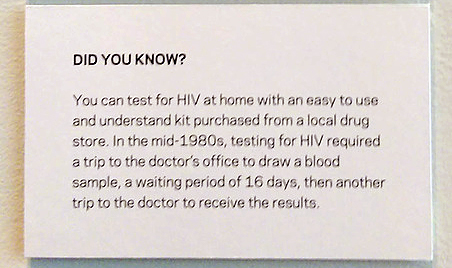
 

Did You Know?


Living and breathing

This is the biggest exhibition on art relating to HIV/AIDS since the seminal exhibition Art in the Age of AIDS at the National Gallery of Australia, Canberra in 1995, which I was a part of.

I was lucky to survive the initial wave of HIV/AIDS infections. The Centers for Disease Control issued its first statement about a cluster of 19 cases of Kaposi’s sarcoma (a rare skin cancer most common in elderly men from southern Italy) and Pneumocystis carinii pneumonia in young, gay men in New York, Los Angeles, and San Francisco in July 1981… and I had my first HIV test in London in 1983. In those days, as the wall text from the exhibition spells out above, you had to wait 16 days to get the result of a blood test. I vividly remember sitting outside a doctor’s office knowing that when I went in, if he said yes you have it, it was a death sentence. In those early days, there was no treatment. You were going to die. I only survived by luck. Many of my friends and lovers didn’t.

“Art reflects and reacts to social, cultural, and political climates, and in the past 30 years, HIV and AIDS has been a constant presence,” says exhibition co-curator Rock Hushka. “So many of us recall friends, family, and partners we have lost and the terror of the early years of the crisis, while younger people are just learning this story. We seek to create a deeper understanding of the legacy of HIV / AIDS in contemporary American art, and encourage our visitors to see their experiences in these works.” (Press release)

This deep understanding can be supplemented by this posting. I spent many hours securing more images than were sent to me in the press pack, because I think it is really important to have as great a cross-section as possible of work online from this exhibition, as a record of this time and space in the ongoing HIV / AIDS story.

In terms of the art, I find the earlier narratives are much more powerful and focused than the contemporary work. One of the most moving of these, and one that I have never seen before, is Keith Haring’s Altar Piece (1990, cast 1996, below). Can you imagine being an artist, being Haring, working on the wax mould in hospital being treated for AIDS-related illness, thinking that this could possibly be the last art work that you would ever complete. That you would never see it produced. And then to make something that is so compassionate, so beautiful that it is almost beyond belief… my heart is full of admiration and, like the crowd in the triptych, I am washed with tears.

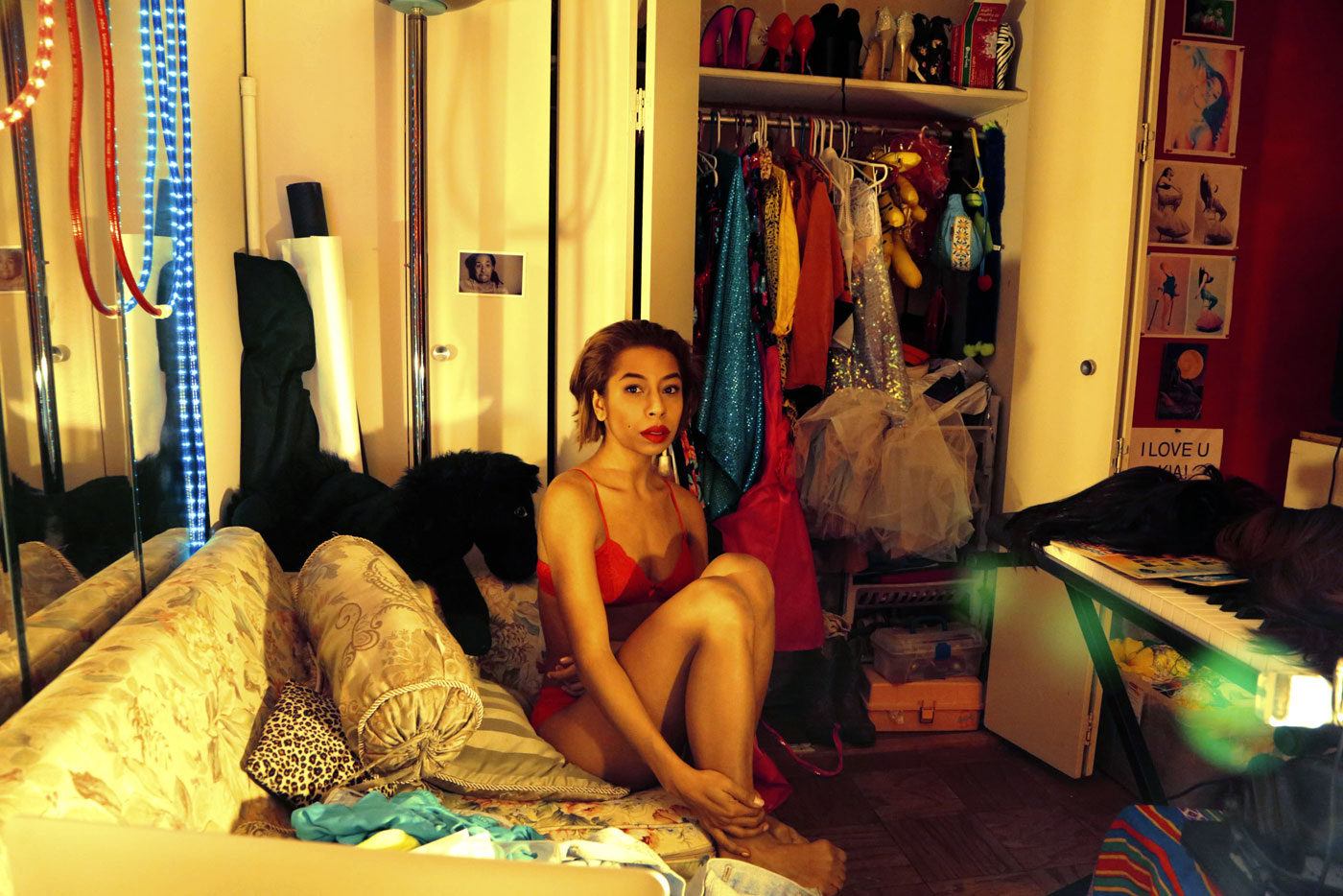
By comparison, some of the contemporary works seem to have become mere graphic symbolism (leaves, milk and flowers) rather than engaging activism. For example, Tino Rodriguez’s Eternal Lovers (2010, below) – while referencing his Mexican heritage through skull imagery from Dia de los Muertos, the Day of the Dead – is not about loss with presence but loss without presence: a febrile graphic activity that is pure decoration. Other works such as Derek Jackson’s Perfect Kiss (2007, below) or LADZ’s Eden #31 (2012, below) enact only the most tenuous link to HIV/AIDS and only when it is spelled out in text. Again, while not denying the pain of the death of her mother, her persecution when growing up or the problems with living with HIV, Kia Labeija’s 24 (Mourning Sickness; Kia and Mommy; In my room) (2014, below) propositions us with a women photographed in deadpan photography style as glamorous mother with vivid pink lipstick or a Beyonce music star in sequin dress and 6 inch heels. Only in the last photograph is there any hint of vulnerability and, funnily enough, it is the only photograph that I care about and engage with.

In all of these works the key word is enact, for these works are performances of gender and sexuality conceptualised for the viewer, where living with HIV/AIDS is shown to us at a distance. Instead of ACTing up, unleashing the power of the oppressed, artists are now acting out in this (supposed) post-death HIV/AIDS climate. Look at me, I can be whoever I want to be (and still have HIV). Nothing wrong with that I hear you say, and you would be completely right… if only the art commenting on this post-death resurrection of the author, was memorable.

While 1,218,400 persons aged 13 years and older are living with HIV infection in the USA and an estimated 47, 352 people were diagnosed with the disease in 2013, people are still dying by the thousands in America (an estimated 13,712 people died in 2012 of an AIDS related disease – source Centers for Disease Control and Prevention website).

This is not pretty pink lipstick and sequin dresses, this is 13 thousand people a year still DYING from this disease.

Just think about that for a while.

Dr Marcus Bunyan


Many thankx to the Tacoma Art Museum, Mark I. Chester and Steven Miller for allowing me to publish the photographs in the posting. Please click on the photographs for a larger version of the image.


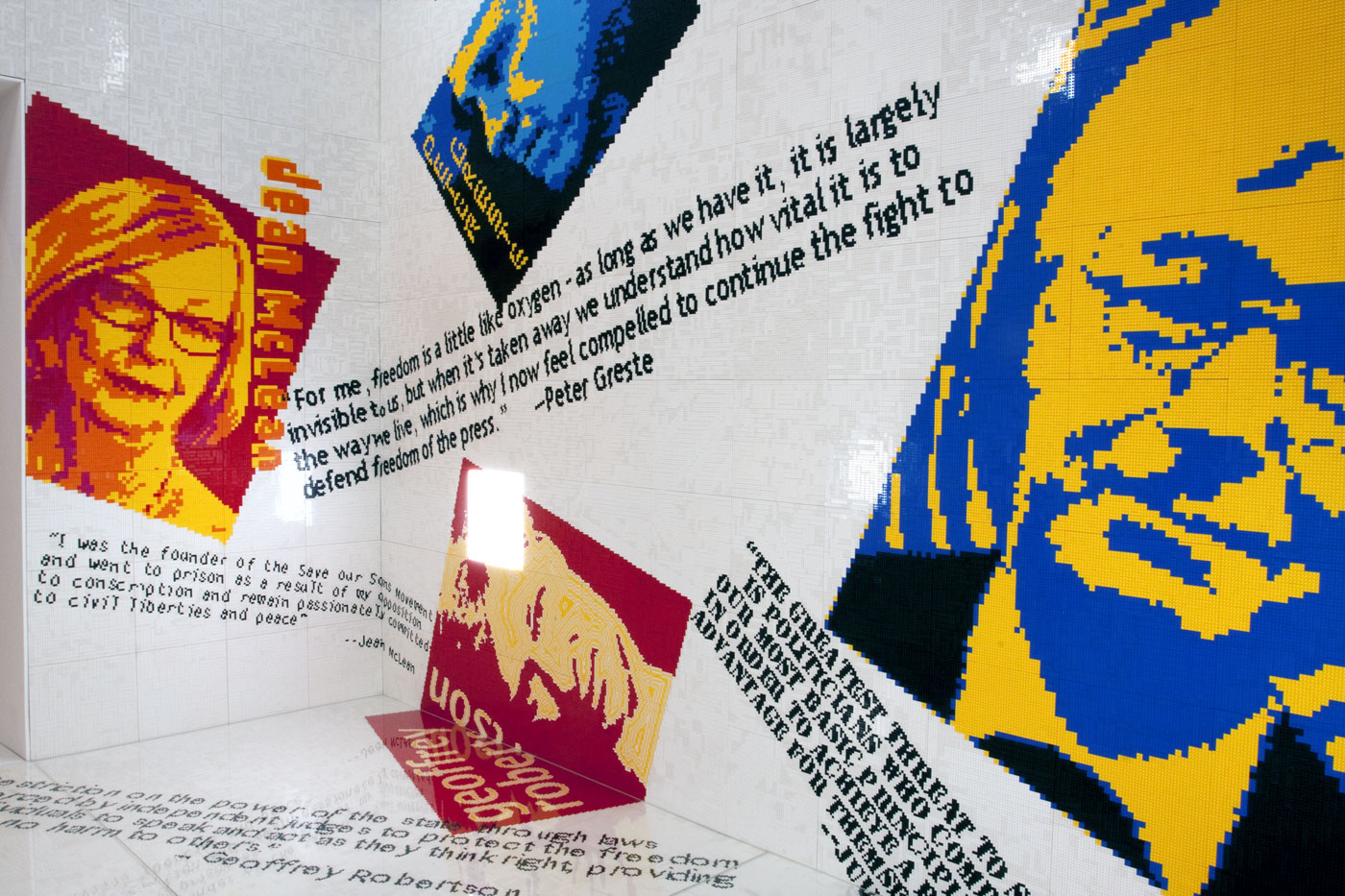
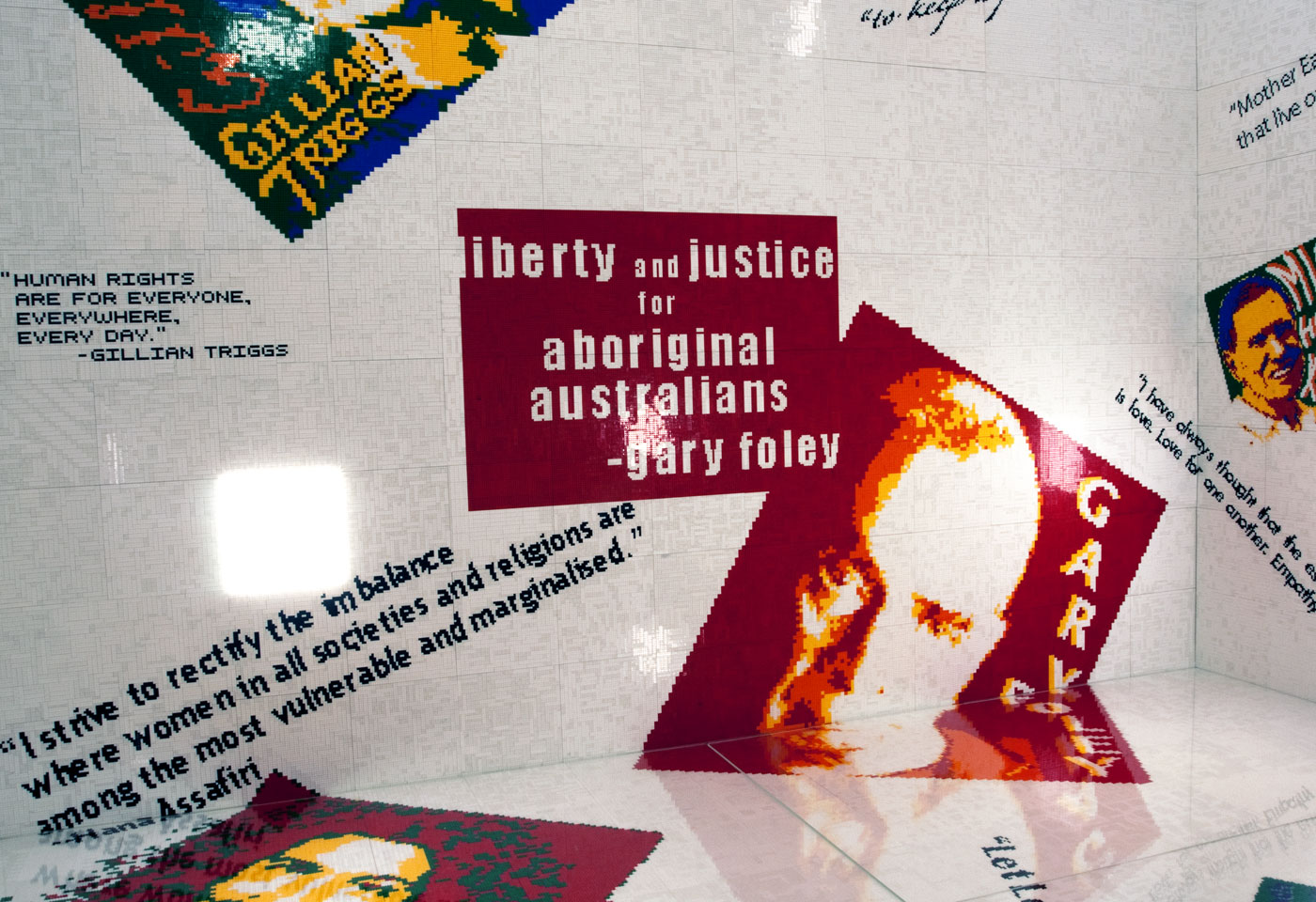
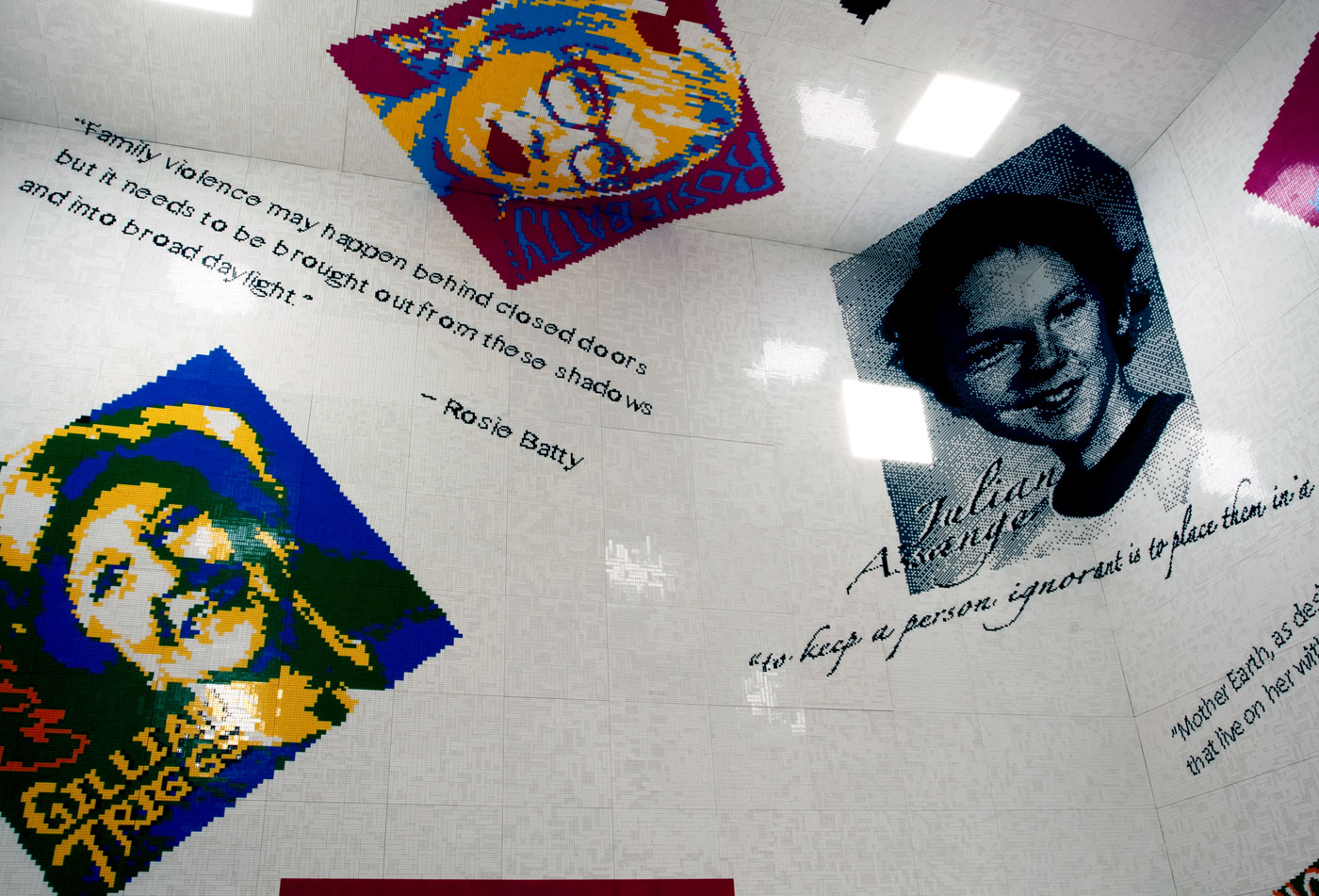
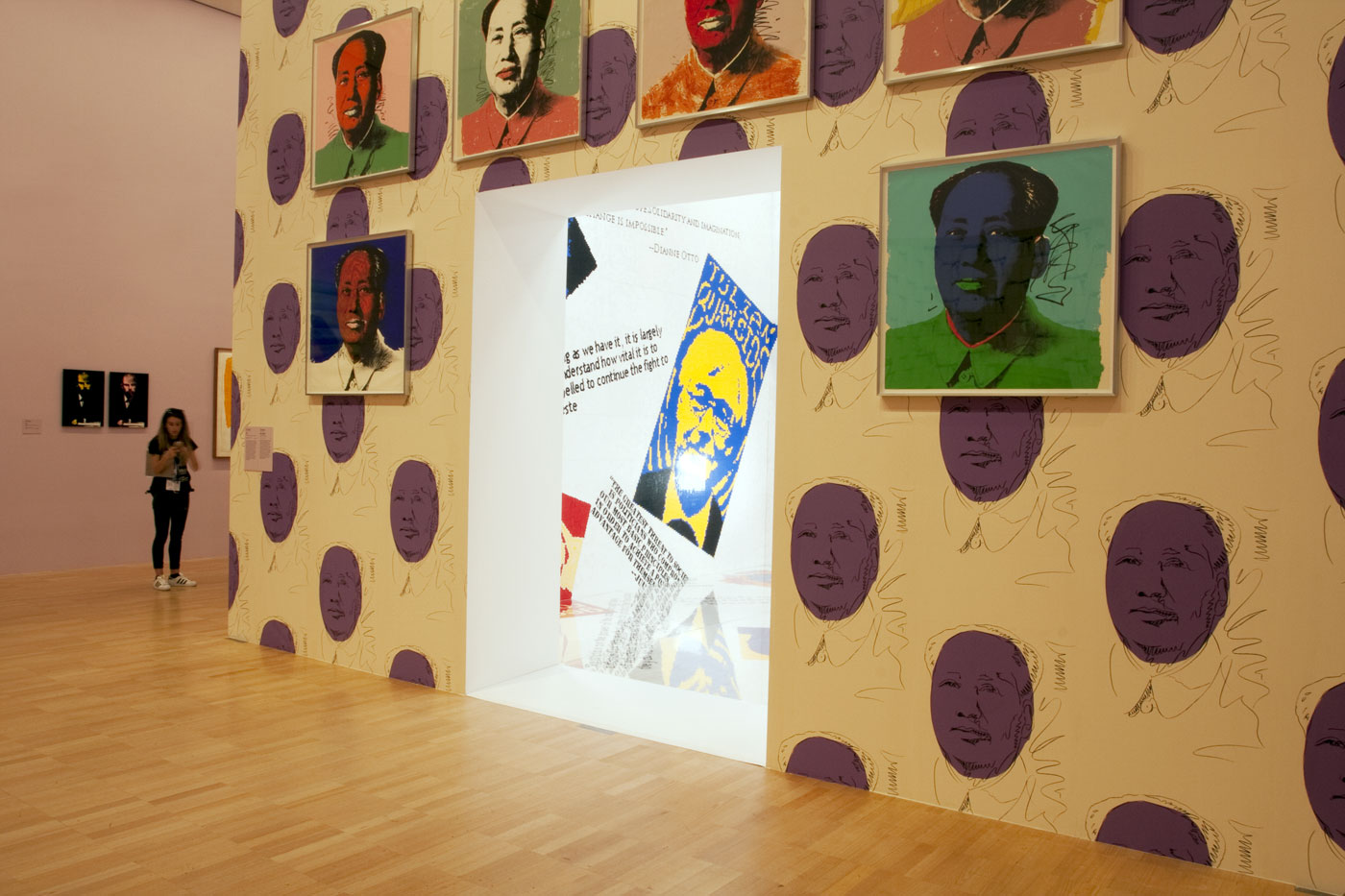
ACT UP NY/Gran Fury (active New York, New York, 1987–1995), Let the Record Show… 1987/recreated 2015 from the exhibition 'Art AIDS America' at Tacoma Art Museum, Tacoma, Oct 2015 - Jan 2016


ACT UP NY/Gran Fury (active New York, New York, 1987-1995)
Let the Record Show…
1987/recreated 2015
Mixed media installation, dimensions variable
Courtesy of Gran Fury and the New Museum, New York
Photo courtesy of the artists


In 1987, the New Museum’s curator William Olander invited ACT UP (the AIDS Coalition to Unleash Power) to create a work about AIDS. ACT UP, a diverse, nonpartisan, grassroots organisation, responded with Let the Record Show… providing information about the crisis.

At the time, the only visual presence of AIDS activism was the Silence=Death stickers. Let the Record Show… recreated here in full for the first time, included an LED reader board with statistics about the unfolding medical and political crisis, the neon pink triangle with “Silence=Death,” a photomural from the Nuremberg trials, and photographs of contemporary public figures with their statements about AIDS.

Using the 1986 graphics from the Silence=Death Project, ACT UP appropriated the pink triangle from the badges assigned to gay prisoners in Nazi Germany during World War II. The artists combined this historic symbol of powerlessness along with the photomural of the Nuremberg courtroom to make an explicit comparison between the severity of the AIDS crisis and government inaction and the Holocaust.

The complicated installation asked whether simple silence in a crisis is as culpable as actively encouraging one. The anonymous collective Gran Fury formed as a committee of ACT UP, as a result of Olander’s invitation. Gran Fury continued to make provocative and important works about the AIDS crisis.

For the installation of Let the Record Show… at the New Museum, quotes were cast in concrete under the photograph of the irresponsible speaker:

“The logical outcome of testing is a quarantine of those infected.”
Jesse Helms, U.S. Senator

“It is patriotic to have the AIDS test and be negative.”
Cory Servass, Presidential AIDS Commission

“We used to hate faggots on an emotional basis. Now we have a good reason.”
Anonymous Surgeon

“AIDS is God’s judgment of a society that does not live by His rules.”
Jerry Falwell, Televangelist

“Everyone detected with AIDS should be tattooed in the upper forearm to protect common needle users, and on the buttocks to prevent the victimization of other homosexuals.”
William F. Buckley, Columnist

” …”
Ronald Reagan, President of the United States


ACT UP NY/Gran Fury (active New York, New York, 1987-1995) 'Let the Record Show…' (detail) 1987/recreated 2015


ACT UP NY/Gran Fury (active New York, New York, 1987-1995)
Let the Record Show… (detail)
1987/recreated 2015
Mixed media installation, dimensions variable
Courtesy of Gran Fury and the New Museum, New York
Photo courtesy of the artists
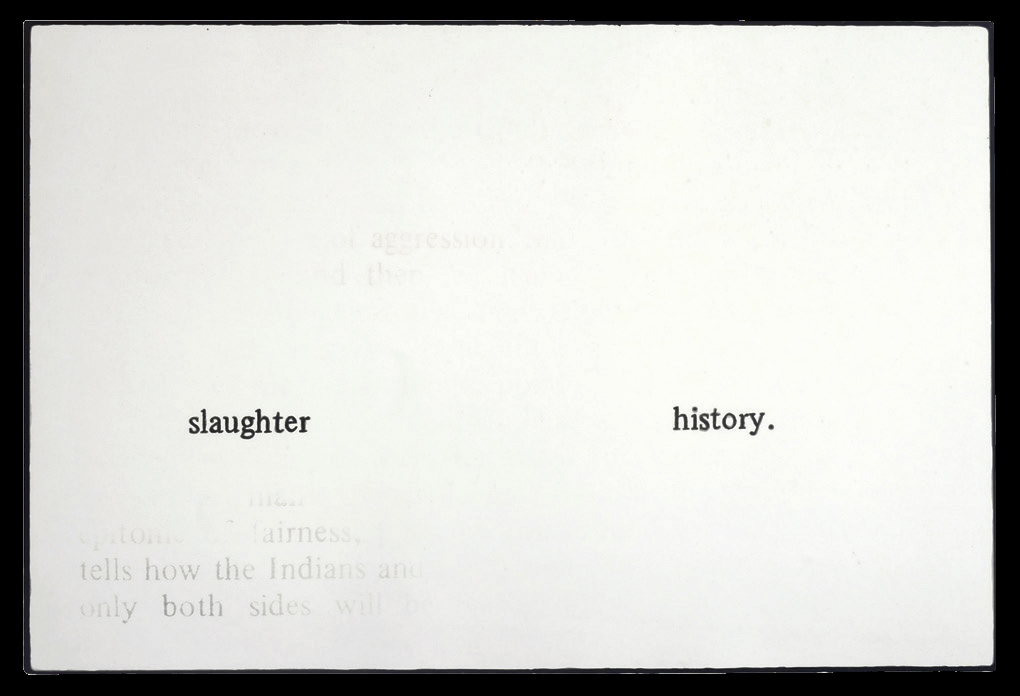
 

Carrie Yamaoka (American, born Glen Cove, New York, 1957) 'Steal This Book #2' 1991 from the exhibition 'Art AIDS America' at Tacoma Art Museum, Tacoma, Oct 2015 - Jan 2016


Carrie Yamaoka (American, born Glen Cove, New York, 1957)
Steal This Book #2
1991
Unique chemically altered gelatin silver print
Courtesy of the artist


Carrie Yamaoka takes inspiration from Abbie Hoffman’s iconic Steal This Book, a counterculture manual for social revolution. By photographing a page spread and then obliterating all of the words except “slaughter” and “history,” Yamaoka rejects any passive understanding of history. As an activist and artist, Yamaoka will use any means necessary to affect change. Steal This Book #2 may be considered as referring to Yamaoka’s experience as an AIDS activist and her desire to reshape our understanding of our relations with HIV.


Jerome Caja (American, 1958-1995) 'Bozo Fucks Death' 1988


Jerome Caja (American, 1958-1995)
Bozo Fucks Death
1988
Nail polish on plastic tray
Collection of Ed Frank and Sarah Ratchye


One of Jerome Caja’s alter egos was the clown Bozo. Here Caja aggressively turns the tables on death and seeks to gain some control and power over the inevitable, even if only a transgressive, psychological fantasy.


Niki de Saint Phalle (French-American, 1930-2002) 'AIDS, you can't catch it holding hands' 1987


Niki de Saint Phalle (French-American, 1930-2002)
AIDS, you can’t catch it holding hands
1987
Book, 52 pages 8 × 10 inches
The Lapis Press, San Francisco
© 2015 Niki Charitable Art Foundation, All rights reserved / ARS, NY / ADAGP, Paris


Working with collaborator Professor Silvio Barandun, Niki de Saint Phalle wrote and illustrated AIDS: You Can’t Catch It Holding Hands for young adults. Using her characteristically colourful and joyous style, de Saint Phalle offers unusually straightforward information about the transmission of HIV from unprotected sex and unclean needles in intravenous drug use. She also uses the same frank approach to assuring her readers that casual contact from flowers, doorknobs, and toilet seats does not transmit AIDS, notions that were not widely understood in the early years of the AIDS crisis.
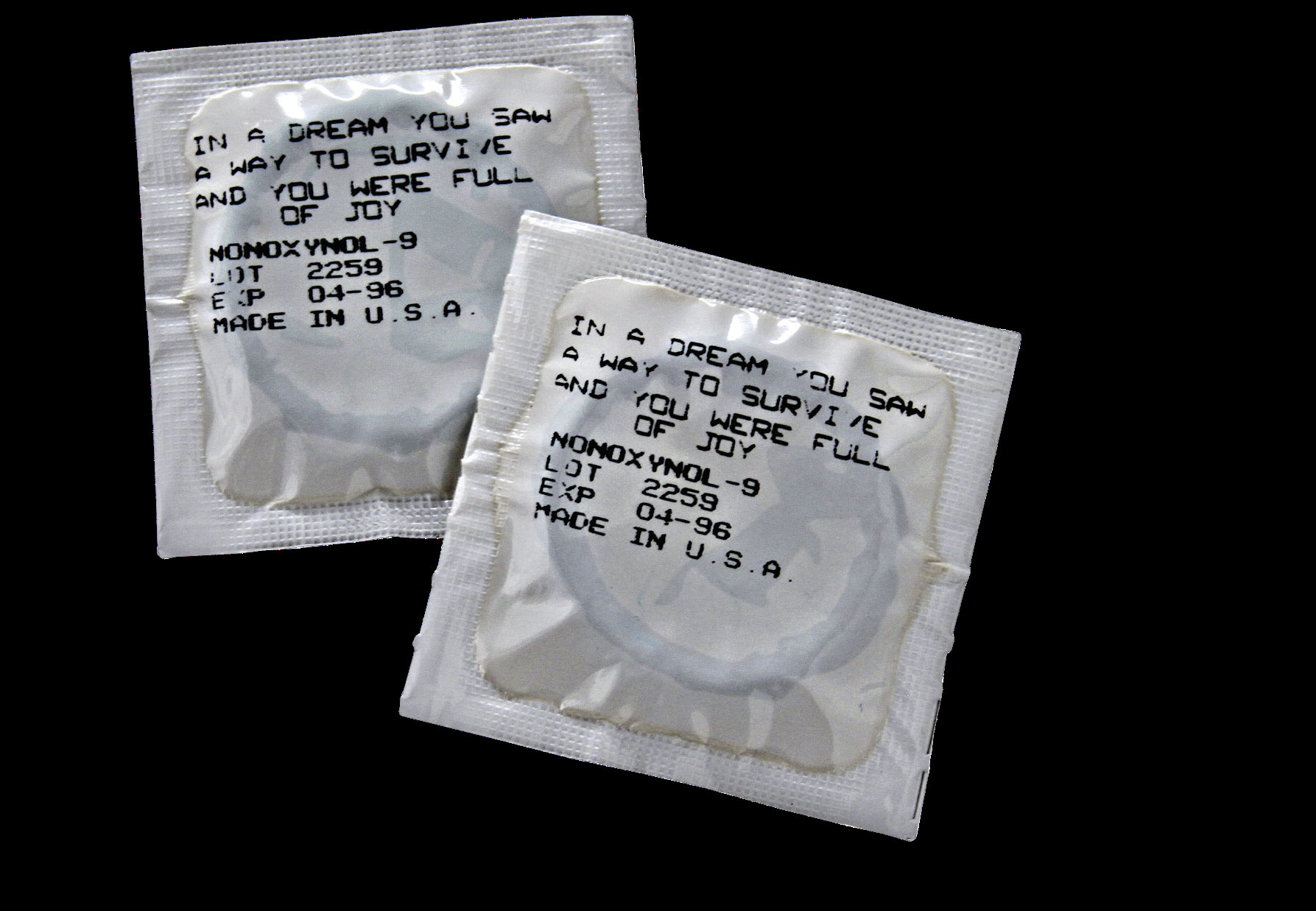
 

Jenny Holzer (American, born Gallipolis, Ohio, 1950) 'Untitled (In a Dream You Saw a Way To Survive and You Were Full of Joy)' 1983-1985


Jenny Holzer (American, born Gallipolis, Ohio, 1950)
Untitled (In a Dream You Saw a Way To Survive and You Were Full of Joy)
1983-1985
Packaged latex condoms with printed text, each is 2 x 2 inches
Mildred Lane Kemper Art Museum, Washington University in St. Louis, Anonymous gift, 2001


Jenny Holzer (American, born Gallipolis, Ohio, 1950) 'Untitled (Expiring for Love Is Beautiful but Stupid)' 1983-1985


Jenny Holzer (American, born Gallipolis, Ohio, 1950)
Untitled (Expiring for Love Is Beautiful but Stupid)
1983-1985
Packaged latex condoms with printed text, each is 2 x 2 inches
Mildred Lane Kemper Art Museum, Washington University in St. Louis, Anonymous gift, 2001


Art AIDS America aims to abolish the silence about the pervasive presence of HIV / AIDS in American art and open meaningful and respectful dialogues about our experiences with the ongoing epidemic. For too long, we have considered art about AIDS as a tragic, closed chapter in the history of American art. This exhibition demonstrates the deep and continued impact of the AIDS crisis on American art from the early 1980s and continuing to today.

For more than thirty years, artists have actively responded with exquisite sensitivity to HIV / AIDS. They have adopted a broad spectrum of styles and messages from politically activist to quietly mournful art that nonetheless thrums with political content. Through poignant portraits, some artists brought much needed attention to personal suffering and loss from the AIDS crisis. Others employed abstraction and coded imagery to reveal the social and political factors that exacerbated the spread of HIV / AIDS. Artists also widely appropriated various art historical traditions to speak about the devastating impact of the epidemic. Art AIDS America offers an overview of how these various approaches redirected the course of American art from postmodern “art for art’s sake” formulas to art practice that highlights the personal experience and expertise of the artist.

Since the first reports of mysterious illnesses in the early 1980s, HIV and AIDS have touched nearly every American in some way, and operated as an undeniable (though often unacknowledged) force in shaping politics, medicine, and culture. Art AIDS America presents the full spectrum of artistic responses to AIDS, from the politically outspoken to the quietly mournful. HIV and AIDS are not just past-tense problems. As we persist in the struggle with HIV/AIDS, these artworks remind us of humanity’s resilience, responsibility, and history. The legacy of the AIDS crisis and our new relationships with the virus continue to inform contemporary art and American culture.

Text from the Tacoma Art Museum website
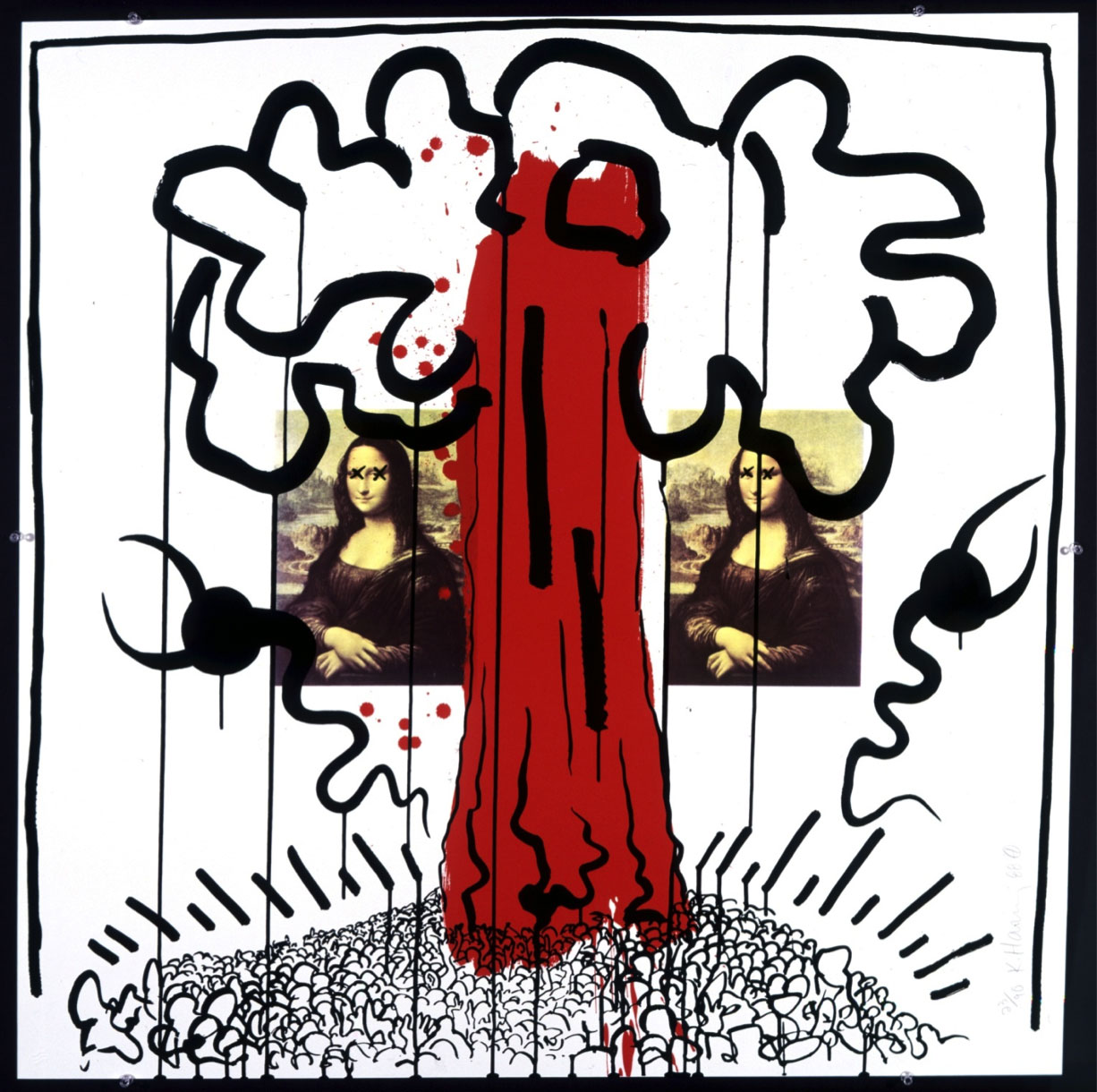
 

Keith Haring (American, 1958-1990) 'Apocalypse I' 1988


Keith Haring (American, 1958-1990)
Apocalypse I
1988
From the series Apocalypse, 1988
Silkscreen, Edition of 90
Courtesy of the Keith Haring Foundation


In their first collaboration, Keith Haring illustrated William S. Burroughs’ dystopic poem Apocalypse by mixing references to advertising, art history, and Catholic theology. Haring included his “devil sperm,” the black, horned symbol he created to give shape to HIV and its reign of death and terror.

Burroughs introduced the chaos unfolding:

“The final Apocalypse is when every man sees what he sees, feels what he feels, and hears what he hears. The creatures of all your dreams and nightmares are right here, right now, solid as they ever were or ever will be, electric vitality of careening subways faster faster faster stations flash by in a blur.”
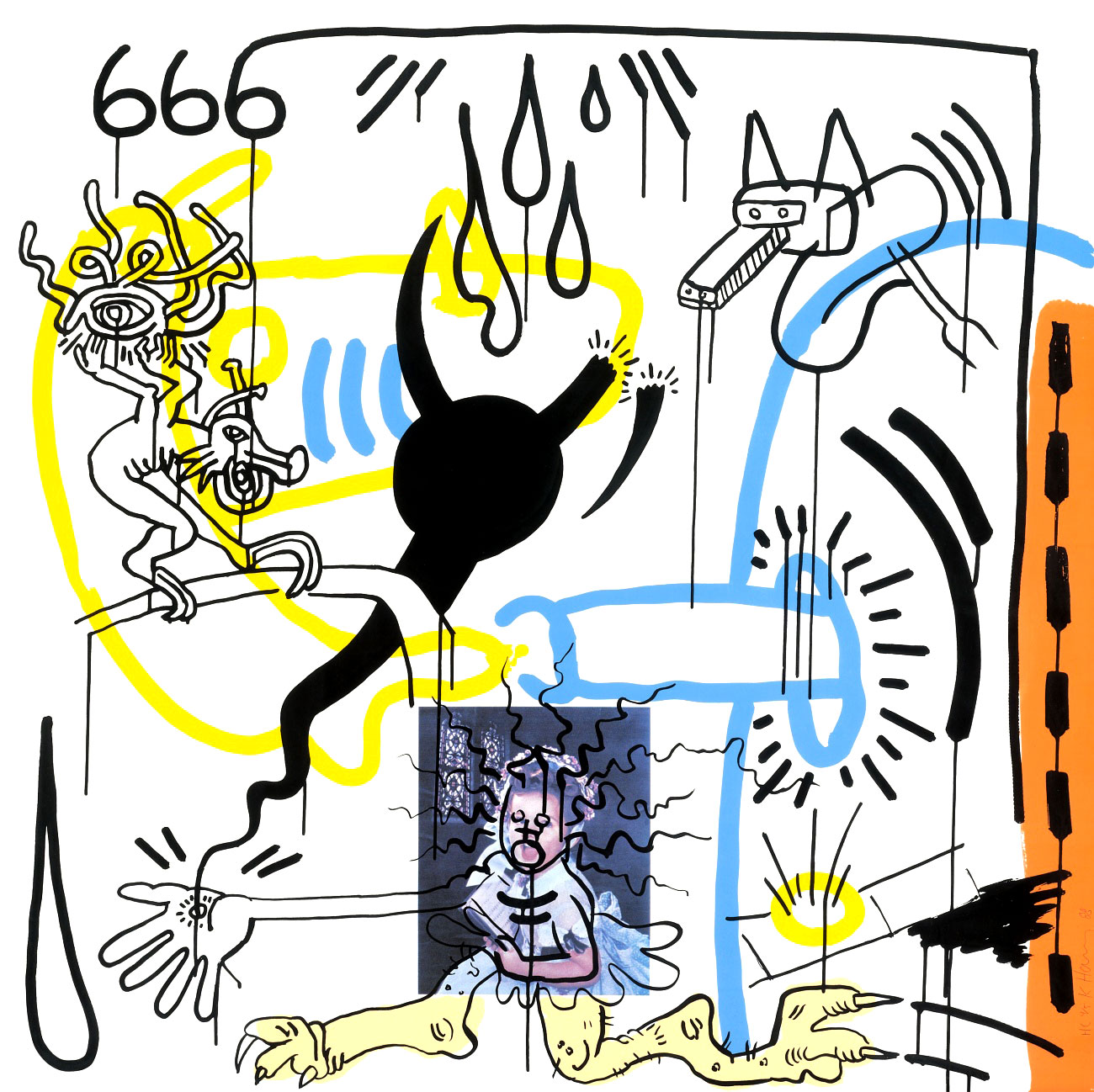
 

Keith Haring (American, 1958-1990) 'Apocalypse III' 1988


Keith Haring (American, 1958-1990)
Apocalypse III
1988
From the series Apocalypse, 1988
Silkscreen, Edition of 90
Courtesy of the Keith Haring Foundation


Grassroots Activism

Artists provided the early warnings of the AIDS crisis with their artworks deployed at the street level. Posters, stickers, T-shirts and other projects made it impossible to ignore messages about AIDS. These activist artists were informed by earlier precedents of feminist art and artists working on issues of identity politics. Communities coalesced around the calls to action.

The most prominent group to address the AIDS crisis was the anonymous artist collective Gran Fury in New York, a committee of ACT UP (the AIDS Coalition to Unleash Power). The collective used techniques and ideas from advertising, marketing, and the art world to raise awareness and affect political change. Their bold graphic style and refined text continues to influence politically-themed art.

Gran Fury and other activists changed how Americans thought about AIDS. The political and social pressure instigated by their actions and artworks played important roles in changing the approval process for AIDS drugs and treatment protocols. Women’s health issues were brought to the forefront. As a result, American society positively changed their opinions about HIV / AIDS when they had correct information.

Memento Mori

The AIDS crisis compelled contemporary American artists to address death with urgency. Artists witnessed a plague sweep through their communities and wipe out their friends, colleagues, and lovers. They used art to express their rage and terror when AIDS had no effective treatment. Their artwork provided a vitally important way to mourn their losses and share their sorrow.

Artists looked back to European and American artistic traditions of memento mori, Latin for “Remember that you must die,” to share their experiences, feelings, and stories. They adapted symbols like skulls and flowers to depict the fragility and fleeting nature of life.

Artists in this section shifted the intent of memento mori away from concepts of death and the afterlife. They refocused on the preciousness and precariousness of life, without forgetting the political and social realities behind the massive wave of death. Nayland Blake’s clock marks the passing of so many individuals with a call to action. David Wojnarowicz rages against the senseless death of Peter Hujar. Bill Jacobson and Karen Finley give form to the fragility of memory. Latino folk traditions connect the living and the dead in the paintings of Tino Rodriguez and Thomas Woodruff.

Poetic Postmodernism

In the early 1980s, American art was dominated by a new, postmodern theory. It held that meaning belongs not to the artist who made the work but to their audiences who interpret the works. Called “the death of the author,” the theory was named after a 1967 essay by the French postmodernist thinker Roland Barthes.

As AIDS actually caused the death of thousands of authors and artists by the late 1980s, this metaphor became a terrifying reality. At the same time, a powerful Christian conservative movement aggressively politicised AIDS. Using homophobia and fear of the disease, these politicians passed Federal laws that made it illegal to “promote, encourage, or condone homosexual sexual activities or the intravenous use of illegal drugs” in an AIDS awareness and education bill.

The ramifications for artists and art exhibitions were equally prohibitive. Federal laws were passed that made it impossible for museums to receive government support if an exhibition included obscene content, which was understood to mean gay themes among others, including AIDS-specific art. In this climate, artists knew that overt political content would result in censorship. So they developed a new way to smuggle political meaning into art.

In his research for Art AIDS America, Jonathan David Katz named this new approach “poetic postmodernism.” Artists used the postmodern theory “death of the author” to camouflage their own personal, expressive meanings. Many of the works in this exhibition have the same title format, the word “untitled” followed by a more specific description in parentheses such as in “Untitled” (Water), Untitled (Hujar Dead), or Untitled (Corrupt HIV Activism). The first term, “untitled,” signals the prevailing postmodernist idea that all meanings come from the audience. But the phrase inside the parentheses reveals clues to the artist’s associations and intentions. Because recognition of AIDS content was a product of the viewer’s thought and not the artist’s explicit claim, such works could be shown in museums without fear of being censored under the new laws.


Andres Serrano (American, b. 1950) 'Milk/Blood' 1989, printed 2015


Andres Serrano (American, b. 1950)
Milk/Blood
1989, printed 2015
Chromogenic colour print
Exhibition print
Courtesy of the artist


Milk/Blood recall the pure, flat colour of hard edged abstract painters such as Ellsworth Kelly. But the simple saturated colour fields in Serrano’s photograph bear the evocative title Milk / Blood, the two main body fluids that transmit HIV. Serrano appropriates the formal language of modernism for political purposes, a means of potentially slipping AIDS consciousness into a museum context without fear of exclusion or censure. As with HIV infection itself, the photograph underscores how our key sense, vision, is unreliable in the face of AIDS.


Andres Serrano (American, b. 1950) 'Blood and Semen III' 1990


Andres Serrano (American, b. 1950)
Blood and Semen III
1990
Chromogenic colour print, edition 1 of 4
40 × 60 inches
Courtesy of the artist
Photo courtesy of the artist


Like his Milk/Blood in this exhibition, Blood and Semen III also appears to be a rigorously formal composition, this time evoking the gestural appearance of an abstract expressionist painting. Again, the title references two body fluids that transmit HIV. As examples of poetic postmodernism, Serrano activates meaning in Blood and Semen III and Milk / Blood using formal arrangements and references to earlier artistic styles to inform his photographs with personal and potentially political content.


Shimon Attie (American, b. 1957) 'Untitled Memory (projection of Axel H.)' 1998


Shimon Attie (American, b. 1957)
Untitled Memory (projection of Axel H.)
1998
Ektacolor photograph, edition 1 of 3
32 × 38 3/4 inches
Courtesy of the artist and Jack Shainman Gallery, New York
© 2015 Artists Rights Society (ARS), New York / VG Bild-Kunst, Bonn
Photo courtesy of the artist


Shimon Attie (American, b. 1957) 'Untitled Memory (projection of Axel H.)' 1998 (detail)


Shimon Attie (American, b. 1957)
Untitled Memory (projection of Axel H.) (detail)
1998
Ektacolor photograph, edition 1 of 3
32 × 38 3/4 inches
Courtesy of the artist and Jack Shainman Gallery, New York
© 2015 Artists Rights Society (ARS), New York / VG Bild-Kunst, Bonn
Photo courtesy of the artist


After an extensive period working in Europe memorialising the Holocaust, Shimon Attie returned to San Francisco in 1996 and began his series Untitled Memory. Attie projected old photographs of his friends and lovers onto places with special meaning to him, including this room of a former apartment. His photographs of these projections became personal studies of loss and melancholy.
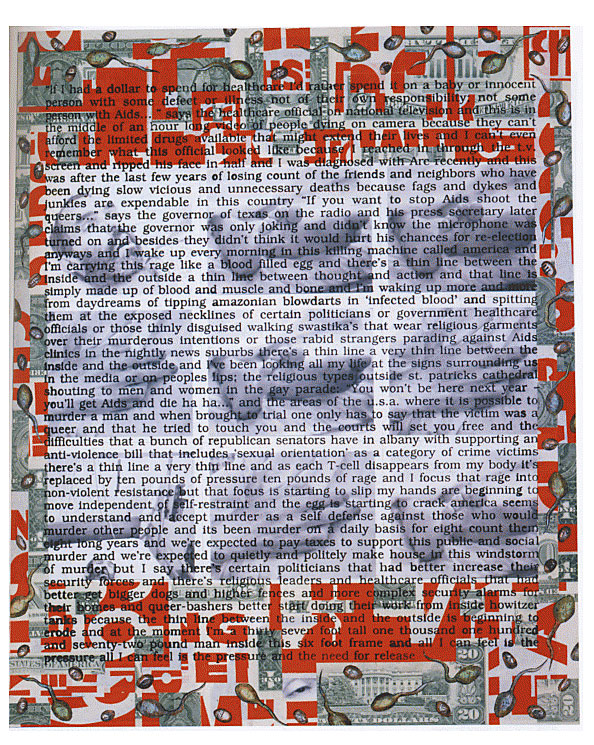
 

David Wojnarowicz (American, 1954-1992) 'Untitled (Hujar Dead)' 1988-1989


David Wojnarowicz (American, 1954-1992)
Untitled (Hujar Dead)
1988-89
Black and white photograph, acrylic, text and collage on Massonite
Collect of Steven Johnson and Walter Sudol
Courtesy Second Ward Foundation


Wojnarowicz was briefly lovers with and then became a close friend of the famous photographer Peter Hujar, who died of AIDS-related causes in 1987. Untitled (Hujar Dead) incorporates still images from a film by Wojnarowicz of Hujar’s lifeless body on his hospital bed. Wojnarowicz then overprinted the text of one of his famous “rants.” In these politically-charged performances and texts, he laid blame for the AIDS crisis squarely on the conservative right-wing demagogues who politicised the disease and continually spewed homophobic rhetoric which only exacerbated the crisis.


Tino Rodriguez (Mexican-American born Guadalajara, Mexico, b. 1965) 'Eternal Lovers' 2010


Tino Rodriguez (Mexican-American born Guadalajara, Mexico, b. 1965)
Eternal Lovers
2010
Oil on wood
Private collection
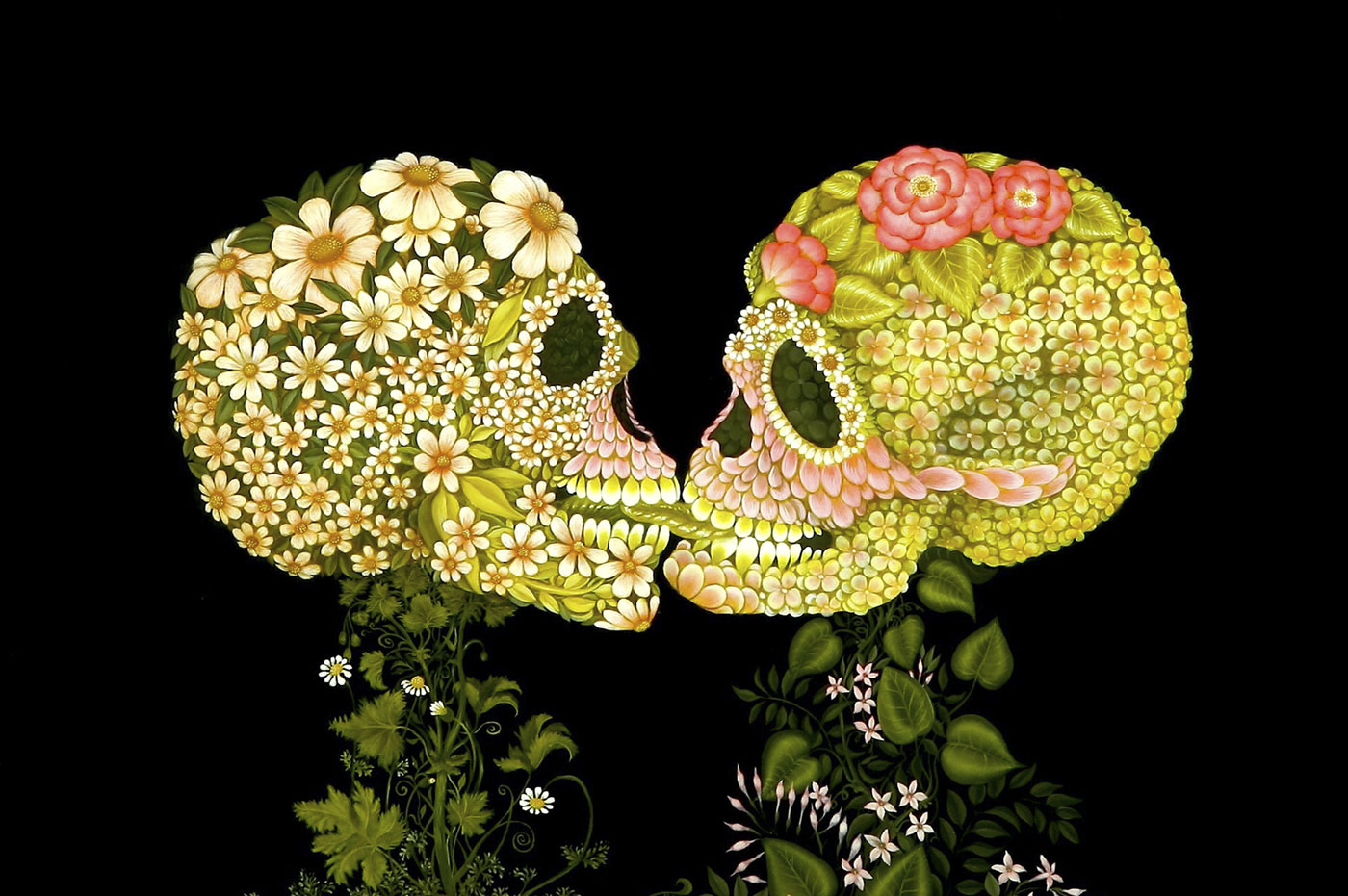
 

Tino Rodriguez (Mexican-American, born Guadalajara, Mexico, b. 1965) 'Eternal Lovers' 2010 (detail)


Tino Rodriguez (Mexican-American, born Guadalajara, Mexico, b. 1965)
Eternal Lovers (detail)
2010
Oil on wood
Private collection


Tino Rodriguez’s Eternal Lovers incorporates aspects of his Mexican heritage, and especially the tradition of skull imagery from Dia de los Muertos, the Day of the Dead. This family-oriented celebration of ancestors brings the living and dead into affectionate proximity. Rodriguez here exuberantly conflates familiar American oppositions such as death and life, growth and decay, and even good and evil. Inherently androgynous, the gender of the skulls remains unknown as does their cause of death. But as in the Dia de los Muertos celebration itself, Rodriguez’s image supplants horror with humour and loss with presence, offering the triumph of love and memory over death in the age of AIDS.
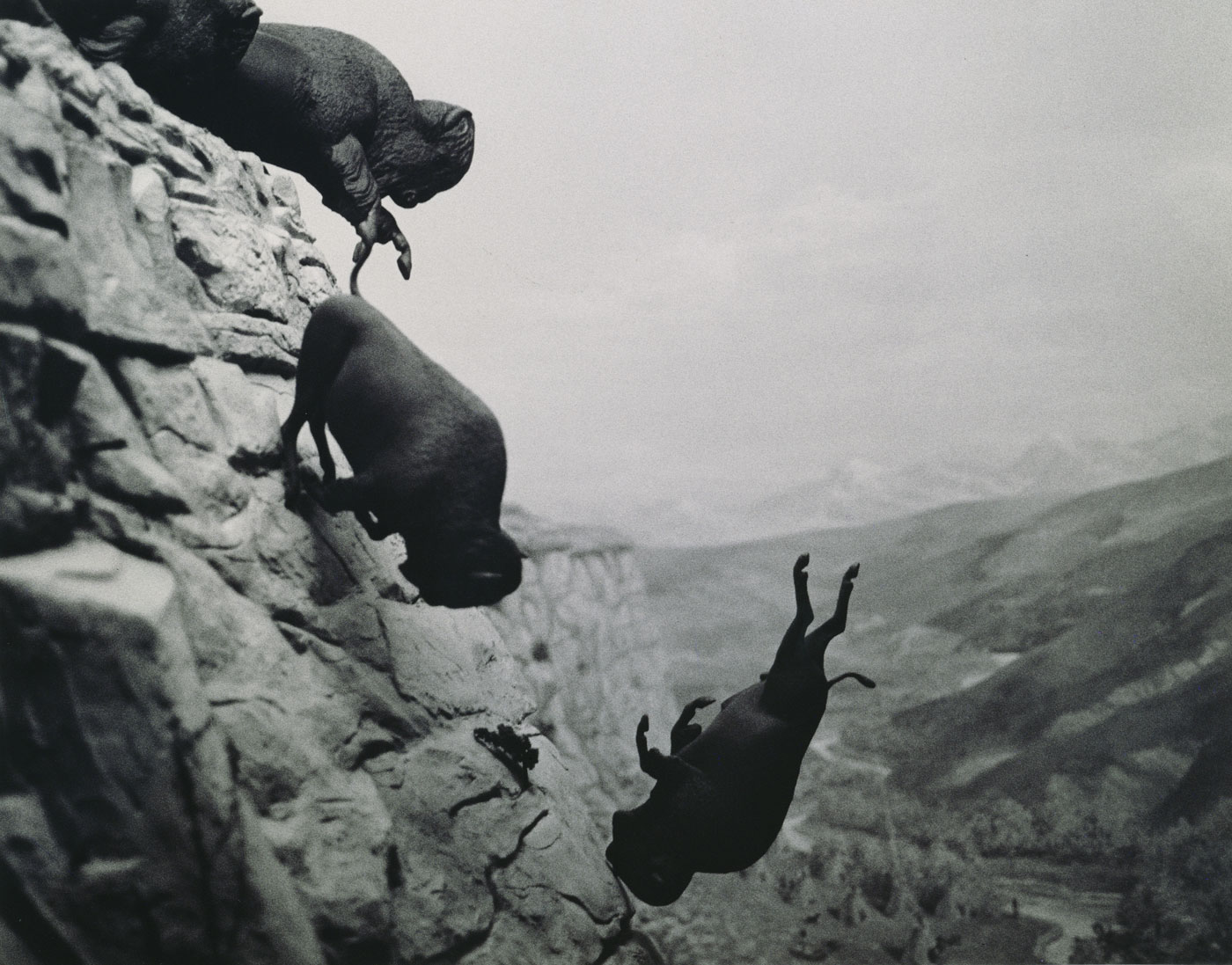
 

David Wojnarowicz (American, 1954-1992) 'Untitled (Buffalo)' 1988-1989


David Wojnarowicz (American, 1954-1992)
Untitled (Buffalo)
1988-1989
Vintage gelatin silver print, signed on verso
Collection of Michael Sodomick


For Untitled (Buffalo), David Wojnarowicz simply photographed a diorama in a museum in Washington, DC. This image of buffalo being herded off a cliff served as a chilling metaphor of the politics of AIDS in the US in the late 1980s. Rather than an illustration of traditional Native American hunting techniques, Wojnarowicz eloquently expressed his rage, desperation, and helplessness through the great symbol of American identity. His shifting and layering of meaning onto this symbol is a classic example of poetic postmodernism.

One example of how artists hid their message is David Wojnarowicz’s Untitled (Buffalo). It’s a diorama of a buffalo fall, a traditional method of harvesting large numbers of buffalo by chasing herds off cliffs. The buffalo are made from plastic. Wojnarowicz photographed the diorama and cropped it. “This is appropriation,” Hushka said. “He used it as this extraordinarily eloquent cry about the state of American politics at the time.” Katz added, “It’s telling that even an artist of Wojnarowicz’s activist fervour engaged in a metaphor that only cohered in the mind’s eye. You needed to be attentive to what it might be saying to read it. There’s nothing specifically AIDS about it.”

Spiritual Forces

Because of the overwhelming number of deaths, the unspeakable losses, and the constant presence of disease, it should not be surprising that artists also turned to issues of spirituality. Yet, the art history of AIDS often neglects this important aspect. Across the United States, faith communities tended to the spiritual needs of people with AIDS and provided critical services for them. These communities continue to support people living with HIV.

The AIDS crisis exposed deep division within many spiritual traditions. Artists such as Jerome Caja, Robert Gober, and Barbara Kruger expressed discomfort and displeasure in how some religious ideologies oppressed gays and lesbians and worsened the AIDS crisis. Others made inspiring works within long-established traditions like Keith Haring’s altar piece. In other artworks, artists created symbols for the dignity of people suffering from AIDS, ranging from Christian saints and Biblical texts to imagery inspired by Buddhism and healing traditions from India.
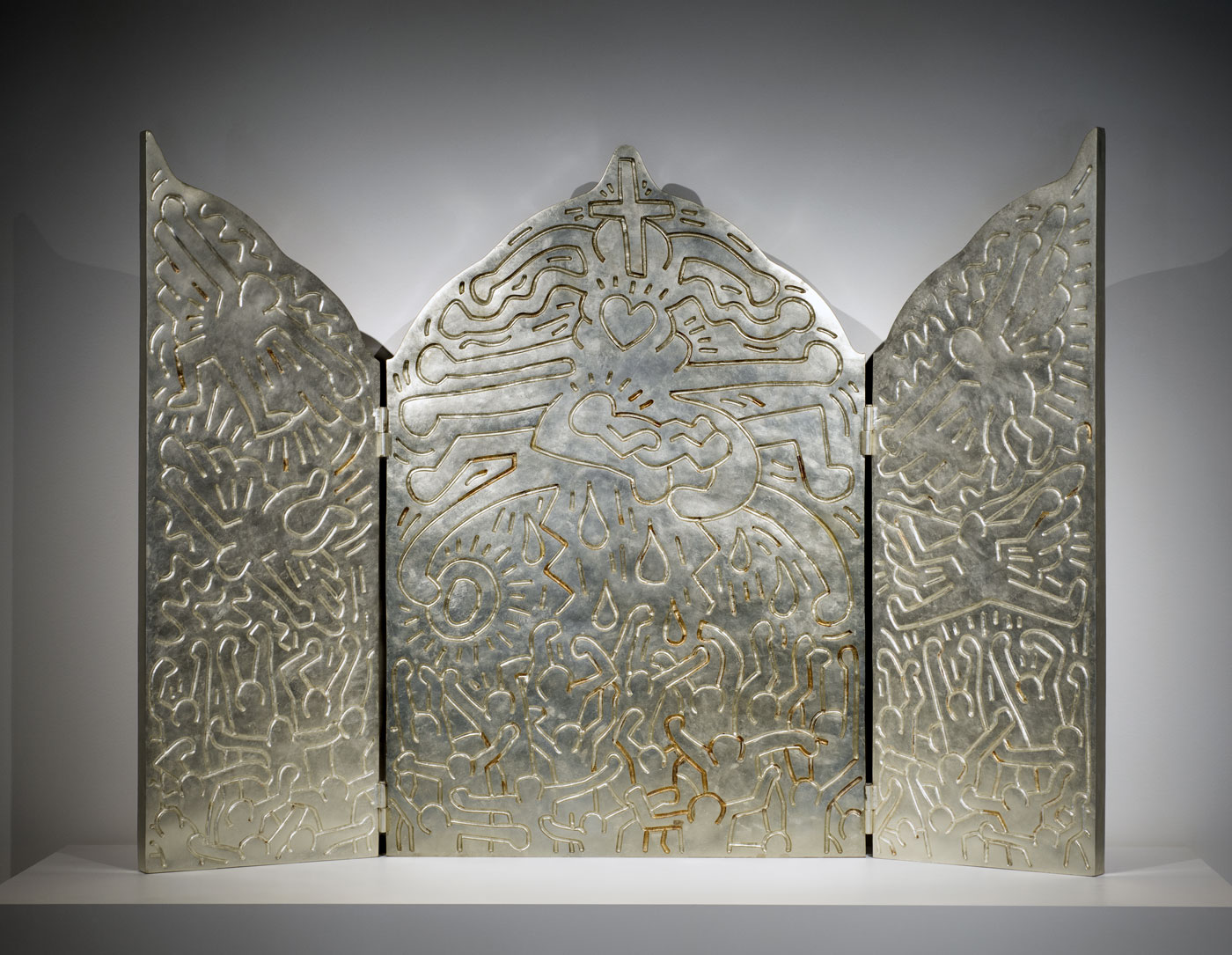
 

Keith Haring (American, 1958-1990) 'Altar Piece' 1990 (cast 1996)


Keith Haring (American, 1958-1990)
Altar Piece
1990 (cast 1996)
Bronze with white gold leaf patina, edition 2 of 9
60 × 81 x 2 inches
Denver Art Museum, Gift of Yoko Ono, 1996.204A-C.
© Keith Haring Foundation
Photo © Denver Art Museum


This altar piece by Keith Haring is the last work the artist completed. He worked on the wax mould while he was hospitalised for AIDS-related illnesses. The triptych format echoes traditional Roman Catholic altar pieces. The image of the crying mother holding an infant speaks to the inconsolable losses from AIDS. The mother’s tears fall on the crowds, seeking solace and mercy from the AIDS epidemic.


Barbara Kruger (American, born Newark, New Jersey, 1945) 'Untitled (It's our pleasure to disgust you)' 1991


Barbara Kruger (American, born Newark, New Jersey, 1945)
Untitled (It’s our pleasure to disgust you)
1991
Photographic silkscreen on vinyl
The Museum of Contemporary Art, Los Angeles, Gift of Eric and Nannette Brill


Despite provocative imagery and text, Barbara Kruger intends no specific meaning to her artworks. Rather, Kruger wants to demonstrate how the reader generates meaning each time the text is read. She activates ambiguity and political charge with the phrase “It’s our pleasure to disgust you.” Kruger underscores the gulf between and image and its possible meanings, an issue brought into high relief in the culture wars promoted by religious conservatives, during the period when this work was made.

The work may be interpreted as evidence that artists like Kruger were deliberately insensitive to cultural norms. Alternatively, it could be read as proof that artworks were deliberately manipulated for political purpose by others. Because AIDS was framed in political terms from its earliest moment, Kruger’s Untitled (It’s our pleasure to disgust you) reflects the complexity and deliberate uses of language about AIDS.


Robert Gober (American, born Wallingford, Connecticut, 1954) 'Drains' 1990


Robert Gober (American, born Wallingford, Connecticut, 1954)
Drains
1990
Cast pewter Edition of 8, with 2 artist’s proofs, artist’s proof 1 of 2
Collection of the artist


Robert Gober’s Drains is meticulously handcrafted to resemble a mass-produced consumer good. Because we think about drains primarily as a tool to remove waste often associated with personal hygiene and cleaning, connections to HIV/AIDS are obvious. By placing the sculpture in an unexpected position on a gallery wall, Gober seeks to generate unanswerable, metaphorical questions about the functions of a drain and the unknown space behind it. The cruciform shape at the back of the drain recalls his childhood and his complicated relationship with Catholicism.
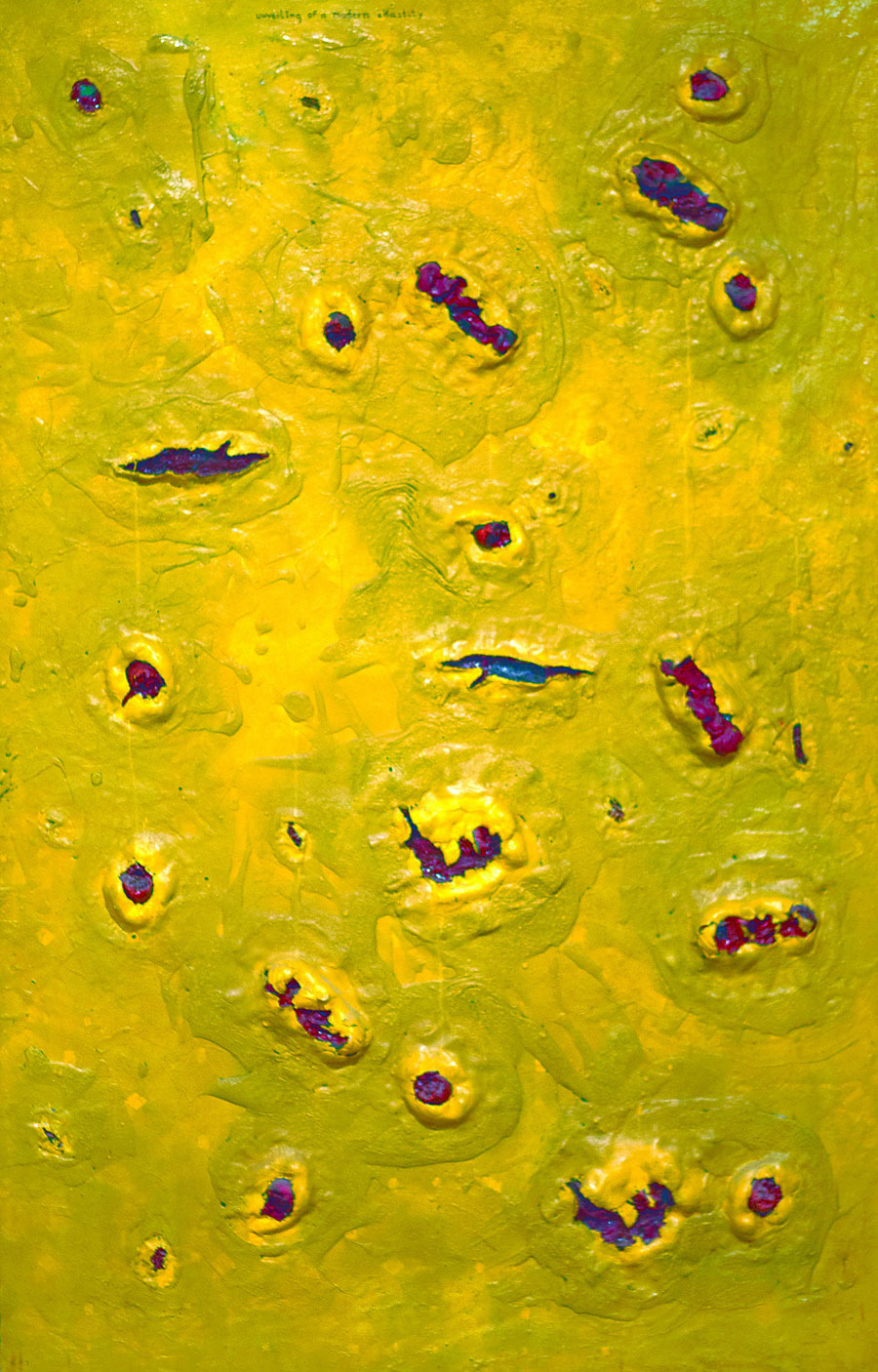
 

Izhar Patkin (American born Israel, b. 1955) 'Unveiling of a Modern Chastity' 1981


Izhar Patkin (American born Israel, b. 1955)
Unveiling of a Modern Chastity
1981
Rubber paste, latex theatrical wounds, and
printing ink on a stretched linen canvas
Courtesy of the artist


Izhar Patkin painted Unveiling of a Modern Chastity one year before there was any public announcement about a new disease striking formerly healthy young men. This is the earliest work in the exhibition, and, in retrospect, one of the earliest AIDS paintings ever. Troubled by the sight of a group of such young men with similar dark purple skin lesions waiting in his dermatologist’s office, he presciently titled the work to reflect what he felt might be a forthcoming change in sexual culture. The painting’s skin-like surface erupts in what looks like Kaposi’s sarcoma lesions.

Patkin’s heavily textured surface and use of artificial wounds was his effort to destroy minimalism and other traditions of pure abstraction. He wanted to expose the inability of modernist art to contain pressing social and contextual significance.

DID YOU KNOW? The Centers for Disease Control issued its first statement about a cluster of 19 cases of Kaposi’s sarcoma (a rare skin cancer most common in elderly men from southern Italy) and Pneumocystis carinii pneumonia in young, gay men in New York, Los Angeles, and San Francisco in July 1981.


Albert J. Winn (American, 1947-2014) 'Akedah' 1995


Albert J. Winn (American, 1947-2014)
Akedah
1995
Gelatin silver print
171/2 × 21 3/4 inches
Courtesy of Scott R. Portnoff
Photo courtesy of the Estate of Albert J. Winn


In the artist’s own words: “Every month, because of my illness, I need to undergo a blood test. During the process, a tourniquet is bound tightly about my upper arm. At times when I’ve been on a study protocol for an experimental medicine, I’ve had my blood drawn every day. Having my blood drawn has become a ritual in what sometimes seems is a new religious practice, an AIDS ritual.

“Over time, I’ve transformed this ritual in relation to my Judaism. I wonder if like Isaac, I am being sacrificed. This time to science. I pray that an angel will intercede and spare my life. When my arm is bound with a tourniquet and the veins bulge, I am reminded that I am bound to my illness. I look at the rubber strap and see tefillin. Sometimes the impression of the leather straps from the tefillin are still visible on my skin by the time the tourniquet is wrapped around my arm. The binding of the tefillin is a reminder of being bound to my heritage. The straps also make my veins bulge. Except for the needle stick the binding feels the same.”


Art AIDS America at the Tacoma Art Museum

Politics, sex, religion, loss, and beauty – all of the topics that you can’t talk about over dinner but can at a museum – are open for discussion in Art AIDS America, an exhibition that reveals for the first time how the AIDS crisis forever changed American art. Since the first reports of mysterious illnesses in the early 1980s, HIV and AIDS have touched nearly every American in some way, and operated as an undeniable (though often unacknowledged) force in shaping politics, medicine, and culture. Art AIDS America presents the full spectrum of artistic responses to AIDS, from the politically outspoken to the quietly mournful.

Art AIDS America is a story of resilience and beauty revealed through art, and the community that gathered to bring hope and change. While recognising and honouring loss and grief, it refutes the narrative that AIDS is only a tragic tangent in American art, exploring how artists’ responses to the crisis and its legacy continue to inform contemporary American art. These artworks offer a vibrant representation of community, caring, creativity and activism. And, Art AIDS America will serve as a vivid reminder that the crisis is not over; HIV infections are increasing. According to the Centers for Disease Control and Prevention (CDC), more than 1.2 million Americans are living with HIV.

A decade in the making, this exhibition is co-curated by TAM’s Chief Curator, Rock Hushka, and Jonathan D. Katz, PhD, Director, Visual Studies Doctoral Program, University at Buffalo.

“AIDS fundamentally changed American art, remaking its communicative strategies, its market, its emotional pitch and – not least – its political possibilities. But we’ve repressed the role of AIDS in the making of contemporary American culture, as we’ve repressed the role of AIDS in every other aspect of our lives. This exhibition underscores how powerfully a plague that is still with us has changed us,” says Katz. “Art AIDS America creates spaces for mourning and loss, yes, but also for anger and for joy, for political resistance and for humor, for horror, and for eroticism.”

The exhibition assembles 125 significant works in a wide range of media. The artists are diverse, including the internationally acclaimed such as Robert Gober, Felix Gonzalez-Torres, Keith Haring, Jenny Holzer, Annie Leibovitz, Robert Mapplethorpe, and Martin Wong, and those not yet as widely celebrated such as Luis Cruz Azaceta, Chloe Dzubilo, Derek Jackson, Kia Labeija, and Joey Terrill. The works date from 1981 to today, and some, like Catherine Opie’s photographs of the 1986 AIDS / ARC vigil in San Francisco, will be on public view for the first time.

“Art reflects and reacts to social, cultural, and political climates, and in the past 30 years, HIV and AIDS has been a constant presence,” says Hushka. “So many of us recall friends, family, and partners we have lost and the terror of the early years of the crisis, while younger people are just learning this story. We seek to create a deeper understanding of the legacy of HIV / AIDS in contemporary American art, and encourage our visitors to see their experiences in these works.”

Works in the exhibition will generally fall into two categories: art with a clear tie to AIDS, and art that requires the viewer to look beyond the surface to understand its connection to HIV / AIDS. Some artists addressed the AIDS crisis through activist works, community projects, graphics, and direct political statements. For example, the collective ACT UP NY / Gran Fury’s installation Let the Record Show… sears the words of public officials whose actions inflamed the crisis, including the silence of President Ronald Reagan, who would not speak publicly about AIDS until 1987. Other artists use camouflage, coding, misdirection, symbols, or other covert strategies to address the social, political, and physical impacts of HIV. An example is Robert Sherer’s beautifully rendered Sweet Williams, a basket of cut flowers, painted in HIV-negative and HIV-positive blood, about the untimely deaths of so many young men. The exhibition will be organised roughly by works created pre- and post-cocktail (in this case, ‘cocktail’ refers to the combination of drugs and therapies used to manage HIV and prevent the development of AIDS).

“Tacoma Art Museum is a safe space where people are able to address important and challenging issues. We are proud to present Art AIDS America. It is fitting that the exhibition debuts in Tacoma, the city that established the nation’s first government-sanctioned needle exchange program in a proactive approach toward controlling the spread of AIDS,” said Stephanie Stebich, TAM’s Executive Director. “TAM also has the scholarship to support this exhibition through our chief curator Rock Hushka and the exhibition’s co-curator Dr. Jonathan D. Katz, who also co-curated the award-winning Hide/Seek: Difference and Desire in American Portraiture, which we brought to TAM in 2012.”

The Art AIDS America catalogue is a significant component of the exhibition, with 15 contributors, nearly 300 pages, and more than 200 illustrations. It is published in association with the University of Washington Press of Seattle and London and designed by Marquand Books, Seattle. Art AIDS America is organised by TAM in partnership with the Bronx Museum of the Arts and will tour nationally. See it first at TAM, on view October 3, 2015 through January 10, 2016. The exhibition will then travel to Zuckerman Museum of Art, Kennesaw State University, GA; and The Bronx Museum of the Arts, NY.

Press release from the Tacoma Art Museum website


Bill Jacobson (American, b. 1955) 'Interim Portrait #373' 1992


Bill Jacobson (American, b. 1955)
Interim Portrait #373
1992
Chromogenic colour print
24 × 20 inches
Courtesy of the artist
Photo courtesy of the artist
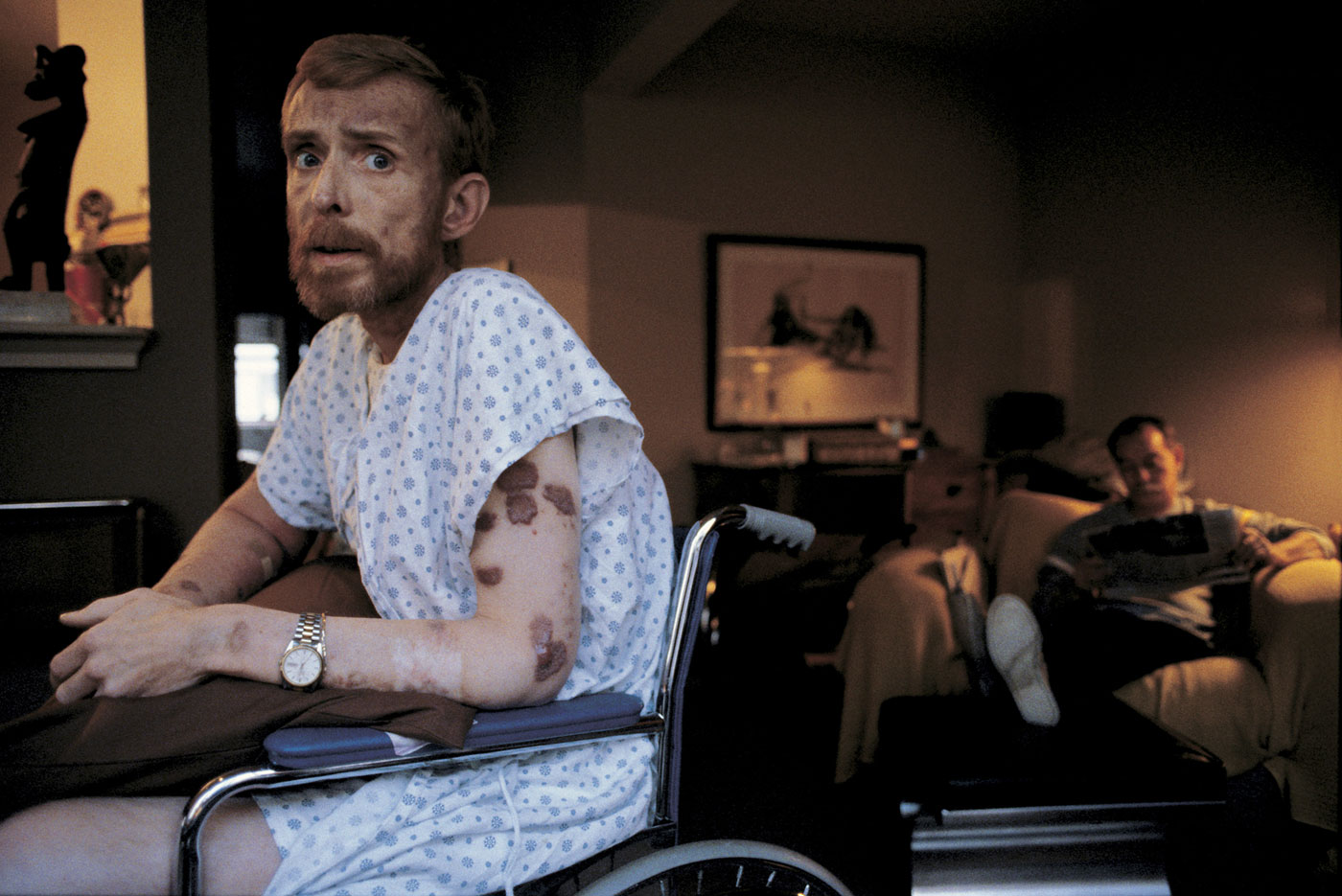
 

Alon Reininger (American born Tel Aviv, Israel, b. 1947) 'Ken Meeks, PWA' 1985


Alon Reininger (American born Tel Aviv, Israel, b. 1947)
Ken Meeks, PWA
1985
Archival pigment print
Courtesy of Contact Press Images, New York


Mark I. Chester (American, born Milwaukee, Wisconsin, 1950) 'Robert Chesley - ks portraits with harddick & superman spandex, #1–#6' 1989, printed 2015


Mark I. Chester (American, born Milwaukee, Wisconsin, 1950)
Robert Chesley – ks portraits with harddick & superman spandex, #1-#6
from the series Diary of a Thought Criminal
1989, printed 2015
Pigment print
Courtesy of the artist


Mark I. Chester gives us the first portrait of a sexually active person with AIDS. Robert Chesley (1943-1990) was a playwright, theatre critic for the San Francisco Bay Guardian, and music composer. Perhaps his most celebrated play was Jerker, or The Helping Hand: A Pornographic Elegy with Redeeming Social Value and a Hymn to the Queer Men of San Francisco in Twenty Telephone Calls, Many of Them Dirty. At a time when many gay men had come to associate their own sexuality with death, the artist showed Chesley as a vibrant, active person with AIDS, intended as a rebuke to the routine AIDS portraits of mortally ill people. With this series, Chester rewrote the late-1980s codes for representing gay male sexuality from sexlessness and death towards a renewed embrace of life and its pleasure.
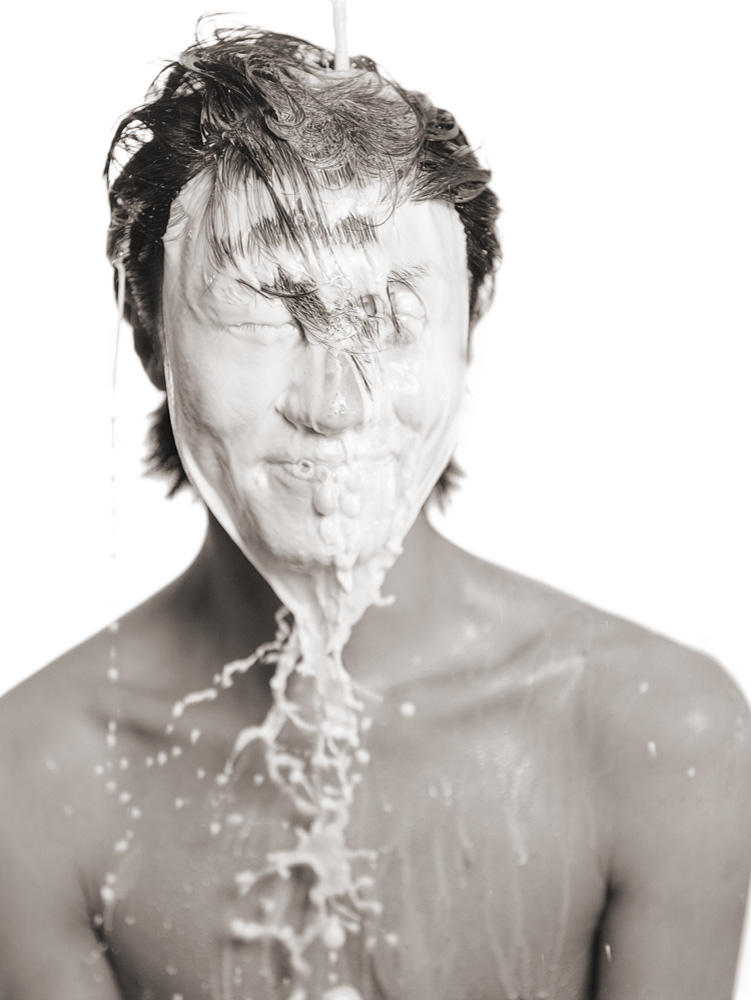
 

Steven Miller (American, b. 1968) 'Robert' from the series 'Milky' 2004


Steven Miller (American, b. 1968)
Robert from the series Milky
2004
Inkjet print
Edition 2 of 10
Tacoma Art Museum, Museum purchase with funds from Curtis Man


For his series Milky, photographer Steven Miller asked his friends if he could photograph them as he poured milk over their heads. These portraits capture the different reactions to the sensation and convey a sense of discomfort from being drenched by fluids like milk. Miller likens these two aspects to a symbolic infection of HIV. For many gay artists of his generation, HIV looms as a constant presence, and body fluids remain deeply ingrained as transmitters of the virus.


Portraiture

Artists used portraits to directly convey the devastating effects of the crisis on individuals. Even if we do not know the subject, portraits remind us that someone we know was likely affected by AIDS. Because the science about the retrovirus was new and extremely complicated and frightening, such portraits humanised the disease so it could be understood through personal stories.

Early portraits brought attention to the physical symptoms of AIDS such as the deep purple lesions of the skin cancer Kaposi’s sarcoma and the devastating weakness caused by AIDS-related wasting syndrome. Artists soon refocused on portraits of defiant individuals living with HIV. Refusing to show people as victims of an incurable disease, these portraits depicted fighters and survivors.

From pure abstract representations to straightforward photographic likenesses, portraits continue to illuminate how individuals respond to and overcome even the most complex aspects of HIV/AIDS such as stigma, racism, sexism, and poverty.

The Legacy of the AIDS Crisis

HIV is no longer an immediate life-or-death issue facing American artists, but one that quietly and continually persists in intriguing ways. The legacy of the AIDS crisis can be traced either through the motifs and influences of earlier artists or by understanding the psychological trauma and challenges that result from living in a world with HIV.

Artworks made after antiretroviral medicines became available in the mid-1990s beg the questions: If HIV is undetectable in a body and all but invisible in society, why should visibility in art be any different? How do you identify HIV if an artist is unwilling to speak about it but doesn’t live a moment of his or her intimate life without being aware of its near-certain presence?

Artists such as John Arsenault, Kalup Linzy, Patte Loper, and Donald Moffett bring their personal histories as activists and care givers into their artwork. They also use their art to express the discomfort and complexities of living in a world with the constant presence of HIV.

Works of art should be read with empathy and compassion to understand the fullness and richness of the artist’s experience. We need to remind ourselves of the stresses, anxieties, fears, and realities caused by the burden of HIV. To honor these artists’ experiences, we must insist that HIV inform at least part of the meaning of their work. This will ensure an understanding of their art as part of an art history of deep social engagement and connection.


Julie Tolentino (American, b. 1964) 'THE SKY REMAINS THE SAME: Tolentino Archives Ron Athey's Self-Obliteration #1' 2008


Julie Tolentino (American, b. 1964)
THE SKY REMAINS THE SAME: Tolentino Archives Ron Athey’s Self-Obliteration #1
2008
Chromogenic colour print
Edition 1 of 5
Documentation courtesy of Leon Mostovoy
Courtesy of the artist and Commonwealth & Council, Los Angeles


These three photographs capture moments in the archival performance of THE SKY REMAINS THE SAME: Tolentino Archives Ron Athey’s Self-Obliteration #1.

Section 1 (left): The work begins with Athey’s solo performance of Self-Obliteration #1 while Tolentino, from a nearby platform, aims to capture his performance movements and affect (a reading of tones, gestures, and movements) as an archival action.

This work involves a long blond wig pierced onto the scalp with hidden needles. The needles are removed, causing blood to stream and pool onto two panes of glass. Ultimately, these glass pieces are positioned to encase the individual body.

Section 2 (center and right): Tolentino and Athey “repeat” his performance, a true impossibility in the live form – displaying a disrupted mirroring of the other.

Like a low current running throughout the work, THE SKY REMAINS THE SAME‘s tension opens to the spectator’s subjectivity. A range of issues are activated: Athey’s openly HIV positive status; the actions performed on a differently-gendered person of colour; and the intimate act of bleeding. This becomes entangled with Tolentino’s practice, history of activism and advocacy, caregiving and artist-to-artist relations as a living archive.


Catherine Opie (American, b. 1961) 'Ron Athey/The Sick Man (from Deliverance)' 2000


Catherine Opie (American, b. 1961)
Ron Athey/The Sick Man (from Deliverance)
2000
Polaroid
Private collection


This work by Catherine Opie, taken with the world’s largest polaroid camera, was made in collaboration with the performance artist Ron Athey. Athey achieved both fame and censure as an HIV positive performance artist whose work involved physical and psychic trials, along with, on occasion, blood.

Clearly a response to AIDS, the pose of Ron Athey/The Sick Man recalls the traditional iconography of the Pieta, in which the Virgin Mary supports the body of the dead Christ. Athey is held by his performance partner Darryl Carlton (a.k.a. Divinity Fudge), two heavily tattooed men in place of the holy family. The implications of self-sacrifice and transcendence through pain and suffering animate both the original scene and this more contemporary incarnation. Opie situated the figures in a beautiful, richly saturated black space. She offers a contemporary allegory of the excluded sufferer whose exile and death can be laid at the feet of those who consider themselves pious.
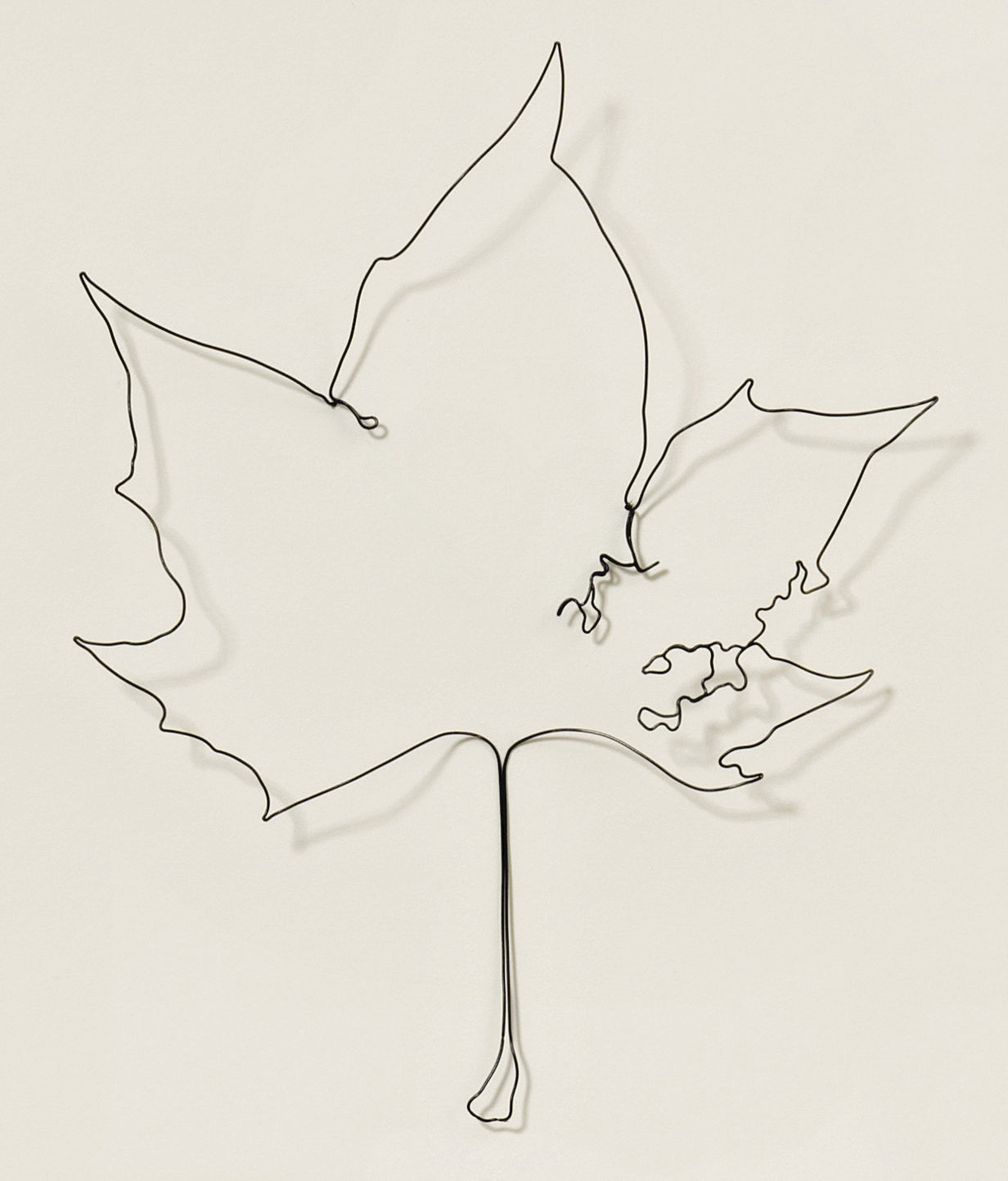
 

Eric Rhein (American, b. 1961) 'Life Altering Spencer from Leaves' 2013


Eric Rhein (American, b. 1961)
Life Altering Spencer from Leaves
2013
Wire and paper
Addison Gallery of American Art, Phillips Academy, Andover, Massachusetts
Purchased as the gift of Louis Wiley, Jr. (PA 1963) in Memory of Paul Monette (PA 1963) and his partner Roger Horwitz


Eric Rhein began The Leaf Project in 1996 to raise awareness around HIV/AIDS and chose to memorialise his friends who had died of AIDS-related causes. He selected the leaf motif to honour the individuality of each person, while also evoking the countless leaves shed by trees in autumn. Life Altering Spencer honours AIDS activist Spencer Cox (1968-2012), a member of ACT UP, Treatment Action Group, and the Food and Drug Administration’s Anti-Viral Advisory Committee. In this capacity, Cox and others became experts on drug trials and approval, successfully lobbying to hasten the approval time for new HIV medications. Cox and his group thus changed the course of medicine in America – the first non-physicians to do so – and, not coincidentally, these new treatments saved the life of artist Eric Rhein.
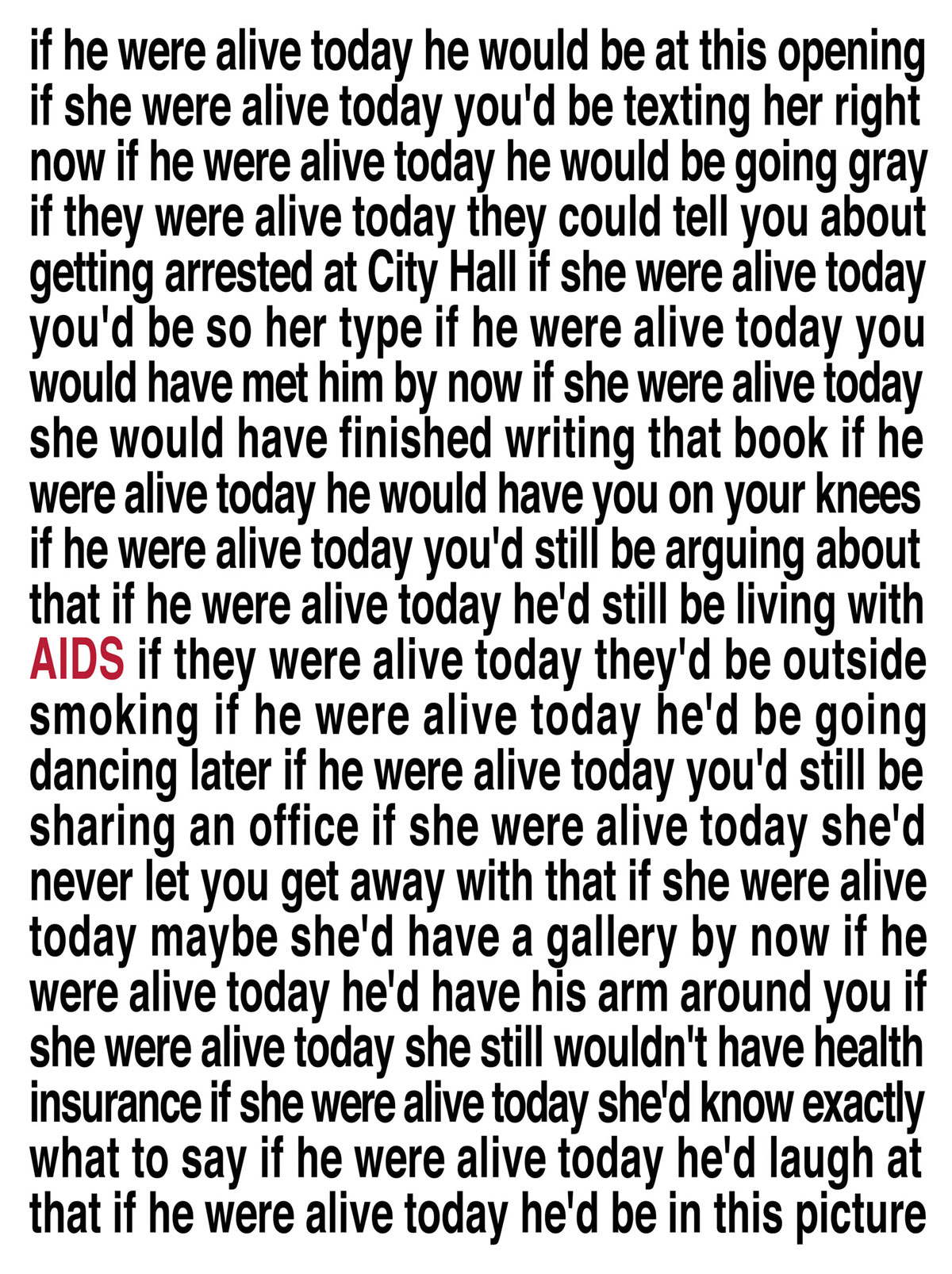
 

fierce pussy (formed New York, New York, 1991) 'For the Record' 2013


fierce pussy (formed New York, New York, 1991)
For the Record
2013
Two offset prints on newsprint, two panels, installed: 22⅝ x 70 inches
Courtesy of the artists
Photo courtesy of the artists


The collaborative group fierce pussy created this work for the organisation Visual AIDS in New York City. Playing off Gran Fury’s 1987 Let the Record Show… and evoking postmodern text based art, fierce pussy asks that we remember the thousands of people who died of HIV-related causes before antiretroviral drugs became available to control the virus. They insist that we continue the work to end HIV/AIDS despite these new drugs.
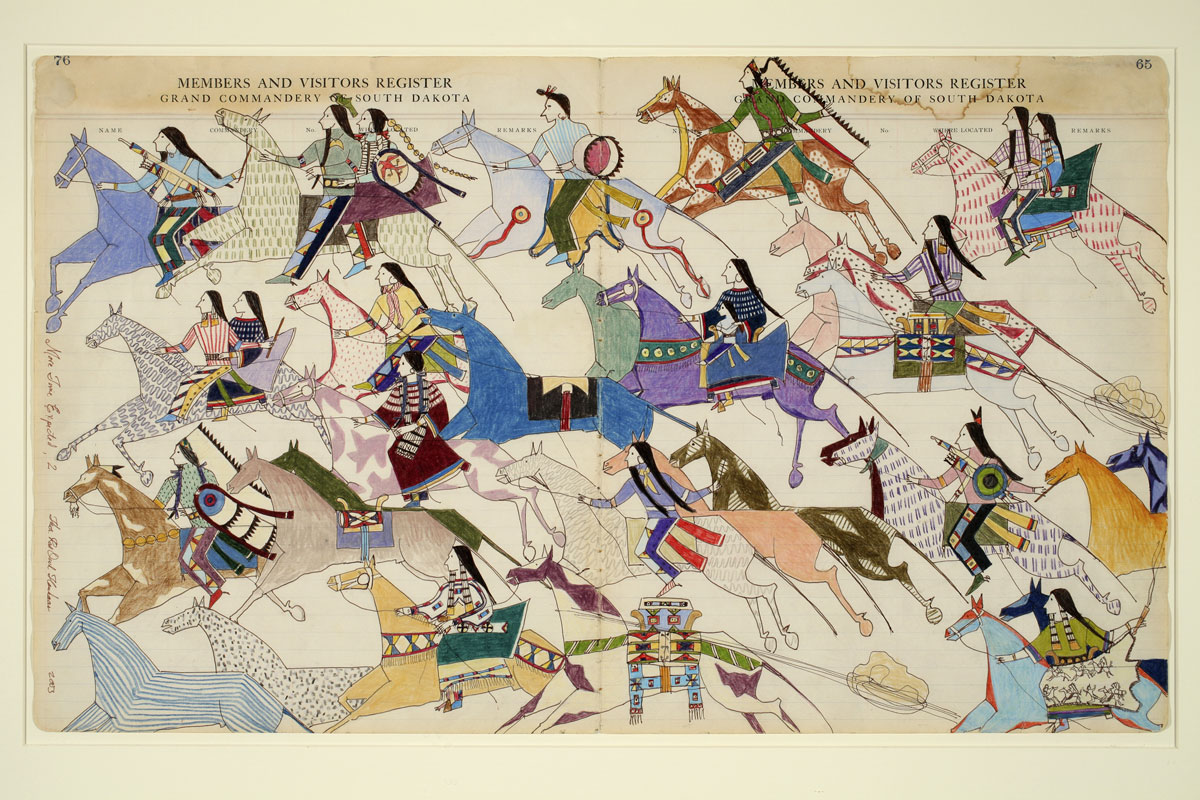
 

Thomas Haukaas (American, b. 1950) Tribal Affiliation: Sicangu Lakota 'More Time Expected' 2002


Thomas Haukaas (American, b. 1950)
Tribal Affiliation: Sicangu Lakota
More Time Expected
2002
Handmade ink and pencil on antique ledger paper, 161/2 x 271/2 inches
Tacoma Art Museum, Gift of Greg Kucera and Larry Yocom in honour of Rock Hushka, 2008.10
Photo by Richard Nicol
© TAM


Thomas Haukaas (American, b. 1950) Tribal Affiliation: Sicangu Lakota 'More Time Expected' 2002 (detail)


Thomas Haukaas (American, b. 1950)
Tribal Affiliation: Sicangu Lakota
More Time Expected (detail)
2002
Handmade ink and pencil on antique ledger paper, 161/2 x 271/2 inches
Tacoma Art Museum, Gift of Greg Kucera and Larry Yocom in honour of Rock Hushka, 2008.10
Photo by Richard Nicol
© TAM


The horse with no rider at the centre of the composition represents individuals on the reservation who have died of AIDS-related causes. Using the 19th-century tradition of ledger drawing, with a riderless horse as symbolic of a warrior who fell in battle, Haukaas weaves together the complicated issues of stigma surrounding HIV / AIDS and the Native American experience with the disease.
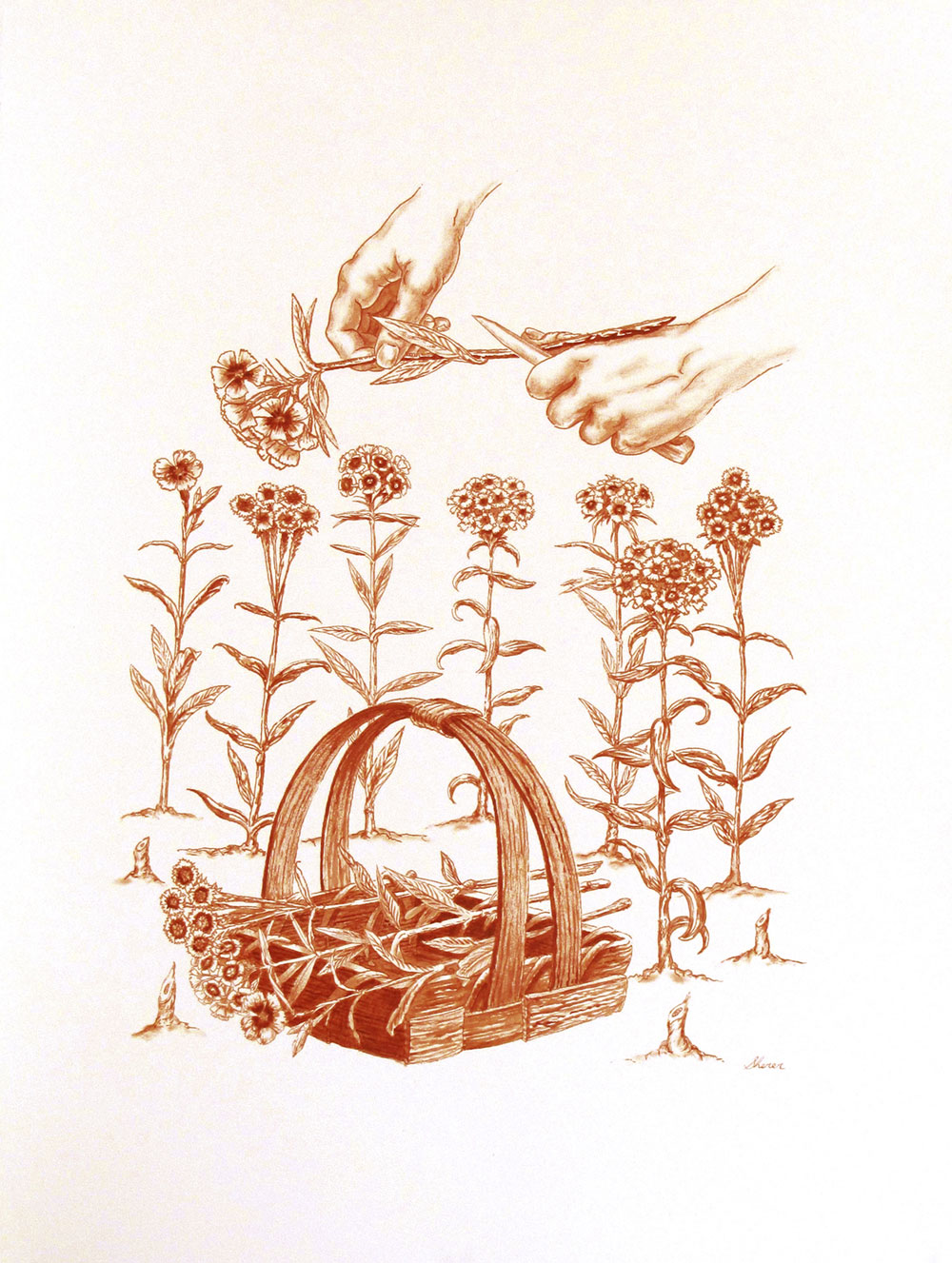
 

Robert Sherer (American, b. 1957) 'Sweet Williams' 2013


Robert Sherer (American, b. 1957)
Sweet Williams
2013
HIV- and HIV+ blood on paper
Courtesy of the artist


The title Sweet Williams comes from Robert Sherer’s childhood. His grandmother, an avid gardener, often asked him to help gather flowers from her garden and instructed, “Now, honey, cut down the most beautiful ones first.” Upon reflection, Sherer realised that AIDS was deeply correlated to beauty and sexual attraction. He remembers his many handsome friends and acquaintances who died too early – the Williams, the Billys, the Wills, the Willies – memorialising them in an image drawn in HIV negative and positive blood. Of all his colleague friends, two of whom were named William, only Sherer is still alive.
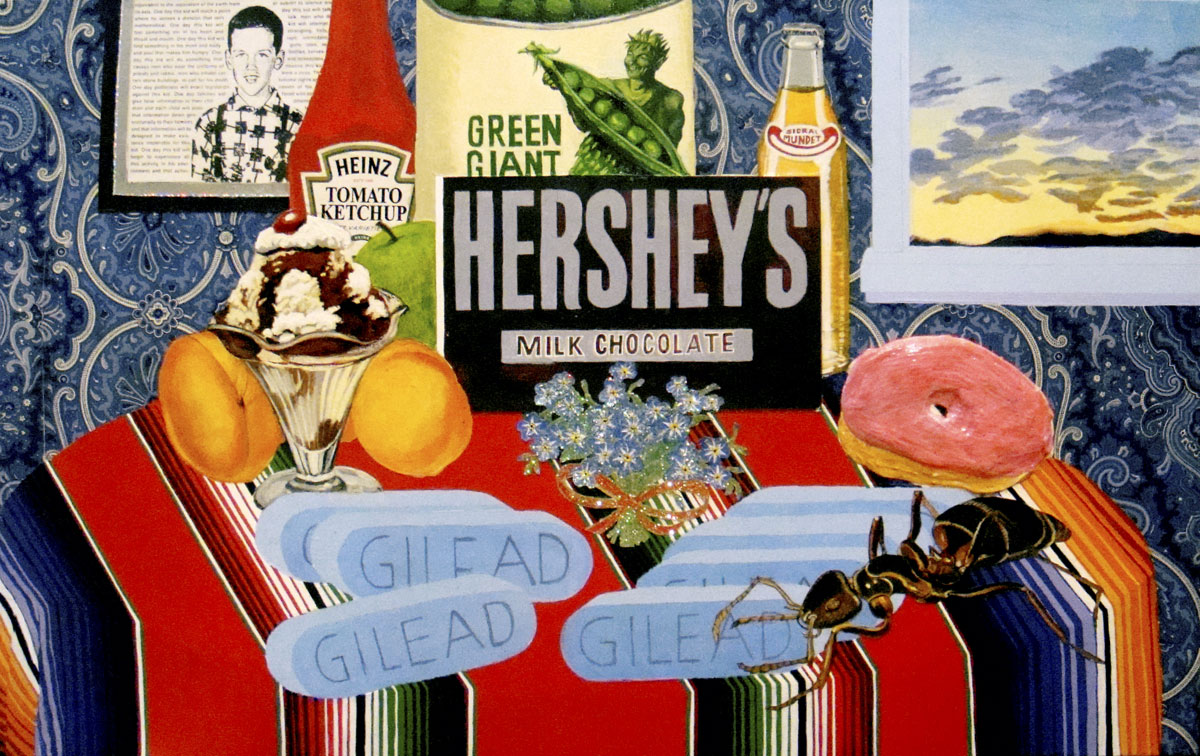
 

Joey Terrill (American, b. 1955) 'Still-Life with Forget-Me-Nots and One Week's Dose of Truvada' 2012


Joey Terrill (American, b. 1955)
Still-Life with Forget-Me-Nots and One Week’s Dose of Truvada
2012
Mixed media on canvas
Leslie-Lohman Museum of Gay and Lesbian Art, Foundation purchase


Long-time Latino queer rights and AIDS activist Joey Terrill makes paintings that resemble the work of such well-known pop artists as Tom Wesselmann. Departing from Wesselmann’s 1960s pop still-life paintings, Terrill subverts the genre through his many queer references, not least the regular inclusion of the HIV medication Truvada. In these his appropriations of the American dream, Terrill shows himself to be a political activist – a role he has inhabited since the 1970s.

Terrill’s addition of the forget-me-nots at the centre of the composition pays homage to his artistic hero David Wojnarowicz. He also alludes to the daily routine of the antiviral medicine Truvada and pointedly questions why changes in the social and political realms have allowed this to be a normal part of so many people’s lives.
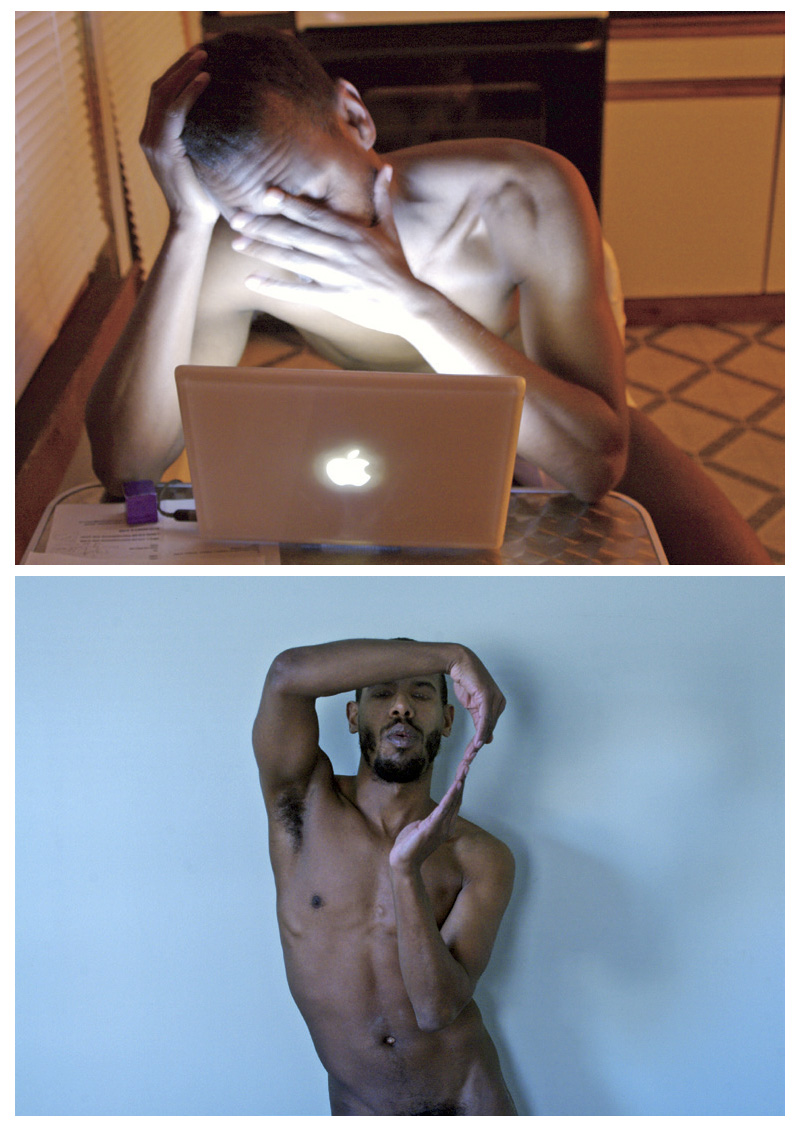
 

Derek Jackson (American, b. 1972) 'Perfect Kiss' 2007


Derek Jackson (American, b. 1972)
Perfect Kiss
2007
Slideshow with found music and original still imagery
Courtesy of the artist


Derek Jackson enacts a series of “hookups” in which his sexual activity should necessarily raise issues of HIV. Although not explicitly mentioned, HIV is evoked by the lyrics of his soundtrack. Jackson relies on New Order’s 1987 hit Perfect Kiss to equate unsafe sex with a suicide. The lyrics of the chorus plead with a suicidal friend, “I know, you know, you believe in a land of love.” Jackson’s hookups demonstrate how self-esteem, mutual respect, and communication are necessary to avoid becoming HIV positive.
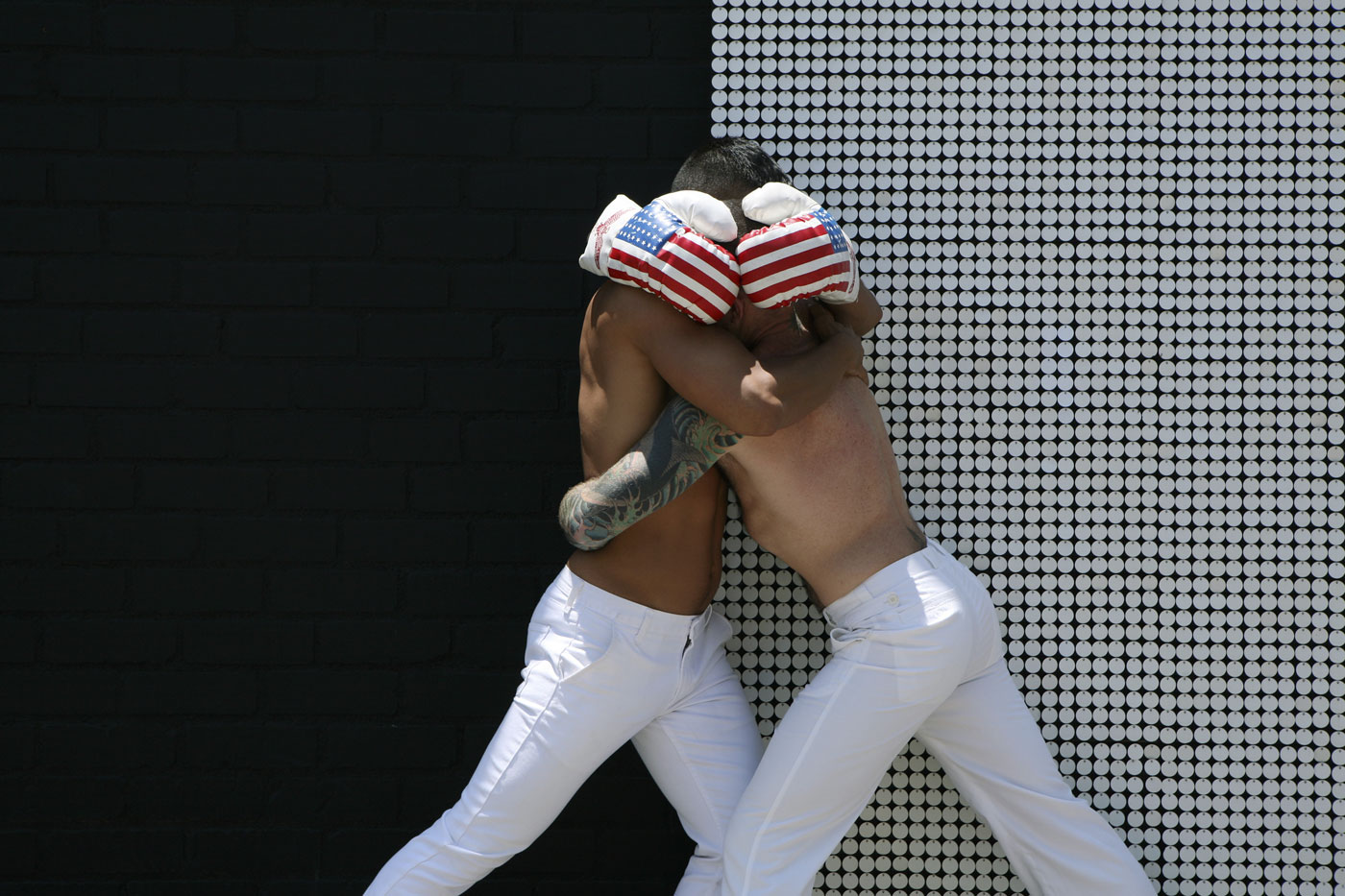
 

LADZ (John Arsenault and Adrian Gilliland) John Arsenault, Born Haverhill, Massachusetts, 1971 Adrian Gilliland, Born Douglas, Arizona, 1980 'Eden #31' 2012


LADZ (John Arsenault and Adrian Gilliland)
John Arsenault, b. 1971
Adrian Gilliland, b. 1980
Eden #31
2012
Chromogenic colour print
Courtesy of the artists


LADZ coined their name after a humorous autocorrect of “ladies” while texting on their smart phones. The artist group finds virtually abandoned industrial spaces where they enact elaborate scenarios reflecting the complexities of life in Los Angeles. The heightened sexual tension combined with the boxing gloves provides a glimpse into the daily navigation of sexual activity and HIV.
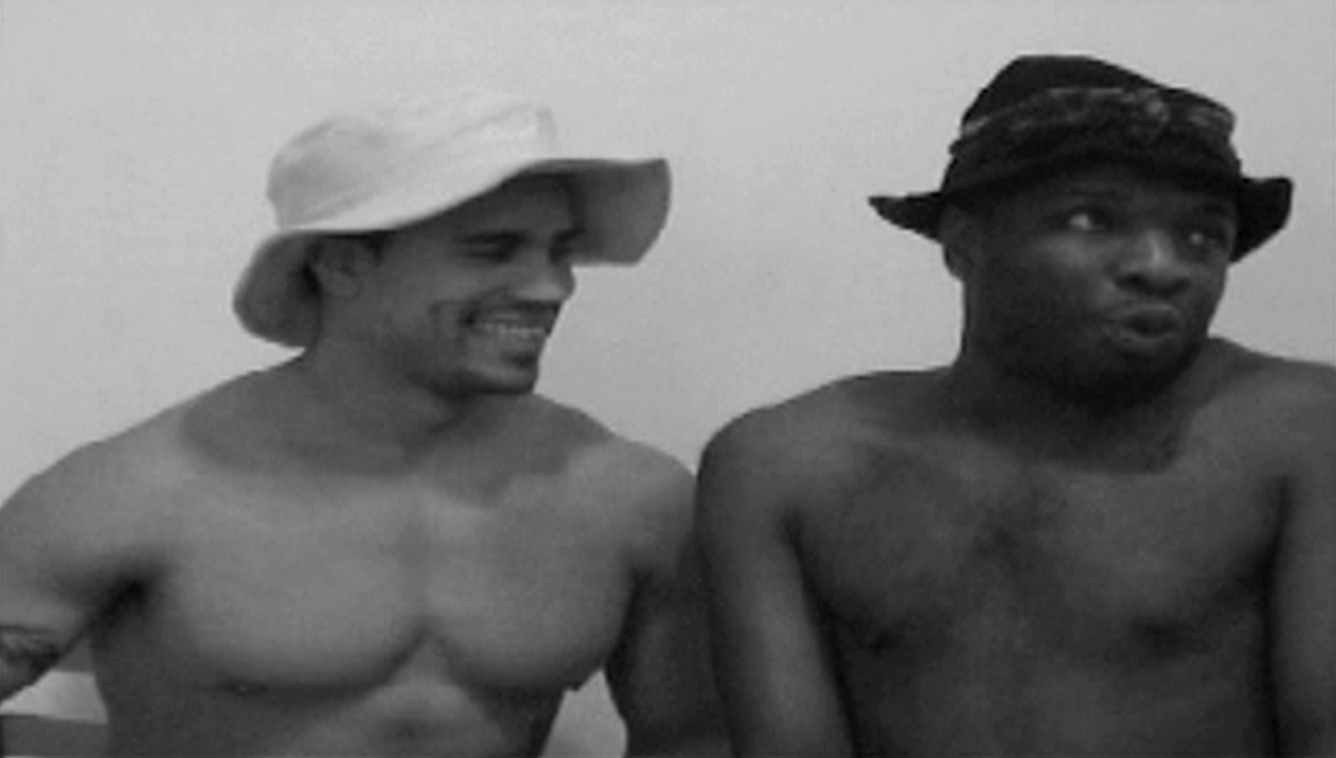
 

Kalup Linzy (American, born Stuckey, Florida, 1977) 'Lollypop' 2006


Kalup Linzy (American, born Stuckey, Florida, 1977)
Lollypop
2006
Single-channel video
3 minutes, 24 seconds
Collection of Driek and Michael Zirinsky


Kalup Linzy and his friend, artist Shaun Leonardo, lip sync the 1933 Hunter & Jenkins tune. Laden with the sexual innuendo of the song’s lyrics, Linzy attempts to coax treats from Leonardo. The artist playfully raises issues of gender and performance.

Given the high rates of HIV infection of men of colour who have sex with men particularly in urban centres, a viewer should keep in mind that individuals like Linzy continually navigate HIV in all their sexual encounters. Unlike a generation ago, young men and women have come to have a different relationship with HIV and no longer fear the virus as a death sentence. Empathy toward their experiences is key to understanding how they cope and survive.


Deborah Kass (American, b. 1952) 'Still Here' 2007


Deborah Kass (American, b. 1952)
Still Here
2007
Oil and acrylic on canvas
45 × 63 inches
Private collection
© 2015 Deborah Kass / Artists Rights Society (ARS), New York
Photo courtesy of Paul Kasmin Gallery


Deborah Kass painted Still Here as part of a group of paintings called Feel Good Paintings for Feel Bad Times, beginning in 2006. A response to the ongoing foreign wars and domestic political issues after the second election of George W. Bush, Kass underscored the gulf between the literal and metaphorical significance of the phrases she painted. Still Here comes from the Stephen Sondheim musical Follies in which a faded film star recalls how she persevered. The song opens “Good times and bum times, I’ve seen them all, and, my dear, I’m still here.”

The sentiment of the song speaks to the resilience of the many people who lived through the AIDS crisis and those who continue the struggle against the virus and social injustice. Kass’s title may also recall Still/Here, a dance about perseverance, dying, and HIV by the HIV positive choreographer Bill T. Jones.
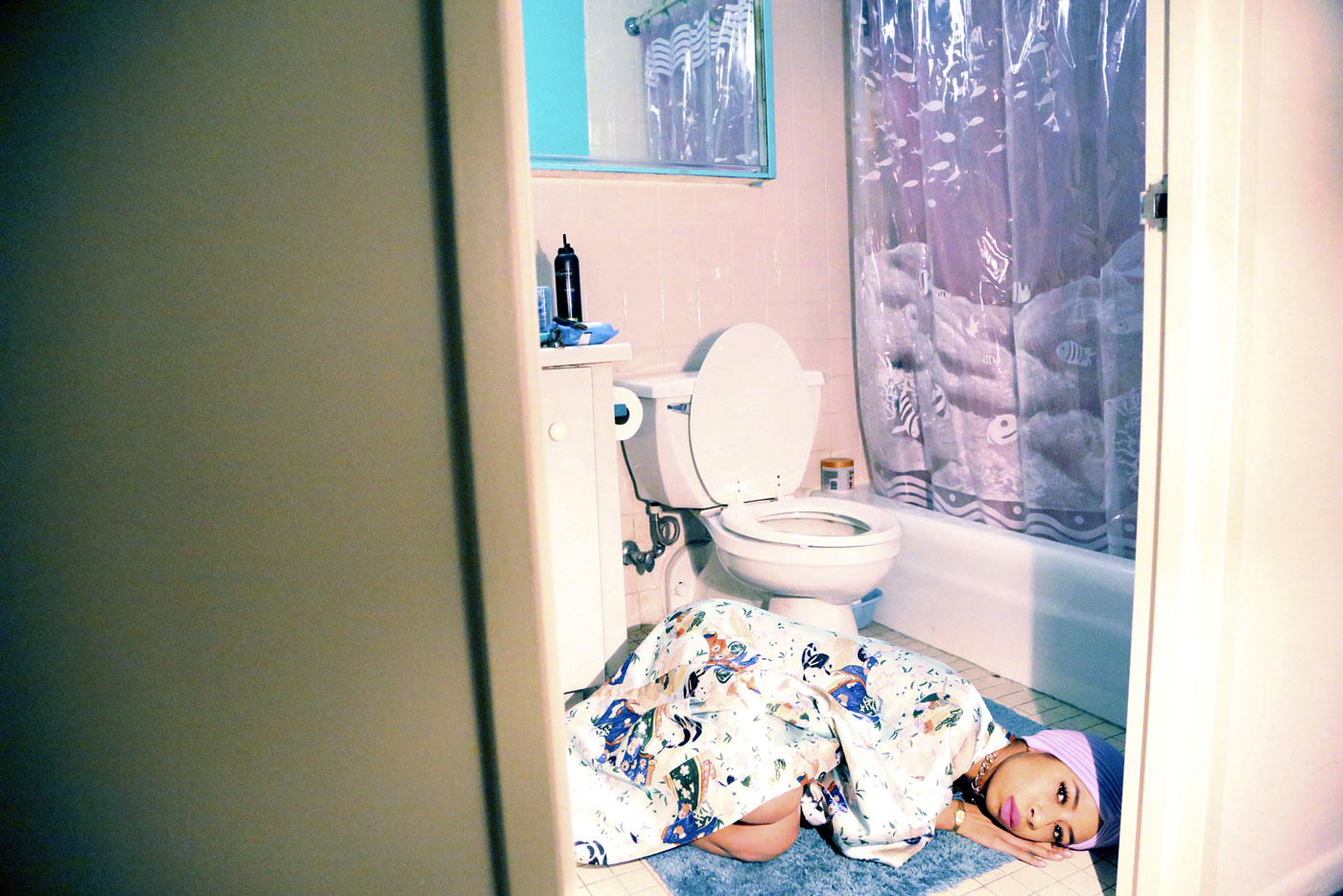
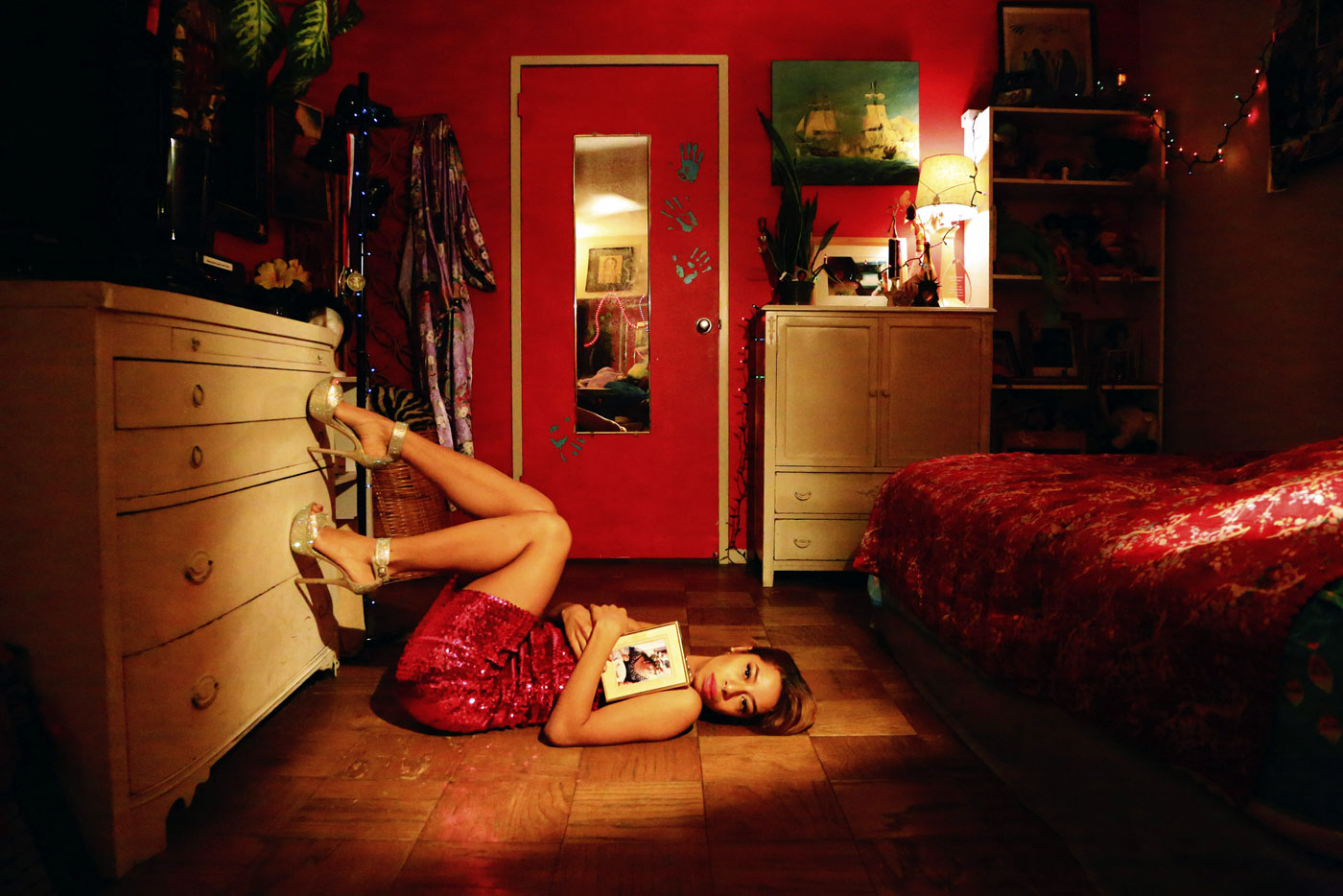
 

Kia Labeija (American, b. 1990) '24' 2014

Kia Labeija (American, b. 1990) '24' 2014

Kia Labeija (American, b. 1990) '24' 2014


Kia Labeija (American, b. 1990)
24 (Mourning Sickness; Kia and Mommy; In my room)
2014
Inkjet prints
13 × 19 inches
Courtesy of the artist


Artist and performer Kia Labeija was born HIV positive. She struggled with HIV throughout her childhood, including the side effects of the medications, the stigma associated with the disease, and the death of her mother. In her three photographs titled 24, she celebrates coming to terms with the disease and her new-found role as advocate and spokesperson for AIDS awareness. The title also commemorates her 24th birthday and her home on the 24th floor of a Manhattan apartment building.


Tacoma Art Museum
1701 Pacific Avenue
Tacoma, WA 98402

Opening hours:
Wednesday – Sunday 10am – 5pm
Tacoma Art Museum website

LIKE ART BLART ON FACEBOOK

Back to top

Exhibition: ‘Multitude, Solitude: The Photographs of Dave Heath’ at the Philadelphia Museum of Art

Exhibition dates: 19th September – 20th December, 2015

Curators: Keith F. Davis, Senior Curator of Photography at The Nelson-Atkins Museum of Art and Peter Barberie, The Brodsky Curator of Photographs, Alfred Stieglitz Center, Philadelphia Museum of Art


Dave Heath (American, 1931-2016) 'Kansas City, Missouri, March 1967' from the exhibition 'Multitude, Solitude: The Photographs of Dave Heath' at the Philadelphia Museum of Art, Sept - Dec, 2015


Dave Heath (American, 1931-2016)
Kansas City, Missouri, March 1967
1967 (negative); 1968 (print)
Gelatin silver print
7 1/8 x 10 1/2 inches (18.1 x 26.7cm)
The Nelson-Atkins Museum, Kansas City, Missouri: Gift of the Hall Family Foundation


Following on from the magnificent Francesca Woodman, here we have an artist from a previous period who investigates aspects of alienation, despair, loss and hope. These are of the era:

Post-McCarthyism but still caught in that cataclysm / Henri Cartier-Bresson / Irving Penn / Ansel Adams / Saturday Evening Post / Allen Ginsberg / Beat Generation / emerging counterculture of the 1960s.

It is an Americana (the despairing history, geography and culture of the United States) with an elusive meaning and a aesthetic that seems to be tight … but one that can’t stand to be scratched.

While some of the images are memorable (such as Vengeful Sister, Chicago, 1956) there is not much living, lying underneath. Nothing that reveals itself to me over time, that makes me return to the image again and again, for insight and, possibly, refreshment. A little hope and much sadness.

Dr Marcus Bunyan


Many thankx to the Philadelphia Museum of Art for allowing me to publish the photographs in the posting. Please click on the photographs for a larger version of the image.


“City streets were Heath’s first studio: Philadelphia; Chicago; New York, where he came to prominence; and later Toronto. Isolation is a prevailing theme: Subjects gaze cryptically into the camera, their expressions unreadable. Often they stare beyond the frame, lost in thought. Crowds of individuals populate a single location, but don’t interact; disconnected, in their own worlds.

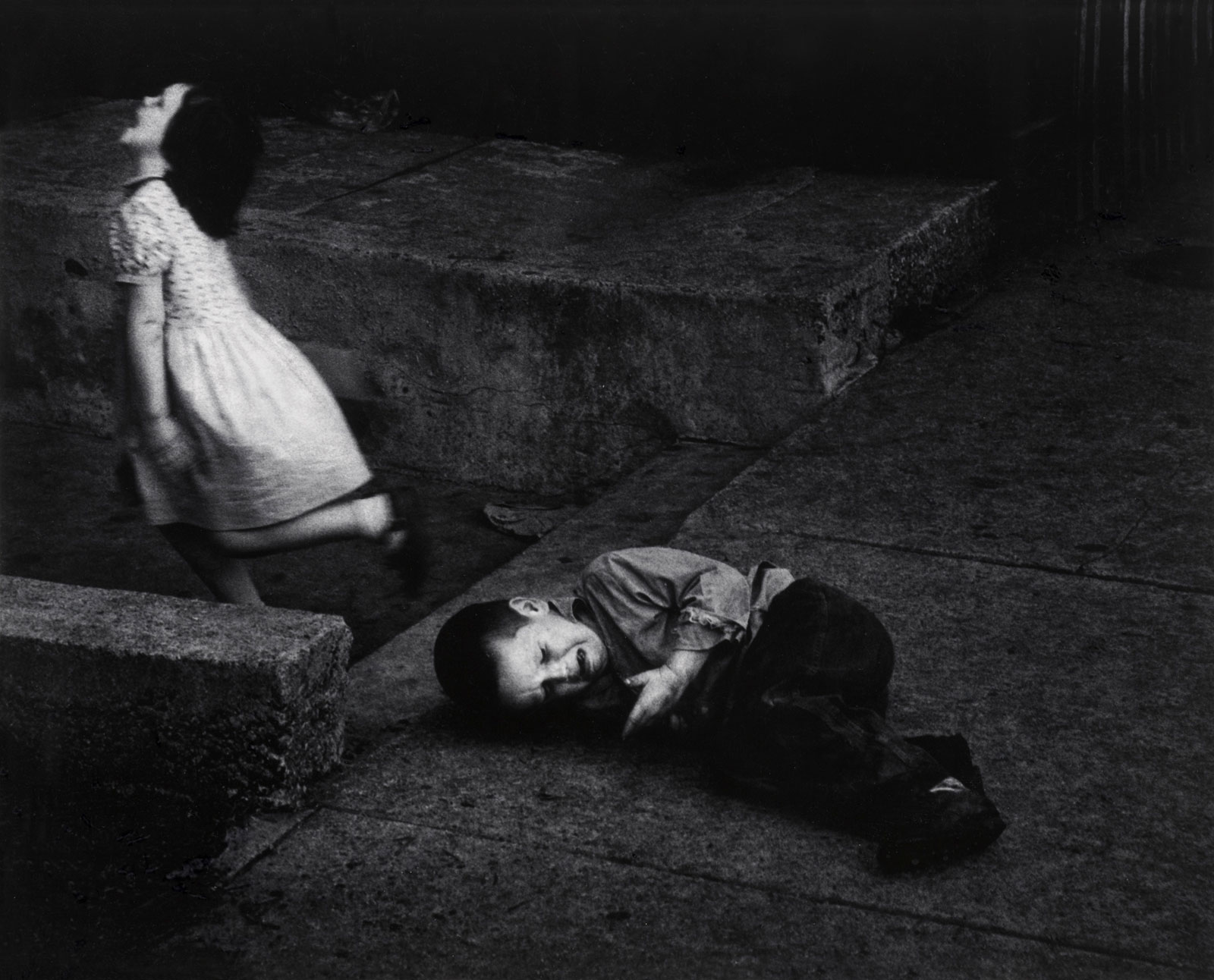
The dispossessed and alienated are Heath’s subjects, and he wrote his autobiography with their images: children with ragged clothes and dirty faces, stone-faced or crying, hardly ever smiling. A sweet-faced girl with tangled hair and huge light eyes stares out from the cover of Heath’s masterwork A Dialogue with Solitude, as if to say, “Here I am,” and nothing more…

Heath, who had to find his way alone, photographed passengers looking out of car windows and riding in elevated trains, going who knows where? Many photos are of just one person, and even the group shots set one occupant apart. Faces are expressionless, but their eyes are full of sorrow, uncertainty, loneliness, fear. We recognise that look: the one we all have when our public mask falls away and our faces betray the thoughts that wake us in the middle of the night.”


Pamela J.  Forsythe. “Alone together,” on the Broad Street Review website October 18, 2015 [Online] Cited 07/09/2015. No longer available online


Dave Heath (American, 1931-2016) 'Berkeley, California, 1964' from the exhibition 'Multitude, Solitude: The Photographs of Dave Heath' at the Philadelphia Museum of Art, Sept - Dec, 2015


Dave Heath (American, 1931-2016)
Berkeley, California, 1964
1964
Gelatin silver print
4 5/8 x 6 13/16 inches (11.7 x 17.3cm)
The Nelson-Atkins Museum, Kansas City, Missouri: Gift of the Hall Family Foundation


Dave Heath (American, 1931-2016) 'Erin Freed, New York City, 1963'


Dave Heath (American, 1931-2016)
Erin Freed, New York City, 1963
1963
Gelatin silver print
7 5/16 x 8 3/4 inches (18.6 x 22.2cm)
The Nelson-Atkins Museum, Kansas City, Missouri: Gift of the Hall Family Foundation


Dave Heath (American, 1931-2016) 'Carl Dean Kipper, Korea, 1953-54'


Dave Heath (American, 1931-2016)
Carl Dean Kipper, Korea, 1953-54
1953-1954
Gelatin silver print
6 3/4 x 9 3/4 inches (17.1 x 24.8cm)
The Nelson-Atkins Museum of Art, Kansas City, Missouri: Gift of Hallmark Cards, Inc.,


Dave Heath (American, 1931-2016) 'Philadelphia, 1952'


Dave Heath (American, 1931-2016)
Philadelphia, 1952
1952
The Nelson-Atkins Museum, Kansas City, Missouri: Gift of the Hall Family Foundation


Experience Dave Heath’s bittersweet vision of modern life in his powerful photographs of loss and hope.

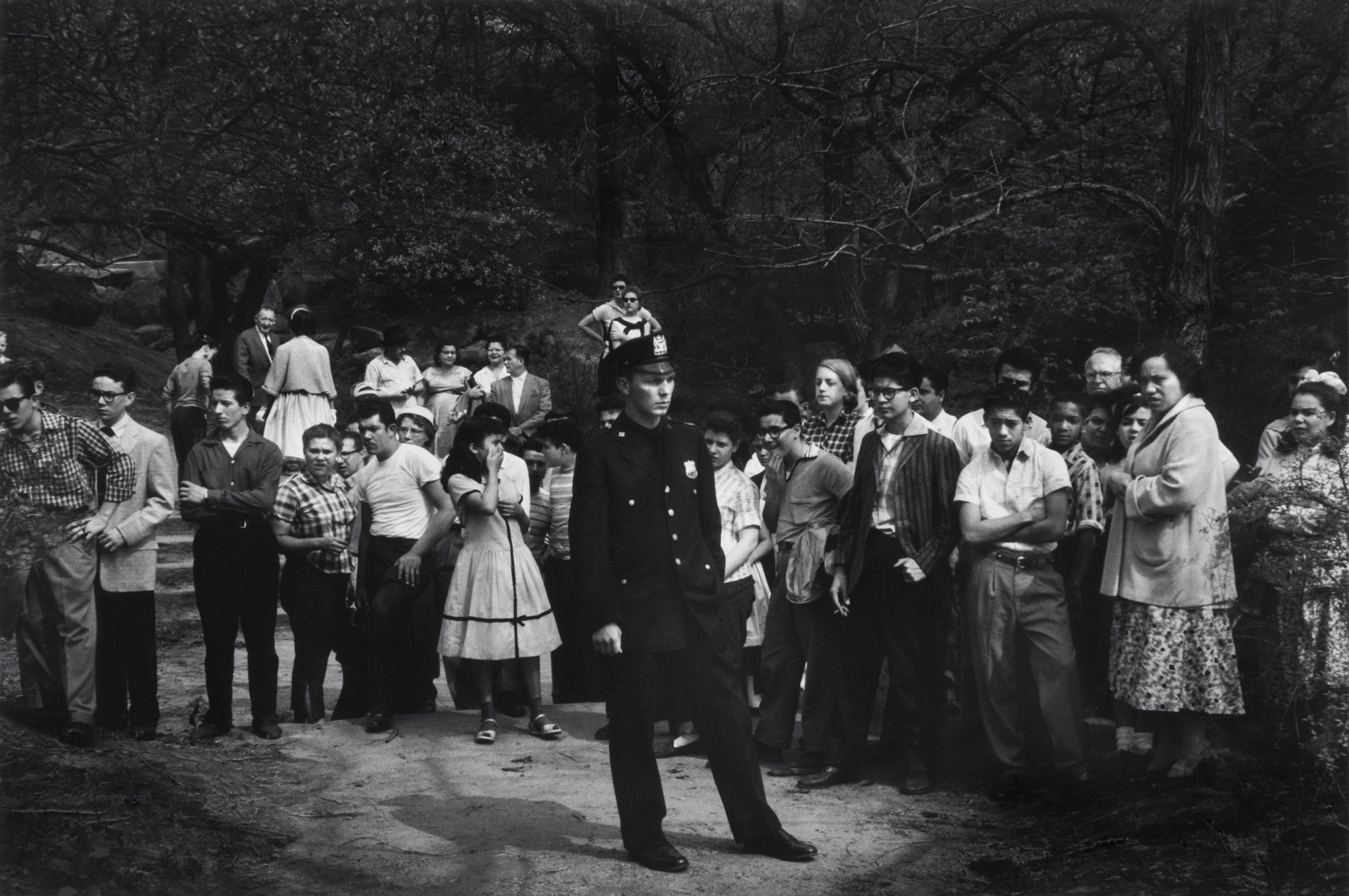
From a crowd gathered in Central Park to solitary figures lost in thought, Dave Heath’s images conjure feelings of alienation and a desire for human connection. Multitude, Solitude highlights the photographer’s black-and-white pictures of the 1950s and 1960s, an intense period of self-discovery and innovation for the artist. During these pivotal years, Heath developed groundbreaking approaches to narrative and image sequence, producing exquisite individual prints, handmade book maquettes, his poetic masterwork, A Dialogue with Solitude, and multimedia slide presentations. His sensitive explorations of loss, pain, love, and hope reveal Heath to be one of the most original photographers of those decades.

This exhibition is the first comprehensive survey of Heath’s deeply personal early work. Abandoned by both his parents by the age of four, Heath lived in Philadelphia foster homes and in an orphanage until the age of sixteen. The turmoil of his childhood profoundly shaped Heath and his artistic vision. Just before his sixteenth birthday, he encountered a poignant photo-essay about foster care in Life magazine, and became intrigued by photography’s potential to transcend simple reportage. Almost entirely self-taught, Heath channeled his feelings of abandonment into a body of work that underscores the importance and difficulties of human contact and interaction. Multitude, Solitude reaffirms Heath’s status as a key figure in twentieth-century photography and highlights his deeply empathetic sensibility.

About the artist

Born in Philadelphia in 1931, Dave Heath became interested in photography as a teenager. In the following years he trained himself in the craft, taking courses in commercial art, working in a photo-processing lab, and studying paintings at the Philadelphia Museum of Art. While stationed in Korea with the US Army, he photographed his fellow soldiers, creating images that are at once candid and subdued. In 1957 Heath moved to New York City and established himself as a major artistic talent.Heath taught at the Dayton Art Institute, Ohio, and Moore College of Art, Philadelphia, before moving in 1970 to Toronto, where he headed the photography program at Ryerson University for many years. His work is in the collections of leading museums, including The Nelson-Atkins Museum of Art, Kansas City, Missouri; the Philadelphia Museum of Art; the Museum of Modern Art, New York; the Art Institute of Chicago; and the National Gallery of Canada, Ottawa.

Heath’s major monograph, A Dialogue with Solitude, was published in 1965 and reprinted in 2000. His work has been included in important historical studies and surveys, such as Robert M. Doty’s Photography in America (1974); John Szarkowski’s Mirrors and Windows: American Photography Since 1960 (1978); James Borcoman’s Magicians of Light: Photographs from the Collection of the National Gallery of Canada (1993); and Keith F. Davis’s An American Century: From Dry-Plate to Digital (1999).

Text from the Philadelphia Museum of Art website


Dave Heath (American, 1931-2016) 'Drowning Scene, Central Park, New York City, 1957'


Dave Heath (American, 1931-2016)
Drowning Scene, Central Park, New York City, 1957
1957
Gelatin silver print
6 3/8 x 9 9/16 inches (16.2 x 24.3cm)
The Nelson-Atkins Museum, Kansas City, Missouri: Gift of the Hall Family Foundation


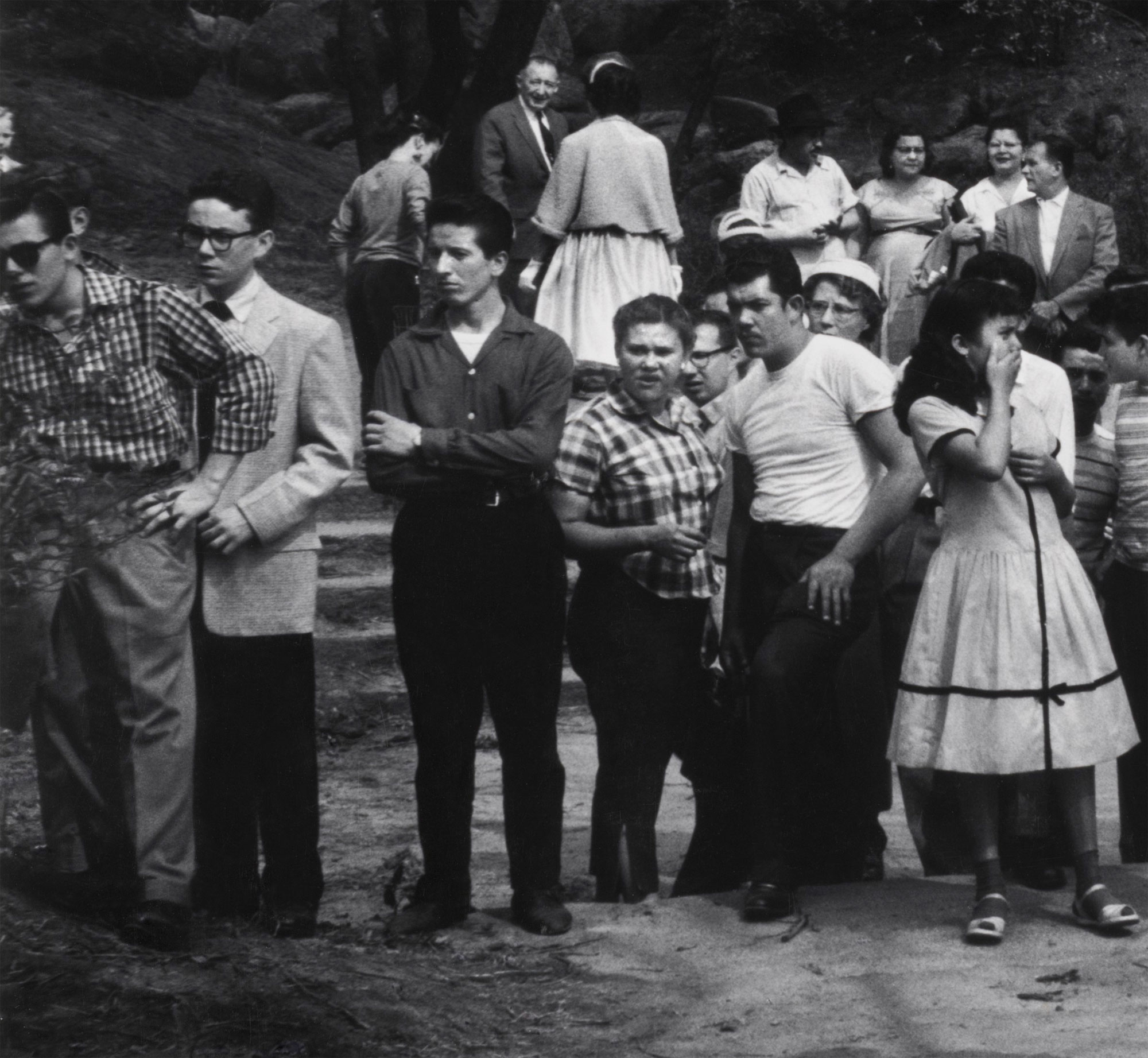
Dave Heath (American, 1931-2016) 'Drowning Scene, Central Park, New York City, 1957' (detail)


Dave Heath (American, 1931-2016)
Drowning Scene, Central Park, New York City, 1957 (detail)
1957
Gelatin silver print
6 3/8 x 9 9/16 inches (16.2 x 24.3cm)
The Nelson-Atkins Museum, Kansas City, Missouri: Gift of the Hall Family Foundation


Dave Heath (American, 1931-2016) 'Vengeful Sister, Chicago, 1956'


Dave Heath (American, 1931-2016)
Vengeful Sister, Chicago, 1956
1956
Gelatin silver print
7 3/16 x 8 15/16 inches (18.3 x 22.7cm)
The Nelson-Atkins Museum, Kansas City, Missouri: Gift of the Hall Family Foundation


Dave Heath (American, 1931-2016) '7 Arts Coffee Gallery, New York City, 1959'


Dave Heath (American, 1931-2016)
7 Arts Coffee Gallery, New York City, 1959
1959
Gelatin silver print
7 3/4 x 8 3/4 inches
The Nelson-Atkins Museum, Kansas City, Missouri: Gift of the Hall Family Foundation


Dave Heath (American, 1931-2016) 'New York City, 1958-59'


Dave Heath (American, 1931-2016)
New York City, 1958-59
1958-1959
Gelatin silver print
7 x 8 5/8 inches
The Nelson-Atkins Museum, Kansas City, Missouri: Gift of the Hall Family Foundation


Dave Heath (American, 1931-2016) '5th Avenue at 43rd Street, New York City, 1958'


Dave Heath (American, 1931-2016)
5th Avenue at 43rd Street, New York City, 1958
1958
Gelatin silver print
6 1/2 x 9 3/4 inches
The Nelson-Atkins Museum, Kansas City, Missouri: Gift of the Hall Family Foundation


Dave Heath (American, 1931-2016) 'Santa Barbara, California, 1964'


Dave Heath (American, 1931-2016)
Santa Barbara, California, 1964
1964
Gelatin silver print
5 x 7 9/16 inches (12.7 x 19.2cm)
The Nelson-Atkins Museum, Kansas City, Missouri: Gift of the Hall Family Foundation


Dave Heath, (Canadian born United States, 1931-2016) 'Rochester, New York' 1958


Dave Heath (American, 1931-2016)
Rochester, New York, 1958
1958
Gelatin silver print
6 9/16 x 9 13/16 inches (16.7 x 24.9cm)
The Nelson-Atkins Museum, Kansas City, Missouri: Gift of Hallmark Cards, Inc.,


Dave Heath (American, 1931-2016) 'Washington Square, New York City, 1959-1960'


Dave Heath (American, 1931-2016)
Washington Square, New York City, 1959-1960
1959-1960
Gelatin silver print
7 1/2 x 9 1/4 inches
The Nelson-Atkins Museum, Kansas City, Missouri: Gift of the Hall Family Foundation


Forever the outsider

Heath left Philadelphia to serve in the Korean War, where he photographed fellow soldiers and his impressions of war. Soon after his return, he departed for Chicago, where he worked as a photographer’s assistant. He began to assemble handmade books, grouping photos into themed essays and putting text to the images, establishing the template he would use in A Dialogue with Solitude.

Relocating to New York in 1957, Heath studied with photojournalist W. Eugene Smith, refining his photo essay technique and adopting Smith’s practice of making fine art prints of his work. He took photos with available light, in the street and at favourite haunts like Washington Square Park and Seven Arts Coffee Gallery, mounting the Dialogue exhibition in 1963. In that same year, he won his first Guggenheim.

Accepting life on its own terms

When Dialogue went to print in 1965, Heath employed the same editorial control he had with earlier creations, selecting, sizing, and laying out every photo, dictating typeface and size, and selecting text from famous authors, such as William Butler Yeats, Hermann Hesse, and T.S. Eliot. Only in the preface did he use his own words:

“Pressed from all sides by the rapid pace of technological progress and increased authoritarian control, many people are caught up in an anguish of alienation. Adrift and without sense of purpose, they are compelled to engage in a dialogue with the inmost depths of their being in a search for renewal.” He concludes, “What I have endeavoured to convey in my work is not a sense of futility… but an acceptance… that the pleasures and joys of life are fleeting and rare.”

The final sections convey a few of those pleasurable moments: In two photos entitled Chicago (1956), a small boy stands, head thrown back in exultation, and two boys mug for the camera. In Fifth Avenue, New York City (1960), a father snuggles his baby to his face, looking over the child’s head protectively, and in Barbara Freed and Her Son Sean, New York City (1959), a toddler heads toward a pair of outstretched female hands. Heath selected the final excerpt from Eliot’s “Journey of the Magi”:

All this was a long time ago, I remember,
And I would do it again, but set down
This set down
This: were we led all that way for
Birth or Death?


Pamela J.  Forsythe. “Alone together” on the Broad Street Review website October 18, 2015 [Online] Cited 07/09/2015. No longer available online


Dave Heath (American, 1931-2016) 'Greenwich Village, New York City, 1957'


Dave Heath (American, 1931-2016)
Greenwich Village, New York City, 1957
1957
Gelatin silver print
12 5/8 x 9 9/16 inches (32.1 x 24.3cm)
The Nelson-Atkins Museum, Kansas City, Missouri: Gift of the Hall Family Foundation


Dave Heath (American, 1931-2016) 'New York City, 1962'


Dave Heath (American, 1931-2016)
New York City, 1962
1962
Gelatin silver print
10 13/16 x 7 7/16 inches (27.5 x 18.9cm)
The Nelson-Atkins Museum, Kansas City, Missouri: Gift of the Hall Family Foundation


Dave Heath (American, 1931-2016) 'Chicago, 1956'


Dave Heath (American, 1931-2016)
Chicago, 1956
1956
Gelatin silver print
12 9/16 x 8 9/16 inches (31.9 x 21.7cm)
The Nelson-Atkins Museum, Kansas City, Missouri: Gift of the Hall Family Foundation


Dave Heath (American, 1931-2016) 'Chicago, 1956'


Dave Heath (American, 1931-2016)
Chicago, 1956
1956
Gelatin silver print
9 3/4 x 6 5/8 inches
The Nelson-Atkins Museum, Kansas City, Missouri: Gift of the Hall Family Foundation


Dave Heath (American, 1931-2016) 'Chicago, 1956'


Dave Heath (American, 1931-2016)
Chicago, 1956
1956
Gelatin silver print
10 x 8 inches
The Nelson-Atkins Museum, Kansas City, Missouri: Gift of the Hall Family Foundation


Dave Heath (American, 1931-2016) 'Washington Square, New York City, 1960'


Dave Heath (Canadian, born United States, 1931)
Washington Square, New York City, 1960
1960
Gelatin silver print
12 5/8 x 8 5/8 inches (32.1 x 21.9cm)
The Nelson-Atkins Museum, Kansas City, Missouri: Gift of the Hall Family Foundation


Dave Heath (American, 1931-2016) 'Washington Square, New York City, 1958'


Dave Heath (American, 1931-2016)
Washington Square, New York City, 1958
1958
Gelatin silver print
12 5/8 x 8 3/8 inches (32.1 x 21.3cm)
The Nelson-Atkins Museum, Kansas City, Missouri: Gift of the Hall Family Foundation


Dave Heath (American, 1931-2016) 'Howard Crawford, c. 1953-54'


Dave Heath (American, 1931-2016)
Howard Crawford, c. 1953-54
c. 1953-1954
Gelatin silver print
13 1/2 x 9 1/4 inches
The Nelson-Atkins Museum, Kansas City, Missouri: Gift of the Hall Family Foundation


Philadelphia Museum of Art
26th Street and the Benjamin Franklin Parkway
Philadelphia, PA 19130

Opening hours:
Thursday – Monday: 10am – 5pm
Closed Tuesday and Wednesday

Philadelphia Museum of Art website

LIKE ART BLART ON FACEBOOK

Back to top

Exhibition: ‘Francesca Woodman. On Being an Angel’ at Moderna Museet, Stockholm

Exhibition dates: 5th September, 2015 – 6th December, 2015

Curator: Anna Tellgren


Francesca Woodman (American, 1958-1981) 'On Being an Angel', Providence, Rhode Island, 1976 from the exhibition 'Francesca Woodman. On Being an Angel' at Moderna Museet, Stockholm, Sept - Dec, 2015


Francesca Woodman (American, 1958-1981)
On Being an Angel
Providence, Rhode Island, 1976
Gelatin silver print
© George and Betty Woodman


The artist as chimerical creature

Francesca Woodman (1958-1981) achieved more in eight years of artistic creativity than many artists achieve in a lifetime.

As a viewer you can read whatever you want into her photographs: feminism, surrealism, psychoanalytical theory, avant-garde, sexuality, gender, identity, sadness, happiness, joy. One of Francesca Woodman’s teachers was Aaron Siskind but you can also feel echoes of Diane Arbus, the conceptual, narrative mystery of Duane Michals, the postmodern generation of Cindy Sherman (1977 onwards) and, someone who nobody mentions as an influence, the darkness of Ralph Eugene Meatyard (family members enacting symbolic dramas in masks, often set in abandoned places). Woodman also places masks on or off of her face. Further, “There are similarities in style to surrealistic photography, such as Woodman’s frequent use of mirrors, doubles, shadows, gloves, hands, swans, fish, eels, masks, and sexual symbols. Photographers such as Hans Bellmer, Claude Cahun, and Man Ray spring to mind.”1

Here, I see the influence of Carl Jung in her work, specifically in Jungian psychology, the shadow or “shadow aspect” of the self (traces and silhouettes) which may refer to an unconscious aspect of the personality which the conscious ego does not identify in itself. This shadow aspect may be positive or negative. “Everyone carries a shadow,” Jung wrote, “and the less it is embodied in the individual’s conscious life, the blacker and denser it is.”2 This shadow aspect can be see in the photograph Untitled, Providence, Rhode Island, 1976 (below).

Another element embedded in the work is that of the Mirror stage, which is a concept in the psychoanalytic theory of Jacques Lacan. “The mirror stage is based on the belief that infants recognise themselves in a mirror (literal) or other symbolic contraption which induces apperception (the turning of oneself into an object that can be viewed by the child from outside themselves) from the age of about 15 to 18 months… Lacan believed that the mirror stage represented a permanent structure of subjectivity, or as the paradigm of “Imaginary order”.”3 The basis of the Imaginary order is the formation of the ego in the “mirror stage”. “Since the ego is formed by identifying with the counterpart or specular image, “identification” is an important aspect of the imaginary. The relationship whereby the ego is constituted by identification is a locus of “alienation”, which is another feature of the imaginary, and is fundamentally narcissistic.”4 This imaginary order can be seen in photographs such as Self-deceit #1, Rome, Italy, 1978 (below), where the image and even the title alludes to a form of self-alienation.

Riffing on the “highly influential writings of French philosophers and cultural critics such as Michel Foucault, Roland Barthes, and Julia Kristeva that were just beginning to be made available in translation. Among these thinkers’ central ideas was that identity was not organic and innate, but manufactured and learned through highly refined social constructions of gender, race, sexuality, and citizenship”5, Woodman’s work can also be seen to embody and ennoble these subjective and surrealist constructions (of self).

The artist is a CHIMERICAL CREATURE. Imaginary, visionary. Woodman’s transformations, her interior elements, become part of the wall or the house. She vanishes “from the room, out of the picture, at any given second.” A preoccupation with the body / her own body, and the dichotomy of subject-object, also adds multiple meanings and complexity to Woodman’s work. Her many angel images (and also images of umbrellas – Mary Poppins was released in 1964 when Woodman was growing up) suggest movement and the ability to fly, a fascination that found its ultimate expression when she jumped off a building in lower Manhattan at the age of 22.

We can read of all these things into the image/inary of Francesca Woodman if we want to. But they are not necessary to admire or appreciate her work. All we have to do is look at the photographs themselves; just return to the work. Here was a young artist, a young human being, expressing themselves through photography. She was just going for it and, as Corey Keller (a curator of photography at the San Francisco Museum of Modern Art) has noted, her youth was the source of her potency.

“Art students are drawn to the conviction she brought to her work and, in contrast to the cool slickness of the digital, it embraces tactility and decay in a very sensual and seductive way.” Keller sees Woodman’s youth not as a liability, but as the source of her potency, though she admits the issue of her self-portraits continues to be fraught. “They are certainly an expression of selfhood. She’s not interested in images of women in general, for example, and even when the subject of the photograph is not herself physically, one always has the sense it is about her psychically.””6

While she may not have fully understood the layered nuances of French philosophy and Jungian psychology she INTUITIVELY knew what she was doing and what she wanted to achieve and capture in her work. There are lots of other photographers around the world that work in this same idiom, at art school and as mature artists, but none have that special something that Woodman has, something that one cannot quite put your finger on.

It is … a gap we can see across but cannot map.

Woodman is one of the greats. In her few short years as an artist, she achieved immortality through her images. Her narrative – one of youth and vitality, of self exploration and transformation – is no myth. For she is legend.

Dr Marcus Bunyan


Footnotes

1/ Tellgren, Anna. Francesca Woodman: On Being an Angel (50kb pdf). 2015, pp. 13-14

2/ Shadow (psychology) on the Wikipedia website [Online] Cited 04/12/2015

3/ Mirror stage on the Wikipedia website [Online] Cited 04/12/2015

4/ The Imaginary (psychoanalysis) on the Wikipedia website [Online] Cited 04/12/2015

5/ Eklund, Douglas. “The Pictures Generation,” Heilbrunn Timeline of Art History on The Metropolitan Museum of Art website [Online] Cited 04/12/2015

6/ Corey Keller quoted in Cooke, Rachel. “Searching for the real Francesca Woodman,” on The Guardian website, Sunday 31 August 2014 [Online] Cited 04/12/2015


Many thankx to the Moderna Museet, Stockholm for allowing me to publish the photographs in the posting. Please click on the photographs for a larger version of the image.


Francesca Woodman (American, 1958-1981) 'On Being an Angel #1', Providence, Rhode Island, 1977 from the exhibition 'Francesca Woodman. On Being an Angel' at Moderna Museet, Stockholm, Sept - Dec, 2015


Francesca Woodman (American, 1958-1981)
On Being an Angel #1
Providence, Rhode Island, 1977
Gelatin silver print
© George and Betty Woodman


The American photographer Francesca Woodman (1958-1981) created a body of fascinating photographic works in a few intense years before her premature death. Her oeuvre has been the object of numerous in-depth studies and major exhibitions in recent years, and her photographs have inspired artists all over the world. Francesca Woodman began photographing in her teens and studied at the Rhode Island School of Design from 1975 to 1978. Her output is usually divided into periods, from her early works, her years as a student in Providence, Italy (1977-1978), the Mac Dowell Colony, and, lastly, New York from 1979 until she died. The collection she left behind consists of a few hundred gelatin silver prints, but she also tried other techniques, such as large-format diazotypes, colour photography and video.

Woodman’s photographs explore gender, representation, sexuality and body. Her production includes several self-portraits, using herself and her friends as models. The figures are often placed behind furniture and other interior elements; occasionally, the images are blurred in such a way that their identity is hidden from the viewer. The intimate nature of the subject matter is enhanced by the small formats. Woodman worked in unusual settings such as derelict buildings, using mirrors and glass to evoke surrealist and occasionally claustrophobic moods.

Moderna Museet will present some hundred photographs by Francesca Woodman, with a selection from the series and themes she explored. The exhibition is produced by Moderna Museet in association with Betty and George Woodman and the Estate of Francesca Woodman. Alongside this exhibition, Moderna Museet will present a compilation of photography from the same period from its collection, to show Francesca Woodman in context and expand the perspective on her oeuvre to the public.

Text from the Moderna Museet


Francesca Woodman (American, 1958-1981) From 'Angel' series, Rome, Italy, 1977


Francesca Woodman (American, 1958-1981)
From Angel series
Rome, Italy, 1977
Gelatin silver print
© George and Betty Woodman


Francesca Woodman (American, 1958-1981) From 'Angel' series, Rome, Italy, 1977-1978


Francesca Woodman (American, 1958-1981)
From Angel series
Rome, Italy, 1977-1978
Gelatin silver print
© George and Betty Woodman


Francesca Woodman (American, 1958-1981) 'Charlie the Model # 5', Providence, Rhode Island, 1976-1977


Francesca Woodman (American, 1958-1981)
Charlie the Model #5
Providence, Rhode Island, 1976-1977
Gelatin silver print
© George and Betty Woodman


Francesca Woodman (American, 1958-1981) From 'Eel' series, Venice, Italy, 1978


Francesca Woodman (American, 1958-1981)
From Eel series
Venice, Italy, 1978
Gelatin silver print
© George and Betty Woodman


Francesca Woodman (American, 1958-1981) 'House #4', Providence, Rhode Island, 1976


Francesca Woodman (American, 1958-1981)
House #4
Providence, Rhode Island, 1976
Gelatin silver print
© George and Betty Woodman


Francesca Woodman (American, 1958-1981) From the 'three kinds of melon in four kinds of light' series, Providence, Rhode Island, 1976


Francesca Woodman (American, 1958-1981)
From the three kinds of melon in four kinds of light series
Providence, Rhode Island, 1976
Gelatin silver print
© George and Betty Woodman


The American photographer Francesca Woodman (1958-1981) created a body of fascinating photographic works in a few intense years before her premature death. Her oeuvre has been shown in number of major exhibitions in recent years, and her photographs have inspired artists all over the world.

Woodman’s photographs explore gender, representation, sexuality and body. The intimate nature of the subject matter is enhanced by the small formats. Her production includes several portraits, using herself and her friends as models. The figures are often placed behind furniture and other interior elements; occasionally, the images are blurred and the models hidden from the viewer. Woodman worked in settings such as derelict buildings, using mirrors and glass, evoking surrealist and at times even claustrophobic moods.

Francesca Woodman began photographing in her teens and studied at the Rhode Island School of Design from 1975 to 1978. Her output is usually divided into periods: the early works, her years as a student in Providence, Italy (1977-1978), the Mac Dowell Colony, and, lastly, New York from 1979 until she died. The collection she left behind consists of several hundred gelatin silver prints, but she also tried other techniques, such as large-format diazotypes and video.

Francesca Woodman. On being an angel presents 102 photographs and one video, representing most of the artist’s series and themes. The exhibition is produced by Moderna Museet in association with the Estate of Francesca Woodman. Alongside this exhibition, Moderna Museet presents a compilation of photography from the same period from its collection, to show Francesca Woodman in context and expand the perspective on her oeuvre to the public.

Biography

Francesca Woodman was born into a family of artists in Denver, Colorado, on April 3, 1958. Her mother, Betty, was a sculptor, her father, George, a painter and photographer, and her brother, Charlie, was a video artist.

Italy

The family often traveled to Italy and lived in Florence for a year between 1965 and 1966. Then they returned home to Boulder, Colorado, and Francesca continued her schooling. In 1968 her parents bought a farmhouse outside of Florence in Antella, and there they would spend their summers. Italy and its language, culture, and art history were frequent sources of inspiration for Francesca Woodman.

Providence

Woodman started taking pictures as a teenager and had attended a few art courses before she moved to Providence to study at the Rhode Island School of Design (RISD) in 1975. The college is among the oldest art schools in the United States, and the well-known photographer Aaron Siskind was one of her teachers. While at college, she lived in her studio in an industrial area where many of her pictures from that time were created. Between 1977 and 1978 Francesca Woodman spent a year in Rome as part of the school’s honours program. In the fall of 1978, she earned her BFA and exhibited the series Swan Song (1978) at the graduate show in RISD’s Woods-Gerry Gallery.

New York

Months later, in January 1979, Woodman moved to New York, where she lived at various addresses while looking for work. She spent the summer together with her boyfriend, Benjamin Moore, in Stanwood, Washington. Over the course of the next year, she exhibited her work at a number of smaller galleries and experimented with new techniques such as large format diazotypes, and colour images. She was a fellow at the MacDowell Colony in Peterborough, New Hampshire, in the summer of 1980. There, she worked on a series of images exploring the relationship between nature and her body, among other projects. In early 1981, her artist’s book Some Disordered Interior Geometries was published by Synapse Press in Philadelphia. This was one of seven notebooks (including photographs that were glued in) that she worked with from 1976 onwards. Francesca Woodman took her own life on January 19, 1981.

Previous exhibitions

The first major retrospective of Francesca Woodman’s work was produced in 1986 by Ann Gabhart in collaboration with Rosalind Krauss for the Wellesley College Museum. It then toured a number of museums at American universities. Her first European exhibition was held in 1992 by Shedhalle in Zurich and the Westfälischer Kunstverein in Münster and was shown in the spring of 1993 at The Finnish Museum of Photography, in the Cable Factory in Helsinki. On its way there, it stopped for two months at Kulturhuset in Stockholm. The critic Lars O Ericsson wrote in Dagens Nyheter that the exhibition may have been the most important one to see in the capital at the time. To date, at least fifty separate exhibitions of Woodman’s photography have been held in Europe and the United States.

Photography from the Moderna Museet Collection

In connection to the exhibition with Francesca Woodman, Moderna Museet presents a selection of photographs from the same period from its collection, to show her in context. In Francesca Woodman’s active years in the late 1970s and early 1980s, photography was in a period of transition. Many photographers who had worked with classic black and white photography were experimenting with other forms and were pushing the documentary tradition towards more subjective and surrealist projects.

The United States paved the way in this development, and when many started working more professionally with photography, it was institutionalised. This shift in the field eventually spread to Europe. Major photographic exhibitions were held at The Museum of Modern Art in New York, featuring artists such as Diane Arbus, Robert Frank, and Lee Friedlander, all of whom were influential to many younger photographers.

One of Francesca Woodman’s teachers was Aaron Siskind. His photography is often compared to that of Harry Callahan, since both were active for many years as teachers at the Institute of Design at the Illinois Institute of Technology in Chicago, and later at the Rhode Island School of Design in Providence. Another figure in American post-war photography is Minor White, who also had influence as a teacher. White wrote about and taught methods for understanding and interpreting photographs. New Topographics. Photographs of a Man-Altered Landscape (1975) was a significant exhibition. It was held at the International Museum of Photography at George Eastman House in Rochester and one of the featured artists was Lewis Baltz. Other notable photographers in the new American wave were personalities as diverse as Robert Mapplethorpe, Melissa Shook, and Jerry Uelsmann.

But it was also then, from 1977 forward, that Cindy Sherman started working on her break-out series Untitled Film Stills. Sherman is an artist of the postmodern generation, and it is not known if Woodman had been aware of the so-called Pictures Generation. Duane Michals stood for a more conceptual approach. He was one of the photographers who we know interested Woodman.

Diazotype

In the spring of 1980 Francesca Woodman started working on Blueprint for a Temple, where she was recreating the facade of a Greek temple using models draped in tunics similar to caryatids. The series began with a collection of details from bathrooms in New York, reminiscent of classical motifs. From having worked on a smaller scale, she had now moved on to truly large formats, some several meters in size.

These pictures are often categorised as blueprints, referring to a method of reproduction most frequently used for architectural plans. This is a contact print process on photosensitive paper; white lines on a blue background distinguish the finished product. (Other types of paper produced different background colours.)

The technique Woodman used was diazotype: a dry photographic process on paper coated with diazonium compounds, which are sensitive to blue and UV light and developed by ammonia vapour. Woodman experimented with this technique. She created the largest of these images by hanging a long sheet of photosensitive diazo paper on the wall of a darkroom. A photographic slide was projected onto the paper from a slide projector, often for hours. The paper was then developed in a diazo processor at a company that made commercial reproductions of architectural plans. The result was a set of magnificent works in blue, purple, and sepia tones.

Text from the Moderna Museet, Stockholm website


Francesca Woodman (American, 1958-1981) 'About Being My Model', Providence, Rhode Island, 1976


Francesca Woodman (American, 1958-1981)
About Being My Model
Providence, Rhode Island, 1976
Gelatin silver print
© George and Betty Woodman


Francesca Woodman (American, 1958-1981) 'Spring in Providence # 2', Providence, Rhode Island, 1976


Francesca Woodman (American, 1958-1981)
Spring in Providence #2
Providence, Rhode Island, 1976
Gelatin silver print
© George and Betty Woodman


Francesca Woodman (American, 1958-1981) 'Self-deceit #1', Rome, Italy, 1978


Francesca Woodman (American, 1958-1981)
Self-deceit #1
Rome, Italy, 1978
Gelatin silver print
© George and Betty Woodman


Francesca Woodman (American, 1958-1981) 'Untitled', Providence, Rhode Island, 1975-1978


Francesca Woodman (American, 1958-1981)
Untitled
Providence, Rhode Island, 1975-78
Gelatin silver print
© George and Betty Woodman


Francesca Woodman (American, 1958-1981) 'Untitled', Rome, Italy, 1977-1978


Francesca Woodman (American, 1958-1981)
Untitled
Rome, Italy, 1977-1978
Gelatin silver print
© George and Betty Woodman


Francesca Woodman (American, 1958-1981) 'Untitled', New York, 1979-1980


Francesca Woodman (American, 1958-1981)
Untitled
New York, 1979-1980
Gelatin silver print
© George and Betty Woodman


Francesca Woodman (American, 1958-1981) 'Untitled', Providence, Rhode Island, 1976


Francesca Woodman (American, 1958-1981)
Untitled
Providence, Rhode Island, 1976
Gelatin silver print
© George and Betty Woodman


Francesca Woodman (American, 1958-1981) 'Untitled', New York, 1979-1980


Francesca Woodman (American, 1958-1981)
Untitled
New York, 1979-1980
Gelatin silver print
© George and Betty Woodman


Moderna Museet’s first exhibition this autumn features the American photographer Francesca Woodman, whose oeuvre has been the subject of numerous in-depth studies and major exhibitions in recent years. Her photography has inspired generations of artists and photographers around the world. Woodman has been called a prodigy, and those who met her testify to her as a young woman who was always working and looking for themes and material for her photographs. Examining Francesca Woodman’s aesthetic oeuvre is a challenge and an adventure.

Francesca Woodman’s (1958-1981) photographs explore gender, representation and body. Her aesthetic world reveals surrealist influences, with frequent use of mirrors, doubles, shadows, masks, and sexual symbols, bringing to mind the works of photographers such as Hans Bellmer, Claude Cahun and Man Ray. Woodman’s output includes several portraits using herself and her friends as models. The intimate nature of the subject matter is enhanced by the small formats. Transformation emerges as a theme in many of Woodman’s images, for example in one of her strongest and eeriest series, House from 1976, in which she gradually merges with the walls, the torn wallpaper and the open fireplace.

“Francesca Woodman created a body of fascinating photographic works in a few intense years before her premature death. Her images reference history and the history of photography, but they also reflect their time, while unlocking new interpretations. She is deeply personal, and so her themes become universal. All of this is what On Being an Angel is about,” says curator Anna Tellgren.

Francesca Woodman began photographing in her teens and studied at the Rhode Island School of Design from 1975 to 1978. Her output is usually divided into periods, from her early works, her years as a student in Providence, in Italy (1977-1978), at the MacDowell Colony, and, lastly, in New York from 1979 until she died. Analyses of her work are often linked to her biography and chronology. During her active years, Woodman produced thousands of images and she also tried other techniques such as large-format diazotypes, colour photography and video. Some eight hundred photographs have been preserved. The words, short sentences, or quotations she scrawled on many of her prints have since given those pieces their titles.

The exhibition Francesca Woodman. On Being an Angel is comprised of 102 photographs and one video by Francesca Woodman, and selections from most of her thematic groups and series are represented, including Polka Dots (1976), the From Angel series (1977), Swan Song (1978), Charlie the Model (1976-1977) and her large Caryatid (Study for a Temple Project) (1980). In Woodman’s active years in the late 1970s and early 1980s, photography was in a period of transition. Many photographers who had worked with classic black and white photography were experimenting with other forms, pushing the documentary tradition towards more subjective and surrealist projects. Alongside the exhibition, Moderna Museet will present a selection of photography from the same period from its collection, to show Francesca Woodman in context.

Text from the Moderna Museet


Francesca Woodman (American, 1958-1981) 'Untitled', Providence, Rhode Island, 1976


Francesca Woodman (American, 1958-1981)
Untitled
Providence, Rhode Island, 1976
Gelatin silver print
© George and Betty Woodman


Francesca Woodman (American, 1958-1981) 'Space2', Providence, Rhode Island, 1975-1976


Francesca Woodman (American, 1958-1981)
Space2
Providence, Rhode Island, 1975-1976
Gelatin silver print
© George and Betty Woodman


Francesca Woodman (American, 1958-1981) 'From Space2', Providence, Rhode Island, 1976


Francesca Woodman (American, 1958-1981)
From Space2
Providence, Rhode Island, 1976
Gelatin silver print
© George and Betty Woodman


Francesca Woodman (American, 1958-1981) 'Untitled', Providence, Rhode Island, 1975-1978


Francesca Woodman (American, 1958-1981)
Untitled
Providence, Rhode Island, 1975-1976
Gelatin silver print
© George and Betty Woodman


Francesca Woodman (American, 1958-1981) 'Untitled', New York, 1979-1980


Francesca Woodman (American, 1958-1981)
Untitled
New York, 1979-1980
Gelatin silver print
© George and Betty Woodman


Francesca Woodman (American, 1958-1981) 'Untitled', New York, 1979


Francesca Woodman (American, 1958-1981)
Untitled
New York, 1979
© George and Betty Woodman


Francesca Woodman (American, 1958-1981) 'Untitled', New York, 1979


Francesca Woodman (American, 1958-1981)
Untitled
New York, 1979
© George and Betty Woodman


Francesca Woodman (American, 1958-1981) '(Study for Temple Project)', New York, 1980


Francesca Woodman (American, 1958-1981)
(Study for Temple Project)
New York, 1980
© George and Betty Woodman


Moderna Museet, Stockholm

Moderna Museet is ten minutes away from Kungsträdgården, and twenty minutes from T-Centralen or Gamla Stan. Walk past Grand Hotel and Nationalmuseum on Blasieholmen, opposite the Royal Palace. After crossing the bridge to Skeppsholmen, continue up the hill. The entrance to Moderna Museet and Arkitekturmuseet is on the left-hand side.

Opening hours:
Tuesday – Sunday 10-18
Monday closed

Moderna Museet website

LIKE ART BLART ON FACEBOOK

Back to top

Exhibition: ‘Herb Ritts’ at the Museum of Fine Arts, Boston

Exhibition dates: 14th March – 8th November, 2015

Curators: Malcolm Rogers, Director of the Museum of Fine Arts, Boston working with curatorial research associate James Leighton, and other curators including Karen Haas, Anne E. Havinga, and Kristen Gresh


Herb Ritts (American, 1952-2002) 'Stephanie, Cindy, Christy, Tatjana, Naomi, Hollywood' 1989 from the exhibition 'Herb Ritts' at the Museum of Fine Arts, Boston, March - Nov, 2015


Herb Ritts (American, 1952-2002)
Stephanie, Cindy, Christy, Tatjana, Naomi, Hollywood, 1989
1989
Gelatin silver print
Museum of Fine Arts, Boston
Gift of Herb Ritts Foundation
© Herb Ritts Foundation
Photograph © Museum of Fine Arts, Boston


Another artist lost too soon to HIV/AIDS. At least we have these fine classics to remember him by. The portrait of Nelson Mandela is especially powerful – tightly cropped, the photographer portrays a man of immense strength and intensity through the hand and the finger, but above all the single eye which contains ageless wisdom.

Dr Marcus Bunyan


Many thankx to the Museum of Fine Arts Boston for allowing me to publish the photographs in the posting. Please click on the photographs for a larger version of the image.


Herb Ritts (American, 1952-2002) 'Sylvester Stallone and Brigitte Nielsen, Long Island' 1987 from the exhibition 'Herb Ritts' at the Museum of Fine Arts, Boston, March - Nov, 2015


Herb Ritts (American, 1952-2002)
Sylvester Stallone and Brigitte Nielsen, Long Island
1987
Gelatin silver print
Museum of Fine Arts, Boston
Gift of Herb Ritts Foundation in honor of Malcolm Rogers
© Herb Ritts Foundation
Photograph © Museum of Fine Arts, Boston


Herb Ritts (American, 1952-2002) 'Madonna, Tokyo' 1987


Herb Ritts (American, 1952-2002)
Madonna, Tokyo
1987
Gelatin silver print
Museum of Fine Arts, Boston
Gift of Herb Ritts
© Herb Ritts Foundation
Photograph © Museum of Fine Arts, Boston


Herb Ritts (American, 1952-2002) 'Versace Veiled Dress, El Mirage' 1990


Herb Ritts (American, 1952-2002)
Versace Veiled Dress, El Mirage
1990
Gelatin silver print
Museum of Fine Arts, Boston
Gift of Herb Ritts
© Herb Ritts Foundation
Photograph © Museum of Fine Arts, Boston


Herb Ritts (American, 1952-2002) 'Versace Dress, Back View, El Mirage' 1990


Herb Ritts (American, 1952-2002)
Versace Dress, Back View, El Mirage
1990
Gelatin silver print
Museum of Fine Arts, Boston
Gift of Herb Ritts
© Herb Ritts Foundation
Photograph © Museum of Fine Arts, Boston


Herb Ritts (American, 1952-2002) 'Tatjana Veiled Head, Tight View, Joshua Tree' 1988


Herb Ritts (American, 1952-2002)
Tatjana Veiled Head, Tight View, Joshua Tree
1988
Gelatin silver print
Museum of Fine Arts, Boston
Gift of Herb Ritts
© Herb Ritts Foundation
Photograph © Museum of Fine Arts, Boston


Herb Ritts (American, 1952-2002) 'Backflip, Paradise Cove' 1987


Herb Ritts (American, 1952-2002)
Backflip, Paradise Cove
1987
Gelatin silver print
Museum of Fine Arts, Boston
Gift of Herb Ritts Foundation
© Herb Ritts Foundation
Photograph © Museum of Fine Arts, Boston


Herb Ritts (American, 1952-2002) 'Pants (Back View), Los Angeles' 1988


Herb Ritts (American, 1952-2002)
Pants (Back View), Los Angeles
1988
Gelatin silver print
Museum of Fine Arts, Boston
Gift of Herb Ritts Foundation
© Herb Ritts Foundation
Photograph © Museum of Fine Arts, Boston


Herb Ritts (American, 1952-2002) 'Richard Gere, San Bernardino' 1987


Herb Ritts (American, 1952-2002)
Richard Gere, San Bernardino
1978
Gelatin silver print
Museum of Fine Arts, Boston
Gift of Herb Ritts Foundation in honor of Malcolm Rogers
© Herb Ritts Foundation
Photograph © Museum of Fine Arts, Boston


The Museum of Fine Arts, Boston (MFA), flashes back to the ’90s this spring with an evocative exhibition dedicated to the photography of Herb Ritts (1952-2002). Known for his beautifully printed, formally bold and sensual black-and-white images of celebrities and supermodels such as Cindy Crawford and Naomi Campbell, his works often blurred the line between art and commerce. Throughout the ’90s, his photography was inescapable in popular culture – appearing everywhere from magazine covers to music videos and commercials. This exhibition revisits the artist, whose groundbreaking 1996 retrospective at the MFA, Herb Ritts: WORK, remains one of the most highly attended exhibitions in Museum history. Nearly 20 years later, the MFA is taking a second look at his career, which was cut short in 2002 with his death from complications related to AIDS. Along with a selection of music videos and commercials, the exhibition features 52 black-and-white photographs that celebrate the sculpted body and the variable beauty of the human face. Ritts’ expert use of natural light results in dramatic images full of high-contrast lights and darks, as well as softer effects, such as light reflecting off water. Of the works on view, 15 are from a recent gift from the Herb Ritts Foundation – acquired by the MFA in December in honor of Malcolm Rogers, Ann and Graham Gund Director at the MFA. This, and previous gifts from Ritts and the Foundation dating back to 2000, allow the Museum to tell the full story of Ritts’ career, and comprise the largest museum holdings of Ritts photographs in the world (248 in total). The exhibition is on view in the MFA gallery named in honour of a gift from the Ritts Foundation – the Museum’s first dedicated solely to photography – and the adjacent Clementine Brown Gallery…

The exhibition explores every aspect of the photographer’s career, and is divided into two sections: one dedicated to the human body and one dedicated to his photographs of celebrity personalities. His approach to the nude pushed the confines of convention. Ritts captured not only beautiful bodies, but also the environment and elements surrounding his set: the Pacific Ocean, desert landscapes, and mountains. Whether photographing a Versace dress, a basketball star, or interpreting classical sculpture through dried, cracked clay on skin – as in Tony with Black Face, Profile, Los Angeles (1986) – Ritts and his photography embody the era. The predominant aesthetic in Ritts’s images is one of strong lines, bold contours and striking shadows. Today, his work appears in museum exhibitions around the globe.

Preferring to shoot during the golden hours of the day – when the sun is at a low angle – Ritts created works that demonstrate not only an expert use of natural light, but the ability to immortalise the subjects in front of his camera. In addition to photography, he also directed 13 music videos and more than 50 commercials throughout his career.  Exploration of the human figure in its idealised form is a recurring theme in his video work, a selection of which is also included in the exhibition on three video screens. Lent by the Herb Ritts Foundation are videos of Madonna’s Cherish (1989), Chris Isaak’s Wicked Game (1991) and commercials dating from 1990-2002. A special MFA playlist on Spotify allows visitors to listen to music as they explore the gallery, and a case of archival materials includes a marked-up contact sheet and magazine spread that shed light on Ritts’ process.

During his career, Ritts forged strong connections with his subjects, many of whom became close friends. Throughout the exhibition visitors can find quotes from some of his sitters, including Cindy Crawford, who said of the artist: “There was something magical about when you stepped in front of his camera and what happened then. This give-and-take, and that’s what makes it fun. I’ve had the opportunity to work with Helmut Newton to Avedon to Penn but probably the images that are the most timeless of me, most of them, were shot by Herb and are some of my favourite images of myself.”

Crawford appears in one of Ritts’ most famous images, Stephanie, Cindy, Christy, Tatjana, Naomi, Hollywood (1989). Taken at the end of a long day photographing a fashion editorial assignment for Rolling Stone, the image also includes Stephanie Seymour, Tatjana Patitz, Naomi Campbell and Christy Turlington. Ritts also worked with Turlington on a Gianni Versace advertising campaign, which took them to the dry Mojave Desert lakebed known as El Mirage, where the vast open space gave him a sense of creative freedom. He used the gusts of a rising storm to coax a swath of fabric into an arch over the model’s head in Versace Dress, Back View, El Mirage (1990). Ritts’ photographs of celebrities and models appeared on magazine covers including Vanity Fair, Vogue, Interview, Playboy, TIME, Rolling Stone, and Allure.

Ritts had a particular affinity for photographing actors, musicians and cultural icons. The artist that he collaborated with most frequently was Madonna, whose whimsical Madonna, Tokyo (1987) was taken in her hotel when the Who’s That Girl World Tour opened in Japan. Generally, Ritts preferred to capture his subjects in spontaneous, playful moments such as these. “I think that with her, and with other people as well, the big word is trust,” Ritts said. “A person feels they can trust you because they know your reputation and what you’re about. Or they can feel it because over the years a tight relationship develops, as it did with Madonna. You work together and it clicks; you evolve.

Press release from the Museum of Fine Arts Boston website


Herb Ritts (American, 1952-2002) 'Michael Jordan, Chicago' 1993


Herb Ritts (American, 1952-2002)
Michael Jordan, Chicago
1993
Gelatin silver print
Museum of Fine Arts, Boston
Gift of Herb Ritts
© Herb Ritts Foundation
Photograph © Museum of Fine Arts, Boston


Herb Ritts (American, 1952-2002) 'Tony with Black Face, Profile, Los Angeles' 1986


Herb Ritts (American, 1952-2002)
Tony with Black Face, Profile, Los Angeles 
1986
Gelatin silver print
Museum of Fine Arts, Boston
Gift of Herb Ritts
© Herb Ritts Foundation
Photograph © Museum of Fine Arts, Boston


Herb Ritts (American, 1952-2002) 'Claudia Schiffer, Palmdale' 1992


Herb Ritts (American, 1952-2002)
Claudia Schiffer, Palmdale
1992
Gelatin silver print
Museum of Fine Arts, Boston
Gift of Herb Ritts Foundation
© Herb Ritts Foundation
Photograph © Museum of Fine Arts, Boston


Herb Ritts (American, 1952-2002) 'Christy Turlington, Hollywood' 1988


Herb Ritts (American, 1952-2002)
Christy Turlington, Hollywood
1988
Gelatin silver print
Museum of Fine Arts, Boston
Gift of Herb Ritts Foundation
© Herb Ritts Foundation
Photograph © Museum of Fine Arts, Boston


Herb Ritts (American, 1952-2002) 'Mick Jagger, London' 1987


Herb Ritts (American, 1952-2002)
Mick Jagger, London
1987
Gelatin silver print
Museum of Fine Arts, Boston
Gift of Herb Ritts Foundation
© Herb Ritts Foundation
Photograph © Museum of Fine Arts, Boston


Herb Ritts (American, 1952-2002) 'Wrapped Torso, Los Angeles' 1989


Herb Ritts (American, 1952-2002)
Wrapped Torso, Los Angeles 
1989
Platinum print
Museum of Fine Arts, Boston
Gift of Herb Ritts
© Herb Ritts Foundation
Photograph © Museum of Fine Arts, Boston


Herb Ritts (American, 1952-2002) 'Naomi Campbell, Face in Hand, Hollywood' 1990


Herb Ritts (American, 1952-2002)
Naomi Campbell, Face in Hand, Hollywood
1990
Gelatin silver print
Museum of Fine Arts, Boston
Gift of Herb Ritts Foundation in honor of Malcolm Rogers
© Herb Ritts Foundation
Photograph © Museum of Fine Arts, Boston


Herb Ritts (American, 1952-2002) 'Dizzy Gillespie, Paris' 1989


Herb Ritts (American, 1952-2002)
Dizzy Gillespie, Paris 
1989
Gelatin silver print
Museum of Fine Arts, Boston
Gift of Herb Ritts
© Herb Ritts Foundation
Photograph © Museum of Fine Arts, Boston


Herb Ritts (American, 1952-2002) 'Nelson Mandela, Johannesburg' 1994


Herb Ritts (American, 1952-2002)
Nelson Mandela, Johannesburg 
1994
Gelatin silver print
Museum of Fine Arts, Boston
Gift of Herb Ritts Foundation
© Herb Ritts Foundation
Photograph © Museum of Fine Arts, Boston


Herb Ritts (American, 1952-2002) 'Bruce Springsteen (Detail II), New York' 1992


Herb Ritts (American, 1952-2002)
Bruce Springsteen (Detail II), New York 
1992
Gelatin silver print
Museum of Fine Arts, Boston
Gift of Herb Ritts Foundation
© Herb Ritts Foundation
Photograph © Museum of Fine Arts, Boston


Museum of Fine Arts, Boston
Avenue of the Arts
465 Huntington Avenue
Boston, Massachusetts

Opening hours:
Wednesday – Sunday 10am – 5pm
Museum of Fine Arts, Boston website

LIKE ART BLART ON FACEBOOK

Back to top

Exhibition: ‘Joseph Cornell: Wanderlust’ at the Royal Academy of Arts, London

Exhibition dates: 4th July – 27th September, 2015

Curator: Sarah Lea


Hans Namuth (American born Germany, 1915-1990) 'Joseph Cornell' 1969 from the exhibition 'Joseph Cornell: Wanderlust' at the Royal Academy of Arts, London, July - Sept, 2015


Hans Namuth (American born Germany, 1915-1990)
Joseph Cornell
1969
Courtesy Center for Creative Photography, University of Arizona
© 1991 Hans Namuth Estate


Now, Voyager


“The untold want by life and land ne’er granted,
Now, voyager, sail thou forth, to seek and find.”

Walt Whitman (1819-1892). “Untold Want,” from Leaves of Grass. 1900


Joseph Cornell is my favourite artist who has ever lived on this Earth. I do not make this observation lightly, but after much consideration, thought and reflection.

I have always loved his work, from the very first time I saw it in a book. To then see a recreation of one of his 1950s exhibitions at the Art Institute of Chicago in 2001 was one of those seminal moments where you are lifted out of yourself, where your life becomes forever changed. For me that transcendent experience is up there with being alone with the Rembrandt portraits in the Louvre for 10 precious minutes. Both were among the most exquisite, poignant and beautiful spiritual experiences I have had in my life.

I am not an expert on Cornell, although I have read many books on his work and on his spirituality. He saw himself as an “armchair voyager”, a bit like a latter day Baudelaire, a man who has romantic notions of travel but never actually goes anywhere, who has romantic notions of love but never finds it, except in his imagination. Cornell never left his native New York. Cornell expressed his self through a passion for the artefacts he collected, through his assemblage of those artefacts into magical boxes that addressed unrequited love and faith – for Hollywood and movie stars, ballerinas, hotels, birds, the Renaissance, princes and princesses, the stars, games and chance. He was an avid collector, rummaging through the junk shops of New York and storing his collectibles for his art, something to which I have an affinity, being an avid op shopper (or thrift shopper) myself.

Here I can see an association with the words of Walt Whitman in his lines “Untold Want” from Leaves of Grass, those lines forming the title for the book upon which the film Now Voyager (1942) with Bette Davis was based. “The untold want” of Whitman’s lines are whatever you yearn for and cannot get in the social context (“life”) and place (“land”) where you are born. Whitman says, stop “studying the charts,” and “now obey, thy cherish’d, secret wish,” – in other words he’s saying that your heart’s desire is the best indicator of where your destiny lies, but it is possible to miss out on it by not going for it. Fast forward to Now Voyager where frumpy Bette Davis has an affair with a married man, becomes independent, defies her tyrannical mother who promptly dies, and ends up circuitously looking after her lover’s daughter. They decide to have a platonic relationship “sustaining a romantic, unconsummated relationship and creating a ‘family’ by becoming the surrogate, adoptive care-giver for his daughter.”

There is a specific desire here. Davis and Whitman are freed to love without restriction in a romantic way, and after the end of Now Voyager, perhaps Cornell is channelling Bette Davis. He loved in his mind, he created boxes in his imagination (and then physically), he astral travelled through the stars, he created games of chance (such as penny arcades and slot machines) and shooting galleries (that exposed his inner mind) letting the air rush out into the world. He created surreality itself but he was never surreal, for his work is always based on the collision of realities. His boxes are tiny cosmos, like the Tardis from Dr Who, the interior (under a microscope, within four walls) larger than the exterior … yet, magically, they inhabit the whole world, they inhabit our mind. He used the alchemical reaction of elements, the elementary, to affect travel, love, life and change. And he did it in four dimensions for his boxes affect us as much today as he did when he created them. Perhaps that is why I like his work so much… he used seemingly mundane materials, multi/media objects, imagination and love to let’s our spirits soar into the universe. No other artist has ever affected me so much. No one ever will.

Undeniably, Cornell’s poetic theatres are joyous creations that free our soul from the everyday.

Perhaps it is through love, or in death, or the afterlife, that the Voyager can seek that untold want.

Dr Marcus Bunyan


My Mind to me a Kingdom Is

Sir Edward Dyer (1543-1607)

1 My mind to me a kingdom is;
2 Such perfect joy therein I find
3 That it excels all other bliss
4 Which God or nature hath assign’d.
5 Though much I want that most would have,
6 Yet still my mind forbids to crave.

7 No princely port, nor wealthy store,
8 No force to win a victory,
9 No wily wit to salve a sore,
10 No shape to win a loving eye;
11 To none of these I yield as thrall, –
12 For why? my mind despise them all.

13 I see that plenty surfeit oft,
14 And hasty climbers soonest fall;
15 I see that such as are aloft
16 Mishap doth threaten most of all.
17 These get with toil and keep with fear;
18 Such cares my mind can never bear.

19 I press to bear no haughty sway,
20 I wish no more than may suffice,
21 I do no more than well I may,
22 Look, what I want my mind supplies.
23 Lo ! thus I triumph like a king,
24 My mind content with anything.

25 I laugh not at another’s loss,
26 Nor grudge not at another’s gain;
27 No worldly waves my mind can toss;
28 I brook that is another’s bane.
29 I fear no foe, nor fawn on friend,
30 I loathe not life, nor dread mine end.

31 My wealth is health and perfect ease,
32 And conscience clear my chief defence;
33 I never seek by bribes to please,
34 Nor by desert to give offence.
35 Thus do I live, thus will I die, –
36 Would all did so as well as I!


Many thankx to the Royal Academy of Arts for allowing me to publish the art work in the posting. Please click on the photographs for a larger version of the art work. The excellent, educational text was written by Asha McLoughlin, Learning Department © Royal Academy of Arts.


“Beauty should be shared for it enhances our joys. To explore its mystery is to venture towards the sublime.”

“Life can have significance even if it appears to be a series of failures.”


Joseph Cornell


Bette Davis ~ Don’t Let’s Ask For The Moon (Now Voyager 1942)


“Cornell was a voyager, travelling through space and time to dimensions of the imagination and the spirit. He infused this sense of adventure and an infinite beyond into modestly scaled works whose fragments of reality give way to worlds to be explored.”


Robert Lehrman, Joseph Cornell: Shadowplay Eterniday, 2003


“White is just what I mean. Not monstrously, but in wonderful variations. All I want to perform is white magic.”


Joseph Cornell quoted in Tracking the Marvellous: A Life in the New York Art World, John Bernard Myers, 1984


Unidentified photographer. 'The Cornell family' c. 1915 from the exhibition 'Joseph Cornell: Wanderlust' at the Royal Academy of Arts, London, July - Sept, 2015


Unidentified photographer
The Cornell family
c. 1915
Joseph Cornell (far right) with his parents (Joseph I. Cornell, Sr. and Helen Storms Cornell) and siblings (l to r: Elizabeth, Helen, and Robert)
Joseph Cornell papers, Archives of American Art, Smithsonian Institution


Cornell's basement studio, 3708 Utopia Parkway, Flushing, New York, 1964


Cornell’s basement studio, 3708 Utopia Parkway, Flushing, New York, 1964
Collection Duff Murphy and Janice Miyahira
© Terry Schutté


“What kind of man is this, who, from old brown cardboard photographs collected in second-hand bookstores, has reconstructed the nineteenth century “grand tour” of Europe for his mind’s eye more vividly than those who took it, who was not born then and has never been abroad, who knows Vesuvius’s look on a certain morning of AD 79, and of the cast-iron balconies of that hotel in Lucerne?”


Robert Motherwell on Joseph Cornell, Joseph Cornell’s Theatre of the Mind, 1993


“He uses selected, sought-for, desired objects. He must have been clipping all the time, poring through magazines, collecting things and haunting junk shops and flea markets, looking for the images that corresponded to his imagination.”


Susan Sontag, Joseph Cornell: Worlds in a Box, directed by Mark Stokes, 1991


Lee Miller (American, 1907-1977) 'Joseph Cornell, New York' 1933


Lee Miller (American, 1907-1977)
Joseph Cornell, New York
1933
Vintage photograph
‘Joseph Cornell, New York Studio, New York, USA 1933’ by Lee Miller (96-2)
© Lee Miller Archives, England 2015. All rights reserved


Joseph Cornell (American, 1903-1972) 'Untitled (Schooner)' 1931


Joseph Cornell (American, 1903-1972)
Untitled (Schooner)
1931


Joseph Cornell (American, 1903-1972) 'Untitled [Sagittarius, Scorpio, and Lupus Constellations]' c.1934


Joseph Cornell (American, 1903-1972)
Untitled [Sagittarius, Scorpio, and Lupus Constellations]
c. 1934
Collage with ink on paper
14 x 18.6cm
Drs. Steven and Sara Newman. Photo Collection of Drs. Steven and Sara Newman, Chicago, Illinois, USA
© The Joseph and Robert Cornell Memorial Foundation/VAGA, NY/DACS, London 2015


Joseph Cornell (American, 1903-1972) 'Untitled (M'lle Faretti)' 1933


Joseph Cornell (American, 1903-1972)
Untitled (M’lle Faretti)
1933
Box construction
27.9 x 20.3 x 5.1cm
Private Collection
Photo: Michael Tropea, Chicago
© The Joseph and Robert Cornell Memorial Foundation/VAGA, NY/DACS, London 2015


Joseph Cornell (American, 1903-1972) 'Object (Soap Bubble Set)' 1936


Joseph Cornell (American, 1903-1972)
Object (Soap Bubble Set)
1936
Box construction


Joseph Cornell (American, 1903-1972) 'Object (Soap Bubble Set)' 1941


Joseph Cornell (American, 1903-1972)
Object (Soap Bubble Set)
1941
Box construction
46.4 x 31.4 x 9.5cm
The Robert Lehrman Art Trust, Courtesy of Aimee and Robert Lehrman
© The Joseph and Robert Cornell Memorial Foundation/VAGA, NY/DACS, London 2015
Photo: Quicksilver Photographers, LLC. Exhibition organised by the Royal Academy of Arts, London, and Kunsthistorisches Museum, Vienna


Joseph Cornell (American, 1903-1972) 'Object (Soap Bubble Set)' 1941 (detail)


Joseph Cornell (American, 1903-1972)
Object (Soap Bubble Set) (detail)
1941
Box construction
46.4 x 31.4 x 9.5cm
The Robert Lehrman Art Trust, Courtesy of Aimee and Robert Lehrman
© The Joseph and Robert Cornell Memorial Foundation/VAGA, NY/DACS, London 2015
Photo: Quicksilver Photographers, LLC. Exhibition organised by the Royal Academy of Arts, London, and Kunsthistorisches Museum, Vienna


Joseph Cornell (American, 1903-1972) 'Pharmacy' 1943


Joseph Cornell (American, 1903-1972)
Pharmacy
1943
Box construction
38.7 x 30.5 x 7.9cm
Collection Paul Schärer
Photo Dominique Uldry, Bern
© The Joseph and Robert Cornell Memorial Foundation/VAGA, NY/ DACS, London 2015


Joseph Cornell (American, 1903-1972) 'Pharmacy' 1943 (detail)


Joseph Cornell (American, 1903-1972)
Pharmacy (detail)
1943
Box construction
38.7 x 30.5 x 7.9cm
Collection Paul Schärer
Photo Dominique Uldry, Bern
© The Joseph and Robert Cornell Memorial Foundation/VAGA, NY/ DACS, London 2015


Joseph Cornell (American, 1903-1972) 'Palace' 1943


Joseph Cornell (American, 1903-1972)
Palace
1943
Box construction
Glass-paned, stained wood box with photomechanical reproduction, mirror, spray-painted twigs, wood and shaved bark
26.7 x 50.5 x 13cm
The Menil Collection, Houston
Photo: The Menil Collection, Houston. Photography: Hickey-Robertson
© The Joseph and Robert Cornell Memorial Foundation/VAGA, NY/DACS, London 2015


Joseph Cornell (American, 1903-1972) 'Untitled (Tilly Losch)' c. 1935-1938


Joseph Cornell (American, 1903-1972)
Untitled (Tilly Losch)
c. 1935-1938
Box Construction
25.4 x 23.5 x 5.4cm
Collection of Robert Lehrman, courtesy of Aimee and Robert Lehrman
Photo: The Robert Lehrman Art Trust, courtesy of Aimee and Robert Lehrman. Photography: Quicksilver Photographers, LLC
© The Joseph and Robert Cornell Memorial Foundation/VAGA, NY/DACS, London 2015


“Creative filing
Creative arranging
As poetics
As technique
As joyous creation”


Joseph Cornell, diary entry, 9 March 1959


“On the way to ART OF THIS CENTURY from Julien’s, carrying De Medici girl Slot Machine and bird with cracked glass saw Marlene Dietrich in polo coat and black beanie cap on back of hair waiting at curb of Jay Thorpe’s for a taxi. First time I’d seen her off screen and brought an unexpectedly elated feeling. Working in cellar that night on Soap Bubble Set the green glass locket portrait of her on the floor evoked very special feelings.”


Joseph Cornell, diary entry, spring 1944


“Original inspiration of the bird store, windows, simplicity of magic, pet shop.”


Joseph Cornell, c. 1943, Joseph Cornell Papers, Archives of American Art, Smithsonian Institution, Washington, DC


Joseph Cornell (American, 1903-1972) 'Untitled Object (Mona Lisa)' c. 1940-1942


Joseph Cornell (American, 1903-1972)
Untitled Object (Mona Lisa)
c. 1940-1942
Box construction
3.5 x 7.6cm
The Collection of Marguerite and Robert Hoffman
Photo: Brad Flowers
© The Joseph and Robert Cornell Memorial Foundation/VAGA, NY/DACS, London 2015


Joseph Cornell (American, 1903-1972) 'Untitled (Owl Habitat)' c. mid- to late 1940s


Joseph Cornell (American, 1903-1972)
Untitled (Owl Habitat)
c. mid- to late 1940s
Collection Jasper Johns Photo Collection Jasper Johns
© The Joseph and Robert Cornell Memorial Foundation/VAGA, NY/DACS, London 2015


“Some of his boxes are less cryptic, and more naturalistic, such as Untitled (Owl Habitat), from the 1940s. The snowy owl trapped behind a pane of glass is not a fancy piece of taxidermy fit for a natural history diorama, but a mere paper illustration pasted onto plywood. The midnight-blue forest the owl inhabits is contrived from painted bark and lichen. Cornell, of course, was himself a famous night owl. In some ways the owl box can seem as close as he ever came to self-portraiture, with its majestic creature alone in the woods, eyes wide, watching.”

Deborah Solomon, May 2015


Joseph Cornell (American, 1903-1972) 'Habitat Group for a Shooting Gallery' 1943


Joseph Cornell (American, 1903-1972)
Habitat Group for a Shooting Gallery
1943
Mixed media
39.4 x 28.3 x 10.8cm
Purchased with funds from the Coffin Fine Arts Trust; Nathan Emory Coffin Collection of the Des Moines Art Center, 1975.27
Photo: Collection of the Des Moines Art Center
© The Joseph and Robert Cornell Memorial Foundation/VAGA, NY/DACS, London 2015


Joseph Cornell (American, 1903-1972) 'Soap Bubble Set' 1948


Joseph Cornell (American, 1903-1972)
Soap Bubble Set
1948
Box construction
36.8 x 52.1 x 9.8cm
Mr. and Mrs. John Stravinsky
Photo © 2014 Christie’s Images Limited
© The Joseph and Robert Cornell Memorial Foundation/VAGA, NY/DACS, London 2015


Joseph Cornell (American, 1903-1972) 'Andromeda: Grand Hôtel de l'Observatoire' 1954


Joseph Cornell (American, 1903-1972)
Andromeda: Grand Hôtel de l’Observatoire
1954
Box construction
46.5 x 33 x 9.8cm
Solomon R. Guggenheim Museum, New York. Partial gift, C. and B. Foundation, by exchange, 1980
Photo © SRGF, New York
Photography: David Heald
© The Joseph and Robert Cornell Memorial Foundation/VAGA, NY/ DACS, London 2015


Joseph Cornell (American, 1903-1972) 'Andromeda: Grand Hôtel de l'Observatoire' 1954 (detail)


Joseph Cornell (American, 1903-1972)
Andromeda: Grand Hôtel de l’Observatoire (detail)
1954
Box construction
46.5 x 33 x 9.8cm
Solomon R. Guggenheim Museum, New York. Partial gift, C. and B. Foundation, by exchange, 1980
Photo © SRGF, New York
Photography: David Heald
© The Joseph and Robert Cornell Memorial Foundation/VAGA, NY/ DACS, London 2015


Joseph Cornell (American, 1903-1972) 'Untitled (Medici Princess)' c. 1948


Joseph Cornell (American, 1903-1972)
Untitled (Medici Princess)
c. 1948
Box construction
44.8 x 28.3 x 11.1cm
Private collection, New York
Photo courtesy private collection, New York
© The Joseph and Robert Cornell Memorial Foundation/VAGA, NY/ DACS, London 2015


Joseph Cornell and travel

The title of our Joseph Cornell exhibition is Wanderlust. Curator Sarah Lea describes how this theme is closely linked to Cornell’s artistic practice, and his travels of the imagination.


Joseph Cornell (American, 1903-1972) 'Untitled (Celestial Navigation)' 1956-1958


Joseph Cornell (American, 1903-1972)
Untitled (Celestial Navigation)
1956-1958
Box construction
30.8 x 43.2 x 9.2cm
The Robert Lehrman Art Trust, courtesy of Aimee and Robert Lehrman
Photo The Robert Lehrman Art Trust, courtesy of Aimee and Robert Lehrman
Photography: Quicksilver Photographers, LLC
© The Joseph and Robert Cornell Memorial Foundation/VAGA, NY/DACS, London 2015


Joseph Cornell (1903-1972), born on Christmas Eve in Nyack, New York, remains one of the most enigmatic yet influential American artists of the twentieth century. Almost entirely self-taught as an artist, Cornell lived quietly for most of his life with his mother and younger brother, crafting in the confines of his basement or on the kitchen table the ‘shadow boxes’ for which he is best known.

He rarely travelled, and almost never left New York, yet his work, based on collage and assemblage, resonates with references to foreign places and distant times. In the course of his life he befriended ballerinas, film stars, poets and generations of world-famous artists. He showed in a succession of New York galleries, participated in landmark group shows at the Wadsworth Atheneum in Hartford, Connecticut, and the Museum of Modern Art, New York, and was honoured before he died with major surveys at the Pasadena Museum of Californian Art and the Solomon R. Guggenheim Museum.

A popular romanticised image of Cornell pervades as an ascetic outsider – a shy, eccentric man yearning for intimacy, unable to converse with the women who enthralled him but with a vibrant interior life of daydreams and an imagination capable of crossing oceans, centuries and the celestial realm. Yet this mythologised version of the man belies his active interest in the art movements of his time, and the innovative nature of his creations which have paved the way for today’s appropriation and installation artists, contemporary collage and archive based practices.

This exhibition at the Royal Academy brings together 80 of Cornell’s most remarkable shadow boxes, assemblages, collages and films, including many works held in private collections and a number never seen before outside of the USA. The first major UK exhibition solely devoted to Cornell in almost 35 years, it presents a rare chance to experience a concentrated survey of his oeuvre, and to journey inside the mind of an artist who described himself as ‘an armchair voyager’. The ‘wanderlust’ referenced in the exhibition title – the desire to explore and travel the world – is central to Cornell’s art, as was his penchant for collecting and his astonishingly wide-ranging interests. His creations transport the viewer into private universes, populated with objects and ephemera imbued with personal associations.

From a basement in New York, Joseph Cornell channelled his limitless imagination into some of the most original art of the 20th century. Step into his beguiling world at this landmark exhibition. Cornell hardly ventured beyond New York State, yet the notion of travel was central to his art. His imaginary voyages began as he searched Manhattan’s antique bookshops and dime stores, collecting a vast archive of paper ephemera and small objects to make his signature glass-fronted ‘shadow boxes’. These miniature masterpieces transform everyday objects into spellbinding treasures. Together they reveal his fascination with subjects from astronomy and cinema to literature and ornithology and especially his love of European culture, from the Romantic ballet to Renaissance Italy.

Wanderlust brings together 80 of Cornell’s most remarkable boxes, assemblages, collages and films, some never before seen outside the USA. Entirely self-taught, the independence of Cornell’s creative voice won the admiration of artists from Marcel Duchamp and the Surrealists, to Robert Motherwell and the Abstract Expressionists, with echoes of his work felt in Pop and Minimalist art. Wanderlust is a long overdue celebration of an incomparable artist, a man the New York Times called “a poet of light; an architect of memory-fractured rooms and a connoisseur of stars, celestial and otherwise.”

Early Life

Joseph Cornell was the eldest of four children – he had two sisters, Elizabeth and Helen, and a brother, Robert, who suffered from cerebral palsy and was confined to a wheelchair for most of his life. When Cornell was thirteen, his father died of leukaemia and Robert became Joseph’s responsibility (partly to assuage their overbearing mother). Robert however was a cheerful child and took pleasure in drawing and collecting model trains. Cornell considered Robert to be a pure soul, and willingly took on his brother’s care. A salesman and textile designer, Cornell’s father had left considerable debts for his family to manage and for several years Cornell’s mother was forced to take odd jobs to support the family, and move them into a succession of smaller rented houses. In 1917, with the help of his father’s former employer, Joseph was able to enrol at the Phillips Academy in Andover, Massachusetts: a highly regarded private school. There he discovered an interest in American and European literature, poetry, history and French. Yet, away from his close knit family and after the relatively recent death of his father, Cornell struggled and was a mediocre student. He developed the first in a lifelong series of nervous crises and stomach problems, and left the Academy in 1921 without graduating.

Upon his return home, Cornell assumed the role of ‘man of the house’ and became a sample salesman in his father’s trade for a wholesale textile business, the William Whitman Company on lower Madison Avenue. Cornell found the job mundane and himself unsuited to its demands. In his twenties, a time when the stress of supporting his family was exacerbating his stomach ailments, he converted to Christian Science. This religion teaches that reality is purely spiritual and the material world an illusion, so disease and other afflictions associated with the physical body are thought to be manifestations of a troubled mind that ought to be treated with prayer, not medicine. Joseph remained an active member until his death and recruited his brother Robert and sister Elizabeth into the fold.

In 1929, Mrs Cornell moved the family to an unassuming house at 3708 Utopia Parkway in Flushing, Queens, New York. Here, Cornell would live with his mother and brother until he died. His main escape from the tedium of domestic life and the awkward social interactions thrust upon him at work was to walk the city streets in his lunch hour, browsing the second-hand bookshops on Fourth Avenue, the flea markets and dime stores, collecting keepsakes and scavenging for relics and once-precious fragments of other people’s lives. Cornell loved to explore Manhattan and the ‘teeming life of the metropolis’, which seemed to him the epitome of glamour. These wanderings led to Cornell amassing a vast personal archive of treasured finds – books, prints, postcards and three-dimensional ephemera such as clay pipes and watch springs – often tinged with the romance of foreign places and the nostalgia of times past, which would in due course form the material elements of the very personal poetry that is his art.

Play and Experiment

Although he did not complete his formal education, Cornell was extremely well read and kept abreast of Manhattan’s literary, musical and artistic events. Not only did he regularly attend the theatre and the ballet, but he also became an avid cinema-goer, thriving on the excitement of the city. Indeed, Cornell often waited at the stage door of theatres and opera houses for a glimpse of the female performers he idolised. He also spent time in art galleries, and in 1931 at the Julien Levy Gallery he came across collages by Max Ernst (1891-1976), a pioneer of Surrealism, who combined high art and popular imagery in his work.

Although Cornell was never officially part of the Surrealist movement and came to dismiss Surrealist associations with his own practice, it had a major influence on him, most notably inspiring his embrace of unexpected juxtapositions in his assemblages and his experimental films, like Rose Hobart (1936). Rejecting Surrealism’s more violent and erotic aspects – the shock effect of jarring images – Cornell preferred instead what he described as the ‘white magic’ side of Surrealism, and the poetic connections between everyday objects.

By 1931 Cornell had shifted from simply collecting objects to creating them. He began to make collages and assemblages first in a style resembling Max Ernst’s, then in his own manner. The basis of collage – piecing together and assembling – would be central to Cornell’s works throughout his life, be they two- or three-dimensional. At this early stage he took images from the dense dossiers of engravings and clippings that he had accumulated by this time, fashioning compositions from seemingly unrelated cutout images to create whimsical pairings, which often revealed his dual interests in science and the world of children. Both these themes would recur and overlap throughout his career…

After viewing a number of Cornell’s small surreal collages, such as Untitled (Schooner), 1931, Julien Levy invited him to show in his exhibition, Surréalisme, which opened in January 1932. Later, Levy offered Cornell a solo show, the first of several that were held at his gallery. Entitled Objects by Joseph Cornell: Minutiae, Glass Bells, Shadow Boxes, Coups d’Oeil, Jouets Surréalistes, it included a series of collages and small three-dimensional objects such as bell jars and pillboxes. All the works were made at his kitchen table at night as his mother and brother slept.

Uneasy about his work being associated with Surrealism, Cornell later wrote to Alfred H. Barr, founding director of the Museum of Modern Art in New York and organiser of the 1936 exhibition, Fantastic Art, Dada, Surrealism, in which Cornell’s work was to feature: “In the event that you are saying a word or two about my work in the catalogue, I would appreciate your saying that I do not share in the subconscious and dream theories of the Surrealists. While fervently admiring much of their work I have never been an official Surrealist, and I believe that Surrealism has healthier possibilities than have been developed.” Regardless of Cornell’s own attempt to distance himself from the movement, Surrealism provided him, at least, with a context in which he could make his collages and objets, and understand them as deserving of a mature and discerning audience.

Around this time, Cornell encountered the collages and box constructions of Kurt Schwitters (1887-1948), composed of urban detritus, and the ‘readymades’ of Marcel Duchamp (1887-1968), which are ordinary, unaltered manufactured objects designated by the artist to be works of art. In Duchamp, Cornell discovered an unlikely friend; the two regularly corresponded throughout their lifetime. When Duchamp visited New York in the 1940s, he enlisted Cornell to help him with a new project, a miniature ‘museum’ of his work, known as the Boîte-en-valise or ‘box in a suitcase’. Cornell already had his own ‘valise’ experiment, Untitled (The Crystal Cage: Portrait of Berenice).

Collecting and Classification

In the 1930s, Cornell began to make the ‘shadow boxes’ for which he is best known – glass-fronted box constructions containing intimately-scaled arrangements of found objects and paper ephemera, assembled in a sort of three-dimensional collage. The 1936 exhibition Fantastic Art, Dada, Surrealism at MoMA, New York, showed one of his first shadow boxes, Untitled (Soap Bubble Set) (above). This was the first in a long series of the same name and recalls the children’s pastime of blowing bubbles, as well as the eighteenth-century European painting association of bubbles as memento mori, a reminder of the transience of life. Precisely what led Cornell to the idea of the box remains unclear. In a Life magazine article from 1967 he said that it came to him during one of his walks through Manhattan, as he passed a collection of compasses in the window of an antique shop:

“I thought, everything can be used in a lifetime, can’t it, and went on walking. I’d scarcely gone two blocks when I came on another shop window full of boxes, all different kinds […] Halfway home on the train that night, I thought of the compasses and boxes, it occurred to me to put the two together.”

Before Cornell developed his own carpentry skills, his early shadow boxes were housed in prefabricated, semi-antique wooden boxes, popular during the Victorian era for displaying small paintings, ship models, ladies’ handiwork and mementoes. In the nineteenth century, a similar tradition existed in China, where hardwood boxes with sliding glass covers and papered or silk-lined interiors were used to display fine ceramics, especially figurines made for export. Cornell’s approach also recalls European traditions that began to appear in his research dossiers during the 1930s: small seventeenth- and eighteenth-century Dutch and Flemish kunstschranke or kunstkammer – cabinets that housed separate elements assembled to represent the world in miniature. In the mid 1930s, Cornell’s neighbour Carl Backman taught him some basic carpentry skills, which allowed him to construct his own boxes. The boxes are often hard to date accurately, as Cornell would tinker with and refine his constructions over several years, returning to them gradually. However, except for his early boxes which tend to be singular, we can see patterns emerging in his practice as he worked on larger ‘families’ of works that share discernible visual motifs, often unfolding over a decade or more. These series include: ‘Hotels’, ‘Pharmacies’, ‘Aviaries’, ‘Dovecotes’, ‘Observatories’ and ‘Night Skies’.

The ‘Pharmacy’ assemblages, with their compartmentalised structures and associations with collection and classification – a nod to the ordered world of museum display – are a good illustration of one of Cornell’s ‘families’. Here, in this early example of a series that stretched over a decade with at least six similar works, we see a small specimen case containing four ordered rows of five glass jars. Its title appears to refer to medicine and healing, yet as a practising Christian Scientist, Cornell was forbidden to take medicine. Instead, in this miniature apothecary, he has created tonics for the soul and the imagination, with each fragile jar containing an object or substance that has poetic connotations – shells and sand for travel, feathers, delicate butterfly wings, tiny snippets of parchment. The interior is lined with mirrors, creating echoing reflections of the jars that line the shelves. Though its contents may seem trivial, each jar is imbued with significance, its humble items elevated and made precious through the language of their display. Looking into this box, we see a world of associations, nostalgia and elusive meaning.

By the time Cornell created Pharmacy, he had stopped working, and was pursuing his art full time. From this point on, Cornell regularly exhibited and sold his artwork. He also did freelance design work and picture research for magazines such as Vogue and House & Garden. He set up a workshop and storage area in the basement of the house on Utopia Parkway. Working in his new studio, which he sometimes referred to as his ‘laboratory’, Cornell was able to conceive works with more complex craftsmanship than he had been able to do when working at the kitchen table. While most days were spent at home, he would still escape into New York in search of inspiration and to visit friends. A keen diarist, he would sit in Manhattan coffee shops, indulging his notorious sweet tooth with sugary snacks while furiously scribbling notes on scraps of paper that would later be typed up into more formal diary entries.

As well as being an avid people-watcher, Cornell enjoyed ornithology and expressed his love of birds in the ‘Aviary’ and ‘Habitat’ series, which speak of their exoticism and beauty. Birds often symbolise freedom, their flight paths linking the heavens and the earth. In myths and religion, small birds in particular have been used to represent the souls of children freed from their earthly bonds.

While visually distinct from the ‘Pharmacy’ series, Habitat Group for a Shooting Gallery (above) continues the theme of arrangement and classification in Cornell’s work, with the cut-out illustrations of macaws, a parrot and a cockatoo mounted like museum specimens or dioramas against a bright white background. However, this dynamic construction has an uncharacteristic aura of violence, and contrasts with other pieces where the box is seen as a safe environment in which objects could be placed, secure and cherished. In this case, the glass that protects the sanctuary of the box has been cracked, its contents exposed to external elements. The central ‘bullet hole’ directly in front of the cockatoo’s crown acts as a focal point for the assemblage, guiding our eye in and then out to the four corners of the box. Bold splashes of colour convey a sense of theatricality and drama (Cornell referred to some of his boxes as ‘poetic theatres’), and the game counters placed over each bird evoke the targets of shooting galleries in penny arcades. Scattered feathers at the bottom of the construction, the shot glass and splotches of paint all suggest a violent event. In a rare moment of political commentary in Cornell’s work, this habitat serves as a metaphor for the horrors of the Second World War, with the birds embodying the innocence of victims caught up in the destruction of war.

Observation and Exploration

One of the great paradoxes in Cornell’s life was the gulf between the multitudinous references in his work to distant times and foreign places, and the fact that he himself never physically left the USA. He was a devotee of nineteenth century European culture and a collector of Baedeker Guides (to travel, published in the 1830s), timetables and travel literature, yet he never went abroad – not because he didn’t have the means to do so but because, as one commentator noted, he ‘preferred the ticket to the trip’, which makes his evocation of a traveller’s sense of wanderlust even more remarkable. Cornell let dreams of voyages, particularly to Europe, remain imagined and thus unrealised, preserving his reveries in the same fashion as his glass-fronted boxes. Recurring often in his work are poignant emblems of transience and travel – birds, celestial maps, exotic-sounding hotels and luggage tags – but they remain frozen in their boxed confinement. Thus, fittingly, the central paradox in Cornell’s life found expression in the very medium for which he is now best known.

“Original inspiration of the bird store, windows, simplicity of magic, pet shop.”

Joseph Cornell, c. 1943, Joseph Cornell Papers, Archives of American Art, Smithsonian Institution, Washington, DC


Cornell also dreamed of celestial navigation and was fascinated by the night sky and planets. In Soap Bubble Set (1948, below), Cornell arranged fragments collected during his Manhattan wanderings against the backdrop of an antique lunar map, the roundness of the moon alluding to the titular spherical soap bubble. In his shadow boxes, soap bubbles came to symbolise the relationship between science and childhood imagination, knowledge and wonder, as well as serving as an allegory of vanitas and the ephemerality of life. White Dutch clay pipes, the signature motif of the ‘Soap Bubble’ series, are positioned symmetrically in side compartments, laid out like scientific instruments in a lab, gleaming against the dark velvet interior of the case. These pipes, used as toys for blowing bubbles, suggest the element air, while at a lower level a fragment of driftwood (probably scavenged by Cornell while beach combing on Long Island) grounds us in the natural world and hints at the weathering effects of wind and water over time. A cordial glass stands alone, delicate and vulnerable, empty in this construction but in others from this series cradling a marble, perhaps as a metaphor for forces securing the planets in place. At the top of the construction, the artist has hung a row of seven cylinders, the number possibly invoking the Copernican model of the solar system (in which seven planets orbit the Sun). The overall impression is of a poetic understanding of science, the infinity of space made bearable by the inclusion of objects whose culturally recognisable associations position us, along with Cornell, on Earth.

Ironically, Cornell’s first recorded response to the cosmos was fear. According to his sister Elizabeth, after having returned from school for the Christmas holidays, he woke her one night, ‘shaking like a leaf’, and stood at the window while confessing his anxiety about the concept of infinity. His concern translated to intrigue later in life and his shadow boxes abound with references to astronomy and space exploration. Cornell kept up to date with the latest scientific discoveries and was a keen stargazer, regularly observing the night sky from his backyard, or his kitchen window, sometimes referred to as his ‘observatory’.

In 1949, Cornell joined the Egan Gallery in New York, run by Charles Egan. Around this time we can see a fresh approach emerging in his work, as he branched away from the more theatrical Victorian constructs of his early career, which can appear comparatively dense. This may have been a reaction to Abstract Expressionism, a new movement developed by American painters such as Jackson Pollock (1912-1956) and Robert Motherwell (1915-1991) who used abstraction and gesture to convey expressive content. The Egan Gallery’s roster of artists included notable Abstract Expressionists such as Willem de Kooning (1904-1997) and Franz Kline (1910-1962).

Cornell continued to explore themes of astronomy and celestial navigation in the ‘Observatory’, ‘Night Skies’, and ‘Hotel’ series (the latter also playing with the notion of a hotel as a microcosm of the wider world and, for Cornell, the universe). This work, Andromeda: Grand Hôtel de l’Observatoire (1954, above), combines many of the motifs prevalent in these series, yet is noticeably pared back. The deep, contemplative blue of the composition suggests a starry night sky, and the cracked, aged, white frame evokes the faded grandeur of forgotten European hotels, built for wealthy travellers between the 1880s and 1920s but now fallen into disrepair. Cornell scrapbooked the names of the hotels in this series from adverts in turn-of-the-century guidebooks to European cities.

Despite the smallness of the box, Cornell has created a sense of space within by foregrounding a delicate silver chain and white dowel against the rich starry expanse beyond. The female figure we see in the background is Andromeda, a character in Greek mythology who was chained to a rock as a sacrificial offering to a sea monster because her mother, Cassiopeia, had angered the sea god Poseidon and the Nereids by boasting of her and her daughter’s beauty. Andromeda was rescued from her plight by the hero Perseus, who then married her. Upon her death, she was placed in the skies as a constellation alongside her husband and her mother. Like her rescuer, Cornell has liberated Andromeda from the chains that bound her to the Earth. She is not attached to the silver chain, which both recalls the myth and suggests a ladder to the heavens. With the lightest touch, Cornell has skilfully created both the physical presence of a beautiful woman, and her heavenly equivalent as a constellation in the night sky.

As well as seeking inspiration across galaxies and the limitless expanses of space, Cornell would also delve into myth and history, both factual and personal, to seek out the characters who reside in his shadow boxes. In one of his most famous series, the ‘Medici Slot Machines’, Cornell superimposed memories of his own happy childhood (before his father’s death) onto reproductions of portraits of Medici princes and princesses by the Renaissance artists Sofonisba Anguissola (1532-1625), Bronzino (1503-1572) and Pinturicchio (1454-1513). By mixing his personal history (Cornell recalled with fondness the outings to penny arcades and shooting galleries of his youth) with these Florentine children, and further juxtaposing Old Master paintings with symbols of popular amusement, he created a mysterious world that contrasts high and low culture with haunting beauty.

This elegiac composition centres around Bronzino’s posthumous portrait of Bia de’ Medici. Bia, the illegitimate but beloved daughter of Cosimo I de’ Medici, died from a fever aged 6, and Bronzino used her death mask as a model. Around her neck, she wears a medallion with her father’s profile on it. Cornell has effectively enshrined Bia in this box, simultaneously surrounded by the trappings of childhood (marbles, jacks, toy blocks), and, notably, the metal spirals of watch springs in the upper corners, which act as a metaphor for time cycles and life repeating itself. A bright red ball in front of the young girl attracts the viewer, as do the sightlines, mimicking the cross-hair targets of amusement park shooting galleries, which converge over one eye. Bia is flanked by columns, decorated with Baedeker maps of Italy, and further side compartments stacked with repeated images, like the spliced frames of a film, recalling Eadweard Muybridge’s (1830-1904) early sequences of animal and human movement, as well as foreshadowing Pop artist Andy Warhol’s (1928-1987) multiple silkscreen homages to celebrities like Elizabeth Taylor and Marilyn Monroe. There is a concealed drawer at the base of the box, containing a bundle of letters tied with thread, and a paper fan, perhaps a nod to the attributes of the courtly life of a princess. Cornell’s creations often included kinetic elements like marbles or toy balls, although they are seldom activated now, as the assemblages are too delicate. In this box, the unfixed objects placed around Bia accentuate her stillness and steady gaze. Perhaps because of the blue staining of the glass, we become more aware of the wall that separates us from this young girl, frozen in a world that we can look in upon, but not enter. She looks out at us directly, but is she imprisoned or merely on display?

“Peering into glass panelled boxes to inspect their contents is not unlike looking through a telescope in order to bring the distant closer. Windows, doors, compartments, drawers, cross-hair targets – all of these elements grant access or focus as we navigate the world Cornell has framed.”

Lynda Roscoe Hartigan, Joseph Cornell: Shadowplay Eterniday, 2003

That he visited the opera and the ballet in New York is not surprising, as his miniature dioramas also recall stage sets with a scenic and narrative quality. As Mary Ann Caws writes in Joseph Cornell’s Theatre of the Mind, “Cornell’s shadow boxes invite us to peek, to peep, and finally to yield to our imagination… We meet in the confines of this tiny frame, this microcosm of complicity.” The boxes are filled with potential energy, as if just about to move, and are spaces in which multiple scales co-exist: time and history, the natural world and the cosmos. They are places of curious juxtaposition: take Untitled (Celestial Navigation) (1956-1958, above), in which the universe is depicted through everyday objects.

Longing and Reverie

For Cornell, a relationship with a woman (other than his mother) seemed unattainable. He never married, and for him the female figure took on an elevated accumulation of hope and desire of almost mythic proportions. Throughout his life he developed obsessions with opera singers, waitresses, film stars, shop girls and most vividly, ballerinas (alive or dead). In the 1930s he discovered the international revival of the Romantic ballet, and spent the next 30 years exploring his fascination with the ‘queens of the dance’. His favourites included Romanticera prima ballerinas Marie Taglioni (1804-1884) and Fanny Cerrito (1817-1909), and their modern counterparts Tamara Toumanova (1919-1996) and Allegra Kent (b. 1937). He also became good friends with Pavel Tchelitchew (1898-1957), the Russian Surrealist painter and set and costume designer who, as a well-known figure on the international dance scene, introduced Cornell to dancers and other balletomanes.

This box (Naples, 1942, below) is a tender homage to Fanny Cerrito, a nineteenth-century ballerina who captivated Cornell (he first came across her likeness in a bookstore on Fourth Avenue, on a souvenir lithograph from 1842). Cerrito was best known for her 1843 performance in Ondine, a ballet based on a fairy tale about a knight who falls in love with an ethereal water sprite. For her first entrance on stage, Cerrito posed in a giant cockleshell, rising up on a platform through the stage. In this assemblage, Cornell celebrates her birthplace of Naples, illustrating its famously narrow streets festooned with lines of laundry. The luggage label and the handle of the box, which recall a suitcase, give a sense of travel and distance, but the seashells propped up in the corners of the box and the faded sea-green paint that borders the scene speak to Cerrito’s most famous role.

Another example of Cornell’s devotional works is this stunningly austere piece entitled Toward the Blue Peninsula: for Emily Dickinson (1953, below). The purity of this box and the inclusion of a grid-like structure recall the signature style of Piet Mondrian (1872-1944), a Minimalist artist who radically simplified the elements of painting to reflect the underlying spiritual order of the visible world that he believed in. Cornell admired Mondrian’s work and mentioned him in his 1946 diary: ‘Mondrian feeling strong. Feeling of progress and satisfaction.’

As the title suggests, this shadow box was created for the nineteenth-century American poet Emily Dickinson (1830-1886), with whom Cornell felt a deep affinity. Like Cornell, Dickinson lived with her family, never travelled far from home or married, and translated her intense longing into her art. A withdrawn and enigmatic woman, she rarely left the upstairs bedroom in her home in Amherst, Massachusetts, where she wrote her poems. Dickinson’s bedroom inspired the setting for this simple, white-washed box that resembles an abandoned aviary. At first, almost everything about this box suggests containment – the white mesh cage, the dowel perch and bird feeder – but we find no resident here. In fact, the mesh has been cut open and to the left we see a rectangle of clear, refreshing blue suggesting a window open to the sky – the infinite beyond into which our bird has flown. Emily Dickinson sometimes referred to herself as a ‘little wren’ and often, like Cornell, included birds in her work. Here, Cornell ensures that she has been set free, present only in spirit, with two small scraps of printed paper at the bottom of the case the only physical reminder of her presence. The empty box is silent, a vacuum left after the action has occurred. The title of this work comes from a poem by Dickinson that begins: ‘It might be lonelier / Without the Loneliness / I’m so accustomed to my Fate.’ It ends:

It might be easier
To fail – with Land in Sight –
Than gain – My Blue Peninsula –
To perish – of Delight –


Here, Dickinson is asking whether longing is better than having, a question that clearly spoke to Cornell and his own deep-seated yearning. Better that dream remain imagined but unrealised, the poet advises, lest it disappoint. It seems these are words that Cornell heeded his entire life.

In the early 1960s, Cornell did finally break with tradition and became attached to a young woman, a New York waitress named Joyce Hunter. This was Cornell’s first real-life romance and he was dazzled by her, making her several gifts of his boxes and collages. Joyce eventually stole artworks from his home (though he refused to prosecute her), and was later murdered by an acquaintance in an unrelated incident in December 1964. Her death devastated Cornell, and marks the beginning of his decline into isolation; his brother Robert died in 1965, his mother a year later. In the winter of 1965 he began a series of collages dedicated to Robert’s memory…

Now alone in his family home, Cornell still received visitors (an invitation to Utopia Parkway had become something of an art-world trophy) but conditions in the house declined as his involvement in Christian Science and the metaphysical world increased. He would write letters to the ghosts of his former life – Robert, his mother, Joyce Hunter. Cornell became more and more interested in sharing his work with a younger audience and one of his last exhibitions in 1972 was expressly for children: A Joseph Cornell Exhibition for Children at the Cooper Union School of Art and Architecture, where cake and soda pops were served instead of the traditional champagne and canapés. He often said children were his most enthusiastic and receptive audience, and lent boxes to children in his neighbourhood for their enjoyment. Cornell continued to work until the end of his life, although he stopped making new boxes sometime in the 1960s, after which he focused on ‘refurbishing’ earlier boxes by breaking them down and reconstituting them. His main focus was a renewed interest in creating collages, which he saw as freer and more spontaneous than box construction. He also concentrated on making films and re-editing earlier cinematic work. Following prostate surgery in June 1972, he spent several months recuperating with family in Westhampton before returning to Utopia Parkway in November. Cornell died of heart failure alone at home, just a few days after his sixty-ninth birthday.

Conclusion

What can we make of the life of Joseph Cornell? From his shadow boxes we get the impression of a man who preferred fantasy to reality, finding inspiration and affinity with long-dead characters from history, from Renaissance princesses to Romantic ballerinas. But Cornell was also conscious of and responded to the changing landscape of twentieth-century art – Surrealism, Abstract Expressionism, Pop Art and Minimalism – and had a tremendous influence on other artists during his lifetime. He had an appetite for subjects that were as far ranging as his imagination, and was able to express, with the deftest of touches, huge concepts within intimate, self-contained spaces. Cornell’s cloistered worlds seem to encompass the entire universe in microcosm – its infinity, wonder, mystery and power all contained within a small box. Their appeal can only be accentuated by the fact that their creator conjured these worlds purely from imagination rather than experience. His last reported words to his sister Elizabeth on the day he died were, “You know, I was thinking, I wish I hadn’t been so reserved.” While this restraint may have caused him regret in his daily life, we see little trace of it in his art, which seems instead to be a magical, generous invitation to the viewer as a gateway to reverie, and to dream.

Written by Asha McLoughlin
Learning Department
© Royal Academy of Arts


Joseph Cornell (American, 1903-1972) 'L'Égypte de Mlle Cléo de Mérode cours élémentaire d'histoire naturelle' 1940


Joseph Cornell (American, 1903-1972)
L’Égypte de Mlle Cléo de Mérode cours élémentaire d’histoire naturelle
1940
Box construction
11.9 x 27.1 x 18.4cm (closed)
The Robert Lehrman Art Trust, courtesy of Aimee and Robert Lehrman
Photo The Robert Lehrman Art Trust, courtesy of Aimee and Robert Lehrman
Photography: Quicksilver Photographers, LLC
© The Joseph and Robert Cornell Memorial Foundation/VAGA, NY/DACS, London 2015


Joseph Cornell (American, 1903-1972) 'Naples' 1942


Joseph Cornell (American, 1903-1972)
Naples
1942
Box construction
28.6 x 17.1 x 12.1cm
The Robert Lehrman Art Trust, Courtesy of Aimee and Robert Lehrman
© The Joseph and Robert Cornell Memorial Foundation/VAGA, NY/DACS, London 2015
Photo: Quicksilver Photographers, LLC


Joseph Cornell (American, 1903-1972) 'Toward the Blue Peninsula – for Emily Dickinson' c. 1953


Joseph Cornell (American, 1903-1972)
Toward the Blue Peninsula – for Emily Dickinson
c. 1953
Box construction
36.8 x 26 x 14cm
The Robert Lehrman Art Trust, courtesy of Aimee and Robert Lehrman
Photo The Robert Lehrman Art Trust, courtesy of Aimee and Robert Lehrman
Photography: Quicksilver Photographers, LLC
© The Joseph and Robert Cornell Memorial Foundation/VAGA, NY/DACS, London 2015.


Joseph Cornell (American, 1903-1972) 'Untitled (Pinturicchio Boy)' 1942-1952


Joseph Cornell (American, 1903-1972)
Untitled (Pinturicchio Boy)
1942-1952
Box construction
35.4 x 28.4 x 9.8cm
Photo: Tim Nighswander/Imaging4Art.com, courtesy Glenstone
© The Joseph and Robert Cornell Memorial Foundation/VAGA, NY/DACS, London 2015


Joseph Cornell (American, 1903-1972) 'A Parrot for Juan Gris' 1953-1954


Joseph Cornell (American, 1903-1972)
A Parrot for Juan Gris
1953-1954
Box construction
45.1 x 31 x 11.7cm
The Collection of Robert Lehrman, courtesy of Aimee and Robert Lehrman
Photo The Robert Lehrman Art Trust, courtesy of Aimee and Robert Lehrman
Photography: Quicksilver Photographers, LLC
© The Joseph and Robert Cornell Memorial Foundation/VAGA, NY/DACS, London 2015


Joseph Cornell: Wanderlust offers an overview of the American artist’s inventive oeuvre, surveying around 80 of his remarkable box constructions, assemblages, collages and films. The last major solo exhibition of Cornell in Europe took place nearly 35 years ago, originating at the Museum of Modern Art, New York, in 1980, and travelling to the Whitechapel Gallery in the UK. With very few works on permanent display in European museums, the exhibition is an opportunity to see rarely lent masterpieces from public and private collections in the United States, Europe and Japan.

Cornell (1903-1972) never left America and hardly ventured beyond New York City, yet through his art he set out to travel through history, the continents of the globe and even the spiritual realm. His works are manifestations of a powerful ‘wanderlust’ of the mind and soul.

Collecting was central to Cornell’s creativity; he amassed a vast and eclectic personal archive of paper ephemera and found objects, eventually numbering tens of thousands of items. This material revealed his wide-ranging interests from opera, ballet, cinema and theatre to history, ornithology, poetry and astronomy. Europe held a special place in Cornell’s imagination, and many of the works selected for this exhibition highlight his love of its historic cultures, from the Belle Époque to the Italian Renaissance. Inspired by these interests, he incorporated his collected materials inside glass-fronted wooden box constructions creating miniature worlds known as his ‘shadow boxes’, as well as producing collages and film.

Cornell was entirely self-taught and has often been characterised as an outsider to the New York art scene. In reality, he was highly engaged with the art movements and artists of the time, exhibiting regularly alongside the Surrealists and Abstract Expressionists, whilst carefully maintaining his independence from any one group. He counted many vanguard artists among his friends including Marcel Duchamp, Robert Motherwell, and Dorothea Tanning.

The exhibition is arranged thematically in four sections that reflect the artistic processes expressed in Cornell’s diaries and notes; Play and Experiment, Collecting and Classification, Observation and Exploration and Longing and Reverie. The selection brings together key works from his major series: Museums, Aviaries, Soap Bubble Sets, Palaces, Medici Slot Machines, Hotels and Dovecotes.

Press release from the Royal Academy of Arts website


“Impressions intriguingly diverse – that, in order to hold fast, one might assemble, assort, and arrange into a cabinet – the contraption kind of the amusement resorts with endless ingenuity of effect, worked by coin and plunger, or brightly coloured pin-balls – travelling inclined runways – starting in motion compartment after compartment with a symphony of mechanical magic of sight and sound borrowed from the motion picture art – into childhood – into fantasy – through the streets of New York – through tropical skies – etc. – into the receiving trays the balls come to rest releasing prizes.”


Joseph Cornell


Royal Academy of Arts
Piccadilly site
Burlington House, Piccadilly
London W1J 0BD
Burlington Gardens site
6 Burlington Gardens
London W1S 3ET

Opening hours:
Saturday – Thursday 10am – 6pm
Friday 10am – 10pm

Royal Academy of Arts website

LIKE ART BLART ON FACEBOOK

Back to top

Exhibition: ‘Carnival: Photographs by Roger Vail’ at Joseph Bellows Gallery, La Jolla, California

Exhibition dates: 11th July – 22nd August, 2015


Roger Vail (American, b. 1945) 'SkyDiver 2' 1996 from the exhibition 'Carnival: Photographs by Roger Vail' at Joseph Bellows Gallery, La Jolla, California, July - August, 2015


Roger Vail (American, b. 1945)
SkyDiver 2
1996
Platinum/palladium print


For the length of each ride

I just love these photographs. They are thrilling, like the rides themselves.

The photographer Roger Vail comments,

“There was no initial inspiration, just an experiment. I had already been making photographs at night with a 4 x 5 (later 8 x 10) camera which involved time exposures. I went to a carnival to shoot the facades. While there I decided to see what would happen it I made a time exposure of the ferris wheel in question. First sight of the negative was thrilling so I decided to make more. Most of the fun was in not knowing what the end result would look like. I made these into large silver prints throughout the seventies. In the nineties I learned to make platinum-palladium prints and after printing one of the older negatives decided to do them again specifically for that medium. Finally in 2001, at the suggestion of my wife Carol, I did them for a third time shooting 8×10 transparencies.”

All the light is ambient light, with the exposures usually around 3 minutes (hence the ghostly shadows of people moving in the foregrounds of some of the photographs). Vail observes, “Carnival grounds are often flooded with fairly bright light, so balancing the exposures is not that difficult. I found out early on that virtually all carnival rides last around 3 minutes. So I would adjust the F stop accordingly to get the maximum rotation and therefore pattern.”


I am in awe of this extended investigation. What a passion for what is coming on 45 years working on one idea.

Just as Hiroshi Sugimoto’s time lapse movie screens (where the exact length of a movie was captured by the open lens of the camera, the substance of time and space evidenced by a seemingly empty screen) were wonderfully poetic and transformational – the gesture of compressing the narrative, reality and action of a movie into a single frame of light – so Vail’s photographs focus on the process of transition, the process of transition in the flow of time and space. Whereas Sugimoto captures the exact length of a movie, Vail’s photographs, ‘for the length of each ride’, could be a metaphor for the length of a life, for these rides contain the body of human beings, their embodiment, even though we can’t see them.

All the signs are there. The concentric circles with no beginning and no end. The YoYo circus of circuits or Wave Swinger with atomic cloud remind me of Fritz Lang’s seminal film Metropolis (1927). And then the colour work – Inverter with its Möbius strip non-orientable boundary, giving life a half-twist, SpinOut‘s nuclear intensity, and Evolution‘s DNA-like strands. And all of this done through serendipity, a fortunate happenstance, with the artist not knowing exactly what each negative will bring, but ultimately thrilling when (exposure) time – overseer of all things – is right. No wonder Vail was excited when he saw his first negative.

A total surprise, these photographs proffer a liminal space, one beyond our usual realm of understanding. Our cycle of life. The process of transition in the flow of space and time.

Dr Marcus Bunyan


Many thankx to Joseph Bellows Gallery for allowing me to publish the photographs in the posting. Please click on the photographs for a larger version of the image.


Roger Vail (American, b. 1945) 'Spinning Carnival Ride' 1971 from the exhibition 'Carnival: Photographs by Roger Vail' at Joseph Bellows Gallery, La Jolla, California, July - August, 2015


Roger Vail (American, b. 1945)
Spinning Carnival Ride
1971
Gelatin silver print


“I started making urban night photographs at the end of graduate school in 1969. I used a 4×5 and later an 8×10 view camera which required time exposures of 30 seconds or more. At a carnival in 1971 I decided to set up in front of a ferris wheel, clueless about what the result would look like. I was greatly excited by what I saw when I looked at the first negative and print – a total surprise. The later color images are exposed for the length of each ride cycle.”


Roger Vail


In 1970, Vail began photographing carnivals and their thrill rides with his 8 x 10 inch view camera. His pictures were made in the evening hours with long exposure times, resulting in images that track the momentum of the ride with a sense wonderment that is both tangible and otherworldly. Carnival will feature Vail’s extraordinary, large-scale photographs of carnival rides in full motion; tracing the kaleidoscopic light play seen only through an extended moment that photography permits.  In addition to the large-scale colour and black and white images, his smaller, more intimate platinum/palladium prints will be featured in the atrium gallery.

Vail’s carnival rides are described and transformed through the act of photography. He allows the viewer to experience the flux of the ride in a single scene, rendering both the atmosphere of the night and the energy of his subject, against the recognisable background of the state fair.

Roger Vail earned his BFA and MFA degrees from the Art Institute of Chicago. His photographs are in the collection of numerous institutions, including: Art Institute of Chicago, Museum of Contemporary Photography, Nelson-Atkins Museum of Art, Museum of Modern Art, NY, San Francisco Museum of Modern Art, and the Princeton University Art Museum.


Roger Vail (American, b. 1945) 'Untitled' 1996


Roger Vail (American, b. 1945)
Untitled
1996
Platinum/palladium print


Roger Vail (American, b. 1945) 'Untitled' 1996 'YoYo' 1996


Roger Vail (American, b. 1945)
YoYo
1996
Gelatin silver print
18 x 23.5 inches


Roger Vail (American, b. 1945) 'YoYo #2' 1996


Roger Vail (American, b. 1945)
YoYo #2
1996
Platinum/palladium print


Roger Vail (American, b. 1945) 'Wave Swinger' 1996


Roger Vail (American, b. 1945)
Wave Swinger
1996
Gelatin silver print


Roger Vail (American, b. 1945) 'Kamikaze #3' 1996


Roger Vail (American, b. 1945)
Kamikaze #3
1996
Platinum/palladium print
10 x 8 inches


Joseph Bellows Gallery is pleased to announce its upcoming exhibition, Carnival: Photographs by Roger Vail. This solo shows will open on July 11th, with a reception for the artist from 6-8 p.m., and will continue through the 22nd of August. The exhibition will feature Vail’s extraordinary large-scale photographs of carnival rides in full motion; tracing the kaleidoscopic light play seen only through the extended moment that photography permits. In addition to the large-scale colour and black and white images, his smaller, more intimate platinum/palladium prints will be featured in the atrium gallery.

In 1970, Vail began photographing carnivals and their thrill rides with his 8 x 10 inch view camera. His pictures were made in the evening hours with long exposure times, resulting in extended moments which track the momentum of the ride with a sense wonderment that is both tangible and otherworldly.

One such image graced the cover of Life magazine, introducing a picture essay with an accompanying text by Garrison Keilor titled, A Magical Spin on a Summer Night (2006). Vail’s carnival rides are described and transformed through the act of photography. He allows the viewer to experience the flux of the ride in a single scene, rendering both the atmosphere of the night and the energy of his subject, against the recognisable background of the state fair.

Press release from the Joseph Bellows Gallery


Roger Vail (American, b. 1945) 'Evolution 3' 2001


Roger Vail (American, b. 1945)
Evolution 3
2001
Chromogenic print mounted to aluminium


Roger Vail (American, b. 1945) 'Giant Wheel' 2001


Roger Vail (American, b. 1945)
Giant Wheel
2001
Chromogenic print mounted to aluminium


Roger Vail (American, b. 1945) 'Inverter' 2001


Roger Vail (American, b. 1945)
Inverter
2001
Chromogenic print mounted to aluminium
30 x 37.5 inches


Roger Vail (American, b. 1945) 'Kamakazi' 2002


Roger Vail (American, b. 1945)
Kamakazi
2002
Chromogenic print mounted to aluminium


Roger Vail (American, b. 1945) 'SpinOut' 2001


Roger Vail (American, b. 1945)
SpinOut
2001
Chromogenic print mounted to aluminium


Roger Vail (American, b. 1945) 'Wave Swinger' 2001


Roger Vail (American, b. 1945)
Wave Swinger
2001
Chromogenic print mounted to aluminium


Roger Vail (American, b. 1945) 'Evolution' 2001


Roger Vail (American, b. 1945)
Evolution
2001
Chromogenic print mounted to aluminium


Joseph Bellows Gallery
7661 Girrard Avenue
La Jolla, California
Phone: 858 456 5620

Opening hours:
Tuesday – Saturday 11am – 5pm and by appointment
Joseph Bellows Gallery website

LIKE ART BLART ON FACEBOOK

Back to top

Exhibition: ‘Nature/Revelation’ at The Ian Potter Museum of Art, Melbourne

Exhibition dates: 31st March – 5th July, 2015

Curator: Joanna Bosse


Ansel Adams (American, 1902-1984) 'Clearing winter storm, Yosemite National Park, California' 1935 from the exhibition 'Nature/Revelation' at The Ian Potter Museum of Art, Melbourne, March - July, 2015


Ansel Adams (American, 1902-1984)
Clearing winter storm, Yosemite National Park, California 
1935
Gelatin silver photograph
56 x 71cm framed
National Gallery of Australia, Canberra. Purchased 1980
© 2015 The Ansel Adams Publishing Rights Trust


This is a fascinating exhibition at The Ian Potter Museum of Art, one of the best exhibitions I have seen this year in Melbourne. Unlike the disappointing exhibition Earth Matters: contemporary photographers in the landscape at the Monash Gallery of Art this exhibition, which addresses roughly the same subject matter (climate change and its devastating impact on the earth’s many ecosystems; contemporary notions of nature and the sublime) this exhibition is nuanced and fresh, celebrating “the unique capacity art has to cut through prevailing rhetoric to stimulate individuals both intellectually and emotionally in the face of current environmental issues.”

Every piece of art in this exhibition is emotionally, intellectually and aesthetically challenging. There is no “dead wood” here. As the press release states, “Nature / Revelation features international and Australian artists who are engaged with poetic and philosophical concerns, and whose work offers potentially enlightening experiences that energise our relationship to the natural world.” And it is true!

I spent over two hours on a couple of visits to this exhibition and came away feeling en/lightened in mind and body. From the formal beauty of Ansel Adams classical black and white photographs to the mesmerising, eternal video Boulder Hand (2012) by Gabriel Orozco; from the delightful misdirection of Mel O’Callaghan’s Moons to the liminal habitats of Jamie North; and from the constructed clouds of Berndnaut Smilde to the best piece in the exhibition, Jonathan Delafield Cook’s Sperm whale (Physeter macrocephalus) (2013, below) – every piece deserved its place in this exhibition. I would go as far as to say that Delafield Cook’s Sperm whale is the best piece of art that I have seen since Mark Hilton’s dontworry (2013) which featured in the Melbourne Now exhibition at the National Gallery of Victoria. The sheer scale and beauty of the work (with its graphite on canvas attention to detail) and that doleful eye staring out at the viewer, is both empowering and unnerving. It deserves to be in an important collection.

While nature and the world we live in offers moments of revelation, so did the art in this exhibition. The art possesses moments of wonder for the viewer. Kudos to curator Joanna Bosse and The Ian Potter Museum of Art for putting on a top notch show.

Dr Marcus Bunyan


Many thankx to the The Ian Potter Museum of Art for allowing me to publish the photographs in the posting. All installation photographs © Marcus Bunyan and The Ian Potter Museum of Art. Please click on the photographs for a larger version of the image.


Installation photograph of the exhibition 'Nature/Revelation' at The Ian Potter Museum of Art, Melbourne showing photographs by Ansel Adams


Installation photograph of the exhibition Nature/Revelation at The Ian Potter Museum of Art, Melbourne showing photographs by Ansel Adams
Photo: Marcus Bunyan


Installation photograph of the exhibition 'Nature/Revelation' at The Ian Potter Museum of Art, Melbourne showing at right, photographs by Ansel Adams; and at left, a detail of Jonathan Delafield Cook's 'Sperm whale (Physeter macrocephalus)' 2013


Installation photograph of the exhibition Nature/Revelation at The Ian Potter Museum of Art, Melbourne showing at right, photographs by Ansel Adams; and at left, a detail of Jonathan Delafield Cook’s Sperm whale (Physeter macrocephalus) 2013
Photo: Marcus Bunyan


Installation photograph of the exhibition 'Nature/Revelation' at The Ian Potter Museum of Art, Melbourne showing Jonathan Delafield Cook's 'Sperm whale (Physeter macrocephalus)' 2013

Installation photograph of the exhibition 'Nature/Revelation' at The Ian Potter Museum of Art, Melbourne showing Jonathan Delafield Cook's 'Sperm whale (Physeter macrocephalus)' 2013


Installation photograph of the exhibition Nature/Revelation at The Ian Potter Museum of Art, Melbourne showing Jonathan Delafield Cook’s Sperm whale (Physeter macrocephalus), 2013
Photos: Marcus Bunyan


Jonathan Delafield Cook (British, b. 1965) 'Sperm whale (Physeter macrocephalus)' 2013 (detail)


Jonathan Delafield Cook (British, b. 1965)
Sperm whale (Physeter macrocephalus) (detail)
2013
Graphite on canvas
6 panels: 245 x 1200 cm overall
Courtesy the artist and Olsen/Irwin Gallery, Sydney
Photo: Marcus Bunyan


Jonathan Delafield Cook’s life size drawing of a Sperm Whale specimen possesses a haunting melancholy… [He] creates an encounter that recalls those between Ahab and Moby Dick immortalised in Hermann Melville’s famous novel. Being face-to-face, eye-to-eye with this majestic sentient being – distinguished for having the largest brain of any creature known to have lived on the Earth – is an awe-inspiring experience. The overwhelming enormity of scale and the panorama-like expanse of the whale’s skin rouse an acute awareness of our own small presence in the room (in the world).

Delafield Cook’s work belongs to the naturalist tradition, and his detailed charcoal drawing intensifies the physical qualities of the subject in a way that renders it both a forensic study and an otherworldly fantasy. The personal history of this sleek leviathan is writ large, like graffiti, on its skin: the abrasions, the exfoliations, scars and its ragged tail tell of unknown adventures in an environment that lies beyond our own experience, but one not exempt from degradation or environmental change.


Installation photograph of the exhibition 'Nature/Revelation' at The Ian Potter Museum of Art, Melbourne showing showing at centre right, photographs by Ansel Adams


Installation photograph of the exhibition Nature/Revelation at The Ian Potter Museum of Art, Melbourne showing showing at centre right, photographs by Ansel Adams
Photo: Marcus Bunyan


Gabriel Orozco (Mexican, b. 1962)
Boulder Hand
2012
Video 54 seconds
Courtesy of the artist


Installation photograph of the exhibition 'Nature/Revelation' at The Ian Potter Museum of Art, Melbourne showing at left, Mel O'Callaghan's 'Moons' 2014; and at right, Gabriel Orozco's video 'Boulder Hand' 2012


Installation photograph of the exhibition Nature/Revelation at The Ian Potter Museum of Art, Melbourne showing at left, Mel O’Callaghan’s Moons 2014; and at right, Gabriel Orozco’s video Boulder Hand 2012
Photo: Marcus Bunyan


Installation photograph of the exhibition 'Nature/Revelation' at The Ian Potter Museum of Art, Melbourne showing Mel O'Callaghan's 'Moons' 2014

Installation photograph of the exhibition 'Nature/Revelation' at The Ian Potter Museum of Art, Melbourne showing Mel O'Callaghan's 'Moons' 2014


Installation photographs of the exhibition Nature/Revelation at The Ian Potter Museum of Art, Melbourne showing Mel O’Callaghan’s Moons 2014
Photos: Marcus Bunyan


Mel O'Callaghan (Australian, b. 1975) 'Moons (II)' 2014 from the exhibition 'Nature/Revelation' at The Ian Potter Museum of Art, Melbourne, March - July, 2015


Mel O’Callaghan (Australian, b. 1975)
Moons (II)
2014
pigmented inkjet print
100 x 100cm
Courtesy the artist and Galerie Allen, Paris, and Galeria Belo Galsterer, Lisbon


Climate change and its devastating impact on the earth’s many ecosystems is arguably today’s most critical global issue. Nature/Revelation celebrates the unique capacity art has to cut through prevailing rhetoric to stimulate individuals both intellectually and emotionally in the face of current environmental issues. Focusing on contemporary notions of nature and the sublime, the exhibition affirms that the world we live in offers moments of revelation, and that nature can provoke a range of associations – both fantastical and grounded – that profoundly affect us.

Nature/Revelation features international and Australian artists who are engaged with poetic and philosophical concerns, and whose work offers potentially enlightening experiences that energise our relationship to the natural world. Artists include Ansel Adams, Jonathan Delafield Cook, David Haines, Andrew Hazewinkel and Susan Jacobs, Jamie North, Mel O’Callaghan, Gabriel Orozco and Berndnaut Smilde. The exhibition also raises questions about concepts of nature and culture following the arguments of philosopher Timothy Morton.

This exhibition forms a key component of the ‘Art+climate=change’ festival presented by Climarte: arts for a safer climate. This festival of climate change related arts and ideas includes curated exhibitions at a number of museums and galleries alongside a series of keynote lectures and forums featuring local and international speakers.

The University of Melbourne, with the Potter as project leader, is the Principal Knowledge Partner of the Climarte program.

Text from The Ian Potter Museum of Art website


Installation photograph of the exhibition 'Nature/Revelation' at The Ian Potter Museum of Art, Melbourne showing at left on the floor, Jamie North's 'Portal II' and 'Slag bowl I & II' 2014; and at right, David Haines' 'Day & Night' 2005-2015

Installation photograph of the exhibition 'Nature/Revelation' at The Ian Potter Museum of Art, Melbourne showing at left on the floor, Jamie North's 'Portal II' and 'Slag bowl I & II' 2014; and at right, David Haines' 'Day & Night' 2005-2015


Installation photographs of the exhibition Nature/Revelation at The Ian Potter Museum of Art, Melbourne showing at left on the floor, Jamie North’s Portal II and Slag bowl I & II 2014; and at right, David Haines’ Day & Night 2005-2015
Photos: Marcus Bunyan


Installation photograph of the exhibition 'Nature/Revelation' at The Ian Potter Museum of Art, Melbourne showing Jamie North's 'Portal II' and 'Slag bowl I & II' 2014

Installation photograph of the exhibition 'Nature/Revelation' at The Ian Potter Museum of Art, Melbourne showing Jamie North's 'Portal II' and 'Slag bowl I & II' 2014

Installation photograph of the exhibition 'Nature/Revelation' at The Ian Potter Museum of Art, Melbourne showing Jamie North's 'Portal II' and 'Slag bowl I & II' 2014


Jamie North (Australian, b. 1971)
Portal II
2014
Cement, marble waste, limestone, steel slag, coal ash, plastic fibre, tree fern slab, various Australian native plants and Spanish moss
2 components: 107.0 x 26.0 x 26.0cm each
Courtesy the artist and Sarah Cottier Gallery, Sydney

Jamie North (Australian, b. 1971)
Slag bowl I & II
2013
Concrete, coal ash, steel slag, Australian native plants and moss
15 x 37 x 37cm each
Courtesy the artist and Sarah Cottier Gallery, Sydney
Photos: Marcus Bunyan


Viewers often mistake Jamie North’s sculptures for actual relics. The sculptures are in fact carefully crafted to emulate liminal habitats where hardy plant species grow in inhospitable conditions. More than mere simulation, each work is itself a miniature ecosystem and has to be tended accordingly.

The sculptures are cast from materials that are commonly found in industrial settings (steel slag, coal ash, marble dust, and concrete) and include local native flora. The specifics of locality are important to North, and his work is a subtle investigation of local environmental systems and the character of place as well as the adaptability of nature in urban settings…

North has an interest in terraforming – the theoretical process of deliberately modifying the atmosphere, temperature, surface topography or ecology of a planet to be similar to the biosphere of Earth. Here, he creates his own terraforms as a reflection on the environmental manipulations that taking place in the everyday.


David Haines (Australian born England, 1966)
Day & Night
2005-2015
Two channel video projection
Courtesy of the artist and Sarah Cotter Gallery, Sydney


Throughout his practice – which comprises investigations into the elemental in carious media – David Haines explores sensation in both seen and unseen forms. He has a particular interest in latent energies, such as aromas, sound waves and electromagnetic currents.

Haines revisits the classic language of the sublime in his 2004 two-channel video installation Day & night. He presents dual images of the sublime: one an immense cliff face with a sea surging against its rocky base; the other a brooding cloudscape, its form gradually unfolding with a mesmeric momentum. The work is simultaneously serene and disturbing, and awakens that range of complex emotions that Kant named the ‘supersensible’ – beyond the range of what is normally perceptible by the senses. The over-riding emotional rush – the presentiment of danger – associated with this experience is a trademark of the sublime.

The abstract sense of danger shifts however when we notice the tiny figure clinging to the cliff face. The scene is abruptly divested of its fantastical quality (its symbolic power is suddenly made real), as we can’t help but identify with the solitary figure. No longer merely observers, we become participants in the scene before us. The perilous figure in Haines’ work provides a touchstone in terms of the overwhelming grandeur of nature. In the context of the exhibition, s/he could represent each of us as we confront the seemingly insurmountable environmental and humanitarian challenges resulting from the increasingly catastrophic effects of global warming.


Installation photograph of the exhibition 'Nature/Revelation' at The Ian Potter Museum of Art, Melbourne showing at left, Berndnaut Smilde's 'Nimbus – Probe'  2012 and 'Nimbus D'Aspremont' 2010; and at right, Jamie North's 'Portal II' and 'Slag bowl I & II' 2014


Installation photographs of the exhibition Nature/Revelation at The Ian Potter Museum of Art, Melbourne showing at left, Berndnaut Smilde’s Nimbus – Probe  2012 and Nimbus D’Aspremont 2010; and at right, Jamie North’s Portal II and Slag bowl I & II 2014
Photo: Marcus Bunyan


Berndnaut Smilde (Dutch, b. 1978) 'Nimbus D'Aspremont' 2012


Berndnaut Smilde (Dutch, b. 1978)
Nimbus D’Aspremont
2012
Digital C-type print mounted on diabond
75 x 110cm
Courtesy the artist and Ronchini Gallery, London


Berndnaut Smilde (Dutch, b. 1978) 'Nimbus – Probe' 2010


Berndnaut Smilde (Dutch, b. 1978)
Nimbus – Probe
2010
Digital C-type print mounted on diabond
75 x 112cm
Courtesy the artist and Ronchini Gallery, London


The Ian Potter Museum of Art
The University of Melbourne,
Corner Swanston Street and Masson Road
Parkville, Victoria 3010

Opening hours: Tuesday – Saturday 11am – 5pm
The Ian Potter Museum of Art website

LIKE ART BLART ON FACEBOOK

Back to top

Selection of images part 2

April 2015


Edward Weston (American, 1886-1958) 'Shipyard detail, Wilmington' 1935


Edward Weston (American, 1886-1958)
Shipyard detail, Wilmington
1935
Silver gelatin print


Another selection of interesting images.

My favourites: the weight of Weston’s Shipyard detail, Wilmington (1935, above); and the romanticism (Jean-François Millet-esque), sublime beauty of Boubat’s Lella, Bretagne, France (1947, below).

Dr Marcus Bunyan

Please click on the photographs for a larger version of the image.


Cecil Stoughton (American, 1920-2008) 'Pres. John F. Kennedy's Lincoln Continental' 1963


Cecil Stoughton (American, 1920-2008)
Pres. John F. Kennedy’s Lincoln Continental
1963
Silver gelatin print


Cecil Stoughton (American, 1920-2008) 'Pres. John F. Kennedy's Lincoln Continental' 1963


Cecil Stoughton (American, 1920-2008)
Pres. John F. Kennedy’s Lincoln Continental
1963
Silver gelatin print


Cecil Stoughton (American, 1920-2008) 'Pres. John F. Kennedy's Lincoln Continental' 1963


Cecil Stoughton (American, 1920-2008)
Pres. John F. Kennedy’s Lincoln Continental
1963
Silver gelatin print


Cecil Stoughton (American, 1920-2008)

Cecil William Stoughton (January 18, 1920 – November 3, 2008) was an American photographer. Born in Oskaloosa, Iowa, Stoughton is best known for being President John F. Kennedy’s photographer during his White House years.

Stoughton took the only photograph ever published showing John F. Kennedy, Bobby Kennedy and Marilyn Monroe together. Stoughton was present at the motorcade at which Kennedy was assassinated, and was subsequently the only photographer on board Air Force One when Lyndon B. Johnson was sworn in as the next President. Stoughton’s famous photograph of this event depicts Johnson raising his hand in oath as he stood between his wife Lady Bird Johnson and a still blood-spattered Jacqueline Kennedy.

Text from the Wikipedia website


Max Yavno (American, 1911-1985) 'Garage Doors, San Francisco' 1947


Max Yavno (American, 1911-1985)
Garage Doors, San Francisco
1947
Silver gelatin print


Max Yavno (American, 1911-1985)

Max Yavno (1911-1985) was a photographer who specialised in street scenes, especially in Los Angeles and San Francisco, California.

He did photography for the Works Progress Administration from 1936 to 1942. He was president of the Photo League in 1938 and 1939. Yavno was in the U.S. Army Air Corps from 1942 to 1945, after which he moved to San Francisco and began specialising in urban-landscape photography. Photographer Edward Steichen selected twenty of Yavno’s prints for the permanent collection at New York’s Museum of Modern Art in 1950, and the next year Yavno won a Guggenheim fellowship.

History professor Constance B. Schulz said of him:

For financial reasons he worked as a commercial advertising photographer for the next twenty years (1954-75), creating finely crafted still lifes that appeared in Vogue and Harper’s Bazaar. He returned to artistic landscape photography in the 1970s, when his introspective approach found a more appreciative audience.

Text from the Wikipedia website


Paul Strand (American, 1890-1976) 'Bombed Area, Gaeta, Italy' 1952


Paul Strand (American, 1890-1976)
Bombed Area, Gaeta, Italy
1952
Silver gelatin print


Ralph Steiner (American, 1899-1986) 'American Rural Baroque' 1929


Ralph Steiner (American, 1899-1986)
American Rural Baroque
1929
Silver gelatin print


Ralph Steiner (American, 1899-1986)

Ralph Steiner (February 8, 1899 – July 13, 1986) was an American photographer, pioneer documentarian and a key figure among avant-garde filmmakers in the 1930s.

Born in Cleveland, Steiner studied chemistry at Dartmouth, but in 1921 entered the Clarence H. White School of Modern Photography. White helped Steiner in finding a job at the Manhattan Photogravure Company, and Steiner worked on making photogravure plates of scenes from Robert Flaherty’s Nanook of the North. Not long after, Steiner’s work as a freelance photographer in New York began, working mostly in advertising and for publications like Ladies’ Home Journal. Through the encouragement of fellow photographer Paul Strand, Steiner joined the left-of-centre Film and Photo League around 1927. He was also to influence the photography of Walker Evans, giving him guidance, technical assistance, and one of his view cameras.

In 1929, Steiner made his first film, H2O, a poetic evocation of water that captured the abstract patterns generated by waves. Although it was not the only film of its kind at the time – Joris Ivens made Regen (Rain) that same year, and Henwar Rodekiewicz worked on his similar film Portrait of a Young Man (1931) through this whole period – it made a significant impression in its day and since has become recognised as a classic: H2O was added to theNational Film Registry in December 2005. Among Steiner’s other early films, Surf and Seaweed (1931) expands on the concept of H2O as Steiner turns his camera to the shoreline; Mechanical Principles (1933) was an abstraction based on gears and machinery.

Text from the Wikipedia website


Wilson A. Bentley (American, 1865-1931) 'Snowflake' c. 1920


Wilson A. Bentley (American, 1865-1931)
Snowflake
c. 1920
Gold-chloride toned microphotographs from glass plate negatives


Andre de Dienes (Hungarian, 1913-1985) 'Erotic Nude' 1950s


Andre de Dienes (Hungarian, 1913-1985)
Erotic Nude
1950s
Silver gelatin print


Andre de Dienes (Hungarian, 1913-1985)

Andre de Dienes (born Andor György Ikafalvi-Dienes) (December 18, 1913 – April 11, 1985) was a Hungarian-American photographer, noted for his work with Marilyn Monroe and his nude photography.

Dienes was born in Transylvania, Austria-Hungary, on December 18, 1913, and left home at 15 after the suicide of his mother. Dienes travelled across Europe mostly on foot, until his arrival in Tunisia. In Tunisia he purchased his first camera, a 35mm Retina. Returning to Europe he arrived in Paris in 1933 to study art, and bought a Rolleiflex shortly after.

Dienes began work as a professional photographer for the Communist newspaper L’Humanité, and was employed by the Associated Press until 1936, when the Parisian couturier Captain Molyneux noted his work and urged him to become a fashion photographer. In 1938 the editor of Esquire, Arnold Gingrich offered him work in New York City, and helped fund Dienes’ passage to the United States. Once in the United States Dienes worked for Vogue and Life magazines as well as Esquire.

When not working as a fashion photographer Dienes travelled the USA photographing Native American culture, including the Apache, Hopi, and Navajo reservations and their inhabitants. Dissatisfied with his life as a fashion photographer in New York, Dienes moved to California in 1944, where he began to specialise in nudes and landscapes.

Text from the Wikipedia website


George A. Tice (American, 1938-2025) 'Porch, Monhegan Island, Maine' 1971


George A. Tice (American, 1938-2025)
Porch, Monhegan Island, Maine
1971
Selenium-toned silver print


George A. Tice (American, 1938-2025)

George Tice (b. 1938) is an American photographer best known for his large-format black-and-white photographs of New Jersey, New York, and the Amish. Tice was born in Newark, New Jersey, and self-trained as a photographer. His work is included in major museum collections around the world and he has published many books of photographs, including Fields of Peace: A Pennsylvania German Album (1970), Paterson, New Jersey (1972), Seacoast Maine: People and Places (1973), Urban Landscapes: A New Jersey Portrait (1975), “Lincoln” (1984), Hometowns: An American Pilgrimage (1988), Urban Landscapes (2002), Paterson II (2006), Urban Romantic (1982), and George Tice: Selected Photographs 1953-1999 (2001).

Text from the Wikipedia website


Auguste Salzmann (French, 1824-1872) 'Jerusalem, Sainte Sepulchre, Colonne du Parvis' 1854


Auguste Salzmann (French, 1824-1872)
Jerusalem, Sainte Sepulchre, Colonne du Parvis
1854
Blanquart-Evrard salted paper print from a paper negative


Weegee (Arthur Fellig) (American, 1899-1968) 'Billie Dauscha and Mabel Sidney, Bowery Entertainers' December 4, 1944


Weegee (Arthur Fellig) (American, 1899-1968)
Billie Dauscha and Mabel Sidney, Bowery Entertainers
December 4, 1944
Silver gelatin print


Winston O. Link (American, 1914-2001) 'Luray Crossing, Luray, Virginia' 1956


Winston O. Link (American, 1914-2001)
Luray Crossing, Luray, Virginia
1956
Silver gelatin print


Paul J. Woolf (American, 1899-1985) 'Looking down on Grand Central Station' 1935


Paul J. Woolf (American, 1899-1985)
Looking down on Grand Central Station
1935
Silver gelatin print


Paul J. Woolf began his photographic career in London, taking pictures as a child. He attended the University of California, Berkeley and the Clarence White School of Photography. By 1942 he was established as a professional photographer who specialised in design and night-time photography. Woolf also maintained a practice as a clinical social worker while continuing his work as a photographer.


Henri Cartier-Bresson (French, 1908-2004) 'Alicante' 1933


Henri Cartier-Bresson (French, 1908-2004)
Alicante
1933
Silver gelatin print


Joel-Peter Witkin (American, b. 1939) 'Leda' 1986


Joel-Peter Witkin (American, b. 1939)
Leda
1986
Silver gelatin print


Roman Vishniac (Russian-American, 1897-1990) 'Father taking his son to the first day of cheder' 1937-1938


Roman Vishniac (Russian-American, 1897-1990)
Father taking his son to the first day of cheder
1937-1938
Silver gelatin print


Julia Margaret Cameron (British, 1815-1879) 'James Rogers' 1867


Julia Margaret Cameron (British, 1815-1879)
James Rogers
1867
Albumen print


Julia Margaret Cameron (British, 1815-1879) 'The Dream' 1869


Julia Margaret Cameron (British, 1815-1879)
The Dream
1869
Albumen print


Lewis W. Hine (American, 1874-1940) 'An Albanian Woman from Italy at Ellis Island' 1905


Lewis W. Hine (American, 1874-1940)
An Albanian Woman from Italy at Ellis Island
1905
Silver gelatin print


Lewis W. Hine (American, 1874-1940) 'Italian laborer, Ellis Island' 1905-1912


Lewis W. Hine (American, 1874-1940)
Italian laborer, Ellis Island
1905-1912
Silver gelatin print


Laure Albin-Guillot (French, 1879-1962) 'Opale' c. 1930


Laure Albin-Guillot (French, 1879-1962)
Opale
c. 1930
Silver gelatin print


Cecil Beaton (British, 1904-1980) 'Virginia Cherrill' 1930s


Cecil Beaton (British, 1904-1980)
Virginia Cherrill
1930s
Silver gelatin print


Édouard Boubat (French, 1923-1999) 'Lella, Bretagne, France' 1947


Édouard Boubat (French, 1923-1999)
Lella, Bretagne, France
1947
Silver gelatin print


Édouard Boubat (French, 1923-1999)

Édouard Boubat (1923-1999) was a French photojournalist and art photographer.

Boubat was born in Montmartre, Paris. He studied typography and graphic arts at the École Estienne and worked for a printing company before becoming a photographer. In 1943 he was subjected to service du travail obligatoire, forced labour of French people in Nazi Germany, and witnessed the horrors of World War II. He took his first photograph after the war in 1946 and was awarded the Kodak Prize the following year. He travelled the world for the French magazine Réalités and later worked as a freelance photographer. French poet Jacques Prévert called him a “peace correspondent” as he was apolitical and photographed uplifting subjects.

Text from the Wikipedia website


LIKE ART BLART ON FACEBOOK

Back to top

Exhibition: ‘Shatter Rupture Break’ at the Art Institute of Chicago

Exhibition dates: 15th February – 3rd May, 2015

Co-curators: Elizabeth Siegel, Associate Curator of Photography, and Sarah Kelly Oehler, Gilda and Henry Buchbinder Associate Curator of American Art at the Art institute of Chicago


Ivan Albright (American, 1897-1983) 'Medical Sketchbook' 1918 from the exhibition 'Shatter Rupture Break' at the Art Institute of Chicago, February - May, 2025


Ivan Albright (American, 1897-1983)
Medical Sketchbook
1918
The Art Institute of Chicago
Gift of Philip V. Festoso
© The Art Institute of Chicago


Again, I am drawn to these impressive avant-garde works of art. I’d have any of them residing in my flat, thank you very much. The Dalí, Delaunay and Léger in painting and drawing for me, and in photography, the muscular Ilse Bing, the divine Umbo and the mesmeric, disturbing can’t take your eyes off it, Witkiewicz self-portrait.

Dr Marcus Bunyan


Many thankx to the Art Institute of Chicago for allowing me to publish the art works in the posting. Please click on the photographs for a larger version of the image.


“Everything had broken down in any case, and new things had to be made out of the fragments.”


Kurt Schwitters, 1930


Salvador Dalí (Spanish, 1904-1989) 'City of Drawers' 1936 from the exhibition 'Shatter Rupture Break' at the Art Institute of Chicago, February - May, 2025


Salvador Dalí (Spanish, 1904-1989)
City of Drawers
1936
The Art Institute of Chicago
Gift of Frank B. Hubachek
© Salvador Dalí, Fundació Gala-Salvador Dalí / Artists Rights Society (ARS), New York, 2014


Ilse Bing (German, 1899-1998) 'Eiffel Tower, Paris, 1931' 1931


Ilse Bing (German, 1899-1998)
Eiffel Tower, Paris, 1931
1931
Julien Levy Collection, Gift of Jean and Julien Levy
© Estate of Ilse Bing


Luis Buñuel (Spanish, 1900-1983) and Salvador Dalí (Spanish, 1904-1989)
Un Chien Andalou
1929

Director – Luis Buñuel
Writers – Salvador Dali, Luis Buñuel
Cast – Simone Mareuil, Pierre Batcheff


Un Chien Andalou (An Andalusian Dog) is a 1929 Franco-Spanish silent surrealist short film by Spanish director Luis Buñuel and artist Salvador Dalí. Buñuel’s first film, it was initially released in a limited capacity at Studio des Ursulines in Paris, but became popular and ran for eight months.

Un Chien Andalou has no plot in the conventional sense of the word. With disjointed chronology, jumping from the initial “once upon a time” to “eight years later” without events or characters changing, it uses dream logic in narrative flow that can be described in terms of the then-popular Freudian free association, presenting a series of tenuously related scenes.


Fernand Léger (French, 1881-1955) and Dudley Murphy (American, 1897-1968)
Ballet Mécanique
1924


Ballet Mécanique (1923-1924) is a Dadaist post-Cubist art film conceived, written, and co-directed by the artist Fernand Léger in collaboration with the filmmaker Dudley Murphy (with cinematographic input from Man Ray). It has a musical score by the American composer George Antheil. However, the film premiered in silent version on 24 September 1924 at the Internationale Ausstellung neuer Theatertechnik (International Exposition for New Theater Technique) in Vienna presented by Frederick Kiesler. It is considered one of the masterpieces of early experimental filmmaking.


Ballet mécanique (1924) | MoMA

Ballet mécanique, conceived by painter Fernand Léger and photographed by filmmaker Dudley Murphy (possibly with some involvement from Man Ray), is a rhythmic interplay between human and object. Affected by his experience of fighting in World War I, and in particular by the mustard gas attack that left him hospitalised for a year, Léger became fascinated with mechanical technology, which would feature heavily in his post-1917 art. Ballet mécanique, his only film, is an example of this juxtaposition of man and machine: gears and pendulums vs. eyes and mouths, pistons pumping vs. a woman’s endless climb up the stairs, clocks vs. legs. A kaleidoscopic combination of faces and kitchen utensils, Ballet mécanique was completely unlike contemporary commercial movies, and would pave the way for other revolutionary films like Metropolis and Limite.

If you were to see Ballet mécanique installed in one of our galleries or projected in one of our theaters, it would look a little different than it does here – the frameline would be stabilised and the edges of the picture would either be cropped or camouflaged with masking around the screen. However, we are presenting this version the way a scholar visiting the Film Study Center would see it on a flatbed viewing machine, with a slight bounce to the image and the sprocket holes visible, and without live musical accompaniment. (The score, composed by George Antheil and usually performed as a separate concert piece, was finished several years after Ballet mécanique premiered and is significantly longer than the film.)

MoMA text from the YouTube website


Claude Cahun (French, 1894-1954) 'Object' 1936


Claude Cahun (French, 1894-1954)
Object
1936
The Art Institute of Chciago
Through prior gift of Mrs. Gilbert W. Chapman


A century ago, society and life were changing as rapidly and radically as they are in today’s digital age. Quicker communication, faster production, and wider circulation of people, goods, and ideas – in addition to the outbreak of World War I – produced a profoundly new understanding of the world, and artists in the early years of the 20th century responded to these issues with both exhilaration and anxiety. Freeing themselves from the restraints of tradition, modern artists developed groundbreaking pictorial strategies that reflect this new shift in perception.

Shatter Rupture Break, the first exhibition in The Modern Series, explores the manifold ways that ideas of fragmentation and rupture, which permeated both the United States and Europe, became central conceptual and visual themes in art of the modern age. Responding to the new forms and pace of the metropolis, artists such as Robert Delaunay and Gino Severini disrupted traditional conventions of depth and illusionism, presenting vision as something fractured. Kurt Schwitters and George Grosz explored collage, using trash and bits and pieces of printed material in compositions to reflect social and political upheaval and produce something whole out of fragments. In the wake of new theories of the mind as well as the literal tearing apart of bodies in war, artists such as Hans Bellmer, Salvador Dalí, and Stanisław Witkiewicz produced photographs and objects revealing the fractured self or erotic dismemberment. The theme of fragmentation was ubiquitous as inspiration for both the formal and conceptual revolutions in art making in the modern age.

Shatter Rupture Break unites diverse objects from across the entire holdings of the Art Institute – paintings, sculpture, works on paper, photographs, decorative arts and designed objects, textiles, books, and films – to present a rich cacophony that exemplifies the radical and generative ruptures of modern art.

The Modern Series

A quintessentially modern city, Chicago has been known as a place for modern art for over a century, and the Art Institute of Chicago has been central to this history. The Modern Series exhibitions are designed to bring together the museum’s acclaimed holdings of modern art across all media, display them in fresh and innovative ways within new intellectual contexts, and demonstrate the continued vitality and relevance of modern art for today.

Text from the Art Institute of Chicago website


Robert Delaunay (French, 1885-1941) 'Champs de Mars: The Red Tower' 1911/1923


Robert Delaunay (French, 1885-1941)
Champs de Mars: The Red Tower
1911/1923
The Art Institute of Chicago
Joseph Winterbotham Collection


Fernand Léger (French, 1881-1955) 'Composition in Blue' 1921-1927


Fernand Léger (French, 1881-1955)
Composition in Blue
1921-1927
The Art Institute of Chicago
Charles H. and Mary F. S. Worcester Collection
© 2014 Artists Rights Society (ARS), New York / ADAGP, Paris


Stuart Davis (American, 1892-1964) 'Ready-to-Wear' 1955


Stuart Davis (American, 1892-1964)
Ready-to-Wear
1955
The Art Institute of Chicago
Restricted gift of Mr. and Mrs. Sigmund W. Kunstadter; Goodman Endowment


Designed by Ruben Haley, Made by Consolidated Lamp and Glass Company. "Ruba Rombic" Vase, 1928/1932


Designed by Ruben Haley
Made by Consolidated Lamp and Glass Company
“Ruba Rombic” Vase
1928/1932
Art Institute of Chicago
Raymond W. Garbe Fund in honor of Carl A. Erikson; Shirley and Anthony Sallas Fund


Kurt Schwitters (German, 1887-1948) 'Mz 13 Call' 1919


Kurt Schwitters (German, 1887-1948)
Mz 13 Call
1919
The Art Institute of Chicago
Gift of Mr. and Mrs. Maurice E. Culberg
© 2014 Artists Rights Society (ARS), New York / VG Bild-Kunst, Bonn


Diego Rivera (Mexican, 1886-1957) 'Portrait of Marevna' c. 1915


Diego Rivera (Mexican, 1886-1957)
Portrait of Marevna
c. 1915
The Art Institute of Chicago
Alfred Stieglitz Collection, gift of Georgia O’Keeffe
© 2014 Banco de México Diego Rivera Frida Kahlo Museums Trust, Mexico, D.F. / Artists Rights Society (ARS), New York


The Art Institute of Chicago is introducing an innovative new series of exhibitions that presents works from the museum’s acclaimed collection of modern art in reimagined ways that demonstrate the continued vitality and significance these works have today.

The Modern Series debuts with Shatter Rupture Break, opening Sunday, February 15, in Galleries 182 and 184 of the museum’s Modern Wing. The exhibition unites such diverse objects as paintings, sculpture, works on paper, photographs, decorative arts and designed objects, textiles, books, and films.

“We wanted to explore how the idea of rupture permeated modern life in Europe and the Americas,” said Elizabeth Siegel, Associate Curator of Photography, who, with Sarah Kelly Oehler, the Gilda and Henry Buchbinder Associate Curator of American Art, took the lead in organising the first exhibition. “It served as an inspiration for revolutionary formal and conceptual developments in art making that remain relevant today.”

A century ago, society was changing as rapidly and radically as it is in today’s digital age. Quicker communication, faster production, and wider circulation of people, goods, and ideas – in addition to the outbreak of World War I – produced a profoundly new understanding of the world, and artists responded with both anxiety and exhilaration. Freeing themselves from the restraints of tradition, modern artists developed groundbreaking pictorial strategies that reflected this new shift in perception.

Responding to the new forms and pace of cities, artists such as Robert Delaunay (French, 1885-1941) and Gino Severini (Italian, 1883-1966) disrupted traditional conventions of depth and illusionism, presenting vision as something fractured. Delaunay’s Champs de Mars: The Red Tower fragments the iconic form of the Eiffel Tower, exemplifying how modern life – particularly in an accelerated urban environment – encouraged new and often fractured ways of seeing. Picturesque vistas no longer adequately conveyed the fast pace of the modern metropolis.

The human body as well could no longer be seen as intact and whole. A devastating and mechanised world war had returned men from the front with unimaginable wounds, and the fragmented body became emblematic of a new way of understanding a fractured world. Surrealists such as Hans Bellmer (German, 1902-1975), Claude Cahun (French, 1894-1954) and Salvador Dalí (Spanish, 1904-1989) fetishised body parts in images, separating out eyes, hands, and legs in suggestive renderings. A more literal representation of the shattered body comes from Chicago’s own Ivan Albright, who was a medical draftsman in World War I. In his rarely shown Medical Sketchbook, he created fascinatingly gruesome watercolours that documented injured soldiers and the x-rays of their wounds.

Just as with the body, the mind in the modern era also came to be seen as fragmented. Stanislaw Witkiewicz (Polish, 1885-1939) produced a series of self-portraits as an act of psychological exploration. His work culminated in one stunning photograph made by shattering a glass negative, which he then reassembled and printed, thus conveying an evocative sense of a shattered psyche. The artistic expression of dreams and mental imagery perhaps reached a pinnacle not in a painting or a sculpture, but in a film. Luis Buñuel and Salvador Dalí’s film Un chien andalou (An Andalusian Dog) mystified viewers with its dreamlike narrative, dissolves from human to animal forms, dismembered body parts, and shockingly violent acts in an attempt to translate the unconscious mind onto a celluloid strip.

Kurt Schwitters (German, 1887-1948) and George Grosz (German, 1893-1959) explored collage, which took on new importance for avant-garde artists thanks to the aesthetic appeal and widespread availability of mass-produced media. Schwitters used the ephemera of German society to create what he called Merz, an invented term signifying an artistic practice that included collage, assemblage, painting, poems, and performance. The Art Institute owns a significant group of these collages by Schwitters, and six will appear in the exhibition. The use of thrown-away, ripped up, and scissored-out pieces of paper, divorced from their original meaning and reassembled with nails and glue into new objects, was an act that exposed the social and political disruptions of a German society that seemed broken and on the edge of collapse in the aftermath of World War I.

Shatter Rupture Break is unusual in that it unites objects from across the entire museum – from seven curatorial departments as well as the library. This multiplicity is significant because modern artists did not confine themselves to one medium, but explored different visual effects across a variety of media. As well, the show prominently features the voices of artists, writers, scientists, and other intellectuals of the period. The goal is to create a dynamic space that evokes the electrifying, disruptive, and cacophonous nature of modern art at the time.

“We hope to excite interest in the modern period as a crucial precursor to the changes of our own time, to show how what might seem old now was shockingly fresh then,” said Oehler.

Considered one of the finest and most comprehensive in the world, the Art Institute’s collection of modern art includes nearly 1,000 works by artists from Europe and the Americas. The museum was an early champion of modern artists, from its presentation of the Armory Show in 1913 to its early history of acquiring major masterpieces. This show highlights some recent acquisitions of modern art, but also includes some long-held works that have formed the core of the modern collection for decades. Shatter Rupture Break celebrates this history by bringing together works that visitors may know well, but have never seen in this context or with this diverse array of objects.”

Press release from the Art Institute of Chicago


Hans Bellmer (German born Poland, 1902-1975) 'The Doll (La Poupée)' 1935


Hans Bellmer (German born Poland, 1902-1975)
The Doll (La Poupée)
1935
Gelatin silver print overpainted with white gouache
65.6 x 64cm
Anonymous restricted gift; Special Photography Acquisition Fund; through prior gifts of Boardroom, Inc., David C. and Sarajean Ruttenberg, Sherry and Alan Koppel, the Sandor Family Collection, Robert Wayne, Simon Levin, Michael and Allison Delman, Charles Levin, and Peter and Suzann Matthews; restricted gift of Lynn Hauser and Neil Ross
© 2015 Artists Rights Society (ARS), New York / ADAGP, Paris


Umbo (Otto Umber) (German, 1902-1980) 'Untitled' 1928


Umbo (Otto Umber) (German, 1902-1980)
Untitled
1928
Julien Levy Collection, Gift of Jean and Julien Levy
© 2014 Phyllis Umbehr/Galerie Kicken Berlin/ Artists Rights Society (ARS), New York


Stanisław Ignacy Witkiewicz (Polish, 1885-1939) 'Self-Portrait, Zakopane [Broken Glass]' 1910


Stanisław Ignacy Witkiewicz (Polish, 1885-1939)
Self-Portrait, Zakopane [Broken Glass]
1910
Promised Gift of a Private Collection


The Art Institute of Chicago
111 South Michigan Avenue
Chicago, Illinois 60603-6404
Phone: (312) 443-3600

Opening hours:
Thursday – Monday 11am – 5pm
Closed Tuesday and Wednesday
The museum is closed Thanksgiving, Christmas, and New Year’s days.
The Art Institute of Chicago website

LIKE ART BLART ON FACEBOOK

Back to top