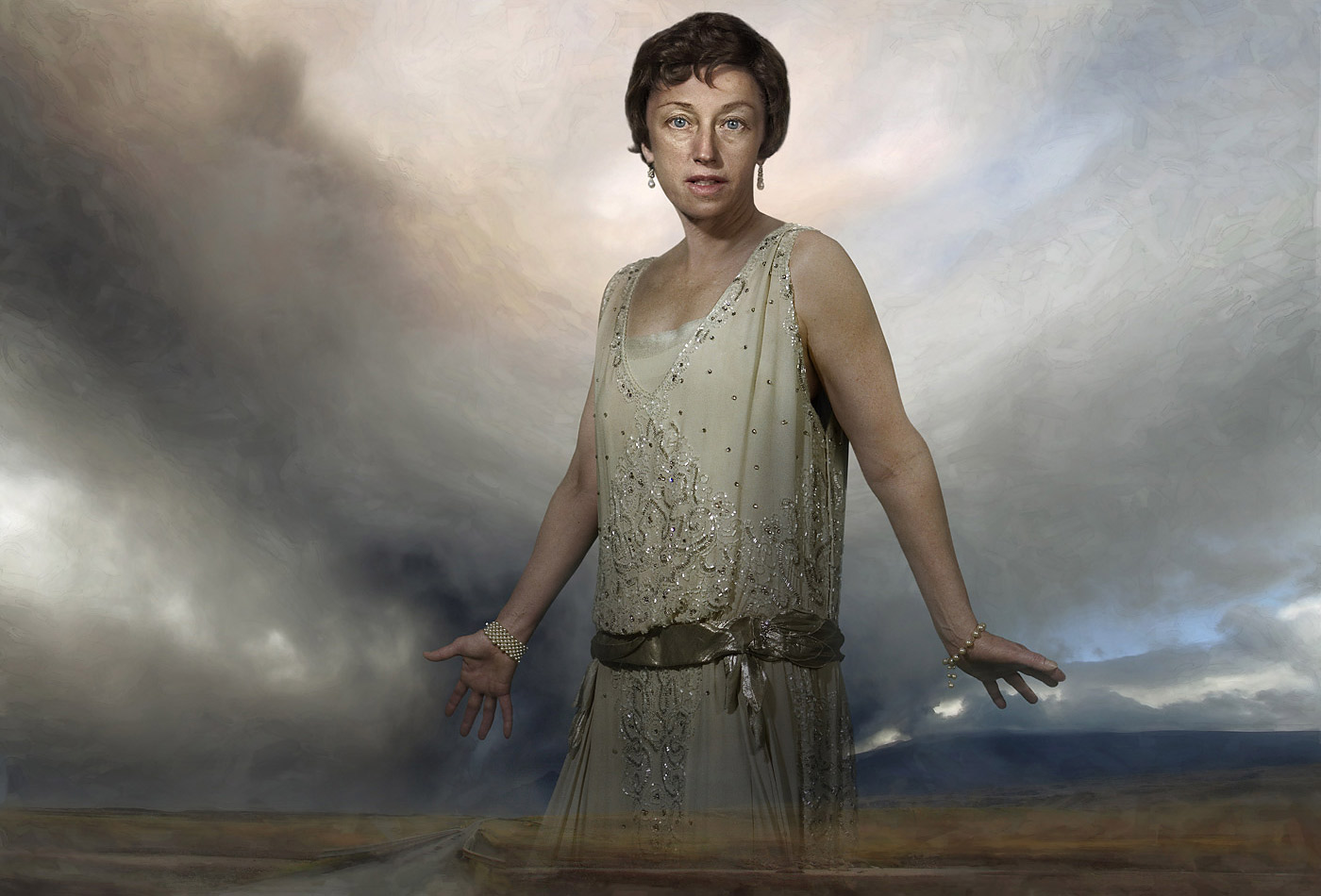
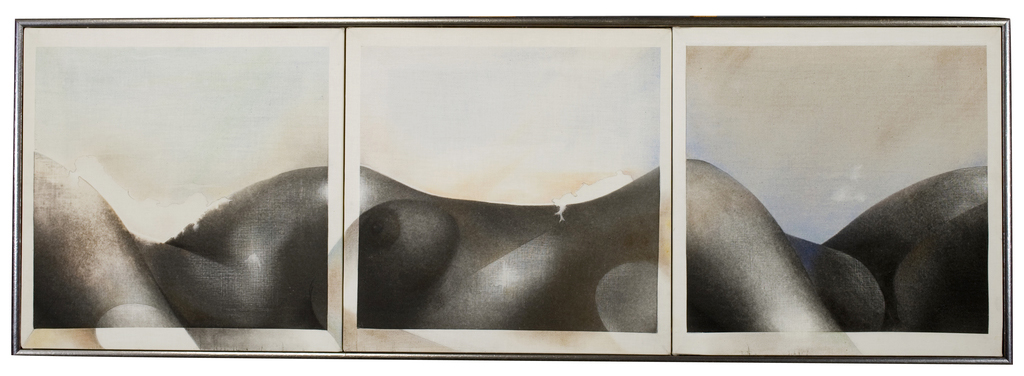
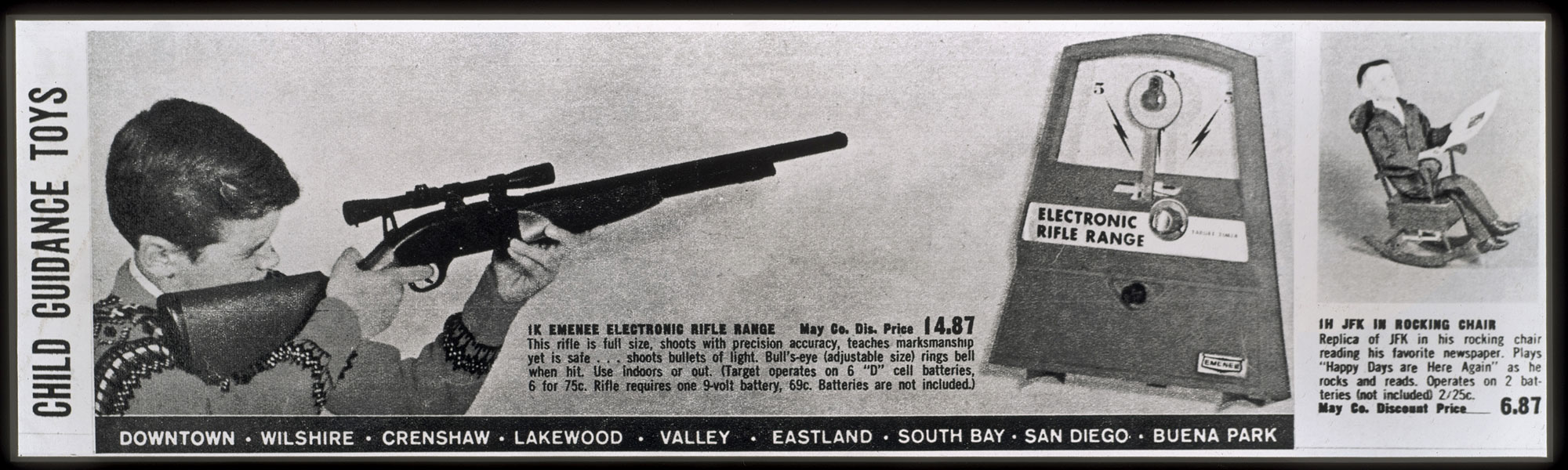
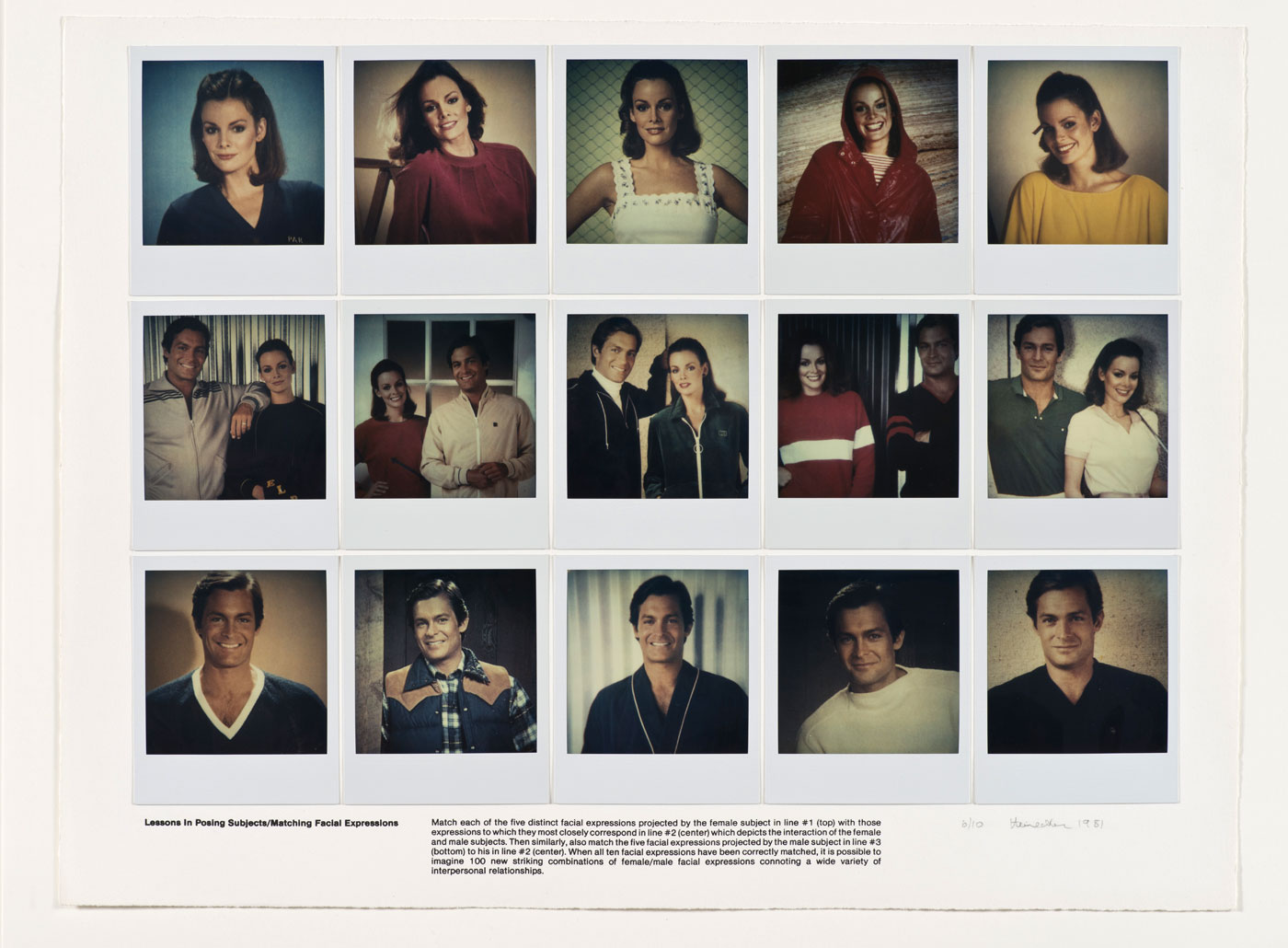
Exhibition: ‘The City Lost and Found: Capturing New York, Chicago, and Los Angeles, 1960-1980’ at the Art Institute of Chicago

Exhibition dates: 26th October, 2014 – 11th January, 2015

Curators: Alison Fisher (Art Institute of Chicago), Katherine A. Bussard (Princeton University Art Museum), and Greg Foster-Rice (Columbia College, Chicago


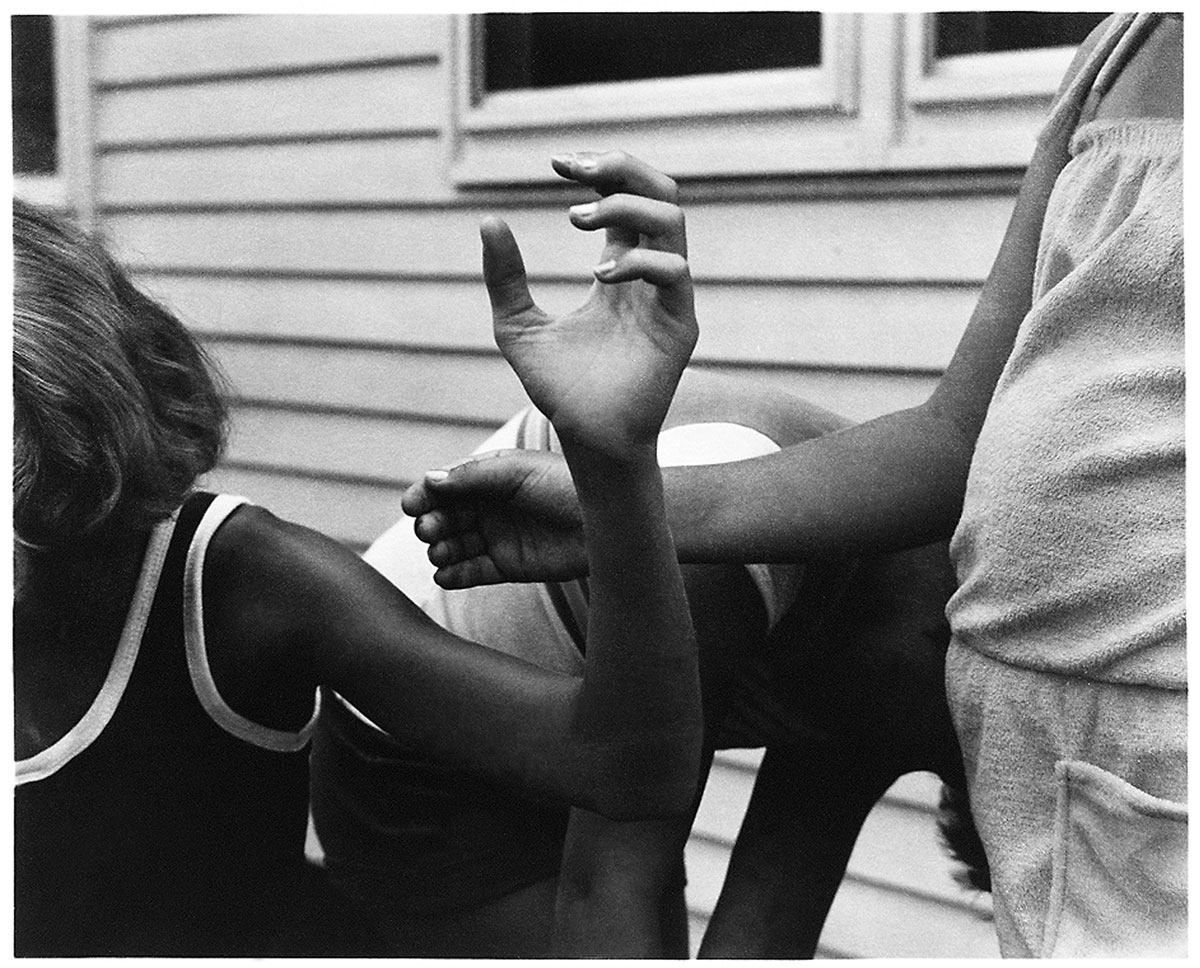
Bruce Davidson (American, b. 1933) 'Untitled', from 'East 100th Street' 1966-1968 from the exhibition 'The City Lost and Found: Capturing New York, Chicago, and Los Angeles, 1960-1980' at the Art Institute of Chicago, October 2014 - January 2015


Bruce Davidson (American, b. 1933)
Untitled, fromEast 100th Street
1966-1968
Courtesy of Howard Greenberg Gallery, New York and Magnum Photos


What looks to be another fascinating exhibition. They are coming thick and fast at the moment, it’s hard to keep up!

Dr Marcus Bunyan


Many thankx to the Art Institute of Chicago for allowing me to publish the photographs in the posting. Please click on the photographs for a larger version of the image.


The American city of the 1960s and 1970s experienced seismic physical changes and social transformations, from urban decay and political protests to massive highways that threatened vibrant neighbourhoods. Nowhere was this sense of crisis more evident than in the country’s three largest cities: New York, Chicago, and Los Angeles. Yet in this climate of uncertainty and upheaval, the streets and neighbourhoods of these cities offered places where a host of different actors – photographers, artists, filmmakers, planners, and activists – could transform these conditions of crisis into opportunities for civic discourse and creative expression.

The City Lost and Found is the first exhibition to explore this seminal period through the emergence of new photographic and cinematic practices that reached from the art world to the pages of Life magazine. Instead of aerial views and sweeping panoramas, photographers and filmmakers turned to in-depth studies of streets, pedestrian life, neighbourhoods, and seminal urban events, like Bruce Davidson’s two-year study of a single block in Harlem, East 100th Street (1966-68). These new forms of photography offered the public a complex image of urban life and experience while also allowing architects, planners, and journalists to imagine and propose new futures for American cities.

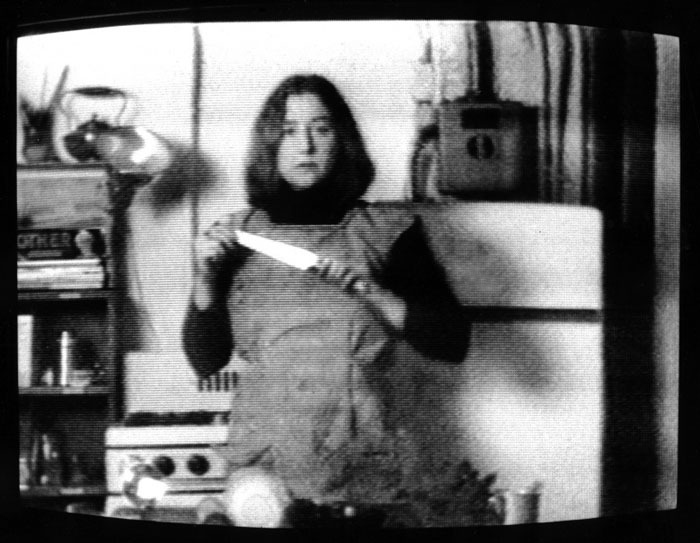
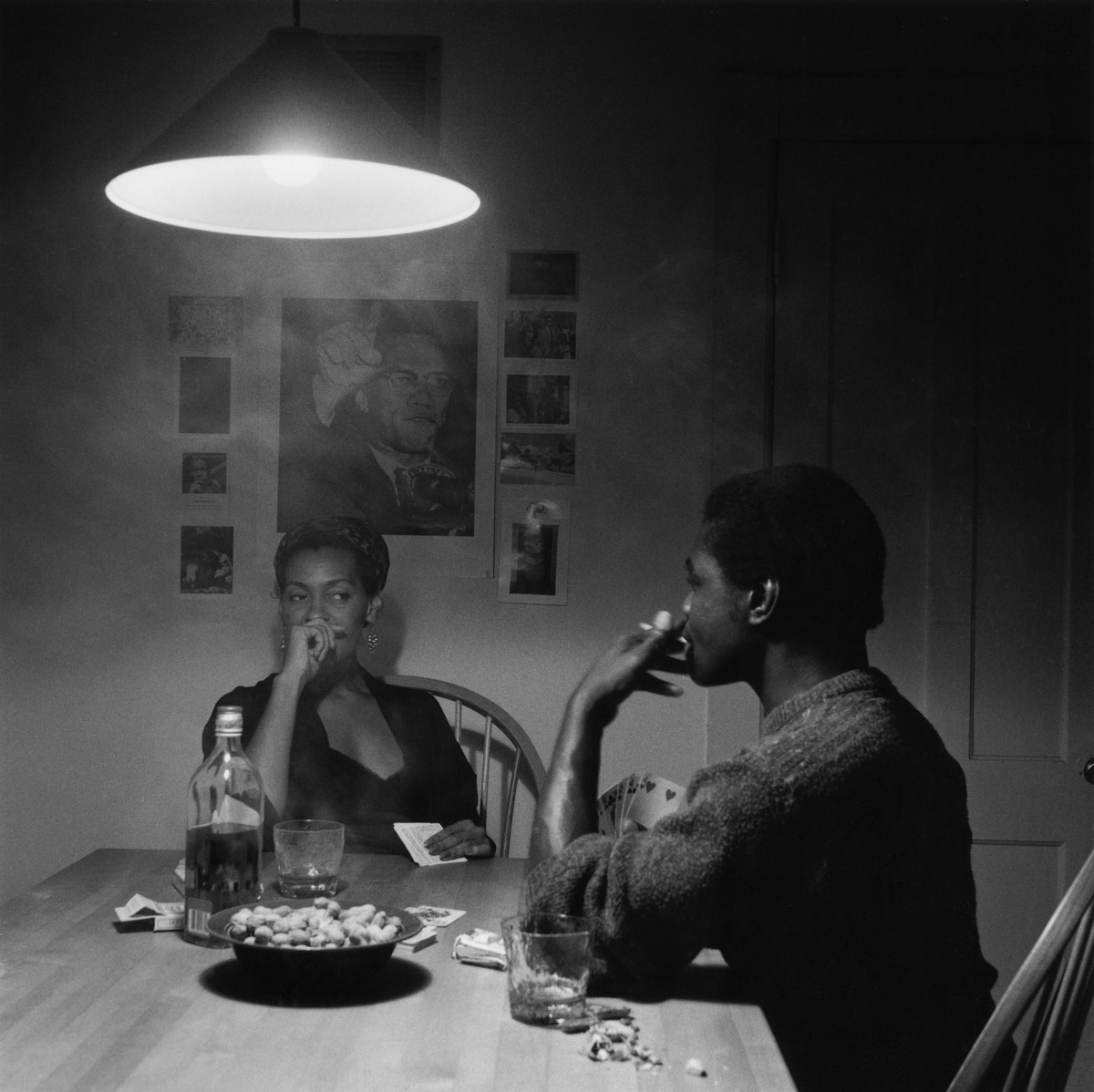
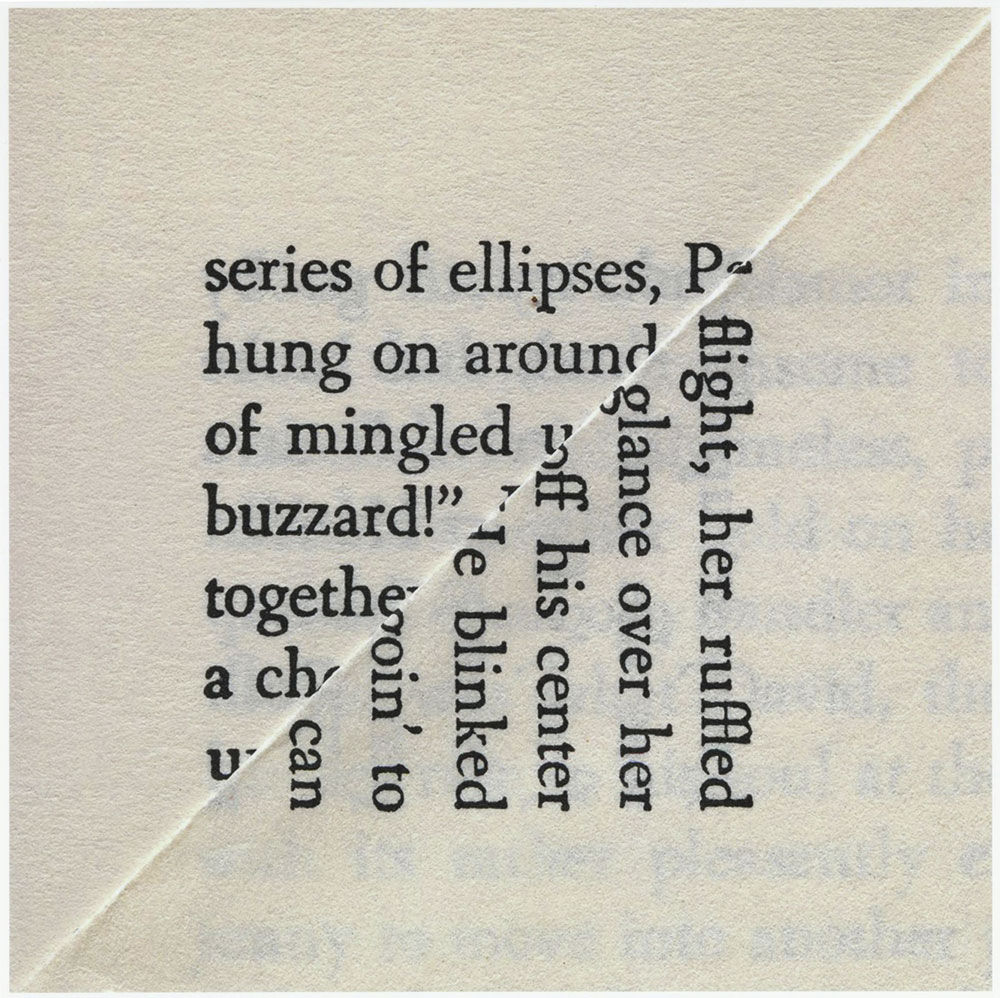
Drawn from the Art Institute’s holdings, as well as from more than 30 collections across the United States, this exhibition brings together a large range of media, from slideshows and planning documents to photo collage and artist books. The City Lost and Found showcases important bodies of work by renowned photographers and photojournalists such as Thomas Struth, Martha Rosler, and Barton Silverman, along with artists known for their profound connections to place, such as Romare Bearden in New York and ASCO in Los Angeles. In addition, projects like artist Allan Kaprow’s Chicago happening, Moving, and architect Shadrach Wood’s hybrid plan for SoHo demonstrate how photography and film were used in unconventional ways to make critical statements about the stakes of urban change. Blurring traditional boundaries between artists, activists, planners, and journalists, The City Lost and Found offers an unprecedented opportunity to experience the deep interconnections between art practices and the political, social, and geographic realities of American cities in the 1960s and 1970s.

Organiser

The City Lost and Found: Capturing New York, Chicago, and Los Angeles, 1960-1980 is organised by the Art Institute of Chicago and the Princeton University Art Museum.

Text from the Art Institute of Chicago website


James Nares (British, b. 1953)
Pendulum
1976
Courtesy of Paul Kasmin Gallery, New York


James Nares’s film Pendulum illustrates the extraordinary status of Lower Manhattan during the 1970s, where disuse and decay created both the threat of demolition and the freedom to produce ambitious public art projects. The film shows a large pendulum swinging languidly in largely abandoned streets, suggesting the passage of time as well as the menace of the wrecking ball. Nares created this project by suspending a cast-concrete ball from an elevated pedestrian bridge on Staple Street on the Lower West Side adjacent to his loft. Unlike many neighbourhoods, urban renewal plans never came to fruition for this area, which still retains a connection to this precarious, yet liberating time in New York.


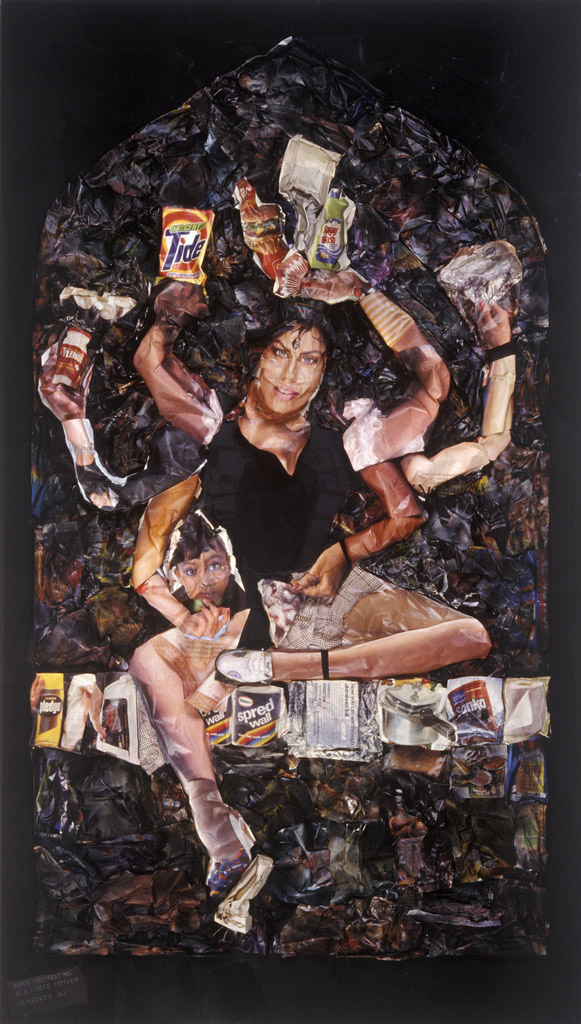
Romare Bearden (African-American, 1911-1988) 'The Block II' 1972 (detail) from the exhibition 'The City Lost and Found: Capturing New York, Chicago, and Los Angeles, 1960-1980' at the Art Institute of Chicago, October 2014 - January 2015


Romare Bearden (African-American, 1911-1988)
The Block II (detail)
1972
Collection of Walter O. and Linda J. Evans


This monumental collage depicts both a specific, identifiable block in Harlem and also the importance of everyday routines to the city. From the 1960s Romare Bearden used collage to convey the texture and dynamism of urban life, combining paint and pencil with found photographs and images from newspapers, magazines, product labels, and fabric and wallpaper samples. Here Bearden showed the diverse inhabitants of Harlem apartment buildings perched in windows and on fire escapes, sitting on front stoops and street benches. The scene highlights the innumerable ways city dwellers “make do” so that their environments are more functional and liveable, from transforming front steps into a living room to turning sidewalks into playgrounds. While Bearden’s work has strong connections to avant-garde art and American and African histories, his collage technique can also be seen as a form of making do, just like the practices of his neighbours in New York.


“The American city of the 1960s and ’70s witnessed seismic physical changes and social transformations, from shifting demographics and political protests to the aftermath of decades of urban renewal. In this climate of upheaval and uncertainty, a range of makers – including photographers, filmmakers, urban planners, architects, and performance artists – countered the image of the city in crisis by focusing on the potential and the complexity of urban places. Moving away from the representation of cities through aerial views, maps, and sweeping panoramas, new photographic and planning practices in New YorkChicago, and Los Angeles explored real streets, neighbourhoods, and important urban events, from the Watts Rebellion to the protests surrounding the Democratic National Convention in Chicago. These ideas and images defined not only cities’ social and political stakes in the eyes of the American public, but they also led a new generation of architects, urban planners, and sociologists to challenge long-held attitudes about the future of inner-city neighbourhoods.

Works throughout the exhibition describe this new ideal of urban experience following three main lines of inquiry – preservation, demonstration, and renewal. The first reflects the widespread interest in preserving urban neighbourhoods and communities, including the rise of the historic preservation movement in the United States. The second captures the idea of demonstration in the broadest sense, encompassing political protests during the 1960s, as well as temporary appropriations of streets and urban neighbourhoods through performance art, film, and murals. The third, renewal, presents new and alternative visions for the future of American cities created by artists, filmmakers, architects, and planners. Together these works blur the lines between artists, activists, and journalists, and demonstrate the deep connections between art practices and the political, social, and geographic realities of American cities in a tumultuous era.”

New York

The election of Mayor John Lindsay in 1965 represented a watershed for New York, as the city moved away from administrator Robert Moses’s highly centralised push for new infrastructure and construction in previous decades. Lindsay’s efforts to create a more open and participatory city government were often in dialogue with ideas advanced by critic Jane Jacobs, who argued for the value of streets, neighbourhoods, and small-scale change. This new focus on local and self-directed interventions had a wide influence, leading to the development of pocket parks to replace vacant lots and the groundbreaking Plan for New York City’s use of photo essays and graphic design to express goals of diversity and community. In turn, many artists of the period, including Hans Haacke and Mierle Laderman Ukeles, created work that directly engaged with important social and political issues in the city, such as slum housing and labor strikes.

A multifaceted theme of preservation comes to the fore in work by the many artists and architects in New York who documented, staged, and inhabited areas where buildings were left vacant and in disrepair following postwar shifts in population and industry. The historic streets of Lower Manhattan became an integral part of projects by artist Gordon Matta-Clark and architect Paul Rudolph, for example, while low-income, yet vibrant neighbourhoods like Harlem gave rise to important bodies of work by Romare Bearden, Bruce Davidson, and Martha Rosler. James Nares’s elegiac film Pendulum and Danny Lyon’s remarkable photographs in The Destruction of Lower Manhattan are examples of a growing awareness of the struggle to preserve the existing urban fabric and cultures of New York during the 1960s and ’70s.


Mierle Laderman Ukeles (American, b. 1939) 'Touch Sanitation Performance' 1977-1980


Mierle Laderman Ukeles (American, b. 1939)
Touch Sanitation Performance
1977-1980
Courtesy of Ronald Feldman Fine Arts, New York


In 1977 Mierle Laderman Ukeles embarked on the multiyear performance piece Touch Sanitation, in which she shook the hand of every one of the 8,500 sanitation workers, or “sanmen,” employed by the city of New York, in keeping with her practice’s focus on labor. After the vilification of sanitation workers during the strikes of 1968, Ukeles’s personal and political camaraderie with the workers took on particular importance; every handshake was accompanied by the words “Thank you for keeping the city alive.” She worked the same hours as the sanmen and followed their paths through the streets of New York. Touch Sanitation was also distinguished by the importance Ukeles placed on the participation of the workers, as she explained in the brochure for the project: “I’m creating a huge artwork called TOUCH SANITATION about and with you, the men of the Department. All of you.”


Paul Rudolph (American, 1918-1997) 'Lower Manhattan Expressway, New York City, perspective section' c. 1970


Paul Rudolph (American, 1918-1997)
Lower Manhattan Expressway, New York City, perspective section
c. 1970
The Paul Rudolph Archive, Library of Congress


Known for high-tech buildings in concrete, architect Paul Rudolph began working on a project for Lower Manhattan Expressway in 1965, funded by the Ford Foundation as research and design exploring “New Forms of the Evolving City.” Rudolph diverged from Robert Moses’s strategy for infrastructural projects through a sensitive engagement with the scale and texture of the dense urban fabric of Lower Manhattan. He proposed a below-grade road surmounted by a large, continuous residential structure of varying heights that would protect the surrounding neighbourhood from the pollution and noise of the highway. In many places this terraced megastructure was precisely scaled to the height of the surrounding loft buildings, with entrances and gardens on existing streets, a contextual quality emphasised in his detailed drawings. Rudolph also designed the expressway complex to resonate with established functions and symbols of the city, with tall buildings flanking the Manhattan and Williamsburg Bridges like monumental gates to the city.


Thomas Struth (German, b. 1954) 'Crosby Street, New York, Soho' 1978


Thomas Struth (German, b. 1954)
Crosby Street, New York, Soho
1978
© Thomas Struth


Thomas Struth’s 1978 photographs in the series Streets of New York City are remarkable representations of a city undergoing dramatic change, from the derelict streets of Lower Manhattan and public-housing buildings in Harlem to the dazzling, mirage-like towers of the newly built World Trade Center. Struth produced these photographs during a residency at the New York Institute for Art and Urban Resources, Inc. (now MoMA’s PS1) from December 1977 until September 1978. As he would later write, “I was interested in the possibility of the photographic image revealing the different character or the ‘sound’ of the place. I learned that certain areas of the city have an emblematic character; they express the city’s structure.” Although these photographs adopt the symmetrical framing and deadpan documentary style of his mentors Bernd and Hilla Becher, they led Struth to ask, “Who has the responsibility for the way a city is?”

Chicago

In the 1960s and ’70s Chicago emerged from its industrial past led by a powerful mayor, Richard J. Daley, who prioritised development in the downtown areas. His work to modernise the city resulted in the construction of massive highways, housing projects, and imposing skyscrapers – new architectural and infrastructural icons that were explored by many photographers of the era. The arts experienced a similar boom, with the foundation and expansion of museums and university programs. Growth came at a cost, however, and the art of this period highlights the disparate experiences of local communities in Chicago, including Jonas Dovydenas’s photographs of life in ethnic neighbourhoods and independent films exploring issues ranging from the work of African American community activists to the forced evictions caused by urban renewal projects.

Demonstrations loomed large in Chicago, where artists responded to two major uprisings in 1968, the first on the West Side, following the assassination of Martin Luther King Jr., and the second downtown, during the Democratic National Convention. These violent confrontations between protestors and police drew national attention to issues of race relations and political corruption in Chicago and led to an outpouring of new art projects as forms of demonstration, including community murals like the West Wall and an exhibition at the Richard Feigen Gallery condemning Daley’s actions during the DNC. The image of Chicago that emerged in the mass media of this period was one of destruction and resilience, a duality highlighted by contemporary artists like Gordon-Matta Clark and Allan Kaprow, whose work existed in the fragile space of opportunity between the streets and the wrecking ball.


Ken Josephson (American, b. 1932) 'Chicago' 1969


Ken Josephson (American, b. 1932)
Chicago
1969
The Art Institute of Chicago, Gift of the School of the Art Institute of Chicago


Still from 'Lord Thing', directed by DeWitt Beall, 1970


Still from Lord Thing, directed by DeWitt Beall
1970
Courtesy Chicago Film Archives


Lord Thing documents the development of the Vice Lords from an informal club for young men on the streets of Chicago’s West Side, its emergence as a street gang, and its evolution into the Conservative Vice Lords, a splinter group that aspired to nonviolent community activism. The film uses a mix of black-and-white sequences to retrospectively analyse the group’s violent middle period and contrasts these with colour sequences that show the Conservative Vice Lords fostering unity and developing black-owned businesses and social programs during the late 1960s. Together, Lord Thing argues for the agency of African Americans in the face of decades of spatialised oppression in Chicago.


Art Sinsabaugh (American, 1924-1983) 'Chicago Landscape #117' 1966


Art Sinsabaugh (American, 1924-1983)
Chicago Landscape #117
1966
Art Sinsabaugh Archive, Indiana University Art Museum
© 2004 Katherine Anne Sinsabaugh and Elisabeth Sinsabaugh de la Cova


Sinsabaugh’s panoramic photographs are among the most distinctive visual records of Chicago, capturing the built landscape with what Sinsabaugh called “special photographic seeing,” achieved with large-format negatives. The Department of City Planning used his photographs in a 1963 planning document to help describe the qualities of Chicago’s tall buildings “as vertical forms contrasting with these two great horizontal expanses [the flat prairie and the lakefront edge].” Sinsabaugh’s panoramas also flirt with abstraction when depicting such remarkable places as Chicago’s Circle Interchange, a monumental coil of highways completed in the early 1960s. Sinsabaugh recalled that for the photographer, like the motorist, freeways provided “an access, an opening, a swath cut right through the heart of the City in all directions.” However, his early thrill at the novelty of these developments soon gave way to an appreciation of their violence, in which entire “neighbourhoods were laid bare and their very bowels exposed.” (Please enlarge by clicking on the image)


Alvin Boyarsky (Polish-​Canadian, 1928-1990) 'Chicago à la Carte: The City as Energy System' 1970


Alvin Boyarsky (Polish-​Canadian, 1928-1990)
Chicago à la Carte: The City as Energy System
1970
Special issue of Architectural Design, December 1970
Courtesy Alvin Boyarsky Archive, London


The concept of the city as organism emerged during the 1960s as a response to the increasingly complex interconnections of technology, communication, and history. One exceptional project in this vein was the British architect Alvin Boyarsky’s Chicago à la Carte. Boyarsky drew on an archive of historical postcards, newspaper clippings, and printed ephemera to trace a hidden history of Chicago’s built environment as an “energy system.” This idea was represented on the cover by a striking postcard image of a vivisection of State Street in the Loop, showing subway tunnels, sidewalks, El tracks, and skyscrapers in what Boyarsky described as “the tumultuous, active, mobile, and everywhere dynamic centre of a vast distribution system.” On other pages, Boyarsky showed images of Chicago’s newly built skyscrapers with newspaper clippings of recent political protests to juxtapose the city’s reaction to recent political protests against the disciplinary tradition of modern architecture in Chicago.

Los Angeles

Los Angeles has always been known for its exceptionalism, as a city of horizontal rather than vertical growth and a place where categories of private and public space prove complex and intertwined. During the 1960s and ’70s these qualities inspired visual responses by seminal artists like Ed Ruscha as well as critics like Reyner Banham, one of the most attentive observers of the city during this period. In many other respects, however, Los Angeles experienced events and issues similar to those of New York and Chicago, including problems of racial segregation, a sense of crisis about the decay of its historical downtown, and large-scale demonstrations, with responses ranging from photography and sculpture to provocative new forms of performance art by the collective Asco.

Concerns about the future forms of urbanism in Los Angeles and a renewal of the idea of the city were major preoccupations for artists, architects, and filmmakers. Many photographers focused on the everyday banality and auto-centric nature of the city, such as Robbert Flick’s Sequential Views project and Anthony Hernandez’s Public Transit Areas series. The historic downtown core continued to hold a special place in popular memory as many of these areas – including the former neighbourhood of Bunker Hill – were razed and rebuilt. Julius Shulman’s photographs of new development in the 1960s – including Bunker Hill and Century City – focus on the spectacular quality of recent buildings as well their physical and cultural vacancy. Architects played a strong role in creating new visions for the future city, including an unrealised, yet bold and influential plan for redeveloping Grand Avenue as a mixed-use district shaped by ideals of diversity and pedestrian-friendly New Urbanism.


Julius Shulman (American, 1910-2009) 'The Castle, 325 S. Bunker Hill Avenue, Los Angeles, California, (Demolished 1969)' c. 1968


Julius Shulman (American, 1910-2009)
The Castle, 325 S. Bunker Hill Avenue, Los Angeles, California, (Demolished 1969)
c. 1968
Julius Shulman Photography Archive, Research Library at the Getty Research Institute, Los Angeles (2004.R.10)
© J. Paul Getty Trust. Used with permission


Julius Shulman (October 10, 1910 – July 15, 2009) was an American architectural photographer best known for his photograph “Case Study House #22, Los Angeles, 1960. Pierre Koenig, Architect.” The house is also known as the Stahl House. Shulman’s photography spread the aesthetic of California’s Mid-century modern architecture around the world. Through his many books, exhibits and personal appearances his work ushered in a new appreciation for the movement beginning in the 1990s.

His vast library of images currently resides at the Getty Center in Los Angeles. His contemporaries include Ezra Stoller and Hedrich Blessing Photographers. In 1947, Julius Shulman asked architect Raphael Soriano to build a mid-century steel home and studio in the Hollywood Hills.

Some of his architectural photographs, like the iconic shots of Frank Lloyd Wright’s or Pierre Koenig’s remarkable structures, have been published countless times. The brilliance of buildings like those by Charles Eames, as well as those of his close friends, Richard Neutra and Raphael Soriano, was first brought to wider attention by Shulman’s photography. The clarity of his work added to the idea that architectural photography be considered as an independent art form in which perception and understanding for the buildings and their place in the landscape informs the photograph.

Many of the buildings photographed by Shulman have since been demolished or re-purposed, lending to the popularity of his images.

Text from the Wikipedia website


Asco. 'Decoy Gang War Victim' 1974 (printed later)


Asco
Decoy Gang War Victim
1974 (printed later)
Photograph by Harry Gamboa Jr.
Courtesy of Harry Gamboa Jr.


The Chicano art collective Asco was famous for their No Movies – works that appropriate certain stylistic qualities of the movies while maintaining a nonchalance that allows them to critique the media industry’s role in Los Angeles. Asco’s performances, therefore, function on different registers to engage with current events and issues facing the Chicano community as well as acknowledge the mainstream media’s distorted image of the city. For Decoy Gang War Victim, Asco’s members staged a fake gang shooting then circulated the images to local television stations, simultaneously feeding and deriding the media’s hunger for sensationalist imagery of urban neighbourhoods.


William Reagh (American, 1911-1992) 'Bunker Hill to soon be developed' 1971 (printed later)


William Reagh (American, 1911-1992)
Bunker Hill to soon be developed
1971 (printed later)
Los Angeles Public Library


From 1939 to 1990, William Reagh produced over 40,000 photographs of Los Angeles in considerable architectural detail. Reagh is also well known for his specific efforts to document the Downtown area from the 1950s to the 1980s. His collection is now part of the California State Library, and a photography center in his name, the William Reagh Los Angeles Photography Center, is located at 2332 W. Fourth Street.

The William Reagh Los Angeles Photography Center is operated by Grupo de Teatro SINERGIA in partnership with the Department of Cultural Affairs City of Los Angeles, and is the only Community Photography Laboratory in the Los Angeles area.


Reagh was on the streets: Looking. Lingering. Documenting. He walked Los Angeles and consequently saw Los Angeles — offering a different perspective than the mere suggestion of place so often gleaned in motion or generalised shorthand. He circled neighbourhoods, returned to some locations year after year, charting their evolution. And though, until his death in 1992, he became one of Los Angeles’ most prolific visual documentarians, he didn’t set out to be a photographer, nor was his trove of L.A. images meant to be a formal paean to Los Angeles. A painter and philosopher, by training and inclination, photography was something that he “picked up,” while in the service, a proficiency, that overtime became, at turns, poetic – though he, says his son, would never see it as such. …

His father’s arrival in Los Angeles, coincided with the city’s most vigorous years of growth, as well as its many phases of urban renewal. For years, his day job was work as a commercial photographer – shooting products, catalogues, art collections “whatever the clients called for,” his son recalls. But the weekends were dedicated to solely to prowling Los Angeles, uncovering and documenting its very disparate parts, assembling a sense of the whole.

To say there was a goal, a plan or even an organising thesis to his images, would be to overstate his process, Patrick suggests. His father, he says, was a wanderer who would lose himself within the intricate folds of the city, “wherever his muse led him.” Patrick remembers the meanderings of his father. “He just loved to wander downtown and walk around the streets and shoot. Sometimes it might be a streetscape, sometimes it might be people. He’d often shoot from the hip, hold the camera low. He was very good at taking pictures of people without them knowing. But really, he was so non-threatening, such a friendly guy – even in the seediest of neighbourhoods – he would make everyone feel at ease.”

While Saturdays often meant a solo trek – perhaps crisscrossing the freeways by car, touring surface streets on foot for inspiration – on Sundays, Reagh might take Patrick and his sister along. It was an opportunity to see the city through his eyes – the places he felt were important to document, even if he couldn’t articulate why in words. “Train yards, he loved. Shipyards. Amusement parks, the Pike and Pacific Ocean Park,” Reagh recalls. These were places at the edge of things – of the city or the coastline – and, metaphorically, our imaginations. The transit hubs in particular provided an interesting opportunity to see behind the scenes – an end on one story, beginning of another.

Each setting called for a different set up. “If he was downtown shooting people, he’d have his reflex, or another smaller camera, maybe his Leica. At the train yard or shipyard, he’d bring his tripod and set up his big Speed-Graphic. Back then there were no security guards asking questions: who you were and what you were doing. I would climb on stuff, those piled up streetcars. There was broken glass all over. He’d be off shooting. I’d climb. Back when you could do that sort of thing.” …

Decades later, the work reveals his heart. And what the images, taken as a whole, most eloquently preserve is not just sense of place, but a sense of the city’s humanity, its particular vernacular – its feel, pace, space; its leisureliness, and idiosyncratic visual language. “He was just interested in the passing parade.” says Reagh, “He let the camera do the talking.”

Lynell George. “Sidewalk Stories: The Photography of William Reagh,” on the KCET website January 10, 2013 [Online] Cited 26/11/2022. Used under fair use conditions for the purposes of education and research


John Humble (American, b. 1944) '300 Block of Broadway, Los Angeles, October 3, 1980' 1980


John Humble (American, b. 1944)
300 Block of Broadway, Los Angeles, October 3, 1980
1980
Courtesy of Craig Krull Gallery, Santa Monica


Brought up in a military family, John Humble spent his childhood moving around the country from one military base to another. Humble was drafted during the Vietnam War, then became a photojournalist for the Washington Post before pursuing a graduate degree at the San Francisco Art Institute. His itinerant nature continued when he traveled the world in the early 1970s, going from Europe to the Middle East, then to Africa and Asia in his Volkswagen van. However, since the summer of 1974 Humble has lived in one place: Los Angeles. His traveling instinct did not diminish despite his fixed geographical location; rather, it intensified as he traversed the length and breadth of the city (from the San Fernando Valley and East Los Angeles to Venice and the shores of Long Beach), creating images that explore the postmodern qualities of America’s second largest city. Humble’s desire to capture “the incongruities and ironies of the Los Angeles landscape” results in a compelling body of work where power lines cut across blue skies, freeways divide neighbourhoods and a river bisects the city.

Humble began working with a 35mm camera, favouring black-and-white prints, but in September 1979 he bought his first view camera and switched to colour printing, producing first Cibachrome, then chromogenic prints. In the 1970s colour emerged within the tradition of photography, most notably in the 1976 exhibition Photographs by William Eggleston at the Museum of Modern Art in New York. No longer confined to the commercial domain of advertising, colour photography gained recognition as a valid expression of fine art. For Humble, the choice was clear; to fully capture the realities of the city – what he refers to as “the urban landscape” – colour was essential.

Text from the J. Paul Getty Museum website


The Art Institute of Chicago
111 South Michigan Avenue
Chicago, Illinois 60603-6404
Phone: (312) 443-3600

Opening hours:
Monday, 11.00am – 6.00pm
Tuesday – Wednesday, closed
Thursday, 11am – 9.00pm
Friday, 11am – 9.00pm
Saturday – Sunday, 11.00am – 6.00pm
The museum is closed Thanksgiving, Christmas, and New Year’s days.

The Art Institute of Chicago website

LIKE ART BLART ON FACEBOOK

Back to top

Exhibition: ‘Rothko to Richter: Mark Making in Abstract Painting from the Collection of Preston H. Haskell’, Class of 1960 at the Princeton University Art Museum

Exhibition dates: 24th May – 5th October, 2014

Curator: Kelly Baum, Haskell Curator of Modern and Contemporary Art at the Princeton University Art Museum


Frank Stella (American, 1936-2024) 'Double Scramble' 1978 from the exhibition 'Rothko to Richter: Mark Making in Abstract Painting from the Collection of Preston H. Haskell', Class of 1960 at the Princeton University Art Museum, May - October, 2014


Frank Stella (American, 1936-2024)
Double Scramble
1978
Oil on canvas
174.9 x 350.5cm
Collection of Preston H. Haskell, Class of 1960
© 2014 The Franz Kline Estate / Artists Rights Society (ARS), New York / photo Douglas J. Eng


Frank Stella was an American artist best known for his use of geometric patterns and shapes in creating both paintings and sculptures. Arguably one of the most influential living American artists, Stella’s works utilise the formal properties of shape, colour, and composition to explore non-literary narratives… “Abstraction didn’t have to be limited to a kind of rectilinear geometry or even a simple curve geometry. It could have a geometry that had a narrative impact. In other words, you could tell a story with the shapes,” he explained. “It wouldn’t be a literal story, but the shapes and the interaction of the shapes and colours would give you a narrative sense. You could have a sense of an abstract piece flowing along and being part of an action or activity.”

Text from the Artnet website


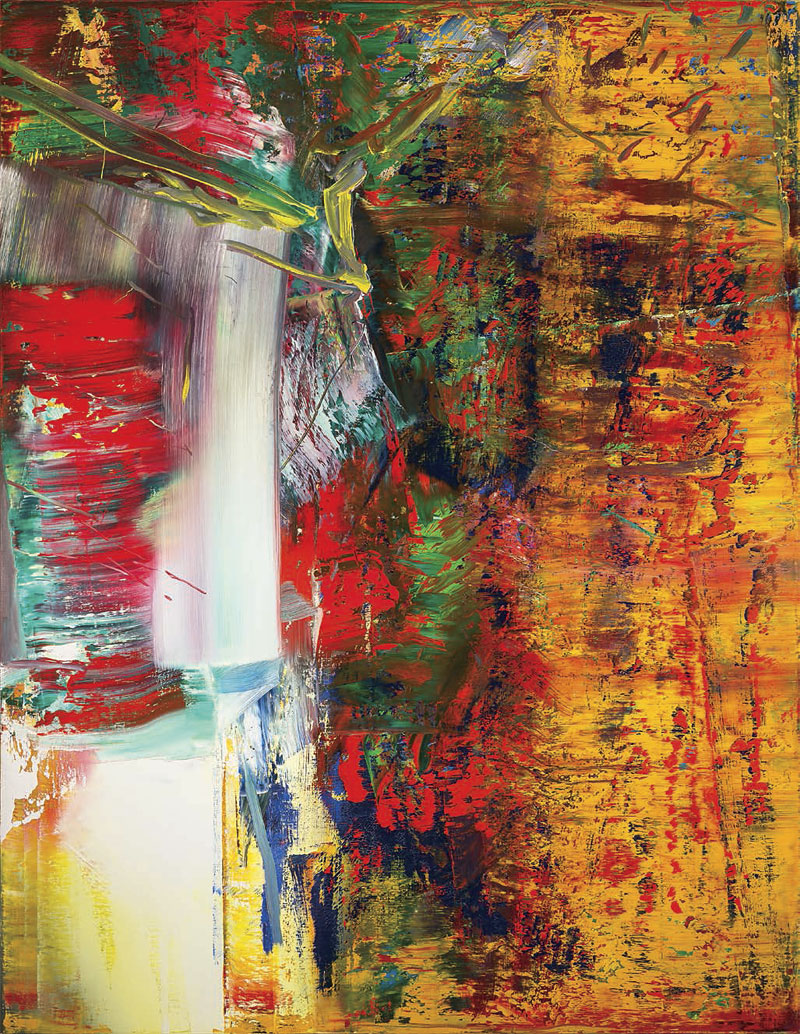
Think about the big 4 colours:  Red Green Blue Yellow – and then there are the browns, the purples, magenta, cyan etc etc… Then have a look at the Gerhard Richter (Abstract Painting (613-3), 1986 below) in that light. A great colourist – but very reliant on the big four. Now compare him to Helen Frankenthaler (Belfry, 1979 below) – with this artist it’s a sort of a green, a sort of a red. And she used that palette in her watercolours as well.

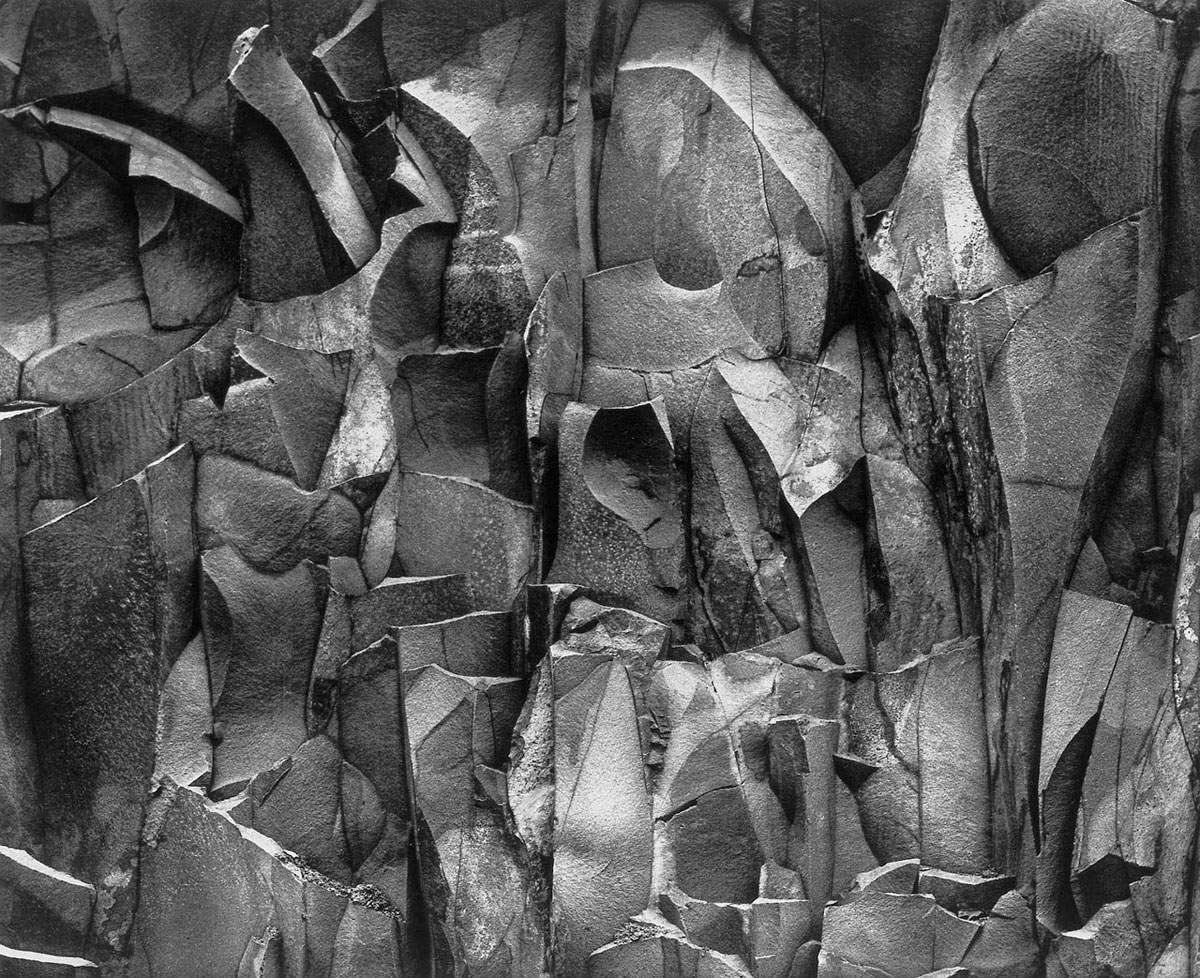
They are both certainly aware of the presence of something else. I don’t know if Helen Frankenthaler would say that, and Gerhard Richter certainly wouldn’t, but there is an energy that is not human in the work of both of these artists. My benchmark in photography has always been the first Paul Caponigro exhibition which was called “In the presence of …” : hardly the vibrancy or the zeitgeist of Frankenthaler and Richter, but he had it right in front of his camera.

Dr Marcus Bunyan


Many thankx to the Princeton University Art Museum for allowing me to publish the art work in the posting. Please click on the art work for a larger version of the image.


Josef Albers (German, 1888-1976) 'Study for Homage to the Square' 1964 from the exhibition 'Rothko to Richter: Mark Making in Abstract Painting from the Collection of Preston H. Haskell', Class of 1960 at the Princeton University Art Museum, May - October, 2014


Josef Albers (German, 1888-1976)
Study for Homage to the Square
1964
Oil on paper
30.8 x 33.3cm
Collection of Preston H. Haskell, Class of 1960
© 2014 The Franz Kline Estate / Artists Rights Society (ARS), New York / photo Douglas J. Eng


Study for Homage to the Square reveals a great deal about the series that has done more than any other to establish Josef Albers’s reputation in the United States. More than one thousand Homages to the Square exist, some paintings, others prints. Launched in 1950, the series forecasts many of the key concerns of the 1960s, including seriality and repetition. In its predilection for regular shapes and methodical compositions, as well as spatial and chromatic illusionism, Homage to the Square also lays the foundation for that decade’s romance with geometric abstraction. Importantly, Homages to the Square are rooted in interwar Constructivism. Albers spent more than ten years at the Bauhaus, from 1920 to 1933, experimenting with glass, typography, furniture design, photography, printmaking, and painting. There he was weaned on the insights of artists like Piet Mondrian and fellow teachers Laslo Moholy-Nagy and Walter Gropius. Albers also played an important role in transmitting European modernism to a younger generation of American artists, first at Black Mountain College, where he taught between 1933 and 1949, and then at Yale, where he was an instructor from 1950 to 1958.1

Each work in the Homage to the Square series conforms to one of four formats, all based on nested squares. What distinguishes one format from another is the mathematical ratio governing the intervals between the squares.2 Within this standardised program, however, Albers extracts incredible variety. The squares are rendered in a range of hues that vary in their degree of brightness and saturation, creating “optical reversals” that cause some squares to project and others to recede. Albers once described the Homage to the Square series as a stage on which colour might “act.”3 While individual works experiment with different “colour climates,” the cycle in its entirety explores the “relational” character of colour.4 Colour, Albers believed, is one of the most mutable, contingent, even deceptive phenomena in the world: any one colour is invariably affected by the colours around it, altering its identity and manipulating perception in the process.5 What we see is never what we see in the Homage to the Square cycle. The paint handling in Study is much looser than in other works from the series, whose smooth, fastidious surfaces are free of what Albers called “hand-writing,” by which he meant texture, impasto, and visual incident.6 However, the very informality of this smaller piece underscores an often overlooked feature of the series as a whole: the gentle, imprecise edges separating one square from another. In finessing the boundaries between shapes, Albers also finessed the boundaries between colours, investing his works with maximum visual intensity.

Kelly Baum


1/ Richard Anuszkiewicz studied with Albers at Yale between 1953 and 1955.
2/ See Werner Spies, Josef Albers (New York: Abrams, 1970), pp. 48-50.
3/ See Sewell Sillman, Josef Albers: Paintings, Prints, Projects (New York: Clarke and Way / Associates in Fine Arts, 1956), p. 36.
4/ See Spies, Josef Albers, 44. In 1963, Albers published the important Interaction of Color.
5/ In this respect, Albers sought to exploit the “discrepancy” between “physical fact” and “psychic effect.” See Hal Foster, “The Bauhaus Idea in America,” in Albers and Moholy-Nagy: From the Bauhaus to the New World, ed. Achim Borchardt-Hume (New Haven, CT: Yale University Press, 2006), p. 99.
6/ Kynaston L. McShine, Josef Albers: Homage to the Square (New York: Museum of Modern Art, 1964), n.p. In the same publication, Albers describes his painting technique, which involved applying paint directly from the tube with a palette knife in one thin, even coat to create a “homogenous” “paint film.”


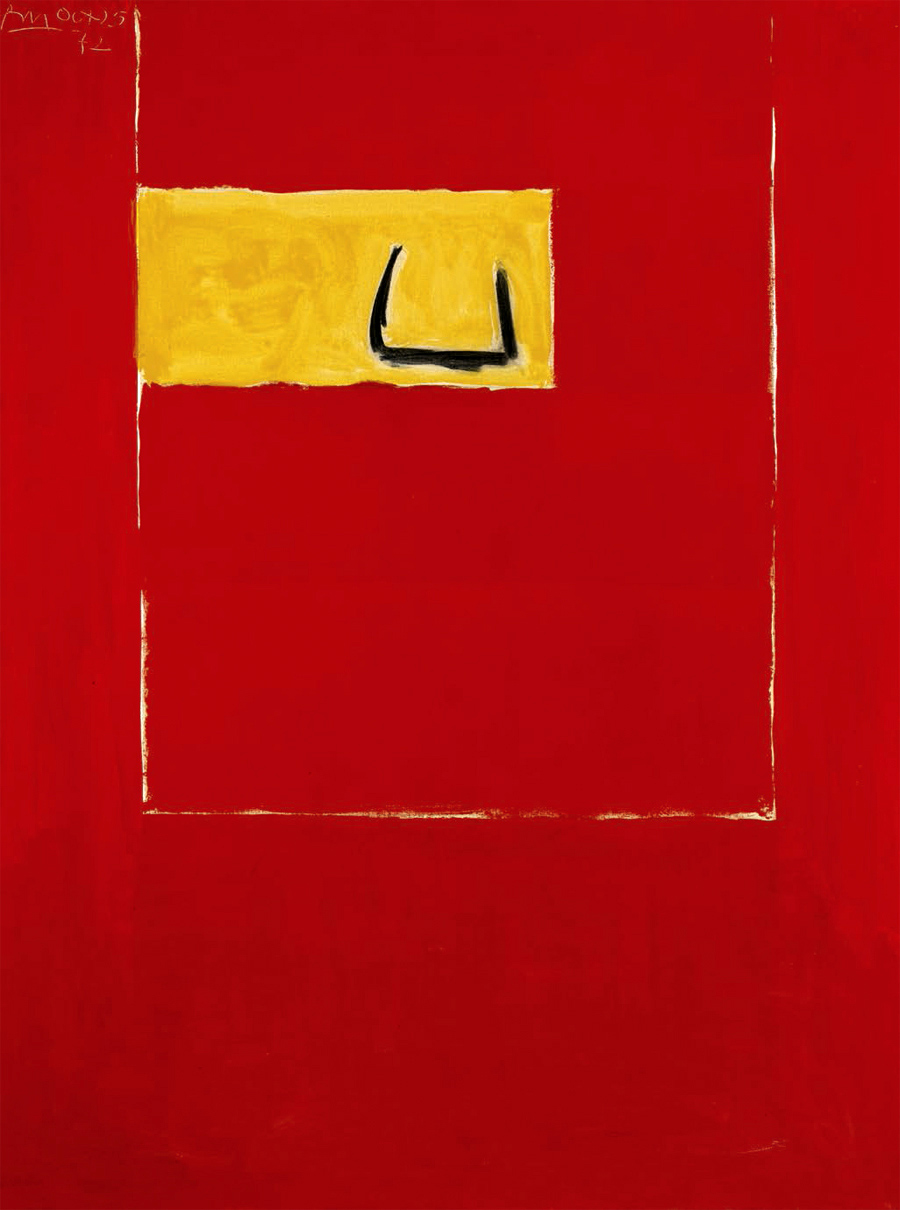
Robert Motherwell (American, 1915-1991) 'Untitled (red)' 1972


Robert Motherwell (American, 1915-1991)
Untitled (red)
1972
Acrylic on canvas
182.6 x 137.3cm
Collection of Preston H. Haskell, Class of 1960
© 2014 The Franz Kline Estate / Artists Rights Society (ARS), New York / photo Douglas J. Eng


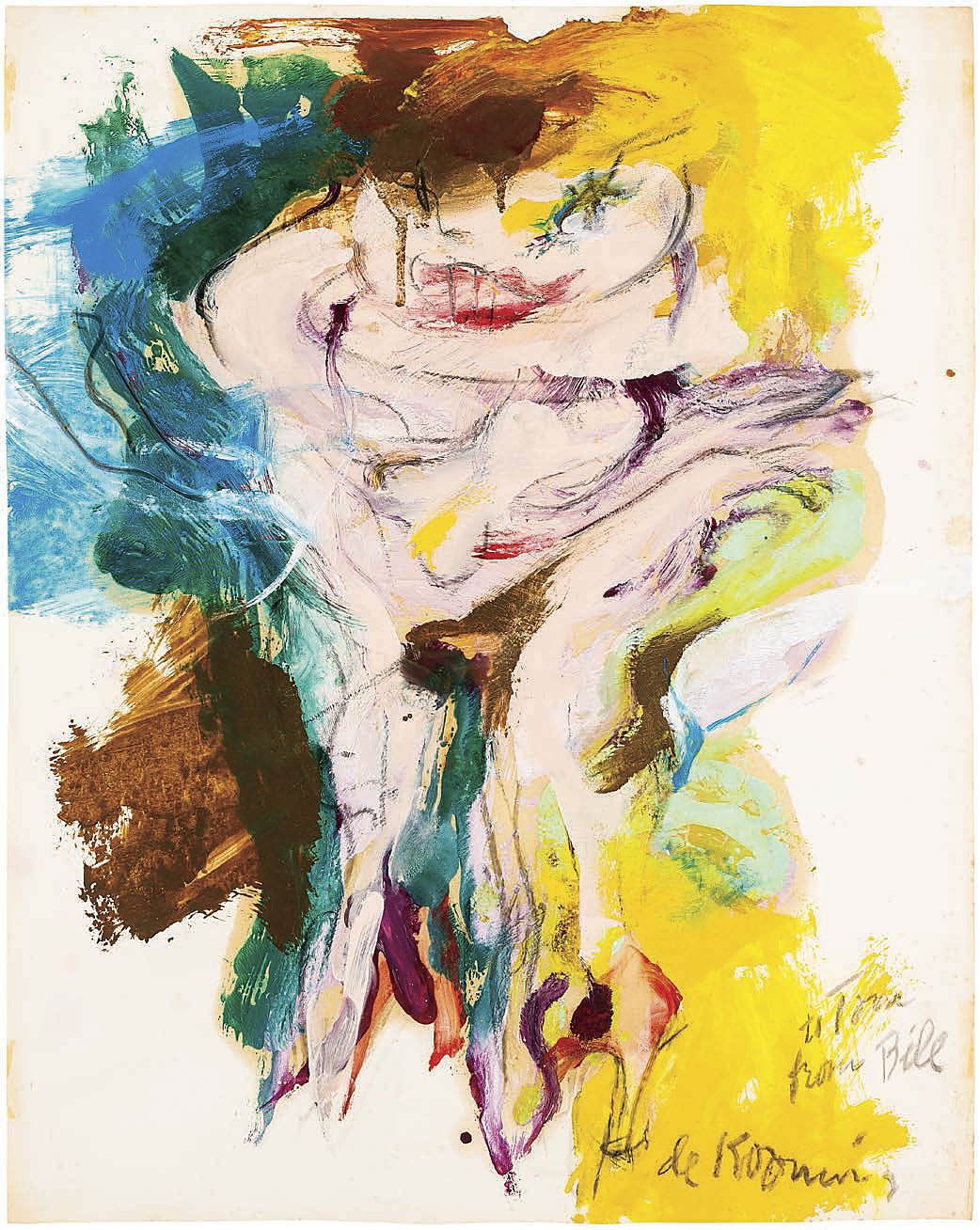
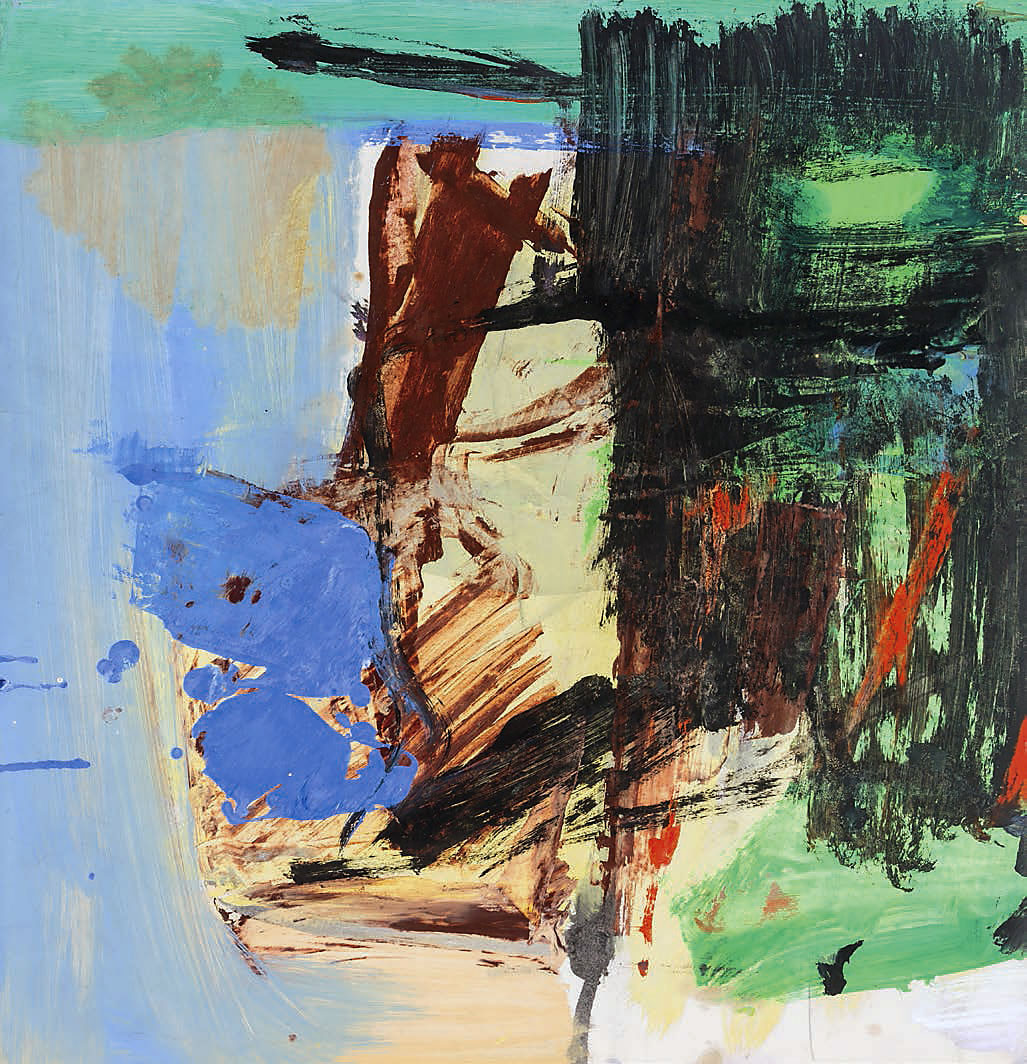
Willem de Kooning (Dutch-American, 1904-1997) 'Untitled (Woman)' 1965


Willem de Kooning (Dutch-American, 1904-1997)
Untitled (Woman)
1965
Oil on paper
73.7 x 58.4cm
Collection of Preston H. Haskell, Class of 1960
© 2014 The Willem de Kooning Foundation / Artists Rights Society (ARS), New York / photo Douglas J. Eng


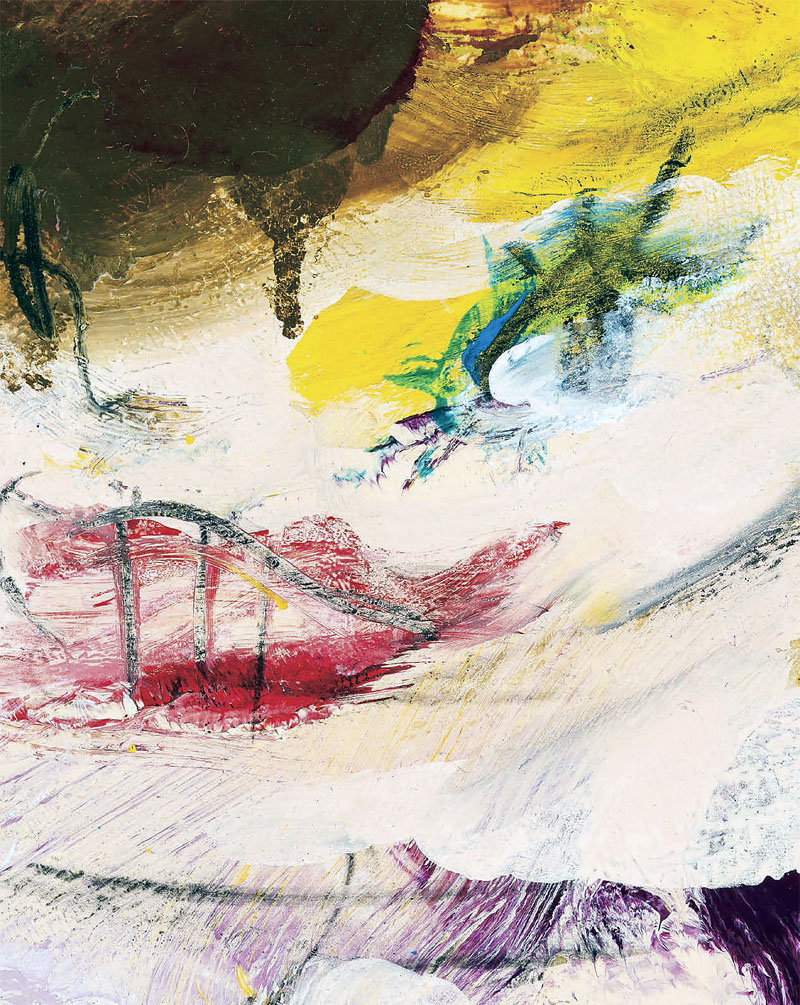
Willem de Kooning (Dutch-American, 1904-1997) 'Untitled (Woman)' 1965 (detail)


Willem de Kooning (Dutch-American, 1904-1997)
Untitled (Woman) (detail)
1965
Oil on paper
73.7 x 58.4cm
Collection of Preston H. Haskell, Class of 1960
© 2014 The Willem de Kooning Foundation / Artists Rights Society (ARS), New York / photo Douglas J. Eng


Woman II and Untitled (Woman) attest to de Kooning’s pursuit of fluidity and irresolution. Over the course of the 1960s, he altered his materials so as to facilitate his protracted editing process and increase the speed, vitality, and fluency of his brushwork – smooth supports reduced drag while safflower oil and kerosene slowed the drying time of his paints. As de Kooning said in 1960, “I was never interested … [in] how to make a good,” as in a perfect, finished “painting.” “I didn’t want to pin it down at all.”


Helen Frankenthaler (American, 1928-2011) 'February's Turn' 1979


Helen Frankenthaler (American, 1928-2011)
February’s Turn
1979
Oil on canvas
Collection of Preston H. Haskell, Class of 1960
© 2014 Helen Frankenthaler Foundation, Inc. / Artists Rights Society (ARS), New York / photo Douglas J. Eng


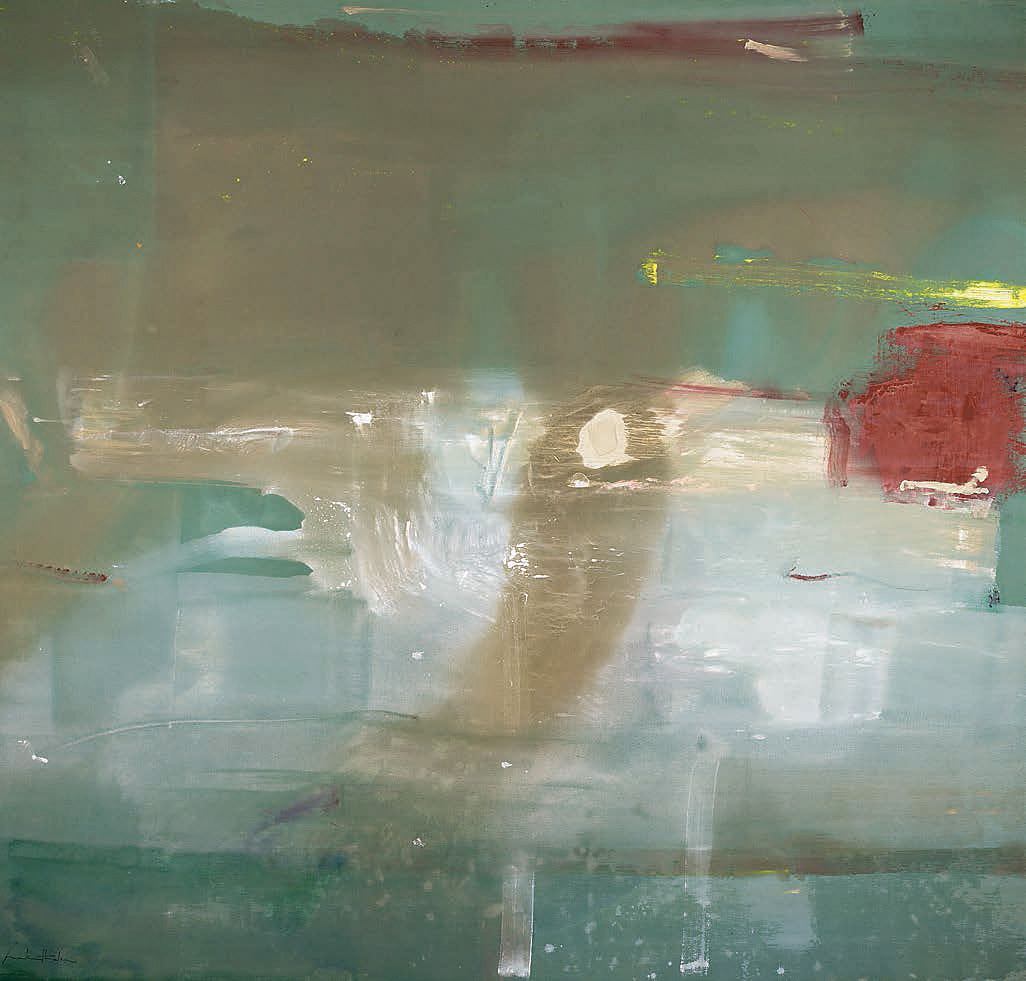
Helen Frankenthaler (American, 1928-2011) 'Belfry' 1979


Helen Frankenthaler (American, 1928-2011)
Belfry
1979
Acrylic on canvas
208.4 x 219.7cm
Collection of Preston H. Haskell Class of 1960
© 2014 The Franz Kline Estate / Artists Rights Society (ARS), New York / photo Douglas J. Eng


An intriguing paradox lies at the heart of Helen Frankenthaler’s work. In 1952 the artist started to create paintings that were gestural in appearance but not in fact. Thanks to a novel technique called staining, in which paint is poured onto canvas, Frankenthaler made marks that mimicked the sweeping strokes of Abstract Expressionism but indexed neither her hand nor her distinctive personality. Insofar as she minimised the role of will, choice, and subjectivity, Frankenthaler heralded a paradigm shift in postwar painting, breaking with Abstract Expressionism and planting a wedge between gesture and hand, art and artist. Frankenthaler’s technique, which evolved over time to include implements as unconventional as rags, mops, basters, sponges, squeegees, and windshield wipers,1 also has bearing on the equally paradoxical space of her paintings. In one respect, Frankenthaler strove to acknowledge, through the very act of painting, the feature that distinguishes painting from every other medium – flatness.2 This she did by thinning her paint and applying it to unprimed canvas, allowing the paint to penetrate the fabric. What results is not only a flat surface that reiterates the flat support on which it resides but also an image that is identified exactly with its ground. At the same time,

Frankenthaler’s work generates undoubtedly atmospheric effects. As the artist said in 1971, “Pictures are flat and part of the nuance and often the beauty or the drama that makes a work, or gives it life … is that it presents such an ambiguous situation of an undeniably flat surface, but on it and within it an intense play and drama of space, movements, light, illusion, [and] different perspectives.”3 Belfry and February’s Turn, both from the midpoint of Frankenthaler’s career, rely on just such an ambiguous sensation of space and depth. In their case, however, this ambiguity is exacerbated by the intrusion of marks that contradict the illusion of “aerated” flatness.4 Take the anomalous, almost gratuitous brushstroke in the centre right of Belfry, for instance, or the beige clump and the area of black impasto in February’s Turn, all of which lie obstinately on the surface of otherwise dyed canvases.

These marks very clearly qualify as painterly touches. As such, they introduce a degree of materiality to Frankenthaler’s mostly disembodied paintings and recall traditional Abstract Expressionism. Belfry and February’s Turn likewise exemplify a theme that concerned Frankenthaler from the very beginning of her career: landscape. Although abstract, these paintings evoke, through format, palette, and composition, the environments in which the artist lived and traveled, including the waterfront property she bought in Connecticut in 1978 and the arid, sunburned deserts of Arizona, which she visited in 1976 and 1977.

Kelly Baum


1/ Susan Cross, “The Emergence of a Painter,” (New York: Guggenheim Museum, 1998), p. 41.
2/ See, for instance, Clement Greenberg’s, “Modernist Painting [1960-65],” in Art in Theory, 1900-1990: An Anthology of Changing Ideas, ed. Charles Harrison and Paul Wood (Oxford, UK: Blackwell, 1993), pp. 754-60.
3/ Cindy Nemser, “Interview with Helen Frankenthaler,” Arts Magazine 46 (November 1971), p. 54.
4/ John Elderfield, Frankenthaler (New York: Abrams, 1989), 66, 255. See also E. A. Carmean, “On Five Paintings by Helen Frankenthaler,” Art International 22, No. 4 (1978): pp. 28-32; and Karen Wilkin, Frankenthaler: The Darker Palette (Savannah, GA: Savannah College of Art and Design), 1998.


Paul Caponigro (American, 1932-2024) 'Monument Valley, Utah' 1970


Paul Caponigro (American, 1932-2024)
Monument Valley, Utah
1970
From Portfolio II
Gelatin silver print


Paul Caponigro (American, 1932-2024) 'Rock Wall, Connecticut' 1959


Paul Caponigro (American, 1932-2024)
Rock Wall, Connecticut
1959
Gelatin silver print


Gerhard Richter (German, b. 1932) 'Abstract Painting (613-3) 1986


Gerhard Richter (German, b. 1932)
Abstract Painting (613-3)
1986
Oil on canvas
260.7 x 203cm
Collection of Preston H. Haskell, Class of 1960
© 2014 The Franz Kline Estate / Artists Rights Society (ARS), New York / photo Douglas J. Eng


Few artists have tackled the subject of painting with more self-consciousness, with greater sensitivity to the history, dilemmas, and possibilities of the medium, than Gerhard Richter. For the last five decades, Richter has explored the very nature of painting with and in paint, making his an especially reflexive enterprise. In many ways, contradiction defines his prolific body of work, as does diversity, whether of mode, style, technique, or content. A student of two very different art academies, one in Dresden and the other in Düsseldorf, where he trained with Joseph Beuys, Richter was weaned on Eastern European Social Realism as well as Western Pop and Fluxus. His earliest mature canvases, from the early 1960s, consist of blurry renditions of mostly ready-made photographs representing subjects both banal and chilling, from automobiles and Nazi officials to military aircraft and aerial cityscapes. By 1966, Richter had begun to experiment with abstraction. To this day, he still alternates between objective and nonobjective painting.

The groundwork for pieces like Abstract Painting (613-3) was laid in the early 1970s, when Richter began a series of nonrepresentational paintings based on photographic enlargements of brushstrokes.1 Because they depict, in a highly illusionistic manner, reproductions of otherwise abstract marks, such paintings confuse the handmade and the technological, the original and the copy. Richter continued to duplicate brushstrokes until 1980, when he started to make actual abstract paintings, albeit in unconventional ways.2 Abstract Painting (613-3) exemplifies the technique for which Richter is recognised today, one in which editing, subtraction, and cancellation play crucial roles.3 Here as elsewhere, the artist fleshed out a preliminary composition with ordinary brushes. As it was drying, he covered the hard edge of a squeegee with paint and dragged it across the surface of the canvas, an action that blended some layers but removed others, thereby revealing what was previously concealed.4 The resulting works are tapestries of abrasions and palimpsests, heterogeneous fields of visual incident. Discontinuity is particularly evident in Abstract Painting (613-3), due to variations in the directionality of paint, the combination of cool and warm hues, and the presence of a vertical seam near the middle of the canvas. To the extent that it cedes some control to chance and introduces the spectre of mechanicity, Richter’s process “muffles singular signs of personal expression”5 and trades existential drama for moderation, unlike the gestural, virtuosic canvases his paintings superficially resemble. As with many of his abstractions after 1980, Abstract Painting (613-3)‘s palette is bright and sumptuous in appearance but not necessarily in tone.6 For Richter, colour does not signify “happiness,” he once said, but instead a “tense” or “artificial” “cheeriness” associated with “gritted teeth.”7

Kelly Baum


1/ See Robert Storr, Gerhard Richter: Forty Years of Painting (New York: Museum of Modern Art, 2002), 53, pp. 68-69.
2/ These new abstractions coincided with a revival of Expressionism, called Neo-Expressionism, in the United States and Europe, a tradition from which Richter felt alienated and to which his works stand in pointed contrast. See “MoMA Interview with Robert Storr, 2002,” in Gerhard Richter: Writings, 1961-2007, ed. Dietmar Elger and Hans Ulrich Obrist (New York: D.A.P., 2009), p. 428.
3/ See ibid., pp. 71–74.
4/ Richter’s squeegees are essentially long pieces of rectangular plastic, often as wide as his canvases, to which handles are attached. While abrading a surface with the squeegee, Richter will sometimes use a brush or a knife to further blend and scrape. See Gerhard Richter Painting, directed by Corinna Belz (Berlin: Zero One Film, 2011), dvd.
5/ Hal Foster, “Semblance According to Gerhard Richter,” Raritan 22 (Winter 2003): 160. See also Benjamin H. D. Buchloh, Gerhard Richter: Abstract Paintings 2009 (Cologne: Walther Kônig, 2009), 89, 95. Richter does not always agree with this reading of his work. See “Interview with Benjamin H. D. Buchloh, 1986,” in Gerhard Richter: Writings, p. 180.
6/ The stringent quality of this and other abstractions by Richter is due as much to his predilection for bright, sharply contrasting colours as it is to his avoidance of earth tones.
7/ See “Interview with Benjamin H. D. Buchloh, 2004,” p. 489.


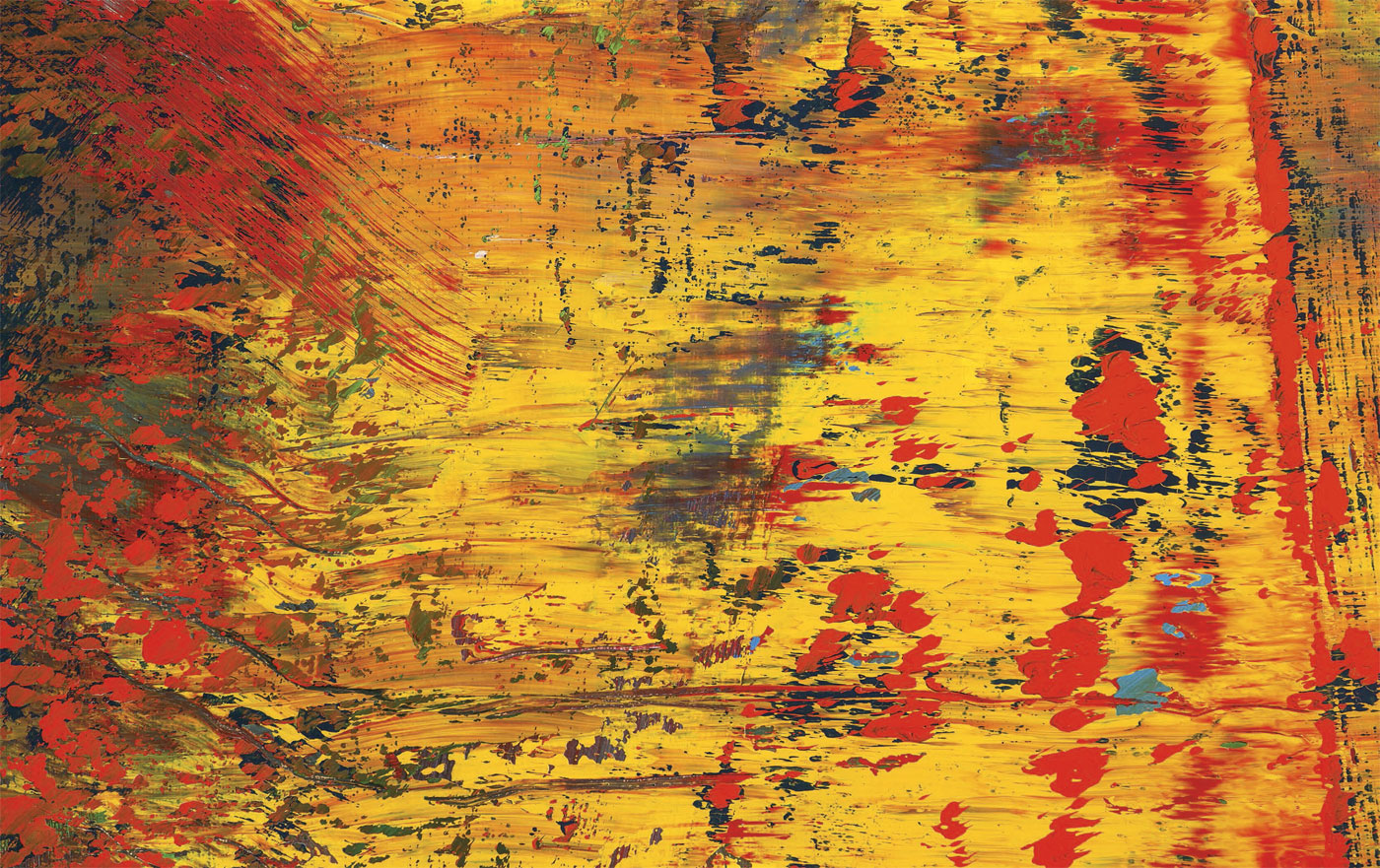
Gerhard Richter (German, b. 1932) 'Abstract Painting (613-3)' 1986 (detail)


Gerhard Richter (German, b. 1932)
Abstract Painting (613-3) (detail)
1986
Oil on canvas
260.7 x 203cm
Collection of Preston H. Haskell, Class of 1960
© 2014 The Franz Kline Estate / Artists Rights Society (ARS), New York / photo Douglas J. Eng


Extract from MARK, MAKER, METHOD by Kelly Baum

The paintings in Rothko to Richter narrate a history of postwar art whose greatest points of tension and most important moments of breakthrough revolve around facture, from the Latin facere, meaning “to make.”3 Together they demonstrate a fundamental fact: when painting’s prerogatives change, so too do its procedures. Focusing on select works from the Haskell Collection, this essay explores the nature of marks and mark-making in abstract painting after World War II. In the case of the artists seen here, mark-making was an activity of incredible consequence. The success or failure of any one painting might rest on something as elementary as the choice between oil paint and acrylic paint or a brush and a palette knife. It might depend on the difference between staining and smearing, between choppy strokes and fluid swipes, or between painting dry-on-dry and wet-on-wet.

With this in mind, my essay examines how and what marks signify within a single artist’s work as well as in postwar painting as a whole. How do shifts in the way marks are made signal broader shifts in artistic practice? What are the different, often competing logics of mark-making at any given moment? How do marks reflect or, alternately, disavow the impact of mass media, technology, and photomechanical reproduction in the mid- to late twentieth century? Such an investigation is premised on a particular understanding of the word “mark.” First and foremost, “mark” is a product as well as a process – more specifically, it is an end that cannot be separated from its means. Marks are also structural – as well as vocal – components of any given painting. Not only do they reveal a great deal about a painting’s meaning, they also shape that meaning, give it form and substance, for the viewer. For the purposes of this essay, then, I consider the mechanics of mark-making to be socially, physically, symbolically, and historically important.

Marks are the constituent feature, the backbone, of painting. A painting may be comprised of hundreds, if not thousands, of marks. In most cases, these marks are made in paint, on a support, by the hands of an artist. Even when those hands wield an implement – a brush or palette knife, for example – a physical connection still obtains between artist and mark.4 (What are implements like these, after all, but prostheses that extend the hand’s reach and capability?) Many of the artists in Rothko to Richter exploit this very character of the mark. In their paintings, a direct, transparent relationship exists between mark and method, a one-to-one correspondence between every stroke of paint and every movement of the artist’s hand. Here mark and method are tautological: the former records the latter. However, not every artist in Rothko to Richter subscribes to this approach. Several developed techniques designed to depersonalise the act of mark-making, to literally divorce the mark from the artist’s hand. Some even went so far as to erase the traces their tools left behind, effacing marks as soon as they were created. Instead of flaunting the process by which their paintings were produced, these artists dissimulated.

Dominating the Haskell Collection are Abstract Expressionist painters and their counterparts in Europe, including Appel, de Kooning, Goldberg, Kline, Riopelle, Rothko, and Tworkov.5 To varying degrees, these artists prized immediacy, virtuosity, and expression. Autographic gestures play a key role in their paintings.6 Such marks constitute a kind of painterly handwriting that indexes the artist’s distinct will, personality, and psychological state – his or her very self.

Etymologically, “gesture” derives from the Medieval Latin gestura, meaning “to carry.” In its original form, gesture denoted bearing – that is, the manner in which human beings deport themselves physically. It was also affiliated with rhetoric: in the past, gesture delineated a set of “bodily movements, attitudes, expression of countenance” intended to “giv[e] effect to oratory.”7 Gesture was a supplement to speech, a kind of accent or embellishment, in other words. All such connotations are relevant to the Expressionist canvases in the Haskell Collection: for artists like Goldberg and Kline, gestures were overtures, forms of communication that served to address viewers directly and invite them to participate in a subjective exchange. Gesturing involved gesticulating in the sense we understand that word today. In Appel’s Dans la Tempête (1960) or de Kooning’s Woman II (1961), for instance, the artist’s hand, wrist, and arm – sometimes his entire body – are marshalled so as to externalise otherwise private impulses, instincts, and passions. The affective power of such gestures was in direct proportion to their muscularity, fluidity, and dynamism, traits enthusiastically embraced by American and European Expressionists, who equated intensity of spirit with intensity of brushwork.

As art historian Meyer Schapiro astutely argued in 1957, the new emphasis on gesture among abstract painters of the postwar generation precipitated concomitant changes in technique. “The consciousness of the personal and spontaneous” in painting, Schapiro wrote, “stimulates the artist to invent devices of handling, processing, surfacing, which confer to the utmost degree the aspect of the freely made. Hence the great importance of the mark, the stroke, the brush, the drip, the quality of the substance of paint itself, and the surface of the canvas as a texture and field of operation.”8 This holds true of Appel’s Dans la Tempête (1960), de Kooning’s Untitled (Woman) (1965), Goldberg’s The Keep (1958), and Kline’s Untitled (1960), among other works, whose richly impastoed surfaces and bold, impetuous brushwork register not only heightened emotion but also the presence of the artist.

If Schapiro championed these paintings as enthusiastically as he did, it was because they represented, in his view, the “last hand-made personal objects within our culture.”9 Insofar as Rothko’s and de Kooning’s canvases preserved increasingly obsolete methods of fabrication, privileging manual over industrial forms of production, they “affirmed the individual in opposition to the contrary qualities of the ordinary experience of working and doing.”10 For Schapiro, the importance of painters like Goldberg and Tworkov lay precisely in their efforts to humanise art at a moment when the subject was under assault from the dehumanising forces of science, technology, and mass media. In his view, Abstract Expressionism represented the last bastion of freedom and individuality in an increasingly homogenous, mechanised world, a bulwark against the intrusion of standardisation into every walk of life.

However, by the late 1950s, when Schapiro made this claim, a sea change was already well under way in the world of art. Even then, a younger generation of artists, represented by Rauschenberg and Stella, was beginning to embrace at the level of technique the very shifts in society and subjectivity that Schapiro and the Abstract Expressionists decried. As the 1950s gave way to the 1960s, increasing numbers of artists would cease to identify either physically or emotionally with their canvases. Simultaneously, they began to align painting with fabrication, deriving insight from the fields of design and engineering. Gradually, the taste for “the machine-made, the impersonal, and reproducible,” likewise “an air of coolness and mechanical control,” would infiltrate art, heralding a break with Abstract Expressionism.11


3/ Sometimes reduced to “texture,” facture designates the way a work of art has been made and the manner in which its material components have been manipulated.
4/ As much as possible, I have tried to avoid falling into the all-too-common trap of fetishising the painted mark. Although much can be learned about a painting by deciphering the marks that comprise it, the mark is often conflated with something more problematic, the artist’s touch, a supposed symbol of singularity and authenticity that is inextricably related to the work’s exchange value and its status as a commodity on the market.
5/ For more information on Expressionism in Europe, see Serge Guilbaut, “Disdain for the Stain: Abstract Expressionism and Tachisme,” in Abstract Expressionism: The International Context, ed. Joan Marter (New Brunswick, NJ: Rutgers University Press, 2007).
6/ As Michael Leja argues, this was a historically, culturally, and ideologically specific self that invested great importance in “irrationality” and reflected new knowledge about the human mind, psyche, and condition. See his Reframing Abstract Expressionism: Subjectivity and Painting in the 1940s (New Haven, CT: Yale University Press, 1993), pp. 2-9, pp. 36-41. See also Ann Eden Gibson, Abstract Expressionism: Other Politics (New Haven, CT: Yale University Press, 1997).
7/ Oxford English Dictionary Online, s.v. “Gesture,” http://www.oed.com/search?searchType=dictionary&q=gesture&_searchBtn=Search.
8/ Meyer Schapiro, “Recent Abstract Painting (1957),” in Modern Art: 19th and 20th Centuries (New York: George Braziller, 1978), p. 218.
9/ Ibid., p. 217.
10/ Ibid., p. 218.
11/ Ibid., p. 219. As Schapiro notes, if science and engineering were “distasteful” to the Abstract Expressionists, it was due largely to the role they played in World War II and the Holocaust.


Franz Kline (American, 1910-1962) 'Untitled' 1960


Franz Kline (American, 1910-1962)
Untitled
1960
Brush and oil on canvas
47 x 45.1cm
Collection of Preston H. Haskell, Class of 1960
© 2014 The Franz Kline Estate / Artists Rights Society (ARS), New York / photo Douglas J. Eng


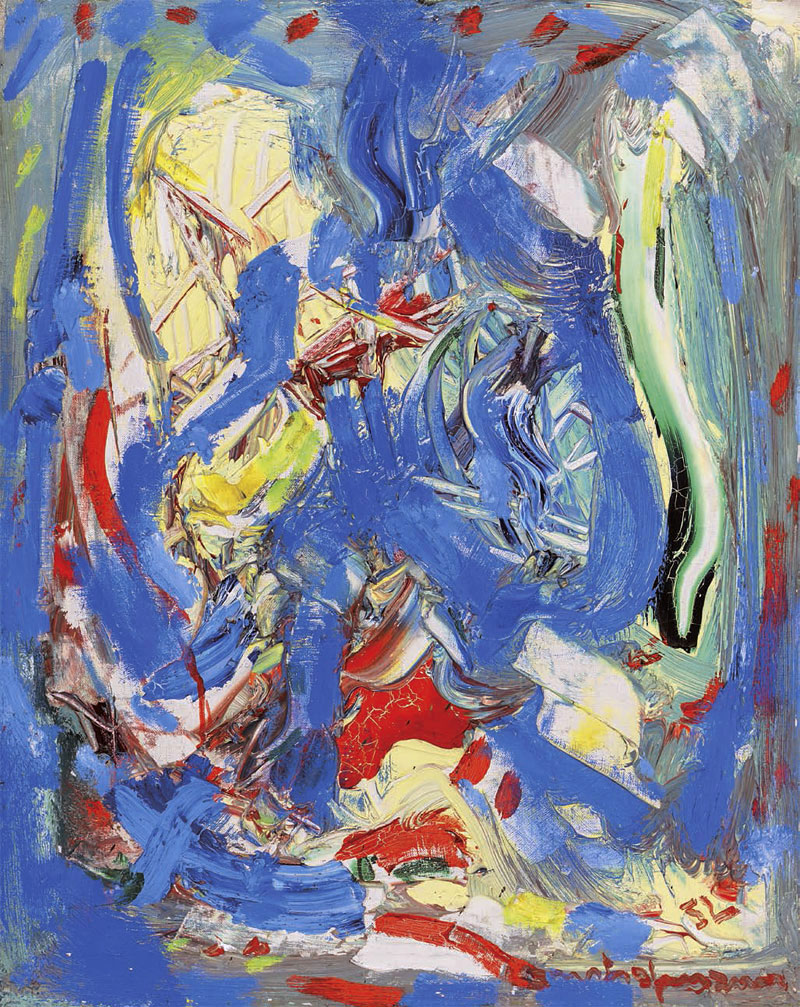
Hans Hofmann (American born Germany, 1880-1966) 'Composition #3' 1952


Hans Hofmann (American born Germany, 1880-1966)
Composition #3
1952
Oil on canvas
76.8 x 61.3cm
Collection of Preston H. Haskell, Class of 1960
© 2014 Estate of Hans Hofmann / Artists Rights Society (ARS), New York / photo Douglas J. Eng


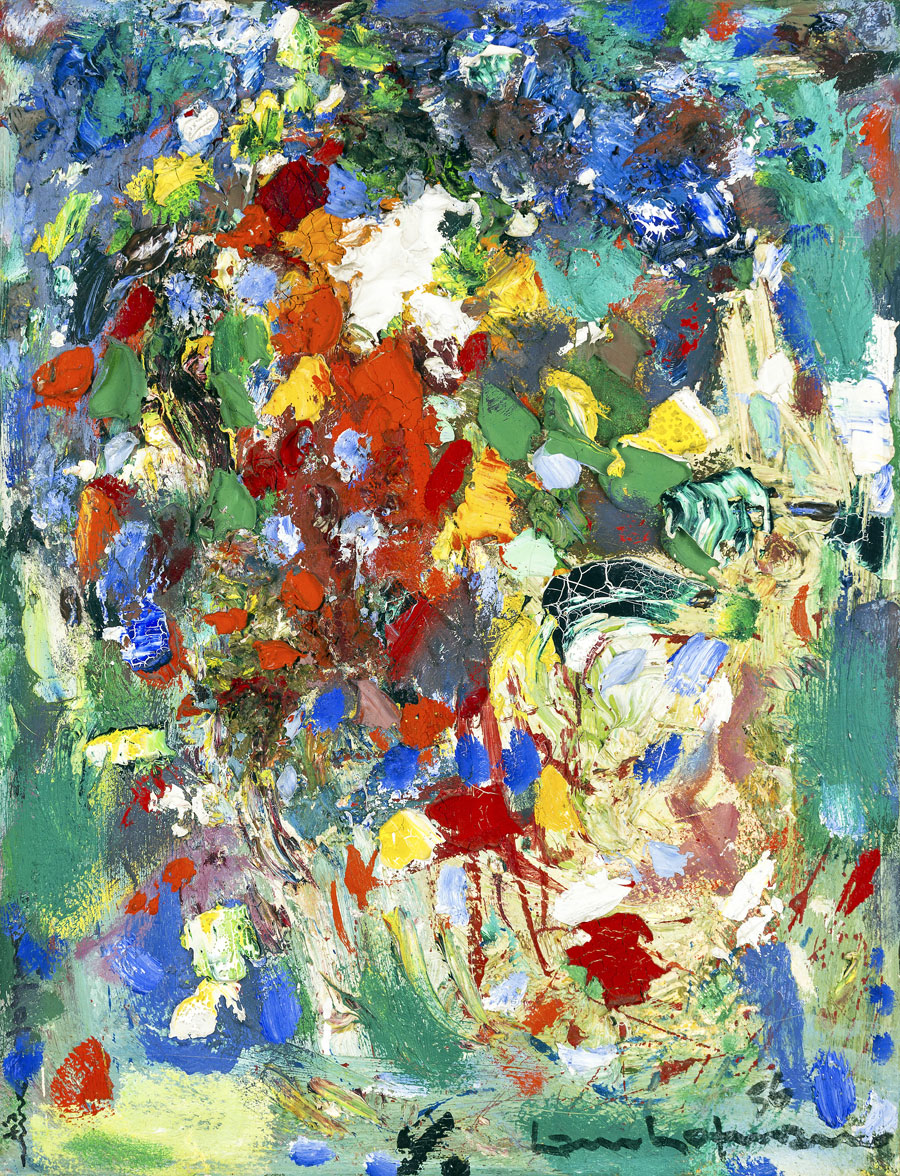
Hans Hofmann (American born Germany, 1880-1966) 'Midday' 1956


Hans Hofmann (American born Germany, 1880-1966)
Midday
1956
Oil on canvas
46.4 x 35.9cm
Collection of Preston H. Haskell, Class of 1960
© 2014 Estate of Hans Hofmann / Artists Rights Society (ARS), New York / photo Douglas J. Eng


Hans Hofmann is generally associated with the New York School, but he actually belongs to an earlier generation of artists based in Europe. Indeed, Hofmann witnessed firsthand the invention of abstraction while living in Paris from 1904 to 1914. Between 1933 and 1958, he would impart the lessons of Henri Matisse and Pablo Picasso as well as those of Wassily Kandinsky and Piet Mondrian to the students who attended his art schools in New York and Provincetown, Massachusetts.1 Later in life, after the works in the Haskell Collection were made, Hofmann helped broker the transition from Abstract Expressionism to Minimalism, a movement that shared his more recent predilection for restraint, objectivity, and pictorial problem-solving.2

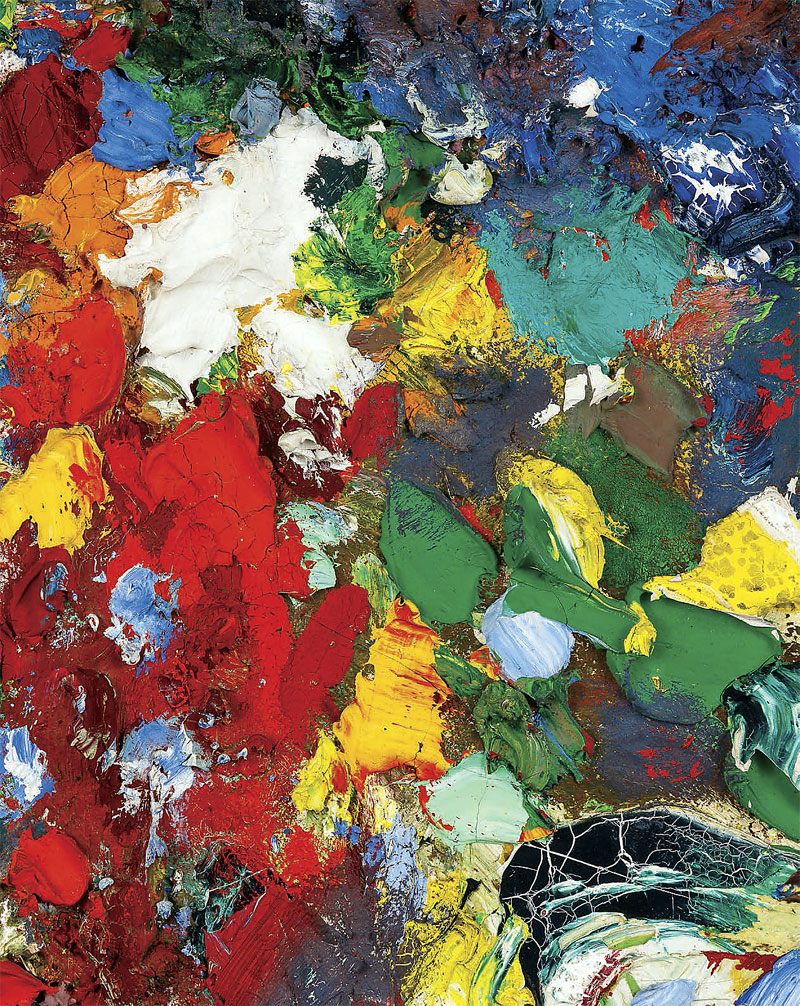
Hofmann was never wedded to any one approach to painting. Indeed, “diversity” was in many respects his signature style. Before the late 1940s, he produced paintings of abstracted interiors, still lifes, landscapes, and figure studies, all of which bear the imprint of Cubism and Fauvism. By 1950, however, his paintings were reliably abstract: no, or almost no, recognisable content remained. Characterised by radiant luminosity, brilliant colour contrasts, and tactile surfaces, Composition #3 and Midday were created just a few years before the artist closed his two schools, a moment that coincided with his critical recognition as a painter. Colour serves a structural role in both paintings, generating form and defining space. In Composition #3, paint is added and subtracted, sometimes ferociously, with implements ranging from fingertips and spatulas to thick brushes and sharp paintbrush handles, all of which register clearly on the canvas. Clement Greenberg could have been describing this work when he wrote, “Klee and Soutine were perhaps the first to address the picture surface consciously as a responsive rather than inert object, and painting itself as an affair of prodding and pushing, scoring and marking, rather than of simply inscribing or covering. Hofmann has taken this approach further, and made it do even more.”3 For its part, Midday exemplifies Hofmann’s distinctive brand of “grandiose Pointillism,” a manner adopted around 1954.4 Covered in a dense crust of paint, the work is made of staccato brush marks that extend from edge to edge, resulting in an atomised, decomposed surface whose impasto projects into space.5 Midday‘s resemblance to a mosaic is more than coincidental: in 1950 and 1956, Hofmann received commissions to create monumental mosaics for public spaces.

Kelly Baum


1/ On the ways in which Hofmann divests the tradition of abstraction embodied by Mondrian and Kandinsky of its social and utopian aspirations, see Sam Hunter, “Introduction,” in Hans Hofmann, ed. James Yohe (New York: Rizzoli, 2002), pp. 15-16.
2/ Like many of his contemporaries in Europe and the United States, Hofmann often linked the creation of art to spirituality, on the one hand, and to the artist’s personal temperament, on the other. However, these priorities were far less pronounced in his work than in that of artists such as Mondrian and Rothko. Hofmann’s concern was more for the mechanics – the grammar – of art. Ibid., p. 16, 20.
3/ “Hans Hofmann [1958],” in Art and Culture: Critical Essays (Boston: Beacon Press, 1961), p. 195.
4/ Hunter, “Introduction,” p. 29.
5/ On the art historical importance of Hoffmann’s “fat” surfaces, which contribute to the perception of his pictures as “objects,” see Clement Greenberg, Hofmann (Paris: G. Fall, 1961), p. 32, 34.


Hans Hofmann (American born Germany, 1880-1966) 'Midday' 1956 (detail)


Hans Hofmann (American born Germany, 1880-1966)
Midday (detail)
1956
Oil on canvas
46.4 x 35.9cm
Collection of Preston H. Haskell, Class of 1960
© 2014 Estate of Hans Hofmann / Artists Rights Society (ARS), New York / photo Douglas J. Eng


IN THE WAKE OF ABSTRACT EXPRESSIONISM by Hal Foster

This selection from the Haskell Collection focuses on Abstract Expressionism and its aftermath and, as such, provides an occasion to reflect on the fate of these two terms, abstraction and expression, in the advanced painting of this period. I want to do so briefly here, one term at a time.

In Western painting at least since Rembrandt, we look for expression, first and foremost, in brushwork, especially brushwork that exceeds the task of representation, brushwork that appears as gesture. Gesture in excess of representation tends to be read as the mark of the artist, not only of his distinctive touch but of that touch at a particular moment. We thus take gesture to be singular, original, authentic, in a word, individual – an indication, perhaps, of the very subjectivity of the artist at that instant in time. Now, what happens to this set of associations when we jump two hundred and fifty years, from Rembrandt to Van Gogh (to stay on a Dutch axis), and then move fifty years further, from Van Gogh to Willem de Kooning (who is represented in the Haskell Collection by two oil studies for his great Woman paintings)? In what ways do these associations, these conventions (for that is what they are), come under pressure?

Pitched in this way, the question is too general; so consider the works in the Haskell Collection produced by 1960 or so by Karel Appel, Michael Goldberg, Hans Hofmann, Franz Kline, Jean-Paul Riopelle, and Jack Tworkov. Can we agree that, in each case, the artist appears to believe in his gesture as defined above, that is, as a bearer of a uniquely subjective touch? All of these pieces, even when not large, conceive the picture as an “arena” for “action” (per the famous account of Abstract Expressionism given by the critic Harold Rosenberg in 1952).1 At the same time, this action is always qualified by calculation: note, for example, how Hofmann minds the edges of his canvases; and this gesture is sometimes wilful: note, for instance, how Goldberg seems a little forced in his painterly attack.

Once reiterated, a gesture, whether within one painting or from one painting to another, becomes a performance (not simply an action) as well as a sign (not simply an expression), and in this way it becomes divided from the very presence that it appeared to register in the first place. Jackson Pollock struggled with this conundrum – it was one factor that led to his partial return to figuration as early as 1951 – and we can sense this struggle in some of the works in the Haskell Collection, too (I see it in the Riopelle, among others). This problem of the reiteration of gesture is compounded by the greater difficulty of the repetition of style, that is, the repetition of the set of conventions that is Expressionism. For if de Kooning, Pollock, and friends worked in the wake of German Expressionism, so their followers laboured in the aftermath of Abstract Expressionism; thus they were belated Expressionists, in effect, twice over. As gesture came under existential pressure and Expressionism under art historical pressure, they could not help but see that the former might not be as singular, nor the latter as original, as they had once thought.2

Note what occurs after 1960, in part in response to this predicament, in the Color Field painting of Helen Frankenthaler, Paul Jenkins, and Morris Louis: gesture becomes muted, and the paint is loosened from the brush. Letting paint flow is what Frankenthaler learned from the drip paintings of Pollock, and what Louis and others learned from Frankenthaler (they exploited the new fluidity of acrylics here). And yet, however liberated, this paint speaks less of the expressive presence of the painter than of the material conditions of the painting – the fact that acrylic paint runs, mixes, responds to gravity, and stains the canvas (if it is not gessoed) in such a way that its weave becomes apparent and its flatness is foregrounded. “Flatness and the delimitation of flatness”: according to the critic Clement Greenberg, these are, respectively, the essential attribute of painting in general and the distinctive capability of abstract painting in particular.3 In this respect, see how Louis, in the 1962 painting in the Haskell Collection, lets his long bands of paint develop in a way that declares not only the vertical hang of the painting but also its flat surface; here the physical characteristics of paint, colour, and canvas are the sole subjects. Indeed, the painting seems to be produced as though by gravity alone, as though it were almost automatic; in comparison with Abstract Expressionism, the expressivity of the artist is here suppressed.

Such is the lesson that Frank Stella took from Louis in paintings like Double Scramble (1978) – a late example of work initiated in the mid-1960s. The critic Michael Fried termed such compositions “deductive structures” because they seemed to derive strictly from the rectangle of the support and the width of the stretcher, that is, they were deduced from the given structure of the painting alone.4 Here we are even further from the expressivity of Abstract Expressionism than we were with Louis: the composition seems to draw itself. Expressivity appears to return in the abstractions of Gerhard Richter, who is also represented in the Haskell Collection, yet the victory is a Pyrrhic one: like his  canvases, his gestures are so numerous and so reiterative that they seem to cancel one another out and so to nullify as much as to register any expressive self.

Like expression, abstraction also comes under pressure during the period surveyed by the Haskell Collection. Although presented in transcendental terms by pioneers of abstract painting such as Wassily Kandinsky in the 1910s, it was largely drained of this metaphysics by the 1960s, to the point where Stella could describe his work in the most positivist of terms: “What you see is what you see.”5 At the same time, abstraction was still endowed with great consequence for art history in general. In 1936, when the curator Alfred H. Barr Jr. presented his famous diagram of “Cubism and Abstract Art” for his show of that title at the new Museum of Modern Art in New York, abstraction served as the through-line of twentieth-century art, one that Greenberg made not only coherent but also ineluctable through his narrative of the progressive self-refinement of “modernist painting.” This story provided continuity as well as goal to twentieth-century art: “I cannot insist enough,” Greenberg wrote in “Modernist Painting” (1961), “that Modernism has never meant, and does not mean now, anything like a break with the past.”6

However, this story soon hit a large bump in the road. As abstract painting focused evermore on its own materiality, its status as an object became impossible to avoid; clearly the next step, it seemed to some avant-gardists, was to dispense with paintings altogether and to produce objects instead. Greenberg already glimpsed this heretical possibility with Stella, and this is why he never included Stella in his canon. Even if Fried still regarded Stella as the exemplar of “modernist painting,” for others, such as his close friend Carl Andre, Stella was on the other side, their side, the side of the Minimalist object as defined by the artist-critic Donald Judd. At this point, then, a “deductive structure” by Stella could be read – was read – as pure painting by some and as specific object by others.

This ambiguous status of abstract painting – as both transcendental force and mere thing, as both full and null – was already glimpsed in its first years. For example, for Kazimir Malevich, the monochrome, in its ideality, pointed to a world beyond this one; for his compatriot Aleksandr Rodchenko, however, the monochrome, in its materiality, underscored that this world was the only one we have. (At times these poles switched their charge: for some artists, transcendental abstraction suggested an emptying out of painting, a sort of Zen nullity of its own, while for others, mundane abstraction suggested a thingly presence, a fullness of its own, but the ambiguous status remained constant.) The paradox of abstraction as both full and null returns in the period surveyed by the Haskell Collection: the canvases by Robert Motherwell, Mark Rothko, and others clearly hold to the metaphysical power of abstract painting, whereas the paintings by Richter, Stella, and others manifestly do not.

Abstract painting was challenged by more than its own objecthood; it also faced an external threat, one that was even more grave. This problem runs back to its early days too, for abstraction emerged, circa 1912-1913, along with two other avant-garde inventions, the collage and the readymade, which brought the mass-media image and the mass-produced object into the frame of high art. For many artists and critics, abstract painting was all the more important for the stout resistance it offered to these troublesome incursions (this is certainly what Greenberg believed), yet it could not fend off such mediation forever, and in the 1950s and 1960s it mostly gave up.7 De Kooning, for example, used bits of collage in his Woman series, and Robert Rauschenberg, who is also represented in the Haskell Collection, added massive amounts of mediated images to his paintings.8 By the time of Richter, such mediation is fully folded into painting: almost from the start of his career, he has moved back and forth between abstract paintings and figurative ones based on photographs (both appropriated and his own); moreover, as suggested above, his abstract paintings appear mediated in their own ways. And this always-already mediated condition is the very point of departure of the spectacular paintings by Jack Goldstein in the Haskell Collection: however abstract they appear, they are worked up entirely from appropriated images. At this point the categories of abstraction and expression are transformed beyond recognition.9
 

1/ Harold Rosenberg, “The American Action Painters,” Art News 51 (December 1952).
2/ As represented in the Haskell Collection, some artists, such as Sam Francis and Joan Mitchell, carried on as if these problems didn’t matter much.
3/ Clement Greenberg, “After Abstract Expressionism,” Art International 25 (October 1962), p. 30.
4/ Michael Fried, Three American Painters: Kenneth Noland, Jules Olitski, Frank Stella (Cambridge, MA: Fogg Art Museum, 1965).
5/ Frank Stella, quoted in Bruce Glaser, “Questions to Stella and Judd,” Art News 65 (September 1966), p. 59.
6/ Clement Greenberg, “Modernist Painting,” Arts Yearbook 4 (1961), p. 108.
7/ It is not clear how opposed abstraction was to these other forms in the first place. For example, a monochrome or a grid painting is already a kind of readymade, and as soon as paint comes from an industrial tube, it is a sort of readymade too.
8/ De Kooning was rarely fully abstract; Greenberg comments on his “homeless representation” in “After Abstract Expressionism,” p. 25.
9/ These complications continue in the current work of Wade Guyton, Amy Sillman, Christopher Wool, and many others; indeed, they are largely what sustain advanced painting in the present.


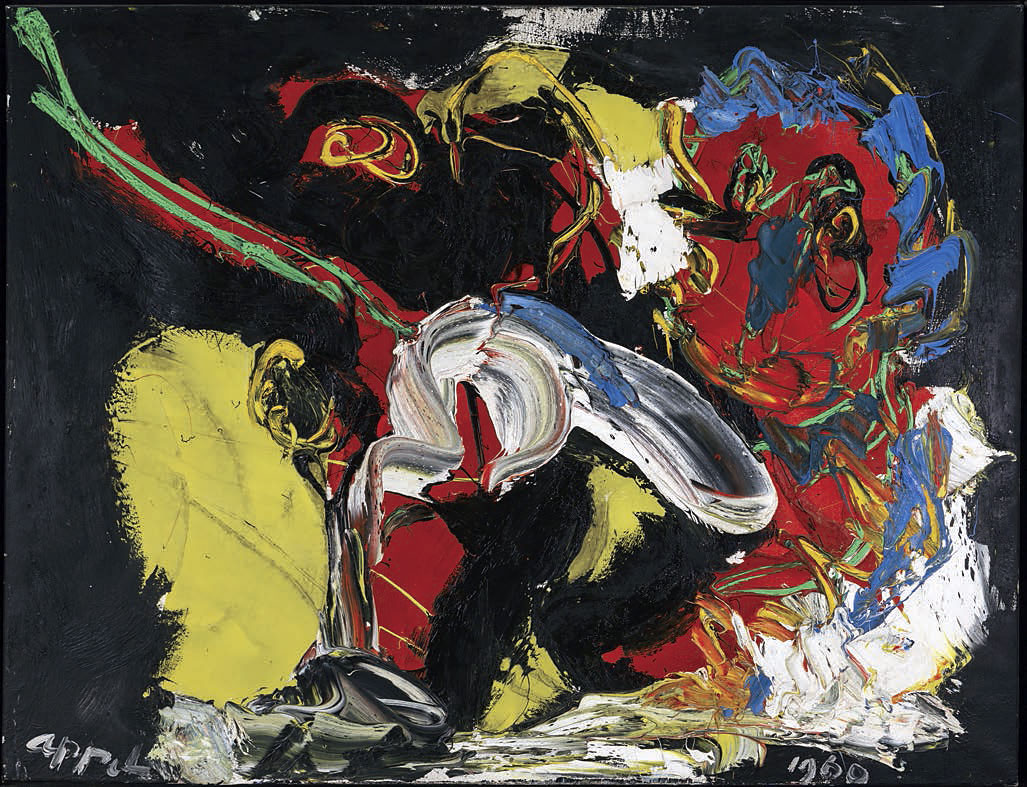
Karel Appel (Dutch, 1921-2006) 'Dans la Tempête' 1960


Karel Appel (Dutch, 1921-2006)
Dans la Tempête
1960
Oil on canvas
88.9 x 115.9cm
Collection of Preston H. Haskell, Class of 1960
© 2014 Estate of Hans Hofmann / Artists Rights Society (ARS), New York / photo Douglas J. Eng


Karel Appel (Dutch, 1921-2006) 'Dans la Tempête' 1960 (detail)


Karel Appel (Dutch, 1921-2006)
Dans la Tempête (detail)
1960
Oil on canvas
88.9 x 115.9 cm
Collection of Preston H. Haskell, Class of 1960
© 2014 Estate of Hans Hofmann / Artists Rights Society (ARS), New York / photo Douglas J. Eng


“We live always in a tremendous chaos,” Karel Appel stated to an interviewer in 1986, “and who can make the chaos positive anymore? Only the artist.”1 Registering, but also redeeming, social, political, and psychic conflict was an ethical imperative for Appel, who came of age as an artist in the 1940s. Appel witnessed firsthand the brutalisation of human beings by war, prejudice, deprivation, and occupation, and he sought to visualise these experiences through art. His canvases are ravaged, quite literally, by brushes, palette knives, and fingers. Choked by thick layers of impasto, their surfaces are as agitated as the animals and figures the paintings depict. Form, colour, content, and technique all serve as corollaries to the period of profound turmoil in which Appel worked. Importantly, the artist’s approach to historical trauma was dialectical. The devastation of pre- and postwar Europe, he believed, was a tabula rasa making possible the rebirth of both art and human beings.2

Appel was a founding member of Cobra (1948-1951), a group of Expressionist painters from Amsterdam, Brussels, and Copenhagen. Appel shared with other Cobra artists an appreciation for the art of the untutored, including children and the mentally ill, whose supposed alienation from Western, classical tradition granted them privileged access to the wellsprings of creativity: fantasy, passion, and instinct.3 Believing that society had been betrayed by logic and science, Appel turned to the irrational for inspiration. His predilection for the primal aligned him with Jean Dubuffet and Art Brut, an association formalised by his appearance in French critic Michel Tapié’s 1952 exhibition Un Art autre. Dans la Tempête was painted in 1960, three years after Appel relocated temporarily to New York, where he socialised with Abstract Expressionists such as Willem de Kooning and Franz Kline. Upon arriving in Manhattan, Appel was struck not only by the spontaneous, improvisatory spirit of jazz but also by the city’s “unfinished quality.”4 He subsequently sought to translate this contingency into paintings like Dans la Tempête. Trapped in a state of arrested development, this work also demonstrates Appel’s longstanding fascination with the “creaturely,” that is, with the reduction of humans to the condition of animals.5 Here as elsewhere, the artist elides the one and the other, manufacturing from their cross-pollination a grotesque bestiary of mutants whose anatomical deformations evoke distress. Much as Appel blends pigment by painting wet-on-wet, so too does he blur the boundaries between things and the grounds they inhabit: permeability trumps both spatial and physical integrity, as seen in Dans la Tempête, where a yellow zoomorphic shape at the left and a barely legible demi-human at the right thrash amongst swirls of paint.6

Kelly Baum


1/ Sam Hunter, “Karel Appel in the Spirit of Our Time,” Arts Magazine 62 (January 1988), p. 60.
2/ Hal Foster, “Creaturely, Cobra,” October 141 (Summer 2013), p. 7.
3/ See Karel Appel, Psychopathological Notebook: Drawings and Gouaches, 1948-1950 (Bern: Gachnang and Springer, 1999).
4/ Hunter, “Karel Appel,” p. 62.
5/ Foster, “Creaturely, Cobra,” pp. 6-8.
6/ Appel described his work from 1955 to 1960 as “nightscapes” that merge “paysage” and “visage.” Helena Kontova and Giancarlo Politi, “Karel Appel,” Flash Art, no. 134 (May 1987), p. 53.


Jack Tworkov (American, 1900-1982) 'Bond' 1960


Jack Tworkov (American, 1900-1982)
Bond
1960
Oil on canvas
154.9 x 91.4cm
Collection of Preston H. Haskell, Class of 1960
© 2014 Estate of Hans Hofmann / Artists Rights Society (ARS), New York / photo Douglas J. Eng


Jack Tworkov (American, 1900-1982) 'Bond' 1960 (detail)


Jack Tworkov (American, 1900-1982)
Bond (detail)
1960
Oil on canvas
154.9 x 91.4cm
Collection of Preston H. Haskell, Class of 1960
© 2014 Estate of Hans Hofmann / Artists Rights Society (ARS), New York / photo Douglas J. Eng


Jean Dubuffet (French, 1901-1985) 'Mire G119' 1983


Jean Dubuffet (French, 1901-1985)
Mire G119
1983
Acrylic on paper
135.7 x 99.5cm
Collection of Preston H. Haskell, Class of 1960
© 2014 Estate of Hans Hofmann / Artists Rights Society (ARS), New York / photo Douglas J. Eng


Modularity, seriality, and repetition – three of his main concerns here – ground us firmly in modernity, in the realm of synthetics and industrial production. Importantly, the title of the series, Mires, has both televisual and physiological connotations: it is French for “test pattern” (a signal used to calibrate television sets), but it also means “sight” as well as “aim,” as in “the sense of focusing sight on a point in an unlimited continuum.” Instead of the visionary, then, the Mires address vision itself. As the artist once wrote, the Mires “represent the spectacles that are offered to our eyes,” by which he meant the myriad optical enticements that bombard viewers in the form of signs, displays, and advertisements. Following from this, we might say that Dubuffet sought in works like Mire G119 to fashion an artistic equivalent for the “mobile,” “dynamic,” “impulsive,” and wholly mediated character of vision in the late twentieth century.

Kelly Baum


Richard Diebenkorn (American, 1922-1993) 'Untitled (Ocean Park)' 1983


Richard Diebenkorn (American, 1922-1993)
Untitled (Ocean Park)
1983
Acrylic, gouache, crayon, and pasted paper on paper
96.2 x 63.5cm
Collection of Preston H. Haskell, Class of 1960
© 2014 Estate of Hans Hofmann / Artists Rights Society (ARS), New York / photo Douglas J. Eng


Paul Jenkins (American, 1923-2012) 'Phenomena Spanish Cape' 1975


Paul Jenkins (American, 1923-2012)
Phenomena Spanish Cape
1975
Acrylic on canvas
86.7 x 86.7cm
Collection of Preston H. Haskell, Class of 1960
© 2014 Estate of Hans Hofmann / Artists Rights Society (ARS), New York / photo Douglas J. Eng


Although his paintings seem to share a great deal with those of Morris Louis and Helen Frankenthaler, Paul Jenkins never counted himself a member of the Color Field school – or indeed, of any school at all. Jenkins moved to New York in 1948, during the heyday of Abstract Expressionism, but relocated to Paris just five years later, joining an artistic community that included Joan Mitchell, Jean-Paul Riopelle, Michel Tapiés, and Wols. Throughout the 1950s and 1960s, Jenkins absorbed a dizzying array of writing on matters ranging from art and magic to psychoanalysis and Zen Buddhism.1 From this heady brew, he developed a distinctly mystical art that sought to make the invisible visible. The role of the artist, Jenkins believed, was to serve as a conduit, or “medium,” through which memories, emotions, and experiences passed directly onto canvas.2

In 1959-1960, Jenkins’s work took a dramatic turn: after visiting a small port on the northeast coast of Spain, near the Cap de Creus, he began to prioritise fluidity as both a style and a concept, a decision that led him to experiment with water-based acrylic. Method played a crucial role in creating the effect of flux that Jenkins sought. In Phenomena Spanish Cape paint is poured directly onto the canvas from a can or watering pot, allowing for continuous, uninterrupted shapes to emerge.3 The downward flow of paint was hastened by gravity but controlled by the artist, who tilted the support right and left, up and down, to encourage the medium in one direction or another. Jenkins used water to mute or lighten tones and ivory knives, which left no discernible trace on the canvas, to spread the paint as it pooled.4 The result is a paradox: a painting born of the artist but from which all evidence of his hand – his labor – has been effaced. Phenomena Spanish Cape suggests expansion, radiation, and suspension. Evoking eddies, clouds, and tides, the sheets of colour seem to swell and drift like the natural events whose appearances they distill.5 We might also recognise in the work’s composition – with its veils of colour that project out from a dominant red mass into areas of white-primed canvas – an aerial view of a peninsula, perhaps the Spanish cape referenced in the title. In all of Jenkins’s paintings after 1960, the title of the work is prefaced by the word “phenomena,” meaning an event of spiritual and subjective import, a snapshot of “ever-changing reality” objectified on canvas.6

Kelly Baum


1/ For more on Jenkins’s spiritual and intellectual background, see Albert Elsen, Paul Jenkins (New York: Harry N. Abrams, 1973), pp. 20-21, p. 35, 46, 67.
2/ Ibid., p. 19.
3/ Ibid., p. 56. Jenkins first experimented with pouring paint in 1953-54.
4/ For more on the artist’s technique and materials, which he honed, quite literally, to a science, see ibid., pp. 65-76.
5/ On the role of nature in his work, see Jean Cassou, Jenkins (New York: Harry N. Abrams, 1963), pp. 13-14.
6/ Ibid., p. 6.


Mark Rothko (American, 1903-1970) 'Untitled' 1968


Mark Rothko (American, 1903-1970)
Untitled
1968
Oil on paper laid down on canvas
Collection of Preston H. Haskell, Class of 1960
© 1998 Kate Rothko Prizel & Christopher Rothko / Artists Rights Society (ARS), New York / photo Douglas J. Eng


Mark Rothko (American, 1903-1970) 'Untitled' 1968 (detail)


Mark Rothko (American, 1903-1970)
Untitled (detail)
1968
Oil on paper laid down on canvas
Collection of Preston H. Haskell, Class of 1960
© 1998 Kate Rothko Prizel & Christopher Rothko / Artists Rights Society (ARS), New York / photo Douglas J. Eng


Princeton University Art Museum
McCormick Hall, Princeton, NJ ‎
Phone: (609) 258-3788

The Museum is located on the Princeton University campus, a short walk from Nassau Street in downtown Princeton. Once on campus, simply follow the lamppost Museum banners.

Opening hours:
Monday – Wednesday 10am – 5pm
Thursday – Friday 10am – 8pm
Saturday 10am – 5pm
Sunday 12 – 5pm

Princeton University Art Museum website

LIKE ART BLART ON FACEBOOK

Back to top

Exhibition: ‘Cindy Sherman – Untitled Horrors’ at Kunsthaus Zürich

Exhibition dates: 6th June – 4th September, 2014

Curator: Mirjam Varadinis


Installation view of 'Cindy Sherman – Untitled Horrors' at Kunsthaus Zürich


Installation view of Cindy Sherman – Untitled Horrors at Kunsthaus Zürich
Photo: Lena Huber


Horrors Untitled

I remember some time in the dim distant past when Cindy Sherman’s photographs actually had relevance and were important in and of themselves… but perhaps my memory is playing tricks with me. Memory is a strange thing for we remember only fragments of fragments, like an echo chamber, a distant echo of something (the construction of identity and gender) that was once cutting edge, now overtaken by reality itself – on the red carpet, in the cosmetic surgery offices, in the media mags. Once there may have been an original, an original Cindy Sherman, an original idea, but now there just seems to be pastiche after pastiche of a Sherman nobody is sure ever really existed.

There are certainly some horrors among this posting, images that I wish I had never seen, and never really wish to see again. As the amount of ‘Untitled’ works rises (untitled is such a cop out!) the numbers, and the body count, become irrelevant. The early work, through the 80s to the early 90s, had important things to say but now the artist formally known as Sherman is earth mother goddess to all, and ancestral trickster to many. Enough please!

Dr Marcus Bunyan


Many thankx to the Kunsthaus Zürich for allowing me to publish the photographs in the posting. Please click on the photographs for a larger version of the image.


Cindy Sherman (American, b. 1954) 'Untitled #93' 1981


Cindy Sherman (American, b. 1954)
Untitled #93
1981
Chromogenic colour print
61 × 121.9cm
Astrup Fearnley Collection, Oslo
Courtesy of the artist and Metro Pictures, New York
© Cindy Sherman


Cindy Sherman (American, b. 1954) Untitled #122 1983


Cindy Sherman (American, b. 1954)
Untitled #122
1983
Chromogenic colour print
89.5 × 54cm
Vanmoerkerke Collection, Belgium
Courtesy of the artist and Metro Pictures, New York
© Cindy Sherman


Cindy Sherman (American, b. 1954) 'Untitled #129' 1983


Cindy Sherman (American, b. 1954)
Untitled #129
1983
Chromogenic colour print
89.7 × 59.3cm
Louisiana Museum of Modern Art, Humlebæk, Denmark, Donation: The New Carlsberg Foundation
Courtesy of the artist and Metro Pictures, New York
© Cindy Sherman


Cindy Sherman (American, b. 1954) 'Untitled #146' 1985


Cindy Sherman (American, b. 1954)
Untitled #146
1985
Chromogenic colour print
184.2 × 125.4cm
Skarstedt Gallery, New York
Courtesy of the artist and Metro Pictures, New York
© Cindy Sherman


Cindy Sherman (American, b. 1954) 'Untitled #153' 1985


Cindy Sherman (American, b. 1954)
Untitled #153
1985
Chromogenic colour print
170.8 × 125.7cm
Courtesy of the artist and Metro Pictures, New York
© Cindy Sherman


Cindy Sherman (American, b. 1954) 'Untitled #170' 1987


Cindy Sherman (American, b. 1954)
Untitled #170
1987
Chromogenic colour print
179.1 x 120.7cm
Collection Metro Pictures, New York
Courtesy of the artist and Metro Pictures, New York
© Cindy Sherman


Cindy Sherman (American, b. 1954) 'Untitled #216' 1989


Cindy Sherman (American, b. 1954)
Untitled #216
1989
Chromogenic colour print
221.3 × 142.5cm
Astrup Fearnley Collection, Oslo
Courtesy of the artist and Metro Pictures, New York
© Cindy Sherman


From 6 June to 14 September 2014, the Kunsthaus Zürich plays host to a major retrospective featuring American artist Cindy Sherman (b. 1954). Sherman is one of the leading exponents of staged photography. In her work she deals with issues of identity, (gender) roles and physicality, almost always using herself as the model. Cindy Sherman’s earliest works were created in 1975. Preceding the celebrated Untitled Film Stills (1977-1980), these photographs were produced at home using an external shutter release, yet they were already concerned with the issues of identity and role play that are central to her oeuvre. The exhibition Cindy Sherman – Untitled Horrors includes a selection of these early and rarely shown works as well as her latest pieces, some of them monumental and covering entire walls. Sherman references the techniques and forms of advertising, cinema and classical painting.

THE THREATENING HEART OF UNTITLED HORRORS

The principal focus of the overview, which has been compiled by the Kunsthaus together with the artist, is the threatening and grotesque. The retrospective’s subtitle, Untitled Horrors, is partly a reference to the exhibition’s content, but also a play on the fact that Cindy Sherman invariably labels her photos Untitled. She leaves it to the viewer to read the pictures in their own way, inviting them to develop the stories behind them as they see fit, and come up with their own titles.

110 WORKS IN TOTAL

The presentation includes all the key works from the various phases of Cindy Sherman’s artistic career. Iconic pieces from the early period, such as the famous Untitled Film Stills series, reminiscent of Italian Neo-Realism and American film noir, appear alongside the later photographs of Hollywood / Hampton Types (2000-2002), while the Clowns (2003-2004) encounter the Sex Pictures series from 1992. These juxtapositions reveal the remarkable consistency with which, throughout her long career, the artist has engaged with fundamental issues of human existence and repeatedly explored new avenues of formal expression. Curated by Mirjam Varadinis and created in association with the Astrup Fearnley Museet, Oslo, and the Moderna Museet, Stockholm, the 110-work presentation dispenses with a linear or chronological approach, choosing instead to create unexpected combinations that shed new light on the oeuvre of this important artist and her exploration of the self through film and photography.

Text from the Kunsthaus Zürich website


Cindy Sherman (American, b. 1954) 'Untitled #235' 1987-1991


Cindy Sherman (American, b. 1954)
Untitled #235
1987-1991
Chromogenic colour print
228.6 × 152.4cm
Private collection, courtesy Segalot LP, New York
Courtesy of the artist and Metro Pictures, New York
© Cindy Sherman


Cindy Sherman (American, b. 1954) 'Untitled #304' 1994


Cindy Sherman (American, b. 1954)
Untitled #304
1994
Chromogenic colour print
154.9 × 104.1cm
Courtesy of the artist and Metro Pictures, New York
© Cindy Sherman


Cindy Sherman (American, b. 1954) 'Untitled #324' 1996


Cindy Sherman (American, b. 1954)
Untitled #324
1996
Chromogenic colour print
146.7 × 99.1cm
Collection Metro Pictures & Skarstedt Gallery
Courtesy of the artist and Metro Pictures, New York
© Cindy Sherman


Cindy Sherman (American, b. 1954) 'Untitled #348' 1999


Cindy Sherman (American, b. 1954)
Untitled #348
1999
Gelatin silver print
97.8 × 66cm
Courtesy of the artist and Metro Pictures, New York
© Cindy Sherman


Cindy Sherman (American, b. 1954) 'Untitled #352' 2000


Cindy Sherman (American, b. 1954)
Untitled #352
2000
Chromogenic colour print
68.6 × 45.7cm
Collection Magasin 3 Stockholm Konsthall
Courtesy of the artist and Metro Pictures, New York
© Cindy Sherman


Cindy Sherman (American, b. 1954) 'Untitled #363 (Bus Riders I)' 1976/2000


Cindy Sherman (American, b. 1954)
Untitled #363 (Bus Riders I)
1976/2000
Gelatin silver print
18.9 x 12.7cm
Tate
Purchased with funds provided by the American Fund for the Tate Gallery, 2001
Courtesy of the artist and Metro Pictures, New York
© Cindy Sherman


Cindy Sherman (American, b. 1954) 'Untitled #420' 2004


Cindy Sherman (American, b. 1954)
Untitled #420
2004
Chromogenic colour print (2-teilig)
Each: 182.4 × 115.8cm
Astrup Fearnley Collection, Oslo
Courtesy of the artist and Metro Pictures, New York
© Cindy Sherman


Cindy Sherman (American, b. 1954) 'Untitled #458' 2007-2008


Cindy Sherman (American, b. 1954)
Untitled #458
2007-2008
Chromogenic colour print
195 × 147cm
Astrup Fearnley Collection, Oslo
Courtesy of the artist and Metro Pictures, New York
© Cindy Sherman


Cindy Sherman (American, b. 1954) 'Untitled #544' 2010/2012


Cindy Sherman (American, b. 1954)
Untitled #544
2010 / 2012
Chromogenic colour print
172.7 × 254cm
Astrup Fearnley Collection, Oslo
Courtesy of the artist and Metro Pictures, New York
© Cindy Sherman


Cindy Sherman (American, b. 1954) 'Untitled #549-C' 2010


Cindy Sherman (American, b. 1954)
Untitled #549-C
2010
Pigment / print on PhotoTex, adhesive fabric,
Dimensions variable
Courtesy of the artist and Metro Pictures, New York
© Cindy Sherman


Kunsthaus Zürich
Heimplatz 1
CH-8001 Zurich

Opening hours:
Tuesday, Friday – Sunday 10am – 6pm
Wednesday – Thursday 10am – 8pm
Closed Mondays

Kunsthaus Zürich website

LIKE ART BLART ON FACEBOOK

Back to top

Exhibition: ‘Robert Heinecken: Object Matter’ at The Museum of Modern Art (MoMA), New York

Exhibition dates: 15th March – 7th September, 2014

Curators: Eva Respini, Curator, with Drew Sawyer, Beaumont and Nancy Newhall Curatorial Fellow, Department of Photography, The Museum of Modern Art

*PLEASE NOTE THIS POSTING CONTAINS ART PHOTOGRAPHS OF FEMALE NUDITY – IF YOU DO NOT LIKE PLEASE DO NOT LOOK, FAIR WARNING HAS BEEN GIVEN*


Robert Heinecken (American, 1931-2006) 'Figure Horizon #1' 1971


Robert Heinecken (American, 1931-2006)
Figure Horizon #1
1971
Ten canvas panels with photographic emulsion
Each 11 13/16 x 11 13/16″ (30 x 30cm)
The Museum of Modern Art, New York
Gift of Shirley C. Burden, by exchange


A bumper posting on probably the most important photo-media artist who has ever lived. This is how to successfully make conceptual photo-art.

A revolutionary artist, this para-photographer’s photo puzzles are just amazing!

Dr Marcus Bunyan


Many thank to MoMA for allowing me to publish the photographs in the posting. Please click on the photographs for a larger version of the image.


Robert Heinecken (American, 1931-2006) 'Le Voyeur / Robbe-Grillet #2' 1972


Robert Heinecken (American, 1931-2006)
Le Voyeur / Robbe-Grillet #2
1972
Three canvas panels with bleached photographic emulsion and pastel chalk
14 x 40″ (35.6 x 101.6cm)
George Eastman House, Rochester, New York
Museum purchase with National Endowment for the Arts support


Robert Heinecken (American, 1931-2006) 'Child Guidance Toys' 1965


Robert Heinecken (American, 1931-2006)
Child Guidance Toys
1965
Black-and-white film transparency
5 x 18 1/16″ (12.7 x 45.8cm)
The Art Institute of Chicago
Gift of Boardroom, Inc.


Robert Heinecken (American, 1931-2006) 'Lessons in Posing Subjects / Matching Facial Expressions' 1981


Robert Heinecken (American, 1931-2006)
Lessons in Posing Subjects / Matching Facial Expressions
1981
Fifteen internal dye diffusion transfer prints (SX-70 Polaroid) and lithographic text on Rives BFK paper
15 x 20″ (38.1 x 50.8cm)
Collection UCLA Grunwald Center for Graphic Art, Hammer Museum, Los Angeles
Gift of Dean Valentine and Amy Adelson


Robert Heinecken (American, 1931-2006) 'Kodak Safety Film / Taos Church' 1972


Robert Heinecken (American, 1931-2006)
Kodak Safety Film / Taos Church
1972
Black-and-white film transparency
40 x 56″ (101.6 x 142.2cm)
The Museum of Modern Art, New York
Committee on Photography Fund


Robert Heinecken (American, 1931-2006) 'As Long As Your Up' 1965


Robert Heinecken (American, 1931-2006)
As Long As Your Up
1965
Black-and-white film transparency
15 1/2 x 19 5/8″ (39.4 x 49.8cm)
The Robert Heinecken Trust, Chicago
Courtesy Petzel Gallery, New York


Robert Heinecken (American, 1931-2006) 'Periodical #5' 1971


Robert Heinecken (American, 1931-2006)
Periodical #5
1971
Offset lithography on found magazine
12 1/4 x 9″ (31.1 x 22.9cm)
Collection Philip Aarons and Shelley Fox Aarons, New York


Robert Heinecken (American, 1931-2006) 'Six Figures/Mixed' 1968


Robert Heinecken (American, 1931-2006)
Six Figures/Mixed
1968
Layered Plexiglas and black-and-white film transparencies
5.75 x 9.75 x 1.5″ (14.61 x 24.77 x 3.81cm)
Collection Darryl Curran, Los Angeles


Robert Heinecken (American, 1931-2006) 'Figure / Foliage #2' 1969


Robert Heinecken (American, 1931-2006)
Figure / Foliage #2
1969
Layered Plexiglas and black-and-white film transparencies
5 x 5 x 1 1/4″ (12.7 x 12.7 x 3.2cm)
Collection Anton D. Segerstrom, Corona del Mar, California


Robert Heinecken (American, 1931-2006) 'Kaleidoscopic Hexagon #2' 1965 from the exhibition Exhibition: 'Robert Heinecken: Object Matter' at The Museum of Modern Art (MoMA), New York, March - September, 2014


Robert Heinecken (American, 1931-2006)
Kaleidoscopic Hexagon #2
1965
Six gelatin silver prints on wood
Diameter: 14″ (35.6cm)
Black Dog Collection
Promised gift to San Francisco Museum of Modern Art


Robert Heinecken (American, 1931-2006) '24 Figure Blocks' 1966 from the exhibition Exhibition: 'Robert Heinecken: Object Matter' at The Museum of Modern Art (MoMA), New York, March - September, 2014


Robert Heinecken (American, 1931-2006)
24 Figure Blocks
1966
Twelve gelatin silver prints on wood blocks, and twelve additional wood blocks
14 1/16 x 14 1/16 x 13/16″ (35.7 x 35.7 x 2.1cm)
Whitney Museum of American Art, New York
Gift of Jeanne and Richard S. Press


Robert Heinecken (American, 1931-2006) 'Multiple Solution Puzzle' 1965


Robert Heinecken (American, 1931-2006)
Multiple Solution Puzzle
1965
Sixteen gelatin silver prints on wood
11 1/4 x 11 1/4 x 1″ (28.6 x 28.6 x 2.5cm)
Collection Maja Hoffmann/LUMA Foundation


The Museum of Modern Art presents Robert Heinecken: Object Matter, the first retrospective of the work of Robert Heinecken since his death in 2006 and the first exhibition on the East Coast to cover four decades of the artist’s unique practice, from the early 1960s through the late 1990s, on view from March 15 to September 7, 2014. Describing himself as a “para-photographer,” because his work stood “beside” or “beyond” traditional ideas associated with photography, Heinecken worked across multiple mediums, including photography, sculpture, printmaking, and collage. Culling images from newspapers, magazines, pornography, and television, he recontextualized them through collage and assemblage, photograms, darkroom experimentation, and rephotography. His works explore themes of commercialism, Americana, kitsch, sex, the body, and gender. In doing so, the works in this exhibition expose his obsession with popular culture and its effects on society, and with the relationship between the original and the copy. Robert Heinecken: Object Matter is organised by Eva Respini, Curator, with Drew Sawyer, Beaumont and Nancy Newhall Curatorial Fellow, Department of Photography, The Museum of Modern Art. The exhibition will travel to the Hammer Museum, and will be on view there from October 5, 2014 through January 17, 2015.

Heinecken dedicated his life to making art and teaching, establishing the photography program at UCLA in 1964, where he taught until 1991. He began making photographs in the early 1960s. The antithesis of the fine-print tradition exemplified by West Coast photographers Ansel Adams and Edward Weston, who photographed landscapes and objects in sharp focus and with objective clarity, Heinecken’s early work is marked by high contrast, blur, and under- or overexposure, as seen in Shadow Figure (1962) and Strip of Light (1964). In the mid-1960s he began combining and sequencing disparate pictures, as in Visual Poem/About the Sexual Education of a Young Girl (1965), which comprises seven black-and-white photographs of dolls with a portrait of his then-five-year-old daughter Karol at the centre.

The female nude is a recurring motif, featured in Refractive Hexagon (1965), one of several “photopuzzles” composed of photographs of female body parts mounted onto 24 individual “puzzle” pieces. Other three-dimensional sculptures – geometric volumes ranging in height from five to 22 inches – consist of photographs mounted onto individual blocks, which rotate independently around a central axis. In Fractured Figure Sections (1967), as in Refractive Hexagon, the female figure is never resolved as a single image – the body is always truncated, never contiguous. In contrast, a complete female figure can be reconstituted in his largest photo-object, Transitional Figure Sculpture (1965), a towering 26-layer octagon composed from photographs of a nude that have been altered using various printing techniques. At the time, viewer engagement was key to creating random configurations and relationships in the work; any number of possibilities may exist, only to be altered with the next manipulation. Today, due to the fragility of the works, these objects are displayed in Plexiglas-covered vitrines. However, the number of sculptures and puzzles gathered here offer the viewer a sense of this diversity.

Heinecken’s groundbreaking suite Are You Rea (1964-1968) is a series of 25 photograms made directly from magazine pages. Representative of a culture that was increasingly commercialised, technologically mediated, and suspicious of established truths, Are You Rea cemented Heinecken’s interest in the multiplicity of meanings inherent in existing images and situations. Culled from more than 2000 magazine pages, the work includes pictures from publications such as Life, Time, and Woman’s Day, contact-printed so that both sides are superimposed in a single image. Heinecken’s choice of pages and imagery are calculated to reveal specific relationships and meanings – ads for Coppertone juxtaposed with ads for spaghetti dinners and an article about John F. Kennedy superimposed on an ad for Wessex carpets – the portfolio’s narrative moves from relatively commonplace and alluring images of women to representations of violence and the male body.

Heinecken began altering magazines in 1969 with a series of 120 periodicals titled MANSMAG: Homage to Werkman and Cavalcade. He used the erotic men’s magazine Cavalcade as source material, making plates of every page, and randomly printing them on pages that were then reassembled into a magazine, now scrambled. In the same year, he disassembled numerous Time magazines, imprinting pornographic images taken from Cavalcade on every page, and reassembled them with the original Time covers. He circulated these reconstituted magazines by leaving them in waiting rooms or slipping them onto newsstands, allowing the work to come full circle – the source material returning to its point of origin after modification. He reprised this technique in 1989 with an altered issue of Time titled 150 Years of Photojournalism, a greatest hits of historical events seen through the lens of photography.


Installation view of 'Robert Heinecken: Object Matter' at The Museum of Modern Art (MoMA)

Installation view of 'Robert Heinecken: Object Matter' at The Museum of Modern Art (MoMA)

Installation view of 'Robert Heinecken: Object Matter' at The Museum of Modern Art (MoMA)

Installation view of 'Robert Heinecken: Object Matter' at The Museum of Modern Art (MoMA)


Installation views of Robert Heinecken: Object Matter at The Museum of Modern Art (MoMA)
Photos by Jonathan Muzikar
© The Museum of Modern Art


Robert Heinecken (American, 1931-2006) 'Breast / Bomb #5' 1967


Robert Heinecken (American, 1931-2006)
Breast / Bomb #5
1967
Gelatin silver prints, cut and reassembled
38 1/2 x 38 1/4″ (97.8 x 97.2cm)
Denver Art Museum
Funds From 1992 Alliance For Contemporary Art Auction


Robert Heinecken (American, 1931-2006) 'Then People Forget You' 1965


Robert Heinecken (American, 1931-2006)
Then People Forget You
1965
Gelatin silver print
10 3/8 x 12 15/16″ (26.3 x 32.8cm)
The Art Institute of Chicago
Gift of Boardroom, Inc.


Robert Heinecken (American, 1931-2006) 'Cliche Vary / Autoeroticism' 1974


Robert Heinecken (American, 1931-2006)
Cliche Vary / Autoeroticism
1974
Eleven canvas panels with photographic emulsion and pastel chalk
39 1/2 x 39 1/2 in. (100.3 x 100.3cm)
Collection Susan and Peter MacGill, New York


Robert Heinecken (American, 1931-2006) 'Surrealism on TV' 1986


Robert Heinecken (American, 1931-2006)
Surrealism on TV
1986
216 35 mm colour slides, slide-show time variable
The Robert Heinecken Trust, Chicago
Courtesy Cherry and Martin Gallery, Los Angeles
© 2013 The Robert Heinecken Trust.


Robert Heinecken (American, 1931-2006) 'Shiva Manifesting as a Single Mother' 1989


Robert Heinecken (American, 1931-2006)
Shiva Manifesting as a Single Mother
1989
Magazine paper, paint and varnish
Collection Philip F. Denny, Chicago
© 2014 The Robert Heinecken Trust


Transparent film is also used in many of Heinecken’s works to explore different kinds of juxtapositions. In Kodak Safety Film / Christmas Mistake (1971), pornographic images are superimposed on a Christmas snapshot of Heinecken’s children with the suggestion in the title that somehow two rolls of film were mixed up at the photo lab. Kodak Safety Film / Taos Church (1972) takes photography itself as a subject, picturing an adobe church in New Mexico that was famously photographed by Ansel Adams and Paul Strand, and painted by Georgia O’Keeffe and John Marin. Presented as a negative, Heinecken’s version transforms an icon of modernism into a murky structure flanked by a pickup truck, telephone wires, and other modern-day debris.

Heinecken’s hybrid photographic paintings, created by applying photographic emulsion on canvas, are well represented in the exhibition. In Figure Horizon #1 (1971), Heinecken reprised the cut-and-reassemble techniques from his puzzles and photo-sculptures, sequencing images of sections of the nude female body, to create impossible undulating landscapes. Cliché Vary, a pun on the 19th-century cliché verre process, is comprised of three large-scale modular works, all from 1974: Autoeroticism, Fetishism, and Lesbianism. The works are comprised of separately stretched canvas panels with considerable hand-applied colour on the photographic image, invoking clichés associated with autoeroticism, fetishism, and lesbianism. Reminiscent of his cut-and-reassembled pieces, each panel features disjointed views of bodies and fetish objects that never make a whole, and increase in complexity, culminating with Lesbianism, which is made with seven or eight different negatives.

In the mid-1970s, Heinecken experimented with new materials introduced by Polaroid – specifically the SX-70 camera (which required no darkroom or technical know-how) – to produce the series He/She (1975-1980) and, later, Lessons in Posing Subjects (1981-82). Heinecken experimented with different types of instant prints, including the impressive two-panel S.S. Copyright Project: “On Photography” (1978), made the year after the publication of Susan Sontag’s collection of essays On Photography (1977). The S.S. Copyright Project consists of a magnified and doubled picture of Sontag, derived from the book’s dustcover portrait (taken by Jill Krementz). The work equates legibility with physical proximity – from afar, the portraits appear to be grainy enlargements from a negative (or, to contemporary eyes, pixilated low-resolution images), but at close range, it is apparent that the panels are composed of hundreds of small photographic scraps stapled together. The portrait on the left is composed of photographs of Sontag’s text; the right features random images taken around Heinecken’s studio by his assistant.

Heinecken’s first large-scale sculptural installation, TV/Time Environment (1970), is the earliest in a series of works that address the increasingly dominant presence of television in American culture. In the installation, a positive film transparency of a female nude is placed in front of a functioning television set in an environment that evokes a living room, complete with recliner chair, plastic plant, and rug. Continuing his work with television, Heinecken created videograms – direct captures from the television that were produced by pressing Cibachrome paper onto the screen to expose the sensitized paper. Inaugural Excerpt Videograms (1981) features a composite from the live television broadcast of Ronald Reagan’s inauguration speech and the surrounding celebrations. The work, originally in 27 parts, now in 24, includes randomly chosen excerpts of the oration and news reports of it. Surrealism on TV (1986) explores the idea of transparency and layering using found media images to produce new readings. It features a slide show comprised of more than 200 images loaded into three slide projectors and projected in random order. The images generally fit into broad categories, which include newscasters, animals, TV evangelists, aerobics, and explosions.

Text from the MoMA press release


Robert Heinecken (American, 1931-2006) 'Figure Cube' 1965


Robert Heinecken (American, 1931-2006)
Figure Cube
1965
Gelatin silver prints on Masonite
5 7/8 x 5 7/8″ (15 x 15cm)
The Robert Heinecken Trust
Courtesy Center for Creative Photography, University of Arizona, Tucson


Robert Heinecken (American, 1931-2006) 'Figure in Six Sections' 1965


Robert Heinecken (American, 1931-2006)
Figure in Six Sections
1965
Gelatin silver prints on wood blocks
8 1/2 x 3 x 3″ (21.6 x 7.6 x 7.6cm)
Collection Kathe Heinecken
Courtesy The Robert Heinecken Trust, Chicago


Robert Heinecken (American, 1931-2006) 'Fractured Figure Sections' 1967


Robert Heinecken (American, 1931-2006)
Fractured Figure Sections
1967
Gelatin silver prints on wood blocks
8 1/4 x 3 x 3″ (21 x 7.6 x 7.6cm)
The Museum of Modern Art, New York
The Photography Council Fund and Committee on Photography Fund


Robert Heinecken (American, 1931-2006) 'The S.S. Copyright Project: "On Photography"' (Part 1 of 2) 1978


Robert Heinecken (American, 1931-2006)
The S.S. Copyright Project: “On Photography” (Part 1 of 2)
1978
Collage of black and white instant prints attached to composite board with staples
47 13/16 x 47 13/16″ (121.5 x 121.5cm)
The Museum of Modern Art, New York
Purchased as the partial gift of Celeste Bartos


Robert Heinecken (American, 1931-2006) 'Recto/Verso #2' 1988


Robert Heinecken (American, 1931-2006)
Recto/Verso #2
1988
Silver dye bleach print
8 5/8 x 7 7/8″ (21.9 x 20cm)
The Museum of Modern Art, New York
Mr. and Mrs. Clark Winter Fund


Robert Heinecken (American, 1931-2006) 'Figure Parts / Hair' 1967


Robert Heinecken (American, 1931-2006)
Figure Parts / Hair
1967
Black-and-whtie film transparencies over magazine-page collage
16 x 12″ (40.6 x 30.5cm)
Collection Karol Heinecken Mora, Los Angeles


Robert Heinecken (American, 1931-2006) 'V.N. Pin Up' 1968


Robert Heinecken (American, 1931-2006)
V.N. Pin Up
1968
Black-and-white film transparency over magazine-page collage
12 1/2 x 10″ (31.8 x 25.4cm)
Museum of Contemporary Art, Chicago
Gift of Daryl Gerber Stokols


Robert Heinecken (American, 1931-2006) 'Typographic Nude' 1965


Robert Heinecken (American, 1931-2006)
Typographic Nude
1965
Gelatin silver print
14 1/2 x 7″ (36.8 x 17.8cm)
Collection Geofrey and and Laura Wyatt, Santa Barbara, California


Robert Heinecken (American, 1931-2006) 'Are You Rea #1' 1968


Robert Heinecken (American, 1931-2006)
Are You Rea #1
1968
Twenty-five gelatin silver prints
Various dimensions
Collection Jeffrey Leifer, San Francisco


Robert Heinecken (American, 1931-2006) 'Are You Rea #25' 1968


Robert Heinecken (American, 1931-2006)
Are You Rea #25
1968
Twenty-five gelatin silver prints
Various dimensions
Collection Jeffrey Leifer, San Francisco


Robert Heinecken (American, 1931–2006) 'Cybill Shepherd / Phone Sex' 1992


Robert Heinecken (American, 1931–2006)
Cybill Shepherd / Phone Sex
1992
Silver dye bleach print on foamcore
63 x 17″ (160 x 43.2cm)
The Robert Heinecken Trust
Courtesy of Petzel Gallery, New York


Robert Heinecken (American, 1931-2006) 'MANSMAG: Homage to Werkman and Cavalcade' 1969


Robert Heinecken (American, 1931-2006)
MANSMAG: Homage to Werkman and Cavalcade
1969
Offset lithography on bound paper
8 3/4 x 6 5/8″ (22.2 x 16.8cm)
The Robert Heinecken Trust, Chicago


The Museum of Modern Art
11 West 53 Street
New York, NY 10019
Phone: (212) 708-9400

Opening hours:
Sunday – Friday, 10.30am – 5.30pm
Saturday, 10.30am – 7.00pm

MOMA website

LIKE ART BLART ON FACEBOOK

Back to top

Exhibition: ‘In the Looking Glass: Recent Daguerreotype Acquistions’ at the Nelson-Atkins Museum of Art, Kansas City

Exhibition dates: 25th January – 20th July, 2014

Curator: Jane Aspinwall, Associate Curator of Photography


Attributed to: Tsukamoto, Japanese. 'Portrait of a man in samurai armor' mid 1870s


Attributed to:
Tsukamoto (Japanese)
Portrait of a man in samurai armour
mid 1870s
Ambrotype
5 x 3 1/2 inches
Gift of the Hall Family Foundation
© Nelson Gallery Foundation


OMG some of these images are SO beautiful and others SO bizarre. Please enlarge the detailed shots of Lady in Costume (c. 1850, below) and Traveling Minstrels – banjo and bones (c. 1850, below) – my two favourites – so you can see the costumes and the people. The clothes of the bones player are incredible… I wonder what they did with their lives, where they went and how they lived. How old do you think they are? And what is that on the front of his hat, a watch?

Dr Marcus Bunyan


Many thankx to The Nelson-Atkins Museum of Art for allowing me to publish the photographs in the posting. Please click on the photographs for a larger version of the image.


Unknown maker (American) 'Woman telegrapher' c. 1850 from the exhibition 'In the Looking Glass: Recent Daguerreotype Acquistions' at the Nelson-Atkins Museum of Art, Kansas City, January - July, 2014


Unknown maker (American)
Woman telegrapher
c. 1850
Daguerreotype, quarter plate
Image size: 4 1/4 x 3 1/4 inches
Gift of the Hall Family Foundation
© Nelson Gallery Foundation


Augustus Washington (American, 1820-1875) 'John Brown' c. 1846-1847 from the exhibition 'In the Looking Glass: Recent Daguerreotype Acquistions' at the Nelson-Atkins Museum of Art, Kansas City, January - July, 2014


Augustus Washington (American, 1820-1875)
John Brown
c. 1846-1847
Quarter plate daguerreotype
4 x 3 3/16 inches
Gift of the Hall Family Foundation
© Nelson Gallery Foundation


John Brown (American, 1800-1859)

John Brown (May 9, 1800 – December 2, 1859) was a white American abolitionist who believed armed insurrection was the only way to overthrow the institution of slavery in the United States. During the 1856 conflict in Kansas, Brown commanded forces at the Battle of Black Jack and the Battle of Osawatomie. Brown’s followers also killed five slavery supporters at Pottawatomie. In 1859, Brown led an unsuccessful raid on the federal armoury at Harpers Ferry that ended with his capture. Brown’s trial resulted in his conviction and a sentence of death by hanging.

Brown’s attempt in 1859 to start a liberation movement among enslaved African Americans in Harpers Ferry, Virginia, electrified the nation. He was tried for treason against the Commonwealth of Virginia, the murder of five men and inciting a slave insurrection. He was found guilty on all counts and was hanged. Southerners alleged that his rebellion was the tip of the abolitionist iceberg and represented the wishes of the Republican Party to end slavery. Historians agree that the Harpers Ferry raid in 1859 escalated tensions that, a year later, led to secession and the American Civil War.

Text from Wikipedia website


(Pierre) Victor Plumier (French, active 1840s-1850s) 'Lady in Costume' c. 1850


(Pierre) Victor Plumier (French, active 1840s-1850s)
Lady in Costume
c. 1850
Daguerreotype, half-plate
Plate: 5 1/2 x 4 1/2 inches (13.97 x 11.43cm)
Mount (open): 8 1/8 x 6 5/8 inches (20.64 x 16.83cm)
Gift of the Hall Family Foundation
© Nelson Gallery Foundation


(Pierre) Victor Plumier, French, active 1840s-1850s 'Lady in Costume' c. 1850 (detail)


(Pierre) Victor Plumier, French, active 1840s-1850s
Lady in Costume (detail)
c. 1850
Daguerreotype, half-plate
Plate: 5 1/2 x 4 1/2 inches (13.97 x 11.43cm)
Mount (open): 8 1/8 x 6 5/8 inches (20.64 x 16.83cm)
Gift of the Hall Family Foundation
© Nelson Gallery Foundation


Unknown photographer. 'Traveling Minstrels – banjo and bones' c. 1850


Unknown photographer
Traveling Minstrels – banjo and bones
c. 1850
Daguerreotype, sixth plate
Plate: 3 1/4 x 2 3/4 inches (8.26 x 6.99cm)
Case: 3 3/4 x 3 3/8 x 5/8 inches (9.53 x 8.59 x 1.6cm)
Gift of the Hall Family Foundation
© Nelson Gallery Foundation


The bones are a musical instrument (more specifically, a folk instrument) which, at the simplest, consists of a pair of animal bones, or pieces of wood or a similar material. Sections of large rib bones and lower leg bones are the most commonly used true bones, although wooden sticks shaped like the earlier true bones are now more often used…

They have contributed to many music genres, including 19th century minstrel shows, traditional Irish music, the blues, bluegrass, zydeco, French-Canadian music, and music from Cape Breton in Nova Scotia…

They are typically about 5″ to 7″ in length, but can be much longer, and they are often curved, roughly resembling miniature barrel staves. Bones can also be flat, for example by the cutting of a yardstick. They are played by holding them between one’s fingers, convex surfaces facing one another, and moving one’s wrist in such a way that they knock against each other…

While North American players are typically two-handed, the Irish tradition finds the vast majority of bones players using only one hand, a distinction in method that has a strong impact on musical articulation. The comparison of the function of banjo rolls with that of bones within an ensemble suggests that stereotypically a subdivided accompaniment pattern is played on the bones.

Text from Wikipedia website


Unknown photographer. 'Traveling Minstrels – banjo and bones' c. 1850 (detail)


Unknown photographer
Traveling Minstrels – banjo and bones (detail)
c. 1850
Daguerreotype, sixth plate
Plate: 3 1/4 x 2 3/4 inches (8.26 x 6.99cm)
Case: 3 3/4 x 3 3/8 x 5/8 inches (9.53 x 8.59 x 1.6cm)
Gift of the Hall Family Foundation
© Nelson Gallery Foundation


David C. Collins (American, 1825-1909) 
Thomas P. Collins (American, 1823-1873) 'Portrait of Frances Amelia Collins Mitchell' c. 1850


David C. Collins (American, 1825-1909)
Thomas P. Collins (American, 1823-1873)
Portrait of Frances Amelia Collins Mitchell
c. 1850
Daguerreotype, half plate
Plate: 5 1/2 x 4 1/2 inches (13.97 x 11.43cm)
Case: 6 x 4 7/8 x 3/4 inches (15.24 x 12.37 x 1.91cm)
Gift of the Hall Family Foundation
© Nelson Gallery Foundation


David C. Collins (American, 1825-1909) 
Thomas P. Collins (American, 1823-1873) 'Portrait of Frances Amelia Collins Mitchell' c. 1850 (detail)


David C. Collins (American, 1825-1909)
Thomas P. Collins (American, 1823-1873)
Portrait of Frances Amelia Collins Mitchell (detail)
c. 1850
Daguerreotype, half plate
Plate: 5 1/2 x 4 1/2 inches (13.97 x 11.43cm)
Case: 6 x 4 7/8 x 3/4 inches (15.24 x 12.37 x 1.91cm)
Gift of the Hall Family Foundation
© Nelson Gallery Foundation


Unknown photographer. 'Portrait of Three Girls' c. 1850s


Unknown photographer
Portrait of Three Girls
c. 1850s
Daguerreotype, half plate
Plate: 5 1/2 x 4 1/2 inches (13.97 x 11.43cm)
Gift of the Hall Family Foundation
© Nelson Gallery Foundation


An exhibition featuring more than 50 daguerreotypes acquired by The Nelson-Atkins Museum of Art since 2007 opened on Jan. 24. In the Looking Glass: Recent Daguerreotype Acquisitions is a fascinating look at an early photographic process that was introduced in 1839. “In the 19th century, daguerreotypes seemed to be magical bits of reality,” says Jane Aspinwall, associate curator of Photography. “Now, more than a century later, they still hold that kind of wonder and appeal.”

A precursor of printed photography, the daguerreotype image is formed on a highly polished silver surface that is exposed to iodine fumes. The fumes produce a light sensitive coating. The plate is then covered with a protective dark slide and placed into a camera. An image is projected through the lens and onto the plate; the image is then developed using heated mercury. The distinguishing visual characteristics of a daguerreotype are that the image is on a bright, mirror-like surface of metallic silver and it appears either positive or negative depending on the lighting conditions and whether a light or dark background is being reflected in the metal.

Important additions to the Nelson-Atkins American collection include portraits by major makers, including possibly the earliest of only six known daguerreotypes of noted abolitionist John Brown. In the French holding, lively portraits, cityscapes, and archaeological images are highlighted. A 170-year-old daguerreotype from Egypt transports viewers to the shimmering banks of the Nile River, a place few would have been able to travel to at the time. British pieces are distinguished by elaborate hand-colouring.

Small, intimate American daguerreotypes, most housed in jewel-like velvet or silk-lined cases, were made to be held close and scrutinised. Because they are reflective, the Nelson-Atkins designed more than two dozen cases with special lighting features to provide optimal viewing conditions, bringing each detailed image to life. A daguerreotype of a young girl clutching a shawl around her bare shoulders seems to float; another sharply detailed, rare Gold Rush image [second image, below] depicts a small group of men standing in front of their grocery store located in a California frontier town.

“It’s an amazing experience to view these precious, one-of-a-kind daguerreotypes,” said Aspinwall. “Once you see one, you never forget it. It takes you back in time to share a mid-19­th century moment with the sitter.”

The Nelson-Atkins is recognised as having one of the top five American daguerreotype collections in the U.S. and loaned more than 80 to the Taft Museum in Cincinnati for the 2013 exhibition Photographic Wonders. Daguerreotypes are an internationally significant cornerstone of the museum’s photography holdings.”

Press release from the  Nelson-Atkins Museum of Art website


Unknown photographer. 'St. Anthony Falls' c. 1852


Unknown photographer
St. Anthony Falls
c. 1852
Daguerreotype, half plate
Plate: 5 1/2 x 4 1/2 inches (13.97 x 11.43cm)
Case: 6 x 4 3/4 x 1/2 inches (15.24 x 12.07 x 1.27cm)
Gift of the Hall Family Foundation
© Nelson Gallery Foundation


Unknown maker, American. 'Bond & Mollyneaux Groceries and Provisions' c. 1850


Unknown maker, American
Bond & Mollyneaux Groceries and Provisions
c. 1850
Daguerreotype, whole plate
Image size: 8 1/2 x 6 1/2 inches
© Nelson Gallery Foundation


Unknown photographer. 'Three carpenters in their workshop' c. 1848-1850


Unknown photographer
Three carpenters in their workshop
c. 1848-1850
Daguerreotype, quarter plate
Plate: 4 1/4 x 3 1/4 inches (10.8 x 8.26cm)
Case (open): 4 3/4 x 7 1/2 inches (12.07 x 19.05cm)
Gift of the Hall Family Foundation
© Nelson Gallery Foundation


David C. Collins (American, 1825-1909) Thomas P. Collins (American, 1823-1873) 'Portrait of Annie M. Collins' c. 1847


David C. Collins (American, 1825-1909)
Thomas P. Collins (American, 1823-1873)
Portrait of Annie M. Collins
c. 1847
Daguerreotype, quarter plate
Plate: 4 1/4 x 3 1/4 inches (10.8 x 8.26cm)
Case: 4 5/8 x 3 3/4 inches (11.76 x 9.53cm)
Gift of the Hall Family Foundation
© Nelson Gallery Foundation


Unknown photographer. 'Genushe (animal post-mortem)' c. 1845-1846


Unknown photographer
Genushe (animal post-mortem)
c. 1845-1846
Daguerreotype, sixth plate
Plate: 3 1/4 x 2 3/4 inches (8.26 x 6.99cm)
Case: 3 3/4 x 3 1/4 x 1/4 inches (9.53 x 8.26 x 0.64cm)
Gift of the Hall Family Foundation
© Nelson Gallery Foundation


Unknown photographer. 'Untitled (eagle facing left)' c. 1850


Unknown photographer
Untitled (eagle facing left)
c. 1850
Daguerreotype, sixth plate
Case: 3 3/4 x 3 3/4 x 3/4 inches (9.53 x 9.53 x 1.91cm)
Gift of the Hall Family Foundation
© Nelson Gallery Foundation


The Nelson-Atkins Museum of Art
4525 Oak Street
Kansas City, MO 64111

Opening hours:
Thursday – Monday 10am – 5pm
Closed Tuesdays and Wednesdays

The Nelson-Atkins Museum of Art website

LIKE ART BLART ON FACEBOOK

Back to top

Exhibition: ‘Brancusi, Rosso, Man Ray – Framing Sculpture’ at Museum Boijmans Van Beuningen, Rotterdam

Exhibition dates: 8th February – 11th May, 2014

Curators: Francesco Stocchi and Peter van der Coelen


Installation photograph of the exhibition 'Brancusi, Rosso, Man Ray – Framing Sculpture' at Museum Boijmans Van Beuningen, 2014


Installation photograph of the exhibition Brancusi, Rosso, Man Ray – Framing Sculpture
Museum Boijmans Van Beuningen, 2014
Foto / Photo: Gert-Jan de Rooij, Amsterdam


What a magnificent exhibition. We all know Brancusi and Man Ray but it is the work of Medardo Rosso that surprises and delights here, an artist I admit I knew nothing about before this posting. What a revelation, both his sculptures and photographs. I must try and do a whole posting just on his photographs!

The two self-portraits of the artists in the studio are telling… Rosso, pensive, brooding, with a stack of chopped wood surrounding him, face wreathed in shadow, head titled slightly down and hands stuffed in pockets; Brancusi, seated on a plinth, legs crossed, swarthy arms folded replete with large hands, staring directly at the camera and surrounded by his work. Rosso in malleable darkness, Brancusi in towering light. The photographs reflect their respective personalities and inform the art which represents them.

Dr Marcus Bunyan


Many thankx to Museum Boijmans Van Beuningen for allowing me to publish the art work in the posting. Please click on the image for a larger version of the art.


Alessio delli Castelli considers the Italian sculptor’s photographic legacy.

“Medardo Rosso was born in Turin in 1858 and died in Milan 1928. However, he spent most of his life away from Italy, in Paris especially, from where he travelled to all the major European capitals. It was in Paris that, towards the close of the 19th century, he emerged alongside Auguste Rodin as a serious contender for the title of father of modern sculpture. Yet it was Rodin who achieved universal recognition. In spite of Rosso’s influence on sculptors such as Constantin Brancusi – whose Sleeping Muse (1909-10), with its radically abstracted features of a female head, is strongly reminiscent of Rosso’s Madame X (1896) – he was long held hostage by a provincial criticism which saw his practice confined, chronologically, thematically and formally, to the 19th century. Although it is true that Rosso only created two original sculptural works in the 20th century, to claim that he was no longer a practicing artist would be to overlook the variations he made of his sculptures, and the copies from antiquity. More importantly, it would be to dismiss his photographic work of that period merely as images of sculptures that already existed. This would mean ignoring the fact that his photography showed all the signs of rigorous artistic investigation – and was not, as critics in the 20th century often declared, indicative of either an accident that injured his leg and made him weak or a more general creative block.

It is only in recent years that Rosso’s photographs have acquired the status of art objects in and of themselves…”


Installation photograph of the exhibition 'Brancusi, Rosso, Man Ray – Framing Sculpture' at Museum Boijmans Van Beuningen, 2014

Installation photograph of the exhibition 'Brancusi, Rosso, Man Ray – Framing Sculpture' at Museum Boijmans Van Beuningen, 2014

Installation photograph of the exhibition 'Brancusi, Rosso, Man Ray – Framing Sculpture' at Museum Boijmans Van Beuningen, 2014

Installation photograph of the exhibition 'Brancusi, Rosso, Man Ray – Framing Sculpture' at Museum Boijmans Van Beuningen, 2014

Installation photograph of the exhibition 'Brancusi, Rosso, Man Ray – Framing Sculpture' at Museum Boijmans Van Beuningen, 2014


Installation photographs of the exhibition Brancusi, Rosso, Man Ray – Framing Sculpture
Museum Boijmans Van Beuningen, 2014
Foto / Photos: Gert-Jan de Rooij, Amsterdam


In mythology, Leda is a girl who is seduced by Zeus who turns her into a swan. In the Brancusi sculpture, Leda (foreground, above) is that metamorphosis. The swan is an animal whose body is often associated with a hybrid identity between male and female. His neck is close to a phallic shape while her body has feminine attributes. The bird and woman, male and female mingle in the same sculptural movement. This transfiguration is reflected in the complex forms of sculpture, asymmetrical contours, the offset top shape intersecting with the lower form, giving rise to multiple passages and perceptions.

In 1932, Brancusi sculpture adds a large polished steel disc which suggests the presence of water and Leda is reflected in the mirror which changes its shape. Modifications qu’accentuera still provide a motor and a ball bearing arranged in the circular plate. Within the workshop, the body of Leda is in a state of constant metamorphosis. The shimmer of light on the surface of polished bronze sculpture blends with its reflection in the steel circle and absorbs its environment. Leda becomes a pure luminous presence. Weight and lightness, balance and imbalance are the same event within a continuous time duration in the sculptures of Constantin Brancusi.

Translated from the French on the Constantin Brancusi web page of the Centre Pompidou website [Online] Cited 05/05/2014. No longer available online. Used under fair use conditions for the purposes of education and research


Installation photograph of the exhibition 'Brancusi, Rosso, Man Ray – Framing Sculpture' at Museum Boijmans Van Beuningen, 2014


Installation photograph of the exhibition Brancusi, Rosso, Man Ray – Framing Sculpture
Museum Boijmans Van Beuningen, 2014
Foto / Photo: Gert-Jan de Rooij, Amsterdam


In the spring of 2014 Museum Boijmans Van Beuningen brings together works from all over the world by three artists who were decisive for the development of modern art. This is the first exhibition to combine sculptures by Brancusi, Rosso and Man Ray together with their photographs, affording a unique insight into the artists’ working methods.

Masterpieces that have rarely or never been seen in the Netherlands will be lent by important museums such as the Centre Pompidou, MoMA and Tate. Museum Boijmans Van Beuningen will show more than 40 sculptures and hundred photographs by Constantin Brancusi (Hobita 1876 – Paris 1957), Medardo Rosso (Turin 1858 – Milan 1928) and Man Ray (Philadelphia 1890 – Paris 1976). The exhibition will feature sculptures such as Brancusi’s Princesse X (1915-1916) and Rosso’s Ecce Puer (1906) alongside works by Man Ray from the museum’s collection, including the sculpture L’Énigme d’Isidore Ducasse (1920 / 1971). Presenting the sculptures together with the artists’ photographs of their sculptures reveals their often-surprising perspectives on their own works.

Framing Sculpture

Brancusi, Rosso and Man Ray employed photography not so much as a means of recording their work. The photographs show how they interpreted their sculptures and how they wanted them to be seen by others. Brancusi is considered the father of modern sculpture with his highly simplified sculptures of people and animals. In his photographs he experimented with light and reflection so that his sculptures absorb their environment and appear to come to life. Rosso is the artist who introduced impressionism in sculpture. The indistinct contours of his apparently quickly modelled figures in plaster and wax make them appear to fuse with their surroundings. Rosso cut up the soft-focus photographs of his work, made them into collages and reworked them with ink so that the sculptures appear even flatter and more contourless. Man Ray is best known as a photographer but was also a painter and sculptor. His choice of materials was unconventional: he combined existing objects to create new works, comparable to the ‘readymades’ of his friend Marcel Duchamp. Man Ray’s experimental use of photography led him to make photographs without the use of a camera. He made these so-called ‘rayographs’ by placing objects directly on photographic paper and exposing them briefly to light, leaving behind a ghostly impression.

Press release from the Museum Boijmans Van Beuningen


Man Ray (American, 1890-1976) 'L'Énigme d'Isidore Ducasse' (The Riddle of Isidore Ducasse) 1920 (1971)


Man Ray (American, 1890-1976)
L’Énigme d’Isidore Ducasse (The Riddle of Isidore Ducasse)
1920 (1971)
Iron, textile, rope, cardboard
45.4 x 60 x 24cm
Collection Museum Boijmans Van Beuningen
© Man Ray Trust / ADAGP, c/o Pictoright Amsterdam 2013.


Man Ray (American, 1890-1976) 'L'Énigme d'Isidore Ducasse' (The Riddle of Isidore Ducasse) 1920 (1975)


Man Ray (American, 1890-1976)
L’Énigme d’Isidore Ducasse (The Riddle of Isidore Ducasse)
1920 (1975)
Gelatin silver print
47.5 x 59cm
Courtesy Fondazione Marconi, Milan
© Man Ray Trust / ADAGP, c/o Pictoright Amsterdam 2013


Medardo Rosso (Italian, 1858-1928) 'Enfant à la Bouchée de pain' (Child in the soup kitchen) 1897 (1892-1893)


Medardo Rosso (Italian, 1858-1928)
Enfant à la Bouchée de pain (Child in the soup kitchen)
1897 (1892-1893)
Wax over plaster
46 x 49 x 37cm
Galleria Nazionale d’Arte Moderna e Contemporanea, Rome


Medardo Rosso (Italian, 1858-1928) ''Enfant à la Bouchée de pain' in the Cézanne room at the Salon d'Automne' 1904


Medardo Rosso (Italian, 1858-1928)
Enfant à la Bouchée de pain in the Cézanne room at the Salon d’Automne
1904
Felatin silver print
12.3 x 15.5cm
Private collection


The Italian sculptor Medardo Rosso (1858-1928) is the oldest and most traditional of the three artists. He stands in the Impressionist tradition of French sculptor August Rodin. Rosso has made many portraits of children, which he adored. They were one of his favourite subjects. Rosso kept working on the same pieces throughout his career, making changes to their titles, shapes or materials. Sometimes he combined materials or poured another substance over the original. A work of plaster then became a wax sculpture. Other times he made two different versions of the same image, using different materials…

Rosso… used his camera to present his art in the way he preferred. By taking pictures and displaying them next to the actual sculptures he could show the audience what was, in his opinion, the right angle to look at his piece. Of course, everyone is free to walk around the sculpture, but the photographs show what the artist had in mind when he created it. Many times he would cut up his pictures, tear away corners or colour them with ink. This way he even reinterpreted his interpretations. Together the sculptures, photographs and collages give a complete picture of the work by Medardo Rosso. Never before have there been so many of his works on display in the Netherlands.

Text by Evita Bookelmann on the Kunstpedia website [Online] Cited 05/05/2014. No longer available online. Used under fair use conditions for the purposes of education and research


Constantin Brancusi (Romanian, 1876-1957) 'Tête d’enfant endormi' (Head of a Sleeping Child) 1906-1907


Constantin Brancusi (Romanian, 1876-1957)
Tête d’enfant endormi (Head of a Sleeping Child)
1906-1907
Plaster, coloured dark brown
10.8 x 13.6 x 15.2cm
Private collection


A previously unknown sculpture by Constantin Brancusi (1876-1957) can be seen in Brancusi, Rosso, Man Ray – Framing Sculpture, the exhibition opening at Museum Boijmans Van Beuningen on Saturday. The museum is especially delighted by the arrival of Tête d’enfant endormie (Head of a Sleeping Child, 1906-07). This early sculpture is an important key work in Brancusi’s development of his famous ‘ovoid’.

The exhibition, which features more than forty sculptures by Constantin Brancusi, Medardo Rosso and Man Ray and a hundred vintage photographs taken by them, runs in Museum Boijmans Van Beuningen for three months from 8 February. The plaster sculpture was purchased at a sale by a French private collector. Leading expert Friedrich Teja Bach has recently confirmed that it is a version of the ‘head of a sleeping child’. Curators Francesco Stocchi and Peter van der Coelen remarked, “It is unusual for a previously unknown work by Brancusi to turn up at a sale. Works by Brancusi are rare and almost all of them are in prominent museum collections like those of the Centre Pompidou, the Tate and MoMA.”

The Road to Abstraction

The child’s head with natural features is in the tradition of the contemporary Impressionists Auguste Rodin and Medardo Rosso. At the same time, this early work is a starting point in Brancusi’s journey towards a more abstract style, which culminated in an entirely smooth oval form, devoid of any facial features. This process can also be seen in the photographs taken by Brancusi himself, in which he pictured Tête d’enfant endormie in his studio with Le Nouveau-Ne II, a work he made ten years later. The exhibition in Rotterdam examines the artistic practices and development of Brancusi, Rosso and Man Ray by showing the sculptures alongside the photographs they took of them.

Painted Bronze

Brancusi’s oeuvre contains a number of recurring subjects, which the artist executed in a variety of materials, including plaster, marble and bronze. This allowed Brancusi to explore various effects, such as the reflection of light. The signed Tête d’enfant endormie is an early version in the series. It is unusual that Brancusi painted the plaster, making it look like bronze.

Press release from the Museum Boijmans Van Beuningen


Constantin Brancusi (Romanian, 1876-1957) 'La Muse endormie' (Sleeping muse) 1910


Constantin Brancusi (Romanian, 1876-1957)
La Muse endormie (Sleeping muse)
1910
Bronze
16.1 x 27.7 x 19.3cm
Arthur Jerome Eddy Memorial Collection. The Art Institute of Chicago
© 2013 c/o Pictoright Amsterdam


Man Ray (American, 1890-1976) 'Noire et blanche (Black and white)' 1926


Man Ray (American, 1890-1976)
Noire et blanche (Black and white)
1926
Gelatin silver print
18 x 23.5cm
© Man Ray Trust / ADAGP – PICTORIGHT / Telimage – 2013


Man Ray’s Noire et blanche is a photograph exemplary of Surrealist art. The striking faces of the pale model and the dark mask have a doubling effect. This repetition is a reminder that a photograph is a double of what it represents, namely, a sign or an index of reality. In Surrealism the act of doubling indicates that we are all divided subjects made up of the conscious and unconscious. In reading this photograph as typical of primitivism, the woman can be understood as European civilisation and the mask as “primitive” Africa. The image draws a parallel between the two faces presenting them as related to each another. The title “black and white” is a word play because the order is reversed when reading the image left to right. The artist also printed a negative version of this image. The photograph was first published in Vogue. It is a portrait of Kiki of Montparnasse, Man Ray’s lover and model at the time the photograph was taken.

Text from the Stedelijk Museum Amsterdam website [Online] Cited 05/05/2014. No longer available online. Used under fair use conditions for the purposes of education and research


Medardo Rosso (Italian, 1858-1928) 'Enfant malade (Ziek kind)' c. 1909


Medardo Rosso (Italian, 1858-1928)
Enfant malade (Ziek kind)
c. 1909
Aristotype
7.9 x 6.3cm
Private collection


Medardo Rosso (Italian, 1858-1928) 'Enfant malade (Ziek kind) 1895 (1903-1904)


Medardo Rosso (Italian, 1858-1928)
Enfant malade (Ziek kind)
1895 (1903-1904)
Bronze
25.5 x 14.5 x 16.5cm
Collectie Galleria d’Arte Moderna, Milan


Medardo Rosso (Italian, 1858-1928) 'Madame X' 1896


Medardo Rosso (Italian, 1858-1928)
Madame X
1896
Wax
300mm
Venice, Ca’ Pesaro


Con una coerenza assoluta, insensibile alle polemiche e alle controversie che la sua arte suscitava, e più ancora al disprezzo oltraggioso di cui lo faceva segno la cultura ufficiale, il Rosso deduceva alle estreme conseguenze le premesse fondamentali della sua visione. Davanti ai nostri occhi una sgomentante superficie d’ombra da cui emerge la lama trepida e vibrante di un essere vivente, che contesta al nulla misterioso che lo incalza e in cui in un soffio si dissolverà, il suo diritto alla luce, cioè all’essenza vitale. Le premesse letterarie, le suggestioni filosofiche o vagamente esoteriche sono totalmente assorbite nella suprema qualità stilistica: lo scultore modula ed assottiglia la materia al limite del possibile, sull’orlo dell’astrazione assoluta, ricercandone spasmodicamente ogni vibrazione musicale; l’equazione scultura-luce-pittura poteva dirsi verificata.”

“With absolute consistency, insensitive to the controversies and disputes that his art aroused, and even more outrageous contempt of which he did hold official culture, Rosso deduced to the extreme the basic premises of his vision. Before our eyes a daunting shadow surface which shows the blade trembling and vibrating of a living being, which criticises the mysterious anything that presses him and when you blow in a dissolver, its right in the light, that all ‘vital’ essence. The premises literary, philosophical or vaguely esoteric suggestions are totally absorbed in the supreme quality of style: the sculptor modulation and tapering the matter to the extent possible, the absolute brink of abstraction, seeking spasmodically every musical vibration; the equation of light-sculpture-painting could be said to be verified.

Terrible translation by Google translate of an anonymous text = but so beautiful at the same time!


Constantin Brancusi (Romanian, 1876-1957) 'Princesse X' (Princess X) c. 1930


Constantin Brancusi (Romanian, 1876-1957)
Princesse X (Princess X)
c. 1930
Gelatin silver print
29.7 x 23.7cm
Collection Centre Pompidou, MNAM-CCI, Paris
© 2013 c/o Pictoright Amsterdam
Photo: Bertrand Prévost


Constantin Brancusi (Romanian, 1876-1957) 'Princesse X (Princess X)' 1915-1916


Constantin Brancusi (Romanian, 1876-1957)
Princesse X (Princess X)
1915-1916
Bronze
61.7 x 40.5 x 22.2cm
Collection Centre Pompidou, MNAM-CCI, Paris
© 2013 c/o Pictoright Amsterdam
Photo: Adam Rzepka


Princess X is a sculptured rendering of the French princess, Marie Bonaparte, by the artist Constantin Brâncusi. Princess Bonaparte was the great-grand niece of the emperor Napoleon Bonaparte…

According to the Philadelphia Museum of Art, Brâncusi had been “at the center of two of modern arts most notorious scandals.” One of the scandals being that the Salon des Indépendants, in Paris where Brâncusi practiced his trade, discontinued the display of Princess X from its establishment for its apparent obscene content, as some thought it looked like a penis. After having his art taken off display, Brâncusi was shocked. He declared the incident a misunderstanding. He had created Princess X not as a sculpture depicting a more masculine subject, but the object of feminine desire and vanity.

After much accusation, Brâncuși insisted the sculpture had been his rendition of Marie Bonaparte. Brâncusi discussed the comparison of the bronze figure to the princess. He described his detest of Marie, as a “vain woman.” He claimed she went as far as placing a hand mirror on the table at mealtimes, so she could gaze upon herself. The sculpture’s C-like form reveals a woman looking over and gazing down, as if looking into an object. The large anchors of the sculpture resemble the “beautiful bust” which she possessed. Without knowing the context, to a viewer Princess X could look like an erect penis. Brâncusi allows the princess to gaze upon herself in an eternal loop locked in the bronze sculpture.

The style of Brâncusi is one that “was largely fuelled by myths, folklore, and primitive culture,” this combined with the modern materials and tools Brâncuși used to sculpt, “formed a unique contrast… resulting in a distinctive kind of modernity and timelessness.” The technique Brâncusi was known for and used on Princess X could be mistaken for a penis, but in fact it was the simple form of a woman.

“What my art is aiming at, is above all realism; pursue the inner hidden reality, the very essence of objects in their own intrinsic fundamental nature: this is my only preoccupation.” – Constantine Brâncusi.

Text from the Wikipedia website


Constantin Brancusi (Romanian, 1876-1957) 'View of the Studio with Maïastra' 1917


Constantin Brancusi (Romanian, 1876-1957)
View of the Studio with Maïastra
1917
Gelatin silver print
23.9 x 17.8cm
Collection Centre Pompidou, MNAM-CCI, Paris
© 2013 c/o Pictoright Amsterdam


According to Constantin Brancusi’s own testimony, his preoccupation with the image of the bird as a plastic form began as early as 1910. With the theme of the Maiastra (1910-18), he initiated a series of about thirty sculptures of birds.

The word maïastra means “master” or “chief” in Brancusi’s native Romanian, but the title refers specifically to a magically beneficent, dazzlingly plumed bird in Romanian folklore. Brancusi’s mystical inclinations and his deeply rooted interest in peasant superstition make the motif an apt one. The golden plumage of the Maiastra is expressed in the reflective surface of the bronze; the bird’s restorative song seems to issue from within the monumental puffed chest, through the arched neck, out of the open beak. The heraldic, geometric aspect of the figure contrasts with details such as the inconsistent size of the eyes, the distortion of the beak aperture, and the cocking of the head slightly to one side. The elevation of the bird on a saw-tooth base lends it the illusion of perching. The subtle tapering of form, the relationship of curved to hard-edge surfaces, and the changes of axis tune the sculpture so finely that the slightest alteration from version to version reflects a crucial decision in Brancusi’s development of the theme.

Seven other versions of Maiastra have been identified and located: three are marble and four bronze…

Extract from Lucy Flint. “Constantin Brancusi: Maiastra,” on the Guggenheim website [Online] Cited 17/03/2021. Used under fair use conditions for the purposes of education and research


Constantin Brancusi (Romanian, 1876-1957) 'Self-portrait in the studio' c. 1934


Constantin Brancusi (Romanian, 1876-1957)
Self-portrait in the studio
c. 1934
Gelatin silver print
39.7 x 29.7cm
Collection Centre Pompidou, MNAM-CCI, Paris
© 2013 c/o Pictoright Amsterdam
Photo: Philippe Migeat


Man Ray (American, 1890-1976) 'Rayographie' (Rayograph) 1925


Man Ray (American, 1890-1976)
Rayographie (Rayograph)
1925
Photogram
50 x 40.5cm
Collection Museum Boijmans Van Beuningen
© Man Ray Trust / ADAGP, c/o Pictoright Amsterdam 2013


Man Ray (American, 1890-1976) 'Le Violon d'Ingres' (Ingres's Violin or The Hobby) 1924


Man Ray (American, 1890-1976)
Le Violon d’Ingres (Ingres’s Violin or The Hobby)
1924
Gelatine silver print
17.2 x 22.4cm
Private collection Turin
© Man Ray Trust / ADAGP, c/o Pictoright Amsterdam 2013


Man Ray (American, 1890-1976) 'Self-portrait with the lamp' 1934


Man Ray (American, 1890-1976)
Self-portrait with the lamp
1934
Gelatin silver print
10. 8 x 8cm
© Man Ray Trust / ADAGP, c/o Pictoright Amsterdam 2013


Medardo Rosso (Italian, 1858-1928) 'Self-portrait in the studio' c. 1906


Medardo Rosso (Italian, 1858-1928)
Self-portrait in the studio
c. 1906
Modern contact print of the original glass negative
12.7 x 13cm
Private collection


'Brancusi, Rosso, Man Ray - Framing Sculpture' exhibition poster


Brancusi, Rosso, Man Ray – Framing Sculpture exhibition poster

Constantin Brancusi
La Muse endormie
1910
Arthur Jerome Eddy Memorial Collection
The Art Institute of Chicago
© 2013 c/o Pictoright Amsterdam /

Medardo Rosso
Enfant malade
c. 1909
Private collection

Man Ray
Noire et blanche
1926
© Man Ray Trust / ADAGP – PICTORIGHT / Telimage – 2013

Design: Thonik.


Museum Boijmans Van Beuningen
Museumpark 18-20
3015 CX Rotterdam
The Netherlands
Phone: +31 (0)10 44.19.400

Opening hours:
Tuesdays to Sundays, 11am – 5pm

Museum Boijmans Van Beuningen website

LIKE ART BLART ON FACEBOOK

Back to top

Review / Text: ‘Edward Steichen & Art Deco Fashion’ at the National Gallery of Victoria, Melbourne

Exhibition dates: 18th October, 2013 – 2nd March, 2014

Curators: Susan Van Wyk, Senior Curator of Photography at the NGV, and Paola Di Trocchio, Assistant Curator of Fashion and Textiles at the NGV


Edward Steichen (American, 1879-1973) 'Model Dinarzade in a Dress by Poiret' 1924 from the exhibition 'Edward Steichen & Art Deco Fashion' at the National Gallery of Victoria, Melbourne, October 2013 - March 2014


Edward Steichen (American, 1879-1973)
Model Dinarzade in a Dress by Poiret
1924
Gelatin silver photograph

Image used under fair use for the purpose of art criticism


This is a sublime exhibition, teaming with fabulous frocks and beautiful, classical, evanescent photographs. The exhibition was in my top nine magnificent Melbourne exhibitions that featured on Art Blart last year. Elegant, sophisticated and oozing quality, this exhibition has been a sure fire winner for the NGV. This review will concentrate on the photographs by Edward Steichen. See my previous posting on the exhibition including installation photographs.

High Society

Edward Steichen (1879-1973) was a painter and champion of art photography who initially worked in the soft focus, Pictorialist style prevalent at the beginning of the 20th century. He was an artist who worked closely with Alfred Stieglitz on the influential quarterly art journal Camera Work, designing the cover and the Art Nouveau-style typeface especially for the internationally focused publication. Stieglitz, and by extension Camera Work, lived to promote photography as an art form and to challenge the norms of how art may be defined.1 In the early years Camera Work only published photography, but in later years the journal increasingly featured reproductions of and articles on modern painting, drawing and aesthetics.

“This change was brought about by a similar transformation at Stieglitz’s New York gallery, which had been known as the Little Galleries of the Photo-Secession until 1908. That year he changed the name of the gallery to “291”, and he began showing avant-garde modern artists such as Auguste Rodin and Henri Matisse along with photographers. The positive responses he received at the gallery encouraged Stieglitz to broaden the scope of Camera Work as well, although he decided against any name change for the journal.”2

Steichen was heavily associated with Gallery 291 (291 Fifth Avenue, New York City) which ran from 1905 to 1917. The gallery exhibited European artists such as Braque, Picasso, Matisse, Brancussi, Cézanne and Rodin and soon to be famous American artists such as John MarinMax WeberArthur DoveMarsden Hartley and Georgia O’Keeffe. Virtually no other gallery in the United States was showing modern art works with such abstract and dynamic content at this time.3 Both the gallery and the journal ran hand in hand; both closed in 1917. The journal closed due to a downturn in interest in Pictorial photography, a lack of subscribers, cultural changes and the economic effects of the First World War, which saw both the costs and even the availability of the paper on which it was printed become challenging.4 In the penultimate issue 48 (October 1916) Stieglitz,

” …introduced the work of a young photographer, Paul Strand, whose photographic vision was indicative of the aesthetic changes now at the heart of Camera Work’s demise. Strand shunned the soft focus and symbolic content of the Pictorialists and instead strived to create a new vision that found beauty in the clear lines and forms of ordinary objects. By publishing Strand’s work Stieglitz was hastening the end of the aesthetic vision he had championed for so long. Nine months later, in June 1917, what was to be the final issue of Camera Work appeared. It was devoted almost entirely to Strand’s photographs.”5


Edward Steichen felt the change in the air. When he accepted the job as chief photographer for Condé Nast publications in 1923 his early fashion photographs for Vogue and Vanity Fair were seen as innovative and ground breaking, even as his former art colleagues saw shooting fashion and celebrities was a way of selling-out. Steichen bought to fashion and portrait photography an aesthetic of clear lines and forms that simply had not been present before, coupled with a Pictorialist sensibility for light and the use of low depth of field. John McDonald in his excellent review of the exhibition observes, “Steichen has claims to having invented fashion photography with a series of pictures he took in Paris in 1911, for couturier, Paul Poiret; but the genre had found its first true professional in Baron Adolphe de Meyer, who left Vogue for Harper’s Bazaar, opening the door for Steichen’s appointment. De Meyer was an incurable mannerist who remained true to the Pictorialist aesthetic, but his successor would prove himself an innovator.”6

Steichen’s photographs from 1923-1924 are pared back, Modernist photographs that evidence the beginning of his later photographic style. Madame Nadine Vera wearing a crêpe evening gown by Chanel (1924) has a plain background of some wooden studio panels; Model Dinarzade in a Dress by Poiret (1924, above) has fabric hanging behind while Crêpe de chine dress by Lanvin (1924) has three doors casually put together to form the backdrop to the model. All three photographs show beautiful tonality and lighting in the full length capture of the models with hints of browns and yellows in the prints. The figure is isolated in the studio space simply and elegantly. The model is being studied. Steichen’s models are immersed in suffused light but the form of the photograph is different from that of Pictorialism, for the models themselves are pin sharp, as though stepping out into the world. These early photographs are fascinating to study, for they lay the ground work for what is to follow. These three images inform the viewer as to the experimentation that Steichen was undertaking to get to a starting point for the complex and atmospheric studio lighting that he would later employ.

Gradually, Steichen’s images become more confident and assured and take on a patina of beauty, style and grace. In his close-up portraits there is an isolation of the face against out of focus backgrounds with the use of profiles, arms and elbows as framing devices, for example Actress Sylvia Sidney (1929) and Actress Clara Bow (1928, above). In his longer-length portraits there is an isolation of figures against a white or black ground, as in Marion Morehouse in a dress by Louise Boulanger (1929) and Actresses Norma and Constance Talmadge (1927). Males usually have a heavy darkness to them while the females are more luminously lit. In the male portraits the hands dominate. The hands in the male photographs belong to the male as part of the portrait whereas in the early photographs of women they are only models, there at his command, and the hands are almost invisible. Only in the later photographs of high society women are the hands of females fully represented. What can be observed is that the figure is usually isolated against an out of focus background, with deep, dark shadows and soft luxurious light, low depth of field and feminine profiles.

In commercial terms (and we must remember that this is how the artist made his living for these photographs were seen as his commercial work at the time), Steichen’s photographs fulfilled his brief: the portrayal of shimmer and sparkle, geometric Art Deco style, the drama and theatrical lighting of the talkies, and the spectacle of the liberated modern women. She in turn was influenced by the prevalent cultural conditions: smoking, jazz, prohibition, automobiles, trains, dancing, fast living, gold (King Tuts tomb was discovered in 1922) and African and Japanese art. Appealing to the new leisure classes, publications such as Vogue and Vanity Fair offered a glimpse of a longed for paradise to the burgeoning middle-classes with their photographs of the rich and famous, the glamour and the costumes – the social groups that hold the most power actually exposing their own status on paper through these magazines.

As John McDonald notes, “Steichen uses every trick at his disposal to convey a particular kind of image,”7 an image that uses increasingly elaborate studio lighting and disparate indoor and outdoor locations. But by the early 1930s the work becomes quite formulaic with its use of low depth of field, profiles, angles of arms or chairs and geometric shapes. The figure is tightly controlled – either cropped close in or set amongst ambiguously filled sets and shaped backgrounds. There is a sameness and repetitiveness about the work as one image bleeds into another. In fact, after that early period of experimentation, there is basically no change to his mature style from the years 1925-1937 and this makes for a long twelve years for an artist of his talent. He found his mother load and he stuck to it.

Steichen’s photographs of the rich and famous are “pictures” taken by one who mingled with the elite, one who enjoyed the trappings of fame and high society. As Robert Nelson notes in his review of the exhibition, “Steichen’s talents were never incompatible with the conspicuous snobbery of his age, for which it would never have occurred to him to proffer an apology. Having arrived himself, he naturally admires gentry-by-ambition and crowns it with the smugness that it enjoys.”8 Ouch! Nelson goes on to observe, “Much of the work is statuesque and formidable in its composition, lighting and symbolic rigour,” while at the same time portraying a world that is completely artificial in which nothing is real and everything is a pose.9 And we, the viewer and reader, are voyeurs of this hedonistic world.

On close reading, the photographs flatten out into a studied set of stylistic manoeuvres, a form where style stands in for a quality of visual perception.10 As Steichen seeks to “clinch the image” the syntax of his photographs (the system of organisation used in putting lines together to form pictures) becomes imitative. This leads to evanescent photographs, images that soon pass out of sight, memory, or existence; images that slip for the mind as quickly as one sees them. There is little sense of dislocation in the images, only “in his ability to distance himself from a subject, analysing his or her foibles with a cool, practiced eye,”11 and in the distance of the scene from the reality of everyday life. Each photograph becomes a microcosm of vanity, celebrity and fashion. Steichen ticks all the boxes (and he made all the boxes that he ticked) but the photographs usually don’t fulfil any new demands that the situation generates. He restricts his field of view to one that he creates and controls within certain narrowly defined boundaries, usually using passive people who are at his command. In his orientation to the world the photographs are not ‘things as they are’ but things as they are constructed to be (seen) – a form of social capital, social fascism, even.12

Only when Steichen is challenged by an active “personality” does he raise his game. This is when the modernist, emotive, visually rhapsodic AND MEMORABLE photographs take hold in this exhibition.

The great breakthrough with Greta Garbo (1929, below), mass of black with face surmounting, hair pulled back by hands “the woman came out full beauty on her magnificent face” Steichen said; Actress Gloria Swanson (1924, below) like some prowling, wide-eyed animal hidden behind a black lace veil, “a predatory femme fatale concealing her ambitions behind a mask of beauty”13; Marlene Dietrich (1934, below) nestled into the glorious curve of an armchair, lace-covered hand open, inviting; and Actress Loretta Young (1931) active, not passive, in which Steichen humanises his sitter. For me, these are the glorious images – not the men, not the fashion photographs, but these strong, independent women.

“An interested image-maker takes available resources for meaning (visual grammars, fabrication techniques and focal points of attention), undertakes an act of designing (the process of image-making), and in so doing re-images the world in a way that it has never quite been seen before.”14 Initially, in the early experimentation, this is what Steichen did; he achieves it again in the photographs of Garbo, Swanson, Dietrich and Young.

As for the other photographs we feel an overall suffused glow of beauty and glamour – we admire their scale and intensity, the deep blacks and velvety whites, and wonder at the light and assemblage of elements – but they do not have the power and engagement of the best, most challenging work. In these photographs of vibrant women the viewer finally starts to feel the spirit of the face, the spirit of the person captured in an instant. And that is a rare and beautiful thing.

Dr Marcus Bunyan

Word count: 1,883


Footnotes

1/ Whelan, Richard. Alfred Stieglitz: A Biography. NY: Little, Brown, 1995, pp. 189-223
2/ Anon. “Camera Work,” on Wikipedia website [Online] Cited 15/02/2014
3/ Anon. “291,” on Wikipedia website [Online] Cited 15/02/2014
4/ “Camera Work,” op. cit.,
5/ Hoffman, Katherine. Stieglitz : A Beginning Light. New Haven: Yale University Press Studio, 2004,  pp. 213–222 cited in “Camera Work,” op. cit.,
6/ McDonald, John. “Edward Steichen & Art Deco Fashion” on John McDonald website February 1, 2014 [Online] Cited 15/02/2014
7/ Ibid.,
8/ Nelson, Robert. “An age of elegance captured forever,” in The Age newspaper Wednesday November 6th, 2013, p. 54
9/ Ibid.,
10/ Rewording of a sentence by Sleigh, Tom. “Too Much of the Air: Tomas Tranströmer,” 2005, on the Poets.org website [Online] Cited 15/02/2014. No longer available online
11/ McDonald, op. cit.,
12/ “In sociology, social capital is the expected collective or economic benefits derived from the preferential treatment and cooperation between individuals and groups. Although different social sciences emphasise different aspects of social capital, they tend to share the core idea “that social networks have value”.”
Anon. “Social capital,” on Wikipedia website [Online] Cited 15/02/2014
“Social fascism was a theory supported by the Communist International (Comintern) during the early 1930s, which held that social democracy was a variant of fascism because, in addition to a shared corporatist economic model, it stood in the way of a complete and final transition to communism.”
Anon. “Social fascism,” on Wikipedia website [Online] Cited 15/02/2014
13/ McDonald, op. cit.,
14/ Anon. “The Image of Transformation: Properties of Consequence,” on The Image website [Online] Cited 15/02/2014. No longer available online


Many thankx to the National Gallery of Victoria for allowing me to publish the photographs in the posting. Please click on the photographs for a larger version of the image.


Edward Steichen (American, 1879-1973) 'Actress Clara Bow for Vanity Fair' 1928


Edward Steichen (American, 1879-1973)
Actress Clara Bow for Vanity Fair
1928
Vintage silver gelatin print
Block Museum, Gift of the Hollander Family in Honor of Morton and Mimi Schapiro
Steichen / Condé Nast Archive; © Condé Nast

Image used under fair use for the purpose of art criticism


Edward Steichen (American 1879-1973, emigrated to United States 1881, worked in France 1906-23) Actress 'Gloria Swanson' 1924


Edward Steichen (American 1879-1973, emigrated to United States 1881, worked in France 1906-1923)
Actress Gloria Swanson
1924
Gelatin silver photograph
Courtesy Condé Nast Archive
© 1924 Condé Nast Publications


Steichen’s portrait of Gloria Swanson has taken on iconic masterpiece status overtime. Created in 1924, just as the first feature-length sound movies were emerging – effectively truncating the actress’s brilliant silent-film career – this image caught the essential Gloria Swanson: haunting and inscrutable, forever veiled in the whisper of a distant era. Steichen’s photograph has elements of turn-of-the-century Pictorialism (moody and delicate, the subject seeming to peer from the darkness, as if from jungle foliage), yet it also projects modernist boldness, with its pin-sharp precision and graphic severity.

Anonymous. “Gloria Swanson by Edward Steichen,” on the Iconic Photos website October 5th, 2009 [Online] Cited 11/02/2021. Used under fair use conditions for the purposes of education and research


Edward Steichen (American 1879-1973, emigrated to United States 1881, worked in France 1906-23) 'Dancers Leonore Hughes and Maurice Mouvet' 1924


Edward Steichen (American 1879-1973, emigrated to United States 1881, worked in France 1906-1923)
Dancers Leonore Hughes and Maurice Mouvet
1924
Gelatin silver photograph
Courtesy Condé Nast Archive
© 1924 Condé Nast Publications


Maurice Mouvet was one of the most famous and successful dance teams around the early 1910’s and lead the way for many performers that would follow… Maurice was born in New York but as a young lad moved to Paris with his father and knew he wanted to be a dancer as a young boy. He had his first professional dance at the Noveau Cirque in Paris, France at age 15. Mouvet’s best partners were Florence Walton and Leonora (Leona) Hughes.


Edward Steichen (American 1879-1973, emigrated to United States 1881, worked in France 1906-23) 'Actress Paula Negri' 1925


Edward Steichen (American 1879-1973, emigrated to United States 1881, worked in France 1906-1923)
Actress Paula Negri
1925
Gelatin silver photograph
Courtesy Condé Nast Archive
© 1924 Condé Nast Publications


Pola Negri (Polish, 1897-1987)

Pola Negri (née Apolonia Chałupiec, January 3, 1897 – 1 August 1987) was a Polish stage and film actress who achieved worldwide fame during the silent and golden eras of Hollywood and European film for her tragedienne and femme fatale roles. She was the first European film star to be invited to Hollywood, and become one of the most popular actresses in American silent film. She also started several important women’s fashion trends that are still staples of the women’s fashion industry. Her varied career included work as an actress in theatre and vaudeville; as a singer and recording artist; as an author; and as a ballerina.

Text from the Wikipedia website


Edward Steichen (American 1879-1973, emigrated to United States 1881, worked in France 1906-23) 'Tamaris with a large Art Deco scarf' 1925


Edward Steichen (American 1879-1973, emigrated to United States 1881, worked in France 1906-1923)
Tamaris with a large Art Deco scarf
1925
Gelatin silver photograph
Courtesy Condé Nast Archive
© 1924 Condé Nast Publications


Edward Steichen (American 1879-1973, emigrated to United States 1881, worked in France 1906-23) 'Model wearing a black tulle headdress by Suzanne Talbot and a brocade coat with black fox collar' 1925


Edward Steichen (American 1879-1973, emigrated to United States 1881, worked in France 1906-1923)
Model wearing a black tulle headdress by Suzanne Talbot and a brocade coat with black fox collar
1925
Gelatin silver photograph
Courtesy Condé Nast Archive
© 1924 Condé Nast Publications


Edward Steichen (American 1879-1973, emigrated to United States 1881, worked in France 1906-23) 'Actor Gary Cooper' 1930


Edward Steichen (American 1879-1973, emigrated to United States 1881, worked in France 1906-1923)
Actor Gary Cooper
1930
Gelatin silver photograph
Courtesy Condé Nast Archive
© 1924 Condé Nast Publications


Edward Steichen (American 1879-1973, emigrated to United States 1881, worked in France 1906-23) 'Marion Morehouse and unidentified model wearing dresses by Vionnet' 1930


Edward Steichen (American 1879-1973, emigrated to United States 1881, worked in France 1906-1923)
Marion Morehouse and unidentified model wearing dresses by Vionnet
1930
Gelatin silver photograph
Courtesy Condé Nast Archive
© 1924 Condé Nast Publications


Marion Morehouse (American, 1906-1969)

Marion Morehouse (1906-1969), was a fashion model who rose to prominence in the late 20s and early 30s, sitting for Vanity Fair and Vogue photographer Edward Steichen. The pair created some strikingly modernist photographs. According to Steichen Morehouse was:

“The greatest fashion model I ever photographed … When she put on the clothes that were to be photographed, she transformed herself into a woman who really would wear that gown … whatever the outfit was.”

She was also a favourite of Cecil Beaton and French Vogue’s Baron George Hoyningen-Huene. Morehouse was of Choctaw Indian ancestry, with brown eyes and an angular frame. After her modelling career ended, she took up photography herself. Later she became the third wife of author and painter E.E Cummings. When Cummings met Marion Morehouse in 1932, he was in the middle of a painful split from his second wife, Anne Barton. Although it is not clear whether the two were ever formally married, Morehouse lived with Cummings in a common-law marriage until his death in 1962. Morehouse died on May 18, 1969.

Text from the Photographs, film, literature & quotes from the bygone era website [Online] Cited 10/02/2014. No longer available online. Used under fair use conditions for the purposes of education and research


Edward Steichen (American 1879-1973, emigrated to United States 1881, worked in France 1906-23) 'Olympic diver Katherine Rawls' 1931


Edward Steichen (American 1879-1973, emigrated to United States 1881, worked in France 1906-1923)
Olympic diver Katherine Rawls
1931
Gelatin silver photograph
Courtesy Condé Nast Archive
© 1924 Condé Nast Publications


Katherine Louise Rawls (June 14, 1917 – April 8, 1982) was a multiple United States national champion in swimming and diving in the 1930s.


Edward Steichen (American 1879-1973, emigrated to United States 1881, worked in France 1906-23) Model 'Dorothy Smart wearing a black velvet hat by Madame Agnès' 1926


Edward Steichen (American 1879-1973, emigrated to United States 1881, worked in France 1906-1923)
Model Dorothy Smart wearing a black velvet hat by Madame Agnès
1926
Gelatin silver photograph
Courtesy Condé Nast Archive
© 1924 Condé Nast Publications


France’s most popular milliner Madame Agnes was born in France in the late 1800’s, she retired in 1949, and died a short while later. She was famous for cutting the brims of her hats while they were worn by her customers. Madame Agnes styled hats which were both abstract and unique. An illustration from 1927 depicts Madame Agnes’ Congo inspired hats with a model wearing a slave collar. As the 20’s moved into the 30’s, the hats became smaller and away from the face. In December 1935 she introduced hats with large straw brims which were mounted on flowered madras handkerchiefs. Madame Agnes was inspired by a matador’s hat when she created a small dinner hat for Spring 1936. It was sewn of black maline with heavy white silk fringe. The fringe was mounted on each side of the hat’s top. In mid-1946 she created a soft beige beret of felt which featured a line that was broken just above the right eyebrow, where a soft quill was inserted.

Text from the Photographs, film, literature & quotes from the bygone era website [Online] Cited 10/02/2014. No longer available online. Used under fair use conditions for the purposes of education and research


Edward Steichen (American 1879-1973, emigrated to United States 1881, worked in France 1906-23) 'On George Baher's yacht' 1928


Edward Steichen (American 1879-1973, emigrated to United States 1881, worked in France 1906-1923)
On George Baher’s yacht. June Cox wearing unidentified fashion; E. Vogt wearing fashion by Chanel and a hat by Reboux; Lee Miller wearing a dress by Mae and Hattie Green and a scarf by Chanel; Hanna-Lee Sherman wearing unidentified fashion
1928
Gelatin silver photograph
Courtesy Condé Nast Archive
© 1924 Condé Nast Publications


Elizabeth “Lee” Miller, Lady Penrose (April 23, 1907 – July 21, 1977) was an American photographer. Born in Poughkeepsie, New York, in 1907, she was a successful fashion model in New York City in the 1920s before going to Paris, where she became an established fashion and fine art photographer. During the Second World War, she became an acclaimed war correspondent for Vogue, covering events such as the London Blitz, the liberation of Paris, and the concentration camps at Buchenwald and Dachau.


Edward Steichen (American 1879-1973, emigrated to United States 1881, worked in France 1906-23) 'Marlene Dietrich' 1934


Edward Steichen (American 1879-1973, emigrated to United States 1881, worked in France 1906-1923)
Marlene Dietrich
1934
Gelatin silver photograph
Courtesy Condé Nast Archive
© 1924 Condé Nast Publications


Edward Steichen (American 1879-1973, emigrated to United States 1881, worked in France 1906-23) 'Greta Garbo' 1929


Edward Steichen (American 1879-1973, emigrated to United States 1881, worked in France 1906-1923)
Greta Garbo
1929
Gelatin silver photograph
Courtesy Condé Nast Archive
© 1924 Condé Nast Publications


Edward Steichen (American 1879-1973, emigrated to United States 1881, worked in France 1906-23) Actress 'Joan Crawford in a dress by Schiaparelli' 1932


Edward Steichen (American 1879-1973, emigrated to United States 1881, worked in France 1906-1923)
Actress Joan Crawford in a dress by Schiaparelli
1932
Gelatin silver photograph
Courtesy Condé Nast Archive
© 1924 Condé Nast Publications


Elsa Schiaparelli (Italian, 1890-1973)

Elsa Schiaparelli (1890-1973) was an Italian fashion designer. Along with Coco Chanel, her greatest rival, she is regarded as one of the most prominent figures in fashion between the two World Wars. Starting with knitwear, Schiaparelli’s designs were heavily influenced by Surrealists like her collaborators Salvador Dalí and Alberto Giacometti. Her clients included the heiress Daisy Fellowes and actress Mae West.

Perhaps Schiaparelli’s most important legacy was in bringing to fashion the playfulness and sense of “anything goes” of the Dada and Surrealist movements. She loved to play with juxtapositions of colours, shapes and textures, and embraced the new technologies and materials of the time. With Charles Colcombet she experimented with acrylic, cellophane, a rayon jersey called “Jersela” and a rayon with metal threads called “Fildifer” – the first time synthetic materials were used in couture. Some of these innovations were not pursued further, like her 1934 “glass” cape made from Rhodophane, a transparent plastic related to cellophane. But there were more lasting innovations; Schiaparelli created wraparound dresses decades before Diane von Furstenberg and crumpled up rayon 50 years before Issey Miyake’s pleats and crinkles. In 1930 alone she created the first evening-dress with a jacket, and the first clothes with visible zippers. In fact fastenings were something of a speciality, from a jacket buttoned with silver tambourines to one with silk-covered carrots and cauliflowers. Schiaparelli did not adapt to the changes in fashion following World War II and her business closed in 1954.

Text from the Wikipedia website


Edward Steichen (American 1879-1973, emigrated to United States 1881, worked in France 1906-23) 'White (center Gwili André)' 1935


Edward Steichen (American 1879-1973, emigrated to United States 1881, worked in France 1906-1923)
White (center Gwili André)
1935
Gelatin silver photograph
Courtesy Condé Nast Archive
© 1924 Condé Nast Publications


Gwili Andre (Danish, 1908-1959)

Gwili Andre (4 February 1908 – 5 February 1959) was a Danish actress who had a brief career in Hollywood films. Andre came to Hollywood in the early 1930s with the intention of establishing herself as a film star. She appeared in the 1932 RKO Studio films Roar of the Dragon and Secrets of the French Police and began to attract attention for her striking good looks. These films provided her with starring roles playing against such established actors as Richard Dix, ZaSu Pitts and Frank Morgan, and RKO began using her glamorous looks to promote her.

A widespread publicity campaign ensured that her name and face became well known to the American public, but her next role in No Other Woman (1933), opposite Irene Dunne, was not the success the studio expected. Over the next few years she was relegated to supporting roles which included the Joan Crawford picture A Woman’s Face (1941). Her final role was a minor part in one of the popular Falcon series, The Falcon’s Brother in 1942.

Text from the Wikipedia website


Edward Steichen (American 1879-1973, emigrated to United States 1881, worked in France 1906-23) 'Actress Mary Heberden' 1935


Edward Steichen (American 1879-1973, emigrated to United States 1881, worked in France 1906-1923)
Actress Mary Heberden
1935
Gelatin silver photograph
Courtesy Condé Nast Archive
© 1924 Condé Nast Publications


American actress Mary Heberden made her first New York stage appearance in 1925 and performed regularly on Broadway in the 1930s.


Edward Steichen (American 1879-1973, emigrated to United States 1881, worked in France 1906-23) 'Charlie Chaplin' 1934


Edward Steichen (American 1879-1973, emigrated to United States 1881, worked in France 1906-1923)
Charlie Chaplin
1934
Gelatin silver photograph
Courtesy Condé Nast Archive
© 1924 Condé Nast Publications


NGV International
180 St Kilda Road

Opening hours
Daily 10am – 5pm

National Gallery of Victoria website

LIKE ART BLART ON FACEBOOK

Back to top

Exhibition: ‘Louise Lawler. Adjusted’ at the Ludwig Museum of Contemporary Art, Budapest

Exhibition dates: 11th October, 2013 – 26th January, 2014

Curator: Philipp Kaiser


Louise Lawler (American, b. 1947) '16' 1985 from the exhibition 'Louise Lawler. Adjusted' at the Ludwig Museum of Contemporary Art, Budapest, October 2013 - January 2014


Louise Lawler (American, b. 1947)
16
1985
Cibachrome (museum box)
27 x 39-5/8 inches (68.6 x 100.6cm)
© Louise Lawler, Metro Pictures, New York, Sprüth Magers Berlin/London
Andy Warhol Artwork
© The Andy Warhol Foundation for the Visual Arts, Inc.


Complex and polyglot, conceptual and analytical, but simultaneously ironically light, elegiac, and unfathomable. Abstract, non-evaluative, impartial presentations and suggestive settings gazing toward the fringes of art. Strongly shaped by institutional critique, the works are casual (causal?) sociological commentaries reflecting on aesthetic, economic, and historical factors in art.

Apparently…

But do you like them?

Dr Marcus Bunyan


Many thankx to the Ludwig Museum of Contemporary Art for allowing me to publish the photographs in the posting. Please click on the photographs for a larger version of the image.


Louise Lawler (American, b. 1947) 'Etude pour La Lecture, 1923, This Drawing is for Sale, Paris' 1985 from the exhibition 'Louise Lawler. Adjusted' at the Ludwig Museum of Contemporary Art, Budapest, October 2013 - January 2014


Louise Lawler (American, b. 1947)
Etude pour La Lecture, 1923, This Drawing is for Sale, Paris
1985
Gelatin silver print
39.5 x 59cm
© Louise Lawler, Metro Pictures, New York, Sprüth Magers Berlin/London


Etude pour La Lecture, 1923, This Drawing is for Sale, Paris, 1985 is a gelatine silver print showing a corner in a Paris room. The image is a careful composition of vertical and horizontal lines made up by architectural features in the background and, in the foreground, a square-edged leather covered chair on the right and a group of framed artworks, stacked against the wall, on the left. A free-standing ashtray in the image centre firmly anchors the composition on its vertical-horizontal axis: its narrow metal tube stand creating a strong vertical line and the ashtray repeating the horizontal plane of the chair arm below it. One artwork is visible in its entirety: a drawing by Fernand Léger (1881-1955) showing two women, one standing and one reclining, both holding books. Propped on a much larger frame that is turned towards the wall, the image – Etude pour La Lecture, 1923 – reinforces the combination of horizontal and vertical elements in Lawler’s picture. Below it, a painting of an organic form, also by Léger (La Racine, 1934), is partially visible behind the arm of the chair.

Extract from Elizabeth Manchester. “Etude pour La Lecture, 1923, This Drawing is for Sale, Paris,” on the Tate website April 2007 [Online] Cited 21/01/2021. Used under fair use conditions for the purposes of education and research


Louise Lawler (American, b. 1947) (Holzer, Nadin and Other Artists) 'Baby Blue' 1981


Louise Lawler (American, b. 1947)
(Holzer, Nadin and Other Artists)
Baby Blue
1981
Cibachrome (museum box)
28 1/2 x 37 1/4 x 1 inches (72.4 x 94.6 x 2.5cm)
© Louise Lawler, Metro Pictures, New York, Sprüth Magers Berlin/London

Top left: Edward Weston’s photographs of his son Neil Weston


Louise Lawler (American, b. 1947) 'I-O (adjusted to fit)' 1993-1998


Louise Lawler (American, b. 1947)
I-O (adjusted to fit)
1993-1998
Cibachrome (museum box)
19 5/16 x 23 3/8 inches (49.1 x 59.4cm)
© Louise Lawler, Metro Pictures, New York, Sprüth Magers Berlin/London
Andy Warhol Artwork
© The Andy Warhol Foundation for the Visual Arts, Inc.


Louise Lawler (American, b. 1947) 'Taking Place - Il m'aime, un peu, beaucoup, passionnément, à la folie, pas du tout' (He loves me, a little, a lot, passionately, madly, not at all) 2008/2009


Louise Lawler (American, b. 1947)
Taking Place – Il m’aime, un peu, beaucoup, passionnément, à la folie, pas du tout (He loves me, a little, a lot, passionately, madly, not at all)
2008-2009
Cibachrome face mounted to plexiglass on 2″ museum box
47 3/4 x 55 3/4 inches (121.3 x 141.6cm)
© Louise Lawler, Metro Pictures, New York, Sprüth Magers Berlin/London


Louise Lawler (American, b. 1947) 'Salon Hodler' 1992/1993


Louise Lawler (American, b. 1947)
Salon Hodler
1992-1993
Cibachrome
58 1/2 x 49 1/4 inches (148.6 x 125.1cm)
© Louise Lawler, Metro Pictures, New York, Sprüth Magers Berlin/London


Louise Lawler (American, b. 1947) 'Unsentimental' 1999/2000


Louise Lawler (American, b. 1947)
Unsentimental
1999-2000
Cibachrome
120.7 x 144.8cm
© Louise Lawler, Metro Pictures, New York, Sprüth Magers Berlin/London


Left: Louise Lawler (American, b. 1947) 'Pollock and Tureen (traced)' 1984/2013; Right: Louise Lawler (American, b. 1947) 'Salon Hodler (traced)' 1992/1993/2013 (installation view)


Left:

Louise Lawler (American, b. 1947)
Pollock and Tureen (traced) (installation view)
1984-2013
Bedruckte Folie / printed vinyl
Dimensions variable

Right:

Louise Lawler (American, b. 1947)
Salon Hodler (traced) (installation view)
1992/1993/2013
Bedruckte Folie / printed vinyl
Dimensions variable


Louise Lawler (American, b. 1947) 'Hand On Her Back (traced)' 1997/1998 (installation view)


Louise Lawler (American, b. 1947)
Hand On Her Back (traced) (installation view)
1997/1998/2013
Bedruckte Folie / printed vinyl
Dimensions variable


The Museum Ludwig is hosting the first comprehensive exhibition in Germany of the American Conceptual artist Louise Lawler (born 1947, lives and works in New York). The exhibition comprises around 80 works, which are positioned throughout the entire building, thus engendering surprising situations through their encounters with the Museum Ludwig’s permanent collection. In addition, a new series of ten “tracings” has been created for the show – outline drawings that are reminiscent of children’s colouring books and draw on earlier works by Lawler. Furthermore, the artist has agreed to create two new, large-format “stretches” for the Museum Ludwig. These are photos that she has printed out on self-adhesive vinyl film and whose proportions she tailors to the space in question – even if that means deforming the motifs. Lawler’s work has been featured in numerous international exhibitions, including Documenta 12, the Whitney Biennial 2008, and recently in a large overview at the Wexner Art Center in Columbus, Ohio.

Louise Lawler photographs works by other artists and captures them in their various contexts: in museums, in private collections, at auctions, or in storage. Her works illustrate just how much the meaning of art is influenced by how it is presented and by the attendant circumstances in the institutions where it is located. Her analytical and at times ironic approach is revealing, but by no means evaluative, such as when her view of an abstract work by Jackson Pollock correlates with the way she looks at a decorative soup tureen.

Louise Lawler, who embarked on her oeuvre in the late 1970s, belongs to the broader field of the “Pictures Generation,” which also includes Sherrie Levine, Jack Goldstein, Richard Prince, and Cindy Sherman. At the same time, her beginnings were also strongly shaped by the institutional critique of the early 1970s, and consequently her works were initially interpreted as sociological commentaries reflecting on aesthetic, economic, and historical factors in art. Yet beyond this, her photographs illustrate to this day that an impartial presentation of art simply does not exist; they reveal the ideological implications inherent in the suggestive settings given to artworks, which would otherwise scarcely be visible. Lawler directs her gaze toward the fringes of art, as it were, creating subtle commentaries of a poetic casualness via compositions that distinguish themselves by their formal approach as well as by their eccentricity.

Press release from Museum Ludwig


Louise Lawler (American, b. 1947) 'Pink and Yellow and Black II (Green Coca Cola Bottles) from On a Wall, On a Cow, In a Book, In the Mail' 1999


Louise Lawler (American, b. 1947)
Pink and Yellow and Black II (Green Coca Cola Bottles) from On a Wall, On a Cow, In a Book, In the Mail
1999
Cibachrome (museum box)
26 5/8 x 26 5/8 inches (67.6 x 67.6cm)
© Louise Lawler, Metro Pictures, New York, Sprüth Magers Berlin/London
Andy Warhol Artwork
© The Andy Warhol Foundation for the Visual Arts, Inc.


Louise Lawler (American, b. 1947) 'Pink and Yellow and Black I (Red Disaster) from On a Wall, On a Cow, In a Book, In the Mail' 1999


Louise Lawler (American, b. 1947)
Pink and Yellow and Black I (Red Disaster) from On a Wall, On a Cow, In a Book, In the Mail
1999
Cibachrome (museum box)
38 3/4 x 32 1/2 inches (98.4 x 82.6cm)
© Louise Lawler, Metro Pictures, New York, Sprüth Magers Berlin/London
Andy Warhol Artwork
© The Andy Warhol Foundation for the Visual Arts, Inc.


Foreword

To describe Louise Lawler’s artistic practice is not easy: it is complex and polyglot, conceptual and analytical, but simultaneously ironically light, elegiac, and unfathomable. Lawler eyes the incidental, undermining the economy of attention, dislocating hierarchies, and querying, with the air of critical nonchalance, the system of art and its institutions. When works of art, arranged based on their colours and forms like flowers, unashamedly reveal the tastes and values of their owners, or sculptures held in gloomy depots are deprived of the attention they deserve, then Lawler’s works are a means of redress – what is not visible is given visibility. Her camera registers not only the life of artworks (after they have left the artists’ studios) in museums, corporate collections, depots, or at auctions, it also penetrates the most intimate abodes of the collectors, intruding even into their bedrooms. Lawler’s practice here is ambivalent, hardly judgmental, but constantly interested in poetic ambiguities, fractured harmony, and suggestive relationships. Her work does not seek out the essence of art but looks for compulsions, rules, and their readability. Incidental contiguities, formal-aesthetic analogies, but also savage thought shape the work of Louise Lawler, which had its beginnings in the late 1970s in the context of appropriation art and followed in the footsteps of the practice of institutional critique, which has been all too often discursively co-opted. Almost forty years later a differentiated perspective on this subtle work opens up, a work that does not understand melancholy and postmodernist criticality as a contradiction and unfolds its potency precisely in subtle unsharpness.

We are delighted that with Adjusted Louise Lawler has put together such an extensive survey of her work for the very first time, a show that covers the early conceptual and performative relics, the so-called ephemera, as well as a wide-ranging selection of photographic works and the latest wall works. Although the greater part of her oeuvre is photographic, it becomes clear that Lawler is not a photographer. She uses the medium as a means to appropriate situations and, in resolute focusing, to let the things which would otherwise remain unarticulated speak for themselves. Her exhibition title, Adjusted, which is to be understood as referring to her large format wallpapers adjusted to fit the given circumstances, is the distant echo of a critical practice fully aware that adjusting is a dialectic process where there are neither winners nor losers, neither conquerors nor conquered.

Louise Lawler’s exhibition Adjusted opens simultaneously with the new presentation of the collection Not Yet Titled. New and Forever at Museum Ludwig, which emphasises the provisional nature of art historical narratives and presentations, colliding with the claim to eternity raised by the institution of the museum. Lawler’s exhibition spans the entire building, intervenes in the contexts of the collection, and spreads itself out, then retreats, or functions plainly and simply as a casual commentary. The reflectivity of her work, its context-specific changeability, presents the provisional as a quality constitutive for art, which in the process makes it clear just how much circumstances determine the way of looking at things.

Excerpt from the Foreword by Philipp Kaiser


Louise Lawler (American, b. 1947) 'Life After 1945 (Hats)' 2006/2007


Louise Lawler (American, b. 1947)
Life After 1945 (Hats)
2006-2007
Cibachrome (mounted on museum box)
27 1/4 x 22 3/4 inches (69.2 x 57.8cm)
© Louise Lawler, Metro Pictures, New York, Sprüth Magers Berlin/London
Andy Warhol Artwork
© The Andy Warhol Foundation for the Visual Arts, Inc.


Louise Lawler (American, b. 1947) 'Chandelier' 2001/2007


Louise Lawler (American, b. 1947)
Chandelier
2001-2007
Cibachrome (mounted on museum box)
19 1/4 x 15 1/2 inches (48.9 x 39.4cm)
© Louise Lawler, Metro Pictures, New York, Sprüth Magers Berlin and London

(Lucio Fontana)


Louise Lawler (American, b. 1947) 'Nude' 2002/2003


Louise Lawler (American, b. 1947)
Nude
2002/2003
Cibachrome (museum mounted)
59.5 x 47.5 inches (151.1 x 12.70cm)
© Louise Lawler, Metro Pictures, New York, Sprüth Magers Berlin/London

(Gerhard Richter. Ema (Nude on a Staircase) 1966, 200 x 130cm, Oil on canvas)


Louise Lawler (American, b. 1947) 'Still Life (Napkins)' 2003


Louise Lawler (American, b. 1947)
Still Life (Napkins)
2003
Digital cibachrome on aluminum museum box
19 3/4 x 14 1/4 inches (50.2 x 36.2cm)
© Louise Lawler, Metro Pictures, New York, Sprüth Magers Berlin/London


Louise Lawler (American, b. 1947) 'WAR IS TERROR' 2001/2003 (Julia Margaret Cameron)


Louise Lawler (American, b. 1947)
WAR IS TERROR
2001-2003
Cibachrome (museum mounted)
30 x 25 3/4 inches (76.2 x 65.4cm)
© Louise Lawler, Metro Pictures, New York, Sprüth Magers Berlin/London

(Julia Margaret Cameron)


Louise Lawler (American, b. 1947) 'Monogram' 1984


Louise Lawler (American, b. 1947)
Monogram
1984
Cibachrome, type on wall (sometimes)
39 1/2 x 28 inches (100.3 x 71.1cm)
© Louise Lawler, Metro Pictures, New York, Sprüth Magers Berlin/London

(Jasper Johns)


Louise Lawler (American, b. 1947) 'Portrait' 1982


Louise Lawler (American, b. 1947)
Portrait
1982
Cibachrome
19 x 19 inches (48.3 x 48.3cm)
© Louise Lawler, Metro Pictures, New York, Sprüth Magers Berlin/London


Ludwig Museum of Contemporary Art
1095 Budapest Komor Marcell Street 1
Hungary 06 1 555-3444

Opening hours:
Tuesday – Sunday: 10.00 – 18.00
Closed on Mondays

Ludwig Museum of Contemporary Art website

LIKE ART BLART ON FACEBOOK

Back to top

Exhibition: ‘Everyday Epiphanies: Photography and Daily Life Since 1969’ at The Metropolitan Museum of Art, New York

Exhibition dates: 25th June, 2013 – 26th January, 2014

 Curator: Doug Eklund, curator in the Department of Photographs


John Baldessari (American, 1931-2020) 'Hands Framing New York Harbor' 1971


John Baldessari (American, 1931-2020)
Hands Framing New York Harbor
1971
Gelatin silver print
25.4 x 18cm (10 x 7 1/16 in.)
Purchase, The Horace W. Goldsmith Foundation Gift, through Joyce and Robert Menschel, 1992
Shunk-Kender © Roy Lichtenstein Foundation


Epiphany: a moment in which you suddenly see or understand something in a new or very clear way.

Stephen Shore’s photographs are the most insightful epiphanies in this posting, picturing as they do “what he ate, the rest stops he visited, the people he met.” In other words, the wor(l)d as he saw it.

Dr Marcus Bunyan


Many thankx to The Metropolitan Museum of Art, New York for allowing me to publish the photographs in the posting. Please click on the photographs for a larger version of the image.


“With the unspoken rules that exhibitions in the Met’s contemporary photography gallery must be drawn exclusively from the museum’s permanent collection and be organised as surveys of the period from the late 1960s to the present, it’s no wonder that these long running shows are often so broad that their themes seem to dissolve into edited collections of everything. The newest selection of images is tied up under the umbrella of “everyday epiphanies”, a construct that implies a delight in the ordinary, the quotidian, or the familiar, but in fact, reaches outward beyond these routine boundaries to works that have a wide variety of conceptual underpinnings and points of view. With some effort, it’s possible to follow the logic of why each piece has been included here, but when seen together, the diversity of the works on view diminishes the show’s ability to deliver any durable insights… The works that function best inside this theme are those that capture moments of unexpected, elemental elegance, often as a result of the way the camera sees the world.”


Loring Knoblauch. “Everyday Epiphanies: Photography and Daily Life Since 1969 @Met,” on the Collector Daily website August 14, 2013 [Online] Cited 20/01/2014. Used under fair use conditions for the purposes of education and research


Martha Rosler (American, b. 1943) 'Semiotics of the Kitchen' 1975 (still)


Martha Rosler (American, b. 1943)
Semiotics of the Kitchen (still)
1975
Video
Purchase, Henry Nias Foundation Inc. Gift, 2010
Courtesy Electronic Arts Intermix (EAI), New York


Jan Groover (American, 1943-2012) 'Untitled' 1980


Jan Groover (American, 1943-2012)
Untitled
1980
Platinum print
19 x 24cm (7 1/2 x 9 7/16 in.)
David Hunter McAlpin Fund, 1981
The Metropolitan Museum of Art
© Jan Groover


Carrie Mae Weems (American, b. 1953) 'Untitled (Man Smoking)' 1990


Carrie Mae Weems (American, b. 1953)
Untitled (Man Smoking)
1990
From the Kitchen Table Series
Gelatin silver print
Image: 71.8 × 71.8cm (28 1/4 × 28 1/4 in.)
Courtesy of the artist and Jack Shainman Gallery, New York


Erica Baum (American, b. 1961)  'Buzzard' 2009


Erica Baum (American, b. 1961) 
Buzzard
2009
Inkjet print
22.9 x 22.9cm (9 x 9 in.)
Purchase, Marian and James H. Cohen Gift, in memory of their son, Michael Harrison Cohen, 2012
The Metropolitan Museum of Art
© Erica Baum


Since the birth of photography in 1839, artists have used the medium to explore subjects close to home – the quotidian, intimate, and overlooked aspects of everyday existence. Everyday Epiphanies: Photography and Daily Life Since 1969, an exhibition of 40 works at The Metropolitan Museum of Art, presents photographs and videos from the last four decades that examine these ordinary moments. The exhibition features photographs by a wide range of artists including John Baldessari, Philip-Lorca diCorcia, Fischli & Weiss, Jan Groover, Robert Gober, Nan Goldin, Elizabeth McAlpine, Gabriel Orozco, David Salle, Robert Smithson, Stephen Shore, and William Wegman, as well as videos by Martha Rosler, Ilene Segalove, Brandon Lttu, and Svetlana and Igor Kopytiansky.

Daily life, as it had been lived in Western Europe and America since the 1950s, was called into question in the late 1960s by a counterculture that rebelled against the prior “cookie-cutter” lifestyle. Everything from feminism to psychedelic drugs to space exploration suggested a nearly infinite array of alternative ways to perceive reality; and artists and thinkers in the ’60s and ’70s proposed a “revolution of everyday life.” A four-part work by David Salle from 1973 exemplifies the artist’s flair for piquant juxtaposition at an early stage in his career. In depicting four women in bathrobes standing before their respective kitchen windows in contemplative states, Salle goes against the grain of feminist orthodoxy – revealing a penchant for courting controversy that he would expand in his later paintings; pasted underneath the black-and-white images of the women are brightly coloured labels of their preferred coffee brands, with the arbitrarily differentiated brands signifying an insufficient substitute for true freedom in the postwar era. Martha Rosler’s bracingly caustic video Semiotics of the Kitchen and Ilene Segalove’s wistfully funny The Mom Tapes complete a trio of works investigating the role of women in a rapidly changing society.

In the 1980s, artists’ renewed interest in conventions of narrative and genre led to often highly staged or produced images that hint at how even our deepest feelings are mediated by the images that surround us. In the wake of the economic crash of the late 1980s, photographers focused increasingly on what was swept under the carpet – the repressed and the taboo. Sally Mann’s Jesse at Five (1987) depicts the artist’s daughter as the central figure, half-dressed, dolled-up, and posed like an adult. Mann often created these frank images of her children and caused some controversy during the culture wars of the late 1980s and early 1990s. However, her photographs of her children are remarkable for the artist’s assured handling of a potentially explosive subject with equanimity and grace.

During the following decade, artists created photographs and videos that confused the real and the imaginary in ways that almost eerily predicted the epistemological quandaries posed by the digital revolution. Meanwhile, a trio of recently made works by Erica Baum, Elizabeth McAlpine, and Brandon Lattu combine process and product in novel ways to comment obliquely on the shifting sands of how we come to know the world in our digital age.

Press release from The Metropolitan Museum of Art website


Jean-Marc Bustamante (French, b. 1952) 'Untitled' 1997


Jean-Marc Bustamante (French, b. 1952) 
Untitled
1997
Chromogenic print
40 x 59cm (15 3/4 x 23 1/4 in.)
Purchase, The Horace W. Goldsmith Foundation Gift, through Joyce and Robert  Menschel, 1999
The Metropolitan Museum of Art
© Jean-Marc Bustamante


Nan Goldin (American, b. 1953) 'Heart-Shaped Bruise, NYC' 1980


Nan Goldin (American, b. 1953)
Heart-Shaped Bruise, NYC
1980
Silver dye bleach print
50.8 x 60.96cm (20 x 24 in.)
Purchase, The Horace W. Goldsmith Foundation Gift, through Joyce and Robert  Menschel, 2001
The Metropolitan Museum of Art
© Nan Goldin, Courtesy Matthew Marks Gallery, New York


Larry Sultan (American, 1946-2009) 'My Father Reading the Newspaper' 1989


Larry Sultan (American, 1946-2009)
My Father Reading the Newspaper
1989
Chromogenic print
Stewart S. MacDermott Fund, 1991
© Larry Sultan


Gabriel Orozco (Mexican, b. 1962) 'Caja vacia de zapatos' (Empty shoebox) 1993


Gabriel Orozco (Mexican, b. 1962)
Caja vacia de zapatos (Empty shoebox)
1993
Silver dye bleach print
31.8 x 46.4cm (12 1/2 x 18 1/4 in.)
Gift of the artist, 1995
The Metropolitan Museum of Art
© Gabriel Orozco


Gabriel Orozco (Mexican born Jalapa Enriquez, b. 1962) 'Vitral' 1998


Gabriel Orozco (Mexican, born Jalapa Enriquez, b. 1962)
Vitral
1998
Silver dye bleach print
40.6 x 50.8cm (16 x 20 in.)
Purchase, The Judith Rothschild Foundation Gift, 1999
© Gabriel Orozco


Stephen Shore (American, b. 1947) 'Oklahoma City, Oklahoma' July 9, 1972


Stephen Shore (American, b. 1947)
Oklahoma City, Oklahoma
July 9, 1972
From the series American Surfaces
Chromogenic print
Gift of Weston J. Naef, 1974
© Stephen Shore


As a teenager in the 1960s, Shore was one of two in-house photographers at Andy Warhol’s Factory. During his first cross-country photographic road trip, Shore adopted the catholic approach of his mentor, accepting into his art everything that came along – what he ate, the rest stops he visited, the people he met. He then processed his colour film as “drugstore prints”, the imprecise, colloquial term for the kind of amateur non-specialised snapshots that filled family photo albums. The entire series of 229 prints was shown for the first time in 1974 and acquired by the Metropolitan from that exhibition.


Stephen Shore (American, b. 1947) 'West Palm Beach, Florida' January 1973


Stephen Shore (American, b. 1947)
West Palm Beach, Florida
January 1973
From the series American Surfaces
Chromogenic print
Gift of Weston J. Naef, 1974
© Stephen Shore


Stephen Shore (American, b. 1947) 'Clovis, New Mexico' 1974


Stephen Shore (American, b. 1947)
Clovis, New Mexico
1974
From the series American Surfaces
Chromogenic print
Gift of Weston J. Naef, Jr., 1974
The Metropolitan Museum of Art
© Stephen Shore


The Metropolitan Museum of Art
1000 Fifth Avenue at 82nd Street
New York, New York 10028-0198
Phone: 212-535-7710

Opening hours:
Sunday – Tuesday and Thursday: 10am – 5pm
Friday and Saturday: 10am – 9pm
Closed Wednesday

The Metropolitan Museum of Art website

LIKE ART BLART ON FACEBOOK

Back to top

Exhibition: ‘Philip-Lorca diCorcia: Photographs 1975-2012’ at the De Pont museum of contemporary art, Tilburg

Exhibition dates: 5th October, 2013 – 19th January, 2014

Curator: Katharina Dohm

PLEASE NOTE: THIS POSTING CONTAINS ART PHOTOGRAPHS OF FEMALE NUDITY – IF YOU DO NOT LIKE PLEASE DO NOT LOOK, FAIR WARNING HAS BEEN GIVEN


Philip-Lorca diCorcia (American, b. 1951) 'Norfolk' 1979 from the exhibition 'Philip-Lorca diCorcia: Photographs 1975-2012' at the De Pont museum of contemporary art, Tilburg, October 2013 - January 2014


Philip-Lorca diCorcia (American, b. 1951)
Norfolk
1979
Fujicolor Crystal Archive print
16 x 20 inches (40.6 x 50.8cm)
Courtesy the artist and David Zwirner, New York/London


This is (our) reality.


Many thankx to the De Pont museum of contemporary art for allowing me to publish the photographs in the posting. Please click on the photographs for a larger version of the image.


Philip-Lorca diCorcia (American, b. 1951) 'Marilyn; 28 years old; Las Vegas, Nevada; $30' 1990-1992 from the exhibition 'Philip-Lorca diCorcia: Photographs 1975-2012' at the De Pont museum of contemporary art, Tilburg, October 2013 - January 2014


Philip-Lorca diCorcia (American, b. 1951)
Marilyn; 28 years old; Las Vegas, Nevada; $30
1990-1992
© Philip-Lorca diCorcia, Courtesy David Zwirner, New York/London


Philip-Lorca diCorcia (American, b. 1951) 'Ike Cole, 38 years old, Los Angeles, California, $25' 1990-1992


Philip-Lorca diCorcia (American, b. 1951)
Ike Cole, 38 years old, Los Angeles, California, $25
1990-1992
Fujicolor Crystal Archive print
30 x 40 inch (111.8 x 167.6cm)
© Courtesy of the artist and David Zwirner, New York and Sprüth Magers, London/Berlin


Philip-Lorca diCorcia (American, b. 1951) 'Eddie Anderson, 21 years old, Houston, Texas, $ 20' 1990-1992


Philip-Lorca diCorcia (American, b. 1951)
Eddie Anderson, 21 years old, Houston, Texas, $ 20
1990-1992
Fujicolor Crystal Archive print
30 x 40 inches (76.2 x 101.6cm)
Courtesy the artist and David Zwirner, New York/London


Philip-Lorca diCorcia (American, b. 1951) 'New York' 1993


Philip-Lorca diCorcia (American, b. 1951)
New York
1993
Ektacolor print
30 x 40 inches (76.2 x 101.6cm)
Courtesy the artist and David Zwirner, New York/London


Philip-Lorca diCorcia (American, b. 1951) 'Wellfleet' 1993


Philip-Lorca diCorcia (American, b. 1951)
Wellfleet
1993
Fujicolor Crystal Archive print
41.3 x 51.8cm
© Courtesy of the artist and David Zwirner, New York/London


Philip-Lorca diCorcia (American, b. 1951) 'Hong Kong' 1996


Philip-Lorca diCorcia (American, b. 1951)
Hong Kong
1996
Ektacolor print
25 x 37 1/2 inches (63.50 x 95.25cm)
Courtesy the artist, and David Zwirner, New York/London


Philip-Lorca diCorcia (American, b. 1951) 'New York City' 1996


Philip-Lorca diCorcia (American, b. 1951)
New York City
1996
Fujicolor Crystal Archive print
16 1/4 x 20 3/8 inches (41.3 x 51.8cm)
© Courtesy of the artist and David Zwirner, New York/London


Starting October 5, 2013 De Pont museum of contemporary art is hosting the first European survey of the oeuvre of US photographer Philip-Lorca diCorcia. Born in 1951, diCorcia is one of the most important and influential contemporary photographers. His images oscillate between everyday elements and arrangements that are staged down to the smallest detail. In his works, seemingly realistic images that are taken with an ostensibly documentary eye are undermined by their highly elaborate orchestration. This exhibition is organised in collaboration with Schirn Kunsthalle Frankfurt.

One of the primary issues that diCorcia addresses is the question of whether it is possible to depict reality, and this is what links his photographs, most of which he creates as series. For Hustlers (1990-1992), for example, he took pictures of male prostitutes in meticulously staged settings, while in what is probably his most famous series, Heads (2000-2001), he captured an instant in the everyday lives of unsuspecting passers­‐by. Alongside the series Streetwork (1993-1999), Lucky 13 (2004) and A Storybook Life (1975-1999), the exhibition at the Schirn, which was organised in close collaboration with the artist, will also present works from his new and ongoing East of Eden (2008-) project for the first time.

In addition, the work Thousand (2007) will also be on show in Tilburg. This installation consisting of 1,000 Polaroid’s, which are considered one complete work, offers a distinctive vantage point into the artist’s sensibility and visual preoccupations. Seen alongside Polaroid’s from some of diCorcia’s most recognised bodies of work and distinctive series – Hustlers, Streetwork, Heads, Lucky Thirteen – are intimate scenes with friends, family members, and lovers; self portraits; double-exposures; test shots from commercial and fashion shoots; the ordinary places of everyday life, such as airport lounges, street corners, bedrooms; and still life portraits of common objects, including clocks and lamps.

For the Hustlers series (1990-1992), diCorcia shot photographs of male prostitutes along Santa Monica Boulevard in Hollywood. The artist carefully staged the protagonists’ positions as well as the setting and the accompanying lighting. The titles of the respective photographs make reference to the name, age, and birthplace of the men as well as the amount of money diCorcia paid them for posing and which they typically receive for their sexual services. Staged in Tinseltown, the Hollywood district of Los Angeles, the hustlers become the touching performers of their own lost dreams.

The streets of New York, Tokyo, Paris, London, Mexico City, or Los Angeles are the setting for diCorcia’s Streetwork series. Produced between 1993 and 1999, passers-by walk into the artist’s photo trap on their way home, to work, to the gym, or to the grocery store, unsuspectingly passing through diCorcia’s arranged photoflash system. The photographer releases the shutter at a certain moment, “freezing” it in time. DiCorcia has time stand still in the hustle and bustle of big-city life and shifts individuals and groups of people into the centre of events. In much the same way as in Hustlers, what counts here is not the documentary character of the work; instead, diCorcia poses the question: What is reality?

The artist heightens this focus on the individual in his subsequent series, Heads (2000-2001), for which he selected seventeen heads out of a total of some three thousand photographs. The viewer’s gaze is directed toward the face of the passer-by, who is moved into the centre of the image by means of the lighting and the pictorial detail. The rest remains in shadowy darkness. The individuals – a young woman, a tourist, a man wearing a suit and tie – seem strangely isolated, almost lonely, their gazes otherworldly. DiCorcia turns the inside outward and for a brief moment elevates the individual above the crowd. The artist produces a profound intimacy.

With Streetwork and Heads, diCorcia treads a very individual path of street photography, which in America looks back at a long tradition established by artists such as Walker Evans, Robert Frank, or Diane Arbus. He reinvents the seemingly chance moment and transfers it into the present.

The painterly quality of diCorcia’s photographs, which is produced by means of dramatic lighting, becomes particularly evident in the series Lucky 13 (2004). The artist captures the athletic, naked bodies of pole dancers in the midst of a falling motion. The women achieve a sculptural plasticity by means of the strong lighting and the almost black background, and seem to have been chiselled in stone. Although the title of the series, an American colloquialism used to ward off a losing streak, makes reference to the seamy milieu of strip joints, the artist is not seeking to create a milieu study or celebrate voyeurism. Instead, the performers become metaphors for impermanence, luck, or the moment they begin to fall, suggesting the notion of “fallen angels.”

DiCorcia also includes a religious element in his most recent works, the series East of Eden, a work in progress that is being published for the first time in the catalogue accompanying the exhibition. Besides the biblical inspiration, which the title underscores, a literary connection can furthermore be made to the eponymous novel by John Steinbeck, which relates the story of Cain and Abel in the form of an American family saga set between the period of the Civil War and World War I. In his choice of motifs, diCorcia makes use of iconographic visual worlds: an apple tree in all its tantalising glory, a blind married couple sitting at the dining table, a landscape photograph that leads us into endless expanses.

DiCorcia deals intensely with the motif of the figure in his oeuvre. His compact compositions are marked by a non-dialogue between people and their environment or between individual protagonists. The motifs captured in compositional variations in most of the series feature painterly qualities. Subtly arranged and falling back on a complex orchestration of the lighting, the visual worlds created by the American manifest social realities in an almost poetic way. The emotionally and narratively charged works are complex nexuses of iconographic allusions to and depictions of contemporary American society.

Press release from the De Pont website


Philip-Lorca diCorcia (American, b. 1951) 'Head #10' 2001


Philip-Lorca diCorcia (American, b. 1951)
Head #10
2001
Fujicolor Crystal Archive print
48 x 60 inches (121.9 x 152.4cm)
Courtesy the artist and David Zwirner, New York/London


Philip-Lorca diCorcia (American, b. 1951) 'Head #11' 2001


Philip-Lorca diCorcia (American, b. 1951)
Head #11
2001
Fujicolor Crystal Archive print
48 x 60 inches (121.9 x 152.4cm)
Collection De Pont museum of contemporary art, Courtesy the artist and David Zwirner, New York/London


Philip-Lorca diCorcia (American, b. 1951) 'Head #23' 2001


Philip-Lorca diCorcia (American, b. 1951)
Head #23
2001
Fujicolor Crystal Archive print
48 x 60 inches (121.9 x 152.4cm)
© Courtesy of the artist and David Zwirner, New York/London


Philip-Lorca diCorcia (American, b. 1951) 'Lola' 2004


Philip-Lorca diCorcia (American, b. 1951)
Lola
2004
Fujicolor Crystal Archive print
64 1/2 x 44 1/2 inches (163.8 x 113cm)
Courtesy the artist and David Zwirner, New York/London


Philip-Lorca diCorcia (American, b. 1951) 'Juliet Ms. Muse' 2004


Philip-Lorca diCorcia (American, b. 1951)
Juliet Ms. Muse
2004
Fujicolor Crystal Archive print
64 1/2 x 44 1/2 inches (163.8 x 113cm)
Courtesy the artist and David Zwirner, New York/London


Philip-Lorca diCorcia (American, b. 1951) 'The Hamptons' 2008


Philip-Lorca diCorcia (American, b. 1951)
The Hamptons
2008
Inkjet print
40 x 60 inches (101.6 x 152.4cm)
Courtesy the artist and David Zwirner, New York/London


Philip-Lorca diCorcia (American, b. 1951) 'Sylmar, California' 2008


Philip-Lorca diCorcia (American, b. 1951)
Sylmar, California
2008
Inkjet print
56 x71 inches (142.2 x 180.3cm)
Collection De Pont museum of contemporary art, Courtesy the artist and David Zwirner, New York/London


De Pont museum of contemporary art
Wilhelminapark 1
5041 EA Tilburg

Opening hours:
Tuesday through Sunday 11am – 5pm

De Pont museum of contemporary art website

LIKE ART BLART ON FACEBOOK

Back to top