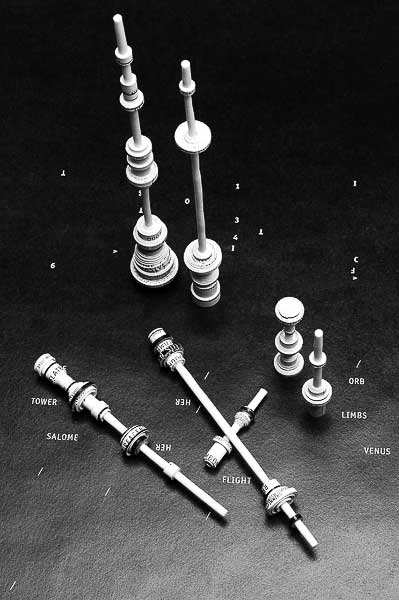
Natasha Dusenjko (Australian) Towers of Babel 2009 Mixed media
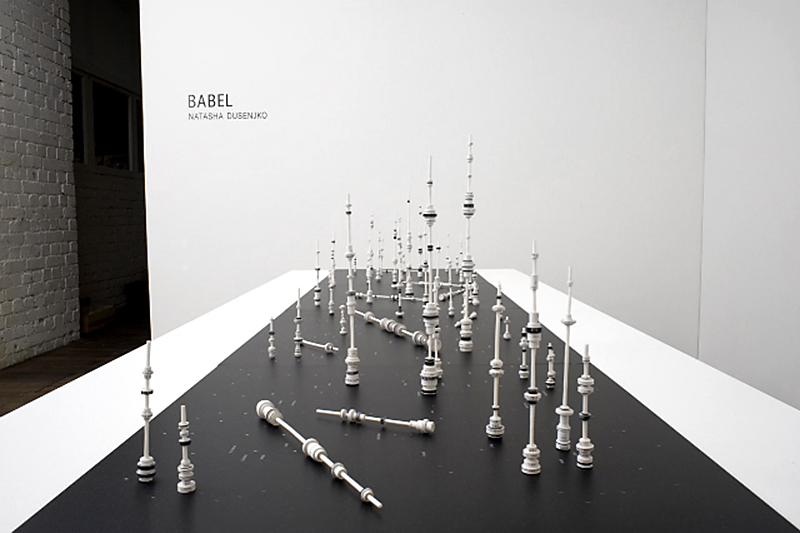
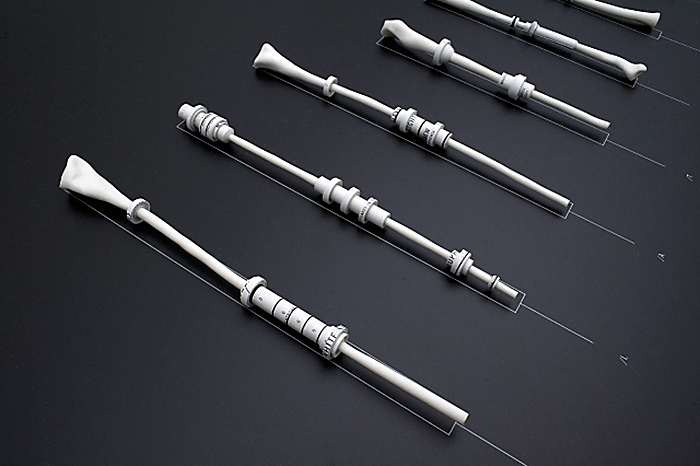
Three very interesting exhibitions at Craft Victoria at the moment: Babel by Natasha Dusenjko, Gleaning Potential by Simon Lloyd and Cycle by Liz Low. I particularly liked the delicacy and textuality of Natasha Dusenjko’s sci-fi towers and bone fragments and the wonderful box of 6 red bricks (small and large) that you can buy from the Simon Lloyd show, like blocks for a child builder.
There is an excellent and erudite review of the exhibitions at Daniel Neville’s Nevolution website.
Dr Marcus Bunyan
Many thankx to Craft Victoria for allowing me to publish the photographs in the posting. Please click on the photographs for a larger version of the image.
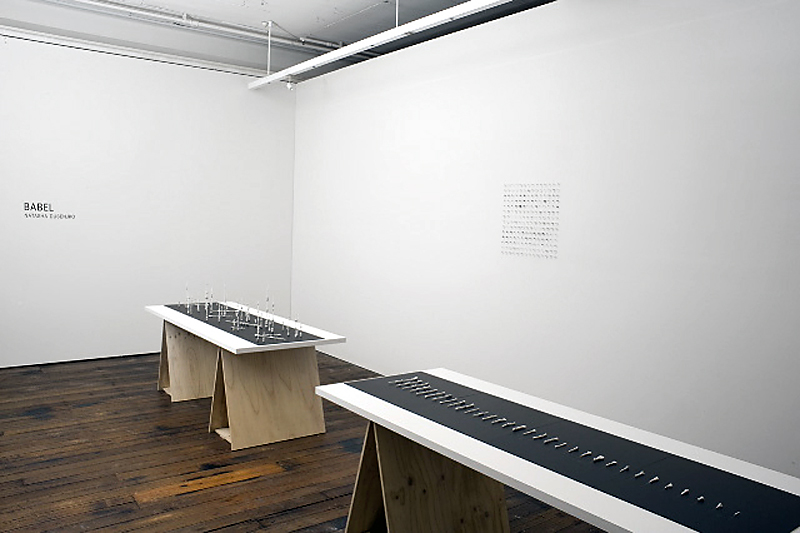
“The two tables allow for different meanings and scales when viewed in opposition. Table 1 alludes to star charts; constellations of texts hinting at importance, especially in relation to the placement of towers. The map looking up to the stars via the towers of babel, communicating unknown messages to the stars above. The cold stark forms of the towers work well with the organic forms of the bones on Table 2. Perfectly ordered and numbered archaeological bone fragments repeat the textual ciphers and codes, meticulously ordered. The jump in scale between the architectural and the archaeological is lovely; each hinting at an underlying language and mythology. Meanwhile both contain elements of each other – the towers of rationality have been placed in a seemingly random manner, while the organic forms of the bones have been laid out in perfect order ranging down in sizes.”
Daniel Neville. Extract from “On the nature of language, order and decay,” on the Nevolution website June 03, 2009 [Online] Cited 05/06/2009
Installation views of Natasha Dusenjko’s exhibition Babel at Craft Victoria, Melbourne
Babel is a word-based collection of fine porcelain and paper works. This collection of short texts constitutes a series of incantations, codes and instructions scrolled around porcelain bones or thin spines. The porcelain bones are internal structures and vessels of ancestor memory. This memory is fluid, is evasive, is aquatic. The thin spines resemble futuristic Towers of Babel reaching into space, anticipating communication and new frontiers. These towers have either an upright or collapsed form.
In the making, both forms build toward new possibility, words become obscured, resulting in a non-defined beginning or end, now replaced by chance permutations of the accumulated text.
The sculptural works are deliberately placed onto two large scale text based charts. Each chart is placed on a raised surface, analogous to work benches in an observatory or laboratory suggesting a process of decipherment. Map 1 exhibits a similarity to ancient star charts, the placement of towers alluding to significant points of a constellation. The accompanying Chart 2 resembles an organised series of archeological artefacts, each piece methodically numbered and labelled.
Ultimately, Babel evokes a spiral passage both outward and inward. To unravel the scrolls initiates a return to the spine – the axis mundi, the source of a universal native tongue – love.
Text from the Craft Victoria website [Online] 05/06/2009. No longer available online
Natasha Dusenjko (Australian) Babelbones 2009 Mixed media
Craft Victoria Watson Place, off Flinders Lane Victoria 3000 Phone: 03 9650 7775
Edward Weston (American, 1886-1958) Palma Cuernavaca 1925 Gelatin silver print Sheet: 24.4 x 16.5cm (9 5/8 x 6 1/2 in.) The Lane Collection Museum of Fine Arts, Boston
What a privilege to be able to post these photographs that appear in the exhibition. Breathe, look, enjoy!
Marcus
Many thankx to the Museum of Fine Arts, Boston for allowing me to publish the photographs in the posting. Please click on the photographs for a larger version of the image.
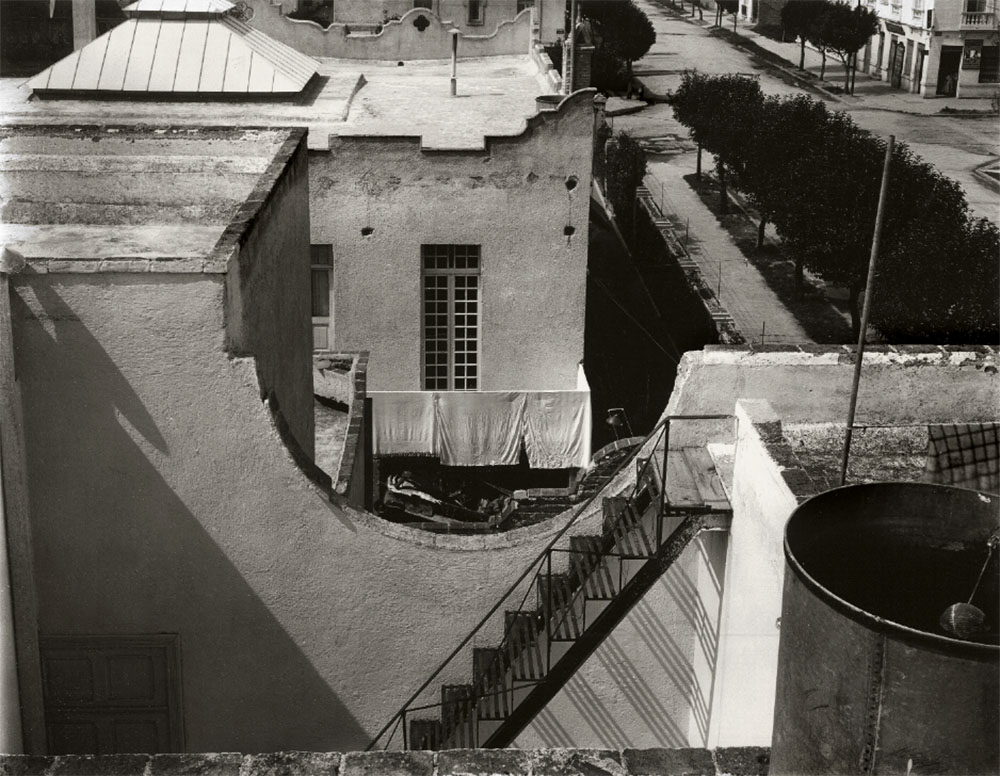
Edward Weston (American, 1886-1958) Desde la Azotea 1924 Platinum or palladium print Sheet: 19.4 x 24.4cm (7 5/8 x 9 5/8 in.) The Lane Collection Museum of Fine Arts, Boston
In the decades following the Revolution of 1910, foreign artists and intellectuals flocked to Mexico in order to experience its warm climate and lively cultural scene. They were inspired by Mexico‘s exotic tropical landscape, its ancient monuments and colonial architecture, the work of its modern muralists, and the country‘s indigenous arts and crafts. During two extended trips to Mexico made between 1923 and 1926, American photographer Edward Weston (1886-1958) created some of his earliest modernist photographs, which form the core of the exhibition, Viva Mexico! Edward Weston and His Contemporaries, at the Museum of Fine Arts, Boston (MFA). Featured are approximately 45 works, among them about 30 rare photographs by Weston and selected images by Tina Modotti, Brett Weston, Manuel Alvarez Bravo, and Paul Strand. These photographs from the 1920s and ’30s are drawn from the Museum’s own collection, as well as The Lane Collection, which is on long-term loan to the MFA. Additionally, a compelling 1939 portrait of Frida Kahlo by Hungarian-born photographer Nickolas Muray has been lent from a local private collection. Viva Mexico! is on view May 30 through November 2 in the MFA’s Herb Ritts Gallery.
“Viva Mexico! highlights Weston’s pivotal years in this highly creative environment, which had a lasting impact on his work and inspired some of his earliest experiments in still life, landscape, and cloud studies,” said Malcolm Rogers, Ann and Graham Gund Director of the MFA. “This exhibition allows us to focus on a critical juncture in Weston’s career, and to present one of the strengths of The Lane Collection – its holdings of the photographer’s early modernist work.”
The Lane Collection, which includes gifts and loans to the MFA, comprises modern American paintings, photographs, and works on paper assembled by the late William H. Lane and his wife, Saundra B. Lane, a Trustee of the MFA. During the late 1960s, the Lanes acquired a large number of Weston’s vintage photographs, which are now widely acknowledged to be the most important collection of the photographer’s work in private hands.
“Acquiring more than 2,000 Edward Weston photographs directly from his sons was an amazing learning experience for us and we were thrilled to be able to immerse ourselves in the work of such a major artist in such great depth,” said collector Saundra Lane. “The Mexico pictures by Edward, Brett, and Tina Modotti are some of my personal favourites. These works inspired me to more recently acquire two early Manuel Alvarez Bravo photographs, El soñador (The Dreamer) and Nude, included in the exhibition, each of them a quintessentially Mexican subject and clearly made under the influence of Weston and Modotti.”
In an early biography of Edward Weston, writer and editor Nancy Newhall described Mexico as his “Paris,” the place where he greatly expanded his range as an artist. His total of more-than two years in Mexico – Weston’s only travel outside the US – offered him the opportunity to move away from his Pictorialist style, with its soft focus and ethereal, romantic qualities, toward more abstract forms and sharper resolution of detail. Heroic portrait heads, avant-garde nudes, urban views, cloud studies and landscapes, and images of Mexican toys and folk art are among the subjects he captured with his large-format camera. This period of experimentation with isolated objects also resulted in some of Weston’s earliest forays into still life, as can be seen in Chayotes (1924), a close-up of the beautiful, spiny squash arranged in a painted wooden bowl.
In 1923, Weston made the difficult decision to close his portrait photography studio in Tropico (now Glendale), California, and move to Mexico, as he wrote in his journal – to start life anew. He left behind his wife and three of his four young sons and traveled to Mexico City with his lover, Italian-born actress Tina Modotti (1896-1942) and his oldest son Chandler. Modotti ran Weston’s new studio, served as his translator and muse, and under his tutelage began to make highly accomplished photographs of her own. Together they became immersed in the vibrant community of artists and intellectuals centred there, which included painters Diego Rivera, Jean Charlot, Xavier Guerrero, and Rafael Salas, as well as the poet Luis Quintanilla, writer D.H. Lawrence, anthropologist Frances Toor, and journalist Carleton Beals. Although Weston and Modotti always remained outsiders looking in, the several exhibitions of their work during their Mexican sojourn helped spark a lively interest in modernist photography in their adopted country, where until this time photography had been admired mainly as a documentary tool, rather than a fine art.
“This exhibition will be a wonderful opportunity for our visitors to experience Weston’s stunning Mexican photographs firsthand, many of which are rarely seen platinum prints taken in the period just before he made his classic black-and-white images of peppers and shells,” said Karen Haas, The Lane Collection Curator of Photographs, who organised Viva Mexico! “These rich, warm-toned prints, when seen in context with photographs by his contemporaries in Mexico during the 1920s and ’30s, promise to be a revelation even to those who know Weston’s work well.”
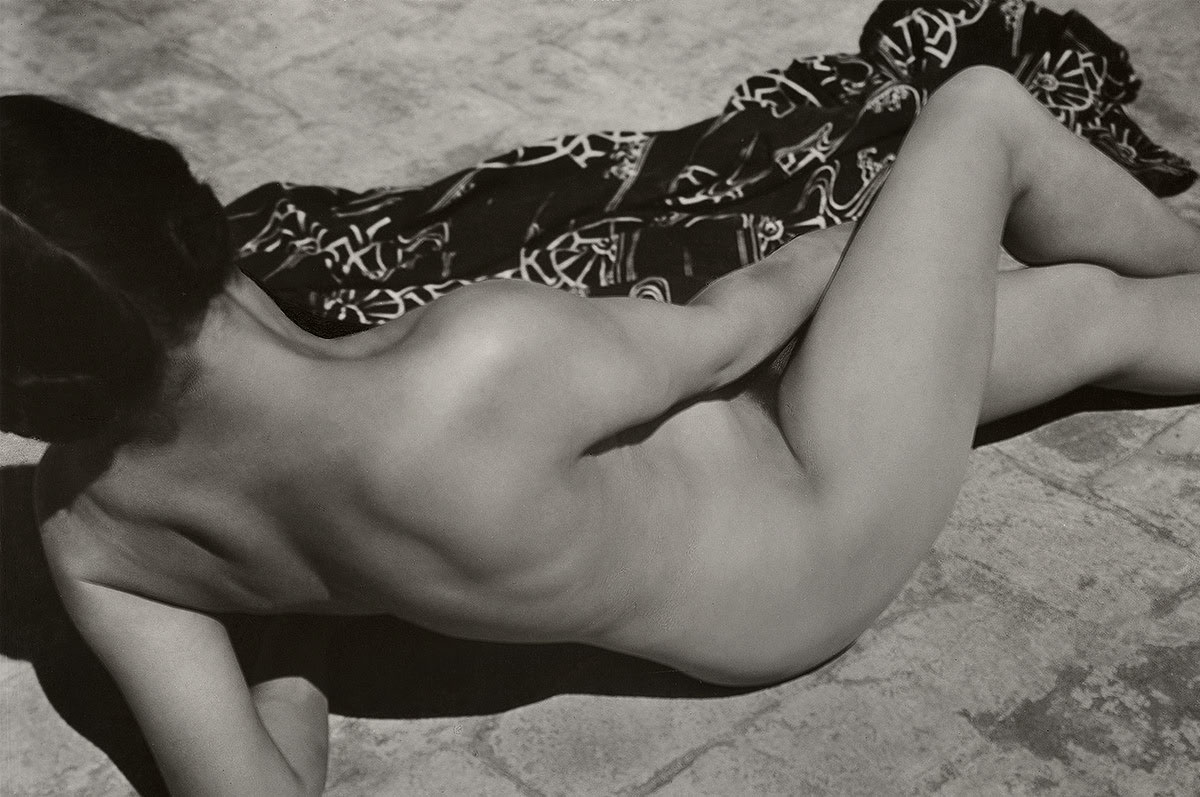
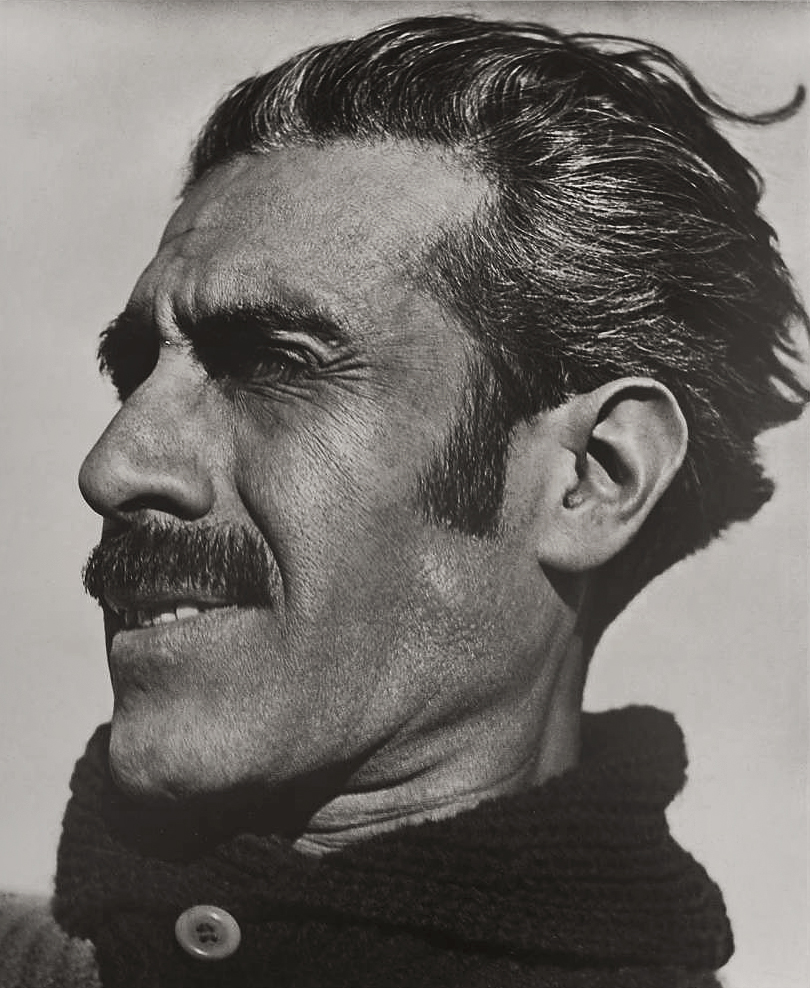
Many of the earliest images that Weston produced in Mexico were portraits and nudes, both subjects that he had specialised in previously but now took on a very different look and feel. Soon after his arrival, he began a series of monumental portraits of friends and acquaintances, all of them shot very close-up and from slightly below eye level, their heads filling the picture frame and their features heroicised. These include Galván Shooting (1924), Tina Modotti (1924), Victoria Marin (1926), and Rose Roland Covarrubias (1926). He also made a stunning group of nudes of Modotti posing on their sun-baked rooftop patio, all three of which he titled Tina on the Azotea (1924), as well as an incredibly simple and sculptural image, Nude (1926) of fellow American expatriate Anita Brenner. The Brenner nude, along with Palma Cuernavaca (1925), Aqueduct (1924), and Excusado (1925) all share a similarly stark, abstract, and timeless quality – what Weston described as an attempt to render “the very substance and quintessence of the thing itself.”
Abstract architectural details began to make their way into Weston’s work as well and he was drawn to capture light and shadow on a variety of surfaces, from the zigzag stone patterns of the ancient Ruinas de Mitla (1926) to the angled forms of the convent stairwell and skylight in San Pedro y San Pablo (1924). Viva Mexico! also showcases Weston’s experimentation with landscape photography, both urban and rural. The striking view from his studio roof is recorded in Desde la Azotea (1924), in which the geometry of the buildings below is heightened by the elevated vantage point and steeply raking light, and in Michoacán (1926), where he captures the beautifully undulating silhouette of the pastoral countryside. Much less common among his subjects from this period are some of Weston’s little-known photographs made in outdoor markets and fairs, such as Mercado, Oaxaca (1926) and Bowls, Oaxaca (1926). These open-air street images closely relate to another group of pictures, including Torito (1925), a playful little papier-maché bull, and Fish Gourd and Striped Serape (1926), which reflect Weston’s newfound interest in the vernacular Mexican toys and folk objects that he collected and lovingly documented in his studio while waiting for clients to arrive for portrait sittings. These whimsical photographs also serve as fascinating precursors to Weston’s high modernist still lifes of less than a decade later.
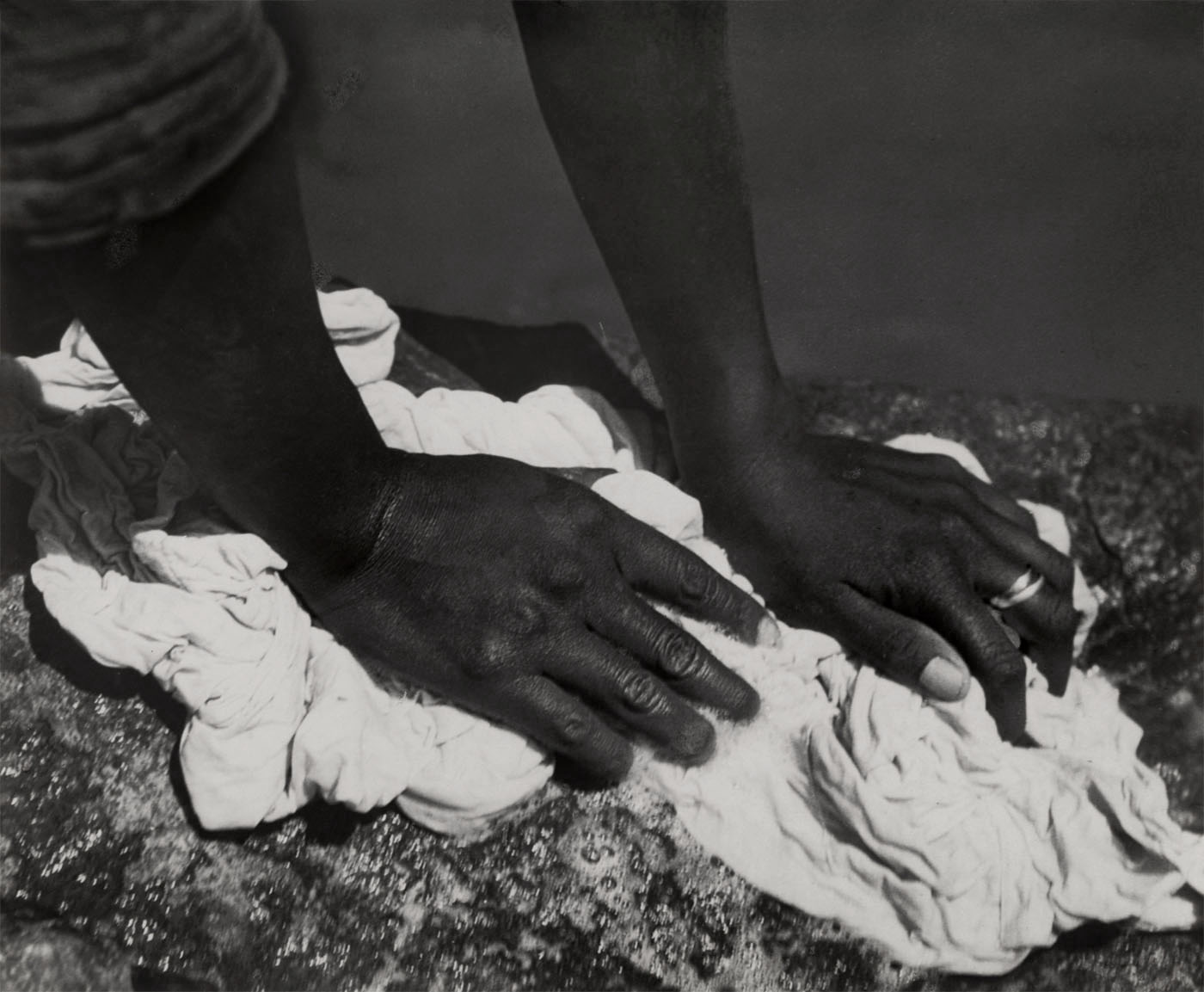
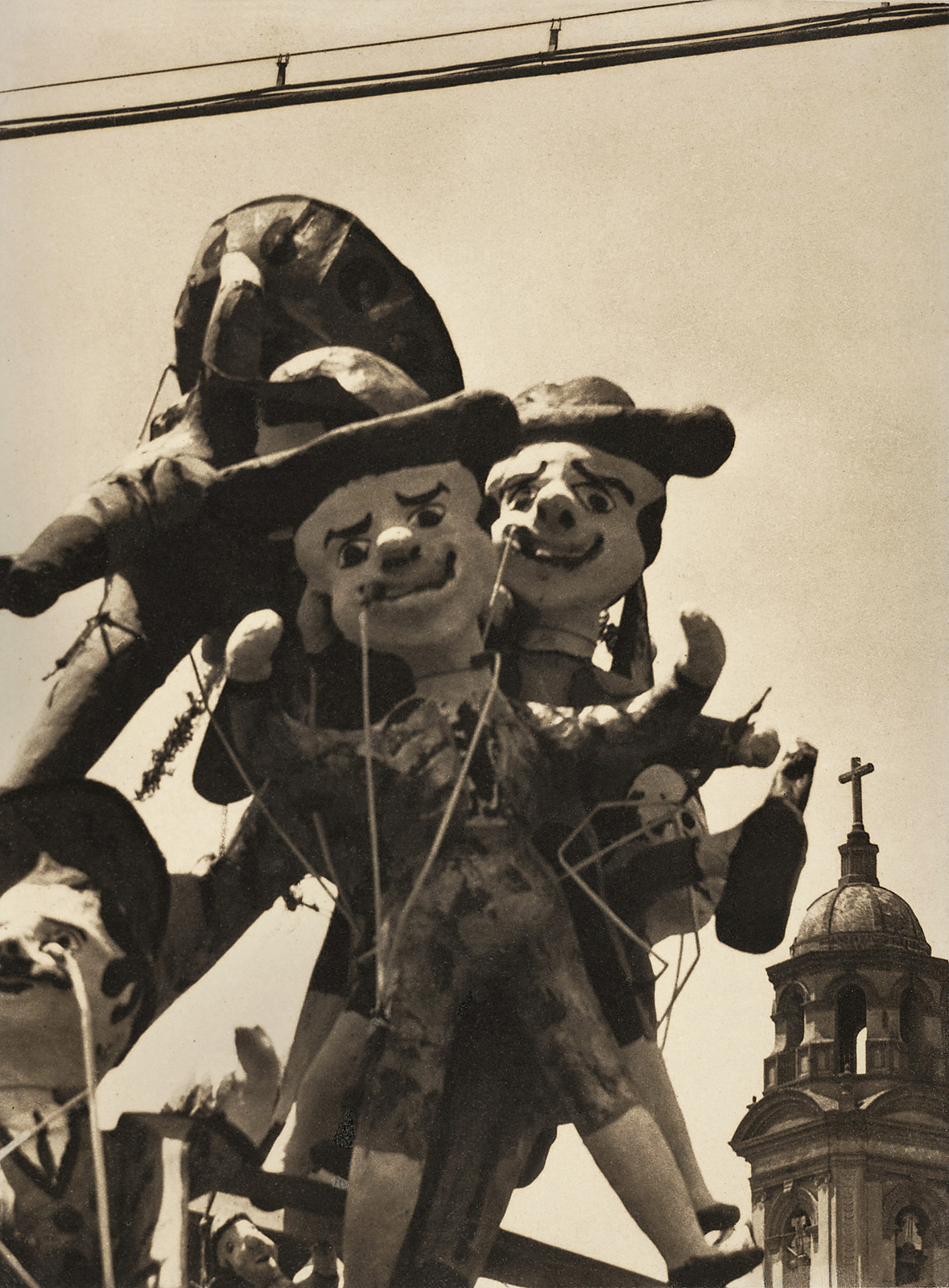
Over the course of her time in Mexico, Modotti rapidly went from photographer’s apprentice and model to fine art photographer in her own right. Although her career as a photographer was relatively brief, her powerful pictures from this period sometimes rival those of her lover and teacher, Edward Weston. Modotti was a rare woman in a mostly male profession, but she brought to her work a deep-seated interest in the people and the politics of Mexico in the 1920s. Unlike Weston, who preferred to work in the studio rather than the street, Modotti straddled the worlds of fine art photography and radical social activism. Her commitment to the struggles of the people can be seen in her iconic Worker’s Hands (1927), and her fascination with Mexico’s public demonstrations and celebrations is captured in Effigies of Judas (1924). She was so impassioned by these causes, in fact, that Modotti joined the Communist party and continued to work in Mexico for several years after Weston finally returned home in 1926. Before he left for California, however, Weston and Modotti collaborated on a photographic commission to illustrate a book on Mexican history and culture entitled Idols Behind Altars, which was written by their friend Anita Brenner and published in 1929. A copy of the book is among the case materials featured in the exhibition, as is American photographer Laura Gilpin’s book, Temples in Yucatan: A Camera Chronicle of Chichén Itzá (1948), which showcases her pictures of the ancient Mayan ruins taken during her two trips there in the early 1930s and mid ’40s.
Viva Mexico! also offers visitors to the MFA a rare chance to see some of Brett Weston’s (1911-1993) earliest serious photographs made during Edward Weston’s second extended trip to Mexico in 1925 and 1926 (after an eight-month-long hiatus in California). The second eldest of Weston’s four sons was only 14 years old when he accompanied his father to Mexico City and went with him to live in the house and studio that Weston shared with Modotti. Rather than the large-format camera and platinum prints that his father preferred, Brett Weston was given a 3 1/4 x 4 1/4 Graflex camera and printed his pictures on less expensive gelatin silver papers, which captured the precise detail and texture that his father admired in his work. The boy quickly fell under the spell of photography and his time in Mexico proved to be an ideal preparation for his own future as a professional photographer. Two of Brett Weston’s highly abstract architectural views, Tin rooftops (1926) and Ventilator (1926), are on view in the exhibition.
The only Mexican-born artist in the exhibition, Manuel Alvarez Bravo (1902-2002), is represented with three works, El soñador (The Dreamer) (1931), Nude (1935), and Las lavanderas sobreentendidas (Washerwomen Implied), Draped Yucca Plants, Mexico (1932). As a young, aspiring photographer in Mexico City, Bravo first met Modotti in 1927, soon after Weston’s departure. He was greatly inspired by the look and spirit of Modotti’s work as well as the Weston prints that she shared with him. Bravo is perhaps best-known for the stunning female nudes that he made over the course of his long career, but Viva Mexico! features a rare male figure study, Nude (1935). With its androgynous curves and simplified form, it clearly relates to Weston’s nudes of his son Neil made a decade earlier. Bravo’s photographs always have a profoundly Mexican essence to them, but especially during the 1920s and ’30s; they also demonstrate the influence of the European Surrealists as can be seen in the slightly unsettling, yet lovely work El soñador (The Dreamer).“
Viva Mexico! also showcases the work of American photographer and documentary filmmaker Paul Strand (1890-1976), who lived in Mexico during the mid-1930s. Although he and Weston had met in New York in 1922 and were aware of each other’s careers, their sojourns in Mexico did not coincide. The situation that Strand found on crossing the border in 1932 was very different than the more optimistic period of cultural Renaissance that Weston had experienced during the mid-1920s. Like Modotti, whose social concerns and unsentimental approach he shared, Strand was inspired to make portraits of Mexico’s indigenous peoples and the country’s dramatic landscapes. Landscape, Near Saltillo (1932) was one of the earliest images Strand shot in Mexico; taken in the north of the country on his initial trip down to Mexico City, it features the glowing white form of an adobe building set off by spiny, tall cacti and a vast expanse of sky. Also on view is Día de Fiesta (1933), a starkly simple image of three men and a child standing against a sunlit wall, which was made just prior to the production of Redes (Nets, or The Wave, in the US), his documentary film focusing on the struggles of a group of fisherman near Veracruz.”
Press release from the Museum of Fine Arts, Boston [Online] Cited 03/06/2009 no longer available online
Edward Weston (American, 1886-1958) Chayotes 1924 Platinum or palladium print Sheet: 19.4 x 24.3cm (7 5/8 x 9 9/16 in.) The Lane Collection Museum of Fine Arts, Boston
Edward Weston (American, 1886-1958) Ruinas de Mitla 1926 Platinum or palladium print Sheet: 19.1 x 24.1cm (7 1/2 x 9 1/2 in.) The Lane Collection Museum of Fine Arts, Boston
Edward Weston (American, 1886-1958) San Pedro y San Pablo 1924 Platinum or palladium print Sheet: 19.4 x 24.4cm (7 5/8 x 9 5/8 in.) The Lane Collection Museum of Fine Arts, Boston
Edward Weston (American, 1886-1958) Tina on the Azotea, with kimono 1924 Gelatin silver print Sheet: 16.2 x 23.8cm (6 3/8 x 9 3/8 in.) The Lane Collection Museum of Fine Arts, Boston
Edward Weston (American, 1886-1958) Tina On The Azotea c. 1924 Palladium print Sheet: 22.2 x 17.5cm (8 3/4 x 6 7/8 in.) The Lane Collection Museum of Fine Arts, Boston
Edward Weston (American, 1886-1958) Tina Modotti 1924 Palladium print Sheet: 22.7 x 17cm (8 15/16 x 6 11/16 in.) The Lane Collection Museum of Fine Arts, Boston
Pure your gentle name, pure your fragile life, bees, shadows, fire, snow, silence and foam, combined with steel and wire and pollen to make up your firm and delicate being.
Part of Modotti’s epitaph which can be found on her tombstone, composed by Pablo Neruda,
Edward Weston (American, 1886-1958) Galván Shooting (Manuel Hernández Galván, Mexico) 1924 Gelatin silver print 22.5 x 18.7cm (8 7/8 x 7 3/8 in.) Mary L. Smith Fund Museum of Fine Arts, Boston
Edward Weston (American, 1886-1958) Rosa Rolanda (de Covarrubias) 1926 Gelatin silver print 21.9 x 16.5 cm (8 5/8 x 6 1/2 in.) Sophie M. Friedman Fund Museum of Fine Arts, Boston
Edward Weston (American, 1886-1958) Excusado (Toilet) 1925 Gelatin silver print Sheet: 24.3 x 19.1cm (9 9/16 x 7 1/2 in.) The Lane Collection Museum of Fine Arts, Boston
Tina Modotti (American born Italy, died Mexico, 1896-1942) Manos de trabajador, Mexico (Worker’s Hands, Mexico) 1927 Gelatin silver print 19.2 x 21.7cm (7 9/16 x 8 9/16 in.) Sophie M. Friedman Fund Museum of Fine Arts, Boston
Tina Modotti’s closely cropped picture of a worker’s dusty hands conveys the realities of hard work. In 1923, the Italian-born film actress accompanied her lover, photographer Edward Weston, to Mexico City, where Weston taught her to use a large-format camera. She worked as his studio assistant, quickly mastering the technique and making striking portraits, close-up images of flowers, and still lifes of her own. Modotti’s compassion for the indigenous culture and political struggles of the Mexican people led her to join the Communist Party in 1927 and to focus on socially concerned subjects, using her camera as a tool to document the proud faces and weathered hands of the peasant labourers, artisans, and revolutionaries of her adopted country.
Text from the Museum of Fine Arts, Boston website
Screenshot
Tina Modotti (American born in Italy, died in Mexico, 1896-1942) Hands Washing 1927 Gelatin silver print
Tina Modotti (American born Italy, died Mexico, 1896-1942) Effigies of Judas 1924 Gelatin silver print
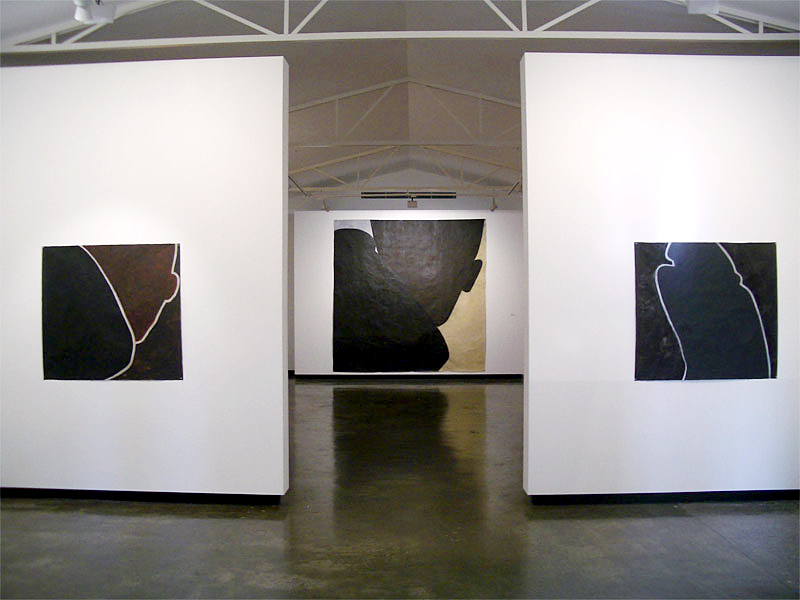
Installation views of Judith Wright’s exhibition Desire at Sophie Gannon Gallery, Melbourne
On a beautiful sunny Autumn afternoon in Melbourne I made a visit to Space Furniture on Church Street to ogle at the wondrous designs and then to the galleries of Albert Street in Richmond for three outstanding painting exhibitions: John Beard at John Buckley Gallery, McLean Edwards at Karen Woodbury Gallery and Judith Wright at Sophie Gannon Gallery. First cab off the rank is Judith Wright but reviews of the other two shows will follow…
There is a part in Jim Jarmusch’s film Ghost Dog: The Way of the Samurai (1999) where the anti-hero stares into the eyes of a dog and Jarmusch just holds the scene for what seems like an eternity. The camera observes the infinite bond between human and animal, an almost palpable connection across time and space, with an unflinching eye. The same can be said of Judith Wright’s encaustic paintings (also known as hot wax painting, involves using heated beeswax to which coloured pigments are added) but here she pushes the relationship further – into an investigation of the animal in the human and vice versa, and their erotic charge when placed together. Here is the carnivalesque at it most daring, most paired back, revealing in quiet Zen like compositions the dissolution of boundaries between both states of being.
Nominally based on the symbology of characters presented in two videos in the exhibition (masked figures playing with each other, a comical goats head with horns being one figure) the paintings are much more interesting than the videos. Painted on Japanese paper in wax and acrylic the biomorphic forms of babies heads, torsos and sculpted free forms and designs suggestive of living organisms address the title of the exhibition: desire!
Wright plays with scale and form, using earth tones and a luminous palette of oranges, yellows and pinks. Her shape-shifting paintings work to unhinge stagnant systems of thought that surround identity and the body. The waxed Japanese paper adds to the sensuality of the skin-like work. A baby seems to feed on a double nipple but the nipple has missed the mouth and is invading the eye. Forms intersect and the sensual shapes slip over each other: as in the Zen idea of ‘satori’ or enlightenment attained when two circles intersect here we have the intersection of an erotic enlightenment.
As Russian theorist Mikhail Bakhtin notes the carnivalesque is the contravention of normal laws of behaviour, “and he proposes that the carnivalesque is also the home of the grotesque, where otherwise antithetical properties or characteristics are matched together in the same being: beast with human, youth with age, male with female.”1
“The carnival offers the chance to have a new outlook on the world, to realise the relative nature of all that exists, and to enter a completely new order of things.”2
And this is what these paintings propose: a new order of things, a chance for desires formed of new pleasures.
As Michel Foucault has observed,
“The possibility of using our bodies as a possible source of very numerous pleasures is something that is very important. For instance, if you look at the traditional construction of pleasure, you see that bodily pleasure, or pleasures of the flesh, are always drinking, eating and fucking. And that seems to be the limit of the understanding of our bodies, our pleasures … It is very interesting to note, for instance, that for centuries people generally, as well as doctors, psychiatrists, and even liberation movements, have always spoken about desire, and never about pleasure. “We have to liberate our desire,” they say. No! We have to create new pleasure. And then maybe desire will follow.”3
In their luminosity, in their skin-like textures, in their balance between the colour of the paper, the dark voids and the brown of babies heads we feel the sharp intake of the cold breathe of winter on the nostrils – we feel an evocation of new pleasure, of possible desires within us and the loosening of the grip of conformity. Like the perfect placement of rocks in a Japanese garden and the ripples of the gravel, of a reality that swirls around them these paintings open hearts and minds to inner states of being unexperienced before. And yes, I did enjoy the ride.
Dr Marcus Bunyan
Many thankx to Sophie Gannon Gallery for allowing me to publish the art work in the posting. Please click on some of the photographs for a larger version of the image.
1/ Buchbinder, David. Masculinities and Identities. Melbourne: Melbourne University Press, 1994, p. 53. For a discussion of carnivalesque see Bakhtin, Mikhail. Rabelais and his World (trans. Hélène Iswolsky). Bloomington: Indiana University Press, 1984, pp. 196-277, 303-367.
2/ Bakhtin, Mikhail. Rabelais and his World (trans. Hélène Iswolsky). Bloomington: Indiana University Press, 1984, p. 34.
3/ Gallagher, Bob and Wilson, Alexander. “Sex and the Politics of Identity: An Interview with Michel Foucault,” in Thompson, Mark. Gay Spirit: Myth and Meaning. New York: St. Martin’s Press, 1987, p. 31.
Judith Wright (Australian, b. 1945) Desire [14] 2009 Acrylic and wax on Japanese paper 200 x 200cm
Judith Wright (Australian, b. 1945) Desire [5] 2009 Acrylic and wax on Japanese paper 100 x 100cm
Judith Wright (Australian, b. 1945) Desire [7] 2009 Acrylic and wax on Japanese paper 100 x 100cm
Judith Wright (Australian, b. 1945) Desire [16] 2009 Acrylic and wax on Japanese paper 300 x 300cm
Judith Wright (Australian, b. 1945) The Gift [2] 2008 Acrylic and wax on Japanese paper
Judith Wright (Australian, b. 1945) The Gift [7] 2008 Acrylic and wax on Japanese paper
Sophie Gannon Gallery 2, Albert Street, Richmond, Melbourne Phone: +61 3 9421 0857
Artists: Bindi Cole, Tamara Dean, Lee Grant, June Indrefjord, Bronek Kozka, Ka-Yin Kwok, Tracey Moffatt, Fiona Morris, Aaron Seeto, Martin Smith and Toni Wilkinson
Many thankx to the ACP for allowing me to publish the photographs in the posting. Please click on some of the photographs for a larger version of the image.
June Indrefjord Piano 2005 From the series Landaas
Aaron Seeto (Australian) Oblivion 2006 From the series Oblivion Daguerreotype
Aaron Seeto makes alternate historical positions and experiences visible through an exploration of archives, family photo albums and photographic records. In recent bodies of work Fortress and Oblivion, Seeto has utilised the daguerreotype, one of the earliest and most primitive photographic techniques, to highlight the malleability of narratives within archive records. Not only is the chemical process itself highly toxic and temperamental but the daguerreotype’s mirrored surface means the image appears as both positive and negative, depending on the angle of view. For Seeto, this mutability captures the essence of our experience of history and memory, reflecting how images degrade, how stories are formed and privileged, how knowledge and history are written. …
For his ongoing series Oblivion Seeto sourced details from images of the Cronulla riots – beachside riots around race and territory – of 2005 found on the internet. In reproducing these as daguerrotypes he seeks less to represent the incident than to look at how it was reported, understood and remembered. The instability of the virtual information found online is echoed in the photographic process.
Text from the Stills Gallery website [Online] Cited 14/02/2019
Tracey Moffatt (Australian, b. 1960) Useless 1974 1994 From the series Scarred for Life
Useless, 1974 is a photo-lithograph by the Australian artist Tracey Moffatt. The work shows a girl stooping down to wash a car, with one hand wiping a headlight with a sponge and the other resting on the bonnet. She looks towards the camera rather than at the car, her face bearing a serious and potentially hurt or angry expression. The caption accompanying the photograph explains that ‘Her father’s nickname for her was “useless”‘. Despite this, it seems that in this picture she is being put to use, and perhaps the car she washes is her father’s. The caption, her expression and the direction of her gaze may suggest that the viewer occupies the position of the girl’s father looking down on and supervising his daughter while she carries out her chore. …
The work’s title is a reference to the cruel nickname given to the girl in the photograph, and the date in the title, 1974, suggests the year according to which the photograph has been styled by Moffatt, who employs actors and constructed scenes to create her photographs. Curator Filippo Maggia has compared Moffatt’s photographic method to that of a film director, stating that she ‘often does not take the photographs herself but directs a sort of bona fide movie set that she organises and controls after having pictured it in her mind again and again, meticulously decomposing and recomposing it’ (Maggia 2006, p.12). As the artist has stated, ‘I often use technicians when I make my pictures. I more or less direct them. I stand back and call the shots.’ (Quoted in Maggia 2006, p.12.)
Moffatt’s photographic series often deal with themes such as race, gender and the politics of identity. Drawing on memories from the artist’s childhood, the Scarred for Life series mimics photo spreads from the American magazine Life, with their explanatory captions and focus on the family environment. The captions’ terse descriptions hint at the traumatic stories behind the images. Moffatt has commented: ‘a person can make a passing comment to you when you are young and this can change you forever. You can be “scarred for life” but it isn’t necessarily a bad thing. The photographs can be read as both tragic and comic – there is a thin line between both.’ (Quoted in display caption, Tracey Moffatt, Birth Certificate 1994, Tate P78101, accessed 28 August 2015.) Furthermore, Maggia has argued that the Scarred for Life series ‘gives us life as it is, the harshness and aridity of human relations, adolescence with its fears of not being accepted’ (Maggia 2006, p.13).
Louise Hughes August 2015
Filippo Maggia, Tracey Moffatt: Between Dreams and Reality, exhibition catalogue, Spazio Oberdan, Milan 2006, p. 13, reproduced p. 117.
Extract from Louise Hughes. “Useless, 1974,” on the Tate website [Online] Cited 14/02/2019
Lee Grant (Korean-Australian, b. 1973) The Day Meg Wore a Dress from the series Brothers and Sisters 2007
“You can choose your friends, but you can’t choose your family.”
From the tight nuclear unit to the multi-generational extended family, from refuges for the homeless to middle class suburbia, Inheritance examines the way our families shape the person we become; for better or for worse.
Taking Tracey Moffatt’s acclaimed series Scarred for Life as a starting point, the exhibition includes the work of eleven Australian artists who explore the modern family through a range of photographic disciplines, including documentary, portraiture and video. Sometimes serious and sometimes satirical, Inheritance is a family album that celebrates the skeletons and the psychodramas alongside the newborns and the nuptials.
Text from the Australian Centre for Photography website [Online] Cited 20/05/2009. No longer available online
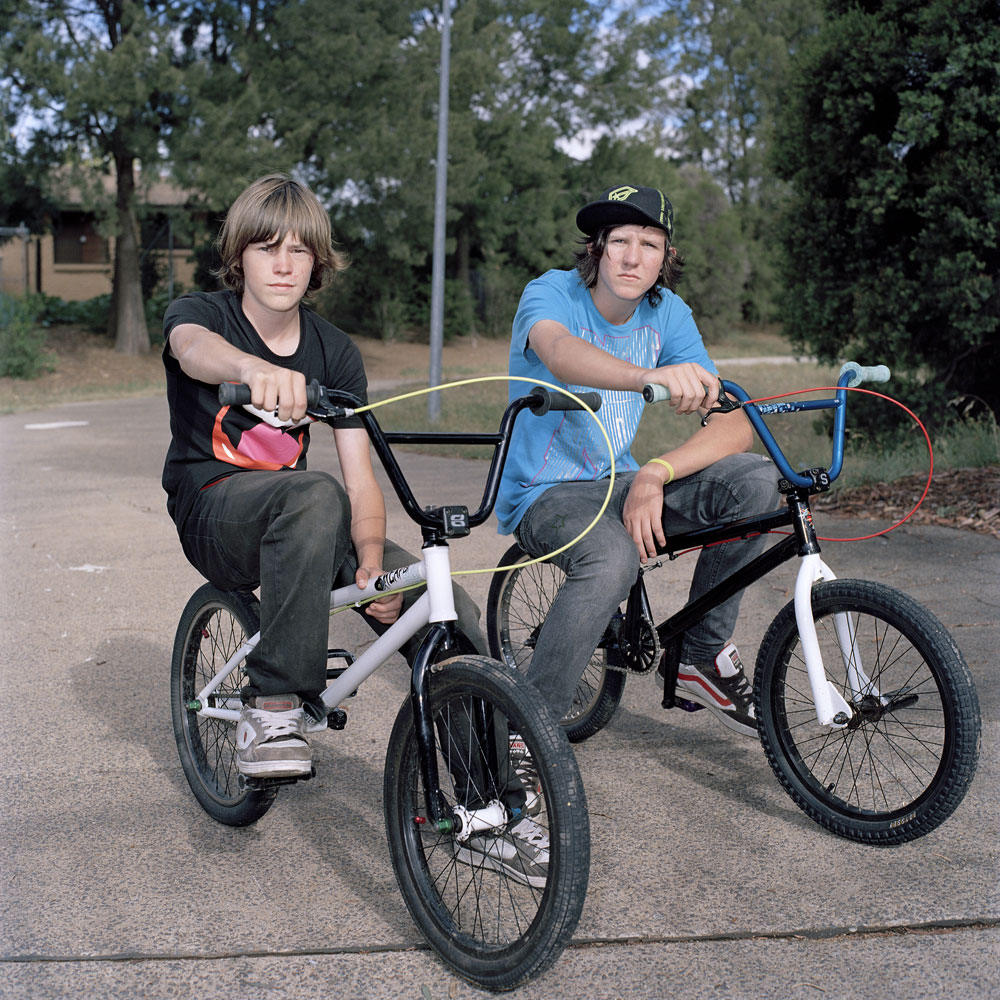
Lee Grant (Australian, b. 1973) Nathan & Mac, BMX bros 2009 Archival pigment print 60 x 60cm Edition of 8 + 2 AP
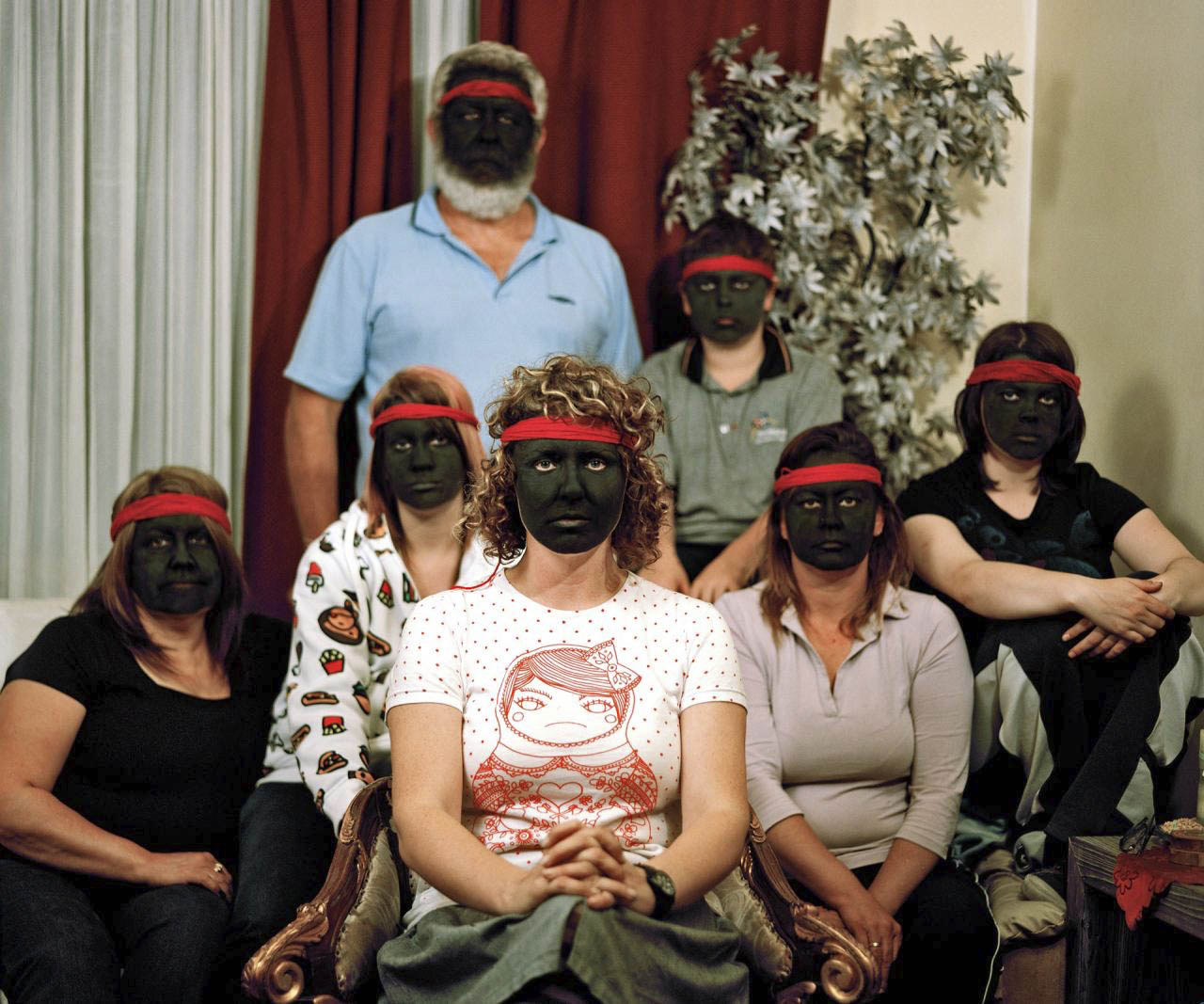
Bindi Cole Chocka (Australian / Wathaurung, b. 1975) Wathaurung Mob 2008 From the series Not really Aboriginal Pigment print on rag paper 1035 x 1235cm
Our Past Is Our Strength – Culture and Identity
I’ve always been told that l was Aboriginal. I never questioned it because of the colour of my skin or where I lived. My Nan, one of the Stolen Generation, was staunchly proud and strong. She made me feel the same way. My traditional land takes in Ballarat, Geelong and Werribee and extends west past Cressy to Derrinallum. I’m from Victoria and I’ve always known this. All the descendants of traditional Victorian Aboriginal people are now of mixed heritage. I’m not black. I’m not from a remote community. Does that mean I’m not really Aboriginal? Or do Aboriginal people come in all shapes, sizes and colours and live in all areas of Australia, remote and urban?
Bindi Cole Chocka, Wathaurung text from the Culture Victoria website [Online] Cited 14/02/2019
Wathaurung Mob is a group portrait depicting members of Cole’s family sitting in their lounge room, their faces blackened with minstrel paint, and wearing red headbands traditionally worn by indigenous elders. The controversial practice of “blackfacing” refers to the populist minstrel shows of the 19th and 20th centuries in which a white actor put on blackface, then performed a racist caricature.
As we stand before the work, Alessi says he finds it confronting and uncomfortable. “Wathaurung Mob is quite powerful because what stands out are the eyes of each sitter; they look directly at the viewer, so you can’t help but feel challenged by that,” he says.
“There is also something quite uncomfortable about the work because, in some ways, you are being implicated in Andrew Bolt’s view, as white Australians having to own up to the broader history of the relationship between white and indigenous Australia.
“And more broadly it is about coming to grips with what is still a major issue in Australia around reconciliation and the way that we treat indigenous people. In one single frame this photograph captures 200 years of history, and I think it is an area that people like Bindi Cole are really courageous to navigate through because they have been open to criticism by people like Andrew Bolt, which is completely unfounded.”
Extract from Bronwyn Watson. “Facing up to the stereotypes,” on The Australian website November 16, 2013 [Online] Cited 14/02/2019
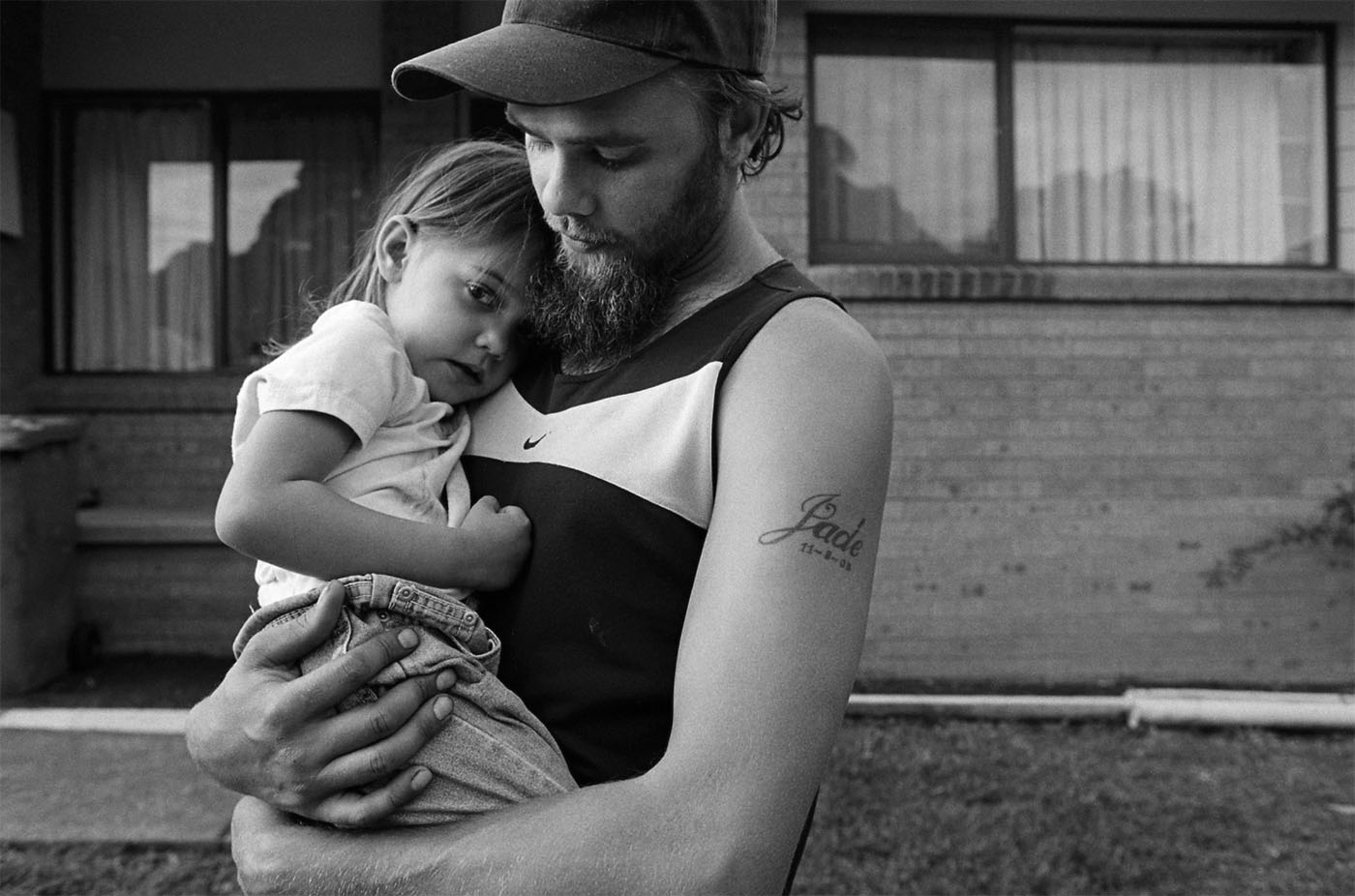
Fiona Morris (Australian) Sean and Jade, Wesley Mission 2006
Sean with his daughter Jade outside their tempoary accomodation provided by Wesley Mission. They can only stay their for a maximum of two months. Leah and Sean became homeless with their children after increasing rent rises in Sydney and the cost of living.
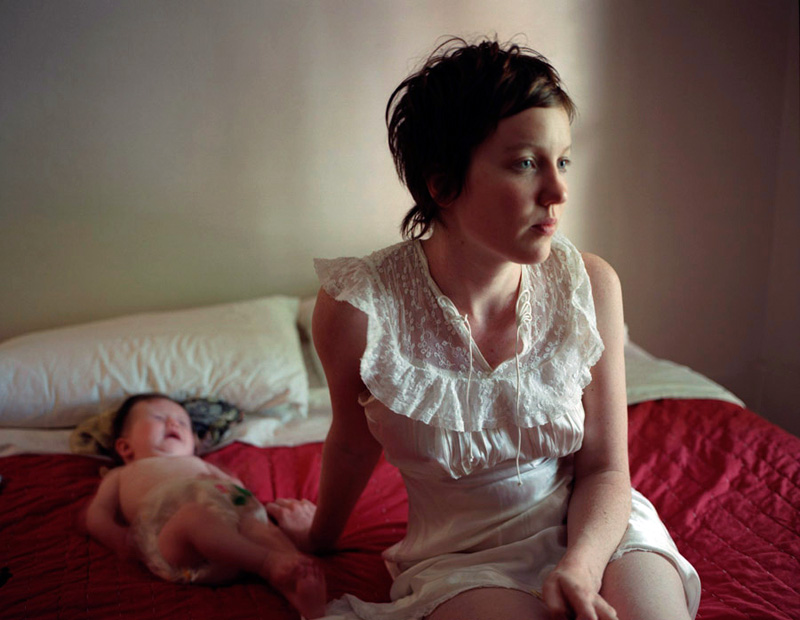
Tamara Dean (Australian, b. 1976) Alex and Maeve 2006
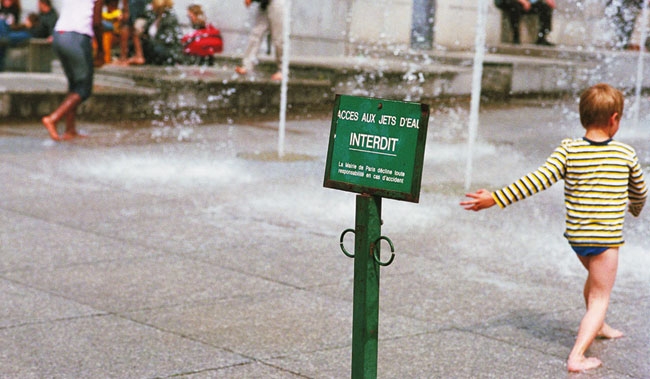
Perhaps it’s just me, but I seem to have become a little jaded towards the recent photographs of William Eggleston.
Other than the green reflection of lights in rainwater (above) the photographs seem to have lost their unique voice, the social insight that gave his earlier work it’s zing – provocative images that challenged how we live through a meditation on subject matter, construction of space, and tone of “colour”. How the colour that surrounds us inflects our very being.
In these photographs it feels like there has been little development in his style over the years with a consequent lessening of their visual impact. Now Eggleston’s colour just feels like a party trick, performed by rote with little consequential meaning to either the colour or the image. Perhaps the way we look at the world (and how we picture it) has finally overtaken the director’s prescient creative vision – his auteurship, his authorship.
Dr Marcus Bunyan
Many thankx to the Fondation Cartier for allowing me to publish the photographs in the posting.
“In Eggleston’s best work, the work that made him famous, color is intrinsic to the meaning of the photograph. Its not simply a garnish to draw the eye. His best photographs are not ‘about’ the color; they are about larger issues that the color is used in the service of. This is whats missing in his Paris pictures. The color here is pure ornament, eye candy to seduce you into forgetting that the picture has nothing to say.”
Anonymous. “William Eggleston Mails It In From Paris,” on the Leicaphilia website April 21, 2014 [Online] Cited 06/02/2019
For the last three years, American photographer William Eggleston has photographed the city of Paris as part of a commission for the Fondation Cartier pour l’art contemporain. Taken throughout different seasons, these new images by one of the fathers of colour photography portray the local and the cosmopolitan, the glamorous and the gritty, the everyday and the extraordinary.
This exhibition also provides an exceptional occasion to bring together William Eggleston’s distinctive pictures and his recent paintings, an unknown aspect of his work that has never before been presented to the public.
William Eggleston’s recent book Paris, published by Steidl and commissioned by FoundationCartier, is a collective body of work that comprises his oeuvre of color drawings and recent Paris photographs. Similar to Ben Shahn, Charles Scheeler, Diego Rivera, Man Ray, Robert Rauschenberg and Ed Ruscha, Eggleston has reached out beyond photography to express his creative talents.
The photographs and drawings are intertwined throughout the book, creating an interesting visual cadence. The page spreads illustrate various layout designs, including a single image of either a photograph or drawing on a spread, pairs of drawings and photographs and pairs of drawing facing a photograph. All of the drawings and photographs are contained within the boundaries of the page. …
We know mostly of Eggleston’s photographs, but from the dating on one of the drawings included in this book, we can determine that Eggleston has been working with the drawing medium since 1968. It is interesting to speculate as to how one medium may have influenced the other for Eggleston. As an example, the earlier photographs by Shahn and Scheeler seem to have had an influence on how these two artists subsequently worked their framing, pictorial space, mass & line quality in their subsequent paintings.
The Paris photographs that Eggleston made of graffiti or his tight framing in conjunction with a longer lens to compress the pictorial space are visually similar in style to his drawings. The subjects he photographs are framed to create similar vibrant color masses and lines as his drawing, abstracting reality into basic graphic components. …
Eggleston’s photographs are constructed like spontaneous glances; partial views of what might be consider a traditional subject, creating color abstractions of lines, patterns and mass. Trees, pipes, people, walls, garbage, décor, wall paper, display windows are bisected and truncated, with edges and lines following out of the photographs borders. These images seem to be created by a restless and nervous energy.
With these drawings, paintings and photographs, Eggleston shows a interesting handling of these mediums and offers an insight as to how influential the period of Abstract Expressionism is to his photographic process.
Extract from Douglas Stockdale. “William Eggleston – Paris,” on The PhotoBook Journal website September 12, 2009 [Online] Cited 06/02/2019
Diane Arbus (American, 1923-1971) Tattooed Man at a Carnival, Md. 1970 Gelatin silver print 15 x 14 5/8 in. (38.3 x 37.3 cm)
Diane Arbus is one of my favourite photographs – how I would love to see this exhibition!
I have posted some photographs from the exhibition, including all ten images from the Box of Ten 1971 that features in the show.
Dr Marcus Bunyan
Many thankx to the National Museum of Wales for allowing me to publish the photographs in the posting. Please click on the photographs for a larger version of the image.
“A photograph is a secret about a secret. The more it tells you, the less you know.”
Diane Arbus
Diane Arbus (American, 1923-1971) A young man with curlers at home on West 20th Street, N.Y.C. 1966 Gelatin silver print
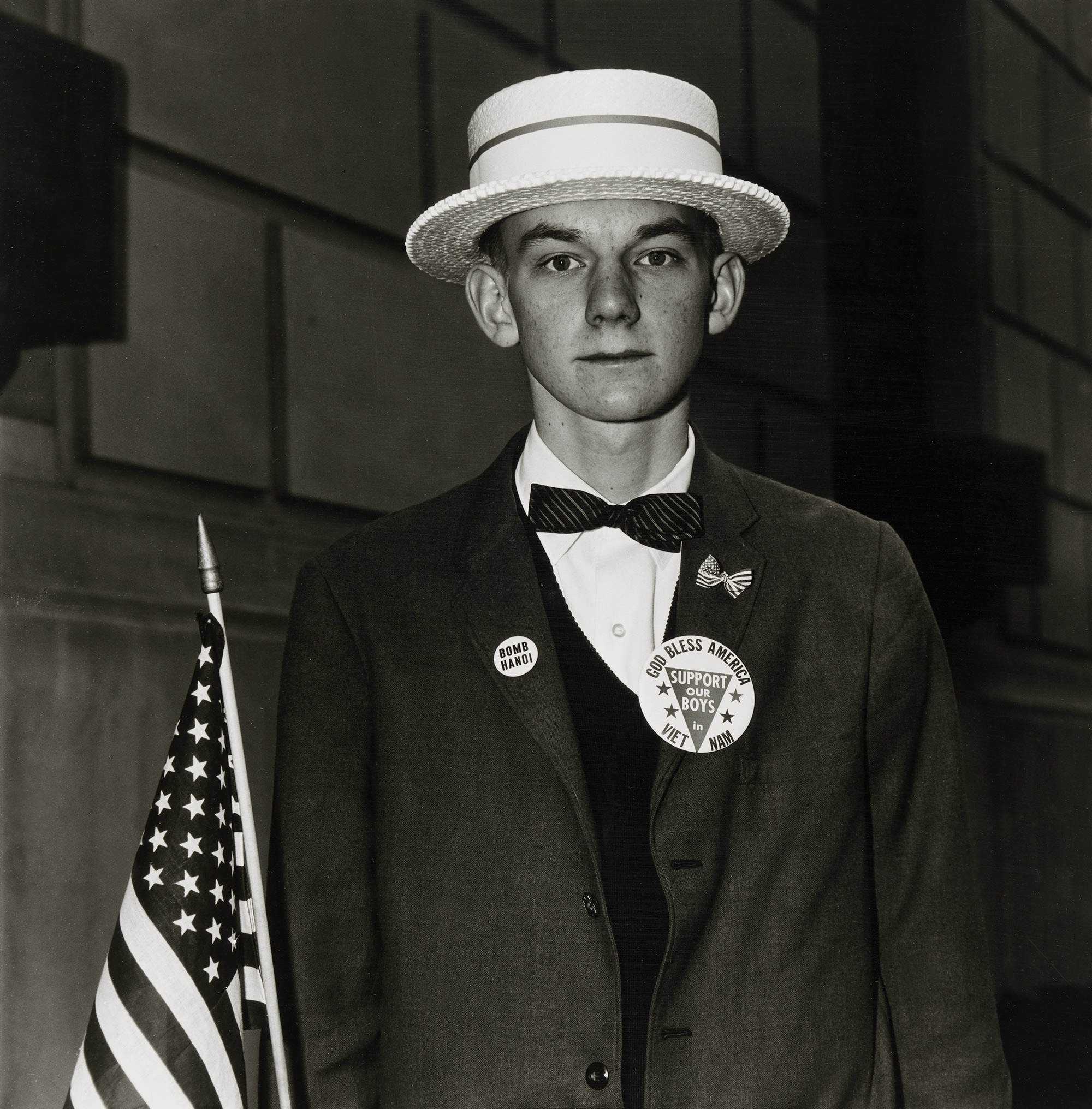
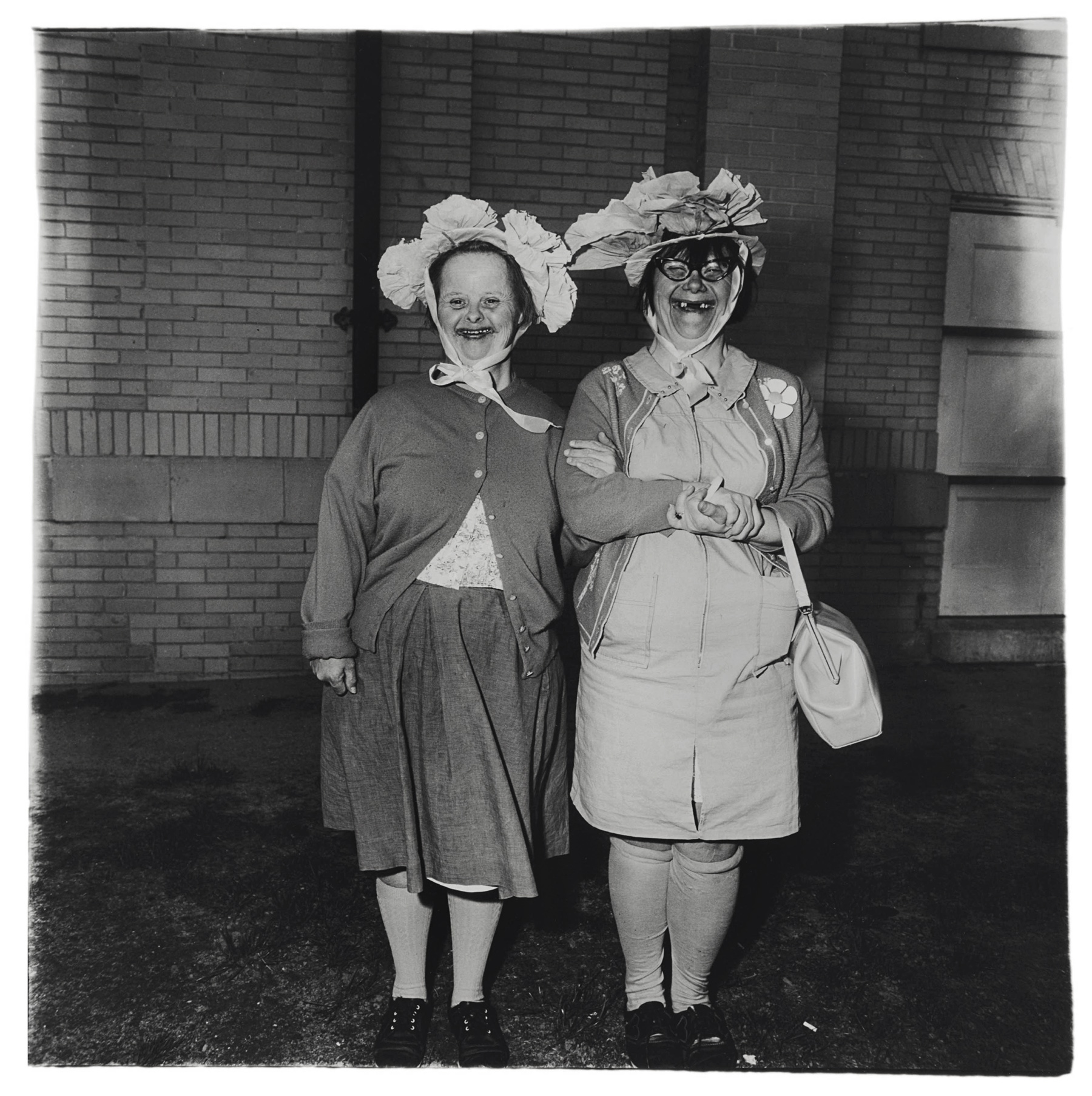
One of National Museum Cardiff’s main art exhibitions in 2009 reveals the work of legendary New York photographer Diane Arbus (1923 -1971), who transformed the art of photography. Diane Arbus, which comprises 69 black and white photographs including the rare and important portfolio of ten vintage prints: Box of Ten, 1971, is one of the best collections of Arbus’s work in existence. A large selection of these images will be on display at the Museum from 9 May until 31 August 2009.
Capturing 1950s and 1960s America, Arbus is renowned for portraits of people who were then classed on the outskirts of society nudists, transvestites, circus performers and zealots. In one of her most famous works, Identical Twins, Roselle, NJ of 1967, the twins are photographed as if joined at the shoulder and hip with only three arms between them.
Her powerful, sometimes controversial, images often frame the familiar as strange and the strange or exotic as familiar. This singular vision and her ability to engage in such an uncompromising way with her subjects has made Arbus one of the most important and influential photographers of the twentieth century.
This singular vision and her ability to engage in such an uncompromising way with her subjects has made Arbus one of the most important and influential photographers of the twentieth century.
Text from the National Museum of Cardiff website [Online] Cited 18/05/2009. No longer available online
Diane Arbus (American, 1923-1971) A Jewish Giant at home with his parents in the Bronx 1967 Gelatin silver print
From 1969 to 1971 Arbus was absorbed in the creation of a limited edition portfolio, A box of ten photographs. The portfolio was intended to present her work as an artist in the manner of the special print editions offered by new artists’ presses such as Crown Point and Universal Limited Art Editions (ULAE). This group of pictures and its presentation was a very conscious statement of what she stood for, and how she regarded her own photography. The pictures range from the relatively early ones of the Nudists in their summer home and Xmas tree in a living room in Levittown, L.I., both of 1963; through the now iconic Identical twins, Roselle, N.J., 1967 and Westchester Couple sunning themselves on their lawn, to the later pictures of the Jewish giant, the Mexican Dwarf in his hotel room, N.Y.C. and the King and Queen of a senior citizens’ dance, N.Y.C., all of 1970. There is clearly an attempt to be representative of the general idea, the larger plan behind her work. There is also a significant stylistic range, from the graceful daylight in the picture of the older couple in the nudist camp, to the later picture of the elderly king and queen, whom she photographed with sharp flash. She included Xmas tree, a work without human subjects. The prints for this portfolio were selected three years after the New Documents exhibition, before there was thought of another show. But the pictures constituted a kind of exhibition in and of themselves, to be examined one at a time, rather than all at once. From her letters, we know that the idea of a clear box was very important; it was to serve as both a container and a display case allowing the owner to reorder and display the pictures easily. Just as she had wanted the black border of the print to show in the New Documents exhibition, here she wished to exhibit the entire print as it appeared on the photographic paper …
Most of the pictures in the portfolio either depict families or refer to the family. Even the corner of the cellophane-looking room in Levittown is made by peering over the two outstretched arms of a family armchair, posed like the trousered knees of the empty chair in the picture of the Jewish giant. The idea of the family album was a private but expressive metaphor for her. As in a family album, each member is part of the larger group; they are related, perhaps even tolerated, and harmony may be rare and perhaps even uninteresting. But they are all considered with the same intelligent and human regard. She photographed the Jewish giant as a mythic figure, enclosed in a modest Bronx living room, an unconventional member of an otherwise conventional family: ‘I know a Jewish giant who lives in Washington Heights or the Bronx with his little parents. He is tragic with a curious bitter somewhat stupid wit. The parents are orthodox and repressive and classic and disapprove of his carnival career…They are truly a metaphorical family. When he stands with his arms around each he looks like he would gladly crush them. They fight terribly in an utterly typical fashion which seems only exaggerated by their tragedy… Arrogant, anguished, even silly.’
Sandra S. Phillips, senior curator of photography at the San Francisco Museum of Modern Art from the book Diane Arbus Revelations.1
1/ Phillips, Sandra. “The Question of Belief,” in Diane Arbus Revelations. London: Random House, 2003, pp. 66-67.
Diane Arbus (American, 1923-1971) Mexican Dwarf in his hotel room, N.Y.C. 1970 Gelatin silver print
Diane Arbus (American, 1923-1971) Xmas tree in a living room in Levittown, L.I. 1963 Gelatin silver print
Exhibition dates: Grey Art Gallery, 12th May – 18th July, 2009; International Center of Photography, 15th May – 6th September, 2009
Fantastic to see such a talented artist, a truly ground breaking artist, get the recognition he so richly deserves!
Grey Art Gallery
John Wood (American, 1922-2012) Untitled 1986-1989 Stained gelatin silver print from paper stencil
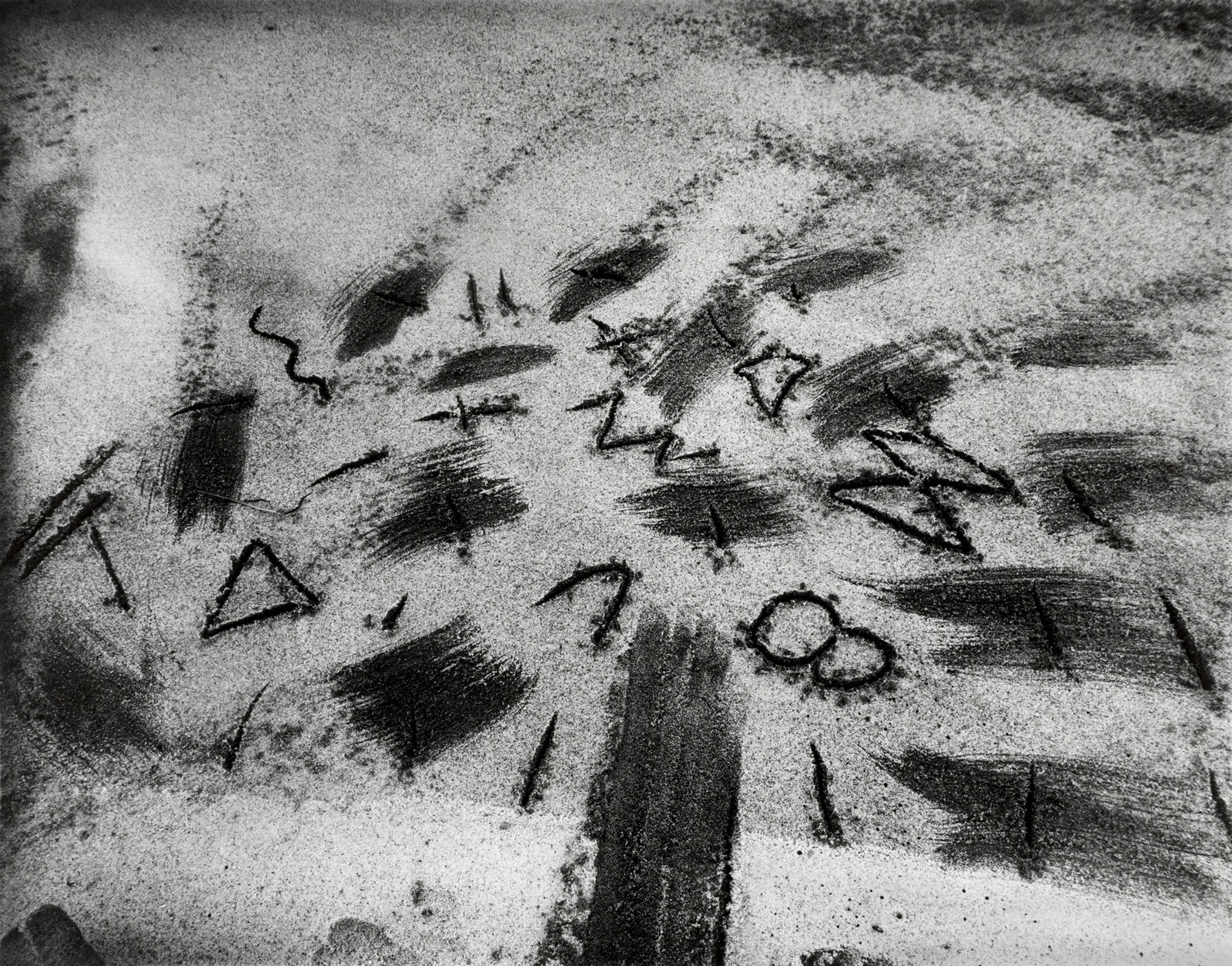
John Wood (American, 1922-2012) Beach Drawing 1983 Gelatin silver print 14 15/16 x 19 1/8″ (37.8 x 48.5cm)
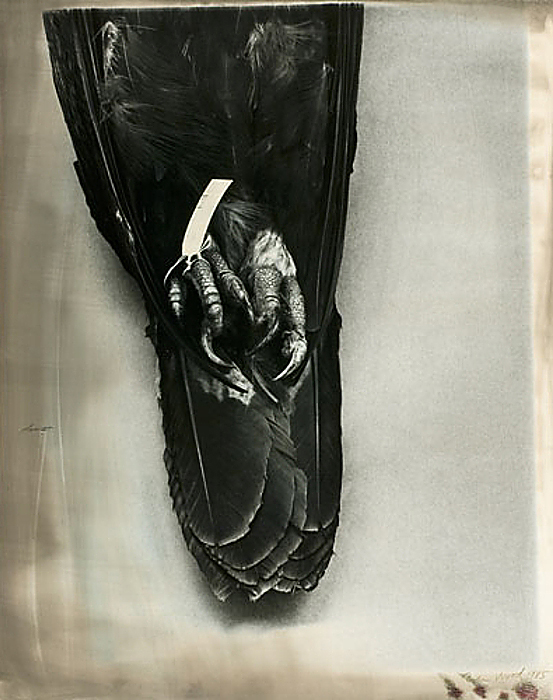
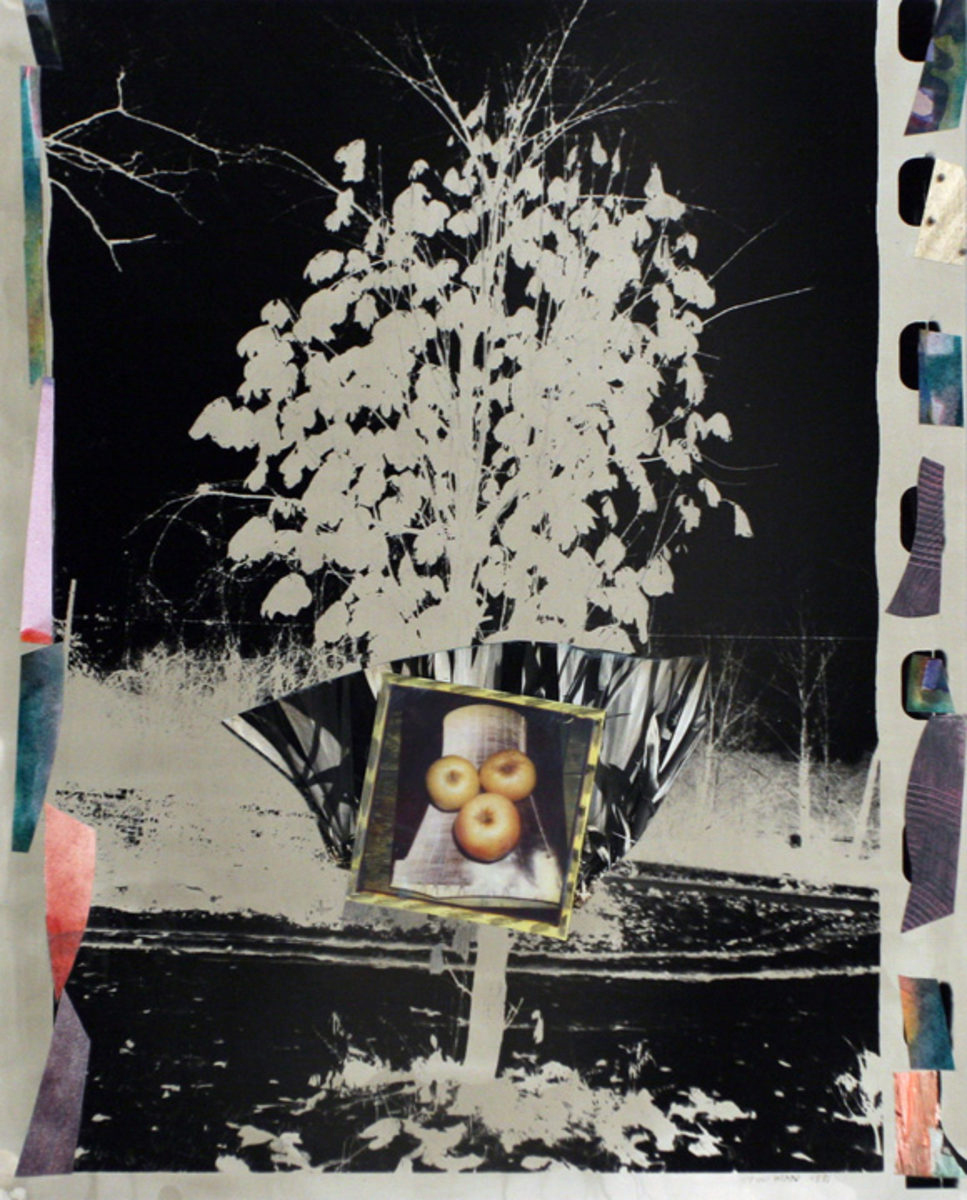
John Wood: On the Edge of Clear Meaning, on view at the Grey Art Gallery from May 12 through July 18, 2009, is the most comprehensive exhibition of the artist’s work to date. Featuring the full range of his career from the 1960s to the present, the show includes over 150 photographs, mixed-media works, and artists’ books. A selection of Wood’s photomontages, Quiet Protest, will be on view concurrently at the International Center of Photography.
John Wood (born 1922) has consistently challenged traditional photography, often incorporating painting, drawing, and collage as well as cliché verre, solarisation, and offset lithography. The artist emphasises the role of drawing in his work: “Mark making, calligraphy, the kinetic motion of the movement of the hand, are very important to me; probably more important than anything else.” Transgressing the boundaries of “pure photography,” his eclectic practice has helped usher in alternative approaches to the medium. With their adroit manipulations of picture and text, his diaristic, multi-media compositions anticipate today’s digital imagery. On the Edge of Clear Meaning is Wood’s first museum retrospective, spanning his career from the early 1960s to the present.
His early childhood was marked by the Depression, and his family moved frequently. After serving in the Army Air Corps as a B-17 pilot during World War II, he enrolled at the Institute of Design in Chicago. Wood trained as a visual designer and photographer, studying with Harry Callahan and Art Sinsabaugh to hone both conceptual and formal issues in his work. He left Chicago to teach photography and printmaking at the School of Art and Design at Alfred University in Alfred, New York, where he would live for thirty-five years. He now resides in Baltimore, Maryland with his wife, Laurie Snyder, who teaches photography at the Maryland Institute College of Art. They migrate each summer to their home and studio in Ithaca, New York.
In keeping with the Grey Art Gallery’s tradition of presenting the work of under-represented artists, this exhibition introduces John Wood as a master of various multi-media processes and testifies to his insatiable curiosity about new materials and repeated use of favourite sources. Through disciplined but lively investigation of different media, the artist eroded traditional definitions of photography and produced work that is both powerful and subtle. As Lynn Gumpert, Director of the Grey, notes, “John Wood has been a life-long teacher, inspiring and training numerous students, artists, and arts professionals. We are honoured to bring the breadth of his work to New York City, home to many art schools, colleges, and universities.”
Text from the Grey Art Gallery website and press release [Online] Cited 10/05/2009. No longer available online
John Wood (American, 1922-2012) Eagle Pelt 1985 Gelatin silver print 20 1/8 x 15 3/8″
John Wood (American, 1922-2012) Pear Tree, Cooling Tower, and Apples 1991 Collage, gelatin silver print, Polaroid SX70, and paper 19 1/4 x 15 3/8″
John Wood (American, 1922-2012) Blackbird, Some Have Hunger 1986 Collage, cyanotype, and graphite 20 x 24″
International Center of Photography
Quiet Protest is a series of photographic works by the noted mixed media artist and educator John Wood, spanning a period from the 1960s through the 1990s. Part of a larger retrospective at New York University’s Grey Art Gallery, the “Quiet Protest” series explores political and social issues of the day through thoughtful photo montage pieces that exist in marked contrast to more traditional aggressive documentary photography. Rather than offering explanations or promoting solutions, Wood’s manipulated photographs present contemplative routes into issues ranging from the Vietnam War to domestic gun violence to ecological concerns. As Wood wrote in 1970, ” …maybe the time has come for creative photography to encompass the large problems without propaganda or journalism…”
Text from the International Center of Photography website [Online] Cited 10/05/2009. No longer available online
John Wood (American, 1922-2012) Rifle, Bullets and Daises 1967
John Wood (American, 1922-2012) Triangle in the Landscape: Eleven Second 90 Degree Turn of a Paper Triangle August 6, 1985 (Hiroshima Day)
John Wood (1922-2012)
John Cheney Wood (July 10, 1922 – July 20, 2012) was an American artist and educator who challenged traditional photography and often incorporated other mediums into his work. He was born in California in 1922. In 1943 he volunteered for the Army Air Corps, where he served as a B-17 pilot until 1945. At the time of his death he lived in Baltimore, Maryland, with artist Laurie Snyder.
Wood had the ability to work across a variety of artistic forms, from straight photography, collage, cliché verre, solarization, mixed media, offset lithography to drawing. Wood moved freely between conceptual and visual exploration, not adhering to a single style. Although he often raised questions about political, social and environmental issues, he avoided promoting personal solutions or adding narratives to the images. The artist instead preferred to focus on the viewer’s interpretation and the possibility for multiple meanings.
John Wood (American, 1922-2012) Loon, Drawer and Bomb 1987 Collage, cyanotype, and toned silver gelatin print
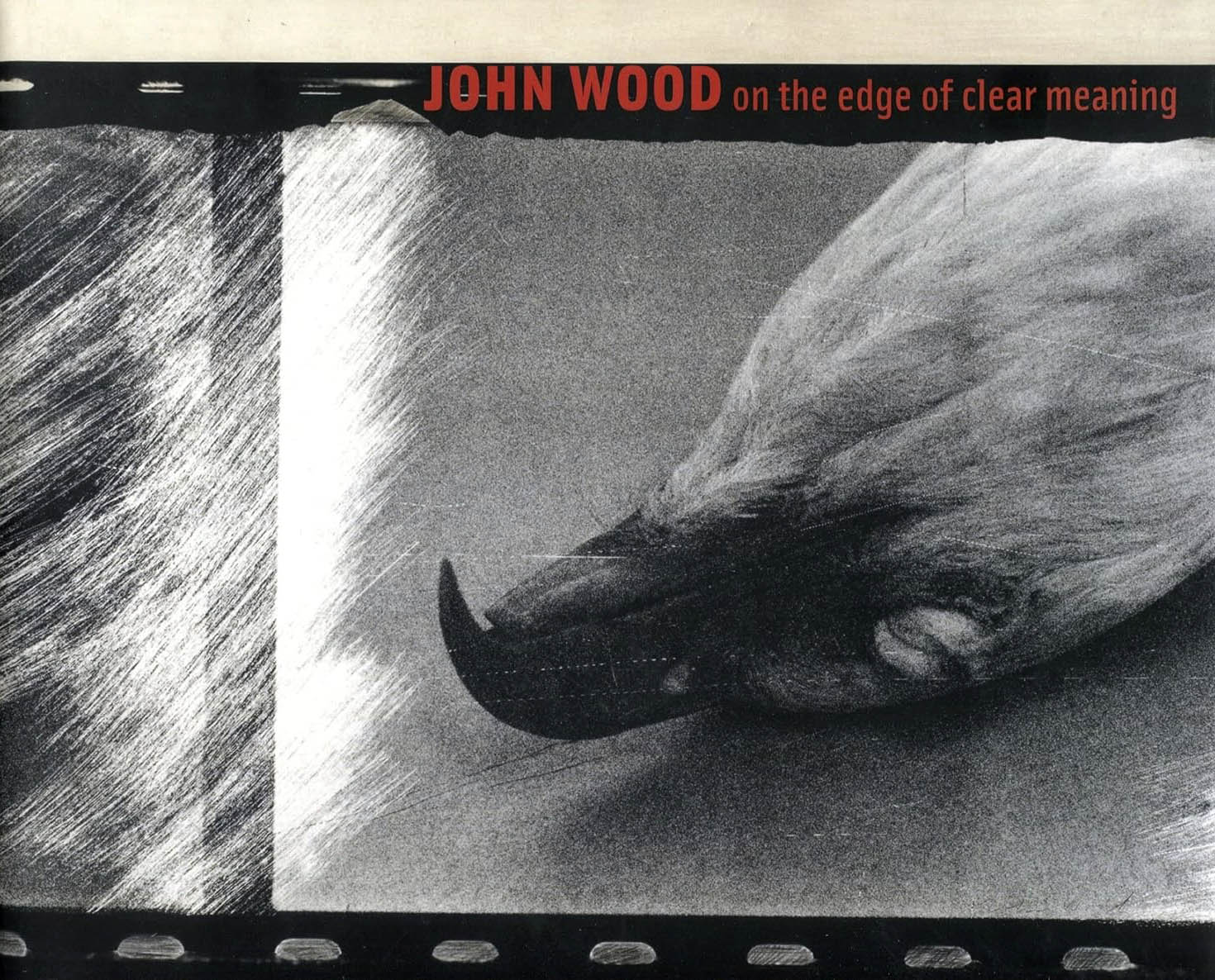
John Wood: On the Edge of Clear Meaning book cover
Book
In his introductory essay to this monograph – featuring the diverse photo practice that has characterised John Wood’s nearly 50-year career – David Levi Strauss states, “In photo-historical terms, Wood is thought of as one of those renegades who went against ‘pure photography’ by incorporating drawing, painting, collage and every other technique he could get his hands on (not to mention explicit political content), into his practice, thus ushering in the multi-media of the 1960s that caused crisis in ‘straight photography.’ Long before it became the signal medium of the avant-garde, collage was a folk art, practiced by children, lovers and grandmothers.” This comprehensive volume accompanies a retrospective that begins in Rochester, New York at The George Eastman House, The Memorial Art Gallery and the Visual Studies Workshop, then travels to The International Center for Photography and The Grey Art Gallery in New York before concluding at Syracus’ Light Work gallery.
John Wood: On the Edge of Clear Meaning by David Strauss et al (Hardcover) 2008
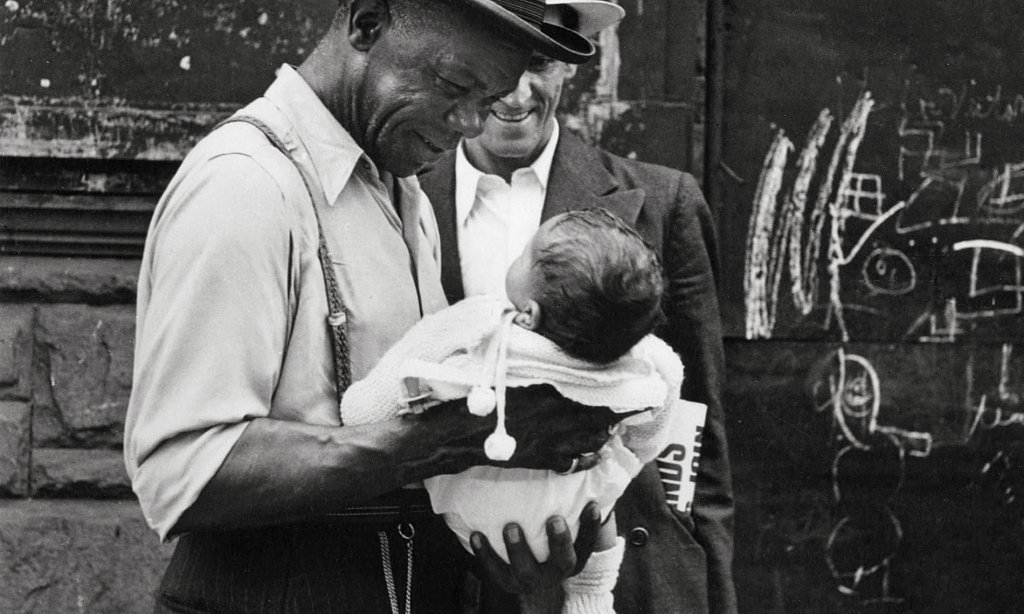
Helen Levitt (American, 1913-2009) New York, NY 1945 Gelatin silver print
Further to my earlier posting about the passing of renowned New York photographer Helen Levitt comes this wonderful exhibition at the Laurence Miller Gallery in New York. How I wish I was in that city to see it – what a joy!
Below are a selection of 1940’s black and white photographs from the exhibition.
Dr Marcus Bunyan
Many thankx to Laurence Miller Gallery for allowing me to publish the photographs in the posting. Please click on the photographs for a larger version of the image.
Helen Levitt (American, 1913-2009) Kids Dancing, New York c. 1940 Gelatin silver print
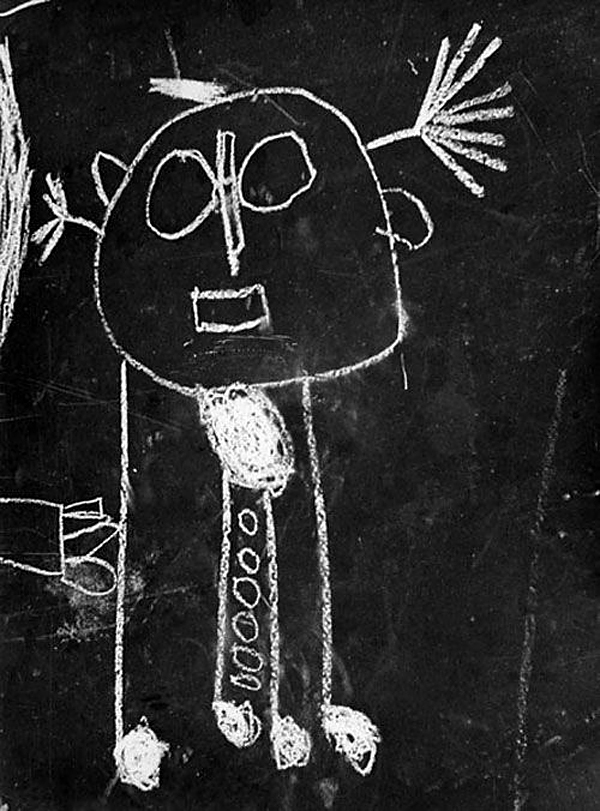
Helen Levitt (American, 1913-2009) Kids graffiti, New York c. 1938 Gelatin silver print
Laurence Miller Gallery will present a memorial tribute to Helen Levitt from May 9 – June 26, 2009. Helen Levitt passed away in her Greenwich Village home on March 29, at the age of 95. Ironically, or perhaps fittingly, a show of her work entitled Passages, which Helen had approved, was already in the works, and her death caused a momentary pause in how to proceed. It was decided that Helen would not have wanted her passing to intrude upon best laid plans. Hence, guided by her spirit, we celebrate her legacy with this exhibition, her twelfth at Laurence Miller Gallery.
Helen Levitt: A Memorial Tribute will present a series of passages, in both colour and black-and-white, from her extraordinary 70-year career. Featured will be her pictures of animals, which were among her earliest as well as last pictures taken; a little-known series of portraits taken on the subway using Walker Evans’ camera; children’s street drawings; elderly folks in conversation; and children at play, the photographs for which she is most well-known. Helen Levitt’s classic and rarely seen silent film, In the Street, from 1948, will be shown as well.
One of the tribute’s highlights will be a selection of never-before-exhibited “first proofs.” These early documents of her working methods are often unique. Some are vintage, others were printed as late as the 1970’s, but all were printed by Helen in her bathroom that doubled as the darkroom. Often they are variants of iconic images, and often they are sequences of several shots taken at the same time. They all reveal the photographer’s “dance” as she observes boys climbing up a tree, a large family gathering on the front stoop, two men seated beside a curious cat, or four boys peering into a pool hall. In combination with the film In the Street, the early sequences reinforce her reputation as a cinematographer, and are genuine and valuable records of the working methods of a canny and poetic photographer.”
Text from the Laurence Miller Gallery website [Online] Cited 12/05/2009. No longer available online
In the Street 1948 Directed and edited by Helen Levitt Cinematography by NYC photographers James Agee, Helen Levitt, Janice Loeb Re-edited version rereleased by Levitt in 1952 with musical score by Arthur Kleiner 16mm film photographed in Harlem
Helen Levitt (American, 1913-2009) New York c. 1942 Gelatin silver print
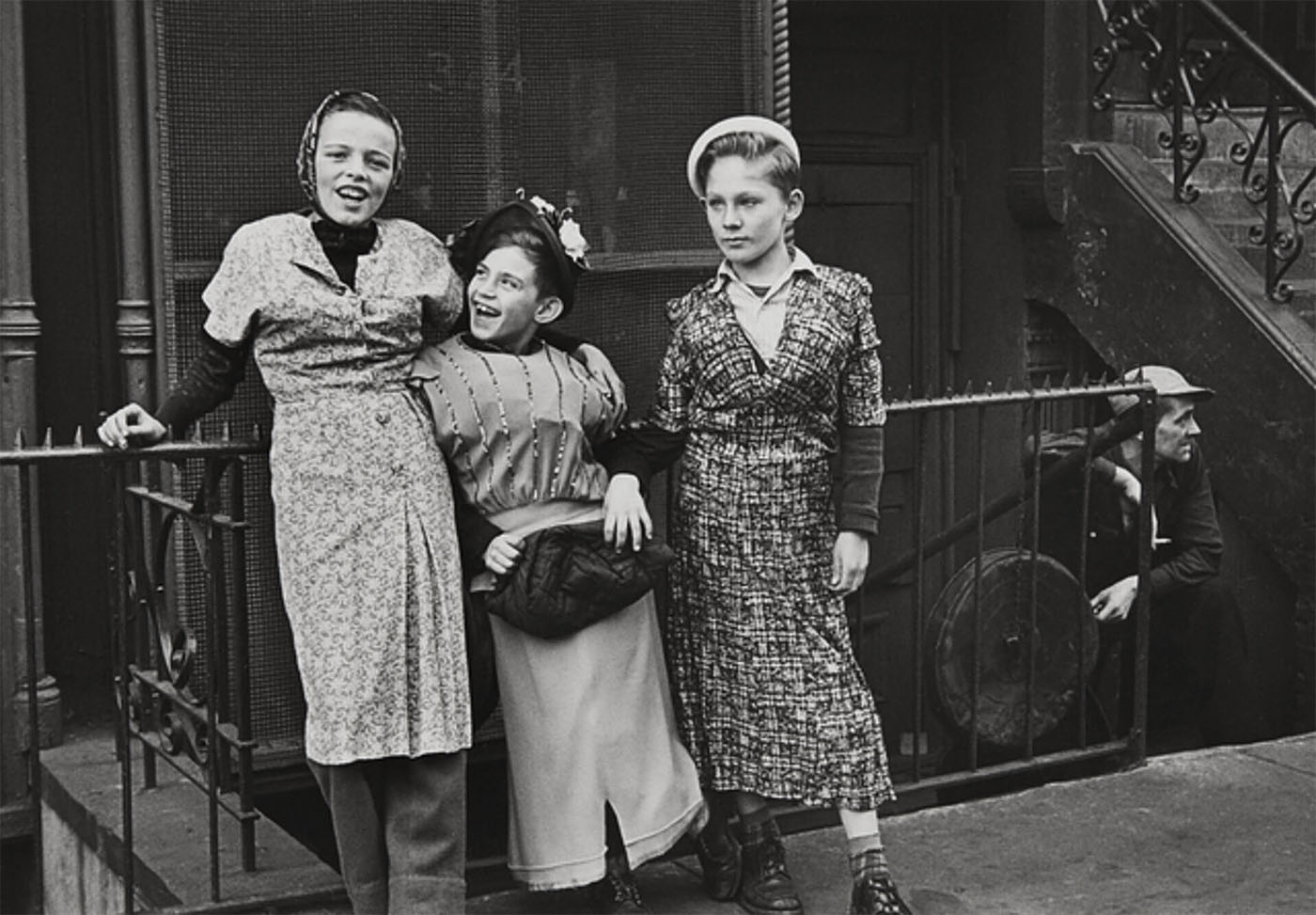
Helen Levitt (American, 1913-2009) Three Girls Playing Dress Up, New York c. 1940 Gelatin silver print
Helen Levitt (1913-2009) short biography
Helen Levitt’s playful and poetic photographs, made over the course of sixty years on the streets of New York City, have delighted generations of photographers, students, collectors, curators, and lovers of art in general. The New York Times described her as: “a major photographer of the 20th century who caught fleeting moments of surpassing lyricism, mystery and quiet drama on the streets of her native New York”. Throughout her long career, Helen Levitt’s photographs have consistently reflected her poetic vision, humour, and inventiveness as much as they have honestly portrayed her subjects – men, women, and children acting out a daily drama on the sidewalks and stoops of New York City’s tenements.
She shot and edited the film In the Street with Janice Loeb and James Agee, providing a moving portrait of her still photography. Levitt’s first major museum exhibition was at the Museum of Modern Art in 1943, and a second solo show, of colour work only, was held there in 1974. Major retrospectives of her work have been held at several museums: first in 1991, jointly at the San Francisco Museum of Modern Art and the Metropolitan Museum of Art in New York; in 1997 at the International Center for Photography in New York; and in 2001 at the Centre National la Photographie in Paris.
In 2007 “Helen Levitt: Un Art de l’accident poetique” opened at the Fondation Henri Cartier-Bresson in Paris; in 2008, the Sprengel Museum, Hannover, Germany chose Ms. Levitt as the recipient for the Spectrum International Photography Prize which was accompanied by a major retrospective; and FOAM Museum Amsterdam, mounted another major retrospective in October, 2008. She was a 2008 recipient of the Francis Greenburger award for excellence in the arts.
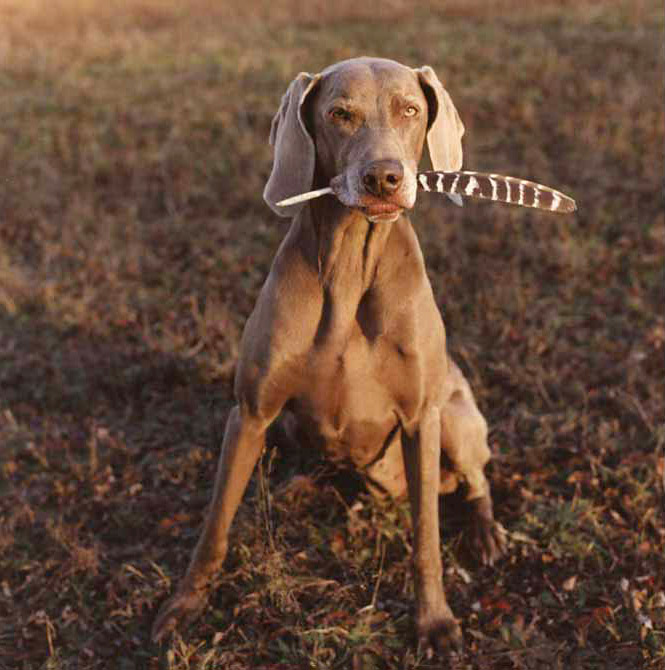
William Wegman (American, b. 1943) Front Facade 1993 Polaroid Courtesy of the artist
A selection of photographs of Fay by William Wegman. Gotta love that dog!
Marcus
Many thankx to the Akron Art Museum for allowing me to publish the photographs in the posting. Please click on the photographs for a larger version of the image.
William Wegman (American, b. 1943) Miss Mit 1993 Polaroid Courtesy of the artist
William Wegman (American, b. 1943) On Set 1994 Polaroid Courtesy of the artist
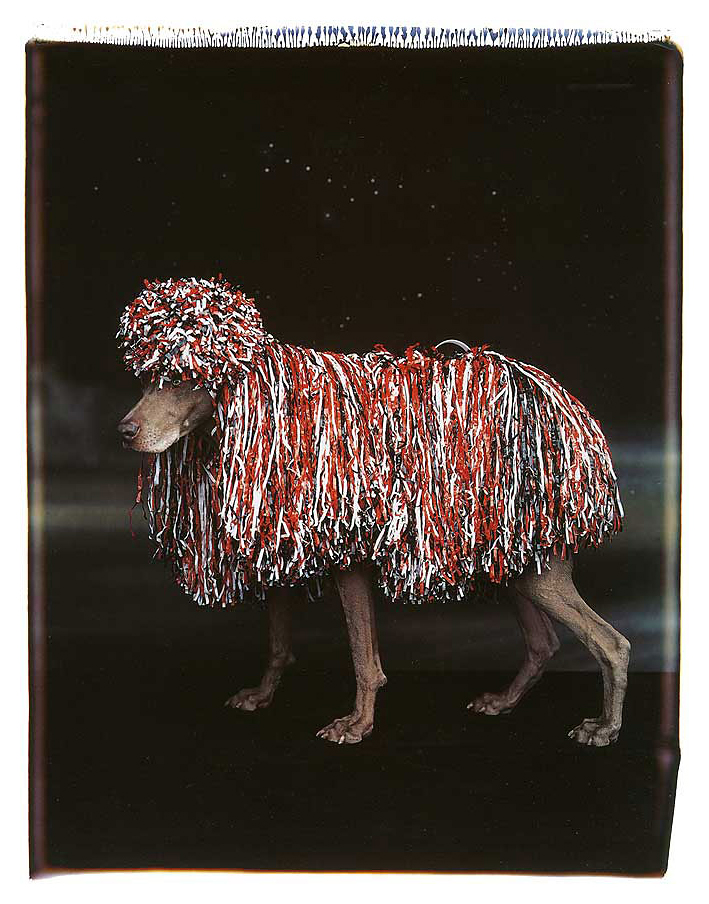
William Wegman (American, b. 1943) Patriotic Poodle 1994 Polaroid Courtesy of the artist
The Akron Art Museum is deeply honoured to be one of only two venues to present William Wegman: Fay, a wonderfully witty and moving exhibition about the artistic collaboration between William Wegman (b. 1943) and his celebrated Weimaraner Fay (1984-1995).
The breadth of Wegman’s audience is truly remarkable. In addition to being internationally renowned in art circles, he is one of the few artists to successfully disseminate his work – especially the photographs, videos and books featuring his beloved Weimaraner dogs – through the mass media.
Wegman is a conceptual artist who works in many different media. Born in Holyoke, Massachusetts, in 1943, he graduated from the Massachusetts College of Art in 1965 with a BFA in painting. Subsequently, he enrolled in the Masters painting and printmaking program at the University of Illinois. In 1970, he moved to southern California and began exhibiting his photographs. He was one of the earliest artists to explore video and has used photography for over four decades.
While living in California, Wegman acquired Man Ray, a Weimaraner whom he named after the surrealist French photographer. The dog became his partner in both life and art during their 12 year collaboration. Man Ray became so famous that, upon his passing, he was named ‘Man of the Year’ by the New York City newspaper The Village Voice.
Grief-stricken by Ray’s death, Wegman made the decision not to get another dog, but some years later he came to meet another Weimaraner:
“When we first met in Memphis, Tennessee, she was six months old and her name was Cinnamon Girl. I named her Fay after Fay Wray, of course, but also after my first colour Polaroid with Man Ray and the nail polish, which I had titled Fay Ray. Her fur was taupe, lighter and warmer-toned than Man Ray’s, and she had yellow eyes like in a Rousseau painting. I had no intention of photographing Fay. Man Ray was irreplaceable. I didn’t want to mar my memory of him.
… In a short time Fay matured from a coltish youth into a Garboesque beauty. My pictures grew with her. Now she was the muse, the adored one. Skin-deep beauty became the soul of my work.” ~ William Wegman, Polaroids, New York, 2002
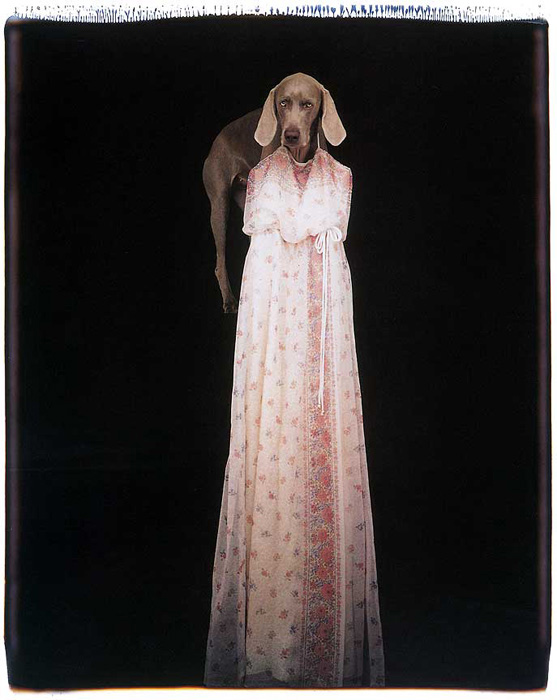
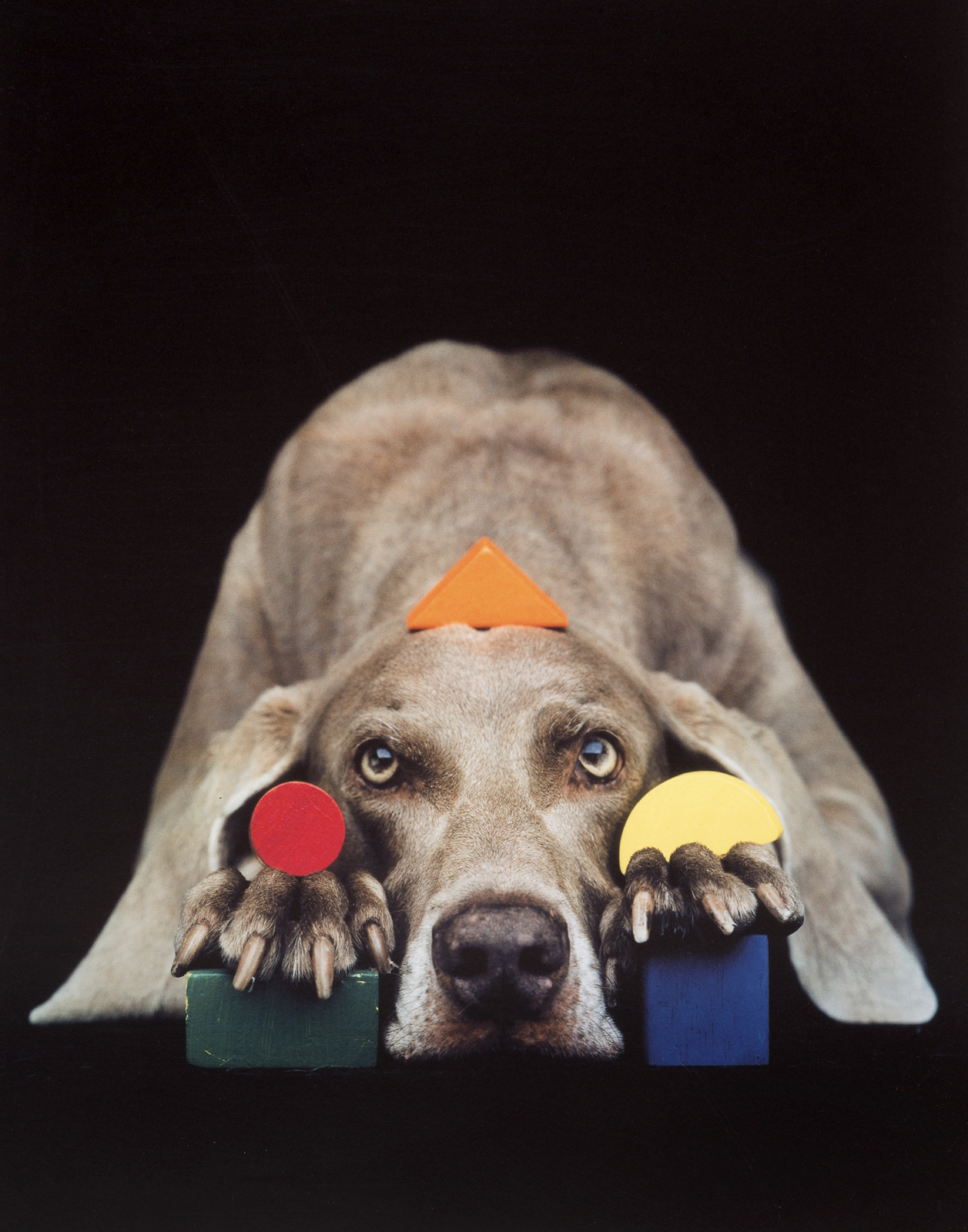
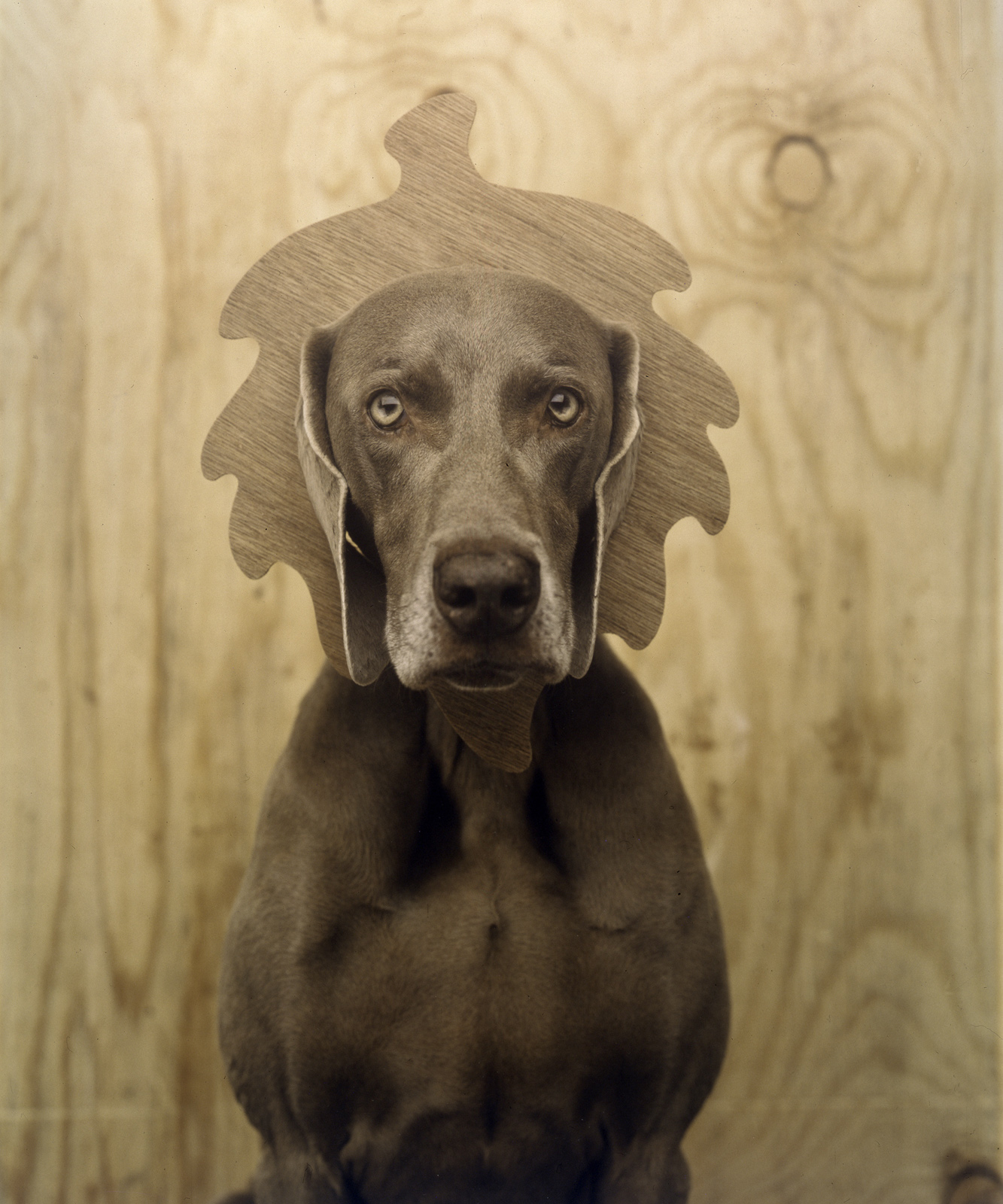
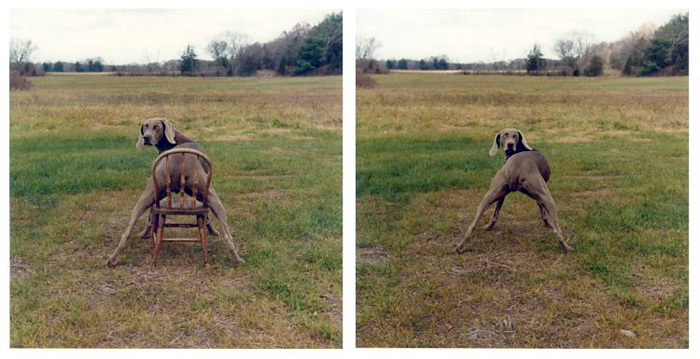
Fay had a chameleon-like quality very different from Man Ray’s concrete presence. The bond between the artist and his muse is undeniable. Images of Fay balanced upon an ironing boarding in Sphinx (1987) and coolly starting into the lens from beneath a black net in Netted (1988) show her deep trust in Wegman. His work with Fay captures the canine in a spectrum of emotions. Her huge, expressive citron eyes convey in one shot tragedy and in the next, joy. A series of photographs show Fay swathed in human clothing, posed as a woman, with the human arms and legs of her co-model. The canine appears part human, her expression incredibly familiar. Fay also posed with a variety of props, from roller-skates to masks of fruit, flowers and other found objects.
The Akron Art Museum is fortunate to be able to include in this exhibition not just black and white photographs but also large format Polaroids and chromogenic (colour) prints, from the artist’s personal collection. In addition to 56 still photographs, extensive selections from Wegman’s videos featuring Fay will be on continuous view in the exhibition.”
Text from the Akron Art Museum website
William Wegman (American, b. 1943) Basic Shapes In Color 1993 Chromogenic colour print 24″ x 20″ Courtesy of the artist
William Wegman (American, b. 1943) Fay Ray 1988 Gelatin silver print 16.2 x 16.2cm. (6.4 x 6.4 in.) Courtesy of the artist
William Wegman (American, b. 1943) Oaken 1992 Chromogenic colour print Courtesy of the artist
William Wegman (American, b. 1943) Lawn Chair 1988 Chromogenic colour print Courtesy of the artist
William Wegman (American, b. 1943) Retriever 1994 Chromogenic colour print Courtesy of the artist
William Wegman (American, b. 1943) U-Tree 1992 Chromogenic colour print Courtesy of the artist
William Wegman (American, b. 1943) Untitled (Ghent Fay with Apples) 1990 Chromogenic colour print Courtesy of the artist
Akron Art Museum One South High Akron, Ohio 44308
Opening hours Wednesday, Friday, Saturday, and Sunday: 11.00am – 5.00pm Thursday: 11.00am – 8.00pm Closed: Monday and Tuesday
Martin Smith (Australian, b. 1972) Hot/humid/oppressive/stifling/still 2009 Pigment print and collage 90 x 130cm
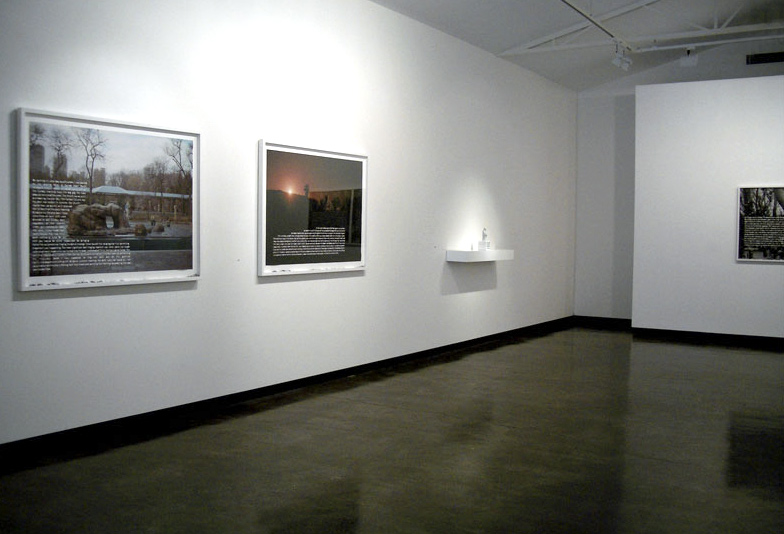
This is an interesting, well constructed exhibition of photographs, collage and sculpture by Martin Smith presented at Sophie Gannon Gallery, Melbourne that addresses issues of place and faith: memories of growing up within a religious framework. The work is well resolved, the themes explored are poignant, full of pathos, laden with sardonic humour and pull no punches.
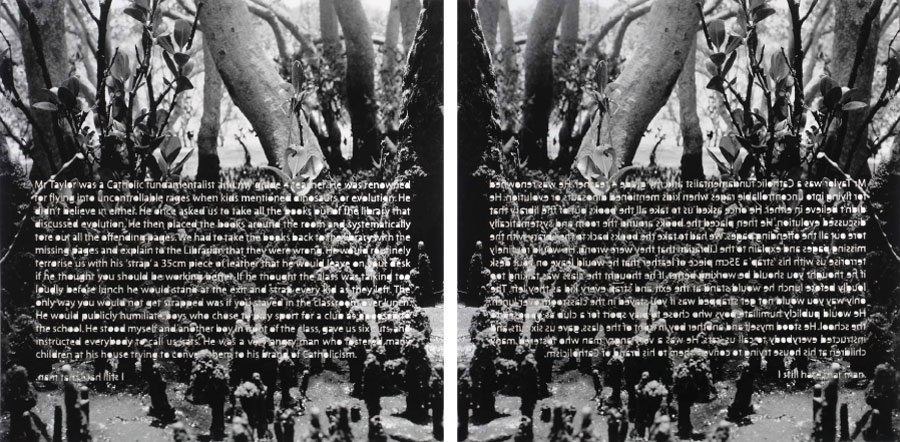
The main body of the exhibition are contemporary personal photographs of sunsets, landscapes and urban spaces (such as the photograph of Central Park in New York, above). Incised into the surface of the photograph, actually cut into the surface, are narratives of boredom, anger and the blind injustice of devotion, memories of stories of a fifteen year old boy. In some of the photographs the lettering follows the pictorial representation of the photograph, in others it overwrites it. The cut letters fall away to the bottom of the picture and are captured by the picture frame, sitting at the bottom of each image like the leaves of autumn – half remembered stories that become jumbled in the mind, played over and over again.
These images consolidate both photographic and written texts while at the same time undermining their veracity and referentiality. Image and text are performative, playing off of each other to provide a transgressive textuality that becomes a mode of agential resistance capable of fragmenting and releasing the subject. In this engagement between image and text the work becomes intertextual, the ritual of production engaging a network of texts, a discursive multiplicity that traverses the entire scope of social, cultural, and institutional production. The childhood taboo of not criticising ‘faith’ is cross/ed in the process of re-remembering, re-inscription.
In these assemblages the surface of the photograph and the body of the text are subverted through a ritualised cutting, like the incision of the stigmata into the body of Christ. They become sites of resistance. As Deleuze and Guittari have noted of this process the site of resistance is both a productive and disruptive re-territorialization and de-territorialization of meaning:
“For them (Deleuze and Guattari), assemblages are the processes by which various configurations of linked components function in an intersection with each other, a process that can be both productive and disruptive. Any such process involves a territorialization; there is a double movement where something accumulates meanings (re-territorialization), but does so co-extensively with a de-territorialization where the same thing is disinvested of meanings. The organization of a territory is characterized by such a double movement … An assemblage is an extension of this process, and can be thought of as constituted by an intensification of these processes around a particular site through a multiplicity of intersections of such territorializations.”1
The particular site, the particular intersection that Smith addresses in his work is that of memory, faith and place. The lack of fixity in this intersection provides the artist with abundant opportunity to reinscribe the already inscribed ritual of faith, subverting the iteration of the norms already attributed to it, providing a loss of original meaning and the gaining of new meanings. This productive, disruptive re-inscription provides the positionality of the work and the viewer struggles with the emotional conflicts that result from this territorialization: even if you don’t know these stories they challenge what you believe, now.
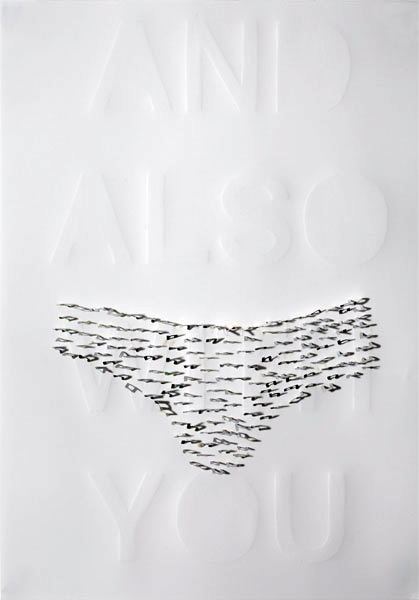
Counterbalancing the colour photographs are white collages that are embossed with the answer to the celebrants greeting “The Lord be with you” to which the people respond “And also with you.” Hovering in the background of the work the words are again subverted, this time in a resurrection of cut letters – instead of being cut into the photograph the letters project outwards towards the viewer forming commodified shapes such as cars, underpants and people. The joy doesn’t stop there: the two sculptures in the exhibition add to the chaos with a wonderful sense of humour.
Through their hypertexts the work “becomes more and more layered until they are architectural in design, until their relationship to the context from which they have grown cannot be talked about through the simple models offered by referentiality, or by attributions of cause and effect.”2
Without absolute attribution the work becomes a form of transubstantiation. The flexibility of memory and the orthodoxy of religion are transformed into a spirituality of the self that the child of fifteen with blood running down his arms from his personal stigmata of boredom could never have imagined. At the end of days, when all is said and done, the funny diatribes with their ambiguous photographs are homily and heretic, and together form a more inclusive body of bliss: ‘And also with you and you and you and you’.
Whatever your faith, whoever you are.
Dr Marcus Bunyan
1/ Wood, Aylish. “Fresh Kill: Information technologies as sites of resistance,” in Munt, Sally (ed.,). Technospaces: Inside the New Media. London: Continuum, 2001, p. 166
2/ Burnett, Ron. Cultures of Vision: Images, Media, & the Imaginary. Bloomington: Indiana University Press, 1995, pp. 137-138
Thank you to Edwin Nicholls for his help.
Martin Smith (Australian, b. 1972) Hot/humid/oppressive/stifling/still (detail) 2009 Pigment print and collage 90 x 130cm
In the above installation photograph you can just see the cut letters lying at the bottom of the picture frame
Martin Smith (Australian, b. 1972) I still hate that man 2009 Pigment print and collage 130 x 180cm
Martin Smith (Australian, b. 1972) My Frenetic, Anxiety Driven Snuffing 2009 Pigment print and collage 90 x 130cm
Artist statement
I grew up in the bayside suburbs of Brisbane, Australia with a speech impediment. My teenage years were spent watching and observing, as I was too embarrassed to speak. My inability to express myself during this time left an indelible mark on my personal history and has provided the impetus for my artistic enquiries. Therefore it is no surprise that my art practice is primarily about language and the modes of representation used to express and interpret personal experience.
Among the studio methodologies that I employ are the combination of traditional story telling writing with vernacular photography. The text and the images have no literal relationship and I am very careful to avoid any obvious connection between the two. I write personal stories then hand-cut the text out of the image. The removed letters from the image are collected and captured by the picture frame, sitting at the bottom of each image like fallen leaves creating an Autumnal scene where visible change has occurred and the picture and the figure are going through a transition. The text punctures the surface of the image disrupting the way we view and read the work. We can’t fully view the image because of the text and we can’t read the text without the image creating a constant back and forth between the two. When viewing the visual and textual oscillation between the two narrative devices that have no literal connection we find balance outside the picture frame in a new discursive space. It is through this collision of narrative and languages that unique interpretations of personal experience are built. I am interested in exploring spaces of meaning that are created when two or more narrative devices are blended.
In other works the letters are also glued directly onto the wall of the gallery to form recognisable but featureless figures. These installations explore how meaning and identity are generated through language. The individual letters (the building blocks of language) combine together to form a representation of a life that exists only through the formulation of language.
Recently I performed a stand-up ‘comedy’ routine as another vehicle for exploring story-telling and personal histories. The routine titled “Hello Newmarket Hotel” was performed at an ‘open mic’ night in front of a regular comedy audience. The aim was to recreate and recontextualise a particularly painful childhood memory while incorporating known ‘comedy’ tropes. This work along with my whole practice is interested in the role that photography, and other forms of narrative, plays in the construction of our identity and how personal histories are written and interpreted.
Martin Smith 2017
Martin Smith (Australian, b. 1972) The Relationship Blossomed 2009 Pigment print and collage 115 x 115cm
Martin Smith (Australian, b. 1972) The Relationship Blossomed (detail) 2009 Pigment print and collage 115 x 115cm
Martin Smith (Australian, b. 1972) The Homily 2009 Pigment print and collage 130 x 90cm
Martin Smith (Australian, b. 1972) And also with you #2 2009 Collage on paper, eva 42 x 30cm
Martin Smith (Australian, b. 1972) And also with you #3 2009 Collage on paper, eva 42 x 30cm
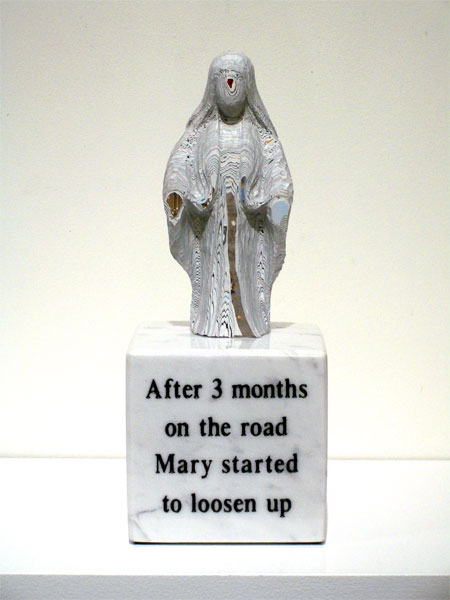
Martin Smith (Australian, b. 1972) After 3 months on the road Mary started to loosen up 2009 Photographic carving on marble base 18 x 10 x 10cm
Sophie Gannon Gallery 2, Albert Street Richmond, Vic 3121











![Judith Wright (Australian, b. 1945) 'Desire [14]' 2009 from the exhibition 'Desire' paintings and video by Judith Wright at Sophie Gannon Gallery, Melbourne, May - June, 2009](https://artblart.com/wp-content/uploads/2009/05/wright-desiresgg14-xlg.jpg "Judith Wright (Australian, b. 1945) 'Desire [14]' 2009 from the exhibition 'Desire' paintings and video by Judith Wright at Sophie Gannon Gallery, Melbourne, May - June, 2009")
![Judith Wright (Australian, b. 1945) 'Desire [5]' 2009 from the exhibition 'Desire' paintings and video by Judith Wright at Sophie Gannon Gallery, Melbourne, May - June, 2009](https://artblart.com/wp-content/uploads/2009/05/wright-desiresgg5-xlg.jpg "Judith Wright (Australian, b. 1945) 'Desire [5]' 2009 from the exhibition 'Desire' paintings and video by Judith Wright at Sophie Gannon Gallery, Melbourne, May - June, 2009")
![Judith Wright (Australian, b. 1945) 'Desire [7]' 2009](https://artblart.com/wp-content/uploads/2009/05/wright-desiresgg7-xlg2.jpg "Judith Wright (Australian, b. 1945) 'Desire [7]' 2009")
![Judith Wright (Australian, b. 1945) Desire [16]' 2009](https://artblart.com/wp-content/uploads/2009/05/wright-desiresgg16-xlg.jpg "Judith Wright (Australian, b. 1945) Desire [16]' 2009")
![Judith Wright (Australian, b. 1945) 'The Gift [2]' 2009](https://artblart.com/wp-content/uploads/2009/05/wright-the_gift2-xlg.jpg "Judith Wright (Australian, b. 1945) 'The Gift [2]' 2009")
![Judith Wright (Australian, b. 1945) 'The Gift [7]' 2008](https://artblart.com/wp-content/uploads/2009/05/wright-the_gift7-xlg.jpg "Judith Wright (Australian, b. 1945) 'The Gift [7]' 2008")
















![Helen Levitt (American, 1913-2009) 'New York [Children with Soap Bubbles, New York City]' c. 1940](https://artblart.com/wp-content/uploads/2009/05/helen-levitt-children-with-soap-bubbles-new-york-city-web.jpg "Helen Levitt (American, 1913-2009) 'New York [Children with Soap Bubbles, New York City]' c. 1940")









 Art Blart _ art and cultural memory archive
You must be logged in to post a comment.