Exhibition dates: 21st November 2009 – 3rd July, 2010
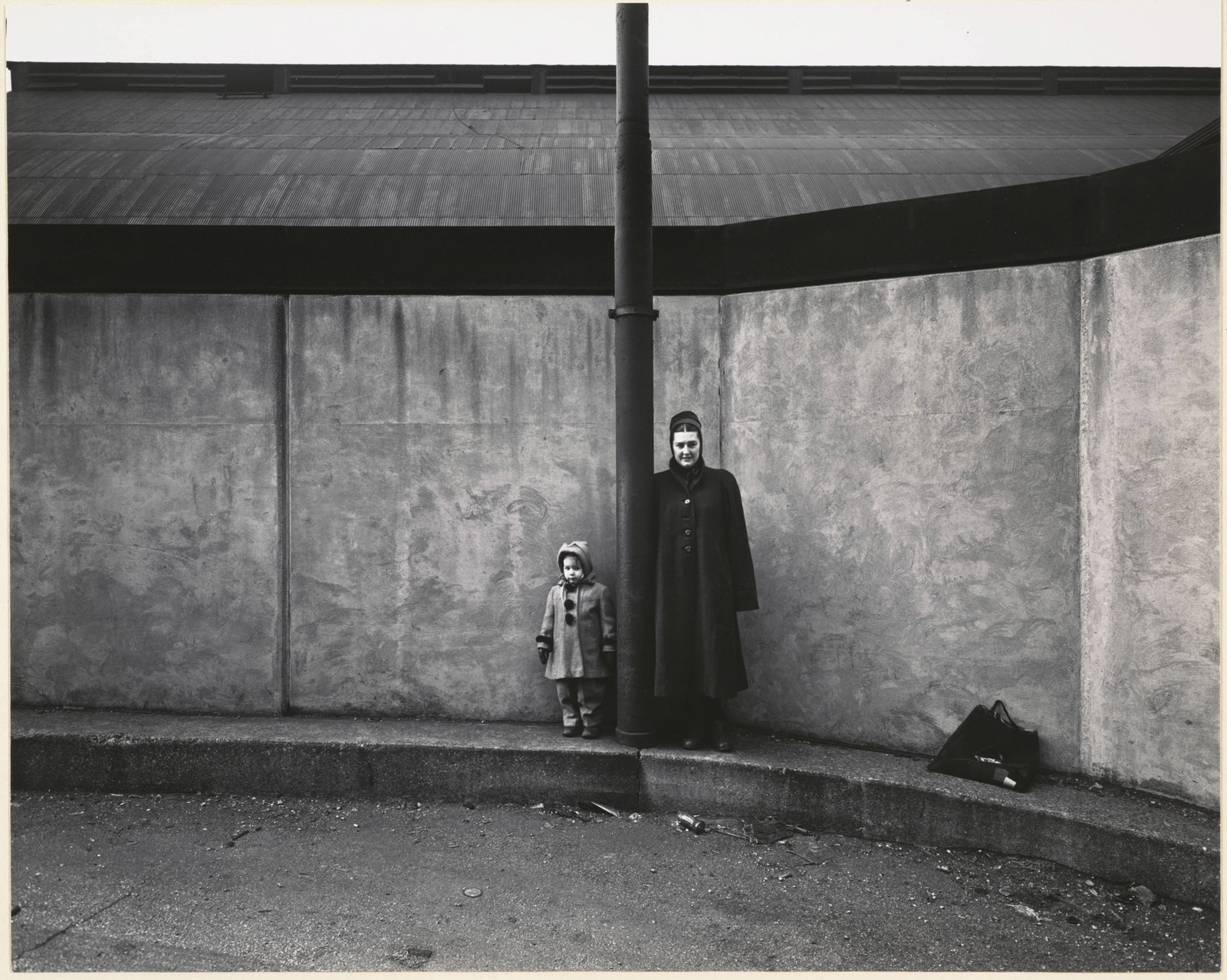
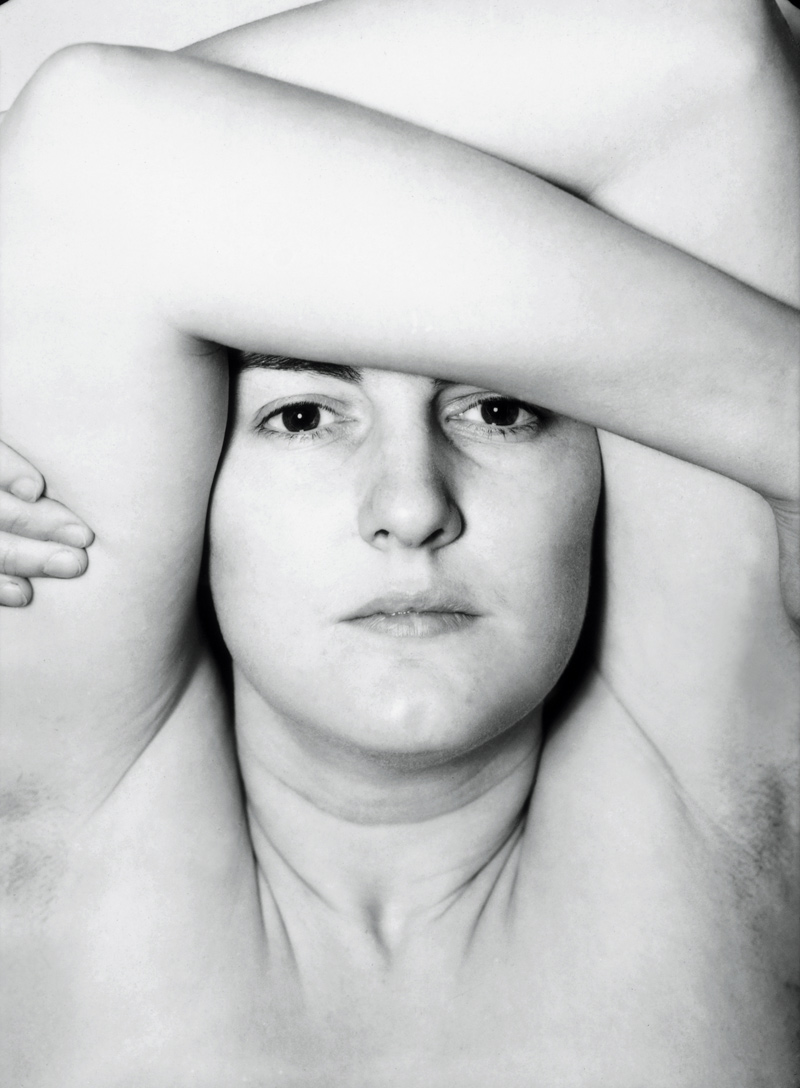
Harry Callahan (American, 1912-1999) Eleanor, Chicago 1949 Gelatin silver print Courtesy Museum of Fine Arts, Boston
I admire the use of strong horizontals and verticals in the work of Harry Callahan and the exquisite sense of space, stillness and sensuality he creates within the image plane. A true American master. Please click on the photographs for a larger version of the image.
Dr Marcus Bunyan
Many thankx to the Museum of Fine Arts, Boston for allowing me to publish the photographs in the posting. Please click on the photographs for a larger version of the image.
Harry Callahan (American, 1912-1999) Eleanor and Barbara 1953 Gelatin silver print Courtesy Museum of Fine Arts, Boston
Harry Callahan (American, 1912-1999) Eleanor and Barbara, Lake Michigan 1953 Gelatin silver print Courtesy Museum of Fine Arts, Boston
Harry Callahan (American, 1912-1999) Eleanor and Barbara c. 1954 Gelatin silver print Courtesy Museum of Fine Arts, Boston
Harry Callahan (American, 1912-1999) Eleanor, Chicago 1953 Gelatin silver print Courtesy Museum of Fine Arts, Boston
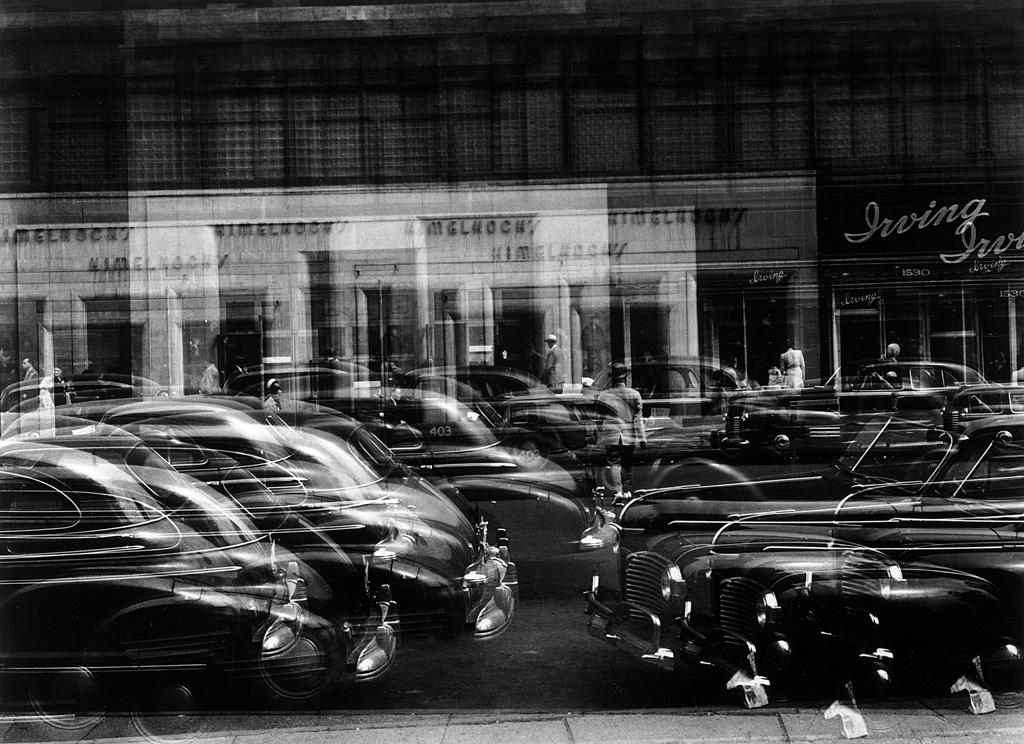
Harry Callahan (American, 1912-1999) Detroit 1943 Gelatin silver print Courtesy Museum of Fine Arts, Boston
The brilliant graphic sensibility of Harry Callahan (1912-1999), a major figure in American photography, is the focus of Harry Callahan: American Photographer at the Museum of Fine Arts, Boston (MFA). Debuting November 21, the exhibition features approximately 40 photographs that survey the major visual themes of the artist’s career. It celebrates the Museum’s important recent acquisitions – by both purchase and gift – of Callahan’s photographs and showcases significant examples of his artistry from the collections of friends of the MFA. The many sensitive pictures that Callahan made of his wife Eleanor, his depictions of passers-by on the street, his carefully composed landscapes and close-ups from nature, and experimental darkroom abstractions reveal a wide-ranging talent that was enormously influential.
“Harry Callahan was one of the most innovative photographers working in America in the mid 20th-century,” said Malcolm Rogers, Ann and Graham Gund Director of the MFA. “His elegantly spare, introspective photographs demonstrate his lyricism and the originality of his sense of design.”
The Detroit-born photographer, whose career spanned six decades, became interested in the camera in the late 1930s while working as a Chrysler Corporation shipping clerk. He was largely self-taught, and attracted admiration early on for his originality. By 1946, Callahan was hired as a photography instructor by the Hungarian-born artist László Moholy-Nagy for the Institute of Design, a Bauhaus-inspired school of art and design in Chicago. In 1961, Callahan was invited to head the photography program at the Rhode Island School of Design (RISD), where he was based until retiring to Atlanta two decades later.
“Harry Callahan’s approach helped shape American photography in the second half of the 20th-century,” said Anne Havinga, Estrellita and Yousuf Karsh Senior Curator of Photographs, who organised the exhibition. “His way of seeing inspired countless followers and continues to feel fresh today.”
Callahan concentrated on a handful of personal subjects in his work, exploring each theme repeatedly throughout his career. These include portraits of his wife Eleanor, depictions of anonymous pedestrians, expressive details of the urban and natural landscape, and experimental darkroom abstractions. The MFA exhibition is organised into five themes: Eleanor, Pedestrians, Architecture, Landscapes, and Darkroom Abstractions …
Press release from the MFA website [Online] Cited 20/06/2010. No long available online
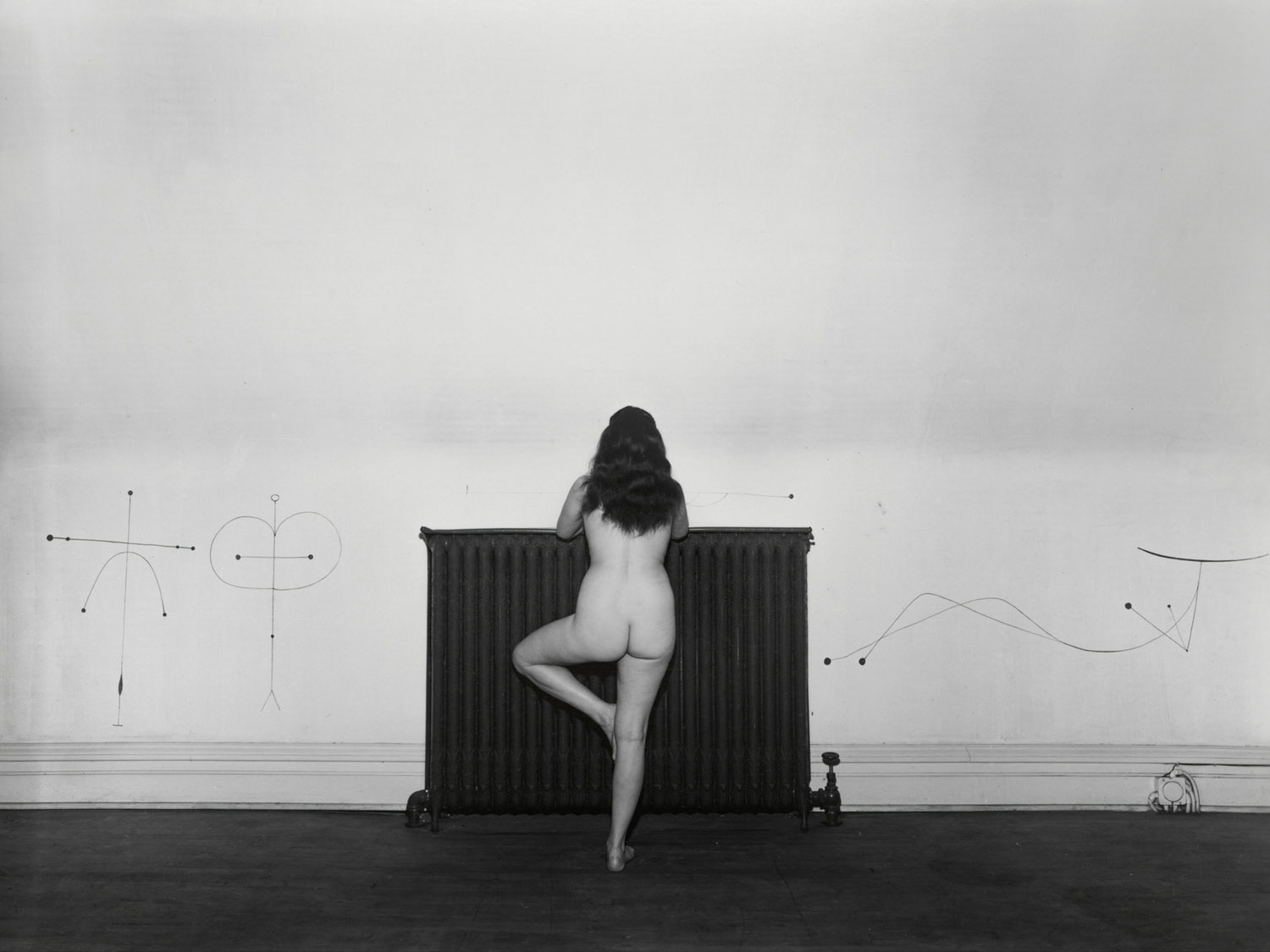
Harry Callahan (American, 1912-1999) Eleanor 1948 Gelatin silver print Courtesy Museum of Fine Arts, Boston
Harry Callahan (American, 1912-1999) Chicago 1950 Gelatin silver print Courtesy Museum of Fine Arts, Boston
Harry Callahan (American, 1912-1999) Eleanor, Chicago 1949 Gelatin silver print Courtesy Museum of Fine Arts, Boston
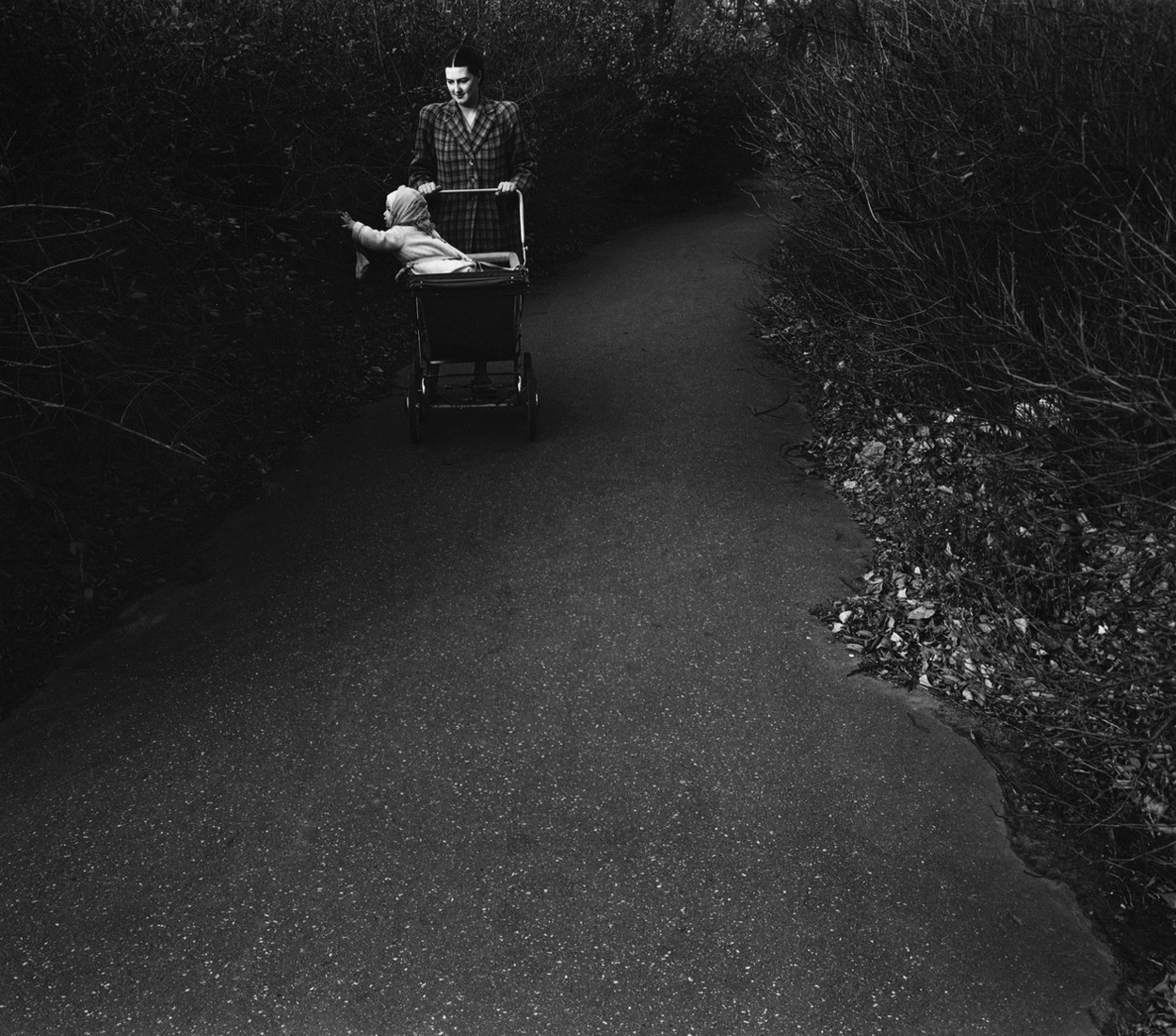
Harry Callahan (American, 1912-1999) Eleanor and Barbara (baby carriage) 1952 Gelatin silver print Courtesy Museum of Fine Arts, Boston
In 1936, around the time that Callahan began to explore photography, he married Eleanor Knapp, who served as one of his first and most frequent subjects. Callahan’s portraits of his wife, characterised by their intimate yet detached poetry, have become a landmark in the history of photography. In the photograph Eleanor (about 1948, see second photograph above), Callahan portrays his wife in a private interior setting, facing away from the camera. After the birth of their daughter Barbara in 1950, she too entered these family pictures, which capture the intimate moments of daily life as seen in the photograph, Eleanor and Barbara (1953, see photograph second from top).
Callahan photographed the natural landscape throughout his career, focusing on its evocative forms and textures. In images such as Aix-en-Provence, France (1957), he explored the visual effects that he could create either through high contrast or closely related tonalities. Callahan also utilised a range of different experimental darkroom techniques – from photographing the beam of a flashlight in a darkened room, to developing one print from multiple negatives. Many of his multi-exposure pictures were made by superimposing images from popular culture onto studies of urban life. Callahan’s openness to experimentation was stimulating for the many students who worked with him.
Callahan made many of his best known images during his 15 years in Chicago, where he also began his role as an influential teacher. During the 1950s, the photographer embarked on a series of close-ups of anonymous pedestrians in the streets of Chicago, most of them women. Using a 35mm camera with a pre-focused telephoto lens, he captured passersby unaware of his presence, resulting in snapshot-like images that record unsuspecting subjects absorbed in private thought or action, such as Chicago (1950, see photograph above), a close-up of a preoccupied woman’s face. Callahan returned to this theme frequently, working in both black and white and colour.
Callahan was repeatedly drawn to architectural and urban subjects. Prior to moving to Chicago, he explored the spaces of Detroit, photographing the formal patterns he discovered there. In Detroit (1943, see photograph above), Callahan depicts a street scene, with the people in transit appearing as a pattern. He experimented with colour in these pictures as early as the 1940s, but he worked more extensively in colour later in his career, from the 1970s onward.
Text from the Art Tatler website [Online] Cited 20/06/2010. No long available online
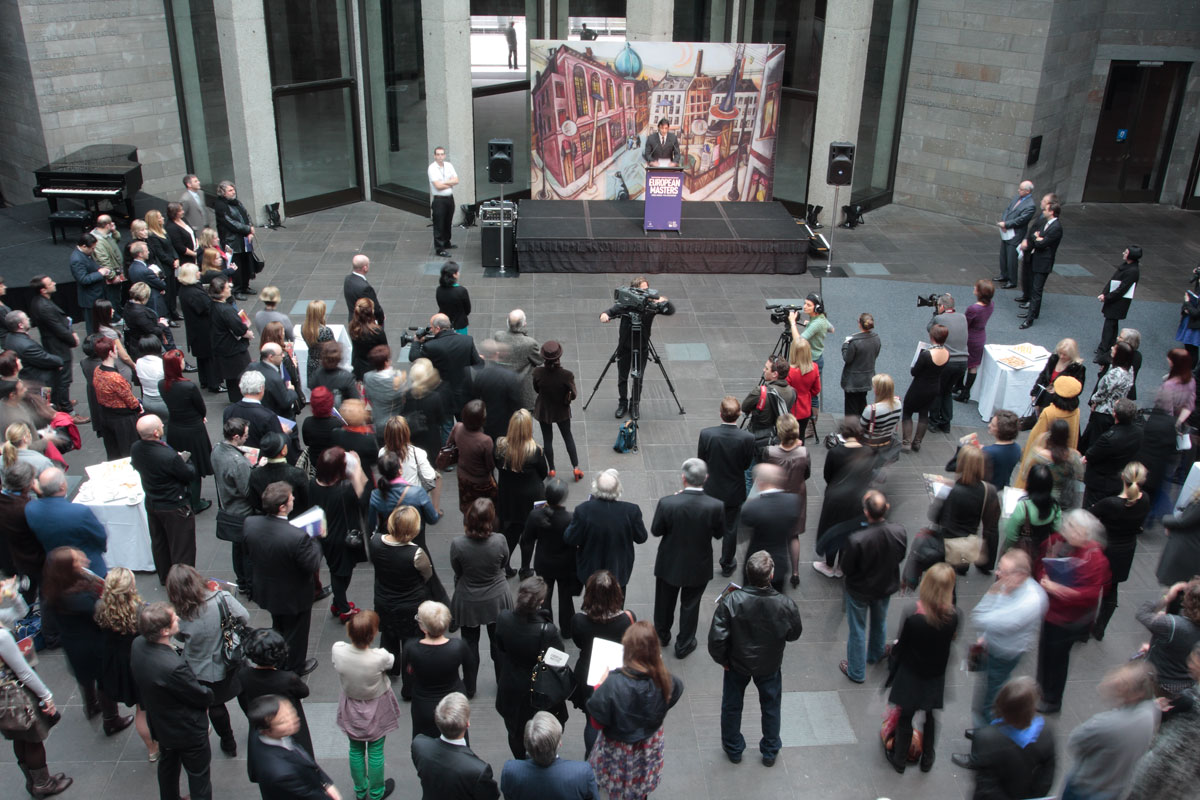
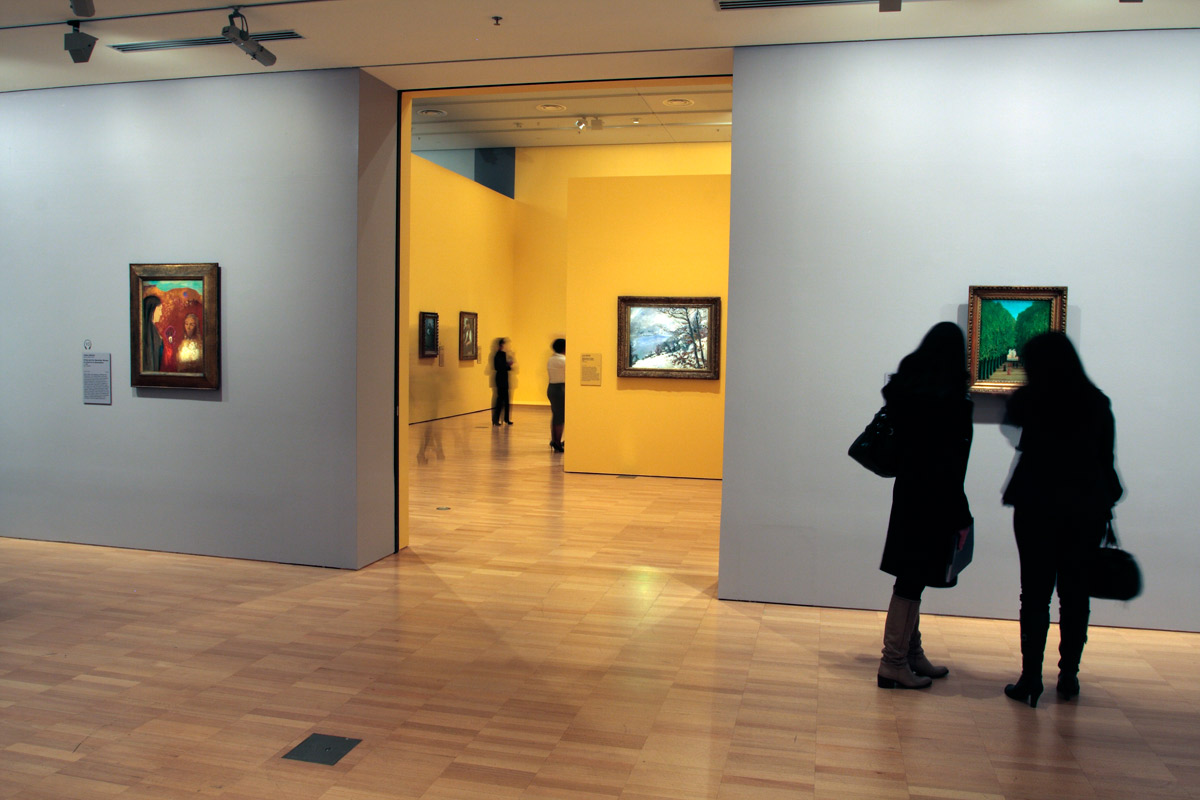
Media opening of European Masters: Städel Museum 19th – 20th Century, Winter Masterpieces at the National Gallery of Victoria Photo: Marcus Bunyan
A huge posting – and another ‘you saw it here first’ on Art Blart!
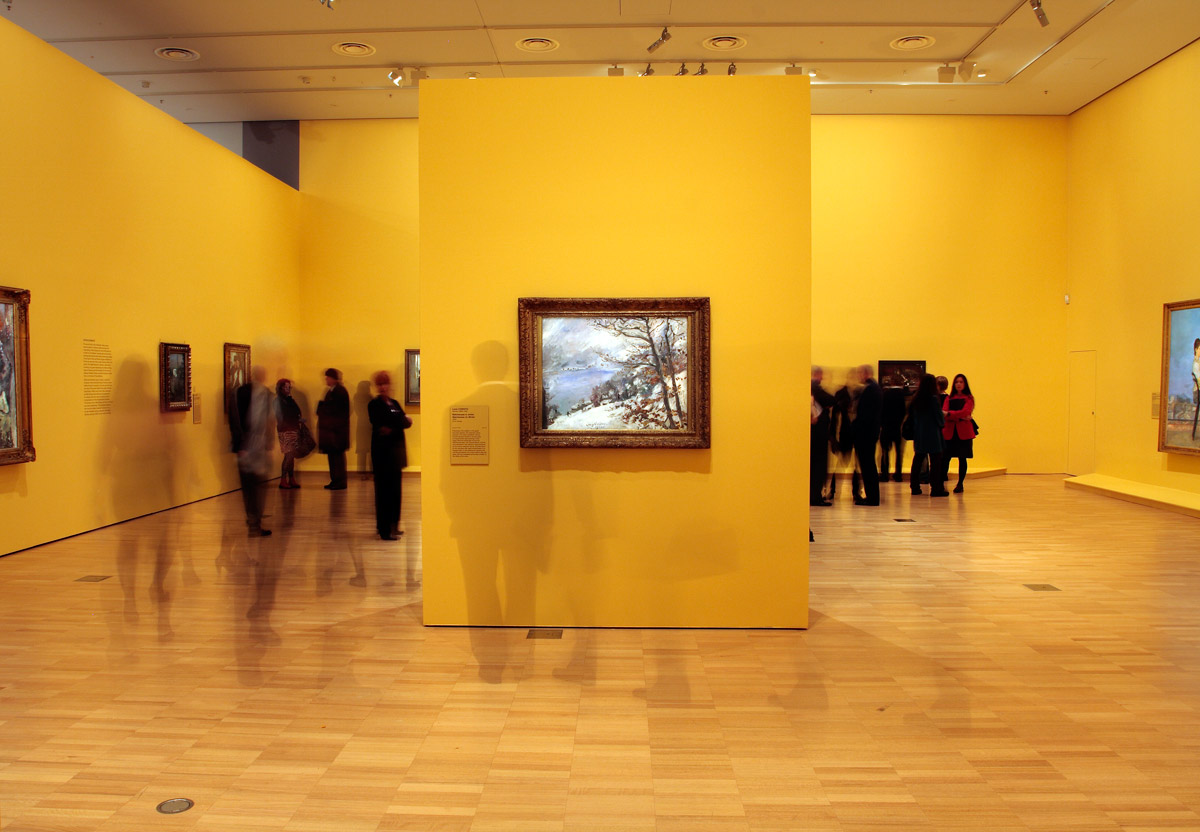
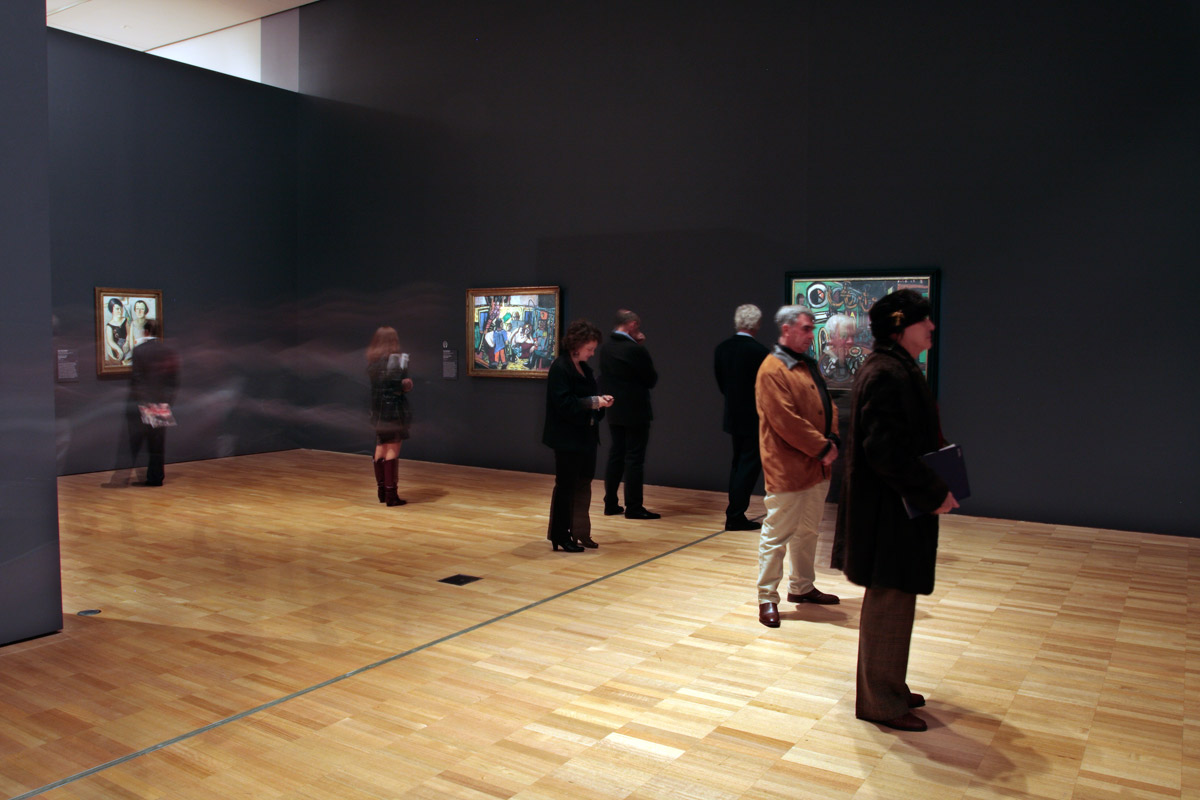
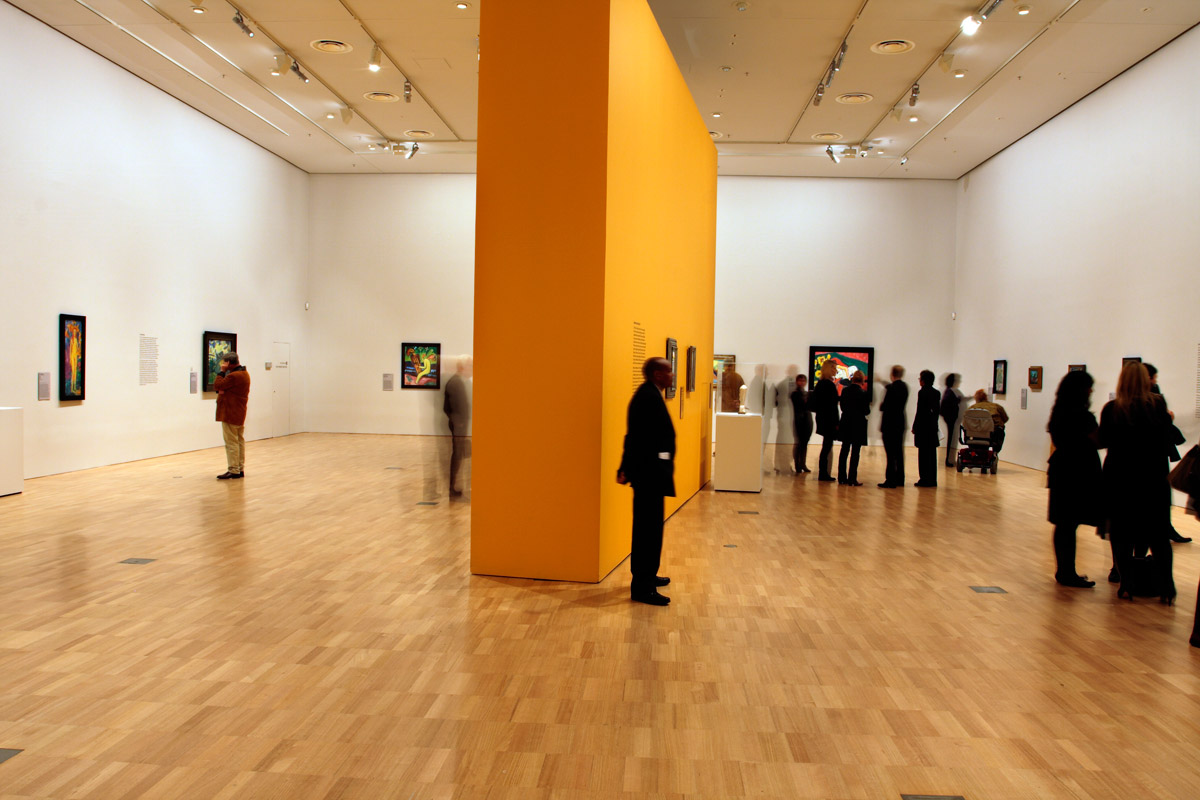
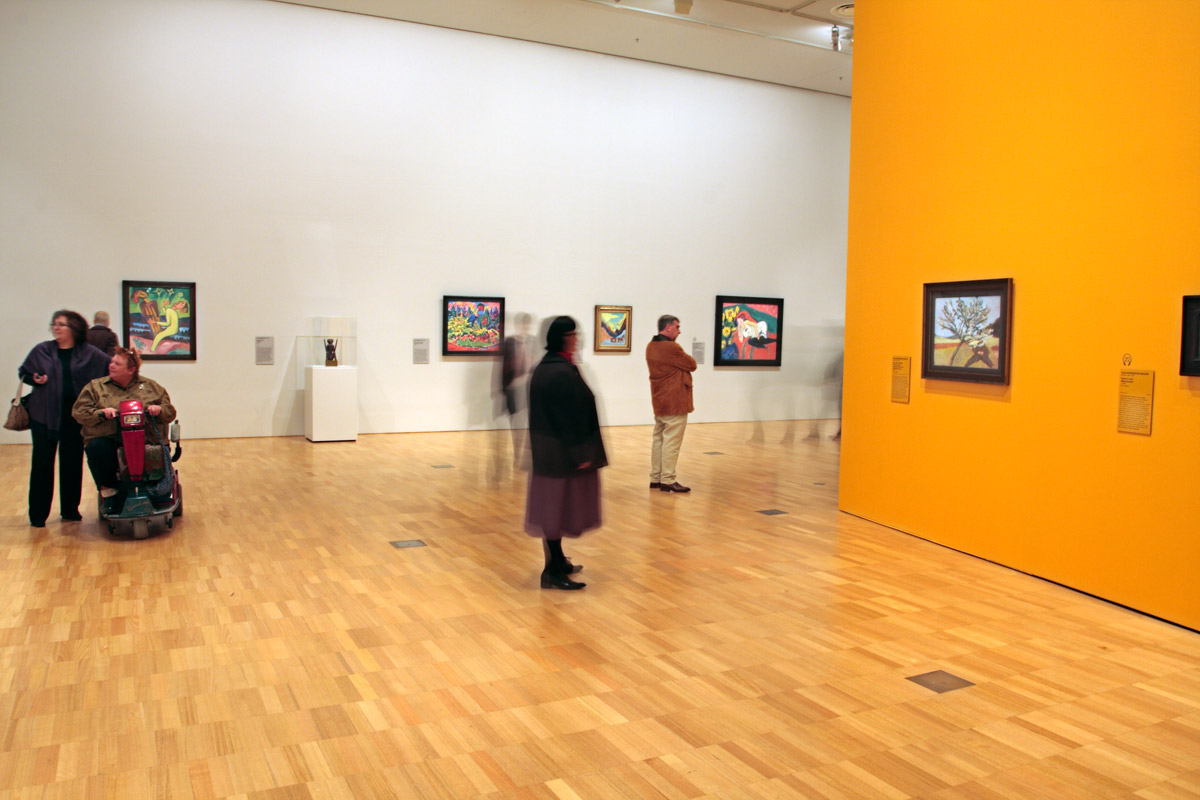
A simple, spacious hang shows off some wonderfully vibrant paintings in the new Winter Masterpieces blockbuster at the NGV. The use of strong yellow and pale grey wall colour compliments the paintings. Conversely, other rooms have a dark brown and very dark grey wall colour. Some people will like the effect but I found the dark grey a little too sombre and heavy in the room dedicated to the work of Max Beckmann. Overall a fantastic range of paintings, especially those by the German Expressionists and a luminous painting by Odilon Redon. To see them in Australia is a joy to behold.
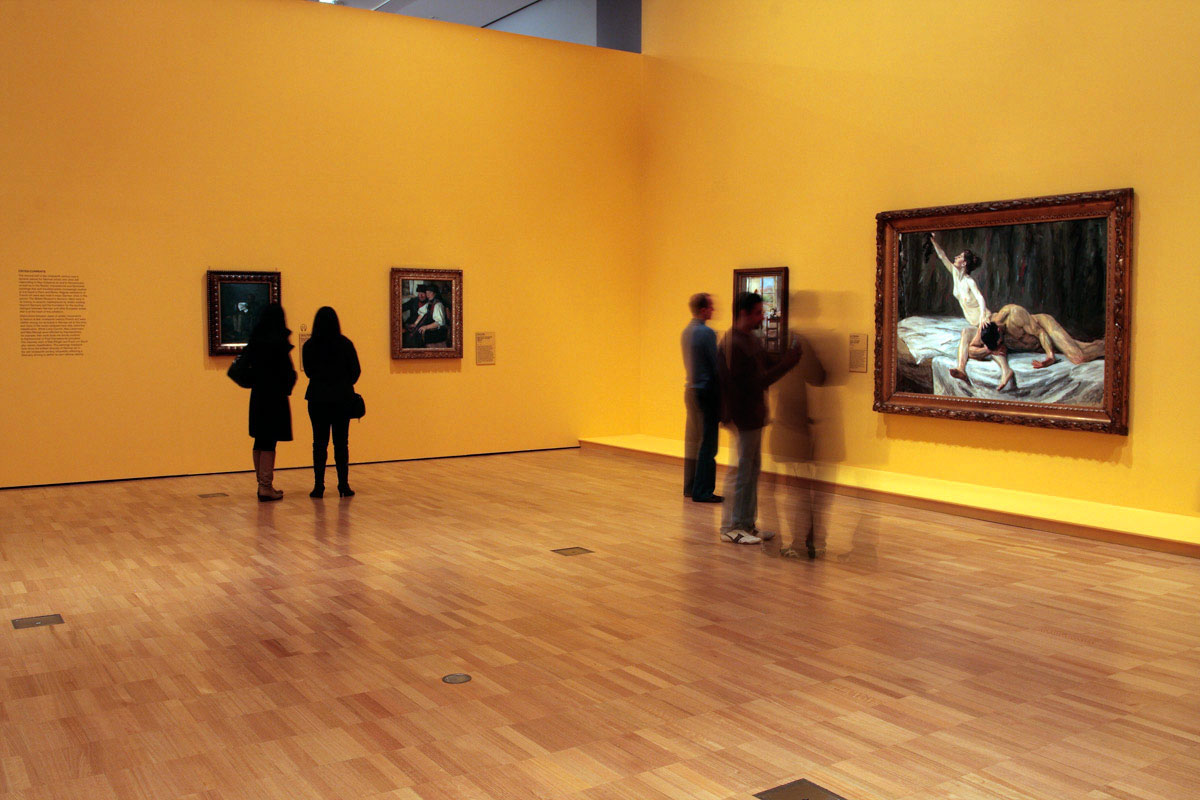
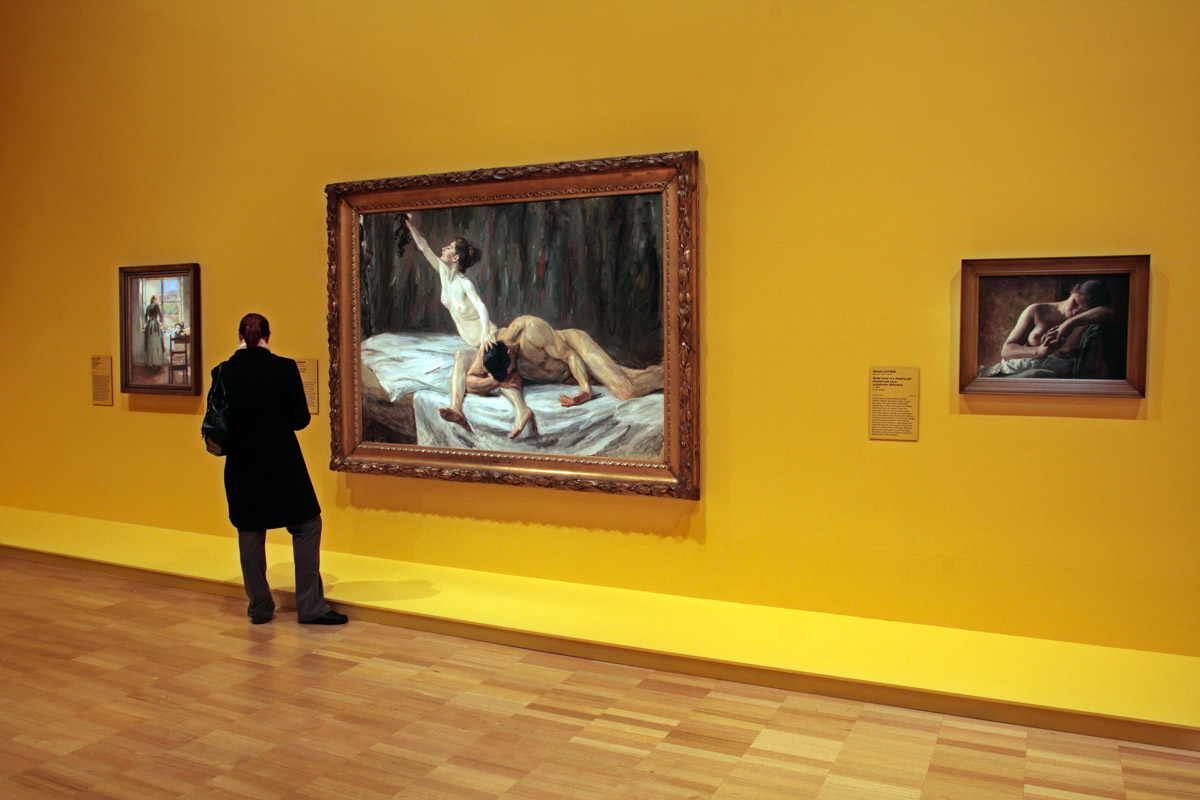
Note on the photographs: All the photographs were taken with a timed exposure with the camera on a tripod. While this leads to ghosting as people walk through the shot it also adds a sense of the exhibition as a living entity. I find it preferable to the use of flash photography as flash destroys any ambience that the rooms possess. The photographs are in chronological order, proceeding from the beginning of the exhibition to the end.
PS. Thankx to the many people who have emailed me saying that they love the photographs, especially to Sue Coffey who said the posting looked superb = it makes it all worthwhile!
Media opening of European Masters: Städel Museum 19th – 20th Century, Winter Masterpieces at the National Gallery of Victoria Photo: Marcus Bunyan
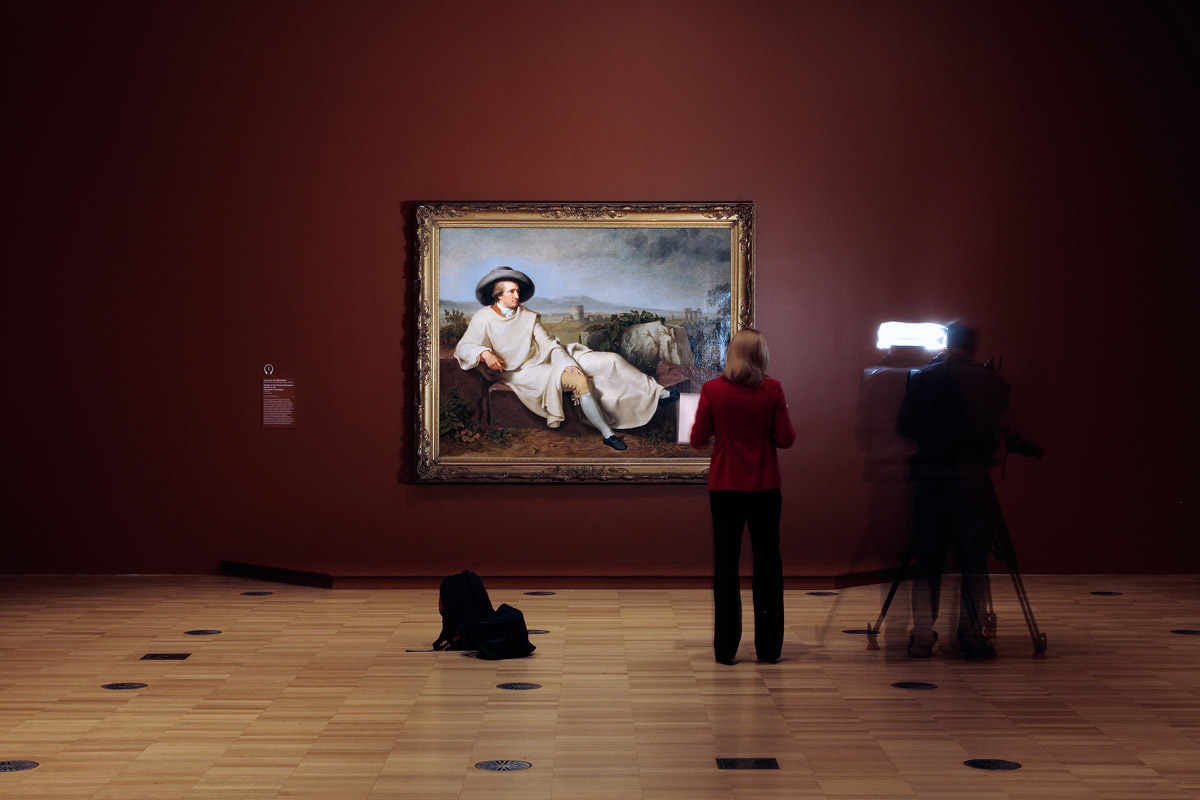
Installation views of Johann Heinrich Wilhelm Tischbei’s panting Goethe in the Roman countryside 1787 at the exhibition European Masters: Städel Museum 19th – 20th Century, Winter Masterpieces at the National Gallery of Victoria Photos: Marcus Bunyan
Johann Heinrich Wilhelm Tischbein (German, 1751-1829) Goethe in the Roman countryside (Goethe in der römischen Campagna) 1787 Oil on canvas 161.0 x 197.5cm Städel Museum, Frankfurt am Main Acquired in 1878 as a gift by Baroness Salomon von Rothschild
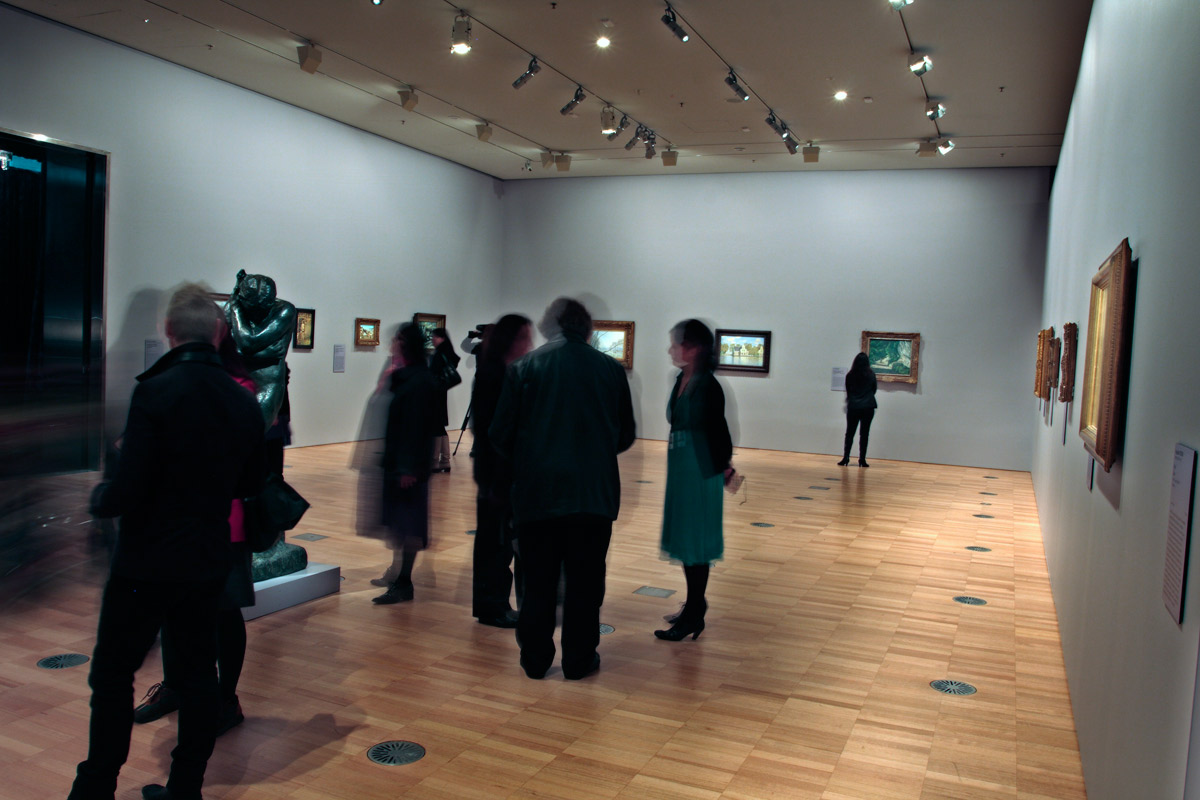
Installation view of the exhibition European Masters: Städel Museum 19th – 20th Century, Winter Masterpieces at the National Gallery of Victoria Photo: Marcus Bunyan
Installation views of Johann Heinrich Wilhelm Tischbei’s panting Goethe in the Roman countryside 1787 at the exhibition European Masters: Städel Museum 19th – 20th Century, Winter Masterpieces at the National Gallery of Victoria Photos: Marcus Bunyan
Installation views of the exhibition European Masters: Städel Museum 19th – 20th Century, Winter Masterpieces at the National Gallery of Victoria Photos: Marcus Bunyan
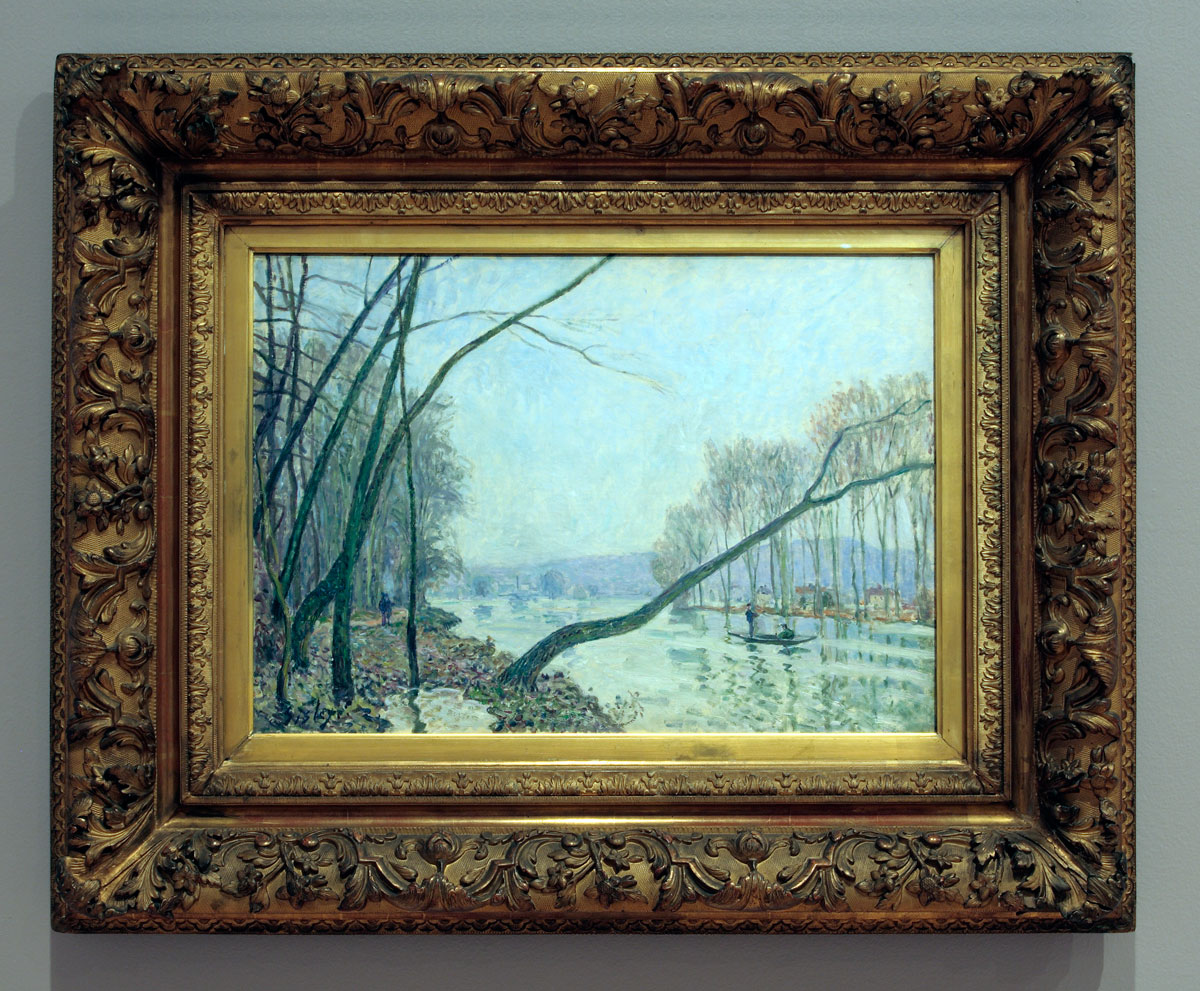
Alfred Sisley (English, 1839-1899) Banks of the Seine in Autumn (installation view) 1879 Oil on canvas Photo: Marcus Bunyan
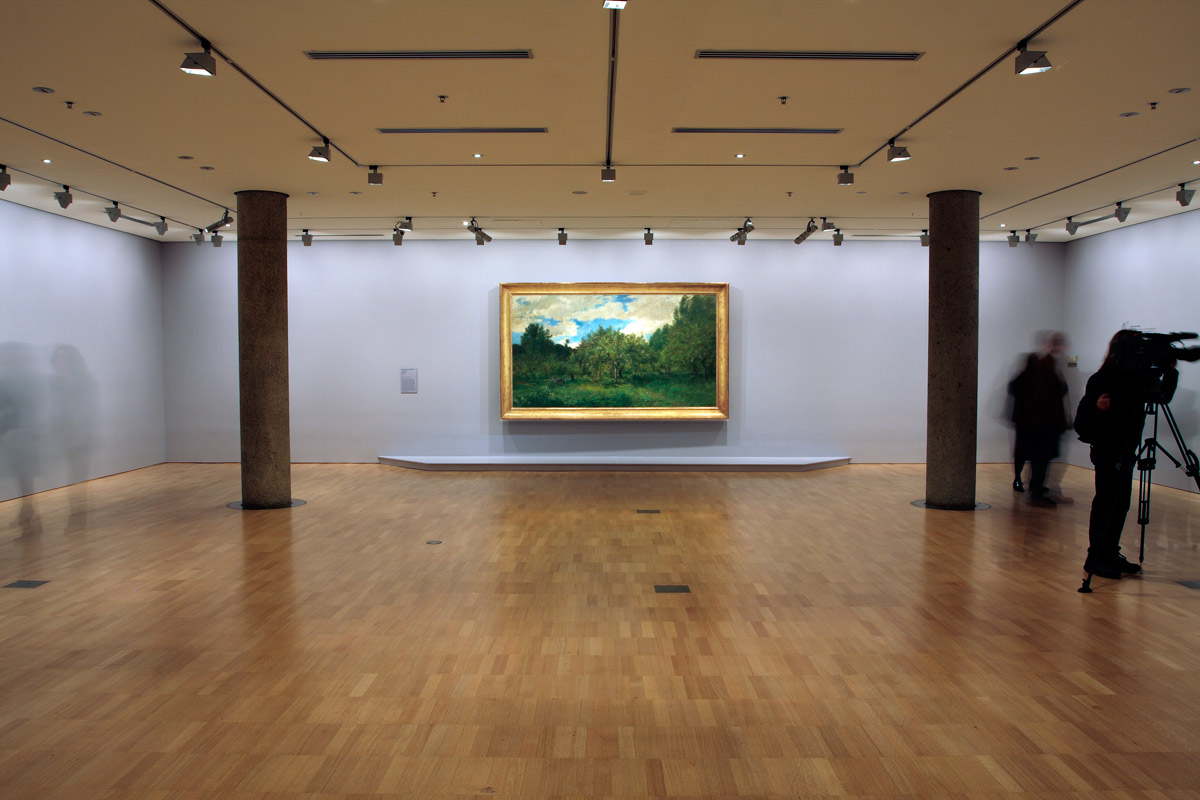
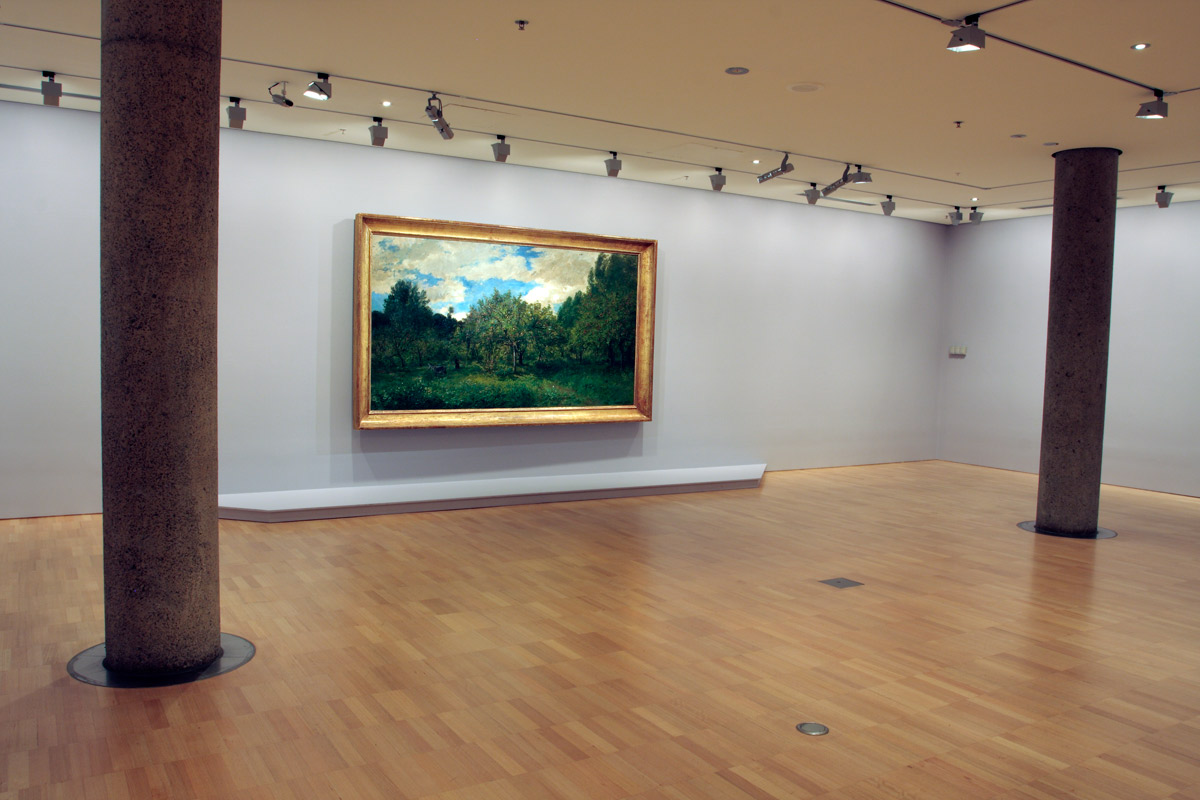
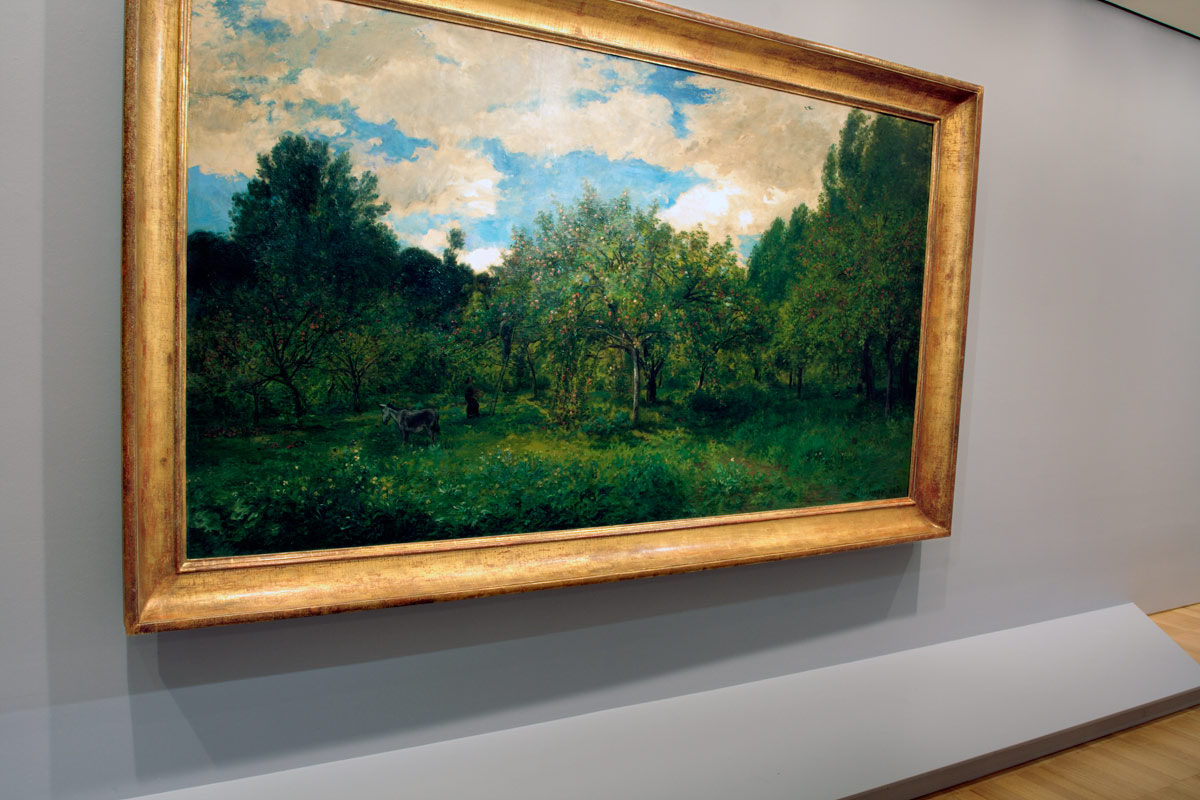
Installation views of Charles-Francois Daubigny (French 1817-1878) French Orchard at Harvest Time (Le verger) 1876 at the exhibition European Masters: Städel Museum 19th – 20th Century, Winter Masterpieces at the National Gallery of Victoria Photos: Marcus Bunyan
Charles-Francois Daubigny (French, 1817-1878) French Orchard at Harvest Time (Le verger) (installation view) 1876 Oil on canvas Photo: Marcus Bunyan
Installation views of Pierre Auguste Renoir (French 1841-1919) After the luncheon (La fin du déjeuner) 1879 at the exhibition European Masters: Städel Museum 19th – 20th Century, Winter Masterpieces at the National Gallery of Victoria Photos: Marcus Bunyan
Pierre Auguste Renoir (French 1841-1919) After the luncheon (La fin du déjeuner) 1879 Oil on canvas 100.5 x 81.3cm Städel Museum, Frankfurt am Main Acquired in 1910
Installation view of Odilon Redon (French 1840-1916) Christ and the Samaritan Woman (Le Christ et la Samaritaine) c. 1895 at the exhibition European Masters: Städel Museum 19th – 20th Century, Winter Masterpieces at the National Gallery of Victoria Photo: Marcus Bunyan
Odilon Redon (French, 1840-1916) Christ and the Samaritan Woman (Le Christ et la Samaritaine) c. 1895 Oil on canvas 64.8 x 50.0cm Städel Museum, Frankfurt am Main Acquired in 1960
Installation view of the exhibition European Masters: Städel Museum 19th – 20th Century, Winter Masterpieces at the National Gallery of Victoria Photo: Marcus Bunyan
“The appeal of the Städel Institute lies in the tremendous energy filling that confined space. Virtually all of the great emotions that have lived in the souls of the peoples of Europe are there, and all in superb works.”
Alfred Lichtwark, Director the Hamburg Museum, 1905
One of the world’s finest collections of 19th and 20th century art is showing exclusively in Melbourne as the seventh exhibition in the hugely popular Melbourne Winter Masterpieces series at the National Gallery of Victoria.
European Masters: Städel Museum, 19th-20th Century brings together almost 100 works by 70 artists from one of Germany’s oldest and most respected museums, the Städel Museum in Frankfurt.
Dr Gerard Vaughan, NGV Director, said: “European Masters presents a comprehensive overview of the Städel Museum’s holdings of painting and sculpture from the last two centuries of European art. This blockbuster exhibition provides a superb survey of the key artistic movements of the time, including Realism, Impressionism and Post Impressionism, German Romanticism, Expressionism and Modernism, and French Symbolism.”
The exhibition opens with a series of large-scale romantic German paintings, including Johann H.W. Tischbein’s iconic Goethe in the Roman Campagna from 1787. Visitors will also be treated to magnificent examples of 19th century French art from Corot and Courbet’s Realist landscapes to well-known beautiful Impressionist works by Monet, Renoir, Degas and Cézanne.
European Masters then traces the development of German art, introducing audiences to rarely seen Realist and Symbolist masterpieces from artists such as Max Liebermann and Franz von Stuck.
A major highlight of the exhibition is a powerful selection of German Expressionist paintings, with ten poignant works by Max Beckmann, including The synagogue in Frankfurt am Main and his powerful Double Portrait, all of which have left the Städel for the first time to be shown outside of Europe.
The exhibition also includes a breathtaking selection of Swiss, Belgian and Dutch works by artists such as Arnold Böcklin, Fernand Khnopff and Vincent Van Gogh.
“Exclusive to Melbourne, European Masters provides an unprecedented opportunity to see a spectacular group of masterpieces spanning the dynamic and transformative years of the 19th and 20th centuries. There is something in this exhibition for everyone, from the beauty and immediacy of French Impressionism to the raw power of German Expressionism. This is a once-in-a-lifetime chance to see superb pictures that rarely travel outside of Europe,” said Dr. Vaughan.
Founded in 1816 by the Frankfurt financier Johann Friedrich Städel, the Städel Museum has one of the world’s finest art collections. The collection boasts 2700 paintings, 600 sculptures and over 100,000 prints and drawings documenting the development of European art and culture.
The Melbourne Winter Masterpieces series began in 2004 with The Impressionists: Masterpieces from the Musée d’Orsay, continued in 2005 with Dutch Masters from the Rijksmuseum, Amsterdam, followed by Picasso in 2006, Guggenheim Collection: 1940s to Now in 2007, Art Deco 1910-1939 in 2008 and Salvador Dalí: Liquid Desire in 2009.
This year Melbourne Winter Masterpieces includes European Masters: Städel Museum, 19th-20th Century at the NGV, and Tim Burton at the Australian Centre for the Moving Image.
Installation views of Max Liebermann (German 1847-1935, lived in France 1874-78) Samson and Delilah (Simson und Delila) 1901 at the exhibition European Masters: Städel Museum 19th – 20th Century, Winter Masterpieces at the National Gallery of Victoria Photos: Marcus Bunyan
Max Liebermann (German, 1847-1935, lived in France 1874-1878) Samson and Delilah (Simson und Delila) 1901 Oil on canvas 151.2 x 212.0cm Städel Museum, Frankfurt am Main Acquired in 1910
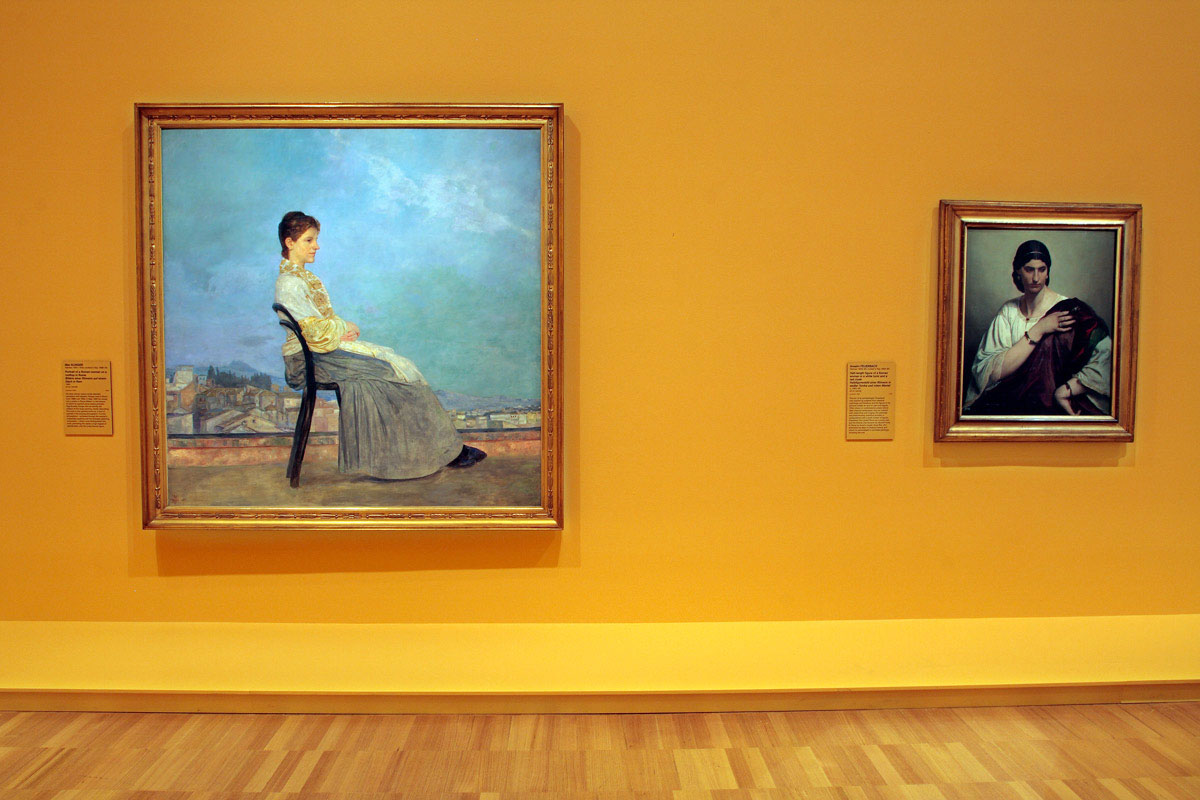
Max Klinger (German, 1857-1920) Portrait of a Roman woman on a flat roof (Bildnis einer Römerin auf einem Dach in Rom) 1891 Oil on canvas 182 x 182cm Städel Museum, Frankfurt am Main Acquired in 1926 as a gift in commemoration of Walther Rathenau
Installation view at left of Max Klinger (German 1857-1920) Portrait of a Roman woman on a flat roof (Bildnis einer Römerin auf einem Dach in Rom) 1891 at the exhibition European Masters: Städel Museum 19th – 20th Century, Winter Masterpieces at the National Gallery of Victoria Photo: Marcus Bunyan
Max Beckmann room, installation view of European Masters: Städel Museum 19th – 20th Century, Winter Masterpieces at the National Gallery of Victoria Photos: Marcus Bunyan
Max Beckmann (German 1884-1950, worked in the Netherlands 1937-1947, United States 1947-1950) Female dancer (Tanzerin) (installation view) c. 1935 Bronze Photo: Marcus Bunyan
Installation views of European Masters: Städel Museum 19th – 20th Century, Winter Masterpieces at the National Gallery of Victoria Photos: Marcus Bunyan
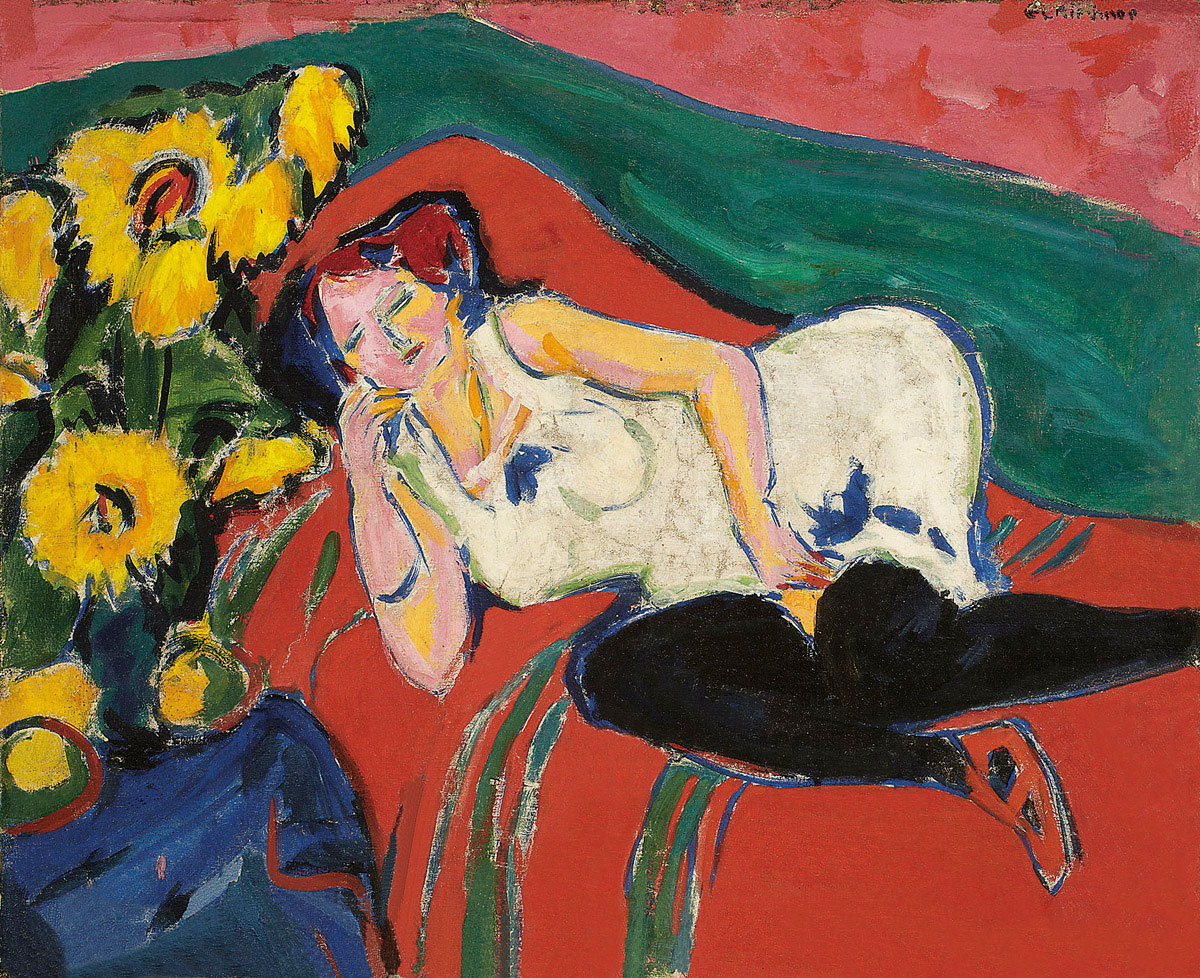
Ernst Ludwig Kirchner (German, 1880-1938) Reclining woman in a white chemise (Liegende Frau im weiβen Hemd) 1909 Oil on canvas 95.0 x 121.0cm Städel Museum, Frankfurt am Main Acquired in 1950
Many thankx to Fenna Lampe and the Foam Fotografiemuseum Amsterdam for allowing me to publish the photographs in the post. Please click on the photographs for a larger version of the image.
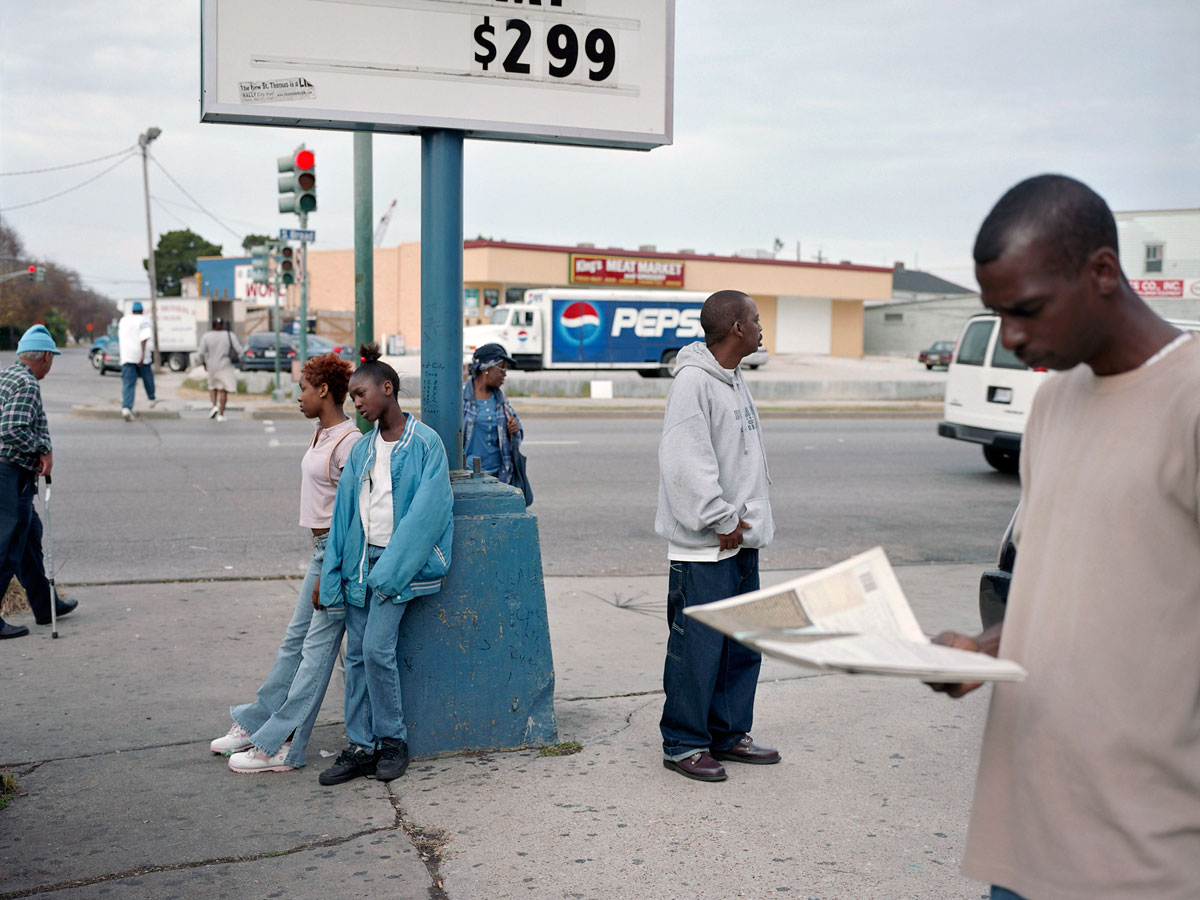
a shimmer of possibility is the latest project by influential British photographer Paul Graham. This work was created during Graham’s many travels through the United States since 2002. a shimmer of possibility consists of twelve sequences varying in number: from just a few images to more than ten. Each sequence offers an informal look at the life of ordinary, individual Americans – from a woman eating to a man waiting for the bus. The sequences focus attention on very ordinary things, which Graham has photographed with affection and curiosity.
Each sequence is a short, casual encounter, where we consider for a moment something that attracts our attention. Then life goes on, full of new possibilities. The way Graham presents the diverse sequences in the exhibition is crucial. Instead of being shown in a linear fashion, a sequence fans out over the wall like a cloud. Due to the carefully considered and inventive structure, no viewing direction or predominant hierarchy is imposed on the individual images. The eye of the viewer wanders over the photos, offering the opportunity to make personal connections in an associative manner.
a shimmer of possibility can be seen as the ultimate antithesis of what Henri Cartier-Bresson called ‘the decisive moment’. This French master endeavoured to record exactly those moments where subject matter and formal aspects combined perfectly in a single image. Paul Graham, by contrast, defends how we normally look around us. We move through the world and look from left to right, see something that grabs our attention, move towards it, glance to the side while en route, pass that by and continue on our way. Observation is a never-ending series of ‘non-decisive moments’, full of potential for anyone who is open to see it.”
Text from the Foam website [Online] Cited 06/06/2010 no longer available online
Graham walked the streets of residential neighbourhoods in Massachusetts, Pennsylvania, and Louisiana, and the sidewalks of New Orleans, Las Vegas, and New York, and when he encountered someone who caught his eye, he photographed them: an older woman retrieving her mail; a young man and woman playing basketball at dusk; a couple returning from the supermarket. Graham followed people navigating their way through crowded city sidewalks, and tracked and photographed lone figures crossing a busy roadway, unaware of the camera.
Reviewing several trips’ worth of photographs on the large, flat screen of his computer, Graham realised that the more or less randomly gathered pictures could be united into multipart works. As in a poem, where language and rhythm organise words, lines, and stanzas into an imaginative interpretation of a subject, Graham’s imposed yet open-ended structures imply – through close-ups, crosscutting, and juxtapositions of people and nature-specific narratives and overarching ideas. Images of people placed in tandem with other people and with nature suggest the flow of life, pointing to the unknown and the possibility of change, with nature acting as a balm, whether as raindrops, trees silhouetted against a burning sunset, or the bright green grass on a highway meridian.
In his reconstruction of the world in pictures, Graham describes an America at odds with itself, filled with contradictions and inconsistencies. Yet, through the gloom, the small felicities of life peek through. Fluid, filled with desire, and marked by extremes, his view is what the late curator, critic, and photographer John Szarkowski called, in another context, a “just metaphor” for our times.
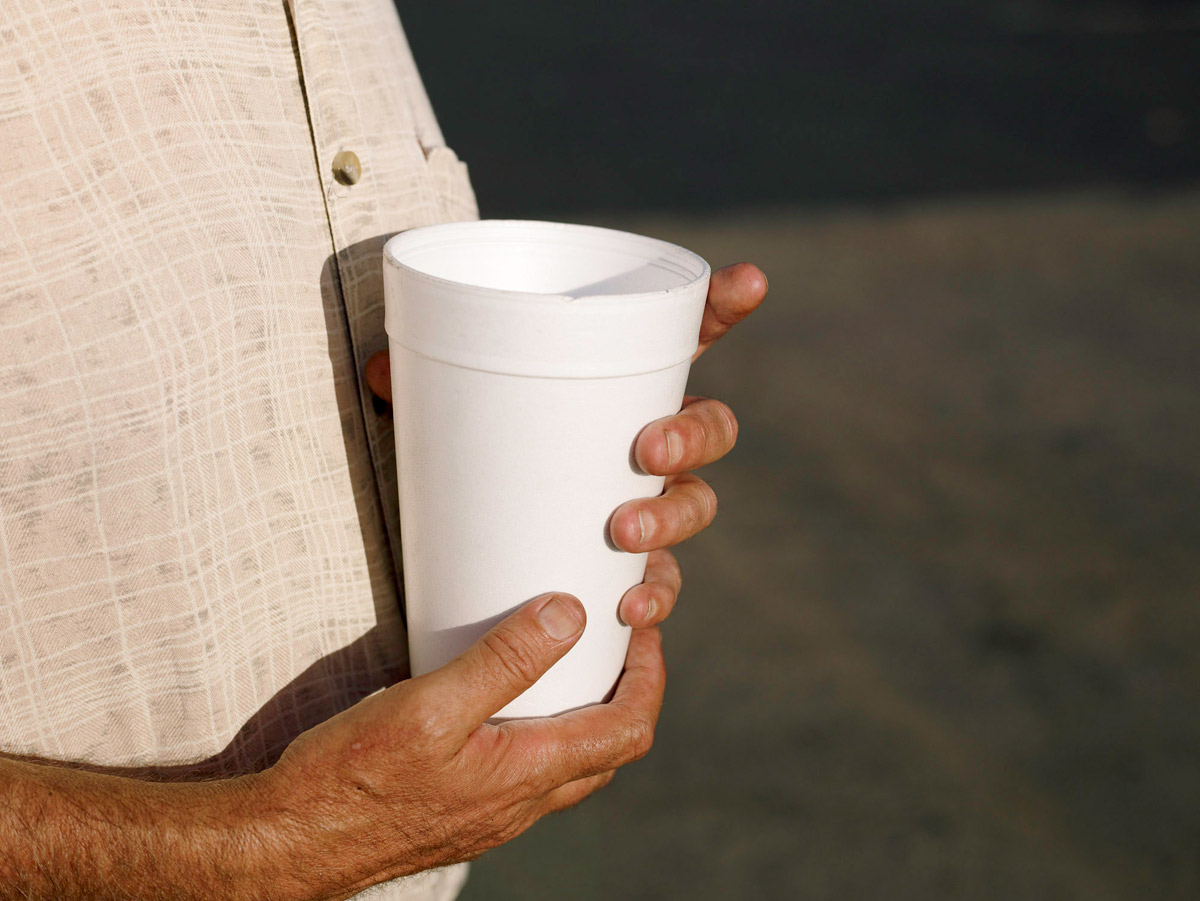
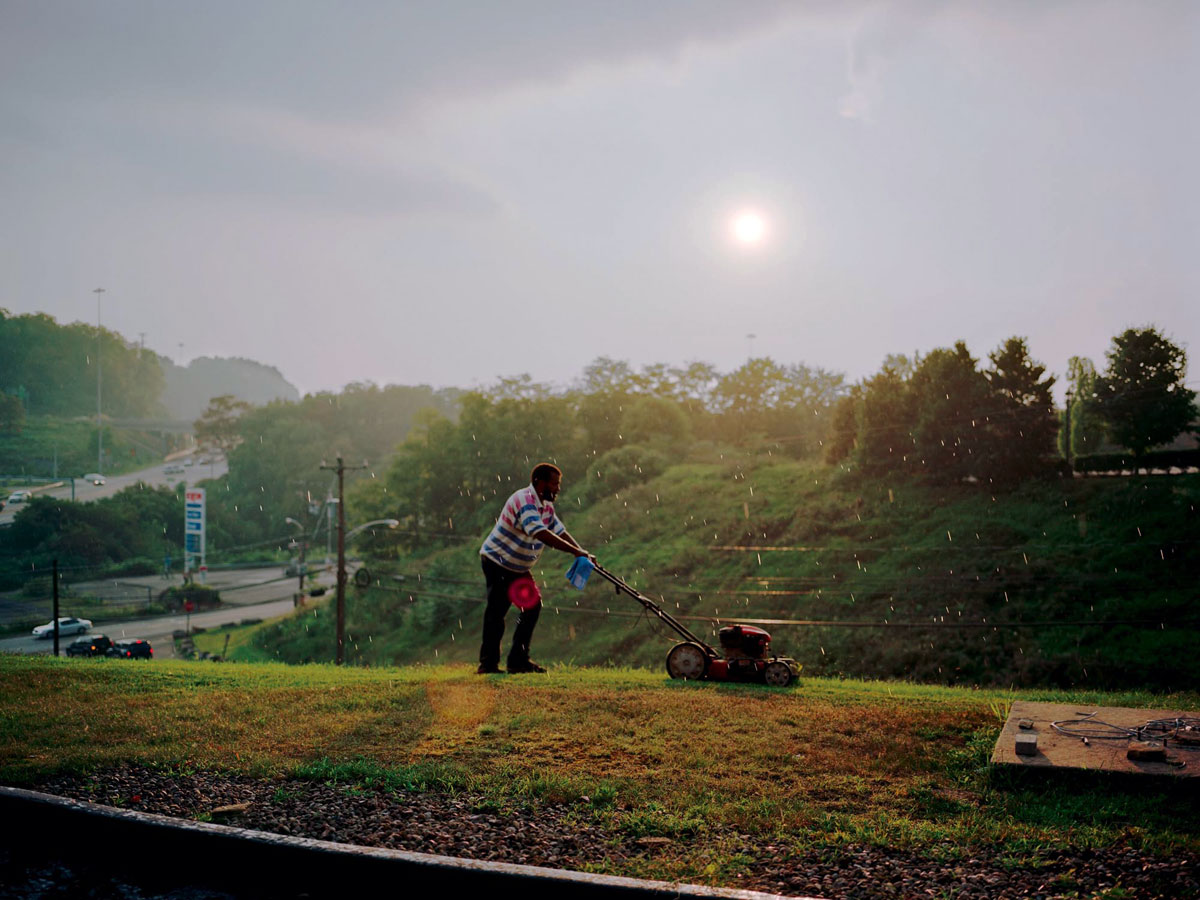
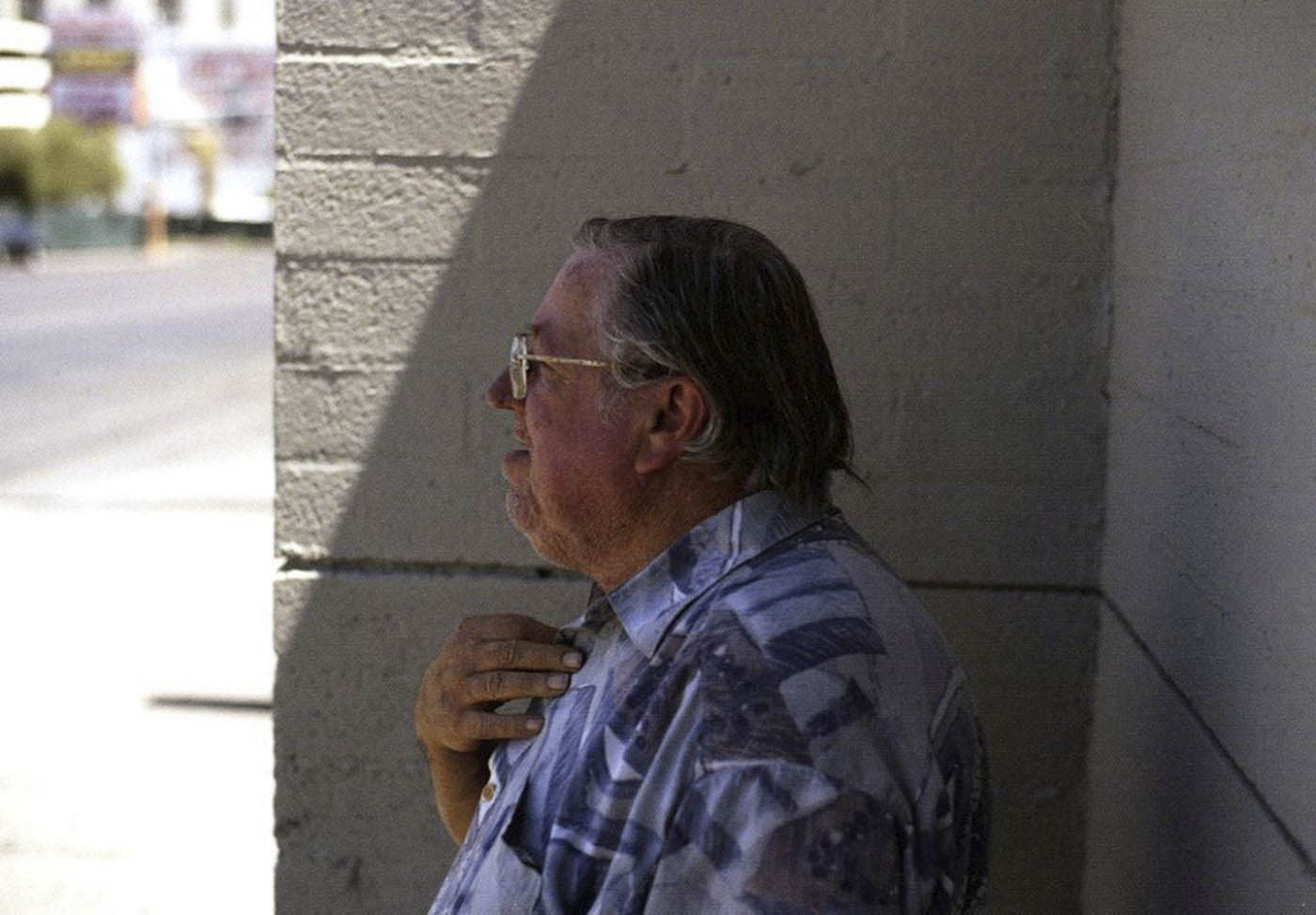
Inspired by Chekhov’s short stories – and by his own contagious joy in the book form – photographer Paul Graham has created A Shimmer of Possibility, comprised of 12 individual books, each a photographic short story of everyday life. Some are simple and linear – a man smokes a cigarette while he waits for a bus in Las Vegas, or the camera tracks an autumn walk in Boston. Some entwine two, three or four scenes – while a couple carry their shopping home in Texas, a small child dances with a plastic bag in a garden. Some watch a quiet narrative break unexpectedly into a sublime moment – as a man cuts the grass in Pittsburgh it begins to rain, until the low sun breaks through and illuminates each drop. Graham’s filmic haikus shun any forceful summation or tidy packaging. Instead, they create the impression of life flowing around and past us while we stand and stare, and make it hard not to share the artist’s quiet astonishment with its beauty and grace. The 12 books gathered here are identical in trim size, but vary in length from just a single photograph to 60 pages of images made at one street corner.
Text from the Mack website [Online] Cited 14/08/2019
a shimmer of possibility by Paul Graham 12 volumes 376 pages, 167 colour plates 24.2 cm x 31.8 cm 12 cloth covered hardbacks Limited edition of 1,000 sets MACK ISBN: 9783865214836 Publication date: October 2007
Curators: Peter W. Kunhardt, Jr., Director of the Meserve-Kunhardt Foundation, and Robin Garr, Director of Education, Bruce Museum
Many thankx to Mike Horyczun, Director of Public Relations and the Bruce Museum for allowing me to publish the images in the posting. Please click on the photographs for even larger version of the image.
Marcus
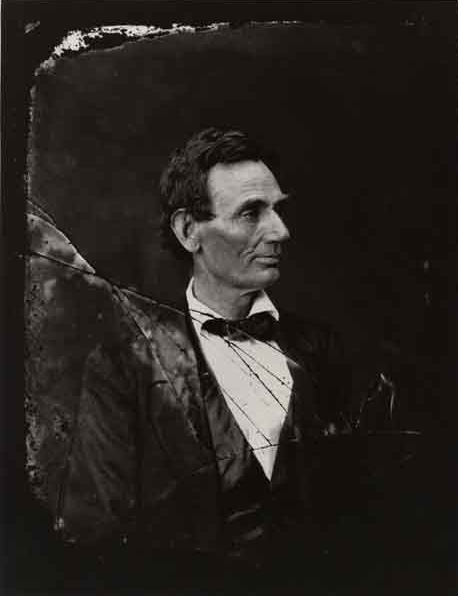
Alexander Hesler (American, 1823-1895) Abraham Lincoln June 3, 1860 Springfield, Illinois
Alexander Hesler or Hessler (1823-1895) was an American photographer active in the U.S. state of Illinois. He is best known for photographing, in 1858 and 1860, definitive iconic images of the beardless Abraham Lincoln. …
Hesler’s known portraits include photographs of the two chief Illinois political figures of his day, Lincoln and federal senator Stephen A. Douglas. In the 1860 presidential election, Lincoln’s friends took steps to have Hesler’s images copied and recirculated, cementing their stature as works of Lincoln image-making.
Hesler was an award-winning photographer whose goal was to create photographs of lasting artistic value. He was recognised for the quality of both his portrait work and his outdoor photography. Upon Hesler’s retirement in 1865, he transferred his Chicago studio and negatives to a fellow photographer, George Bucher Ayres. Several of Hesler’s best-known images of Lincoln are platinum prints produced by Ayres from Hesler negatives.
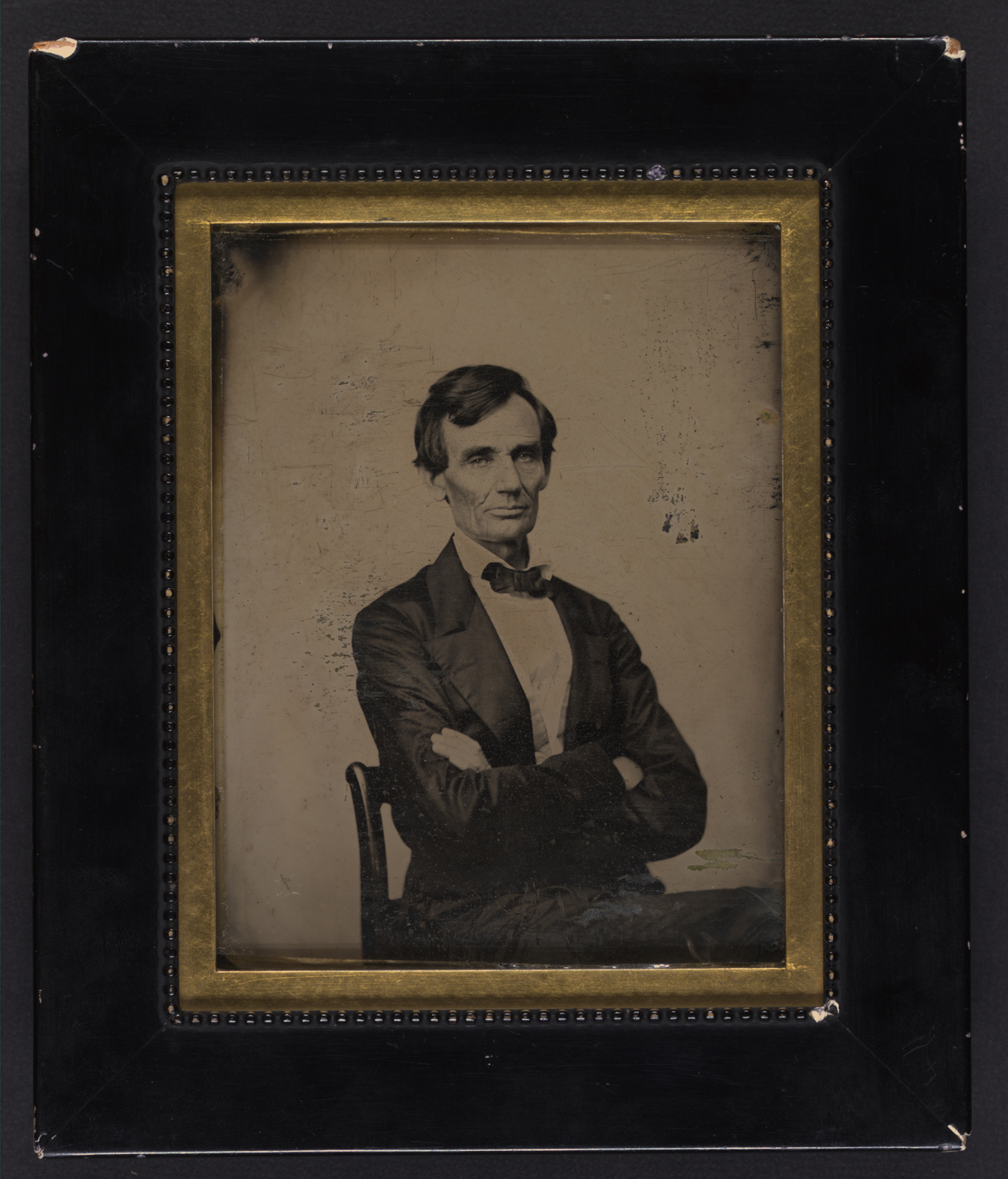
Preston Butler Abraham Lincoln August 13, 1860 Springfield, Illinois Ambrotype Plate 5 3/4 x 4 1/2 in Library of Congress
Abraham Lincoln as candidate for United States president. Half-length portrait, seated, facing front.
Thought to be the last beardless portrait of Lincoln, this photo was “made for the portrait painter, John Henry Brown, noted for his miniatures in ivory. … ‘There are so many hard lines in his face,’ wrote Brown in his diary, ‘that it becomes a mask to the inner man. His true character only shines out when in an animated conversation, or when telling an amusing tale. … He is said to be a homely man; I do not think so.'” (Source: Ostendorf, p. 62)
Published in: Lincoln’s photographs: a complete album / by Lloyd Ostendorf. Dayton, OH: Rockywood Press, 1998, pp. 62-63.
Between 1856, the year of Preston Butler’s arrival in Springfield, and Feb. 11, 1861, when President-elect Abraham Lincoln departed from Springfield, Butler took at least 8 photographs of Lincoln and at least 1 photograph of Mary, Willie and Tad Lincoln. Also, in 1857 or 1858, Butler photographed each of the 4 sides of Springfield’s public square. These photographs are the primary source of information about the appearance of the public square in Lincoln’s Springfield.
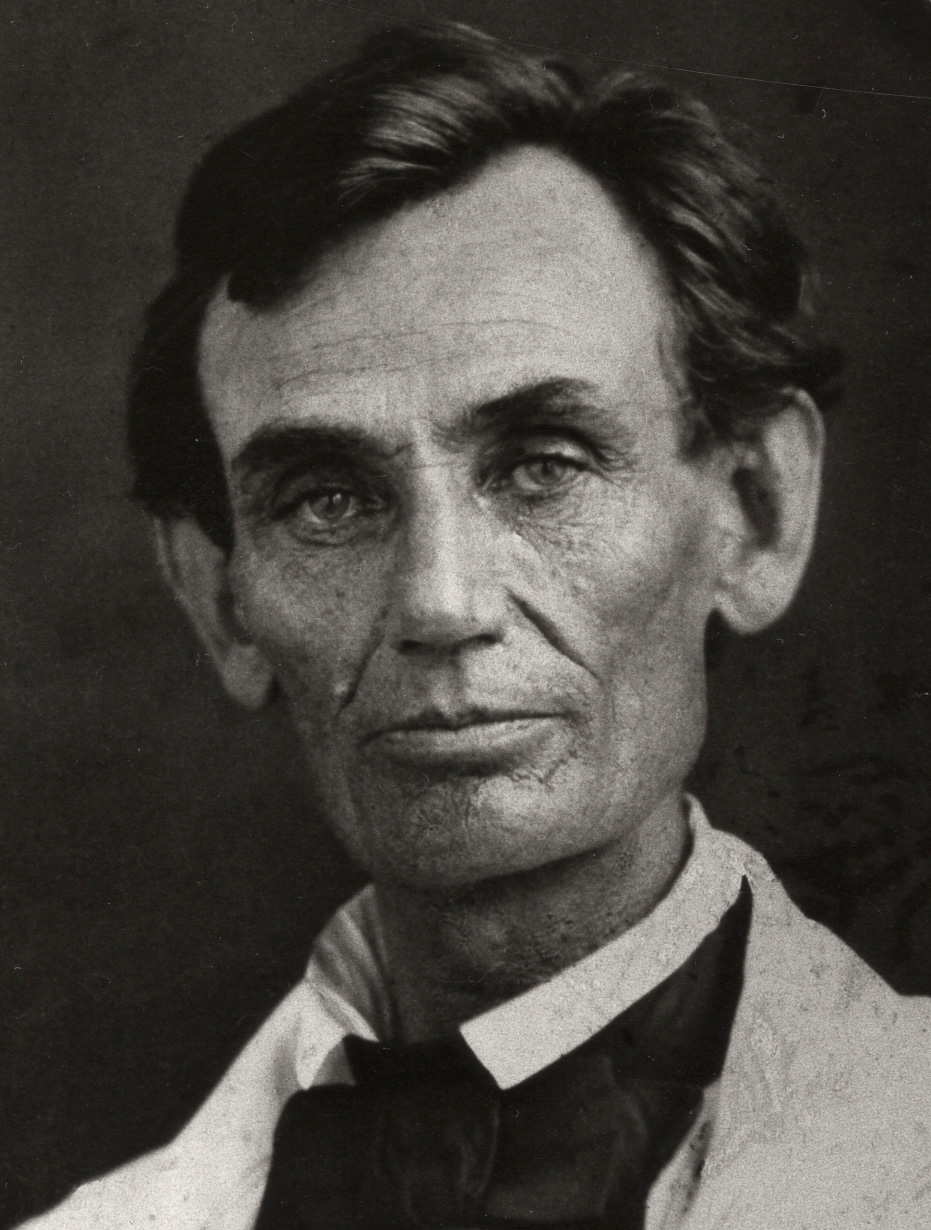
Abraham B. Byers (American, 1836-1920) Abraham Lincoln May 7, 1858 Beardstown, Illinois Ambrotype
The Bruce Museum in Greenwich, Connecticut, presents its newest exhibition Lincoln, Life-Size, from February 13, 2010, through June 6, 2010. The exhibition features photographs of Abraham Lincoln reproduced full size, hanging alongside original 19th-century images and artefacts that tell the story of Lincoln’s tumultuous presidency. The exhibition is drawn from the Meserve-Kunhardt Collection which it has on loan from the Meserve-Kunhardt Foundation. Lincoln, Life-Size is supported by Fieldpoint Private Bank & Trust, New England Land Company, Ltd., a Committee of Honor co-chaired by Tom Clephane and Nat Day, and the Charles M. and Deborah G. Royce Exhibition Fund.
Lincoln, Life-Size is organised by guest curator Peter W. Kunhardt, Jr., Director of the Meserve-Kunhardt Foundation, and Robin Garr, Director of Education, Bruce Museum. Peter W. Kunhardt, Jr., is the great-great-grandson of Frederick Hill Meserve one of this country’s premiere Lincoln collectors. Frederick Hill Meserve’s passion for Lincoln was ignited in the 1880s when his father, William Neal Meserve, who had served in the Civil War, asked him to hunt for photographs to illustrate his handwritten war diary. Five generations of the family have preserved this massive historical record over the past century.
The exhibition chronicles the toll of war etched into the face of our 16th president. Life-size enlargements of Lincoln’s portraits circle the entire central gallery. Visitors will experience what it was like to stand before him and look into his eyes. Beneath this facial timeline of his presidency is a selection of photographs of people who touched his life and events that nearly wore him out.
The show explores the time from Abraham Lincoln’s arrival in Washington in 1857 through his assassination in 1865. Photographs chronicle events as the war unfolds, his son dies, and he struggles with generals and mounting death tolls. In the photographs, Lincoln is revealed in a variety of poses, each bearing a significance that attests to the historic nature of his life, be it as he is grappling with emancipation or drafting words that would become sacred; serving as husband and father or being pulled in all directions by his constituents; and ultimately as he holds the country together throughout the turbulent times of the Civil War.
Highlights of the exhibition include Leonard Volk’s bronze life mask of Lincoln’s head and hands, glass negatives by Mathew Brady, original albumen war prints by Alexander Gardner and Timothy O’Sullivan, and carte-de-visites of Lincoln, his family, his cabinet, and his generals. Viewers can study official government war maps, view a Thomas Nast drawing depicting the slavery issue, and walk around an early “triptych” photograph that portrays Lincoln, Grant, or Sherman, depending on where the viewer stands. An oversize “imperial” print shows Lincoln just days before delivering his Gettysburg address. In another imperial print a lab technician’s thumb print obliterates Lincoln at his second inaugural, but what is visible is a spectator in the crowd who appears to be John Wilkes Booth. Another photograph of Booth has these words written on the back side: “Recognize him and kill him.”Lincoln, Life-Size also include artefact related to Lincoln and his era.
“We have presented these works so that viewers can see how the toll the war and personal tragedies aged him during his years in office,” said Peter W. Kunhardt, Jr. “In fact, he was just 56 years old when he was assassinated.” This is the first museum exhibition dedicated to the collection of the Meserve-Kunhardt Foundation, which is now housed on the campus of SUNY Purchase. The recent book, Lincoln, Life-Size, co-authored by Phillip B. Kunhardt III, Peter W. Kunhardt and Peter W. Kunhardt, Jr. is available in the Bruce Museum Store. A full array of exhibition programming related to the exhibition is scheduled.
Text from the Bruce Museum website [Online] Cited 01/06/2010. No longer available online
Mathew B. Brady (American, c. 1822-1896) Abraham Lincoln January 8, 1864 Washington, DC National Archives and Records Administration
Anthony Berger (American born Germany, 1832 – after 1897) Abraham Lincoln February 9, 1864 Washington, DC Collodion negative Quarter-plate glass transparency 10.9 x 8.7cm (case) Brady’s National Photographic Portrait Galleries Library of Congress
This is one of a series of photographs that Anthony Berger took of President Abraham Lincoln at the Brady Gallery in Washington in the winter of 1864, as the Civil War dragged on. Modern albumen print from 1864 wet-plated collodion negative. National Portrait Gallery.
“The Famous Profile” by Anthony Berger, manager of Brady’s Gallery, Washington D.C., made direct from an original collodion negative in the Meserve collection (M-82). One of seven poses taken by Berger on Tuesday February 9, 1864, it is perhaps the most familiar of Lincoln profiles, a more handsome pose than its companion view (0-89) because Lincoln’s profile is less severe and his left eyebrow is more visible.
Alexander Gardner (Scottish 1821-1882; emigrated America 1856) Abraham Lincoln November 8, 1863 Washington, DC Library of Congress
Alexander Gardner (Scottish 1821-1882; emigrated America 1856) Abraham Lincoln February 5, 1865 Washington, DC Library of Congress
Alexander Gardner was a Scottish photographer who immigrated to the United States in 1856, where he began to work full-time in that profession. He is best known for his photographs of the American Civil War, U.S. President Abraham Lincoln, and the execution of the conspirators to Lincoln’s assassination.
This is one of the last photos taken of Lincoln, who was assassinated ten weeks later, on April 14, 1865.
Alexander Gardner (Scottish 1821-1882; emigrated America 1856) Abraham Lincoln (detail) February 5, 1865 Washington, DC Library of Congress
The Bruce Museum 1 Museum Drive in Greenwich, Connecticut, USA.
Opening hours: Tuesday – Sunday 10am – 5pm Closed Mondays and major holidays
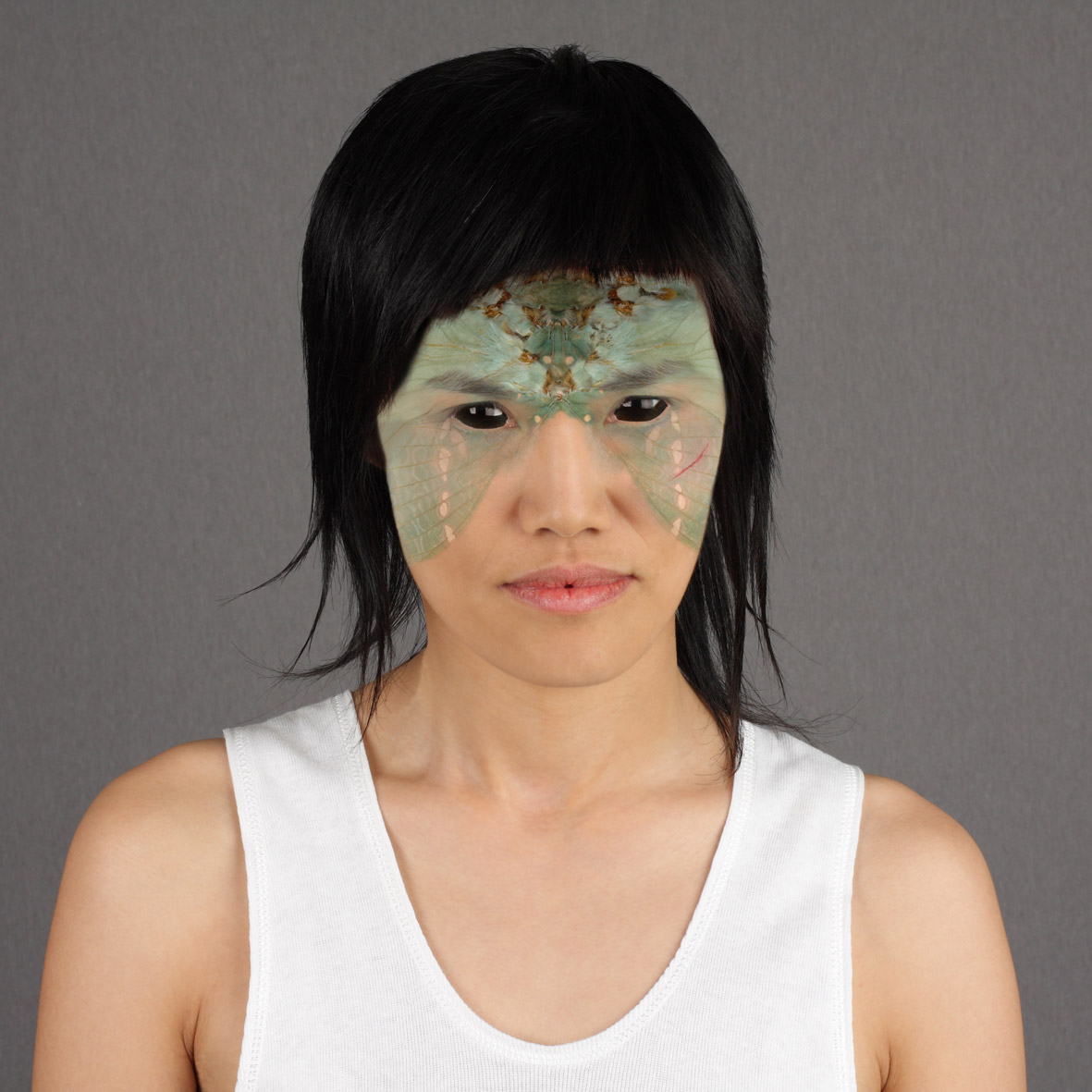
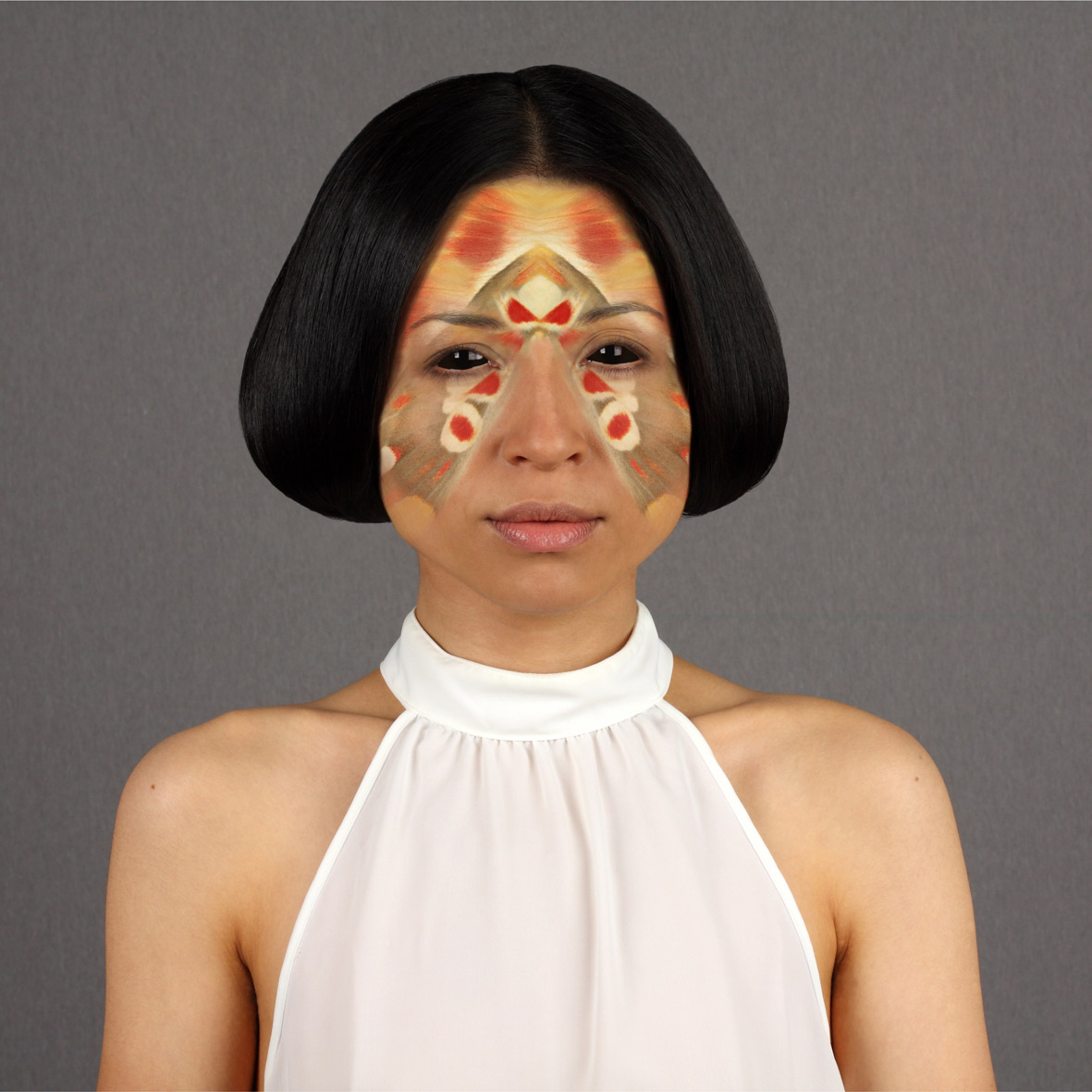
Owen Leong (Australian, b. 1979) Chi 2009-2010 Pigment print on archival paper 73 x 73cm, edition of 5 Courtesy of the artist and Anna Pappas Gallery
Apologies for the late posting on this exhibition but I only received the images for the posting today.
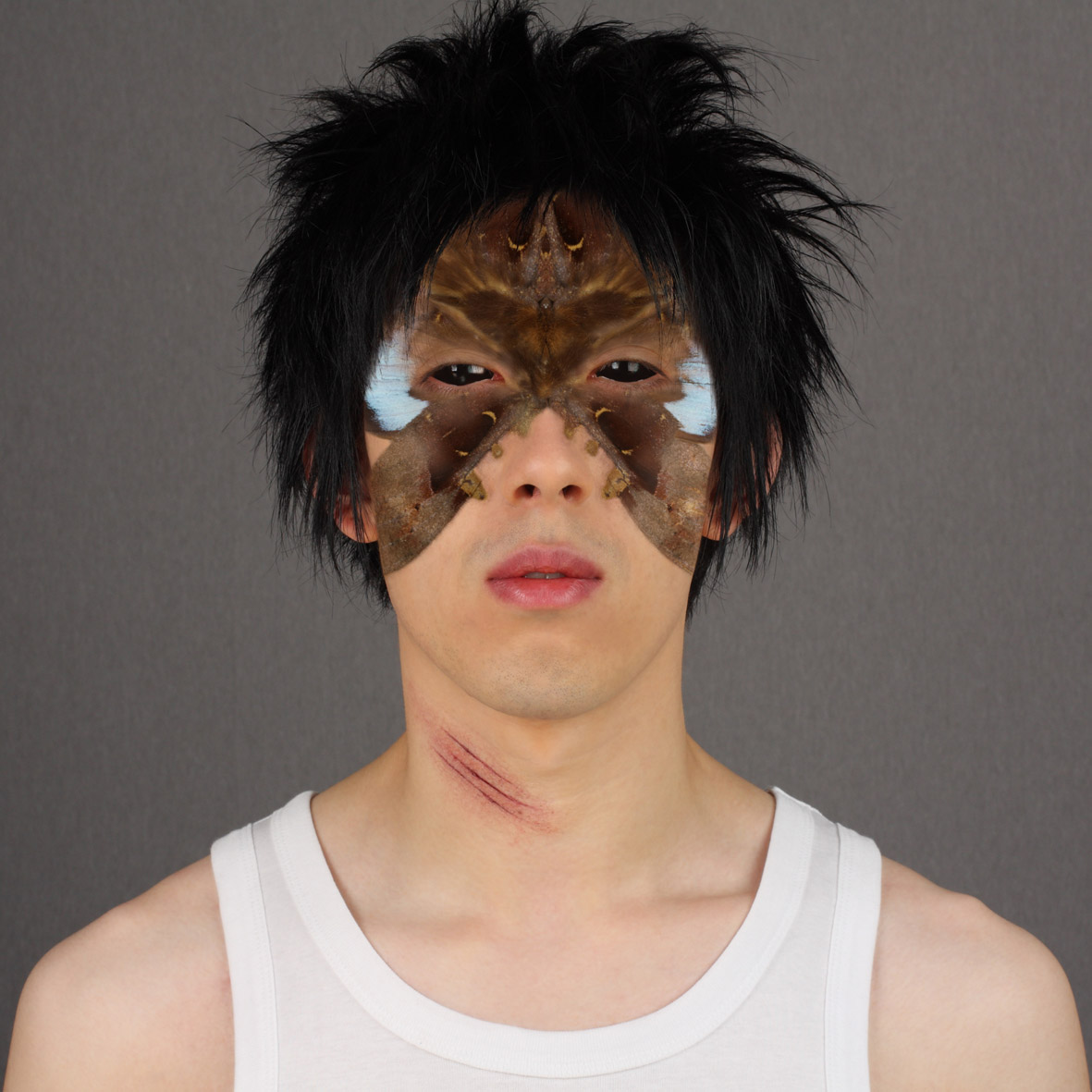
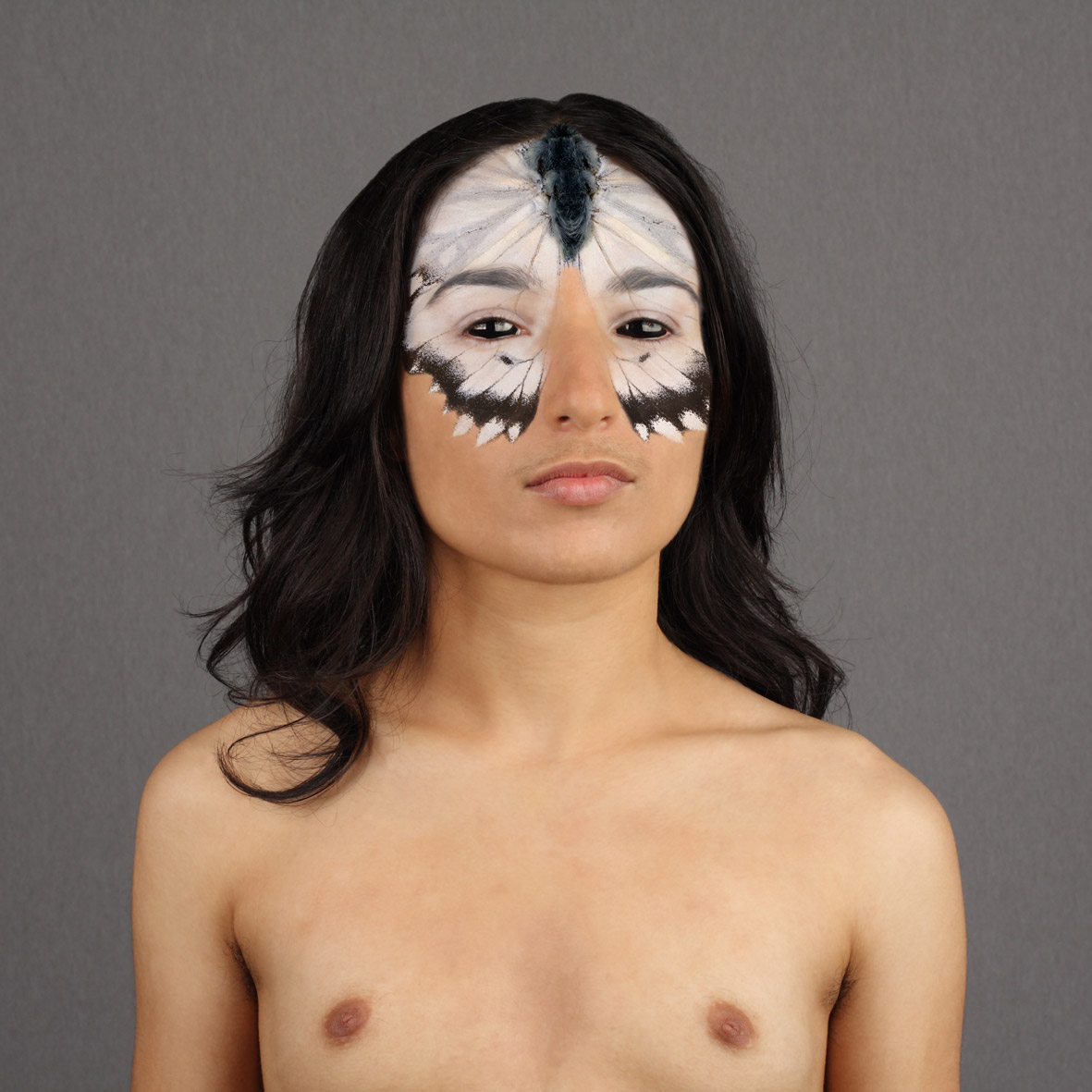
A strong body of work by Owen Leong, twelve portraits of Asian-Australians, their faces digitally overlaid with the unique wing patterns of the Bogong moth, an insect often seen as a pest in Australia. Uniformly lit, of consistent size and presented in modern white frames the series hangs quietly but impressively in the upstairs space of the Anna Pappas Gallery. Here the uniqueness of human physiognomy (and attendant modifications such as scars, piercings and tattoos) is symbiotically paired with that of the moth – it is almost as though one breathes the other – with the eyes of the humans occluded, becoming blackened pits.
The slightly amateurish digital blacking out of some of the eyes is my only point of contention: perhaps this was intentional (?) but sharp shape selections in Photoshop do not make for a good blend between layers of information. Be that as it may, Leong’s practice of selective breeding applied to humans has produced some beautiful, eloquent photographs that promote difference and diversity through a palpable intimacy with the subject matter.
Dr Marcus Bunyan
Many thankx to Anna Pappas, Leah Crossman and the Anna Pappas Gallery for allowing me to use the photographs in the posting. Please click on the photographs for a larger version of the image.
Owen Leong (Australian, b. 1979) Jac 2009-2010 Pigment print on archival paper 73 x 73cm, edition of 5 Courtesy of the artist and Anna Pappas Gallery
Owen Leong (Australian, b. 1979) Justin 2009-2010 Pigment print on archival paper 73 x 73cm, edition of 5 Courtesy of the artist and Anna Pappas Gallery
Owen Leong (Australian, b. 1979) Raina 2009-2010 Pigment print on archival paper 73 x 73cm, edition of 5 Courtesy of the artist and Anna Pappas Gallery
I seen to have become a little smitten by Romy Schneider. What charisma!
Marcus
Many thankx to the Deutsche Kinemathek – Museum for Film and Television for allowing me publish the images in the posting. Please click on the images for a larger version.
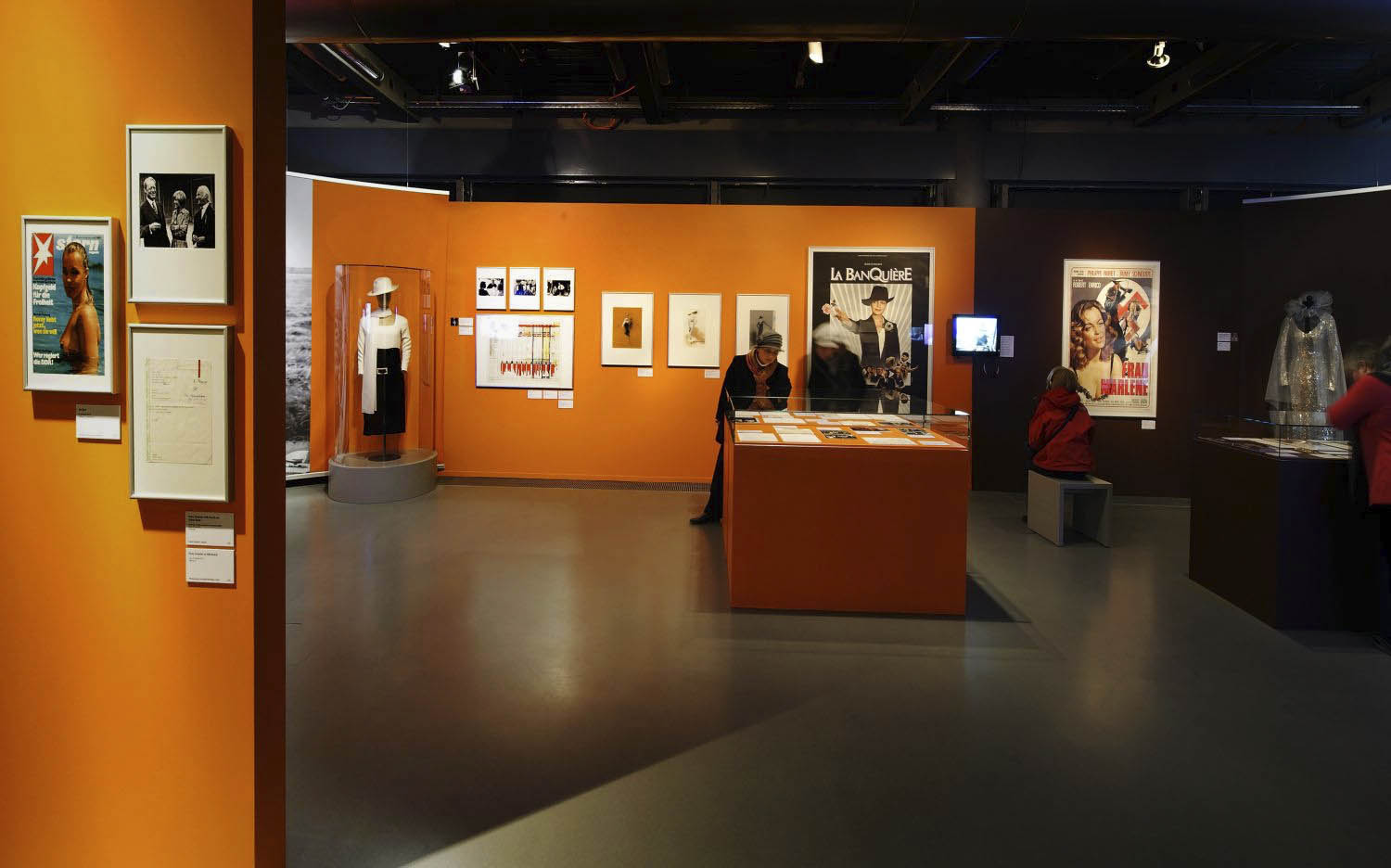
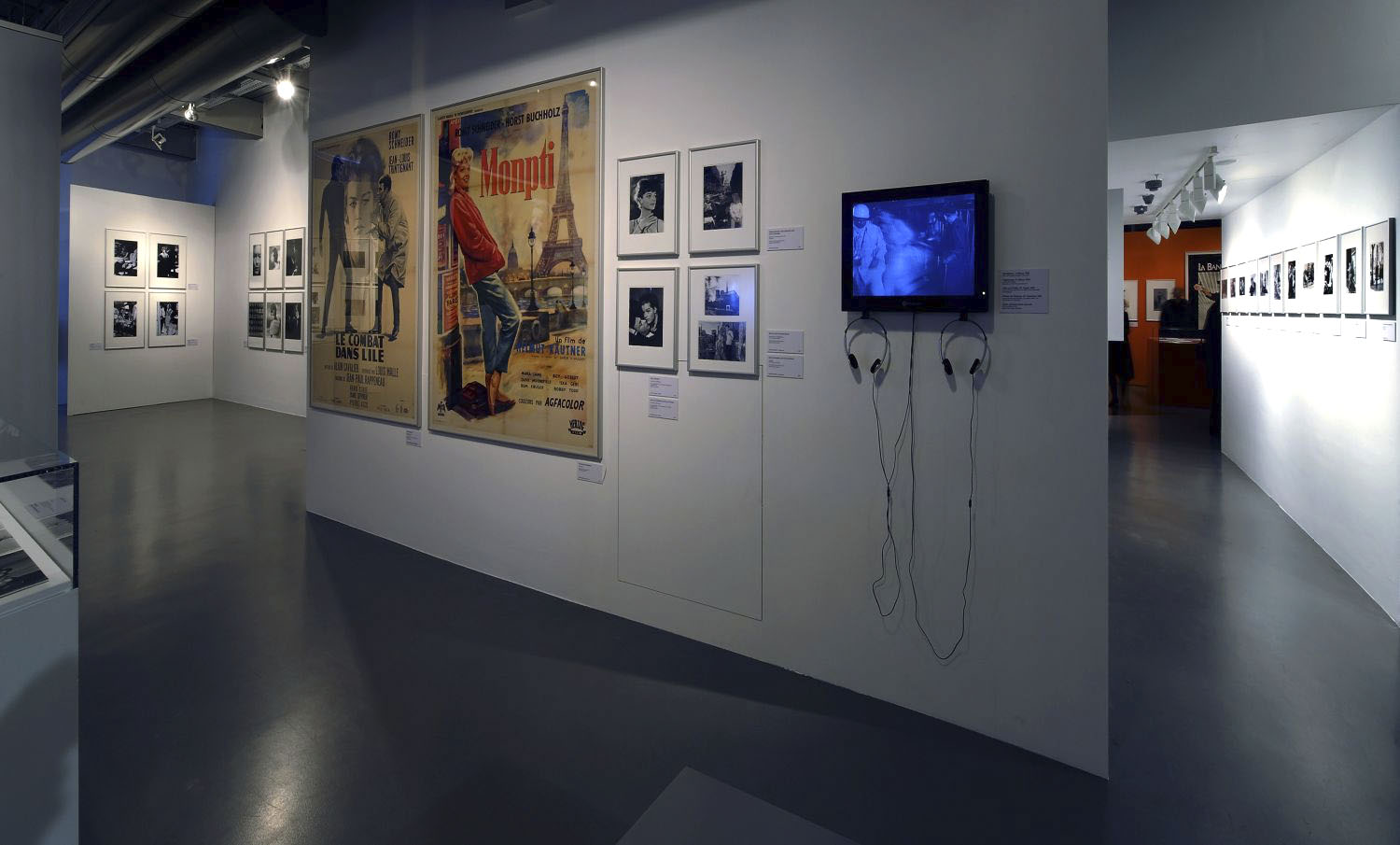
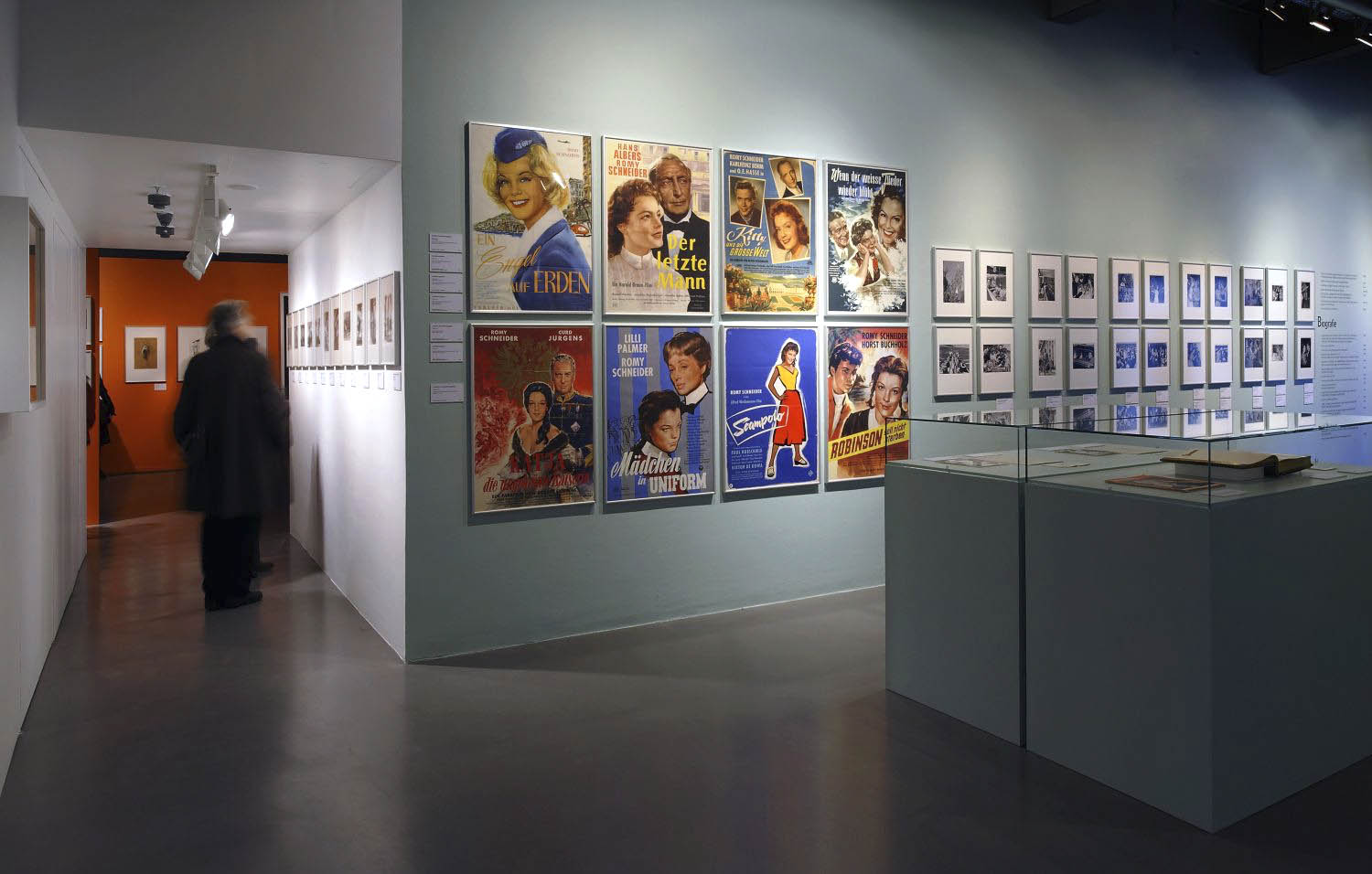
The exhibition documents the eventful career of Romy Schneider, who by the late 1950s no longer wanted to be Sissi, and by the 1970s was a celebrated star of French cinema. A large number of unknown photographs of Romy Schneider, her film partners, and family from the 1950s and 1960s will be on display from the collections of the Deutsche Kinemathek. The exhibition will also present loans from private individuals and institutions from France and Austria …
The exhibition Romy Schneider. Wien – Berlin – Paris, which the Museum für Film und Fernsehen will present beginning on December 5th, documents the varied and wide-ranging career of Romy Schneider, who no longer wanted to be “Sissi” at the end of the 1950s and was celebrated as a star of French cinema in the 1970s.
Romy Schneider publicly bemoaned her roles in Germany and went to Paris to play women who did justice to her acting abilities and her expectations. She settled in France at the beginning of the 1970s, where she advanced to one of the biggest stars of French cinema. She won several awards and made films with nearly all the great directors and actors of that period. The paparazzi followed the actress at every turn, documenting her strokes of fate for the international popular press, and throughout her life Romy Schneider considered herself to be their victim. Romy Schneider died in Paris in May 1982. To this day, she is admired by millions of fans around the world as one of cinema’s international stars.
This homage, which can be seen in 450 sq. m. of exhibition space at the Filmhaus, treats both the diverse roles and changing image of the actress, as well as her representation in the media.
Pictures from films, the press and her private life are grouped according to recurring motifs and combined with film clips. Media installations show the interplay between projection and active self-promotion. Posters, costumes, correspondence and fan souvenirs will augment the presentation.
Numerous photographs from the 1950s and 1960s of Romy Schneider, her film partners and her family, largely unknown until now, originate from the collections of Deutsche Kinemathek. Loans from other institutions and private individuals will also be on view, for instance from the photographers F. C. Gundlach and Robert Lebeck, as well as from the personal archives of the film director Claude Sautet.
Press release from the Museum für Film und Fernsehen website [Online] Cited 25/05/2010 no longer available online
F. C. Gundlach (Franz Christian Gundlach) was a German photographer, gallery owner, collector, curator und founder. In 2000 he created the F.C. Gundlach Foundation, since 2003 he has been founding director of the House of Photography – Deichtorhallen Hamburg.
Alain Delon and Romy Schneider in La Piscine/Der Swimmingpool R- Jacques Deray, F/I 1969 Gelatin silver print Foto/Quelle: Filmarchiv Austria, Wien
Romy Schneider and Alain Delon in La Piscine/Der Swimmingpool R- Jacques Deray, F/I 1969 Gelatin silver print Foto/Quelle: Deutsche Kinemathek
Romy Schneider and Claude Sautet during the shooting of UNE HISTOIRE SIMPLE / A SIMPLE STORY 1978 Gelatin silver print Foto/Quelle: Yves Sautet, Paris
Claude Sautet
Claude Sautet (23 February 1924 – 22 July 2000) was a French author and film director. Born in Montrouge, Hauts-de-Seine, France, Sautet first studied painting and sculpture before attending a film university in Paris where he began his career and later became a television producer. He filmed his first movie, Bonjour Sourire, in 1955.
He earned international attention with Les choses de la vie, which he wrote and directed, like the rest of his later films. It was shown in competition at the 1970 Cannes Festival, where it was well received. The film also revived the career of Romy Schneider; she acted in several of Sautet’s later films. In his next film Max et les Ferrailleurs (1971) she played a prostitute, while in César et Rosalie (1972) she portrayed a married woman who copes with the reappearance of an old flame.
Vincent, Paul, François, et les Autres (1974) is one of Sautet’s most acclaimed films. Four middle-class men meet in the country every weekend mainly to discuss their lives. The film featured a cast of major stars of French cinema: Michel Piccoli, Yves Montand, Gérard Depardieu, and Stéphane Audran. He achieved even further critical success with Mado (1976).
His 1978 film A Simple Story (Une Histoire simple) was nominated for an Academy Award for Best Foreign Language Film. The film featured Schneider again, this time as a dissatisfied working woman in her 40s. She won the César Award for Best Actress for her performance.
These are fascinating photographs (and in part, more than a little what? marginal, disturbing, poetic, beautiful, creepy, voyeuristic, misogynist).
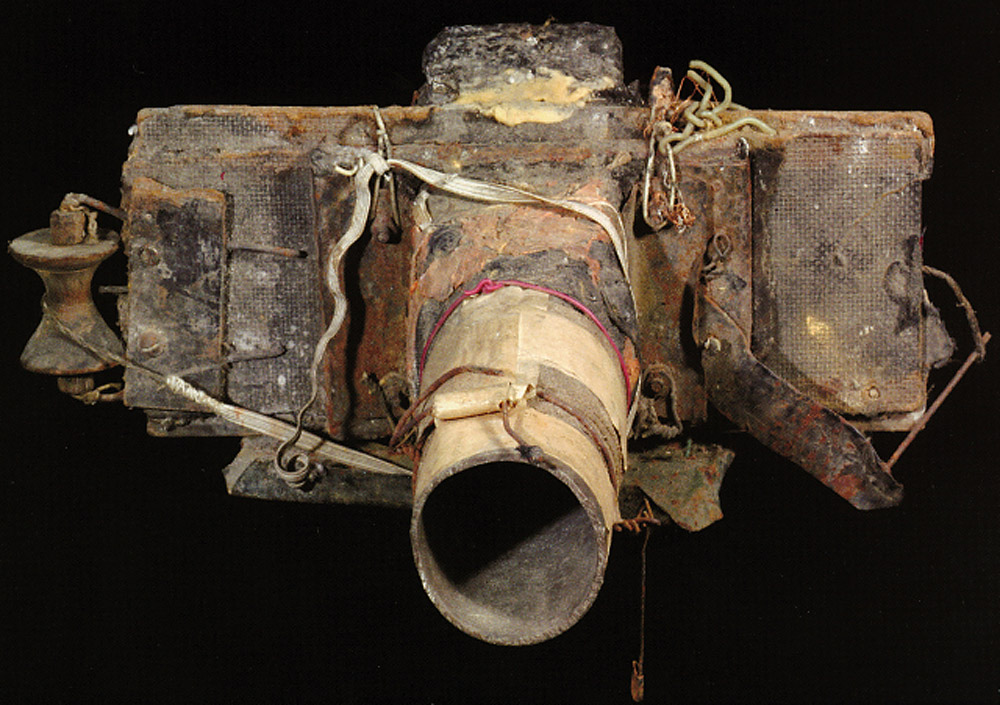
Tichy’s camera is such an amazing construction (click on the image above to see a larger version).
Dr Marcus Bunyan
Many thankx to Jim Edwards and the Michael Hoppen Gallery for allowing me to publish the photographs in the posting.
“Women are just a motif to me. The figure – standing, bending, or sitting. The movement, walking. Nothing else Interests me. The erotic is just a dream anyway. The world is only an illusion, our illusion.”
“Everything is decided by the earth, which is turning. You can only live as long as the earth keeps turning. That is predetermined.
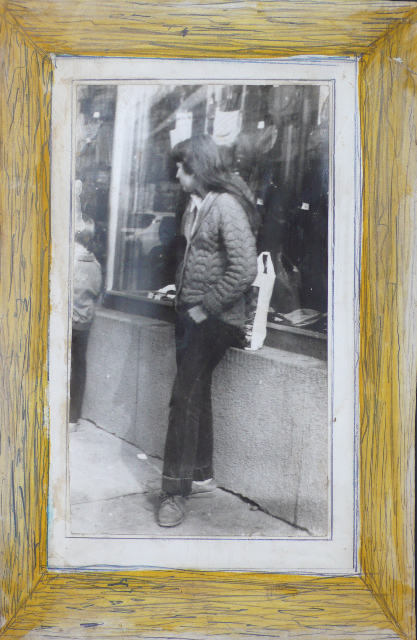
The recently unknown photographic work of Czech artist Miroslav Tichý has become a noteworthy presence in the worlds of photography and contemporary art over the last few years. Timeless and uncategorisable, Tichý’s work captures the women of Kijov, from the artist’s native city in Moravia. On 28 April 2010, the Michael Hoppen Gallery will bring together unique photographs, previously unseen in the UK, created in the 1960’s by Tichý with his makeshift cameras and enlargers.
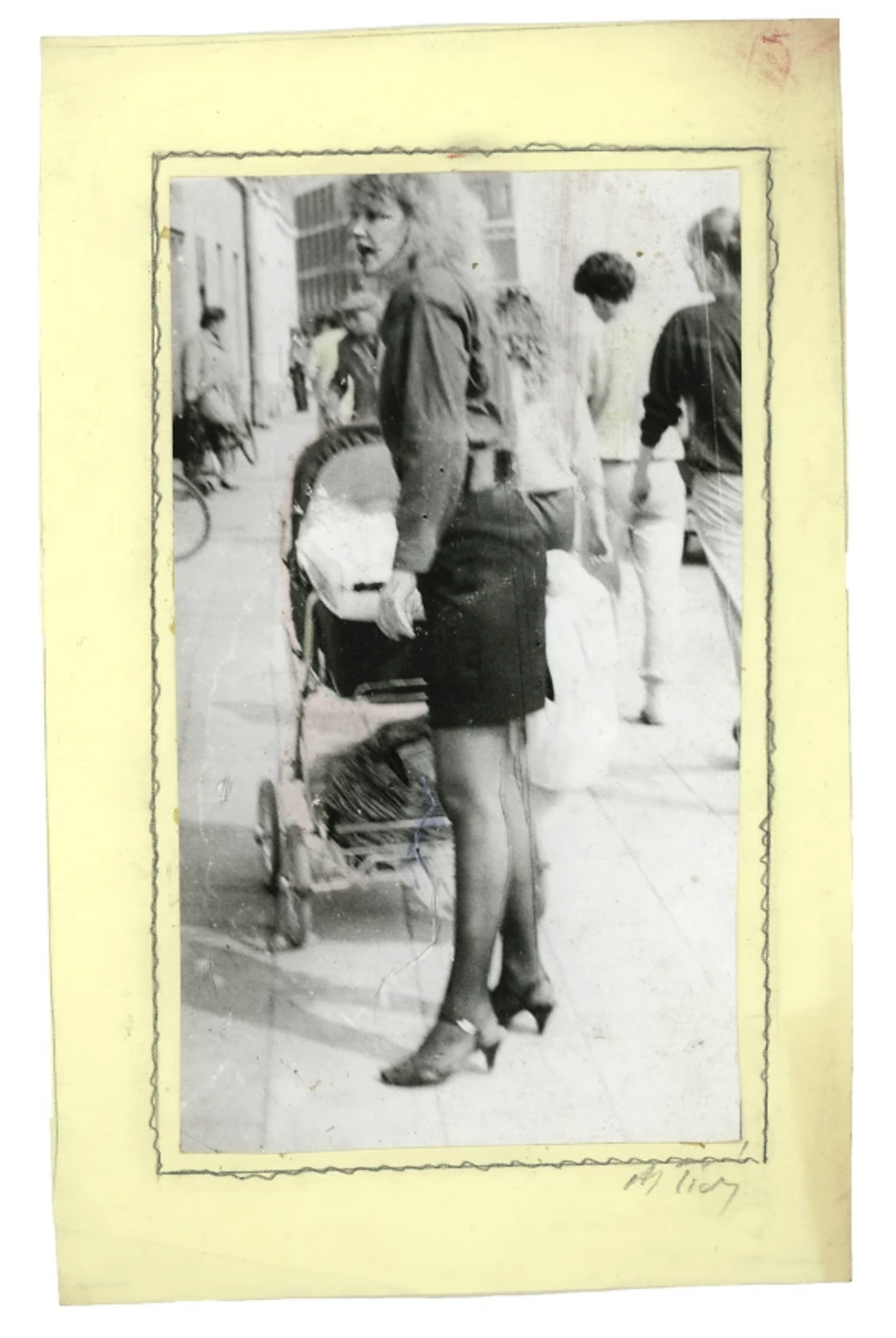
Marginal and exceptionally voyeuristic, in his methods Tichý could be described as an “art brut photographer” yet he is marked by many classical influences. Though his images are produced with poor-quality equipment and carelessly shot, they offer an idiosyncratic and almost hallucinatory vision of a fantastical, eroticised reality. With his endless return to the same subject and the volume and regularity of his production, Tichý’s work draws many parallels to certain practices of conceptual art during the same period.
For thirty years Tichý took up to one hundred photographs each day, pursuing his artistic obsession with the female form. Dressed in rags and using a homemade camera, Tichy captured the universe of the people in the small town of Brno in the Czech Republic. This discovery of photography saved him from madness and the claustrophobia of political dictatorship. Though his work today is widely exhibited, Tichý worked for years as an unknown artist in complete isolation on the periphery of the art world.
A student at the Academy of Arts in Prague, Tichý left following the communist overthrow of 1948. Unwilling to subordinate to the political system he spent some eight years in prison and psychiatric wards for no reason, other than he was ‘different’ and considered subversive. Upon his release he became an outsider, occupying his time by obsessively taking photographs of the women of his home town, using homemade cameras constructed from tin cans, children’s spectacle lenses, rubber bands, scotch tape and other junk found on the streets.
He captured images of their ankles, faces and torsos whilst out strolling or sunbathing, shop-girls behind the counter, mothers pushing prams, and any others who caught his eye, sometimes finding himself in trouble with the police. These small objects of obsession, which might appear to the casual viewer to be simply voyeurism, are simultaneously melancholic and poetic.
Tichý’s work surfaced in July 2005, when he won the ‘New Discovery Award’ at Arles. Within a year he had already been featured in two solo museum exhibitions, at the Wintertaur in Zurich and the Rudolfinum, Prague, and his work has been purchased by the Victoria & Albert Museum here in London. Tichý has now exhibited in museums from Holland to Canada, Finland to Ireland and Tokyo. In 2009, a seminal show was held at the Centre Pompidou in Paris where it received rave reviews. Since then, Tichý’s work has recently been on show at ICP in New York where The New York Times reviewed his work as … ‘intensely fascinating’. American artist Richard Prince wrote an essay for the catalogue. In his signature smart-aleck, red-blooded-male persona, Prince links Tichý to Bettie Page, Swanson’s TV dinners and the short stories of John Cheever. Tichý’s work will also appear at Tate Modern later this year as part of their Voyerism, Surveillance and Camera exhibition in May 2010.
Press release from the Michael Hoppen Gallery website [Online] Cited 21/05/2010 no longer available online
Miroslav Tichý (Czech, November 20, 1926 – April 12, 2011) was a photographer who from the 1960s until 1985 took thousands of surreptitious pictures of women in his hometown of Kyjov in the Czech Republic, using homemade cameras constructed of cardboard tubes, tin cans and other at-hand materials. Most of his subjects were unaware that they were being photographed. A few struck beauty-pageant poses when they sighted Tichý, perhaps not realising that the parody of a camera he carried was real.
His soft focus, fleeting glimpses of the women of Kyjov are skewed, spotted and badly printed – flawed by the limitations of his primitive equipment and a series of deliberate processing mistakes meant to add poetic imperfections. Of his technical methods, Tichý has said, “First of all, you have to have a bad camera”, and, “If you want to be famous, you must do something more badly than anybody in the entire world.”
During the Communist regime in Czechoslovakia, Tichý was considered a dissident and was badly treated by the government. His photographs remained largely unknown until an exhibition was held for him in 2004. Tichý did not attend exhibitions, and lived a life of self-sufficiency and freedom from the standards of society. Tichý died on April 12, 2011 in Kyjov, Czech Republic. …
An essay in Artforum International describes Tichý as “practically reinventing photography from scratch”, rehabilitating the soft focus, manipulated pictorial photography of the late 1800s,
“… not as a distortion of the medium but as something like its essence. What counts for him is not only the image – just one moment in the photographic process – but also the chemical activity of the materials, which is never entirely stable or complete, and the delimitation of the results via cropping and framing.”
Director Radek Horacek of the Brno House of Art, which held an exhibition of Tichý’s photographs in 2006, describes them thus:
“They are all very careful observations of women from Kyjov and of everyday trivial activities. But soon you realise that these trivial situations such as someone sitting on a bench, women waiting for a bus, someone taking a T-shirt off at a swimming pool, are somehow extraordinary. Tichý managed to give this banality a feeling of exceptionality and rarity. Just part of a female body in his pictures can look very esoteric. There are so many magazines that offer much more nudity than Tichý but his photographs are different. A woman’s tights between a knee and a skirt or a swimming costume in his pictures look somehow mysterious.”
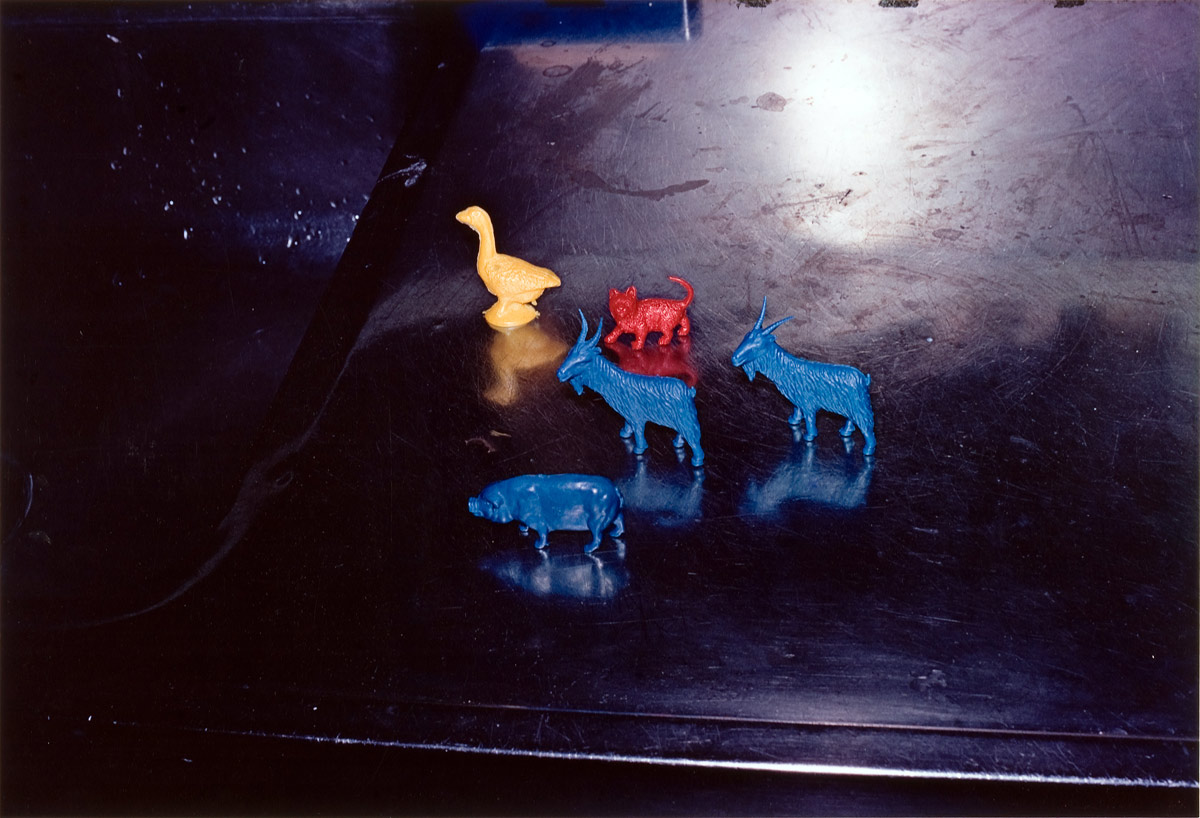
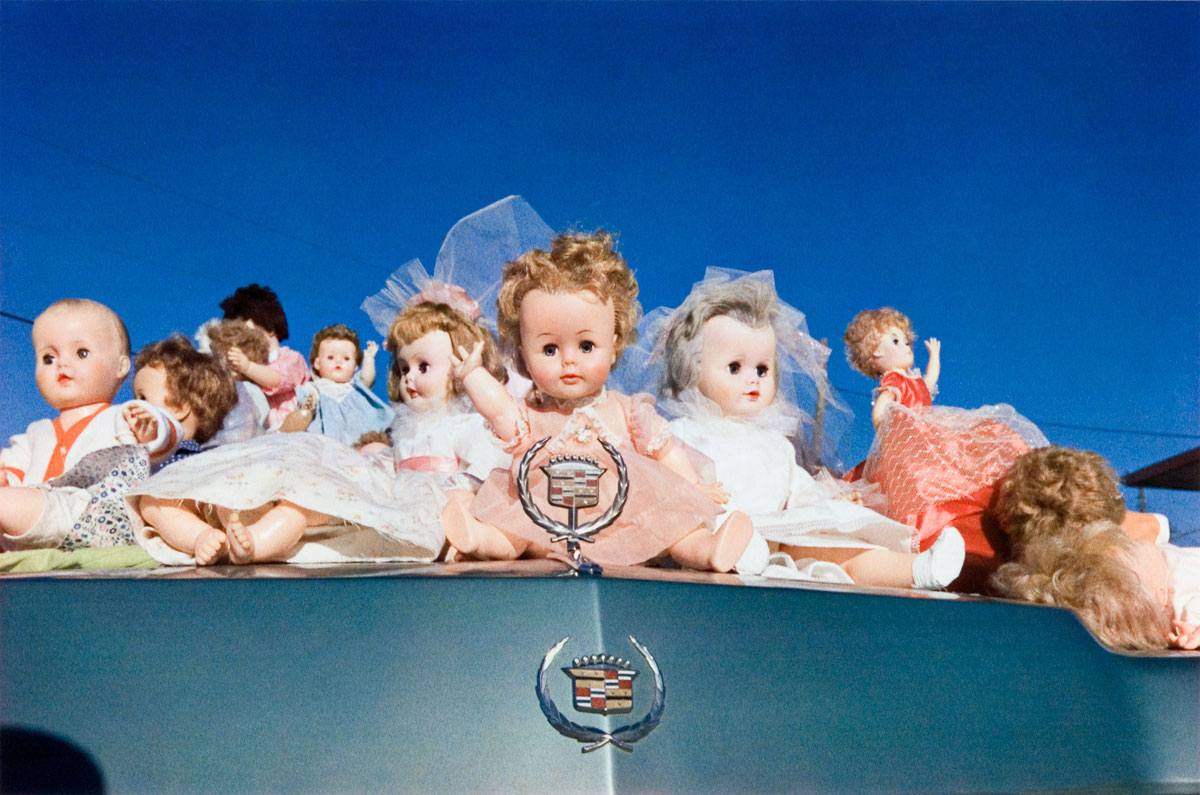
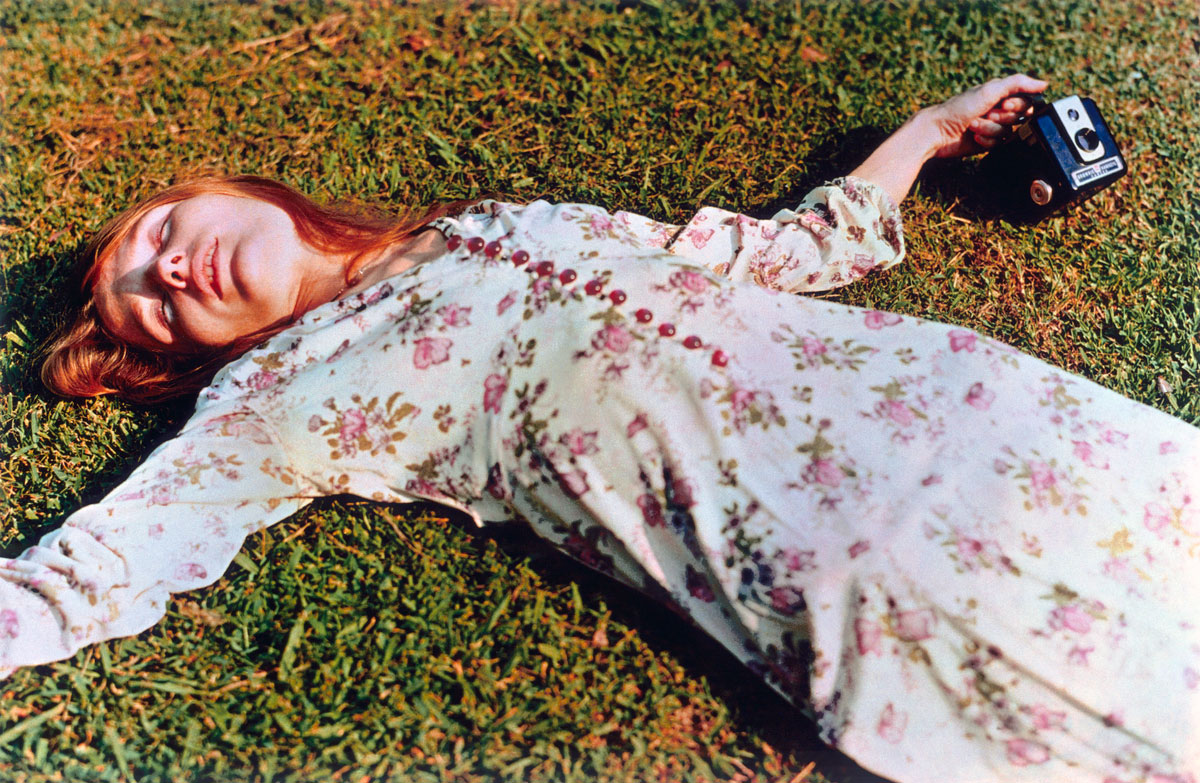
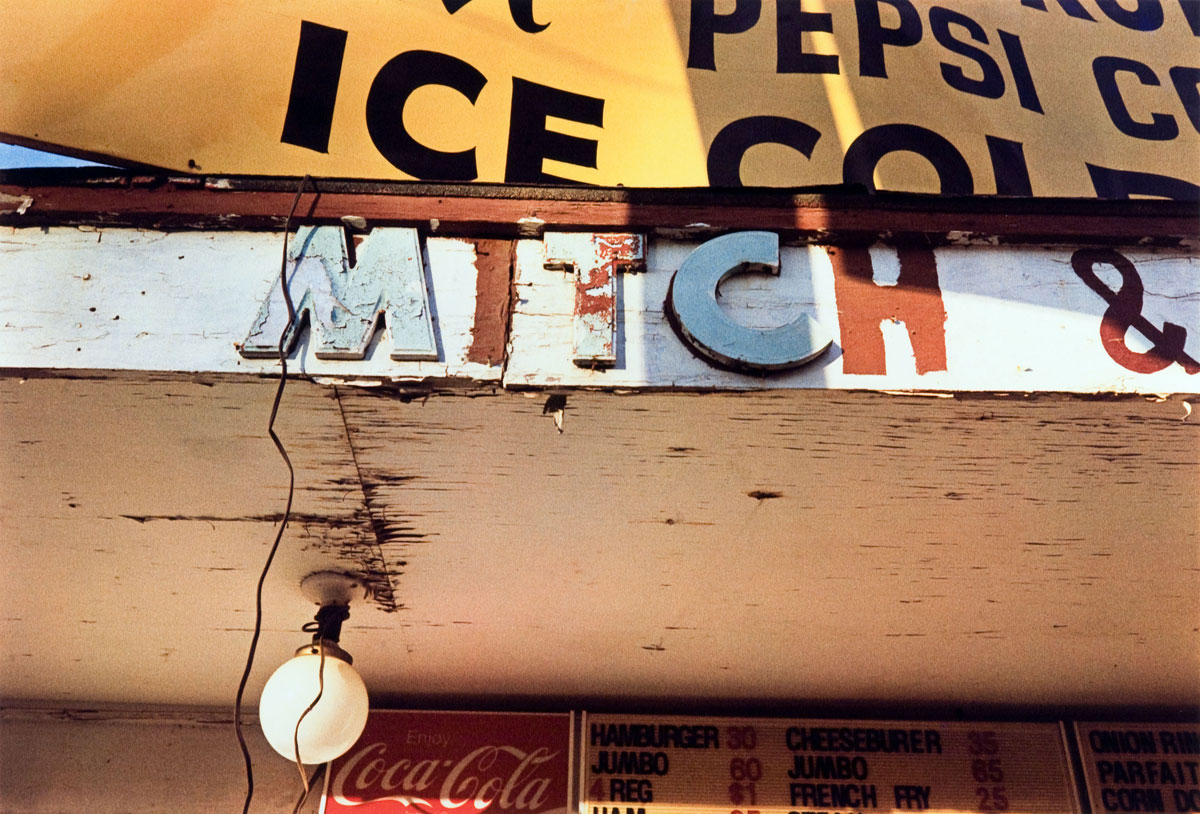
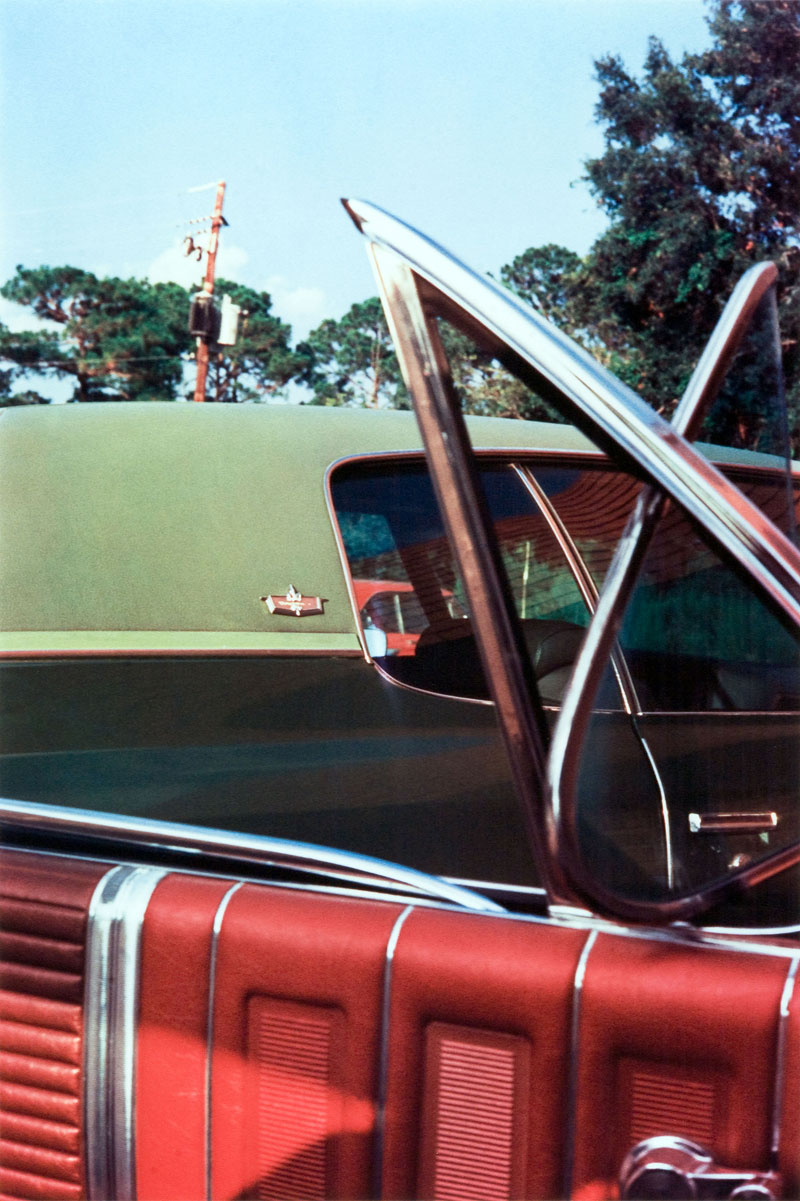
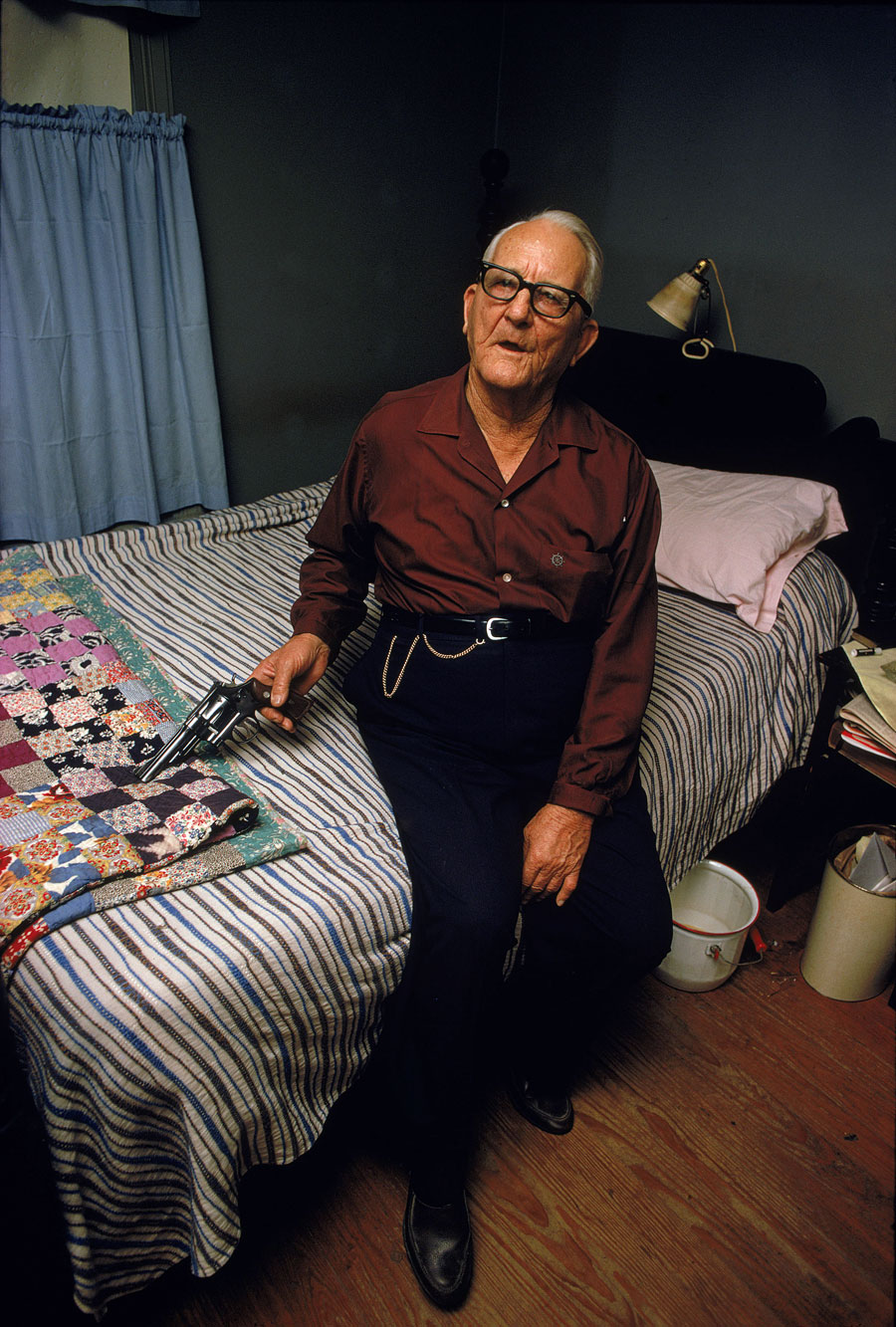
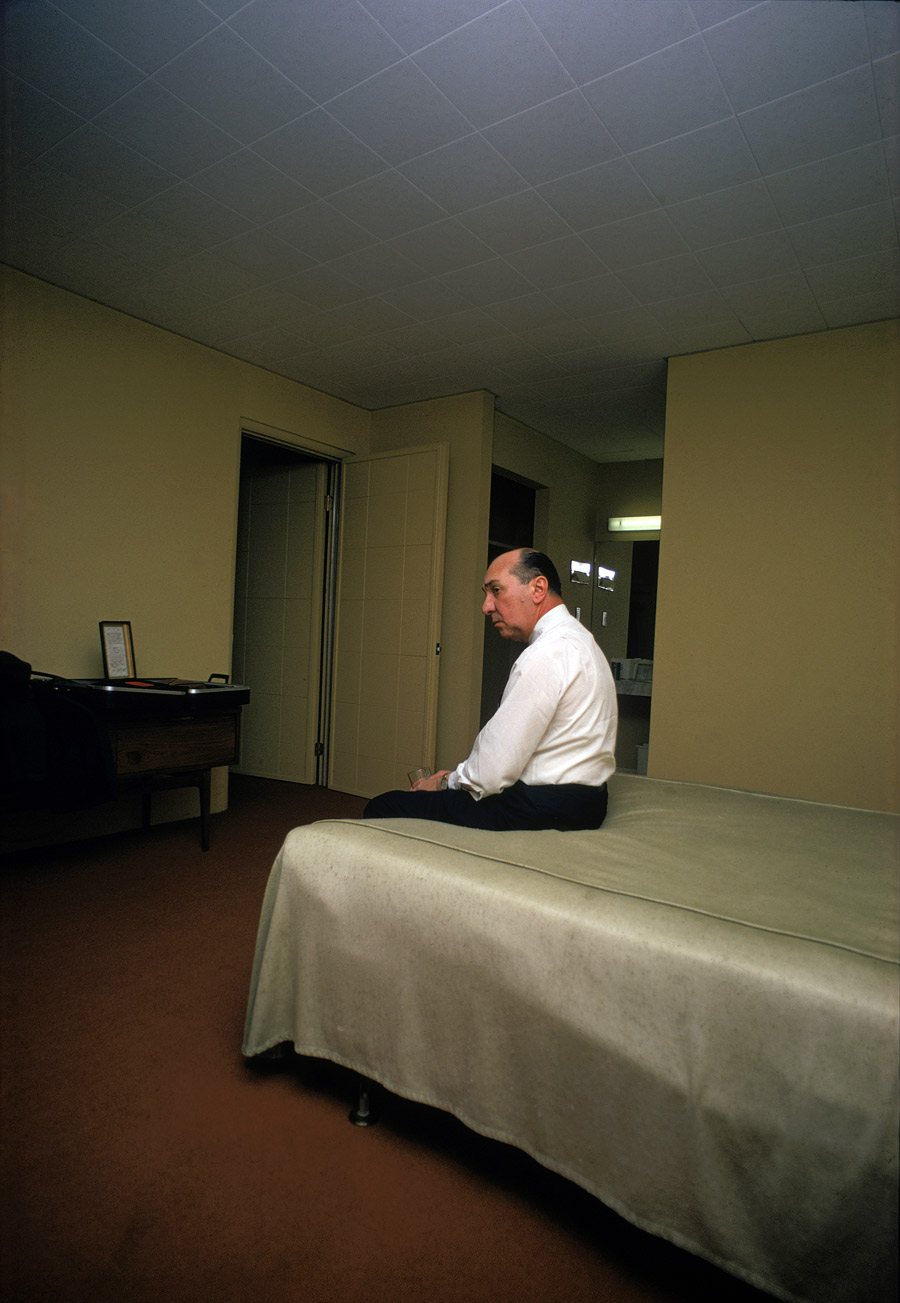
THE classic William Eggleston, the one and only. Feel the heat of sun on body. Look at the construction of the image plane, all angles and fractures. The slight movement of the woman’s hand as she sits on a cracked yellow wall. The distance between her body and the metal pole with wrapped chain and padlock, that ice/fire tension as Minor White would say. Man with gun vs melancholy monochromatic self portrait, the reverie of the lone thinker. Colour and light as emotional sounding board, “colour as a means of discovery and expression, and as a way to highlight aspects of life hidden in plain sight.” This is what Eggleston points his democratic camera at – life hidden in plain sight, revealed in all its intricacies, in all its mundanity and glory.
Dr Marcus Bunyan
Many thankx to Chai Lee and the Art Institute of Chicago for allowing to me reproduce the photographs in this posting. Please click on the photographs for a larger version of the image.
The unconventional beauty and artistry of works by photographer William Eggleston will be showcased in a major exhibition opening at the Art Institute of Chicago this winter. William Eggleston: Democratic Camera, Photographs and Video, 1961-2008 – on view from February 27 through May 23, 2010, in the Modern Wing’s Abbott Galleries (G182, G184) and Carolyn S. and Matthew Bucksbaum Gallery (G188) – is the most comprehensive retrospective to date of the Memphis-based contemporary photographer. The exhibition brings together more than 150 extraordinary images of familiar, everyday subjects with lesser-known, early black-and-white prints and provocative video recordings, all produced over a five-decade period.
Born in 1939 in Memphis, Tennessee, and raised on his family’s cotton plantation in Mississippi, William Eggleston held a casual interest in photography until 1959, when he came across photo books by Henri Cartier-Bresson and Walker Evans. Among his earliest pictures, made during stints at universities in Tennessee and Mississippi, were black-and-white scenes found in his native South, as well as portraits of friends and family members.
By the 1960s and early 1970s he had begun experimenting with colour film, and he eventually produced rich, vivid prints through the dye transfer process – prints that are created through the alignment of three separate matrices (cyan, magenta, and yellow) generated from three separate negatives (red, green, and blue filters). The resulting prints are known for the vividness and permanence of their colours. Hence, Eggleston is often credited for single-handedly ushering in the era of colour art photography.
Eager to show his work to a broader audience, Eggleston traveled to New York with a suitcase of slides and prints to meet with Museum of Modern Art (MoMA) curator John Szarkowski. This visit eventually yielded a controversial but revolutionary exhibition in 1976 – MoMA’s first solo show to feature colour photographs – and a classic accompanying book, William Eggleston’s Guide. At this point in his career, Eggleston had already distinguished himself by treating colour as a means of discovery and expression, and as a way to highlight aspects of life hidden in plain sight.
William Eggleston: Democratic Camera, Photographs and Video, 1961-2008 demonstrates Eggleston’s “democratic” approach to his photographic subjects in both colour and black-and-white. Everything that happens in front of the camera is worthy of becoming a picture for the artist – no matter how seemingly circumstantial or trivial. Eggleston finds his motifs in everyday life, resulting in telling portrayals of American culture. His iconic images such as Elvis’s Graceland, a supermarket clerk corralling grocery carts in the afternoon sunlight, and a freezer stuffed with food proves that the photographer points his “democratic camera” at everything. Eggleston’s quiet, thoughtful pictures have profoundly impacted subsequent generations of photographers, filmmakers, and scholars.
The exhibition also includes Eggleston’s cult video work, Stranded in Canton. In the 1960s, Eggleston used film to document Fred McDowell, a well-known Delta blues musician, but ultimately abandoned the film project. Eggleston later acquired a video camera and began using video to shoot in bars and in people’s homes; sometimes he shot monologues friends delivered for his video camera, most often at night. The result, Stranded in Canton, recently restored and re-edited, is a portrait of a woozy subculture that adds dimension and texture to the world of Eggleston’s colour photographs.
Internationally acclaimed, Eggleston has spent the past four decades photographing around the world, responding intuitively to fleeting configurations of cultural signs and specific expressions of local colour. By not censoring, rarely editing, and always photographing even the seemingly banal, Eggleston convinces us completely of the idea of the democratic camera.
Press release from the Art Institute of Chicago website [Online] Cited 15/05/2010 no longer available online
Paul Ogier (Australia born New Zealand, b. 1974) Saint Stephen 2009 Courtesy of the artist
Mark Hislop from the Monash Gallery of Art (MGA) has asked me to post details of the William and Winifred Bowness Photography Prize 2010. More than happy too. To see the standard take a look at the 2009 Finalists online. Details on how to enter are posted below. Have a go, get your entries in, you never know who will win!
Many thankx to the MGA for allowing me to publish the photographs in the posting. Please click on the photographs for a large version of the image.
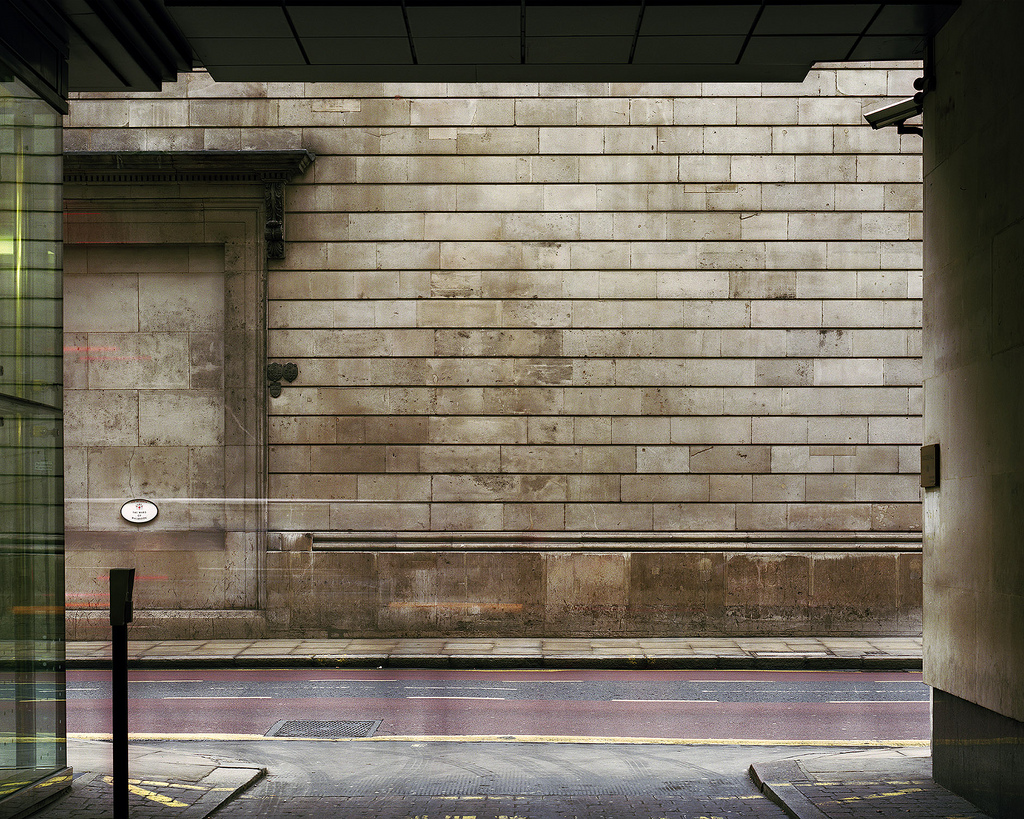
Simon Terrill (Australian, b. 1969) Bank of England 9AM 2009 Courtesy of the artist
The Monash Gallery of Art Foundation is pleased to announce the CALL FOR ENTRIES for the William and Winifred Bowness Photography Prize 2010.
The MGA Foundation will once again showcase the work of Australia’s best photographers in Australia’s most coveted photography award. Photographers from all over Australia are encouraged to submit entries to this year’s Bowness Photography Prize. Each year, finalists are drawn from the breadth of Australian photographic practice: editorial, commercial, street and fine art.
In recognition of the support shown the prize by Australian photographers, prize money for this year’s award has increased substantially. Last year, a record 459 photographers submitted entries in anticipation of the $20,000 non-acquisitive first prize. In 2010, photographers will be competing for $25,000 first prize and $1,000 People’s Choice Award.
The winner of the 2010 Bowness Photography Prize and Honourable Mentions will be announced on Thursday night 23 SEP 2010 during a cocktail party held at MGA. Winners and finalists will enjoy unprecedented visibility for their work. All finalists will be published on MGA’s flickr page and included in a substantial catalogue. The winner will receive the $25,000 first prize. And in recognition of the strength of the prize and MGA’s commitment to promoting the best of contemporary Australian photography, Honourable Mentions will have the opportunity to stage an exhibition at MGA.
This year’s entries will be judged by Gael Newton, Senior Curator of Photographs, National Gallery of Australia, Max Pam, Australian photographer, and Shaune Lakin, Director of MGA.
About the BOWNESS Photography Prize
Established in 2006 to promote excellence in photography, the annual non-acquisitive William and Winifred Bowness Photography Prize is an initiative of the MGA Foundation. The Bowness Photography Prize has quickly become Australia’s most coveted photography prize. It is also one of the country’s most open prizes for photography. In the past, finalists have included established and emerging photographers, art and commercial photographers. All film-based and digital work from amateurs and professionals is accepted. There are no thematic restrictions.
The 2009 Bowness Prize recipient was Paul Knight. Since winning the Prize, Knight has received an Australia Council for the Arts Skills and Development Grant and is currently presenting new work at the prestigious international artfair Art Cologne.
Jane Burton (Australian, b. 1966) Ivy # 3 2009 Courtesy of the artist and Karen Woodbury Gallery, Melbourne
Owen Leong (Australian, b. 1979) Justin 2009 Courtesy of the artist and Anna Pappas Gallery, Melbourne
Paul Knight (Australian, b. 1976) 14 months # 01 2008 Courtesy of the artist and Neon Parc, Melbourne Winner of the William and Winifred Bowness Photography Prize 2009
Monash Gallery of Art 860 Ferntree Gully Road Wheelers Hill Victoria 3150 Phone: +61 3 8544 0503
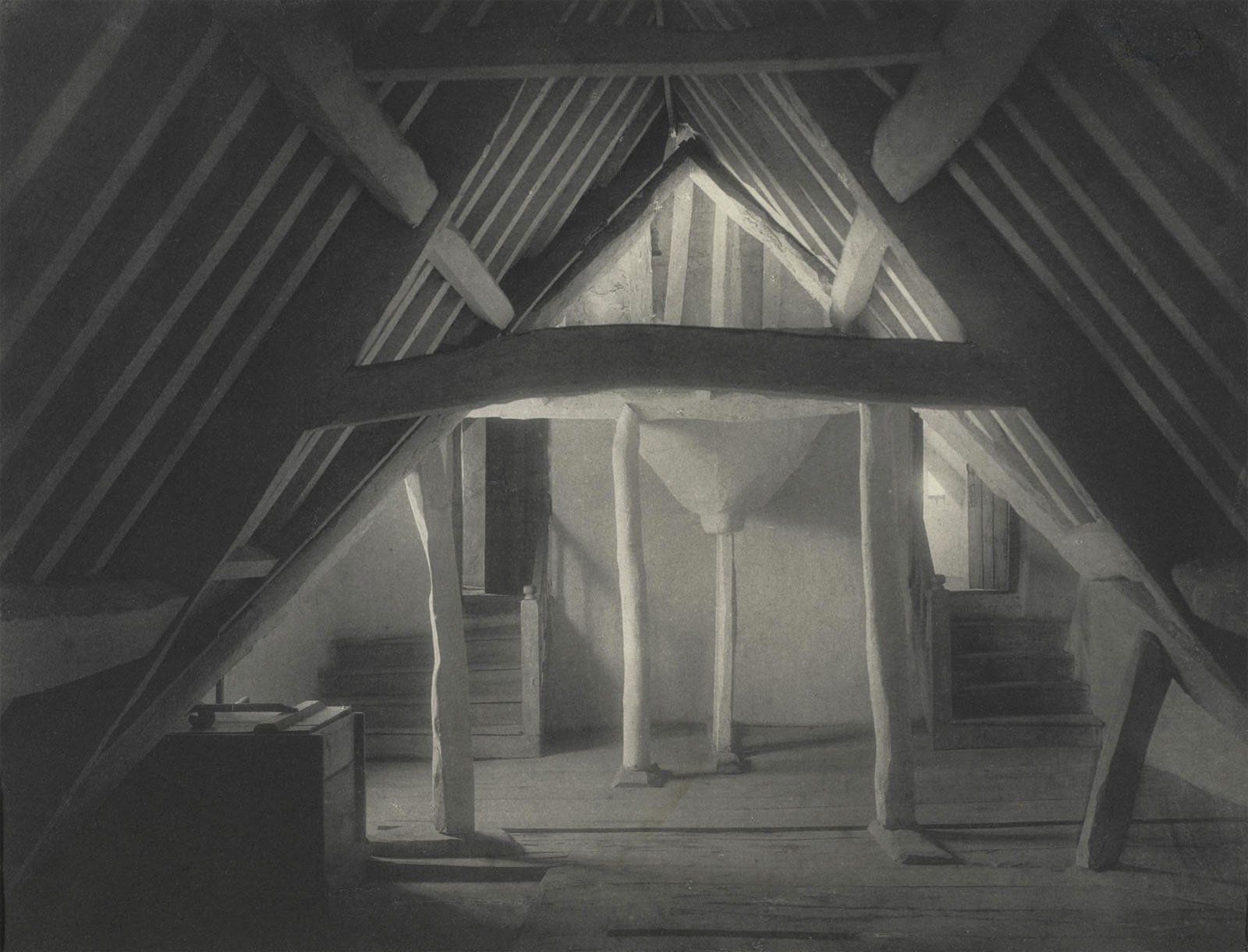
Frederick H. Evans (British, 1853-1943) Kelmscott Manor: Attics 1896 Platinum print Image and sheet: 6 1/16 × 7 7/8 inches (15.4 × 20cm) Philadelphia Museum of Art Gift of the artist, 1932
Attics often serve as metaphors for the space where memories reside. Here Frederick Evans captures the warm glow, the simple, rough-hewn timbers, and the striking geometry of the attic at Kelmscott Manor, the beloved summer retreat of designer William Morris (British, 1834-1896).
Morris, the leader of the Arts and Crafts movement – which valued Britain’s craft tradition and rejected its industrial revolution – drew inspiration from the architecture and workmanship of Kelmscott, designed and constructed in the 1500s. In 1896 Morris invited Evans to photograph the home, which he felt embodied the memory of Britain’s aesthetic past.
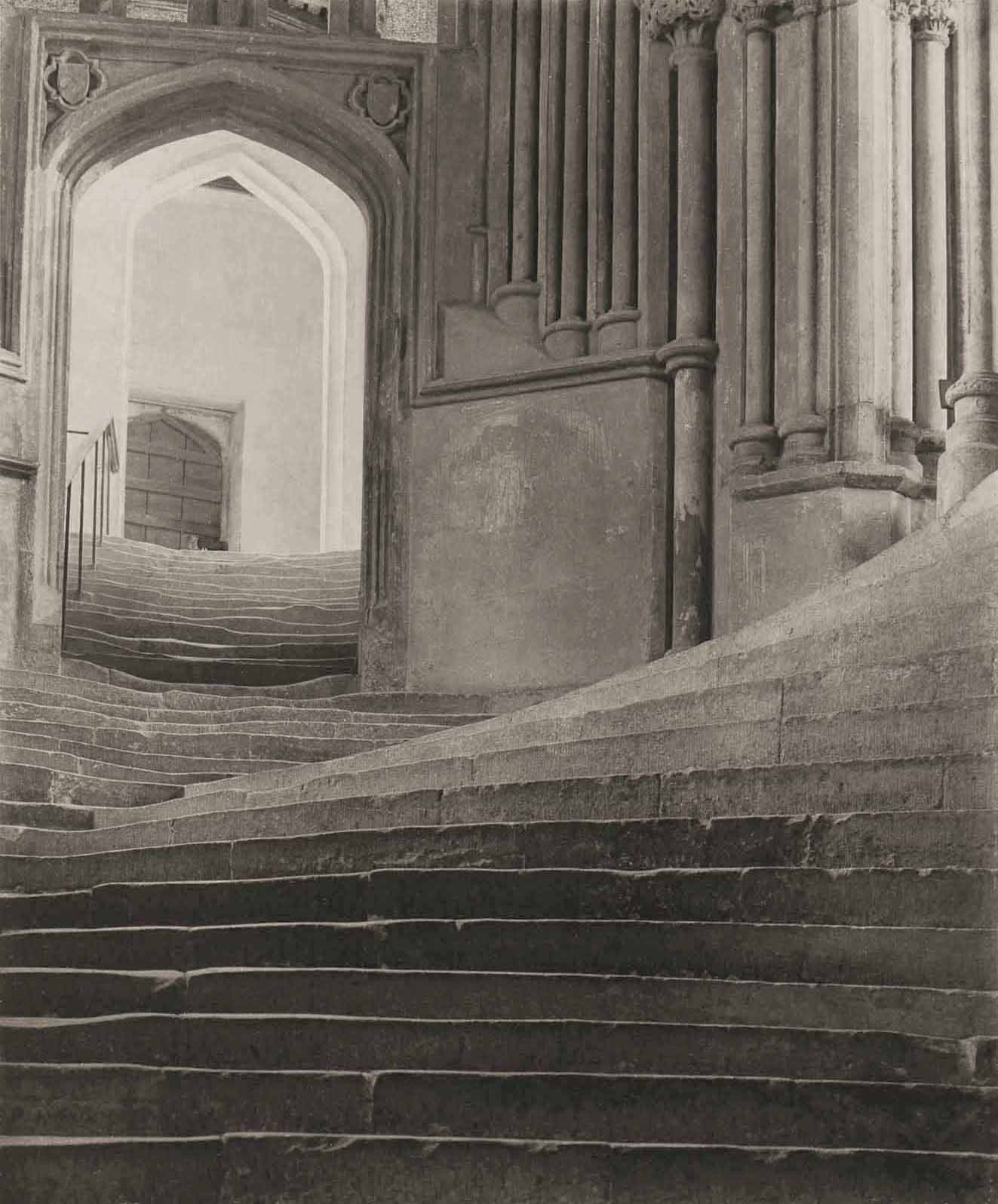
Platinum prints always have such luminosity. A Sea of Steps by Fredrick H. Evans (1903, below) is a knockout. I remember some beautiful platinum prints many years ago (1989) up in Sydney at the Museum of Contemporary Art in the touring exhibition Robert Mapplethorpe: The Perfect Moment that were an absolute knockout as well. Pity he didn’t print them himself but they were still superlative!
Dr Marcus Bunyan
Many thankx to Shen Shellenberger and the Philadelphia Museum of Art for allowing me to publish the last five images in the posting. Please click on the photographs for a larger version of the image.
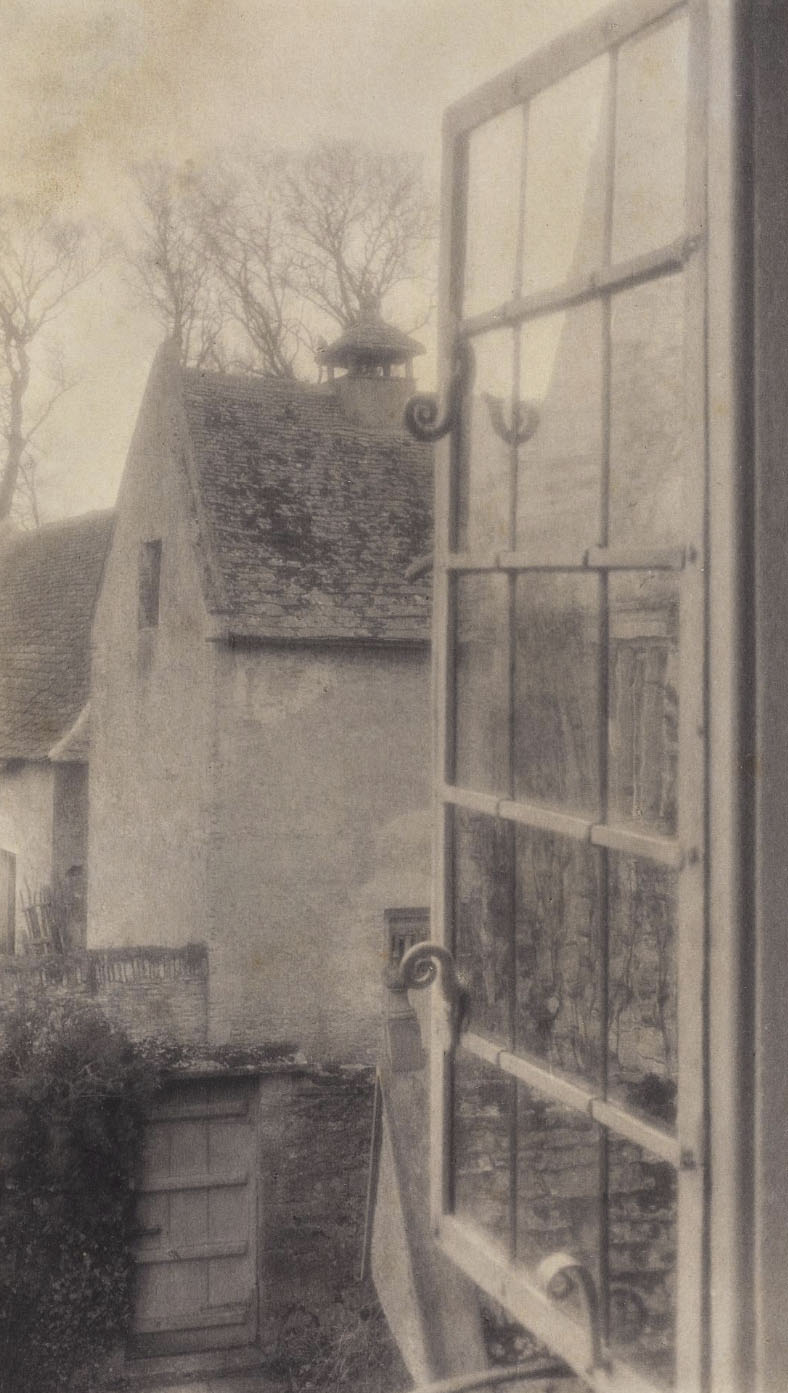
Frederick H. Evans (British, 1853-1943) Kelmscott Manor 1896 Platinum print Image and sheet: 7 3/8 × 4 1/4 inches (18.7 × 10.8cm) Philadelphia Museum of Art Purchased with funds contributed by Dorothy Norman and with the Director’s Discretionary Fund, 1968
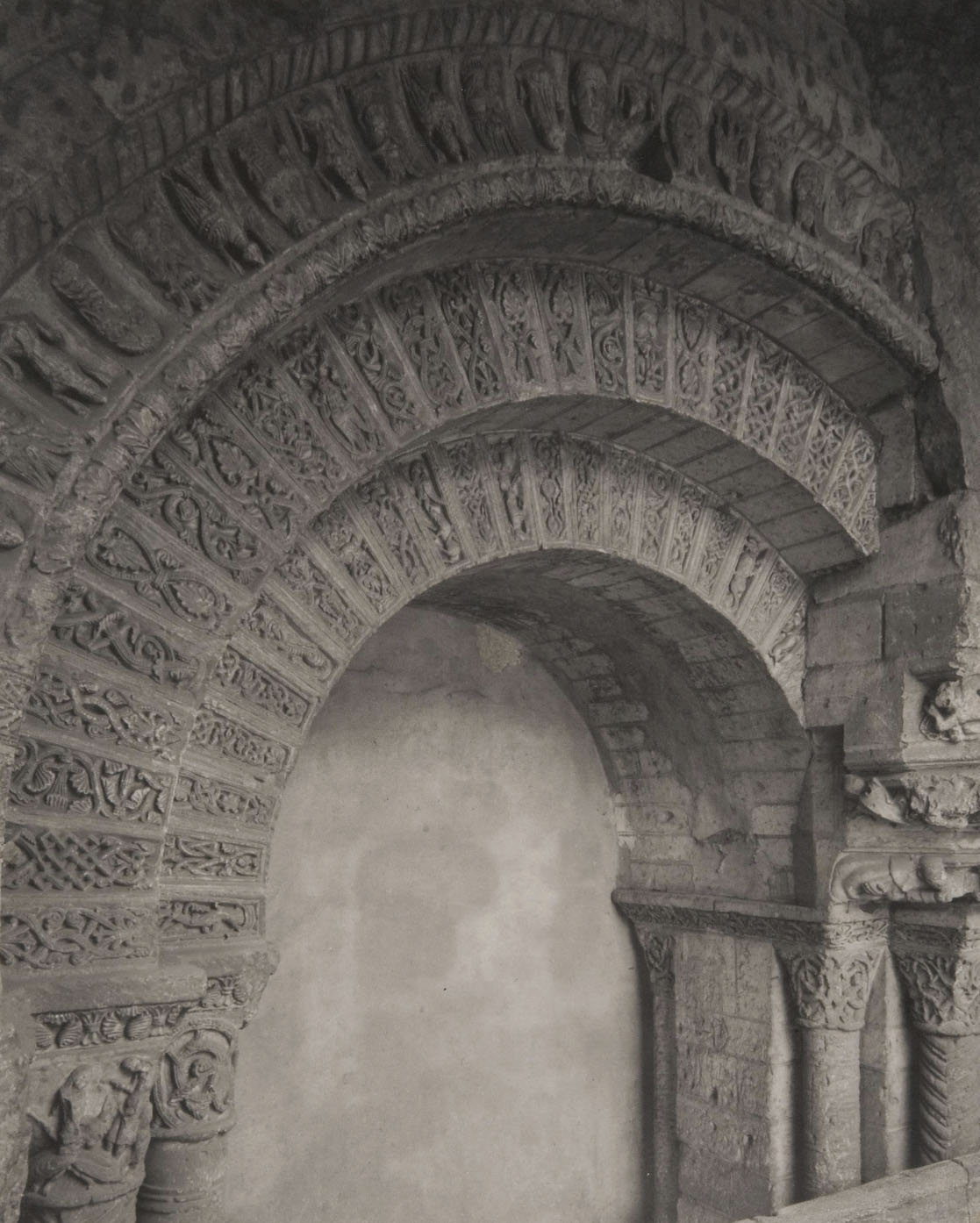
Frederick H. Evans (British, 1853-1943) Angers: Prefecture, Sculptured Arches of 11th-12th Century c. 1906-1907 Platinum print Image and sheet: 9 11/16 × 7 7/8 inches (24.6 × 20 cm) Philadelphia Museum of Art Purchased with funds contributed by Dorothy Norman and with the Director’s Discretionary Fund, 1968
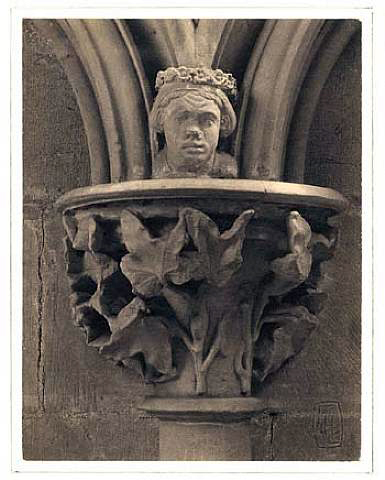
Frederick H. Evans (British, 1853-1943) Southwell Cathedral, Chapter House Capital 1898 Platinum print Philadelphia Museum of Art
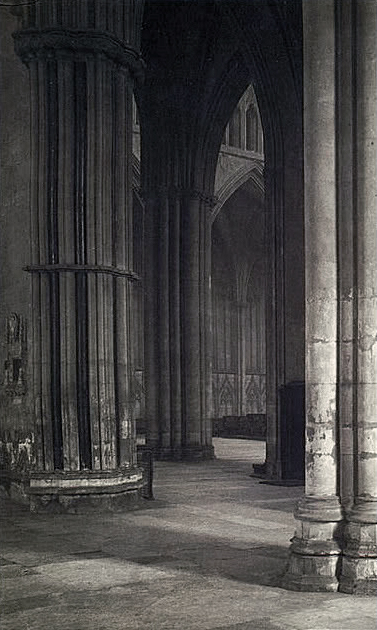
Frederick H. Evans (British, 1853-1943) View across the nave to the transept at York Minster 1901 Platinum print Philadelphia Museum of Art
Frederick H. Evans (British, 1853-1943) Durham Cathedral: West End Nave 1912 Platinum print Image and sheet: 9 1/2 × 4 13/16 inches (24.1 × 12.3cm) Philadelphia Museum of Art Purchased with funds contributed by Dorothy Norman, 1973
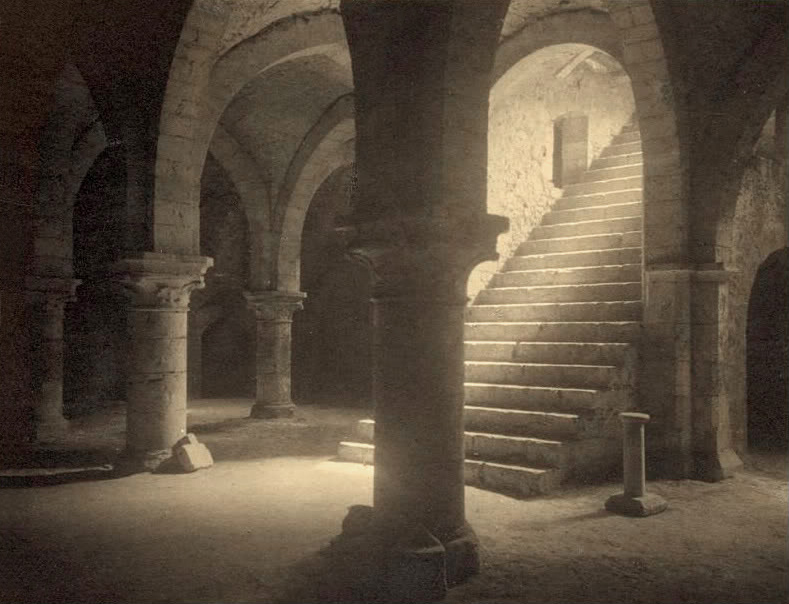
Frederick H. Evans (British, 1853-1943) Ancient crypt cellars in Provins 1910 Platinum print Philadelphia Museum of Art
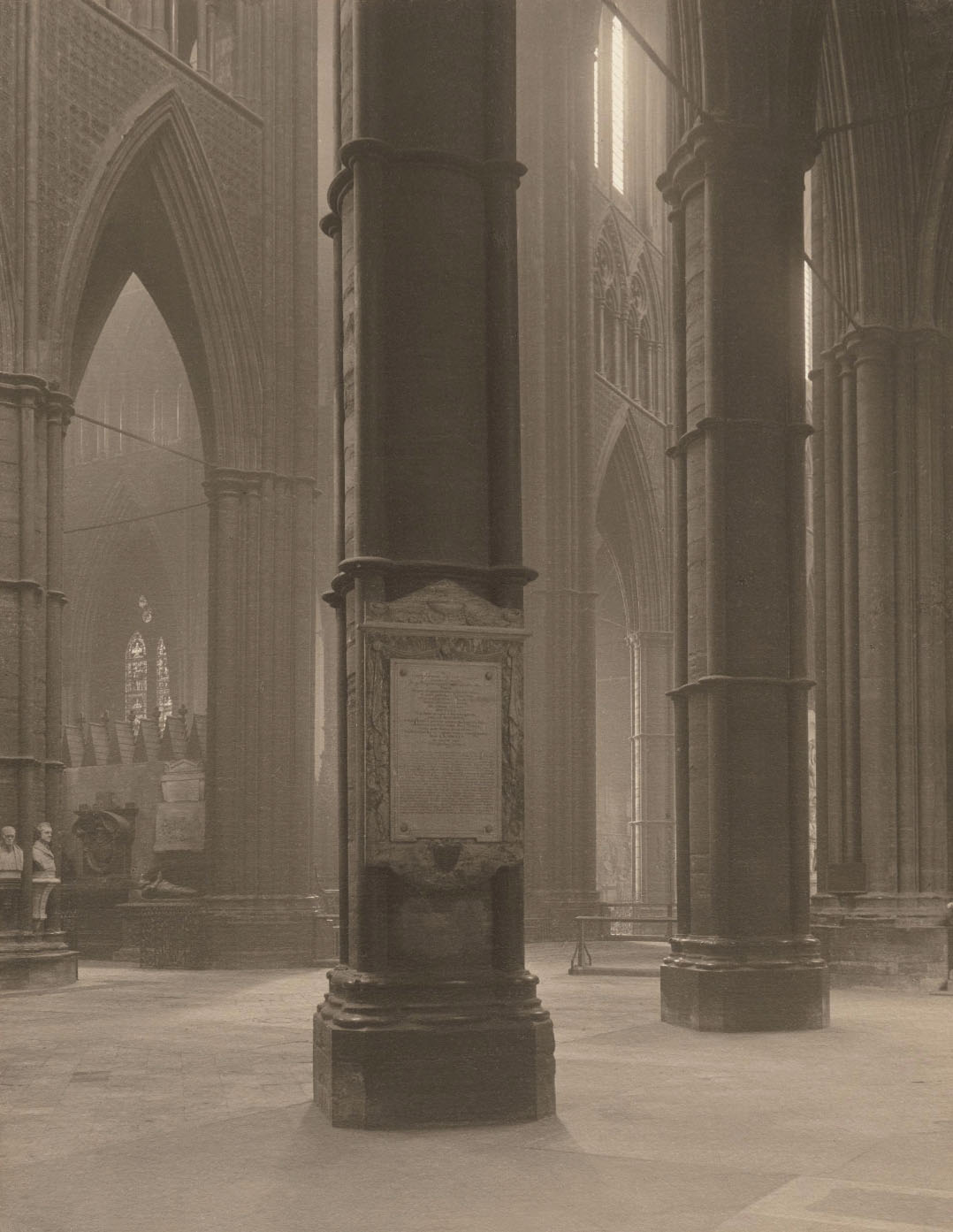
Frederick H. Evans (British, 1853-1943) Westminster Abbey: North Transept: East Side 1911 Platinum print Image and sheet: 9 7/16 × 6 inches (23.9 × 15.3cm) Philadelphia Museum of Art Purchased with the Lola Downin Peck Fund, 1969
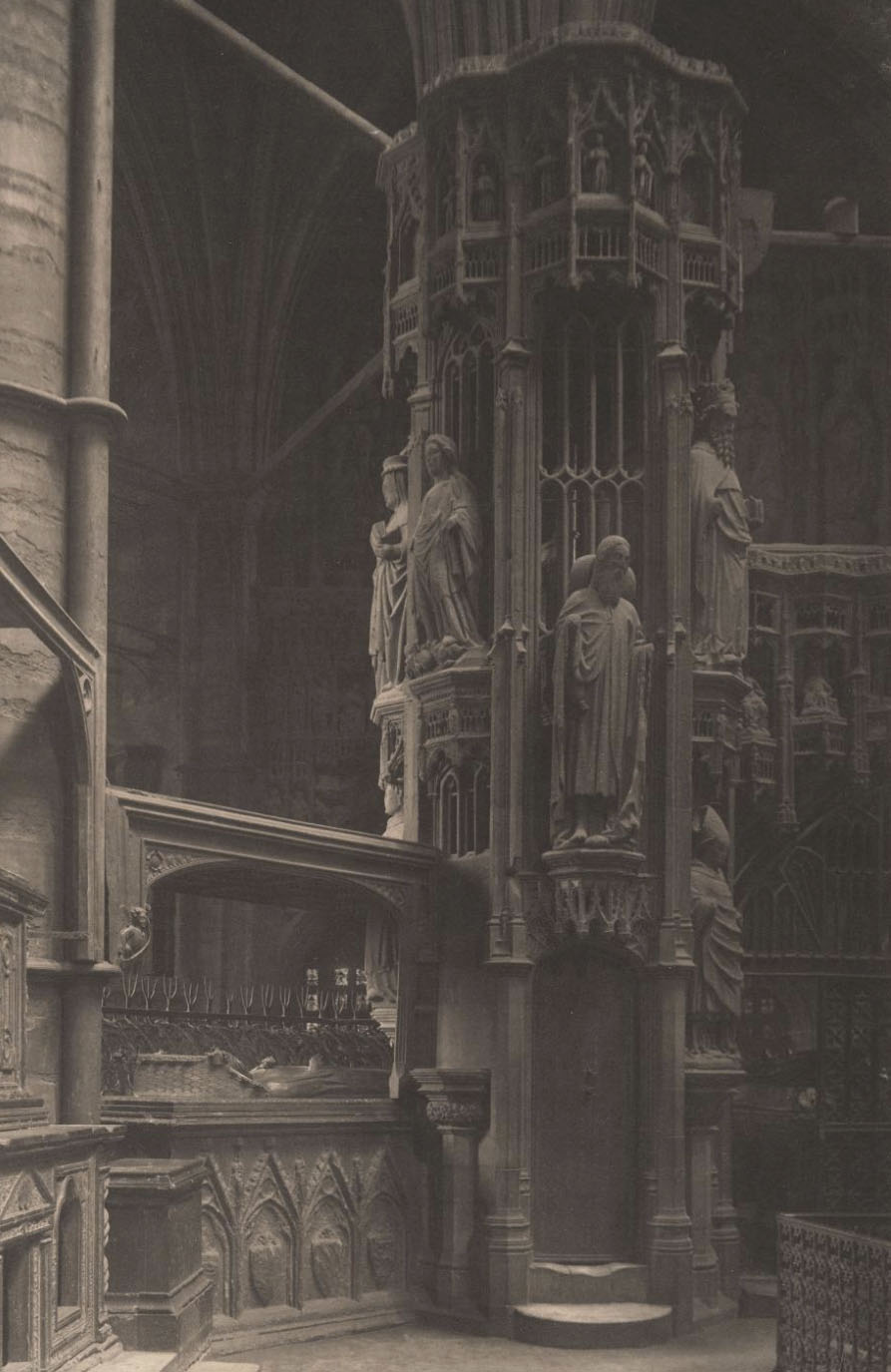
Frederick H. Evans (British, 1853-1943) Westminster Abbey: Staircase in Confessor’s Chapel 1911 Platinum print Image and sheet: 9 1/2 × 6 1/8 inches (24.2 × 15.6cm) Philadelphia Museum of Art Purchased with the Lola Downin Peck Fund, 1969
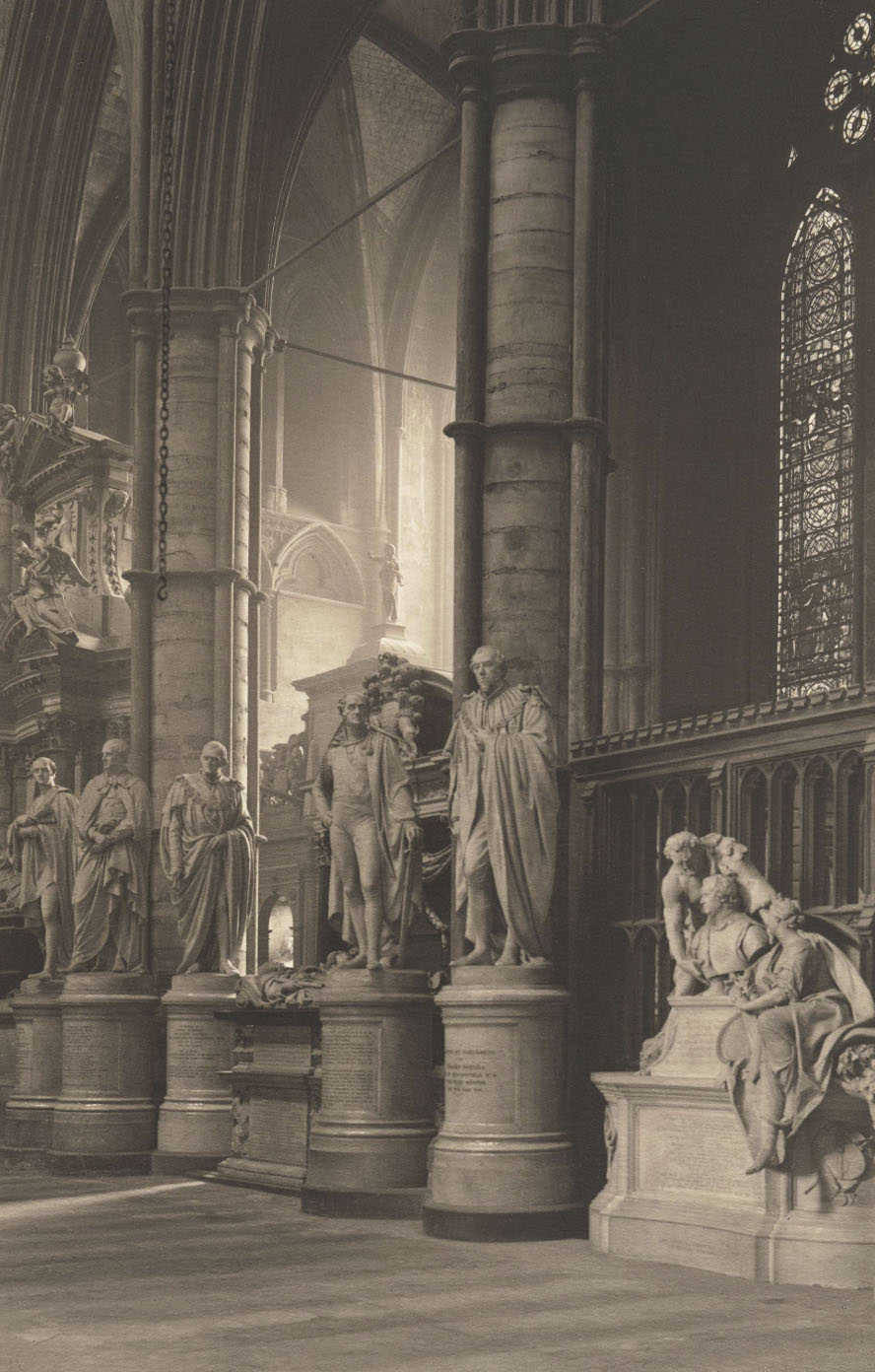
Frederick H. Evans (British, 1853-1943) Westminster Abbey: From the South Transept 1911 Platinum print Image and sheet: 9 1/2 × 7 7/16 inches (24.2 × 18.9cm) Philadelphia Museum of Art Purchased with the Lola Downin Peck Fund, 1969
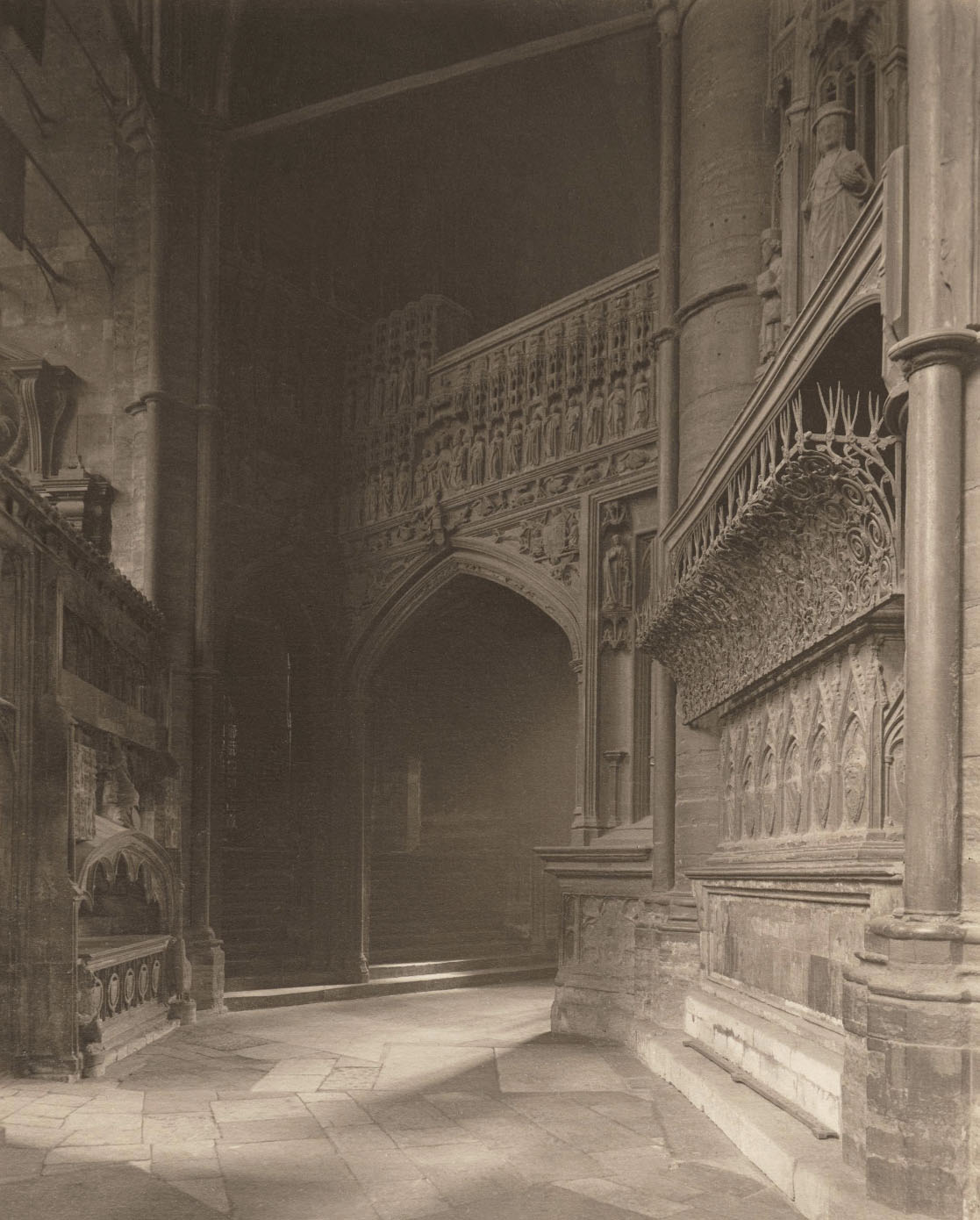
Frederick H. Evans (British, 1853-1943) Westminster Abbey: East Ambulatory 1911 Platinum print Image and sheet: 9 5/16 × 6 11/16 inches (23.7 × 17cm) Purchased with the Lola Downin Peck Fund, 1969
Frederick H. Evans (British, 1853-1943) Westminster Abbey: 12th-Century Mosaic Floor at the Sanctuary 1911 Platinum print Image and sheet: 7 5/16 × 8 7/8 inches (18.6 × 22.6 cm) Philadelphia Museum of Art Purchased with the Lola Downin Peck Fund, 1969
Although Evans indicated that this mosaic floor was created in the twelfth century, the surface surrounding the High Altar of Westminster Abbey was in fact laid in 1268. King Henry III (1207-1272) commissioned the mosaic from Roman craftsmen who specialised in the opus sectile, or “cut work” technique, commonly called “Cosmati” after a well-known Italian family of mosaic artists. Materials used here include blue, red, and turquoise glass as well as yellow limestone, purple porphyry, green serpentine, and onyx. Evans’s unusual composition privileges the floor, drawing attention to the intricate and abstract design of squares, rectangles, and roundels.
Frederick H. Evans (British, 1853-1943) Westminster Abbey: East End, North Ambulatory 1911 Platinum print Image and sheet: 9 3/8 × 7 1/2 inches (23.8 × 19.1cm) Philadelphia Museum of Art Purchased with the Lola Downin Peck Fund, 1969
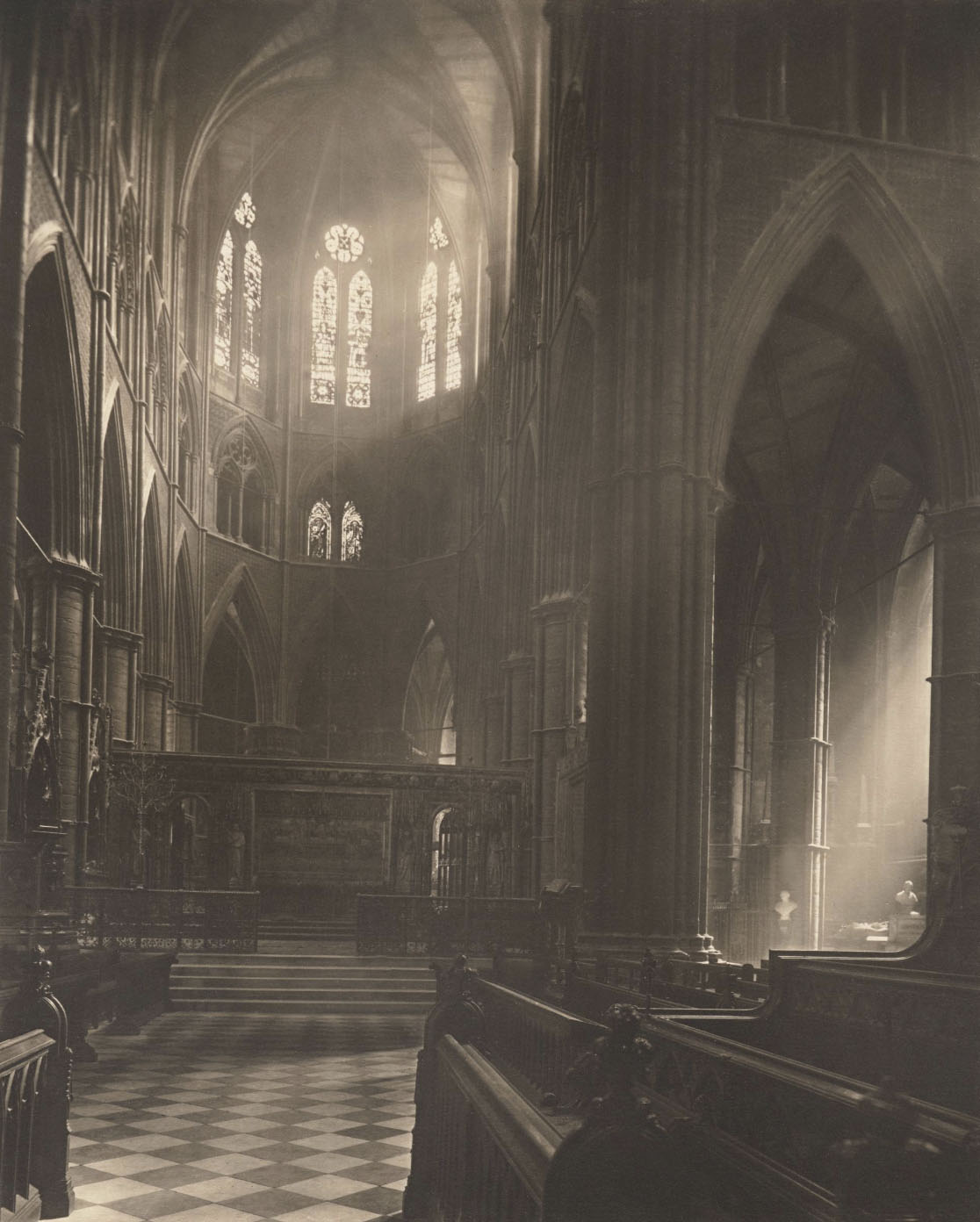
Frederick H. Evans (British, 1853-1943) Westminster Abbey: Apse from Choir 1911 Platinum print Image and sheet: 9 7/16 × 7 1/2 inches (23.9 × 19.1cm) Philadelphia Museum of Art Purchased with the Lola Downin Peck Fund, 1969
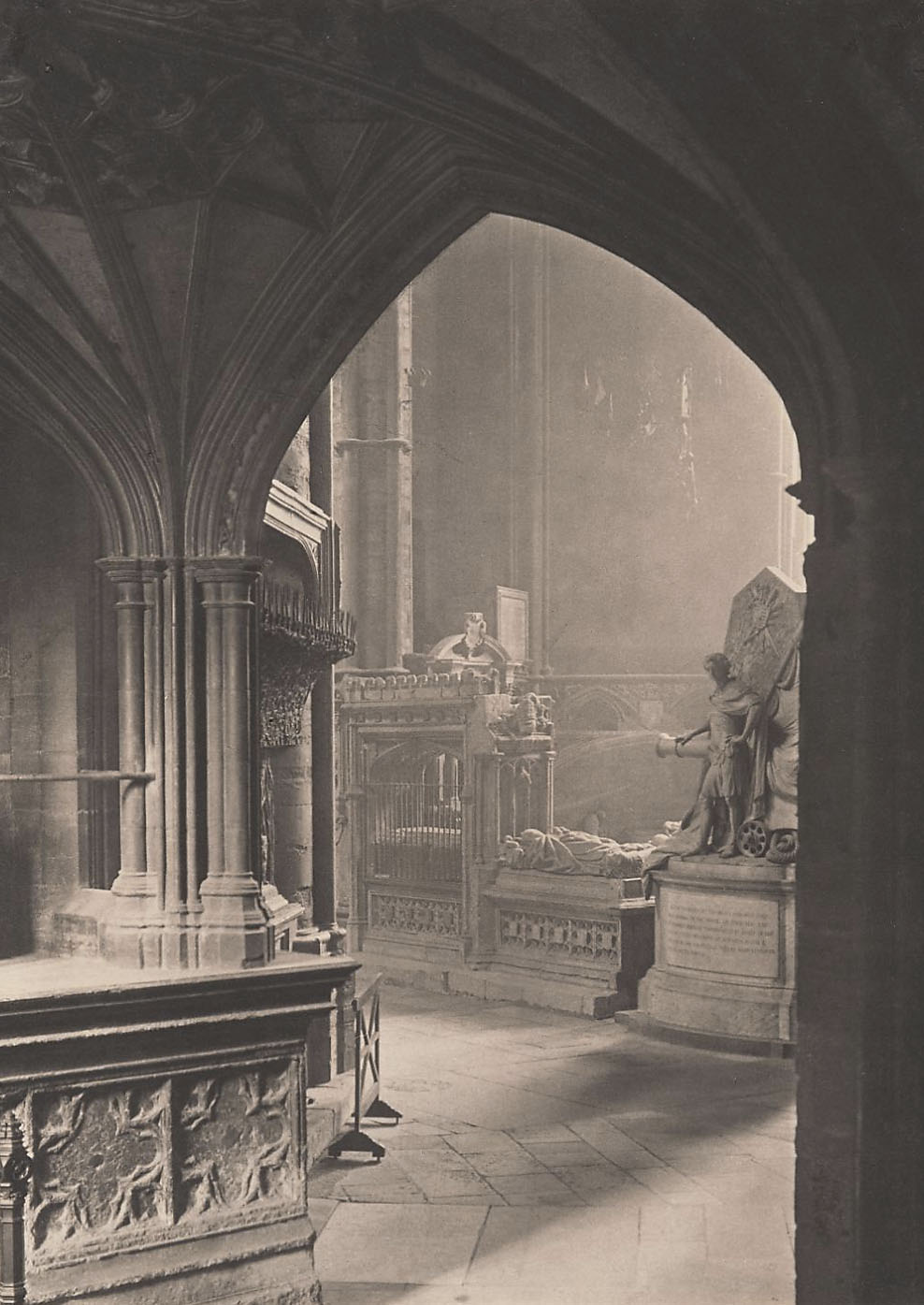
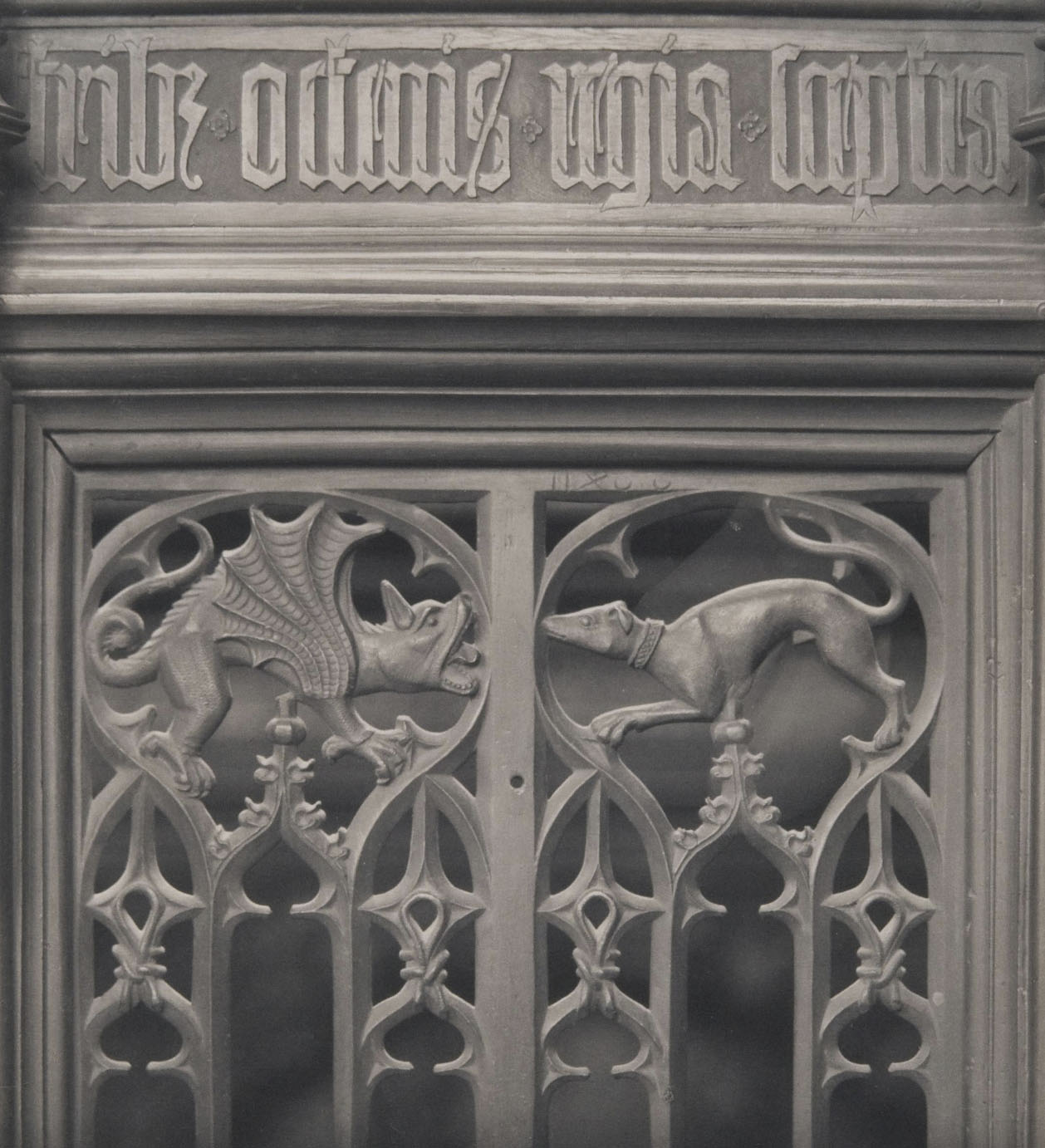
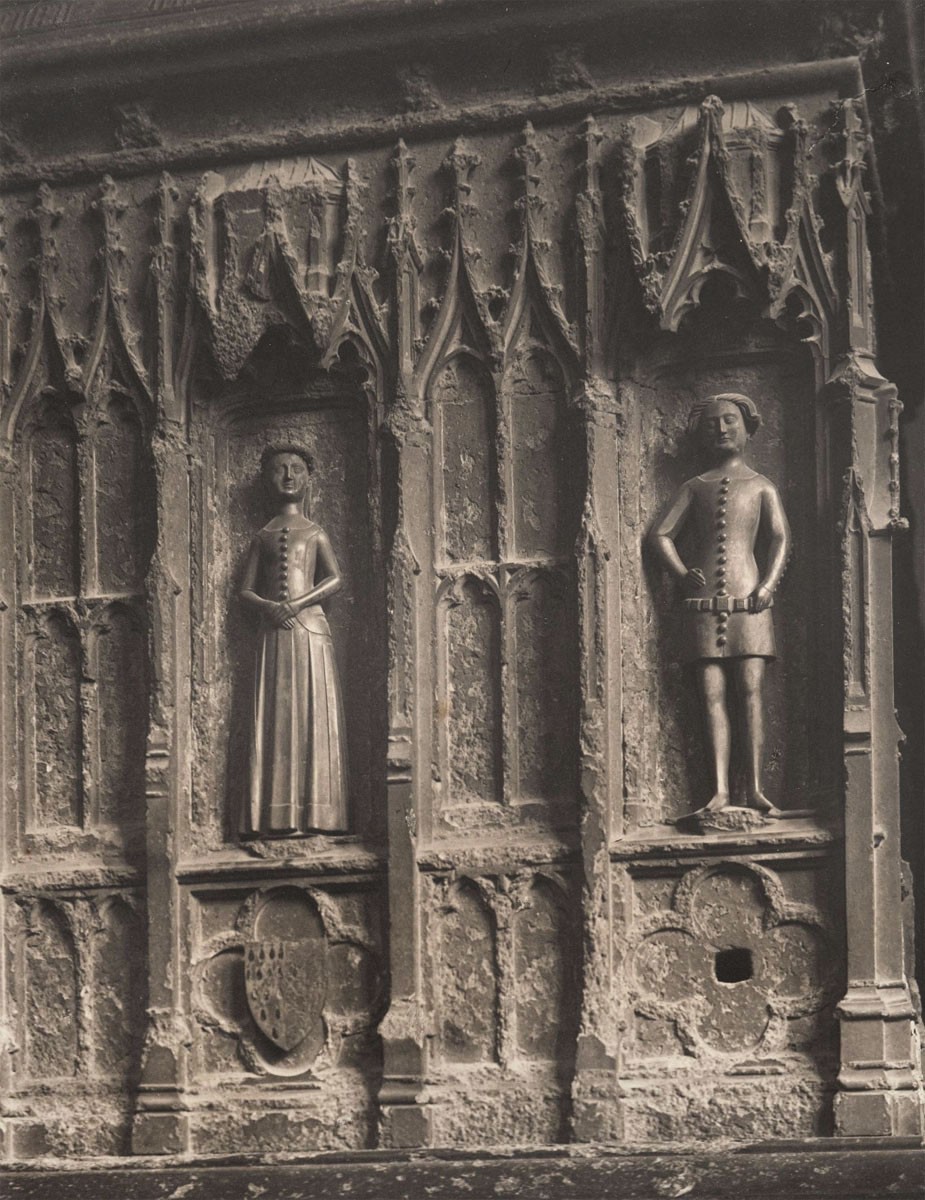
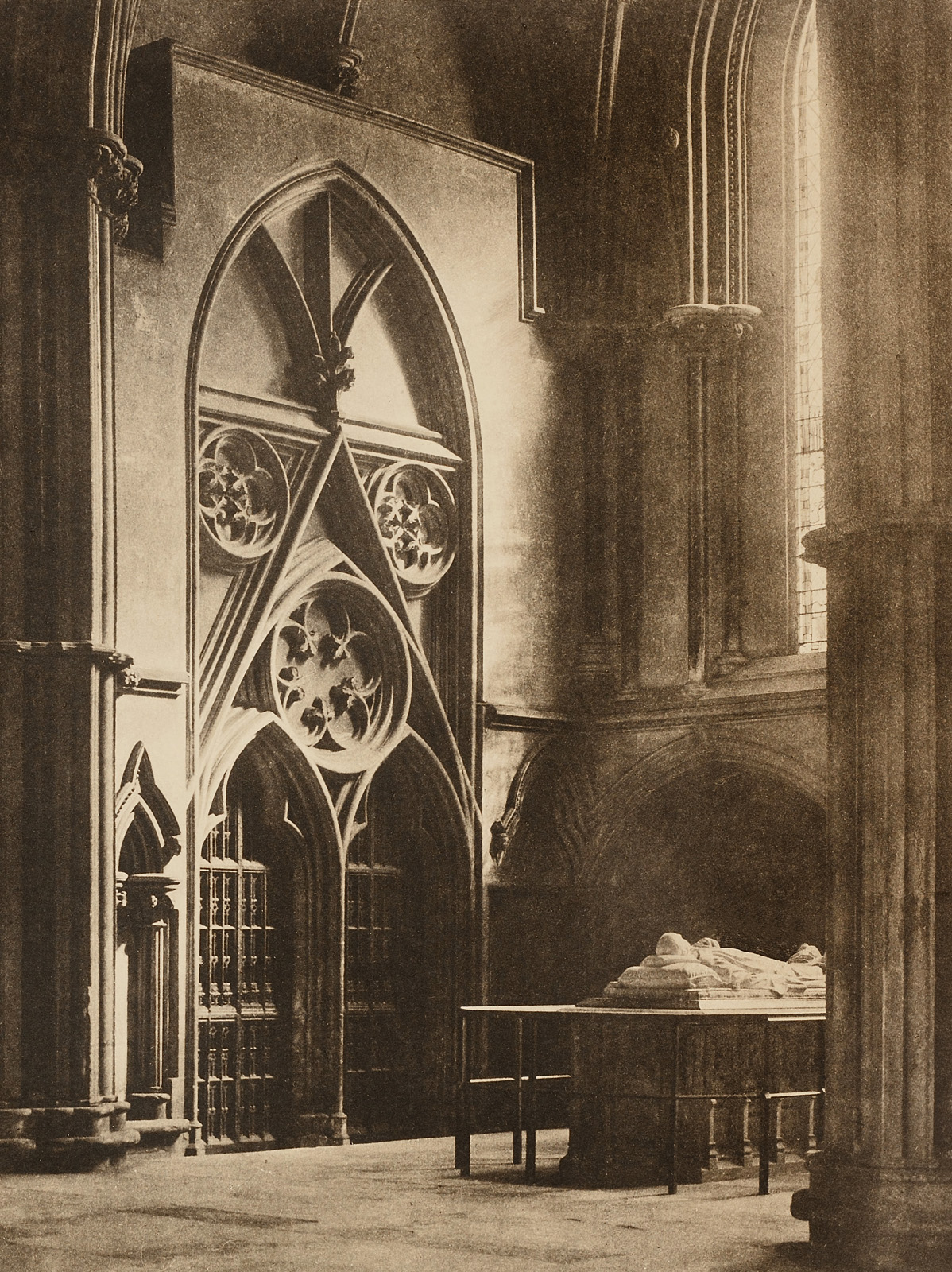
Country Life magazine commissioned Evans to photograph the interior of London’s Westminster Abbey in 1911, while the church was closed to worshipers in preparation for the coronation of King George V (1865-1936) and Queen Mary (1867-1953). Although the construction and removal of temporary facilities relating to the coronation regularly disrupted Evans’s work, the more than fifty photographs in the resulting portfolio reveal only the timeless beauty and grandeur of the Gothic structure that has hosted thirty-eight royal coronations since the year 1066.
Frederick H. Evans (British, 1853-1943) Westminster Abbey: Henry VII Chapel, Detail of Henry VII Tomb 1911 Platinum print Image and sheet: 8 1/16 × 7 3/16 inches (20.4 × 18.2cm) Philadelphia Museum of Art Purchased with the Lola Downin Peck Fund, 1969
Frederick H. Evans (British, 1853-1943) Westminster Abbey: Tomb of Edward III, Mary and William 1911 Platinum print Image and sheet: 8 11/16 × 6 5/8 inches (22.1 × 16.9cm) Philadelphia Museum of Art Purchased with the Lola Downin Peck Fund, 1969
Frederick H. Evans (British, 1853-1943) York Minster – In Sure and Certain Hope 1903 Platinum print Philadelphia Museum of Art
Frederick H. Evans (British, 1853-1943) A Sea of Steps – Stairs to Chapter House – Wells Cathedral 1903 Platinum print Philadelphia Museum of Art
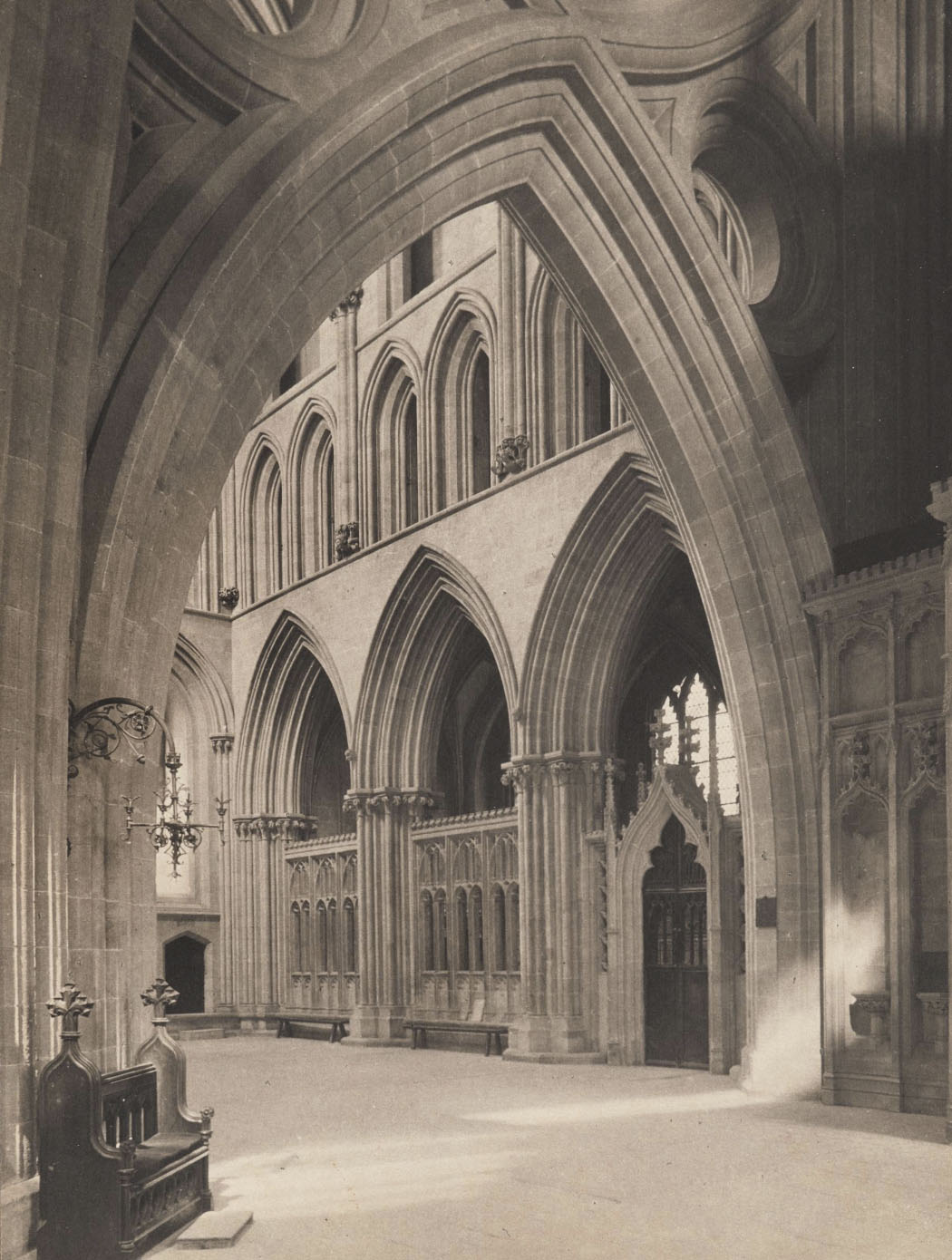
Frederick H. Evans (British, 1853-1943) Wells Cathedral: North Transept c. 1903 Platinum print Image and sheet: 7 1/4 × 5 7/16 inches (18.4 × 13.8cm) Purchased with funds contributed by Dorothy Norman, 1973
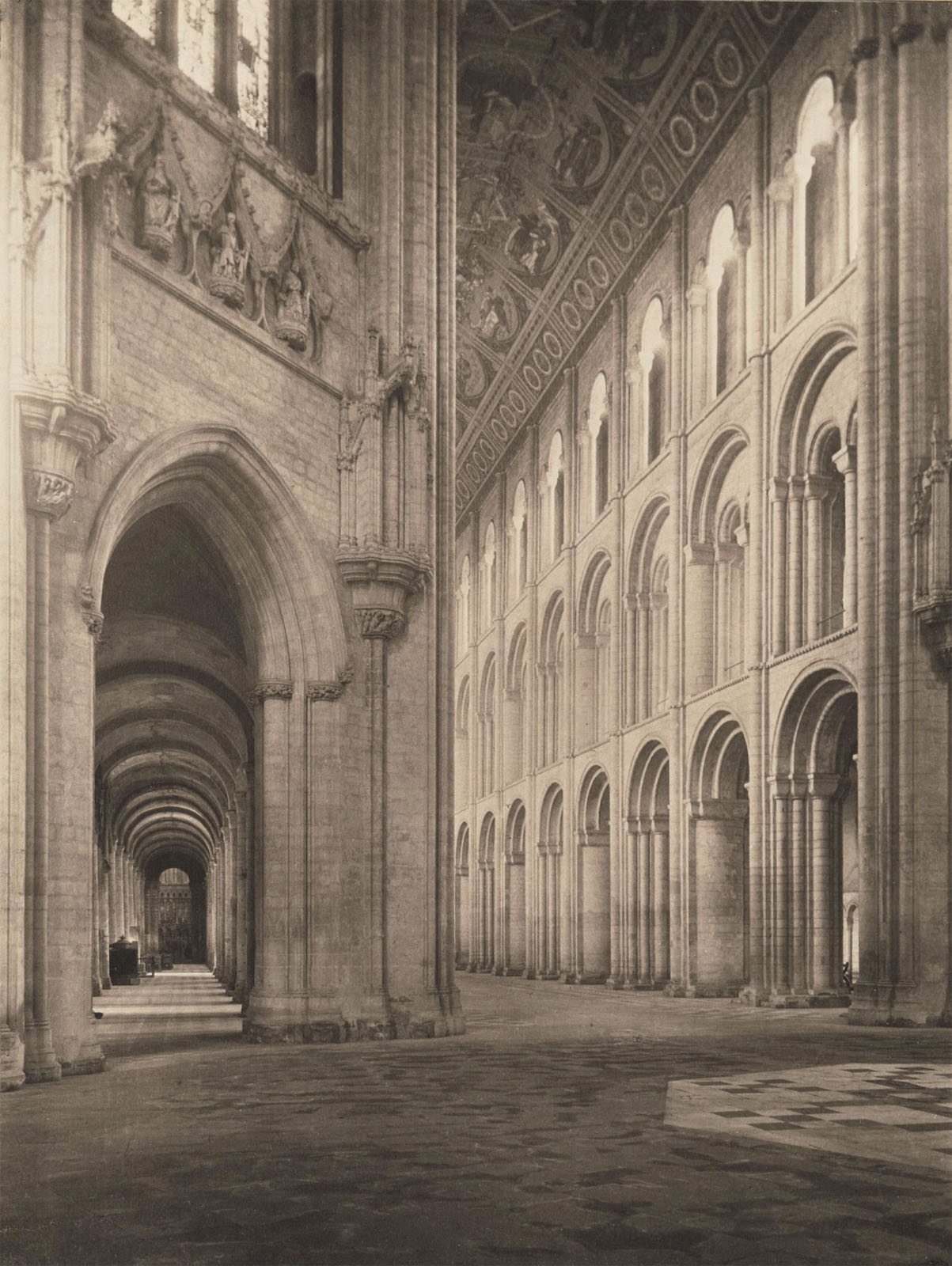
Frederick H. Evans (British, 1853-1943) Ely Cathedral: Octagon into Nave Aisle c. 1899 Platinum print Image and sheet: 7 15/16 × 6 1/8 inches (20.2 × 15.6cm) Philadelphia Museum of Art Purchased with funds contributed by Dorothy Norman, 1973
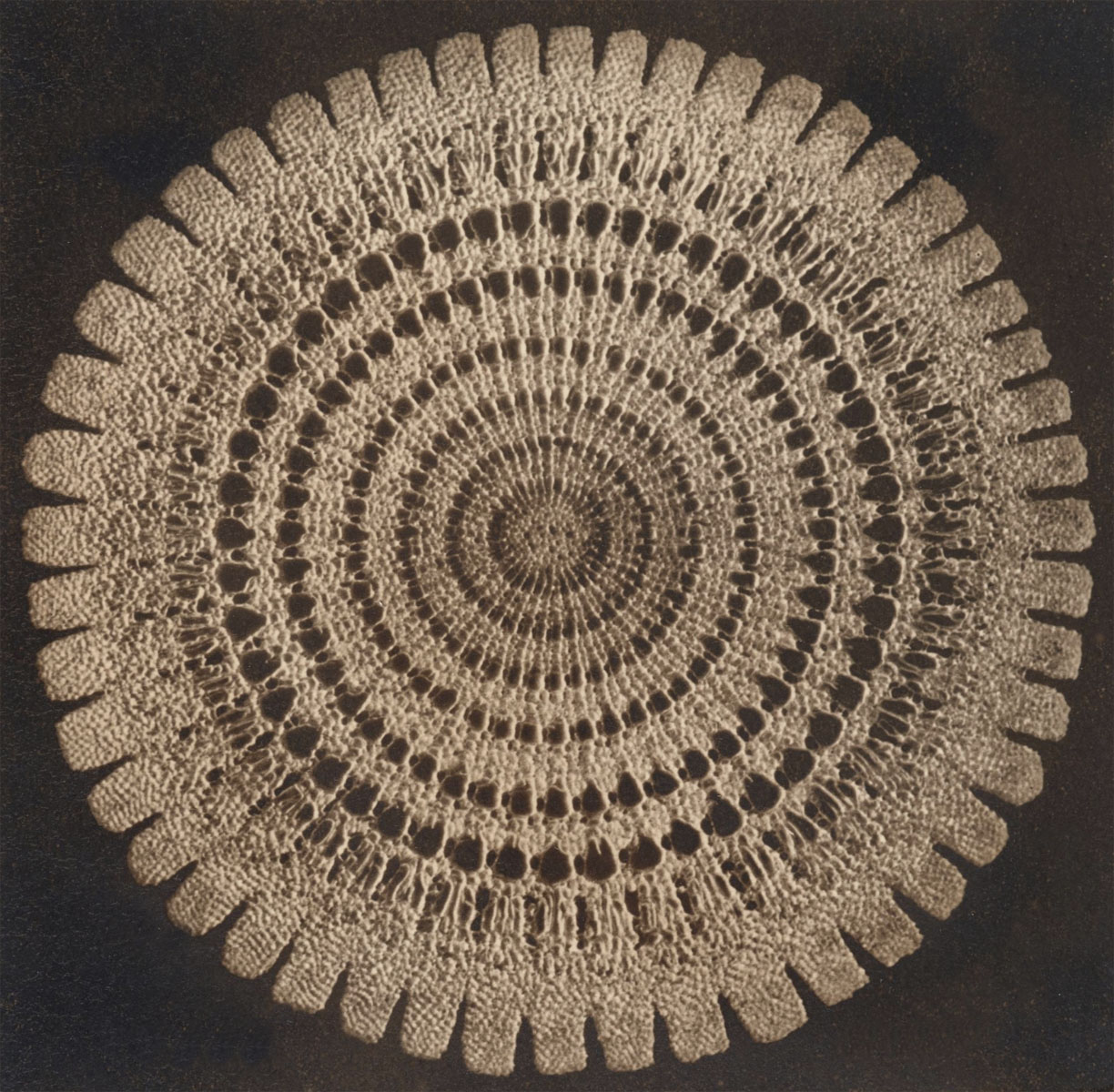
Frederick H. Evans (British, 1853-1943) Fr: Sec: Spine of Echinus x. 40 c. 1887 Platinum print Image and sheet: 4 3/4 × 4 5/8 inches (12 × 11.8cm) Philadelphia Museum of Art Purchased with funds contributed by Dorothy Norman, 1973
Unlike many beginning photographers of the nineteenth century who experimented with straightforward portrait or landscape compositions, Evans’s earliest trials with photography involved minute organic matter and required the use of a microscope. His complicated “photo-microgram” process allowed him to capture the intricate structures of objects including a water beetle’s eye, tiny sea shells, and this section of a sea urchin’s spine. Although classified as scientific rather than artistic imagery by the Photographic Society of Great Britain, this photo-microgram demonstrates Evans’s ability to delineate the magnificence of organic patterns and presage his photographs that depict the structural beauty of cathedrals.
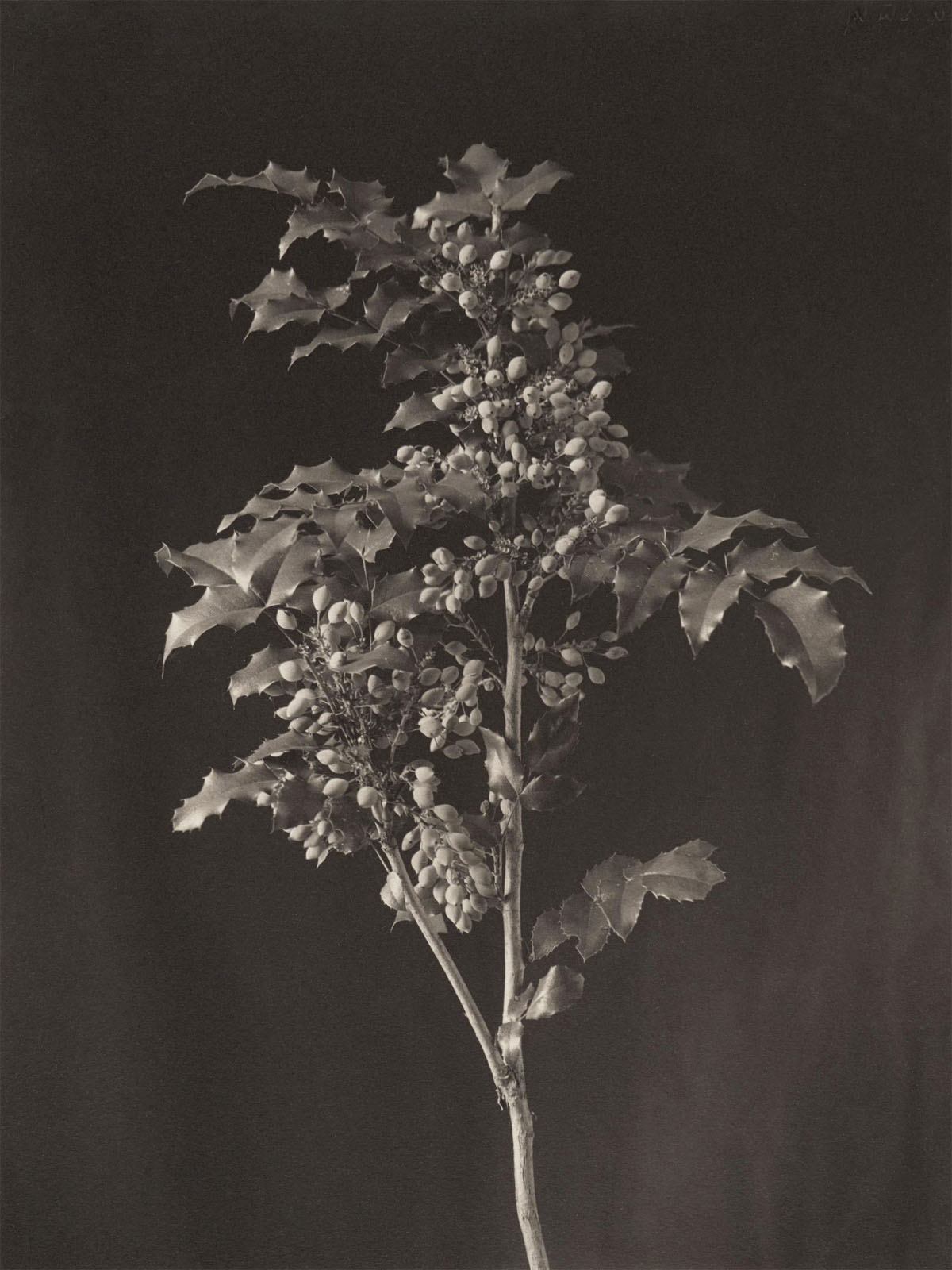
Frederick H. Evans (British, 1853-1943) Berberis: Plant Study c. 1908 Platinum print Image and sheet: 9 3/8 × 7 1/16 inches (23.8 × 17.9cm) Philadelphia Museum of Art Purchased with funds contributed by Dorothy Norman and with the Director’s Discretionary Fund, 1968
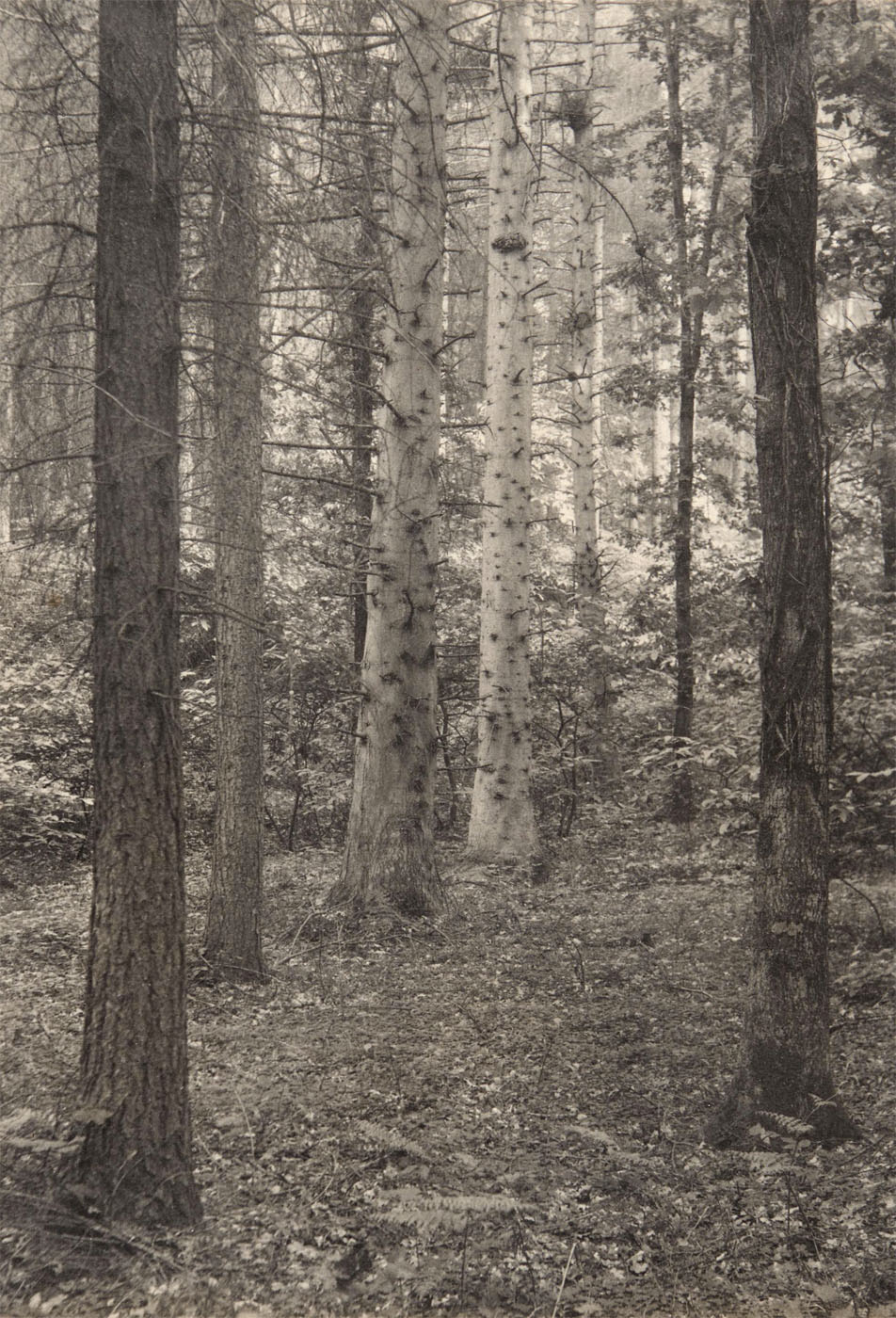
Frederick H. Evans (British, 1853-1943) Redlands Woods c. 1908 Platinum print Image and sheet: 6 × 4 3/16 inches (15.3 × 10.6cm) Philadelphia Museum of Art Purchased with funds contributed by Dorothy Norman and with the Director’s Discretionary Fund, 1968
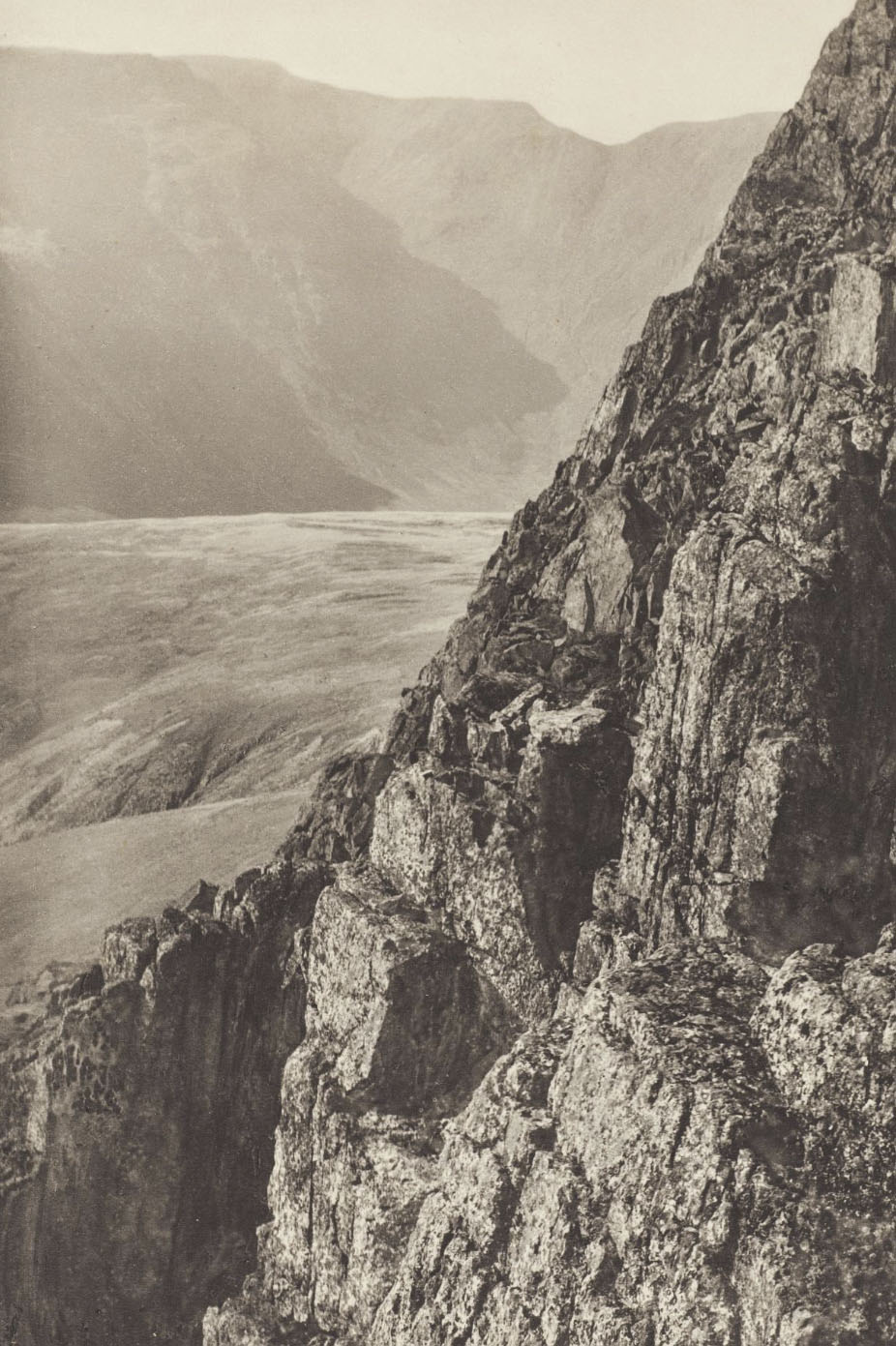
Frederick H. Evans (British, 1853-1943) An English Glacier: Near Summit of Scafell c. 1905 Platinum print Image and sheet: 9 3/4 × 6 1/2 inches (24.8 × 16.5 cm) Philadelphia Museum of Art Purchased with funds contributed by Dorothy Norman and with the Director’s Discretionary Fund, 1968
Exhibition Highlights the Exceptional Beauty of the Platinum Process in Photography
A cornerstone of photographic practice during the late nineteenth and early twentieth centuries, the platinum print is revered by photographers and viewers alike as one of the most beautiful forms of photography, with subtle and lustrous shades that range from the deepest blacks to the most delicate whites. The Philadelphia Museum of Art will present an exhibition of more than 50 works from the late 19th century to the present, showcasing outstanding prints largely drawn from the Museum’s collection of photographs. The Platinum Process: Photographs from the Nineteenth to the Twenty-First Century, on view February 27 – May 23 in the Julien Levy Gallery at the Museum’s Perelman Building, will include images by early masters of the process including Frederick H. Evans (British, 1853-1943) and Alfred Stieglitz (American, 1864-1946), as well as works by skilled contemporary practitioners such as Lois Conner (American, born 1951) and Andrea Modica (American, born 1960), who continue to engage in this historic and painstaking process in an era noted for electronic imaging.
“The exhibition offers an opportunity to share this exceptionally beautiful form of photography with our visitors, some of whom may be seeing it for the first time,” Curator of Photographs Peter Barberie said, adding “the Museum is fortunate to have a particularly strong and varied collection of work by some of the truly great practitioners of this process.”
Unlike standard silver printing, in which particles are suspended in gelatin, platinum is brushed directly onto the paper, allowing artists to create a matte image with an exceptionally wide tonal range. Introduced in 1873, the process was enthusiastically embraced by the group of photographers known as the Pictorialists, who believed that fine art photography should emulate the aesthetic values of painting. The group included Evans, whose beautifully rendered images of Britain’s Westminster Abbey, York Minster Abbey and Ely Cathedral are included in the exhibition, and Stieglitz (American, 1876-1946), who is represented in the show by a portrait of his wife, the artist Georgia O’Keeffe (American, 1887-1986), as well as a landscape that foreshadows his Equivalents series.
While encompassing works spanning many dates and styles, The Platinum Process highlights one of the Museum’s treasures, the 1915 masterpiece “Wall Street” by Paul Strand (1890-1976, see above), whose work was at the forefront of the modernist aesthetic developing in New York during the early 20th century. Strand used the subtlety of the platinum print in this work to emphasise abstract patterns in the long shadows cast by figures that walk before a succession of monumental windows.
Reserves of platinum were appropriated for military use during World War I, and its high cost led manufacturers to cease production of commercial platinum paper by the 1930s. As photographers became more engaged in social concerns, documentation and realism, the process fell into disuse. It was not until the early 1960s when Irving Penn, then a successful photographer for Vogue magazine, began to experiment with the long-forgotten technique and took the first steps toward its revival. A meticulous craftsman, Penn was delighted by the luminous prints and lavish tonal range he could achieve using platinum and began to make new photographs with this process in the 1970s. Penn and many of the other contemporary artists on view including Thomas Shillea and Jennette Williams followed Strand’s example, using platinum not for idealised pictures, but to capture nuances of modern experience.
Press release from The Philadelphia Museum of Art website [Online] Cited 25/07/2019. No longer available online
Robert S. Redfield (American, 1849-1923) Heloise Redfield at Mount Washington 1889 Platinum print Image and sheet: 6 5/16 × 8 1/4 inches (16 × 21cm) Philadelphia Museum of Art Gift of Alfred G. Redfield, 1985
F. Holland Day (American, 1864-1933) Untitled 1905 Platinum prints mounted to paper Image and sheet (overall): 10 1/16 × 7 1/2 inches (25.6 × 19.1cm) Philadelphia Museum of Art From the Collection of Dorothy Norman, 1970
Katharine Steward Stanbery (American, 1870-1928) Untitled (Two Girls Playing Jacks) 1907 Platinum print Image and sheet: 8 15/16 x 4 11/16 inches (22.7 x 11.9cm) Philadelphia Museum of Art 125th Anniversary Acquisition. Purchased with the Lola Downin Peck Fund, the Alice Newton Osborn Fund, and with funds contributed by The Judith Rothschild Foundation, 2002
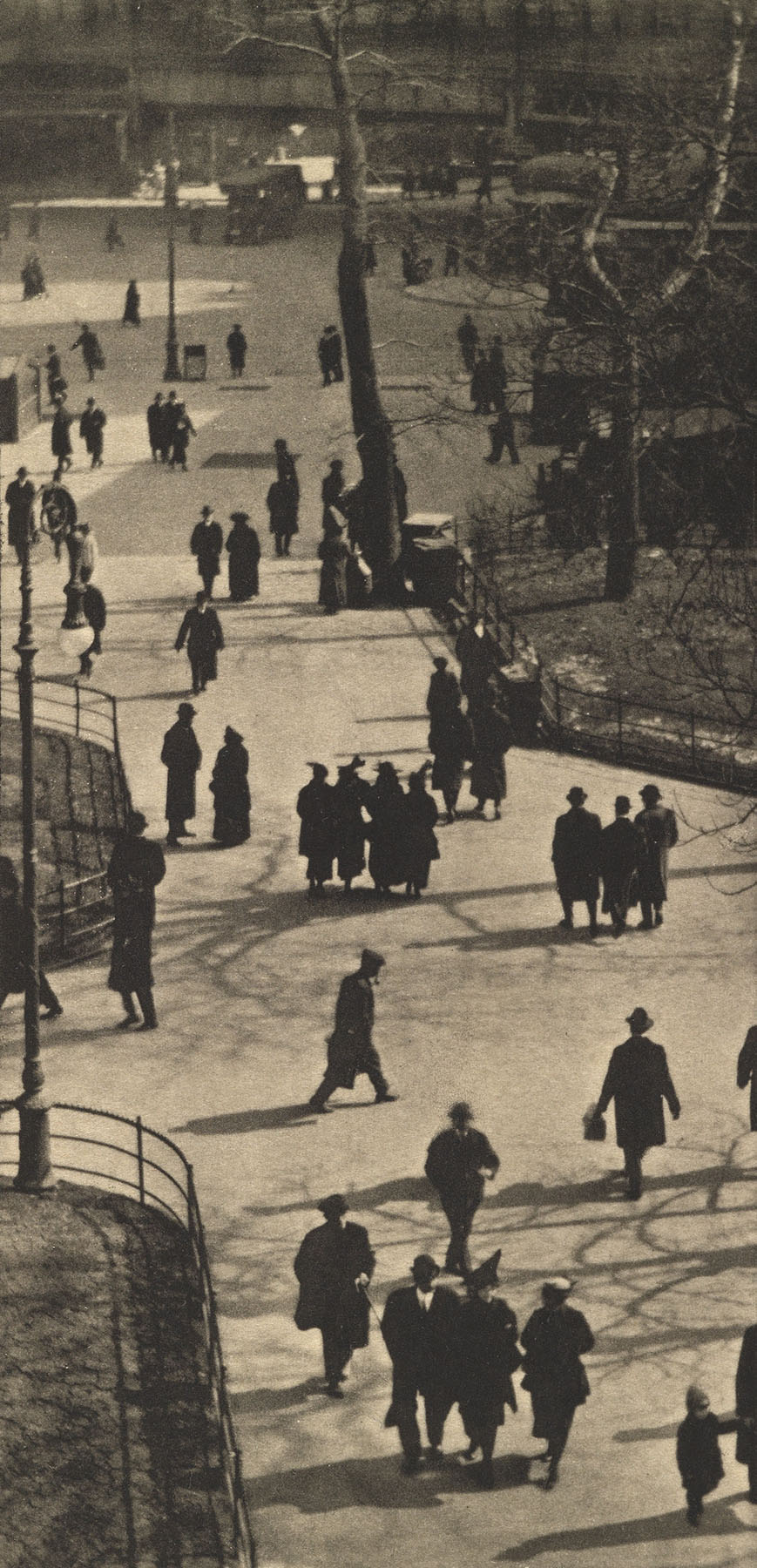
Paul Strand (American, 1890-1976) City Hall Park, New York 1915 Platinum print Sheet: 13 7/8 x 7 3/4 inches (35.2 x 19.7cm) Philadelphia Museum of Art Gift of the artist, 1972
Paul Strand (American, 1890-1976) Washington Heights, New York 1915 (negative); 1915 (print) Platinum print Image and sheet: 9 3/8 x 11 7/8 inches (23.8 x 30.2cm) Philadelphia Museum of Art The Paul Strand Retrospective Collection, 1915-1975, gift of the estate of Paul Strand, 1980
Paul Strand (American, 1890-1976) Wall Street 1915 (negative); 1915 (print) Platinum print Image: 9 3/4 × 12 11/16 inches (24.8 × 32.2cm) Philadelphia Museum of Art The Paul Strand Retrospective Collection, 1915-1975, gift of the estate of Paul Strand, 1980
Paul Strand (American, 1890-1976) Man in a Derby, New York 1916 Platinum print Image: 12 13/16 x 9 15/16 inches (32.5 x 25.2cm) Mat: 22 11/16 x 19 7/16 inches (57.6 x 49.4cm) Philadelphia Museum of Art The Paul Strand Retrospective Collection, 1915-1975, gift of the estate of Paul Strand, 1980
Paul Strand (American, 1890-1976) The Italian, New York 1916 (negative); 1916 (print) Platinum print Image and sheet: 13 × 9 5/16 inches (33 × 23.7cm) Philadelphia Museum of Art The Paul Strand Retrospective Collection, 1915-1975, gift of the estate of Paul Strand, 1980
Paul Strand (American, 1890-1976) Rebecca, New York 1922 (negative); 1922 (print) Palladium print Image: 9 3/4 x 7 13/16 inches (24.8 x 19.8cm) Philadelphia Museum of Art The Paul Strand Collection, purchased with funds contributed by Mr. and Mrs. Robert A. Hauslohner (by exchange), 1985
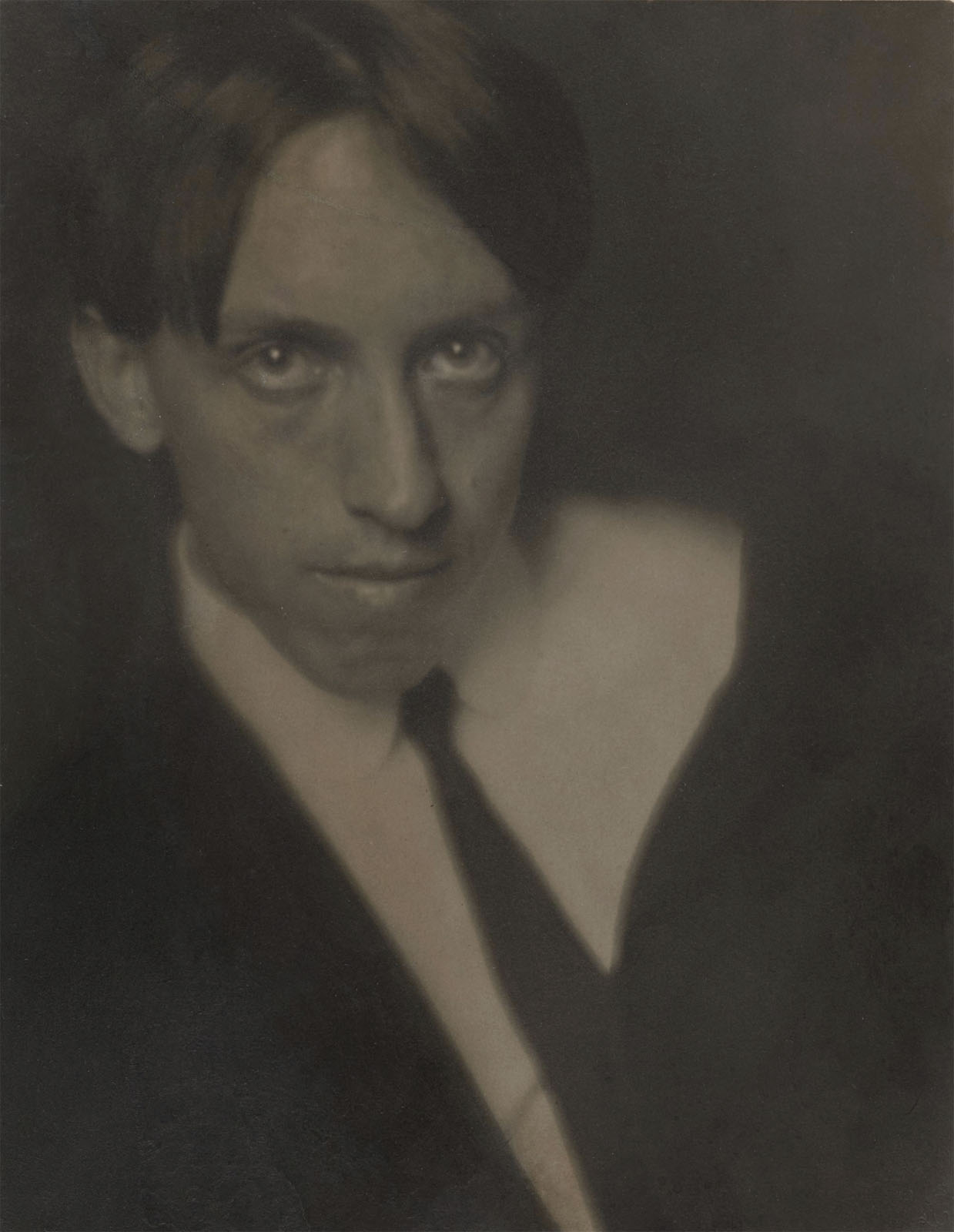
Alvin Langdon Coburn (British, born United States, 1882-1966) George Seeley c. 1902-1903 Platinum print Image and sheet: 11 x 8 9/16 inches (27.9 x 21.7cm) Philadelphia Museum of Art Purchased with the Lola Downin Peck Fund, the Alice Newton Osborn Fund, and with funds contributed by The Judith Rothschild Foundation in honour of the 125th Anniversary of the Museum, 2002
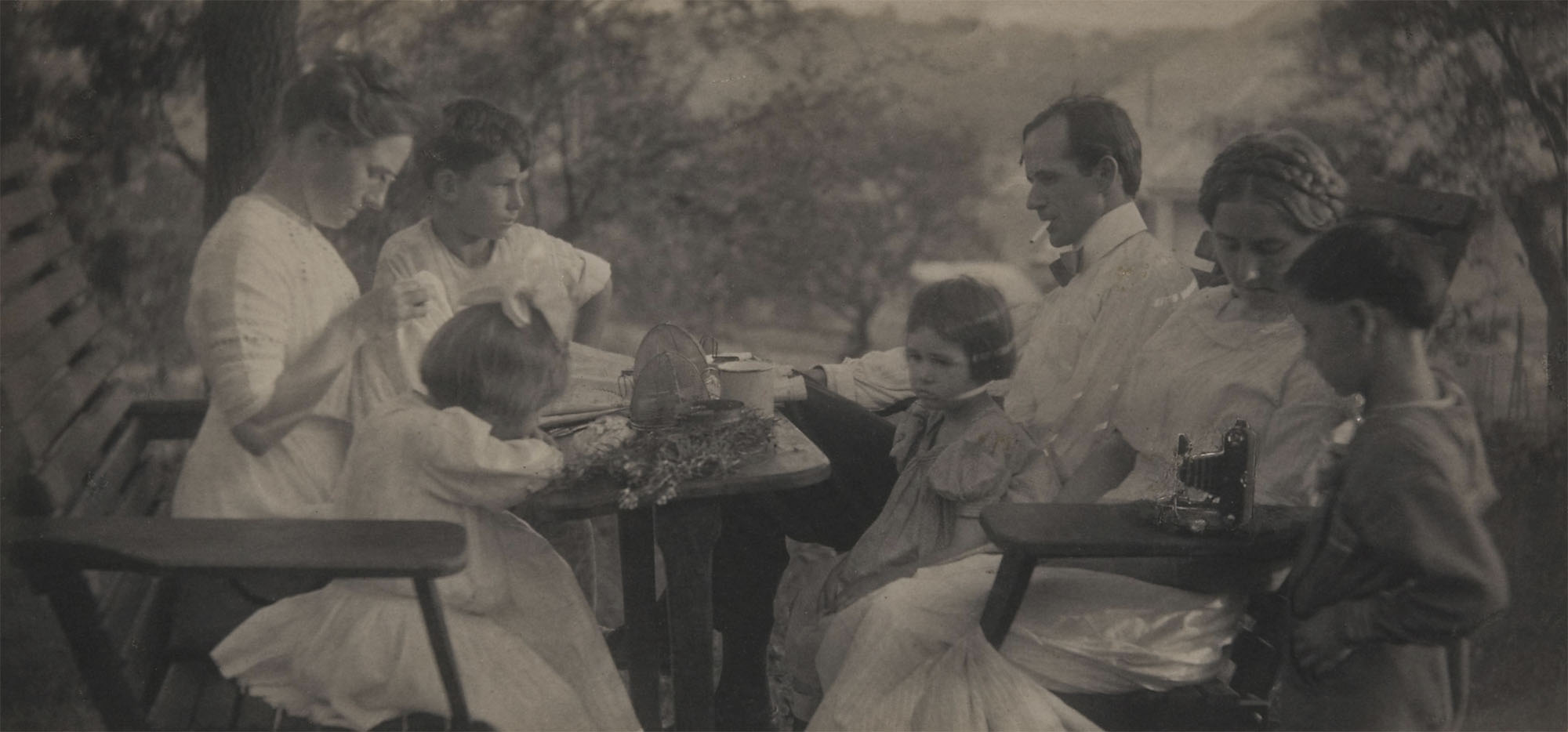
Gertrude Käsebier (American, 1852-1934) The Two Families c. 1910 Platinum print Image and sheet: 5 3/8 × 11 5/16 inches (13.6 × 28.8cm) Philadelphia Museum of Art Gift of William Innes Homer, 1986
Käsebier’s family members and close friends served as her earliest photographic subjects, and familial themes remained paramount in the images she produced throughout her career. This photograph of Käsebier’s two daughters and their families, taken in Woburn, Massachusetts, is a dynamic portrait of a multigenerational gathering. Curiously, Käsebier manipulated this print to emphasise the act of photography. In the original scene, the young boy and seated woman at right look downward at a wire-mesh food cover resting on a plate. These objects have been removed from this print, replaced by the considerably more fascinating camera.
Gertrude Käsebier (American, 1852-1934) Mrs. F. H. Evans c. 1900 Platinum print Image and sheet: 7 1/2 × 5 1/4 inches (19.1 × 13.4 cm) Philadelphia Museum of Art Purchased with funds contributed by Dorothy Norman, 1973
In 1889, at the age of thirty-seven, Käsebier enrolled at Brooklyn’s Pratt Institute to study portrait painting. Although the art school did not teach photography, Käsebier began using a camera at home to document her growing children, eventually favoring photography over other mediums. She established a commercial portrait studio in New York City in 1897, working to “bring out in each photograph the essential personality that is variously called temperament, soul, humanity.” This portrait features Ada Emily Longhurst, wife of photographer Frederick H. Evans, whom Käsebier befriended while on a trip to England in 1901.















































 Art Blart _ art and cultural memory archive
You must be logged in to post a comment.