Review: ‘Intimacy’ at the Australian Centre for Contemporary Art (ACCA), Melbourne

Exhibition dates: 7th October – 30th November, 2008

The exhibition includes works by Louise Bourgeois, Nan Goldin, Steve McQueen, Sophie Calle, Mariele Neudecker, Jesper Just, Gabrielle de Vietri, Felix Gonzalez-Torres, Mutlu Çerkez, Amikam Toren, Margaret Salmon and Annika Ström


Sophie Calle (French, b. 1953) 'Doleur exquise' 1984/1999 from the exhibition 'Intimacy' at the Australian Centre for Contemporary Art (ACCA), Melbourne, Oct - Nov, 2008


Sophie Calle (French, b. 1953)
Doleur exquise
1984/1999


Set up by Frank Gehry and Edwin Chan
Exhibition view at Rotonde1, Luxembourg, 2007


An eclectic mix of mixed media, photography and video work is presented in this exhibition. The work examines concepts of intimacy – staged performances, stories of the city, of men, women, families and children; the artists “contemplate passion, love and longing, as well as feelings of disquiet, loss, and loneliness that embody intimate human relations.”

The show exudes a certain melancholia and is troubling in many aspects: loneliness, separation, desire for intimacy, desire for love all being expressed through the presented works. Some of the works are strong but others left me cold and uninterested. Few are joyous renditions of the closeness of intimate relations and most works ponder the dangers and disillusionment of failed intimacies that involve feelings of vulnerability (intimate acts often involve a degree of self-disclosure where intimates show something of themselves that may make them feel vulnerable), ambiguity (intimate acts are often an ambiguous and incomplete shared and often idiosyncratic view of the world) and secrecy (intimate acts are private: they are often constructed, by their participants, to be hidden from the view of others).1

The large work by English artist Steve McQueen features two naked black wrestlers shot in slow motion in grainy black and white video. The wrestlers are photographed from the waist down, images of moving legs, or from below, bodies clinging together, faces grimacing in a hyperreal performance of some hypnotic intimate dance – an acted out state of being.

Amikan Torren’s 2008 video work is by comparison is about the improbabilities of life’s daily encounters: in Downstairs over a video image of 3 steps outside a London railway station the narrator tells of a man, a stockbroker who after an accident sometimes needs help descending steps; in Blind the narrator comments on a person helping a blind man across the street; and in Carrots, over a video image of a London street the narrator tells a story about an adolescent and fresh carrots! The musings on the synchronicity and serendipity of everyday encounters are very effective.

Jesper Just’s two video works No Man Is An island II (2004) and The Lonely Villa (2004) were very effective and moving. In the first lonely men in a pub sing the Roy Orbison song Crying with pictures of naked ladies behind them – it is funny and sad at the same time. In the second men in the shadows sit or stand with telephones in front of them: two men sing to each other the song I Don’t Want To Set The World On Fire with close-ups of their lips singing into the telephone: songs of loss, longing and remembrance.

The two most interesting pieces are not video works, nor are they the overrated photographs of Nan Goldin featuring photographs of a family hugging and lying on a bed, but the work of two women: Sophie Calle and Louise Bourgeois.

In Doleur exquise (exquisite pain) Calle revisits fifteen years later the breakup of a relationship and the aftermath of that event: the distress and pain, the experiences of her friends in such circumstances and turns them into brilliant insightful art. A selection of the whole work is presented here that features colour photographs (multiples of a red telephone, abandoned car with it’s doors open, washbasins and empty bedrooms) above text woven onto linen – black on white, grey on grey. The texts are both painful and repetitive (Calle’s on the left) and others heartbreaking accounts of pain (on the right): “6 days ago, the man I love left me …”

(For an insightful analysis of this work see Can Pain Be Exquisite? Autofictional Stagings of Douleur exquise by Sophie Calle, Forced Entertainment and Frank Gehry and Edwin Chan by Anneleen Masschelein. “On the one hand, it deals with the most intense, acute experiences of pain in a human life. On the other hand, these moments are unique and “localised”, that is, they are connected to a concrete time and space, of which the details are forever inscribed in memory.”)

My favourite work from the show is Louise Bourgeois 10AM IS WHEN YOU COME TO ME (2006) – drawings on music paper of mainly red hands, the key a drawing of a 10am clock with a man the big hand with hands extended drawing towards him (or is it tethered to him) an armless woman, the small hand. Some have seen these as “ambiguous images of a hermetic cosmos, as acts of violence or love” but they represent “both Bourgeois’s hands and those of her friend and muse Jerry Gorovoy” and how he helps her and arrives at her studio at this, the designated hour.

To me they are joyous, liberating, spontaneous expressions of love and intimacy, fingerprints on the page, hands intertwining together. They made me feel the intimate expression of humanity: holding a babies hand, so small and vulnerable and feeling them grasp your hand. That connection is what Bourgeois achieves with this work and I thought it was wonderful.

This exhibition is no easy ride but is well worth the contemplation necessary to tease out the themes and feelings that the work investigates.

Dr Marcus Bunyan


1/ Steve Howard, Frank Vetere, Martin Gibbs, Jesper Kjeldskov, Sonja Pedell, Karen Mecoles, Marcus Bunyan, and John Murphy. Mediating Intimacy: Digital Kisses and Cut and Paste Hugs. 2004.


Sophie Calle (French, b. 1953) 'Doleur exquise' 1984/1999 (detail) from the exhibition 'Intimacy' at the Australian Centre for Contemporary Art (ACCA), Melbourne, Oct - Nov, 2008


Sophie Calle (French, b. 1953)
Doleur exquise (detail)
1984/1999


    Louise Bourgeois (French-American, 1911-2010) 'TEN AM IS WHEN YOU COME TO ME' 2006 (detail)


    Louise Bourgeois (French-American, 1911-2010)
    TEN AM IS WHEN YOU COME TO ME (detail)
    2006


    Louise Bourgeois (French-American, 1911-2010) 'TEN AM IS WHEN YOU COME TO ME' 2006


    Louise Bourgeois (French-American, 1911-2010)
    TEN AM IS WHEN YOU COME TO ME
    2006


    Australian Centre for Contemporary Art
    111 Sturt Street, Southbank
    Victoria 3006, Australia
    Phone: 03 9697 9999

    Opening hours:
    Tuesday – Friday 10am – 5pm
    Saturday – Sunday 11am – 5pm
    Monday Closed
    Open all public holidays except Christmas Day and Good Friday

    Australian Centre for Contemporary Art website

    LIKE ART BLART ON FACEBOOK

    Back to top

    Exhibition: ‘Broken Glass: Photographs of the South Bronx by Ray Mortenson’ at the Museum of the City of New York

    Exhibition dates: 14th November, 2008 – 12th April, 2009


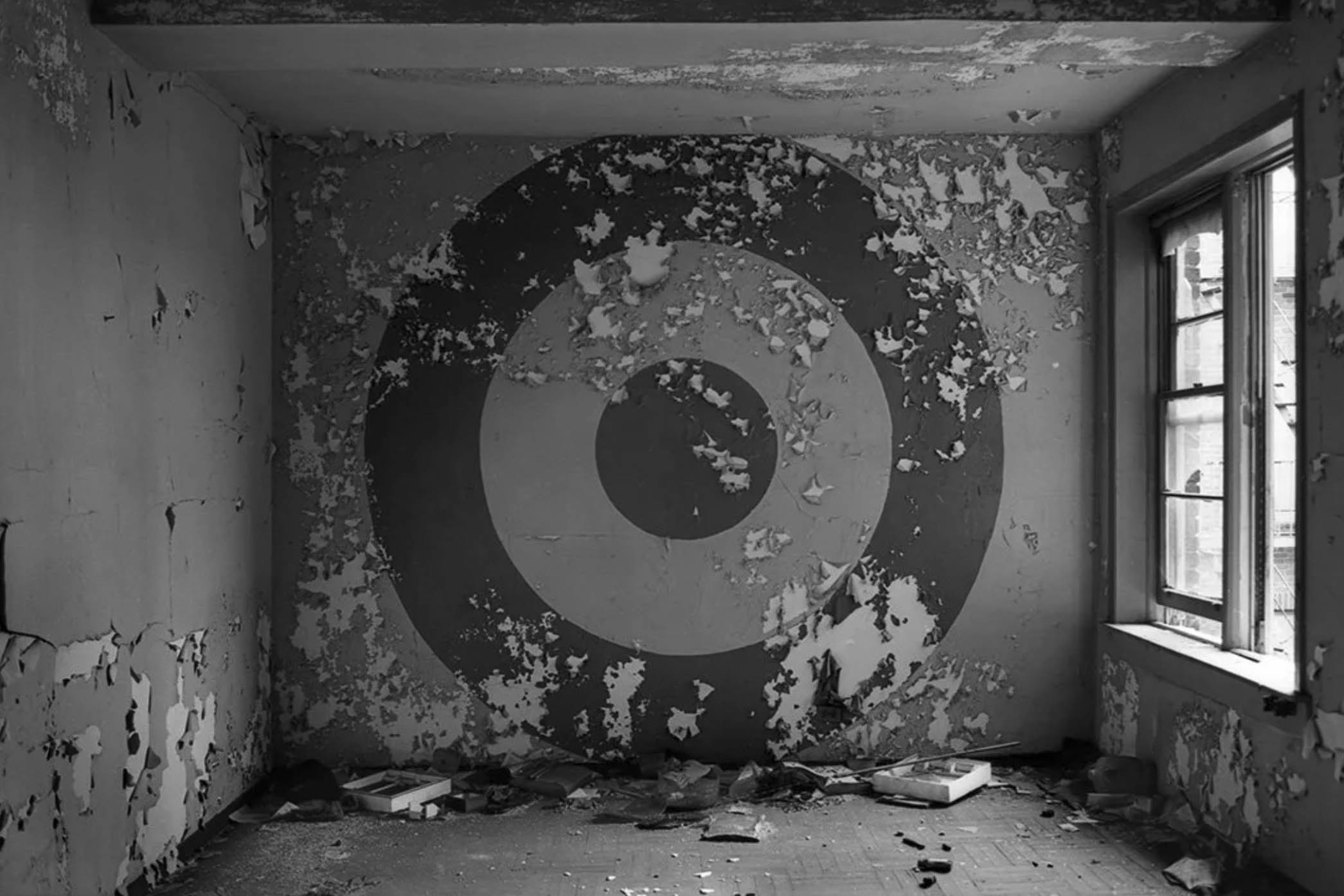
    Ray Mortenson (American, b. 1944) 'Untitled (7-16-6)' 1984 from the exhibition 'Broken Glass: Photographs of the South Bronx by Ray Mortenson' at the Museum of the City of New York, Nov 2008 - April 2009


    Ray Mortenson (American, b. 1944)
    Untitled (7-16-6)
    1984
    Gelatin silver print
    Courtesy of Janet Borden, Inc.


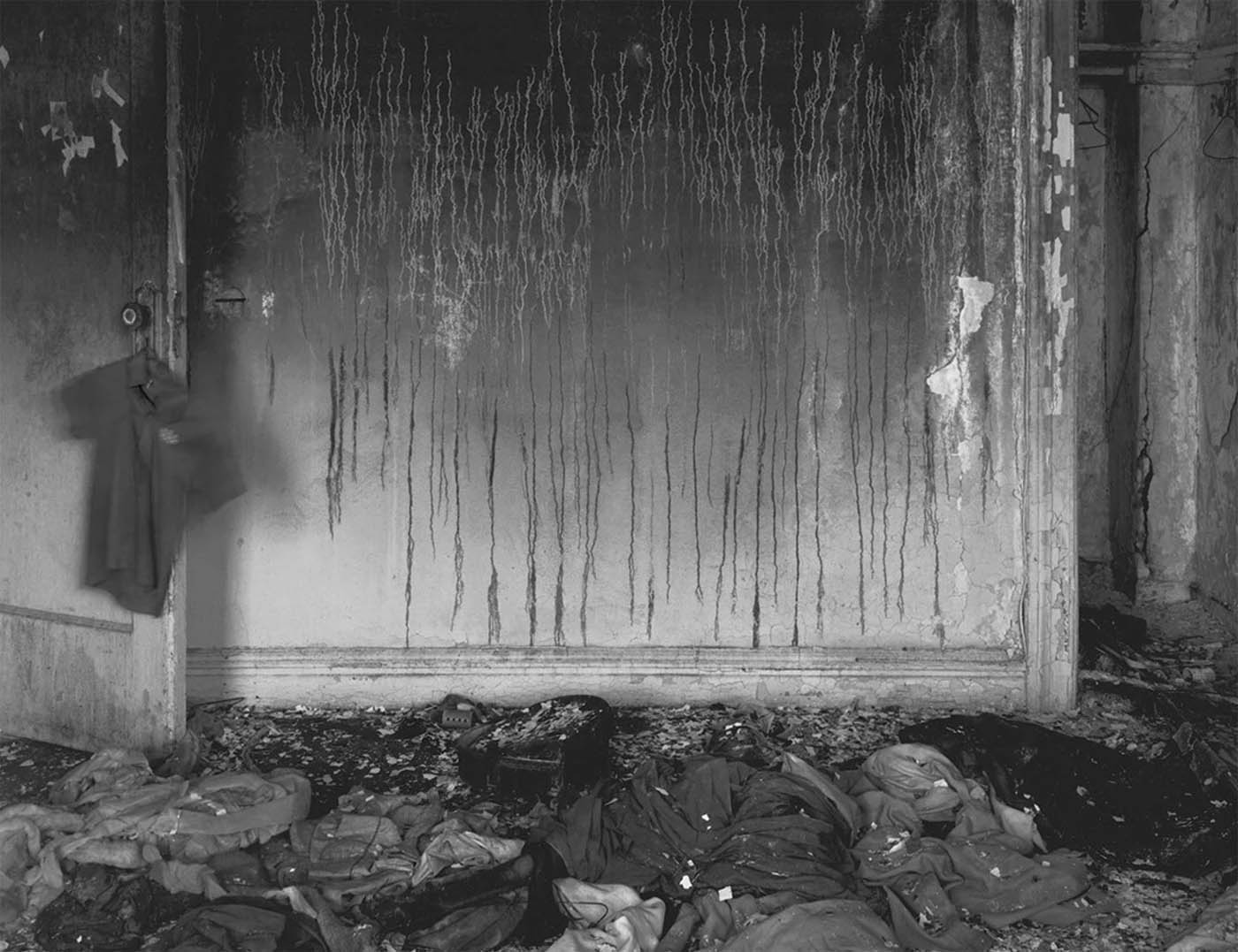
    Documenting the abandoned, burnt out, and razed structures of entire city blocks in the South Bronx in the aftermath of the 1970s, during which this neighbourhood experienced dramatic decline, Broken Glass: Photographs of the South Bronx by Ray Mortenson will be on view at the Museum of the City of New York from November 14, 2008 through March 9, 2009. The 50 black and white cityscapes and interiors on view – five of which are large-scale – were taken between 1982 and 1984, and they vividly illustrate the results of a downslide that began in the Great Depression of the 1930s and accelerated with the construction of the Cross Bronx Expressway in the 1950s and the fiscal crisis of the 1970s. Broken Glass is Mortenson’s first museum exhibition in New York City, and it is the first presentation of the South Bronx photographs.

    The 50 photographs on view, all black and white, range in size from the smallest at approximately 11″ by 14″, to the most monumental at 40″ by 60″. Each conveys a devastating silence, serving as a reminder that these city blocks were once the homes of individuals, families, and a large community. Mortenson has written, “The buildings were like tombs – sealed up, broken open and plundered. Inside, stairways with missing steps led up to abandoned apartments. Doors opened into rooms that were once bedrooms or kitchens. Small things left behind hint at who the occupants might have been – a hairbrush, photographs, or bits of clothing.” Ghostly remnants of the once prosperous and thriving neighbourhoods can be glimpsed in his images which document the extent and severity of the urban decline experienced in the South Bronx.

    These photographs document an important chapter in the history of a New York City neighbourhood, augmenting their aesthetic power. The decline of the South Bronx began as early as the Great Depression when previously sustained development came to an abrupt halt. After World War II an exodus of New York’s middle class began and continued into the 1970s. This caused a population decline throughout the city, but the effects were particularly hard on the South Bronx as more than 200,000 residents left the community between 1970 and 1980. As entire communities left the city, Robert Moses’ road building and slum clearance, along with other urban renewal initiatives had dramatic effects on the lives of all who remained. In the 1970s New York City faced another economic crisis and virtual bankruptcy. City government was unable to maintain services in the South Bronx and “planned shrinkage” became an unofficial policy as services were slowly withdrawn. With little incentive for landlords to upgrade or even maintain their property, waves of arson and “insurance fires” decimated the by now largely minority community. Astonishingly, some 12,000 fires a year occurred through the 1970s, averaging more than 30 a day.

    A successful resurrection of the South Bronx began in the mid-1980s, as grass roots organisations and community development corporations, along with financial reinvestment by the City, sparked its regeneration. The photographs on view stand in starkest contrast to today’s revitalised neighbourhood, which has been the result of the dedication of its citizens combined with government support. The photographs serve as a reminder of the ruins that once dominated the now-vibrant streets and that the balance between prosperity and urban decline can be fragile.

    Brief Biography

    Ray Mortenson was born in Wilmington, Delaware in 1944 and studied art at the Carnegie Institute of Technology and the San Francisco Art Institute. In the early 1970s, Mortenson moved to New York and began working with photography. His first significant photographic project was a comprehensive investigation of the industrial landscapes of New Jersey’s Meadowlands (1974-1982). Since then, Mortensen has continued to focus on landscape photography that is often interested in liminal places of transition, set apart from everyday life. His photographs have been accepted into the collections of The Metropolitan Museum of Art, New York; The Art Institute of Chicago, and the Bibliothèque Nationale, Paris.

    Press release from the Museum of the City of New York website


    Ray Mortenson (American, b. 1944) 'Untitled' 1983 from the exhibition 'Broken Glass: Photographs of the South Bronx by Ray Mortenson' at the Museum of the City of New York, Nov 2008 - April 2009


    Ray Mortenson (American, b. 1944)
    Untitled
    1983
    Gelatin silver print
    Courtesy of Janet Borden, Inc.


    Ray Mortenson (American, b. 1944) 'Untitled' 1984


    Ray Mortenson (American, b. 1944)
    Untitled
    1984
    Gelatin silver print
    Courtesy of Janet Borden, Inc.


    Ray Mortenson (American, b. 1944) 'Untitled' 1983


    Ray Mortenson (American, b. 1944)
    Untitled
    1983
    Gelatin silver print
    Courtesy of Janet Borden, Inc.


    Ray Mortenson (American, b. 1944) 'Untitled' 1984


    Ray Mortenson (American, b. 1944)
    Untitled
    1984
    Gelatin silver print
    Courtesy of Janet Borden, Inc.


    Ray Mortenson (American, b. 1944) 'Untitled' 1984


    Ray Mortenson (American, b. 1944)
    Untitled
    1984
    Gelatin silver print
    Courtesy of Janet Borden, Inc.


    Museum of the City of New York
    1220 Fifth Avenue at 103rd Street
    New York, NY 10029
    Phone: 212-534-1672

    Opening hours:
    7 days a week 10.00am – 6.00pm

    Museum of the City of New York website

    LIKE ART BLART ON FACEBOOK

    Back to top

    Exhibition: ‘As far as no eye can see: panoramic photographs of Berlin, 1949-1952’ at the Berlinische Galerie Museum of Modern Art, Berlin

    Exhibition dates: 2nd November, 2008 – 16th February, 2009


    Fritz Tiedemann (German, 1915-2001) 'Pariser Platz, April 21, 1951' from the exhibition As far as no eye can see: panoramic photographs of Berlin, 1949-1952' at the Berlinische Galerie Museum of Modern Art, Berlin, Nov 2008 - Feb 2009


    Fritz Tiedemann (German, 1915-2001)
    Pariser Platz, April 21, 1951
    1951
    Reconstructed by Arwed Messmer 2008
    1.25 x 5.84 metres
    © Fritz Tiedemann / Arwed Messmer


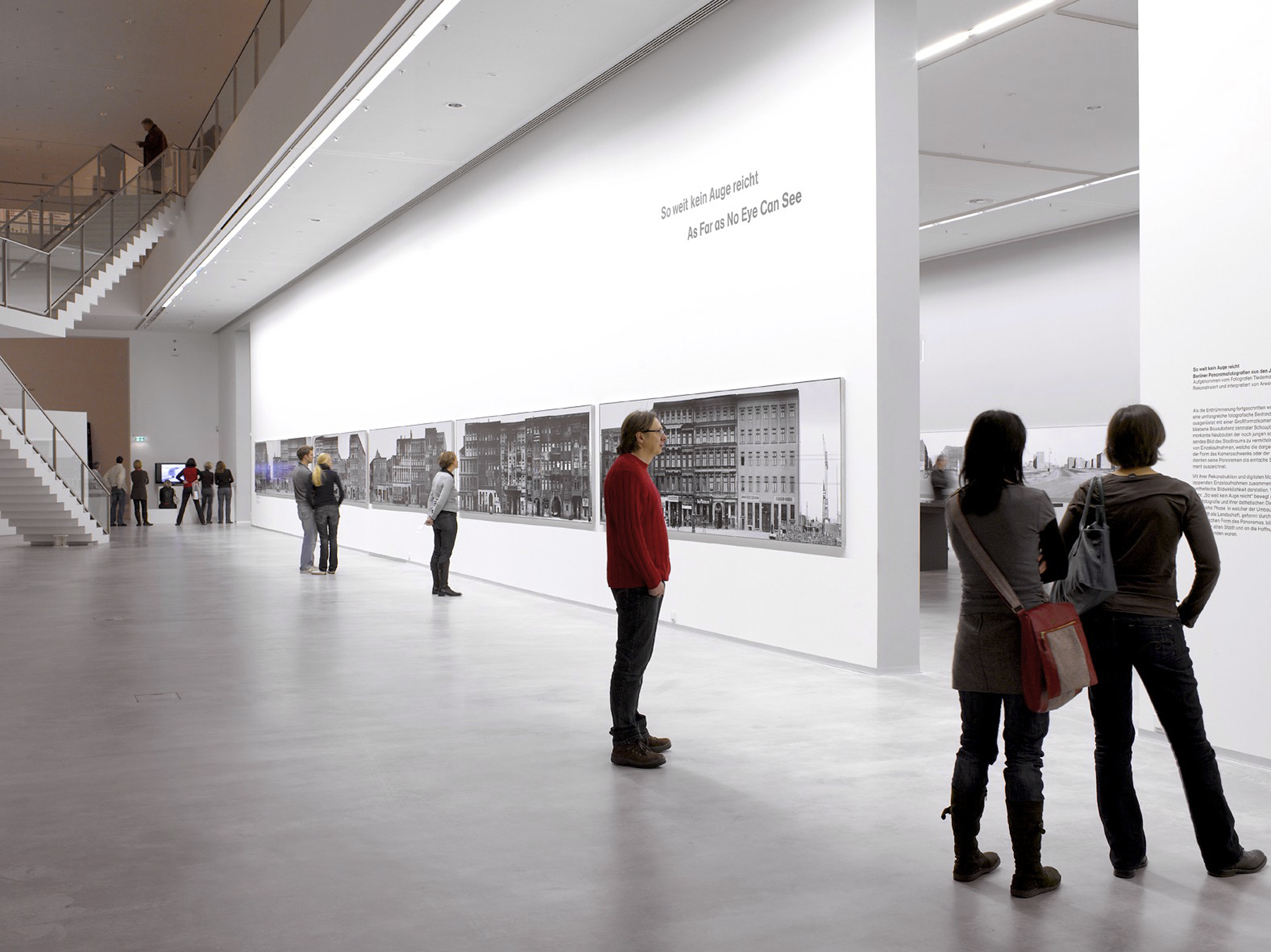
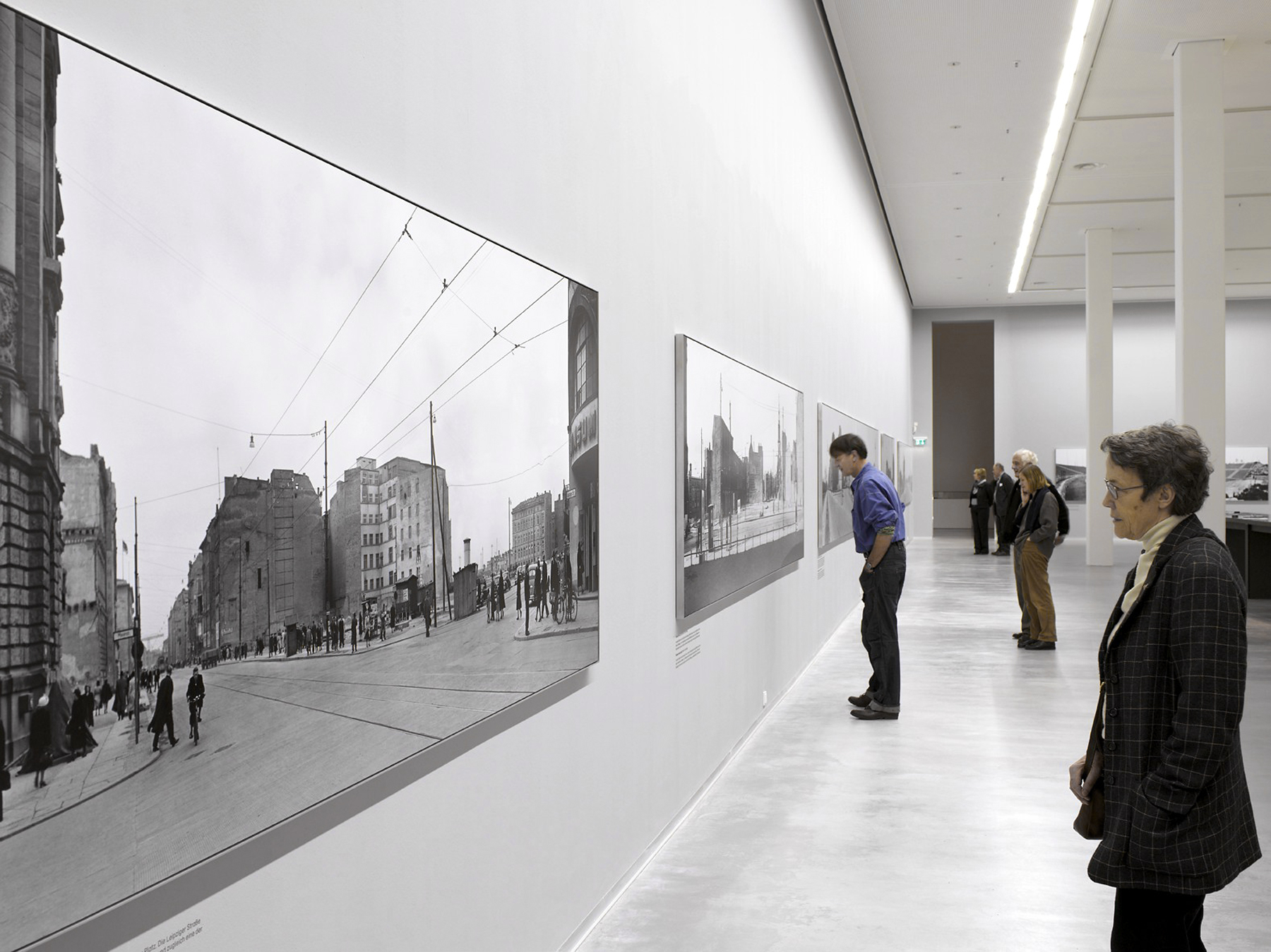
    As far as the eye can see shows 13 reconstructed and digitally reassembled panorama photos by Tiedemann from his 1,500-footage work. The city views from the years 1949-1952 were enlarged to almost gigantic dimensions (up to 25.5 m in length) and thus provide a fascinating view of the destruction of the war and the reconstruction of Berlin.

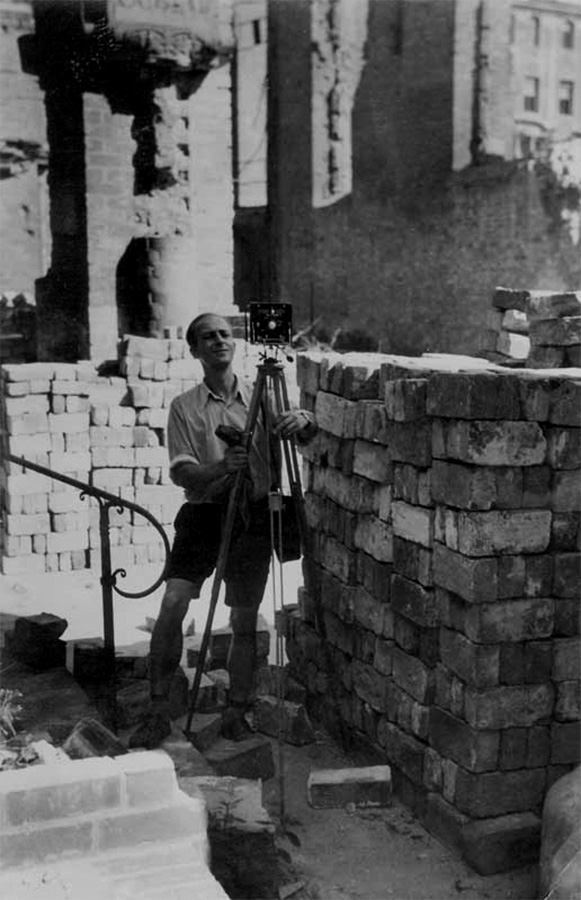
    Fritz Tiedemann (German, 1915-2001) was a trained surveying technician and was trained in the military as a photogrammeter (specialist for photographic measuring methods). He documented the city as a photographer at the Office of Preservation. The photographer Arwed Messmer came across Tiedemann’s photographs during research work for his book project “Anonyme Mitte – Berlin” in the Berlinische Galerie and then developed the idea for this exhibition.

    After WW 2, rubble clearance had made considerable progress and rebuild had begun, a remarkable photographic inventory was done in East Berlin. By order of the magistrate of the capital of the GDR an – up to now – unknown photographer documented central places and areas that were of importance concerning the urban planning in the early 50s. He captured the Pariser Platz and the Schloßplatz area as well as the works on the Walter Ulbricht Stadium or a sand storage area in the outskirts. In order to adequately picture the void and the vastness of the destroyed city as well as the remaining urban structures, the photographer made horizontal turns with the camera and thus produced sequences that – once brought together – turned into panoramic pictures.

    The concealed quality of these pictures was lately discovered by Berlin photographer Arwed Messmer. By means of digital mounting of the sequences he created synthetic large-size pictorial worlds that show the destroyed Berlin as an empty stage. Thus inspired, the Photo Archive of the East Berlin magistrate, preserved by the Berlinische Galerie and documented in the catalogue “Ost-Berlin und seine Bauten. Fotografien 1945-1990” / “East Berlin Architecture”, was searched through anew. Thus the exhibition operates at the interface between applied photography and new photographic technology as well as between collective memory and an unfamiliar optic experience.

    Press release from the Berlinische Galerie Museum of Modern Art


    Fritz Tiedemann (German, 1915-2001) 'Pariser Platz, April 21, 1951' (detail) from the exhibition As far as no eye can see: panoramic photographs of Berlin, 1949-1952' at the Berlinische Galerie Museum of Modern Art, Berlin, Nov 2008 - Feb 2009


    Fritz Tiedemann (German, 1915-2001)
    Pariser Platz, April 21, 1951 (detail)
    1951
    Reconstructed by Arwed Messmer 2008
    1.25 x 5.84 metres
    © Fritz Tiedemann / Arwed Messmer


    Installation view of the exhibition 'As far as the eye can see' at the Berlinische Galerie, Berlin

    Installation view of the exhibition 'As far as the eye can see' at the Berlinische Galerie, Berlin


    Installation views of the exhibition As far as the eye can see at the Berlinische Galerie, Berlin


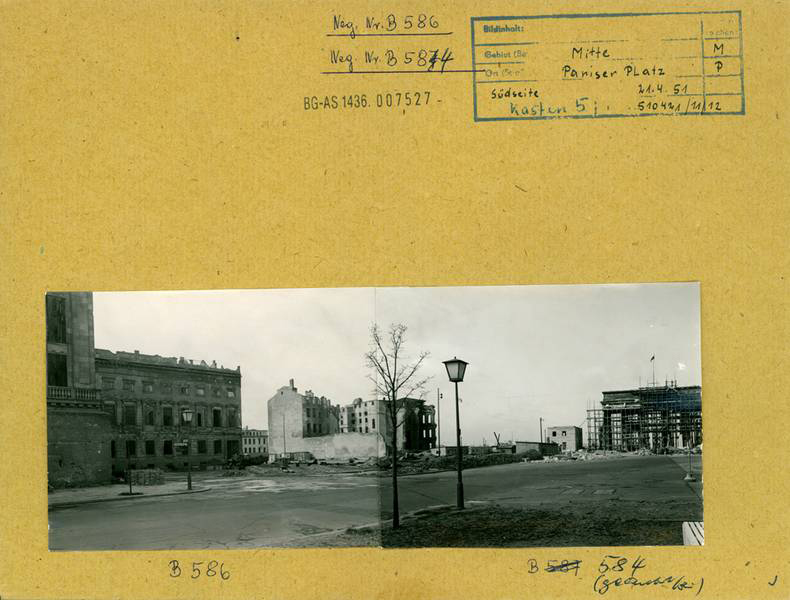
    Between 1948 and 1953, photographer and technical surveyor Fritz Tiedemann (German, 1915-2001) was commissioned by the urban administration of East Berlin to undertake extensive documentation of architecture and urban planning in the capital of the GDR. Many of his early visual documents are series of images conceived as panoramas, whereby the sweep of the camera gives a comprehensive impression of emptiness and the extent of war damage in the city. Processed as contact copies and stuck onto archive covers, his many photographs are one important, early basic collection of a photo archive that was extended consistently until 1990. It has been kept in the architectural collection of the Berlinische Galerie since 1992.

    An in-depth study of the collection was facilitated with support from the Getty Foundation, Los Angeles, and the results were made available to the public in the shape of the publication “Ost-Berlin und seine Bauten” in 2006. In 2008 a selection of Tiedemann’s photographs was shown to the public in the exhibition So weit kein Auge reicht. Berliner Panoramafotografien aus den Jahren 1949-1952. Aufgenommen von Fritz Tiedemann. Rekonstruiert und interpretiert von Arwed Messmer (As far as no eye can see. Berlin panorama photographs from the years 1949-1952. Taken by Fritz Tiedemann. Reconstructed and interpreted by Arwed Messmer). A catalogue of the same name was also published; it has since been produced in a second, revised edition.

    Text from the Berlinische Galerie Museum of Modern Art


    Fritz Tiedemann (German, 1915-2001) 'Pariser Platz (south side) April 21, 1951'


    Fritz Tiedemann (German, 1915-2001)
    Pariser Platz (south side), April 21, 1951
    1951
    Archive cover with contact copies of the original negatives
    Silver gelatine paper on paper, 18.5 x 24.6cm
    Taken over from the collections of the Urban Administration for Urban Development, Housing and Transport Berlin [East] via the Senate Administration for Building and Housing Berlin, 1991
    © Berlinische Galerie Museum of Modern Art


    Fritz Tiedemann short biography

    14 February 1915 Hamburg – 23 November 2001 Münster, Westfalen

    The identity behind the name “Tiedemann” could be clarified during the course of the exhibition. A former colleague of Fritz Tiedemann as well as descendents of the photographer learned about the exhibition due to the nationwide media coverage and contacted the museum.

    As a professional surveying technician Fritz Tiedemann received additional specialist qualification as a topographer during his military service. His photographic skills and expertise were of great importance for the documentation of wartime damage and a visual basis for future urban planning. Indeed, his photographs can be considered as new documents showing the vastness and emptiness of the destroyed city.

    In February 1948 he began working as a photographer for the Berlin Historic Buildings’ and Memorials’ Conservation Office. In October 1949 due to the political division of Greater Berlin he was to continue his work for the East Berlin government’s city planning office. Besides historical aspects the documentation then also focused on the architectural development of East Berlin as is also displayed by the exhibition’s panoramic photographs.

    On February 28, 1953 Fritz Tiedemann was arrested by the East German police forces for his attempts to have West Berlin authorities share in those historically valuable photographs. He was tried and imprisoned and after the events of June 17, 1953 granted amnesty. Together with his family he subsequently fled to West Germany where he was acknowledged as political refugee. In January 1954 he took up work as a topographer with a company called Plan und Karte, later Hansa Luftbild, in Münster, Westphalia, where he remained employed until his retirement in 1978.

    Photography had not only been part of Fritz Tiedmann’s professional activities, it was in fact his life-long passion, the results of which are considered by his family as a great heritage.

    Text from the Berlinische Galerie Museum of Modern Art


    Fritz Tiedemann (German, 1915-2001) 'Marx-Engels-Platz, April 20, 1951'


    Fritz Tiedemann (German, 1915-2001)
    Marx-Engels-Platz, April 20, 1951 [previously called Schloss-Platz]
    1951
    Reconstructed by Arwed Messmer 2008
    © Fritz Tiedemann / Arwed Messmer


    Fritz Tiedemann (German, 1915-2001) 'Am Friedrichshain, March 5, 1952'


    Fritz Tiedemann (German, 1915-2001)
    Am Friedrichshain, March 5, 1952
    1952
    Reconstructed by Arwed Messmer 2008
    © Fritz Tiedemann / Arwed Messmer


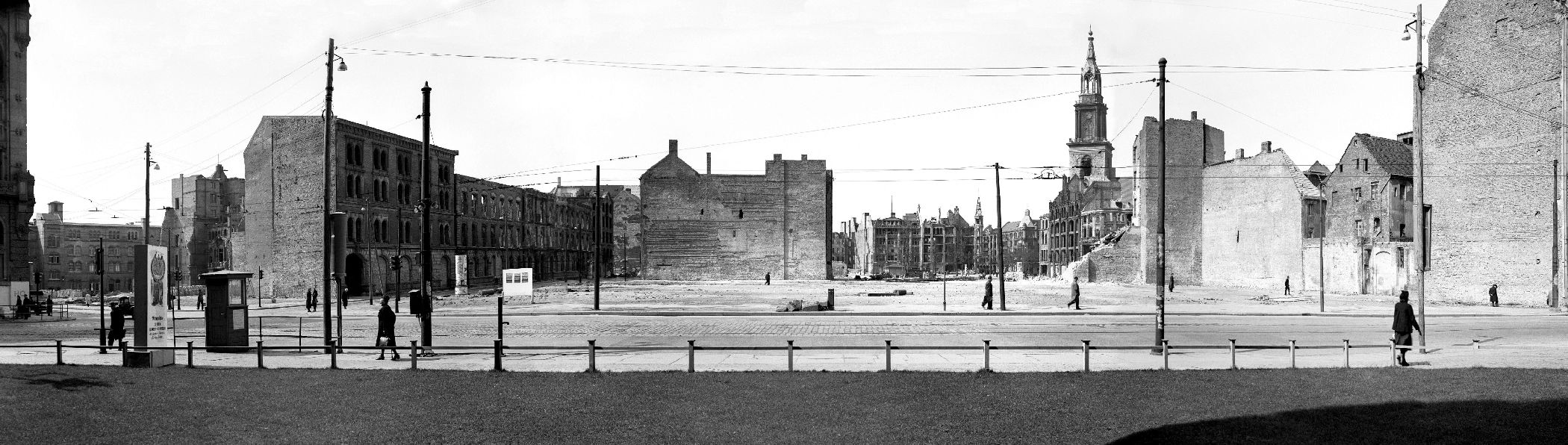
    Fritz Tiedemann (German, 1915-2001) 'Rathausstrasse, April 20, 1951'


    Fritz Tiedemann (German, 1915-2001)
    Rathausstrasse, April 20, 1951 [The Rathausstrasse overlooking the Marienkirche of Alexanderplatz]
    1951
    Reconstructed by Arwed Messmer 2008
    © Fritz Tiedemann / Arwed Messmer


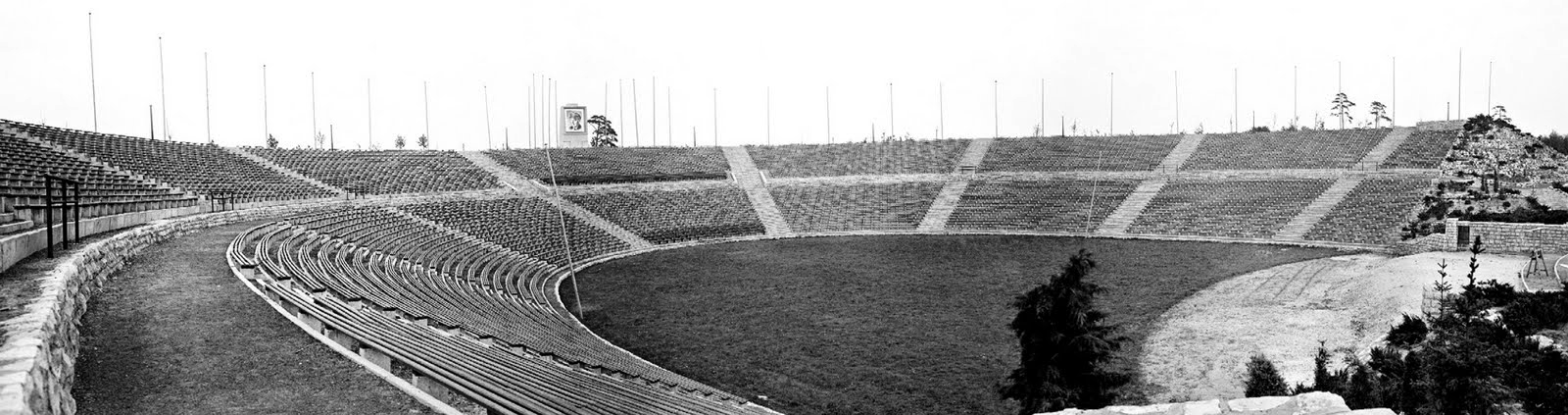
    Fritz Tiedemann (German, 1915-2001) 'Outdoor scene in Wuhlheide, May 4, 1952'


    Fritz Tiedemann (German, 1915-2001)
    Outdoor scene in Wuhlheide, May 4, 1952
    1952
    Reconstructed by Arwed Messmer 2008
    © Fritz Tiedemann / Arwed Messmer


    Unknown photographer. 'Fritz Tiedemann' c. 1951


    Unknown photographer
    Fritz Tiedemann
    c. 1951
    Private collection


    Berlinische Galerie Museum of Modern Art
    Alte Jakobstraße 124-128
    10969 Berlin Germany

    Opening hours:
    Wednesday – Monday 10am – 6pm
    Closed on Tuesdays

    Berlinische Galerie Museum of Modern Art website

    LIKE ART BLART ON FACEBOOK

    Back to top

    Photographer: Alec Soth

    November 2008


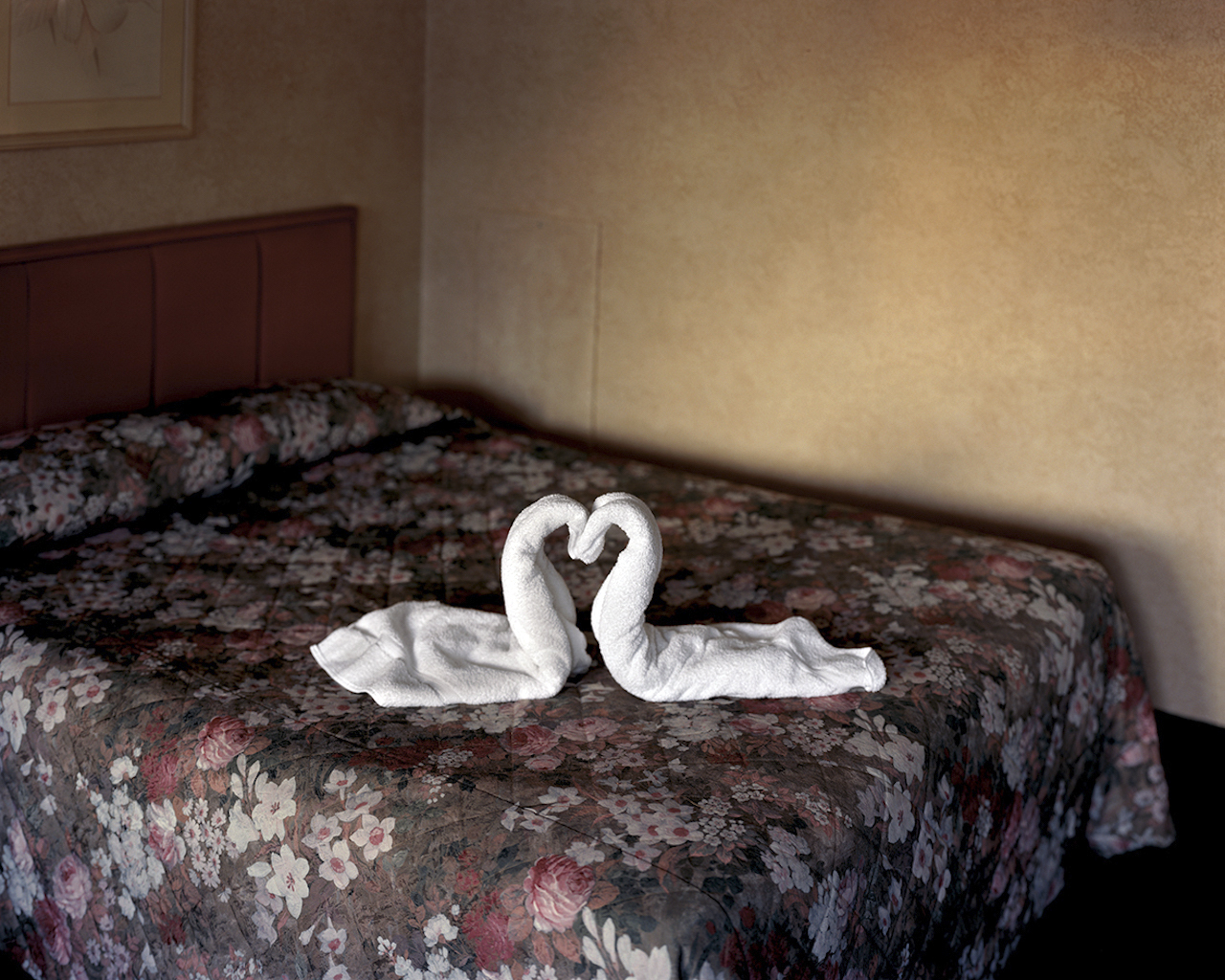
    Alec Soth (American, b. 1969) 'Two Towels' 2004


    Alec Soth (American, b. 1969)
    Two Towels
    2004
    From the series Niagara (2006)


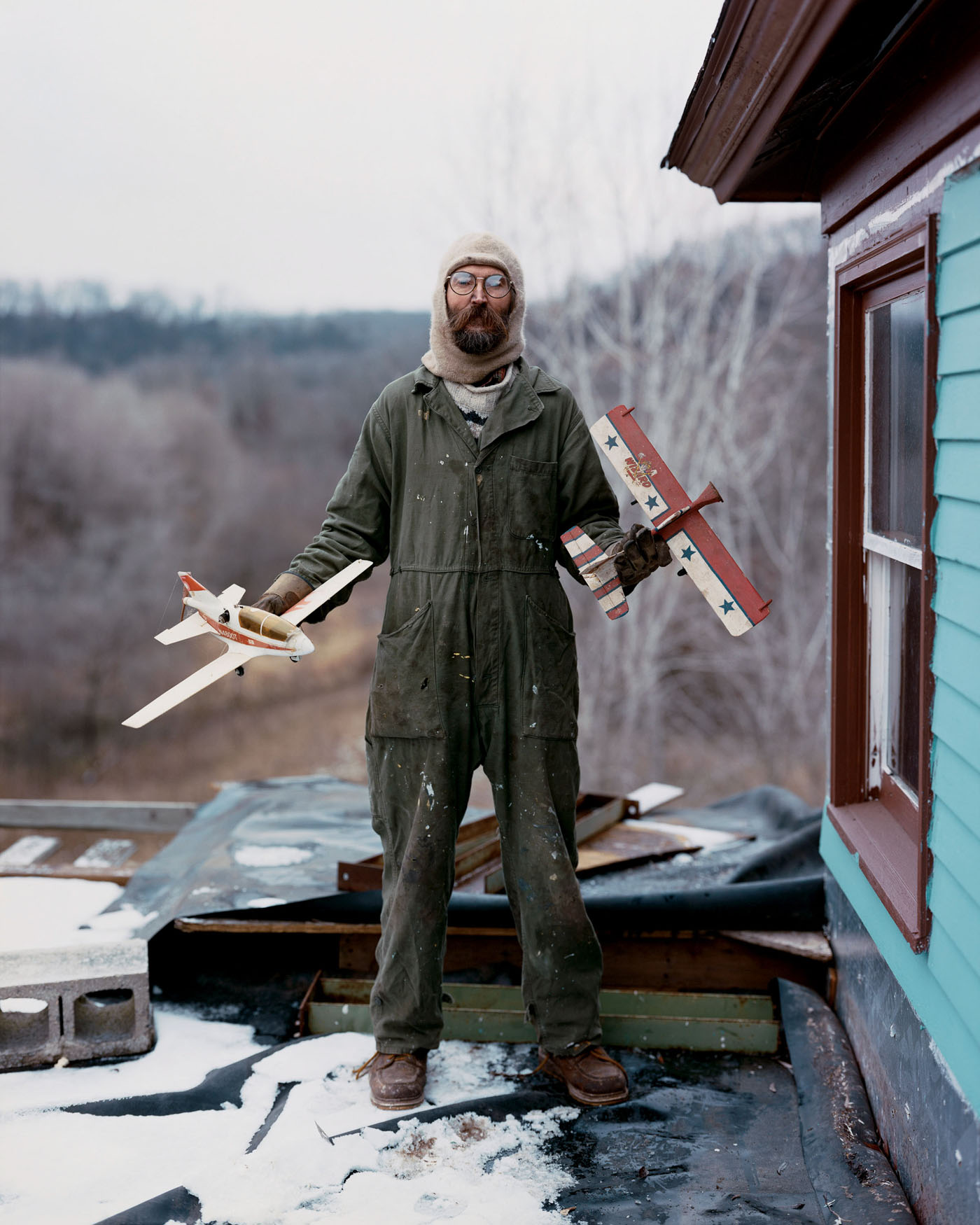
    Minneapolis-based photographer Alec Soth has attained international recognition for his photographic series. Notable are the two series Sleeping by the Mississippi (1999-2004) portraying the river and the life along it’s banks and Niagara (2006) where Soth focuses his large format camera on the hotels, residents loves and lives and the environs around Niagara Falls.

    His work is firmly rooted in the documentary traditions of Walker Evans and Robert Frank but pushes the documentary form. Whereas Frank used a foreigners eye and ‘snapshot’ photography to challenge traditional notions of American culture in his seminal book The Americans (1958), Soth photographs everyday events of American life – home, romance, religion, bliss, heartbreak and agony – and constructs his vision of the land and people in poetic form. His use of handwritten notes is especially poignant.

    His view of America is both narrative, truth and epic construction. Working in a serial form, Soth builds the themes within his series. The connections between people living their lives and facing their plight together – with dignity – becomes fully evident.

    Dr Marcus Bunyan


    Alec Soth (American, b. 1969) 'Charles, Vasa, Minnesota' 2002


    Alec Soth (American, b. 1969)
    Charles, Vasa, Minnesota
    2002
    From the series Sleeping by the Mississippi (1999-2004)


    Alec Soth website

    LIKE ART BLART ON FACEBOOK

    Back to top

    Sciagraphy: Henry Fox Talbot

    November 2008


    “Sciagraphy: the art of depicting an object through its shadow.”

    (William Henry Fox Talbot’s private name for photography)


    Schaaf, Larry. “The Paper Multiple: Talbot’s Invention and Early Photographic Books,” in Foster, S., Heiting, M. and Stuhlman, R. Imagining Paradise. Rochester NY: George Eastman House, 2007, p. 45.


    LIKE ART BLART ON FACEBOOK

    Back to top

    Opening: Rennie Ellis ‘No standing only dancing’ at The Ian Potter Centre: NGV Australia

    Exhibition dates: 31st October, 2008 – 22nd February, 2009

    Opening: 30th October, 2008


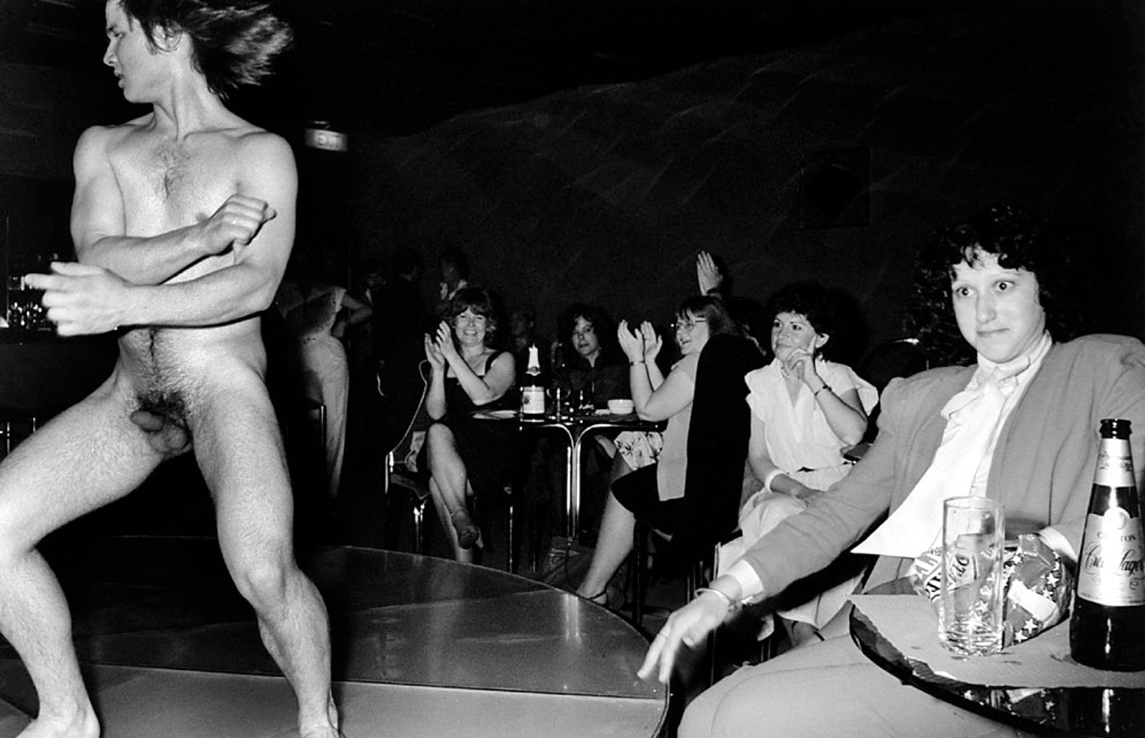
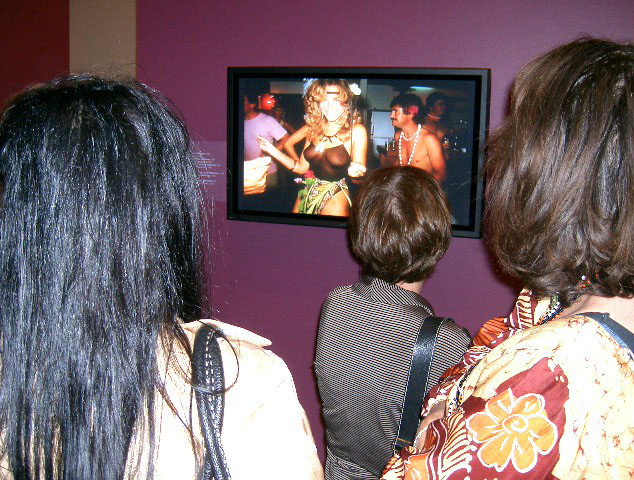
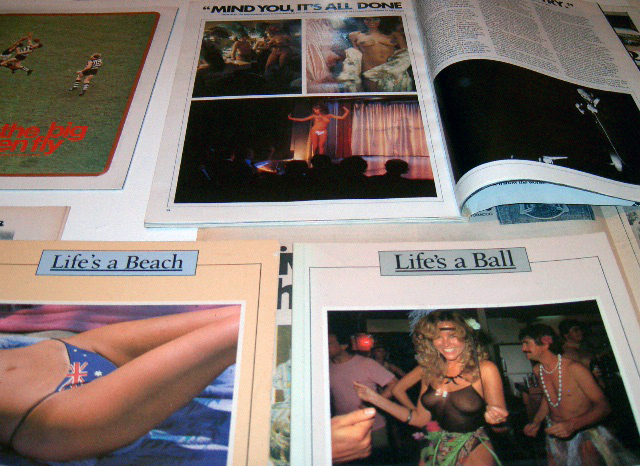
    Rennie Ellis (Australian, 1940-2003) 'Girls' Night Out, Prahran' 1980 from the exhibition Rennie Ellis 'No standing only dancing' at The Ian Potter Centre: NGV Australia, Oct 2008 - Feb 2009


    Rennie Ellis (Australian, 1940-2003)
    Girls’ Night Out, Prahran
    1980
    Silver gelatin, selenium toned fibre based print


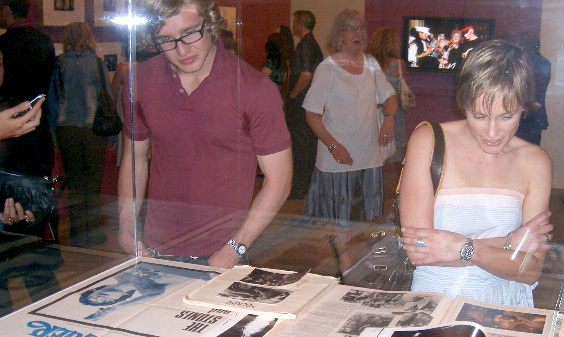
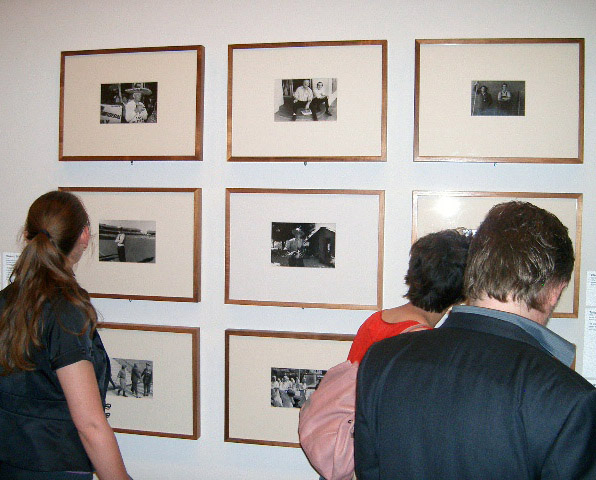
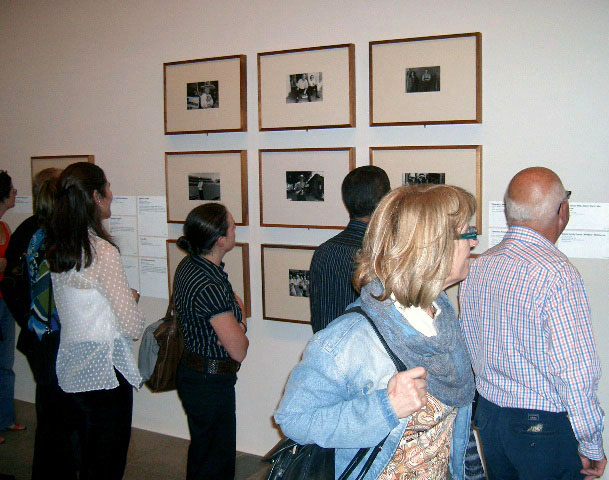
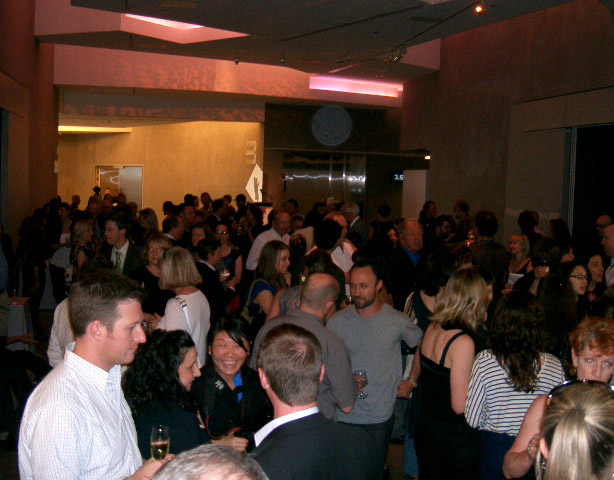
    A very social and lively crowd gathered at The Ian Potter Centre: NGV Australia at Federation Square on the evening of 30th October to celebrate the life and work of the Australian social photographer Rennie Ellis.

    After opening comments by the NGV Director Dr Gerard Vaughan there was a funny and erudite speech by Phillip Adams AO who had flown down from Sydney to open the exhibition. The crowd enjoyed the anecdotes about his relationship with Rennie and said he thought that dying was a good career move on Rennie’s behalf and that he would have loved the fact that he had a retrospective at the NGV. Adams observed that Ellis used to be everywhere, at every party and opening, using his astute eye to record and never to judge. Applause all round for a life well lived.

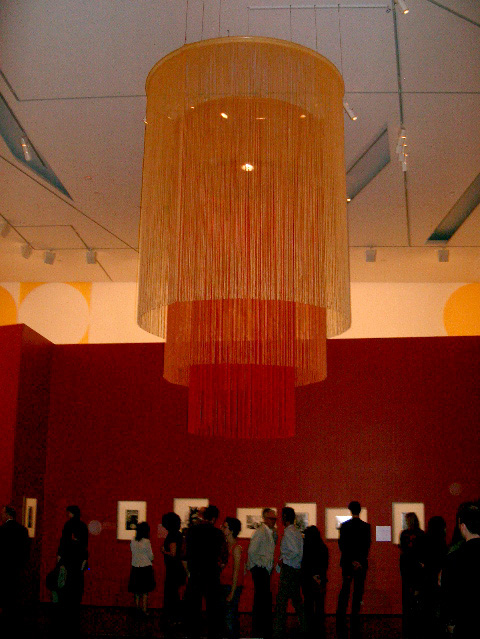
    On entering the exhibition space viewers were treated to a simple but effective installation of his work, with overtones of the 1970’s-1980s interior decor with yellow and white circle graphics and hanging fabric chandelier. The curatorial staff at the NGV (notably Susan van Wyk) have chosen over 200 works from an archive of over half a million images for the exhibition in a process that has taken over two and a half years.

    As an immigrant arriving in Australia in 1986 I remember 397 Club that used to be at 397 Swanston Street. After every other place had closed this club attracted people from every walk of life: pimps, prostitutes, drag queens, faggots, lesbians, straights and druggies. Rennie was probably there recording the scene. We were there just for a good time. It was fun and this is what Ellis’ photography is. Not burdened by overarching conceptual ideas Ellis recorded what he saw insightfully, balancing social commentary and spatial organisation in the construction of his images. The image Girls’ Night Out, Prahran 1980 (above) is a pearler (with the look on the woman’s face) and neatly encapsulates the magic of his image making.

    Dr Marcus Bunyan


    Opening of the exhibition 'No standing only dancing' by Rennie Ellis at The Ian Potter Centre: NGV Australia October 30th 2008

    Opening of the exhibition 'No standing only dancing' by Rennie Ellis at The Ian Potter Centre: NGV Australia October 30th 2008

    Opening of the exhibition 'No standing only dancing' by Rennie Ellis at The Ian Potter Centre: NGV Australia October 30th 2008

    Opening of the exhibition 'No standing only dancing' by Rennie Ellis at The Ian Potter Centre: NGV Australia October 30th 2008

    Opening of the exhibition 'No standing only dancing' by Rennie Ellis at The Ian Potter Centre: NGV Australia October 30th 2008

    Opening of the exhibition 'No standing only dancing' by Rennie Ellis at The Ian Potter Centre: NGV Australia October 30th 2008

    Opening of the exhibition 'No standing only dancing' by Rennie Ellis at The Ian Potter Centre: NGV Australia October 30th 2008

    Opening of the exhibition 'No standing only dancing' by Rennie Ellis at The Ian Potter Centre: NGV Australia October 30th 2008


    Opening of the exhibition No standing only dancing by Rennie Ellis at The Ian Potter Centre: NGV Australia October 30th 2008.
    Photographs © Marcus Bunyan


    The Ian Potter Centre: NGV Australia
    Federation Square
    Corner of Russell and 
Flinders Streets, Melbourne

    Opening hours:
    Daily 10am – 5pm

    National Gallery of Victoria website

    Rennie Ellis Photographic Archive

    LIKE ART BLART ON FACEBOOK

    Back to top

    Book: Edward S. Curtis: Visions of the First Americans (with Eugene Atget and Diane Arbus)

    November 2008


    Edward S Curtis (American, 1868-1952) 'Nuhlihahla-Qagyuhl' Nd


    Edward S Curtis (American, 1868-1952)
    Nuhlihahla-Qagyuhl
    Nd


    Following my thoughts on the series The First Australians on SBS we have this wonderful coffee table book of photographs: Edward S. Curtis: Visions of the First Americans with images taken from his seminal 20 volume work The North American Indian.

    Curtis worked on the project from 1906 to 1927 hauling his large format glass plate camera across the United States much as Eugene Atget did at roughly the same time in Paris, taking photographs of the old city and its hotels, shops, parks and gardens. Atget died in 1927 with his art recognised by few whilst Curtis lived on into the 1950’s, dying in obscurity and poverty after the fame of his ground breaking work had disappeared. Both photographed a vanishing world capturing it for prosperity on fragile glass plates. Both brought to their projects a unique vision and a belief in what they were doing.

    Atget’s photographs of people half seen through shop doors and windows, like shadows of the night. Curtis’s photographs of masked Yeibichei dancers wearing elaborate attire. Curtis thought he was photographing the dying races of the American Indians. Atget knew he was photographing the collapsing spaces of old Paris. Both use the space of the photograph to signify their intentions: an understanding of their subject matter, an empathy with a disappearing way of life, a need to record their vision of this world – and an intensity of insight into that condition.

    No other photograph has the space and timelessness of an Atget. No other image the presence of the plains that Curtis summoned.

    His masked dancers remind me of the last photographs of the great American photographer Diane Arbus in their candour and beauty, posthumously called Untitled. Finally Arbus has found a subject matter that she could return to over and over again. As did Atget and Curtis.

    As Doon Arbus has commented,

    “These images – created out of the courage to see things as they are, the grace to permit them simply to be, and a deceptive simplicity that permits itself neither fancy nor artifice … The photographs appear to be documents of a world we’ve never seen or imagined before – one with its own rituals and icons, its own games and fashions and codes of conduct – which, for all its strangeness, is at the same time hauntingly familiar and, in the end, no more or less unfathomable than our own.”1

    Dr Marcus Bunyan


    1/ Arbus, Doon. “Afterword,” in Diane Arbus: Untitled. London: Thames and Hudson, 1995.

    ~ Diane Arbus: Untitled
    ~ Edward S. Curtis: Visions of the First Americans
    ~ Some late Diane Arbus photographs from Google Images
    ~ Eugène Atget Wikipedia entry
    ~ Eugène Atget Google images


    LIKE ART BLART ON FACEBOOK

    Back to top

    Quotation: ‘After Light’

    November 2008


    “And on the other end of the spectrum, there is the AFTER LIGHT, a light of the past, which are echoes from past experiences so intense that they sometimes appear in front of us in the form of unexpected shadows. They hide on clear days under the roofs of houses. It is believed to be the same light seen by people we knew many years ago that survives like a message in a bottle, but always in a precarious way and often vanishes into thin air.”

    .
    Helguera
    , Pablo. “How to Understand the Light on a Landscape,” in Patt, Lise (ed.,). Searching for Sebald: Photography After W. G. Sebald. Los Angeles: The Institute of Cultural Inquiry, 2007, p. 119.


    LIKE ART BLART ON FACEBOOK

    Back to top

    New work: Marcus Bunyan ‘The Shape of Dreams’ 2008

    November 2008


    Marcus Bunyan (Australian, b. 1958) 'Cologne Cathedral 2-52' 2008 From the series 'The Shape of Dreams'


    Marcus Bunyan (Australian, b. 1958)
    Cologne Cathedral 2-52
    2008
    From the series The Shape of Dreams
    Silver gelatin print


    Marcus Bunyan (Australian, b. 1958) 'Untitled' 2008 From the series 'The Shape of Dreams'


    Marcus Bunyan (Australian, b. 1958)
    Untitled
    2008
    From the series The Shape of Dreams
    Silver gelatin print


    A new body of work has formed in my mind and is physically taking shape through working with the images.

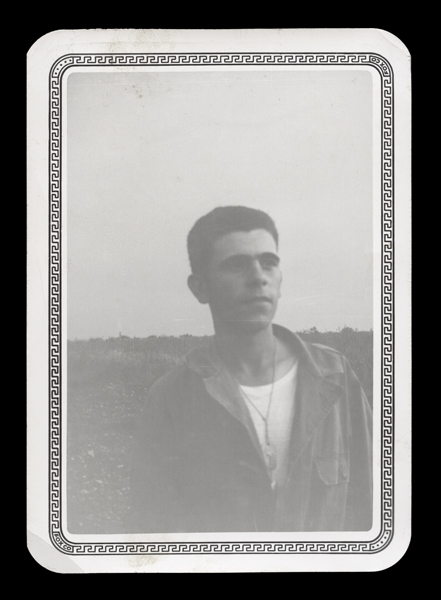
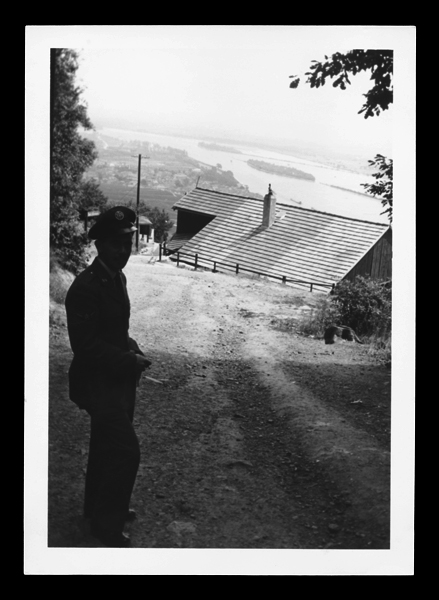
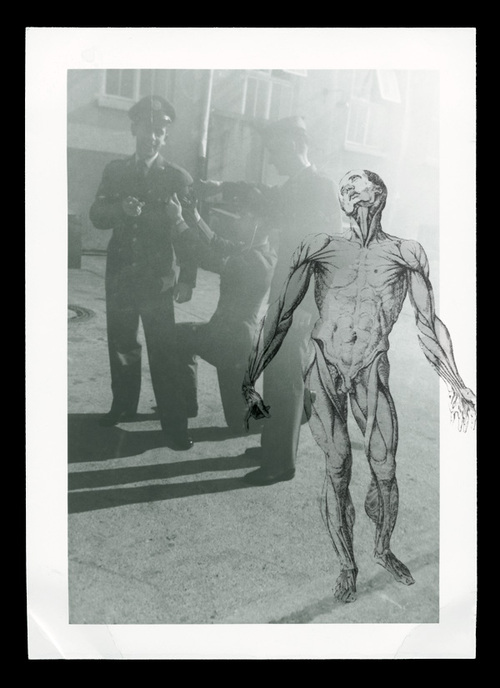
    I purchased two black and white photo albums from the 1950s on eBay, both belonging to young soldiers, one on active duty in Korea and the other visiting Japan and Germany after the Second World War. These images are especially poignant to me as an artist and human being. These are snapshots of hope and happiness, of place and being in a time of turbulence. Glimpses of the earth through open aircraft doors, smiles that flit across faces contrast with figures wrapped in a shawl of darkness.

    Their faces stare out at us across time yet their bodies are caught in the shadows.

    They remind that humans still repeat the mistakes of the past, still list the war dead in columns of photographs inches long. So young and full of hope.

    Marcus Bunyan

    SEE THE FULL SERIES ON MY WEBSITE


    Marcus Bunyan (Australian, b. 1958) 'How dramatic!' 2008 From the series 'The Shape of Dreams'


    Marcus Bunyan (Australian, b. 1958)
    How dramatic!
    2008
    From the series The Shape of Dreams
    Silver gelatin print


    Marcus Bunyan (Australian, b. 1958) 'Spire of the Dome, 1-52' 2008 From the series 'The Shape of Dreams'


    Marcus Bunyan (Australian, b. 1958)
    Spire of the Dome, 1-52
    2008
    From the series The Shape of Dreams
    Silver gelatin print


    Marcus Bunyan (Australian, b. 1958) 'Untitled' 2008 from the series 'The Shape of Dreams'


    Marcus Bunyan (Australian, b. 1958)
    Untitled
    2008
    From the series The Shape of Dreams
    Silver gelatin print


    Marcus Bunyan (Australian, b. 1958) 'Untitled' 2008 from the series 'The Shape of Dreams'


    Marcus Bunyan (Australian, b. 1958)
    Untitled
    2008
    From the series The Shape of Dreams
    Silver gelatin print


    Marcus Bunyan (Australian, b. 1958) "It's really nothing fellas!" 2008 from the series 'The Shape of Dreams'


    Marcus Bunyan (Australian, b. 1958)
    “It’s really nothing fellas!”
    2008
    From the series The Shape of Dreams
    Silver gelatin print


    Marcus Bunyan website

    LIKE ART BLART ON FACEBOOK

    Back to top