Exhibition: ‘Laure Albin Guillot: The Question of Classicism’ at Jeu de Paume, Paris

Exhibition dates: 26th February – 12th May 2013

PLEASE NOTE: THIS POSTING CONTAINS ART PHOTOGRAPHS OF MALE AND FEMALE NUDITY – IF YOU DO NOT LIKE PLEASE DO NOT LOOK, FAIR WARNING HAS BEEN GIVEN


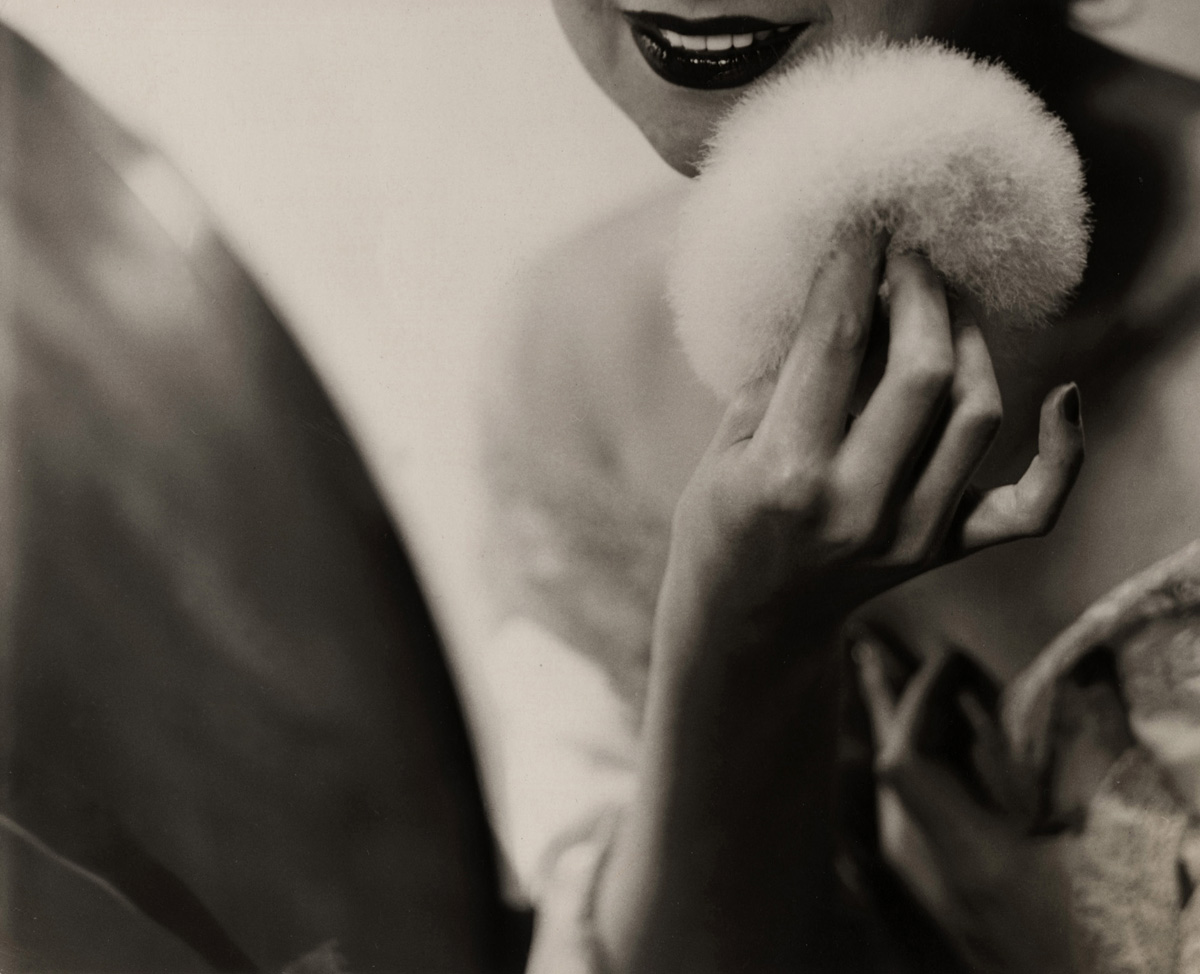
Laure Albin Guillot (French, 1879-1962) 'Estampe pour F. Marquis chocolatier-confiseur, Paris [Print for F. Marquis chocolate maker, Paris]' sans date (without date)


Laure Albin Guillot (French, 1879-1962)
Estampe pour F. Marquis chocolatier-confiseur, Paris (Print for F. Marquis chocolate maker, Paris)
Sans date (without date)
Collection particulière, Paris


The ravishing sensuality of the nudes make all the hours spent assembling this archive worthwhile!

Marcus


Many thankx to Jue de Paume for allowing me to publish the photographs in the posting. Please click on the photographs for a larger version of the image.


Laure Albin Guillot (French, 1879-1962) 'Étude publicitaire' sans date (without date)


Laure Albin Guillot (French, 1879-1962)
Étude publicitaire (Advertising study)
Sans date (without date)
Collection Musée Nicéphore Niépce, Ville de Chalon-sur-Saône


Laure Albin Guillot (French, 1879-1962) 'Les tierces alternées, illustration pour les Préludes de Claude Debussy [The third alternative, illustration for Claude Debussy Preludes]' 1948


Laure Albin Guillot (French, 1879-1962)
Les tierces alternées, illustration pour les Préludes de Claude Debussy (The third alternative, illustration for Claude Debussy Preludes)
1948
© Laure Albin Guillot / Roger-Viollet


Laure Albin Guillot (French, 1879-1962) 'Publicité pour la pommade-vaccin Salantale' 1942


Laure Albin Guillot (French, 1879-1962)
Publicité pour la pommade-vaccin Salantale (Advertisement for Salantale ointment vaccine)
1942
Bibliothèque nationale de France


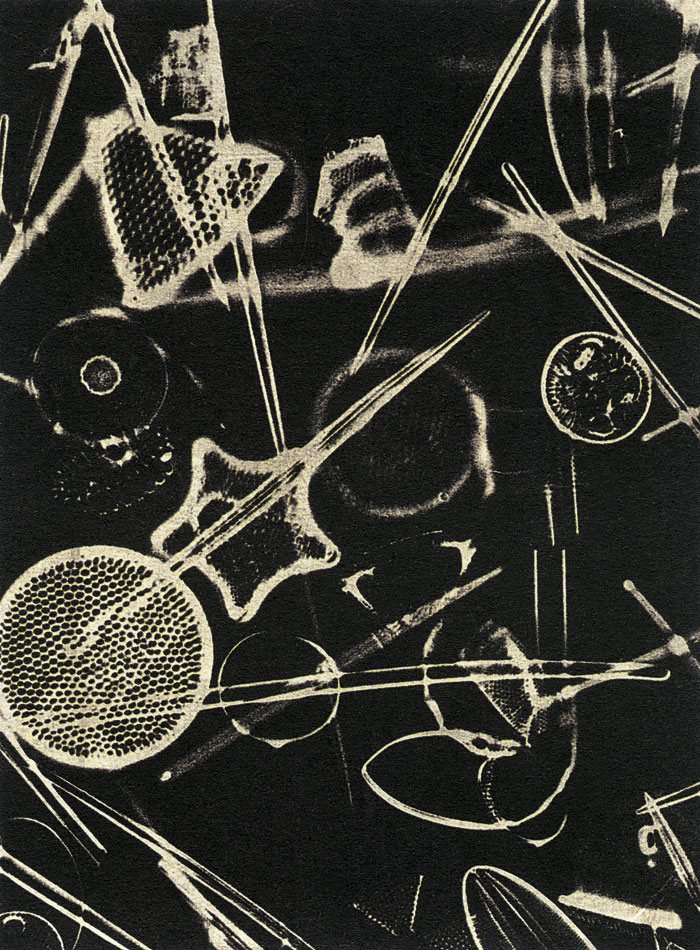
Laure Albin Guillot (French, 1879-1962) 'Micrographie' 1929


Laure Albin Guillot (French, 1879-1962)
Micrographie
1929
Collection particulière, Paris
© Laure Albin Guillot / Roger-Viollet


Laure Albin Guillot (French, 1879-1962) 'Micrographie, bourgeon de Frêne (coupe)' 1930


Laure Albin Guillot (French, 1879-1962)
Micrographie, bourgeon de Frêne (coupe)
1930
Collection Société française de photographie
© Laure Albin Guillot / Roger-Viollet


Laure Albin Guillot (French, 1879-1962) 'Micrographie' 1929


Laure Albin Guillot (French, 1879-1962)
Micrographie
1929
Collections Roger-Viollet / Parisienne de Photographie
© Laure Albin Guillot / Roger-Viollet


Laure Albin Guillot (Paris, 1879-1962), a “resounding name that should become famous”, one could read just after World War II. Indeed, the French photographic scene in the middle of the century was particularly marked by the signature and aura of this artist, who during her lifetime was certainly the most exhibited and recognised, not only for her talent and virtuosity but also for her professional engagement.

Organised in four parts, the exhibition, Laure Albin Guillot: The Question of Classicism allows one to discover her art of portraiture and the nude, her active role in the advertising world, her printed work and, at last, a significant gathering of her “micrographies décoratives”, stupefying photographs of microscopic preparations that made her renown in 1931. The exhibition presented at the Jeu de Paume gathers a significant collection of 200 original prints and books by Laure Albin Guillot, as well as magazines and documents of the period from public and private collections, such as the Parisienne de Photographie, the Musée National d’Art Moderne, the Bibliothèque Nationale de France, the Musée Nicéphore Niépce (Chalon-sur-Saône) and the Musée Français de la Photographie (Bièvres).

A large number of the original prints and documents on show come from the collections of the Agence Roger-Viollet, which acquired Laure Albin Guillot’s studio stock in 1964. This archive, which now belongs to the City of Paris, recently became accessible after a long inventory process. Made up of 52,000 negatives and 20,000 prints, this source has made it possible to question the oeuvre and the place that the photographer really occupies in history. The photographer’s work could appear as a counter-current to the French artistic scene of the 1920s to 40s, whose modernity and avant-garde production attract our attention and appeal to current tastes. It is however this photography, incarnating classicism and a certain “French style” that was widely celebrated at the time.

If Laure Albin Guillot’s photography was undeniably in vogue between the wars, her personality remains an enigma. Paradoxically, very little research has been carried out into the work and career of this artist. Her first works were seen in the salons and publications of the early 1920s, but it was essentially during the 1930s and 40s that Laure Albin Guillot, artist, professional and institutional figure, dominated the photographic arena. As an independent photographer, she practised several genres, including portraiture, the nude, landscape, still life and, to a lesser degree, documentary photography. Technically unrivalled, she raised the practice to a certain elitism. A photographer of her epoch, she used the new means of distribution of the image to provide illustrations and advertising images for the press and publishing industry.

She was notably one of the first in France to consider the decorative use of photography through her formal research into the infinitely tiny. With photomicrography, which she renamed “micrographie”, Laure Albin Guillot thus offered new creative perspectives in the combination of art and science. Finally, as member of the Société des artistes décorateurs, the Société Française de Photographie, director of photographic archives for the Direction générale des Beaux-Arts (forerunner of the Ministry of Culture) and first curator of the Cinémathèque nationale, president of the Union Féminine des Carrières Libérales, she emerges as one of the most active personalities and most aware of the photographic and cultural stakes of the period.

Press release from the Jeu de Paume website


Laure Albin Guillot (French, 1879-1962) 'Illustration pour 'Le Narcisse' de Paul Valéry' 1936


Laure Albin Guillot (French, 1879-1962)
Illustration pour ‘Le Narcisse’ de Paul Valéry
1936
Collection particulière, Paris
© Laure Albin Guillot / Roger-Viollet


Laure Albin Guillot (French, 1879-1962) 'Lucienne Boyer' 1935


Laure Albin Guillot (French, 1879-1962)
Lucienne Boyer
1935
Collections Roger-Viollet / Parisienne de Photographie
© Laure Albin Guillot / Roger-Viollet


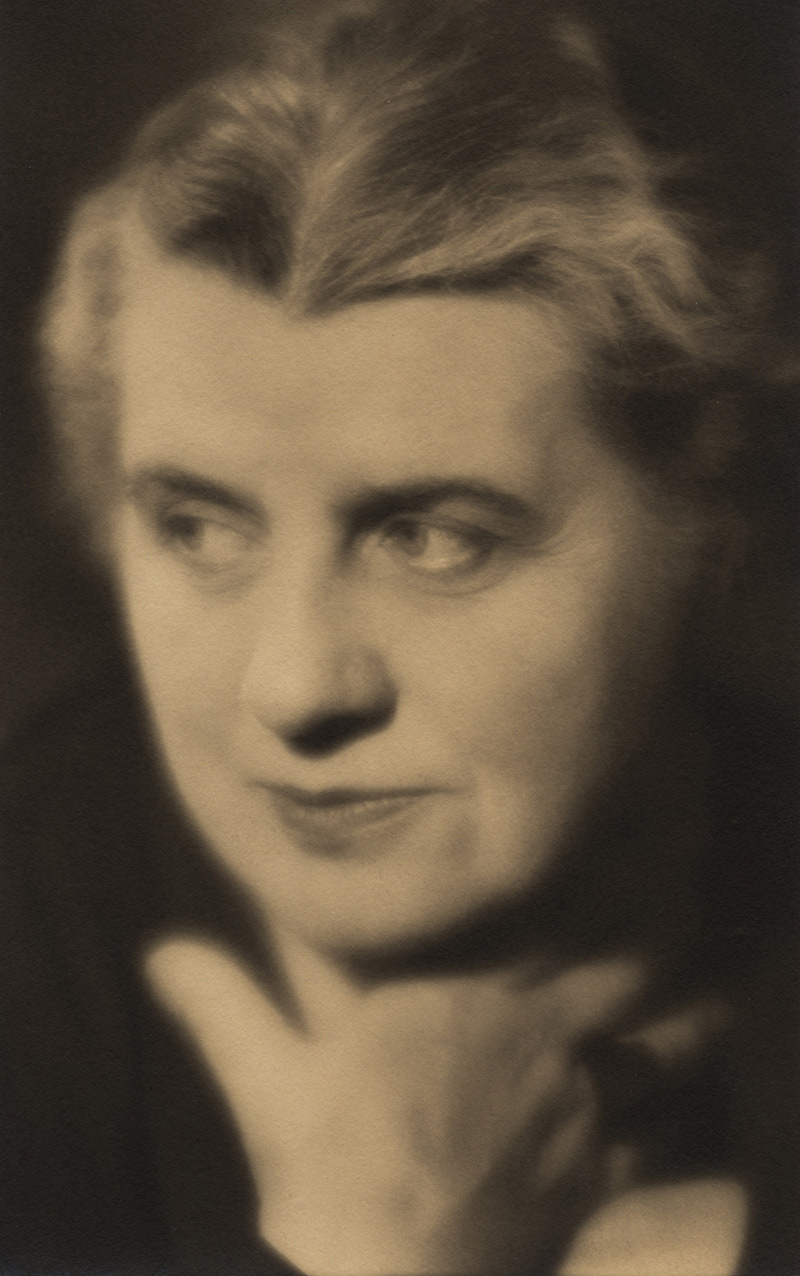
Laure Albin Guillot (French, 1879-1962) 'Autoportrait' 1935


Laure Albin Guillot (French, 1879-1962)
Autoportrait
1935
Collection Musée Nicéphore Niépce, Ville de Chalon-sur-Saône
© Laure Albin Guillot / Roger-Viollet


Laure Albin Guillot (French, 1879-1962) 'Jean Cocteau' 1939


Laure Albin Guillot (French, 1879-1962)
Jean Cocteau
1939
© Laure Albin Guillot / Roger-Viollet


Laure Albin Guillot (French, 1879-1962) 'Hubert de Givenchy' 1948


Laure Albin Guillot (French, 1879-1962)
Hubert de Givenchy
1948
© Laure Albin Guillot / Roger-Viollet


Laure Albin Guillot (French, 1879-1962) 'Étude de nu' 1930s


Laure Albin Guillot (French, 1879-1962)
Étude de nu
1930s
© Laure Albin Guillot / Roger-Viollet


Laure Albin Guillot (French, 1879-1962) 'Étude de nu' 1939


Laure Albin Guillot (French, 1879-1962)
Étude de nu
1939
© Laure Albin Guillot / Roger-Viollet


Laure Albin Guillot (French, 1879-1962) 'Étude de nu' 1939


Laure Albin Guillot (French, 1879-1962)
Étude de nu
1939
Bibliothèque nationale de France.
© Laure Albin Guillot / Roger-Viollet


Laure Albin Guillot (French, 1879-1962) 'Nudite de Jeune Femme [Nude of a Young Woman]' c. 1950


Laure Albin Guillot (French, 1879-1962)
Nudite de Jeune Femme (Nude of a Young Woman)
c. 1950
© Laure Albin Guillot / Roger-Viollet


Laure Albin Guillot (French, 1879-1962) 'Étude de nu' 1935


Laure Albin Guillot (French, 1879-1962)
Étude de nu
1935
Collections Roger-Viollet / Parisienne de Photographie
© Laure Albin Guillot / Roger-Viollet


Laure Albin Guillot (French, 1879-1962) 'Sans titre [women with crossed legs on a plinth]' 1937


Laure Albin Guillot (French, 1879-1962)
Sans titre [women with crossed legs on a plinth]
1937
Collection musée Nicéphore Niépce, Ville de Chalon-sur-Saône


Jeu de Paume
1, Place de la Concorde
75008 Paris
métro Concorde
Phone: 01 47 03 12 50

Opening hours:
Tuesday: 11am – 9pm
From Wednesday to Sunday: 11am – 7pm
Closed Monday

Jeu de Paume website

LIKE ART BLART ON FACEBOOK

Back to top

Exhibition: ‘Candida Höfer: A Return to Italy’ at Ben Brown Fine Arts, London

Exhibition dates: 12th February – 12th April 2013


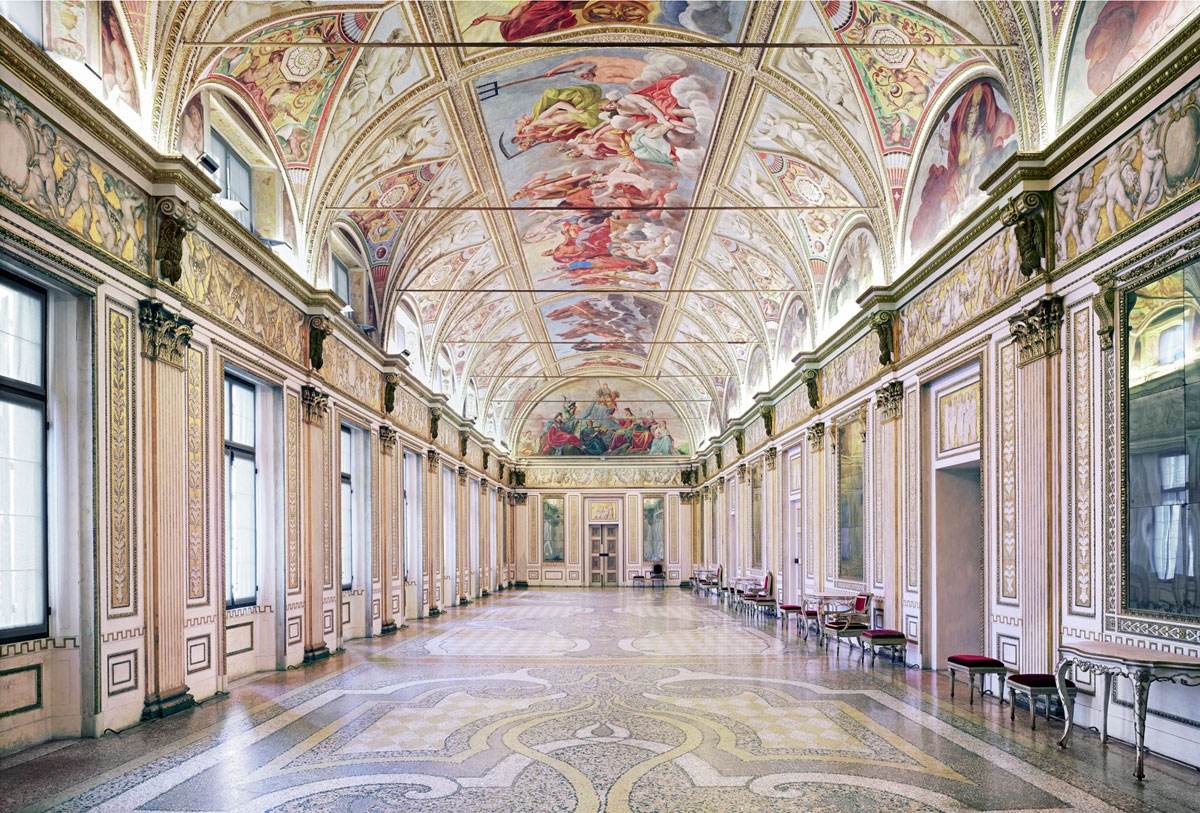
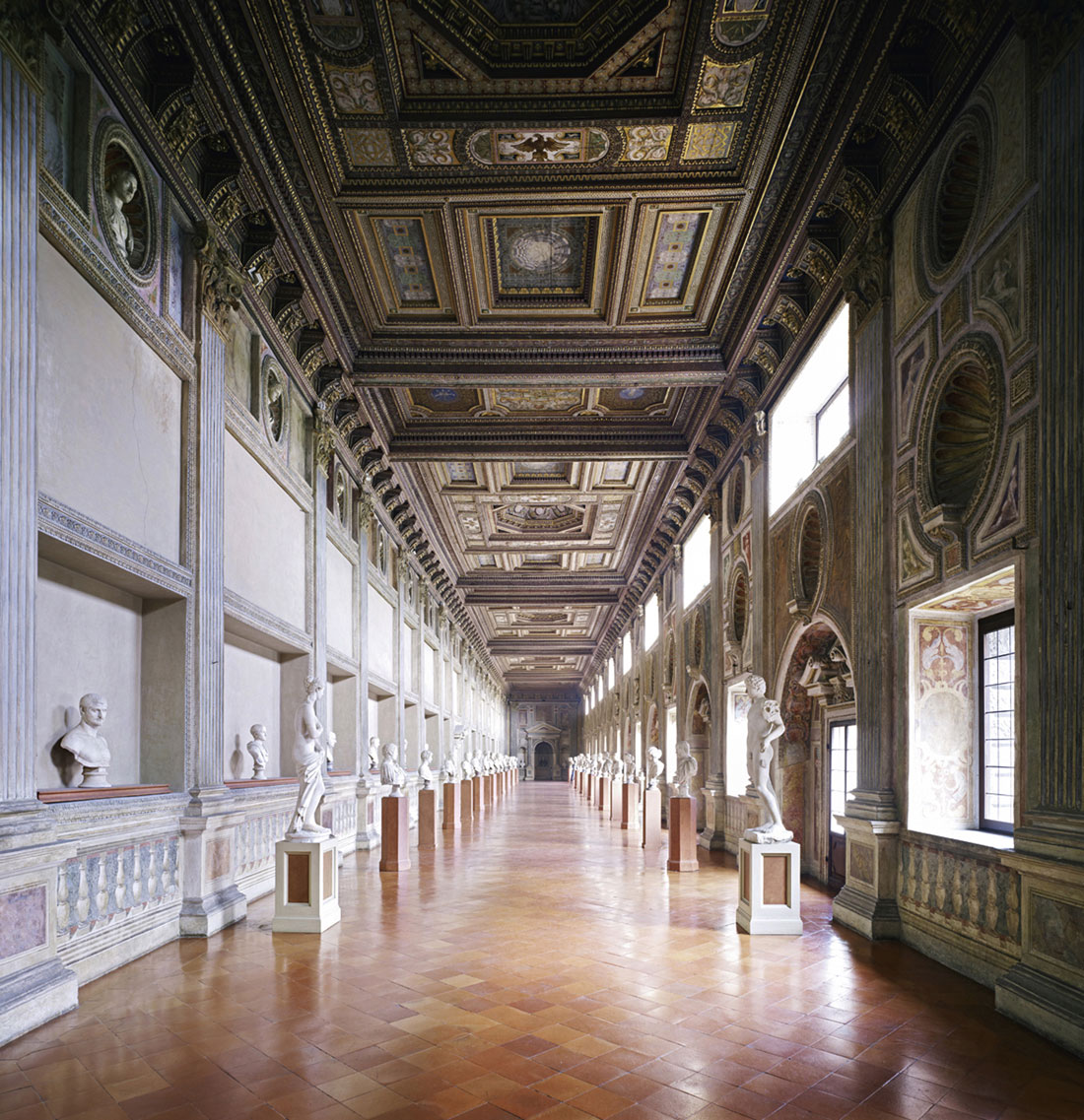
Candida Höfer (German, b. 1944) 'Galleria Degli Antichi Sabbioneta I 2010' 2010


Candida Höfer (German, b. 1944)
Galleria Degli Antichi Sabbioneta I 2010
2010
Light Jet print
Edition of 6
180 x 220.7cm (70 7/8 x 86 7/8 in.)
© 2013 Candida Höfer, VG Bild-Kunst, Bonn
Courtesy of Ben Brown Fine Arts


Ah symmetry, that vague sense of harmonious and beautiful proportion and balance, that patterned self-similarity that, through Hofer’s large format photographs, reflects the vainglorious human edifices of Northern Italy, superbly beautiful in their empty pride. Customarily devoid of human presence, Hofer’s photographs are technically and aesthetically superb. One has to examine the photographs with respect to their relationship to the passage of time, utilising spatial awareness to try to understand why things exist in specific locations within human culture.

“Both in ancient and modern times, the ability of a large structure to impress or even intimidate its viewers has often been a major part of its purpose, and the use of symmetry is an inescapable aspect of how to accomplish such goals.” (Wikipedia) Symmetries are informative of the world around us, and peer relationships are based on symmetry sending the message “we are all the same.” So Hofer’s symmetrical photographs possess opposing messages: we are all the same but some of us are more important (read powerful) than others.

Hofer’s highly symmetrical rooms are unavoidably also rooms in which anything out of place or potentially threatening can be identified easily and quickly, which has implications for safety, security, and familiarity. In this case it is the absence of human presence. To me this is the critical reading of Hofer’s photographs: they comment on the foibles of the human race, a race nearing the destruction of its only place of habitation, reaching the tipping point on the path to annihilation, yet indulging itself in a continuing race of construction and consumption. There will come a point when these edifices are crumbling and in ruins, as an Ebola-like virus races airborne around the world, destroying 90 percent of the population of the earth within months. The Earth will self balance and all we will be left with will be the memory of an empty symmetry.

Symmetry can be a source of comfort not only as an indicator of biological health, but also of a safe and well-understood living environment. The paradox of Hofer’s environments is that in these colourful, exuberant, profuse environments nothing is alive, the interiors becoming meaningless “noise” in an empty, vacuous world. The human race will have left the building.

Dr Marcus Bunyan


Many thankx to Ben Brown Fine Arts for allowing me to publish the photographs in the posting. Please click on the photographs for a larger version of the image.


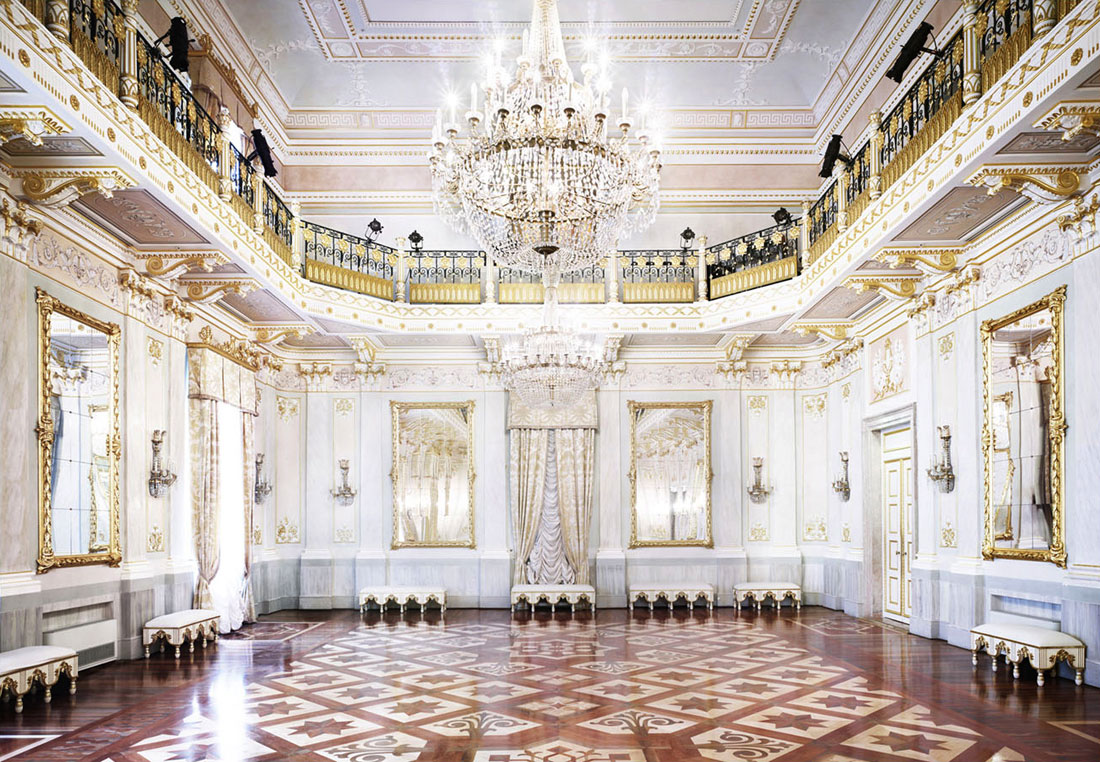
Candida Höfer (German, b. 1944) 'Palazzo Ducale Mantova I' 2011


Candida Höfer (German, b. 1944)
Palazzo Ducale Mantova I 2011
2011
Light Jet print
Edition of 6
180 x 246cm (70 7/8 x 96 7/8 in.)
© 2013 Candida Höfer, VG Bild-Kunst, Bonn
Courtesy of Ben Brown Fine Arts


Candida Höfer (German, b. 1944) 'Teatro Comunale di Carpi I' 2011


Candida Höfer (German, b. 1944)
Teatro Comunale di Carpi I 2011
2011
Light Jet print
Edition of 6
180 x 237cm; (70 7/8 x 93 1/4 in.)
© 2013 Candida Höfer, VG Bild-Kunst, Bonn
Courtesy of Ben Brown Fine Arts


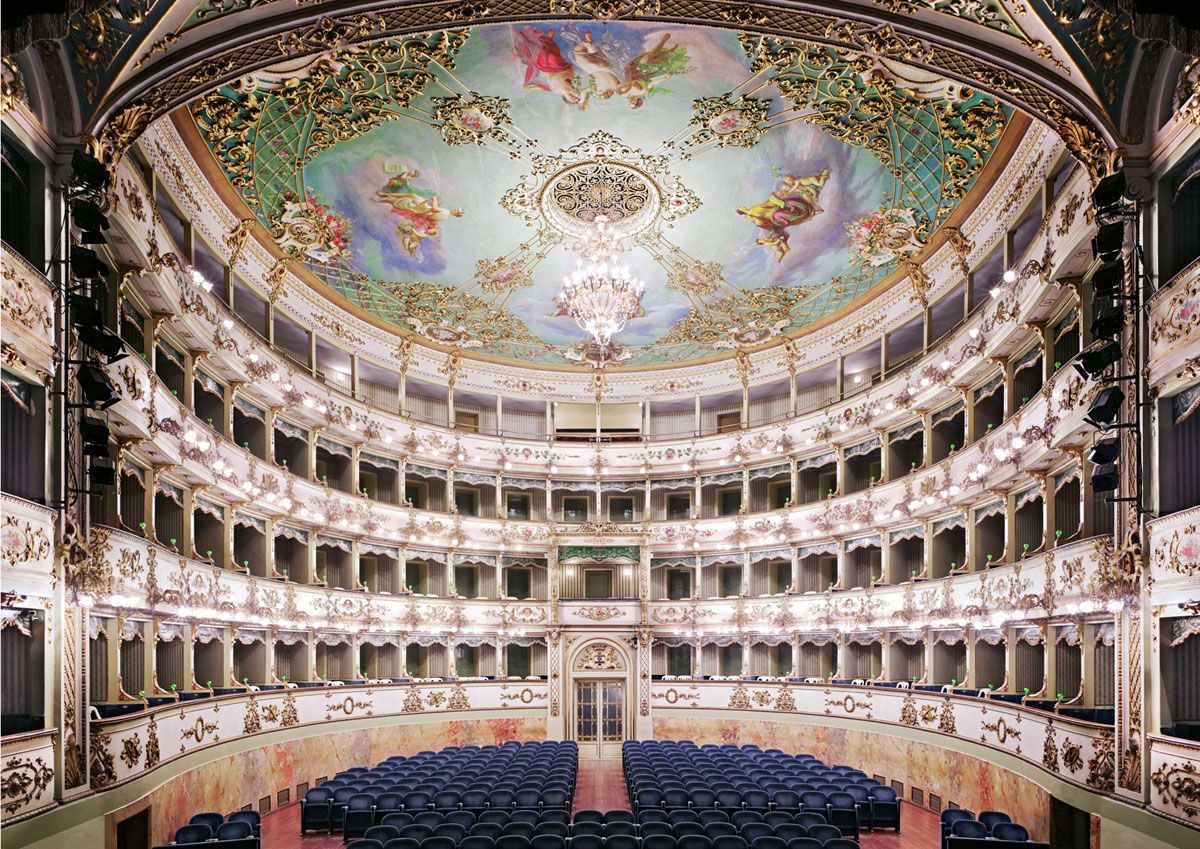
Candida Höfer (German, b. 1944) 'Teatro La Fenice di Venezia III' 2011


Candida Höfer (German, b. 1944)
Teatro La Fenice di Venezia III 2011
2011
Light Jet print
Edition of 6
180 x 242cm (70 7/8 x 95 1/4 in.)
© 2013 Candida Höfer, VG Bild-Kunst, Bonn
Courtesy of Ben Brown Fine Arts


Candida Höfer (German, b. 1944) 'Teatro La Fenice di Venezia V 2011' 2011


Candida Höfer (German, b. 1944)
Teatro La Fenice di Venezia V 2011
2011
Light Jet print
Edition of 6
180 x 235cm (70 7/8 x 92 1/2 in.)
© 2013 Candida Höfer, VG Bild-Kunst, Bonn
Courtesy of Ben Brown Fine Arts


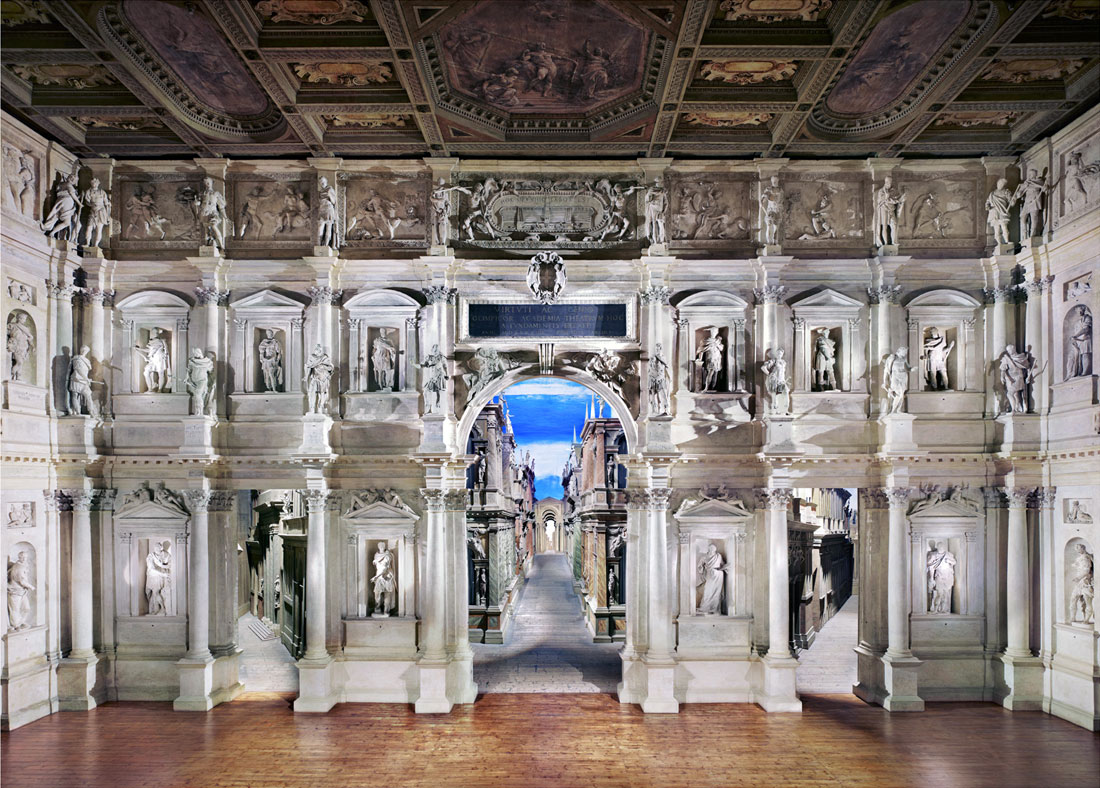
Candida Höfer (German, b. 1944) 'Teatro Olimpico Vicenza II' 2010


Candida Höfer (German, b. 1944)
Teatro Olimpico Vicenza II 2010
2010
Light Jet print
Edition of 6
180 x 235cm (70 7/8 x 92 1/2 in.)
© 2013 Candida Höfer, VG Bild-Kunst, Bonn
Courtesy of Ben Brown Fine Arts


Candida Höfer (German, b. 1944) 'Teatro Scientifico Bibiena Mantova I' 2010


Candida Höfer (German, b. 1944)
Teatro Scientifico Bibiena Mantova I 2010
2010
Light Jet print
Edition of 6
180 x 226cm (70 7/8 x 89 in.)
© 2013 Candida Höfer, VG Bild-Kunst, Bonn
Courtesy of Ben Brown Fine Arts


German photographer Candida Höfer makes a significant return to Ben Brown Fine Arts in London on 12 February with a major solo show, unveiling thirteen new and previously unseen photographs which catalogue the architectural treasures of Northern Italy.

Mantova, Vicenza, Sabbioneta, Venice and Carpi provide the glorious setting for this new series shot over the past two years, a continuation of Höfer’s previous work in Central and Southern Italy. The interiors of palaces, opera houses, libraries and theatres, which Höfer captures with incredible skill, are part of her meticulous documentation of public spaces – places of culture, knowledge, communication and exchange with a rich history and clear functionality. Having rarely visited the Northern region, Höfer was particularly touched by the naturalness and ease with which the local people there accepted this extraordinary architecture as a part of their daily lives.

Höfer’s portraits of interiors, customarily devoid of human presence, emphasise the solemn magnificence of the Palazzo Ducale, Teatro La Fenice and Biblioteca Teresiana, amongst others. By featuring spaces that celebrate mankind’s greatness, yet where people are nowhere to be found, Höfer’s images possess an unexpected poignancy which has become the hallmark of her work. Höfer produces these large-format photographs without digital enhancement or alteration, using long exposure and working solely with the existing light source. The effect is a rare combination of intimacy and scale, in which intricate architectural detail is captured without sacrificing the sense of space and civilised order.

Höfer, a member of the Düsseldorf School (Kunstakademie Düsseldorf), was a noted pupil of the Bechers, who were heavily influenced by the 1920s German art tradition of Neue Sachlichkeit and pioneered a type of detached objectivity. The Bechers’ black and white photographs of industrial landscapes and architecture embodied a clinical, documentary style, which Höfer has retained in her work through the same neutral and methodical process. Yet Höfer’s large-scale colour prints differ in their more sympathetic approach to the building’s culture and history.”

Press release from Ben Brown Fine Arts


Candida Höfer (German, b. 1944) 'Museo Civico Di Palazzo Te Mantova IV' 2010


Candida Höfer (German, b. 1944)
Museo Civico Di Palazzo Te Mantova IV 2010
2010
Light Jet print
Edition of 6
180 x 187cm; (70 7/8 x 73 5/8 in.)
© 2013 Candida Höfer, VG Bild-Kunst, Bonn
Courtesy of Ben Brown Fine Arts


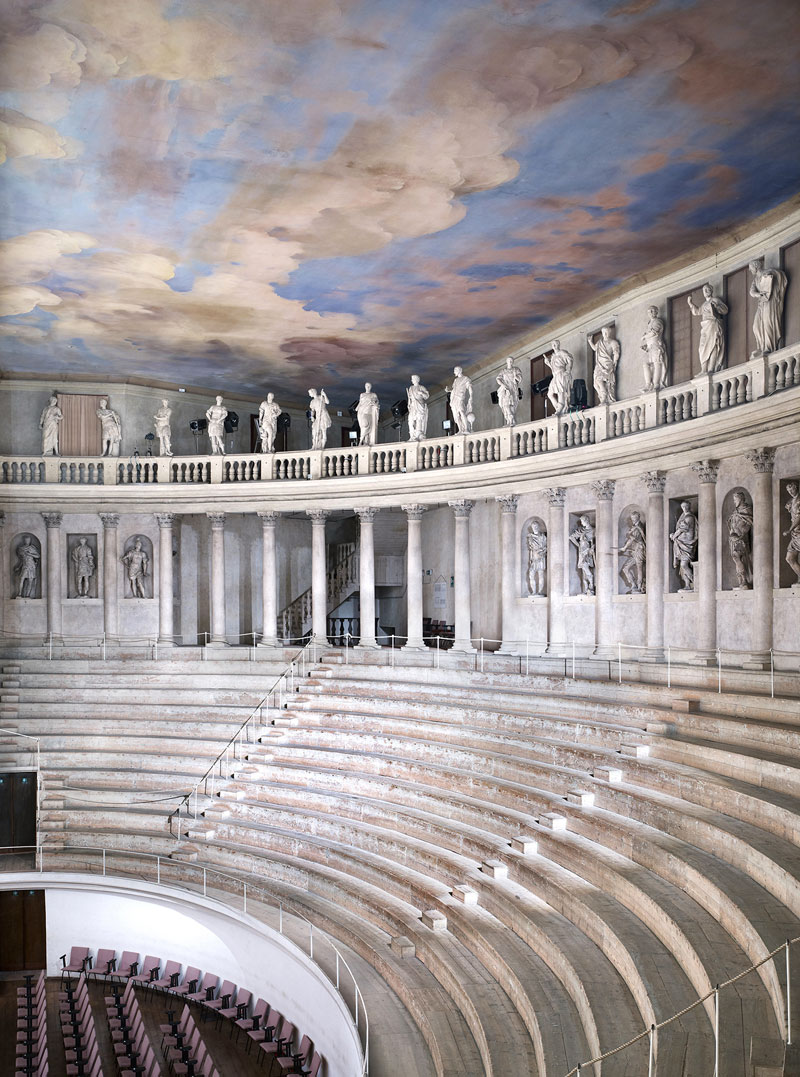
Candida Höfer (German, b. 1944) 'Teatro Olimpico Vicenza III' 2010


Candida Höfer (German, b. 1944)
Teatro Olimpico Vicenza III 2010
2010
Light Jet print
Edition of 6
180 x 144cm (70 7/8 x 56 3/4 in.)
© 2013 Candida Höfer, VG Bild-Kunst, Bonn
Courtesy of Ben Brown Fine Arts


Candida Höfer (German, b. 1944) 'Biblioteca Teresiana Mantova I' 2010


Candida Höfer (German, b. 1944)
Biblioteca Teresiana Mantova I 2010
2010
Light Jet print
Edition of 6
180 x 163cm (70 7/8 x 64 1/8 in.)
© 2013 Candida Höfer, VG Bild-Kunst, Bonn
Courtesy of Ben Brown Fine Arts


Candida Höfer (German, b. 1944) 'Palazzo Ducale Mantova III' 2011


Candida Höfer (German, b. 1944)
Palazzo Ducale Mantova III 2011
2011
Light Jet print
Edition of 6
180 x 169cm; (70 7/8 x 66 1/2 in.)
© 2013 Candida Höfer, VG Bild-Kunst, Bonn
Courtesy of Ben Brown Fine Arts


Candida Höfer (German, b. 1944) 'Palazzo Ducale Mantova V' 2011


Candida Höfer (German, b. 1944)
Palazzo Ducale Mantova V 2011
2011
Light Jet print
Edition of 6
180 x 176cm (70 7/8 x 69 1/4 in.)
© 2013 Candida Höfer, VG Bild-Kunst, Bonn
Courtesy of Ben Brown Fine Arts


Candida Höfer (German, b. 1944) 'Palazzo Ducale Mantova IV' 2011


Candida Höfer (German, b. 1944)
Palazzo Ducale Mantova IV 2011
2011
LightJet print
Edition of 6
180 x 176cm (70 7/8 x 67 3/4 in.)
© 2013 Candida Höfer, VG Bild-Kunst, Bonn
Courtesy of Ben Brown Fine Arts


Ben Brown Fine Arts
12 Brook’s Mews, London W1K 4DG
Phone: +44 (0)20 7734 8888

Opening hours:
Monday to Friday 11am – 6pm
Saturdays 10.30am – 2.30pm

Ben Brown Fine Arts website

LIKE ART BLART ON FACEBOOK

Back to top

Exhibition: ‘Primrose – Russian Colour Photography’ at Foam, Amsterdam

Exhibition dates: 25th January – 3rd April 2013

Curator: Olga Sviblova


Varvara Stepanova (Russian, 1894-1958) 'Red Army Men' 1930


Varvara Stepanova (Russian, 1894-1958)
Red Army Men
1930
Photomontage for Abroad magazine


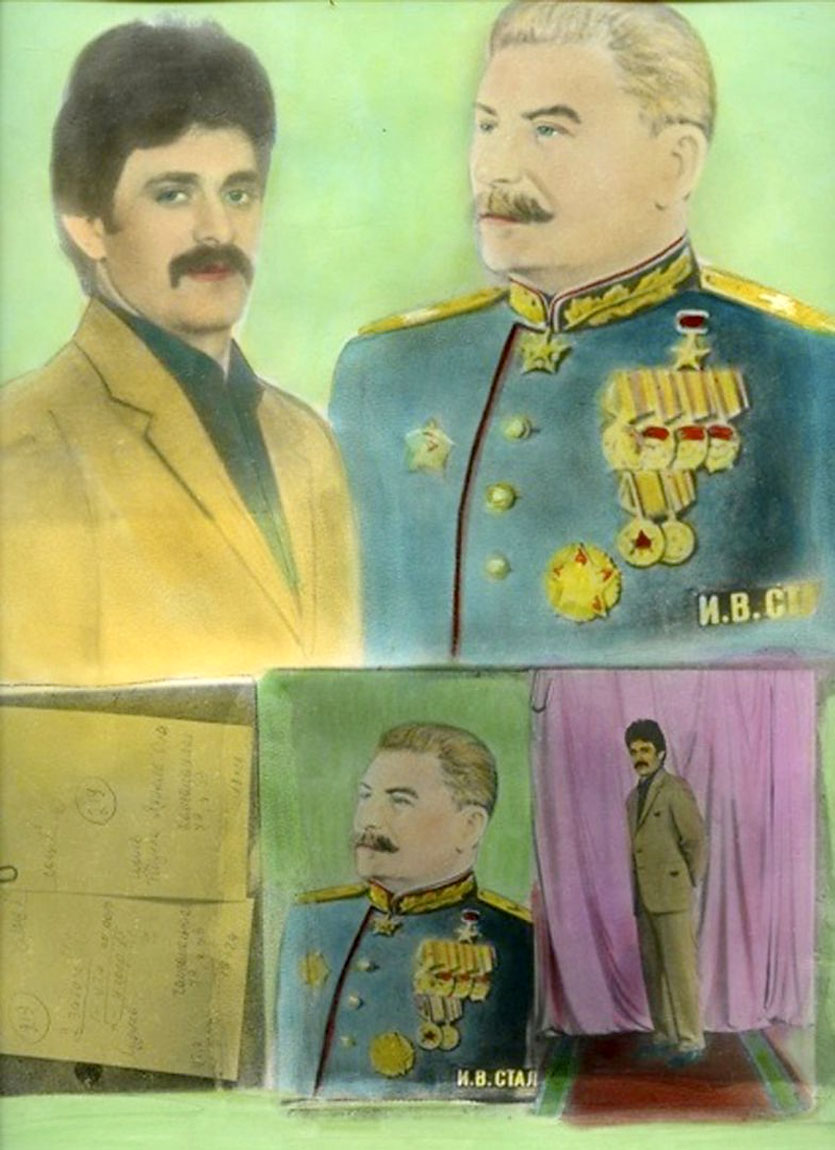
A bumper posting on a fascinating subject. The portrait of Tolstoy is incredible; more poignant are the photographs pre-World War I (the last days of the Tsarist dynasty), and pre-World War 2 (Portrait of Yury Rypalov, below). People stare into the camera with no idea of the maelstrom about to descend…

Dr Marcus Bunyan


Many thankx to Foam for allowing me to publish the text and photographs in the posting. Please click on the photographs for a larger version of the image.


Boris Mikhailov (Ukranian, b. 1938) 'Untitled' 1971-1985


Boris Mikhailov (Ukranian, b. 1938)
Untitled
1971-1985
From the series Luriki


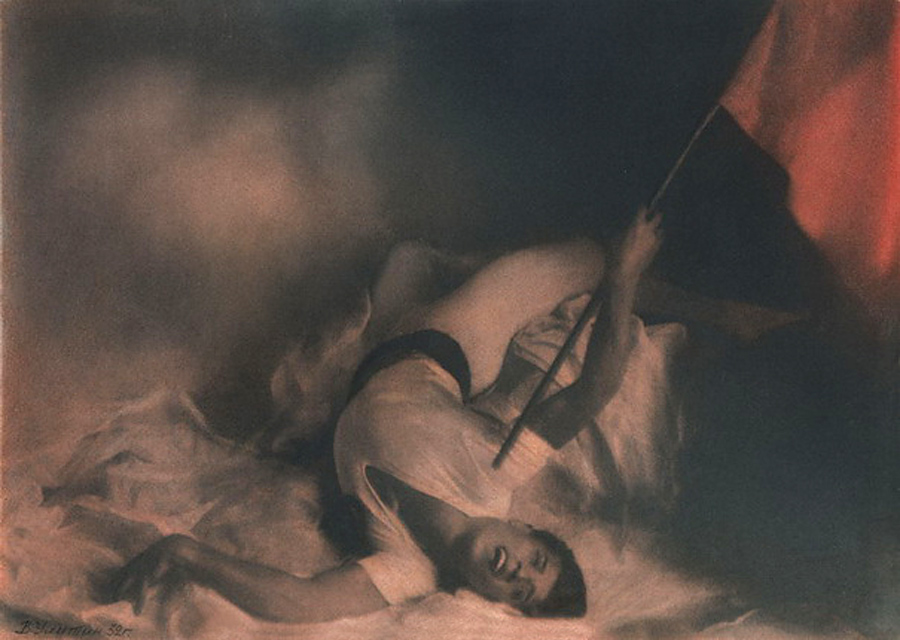
Vasily Ulitin (Russian, 1888-1976) 'Flame of Paris' 1932


Vasily Ulitin (Russian, 1888-1976)
Flame of Paris
1932
Bromoil
Moscow House of Photography Museum
© Multimedia Art Museum, Moscow / Moscow House of Photography Museum


Dmitry Baltermants (Russian, 1912-1990) 'Men's talk' 1950s


Dmitry Baltermants (Russian, 1912-1990)
Men’s talk
1950s
Colour print
Moscow House of Photography Museum
© Dmitry Baltermants Archive
© Multimedia Art Museum, Moscow / Moscow House of Photography Museum


Dmitry Baltermants (Russian, 1912-1990) 'Rain' 1960s


Dmitry Baltermants (Russian, 1912-1990)
Rain
1960s
Colour print
Moscow House of Photography Museum
© Dmitry Baltermants Archive
© Multimedia Art Museum, Moscow / Moscow House of Photography Museum


Yakov Khalip (Russian, 1908-1980) 'Sea cadets' End of 1940s


Yakov Khalip (Russian, 1908-1980)
Sea cadets
End of 1940s
Artist’s colour print
On the reverse side text of congratulation to Alexander Rodchenko
Collection of Moscow House of Photography Museum
© Multimedia Art Museum, Moscow/ Moscow House of Photography Museum


The exhibition Primrose – Russian Colour Photography takes place as part of Netherlands-Russia 2013. The title refers to the primrose flower, used metaphorically here to represent the many colours in which it appears during early spring. Primrose – Russian Colour Photography presents a retrospective of the various attempts in Russia to produce coloured photographic images. This process began in the early 1850s, almost simultaneously with the discovery of the new medium itself. The colouring technique, based on the traditional methods of craftsmen who added colour into a certain contour design, has determined a whole independent trend in the history of photography in Russia, from ‘postcard’ landscapes and portraits to Soviet propaganda and reportage photography.

The use of colour in Russia stems from the early 1850s and practically coincides with the invention of the medium itself. The term colour photography is slightly disingenuous, since at first it referred to a toning technique in which black and white photographs were painted by hand. Traditionally this technique was used by specialised tradesmen who added colour to the photographs according to certain methods and within the contours of the image. This technique became so popular that it started a trend in and of itself and to a large extent determined the appearance and aesthetics of colour photography in Russia. Initially used especially for portraits, Pictorialist landscapes and nudes, it later also found favour with avant-garde artists. Interestingly enough these aesthetics also formed the starting point for Soviet propaganda and for portraits, political leaders and reportage.

Primrose – Russian Colour Photography can be viewed as a journey through various techniques and genres, meanings and messages, mass practices and individual experiments. The exhibition contains works by renowned photographers and artists such as Sergey Produkin-Gorsky, Ivan Shagin, Dmitry Baltermants and Robert Diament. But is also shows unique photos of Alexander Rodchenko and Varvara Stephanova, and recent works from the famous Luriki series by Boris Mikhailov, in which he mocked the visual culture of the Soviet propaganda.

Press release from the Foam website [Online] Cited 24/03/2020 no longer available online


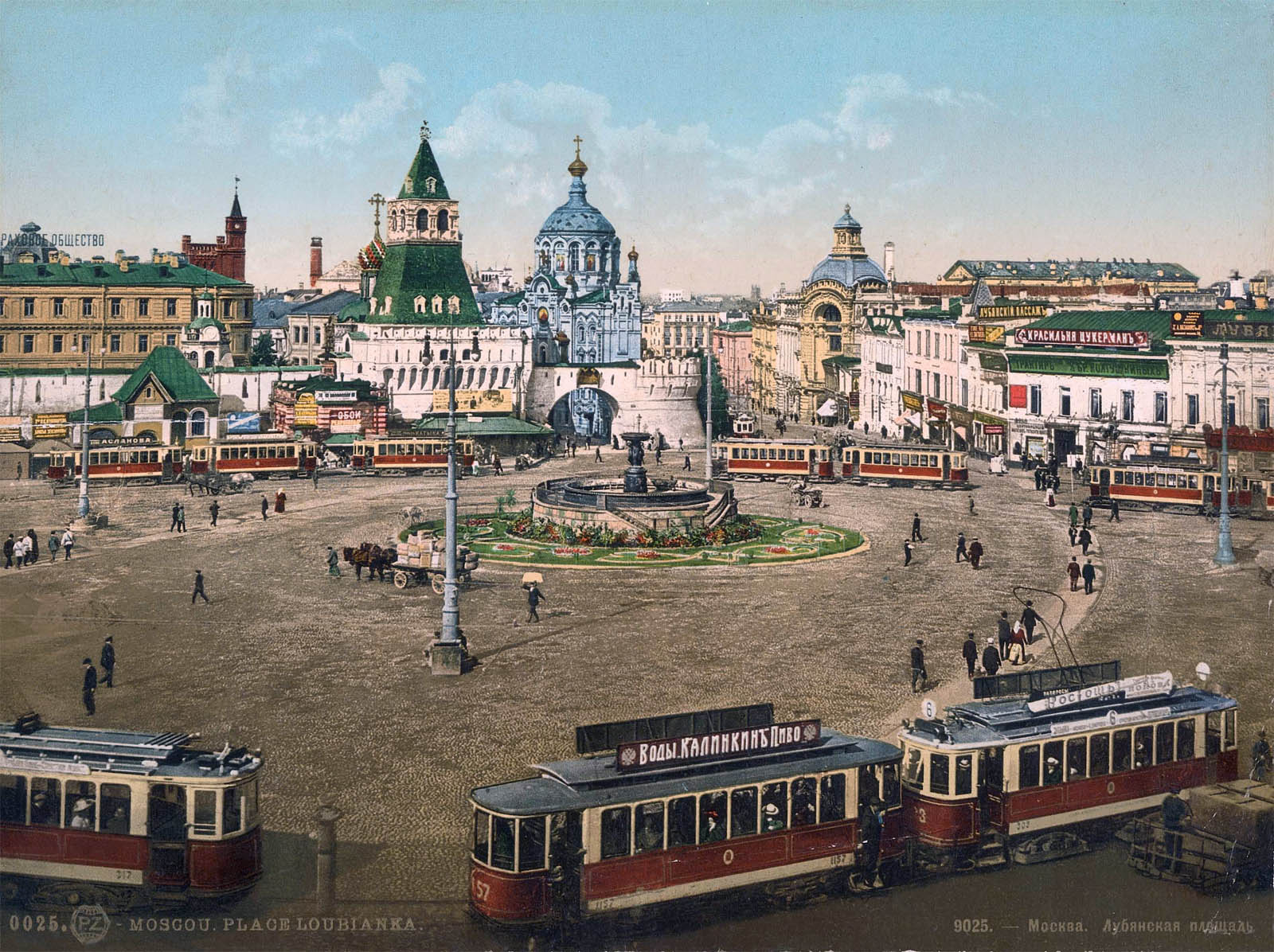
Pyotr Pavlov (Russian, 1860-1924) 'Moscow. Lubianka' 1910s


Pyotr Pavlov (Russian, 1860-1924)
Moscow. Lubianka
1910s
Offprint
Collection of Moscow House of Photography Museum
© Multimedia Art Museum, Moscow / Moscow House of Photography Museum


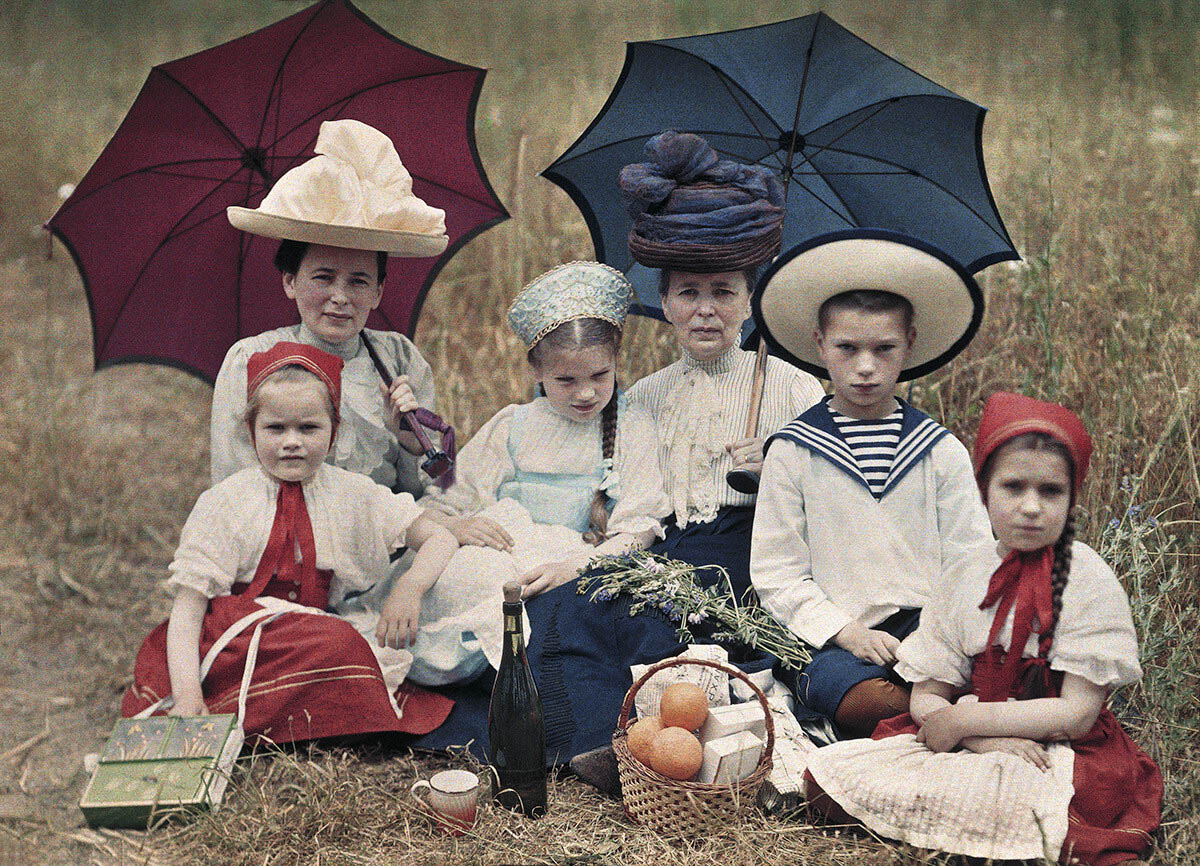
Piotr Vedenisov (Russian, 1866-1937) 'Tania, Natasha, Kolia and Liza Kozakov, Vera Nikolayevna Vedenisov and Elena Frantsevna Bazilev. Yalta' 1910-1911


Piotr Vedenisov (Russian, 1866-1937)
Tania, Natasha, Kolia and Liza Kozakov, Vera Nikolayevna Vedenisov and Elena Frantsevna Bazilev. Yalta
1910-1911
Copy; original – autochrome
Moscow House of Photography Museum
© Multimedia Art Museum, Moscow / Moscow House of Photography Museum


Piotr Vedenisov (Russian, 1866-1937) 'Nikolskoye Simbirsk province' 1910


Piotr Vedenisov (Russian, 1866-1937)
Nikolskoye Simbirsk province
1910


Alexander Rodchenko (Russian, 1891-1956) 'Race. "Dynamo" Stadium' 1935


Alexander Rodchenko (Russian, 1891-1956)
Race. “Dynamo” Stadium
1935
Artist’s gelatine silver print, gouache
Collection of Moscow House of Photography Museum
© A. Rodchenko – V. Stepanova Archive
© Multimedia Art Museum, Moscow / Moscow House of Photography Museum


Dmitry Baltermants (Russian, 1912-1990) 'Meeting in the tundra' 1972


Dmitry Baltermants (Russian, 1912-1990)
Meeting in the tundra
1972
From the Meetings with Chukotka series
Colour print Collection of Moscow House of Photography Museum
© Dmitry Baltermants Archive
© Moscow House of Photography Museum


Installation photograph of the exhibition 'Primrose - Russian Colour Photography' at Foam, Amsterdam

Installation photograph of the exhibition 'Primrose - Russian Colour Photography' at Foam, Amsterdam showing at second left, Dmitry Baltermants's 'Men's talk' (1950); and at second right, Dmitry Baltermants's 'Rain' (1960s)

Showing at second left, Dmitry Baltermants’s Men’s talk (1950, above); and at second right, Dmitry Baltermants’s Rain (1960s, above)

Installation photograph of the exhibition 'Primrose - Russian Colour Photography' at Foam, Amsterdam showing at left, Elena Mrozovskaya's 'Portrait of girl in Little Russia costume. Saint Petersburg' (1900s)


Installation photographs of the exhibition Primrose – Russian Colour Photography at Foam, Amsterdam showing in the bottom image at left, Elena Mrozovskaya’s Portrait of girl in Little Russia costume. Saint Petersburg (1900s, below)


Primrose

This exhibition with the metaphorical title Primrose demonstrates the appearance and development of colour in Russian photography from the 1860s to 1970s, and at the same time reveals the history of Russia in photography. With examples of works from classics of Russian photography such as P. Pavlov, K. Bergamasko, A. Eikhenvald, A. Rodchenko, V. Mikoshi, G. Petrusov, D. Baltermants and B. Mikhailov, as well as unknown photographers, we can see how life in Russia changed in the course of a century as it endured historical and socio-political catastrophes, also the diverse roles that photography played during this period.

Colour became widespread in Russian photography at approximately the same time as in Europe – in the 1860s. This was dependent on the manual tinting of photographic prints with watercolour and oil paints, either by the photographers themselves or by artists working with them. Above all this applies to solo or family portraits commissioned as a keepsake. The photographic studios of Nechayev, Ushakov & Eriks and Eikhenvald produced thousands of tinted portraits that became an important part of the domestic interior.

People were eager to see their own image in colour, and moreover in a picturesque form. The colouring of early photographic shots could also hide imperfections in the prints, including those introduced on albumenised paper. With time this paper turned yellow. To conceal this, the paper was tinted green, pink and other colours and coloured with watercolours, gouache, oils, or later aniline dyes. Sometimes the photograph was partially redrawn during the process of tinting, and foliate embellishments or different items of interior decoration appeared in the background.

By the end of the 19th century, by the 1880s and 1890s, colour photography was extended to architectural, landscape and industrial subject matter. For instance, the photographic studio of the Trinity and St. Sergius Monastery (photographic studios attached to Russian monasteries became a very common phenomenon) produced numerous coloured architectural images of Orthodox churches.

In the late 19th and early 20th centuries Russia was on the one hand undergoing active europeanisation, as reflected in the style of architectural structures, interiors, costume and way of life, but meanwhile there was also a search for national identity, and new interest in the national particularities of inhabitants in the Russian Empire. Entire series of tinted photographs appeared, depicting people in national costumes – Russian, Tatar, Caucasian, Ukrainian, and so on.

With the industrial boom of the late 19th and early 20th centuries people began to decorate their walls not only with tinted landscapes, but also photographs of industrial structures (eg Dmitri Yezuchevsky’s photograph Building the Bridge). In the early 20th century, in the 1910s, coloured photographs of Russian military officers, an important social class before the outbreak of the First World War, were particularly popular.

The photographic documentation of life in the Russian Empire in the early 20th century acquired the status of a State objective, largely because Tsar Nicholas II and his family were enthusiastic amateur photographers. In May 1909 Emperor Nicholas II gave an audience to the photographer Sergei Prokudin-Gorsky. In 1902 Prokudin-Gorsky had first announced a technique for creating colour photographs, and in 1903 he published a brochure entitled ‘Isochromatic Photography with Manual Cameras’. Prokudin-Gorsky used black-and-white plates sensitised according to his own formulae, and a camera of his own construction. Three rapid shots were taken successively through light filters coloured blue, green and red (the photographer managed to reduce the exposure time to an absolute minimum). From this triple negative a triple positive was prepared. A projector with three lenses in front of three frames on the photographic plate was used to view the shots. Each frame was projected through a colour filter of the same colour as that through which it had been photographed. A full-colour image appeared on the screen as the three images combined. Prokudin-Gorsky succeeded in making polygraphic reproductions of his shots, printed in the form of photo cards, and also as inserts for illustrated magazines.

Delighted with this invention, Emperor Nicholas II asked the photographer to take colour photographs of every aspect of life in the various regions that then constituted the Russian Empire. For this the photographer was issued with a specially equipped railway car. The government provided him with a small manned steamship able to traverse the shallows for his work on waterways, and a motorboat for the River Chusova. A Ford automobile was dispatched to Yekaterinburg for his shots of the Urals and the Ural mountain range. Prokudin-Gorsky was presented with official imperial documents that gave him access to all parts of the Empire, and government officials were ordered to assist Prokudin-Gorsky on his travels.

Meanwhile autochrome pictures by the Lumière brothers, with whom Prokudin-Gorsky worked after emigrating from Soviet Russia, became very popular in early 20th-century Russia. Autochromes, colour transparencies on a glass backing, were first produced on an industrial scale in 1907. Granules of potato starch tinted red, yellow and blue were applied to a glass plate. The granules worked as colour filters. Addition of a second layer of granules provided orange, violet and green hues. After that a light-sensitive emulsion was applied. The plate was exposed and developed. Autochromes could be viewed against the light, or projected with the aid of special apparatus, which at that time was manufactured by the Lumière brothers’ own company (diascopes, chromodiascopes, mirrored stereoscopes, etc.). The Lumière brothers’ autochromes were used, for example, by Pyotr Vedenisov, a prosperous nobleman and graduate of the Moscow Conservatoire, who settled in Yalta, in the Crimea, in the late 1880s. As was the case with the Lumière brothers’ autochromes, Vedenisov’s favoured subject matter was the photographer’s own family life. However, what was at first sight very private and personal photography later provided an excellent description of the typical lifestyle enjoyed by educated Russian noblemen in the early 20th century.

The onset of the First World War in 1914 and October Revolution in 1917 annihilated the Russia whose memory is preserved in the tinted photographs and autochromes of the second half of the 19th to early 20th centuries.

Vladimir Lenin and the new Soviet government actively supported photography in the early post-revolutionary years, seeing it as an important propaganda weapon for a country where 70% of the population were unable to read or write. At first there was emphasis on photo reportage, but very soon it became clear real change in a country where hunger and devastation ruled after the Revolution and Civil War was as insubstantial as the utopian dreams of ardent revolutionaries. From the mid-1920s photomontage was widespread in the Soviet Union, enthusiastically encouraged by the Bolsheviks. Photomontage allowed for a combination of documentary veracity and the new Soviet myths. In the 1920s it was practised by such highly talented modernists as A. Rodchenko, G. Klutsis, El Lissitzky, V. Stepanova and others. Photomontage embraced colour and became an ideological ‘visual weapon’.

From the mid-1920s A. Rodchenko regenerated the forgotten technique of hand colouring his own photographs. His use of tinting profited from his experience with photomontage (Mosselprom House Advertising Wall, Dynamo Running Stadium, etc.), and he also applied it to develop experiments with positive-negative printing (scenes from the film Albidum) and for very personal and even intimate portraits of his muse Regina Lemberg – Girl with Watering Can. In 1937, at the height of Stalin’s repression, A. Rodchenko began photographing classical ballet and opera, using the arsenal of his aesthetic opponents, the Russian Pictorialists, who by that time were subject to even harsher repression in the Soviet Union than modernist photographers. For Alexander Rodchenko soft focus, classical subject matter and toning typical of pictorial photography were a mediated way of expressing his internal escapism and tragic disillusionment with the Soviet utopia.

In 1932 general rules for socialist realism were published in the USSR, as the only creative method for all forms of art, including photographic. Soviet art had to reflect Soviet myths about the happiest people in the happiest country, not real life and real people. On this Procrustean bed it was hard not only for modernism with its constructivist aesthetics, but even Pictorialism, to fit into the aesthetics of Socialist realism.

Pictorialism was one of the most important tendencies of early 20th-century Russian photography, and Russian Pictorialist photographers were awarded gold and silver medals at international exhibitions. Pictorial photography differed not only by the method of shooting and complex printing techniques intended to bring photography closer to painting, but also by the selection of traditional themes. Romantic landscapes and architectural ruins or nude studies were from the point of view of socialist realism dangerous remnants from the past. Some of the Pictorialist photographers ended up in Stalin’s prison camps, and were forbidden from practising their profession or settling in the capital or other large cities. Those who remained at liberty – for example, Vasily Ulitin, a participant in major international photo exhibitions and recipient of medals and diplomas in Paris, London, Berlin, Los Angeles, Toronto, Tokyo and Rome – tried with difficulty to adapt to the new reality and attempted to depict revolutionary subjects (Flames of Paris, Red Army Soldier), thereby gaining indulgence and the right to work from the Bolsheviks.

Almost simultaneously, in 1936 the German company Agfa and American company Kodak introduced colour film. Broad distribution and introduction to the amateur photography market were delayed by the outbreak of the Second World War. In the USSR colour photography only appeared at the end of the war. Production of Soviet-made colour film in the USSR was facilitated by German trophy equipment in 1946. From that year onwards Ivan Shagin and several other photographers began to relay their colour news chronicle to the country.

Before 1946 colour photographs of Soviet Russia were made only in isolated cases, on German or American film. Until the mid-1970s, in the USSR negative film for printing colour photographs was a luxury only available to a few official photographers who worked for major Soviet publications. It was used by such classics of Soviet photography as V. Mikosha, G. Petrusov, D. Baltermants, V. Tarasevich, and others. All of them were in one way or another obliged to follow the canons of socialist realism and practise staged reportage. In those days even still life studies of fruit bore an ideological message, being photographed for cookery books in which the Soviet people could see produce that remained absent in a hungry postwar country, where the ration-card system of food distribution was still functioning (Ivan Shagin, Lemons and Fruit, 1949).

From the late 1950s, in the Khrushchev Thaw after the debunking of Stalin’s cult of personality, the canons of socialist realism softened and permitted a certain freedom in aesthetics, allowing photography to move closer to reality (Dmitri Baltermants’ series Arbat Square). In the postwar period, during the 1950s to 1960s life gradually improved and coloured souvenir photo portraits again appeared on the mass market. They were usually produced by unknown and ‘unofficial’ photographers, since private photo studios that had carried out such commissions since the mid-19th century were now forbidden, and the State exercised a total monopoly on photography by the 1930s. Boris Mikhailov copied and enlarged such kitsch colour photographs as souvenirs to supplement his income at his photo laboratory in Kharkov in the early 1970s. He began collecting them. They form the basis for a new aesthetics he developed in the Lyrics series from the early 1980s. By tinting these naïve photographs he revealed and deconstructed the nature of Soviet myths.

Colour transparency film appeared on the Soviet mass market in the 1960s and 1970s. As opposed to colour negative film that requires a complicated and expensive development process for subsequent printing, colour slide film could be developed even in domestic surroundings. Above all it was widely used by amateurs, who created transparencies that could be viewed at home with a slide projector. An unofficial art form emerging in the USSR at this time developed the aesthetics and means for a new artistic conceptualisation of reality, quite different from the socialist realism that still prevailed, although somewhat modified. Photography took a significant role in this unofficial art. It was in the late 1960s and early 1970s that Boris Mikhailov began photographing his series Suzi Et Cetera on colour slide film.

More than half a century of Soviet power after the 1917 Revolution radically altered Russia. The surrounding reality has fallen into decline, and people brought up on Soviet slogans never thought to pay attention. But this was the only reality offered by our perception, and Boris Mikhailov tries to develop its colour, humanise it with his attention and give it the right of existence. Photography textbooks of that period were made up of one-third technical formulae and two-thirds description of what to photograph, and how. The photographer was certainly not required or even allowed to take nude studies. Corporeality and sexuality are inherent signs of an independent individual, of selfhood. The Soviet system specifically tried to level out any sense of selfhood, smothering it and challenging such ideas with the collective community and the impersonal ‘we’ of the Soviet nation. In photographing Suzi Et Cetera Boris Mikhailov disrupts the norms and reveals characters, his own and that of his subjects. It was impossible to show these shots in public, but slides could be projected at home, in the workshops of his artist friends or the small, often semi-underground clubs of the scientific and technical intelligentsia, who began to revive during Khrushchev’s Thaw after the Stalinist repression. Boris Mikhailov’s slide projections are now analogous to the apartment exhibitions of unofficial art. By means of colour he displayed the dismal standardisation and squalor of surrounding life, and his slide performances helped to unite people whose consciousness and life in those years began to escape from the dogmatic network of Soviet ideology, which permitted only one colour – red.

Curator Olga Sviblova
Director, Multimedia Art Museum, Moscow


Boris Mikhailov (Ukranian, b. 1938) 'Untitled' 1971-1985 From the series 'Luriki'


Boris Mikhailov (Ukranian, b. 1938)
Untitled
1971-1985
From the series Luriki


Vladislav Mikosha (Russian, 1909-2004) 'Portrait of Yury Rypalov' 1938-1939


Vladislav Mikosha (Russian, 1909-2004)
Portrait of Yury Rypalov
1938-1939


V. Yankovsky. '"In memory of my military service". Saint Petersburg' Beginning of 1910s


V. Yankovsky
“In memory of my military service”. Saint Petersburg
Beginning of 1910s
Collodion, painting
Collection of Moscow House of Photography Museum
© Moscow House of Photography Museum


Elena Mrozovskaya (Russian, 1892 – c.  1941) 'Portrait of girl in Little Russia costume. Saint Petersburg' 1900s


Elena Mrozovskaya (Russian, 1892 – c.  1941)
Portrait of girl in Little Russia costume. Saint Petersburg
1900s
Gelatine silver print, painting
Collection of Moscow House of Photography Museum
© Moscow House of Photography Museum


A. Nechayev. 'Portrait of girl' 1860s


A. Nechayev
Portrait of girl
1860s
Salted paper, covered by albumen, painting
Collection of Moscow House of Photography Museum
© Multimedia Art Museum, Moscow / Moscow House of Photography Museum


Sergey Prokudin-Gorsky (Russian, 1863-1944) 'Portrait of Lev Tolstoy' 23rd of May 1908


Sergey Prokudin-Gorsky (Russian, 1863-1944)
Portrait of Lev Tolstoy
23rd of May 1908
Offprint
Collection Multimedia Art Museum, Moscow


Piotr Vedenisov (Russian, 1866-1937) 'Uknown woman, the Crimea, Yalta' 1914


Piotr Vedenisov (Russian, 1866-1937)
Uknown woman, the Crimea, Yalta
1914


Piotr Vedenisov (Russian, 1866-1937) 'Andrei Aleksandrovich Kozakov. Yalta' 1911-1912


Piotr Vedenisov (Russian, 1866-1937)
Andrei Aleksandrovich Kozakov. Yalta
1911-1912
Copy; original – autochrome
Moscow House of Photography Museum
© Multimedia Art Museum, Moscow / Moscow House of Photography Museum


Piotr Vedenisov (Russian, 1866-1937) 'Vera Kozakov in Folk Dress' 1914


Piotr Vedenisov (Russian, 1866-1937)
Vera Kozakov in Folk Dress
1914
Collection of Moscow House of Photography Museum
© Multimedia Art Museum, Moscow / Moscow House of Photography Museum


The scenes in Vedenisov’s autochromes take place in Yalta or in the Simbirsk Government, where the Kozakov family, the photographer’s relations, resided. Piotr Vedenisov chooses his models among the members of this single large family. Vedenisov’s photos are mostly staged portraits. Other subjects include everyday life and travelling, feasts, pets, interiors and landscapes. Vedenisov’s autochromes are shot over a relatively short period of time, roughly from 1909 to 1914.

About the photographer

Piotr Ivanovich Vedenisov (1866-1937) was a Russian nobleman living in Yalta, who graduated at the Moscow Conservatorium in 1888. Beside his ultimate passion for music, he was enthusiastic about the history of Crimea and photography. In the early 20th century, Vedenisov masters a technical innovation: he could make colour autochromes on glass. It was a technique of creating works in colour, based on three stages of consecutive shooting through colour filters. It was further developed by the Lumière brothers who succeeded in placing all the filters on a single plate.

Text from the Foam website Nd [Online] Cited 19/09/2022


Piotr Vedenisov (Russian, 1866-1937) 'Kolya Kozakov and the Dog Gipsy. Yalta' 1910-1911


Piotr Vedenisov (Russian, 1866-1937)
Kolya Kozakov and the Dog Gipsy. Yalta
1910-1911
Collection of Moscow House of Photography Museum
© Multimedia Art Museum, Moscow / Moscow House of Photography Museum


Vasily Ulitin (Russian, 1888-1976) 'Red Army man' 1932


Vasily Ulitin (Russian, 1888-1976)
Red Army man
1932


Dmitry Baltermants (Russian, 1912-1990) 'Show window' Beginning of 1960s


Dmitry Baltermants (Russian, 1912-1990)
Show window
Beginning of 1960s
Colour print
Collection of Moscow House of Photography Museum
© Dmitry Baltermants Archive
© Multimedia Art Museum, Moscow / Moscow House of Photography Museum


Ivan Shagin (Russian, 1904-1982) 'Fruits' 1949


Ivan Shagin (Russian, 1904-1982)
Fruits
1949
Colour print
Collection of Moscow House of Photography Museum
© Multimedia Art Museum, Moscow / Moscow House of Photography Museum


Robert Diament (Russian, 1907-1987) 'He has turned her head' Beginning of 1960s


Robert Diament (Russian, 1907-1987)
He has turned her head
Beginning of 1960s
Colour print
Collection Moscow House of Photography Museum
© Multimedia Art Museum, Moscow / Moscow House of Photography Museum


Foam
Keizersgracht 609
1017 DS Amsterdam
The Netherlands
Phone: + 31 20 5516500

Opening hours:
Mon – Wed 10am – 6pm
Thu – Fri 10am – 9pm
Sat – Sun 10am – 6pm

Foam website

LIKE ART BLART ON FACEBOOK

Back to top

Exhibition: ‘Catherine Opie’ at Regen Projects, Los Angeles

Exhibition dates: 23rd February – 29th March 2013


Catherine Opie (American, b. 1961) 'Untitled #4' 2012


Catherine Opie (American, b. 1961)
Untitled #4
2012
Pigment print
40 x 60 inches (101.6 x 152.4cm)
Edition 1/5, +2 APs


In a nutshell: good presentation, good idea – just needs really good pictures. In fact the presentation is too good for the pictures, so in the end it feels a bit ridiculous.

There IS something here (the relationship between young and old, wisdom and penitence, love and abuse, tondo and ethereal landscape), but it seems a bit of a muddle. For me, too many easy decisions have been made – obvious opposites, too much reliance on “black”, sometimes caricature rather than real observation… but then again there is occasionally something inside that caricature.

This feeling of muddling through is not helped by an abysmal press release. Along with zen and ironic (both of which seem to have any meaning a writer wants today), we now have sublime joining the pack. Maybe if anything is out of focus (such as these forgettable landscapes) it is sublime. As I go through each sentence I get shivers from either how generic or incorrect or meaningless or (especially) SELF-SERVING they are (… and now the new photographs make a trajectory… and now Opie draws on documentary photography AND the history of photography… and seduction, and formalism, and painting, and high aesthetic, and abstraction, and conceptualisation, a(n)d nauseum… )

I have seen “the Unphotographable” … and it is not as good as one hoped!

Dr Marcus Bunyan

PS. When you walk across a room, you can remark about your chiaroscuro.


Many thank to Regen Projects for allowing me to publish the photographs in the posting. Please click on the photographs for a larger version of the image. Courtesy Regen Projects, Los Angeles © Catherine Opie


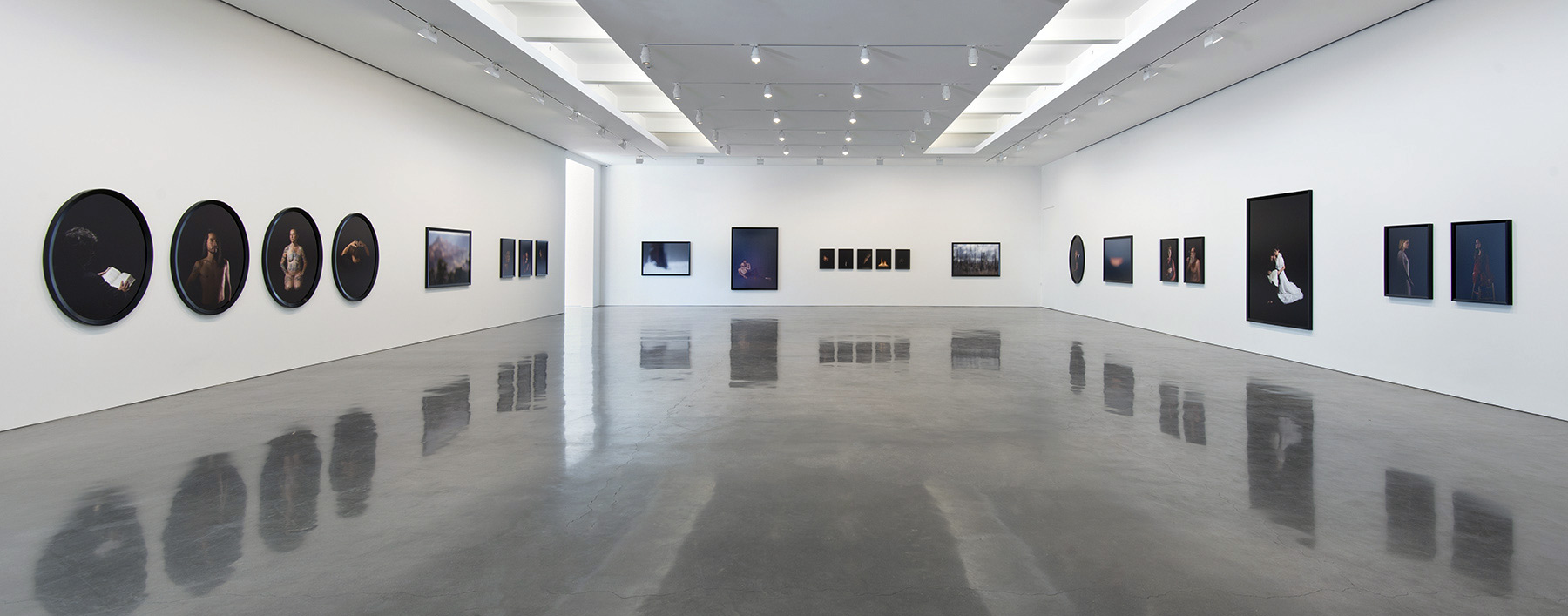
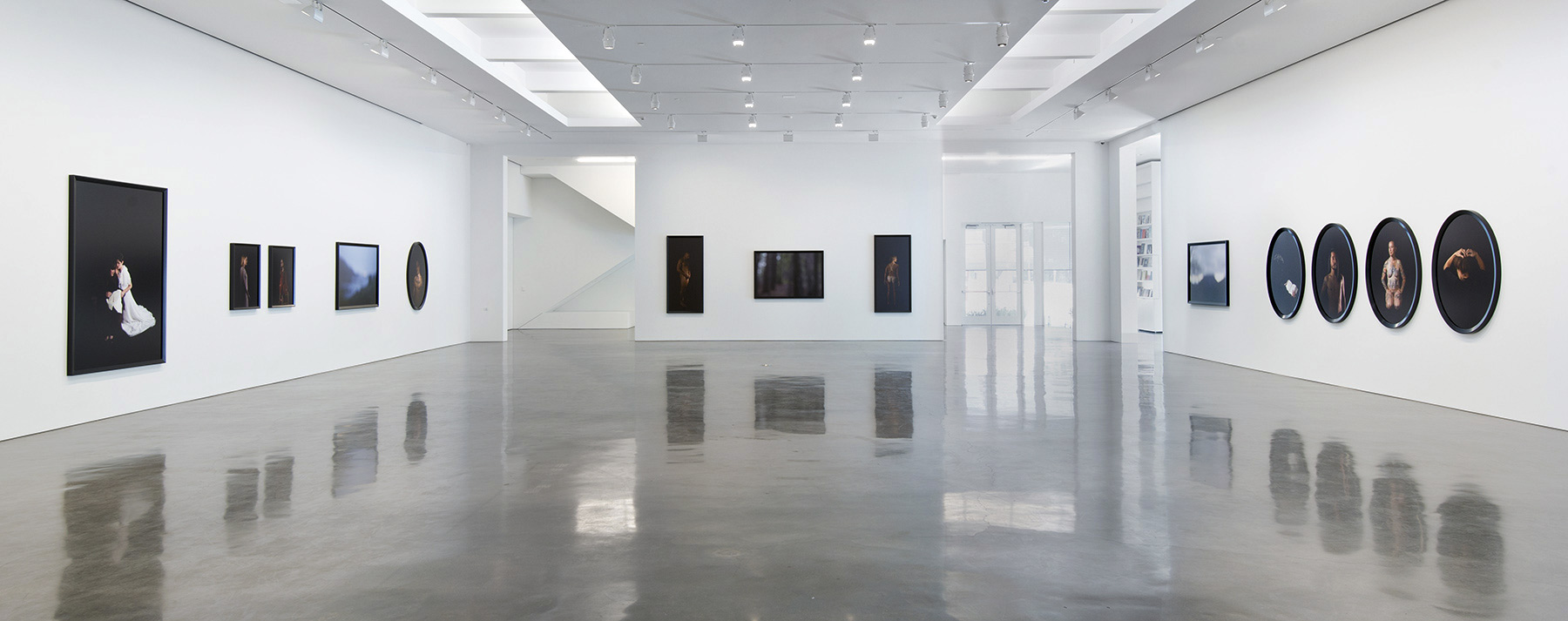
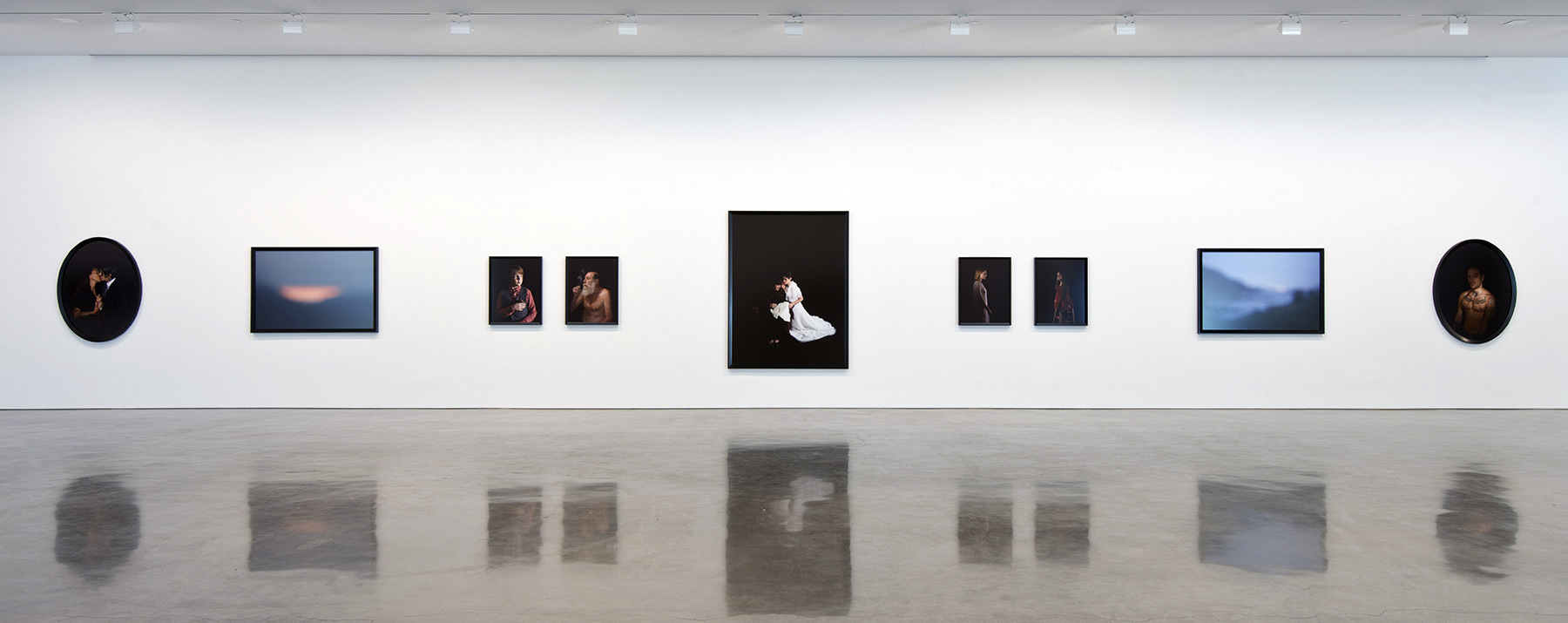
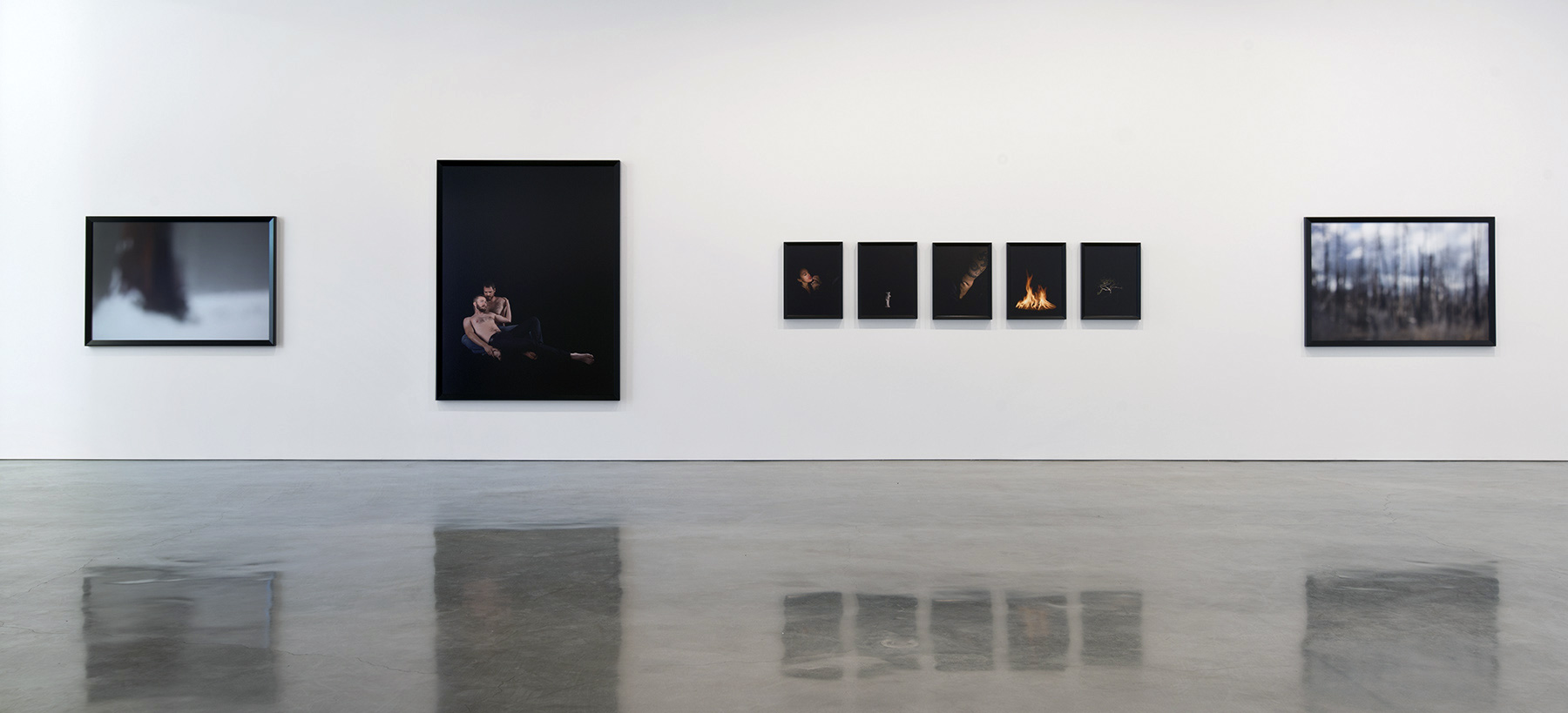
Installation view of the exhibition 'Catherine Opie' at Regen Projects, Los Angeles, February 23 - March 29, 2013

Installation view of the exhibition 'Catherine Opie' at Regen Projects, Los Angeles, February 23 - March 29, 2013

Installation view of the exhibition 'Catherine Opie' at Regen Projects, Los Angeles, February 23 - March 29, 2013

Installation view of the exhibition 'Catherine Opie' at Regen Projects, Los Angeles, February 23 - March 29, 2013

Installation view of the exhibition 'Catherine Opie' at Regen Projects, Los Angeles, February 23 - March 29, 2013

Installation view of the exhibition 'Catherine Opie' at Regen Projects, Los Angeles, February 23 - March 29, 2013


Installation views of the exhibition Catherine Opie at Regen Projects, Los Angeles, February 23 – March 29, 2013
Photography by Brian Forrest


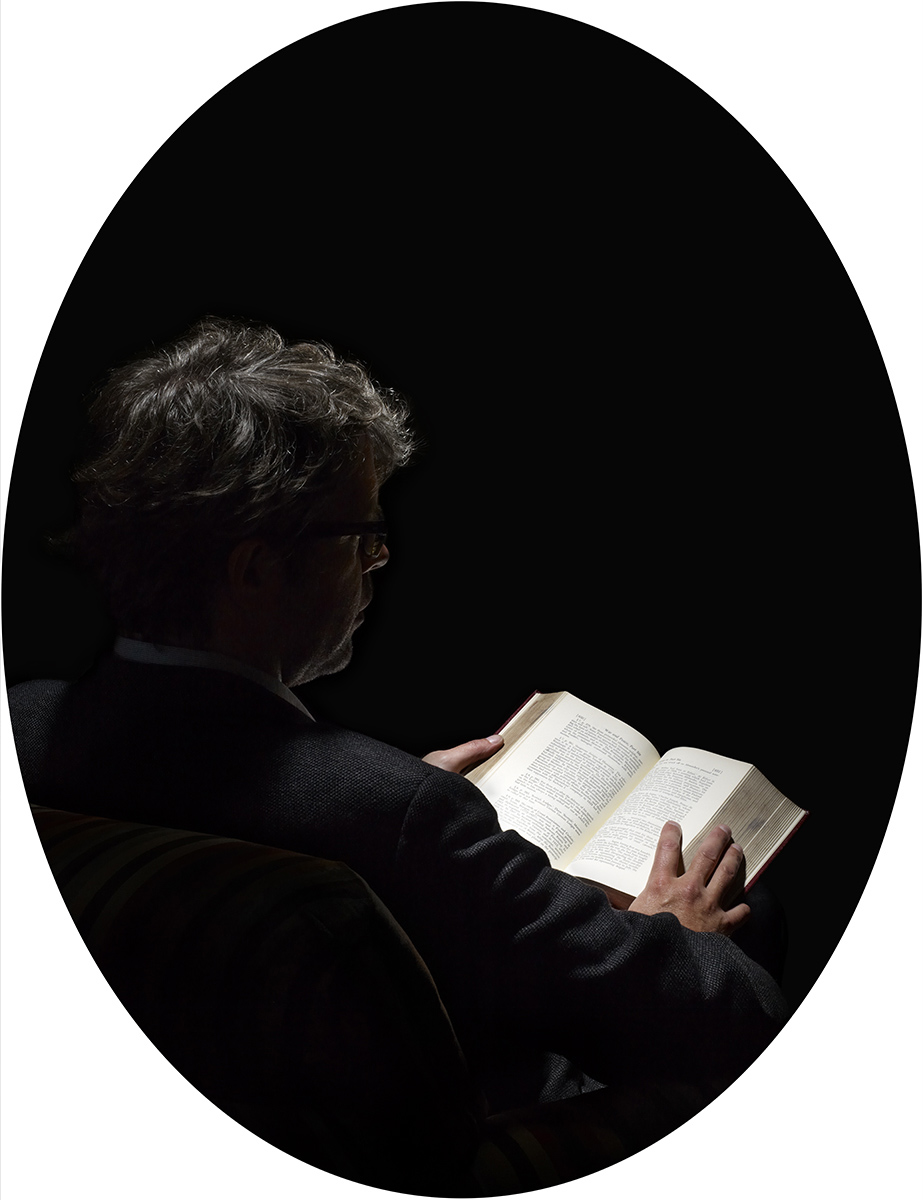
Catherine Opie (American, b. 1961) 'Jonathan' 2012


Catherine Opie (American, b. 1961)
Jonathan
2012
Pigment print
50 x 38.4 inches (127 x 97.5cm) Oval
Edition 1/5, + 2 APs


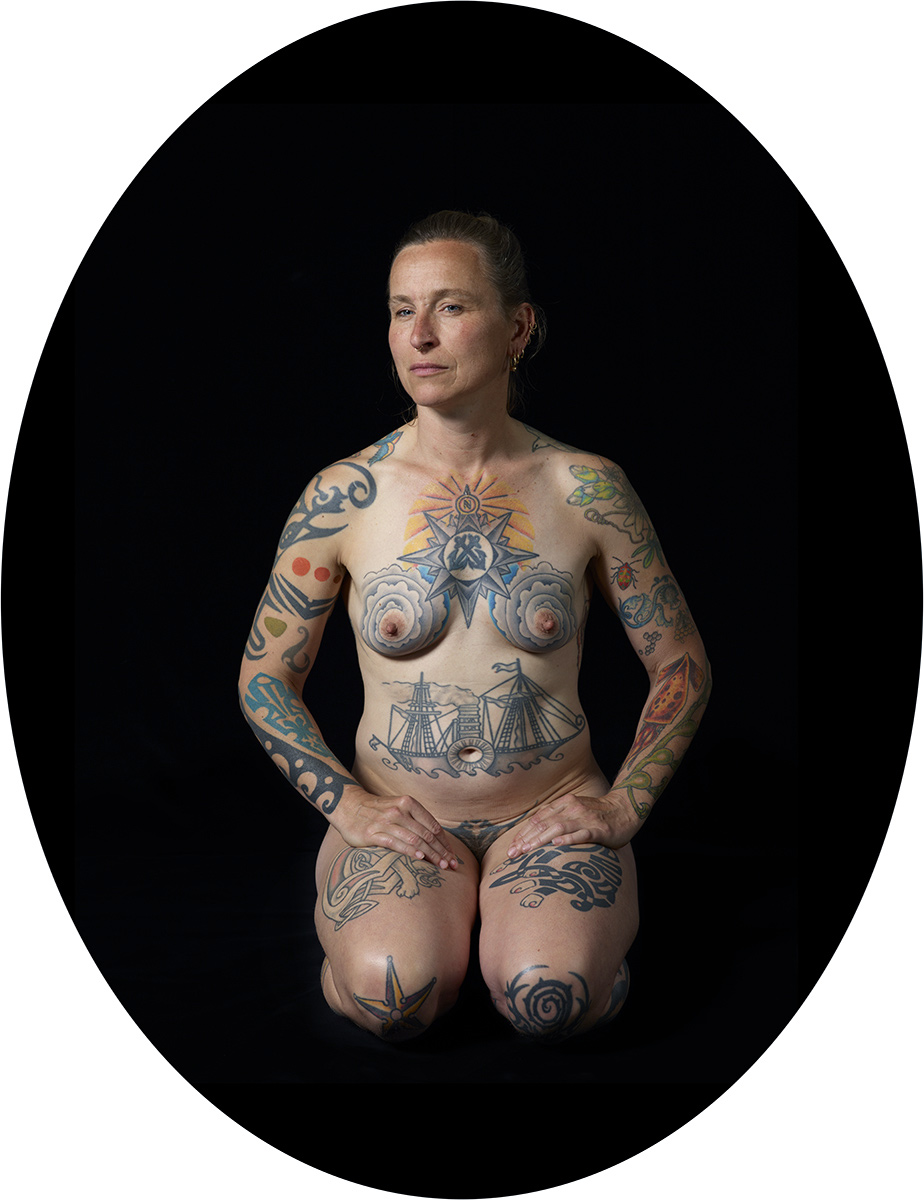
Catherine Opie (American, b. 1961) 'Idexa' 2012


Catherine Opie (American, b. 1961)
Idexa
2012
Pigment print
50 x 38.4 inches (127 x 97.5cm) Oval
Edition 1/5, + 2 APs


Regen Projects is pleased to announce an exhibition of new portraits and landscapes by Catherine Opie. These photographs mark both a progression and a departure for the artist. Opie’s work has always investigated the figure in relation to the landscape, disregarding the polarities typically found within these approaches. This new body of work draws upon Opie’s beginnings in documentary photography, the traditions of painting, and the history of photography.

Opie’s new portraits evoke the sublime and the inner psychological space of both the viewer and subject. Utilising techniques of chiaroscuro, colour, and formal composition found in classical 17th century portraiture, Opie arranges her subjects in allegorical poses that suggest an emotional state. Evoking formal classicism, these beautifully elegant and technically masterful compositions immerse and seduce the eye. Opie’s subjects have always been part of her personal community, and the range of individuals in these new works illustrates how this community has shifted and expanded.

Catherine Opie’s work is deeply rooted in the history of photography. The new landscapes draw upon this trajectory – both contemporary and historical. In addition to utilising motifs that informed the California Pictorialists, these works reference the painterly tradition. Images of iconic landscapes float in abstraction and are reduced to elementary blurred light drawings. The viewer no longer relies on traditional markers of recognition of place, but instead on the visceral reaction to the sensate images Opie captures. These painterly, poetic, and lyrical visions resonate with oblivion, the sublime, and the unknown.

Catherine Opie’s complex and diverse body of work is political, personal, and high aesthetic – the formal, conceptual, and documentary are always at play. Her work consistently engages in formal issues and maintains a formal rigour and technical mastery that underscores an aestheticised oeuvre. Visual pleasure can always be found in her arresting and seductive images.

Opie very knowingly engages art-historical conventions of representation like this in order to seduce her viewers: “I have to be interested in art history since so much of my work is related to painting and photography history. It gives me the ability to use a very familiar language that people understand when looking at my work and seduce the viewer into considering work that they might not normally want to look at. It is very classical and formal in so many ways… In a way, it is elegant in the seduction I was talking about earlier, that this device really can draw the viewer in through the perfection of the image. It is like wearing armour for a battle in a way, the battle for people to look into themselves for the prejudices that keep them from having an open mind.”

(Jennifer Blessing. “Catherine Opie: American Photographer” in Catherine Opie: American Photographer, published by The Solomon R. Guggenheim Museum, New York, 2008, p. 14).

Press release from the Regen Projects website


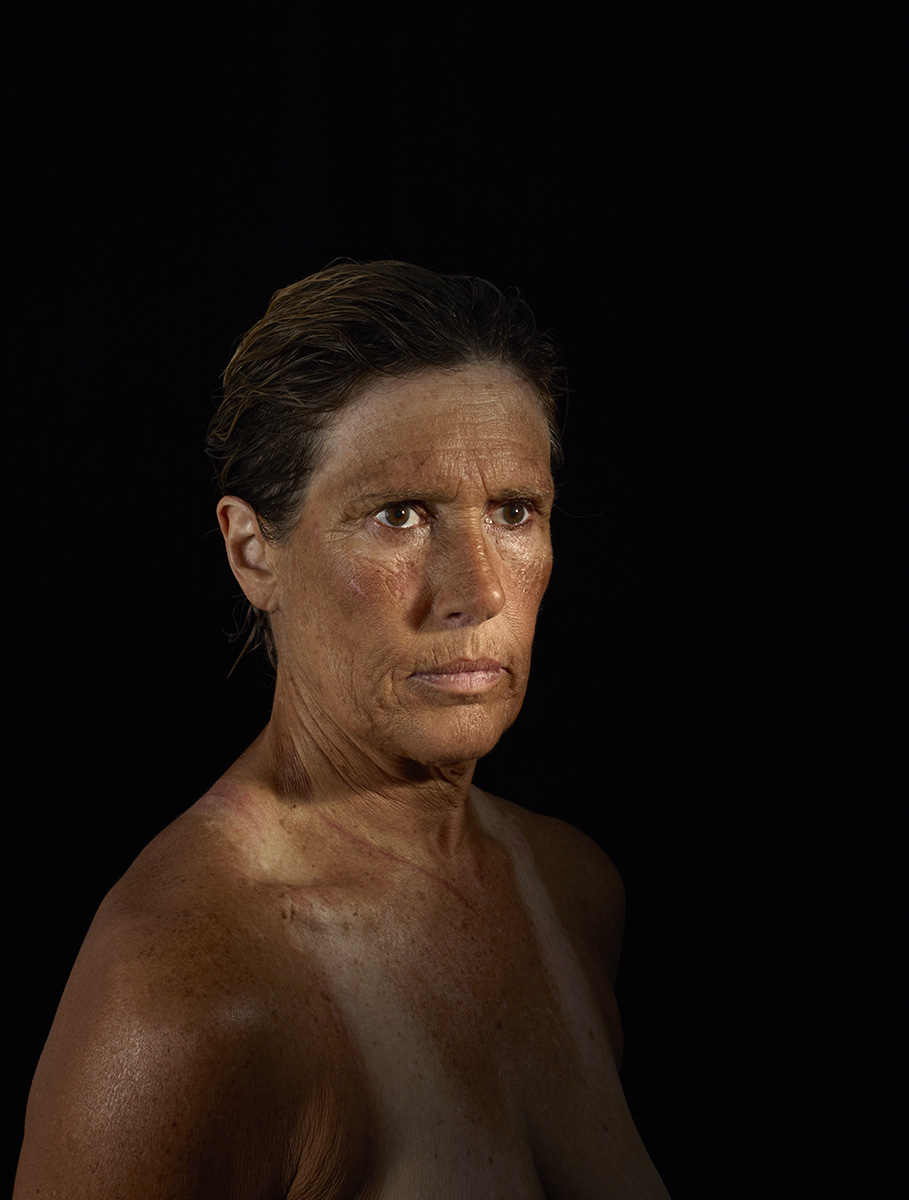
Catherine Opie (American, b. 1961) 'Diana' 2012


Catherine Opie (American, b. 1961)
Diana
2012
Pigment print
33 x 25 inches (83.8 x 63.5cm)
Edition 1/5, + 2 APs


Catherine Opie (American, b. 1961) 'Mary' 2012


Catherine Opie (American, b. 1961)
Mary
2012
Pigment print
33 x 25 inches (83.8 x 63.5cm)
Edition 1/5, + 2 APs


Catherine Opie (American, b. 1961) 'Untitled #5' 2012


Catherine Opie (American, b. 1961)
Untitled #5
2012
Pigment print
40 x 60 inches (101.6 x 152.4cm)
Edition 1/5, + 2 APs


Catherine Opie (American, b. 1961) 'Oliver & Mrs. Nibbles' 2012


Catherine Opie (American, b. 1961)
Oliver & Mrs. Nibbles
2012
Pigment print
33 x 25 inches (83.8 x 63.5cm)
Edition 2/5, + 2 APs


Catherine Opie (American, b. 1961) 'Kate & Laura' 2012


Catherine Opie (American, b. 1961)
Kate & Laura
2012
Pigment print
77 x 58 inches (195.6 x 147.3cm)
Edition 2/5, 2 APs


Catherine Opie (American, b. 1961) 'Guinevere' 2012


Catherine Opie (American, b. 1961)
Guinevere
2012
Pigment print
33 x 25 inches (83.8 x 63.5cm)
Edition 1/5, + 2 APs


Catherine Opie (American, b. 1961) 'Untitled #2' 2012


Catherine Opie (American, b. 1961)
Untitled #2
2012
Pigment print
40 x 60 inches (101.6 x 152.4cm)
Edition 1/5, + 2 APs


Catherine Opie (American, b. 1961) 'Friends' 2012


Catherine Opie (American, b. 1961)
Friends
2012
Pigment print
24 x 18 inches (61 x 45.7cm)
Edition 1/5, + 2 APs


Catherine Opie (American, b. 1961) 'Untitled #1' 2012


Catherine Opie (American, b. 1961)
Untitled #1
2012
Pigment print
40 x 60 inches (101.6 x 152.4cm)
Edition 1/5, +2 APs


Regen Projects
6750 Santa Monica Blvd
Los Angeles, CA 90038, United States
Phone: +1 310-276-5424

Opening hours:
Tuesday – Saturday 10am – 6pm

Regen Project website

LIKE ART BLART ON FACEBOOK

Back to top

Exhibition: ‘National Geographic: The Past and Future Present’ at Steven Kasher Gallery, New York

Exhibition dates: 10th January – 16th February 2013


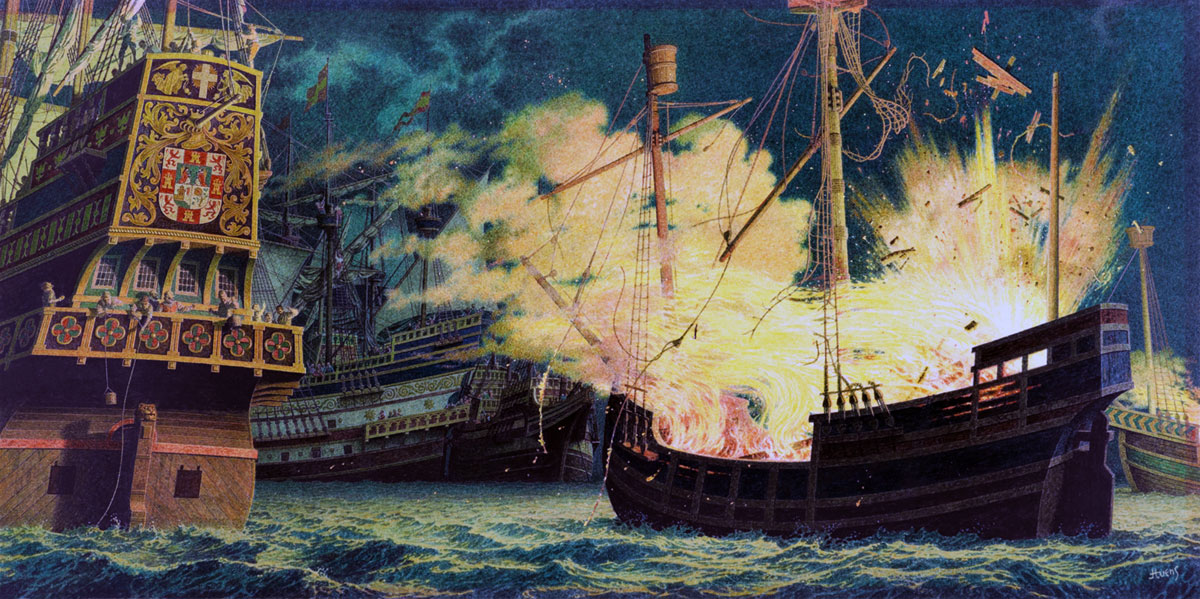
Jean-Leon Huens (Belgian, 1921-1984) 'Sir Frances Drake, Unmanned British Ships with Flammables Explode Among Spanish Ships' Nd


Jean-Leon Huens (Belgian, 1921-1984)
Sir Frances Drake, Unmanned British Ships with Flammables Explode Among Spanish Ships
Nd
Jean-Leon Huens / National Geographic Society / Steven Kasher Gallery


A wonderfully eclectic posting!

Marcus


Many thankx to Steven Kasher Gallery for allowing me to publish the photographs in the posting. Please click on the photographs for a larger version of the image.


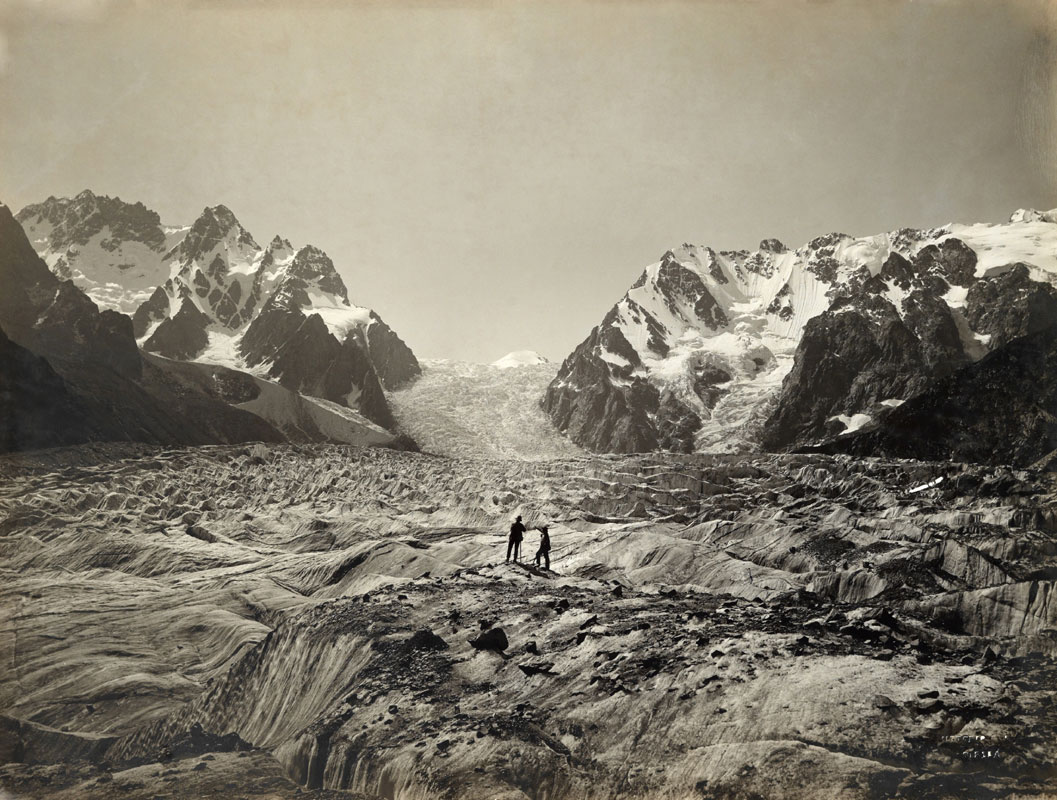
Vittorio Sella (Italian, 1859-1943) 'A Cascade of Weathered Ice Spills From the 14 Square Mile' Glacier Karagom Glacier, Caucasus Mountains, Russia 1890


Vittorio Sella (Italian, 1859-1943)
A Cascade of Weathered Ice Spills From the 14 Square Mile Glacier
Karagom Glacier, Caucasus Mountains, Russia
1890
Vittorio Sella / National Geographic Image Collection / Steven Kasher Gallery


Vittorio Sella (28 August 1859 – 12 August 1943) was an Italian photographer and mountaineer, whose photographs of mountains are regarded as some of the finest ever made. …

The high quality of Sella’s photography was in part due to his use of 30×40 cm photographic plates, in spite of the difficulty of carrying bulky and fragile equipment into remote places. He had to invent equipment, including modified pack saddles and rucksacks, to allow these particularly large glass plates to be transported safely. His photographs were widely published and exhibited, and highly praised; Ansel Adams, who saw thirty-one that Sella had presented to the US Sierra Club, said they inspired “a definitely religious awe.” Many of the photographs he took were of mountains which had not been previously recorded and so have historical as well as artistic significance; for example by recording the retreat of glaciers in the Rwenzori mountains in Central Africa.

Text from the Wikipedia website


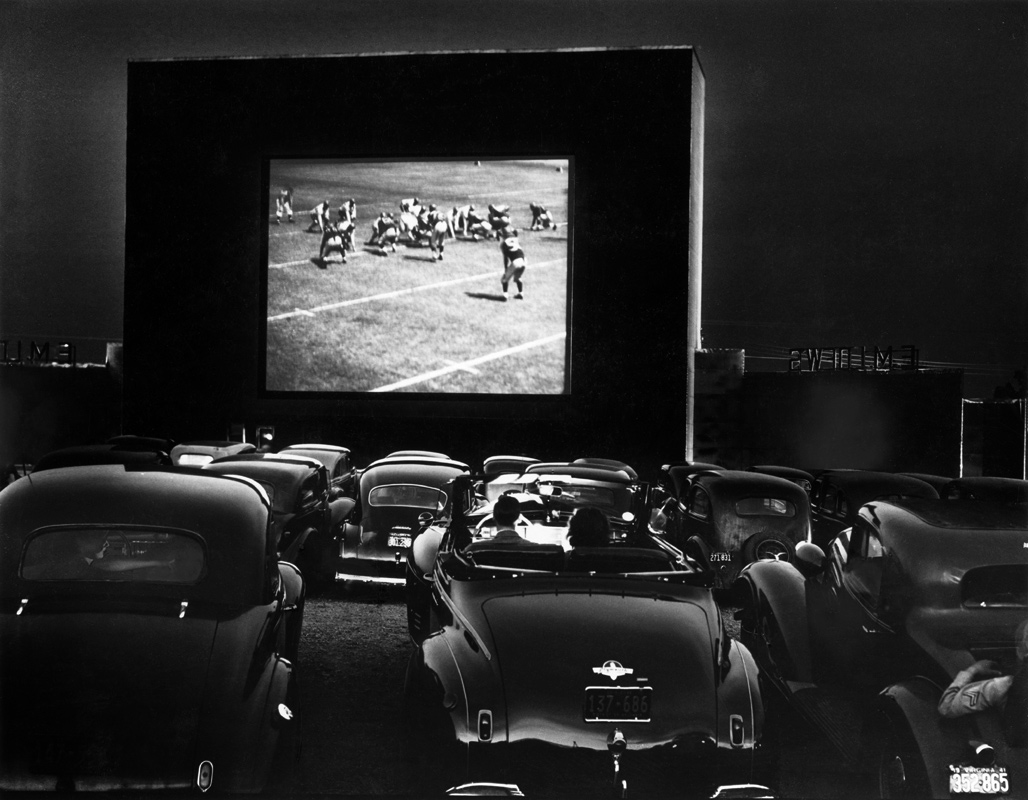
J. Baylor Roberts (American, 1902-1994) 'The Drive-In on Route 1' Alexandria, Virginia, 1941


J. Baylor Roberts (American, 1902-1994)
The Drive-In on Route 1
Alexandria, Virginia, 1941
J. Baylor Roberts / National Geographic Image Collection / Steven Kasher Gallery


Jacques Ertaud (French, 1924-1995) 'Jacques Yves Cousteau Films A Jet-propelled Submersible' Caribbean Sea, 1959


Jacques Ertaud (French, 1924-1995)
Jacques Yves Cousteau Films A Jet-propelled Submersible
Caribbean Sea, 1959
Jacques Ertaud / National Geographic Image Collection / Steven Kasher Gallery


Ned M. Seidler (American, 1922-2007) 'Freshwater Pond Life' c. 1970


Ned M. Seidler (American, 1922-2007)
Freshwater Pond Life
c. 1970
Gouache and watercolour on paper
12 1/2 x 28 1/2 inches


Steven Kasher Gallery is proud to present the exhibition National Geographic: The Past and Future Present. It is the gallery’s fifth show of works from the National Geographic archives, but our first that presents vintage illustrations side by side with vintage photographs. The one hundred works presented span the entire 20th century. Photographers will include Herbert Ponting, Baron von Gloeden, Maynard Owen Williams, and Hiram Bingham. Illustrators will include Thornton Oakley, Louis Agassi Fuertes, and Tom Lovell. The exhibition will encompass works that represent National Geographic’s rich history in the fields of geography, archaeology, exploration, science, wildlife and world cultures.

Themes explored include Past Civilizations, the Age of the Dinosaur, Space Travel, Native American Cultures, American Industry, the Sea, and Flora and Fauna. National Geographic: The Past and Future Present juxtaposes photographic images taken from life, botanical studies drawn from live specimens, and depictions of the past and the future, imagined but unseen. These juxtapositions will highlight changing visions of natural and human history as they have evolved over the twelve decades of the Society’s image making.

“This exhibition represents the continuation of a four-year partnership with the Steven Kasher Gallery to put our commissioned work in the public eye. The inclusion of illustrations in this exhibition demonstrates the overall range of our archive, which spans vintage and contemporary photography, as well as drawings, paintings and other illustrations from the late 1800s to the present day.”

Maura Mulvihill, Senior Vice President for National Geographic Society and Director of the National Geographic Image Collection

Press release from the Steven Kasher Gallery website


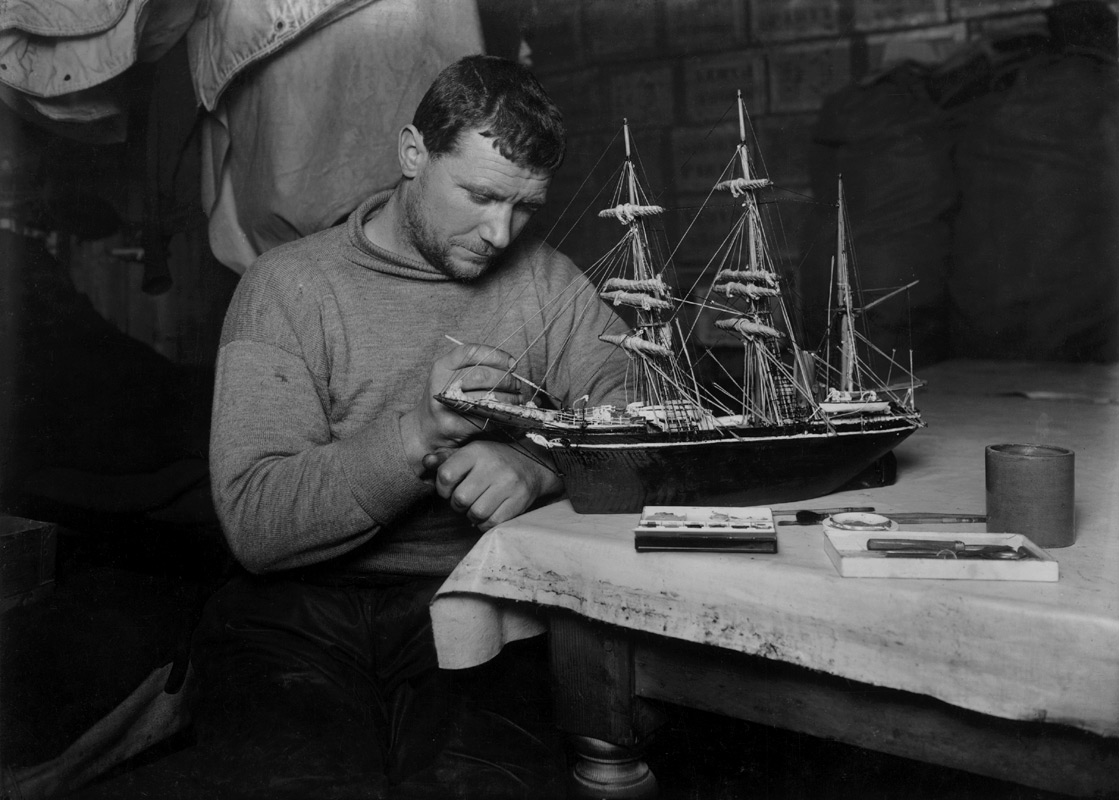
Herbert Ponting (British, 1870-1935) 'Aboard the Terra Nova on the British Antarctic Expedition 1910-1913' c. 1911


Herbert Ponting (British, 1870-1935)
Aboard the Terra Nova on the British Antarctic Expedition 1910-1913
c. 1911
Herbert Ponting / National Geographic Image Collection / Steven Kasher Gallery


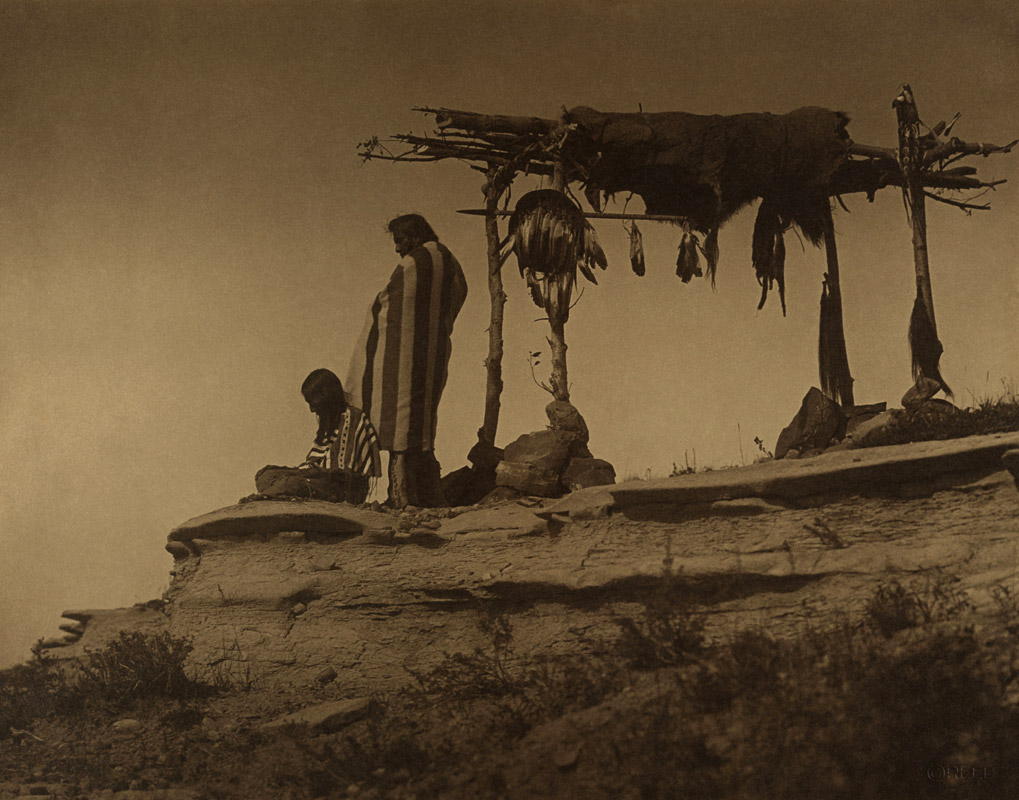
Roland Reed (American, 1864-1934) 'Tribute to Dead Piegan Blackfoot' Montana, 1912


Roland Reed (American, 1864-1934)
Tribute to Dead Piegan Blackfoot
Montana, 1912
Roland Reed / National Geographic Image Collection / Steven Kasher Gallery


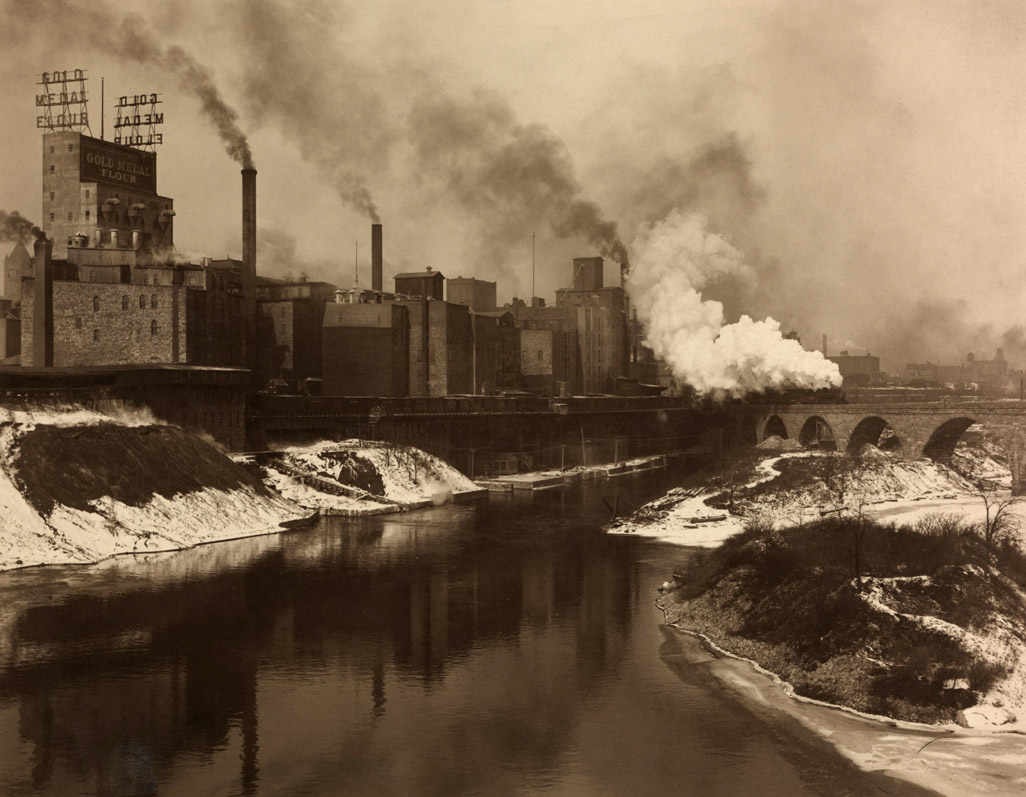
Washburn-Crosby Company (American) 'The Minneapolis Milling District, The Largest U.S. Flour Producer' 1915


Washburn-Crosby Company (American)
The Minneapolis Milling District, The Largest U.S. Flour Producer
1915
Washburn-Crosby Company / National Geographic Image Collection / Steven Kasher Gallery


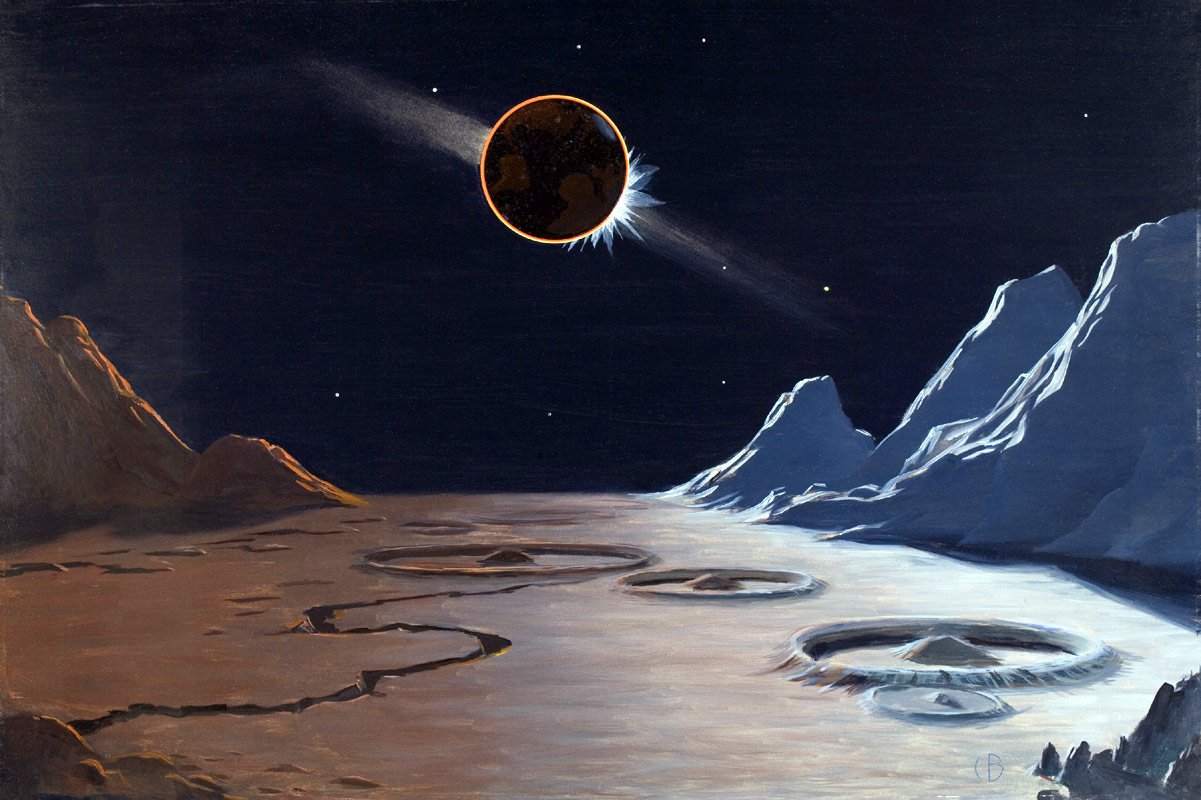
Charles Bittinger (American, 1879-1970) 'Eclipse of the Sun by the Earth' 1930s


Charles Bittinger (American, 1879-1970)
Eclipse of the Sun by the Earth
1930s
Charles Bittinger / National Geographic Society / Steven Kasher Gallery


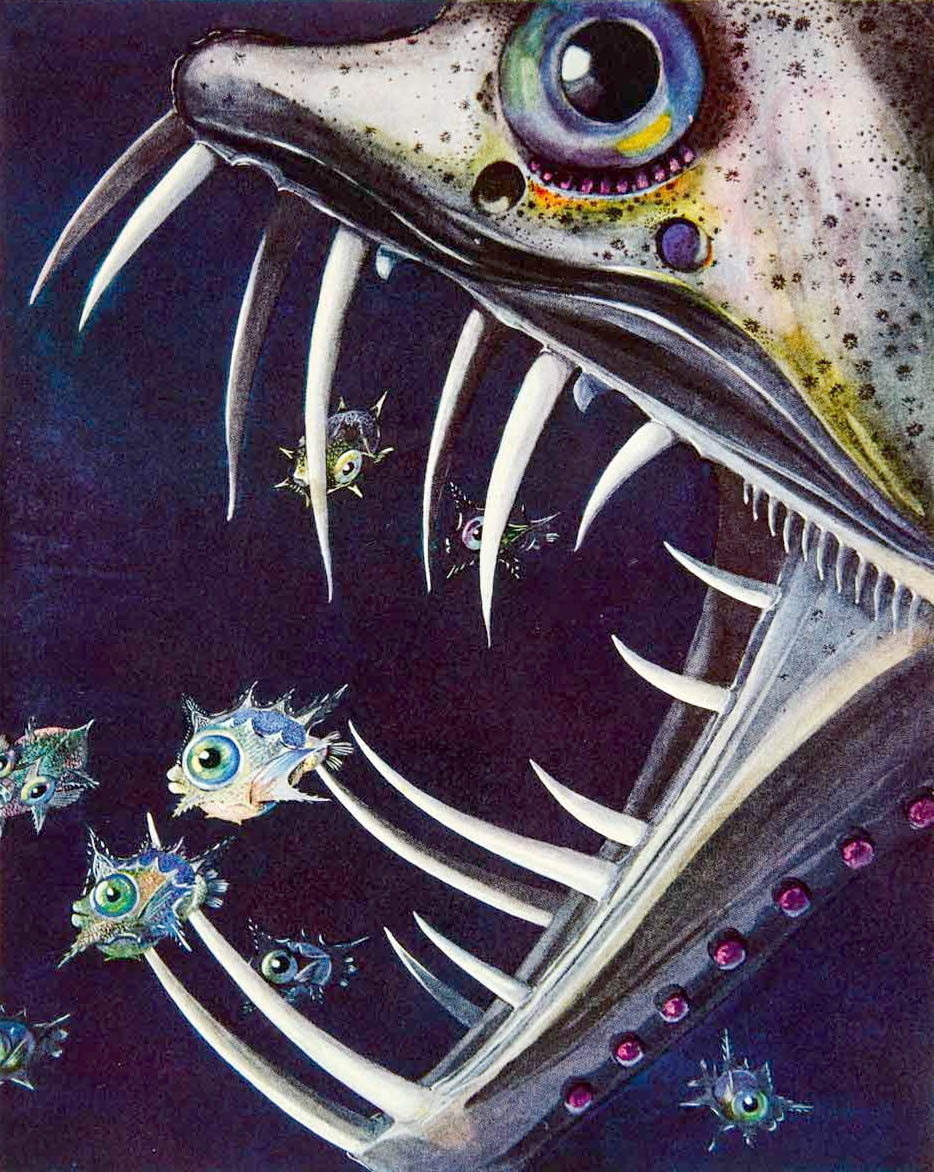
Else Bostelmann (American born Germany, 1882-1961) 'A Saber-Toothed Viperfish Attacking Young Ocean Sunfish' c. 1934


Else Bostelmann (American born Germany, 1882-1961)
A Saber-Toothed Viperfish Attacking Young Ocean Sunfish
c. 1934
Gouache on paper
14 x 11 inches


Else Winkler von Röder (Roeder) Bostelmann (1882-1961), a German Empire-born American artist, joined the New York Zoological Society (now the Wildlife Conservation Society) in 1929 to paint marine life during William Beebe’s bathysphere oceanographic expeditions at Bermuda’s Nonsuch Island (1930-1934).

Bostelmann’s marine life paintings depicted the unbelievable sights that Beebe encountered from great depths in the ocean. “Had it not been for Mrs. Bostelmann’s deftness in rapidly sketching what she saw, much of the colour and drama would have been lost.” …

Bostelmann’s marine life art was published in several National Geographic Magazines in the 1930s, 1940s and beyond. Her depiction of the bioluminescence of unknown ocean life caused a stir in the oceanographic world.

Although she did not descend in the Bathysphere, her studies and final paintings were true to life at the time. Beebe described what he saw as he descended in the bathysphere through a direct telephone line to the ship above him. Detailed notes were taken by Gloria Hollister, a member of the research team. When Beebe exited the bathysphere, he immediately worked with Bostelmann as she put his descriptions to paper using watercolour, gouache and pencil. She did don a 16-pound copper helmet with an air hose attached to the ship above, sat on a chair on the ocean floor (20-35 feet down) with her canvas attached to an iron music stand weighted with lead and her brushes tied to the stand as she painted with oil the fish she saw around her. Due to the change in available light at that depth, the colours in her paintings were muted.

Text from the Wikipedia website


Richard Hewitt Stewart (American, 1901-2004) 'Colossal Olmec Head' La Venta, Mexico, 1940


Richard Hewitt Stewart (American, 1901-2004)
Colossal Olmec Head
La Venta, Mexico, 1940
Richard Hewitt Stewart / National Geographic Image Collection / Steven Kasher Gallery


Richard Hewett Stewart (1901-2004) began working for the National Geographic Society as a photo lab technician in 1924. Ten years later, he joined Matthew Stirling’s archeological team to photograph and, to a lesser extent, film the team’s eight expeditions to Veracruz and Tabasco (1939-1946). As a result, Stewart’s photographs illustrated all of National Geographic articles about the Olmec excavations carried out by the Smithsonian. Stewart again joined Stirling for the 1948-1949 archaeological expedition to Panama, sponsored by the Smithsonian Institution and the National Geographic Society.

Text from the Smithsonian Institution website


Thorton Oakley (American, 1881-1953) 'Liquid Steel Pours From an Electric Furnace' 1940s


Thorton Oakley (American, 1881-1953)
Liquid Steel Pours From an Electric Furnace
1940s
Thorton Oakley / National Geographic Society / Steven Kasher Gallery


Steven Kasher Gallery
166 Second Ave., 3A
New York, NY 10003
Phone: 917 922 6861

Opening hours:
By appointment only

Steven Kasher Gallery website

LIKE ART BLART ON FACEBOOK

Back to top

Review: ‘Vestige II’ Melissa Powell and ‘Darkness by Day’ Shannon McGrath at Anita Traverso Gallery, Richmond, Melbourne

Exhibition dates: 5th February – 23rd February 2013


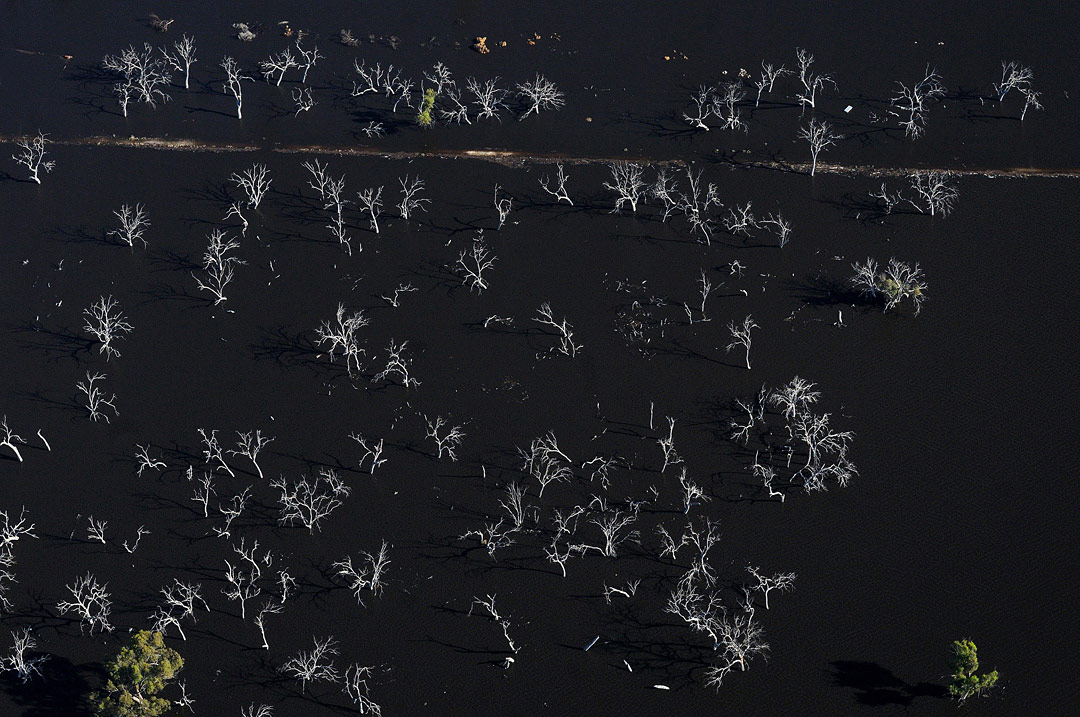
Melissa Powell (Australian) 'Painterly Divide No.1' 2012


Melissa Powell (Australian)
Painterly Divide No.1
2012
Pigment ink on cotton rag
50.5 x 70.6cm
edn. 1/9


ves·tige  
/ˈvestij/

Noun
1/ A trace of something that is disappearing or no longer exists
2/ The smallest amount (used to emphasise the absence of something): “without a vestige of sympathy”
3/ Biology an organ or part of an organism that is a small nonfunctioning remnant of a functional organ in an ancestor
a trace suggesting that something was once present or felt or otherwise important; “the footprints of an earlier civilisation”

via French from Latin ves·tigium footprint, track


Two solid exhibitions of photography are on display at Anita Traverso in Richmond, a gallery that is showing more photography these days, to excellent affect.

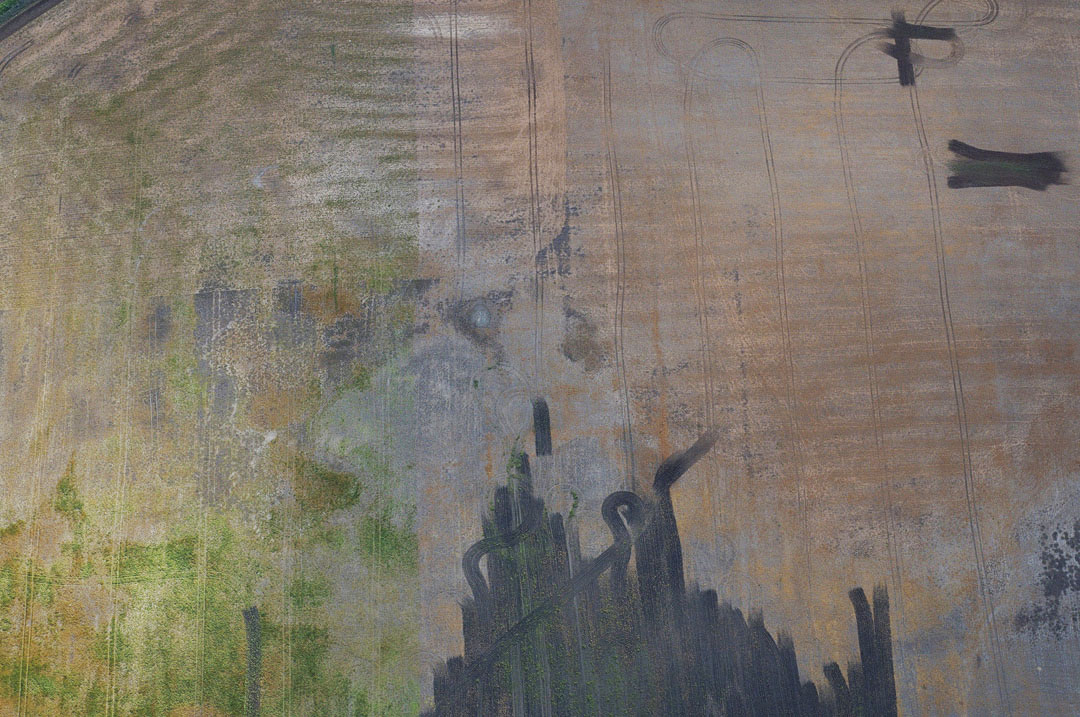
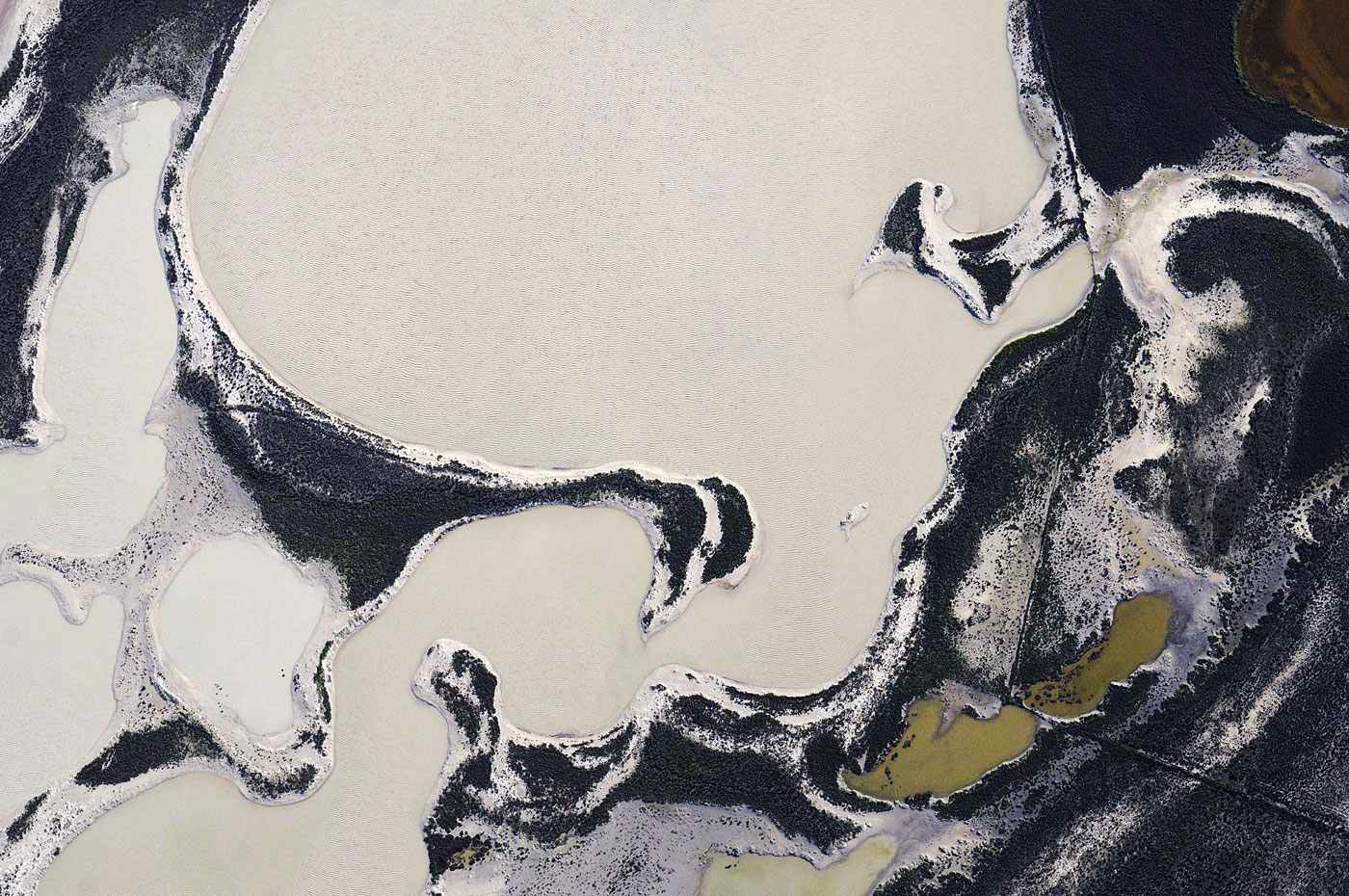
Natimuk based photographer Melissa Powell documents the seasonal changes of the Wimmera environment through the use of aerial photography. She brings her skills as a forensic photographer to bear when capturing our mark on the landscape. Her photographs (full frame and never cropped), are as sharp as a tack, like the crystallisation of a thought – the surgical gaze of the artist balanced by a lyrical, abstract poetry. Powell renders (and that is the appropriate word) natural phenomena in their direct relation to humanity, pointing her camera at patterns of cropping, the patchiness of the earth and its sandy, infertile soil. She sees the world clearly and tells the story in a plain, almost scientific way… but this utopian vision of the world is balanced by a feeling in the viewer, a feeling of drifting and floating above the earth, inhabiting a liminal space, as in a daydream.

Powell’s is an expression of the land, presented in a particular way as she remembers experiencing it. For example, look at Painterly Divide No.1, (2012, below) and notice the perfect confluence of yin and yang broken by the single mutation of the furrow midway up in the centre of the image (enlarge the image to see it better!). Disorder plays off order in the mind of the viewer in an absolutely sublime way. Sure, a few things need work in the exhibition, like the framing and naming of the works, but this all comes with time and experience. What Powell evidences in her photographs is a wonderfully strong aesthetic producing some of the best aerial photography I have ever seen. Her traces, footprints and tracks are vestigial structures that links us back to our ancestors, photographs as passionate representation of the land, done with strength and depth of soul.


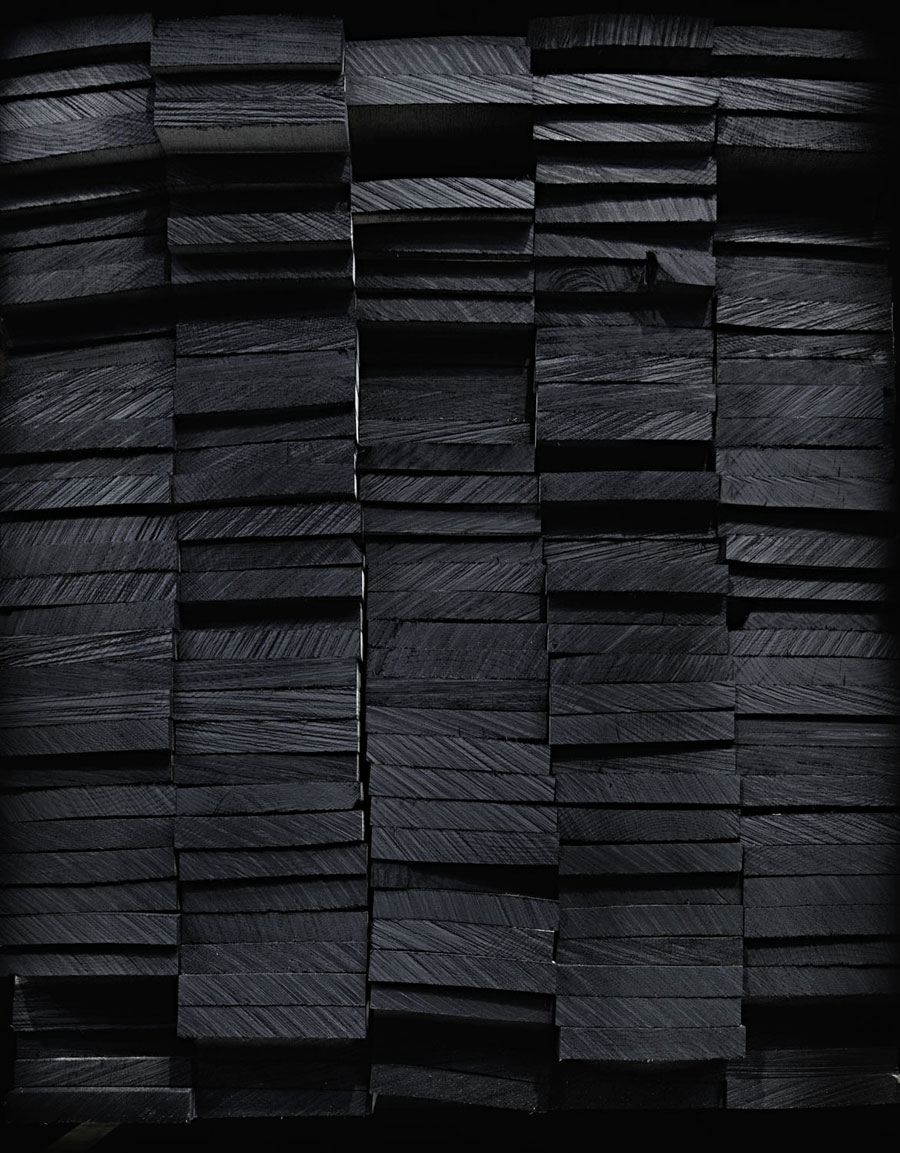
In the back gallery Shannon McGrath, an established architecture photographer, images stacks of wood that “are considered for both their aesthetic values and formal compositional qualities such as patterning and seriality.” The suite of five very large, unmounted black photographs printed on matt Silver Rag paper are stunning, much darker and of more luminance than seen in reproduction here (there are also two other photographs using an electric blue colour that simply did not work for me). Using a minimal composition of the thing itself (and what it can become), the photographer imbues a romantic, visual sensibility into her subject matter. The matt blacks are like velvet and the spaces that open up within the image magical. These things “breathe” like a black Rothko painting, or the plastic black of a Rembrandt.

McGrath’s photographs are “impressionistic inventories of landscapes and entropic architectural structures that connote psychologically, emotionally, and viscerally.” (Anon. “Cyprien Gaillard: The Crystal World,” on the MOMA website [Online] 12/02/2013). The object of her attention – the planks of wood – have a temporality that is characterised by repetition and predictability. The viewer tries to articulate difference through looking but that looking reduces differences to similarities unless we look very closely, are very attentive to the condition of looking. Enlarge any of the dark images below and really look at the cut ends of the wood, their inflection. What is hidden within (or beneath, for the photograph is also a physical object) the flat surface of the image are the nuances of language – the physicality of the print, the punctum of white, the band saw cuts that inhabit the end of days. There is a slippage between language and referent which makes McGrath’s photographs a beautiful deviation and productive possibility of language, one that encourages the vital movement of the subversive sign.

My only concern is “where to next?” What other surfaces which are hidden, which slowly reveal aspects and possibilities, subtleties and complexities will the photographer engage with? Excitingly, I want to see more from both photographers as they combine the ordinary and the poetic in a field of revolutionary possibilities.

Dr Marcus Bunyan


Many thankx to Anita Traverso Gallery for allowing me to publish the photographs in the posting. Please click on the photographs for a larger version of the image.


Melissa Powell (Australian) 'Traces of Time' 2012


Melissa Powell (Australian)
Traces of Time
2012
Pigment ink on cotton rag
50.5 x 76cm
edn. 1/9


“Centered on documentation of the Wimmera region, Melissa Powell’s images are depicted from an aerial perspective that allows her to capture the theatre and sublimity of a landscape that is consistently eroded and replenished by both the cycles of nature, the progression of time and the agricultural impact of man.”


Anna Briers, independent art curator and writer


Melissa Powell (Australian) 'Camouflage No.2' 2012


Melissa Powell (Australian)
Camouflage No.2
2012
Pigment ink on cotton rag
50.5 x 70.6cm
edn. 1/9


Melissa Powell (Australian) 'Droughtbreaker' 2011


Melissa Powell (Australian)
Droughtbreaker
2011
Pigment ink on cotton rag
50.5 x 70.6cm
edn. 8/12


Melissa Powell (Australian) 'Salt Lake No.1' 2011


Melissa Powell (Australian)
Salt Lake No.1
2011
Pigment ink on cotton rag
50.5 x 70.6cm
edn. 8/9


A forensic photographer in her former life, Melissa Powell’s new direction as an aerial photographer was endorsed by her winning first prize for aerial photography at the 2012 International Photography Awards, New York, USA. Vestige II, Powell’s debut exhibition at Anita Traverso Gallery, surveys an amalgam of three photographic series drawn from the artist’s oeuvre – Grounded, Flooded and Dry.

Centred on documentation of the Wimmera region, Powell’s images are depicted from an aerial perspective that allows her to capture the theatre and sublimity of a landscape that is consistently eroded and replenished by the cycles of nature, the progression of time and the agricultural impact of man. Shaped by droughts and bushfires, vast desertous landscapes extend into the horizon. Serpentine rivers and floodplains alternately nourish and fertilise, lacerate and scar. Fecund pastures are contained and demarcated by the rigid geometries of manmade fences and irrigation systems. These vestiges award us a sense of the indelible link between the microcosm and the macrocosm, while enabling us to perceive the constantly shifting narratives of this great southern land.

By contrast Shannon McGrath, an established architecture photographer, aspires to capture the unique spatial dynamics of a building whilst transposing a distillation of the architect’s intention into a two dimensional image. In this photographic series McGrath examines the raw building material of wood in the same way she would approach the documentation of architecture. Photographed on site at the Britton Timber sawmill, the stacks of wood are considered for both their aesthetic values and formal compositional qualities such as patterning and seriality. Simultaneously though, they are envisaged as a core resource imbued with potentiality; their future incarnation, that of the architect’s vision, lying dormant and yet to manifest.

Press release from the Anita Traverso Gallery website


Shannon McGrath (Australian) 'Mark 01' 2012


Shannon McGrath (Australian)
Mark 01
2012
From the series Darkness by Day
Pigment print to cotton rag paper
100 x 128cm


Shannon McGrath (Australian) 'Mark 02' 2012


Shannon McGrath (Australian)
Mark 02
2012
From the series Darkness by Day
Pigment print to cotton rag paper
100 x 128cm


“These stacks of saw-mill timber were shot in broad daylight without any artificial lighting, in situ and without any intervention in their arrangement. I was drawn to the dark element in them that survives this ‘glare’ yet reveals it in other ways – how the light naturally hits the objects and remains in an interplay with the darkness and shadows of the grain, the individual and beautiful markings the blade has left on the natural material, and the extrusions and hollows of the layering of the wood. This gave the show its title. Even in the jewel-like, cobalt image, there is this dynamic. This is a theme that runs through my creative photography: surfaces which are hidden, which slowly reveal aspects and possibilities, subtleties and complexities. I considered wood as an essential building material so I approached the stacks of timber and photographed it with the same sensitivity as architecture.”


Artist statement


Shannon McGrath (Australian) 'Mark 07' 2012


Shannon McGrath (Australian)
Mark 07
2012
From the series Darkness by Day
Pigment print to cotton rag paper
100 x 128cm


Shannon McGrath (Australian) 'Mark 08' 2012


Shannon McGrath (Australian)
Mark 08
2012
From the series Darkness by Day
Pigment print to cotton rag paper
100 x 128cm


Anita Traverso Gallery
PO Box 7001, Hawthorn North,
Melbourne, Victoria, Australia 3122

Anita Traverso Gallery website

LIKE ART BLART ON FACEBOOK

Back to top

Review: ‘Terraria’ by Darron Davies at Edmund Pearce Gallery, Melbourne

Exhibition dates: 16th January – 9th February 2013


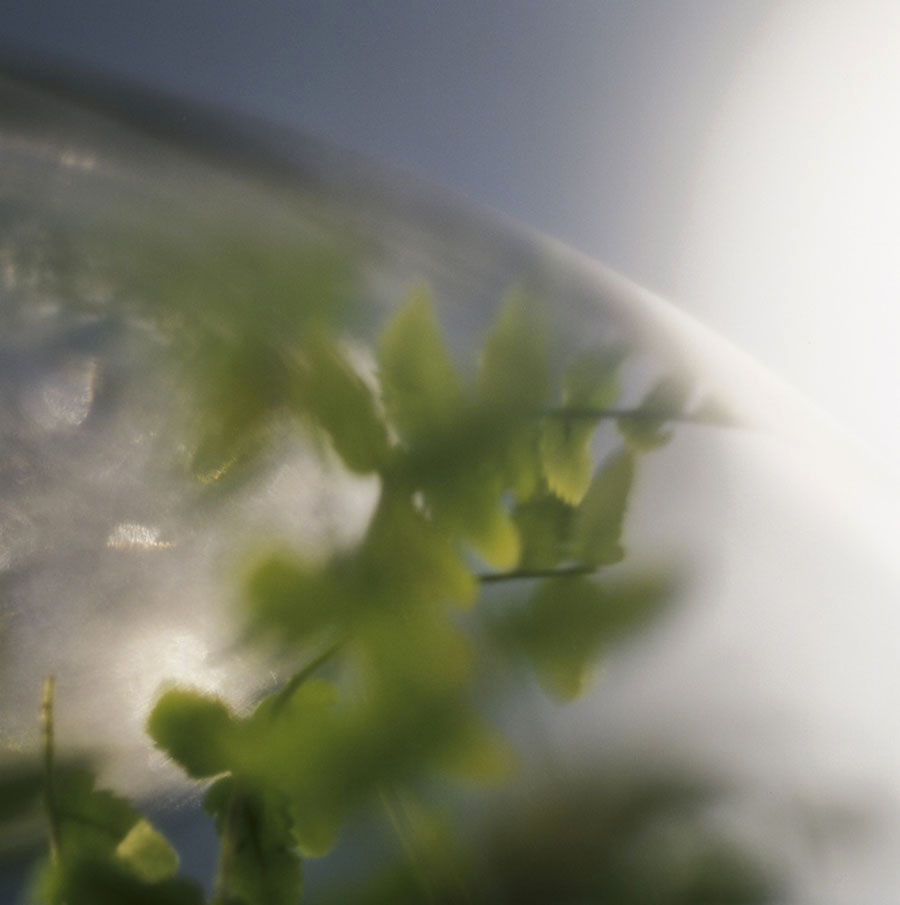
Darron Davies (Australian) 'Atmosphere' 2012


Darron Davies (Australian)
Atmosphere
2012
Archival Pigment Print on Photo Rag
80 x 80cm
Edition of 6


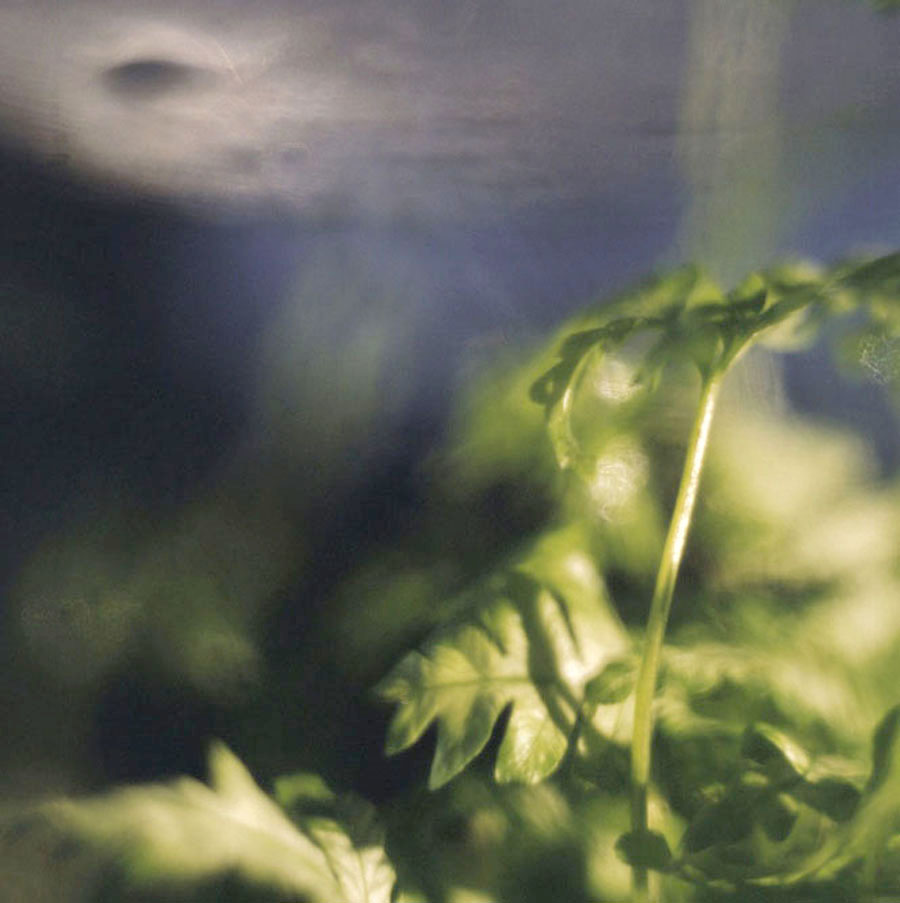
This is the first “magical” exhibition of photography that I have seen in Melbourne this year. Comprising just seven moderately large Archival Pigment Print on Photo Rag images mounted in white frames, this exhibition swept me off my feet. The photographs are beautiful, subtle, nuanced evocations to the fragility and enduring nature of life. The photographs move (shimmer almost) one to another, with slight changes in the colour green balanced with abstract splashes of light and pigment reminiscent of an abstract expressionist painting (I particularly like the splash of red in The Red Shard, 2102, below). These are beautifully seen works, that require 1) a good idea, 2) an aware and enquiring mind, 3) an understanding and receptive eye, and 4) a relationship to the ineffable that allows visions such as these to be breathed into existence. As Minor White would say,


Three Canons

Be still with yourself
Until the object of your attention
Affirms your presence


Let the Subject generate its own Composition


When the image mirrors the man
And the man mirrors the subject
Something might take over


A sense of day/dreaming is possible when looking at these images. Interior/exterior, size/scale, ego/self are not fixed but fluid, like the condensation that runs down the inside of these environments (much like blood circulates our body). This allows the viewer’s mind to roam at will, to ponder the mysteries of our short, improbable, joyous life. The poetic titles add to this introspective reflection. I came away from viewing these magical, self sustaining vessels with an incredibly happy glow, more aware of my own body and its relationship to the world than before I had entered Darron Davies enveloping, terrarium world.

Dr Marcus Bunyan


Many thankx to Edmund Pearce Gallery for allowing me to publish the photographs in the posting. Please click on the photographs for a larger version of the image.


Darron Davies (Australian) 'Day’s Reach' 2012


Darron Davies (Australian)
Day’s Reach
2012
Archival Pigment Print on Photo Rag
80 x 80cm
Edition of 6


Darron Davies (Australian) 'Encased' 2012


Darron Davies (Australian)
Encased
2012
Archival Pigment Print on Photo Rag
80 x 80cm
Edition of 6


Terraria


I step into your small world
Your secret world
Each a planet of green

Fragile edges holding
the lived
and living

Peering into your glass
your mirror
I see the shards of light
Drawing in
and
Stretching out

You are another
In atmosphere
In moss
In fear


Terraria is a photographic project exploring the magical, abstract and metaphoric world of terrariums – an increasingly popular form of enclosed and small scale eco-system designed for showcasing plants.

Ultimately, Terraria is also about the fragility of life – terrariums as self contained vessels, enduring, magical – like the human body or our planet – yet somewhat mysterious. These vessels are self sustaining with no watering needed. They are independent and endure quietly. This project would not have been possible without support from Lisa Rothwell from Lu Lu Blooms.

Artist statement


Darron Davies (Australian) 'Heaven’s Door' 2012


Darron Davies (Australian)
Heaven’s Door
2012
Archival Pigment Print on Photo Rag
80 x 80cm
Edition of 6


Darron Davies (Australian) 'The Second Dream' 2012


Darron Davies (Australian)
The Second Dream
2012
Archival Pigment Print on Photo Rag
80 x 80cm
Edition of 6


Darron Davies (Australian) 'The Light Play' 2012


Darron Davies (Australian)
The Light Play
2012
Archival Pigment Print on Photo Rag
80 x 80cm
Edition of 6


Darron Davies (Australian) 'The Red Shard' 2012


Darron Davies (Australian)
The Red Shard
2012
Archival Pigment Print on Photo Rag
80 x 80cm
Edition of 6


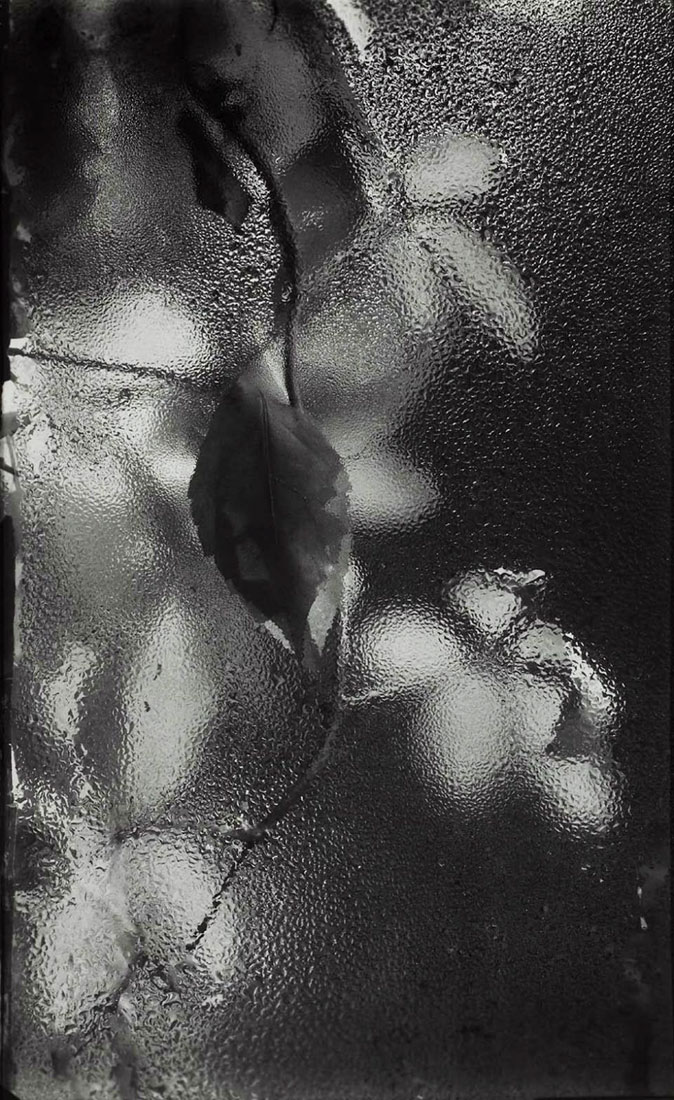
Darron Davies (Australian) 'From the Window of My Atelier' 1940


Josef Sudek (Czechoslovakian, 1896-1976)
From the Window of My Atelier
1940
Gelatin silver print


Edmund Pearce Gallery

This gallery is no longer open.

Darron Davies website

LIKE ART BLART ON FACEBOOK

Back to top

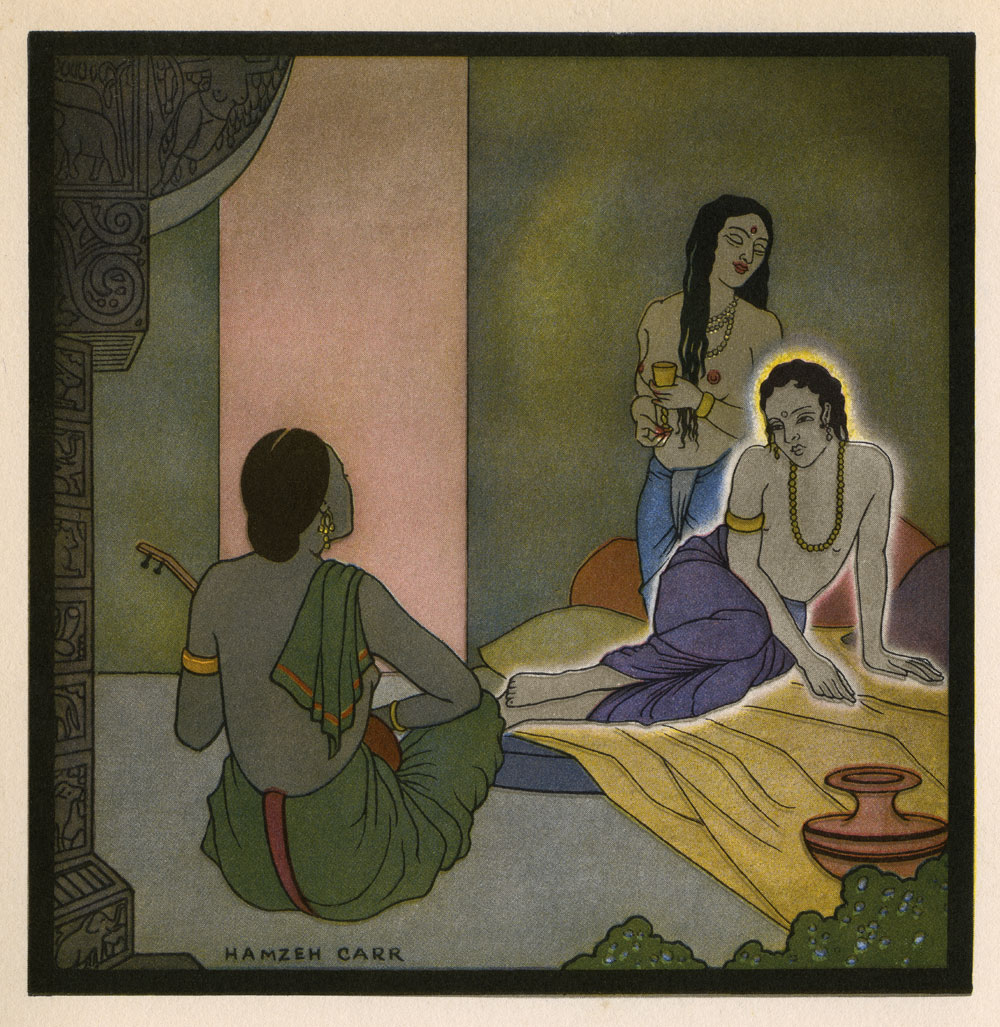
Artwork: Hamzeh Carr. ‘And some maid told an ancient tale’ 1926

February 2013


Hamzeh Carr. 'And some maid told an ancient tale' 1926


Hamzeh Carr
And some maid told an ancient tale
1926
From Sir Edwin Arnold. The Light of Asia. London: John Lane The Bodley Head Ltd, 1926, p. 44
Limited edition of 3,000 copies


In the flesh, the colouring and radiance of these plates has to be seen to be believed.

I shall be posting more of these stunning works. Please click on the artwork for a larger version of the image.

Marcus


LIKE ART BLART ON FACEBOOK

Back to top

Exhibition: ‘nude men: from 1800 to the present day’ at the Leopold Museum, Vienna

Exhibition dates: 19th October 2012 – 4th March 2013

Curators: Tobias G. Natter and Elisabeth Leopold

Warning: this posting contains art work of naked male bodies.


Martin Ferdinand Quadal (Moravian-Austrian, 1736-1811) 'Nude Life Class at the Vienna Art Academy in the St.-Anna-Gebäude' 1787


Martin Ferdinand Quadal (Moravian-Austrian, 1736-1811)
Nude Life Class at the Vienna Art Academy in the St.-Anna-Gebäude
1787
© Paintings Gallery of the Academy of Fine Arts Vienna


“When we stop and think about it, we all are naked underneath our clothes.”


(Heinrich Heine, Travel Pictures, 1826)


A great posting. I used to have a print of Querelle by Andy Warhol on my wall when I was at university in London aged 17 years old – that and We Two Boys Together Clinging by David Hockney. My favourite in this posting is the painting Seated Youth (morning) by Austrian expressionist painter Anton Kolig. Such vivacity, life and colour, perhaps a post-coital glow (was he straight, bisexual, gay? who cares, it is a magnificent painting).

There is very little information on Kolig on the web. Upon recommendation by Gustav Klimt and Carl Moll Kolig received a 1912 scholarship for a stay in Paris, where Kolig studied modern painting at the Louvre. He enlisted in the First World War in 1916 and survived, continuing to work in paint, tapestries and mosaic during the postwar years and the 1920s. He received two offers for professorships in Prague and Stuttgart, he opted for the Württemberg Academy in Stuttgart, where he trained a number of important painters. In addition, his work was also shown internationally at numerous exhibitions.

He was persecuted by the Nazis and his art destroyed because it was thought to be “degenerate” art. Kolig, who was essentially apolitical, remained until the fall of 1943 in Stuttgart, where he felt less and less well, however, and eventually returned to Nötsch. On 17 December 1944 Kolig was buried with his family in a bomb attack and seriously injured. Much of his work was destroyed there. He died in 1950.

Dr Marcus Bunyan


Many thankx for the Leopold Museum, Vienna for allowing me to publish the text and photographs in the posting. Please click on the photographs for a larger version of the image.


Joseph-Désiré Court (French, 1797-1865) 'Death of Hippolytus' 1825


Joseph-Désiré Court (French, 1797-1865)
Death of Hippolytus
1825
© Musée Fabre de Montpellier Agglomération


François-Léon Benouville (French, 1821-1859) 'Achills Zorn' 1847


François-Léon Benouville (French, 1821-1859)
Achills Zorn
1847
© Musée Fabre de Montpellier


Anonymous maker. 'Anonymous Youth of Magdalensberg' 16th Century casting after Roman Original


Anonymous maker
Anonymous Youth of Magdalensberg
16th Century casting after Roman Original
© Kunsthistorisches Museum, Vienna, Antiquities


Anonymous maker. 'Anonymous standing figure of the court official Snofrunefer Egypt, Old Kingdom, late 5th Dynasty' around 2400 BC


Anonymous maker
Anonymous standing figure of the court official Snofrunefer
Egypt, Old Kingdom, late 5th Dynasty, around 2400 BC
© Kunsthistorisches Museum Vienna with MVK and ÖTM, Egyptian and Near Eastern Collection


Auguste Rodin (French, 1840-1917) 'The Age of Bronze' 1875-1876


Auguste Rodin (French, 1840-1917)
The Age of Bronze
1875/76
© Kunsthaus Zurich


Anton Kolig (Austrian, 1886-1950) 'Seated Youth (morning)' 1919


Anton Kolig (Austrian, 1886-1950)
Seated Youth (morning)
1919
© Leopold Museum, Wien, Inv. 406


Previous exhibitions on the theme of nudity have mostly been limited to female nudes. With the presentation “naked men” in the autumn of 2012 the Leopold Museum will be showing a long overdue exhibition on the diverse and changing depictions of naked men from 1800 to the present.

Thanks to loans from all over Europe, the exhibition “naked men” will offer an unprecedented overview of the depiction of male nudes. Starting with the period of Enlightenment in the 18th century, the presentation will focus mainly on the time around 1800, on tendencies of Salon Art, as well as on art around 1900 and after 1945. At the same time, the exhibition will also feature important reference works from ancient Egypt, examples of Greek vase painting and works from the Renaissance. Spanning two centuries, the presentation will show different artistic approaches to the subject, competing ideas of the ideal male model as well as changes in the concept of beauty, body image and values.

The exhibition, curated by Tobias G. Natter and Elisabeth Leopold, traces this theme over a long period and draws a continuous arc from the late 18th century to the present. Altogether, the showing brings together around 300 individual works by nearly 100 female and male artists from Europe and the USA. The objective of the two curators Tobias G. Natter and Elisabeth Leopold was “to clearly show the differing artistic approaches, competing models of masculinity, the transformation of ideas about the body, beauty and values, the political dimension of the body, and last but not least the breaking of conventions.”

“Over the past few years, portrayals of nude males have achieved a hitherto unseen public presence,” says Elisabeth Leopold. To which Tobias G. Natter adds, “At the same time, this exhibition is our way of reacting to the fact that categories which had previously seemed established, such as ‘masculinity’, ‘body’ and ‘nakedness’, have today become unstable for a broad swath of society.”

Diversity and abundance: showing for what “nude men” could stand

Elisabeth Leopold remarks that, “In the run-up to our project, we were very surprised to note that some commentators expected a ‘delicate’ exhibition. But in fact, we had no intention of treating the theme in such a way – with reserve, with tact, or in any other way delicately. And we did not understand this topic to be at all delicate in terms of an exhibition on art history somehow requiring a degree of discretion.” A project like nude men would be entirely unthinkable without the experiences and impulses of feminist art as well as cultural history, cultural studies and gender studies. With the exhibition nude men, the Leopold Museum seeks to react to the circumstance that societal categories commonly thought to be firmly established – such as “masculinity”, “body” and “nakedness” – are currently undergoing major changes.

By seizing on these developments, we understand the museum to be an institution which is relevant to today’s society – that is to say, a place for both the present and the future. Tobias G. Natter: “Our objective is to show the diversity and transformation of the portrayal of nude men in light of clearly defined thematic focuses. With fresh curiosity, without traditional scholarly prejudices, and with fascination for an inexhaustibly rich field, we use this exhibition to draw an arc spanning over 200 years which, not least, make a theme of the long shadow cast by the fig leaf.”

The exhibition

The exhibition traces its theme from the late 18th century to the present day. It has three key historical themes: the classical era and the Age of Enlightenment around 1800, classical modernism around 1900, and post-1945 art. These three themes are introduced by a prologue.

Prologue

The exhibition’s three focuses are preceded by a prologue. Using five outstanding sculptures from European art history, the prologue illuminates this theme’s long tradition. It runs from the “oldest nude in town” – a larger-than-life freestanding figure from ancient Egypt – and the statue known as the Jüngling vom Magdalensberg to Auguste Rodin and Fritz Wotruba, and on to a display window mannequin which Heimo Zobernig reworked to create a nude self-portrait.

Tobias G. Natter: “The curatorial intention behind prologue was to have the audience stroll through nearly five millennia of Western sculptural art in just a few steps. This is meant both to communicate both the long tradition of such images and to highlight the degree to which nude men were taken for granted to be the foundation of our art. These five thousand years form the exhibition’s outer referential frame. Strictly speaking, the showing begins in earnest with the Age of Enlightenment and the period around 1800.”

Theme 1: Classicism and the Power of Reason

In the 18th century and beginning in France, the emancipation of the bourgeois class and the swan song of the Ancien Régime occasioned a renegotiation of concepts of masculinity with both societal and aesthetic implications. The naked male hero was defined anew as a cultural pattern. It became the embodiment of the new ideals.

Theme 2: Classical Modernism

A new and independent pictorial world arose in the late 19th century with the casual depiction of naked men bathing in natural, outdoor settings. The various ways in which artists dealt with this topic can be viewed together as a particularly sensitive gauge of societal moods. In the exhibition, the genre is represented with prominent examples by Paul Cézanne, Edvard Munch, Wilhelm von Gloeden, Max Liebermann, Ernst Ludwig

Kirchner and others. Classical modernism’s quest for a new artistic foundation also had its impact on the topics of nakedness and masculinity. But what happened when the painter’s gaze wandered on from the naked other to the naked self? A principle witness with regard to this phenomenon in turn-of-the-20th-century Vienna is Egon Schiele. With his taboo-breaking self-reflections, he radicalised artists’ self-understanding in a way that nobody had before him. Elisabeth Leopold: “The shift of the painter’s gaze from the naked opposite to the exposed self gave rise to the nude self-portrait – a shining beacon of modernism.”

Theme 3: Post-1945 Developments

In light of the abundance of interesting works from which to choose, the exhibition’s third theme comprises three specific focuses. Common to all three is the way in which the political potential of the naked body is explored. The first of these focuses concentrates on the battle fought by women for legal and social equality during the 20th century.

Outstanding examples of the intense way in which feminist artists have dealt with their own bodies as foils for the projection of gender roles can be found in the output of Maria Lassnig and Louise Bourgeois, whose works are included in the exhibition alongside others by younger woman artists. It was pioneers such as Lassnig and Bourgeois who set in motion the process which, today, underlies feminist art’s steadily increasing presence in terms of interpretation, resources, norms, power, and participation in the art business. The second area introduces artistic works that interlock nude self-portraits and the culture of protest, which bears great similarities to feminist criticism – the naked self between normativity and revolt.

The one issue is the nude self-portrait as a field for experimentation and a phenomenon which questions artistic and societal identities. The other issue has to do with substantive contributions to the gender debate, as well as with artists who take the crisis of obsolete male images as an opportunity to put forth self-defined identities. The third focus, finally, lies in the shift in roles in which the man goes from being the subject to being the object, in fact becoming an erotically charged object – perhaps one of the most fundamental shifts in terms of the forms via which nude men have been portrayed from 1800 to the present. Gay emancipation, in particular, served to radically cast doubt upon normative concepts of masculinity, which it opposed with its own alternative models. In this exhibition, these are represented above all in paintings that feature intimate closeness and male couples.

As the opening of this exhibition neared, a frequently-asked question was that of why the project is being undertaken. Tobias G. Natter’s response: “There are many reasons. But most importantly: because it is overdue.”

Press release from the Leopold Museum website


Three out of five characters from the Prologue "naked men"


Three out of five characters from the Prologue “naked men”

Anonymous maker
Freestanding figure of the court official Snofrunefer
c. 2400 B.C.
© Kunsthistorisches Museum, Vienna

Auguste Rodin (French, 1840-1917)
The Age of Bronze
1875/1876
© Kunsthaus Zürich

Heimo Zobernig (Austrian, b. 1958)
Untitled
2011
© VBK, Vienna, 2012


Paul Cézanne (French, 1839-1906) 'Seven Bathers' c. 1900


Paul Cézanne (French, 1839-1906)
Seven Bathers
c. 1900
Fondation Beyeler, Riehen/Basel


Edvard Munch (Norwegian, 1863-1944) 'Bathing Men' 1915


Edvard Munch (Norwegian, 1863-1944)
Bathing Men
1915
Munch Museum, Oslo
© The Munch Museum/The Munch Ellingsen Group/VBK, Vienna 2012


Wilhelm von Gloeden (German, 1856-1931) 'Flute Concert' 1905


Wilhelm von Gloeden (German, 1856-1931)
Flute Concert
1905
Verlag Adolph Engel, private collection


Richard Gerstl (Austrian, 1883-1908) 'Nude Self-portrait with Palette' 1908


Richard Gerstl (Austrian, 1883-1908)
Nude Self-portrait with Palette
1908
© Leopold Museum, Wien


Egon Schiele (Austrian, 1890-1918) '“Prediger” (Selbstakt mit blaugrünem Hemd) ["Preacher" (Nude with teal shirt)]' 1913


Egon Schiele (Austrian, 1890-1918)
‘”Prediger” (Selbstakt mit blaugrünem Hemd)’ [“Preacher” (Nude with teal shirt)]
1913
© Leopold Museum, Wien, Inv. 2365


Bruce Nauman (American, b. 1941) 'Untitled (Five Marching Men)' 1985


Bruce Nauman (American, b. 1941)
Untitled (Five Marching Men)
1985
© Friedrich Christian Flick Collection / VBK Wien 2012


Gilbert & George (Gilbert Prousch, British born Italy, b. 1943 and George Passmore, British, b. 1942) 'Spit Law' 1997


Gilbert & George (Gilbert Prousch, British born Italy, b. 1943 and George Passmore, British, b. 1942)
Spit Law
1997
© Courtesy Galerie Thaddaeus Ropac, Paris / Salzburg


Elmgreen & Dragset (Michael Elmgreen Danish, b. 1961 and Ingar Dragset Norwegian, b. 1969) 'Shepherd Boy (Tank Top)' 2009


Elmgreen & Dragset (Michael Elmgreen Danish, b. 1961 and Ingar Dragset Norwegian, b. 1969)
Shepherd Boy (Tank Top)
2009
Courtesy Galleri Nicolai Wallner
© Courtesy Galleri Nocolai Wallner / VBK Wien 2012


Thomas Ruff (German, b. 1958) 'nudes vg 02' 2000


Thomas Ruff (German, b. 1958)
nudes vg 02
2000
Ed. 3/5
© Private collection Cofalka, Austria/with the kind support of agpro – austrian gay professionals
© VBK, Wien 2012


Jean Cocteau (French, 1889-1963) 'Male Couple Illustration for Jean Genet’s 'Querelle de Brest'' 1947


Jean Cocteau (French, 1889-1963)
Male Couple
Illustration for Jean Genet’s ‘Querelle de Brest’

1947
© Private collection © VBK, Wien 2012


Louise Bourgeois (French, 1911-2010) 'Fillette (Sweeter Version)' 1968, cast 1999


Louise Bourgeois (French, 1911-2010)
Fillette (Sweeter Version)
1968, cast 1999
© Ursula Hauser Collection, Switzerland © VBK, Wien 2012


Pierre & Gilles (Pierre Commoy and Gilles Blanchard) 'Vive la France [Long live France]' 2006


Pierre & Gilles (Pierre Commoy and Gilles Blanchard)
Vive la France [Long live France]
2006
© Private collection, Courtesy Galerie Jérôme de Noirmont, Paris


Andy Warhol (American, 1928-1987) 'Querelle' c. 1982


Andy Warhol (American, 1928-1987)
Querelle
c. 1982
© Privatsammlung/ VBK, Wien 2012


Leopold Museum
Museums Quartier, Museumsplatz 1
1070 Vienna, Austria

Opening hours:
Daily except Tuesday: 10am – 6pm

Leopolod Museum website

LIKE ART BLART ON FACEBOOK

Back to top

Exhibition: ‘Wolfgang Tillmans’ at Moderna Museet Stockholm

Exhibition dates: 6th October 2012 – 20th January 2013


This slideshow requires JavaScript.


Installation photographs of various rooms of the exhibition Wolfgang Tillmans at Moderna Museet Stockholm, including Venus transit (2004) and Man pissing on chair (1997)
Photographs © Carmen Brunner


In this bumper posting, a big call: in my opinion, the greatest photography based image maker in the world today.

Tillmans challenges the way we think and feel about photography. As Tom Holert in his excellent catalogue essay The Unforeseen notes, Tillmans problematises and reconfigures narration and visualisation, experimenting with a sensory experiential backdrop against and within which the photographs are produced. Modes of perception and the regimes of emotion are inducted into the aesthetics of production and meaning so that, “the pictures communicate with each other in a way that is not bound to the pattern of a closed narrative or any particular line of argument. Instead they create a form of aesthetic and thematic interaction that Tillmans sees as ‘a language of personal associations and “thought-maps.”” The mobilisation and reversal of value and meaning are central strategies in Tillmans’ praxis.

In this way Tillmans opens up spaces for research, “in which learning and unlearning, resonance and interference, a new affective solidarity and real experimentation might be possible before the onset of all sorts of methods, all forms of governance, all kinds of discipline and doxa [common belief or popular opinion].

This form of experimentation does not lead to benchmark research results; nothing is ever proved or illustrated, regardless of what is in the images or what they may purport to show. Ever engaging in experiment Tillmans roams through the reality of materials, forms, affects and gives us tangible access to these unportrayble, unreferential realities. Tillmans engages his emotions when he is working, also and specifically when he is photographing people, or plants, machines and cities. Individual emotions separate off from the representation of living beings and objects and form nodes of emotion in the viewer’s mind.”

Through these rhizomic tendencies (a la Delueze and Guittari A Thousand Plateaus) Tillmans images generate emotion and affect, “rhythmically resonating between pictures, from wall to wall, from room to room, from side to side,” so that in each instance, in each publication or exhibition, he can “modify and modulate anew the relations between picture and picture support, representation and presentation, motif and materiality.”

Nothing is ever fixed in linear time. The work is presented as an infinitely variable, spatial and emotional relationship – an orthogonal performativity where the ritual of production and meaning is never fully predetermined at any stage of production and reception.

Tom Holert’s excellent catalogue essay The Unforeseen. On the Production of the New, and Other Movements in the Work of Wolfgang Tillmans includes information on Jacques Rancière’s concept of “‘aisthesis’ for the way in which very different things have been registered as ‘art’ for the last two hundred years or so. As he points out, “this is not about the ‘reception’ of works of art, but about the sensory experiential backdrop against and within which they come about. These are completely material conditions – places of performance or exhibition, forms of circulation and reproduction – but also modes of perception and the regimes of emotion, the categories that identify them and the patterns of thought that classify and interpret them.'” A thought provoking text (extracts below to accompany the photographs).

Dr Marcus Bunyan


Many thankx to the Moderna Museet for allowing me to publish the photographs and the text in the posting. Please click on the photographs for a larger version of the image.


Wolfgang Tillmans (German, b. 1968) 'Arkadia_I' 1996


Wolfgang Tillmans (German, b. 1968)
Arkadia_I
1996
© Wolfgang Tillmans. Courtesy Galerie Buchholz, Cologne/Berlin


Wolfgang Tillmans (German, b. 1968) 'New Family' 2001


Wolfgang Tillmans (German, b. 1968)
New Family
2001
© Wolfgang Tillmans. Courtesy Galerie Buchholz, Cologne/Berlin


Wolfgang Tillmans (German, b. 1968) 'Paper drop (window)' 2006


Wolfgang Tillmans (German, b. 1968)
Paper drop (window)
2006
© Wolfgang Tillmans. Courtesy Galerie Buchholz, Cologne/Berlin


Wolfgang Tillmans is one of the leading artists of his generation and is constantly in the public eye, with exhibitions all over the world. The exhibition at Moderna Museet is Tillmans’ first major show in Sweden and brings nearly twenty years of picture-making to a new audience. Moderna Museet is delighted to welcome Wolfgang Tillmans – an artist who has extended the boundaries of photography and redefined the medium of photography as an artform.

Wolfgang Tillmans (b. 1968) first attracted attention at the beginning of the 1990s, with his apparently mundane pictures of subjects taken from his own surroundings. After studying in Britain, he published photographs in prominent publications such as i-D, Spex and Interview. Today, these pictures are considered trendsetting for the young generation of the 1990s, and raise questions about subcultures and sexual identities. By turning everyday situations into almost monumental images, Tillmans very strikingly captured the spirit of the times. It soon became evident that his pictures renegotiate photographic conventions and reflect contemporary currents related to culture and identity. Since then, Tillmans has continued his in-depth investigations, expanding the the realm of photography and redefining the very medium as an artform.

“Wolfgang Tillmans moves freely between images of the club scene in Berlin, political manifestations, and skyscrapers in Hong Kong; all with the same direct tonality. At the same time, all of his pictures explore photography itself – as a medium, but also as a material, convention and process,” says Curator Jo Widoff.

Recently Tillmans’ art has taken a number of different directions, revolving around various issues, everything from still lifes and modern landscapes to his lifelong interest in astronomy and the night sky. He has also taken his in-depth exploration of abstract photography even further. Tillmans’ abstract images are more closely related to the painterly tradition and he researches photography as a self-reflexive medium. Abstract images, such as Freischwimmer and Silver, are made in the darkroom, striking a balance between the deliberate and chance. Since 1995, Tillmans has been working actively and strategically with the exhibition space, so as to reveal the possibilities and limitations of the space in interplay with the photographs. His installations display a bewildering variety of formats and sizes, ways of composing the hanging of the pictures, and contexts. The exhibition at Moderna Museet should thus be seen as a site-specific installation. In recent years, Tillmans has been travelling the world taking photographs with the general title Neue Welt. These pictures relate to the new world of markets and trade, to politics and economics, and to the hypermodern. The title also refers to the new digital camera that Wolfgang used to take these pictures, which captures and documents more detail than we can perceive with the naked eye.

“Wolfgang Tillmans is one of today’s most prominent artists. Despite its visual complexity, his pictorial language is immediately recognisable. He captures the explosive energy in social situations and crosses boundaries between different artforms. He is able to use photographic means to create a kind of abstract painting,” says Museum Director Daniel Birnbaum.

Press release from the Moderna Museet website


Wolfgang Tillmans (German, b. 1968) 'Lux' 2009


Wolfgang Tillmans (German, b. 1968)
Lux
2009
© Wolfgang Tillmans. Courtesy Galerie Buchholz, Cologne/Berlin


Wolfgang Tillmans (German, b. 1968) 'Iguazu' 2010


Wolfgang Tillmans (German, b. 1968)
Iguazu
2010
© Wolfgang Tillmans. Courtesy Galerie Buchholz, Cologne/Berlin
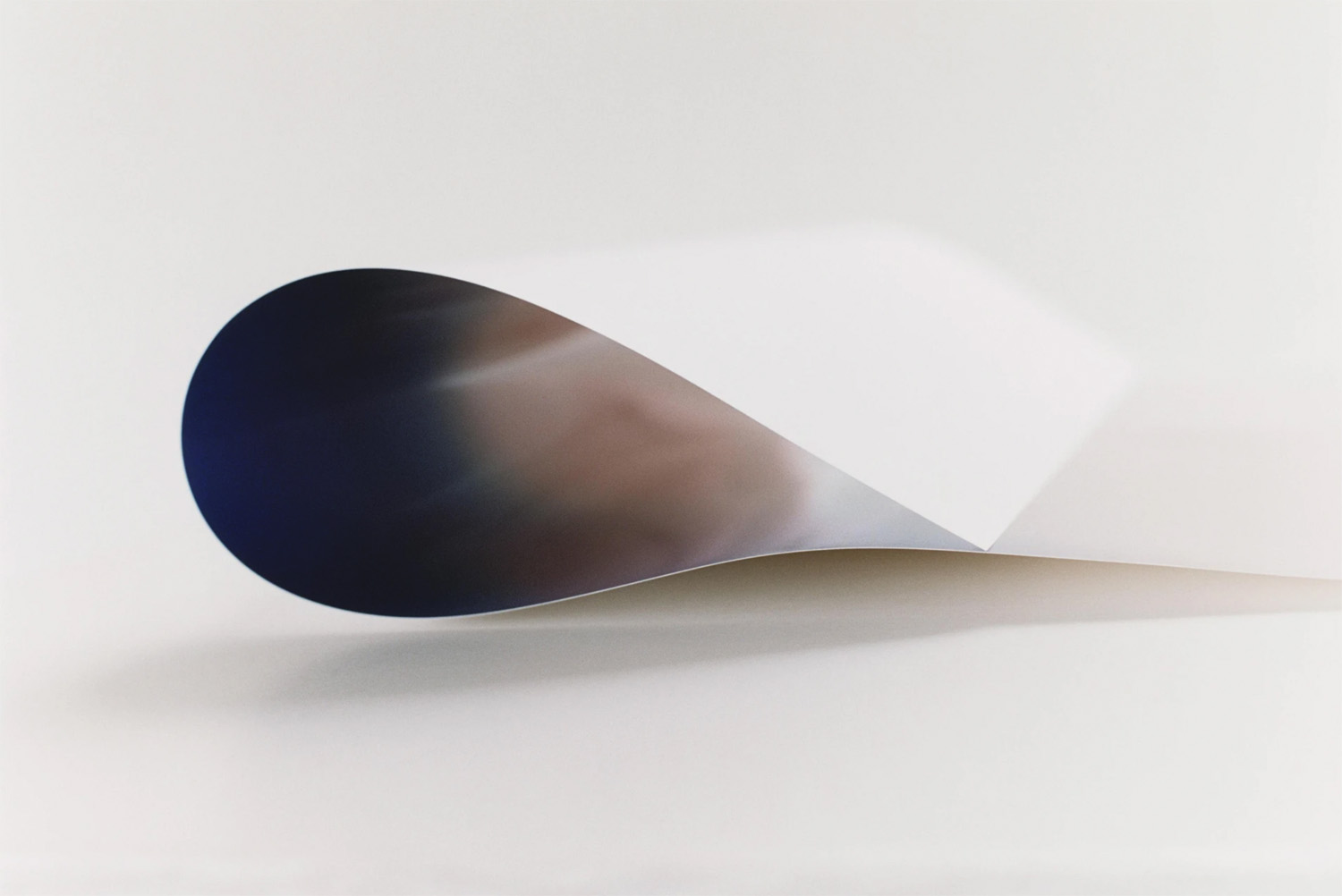
 

Wolfgang Tillmans (German, b. 1968) 'Paper drop (Roma)' 2007


Wolfgang Tillmans (German, b. 1968)
Paper drop (Roma)
2007
C-type print
30.5 x 40.6cm
Courtesy the artist and Maureen Paley, London


Wolfgang Tillmans (German, b. 1968) 'Freischwimmer 93' 2004


Wolfgang Tillmans (German, b. 1968)
Freischwimmer 93
2004
© Wolfgang Tillmans. Courtesy Galerie Buchholz, Cologne/Berlin


The Freischwimmer series – Free Swimmer is the most basic Lifesaving level in Germany and Switzerland – is an excellent example of Tillmans’s more experimental works. On one hand, the huge photographic papers were affixed to the wall with simple adhesive tape or paper clips; on the other, the images eluded all description and eschewed portraiture, landscape, still life or other subject matters he had centred on up to then.

The creative process of Freischwimmer, ongoing to the present, seems to speak to pure photography, divested of any form of intervention either in shooting or in enlargement, or indeed optical devices of any kind. We can almost imagine the artist in front of a large tray with reagents, performing some kind of alchemical ritual at the origin of these vaporous images, images containing a refinement that exceeds any human intention, just pure representations of themselves, of a unique and absolutely unrepeatable process. Of their reality.”

José Manuel Costa. “Swimming to Freedom 38,” on the CA2M Centro de Arte Dos de Mayo website [Online] Cited 12/10/2013 no longer available online


The Freischwimmer, which Tillmans started to produce in the early 2000s, form a group or family of images that are not made using a camera lens. As the results of gestural and chemical operations in the dark room, these originals on medium-sized photo paper, which are subsequently scanned and enlarged both as ink-jet prints and as light-jet prints on photo paper, are unrepeatable one-offs. It has been said that these images, which include ensembles such as Peaches, Blushes and Urgency, call to mind microscopically detailed images of biolog­ical processes, hirsute epidermises, highly erogenous zones, and that their aura fills the whole space – above all when they are presented in such large formats as in Warsaw or yet larger still, as in the case of the two monumental Ostgut Freischwimmer (2004) that used to grace the walls of the Panorama Bar at Berghain in Berlin. The Freischwimmer and their kin can be read as diagrams of sexualised atmospheres in private or semi-public spaces, in boudoirs or clubs, as highly non-representational images that both suspend and supplement conventional depic­tions of sex.

Extract from Tom Holert. The Unforeseen. On the Production of the New, and Other Movements in the Work of Wolfgang Tillmans. [Online] Cited 12/10/2013 no longer available online


Wolfgang Tillmans (German, b. 1968) 'Nanbei Hu' 2009


Wolfgang Tillmans (German, b. 1968)
Nanbei Hu
2009
Inkjet print
207 x 138cm
Courtesy the artist and Maureen Paley, London
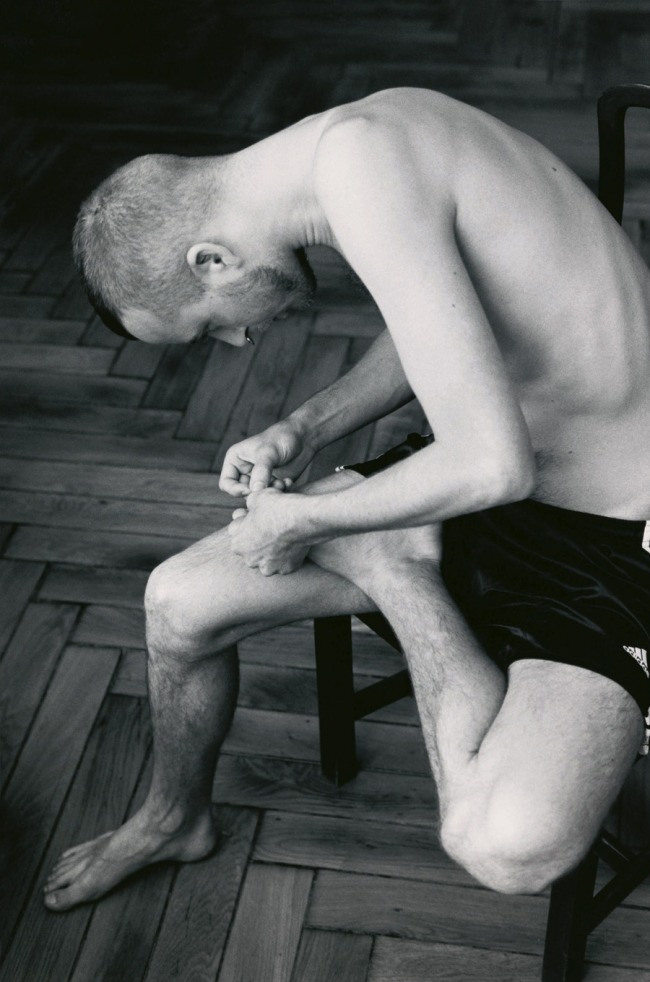
 

Wolfgang Tillmans (German, b. 1968) 'Anders pulling splinter from his foot' 2004


Wolfgang Tillmans (German, b. 1968)
Anders pulling splinter from his foot
2004
© Wolfgang Tillmans. Courtesy Galerie Buchholz, Cologne/Berlin


Wolfgang Tillmans (German, b. 1968) 'Onion' 2010


Wolfgang Tillmans (German, b. 1968)
Onion
2010
© Wolfgang Tillmans. Courtesy Galerie Buchholz, Cologne/Berlin
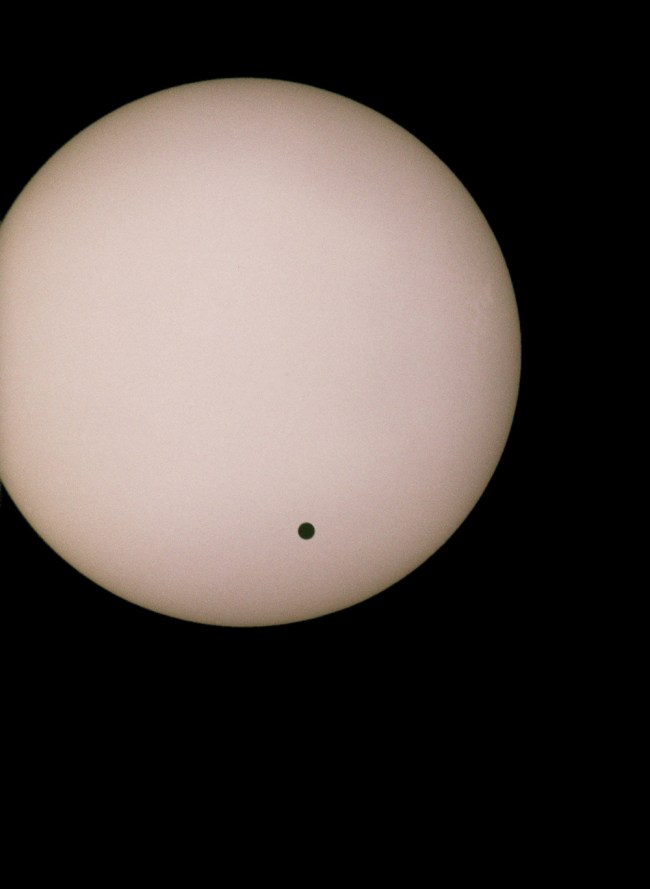
 

Wolfgang Tillmans (German, b. 1968) 'Venus transit' 2004


Wolfgang Tillmans (German, b. 1968)
Venus transit
2004
© Wolfgang Tillmans. Courtesy Galerie Buchholz, Cologne/Berlin


Wolfgang Tillmans (German, b. 1968) 'Heptathlon' 2009


Wolfgang Tillmans (German, b. 1968)
Heptathlon
2009
Inkjet print
208.5 x 138cm
Courtesy the artist and Maureen Paley, London

 

Wolfgang Tillmans (German, b. 1968) 'Headlight (a)' 2012


Wolfgang Tillmans (German, b. 1968)
Headlight (a)
2012
© Wolfgang Tillmans. Courtesy Galerie Buchholz, Cologne/Berlin
 

Wolfgang Tillmans (German, b. 1968) 'Ushuaia Lupine (a)' 2010


Wolfgang Tillmans (German, b. 1968)
Ushuaia Lupine (a)
2010
© Wolfgang Tillmans. Courtesy Galerie Buchholz, Cologne/Berlin


Wolfgang Tillmans (German, b. 1968) 'Tukan' 2010


Wolfgang Tillmans (German, b. 1968)
Tukan
2010
Inkjet print on paper, clips


Wolfgang Tillmans (German, b. 1968) 'Photocopy' 1994


Wolfgang Tillmans (German, b. 1968)
Photocopy
1994
© Wolfgang Tillmans, Courtesy Galerie Daniel Buchholz, Köln


Extracts from Tom Holert. The Unforeseen. On the Production of the New, and Other Movements in the Work of Wolfgang Tillmans. [Online] Cited 12/10/2013. No longer available online

Parallelism – Subjectivism – Objectivism

This all means that the decorative unity of wall and image, which the hanging of the Freischwimmer initially promises, is not only thwarted by the shift in dimensions, the infringement of symmetrical order and the (supposed) discontinuity of abstraction and figuration, and by the fact that the different types of image and their configuration on this wall require the viewer to move around in the space and to continually readjust his or her gaze, bearing in mind that in the corner of one’s eye or following a slight turn of the body more pictures are constantly looming into view, mostly unframed, very small (postcard-sized), very large, hung very low down, but also very high up, portraits and still lifes, gestural abstractions, a close-up of a vagina, a picture of a modern Boy with Thorn, street scenes, an air-conditioning system. It also means that the pictures communicate with each other in a way that is not bound to the pattern of a closed narrative or any particular line of argument. Instead they create a form of aesthetic and thematic interaction that Tillmans sees as ‘a language of personal associations and “thought-maps”‘,1 as ‘… a pattern of parallelism as opposed to one linear stream of thought’,2 and which the critic Jan Verwoert has aptly described as a ‘performative experiment’ with the viewer.3

With all their variability and flexibility – underpinned by an invisible rectilinear grid yet fundamentally open in their interconnections – these installations serve Tillmans as reflections of his own way of perceiving the world, as externalisations of his thinking and feeling, and as a chance to fashion a utopian world according to his own ideas and fantasies.4 However, this Romantic subjectivism of self-expression or externalisation has to be seen in light of a radical objectivism (Tillmans attaches great importance to this) that specifically draws attention not only to the expressive potential arising from the ageing process, from evidence of wear and other precariousnesses in the materials of photography (paper, camera techniques, chemicals, developing equipment etc.) but also to the remarkable resistance and persistence of these same materials.

Amongst the phenomena that inform this objectivism there are those instances of loss of control that can arise during the mechanical production processes of analogue photography or from coding errors, glitches, in digital images. Temporality, finity, brevity come into play here – a certain melancholy that activates rather than paralyses.

Over the years Tillmans has constantly found new ways to explore, to interpret and to stage this dialectic of intention and contingency. His repertoire and means of aesthetic production have multiplied. And this expansion has not been without consequences for the presentation of his work. Tillmans himself feels that the character of his installations has changed since 2006/07, in other words, when different versions of a solo exhibition of his work toured to three museums in the United States. It was during this exhibition tour that Tillmans started to see the benefit of placing greater weight on individual groups of works in the various rooms of larger exhibitions. In so doing he gave visitors the chance to engage in a different kind of concentration, without the pressure of constantly having to deal with the ‘full spectrum’ (Tillmans) of his oeuvre.5

Value Theory, Value Praxis

The visitor to an exhibition of the work of Wolfgang Tillmans in the year 2012, in this case the author of these lines, arrives in expectation of a particular, clearly defined type of art and image experience. A sense (however fragmentary) of the artist’s past exhibitions and publications is always present in any encounter with his work. And this includes the need to see the ‘abstract pictures’ in the context of an oeuvre where realistic and abstract elements have never intentionally been separated from each other. On the contrary, abstraction is always co-present with figurative and representational elements. There is no contradiction between forms and matter free of meaning – that is to say, visual moments that on the face of it neither represent nor illustrate anything – and Tillmans’ photographs of people, animals, objects and landscapes; in fact there is an unbroken connection, a continuum. This applies both to individual images as much as to the internal, dynamic relationalism of his oeuvre as a whole. And it also applies to each individual, concrete manifestation of multiplicity, as in the case of the installation in the first room of the exhibition in Warsaw.

Both aesthetic theory and the institution of art itself provide decisive grounds for discussing photography and visual art in such a way that images are not solely considered in terms of documentary functions or ornamental aspects nor are they reduced to the question as to whether their contents are stage-managed or authentic, but that attention is paid instead to the material nature of the pictures and objects in the space, to their sculptural qualities. Having decided early on against a career as a commercial photographer and in favour of a life in art, there was no need for Tillmans to seek to justify the interest he had already felt in his youth in a non-hierarchical, queer approach to various forms and genres in the visual arts. For the young Wolfgang Tillmans the cover artwork for a New Order LP, a portrait of Barbara Klemm (in-house photographer at the Frankfurter Allgemeine Zeitung), or a screenprint collage of Robert Rauschenberg in Kunstsammlung Nordrhein-Westfalen were all ‘equally important’ images’.7 The mobilisation and reversal of value and meaning are central strategies in his praxis. He questions the ‘language of importance’8 in photography and alters valencies of the visual by, for instance – in a ‘transformation of value’9 – producing C-prints from the supposedly impoverished or inadequate visuality of old black-and-white copies or wrongly developed images and thus raising them to the status of museum art. However much he may set store by refinement and precision, he avoids conventional forms of presentation, that is to say, ‘the signifiers that give immediate value to something, such as the picture frame’.10

Conditions: Subject – Work – Mediation

If we take the line proposed by the philosopher Jacques Rancière, then the ‘aesthetic regime’ of the modern era, which – following the introduction of a modern concept of art and aesthetics – abandoned the regulatory aesthetic canon of the classical age in the nineteenth century, is distinguished by the fact that under its auspices the traditional hierarchies separating the high from the popular branches of narration and visualisation were problematised and reconfigured in such a way that a new politics of aesthetics and a ‘distribution of the sensible’ in the name of art ensued. Rancière has recently proposed the term ‘aisthesis’ for the way in which very different things have been registered as ‘art’ for the last two hundred years or so. As he points out, this is not about the ‘reception’ of works of art, but about the sensory experiential backdrop against and within which they come about. ‘These are completely material conditions – places of performance or exhibition, forms of circulation and reproduction – but also modes of perception and the regimes of emotion, the categories that identify them and the patterns of thought that classify and interpret them.’12

In order to understand why the work of Wolfgang Tillmans – so seemingly casual, so heterogeneous and so wide-ranging – is not only extremely successful, but has, for over twenty years, been intelligible and influential both within and outside the field of art, with the result that by now his praxis seems like a universal, subtly normative style of perception and image-making, it is essential to consider the ‘conditions’ alluded to by Rancière. For these are fundamental to the specific visibility and speakability of this oeuvre and to its legitimacy as art…

The Production of the New

Tillmans thus also makes his contribution to an answer to the question posed by the philosopher John Rajchman (in response to Gilles Deleuze and Michel Foucault and their deliberations on the production of the new and on the creative act in present-day, control-obsessed societies). Rajchman asked how, in and with the arts and their institutions, spaces for open searches and researches could be devised, in which learning and unlearning, resonance and interference, a new affective solidarity and real experimentation might be possible before the onset of all sorts of methods, all forms of governance, all kinds of discipline and doxa.18

This form of experimentation does not lead to benchmark research results; nothing is ever proved or illustrated, regardless of what is in the images or what they may purport to show. Ever engaging in experiment Tillmans roams through the reality of materials, forms, affects and gives us tangible access to these unportrayble, unreferential realities. Tillmans engages his emotions when he is working, also and specifically when he is photographing people, or plants, machines and cities. Individual emotions separate off from the representation of living beings and objects and form nodes of emotion in the viewer’s mind. ‘Artists are presenters of affects, the inventors and creators of affects’, as Gilles Deleuze and Félix Guattari put it in What is Philosophy?, ‘they draw us into the compound’.19 And indeed Tillmans’ laboratories are places where emotion and affect are generated and presented, rhythmically resonating between pictures, from wall to wall, from room to room, from side to side. The dog asleep on the stones, its breathing body warmed by the sun (in the video Cuma, 2011), Susanne’s lowered gaze (in Susanne, No Bra, 2006), with the line of her hair encircling her head like an incomplete figure of eight, but also the disturbed, interrupted, lurking monochromaticism of the Lighter and Silver works – they all open up the longer you look at them, the longer you are with them, to a perceiving in terms of forces and affects. They alert us to the fact that all images are fabricated.

Assimilating Photography into the Paradox

By virtue of the portability and variability of his works, with every print, with every exhibition, with every publication Tillmans can modify and modulate anew the relations between picture and picture support, representation and presentation, motif and materiality. In the two decades that have elapsed since his entry into the art business his praxis has continuously expanded. From the outset photography was his springboard for both integrative and eccentric acts. And even though this oeuvre may create the impression that the medium of photography knows no limits, photography – as discourse, as technique, as history, as convention – has remained the constant point of reference for all of Tillmans’ complex operations. It could also be said that he is immensely faithful to his chosen medium, although – or precisely because – that medium is not always recognisable as such. To quote an older essay on photography and painting by Richard Hamilton (whom Tillmans once photographed), his work is about ‘assimilating photography into the domain of paradox, incorporating it into the philosophical contradictions of art…’30 Since Tillmans’ experiments with a laser copier in the 1980s, he has produced hundreds of images that may be beholden to the etymology of photography (light drawing) but that also constantly undermine or overuse the social and epistemological functions of photography as a means to depict reality, as proof, as an aide mémoire, as documentation or as a form of aesthetic expression. The discourse on photography, with all its ‘post-photographic’ exaggerations, the debate on the status of the photographic image – none of these have been concluded; on the contrary, Tillmans is continuously advancing them on his own terms. His praxis forms the backdrop for experimentation and adventures in perception that are closely intertwined with the past and the present of photography and theories of photography; yet the specific logic of this oeuvre creates a realm of its own in which archive and presentation interlock in such a way that photography still plays an important part as historic and discursive formation, but the problems and paradoxes of fine art have now taken over the key functions.

The contagious impact of the epistemological problems of art has opened up new options for the medium of photography, new contexts of reception. And in this connection it is apparent, as Julie Ault has put it, that ‘Tillmans enacts his right to complex mediation’.31 In other words, photography provides a means for him to engage with a whole range of interactions with the viewer. In his eyes and hands photography becomes a realm of potential, where a never-ending series of constellations and juxtapositions of materialities, dimensions and motifs of the ‘unforeseen’ can come about. Photography thus regains a dimension of experimentation, an openness that is not constrained by aesthetic formats and technical formatting but that does arise from a precise knowledge and understanding of the history of the medium.”

Extracts from Tom Holert. The Unforeseen. On the Production of the New, and Other Movements in the Work of Wolfgang Tillmans. [Online] Cited 12/10/2013 no longer available online


Footnotes from extracts

1/ “Peter Halley in Conversation with Wolfgang Tillmans,” in Jan Verwoert, Peter Halley and Midori Matsui, Wolfgang Tillmans (London: Phaidon, 2002), 8-33 at 29

2/ Steve Slocombe, “Wolfgang Tillmans – The All-Seeing Eye,” in Flash Art, vol. 32, no. 209, November – December 1999, 92-95 at 95

3/ Jan Verwoert, “Survey: Picture Possible Lives: The Work of Wolfgang Tillmans,” in Verwoert et. al., Wolfgang Tillmans, 36-89 at 72

4/ See Slocombe, “Wolfgang Tillmans – The All-Seeing Eye” (see note 2), 95

5/ See Julia Peyton-Jones and Hans Ulrich Obrist, “Interview with Wolfgang Tillmans,” in Wolfgang Tillmans (London: Serpentine Gallery / Koenig Books, 2010), 21-27 at 24

7/ Wolfgang Tillmans, email of 12 May 2012.

8/ Julie Ault, “Das Thema lautet Ausstellen Installations as Possibility in the Practice of Wolfgang Tillmans,” in Wolfgang Tillmans. Lighter (Stuttgart/Berlin: Hatje Cantz/SMB), Nationalgalerie Staatliche Museen zu Berlin, 2008, 27

9/ See Hans Ulrich Obrist, Wolfgang Tillmans (Cologne: Verlag der Buchhandlung Walther König, 2007 = The Conversation Series, 6), 41

10/ Gil Blank, “The Portraiture of Wolfgang Tillmans,” in Influence, 2, autumn 2004, 110-21 at 117

12/ Jacques Rancière, Aisthesis. Scènes du régime esthétique de l’art (Paris: Galilée, 2011), 10

18/ Zepke (ed.), Deleuze, Guattari and the Production of the New (London: Continuum, 2008), 80-90 at 89

19/ See Deleuze and Guattari, What Is Philosophy?, trans. Hugh Tomlinson and Graham Burchell (New York: Columbia University Press, 1994), 175

30/ Richard Hamilton, “Photography and Painting,” in Studio International, vol. 177, no. 909, March 1969, 120-25 at 125

31/ Julie Ault, “The Subject Is Exhibition” (see note 8), 15


Wolfgang Tillmans (German, b. 1968) 'Alex Lutz back' 1992


Wolfgang Tillmans (German, b. 1968)
Alex Lutz back
1992
© Wolfgang Tillmans. Courtesy Galerie Buchholz, Cologne/Berlin
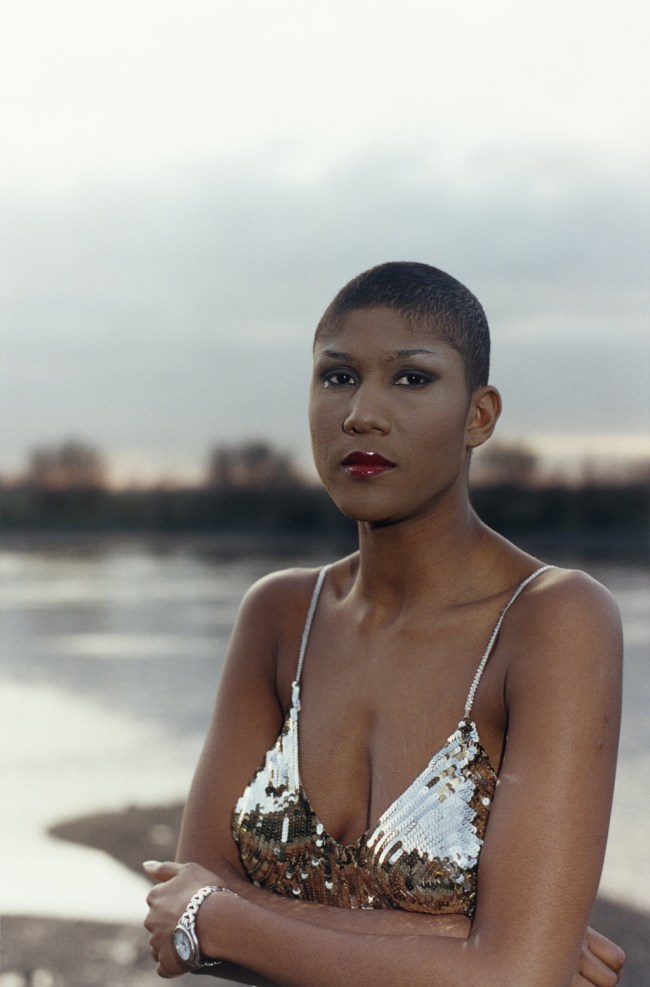
 

Wolfgang Tillmans (German, b. 1968) 'Smokin Jo' 1995


Wolfgang Tillmans (German, b. 1968)
Smokin Jo
1995
© Wolfgang Tillmans. Courtesy Galerie Buchholz, Cologne/Berlin


Wolfgang Tillmans (German, b. 1968) 'Lutz & Alex sitting in the trees' 1992


Wolfgang Tillmans (German, b. 1968)
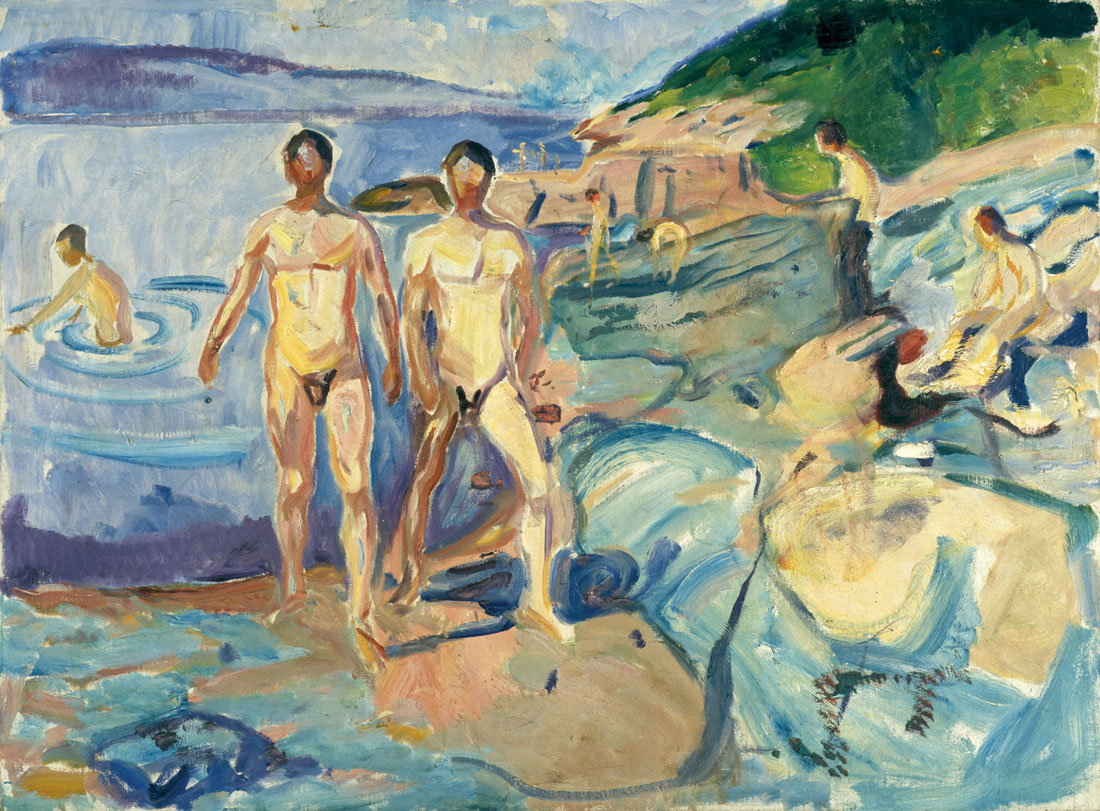
Lutz & Alex sitting in the trees
1992
Inkjet print on paper, clips
208 × 138 cm


Moderna Museet, Stockholm

Moderna Museet is ten minutes away from Kungsträdgården, and twenty minutes from T-Centralen or Gamla Stan. Walk past Grand Hotel and Nationalmuseum on Blasieholmen, opposite the Royal Palace. After crossing the bridge to Skeppsholmen, continue up the hill. The entrance to Moderna Museet and Arkitekturmuseet is on the left-hand side.

Opening hours:
Tuesday – Sunday 11 – 18
Monday closed

Moderna Museet website

LIKE ART BLART ON FACEBOOK

Back to top