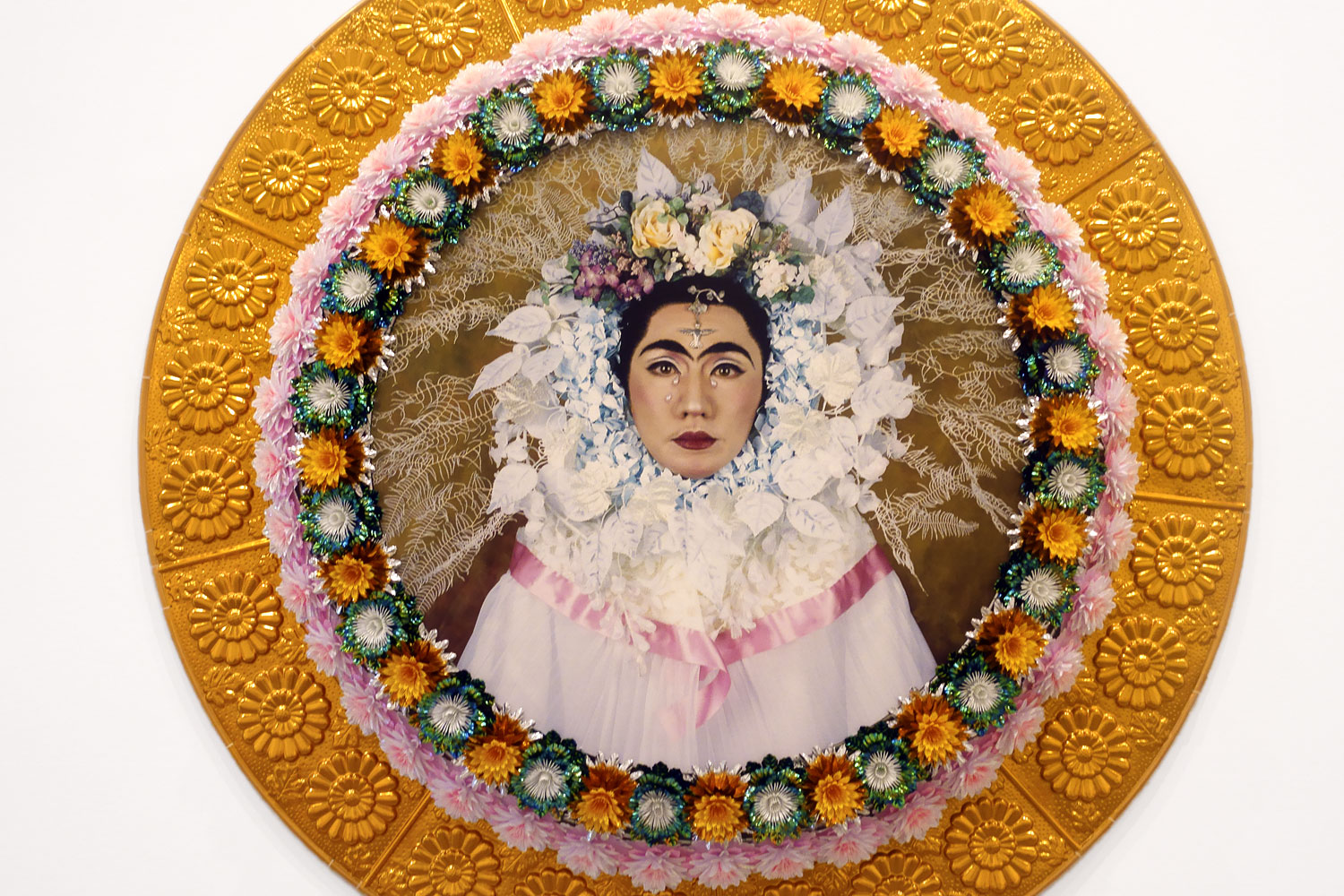
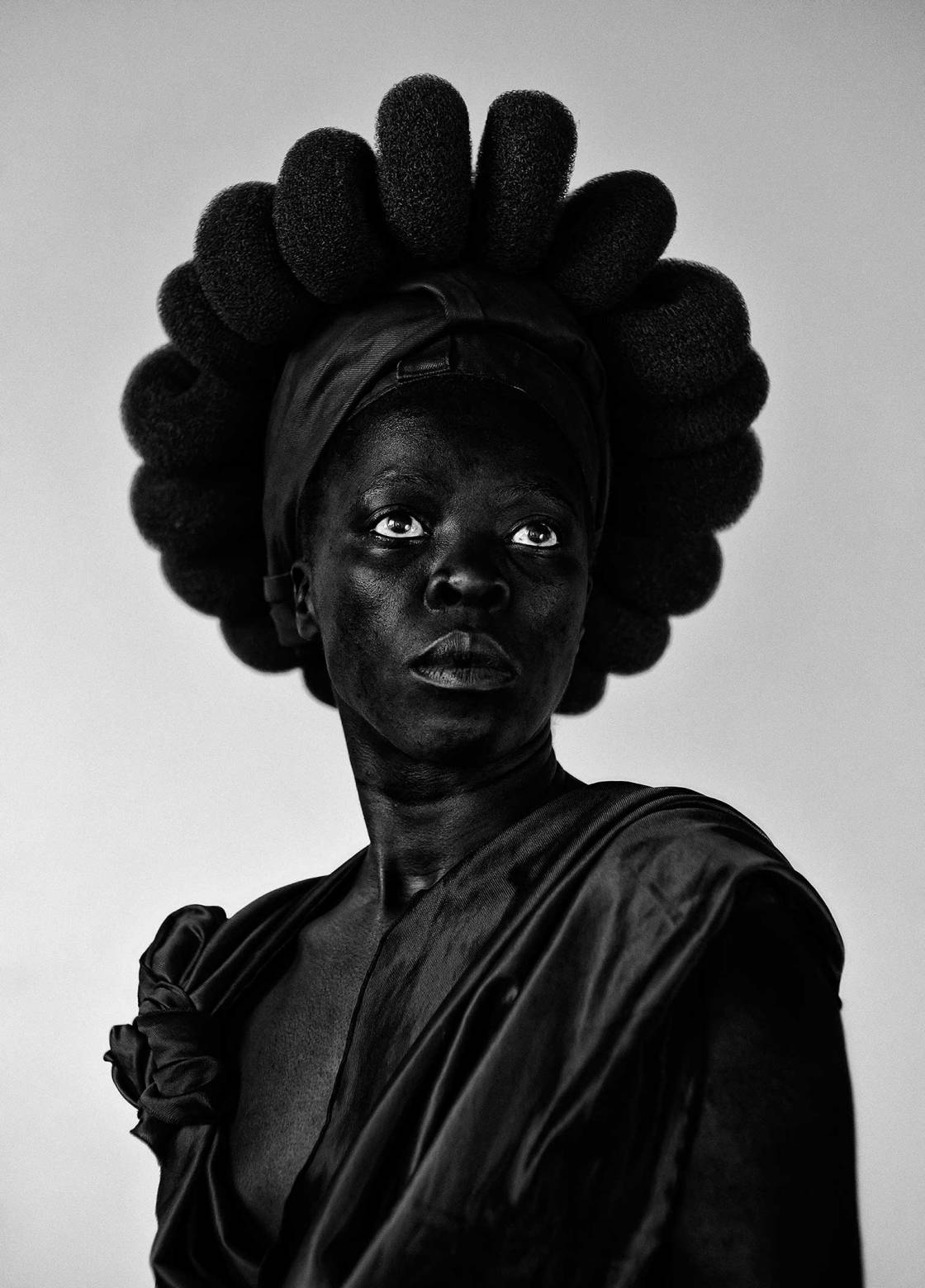
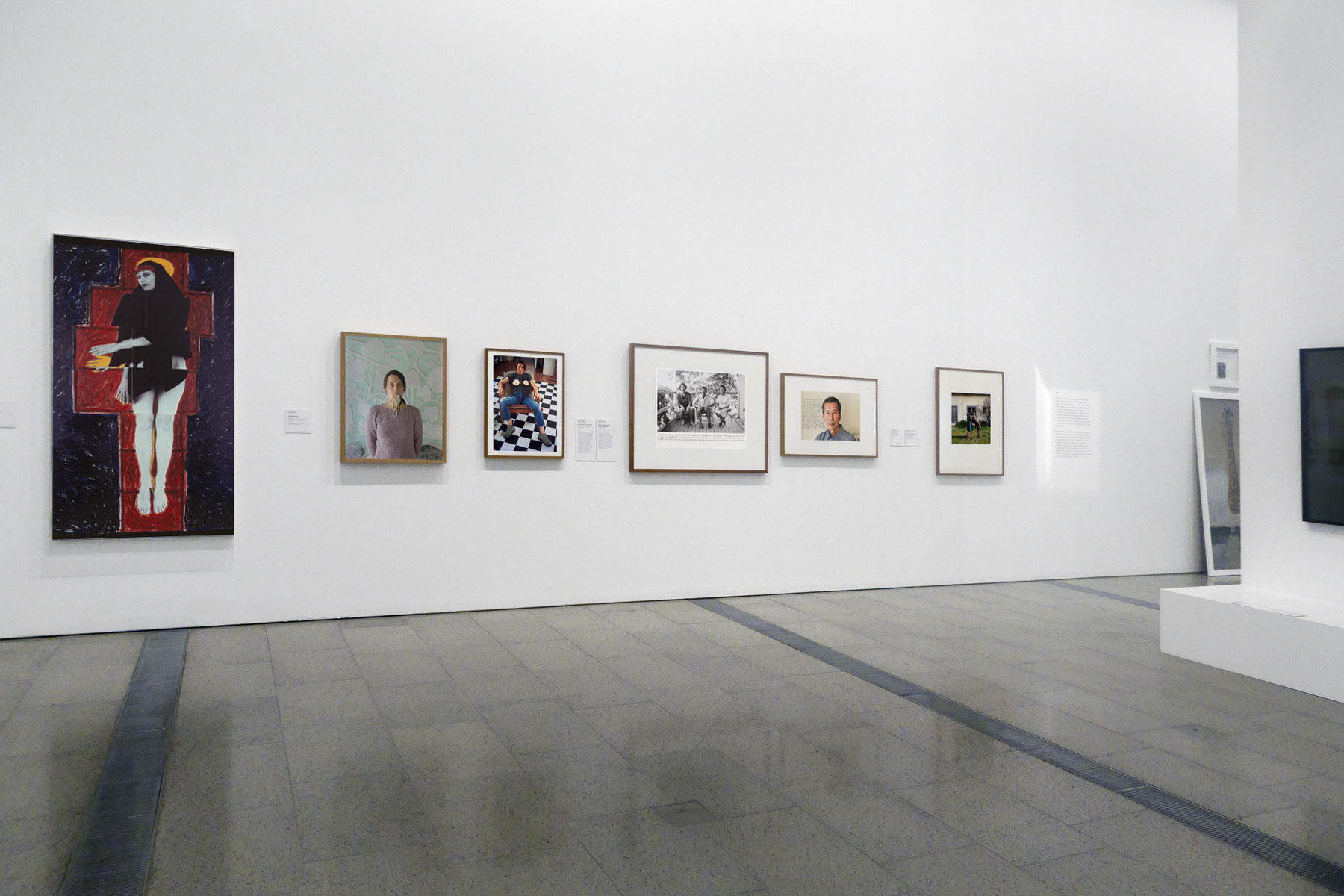
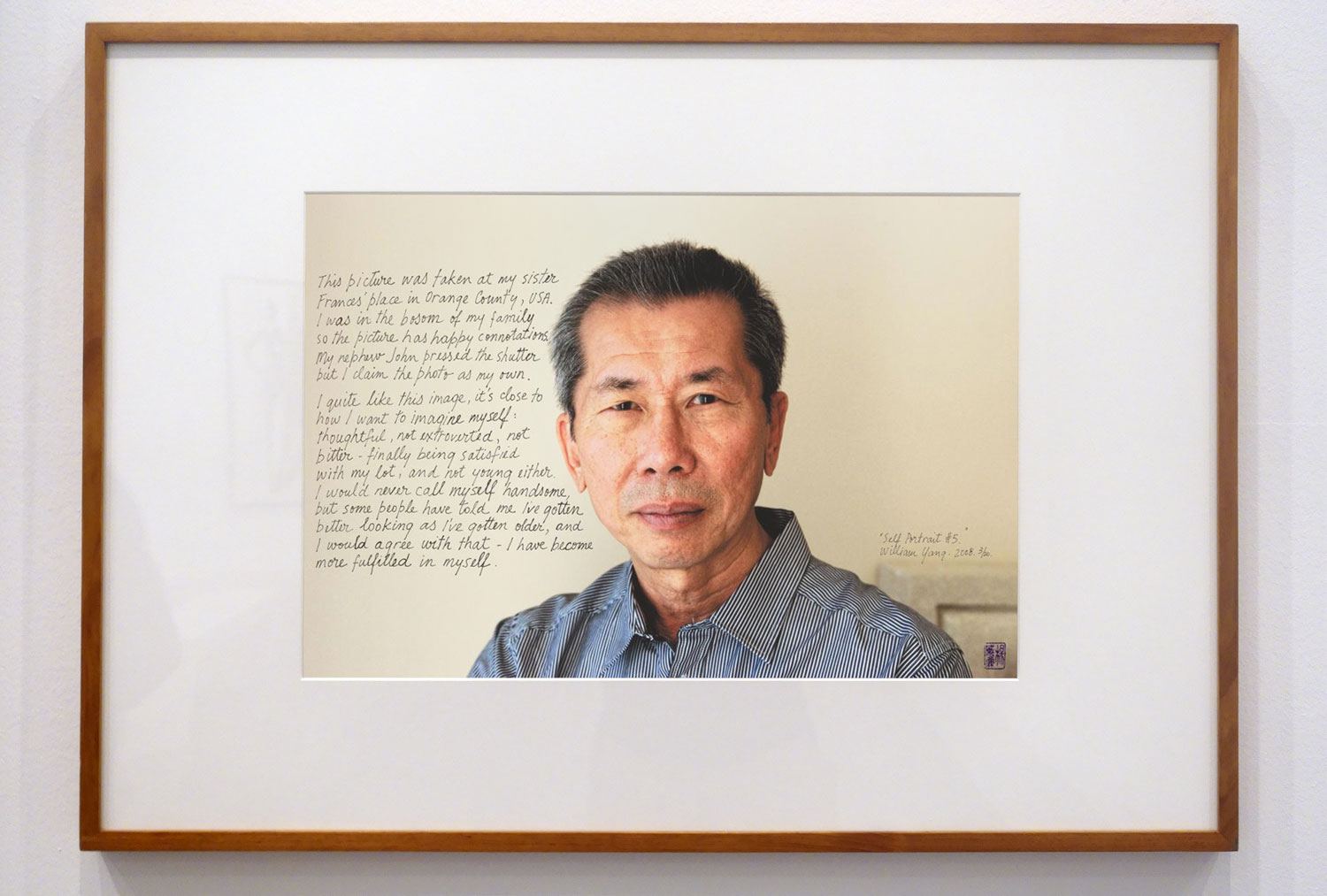
Exhibition: ‘Nineteenth-Century Photography Now’ at the J. Paul Getty Museum, Los Angeles

Exhibition dates: 9th April – 7th July, 2024

Curators: the exhibition is curated by Karen Hellman, former associate curator in the Department of Photographs. Carolyn Peter, assistant curator in the Department of Photographs, Getty Museum, served as organising curator with assistance from Claire L’Heureux, former Department of Photographs graduate intern and Antares Wells, curatorial assistant


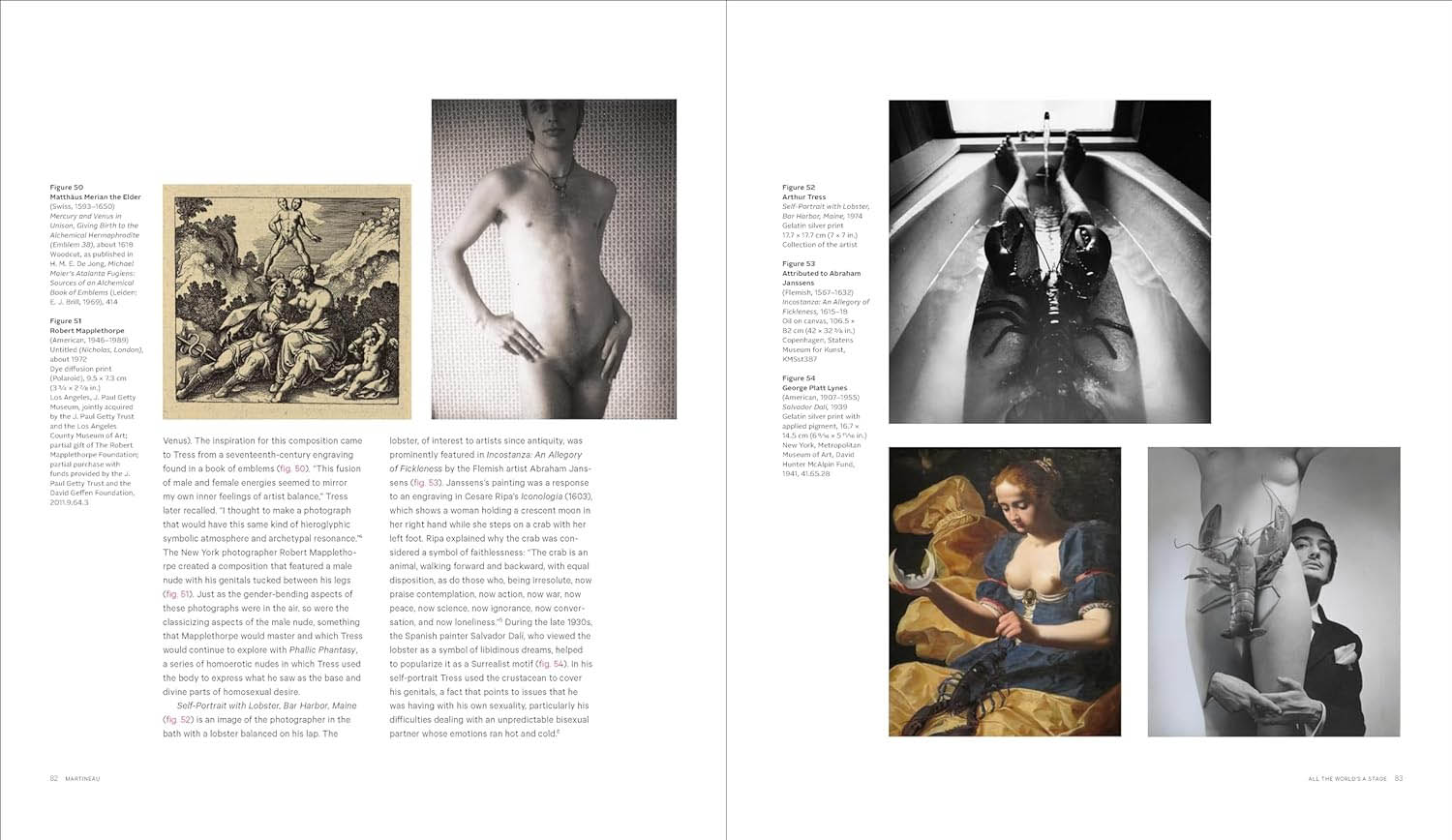
At left, Julia Margaret Cameron (British born India, 1815-1879) 'Florence after the Manner of the Old Masters' 1872; and at right, Carrie Mae Weems (American, b. 1953) 'After Manet' 2003


At left, Julia Margaret Cameron (British born India, 1815-1879) Florence after the Manner of the Old Masters 1872; and at right, Carrie Mae Weems (American, b. 1953) After Manet 2003

from the ‘Identity’ section of the exhibition


Magdalene Keaney, curator of the exhibition Francesca Woodman and Julia Margaret Cameron: Portraits to Dream In, observes that the exhibition “poses questions about how we might think in new ways about relationships between 19th and 20th century photographic practice…”

As does this exhibition:

~ Everything emerges from something. One must be “mindful of the origins and essence of photography.” (Moriyama)

~ History often repeats itself in different forms.

~ Memory often returns in fragmentary form.

~ The wisdom and spirit of the past speaks to the practitioners of the future.

Dr Marcus Bunyan


NB: Transubstantiation, an un/explainable change in form, substance, or appearance (from the Latin roots trans, “across or beyond,” and substania, “substance”)


Many thankx to the J. Paul Getty Museum for allowing me to publish the photographs in the website. Please click on the photographs  for a larger version of the image.


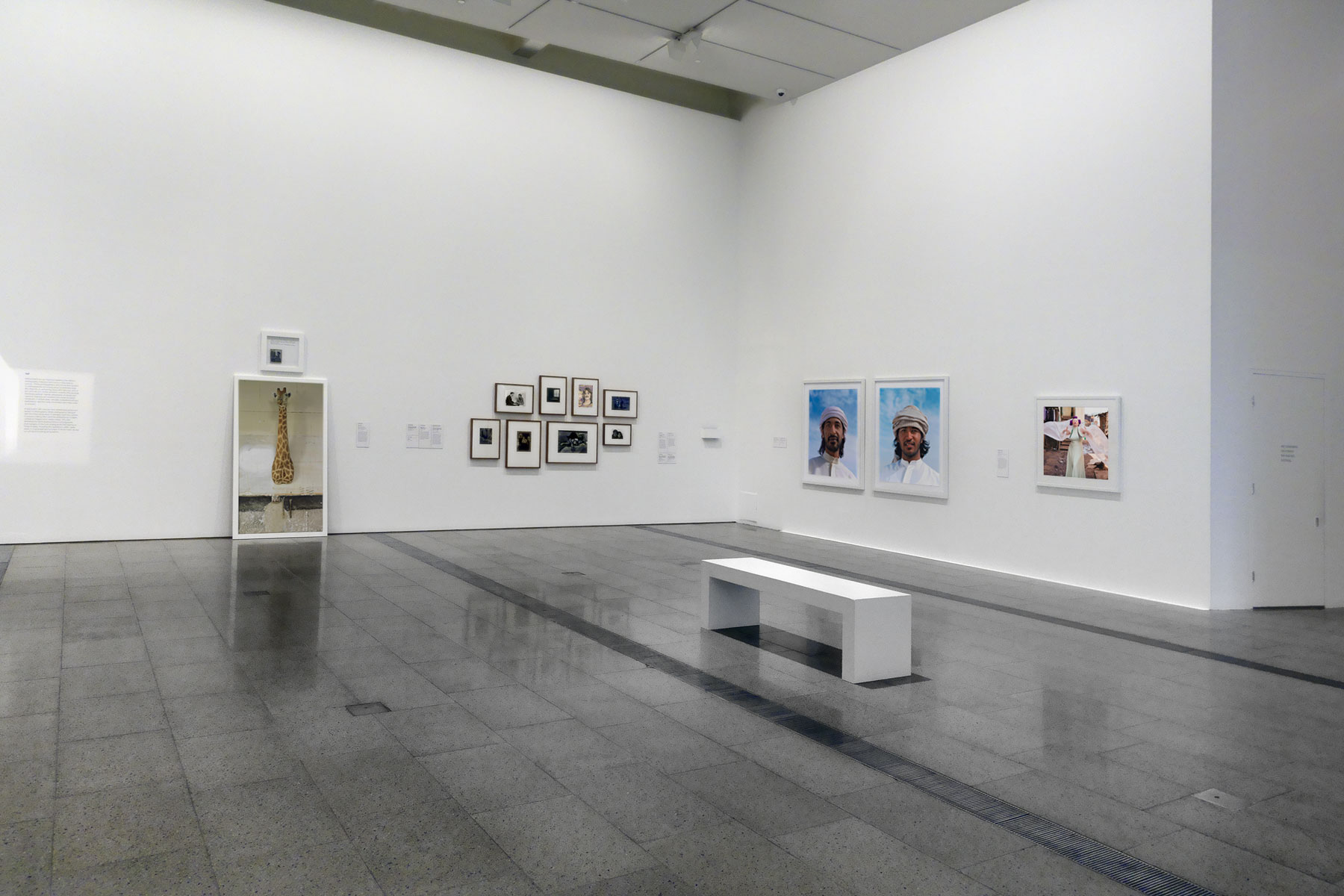
The earliest photographs – often associated with small, faded, sepia-toned images – may seem to belong to a bygone era, but many of the conventions established during photography’s earliest years persist today. Organised around five themes dating back to the medium’s beginnings, this exhibition explores nineteenth-century photographs through the work of twenty-one contemporary artists. These interchanges between the first decades of the medium and the most recent invite us to reimagine nineteenth-century photography while exploring its complexities.

Text from the J. Paul Getty Museum website


“Ms. Hellman, a former associate curator, inspired by her work with the Bayard materials, conceived “Nineteenth-Century Photography Now” as a way to access the influence that early photographers still have. The exhibition includes work from the past by 23 named and three anonymous photographers plus an additional 16 included in an album; there are 21 present-day artists. It is organised around five themes: Identity, Time, Spirit, Landscape and Circulation. The picture that serves as an introduction to the show is “Untitled ‘point de vue'” (1827) by Joseph Nicéphore Niépce, a faded heliograph on pewter, that Daido Moriyama keeps a reproduction in his studio; the wall text quotes him saying, “it serves as a gentle daily reminder to be mindful of the origins and essence of photography.” There are two photographs by Mr. Moriyama prompted by Niépce’s bit of primitive technology.”


William Meyers. “Photography’s Past and Present at the Getty Center,” on The Wall Street Journal website May 29, 2024 [Online] Cited 16/06/2024


Julia Margaret Cameron (British born India, 1815-1879) 'Florence after the Manner of the Old Masters' 1872


Julia Margaret Cameron (British born India, 1815-1879)
Florence after the Manner of the Old Masters
1872
Albumen silver print
Image: 34 × 25.6cm (13 3/8 × 10 1/16 in.)
Mount: 43.3 × 32.4cm (17 1/16 × 12 3/4 in.)
The J. Paul Getty Museum, Los Angeles


Portrait of Florence Fisher posing with a rose stem with the leaves attached. She holds the rose in place with one arm folded across her chest.
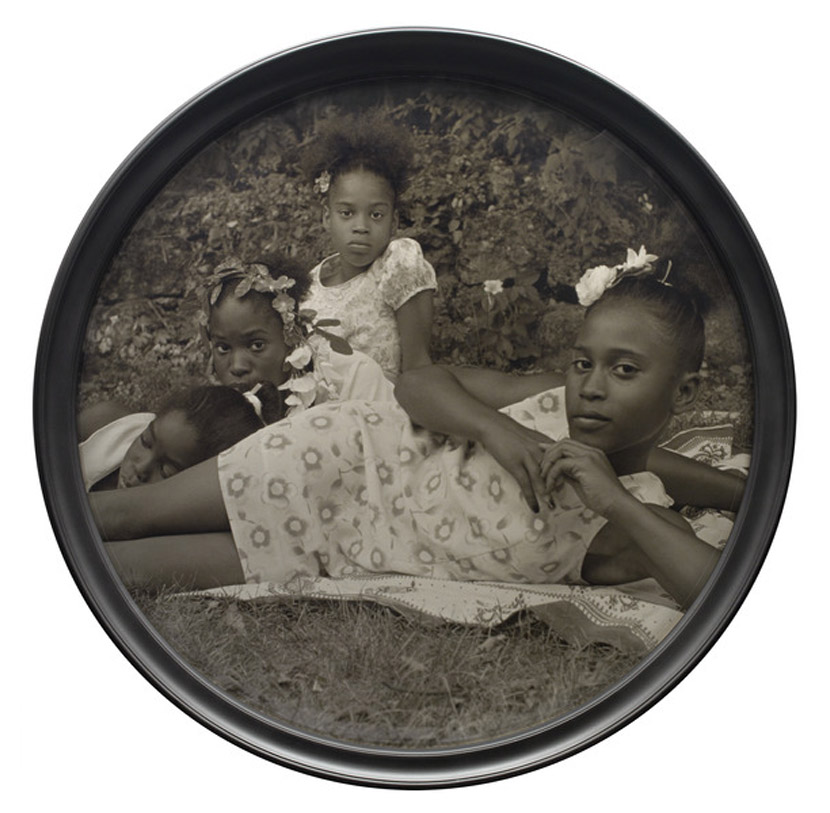
 

Carrie Mae Weems (American, b. 1953) 'After Manet' 2003


Carrie Mae Weems (American, b. 1953)
After Manet
2003
From the series May Days Long Forgotten
Chromogenic print
Object: 84.3cm (33 3/16 in.)
The J. Paul Getty Museum, Los Angeles
© Carrie Mae Weems


The black and white photograph – one from the nine-part series May Days Long Forgotten – depicts four African American girls in summer dresses, with garlands in their hair, reclining on a lawn. The piece is mounted in a circular frame prepared by the artist, and is number five of an edition of eight.


Joseph Nicéphore Niépce (French, 1765-1833) 'Untitled 'point de vue'' 1827


Joseph Nicéphore Niépce (French, 1765-1833)
Untitled ‘point de vue’
1827
Heliograph on pewter
16.7 x 20.3 x .15cm


The invention of photography was announced simultaneously in France and England in 1839, dazzling the public and sending waves of excitement around the world. These astonishing breakthroughs depended upon centuries of developments in chemistry, optics, and the visual arts, accelerating in the decades after 1790. The Niépce Heliograph was made in 1827, during this period of fervent experimentation. It is the earliest photograph produced with the aid of the camera obscura known to survive today.

Text from the Harry Ransom Center website
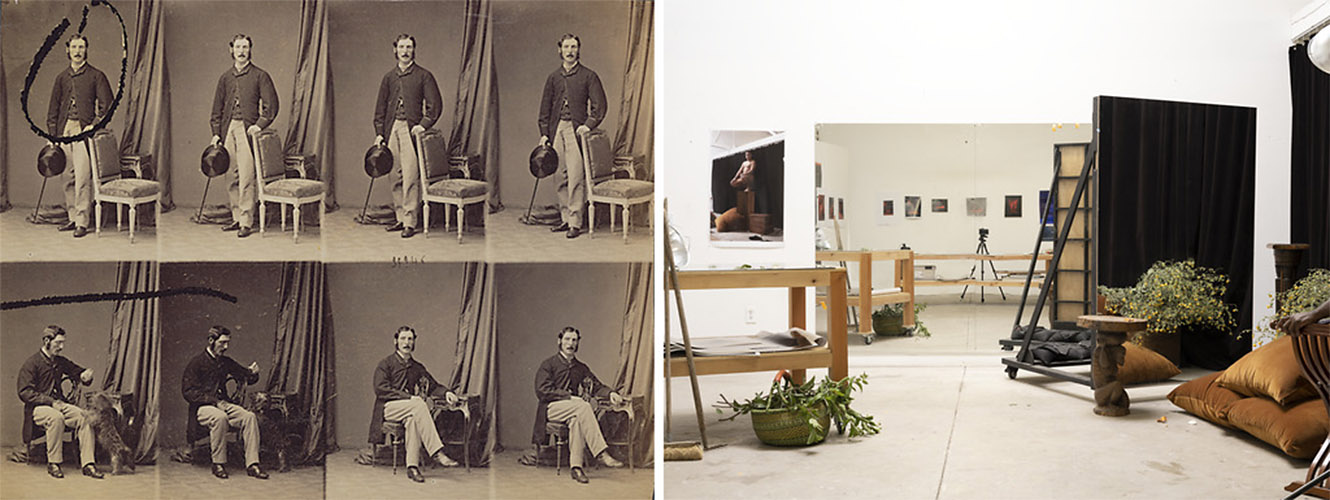
 

At left, André Adolphe-Eugène Disdéri (French, 1819-1889) 'Uncut Sheet of Cartes-de-Visite Portraits', 1860s; and at right, Paul Mpagi Sepuya (American, b. 1982) 'Daylight Studio with Garden Cuttings (_DSF0340)' 2022


At left, André Adolphe-Eugène Disdéri (French, 1819-1889) Uncut Sheet of Cartes-de-Visite Portraits, 1860s; and at right, Paul Mpagi Sepuya (American, b. 1982) Daylight Studio with Garden Cuttings (_DSF0340) 2022


William Henry Fox Talbot (English, 1800-1877) '[A Stem of Delicate Leaves of an Umbrellifer]' probably 1843-1846


William Henry Fox Talbot (English, 1800-1877)
[A Stem of Delicate Leaves of an Umbrellifer]
probably 1843-1846
Photogenic drawing negative
Image: 18.1 × 22.1cm (7 1/8 × 8 11/16 in.)
The J. Paul Getty Museum, Los Angeles


The exceptional boldness of this image conveys a visual impression that at first may seem quite unlike other of William Henry Fox Talbot’s pictures. He made it with the same photogenic drawing process he used for much of his work by placing the stem of leaves directly on top of the prepared paper and then exposing to sunlight without the aid of a camera. Although the original plant was delicate, its sharply delineated white shadow on the rich dark brown background creates a graphic, two-tone effect. The same specimen was used in a slightly different orientation to make a negative that is preserved in one of the family albums formerly at the Fox Talbot Museum in Lacock and now at the British Library, London.

Other visually similar works in Talbot’s oeuvre help us to understand what we are seeing here. Some of them show the interior structure of the plant specimens he photographed, proving that the negatives at first had fuller details. Because the most vulnerable sections of the silver-based images are those that are light in tone, these areas will fade disproportionately faster than the darker parts. In this case, the lightest tones would have been in the interior spaces of the plant, and these at some point faded. It is unlikely that Talbot saw the same picture we see today, at least not when he first made it, but the boldness of the present state reminds us that changes over time can create as well as destroy.

Adapted from Larry Schaaf. William Henry Fox Talbot, In Focus: Photographs from the J. Paul Getty Museum (Los Angeles: Getty Publications, 2002), 68. © 2002 J. Paul Getty Trust


Hiroshi Sugimoto (Japanese, b. 1948) 'A Stem of Delicate Leaves of an Umbrellifer, circa 1843-1846' 2009


Hiroshi Sugimoto (Japanese, b. 1948)
A Stem of Delicate Leaves of an Umbrellifer, circa 1843-1846
2009
Toned gelatin silver print
Image: 93.7 × 74.9cm (36 7/8 × 29 1/2 in.)
The J. Paul Getty Museum, Los Angeles
Gift of the artist
© Hiroshi Sugimoto


“To look at Fox Talbot’s earliest experiments, the blurred and hazy images suffuse the excited anticipation of discovering how light could transfer the shape of things onto paper. … I decided to collect Fox Talbot’s earliest negatives, from a time in photographic history very likely before positive images existed, and print the photographs that not even he saw.”

~ Hiroshi Sugimoto (p. 349, in Hiroshi Sugimoto, Ostfildern-Ruit, 2005)


Hiroshi Sugimoto visited the Getty Museum in 2007 to study the earliest photographs in the collection. After photographing some of William Henry Fox Talbot’s photogenic drawing negatives, he produced large-scale prints and coloured them with toning agents to replicate the hues of the paper negatives. The scale of the enlarged prints reveals the fibers of the original paper, which create delicate patterns embedded in the images.


At left, Herbert Bell et al, '[Amateur World Tour Album, taken with early Kodak cameras, plus purchased travel photographs by various photographers]' (2 page spread); and at right, Stephanie Syjuco (American born Philippines, b. 1974) 'Herbaria' 2021 (detail)


At left, Herbert Bell et al, [Amateur World Tour Album, taken with early Kodak cameras, plus purchased travel photographs by various photographers] (2 page spread); and at right, Stephanie Syjuco (American born Philippines, b. 1974)
Herbaria 2021 (detail)


Herbert Bell (English, 1856-1946) Frederick Nutt Broderick (English, about 1854-1913) Gustave Hermans (Belgian, 1856-1934) Anthony Horner (English, 1853-1923) Michael Horner (English, 1843-1869) C. W. J. Johnson (American, 1833-1903) Léon & Lévy (French, active 1864-1913 or 1920) Léopold Louis Mercier (French, b. 1866) Neurdein Frères (French, founded 1860s, dissolved 1918) Louis Parnard (French, 1840-1893) Alfred Pettitt (English, 1820-1880) Francis Godolphin Osborne Stuart (British born Scotland, 1843-1923) Unknown maker Valentine & Sons (Scottish, founded 1851, dissolved 1910) L. P. Vallée (Canadian, 1837-1905) York and Son J. Kühn (French, active Paris, France 1885 - early 20th century) '[Amateur World Tour Album, taken with early Kodak cameras, plus purchased travel photographs by various photographers]' (2 page spread)


Herbert Bell (English, 1856-1946)
Frederick Nutt Broderick (English, about 1854-1913)
Gustave Hermans (Belgian, 1856-1934)
Anthony Horner (English, 1853-1923)
Michael Horner (English, 1843-1869)
C. W. J. Johnson (American, 1833-1903)
Léon & Lévy (French, active 1864-1913 or 1920)
Léopold Louis Mercier (French, b. 1866)
Neurdein Frères (French, founded 1860s, dissolved 1918)
Louis Parnard (French, 1840-1893)
Alfred Pettitt (English, 1820-1880)
Francis Godolphin Osborne Stuart (British born Scotland, 1843-1923)
Unknown maker
Valentine & Sons (Scottish, founded 1851, dissolved 1910)
L. P. Vallée (Canadian, 1837-1905)
York and Son
J. Kühn (French, active Paris, France 1885 – early 20th century)
[Amateur World Tour Album, taken with early Kodak cameras, plus purchased travel photographs by various photographers] (2 page spread)
Albumen silver print
Closed: 35.4 × 28 × 3.5cm (13 15/16 × 11 × 1 3/8 in.)
The J. Paul Getty Museum, Los Angeles
Google Arts & Culture website


Includes amateur photographs taken with early Kodak cameras, including the original Kodak or Kodak no. 1, and Kodak no. 2 cameras, as well as commercially produced images.


Stephanie Syjuco (American born Philippines, b. 1974) 'Herbaria' 2021 (detail)


Stephanie Syjuco (American born Philippines, b. 1974)
Herbaria (detail)
2021
From the series Pileups
Hand-assembled pigmented inkjet prints on Hahnemühle Baryta
Framed [Outer Dim]: 121.9 × 91.4cm (48 × 36 in.)
The J. Paul Getty Museum, Los Angeles
© Stephanie Syjuco


A collage composed of diverse naturalist archival sources, including photographs of bones, foliage, and crystal formations.


At left, Paul-Marie-Léon Regnard (French, 1850-1927) 'Passionate Ecstatic Position/Expression' 1878; and at right, Laura Larson (American, b. 1965) 'The Mind Is a Muscle' 2019


At left, Paul-Marie-Léon Regnard (French, 1850-1927) Passionate Ecstatic Position/Expression 1878; and at right, Laura Larson (American, b. 1965)
The Mind Is a Muscle 2019
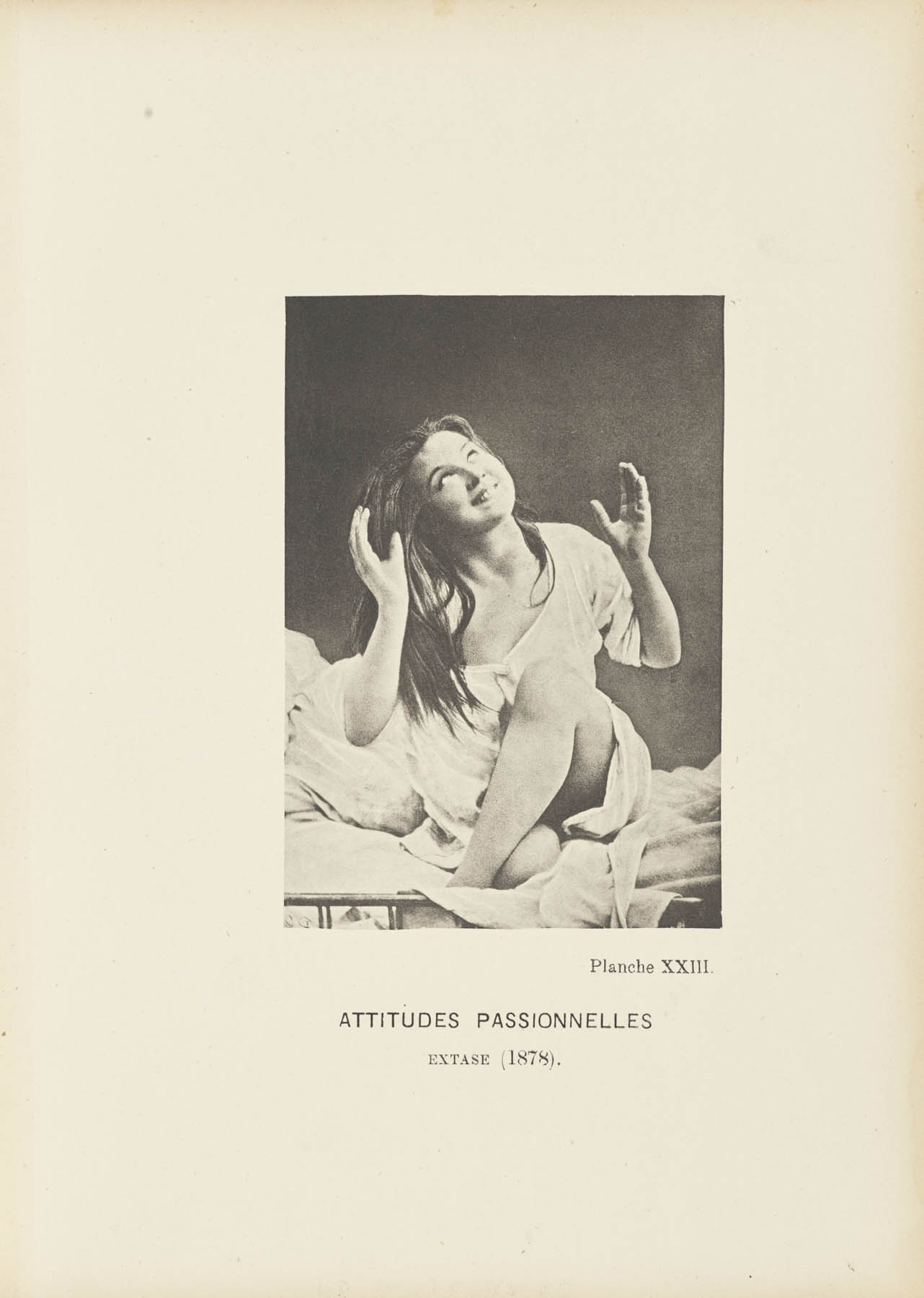
 

Paul-Marie-Léon Regnard (French, 1850-1927) 'Passionate Ecstatic Position/Expression' 1878 Part of 'Iconographie Photographique de la Salpetriere' (Service de M. Charcot)


Paul-Marie-Léon Regnard (French, 1850-1927)
Passionate Ecstatic Position/Expression
1878
Part of Iconographie Photographique de la Salpetriere (Service de M. Charcot)
Photogravure
Image: 10.3 × 7.1cm (4 1/16 × 2 13/16 in.)
The J. Paul Getty Museum, Los Angeles


Laura Larson (American, b. 1965) 'The Mind Is a Muscle' 2019


Laura Larson (American, b. 1965)
The Mind Is a Muscle
2019
from the series City of Incurable Women
Inkjet print
The J. Paul Getty Museum, Los Angeles
Courtesy of and © Laura Larson


At first glance, photographs made in the 19th century may seem like faded relics of an increasingly distant and forgotten age, yet they persist in inspiring, challenging, and resonating with artists today.

Nineteenth-Century Photography Now, on view April 9 through July 7, 2024 at the Getty Center, offers new perspectives on early photography by looking through the lens of contemporary artists who respond directly to their historical themes and subject matter.

“This exhibition provides an opportunity to connect visitors with some of the earliest photographs in the Museum’s collection, now almost two centuries old, via the responses of contemporary makers,” says Timothy Potts, Maria Hummer-Tuttle and Robert Tuttle Director of the J. Paul Getty Museum. “The revelatory ability of early photography to capture images of the world around us still resonates with practitioners today, and bridges between past and present photography are as active and relevant as they have ever been.”

Organised around five themes, dating back to the medium’s beginnings, Identity, Time, Spirit, Landscape, and Circulation, this exhibition explores 19th-century photographs through the work of 21 contemporary artists. Reflecting the inventiveness of early practitioners as well as the more disturbing historical aspects of their era, these interchanges between the first decades of the medium and the most recent invite us to reimagine 19th century photography while exploring its complexities.

In their work, artists Daido Moriyama, Hanako Murakami, and Carrie Mae Weems look back to the invention of photography to convey a sense of how this revolutionary discovery changed people’s perceptions.

As is still the case today, the most popular subjects for the camera in the 19th century were people. In the galleries focused on Identity, Paul Mpagi Sepuya and Myra Greene respond to the complex history of photographic portraiture while Laura Larson, Stephanie Solinas, and Fiona Tan investigate the pseudosciences of the 19th century and how they reinforced stereotypes and identification systems that impact us today.

Photography and Time have been inextricably linked ever since early inventors struggled to permanently fix a fleeting moment on a sheet of paper. This section includes work by Lisa Oppenheim and Liz Deschenes exploring 19th-century photographers’ technical innovations and the ways in which the medium affects our perception of time.

The genre of Spirit photography emerged from the Victorian obsession with death in Europe and North America. Photographers exploited the ability to manipulate photographic images, employing multiple exposures and staged photography to create otherworldly scenes or to summon loved ones back from the dead. In this section, Khadija Saye and Lieko Shiga respond to the possibilities that spirit photography offers in rendering the unseen.

19th-century photographers went to great lengths to make images of remote Landscapes. Government-sponsored surveys and expeditionary programs employed the camera to justify the expansion and to record the resulting military conflicts. Mark Ruwedel, Michelle Stuart, and An-My Lê re-envision some of these same historical landscapes and offer up new ones that bring the past closer to our present.

By the middle of the 19th century, thousands of photographs were in Circulation worldwide, the result of photographers’ ability to reproduce the same image multiple times. Pictures of historical events, tourist destinations, and anthropological expeditions made the world seem more accessible, but with time and distance, they became disconnected from their original contexts. In this section, early photographs appear next to projects that make these historical absences present. Wendy Red Star, Stephanie Syjuco, Ken Gonzales-Day, and Andrea Chung recover what has been lost, calling out the residual effects of the 19th-century photograph on our present knowledge of global cultures and histories.

“Through the works of these visionary contemporary artists, 19th-century photography is not faded and dead but very much alive, an active material that enables us to rethink the medium and our relationship to it,” says Karen Hellman, curator of the exhibition.

Nineteenth-Century Photography Now is curated by Karen Hellman, former associate curator in the Department of Photographs. Carolyn Peter, assistant curator in the Department of Photographs, Getty Museum, served as organising curator with assistance from Claire L’Heureux, former Department of Photographs graduate intern and Antares Wells, curatorial assistant.

Related programming includes Who or What is Missing in Nineteenth-Century Photography?, a discussion featuring artists Laura Larson, Wendy Red Star, and Paul Mpagi Sepuya in a conversation about their artistic practices and how they are engaging with, and critiquing photography from the 19th century, and Art Break: The Precarious Nature of Photography, Society, and Life, June 6, 12pm. Artist Phil Chang talks with curator Carolyn Peter about his series “Unfixed” on view in Nineteenth-Century Photography Now and how an economic crisis and a pandemic inspired him to create photographs that will intentionally fade away to express the fragility of societal systems and life.

Press release from the J. Paul Getty Museum website


Introduction


At left, Maker unknown. 'Kuroda Yasaburo, 50 Years Old' January 6, 1882; and at right, Myra Greene (American, b. 1975) 'Undertone #10' 2017-2018


At left, Maker unknown Kuroda Yasaburo, 50 Years Old January 6, 1882; and at right, Myra Greene (American, b. 1975) Undertone #10 2017-2018


Introduction

The earliest photographs – often associated with small, faded, sepia-toned images – may seem to belong to a bygone era, but many of the conventions established during photography’s earliest years persist today. Organised around five themes dating back to the medium’s beginnings, this exhibition explores nineteenth-century photographs through the work of twenty-one contemporary artists. Reflecting the inventiveness of early practitioners as well as the more disturbing historical aspects of their era, these interchanges between the first decades of the medium and the most recent invite us to reimagine nineteenth-century photography while exploring its complexities.
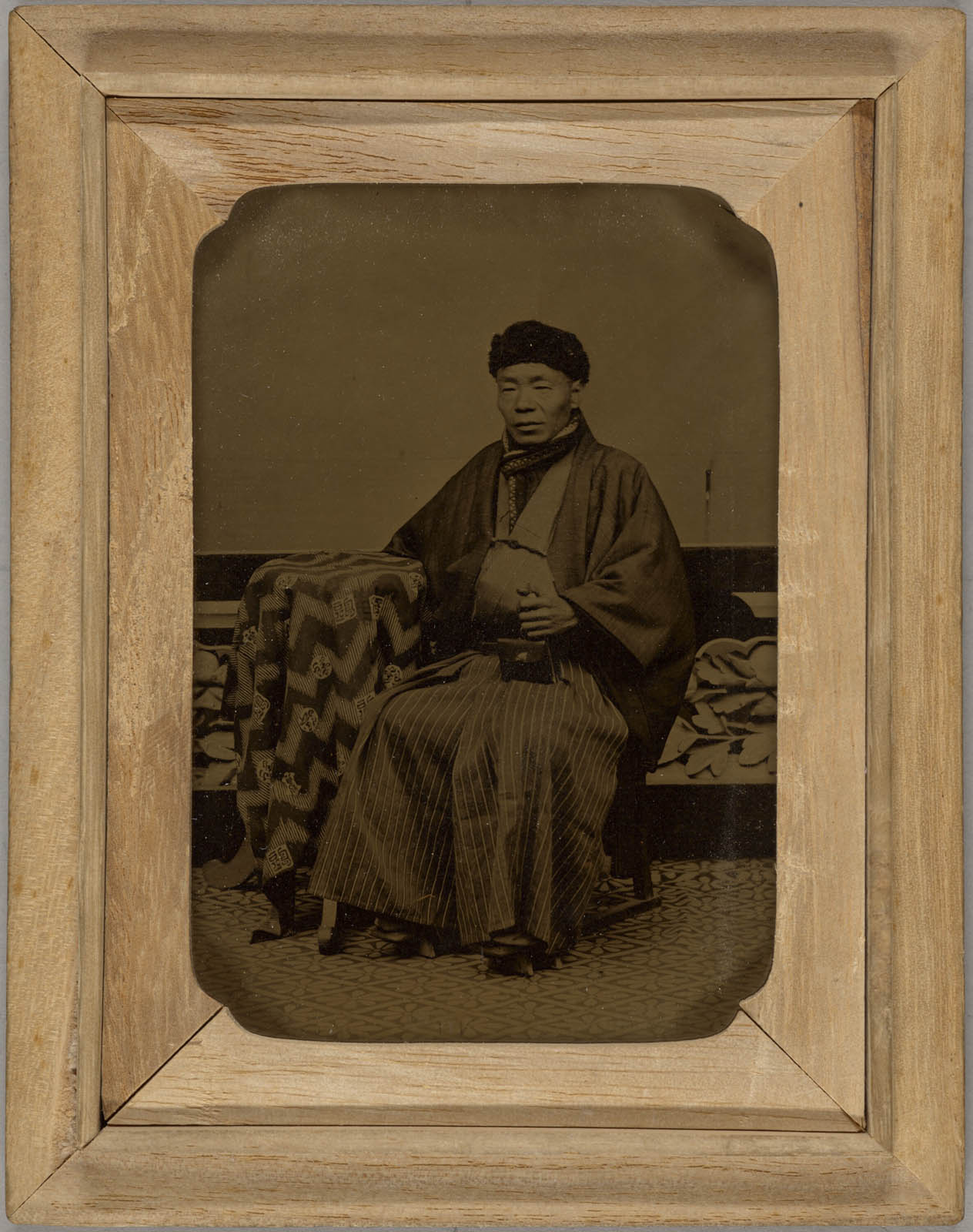
 

Maker unknown. 'Kuroda Yasaburo, 50 Years Old' January 6, 1882


Maker unknown
Kuroda Yasaburo, 50 Years Old
January 6, 1882
Ambrotype
Closed: 11.5 × 9 × 1cm (4 1/2 × 3 9/16 × 3/8 in.)
The J. Paul Getty Museum, Los Angeles
Gift of Virginia Heckert in memory of Gordon Baldwin


Myra Greene (American, b. 1975) 'Undertone #10' 2017-2018


Myra Greene (American, b. 1975)
Undertone #10
2017-2018
Ambrotype
The J. Paul Getty Museum, Los Angeles
© Myra Greene


__________________________________________

Identity


At left, Various makers. 'Pickpockets at the Universal Exposition of 1889' 1889; and at right, Fiona Tan (Indonesia, b. 1966) 'Marie Thiriot' 2021


At left, Various makers Pickpockets at the Universal Exposition of 1889 1889; and at right, Fiona Tan (Indonesia, b. 1966) Marie Thiriot 2021


Fiona Tan (Indonesia, b. 1966) 'Marie Thiriot' 2021


Fiona Tan (Indonesia, b. 1966)
Marie Thiriot
2021
From the series Pickpockets
HD video installation, stereo, flat-screen monitor
Courtesy of the artist and Frith Street Gallery, London
© Fiona Tan
Photo: Frith Street Gallery CC


‘As an artist working almost entirely with time-based and lens-based media, time is one of my major tools … time is both tool with which to shape and chisel and material to fold, distort and configure.’

Fiona Tan (b. 1966, Pekanbaru) explores history and time and our place within them, working within the contested territory of representation. Deeply embedded in all of Tan’s works is her fascination with the mutability of identity, the deceptive nature of representation and the play of memory across time and space in a world increasingly shaped by global culture. She investigates how we represent ourselves and the mechanisms that determine how we interpret the representation of others. …

A testament to Tan’s passion for archives, her video installation Pickpockets (2020) stems from an album of photographs she came across when in residence at the Getty Research Center, Los Angeles. It contained early examples of mugshots taken of pickpockets apprehended at the World’s Fair in Paris in 1889. Fascinated by the subjects of these portraits, their names and countries of origin, and their unknown stories, she invited a group of writers to devise monologues from the point of view of these individuals, which were then performed and recorded by actors.

Anonymous. “Fiona Tan,” on the Frith Street Gallery website Nd [Online] Cited 29/04/2024


[The identity section] has “Affaire Alaux, Faubourg St. Honoré – L’Assassin” (Nov. 2, 1902), a print by Alphonse Bertillon, the inventor of the mug shot, showing the mustached villain full-face and in profile; it is accompanied by over 20 pictures of sites that played a significant role in Bertillon’s life taken in 2012 by Stéphanie Solinas employing a “crime scene” approach.

William Meyers. “Photography’s Past and Present at the Getty Center,” on The Wall Street Journal website May 29, 2024 [Online] Cited 16/06/2024


At left, Attributed to Alphonse Bertillon (French, 1853-1914) 'Affaire Alaux, Faubourg St. Honoré – L'Assassin' November 2, 1902; and at right, Stéphanie Solinas (French, b. 1978) 'Untitled (M. Bertillon) – Two Faces' 2012


At left, Attributed to Alphonse Bertillon (French, 1853-1914) Affaire Alaux, Faubourg St. Honoré – L’Assassin November 2, 1902; and at right, Stéphanie Solinas (French, b. 1978) Untitled (M. Bertillon) – Two Faces 2012


Identity

As is still the case today, the most popular subjects for the camera in the nineteenth century were people. Early commercial portrait photographers set up studios and established standards for posing and props, serving clients who eagerly shared these prized images with family and friends. Other portraits of the time, however, such as the mug shot and studies of female “hysterics,” reinforced questionable forms of objectification. Paul Mpagi Sepuya and Myra Greene respond to the complex history of photographic portraiture. Fiona Tan, Laura Larson, and Stéphanie Solinas investigate the nineteenth century pseudosciences that relied on the perceived accuracy of the new medium.
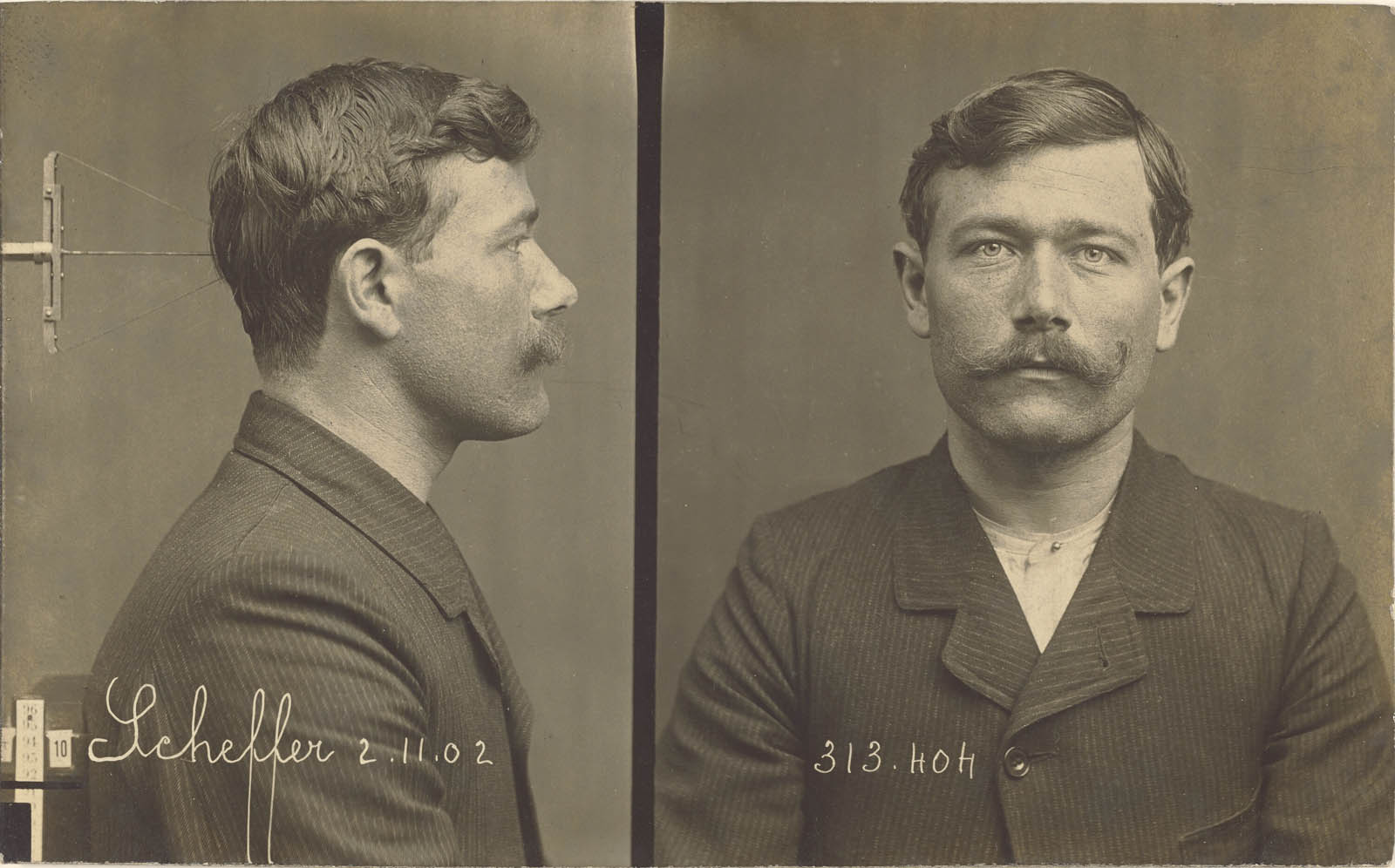
 

Attributed to Alphonse Bertillon (French, 1853-1914) 'Affaire Alaux, Faubourg St. Honoré – L'Assassin' November 2, 1902


Attributed to Alphonse Bertillon (French, 1853-1914)
Affaire Alaux, Faubourg St. Honoré – L’Assassin
November 2, 1902
Gelatin silver print
Image: 7.9 × 12.7cm (3 1/8 × 5 in.)
The J. Paul Getty Museum, Los Angeles


The mugshot of Henri-Léon Scheffer, the man who murdered Joseph Reibel.


CAUGHT BY A FINGER PRINT

A unique piece of detective work has been accomplished in Paris by a retiring scientist. A mysterious murder had been committed. The detectives arrested one wrong man dis charged him, and were preparing .to arrest another when to their chief came the quiet scientist, saying,

“The assassin’s name is Henri Léon Scheffor. Here is his photograph, his description and past record.” M. Cochefert, chief of the police hesitated. “My men know nothing of this person.” he said. “How shall we accuse him ?”

“Arrest him,” insisted the other, “and should he prove to innocent I will pay him 1,000 francs as an indemnity.”

“But what basis have you for your certainty of his guilt ?” asked M. Cochefert.

“Some finger prints he left on a piece of broken glass,” replied the man of science.

It was not necessary to pay the indemnity. He who was thus strangely accused was arrested and confessed his crime. The quiet man of science was M. Alphonse Bertillon, already celebrated as the founder and present chief of tho anthropometric service of tho Paris prefecture of police. Alphonse Bertillon has the gentle, weary smile of the over-worked and nervous student. He speaks mildly, moves softly, like one on his guard against strain and haste, until now and again, his thoughtful face will light up with enthusiasm as he lets himself go. Then his conversation becomes rapid and eloquent ; he runs through books and documents with ardour, pulls down boxes from high shelves, spreads out charts, explains them, performs experiments to illustrate his statements and darts back by a short cut to tho point where he had left off; tho whole man is transformed. Thus we heard the tale of the Accusing Finger Prints.

“A man named Joseph Reibel, porter to tho dentist Allaux, in his apartment and offices in the Rue du Faubourg Saint-Honore, was found choked to death and clumsily tied, lying in his master’s office,” began M. Bertillon. “The place had been looted hastily, closets and drawers being open and their contents tossed about. In particular a handsome cabinet holding a collection of coins was found with its glass door broken and its gold coins absent. There were- practically no clues to the identity of the assassin, the janitress at the street door, having a confused memory as to visitors, which set the detectives on more than one wrong scent. They arrested one man and the papers published his portrait. Then the newspapers at least began to suspect the innocent dentist himself.

“They had taken a flashlight photograph of the office,” continued M. Bertillon. “Looking at that photograph one day, I noticed two glittering little white marks on the edge of the broken glass of the coin cabinet. I asked my self what they could be. They might be defects in the printing ; but, on the other hand their situation suggested that they might be finger prints – and finger-prints are very much in my line ! The thought wore upon me until at last I jumped into a cab and drove to tho place. Examining the edge of the glass I found tho marks to be really finger-marks, and in spite of the thousand chances still in good condition.

“Being composed of tiny quantities of grease and dirt they made the glass slightly opaque, so that they came out bright by contrast in the photograph. Except when looked at in a favourable light they were practically invisible to the naked eye. There were marks of a right-hand thumb in one place and of the same thumb and four fingers in another. I had the two pieces of glass cut out with a diamond. I gave one to a policeman, instructing him to hold it just so, and saw him start off to my office with it in a cab. Then I gave tho other piece to a second policeman, with the same instructions, and started him off in a second cab, so that if an accident should happen to one of the pieces the other might be spared.

“In the workrooms of the anthropometric service I had the finger-marks immediately photographed. At first I admit I did not attach overmuch importance to them. They might be the prints of one of the detectives, or of the dentist Allaux – naturally solicitous of his broken cabinet – or even the finger-prints of M. Cochefert ! One by one I took their finger-prints for comparison. One by one I found that they did not at all correspond with those on the glass. This started me in earnest,” admitted M. Bertillon. “I began to ask myself, if among the thousands of criminals, swindlers and violent and suspicious characters photo-graphed, measured, and, finger-printed yearly by the anthropometric service the author of these finger-prints might not, at some time or other, himself have passed.” Here M. Bertillon called our attention to the thumb mark (“pouce”) of Scheffer, the assassin, Just below his full-face and profile photographs. Though small it was very distinct.

“Look at the central point of that thumb-print,” he exclaimed. “Look where the innermost loop moves up and over a single diagonal. Now jumping two loops from that interior diagonal, towards tho direct left you see a plain little fork in tho third loop. It is the exact reproduction of just such another in the thumb-mark on the broken glass ! Tho next thing was to arrest Scheffer though it took a little time to find him. Here, again, the information obtainable from his ‘fiche’ in the anthropometric service rendered service. It was seen that he had been a native of Aubervilliers (the Paris suburb and had worked in the government match factory. When arrested he confessed, at the same time trying to make out a case of extenuating circumstances. According to his story, Reibel planned that they should simulate a burglary of his master’s premises. They quarrelled over the division of the spoils and Scheffer says he thought he had merely choked his friend into un-consciousness and left him tied – according to original agreement. And all discovered through an accidental finger-print which the assassin had left as an index to the crime. “Science Siftings.”

Anonymous. “Caught by a Finger Print,” in the Balmain Observer and Western Suburbs Advertiser (NSW: 1884-1907), Sat 4 Mar 1905, Page 2 on the Trove website [Online] Cited 29/04/2024

__________________________________________

Time
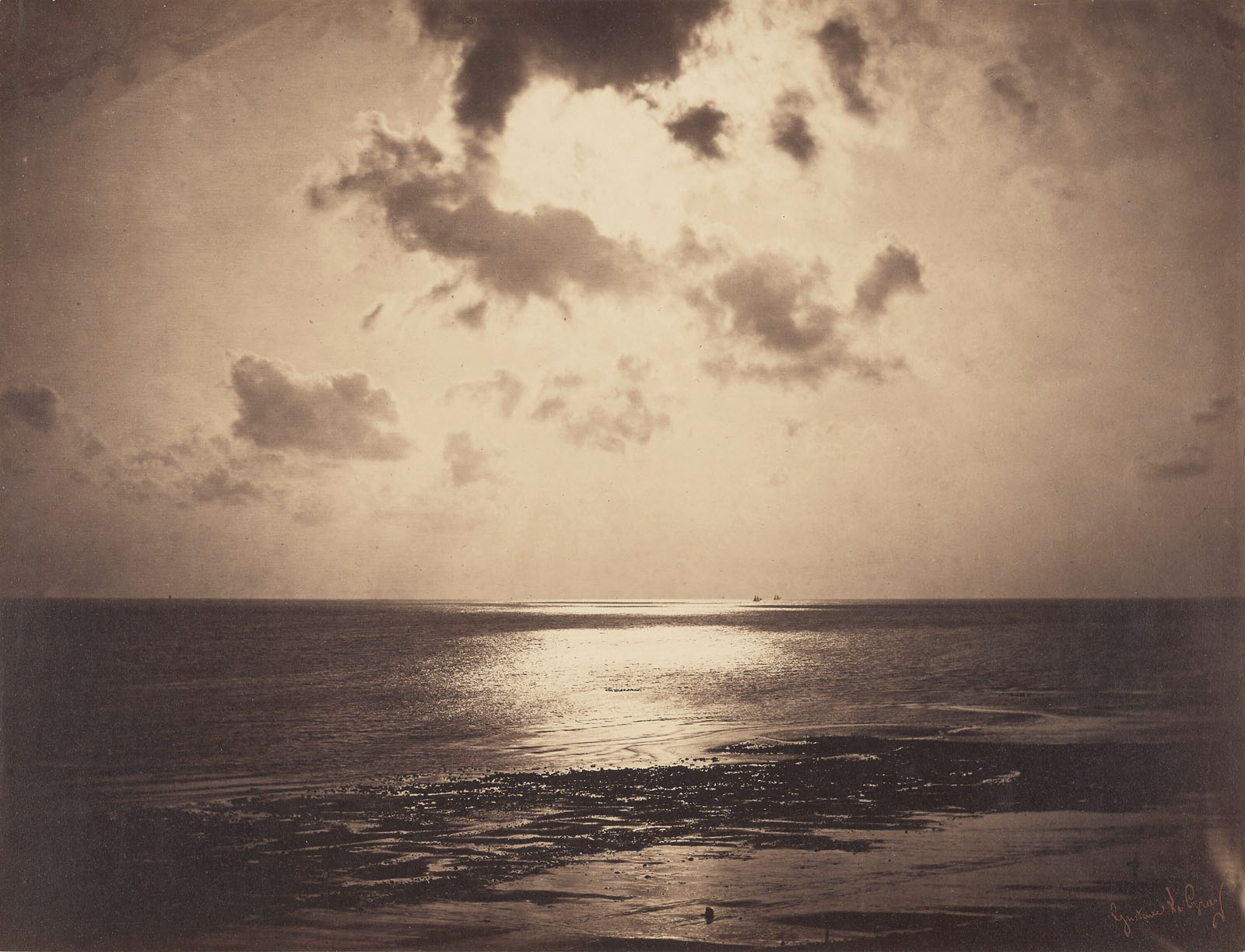
 

Gustave Le Gray (French, 1820-1884) 'An Effect of Sunlight – Ocean No. 23' 1857-1858


Gustave Le Gray (French, 1820-1884)
An Effect of Sunlight – Ocean No. 23
1857-1858
Albumen silver print from glass negatives
12 5/8 × 16 7/16 in.
The J. Paul Getty Museum, Los Angeles


Lisa Oppenheim (American, b. 1975) 'An Effect of Sunlight – Ocean No. 23 (1857/2019)' 2019


Lisa Oppenheim (American, b. 1975)
An Effect of Sunlight – Ocean No. 23 (1857/2019)
2019
Gelatin silver print, exposed to sunlight and toned with silver
Framed [Outer Dim]: 35.6 × 47.7 × 3.7cm (14 × 18 3/4 × 1 7/16 in.)
The J. Paul Getty Museum, Los Angeles
© Lisa Oppenheim


Time

Photography and time have been inextricably linked ever since early inventors such as William Henry Fox Talbot struggled to permanently fix a fleeting moment on a sheet of paper. The development of the camera coincided with new discoveries about how we perceive an instant in time or an object in motion, and people praised photography for its ability to “stop time” and record what the unaided eye could not see. Lisa Oppenheim and Liz Deschenes respond to nineteenth century photographers’ technical innovations and the ways in which the medium affects our perception of time. Phil Chang and Hiroshi Sugimoto address the fate of photographs across minutes or even centuries.


At left, Étienne-Jules Marey (French, 1830-1904) and Michel Berthaud (French, active 1860s-1880s) 'Walking/Running' (La Marche/La Course Rapide) about 1890, published 1893; and at right, Liz Deschenes (American, b. 1966) 'FPS (120)' 2018-2021


At left, Étienne-Jules Marey (French, 1830-1904) and Michel Berthaud (French, active 1860s-1880s) Walking/Running (La Marche/La Course Rapide) about 1890, published 1893; and at right, Liz Deschenes (American, b. 1966) FPS (120) 2018-2021
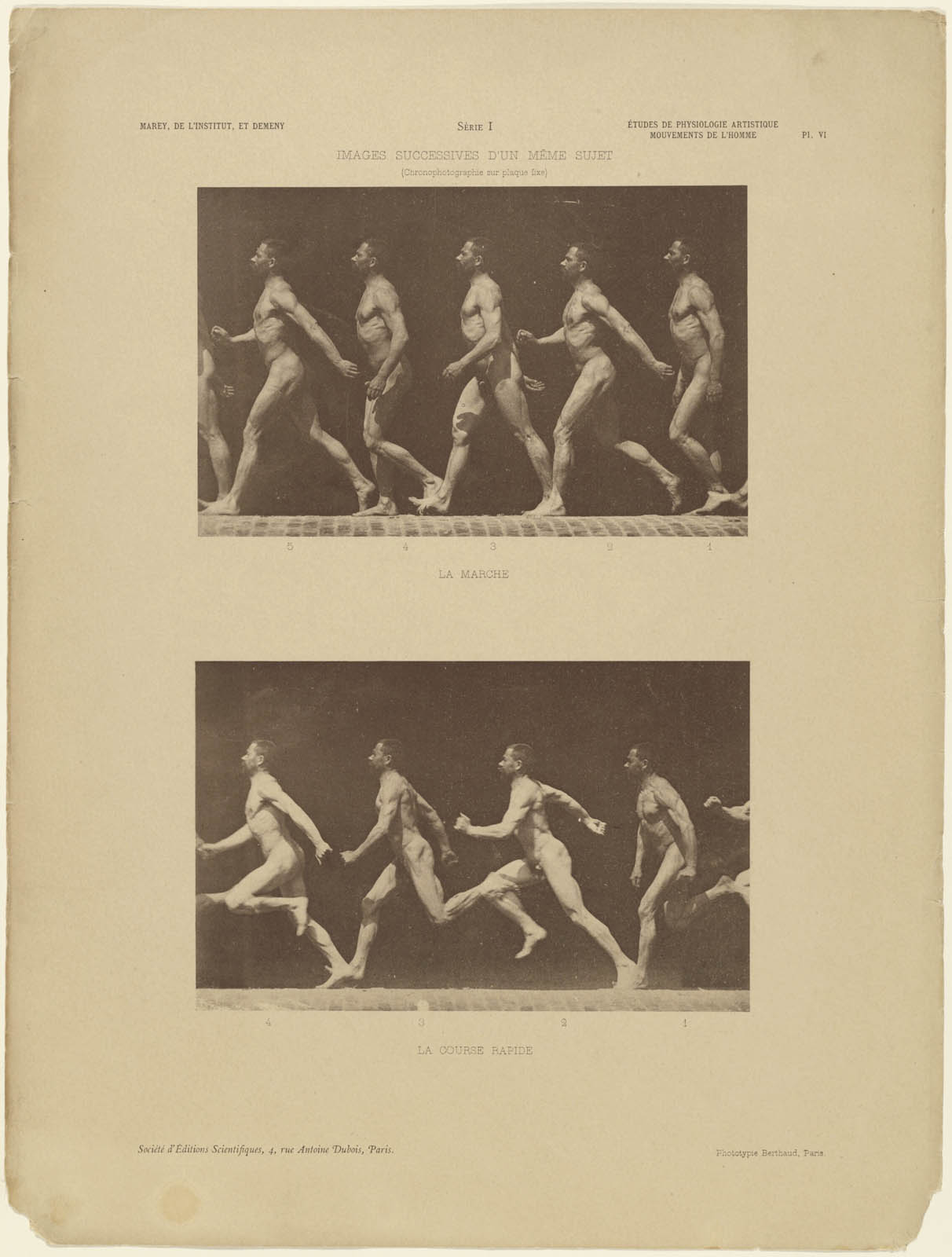
 

Étienne-Jules Marey (French, 1830-1904) and Michel Berthaud (French, active 1860s-1880s) 'Walking/Running' (La Marche/La Course Rapide) about 1890, published 1893


Étienne-Jules Marey (French, 1830-1904) and Michel Berthaud (French, active 1860s-1880s)
Walking/Running (La Marche/La Course Rapide)
about 1890, published 1893
Collotype
Image: 11.3 × 17.6cm (4 7/16 × 6 15/16 in.)
The J. Paul Getty Museum, Los Angeles

__________________________________________

Spirit


At left, William H. Mumler (American, 1832-1884) 'Mrs. Swan' 1869-1878; and at right, Khadija Saye (Gambian-British, b. 1992) 'Nak Bejjen' [Cow's Horn] 2017-2018


At left, William H. Mumler (American, 1832-1884) Mrs. Swan 1869-1878; and at right, Khadija Saye (Gambian-British, b. 1992) Nak Bejjen [Cow’s Horn] 2017-2018


Spirit

The genre of spirit photography – which used photographic tricks to insert ghostly figures among the living – emerged during the nineteenth century from the Victorian obsession with death, séances, and mediums in Europe and North America and from the losses of the Civil War in the United States. Photographers exploited the ability to manipulate photographic images, employing multiple exposures and staged photography to create otherworldly scenes or to summon loved ones back from the dead. Khadija Saye and Lieko Shiga respond to the possibilities that spirit photography offers in rendering the unseen.


William H. Mumler (American, 1832-1884) 'Mrs. Swan' 1869-1878


William H. Mumler (American, 1832-1884)
Mrs. Swan
1869-1878
Albumen silver print
Image: 8.9 × 5.7cm (3 1/2 × 2 1/4 in.)
The J. Paul Getty Museum, Los Angeles
Public domain


Khadija Saye (Gambian-British, b. 1992) 'Nak Bejjen' [Cow's Horn] 2017-2018


Khadija Saye (Gambian-British, b. 1992)
Nak Bejjen [Cow’s Horn]
2017-2018
From the series in this space we breathe
Silkscreen print
The J. Paul Getty Museum, Los Angeles
Purchased with funds provided by the Photographs Council
© Estate of Khadija Saye


At left, Unknown maker (American) '[Seated Woman with "Spirit" of a Young Man]' about 1865-1875; and at right, Lieko Shiga (Japanese, b. 1980) 'Talking with Me' 2005 From the series 'Lilly'


At left, Unknown maker (American) [Seated Woman with “Spirit” of a Young Man] about 1865-1875; and at right, Lieko Shiga (Japanese, b. 1980) Talking with Me 2005 From the series Lilly


Unknown maker (American) '[Seated Woman with "Spirit" of a Young Man]' about 1865-1875


Unknown maker (American)
[Seated Woman with “Spirit” of a Young Man]
about 1865-1875
Tintype
Image: 8.7 × 6.4cm (3 7/16 × 2 1/2 in.)
The J. Paul Getty Museum, Los Angeles
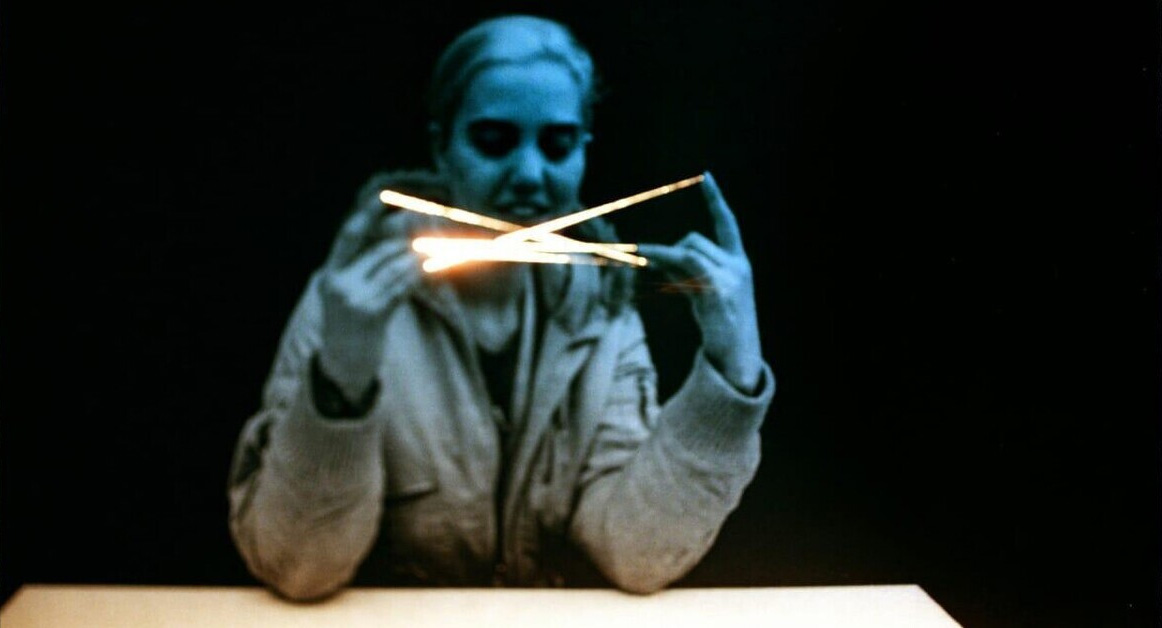
 

Lieko Shiga (Japanese, b. 1980) 'Talking with Me' 2005


Lieko Shiga (Japanese, b. 1980)
Talking with Me
2005
From the series Lilly


‘Lilly’ is a photographic essay that was initiated in 2005 when Lieko Shiga was living in London. During that period she produced a series of images of her neighbours that lived alongside her in a block of East London council flats, drawing techniques and inspiration from paranormal photographs that were popular in the early days of photography. Haunting, mysterious, playful and captured in an array of muted colours, the photographs [are] grouped around different subjects…

Publisher’s Description

__________________________________________

Landscape
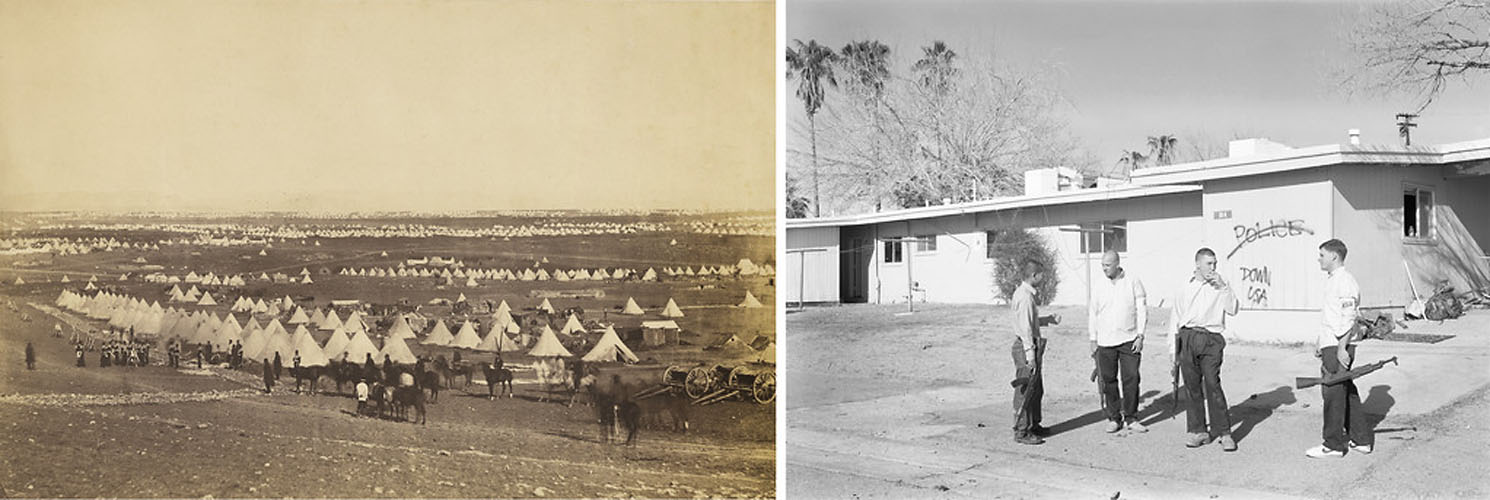
 

At left, Roger Fenton (English, 1819-1869) 'Plateau of Sebastopol II' 1855; and at right, An-My Lê (Vietnamese American, b. 1960) 'Security and Stabilization Operations, Iraqi Police' 2003-2004


At left, Roger Fenton (English, 1819-1869) Plateau of Sebastopol II 1855; and at right, An-My Lê (Vietnamese American, b. 1960) Security and Stabilization Operations, Iraqi Police 2003-2004
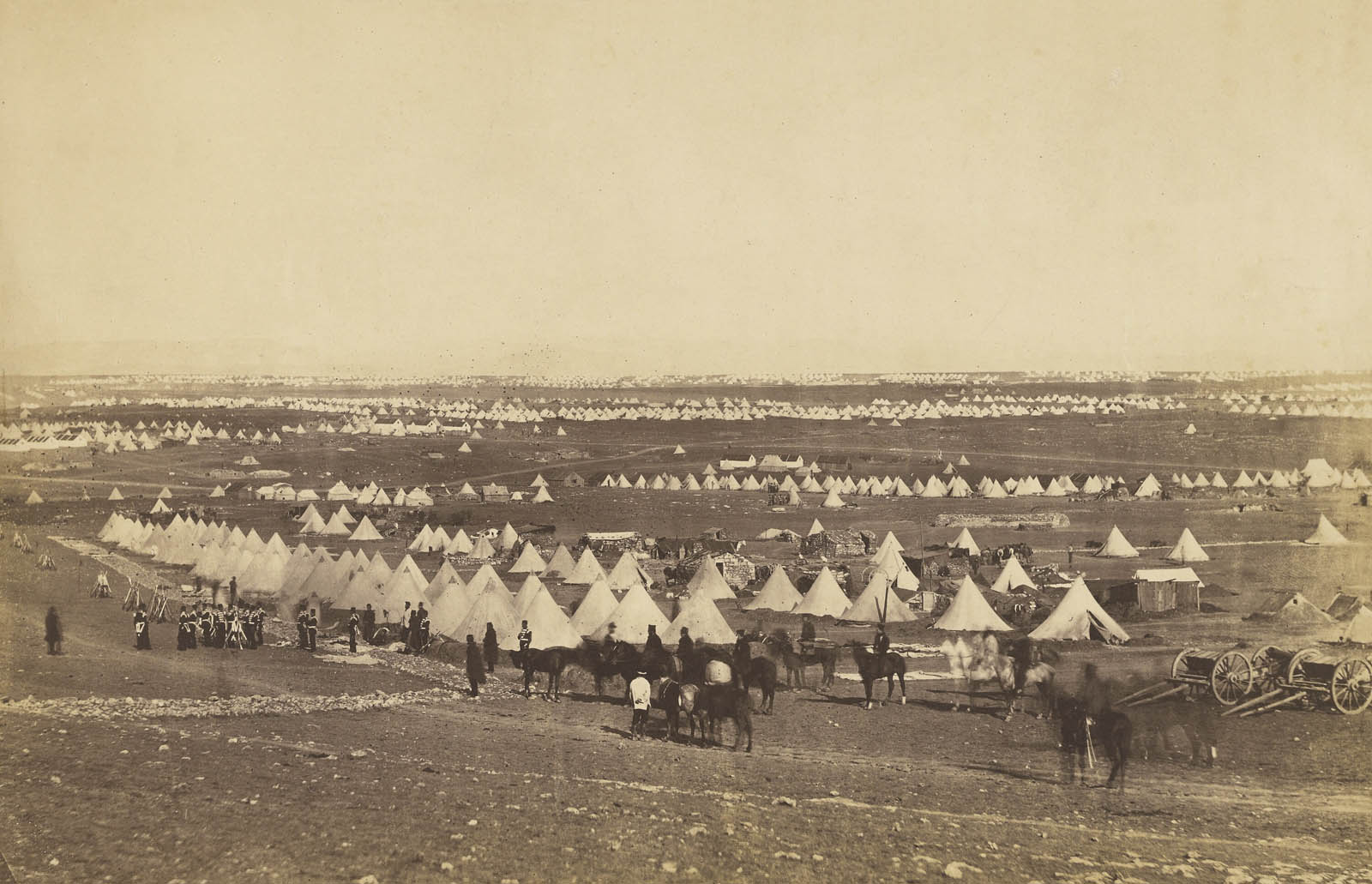
 

Roger Fenton (English, 1819-1869) 'Plateau of Sebastopol II' 1855


Roger Fenton (English, 1819-1869)
Plateau of Sebastopol II
1855
Albumen silver print
Image: 22.2 × 34.4cm (8 3/4 × 13 9/16 in.)
The J. Paul Getty Museum, Los Angeles
Public domain
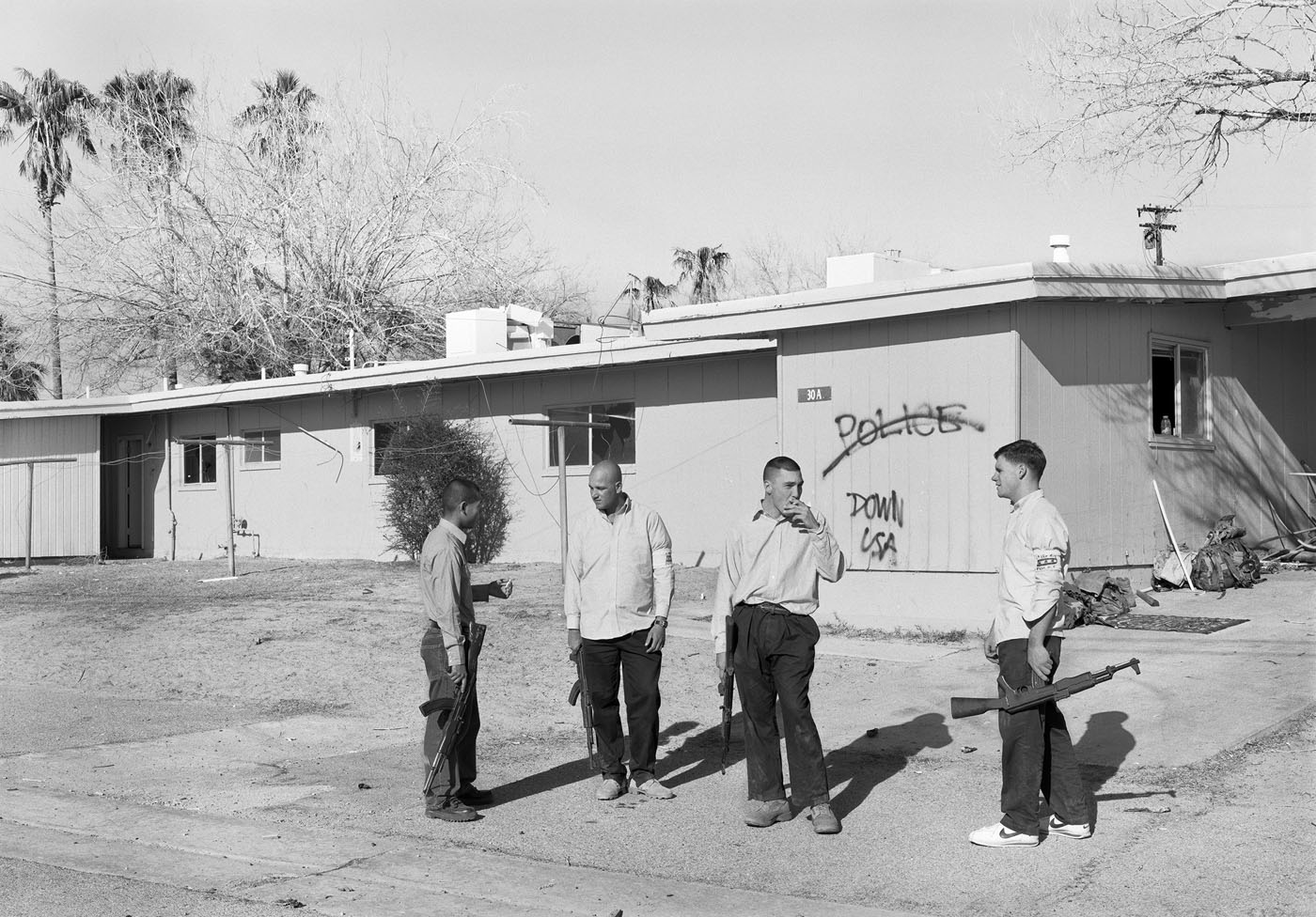
 

An-My Lê (Vietnamese-American, b. 1960) 'Security and Stabilization Operations, Iraqi Police' 2003-2004


An-My Lê (Vietnamese American, b. 1960)
Security and Stabilization Operations, Iraqi Police
2003-2004
From the series 29 Palms
Gelatin silver print
The J. Paul Getty Museum, Los Angeles
Courtesy of the artist and Marian Goodman Gallery
© An-My Lê


Landscape

Nineteenth-century photographers went to great lengths to make images of remote landscapes, which required traveling with large format cameras, glass plates, and chemicals. Ideological forces drove many of these journeys, with the ultimate goal of imperial expansion through industrial development and war. Government sponsored surveys and expeditionary programs employed the camera to justify the expansion and to record the resulting military conflicts. Mark Ruwedel, Michelle Stuart, and An-My Lê re-envision some of these same historical landscapes and offer up new ones that bring the past closer to our present.


At left, Timothy O'Sullivan (American, about 1840-1882) 'Desert Sand Hills Near Sink of Carson, Nevada' 1867; and at right, Michelle Stuart (American, b. 1933) 'Timeless Land' 2021


At left, Timothy O’Sullivan (American, about 1840-1882) Desert Sand Hills Near Sink of Carson, Nevada 1867; and at right, Michelle Stuart (American, b. 1933) Timeless Land 2021
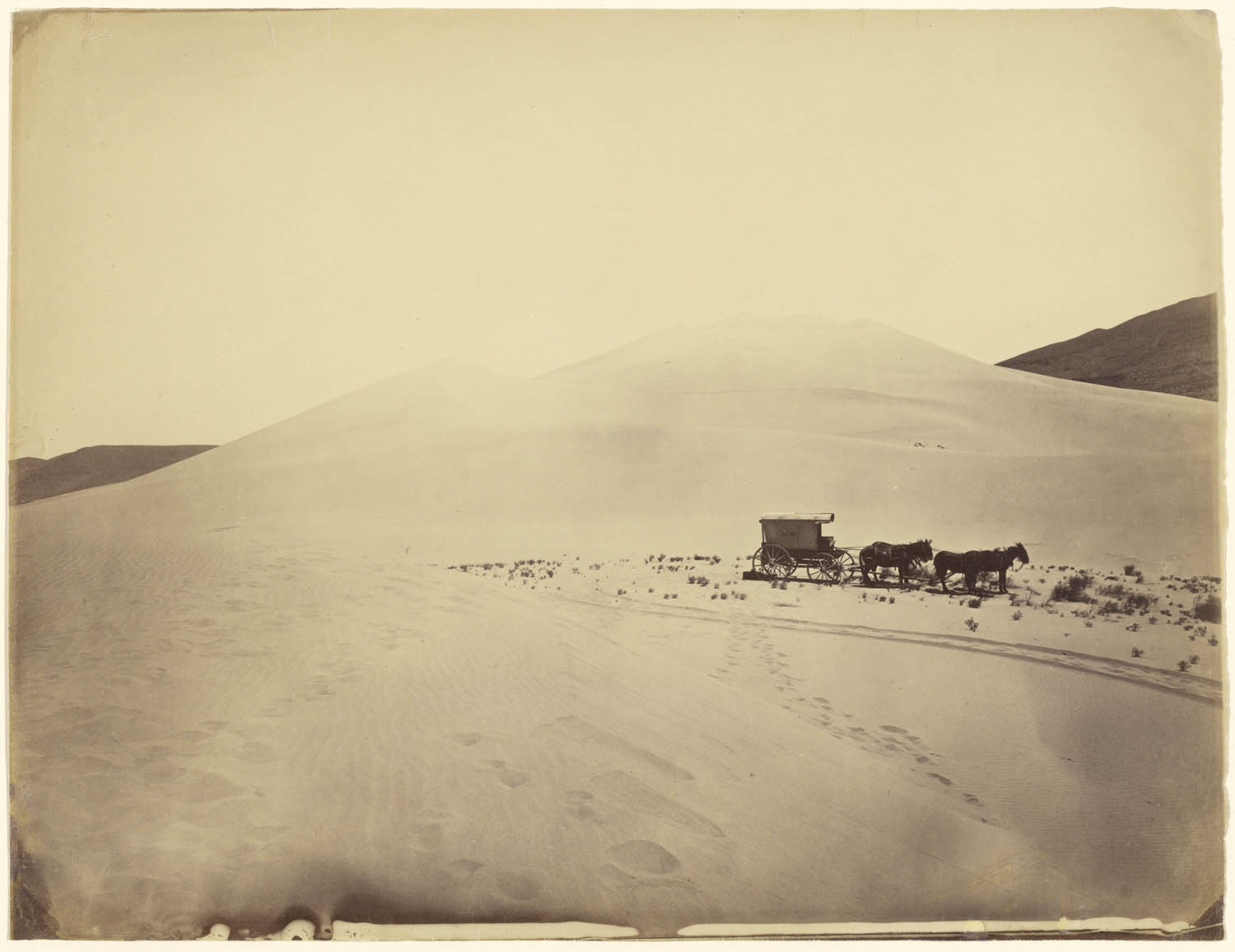
 

Timothy O'Sullivan (American, about 1840-1882) 'Desert Sand Hills Near Sink of Carson, Nevada' 1867


Timothy O’Sullivan (American, about 1840-1882)
Desert Sand Hills Near Sink of Carson, Nevada
1867
Albumen silver print
The J. Paul Getty Museum, Los Angeles
Public domain


Timothy O’Sullivan’s darkroom wagon, pulled by four mules, entered the frame at the right side of the photograph, reached the center of the image, and abruptly U-turned, heading back out of the frame. Footprints leading from the wagon toward the camera reveal the photographer’s path. Made at the Carson Sink in Nevada, this image of shifting sand dunes reveals the patterns of tracks recently reconfigured by the wind. The wagon’s striking presence in this otherwise barren scene dramatises the pioneering experience of exploration and discovery in the wide, uncharted landscapes of the American West.

O’Sullivan’s photographs from the 1867 Geological Exploration of the Fortieth Parallel expedition were intended to provide information for the purpose of expanding railroads and industry, yet they demonstrate his eye for poetic beauty.

Text from the J. Paul Getty Museum website
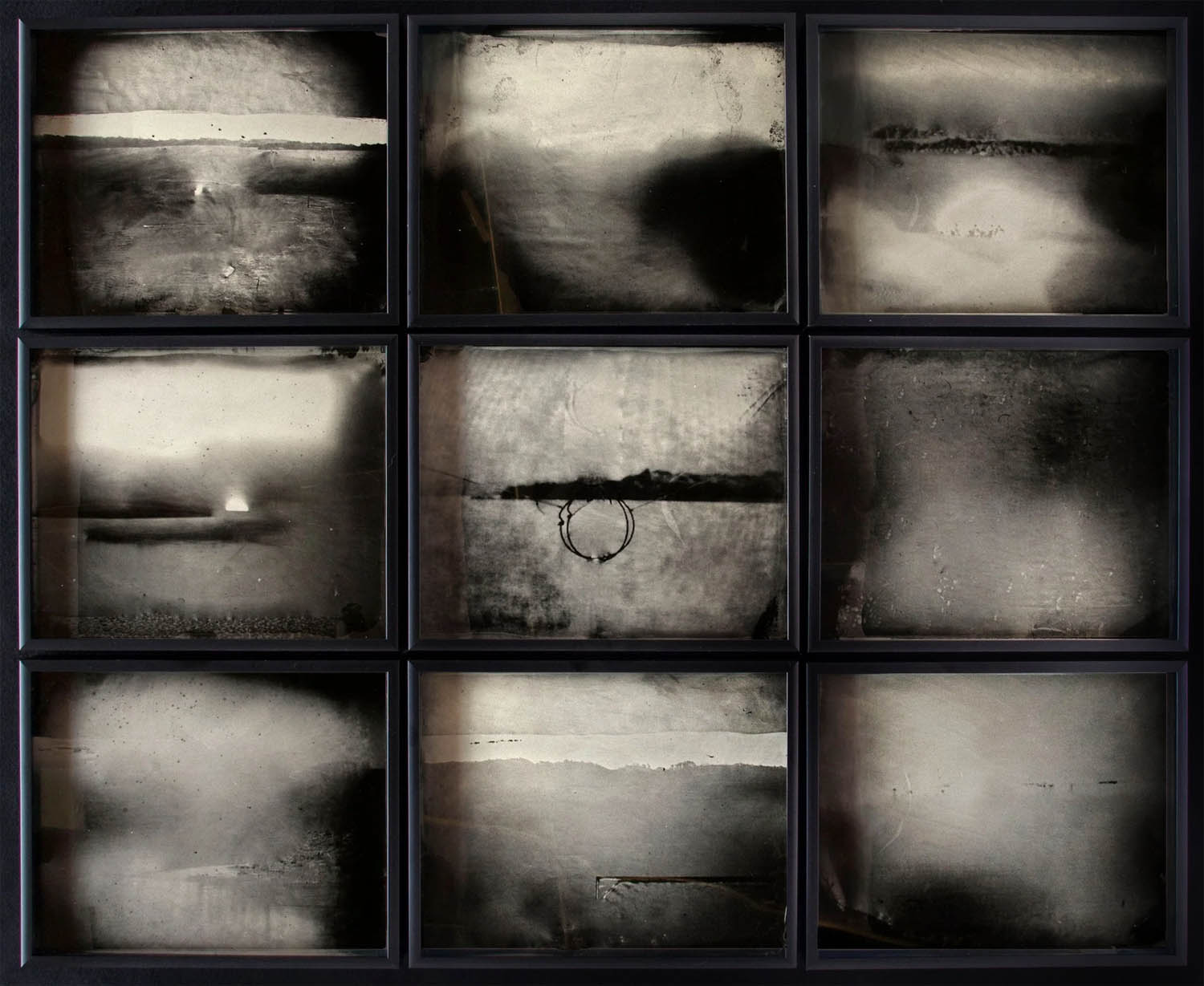
 

Michelle Stuart (American, b. 1933) 'Timeless Land' 2021


Michelle Stuart (American, b. 1933)
Timeless Land
2021
Ambrotypes
The J. Paul Getty Museum, Los Angeles
Purchased with funds provided by the Photographs Council
© Michelle Stuart


A.J. Russell (American, 1830-1902) 'Embankment No. 3 West of Granite Cannon [Wyoming]' April 1868


A.J. Russell (American, 1830-1902)
Embankment No. 3 West of Granite Cannon [Wyoming]
April 1868
Albumen silver print
Image: 21.9 × 29.4 cm (8 5/8 × 11 9/16 in.)
Mount: 34.1 × 43.1 cm (13 7/16 × 16 15/16 in.)
The J. Paul Getty Museum, Los Angeles


Mark Ruwedel (American/Canadian, b. 1954) 'Union Pacific #67 (after A.J. Russell)' 1996


Mark Ruwedel (American/Canadian, b. 1954)
Union Pacific #67 (after A.J. Russell)
1996
Gelatin silver print
Image: 18.9 × 23.9cm (7 7/16 × 9 7/16 in.)
The J. Paul Getty Museum, Los Angeles
© Mark Ruwedel


Mark Ruwedel’s statement in a wall text notes that “The legacy of nineteenth-century expeditionary photography was most important to me when working on my Westward series.” He cites Timothy O’Sullivan, Alexander Gardner and A.J. Russell. The Landscape section has a print by A.J. Russell, “Embankment No. 3 West of Granite Cannon. [Wyoming]” (April 1868), and seven pictures by Mr. Ruwedel: “Union Pacific #39 (After A.J. Russell)” and “Union Pacific #67 (After A.J. Russell)” (1994 and 1996, respectively) and five others with no specific acknowledgments but clearly influenced by his 19th-century mentors.

William Meyers. “Photography’s Past and Present at the Getty Center,” on The Wall Street Journal website May 29, 2024 [Online] Cited 16/06/2024
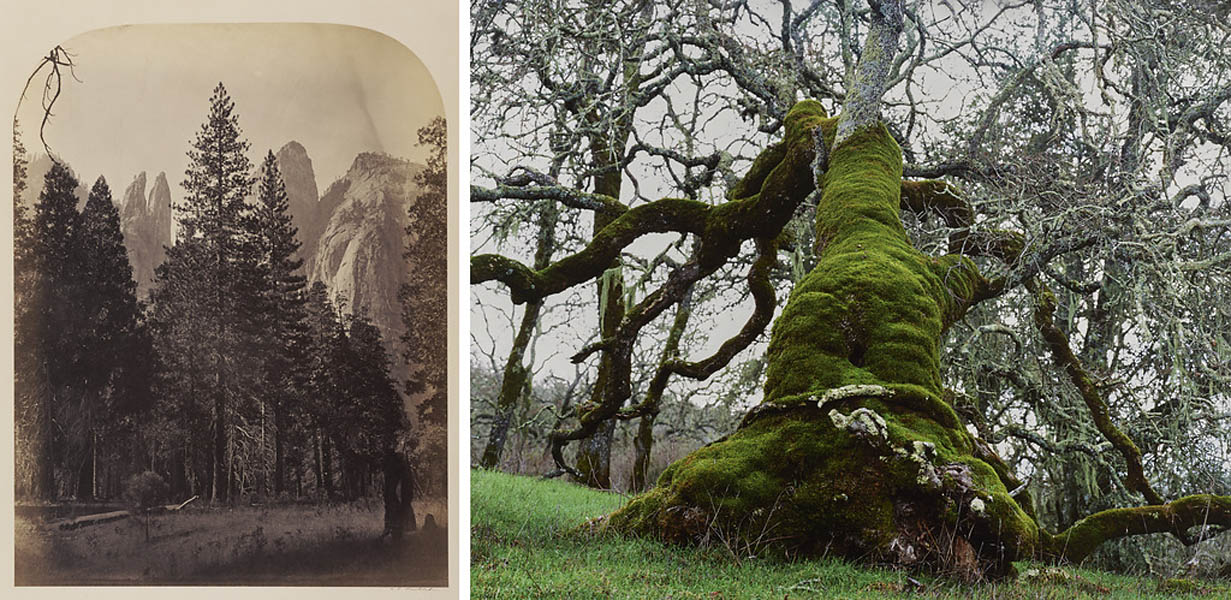
 

At left, Carleton Watkins (American, 1829-1916) 'Cathedral Spires – Yo Semite' 1861; and at right, Ken Gonzales-Day (American, b. 1964) 'At daylight the miserable man was carried to an oak…' Negative 2002; print 2021


At left, Carleton Watkins (American, 1829-1916) Cathedral Spires – Yo Semite 1861; and at right, Ken Gonzales-Day (American, b. 1964) At daylight the miserable man was carried to an oak… Negative 2002; print 2021
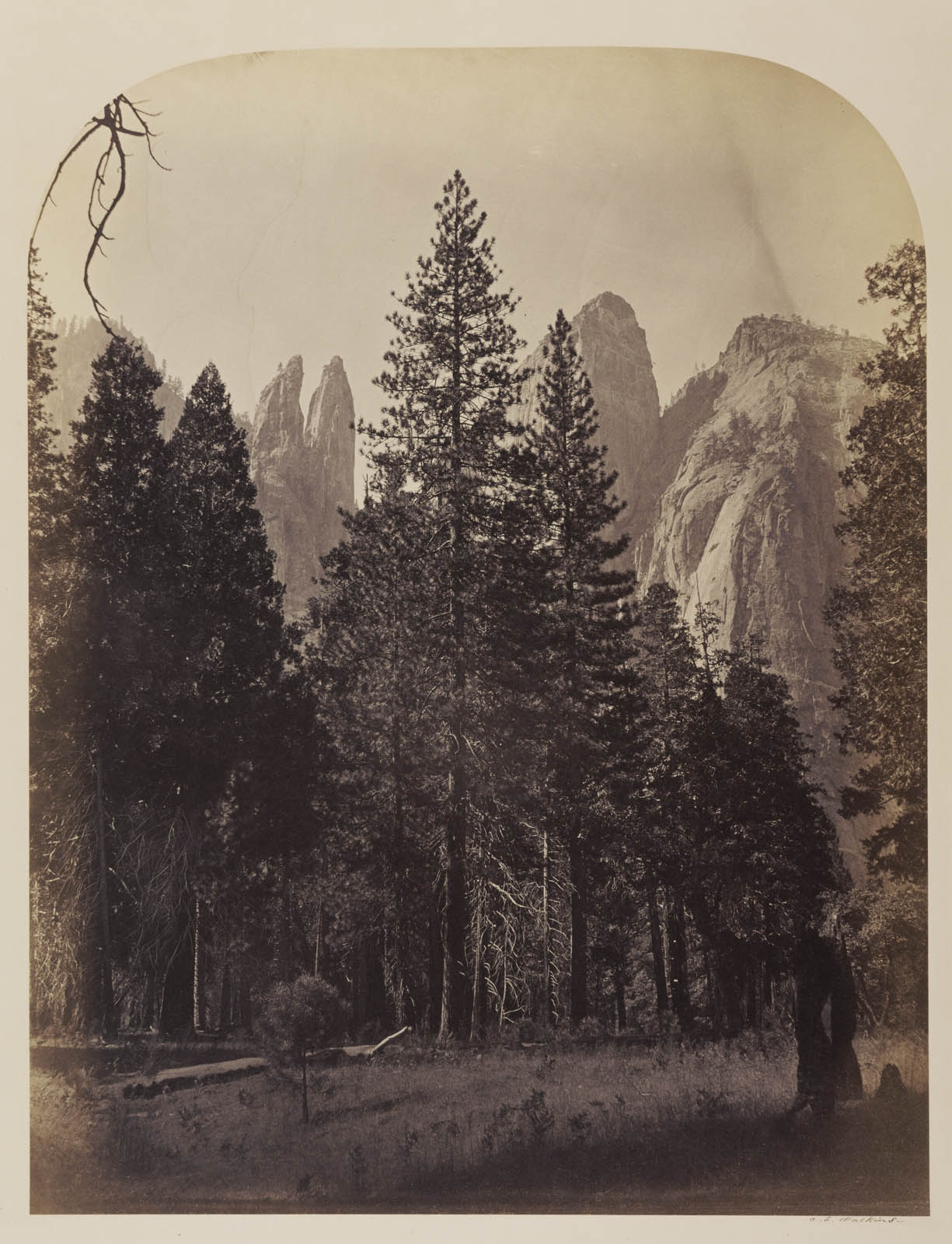
 

Carleton Watkins (American, 1829-1916) 'Cathedral Spires – Yo Semite' 1861


Carleton Watkins (American, 1829-1916)
Cathedral Spires – Yo Semite
1861
Albumen silver print
Image (Dome-Topped): 52.2 × 40.3cm (20 9/16 × 15 7/8 in.)
The J. Paul Getty Museum, Los Angeles


When Carleton Watkins photographed the remote Yosemite wilderness, America was not yet a century old. Conscious of their country’s lack of a national cultural identity, Americans adopted particularly dramatic geologic formations such as Cathedral Spires as their version of ancient ruins and soaring Gothic churches. The great pine tree in the foreground here became another form of this uniquely American history. Watkins’s images helped define America’s preference for landscape views depicting rugged wilderness and celebrating spectacular landforms on the grandest of scales.
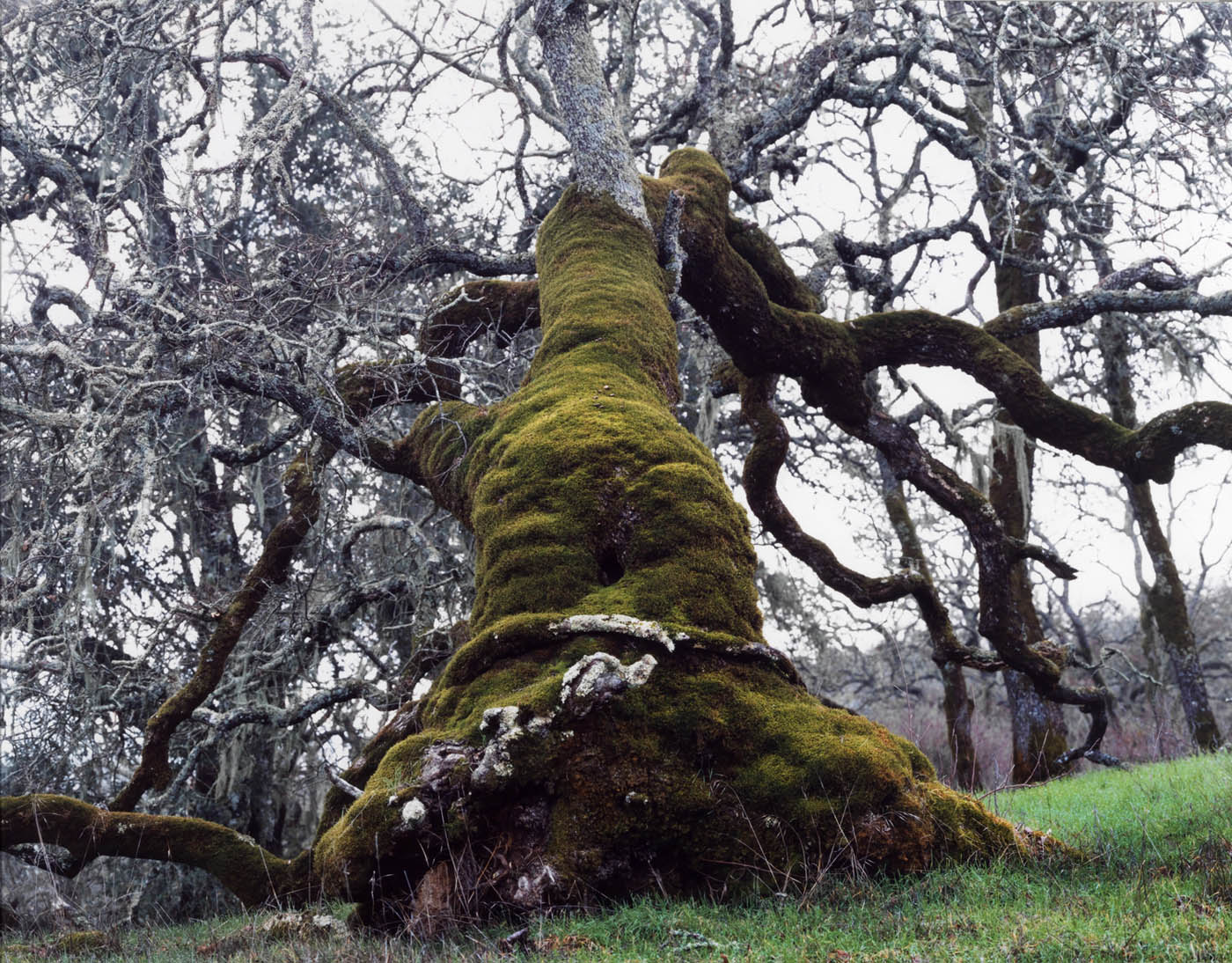
 

Ken Gonzales-Day (American, b. 1964) 'At daylight the miserable man was carried to an oak…' Negative 2002; print 2021


Ken Gonzales-Day (American, b. 1964)
At daylight the miserable man was carried to an oak…
Negative 2002; print 2021
From the series Searching for California’s Hang Trees
Pigment print
Image: 92.7 × 117.5cm (36 1/2 × 46 1/4 in.)
© Ken Gonzales-Day

This print: Smithsonian American Art Museum, Museum purchase through the Luisita L. and Franz H. Denghausen Endowment


Through meticulous research, Gonzales-Day documented approximately 350 lynching incidents that occurred in California between 1850 and 1935, most of which involved victims of Mexican descent. To create the series Searching for California Hang Trees, the artist visited many of these sites and captured the likeness of trees that may have borne witness to these events. Gonzales-Day’s landscapes unearth traces of this little-known history.

Our America: The Latino Presence in American Art, 2013

__________________________________________

Circulation


Charles M. Bell (American, 1848-1893) 'Manulitó, Chief of the Navajos' 1874


Charles M. Bell (American, 1848-1893)
Manulitó, Chief of the Navajos
1874
Albumen silver print
Image (Arched): 18.4 × 14.9cm (7 1/4 × 5 7/8 in.)
The J. Paul Getty Museum, Los Angeles
Public domain
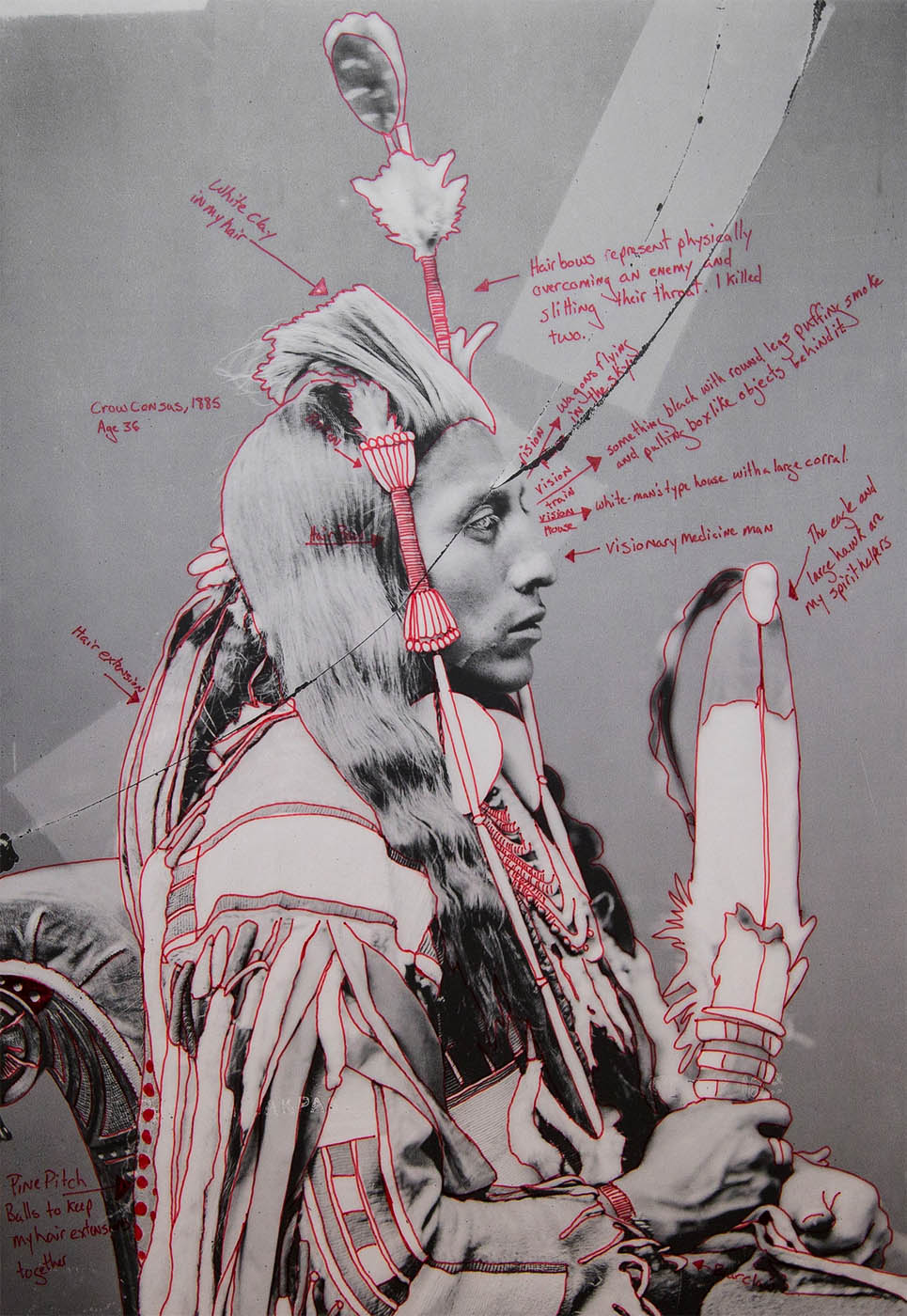
 

Wendy Red Star (American/Apsáalooke, b. 1981) 'Peelatchiwaaxpáash / Medicine Crow (Raven)' 2014


Wendy Red Star (American/Apsáalooke, b. 1981)
Peelatchiwaaxpáash / Medicine Crow (Raven)
2014
From the series Crow Peace Delegation
Inkjet print
Nasher Museum of Art at Duke University
Museum purchase with funds provided by Jennifer McCracken New and Jason G. New
© Wendy Red Star
Image courtesy of the Nasher Museum of Art


Artist-manipulated digitally reproduced photograph by C.M. (Charles Milton) Bell, National Anthropological Archives, Smithsonian Institution, 24 x 16 9/20 inches


Circulation

By the middle of the nineteenth century, thousands of photographs were in circulation worldwide, the result of photographers’ ability to reproduce the same image multiple times. Pictures of historical events, tourist destinations, and anthropological expeditions made the world seem more accessible, but with time and distance, they became disconnected from their original contexts. Many eventually ended up in archives (including at Getty). Early photographs appear next to projects that make these historical absences present. Wendy Red Star, Stephanie Syjuco, Ken Gonzales-Day, and Andrea Chung recover what has been lost, calling out the residual effects of the nineteenth-century photograph on our present knowledge of global cultures and histories.

Text from the J. Paul Getty Museum
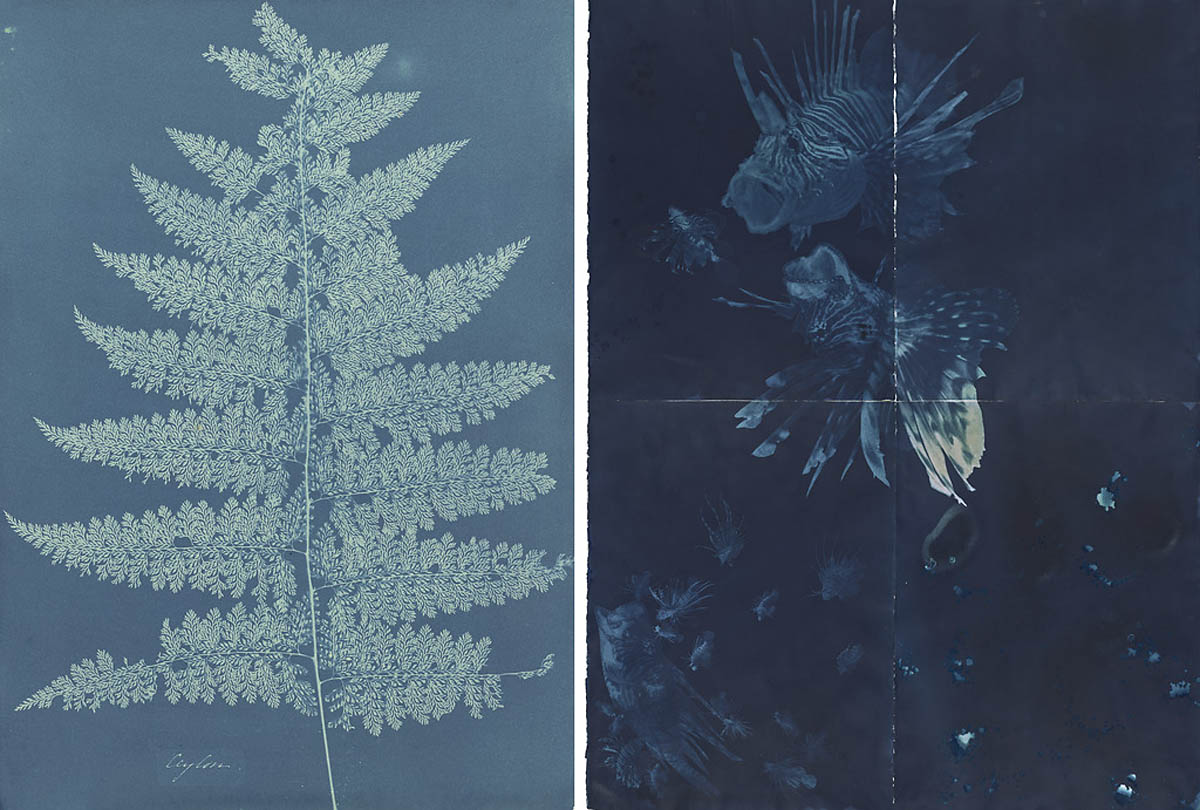
 

At left, Anna Atkins (British, 1799-1871) possibly with Anne Dixon (British, 1799-1877) 'Ceylon/Fern' about 1854; and at right, Andrea Chung (American, b. 1978) 'Untitled' 2016


At left, Anna Atkins (British, 1799-1871) possibly with Anne Dixon (British, 1799-1877) Ceylon/Fern about 1854; and at right, Andrea Chung (American, b. 1978) Untitled 2016
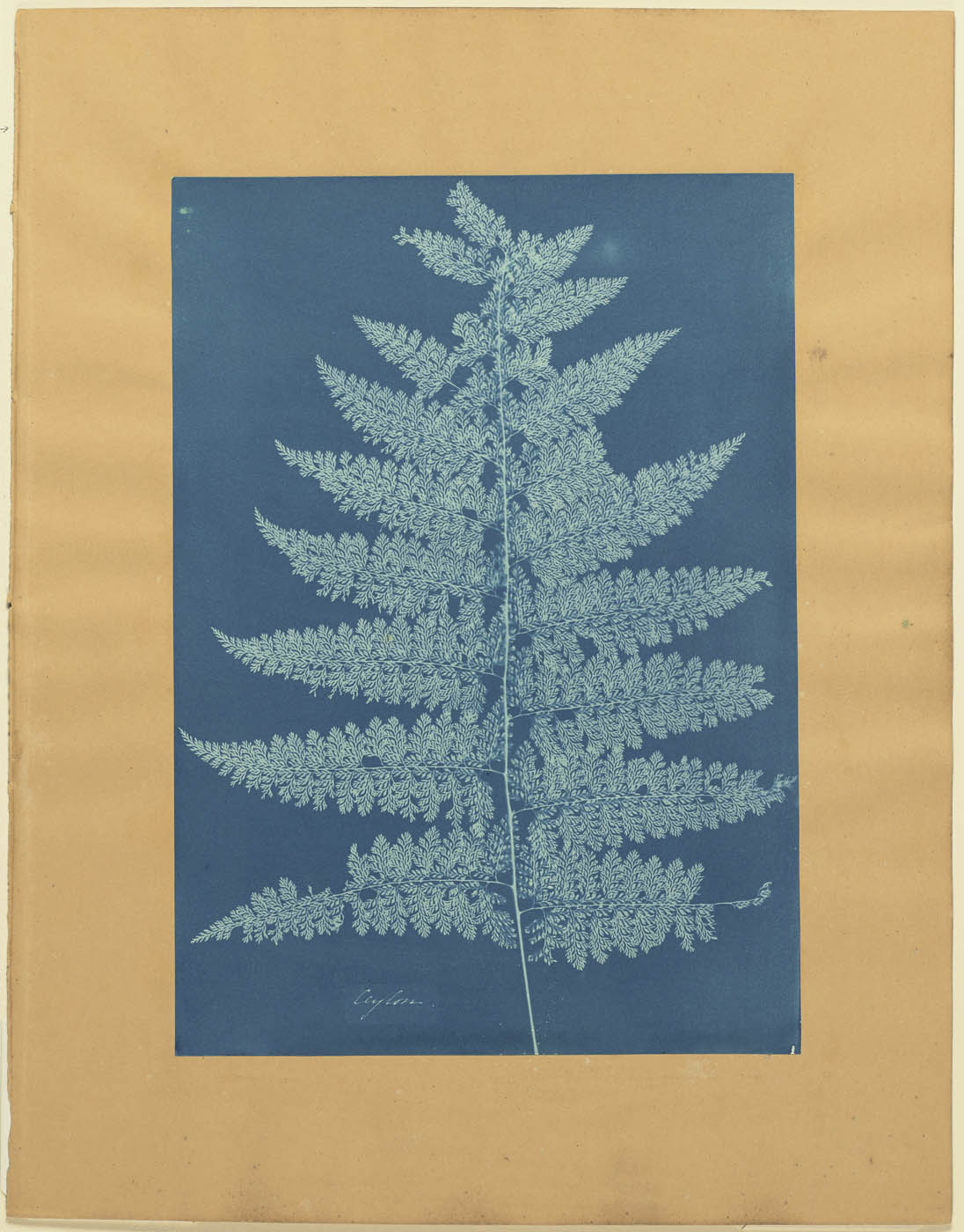
 

Anna Atkins (British, 1799-1871) possibly with Anne Dixon (British, 1799-1877) 'Ceylon/Fern' about 1854


Anna Atkins (British, 1799-1871) possibly with Anne Dixon (British, 1799-1877)
Ceylon/Fern
about 1854
Cyanotype
Image: 34.8 × 24.7cm (13 11/16 × 9 3/4 in.)
Sheet: 48.3 × 37.5cm (19 × 14 3/4 in.)
The J. Paul Getty Museum, Los Angeles
Public domain


Cyanotypes of British and Foreign Flowering Plants

After completing the highly ambitious, decade-long project Photographs of Blue Algae: Cyanotype Impressions in the summer of 1853, Anna Atkins turned to new botanical subjects. She would eventually produce several unique presentation albums with cyanotypes of ferns and flowering plants. Atkins most likely collaborated on these albums with her dear friend, Anne Dixon. Dixon came to Halstead Place for an extended stay in the summer of 1852 to comfort Atkins who was deeply shaken by the death of her father and frequent scientific partner John George Children earlier that year. Photo historian Larry Schaaf suggests that it was during this stay or perhaps one the next summer that Dixon began assisting Atkins and creating her own cyanotypes. Thus, it becomes difficult to know whether surviving works from this time period were created by Atkins, Dixon, or both.1

These seven pieces in the J. Paul Getty Museum Collection (figs. 1-7) were extracted from an 1854 presentation album Cyanotypes of British and Foreign Flowering Plants given by Anna Atkins to Anne Dixon in 1854. The album remained intact until sometime around 1981, when it was broken up after being sold at auction.

Atkins and Dixon shared a deep interest in botany, a science that was considered well suited to women since it could be studied locally, even in one’s own garden. Serious “lady botanists” could join the Botanical Society in London, one of the first scientific organisations to admit women. Atkins joined in 1839. The two friends’ interest in botany is documented in a letter of 1851 from Children to Sir William Hooker in which he discussed the two women’s longtime plant collecting. Later, in a letter that Atkins wrote to Hooker in 1864, she extended an offer from Dixon to send him samples of any of the plants from her own collection.2

Carolyn Peter, J. Paul Getty Museum, Department of Photographs
2019
© J. Paul Getty Trust
Creative Commons Attribution 4.0 International License

1/ Larry Schaaf, Sun Gardens: Cyanotypes by Anna Atkins (New York: The New York Public Library, 2018), 77
2/ Ibid, 80
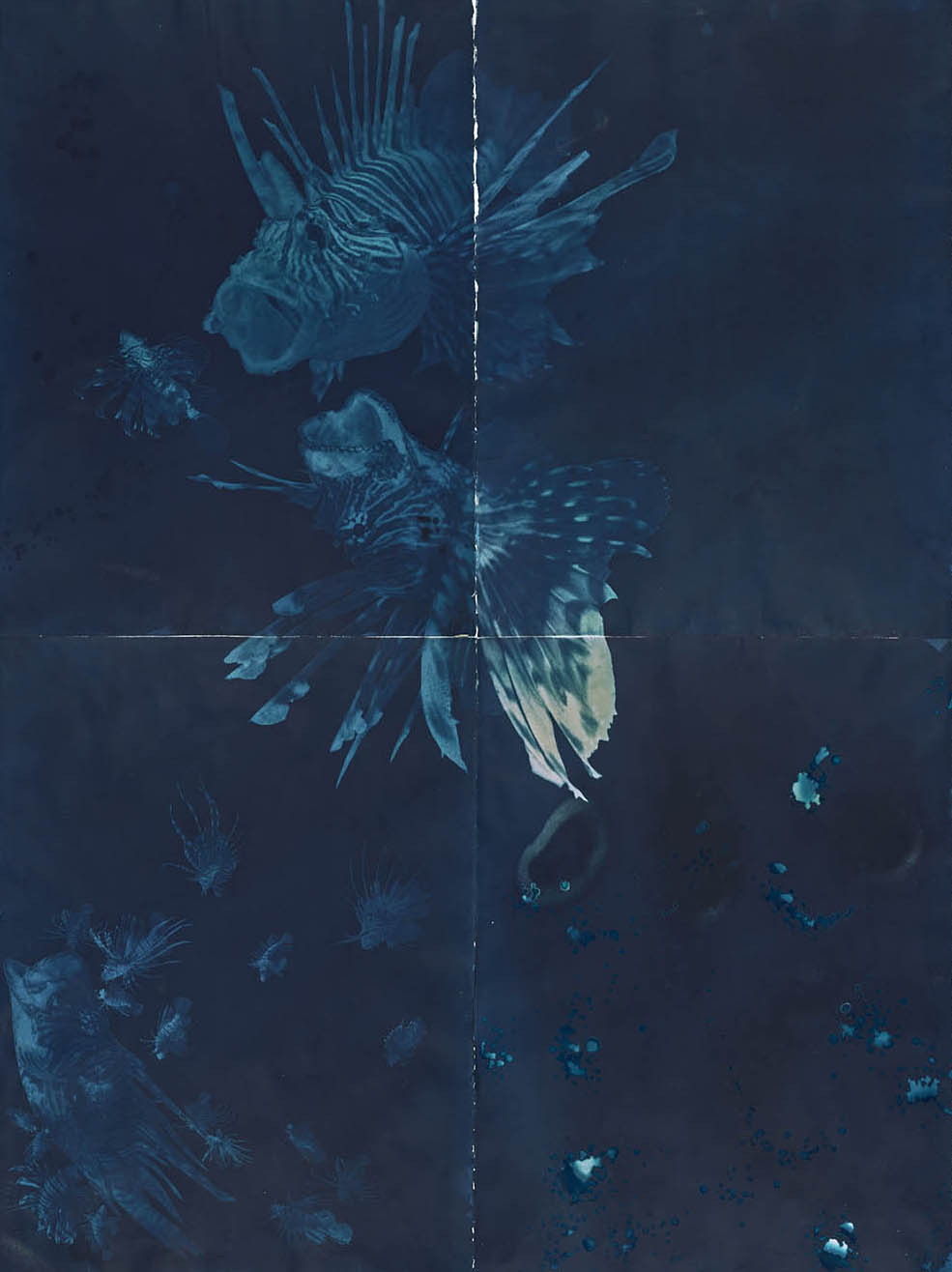
 

Andrea Chung (American, b. 1978) 'Untitled' 2016


Andrea Chung (American, b. 1978)
Untitled
2016
From the series Anthropocene
Cyanotypes
The J. Paul Getty Museum, Los Angeles
© Andrea Chung


Anna Atkins was a 19th-century botanist who documented plant specimens to make the world’s first photo book.

Today, artist Andrea Chung makes images of lionfish. Invasive to the Caribbean, they stand as a metaphor for the impact of colonisation in the region.

Text and photograph from the Getty Museum X web page


The J. Paul Getty Museum
1200 Getty Center Drive
Los Angeles, California 90049

Opening hours:
Daily 10am – 5pm
The J. Paul Getty Museum website

LIKE ART BLACK ON FACEBOOK

Back to top

Exhibition: ‘Jakob Tuggener – The 4 Seasons’ at the Fotostiftung Schweiz, Winterthur, Zurich, Switzerland

Exhibition dates: 10th February – 20th May, 2024


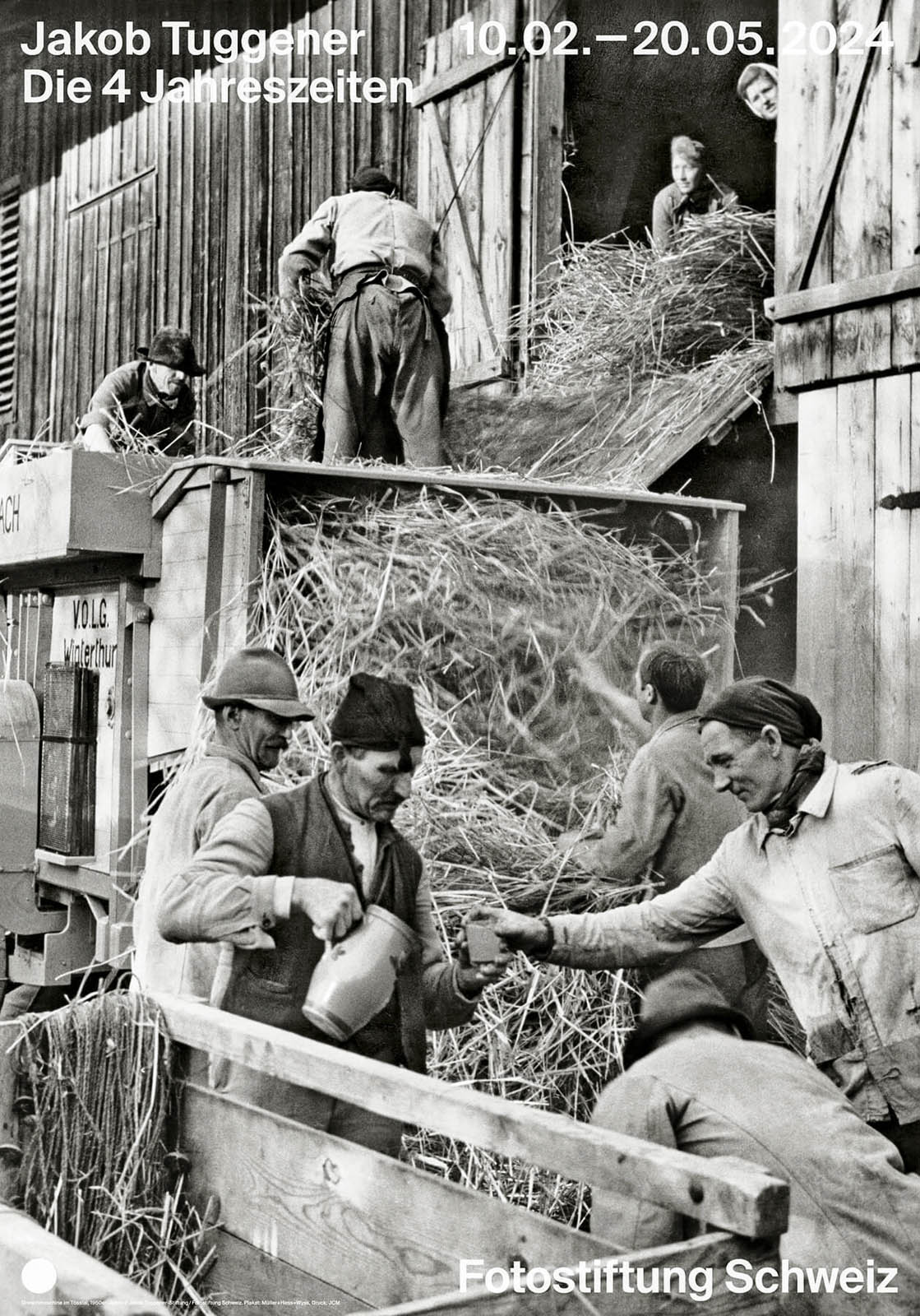
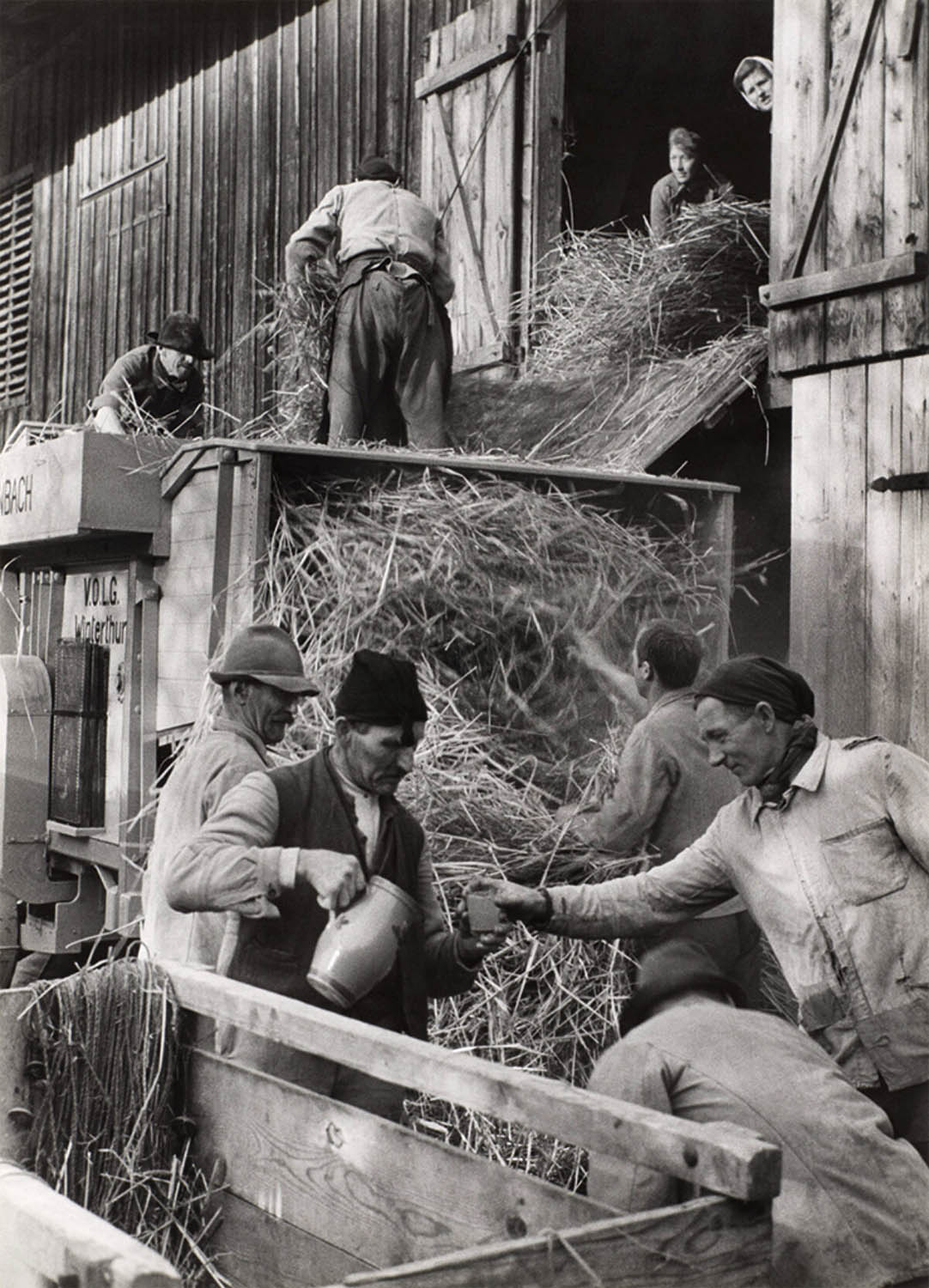
Jakob Tuggener (Swiss, 1904­-1988) 'Threshing machine in the Töss Valley' (Dreschmaschine im Tösstal) 1950s


Jakob Tuggener (Swiss, 1904­-1988)
Threshing machine in the Töss Valley (Dreschmaschine im Tösstal)
1950s
© Jakob Tuggener Stiftung / Fotostiftung Schweiz


The Swiss photographer Jakob Tuggener (1904-1988) is well known for his revolutionary book Fabrik (Factory) (1943) – subtitled Ein Bildepos der Technik “A picture of technology” – which tells a subjective story of the relationship between human and machine through pairings of modernist images, through “a modern new style of photography showing not just how things looked, but how it felt to be there.” Tuggener portrays the mundanity of the “operational sequence” (la chaîne opératoire) of the machine, where the human becomes the oil used to grease the cogs of the ever-demanding “mechanical monsters.”

“As Arnold Burgaurer cogently states in his introduction, Tuggener is a jack-of-all-trades: he exhibits, ‘the sharp eye of the hunter, the dreamy eye of the painter; he can be a realist, a formalist, romantic, theatrical, surreal.’ Tuggener’s moves effortlessly between large-format lucidity and grainy, blurred impressionism, in a book that is a decade ahead of its time.” (Martin Parr and Gerry Badger. The Photobook: A History Volume I, Phaidon Press, 2005, p. 144.)

These pastoralist, romantic photographs of the seasons and of country life were unknown to me. While still exhibiting formal, romantic, theatrical and blurred impressionist qualities, these sensitive photographs by an expressionist photographer ask the viewer to stop and contemplate the cycles of land and life.

“After he had already composed four unique book pieces on the themes spring, summer, autumn and winter during the 1940s, he created completely new versions of these “farm books” under the title The 4 Seasons in 1973 and 1974, at the age of almost 70 years. They are devoted to simple life in the countryside, reflecting in sensitively observed, atmospherically charged, yet never picturesque recordings, the recurring cycle of nature and are at the same time a reflection on human life and transience.” (book description)

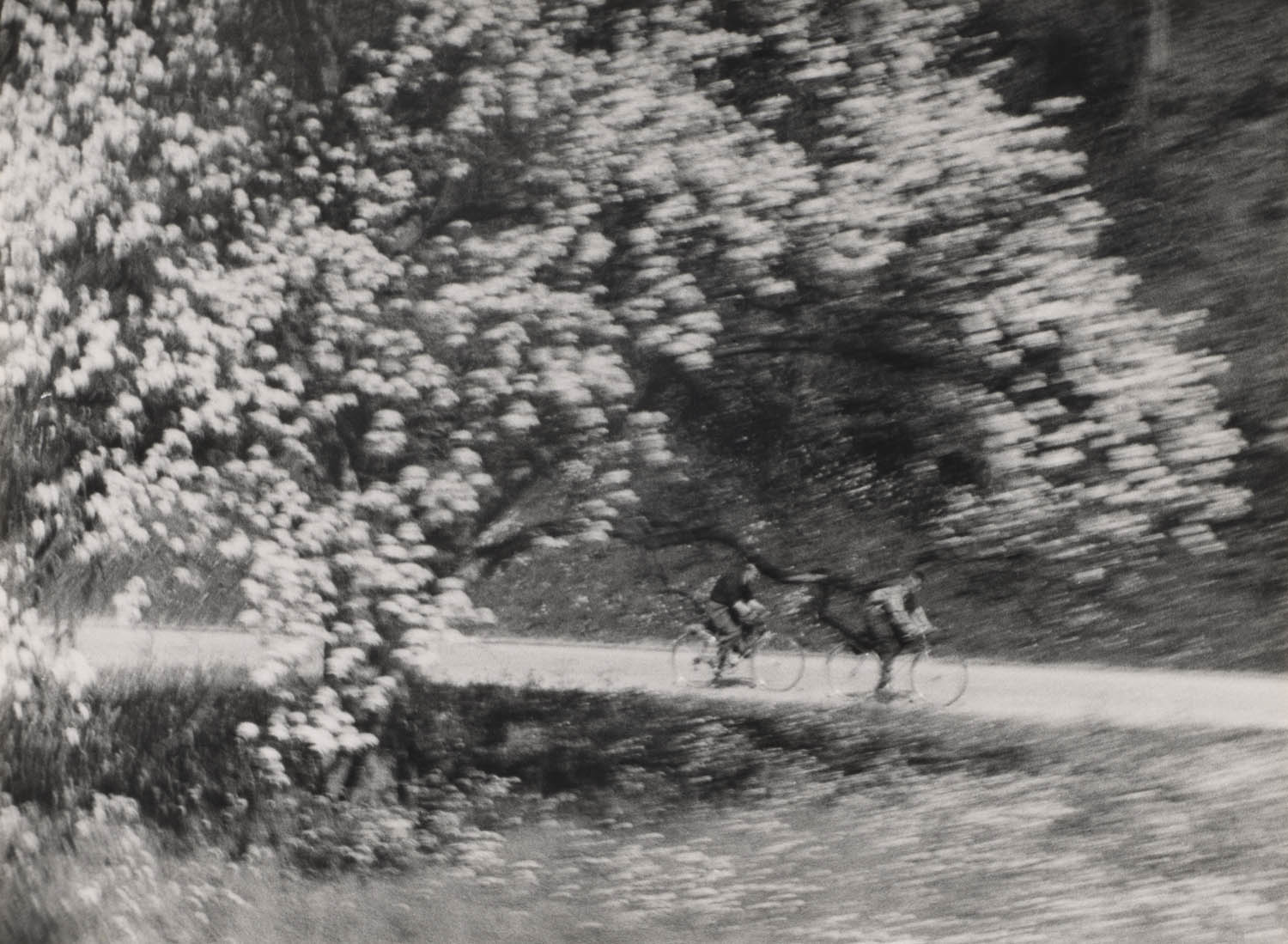
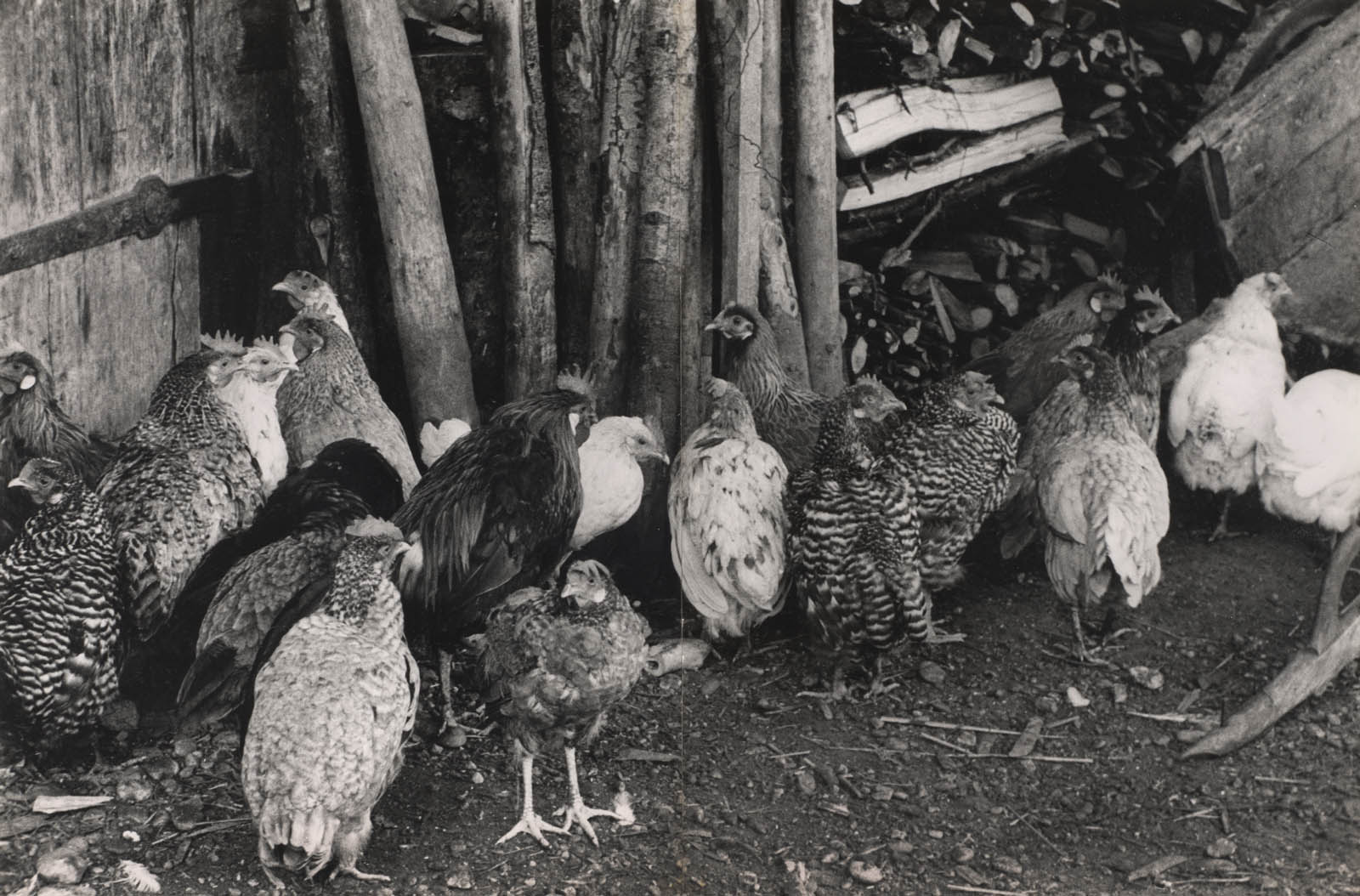
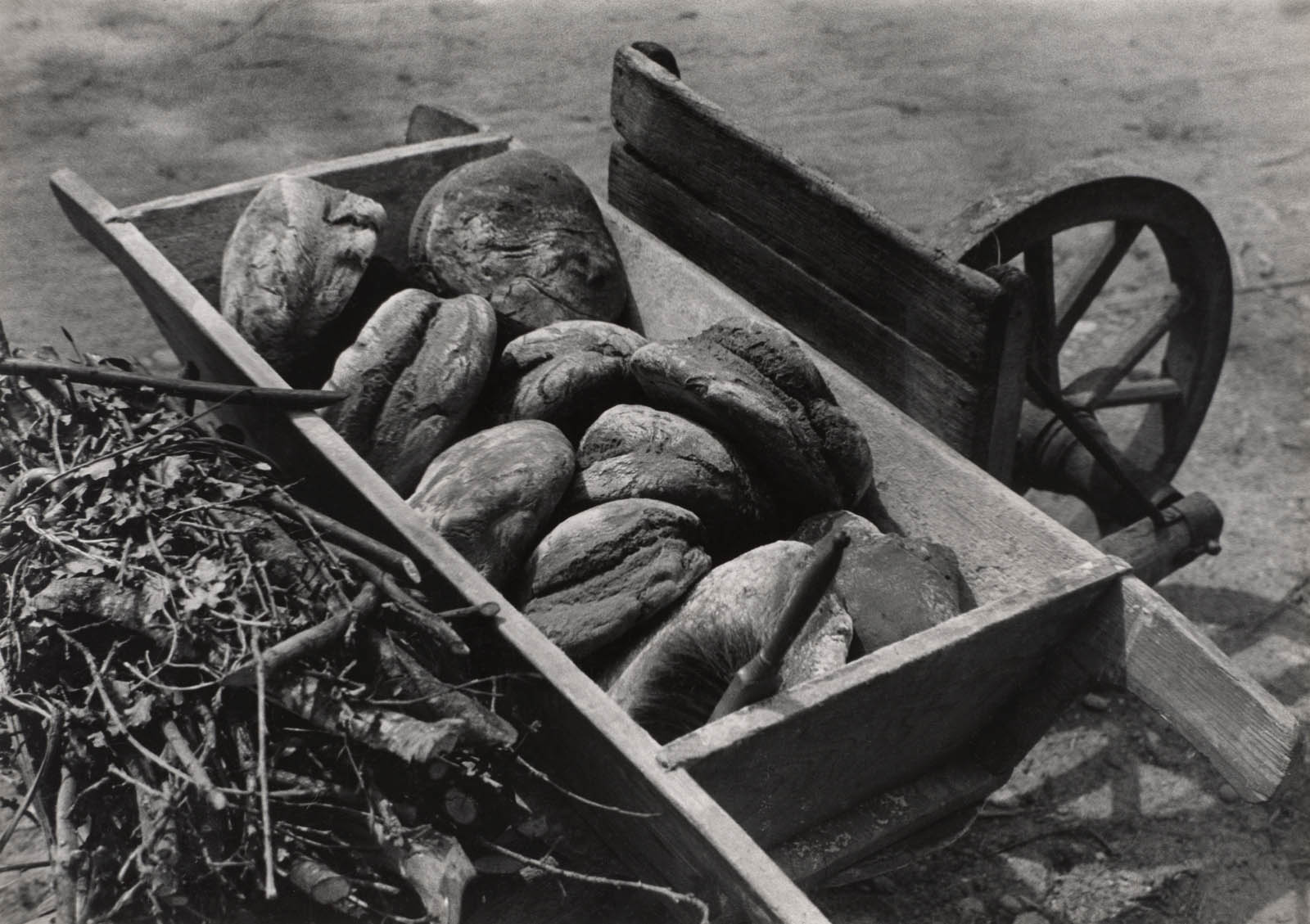
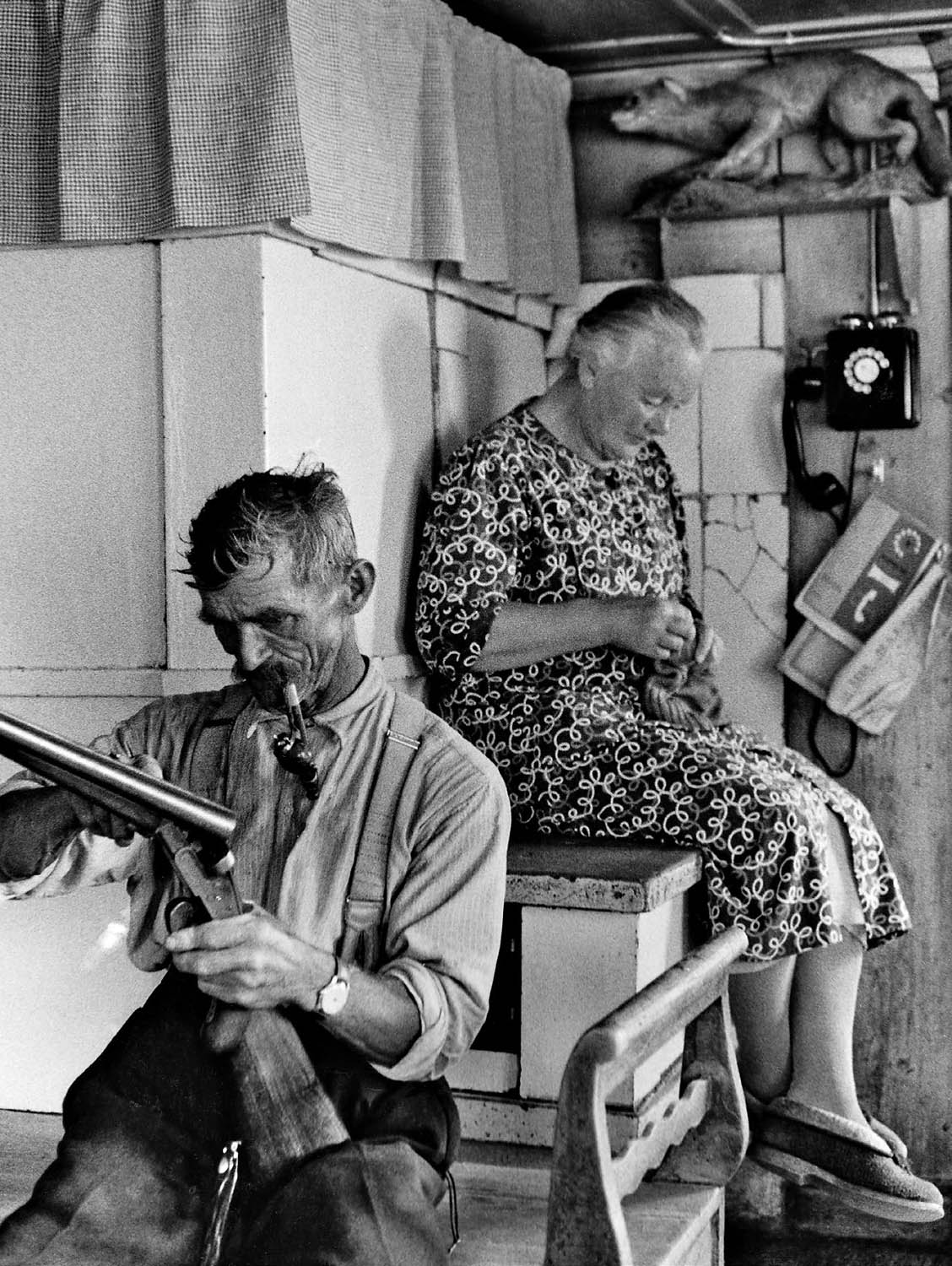
A gathering of chickens, farmers bread in a wheelbarrow, two bicyclists riding in the spring wind captured in a blurred moment of stasis, or the grizzled gamekeeper, pipe clamped between his lips, cleaning his shotgun while his wife darns socks behind surmounted by a stuffed animal overseeing both… all are beautifully observed.

These are images to imbibe so that we soak up their essence, so that we absorb their energy into our soul. It is the power of poet-photographer Tuggener’s pictures that they expand our experience and consciousness of the earth from which we come, taking us back to childhood, play, land, laughter, people, life through expressions of each season of the year.

As Tuggener observed in December 1950, “Everyone is at a loss when it comes to contemplating a picture without the aid of a text. And yet with a text, an image can only be explained, not experienced. That is because the soul resides at a greater depth, which words cannot reach. This realm is much larger than the periphery of the mind.”

Fo more information on the artist see my text “Rare magician, strange alchemist, tells stories through visuals” on the exhibition Jakob Tuggener – Machine time at at Fotostiftung Schweiz in 2018.

Dr Marcus Bunyan


Many thankx to the Fotostiftung Schweiz for allowing me to publish the photographs in the posting. Please click on the photographs for a larger version of the image.


The Expressionist Photographer

The expressionist photographer does not exist in the commercial register. He is the freest of the free. Unbound by any purpose, he photographs only the pleasure of his experience. He is the artist seeking to express himself with his instrument, in this case the camera. Indeed, art is not art at all until an idea has been crystallised, visualised or set to music, and it does not matter which instrument we use to achieve this. However, the key factor is not reproduction, but the desire to make something. Ten years ago, I began to use photography as my language and to speak in self-contained books: about ball nights, about iron, about ships, about everything that particularly moves and excites my soul. The public, or rather the publishers, have no confidence in this approach. They say people would not understand a book without words, merely to be seen with the eyes. Yes, we are made more superficial by illustrated magazines and by reading: Everyone is at a loss when it comes to contemplating a picture without the aid of a text. And yet with a text, an image can only be explained, not experienced. That is because the soul resides at a greater depth, which words cannot reach. This realm is much larger than the periphery of the mind.


Jak. Tuggener
Schweizerische Photorundschau 23, 8th of December 1950


Jakob Tuggener (Swiss, 1904­-1988) 'In the moor, near Brüttelen' 1944


Jakob Tuggener (Swiss, 1904­-1988)
In the moor, near Brüttelen
1944
© Jakob Tuggener Stiftung / Fotostiftung Schweiz


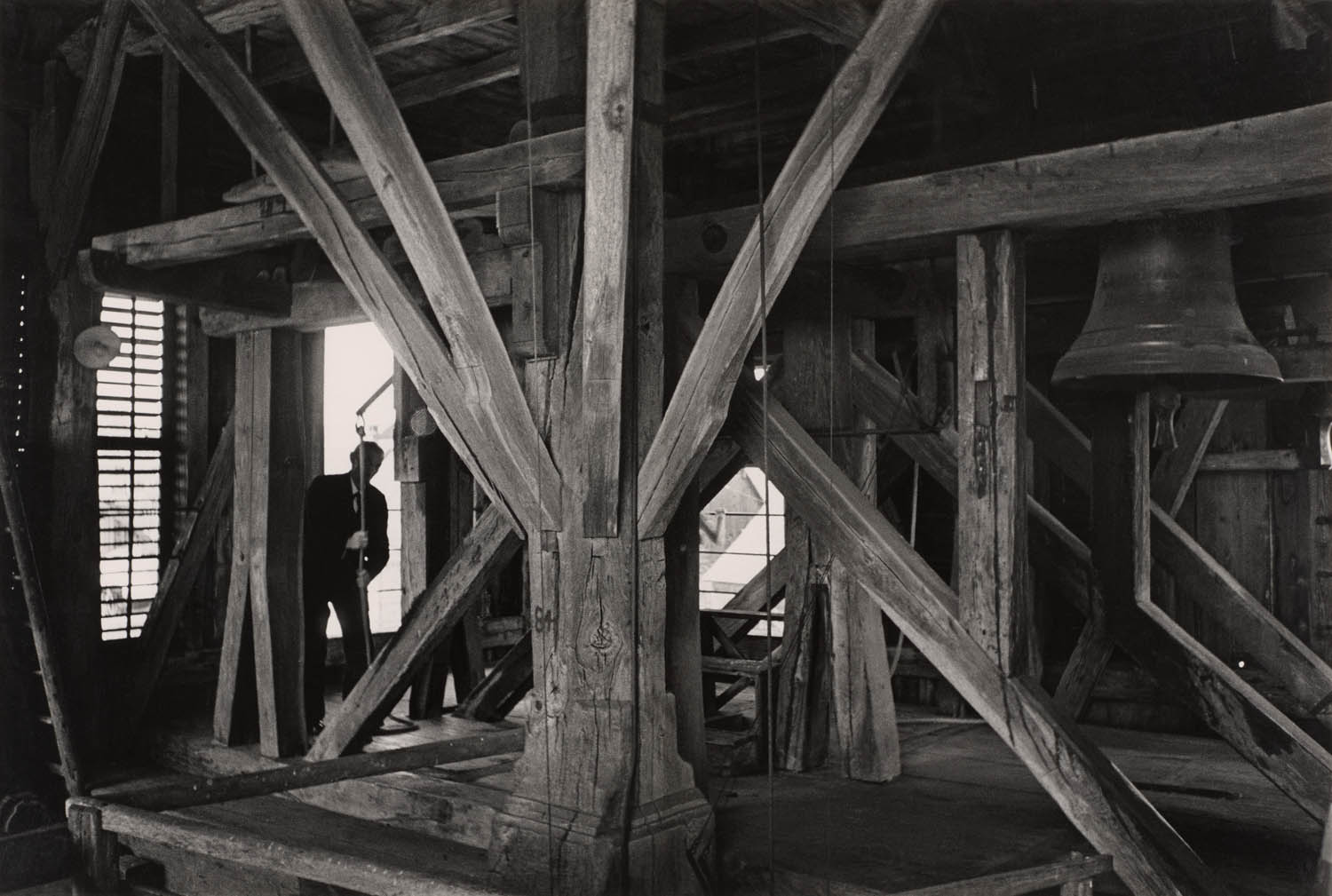
Jakob Tuggener (Swiss, 1904­-1988) 'Belfry, Rümlang' 1934


Jakob Tuggener (Swiss, 1904­-1988)
Belfry, Rümlang
1934
© Jakob Tuggener Stiftung / Fotostiftung Schweiz


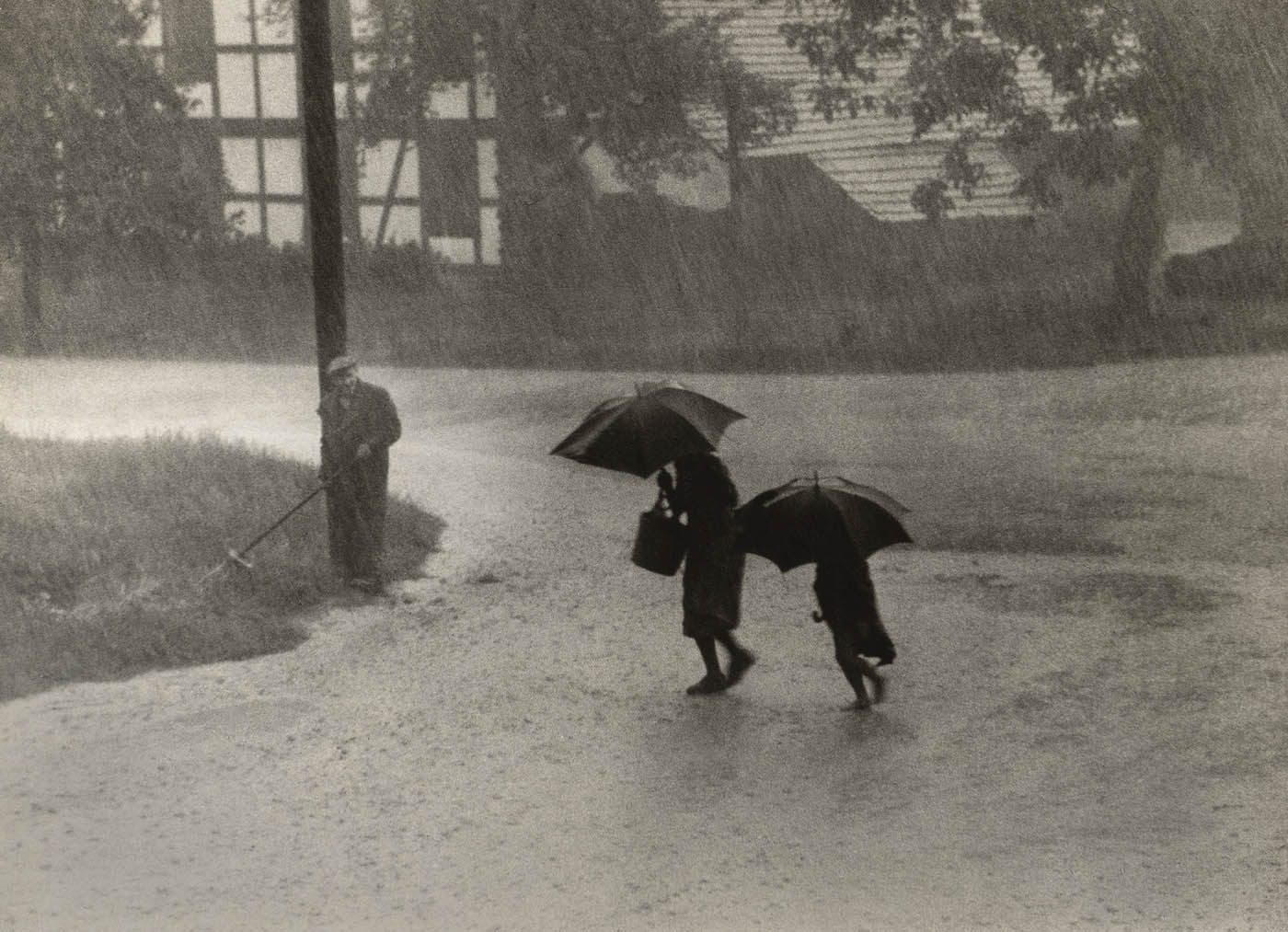
Jakob Tuggener (Swiss, 1904­-1988) 'Rain' 1949


Jakob Tuggener (Swiss, 1904­-1988)
Rain
1949
© Jakob Tuggener Stiftung / Fotostiftung Schweiz


Jakob Tuggener (Swiss, 1904­-1988) 'In the spring wind' (Im Frühlingswind) 1950s


Jakob Tuggener (Swiss, 1904­-1988)
In the spring wind (Im Frühlingswind)
1950s
© Jakob Tuggener Stiftung / Fotostiftung Schweiz


The work of Jakob Tuggener (1904­-1988) is well positioned within 20th-century photography. His expressive photographs of glittering ball nights are legendary and his 1943 book Fabrik (Factory) is seen as a milestone in the history of the photo book. However, Tuggener was also captivated by a third subject: simple life in the countryside.

His countless sensitively observed, atmospherically charged, but never picturesque depictions of everyday farming life reflect the cycle of nature, while simultaneously contemplating life and its transience. In 1973/74, Tuggener compiled four individual book maquettes under the title Die 4 Jahreszeiten (The 4 Seasons): unique ready-to-print books, which he designed himself.

In addition to those book maquettes, this exhibition displays other photographs by Jakob Tuggener, which demonstrate how intensively this outstanding photographer devoted himself to the theme of country life for more than 30 years.

In parallel to the exhibition, Die 4 Jahreszeiten will also be presented in a book. In close collaboration with the Jakob Tuggener Foundation and Steidl Verlag, Fotostiftung Schweiz is thus providing new insight into the series of around 70 books that Jakob Tuggener himself considered the centrepiece of his oeuvre, even though they remained unpublished during his lifetime.

The exhibition is accompanied by the publication Jakob Tuggener – The 4 Seasons, published by Steidl Verlag, edited by Fotostiftung Schweiz, Jakob Tuggener-Stiftung and Martin Gasser.

Text from the Fotostiftung Schweiz website


Jakob Tuggener (Swiss, 1904­-1988) 'Chicken yard' (Hühnerhof) 1950s


Jakob Tuggener (Swiss, 1904­-1988)
Chicken yard (Hühnerhof)
1950s
© Jakob Tuggener Stiftung / Fotostiftung Schweiz


Jakob Tuggener (Swiss, 1904­-1988) 'Bauernbrot, Brüttelen' (Farmers bread, Brüttelen) 1944


Jakob Tuggener (Swiss, 1904­-1988)
Bauernbrot, Brüttelen (Farmers bread, Brüttelen)
1944
© Jakob Tuggener Stiftung / Fotostiftung Schweiz


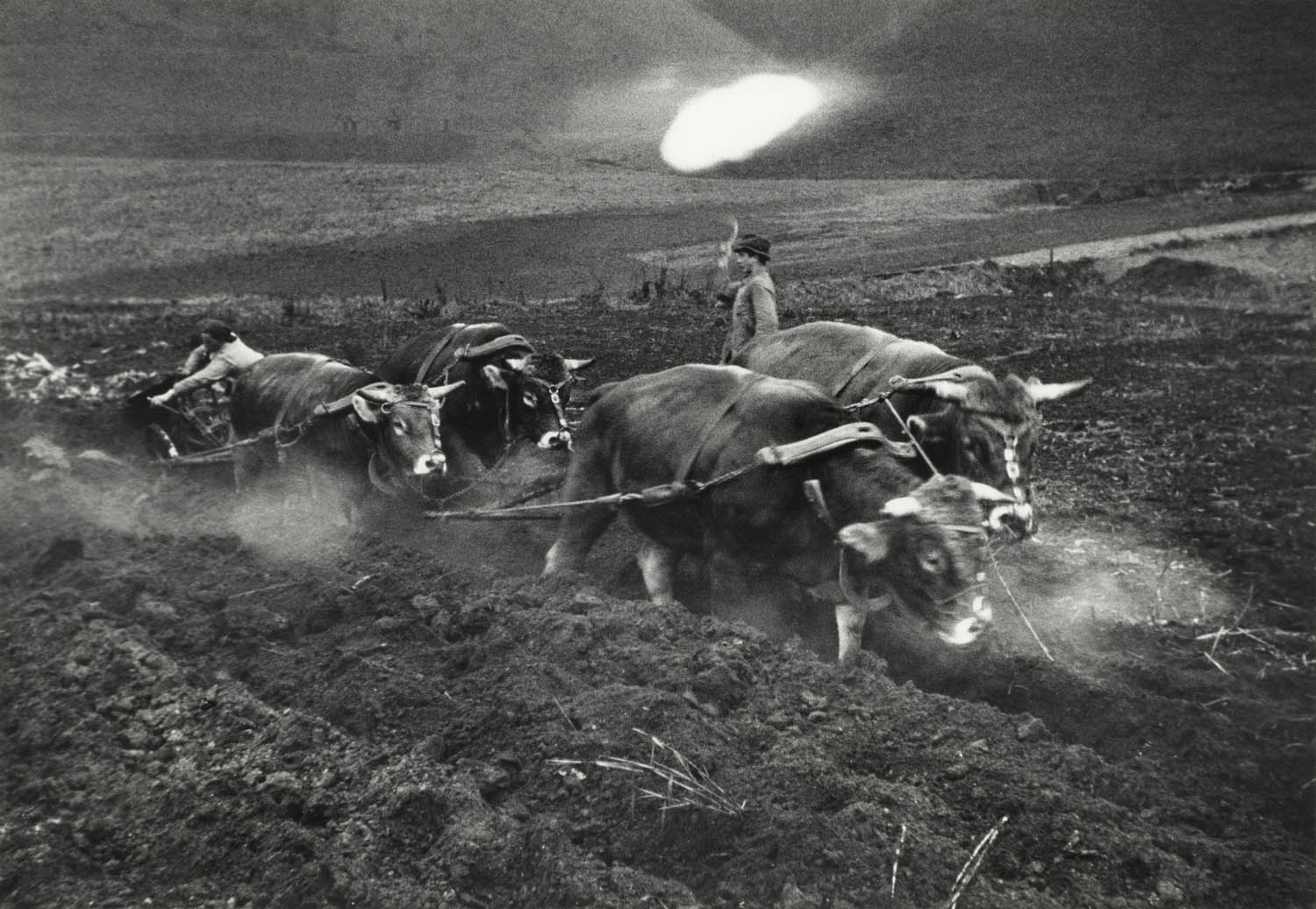
Jakob Tuggener (Swiss, 1904­-1988) 'Yoke of oxen, Küssnacht am Rigi' (Ochsengespann, Küssnacht am Rigi) 1943


Jakob Tuggener (Swiss, 1904­-1988)
Yoke of oxen, Küssnacht am Rigi (Ochsengespann, Küssnacht am Rigi)
1943
© Jakob Tuggener Stiftung / Fotostiftung Schweiz


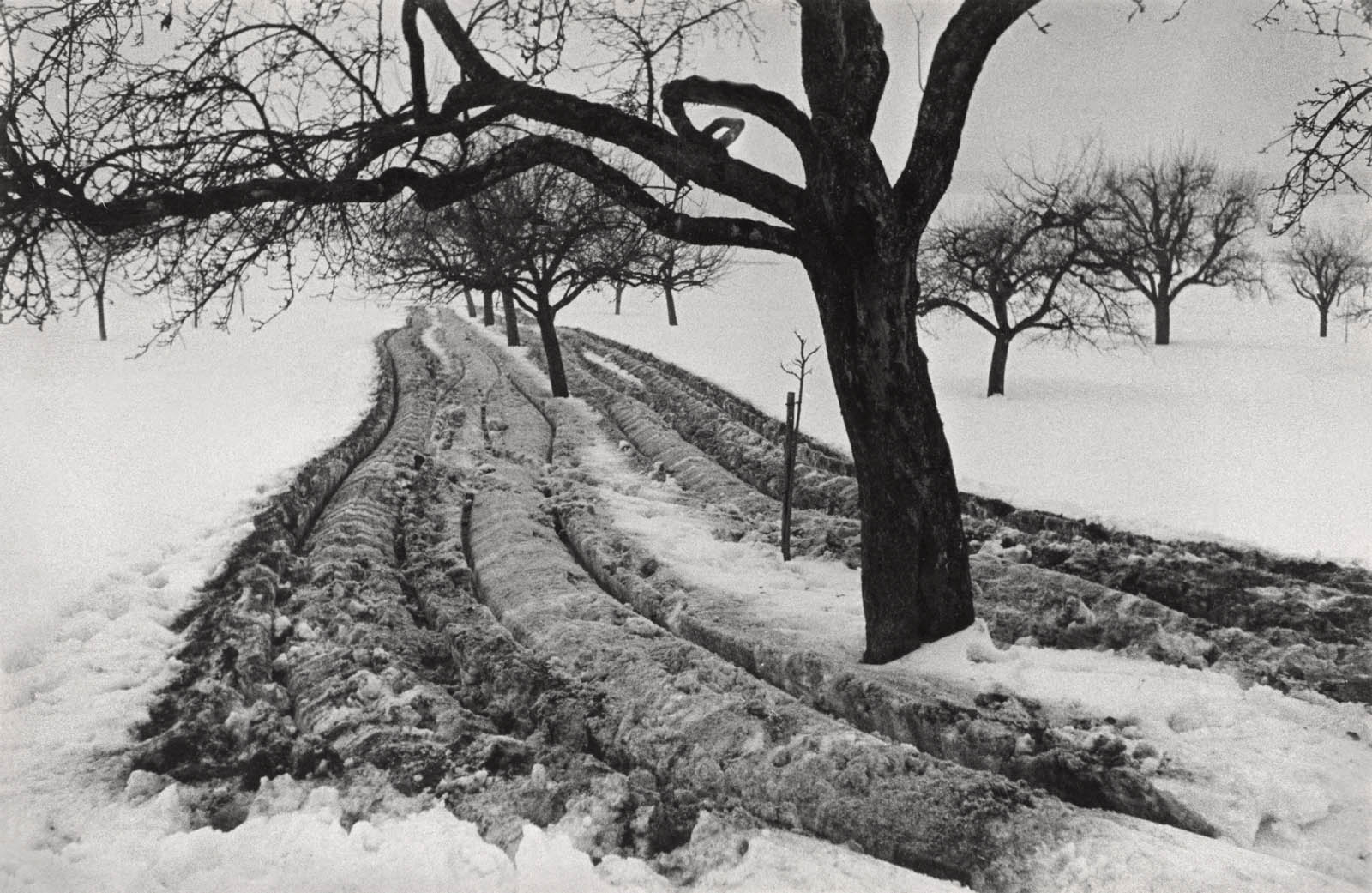
Jakob Tuggener (Swiss, 1904­-1988) 'Manure spread in February, Oeschgen' (Ausgebrachte Jauche im Februar, Oeschgen) 1942


Jakob Tuggener (Swiss, 1904­-1988)
Manure spread in February, Oeschgen (Ausgebrachte Jauche im Februar, Oeschgen)
1942
© Jakob Tuggener Stiftung / Fotostiftung Schweiz


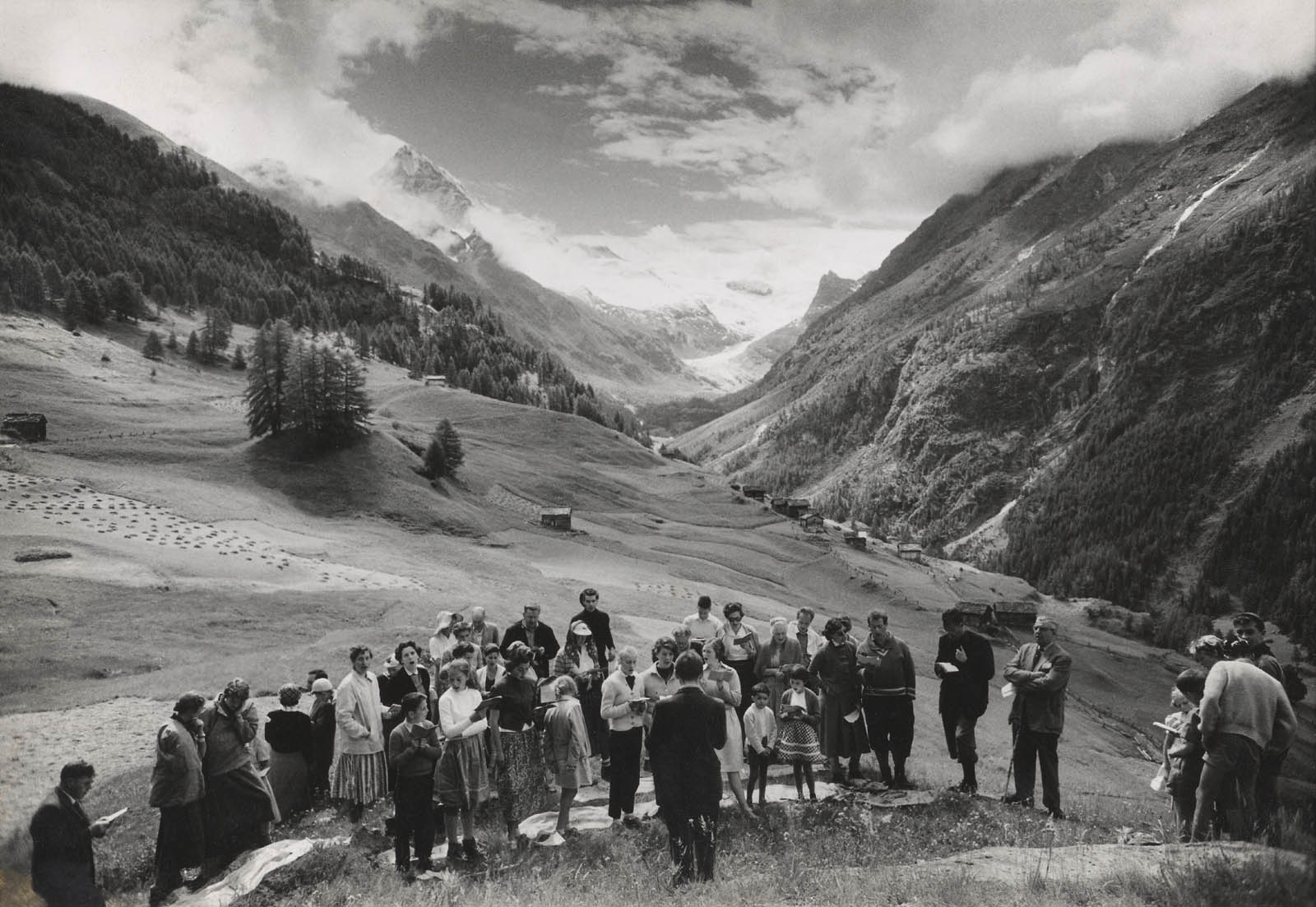
Jakob Tuggener (Swiss, 1904­-1988) 'Holiday guests at La Forclaz, Val d'Herens' (Feriengäste des La Forclaz, Val d'Herens) 1957


Jakob Tuggener (Swiss, 1904­-1988)
Holiday guests at La Forclaz, Val d’Herens (Feriengäste des La Forclaz, Val d’Herens)
1957
© Jakob Tuggener Stiftung / Fotostiftung Schweiz


Jakob Tuggener The 4 Seasons

Jakob Tuggener (1904-1988) is one of the exceptional figures in 20th-century Swiss photography. He had the confidence to consider himself an artist from the outset. His expressive photographs of glittering ball nights are legendary and his book Fabrik (Factory) from 1943 is seen as a milestone in the history of the photo book. However, it has so far gone largely unnoticed that Tuggener was also captivated by a third subject: simple life in the countryside.

Already in the early 1930s, after his brief artistic education at the Reimann School in Berlin, Tuggener began to take an interest in rural life and the traditions of his homeland. This focus certainly had to do with the political developments in Europe, which prompted Switzerland to reflect on its own values and to disseminate them via the illustrated press. While Tuggener was earning his living as a freelance industrial photographer, he managed to make a name for himself with photographs of everyday country life, livestock markets and folk festivals, until the Second World War began. During his subsequent active army service, he still had enough time to pursue the subject further and also capture the changes of the seasons with his camera. As early as 1942/43, he compiled four individual book maquettes from the photographs he had taken since the mid-1930s – unique books that he designed himself and were ready to print. However, as was also the case with all his later book maquettes, Tuggener never found a publisher willing to publish them exactly as he had imagined. Only a small selection of images were presented by Arnold Kübler in the magazine Du in 1946. “Tuggener tries to hint at the inner workings of people and things in pictures,” wrote Kübler, also pointing out Tuggener’s special way of using the sequencing and juxtaposition of photographs to achieve a manner of artistic expression that went far beyond the documentary.

In the military

After the outbreak of the Second World War in autumn 1939, Tuggener was called up for active service, like all Swiss men of military age. Naturally, he had his camera with him in his kit, so to speak, as he aimed to provide the illustrated magazines with pictures of daily soldiering life. This was only possible for a short time though, as censorship became increasingly strict and prohibited the publication of images with military content. Tuggener kept taking photographs, just for himself, but was beginning to run out of subjects. Although most of his time was spent on guard duty, Tuggener was certainly able to get something positive out of it: “When I stand guard at night,” he wrote home, “I contemplate the full splendour of nature, because before us, there lies a marvellous land and a mighty, open sky.”

During the winter of 1942, Tuggener was in the valley Fricktal, serving as a guard in the Oeschgen internment camp. It was a camp for Polish soldiers who had found refuge in Switzerland in June 1940 after being surrounded by Hitler’s Wehrmacht on the French-Swiss border. They were subsequently distributed among camps set up at short notice, where they lived in safety until after the war, but were strictly kept apart from the local population. Compared to a number of larger camps in places like Büren an der Aare or Wettingen, Oeschgen was a relatively small and manageable one, so Tuggener was soon able to approach these foreign men he was supposed to be watching over and strove to establish a rapport with them. Despite language difficulties, he succeeded in doing so very well, thanks to his camera – particularly as he came up with the idea of taking portrait photos of all the internees, then offering these to them for sale. As his financial situation was anything but a bed of roses during the war years, he appreciated this source of extra income, but was also pursuing a completely different goal with it: He was planning to publish a book about the internment camp, but it never materialised. Only a book maquette compiled shortly after his service in Oeschgen under the title Polen-Wache (Pole Watch) has survived. It is primarily a portrait book, a lively group portrait that visibly reveals Tuggener’s sympathy for the interned men and shows that he treated them as equals, even in his role as a guard. The portraits are complemented by wintry atmospheric images and by photographs of the monotonous daily camp routine, from morning roll call to working in the forest, or attending to the barbed wire fences in the surrounding area.

Book maquettes

Almost thirty years later, in a societal environment characterised by fears of foreign infiltration, Tuggener once again compiled four book maquettes, under the title Die 4 Jahreszeiten (The 4 Seasons). They were created during the preparations for his first major retrospective at Helmhaus Zurich in 1974, which he conceived as a kind of arc, with sections ranging from ‘Nature of Switzerland’ to ‘Peace and Earth in Farm Life’. With photographs from the years 1932 to 1973, these four book maquettes are among the last and most extensive that Tuggener created during his long career. Together, they convey a traditional image of the four seasons, as is familiar from music and painting. In sensitively observed, atmospherically charged, but never picturesque photographs, they reflect the recurring cycle of nature, while simultaneously contemplating life and transience. Alongside Tuggener’s four unique books, the exhibition at Fotostiftung Schweiz also presents many other photographs that demonstrate how intensively this master of black-and-white photography devoted himself to the theme of ‘country life’ for more than 30 years.

The book maquettes

During the long months of active service that Jakob Tuggener spent in small villages in the canton of Aargau, in Bernese Seeland and in Ticino, he would travel around with his Leica whenever off duty, capturing what increasingly fascinated him: farmers at work, village scenes, and modest still lifes in barns and inns. He also photographed private rooms though, such as kitchens or bedrooms, when granted access. People always took centre stage; he captured them in their familiar surroundings, as rawly and authentically as possible.

Tuggener developed and enlarged his photographs when at home on leave. In 1942/43, almost at the same time as the publication of his book Fabrik (Factory), he compiled four individual book maquettes with the titles Frühling, Sommer, Herbst and Winter (Spring, Summer, Autumn and Winter). With these ‘farmer books’, he created his own personal counter-world to the world of the factory. Jakob Tuggener also felt in his element in rural surroundings. In a later interview with Magnum employee Inge Bondi, he spoke very fondly about the smell of fresh manure in a snow-covered field, which he could still remember.

None of the book maquettes that Tuggener created during the war years were published, not even the one called Uf em Land (In the Countryside), which he compiled in 1953 using variations on earlier photographs and many new ones. Nevertheless, thirty years later, in connection with his first retrospective at Helmhaus Zurich, he returned to the theme and, between March 1973 and February 1974, put together new individual volumes on spring, summer, autumn and winter, under the title Die 4 Jahreszeiten. Compared to the original versions from 1942/43, these are about four times as extensive. Most of the photographs were new, which shows how intensively Tuggener had addressed the subject. The format of the maquettes, still 30×24 cm, had not changed though, and he had also retained the same simple layout for the pictures: single images, arranged either each on one page (very rarely in non-page-filling landscape formats) or as borderless double pages. The major themes relating to the seasons also remained the same: from tilling the fields in spring to haymaking in summer, to harvesting in autumn and through to forest work in winter. This time perhaps not so much a counter-world to factory work, but to the hectic pace of the modern city, Die 4 Jahreszeiten, encompassing more than 300 photographs, reflects how, in nature, things come into being and disappear, and it is simultaneously an allegory of the cycle of human life.

Like all earlier maquettes, Die 4 Jahreszeiten from 1973/74 contain juxtapositions and sequences of images that evoke certain associations or feelings. Tuggener believed in the suggestive power of images and the narrative potential of montage, as used to great effect in German expressionist film during the 1920s. The fact that these unique books remained unpublished during his lifetime is probably due to their author’s uncompromising nature: Tuggener insisted that his photographic compositions needed no explanatory text or captions. He saw them as an independent and viable means of expression – an attitude that put him far ahead of his time.

Zürcher Oberland (Zurich highlands)

In June 1955, Tuggener was commissioned by the printing house Wetzikon und Rüti to photographically document the region Zürcher Oberland for a photo book. This suited Tuggener well, as he was already quite familiar with the area. He worked on the project for a year and, for once, was well paid. The book came out in 1956 under the title Zürcher Oberland with the aim, as the publisher put it, of showing “the beauty of the […] so scenically diverse areas, and of their inhabitants in their homes and workplaces.” It is an idyllic world that appears in Tuggener’s 240 photos, arranged in a somewhat restless-looking layout, with snow-covered Alps in the background, and peaceful lakes and ponds in the foreground. There are also plenty of pictures of the grain harvest and haymaking, as well as photos that thematise the area’s rich cultural heritage. However, at the end of the pictorial section of this ‘ideal-world book’, a portrait of a contemplative man is juxtaposed with a nocturnal landscape in a manner that seems to call much into question. It is not surprising that Tuggener used only a few images from this book in his later book maquettes.

Forum alpinum

In 1964, Jakob Tuggener contributed photographs to the ‘Mountain Farmers Exhibition’ in the ‘Field and Forest’ pavilion at the Swiss National Exhibition (Expo 64) in Lausanne. He was also involved in a follow-up publication, which was meant to comprehensively present the problems of mountain regions. While the exhibition was still running, the book was advertised for sale by subscription, as a “contribution to the clarification of our mountain population’s current existential issues” and was published in 1965 as a 400-page volume of texts and images, entitled Forum alpinum. It covers seven Swiss mountain regions: western Switzerland (Jura and Gruyère), Valais, Bernese Oberland, central Switzerland, Ticino, Graubünden, and eastern Switzerland (Appenzell and St Galler Oberland). For each of the seven regions, there is a picture section with photographs by Jakob Tuggener, almost 130 in total. The interspersed blocks of text are about the people, agriculture, art, customs and music. There are also map extracts, aerial photographs and numerous woodcuts by Bruno Gentinetta. Forum alpinum has an almost square format and was designed by Kurt Büchel. Tuggener was busy for months, researching in his archive, travelling to take pictures in all the regions to be covered and working in his darkroom.

In the new photographs that Tuggener produced, it is evident that he was endeavouring to depict as many regional features as possible, without compromising his artistic standards. Naturally though, such a broad collection of images taken over many years presents itself as very heterogeneous. The photographs are mostly arranged as juxtapositions: of old and new, for instance, or of inner and outer. They are visual contrasts like those that characterise Tuggener’s own book maquettes, but in Forum alpinum, there are always comments inserted in between, which interrupt the images’ dialogue and reduce it to a message that is easy to grasp. In the book, for example, a photograph of a jukebox in Saint-Ursanne is juxtaposed with the evangelists on a cathedral’s medieval capitals. In the comment, it is noted with disappointment that young people are less interested in tradition and more open “to the superficial and international allure of the ‘juke box’.”

The exhibition

Alongside Tuggener’s four unique books, the exhibition at Fotostiftung Schweiz also presents many other photographs that demonstrate how intensively this master of black-and-white photography devoted himself to the theme of ‘country life’ for more than 30 years. In the exhibition The 4 Seasons and the accompanying publication of the same name, Fotostiftung Schweiz is delighted to present a previously unknown work by Jakob Tuggener to the public. This follows on from numerous projects with which it, together with the Jakob Tuggener Foundation, has gradually provided access to Tuggener’s oeuvre: In addition to various exhibitions and publications, the online collection, which now shows a comprehensive representative cross-section of Tuggener’s work, also serves this purpose. None of this would have been possible without the artist’s widow, Maria Euphemia Tuggener, who deposited his photographic estate at Fotostiftung Schweiz in 2004.

Text from the Fotostiftung Schweiz


Jakob Tuggener (Swiss, 1904­-1988) 'Lüscherz' 1944


Jakob Tuggener (Swiss, 1904­-1988)
Lüscherz
1944
© Jakob Tuggener Stiftung / Fotostiftung Schweiz


Jakob Tuggener (Swiss, 1904­-1988) 'Fasnacht, Sennhof' (Carnival, Sennhof) 1935


Jakob Tuggener (Swiss, 1904­-1988)
Fasnacht, Sennhof (Carnival, Sennhof)
1935
© Jakob Tuggener Stiftung / Fotostiftung Schweiz


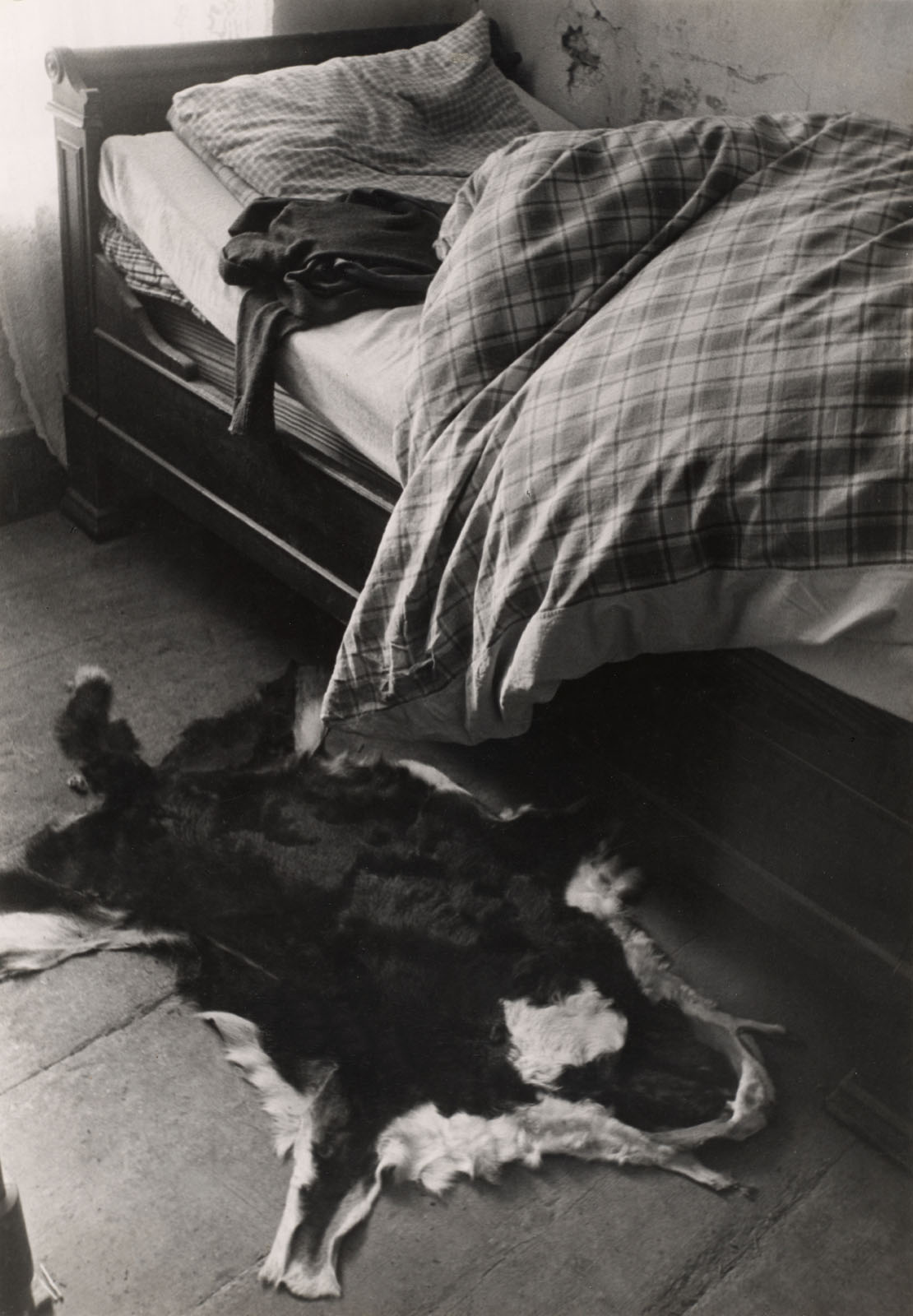
Jakob Tuggener (Swiss, 1904­-1988) 'Sleeping chamber, Oeschgen' (Schlafkammer, Oeschgen) 1942


Jakob Tuggener (Swiss, 1904­-1988)
Sleeping chamber, Oeschgen (Schlafkammer, Oeschgen)
1942
© Jakob Tuggener Stiftung / Fotostiftung Schweiz


Jakob Tuggener (Swiss, 1904­-1988) 'Gamekeeper of Sternenberg with his wife' 1956


Jakob Tuggener (Swiss, 1904­-1988)
Gamekeeper of Sternenberg with his wife
1956
© Jakob Tuggener Stiftung / Fotostiftung Schweiz


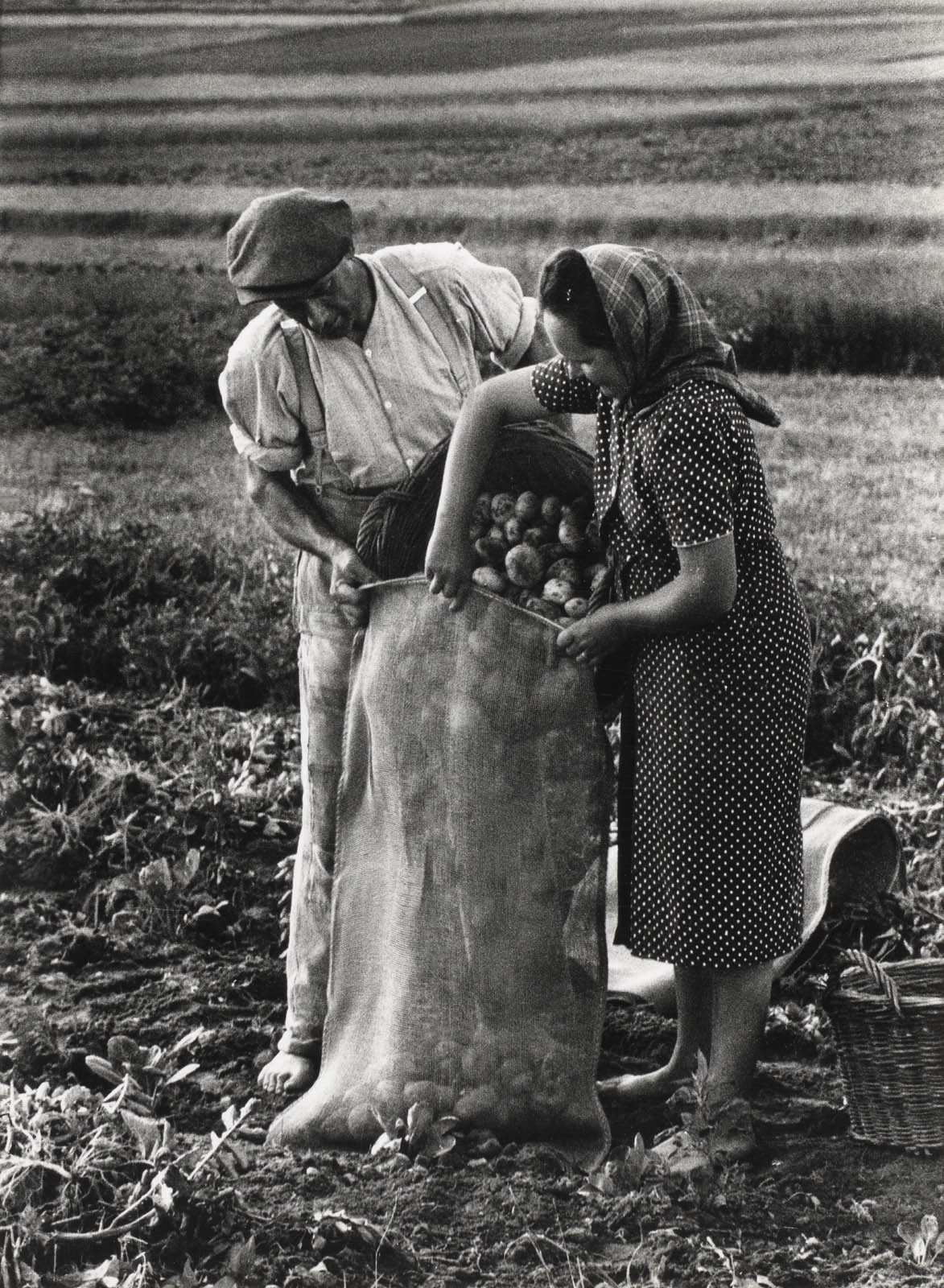
Jakob Tuggener (Swiss, 1904­-1988) 'Potato harvest, Müntschemier' (Kartoffelernte, Müntschemier) 1944


Jakob Tuggener (Swiss, 1904­-1988)
Potato harvest, Müntschemier (Kartoffelernte, Müntschemier)
1944
© Jakob Tuggener Stiftung / Fotostiftung Schweiz


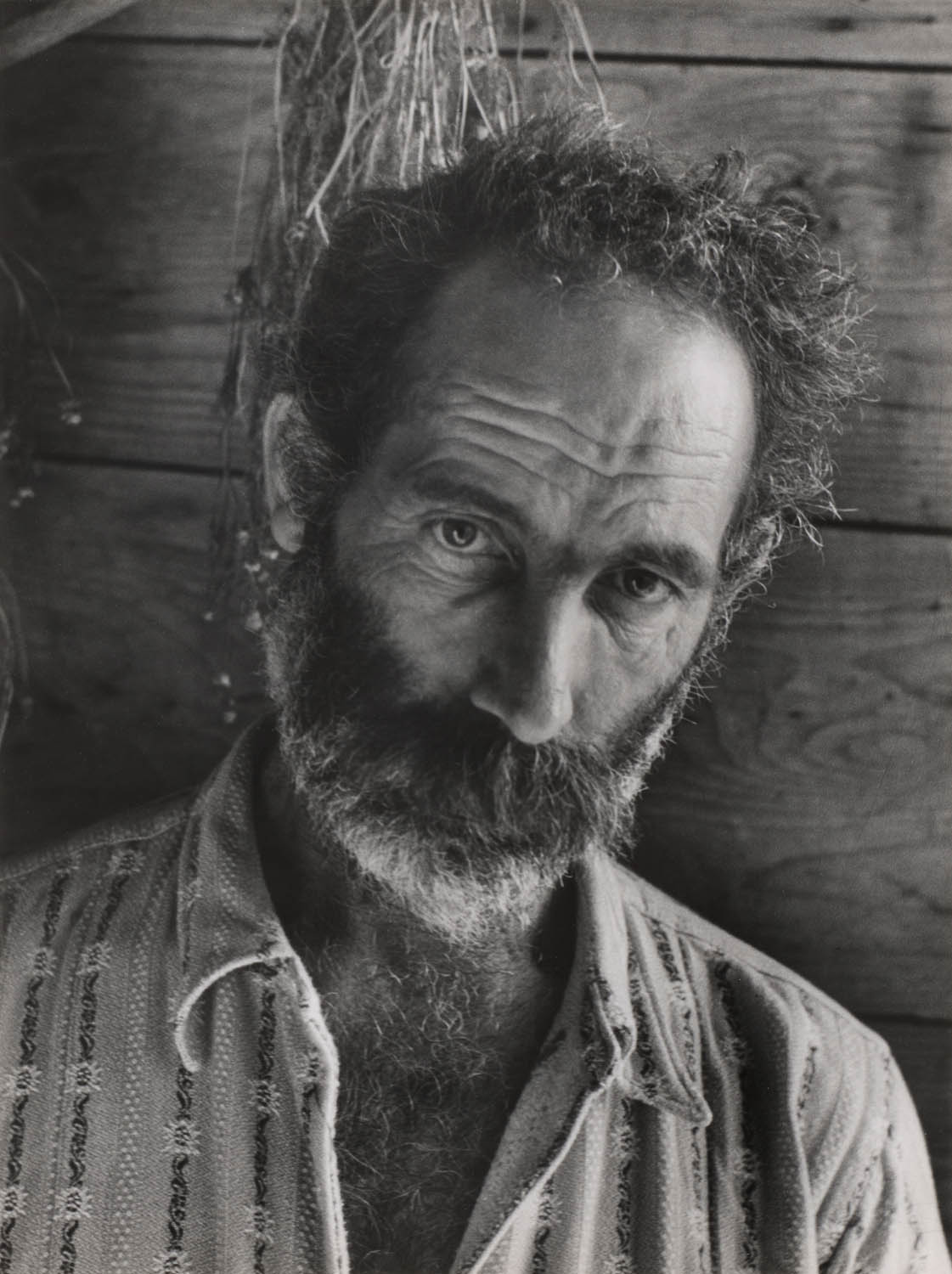
Jakob Tuggener (Swiss, 1904­-1988) 'Farmer from Heiden' (Bauer aus Heiden) 1934


Jakob Tuggener (Swiss, 1904­-1988)
Farmer from Heiden (Bauer aus Heiden)
1934
© Jakob Tuggener Stiftung / Fotostiftung Schweiz


Jakob Tuggener (Swiss, 1904­-1988) 'Forestry worker, Strahlegg' (Waldarbeiter, Strahlegg) Around 1954


Jakob Tuggener (Swiss, 1904­-1988)
Forestry worker, Strahlegg (Waldarbeiter, Strahlegg)
Around 1954
© Jakob Tuggener Stiftung / Fotostiftung Schweiz


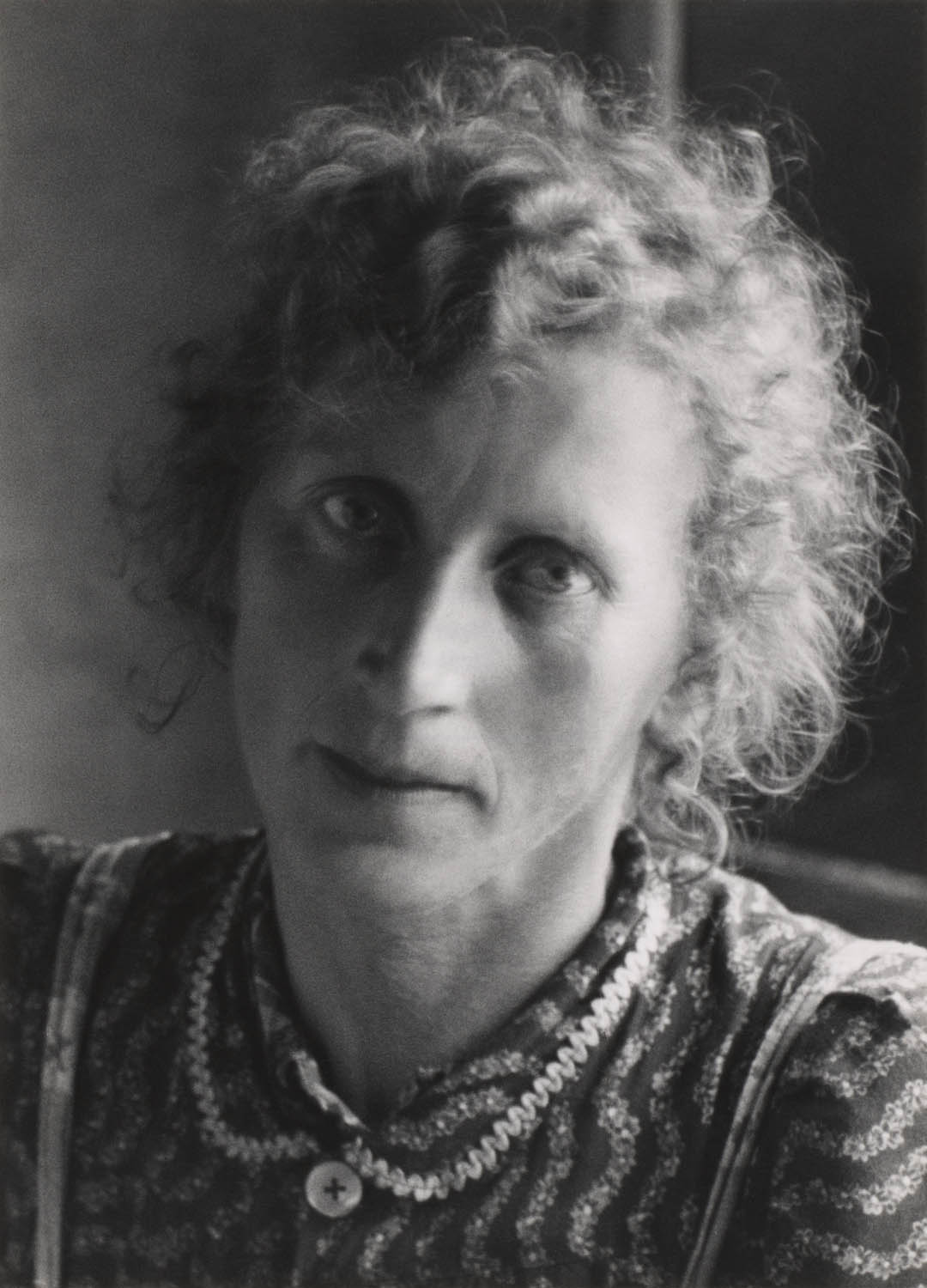
Jakob Tuggener (Swiss, 1904­-1988) 'Farmer's wife, Brüttelen' (Bauernfrau, Brüttelen) 1944


Jakob Tuggener (Swiss, 1904­-1988)
Farmer’s wife, Brüttelen (Bauernfrau, Brüttelen)
1944
© Jakob Tuggener Stiftung / Fotostiftung Schweiz


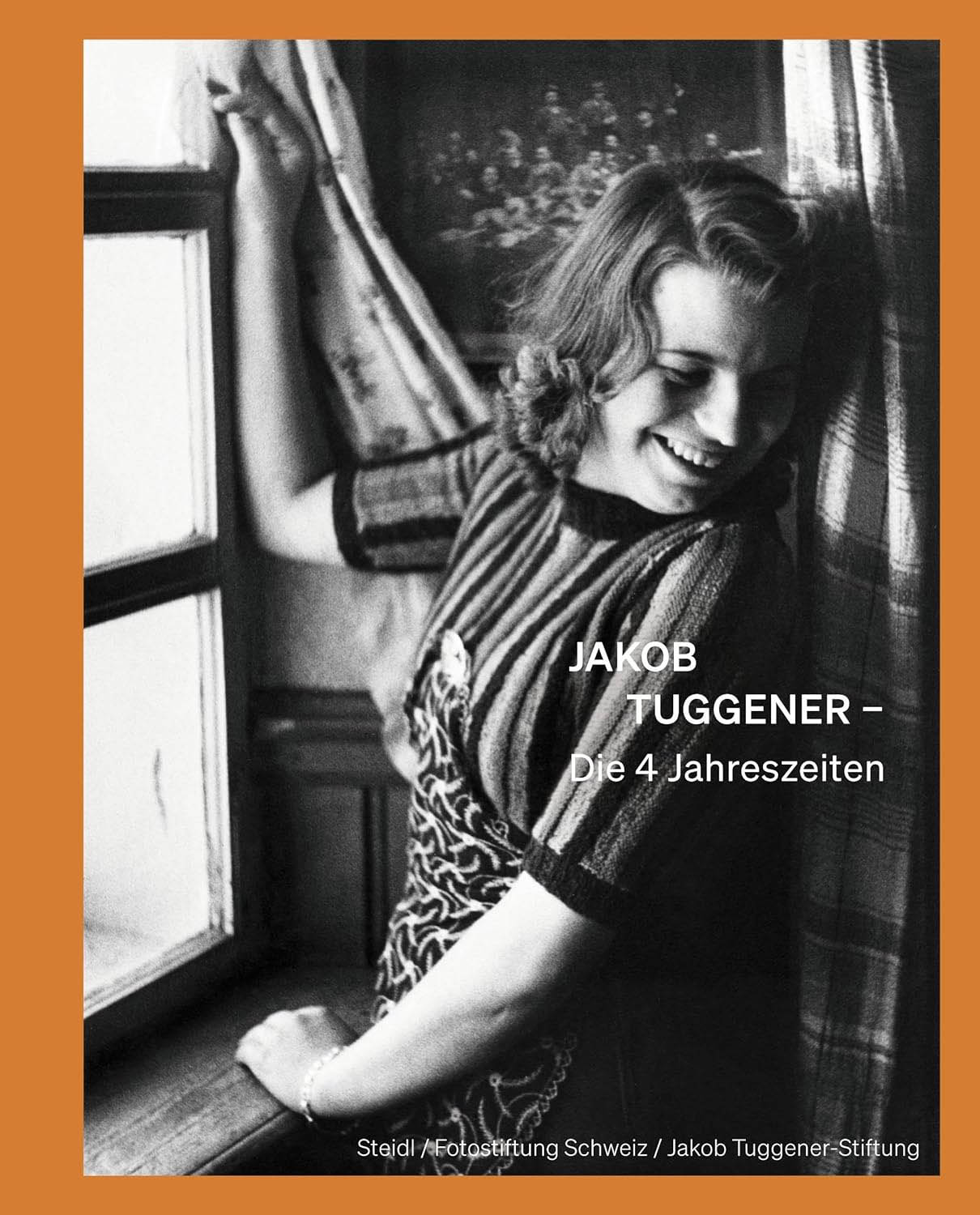
Jakob Tuggener 'Die 4 Jahreszeiten' catalogue book cover


Jakob Tuggener Die 4 Jahreszeiten catalogue book cover


Often, artists take a new curve in their final phase of creation, their language and attitude changes, other themes and motifs come to the fore. The Swiss photographer Jakob Tuggener, on the other hand, remained true to himself and his work in an almost irritating way. After he had already composed four unique book pieces on the themes spring, summer, autumn and winter during the 1940s, he created completely new versions of these “farm books” under the title The 4 Seasons in 1973 and 1974, at the age of almost 70 years. They are devoted to simple life in the countryside, reflecting in sensitively observed, atmospherically charged, yet never picturesque recordings, the recurring cycle of nature and are at the same time a reflection on human life and transience. While the world and society changed fundamentally between 1940 and 1970 – life in the countryside no less than life in the city – Tuggener allowed himself to assemble recordings from this entire period into a new, very personal epic. Especially the constancy in Tuggener’s work, this unwavering confidence in the power of the pictures, is one of the special qualities of The 4 Seasons.

Text from the Amazon website


Jakob Tuggener 'Die 4 Jahreszeiten' exhibition poster


Jakob Tuggener Die 4 Jahreszeiten exhibition poster


Fotostiftung Schweiz
Grüzenstrasse 45
CH-8400 Winterthur (Zürich)
Phone: +41 52 234 10 30

Opening hours:
Tuesday to Sunday 11am – 6pm
Wednesday 11am – 8pm (with free admission from 5 pm!)
Closed on Mondays

Fotostiftung Schweiz website

LIKE ART BLART ON FACEBOOK

Back to top

Exhibition: ‘Consuelo Kanaga. Catch the Spirit’ at the KBr Photography Center KBr Fundación MAPFRE, Barcelona

Exhibition dates: 15th February – 12th May, 2024

Curator: Drew Sawyer


Consuelo Kanaga (American, 1894-1978) 'Self-portrait' Nd


Consuelo Kanaga (American, 1894-1978)
Self-portrait
Nd
Gelatin silver print
20 1/16 × 15 1/16 × 1 1/2 in. (51 × 38.3 × 3.8cm) framed
Brooklyn Museum, Gift of Wallace B. Putnam from the Estate of Consuelo Kanaga
© Brooklyn Museum
Photo: Brooklyn Museum


What have you got to say?

We must acknowledge the importance of the Consuelo Kanaga, a strong, compassionate human being, an under recognised photographer. What a trailblazer for future female and male photographers such as Dorothea Lange, Imogen Cunningham, Berenice Abbott and Milton Rogovin.

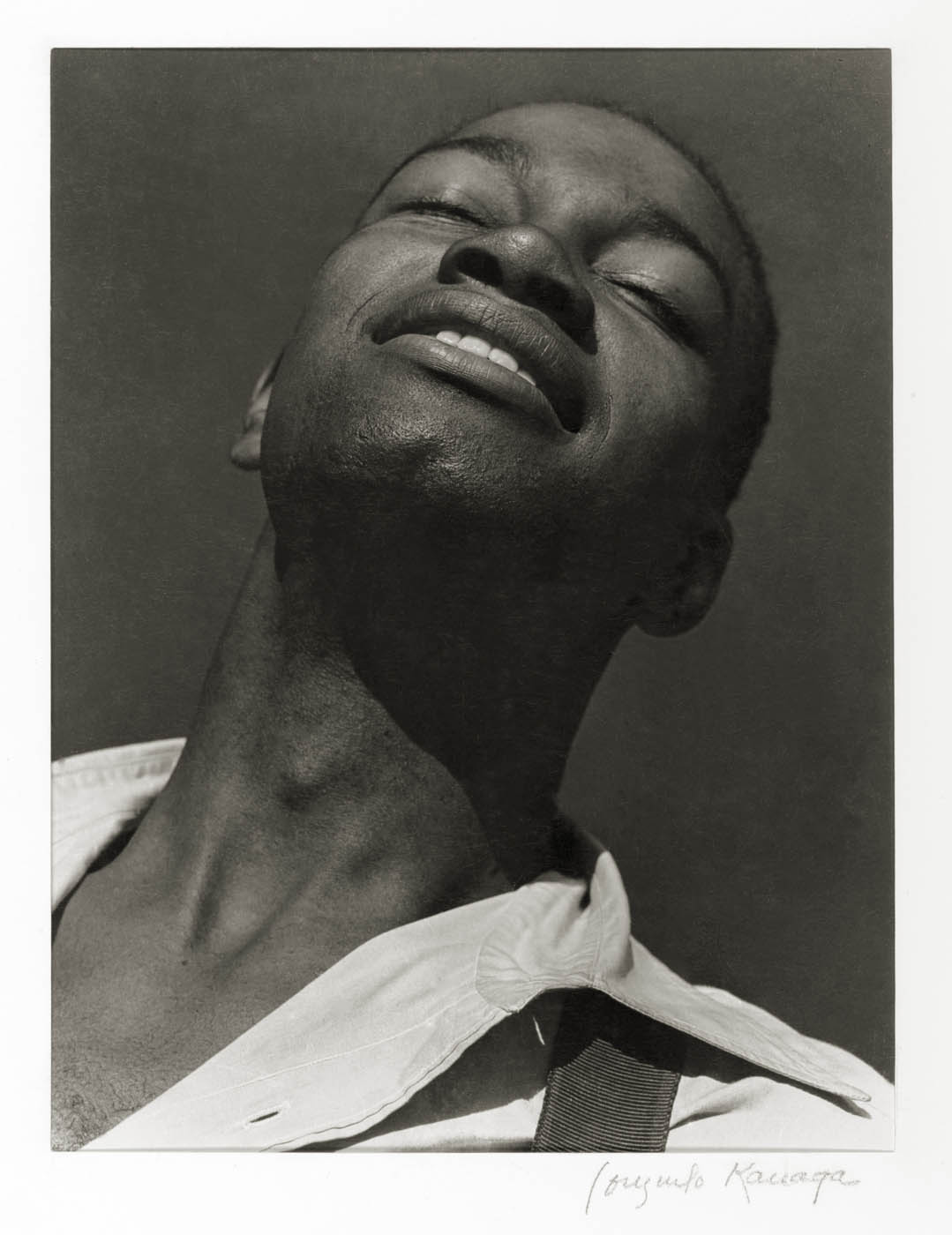
Kanaga is a story teller. Her photographs are strongly modernist, realist compositions. The portraits are direct and revealing, no external flourishes necessary in capturing the essence of the person; her landscapes, dark and brooding atmospheric iterations of land and spirit.

Consuelo Kanaga:

~ one of the pioneers of modern American photography

~ one of the first women photojournalists on staff at a newspaper (1918)

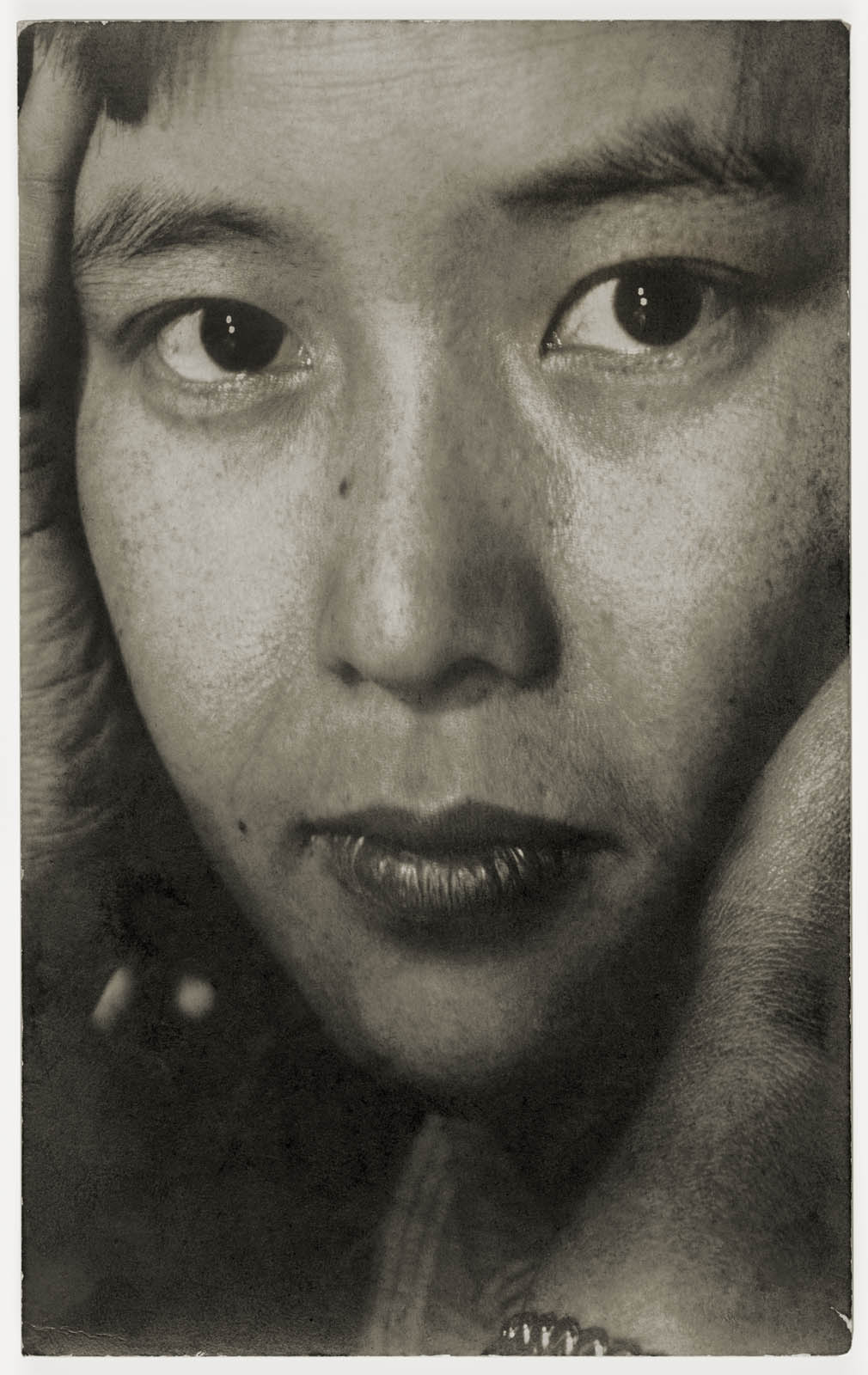
~ a great supporter and a confidant for Imogen Cunningham, Louise Dahl-Wolfe, Dorothea Lange, Alma Lavenson, Tina Modotti, and Eiko Yamazawa, among many others

~ passionate about social justice … social marginalisation, poverty, racial harassment, inequality… especially in relation to the African-American population in the United States.

~ maintained a close relationship with avant-garde circles, in San Francisco with the f.64 Group and in New York with the Photo League

~ focused on marginal day to day and political motifs, including workers, African Americans, objects, and buildings that were often in a state of disrepair

~ interested in worker’s rights and the worker movement

~ became very active in civil rights and took part in and photographed many demonstrations and marches in the 1960s


Whatever type of photograph Kanaga took (and there are many) her photographs are always perceptive = having or showing sensitive insight.

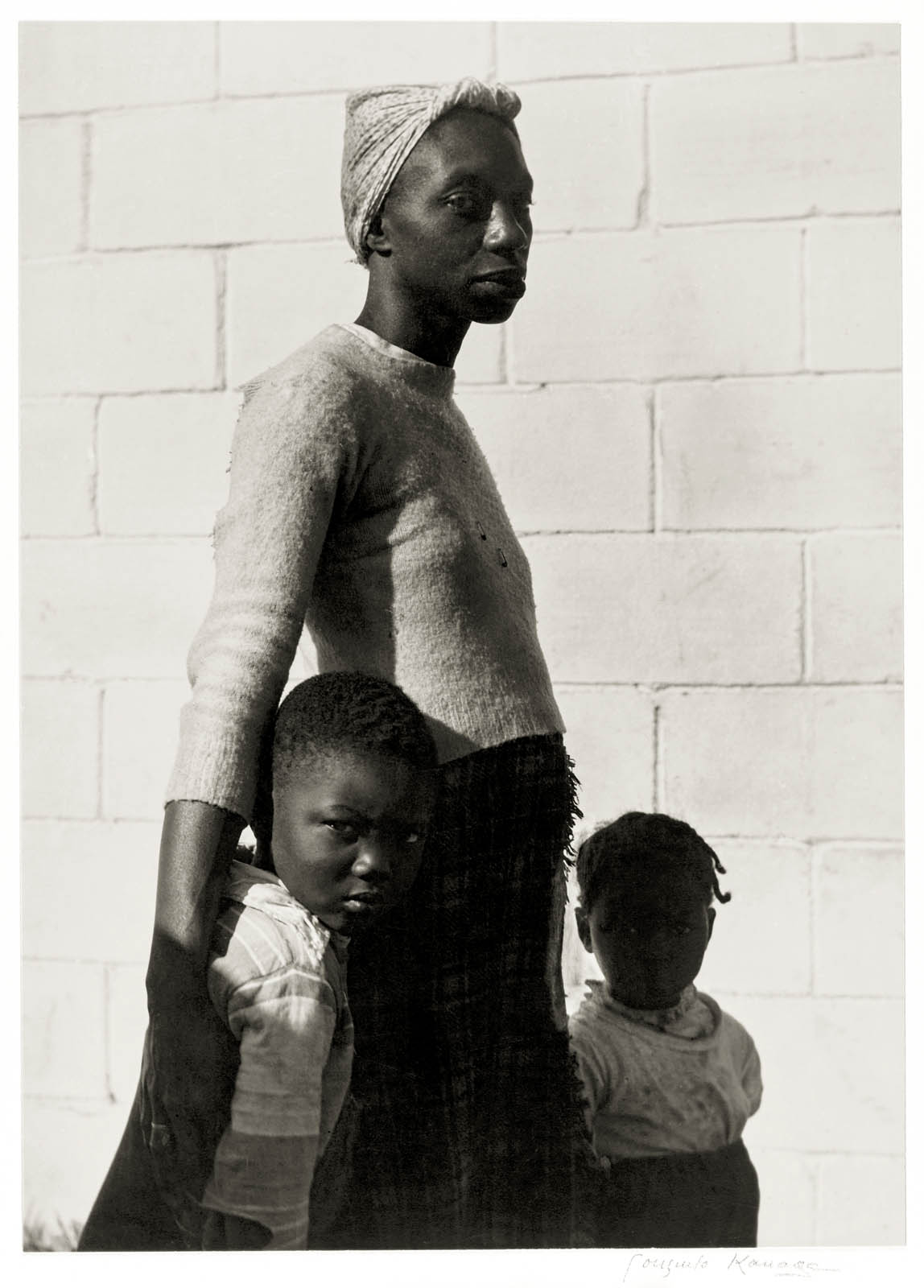
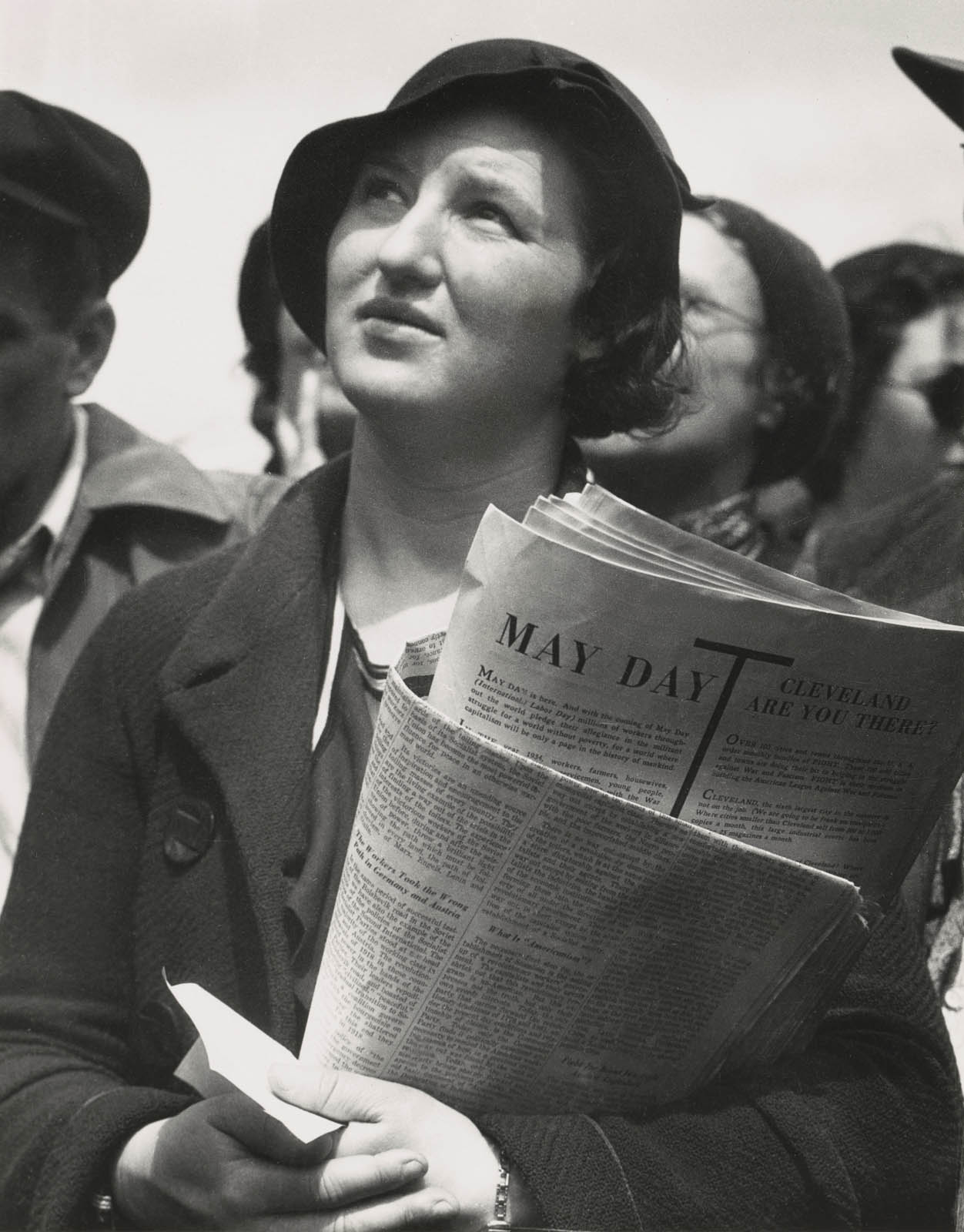
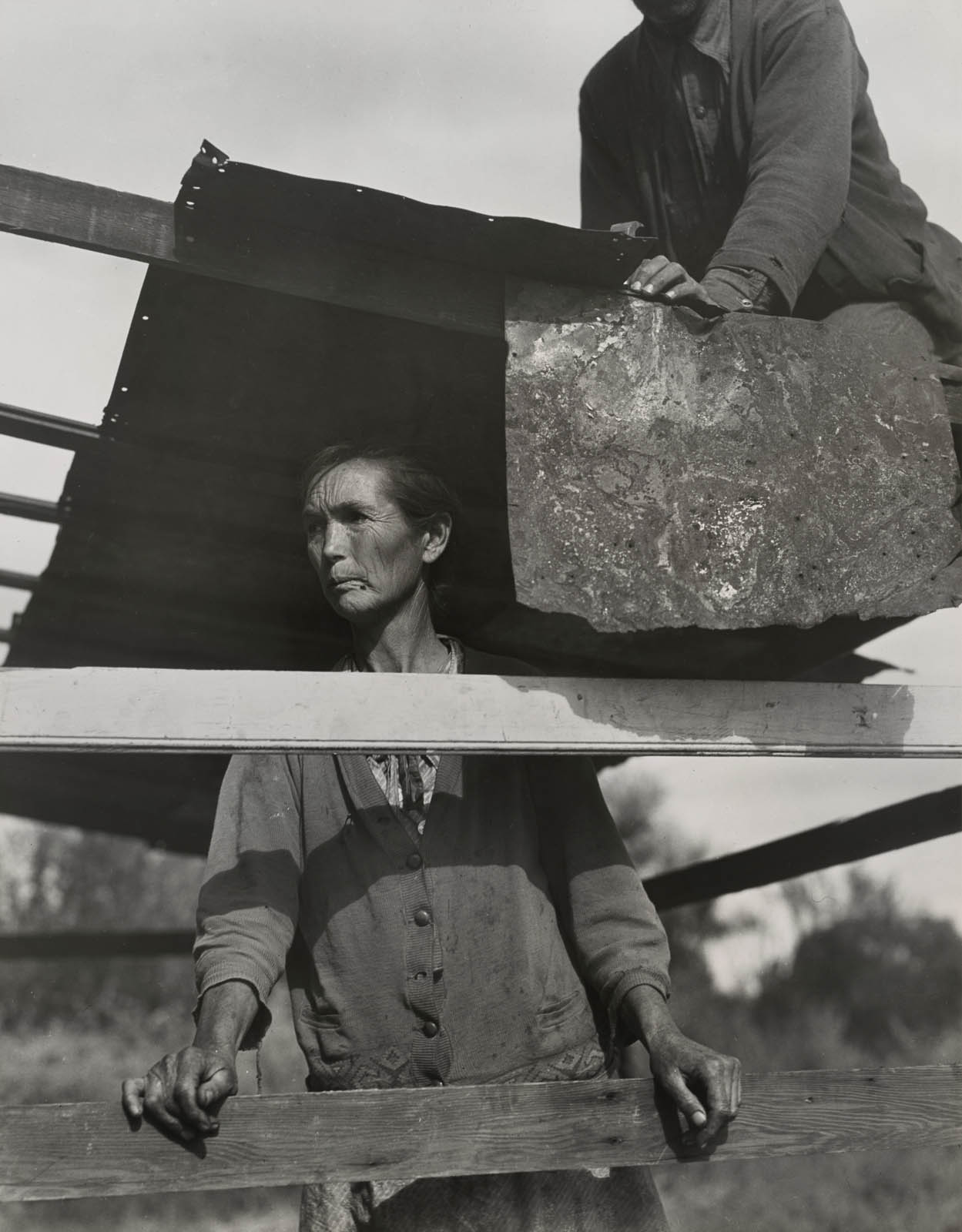
The sensitivity of Hands (1930, below); the tired eyes and clasped hands of the Widow Watson (1922-1924 below) contrasting with the mannerist hands of the boy staring off camera; the stoicism of the mother in Tree of Life (1950, below) with her children’s faces in deep shadow coupled with the subconscious symbology of the unyielding, white brick wall behind; and the dark mesa of Landscape Near Taos, New Mexico (Nd, below) hello Georgia O’Keeffe … all reflect Kanaga’s superb handling of shadow and light, of energy and spirit.

“Her body of work, though comparatively small, is consistently exceptional.”1

Dr Marcus Bunyan

1/ Barbara Head Millstein. “A Pioneer of Realism,” in The New York Times October 9, 1993 on the New York Times website [Online] Cited 04/05/2024


Many thankx to the Fundación MAPFRE for allowing me to publish the photographs in the posting. Please click on the photographs for a larger version of the image.


“One of America’s most transcendent yet, surprisingly, least-known photographers.”


Barbara Head Millstein and Sarah M. Lowe (1992). Consuelo Kanaga, An American Photographer. Seattle: University of Washington Press. pp. 21-40.


“I could have done lots more, put in much more work and developed more pictures, but I had also a desire to say what I felt about life. Simple things like a little picture in the window or the corner of the studio or an old stove in the kitchen have always been fascinating to me. They are very much alive, these flowers and grasses with the dew on them. Stieglitz always said, “What have you got to say?” I think in a few small cases I’ve said a few things, expressed how I felt, trying to show the horror of poverty or the beauty of black people. I think that in photography what you’ve done is what you’ve had to say. In everything this has been the message of my life. A simple supper, being with someone you love, seeing a deer come around to eat or drink at the barn – I like things like that. If I could make one true, quiet photograph, I would much prefer it to having a lot of answers.”


Margaretta K. Mitchell (1979). Recollections: Ten Women of Photography. NY: Viking Press. pp. 158–160.


Consuelo Kanaga: Catch the Spirit is the first exhibition in Europe to present a comprehensive retrospective of the entire career of the American Consuelo Kanaga (Astoria, Oregon, 1894 – Yorktown Heights, New York, 1978). The exhibition covers six decades of her professional dedication to photography.

Passionate about social justice, Kanaga was more interested in people and their problems than in photography: social marginalisation, poverty, racial harassment, inequality…, especially in relation to the African-American population in the United States.

Consuelo Kanaga was one of the few women who became a professional photojournalist, and as early as the 1910s in the United States. She was also one of the few who maintained a close relationship with avant-garde circles, both in San Francisco and in New York, and whose friendship and professional support opened the way for important women photographers such as Imogen Cunningham and Dorothea Lange, among others.

Despite the fame she achieved during her lifetime, her work is still surprisingly little known. This exhibition aims to make a conclusive contribution to the recognition that Kanaga’s work undoubtedly deserves.

Exhibition organised by the Brooklyn Museum in New York in collaboration with Fundación MAPFRE and the San Francisco Museum of Modern Art.

Text from the Fundación MAPFRE website


Consuelo Kanaga (American, 1894-1978) 'Fire, New York' 1922


Consuelo Kanaga (American, 1894-1978)
Fire, New York
1922
Gelatin silver print
20 1/16 × 15 1/16 × 1 1/2 in. (51 × 38.3 × 3.8cm) framed
Brooklyn Museum, Gift of Wallace B. Putnam from the Estate of Consuelo Kanaga
© Brooklyn Museum
Photo: Brooklyn Museum


Consuelo Kanaga (American, 1894-1978) 'Untitled (Downtown New York)' 1922-1924


Consuelo Kanaga (American, 1894-1978)
Untitled (Downtown New York)
1922-1924
Gelatin silver print
20 1/16 × 15 1/16 × 1 1/2 in. (51 × 38.3 × 3.8cm) framed
Brooklyn Museum, Gift of Wallace B. Putnam from the Estate of Consuelo Kanaga
© Brooklyn Museum
Photo: Brooklyn Museum


Consuelo Kanaga (American, 1894-1978) 'Untitled' 1920s


Consuelo Kanaga (American, 1894-1978)
Untitled
1920s
Gelatin silver print
20 1/16 × 15 1/16 × 1 1/2 in. (51 × 38.3 × 3.8cm) framed
Brooklyn Museum, Gift of Wallace B. Putnam from the Estate of Consuelo Kanaga
© Brooklyn Museum
Photo: Brooklyn Museum


Consuelo Kanaga (American, 1894-1978) 'Untitled' c. 1925


Consuelo Kanaga (American, 1894-1978)
Untitled
c. 1925
Toned gelatin silver print with graphite
20 1/16 × 15 1/16 × 1 1/2 in. (51 × 38.3 × 3.8cm) framed
Brooklyn Museum, Gift of Wallace B. Putnam from the Estate of Consuelo Kanaga
© Brooklyn Museum
Photo: Brooklyn Museum


Consuelo Kanaga (American, 1894-1978) 'Louise Dahl-Wolfe' c. 1928


Consuelo Kanaga (American, 1894-1978)
Louise Dahl-Wolfe
c. 1928
Gelatin silver print, printed 2023
4 × 5 in. (10.2 × 12.7cm)
Brooklyn Museum, Gift of Wallace B. Putnam from the Estate of Consuelo Kanaga
© Brooklyn Museum
Photo: Brooklyn Museum


Louise Emma Augusta Dahl-Wolfe (November 19, 1895 – December 11, 1989) was an American photographer. She is known primarily for her work for Harper’s Bazaar, in association with fashion editor Diana Vreeland. At Harper’s Bazaar she pioneered a new standard in colour photography. …

Among the celebrated fashion photographers of the 20th century, Louise Dahl-Wolfe was an innovator and influencer who significantly contributed to the fashion world. She was most widely known for her work with Harper’s Bazaar. Dahl-Wolfe was considered a pioneer of the ‘female gaze’ in the fashion industry and credited for creating a new image of strong, independent American women during World War II.

From 1943, Dahl-Wolfe introduced the “New American Look” to fashion photography, which Vicki Goldberg describes as “all clean hair, glowing skin and a figure both lithe and strong”. Dahl-Wolfe was known for taking photographs outdoors, with natural light in distant locations from South America to Africa in what became known as “environmental” fashion photography. The outdoor settings helped to evoke “a mood of freedom and optimism” associated with women’s liberation. Her photographs brought a new naturalism to fashion photography which had previously been dominated by a stiff and haughty “European” or “Germanic” studio style. Dahl-Wolfe described it as “that heavy, heavy look, with everybody looking very clumsy”. Her methodology in using natural sunlight and shooting outdoors became the industry standard even now.

Her models appear to pose candidly, almost as if Dahl-Wolfe had just walked in on them. In fact the poses are highly, constructed with an “almost abstract formal perfection” which she credited partly to the influence of Diaghilev’s Ballets Russes. Dahl-Wolfe innovatively used colour in photography and mainly concerned with the qualities of natural lighting, composition, and balance. Compared to other photographers at the time who were using red undertones, Dahl-Wolfe opted for cooler hues and also corrected her own proofs, with one example of her pulling proofs repeatedly to change a sofa’s colour from green to a dark magenta.

Text from the Wikipedia website


Consuelo Kanaga (American, 1894-1978) 'House Plant' 1930


Consuelo Kanaga (American, 1894-1978)
House Plant
1930
Bromide print
20 1/16 × 15 1/16 × 1 1/2 in. (51 × 38.3 × 3.8cm) framed
Brooklyn Museum, Gift of Wallace B. Putnam from the Estate of Consuelo Kanaga
© Brooklyn Museum
Photo: Brooklyn Museum


Consuelo Kanaga (American, 1894-1978) 'Kenneth Spencer' 1933


Consuelo Kanaga (American, 1894-1978)
Kenneth Spencer
1933
Gelatin silver print
20 1/16 × 15 1/16 × 1 1/2 in. (51 × 38.3 × 3.8cm) framed
Brooklyn Museum, Gift of Wallace B. Putnam from the Estate of Consuelo Kanaga
© Brooklyn Museum
Photo: Brooklyn Museum


Kenneth Spencer (25 April 1913 – 25 February 1964), was an American operatic singer and actor. Spencer starred in a few Broadway musicals and musical films in the United States during the 1940s. Frustrated with the racial prejudice he experienced in the United States as a black man, Spencer moved to West Germany in 1950 where he had a successful singing career. He also appeared in a number of German films. His career was cut short when he died in the crash of Eastern Air Lines Flight 304.

Text from the Wikipedia website


Consuelo Kanaga (American, 1894-1978) 'Clapboard Schoolhouse' 1930s


Consuelo Kanaga (American, 1894-1978)
Clapboard Schoolhouse
1930s
Gelatin silver print
20 1/16 × 15 1/16 × 1 1/2 in. (51 × 38.3 × 3.8cm) framed
Brooklyn Museum, Gift of Wallace B. Putnam from the Estate of Consuelo Kanaga
© Brooklyn Museum
Photo: Brooklyn Museum


A Pioneer of Realism

Consuelo Kanaga (1894-1978) was one of America’s most important photographers. Yet largely because she disdained wealth, fame and self-promotion, her transcendent images have never received the acclaim they deserve. The photographs on this page appear in the first major retrospective of her work, “Consuelo Kanaga: An American Photographer,” which will open Friday at the Brooklyn Museum.

Born in Astoria, Ore., Kanaga was hired in 1915 as a reporter at The San Francisco Chronicle but quickly became more interested in the work of the paper’s photographers. She took a job in the darkroom and was eventually named a staff photographer.

Inspired by the images in Alfred Stieglitz’s magazine, Camera Work, she left the newspaper and moved to New York in 1922. She soon became closely associated with such photographers as Edward Weston, Imogen Cunningham, Dorothea Lange and Louise Dahl. In 1932, Miss Kanaga was represented in the landmark “f.64” exhibition in San Francisco, the first major photography show that stressed realism over romanticism.

Her talent was rooted in an almost mystical belief that photography was a sacred trust — she felt obligated to capture the true essence of her subject. Her drive to fulfill this trust helped Kanaga, who was white, to understand the lives of blacks and to produce some of the most moving works ever done in African-American portraiture. She was equally talented in still-life and landscape photography, and her feeling for urban architecture was stimulated by her involvement with the socially committed New York Photo League during the 1930’s.

She continued to work into her 70’s, despite suffering from emphysema and cancer, which were probably caused by the chemicals used in creating her prints. Her body of work, though comparatively small, is consistently exceptional. Consuelo Kanaga died virtually unknown in 1978, but her talent endures.

Barbara Head Millstein. “A Pioneer of Realism,” in The New York Times October 9, 1993 on the New York Times website [Online] Cited 04/05/2024


Consuelo Kanaga (American, 1894-1978) 'Sargent Johnson' 1934


Consuelo Kanaga (American, 1894-1978)
Sargent Johnson
1934
Gelatin silver print
20 1/16 × 15 1/16 × 1 1/2 in. (51 × 38.3 × 3.8cm) framed
Brooklyn Museum, Gift of Wallace B. Putnam from the Estate of Consuelo Kanaga
© Brooklyn Museum
Photo: Brooklyn Museum


Sargent Claude Johnson (November 7, 1888 – October 10, 1967) was one of the first African-American artists working in California to achieve a national reputation. He was known for Abstract Figurative and Early Modern styles. He was a painter, potter, ceramicist, printmaker, graphic artist, sculptor, and carver. He worked with a variety of media, including ceramics, clay, oil, stone, terra-cotta, watercolour, and wood.

Text from the Wikipedia website


Consuelo Kanaga (American, 1894-1978) 'Untitled' 1930s


Consuelo Kanaga (American, 1894-1978)
Untitled
1930s
Toned gelatin silver print
20 1/16 × 15 1/16 × 1 1/2 in. (51 × 38.3 × 3.8cm) framed
Brooklyn Museum, Gift of Wallace B. Putnam from the Estate of Consuelo Kanaga
© Brooklyn Museum
Photo: Brooklyn Museum


Consuelo Kanaga (American, 1894-1978) 'Horse's Eye' 1930s


Consuelo Kanaga (American, 1894-1978)
Horse’s Eye
1930s
Gelatin silver print
4 × 3 1/2 in. (10.2 × 8.9cm)
Brooklyn Museum, Gift of Wallace B. Putnam from the Estate of Consuelo Kanaga
© Brooklyn Museum
Photo: Brooklyn Museum


Consuelo Kanaga (American, 1894-1978) 'The Bowery' 1935


Consuelo Kanaga (American, 1894-1978)
The Bowery
1935
Toned gelatin silver print
22 13/16 × 16 13/16 × 1 1/2 in. (57.9 × 42.7 × 3.8cm) framed
Brooklyn Museum, Gift of Wallace B. Putnam from the Estate of Consuelo Kanaga
© Brooklyn Museum
Photo: Brooklyn Museum


Consuelo Kanaga (American, 1894-1978) 'Angelo Herndon' 1936


Consuelo Kanaga (American, 1894-1978)
Angelo Herndon
1936
Gelatin silver print
20 1/16 × 15 1/16 × 1 1/2 in. (51 × 38.3 × 3.8cm) framed
Brooklyn Museum, Gift of Wallace B. Putnam from the Estate of Consuelo Kanaga
© Brooklyn Museum
Photo: Brooklyn Museum


Angelo Braxton Herndon (May 6, 1913 – December 9, 1997) was an African-American labor organiser arrested and convicted of insurrection after attempting to organise black and white industrial workers in 1932 in Atlanta, Georgia. The prosecution case rested heavily on Herndon’s possession of “communist literature”, which police found in his hotel room.

Herndon was defended by the International Labor Defense, the legal arm of the Communist Party of America, which hired two young local attorneys, Benjamin J. Davis Jr. and John H. Geer, and provided guidance. Davis later became prominent in leftist circles. Over a five-year period, Herndon’s case twice reached the United States Supreme Court, which ruled that Georgia’s insurrection law was unconstitutional, as it violated First Amendment rights of free speech and assembly. Herndon became nationally prominent because of his case, and Southern justice was under review. By the end of the 1940s he left the Communist Party, moved to the Midwest, and lived there quietly.

Text from the Wikipedia website


Consuelo Kanaga (American, 1894-1978) 'Untitled' 1936


Consuelo Kanaga (American, 1894-1978)
Untitled
1936
Gelatin silver print, printed 2023
4 × 5 in. (10.2 × 12.7cm)
Brooklyn Museum, Gift of Wallace B. Putnam from the Estate of Consuelo Kanaga
© Brooklyn Museum
Photo: Brooklyn Museum


Consuelo Kanaga (American, 1894-1978) 'Two Women, Harlem' c. 1938


Consuelo Kanaga (American, 1894-1978)
Two Women, Harlem
c. 1938
Toned gelatin silver print
22 13/16 × 16 13/16 × 1 1/2 in. (57.9 × 42.7 × 3.8cm) framed
Brooklyn Museum, Gift of Wallace B. Putnam from the Estate of Consuelo Kanaga
© Brooklyn Museum
Photo: Brooklyn Museum


Consuelo Kanaga (American, 1894-1978) 'Untitled (New York)' c. 1940


Consuelo Kanaga (American, 1894-1978)
Untitled (New York)
c. 1940
Gelatin silver print
20 1/16 × 15 1/16 × 1 1/2 in. (51 × 38.3 × 3.8cm) framed
Brooklyn Museum, Gift of Wallace B. Putnam from the Estate of Consuelo Kanaga
© Brooklyn Museum
Photo: Brooklyn Museum


For the first time in Spain and Europe, Consuelo Kanaga. Catch the Spirit features the work of this North American photographer spanning her entire career. Kanaga (1894-1978) is considered today a key figure in the history of contemporary photography, both for her contribution toward the recognition of women in this field and for the intensity with which her images confront the spectator with the great social issues of our time, particularly the conditions of African Americans in the United States.

The exhibition

Consuelo Kanaga. Catch the Spirit features six decades of work by this key figure in the history of modern Photography. With this new project, Fundación MAPFRE renews its commitment to promote the work of women photographers. On this occasion, despite having garnered much notoriety in life, the artist’s work is today surprisingly little known. This exhibition aims to contribute conclusively toward the recognition that Kanaga’s oeuvre undoubtedly deserves.

Consuelo Kanaga (Astoria, Oregon, 1894 – Yorktown Heights, New York, 1978) was truly passionate about social justice. She was most interested in people and issues such as marginalisation, poverty, racial harassment, and inequality, particularly in relation to African Americans in the United States. These were some of the fundamental matters she addressed through her work. Likewise, she also defended the formal and poetic possibilities of photography as an art form.

An unconventional figure, Kanaga was able to become a professional photojournalist in the United States as early as the 1910s. She was also one of the few women involved in the avant-garde circles both in San Francisco with the f.64 Group and in New York with the Photo League, whose friendship and professional support paved the way for other important women photographers. However, gender inequalities and social conventions limited her ability to dedicate herself completely to her artistic work. Kanaga worked full time jobs during many years and was only able to practice her art on weekends. She repeatedly put her career on hold for her partners; these are but a few reasons why her work is not more recognised today.

Organised around the Brooklyn Museum’s collection – the institution that has preserved the artist’s archive – the exhibition features nearly 180 photographs and a wide range of documentary material; contextualising Consuelo Kanaga’s work while focusing on some of her most iconic images and her portrayal of African American life in the 1930s through her photography.

Exhibition organised by the Brooklyn Museum in New York in collaboration with Fundación MAPFRE and the San Francisco Museum of Modern Art. Curated by Drew Sawyer, former Phillip Leonian and Edith Rosenbaum Curator of Photography, Brooklyn Museum.

Keys

New Negro Movement: From the late 19th century, magazines and novels published by black men and women began to emerge as a response to the prevailing racism in cities such as San Francisco, Washington, and New York. This literary explosion was the precedent of what became known as the New Negro Movement, which developed in Harlem, New York, between 1920 and 1930; a movement that also lent its name to the most comprehensive anthology dedicated to said cultural renaissance, written by Alain Locke and considered at the time as “the fundaments of the black canon”. Not only did black artists flourish during this time, white artists were also encouraged to join this movement in defence of the freedom, rights, and equality of African Americans through culture.

Kanaga Photojournalist: In 1915, when she was only 21 years old, Consuelo Kanaga began to write for the San Francisco Chronicle, where she learned photography in order to illustrate her assignments: “For my articles requiring photographs, I went with the photographer to help make the pictures more interesting,” she later recalled. “The editor liked the results and encouraged me to learn photography, ‘from scratch’.” In 1918 she began to work as a photographer for the newspaper and was also hired by the Daily News the following year. Kanaga was undoubtedly one of the first women photojournalists on staff at a newspaper; as her friend Dorothea Lange remarked: “she was the first newspaper photographer I’d ever met. She was a person way ahead of her time.”

Kanaga and Women Photographers: Kanaga’s career was interwoven with a solid and broad circle of women photographers who she cultivated special relationships with over the course of five decades. She was a great supporter and a confidant for Imogen Cunningham, Louise Dahl-Wolfe, Dorothea Lange, Alma Lavenson, Tina Modotti, and Eiko Yamazawa, among many others, who she advised and shared her company and connections in the art world with. These women inspired her and likewise she was an inspiration for them. Despite the fact her accomplishments were as relevant as those of her colleagues, her oeuvre received much less attention. Kanaga spent little time self-promoting since she was always more interested in cultivating the affective bonds with the people closest to her.

Biography

Consuelo Delesseps Kanaga was born on May 15th, 1894, in Astoria, Oregon. The daughter of a lawyer who was interested in agriculture and of the writer Mathilda Carolina Hartwing, she helped her parents with tasks related to editing from a very young age, eventually leading her to study journalism. In 1915 she began writing for the San Francisco Chronicle. Three years later, she became staff photographer. Kanaga met Imogen Cunningham, Edward Weston, and Dorothea Lange at the California Camera Club and became interested in artistic photography thanks to Alfred Stieglitz’s Camera Work. Between 1927 and 1928 she travelled through Europe and northern Africa. Throughout her adult life, she lived both in San Francisco and New York, was married three times, and established her first portrait studio in San Francisco in 1932. She also participated in the f.64 Group and her images were exhibited for the first time at the M.H. de Young Memorial Museum in San Francisco in 1932. Kanaga participated in West Coast liberal politics. After returning from New York in 1935, she became associated with the Photo League in 1938. Edward Steichen defended her photography and included her work in the renowned exhibition The Family of Man in 1955. In 1974 Kanaga held a solo exhibition at the Lerner-Heller gallery in New York and in 1976 she produced a small yet relevant retrospective at the Brooklyn Museum. In 1977 she exhibited her work at Wave Hill in Riverdale, New York. She passed away at her Yorktown Heights (New York) home in 1978. One year later, Kanaga’s work was included in the exhibition Recollections: Ten Women of Photography at the ICP and was the subject of a retrospective at the Brooklyn Museum of Art in 1992, where most of her work is currently preserved.

Press release from the Fundación MAPFRE


Consuelo Kanaga (American, 1894-1978) 'After Years of Hard Work (Tennessee)' 1948


Consuelo Kanaga (American, 1894-1978)
After Years of Hard Work (Tennessee)
1948
Toned gelatin silver print
20 1/16 × 15 1/16 × 1 1/2 in. (51 × 38.3 × 3.8cm) framed
Brooklyn Museum, Gift of Wallace B. Putnam from the Estate of Consuelo Kanaga
© Brooklyn Museum
Photo: Brooklyn Museum


Consuelo Kanaga (American, 1894-1978) 'Young Girl in Profile' 1948


Consuelo Kanaga (American, 1894-1978)
Young Girl in Profile
1948
Toned gelatin silver print
22 13/16 × 16 13/16 × 1 1/2 in. (57.9 × 42.7 × 3.8cm) framed
Brooklyn Museum, Gift of Wallace B. Putnam from the Estate of Consuelo Kanaga
© Brooklyn Museum
Photo: Brooklyn Museum


Consuelo Kanaga (American, 1894-1978) 'Tennessee' 1950


Consuelo Kanaga (American, 1894-1978)
Tennessee
1950
Gelatin silver print
20 1/16 × 15 1/16 × 1 1/2 in. (51 × 38.3 × 3.8cm) framed
Brooklyn Museum, Gift of Wallace B. Putnam from the Estate of Consuelo Kanaga
© Brooklyn Museum
Photo: Brooklyn Museum


Consuelo Kanaga (American, 1894-1978) 'Barbara Deming' c. 1964


Consuelo Kanaga (American, 1894-1978)
Barbara Deming
c. 1964
Gelatin silver print
20 1/16 × 15 1/16 × 1 1/2 in. (51 × 38.3 × 3.8cm) framed
Brooklyn Museum, Gift of Wallace B. Putnam from the Estate of Consuelo Kanaga
© Brooklyn Museum
Photo: Brooklyn Museum


Barbara Deming (1917-1984) was one of the most dearly loved civil rights and feminist activists of her time. Born in New York City in 1917 and educated there at the Friends Meeting House Quaker School, she later studied literature and drama at Bennington College and earned a master’s degree in drama from Case Western Reserve University in 1941.

Deming began her career as a poet, professional writer, and film critic, and turned to political writing and human rights activism in the middle of her life. …

In the 1960s Deming joined demonstrations against Polaris submarines, took part in the 1962 San Francisco-to-Moscow walk for peace, and attended the International Peace Brigade in Europe. Protesting nuclear-weapons testing at the Atomic Energy Commission led to her first experience with being jailed for civil disobedience, this time at the Women’s House of Detention in New York City.

Acting on her belief that the struggles for racial equality and for peace were one effort, Deming marched in the bi-racial Nashville-to-DC walk for peace alongside SNCC members. In 1963 she joined black activists protesting segregation in Alabama and Georgia as well as attended the House Un-American Activities Committee hearings. In 1964 she participated in the 2800-mile Quebec-Guantanamo walk for peace and freedom, a racially integrated protest over US actions in Cuba. During this march, she was arrested and jailed in Albany, Georgia, an experience she describes in her book Prison Notes.

Deming participated in political actions whenever and wherever individual rights and human dignity were being threatened. In 1965-1967 Deming traveled to North and South Vietnam to protest the war. In the 1970s she demonstrated for gay rights and feminist causes. In 1983 she was arrested on the march through Seneca Falls, organised by the Women’s Peace Encampment to protest the deployment of cruise missiles in Europe. Despite failing health, she was once again jailed.

Anonymous. “Barbara Deming,” on the Barbara Deming Memorial Fund website Nd [Online] Cited 03/04/2024


Photojournalism and the City

After having opted for journalism, influenced perhaps by her parents, Kanaga began to write for the San Francisco Chronicle in 1915, where she learned to produce photographs for her articles encouraged by the newspaper editor. In 1918 she became staff photographer, and the following year was hired by the Daily News, another San Francisco newspaper.

Between 1920 and 1950 she worked for newspapers and magazines in Denver and New York, capturing scenes of urban life and images of economic and racial inequality; as in The Widow Watson (1922-1924 below), which was taken while she was working for the newspaper New York American and depicts a woman suffering from tuberculosis next to her son.

Photojournalism led Kanaga to become aware of photography’s potential as an art form. Around 1918 she joined the California Camera Club in San Francisco. Not only did she gain access to a dark room and photographic equipment, but also books and magazines on the medium. The publication Camera Work by Alfred Stieglitz and the works of New York and San Francisco photographers, such as Arnold Genthe, who portrayed street scenes and urban architecture in their images, influenced her greatly.


Consuelo Kanaga (American, 1894-1978) 'The Widow Watson' 1922-1924


Consuelo Kanaga (American, 1894-1978)
The Widow Watson
1922-1924
Gelatin silver print
20 1/16 × 15 1/16 × 1 1/2 in. (51 × 38.3 × 3.8cm) framed
Brooklyn Museum, Gift of Wallace B. Putnam from the Estate of Consuelo Kanaga
© Brooklyn Museum
Photo: Brooklyn Museum


Portrait Gallery

Kanaga began to produce portraits for additional income as a complement to her journalistic work, initially in San Francisco and later in New York. She opened her first studio in the early 1920s and was able to support herself and her partners financially for the rest of her life by taking photographs of wealthy clients and friends who were part of the avant-garde movements in San Francisco and New York. Thus, the portrait became the main focus of Kanaga’s creative production. It is also important to note that while most of her work as a photojournalist was lost, her portraits remain well represented among the negatives and prints that have been preserved.

Influenced by Stieglitz, in her portraits Kanaga experimented with poses, cropping, lighting, and printing in order to highlight the expressive capabilities of her images. Aside from flash, she used dark room techniques such as over-and underexposure, manipulating exposure times in specific parts of a photographic print to accentuate the contrast between light and shade, which generated a theatrical effect. The artist also frequently toned her prints with metals such as gold, adding pencil or graphite to highlight certain features.


Consuelo Kanaga (American, 1894-1978) 'Portrait of a Woman' c. 1925


Consuelo Kanaga (American, 1894-1978)
Portrait of a Woman
c. 1925
Gelatin silver print
20 1/16 × 15 1/16 × 1 1/2 in. (51 × 38.3 × 3.8cm)
Brooklyn Museum, Gift of Wallace B. Putnam from the Estate of Consuelo Kanaga
© Brooklyn Museum
Photo: Brooklyn Museum


North Americans Abroad

One of the fundamental experiences in Kanaga’s formative development was her time in Europe and northern Africa between 1927 and 1928, made possible through the financial support of the patron Albert M. Bender. Kanaga spent close to a year travelling through France, Germany, Italy, Hungary, and Tunisia, taking photographs and visiting museums, monuments, and churches. The artist also sought opportunities to learn modern photographic techniques. In Kairouan (Tunisia) she came into contact with a community of ex-pat artists and produced three photo albums portraying the city and its people, consolidating her interest in portraiture.

Consuelo Kanaga began to express her opinions on racism in the United States during these trips. A subject she would explore in more depth through photography during the 1930s. “I am sick of seeing colored men and women abused by stupid white people.”

Photography and the American Scene

Beyond portraiture, Kanaga practiced numerous genres and styles throughout her career. Like other North American artists, she was attracted to what she encountered in the “American Scene”; naturalist and descriptive representations of national and regional heritage and everyday life. Kanaga mostly focused on marginal day to day and political motifs, including workers, African Americans, objects, and buildings that were often in a state of disrepair.

Her first portraits of African Americans were aligned with the New Negro Movement that arose in the 1920s and 30s. Black intellectuals and artists tried to redefine and celebrate African American identities through cultural self-expression, economic independence, and progressive policies. Likewise, they advocated for the creation of inspiring images of their community and of negritude at a time when lynchings and racial terror were some of the most pressing legal and ethical issues. Within this context, Kanaga’s photographs can be considered a true statement of intent: Hands (1930 below) is the first preserved photograph that captures her anti-racist ideals. She also portrayed the singer Kenneth Spencer, the poet Langston Hughes, and the painter and ceramist Sargent Johnson, among others.

Along with her interest in African American communities, Kanaga became interested in worker’s rights and the worker movement that emerged in the Soviet Union and Germany during the 1920s. After moving to New York in 1935, she took photographs for leftist publications and became involved with the Photo League. At a time marked by the will to promote solidarity among workers beyond race and gender, Kanaga focused on the experiences of African Americans and Workers in particular.


Consuelo Kanaga (American, 1894-1978) 'Hands' 1930


Consuelo Kanaga (American, 1894-1978)
Hands
1930
Gelatin silver print
23 1/16 × 29 1/16 × 1 1/2 in. (58.6 × 73.8 × 3.8cm) framed
Brooklyn Museum, Gift of Wallace B. Putnam from the Estate of Consuelo Kanaga
© Brooklyn Museum
Photo: Brooklyn Museum


Portraits of Artists

Throughout the 1930s and 40s, Kanaga produced portraits of artists, writers, actors, and musicians. She met many of them thanks to her relationship with several photography clubs and collectives, as well as during her trips through the United States and Europe. Her images include portraits of the photographers Alfred Stieglitz and W. Eugene Smith, the painters Milton Avery and Mark Rothko, and of designers such as Wharton Esherick.

Conversely, Kanaga’s career was especially linked to a solid and broad circle of women photographers whose relationships she cultivated throughout her time as an artist. She was a great supporter and confidant for a series of photographers who often photographed each other, such as Berenice Abbott, Imogen Cunningham, Louse Dahl-Wolfe, Dorothea Lange, Alma Lavenson, Tina Modotti, and Eiko Yamazawa.


Consuelo Kanaga (American, 1894-1978) 'Wharton Esherick' 1940


Consuelo Kanaga (American, 1894-1978)
Wharton Esherick
1940
Bromide print
20 1/16 × 15 1/16 × 1 1/2 in. (51 × 38.3 × 3.8cm) framed
Brooklyn Museum, Gift of Wallace B. Putnam from the Estate of Consuelo Kanaga
© Brooklyn Museum
Photo: Brooklyn Museum


Wharton Esherick (July 15, 1887 – May 6, 1970) was an American sculptor who worked primarily in wood, especially applying the principles of sculpture to common utilitarian objects. Consequently, he is best known for his sculptural furniture and furnishings. Esherick was recognised in his lifetime by his peers as the “dean of American craftsmen” for his leadership in developing nontraditional designs and for encouraging and inspiring artists and artisans by example. Esherick’s influence is evident in the work of contemporary artisans, particularly in the Studio Craft Movement. His home and studio in Malvern, Pennsylvania, are part of the Wharton Esherick Museum, which has been listed as a National Historic Landmark since 1993.

Text from the Wikipedia website


Trips to the Southern United States

Between the late 1940s and early 60s, Kanaga went on numerous trips through the southern United States where she continued to photograph black children and workers. While in Florida, she produced a series of photographs dedicated to black families and farmhands working in recovered swamp lands known as mucklands. During those trips, she took one of her most renowned photographs titled She is a Tree of Life (1950 below), which depicts a stoic mother with her son and daughter on either side. In 1950 she also photographed self-taught black artist William Edmondson next to his carved stone sculptures.

In 1964, amidst the struggle for freedom of Black Americans in the United States, the activist and writer Barbara Deming invited Kanaga to photograph the Quebec-Washington-Guantanamo Walk for Peace in protest of United States actions against Cuba. During the march, Deming and other activists were arrested for demanding that all demonstrators be allowed to walk together on a “white only” sidewalk. The book Prison Notes, published by Deming in 1966, includes photographs by Kanaga.


Consuelo Kanaga (American, 1894-1978) 'She is a Tree of Life' 1950


Consuelo Kanaga (American, 1894-1978)
She is a Tree of Life
1950
Gelatin silver print
22 13/16 × 16 13/16 × 1 1/2 in. (57.9 × 42.7 × 3.8cm) framed
Brooklyn Museum, Gift of Wallace B. Putnam from the Estate of Consuelo Kanaga
© Brooklyn Museum
Photo: Brooklyn Museum


Studies of Nature

In 1940 Kanaga and her husband, the painter Wallace Putnam, purchased a house outside the city, in Yorktown Heights, seventy kilometres north of Manhattan. They moved there permanently in 1950. Meanwhile, Kanaga continued taking photographs for household magazines in order to support herself and her husband financially. Perhaps this is one of the reasons why, after having her work exhibited in important exhibitions during the 1940s, Kanaga’s artistic output decreased during the following two decades. Nevertheless, she photographed the natural environment surrounding her house and in 1948 one of the pictures she took of the pond in their back yard was included in the exhibition In and Out of Focus: A Survey of Today’s Photography, held at the Museum of Modern Art in New York.

Catalogue

The catalogue that accompanies this exhibition has been published in English, Spanish, and Catalan by Fundación MAPFRE and the Brooklyn Museum. It features an essay by the show’s curator Drew Sawyer and texts by Shalon Parker, Ellen Macfarlane, and Shana Lopes. The publication includes a complete overview of the artist’s life and work.

Press release from the Fundación MAPFRE


Consuelo Kanaga (American, 1894-1978) '[Untitled] (Landscape Near Taos, New Mexico)' Nd


Consuelo Kanaga (American, 1894-1978)
[Untitled] (Landscape Near Taos, New Mexico)
Nd
Gelatin silver print
4 3/4 x 7 3/4 in. (12.1 x 19.7cm)
Brooklyn Museum, Gift of Wallace B. Putnam from the Estate of Consuelo Kanaga
© Brooklyn Museum
Photo: Brooklyn Museum


Consuelo Kanaga (American, 1894-1978) '[Untitled] (Landscape with Farmhouse)' Nd


Consuelo Kanaga (American, 1894-1978)
[Untitled] (Landscape with Farmhouse)
Nd
Gelatin silver print
3 5/8 x 4 3/4 in. (9.2 x 12.1cm)
Brooklyn Museum, Gift of Wallace B. Putnam from the Estate of Consuelo Kanaga
© Brooklyn Museum
Photo: Brooklyn Museum


KBr Photography Center
Avenida Litoral, 30 – 08005 Barcelona
Phone: +34 93 272 31 80

(Attention only during the opening hours of the exhibition hall)

Opening hours:
Mondays (except holidays): Closed
Tuesday to Sundays (and holidays): 11am – 8pm

Fundación MAPFRE website

LIKE ART BLART ON FACEBOOK

Back to top

Exhibition: ‘Siam: Through the Lens of John Thomson (1865-66)’ at the Russell-Cotes Art Gallery and Museum, Bournemouth, England

Exhibition dates: 21st October 2023 – 14th April 2024


John Thomson (Scottish, 1837-1921) 'A Siamese monk holding a fan' 1865


John Thomson (Scottish, 1837-1921)
A Siamese monk holding a fan
1865
Photograph from a glass photonegative, wet collodion
Public domain


A bridge between past and present

An Easter Monday posting.

Magnificent large format photographs of the landscape and people of Siam (now Thailand), just two decades after the invention of photography. The photographs give “us a glimpse into some characteristics of people and places of Siam in the 1860s.”

In the portrait photographs the engagement revealed by the photographer of the subject with the camera lens is masterful. To elicit this response from people unused to posing in front of a large, bulky camera shows how the photographer must have been empathetic to his subjects and put them at their ease with the process of having their photograph taken.

The subjects are not apprehensive of the camera. The images show them directly: composed, reserved, non-declamatory and possessing a powerful presence. The exchange between subject and photographer evidences a direct line of communication with the sitter.

The eyes of A Siamese boy (1865, below) drill into mine and I feel a profound engagement with his questioning gaze. I am pierced by his gaze … which forces me to confront my own identity, and mortality.

As a viewer of these human beings all these decades later (a bridge between past and present), it’s as if I could reach out and touch their humanity. Their soul.

Dr Marcus Bunyan


Many thankx to the Russell-Cotes Art Gallery and Museum for allowing me to publish the photographs in the posting. Please click on the photographs for a larger version of the image.


In the mid-19th century, John Thomson arrived in Siam with a fairly new invention of those days photography….

Step back in time and immerse yourself in the wonders of 19th-century Southeast Asia as seen through the lens of the intrepid adventurer and photographer, John Thomson. The Russell-Cotes Art Gallery & Museum is proud to present an enchanting new exhibition Siam: Through the Lens of John Thomson on display from 21 October 2023 to 14 April 2024, inviting visitors to embark on a captivating journey through time and space. This extraordinary showcase offers a unique glimpse into the captivating landscapes, diverse cultures, and fascinating history of Southeast Asia.

A British photographer with an exceptional eye for detail, Thomson embarked on a groundbreaking journey to Siam during the late Victorian era, with a fairly new invention in those days: photography, capturing scenes that had been scarcely witnessed before in the Western world. Throughout his remarkable career, Thomson ventured into uncharted territories and documented the exotic beauty and cultural richness of Thailand and Cambodia in stunning detail. Featuring dramatic images developed from negatives preserved in London’s Wellcome Collection, this exhibition introduces the sights and people of nineteenth-century Thailand and Cambodia as witnessed by Thomson first hand. In this new exhibition, visitors to the Russell-Cotes Art Gallery & Museum will have the privilege of witnessing many meticulously preserved photographs taken by Thomson during his travels, carefully curated to provide an insightful narrative of his exploration. Each image tells a story of its own, serving as a bridge between the past and the present, enabling visitors to forge a deeper connection with the cultures and history of Thailand and Cambodia.

Text from the Russell-Cotes Art Gallery and Museum website


Siam Through the Lens of John Thomson, 1865-66: In-Focus audio tour with Jo O’Rourke when the exhibition was at Chester Beatty

This exhibition gives us a glimpse into some characteristics of people and places of Siam in the 1860s. We are guided through a wonderful collection of images taken with great sensitivity by one of the pioneers of photojournalism John Thomson (1837-1921).


John Thomson (Scottish, 1837-1921) 'The Chao Phraya River and Rattanakosin Island from the Prang of Wat Arun' 1865

John Thomson (Scottish, 1837-1921) 'The Chao Phraya River as seen from the main spire of Wat Arun' 1855-1866

John Thomson (Scottish, 1837-1921) 'The Chao Phraya River and Rattanakosin Island from the Prang of Wat Arun' 1865


John Thomson (Scottish, 1837-1921)
The Chao Phraya River and Rattanakosin Island from the Prang of Wat Arun
1865
Panorama of three photographs from a glass photonegatives, wet collodion
Public domain


John Thomson (Scottish, 1837-1921) 'King Mongkut (King Rama IV) in the uniform of a French Field Marshall' 1865


John Thomson (Scottish, 1837-1921)
King Mongkut (King Rama IV) in the uniform of a French Field Marshall
1865
Photograph from a glass photonegative, wet collodion
Public domain


“A shrill blast of horns heralded the approach of the King and caused us hastily to descend into the court,” Thomson wrote of the occasion. “His Majesty entered through a massive gateway, and I must confess that I felt much impressed by his appearance, as I had never been in the presence of an anointed sovereign before. He stood about five feet eight inches, and his figure was erect and commanding; but an expression of severe gravity was settled on his somewhat haggard face. His dress was a robe of spotless white, which reached right down to his feet; his head was bare.

“All was prepared beneath a space in the court when, just as I was about to take the photograph, His Majesty changed his mind, and without a word to anyone, passed suddenly out of sight. We patiently waited, and at length the King reappeared, dressed this time in a sort of French Field Marshal’s uniform. The portrait was a great success, and His Majesty afterwards sat in his court robes, requesting me to place him where and how I pleased.”

In the photo of the King in the field marshal’s regalia, he wears the sash of the Legion d’honneur and the Star First Class presented to him on behalf of Emperor Napoleon III by the admiral of the French fleet in Indochina. On a side able rests a small telescope, reflecting the king’s interest in astronomy and its Western means of study.

Anonymous. “How the world first saw Siam,” on The Nation website Thursday January 22nd, 2015 [Online] Cited 14/03/2024


John Thomson (Scottish, 1837-1921) 'King Mongkut (King Rama IV) in state attire' 1865


John Thomson (Scottish, 1837-1921)
King Mongkut (King Rama IV) in state attire
1865
Photograph from a glass photonegative, wet collodion
Public domain


John Thomson (Scottish, 1837-1921) 'Prince Chulalongkorn' 1865


John Thomson (Scottish, 1837-1921)
Prince Chulalongkorn
1865
Photograph from a glass photonegative, wet collodion
Public domain


Prince Chulalongkorn, subsequently King Chulalongkorn (1853-1910), aged 12 years, wearing a top-knot, fine traditional Thai clothes and jewellery. Standing in a courtyard of the Grand Palace, Bangkok, between an ornamental table and an urn.


John Thomson (Scottish, 1837-1921) 'Royal Barge Anantanakkharat / A Royal Barge Procession marks the Buddhist Kathin festival on Oct. 14, 1865' 1865


John Thomson (Scottish, 1837-1921)
Royal Barge Anantanakkharat / A Royal Barge Procession marks the Buddhist Kathin festival on Oct. 14, 1865
1865
Photograph from a glass photonegative, wet collodion
Public domain


John Thomson (Scottish, 1837-1921) 'Offering lunch to Buddhist monks' 1865-1866


John Thomson (Scottish, 1837-1921)
Offering lunch to Buddhist monks
1865-1866
Photograph from a glass photonegative, wet collodion
Public domain


John Thomson (Scottish, 1837-1921) 'Khon and Lakhon troupe' 1865-1866


John Thomson (Scottish, 1837-1921)
Khon and Lakhon troupe
1865-1866
Photograph from a glass photonegative, wet collodion
Public domain


John Thomson (Scottish, 1837-1921) 'A white elephant belonging to King Mongkut' 1865-1866


John Thomson (Scottish, 1837-1921)
A white elephant belonging to King Mongkut
1865-1866
Photograph from a glass photonegative, wet collodion
Public domain


John Thomson (Scottish, 1837-1921) 'Siam (Thailand)' 1865


John Thomson (Scottish, 1837-1921)
Siam (Thailand)
1865
Photograph from a glass photonegative, wet collodion
Public domain


John Thomson (Scottish, 1837-1921) 'A Siamese boy' 1865


John Thomson (Scottish, 1837-1921)
A Siamese boy
1865
Photograph from a glass photonegative, wet collodion
Public domain


John Thomson (Scottish, 1837-1921) 'Portrait of a princess with her maidservant (possibly a daughter of Prince Nilarat, Prince of Alongkot Kitpreecha)' 1865


John Thomson (Scottish, 1837-1921)
Portrait of a princess with her maidservant (possibly a daughter of Prince Nilarat, Prince of Alongkot Kitpreecha)
1865
Photograph from a glass photonegative, wet collodion
Public domain


Step back in time and immerse yourself in the wonders of 19th-century Southeast Asia as seen through the lens of the intrepid adventurer and photographer, John Thomson. The Russell-Cotes Art Gallery & Museum is proud to present an enchanting new exhibition Siam: Through the Lens of John Thomson on display from 21 October 2023 to 14 April 2024, inviting visitors to embark on a captivating journey through time and space. This extraordinary showcase offers a unique glimpse into the captivating landscapes, diverse cultures, and fascinating history of Southeast Asia, as captured by the illustrious Scottish Victorian photographer, John Thomson.

A Scottish photographer with an exceptional eye for detail, Thomson embarked on a groundbreaking journey to Siam during the late Victorian era, with a fairly new invention in those days: photography, capturing scenes that had been scarcely witnessed before in the Western world. Throughout his remarkable career, Thomson ventured into uncharted territories and documented the exotic beauty and cultural richness of Thailand and Cambodia in stunning detail. His evocative photographs offer an invaluable historical record and a testament to his artistic sensibility and his photographic vision marks him out as one of history’s most important travel photographers.

The founders of the Russell-Cotes Art Gallery and Museum, Merton and Annie Russell-Cotes travelled extensively in their lifetime, bringing back crates full of ‘objets d’art’,as Merton described them in his memoirs. These were to fill almost every room of the house alongside Merton’s vast art collection and, in some cases, inspired the Russell-Cotes to alter and adapt rooms to a particular theme. As they visited almost every continent during their grand worldwide tours, it is only fitting that this exhibition works in collaboration with the vast collections from around the world on display at the Russell-Cotes Art Gallery and Museum today. Annie and Merton witnessed similar scenes to John Thomson, but chose to collect objects, rather than images.

Featuring dramatic images developed from negatives preserved in London’s Wellcome Collection, this exhibition introduces the sights and people of nineteenth-century Thailand and Cambodia as witnessed by Thomson first hand. In this new exhibition, visitors to the Russell-Cotes Art Gallery & Museum will have the privilege of witnessing many meticulously preserved photographs taken by Thomson during his travels, carefully curated to provide an insightful narrative of his exploration. Each image tells a story of its own, serving as a bridge between the past and the present, enabling visitors to forge a deeper connection with the cultures and history of Thailand and Cambodia.

The photographs on display encompass a diverse range of subjects, including awe-inspiring temples, architectural marvels, picturesque landscapes, and enchanting portraits of everyday life, ceremonies royalty, tradition, and customs. Each photograph serves as a testament to Thomson’s skill as a storyteller, highlighting the allurement of these distant lands. Thomson also received special permission to visit Angkor Wat (then under Siam’s control), becoming the first to photograph its famous ruins.

He used the wet-collodion process as his method for taking photographs, so called because an exposure was made onto a glass negative. His process had to be carried out in complete darkness, requiring a portable darkroom tent and a large amount of equipment. He travelled around Siam with many crates of glass negatives and bottles of potentially harmful chemicals, which was remarkable considering the difficult terrain and unfamiliar regions he often visited. Despite these challenges, Thomson was able to capture the natural beauty of the land as well as the daily lives of the people he encountered. His style has been described as “photo-journalistic,” a term which acknowledges his ability to capture authentic and natural moments through his photography.

In addition to the captivating photographs, the exhibition will also feature informative panels, present day photographs and an exciting calendar of insightful talks and workshops. Visitors will have the opportunity to engage with historical context of the time and gain insights into Thomson’s wet collodion photography methods and techniques to understand the cultural significance of his work in Southeast Asia and the world of photography.

Press release from Russell-Cotes Art Gallery and Museum


John Thomson (Scottish, 1837-1921) 'Phra Chom Klao Bridge, Phetchaburi River' 1865-1866


John Thomson (Scottish, 1837-1921)
Phra Chom Klao Bridge, Phetchaburi River
1865-1866


The Phra Chom Klao bridge over the Phetchaburi river.


John Thomson (Scottish, 1837-1921) 'The wife of the Prime Minister (Kralahom) of Siam' 1865


John Thomson (Scottish, 1837-1921)
The wife of the Prime Minister (Kralahom) of Siam
1865
Photograph from a glass photonegative, wet collodion
Public domain


John Thomson (Scottish, 1837-1921) 'Siamese boatman' 1865


John Thomson (Scottish, 1837-1921)
Siamese boatman
1865
Photograph from a glass photonegative, wet collodion
Public domain


John Thomson (Scottish, 1837-1921) 'Face-towers of the Bayon temple, Angkor Wat' 1866


John Thomson (Scottish, 1837-1921)
Face-towers of the Bayon temple, Angkor Wat
1866
Photograph from a glass photonegative, wet collodion
Public domain


John Thomson (Scottish, 1837-1921) 'Elephants outside Angkor Wat' 1866


John Thomson (Scottish, 1837-1921)
Elephants outside Angkor Wat
1866
Photograph from a glass photonegative, wet collodion
Public domain


John Thomson (Scottish, 1837-1921) 'The western Gopura, Angkor Wat' 1866


John Thomson (Scottish, 1837-1921)
The western Gopura, Angkor Wat
1866
Photograph from a glass photonegative, wet collodion
Public domain


'Siam: Through the Lens of John Thomson (1865-66)' poster


Siam: Through the Lens of John Thomson (1865-66) poster


Russell-Cotes Art Gallery & Museum
East Cliff Promenade, Bournemouth, BH1 3AA

Opening hours:
Tuesdays – Sundays and Bank Holiday
Mondays, 10am – 5pm

Russell-Cotes Art Gallery & Museum website

LIKE ART BLART ON FACEBOOK

Back to top

Photographs: Marcus Bunyan. ‘Tell Me Why’

from the series Travelling the wonderful loneliness 2019-2024

March 2024


Marcus Bunyan (Australian, b. 1958) 'Untitled' 2019 from the sequence 'Tell Me Why' 2019-2024


The third sequence from my new series.

Urban wandering, or travel as Hadjicostis writes, “more than any other activity
cultivates the art of asking questions.“1

During 2019 I took a photographic journey through Europe. The trip was an ascetic experience, hardly talking to anyone for 2 months, immersed in photography, taking almost 10,000 photographs on three digital cameras. I have whittled these photographs down to around 120 images in four sequences.

This sequence, Tell Me Why, is one of the four sequences in the series collectively titled Travelling the wonderful loneliness (2019-2024).

Other sequences in the series include (How I) Wish You Were Here; Material Witness; and Dark Light (all 2019-2024).

Dr Marcus Bunyan


1/ Nicos Hadjicostis. Destination Earth : A New Philosophy of Travel by a World-Traveler. Bamboo Leaf Press, 2016, p. 85 quoted in quoted in Olivia Schlichting. “Women in Cities & the Art of the Flaneuse,” in Urban Space & Women paper November 30, 2018, p. 11.

34 images
© Marcus Bunyan

Please click on the photographs for a larger version of the image.


Marcus Bunyan (Australian, b. 1958) 'Elongation' 2019 from the sequence 'Tell Me Why' 2019-2024


Marcus Bunyan (Australian, b. 1958) 'Untitled' 2019 from the sequence 'Tell Me Why' 2019-2024


Marcus Bunyan (Australian, b. 1958) 'The Red Car' 2019 from the sequence 'Tell Me Why' 2019-2024
The Red Car
Marcus Bunyan (Australian, b. 1958) 'Man in blue' 2019 from the sequence 'Tell Me Why' 2019-2024
Man in blue


Marcus Bunyan (Australian, b. 1958) 'The Green Man' 2019 from the sequence 'Tell Me Why' 2019-2024
The Green Man


Marcus Bunyan (Australian, b. 1958) 'Clare Castle, England' 2019 from the sequence 'Tell Me Why' 2019-2024
Clare Castle, England


Marcus Bunyan (Australian, b. 1958) 'Suspension' 2019 from the sequence 'Tell Me Why' 2019-2024


Marcus Bunyan (Australian, b. 1958) 'Three cracked eggs' 2019 from the sequence 'Tell Me Why' 2019-2024
Three cracked eggs


Marcus Bunyan (Australian, b. 1958) 'Untitled' 2019 from the sequence 'Tell Me Why' 2019-2024


Marcus Bunyan (Australian, b. 1958) 'Silver' 2019 from the sequence 'Tell Me Why' 2019-2024


Marcus Bunyan (Australian, b. 1958) 'Southbound Northbound' 2019 from the sequence 'Tell Me Why' 2019-2024
Marcus Bunyan (Australian, b. 1958) 'Untitled' 2019 from the sequence 'Tell Me Why' 2019-2024


Marcus Bunyan (Australian, b. 1958) 'Push' 2019 from the sequence 'Tell Me Why' 2019-2024


Marcus Bunyan (Australian, b. 1958) 'Catch' 2019 from the sequence 'Tell Me Why' 2019-2024
Marcus Bunyan (Australian, b. 1958) 'Untitled' 2019 from the sequence 'Tell Me Why' 2019-2024


Marcus Bunyan (Australian, b. 1958) 'The profit of industry' 2019 from the sequence 'Tell Me Why' 2019-2024
The profit of industry


Marcus Bunyan (Australian, b. 1958) 'Untitled' 2019 from the sequence 'Tell Me Why' 2019-2024


Marcus Bunyan (Australian, b. 1958) 'Rue des Ursulines, Paris' 2019 from the sequence 'Tell Me Why' 2019-2024
Rue des Ursulines, Paris


Marcus Bunyan (Australian, b. 1958) 'Untitled' 2019 from the sequence 'Tell Me Why' 2019-2024


Marcus Bunyan (Australian, b. 1958) 'Photospheres' 2019 from the sequence 'Tell Me Why' 2019-2024
Photospheres
Marcus Bunyan (Australian, b. 1958) 'In Memory Of' 2019 from the sequence 'Tell Me Why' 2019-2024
In Memory Of
(In Memory of the forty three people who died as a result of the tragic accident at Moorgate Underground Station on the 28th February 1975)


Marcus Bunyan (Australian, b. 1958) 'Christmas in October' 2019 from the sequence 'Tell Me Why' 2019-2024
Christmas in October


Marcus Bunyan (Australian, b. 1958) 'The Riding School, England' 2019 from the sequence 'Tell Me Why' 2019-2024
The Riding School, England


Marcus Bunyan (Australian, b. 1958) 'The Blue Fan' 2019 from the sequence 'Tell Me Why' 2019-2024
The Blue Fan


Marcus Bunyan (Australian, b. 1958) 'The Casualities of War' 2019 from the sequence 'Tell Me Why' 2019-2024
The Casualities of War


Marcus Bunyan (Australian, b. 1958) 'Untitled' 2019 from the sequence 'Tell Me Why' 2019-2024


Marcus Bunyan (Australian, b. 1958) 'Atget (colour)' 2019 from the sequence 'Tell Me Why' 2019-2024
Atget (colour)


Marcus Bunyan (Australian, b. 1958) 'Untitled' 2019 from the sequence 'Tell Me Why' 2019-2024


Marcus Bunyan (Australian, b. 1958) 'Untitled' 2019 from the sequence 'Tell Me Why' 2019-2024


Marcus Bunyan (Australian, b. 1958) 'Suspension' 2019 from the sequence 'Tell Me Why' 2019-2024


Marcus Bunyan (Australian, b. 1958) 'Untitled' 2019 from the sequence 'Tell Me Why' 2019-2024


Marcus Bunyan (Australian, b. 1958) 'Self-portrait with dog' 2019 from the sequence 'Tell Me Why' 2019-2024
Self-portrait with dog


Marcus Bunyan (Australian, b. 1958) 'After (Hokusai)' 2019 from the sequence 'Tell Me Why' 2019-2024
After (Hokusai)


Photographs are available from this series for purchase. As a guide, a digital colour 16″ x 20″ print costs $1,000 plus tracked and insured shipping. For more information please see the Store web page.


Marcus Bunyan website

LIKE ART BLART ON FACEBOOK

Back to top

Exhibition: ‘Dorothea Lange: Seeing People’ at the National Gallery of Art, Washington Part 2

Exhibition dates: 5th November 2023 – 31st March 2024


Dorothea Lange (American, 1895-1965) 'Untitled (La Estrellita, "Spanish" Dancer), San Francisco, California' 1919


Dorothea Lange (American, 1895-1965)
Untitled (La Estrellita, “Spanish” Dancer), San Francisco, California
1919
Gelatin silver print
Image: 19.7 x 14.6cm (7 3/4 x 5 3/4 in.)
Mat: 16 x 14 in.
Frame (outside): 17 1/4 x 15 1/4 in.
Collection of the Oakland Museum of California, Gift of Estrellita Jones
© The Dorothea Lange Collection, Oakland Museum of California, City of Oakland. Gift of Paul S. Taylor


Stella Hurtig Jones was a famous American vaudeville performer who traveled the world as a flamenco and tango dancer during the late 19th and early 20th centuries. One of Lange’s earliest professional portraits, the composition uses the soft focus and diffused light that characterises pictorial photography, popular among celebrities. Lange photographed Hurtig Jones as herself, rather than as her stage persona La Estrellita (The Little Star), perhaps in recognition of her recent retirement. As European travel waned during World War I and movies replaced vaudeville as mass entertainment, the allure of traditional Spanish dance diminished. La Estrellita married, started a perfume business, and moved from Hollywood to the Bay Area.

Label text from the exhibition


Full of the world

Just when you think that you know the work of an artist photographs emerge that you have never seen before, photographs that challenge the canon of famous images on which the reputation of the artist rests. Such is the case in this two part posting on the work of social documentary photographer Dorothea Lange (American, 1895-1965). See Part 1 of the posting.

In this posting it is not the famous photographs such as White Angel Breadline, San Francisco, California (1933); Nettie Featherston, Wife of a Migratory Laborer with Three Children, near Childress, Texas, from The American Country Woman (June 1938); Near Coolidge, Arizona. Migratory cotton picker with his cotton sack slung over his shoulder rests at the scales before returning to work in the field (November 1940, printed c. 1965); and Human Erosion in California (Migrant Mother) (March 1936) which impress the senses, for their affect is known well enough.

Rather, it is the relatively unknown early Pictorialist photographs, the earthy photographs of Irish people, and photographs that challenge the formalist construction of images of the disintegration of families and communities during the Great Depression – images that are far more avant-garde and experimental than I would have expected from Lange – which shine in the mind’s eye (in one’s imagination or memory).

The ethereal Pictorialist portraits (this posting) with their asymmetrical construction, trembling? vibrational? negative space, luminous light and low depth of field are a delightful surprise… as are the 1950’s Irish portrait photographs (Part 1 of the posting) full of earthy, brooding darkness – with faces that are “pure Ireland.” What intensity in these images, clearly and empathetically seen.

But it is the abstract figurative studies in which I am most interested… images that disrupt Lange’s normative representation in her social documentary photographs of humanity and their resilience. In photographs such as On the Plains a Hat Is More Than a Covering (1938, below) and Jake Jones’s Hands, Gunlock County, Utah (1953) – taken fifteen years apart but which could have been taken the same day, on a theme the artist was obviously interested in – Lange dissects the body, closing in on gnarled hands, weatherbeaten hats as metaphor for a tough life, well lived. These are images in which we see very little (as opposed to Barthes assertion that in photography’s realism a photo is an image in which we see everything) … but implicitly understand the sublime blur of legend of these workers and their hats.

Other photographs dial up the figurative abstraction. Demonstration, San Francisco (1934, below) is a study of light, shape and form, an almost Constructivist image of fragments and negative space: hand, pole, amorphous mass of shoulder, face turned away, hat and declarative “FEED US!” banner; San Francisco Waterfront (1934) is a beautifully rendered abstract pictorial space evidencing the despair of humanity through light and form: witness, the clasped hands at rear like sentinels, the thumb pointing left… while below, covered head in hand, the thumb points vertically to the surmounted ear, which echoes the cropped ear and hair at the bottom of the photo, while to the right the two buttons of the jacket lead us to the ascending column of four buttons back to the portentous, clasping, guarding hands above. A masterpiece of photographic pictorial construction. Further, with their radical pictorial construction and cropping of the picture frame, masterpieces such as Dispossessed Arkansas farmers (1935) are truly avant-garde and experimental photographs for their time, something I don’t normally associate with the work of Dorothea Lange. As my friend Jonathan Kamholtz observes of the photographs I have been discussing, Lange “tended to lose interest in the backgrounds. The pictorial space is really very shallow. This contributes to their theatricality – not in the sense that they are false or artificial, but that each one displays character, costume, fate.”

Forearmed with this knowledge, I start looking at her well known images with fresh eyes… and its all there in more subtle form: the low angle of the camera looking up at the subject, the geometric shape of hands and arms, the solid blocks of bodies filling the picture frame, the sculptural, abstract shape of bodies in fields (Migratory Field Worker Picking Cotton in San Joaquin Valley1938), the flattening of bodies one against another (May Day, San Francisco, California, 1934) and the disassociation of human identity through the occlusion of faces (This man is a labor contractor in the pea fields of California 1936, below; Damaged Child, Shacktown 1936, below; Washington, Yakima Valley, near Wapato 1939, below).

Dorothea Lange was an incredibly intelligent and passionate artist who removed her ego from the act of taking photographs, who lost herself in the visual experience in order to take photographs to effect social change, who connected with the world in order “to experience love, hate, and passion in every form in one’s body.”1

“That the familiar world is often unsatisfactory cannot be denied, but it is not, for all that, one that we need abandon,” she argued. “We need not be seduced into evasion of it any more than we need be appalled by it into silence… Bad as it is, the world is potentially full of good photographs. But to be good, photographs have to be full of the world.”2

And full of the spirit of the artist.

Dr Marcus Bunyan


1/ Carl Jung quoted in Nicos Hadjicostis. Destination Earth: A New Philosophy of Travel by a World-Traveler. Bamboo Leaf Press, 2016, p. 42.

2/ Dorothea Lange and Daniel Dixon, “Photographing the Familiar,” Aperture 1, no. 2 (1952), 15.


Many thankx to the National Gallery of Art for allowing me to publish the photographs in the posting. Please click on the photographs for a larger version of the image.


“When you enter into the visual world, detaching yourself from all the holds on you… it is a mental disengagement so that you live, for maybe two or three hours, as completely as possible a visual experience, where you feel that you have lost yourself, your identity.”


Dorothea Lange quoted in Dyanna Taylor and Public Broadcasting Service (U.S.), directors. American Masters – Dorothea Lange: Grab a Hunk of Lightning. Kanopy Streaming, 2014.


“The researcher ought to hang up exact science and put away the scholar’s gown, to say farewell to his study, and wander with human heart through the world, through the horror of prisons, madhouses, and hospitals, through drab suburban pubs, in brothels, and gambling dens, through the salons of elegant society, the stock exchanges, the socialist meetings, the churches, the revivals and ecstasies of the sects, to experience love, hate, and passion in every form in one’s body.”


Carl Jung quoted in Nicos Hadjicostis. Destination Earth: A New Philosophy of Travel by a World-Traveler. Bamboo Leaf Press, 2016, p. 42.


During her long, prolific, and groundbreaking career, the American photographer Dorothea Lange made some of the most iconic portraits of the 20th century. Dorothea Lange: Seeing People reframes Lange’s work through the lens of portraiture, highlighting her unique ability to discover and reveal the character and resilience of those she photographed.

Featuring some 100 photographs, the exhibition addresses her innovative approaches to picturing people, emphasising her work on social issues including economic disparity, migration, poverty, and racism.


“Five years earlier I would have thought it enough to take a picture of a man, no more. But now, I wanted to take a picture of a man as he stood in his world.”

“A single photographic print may be “news,” a “portrait,” “art,” or “documentary” – any of these, all of them, or none.”

“The whole world is a museum. To walk through the streets, as though down a museum corridor. … To step into a supermarket as though setting forth in the National Gallery – is an experience and an exercise in vision.”


Dorothea Lange


Dorothea Lange (American, 1895-1965) 'Untitled (Fleishhacker Portrait)' 1920


Dorothea Lange (American, 1895-1965)
Untitled (Fleishhacker Portrait)
1920
Gelatin silver print
Image: 15.4 x 15.1cm (6 1/16 x 5 15/16 in.)
Mat: 16 x 14 in.
Frame (outside): 17 1/4 x 15 1/4 in.
Collection of the Oakland Museum of California, Gift of Paul S. Taylor


Dorothea Lange (American, 1895-1965) 'Maynard Dixon and Son Daniel' 1925


Dorothea Lange (American, 1895-1965)
Maynard Dixon and Son Daniel
1925
Gelatin silver print
Image: 13.8 x 10.8cm (5 7/16 x 4 1/4 in.)
Sheet: 15.1 x 11cm (5 15/16 x 4 5/16 in.)
Mat: 14 x 12 in.
Frame (outside): 15 1/4 x 13 1/4 in.
The J. Paul Getty Museum, Los Angeles, 2000.50.1 © The Dorothea Lange Collection, Oakland Museum of California, City of Oakland. Gift of Paul S. Taylor


Dorothea Lange (American, 1895-1965) 'Portrait of Adele Raas, San Francisco' 1927


Dorothea Lange (American, 1895-1965)
Portrait of Adele Raas, San Francisco
1927
Gelatin silver print
Image: 15.5 x 12.7cm (6 1/8 x 5 in.)
Mat: 14 x 12 in.
Frame (outside): 15 1/4 x 13 1/4 in.
San Francisco Museum of Modern Art, Gift of the Raas Family
© The Dorothea Lange Collection, Oakland Museum of California, City of Oakland. Gift of Paul S. Taylor


Dorothea Lange (American, 1895-1965) 'Untitled (Portrait of William)' 1929


Dorothea Lange (American, 1895-1965)
Untitled (Portrait of William)
1929
elatin silver print
Image/sheet: 25 x 20cm (9 13/16 x 7 7/8 in.)
Mat: 18 x 14 in.
Frame (outside): 18 1/4 x 15 1/4 in.
National Gallery of Art, Washington, Gift of Daniel Greenberg and Susan Steinhauser
© The Dorothea Lange Collection, Oakland Museum of California, City of Oakland. Gift of Paul S. Taylor


Dorothea Lange (American, 1895-1965) 'Hopi Man, Arizona' 1923, printed 1926


Dorothea Lange (American, 1895-1965)
Hopi Man, Arizona
1923, printed 1926
Gelatin silver print
Image: 18.4 x 19.7cm (7 1/4 x 7 3/4 in.)
Mount: 19.3 x 20.4cm (7 5/8 x 8 1/16 in.)
Mat: 15 1/4 x 15 in.
Frame (outside): 16 1/2 x 16 1/4 in.
The J. Paul Getty Museum, Los Angeles, 84.XP.912.4
© The Dorothea Lange Collection, Oakland Museum of California, City of Oakland. Gift of Paul S. Taylor


Lange embraced the chance to experiment outside her studio. In August 1923, she visited Walpi Village of the Hopi Nation with her then-husband Maynard Dixon, an avid outdoor painter. She had begun to crop some of her portraits to accentuate a gaze, hand, touch, or torso – a way of capturing the essence of a person, paradoxically showing less to reveal more.

When printing Hopi Man, Lange focused so closely on the subject’s face that his features resemble a map of his experience. She undercut her own effort to reach meaningfully across the cultural divide, however, because she did not record the man’s name or any other information about him. As a portrait, Hopi Man risks picturing a type or class of person rather than this individual’s character.

Label text from the exhibition


Dorothea Lange (American, 1895-1965) 'Clausen Child and Mother' c. 1930


Dorothea Lange (American, 1895-1965)
Clausen Child and Mother
c. 1930
Gelatin silver print
Image: 15.6 x 21cm (6 1/8 x 8 1/4 in.)
Mat: 14 x 17 in.
Frame (outside): 15 1/4 x 18 1/4 in.
The Museum of Modern Art, New York. Thomas Walther Collection. Gift of Henri Cartier-Bresson, by exchange


Lange frequently photographed the subject of mother and child, a long-standing Western art historical tradition rooted in depictions of the Virgin Mary and baby Jesus and modernised and secularised in high-end portrait studios. Here Frances Clausen stares directly at the camera while her mother, Gertrude, sits in shadow, looking away. Lange focuses on the child’s inquisitive gaze, as well as her affectionate bond to and emerging independence from her mother. Lange’s expertise photographing children – acquired from her early studio work – led to some of her most important photographs made during the Great Depression, displayed in the next galleries.

Label text from the exhibition


Dorothea Lange (American, 1895-1965) 'Maynard Dixon' c. 1930


Dorothea Lange (American, 1895-1965)
Maynard Dixon
c. 1930
Gelatin silver print
Image/sheet: 14.1 x 13.4cm (5 9/16 x 5 1/4 in.)
Mount: 16.4 x 14.2 cm (6 7/16 x 5 9/16 in.)
Mat: 14 x 11 in.
Frame (outside): 15 1/4 x 12 1/4 in.
National Gallery of Art, Washington, Alfred H. Moses and Fern M. Schad Fund
© The Dorothea Lange Collection, Oakland Museum of California, City of Oakland. Gift of Paul S. Taylor


Maynard Dixon (January 24, 1875 – November 11, 1946) was an American artist. He was known for his paintings, and his body of work focused on the American West. Dixon is considered one of the finest artists having dedicated most of their art to the U.S. Southwestern cultures and landscapes at the end of the 19th-century and the first half of the 20th-century. He was often called “The Last Cowboy in San Francisco.”

Through his work with the Galerie Beaux Arts, a cooperative gallery in San Francisco, Dixon played a pivotal role ensuring the West Coast supported the work of local, modern artists. He was married for a time to photographer Dorothea Lange, and later to painter Edith Hamlin.

Text from the Wikipedia website


Dorothea Lange (American, 1895-1965) 'Native American Girl, Taos, New Mexico' 1931


Dorothea Lange (American, 1895-1965)
Native American Girl, Taos, New Mexico
1931
Gelatin silver print
Image/sheet: 5.3 x 5.3cm (2 1/16 x 2 1/16 in.)
Mount: 13.2 x 10.5cm (5 3/16 x 4 1/8 in.)
Mat: 10 x 14 in.
Frame (outside): 11 1/4 x 15 1/4 in.
National Gallery of Art, Washington, Alfred H. Moses and Fern M. Schad Fund
© The Dorothea Lange Collection, Oakland Museum of California, City of Oakland. Gift of Paul S. Taylor


In summer 1931, escaping the Depression-era turmoil of San Francisco, Lange and Dixon bought their first car and drove to New Mexico with their children. Her few surviving photographs from this trip reveal significant steps in her transition away from studio portraiture and toward a more straightforward approach to photographing people. A series of pictures portrays this unidentified Indigenous girl in a direct documentary style. Although her expression reveals few emotions, she looks squarely at the lens in one photograph and seems comfortable in front of the camera.

Label text from the exhibition


Dorothea Lange (American, 1895-1965) 'Native American Girl, Taos, New Mexico' 1931


Dorothea Lange (American, 1895-1965)
Native American Girl, Taos, New Mexico
1931
Gelatin silver print
Image/sheet: 5.4 x 5.4cm (2 1/8 x 2 1/8 in.)
Mount: 13.3 x 10.4cm (5 1/4 x 4 1/8 in.)
Mat: 10 x 14 in.
Frame (outside): 11 1/4 x 15 1/4 in.
National Gallery of Art, Washington, Alfred H. Moses and Fern M. Schad Fund
© The Dorothea Lange Collection, Oakland Museum of California, City of Oakland. Gift of Paul S. Taylor


Dorothea Lange (American, 1895-1965) 'Dorothy Brett, Painter, Taos, New Mexico' 1931


Dorothea Lange (American, 1895-1965)
Dorothy Brett, Painter, Taos, New Mexico
1931
Gelatin silver print
Image/sheet: 8.6 x 8.2cm (3 3/8 x 3 1/4 in.)
Mat: 14 x 11 in.
Frame (outside): 15 1/4 x 12 1/4 in.
National Gallery of Art, Washington, Alfred H. Moses and Fern M. Schad Fund
© The Dorothea Lange Collection, Oakland Museum of California, City of Oakland. Gift of Paul S. Taylor


Lange met Dorothy Brett in 1931 when the photographer and her family spent several months in Taos. Born into an aristocratic British family, Brett rebelled against their expectations, attending art school and becoming a painter. In London she befriended writers associated with the Bloomsbury group, including D. H. Lawrence, who was recruiting people to go to New Mexico to form a utopian society. Brett was the only person who followed him, but she was so enchanted with the area that she lived there for the rest of her life.

Label text from the exhibition


Hon. Dorothy Eugénie Brett (10 November 1883 – 27 August 1977) was an Anglo-American painter, remembered as much for her social life as for her art. Born into an aristocratic British family, she lived a sheltered early life. During her student years at the Slade School of Art, she associated with Dora Carrington, Barbara Hiles and the Bloomsbury group. Among the people she met was novelist D.H. Lawrence, and it was at his invitation that she moved to Taos, New Mexico in 1924. She remained there for the rest of her life, becoming an American citizen in 1938.

Her work can be found in the Smithsonian American Art Museum in Washington D.C., in the Millicent Rogers Museum and the Harwood Museum of Art, both in Taos. Also at the New Mexico Museum of Art, Santa Fe, the Roswell Museum and Art Center, Roswell, New Mexico and in many private collections.

Text from the Wikipedia website


Dorothea Lange (American, 1895-1965) 'Demonstration, San Francisco' 1934


Dorothea Lange (American, 1895-1965)
Demonstration, San Francisco
1934
Gelatin silver print
Image: 12.1 x 14.3cm (4 3/4 x 5 5/8 in.)
Sheet: 12.1 x 14.3cm (4 3/4 x 5 5/8 in.)
Mount: 14.6 x 23.8cm (5 3/4 x 9 3/8 in.)
Lent by The Metropolitan Museum of Art, Gilman Collection, Purchase, Joseph M. Cohen Gift, 2005


In 1934, as Lange began to forge a new documentary practice, she sought “to take a picture of a man as he stood in his world.” With no clients to please, she drew on insights she had learned from modernism, especially its celebration of close-up studies and dramatic angles. Like other artists, she also found that signs – such as the protest poster declaring “… FEED US!” – could root a photograph in a specific time and place and give agency to those she depicted, allowing them to speak. With carefully composed pictures like this one, Lange was acknowledging the power of modernist photography to tell stories in simple, dynamic ways.

Label text from the exhibition


Dorothea Lange (American, 1895-1965) 'Andrew Furuseth' 1934


Dorothea Lange (American, 1895-1965)
Andrew Furuseth
1934
Gelatin silver print
Image: 20.5 x 19.6cm (8 1/16 x 7 11/16 in.)
Sheet: 21.1 x 20.3cm (8 5/16 x 8 in.)
National Portrait Gallery, Smithsonian Institution


Andrew Furuseth was an American labor leader known for organising seamen during the late 19th and early 20th centuries. He helped create the Sailors’ Union of the Pacific and the International Seamen’s Union, heading both as their president. Lange met 80-year-old Furuseth around the time of the San Francisco waterfront strikes of 1934. She had been photographing labor organisers and protesters at May Day events around the city while Furuseth was working to help moderate the seamen’s anger to avoid a damaging strike. Her portrayal of Furuseth in profile against a dark background – eyes closed, deep in thought – emphasises his years of experience and a weary strength.

Label text from the exhibition


Andrew Furuseth (March 17, 1854 – January 22, 1938) of Åsbygda, Hedmark, Norway was a merchant seaman and an American labor leader. Furuseth was active in the formation of two influential maritime unions: the Sailors’ Union of the Pacific and the International Seamen’s Union, and served as the executive of both for decades.

Furuseth was largely responsible for the passage of four reforms that changed the lives of American mariners. Two of them, the Maguire Act of 1895 and the White Act of 1898, ended corporal punishment and abolished imprisonment for deserting a vessel.

Furuseth was credited as the key figure behind drafting and enacting the Seamen’s Act of 1915, hailed by many as “The Magna Carta of the Sea” and the Jones Act of 1920 which governs the workers’ compensation rights of sailors and the use of foreign vessels in domestic trade. In his later years, he was known as “the Old Viking”.

Text from the Wikipedia website


Dorothea Lange (American, 1895-1965) 'Street Meeting, San Francisco' 1934


Dorothea Lange (American, 1895-1965)
Street Meeting, San Francisco
1934
Gelatin silver print
Image/sheet: 23.5 x 17.5cm (9 1/4 x 6 7/8 in.)
Mat: 16 x 13 in.
Frame (outside): 17 x 14 in.
National Gallery of Art, Washington, Gift of Daniel Greenberg and Susan Steinhauser
© The Dorothea Lange Collection, Oakland Museum of California, City of Oakland. Gift of Paul S. Taylor


Dorothea Lange (American, 1895-1965) 'Stenographer with Mended Stockings, San Francisco, California' 1934, printed 1950s


Dorothea Lange (American, 1895-1965)
Stenographer with Mended Stockings, San Francisco, California
1934, printed 1950s
Gelatin silver print
Image: 34 x 26.6 cm (13 3/8 x 10 1/2 in.)
Sheet: 35.2 x 27.8 cm (13 7/8 x 10 15/16 in.)
Mat: 20 x 16 in.
Frame (outside): 21 x 17 in.
National Gallery of Art, Washington, Gift of Daniel Greenberg and Susan Steinhauser
© The Dorothea Lange Collection, Oakland Museum of California, City of Oakland. Gift of Paul S. Taylor


Lange’s portrait of a Depression-era stenographer omits her face to focus on her dark, creased dress, tattered hosiery, and woven shoes. Her stockings are stitched up the front, mended to keep them – and her – going for another day or two. They reveal the grit and fortitude of San Francisco’s working women during a time when jobs were scarce and people had to conserve all their resources in the face of financial insecurity.

Label text from the exhibition


Dorothea Lange (American, 1895-1965) 'Wandering Boy, Camp Carlton, California' 1935


Dorothea Lange (American, 1895-1965)
Wandering Boy, Camp Carlton, California
1935
Gelatin silver print
Image: 34 x 25.1cm (13 3/8 x 9 7/8 in.)
Sheet: 35.3 x 28 cm (13 7/8 x 11 in.)
Mount: 38.1 x 28 cm (15 x 11 in.)
Mat: 20 x 16 in.
Frame (outside): 21 x 17 in.
National Gallery of Art, Washington, Gift of Daniel Greenberg and Susan Steinhauser
© The Dorothea Lange Collection, Oakland Museum of California, City of Oakland. Gift of Paul S. Taylor


Dorothea Lange (American, 1895-1965) 'Black sharecropper with twenty acres. He receives eight cents a day for hoeing cotton. Brazos river bottoms, near Bryan, Texas' June 1938, printed c. 1950


Dorothea Lange (American, 1895-1965)
Black sharecropper with twenty acres. He receives eight cents a day for hoeing cotton. Brazos river bottoms, near Bryan, Texas
June 1938, printed c. 1950
Gelatin silver print
Image: 24.1 x 19.2cm (9 1/2 x 7 9/16 in.)
Sheet: 25.3 x 20.5cm (9 15/16 x 8 1/16 in.)
Mat: 18 x 14 in.
Frame (outside): 19 x 15 in.
National Gallery of Art, Washington, Gift of Daniel Greenberg and Susan Steinhauser


American photographer Dorothea Lange (1895-1965) created some of the most groundbreaking portraits of the 20th century. Through pictures of labourers, demonstrators, refugees, migrant farmers, the unjustly incarcerated, and others, Lange captured the spirit of human endurance while recording some of the profound social inequities of the period. Her work expanded the boundaries of portraiture and helped spark the development of modern documentary photography.

Dorothea Lange: Seeing People reframes Lange’s art through the lens of portraiture and highlights her capacity to spotlight the humanity and resilience of those she photographed. She began her career as a studio portrait photographer, and even as she ventured far outside her studio people remained key to her mission. Focusing on Lange’s abiding concern for those in need, this exhibition reveals her lifelong investigation into how photography – and portraits in particular – could help bring about collective change.

One of the most important documentary photographers of her time, Lange sought to transform how we see and understand one another. Motivated by an ever-growing interest in social justice, she was also an intrepid reporter who traveled extensively in the United States and around the world to create indelible and influential photographs. This exhibition illuminates the centrality of portraiture in Lange’s career and its role in exposing the impacts of economic disparity, climate change, migration, and war – issues that remain equally urgent today.

Wall text from the exhibition


Dorothea Lange (American, 1895-1965) 'Unemployed Man, San Francisco, California' 1934, printed before 1950


Dorothea Lange (American, 1895-1965)
Unemployed Man, San Francisco, California
1934, printed before 1950
Gelatin silver print
Image: 24.8 x 19.1cm (9 3/4 x 7 1/2 in.)
Sheet: 25.2 x 19.6cm (9 15/16 x 7 11/16 in.)
Mat: 16 x 14 in.
Frame (outside): 17 x 15 in.
National Gallery of Art, Washington, Gift of Daniel Greenberg and Susan Steinhauser
© The Dorothea Lange Collection, Oakland Museum of California, City of Oakland. Gift of Paul S. Taylor


Dorothea Lange (American, 1895-1965) 'This man is a labor contractor in the pea fields of California. "One-Eye" Charlie gives his views. "I'm making my living off of these people (migrant laborers) so I know the conditions," San Luis Obispo County, California' February 1936


Dorothea Lange (American, 1895-1965)
This man is a labor contractor in the pea fields of California. “One-Eye” Charlie gives his views. “I’m making my living off of these people (migrant laborers) so I know the conditions,” San Luis Obispo County, California
February 1936
Gelatin silver print
Image: 24.1 x 19.7cm (9 1/2 x 7 3/4 in.)
Sheet: 25.4 x 20.3cm (10 x 8 in.)
Mat: 18 x 14 in.
Frame (outside): 19 x 15 in.
National Gallery of Art, Washington, Gift of Daniel Greenberg and Susan Steinhauser


Dorothea Lange (American, 1895-1965) 'Migratory Pea Pickers, Nipomo, California' March 1936


Dorothea Lange (American, 1895-1965)
Migratory Pea Pickers, Nipomo, California
March 1936
Gelatin silver print
Image: 19.4 x 24.5cm (7 5/8 x 9 5/8 in.)
Sheet: 20.3 x 25.7cm (8 x 10 1/8 in.)
Mat: 13 x 16 in.
Frame (outside): 14 x 17 in.
National Gallery of Art, Washington, Gift of Daniel Greenberg and Susan Steinhauser


Dorothea Lange (American, 1895-1965) 'Post Office and Postmistress, Widtsoe, Utah' April 1936


Dorothea Lange (American, 1895-1965)
Post Office and Postmistress, Widtsoe, Utah
April 1936
Gelatin silver print
Image: 24.4 x 19.3cm (9 5/8 x 7 5/8 in.)
Sheet: 25.4 x 20.3cm (10 x 8 in.)
Mat: 16 x 13 in.
Frame (outside): 17 x 14 in.
National Gallery of Art, Washington, Gift of Daniel Greenberg and Susan Steinhauser


When Lange photographed Widtsoe, Utah, for the Resettlement Administration, the town’s population had dwindled to 17 families. Cycles of drought devastated the region’s agricultural economy and the RA stepped in to buy out landowners and relocate them. Signs of desolation are evident in this portrait of the town’s postmistress at the post office. Perched on cinder blocks, surrounded by dusty earth, the building appears to teeter – an effect intensified by Lange’s skewed composition. The stoic presence of the postmistress, who is posed neatly within the doorframe, hints at the stabilising role women often play in Lange’s compositions.

Label text from the exhibition


Dorothea Lange (American, 1895-1965) 'Plantation Owner, Mississippi Delta, near Clarksdale, Mississippi' June 1936


Dorothea Lange (American, 1895-1965)
Plantation Owner, Mississippi Delta, near Clarksdale, Mississippi
June 1936
Gelatin silver print
Image: 18.7 x 24.1cm (7 3/8 x 9 1/2 in.)
The Art institute of Chicago, Purchased with funds provided by Vicki and Thomas Horwich


In 1938, a cropped version of this photograph was featured in the publication of Archibald MacLeish’s book-length poem Land of the Free. The cropped photograph focused attention on the “plantation owner” and erased four of the Black men, leaving just one silhouetted in the background. MacLeish’s poem proclaims, “All you needed for freedom was being American” – yet Lange’s original picture, and the subsequent cropped version, reveals the fallacy of this sentiment. Both point to how African Americans were barred from achieving the freedom that MacLeish claims was available to all Americans. Paul Taylor appears at the far left edge interviewing the owner.

Label text from the exhibition


Dorothea Lange (American, 1895-1965) 'Drought Refugees from Oklahoma Camping by the Roadside, Blythe, California' August 17, 1936


Dorothea Lange (American, 1895-1965)
Drought Refugees from Oklahoma Camping by the Roadside, Blythe, California
August 17, 1936
Gelatin silver print
Image: 24 x 19.1cm (9 7/16 x 7 1/2 in.)
Mount: 33.02 x 28.26 cm (13 x 11 1/8 in.)
Mat: 20 x 16 in.
Frame (outside): 21 x 17 in.
National Gallery of Art, Washington, Gift of Daniel Greenberg and Susan Steinhauser


As a result of droughts and erosion that destroyed tillable land and crops in Oklahoma and Arkansas, thousands of farmers moved west with their families to start their lives over in places such as Blythe. Zella, Jess, and Jesse Power were among these families. It is not clear when the Powers began their move to California, but Jesse was born in Blythe, so Zella may have been pregnant during their journey. Lange’s field notes indicate that the Powers were a family of seven; an older sibling’s foot may be glimpsed in the lower right. With her furrowed brow and slumped posture, Zella exemplifies the difficulties faced by migrant mothers seeking better lives for themselves and their families in places that did not promise immediate relief.

Label text from the exhibition


Dorothea Lange (American, 1895-1965) 'Child Living in Oklahoma City Shacktown [Damaged Child, Shacktown]' August 1936


Dorothea Lange (American, 1895-1965)
Child Living in Oklahoma City Shacktown [Damaged Child, Shacktown]
August 1936
Gelatin silver print
Image: 24.2 x 19.4cm (9 1/2 x 7 5/8 in.)
Mat: 17 x 14 in.
The Museum of Modern Art, New York. Purchase


This photograph of a bruised girl with a hollow gaze is one of many Lange made depicting the exploitation of migrant children during the Great Depression. The portrait suggests the range of emotional and physical harm children experienced as they, too, struggled to survive economic hardship.

Label text from the exhibition


Dorothea Lange (American, 1895-1965) 'Eighty-year-old woman living in squatters' camp on the outskirts of Bakersfield, California. "If you lose your pluck you lose the most there is in you – all you've got to live with"' November 1936


Dorothea Lange (American, 1895-1965)
Eighty-year-old woman living in squatters’ camp on the outskirts of Bakersfield, California. “If you lose your pluck you lose the most there is in you – all you’ve got to live with”
November 1936
Gelatin silver print
Image: 19 x 24.4cm (7 1/2 x 9 5/8 in.)
Sheet: 20.3 x 25.5cm (8 x 10 1/16 in.)
Mat: 13 x 16 in.
Frame (outside): 14 x 17 in.
National Gallery of Art, Washington, Gift of Daniel Greenberg and Susan Steinhauser


Dorothea Lange (American, 1895-1965) 'Young Cotton Picker, San Joaquin Valley, California' November 1936


Dorothea Lange (American, 1895-1965)
Young Cotton Picker, San Joaquin Valley, California
November 1936
Gelatin silver print
Image: 24.1 x 18.4cm (9 1/2 x 7 1/4 in.)
Collection of the Oakland Museum of California, Gift of Paul S. Taylor


Dorothea Lange (American, 1895-1965) 'Alabama Plow Girl, near Eutaw, Alabama' 1936


Dorothea Lange (American, 1895-1965)
Alabama Plow Girl, near Eutaw, Alabama
1936
Gelatin silver print
Image: 19.1 x 19.4cm (7 1/2 x 7 5/8 in.)
Lent by The Metropolitan Museum of Art, Purchase, Alfred Stieglitz Society Gifts, 2001


Lange travelled to the American South in 1936 while employed by the Resettlement Administration. Near Eutaw, Alabama, she photographed Black tenant farmers like this shoeless girl plowing a field in the punishing summer heat. In the South, Lange witnessed the oppressive working conditions endured by Black tenants, who farmed land predominantly held by white owners and often struggled to access New Deal resources. Southern Black farmers faced undue difficulty during the Depression as economic disaster exacerbated the oppression and poverty produced by the region’s racist agricultural system.

Label text from the exhibition


Dorothea Lange (American, 1895-1965) 'Migratory Workers Harvesting Peas near Nipomo, California' Spring 1937


Dorothea Lange (American, 1895-1965)
Migratory Workers Harvesting Peas near Nipomo, California
Spring 1937
Gelatin silver print
Image: 19.4 x 24.5cm (7 5/8 x 9 5/8 in.)
Sheet: 20.6 x 25.4cm (8 1/8 x 10 in.)
Mat: 13 x 16 in. frame (outside): 14 x 17 in.
National Gallery of Art, Washington, Gift of Daniel Greenberg and Susan Steinhauser


Dorothea Lange (American, 1895-1965) 'Country store on dirt road. Sunday afternoon. Note the kerosene pump on the right and the gasoline pump on the left. Rough, unfinished timber posts have been used as supports for porch roof. Black men are sitting on the porch. Brother of store owner stands in doorway, Gordonton, North Carolina' July 1939, printed later


Dorothea Lange (American, 1895-1965)
Country store on dirt road. Sunday afternoon. Note the kerosene pump on the right and the gasoline pump on the left. Rough, unfinished timber posts have been used as supports for porch roof. Black men are sitting on the porch. Brother of store owner stands in doorway, Gordonton, North Carolina
July 1939, printed later
Gelatin silver print
Image: 24.5 x 34.3cm (9 5/8 x 13 1/2 in.)
Sheet: 25.6 x 35.4cm (10 1/16 x 13 15/16 in.)
Mat: 16 x 20 in.
Frame (outside): 17 x 21 in.
National Gallery of Art, Washington, Gift of Daniel Greenberg and Susan Steinhauser


Rainey Curry Baynes II, the store owner’s brother, leans in the doorway conversing with five Black men. On the far right is Arthur Thorpe, and the man wearing overalls is Joe Carrington. The men appear relaxed in Baynes’s presence, but it is unclear whether their demeanour is genuine or for the benefit of Lange’s camera. They may have been sharecroppers or tenant farmers indebted to the Baynes brothers, or simply customers of the store.

Label text from the exhibition


Dorothea Lange (American, 1895-1965) 'Washington, Yakima Valley, near Wapato. One of Chris Adolph's Younger Children. Farm Security Administration Rehabilitation Clients' August 1939


Dorothea Lange (American, 1895-1965)
Washington, Yakima Valley, near Wapato. One of Chris Adolph’s Younger Children. Farm Security Administration Rehabilitation Clients
August 1939
Gelatin silver print
Image: 20.83 x 25.4cm (8 3/16 x 10 in.)
Collection of the Oakland Museum of California, Gift of Paul S. Taylor


Dorothea Lange (American, 1895-1965) 'End of Shift, Richmond, California' 1942, printed 1965


Dorothea Lange (American, 1895-1965)
End of Shift, Richmond, California
1942, printed 1965
Gelatin silver print
Image: 75.7 x 59.5cm (29 13/16 x 23 7/16 in.)
The Museum of Modern Art, New York. Purchase


Fortune magazine commissioned Lange to document the bustling shipyards in Richmond, north of Oakland, where newly desegregated defence firms were rapidly constructing transport, cargo, and warships for the United States Navy. With its tight cropping and dynamic configuration, End of Shift focuses on the rushing legs and torsos of shipbuilders leaving a wartime facility. Lange expressed the urgency of their work in defence production without showing their individual features. The angled composition and complex interplay of light and shadow demonstrate Lange’s understanding of how modern design techniques could convey the force and energy of a group working together on a project critical to the nation’s defence.

Label text from the exhibition


Dorothea Lange (American, 1895-1965) 'Street Encounter, Richmond, California' c. 1943


Dorothea Lange (American, 1895-1965)
Street Encounter, Richmond, California
c. 1943
Gelatin silver print
Image: 21.7 x 17.9cm (8 9/16 x 7 1/16 in.)
Frame (outside): 18 3/4 x 15 3/4 in.
The Nelson-Atkins Museum of Art, Kansas City, Missouri (Gift of Hallmark Cards, Inc.)


Dressed for work as a welder, this woman was one of thousands who moved to Richmond, California, during the early 1940s to seek employment in the expanding wartime shipbuilding yards. On assignment for Fortune magazine, Lange documented the upheaval wrought by Richmond’s rapidly growing population and diversifying workforce. Lange’s field notes described this picture as an “Item on race relations. Scene on main street. The girl was a taxi driver in New Orleans. She came to Richmond with her husband two years ago.” Recognising the power of words in her pictures, Lange included a sign that could be read as “Serve You” or “Serve Your Country,” but which actually says “Serve Yourself” – a wry comment on the national unity promoted by the era’s patriotic propaganda.

Label text from the exhibition


Early Portraits

Born in Hoboken, New Jersey, in 1895, Dorothea Lange learned photography in New York City before embarking in 1918 on a round-the-world trip. When forced to cut her journey short and find employment in San Francisco, she secured a position at the photo-finishing counter of a variety store. She soon opened her own portrait studio and worked among a cohort of bohemian artists and intellectuals including Imogen Cunningham, Consuelo Kanaga, Ansel Adams, Edward Weston, and the painter Maynard Dixon, who would become her first husband.

Bay Area high-society and cultural figures became Lange’s clients and the subjects of her studio portraits. These early pictures combine elements of the pictorial style in which she was trained, such as soft focus and diffused light, with an emerging modernist aesthetic that included dramatic cropping and unusual angles. She used light, shadow, and carefully constructed poses to articulate the character, attitude, and individuality of her models: “I really and seriously tried, with every person I photographed, to reveal them as closely as I could.”

Poverty and Activism

Although she had a highly successful studio practice, Lange in 1933 was compelled by the nation’s worsening economic conditions to rethink her occupation and carry her cameras into the city. “There in my studio I was surrounded by evidence of the Depression,” she said. “I remember well standing at that one window and just watching the flow of life. … I was driven by the fact that I was under personal turmoil to do something.”

Out in the streets during the early years of the Great Depression, Lange saw poverty, breadlines, strikes, and labor demonstrations. Her photographs from this period portray the unemployment and unrest that plagued San Francisco, and also document the activism of workers who organised to change their conditions. In 1934, Lange met the agricultural economist Paul Taylor. The two formed an important professional and personal partnership (they married the following year). Lange soon shifted her attention to the plight of migrant farmers, who were moving to California to seek work.

The Great Depression

As the Great Depression deepened, Dorothea Lange focused her lens on the families who had fled westward in the face of economic hardship caused by depleted land and failed farm tenancy in the South and Midwest. When she was working for government agencies, she documented the success of rural cooperatives and the unsanitary conditions in California migrant camps while striving to humanise the large numbers of people seeking shelter and employment. For Lange, portraiture offered a way to visualise the impacts of migration, racism, and environmental change, as well as the legacy of slavery, to gain public support for government aid programs.

During this period Lange cemented her style of documenting people. Her empathetic, highly detailed, and sharply focused depictions show labourers within their living and working environments. Some subjects are alone, but many are seen with family and other members of their communities. These photographs provided evidence of economic disaster and bore witness to the resulting human tragedy while underscoring her subjects’ strength and resilience. This powerful merging of portraiture and documentary photography expanded the boundaries of both traditions, transforming them in ways that resonate deeply today.

World War II

During World War II, Dorothea Lange focused on the impact of the war on Americans at home as well as the nation’s complicated racial dynamics. Nowhere is this seen more acutely than in her portraits of individuals of Japanese ancestry who were forced to abandon their homes in response to President Franklin D. Roosevelt’s executive order (see nearby panel).

Lange also recorded the epochal shifts in California’s social fabric sparked by the growing defence industries, which helped rebuild the economy. Hired by Fortune magazine, she documented the Kaiser Shipyards in Richmond, California, where well-paid jobs attracted African Americans, Native Americans, and women into what had previously been a white male-dominated workforce. Yet as the population of Richmond quickly swelled, and as these newly empowered groups began to assert themselves, the changes also provoked housing shortages and social unrest.

Postwar America

Despite frequent health struggles, in the 1950s Dorothea Lange pursued photographic stories about a variety of American communities in the western United States. These include a project about urban life, for which she roamed the Bay Area; Three Mormon Towns, a collaboration made with Ansel Adams and Paul Taylor in Utah for Life magazine; and an environmental critique produced with photographer Pirkle Jones about the flooding of a Northern California town to create a reservoir. Wide-ranging in subject matter, Lange’s photographs reveal an extraordinary ability to portray the continued transformation of the American West and shine a light on the environmental and human consequences of the postwar economic boom.

World View

Dorothea Lange began working globally in 1954. Her first trip overseas was to Ireland, where she documented the kinship and community of country villages for Life magazine. Her husband, Paul Taylor, began consulting on international economic development for the US State Department and, in 1958, they traveled abroad for eight months, visiting Korea, Indonesia, Vietnam, and other countries; in the early 1960s, the couple traveled to Venezuela and Egypt. Continuing to concentrate on portraiture, Lange found a new sort of beauty and serenity in these foreign environments as well as ties to the economic and social disparities she had photographed in the United States. While photographs taken during these trips confirm her ongoing creativity in the face of declining health, profound cultural differences made it more difficult for Lange to connect with people.

Lange devoted the last years of her life to her family and to organising a retrospective exhibition of her photographs at the Museum of Modern Art in New York. She passed away in late 1965, but her legacy continues in the enduring resonance of her photographs and the new generations of photographers who use portraiture and documentary styles to prompt social change.

Travel

Beginning in 1922, Lange traveled with her first husband, artist Maynard Dixon, to Arizona and New Mexico, where she produced portraits of Indigenous Americans. The few photographs that remain from these excursions show Lange testing new strategies. She started to experiment with portraits that featured just a fragment of a person – their hands or face, for example – perhaps inspired by the modernist work of photographer Alfred Stieglitz, whom she had met in 1923. She also shed the soft-focus pictorial style of her earlier studio portraits in favour of a more direct approach. Although Lange interacted only briefly with the Indigenous people she photographed, she witnessed some of the “harsh and unjust treatment” they faced. The sensitivity and experimentation seen in these early photographs helped establish Lange’s expansive concept of portraiture, which impacted her later work.

The Resettlement Administration and the Farm Security Administration

From mid-1935, Dorothea Lange worked for the federal government’s Resettlement Administration (RA), reorganised as the Farm Security Administration (FSA) in 1937. Created to revitalise the country’s faltering agricultural economy, the RA helped farmers acquire land through low interest loans, administered projects on soil conservation and reforestation, and supported resettlement for those who could no longer work their land.

To document and report on its efforts, the RA established a historical division. Led by economist Roy Emerson Stryker, it enlisted some of America’s finest documentary photographers, including Walker Evans, Russell Lee, Marion Post Wolcott, Arthur Rothstein, and Ben Shahn. Stryker hired Lange on the strength of her earlier photographs documenting agricultural conditions for the state of California. In pictures of migrant labourers in California, tenant farmers in Alabama, drought refugees from Oklahoma, and others, Lange recorded the work and aspirations of the agencies. She covered a wide range of socially engaged stories that highlighted themes of human struggle and resilience, but the federal agencies – eager to garner widespread public and congressional support – discouraged depictions of racial oppression.

Migrant Mother March 1936

Human Erosion in California depicts a mother and three children at a migrant labor camp. Lange carefully composed the portrait to capture the woman’s face – prematurely etched by years of labor and worry – and her daughters embracing her. Migrant Mother, as the photograph is commonly known, has been compared to a Renaissance-era Madonna and child and described as an icon of 20th-century art, revered for its empathetic portrayal. Lange did not record the mother’s name. Only in 1978 was she finally identified as Florence Owens Thompson, a woman of Cherokee descent from Oklahoma. At the time of the photograph, Owens Thompson and her family were driving back home from California, where her husband had been working in a sawmill. When their car broke down, they were stranded at a nearby pea pickers’ camp. First published in a newspaper editorial urging government aid for migrant labourers, Migrant Mother prompted support from the state and the picture become an emblem of the power of photography to bring about social change. It also raises questions about the ethics of documentary photography and the dynamics between photographer and subject. Lange recalled that Owens Thompson “seemed to know that my pictures might help her, and so she helped me. There was a sort of equality about it.” Owens Thompson, however, received little benefit and was never given a copy of the photograph.

Executive Order 9066

In February 1942, months after the Japanese attack on the Pearl Harbor naval base, President Franklin D. Roosevelt signed Executive Order 9066. The order paved the way for the removal of more than 120,000 individuals of Japanese ancestry – the majority of whom were American citizens – from the West Coast to inland incarceration camps. Denying individuals their civil liberties, the government registered and tagged people before loading them onto buses and transporting them to rudimentary “assembly centers” and, eventually, one of 10 detention camps spread across seven states. The last camp closed four years after Roosevelt issued the order.

Soon after the initial order, the government’s War Relocation Administration (WRA) hired Lange to document this process. Opposed to the government’s actions, Lange believed it was important to record for history “what we did.” Through poignant portraits, she also depicted the resilience of Japanese Americans forced to abandon the lives and businesses they had built and face incarceration. Fearing that Lange’s portraits would elicit too much sympathy, the WRA did not release the photographs during the war.

Documentary Portraiture

Lange’s work during the 1930s synthesised her ideas about portraiture and documentary photography. With new purpose, she used the techniques, compositional strategies, and social skills she had cultivated in her portrait studio to frame the people and events she recorded. By 1940 she had distilled her understanding of documentary photography as an art form that “records the social scene of our time. It mirrors the present and documents for the future.”

Yet these photographs were also documents that followed the government’s New Deal economic doctrine – they emphasised getting the country back on its feet through perseverance, hard work, regulatory reforms, and government relief. This mix of presumed objectivity, propaganda, and documentary storytelling in service of a critical national agenda proved to be particularly powerful. As photography historian Beaumont Newhall later wrote, Lange was “resolved to photograph the now, rather than the timeless; to capture somehow the effects on people of the calamity which overwhelmed America.”

Lange’s Titles

You will notice Lange’s varied approach to titles across her career. Sometimes she simply used someone’s name or the location where a picture was made. Other titles describe or poetically evoke what she saw. Lange also created elaborate captions, often taken from interviews or conversations with those whom she photographed. This was an experimental documentary technique, which relied on Lange’s memory and prolific note taking. These long captions are seen especially in work she made for government agencies during the 1930s and 1940s.

Lange and her editors frequently retitled photographs when exhibiting or publishing them. For this exhibition, we have used Lange’s original titles when known. In a few instances we have updated language in original titles to reflect contemporary usage.

Wall text from the exhibition


Dorothea Lange (American, 1895-1965) 'Migrant Agricultural Worker's Family, Nipomo, California' March 1936


Dorothea Lange (American, 1895-1965)
Migrant Agricultural Worker’s Family, Nipomo, California
March 1936
Gelatin silver print
Image: 26.67 x 34cm (10 1/2 x 13 3/8 in.)
Sheet: 27.94 x 35.56 cm (11 x 14 in.)
Mat: 18 x 22 in.
Frame (outside): 19 x 23 in.
National Gallery of Art, Washington, Gift of Daniel Greenberg and Susan Steinhauser


Florence Owens Thompson

Human Erosion in California (Migrant Mother) captures the worry, need, and insecurity of everyday Americans during the Great Depression. It is one of the most recognisable American photographs. And it almost wasn’t taken.

In spring 1935, Lange was driving home from a long trip photographing migrant worker camps when she passed a sign pointing toward a pea pickers camp. Lange had already taken many photographs of pea pickers. She tried to convince herself that she didn’t need any more. But about 20 miles later, she turned around.

We don’t know exactly what happened when Lange doubled back – this time, she didn’t take notes. And she didn’t ask many questions. Lange assumed that she had come upon a mother and her three children, there among the waves of workers coming to pick peas, California’s cash crop.

But that wasn’t true. Florence Owen Thompson was traveling with her family from elsewhere in California. The family had set up a camp on the side of the road while her husband and son went into town to resolve some car troubles. When they returned, she mentioned a photographer had taken some photos. Thompson never expected one of those photographs to immortalise her as the “Migrant Mother.” Decades later she wrote a letter to the editor of her local paper expressing irritation with her likeness being misused. In a later interview, Thompson expressed regret at ever allowing Lange to take the photo saying, “I wish she hadn’t taken my picture. I can’t get a penny out of it. [Lange] didn’t ask my name. She said she wouldn’t sell the pictures. She said she’d send me a copy. She never did.”

Anonymous. “The Real Lives of People in Dorothea Lange’s Portraits,” on the National Gallery of Art website November 03, 2023 [Online] Cited 25/02/2024


Dorothea Lange (American, 1895-1965) 'Human Erosion in California (Migrant Mother)' March 1936


Dorothea Lange (American, 1895-1965)
Human Erosion in California (Migrant Mother)
March 1936
Gelatin silver print
Image: 34.1 x 26.8 cm (13 7/16 x 10 9/16 in.)
Mount: 34.8 x 27.1 cm (13 11/16 x 10 11/16 in.)
Frame (outside): 28 5/8 x 22 5/8 x 1 3/8 in.
The J. Paul Getty Museum, Los Angeles


Dorothea Lange (American, 1895-1965) 'Grandfather and Grandson of Japanese Ancestry at a War Relocation Authority Center, Manzanar, California' July 1942


Dorothea Lange (American, 1895-1965)
Grandfather and Grandson of Japanese Ancestry at a War Relocation Authority Center, Manzanar, California
July 1942
Gelatin silver print
Image: 26.4 x 33.7cm (10 3/8 x 13 1/4 in.)
Sheet: 28 x 35.3cm (11 x 13 7/8 in.)
Mat: 16 x 20 in.
Frame (outside): 17 x 21 in.
National Gallery of Art, Washington, Gift of Daniel Greenberg and Susan Steinhauser


Dorothea Lange (American, 1895-1965) 'Grandfather and Grandchildren Awaiting Evacuation Bus, Hayward, California' 1942


Dorothea Lange (American, 1895-1965)
Grandfather and Grandchildren Awaiting Evacuation Bus, Hayward, California
1942
Gelatin silver print
Image: 26.4 x 22.7cm (10 3/8 x 8 15/16 in.)
Sheet: 35.4 x 27.8cm (13 15/16 x 10 15/16 in.)
Frame (outside): 20 3/4 x 16 7/8 in.
The Nelson-Atkins Museum of Art, Kansas City, Missouri (Gift of Hallmark Cards, Inc.)


In the spring of 1942, Dorothea Lange requested another leave from her Guggenheim fellowship when she was hired to document the internment of Japanese Americans during World War II. Following the bombing of Pearl Harbor in December 1941, President Roosevelt signed Executive Order 9066 in February1942, which allowed military commanders to set up security zones wherever they thought necessary, with the full authority to remove anyone from these areas regardless of nationality or age. In March, Lieutenant General John L. DeWitt, head of the Western Defense Command, announced that all persons of Japanese ancestry would have to leave the Pacific Coast military zone, which included California, western Oregon and Washington, and southern Arizona. Though no specific charges were placed against any individuals, approximately 120,000 men, women, and children – more than two-thirds of them native-born American citizens – were ordered to abandon their homes and businesses and be relocated to internment camps established by the federal government. Two of the ten camps, Manzanar and Tule Lake, were in California as were twelve of the preliminary holding areas called assembly centers. The U.S. Army was responsible for gathering the Japanese Americans and retaining them in the makeshift assembly centers – race tracks, fairground exhibition halls, empty automobile showrooms – until the camps were ready. The War Relocation Authority (WRA) was established in March 1942 to oversee management of the camps. In a letter dated 1 April1942 to Moe, Lange requested a postponement of her Guggenheim fellowship explaining: the Japanese (aliens and citizens) are being evacuated from California. The War Relocation Authority has asked me to make photographic documentation of this situation. It’s too worth-while to refuse… It interrupts my fellowship, but is in line with my work.

For the next four months, Lange documented the internees as they were evicted from their homes and businesses, tagged and labeled, and then shuffled by trains and motor convoys to various assembly centers before they were incarcerated. She photographed at only one of the actual internment camps, Manzanar, in the desert of Owns Valley in Southern California. Although Lange was a government employee while recording what is now universally acknowledged as a gross violation of justice, her sympathies were with the Japanese Americans.

Scope and Content

Lange was hired by the San Francisco Regional Office of the War Relocation Authority (WRA) in early April 1942 as a photographer investigator to document the evacuation of Japanese Americans from Northern California. Lange completed her work at the end of July 1942. It has been estimated that of the approximately 13,000 existing photographs taken for the federal government, Lange made over 700. Because of the political nature of her relocation photography, she was required to turn over to the WRA all of her negatives, prints, and undeveloped film; thus, very little of this material is contained within the museum’s archive. Following the end of the war, a complete file of Lange’s WRA negatives and prints was placed in the National Archives in Washington, D.C., with a duplicate set of prints placed at the Bancroft Library of the University of California, Berkeley.

Anonymous. “Guide to the Lange (Dorothea) Collection 1919-1965,” on the Online Archive of California website Nd [Online] Cited 25/02/2024


Dorothea Lange (American, 1895-1965) 'Japanese American-Owned Grocery Store, Oakland, California' March 1942


Dorothea Lange (American, 1895-1965)
Japanese American-Owned Grocery Store, Oakland, California
March 1942
Gelatin silver print
Image: 19 x 24.4cm (7 1/2 x 9 5/8 in.)
Sheet: 20.3 x 25.4 cm (8 x 10 in.)
Mat: 14 x 18 in. frame (outside): 15 x 19 in.
National Gallery of Art, Washington, Gift of Daniel Greenberg and Susan Steinhauser


On December 8, 1941, a day after Japan bombed Pearl Harbor, Tatsuro Masuda, the 25-year-old American-born owner of the Wanto Company store in Oakland, posted a sign on his building: “I AM AN AMERICAN.” Masuda’s bold assertion of his national identity did little good. In March 1942, Masuda, a University of California graduate, closed the store that his father had founded 26 years earlier. In August 1942, he and his family were incarcerated at the Gila River War Relocation Center in Arizona. They were not released until October 1944. They never returned to Oakland.

Label text from the exhibition


Tatsuro Masuda

After the bombing of Pearl Harbor in 1941, President Franklin D. Roosevelt issued Executive Order 9066 in 1942. The order forced the unjust incarceration of more than 120,000 Americans of Japanese descent (the majority of whom were American citizens). The War Relocation Authority hired Lange to document this process. Lange was horrified by what she witnessed. She chronicled her subjects in a sympathetic light, so much so that her photographs were censored during the war.

Lange began by photographing Japanese Americans as they prepared to abandon their homes. She took this picture of a grocery store on a street corner in Oakland, California, in March 1942, a month after the executive order was issued.

Tatsuro Masuda ran the Wanto Company store (look for its name on the windows), opened by his father in 1900. Fearful of growing anti-Japanese sentiments, Masuda paid for the “I AM AN AMERICAN” sign to be installed the day after Pearl Harbor. By the time Lange took the photograph, Masuda decided to close the store. Japanese Americans were forced to sell or relinquish any property they couldn’t carry with them. He moved to Fresno with his new wife, Hatsue Kuge. In August the couple (now expecting their first child) were incarcerated at Gila River War Relocation Center in Arizona. Their second child was born at Gila, as well. They weren’t released until October 1944.

Anonymous. “The Real Lives of People in Dorothea Lange’s Portraits,” on the National Gallery of Art website November 03, 2023 [Online] Cited 25/02/2024


Dorothea Lange (American, 1895-1965) 'Richmond, California' 1944, printed 1950s


Dorothea Lange (American, 1895-1965)
Richmond, California
1944, printed 1950s
Gelatin silver print
Image: 17 x 16.8 cm (6 11/16 x 6 5/8 in.)
Sheet: 25.2 x 20.2 cm (9 15/16 x 7 15/16 in.)
Mat: 16 x 14 in.
Frame (outside): 17 x 15 in.
National Gallery of Art, Washington, Gift of Daniel Greenberg and Susan Steinhauser
© The Dorothea Lange Collection, Oakland Museum of California, City of Oakland. Gift of Paul S. Taylor


Dorothea Lange (American, 1895-1965) 'Richmond, California' from 'City Life' 1952


Dorothea Lange (American, 1895-1965)
Richmond, California from City Life
1952
Gelatin silver print
Image: 25 x 21cm (9 13/16 x 8 1/4 in.)
Sheet: 28.1 x 23.4cm (11 1/16 x 9 3/16 in.)
Mat: 17 x 14 in.
Frame (outside): 18 x 15 in.
National Gallery of Art, Washington, Gift of Daniel Greenberg and Susan Steinhauser
© The Dorothea Lange Collection, Oakland Museum of California, City of Oakland. Gift of Paul S. Taylor


Dorothea Lange (American, 1895-1965) 'Anne Carter Johnson, Saint George, Utah' 1953


Dorothea Lange (American, 1895-1965)
Anne Carter Johnson, Saint George, Utah
1953
Gelatin silver print
Image: 19 x 18.8cm (7 1/2 x 7 3/8 in.)
Sheet: 25.2 x 20.3cm (9 15/16 x 8 in.)
Mat: 14 x 14 in.
Frame (outside): 15 x 15 in.
National Gallery of Art, Washington, Gift of Daniel Greenberg and Susan Steinhauser
© The Dorothea Lange Collection, Oakland Museum of California, City of Oakland. Gift of Paul S. Taylor


Dorothea Lange (American, 1895-1965) 'Self-Portrait in Window, Saint George, Utah' 1953


Dorothea Lange (American, 1895-1965)
Self-Portrait in Window, Saint George, Utah
1953
Gelatin silver print
Image/sheet: 23.8 x 18.6cm (9 3/8 x 7 5/16 in.)
Mount: 24.2 x 19.1cm (9 1/2 x 7 1/2 in.)
Mat: 16 x 13 in.
Frame (outside): 17 x 14 in.
National Gallery of Art, Washington, Gift of Daniel Greenberg and Susan Steinhauser
© The Dorothea Lange Collection, Oakland Museum of California, City of Oakland. Gift of Paul S. Taylor


Among the places Lange visited for the Life magazine photo-essay Three Mormon Towns (produced with Ansel Adams and Paul Taylor) was Saint George, Utah. A formerly secluded pastoral community, the area had grown into a town with gas stations and motels to accommodate visitors to nearby Zion National Park. The town’s modernisation infringed upon the community’s prior isolation from mainstream American culture, and Lange feared that some of its early pioneer principles might be lost. Perhaps equating her own fragile health with the town’s vulnerability, Lange photographed her face and camera reflected in the window of a dilapidated building, calling the picture a self-portrait.

Label text from the exhibition


Dorothea Lange (American, 1895-1965) 'Jake Jones's Hands, Gunlock County, Utah' 1953


Dorothea Lange (American, 1895-1965)
Jake Jones’s Hands, Gunlock County, Utah
1953
Gelatin silver print
Image/sheet: 16.6 x 12.8cm (6 9/16 x 5 1/16 in.)
Mount: 17.1 x 13.7cm (6 3/4 x 5 3/8 in.)
Mat: 14 x 11 in.
Frame (outside): 15 x 12 in.
National Gallery of Art, Washington, Gift of Daniel Greenberg and Susan Steinhauser
© The Dorothea Lange Collection, Oakland Museum of California, City of Oakland. Gift of Paul S. Taylor


Dorothea Lange (American, 1895-1965) 'Annie Halloran's Hands' 1954


Dorothea Lange (American, 1895-1965)
Annie Halloran’s Hands
1954
Gelatin silver print
Image: 19.3 x 19.4cm (7 5/8 x 7 5/8 in.)
Sheet: 20.3 x 20.3cm (8 x 8 in.)
Mat: 15 x 14 in.
Frame (outside): 16 x 15 in. National Gallery of Art, Washington, Gift of Daniel Greenberg and Susan Steinhauser
© The Dorothea Lange Collection, Oakland Museum of California, City of Oakland. Gift of Paul S. Taylor


Dorothea Lange (American, 1895-1965) 'Family Portrait' from 'Death of a Valley' 1956


Dorothea Lange (American, 1895-1965)
Family Portrait from Death of a Valley
1956
Gelatin silver print
Image: 27.1 x 25.7cm (10 11/16 x 10 1/8 in.)
San Francisco Museum of Modern Art, Gift of an anonymous donor in memory of Merrily Page
© The Dorothea Lange Collection, Oakland Museum of California, City of Oakland. Gift of Paul S. Taylor


These family portraits were abandoned in a home in Monticello, California, when residents were forced to relocate. The Napa County town was destroyed and flooded in 1957 after the creation of Lake Berryessa, a reservoir formed by the new Monticello Dam. Lange made this photograph for the series Death of a Valley, a collaboration with photographer Pirkle Jones, reproduced in a 1960 edition of Aperture magazine. Lange’s “portrait” of forsaken family photographs communicates a sense of lost memories and the human costs of development. It demonstrates not only Lange’s prescient environmentalism but also her long-standing concern for the disintegration of families and communities.

Label text from the exhibition


Dorothea Lange (American, 1895-1965) 'Korean Child' 1958


Dorothea Lange (American, 1895-1965)
Korean Child
1958
Gelatin silver print
Image: 14.7 x 11.1cm (5 13/16 x 4 3/8 in.)
Sheet: 16 x 12.4cm (6 5/16 x 4 7/8 in.)
Mount: 19 x 14cm (7 1/2 x 5 1/2 in.)
Mat: 14 x 11 in.
Frame (outside): 15 x 12 in.
National Gallery of Art, Washington, Alfred H. Moses and Fern M. Schad Fund
© The Dorothea Lange Collection, Oakland Museum of California, City of Oakland. Gift of Paul S. Taylor


Lange and Taylor traveled to South Korea in 1958 and encountered people still reeling from a divisive war. When visiting a classroom, Lange focused on a group of excited students. But when she printed Korean Child for her 1966 retrospective exhibition, she radically cropped her negative to concentrate on one boy’s serene features. Since her early portraits of the 1920s, Lange had used dramatic cropping to shape the meaning of her photographs. Here, by isolating the boy’s calm face from the chaos surrounding him, she created a more universal exploration of the innocence of childhood in a nation then torn by war and poverty.

Label text from the exhibition


Dorothea Lange (American, 1895-1965) 'Indonesian Woman' 1958


Dorothea Lange (American, 1895-1965)
Indonesian Woman
1958
Gelatin silver print
Image/sheet: 12 x 9.5cm (4 3/4 x 3 3/4 in.)
Mat: 14 x 11 in.
Frame (outside): 15 x 12 in.
National Gallery of Art, Washington, Gift of Daniel Greenberg and Susan Steinhauser
© The Dorothea Lange Collection, Oakland Museum of California, City of Oakland. Gift of Paul S. Taylor


Dorothea Lange (American, 1895-1965) 'Bad Trouble over the Weekend, Steep Ravine, California' 1964, printed later


Dorothea Lange (American, 1895-1965)
Bad Trouble over the Weekend, Steep Ravine, California
1964, printed later
Gelatin silver print
Image: 24.3 x 15.2cm (9 9/16 x 6 in.)
Sheet: 25.1 x 20.4cm (9 7/8 x 8 1/16 in.)
Mat: 16 x 14 in.
Frame (outside): 17 x 15 in.
National Gallery of Art, Washington, Gift of Daniel Greenberg and Susan Steinhauser
© The Dorothea Lange Collection, Oakland Museum of California, City of Oakland. Gift of Paul S. Taylor


For years, Lange and Taylor spent many weekends with their children and grandchildren at a rented cabin on Steep Ravine above Stinson Beach, just north of San Francisco. Bad Trouble over the Weekend was made during one such stay near the end of Lange’s life – she had already been diagnosed with terminal cancer. She cropped the photograph to focus on her daughter-in-law Mia Dixon’s hands, which cradle her unseen face. The gesture and the caption suggest the emotional weight of Lange’s flagging health, although she provided few narrative details. The photograph communicates both a personal and a universal connotation of “trouble,” telling an ambiguous story for viewers to imagine and, perhaps, identify with.

Label text from the exhibition


Dorothea Lange (American, 1895-1965) 'Pledge to the Flag, San Francisco' 1942, printed c. 1965


Dorothea Lange (American, 1895-1965)
Pledge to the Flag, San Francisco
1942, printed c. 1965
Gelatin silver print
Image/sheet: 31.7 x 13.9cm (12 1/2 x 5 1/2 in.)
Mat: 22 x 16 in.
Frame: 23 x 17 in.
National Gallery of Art, Washington, Gift of Daniel Greenberg and Susan Steinhauser


National Gallery of Art
National Mall between 3rd and 7th Streets
Constitution Avenue NW, Washington

Opening hours:
Daily 10am – 5pm

National Gallery of Art website

LIKE ART BLART ON FACEBOOK

Back to top

Exhibition: ‘Casa Susanna’ at the Art Gallery of Ontario

Exhibition dates: 23rd December, 2023 – 14th April, 2024

Co-curators: Sophie Hackett, AGO Curator of Photography and photography art historian, writer and curator Isabelle Bonnet


Unknown photographer (American) 'Susanna at Casa Susanna' 1964-1969


Unknown photographer (American)
Susanna at Casa Susanna
1964-1969
Gelatin silver print
Collection Art Gallery of Ontario, Toronto.
Purchase, with funds generously donated by Martha LA McCain, 2015
Photo © AGO


A very private club / This is me

There has been much written about these photographs of crossdressers at Casa Susanna and the issues surrounding them – for example, privacy of the individuals; gender roles in culture; oppression, criminalisation and anti-cross-dressing laws; how they were mainly white and from a higher socio-economic background (1950s stereotypes of white, middle-class womanhood); and celebrity adulation – to name but a few. I will let you read the text below to find out more.

What I will say is that it is a delight to see these intimate snapshot photographs of humans, being who they want to be without prejudice… “the healthy expression of fun and joy.”

“Most guests at Casa Susanna were married, and considered themselves heterosexual men who enjoyed cross-dressing, but many others later identified as transgender and lived out their lives as women, including Virginia Prince and Susanna herself.” (Wikipedia)

“Photography was essential to them,” said Michel Hurst. “Photography was proof that they existed.”

The photograph Large group in the living room with Louise Lawrence (1963, below) shows a large group of crossdressers in a New York apartment. Attached to the photograph is a note: “This is me” with an arrow pointing to a crossdresser in the photo.

I find it poignant that “This is me” possesses a double meaning: being both a photographic representation of the person and also how they would like to be seen as a crossdresser, a declamation of the freedom to express themselves in the light of day … without the fear of being arrested or institutionalised, losing their jobs and being ostracised by their families and communities.

Dr Marcus Bunyan


Many thankx to the Art Gallery of Ontario for allowing me to publish the photographs in the posting. Please click on the photographs for a larger version of the image.


For the first time, three photography collections of Casa Susanna will be brought together, including the one from Cindy Sherman, Betsy Wollheim, and the AGO, which acquired the albums previously owned by Swope and Hurst. The show delves deeper into the narratives and ideals of the community’s protagonists, illuminating their radical approach to femininity and the importance of photography in sustaining identity and ideology.


From the mid-1950s until 1969, Susanna Valenti and her wife, Marie, operated two resorts for masculine-to-feminine cross-dressers in upstate New York: the Chevalier d’Eon Bungalows and Casa Susanna. The resorts provided a safe haven for visitors to explore alternative forms of gender expression. Guests spent weekends revelling in the freedom to dress in women’s clothing and accessories – something they could not do in day-to-day life – talking, performing skits, sharing fashion and makeup tips, and photographing one another. The snapshots, taken by the participants themselves, are typically candid and full of camaraderie: groups of friends at parties, enjoying a summer afternoon, celebrating birthdays. But many also feature individuals playing different female roles, including the femme fatale and the matron, highlighting a keen awareness of image, appearance, and gender roles in the culture.

The quiet banality of these scenes belies the violence and ridicule the subjects might have faced in the world at large. At the time, laws in Canada and the U.S. criminalized queer life. In New York, for instance, if an individual wore fewer than three items of clothing of their supposed gender, they could be arrested on charges of “sexual deviancy.” For decades, anti-cross-dressing laws were a flexible tool used by police to enforce normative notions of gender. These laws have now been repealed, human rights laws have been passed, and trans visibility has increased dramatically in recent years.

Anonymous. “Casa Susanna,” on the Contact Photography Festival website, May 2016 [Online] Cited 10/03/2024


“The resort itself is secluded, way off the highway. The guests are never introduced to each other by their real names. Each gives a first name (a girl’s name of course) and that’s all. Discretion is a “must”… But to make things really fool proof, the management of the Resort maintains most cordial and friendly relations with the town’s chief of Police. He protects us!! ~ Susanna Says,” May 1960

“To take TV pictures it isn’t always necessary to stand in front of the camera making believe we are some sort of Rita Hayworth or Elizabeth Taylor… we decided to register on film the healthy expression of fun and joy that pervades a TV gathering… candid camera style… unposed and unexpected…these show the TV as she really looks to others.  ~ Susanna Says,” December 1965


“Through these wonderfully intimate shots-perhaps never intended to see the light of day outside the sanctum of the “house”-Susanna and her gorgeous friends styled era-specific fashion shows and dress-up Christmas and tea parties. As gloriously primped as these documentary snaps are, it is in the more private and intimate life at Casa Susanna, where the girls sweep the front porch, cook, knit, play Scrabble, relax at the nearby lake and, of course, dress for the occasion, that the stunning insight to a very private club becomes nothing less than brilliant and awe inspiring in its pre-glam, pre-drag-pose ordinariness and nascent preening and posturing in new identities. It is not glamour for the stage but for each other, like other women who dress up to spend time with friends, flaunting their own sense of style. There is an evident pleasure of being here, at Casa Susanna, that is a liberation, a simplification of the conflicts inherent in a double life.”


Michel Hurst and Robert Swope. “About The Casa Susanna Book,” on the Simon & Schuster website Nd [Online] Cited 16/03/2024


But there was just one catch: no openly homosexual men were allowed. Living and working at a time when both gender expression and sexuality were criminalized, Tornell and Valenti restricted admittance to self-professed heterosexual men and their wives. The presence of wives signified deference to patriarchal notions of heterosexual gender roles, simultaneously averting unfounded fears of the presence of queer desires that upended the status quo. …

“Virginia Prince was a polarising figure in the queer and trans communities because she stuck to very rigid ideas of crossdressing: that you were a straight man who sometimes liked to wear women’s clothing,” says Sophie Hackett. “Her whole project was to normalise it but not everyone wanted to adhere to those dictates or the Ladies Home Journal kind of femininity that she and Susanna advocated.”


Miss Rosen. “Inside case Susanna,” on the Blind Magazine website July 12, 2023 [Online] Cited 14/03/2024


CASA SUSANNA | Trailer | AMERICAN EXPERIENCE | PBS

In the 1950s and ’60s, an underground network of transgender women and cross-dressing men found refuge at a modest house in the Catskills region of New York. Known as Casa Susanna, the house provided a safe place to express their true selves and live for a few days as they had always dreamed – dressed as and living as women without fear of being incarcerated or institutionalised. Told through the memories of those who visited the house, CASA SUSANNA provides a moving look back at a secret world where the persecuted and frightened found freedom, acceptance and, often, the courage to live out of the shadows.


Casa Susanna: An Inside Look

York University Professor, Michael Gilbert, also known as Miqqi Alicia, is a life-long cross-dresser who spoke with us about Casa Susanna, a safe haven and resort for cross-dressers in upstate New York during the ’50s and ’60s.


Susanna and Marie


Unknown photographer (American) 'Susanna in a pink, green and yellow dress, sitting with friends' 1960s


Unknown photographer (American)
Susanna in a pink, green and yellow dress, sitting with friends
1960s
Chromogenic print
Purchase, with funds generously donated by Martha LA McCain, 2015
Photo © AGO


Attributed to Andrea Susan. 'Susanna in black lingerie' 1960s


Attributed to Andrea Susan
Susanna in black lingerie
1960s
Chromogenic print
© Art Gallery of Ontario


Unknown photographer (American) 'Susanna looking in the mirror' 1955-1963


Unknown photographer (American)
Susanna looking in the mirror
1955-1963
Chromogenic print
8.9 × 12.8cm
Purchase, with funds generously donated by Martha LA McCain, 2015
Photo © AGO


Attributed to Andrea Susan. 'Susanna standing in the road' October 1964


Attributed to Andrea Susan
Susanna standing in the road
October 1964
Chromogenic print
Sheet: 13.5 × 9cm
Purchase, with funds generously donated by Martha LA McCain, 2015
© Art Gallery of Ontario


Unknown photographer (American) 'Susanna in a shiny gown on the stage at the Chevalier d'Eon, Hunter, NY' 1960-1963


Unknown photographer (American)
Susanna in a shiny gown on the stage at the Chevalier d’Eon, Hunter, NY
1960-1963
Gelatin silver print
14 x 9cm
Collection of Cindy Sherman


Unknown photographer (American) 'Susanna, Edith, and Marie with a man holding a cable release, Chevalier d'Éon, Hunter, NY' 1960-1963


Unknown photographer (American)
Susanna, Edith, and Marie with a man holding a cable release, Chevalier d’Éon, Hunter, NY
1960-1963
Gelatin silver print
11 × 8.5cm
Purchase, with funds generously donated by Martha LA McCain, 2015
Photo © AGO


Exhibition overview

From the mid-1950s to the late 1960s, a network of crossdressers found refuge in the Catskills region of New York State. Susanna with her wife Marie created safe spaces at two modest resorts for guests to freely crossdress en femme at a time of strictly defined gender roles. Guests used photography to build their femme identities and their network. These snapshots – candid, playful, and at times staged, blending family and fashion photography conventions – have since come to be known collectively as the Casa Susanna photographs.

Casa Susanna brings together for the first time three collections of photographs created by this network of crossdressers: from the AGO’s holdings, from the personal collection of artist Cindy Sherman, and from the collection of Betsy Wollheim. Seen together, these 250 images, provide insight into this historically significant crossdressing scene, allowing us to develop an understanding of this world and its connection to the lives of trans and crossdressing people today. These affirming photographs circulated among crossdressers by mail, as well as in the pages of Transvestia, a community magazine, copies of which will also be on view

The exhibition is accompanied by an illustrated publication that brings together recent research, an expansive selection of photographs, and pages of Transvestia, adding another important account of the ways photographs have served to build queer communities. Co-published by Editions Textuel, it includes essays by co-curators French photo historian, Isabelle Bonnet and AGO Curator of Photography, Sophie Hackett, as well as noted American scholar of trans history Susan Stryker.

Casa Susanna is coproduced by the Art Gallery of Ontario and the Rencontres D’Arles.


New York City / Parties


Unknown photographer (American) 'Large group in the living room with Louise Lawrence' 1963


Unknown photographer (American)
Large group in the living room with Louise Lawrence
1963
Chromogenic print
8.8 × 19cm
Purchase, with funds generously donated by Martha LA McCain, 2015
Photo © AGO


Unknown photographer (American) 'Gloria in Susanna and Marie's New York City apartment' 1960-1963


Unknown photographer (American)
Gloria in Susanna and Marie’s New York City apartment
1960-1963
Chromogenic print
8.9 × 9cm
Purchase, with funds generously donated by Martha LA McCain, 2015
Photo © AGO


Unknown photographer (American) 'Susanna and two friends showing some leg in Susanna and Marie’s New York City apartment' 1960s


Unknown photographer (American)
Susanna and two friends showing some leg in Susanna and Marie’s New York City apartment
1960s
Gelatin silver print
9 × 9cm
Purchase, with funds generously donated by Martha LA McCain, 2015
Photo © AGO


Attributed to Andrea Susan. 'Susanna and three friends on stage' July 1961


Attributed to Andrea Susan
Susanna and three friends on stage
July 1961
Chromogenic print
Sheet: 6.1 × 8.6cm (2 3/8 × 3 3/8 in.)
Art Gallery of Ontario. Purchase, with funds generously donated by Martha LA McCain, 2015
© Art Gallery of Ontario


Unknown photographer (American) 'Vicky in the living room in a white evening gown, New York City apartment' January 1962


Unknown photographer (American)
Vicky in the living room in a white evening gown, New York City apartment
January 1962
Chromogenic print
12.5 × 9cm
Purchase, with funds generously donated by Martha LA McCain, 2015
Photo © AGO


“If the photographs had been revealed 50 years prior, people like Susanna Valenti, Katherine Cummings and Diana Merry-Shapiro could have been arrested or institutionalized, lost their jobs and been ostracized by their families and communities. For more than a century, cross-dressing was criminalized in the United States through statutes like “masquerade laws,” which were used to persecute many forms of gender expression in public spaces under the guise of limiting prostitution and “immoral performances” – an echo of the drag-show bans currently being passed in Tennessee and other states. …

More recently, several states have introduced laws to limit or ban drag shows as part of a wider attack on LGBTQ+ rights around the country. Nearly 500 anti-LGBTQ+ bills have been filed in state legislatures this year, according to the American Civil Liberties Union, which is tracking legislation across the country. An Associated Press analysis showed lawmakers have been motivated to file these bills by a handful of conservative interest groups, not constituent demand.”

Maria M. Silva. “Casa Susanna, a onetime underground Catskills LGBTQ+ haven,” on the Times Union website June 15, 2023 [Online] Cited 05/03/2024


“Some of these snapshots are black and white, some in colour. The photographer was often either the subject herself (using a self-timer or cable release, both relatively new at the time) or a trusted member of the community (easily obtainable in group settings). Initially, many would develop the pictures themselves rather than risk involvement of an external lab. As the Polaroid instant camera became more affordable it revolutionized photography for this community, which was a critical tool for them to image / imagine themselves for their own use or for sharing with others in their society. …

Some pictures were taken at home, or in a hotel room, with the curtains carefully drawn, to ensure privacy and create a little world where freedom was momentarily possible. They are typically deliberately posed, with a definite sense of happiness and an aura of breaking a constricting taboo. Other photographs were shot at one of the resorts, often outdoors. The joy here is quite evident, with a strong quality of relief. The pictures taken later on seem to become less performative, and show people simply being.

In constructing their female appearance and persona, the subjects here (who were almost all white) leaned heavily on 1950s stereotypes of white, middle-class womanhood. There would seem to be an irony in that they thereby leveraged a patriarchy that oppressed them. However, from my perspective, their goal (which I instinctively understand) was to externalize an inner truth in a way that was meaningful to them, that could be seen by select others, and by themselves in a mirror or in their photographs; and in this they were successful.

One display was a case containing a distinctive snapshot and a short biography for each of 18 different individuals who appear in the pictures. These are poignant reminders of the humanity of this community and the serious challenges that they faced. And it provided positive proof that my intuition from 2014 was correct, my personal sisterhood was indeed there. First, I hasten to stress that even without physical transition one can still be a woman, it is an internal identification; however, when someone assigned male at birth followed that path (especially during that era) it is very suggestive of a female gender. With that in mind, it was personally moving to find that one of the 18, whose name was Gloria, and who happened to be a millionaire, used her fortune to support women seeking (pioneering at that time) gender affirmation surgery in Mexico, before, during and afterwards; and that two others, Kate and Irène, successfully underwent the procedure.”

Jennifer Wenn is a trans-identified writer from London, Ontario, Canada.

Jennifer Wenn. “Casa Susanna, at the Art Gallery of Ontario,” on the Centred.ca website January 4, 2024 [Online’ Cited 05/03/2024


Casa Susanna


Attributed to Andrea Susan. 'Daphne sitting on a lawn chair with Ann, Susanna, and a friend outside, Casa Susanna, Hunter, NY' 1964-1968


Attributed to Andrea Susan
Daphne sitting on a lawn chair with Ann, Susanna, and a friend outside, Casa Susanna, Hunter, NY
1964-1968
Chromogenic print
8.9 × 10.8cm
Purchase, with funds generously donated by Martha LA McCain, 2015
Photo © AGO


Attributed to Andrea Susan. 'Photo shoot with Lili, Wilma, and friends, Casa Susanna, Hunter, NY' 1964-1967


Attributed to Andrea Susan
Photo shoot with Lili, Wilma, and friends, Casa Susanna, Hunter, NY
1964-1967
Chromogenic print
8.4 × 10.8cm
Purchase, with funds generously donated by Martha LA McCain, 2015
Photo © AGO


Unknown photographer. 'Lili on the diving board, Casa Susanna, Hunter, NY' September 1966


Unknown photographer
Lili on the diving board, Casa Susanna, Hunter, NY
September 1966
Chromogenic print
12.8 × 8.8cm
Purchase, with funds generously donated by Martha LA McCain, 2015
Photo © AGO


Unknown photographer. 'Lili on the diving board, Casa Susanna, Hunter, NY' September 1966


Unknown photographer
Lili on the diving board, Casa Susanna, Hunter, NY
September 1966
Chromogenic print
12.8 × 8.8cm
Purchase, with funds generously donated by Martha LA McCain, 2015
Photo © AGO


Unknown photographer. 'Lili on the diving board, Casa Susanna, Hunter, NY' September 1966


Unknown photographer
Lili on the diving board, Casa Susanna, Hunter, NY
September 1966
Chromogenic print
12.8 × 8.8cm
Purchase, with funds generously donated by Martha LA McCain, 2015
Photo © AGO


Chevalier


Unknown photographer (American) 'Susanna and Felicity in the kitchen, Chevalier d'Éon, Hunter, NY' 1960-1963


Unknown photographer (American)
Susanna and Felicity in the kitchen, Chevalier d’Éon, Hunter, NY
1960-1963
Chromogenic print
6.4 × 8.4cm
Purchase, with funds generously donated by Martha LA McCain, 2015
Photo © AGO


Unknown photographer (American) 'Halloween 1962: Virginia at left, Felicity at right at Chevalier D'Eon Resort' 1962


Unknown photographer (American)
Halloween 1962: Virginia at left, Felicity at right at Chevalier D’Eon Resort
1962
Photo © AGO


Of particular note is the gathering of 71 transvestites at the Chevalier D’Eon Resort for Halloween 1962, held a day after the New York police unusually raided the annual National Variety Artists costume ball and 30 cross-dressed “men” were arrested. The guests at Chevalier D’Eon Resort included Virginia Prince, Katherine Cummings, Felicity Chandelle, Darrell Raynor and Gail Wilde, and psychologists Hugo Beigel and Wardell Pomeroy. Raynor, Cummings and Beigel later wrote about the event.

Both Virginia and Susanna were upset by one guest who not only did not bother to shave, he also smoked a cigar. This brought Susanna closer to Virginia’s point of view that a cultivation of ‘inner femininity’ distinguished true transvestites from drag queens and fetishists. She expressed this opinion in her column several times. Initially ‘fetishism’ had been equated with partial dressing, but FPE increasingly identified as fetishistic those who fully dressed as female but failed or didn’t bother to fashion themselves as truly feminine. A few years later Sheila Niles would propose the term ‘whole girl fetishist’.

Anonymous. “Susanna Valenti (192? – 1996) translator, broadcaster, activist” on the A Gender Variance Who’s Who website 1st February 2012 [Online] Cited 11/03/2024


Attributed to Andrea Susan. 'Carlene playing scrabble, Chevalier d'Éon, Hunter, NY' 1955-1963


Attributed to Andrea Susan
Carlene playing scrabble, Chevalier d’Éon, Hunter, NY
1955-1963
Gelatin silver print
10.7 × 8.6cm
Purchase, with funds generously donated by Martha LA McCain, 2015
Photo © AGO


Unknown photographer (American) 'Susanna by the Chevalier d'Éon sign, Hunter, NY' November 1960


Unknown photographer (American)
Susanna by the Chevalier d’Éon sign, Hunter, NY, November
1960
Chromogenic print
12.6 × 8.9cm
Purchase, with funds generously donated by Martha LA McCain, 2015
Photo © AGO


Edith Eden (American) 'Audrey, Edith, and Irene in the front yard, Chevalier d'Éon, Hunter, NY' 1960-1963


Edith Eden (American)
Audrey, Edith, and Irene in the front yard, Chevalier d’Éon, Hunter, NY
1960-1963
Gelatin silver print, 8.8 × 11.2 cm. Purchase, with funds generously donated by Martha LA McCain, 2015. Photo © AGO


Attributed to Andrea Susan. 'Susanna and three friends on stage' July 1961


Attributed to Andrea Susan
Audrey, Edith, Susanna, and Doreen on stage at the Chevalier d’Éon, Hunter, NY
July 1961
Chromogenic print
6.1 × 8.6cm
Purchase, with funds generously donated by Martha LA McCain, 2015
Photo © AGO


Unknown photographer (American) 'Anita and Gloria on stage, Chevalier d'Éon' 1960s


Unknown photographer (American)
Anita and Gloria on stage, Chevalier d’Éon
1960s
Chromogenic print
12 × 8.2cm
Purchase, with funds generously donated by Martha LA McCain, 2015
Photo © AGO


This winter, the Art Gallery of Ontario and Rencontres D’Arles present Casa Susanna, an exhibition of snapshots taken by members of the earliest known American crossdressing network, which operated in upstate New York from the mid-1950s through the end of the 1960s. Co-curated by Sophie Hackett, the AGO’s curator of photography and Dr. Isabelle Bonnet, a photography historian and independent curator, this is the first museum exhibition dedicated to what are collectively known as the Casa Susanna photographs and features previously unseen images.

“These joyful snapshots provide insight into a historically significant crossdressing scene, allowing us to develop an understanding of this world and its connection to the lives of trans and crossdressing people today,” says Sophie Hackett, AGO Curator of Photography. “Looking at these snapshots, I am not only touched by their familial atmosphere and conviviality, but also reminded of the ways photography has been – and continues to be – used as a powerful tool for affirming personal identity and forging community.”

“At a time when trans people – and more broadly, 2SLGBTQ+ people – are attacked from many sides, I think that this exhibition and this book serve a public purpose: the story of the members of Casa Susanna, which is that of thousands of people across the world throughout the centuries, call for respect and tolerance,” says Dr. Isabelle Bonnet. “The personalities that gradually emerged during my research, notably those of Gloria, Kate, Vicky, Felicity, Gail, Susanna and Marie, filled me with admiration and I hope to pass it on to those who come to see the exhibition.”

Bringing together three collections of amateur photographs for the first time – from the AGO’s holdings, from the personal collection of artist Cindy Sherman, and from the collection of Betsy Wollheim, the exhibition tells the story of a community of men, including Wollheim’s own father, who regularly met at two upstate New York retreats organized by Susanna Valenti and her wife Marie, where they were free to safely dress as women and express their feminine identities. Organised thematically, the exhibition shines a spotlight on many of the community’s leading figures and describes how and where they came gathered and the feminine ideals they celebrated.

Snapshots of and by the community – all White, upper middle-class professionals – reveal days spent dressing up, swimming, playing cards, and generally enjoying life as women. The photographs bring to light the type of femininity they aspired to, drawn from images in their visual culture, for instance widely seen in magazines like Ladies Home Journal: traditional and appropriate, even as the crossdressers defied the strict gender prescriptions of their time. The exhibition includes copies of Transvestia magazine, a clandestine publication founded by Virginia Prince in 1960 that provided a vital forum for connection, information, and images to crossdressers across the United States and beyond. It also highlights the radical nature of this community, and the role photographs played in affirming and sustaining trans identities.

A leader in the presentation and research of vernacular photography, the AGO has acquired numerous collections showcasing historically underrepresented photographers, makers, and subjects, among them the Casa Susanna Collection. First discovered at the 26th Street flea market in New York City by furniture dealers Michel Hurst and Robert Swope in 2004, the AGO’s collection of 340 Casa Susanna photographs – acquired in 2015 – originally belonged to Susanna Valenti.

Accompanying the exhibition is a 480-page illustrated publication, edited by co-curators Sophie Hackett and Isabelle Bonnet. Bringing together recent research, an expansive selection of photographs, and pages of Transvestia, Casa Susanna was shortlisted for the Paris Photo – Aperture Foundation Photobook Awards 2023. Published by Editions Textuel in both English and French, Casa Susanna is available at shopAGO for $73.

Press release from the Art Gallery of Ontario


Feminine Identity


Attributed to Andrea Susan. '(Lee in white dress)' 1961


Attributed to Andrea Susan
Lee in a white dress, Chevalier d’Éon, Hunter, NY
October 1961
Chromogenic print
12.1 × 8.3cm
Purchase, with funds generously donated by Martha LA McCain, 2015
Photo © AGO


Attributed to Andrea Susan. 'Christmas card, Gloria in a red suit at home, Clarion, Michigan' 1962


Attributed to Andrea Susan
Christmas card, Gloria in a red suit at home, Clarion, Michigan
1962
Chromogenic print
17.7 × 9cm
Purchase, with funds generously donated by Martha LA McCain, 2015. Photo © AGO


Attributed to Andrea Susan. 'Gloria in a red suit at home, Clarion, Michigan' 1962


Attributed to Andrea Susan
Gloria in a red suit at home, Clarion, Michigan
1962
Chromogenic print
17.7 × 9cm
Purchase, with funds generously donated by Martha LA McCain, 2015
Photo © AGO


Attributed to Andrea Susan. 'Donna (Buff/Cynthia) in a navy dress in Susanna and Marie's New York City apartment' 1960s


Attributed to Andrea Susan
Donna (Buff/Cynthia) in a navy dress in Susanna and Marie’s New York City apartment
1960s
Chromogenic print
12.9 × 9cm
Purchase, with funds generously donated by Martha LA McCain, 2015
Photo © AGO


Unknown photographer (American) 'Beverly Holding a Copy of Vogue' 1960's


Unknown photographer (American)
Beverly Holding a Copy of Vogue
1960’s
Gelatin Silver Print
10.8 x 8.5cm
Collection of the Art Gallery of Ontario. Purchase, with funds generously donated by Martha LA McCain, 2015
© Art Gallery of Ontario


Attributed to Andrea Susan. 'Bobbie at the mirror' 1960s


Attributed to Andrea Susan
Bobbie at the mirror
1960s
Chromogenic print
12.7 × 9cm
Purchase, with funds generously donated by Martha LA McCain, 2015
Photo © AGO


Isabelle Bonnet, Sophie Hackett
Casa Susanna: The Story of the First Trans Network in the United States, 1959-1968
Thames and Hudson Ltd, January 2024
480 pp softback

[This book] Brings together a wealth of research and an expansive selection of photographs to create an enduring account of America’s first known trans network, Casa Susanna.

In the 1950s and 60s, an underground network of transgender women and cross-dressing men found refuge at a modest house in the Catskills region of New York. Known as Casa Susanna, the house provided a safe place to express their true selves and live for a few days as they had always dreamed – dressed as and living as women without fear of being incarcerated or institutionalised for their self-expression.

This book opens up that now-lost world. The photographs – mostly discovered by chance in a New York flea market in 2004 – chronicle the experiences of men who dressed as women, gender nonconforming people, and trans women in states of relaxation, experimentation, connection and joy. All of this was made possible by Susanna Valenti who – on her own journey toward womanhood – created Casa Susanna, a protected space where others could crossdress and live freely as women. Supplementing the images are excerpts from Transvestia, a magazine that allowed those who had been cast out by a rigidly binary society to connect in a different medium.

The people who came to Casa Susanna found a spot where they could explore and celebrate their own and each other’s femininity, as they could not do elsewhere. Their creations are also a reminder that there were, and still are, many ways to explore the boundaries of gender.

Isabelle Bonnet is an independent curator, currently completing a thesis in history / visual culture devoted to the crime scene in contemporary photography. Sophie Hackett is the Curator, Photography at the Art Gallery of Ontario, Toronto. Susan Stryker is professor of gender and women’s studies at the University of Arizona.

Text from the Thames & Hudson Australia website


'Casa Susanna: The Story of the First Trans Network in the United States, 1959-1968' book cover


Casa Susanna: The Story of the First Trans Network in the United States, 1959-1968 book cover


'Casa Susanna: The Story of the First Trans Network in the United States, 1959-1968' book cover


Casa Susanna: The Story of the First Trans Network in the United States, 1959-1968 book cover


'Casa Susanna: The Story of the First Trans Network in the United States, 1959-1968' book text


Casa Susanna: The Story of the First Trans Network in the United States, 1959-1968 book text


'Transvestia' magazine covers


Transvestia magazine covers, pp. 68-69 from the book Casa Susanna: The Story of the First Trans Network in the United States, 1959-1968


'Transvestia' magazine pages


Transvestia magazine pages, pp. 102-103 from the book Casa Susanna: The Story of the First Trans Network in the United States, 1959-1968


Art Gallery of Ontario
Musée des beaux-arts de l’Ontario

317 Dundas Street West
Toronto Ontario Canada M5T 1G4

Opening hours:
Tuesday – Sunday 10.30am – 5.00pm
Closed Mondays

Art Gallery of Ontario website

LIKE ART BLART ON FACEBOOK

Back to top

Review: ‘Photography: Real & Imagined’ at The Ian Potter Centre: NGV Australia, Melbourne Part 2

Exhibition dates: 13th October 2023 – 4th February 2024


Paul Strand (American 1890-1976, France 1951-1976) 'Still life, pear and bowls, Twin Lakes, Connecticut' 1916, printed 1983


Paul Strand (American 1890-1976, France 1951-1976)
Still life, pear and bowls, Twin Lakes, Connecticut
1916, printed 1983
From the Paul Strand: The Formative Years 1914-1917 portfolio photogravure
National Gallery of Victoria, Melbourne
Purchased, 1984
Public domain


“I feel that photographs can either document or record reality or they can offer images as an alternative to everyday life: places for the viewer to dream in.”


Francesca Woodman, 1980


Smoke and mirrors, smoke and mirrors…

In many ways the exhibition Photography: Real & Imagined at The Ian Potter Centre: NGV Australia can be seen as a summation of all that is good and bad with the photography collection and the photography exhibition program at the National Gallery of Victoria.

Since the sad and unfortunate demise of the small but important dedicated photography gallery, photography exhibitions at the NGV (other than the large Patrick Pound exhibition all those years ago in 2017) have been in a state of deep freeze. I MISS that little third floor gallery… it’s all we had for photography at the NGV on a regular basis and there were some interesting shows there. It’s been gone for years and photography has been lumped in with contemporary art. And then, and now, nothing for years.

Therefore, as a fellow photographic artist observed to me, “It was great to see the NGV finally give photography a large exhibition after so many years of neglect.” Never a truer word said.

Let’s get the good stuff about the exhibition out of the way first. Whoever curated the exhibition (unknown, unnamed) really knew how to pull an installation of photographs together. There was some sophisticated sequencing of the images on the various themes from Australian and International artists, very intelligently and beautifully rendered which I enjoyed tremendously. I also enjoyed seeing the glorious display of photobooks: I was in heaven seeing in one display cabinet Man Ray’s book Photographs by Man Ray Paris 1920-1934 (published 1934), Claude Cahun and Marcel Moore’s book Aveux non Avenus (Disavowals or Cancelled Confessions) (published 1930), Bill Brandt’s book Perspective of Nudes (published 1961), and Germaine Krull’s book Nude studies (Études de nu) (published 1930). What a selection!

And it was finally great to see Australian and international work displayed together on such a large scale, something I can’t remember happening in the 35 years I have being viewing photography exhibitions in Australia. This is something that the NGV should have been promoting for many years, the placement of Australian photography in an international context… even taking this concept overseas, to promote Australian photography internationally. But no, nothing of this kind of forward thinking has ever happened in insular Australia.

Now to the not so good stuff. The most glaring anomaly about the exhibition was its over ambitious structure. While the concept ‘Real & Imagined’ was very strong – an exhibition of photographs picturing a version of reality captured by the camera (for it can never capture reality itself) / photographs created by the imagination of human beings – this robust concept was overwhelmed by too many thematic sections in the exhibition.

These sections included ‘Light’ and ‘Systems and Surface’ and ‘Surreal’ and ‘Narrative’ and ‘Work and Play’ and ‘Movement’ and ‘Studio and Things’ and ‘Display’ and ‘Consumption’ and ‘Self’ and ‘Skin’ and ‘Community and Touch’ and ‘Environment’ and ‘Place and Built’ and ‘Nineteenth-century photography’ and ‘Conflict’ and ‘Death’. I’m exhausted already…

And then, walking around the exhibition, the wall texts used to identify and illuminate these sections became totally irrelevant as through their placement on the wall I had no idea to which area they were referring. It was totally confusing and in the end I just ignored them.

As I observed people wandering around the exhibition, most had no idea of the importance of some of the images on display… why would they? They are not photography aficionados but the viewing public. If I found the exhibition confusing imagine how they viewed it. What the NGV should have done was have a guided tour on the hour, every hour, to talk about the seminal works in the exhibition and about how the exhibition had been structured. Imagine someone explaining the importance of the four photobooks in a display cabinet mentioned earlier in the history of photography and how by putting them together you were creating a sophisticated dialogue over time about identity and gender issues.

As the aforementioned colleague observed to me, “the exhibition felt like a data dump with a tacked on theme that strained (and failed) to resonate.” I wouldn’t go that far for the overall concept was strong and vibrant but like much of what has happened with the photography collection at the NGV, the overall outcome was confused and piecemeal.

This can no better be illustrated than through the comments of the Director of the NGV, Tony Ellwood, when he said in the press release, “This exhibition celebrates the collections and achievements of the NGV’s photography department, which has presented more than 180 exhibitions in its 55-year history. The exhibition is a testament to the strength of the NGV Collection, with so many key examples of the history of photography represented, from the earliest examples from the 19th century, through to contemporary images being produced right now in the twenty-first century.”

I note that when the head of the NGV boasts about the number of photography exhibitions over the last 55 years (180, about 3 a year mainly small exhibitions) and the “strength” of the NGV Photography Collection… you know that he is proselytising.

Most of the large photography exhibitions have been brought in from outside sources in the last 30 years and little research has been done into Australian photography and its relationship to world photography in house. And while the NGV collection has “strength” in certain areas it is woefully lacking in others. Again, the word “piecemeal” springs to mind, like Swiss cheese full of the biggest holes … and this exhibition only serves to reinforce that idea, often displaying the only photograph by an important artist that the collection holds. Smoke and mirrors, smoke and mirrors!

For example I picked a few photographic artists off the top of my head as I thought of them – and the NGV collection possesses some in reasonable depth:

Edward Steichen 23
Paul Strand 51
Brassai 17
André Kertesz 45
Eugène Atget 143
Frank Hurley 20
Max Dupain 94
Bill Brandt 44
Bill Henson 108
Lee Friedlander 31
David Goldblatt 15
Dorothea Lange 28
August Sander 16

Other important photographers the NGV have nothing or next to nothing at all:

Joseph Sudek 1
Stephen Shore 0
William Eggleston 0
Julia Margaret Cameron 3
Robert Mapplethorpe 1
Ansel Adams 4
Hiroshi Sugimoto 1
Daido Moriyama 0
Raja Deen Dayal 0
Aleksandr Rodchenko 1
Olive Cotton 9
Berenice Abbott 7
Diane Arbus 2
Roger Ballen 1
Bernd and Hiller Becher 1
Thomas Ruff 2
Manuel Álvarez Bravo 0
Edward Weston 6
Henri Cartier-Bresson 2
Robert Frank 11
Garry Winogrand 0
Nan Goldin 3
Gordon Parks 3
Lewis Hine 9
Peter Hujar 0
Imogen Cunningham 6

Not exactly an institution that has “strength” in their photography collection. And over the last 30 years seemingly nothing much has been done to plug these enormous holes in the collection…. instead, for example, buying one work by Jeff Wall for a million dollars.

The NGV needs to improve the photography collection and its photography exhibition program. After too many years of stagnation an injection of new ideas and a new direction for exhibition programming is needed. A couple of focused photography exhibitions per year would be a good start, as would the purchasing of historic photographs to fill huge gaps in the collection rather than the purchasing of contemporary work. Non-vintage prints of the masters can still be bought at affordable prices. And therein lies just one of the problems: money.

Investment in photography at the NGV in terms of people and money is much needed, otherwise the deep freeze and dance of smoke and mirrors will continue well into the future.

Dr Marcus Bunyan

For more information on the early collecting practices for the NGV photography collection please see my research paper Beginnings: The International Photographic Collection at the National Gallery of Victoria (2105)


Many thankx to the NGV for allowing me to publish the media images in the posting. All other installation images are by Marcus Bunyan. See more images and text in Part 1 of the posting.


Photography: Real and Imagined examines two perspectives on photography; photography grounded in the real world, as a record, a document, a reflection of the world around us; and photography as the product of imagination, storytelling and illusion. On occasion, photography operates in both realms of the real and the imagined.

Highlighting major photographic works from the NGV Collection, including recent acquisitions on display for the very first time, Photography: Real and Imagined examines the complex, engaging and sometimes contradictory nature, of all things photographic. The NGV’s largest survey of the photography collection, the exhibition includes more than 300 works by Australian and international photographers and artists working with photo-media from the nineteenth, twentieth and twenty-first centuries.


Installation view of the exhibition 'Photography: Real & Imagined' at The Ian Potter Centre: NGV Australia, Melbourne showing at rear left, Penelope Davis' 'Shelf' (2008) and 'Non-fiction (red)' (2008, below); at third right, Anne Ferran's 'Scenes on the death of nature, III' (1986); at second right, Candida Höfer's 'Teylers Museum Haarlem II' (2003, below); and at right, Thomas Struth's 'Pergamon Museum IV, Berlin' (2001)


Installation view of the exhibition Photography: Real & Imagined at The Ian Potter Centre: NGV Australia, Melbourne showing at rear left, Penelope Davis’ Shelf (2008) and Non-fiction (red) (2008, below); at third right, Anne Ferran’s Scenes on the death of nature, III (1986); at second right, Candida Höfer’s Teylers Museum Haarlem II (2003, below); and at right, Thomas Struth’s Pergamon Museum IV, Berlin (2001)
Photo: Marcus Bunyan


Installation view of the exhibition 'Photography: Real & Imagined' at The Ian Potter Centre: NGV Australia, Melbourne showing Penelope Davis' 'Shelf' (2008) and 'Non-fiction (red)' (2008) from the 'Fiction-Non-Fiction' series 2007-2008


Installation view of the exhibition Photography: Real & Imagined at The Ian Potter Centre: NGV Australia, Melbourne showing Penelope Davis’ Shelf (2008) and Non-fiction (red) (2008) from the Fiction-Non-Fiction series 2007-2008
Photo: Marcus Bunyan


Installation view of the exhibition 'Photography: Real & Imagined' at The Ian Potter Centre: NGV Australia, Melbourne showing at middle left, Anne Ferran's 'Scenes on the death of nature, III' (1986); at centre, Candida Höfer's 'Teylers Museum Haarlem II' (2003, below); and at middle right, Thomas Struth's 'Pergamon Museum IV, Berlin' (2001)


Installation view of the exhibition Photography: Real & Imagined at The Ian Potter Centre: NGV Australia, Melbourne showing at middle left, Anne Ferran’s Scenes on the death of nature, III (1986); at centre, Candida Höfer’s Teylers Museum Haarlem II (2003, below); and at middle right, Thomas Struth’s Pergamon Museum IV, Berlin (2001)
Photo: Marcus Bunyan


The luminous photograph by Thomas Struth shows museum visitors immersed in observing the Telephos frieze within a room of the Pergamon Museum in Berlin. Struth draws our attention to the fact that viewing a work of art in a public gallery is rarely a private experience. The visit is usually shared by other visitors, museum staff, security guards and tour guides. There is also the omnipresent gaze of security cameras. Struth seems to be emulating the technical innovations of the Telephos frieze in his arrangement of the viewers. Similarities between the poses of the audience members and the poses of the carved relief figures gradually emerge, suggesting an unconscious dialogue between the viewers and the objects they regard.

Wall text from the exhibition


Candida Höfer (German, b. 1944) 'Teylers Museum Haarlem II' 2003


Candida Höfer (German, b. 1944)
Teylers Museum Haarlem II
2003
Type C photograph
National Gallery of Victoria, Melbourne
Purchased, 2004


This photograph shows the famous Oval Room within Teylers Museum, the oldest public museum in the Netherlands. Candida Höfer photographed the space bathed in a brilliant, even light that illuminates its architecture, objects and famed mineralogical cabinet. The highly structured museological ordering of the objects and the Neoclassical architecture that contains them are exaggerated by the formal, symmetrical composition of the photograph. This image invites reflection of the ways in which cultural institutions direct our engagement with materials. As the artist has said, ‘There are no people there, but you understand that the places were made specially for them. This is very meaningful for me, and it’s exactly what I want to express’.

Wall text from the exhibition


Installation view of the exhibition 'Photography: Real & Imagined' at The Ian Potter Centre: NGV Australia, Melbourne showing at left, Anne Ferran's 'Scenes on the death of nature, III' (1986); at centre, Candida Höfer's 'Teylers Museum Haarlem II' (2003); and at right, Thomas Struth's 'Pergamon Museum IV, Berlin' (2001)


Installation view of the exhibition Photography: Real & Imagined at The Ian Potter Centre: NGV Australia, Melbourne showing at left, Anne Ferran’s Scenes on the death of nature, III (1986); at centre, Candida Höfer’s Teylers Museum Haarlem II (2003, above); and at right, Thomas Struth’s Pergamon Museum IV, Berlin (2001).
In the distance can be seen Lotte Jacobi’s Head of a dancer (1929, below); Man Ray’s Head of a dancer (1929, below); and Lee Miller’s Nimet Eloui Bey (c. 1930, below)
Photo: Marcus Bunyan


Lotte Jacobi (American, 1896-1990) 'Head of the Dancer' 1929


Lotte Jacobi (German 1896-1990, United States 1935-1990)
Head of a dancer
1929, printed c. 1970
Gelatin silver photograph
26.4 × 33.2cm
National Gallery of Victoria, Melbourne
Bowness Family Fund for Photography, 2021
Public domain


Man Ray (1890-1976) 'Kiki with African mask' 1926


Man Ray (Emmanuel Radnitzky) (American, 1890-1976)
Kiki with African mask
1926
Gelatin silver photograph
21.1 x 27.6cm
National Gallery of Victoria, Melbourne
Purchased through The Art Foundation of Victoria with the assistance of Miss Flora MacDonald Anderson and Mrs Ethel Elizabeth Ogilvy Lumsden, Founder Benefactors, 1983
Public domain


Kiki with African mask is one of Man Ray’s most celebrated photographs and an iconic image of the Art Deco period. First published in Vogue in 1926, it is an elegant image, but it also speaks to the impact of European colonialism in Africa. In this pared-back studio photograph all extraneous detail is excluded from the image, focusing our attention on the exquisitely made-up face of Kiki in juxtaposition with the perfectly polished ebony of the mask. This photograph invites us to delight in the physical beauty of Man Ray’s celebrated model but offers nothing about the mask or its maker.

Wall text from the exhibition


Installation view of the exhibition 'Photography: Real & Imagined' at The Ian Potter Centre: NGV Australia, Melbourne showing Lee Miller's 'Nimet Eloui Bey' (c. 1930)


Installation view of the exhibition Photography: Real & Imagined at The Ian Potter Centre: NGV Australia, Melbourne showing Lee Miller’s Nimet Eloui Bey (c. 1930)
Photo: Marcus Bunyan


Lee Miller (American 1907-1977) 'Nimet Eloui Bey' c. 1930 (installation view)


Lee Miller (American 1907-1977)
Nimet Eloui Bey (installation view)
c. 1930
Gelatin silver photograph
23.0 × 15.8cm
National Gallery of Victoria, Melbourne
Gift of Krystyna Campbell-Pretty AM and Family through the Australian Government’s Cultural Gifts Program, 2022
Photo: Marcus Bunyan


Lee Miller may have been well-known as Man Ray’s colleague, model and lover, but she was also celebrated for her own photographic practice, producing portrait and fashion photographs. When Miller photographed Egyptian model Nimet Eloui Bey the encounter changed both women’s lives. Four years after taking this intimate portrait, Miller would marry Nimet’s then husband, Aziz Eloui Bey. As curator Sophia Cai comments, ‘The personal scandal behind this portrait colours many contemporary interpretations, but also demonstrates the way that the personal lives of artists become interwoven with their artistic identities. This is particularly true in instances of women artists who are relegated to the role of the “muse” or lovers to male artists’.

Wall text from the exhibition


Installation view of the exhibition 'Photography: Real & Imagined' at The Ian Potter Centre: NGV Australia, Melbourne showing at centre, Fiona Pardington's 'Portrait of a life-cast of Koe, Timor' (2010) and 'Portrait of a life cast of Matoua Tawai, Aotearoa New Zealand' (2010); and at right, Linda Judge's 'Victoria and Albert Museum 20/4/94' (1994)


Installation view of the exhibition Photography: Real & Imagined at The Ian Potter Centre: NGV Australia, Melbourne showing at centre, Fiona Pardington’s Portrait of a life-cast of Koe, Timor (2010) and Portrait of a life cast of Matoua Tawai, Aotearoa New Zealand (2010); and at right, Linda Judge’s Victoria and Albert Museum 20/4/94 (1994, below)
Photo: Marcus Bunyan


Fiona Pardington’s photograph shows a life cast of the tattooed head of a Māori man, Matoua Tawai. The cast, held in a museum collection, is one of many made by Pierre- Marie Alexandre Dumoutier of Māori peoples in the 1830s. Pardington, who is of Māori and Scottish descent, has spoken of her desire to reconsider the complex history of these life casts and find a state of continuum between the past and present, to, as she says, ‘find the faces of the living people presenting and manifesting in the object’. Printing the photograph at larger-than-life scale provokes a physical encounter, an opportunity to look again and reconsider the histories of the person, the object and the image.

Wall text from the exhibition


Installation view of the exhibition 'Photography: Real & Imagined' at The Ian Potter Centre: NGV Australia, Melbourne showing Linda Judge's Victoria and Albert Museum 20/4/94 (1994, detail)


Linda Judge (Australian, b. 1964)
Victoria and Albert Museum 20/4/94 (detail)
1994
Type C photographs
National Gallery of Victoria, Melbourne
Margaret Stewart Endowment, 1994
Photo: Marcus Bunyan


In this image, Linda Judge wittily creates new narratives and resurrects otherwise ‘mummified’ museum objects. Concerned with the open-ended nature of archives and their ability to slip between fiction and reality, Judge presents photographs of historical lace from the collection of the Victoria and Albert Museum, London. Beneath each photograph, Judge has provided a range of both ‘plausible’ captions (’12. collar, cuff, border: Italian, late 17th century, Tape lace with needlepoint fillings and brides’) and fanciful ones (’51. veil: Brussels, end 18th century, needlepoint on bobbin ground. Worn by Madonna, for Like a Virgin in her Brussels tour ’91’). Judge humorously invites the viewer to interrogate the expectations of truth in the presentation of archival content.

Wall text from the exhibition


Installation view of the exhibition 'Photography: Real & Imagined' at The Ian Potter Centre: NGV Australia, Melbourne showing at left, Martin Parr's 'Pink pig cakes' from 'Common Sense' (1995-1999) showing at left, Martin Parr's 'Pink pig cakes' from 'Common Sense' (1995-1999); at fourth left, ringl+pit's 'Komol' (1931); at fifth left, Ilse Bing's 'Salut de Schiaparelli' (1934); and at sixth left, Dora Maar's 'Untitled (Study of Beauty)' (1936)


Installation view of the exhibition Photography: Real & Imagined at The Ian Potter Centre: NGV Australia, Melbourne showing at left, Martin Parr’s Pink pig cakes from Common Sense (1995-1999); at fourth left, ringl+pit’s Komol (1931, below); at fifth left, Ilse Bing’s Salut de Schiaparelli (1934, below); and at sixth left, Dora Maar’s Untitled (Study of Beauty) (1936, below)
Photo: Marcus Bunyan


Installation view of the exhibition 'Photography: Real & Imagined' at The Ian Potter Centre: NGV Australia, Melbourne showing ringl+pit's 'Komol' (1931)


Installation view of the exhibition Photography: Real & Imagined at The Ian Potter Centre: NGV Australia, Melbourne showing ringl+pit’s Komol (1931, below)
Photo: Marcus Bunyan


ringl+pit (German active 1930-1933) Grete Stern (German, 1904-1999) Ellen Auerbach (German 1906-2004) 'Komol' 1931, printed 1984


ringl+pit (German active 1930-1933)
Grete Stern (German, 1904-1999)
Ellen Auerbach (German 1906-2004)
Komol
1931, printed 1984
Gelatin silver photograph
34.4 × 23.3cm
National Gallery of Victoria, Melbourne
Bowness Family Fund for Photography, 2022
© ringl+pit


Dora Maar (French 1907-1997) 'Untitled (Study of Beauty)' 1936


Dora Maar (French 1907-1997)
Untitled (Study of Beauty)
1936
Gelatin silver photograph
33.0 x 24.1cm
National Gallery of Victoria, Melbourne
Bowness Family Fund for Photography, 2021
© Dora Maar. Licensed by Copyright Agency, Australia


Installation view of the exhibition 'Photography: Real & Imagined' at The Ian Potter Centre: NGV Australia, Melbourne showing at left, Martin Parr's 'Pink Pig Cakes, Bristol, UK' (1995); and at right, Darren Sylvester's 'On Holiday' (2010)


Installation view of the exhibition Photography: Real & Imagined at The Ian Potter Centre: NGV Australia, Melbourne showing at left, Martin Parr’s Pink Pig Cakes, Bristol, UK (1995); at third right, Lillian Bassman’s More fashion mileage per dress, Barbara Vaughn, Harper’s Bazaar, New York (1956); at second right,  and at right, Darren Sylvester’s On Holiday (2010)
Photo: Marcus Bunyan


Darren Sylvester builds and photographs hyperreal tableaux using the visual language of advertising – beautiful models, perfect lighting and considered ‘product’ placement – to construct a familiar yet illusionary reality. Here Sylvester’s model plays the role of a handsome businessman. ‘Against a sunrise, a business traveller gazes at an unknown destination’, Sylvester once wrote of this image. ‘The composition plays on stereotypes of luxury aspirations and aeroplane advertisements. For example, no-one ever flies into darkness or storms in an ad.’ In this lush, seductive photograph, Sylvester explores the slippery space between reality and illusion, aspiration and irrelevance, as we move on to the next shiny thing.

Wall text from the exhibition


Lillian Bassman (American, 1917-2012) 'More fashion mileage per dress, Barbara Vaughn, Harper's Bazaar, New York' 1956


Lillian Bassman (American, 1917-2012)
More fashion mileage per dress, Barbara Vaughn, Harper’s Bazaar, New York
1956, printed later
Gelatin silver photograph
National Gallery of Victoria, Melbourne
Gift of Krystyna Campbell-Pretty AM and Family through the Australian Government’s Cultural Gifts Program, 2023


In the late 1930s, Lillian Bassman studied fashion illustration and textile design at the Pratt Institute, New York. In 1940 she began working with Alexey Brodovitch, art director of Harper’s Bazaar magazine, which soon led to her appointment as art director of the subsidiary publication Junior Bazaar. In this capacity she worked with photographers, including Richard Avedon and Robert Frank, and in 1947 began working as a freelance fashion and advertising photographer. In an interview later in her life Bassman played down her directorial role as photographer, stating, ‘It is part of the nature of a woman to be unconsciously graceful … I try to record that natural grace with a camera’.

Wall text from the exhibition


Installation view of the exhibition 'Photography: Real & Imagined' at The Ian Potter Centre: NGV Australia, Melbourne showing Athol Shmith's 'Fashion illustration, model Ann Chapman' (c. 1961)


Installation view of the exhibition Photography: Real & Imagined at The Ian Potter Centre: NGV Australia, Melbourne showing Athol Shmith’s Fashion illustration, model Ann Chapman (c. 1961)
Photo: Marcus Bunyan


Installation view of the exhibition 'Photography: Real & Imagined' at The Ian Potter Centre: NGV Australia, Melbourne showing at left, Alice Mills' 'Joan Margaret Syme' (c. 1918); at second left, works by Edson Chagas from his 'Tipo Passe' series (2014); and at third left, Hassan Hajjaj's 'Master Cobra Mansa' (2013)


Installation view of the exhibition Photography: Real & Imagined at The Ian Potter Centre: NGV Australia, Melbourne showing at left, Alice Mills’ Joan Margaret Syme (c. 1918, below); at second left, works by Edson Chagas from his Tipo Passe series (2014); and at third left, Hassan Hajjaj’s Master Cobra Mansa (2013, below) with at right, Martin Parr’s Pink Pig Cakes, Bristol, UK (1995)
Photo: Marcus Bunyan


Alice Mills (attributed to) (Australian, 1870-1929) 'Joan Margaret Syme' c. 1918


Alice Mills (attributed to) (Australian, 1870-1929)
Joan Margaret Syme
c. 1918
Gelatin silver photograph, coloured dyes
National Gallery of Victoria, Melbourne
Presented through the NGV Foundation by Michael Hayne, 2005
Public domain


Alice Mills set up her first studio in Melbourne in 1900. She was highly regarded as a portrait photographer and in 1907 was invited to exhibit in the Australian Exhibition of Women’s Work. Her portrait of five-year-old Joan Margaret Syme dressed in a leopard-skin robe is an outstanding example of studio portraiture. It shows the skilled application of hand colouring, which was used to transform black-and-white photographs in the era before colour photography, bringing a life-like quality to the portrait. At almost two metres high, this is no only a charming study of a young child, but one of the largest photographs from the early twentieth century in the NGV Collection.

Wall text from the exhibition


Installation view of the exhibition 'Photography: Real & Imagined' at The Ian Potter Centre: NGV Australia, Melbourne showing at left Alice Mills' 'Joan Margaret Syme' (c. 1918); at centre, works by Edson Chagas from his 'Tipo Passe' series (2014); and at right, Hassan Hajjaj's 'Master Cobra Mansa' (2013)


Installation view of the exhibition Photography: Real & Imagined at The Ian Potter Centre: NGV Australia, Melbourne showing at left Alice Mills’ Joan Margaret Syme (c. 1918, above); at centre, works by Edson Chagas from his Tipo Passe series (2014); and at right, Hassan Hajjaj’s Master Cobra Mansa (2013, below)
Photo: Marcus Bunyan


Hassan Hajjaj (Moroccan, b. 1961) 'Master Cobra Mansa' 2013


Hassan Hajjaj (Moroccan, b. 1961)
Master Cobra Mansa
2013
Metallic inkjet print, timber frame, cans
76.2 x 111.8cm
National Gallery of Victoria, Melbourne
Orloff Family Charitable Trust, 2019
© Hassan Hajjaj


Multidisciplinary artist Hassan Hajjaj’s portraits show London’s Moroccan diaspora; as a designer he also creates stylish street fashion and playful interiors that are a contemporary take on Moroccan tea houses and riads. Hajjaj came to professional photography by happenstance, taking pictures both for fun and as a tool while working as a stylist on music videos. It soon became a cornerstone of his creative practice. From the outset Hajjaj wanted his photography to show ‘another side of Moroccan culture’, something that, as he says, was not ‘camels, dates and drinking mint tea!’

Wall text from the exhibition


Adolphe Braun (French 1811-1877) 'No title (Flower study)' c. 1854


Adolphe Braun (French 1811-1877)
No title (Flower study)
c. 1854
Albumen silver photograph
31.0 × 37.3cm
National Gallery of Victoria, Melbourne
Purchased NGV Foundation, 2017
Public domain


Adolphe Braun arrived in Paris in 1828 to study drafting and decorative design and within six years had established a textile design studio. Around 1853 he began to make photographs using the recently invented collodion process. The following year Braun commenced a project to photograph an extensive series of flower studies with the intent of providing documentary source material for artists and designers. He produced 300 of these photographs and in 1854 published his images in a six-volume series titled Fleurs photographiés. When they were exhibited in the 1855 Universal Exhibition in Paris, Braun was awarded a gold medal for his work’s usefulness to the fabric and decorating industries.

Wall text from the exhibition


Installation view of the exhibition 'Photography: Real & Imagined' at The Ian Potter Centre: NGV Australia, Melbourne showing at left Julie Rrap's 'Persona and shadow: Madonna' (1984)


Installation view of the exhibition Photography: Real & Imagined at The Ian Potter Centre: NGV Australia, Melbourne showing at left Julie Rrap’s Persona and shadow: Madonna (1984, below)


Julie Rrap. 'Persona and shadow: Madonna' 1984


Julie Rrap (Australian, b. 1950)
Persona and shadow: Madonna
1984
Cibachrome photograph
194.7 × 104.6cm (image and sheet)
National Gallery of Victoria, Melbourne
Michell Endowment, 1984


Installation view of the exhibition 'Photography: Real & Imagined' at The Ian Potter Centre: NGV Australia, Melbourne showing from left to right, Yasumasa Morimura's 'An inner dialogue with Frida Kahlo (Flower wreath and tears)' (2001); Phumzile Khanyile's 'Untitled' (2016); Zanele Muholi's 'Ntozkhe II (Parktown)' (2016, below); Ayana V. Jackson's 'How sweet the song' (2017); Julie Rrap's 'Madonna' (1984); and Siri Hayes 'Spilling pearls' (2012)


Installation view of the exhibition Photography: Real & Imagined at The Ian Potter Centre: NGV Australia, Melbourne showing from left to right, Yasumasa Morimura’s An inner dialogue with Frida Kahlo (Flower wreath and tears) (2001, below); Phumzile Khanyile’s Untitled (2016); Zanele Muholi’s Ntozkhe II (Parktown) (2016, below); Ayana V. Jackson’s How sweet the song (2017); Julie Rrap’s Madonna (1984, above); and Siri Hayes Spilling pearls (2012)
Photo: Marcus Bunyan


Yasumasa Morimura (Japanese, b. 1951) 'An inner dialogue with Frida Kahlo (Flower wreath and tears)' 2001 (installation view)

Yasumasa Morimura (Japanese, b. 1951) 'An inner dialogue with Frida Kahlo (Flower wreath and tears)' 2001 (installation view)


Yasumasa Morimura (Japanese, b. 1951)
An inner dialogue with Frida Kahlo (Flower wreath and tears) (installation views)
2001
From the An Inner Dialogue with Frida Kahlo series 1991-2001
Photograph, plastic
213.4cm diameter
National Gallery of Victoria, Melbourne
Purchased NGV Foundation, 2022
Photos: Marcus Bunyan


Zanele Muholi (South African, b. 1972) 'Ntozkhe II (Parktown)' 2016


Zanele Muholi (South African, b. 1972)
Ntozkhe II (Parktown)
2016
From the Somnyama Ngonyama series 2015-2016
Gelatin silver photograph
99.0 x 74.0cm
National Gallery of Victoria, Melbourne
Bowness Family Fund for Photography, 2017
© Zanele Muholi. Courtesy of the artist and Yancey Richardson, New York


Using found props – in this instance a ‘crown’ of scouring pads – Zanele Muholi has photographed themself to confront racial stereotypes and examine concepts of self-representation while honouring generations of women who have worked domestically. Discussing this work the artist wrote, ‘In some ways, yes: Ntozakhe is based on the Statue of Liberty, representing the idea of freedom – the freedom all women should have – as well as pride: pride in who we are as black, female-bodied beings. But what kind of freedom are we talking about? What is the colour of the Statue of Liberty? What race is the figure monumentalised as Lady Liberty?’

Wall text from the exhibition


Installation view of the exhibition 'Photography: Real & Imagined' at The Ian Potter Centre: NGV Australia, Melbourne showing at left, Julie Rrap's 'Madonna' (1984, above); at second left, Siri Hayes' 'Spilling pearls' (2012); at third left, Sarah Lucas' 'Self-portrait with fried eggs' (1999); at fourth left, William Yang's 'William, Father, Mother, Graceville, Brisbane' (1974) and then his 'Self Portrait #5' (2008)


Installation view of the exhibition Photography: Real & Imagined at The Ian Potter Centre: NGV Australia, Melbourne showing at left, Julie Rrap’s Madonna (1984, above); at second left, Siri Hayes’ Spilling pearls (2012); at third left, Sarah Lucas’ Self-portrait with fried eggs (1999); at fourth left, William Yang’s William, Father, Mother, Graceville, Brisbane (1974, below) and then his Self Portrait #5 (2008, below)


William Yang (Australian, b. 1943) 'William, Father, Mother, Graceville, Brisbane' 1974 (installation view)


William Yang (Australian, b. 1943)
William, Father, Mother, Graceville, Brisbane (installation view)
1974, printed 2014
Inkjet print
National Gallery of Victoria, Melbourne
Purchased, Victorian Foundation for Living Australian Artists, 2014
Photo: Marcus Bunyan


William Yang’s autobiographical photographs combine photographs and handwritten text to tell the stories of Yang’s family, his childhood, and his experiences of being Chinese in an Australia that was not always welcoming to him. In one of these photographs Yang points to the difficulties he faced as a young man torn between his parents’ aspirations for him and his own wish for a different life. In the other, he describes himself as more content, at ease with himself and the choices he has made in his life. Together they form part of a powerful account of his life and sense of self.

Wall text from the exhibition


William Yang (Australian, b. 1943) 'Self Portrait #5' 2008 (installation view)


William Yang (Australian, b. 1943)
Self Portrait #5 (installation view)
2008; printed 2014
From the Self Portrait series
Inkjet print
43 × 65cm
National Gallery of Victoria, Melbourne
Purchased, Victorian Foundation for Living Australian Artists, 2014
Photo: Marcus Bunyan


Installation view of the exhibition 'Photography: Real & Imagined' at The Ian Potter Centre: NGV Australia, Melbourne showing from left to right, Virginie Grange's 'Untitled' (1990); George Hoyningen-Huene's 'Horst torso' (1931); František Drtikol's 'Nude' (1927-1929); Olive Cotton's 'Max after surfing' (1937); Edward Weston's 'Nude' (1936); Eadweard Muybridge's Plate 227 from 'Animal Locomotion' series 1887; and Helmut Newton's 'Big nude I' (1980)


Installation view of the exhibition Photography: Real & Imagined at The Ian Potter Centre: NGV Australia, Melbourne showing from left to right, Virginie Grange’s Untitled (1990); George Hoyningen-Huene’s Horst torso (1931, below); František Drtikol’s Nude (1927-1929); Olive Cotton’s Max after surfing (1937, below); Edward Weston’s Nude (1936, below); Eadweard Muybridge’s Plate 227 from Animal Locomotion series 1887; and Helmut Newton’s Big nude I (1980)
Photo: Marcus Bunyan


Installation view of the exhibition 'Photography: Real & Imagined' at The Ian Potter Centre: NGV Australia, Melbourne showing from left to right, George Hoyningen-Huene's 'Horst torso' (1931); František Drtikol's 'Nude' (1927-1929); Olive Cotton's 'Max after surfing' (1937); Edward Weston's 'Nude' (1936); Eadweard Muybridge's Plate 227 from 'Animal Locomotion' series 1887


Installation view of the exhibition Photography: Real & Imagined at The Ian Potter Centre: NGV Australia, Melbourne showing from left to right, George Hoyningen-Huene’s Horst torso (1931, below); František Drtikol’s Nude (1927-1929); Olive Cotton’s Max after surfing (1937, below); Edward Weston’s Nude (1936, below); Eadweard Muybridge’s Plate 227 from Animal Locomotion series 1887
Photo: Marcus Bunyan


The František Drtikol was the first fine art photograph to enter the National Gallery of Victoria collection.


George Hoyningen-Huene (Russian 1900-1968, England 1917-1921, France 1921-1935, United States 1935-1968) 'Horst torso' 1931, printed 1980s


George Hoyningen-Huene (Russian 1900-1968, England 1917-1921, France 1921-1935, United States 1935-1968)
Horst torso
1931, printed 1980s
Gelatin silver photograph
23.1 × 27.9cm
National Gallery of Victoria, Melbourne
Bowness Family Fund for Photography, 2017


Edward Weston (American 1886-1958) 'Nude' 1936, printed 1976


Edward Weston (American 1886-1958)
Nude
1936, printed 1976
Gelatin silver photograph
17.8 × 23.8cm (image and sheet)
National Gallery of Victoria, Melbourne
Purchased from Agfa and B. H. P. donation, 1977
Public domain


Olive Cotton (Australian, 1911-2003) 'Max after surfing' 1939


Olive Cotton (Australian, 1911-2003)
Max after surfing
1937, printed 1998
Gelatin silver photograph
26.0 × 19.7cm
National Gallery of Victoria, Melbourne
Purchased through The Art Foundation of Victoria with the assistance of Optus Communications Pty Limited, Member, 1998


Photographs of lovers, family and friends are perhaps the most emotionally charged of all images, not because the subject is monumental or dramatic, but because they allow us to see into intimate relationships. When photographs show subjects nude, or even partially naked, the sense of familiarity is heightened. Olive Cotton’s photograph of Max Dupain is an image that reveals intimacy and tenderness. His body is sculpted by raking side lighting and the allusion to Classical sculpture is apparent, but this photograph also carries an erotic charge – Dupain is shown as being tanned and muscular, movie-star handsome and the object of Cotton’s desire.

Wall text from the exhibition


Installation view of the exhibition 'Photography: Real & Imagined' at The Ian Potter Centre: NGV Australia, Melbourne showing from left to right, Francesca Woodman's 'Space², Providence, Rhode Island, 1976' (1976); E. J. Bellocq's 'Woman reclining with mask' (c. 1912); Florence Henri's 'Nude composition' (c. 1930); an anonymous American photographer's image 'Kaloma' (1914); and Germaine Krull's 'Daretha (Dorothea) Albu' (c. 1925)


Installation view of the exhibition Photography: Real & Imagined at The Ian Potter Centre: NGV Australia, Melbourne showing from left to right, Francesca Woodman’s Space², Providence, Rhode Island, 1976 (1976, below); E. J. Bellocq’s Woman reclining with mask (c. 1912, below); Florence Henri’s Nude composition (c. 1930, below); an anonymous American photographer’s image Kaloma (1914); and Germaine Krull’s Daretha (Dorothea) Albu (c. 1925)
Photo: Marcus Bunyan


Francesca Woodman. From 'Space2', Providence, Rhode Island, 1976


Francesca Woodman (American, 1958-1981)
Space², Providence, Rhode Island, 1976
1976, printed c. 2000
Gelatin silver photograph
16.3 × 16.3cm
National Gallery of Victoria, Melbourne
Ruth Margaret Frances Houghton Bequest, 2021


Francesca Woodman once stated, ‘I want my pictures to have a certain timeless, personal but allegorical quality like they do in many Ingres history paintings, but I like the rough edge that photography gives a nude’. Woodman was only twenty-three when she died, her work has had a profound impact on other artists, including Cindy Sherman, who wrote, ‘[Woodman] had few boundaries and made art out of nothing: empty rooms with peeling wallpaper and just her figure … Her process struck me more the way a painter works, making do with what’s right in front of her, rather than photographers like myself who need time to plan out what they’re going to do’.

Wall text from the exhibition


E. J. Bellocq (American, 1873-1949) 'No title (Woman reclining with mask)' c. 1912, printed c. 1981


E. J. Bellocq (American, 1873-1949)
No title (Woman reclining with mask)
c. 1912, printed c. 1981
From the Storyville Portraits series c. 1911-1913
Gelatin silver photograph
National Gallery of Victoria, Melbourne
Purchased, 1981
Public domain


Florence Henri (American, 1893-1982) 'Nude composition (Nu composition)' c. 1930


Florence Henri (American, 1893-1982)
Nude composition (Nu composition)
c. 1930
Gelatin silver photograph
National Gallery of Victoria, Melbourne
Gift of Krystyna Campbell-Pretty AM and Family through the Australian Government’s Cultural Gifts Program, 2021
Public domain


This photograph is a beautiful example of the way in which Florence Henri combined the elements of New Objectivity in photography, including sharp focus and unexpected vantage points, with her exploration of identity and sexuality. The presentation of the woman is unashamedly erotic: her naked form is presented for the pleasure of the viewer, but she does not conform to conventional modes of softcore pornography. The woman’s gaze excludes the viewer; she reclines on a coarse cloth backdrop, crumpled to suggest a beach as she looks at a perfect conch shell symbolising female fertility and an eloquently beautiful indicator of the artist’s object of desire.

Wall text from the exhibition


Installation view of the exhibition 'Photography: Real & Imagined' at The Ian Potter Centre: NGV Australia, Melbourne showing at left, Sophie Calle's 'The giraffe' (2012); and centre right, Lynne Roberts-Goodwin's 'Al Hammadi Desert Saqar #1 and #3'; and at right, Sarah Waiswa's 'Finding solace' (2016)


Installation view of the exhibition Photography: Real & Imagined at The Ian Potter Centre: NGV Australia, Melbourne showing at left, Sophie Calle’s The giraffe (2012); and centre right, Lynne Roberts-Goodwin’s Al Hammadi Desert Saqar #1 and #3; and at right, Sarah Waiswa’s Finding solace (2016)
Photo: Marcus Bunyan


Sarah Waiswa (Ugandan, b. 1980) 'Finding solace' 2016 (installation view)


Sarah Waiswa (Ugandan, b. 1980)
Finding solace (installation view)
2016
From the Stranger in a Familiar Land series 2016
Inkjet print
79.5 × 79.5cm
Purchased NGV Foundation, 2017
Photo: Marcus Bunyan


Sarah Waiswa has described her series Stranger in a Familiar Land as an exploration of life outside the security and boundaries of community. Discussing her work, she wrote, ‘People fear what they do not understand … The concept of Stranger in a Familiar Land groups together various portraits of an albino woman set against the backdrop of the Kibera slums, which are a metaphor for my turbulent vision of the outside world. The series also explores how the sense of non-belonging has led her to wander and exist in a dreamlike state. People notice Kisombe, but at the same time, they don’t’.

Wall text from the exhibition


Installation view of the exhibition 'Photography: Real & Imagined' at The Ian Potter Centre: NGV Australia, Melbourne showing at right, Lynne Roberts-Goodwin's Al 'Hammadi Desert Saqar #1 and #3'


Installation view of the exhibition Photography: Real & Imagined at The Ian Potter Centre: NGV Australia, Melbourne showing at right, Lynne Roberts-Goodwin’s Al Hammadi Desert Saqar #1 and #3
Photo: Marcus Bunyan


Installation view of the exhibition 'Photography: Real & Imagined' at The Ian Potter Centre: NGV Australia, Melbourne showing from left to right, Jan Groover's 'Untitled' (1981); August Sander's 'Bohemians (Willi Bongard and Gottfried Brockman)' (1922-1925); Julia Margaret Cameron's 'Mrs Herbert Duckworth, her son George, Florence Fisher and H. A. L. Fisher' (c. 1871); Harry Callahan's 'Eleanor and Barbara, Chicago' (1954); Gordon Parks' 'Big Mama and boy, 1961' (1961); Micky Allan's 'Man holding his daughter' (1982); Brenda L. Croft's In 'my mother's garden' (1998); and Angela Lynkushka's 'Zühre Yildirim from Turkey with grand-daughter Nurahan Gundogdu, born in Australia. De Carle Street, Brunswick' (1982)


Installation view of the exhibition Photography: Real & Imagined at The Ian Potter Centre: NGV Australia, Melbourne showing from left to right, Jan Groover’s Untitled (1981); August Sander’s Bohemians (Willi Bongard and Gottfried Brockman) (1922-1925, below); Julia Margaret Cameron’s Mrs Herbert Duckworth, her son George, Florence Fisher and H. A. L. Fisher (c. 1871, below); Harry Callahan’s Eleanor and Barbara, Chicago (1954); Gordon Parks’ Big Mama and boy, 1961 (1961); Micky Allan’s Man holding his daughter (1982, below); Brenda L. Croft’s In my mother’s garden (1998); and Angela Lynkushka’s Zühre Yildirim from Turkey with grand-daughter Nurahan Gundogdu, born in Australia. De Carle Street, Brunswick (1982)
Photo: Marcus Bunyan


August Sander (German, 1876-1964) 'Bohemians (Willi Bongard and Gottfried Brockman)' 1922-1925, printed 1973


August Sander (German, 1876-1964)
Bohemians (Willi Bongard and Gottfried Brockman)
1922-1925, printed 1973
From the People of the Twentieth Century project 1920s-1964
Gelatin silver photograph
23.3 × 30.5cm (image and sheet)
National Gallery of Victoria, Melbourne
Purchased, 1974


Gottfried Waldemar Brockmann (1903-1983) was a German artist, educator, publisher, and served as a cultural advisor for the city of Kiel, Germany. He taught at Muthesius Academy of Art in Kiel.


Julia Margaret Cameron (English, 1815-1879, Ceylon (Sri Lanka) 1875-1879) 'Mrs Herbert Duckworth, her son George, Florence Fisher and H. A. L. Fisher' c. 1871


Julia Margaret Cameron (English, 1815-1879, Ceylon (Sri Lanka) 1875-1879)
Mrs Herbert Duckworth, her son George, Florence Fisher and H. A. L. Fisher
c. 1871
Albumen silver photograph
31.0 × 22.7cm (image and sheet)
National Gallery of Victoria, Melbourne
Purchased through The Art Foundation of Victoria with the assistance of the Herald & Weekly Times Limited, Fellow, 1979
Public domain


In this portrait, Julia Duckworth sits for her aunt, Julia Margaret Cameron, one of the nineteenth century’s most esteemed photographers. As curator Elisa deCourcy notes, ‘Julia Duckworth’s lackadaisical pose and her flailing hand cast her as somewhat of a Pre-Raphaelite heroine, very much in the style of Cameron’s broader oeuvre’. DeCourcy adds it is perhaps also a depiction of the experience of maternal exhaustion: ‘Julia’s distant gaze and slouched form makes it hard for us not to read this photograph as depicting fatigued motherhood. Through touch, the children seem to demonstrate a sentimental connection to Julia while also laying claim to her attention and energy’.

Wall text from the exhibition


Harry Callahan (American, 1912-1999) 'Eleanor and Barbara' 1954, printed 1970s


Harry Callahan (American, 1912-1999)
Eleanor and Barbara
1954, printed 1970s
Gelatin silver photograph
National Gallery of Victoria, Melbourne
Purchased, 1979


Harry Callahan began photographing his wife Eleanor shortly after they married in 1936 and continued to do so for almost fifty years. Discussing their relationship as artist and muse in a 1983 film, Callahan said, ‘I felt very natural photographing Eleanor. I didn’t feel like there were any obstacles of any kind’. Following the birth of their daughter Barbara in 1950 he began to photograph mother and child and, as can be seen in this image, often captured moments of family life in pictures of great intimacy.

Wall text from the exhibition


Installation view of the exhibition 'Photography: Real & Imagined' at The Ian Potter Centre: NGV Australia, Melbourne showing Micky Allan's 'Man holding his daughter' (1982) from the 'People of Elizabeth' series 1982-1983


Installation view of the exhibition Photography: Real & Imagined at The Ian Potter Centre: NGV Australia, Melbourne showing Micky Allan’s Man holding his daughter (1982) from the People of Elizabeth series 1982-1983
Photo: Marcus Bunyan


The application of hand-colouring to photographs was generally the work of women in photography studios until the 1950s. In the 1970s and 80s these superseded processes experienced a revival as some feminist photographers applied the historic treatment to their images of contemporary life. As art historian Elisa deCourcy observes, ‘Micky Allan’s vibrant hand-colouring radically alters the topography of this otherwise monochrome photographic portrait of a young father and daughter from the 1980s … The application of colour to the father’s and daughter’s faces and the “retouching” of their hair, eyes and lips with colour offers an illuminated realism to each subject’.

Wall text from the exhibition


Installation view of the exhibition 'Photography: Real & Imagined' at The Ian Potter Centre: NGV Australia, Melbourne showing at right Gilbert & George's 'FORWARD' (2008)


Installation view of the exhibition Photography: Real & Imagined at The Ian Potter Centre: NGV Australia, Melbourne showing at right Gilbert & George’s FORWARD (2008, below)
Photo: Marcus Bunyan


Gilbert & George. 'FORWARD' 2008


Gilbert & George (active 1967- )
Gilbert Proesch (Italian, b. 1943
George Passmore (English, b. 1942)
FORWARD
2008
from the Jack Freak series
Inkjet print
National Gallery of Victoria, Melbourne
Professor AGL Shaw AO Bequest, 2021


Writer Michael Bracewell described the Jack Freak series as being ‘among the most iconic, philosophically astute and visually violent works that Gilbert & George have ever created’. In this picture the Union Jack, an internationally familiar flag and politically charged symbol whose significance spans the cultural spectrum from contemporary fashion to aggressive national pride, forms the backdrop to monumental portraits of the artists. In contrast to this visual cacophony the artists appear as rather low-key, neatly dressed, senior statesmen maintaining their central relevance in a community that too often disregards the elderly.

Wall text from the exhibition


Installation view of the exhibition 'Photography: Real & Imagined' at The Ian Potter Centre: NGV Australia, Melbourne showing from left to right, Ellen José's 'Basket Weaver, Lake Tyers' (1988); Roman Vishniac's 'Grandfather and granddaughter, Warsaw' (c. 1935-1938); Wolfgang Tillmans' 'Lars in tube' (1993); Ruth Maddison's 'Molly O'Sullivan, 82' (1990); Naomi Hobson's 'The God Father' (2021); Donna Bailey's 'Lush' (2002); Carol Jerrems 'Sharpies' (1976); and Nan Goldin's 'Misty in Sheridan Square, NYC' (1991)


Installation view of the exhibition Photography: Real & Imagined at The Ian Potter Centre: NGV Australia, Melbourne showing from left to right, Ellen José’s Basket Weaver, Lake Tyers (1988); Roman Vishniac’s Grandfather and granddaughter, Warsaw (c. 1935-1938, below); Wolfgang Tillmans’ Lars in tube (1993); Ruth Maddison’s Molly O’Sullivan, 82 (1990); Naomi Hobson’s The God Father (2021); Donna Bailey’s Lush (2002); Carol Jerrems Sharpies (1976, below); and Nan Goldin’s Misty in Sheridan Square, NYC (1991, below)
Photo: Marcus Bunyan


Roman Vishniac. 'Grandfather and granddaugther' Lublin, 1937


Roman Vishniac (Russian, 1897-1990, United States 1940-1990) Grandfather and granddaughter, Warsaw
c. 1935-1938, printed 1977
Gelatin silver photograph
National Gallery of Victoria, Melbourne
Purchased, 1978


Installation view of the exhibition 'Photography: Real & Imagined' at The Ian Potter Centre: NGV Australia, Melbourne showing Carol Jerrems' 'Sharpies' (1976)


Installation view of the exhibition Photography: Real & Imagined at The Ian Potter Centre: NGV Australia, Melbourne showing Carol Jerrems’ Sharpies (1976)
Photo: Marcus Bunyan


Nan Goldin (American, b. 1953) 'Misty in Sheridan Square, NYC' 1991


Nan Goldin (American, b. 1953)
Misty in Sheridan Square, NYC
1991; 2015 {printed}
Cibachrome photograph
76.0 x 102.0cm (sheet)
ed. 20/25
National Gallery of Victoria, Melbourne
Purchased NGV Foundation, 2015
© Nan Goldin, courtesy Matthew Marks Gallery


Installation view of the exhibition 'Photography: Real & Imagined' at The Ian Potter Centre: NGV Australia, Melbourne showing from left to right, Huang Yan's 'Chinese landscape – Tattoo (Number 1)' (1999); four photographs by Hedda Morrison (1935); and Mervyn Bishop's 'Prime Minister Gough Whitlam pours soil into the hands of traditional land owner Vincent Lingiari, Northern Territory' (1975)


Installation view of the exhibition Photography: Real & Imagined at The Ian Potter Centre: NGV Australia, Melbourne showing from left to right, Huang Yan’s Chinese landscape – Tattoo (Number 1) (1999); four photographs by Hedda Morrison (1935, below); and Mervyn Bishop’s Prime Minister Gough Whitlam pours soil into the hands of traditional land owner Vincent Lingiari, Northern Territory (1975, below)
Photo: Marcus Bunyan


Huang Yan (Chinese, b. 1966) 'Chinese landscape – Tattoo (Number 1)' 1999, printed 2004


Huang Yan (Chinese, b. 1966)
Chinese landscape – Tattoo (Number 1)
1999, printed 2004
Type C photograph
National Gallery of Victoria, Melbourne
Purchased, 2004


In this photograph Huang Yan uses the human body as a canvas for the traditional shānshuǐ style of Chinese landscape painting. Discussing this image, curator and writer Isobel Crombie observed, ‘The title of the work, Tattoo, implies that landscape traditions are written permanently into the Chinese body, making them alive and active. However, ironically, the scenes painted onto the artist’s torso are clearly fugitive, alerting us to both the fragility of the natural environment and the transience of the body’.

Wall text from the exhibition


Hedda Morrison (German 1908-1991, China 1933-1946, Australia 1967-1991) 'No title (Fairy Palm Cliff)' 1935


Hedda Morrison (German 1908-1991, China 1933-1946, Australia 1967-1991)
No title (Fairy Palm Cliff)
1935
Gelatin silver photograph
25.3 × 22.8cm
Purchased, 1976
National Gallery of Victoria, Melbourne
Purchased, 1976
Public domain


Hedda Morrison (German 1908-1991, China 1933-1946, Australia 1967-1991) 'No title (Three gnarled pines)' 1935


Hedda Morrison (German 1908-1991, China 1933-1946, Australia 1967-1991)
No title (Three gnarled pines)
1935
Gelatin silver photograph
30.6 × 19cm
Purchased, 1976
National Gallery of Victoria, Melbourne
Purchased, 1976
Public domain


Hedda Morrison (German 1908-1991, China 1933-1946, Australia 1967-1991) 'No title (Lone pine against clouds)' 1935; printed 1976


Hedda Morrison (German 1908-1991, China 1933-1946, Australia 1967-1991)
No title (Lone pine against clouds)
1935; printed 1976
Gelatin silver photograph
25.3 × 22.8cm
Purchased, 1976
National Gallery of Victoria, Melbourne
Purchased, 1976
Public domain


Hedda Morrison (German 1908-1991, China 1933-1946, Australia 1967-1991) 'No title (Morning clouds)' 1935; printed 1970s


Hedda Morrison (German 1908-1991, China 1933-1946, Australia 1967-1991)
No title (Morning clouds)
1935; printed 1970s
Gelatin silver photograph
25.3 × 22.8cm
Purchased, 1976
National Gallery of Victoria, Melbourne
Purchased, 1976
Public domain


Mervyn Bishop (Australian, b. 1945) 'Prime Minister Gough Whitlam pours soil into the hands of traditional land owner Vincent Lingiari, Northern Territory' 1975, printed 1990


Mervyn Bishop (Australian, b. 1945)
Prime Minister Gough Whitlam pours soil into the hands of traditional land owner Vincent Lingiari, Northern Territory
1975, printed 1990
Cibachrome photograph
35.5 × 35.5cm
National Gallery of Victoria, Melbourne
Purchased, NGV Foundation and NGV Supporters of Photography, 2021
© Mervyn Bishop / Department of the Prime Minister and Cabinet


In August 1975 Mervyn Bishop travelled to Daguragu, formerly known as Wattie Creek, in the Northern Territory. As a press photographer he captured the moment when then prime minister Gough Whitlam placed a handful of soil into the palm of Gurindji elder and activist Vincent Lingiari. This photograph is an iconic image of the ongoing battle for self-determination for Australia’s traditional owners; however, the photograph is not as straightforward as it appears: the moment was re-staged outside so Bishop could take advantage of better lighting.

Wall text from the exhibition


Installation view of the exhibition 'Photography: Real & Imagined' at The Ian Potter Centre: NGV Australia, Melbourne showing from left to right, Robert Macpherson's 'Rome' (c. 1860); Louis-Emile Durandelle and Clèmence Delmaet's 'The new Paris Opera, ornamental sculpture' (c. 1870); Edouard Baldus' 'Notre Dame, Paris' (c. 1852-1853); and Véronique Ellena's 'Santi Luca e Martina, Rome' (2011)


Installation view of the exhibition Photography: Real & Imagined at The Ian Potter Centre: NGV Australia, Melbourne showing from left to right, Robert Macpherson’s Rome (c. 1860); Louis-Emile Durandelle and Clémence Delmaet’s The new Paris Opera, ornamental sculpture (c. 1870, below); Edouard Baldus’ Notre Dame, Paris (c. 1852-1853, below); and Véronique Ellena’s Santi Luca e Martina, Rome (2011)
Photo: Marcus Bunyan


In Véronique Ellena’s photograph we see a shrouded figure, draped in a blanket or canvas cloth, lying on the steps of a Baroque church in central Rome. Initially seducing us with the formal beauty of the city and its architecture, the photograph then jolts us as we recognise the harsh reality of the scene. This was a calculated strategy on Ellena’s part, as she acknowledges: ‘At first, we could only perceive the sublime beauty of architecture. But this work tells us something else: the place of some people in this world, who are there but whom we do not see – or not anymore’.

Wall text from the exhibition


Louis-Emile Durandelle (French, 1839-1917) Clémence Delmaet (French, 1838-1917) 'The new Paris Opera, ornamental sculpture' c. 1870


Louis-Emile Durandelle (French, 1839-1917)
Clémence Delmaet (French, 1838-1917)
The new Paris Opera, ornamental sculpture
c. 1870
Albumen silver photograph
38.1 × 28.3cm (image and sheet)
National Gallery of Victoria, Melbourne
Presented by the Lunn Gallery, Washington D.C, USA, 1982
Public domain


Edouard Baldus (Prussian 1813-1989, France c. 1848 - c. 1869) 'Notre Dame, Paris' c. 1852-1853, printed 1880s


Edouard Baldus (Prussian 1813-1989, France c. 1848 – c. 1869)
Notre Dame, Paris
c. 1852-1853, printed 1880s
Platinum photograph
National Gallery of Victoria, Melbourne
Presented by the National Gallery Women’s Association, 1995
Public domain


By the middle of the nineteenth century many of the great historic buildings of Paris, including Notre Dame Cathedral, were in a state of disrepair due to decades of neglect. Under the auspices of the Commission des Monuments Historiques, significant historic buildings underwent extensive restoration. This committee recognised the invaluable role photography could play in documenting the changes occurring to the architectural heritage of Paris. Official Second Empire photographer, Édouard Baldus, captured the splendour of newly commissioned and lavishly restored architectural icons as cultural highlights of the Second Empire.

Wall text from the exhibition


Installation view of the exhibition 'Photography: Real & Imagined' at The Ian Potter Centre: NGV Australia, Melbourne showing at left, Véronique Ellena's 'Santi Luca e Martina, Rome' (2011); at second right, work from Girma Berta's 'Moving shadows' series (2017); and at right, Pieter Hugo's 'Green Point Common, Cape Town' (2013)


Installation view of the exhibition Photography: Real & Imagined at The Ian Potter Centre: NGV Australia, Melbourne showing at left, Véronique Ellena’s Santi Luca e Martina, Rome (2011); at second right, work from Girma Berta’s Moving shadows series (2017); and at right, Pieter Hugo’s Green Point Common, Cape Town (2013)
Photo: Marcus Bunyan


Installation view of the exhibition 'Photography: Real & Imagined' at The Ian Potter Centre: NGV Australia, Melbourne showing at centre, Girma Berta's 'Untitled IV, VI and XII' (2017) at right, Pieter Hugo's 'Green Point Common, Cape Town' (2013)


Installation view of the exhibition Photography: Real & Imagined at The Ian Potter Centre: NGV Australia, Melbourne showing at centre, Girma Berta’s Untitled IV, VI and XII (2017) at right, Pieter Hugo’s Green Point Common, Cape Town (2013)
Photo: Marcus Bunyan


Girma Berta (Ethiopian, b. 1990) 'Untitled IV' 2017


Girma Berta (Ethiopian, b. 1990)
Untitled IV
2017
From the Moving shadows series 2017
Inkjet print, ed. 4/4
89.8 x 90.0cm (image)
National Gallery of Victoria, Melbourne
Bowness Family Fund for Photography, 2018
© Girma Berta


Girma Berta has been photographing people on the streets of Addis Ababa, Ethiopia, since around 2014. His earlier photographs were documentary in style, but over time his work has become more refined and stylised.

The five photographs from his Moving Shadows series 2017 … are from an ongoing body of work in which all background detail has been removed. These photographs show isolated figures, and their shadows, on immersive, coloured backgrounds. The works feature individuals photographed on the streets of Addis Ababa going about the daily lives. Using the camera in his phone, Berta is able to work discretely and capture his subjects without them being aware of his presence.

In all his street-based work, Berta is interested in presenting a ‘portrait’ of the people of Addis Ababa. Working in his studio, he has developed a method to extract aspects of the scenes he photographs from the city’s busy streetscapes. Berta explains further: ‘Through my work on Instagram, I wish the world (would) stare into the eyes of a face of Addis Ababa; the city where I was born and where I grew up. The beautiful, the ugly and all that is in between.’

Text from the National Gallery of Victoria website


Installation view of the exhibition 'Photography: Real & Imagined' at The Ian Potter Centre: NGV Australia, Melbourne showing at second left, Girma Berta's 'Untitled IV, VI and XII' (2017); and at right, Dacre Stubbs' 'St. George's Road flats' (1953)


Installation view of the exhibition Photography: Real & Imagined at The Ian Potter Centre: NGV Australia, Melbourne showing at second left, Girma Berta’s Untitled IV, VI and XII (2017, above); and at right, Dacre Stubbs’ St. George’s Road flats (1953, below)
Photo: Marcus Bunyan


Installation view of the exhibition 'Photography: Real & Imagined' at The Ian Potter Centre: NGV Australia, Melbourne showing from left to right, Gertrude Kasebier's 'Gargoyle' (1901, top); Albert Renger-Patzsch's 'Art d'eglise in Achen' (1930s, bottom); Werner Mantz's 'Industrial Landscape' (1937, top); Max Dupain's 'Silos through windscreen' (1935, bottom); Edward Steichen's 'The maypole' (1932); Barbara Morgan's 'City shell' (1938, top); Berenice Abbott's 'Park Avenue and Thirty-ninth Street, Manhattan, October 8' (1936, bottom) and Dacre Stubbs' 'St. George's Road flats' (1953)


Installation view of the exhibition Photography: Real & Imagined at The Ian Potter Centre: NGV Australia, Melbourne showing from left to right, Gertrude Kasebier’s Gargoyle (1901, top); Albert Renger-Patzsch’s Art d’eglise in Achen (1930s, bottom); Werner Mantz’s Industrial Landscape (1937, top); Max Dupain’s Silos through windscreen (1935, bottom); Edward Steichen’s The maypole (1932); Barbara Morgan’s City shell (1938, top); Berenice Abbott’s Park Avenue and Thirty-ninth Street, Manhattan, October 8 (1936, bottom) and Dacre Stubbs’ St. George’s Road flats (1953)
Photo: Marcus Bunyan


For modernist architects in the 1930s there was a natural synergy between their own vision of the constructed environment in the machine age and the work of photographers. In architecture this was manifested in structural clarity and precision, and the use of modern building materials such as steel, glass and unadorned concrete. In photography the use of sharp focus, unexpected vantage points, radical cropping of images and unusual perspectives formed part of the lexicon of the so-called New Objectivity. Photographers like Werner Mantz show a world in which compressed space and unexpected vantages confound our expectations of how buildings should be photographed.

Wall text from the exhibition


Gertrude Kasebier (American, 1852-1934) 'Gargoyle' 1901


Gertrude Kasebier (American, 1852-1934)
Gargoyle
1901
Platinum photograph
20.6 × 13.5cm (image and sheet)
National Gallery of Victoria, Melbourne
Purchased through The Art Foundation of Victoria with the assistance of the Herald & Weekly Times Limited, Fellow, 1979
Public domain


Werner Mantz (German 1901-1983) 'Industrial landscape' 1937


Werner Mantz (German 1901-1983)
Industrial landscape
1937
Gelatin silver photograph
38.6 × 29.2cm (image and sheet)
National Gallery of Victoria, Melbourne
Purchased, 1983
Public domain


Max Dupain. 'Max Dupain. 'Silos through windscreen' 1935' 1935


Max Dupain (Australian 1911-1992)
Silos through windscreen
1935, printed c. 1985
Gelatin silver photograph
National Gallery of Victoria, Melbourne
Purchased, 1986
Public domain


Installation view of the exhibition 'Photography: Real & Imagined' at The Ian Potter Centre: NGV Australia, Melbourne showing Edward Steichen's 'The maypole' (1932)


Installation view of the exhibition Photography: Real & Imagined at The Ian Potter Centre: NGV Australia, Melbourne showing Edward Steichen’s The maypole (1932)
Photo: Marcus Bunyan


Barbara Morgan (American, 1900-1992) 'City shell' 1938, printed 1972


Barbara Morgan (American, 1900-1992)
City shell
1938, printed 1972
Gelatin silver photograph
34.4 × 25.1cm (image and sheet)
National Gallery of Victoria, Melbourne
Gift of Krystyna Campbell-Pretty AM and Family through the Australian Government’s Cultural Gifts Program, 2022
Public domain


Barbara Morgan moved to New York in 1930 and began experimenting with the avant-garde photographic techniques of photograms and photomontage. City shell is an outstanding example of Morgan’s innovative photography from the 1930s. In this image she combined a view from her studio window of the Empire State Building with a shell gifted to her by a friend. The monumental skyscraper is shown tilted on an extreme angle while the shell appears upright in the centre of the photograph – a visual metaphor, according to the artist, for the transient nature of built structures in comparison to those of the natural world.

Wall text from the exhibition


Berenice Abbott (American 1898-1991, France 1921-1929) 'Park Avenue and Thirty-ninth Street, Manhattan' October 8 1936


Berenice Abbott (American 1898-1991, France 1921-1929)
Park Avenue and Thirty-ninth Street, Manhattan, October 8
1936
Gelatin silver photograph
19.3 × 24.3cm
National Gallery of Victoria, Melbourne
Bowness Family Fund for Photography, 2021
Public domain


In 1929, after living in Paris for eight years, Berenice Abbott returned to New York and, having noted the rapid change taking place across the city, commenced a project to document New York in photographs. Abbott’s project was funded by the WPA Federal Art Project from 1935 to 1939, which culminated in the 1939 book and exhibition, Changing New York. Discussing her project, Abbott wrote of desiring to capture the ‘spirit’ of the city, driven by the urgent realisation that ‘the tempo of the metropolis is not of eternity, or even time, but of the vanishing instant’.

Wall text from the exhibition


Installation view of the exhibition 'Photography: Real & Imagined' at The Ian Potter Centre: NGV Australia, Melbourne showing Dacre Stubbs' 'St George's Road flats' (1953)


Installation view of the exhibition Photography: Real & Imagined at The Ian Potter Centre: NGV Australia, Melbourne showing Dacre Stubbs’ St George’s Road flats (1953, below)
Photo: Marcus Bunyan


Dacre Stubbs (English 1910-2001, Australia 1948-2001) 'St George's Road flats' 1953


Dacre Stubbs (English 1910-2001, Australia 1948-2001)
St George’s Road flats
1953
Gelatin silver photograph
47.6 × 38.0cm
National Gallery of Victoria, Melbourne
Purchased, 1993
Public domain


More photographs from the exhibition


Installation view of the exhibition 'Photography: Real & Imagined' at The Ian Potter Centre: NGV Australia, Melbourne showing William Henry Fox Talbot's 'Portrait of a man' (c. 1844)


Installation view of the exhibition Photography: Real & Imagined at The Ian Potter Centre: NGV Australia, Melbourne showing William Henry Fox Talbot’s Portrait of a man (c. 1844, below)
Photo: Marcus Bunyan


William Henry Fox Talbot (English, 1800-1877) 'No title (Portrait of a man)' c. 1844


William Henry Fox Talbot (English, 1800-1877)
No title (Portrait of a man)
c. 1844
Salted paper photograph
7.6 × 6.6cm irreg.
National Gallery of Victoria, Melbourne
Purchased through The Art Foundation of Victoria with the assistance of David Syme & Co. Limited, Fellow, 1982
Public domain


Maxime Du Camp (French 1822-1894) 'Peristyle of the Palace of Rameses III, Medinet Habu, Thebes' 1849-1851, printed 1852


Maxime Du Camp (French 1822-1894)
Peristyle of the Palace of Rameses III, Medinet Habu, Thebes
1849-1851, printed 1852
Salted paper photograph
National Gallery of Victoria, Melbourne
Purchased, 1983
Public domain


Gaspard-Felix Tournachon Nadar (French, 1820-1910) 'Alexander Dumas (père)' 1855


Gaspard-Felix Tournachon Nadar (French, 1820-1910)
Alexander Dumas (père)
1855
Salted paper photograph
24.4 × 18.6cm irreg. (image and sheet)
National Gallery of Victoria, Melbourne
Presented by the National Gallery Women’s Association, 1995
Public domain


Alexander Gardner (American 1821-1882) 'Home of a Rebel sharpshooter, Gettysburg' 1863; printed 1865-1866


Alexander Gardner (American 1821-1882)
Home of a Rebel sharpshooter, Gettysburg
1863; printed 1865-1866
Plate no. 41 from Gardner’s Photographic Sketch Book of the War, vol. I and II, 1865-1866
Albumen silver photograph
National Gallery of Victoria, Melbourne
Purchased through The Art Foundation of Victoria with the assistance of the Herald & Weekly Times Limited, Fellow, 1979
Public domain


Around 620,000 soldiers are believed to have died during the American Civil War, which was fought from 1861 to 1865. Discussing the war, this photograph, and the work of Alexander Gardner, author and art historian Helen Ennis wrote, ‘The extensive coverage of the war that Gardner and his colleagues achieved – including its often graphic, confronting imagery – is lauded in the history of photography for its pioneering documentary photography and photojournalism. However, war photography has its own disturbing history, one in which photographing the dead has become routine. In Gardner’s photograph the corpse (and his rifle) may have been specially positioned for the photograph, a further reminder that in war death has no dignity’.

Wall text from the exhibition


Installation view of the exhibition 'Photography: Real & Imagined at The Ian Potter Centre: NGV Australia, Melbourne showing Julia Margaret Cameron's 'Julia Jackson' (1864)


Installation view of the exhibition Photography: Real & Imagined at The Ian Potter Centre: NGV Australia, Melbourne showing Julia Margaret Cameron’s Julia Jackson (1864, below)
Photo: Marcus Bunyan


Julia Margaret Cameron (English, 1815-1879) 'Julia Jackson' 1864


Julia Margaret Cameron (English, 1815-1879)
Julia Jackson
1864
Albumen silver photograph
24.0 × 19.1cm (image and sheet)
National Gallery of Victoria, Melbourne
Purchased through The Art Foundation of Victoria with the assistance of the Herald and Weekly Times Limited, Fellow, 1979
Public domain


Giorgio Sommer (German 1834-1914) 'Human imprint, Pompeii (Impronte umare. Pompei)' 1873


Giorgio Sommer (German 1834-1914)
Human imprint, Pompeii (Impronte umare. Pompei)
1873
Albumen silver photograph
19.8 × 25.5cm
National Gallery of Victoria, Melbourne
Presented through the NGV Foundation by Janice Hinderaker, Member, 2003
Public domain


Charles Rudd (Australian 1872-1900) 'Statuary Gallery, Melbourne Public Library' 1886-1887


Charles Rudd (Australian 1872-1900)
Statuary Gallery, Melbourne Public Library
1886-1887
From the C. Rudd’s New Views of Melbourne series 1886-1887
Albumen silver photograph
13.6 × 19.8cm
National Gallery of Victoria, Melbourne
Gift of Terence Lane, 1990
Public domain


F. B. Mendelssohn & Co., Melbourne (Australian, active 1889-1900) 'No title (Young woman, full length, seated at plush covered table)' 1889


F. B. Mendelssohn & Co., Melbourne (Australian, active 1889-1900)
No title (Young woman, full length, seated at plush covered table)
1889
Cabinet print
Albumen silver photograph
14 × 10cm
National Gallery of Victoria, Melbourne
Gift of C. Stuart Tompkins, 1972
Public domain


Installation view of the exhibition 'Photography: Real & Imagined' at The Ian Potter Centre: NGV Australia, Melbourne showing Diane Jones' 'Woman in black Dress' (2009)


Installation view of the exhibition Photography: Real & Imagined at The Ian Potter Centre: NGV Australia, Melbourne showing Diane Jones’ Woman in black Dress (2009)
Photo: Marcus Bunyan


Writing about historical and contemporary studio photography, curator Sophia Cai explored connections between the work of contemporary artist Dianne Jones and historical vernacular portraits, noting that ‘Jones is a contemporary Balardung artist who works in photo media to critically re-examine historical and contemporary depictions of Indigenous peoples in popular imagery. Jones’s work sees the artist insert herself into familiar, iconic scenes from Australian art and photography to challenge myths of cultural nationhood and identity. This act of insertion is both a comedic and political action, as it not only highlights the homogeneity common to these scenes, but also addresses the lack of Indigenous representation in our histories and stories’.

Wall text from the exhibition


Unknown photographer. 'No title (Woman with umbrella)' 1880s


Unknown photographer (Japanese active 1880s)
No title (Woman with umbrella)
1880s
Albumen silver photograph, colour dyes
24.2 x 19.4cm (image and sheet)
National Gallery of Victoria, Melbourne
Public domain


In the nineteenth century a distinctive style of photography developed in Japan in which the aesthetics of traditional woodblock prints (ukiyo-e) were translated into photographic practice. The resulting photographs included carefully composed genre images featuring traditional aspects of the life and work of the Japanese middle classes. Typical life scenes, such as this one showing a woman walking through a rainstorm, were recreated in the studio with remarkable attention to detail, as seen in the subject’s ‘windblown’ kimono. As these images were staged for the European market, however, they often diverted from reality in favour of focusing on customs that would have appeared ‘exotic’ to their Western viewers.

Wall text from the exhibition


Installation view of the exhibition 'Photography: Real & Imagined' at The Ian Potter Centre: NGV Australia, Melbourne showing Frank Hurley's 'A turreted berg' (1913)


Installation view of the exhibition Photography: Real & Imagined at The Ian Potter Centre: NGV Australia, Melbourne showing Frank Hurley’s A turreted berg (1913, below)
Photo: Marcus Bunyan


Frank Hurley (Australian, 1890-1962) 'No title (A turreted berg)' 1913


Frank Hurley (Australian, 1890-1962)
No title (A turreted berg)
1913
Carbon print
National Gallery of Victoria, Melbourne
Purchased, 1999
Public domain


The photographs produced by Frank Hurley during his time as the official photographer for the Australasian Antarctic Expedition (1911-1914), and his subsequent texts, dramatically convey the awe-inspiring gargantuan icebergs encountered in the region. ‘No grander sight have I ever witnessed among the wonders of Antarctica’, Hurley wrote of the icebergs in the area where this photograph was taken. ‘We threaded a way down lanes of vivid blue with shimmering walls of mammoth bergs rising like castles of jade on either side.’ This photograph is, at first appearance, a sublimely ‘true’ representation of an iceberg. On closer inspection, however, subtle alterations become apparent. More real than real, Hurley’s constructed image was celebrated at the time and continues to be.

Wall text from the exhibition


André Kertész (Hungarian, 1894-1985) 'Chez Mondrian, Paris' 1926


André Kertész (Hungarian, 1894-1985)
Chez Mondrian, Paris
1926; c. 1972 {printed}
Gelatin silver photograph
24.7 x 18.5 cm (image) 25.3 x 20.4 cm (sheet)
National Gallery of Victoria, Melbourne
Purchased, 1973
Public domain


Trude Fleischmann (Austrian 1895-1990, United States 1938-1990) 'The actress Sibylle Binder, Vienna' c. 1926


Trude Fleischmann (Austrian 1895-1990, United States 1938-1990)
The actress Sibylle Binder, Vienna
c. 1926
Gelatin silver photograph
21.9 × 16.2cm
National Gallery of Victoria, Melbourne
Bowness Family Fund for Photography, 2022
Public domain


Trude Fleischmann (American born Austria, 1895-1990)

Trude Fleischmann (22 December 1895 – 21 January 1990) was an Austrian-born American photographer. After becoming a notable society photographer in Vienna in the 1920s, she re-established her business in New York in 1940. …

In 1920, at the age of 25, Fleischmann opened her own studio close to Vienna’s city hall. Her glass plates benefitted from her careful use of diffuse artificial light. Photographing music and theatre celebrities, her work was published in journals such as Die Bühne, Moderne Welt, ‘Welt und Mode and Uhu. She was represented by Schostal Photo Agency (Agentur Schostal). In addition to portraits of Karl Kraus and Adolf Loos, in 1925 she took a nude series of the dancer Claire Bauroff which the police confiscated when the images were displayed at a Berlin theatre, bringing her international fame. Fleischmann also did much to encourage other women to become professional photographers.

With the Anschluss in 1938, Fleischmann was forced to leave the country. She moved first to Paris, then to London and finally, together with her former student and companion Helen Post, in April 1939 to New York. In 1940, she opened a studio on West 56th Street next to Carnegie Hall which she ran with Frank Elmer who had also emigrated from Vienna. In addition to scenes of New York City, she photographed celebrities and notable immigrants including Albert Einstein, Eleanor Roosevelt, Oskar Kokoschka, Lotte Lehmann, Otto von Habsburg, Count Richard von Coudenhove-Kalergi and Arturo Toscanini. She also worked as a fashion photographer, contributing to magazines such as Vogue. She established a close friendship with the photographer Lisette Model.

Text from the Wikipedia website


Sybille Binder (Austrian, 1895-1962)

Sybille Binder (5 January 1895 – 30 June 1962) was an Austrian actress of Jewish descent whose career of over 40 years was based variously in her home country, Germany and Britain, where she found success in films during the 1940s.

Binder began her stage career in Berlin in 1915, then in 1918 moved to Munich, where she enjoyed success in classical drama. Between 1916 and 1918 she also appeared in a handful of silent films. In 1922, she returned to Berlin and received acclaim for her performance in Frank Wedekind’s Earth Spirit. Over the next few years she performed regularly in Germany and Austria then, in the mid-1930s as war approached and conditions in Germany became difficult, she made the decision to move to England.

Between 1942 and 1950 Binder featured in 13 British films, including several of superior quality. Her first screen appearance in Britain came auspiciously in the highly acclaimed supernatural drama Thunder Rock, playing opposite dramatic heavyweights including Michael Redgrave, James Mason and Frederick Valk. Other notable films in which Binder appeared were war drama Candlelight in Algeria (1944), hugely popular period melodrama Blanche Fury, espionage thriller Against the Wind and amnesia-themed romance Portrait from Life (all 1948).

Binder returned to Germany in 1950, settling in Düsseldorf, where she successfully picked up her stage career but did not attempt to break into the German film industry. She died on 30 June 1962, aged 67.

Text from the Wikipedia website


Walker Evans (United States of America 1903 - 1975) 'Graveyard and steel mill, Bethlehem, Pennsylvania' 1935


Walker Evans (American 1903-1975)
Graveyard, houses and steel mill, Bethlehem, Pennsylvania
1935, printed c. 1975
Gelatin silver photograph
39.5 × 49.5cm
National Gallery of Victoria, Melbourne
Purchased, 1975
Public domain


Marion Post Wolcott (American, 1910-1990) 'Near Wadesboro, North Carolina' 1938


Marion Post Wolcott (American, 1910-1990)
Near Wadesboro, North Carolina
1938; c. 1975 {printed}
Gelatin silver photograph
26.4 x 26.5cm
National Gallery of Victoria, Melbourne
Purchased, 1975


Joe Rosenthal (1911-2006) 'Raising the Flag on Iwo Jima' 1945; printed (c. 1948)


Joe Rosenthal (1911-2006)
Raising the Flag on Iwo Jima
1945; printed (c. 1948)
Gelatin silver photograph
11.5 × 8.8cm
National Gallery of Victoria, Melbourne
Gift of Francis Reiss, 2014
Public domain


Imogen Cunningham (American, 1883-1976) 'The unmade bed' 1957


Imogen Cunningham (American, 1883-1976)
The unmade bed
1957
Gelatin silver photograph
24.4 × 32.7cm
National Gallery of Victoria, Melbourne
Gift of Krystyna Campbell-Pretty AM and Family through the Australian Government’s Cultural Gifts Program, 2023


In 1957, while teaching at the California School of Fine Arts in San Francisco, Imogen Cunningham overheard her colleague Dorothea Lange set a task for her students to photograph an ordinary object that they used every day. Cunningham is said to have set the same task for herself. The resulting photograph, The unmade bed, is an image constructed with familiar objects, including discarded hairpins and a crumpled bedsheet. In this quiet and unassuming photograph, Cunningham has created both an elegant still life and an unexpectedly tender portrait of a woman recently risen from her sleep.

Wall text from the exhibition


George Bell (Australian 1878-1966, England 1907-1920) 'Pain' 1966, printed 1991


George Bell (Australian 1878-1966, England 1907-1920)
Pain
1966, printed 1991
Gelatin silver photograph
28.2 × 35.6cm
National Gallery of Victoria, Melbourne
Purchased, 1991
Public domain


Ulrich Wüst (German, b. 1949) 'Berlin' 1982 (installation view)


Ulrich Wüst (German, b. 1949)
Berlin (installation view)
1982
From the Cityscapes (Stadtbilder) series 1979-1984
Inkjet print
National Gallery of Victoria, Melbourne
Purchased NGV Foundation, 2018
Photo: Marcus Bunyan


Hank Willis Thomas (American, b. 1976) 'Amelia falling' 2014


Hank Willis Thomas (American, b. 1976)
Amelia falling
2014
Photographic print, mirror and glass
166 x 135cm
National Gallery of Victoria, Melbourne
Bowness Family Fund for Photography, 2017
© Hank Willis Thomas. Courtesy of the artist and Jack Shainman Gallery, New York


Hank Willis Thomas’s photographs printed on mirrors are sometimes difficult to look at, but with the viewer’s reflection integrated into the work they are also impossible to ignore. In this work we bear witness to the shockingly violent incursions into what was intended to have been a peaceful civil rights protest in Selma, Alabama. Willis Thomas’s work and its source image, a photograph taken in 1965 by Spider Martin, show civil rights activist Amelia Boynton Robinson being carried by fellow marchers after being gassed and beaten. Through his use of archival images Willis Thomas draws connections between historical moments and contemporary life, leaving little comfortable space to be a dispassionate observer.

Wall text from the exhibition


Malala Andrialavidrazana (Madagascar, b. 1971) 'Figures 1850, various empires, kingdoms, states and republics' 2015


Malala Andrialavidrazana (Madagascar, b. 1971)
Figures 1850, various empires, kingdoms, states and republics
2015
Inkjet print
110.0 x 138.5cm
ed. 1/5
National Gallery of Victoria, Melbourne
Ruth Margaret Frances Houghton Bequest, 2021
© Malala Andrialavidrazana. Courtesy of the artist and AFRONOVA Gallery


Malala Andrialavidrazana’s series Figures are digital photomontages created using images sourced from archival collections of nineteenth-century maps of the African continent, as well as bank notes and stamps. The historical maps are overlaid with portraits of various heads of state and depictions of colonial developments and decorative details showing people, places, plants and animals from across Africa. These photomontages reveal the complex political and cultural histories of maps, cartography and archives, and the changing understanding of the greater African continent by European colonial powers in the nineteenth and twentieth centuries.

Wall text from the exhibition


Section wall texts from the exhibition


Light wall text from the exhibition


Light wall text from the exhibition


Systems and Surface wall text from the exhibition


Systems and Surface wall text from the exhibition


Surreal wall text from the exhibition


Surreal wall text from the exhibition


Narrative wall text from the exhibition


Narrative wall text from the exhibition


Work and Play wall text from the exhibition


Work and Play wall text from the exhibition


Movement wall text from the exhibition


Movement wall text from the exhibition


Studio and Things wall text from the exhibition


Studio and Things wall text from the exhibition


Display wall text from the exhibition


Display wall text from the exhibition


Consumption wall text from the exhibition


Consumption wall text from the exhibition

SELF wall text from the exhibition (missing)


Skin wall text from the exhibition


Skin wall text from the exhibition


Community and Touch wall text from the exhibition


Community and Touch wall text from the exhibition

ENVIRONMENT wall text from the exhibition (missing)


Place and Built wall text from the exhibition


Place and Built wall text from the exhibition

NINETEETH-CENTURY PHOTOGRAPHY wall text from the exhibition (missing)


Conflict wall text from the exhibition


Conflict wall text from the exhibition

DEATH wall text from the exhibition (missing)


The Ian Potter Centre: NGV Australia
Federation Square
Corner of Russell and 
Flinders Streets, Melbourne

Opening hours:
Daily 10am – 5pm

National Gallery of Victoria website

LIKE ART BLART ON FACEBOOK

Back to top

Exhibition: ‘Dorothea Lange: Seeing People’ at the National Gallery of Art, Washington Part 1

Exhibition dates: 5th November 2023 – 31st March 2024


Dorothea Lange (American, 1895-1965) 'Child of Impoverished Black Tenant Family Working on Farm, Alabama' July 1936


Dorothea Lange (American, 1895-1965)
Child of Impoverished Black Tenant Family Working on Farm, Alabama
July 1936
Gelatin silver print
Image: 20 x 19.2cm (7 7/8 x 7 9/16 in.)
Sheet: 25.4 x 20.2cm (10 x 7 15/16 in.)
Mat: 14 x 14 in.
Frame (outside): 15 x 15 in.
National Gallery of Art, Washington, Gift of Daniel Greenberg and Susan Steinhauser


A humungous two-part posting on the work of American photographer Dorothea Lange (1895-1965) which features over 110 of her photographs many of which were unknown to me.

Of course, the posting features the photographs for which she is rightly famous (Migrant Mother; White Angel Breadline; Nettie Featherston; Migratory cotton picker with his cotton sack slung over his shoulder rests at the scales before returning to work in the field; Once a Missouri farmer, now a Migratory Farm Laborer) but others are a surprise for the senses, especially the Irish portrait photographs.

See my comment on the photographs in Part 2 of the posting.

Dr Marcus Bunyan


Many thankx to the National Gallery of Art for allowing me to publish the photographs in the posting. Please click on the photographs for a larger version of the image.


During her long, prolific, and groundbreaking career, the American photographer Dorothea Lange made some of the most iconic portraits of the 20th century. Dorothea Lange: Seeing People reframes Lange’s work through the lens of portraiture, highlighting her unique ability to discover and reveal the character and resilience of those she photographed.

Featuring some 100 photographs, the exhibition addresses her innovative approaches to picturing people, emphasising her work on social issues including economic disparity, migration, poverty, and racism.


“The portrait is made more meaningful by intimacy – an intimacy shared not only by the photographer with his subject but by the audience.”


Dorothea Lange


“The power of her pictures – their ability to speak to the character and resilience of those she photographed – lies not only in her desire to effect social change, but also in her deep humanism, her abiding interest in people, and the skills and insights she learned as a portrait photographer.”


Sarah Greenough


Dorothea Lange (American, 1895-1965) 'White Angel Breadline, San Francisco, California' 1933


Dorothea Lange (American, 1895-1965)
White Angel Breadline, San Francisco, California
1933
Gelatin silver print
Image/sheet: 34 x 26.5cm (13 3/8 x 10 7/16 in.)
Mat: 20 x 16 in.
Frame (outside): 21 x 17 in.
National Gallery of Art, Washington, Gift of Daniel Greenberg and Susan Steinhauser
© The Dorothea Lange Collection, Oakland Museum of California, City of Oakland. Gift of Paul S. Taylor


A growing desire to capture the Depression’s impact drew Lange to the White Angel Jungle, a San Francisco soup kitchen run by Lois Jordan, the “White Angel.” There Lange photographed this downtrodden man leaning on a barricade, his jaw clenched, shoulders hunched, back to the crowd, and eyes covered by the brim of his hat. Though anonymous, he drew Lange’s sympathetic eye and became a symbol of the nameless masses who faced economic hardship as the United States plunged deep into financial crisis.

Label text from the exhibition


Dorothea Lange (American, 1895-1965) 'Street Demonstration, San Francisco' 1934


Dorothea Lange (American, 1895-1965)
Street Demonstration, San Francisco
1934
Gelatin silver print
Image: 24.4 x 19.1cm (9 5/8 x 7 1/2 in.)
Mount: 27.9 x 20.2cm (11 x 7 15/16 in.)
Mat: 20 x 16 in.
Frame (outside): 21 x 17 in.
National Gallery of Art, Washington, Diana and Mallory Walker Fund and Robert Menschel and the Vital Projects Fund, in Honor of the 25th Anniversary of Photography at the National Gallery of Art
© The Dorothea Lange Collection, Oakland Museum of California, City of Oakland. Gift of Paul S. Taylor


In spring and summer 1934, a longshoremen’s strike gripped San Francisco and demonstrations took place throughout the city. Protesters also advocated for Japanese unions, which were being threatened by anti-labor forces in Japan. Lange wrote in her notes, “This was just before the New Deal during a time when Communists were very active. A few blocks away … soup was being distributed daily to the unemployed.”

Lange focused on a lone policeman standing before a crowd of protesters holding placards in English and Japanese. The policeman projects authority through his firm stance, crisp uniform, and shiny badge, creating a barrier between the photographer and the crowd.

Label text from the exhibition


Dorothea Lange (American, 1895-1965) 'Mexican Workers Leaving for Melon Fields, Imperial Valley, California' June 1935, printed 1940s


Dorothea Lange (American, 1895-1965)
Mexican Workers Leaving for Melon Fields, Imperial Valley, California
June 1935, printed 1940s
Gelatin silver print
Image: 45 x 58cm (17 11/16 x 22 13/16 in.)
Sheet: 50.2 x 67.5cm (19 3/4 x 26 9/16 in.)
Mat: 24 x 28 in.
Frame (outside): 25 x 29 in.
National Gallery of Art, Washington, Gift of Daniel Greenberg and Susan Steinhauser
© The Dorothea Lange Collection, Oakland Museum of California, City of Oakland. Gift of Paul S. Taylor


In the summer of 1935, Lange traveled with Paul Taylor, working with his research team on a study of migrant labourers funded by California’s State Emergency Relief Administration. Mexican farm labourers, like this trio of cantaloupe harvesters, saw wages plummet during the Depression as thousands of westbound American migrants flooded the labour market. Angling her camera upward, Lange silhouetted the workers against a hazy sky, producing a striking group portrait. Working together solidified Lange and Taylor’s professional relationship, which developed into a romantic partnership and marriage later that same year.

Label text from the exhibition


Dorothea Lange (American, 1895-1965) 'Once a Missouri farmer, now a Migratory Farm Laborer. San Joaquin Valley, California' February 1936, printed c. 1965


Dorothea Lange (American, 1895-1965)
Once a Missouri farmer, now a Migratory Farm Laborer. San Joaquin Valley, California
February 1936, printed c. 1965
Gelatin silver print
Image/sheet: 44.6 x 39.5cm (17 9/16 x 15 9/16 in.)
Mat: 26 x 22 in.
Frame (outside): 27 x 23 in.
National Gallery of Art, Washington, Gift of Daniel Greenberg and Susan Steinhauser


Although this farm labourer from Missouri seems to be alone behind the wheel of his car, he is actually seated beside his wife, in the passenger seat. Her overcoat and right arm are easily overlooked at the bottom left. By focusing only on the driver, with his gaunt features and intense gaze, Lange heightens our sense of his isolation to create an evocative portrait of a man grappling with the consequences of dislocation. The photograph also calls attention to the automobile as a means of transport and escape for some Depression-era migrants.

Label text from the exhibition


Dorothea Lange (American, 1895-1965) 'Former Tenant Farmer on Relief Grant in the Imperial Valley, California' March 1937


Dorothea Lange (American, 1895-1965)
Former Tenant Farmer on Relief Grant in the Imperial Valley, California
March 1937
Gelatin silver print
Image/sheet: 9.5 x 9cm (3 3/4 x 3 9/16 in.)
Mat: 14 x 11 in.
Frame (outside): 15 x 12 3/4 in.
National Gallery of Art, Washington, Gift of Daniel Greenberg and Susan Steinhauser


Dorothea Lange (American, 1895-1965) 'Eighteen-Year-Old Mother from Oklahoma, now a California Migrant' March 1937


Dorothea Lange (American, 1895-1965)
Eighteen-Year-Old Mother from Oklahoma, now a California Migrant
March 1937
Gelatin silver print
Image: 18.9 x 24.5cm (7 7/16 x 9 5/8 in.)
Sheet: 20.6 x 25.5cm (8 1/8 x 10 1/16 in.)
Mat: 13 x 16 in.
Frame (outside): 14 x 17 in.
National Gallery of Art, Washington, Gift of Daniel Greenberg and Susan Steinhauser


Dorothea Lange (American, 1895-1965) 'Displaced Tenant Farmers, Goodlett, Hardeman County, Texas' July 1937, printed 1950s


Dorothea Lange (American, 1895-1965)
Displaced Tenant Farmers, Goodlett, Hardeman County, Texas
July 1937, printed 1950s
Gelatin silver print
Image: 19 x 24 cm (7 1/2 x 9 7/16 in.)
Sheet: 20.3 x 25.2 cm (8 x 9 15/16 in.)
Mat: 14 x 16 in.
Frame (outside): 15 x 17 in.
National Gallery of Art, Washington, Gift of Daniel Greenberg and Susan Steinhauser


During the 1930s, machines began to replace people in some cotton-growing regions like Hardeman County in Northeast Texas; consequently, many tenant farmers were evicted from their land. Already reckoning with severe drought and economic depression, these “tractored out” farmers were forced to seek work as day labourers, a precarious livelihood offering little security. In this picture, five displaced tenant farmers congregate outside the screened porch of a small house. Although they are united by a common plight, each man seems utterly alone, unable to find solace or support within an eroding agricultural system.

Label text from the exhibition


Dorothea Lange (American, 1895-1965) 'Nettie Featherston, Wife of a Migratory Laborer with Three Children, near Childress, Texas, from The American Country Woman' June 1938


Dorothea Lange (American, 1895-1965)
Nettie Featherston, Wife of a Migratory Laborer with Three Children, near Childress, Texas, from The American Country Woman
June 1938
Gelatin silver print
Image: 34 x 26.8cm (13 3/8 x 10 9/16 in.)
Sheet: 35.2 x 28cm (13 7/8 x 11 in.)
Mount: 45.4 x 38.3cm (17 7/8 x 15 1/16 in.)
Mat: 22 x 18 in.
Frame (outside): 23 x 19 in.
National Gallery of Art, Washington, Gift of Daniel Greenberg and Susan Steinhauser
© The Dorothea Lange Collection, Oakland Museum of California, City of Oakland. Gift of Paul S. Taylor


When Lange photographed her on a North Texas farm, 40-year-old Nettie Featherston was accustomed to a life of hard labor and poverty. She and her family had left Oklahoma seeking work in California when they ran out of money in Texas and found work picking cotton. Lange’s portrait reveals a gaunt survivor of the Dust Bowl, her right arm echoing the shape of the storm cloud behind her – a symbol of the difficult road ahead for migrant families looking for work. Reflecting on the photograph of herself years later, Featherston said, “It seems like … I have too much on my mind. I can just be burdened so bad, awful burdens they’ll be.”

Label text from the exhibition


Nettie Featherston

Lange met Nettie Featherston while working on that same FSA project. Like Turpen, Featherston’s family had been forced off their farm in Oklahoma. On their way to California to find work, they ran out of money and found themselves stranded in Childress, Texas.

The Featherstons sold their car for money to buy food. That left them with no way out of the dry and dusty landscape we seen behind Featherston. She looks desperate and distraught. “This county’s a hard county. They won’t help bury you here. If you die, you’re dead, that’s all,” she told Lange.

Decades later photographer and author Bill Ganzel tracked down Featherston. Then in her 80s, she still remembered how difficult that time had been. “Your kids would cry for something to eat, and you couldn’t give it. We cooked with black-eyed peas until I never wanted to ever see another black-eyed pea.”

Anonymous. “The Real Lives of People in Dorothea Lange’s Portraits,” on the National Gallery of Art website November 03, 2023 [Online] Cited 25/02/2024


Dorothea Lange (American, 1895-1965) 'Arkansas mother come to California for a new start, with husband and eleven children. Now a rural rehabilitation client. Tulare County, California, from The American Country Woman' November 1938, printed 1965


Dorothea Lange (American, 1895-1965)
Arkansas mother come to California for a new start, with husband and eleven children. Now a rural rehabilitation client. Tulare County, California, from The American Country Woman
November 1938, printed 1965
Gelatin silver print
Image/sheet: 35.5 x 27.9cm (14 x 11 in.)
Mat: 20 x 16 in.
Frame (outside): 21 x 17 in.
National Gallery of Art, Washington, Gift of Daniel Greenberg and Susan Steinhauser


Dorothea Lange (American, 1895-1965) 'On the Plains a Hat Is More Than a Covering' 1938, printed c. 1965


Dorothea Lange (American, 1895-1965)
On the Plains a Hat Is More Than a Covering
1938, printed c. 1965
Gelatin silver print
Image/sheet: 32 x 26.3cm (12 5/8 x 10 3/8 in.)
Mat: 20 x 18 in.
Frame (outside): 21 x 19 in.
National Gallery of Art, Washington, Gift of Daniel Greenberg and Susan Steinhauser


Lange wrote in her field notes that a “hat is more than a covering against sun and wind … it is a badge of service … linking past and present.” This artfully cropped photograph of James Abner Turpen, a 70-year-old Texas tenant farmer, focuses on Turpen’s hand as his fingers curl around the brim of a hat. Both hand and hat are weathered, aged by time and work, and portray Turpen without showing his face.

Label text from the exhibition


James Abner Turpen

From 1936 to 1939, Lange worked for the Resettlement Administration (which later became the Farm Security Administration). In Texas she documented the impacts of mechanisation on farmers. In the town of Goodlett she met James Abner Turpen, a 70-year-old tenant farmer who was about to be “tractored out” of his farm. Realising that agricultural machines like tractors could replace many farmers, landowners would evict their tenant farmers.

Turpen’s sons had already been tractored out. In her caption, Lange recorded his distress. “What are my boys going to do?” he asked. He believed the government was partly to blame. “They’re not any up there in Congress but what are big landowners and they’re going to see that the program is in their interest.”

Lange cropped one image to focus on Turpen’s weathered hand grasping his hat. The photograph is titled On the Plains a Hat Is More Than a Covering. But curator Philip Brookman inspected the image closely and compared it with others to confirm that Turpen is the subject.

Anonymous. “The Real Lives of People in Dorothea Lange’s Portraits,” on the National Gallery of Art website November 03, 2023 [Online] Cited 25/02/2024


Dorothea Lange (American, 1895-1965) 'Migratory Field Worker Picking Cotton in San Joaquin Valley, California' from 'An American Exodus' November 1938, printed later


Dorothea Lange (American, 1895-1965)
Migratory Field Worker Picking Cotton in San Joaquin Valley, California from An American Exodus
November 1938, printed later
Gelatin silver print
Image/sheet: 19 x 24cm (7 1/2 x 9 7/16 in.)
Mat: 14 x 18 in.
Frame (outside): 15 x 19 in.
National Gallery of Art, Washington, Gift of Daniel Greenberg and Susan Steinhauser


This photograph of hard stoop labor appeared in Lange and Paul Taylor’s 1939 book An American Exodus. According to Taylor’s field notes, “These pickers are paid seventy-five cents per hundred pounds of picked cotton. Strikers organising under CIO union (Congress of Industrial Organizations) are demanding one dollar. A good male picker, in good cotton, under favourable weather conditions, can pick about two hundred pounds in a day’s work.”

Label text from the exhibition


Dorothea Lange (American, 1895-1965) 'Cotton Pickers and Farm Owners, Bakersfield, California' 1938, printed c. 1950s


Dorothea Lange (American, 1895-1965)
Cotton Pickers and Farm Owners, Bakersfield, California
1938, printed c. 1950s
Gelatin silver print
Image: 19 x 24cm (7 1/2 x 9 7/16 in.)
Sheet: 20.32 x 25.4cm (8 x 10 in.)
Mat: 13 x 16 in.
Frame (outside): 14 x 17 in.
National Gallery of Art, Washington, Gift of Daniel Greenberg and Susan Steinhauser


Dorothea Lange (American, 1895-1965) 'Yazoo Delta, Mississippi' from 'An American Exodus' 1938, printed 1965


Dorothea Lange (American, 1895-1965)
Yazoo Delta, Mississippi from An American Exodus
1938, printed 1965
Gelatin silver print
Image/sheet: 34.2 x 44.7cm (13 7/16 x 17 5/8 in.)
Mat: 20 x 24 in.
Frame (outside): 21 x 25 in.
National Gallery of Art, Washington, Gift of Daniel Greenberg and Susan Steinhauser


Dorothea Lange (American, 1895-1965) 'Edison, Kern County, California. Young migratory mother, originally from Texas. On the day before the photograph was made, she and her husband traveled 35 miles each way to pick peas. They worked 5 hours each and together earned $2.25. They have two young children... Live in auto camp' April 11, 1940, printed 1950s


Dorothea Lange (American, 1895-1965)
Edison, Kern County, California. Young migratory mother, originally from Texas. On the day before the photograph was made, she and her husband traveled 35 miles each way to pick peas. They worked 5 hours each and together earned $2.25. They have two young children… Live in auto camp.
April 11, 1940, printed 1950s
Gelatin silver print
Image/sheet: 30.1 x 24cm (11 7/8 x 9 7/16 in.)
Mount: 30.8 x 24 cm (12 1/8 x 9 7/16 in.)
Mat: 20 x 16 in.
Frame (outside): 21 x 17 in.
National Gallery of Art, Washington, Gift of Daniel Greenberg and Susan Steinhauser


Dorothea Lange (American, 1895-1965) 'Children of the Weill Public School Shown in a Flag Pledge Ceremony, San Francisco, California' April 1942, printed c. 1965


Dorothea Lange (American, 1895-1965)
Children of the Weill Public School Shown in a Flag Pledge Ceremony, San Francisco, California
April 1942, printed c. 1965
Gelatin silver print
Image: 23.5 x 17.4 cm (9 1/4 x 6 7/8 in.)
Mat: 18 x 14 in.
Frame (outside): 19 x 15 in.
National Gallery of Art, Washington, Gift of Daniel Greenberg and Susan Steinhauser


Dorothea Lange (American, 1895-1965) 'End of Shift, 3:30, Shipyard Construction Workers, Richmond, California' September 1943


Dorothea Lange (American, 1895-1965)
End of Shift, 3:30, Shipyard Construction Workers, Richmond, California
September 1943
Gelatin silver print
Image: 24 x 19 cm (9 7/16 x 7 1/2 in.)
Sheet: 25.4 x 20.32 cm (10 x 8 in.)
Mat: 18 x 14 in.
Frame (outside): 19 x 15 in.
National Gallery of Art, Washington, Gift of Daniel Greenberg and Susan Steinhauser
© The Dorothea Lange Collection, Oakland Museum of California, City of Oakland. Gift of Paul S. Taylor


Fortune magazine commissioned Lange to document the bustling shipyards in Richmond, north of Oakland, where newly desegregated defence firms were rapidly constructing transport, cargo, and warships for the United States Navy. With its tight cropping and dynamic configuration, End of Shift focuses on the rushing legs and torsos of shipbuilders leaving a wartime facility. Lange expressed the urgency of their work in defence production without showing their individual features. The angled composition and complex interplay of light and shadow demonstrate Lange’s understanding of how modern design techniques could convey the force and energy of a group working together on a project critical to the nation’s defence.

Label text from the exhibition


Dorothea Lange (American, 1895-1965) 'War Babies, Richmond, California' 1944, printed c. 1965


Dorothea Lange (American, 1895-1965)
War Babies, Richmond, California
1944, printed c. 1965
Gelatin silver print
Image/sheet: 26.4 x 25.6cm (10 3/8 x 10 1/16 in.)
Mat: 18 x 18 in.
Frame (outside): 19 x 19 in.
National Gallery of Art, Washington, Gift of Daniel Greenberg and Susan Steinhauser
© The Dorothea Lange Collection, Oakland Museum of California, City of Oakland. Gift of Paul S. Taylor


While in Richmond, Lange photographed not only shipyard workers but also local people on the street, such as this pair of young mothers. Cradling swaddled infants, with a knee-high toddler between them, the two women personify the prosperity and growth generated by the wartime boom, which brought renewed economic stability to many Californians. Lange’s pictures from Richmond capitalise on the symbolism presented by the backdrop of expanding production. In this photograph, for example, cruciform utility poles seem to watch over the women and children like industrial guards, symbolically guiding them away from the poverty of the Depression years.

Label text from the exhibition


Dorothea Lange (American, 1895-1965) 'Lyde Wall, friend and neighbor, who makes "the world's best apple pie," and knows everything going on for miles around, Berkeley, California' from 'The American Country Woman' 1944


Dorothea Lange (American, 1895-1965)
Lyde Wall, friend and neighbor, who makes “the world’s best apple pie,” and knows everything going on for miles around, Berkeley, California, from The American Country Woman
1944
Gelatin silver print
Image/sheet: 35.1 x 27.9cm (13 13/16 x 11 in.)
Mount: 35.2 x 28 cm (13 7/8 x 11 in.)
Mat: 22 x 18 in.
Frame (outside): 23 x 19 in.
National Gallery of Art, Washington, Gift of Daniel Greenberg and Susan Steinhauser
© The Dorothea Lange Collection, Oakland Museum of California, City of Oakland. Gift of Paul S. Taylor


During her prolific and groundbreaking career, the American photographer Dorothea Lange (1895-1965) made some of the most iconic portraits of the 20th century. Dorothea Lange: Seeing People examines Lange’s decades-long investigation into how portrait photography could embody the humanity of the people she depicted. It demonstrates how her photographs helped shape contemporary documentary practice by connecting everyday people with moments of history – from the Great Depression through the mid-1960s – that still resonate with our lives in the 21st century. Featuring 101 photographs, the exhibition addresses her innovative approaches to picturing people, emphasising her work on various social issues including economic disparity, migration, poverty, and racism. The exhibition is on view from November 5, 2023, through March 31, 2024, in the West Building of the National Gallery of Art.

“Throughout the course of her 50-year career, Lange created an intensely humanistic body of work that sought to transform how we see and understand people,” said Kaywin Feldman, director of the National Gallery of Art. “Merging her skills as a portrait artist, a social documentary photographer, and a storyteller, she helped redefine photography through images that emphasise social issues.”


About the Exhibition

Dorothea Lange: Seeing People examines how Lange’s portraits have shaped our contemporary understanding of documentary photography as well as its importance to her vision and creative practice. Divided into six thematic sections, the exhibition features portraits ranging from her early career as a San Francisco studio photographer – the earliest work is from 1919 – and her powerful coverage of the Great Depression through expressive photographs of everyday people and communities during the 1950s and early 1960s.

Among the works on view are portraits of Indigenous people in Arizona and New Mexico from the 1920s and early 1930s; later depictions of striking labourers, migrant farmworkers, rural African Americans during the Jim Crow era, Japanese Americans denied their civil rights during World War II, and postwar baby boomers; and portraits of people in Ireland, Korea, Vietnam, Egypt, and Venezuela that Lange made in the decade before her death in 1965.

Lange began her career as a commercial studio photographer in San Francisco in 1918. Her studio became a gathering spot for artists who had serious discussions about photography and art. In 1920 she married Maynard Dixon, a painter of western subjects, who encouraged Lange to take her photography outside. She accompanied him on trips through the American Southwest, photographing rural landscapes and Dixon at work, along with the Indigenous communities he was portraying.

She started to work in the streets of San Francisco in 1933, making photographs such as White Angel Breadline, San Francisco, California (1933) that capture the effects of the Great Depression and the plight of the city’s dispossessed men and women. Lange also photographed labor organisers and protesters at May Day events around San Francisco’s Civic Center Plaza: she focused on the protesters speaking, listening, or holding signs, and vowed to produce prints within 24 hours, as in May Day, San Francisco, California (1934). She also documented ensuing strikes, creating portraits of speakers and demonstrators with placards as well as photographs of the police presence in works such as Street Demonstration, San Francisco (1934). When she met the labor economist Paul Schuster Taylor in 1934, Lange began to photograph the plight of migrant farmers who had moved to California from the South and Midwest seeking new livelihoods.

From 1935 to 1943, while working for the for the US Resettlement Administration, Farm Security Administration, and War Relocation Authority, Lange focused on the resilience of Depression-era families, farmworkers, rural cooperative communities, migrant camps, and the forced incarceration of Japanese Americans in the early days of World War II. The resulting images illustrate the human and economic impact wrought across the United States by farm tenancy, racism, the legacy of slavery, climate change, and migrations. These portraits, sometimes combined with interviews, added a personal element to Lange’s stark pictures of makeshift housing and agricultural fields and cemented her documentary style.

During World War II Lange produced one of her most powerful series for the War Relocation Authority, depicting the forced incarceration of California’s Japanese Americans at Manzanar, in works on view such as Grandfather and Grandson of Japanese Ancestry at a War Relocation Authority Center, Manzanar, California (July 1942). She also photographed the shifts in California’s social fabric as its rising economy – sparked by growing defence industries – drew African Americans from the South and women into previously male-dominated and segregated businesses such as shipbuilding. In the 1950s, Lange continued to pursue stories about people and their communities for personal projects, as well as for Life magazine, that include her first photographs from Europe. Asia, South America, and North Africa.


Exhibition Publication

Published by the National Gallery of Art and distributed by Yale University Press, this 208-page illustrated volume explores Dorothea Lange’s decades-long investigation of how photography, through articulating people’s core values and their sense of self, helped to expand our current understanding of portraiture and the meaning of documentary practice. Lange’s sensitive, humane portraits of often-marginalised people galvanised public understanding of important social problems in the 20th century.

Compassion guided Lange’s early portraits of Indigenous people in Arizona and New Mexico from the 1920s and 1930s, as well as her depictions of striking workers, migrant farmers, rural African Americans during the Jim Crow era, Japanese Americans in internment camps, and the people she met while traveling in Europe, Asia, Venezuela, and Egypt. Drawing on new research, Philip Brookman, Sarah Greenough, Andrea Nelson, and Laura Wexler, examine Lange’s roots in studio portraiture and demonstrate how her influential and widely seen photographs addressed issues of identity as well as social, economic, and racial inequalities – topics that remain as relevant for our times as they were for hers.

Press release from the National Gallery of Art


Dorothea Lange (American, 1895-1965) 'Mexican American Child, San Francisco' 1928


Dorothea Lange (American, 1895-1965)
Mexican American Child, San Francisco
1928
Gelatin silver print
Image/sheet: 34 x 29.8cm (13 3/8 x 11 3/4 in.)
Mat: 16 x 20 in.
Frame (outside): 16 1/2 x 16 1/4 in.
National Gallery of Art, Washington, Gift of Daniel Greenberg and Susan Steinhauser
© The Dorothea Lange Collection, Oakland Museum of California, City of Oakland. Gift of Paul S. Taylor


Dorothea Lange (American, 1895-1965) 'Maynard and Dan Dixon' 1930, printed c. 1960s


Dorothea Lange (American, 1895-1965)
Maynard and Dan Dixon
1930, printed c. 1960s
Gelatin silver print
Image: 19 x 24cm (7 1/2 x 9 7/16 in.)
Sheet: 20.32 x 25.4 cm (8 x 10 in.)
Mat: 14 x 17 in.
Frame (outside): 15 1/4 x 18 1/4 in.
National Gallery of Art, Washington, Gift of Daniel Greenberg and Susan Steinhauser
© The Dorothea Lange Collection, Oakland Museum of California, City of Oakland. Gift of Paul S. Taylor


In fall 1919 Lange met Maynard Dixon, a painter and illustrator of western subjects and one of the best-known artists in California. Early the following year, Lange and Dixon were married. Their first son, Daniel, was born in 1925 and their second, John, in 1928. This intimate portrait presents a close-up view of Dixon’s hands holding Dan in a gentle embrace, with the boy’s tiny fingers quietly resting on top of his father’s. Here Lange directed their pose to express both character and personal narrative, which recalls her training in New York portrait studios, as well as Alfred Stieglitz’s “portraits” of Georgia O’Keeffe that focused on her hands to convey her personality.

Label text from the exhibition


Alfred Stieglitz (American, 1864-1946) 'Georgia O'Keeffe – Hands' 1917


Alfred Stieglitz (American, 1864-1946)
Georgia O’Keeffe – Hands
1917
Silver-platinum print
National Gallery of Art, Alfred Stieglitz Collection


Dorothea Lange (American, 1895-1965) 'Mary Ann Savage, a Faithful Mormon All Her Life, Toquerville, Utah' 1931, printed c. 1950


Dorothea Lange (American, 1895-1965)
Mary Ann Savage, a Faithful Mormon All Her Life, Toquerville, Utah
1931, printed c. 1950
Gelatin silver print
Image/sheet: 35.2 x 27.9cm (13 7/8 x 11 in.)
Mount: 38.2 x 28cm (15 1/16 x 11 in.)
Mat: 22 x 18 in.
Frame (outside): 23 x 19 in.
National Gallery of Art, Washington, Gift of Daniel Greenberg and Susan Steinhauser
© The Dorothea Lange Collection, Oakland Museum of California, City of Oakland. Gift of Paul S. Taylor


Mary Ann Savage
was a faithful Mormon all her life.
She was a plural wife.
She was a pioneer.
She crossed the plains in 1856
with her family
when she was six years old.
Her mother
pushed her little children
across plain and desert
in a hand-cart.
A sister died along the way.
“My mother wrapped her in a blanket
and put her to one side.”

From Dorothea Lange Looks at the American Country Woman

Label text from the exhibition


Dorothea Lange (American, 1895-1965) 'San Francisco Waterfront' 1934


Dorothea Lange (American, 1895-1965)
San Francisco Waterfront
1934
Gelatin silver print
Image/sheet: 11.8 x 9.1cm (4 5/8 x 3 9/16 in.)
Mat: 14 x 11 in.
Frame (outside): 15 x 12 in.
National Gallery of Art, Washington, Gift of Daniel Greenberg and Susan Steinhauser
© The Dorothea Lange Collection, Oakland Museum of California, City of Oakland. Gift of Paul S. Taylor


Dorothea Lange (American, 1895-1965) 'May Day, San Francisco, California' 1934, printed c. 1960s


Dorothea Lange (American, 1895-1965)
May Day, San Francisco, California
1934, printed c. 1960s
Gelatin silver print
Image: 24 x 19 cm (9 7/16 x 7 1/2 in.)
Sheet: 25.4 x 20.32 cm (10 x 8 in.)
Mat: 16 x 14 in.
Frame (outside): 17 x 15 in.
National Gallery of Art, Washington, Gift of Daniel Greenberg and Susan Steinhauser
© The Dorothea Lange Collection, Oakland Museum of California, City of Oakland. Gift of Paul S. Taylor


Dorothea Lange (American, 1895-1965) 'Dispossessed Arkansas farmers. These people are resettling themselves on the dump outside of Bakersfield, California' from 'An American Exodus' 1935


Dorothea Lange (American, 1895-1965)
Dispossessed Arkansas farmers. These people are resettling themselves on the dump outside of Bakersfield, California from An American Exodus
1935
Gelatin silver print
Image: 24.1 x 18.8cm (9 1/2 x 7 3/8 in.)
Sheet: 25.3 x 20.7cm (9 15/16 x 8 1/8 in.)
Mat: 16 x 14 in.
Frame (outside): 17 x 15 in.
National Gallery of Art, Washington, Gift of Daniel Greenberg and Susan Steinhauser


Dorothea Lange (American, 1895-1965) 'Black Woman Working in Field near Eutaw, Alabama' 1936


Dorothea Lange (American, 1895-1965)
Black Woman Working in Field near Eutaw, Alabama
1936
Gelatin silver print
Image/sheet: 20.5 x 13.8cm (8 1/16 x 5 7/16 in.)
Mount: 21.2 x 14.5 cm (8 3/8 x 5 11/16 in.)
Mat: 15 x 12 in.
Frame (outside): 16 x 13 in.
National Gallery of Art, Washington, Gift of Daniel Greenberg and Susan Steinhauser


Dorothea Lange (American, 1895-1965) 'Calipatria (vicinity), California. Native of Indiana in a migratory labor contractor's camp. "It's root hog or die for us folks."' February 1937


Dorothea Lange (American, 1895-1965)
Calipatria (vicinity), California. Native of Indiana in a migratory labor contractor’s camp. “It’s root hog or die for us folks.”
February 1937
Gelatin silver print
Image/sheet: 24.1 x 19.1 cm (9 1/2 x 7 1/2 in.)
Mat: 16 x 14 in.
Frame (outside): 17 x 15 in.
National Gallery of Art, Washington, Gift of Daniel Greenberg and Susan Steinhauser


Dorothea Lange (American, 1895-1965) 'Line of men inside a division office of the State Employment Service office at San Francisco, California, waiting to register for unemployment benefits January' 1938, printed c. 1960s


Dorothea Lange (American, 1895-1965)
Line of men inside a division office of the State Employment Service office at San Francisco, California, waiting to register for unemployment benefits
January 1938, printed c. 1960s
Gelatin silver print
Image: 19 x 24cm (7 1/2 x 9 7/16 in.)
Sheet: 25.08 x 20.32cm (9 7/8 x 8 in.)
Mat: 14 x 17 in.
Frame (outside): 15 x 18 in.
National Gallery of Art, Washington, Gift of Daniel Greenberg and Susan Steinhauser


Dorothea Lange (American, 1895-1965) 'Funeral Cortege, San Joaquin Valley, California' 1938, printed early 1950s


Dorothea Lange (American, 1895-1965)
Funeral Cortege, San Joaquin Valley, California
1938, printed early 1950s
Gelatin silver print
Image: 20 x 19 cm (7 7/8 x 7 1/2 in.)
Sheet: 25.08 x 20.32 cm (9 7/8 x 8 in.)
Mat: 16 x 14 in.
Frame (outside): 17 x 15 in.
National Gallery of Art, Washington, Gift of Daniel Greenberg and Susan Steinhauser


Dorothea Lange (American, 1895-1965) 'Hitch-hiking from Joplin, Missouri, to a sawmill job in Arizona. On U.S. 66 near Weatherford, western Oklahoma' August 12, 1938, printed c. 1960s


Dorothea Lange (American, 1895-1965)
Hitch-hiking from Joplin, Missouri, to a sawmill job in Arizona. On U.S. 66 near Weatherford, western Oklahoma
August 12, 1938, printed c. 1960s
Gelatin silver print
Image: 24 x 19.5cm (9 7/16 x 7 11/16 in.)
Sheet: 25.4 x 20.32cm (10 x 8 in.)
Mat: 16 x 13 in.
Frame (outside): 17 x 14 in.
National Gallery of Art, Washington, Gift of Daniel Greenberg and Susan Steinhauser


Dorothea Lange (American, 1895-1965) 'Formerly Enslaved Woman, Alabama' from 'The American Country Woman' 1938, printed 1950s


Dorothea Lange (American, 1895-1965)
Formerly Enslaved Woman, Alabama from The American Country Woman
1938, printed 1950s
Gelatin silver print
Image/sheet: 20.3 x 27.9cm (8 x 11 in.)
Mat: 14 x 18 in.
Frame (outside): 15 x 19 in.
National Gallery of Art, Washington, Gift of Daniel Greenberg and Susan Steinhauser


This formerly enslaved woman, whom Lange does not name, would have witnessed several events that transformed the nation. She would have experienced the tragedy of chattel slavery in the United States and the victory for enslaved people in the South through Emancipation, as well as the ups and downs of Reconstruction, the passage of Jim Crow laws that permitted segregation, and the Great Depression. The dilapidated home, falling and standing simultaneously, suggests her own perseverance amid a lifetime of racial, gender, and class oppression.

Label text from the exhibition


Dorothea Lange (American, 1895-1965) 'Formerly Enslaved Woman, Alabama' from 'The American Country Woman' 1938, printed c. 1955


Dorothea Lange (American, 1895-1965)
Formerly Enslaved Woman, Alabama from The American Country Woman
1938, printed c. 1955
Gelatin silver print
Image: 24 x 19cm (9 7/16 x 7 1/2 in.)
Sheet: 25 x 20cm (9 13/16 x 7 7/8 in.)
Mat: 16 x 13 in.
Frame (outside): 17 x 14 in.
National Gallery of Art, Washington, Gift of Daniel Greenberg and Susan Steinhauser


Lange’s portraits of Depression-era people have inspired other artists, such as Elizabeth Catlett, to remember that time. In Survivor, Catlett translated the power of Lange’s photograph of a formerly enslaved woman into a linocut, an image cut into a linoleum block, inked, and then pressed onto paper, which prints it in reverse from the original.

Label text from the exhibition


Elizabeth Catlett (American, 1915-2012) 'Survivor' 1983


Elizabeth Catlett (American, 1915-2012)
Survivor
1983
Linocut
National Gallery of Art
Purchased as the Gift of the Roy Lichtenstein Foundation in Honor of Mary Lee Corlett


Dorothea Lange (American, 1895-1965) 'Member of the congregation of Wheeley's church who is called "Queen." She is wearing the old-fashioned type of sunbonnet. Her dress and apron were made at home. Near Gordonton, North Carolina' from 'The American Country Woman' July 1939, printed no later than 1965


Dorothea Lange (American, 1895-1965)
Member of the congregation of Wheeley’s church who is called “Queen.” She is wearing the old-fashioned type of sunbonnet. Her dress and apron were made at home. Near Gordonton, North Carolina from The American Country Woman
July 1939, printed no later than 1965
Gelatin silver print
Image: 38.7 x 31.9cm (15 1/4 x 12 9/16 in.)
Sheet: 39.5 x 34.1cm (15 9/16 x 13 7/16 in.)
Mat: 20 x 18 in.
Frame (outside): 21 x 19 in.
National Gallery of Art, Washington, Gift of Daniel Greenberg and Susan Steinhauser
© The Dorothea Lange Collection, Oakland Museum of California, City of Oakland. Gift of Paul S. Taylor


Wheeley’s Church was a congregation of Primitive Baptists, conservative practitioners located primarily in the South. Lange had a knack for building rapport with people from various religious communities and worked to gain their trust and respect to make photographs. This portrait features one church member, “Queen” Bowes, a devout widow shaded by her elaborate sunbonnet. Lange captured her stern expression, with piercing eyes and a tightly closed mouth that hid her false teeth.

Label text from the exhibition


Dorothea Lange (American, 1895-1965) 'Scandinavian Homesteader, Great Plains, South Dakota' from 'The American Country Woman' 1939, printed 1950s


Dorothea Lange (American, 1895-1965)
Scandinavian Homesteader, Great Plains, South Dakota from The American Country Woman
1939, printed 1950s
Gelatin silver print
Image/sheet: 25.9 x 26.6cm (10 3/16 x 10 1/2 in.)
Mat: 18 x 18 in.
Frame (outside): 19 x 19 in.
National Gallery of Art, Washington, Gift of Daniel Greenberg and Susan Steinhauser


Dorothea Lange (American, 1895-1965) 'Near Coolidge, Arizona. Migratory cotton picker with his cotton sack slung over his shoulder rests at the scales before returning to work in the field' November 1940, printed c. 1965


Dorothea Lange (American, 1895-1965)
Near Coolidge, Arizona. Migratory cotton picker with his cotton sack slung over his shoulder rests at the scales before returning to work in the field
November 1940, printed c. 1965
Gelatin silver print
Image/sheet: 31.5 x 41cm (12 3/8 x 16 1/8 in.)
Mat: 24 x 20 in.
Frame (outside): 21 x 25 in.
National Gallery of Art, Washington, Gift of Daniel Greenberg and Susan Steinhauser


Dorothea Lange (American, 1895-1965) 'Edison, Kern County, California. Young girl looks up from her work. She picks and sacks potatoes on large-scale ranch' April 11, 1940


Dorothea Lange (American, 1895-1965)
Edison, Kern County, California. Young girl looks up from her work. She picks and sacks potatoes on large-scale ranch
April 11, 1940
Gelatin silver print
Image: 18.7 x 24cm (7 3/8 x 9 7/16 in.)
Sheet: 20.2 x 25.3 cm (7 15/16 x 9 15/16 in.)
Mat: 13 x 16 in.
Frame (outside): 14 x 17 in.
National Gallery of Art, Washington, Gift of Daniel Greenberg and Susan Steinhauser


Dorothea Lange (American, 1895-1965) 'Riley Savage, Toquerville, Utah' 1953, printed c. 1965


Dorothea Lange (American, 1895-1965)
Riley Savage, Toquerville, Utah
1953, printed c. 1965
Gelatin silver print
Image/sheet: 27.9 x 21.5cm (11 x 8 1/2 in.)
Mat: 18 x 14 in.
Frame (outside): 19 x 15 in.
National Gallery of Art, Washington, Gift of Daniel Greenberg and Susan Steinhauser
© The Dorothea Lange Collection, Oakland Museum of California, City of Oakland. Gift of Paul S. Taylor


Riley Savage, son of Mary Ann Savage (pictured in the photograph nearby), was a third-generation Mormon settler whose grandmother had crossed the plains to the Utah Territory in 1856.

Label text from the exhibition


Dorothea Lange (American, 1895-1965) 'Man Walking Down a Country Road from the Kenneally Family Farm, County Clare, Ireland' from 'The Irish Countryman' 1954


Dorothea Lange (American, 1895-1965)
Man Walking Down a Country Road from the Kenneally Family Farm, County Clare, Ireland from The Irish Countryman
1954
Gelatin silver print
Image/sheet: 31.2 x 26cm (12 5/16 x 10 1/4 in.)
Mat: 19 x 17 in.
Frame (outside): 20 x 18 in.
National Gallery of Art, Washington, Gift of Daniel Greenberg and Susan Steinhauser
© The Dorothea Lange Collection, Oakland Museum of California, City of Oakland. Gift of Paul S. Taylor


Dorothea Lange (American, 1895-1965) 'Man Walking Down a Country Road from the Kenneally Family Farm, County Clare, Ireland' from 'The Irish Countryman' 1954


Dorothea Lange (American, 1895-1965)
Man Walking Down a Country Road from the Kenneally Family Farm, County Clare, Ireland from The Irish Countryman
1954
Gelatin silver print
Image/sheet: 26.5 x 21.5cm (10 7/16 x 8 7/16 in.)
Mat: 18 x 16 in.
Frame (outside): 19 x 17 in.
National Gallery of Art, Washington, Gift of Daniel Greenberg and Susan Steinhauser
© The Dorothea Lange Collection, Oakland Museum of California, City of Oakland. Gift of Paul S. Taylor


Dorothea Lange (American, 1895-1965) 'Nora Kenneally, Widow, County Clare, Ireland' from 'The Irish Countryman' 1954


Dorothea Lange (American, 1895-1965)
Nora Kenneally, Widow, County Clare, Ireland from The Irish Countryman
1954
Gelatin silver print
Image/sheet: 22.6 x 28.5cm (8 7/8 x 11 1/4 in.)
Mount: 47.8 x 37.8cm (18 13/16 x 14 7/8 in.)
Mat: 22 x 18 in.
Frame (outside): 23 x 19 in.
National Gallery of Art, Washington, Gift of Daniel Greenberg and Susan Steinhauser
© The Dorothea Lange Collection, Oakland Museum of California, City of Oakland. Gift of Paul S. Taylor


Dorothea Lange (American, 1895-1965) 'Patrick Flanagan on Tubber Green, County Galway, Ireland' from 'The Irish Countryman' 1954, printed no later than 1965


Dorothea Lange (American, 1895-1965)
Patrick Flanagan on Tubber Green, County Galway, Ireland from The Irish Countryman
1954, printed no later than 1965
Gelatin silver print
Image/sheet: 30.7 x 28.4cm (12 1/16 x 11 3/16 in.)
Mat: 19 x 18 in.
Frame (outside): 20 x 19 in.
National Gallery of Art, Washington, Gift of Daniel Greenberg and Susan Steinhauser
© The Dorothea Lange Collection, Oakland Museum of California, City of Oakland. Gift of Paul S. Taylor


Dorothea Lange (American, 1895-1965) 'Irish Child, County Clare, Ireland' from 'The Irish Countryman' 1954


Dorothea Lange (American, 1895-1965)
Irish Child, County Clare, Ireland from The Irish Countryman
1954
Gelatin silver print
Image: 25.4 x 25.4cm (10 x 10 in.)
Sheet: 35.2 x 27.9 cm (13 7/8 x 11 in.)
Mat: 16 x 18 in.
Frame (outside): 17 x 19 in.
National Gallery of Art, Washington, Gift of Daniel Greenberg and Susan Steinhauser
© The Dorothea Lange Collection, Oakland Museum of California, City of Oakland. Gift of Paul S. Taylor


On assignment for Life magazine in 1954, Lange spent six weeks in Ireland with her son, Dan Dixon – her first time overseas. They stayed in Ennis, a small town in County Clare, and traveled extensively; Lange took some 2,400 photographs. Twenty-two of these were featured in Life the following year. Lange enjoyed working in Ireland and was particularly fond of this portrait of a smiling girl in a rain bonnet, which she pinned to a corkboard in her home kitchen. “Isn’t that a beautiful face?” she declared. “That’s pure Ireland.”

Label text from the exhibition


Dorothea Lange (American, 1895-1965) 'A Young Girl in Ennis, County Clare, Ireland' from 'The Irish Countryman' 1954, printed c. 1965


Dorothea Lange (American, 1895-1965)
A Young Girl in Ennis, County Clare, Ireland from The Irish Countryman
1954, printed c. 1965
Gelatin silver print
Image: 30.9 x 29cm (12 3/16 x 11 7/16 in.)
Sheet: 34.1 x 29.3cm (13 7/16 x 11 9/16 in.)
Mount: 35 x 29.7cm (13 3/4 x 11 11/16 in.)
Mat: 19 x 17 in.
Frame (outside): 20 x 18 in.
National Gallery of Art, Washington, Gift of Daniel Greenberg and Susan Steinhauser
© The Dorothea Lange Collection, Oakland Museum of California, City of Oakland. Gift of Paul S. Taylor


Dorothea Lange (American, 1895-1965) 'Rebecca Dixon Chambers, Sausalito, California' from 'The American Country Woman' 1954


Dorothea Lange (American, 1895-1965)
Rebecca Dixon Chambers, Sausalito, California from The American Country Woman
1954
Gelatin silver print
Image: 22 x 29.6cm (8 11/16 x 11 5/8 in.)
Mount: 47.7 x 37.5cm (18 3/4 x 14 3/4 in.)
Mat: 20 x 18 in.
Frame (outside): 21 x 19 in.
National Gallery of Art, Washington, Gift of Daniel Greenberg and Susan Steinhauser
© The Dorothea Lange Collection, Oakland Museum of California, City of Oakland. Gift of Paul S. Taylor


Dorothea Lange (American, 1895-1965) 'Hand of Dancer, Java, Indonesia' 1958


Dorothea Lange (American, 1895-1965)
Hand of Dancer, Java, Indonesia
1958
Gelatin silver print
Image: 34 x 26.5cm (13 3/8 x 10 7/16 in.)
Sheet: 35.2 x 27.9 cm (13 7/8 x 11 in.)
Mat: 20 x 16 in.
Frame (outside): 21 x 17 in.
National Gallery of Art, Washington, Gift of Daniel Greenberg and Susan Steinhauser
© The Dorothea Lange Collection, Oakland Museum of California, City of Oakland. Gift of Paul S. Taylor


During a 1958 trip to Indonesia with Paul Taylor, Lange observed a practice session of traditional gamelan music and Javanese dance. In this photograph, she focused on a gesture known as Ngrayung / Nangreu. Although such gestures can carry different meanings depending on the choreography, each highly controlled movement is believed to embody an expression of the soul and requires deep concentration.

Label text from the exhibition


Dorothea Lange (American, 1895-1965) 'Vietnam' 1958


Dorothea Lange (American, 1895-1965)
Vietnam
1958
Gelatin silver print
Image/sheet: 26.3 x 31cm (10 3/8 x 12 3/16 in.)
Mat: 16 x 20 in.
Frame (outside): 17 x 21 in.
National Gallery of Art, Washington, Gift of Daniel Greenberg and Susan Steinhauser
© The Dorothea Lange Collection, Oakland Museum of California, City of Oakland. Gift of Paul S. Taylor


Dorothea Lange (American, 1895-1965) 'Venezuela' 1960


Dorothea Lange (American, 1895-1965)
Venezuela
1960
Gelatin silver print
Image/sheet: 35.5 x 23.4cm (14 x 9 3/16 in.)
Mat: 20 x 16 in.
Frame (outside): 21 x 17 in.
National Gallery of Art, Washington, Gift of Daniel Greenberg and Susan Steinhauser
© The Dorothea Lange Collection, Oakland Museum of California, City of Oakland. Gift of Paul S. Taylor


Lange joined Taylor on a trip to Venezuela, where he was consulting on agrarian reform. Here, she captured a man holding an axe in one hand and a machete in the other – blades used to clear corn stalks in the field. The presence of these sharp tools, along with the man’s torn clothing and bare feet, hint at the physical and economic vulnerability of farm labourers working on the land.

Label text from the exhibition


Dorothea Lange (American, 1895-1965) 'Egypt' 1963


Dorothea Lange (American, 1895-1965)
Egypt
1963
Gelatin silver print
Image: 30.2 x 19.6cm (11 7/8 x 7 11/16 in.)
Mat: 18 x 14 in.
Frame (outside): 19 x 15 in.
National Gallery of Art, Washington, Gift of Daniel Greenberg and Susan Steinhauser
© The Dorothea Lange Collection, Oakland Museum of California, City of Oakland. Gift of Paul S. Taylor


Dorothea Lange (American, 1895-1965) 'Egypt' 1963


Dorothea Lange (American, 1895-1965)
Egypt
1963
Gelatin silver print
Image: 23.1 x 33.9cm (9 1/8 x 13 3/8 in.)
Mat: 18 x 14
Frame (outside): 19 x 15 in.
National Gallery of Art, Washington, Gift of Daniel Greenberg and Susan Steinhauser
© The Dorothea Lange Collection, Oakland Museum of California, City of Oakland. Gift of Paul S. Taylor


National Gallery of Art
National Mall between 3rd and 7th Streets
Constitution Avenue NW, Washington

Opening hours:
Daily 10am – 5pm

National Gallery of Art website

LIKE ART BLART ON FACEBOOK

Back to top

Exhibition: ‘Arthur Tress: Rambles, Dreams, and Shadows’ at the J. Paul Getty Museum, Los Angeles

Exhibition dates: 31st October, 2023 – 18th February, 2024

Warning: This posting contains photographs of male nudity and sexual activity.


Installation view of the exhibition 'Arthur Tress: Rambles, Dreams, and Shadows' at the J. Paul Getty Museum, Los Angeles showing the work 'Boy in Flood Dream, Ocean City, Maryland' 1971


Installation view of the exhibition Arthur Tress: Rambles, Dreams, and Shadows at the J. Paul Getty Museum, Los Angeles showing the work Boy in Flood Dream, Ocean City, Maryland 1971


Arthur Tress: fantastical photographer

Definition of ‘fantastical’
1. strange, weird, or fanciful in appearance, conception, etc.
2. created in the mind; illusory.


I honour the work of Arthur Tress. Strange and wonderful, like something out of a fairytale or a nightmare, Arthur Tress’ ‘imaginary’ stories take the viewer out of themselves and into a different realm of being and believing. His staged, performative “magic realism” photographs – featuring the inclusion of fantastic or mythical elements into seemingly realistic fiction – emerge from the psyche of the artist, from his deepest thoughts, feelings and dreams.

Taking advice from that another gay photographer, American Duane Michals (who works in sequences of images to tell stories), Michals told Tress that “a photograph can be anything”. As Michals insightfully observes,

“I believe in the imagination. What I cannot see is infinitely more important than what I can see…

Everything we experience is in our mind. It is all mind. What you are reading now, hearing now, feeling now…

There is not one photography. There is no photography. The only value judgment is the work itself. Does it move, touch, fill me?”1


It’s all in the mind.

Tress discovered his own way to tell stories, his own signature style, that was completely different from anything being accomplished in New York at the time by (for example) Robert Mapplethorpe, Peter Hujar, Diane Arbus, David Wojnarowicz, or Nan Goldin. Through the transmutation of metal into gold, or dream into photograph, Tress placed himself outside the trendy happenings of the Big Apple. In images such as the early Woman with Coin Operated Binoculars, Coit Tower, San Francisco (1964, below) – redolent of what was to follow – the disturbing Boy with Root Hands, New York (1970, below), Bride and Groom, New York, New York (1970, below) and Boy in Flood Dream, Ocean City, Maryland (1971, below), Tress reaches out an illuminates the dreams, desires and fears of children and adults.

What is disappointing is that neither the media images nor the accompanying text include any images from or text about what I feel is one of Tress’ strongest bodies of work, his photographs of gay fantasies. Can we not include these images for fear of upsetting delicate conservative sensibilities? I don’t know whether there were any included in the exhibition either, having not seen the presentation in person.

Again, created from the artist’s fantasies and imagination these works posses a tremendous élan vital, a celebration of sexuality and life. They also possess intelligence and wit a plenty. Witness, Band-aid Fantasy (1978, below) which is clever and sensitive in its fetishisation of the removal of a Band-aid from a friend; or the look on the face of Superman and the male subject in Superman Fantasy (1977, below) where one cock belongs to both: the penis of the male “standing” in for that of the super man, standing in for the always hidden power of Superman’s cock represented by the (irony: cut-out cardboard) phallic armoured body of the hyper-masculine hero, desired by the male with his lustful look. The photograph makes me laugh. If you are so further inclined, there are six pages of these wonderful gay fantasies on the Stanford Libraries Arthur Tress Photograph Collection web pages. Well worth a visit.

To my mind, Arthur Tress has always been an underrated artist. A courageous and dedicated photographer who forged an extra-ordinary magical path, it is a pleasure to see his work exhibited at the Getty.

Dr Marcus Bunyan


1/ Duane Michals June 20, 1976 September 1, 1976


Many thankx to the J. Paul Getty Museum for allowing me to publish the photographs in the posting. Please click on the photographs for a larger version of the image.


“Tress credits his friend and fellow photographer Duane Michals with opening his eyes to the possibilities of his chosen medium in the 1960s, back when Tress’ photographs hewed more closely to the prevalent “documentary” style of the day. “He said a photograph can be anything,” Tress says, describing Michals’ approach. “It can be a sequence, you can write on the photograph, paint on it, make collages, tell a story. In the ’60s, that was revolutionary.”

As it turned out, Tress was a receptive audience for Michals’ manifesto. By the time the Brooklyn native had secured his breakthrough assignment in 1969 to photograph what he describes as the “endangered folk cultures” of Appalachia, Tress was already pushing against the dispassion of the documentary style.”

Ben Marks. “How One Artist Makes New Art From Old Coloring Books and Found Photos,” on the Collectors Weekly website August 26th, 2021 [Online] Cited 10/11/2023


The first exhibition to chronicle the early career of Arthur Tress, one of the most innovative American photographers of the postwar era. During his first decade as an emergent professional in the New York photography world (1968-1978), his artistic practice evolved from being rooted in the social documentary tradition to a bold new approach drawing inspiration from the inner worlds of fantasies, daydreams, and nightmares.


Arthur Tress (American, b. 1940) 'Boy in Flood Dream, Ocean City, Maryland' 1971


Arthur Tress (American, b. 1940)
Boy in Flood Dream, Ocean City, Maryland
1971
From the series Dream Collector
Gelatin silver print
J. Paul Getty Museum, Los Angeles
© Arthur Tress Archive LLC


One of Tress’s best known images from his Dream Collectors photobook, the photograph depicts a child emerging out of a discarded roof on a pier in Ocean City, Maryland. The effectiveness of this composition is remarkable given that Tress stumbled on the site and the subject by chance.

Wall label


Installation view of the exhibition Arthur Tress: Rambles, Dreams, and Shadows at the J. Paul Getty Museum, Los Angeles showing 'Boy in Flood Dream, Ocean City, Maryland' (1971)


Installation view of the exhibition Arthur Tress: Rambles, Dreams, and Shadows at the J. Paul Getty Museum, Los Angeles showing Boy in Flood Dream, Ocean City, Maryland (1971, above)


Installation view of the exhibition 'Arthur Tress: Rambles, Dreams, and Shadows' at the J. Paul Getty Museum, Los Angeles showing works from his 'Shadows' series

Installation view of the exhibition 'Arthur Tress: Rambles, Dreams, and Shadows' at the J. Paul Getty Museum, Los Angeles


Installation views of the exhibition Arthur Tress: Rambles, Dreams, and Shadows at the J. Paul Getty Museum, Los Angeles showing works from his Shadows series in the bottom image


Arthur Tress’s Magic Realism Comes to Getty

Drawn from his imagination, dreams, and queer identity, Arthur Tress’s photography presents a surrealist world with fantastical subjects In the field of staged photography, Arthur Tress (American, born 1940) was a trailblazer, directing his subjects in fictional and often surreal scenes.

The first exhibition to chronicle his early career, Arthur Tress: Rambles, Dreams, and Shadows, on view October 31, 2023 – February 18, 2024 at the Getty Center, examines how his artistic practice evolved from being rooted in the social documentary tradition to a bold new approach drawing inspiration from fantasies, daydreams, and nightmares.

“Tress’s early work from his Dream Collector and other related series constitutes a remarkable artistic achievement and a major contribution to the history of post-war photography and the photo book,” says Timothy Potts, Maria Hummer-Tuttle and Robert Tuttle Director of the J. Paul Getty Museum. “In a series of increasingly radical projects, Tress delved deeply into the worlds of surrealism and the unconscious, establishing himself as one of the most interesting mavericks of his generation.”

Born in Brooklyn, New York, Tress began his career as a documentary photographer in the late 1960’s, focusing his lens on the people of New York and the Appalachian region of the eastern United States. Initially concerned with such societal issues as poverty, pollution, and lack of open space for urban recreation, by the mid-1970s he began channeling his creative energy into more personal artistic projects that reflected his imagination, dreams, and his own queer identity.

This exhibition presents highlights from Tress’s major photographic projects dating from 1968 to 1978: Appalachia: The Disturbed Land; Open Space in the Inner City; The Dream Collector; Shadow; Theater of Mind; and The Ramble.

Tress’s early work is rooted in the social documentary tradition, recalling photographs made by Depression-era artists for the U.S. government. Tress’s Appalachia: The Disturbed Land captures scenes of poverty and environmental degradation in coal mining communities. The work was originally exhibited at the Sierra Club’s gallery in New York where it garnered positive reviews.

Tress’s next major project, Open Space in the Inner City, also reflects his concern for the environment as well as his interest in documenting problems facing young people. Set primarily in New York City and its environs, the photographs show polluted streetscapes and waterways, housing projects, junkyards, factories, and parking lots, and include both candid and posed images of children, families, and commuters. A central theme of the series is the general lack of open space for recreation.

Appearing as his first major photo book in 1972, The Dream Collector visualises children’s fantasies and nightmares. This body of work cemented Tress’s reputation for staging macabre and fantastic subjects at a time when the photography world was largely dedicated to prosaic realism.

Between 1972 and 1975 Tress created a series of photographs centered on his own shadow. The images reproduced in his photobook Shadow trace the mystical dream journey of an individual soul through birth, death, and enlightenment. Tress chose to use a wide-angle lens that alters the perspective and imparts a dreamlike quality. His only light source was the sun, which made early morning or late afternoon the ideal times to shoot, as the raking light lengthened the shadows, making them more dramatic.

In Theater of the Mind Tress explored his personal anxieties as well as the complexities of family relationships. He convinced his subjects to play out dramatic and sometimes disturbing scenes for the camera which were informed by the artist’s own psychic intuitions. Afterwards, when he shared the photographs with them, his sitters often remarked on his having illuminated an important but hitherto hidden aspect of their family dynamic.

One of Tress’s most personal bodies of work is an extraordinary series depicting the Ramble, a wooded section of Central Park in New York City known as a gay cruising ground. The Ramble was a personal photographic project that he did not exhibit or publish, as doing so could have exposed his subjects to embarrassment, harassment, or violence. Tress was still struggling with his sexuality at this time and making these pictures helped allay his anxieties, giving him something else to focus on in the Ramble aside from his own furtive sexual encounters.

“By revisiting an energetic decade of professional and personal work from 1968 to 1978, this exhibition enabled me to see more clearly how these early explorative years marked the beginning of a very personal vision, unique to myself, as an emerging photo artist – a peculiar combination of documentary realism and emotional responsiveness to the hidden mysteries of everyday life,” says Arthur Tress.

“I’m excited to have this amazing opportunity both in our exhibition and its accompanying catalogue to share an extraordinary body of work that is not well known to the general public, and to narrate the remarkable story behind Tress’s early career that has remained untold,” says Jim Ganz, senior curator in the Getty Museum’s Department of Photographs.

Arthur Tress: Rambles, Dreams, and Shadows is curated by Jim Ganz with Paul Martineau, curator in the Department of Photographs. Related programming includes Magic Realism: An Evening with Arthur Tress, where Tress will discuss his bold approach to photography, and the world premiere of Arthur Tress: Water’s Edge, an immersive journey into the life and unique vision of acclaimed photographer Arthur Tress. The exhibition is also accompanied by a catalogue, Arthur Tress: Rambles, Dreams, and Shadows.

Anonymous. “Arthur Tress’s Magic Realism Comes to Getty,” on the Getty website Oct 18, 2023 [Online] Cited 28/10/2023


Arthur Tress: Water’s Edge – Trailer

Trailer for feature length documentary about fantasist/surrealist photographer Arthur Tress. Directed by Stephen B. Lewis


Arthur Tress (American, b. 1940) 'Woman with Coin Operated Binoculars, Coit Tower, San Francisco' 1964


Arthur Tress (American, b. 1940)
Woman with Coin Operated Binoculars, Coit Tower, San Francisco
1964
Gelatin silver print
© Arthur Tress Archive LLC

Not sure whether this photograph is in the exhibition. Used under fair use conditions for the purpose of education, research, review and comment


Arthur Tress (American, b. 1940) 'Girl and Moon Dream, New York, New York' 1968


Arthur Tress (American, b. 1940)
Girl and Moon Dream, New York, New York
1968
Gelatin silver print
J. Paul Getty Museum, Los Angeles
© Arthur Tress Archive LLC


Arthur Tress (American, b. 1940) 'Girl with Doll's Head, Capels, West Virginia' 1968


Arthur Tress (American, b. 1940)
Girl with Doll’s Head, Capels, West Virginia
1968
From the series Appalachia: The Disturbed Land
Gelatin silver print
20.4 × 15.7cm (8 1/16 × 6 3/16 in.)
J. Paul Getty Museum, Los Angeles
Gift of the Ottersons
© Arthur Tress Archive LLC


Arthur Tress 'Appalachia: The Disturbed Land' proof sheet 1968


Arthur Tress Appalachia: The Disturbed Land proof sheet 1968


Arthur Tress (American, b. 1940) 'Boy with Hockey Gloves (Hockey Glove Fantasy)' 1968


Arthur Tress (American, b. 1940)
Boy with Hockey Gloves (Hockey Glove Fantasy)
1968
Gelatin silver print
© Arthur Tress Archive LLC


A Kind of Magic

Photographer Arthur Tress’s “shaman vision quest dream journey”

Photographer Arthur Tress revels in the weird and fantastic – a hand sticking out of a bus seat, boys blending in with trees, children and adults playing against backdrops of rubble and trash – dark, spooky, unnerving images.

Tress, who spent time in his early career as a documentary photographer and traveled widely, staged his photographs to set a mood and tell a story.

Tress is one of the foremost practitioners of staged photography. He’s well known for his surreal photobooks, especially The Dream Collector (1972), but his career began earlier, in the 1960s, with commercial projects that encouraged his artistic development and anticipated his later fantastical works.

Arthur Tress: Rambles, Dreams, and Shadows (out now from Getty) looks closely at the artist’s early career, from 1968 to 1978, from his travels abroad through his return to the United States, stopping in Sweden, Russia, Appalachia, New York, San Francisco, and many other places. The images and quotations below are drawn from the exhibition catalog and take you into his world.

Tress traveled to Appalachia several times early in his career, and he became increasingly passionate about accurately representing the character of the destitute yet beautiful region and its people. Photographs curator Mazie Harris writes that the twisted branches and lonely image reflect the region’s “barren future.”

In 1969 Tress photographed “the Ramble,” known as a gay cruising ground in New York’s Central Park. But he never published this work, says photographs curator James Ganz, “because doing so could have exposed the photographer and his subjects to embarrassment or harassment.” Even the act of taking these pictures was dangerous at the time. This body of work is a deeply personal, intimate expression and probing of Tress’s identity as a gay man and also reflects much about the culture of the time and the anxieties, fears, and longings experienced by members of his community.

The image Hobby Horses, Harlem River, Bronx, New York (1970, below) is part of Tress’s series Open Space in the Inner City (1969-1971). It shows his environmentalism, which he cultivated throughout his travels, especially in his exploration of Appalachia. Having settled in New York after living in Sweden, Tress was shocked by the rampant urban blight and crowding in the city and how few open spaces there were for people to play, thrive, and live. His series helped bring attention to this widespread civic issue and was shown by institutions like the Sierra Club and the New York State Council on the Arts.

While Tress was at work on what would become his Dream Collector series, he sought the advice of famed children’s author Maurice Sendak, who is most widely known for the book Where the Wild Things Are. At the end of their visit, Tress offered Sendak the choice of one of Tress’s photographs, and Sendak picked Wild Man of the Forest, Central Park, New York (1969, below) which “evoke[s] the archetypal figure of the medieval wild man of the woods.”

Between 1972 and 1975 Tress created a series and photobook called Shadow. The work Shadow, Cannes, France (negative 1974; print 1975, below), featuring the artist and shadows cast by a sculpture of birds, appeared toward the end of the book in a section titled “Magic Flight.” Curator of photographs Paul Martineau says this picture – juxtaposed with other images of imprisoned shadows – symbolises freedom and “traces a mystical dream journey of an individual soul from the past to the present and into the future, through birth, death, and enlightenment.”

“[This] photograph of my father in a snowstorm is, in fact, a kind of surrogate self-portrait that mirrors my own hollow fearfulness about my own body’s decline and disappearance into a cold emptiness,” Tress wrote in a 2022 letter to curator Paul Martineau. [Last Portrait of My Father, New York, New York, 1978 below]

In 1970 Tress wrote about the magical properties of a photograph, and, surely, he is a visual magician, an artist possessed of a creative vision and intuition that allows him to connect to his subjects in a deep, revelatory way. Tress’s images pull you into his imagined, constructed worlds. His work is mysterious, surprising, surreal, and dreamlike. His images, the product of personal experiences and feelings, are universal in their play on and exploration of human fears, desires, and longings. He once described his series Shadow as a “shaman vision quest dream journey.”

Rachel Barth. “A Kind of Magic,” on the Getty website Nov 07, 2023 [Online] Cited 10/11/2023


Arthur Tress (American, b. 1940) 'My Face in Store Window, New York, New York' 1969


Arthur Tress (American, b. 1940)
My Face in Store Window, New York, New York
1969
Gelatin silver print
Collection David Knaus
© Arthur Tress Archive LLC


Arthur Tress (American, b. 1940) 'Cemetery, Queens, New York' 1969


Arthur Tress (American, b. 1940)
Cemetery, Queens, New York
1969
Gelatin silver print
J. Paul Getty Museum, Los Angeles
© Arthur Tress Archive LLC


Arthur Tress (American, b. 1940) 'Boy in Burnt-Out Furniture Store, Newark, New Jersey' 1969


Arthur Tress (American, b. 1940)
Boy in Burnt-Out Furniture Store, Newark, New Jersey
1969
Gelatin silver print
© Arthur Tress Archive LLC


In July 1969, while photographing the site of the Newark race riots that had occurred two summers earlier, Tress wrote to his sister that the police took him in for questioning. “They could have arrested me for being in the abandoned buildings – so I was very polite to them.”

Wall label


Arthur Tress (American, b. 1940) 'Wild Man of the Forest, Central Park, New York' 1969


Arthur Tress (American, b. 1940)
Wild Man of the Forest, Central Park, New York
1969
Gelatin silver print
13 3/4 x 10 3/4 in.
J. Paul Getty Museum, Los Angeles
Gift of Trixy Castro
© Arthur Tress Archive LLC


While Tress was at work on what would become his Dream Collector series, he sought the advice of famed children’s author Maurice Sendak, who is most widely known for the book Where the Wild Things Are. At the end of their visit, Tress offered Sendak the choice of one of Tress’s photographs, and Sendak picked Wild Man of the Forest, Central Park, New York, which “evoke[s] the archetypal figure of the medieval wild man of the woods.”


Arthur Tress (American, b. 1940) 'Woman in Railroad Yard, Brooklyn, New York' 1969


Arthur Tress (American, b. 1940)
Woman in Railroad Yard, Brooklyn, New York
1969
From the series Open Space in the Inner City
Gelatin silver print
J. Paul Getty Museum, Los Angeles
Gift of David A. Cohen and Laurie K. Cohen
© Arthur Tress Archive LLC


Arthur Tress (American, b. 1940) 'Boy on Bike Crossing Williamsburg Bridge, New York' 1969


Arthur Tress (American, b. 1940)
Boy on Bike Crossing Williamsburg Bridge, New York
1969
From the series Open Space in the Inner City
Gelatin silver print
40.2 × 50cm (15 13/16 × 19 11/16 in.)
J. Paul Getty Museum, Los Angeles
Gift of Gregory V. Gooding
© Arthur Tress Archive LLC


Arthur Tress (American, b. 1940) 'Two Men Cruising, Central Park, New York' 1969


Arthur Tress (American, b. 1940)
Two Men Cruising, Central Park, New York
1969
From the series The Ramble
Gelatin silver print
Collection David Knaus
© Arthur Tress Archive LLC


Arthur Tress (American, b. 1940) 'Dog Walker, Central Park, New York' 1969, printed 2007


Arthur Tress (American, b. 1940)
Dog Walker, Central Park, New York
1969, printed 2007
From the series The Ramble
Gelatin silver print
Collection David Knaus
© Arthur Tress Archive LLC


Arthur Tress (American, b. 1940) 'Young Man in Woods, Central Park, New York' 1969


Arthur Tress (American, b. 1940)
Young Man in Woods, Central Park, New York
1969
Gelatin silver print
9 3/4 x 7 3/4 in.
J. Paul Getty Museum, Los Angeles
© Arthur Tress Archive LLC


Arthur Tress (American, b. 1940) 'Boy in Central Park (Rambles), New York City' 1969


Arthur Tress (American, b. 1940)
Boy in Central Park (Rambles), New York City
1969
Gelatin silver print
© Arthur Tress Archive LLC


Arthur Tress (American, b. 1940) 'Gay Activists at First Gay Pride Parade, Christopher Street, New York' Negative 1970


Arthur Tress (American, b. 1940)
Gay Activists at First Gay Pride Parade, Christopher Street, New York
Negative 1970
Gelatin silver print
J. Paul Getty Museum, Los Angeles
© Arthur Tress Archive LLC


Arthur Tress (American, b. 1940) 'Bruce at Dawn, Paper Flower Maker, East Village, New York' 1970


Arthur Tress (American, b. 1940)
Bruce at Dawn, Paper Flower Maker, East Village, New York
1970
Gelatin silver print
J. Paul Getty Museum, Los Angeles
© Arthur Tress Archive LLC


Arthur Tress (American, b. 1940) 'Friends Playing Cards, Sheepshead Bay, Brooklyn, New York' 1970


Arthur Tress (American, b. 1940)
Friends Playing Cards, Sheepshead Bay, Brooklyn, New York
1970
Gelatin silver print
J. Paul Getty Museum, Los Angeles
© Arthur Tress Archive LLC


Arthur Tress (American, b. 1940) 'Boy with Root Hands, New York' 1970


Arthur Tress (American, b. 1940)
Boy with Root Hands, New York
1970
From the series Dream Collector
Gelatin silver print
J. Paul Getty Museum, Los Angeles
© Arthur Tress Archive LLC


Arthur Tress (American, b. 1940) 'Teenage Boys, Bronx High School of Science, Bronx, New York' 1970, printed later


Arthur Tress (American, b. 1940)
Teenage Boys, Bronx High School of Science, Bronx, New York
1970, printed later
From the series Open Space in the Inner City
Gelatin silver print
J. Paul Getty Museum, Los Angeles
Gift of Jon and Ellen Vein Family
© Arthur Tress Archive LLC


Arthur Tress (American, b. 1940) 'Hobby Horses, Harlem River, Bronx, New York' 1970


Arthur Tress (American, b. 1940)
Hobby Horses, Harlem River, Bronx, New York
1970
Gelatin silver print
8 7/8 x 7 13/16 in.
J. Paul Getty Museum, Los Angeles
Gift of J. Patrick and Patricia A. Kennedy
© Arthur Tress Archive LLC


The above image is part of Tress’s series Open Space in the Inner City (1969-1971). It shows his environmentalism, which he cultivated throughout his travels, especially in his exploration of Appalachia. Having settled in New York after living in Sweden, Tress was shocked by the rampant urban blight and crowding in the city and how few open spaces there were for people to play, thrive, and live. His series helped bring attention to this widespread civic issue and was shown by institutions like the Sierra Club and the New York State Council on the Arts.


Arthur Tress (American, b. 1940) 'Boy with Basketball, Bronx, New York' 1970


Arthur Tress (American, b. 1940)
Boy with Basketball, Bronx, New York
1970
From the series The Dream Collector
Gelatin silver print
34 × 26.6cm (13 3/8 × 10 1/2 in.)
J. Paul Getty Museum, Los Angeles
© Arthur Tress Archive LLC


Arthur Tress (American, b. 1940) 'Woman in Shopping Center Parking Lot, Lackawanna, New York' 1970


Arthur Tress (American, b. 1940)
Woman in Shopping Center Parking Lot, Lackawanna, New York
1970
From the series Open Space in the Inner City
Gelatin silver print
23.3 × 19.6cm (9 3/16 × 7 11/16 in.)
J. Paul Getty Museum, Los Angeles
Gift of J. Patrick and Patricia A. Kennedy
© Arthur Tress Archive LLC


Arthur Tress (American, b. 1940) 'Minette as Gloria Swanson in Ruins of Fox Theater, Brooklyn, New York' 1971


Arthur Tress (American, b. 1940)
Minette as Gloria Swanson in Ruins of Fox Theater, Brooklyn, New York
1971
Gelatin silver print
J. Paul Getty Museum, Los Angeles
© Arthur Tress Archive LLC


Arthur Tress (American, b. 1940) 'Boy in Tin Cone, Bronx, New York' 1972


Arthur Tress (American, b. 1940)
Boy in Tin Cone, Bronx, New York
1972
From the series The Dream Collector
Gelatin silver print
J. Paul Getty Museum, Los Angeles
© Arthur Tress Archive LLC


Arthur Tress (American, b. 1940) 'Hand on Train, Staten Island, New York' 1972


Arthur Tress (American, b. 1940)
Hand on Train, Staten Island, New York
1972
From the series The Dream Collector
Gelatin silver print
J. Paul Getty Museum, Los Angeles
© Arthur Tress Archive LLC


Arthur Tress (American, b. 1940) 'Girl With Dunce Cap, P.S. 3, New York, New York' 1972 (installation view)


Arthur Tress (American, b. 1940)
Girl With Dunce Cap, P.S. 3, New York, New York
1972
From the series The Dream Collector
Gelatin silver print
26.4 × 26.4cm (10 3/8 × 10 3/8 in.)
J. Paul Getty Museum, Los Angeles
© Arthur Tress Archive LLC


Arthur Tress (American, b. 1940) 'Girl With Dunce Cap, P.S. 3, New York, New York' 1972


Arthur Tress (American, b. 1940)
Girl With Dunce Cap, P.S. 3, New York, New York
1972
From the series The Dream Collector
Gelatin silver print
26.4 × 26.4cm (10 3/8 × 10 3/8 in.)
J. Paul Getty Museum, Los Angeles
© Arthur Tress Archive LLC


Installation view of the exhibition Arthur Tress: Rambles, Dreams, and Shadows at the J. Paul Getty Museum, Los Angeles showing 'Hockey Player, New York' (1972)


Installation view of the exhibition Arthur Tress: Rambles, Dreams, and Shadows at the J. Paul Getty Museum, Los Angeles showing Hockey Player, New York (1972, below)


Arthur Tress (American, b. 1940) 'Hockey Player, New York' 1972


Arthur Tress (American, b. 1940)
Hockey Player, New York
1972
Gelatin silver print
© Arthur Tress Archive LLC


Arthur Tress (American, b. 1940) 'Shadow, Cannes, France' Negative 1974; print 1975


Arthur Tress (American, b. 1940)
Shadow, Cannes, France
Negative 1974; print 1975
Gelatin silver print,
19.4 × 19.2cm (7 5/8 × 7 9/16 in.)
J. Paul Getty Museum, Los Angeles
Gift of John V. and Laure M. Knaus
© Arthur Tress Archive LLC


Between 1972 and 1975 Tress created a series and photobook called Shadow. The above work, featuring the artist and shadows cast by a sculpture of birds, appeared toward the end of the book in a section titled “Magic Flight.” Curator of photographs Paul Martineau says this picture – juxtaposed with other images of imprisoned shadows – symbolises freedom and “traces a mystical dream journey of an individual soul from the past to the present and into the future, through birth, death, and enlightenment.”


Arthur Tress (American, b. 1940) 'Dream Therapist, Harold Ellis, New York, New York' 1975


Arthur Tress (American, b. 1940)
Dream Therapist, Harold Ellis, New York, New York
1975
Gelatin silver print
J. Paul Getty Museum, Los Angeles
© Arthur Tress Archive LLC


Arthur Tress (American, b. 1940) 'Girl Running Away from Dinosaur, Santa Cruz, CA' Nd


Arthur Tress (American, b. 1940)
Girl Running Away from Dinosaur, Santa Cruz, CA
Nd
Gelatin silver print
© Arthur Tress Archive LLC


Arthur Tress (American, b. 1940) 'Last Portrait of My Father, New York, New York' 1978


Arthur Tress (American, b. 1940)
Last Portrait of My Father, New York, New York
1978
Gelatin silver print
15 1/8 x 14 7/8 in.
Collection of David Knaus
© Arthur Tress Archive LLC


“[This] photograph of my father in a snowstorm is, in fact, a kind of surrogate self-portrait that mirrors my own hollow fearfulness about my own body’s decline and disappearance into a cold emptiness,” Tress wrote in a 2022 letter to curator Paul Martineau.

In 1970 Tress wrote about the magical properties of a photograph, and, surely, he is a visual magician, an artist possessed of a creative vision and intuition that allows him to connect to his subjects in a deep, revelatory way. Tress’s images pull you into his imagined, constructed worlds. His work is mysterious, surprising, surreal, and dreamlike. His images, the product of personal experiences and feelings, are universal in their play on and exploration of human fears, desires, and longings. He once described his series Shadow as a “shaman vision quest dream journey.”

Rachel Barth. “A Kind of Magic,” on the Getty website Nov 07, 2023 [Online] Cited 10/11/2023


Installation view of the exhibition 'Arthur Tress: Rambles, Dreams, and Shadows' at the J. Paul Getty Museum, Los Angeles showing the work 'Bride and Groom, New York, New York' 1970


Installation view of the exhibition Arthur Tress: Rambles, Dreams, and Shadows at the J. Paul Getty Museum, Los Angeles showing the work Bride and Groom, New York, New York 1970 (below)


Arthur Tress (American, b. 1940) 'Bride and Groom, New York, New York' 1970


Arthur Tress (American, b. 1940)
Bride and Groom, New York, New York
1970
From the series Theater of the Mind
Gelatin silver print
41.7 × 40.2cm (16 7/16 × 15 13/16 in.)
J. Paul Getty Museum, Los Angeles
Gift of Gregory V. Gooding
© Arthur Tress Archive LLC


Arthur Tress (American, b. 1940) 'Hermaphrodite between Venus and Mercury, East Hampton, New York' 1973


Arthur Tress (American, b. 1940)
Hermaphrodite between Venus and Mercury, East Hampton, New York
1973
Gelatin silver print
© Arthur Tress Archive LLC

Used under fair use conditions for the purpose of education, research, review and comment


Arthur Tress (American, b. 1940) 'Self-Portrait with Lobster, Bar Harbor, Maine' 1974


Arthur Tress (American, b. 1940)
Self-Portrait with Lobster, Bar Harbor, Maine
1974
Gelatin silver print
17.7 x 17.7cm
Collection of the artist


Arthur Tress (American, b. 1940) 'Boot Fantasy, New York' 1977


Arthur Tress (American, b. 1940)
Boot Fantasy, New York
1977
Gelatin silver print
26 x 26cm
J. Paul Getty Museum, Los Angeles
Gift of David Knaus


Arthur Tress (American, b. 1940) 'Superman Fantasy' 1977


Arthur Tress (American, b. 1940)
Superman Fantasy
1977
Gelatin silver print
© Arthur Tress Archive LLC

Used under fair use conditions for the purpose of education, research, review and comment


Arthur Tress (American, b. 1940) 'Drill Fantasy' 1977


Arthur Tress (American, b. 1940)
Drill Fantasy
1977
Gelatin silver print
© Arthur Tress Archive LLC

Used under fair use conditions for the purpose of education, research, review and comment


Arthur Tress (American, b. 1940) 'Two Men, Two Rooms' 1977


Arthur Tress (American, b. 1940)
Two Men, Two Rooms
1977
Gelatin silver print
© Arthur Tress Archive LLC

Used under fair use conditions for the purpose of education, research, review and comment


Arthur Tress (American, b. 1940) 'Band-aid Fantasy' 1978


Arthur Tress (American, b. 1940)
Band-aid Fantasy
1978
Gelatin silver print
© Arthur Tress Archive LLC

Used under fair use conditions for the purpose of education, research, review and comment


Arthur Tress (American, b. 1940) 'Lumberjack Fantasy' 1980


Arthur Tress (American, b. 1940)
Lumberjack Fantasy
1980
Gelatin silver print
© Arthur Tress Archive LLC

Used under fair use conditions for the purpose of education, research, review and comment


Arthur Tress (American, b. 1940) 'Two Surfers, Ft. Lauderdale' 1980


Arthur Tress (American, b. 1940)
Two Surfers, Ft. Lauderdale
1980
Gelatin silver print
J. Paul Getty Museum, Los Angeles
© Arthur Tress Archive LLC


Arthur Tress (American, b. 1940) 'Child's Dream of Redwood Monster, Santa Cruz, California' 1971


Arthur Tress (American, b. 1940)
Child’s Dream of Redwood Monster, Santa Cruz, California
1971
From the series The Dream Collector
Gelatin silver print
J. Paul Getty Museum, Los Angeles
© Arthur Tress Archive LLC


'Arthur Tress: Rambles, Dreams, and Shadows' book Edited by James A. Ganz


Child’s Dream of Redwood Monster, Santa Cruz, CA, 1971 on the cover


Arthur Tress: Rambles, Dreams, and Shadows book

Edited by James A. Ganz, with contributions by Mazie M. Harris and Paul Martineau

This richly illustrated volume is the first critical look at the early career of Arthur Tress, a key proponent of magical realism and staged photography.

Arthur Tress (b. 1940) is a singular figure in the landscape of postwar American photography. His seminal series, The Dream Collector, depicts Tress’s interests in dreams, nightmares, fantasies, and the unconscious and established him as one of the foremost proponents of magical realism at a time when few others were doing staged photography.

This volume presents the first critical look at Tress’s early career, contextualising the highly imaginative, fantastic work he became known for while also examining his other interrelated series: Appalachia: People and Places; Open Space in the Inner City; Shadow; and Theater of the Mind. James A. Ganz, Mazie M. Harris, and Paul Martineau plumb Tress’s work and archives, studying ephemera, personal correspondence, unpublished notes, diaries, contact sheets, and more to uncover how he went from earning his living as a social documentarian in Appalachia to producing surreal work of “imaginative fiction.” This abundantly illustrated volume imparts a fuller understanding of Tress’s career and the New York photographic scene of the 1960s and 1970s.

This volume is published to accompany an exhibition on view at the J. Paul Getty Museum at the Getty Center from October 31, 2023, to February 18, 2024.

James A. Ganz is senior curator in the Department of Photographs at the J. Paul Getty Museum.

“Along with several others of his cohort, Arthur Tress spearheaded the resurgence of the directorial mode in the 1970s, as well as his generation’s engagement with previously taboo subject matter. With his unique blend of documentary and surrealist approaches, he has made a major contribution to his medium.”

~ A. D. Coleman, photography critic and historian

264 pages
9 1/2 x 11 inches
17 color and 198 b/w illustrations
ISBN 978-1-60606-861-8
hardcover

Getty Publications
Imprint: J. Paul Getty Museum


Arthur Tress book cover


Arthur Tress: Rambles, Dreams, and Shadows book cover


Tress Rambles pp. 30-31


Arthur Tress: Rambles, Dreams, and Shadows pp. 30-31


Tress Rambles pp. 40-41


Arthur Tress: Rambles, Dreams, and Shadows pp. 40-41


Tress Rambles pp. 82-83


Arthur Tress: Rambles, Dreams, and Shadows pp. 82-83


The J. Paul Getty Museum
1200 Getty Center Drive
Los Angeles, California 90049

Opening hours:
Daily 10am – 5pm
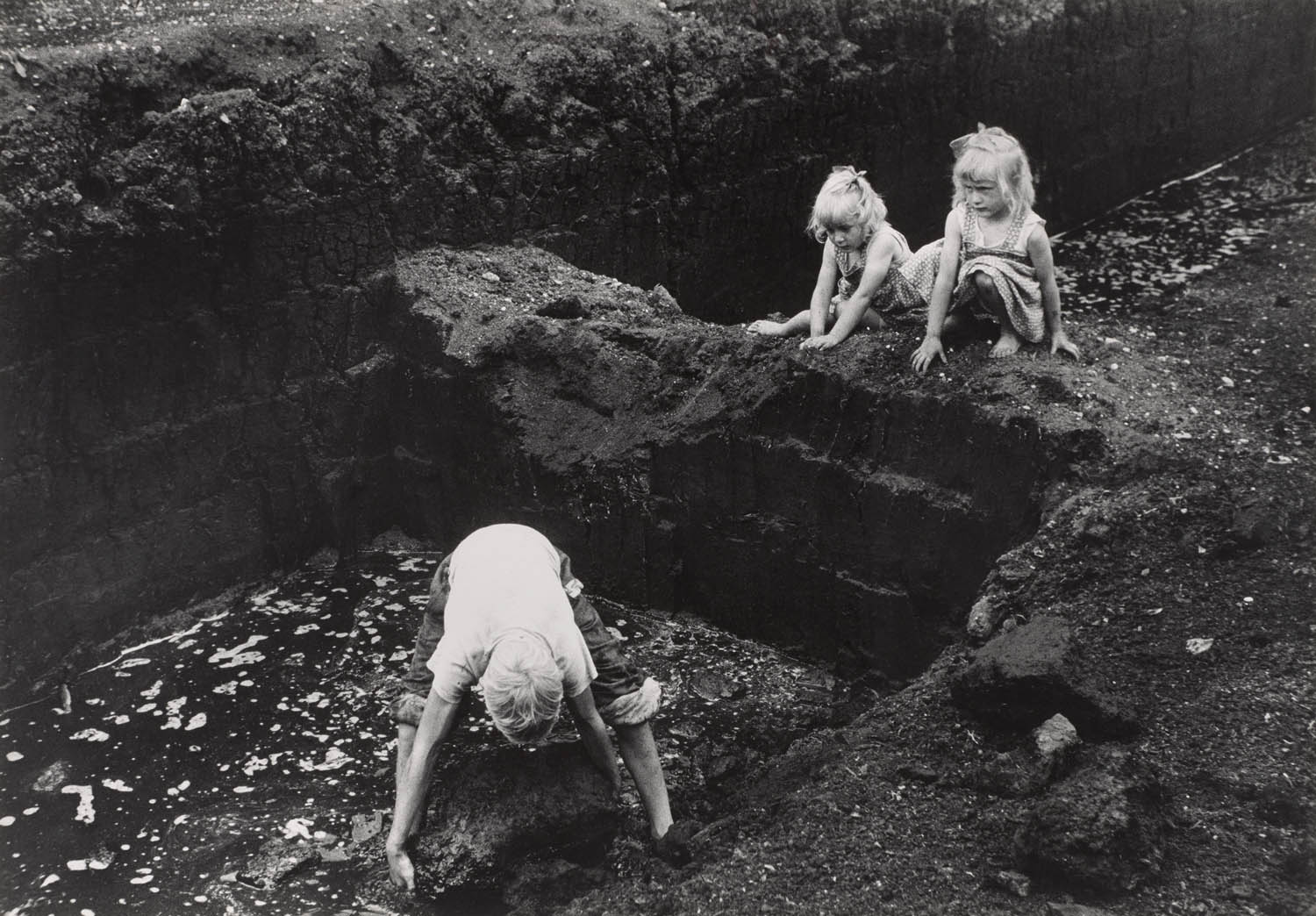
The J. Paul Getty Museum website
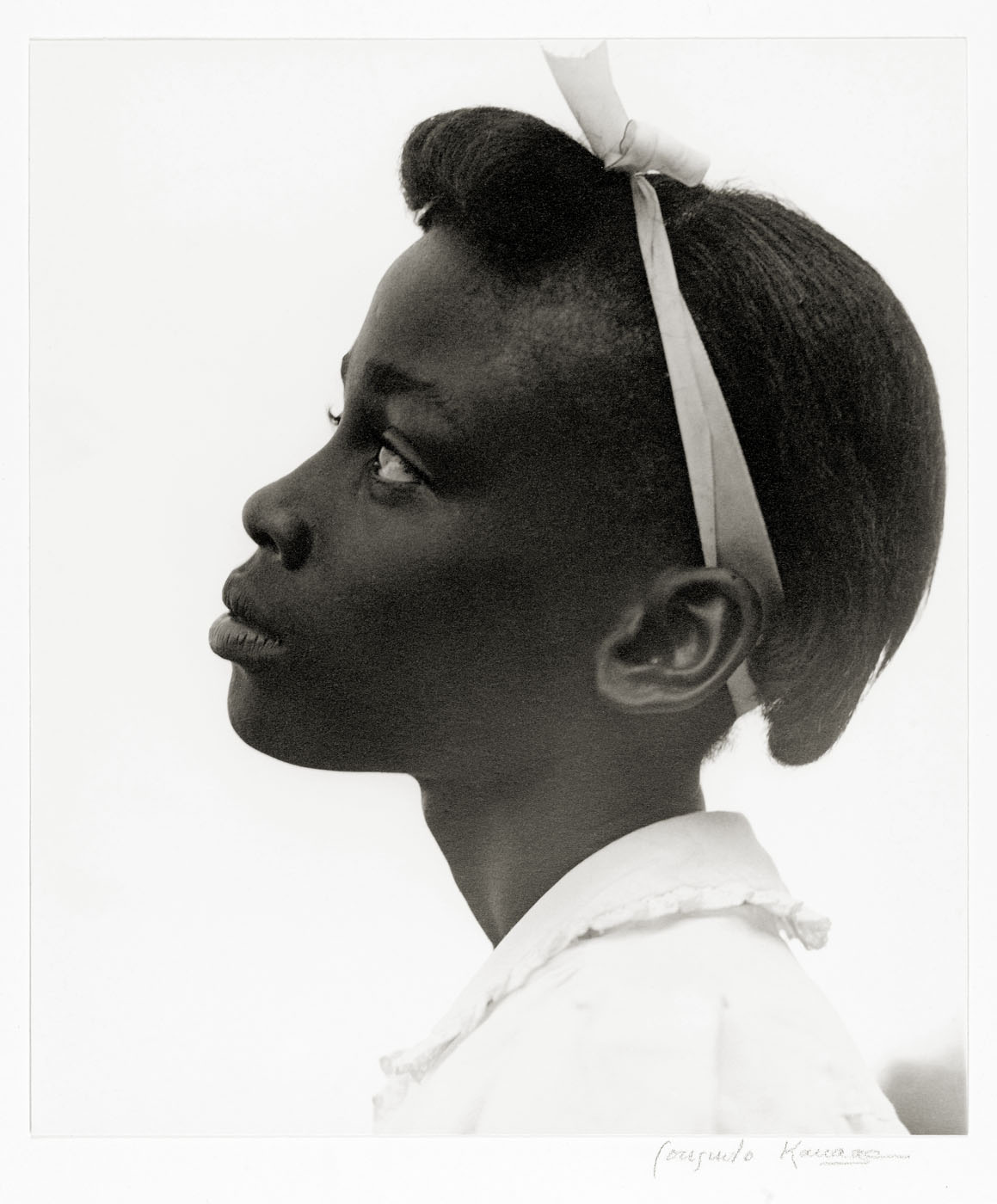
LIKE ART BLACK ON FACEBOOK

Back to top