Exhibition dates: 12th September – 17th October, 2009
Many thankx to Regen Projects for allowing me to publish the art work in the posting. Please click on the photographs for a larger version of the image.
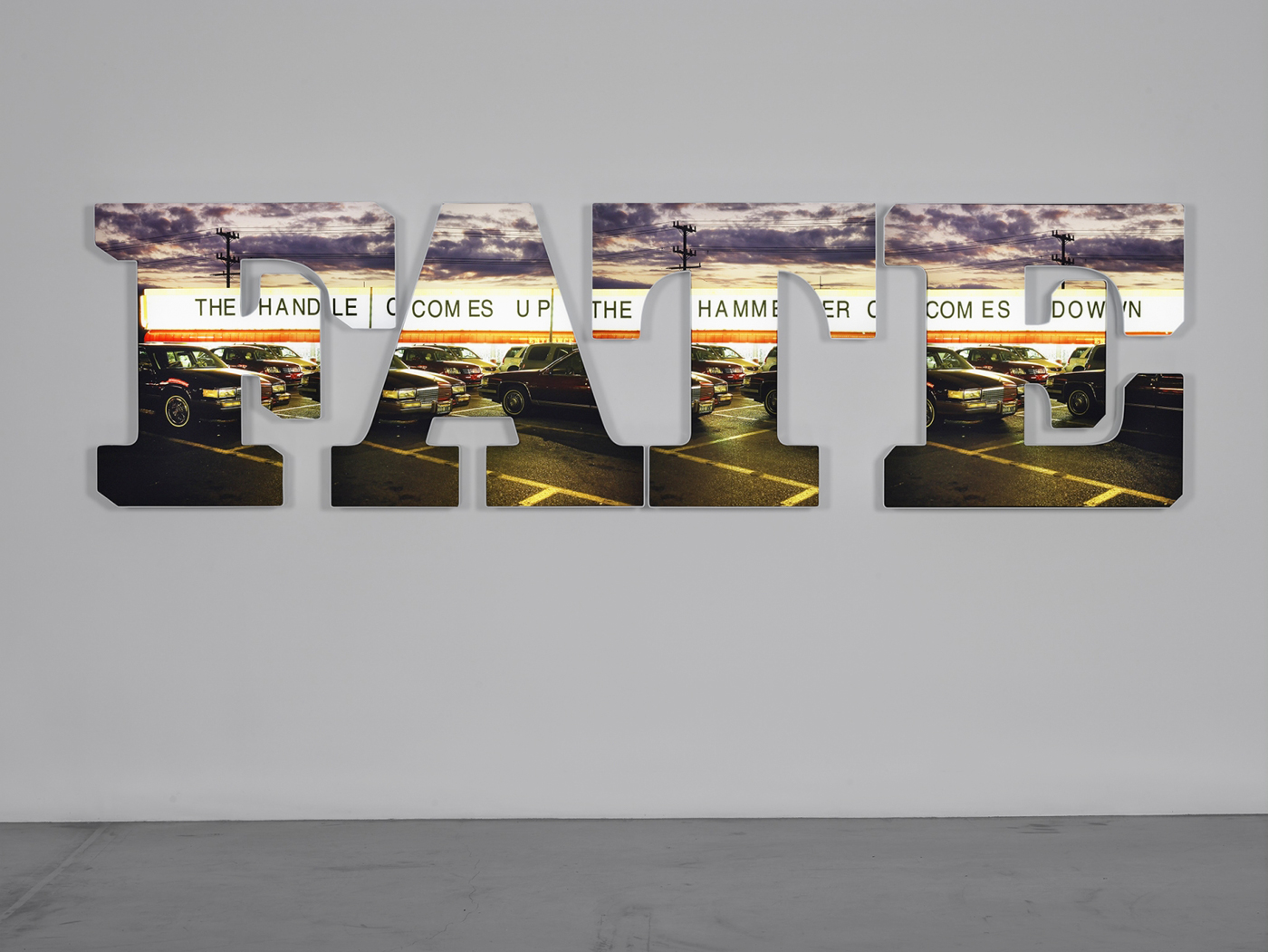
Doug Aitken (American, b. 1968) The handle comes up, the hammer comes down 2009 LED lit lightbox
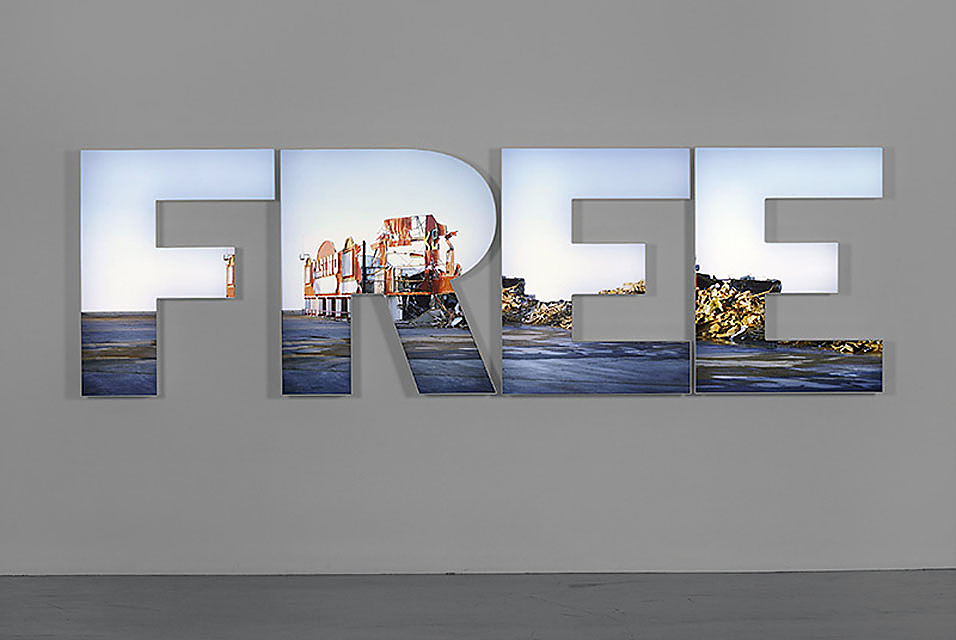
Doug Aitken (American, b. 1968) Free 2009 LED lit lightbox
Doug Aitken (American, b. 1968) Start Swimming LED lit lightbox 2006
Doug Aitken (American, b. 1968) Start Swimming LED lit lightbox 2006
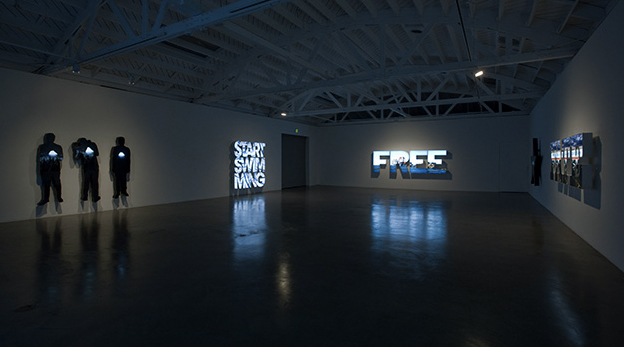
Installation view of Doug Aitken at Regen Projects, Los Angeles
Regen Projects is pleased to announce an exhibition of new works by Los Angeles artist Doug Aitken. This exhibition will present a series of new text-based light boxes and will feature the west coast debut of the film migration. Aitken explores the themes of temporality, space, memory, movement, and landscape in his work. History and themes of both the past and present are interwoven and reconfigured. His work deconstructs the connection between idea and iconography allowing each to reinvent itself.
Doug Aitken’s new light boxes combine image and text in a collision that creates a rupture in which alternate connections are presented. The work frontier depicts a destroyed property on the water’s edge, redefining expectations of what a frontier may hold. The images within some of the light boxes are a photographic collage that references Aitken’s photographic oeuvre and aesthetic. Experimenting with font, borrowed images, and his own photographs, the light boxes will be presented in the darkened gallery, glowing and playing off of one another. The disjunction of word, image, and light in these works also moves toward a cinematic whole, creating panoramic landscapes through text.
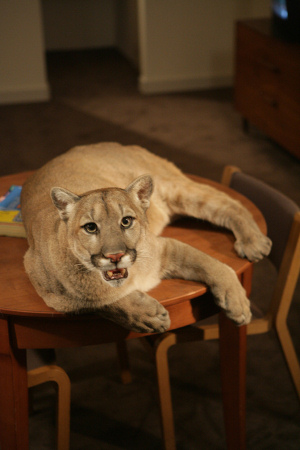
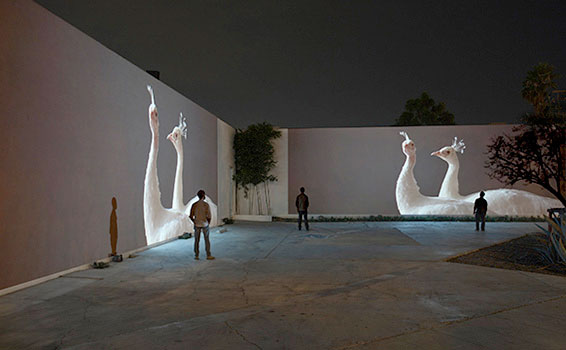
Presented alongside the light boxes will be Aitken’s first large scale public installation in Los Angeles, migration. The film, the first instalment in a three-part trilogy entitled empire, debuted at the 2008 Carnegie International. This hallucinatory epic depicts the movements of migratory animals as they pass through vacant and deserted hotel and motel rooms, delineating a nomadic passage across America from east to west. Fittingly making its first appearance on the west coast, this large-scale cinematic installation will be presented to the public on Santa Monica Boulevard projected onto the courtyard of Regen Projects II; visible only at night from sunset to sunrise. In addition to the nighttime public presentation, migration will also be exhibited at the 633 North Almont Drive space on an indoor billboard accompanied by its original score.
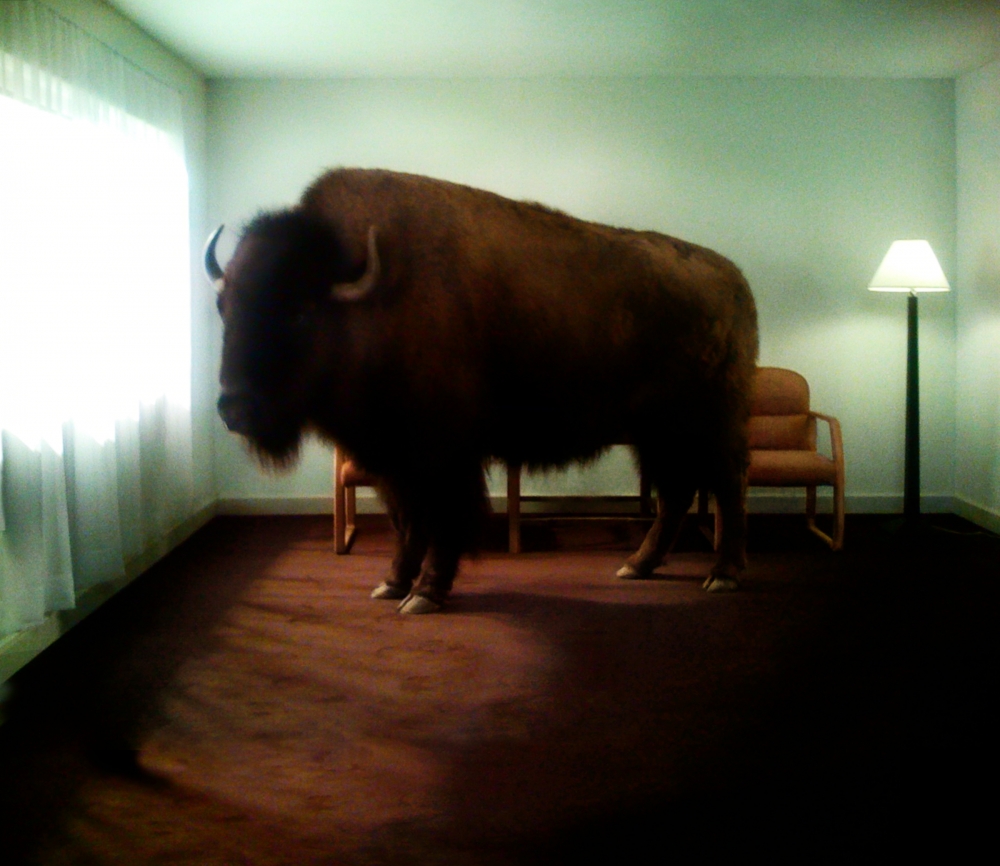
Settlers who met the untamed wilderness to forge new ways of life defined westward expansion. Aitken’s migratory landscape in migration is the opposite; it is a landscape completely devoid of human presence. His non-linear narrative presents a series of different sequences in which the animals and their actions are unique while the rooms and their components are indistinguishable. Hotels such as these offer a sense of both security and isolation and while some animals adapt to these surroundings, others seem conspicuously strange. Rarely do we get to examine these creatures so closely. Their movements and presence make the viewer acutely aware of scale, calling into question various relationships; the most apparent of which is the relationship of the natural and the man-made. In this encounter between the urban and the indigenous the viewer gets a sense of both displacement and habituation. As one critic describes:
“One by one, at different hotels, the animals behave as they behave, sniffing the air, twitching their noses to orient themselves in the desolate human habitat. Imbued with Aitken’s usual intimations of planetary solitude, his sense of spatial dislocation, and gorgeous formalised perception, these images … have the quality not so much of a nonlinear narrative as of a mirage.” (Kim Levin, Artnews, January 2009, p. 110.)
Aitken’s work has been exhibited extensively at museums and galleries worldwide, including his 2007 exhibition “sleepwalkers,” a large-scale outdoor installation at the Museum of Modern Art, New York. He has had numerous solo exhibitions including shows at the Serpentine Gallery, the Kunstmuseum Wolfsberg, the Kunsthaus Bregenz and the Kunsthalle Zurich. Aitken was awarded the international prize at the Venice Biennale in 1999 and was included in the 2000 Whitney Biennial.
Text from the Regen Projects website [Online] Cited 01/11/2009. No longer available online
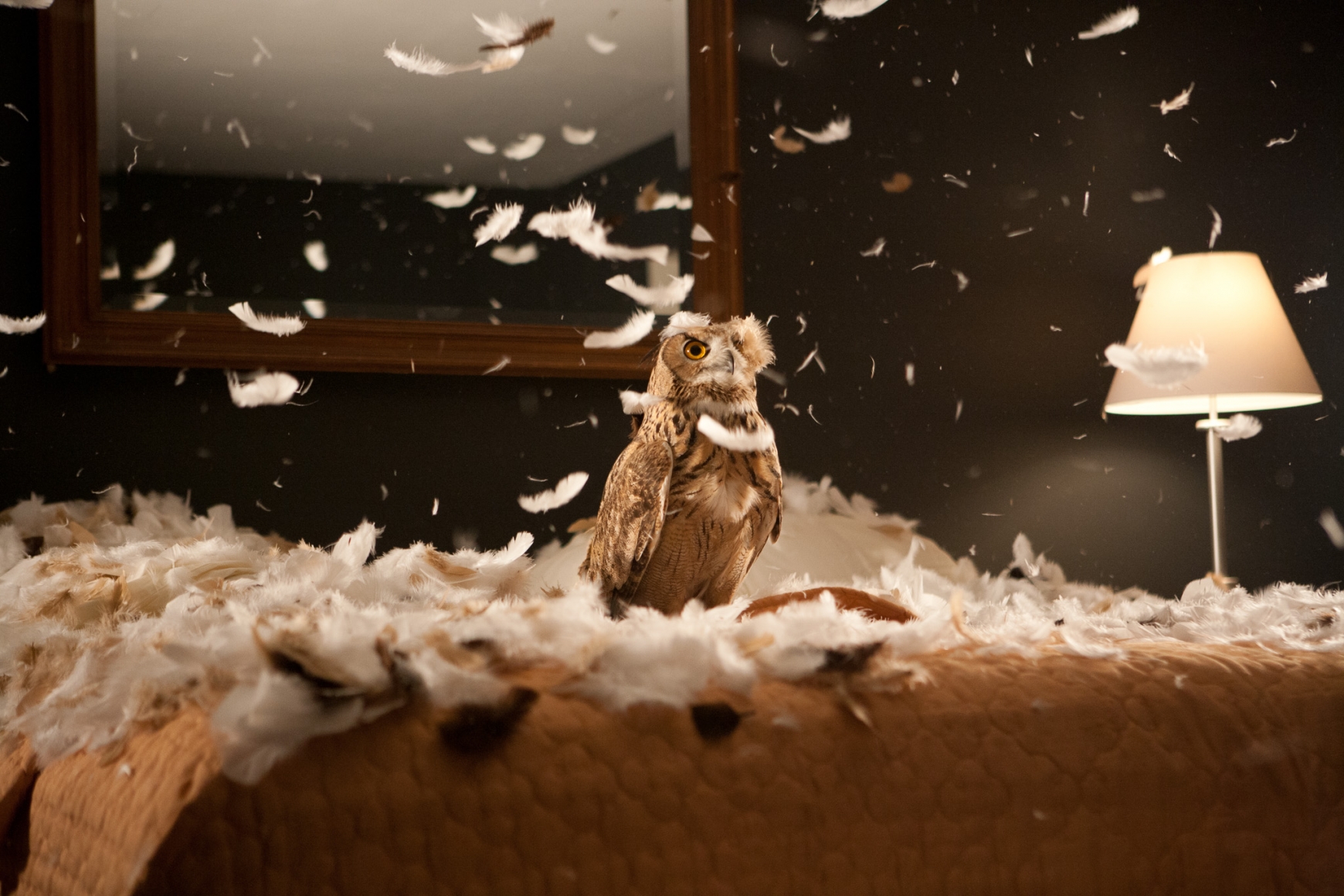
Doug Aitken (American, b. 1968) Stills from Migration 2008 Single video projection with billboard (steel and PVC projection screen)
In Migration, peacocks, deer, and beaver are filmed occupying motel rooms in vignettes that strike a poignant, provocative chord: talk about unexpected guests. Nevertheless, the work isn’t funny; it’s too frank in its beauty, too finely and respectfully wrought to be a joke.
Aitken’s animals are frequently shot in close perspective, which enhances their beauty in a way that is mesmerising. We’re not looking through them as much as we’re looking alongside them, ingesting the utter foreignness of their environs. As evening falls, we see an owl, an already otherworldly creature whose glowing eyes appear extraterrestrial, blinking at us from its perch on a king-size bed. Against the singsong of chirping birds, the camera pans away from the stationary owl as the room fills with thousands of downy feathers. Light is a powerful character in the film, whether gently filtered through sheer curtains or spilling onto carpeted hallways. Rather than highlighting imperfections or ugliness, the light is salvic, evincing a limbo that’s illuminating and warming. In one way or another, all of Aitken’s animals are drawn to light, whether toward a blinking lamp, the refracted surface of a swimming pool, or even the glow of an opened refrigerator door.
Extract from Iris McLister. “Motel chronicles: Doug Aitken,” on the Pasatiempo website October 6, 2017 [Online] Cited 28/04/2019
Regen Projects 6750 Santa Monica Boulevard Los Angeles, CA 90038 Phone: (310) 276 5424
Exhibition dates: 3rd September – 3rd October, 2009
Many thankx to the Gagosian Gallery for allowing me to publish the photographs in the posting.
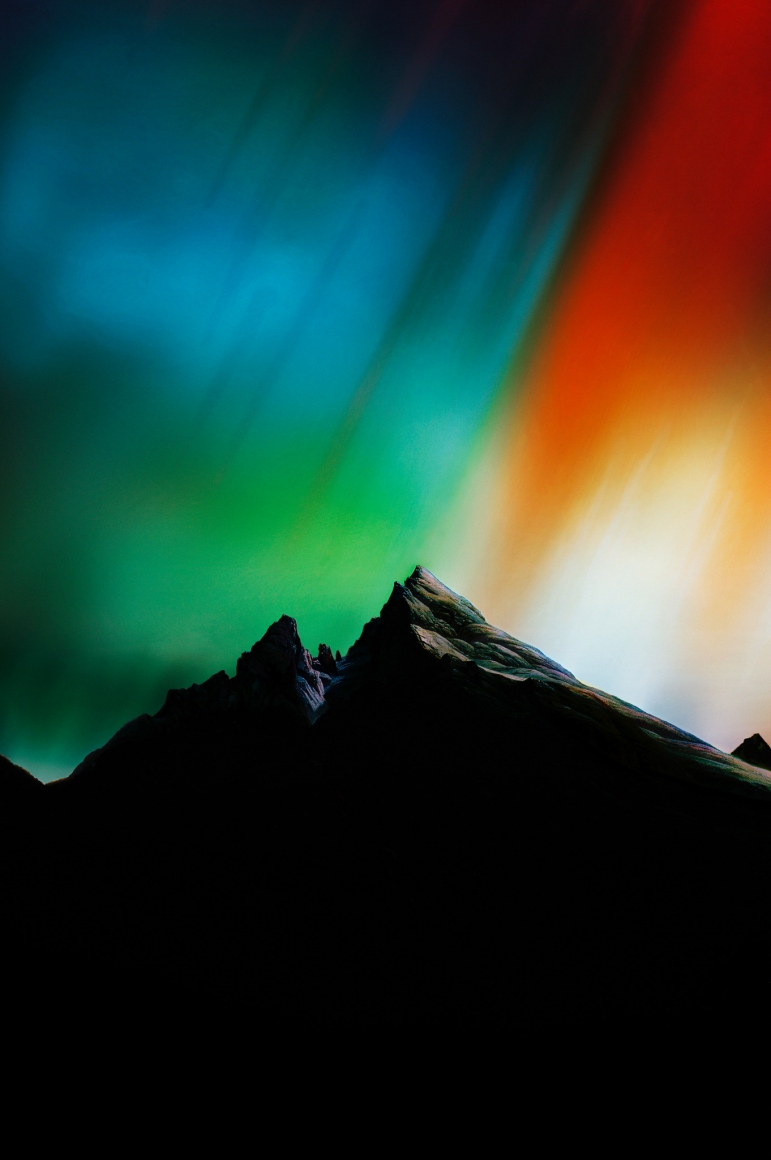
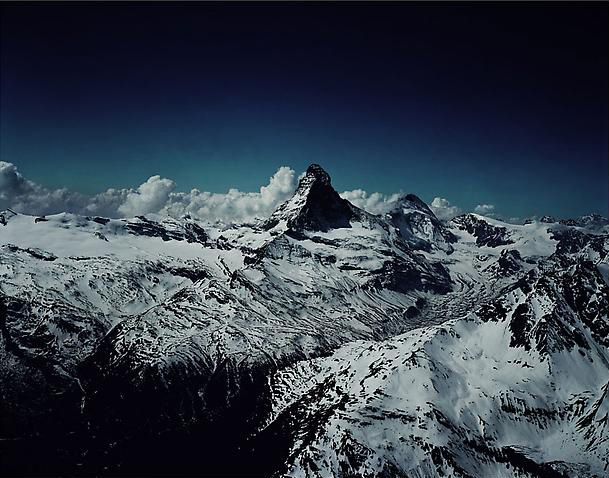
Florian Maier-Aichen (German, b. 1973) Der Watzmann 2009
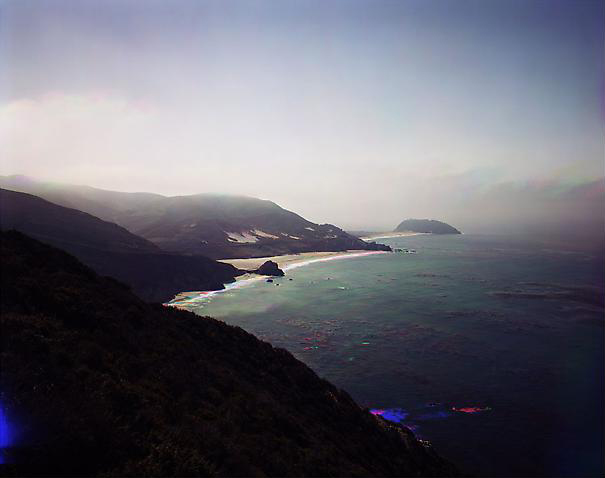
Florian Maier-Aichen brings a contemporary sensibility to bear on a range of historical references, from German Romantic painting to 19th-century photographs of the American West. The German-born photographer shoots images with a large-format camera then alters them digitally by combining negatives, adding computer-drawn elements or otherwise changing the originals. The effects are painterly and the works large-scale (the biggest one in this show, all but one of them C-prints, was around 8 by 71⁄3 feet). In one untitled print (2009), a digitally created brushstroke cuts diagonally across a snowy mountainside. Alluding to the trails ploughed across mountains to prevent avalanches, the photograph also suggests the black-and-white paintings of Abstract Expressionist Franz Kline. The sky above a dark mountainous outcropping in Der Watzmann (2009) references the Caspar David Friedrich painting of the same name (Maier-Aichen appropriated the image of the peak from the painting itself), while the sky suggests an airbrush version of the aurora borealis in red-orange and blue-green.
Der Watzmann may be the most direct reference to 19th-century German Romanticism and the sublime, but these are themes that Maier-Aichen frequently evokes, only to upend them.
Jean Dykstra. “Florian Maier-Aichen,” on the Art in America website May 4, 2009 [Online] Cited 24/09/2019
Florian Maier-Aichen (German, b. 1973) Untitled 2008
Snow Machine by Florian Maier-Aichen installation views at Gagosian Gallery, Britannia Street, London
“Florian Maier-Aichen’s images reinterpret landscape photography for the 21st century. Often shot at obscure angles or from aerial views, his estranged vantage points are both alien and familiar; a sensation enhanced by his subtle manipulation of the images. Conceiving the representation of sites with a sense of dislocation, Maier-Aichen’s work addresses issues of globalisation and virtual perception. In Untitled, Maier-Aichen’s coastline is far from postcard perfect: a virgin beach lined with superhighway and luxury homes expanding into the misty distance. Tinting the surrounding forest in an unnatural shade of red, he casts an apocalyptic glow over the seascape, framing wilderness and human intervention as a scene of science fiction portent.”
Florian Maier-Aichen (German, b. 1973) Untitled 2009
“I have always been interested in the making of things. Most products and materials conceal their process of manufacture. It’s the same with photography, which turned from a discipline that was subject to the mastery of the few (alchemists) into a readily available industrial mass product, too transparent and too technical.”
Florian Maier-Aichen
Gagosian Gallery is pleased to present an exhibition of recent photographs by Florian Maier-Aichen. This is the artist’s first solo exhibition in London.
A photographer schooled on both sides of the Atlantic, Maier-Aichen’s work reflects on the dual influences of the history of photography and the history of painting, whether drawing on such dichotomies as German Romantic painting and the pioneers of German “objective” photography, or applying his post-factum experience of American frontier art – from the Hudson River School and Abstract Expressionism to Land Art and West Coast conceptualism – to his own topographical depictions of landscape subjects. He focuses on the camera’s consummate power to establish typologies of thought, perception, and feeling, producing images that, in mining the past, come to embody a matrix of issues salient to recent photographic practice.
Approaching the photographic field like a painter approaches a canvas, Maier-Aichen does for the contemporary image-world what pictorial photographers attempted in the nineteenth and early twentieth centuries, using the strategies and motifs of Romantic and Luminist painting. Unnaturally high-keyed or delicately tinted images of soaring mountain ranges, moody seas, and the industrial architecture of bridges, waterways, and dams carving through the natural landscape are all emanations of a rich and diverse imagination where a keen and critical grasp of art history coexists with more pronounced literary and cinematic conceits.
In a creative process that is as intensive as it is subtle and opaque, Maier-Aichen combines an exhaustive range of staged effects and traditional photographic techniques – albumen, silver-gelatin, and c-printing – with drawing and current computer-imaging processes. Weaving together often disparate elements from distinct sources, he applies myriad creative adjustments to each in order to produce seamless photographs that do not betray their intricate and layered compositions. Multiple negatives, digital manipulation, and elaborate studio techniques are employed to produce seemingly straightforward photographic landscape subjects while other images that engage the most conventional photographic techniques may themselves be subjects of pure fabrication.”
Text from the Gagosian Gallery website [Online] Cited 20/09/2009. No longer available online
Florian Maier-Aichen (German, b. 1973) Untitled 2009
Florian Maier-Aichen (German, b. 1973) Untitled 2009
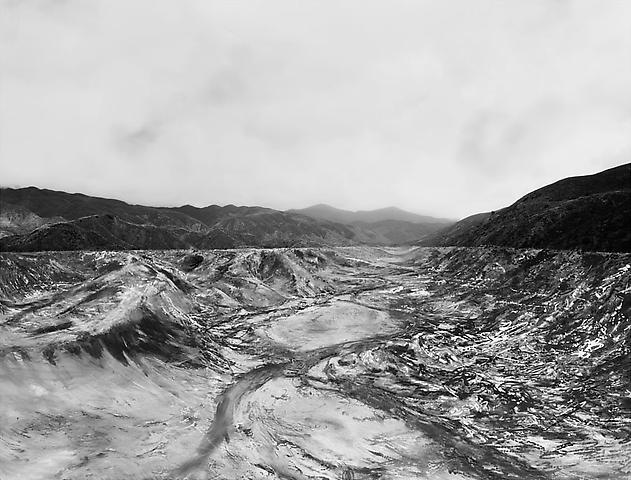
Florian Maier-Aichen (German, b. 1973) Untitled (St. Francis Dam) 2009
Gagosian Gallery 6-24 Britannia Street London WC1X 9JD Phone: 44.207.841.9960
Exhibition dates: 7th August – 27th September, 2009
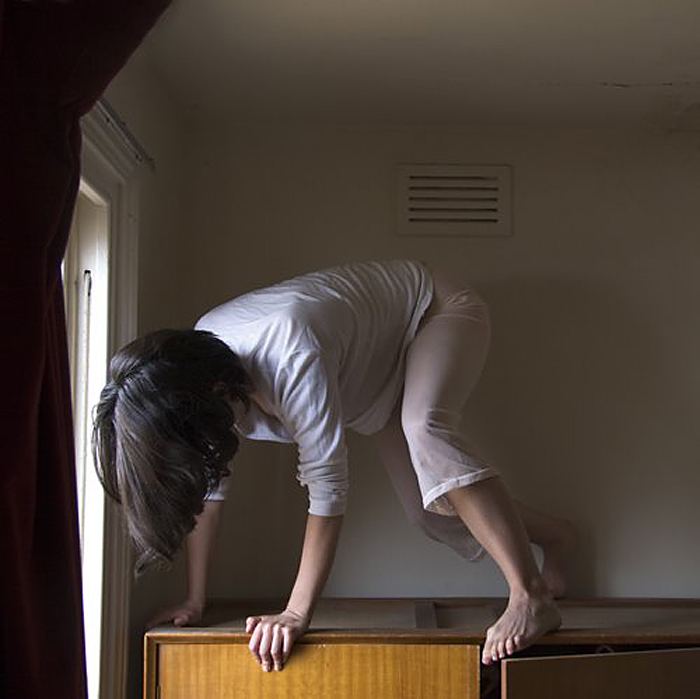
Clare Rae (Australian, b. 1981) Untitled 2009 From the series Climbing the Walls and Other Actions Pigment print on Museo Crane Silver Rag 50 x 50cm
“To withdraw into one’s corner is undoubtedly a meager expression. But despite its meagerness, it has numerous images, some, perhaps, of great antiquity, images that are psychologically primitive. At times, the simpler the image, the vaster the dreams.”
Gaston Bachelard.1
Usually I am not a great fan of ‘faceless’ photography as I call it but this series of work, Climbing the Walls and Other Actions (2009) by the artist Clare Rae is even better than the series by Tracey Moffatt in the previous review.
Exploring activities of the female body in closed domestic spaces these psychologically intense photographs push the physical boundaries of play through the navigation of space. As a child has little awareness about the inherent dangers of a seemingly benign environment so Rae’s self-portraits turn the lens on her conceptualisation of the inner child at play and the activating of the body in and through space. As the artist herself says, “the way children negotiate their surroundings and respond with an unharnessed spatial awareness, which I find really interesting when applied to the adult body.”2
Continuing the themes from the last review, that of spaces of intimacy and reverberation, these photographs offer us fragmentary dialectics that subvert the unity of the archetype, the unity of the body in space. Here the (in)action of the photographic freeze balances the tenuous positions of the body: a re-balancing of both interior and exterior space.
As Noel Arnaud writes, “Je suis l’espace ou je suis” (I am the space where I am). Further, Bachelard notes “… by changing space, by leaving the space of one’s usual sensibilities, one enters into communication with a space that is psychically innovating.”3
In these photographs action is opposed with stillness, danger opposed with suspension; the boundaries of space, both of the body and the environment, the interior and the exterior, memory and dream, are changed.
Space seems to open up and grow with these actions to become poetic space – and the simplicity of the images aids and abets the vastness of our dreams. This change of concrete space does not change our place, but our nature. Here the mapping of self in space, our existence, our exist-stance (to have being in a specified place whether material or spiritual), is challenged in the most beautiful way by these walls and actions, by these creatures, ambiguities, photographs.
Henri Lefebvre insightfully observes, “… each living body is space and has space: it produces itself in space and it also produces that space.”4
I am the (sublime) space where I am, that surrounds me with countless presences.
Dr Marcus Bunyan
1/ Bachelard, Gaston. The Poetics of Space. Boston: Beacon Press, 1969, p. 137
2/ Email from the artist 7th September, 2009
3/ Bachelard, Gaston. The Poetics of Space. Boston: Beacon Press, 1969, p. 206
4/ Lefebvre, Henri. The Production of Space. Oxford: Basil Blackwell, 1974, p. 170
All images by Clare Rae from the series Climbing the Walls and Other Actions 2009. Many thankx to Clare for allowing me to publish them.
Clare Rae (Australian, b. 1981) Untitled 2009 From the series Climbing the Walls and Other Actions Pigment print on Museo Crane Silver Rag 50 x 50cm
Clare Rae (Australian, b. 1981) Untitled 2009 From the series Climbing the Walls and Other Actions Pigment print on Museo Crane Silver Rag 50 x 50cm
Clare Rae (Australian, b. 1981) Untitled 2009 From the series Climbing the Walls and Other Actions Pigment print on Museo Crane Silver Rag 50 x 50cm
Climbing the Walls and Other Actions is primarily concerned with visually representing my experience of femininity, whilst also exploring aspects of representation that relate to feminism. The project considers the relationship between the body and space by including formal elements within each frame such as windows and corners. Through a sequence of precarious poses I explore my relationship with femininity, an approach born of frustration. I use the body to promote ideas of discomfort and awkwardness, resisting the passivity inherent in traditional representations of femininity. The images attempt to de-stabilise the figure, drawing tension from the potential dangers the body faces in these positions. Whilst the actions taking place are not in themselves particularly dangerous, the work demonstrates a gentle testing of physical boundaries and limitations via a child-like exploration of the physical environment.
Text from the Centre for Contemporary Photography website [Online] Cited 15/09/2009. No longer available online
Clare Rae (Australian, b. 1981) Untitled 2009 From the series Climbing the Walls and Other Actions Pigment print on Museo Crane Silver Rag 50 x 50cm
Clare Rae (Australian, b. 1981) Untitled 2009 From the series Climbing the Walls and Other Actions Pigment print on Museo Crane Silver Rag 50 x 50cm
Centre for Contemporary Photography Level 2, Perry St Building Collingwood Yards, Collingwood Victoria 3066
Many thankx to the C/O Berlin Gallery for allowing me to publish the photographs in the posting. Please click on the photographs for a larger version of the image.
Pierre et Gilles (French, Pierre Commoy b. 1950 and Gilles Blanchard, b. 1953) Mercury 2001
“It’s hard to think of contemporary culture without the influence of Pierre et Gilles, from advertising to fashion photography, music video, and film. This is truly global art.”
Jeff Koons
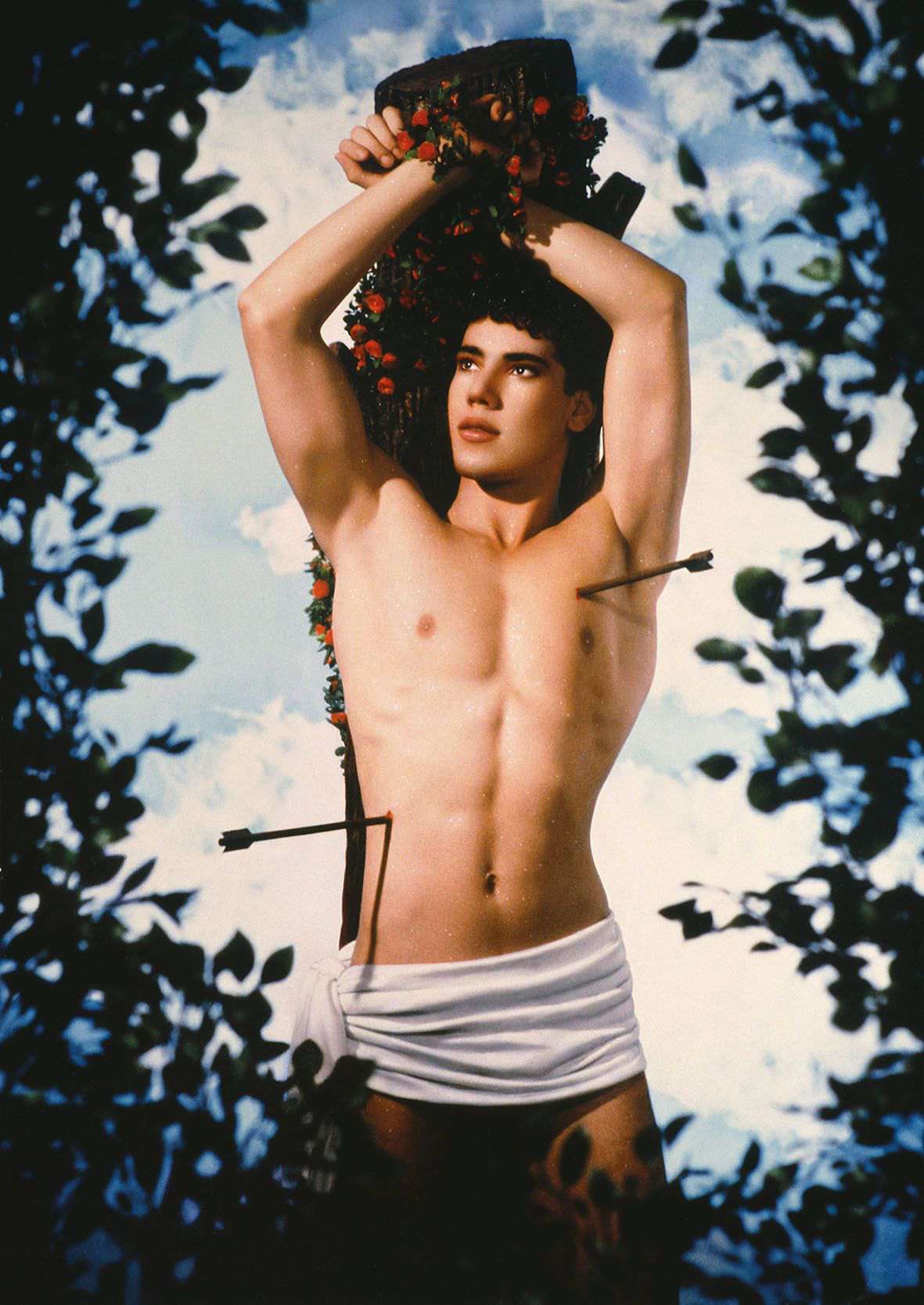
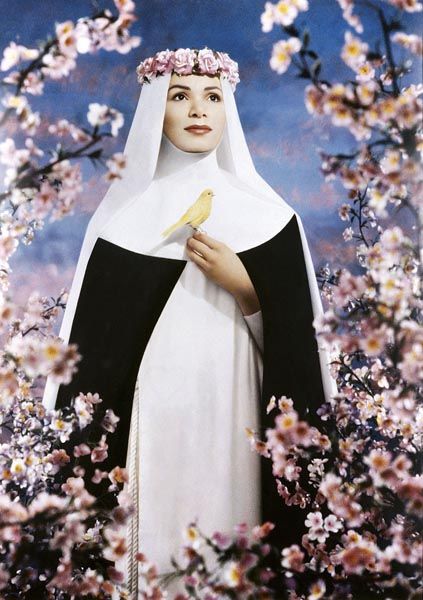
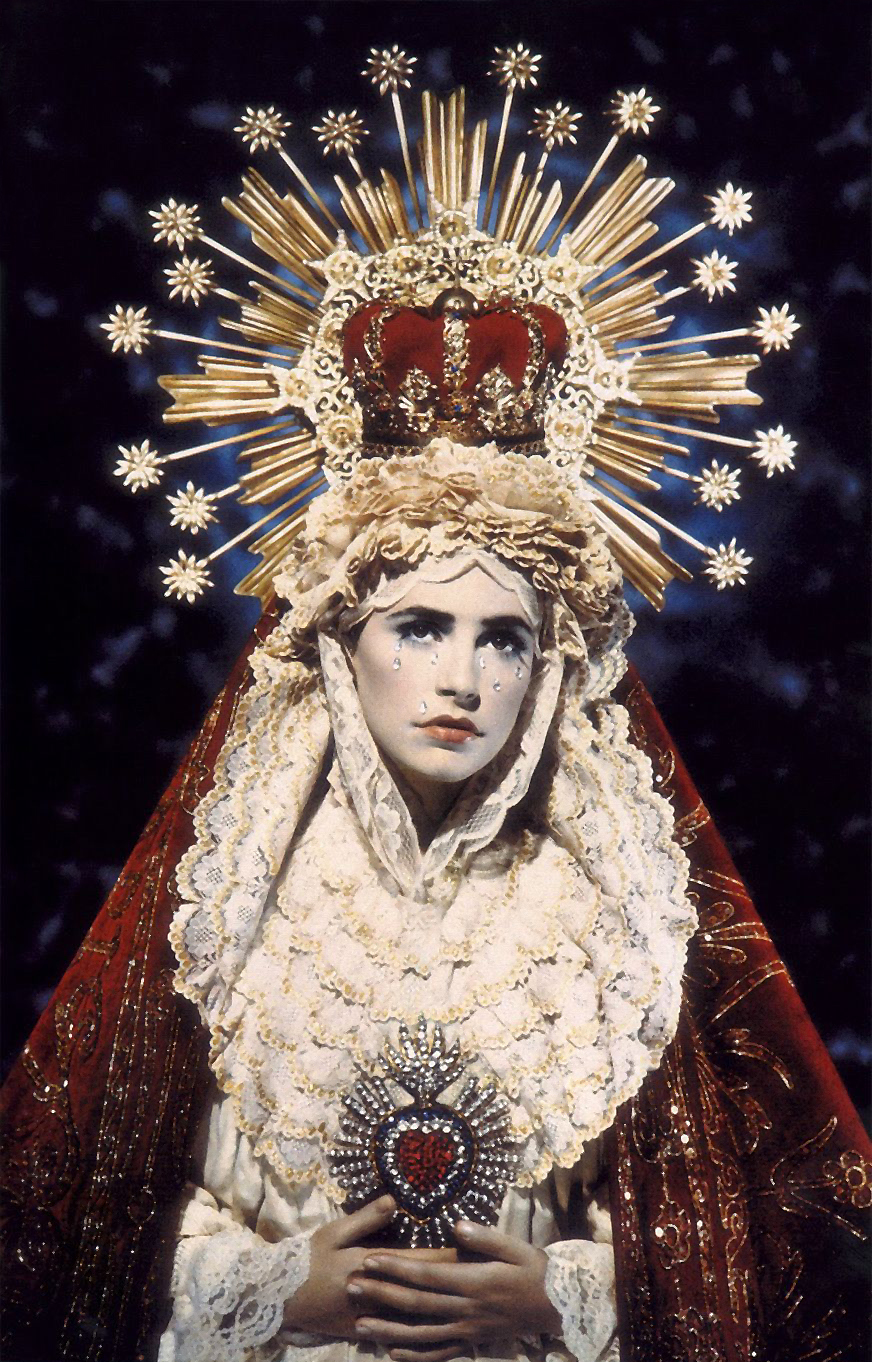
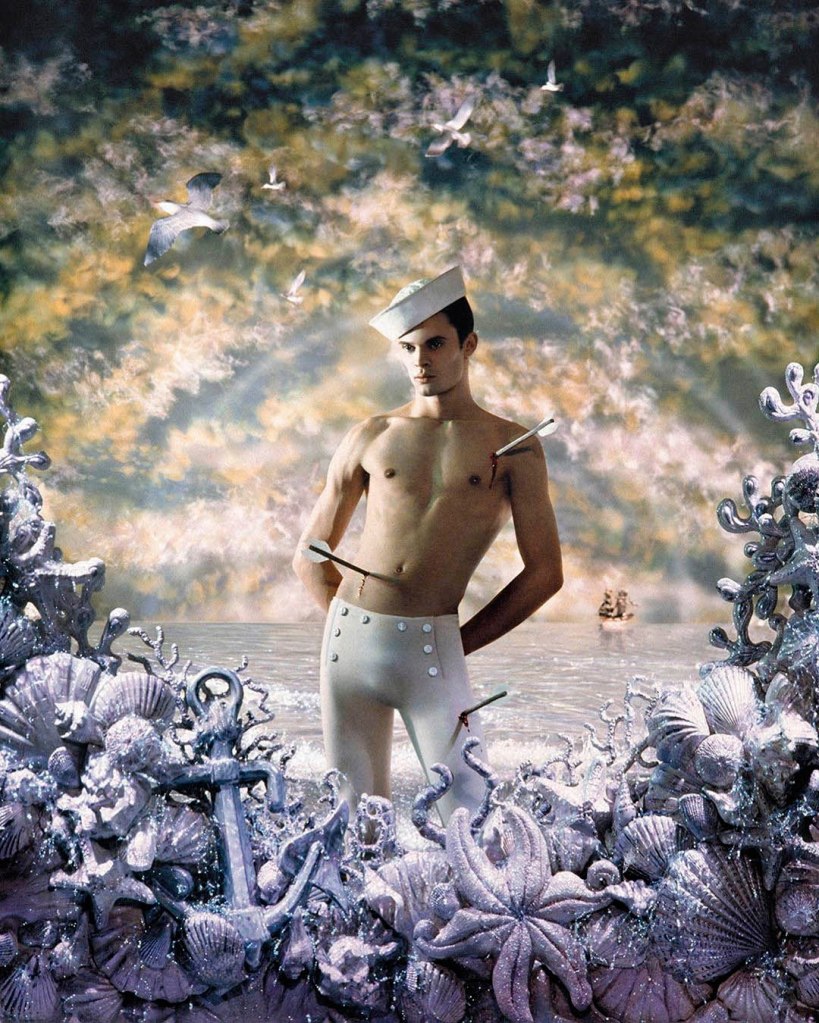
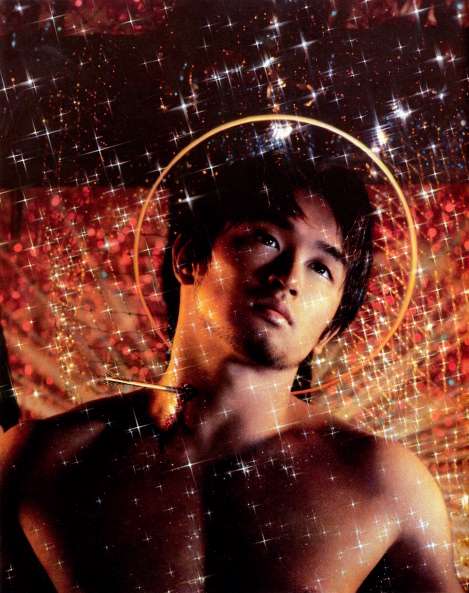
The cosmos of the worldwide renowned French artist duo is a vivid, colourful world poised between baroque sumptuousness and earthly limbo. Pierre et Gilles create unique hand-painted photographic portraits of film icons, sailors and princes, saints and sinners, of mythological figures and unknowns alike. Pierre et Gilles pursue their own, stunningly unique vision of an enchanted world spanning fairytale paradises and abyssal depths, quoting from popular visual languages and history of art. Again and again, they re-envision their personal dream of reality anew in consummate aesthetic perfection.
Pierre et Gilles are among the most influential artists of our time. In their complex, multilayered images, they quote from art history, transgress traditional moral codes, and experiment adeptly with social clichés. Their painterly photographic masterpieces exert an intense visual power that leaves the viewer spellbound.
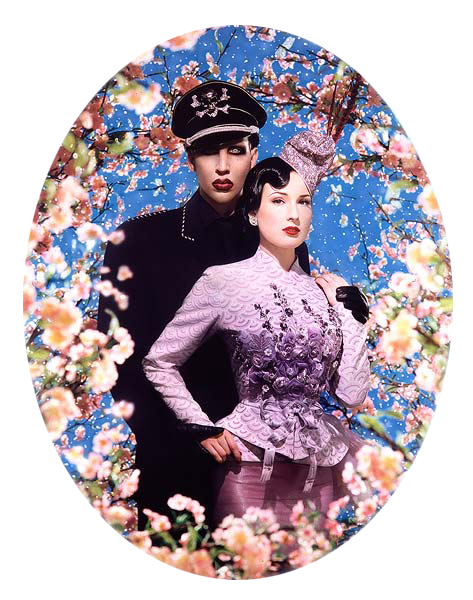
Over the last thirty years, Pierre et Gilles have created photographic portraits of numerous celebrities including Marc Almond, Mirelle Mathieu, Catherine Deneuve, Serge Gainsbourg, Iggy Pop, Jean-Paul Gaultier, Nina Hagen, Madonna, and Paloma Picasso. They work almost exclusively in an opulently furnished studio, where their subjects are costumed lavishly and placed before three-dimensional backgrounds. Pierre photographs the model, and Gilles retouches and hand-colours the print. The reproducible portrait is rendered unique through painting, which highlights each detail with carefully selected materials and accessories.
As only venue in Germany, C/O Berlin presents the exhibition as the first of Pierre et Gilles in fifteen years. The show comprised a total of 80 unique large-format works – from their early photographies of the 1970s to the brand new pictures that were never shown in public before.”
Text from the C/O Berlin website [Online] Cited 20/08/2009 no longer available online
Pierre et Gilles (French, Pierre Commoy b. 1950 and Gilles Blanchard, b. 1953) St. Sebastian 1987
Pierre et Gilles (French, Pierre Commoy b. 1950 and Gilles Blanchard, b. 1953) Neptune 1988
Pierre et Gilles (French, Pierre Commoy b. 1950 and Gilles Blanchard, b. 1953) Saint Rose De Lima 1989
Pierre et Gilles (French, Pierre Commoy b. 1950 and Gilles Blanchard, b. 1953) Le Petit Communiste Christophe (The Little Communist Christophe) 1990
Pierre et Gilles (French, Pierre Commoy b. 1950 and Gilles Blanchard, b. 1953) Legend (Madonna) 1990
Pierre et Gilles (French, Pierre Commoy b. 1950 and Gilles Blanchard, b. 1953) La Madone au coeur blessé (Madonna with a wounded heart) 1991
Pierre et Gilles (French, Pierre Commoy b. 1950 and Gilles Blanchard, b. 1953) St. Sebastian of the Sea 1994
Pierre et Gilles (French, Pierre Commoy b. 1950 and Gilles Blanchard, b. 1953) The Martyrdom of St Sebastian 1996
Pierre et Gilles (French, Pierre Commoy b. 1950 and Gilles Blanchard, b. 1953) Extase (Arielle Dombasle) 2002
Pierre et Gilles (French, Pierre Commoy b. 1950 and Gilles Blanchard, b. 1953) Le Grand Amour (Marilyn Manson and Dita von Teese) 2004
C/O Berlin Postfuhramt Oranienburger Straße 35/36 10117 Berlin
Exhibition dates: 20th August – 5th September, 2009
Little Treasures Toby Richardson, Will Nolan, CJ Taylor and Steve Wilson
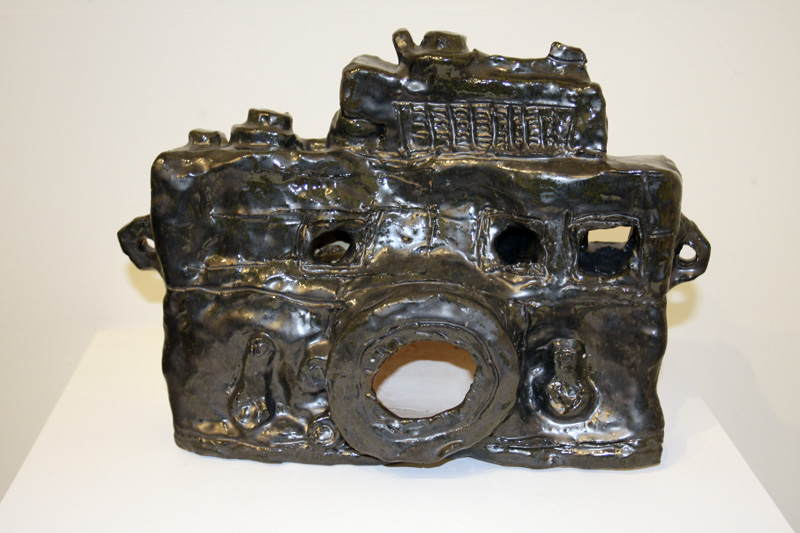
Clay Cameras Alan Constable
Alan Constable (Australian, b. 1956) Not titled (ALE SLR) 2008 Ceramic Photo: Marcus Bunyan
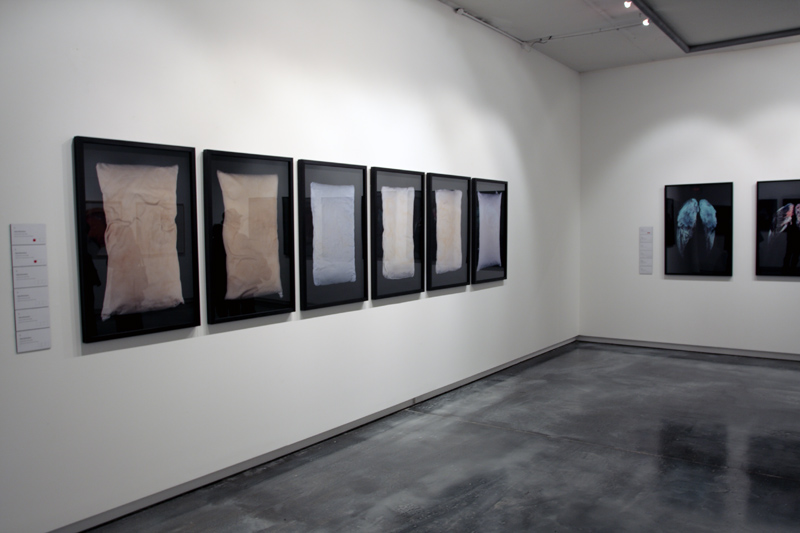
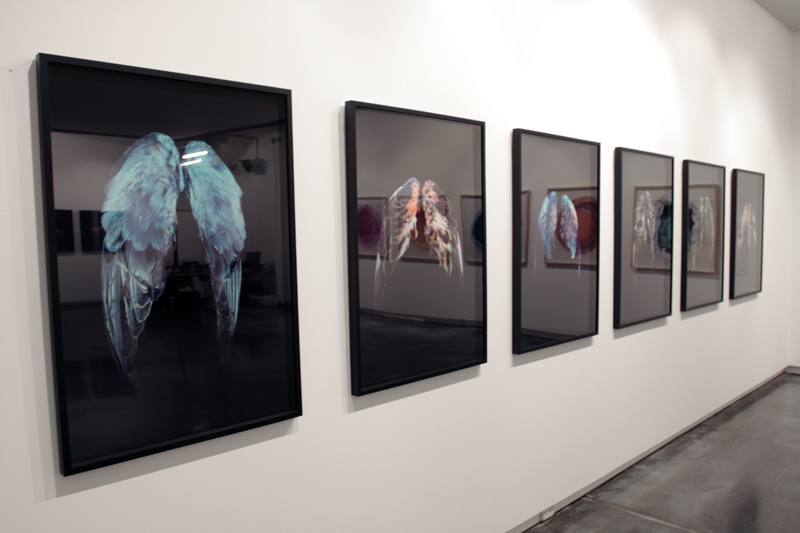
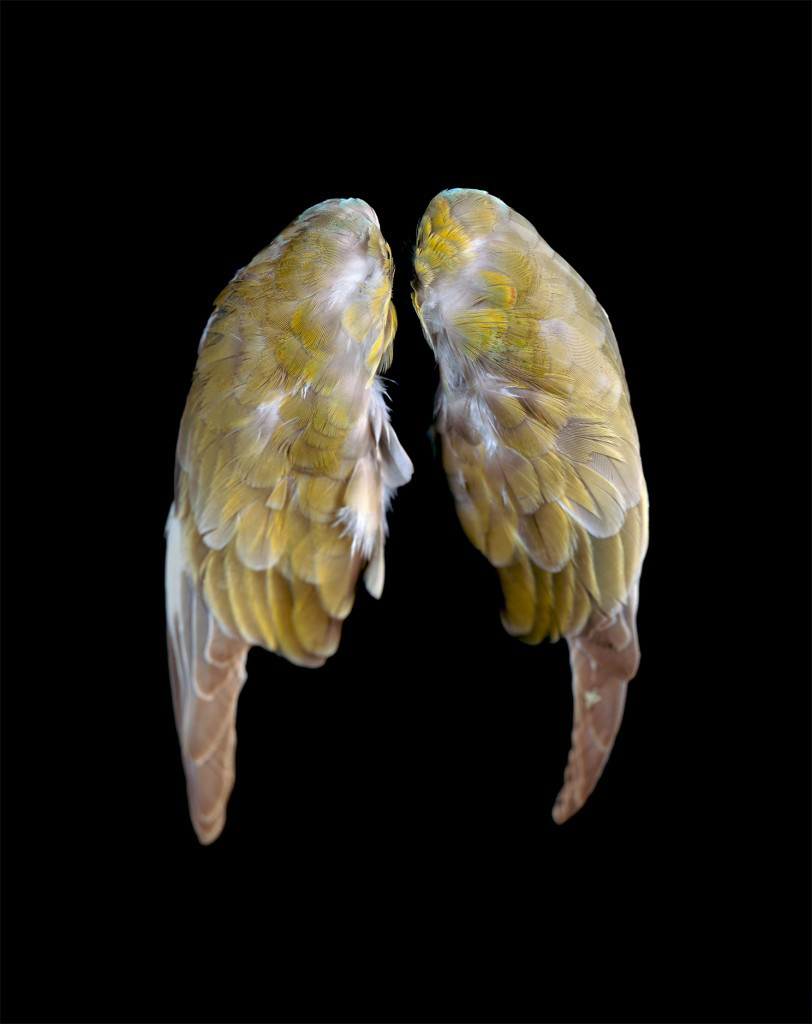
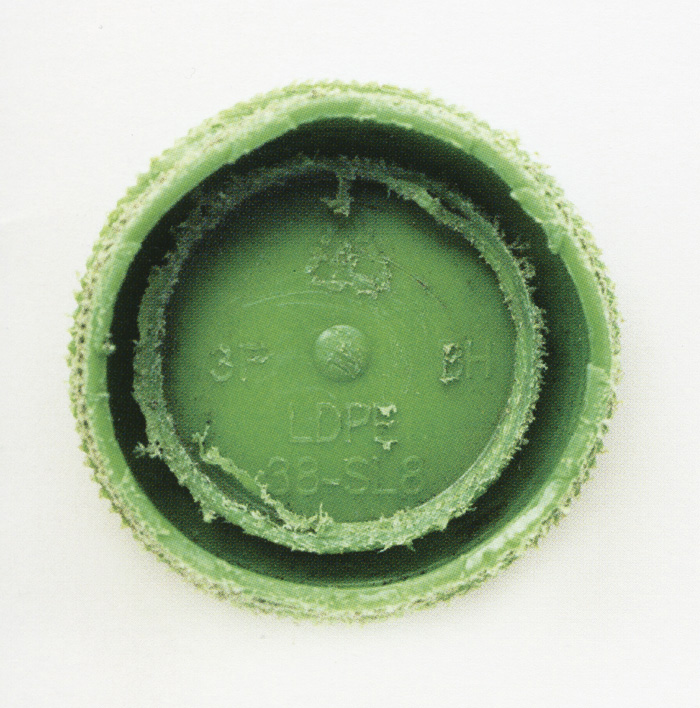
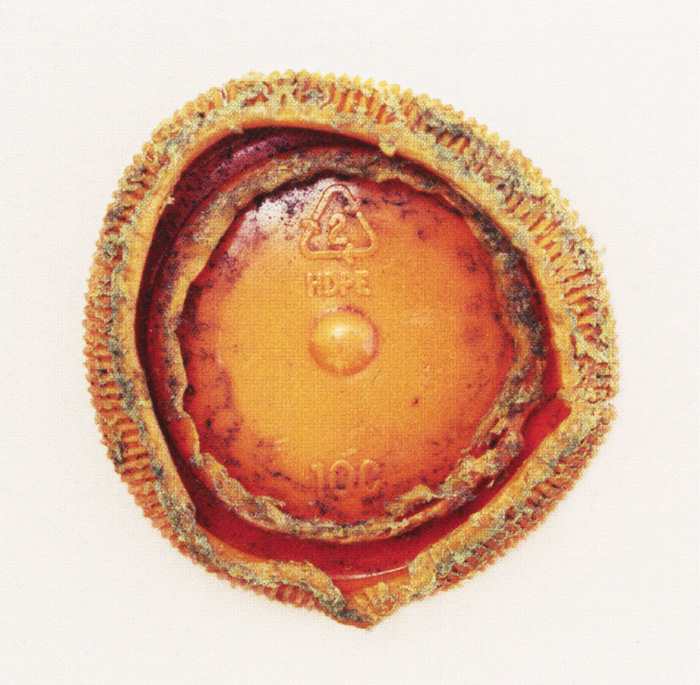
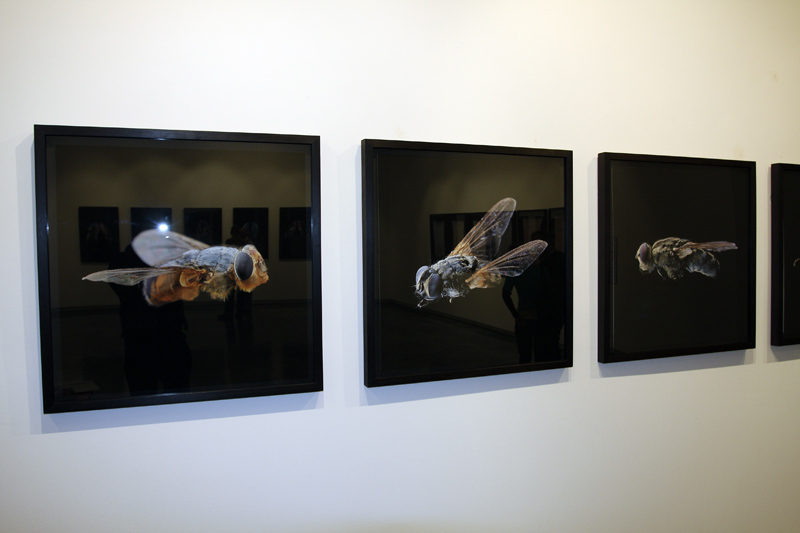
A small crowd was in attendance for the opening of two new exhibitions at Helen Gory Galerie (due to two auctions, one at Sotheby’s and the other at Deutscher-Menzies). Despite this the crowd was appreciative of the beautifully printed and well presented work. In the main exhibition Little Treasures four photographers show various bodies of work. Toby Richardson’s stained pillows (Portrait of the artist) from the years 1986-2003 were effective in their muted tones and ‘thickened’ spatio-temporal identity. CJ Taylor’s winged detritus from the taxidermist were haunting in their mutilated beauty. Steve Wilson’s sometimes legless flies were startling in their precision, attitude/altitude and, as someone noted, they looked like jet fighters! Finally my favourite of this quartet were the recyco-pop iridescent bottle tops of Will Nolan – “these objects remain enigmatic, resonating with a sense of mystery, hidden thoughts and unknown histories.” (Lauren Tomczak, catalogue text).
Some good work then in this take on found, then lost and found again treasure trove, work that retrieves and sustains traces of life, history and memory in the arcana of discarded and dissected objects.
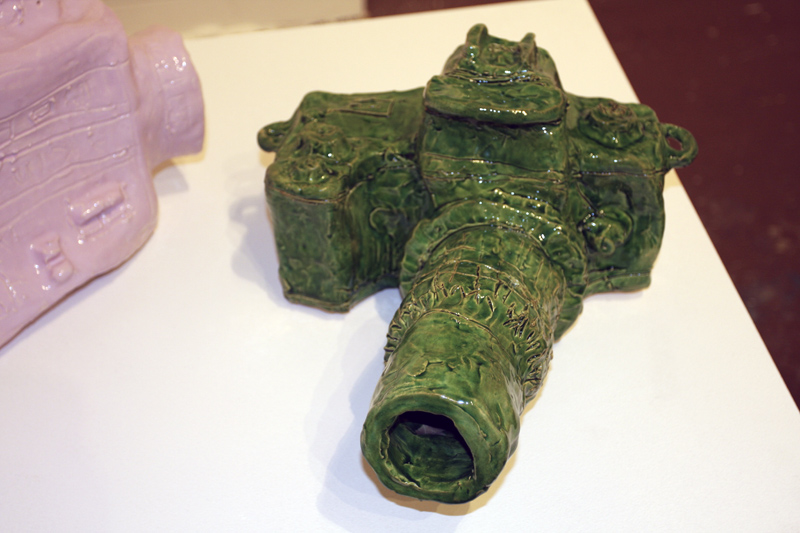
The hit of the night for me was the work of Alan Constable, his “objects that see”. I found his clay cameras intoxicating – I wanted to own one (always a good sign). I loved the exaggerated form and colours, the playfulness of the creativity on display. Being a photographer I went around trying to work out the different makes of these scratched and highly glazed cameras without looking at the exhibition handout. For a very reasonable price you could own one of these seductive (is that the right word, I think it is) viewfinders and they were selling like hot cakes!
Dr Marcus Bunyan
Many thankx to Helen Gory Galerie for allowing me to publish the photographs in the posting. Please click on the photographs for a larger version of the image.
Little Treasures
“Wings, pillows, flies and bottle tops are blown up vastly in stunning large scale prints that take the viewer through the looking glass into another universe, their brilliant colour and rich detail revealing unexpected beauty and delight in these forgotten things. Unmanipulated and finely printed, these images are the product of each artist’s technical mastery and inquisitive eye finding beauty in the cast off and delight in the ignored.” (Jemima Kemp, 2009)
Installation view of Little Treasures showing Toby Richardson’s Portrait of the Artist series (2009, left) Photo: Marcus Bunyan
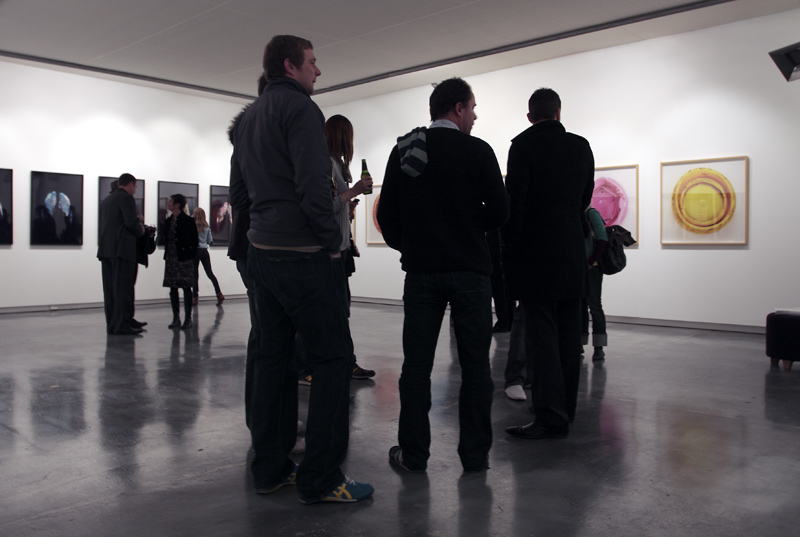
Installation view of Little Treasures showing the work of CJ Taylor (2009, left) and Will Nolan’s Bottle Top series (2009, right) Photos: Marcus Bunyan
Installation view of Little Treasures showing the work of CJ Taylor (2009) Photo: Marcus Bunyan
CJ Taylor (Australian, b. 1951) Blue, turquoise yellow green 2009 Acrylic glass pigment print 110 x 79cm
CJ Taylor (Australian, b. 1951) Blue, Blue, Grey 2009 Acrylic glass pigment print 110 x 79cm
Installation view of Little Treasures showing Will Nolan’s Bottle Top series (2009) Photo: Marcus Bunyan
Will Nolan (Australian) Bottle top #10 2009
Will Nolan (Australian) Bottle top #1 2009
Installation view of Little Treasures showing Steve Wilson’s Fly series (2009) Photo: Marcus Bunyan
Clay Cameras
“From the box brownie to disposables, VHS to SLR, these works explore Alan Constable’s fascination with cameras. Unlike the streamlined design of the originals, Constable’s cameras appear soft, organic and malleable.”
Alan Constable (Australian, b. 1956) Not titled (pearlescent gold/black Leica) 2008 Ceramic Photo: Marcus Bunyan
Installation view of Clay Cameras by Alan Constable Photo: Marcus Bunyan
Alan Constable (Australian, b. 1956) Not titled (Hasselblad) 2008 Ceramic Photo: Marcus Bunyan
Alan Constable (Australian, b. 1956) Not titled (Digital with zoom lens) 2009 Ceramic Photo: Marcus Bunyan
Artists: Laurenz Berges, Albrecht Fuchs, Karin Geiger, Claus Goedicke, Uschi Huber, Matthias Koch, Wiebke Loeper, Nicola Meitzner, Peter Piller, Heidi Specker.
An exhibition of the Institut für Auslandsbeziehungen e. V. (ifa/Institute for Foreign Cultural Relations), Stuttgart, Germany and presented in cooperation with the Goethe-Institut Australien.
I was looking forward to this exhibition and so on a cold and very windy winter’s day I ventured out on the drive to the Monash Gallery of Art in Wheelers Hill expecting to be challenged by a new generation of German photographers. I was to be sorely disappointed. This show, with the exception of excellent work by Andreas Koch and good work by Laurenz Berges, epitomises all that I find woeful about contemporary photography.
There is a lack of life and vigour to the work, no sense of enjoyment in taking photographs of the world. The narratives are shallow and vacuous inducing a deep somnambulism in the viewer that is compounded by the silent, deeply carpeted gallery making the experience one of entering a mausoleum (this is a great space that needs to be a contemporary space!). How many times have I seen photographs of empty spaces that supposedly impart some deep inner meaning? See how a great artist like Tacita Dean achieves the same end to startling effect with her film Darmstädter Werkblock (2007). How many times do I need to see ‘dead pan’ portrait photographs that are again supposed to impart rich psychological meaning? I have seen too many already.
Conceptually the work is barren. Technically the proficiency of some of the work is almost non-existent. If this standard of work was put up for assessment in a university course it would fail miserably. For example in Nicola Meitzner’s work Forward Motion (2006), vertical portraits (of the same person in different poses) and streetscapes of Tokyo are poor quality prints mounted in unattractive silver aluminium frames. They are forgettable. If an artist were to study the work of, say, Manuel Alvarez Bravo, then one might gain some insight into how to photograph the city and the people that live in it in a way that elicits a response from the viewer to the photo-poetry that is placed before them.
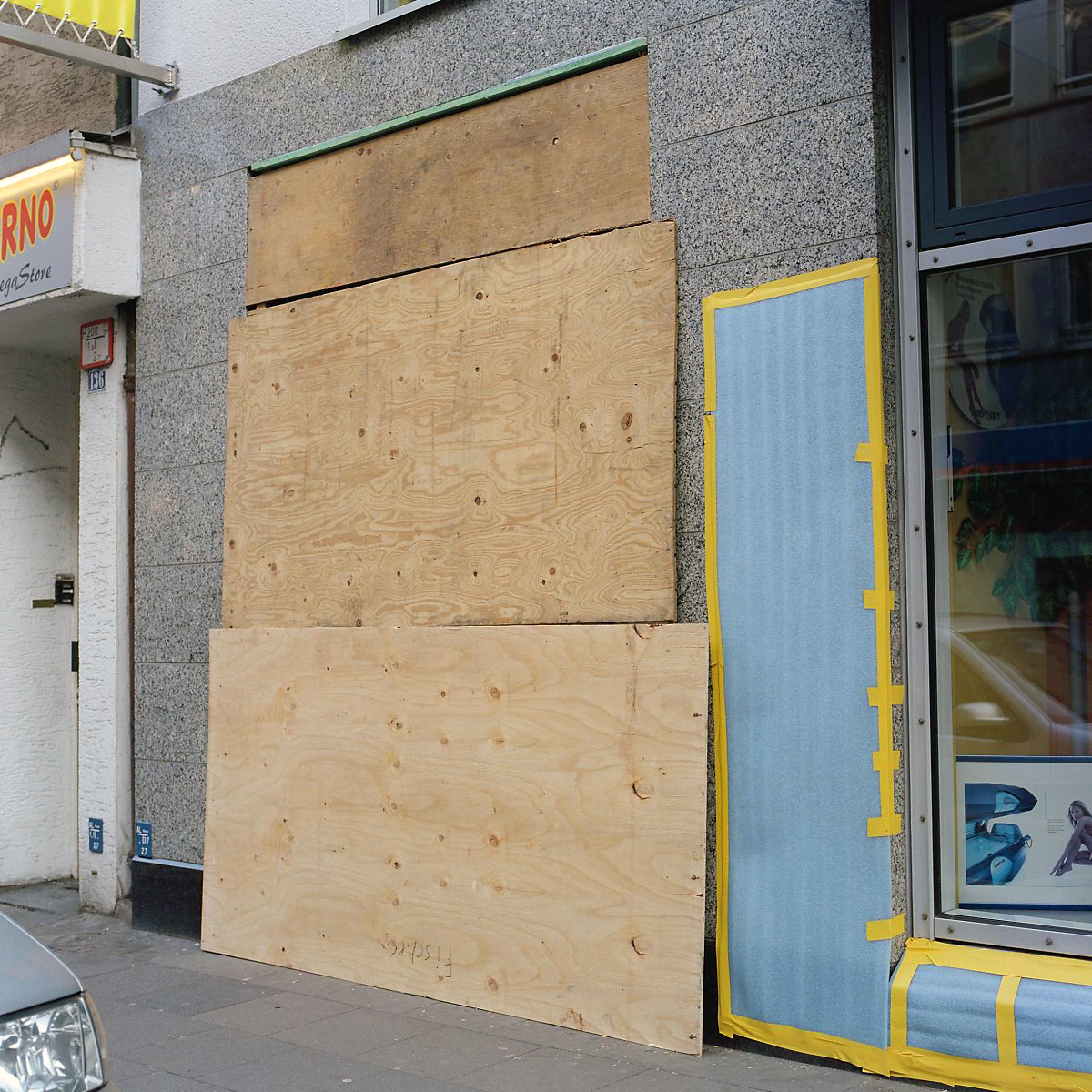
Uschi Huber’s photographs of boarded up shop fronts, while a nice conceptual idea, are again lacking in technical proficiency and are nothing we haven’t seen many times before while Peter Piller’s ten print-media type pigment prints of girls at a shooting range with rifles do not bare comment on both a conceptual and technical level. Similarly, Wiebke Loeper’s colour photographs of the city of Wismar – houses, roads, water, oat fields, people peering into shop windows – sent to friends living in Melbourne to show them the desolation and rebuilding of the city are seriously year 12 work.
The two redeeming artists are Laurenz Berges and Andreas Koch.
Berges four large type C colour photographs of an empty house and the surrounds as seen through a window are intimately detailed visions of human absence from the built environment: the huts, piles of wood chips, barren trees, the feathers on the floor of one print, the cigarette butts on the floor of another, the marks on the wall in blue and red add to a sense of abandonment and alienation from the environment – traces of human experience, identity and memory etched into the photographic medium.
As the text on the Institut für Auslandsbeziehungen (IFA) website observes,
“Laurenz Berges is a chronicler of absence. His minimalist photographs point to the earlier use of spaces, only fragments of which are shown, whose inhabitants have put them to other, new uses. Berges depicts the traces of this change in austere images that, due to their reduction, tell their stories indirectly and almost involuntarily. These are stories about the existential significance certain spaces have for our identity, and also about their transitoriness and their loss.”1
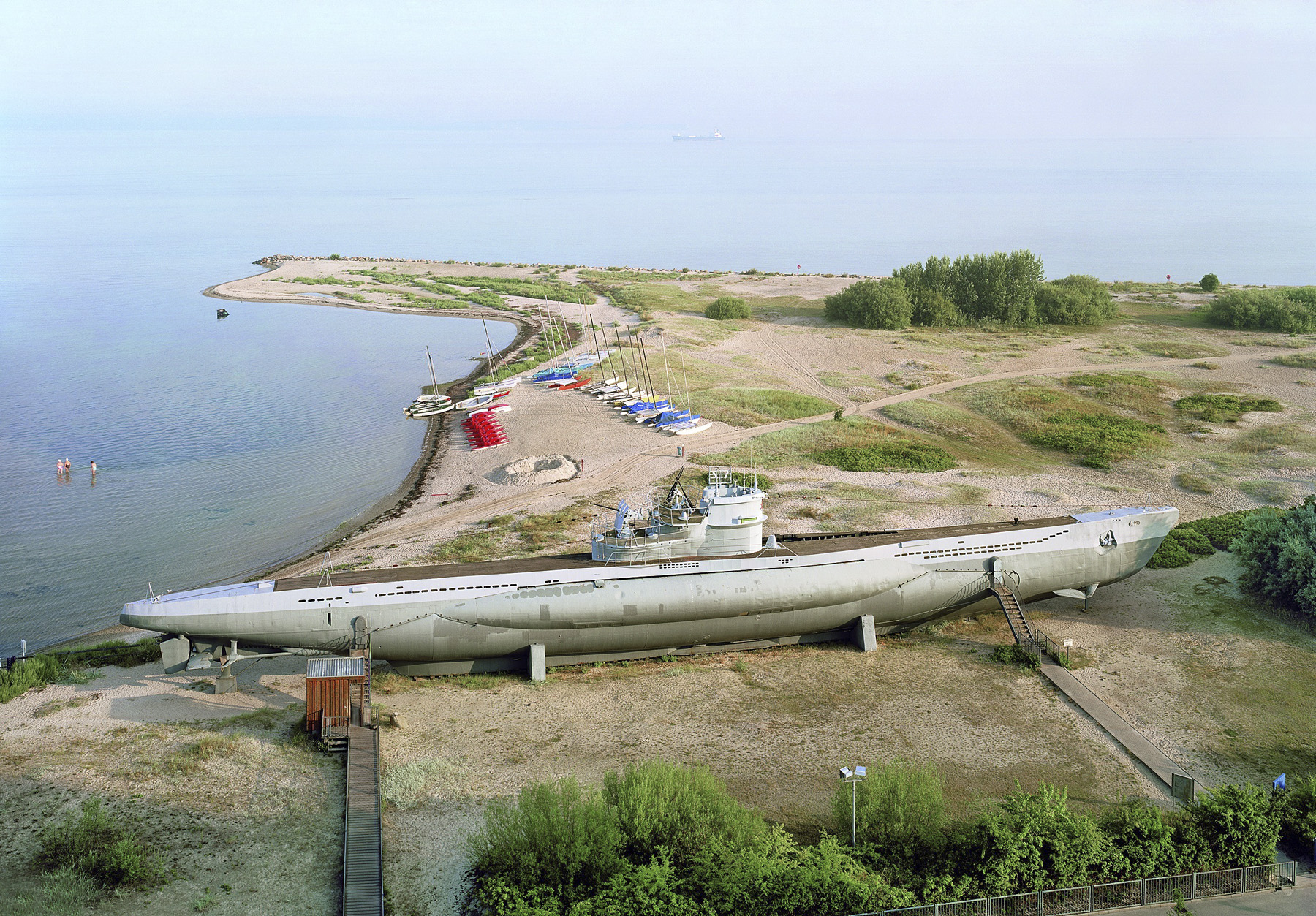
The star of the show was the work of Matthias Koch. His five large aqua-mounted type C prints from the series Sites of German History (2006) are both technically and conceptually superb, full of delicious ironies and humour. Using an aerial aesthetic (apparently by climbing the ladder of a fire engine that he owns) Koch looks down on the landscape and through his images formulates new ways of seeing national symbols (even though many of them are not in Germany). His re-presentation of spatial inter-relations and objects embedded in their rural and urban surroundings are both simple yet layered and complex.
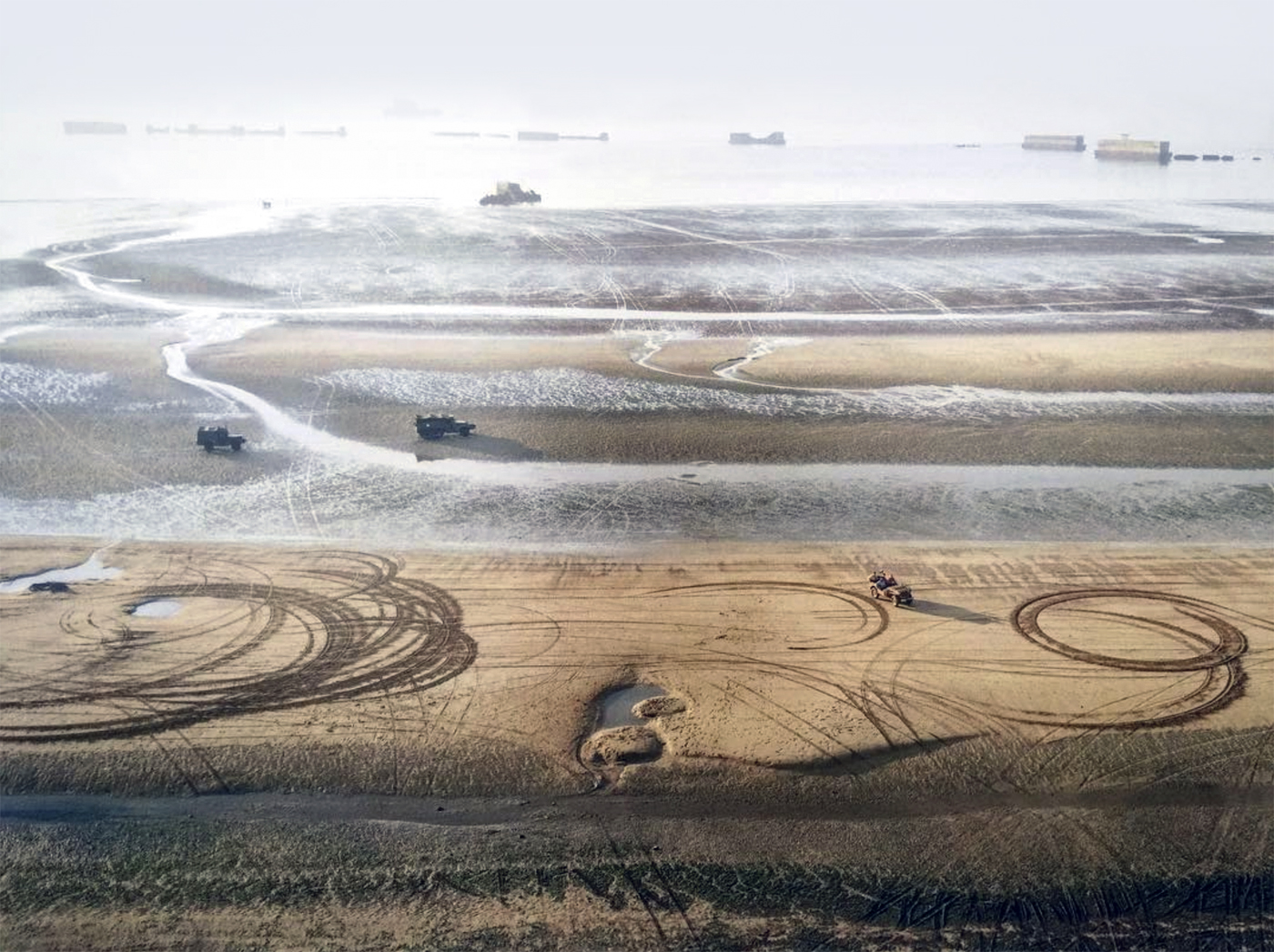
Unfortunately I have only two photographs (above and below) to show you of his work. None other was available but the images gives you an idea of his raison d’être. The specimen of U-995, built in Kiel in 1944, is presented as a trapped and mounted animal, preserved for our delectation and inspection with gangways and stairs to view the innards. Little hobby craft lie on a beach behind while people paddle in the shallows, a ship barely seen in the distance out at sea. The fact that this U-boat was once used to destroy such a ship, the irony of the proposition, is not lost on the viewer.
Other images in the series include a photograph of the derelict runway of the Heinkel factory as seen from above, the overgrown concrete slabs cracked and lifting, the edges filled with grass, the distant view dissolving into mist and nothingness. The photograph Harbour, Allied landing near Normandy, 1944 (2006, below) shows an American jeep and half-track of the period on the beach of the Allied landing in Normandy, tyre tracks swirling in the sand while in the distance the concrete block remains of the Mulberry harbour used in 1944 still litter the coastline. How many men, both German and American, died on this beach all those years ago? In another tour de force Atlantic Defence Wall near Cherbourg. Bunker construction built 1940 (2006) concrete bunkers dot the landscape with the beach and sea beyond as people sunbathe on the grass amongst the ruined bunkers, probably oblivious to the context of their surroundings. Koch is a master of the re-presentation of the context of memory, history and place.
Overall this exhibition is a great disappointment. I find it hard to believe that the exhibition has been curated by the same man who curated the recent Andreas Gursky exhibition at the National Gallery of Victoria. The choice of work and the presentation of technically poor prints is not up to standard. I also find it difficult to reconcile some of the reviews I have read of this exhibition with the actual work itself. Thank goodness for the photographs of Matthias Koch for he alone made the journey into outer Melbourne a worthwhile journey into the memory of the soul.
Dr Marcus Bunyan
1/ Anonymous. “Presentation/representation: Laurenz Berges,” on the Institut für Auslandsbeziehungen (IFA) website [Online] Cited 08/08/2009 no longer available online
Many thankx to Monash Gallery of Art for allowing me to publish the photographs in the posting. Please click on the photographs for a larger version of the image.
This international touring exhibition was developed by the Institut für Auslandsbeziehungen (ifa) in Germany and is presented in cooperation with the Goethe-Institut Australien.
MGA is hosting the important international exhibition ‘presentation / representation: photography from Germany’, which brings to Melbourne the work of ten of Germany’s best contemporary photographers.
presentation/representation is curated by Thomas Weski (curator of Andreas Gursky recently seen at the National Gallery of Victoria), and covers the work of the generation of German photographers that has followed the now-legendary Kunstakademie Düsseldorf generation of Gursky, Thomas Ruff, Thomas Struth and Candida Höfer. For the artists in presentation/representation, including Matthias Koch, Laurenz Berges and Heidi Specker, photography is a medium that has its own language and characteristics, and their work collectively explores the limits of the medium.
Shaune Lakin, Director of the MGA states “MGA is thrilled to present ‘presentation / representation’ and to bring to the people of Melbourne such an important survey of contemporary German photography. As well as providing a comprehensive survey of German practice, the exhibition will complement the experience of those who saw Weski’s wonderful Gursky exhibition at NGV. We are also delighted to host participating artist Matthias Koch.”
Koch will be presenting a series of public programs including an artist talk, student tutorial and a field trip exploring the industrial suburban sites close to the gallery. “With his critical interest in landscape, architecture and history, Koch will provide some wonderful insights into our local landscape for participants in these programs,” notes Dr Lakin.
MGA’s Education and public programs coordinator Stephanie Richter says: “This is a great opportunity for students and Melbourne audiences to meet one of Germany’s most celebrated contemporary photographers and to participate in the busy schedule of talks, tutorials and field trips with Matthias.”
Press release from Monash Gallery of Art website [Online] Cited 05/08/2019 no longer available online
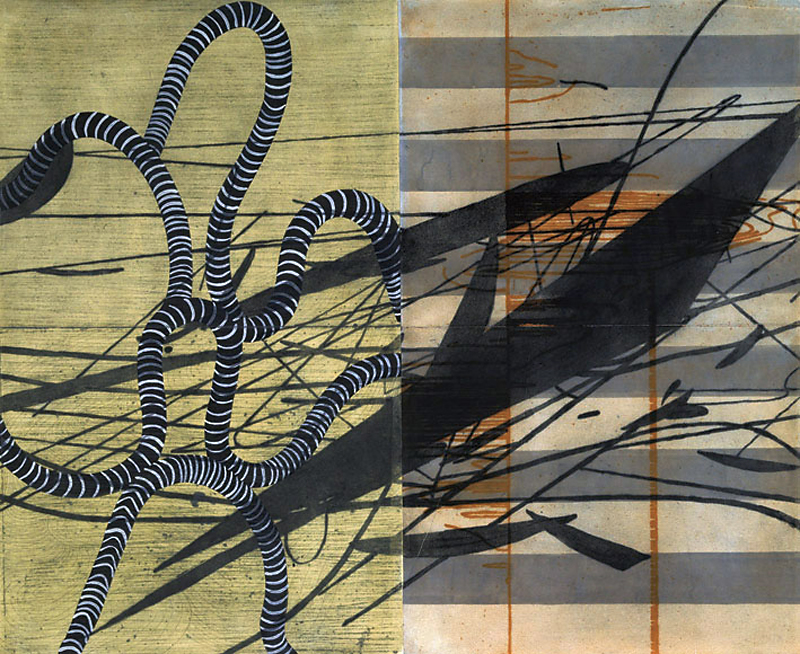
Sarah Amos (Australian, b. 1965) Red Walk 2009 Collagraph and Monoprint
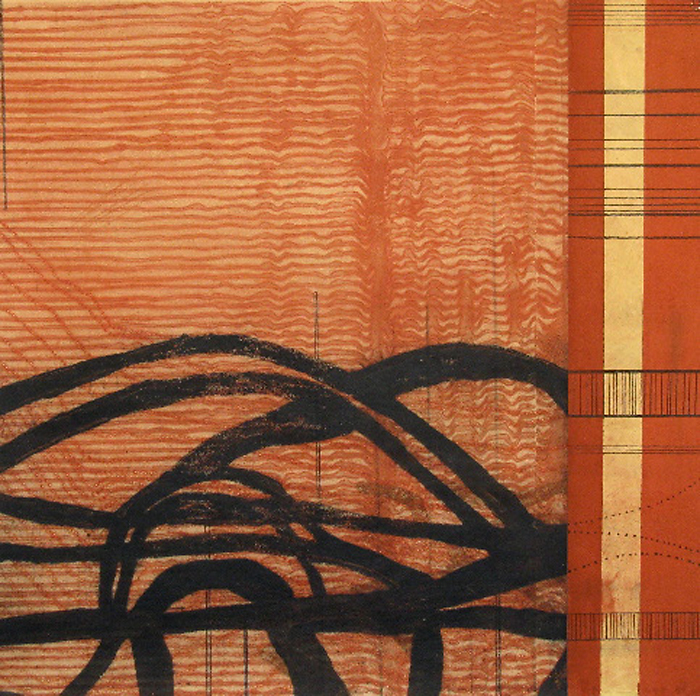
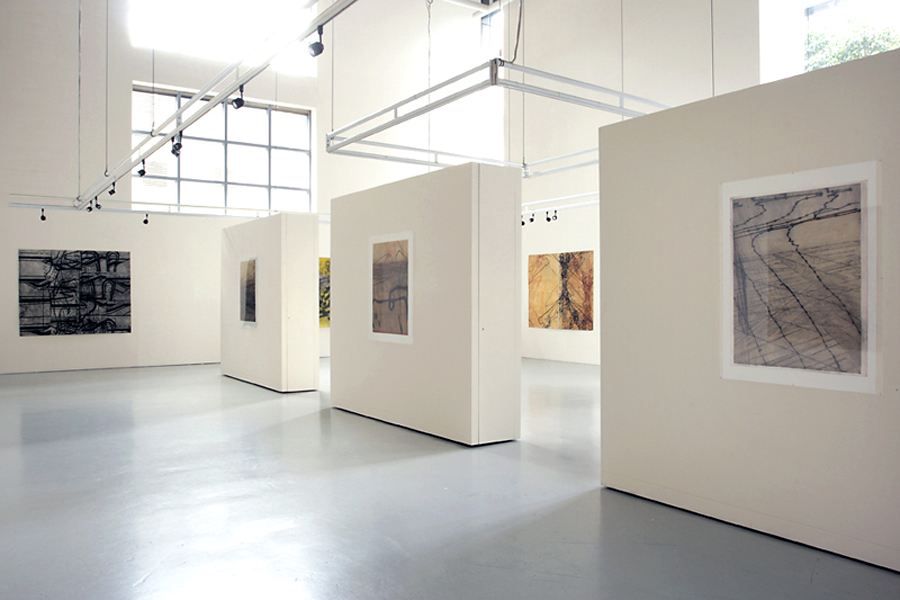
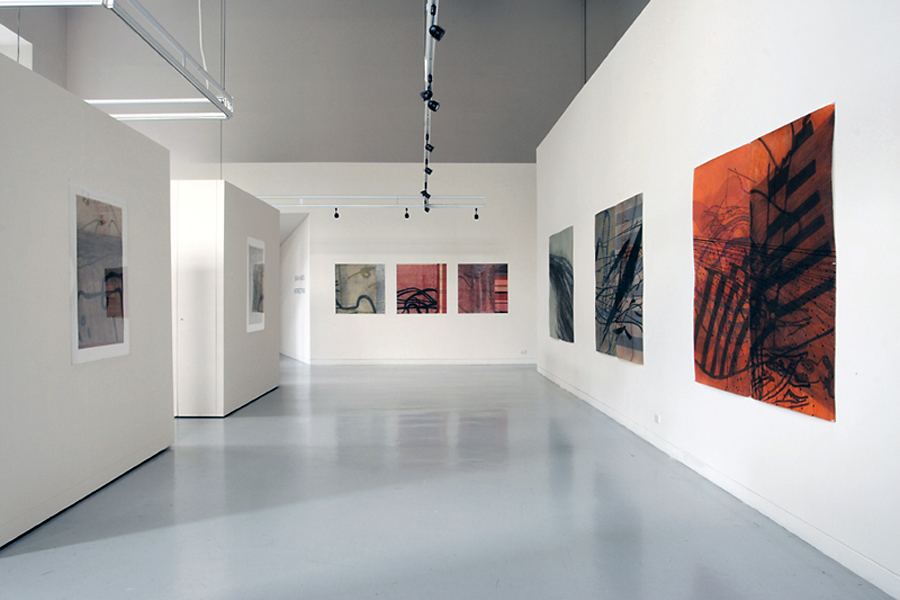
An interesting exhibition of Collagraphs (a type of collage printmaking)1 and etchings is presented by Sarah Amos at Gallery 101, Melbourne, work that is full of delicate coloured layering, topographical mapping and nodal, rhizomic and Spirogyra-type structures.
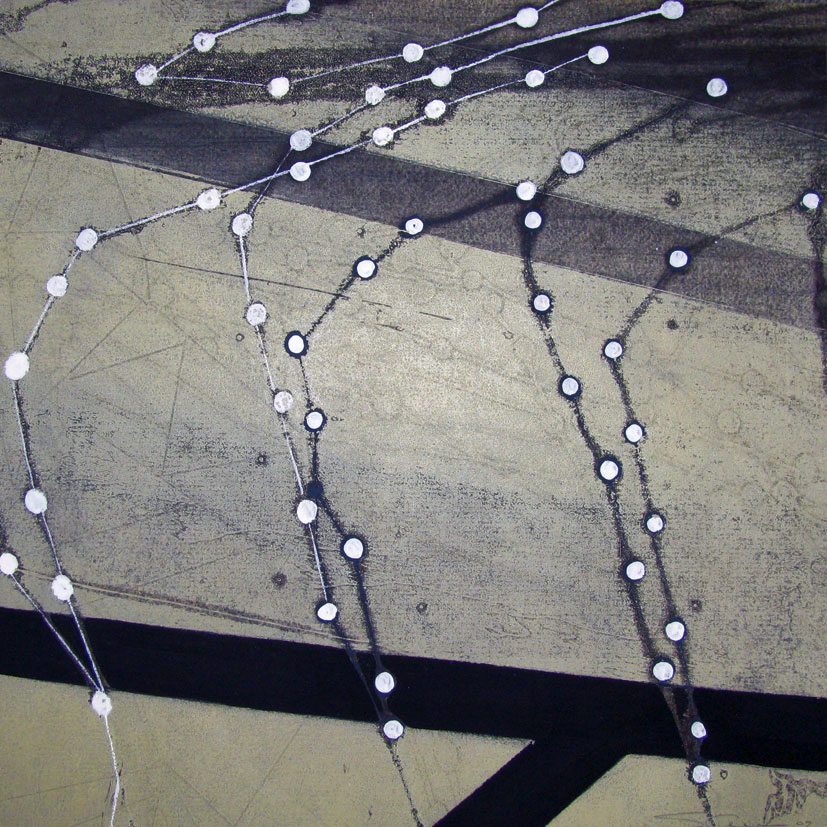
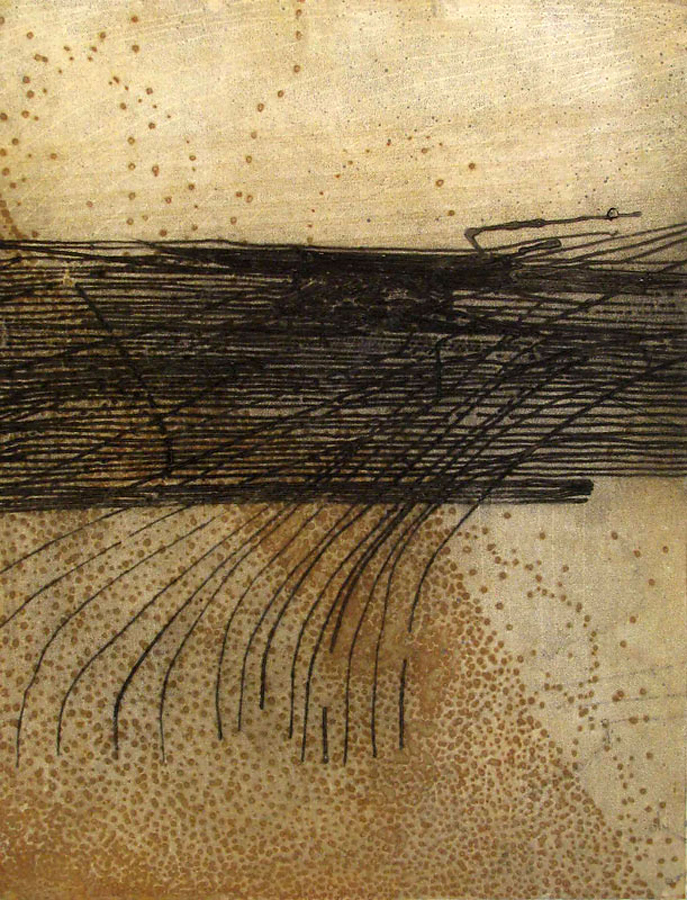
The ‘flux’ of the work, it’s musical cadence if you like, is the fusion of palimpsestic markings as viewed from the air – the dotted contours, the ploughed fields, the beautiful spatial layering that has an almost Kandinsky-like effect – with the aesthetics of Japanese paper, matt black colour (that subtly glistens on close inspection) and the tactility of the surface of the work. These intersections produce images that have some outstanding resonances: vibrations of energy that ebb and flow around the gallery space. These works are captivating!
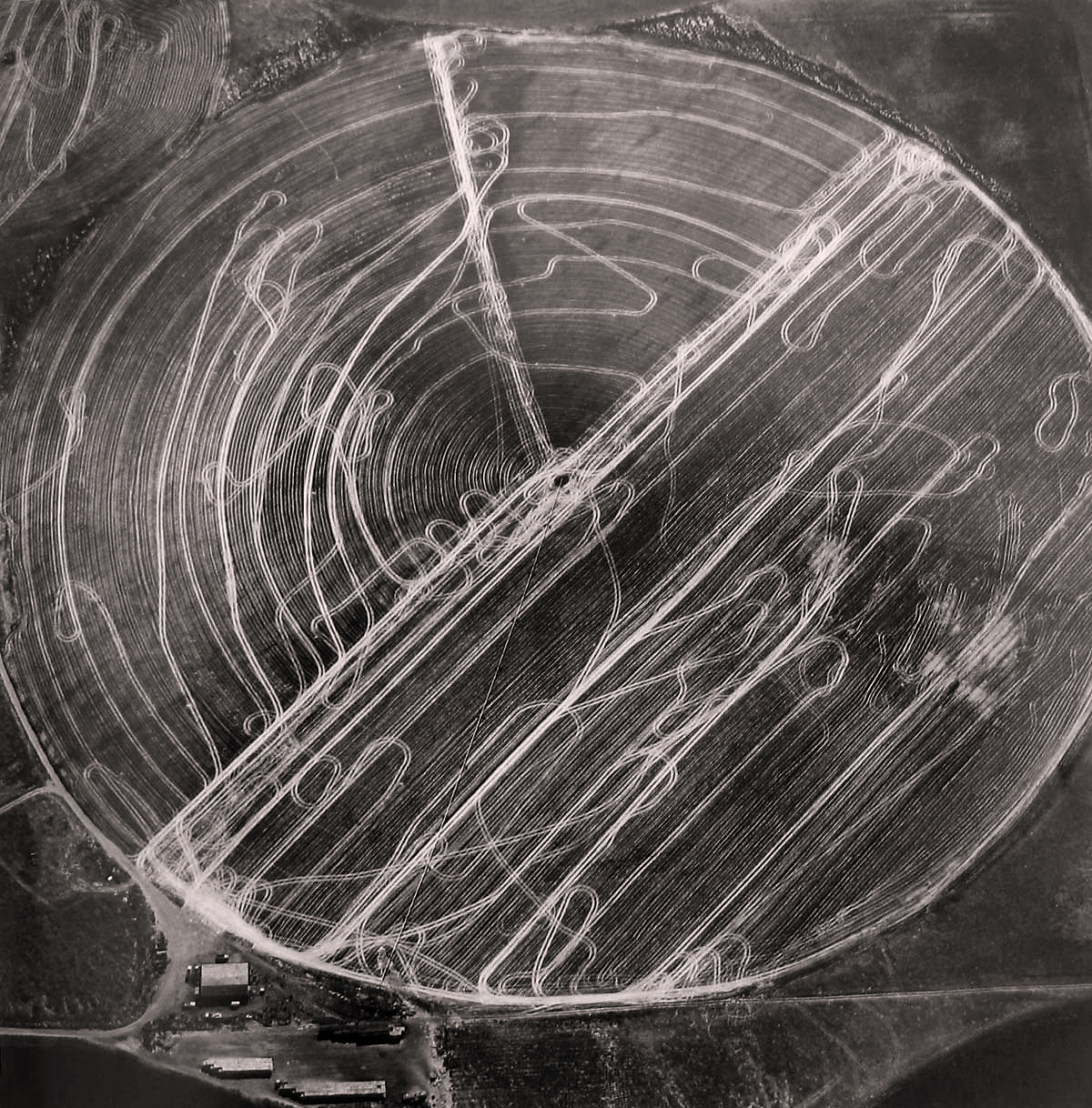
For me the simpler images were the more successful especially the series named Intersections with their muted tonalities, shifting colours and topographical structure. They also reminded me of the black and white aerial landscape photography of Emmet Gowin (see below).
While I am unsure of the validity of the ‘landscape’/’urban lens’ ‘urban temperature’ references (which I found unnecessary and slightly irrelevant) these works and their synaptic interfaces must be experienced. For the viewer they hold a strange attraction as you stand before them drawn, inexorably, into their penumbral spaces. Recommended.
Dr Marcus Bunyan
Many thankx to gallery 101 for allowing me to publish the art work in the posting. Please click on the photographs for a larger version of the image.
1/ “A Collagraph print is a collage printmaking technique and is a form of Intaglio printing. The collagraph plate is printed in the same way as etchings, but also include the basic principle of relief printing and can be printed either as intaglio or relief.
The term collagraph refer to a collage board where the materials are assembled on a flat base or plate (matrix) to form a relief block with different surface levels and textures.
Collagraph plates are created by sticking and gluing materials like textured paper or fabric onto the plate and then coat it with varnish or acrylic medium afterwards to protect the materials.
Anonymous. “Printmaking: Collagraphs/Collage Blocks,” on the ArtistTerms.com website [Online] Cited 03/08/2009. No longer available online
Sarah Amos (Australian, b. 1965) Storm Loading 2009 Etching and hand drawing on Shiramine Japanese paper
Installation views of Intersections by Sarah Amos at Gallery 101, Melbourne Photos: Marcus Bunyan
Emmet Gowin (American, b. 1941) Harvest traffic over agricultural pivot near Hermiston, Orgeon, 1991 1991 Gelatin silver print
Sarah Amos (Australian, b. 1965) Intersections 8 2009 Collagraph with gouache
“(Flux) – where a total electric or magnetic field passes through a surface.”
My work is a fusion of both land and cityscape. I am interested in interpreting spatially dynamic, real and half forgotten landscapes through an urban lens. New to this body of work is my interest in the visual graphics of scientific diagrams in which dynamic and informative landscapes are drafted into linear minimal lines. I have absorbed this distilled language, translating it into an architectural and organic landscape where the intersections of line, volume and space are constantly in flux. This obscure knowledge is pared down, simplified and ordered into a clean analysis ready for instant translation.
The Australian landscape is central to my work and influences my use of colour, idiosyncratic marks and open space. These works are personalised maps of accumulated information, like printed histories, that record the duelling intersections where the weathers of the landscape and the urban temperature have begun to take on new and vital immediacy.”
Sarah Amos, 2009
Text from the Gallery 101 website [Online] Cited 01/08/2009. No longer available online
Sarah Amos (Australian, b. 1965) Lute 2009 Collagraph
Marco Fusinato (Australian, b. 1964) Double Infinitive 3 2009
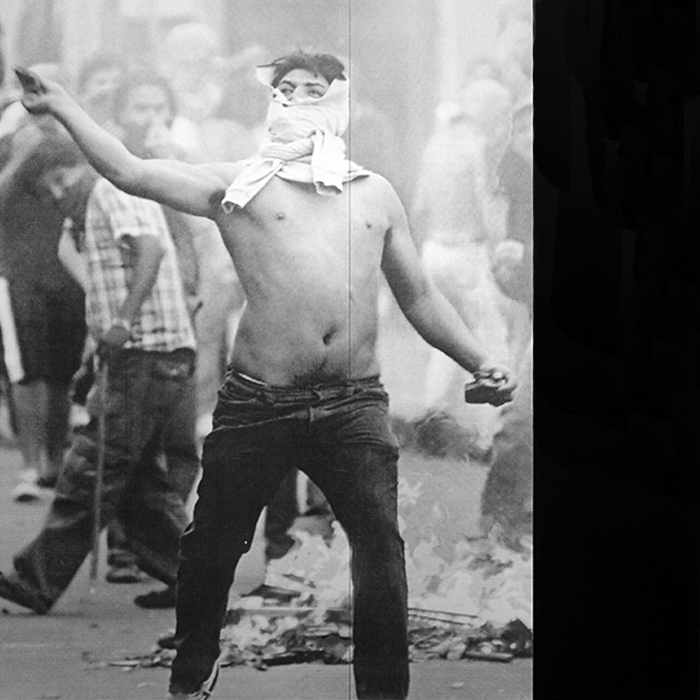
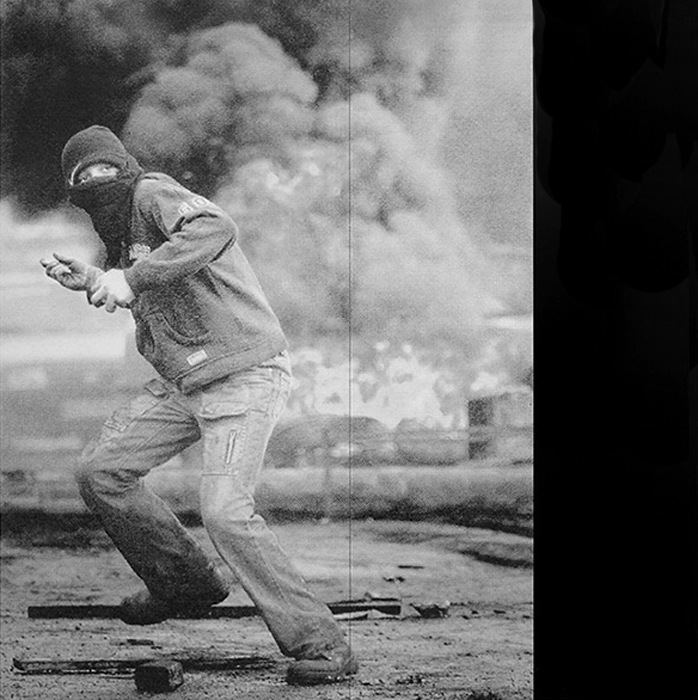
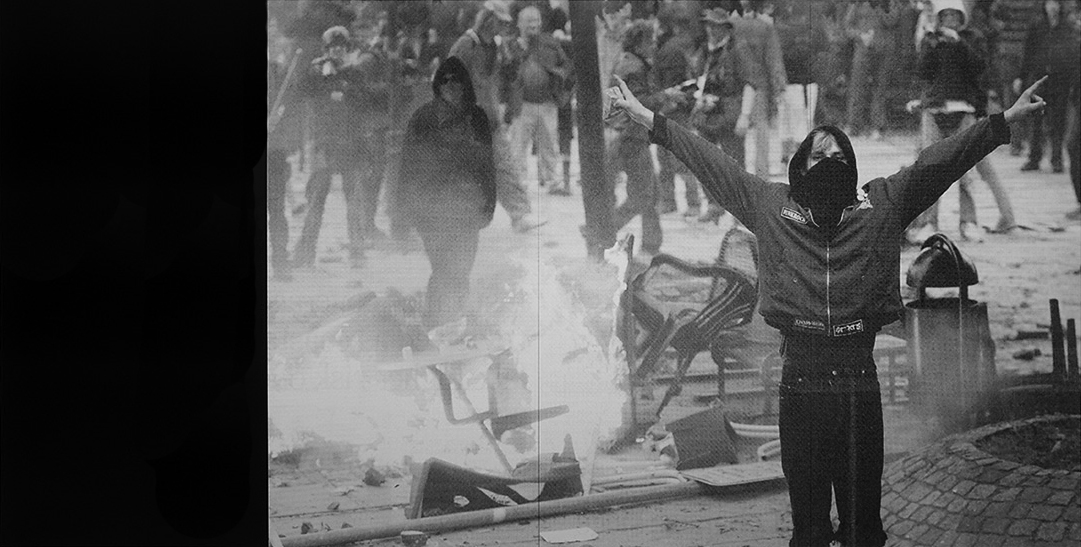
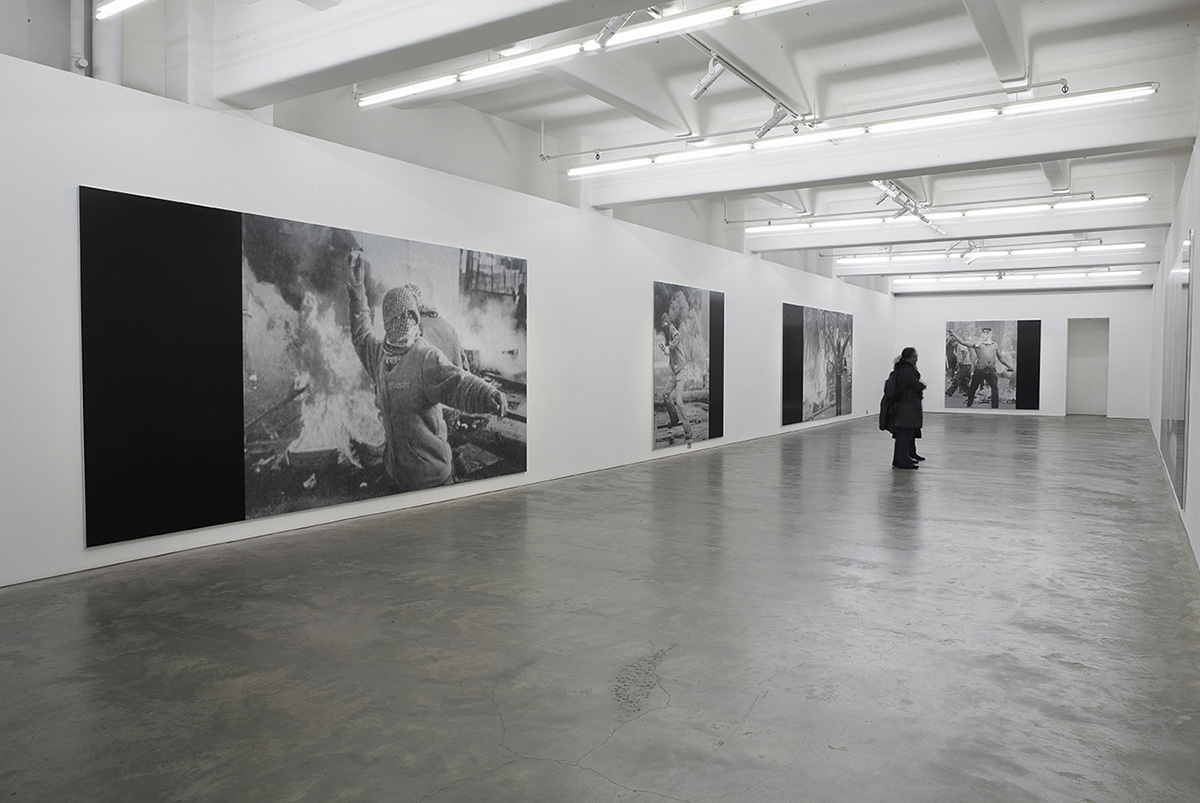
Double Infinitives by Marco Fusinato at Anna Schwartz Gallery, Melbourne is an excellent exhibition of large UV ink on aluminium images sourced by Fusinato from the print media.
The images are made up of a dot pattern familiar to those who have examined photographs in the print media closely. Larger and smaller clusters of dots form the light and shade of the image. As you move closer to the works they dissolve into blocks of dots and become and optical illusion like Op Art from the 1960s. Fusinato contrasts this dot structure with the inclusion of flat panels of black ink to the left and right hand side of the images. The section lines that run through the images (for they are not one single image but made up of panels) also adds to the optical nature of the work as the lines cut the conflagrations, literally stitching the seams/scenes together.
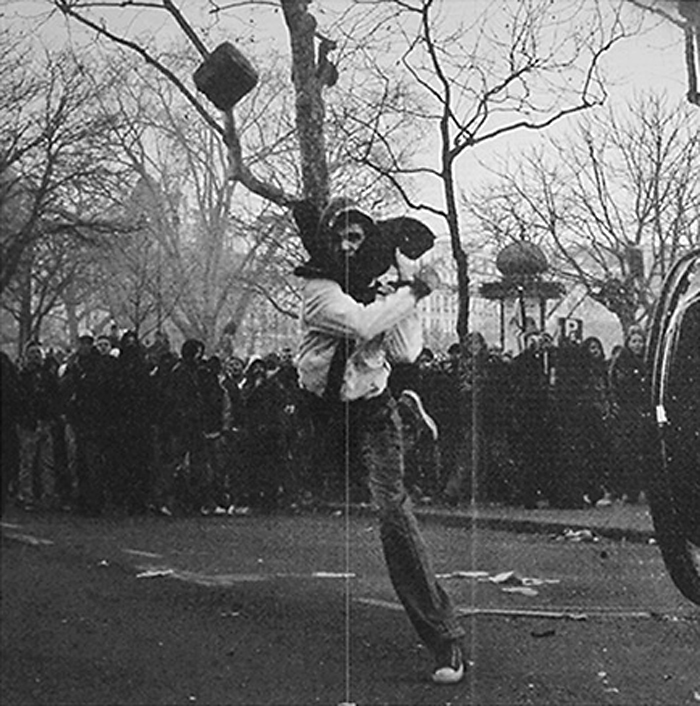
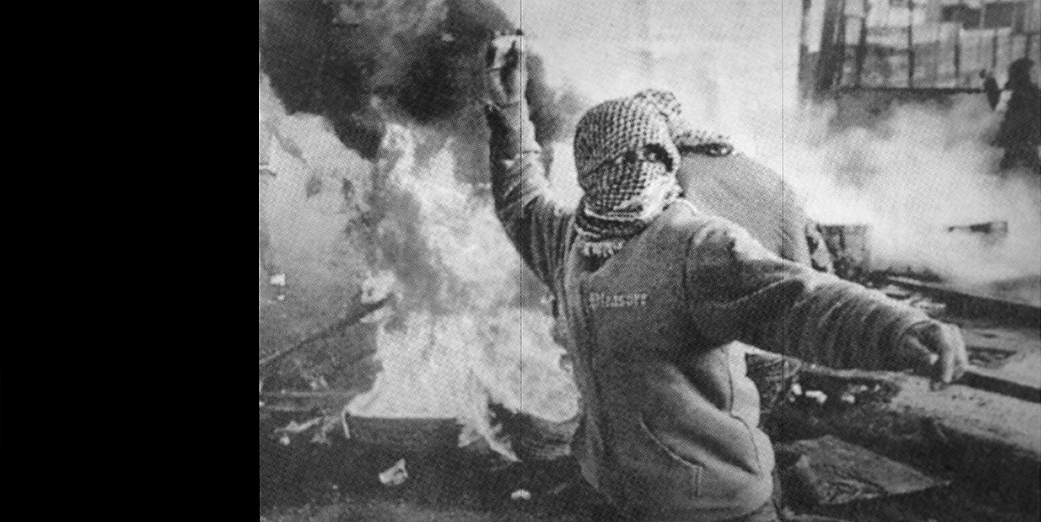
Each image contains an individual holding a rock enclosed in the milieu and detritus of a riot; the figures are grounded in the earth and surrounded by fire but in their obscurity, in the veiling of their eyes, the figures seem present but absent at one and the same time. They become ghosts of the fire.
Fire consumes the bodies. The almost cut out presence of the figures, their hands clutching, throwing, saluting become mute. Here the experience of the sound, colour and movement of an actual riot is silenced in the flatness and smoothness of the images. The images possess the intensity of a newspaper reality ‘blown up’ to a huge scale by Fusinato (see the installation photograph below to get an idea of the effect). The punctum of the riot, that prick of consciousness that Barthes so liked, is translated into a silenced studium of the aluminium surface; an aural history (the sound) / oral history (the telling of the story) trapped in the structure of silence.
There is a double jeopardy – the dissolution of the image into dots and the disintegration of the body into fire. In one of the images the upraised arm and hand of one of the rioters holds a rock with what appears to be a figure on it, surrounded by fire. To me the arm turned into one of the burning Twin Towers with smoke and fire pouring from it (see the first photograph in the installation photograph below).
My only concern about the images were the black panels, perhaps too obvious a tool for the purpose the artist intended. Maybe the needed some small texture, like a moire pattern to reference the contours of a map and continue the topographical and optical theme. Perhaps they just needed to be smaller or occasionally placed as thin strips down the actual image itself but these are small quibbles. Overall this is an fantastic exhibition that I enjoyed immensely. The images are literally ripped from the matrix of time and space and become the dot dot dot of the addendum. What Fusinato does so excellently is to make us pause and stare, to recognise the flatness of these figures and the quietness of violence that surrounds us.
Music – Noise – Silence Flatness – Advertising – Earth – Fire Rock – Space – Memory
Dr Marcus Bunyan
Many thankx to Anna Schwartz Gallery for allowing me to publish the photographs in the posting. Please click on the photographs for a larger version of the image.
Marco Fusinato (Australian, b. 1964) Double infinitive 1 2009
Marco Fusinato (Australian, b. 1964) Double Infinitive 4 2009
A selection of images from the print media of the decisive moment in a riot in which a protagonist brandishes a rock against a backdrop of fire. Each image is from a different part of the world, from the early twenty-first century, and is blown up to history-painting scale using the latest commercial print technologies.
Text by Marco Fusinato on his website
Installation of Marco Fusinato Double Infinitives exhibition at Anna Schwartz Gallery, Melbourne
Double Infinitives
“Unheard music is better than heard.”
Greek proverb of late antiquity
“That music be heard is not essential – what it sounds like may not be what it is.”
Charles Ives, Essays Before a Sonata
“The proposition of Jacques Attali’s Noise is different. He says that while noise is a deadly weapon, silence is death.”
David Rattray, “How I Became One of the Invisible,” Semiotext(e), 1992.
The explosive communal act of rioting is most commonly delivered to an audience suspended in the stillness and silence of a photographic image. Noise is not removed in this process, it is almost amplified: the sound and action that deliver this singularly captured moment into existence are infinite, as all things remain while they are imagined, before they are anchored down by express articulation.
Photographic representation can easily be accused of subverting the truth of events, not because what is seen in the image has not transpired, but because static images leave so much space around them for multiple narratives to be constructed. The still image is totally contingent on the consciousness that confronts it. By contrast, the near-totality of videos can give too much away …
Sourced by Fusinato from print media published in the last few years, these images of rioting all contain an individual clutching a rock, bathed in the refractory glow of a nearby fire. The image has become prototypical, so much so that it lacks the sensation of spontaneity requisite to produce a riot. (Apropos to this predictability, Fusinato would check global newspapers after every forum or conference of global financial authorities, often finding the image he was looking for).
Double Infinitives is a succinct allegory for the reluctance to compromise comfort overpowering radical impulses. Conversations suggest this is a conflict frequently experienced by artists. Deprived of a volatile political reality, we experience radicalism through images that act as small ruptures, reminders that the world we live in might be more severely charged than our individual experiences allow. Fusinato’s works flatten these images of volatility onto a smooth slate: they are similar and radiate with the vexed beauty of sameness. A riot is a mad and brutal spectacle, a theatre that is often documented as if it were a play. Hugely expanded in scale and rendered in the suffused gloss of advertising, the real possibility of violence that these works infer deepens the layers of the fiction rather than comprising an indicator of human concern. Those things with which we come into such gentle contact that their thorns barely prick …
Liv Barrett June 2009
Text from the Anna Schwartz Gallery website [Online] Cited 10/07/2009. No longer available online
Marco Fusinato (Australian, b. 1964) Double Iinfinitive 2 2009
Marco Fusinato (Australian, b. 1964) Double Iinfinitive 2 (detail) 2009
Marco Fusinato (Australian, b. 1964) Double Iinfinitive 5 2009
Anna Schwartz Gallery 185 Flinders Lane Melbourne, Victoria 3000
Exhibition dates: 16th June – 18th September, 2009
Artist duo George (left) and Gilbert (right) pose in front of their work “The Church of England” in Berlin, Germany
That pair of agent provocateurs are at it again!
Marcus
Many thankx to Arndt & Partner for allowing me to publish the photographs in the posting. Please click on the photographs for a larger version of the image.
Gilbert & George (Gilbert Prousch, English born Italy, b. 1943) (George Passmore, English, b. 1942) DATING 2008 Mixed media
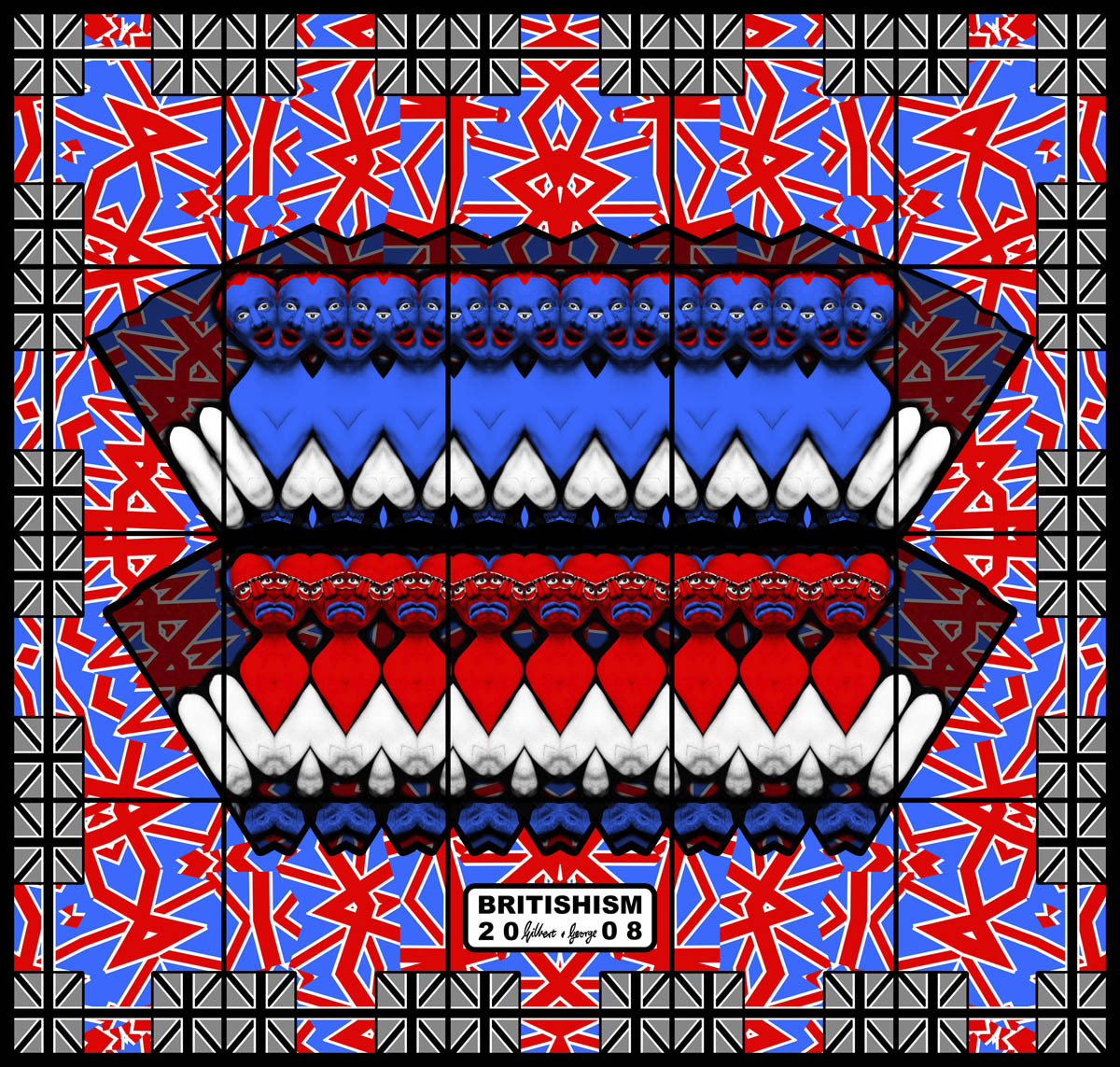
Gilbert & George (Gilbert Prousch, English born Italy, b. 1943) (George Passmore, English, b. 1942) BRITISHISM 2008 Mixed media
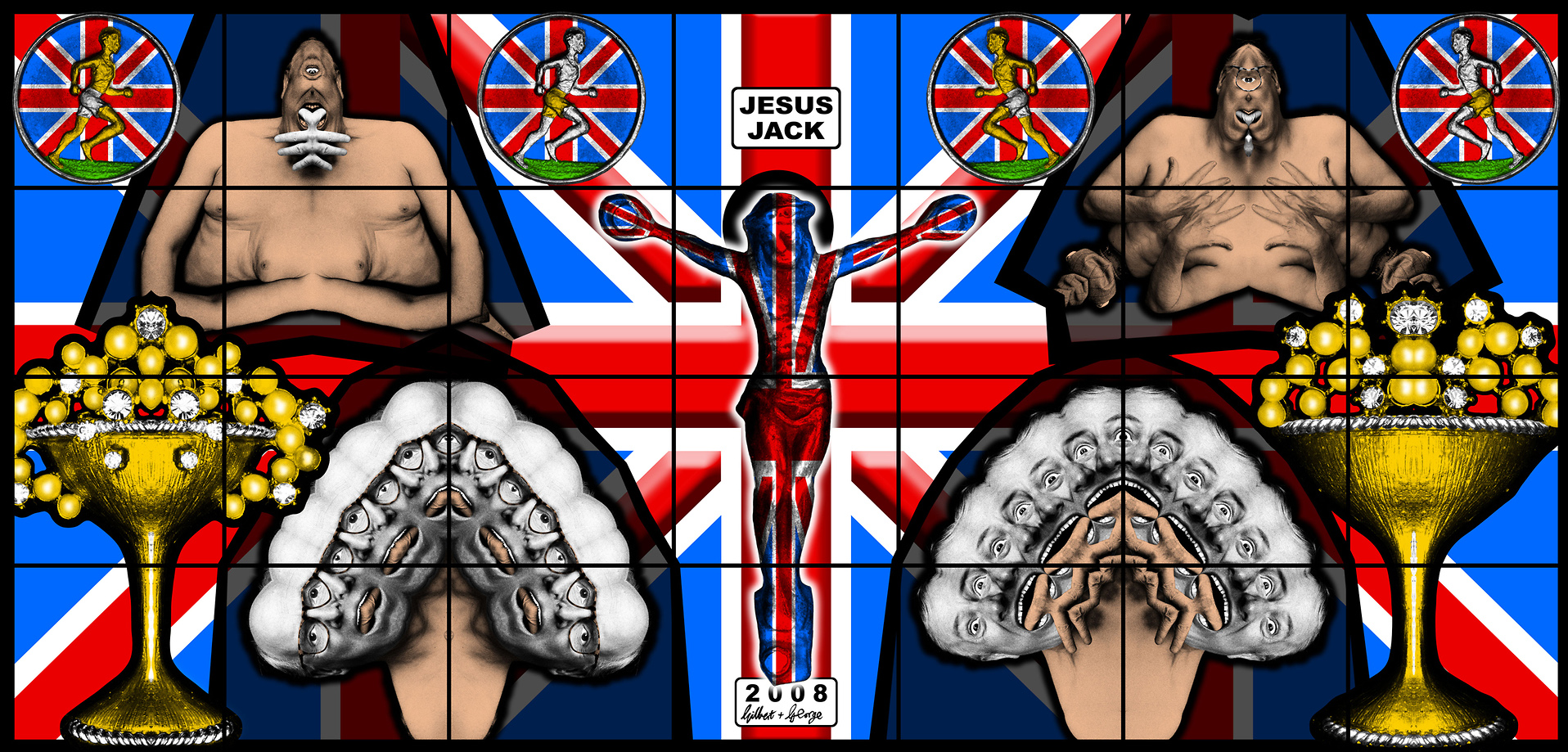
Gilbert & George (Gilbert Prousch, English born Italy, b. 1943) (George Passmore, English, b. 1942) JESUS JACK 2008 Mixed media
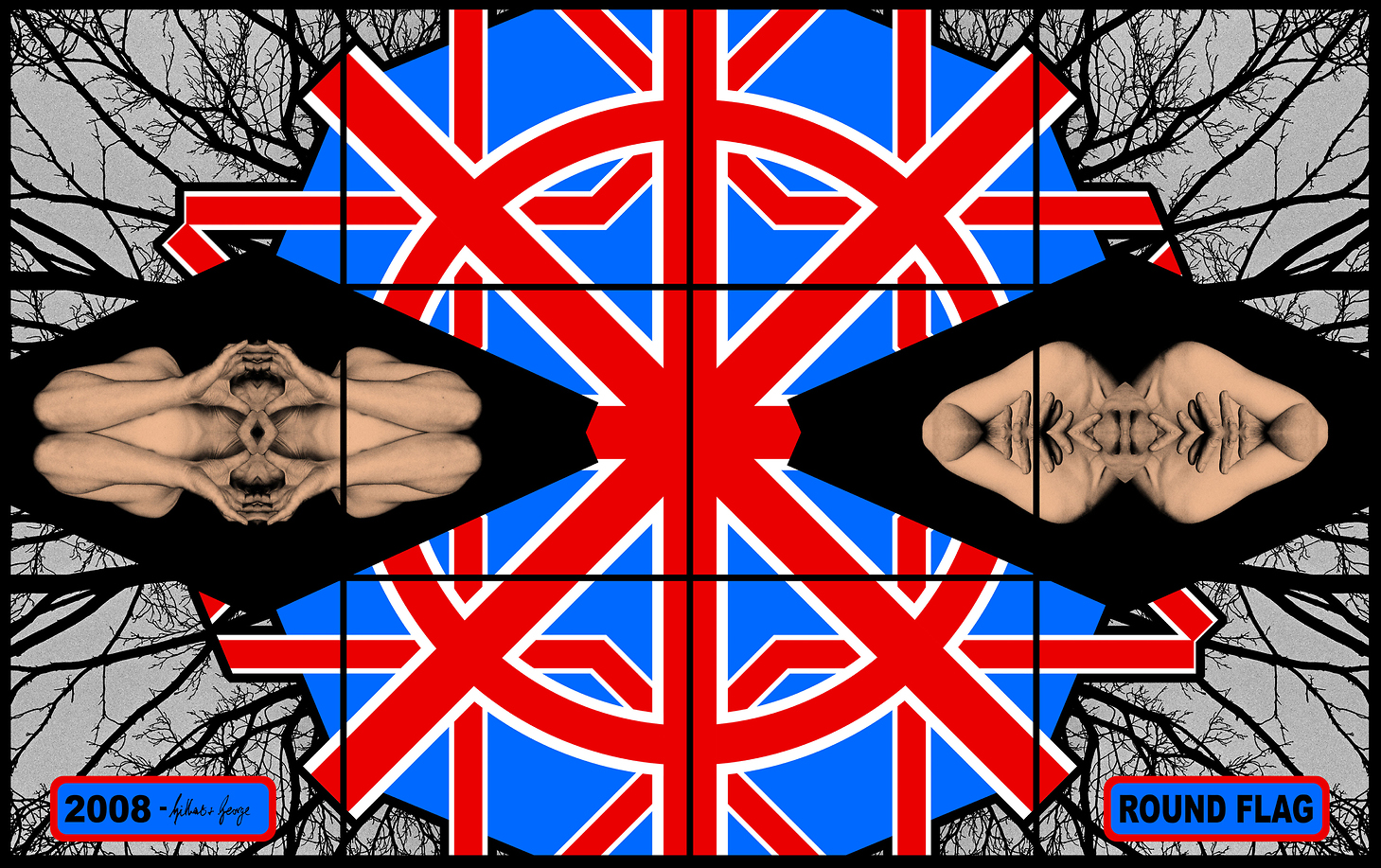
Gilbert & George (Gilbert Prousch, English born Italy, b. 1943) (George Passmore, English, b. 1942) ROUND FLAG 2008 Mixed media
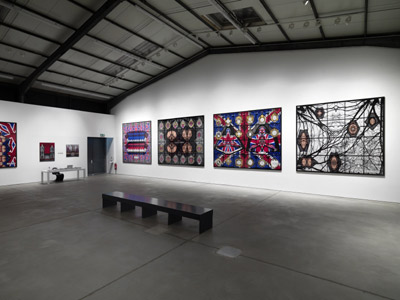
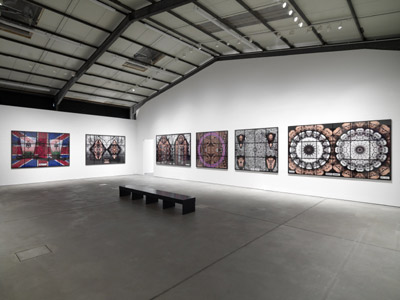
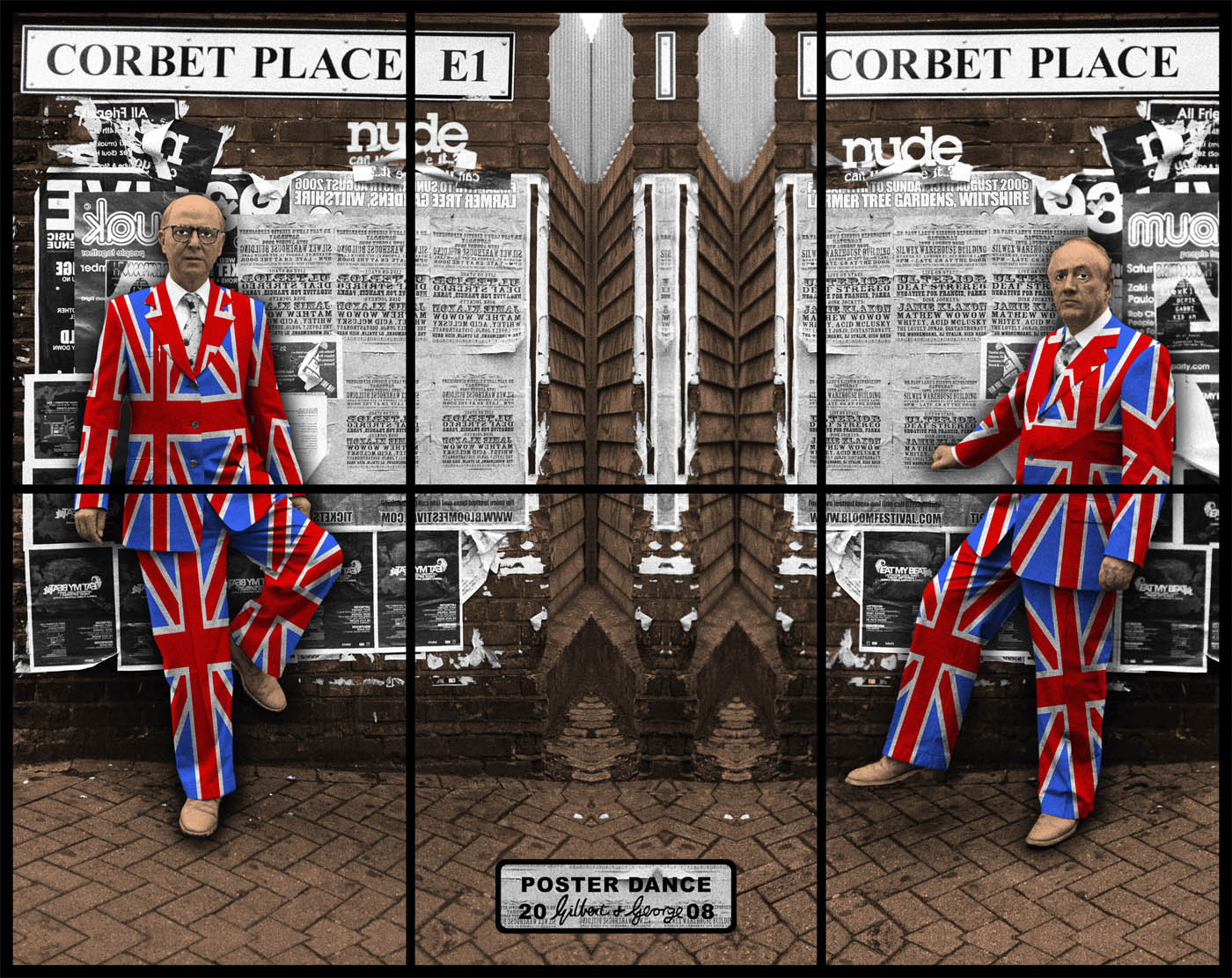
As the international tour of the last Gilbert & George retrospective (2007-2009) did not include Berlin, Arndt & Partner are now presenting a solo exhibition of the celebrity artist duo in its gallery rooms behind the Hamburger Bahnhof. It is the first Gilbert & George solo show in Berlin for 14 years. The exhibition features a selection of 20 large-scale pieces from the Jack Freak Pictures, the largest Gilbert & George group of pictures to date. The thrust of the content is given by the colours and shapes of the Union Jack flag that dominate the bulk of the pictures as well as the recurring motive of medals, emblems and trees. In the Jack Freak Pictures the artist duo explores aspects of nationhood and of the sentient individual in the nets of society. In his essay published in the catalogue accompanying the exhibition the British writer Michael Bracewell describes these pictures as “the most iconic, philosophically astute and visually violent works that Gilbert & George have ever created …”
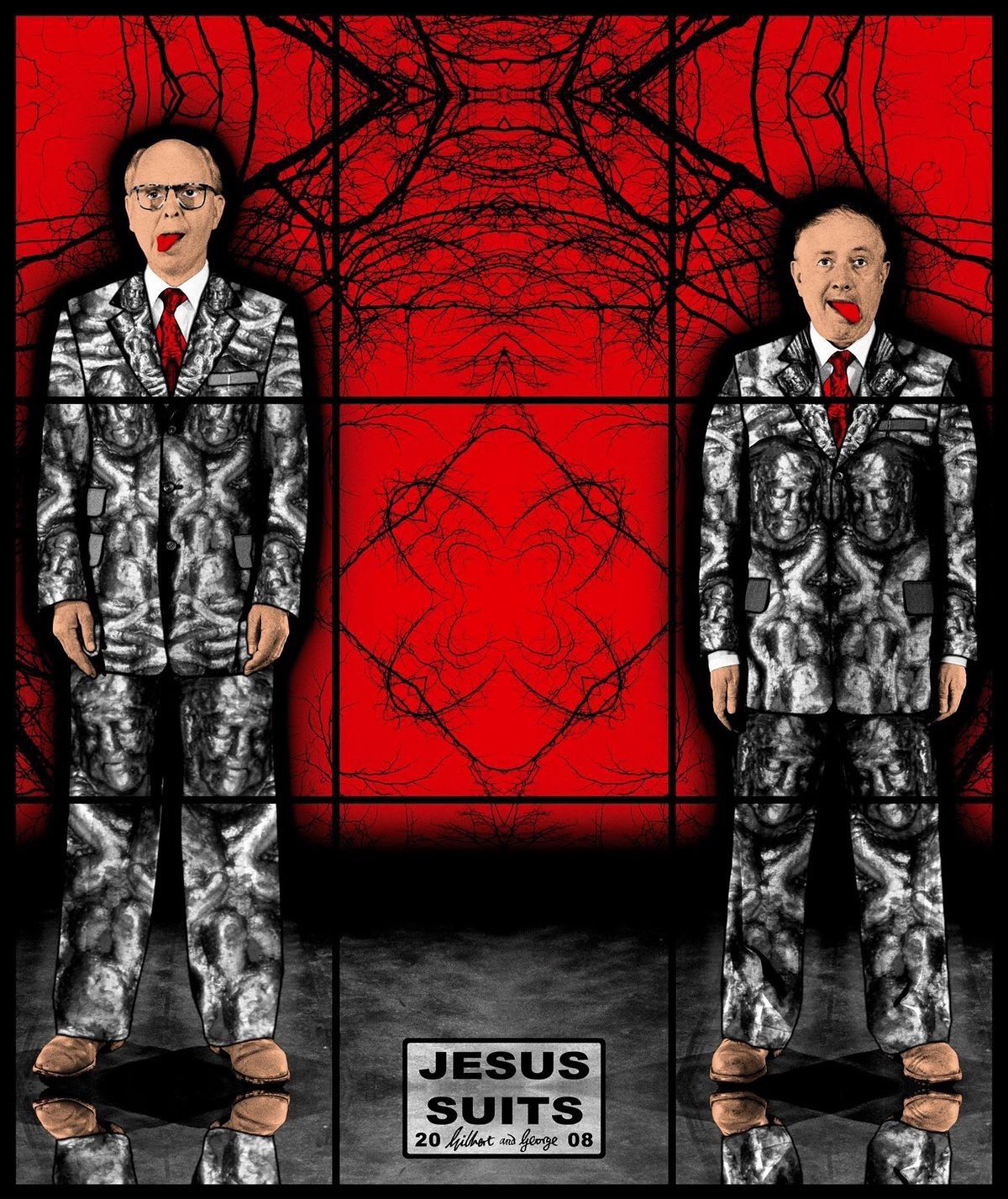
Gilbert & George, who met as students of sculpture at St. Martin’s School of Art in London 42 years ago, embarked on a joint artistic career that was to encompass a wide range of media from drawing to video and their trademark pictures. Further, the pair revolutionised the concept of sculpture by presenting themselves as “living sculptures” dressed in the quintessentially British tailored suit, shirt and tie. But it was their monumental trademark pictures composed of a grid like array of smaller images which they began to create in the early 70s that first brought them international fame. Figures, cityscapes, symbols, plants, bodily fluids, excrements and text interlock in pictorial messages as visually powerful as their content is provocative. The pictures, which started out in black and white and later assumed increasingly luminous, bold colours, generally also depict portraits of the artists themselves and seize on taboo subjects like sexuality, race, religion and national identity with a brash and fearless candour.
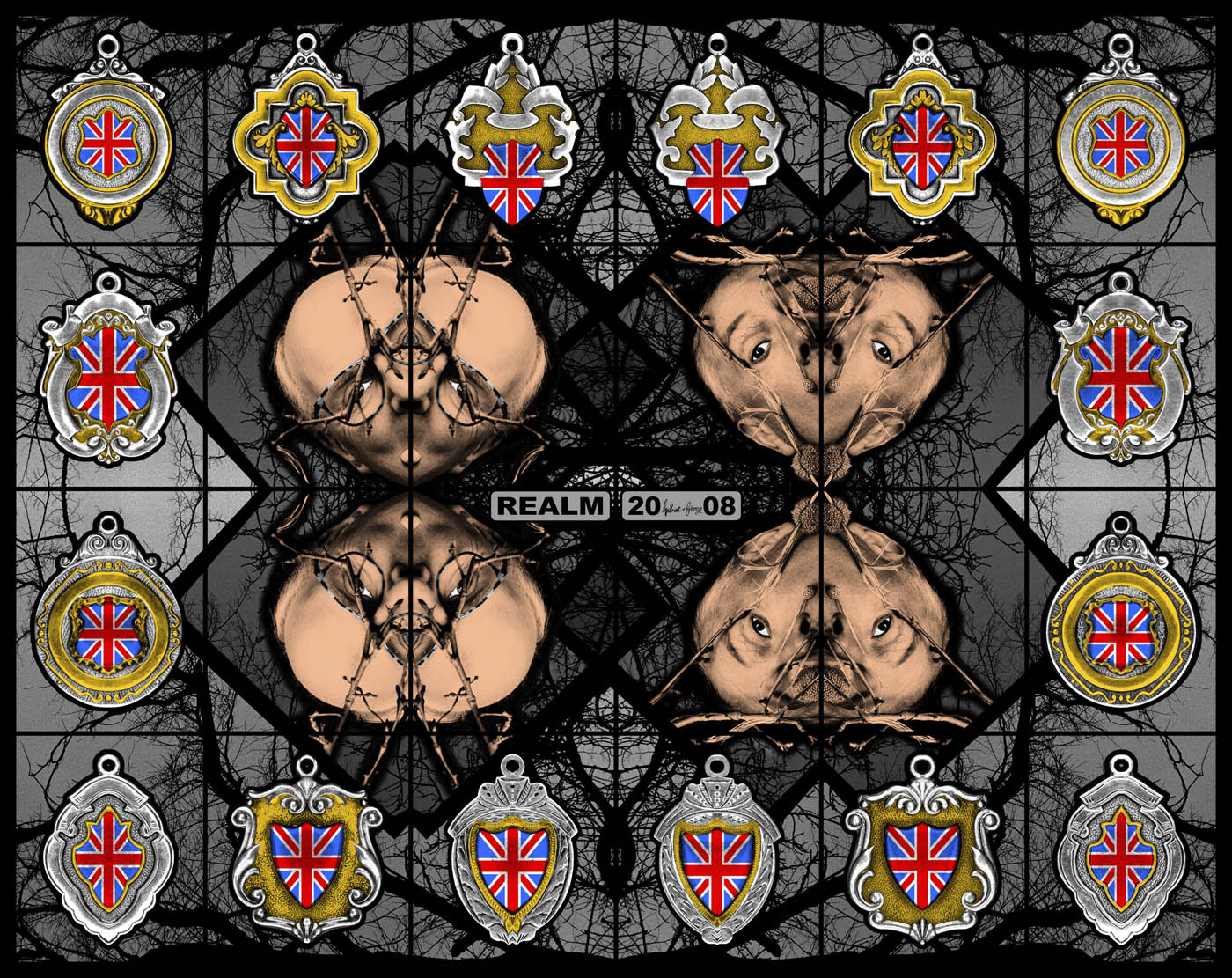
The Jack Freak Pictures again feature the bodies and/or faces of the artists. In these compositions, their bodies function as stylised representatives of the individual in society, whose relationship to social norms and categories, to national, religious and sexual identification processes is relentlessly explored and commented upon. Departing from their earlier oeuvre, some of their new pictures split the raw images into much smaller fragments before merging them into new forms. The result is a fascinating kaleidoscopic mix of the monstrously grotesque with an intricate ornamental structure reminiscent of sacred art. In ever new variations, Gilbert & George order the signs and fragments of social life they find in their neighbourhood – the multicultural East End of London – where solidarity and friendship are as visible as intolerance and marginalisation.
Press release from the Arndt & Partner website [Online] Cited 04/07/2009. No longer available online
Gilbert & George installation photographs of their exhibition Jack Freak Pictures at Arndt & Partner, Berlin
Gilbert & George (Gilbert Prousch, English born Italy, b. 1943) (George Passmore, English, b. 1942) JESUS SUITS 2008 Mixed media
Gilbert & George (Gilbert Prousch, English born Italy, b. 1943) (George Passmore, English, b. 1942) CHURCH OF ENGLAND 2008 Mixed media
Gilbert & George (Gilbert Prousch, English born Italy, b. 1943) (George Passmore, English, b. 1942) POSTER DANCE 2008 Mixed media
Gilbert & George (Gilbert Prousch, English born Italy, b. 1943) (George Passmore, English, b. 1942) REALM 2008 Mixed media
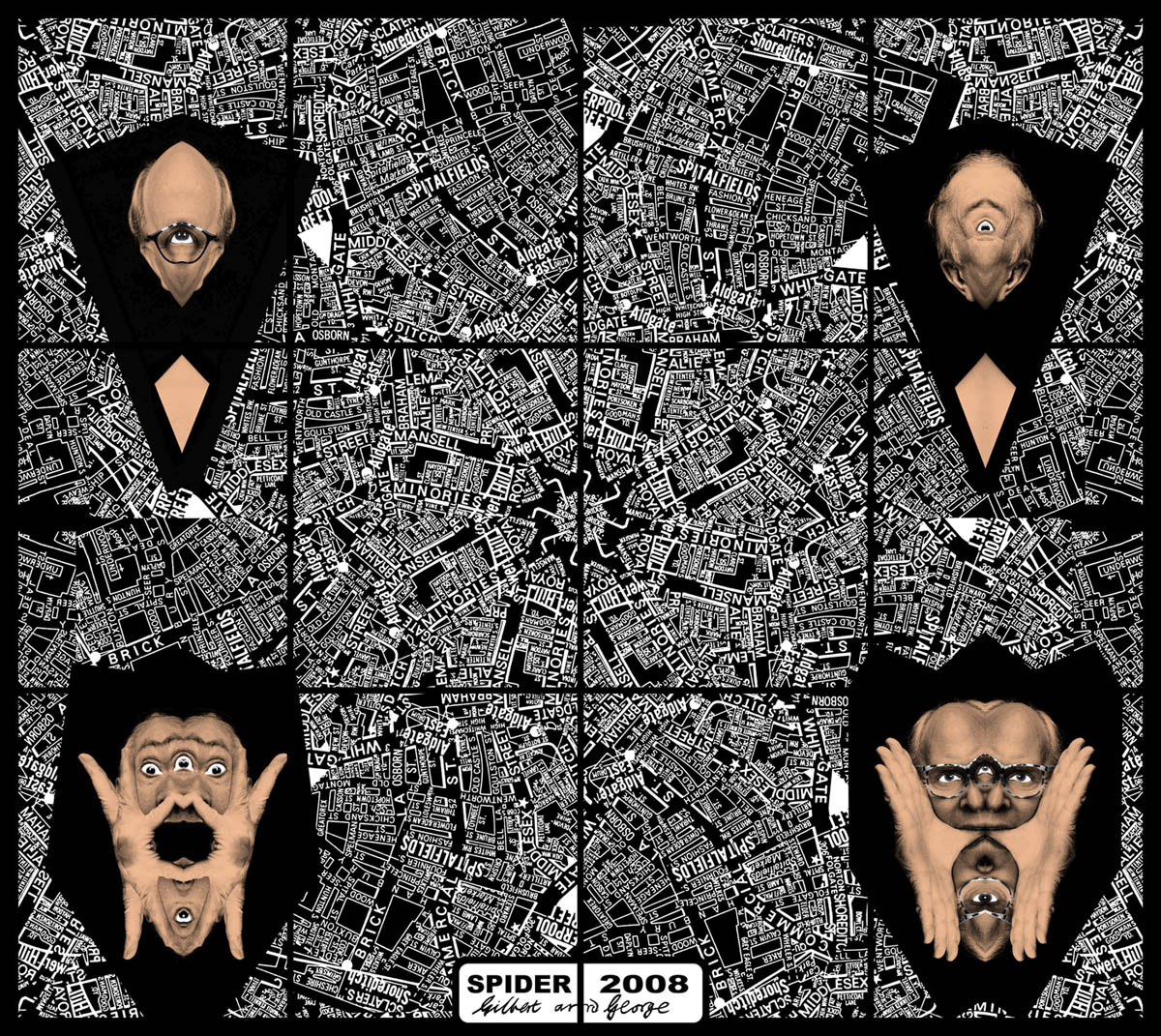
Gilbert & George (Gilbert Prousch, English born Italy, b. 1943) (George Passmore, English, b. 1942) SPIDER 2008 Mixed media
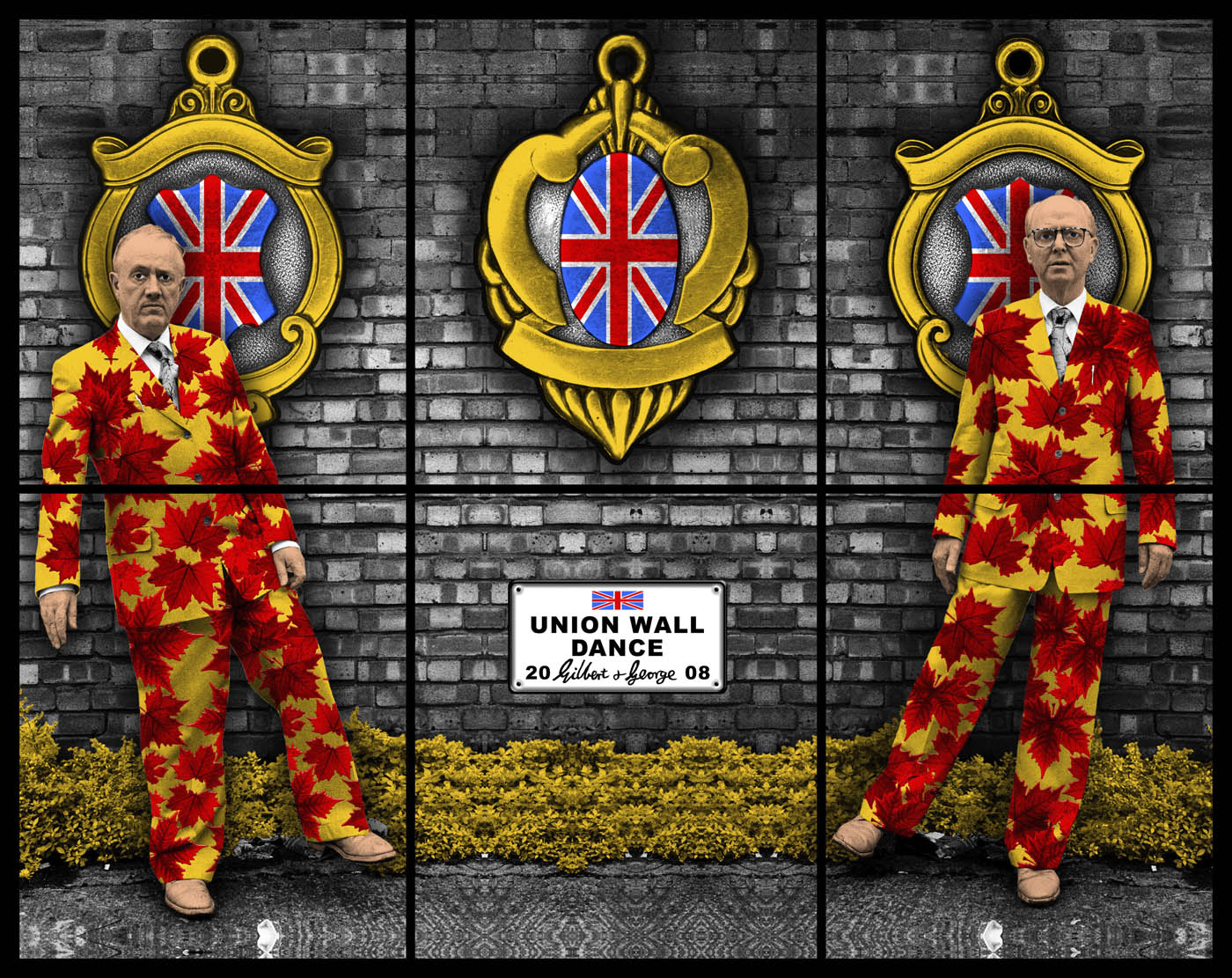
Gilbert & George (Gilbert Prousch, English born Italy, b. 1943) (George Passmore, English, b. 1942) UNION WALL DANCE 2008 Mixed media
Scott McFarland (Canadian, b. 1975) Fallen Oak Tree 2008 From the series Hampstead Inkjet print 27 x 24 inches (68.6 x 61cm) Edition of 5
Variations on a theme
Whether McFarland’s photographs are “straight” or composites, there always seems to an unnerving feel to them, a formal frontality that empowers the viewer into trying to unlock the photographs secret, like an enigmatic puzzle. Everything is presented front on, square to the camera, no oblique angles, relying in the straight photographs on the scale of the accumulated blocks of information, and in the composites, in the very unlikely, even theatrical, staging of the people within the mise en scène.
These are very cinematic photographs, some, literally, with their panoramic aesthetic, others built by assembling their scudding skies and stiff, neatly placed people. Too neatly placed in my opinion but that’s McFarland’s hook, his aesthetic cough which prompts the viewer to question the veracity of the image, its link to the photographs indexical reality. His multiple exposures push the boundaries of truth or dare, hyperreal solutions to a disengaged world. Personally, I prefer his straight photographs which are built on a fabulous eye, a masterful understanding of pictorial space (monumental elements held in balance) and wonderful previsualisation. You don’t need anything more.
Dr Marcus Bunyan
Many thankx to Regen Projects for allowing me to publish the photographs in the posting. Please click on the photographs for a larger version of the image.
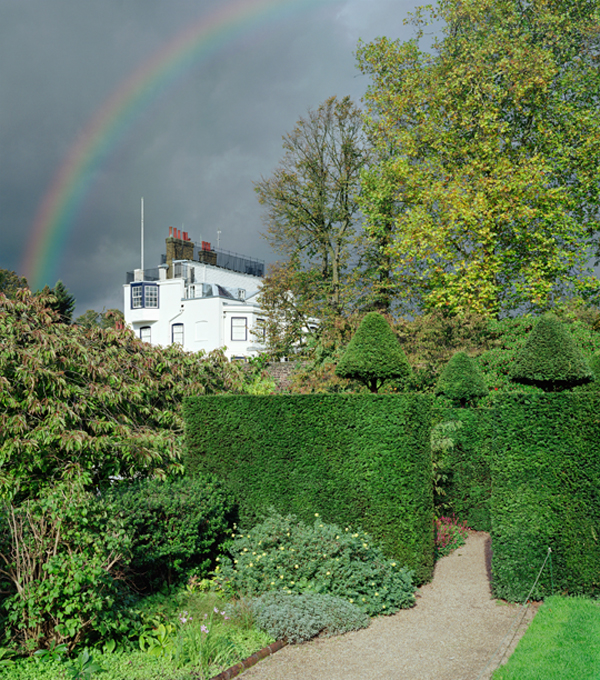
Scott McFarland (Canadian, b. 1975) The Admiral’s House as seen from the Upper Garden at Fenton House 2006 From the series Hampstead Inkjet print Edition of 5
“Regen Projects is pleased to announce an exhibition of new work by Canadian artist Scott McFarland. This exhibition will feature new photographs including 3 large panorama works, smaller works from the “Hampstead” series, and introduce the new “Niagara” series.
Scott McFarland’s photography reconsiders the traditional concept of a photograph as the depiction of a single captured moment in time. Through digital means he is able to manipulate composition, colour, light, space, shape, and form. McFarland’s photographs combine multiple negatives to represent simultaneous temporalities and interweave selected elements into a cohesive whole. Several different moments are packed into what appears to be one densely constructed instant. The photographs are meticulously crafted illusions created within the formal language of documentary photography.
McFarland’s consideration of photography and the built picture was brought about by the artist’s own understanding of the artificial “nature” found in built environments such as gardens and zoos. Taking the relationship of the constructed space/constructed image one step further, McFarland has photographed a modernist architectural landmark: the Berthold Lubetkin designed penguin pool at the London zoo. Through two very distinct works, McFarland investigates the elliptical structure of the famous penguin pool vis-à-vis the elliptical / arcing motion of his camera rotating on a tripod. One photograph is an objective colour rendering where the camera has been left level while rotating; the other is a larger black and white version where the camera arcs along a non-level plane distorting and altering the curve of the structure from right to left.
The new square format photographs from McFarland’s “Niagara” series have a rough unfinished quality unlike any photographs he has taken to date. These softer focus images with odd shifts in light and glare are location studies for the large panorama A Horse Drawn Hearse, Queens Royal Tours, 174 Anne, Niagara on the Lake, Ontario (2009, below). This work depicts an old carriage business and its surroundings during the dead of Canadian winter. In this visually captivating work, a black funeral carriage contrasts against the white snow. The acreage, surrounded by newer suburban homes, evokes the question of how long can this structure resist the modern urban pressures it faces. These straight photographs presented alongside his precise digitally mastered compositions illustrate how the photographic process and the history of art and photography have always informed McFarland’s work.
“Over the last decade, Scott McFarland has produced bodies of work that engage with different aspects of photography … McFarland’s approach is both descriptive and metaphoric … The images, rich in cultural significance, express the complementary workings of conceptual and aesthetic factors all the while holding various characteristics of art and photography in ambiguous relation.”
Andrea Kunard. Scott McFarland: A Cultivated View, published by the National Gallery of Canada, Ottawa, 2009, p. 12.
Text from the Regen Projects press release [Online] Cited 16/06/2009. No longer available online.
Scott McFarland (Canadian, b. 1975) A Horse Drawn Hearse, Queens Royal Tours, 174 Anne, Niagara on the Lake, Ontario 2009 From the series Niagara Inkjet print 59.5 x 124 inches (151.1 x 315cm) Edition of 5
Scott McFarland (Canadian, b. 1975) Boathouse with Moonlight 2002 From the series Boathouse Digital C-print 71 x 91 inches (180 x 231cm) Edition of 5, 2 AP
“Boathouse with Moonlight” is an exploration of the technical advancements afforded by digital photography, created by assembling multiple exposures taken over the space of two hours under the light of a full moon. Unlike traditional photography, this image does not represent one specific moment captured at a particular site; rather, it shows an accumulation of moments that have been manipulated and layered to create a revised version of the boathouse and its surroundings. McFarland’s use of multiple exposures to produce the final image emphasises not only the duration of the photographic act, but also the many facets of the boathouse’s character. This type of building on British Columbia’s “Sunshine Coast” is disappearing with the construction of new, suburban-style retirement housing.
Text from the National Gallery of Canada website [Online] Cited 02/03/2019
Scott McFarland (Canadian, b. 1975) Gorse and Broom, West Heath, Hampstead 2006 From the series Hampstead Inkjet print Edition of 5
Scott McFarland (Canadian, b. 1975) Women Drying Laundry on the Gorse, Vale of Health, Hampstead Heath 2007 From the series Hampstead Inkjet print 29 x 45 inches (73.7 x 114.3cm) Edition of 5
Scott McFarland (Canadian, b. 1975) Inspecting, Allan O’connor Searches for Botrytis cinerea 2003 From the series Gardens Digital C-print 40 x 48 inches (102 x 122cm) Edition of 7
Scott McFarland (Canadian, b. 1975) Orchard View with the Effects of Seasons (Variation #1) 2003-2006 From the series Gardens Digital C-print 42 x 122 inches (106.7 x 309.9cm) Edition of 3
Scott McFarland (Canadian, b. 1975) [Huntington Botanical Gardens in San Marino, Calif] 2005 From the series Empire Inkjet print
Scott McFarland (Canadian, b. 1975) Echinocactus grusonii [Huntington Botanical Gardens in San Marino, Calif] 2006 From the series Empire Inkjet print 24.5 x 27.5 inches (62 x 70cm) Edition of 3 Private collection/Vancouver Art Gallery
This picture comes from Empire, a series on desert vegetation shot in the Huntington Botanical Gardens in San Marino, Calif. Henry E. Huntington, an art collector who made his fortune building railroads, founded the garden in 1919.
“The plantings [of the garden] are dense, and the soil is mostly hidden beneath the thriving vegetation,” writes Grant Arnold in a catalogue essay for the exhibition, “the fullness of the planting continually reminding the visitor of Huntington’s beneficence.” To many gallery visitors, however, these images of lush desert vegetation will simply be appealing to the eye.
Scott McFarland (Canadian, b. 1975) The Granite Bowl in the Berlin Lust Garden 2006 Inkjet print 43 x 62 inches (109.2 x 157.5cm) Edition of 5
At first the photograph appeared to be a simple scene, one of no importance. The two young children, obviously related based on their similar physical features, seemed a bit awkward and posed, but otherwise, I thought it to be a snapshot, much like the one I took of the bowl while in Berlin. Upon learning how McFarland created this and many of his other photographs, I learned how complex of a scene this really is. McFarland uses multiple negatives, often taken over a matter of days, weeks, and even months, and combines them digitally into a seamless print. His interest is in breaking through the concept of a photograph being an image of a single instant in time and space.
A fuller narrative is created as well. With just one negative, there may only be one or two people depicted. We may just have the dog with his owner half shown, or even only half of the brother-sister group. But by overlapping the various negatives, Mr McFarland manipulates his work into a greater piece. We can now ask ourselves, why are the brother and sister so psychologically distant? Or, who is the small girl with the accordion and where is her mother? Is her mother the woman with the baby carriage? How long has that man been sleeping under the bowl? These are all questions that can be asked together because the negatives are combined that couldn’t be asked if we had just the single frame.
Scott McFarland (Canadian, b. 1975) View of Vale of Health, looking towards Hampstead 2007 From the series Hampstead Inkjet print 27 x 42.5 inches (68.6 x 108 cm) Edition of 5
With the stiff figures of a historical painting, Scott McFarland’s View of Vale of Health, Looking Towards Hampstead muddles ideas of what’s real and what’s not.
From the get-go, painting and photography have been inextricably bound together. The Pictorialists tried to make their photographs look like paintings. The Futurists, in their paintings, mimicked the blurred and segmented movement found in Etienne-Jules Marey’s chronophotographs. The photorealists created paintings whose subject was the photograph itself. And in his large-scale, backlit photo-transparencies, Jeff Wall has alluded to paintings by Nicolas Poussin, Edouard Manet, and Paul Cézanne, among others. The digital age has done nothing to diminish each medium’s obsession with the other.
This continued entwining of art forms is evident in Scott McFarland’s computer-montaged photographs, on view at the Vancouver Art Gallery. So is the parallel entanglement of nature and culture. Both conditions are conspicuous in his 2006 series, “Hampstead”, inspired by the landscapes of the early-19th-century English painter John Constable. McFarland’s colour photos, shot in various locations around London’s immense Hampstead Heath, pay homage to Constable’s attraction to the same place. They also play variations on that painter’s rendering of multiple versions of the same scene, and on his open-air studies of the changing effects of light and weather. …
Over the past decade, McFarland’s working methods have changed from straightforward analog photography to the creation of highly manipulated images in which he digitally splices together multiple segments of the same landscape or structure, shot over a period of days, weeks, or even months. In both variations of Orchard View With the Effects of the Seasons, for instance, the blossoms and foliage of spring, summer, and fall are contained within the same seamless panorama.
The digital assist means that there are no constraints of time, space, or documentary veracity in McFarland’s work: he can build whatever impossible pictures he wants and they will look “real”. At least until they’re closely scrutinised, revealing incongruities of light, shadow, time, and figuration. In this sense, his art challenges our understanding of the nature of the photograph and its relationship with the truth. There’s nothing really new about this project – as long as photography’s been around, it’s been manipulated by its practitioners. Photoshop, however, has added a vast digital dimension to the darkroom antics of earlier photo artists.



















![Laurenz Berges (German, b. 1966) 'Garzweiler' [surface mine] 2003 from the exhibition 'presentation/representation: photography from Germany' at the Monash Gallery of Art, Melbourne, July - August, 2009](https://artblart.com/wp-content/uploads/2009/08/laurenz-berges-garzweiler-web-1.jpg "Laurenz Berges (German, b. 1966) 'Garzweiler' [surface mine] 2003 from the exhibition 'presentation/representation: photography from Germany' at the Monash Gallery of Art, Melbourne, July - August, 2009")









 Art Blart _ art and cultural memory archive
You must be logged in to post a comment.