
Exhibition dates: 7th April – 2nd September, 2012
Curators: Keith F. Davis, Senior Curator of Photography and Jane L. Aspinwall, Assistant Curator of Photography at the Nelson-Atkins Museum of Art

Timothy H. O’Sullivan (American born Ireland, 1840-1882)
Sand Dunes, Carson Desert, Nevada
1867
Albumen print
Nelson-Atkins Museum of Art
Gift of Hallmark Cards, Inc.
Of all the photographers who accompanied the Western surveys of this era, O’Sullivan remains the most admired, studied and debated. This is a result of the distinctly individual quality of his seeing – his particular union of fact and point of view; his understanding of what it meant to make a documentary photograph. O’Sullivan’s work remains inspiring and instructive: the clues it holds – to the nature of photography, 19th-century visual culture and the construction of photographic history – challenge and enlarge each new generation of viewers.
~ Press release
About the only decent sized Timothy O’Sullivan photographs online are here on Art Blart – in this posting and one I did earlier of Framing the West: The Survey Photographs of Timothy H. O’Sullivan at the Smithsonian American Art Museum. Although some of the photographs from the earlier posting are reproduced again here there are also four new ones, and for that we should be thankful for there are so few quality images to look at on the web.
Following my last posting where I ruminated on the nature of photography, we note that O’Sullivan’s understanding of what it meant to make a documentary photograph was embodied in his distinctly individual way of seeing. As the above quotation observes, this was “his particular union of fact and point of view.” With this in mind, the photograph I would like you to focus on in this posting is Cave-in, Gould & Curry Mine, Virginia City, Nevada (1868, below) – a prescient abstract expressionist photograph almost eighty years before their advent. The fallen beams remind me of huge ice crystals in a rock cave and then you notice the pick axe at top left and leg and booted foot at right. Hang on a minute, there is another foot tucked underneath!
To have the temerity to photograph this scene in this way and this point in time in the history of photography is outstanding. Imagine being O’Sullivan coming upon this vista, framing the cave-in with beams at left and right of the image plane and detritus at the bottom. He could have left it at that, but no, he hints at the presence of a man, out of frame, doing what exactly we don’t know. It is this plaisir and jouissance that give this photograph its pleasure and pain.
The knowledge that we know this scene, as the subject knows himself or herself, gives the photograph its pleasure; the fact that we don’t know what is beyond the edge of the frame, who the man is and what he is doing, fractures these structures and challenges the readers position as subject.
As the viewer transgresses the act of pleasurable looking, of enjoying the formal characteristics and textures of the photograph, doubt sets in – what is the man doing, why is he there? As we transgress the pleasure principle the painful principle of what Lacan calls jouissance kicks in. The viewer suffers a crisis of doubt and, conversely, the pattern of the fallen beams of wood and the axe now create a more threatening, claustrophobic atmosphere.
Dr Marcus Bunyan
Many thankx to the Nelson-Atkins Museum of Art for allowing me to publish the photographs in the posting. Please click on the photographs for a larger version of the image.

Timothy H. O’Sullivan (American born Ireland, 1840-1882)
Pyramid and Domes, Pyramid Lake, Nevada
1867
Albumen print
Overall: 7 3/4 x 10 5/8 inches (19.69 x 26.99cm)
Mat (exhibition): 20 x 24 inches (50.8 x 60.96cm)
Framed: 23 3/8 x 27 1/2 x 1 5/8 inches (59.37 x 69.85 x 4.13cm)
Nelson-Atkins Museum of Art
Gift of Hallmark Cards, Inc.
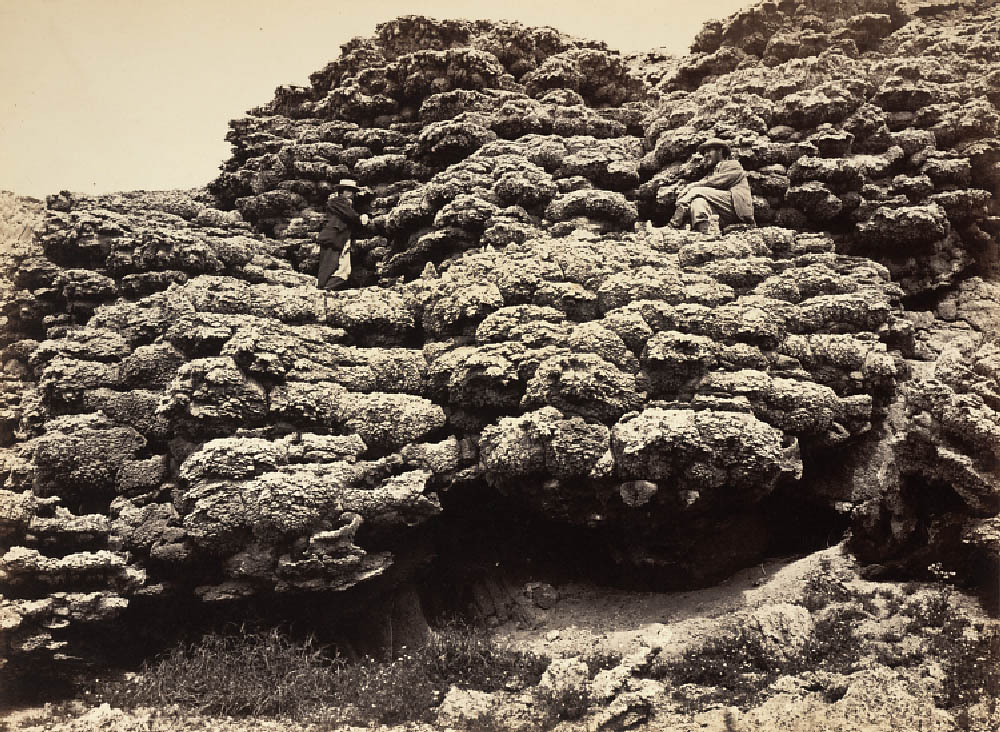
Timothy H. O’Sullivan (American born Ireland, 1840-1882)
Tufa formation, Anaho Island, Pyramid Lake, Nevada
1867
Albumen print
Overall: 7 3/4 x 10 5/8 inches (19.69 x 26.99cm)
Mat (exhibition): 20 x 24 inches (50.8 x 60.96cm)
Framed: 23 3/8 x 27 1/2 x 1 5/8 inches (59.37 x 69.85 x 4.13cm)
Nelson-Atkins Museum of Art
Gift of Hallmark Cards, Inc.

Timothy H. O’Sullivan (American born Ireland, 1840-1882)
Geyser Mouth in Ruby Valley, Nevada
1868
Albumen print
7 7/8 x 10 5/8 inches (20 x 26.99cm)
Nelson-Atkins Museum of Art
Gift of Hallmark Cards, Inc..

Timothy H. O’Sullivan (American born Ireland, 1840-1882)
Obsidian hill, Mono Lake, California
1868
Albumen print
Overall: 7 3/4 x 10 5/8 inches (19.69 x 26.99cm)
Mat (exhibition): 20 x 24 inches (50.8 x 60.96cm)
Framed: 23 3/8 x 27 1/2 x 1 5/8 inches (59.37 x 69.85 x 4.13cm)
Nelson-Atkins Museum of Art
Gift of Hallmark Cards, Inc.

Timothy H. O’Sullivan (American born Ireland, 1840-1882)
Mono Lake, California
1868
Albumen print
Overall: 7 3/4 x 10 5/8 inches (19.69 x 26.99cm)
Mat (exhibition): 20 x 24 inches (50.8 x 60.96cm)
Framed: 23 3/8 x 27 1/2 x 1 5/8 inches (59.37 x 69.85 x 4.13cm)
Nelson-Atkins Museum of Art
Gift of Hallmark Cards, Inc.

Timothy H. O’Sullivan (American born Ireland, 1840-1882)
Shoshone Falls, Idaho
1868
Albumen print
Overall: 7 3/4 x 10 5/8 inches (19.69 x 26.99cm)
Mat (exhibition): 20 x 24 inches (50.8 x 60.96cm)
Framed: 23 3/8 x 27 1/2 x 1 5/8 inches (59.37 x 69.85 x 4.13cm)
Nelson-Atkins Museum of Art
Gift of Hallmark Cards, Inc.

Timothy O’Sullivan (American, 1842-1882)
Cañon de Chelle, Walls of the Grand Canon about 1200 feet in height
1873
Albumen print
Smithsonian American Art Museum
Museum purchase, from the Charles Isaacs Collection made possible in part, by the Luisita L. and Franz H. Denghausen Endowment
The photographs made by Timothy H. O’Sullivan as part of the United States Geological Exploration of the Fortieth Parallel, or King Survey, comprise an iconic and richly varied body of work. The first of the great post-Civil War Western expeditions, the King Survey was organised under the authority of the U.S. Army Topographical Engineers. Between 1867 and 1872, Clarence King, the geologist in charge, and his party studied a vast swath of terrain, approximately 100 by 800 miles, encompassing the path of the soon-to-be-completed transcontinental railroad, from the border of California eastward to Cheyenne, Wyoming.
The survey’s official photographer, Timothy H. O’Sullivan, was talented, resourceful and imaginative. In four seasons with King’s group – 1867, 1869 and 1872 – he created a diverse body of photographs: geological studies, landscapes, views of miners and mining operations, records of cities and settlements, studies of the survey itself and self-reflexive meditations on his own presence in the West.
Of all the photographers who accompanied the Western surveys of this era, O’Sullivan remains the most admired, studied and debated. This is a result of the distinctly individual quality of his seeing – his particular union of fact and point of view; his understanding of what it meant to make a documentary photograph. O’Sullivan’s work remains inspiring and instructive: the clues it holds – to the nature of photography, 19th-century visual culture and the construction of photographic history – challenge and enlarge each new generation of viewers.
The King Survey of the Great Basin, from 1867 to 1872, was the model for the other “great surveys” of the 19th-century American West. Rare and iconic works by Timothy H. O’Sullivan, the King Survey’s official photographer, will be featured in an exhibition at The Nelson-Atkins Museum of Art from April 7 through Sept. 2. Keith F. Davis and Jane L. Aspinwall, respectively senior and assistant curators of photography at the Nelson-Atkins, organised Timothy O’Sullivan: The King Survey Photographs.
“There is good reason that O’Sullivan remains so influential after all these years,” said Davis. “Visually speaking, he was the world’s greatest poker player. He always kept his cards close to his vest. His images are at once boldly straightforward and deeply mysterious, a perfect combination of intuition and calculation. His genius lies, in part, in making such originality appear so effortless.”
There are 60 photographs in the exhibition. Nine were borrowed from the American Geographical Society in Milwaukee, WIS; and the remainder are from the holdings of the Nelson-Atkins. Accompanying the exhibition is a major book, co-authored by Davis and Aspinwall, with contributions by three esteemed scholars: John P. Herron, Francois Brunet, and Mark Klett.
“O’Sullivan continues to influence generations of photographers because of his purely individual melding of fact and point of view,” said Aspinwall. “He was a complicated character, a hearty adventurer, a photographic explorer and innovator, with a bit of the daredevil thrown in the mix.” The book emphasises the context of O’Sullivan’s photographs: his best known images in relation to the complete body of his survey work, the function of the photographs within the survey enterprise, and the scientific and cultural importance of the survey itself. In creating the book, Davis and Aspinwall became engaged in their own kind of “survey,” working from opposite ends of the subject back toward a common centre.
“Jane focused on the evidence of the photographs themselves, tracking down every view and putting them into chronological order,” said Davis. “I began with an overview of the history of western exploration and then attempted to describe the King Survey and O’Sullivan’s career in detail. The meeting point, the crux of the whole project, was O’Sullivan’s remarkable photographs.” Davis became fascinated with O’Sullivan’s work 40 years ago, and his respect for the richness and longevity of his work has increased over the years. “Someone once said that writing a biography usually entails a process of ‘falling out of love’ with one’s subject,” said Davis. “That’s absolutely not true in this case. This exhibition and book have resulted in a newer and deeper admiration for a truly one-of-a-kind photographic achievement. That’s O’Sullivan’s gift to us – and we want to share it. Timothy H. O’Sullivan: The King Survey Photographs gives visitors a new appreciation of the visual history of the 19th-century American West, while presenting some of the museum’s rarest treasures for public view.
Press release and text from the Nelson-Atkins website
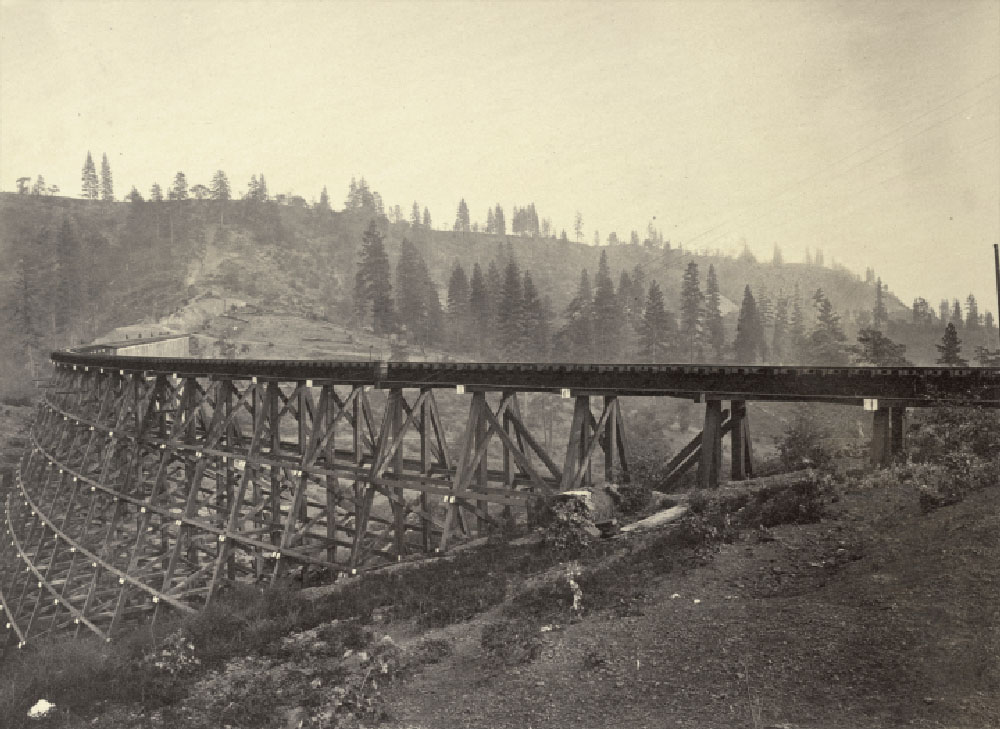
Timothy H. O’Sullivan (American born Ireland, 1840-1882)
Long Ravine Bridge, CPRR, California
1867
Albumen print
Overall: 7 3/4 x 10 5/8 inches (19.69 x 26.99cm)
Mat (exhibition): 20 x 24 inches (50.8 x 60.96cm)
Framed: 23 3/8 x 27 1/2 x 1 5/8 inches (59.39 x 69.85 x 4.14cm)
Nelson-Atkins Museum of Art
Gift of Hallmark Cards, Inc.

Timothy H. O’Sullivan (American born Ireland, 1840-1882)
Montezuma Silver Works, Oreana, Nevada
1867
Albumen print
Overall: 7 3/4 x 10 5/8 inches (19.69 x 26.99cm)
Mat (exhibition): 20 x 24 inches (50.8 x 60.96cm)
Framed: 23 3/8 x 27 1/2 x 1 5/8 inches (59.37 x 69.85 x 4.13cm)
Nelson-Atkins Museum of Art
Gift of Hallmark Cards, Inc.

Timothy H. O’Sullivan (American born Ireland, 1840-1882)
Sioux Hot Springs, near Humboldt Salt Marsh, Nevada
1867
Albumen print
Overall: 7 3/4 x 10 5/8 inches (19.69 x 26.99cm)
Mat (exhibition): 20 x 24 inches (50.8 x 60.96cm)
Framed: 23 3/8 x 27 1/2 x 1 5/8 inches (59.37 x 69.85 x 4.13cm)
Nelson-Atkins Museum of Art
Gift of Hallmark Cards, Inc.

Timothy H. O’Sullivan (American born Ireland, 1840-1882)
Steamboat Springs, Nevada
1868
Albumen print
Overall: 7 3/4 x 10 5/8 inches (19.69 x 26.99cm)
Mat (exhibition): 20 x 24 inches (50.8 x 60.96cm)
Framed: 23 3/8 x 27 1/2 x 1 5/8 inches (59.37 x 69.85 x 4.13cm)
Nelson-Atkins Museum of Art
Gift of Hallmark Cards, Inc.

Timothy H. O’Sullivan (American born Ireland, 1840-1882)
Quartzites, Summit, East Humboldt Mountains, Nevada
1868
Albumen print
Overall: 7 3/4 x 10 5/8 inches (19.69 x 26.99cm)
Mat (exhibition): 20 x 24 inches (50.8 x 60.96cm)
Framed: 23 3/8 x 27 1/2 x 1 5/8 inches (59.37 x 69.85 x 4.13cm)
Nelson-Atkins Museum of Art
Gift of Hallmark Cards, Inc.

Timothy H. O’Sullivan (American born Ireland, 1840-1882)
Fissure, Steamboat Springs, Nevada
1868
Albumen print
Image: 8 3/4 x 11 7/16 inches (22.23 x 29.05cm)
Mat (exhibition): 20 x 24 inches (50.8 x 60.96cm)
Framed: 23 3/8 x 27 1/2 x 1 5/8 inches (59.37 x 69.85 x 4.13cm)
Nelson-Atkins Museum of Art
Gift of the Hall Family Foundation

Timothy H. O’Sullivan (American born Ireland, 1840-1882)
Longitude Butte, Ruby Valley, Nevada
1868
Albumen print
Overall: 7 3/4 x 10 5/8 inches (19.69 x 26.99cm)
Mat (exhibition): 20 x 24 inches (50.8 x 60.96cm)
Framed: 23 3/8 × 27 1/2 x 1 5/8 inches (59.37 x 69.85 x 4.13cm)
Nelson-Atkins Museum of Art
Gift of Hallmark Cards, Inc.

Timothy H. O’Sullivan (American born Ireland, 1840-1882)
Sugar Loaf Mountain, near Virginia City, Nevada
1868
Albumen print
Overall: 7 3/4 x 10 5/8 inches (19.69 x 26.99cm)
Mat (exhibition): 20 x 24 inches (50.8 x 60.96cm)
Framed: 23 3/8 x 27 1/2 x 1 5/8 inches (59.37 x 69.85 x 4.13cm)
Nelson-Atkins Museum of Art
Gift of Hallmark Cards, Inc.
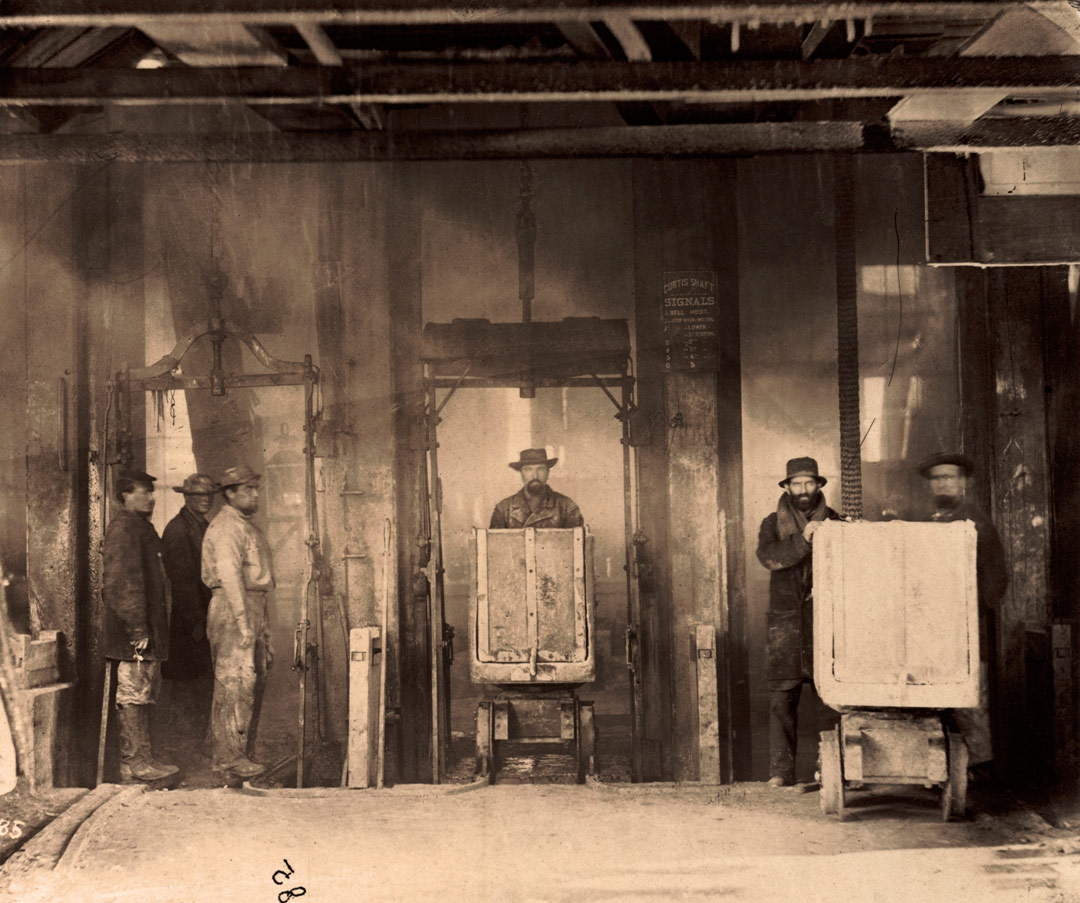
Timothy H. O’Sullivan (American born Ireland, 1840-1882)
Shaft of Savage Mine, Virginia City, Nevada
1868
Albumen print
Nelson-Atkins Museum of Art
Gift of Hallmark Cards, Inc.

Timothy H. O’Sullivan (American born Ireland, 1840-1882)
Cave-in, Gould & Curry Mine, Virginia City, Nevada
1868
Albumen print
Overall: 7 x 7 1/2 inches (17.78 x 19.05cm)
Mat (exhibition): 20 x 24 inches (50.8 x 60.96cm)
Framed: 23 3/8 x 27 1/2 x 1 5/8 inches (59.37 x 69.85 x 4.13cm)
Nelson-Atkins Museum of Art
Gift of Hallmark Cards, Inc.

Timothy H. O’Sullivan (American born Ireland, 1840-1882)
Clarence King in Uinta Mountains, Utah
1869
Albumen print
Overall: 11 1/8 x 8 1/8 inches (28.26 x 20.64cm)
Mat (exhibition): 24 x 20 inches (60.96 x 50.8cm)
Framed: 27 1/2 x 23 3/8 x 1 5/8 inches (69.85 x 59.37 x 4.13cm)
Nelson-Atkins Museum of Art
Gift of Hallmark Cards, Inc.

Timothy H. O’Sullivan (American born Ireland, 1840-1882)
Cottonwood Lake, Wasatch Mountains, Utah
1869
Albumen print
Overall: 7 3/4 x 10 1/2 inches (19.69 x 26.67cm)
Mat (exhibition): 20 x 24 inches (50.8 x 60.96cm)
Framed: 23 3/8 x 27 1/2 x 1 5/8 inches (59.37 x 69.85 x 4.13cm)
Nelson-Atkins Museum of Art
Gift of Hallmark Cards, Inc.

Timothy H. O’Sullivan (American born Ireland, 1840-1882)
Lake in Conejos Cañon, Colorado
1874
Albumen print
Library of Congress, Prints and Photographs Division
The Nelson-Atkins Museum of Art
4525 Oak Street
Kansas City, MO 64111
Opening hours:
Thursday – Monday 10am – 5pm
Closed Tuesdays and Wednesdays


You must be logged in to post a comment.