Exhibition: ‘Vivian Maier: Photographs from the Maloof Collection’ at the Howard Greenberg Gallery, New York

Exhibition dates:  15th December 2011 – 26th January 2012


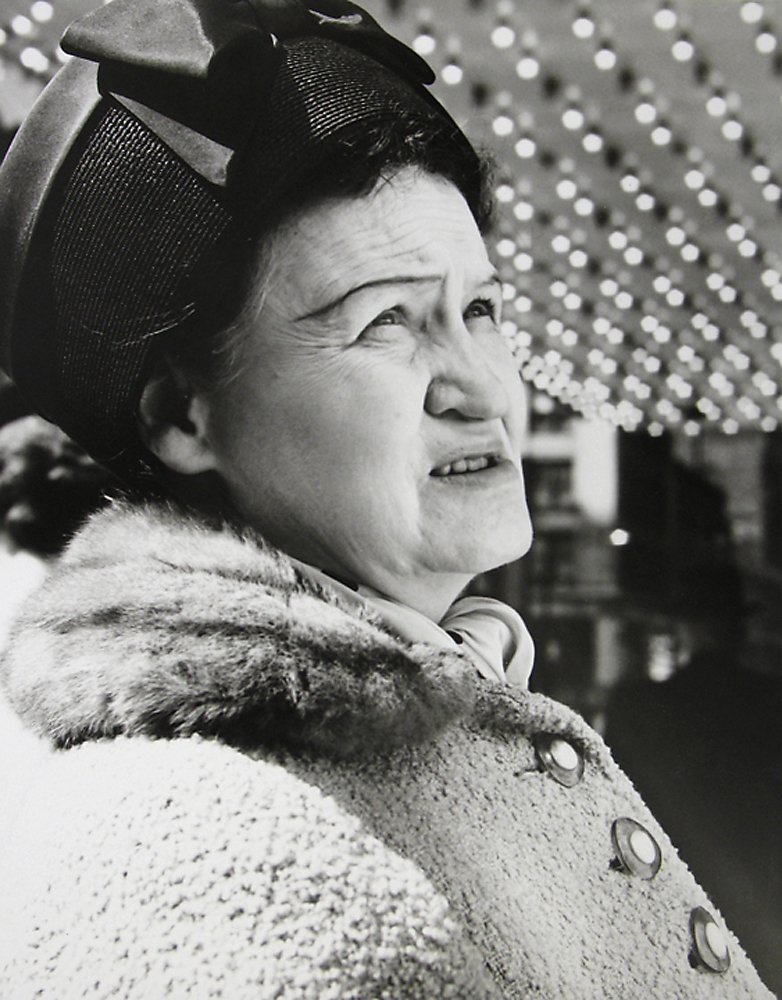
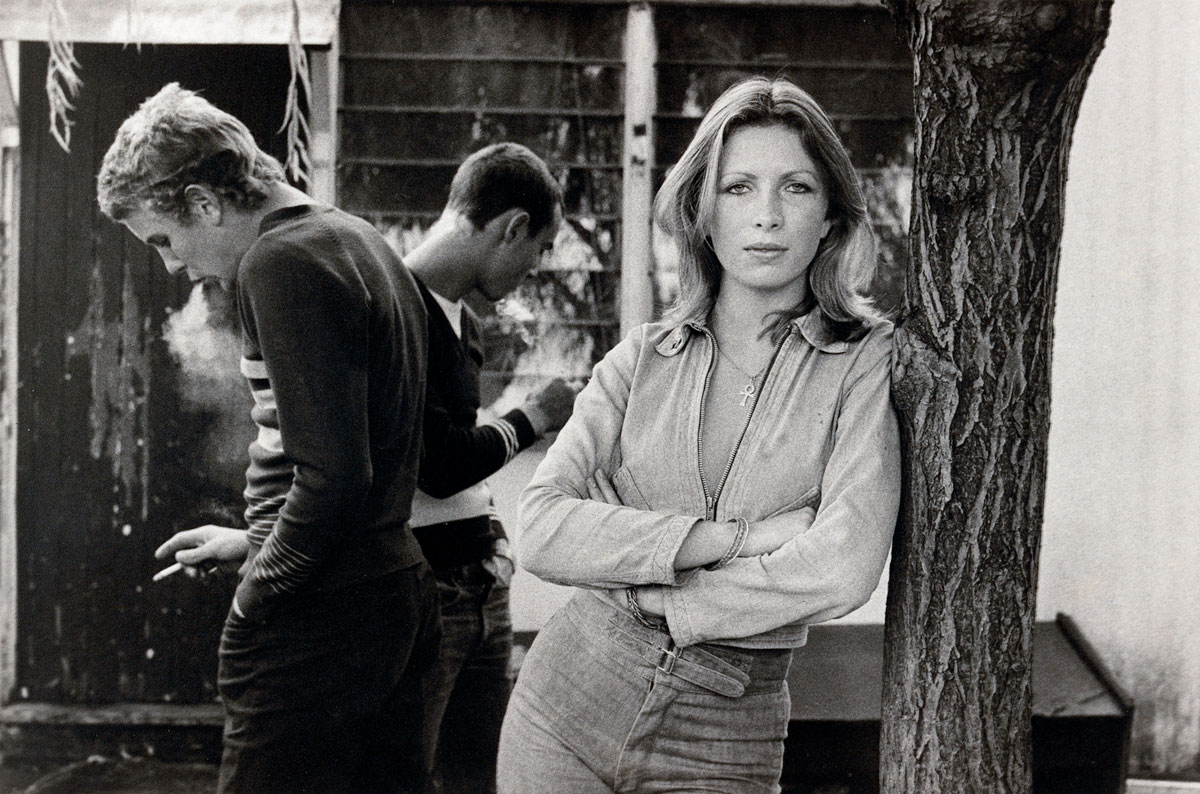
Vivian Maier (American, 1926-2009) 'Untitled (portrait of a woman)' date unknown


Vivian Maier (American, 1926-2009)
Untitled (portrait of a woman)
Date unknown
© Vivian Maier/Maloof Collection, Courtesy Howard Greenberg Gallery


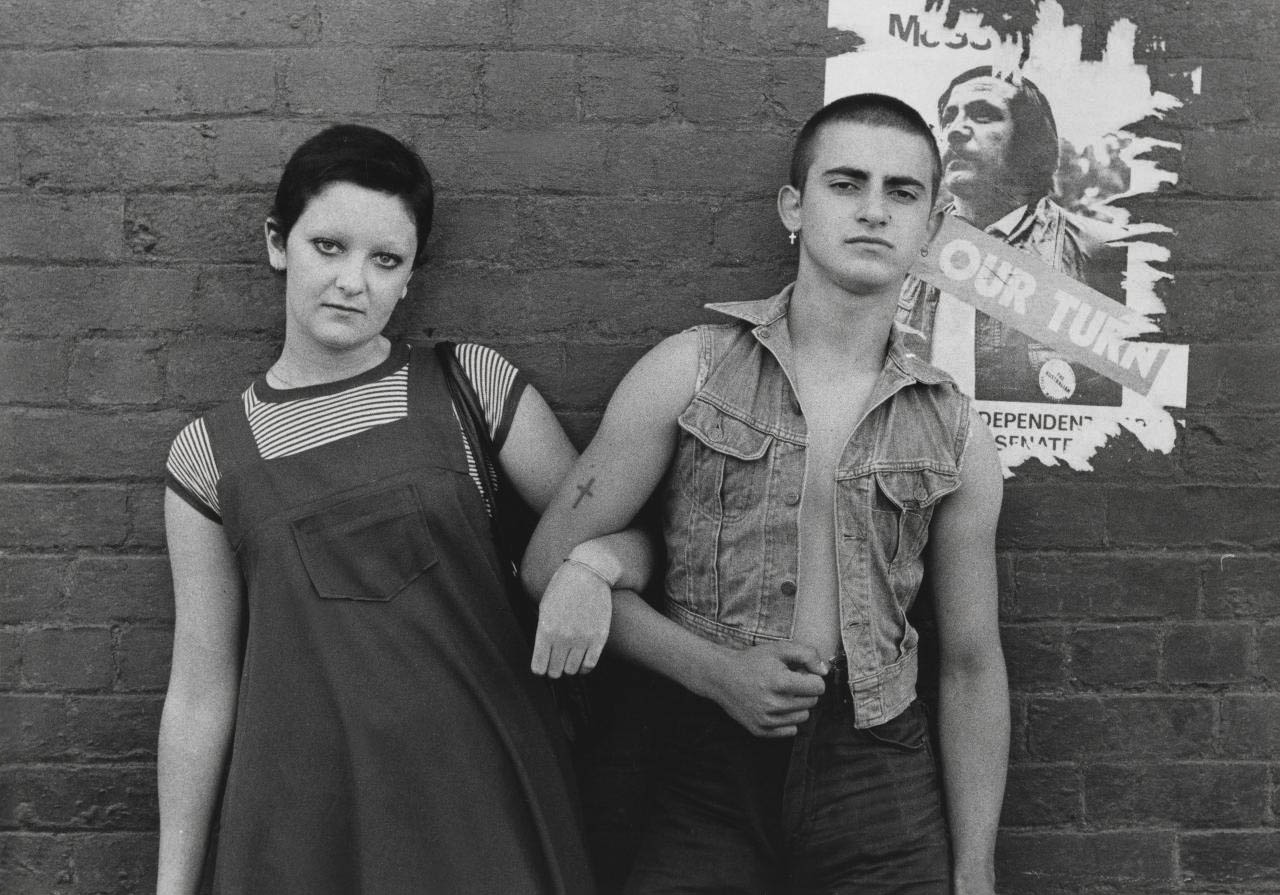
Another photographer who is getting more recognition. Out of the work I have seen the portraits are the strongest. Some of them feel like precursors to the confronting portraits of women made by Diane Arbus while others offer a more reflective, contemplative examination of human presence.

Dr Marcus Bunyan


Many thankx to Alicia Colen for her help and to the Howard Greenberg Gallery for allowing me to publish the photographs in the posting.


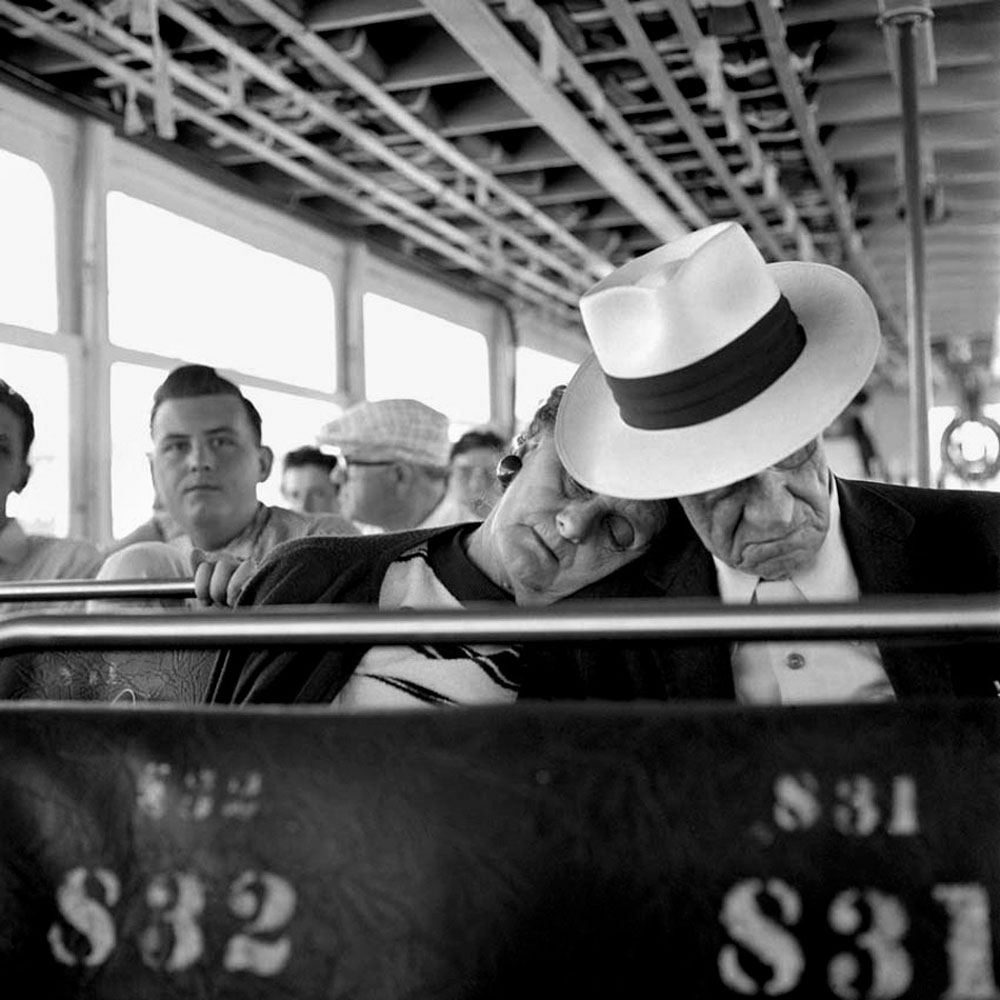
Vivian Maier (American, 1926-2009) 'Untitled' c. 1950's


Vivian Maier (American, 1926-2009)
Untitled
c. 1950’s
© Vivian Maier/Maloof Collection, Courtesy Howard Greenberg Gallery


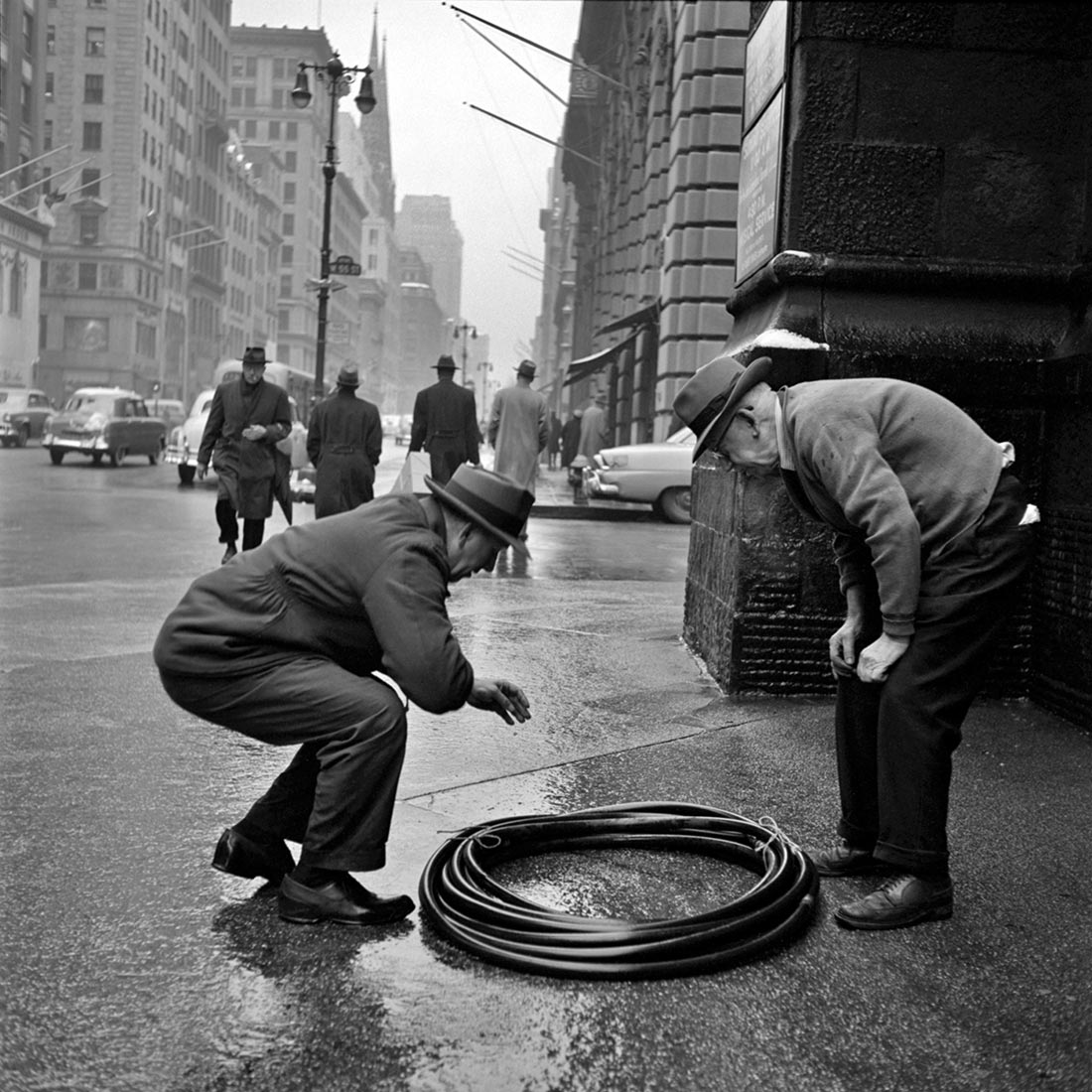
Vivian Maier (American, 1926-2009) 'Untitled' c. 1950's


Vivian Maier (American, 1926-2009)
Untitled
c. 1950’s
© Vivian Maier/Maloof Collection, Courtesy Howard Greenberg Gallery


Vivian Maier (American, 1926-2009) 'Untitled' c. 1950's


Vivian Maier (American, 1926-2009)
Untitled
c. 1950’s
© Vivian Maier/Maloof Collection, Courtesy Howard Greenberg Gallery


Vivian Maier (American, 1926-2009) 'Untitled' 1954


Vivian Maier (American, 1926-2009)
Untitled
1954
Gelatin silver print, printed later
© Vivian Maier/Maloof Collection, Courtesy Howard Greenberg Gallery


Vivian Maier (American, 1926-2009) 'Florida' 1957


Vivian Maier (American, 1926-2009)
Florida
1957
Gelatin silver print, later print
© Vivian Maier/Maloof Collection, Courtesy Howard Greenberg Gallery


Vivian Maier (American, 1926-2009) 'New York, New York City' Nd


Vivian Maier (American, 1926-2009)
New York, New York City
Nd
Gelatin silver print, later print
© Vivian Maier/Maloof Collection, Courtesy Howard Greenberg Gallery


Vivian Maier (American, 1926-2009) 'Untitled' Nd


Vivian Maier (American, 1926-2009)
Untitled
Nd
Gelatin silver print, later print
© Vivian Maier/Maloof Collection, Courtesy Howard Greenberg Gallery


Howard Greenberg Gallery is proud to present the recently discovered work of street photographer, Vivian Maier (1926-2009), from the Maloof Collection.

A nanny by trade, Vivian Maier’s street and travel photography was discovered by John Maloof in 2007 at a local auction house in Chicago. Always with a Rolleiflex around her neck, she managed to amass more than 2,000 rolls of films, 3,000 prints and more than 100,000 negative which were shared with virtually no one in her lifetime. Her black and white photographs-mostly from the 50s and 60s-are indelible images of the architecture and street life of Chicago and New York. She rarely took more than one frame of each image and concentrated on children, women, the elderly, and indigent. The breadth of Maier’s work also reveals a series of striking self-portraits as well as prints from her travels to Egypt, Bangkok, Italy, and the American Southwest, among dozens of other international cities.

“My fascination with her story has only grown, as has my involvement with her photographs. It is such an unusual story with no resolution. At first her images are extremely well seen, quality photographs of life on the street, in New York City and Chicago. But as one looks at the body of her work, she reveals her deeper interests. Then one tries to imagine who she was, what motivated her, her personality. It is not everyday that one becomes so involved and even obsessed with a particular photographer,” comments Howard Greenberg.

What little is known about Maier’s life is the result of John Maloof’s extensive research. He discovered her obituary on line in 2009 which was just the beginning of his investigative work. An American of French and Austro-Hungarian extraction, Maier split her time between Europe and the US, returning to NY in 1951. In 1956, she ultimately settled in Chicago where she worked as nanny for more than forty years. For a brief period in the 1970s she worked as a nanny to journalist, Phil Donahue’s children. Towards the end of her life, Maier was supported by the children she had cared for in the early 50s. Unbeknownst to them, one of Maier’s storage lockers (containing her massive group of negatives) was auctioned off due to delinquent payments.

After purchasing the first collection of Maier photographs in 2007, Maloof acquired more from another buyer at the same auction. He has since established the Maloof Collection to promote the work of Vivian Maier and to safeguard the archive for future generations. The archive consists of approximately 100,000 to 150,000 negatives; over 3,000 prints; hundreds of rolls of film; home movies; audio tape interviews, and other items representing roughly 90% of Maier’s work. Through Maloof’s efforts, Vivian Maier’s photographs have been exhibited internationally and have received significant critical attention. In November, Powerhouse Books will publish Vivian Maier: Street Photographer, edited by Maloof with a foreword by Geoff Dyer. John Maloof is also co-producing a documentary about Vivian Maier.

Press release from the Howard Greenberg Gallery


Vivian Maier (American, 1926-2009) 'Untitled' c. 1950's


Vivian Maier (American, 1926-2009)
Untitled
c. 1950’s
© Vivian Maier/Maloof Collection, Courtesy Howard Greenberg Gallery


Vivian Maier (American, 1926-2009) 'Uptown West, New York, NY, January 26, 1955' 1955


Vivian Maier (American, 1926-2009)
Uptown West, New York, NY, January 26, 1955
1955
© Vivian Maier/Maloof Collection, Courtesy Howard Greenberg Gallery


Vivian Maier (American, 1926-2009) 'New York, New York City' 1954


Vivian Maier (American, 1926-2009)
New York, New York City
1954
Gelatin silver print, printed later
© Vivian Maier/Maloof Collection, Courtesy Howard Greenberg Gallery


Vivian Maier (American, 1926-2009) 'Untitled' 1956


Vivian Maier (American, 1926-2009)
Untitled
1956
Gelatin silver print, printed later
© Vivian Maier/Maloof Collection, Courtesy Howard Greenberg Gallery


Vivian Maier (American, 1926-2009) 'Untitled, Chicago, May 16, 1957' 1957


Vivian Maier (American, 1926-2009)
Untitled, Chicago, May 16, 1957
1957
© Vivian Maier/Maloof Collection, Courtesy Howard Greenberg Gallery


Vivian Maier (American, 1926-2009) 'Florida' 1960


Vivian Maier (American, 1926-2009)
Florida
1960
Gelatin silver print, printed later
© Vivian Maier/Maloof Collection, Courtesy Howard Greenberg Gallery


Vivian Maier (American, 1926-2009) 'Untitled' Nd


Vivian Maier (American, 1926-2009)
Untitled
Nd
Gelatin silver print, printed later
© Vivian Maier/Maloof Collection, Courtesy Howard Greenberg Gallery


Vivian Maier (American, 1926-2009) 'New York City' 1955


Vivian Maier (American, 1926-2009)
New York City
1955
Gelatin silver print, printed later
© Vivian Maier/Maloof Collection, Courtesy Howard Greenberg Gallery


Vivian Maier (American, 1926-2009) 'New York City, Self-Portrait, September 10th, 1955' 1955


Vivian Maier (American, 1926-2009)
New York City, Self-Portrait, September 10th, 1955
1955
© Vivian Maier/Maloof Collection, Courtesy Howard Greenberg Gallery


Howard Greenberg Gallery
The Fuller Building
41 East 57 Street
Suite 1406
New York, NY 10022
Phone: 212.334.0010

Gallery hours:
Tuesday – Friday 10.00am – 5.00pm

Howard Greenberg Gallery website

LIKE ART BLART ON FACEBOOK

Back to top

Essay: ‘Now you see it, now you don’t: the history and conservation of The Keith Haring Mural, Johnston Street, Collingwood, Melbourne,’ by Dr Marcus Bunyan

November 2011


Keith Haring (American, 1958-1990) 'Barking Dogs and Spaceships and Angels and Coyotes' both 1982 'Subway drawings'


Keith Haring (American, 1958-1990)
Barking Dogs and Spaceships and Angels and Coyotes
both 1982
Subway drawings
Chalk on subway posters laid on canvas


In response to the polemic article “Brushed aside: artistic landmark must return to 1980s glory” by Hannah Mathews in The Age newspaper on November 17th, 2011 I feel compelled to offer a more balanced appraisal of the problems regarding the conservation and preservation of the Keith Haring Mural painted on a wall of the former Collingwood Technical School in Collingwood, Melbourne.

I was not going to publish this essay but now the time is right!

As I note in the essay Haring’s attitude to repainting seems to be at best ambiguous. As several people advocate, I support building a wall perpendicular to the original and painting a facsimile on the new wall. As the original is one of few remaining outdoor murals in the artists hand, I believe it is important to conserve what we have left of the original and painting a simulacra would satisfy those that want a “fresh” copy.

This essay is based on my own question, namely an investigation into the deterioration of a public work of art; the stabilisation of an ephemeral work; the role of the conservator in preserving the work; and the broader cultural perspectives involved when treating the work: reflections on the community from which it originates and notions of ownership and authorship. It was completed as part of my Master of Art Curatorship being undertaken at The University of Melbourne.

Please remember that this essay was written last year in September 2010, before the report from Arts Victoria and was then recently updated. Many thankx to Dr Ted Gott and to Andrew Thorn for their knowledge and help during the research for this essay.

Dr Marcus Bunyan


PS. Apologies that there are no image credits in the essay. If anyone knows the photographers please let me know and I will post but I hope they do not mind me using the photographs (in the interests of art, research and conservation).


Abstract

This essay will examine the history and conservation of The Keith Haring Mural painted on a wall of the former Collingwood Technical School in Collingwood, Melbourne. The essay will attempt to identify the issues involved with current attempts to conserve the mural, including issues of authorship, custodianship vs ownership, stabilisation of the mural and the debate between repainting and conserving. This essay is based on my own question, namely an investigation into the deterioration of a public work of art; the stabilisation of an ephemeral work; the role of the conservator in preserving the work; and the broader cultural perspectives involved when treating the work: reflections on the community from which it originates and notions of ownership and authorship.

Keywords

Keith Haring, Collingwood Technical School, Collingwood, Melbourne, painting, mural, public art, urban art, graffiti, Ted Gott, Andrew Thorn, THREAD, gay art group, homosexuality, HIV/AIDS, New York, National Gallery of Victoria, Australian Centre for Contemporary Art, Arts Victoria.

Word count: 5,056


Keith Haring Water Wall Mural at The National Gallery of Victoria


Keith Haring Water Wall Mural at The National Gallery of Victoria, later destroyed


Introduction

In the early 1980s, New York artist and social activist Keith Haring (4th May, 1958 – 16th February, 1990) was on the brink of fame. He appeared at the Whitney Biennial and Sao Paulo Biennale in 1983 and made friendships with Andy Warhol and Jean-Michel Basquiat.1 Haring was also gay; he died of HIV/AIDS at a young age. His folk art/graffiti style of bold figures and pagan inspired designs outlined in black and other colours investigated concepts of birth, life, death, power, money, technology and the relationship of human beings to the planet on which they live. Haring never feared confronting his viewer with difficult socio-political problems. Embedded in the street culture of the day, Haring was one of the first artists to be heavily influenced by disco dancing and rap music, his ghetto blaster blaring out as he painted his trademark murals. Today his work can be seen to represent the quintessential essence of the 1980s: through its use of colour; the vibrancy of the gyrating bodies; and the topicality of the issues the work addressed. His imagery “has become a widely recognised visual language of the 20th century”2 and his work represents a culture in which “notions of graffiti, advertising and design became increasingly blurred.”3

Early expressions of his creativity that are precursors to his mature style were the chalk drawings on black paper that Haring undertook in the subway stations of New York, using vacant advertising spaces. These drawings were made using quickness and stealth for fear of being caught and were ephemeral; either being destroyed when the next advert was pasted in place or, when his fame became greater, souvenired by acolytes.

“Riding the subway from his uptown apartment to the clubs, Haring noticed black paper hanging next to advertisements in the cars, awaiting the next ad. He used this opportunity to draw in chalk on the black paper with all sorts of childlike imagery: barking dogs, babies, unisex figures, spaceships, TV sets, etc. The outline style of imagery could be appreciated individually as cartoon cels or together to form a narrative. The subway drawings magnify Haring’s cartoons into a new Pop Art that at once was urban narrative, science fiction and hieroglyphics. These subway drawings initiated his first one man shows.”4


As Ted Gott has commented, “… Haring was seen as revolutionary, around 1981, for the manner in which he mastered the freedom and fluidity of the graffiti artists’ calligraphic defacement of public property, and catapulted it over into a mainstream artistic form. By presenting the visual language of one social class in the medium [paint on canvas] and milieus [commercial art galleries] of another elite class, Haring broke the rules then prescribed by the art world…”5

Into this context of rising fame came John Buckley, inaugural Director of Melbourne’s new Centre for Contemporary Art (CCA, later called the Australian Centre for Contemporary Art, or ACCA).6  Buckley met Haring in 1982 on a research visit to New York and invited him to Australia. After organising various grants to fund the trip, Haring arrived for a three-week visit. He was in Australia from 18th February to 8th March 1984 and completed three major projects (The Water Wall mural at The National Gallery of Victoria, the mural painted in the forecourt of The Art Gallery of New South Wales and the mural painted on the side of the former Collingwood Technical School).7 During this period he also completed other smaller works (such as a piece for the Hardware Club in Melbourne and the Glamorgan preparatory school, part of Geelong Grammar School), as well as thirteen large exhibition-quality ink drawings and four acrylic paintings.8 The latter were eventually used in the exhibition Keith Haring at ACCA’s new premises in Melbourne between 10th October – 17th November, 1985,9 and then returned to the artist by John Buckley. Some confusion exists in this matter as Haring states in his biography that his Australian experience wasn’t that hot and that he felt ripped off because the paintings he left in Australia were never returned to him, that there had never been any exhibition of his work and that the work had never been paid for.10

Since ACCA had not secured a physical home at the time of the arrival of Haring (later to be in the Botanical Gardens), Buckley arranged for Haring to paint a large mural on the inside of the water wall at The National Gallery of Victoria between 21st – 22nd February 1984. Haring then travelled to Sydney and painted the AGNSW mural between 28th February – 1st March 1984 before returning to Melbourne and painting the mural at The Collingwood Technical School in one day on Tuesday 6th March 1984.11 While the first two murals were intentionally impermanent (the Water Wall was supposed to last 3 months but was destroyed by vandalism just 2 weeks after its creation,12 Haring mistakenly believing that it was attacked as a protest against the mistaken belief that he had appropriated Aboriginal motifs in its composition13 and the AGNSW mural was painted over after one month to make way for the Biennale exhibition of 1984),14 the community based project in Collingwood would become Haring’s only large, permanent evidence of his visit to Australia:

“In his interview given at the Collingwood Technical School immediately upon completion of the project on 6 March 1984, Keith Haring said about the Collingwood mural: “I had fun. I mean, it’s the most fun I’ve had since I’ve been here. It’s more fun working here than it is inside a museum. [and] It’s the only permanent thing that I did while I was in Australia.””15

“The base tint of yellow was painted onto the wall with rollers by Collingwood Technical School staff on Monday 5 March 1984,”16 the day before Haring’s ‘performance’ when he painted the mural in just two main colours, red and green, in front of a large audience; the performance was photographed and videotaped giving us unique footage of the artist at work.17 The mural features a multi-layered frieze of dancing figures in the lower half of the mural and his fear of technology in the upper half, a “hybrid man/computer monster, his vision of a future de-humanising evolution, which was ridden by two human figures …”18

In all three murals the work was undertaken freehand with no use of preparatory drawings or grids using ladders and a cherry-picker to raise and lower the artist into position – all to the blare of his ghetto blaster. For Haring there was no turning back: “Whatever marks I make are immediately recorded and immediately on view. There are no “mistakes” because nothing can be erased.”19
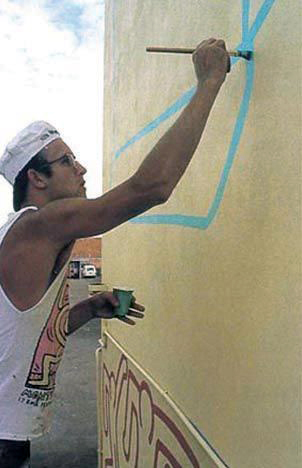
 

Keith Haring painting The Keith Haring Mural, Johnston Street, Collingwood, Melbourne, 1984


Keith Haring painting The Keith Haring Mural, Johnston Street, Collingwood, Melbourne, 1984


The painting of The Keith Haring Mural, Johnston Street, Collingwood, Melbourne, 1984


The painting of The Keith Haring Mural, Johnston Street, Collingwood, Melbourne, 1984


Significance of the Mural

According to the Statement of Significance on the Heritage Council of Victoria database, “The Mural has historical and social significance as the work of a major artist. Keith Haring is considered one of the most significant artists of his generation. As a role model for gay artists and Aids activism his influence was international.

The Keith Haring Mural is of social significance as a landmark piece of public art in Melbourne. Its prominent inner city location is indicative of the changing physical and social landscape of a former working class suburb.

The Mural is also of social significance for its influence on young artists for its inner city setting and use of popular culture themes and imagery.”20

Emily Sharpe states that the mural may also be the last surviving extant [outdoor] mural in the world painted entirely by his hand,21 although this information is contradicted by The Haring Foundation in a quotation later in the essay (see the section ‘To restore or conserve?’ below, Footnote 49).
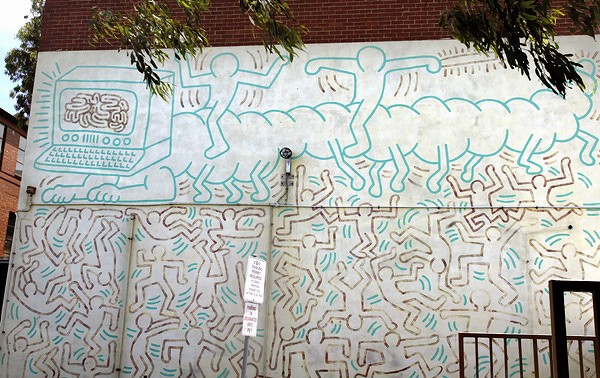
 

Keith Haring mural on the side of the former Collingwood Technical School in 2010 (painted 1984)


Keith Haring mural on the side of the former Collingwood Technical School in 2010 (painted 1984)


Issues in Conservation

During the period 1994-1995 a recently formed gay art group in Melbourne called THREAD (of which I was a part, the acronym of which is now lost to my memory) became concerned about the deterioration of the Keith Haring mural on the side of the Collingwood Technical School in Johnston Street, Collingwood. The group tried to engage the city of Yarra (the inner Melbourne municipality where the mural is located) and other organisations (The National Trust) about the possibility of repainting the mural due to the importance of the mural and its painting by an internationally renowned gay artist. Basically, as conservator Andrew Thorn succinctly puts it, “to repaint the mural on the basis of identity giving ownership.”22

While the intentions of the group were entirely honourable in such a proposal, on reflection and with the passing of the years, being older and wiser, I realise the error of our ways. While acknowledging that the group probably did want to take ownership of the mural on the basis of sexual identity at the time I think the group was just motivated by a desire to get something to happen and we did at least succeed in starting a dialogue between those that had an interest in conserving the mural. One of the problems was that none of us had conservation experience and, as Tom Dixon noted in a phone call to him about the mural,23  the representation of the group was never consistent as it was always a different person that you were talking to.

The profile of the mural was also raised through newspaper articles: “A series of newspaper articles drew attention to the vexed issues around its historic significance and increasing deterioration; these articles formed an important research component of the subsequent classification report” (The book in which this article is quoted incorrectly states that students helped Haring paint the mural – see p. 146).24 These concerns eventually led to the stabilisation of the mural by conservator Andrew Thorn in 1996 and its listing by the National Trust of Australia (Victoria) (NTAV) in 1997. During the treatment of the mural in 1996 Thorn undertook various conservation treatments, namely cleaning of the paint surface (including removal of stains), paint consolidation (fine cracking and detachments within the red paint and reattachment of the yellow paint), reattachments of lower render due to rising damp, consolidation and protection of the paint film with a protective coating system and reintegration of small areas of loss. A proposal for future maintenance was envisaged that included regular inspections, maintenance and care,25 but unfortunately it would seem that this maintenance has not been undertaken. In a recent report (2007) on the condition of the mural Thorn notes that, “incipient deterioration can be avoided, but if regular maintenance is not continued, the painting will be lost.”26 Thorn also notes that the resin gloss layer applied in 1996 to prevent AO (anti-oxidant) and UV (ultraviolet) deterioration “shows clear signs of degradation,” and should have been reapplied at 5 yearly intervals to maintain effectiveness.27 The report also notes that the yellow ground has become paler since 1996, the eroded reds need consolidation, the rising moisture is having a greater effect on the surface than previously and the green brushstrokes are beginning to show signs of loss.28
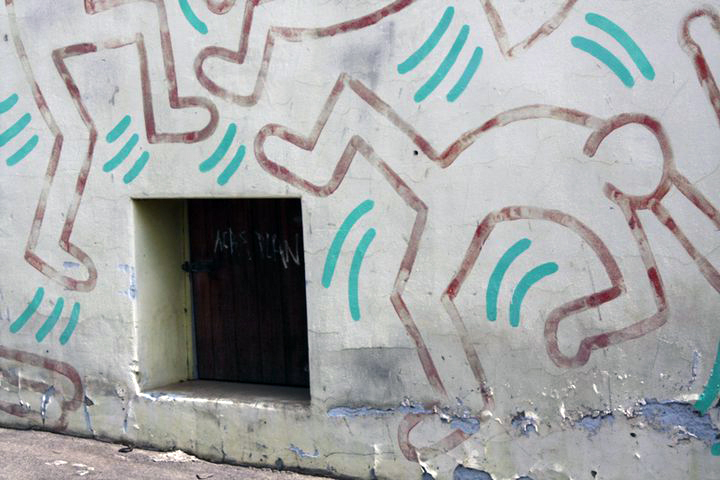
 

The missing door of the Keith Haring mural on the side of the former Collingwood Technical School in 2010 detail (painted 1984)
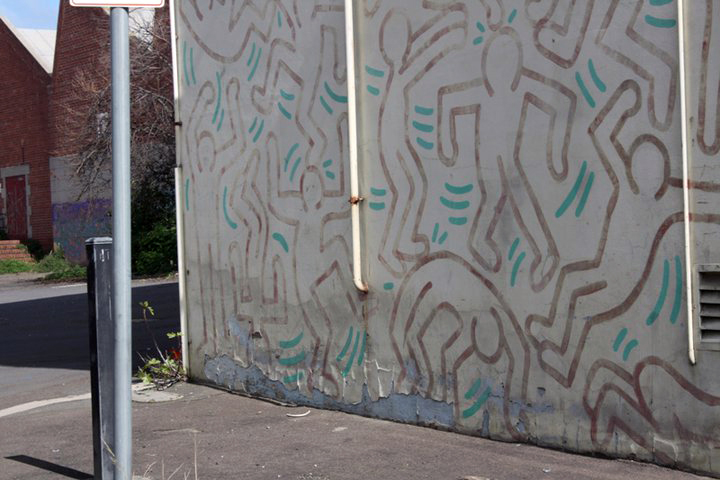
 

The missing door of the Keith Haring mural on the side of the former Collingwood Technical School in 2010 detail (painted 1984)


Keith Haring mural on the side of the former Collingwood Technical School in 2010 detail (painted 1984)


Keith Haring mural on the side of the former Collingwood Technical School in 2010 detail (painted 1984)


Ownership or custodianship

I support the concept of custodianship (or shared ownership) of a work of art rather than ownership per se. I believe that many people have a stake in the cultural value of a work of art and that custodianship, being a caretaker of the work, engages with the idea that the work belongs to everyone and that everyone should have access to enjoy it. Of course being gay offers a close affinity to the work of Keith Haring but, as Andrew Thorn notes, “that does not impart greater ownership of common property or of visual arts and imagery. It does give some ownership but not the right to snatch ownership from others.”29

In a separate email he continues, “At the same time it is necessary in giving ownership to wrest it from those that have claims and this process requires substantial diplomacy. It moves ownership from exclusive to shared. Ownership and identity are good and necessary things and if a work or an artist provides inspiration and support that is not to be denigrated and must be respected … Claiming of ownership is not an aggressive act but part of belonging and identity … It is necessary to engage in a community spirit to ensure a highly significant work and its maker are treated with the respect they deserve.”30

While the earlier attempts by the THREAD group could be seen as an attempt to obtain cultural ownership I acknowledge that this position is untenable. It must be a difficult task – the diplomacy of negotiating with all vested interests. But as Thorn rightly notes this comes down to the modern democratic process, the freedom to elect decision makers – not make the decisions themselves but delegate the responsibility to elected others. We must possess the ability to respect anybody’s relationship and enjoyment of the mural as much as we should respect Thorn’s professional judgment as an internationally renowned conservator to ensure this work is protected in the best possible way so that future generations can enjoy the work.
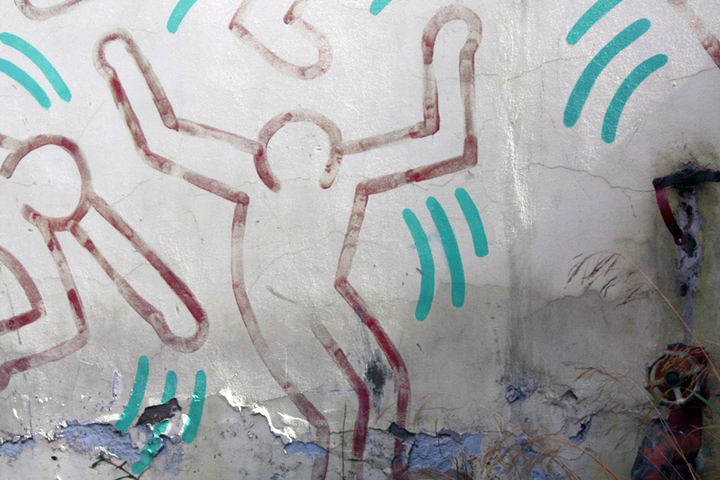
 

Keith Haring mural on the side of the former Collingwood Technical School in 2010 detail (painted 1984)

Keith Haring mural on the side of the former Collingwood Technical School in 2010 detail (painted 1984)


Keith Haring mural on the side of the former Collingwood Technical School in 2010 detail (painted 1984)


The conservator and the cultural landscape

The conservation of artefacts is an integral part of the cultural landscape. The nature of the cultural landscape is a fluid environment: a palimpsest where the authorship of the original work of art is a textual site, where “change (and decay), alteration, editing, revision and restoration represent the true life of objects.”31

“”The document is the textual site where the agents of textuality meet: author, copyist, editor, typesetter and reader.” In art and architecture there would be, besides artist and architect, builders, conservators, curators, preservationists, historians, viewers and users.”32 Embedded within the work are the memory and history of the object, within culture. Conservator Andrew Thorn observes, “It is a societal need to preserve the past and keep it for the future. Far more pragmatic issues dominate the profession [that of conservation] and unlike some contemporary art practice it does not need the props of modernist theory in any form to exist.”33

I beg to differ. Conservation exists only within culture. It is embedded within it and linked to the history and memory of the object. The nature of the cultural landscape and our heritage is a constitutive process: “an approach to heritage which understands it not as an object which is the static locus of some internal value, but as a process.”34 And that process invokes the social, cultural, economic and political contexts that include the act of interpretation and the concept of representation.

Laurajane Smith argues that, “heritage is heritage because it is subjected to the management and preservation/ conservation process, not because it simply ‘is’. The process does not just ‘find’ sites and places to manage and protect. It is itself a constitutive cultural process that identifies those things and places that can be given meaning and value as ‘heritage’, reflecting contemporary and cultural social values, debates and aspirations.”35 Gibson and Pendlebury unpack this statement further:

“In the first and most obvious sense, it follows from this position that there is nothing self-apparent or given about regimes of value and significance, rather these frameworks are specific to our particular social, cultural, economic and political contexts. Drawing on the anthropologist Marcel Mauss’s famous proscription on the cultural and historical specificity of contemporary personhood, objects, building and places are ‘formulated’ as heritage ‘only for us, amongst us’.”36

The value of an object cannot exist without reference to its historicity, its relationship to everything and everyone around us and conservation needs these frameworks of theory to have existence. As Foucault notes, “The space in which we live, which draws us out of ourselves, in which the erosion of our lives, our time and our history occurs, the space that claws and gnaws at us, is also, in itself, a heterogeneous space. In other words, we do not live in a kind of void, inside of which we could place individuals and things. We do not live inside a void that could be colored with diverse shades of light, we live inside a set of relations that delineates sites which are irreducible to one another and absolutely not superimposable on one another.”37

Complementary to Foucault’s notion of a set of relations that delineates sites and heterotopic spaces is how Janet Wolff positions these sites, these texts, within a sociology of cultural production:

“… the meaning which audiences ‘read’ in texts and other cultural products is partly constructed by those audiences. Cultural codes, including language itself, are complex and dense systems of meaning, permeated by innumerable sets of connotations and significations. This means that they can be read in different ways, with different emphases, and also in a more or less critical or detached frame of mind. In short, any reading of any cultural product is an act of interpretation … the way in which we ‘translate’ or interpret particular works is always determined by our own perspective and our own position in ideology. This means that the sociology of art cannot simply discuss ‘the meaning’ of a novel or painting, without reference to the question of who reads or sees it, and how. In this sense, a sociology of cultural production must be supplemented with, and integrated into, a sociology of cultural reception.”38


I understand that the conservator is not an editor (and here I am not abrogating the right of conservators to conserve, far from it). What I am proposing, however, is that an acknowledgment of the many voices that constitute the life and memory of an object, including the post-structuralist theory that analyses these histories and interpretations, be included in the negotiations with all parties and stakeholders. This perspective also acknowledges the changing contexts of interpretation of the Keith Haring Mural as it becomes ever more precious as one of the few outdoor murals left in the world painted in the author’s hand.


Keith Haring mural on the side of the former Collingwood Technical School in 2010 (painted 1984)


Keith Haring mural on the side of the former Collingwood Technical School in 2010 (painted 1984)


To restore or conserve?

“The painting can be preserved and not fade or deteriorate further if the recommendations of my 1996 and 2010 reports are adhered to. If you think this is not true you need to provide the evidence … it is assumed you respect my professional judgement in ensuring this work is protected in the best possible way so that all people can enjoy the masterpiece painted by Keith Haring as far into the future as possible. Over painting the mural ends the work of Keith Haring on that day.”39


The vexatious issue of restoring or conserving the Keith Haring mural has been an ongoing source of debate since the early attempts by the THREAD group to have the work “restored” (i.e. over painted) in the mid-1990s. Haring’s attitude to repainting seems to be at best ambiguous. The statement of significance of the mural when listed by The National Trust of Australia (Victoria) in 1997 notes that,

“Crucial to the fate of the mural and, given its exposure to the elements, is whether the artist himself would have accepted the deterioration of the mural or have condoned some form of restoration. Haring’s own feelings appear to have been ambivalent in the matter. In favour of restoring the mural i.e., repainting – is the fact that the simplistic three colour design devoid of subtle harmonies would not present serious problems in restoring it to its original condition. Opinion appears to be divided regarding the moral considerations in the matter and even the Estate of Keith Haring is unclear in this matter.”40


John Buckley “recalls a conversation with Haring who, with a characteristic lack of preciousness, said that the mural could, when needed, just be repainted by any good signwriter”41 but Andrew Thorn disputes this interpretation noting that “Keith talked about the continuity of his work. What Buckley stated contradicts the attitude presented by Haring throughout his biography. Another point to consider here is that Keith died within 6 years of completing the painting and I am certain beyond doubt that the condition of the painting even after 6 years would have been more or less pristine. There is no indication throughout the last two years of his life that Keith had any concern for his made works and that his declining health and the pain associated with that allowed him little time to consider anything other than his current work and failing health. If Buckley provides evidence of a friendship that Keith denies in his biography I for one would re-assess the intention of the artist.”42

This brings up the thorny issue of the ephemerality of street art. “Art academic Chris McAuliffe expressed his view regarding the impermanence of this work, arguing that ‘… as graffiti, it should be left to fade … If you subject it to conservation procedures then you transpose graffiti into a realm that it was opposed to. You make it art’.43 Personally I believe that all street art, whether officially sanctioned (like the Keith Haring mural) or not, is art. Distinction can only be made between street art / graffiti (not necessarily officially sanctioned: think the early chalk drawings of Haring or the street art of Banksy) and vandalism or tagging. Perhaps ephemerality is inherently built into street art, that documentation is enough to substantiate the life of the work, but that does not mean we have to sit by and let work be defaced or fade away without attempts at conservation.

According to Donna Wheeler there is an “unbreachable divide” between the two camps of Haring devotees. “Those on the conservatorial side see the mural as a cultural artefact, one that contains the artist’s rare and authentic touch evidenced in each singular brushstroke; they advocate a commitment to preservation, or stabilisation, with the caveat that even with their best efforts, the mural will continue to fade and eventually cease to exist. The Haring Foundation, and many others, including several curators and Haring’s original Australian contact, John Buckley, are hoping to restore, or more accurately, repaint the work, claiming that this would most closely follow Haring’s wishes. Yes, the original paint and brushstrokes would be forever lost, but Haring’s intent, creative vision and integral design will live on, in all its jellybean vibrancy.”44

I disagree with the stance taken by those that wish to repaint the mural. The hand of the author would be lost and the mural would simply become a simulacra of the original, a sign value that is an illusion of reality, a repainting purporting to “look like” the original but actually nothing like it.45 Support for this stance are the photographs of the original Crack is Wack (1986) mural painted by Keith Haring and the over painted mural photographs shown by Andrew Thorn at the public forum into the future of the mural in April 2010.46 In this presentation Thorn, “illustrated the losses inherent with repainting and also showed that the most iconic Haring mural ‘Crack is Wack’, is not the painting that Haring is photographed in front of the day he completed it.”47

Thorn states, “I support making a new copy of the painting, I just believe it should not devalue the original. Repainting over the original destroys the original work by Keith Haring. What you have is a copy and an irretrievable original, that is to say you have destroyed the work of Keith Haring. This is against the law administered by Heritage Victoria and devalues the work monetarily. This may seem an odd point to raise but becomes more significant when one considers the copyright act in relation to artists and their rights. The law there clearly states that any action that devalues a work or diminishes the artist’s reputation is a violation of the copyright act. The Haring Foundation need to be aware of this international law and particularly in the context of the Crack is Wack no longer being the work of Keith Haring and thereby diminishing his reputation by deception.”

In reply the Haring Foundation note that, “the ONLY Haring mural that was completely repainted was the Crack is Wack mural in NYC, due to it’s absolutely dreadful condition. It, too, is a landmark and highly valued by its community, and while no longer the original, it most definitely remains a Keith Haring mural. There are several outdoor murals that are untouched: Tuttomondo in Pisa (cleaned only); Necker Hospital in Paris; murals in Amsterdam and Phoenix, AZ. Numerous outdoor murals were only cleaned and lightly repaired and there are over a dozen indoor murals in public institutions that are untouched …

The Haring Foundation does not always recommend a complete repainting, that would be silly. But the awful condition of the Collingwood mural is similar to that of Crack is Wack and therefore the Foundation does highly recommend that it be repainted. Further to Crack is Wack, when Keith originally painted it, he had no permission, and so was required by the city to paint it out, completely covering over his first version. Shortly thereafter, he was granted permission by the city, and the second version he painted was different from the first version. Keith’s first version is often reproduced in books and catalogs and this has led to the utterly incorrect assumption that the Haring Foundation actually destroyed his first version and replaced it with something completely different over it. Not true.”49

While it is correct that Haring returned on the following day and painted a second version, not a copy of the first, conservator Andrew Thorn states that, “Since his death in 1990, the west painting has been repainted with imagery not resembling either of the two original Haring works … and this has in turn been reapplied more or less faithfully in 2007. This last painting, the one currently visible, is the fourth in the series and bears no resemblance to either of the two original works … The current painting appears not to be the work of Keith Haring, but continues to be considered his signature outdoor work … Haring may have painted the third image, but there is no record of this … The third and seemingly anonymous rendition continues the overall message but with new iconography, and appears not to be the work of Keith Haring.”50

Thorn supports the painting of a facsimile, a replica of the original, as does artist and academic Dr Megan Evans: “I think the best option is to preserve it [the original] and then do a replica nearby which is done in honour of the Haring work. I think this would be more interesting conceptually also as to have a repainted work is like covering up the mark of the past and to make a facsimile is to recreate it in a contemporary context.”51 I agree with the concept of making a facsimile positioned close to the original. Perhaps this could be completed on a new wall that is perpendicular to the original wall that the mural is painted on. Of course the pertinent question would be the permissions needed to erect such a wall, the cost of its construction, the cost of painting the new mural and its upkeep.
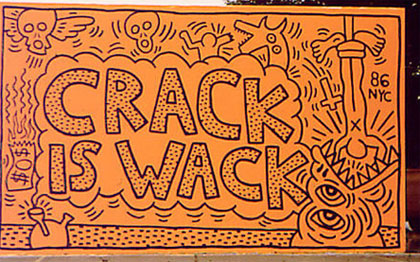
 

Keith Haring (American, 1958-1990) 'Crack is Wack' as completed by Haring in 1986


Keith Haring (American, 1958-1990)
Crack is Wack
as completed by Haring in 1986 (1st version, now overpainted)


Anonymous. 'Crack is Wack' 1986


Current Crack is Wack
painted after 1990


Now you see it, now you don’t

This brings me to my final point: now you see it, now you don’t. While I must take at face value the assertion by Andrew Thorn that the mural can be preserved and not fade or deteriorate further if the recommendations of his 1996 and 2010 reports are adhered to, and while I respect his professional judgment in that statement, unfortunately past experience (i.e. the lack of maintenance of the mural between 1996, the year of the last stabilisation, and now) tells me that the mural will continue to deteriorate and fade unless a specific and regular maintenance plan is financially funded and put in place. Donna Wheeler observes that the mural “is but a shadow of its former self”52 and I agree with this assertion. I was shocked to see the mural when visiting it recently compared to how I remember it in 1996 (ah, memory!). Though still an original Haring, it is pale and wane, almost an imitation of itself (and that is an irony in itself), and it made me sad to see the mural in this condition, as I remember how vibrant it was back in the early 1990s.

“According to ACCA curator Hannah Mathews, when the mural was last stabilised in 1996, it was estimated that a tiny sum of A$200 ($178) was needed annually to maintain the work. A combination of factors including pollution and time has left the mural in its current degraded state. Some estimate that it could cost around A$25,000 ($22,000) to stabilise, with an additional A$1,000 ($900) a year for maintenance. Although the issue of whether to repaint the mural is up for debate, all parties agree that the work needs stabilisation as soon as possible to prevent further surface lifting and cracking of the paint … Yarra mayor Jane Garrett said … “Following the forum [Yarra Talking Art forum: “The Keith Haring Mural: yesterday, today, tomorrow” on 29th April 2010 held in Collingwood], [the] Council [is setting up] a working group, which will seek to include representatives from Skills Victoria, Heritage Victoria, the arts community and other stakeholders, to discuss the mural’s future and come to a consensus on the most appropriate way to preserve it.”53

All parties need to agree and as quickly as possible. While Haring was quite happy to send his work out into the world for the enjoyment of all it would be a disservice to his memory and his status as an internationally renowned artist to have the only Haring mural in Australia deteriorate further. Time is of the essence. As Mark Holsworth on his Melbourne Art & Culture Critic blog insightfully opines, “Street art is not the property of the street artists – it belongs to everyone. Even if the artist intends for the art to be ephemeral there is no reason for their wishes to be carried out; the person giving the gift does not get to determine how the gift is used.”54

In the final analysis everyone needs to come to consensus about the future of the Keith Haring Mural for without proper conservation and maintenance it will truly be a case of now you see it, no you don’t.

Dr Marcus Bunyan

Word count: 5,056


Endnotes

1/ Keith Haring on Wikipedia [Online] Cited 25/09/2010
2/ Ibid.,
3/ Gott, Ted. “Fragile Memories: Keith Haring and the Water Window Mural at the National Gallery of Victoria,” in Art Bulletin of Victoria Vol. 43. Melbourne: National Gallery of Victoria, p. 8
4/ “Keith Haring New York,” on the Woodward Gallery website [Online] Cited 25/09/2010. No longer available online
5/ Gott, Ted. Op cit., pp. 7-8
6/ Gott, Ted. Op cit., p. 8
7/ Gott, Ted. Keith Haring’s Collingwood Mural. Draft of a paper given at a Keith Haring Public Forum, Collingwood, 29th April 2010 by Ted Gott, Senior Curator, International Art, National Gallery of Victoria
8/ Gott, Ted and Sullivan, Lisa. “Keith Haring in Australia.” in Art and Australia, Vol. 39, No.4, June-July-Aug 2002: (560)-567. ISSN: 0004-301X. Cited 09/10/2010
9/ Buckley, John. “Keith Haring” exhibition catalogue. Melbourne: Australian Centre for Contemporary Art (ACCA), 1985
10/ Gott, Ted and Sullivan, Lisa. Op. cit., p. 564. See also Footnote 15 and Gruen, John. Keith Haring: The Authorized Biography. New York: Prentice-Hall, 1991, p. 113
11/ Gott, Ted and Sullivan, Lisa. Op. cit.,
12/ Gott, Ted and Sullivan, Lisa. Op. cit., p. 562. See also Footnote 10 and Footnote 15. “Vandals,” Herald, Saturday 10th March 1984, p. 1; “Vandals smash gallery pane,” The Age, Monday 12th March , 1984, p. 19
13/ Gott, Ted and Sullivan, Lisa. Op. cit., Footnote 15 and Gruen, John. Keith Haring: The Authorized Biography. New York: Prentice-Hall, 1991, p. 113
14/ Gott, Ted and Sullivan, Lisa. Op. cit., p. 564
15/ Gott, Ted. Keith Haring’s Collingwood Mural. Op cit.,
16/ Gott, Ted. Keith Haring’s Collingwood Mural. Op cit.,
17/ Gott, Ted. Keith Haring’s Collingwood Mural. Op cit.,
18/ Gott, Ted and Sullivan, Lisa. Op. cit., p. 566. See also Gott, Ted. Keith Haring’s Collingwood Mural. Op cit.,
“Uniquely, we have a surviving record of Keith Haring’s own interpretation of the Collingwood mural, revealed during an interview conducted with the artist shortly after the painting’s completion on Tuesday 6 March 1984. There Keith Haring noted how: “What’s going on in the bottom is about – I mean, all these people are doing different things, right? Some of them are like dancing, like rap dancing, or acrobatics.  Some of them are almost like they are fighting. But the way they are all together means that they can’t – I mean, if one of them comes out, the whole thing falls down. So they sort of depend on all of them to make it work. So it’s sort of like society or whatever, where the world only works when lots of individuals do their part, right?
The thing at the top is, I guess, the impending doom or impending possibility of technological … the confrontation between technology and the human element, which is still holding up the technology, and based on the technology. But it sort of takes a semi-circle in evolution, where people evolved up to a certain point, and now they’ve evolved so far that they’ve invented a computer or a machine to evolve further. And the computer is maybe evolving more than people were. So it’s about that sort of confrontation, I guess.””
19/ Gott, Ted and Sullivan, Lisa. Op. cit., p. 562. See also Footnote 8 and Haring, Keith. “Keith Haring,” in Flash Art, No. 116, March 1984, p. 22
20/ Anonymous. “Keith Haring Mural: Statement of Significance,” on Heritage Council of Victoria database [Online] Cited 04/10/2010
21/ Sharpe, Emily. “Saving Keith Haring Down Under: Melbourne work is last surviving wall painting by the late artist’s own hand,” on The Art Newspaper website. Published online 08/06/2010. Cited 06/08/2010. No longer available online
22/ Thorn, Andrew. Email to the author. 24/08/2010.
23/ Dixon, Tom. Member of the Public Art Committee of the National Trust of Australia (Victoria) (NTAV). Telephone conversation with the author 26/08/2010. The Public Art Committee considers murals, mosaics, and sculptures; and such works can be found in parks and reserves, public streets, squares and buildings; and publicly accessible parts of privately owned buildings.
24/ Masterson, Andrew. “Off the wall art,” in The Age. Melbourne: Summer Age supplement. December 27th, 1994, p. 4-5 quoted in Gibson, Lisanne and Pendlebury, John R. “Values not Shared: The Street Art of Melbourne’s City Laneways,” chapter in Valuing historic environments. Farnham: Ashgate Publishing Limited, 2009, p. 146
25/ Thorn, Andrew. “Conservation Treatment Report.” The Keith Haring Mural Johnston Street, Collingwood. Final Report prepared for Northern Institute, 1997.
26/ Thorn, Andrew. “Review of Condition and Treatment.” The Keith Haring Mural Johnston Street, Collingwood. Prepared for City of Yarra, 2007, p. 1
27/ Ibid., p. 2
28/ Ibid., p. 3-5
29/ Thorn, Andrew. Email to the author. 23/08/2010.
30/ Thorn, Andrew. Email to the author. 24/08/2010.
31/ McCaughy, Patrick. Review of “Securing the Past: Conservation in Art, Architecture and Literature” by Paul Eggert in The Australian, December 02, 2009. [Online] Cited 12/06/2010. No longer available online
32/ Ibid.,
33/ Thorn, Andrew. Email to the author. 23/08/2010.
34/ Gibson, Lisanne and Pendlebury, John R. Valuing historic environments. Farnham: Ashgate Publishing Limited, 2009, p. 72
35/ Smith, Laurajane. Uses of Heritage. Oxford: Routledge, 2006, p. 3 (italics in original) quoted in Gibson, Lisanne and Pendlebury, John R. Valuing historic environments. Farnham: Ashgate Publishing Limited, 2009, p. 72
36/ Mauss, Marcel. “A category of the human mind: The notion of person; the notion of self,” in Carrithers, M., Collins, S. and Lukes, S. (eds.,). The Category of the Person: Anthropology, Philosophy, History. Cambridge: Cambridge University Press, 1985, p. 22, cited in Gibson, Lisanne and Pendlebury, John R. Valuing historic environments. Farnham: Ashgate Publishing Limited, 2009, p. 72
37/ Foucault, Michel. Of Other Spaces (1967), “Heterotopias.” Diacritics 16 (Spring 1986), pp. 22-27
38/ Wolff, Janet. The Social Production of Art. Basingstoke: Macmillan, 1993, p. 97
39/ Thorn, Andrew. Email to the author. 23/08/2010.
40/ National Trust of Australia (Victoria). Classification Report for ‘Keith Haring Mural’, Johnston Street, Collingwood, File number 6675. Extract from Statement of Significance, 4th August 1997 quoted in Gibson, Lisanne and Pendlebury, John R. “Values not Shared: The Street Art of Melbourne’s City Laneways,” in Valuing historic environments. Farnham: Ashgate Publishing Limited, 2009, p. 146
41/ Wheeler, Donna. “When Keith Came To Town,” on Holiday Goddess, Female-Friendly Travel website. [Online] Cited 06/08/2010. No longer available online
42/ Thorn, Andrew. Email to the author. 23/08/2010.
43/ McAuliffe, Chris quoted in Masterson, Andrew “Off the wall art,” in The Age. Melbourne: Summer Age supplement. December 27th, 1994, p. 4-5 quoted in Gibson, Lisanne and Pendlebury, John R. Valuing historic environments. Farnham: Ashgate Publishing Limited, 2009, p. 72
44/ Op. cit.,
45/ See Tseëlon, E. The Masque of Femininity: The Representation of Women in Everyday Life. London: Sage, 1995, p. 128
46/ Yarra Talking Arts forum. “The Keith Haring mural: yesterday, today, tomorrow.” Thursday 29th April, 2010
47/ Thorn, Andrew. Email to the author. 23/08/2010.
48/ Ibid.,
49/ Gruen, Julia. “Save the Keith Haring Mural” web page on Facebook [Online] Cited 21/11/2011. No longer available online
50/ Thorn, Andrew. “Another Red Haring,” keynote paper presented at the International Council of Museums Conservation Committee  (ICOMCC) triennial Conference, Lisbon, October 2011
51/ Evans, Megan. Email to the author. 08/09/2010.
52/ Wheeler, Donna Op cit.,
53/ Sharpe, Emily Op cit.,
54/ Holsworth, Mark. “Another Banksy Gone,” on Melbourne Art & Culture Critic blog. [Online] Cited 06/10/2010.


LIKE ART BLART ON FACEBOOK

Back to top

Exhibition: ‘A Revolutionary Project: Cuba from Walker Evans to Now’ at the J. Paul Getty Museum, Los Angeles

Exhibition dates: 17th May – 2nd October 2011


Many thankx to the J. Paul Getty Museum for allowing me to publish the photographs in the posting. Please click on the photographs for a larger version of the image.


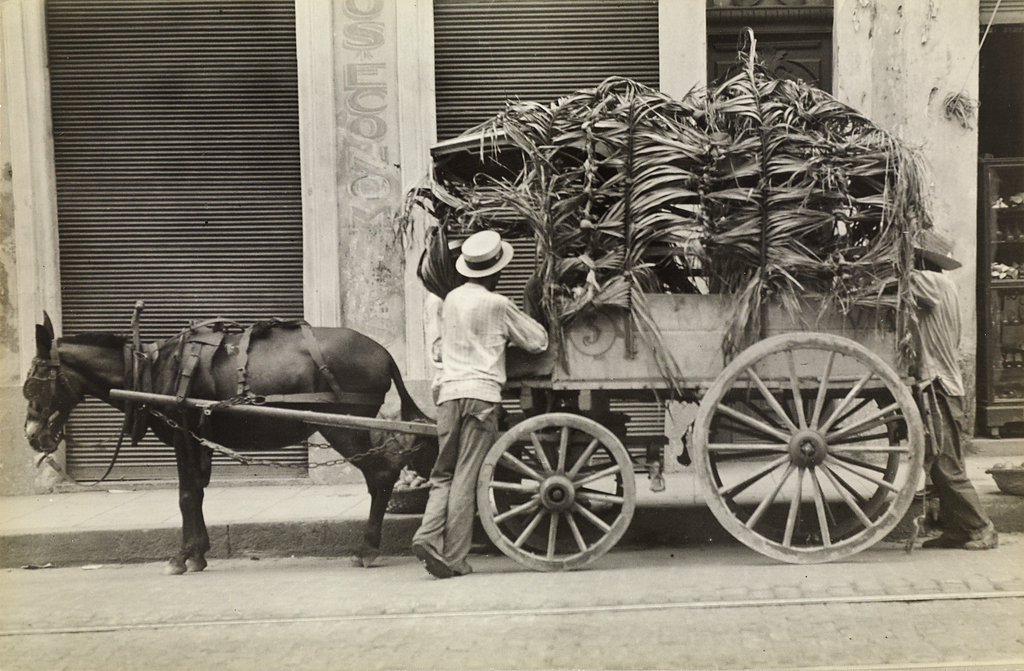
Walker Evans (American, 1903-1975) 'Mule, Wagon and Two Men, Havana' 1933


Walker Evans (American, 1903-1975)
Mule, Wagon and Two Men, Havana
1933
Gelatin silver print
13.8 x 21cm (5 7/16 x 8 1/4 in.)
The J. Paul Getty Museum, Los Angeles
© Walker Evans Archive, The Metropolitan Museum of Art


Walker Evans (American, 1903-1975) 'Spectacle, Capital Steps, Possibly Independence Day' May 20, 1933


Walker Evans (American, 1903-1975)
Spectacle, Capital Steps, Possibly Independence Day
May 20, 1933
Gelatin silver print
19.7 x 25.3cm (7 3/4 x 9 15/16 in.)
The J. Paul Getty Museum, Los Angeles
© Walker Evans Archive, The Metropolitan Museum of Art


Walker Evans (American, 1903-1975) 'Old Havana Housefronts' 1933


Walker Evans (American, 1903-1975)
Old Havana Housefronts
1933
Gelatin silver print
17.6 x 22.7cm (6 15/16 x 8 15/16 in.)
The J. Paul Getty Museum, Los Angeles
© Walker Evans Archive, The Metropolitan Museum of Art


Walker Evans (American, 1903-1975) 'Balcony Spectators' 1933


Walker Evans (American, 1903-1975)
Balcony Spectators
1933
Gelatin silver print
19.8 x 25.2cm (7 13/16 x 9 15/16 in.)
The J. Paul Getty Museum, Los Angeles
© Walker Evans Archive, The Metropolitan Museum of Art


Exhibition Marks First Showing of Getty’s Walker Evan’s Cuban Photographs; Also on view are Cuban Revolutionary Photographs and Contemporary Work by Virginia Beahan, Alex Harris, and Alexey Titarenko

Cuba’s attempt to forge an independent state with an ambitious set of social goals, all the while moored to powerful political and economic interests, has been a source of fascination for nations, intellectuals, and artists alike. On display at the J. Paul Getty Museum, the Getty Center, May 17 – October 2, 2011, A Revolutionary Project: Cuba from Walker Evans to Now, looks at three critical periods in the island nation’s history as witnessed by photographers before, during, and after the country’s 1959 Revolution.

A Revolutionary Project juxtaposes Walker Evans’s 1933 images from the end of the Gerardo Machado dictatorship with views by contemporary foreign photographers Virginia Beahan (American, b. 1946), Alex Harris (American, b. 1949), and Alexey Titarenko (Russian, b. 1962), who have explored Cuba since the withdrawal of Soviet support in the 1990s. A third section bridging these two eras presents pictures by Cuban photographers who participated in the country’s 1959 Revolution, including Alberto Korda, Perfecto Romero, and Osvaldo Salas.

“The Museum’s collection of Walker Evans prints is the largest in the U.S., but until now, we have not shown his photographs of Cuba,” explains Judith Keller, senior curator of photographs. “This exhibition allows us the opportunity to showcase this body of work, alongside newer work in the collection.”

1933: Evans in Havana

Walker Evans (1903-1975) is one of the photographers most responsible for the way we now imagine American life in the 1930s. His distinctive photographic style, which he declared “transcendent documentary,” was nurtured in New York in the late 1920s and fully formed by his experience in Cuba in 1933. In the spring of that year, Walker Evans was asked by publisher J. B. Lippincott to produce a body of work about Cuba to accompany a book by the radical journalist Carleton Beals (1893-1979). This book, The Crime of Cuba, would be a scathing indictment of the then-current regime of Cuban President Gerardo Machado. Leaving the country less than two months before Machado was forced out of office, Evans was able to capture Cuba at the start of the revolutionary movement but almost 30 years before the 1959 Revolution.

During Evans’s time in Cuba, he made substantial strides in his photographic practice. There he worked with different format cameras, large and small, one more deliberate and descriptive, the other more spontaneous and agile. He created both close-up and wide, inclusive compositions that he could then combine in intense sequences to best communicate his response to the poverty, the ferment, and the beauty of his environment. While in Havana, Evans met the American writer, Ernest Hemingway (1899-1961), whose acclaimed avant-garde work he knew and admired. Hemingway’s terse narrative style, which he was then applying to his own Harry Morgan stories set in Havana and Key West, no doubt influenced Evans’s approach to the subject of Cuba’s current political and economic struggles. Evans’s photographs also reflect the inspiration of French photographer Eugène Atget’s Parisian pictures that Evans critiqued for an arts journal in 1931. The series that comprised Atget’s thorough study of “Old Paris” seem to have provided additional motivation for Evans’s selection of Havana subjects: the signage of urban storefronts, the abundant street offerings of fresh produce, the decorative balconies of old houses, the many studies of archaic horse-drawn wagons and carriages, and the portraits of women, some of whom appear to be prostitutes.

1958-1966: Revolution

Machado’s fall from rule in 1933 resulted in a long power struggle that culminated in the country’s 1959 socialist revolution to overthrow dictator Fulgencio Batista, anchoring Cuba to the Soviet bloc for the next thirty years and defining a relationship with the United States that still exists today. Fidel Castro, Ernesto “Che” Guevara, and their new government harnessed photography as a means of keeping the project of the Revolution at the forefront of Cuba’s collective consciousness. As both genuine records of popular insurrection and propagandistic documents used for political purposes, pictures of the Revolution and its aftermath have shaped how both Cubans and Americans understand the significance of that revolutionary moment. Photographs in the second section of the exhibition are drawn from the work of nine Cuban photographers who participated in recording the political context and triumphs of the emerging state in the years surrounding 1959.

Included in the exhibition is an iconic image of the revolutionary hero Che Guevara by Alberto Korda titled Guerrillero Heroico (March 5, 1960). One of the world’s most reproduced images, it has been adopted for political causes, appearing on countless numbers of t-shirts, banners, and street art around the globe. The print on view in the exhibition is among the earliest versions of the photograph known to exist. Made as a press print, it was used as a source to reproduce the image in media outlets a year after Korda photographed Guevara at a rally in Havana.

Also on display in the exhibition is the well-known revolutionary photograph Patria o Muerte, Cuba (Negative, January 1959; print, 1984) by Osvaldo Salas, one of Cuba’s most important photographers. Salas effectively captures and conveys the populist fervour in Cuba shortly after the movement’s triumph with an image of a patriotic sign framed by a celebratory crowd.

The photographs included in this section of the exhibition are culled from the extensive holdings of Cuban photography assembled by the Austrian collector, Christian Skrein, including a number of recent acquisitions by the Museum.

Since 1991: The Special Period

After Soviet troops began to withdraw from Cuba in September of 1991, the troubled Cuban economy suffered severe internal shortages, and Fidel Castro declared what is known as the “Special Period” (período especial), marked by food rationing, energy conservation, and a decline of public services. In the nearly twenty years since the Soviet withdrawal, Cubans have managed to survive through perseverance, the forging of new political relationships, and the easing of socialist systems. This period of transition, which continues today with the recent transfer of power from Fidel Castro to his brother Raúl, has attracted the attention of photographers from around the world who are interested in exploring the relationship between Cuba’s revolutionary past and its uncertain future. The final section of the exhibition looks specifically at the work of three contemporary photographers with diverse approaches to documenting the island in recent decades: Virginia Beahan, Alex Harris, and Alexey Titarenko.

Virginia Beahan’s work concentrates on the landscape’s relationship to history and culture. In 2001, she began a multiyear project on Cuba, photographing its topography in search of remnants of the island’s diverse past. The work resulted in a publication in 2009 called Cuba: Singing with Bright Tears. Beahan’s Cuba is a land of contradictions, full of disappointments and hope, decay and rejuvenating beauty, simultaneously anchored to the past while looking beyond the present. Born and raised in Leningrad (now Saint Petersburg), Russia, Alexey Titarenko became fascinated with Cuba in 2003, when he made his first trip to Havana. Titarenko’s goal was to represent the soul of the Cuban capital. In the artist’s photographs, the city is shown with little overt reference to its politics. Instead, Titarenko describes the conditions of life in the communist country, depicting people persevering amid varying states of ruin. Venturing out of the tourist zones of Havana into the network of dilapidated avenues beyond the old city walls, his images depict a grey metropolis whose inhabitants congregate on the streets to collect food rations, fix long-outmoded cars, and play baseball.

A former student of Walker Evans, Alex Harris made several trips to Cuba following the collapse of the eastern bloc and the dissolution of the Soviet Union, developing a powerful body of colour work that addresses the country’s cultural fabric during a period of difficult economic circumstances. His photographs focus on portraits of women whose lives are affected by the tourist-fuelled sex trade, landscapes made through the windshields of refurbished 1950s American cars, and monuments to the Cuban national hero José Martí. His study was published in the form of a book, The Idea of Cuba, in 2007. Through these distinct vantage points, Harris probed the country’s propensity for ingenuity as it underwent great transition.

Press release from the J. Paul Getty Museum website


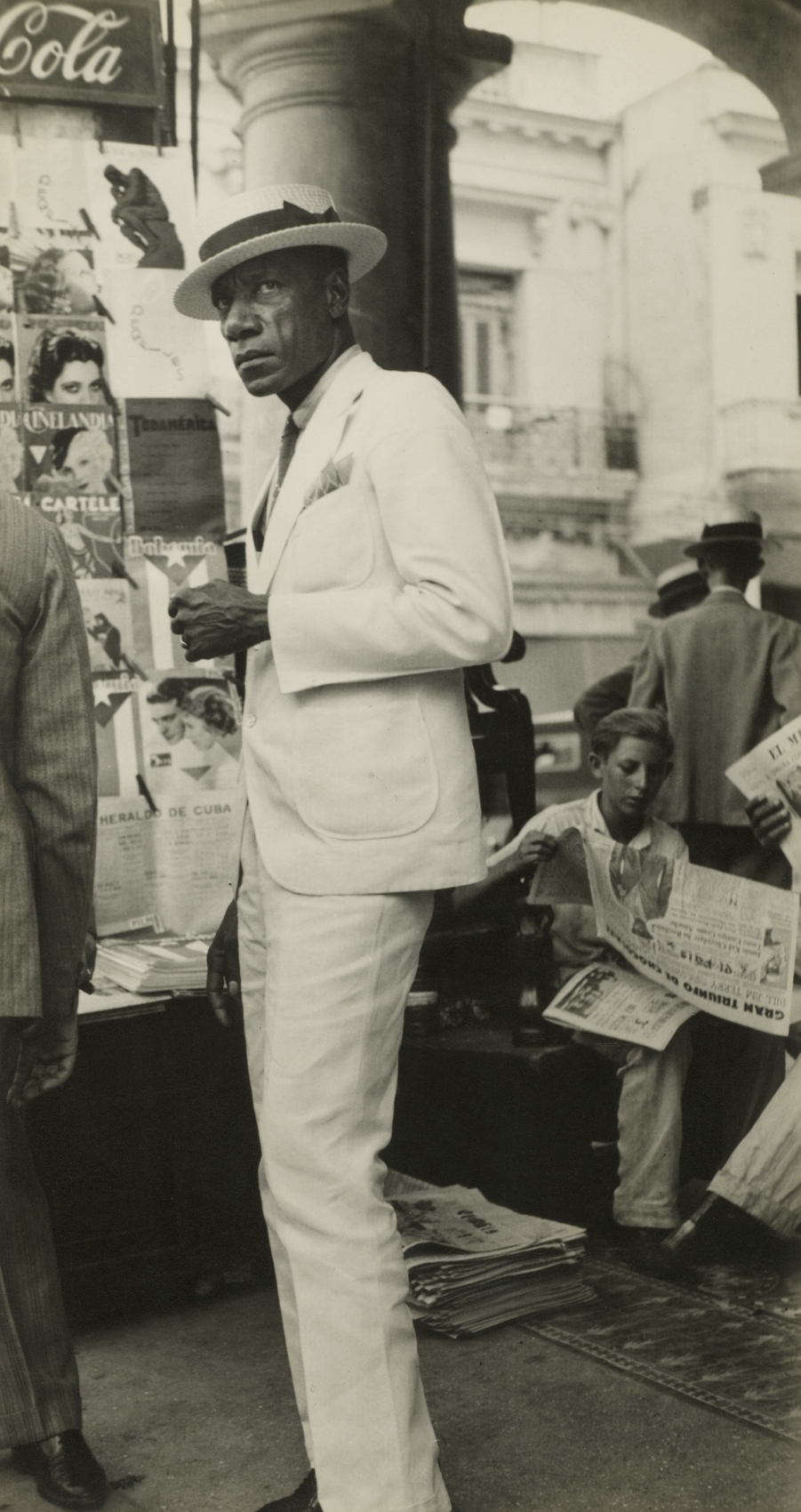
Walker Evans (American, 1903-1975) 'Citizen in Downtown Havana' 1933


Walker Evans (American, 1903-1975)
Citizen in Downtown Havana
1933
Gelatin silver print
22.2 x 11.7cm (8 3/4 x 4 5/8 in.)
The J. Paul Getty Museum, Los Angeles


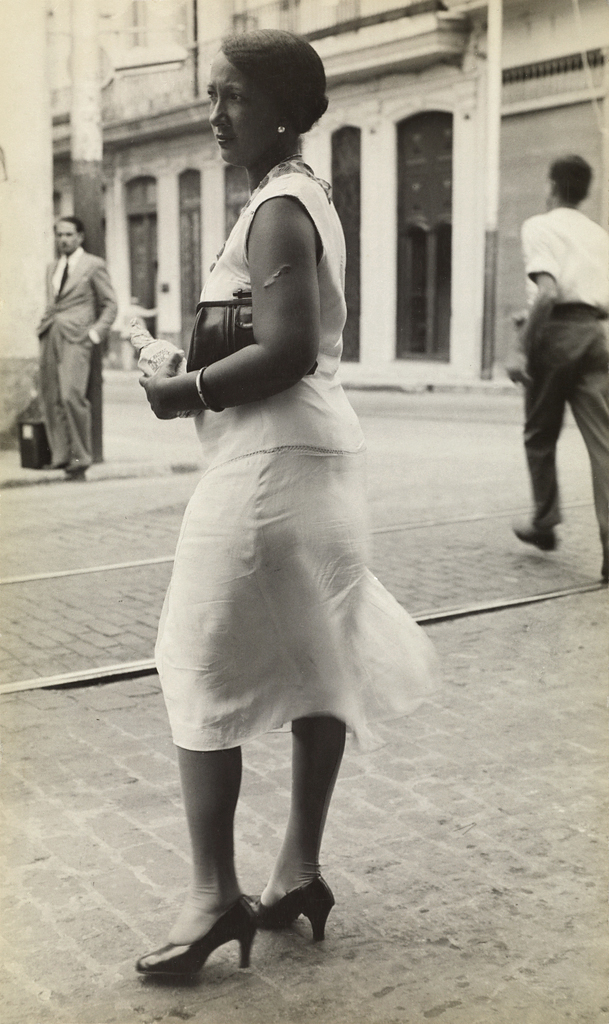
Walker Evans (American, 1903-1975) 'Woman on the Street, Havana' 1933


Walker Evans (American, 1903-1975)
Woman on the Street, Havana
1933
Gelatin silver print
24.6 x 14.6cm (9 11/16 x 5 3/4 in.)
The J. Paul Getty Museum, Los Angeles
© Walker Evans Archive, The Metropolitan Museum of Art


Walker Evans (American, 1903-1975) 'Woman in a Courtyard' 1933


Walker Evans (American, 1903-1975)
Woman in a Courtyard
1933
Gelatin silver print
25.3 x 16.2cm (9 15/16 x 6 3/8 in.)
The J. Paul Getty Museum, Los Angeles
© Walker Evans Archive, The Metropolitan Museum of Art


Walker Evans (American, 1903-1975) 'Coal Dockworkers, Havana' 1933


Walker Evans (American, 1903-1975)
Coal Dockworkers, Havana
1933
Gelatin silver print
15.6 × 21.1cm (6 1/8 × 8 5/16 in.)
The J. Paul Getty Museum, Los Angeles
© Walker Evans Archive, The Metropolitan Museum of Art


Walker Evans (American, 1903-1975) 'Coal Dockworkers, Havana' 1933


Walker Evans (American, 1903-1975)
Coal Dockworkers, Havana
1933
Gelatin silver print
12.7 × 17.7cm (5 × 6 15/16 in.)
The J. Paul Getty Museum, Los Angeles
© Walker Evans Archive, The Metropolitan Museum of Art


Walker Evans (American, 1903-1975) 'Coal Dockworker, Havana' 1933


Walker Evans (American, 1903-1975)
Coal Dockworker, Havana
1933
Gelatin silver print
9.7 × 13.7cm (3 13/16 × 5 3/8 in.)
The J. Paul Getty Museum, Los Angeles
© Walker Evans Archive, The Metropolitan Museum of Art


Walker Evans (American, 1903-1975) 'Coal Loader, Havana' 1933


Walker Evans (American, 1903-1975)
Coal Loader, Havana
1933
Gelatin silver print
17.1 × 12.2cm (6 3/4 × 4 13/16 in.)
The J. Paul Getty Museum, Los Angeles
© Walker Evans Archive, The Metropolitan Museum of Art


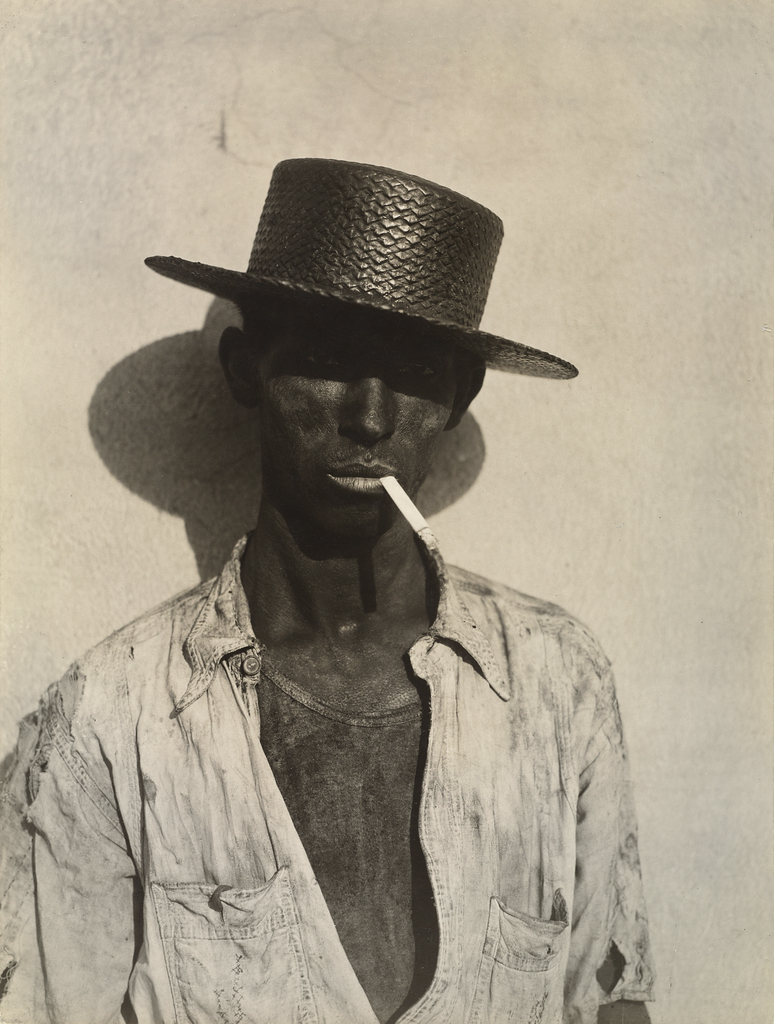
Walker Evans (American, 1903-1975) 'Coal Stevedore, Havana' 1933


Walker Evans (American, 1903-1975)
Coal Stevedore, Havana
1933
Gelatin silver print
20.2 x 15.2cm (7 15/16 x 6 in.)
The J. Paul Getty Museum, Los Angeles
© Walker Evans Archive, The Metropolitan Museum of Art


Walker Evans (American, 1903-1975) 'Stevedore' 1933


Walker Evans (American, 1903-1975)
Stevedore
1933
Gelatin silver print
20.1 x 15.1cm (7 15/16 x 5 15/16 in.)
The J. Paul Getty Museum, Los Angeles
© Walker Evans Archive, The Metropolitan Museum


Walker Evans (American, 1903-1975) 'Negro Child, Havana' 1933


Walker Evans (American, 1903-1975)
Negro Child, Havana
1933
Gelatin silver print
19.5 x 14.8cm (7 11/16 x 5 13/16 in.)
The J. Paul Getty Museum, Los Angeles
© Walker Evans Archive, The Metropolitan Museum


Walker Evans (American, 1903-1975) 'Negro Child, Havana' 1933


Walker Evans (American, 1903-1975)
Negro Child, Havana
1933
Gelatin silver print
19.8 x 13.2cm (7 13/16 × 5 3/16 in.)
The J. Paul Getty Museum, Los Angeles
© Walker Evans Archive, The Metropolitan Museum


The J. Paul Getty Museum
1200 Getty Center Drive
Los Angeles, California 90049

Opening hours:
Tuesday – Friday, Sunday 10am – 5.30pm
Saturday 10am – 8pm
Monday Closed

The J. Paul Getty Museum website

LIKE ART BLART ON FACEBOOK

Back to top

Book: ‘Spomenik’ by Jan Kempenaers

February 2011


'Spomenik' by Jan Kempenaers


Three Canons


Be still with yourself

Until the object of your attention

Affirms your presence


Let the Subject generate its own Composition


When the image mirrors the man

And the man mirrors the subject

Something might take over


Minor White 1968


“Gone is the modernist tenet of authorship in which everything in a photograph depends and can be traced to a single photographer acting in isolation. In its place, White supposes a relationship with subject that is a two way street: by granting the world some role in its own representation we create a photograph that is not so much a product solely of individual actions as it is the result of a negotiation in which the world and all its subjects might participate.”


Vince Leo


These are beautiful photographs; there is no fuss, no histrionics here. The use of light and the framing of subject are wonderful. The photographer has let the subject generate its own composition meaning that the sculptures speak for themselves: something takes over – an ethereal evocation of space and place.

The sculptures occupy a representational space appropriated by the imagination. “Lefebvre writes that it [representational space] “overlays physical space, making symbolic use of its objects” and is predominantly non-verbal in nature.”1 The photographs and their representational space offer the viewer the possibility of drifting (Guy Debord’s dérive) encouraging “an unplanned journey through a landscape… where an individual travels where the subtle aesthetic contours of the surrounding architecture and geography subconsciously direct them with the ultimate goal of encountering an entirely new and authentic experience.”2

I find the photographs truly authentic. I immerse myself in their presence: I embrace them because they are in my imagination, creatures of the deep recesses of the mind.

Dr Marcus Bunyan


1/ Burgin, Victor. In/Different Spaces: Place and Memory in Visual Culture. Berkeley: University of California Press, 1995, p. 27
2/ Anonymous. “Dérive,” on the Wikipedia website [Online] Cited 28/06/2011


Many thankx to Jan Kempenaers for allowing me to publish the photographs and text in the posting. Please click on the photographs for a larger version of the image. All photographs © Jan Kempenaers and courtesy of the artist.


Monument honouring the Battle of Sutjeska from 'Spomenik' by Jan Kempenaers


This monument, authored by sculptor Miodrag Živković, commemorates the Battle of Sutjeska, one of the bloodiest battles of World War II in the former Yugoslavia.


World War II

Since nearly the beginning of Axis powers taking control of the Kingdom of Yugoslavia in April of 1941, the armies of Germany, Italy and their other Axis collaborators had been battling against armed uprisings of local resistance forces, most notably Josip Tito’s communist Partisan Army. As the Partisans in large part relied on guerilla tactics and unconventional warfare, they became a significant force for the Axis leadership to reckon with. As a result, the German Army created a set of targeted operations to take out Tito specifically, which they felt would behead the Partisan’s leadership and destroyed the movement. The first attempt at subduing Tito took place in January of 1943, during what the German’s called Operation Case White, which the Yugoslav’s later referred to as the Battle of Neretva near Makljen. However, this operation ended in Tito dramatically escaping at the last moment.

In May of 1943, Axis powers set upon Tito again with a new operation called Case Black. The operation was initiated with 127,000 Axis forces pursuing 22,000 Yugoslav Partisans across the Durmitor Mountains, then north into the Zelengora Mountains of present-day Bosnia. Then, in early June of 1943, the Partisans were subsequently boxed in and trapped within Axis lines on Vučevo Mountain on the east Sutjeska River valley, near the small village of Tjentište. As a result, a massive battle between the two sides ensued in what today is known as the ‘Battle of Sutjeska’ (Bitka na Sutjesci). Despite this hopeless seeming situation, Tito orchestrated a daring move where, starting on the morning of June 9th, he ordered Partisan units to begin breaking west across the open valley and over the river. Some of the Partisans were surprisingly successful in breaking the German lines, at which point they headed up a steep ravine of Ozren Mountain and were then able to break north through German lines and escape past Goražde through the mountains into eastern Bosnia.

Despite this ambitious and daring escape Tito made during this seemingly hopeless battle, it came at a great cost of life. During the conflict, over 7,000 Partisan soldiers were killed. Tito’s escape at Sutjeska is considered a significant pivotal moment is the Partisan Liberation Struggle against the German-Italian Axis occupiers, as it proved that they were a formidable fighting force which could not easily be destroyed.

Anonymous text. “Tjentište,” on the Spomenik Database website Nd [Online] Cited 22/07/2022


The Petrova Gora monument from 'Spomenik' by Jan Kempenaers


The Petrova Gora monument was designed by Vojin Bakić and built in 1982. It was dedicated to the people of Kordun and Banija who died during World War II. It was dismantled in 2011.


The Kosmaj monument in Serbia from 'Spomenik' by Jan Kempenaers


The Kosmaj monument in Serbia is dedicated to soldiers of the Kosmaj Partisan detachment from World War II.


The Kruševo Makedonium monument in Macedonia from 'Spomenik' by Jan Kempenaers


The Kruševo Makedonium monument in Macedonia was dedicated to the Ilinden Uprising of 1903, when the Bulgarian population revolted against the Ottoman Empire.


Ilinden Uprising

The primary historical event this monument commemorates is the Ilinden Uprising, which was an uprising of Macedonian IMARO rebels initiated against Ottoman rule on August 2nd, 1903. During this time, in the region of present-day Kruševo, resistance fighters proclaimed this newly liberated land to be the land of the Kruševo Republic, under the leadership of then school-teacher turned war-hero Nikola Karev. This separatist territory lasted less than two weeks before it was suppressed by 176,000 Turk soldiers and put back under Ottoman control, with nearly 9000 people being executed at the hands of the Turks in retaliation.

World War II

In addition, this spomenik commemorates the local Kruševo fighters of the People’s Liberation Struggle (WWII) who struggled under the Partisan banner to help free Macedonian from Axis and fascist occupation. On August 19th, 1942, the Kruševo Partisan Detachment was formed as a force of community soldiers who engaged in skirmishes with Axis troops across Macedonia until Kruševo’s liberation by Soviet-backed Bulgarians during the fall of 1944. Macedonia was officially declared a nation-state during the Anti-fascist Assembly for the National Liberation of Macedonia (ASNOM), held at Prohor of Pčinja Monastery, on August 2nd, 1944, which was a date symbolically chosen to align with the date of the Ilinden Uprising, as the ASNOM gathering considered itself the ‘Second Ilinden’. Presently, this date is still celebrated in Macedonia as the Day of the Republic.

Anonymous text. “Kruševo,” on the Spomenik Database website Nd [Online] Cited 22/07/2022


'Spomenik' by Jan Kempenaers

'Spomenik' by Jan Kempenaers

'Spomenik' by Jan Kempenaers

The Susanjar Memorial Complex in Bosnia and Herzegovina from 'Spomenik' by Jan Kempenaers


The Susanjar Memorial Complex in Bosnia and Herzegovina was created in remembrance of the thousands killed by Germans during the Orthodox festival of Ilindan in 1941.


Spomenik Construction

Preliminary plans to construct a memorial complex at the Sanski Most execution site for the commemoration of these tragedies was organised in late 1968. At this point, an official selection board was convened to arrange this memorial’s construction. This board consisted of municipal officials as well as generals and officials of the SR of Bosnia who were from the Sanski Most region. The chairman of the board was Yugoslav WWII hero Petar Dodik, at this time a lawyer from Sarajevo. Funding for the project was raised by this board largely via public voluntary donations from those in the community. Three specific notable designers were considered by the board to create the monument, all who had varying ideas of what the monument should look like. Belgrade architect Bogdan Bogdanović, wanted to construct a ‘Tower of Babel’ themed structure, but the design selection committee found this concept unacceptable. Famous Zagreb sculptor Vanja Radauš suggested a bone-shaped memorial, but this was also rejected, as it was felt it might incite feelings of anger and hatred towards Croats in general, especially as the memorial was intended to be a place of healing and reconciliation… not horror.

The project was eventually awarded to Sarajevo architect Petar Krstić, whose primary composition, completed in 1970, consisted of an aluminium flame-like obelisk set within an open paved courtyard. The complex’s approaching pathways were lined with stone tiles commemorating the victims killed and executed in the uprising. In addition, long crisscrossing concrete tubes are arranged around the monument as seating for visitors and as an outdoor classroom for students. The official commemoration ceremony for the memorial took place on August 2nd, 1971, a date which recognised 30 years since the 1941 St. Elijah’s Day killings. During the memorial’s construction, there was an alleged incident where when workers were digging in the ground to construct the memorial’s crypt, blood started to bubble up from the earth. After an investigation, it was determined to be human blood (presumably left over from the massacres which occurred on the site) which had seeped into the ground and mixed with moist clay, allowing it to remain viscous and suspended. However, I was not able to find definitive corroborating evidence of this event. Also, after the monument’s official opening in 1971, a series of annual poetry reading events called the ‘Šušnjar Literary Festival’ were held at the site every August 2nd during the monument’s remembrance ceremonies.

Symbolism

It has been stated by the creator of this memorial sculpture, Petar Krstić, that its sharply irregular and luminescent form is meant to resemble the shape of a shining leaping flame and that said form is meant to be symbolic of the light of life and the victorious process of overcoming the threat of fascism which caused such sufferings to the people of the Sanski Most region. Such a universally understood image of the flame representing the ‘light of life’ was mostly surely chosen by the memorial’s selection board with the intention that it would be an inclusive and non-incendiary symbol pleasing all members of the town’s ethnically divided population. In addition, Krstić explained that his sculpture was meant to symbolise not only the suffering of people in Sanski Most, but suffering of all people throughout the ages. Such statements reinforce the ‘universalist’ interpretations of this sculpture. Interestingly, Krstić’s original design called for the memorial sculpture to emit sounds and lights from a machine within the structure, which would symbolise the struggle and suffering of the people of Sanski Most – however, this experimental concept became cost prohibitive and was never integrated into the site.

Anonymous text. “Sanski Most,” on the Spomenik Database website Nd [Online] Cited 22/07/2022


'Spomenik' by Jan Kempenaers


Monument in Niš, Serbia from 'Spomenik' by Jan Kempenaers


Built in 1963, this monument in Niš, Serbia commemorates the 10,000 people from the area that were killed during World War II. The three clenched fists are the work of sculptor Ivan Sabolić.


Monument in Korenica from 'Spomenik' by Jan Kempenaers


This monument is in Korenica, on the border of Croatia and Bosnia. It commemorates Yugoslavia’s victory in World War II.


'Spomenik' by Jan Kempenaers


This monument is dedicated to the soldiers who freed the city of Knin, Croatia from the fascists during World War II.


'Spomenik' by Jan Kempenaers

'Spomenik' by Jan Kempenaers


Built in 1949, this monument was designed by Vojin Bakić and is dedicated to the fallen fighters of the Yugoslav front.


The Kadinjača Memorial Complex from 'Spomenik' by Jan Kempenaers


The Kadinjača Memorial Complex commemorates those who died during the Battle of Kadinjača.


Serbia’s most grandiose spomenik (Yugoslav-era memorial), Kadinjača commemorates the Partisans from the Workers’ Battalion who perished on this spot fighting the Germans in November 1941. Rising on a green hill like some futuristic Stonehenge, the arresting series of white granite monoliths of various heights and angles culminates in two 14m-high pillars that together form a symbolic ‘bullet hole’ sculpture. The 15-hectare complex comprises a stone pyramid with a crypt for the fallen soldiers.

There’s a memorial hall with an exhibition about the historic event. The Partisans’ heroic defeat at the battle of Kadinjača marked the end of the short-lived Republic of Užice, the first liberated territory in German-occupied Europe. Proclaimed by Yugoslavia’s legendary resistance movement, it covered an area of about 20,000 sq km in western Serbia and lasted only 67 days.

Anonymous text. “Kadinjača Memorial Complex,” on the Lonely Planet website Nd [Online] Cited 22/07/2022


'Spomenik' by Jan Kempenaers


This sculpture was built in 1973 and designed by Bogdan Bogdanovic. It is dedicated to the long mining tradition in Kosovo.


'Spomenik' by Jan Kempenaers

'Spomenik' by Jan Kempenaers

'Spomenik' by Jan Kempenaers

'Spomenik' by Jan Kempenaers

'Spomenik' by Jan Kempenaers


Jan Kempenaers website

LIKE ART BLART ON FACEBOOK

Back to top

Exhibition: ‘Photography & place: Australian landscape photography, 1970s until now’ at the Art Gallery of New South Wales, Sydney

Exhibition dates: 16th March – 29th May 2011


Debra Phillips (Australian, b. 1958) 'Untitled 7 (view from model plane launch area)' 2001


Debra Phillips (Australian, b. 1958)
Untitled 7 (view from model plane launch area)
2001
From the series The world as puzzle
Two Type C photographs
68 x 80cm each
Image courtesy the artist and BREENSPACE, Sydney
© Debra Phillips


Hot on the heels of my reviews of Stormy Weather: Contemporary Landscape Photography at NGV Australia and Sidney Nolan: Drought Photographs at Australian Galleries, Melbourne comes the exhibition Photography & place: Australian landscape photography, 1970s until now at the Art Gallery of New South Wales. An insightful, eloquent text by Vigen Galstyan (Assistant curator, photographs, AGNSW) accompanies the posting.

Dr Marcus Bunyan


Many thankx to Susanne Briggs for her help and to the Art Gallery of New South Wales for allowing me to publish the photographs and the text in the posting. Please click on the photographs for a larger version of the image.


Douglas Holleley (Australia, United States of America, b. 1949) 'Bottle-brush near Sleaford Bay, South Australia' 1979


Douglas Holleley (Australia, United States of America, b. 1949)
Bottle-brush near Sleaford Bay, South Australia
1979
Four SX-70 Polaroid photographs
61 x 76cm
AGNSW collection, purchased 1982
© Douglas Holleley


Australian born and American based photographer Douglas Holleley has experimented with many aberrant photographic techniques over the course of his career. Holleley received a Bachelor of Arts in Psychology in 1971 at Macquarie University before relocating to America to undertake a Master of Fine Arts, studying at the Visual Studies Workshop in Rochester, New York between 1974 and 1976. Founded by Nathan Lyons in 1969 and affiliated with important photographers including Minor White and Frederick Sommers, the Visual Studies Workshop was a bedrock institution that fostered innovative photographic practice from the 1970s onwards. It was here that Holleley received tutelage from Ansel Adams in 1975. His early photographic output includes hand coloured black and white photographs as well as photograms and gridded arrangements of Polaroids. He later began experimenting with digital photography, applying the same principles of the photogram to his experiments with a flatbed scanner.

During the time spent studying photography in America in the 1970s Holleley became interested in Polaroid technology. When he returned to Australia in 1979, before later relocating permanently to America, Holleley commenced an extensive photographic project of documenting the Australian bush with a Polaroid SX-70 camera, effectively becoming one of the first professional practitioners of the medium in the country. The resulting images were presented as a series and published as a book – Visions of Australia – in 1980. Employing a refined formalist vocabulary, Holleley produced photographic mosaics by arranging his Polaroids into gridded compositions.

Dissected, disassembled and then collated within the pictorial frame, the landscape in Holleley’s works becomes slightly unnatural and detached. These works negate linear single point perspective by focusing on the ground and reducing the scene to a formal composite. Here, the expanse of the view and the horizon does not dominate the space of the image. The tessellating images produce a ‘whole’ that is slightly misaligned and unsettled. In some works, the photographer’s shadow is visible. It asserts itself as an ambivalent presence that is not tethered to the scene. This spectral form heightens the sense of disquiet that pervades the images.

Text from the Art Gallery of New South Wales website [Online] Cited 16/01/2020


Ian North (New Zealand, b. 1945) 'Canberra suite no 2' 1980, printed c. 1984


Ian North (New Zealand, b. 1945)
Canberra suite no 2
1980, printed c. 1984
From the series Canberra suite 1980-81
Type C photograph
37 x 45.7cm
AGNSW collection, gift of the artist
© Ian North


Ian North (New Zealand, b. 1945) 'Canberra suite no 7' 1980, printed c. 1984


Ian North (New Zealand, b. 1945)
Canberra suite no 7
1980, printed c. 1984
From the series Canberra suite 1980-81
Type C photograph
37 x 45.7cm
AGNSW collection, gift of the artist
© Ian North


Ian North is an Adjunct Professor of Visual Arts at both the University of Adelaide and the University of South Australia. He is a photographer, painter and writer, and was the founding curator of photography at the National Gallery of Australia 1980-1984. Throughout his career, he has been concerned with the legacy of Australian landscape, the impact of colonial narratives and their established visual conventions and, as a consequence, the politics of representing the subject. …

North’s methodology is concerned with the processes of vision and interaction as they have shaped the landscape. In Canberra Suite North presents an encyclopaedic record of Walter Burley Griffin’s intricately designed city, exploring the spatial interface between nature and humanity. The works are absent of human life – reminiscent of Ed Ruscha’s Twenty-six Gasoline Stations. The emotional ambivalence of the images is reflected in their use of colour, like that of postcards. As one of the first instances of larger format colour art photography in Australia, the images topographically map space as a depersonalised, banal subject. Yet their colour, like that of landscape painting, highlights flora, revealing the number of non-native plants included in Canberra’s design. As such, these artefacts of North’s private wanderings and systemic mode of looking are able to subtly critique colonialism.

Text from the Art Gallery of New South Wales website [Online] Cited 16/01/2020


EARTH SCANS AND BUSH RELEVANCES: Photography & place in Australia, 1970s till now

For many of us, landscape is a noun. A view from the window or the balcony, a strange immaterial ‘thing’ that makes people exclaim in awe, point to in pride, recall nostalgically, pose in front of or be used to bump up real estate prices. If one is an urban dweller, which most Australians are, then the landscape exists essentially as a mirage, something to create in the backyard, occasionally look at on holidays or hang on the walls. However, noted American cultural theorist and art historian W. J. T. Mitchell has proposed that we should think of landscape as a verb: an act of creation on our part that engenders cultural constructs, national identities and shared mythologies.

Photography & place is an exhibition that investigates this process of ‘landscaping’ through the work of 18 Australian photographers between the 1970s and now. Their significant contribution to representation of landscape broke new ground in what has always been a confounding topic. Indeed, as Judy Annear has pointed out in a 2008 essay in Broadsheet magazine, the practice of documenting and interpreting the notion of ‘place’ in Australian photography has been fragmentary in comparison to traditions in America, Europe or New Zealand. This reluctance to focus on the natural environment is perhaps a residue of the ‘terra nullius’ polemic, which shifted the attention of many photographers on the building of colonial Australia. Photography from the mid 19th to the early 20th century by photographers such as Charles Bayliss and Nicholas Caire actively documented the conquest of nature by white settlers, or presented views of untouched wilderness as epitomes of the picturesque: endless waterfalls, lakes, forests in twilights, enigmatic caves and an occasional nymph like creature prancing. Despite Bayliss’ efforts to show the indigenous people on their land, they are, as Helen Ennis observed in her 2007 book Photography and Australia, conspicuous by their absence: the land that we see surrounding them in early Australian photography by the likes of J.W. Lindt is often a mass-produced painted studio backdrop.

The advent of modernism in the 1930s only served to entrench the photographers deeper into the urban space. ‘Place’ is the city and it is here that industry, progress and culture shapes the Australian identity. It is still difficult to dislodge the iconic images of Max Dupain and David Moore as epitomes of Australianness, promulgated as they were through countless renditions in mass media and consumer culture. But as post-modern anxiety started to seep through the patchwork of the Australian dream, it was landscape that many critically informed photographers turned to as a tool for analysis and revision.

A number of factors conflated in the mid 1970s, engendering a radical shift in perspectives. One of the primary forces that began to reshape the approaches to landscape in Australian photography was the awareness of new artistic movements taking place in USA and Europe. The enormously influential exhibition New Topographics: Photographs of a Man-Altered Landscape held in 1975 at the George Eastman House, Rochester, consolidated the spread of minimalist and conceptually informed photography which was avidly embraced by a younger generation of Australian photographers. One can also cite the rise of the Australian greens movement in Tasmania, the increasing awareness of Indigenous cultures and rights and not the least, the phenomenon of university-educated photographers as key milestones during this decade.

Lynn Silverman, Douglas Holleley, Jon Rhodes, Wes Stacey and Marion Marrison were among the practitioners who pointed their lenses out of the city, often exploring the fringes of human settlement and sometimes as in the case of Silverman, Stacey and Holleley, venturing into the desert. The element that collectively stamps their work is the ostensible fragmentation of the landscape. Instead of the holistic, positivist postcard views of Australia, we get something resembling a lunar vista. The palpable sense of alienation in American expatriate Lynn Silverman’s striking Horizons series from 1979 echoes in the disorienting grid-based Polaroid assemblages by Holleley conjuring up a space that appears hostile and to a degree indifferent to our presence. The foreignness of these landscapes is not necessarily a malevolent force as was customary to show in a slate of Australian New Wave films of the 70s and 80s. Rather a much more meditative stance is taken in regards to our relationship to a place which has been claimed without being understood or in many ways respected. Ingeborg Tyssen’s photographs hint at existing presences, forms and phenomena which are full of life and meaning that remain perpetually unresolved to an outsider. The imported paradigms of Western culture can not take root in this environment. One could easily define the landscape photography of this period in Lynn Silverman’s words as “an orienting experience” and a belated attempt at a proper reconnaissance of the land.

The coolly detached outlook that underlines the investigative drive of most of these photographers is magnified by their adoption of serial or multi-panel formats. It was certainly a way to expand and collapse the accepted faculties of the pictorial field, challenging and questioning the accepted notions of photographic ‘truth’. Jon Rhodes demonstrates the inherent power of this simple device in his cinematically sequential Gurkawey, Trial Bay, NT 1974, which transforms a seemingly wild and uninhabitable swamp into a joyful playground of an Aboriginal child.

In some instances the photographic approach is more concerned with elucidating the nature of the photographic image itself and the way it can influence and control our perception. As Arnold Hauser has lucidly described in his groundbreaking Social History of Art, images have always been used to secure and infer political power. As such, the metamorphosis of a visual representation into an iconographic one carries within it an element of danger as images begin to seduce the viewer away from objectivity. Indeed, images of Australia have been the most relentlessly and carefully used signifiers in promoting a (colonial) national consciousness by political, commercial and cultural institutions. In this light, it is not difficult to see the works of Wes Stacey and Ian North as acts of iconoclasm. Stacey’s droll and gently parodic series The road 1973-1975, charts a snapshot journey that goes nowhere. Seemingly random, half-glimpsed shots of empty dirt roads, sunburnt grass mounds and endless highways emanate a sense of rootlessness and displacement, negating any possibility of objectification or identification with the landscape. Instead of epic grandeur and jingoism we get something that is confronting, uncomfortably real and in no way ‘advertisable’.

‘The Real’ is even more startling in Ian North’s subversive Canberra suite 1980-81, where the utopian dream capital has been reduced to banal ‘documents’ of depopulated, custom-made suburbia. The hyperreal concreteness of North’s Canberra gives the city an aura of a De Chiricoesque waking nightmare. In line with the set practices of conceptual photography of the period, North has distilled his images from any sign of formal mediation, forcing the viewer to focus on the raw content. It is through this forensic directness that the strange incongruity of human intervention within the landscape becomes ostensible.

Daniel Palmer has noted that North’s images “are highly prescient of much photography produced by artists in Australia today”. Certainly by the 1980s photographers became more actively engaged in analysing the nature / culture median. Strongly influenced by feminist and post-colonial theory, a number of practitioners used photography as a medium to document ideas rather than objective reality. Anne Ferran and Simryn Gill are particularly notable in this regard. Both artists are concerned with the historical and political dimensions of the locations they chose to photograph, resulting in multi-layered and complex strategies that require more involved intellectual interaction from the audience. Gill’s ‘staged’ photographs relate to us the agency of nature and time upon the cultural environment. Synthesis and amalgamation of outwardly irreconcilable elements – imported plants, Australian bush, cotton shirts – slowly, but surely melt into new, as yet unknown entities in Rampant 1999. The force of inevitable decay is absolute yet imbued with generative power as well. Exploring the constantly shifting certainties of what constitutes a ‘place’ the artist draws the audience into questioning its own role in this transformative process.

Ferran takes a more archaeological position in relation to her subject matter. Her eerie surveys of rather ordinary grass mounds in the series Lost to worlds 2008 become evocative paeans to obliterated lives, once we learn that the mounds are all that remain of the factories where convict women were sent to work. Looking at these shimmering ghost worlds one is reminded of Walter Benjamin’s essay The Ruin where the writer analyses the capacity of ruins to reveal the “philosophical truth content”. It is through this allegorical device that Ferran achieves a degree of rehabilitation for the absent histories she photographs.

History, in its manifold and troubling guises, is directly ‘exposed’ in the landscapes of Ricky Maynard, Michael Riley and Rosemary Laing. As Indigenous photographers, Maynard and Riley have played an important role in translating the cultural and political status of Aboriginal peoples into a ‘language’ that is universally understood. Their work remains firmly rooted in the traditions of contemporary art, yet the heavily symbolical slant shows a more ardent and personal engagement with the Australian landscape. Riley’s expressionistic series flyblown 1998 sums up in a few strategically juxtaposed metaphors the spiritual dimension of the landscape, while simultaneously revealing the diverging connotations of Australia’s fundamentally divided identity. The colonial legacy is shown as one of conquest and domination that clashes with the artist’s engagement with country. Maynard’s Portrait of a distant land 2005, explores the same dichotomy in more site specific terms. After permanently settling in Flinders Island, Maynard decided to return to the portrayal of Tasmanian Aborigines, taking a more collaborative approach. He sees this as a way of bypassing the propensity of the photographic image “to subjugate its subjects”. The resulting series is a profoundly poetic treatment that rises above social documentation to suggest the wider implications of historical change and disclose the ability of people to overcome what the artist has described as victimisation through a deeply compassionate relationship with the land. Ultimately Maynard gives us an edifying testimony to the affirmative power of the landscape as collective memory.

Interest in the political aspects of landscape photography has continued unabated into the 21st century. Yet a more philosophically inclined thread has become evident in the last two decades. No longer is it enough to deconstruct and pull apart ideas about landscape’s relationship to identity and nationhood. What photographers like Bill Henson, David Stephenson, Simone Douglas and Rosemary Laing question is the very possibility (or impossibility) of seeing itself. If positioning oneself in relation to nature seems like a distinct, albeit problematic proposition in the 1970s and 80s, the later works in the exhibition are resolutely ambivalent on the subject.

What can one grab onto when faced with the endless expanses of white in Stephenson’s The ice 1992, the terrifying darkness of Henson’s night scenes or the infuriating haze of Douglas’s twilight worlds? Perhaps the only recourse is to dissolve into the beckoning ‘forever’ of the vanishing point in Laing’s To walk on a sea of salt 2004. This void is not a boundary point between nature and culture – it is where culture ends and an entirely new state of consciousness begins: the realm of the sublime and the imagination. As history seems no longer to be trustworthy, ‘place’ can only be constructed as a metaphysical entity. It is a curious turnabout in some ways that echoes some of the early, turn-of-the-century encounters with the Australian landscape by photographers such as John Paine and Norman C. Deck. The sense of fear and awe towards the unfamiliar environment permeates their images, transcending the merely investigative / didactic motives of most colonial photography. What has eventuated from walking into this environment? Subjugation? Destruction? Incomprehension? Indifference? By going back to the point zero of the void and the sublime, contemporary photography negotiates a second attempt at engagement with nature through a renewed and deeper understanding of humanity’s symbiotic relationship with this life-giving force.

Vigen Galstyan
Assistant curator, photographs1


1/ Galstyan, Vigen. “EARTH SCANS AND BUSH RELEVANCES: Photography & place in Australia, 1970s till now,” in Look gallery magazine. Sydney: Art Gallery Society of New South Wales, 2011, pp. 25-29.


Rosemary Laing (Australian, b. 1959) 'After Heysen' 2005


Rosemary Laing (Australian, b. 1959)
After Heysen
2005
Type C photograph
110 x 252cm
On loan from The Australian Club, Melbourne
Image courtesy of the arts & Tolarno Galleries, Melbourne
© Rosemary Laing


Rosemary Laing (Australian, b. 1959) 'to walk on a sea of salt' 2004


Rosemary Laing (Australian, b. 1959)
to walk on a sea of salt
2004
Type C photograph
110 x 226.7cm
Image courtesy of the arts & Tolarno Galleries, Melbourne
© Rosemary Laing


Jon Rhodes (Australian, b. 1947) 'Hobart, Tasmania' 1972-75 from the album 'Australia'


Jon Rhodes (Australian, b. 1947)
Hobart, Tasmania
1972-75
From the album Australia
1 of 53 gelatin silver photographs
11.9 x 17.7cm
Art Gallery of New South Wales, purchased 1980
© Jon Rhodes


Jon Rhodes (Australian, b. 1947) 'Tuncester, New South Wales' 1972-75 from the album 'Australia'


Jon Rhodes (Australian, b. 1947)
Tuncester, New South Wales
1972-75
From the album Australia
1 of 53 gelatin silver photographs
11.9 x 17.7cm
Art Gallery of New South Wales, purchased 1980
© Jon Rhodes


Michael Riley (Australian, 1960-2004) 'Untitled' 1998 from the series 'flyblown'


Michael Riley (Australian, 1960-2004)
Untitled
1998
From the series flyblown
Pigment print
82 x 107.8cm
Art Gallery of New South Wales, Sydney
Anonymous gift to the Aboriginal & Torres Strait Islander and Photography collections 2010
© Michael Riley Estate. Licensed by Viscopy, Sydney


Michael Riley (Australian, 1960-2004) 'Untitled' 1998 from the series 'flyblown'


Michael Riley (Australian, 1960-2004)
Untitled
1998
From the series flyblown
Pigment print
82 x 107.8cm
Art Gallery of New South Wales, Sydney
Anonymous gift to the Aboriginal & Torres Strait Islander and Photography collections 2010
© Michael Riley Estate. Licensed by Viscopy, Sydney


Michael Riley received his first introduction to photography through a workshop at the Tin Sheds Gallery in Sydney, 1982. A Wiradjuri / Kamilaroi man, the artist moved to Sydney from Dubbo in his late teens. He became part of a circle of young Indigenous artists drawn together in the city at that time. A founding member of the Boomalli Aboriginal Artists Co-operative Riley was also a key participant in the first exhibition of Indigenous photographers at the Aboriginal Artists Gallery, Sydney in 1986 (curator Ace Bourke). In 2003 Riley’s work was selected for the Istanbul Biennial, and in 2006 his work was permanently installed at Musée de quai Branly, Paris. A major retrospective toured nationally in 2006-2008.

Riley’s fine art photography began in black and white but he quickly progressed to large-scale colour, a format that also expanded the cinematic qualities of his images, no doubt reflecting the influence film and video were having upon the artist as he worked simultaneously with these media. He produced, for example, the documentaries Blacktracker and Tent boxers for ABC television in the late nineties.

The photographic series flyblown bears a close relationship to the film Empire which Riley created in 1997. Like the film, these photographs give expression to the artist’s concern with the impact of European culture upon that of Australia’s Indigenous population, specifically, as he described it, the ‘sacrifices Aboriginal people made to be Christian’ (Avril Quaill, ‘Marking our times: selected works of art from the Aboriginal and Torres Straight Islander Collection at the National Gallery of Australia’, National Gallery of Australia, Canberra 1996 p. 66).

Christian iconography looms large in the series, as it has across much of Riley’s work. In flyblown, an imposing reflective cross is raised in the sky. Repeated in red, gold and blue its presence is inescapable. A symbol capable of inspiring awe, fear, devotion, Riley also engages with its elegiac qualities so that it functions as memorial marker. Another image depicting a bible floating face down in water conceptualises the missionary deluge, perhaps; submersion and loss through baptism, definitely.

flyblown reverberates with a subtle ominous hum – the quiet tension that precedes a storm. The parched earth beneath a dead galah seems to ache for the rain and water promised in the other images of clouds and dark skies. The nourishment Christianity offered and the inadvertent drowning of traditional culture that often followed is implied.

Visually linking the natural environment with religious symbolism Riley articulates Indigenous spirituality’s connections to country and widens his examination beyond to examine the sustained environmental damage. The negative side effects of pastoralist Australia are indicated by contrasting images of the long grass of cattle pastures with that of drought and wildlife death.

Riley’s success in articulating these issues and complexities, incorporating religious iconography so laden by history and meaning is a testament to his sensitivity and subtlety. Allowing room for ambiguity, Riley provides space for the mixed emotions of the subject and its history.

Text from the Art Gallery of New South Wales website [Online] Cited 16/01/2020


Simryn Gill (Singapore, Malaysia, Australia, b. 1959) 'Untitled' 1999 from the series 'Rampant'


Simryn Gill (Singapore, Malaysia, Australia, b. 1959)
Untitled
1999
From the series Rampant
Gelatin silver photograph
25 x 24cm
AGNSW collection, gift of the artist, 2005
© Simryn Gill


In Rampant, Simryn Gill turned her eye once more on Australia ‘… to see if I could find friends among the local flora’. This series of photographs was shot in sub-tropical northern New South Wales and shows unnerving images of trees and plants dressed up in clothes. In the photographs these ghostly forms are seen lingering in groves of introduced plants such as bamboo, bananas, sugar cane and camphor laurels. The plants are dressed in lungis and sarongs, generic clothing from South and South- East Asia, where many of these plants originate. Rampant is a form of memento mori, a record of the aspirations that saw plants only too successfully introduced into a pristine terrain which was unable to offer any resistance to their feral ways.

French philosopher Gaston Bachelard condenses his complex thinking on creativity and the human imagination into the metaphor of a tree, with its living, evolving growth and the simultaneity of being earth bound and heaven reaching, symbolising both the real and ideal.1 However, what happens when that tree is a camphor laurel, an admirable thing in its native land but out of place and wrecking havoc along the creeks of rural New South Wales?

Many once-useful species are now noxious weeds and over-successful colonisers, despised for their commonness, their success, their over-familiarity, and for being where we feel they should not be. They disrupt the order we would like to impose and remind us of our fallibility when attempting to play god and create our own earthly Edens. The language of natural purity that we use to protect our landscape also resonates with the nationalist rhetoric used to police our borders and to decide who are acceptable new arrivals and who are illegal aliens, often determined through scales of economic and social usefulness.

Text from the Art Gallery of New South Wales website [Online] Cited 16/01/2020


1/ Gaston Bachelard, ‘The totality of the root image’, On poetic imagination and reverie, editor and translator Colette Graudin, Spring Publications, Quebec, 1987, p. 85.


    Anne Ferran (Australian, b. 1949) 'Untitled' 2008 from the series 'Lost to worlds'


    Anne Ferran (Australian, b. 1949)
    Untitled
    2008
    From the series Lost to worlds
    Gelatin silver print
    © Anne Ferran


    Anne Ferran (Australian, b. 1949) 'Untitled' 2008


    Anne Ferran (Australian, b. 1949)
    Untitled
    2008
    From the series Lost to worlds
    Gelatin silver print
    © Anne Ferran


    Wesley Stacey (Australia, b. 1941) 'The road: Outback to the city 3' 1973-1975


    Wesley Stacey (Australia, b. 1941)
    The road: Outback to the city 3
    1973-1975
    Folio 1 from “The Road” a portfolio of 280 photographs
    Fuji Colour machine print
    © Wesley Stacey


    Wesley Stacey (Australia, b. 1941) 'The road: Surfers to Hobart 15' 1973-1975


    Wesley Stacey (Australia, b. 1941)
    The road: Surfers to Hobart 15
    1973-1975
    Folio 16 from “The Road” a portfolio of 280 photographs
    Fuji Colour machine print
    © Wesley Stacey


    Wesley Stacey (Australia, b. 1941) 'The road: Port Hedland / Wittenoon / Roeburne, WA 14' 1973-1975


    Wesley Stacey (Australia, b. 1941)
    The road: Port Hedland/Wittenoon/Roeburne, WA 14
    1973-1975
    Folio 10 from “The Road” a portfolio of 280 photographs
    Fuji Colour machine print
    © Wesley Stacey


    Art Gallery of New South Wales
    Art Gallery Road, The Domain, Sydney NSW 2000, Australia

    Opening hours:
    Open every day 10am – 5pm
    except Christmas Day and Good Friday

    Art Gallery of New South Wales website

    LIKE ART BLART ON FACEBOOK

    Back to top

    Judith Butler: Who I am – vectoring the body, a life worth living, framing war

    February 2011


    Marcus Bunyan (Australian, b. 1958) 'Lord Buddha at Wot Poh, Bangkok' 2011


    Marcus Bunyan (Australian, b. 1958)
    Lord Buddha at Wot Poh, Bangkok
    2011


    I love reading Judith Butler; she challenges you to think about the world in different ways, always intelligently and insightfully.

    Marcus


    “We can think about demarcating the human body through identifying its boundary, or in what form it is bound, but that is to miss the crucial fact that the body is, in certain ways and even inevitably, unbound – in its acting, its receptivity, in its speech, desire, and mobility. It is outside itself, in the world of others, in a space and time it does not control, and it not only exists in the vector of these relations, but as this very vector.11 In this sense, the body does not belong to itself.

    The body, in my view, is where we encounter a range of perspectives that may or may not be our own. How I am encountered, and how I am sustained, depends fundamentally on the social and political networks in which this body lives, how I am regarded and treated, and how that regard and treatment facilitates this life or fails to make it liveable. So the norms of gender through which I come to understand myself or my survivability are not made by me alone. I am already in the hands of the other when I try to take stock of who I am. I am already up against a world I never chose when I exercise my agency. It follows, then, that certain kinds of bodies will appear more precariously than others, depending on which version of the body, or of morphology in general, support or underwrite the idea of the human life that is worth protecting, sheltering, living, mourning. These normative frameworks establish in advance what kind of life will be a life worth living, what life will be a life worth preserving, and what life will become worthy of being mourned. Such views of lives pervade and implicitly justify contemporary war. Lives are divided into those representing certain kinds of states and those representing threats to state-centered liberal democracy, so that war can then be righteously waged on behalf of some lives, while the destruction of other lives can be righteously defended.”


    Butler, Judith. Frames of War: When is Life Grievable? London: Verso, 2010. pp. 52-53


    Footnote 11. A given morphology takes shape through a specific temporal and spatial negotiation. It is a negotiation with time in the sense that the morphology of the body does not stay the same; it ages, it changes shape, it acquires and loses capacities. And it is a negotiation with space in the sense that no body exists without existing somewhere; the body is the condition of location, and every body requires an environment to live. It would be a mistake to say that the body exists in its environment, only because the formulation is not quite strong enough. If there is no body without environment, then we cannot think the ontology of the body without the body being somewhere, without some “thereness.” And here I am not trying to make an abstract point, but to consider the modes of materialization through which a body exists and by means of which that existence can be sustained and/or jeopardized.


    LIKE ART BLART ON FACEBOOK

    Back to top
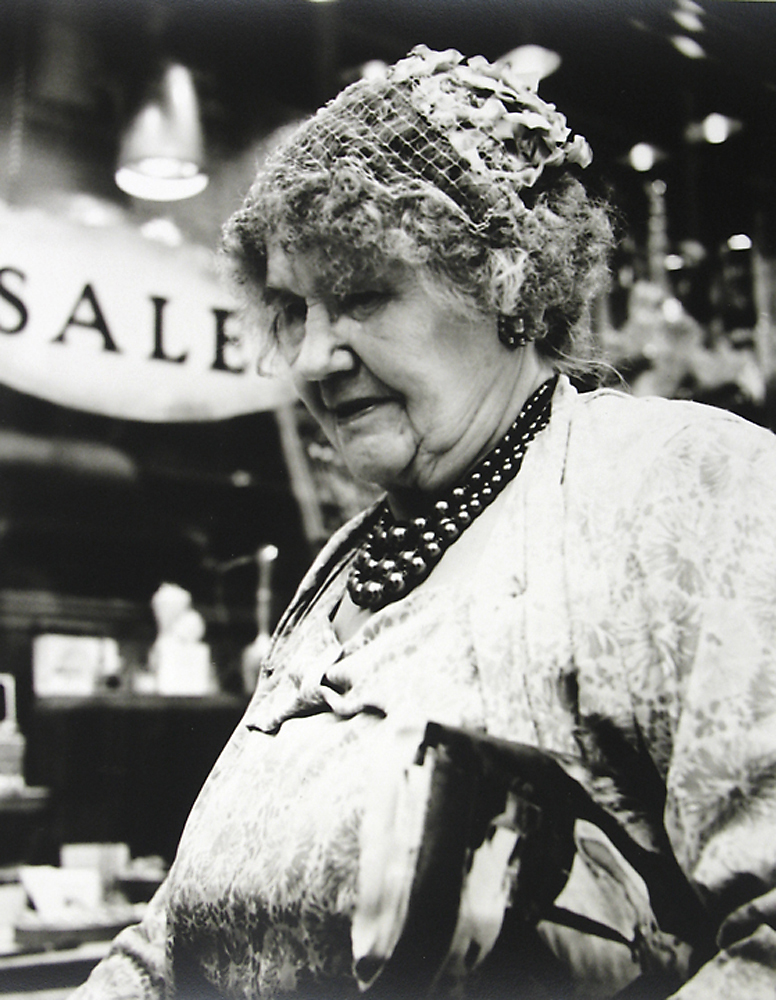
    Review: ‘Up Close: Carol Jerrems with Larry Clark, Nan Goldin and William Yang’ at Heide Museum of Modern Art, Melbourne

    Exhibition dates: 31st July – 31st October 2010


    Carol Jerrems (Australian, 1949-1980) 'Vale Street' 1975 from the exhibition 'Up Close: Carol Jerrems with Larry Clark, Nan Goldin and William Yang' at Heide Museum of Modern Art, Melbourne, July - Oct 2010


    Carol Jerrems (Australian, 1949-1980)
    Vale Street
    1975
    Gelatin silver print
    National Gallery of Australia, Canberra
    Gift of the Philip Morris Arts Grant, 1982
    © Ken Jerrems & the Estate of Lance Jerrems


    “A face tells the story of what a person is thinking. The eyes reveal the suffering.”


    Carol Jerems


    Time and Truth: Looking again at the work of Carol Jerrems

    This is a solid exhibition of the photographs of Carol Jerrems at Heide Museum of Modern Art, accompanied by small selections of the work of Larry Clark and William Yang and the sequence The Ballad of Sexual Dependency (1979) by Nan Goldin.

    I like Jerrems work: it is strong, frontal, direct and truthful. What I dislike is the hagiography that has grown up around this artist, the mythologizing of Saint Jerrems. We don’t need a saint of Australian photography; what we need is an appreciation of the artist, the person and her legacy. While the personal history of this artist is well known – facing depression, putting herself in danger, sexually active, documenting the counter-culture sharps and skinheads and urban indigenous people, the photographing of women and her death at far too young an age – few people actually look at the photographs clearly.

    Most of the photographs are 8″ x 10″ prints, mainly portraits, that are usually dark and contrasty, small and emotionally intense. Jerrems images are made full frame (the modernist conceit of filing out a negative carrier, so that if the negative was printed full frame there would be a black border around the picture) to avoid cropping in the darkroom. This shows good previsualisation by the artist, the composition of the image made at the time of the exposure. There is a closeness to the framing of the portraits and a conversant ambiguity about all of her backgrounds – mainly low depth of field, anonymous places (perhaps a brick wall or a close up of a street corner). In fact it is difficult to pin down any actual place in her photographs unless you are told in the title of the work. The contextlessness of her backgrounds allows the viewer to focus on the people placed before her lens and here Jerrems gets up close and personal, trying to capture the truth of her subjects, their soul (in this sense she is like Diane Arbus, thrusting her camera into places it was not supposed to go until something gives – the subject gives up, drops the mask, even if just for a split second, and click, the artist has their image). The mainly head and shoulders photographs of women are most impressive in this regard as Jerrems portrays the women’s strength and vulnerability as are the photographs of the artist herself in hospital fighting her debilitating illness, the most moving, emotional photographs in the exhibition.

    Other photographs show constructed intimacies between people, the camera and the artist. In Esben and Dusan, Cronulla (1977, above), Jerrems uses the yin yang black, white background to frame the two protagonists, bringing forward the body of Esben in the right portion of the frame and letting Dusan recede into the darkness. In Boys (1973) two bodies are photographed in a bed, legs and arms entwined but the print is so dark that you would never know they were two boys unless you were told – and this adds to a sense of mystery, the imaging of the most beautiful, sensitive, abstract embrace. Mark Lean with Arms Crossed (1975) shows a cocky, self-assured Lean staring directly at the camera as though it were not there, as though he were conversing directly with Jerrems, the camera an extension of the artist capturing his brave-aura: one camera, one lens, one vision. If you study the contact sheet for the photograph Vale Street (1975, above), Jerrems eventually draws the central luminous figure forward in the frame to create the now iconic image while the two acolytes hover, brooding and menacing in the darkened background.

    As Kathy Drayton has observed, “Her photographs engage the viewer in an intimate relationship with her subjects. It’s not always a friendly intimacy – sometimes her subjects look defensive, irritated or even menacing, but you always sense that you’re seeing beyond the mask into the soul.”1


    Jerrems saw herself as a serious photographer; if something happened she felt she should be commenting on it. She was also quite naive but always pushed herself and her art into sometimes dangerous places. She would have thought ‘how do I say something that is true’ and her endeavour, which is also constructed, was seeing things in terms of opportunities for a good photograph. Jerrems removed the safeguards; she got right in there among her volatile characters, her potential sexual predators: let’s just see what happens when the safety fence goes down. Although I believe there is a lack of really good photographs that Jerrems made (what I call highlight pieces, namely the iconic Vale Street, Mozart Street, and Mark and Flappers all 1975, see photographs below) there is a consistency to her work and how it exemplifies an exchange that takes place between the artist and the world. What I would call “a good deal.”

    When looking at art, one of the best experiences for me is gaining the sense that something is open before you, that wasn’t open before. I don’t mean accessible, I mean open like making a clearing in the jungle, or being able to see further up a road, or just further on. And also like an open marketplace – where there were always good trades. There is the feeling that if you put in a certain amount of honesty, then you would get something back that made some room for you in front – some room that would allow you to look forward, and maybe even walk into that space. Seeing Jerrems work gives you that feeling.

    Jerrems had the power to draw themes together, to ramp up the intensity, to empower her photographs and she was possibly on the way to becoming the things that people now say she was, but her early death curtailed this journey. Her photographs have social significance and photographic integrity and evidence time in the visible – the time in which Jerrems took them, the 1970s, and the truthfulness of her self and her style. I would have loved to have seen Jerrem’s response to the film still work of Cindy Sherman, the layering of the Sherman personas and the challenge to the feminist critique. As it is Jerrems photographs are very frontal in today’s terms and, because of her early death, she lacked the opportunity to interact with the development of more complex theories. The layers present at the time are now conflated into seemingly one layer, supported by back stories and obfuscation that clouds the work – it’s naked frontality and boldness. This obfuscation formalises her legacy into mythology.

    Jerrems work does not need this. She struggled with her art, to get the best out of herself and her visualisation, to step into those spaces that I mentioned earlier. What we need is an appreciation of the time of her endeavour and the truthfulness of her art. To say that the work achieved fulfilment is to deny the importance of her death.

    Dr Marcus Bunyan


    1/ Drayton, Kathy quoted in Wilmoth, Peter. “The ’70s stripped bare,” on The Age website. July 17th, 2005. [Online] Cited 05/10/2010


    Many thankx to Jade Enge and Heide Museum of Modern Art for allowing me publish the photographs in the posting. Please click on all of the photographs for a larger version of the image.


    Carol Jerrems. 'Mozart Street' 1975 from the exhibition 'Up Close: Carol Jerrems with Larry Clark, Nan Goldin and William Yang' at Heide Museum of Modern Art, Melbourne, July - Oct 2010


    Carol Jerrems (Australian, 1949-1980)
    Mozart Street
    1975
    Gelatin silver print
    National Gallery of Australia, Canberra
    Gift of the Philip Morris Arts Grant, 1982
    © Ken Jerrems & the Estate of Lance Jerrems


    Carol Jerrems (Australian, 1949-1980) 'Mark and Flappers' 1975


    Carol Jerrems (Australian, 1949-1980)
    Mark and Flappers
    1975
    Gelatin silver print
    National Gallery of Victoria, Melbourne
    Gift of James Mollison, 1994
    © Ken Jerrems & the Estate of Lance Jerrems


    Carol Jerrems (Australian, 1949-1980) 'Sharpies' 1976


    Carol Jerrems (Australian, 1949-1980)
    Sharpies
    1976
    Gelatin silver print
    © Ken Jerrems & the Estate of Lance Jerrems


    Carol Jerrems (Australian, 1949-1980) 'Dusan and Esben' 1977


    Carol Jerrems (Australian, 1949-1980)
    Dusan and Esben
    1977
    Gelatin silver print
    © Ken Jerrems & the Estate of Lance Jerrems


    Carol Jerrems (Australian, 1949-1980) 'Flying Dog' Nd


    Carol Jerrems (Australian, 1949-1980)
    Flying Dog
    Nd
    Gelatin silver print
    © Ken Jerrems & the Estate of Lance Jerrems


    Carol Jerrems (Australian, 1949-1980) 'Butterfly Behind Glass' 1975


    Carol Jerrems (Australian, 1949-1980)
    Butterfly Behind Glass
    1975
    Gelatin silver print
    National Gallery of Australia, Canberra
    Gift of Mrs Joy Jerrems, 1981
    © Ken Jerrems & the Estate of Lance Jerrems


    Carol Jerrems (Australian, 1949-1980) 'Evonne Goolagong, Melbourne' 1973


    Carol Jerrems (Australian, 1949-1980)
    Evonne Goolagong, Melbourne
    1973
    Gelatin silver print
    National Gallery of Australia, Canberra
    Gift of Mrs Joy Jerrems, 1981
    © Ken Jerrems & the Estate of Lance Jerrems


    Featuring the exceptional talent of four photographers whose images capture people, places and events with candid intimacy, Up Close traces the significant legacy of Australian photographer Carol Jerrems (1949-1980) alongside that of contemporary artists Larry Clark (USA), Nan Goldin (USA) and William Yang (Sydney). According to Guest Curator Natalie King, ‘Up Close takes its inspiration from the way each artist candidly depicts a social milieu and urban life of the 1970s and early 1980s’. Sharing an interest in sub-cultural groups and individuals on the margins of society, each artist reveals a remarkable capacity to provide an empathetic glimpse into semi-private worlds through intimate depictions of people and their surroundings.

    Newly discovered prints by Jerrems are included as well as rare archival material from Jerrems’ family and previously unseen out-takes from Kathy Drayton’s documentary film, ‘Girl in the Mirror.’ It is 30 years since Jerrems’ death and 20 years since the first and only survey of her work was presented. Jerrems’ photographic practice was associated with a feminist and political imperative; as she put it: ‘the society is sick and I must help change it’. This exhibition uncovers Jerrems’ preoccupation with people and their environment, subcultures, forgotten and dispossessed groups, especially Aboriginal communities of the time.

    Larry Clark unflinchingly turned the camera onto himself and his amphetamine-shooting coterie to produce Tulsa (1971), a series of photographs repeatedly cited for its raw depiction of marginalized youth. This significant publication and photographic series influenced Goldin and a generation of artists who aspired to break with the more traditional documentary modes. With its grainy shot-from-the-hip style, Tulsa exposes a world of sex, death, violence, anxiety and boredom capturing the aimlessness and ennui of teenagers.

    First shown at Frank Zappa’s birthday party in 1979 at the Mudd Club in New York, Nan Goldin’s The Ballad of Sexual Dependency has evolved to be an iconic work of its time. Goldin’s snapshot aesthetic is evident in this immersive installation of close to 700 slides full of saturated colour and intimate framing accompanied by a soundtrack. Mining the emotional depths of her friends, lovers and family, Ballad signals a riveting intimacy whilst uncovering the bohemian life of New York’s Lower East Side. Goldin says, ‘I was documenting my life. It comes directly from the snapshot, which is always about love…’

    William Yang’s photographs from the 1970s further the snapshot aesthetic through journeying into the intimate world of his particular social milieu: drag queens, Sydney gay and inner-city culture. Yang’s direct, unpretentious photographs provide a unique chronicle of marginalised groups especially as he put it: “… people who are gay, who were invisible, who were too scared to come out. During gay liberation people became visible, people became politicised, and there was a Mardi Gras that was a symbol of the movement.”

    Up Close reveals how photographic practices provide an empathetic glimpse into semi-private worlds with close up depictions of people and their surroundings.

    The accompanying publication provides for the first time an in-depth account of Carol Jerrems’ work alongside that of her peers and will feature a number of newly commissioned essays. Edited by Natalie King and co-published by Heide and Schwartz City, it will be available at the Heide Store from 31 July.”

    Press release from the Heide Museum of Modern Art website


    Carol Jerrems (Australian, 1949-1980) 'Juliet Holding Vale Street' 1976


    Carol Jerrems (Australian, 1949-1980)
    Juliet Holding Vale Street
    1976
    Gelatin silver print
    National Gallery of Australia, Canberra
    Gift of Mrs Joy Jerrems 1981
    © Ken Jerrems & the Estate of Lance Jerrems


    Carol Jerrems (Australian, 1949-1980) 'Lynn' 1976


    Carol Jerrems (Australian, 1949-1980)
    Lynn
    1976
    Gelatin silver print
    National Gallery of Australia, Canberra
    Gift of the Philip Morris Arts Grant 1982
    © Ken Jerrems & the Estate of Lance Jerrems


    Larry Clark (American, b. 1943) 'Untitled' 1979


    Larry Clark (American, b. 1943)
    Untitled
    1979
    Gelatin silver print
    National Gallery of Australia, Canberra
    Purchased 1980
    © Larry Clark
    Image courtesy of the artist and Luhring Augustine, New York


    Larry Clark (American, b. 1943) 'No Title (Billy Mann)' 1963 from the portfolio 'Tulsa'


    Larry Clark (American, b. 1943)
    No Title (Billy Mann)
    1963
    from the portfolio Tulsa
    Gelatin silver print
    National Gallery of Australia, Canberra
    Purchased 1980
    Image courtesy of the artist and Luhring Augustine, New York


    William Yang (Australian, b. 1943) 'Peter Tully, Gay & Lesbian Mardi Gras' 1981


    William Yang (Australian, b. 1943)
    Peter Tully, Gay & Lesbian Mardi Gras
    1981
    Gelatin silver print
    edition 2/10
    40.4 x 27cm
    National Library of Australia
    Courtesy of the artist


    Heide Museum of Modern Art
    7 Templestowe Road, Bulleen, Victoria 3105

    Opening hours:
    (Heide II & Heide III)
    Tues – Sun 10.00am – 5.00pm

    Heide Museum of Art website

    LIKE ART BLART ON FACEBOOK

    Back to top
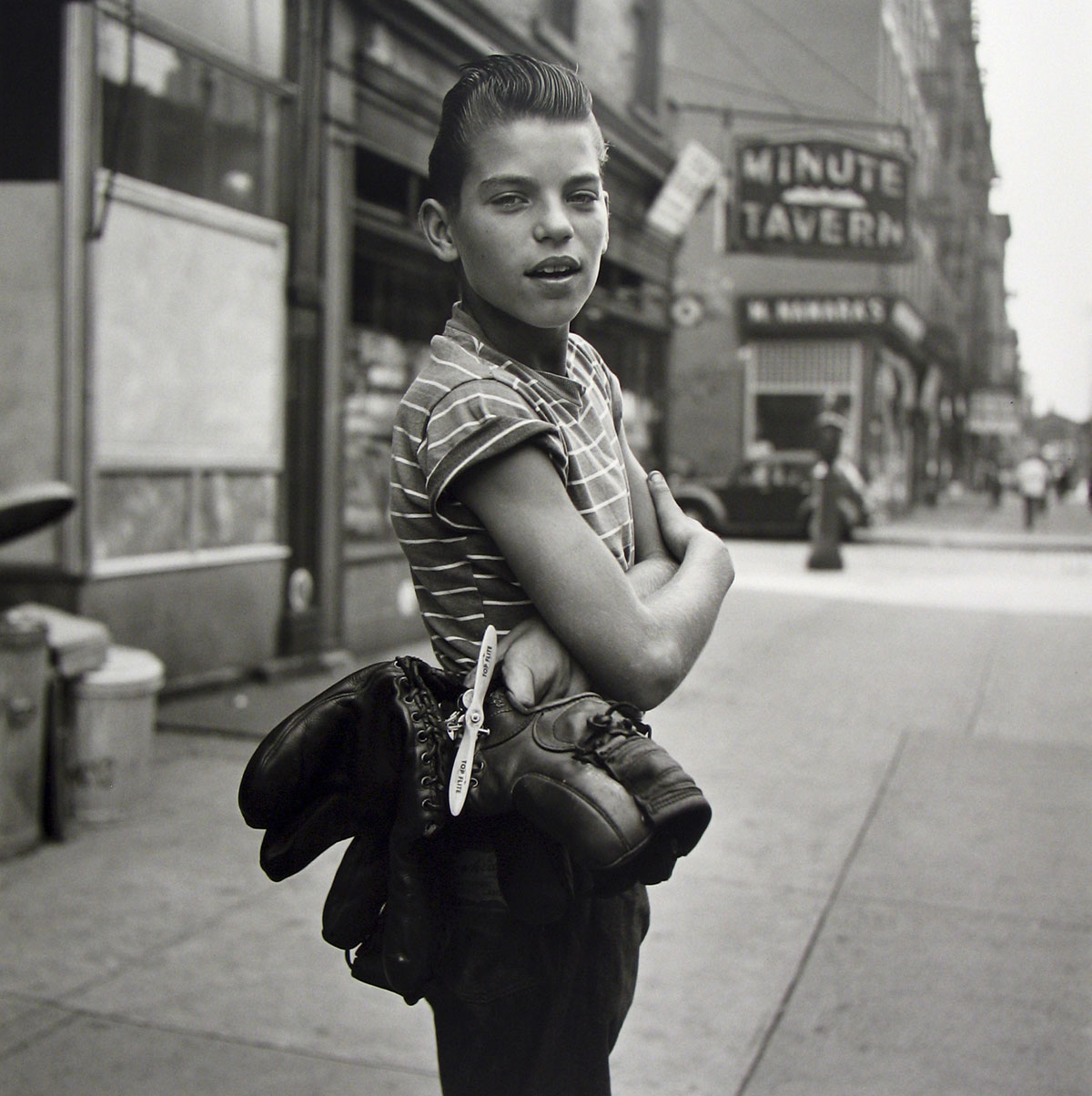
    Review: ‘A Shrine for Orpheus’ by Pip Stokes at fortyfivedownstairs, Melbourne

    Exhibition dates: 11th May – 5th June, 2010


    Installation view of the exhibition 'A Shrine for Orpheus' by Pip Stokes at fortyfivedownstairs, Melbourne

    Installation view of the exhibition 'A Shrine for Orpheus' by Pip Stokes at fortyfivedownstairs, Melbourne


    Installation views of the exhibition A Shrine for Orpheus by Pip Stokes at fortyfivedownstairs, Melbourne
    Photos: Marcus Bunyan


    Bees, books, bones… and biding (one’s) time, attaining the receptive state of being needed to contemplate this work.

    This is a strong, beautiful installation by Pip Stokes at fortyfivedownstairs that rewards such a process.

    What is memorable about the work is the physicality, the textures: the sound of the bees; the Beuy-esque yellowness and presence of the beeswax blocks; the liquidness of the honey in the bowl atop the beehives; the incinerated bones, books and personal photographs; the tain-less mirrors, the books dipped in beeswax; the votive offering of poems placed into the beehive re-inscribed by the bees themselves – and above all the luscious, warm smell of beeswax that fills the gallery (echoing Beuys concept of warmth, to extend beyond the material to encompass what he described as ‘spiritual warmth or the beginning of an evolution’).

    This alchemical installation asks the viewer to free themselves from themselves – “the moment in which he frees himself of himself and… gives the sacred to itself, to the freedom of its essence…” as Maurice Blanchot put its – a process Carl Jung called individuation, a synthesis of the Self which consists of the union of the unconscious with the conscious. Jung saw alchemy as an early form of psychoanalysis in which the alchemist tried to turn lead into gold, a metaphor for the dissolving of the Self into the prima materia and the emergence of a new Self at the end of the process, changing the mind and spirit of the Alchemist. Here the process is the same. We are invited to let go the eidetic memory of shape and form in order to approach the sacred not through ritual but through the reformation of Self.

    As Pip Stokes last few paragraphs of her artist statement succinctly observes,

    “Maurice Blanchot, has interpreted this myth as the descent of the artist to the realm of death to gain the work of art. Out of the failure of the artist, a necessary failure, emerges the artwork, wounded and bearing the ash of its origins.

    The work of mourning, the work of healing.

    Reflection, apparition, illusion: what appears as image, disappears evaporatively. As we change our place the space is already gone: the mirror holds a trace. What is veiled, enigmatic, uncertain remains as shadow that casts a light.”

    The space in which we stand falls away: the mirror may hold a trace but it is only ever a trace. Our visions elude the senses, slipping between dreaming and waking, between conscious and subconscious realms. As Orpheus turns back to look so Eurydice dissolves, “falling out of the skin into the soul.” We, the viewer, are changed.

    So far so good.

    Unfortunately what does not facilitate this engagement with change is the combined verbiage of both the artist’s statement and the catalogue essay by Lisa Jacobson. These texts, especially the latter one, with quotations by Blanchot, Rilke, Calasso, Beuys, Cocteau, Neruda, Cobb, Virgil, Rilke again, Cocteau again, Poe and Derrida and meditations on mythos, the sacred, resurrection, mourning et al are mostly unnecessary to support what is strong work – in fact they seem to put a physical, textual wall between the viewer and the work, between the installation and the proposed dissolution of Self into the sacred. The catalogue essay is confusing and needed a judicious edit with the understanding that sometimes less is more! The work needs to speak for itself, not to be didactically spoken for and knowing when to merely suggest an idea is one of the skills of good writing. Perhaps all that was needed was the quotation by Blanchot and the two paragraphs above by Pip Stokes – nothing more.

    Approaching the sacred is, I believe, and act of letting go, of aware-less-ness. As we immerse ourselves in that enigma we find that it is our fluid shadow aspect that has cast the light, with all attendant expectations, beliefs, dreams, visions, weaknesses, shortcomings, and instincts. This exhibition asks us to reconcile the journey into darkness with the hope of redemption.

    Dr Marcus Bunyan


    All photographs are installation shots of the exhibition. Please click on the photographs for a larger version of the image. All photographs courtesy of the artist and fortyfivedownstairs taken by © Marcus Bunyan who is completing an internship at the gallery.


    The Gaze of Orpheus

    Maurice Blanchot

    “The Greek myth says: one cannot create a work unless the enormous experience of the depths – an experience which the Greeks recognised as necessary to the work, an experience in which the work is put to the test by that enormousness – is not pursued for its own sake. The depth does not surrender itself face to face; it only reveals itself by concealing itself in the work. But the myth also shows that Orpheus’ destiny is not to submit to that law – and it is certainly true that by turning around to look at Eurydice, Orpheus ruins the work… and Eurydice returns to the shadows; under his gaze, the essence of the night reveals itself to be inessential. He thus betrays the work and Eurydice and the night. But if he did not turn around to look at Eurydice, he still would be betraying,… the boundless and imprudent force of his impulse, which does not demand Eurydice in her diurnal truth and her everyday charm, but in her nocturnal darkness, in her distance, her body closed, her face sealed, which wants to see her not when she is visible, but when she is invisible, and not as the intimacy of a familiar life, but as the strangeness of that which excludes all intimacy; it does not want to make her live, but to have the fullness of her death living in her.”

    “The sacred night encloses Eurydice, encloses within the song something which went beyond the song. But it is also enclosed itself: it is bound, it is the attendant, it is the sacred mastered by the power of ritual – that word which means order, rectitude, law, the way of Tao and the axis of Dharma. Orpheus gaze unties it, destroys its limits, breaks the law which contains, which retains the essence. Thus Orpheus’ gaze is … the moment in which he frees himself of himself and…, gives the sacred to itself, to the freedom of its essence…”


    Installation view of the exhibition 'A Shrine for Orpheus' by Pip Stokes at fortyfivedownstairs, Melbourne

    Installation view of the exhibition 'A Shrine for Orpheus' by Pip Stokes at fortyfivedownstairs, Melbourne


    Installation views of the exhibition A Shrine for Orpheus by Pip Stokes at fortyfivedownstairs, Melbourne
    Photos: Marcus Bunyan


    A Shrine for Orpheus

    Pip Stokes


    The first temple was made by the bees with feathers, wax and honey.

    ~ Calasso


    … it is Orpheus. His metamorphosis
    In this one and this. We should not trouble
    about other names. Once and for all
    It’s Orpheus when there’s singing.

    ~ Rilke. Sonnets to Orpheus


    We are the bees of the invisible
    We frantically plunder the visible of its honey
    To accumulate it in the great golden hive
    Of the invisible

    ~ Rilke


    In mythology, honey was regarded as a spiritual substance and the bees were godly… This belief was… influenced by the whole process of honey production as constituting a link between earthly and heavenly levels. The influx of a substance from the whole environment – plants, minerals, and sun – was the essence of the bee-cult… The whole builds a unity, … in a humane, warm way, through principles of cooperation and brotherhood.

    ~ Beuys


    This installation, A Shrine for Orpheus, comprises four hundred hand cast beeswax blocks and a traditional beebox, in use by the bees until recently, accompanied by found objects such as old mirrors as well as ephemera collected from nature including feathers, bones and the salt mummified skeleton of a rabbit. Over the past year I have worked with the living beehive, placing votive offerings associated with poetry, death and renewal into the hive: objects such as books, cast wax pages, vessels, textiles and bones. Melbourne writer, Paul Carter has engraved wax tablets with aphoristic poems to the bees. These objects have been transformed through the bees’ processes of honeycomb- building.

    The metaphors of the beehive in this connection to poetry, death and renewal are explored in the materials and structures of the installation. The warm sweet- smelling wax of the bees, cast into six sided blocks, provides the building material for the Shrine and two mausoleums, each with a void space, a space of underworld. The void of the larger mausoleum contains, ashy, burnt books, personal photos from family albums scorched by fire, evoking ‘shades’, the shadowy dead – and porcelain-like bones which have been materially transformed by cremation in a kiln. The second beeswax ‘grave’ has two voids, one of which contains a beeswax- bound and dipped facsimile of handwritten poems by Keats and, in the other opening, a book of insect morphology, also dipped and bound in beeswax.

    The traditional beebox in the centre of the ruin of the Shrine is placed on a lake of mirrors. The mirrors have lost their tain and been translucently washed with plaster of Paris to further dim our view into the obscurely reflective world that lies beneath. The Shrine is accompanied by offerings of honey, honeycomb, beeswax bound books and pages cast from beeswax awaiting new poems, laid at its entrance.

    Myths of death, dismemberment, transformation and resurrection have haunted the Western imagination from Isis to Dionysus, Orpheus and Christ. In his essay, The Gaze of Orpheus, the French literary theorist, Maurice Blanchot, has interpreted this myth as the descent of the artist to the realm of death to gain the work of art. Out of the failure of the artist, a necessary failure, emerges the artwork, wounded and bearing the ash of its origins.

    The work of mourning, the work of healing.


    Reflection, apparition, illusion: what appears as image, disappears evaporatively. As we change our place the space is already gone: the mirror holds a trace. What is veiled, enigmatic, uncertain remains as shadow that casts a light.

    The temple re admits this invisible.


    Pip Stokes. May. 2010
    A Shrine for Orpheus

    Beeswax, beehive box, mirror. Mixed media, dimensions variable.
    Original texts by Paul Carter, writer.
    Sound by Kasimir Burgess, filmmaker.


    Installation view of the exhibition 'A Shrine for Orpheus' by Pip Stokes at fortyfivedownstairs, Melbourne

    Installation view of the exhibition 'A Shrine for Orpheus' by Pip Stokes at fortyfivedownstairs, Melbourne

    Installation view of the exhibition 'A Shrine for Orpheus' by Pip Stokes at fortyfivedownstairs, Melbourne

    Installation view of the exhibition 'A Shrine for Orpheus' by Pip Stokes at fortyfivedownstairs, Melbourne


    Installation views of the exhibition A Shrine for Orpheus by Pip Stokes at fortyfivedownstairs, Melbourne
    Photos: Marcus Bunyan


    A Shrine for Orpheus

    Lisa Jacobson

    If Orpheus is guardian of the sacred arts, then it is possible that never before has there been a century so much in need of his song. This is because the world insists, on a daily basis, that we lose ourselves rather than commune with loss, to be drawn to darkness as logos rather than seek out its mythos. The myth of Orpheus has an integral role today in that it returns us and brings us back into communion with the sacred through poetry, dance, music and art.

    Pip Stokes’ most recent exhibition, A Shrine for Orpheus, provides a mythic language for the story of Orpheus. It is a contemplation of myth that reflects back on itself in an endless refraction of associations and images; a visual representation of the myth itself which is never simple or linear but, rather, layered with metaphor and re-imaginings. Stokes’ installation reveals the ways in which myth enters us, but does not belong to us. Rather, we are the conduit through which myth runs and Orpheus, indeed, does run and has run through the dreams of humankind for as long as we have been able to dream.

    This is in keeping with the Neo-Platonic notion, in which Orpheus plays no small part, that the figures of myth occupy not only the rooms of the psyche, but the rooms of other houses outside of us. It is not the artist who invents these figures of the psyche, of Orpheus and Eurydice, of Persephone and Hades, but they who reinvent themselves. The zeitgeist or midrash (as the Jewish mystics call the spirit of the times) summons up those gods it needs most. In Stokes’ work, it is Orpheus who answers this call.

    Orpheus, playing quietly on his lyre in the middle of the forest, coaxes the animals out to listen, as Rainer Maria Rilke writes in his first sonnet to Orpheus:

    “… And where there had been
    just a makeshift hut to receive the music,
    a shelter nailed up out of their darkest longing,
    with an entryway that shuddered in the wind-
    you built a temple deep inside their hearing.”


    Summoning the animals translates, perhaps, into an ecological sensibility; to hear the call of Orpheus is to answer the ecological call, to re-sacralise nature. At a time when the world seems intent on hurtling towards its own demise, A Shrine for Orpheus inclines towards meditation and the transformation of nature, the stillness of catacombs, the quietness of wax, the purposeful industry of bees and silkworms, the potential for flight, the distillation of air, the reflective gaze, the emptying out of all colour until there are only shades of white: bleached bones, wax, ash, silk and paper, feathers in contemplation of flight as if, as the poet Pablo Neruda writes, “we lived falling out of the skin into the soul.” Like the bees which flew in through the open window of Stokes’ studio to busy themselves on the beeswax, even the very act of art-making has summoned and sung up, in its own way, the problematic aspects of creation. As Jean Cocteau observes in his film, Orphée, “Look for a lifetime in mirrors and you will see Death at work, like bees in a hive of glass.”

    The music of Orpheus, as Noel Cobb has said, is “the activity of the theologos, the one who spoke with and about the Gods.” His sanctuary also encompasses poetry and art. Orpheus’ lyre has to do with both dismemberment and re-membering, god-like attributes, as Stokes alludes to in her depiction of Orpheus’ wax heart awaiting resurrection. Orpheus’ lyre was said to be strung with human sinews, and the music he plays as he sings nature and animals into being dips, inevitably, into the underworld, into death and decay, dismemberment, a scattering of the psyche into fields not yet dreamt of, in the act of its resounding. The wax which forms the foundation of Stokes’ Shrine for Orpheus, the books on which bees have fed in order to make their own inscriptions (texts by writers from Keats to the contemporary Paul Carter) also hint at resurrection and immortality. At the centre of this ‘temple’ is the beehive, symbol of transformation.

    As Virgil notes in The Georgics in a section entitled “The Peculiarly Wonderful Features of Bees”, bee stock is immortal in that the hive itself is passed on from generation to generation, the structure keeps on singing, and never really dies despite the passing of the bees who composed it. In a similar fashion, Orpheus’ own lyre is carried forth, made from the shell of a tortoise whose death made possible the music itself. The heart of Orpheus, like his own severed head in the myth, does not cease its previous musicality, the song of its rhythmic beating. So too might the artist reach down into the darkness of herself, even if she risks being torn apart, knowing that the heart remains intact and can be resurrected.

    Rilke again:

    Only the man who has also raised
    his lyre among the darkling shades
    may be allowed a sense
    of infinite praise.


    Inside the Orphic vision which Pip Stokes’ art immerses itself in, everything is panoramic and ornamented by mythic figures whom we cannot ever really know, but only glimpse via the language of metaphor: the hand that plunges through the earth while one is gathering flowers, the hem of a beekeeper’s shroud-like coat, the thin silken thread of a worm, the trace of words upon wax, or feathers, burnt books or ash. These are the images that translate the emotion of the myth but which remain, nevertheless, untranslatable because should they be hardened into the prosaic everyday language of the world, they would cease to be mythos.

    Perhaps it is for this very reason that Eurydice cannot be brought back up to the shining world of which Rilke writes, in a different poem on Orpheus, and that Orpheus himself rises into at the very moment Hermes ushers Eurydice once again below. Eurydice is too far into death to be brought back to life. She has sunk into the “dream within the dream” in which, as Edgar Allan Poe writes, we are all participants. All Orpheus can take with him is the imprint of her, the illicit gaze, the melancholic pathology of the backward glance, that perhaps was not so much hastily stolen as executed too quickly. How long must the artist gaze into the underworld? Is it ever enough? Must she not continually turn back and gaze at what cannot be brought to the surface but that she must, even so, attempt to translate? Is it this that Rilke refers to when he writes in his sonnets, “it is in overstepping that [Orpheus] obeys?” Cocteau, speaking about his film, commented that “Poets, in order to live must often die, and shed not only the red blood of their hearts, but the white blood of their souls, that flows and leaves traces which can be followed.”

    There is loss in this of course, great loss, that Stokes’ art both acknowledges and makes a place for. As Orpheus travels along “the path ascending steeply into life” towards “the shining exit-gates,” he cannot help but glance back. In the sonnets Rilke cautions, “Be ahead of all parting as though it already were / behind you.” This has echoes of Jacques Derrida’s The Work of Mourning, in which he argues that mourning begins the moment friendship begins; that we cannot enter into relationship without becoming conscious of the loss that will inevitably come with the other’s death. Indeed, the very idea of this loss precipitates the event itself, leaves us prematurely bereft and continually turning back towards the absent loved one in our grief. And if we are always turning back, is not the artist most required to do so, is not the artist most compelled to incline her head towards the darkness in order to write of what stirs beneath the shining surface of the world, of what calls to be heard? Is this not the invisible that Orpheus calls into being through poetry, music and art? Orpheus rises in Rilke’s poem, and in Pip Stokes’ work. In fact, if we dare to journey with him, he will rise in us all.


    Installation view of the exhibition 'A Shrine for Orpheus' by Pip Stokes at fortyfivedownstairs, Melbourne

    Installation view of the exhibition 'A Shrine for Orpheus' by Pip Stokes at fortyfivedownstairs, Melbourne

    Installation view of the exhibition 'A Shrine for Orpheus' by Pip Stokes at fortyfivedownstairs, Melbourne

    Installation view of the exhibition 'A Shrine for Orpheus' by Pip Stokes at fortyfivedownstairs, Melbourne


    Installation views of the exhibition A Shrine for Orpheus by Pip Stokes at fortyfivedownstairs, Melbourne
    Photos: Marcus Bunyan


    fortyfivedownstairs
    45, Flinders Lane
    Melbourne 3000

    Opening hours:
    Tuesday – Friday 12am – 6pm
    Saturday 12pm – 4pm

    fortyfive downstairs website

    LIKE ART BLART ON FACEBOOK

    Back to top
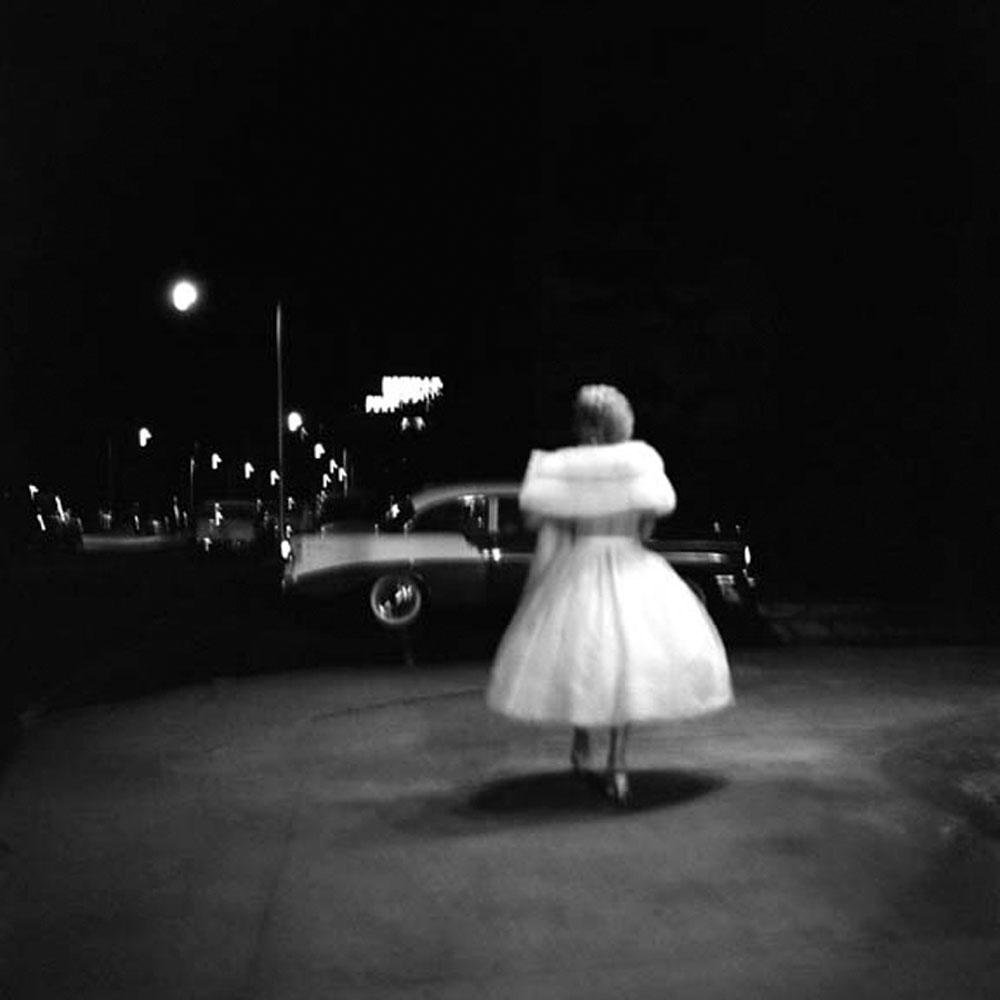
    Exhibition: ‘Playing with Pictures: The Art of Victorian Photocollage’ at The Metropolitan Museum of Art, New York

    Exhibition dates: 2nd February – 9th May, 2010


    Many thankx to the Metropolitan Museum of Art for allowing me to publish the images in this posting. Please click on the photographs for more information about the images from the Metropolitan Museum of Art.

    Dr Marcus Bunyan


    Kate Edith Gough (English, 1856-1948) 'Untitled page from the Gough Album' late 1870s from the exhibition 'Playing with Pictures: The Art of Victorian Photocollage' at The Metropolitan Museum of Art, New York, February - May, 2010


    Kate Edith Gough (English, 1856-1948)
    Untitled page from the Gough Album
    Late 1870s
    Collage of watercolour and albumen silver prints
    14 5/8 x 11 5/8 in. (37 x 29.5cm)
    V&A Images / Victoria and Albert Museum, London


    Kate Gough was one of fourteen children born to the wealthy businessman Thomas Rolls Hoare and his wife, Emma. Although the Hoares possessed neither title nor land, their vast accumulated fortune allowed them to emulate the aristocratic lifestyle, renting a Sussex estate and dividing their time between the country and the city, where they enjoyed a variety of cultural amusements. Kate read widely, from Charles Dickens to Punch magazine, while also learning such feminine accomplishments as sketching and china painting. In 1878 she met Hugh Gough, a lieutenant in the Royal Navy. The couple married in January 1879 and lived the peripatetic life that Lieutenant Gough’s service and their lack of children enabled. Gough probably assembled her album during her courtship and early years of marriage.

    A remarkable number of images found in photocollage albums combine humans and animals in fantastical ways; the temptation to cut out a photographed head and place it atop a painted animal seems to have been irresistible. This composition of ducks bearing ladies’ faces – one of them Kate herself, or her identical twin sister, Grace – may have been inspired by Charles Darwin’s new theories of evolution or by political cartoons from magazines such as Punch. On other pages of the Gough Album as well, an irreverent humor, disorienting scale shifts, mischievous visual puns, and whimsical fantasies reveal a sophisticated mind and very accomplished hand.

    Text from The Metropolitan Museum of Art website


    Frances Elizabeth, Viscountess Jocelyn (English, 1820-1880) 'Diamond Shape with Nine Studio Portraits of the Palmerston Family and a Painted Cherry Blossom Surround from the 'Jocelyn Album'' 1860s from the exhibition 'Playing with Pictures: The Art of Victorian Photocollage' at The Metropolitan Museum of Art, New York, February - May, 2010


    Frances Elizabeth, Viscountess Jocelyn (English, 1820-1880)
    Diamond Shape with Nine Studio Portraits of the Palmerston Family and a Painted Cherry Blossom Surround from the Jocelyn Album
    1860s
    Collage of watercolour and albumen silver prints
    11 x 9 1/8 in. (28 x 23.2cm)
    National Gallery of Australia, Canberra


    The daughter of the exceedingly wealthy Peter Clovering-Cowper, Earl Cowper, and the legendary society hostess Emily Lamb, Countess Cowper, Viscountess Jocelyn was born into a life of privilege and social connections. When her mother remarried after her father died, Frances (known as Fanny) became the stepdaughter of Henry Temple, Viscount Palmerston, who would become the prime minister in 1855. Fanny also garnered the favor of Queen Victoria, serving as a bridesmaid at her wedding to Prince Albert and later as a Lady of the Bedchamber. In 1841 she wed Robert, Viscount Jocelyn, and bore six children over the next decade. Her husband died in 1854, and she lost each of her children to illness before her own death in 1880.

    Unlike the other album makers in this exhibition, Jocelyn practiced amateur photography, using the wet-collodion process, a cumbersome technique that required time, money, education, and skill. A separate section of this album, entitled The Bygone Hours of the Viscountess Jocelyn, features nine photographs that she made of herself and her children in the garden of their estate. Most of the pages in the album, however, are photocollages employing amateur photographs and commercial cartes de visite in highly skilled watercolour designs that honour her aristocratic lifestyle, depicting family and friends, the estates they owned or visited, the jewellery and finery they wore, and the various pastimes they enjoyed.

    Text from The Metropolitan Museum of Art website

    The Johnstone Album represents the appropriation by the commercial printing press of an activity that was originally aristocratic and handmade. Here the grids are commercially printed and the collage maker need only paste within the shapes, offering the opportunity for those with less leisure time to create similar family albums.


    Maria Harriet Elizabeth Cator (English, d. 1881) 'Untitled page from the 'Cator' Album' late 1860s/70s from the exhibition 'Playing with Pictures: The Art of Victorian Photocollage' at The Metropolitan Museum of Art, New York, February - May, 2010


    Maria Harriet Elizabeth Cator (English, d. 1881)
    Untitled page from the Cator Album
    Late 1860s/1870s
    Collage of watercolour and albumen silver prints
    10 7/8 x 8 1/2 in. (27.7 x 21.7cm)
    Hans P. Kraus, Jr., New York


    Maria Harriet Elizabeth Cator, the likely maker of this album, filled its pages in the 1860s and 1870s with scenes of her childhood home, portraits of family members, and commemorative collages memorializing her father, who died in 1864, and a young niece who died as a child in 1866. Family mottoes and photographs of country seats belonging to relatives appear throughout the album, suggesting that it was intended more for family than for society. Set among all this seriousness, this image of a playful jester carelessly strewing photographs on the ground is surprising. Instead of serving as mementos of a loved one or records of an ancestral home, the jester’s photographs are stripped of symbolic meaning and used in the service of a lighthearted composition.

    Text from The Metropolitan Museum of Art website


    Viscount Jocelyn (Great Britain, 1820-1880) attributed to. 'Circular design containing five male studio portraits and two ships' c. 1860 from the exhibition 'Playing with Pictures: The Art of Victorian Photocollage' at The Metropolitan Museum of Art, New York, February - May, 2010


    Viscount Jocelyn (Great Britain, 1820-1880) attributed to
    Circular design containing five male studio portraits and two ships
    c. 1860
    Leaf 3 from an Untitled Album
    Collage (albumen silver photographs, water colour, pencil)
    Printed image
    28.0 h x 23.2 w cm
    Purchased 1985
    National Gallery of Canberra


    Eva Macdonald (English, 1846/50-?) "What Are Trumps?," from the 'Westmorland Album' 1869 Collage of watercolour and albumen prints The J. Paul Getty Museum, Los Angeles


    Eva Macdonald (English, 1846/1850-?)
    “What Are Trumps?,” from the Westmorland Album
    1869
    Collage of watercolour and albumen prints
    The J. Paul Getty Museum, Los Angeles


    A common leisure pastime in Victorian high society, card playing provided opportunities for socializing and flirting. Compositions involving cards are commonly found in photocollage albums, as if to emphasise the playfulness of the process of making such images. In many of these collages, photographic portraits replace the heads of kings and queens, elevating the subjects in rank and giving new meaning to the term “face cards.”

    Text from The Metropolitan Museum of Art website


    Elizabeth Pleydell-Bouverie (English, died 1889) and Jane Pleydell-Bouverie (English, died 1903) or Ellen Pleydell-Bouverie (English, 1849-?) and Janet Pleydell-Bouverie (English, 1850-1906) Untitled page from the 'Bouverie Album' 1872/77


    Elizabeth Pleydell-Bouverie (English, d. 1889) and Jane Pleydell-Bouverie (English, d. 1903) or Ellen Pleydell-Bouverie (English, 1849-?) and Janet Pleydell-Bouverie (English, 1850-1906)
    Untitled page from the Bouverie Album
    1872/1877
    Collage of watercolour and albumen prints
    Courtesy of George Eastman House, International Museum of Photography and Film


    Popular children’s tales by the Brothers Grimm, Hans Christian Anderson, and Lewis Carroll became fertile material for photocollages, including this one, which appears to relate the story of Thumbelina. Although the identity of the maker of this collection remains a mystery, the initials E.P.B. and J.P.B and the name Bouverie on various pieces suggest that it belonged to the Pleydell-Bouverie family.

    Text from The Metropolitan Museum of Art website


    In the 1860s and 1870s, long before the embrace of collage techniques by avant-garde artists of the early 20th century, aristocratic Victorian women were experimenting with photocollage. Playing with Pictures: The Art of Victorian Photocollage, on view at The Metropolitan Museum of Art February 2 – May 9, 2010, is the first exhibition to comprehensively examine this little-known phenomenon. Whimsical and fantastical Victorian photocollages, created using a combination of watercolour drawings and cut-and-pasted photographs, reveal the educated minds as well as accomplished hands of their makers. With subjects as varied as new theories of evolution, the changing role of photography, and the strict conventions of aristocratic society, the photocollages frequently debunked stuffy Victorian clichés with surreal, subversive, and funny images. Featuring 48 works from public and private collections – including many that have rarely or never been exhibited before – Playing with Pictures will provide a fascinating window into the creative possibilities of photography in the 19th century.

    “In other recent exhibitions at the Metropolitan, we’ve shown masterpieces of 19th-century British photography by the period’s most prominent professionals and serious amateurs (almost always men), whose works were often displayed at the annual salons of the photographic societies and sold by printsellers throughout England and Europe,” commented Malcolm Daniel, Curator in Charge of the Department of Photographs. “What is so exciting about this exhibition is that we see a different type of artist – almost exclusively aristocratic women – using photography in highly imaginative ways, and creating pictures meant for private pleasure rather than public consumption. It is an aspect of photography’s history that has rarely been seen or written about.”

    In England in the 1850s and 1860s, photography became remarkably popular and accessible as people posed for studio portraits and exchanged these pictures on a vast scale. The craze for cartes de visite – photographic portraits the size of a visiting card – led to the widespread hobby of collecting small photographs of family, friends, acquaintances, and celebrities in scrapbooks. Rather than simply gathering such portraits in the standard albums manufactured to hold cartes de visite, the amateur women artists who made the photocollages displayed in Playing with Pictures cut up these photographic portraits and placed them in elaborate watercolour designs in their personal albums.

    With sharp wit and dramatic shifts of scale akin to those Alice experienced in Wonderland, Victorian photocollages stand the rather serious conventions of early photography on their heads. Often, the combination of photographs with painted settings inspired dreamlike and even bizarre results: placing human heads on animal bodies; situating people in imaginary landscapes; and morphing faces into common household objects and fashionable accessories. Such albums advertised the artistic accomplishments of the aristocratic women who made them, while also serving as a form of parlour entertainment and an opportunity for conversation and flirtation with the opposite sex.

    Playing with Pictures showcases the best Victorian photocollage albums and loose pages of the 1860s and 1870s, on loan from collections across the United States, Europe, and Australia, including the Princess Alexandra Album lent by Her Majesty Queen Elizabeth II. Thirty-four photocollage album pages will be shown in frames on the wall and 11 separate albums will be displayed in cases, open to a single page. These works will be accompanied by “virtual albums” on computer monitors that allow visitors to see the full contents of the albums displayed nearby. As an introduction, the exhibition also includes two carte-de-visite albums of the period and a rare uncut sheet of carte-de-visite portraits from 1859.

    Playing with Pictures: The Art of Victorian Photocollage is curated by Elizabeth Siegel, Associate Curator of Photography at The Art Institute of Chicago. The exhibition is organised at the Metropolitan Museum by Malcolm Daniel.

    Press release from the Metropolitan Museum of Art website [Online] Cited 05/06/2010


    Women’s Work: Albums and Their Makers

    Ann Bermingham, professor, Department of the History of Art and Architecture, University of California, Santa Barbara

    Sixty years before the embrace of collage techniques by avant-garde artists of the early twentieth century, aristocratic Victorian women were already experimenting with photocollage. The compositions they made with photographs and watercolours are whimsical and fantastical, combining human heads and animal bodies, placing people into imaginary landscapes, and morphing faces into common household objects. Such images, often made for albums, reveal the educated minds as well as the accomplished hands of their makers. With sharp wit and dramatic shifts of scale akin to those Alice experienced in Wonderland, these images stand the rather serious conventions of early photography on their heads. The exhibition features forty-eight works from the 1860s and 1870s, from public and private collections.

    Text from the YouTube website


    Society Cut-ups: Victorians and the Art of Photocollage

    Elizabeth Siegel, Associate Curator of Photography, The Art Institute of Chicago

    Sixty years before the embrace of collage techniques by avant-garde artists of the early twentieth century, aristocratic Victorian women were already experimenting with photocollage. The compositions they made with photographs and watercolors are whimsical and fantastical, combining human heads and animal bodies, placing people into imaginary landscapes, and morphing faces into common household objects. Such images, often made for albums, reveal the educated minds as well as the accomplished hands of their makers. With sharp wit and dramatic shifts of scale akin to those Alice experienced in Wonderland, these images stand the rather serious conventions of early photography on their heads. The exhibition features forty-eight works from the 1860s and 1870s, from public and private collections.

    Text from the YouTube website


    Marie-Blanche-Hennelle Fournier (French, 1831-1906) Untitled page from the 'Madame B Album' 1870s


    Marie-Blanche-Hennelle Fournier (French, 1831-1906)
    Untitled page from the Madame B Album
    1870s
    Collage of watercolour, ink, and albumen silver prints
    11 1/2 x 16 1/2 in. (29.2 x 41.9cm)
    The Art Institute of Chicago, Mary and Leigh Block Endowment


    Marie-Blanche-Hennelle Fournier probably made the album from which this page was taken. Known as Blanche, she was the second wife of the career diplomat Hugues-Marie-Henri Fournier, who was posted in Stockholm and then in Rome during the years the album was made. Among the clues to the maker’s identity are the large painted B that graces the opening page, the many diplomats and Swedish figures and sites that fill the album, and the frequent depictions of the Fourniers and their daughter, Pauline (born 1855).

    Because photocollage albums were almost exclusively made by upper-class English women, this album, with its French maker, is a rare exception. Fournier, however, likely was exposed to English diplomats in the international circles in which she traveled, and she may have been inspired to create her own album after seeing other examples or learning of the practice from her English acquaintances. As the second wife of a diplomat, Fournier may have used her album to help establish herself and her family within a specific social set or to demonstrate her role as a new wife. The album may also have functioned as a sort of travelogue, depicting places she visited or was stationed with her husband. The painted elements reveal that the maker of the album was knowledgeable about the artistic styles of various cultures and skilled in botanical and zoological drawing. Together, the photographs and watercolors often combine to create daring and fantastic compositions, transcending the simple recording of friends, family, and sites.

    In the accomplished depiction of a peacock butterfly seen here, the “eye” spots on the wings have been replaced with portraits. Such a composition allowed Fournier to exhibit her artistic talents and her knowledge of natural history.

    Text from The Metropolitan Museum of Art website


    Georgina Berkeley (English, 1831-1919) Untitled page from the 'Berkeley Album' 1867/71


    Georgina Berkeley (English, 1831-1919)
    Untitled page from the Berkeley Album
    1867/71
    Collage of watercolour and albumen silver prints
    10 x 12 5/8 in. (25.5 x 32cm)
    Musée d’Orsay, Paris
    Photo credit: Réunion des Musées Nationaux / Art Resource, NY


    Despite her lack of title or inheritance, Georgina Berkeley maintained the sophisticated lifestyle that her ancestry provided. Her collages reveal her fascination with London’s urban pastimes as well as her cutting social commentary.

    Text from The Metropolitan Museum of Art website


    Georgina Berkeley (English, 1831-1919) Untitled page from the 'Berkeley Album' 1867/71


    Georgina Berkeley (English, 1831-1919)
    Untitled page from the Berkeley Album
    1867/71
    Collage of watercolour and albumen silver prints
    10 x 12 5/8 in. (25.5 x 32cm)
    Musée d’Orsay, Paris
    Photo credit: Réunion des Musées Nationaux / Art Resource, NY


    As the great-granddaughter of the 4th Earl of Berkeley, Georgina Louisa Berkeley occupied the lower echelon of aristocratic society. Despite her lack of title or inheritance, she maintained the sophisticated lifestyle that her ancestry provided. Georgina and her older sister, Alice, participated in the country-house party circuit, enjoying the hospitality of their many landed and titled relatives. Their home in London’s prestigious Belgravia district also offered them access to the city’s cultural amenities. At age forty-six, Berkeley married a man seven years her junior, Sydney Kerr Buller Atherley, the grandson of the 5th Marquess of Lothian. Sadly, Atherley died just ten months after the wedding. Rather than move back to the home of her father and sister, Georgina upheld her independence, keeping her own household and traveling with or visiting her relatives until her death in 1919.

    Berkeley began to assemble the album from which this page is drawn about a decade before her marriage, when she was in her mid-thirties. In her designs, Berkeley constructed a vision of modern life far removed from the secluded domesticity of women that was idealised by middle-class Victorian culture. Many of the pages convey a fascination with London’s cosmopolitan pastimes, depicting bustling streets, theatrical entertainments, and various modes of travel. Berkeley’s photocollages reveal how this particularly modern medium enabled upper-class album makers to represent themselves as independent, urban women.

    Text from The Metropolitan Museum of Art website


    Mary Georgiana Caroline, Lady Filmer (English, 1838-1903) Untitled loose page from the 'Filmer Album' mid-1860s


    Mary Georgiana Caroline, Lady Filmer (English, 1838-1903)
    Untitled loose page from the Filmer Album
    mid-1860s
    Collage of watercolour and albumen silver prints
    8 3/4 x 11 1/4 in. (22.2 x 28.6cm)
    Paul F. Walter


    Constance Sackville-West (English, 1846-1929) or Amy Augusta Frederica Annabella Cochrane Baillie (English, 1853-1913) Untitled page from the 'Sackville-West Album' 1867/73


    Constance Sackville-West (English, 1846-1929) or Amy Augusta Frederica Annabella Cochrane Baillie (English, 1853-1913)
    Untitled page from the Sackville-West Album
    1867/73
    Collage of watercolour and albumen silver prints
    9 5/8 x 11 13/16 in. (24.5 x 30cm)
    Courtesy of George Eastman House, International Museum of Photography and Film


    This album’s scenes of country-house life and London cosmopolitanism provide tongue-in-cheek commentary regarding the aristocratic society in which the Cochrane-Baille sisters grew up. The album contains a variety of styles suggesting more than one artist. Constance Sackville-West or Amy Augusta Frederica Annabella Cochrane-Baillie.

    Text from The Metropolitan Museum of Art website


    Metropolitan Museum of Art
    1000 Fifth Avenue at 82nd Street
    New York, New York 10028-0198
    Information: 212-535-7710

    Opening hours:
    Sunday – Tuesday and Thursday: 10am – 5pm
    Friday and Saturday: 10am – 9pm
    Closed Wednesday

    Metropolitan Museum of Art website

    LIKE ART BLART ON FACEBOOK

    Back to top

    Exhibition: ‘The Eventuality of Daybreak’ by Alex Lukas at Glowlab, New York

    Exhibition dates: 12th November – 6th December 2009


    Alex Lukas (American, b. 1981) 'Untitled' 2009. Acrylic and silk screen on two book pages from the exhibition 'The Eventuality of Daybreak' at Glowlab, New York, Nov - Dec, 2009


    Alex Lukas (American, b. 1981)
    Untitled
    2009
    Acrylic and silk screen on two book pages


    These are terrific – I want one!

    A big thank you to Alex for allowing me to reproduce the images.

    Dr Marcus Bunyan


    Please click on the photographs for a larger version of the image.


    Alex Lukas (American, b. 1981) 'Untitled' 2009. Acrylic and silk screen on two book pages from the exhibition 'The Eventuality of Daybreak' at Glowlab, New York, Nov - Dec, 2009


    Alex Lukas (American, b. 1981)
    Untitled
    2009
    Acrylic and silk screen on two book pages


    Glowlab is pleased to present The Eventuality of Daybreak, a solo exhibition by Alex Lukas featuring a new series of post-apocalyptic urban landscapes that blur the visual boundaries of fiction and reality.

    Lukas’ work explores the existence of disaster, be it realised or fictitious, in contemporary society. Hyper-realistic motion pictures and unforgiving news footage depict seemingly identical – and equally riveting – facades of tragedy. The artist recognises that relentless visual bombardment has resulted in society’s desensitisation to the aesthetics of destruction.

    For The Eventuality of Daybreak, Lukas has selected photographic spreads of well-known metropolises from vintage publications and uses them dually as canvas and unlikely subject. Through a deft handling of paint and carefully placed screen-printed passages, the artist pushes these ageing illustrations in futuristic contexts. Submerging these cities conceptually and physically, Lukas inundates images of American cities with layers of media representing cataclysmic floods and crippling overgrowth.

    Also included in the exhibition are works on paper depicting near-future scenes of devastated landscapes – crumbling infrastructure, overturned trucks and telling signs of human despair. As a counterpoint to the underwater cities, these darkly atmospheric and barren vistas signal devastation through an unsettling sense of absence.

    Lukas’ intentional use of dated imagery presented in tandem with contemporary situations forces the viewer to reconcile two differing ideologies of urban space. The artist’s work calls into question society’s collective acceptance of the urban environment as an arena of destruction, once thought unthinkable and now seemingly inevitable.

    The Eventuality of Daybreak is Lukas’ first solo exhibition with Glowlab. Lukas’ work has also been exhibited in New York, Boston, Philadelphia, Los Angeles, San Francisco, London, Stockholm and Copenhagen as well as in the pages of Swindle Quarterly, Proximity Magazine, The San Francisco Chronicle, The Village Voice, The Drama and The New York Times Book Review. Lukas is a graduate of the Rhode Island School of Design and currently lives and works in Philadelphia, where he is a member of the artist collective Space 1026.

    Press release on the Glowlab website [Online] Cited 20/11/2009 no longer available online


    Alex Lukas (American, b. 1981) 'Untitled' 2009. Acrylic and silk screen on two book pages


    Alex Lukas (American, b. 1981)
    Untitled
    2009
    Acrylic and silk screen on two book pages


    Alex Lukas (American, b. 1981) 'Untitled' 2009. Acrylic and silk screen on two book pages


    Alex Lukas (American, b. 1981)
    Untitled
    2009
    Acrylic and silk screen on two book pages


    Alex Lukas (American, b. 1981) 'Untitled' 2009. Acrylic and silk screen on two book pages


    Alex Lukas (American, b. 1981)
    Untitled
    2009
    Acrylic and silk screen on two book pages


    Alex Lukas. 'Untitled' 2009. Acrylic and silk screen on two book pages


    Alex Lukas (American, b. 1981)
    Untitled
    2009
    Acrylic and silk screen on two book pages


    Glowlab

    This gallery has now closed

    Alex Lukas website

    LIKE ART BLART ON FACEBOOK

    Back to top