Exhibition: ‘Colour my world: handcoloured Australian photography’ at the National Gallery of Australia, Canberra

Exhibition dates: 3rd April – 30th September, 2015

Co-curators: Anne O’Hehir, Curator of Photography and Dr. Shaune Lakin, Senior Curator of Photography at the National Gallery of Australia


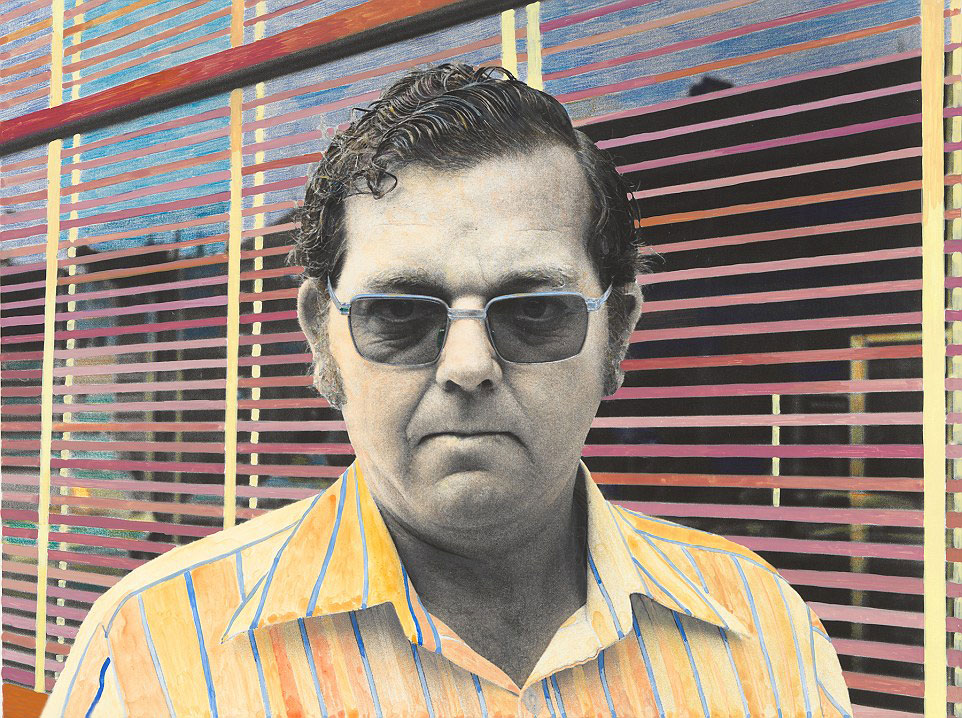
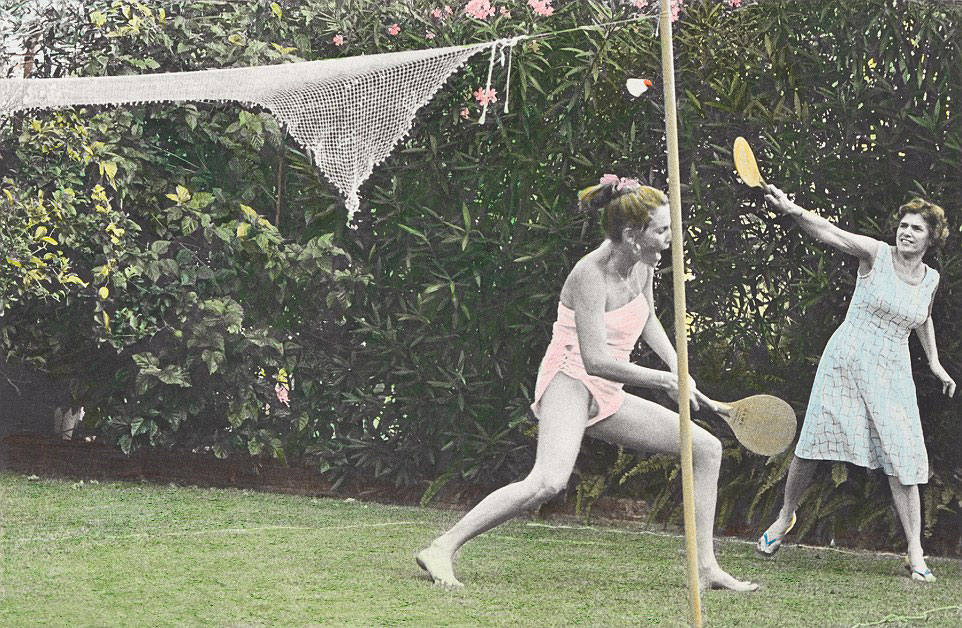
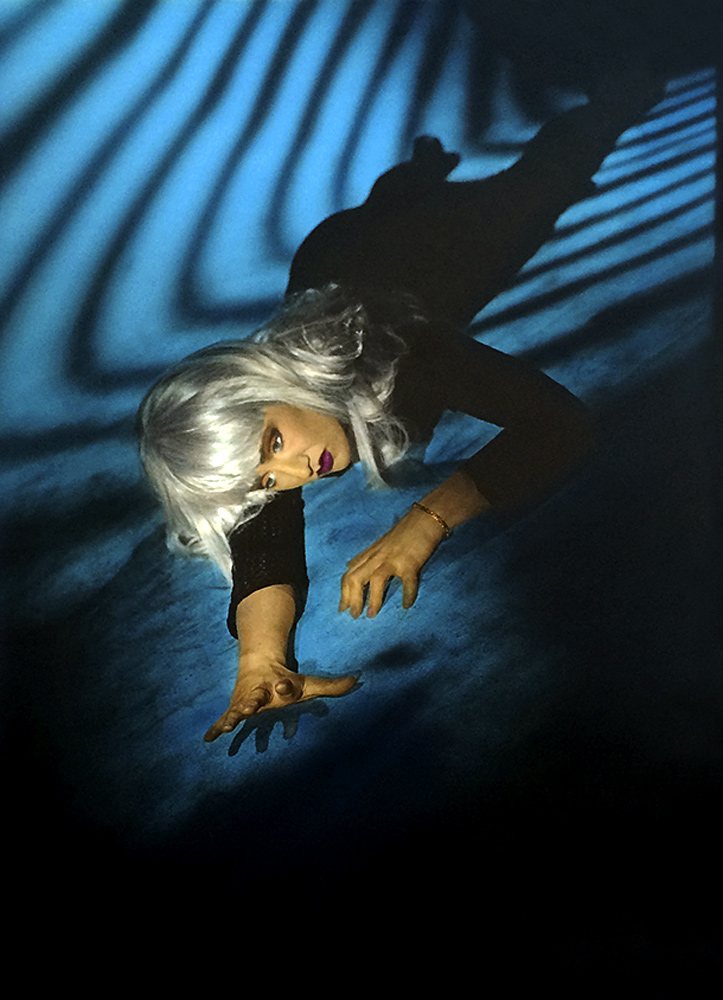
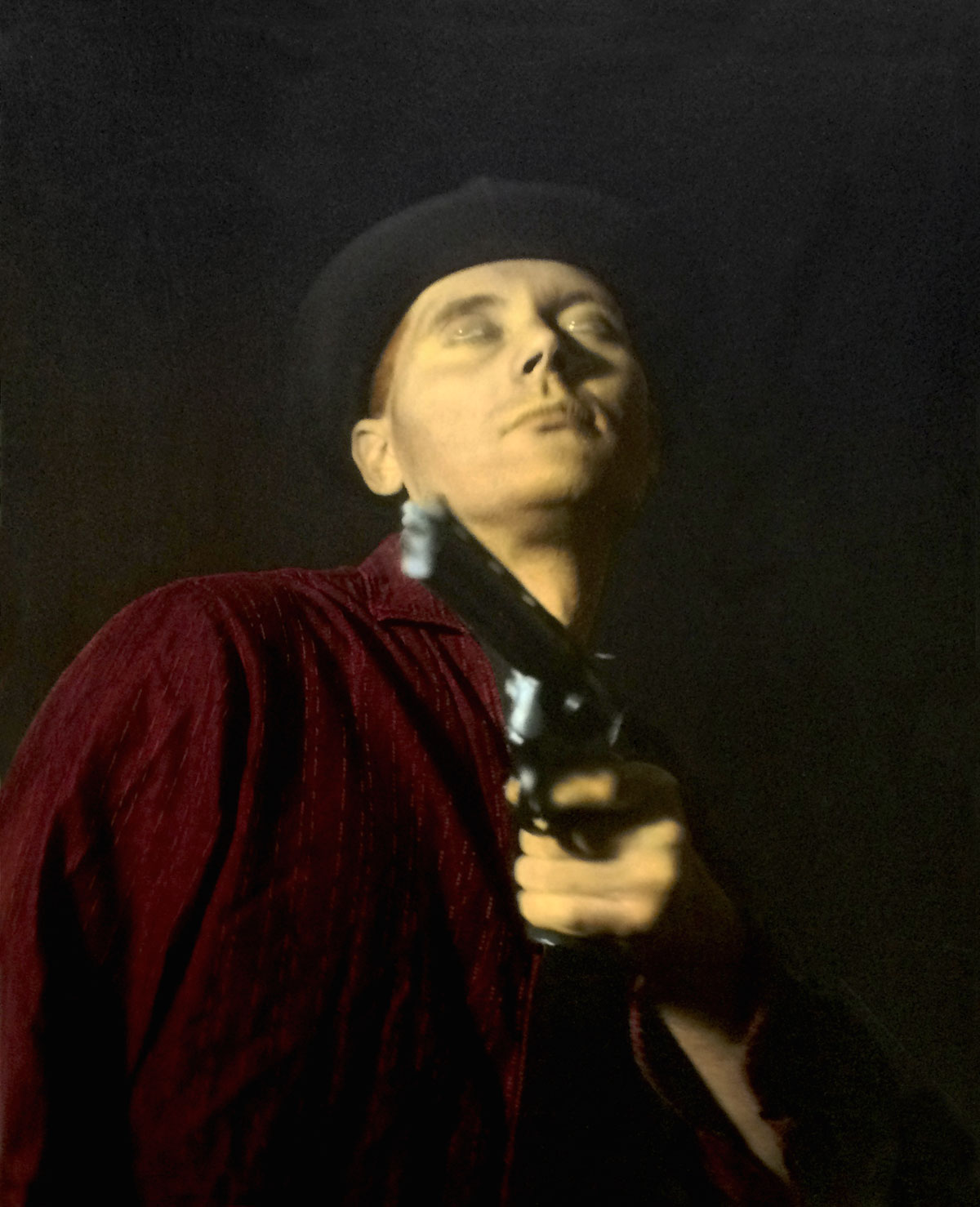
Micky Allan (Australian, b. 1944) 'The prime of life no. 7 (man wearing sun glasses)' 1979


Micky Allan (Australian, b. 1944)
The prime of life no.7 (man wearing sun glasses)
1979
From a series of 12 hand coloured photographs Mountain Lagoon, Sydney Blue Mountains, New South Wales 1979
Gelatin silver photograph, hand-coloured in pencil, colour pencils, watercolour and gouache
32.0 x 42.7cm
National Gallery of Australia, Canberra, purchased 1981
© Micky Allan


There has always been a history of hand colouring in photography since its very early days – from daguerreotypes, through ambrotypes, cartes de visite, cabinet cards and on to commercial portrait photography from the 1920s-1960s. But I don’t believe there has ever been, in the history of photography, such a concentration of artists (mainly female) hand colouring photographs as in Australia in the 1970s-80s. If I know my history of photography, I would say that this phenomena is unique in its history. It did not occur in Japan, Europe or America at the same time.

The reasons for this explosion of hand colouring in Australia are many and varied. Most of the artist’s knew each other, or knew of each other’s work on the East coast of Australia, and it was a small, tight circle of artists that produced these beautiful photographs. Not many artists were “doing” traditional colour photography, basically because of the instability of the materials (you only have to look at the faded colour photographs of John Cato in the National Gallery of Victoria’s collection) and the cost of the process. Of course feminism was a big influence in Australia at this time but these photographs, represented in this posting by the work of Micky Allan and Ruth Maddison, are so much more than photographs about female emancipation.

Photography in Australia was moving away from commercial studios such as that of Athol Shmith and into art schools and university courses, where there was a cross-over between different disciplines. Most artists had darkrooms in their bathroom or outhouses, or darkrooms were in basements of university buildings.

Speaking to artist Micky Allan, she said that these were exciting times. Allan had trained as a painter and brought these skills to the processes of photography. She observes, “There was an affinity to what you were doing, an immediacy of engagement. Taking photographs, the physicality of the print, their magnificent tonal range – which painting could not match – and then hand colouring the resultant prints, a hands on process that turned the images into something else, something different.”

There was a cavalier approach to the process but also a learning atmosphere as well. So it was about doing anything that you wanted, you just had to do it.

Sue Ford was a big influence, in that she started working in series of work, not just the monolithic, singular fine art print. Perhaps as a reaction against the Americanisation of photography, these artists used vernacular photographs of people and places to investigate ways of being in the world.

As Micky Allan observes, “My photography of babies and old people were more than being about domesticity, they were about what babies know when they arrive in the world, and how people react to ageing.” (For examples of Allan’s babies and old people photographs please see the exhibition Photography meets Feminism: Australian Women Photographer 1970s-80s).

There was a connection to the print through the physicality of the process of printing and then hand colouring – a double dealing if you like – that emphasised the ordinary can be extraordinary, a process that changed one representation into another. And the results could be subtle (as in the delicate work of Janina Green) or they could be surreal, such as Allan’s The prime of life no.7 (man wearing sun glasses) (1979, below), or they could be both. But they were always stunningly beautiful.

This was a very hands on process, an observation confirmed by artist Ruth Maddison. “The process was like hand watering your garden, an intense exchange and engagement with the object. When I started I was completely untrained, but I loved the process. I just experimented in order to understand what medium does what on what paper surface. There was the beauty of its object and its physicality. I just loved the object.”

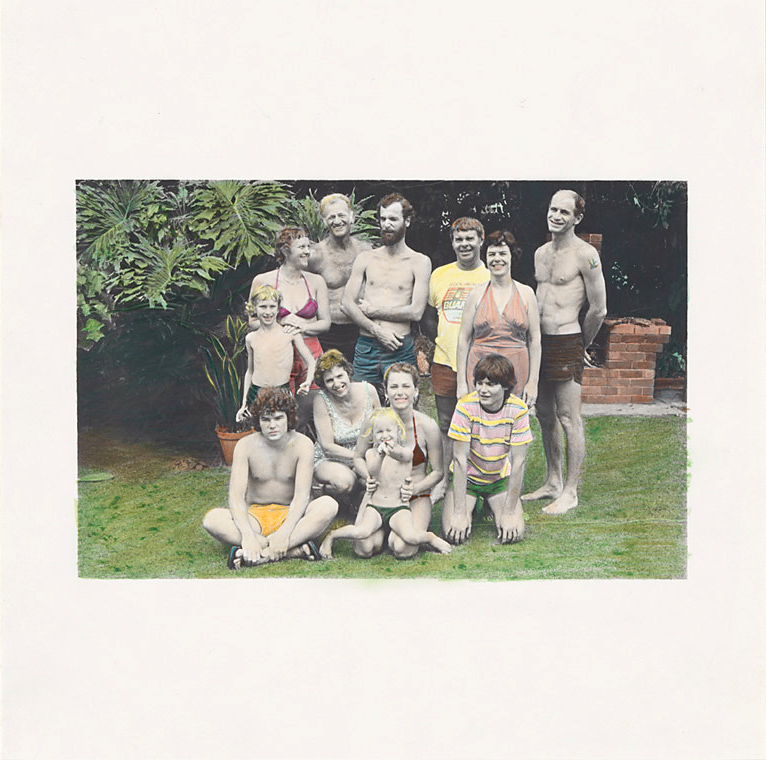
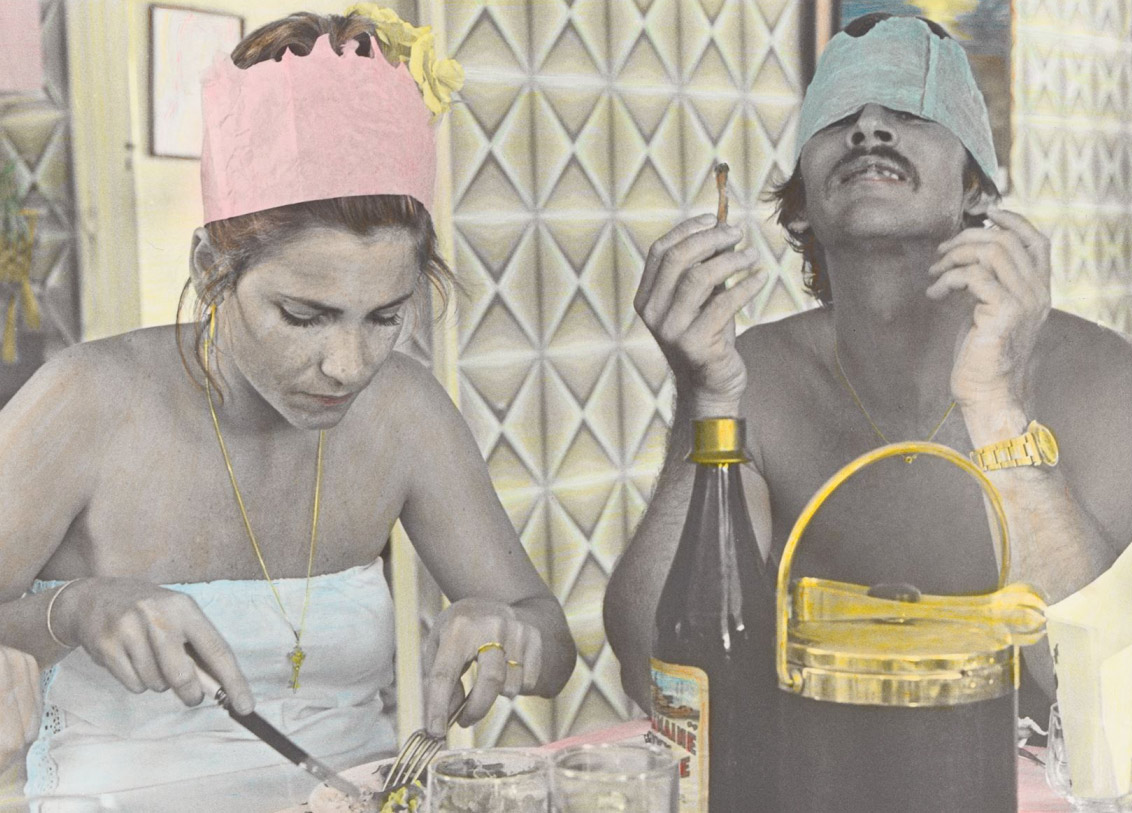
Her series Christmas holiday with Bob’s family, Mermaid Beach, Queensland (1977/78, below), photographed over Christmas Day and several days afterwards, evidences this magical transformation. Vernacular photographs of a typical Australia Christmas holiday become something else, transformed into beautiful, atypical representations of family, friendship, celebration and life.

So there we have it: domesticity, family, friends, place, being in the world, feminism, craft, experimentation, surrealism, physicality of the object, beauty, representation, series of work and difference… a communion (is that the right word?) of intimate thoughts and feelings, especially on a spiritual level (although the artists would probably deny it) that changed how the they saw, and we see the world. Can you imagine how fresh and alive these images would have been in 1970s Australia?

That they still retain that wonder is testament to the sensitivity of the artists, the tactility of the process and our responsiveness to that sense of touch.

Dr Marcus Bunyan


Many thankx to the National Gallery of Australia for allowing me to publish the photographs in the posting. Please click on the photographs for a larger version of the image.


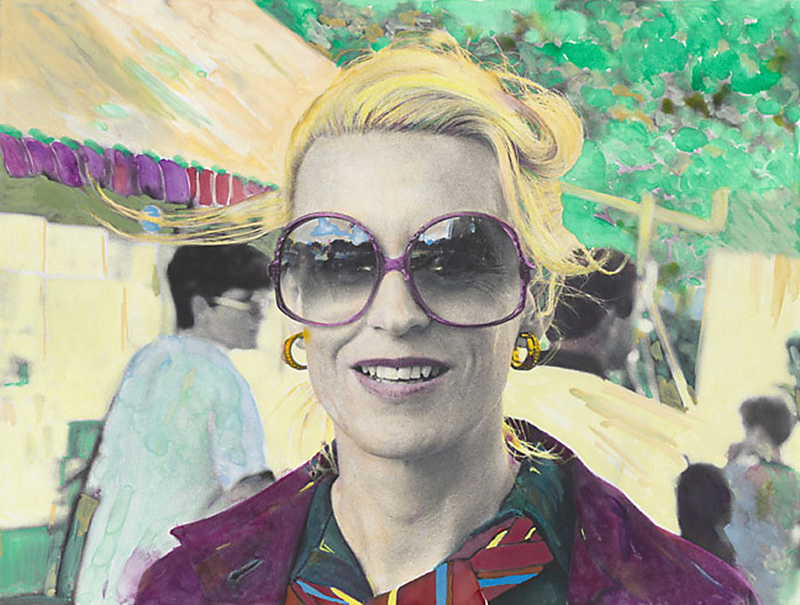
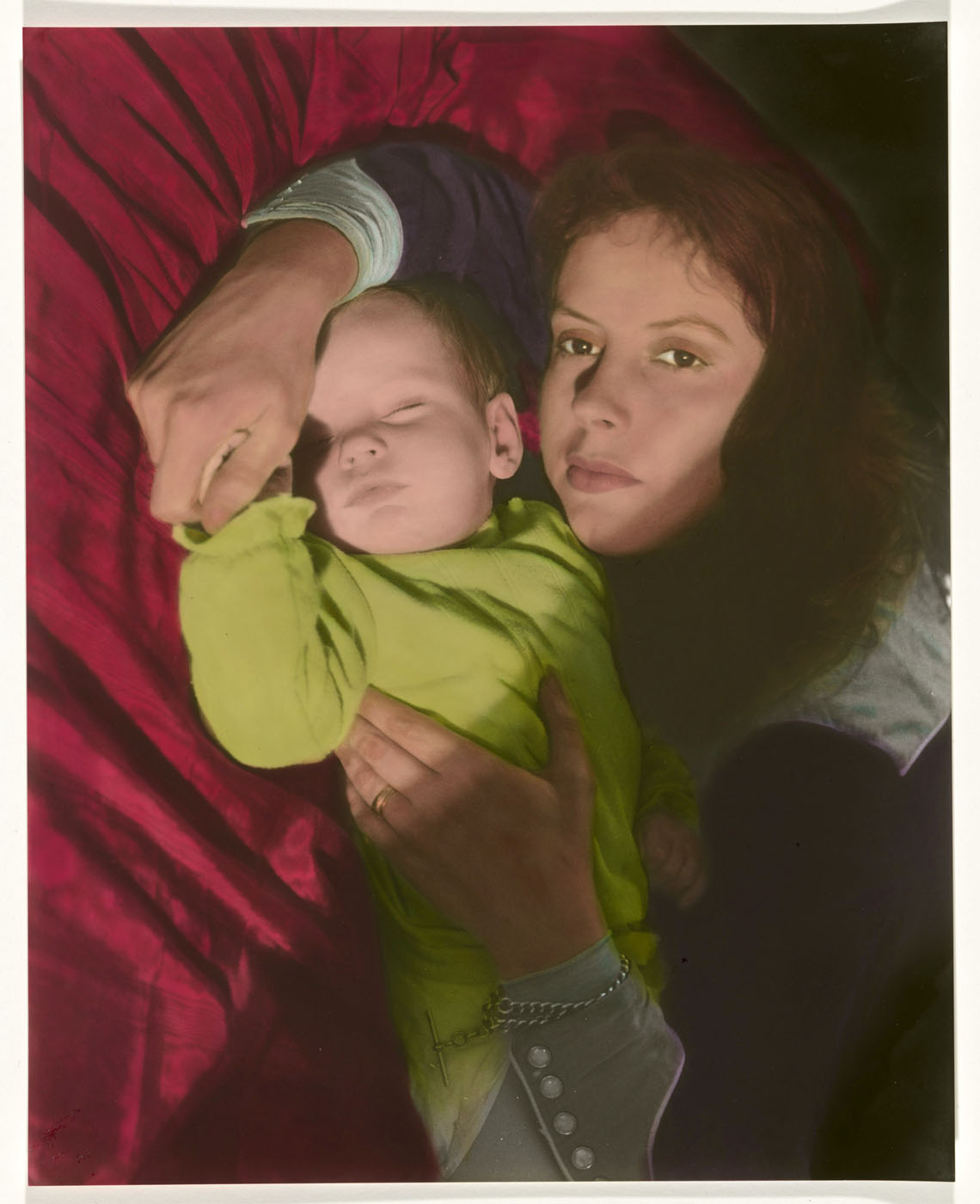
Micky Allan (Australian, b. 1944) 'The prime of life no.3 (blond woman wearing sun glasses)' 1979 from the exhibition 'Colour my world: handcoloured Australian photography' at the National Gallery of Australia, Canberra, April - Sept, 2015


Micky Allan (Australian, b. 1944)
The prime of life no.3 (blond woman wearing sun glasses)
1979
From a series of 12 hand coloured photographs Mountain Lagoon, Sydney Blue Mountains, New South Wales 1979
Gelatin silver photograph, hand-coloured in pencil and watercolour
National Gallery of Aus


Ruth Maddison (Australian, b. 1945) 'Christmas holiday with Bob's family, Mermaid Beach, Queensland' 1977/78 from the exhibition 'Colour my world: handcoloured Australian photography' at the National Gallery of Australia, Canberra, April - Sept, 2015


Ruth Maddison (Australian, b. 1945)
Christmas holiday with Bob’s family, Mermaid Beach, Queensland
1977-1978
Gelatin silver photographs, colour dyes, hand-coloured
10.6 x 16.2cm
National Gallery of Australia, Canberra, purchased 1988


Ruth Maddison (Australian, b. 1945) 'Christmas holiday with Bob's family, Mermaid Beach, Queensland' 1977/78
Ruth Maddison (Australian, b. 1945)
'Christmas holiday with Bob's family, Mermaid Beach, Queensland'
1977-1978


Ruth Maddison (Australian, b. 1945)
Christmas holiday with Bob’s family, Mermaid Beach, Queensland
1977-1978
Gelatin silver photographs, colour dyes, hand-coloured
10.6 x 16.2cm
National Gallery of Australia, Canberra, purchased 1988


Ruth Maddison (Australian, b. 1945) 'Christmas holiday with Bob's family, Mermaid Beach, Queensland' 1977/78


Ruth Maddison (Australian, b. 1945)
Christmas holiday with Bob’s family, Mermaid Beach, Queensland
1977-1978
Gelatin silver photograph, colour pencils, fibre-tipped pen
10.6 x 16.2cm
National Gallery of Australia, Canberra, purchased 1988


Ruth Maddison (Australian, b. 1945) 'Christmas holiday with Bob's family, Mermaid Beach, Queensland' 1977/78


Ruth Maddison (Australian, b. 1945)
Christmas holiday with Bob’s family, Mermaid Beach, Queensland
1977-1978
Gelatin silver photographs, colour dyes, hand-coloured
10.6 x 16.2cm
National Gallery of Australia, Canberra, purchased 1988


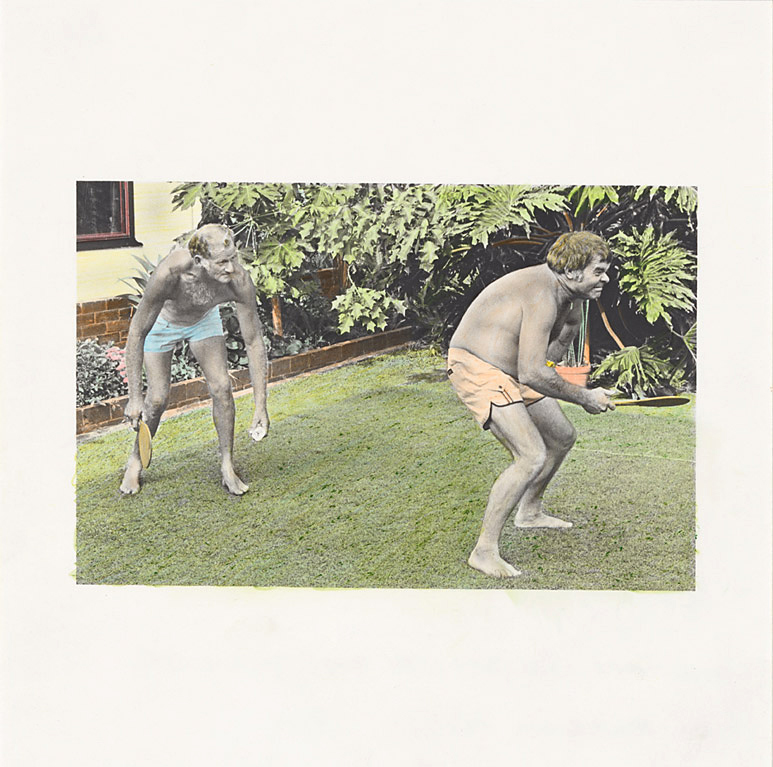
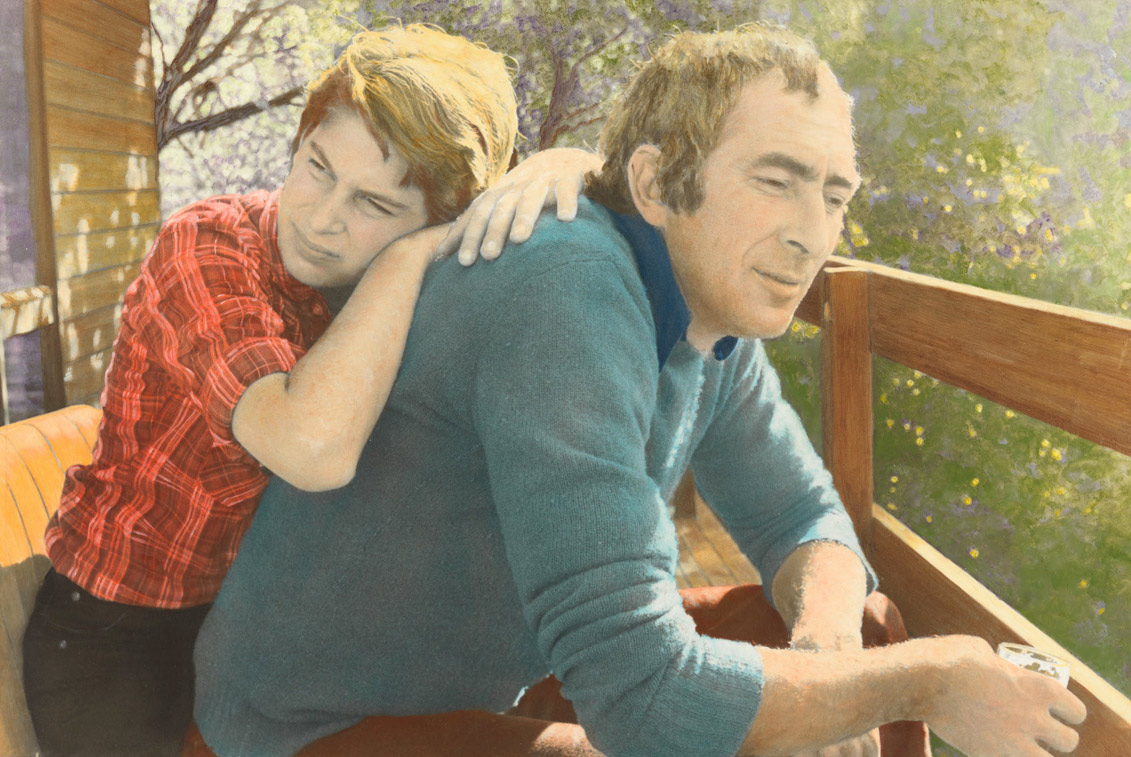
Ruth Maddison (Australian, b. 1945) 'Jesse and Roger' 1983


Ruth Maddison (Australian, b. 1945)
Jesse and Roger
1983
From the series Some men
Gelatin silver photograph, colour pigments, hand-coloured
National Gallery of Australia, Canberra, purchased 1983


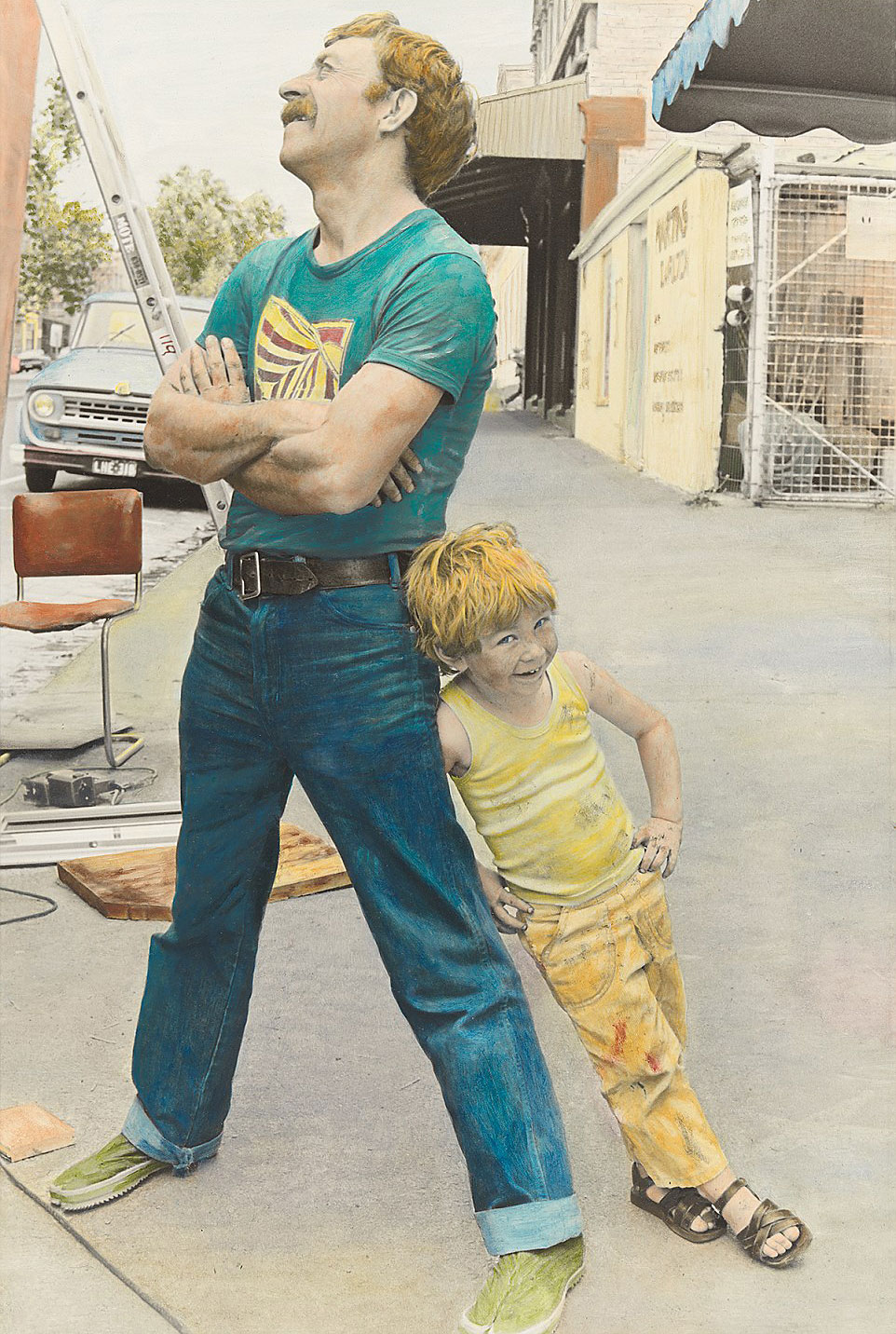
Ruth Maddison (Australian, b. 1945) 'Jim and Gerry' 1983


Ruth Maddison (Australian, b. 1945)
Jim and Gerry
1983
From the series Some men
Gelatin silver photograph, colour pigments, hand-coloured
39.6 x 26.5cm
National Gallery of Australia, Canberra, purchased 1983


Colour my world

Introduction

This is the first exhibition dedicated to a significant aspect of recent Australian art: the handcoloured photograph. It draws together new acquisitions and rarely seen works from the collection by Micky Allan, Ruth Maddison, Warren Breninger, Julie Rrap, Janina Green, Christine Barry, Fiona Hall, Miriam Stannage, Robyn Stacey, Nici Cumpston, Lyndell Brown, Charles Green and Jon Cattapan.

The handcolouring of images has a long history in photography. During the infancy of the medium in the mid nineteenth century, the practice of applying paint, dye or other media to a photograph added both lifelike colour to black-and-white pictures and longevity to images that faded quickly. Throughout the nineteenth and early twentieth centuries, handcolouring added economic value and artistic sensibility or corrected photographic mistakes. But, by the middle of the twentieth century, the practice had gone into decline, as photographers sought to maintain and fortify the virtuosity and technical purity of the modernist photographic print.

The 1970s saw a revival of handcolouring among a number of Australian photographers and it remains a significant aspect of contemporary practice. The artists included in this exhibition seek to create a direct connection between their experience and that of the viewer. They challenge the medium’s technical sameness by personalising the print and imbuing it with individuality and uniqueness as well as an intimacy, warmth and fallibility.

Challenging conventions

During much of the twentieth century, photography tended to engage with the medium’s technical integrity. Rhetoric about black-and-white photography’s very particular, direct relationship to the world, its technological origins and its highly idiosyncratic capacity to see the world in new ways positioned it in a conceptual space distinct from other kinds of pictures. With notable exceptions, those who dominated the scene worked in black and white. Colour photography (which was expensive) tended to belong to and be associated with the commercial realms of advertising and fashion.

In this climate, to bring colour into the image through handcolouring was an act of resistance. Anyone who took to their prints with colour pencils and brushes, in effect, disputed the so-called authority of black-and-white photography. And many did just this. For feminist photographers, handcolouring acknowledged the under-recognised history of women’s photographic work by remembering the women who were historically employed by studios as handcolourists.

Colouring by hand personalised the print, itself the product of technological processes, arcane knowledge and chemistry. The handcoloured photograph also created community: it engaged a direct connection between the photographer and his or her subjects, the sensual surface of the print and the viewer, a set of relationships staged and made manifest in the experience of the work itself.

Aesthetics of handcoloured photography

While the disrupted surface of the handcoloured photograph may well have challenged the conventions of ‘classic’ photography during the 1970s, it became one of a set of tools used by artists during the 1980s to explore the medium as a studio practice and to interrogate the conventions of authorship and photographic transparency that had supported modernist photographic practice.

Artists such as Julie Rrap, Fiona Hall and Robyn Stacey created handmade work that presented highly personalised responses to some of the grand themes of Western art and culture. Hall tackled one of Western mythology’s points of origin, the Garden of Eden, in a series of hand-toned pictures that replaced pathos and grand narrative with irony and, through daubs of sepia, the patina of historical significance. Rrap took on art history’s archetypes of femininity and made them her own, while Stacey handcoloured photographs to modify many of the myths of popular culture and Australian history. Rrap’s and Stacey’s handcoloured originals were then rephotographed and printed in colour. By doing so, the works shifted from being unique prints – with references to the handmade, the artist’s studio and the careful rendering of places and times – to being images that resembled those found in the mass media.

Reconnecting with history and objects

Associated with the rapidly expanding use of digital photography in the 1990s and perhaps in response to the immateriality of photography today (images are now mostly taken, stored and shared electronically), we have seen a reconnection with the medium’s history and a return to the photographic object in contemporary practice. Handcolouring draws our attention to materiality and re-introduces tactility to the photographic experience. It also engages community in a very particular way, establishing social ties between makers and between artists and viewers. Handcolouring demonstrates that even though digitisation has impacted significantly on the accessibility and scale of contemporary practice, many of photography’s rituals, motivations and pleasures remain the same.

For the artists included in this exhibition, handcolouring connects them to the history of photography in strategic ways. Nici Cumpston handcolours large-scale landscapes of the Murray-Darling river system as a way of documenting traces of Indigenous occupation and use and of bringing to our attention the decline of the area’s delicately balanced ecosystems. The handcoloured works of collaborators Charles Green, Lyndell Brown and Jon Cattapan remind us that an essential part of the experience of photography has always been the embodied, social experience of it. For Janina Green, the act of handcolouring prints allows her to engage with and remember the medium’s history of cross-cultural innovation.

Wall text (same text on the website)


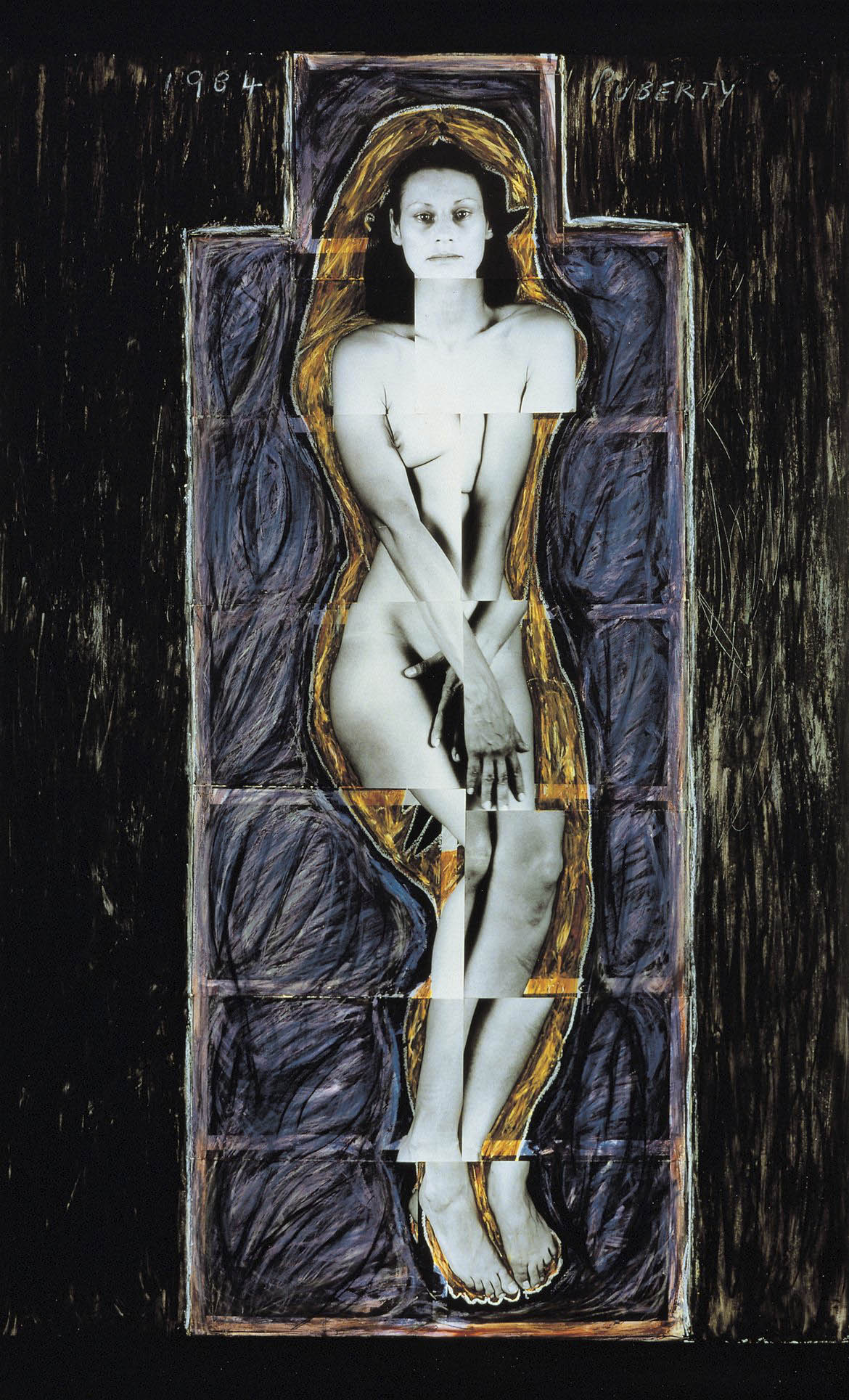
Julie Rrap (born Lismore, New South Wales 1950; lives and works Sydney) 'Puberty' 1984


Julie Rrap (born Lismore, New South Wales 1950; lives and works Sydney)
Puberty
1984
From the series Persona and shadow
Direct positive colour photograph
National Gallery of Australia, Canberra
Kodak (Australasia) Pty Ltd Fund 1984


This photograph is from the series of nine works titled Persona and shadow. Julie Rrap produced this series after visiting a major survey of contemporary art in Berlin (Zeitgeist, 1982) which only included one woman among the 45 artists participating in the exhibition. Rrap responded to this curatorial sexism with a series of self-portraits in which she mimics stereotypical images of women painted by the Norwegian artist Edvard Munch (1863-1944). Each pose refers to a female stereotype employed by Munch: the innocent girl, the mother, the whore, the Madonna, the sister, and so on.

Appropriating the work of other artists is one of the strategies that characterises the work of so-called ‘postmodern’ artists active during the 1980s. The practice of borrowing, quoting and mimicking famous artworks was employed as a way of questioning notions of authenticity. Feminist artists tended to use appropriation to specifically question the authenticity of male representations of females. In more straightforward terms, Rrap reclaims Munch’s clichéd images of women and makes them her own. Rrap ultimately becomes an imposter, stealing her way into these masterpieces of art history, but the remarkable thing about these works is the way that the artist foregrounds the process of reappropriation itself. The procedure of restaging, collage, overpainting, and rephotographing becomes part of the final image, testifying to a do-it-herself politic.


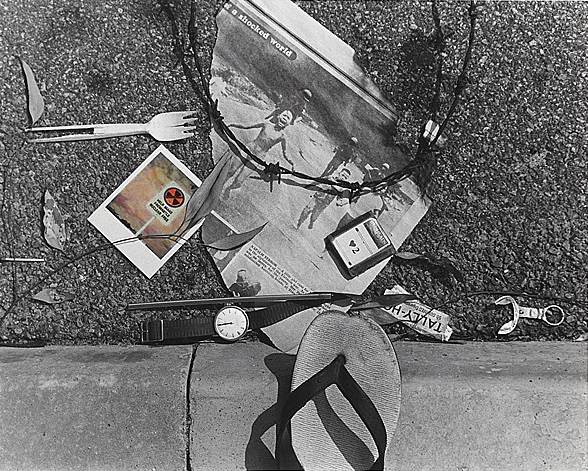
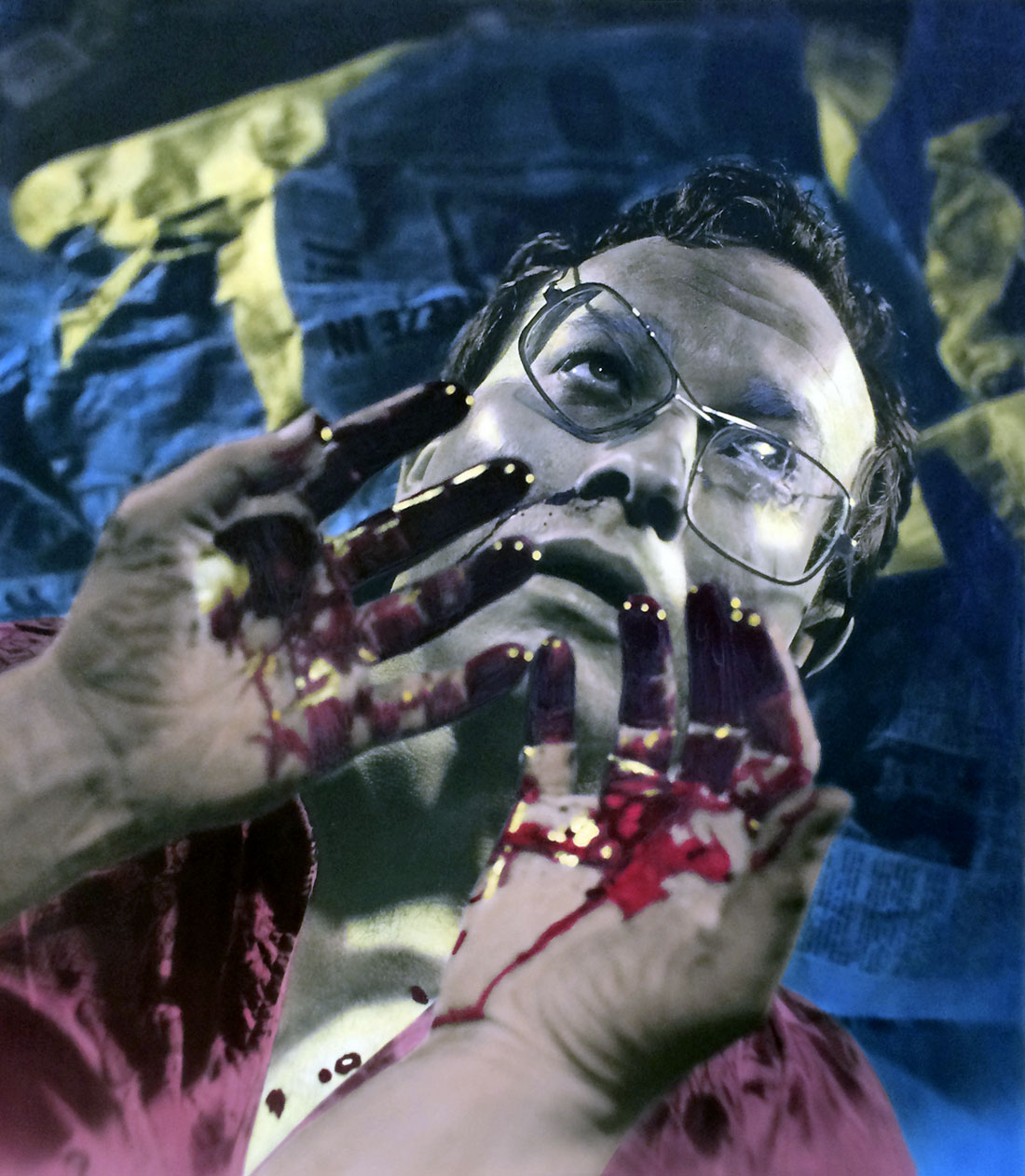
Miriam Stannage (Australian, 1939-2016) 'The flood' from the series 'News from the street' 1984


Miriam Stannage (Australian, 1939-2016)
The flood from the series News from the street
1984
Gelatin silver photograph, colour dye
National Gallery of Australia, Canberra, purchased 1990
© Miriam Stannage


Miriam Stannage (Australian, 1939-2016) 'War' from the series 'News from the street' 1984


Miriam Stannage (Australian, 1939-2016)
War from the series News from the street
1984
Gelatin silver photograph, colour dye
40.6 x 50.8cm
National Gallery of Australia, Canberra, purchased 1990
© Miriam Stannage


Miriam Stannage (Australian, 1939-2016)

Miriam Stannage (1939-2016) was an Australian conceptual artist. She was known for her work in painting, printmaking and photography, and participated in many group and solo exhibitions, receiving several awards over her career. Her work was also featured in two Biennales and two major retrospective exhibitions. …

Throughout her almost 50-year career, Stannage produced a varied and eclectic body of work, encompassing collage, photography, print-making, and text-based works. Stannage first rose to prominence through the 1982 Sydney Biennale and the 1992 Adelaide Biennale, as well as her solo shows at the Art Gallery of Western Australia. She was awarded an honorary doctorate from Curtin University, as well as being declared a ‘State Living Treasure’ in Western Australia. Over the course of her career, Stannage received several awards including the Albany Art Prize, the Georges Invitation Art Prize for drawing and the Power Institute residency at Cité Internationale des Arts in Paris. Seven of Stannage’s works have been featured in the Cruthers Collection of Women’s Art.

Stannage favoured simple structure and minimal use of form in her works, opting instead for text and collaged tableaux. She has been described as having ‘minimalist sensibilities.’

Her subject matter was engaged with contemporary events and news reportage, often utilising and subverting the visual language of newspapers and magazines. While her body of work is extensive, Stannage’s works always maintained their collage aesthetic, and were always founded upon her ongoing exploration of existential themes such as mortality, the spiritual and a quest for the meaning of life. Her work often centres the uncomfortable and emotive, in particular the heightened emotional impacts of conflict, destruction and disasters.

In 2001, following the September 11 attacks, Stannage shifted her focus strictly to the event, making works which spoke to the random nature of terrorist attacks and the interplay of monotony and death. In response to the attacks, she produced a collection of postage stamps which centred on concepts of stilled time, such as a clock face frozen at the moment of impact.

Text from the Wikipedia website


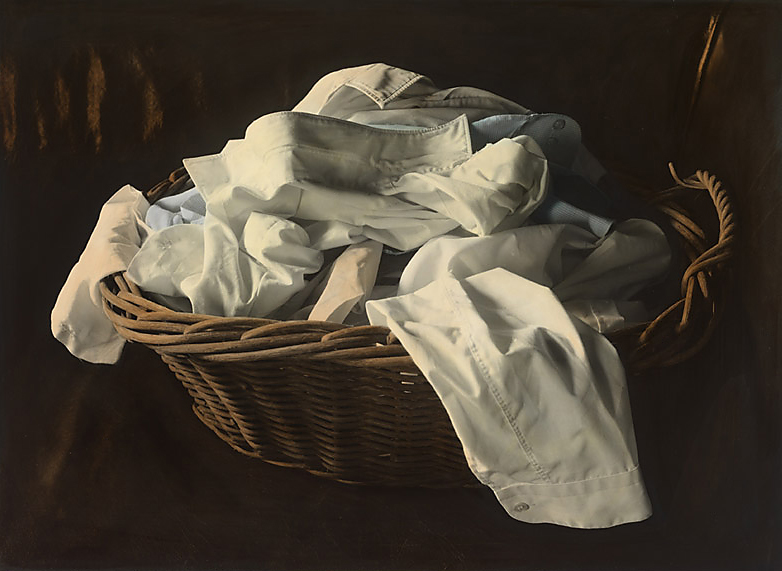
Janina Green (Essen, Germany born 1944; Australia from 1949) 'Untitled' 1988


Janina Green (Essen, Germany born 1944; Australia from 1949)
Untitled [Washing in basket]
1988
Gelatin silver photograph, photo oils
National Gallery of Australia, Canberra, purchased 1989


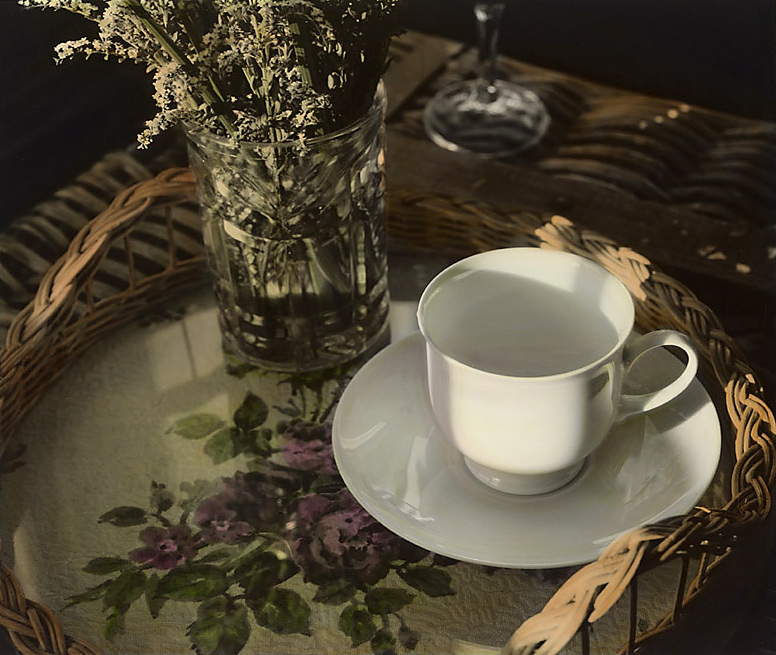
Janina Green (Essen, Germany born 1944; Australia from 1949) 'Untitled' 1988


Janina Green (Essen, Germany born 1944; Australia from 1949)
Untitled [White cup on tray]
1988
Gelatin silver photograph, photo oils
National Gallery of Australia, Canberra, purchased 1989


Nici Cumpston. (Barkindji/Paakintji peoples) 'Scar tree, Fowler's Creek' 2011


Nici Cumpston (Australian, b. 1963)
Barkindji/Paakintji peoples
Scar tree, Fowler’s Creek
2011
From the series having-been-there
Archival inkjet print hand coloured with synthetic polymer paint
98 x 177cm
Collection of the artist/Courtesy of the artist


Nici Cumpston (Barkindji/Paakintji peoples) 'Campsite V, Nookamka Lake' 2008


Nici Cumpston (Australian, b. 1963)
Barkindji/Paakintji peoples
Campsite V, Nookamka Lake
2008
Inkjet print on canvas, hand-coloured with pencil and watercolour
77 x 206cm
National Gallery of Australia, Canberra, purchased 2011


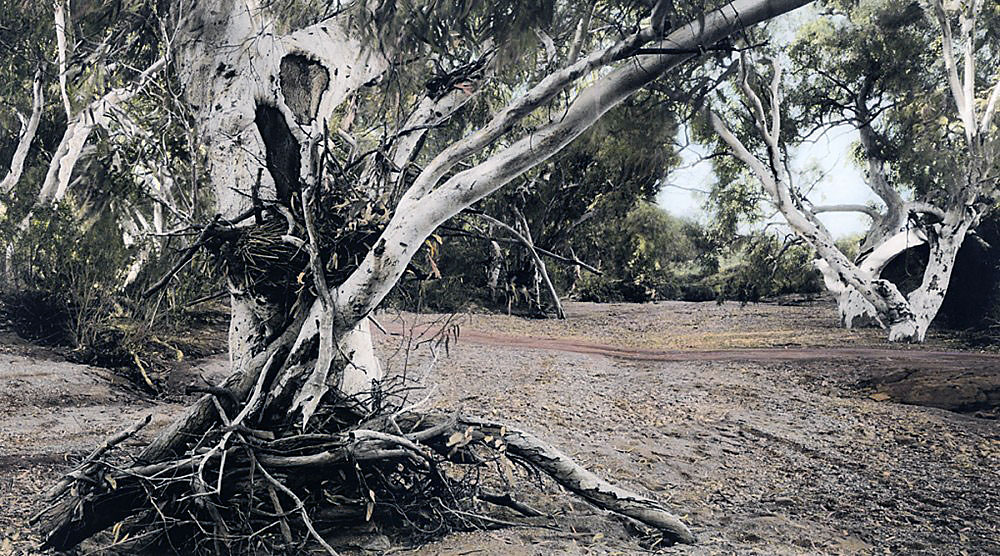
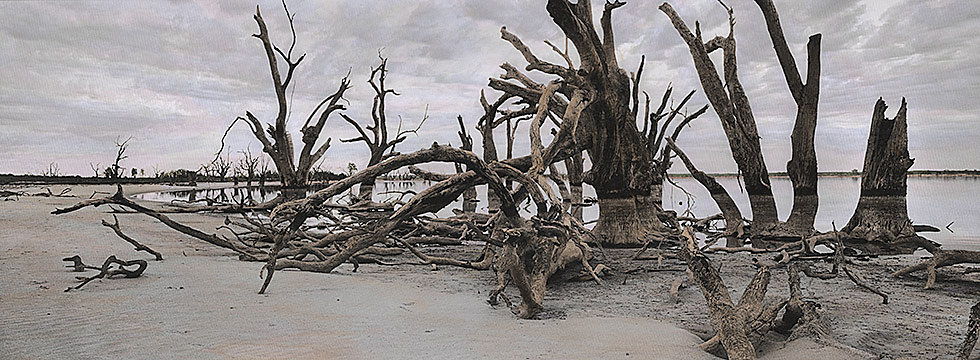
The once rich and thriving environment of the Murray and Darling River system with its clear waterways, lush flora and abundant fauna was home to the Barkindji, Muthi Muthi and Nyampa peoples.

The shallow Nookamka Lake (Lake Bonney), which connects to the Murray River in South Australia, is the subject of Nici Cumpston’s recent photographic series. However, the series is not of a lush utopia but of the degradation and erosion that has consumed the lake since the forced irrigation flooding of the waterways in the early 1900s.

When damming ceased in 2007, the water began to subside, slowly revealing the original landscape and the history of human occupation. Cumpston beautifully documents this stark landscape and the demise that salinisation and destructive water management practices have wrought on the people and their lands. Today, the landscape is desolate, scattered with twisted and broken trees stripped of their foliage like majestic sentinels in deathly poses. The trees still bare the scars – although obscured by dark tidelines – where canoes, containers and shields were cut from their trunks.

Cumpston highlights these clues to the area’s original inhabitants through the delicate and precise hand-watercolouring of the printed black-and-white photographs on canvas. She does not aim to replicate the original colours of the landscape, as a colour photograph would, but to interpret it, re-introducing the Aboriginal presence within the landscape – a subtle reconnection to Country and reminder of past cultural practices and knowledge. As the artist says, “I am finding ways to talk about connections to country and to allow people to understand the ongoing connections that Aboriginal people maintain with their traditional lands.”

Tina Baum
Curator, Aboriginal and Torres Strait Islander Art
Art Gallery of New South Wales


Warren Breninger (Australian, b. 1948) 'Expulsion of Eve [No.3]' 1978


Warren Breninger (Australian, b. 1948)
Expulsion of Eve [No.3]
1978
Gelatin silver photograph, chinagraph, decal lettering gelatin silver photograph
49.7 x 36.7cm
Gift of the Philip Morris Arts Grant 1982


Warren Breninger (Australian, b. 1948) 'Expulsion of Eve [No.12]' 1978


Warren Breninger (Australian, b. 1948)
Expulsion of Eve [No.12]
1978
Type C colour photograph, ink, crayon
49.8 x 37cm
Gift of the Philip Morris Arts Grant 1982


Warren Breninger (Australian, b. 1948) 'Expulsion of Eve [No.15]' 1978


Warren Breninger (Australian, b. 1948)
Expulsion of Eve [No.15]
1978
Photograph, gum arabic print, acrylic paint, crayon, pencil
49.8 x 37cm
Gift of the Philip Morris Arts Grant 1982


The Expulsion of Eve series is in essence a single work which the artist returns to continually to develop and re-work the same image. ‘Number 16’, highly indicative of the series, is a photographic image of a young woman, the print having undergone many transformative processes including being cut out, reapplied, incised, worn back, applied with colour, stripped of colour and re-drawn. Interrogating notions of reality, Breninger expresses his personal and artistic concerns relating to ‘the rift between appearances and what is real’; ideas informed by his deep Christian faith.1

His subject, Eve, is not chosen symbolically as a female archetype; rather, the artist reasons, “because I believe in her historically and all humanity is her descendents”.2 Breninger’s Eve, in her features and expression, suggests a presence caught between the worlds of childhood and adulthood, innocence and intent, the temporal and corporeal. While there is a Christ-like surrender in the pose, Breninger’s Eve also has a strong correlation with Edvard Munch’s ‘Madonna’, both visually and in terms of the obsessive process by which the artist revisits the image.

The artist’s belief that ‘cameras create an appetite for ghosts, for vapour, for beings of steam that we can never embrace, that will elude us like every photo does’,3 explains his intrigue with photography’s abilities and limitations in recording the subjective. He continued to develop the work with series III produced in 1990, followed in 1993-94 by series IV, comprising male and female faces.

1/ Breninger W 1983, ‘Art & fulfilment’, self-published artist’s essay p. 1
2/ Warren Breninger in correspondence with Sue Smith, 24 Feb 1984, collection files, Warren Breninger, Queensland Art Gallery, Brisbane
3/ Breninger W 1983, op cit p. 3

© Art Gallery of New South Wales Photography Collection Handbook, 2007


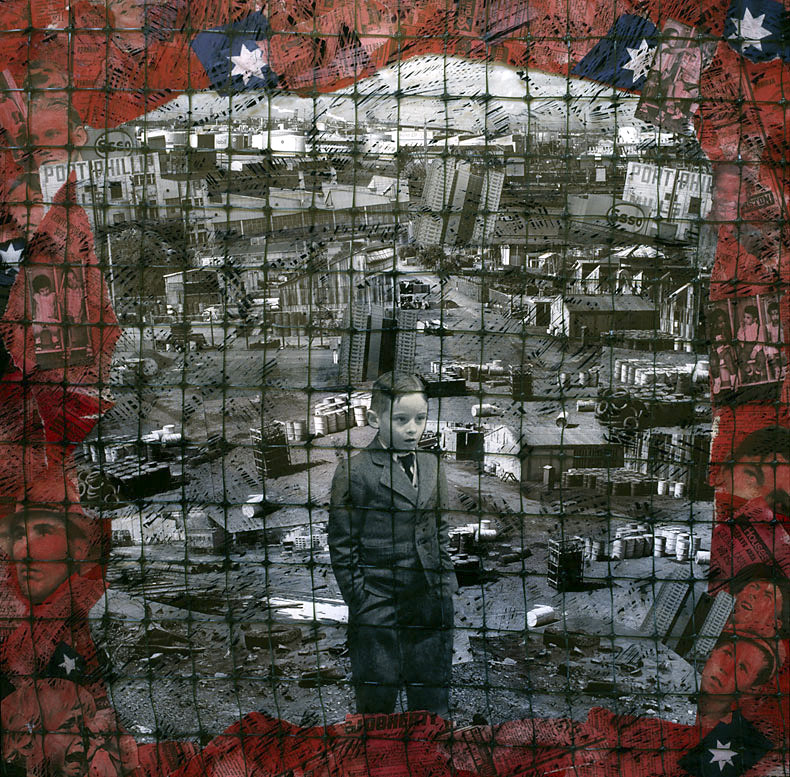
Christine Barry (Australian, b. 1954) 'Packaged Deal' 1986/96


Christine Barry (Australian, b. 1954)
Packaged Deal
1986/1996
From the series Displaced Objects
Direct positive colour photograph/Type C photographic print
50cm x 50cm/127cm x 127cm
National Gallery of Australia, Canberra


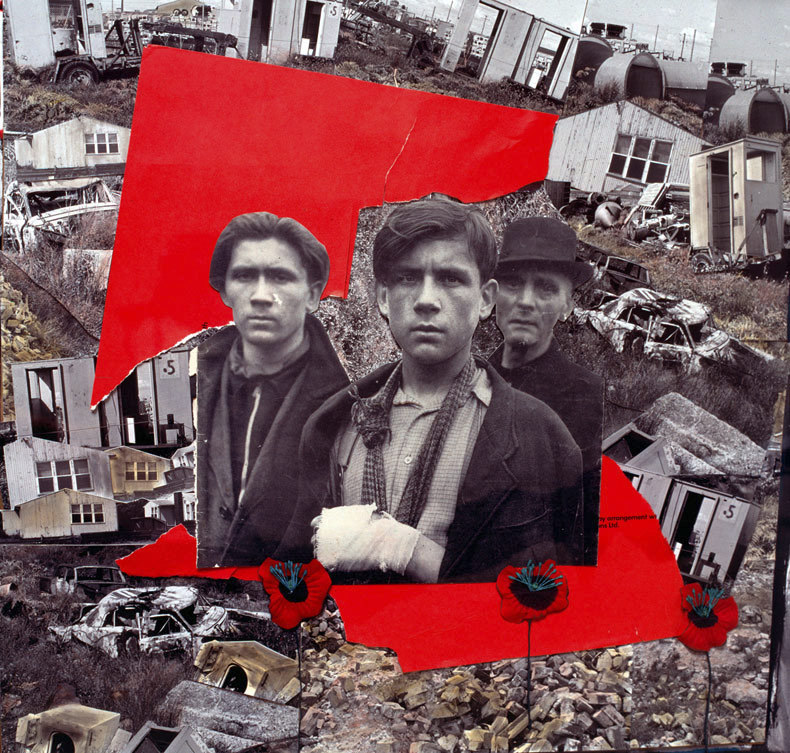
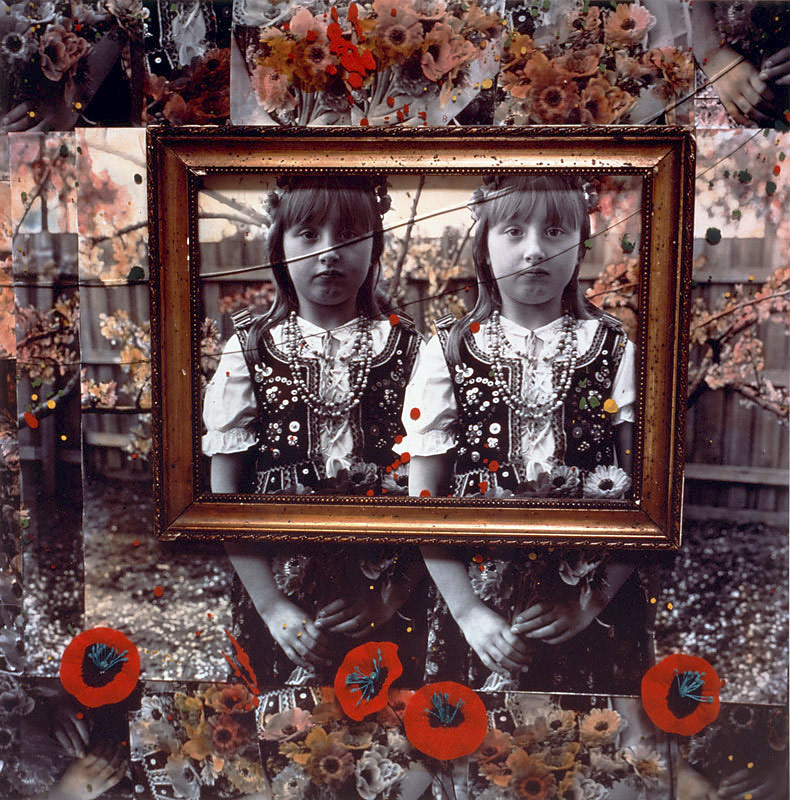
The daughter of Polish immigrants, Barry explores the significance of place in defining identity in the series Displaced objects. She suggests disjunction and the pull of the past into the present: the picture plane is broken up through the use of collaged fragments of old family photographs, newspaper and magazine cuttings, postcards and flags. As Barry explains, ‘The medium of collage’ and ‘the ad-hoc splashes of paint and sharp diagonals, which reoccur spasmodically throughout the series, read like the effacements of graffiti, associated with “clash” and the “confusion of cultures”.’ Collage and over painting suggest reconstruction and the re-presentation of existing elements to tell a new story, and this is something that Barry reinforces through the strategy of rephotographing the original collage and presenting it as a uniform image.

Text © National Gallery of Australia, Canberra


Christine Barry (Australian, b. 1954) 'Untitled (Patricia Marczak)' 1986-1987


Christine Barry (Australian, b. 1954)
Untitled (Patricia Marczak)
1986-1987
From the series Displaced Objects
Direct positive colour photograph/Type C photographic print
51.1 x 50.7cm
National Gallery of Australia, Canberra


Christine Barry (Australian, b. 1954) 'Untitled (Self portrait)' 1986


Christine Barry (Australian, b. 1954)
Untitled (Self portrait)
1986
From the series Displaced Objects
Direct positive colour photograph/Type C photographic print
50.8 x 50.7cm
National Gallery of Australia, Canberra


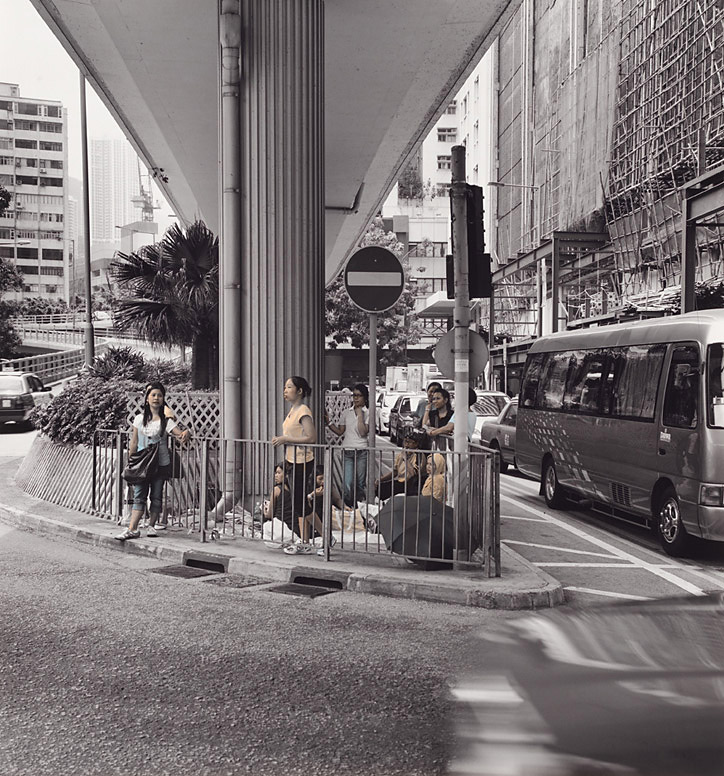
Janina Green (Essen, Germany born 1944; Australia from 1949) 'Maid in Hong Kong #11' 2008


Janina Green (Essen, Germany born 1944; Australia from 1949)
Maid in Hong Kong #11
2008
From the series Maid in Hong Kong
Gelatin silver photograph, colour dyes gelatin silver photograph
Image and sheet 76 x 60cm
Gift of Wilbow Group PTY LTD Donated through the Australian Government’s Cultural Gifts Program
National Gallery of Australia, Canberra


Robyn Stacey (Australian, b. 1952) 'Catherine and Morgan' 1985-1987


Robyn Stacey (Australian, b. 1952)
Catherine and Morgan
1985-1987
Gelatin silver photograph, colour dye
Collection of the artist
Courtesy of the artist and Stills Gallery, Sydney


Robyn Stacey (Australian, b. 1952) 'Untitled' 1985-1987


Robyn Stacey (Australian, b. 1952)
Untitled
1985-1987
Gelatin silver photograph, colour dye
Collection of the artist
Courtesy of the artist and Stills Gallery, Sydney


Robyn Stacey (Australian, b. 1952) 'Untitled' 1985-1987


Robyn Stacey (Australian, b. 1952)
Untitled
1985-1987
Gelatin silver photograph, colour dye
Collection of the artist
Courtesy of the artist and Stills Gallery, Sydney


Robyn Stacey (Australian, b. 1952) 'Untitled' 1985-1987


Robyn Stacey (Australian, b. 1952)
Untitled
1985-1987
Gelatin silver photograph, colour dye
Collection of the artist
Courtesy of the artist and Stills Gallery, Sydney


National Gallery of Australia
Parkes Place, Canberra
Australian Capital Territory 2600
Phone: (02) 6240 6411

Opening hours:
Open daily 10.00am – 5.00pm
(closed Christmas day)

National Gallery of Australia website

LIKE ART BLART ON FACEBOOK

Back to top

Exhibition: ‘Storm in a Teacup’ at the Mornington Peninsula Regional Art Gallery, Mornington

Exhibition dates: 24th July – 27th September, 2015

Curator: Wendy Garden


Hotham Street Ladies (est. Australia 2007) 'Dark tea' 2015 (installation view) from the exhibition 'Storm in a Teacup' at the Mornington Peninsula Regional Art Gallery, Mornington, July - Sept, 2015


Hotham Street Ladies (est. Australia 2007)
Dark tea (installation view)
2015
Royal icing, butter cream icing, fondant, food dye, found objects
Dimensions variable
Courtesy of the artists
Photo: Marcus Bunyan


This is the best thematic group exhibition I have seen in Melbourne and surrounds this year.

Every piece in the exhibition is visually stimulating and intelligently constructed, all works combining to make an engaging exhibition. Nothing is superfluous, every work having something interesting to say, whether it is about the ceremony of tea drinking, colonisation, global warming, Stolen Generations or social mores. Congratulations must go to the curators and artists for their efforts.

Particular favourites where the Hotham Street Ladies Dark Tea (2015, below) made of royal icing, butter cream icing, fondant, food dye, and found objects; the many sculptural objects which form the backbone of the exhibition, especially the work of Sharon West and Penny Byrne; and the wonderful vintage photographs that are displayed in the foyer of the gallery.

Accompanying this exhibition is another excellent exhibition, Ways to draw: A selection from the permanent collection by Betty Churcher, on till 27th September as well. If you want a day out from Melbourne with lunch in Mornington, some seriously good art and a drive along the coast, you could do no better than visit the gallery in the next week. Highly recommended.

Dr Marcus Bunyan


Many thankx to the Mornington Peninsula Regional Art Gallery for allowing me to publish the photographs in the posting. All installation photographs © Marcus Bunyan and the Mornington Peninsula Regional Art Gallery. Please click on the photographs for a larger version of the image.


Hotham Street Ladies (est. Australia 2007) 'Dark tea' 2015 (installation view detail)

Hotham Street Ladies (est. Australia 2007) 'Dark tea' 2015 (installation view detail)


Hotham Street Ladies (est. Australia 2007)
Dark tea (installation view details)
2015
Royal icing, butter cream icing, fondant, food dye, found objects
Dimensions variable
Courtesy of the artists
Photos: Marcus Bunyan


Charles Blackman (Australian, 1928-2018) 'Feet beneath the table' 1956 from the exhibition 'Storm in a Teacup' at the Mornington Peninsula Regional Art Gallery, Mornington, July - Sept, 2015


Charles Blackman (Australian, 1928-2018)
Feet beneath the table
1956
Tempera and oil on composition board
106.5 x 121.8cm
National Gallery of Victoria, Melbourne
Presented through the NGV Foundation by Barbara Blackman, Honorary Life Benefactor, 2005


Charles Blackman first encountered Lewis Caroll’s book, Alice in Wonderland, through a talking book for the blind which his wife, Barbara was listening to. Her developing blindness resulted in telescopic vision, spatial disorientation and a shrinking visual field. She was also pregnant with their first child and her distorted body image also had parallels with Alice’s experiences. By painting Alice at the Mad Hatter’s tea party Blackman could express his wife’s feeling of bewilderment and disorientation.


E. Phillips Fox (Australian, 1865-1915) 'The arbour' 1910 from the exhibition 'Storm in a Teacup' at the Mornington Peninsula Regional Art Gallery, Mornington, July - Sept, 2015


E. Phillips Fox (Australian, 1865-1915)
The arbour
1910
Oil on canvas
190.5 x 230.7cm
National Gallery of Victoria, Melbourne
Felton Bequest 1916


Melbourne born E. Phillips Fox, described as ‘one of the greatest of Australia’s Impressionist painters and the most gifted of her colourists’1 went to Paris in 1887 to study at the Ecole des Beaux Arts where he encountered the work of the French Impressionists. He remained in Paris for several years but made frequent trips back to Melbourne to visit his family. The Arbour was painted in Paris in Fox’s garden but is based upon observations of family life in his brother’s garden in Malvern. The depiction of an elegant family taking tea al fresco is a study of refined gentility. The Arbour was exhibited at both the Royal Academy and the Paris Salon exhibitions and was regarded by Fox as the finest thing he had done.2 At the time the painting was much admired for its ‘subtle lights ad shadow’3 and his exemplary ‘use of delicate colour and refined harmonies.’4

1/ Courier Mail, 12 May 1949
2/ Sydney Morning Herald, 13 October 1913
3/ Sydney Morning Herald, 13 October 1913
4/ Le Courrier Australien, Sydney, 15 April 1949


Clare Humphries (Australian, b. 1973) 'Some things were out in the open' 2007


Clare Humphries (Australian, b. 1973)
Some things were out in the open
2007
Pigment print on Hahnemühle photo rag paper (ed. 3/5)
63 x 62cm
Courtesy of the artist


Adam Hill (Blak Douglas) (Australian, b. 1970) 'Not everyone’s cup of tea' 2009


Adam Hill (Blak Douglas) (Australian, b. 1970)
Not everyone’s cup of tea
2009
Synthetic polymer paint on canvas
150 x 260cm
National Gallery of Australia, Canberra Purchased 2009


Kendal Murray (Australian, b. 1958) 'Exceed speed, mislead, concede' 2011


Kendal Murray (Australian, b. 1958)
Exceed speed, mislead, concede
2011
Mixed media assemblage
18 x 24 x 14cm
Courtesy of the artist and Arthouse Gallery, Sydney


Penny Byrne (Australian, b. 1965) 'Tea for two in Tuvalu' 2011


Penny Byrne (Australian, b. 1965)
Tea for two in Tuvalu
2011
Vintage porcelain figurine, vintage, Action man accessories, vintage coral, glass fish, epoxy resin, epoxy putty, retouching medium, powder pigments
15 x 19cm
Private Collection


Penny Byrne (Australian, b. 1965) 'Tea for two in Tuvalu' 2011 (installation view)


Penny Byrne (Australian, b. 1965)
Tea for two in Tuvalu (installation view)
2011
Vintage porcelain figurine, vintage, Action man accessories, vintage coral, glass fish, epoxy resin, epoxy putty, retouching medium, powder pigments
15 x 19cm
Private Collection
Photo: Marcus Bunyan


This piece was inspired by an underwater cabinet meeting held in 2009 by Maldives President Mohammed Nasheed in a campaign to raise awareness for activity on climate change. The thirty minute meeting was held six metres below sea level and was attended by eleven cabinet members calling upon all countries to cut their emissions to halt further temperature rises.

Polynesian island nation of Tuvalu, located in the Pacific Ocean midway between Hawaii and Australia, experienced a severe drought in 2011. A state of emergency was declared and rationing of fresh-water took place which restricted households on some of the islands to two buckets of fresh water per day. Tuvalu is also especially susceptible to changes in sea level and it is estimated that a sea level rise of 20 to 40 centimetres in the next 100 years could make Tuvalu uninhabitable.


Kate Bergin (Australian, b. 1968) 'The hunt for a room of one’s own' 2012


Kate Bergin (Australian, b. 1968)
The hunt for a room of one’s own
2012
Oil on canvas on board
75 x 101cm
Private Collection


Kate Bergin draws upon Dutch and Flemish seventeenth century tradition of still life painting to comment on our attitudes to animals. Bergin stages the scene on a crumpled white tablecloth upon which a large fox, based on a taxidermy fox she bought on eBay, regally sits centre stage. Meticulously rendered native birds, including a honeyeater, finch and triller, are based on photographs of specimens from the Melbourne Museum Collection. They flit about unperturbed by the introduced predator. Teaspoons, representing the impulse for collecting, entangle the fox and bird. Together with a teapot and cup, precariously placed, they contribute to the overarching sense of impending chaos.

Both afternoon tea and the fox represent English upper class social mores and were introduced into the colonies following British settlement. The fox arrived in 1855, brought in for recreational hunting, and has been a major cause of native bird extinctions. Fox numbers are increasing in some areas further threatening the precarious balance between wild life and introduced species.


Sharon West (Australian, b. 1963) 'Two Koori Tribesmen receive a gift of afternoon tea from local colonists' 2014 (installation view)


Sharon West (Australian, b. 1963)
Two Koori Tribesmen receive a gift of afternoon tea from local colonists (installation photo)
2014
Mixed media assemblage
15 x 46 x 30cm
Courtesy of the artist
Photo: Marcus Bunyan


Heather Shimmen (Australian, b. 1957) 'Tip me up' 2005 (installation view)


Heather Shimmen (Australian, b. 1957)
Tip me up (installation view)
2005
Linocut on paper and organza (ed. 7/30)
56 x 76cm
Courtesy of the artist and Australian Galleries, Melbourne and Sydney
Photo: Marcus Bunyan


Trent Jansen (Australian, b. 1981) 'Briggs family tea service' 2011 (installation view)


Trent Jansen (Australian, b. 1981)
Briggs family tea service (installation view)
2011
Slip cast porcelain, bull kelp, wallaby pelt, copper and brass
George (teapot) 22.5 x 20.5 x 13cm; Woretermoeteyenner (sugar bowl) 16 x 13.5 x 9cm; Dolly (milk jug) 12.5 x 12.5 x 8.5cm; John (teacup) 7 x 8.5 x 8cm; Eliza (teacup) 7.5 x 10.5 x 8cm; Mary (teacup) 10 x 9 x 6.5cm
Courtesy of Broached Commissions, Melbourne
Photo: Marcus Bunyan


The Briggs family tea service represents the marriage of George Briggs, a free settler, to Woretermoeteyenner of the Pairrebeenne people in Van Diemen’s Land and the four children they had together. Briggs arrived from Bedfordshire in 1791 and learned to speak the language of the local Pairrebeenne people, trading tea, flour and sugar fro kangaroo, wallaby and seal skins. It is understood that he became good friends with the leader of the Pairrebeenne people, Mannalargenna, and by 1810 he partnered his daughter Woretermoeteyenner. Their marriage meant she had to adapt to a way of life that merged her traditional cultural values with the ways of British settlers. The teapot and sugar bowl represent the parents while their first daughter, Doll Mountgarret Briggs is symbolised in the milk jug and the three cups each signify their other children John, Eliza and Mary.

The tea service is a hybrid design bringing together materials common to both cultures. To realise the set Jansen worked with Rod Bamford on the ceramic elements, Oliver Smith for the brass and copper and Vicki West, who uses the traditional methods of her Tasmanian Aboriginal ancestors, worked with the bull kelp components.


eX de Medici (Australian, b. 1959) 'Blue (Bower-Bauer)' 1998-2000 (installation view)


eX de Medici (Australian, b. 1959)
Blue (Bower-Bauer) (installation view)
1998-2000
Watercolour over black pencil on paper
114.0 x 152.8cm
National Gallery of Australia, Canberra Purchased 2004
Photo: Marcus Bunyan


eX de Medici (Australian, b. 1959) 'Blue (Bower-Bauer)' 1998-2000 (installation view detail)


eX de Medici (Australian, b. 1959)
Blue (Bower-Bauer) (installation view detail)
1998-2000
Watercolour over black pencil on paper
114.0 x 152.8cm
National Gallery of Australia, Canberra Purchased 2004
Photo: Marcus Bunyan


A turning point in eX de Medici’s career came in 1998 when she saw an exhibition of watercolours by Ferdinand Bauer comprising 2,000 rarely seen images of native flora and fauna made when Bauer was official artist on Matthew Flinder’s historic circumnavigation of Australia in 1801-1803. Previously working with tattoo imagery, Medici found the intricate works so compelling she decided to change course and ‘retrograde’ herself and explore watercolour as a medium.1

Referencing Australia’s Bower bird that adorns its nest with anything blue, Medici entangles the history of vanitas painting with commentary about the desire to seek permanence and affirmation in the accumulation of things. The broken willow pattern platter, upturned jugs and cups, amassed with so many other decorative and functional objects, are juxtaposed with skulls, fruit and flowers – symbols of mortality. A reaction to what she considered John Howard’s regressive politics at the time, the work ‘is a kind of a backhanded discussion about colonising our minds with retroactive ideas’.2

1/ Ted Gott. ‘eX deMedici an epic journey on a Lilliputian scale’ Art and Australia Vol. 40, No. 1, Spring 2002, p. 105
2/ eX deMedici in Paul Flynn. Artist Profile #5, March 2008, pp. 28-35.


Storm in a Teacup reflects upon tea drinking in Australia. Introduced by the British colonials, the afternoon tea party was an attempt to ‘civilise’ the land. Tea drinking became so popular in the colonies that by 1888 the amount of tea consumed per capita exceeded the amount consumed in England. Soon after, billy tea was to become an enduring symbol of the pioneering spirit, immortalised by Henry Lawson’s stories published under the title While the billy boils.

Beginning with elegant paintings of the afternoon tea table from E. Phillips Fox and Arthur Streeton, the exhibition goes on to explore the darker side of tea drinking and the social and environmental impacts of the humble cup of tea. Michael Cook’s Object (table), 2015, provides an alternative history to the narrative of colonialism while Sharon West and Adam Hill both use humour to subvert colonial understandings of the afternoon tea party as an occasion of refined gentility.

The humble cuppa has been around for thousands of years, but this exhibition explores how a popular beverage can impact on us culturally, socially, environmentally and politically. There is more to debate than just the proper way to make a cup of tea. Storm in a teacup explores far-reaching issues brewing from tea, including the imposition of one culture upon another – especially on the colonial frontier; the production of ceramics and the environmental impacts of porcelain and its production; gender stereotypes and socialisation through tea parties. The exhibition also reflects upon tea drinking ceremonies in Asia within a western Orientalist paradigm and tea drinking as an occasion for familial cohesiveness and disconnect.

Text from the Mornington Peninsula Regional Art Gallery


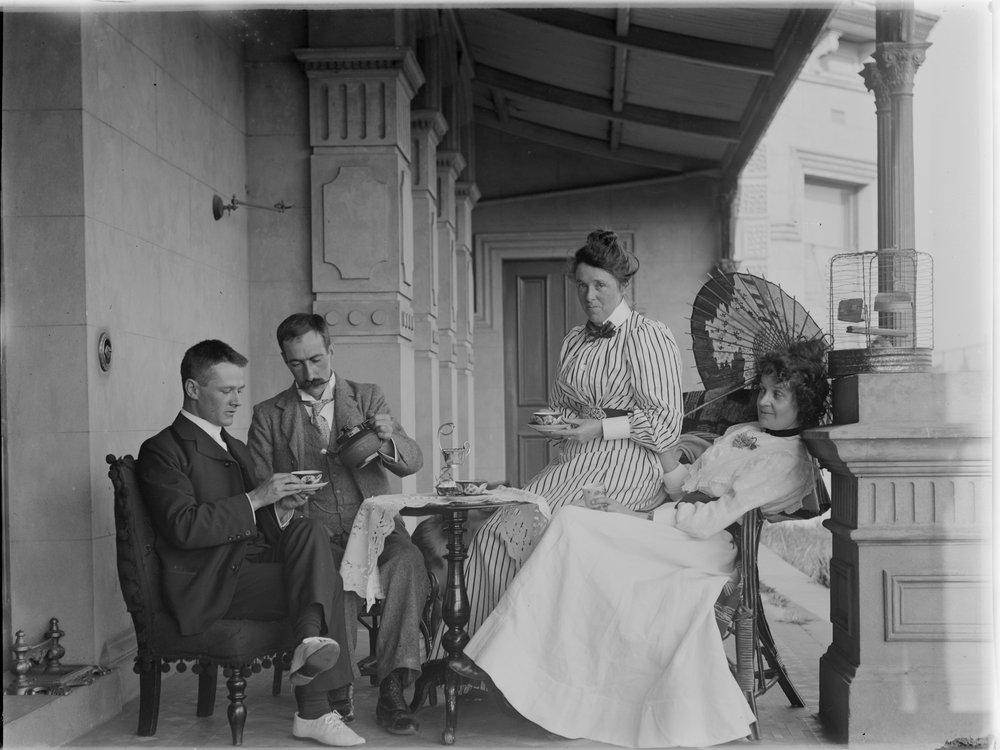
Mark James Daniel (Australian, 1867-1949) 'Verandah, "Harefield" – afternoon tea' Feb 1900


Mark James Daniel (Australian, 1867-1949)
Verandah, “Harefield” – afternoon tea
Feb 1900
Glass negative
8.5 x 11cm (quarter plate)
Collection of the State Library of Victoria


Michael J Drew (Australian, 1873-1943) 'Group taking tea in a garden' between 1890 and 1900


Michael J Drew (Australian, 1873-1943)
Group taking tea in a garden
between 1890 and 1900
Glass negative
12.2 x 16.5cm (half plate)
Collection of the State Library of Victoria


Rex Hazlewood (Australian, 1886-1968) '[Men drinking billy tea]' 1911-1927


Rex Hazlewood (Australian, 1886-1968)
[Men drinking billy tea]
1911-1927
Silver gelatin print
Collection of the State Library of New South Wales


Anonymous photographer. 'Afternoon tea at "Vivaleigh"' 1917


Anonymous photographer
Afternoon tea at “Vivaleigh”
1917
Gelatin silver print
12 x 16cm
Collection of the State Library of Victoria


James Fox Barnard (Australian, 1874-1945) 'Lawn, Arylie, Hobart' c. 1900


James Fox Barnard (Australian, 1874-1945)
Lawn, Arylie, Hobart
c. 1900
Glass negative
8.5 x 11cm (quarter plate)
Collection of the State Library of Victoria


James Fox Barnard (Australian, 1874-1945) '[Tea on the verandah]' c. 1900


James Fox Barnard (Australian, 1874-1945)
[Tea on the verandah]
c. 1900
Glass negative
8.5 x 11cm (quarter plate)
Collection of the State Library of Victoria


Installation photograph of the exhibition 'Storm in a Teacup' at the Mornington Peninsula Regional Art Gallery

Installation photograph of the exhibition 'Storm in a Teacup' at the Mornington Peninsula Regional Art Gallery

Installation photograph of the exhibition 'Storm in a Teacup' at the Mornington Peninsula Regional Art Gallery

Installation photograph of the exhibition 'Storm in a Teacup' at the Mornington Peninsula Regional Art Gallery

Installation photograph of the exhibition 'Storm in a Teacup' at the Mornington Peninsula Regional Art Gallery


Installation photograph of the exhibition Storm in a Teacup at the Mornington Peninsula Regional Art Gallery
Photos: Marcus Bunyan


Tea is the medium of many a complex and commonplace rituals. Adopted in a variety of ceremonies and customs across the globe, its unique and symbolic place in our lives is subtle and powerful. Whether a quick cuppa around the kitchen table or a lavish display of refined gentility; from billy tea to Asian tea-drinking ceremonies, tea has played an important role in international trade but more curiously in facilitating social cohesiveness.

Comprising approximately 50 works including painting, photography, sculpture and installation Storm in a Teacup features artists such as Chares Blackman, John Perceval, Emma Minnie Boyd, E. Phillips Fox and contemporary artists Stephen Bowers, Danie Mellor, Penny Byrne, Rosalie Gasgoigne, Matthew Sleeth, eX de Medici, Anne Zahalka, Polixeni Papapetrou and a mad tea party installation by Hotham Street Ladies.

Tea is said to have first been invented in China around 2700 BC, with the earliest records of tea consumption dating to 1000BC. Initially consumed as a medicinal drink, it became widely popular as a common beverage and traded across Asia and Europe during the 16th century. It was King Charles II’s wife Catherine of Portugal who is said to have brought the tea habit to Great Britain. Indeed, the afternoon tea party first became fashionable in the seventeenth century following Queen Catherine de Braganza’s fondness for serving the beverage at Whitehall in London. It wasn’t until the 18th century that it became widely consumed with tea smuggling bringing the tipple to the masses and later influenced the Boston Tea Party.

Tea drinking became a demonstration of social aspirations and grew in popularity giving rise to a subtle orchestration of manners, dress and serving paraphernalia which created new forms of commodity consumption. In the colonies of New South Wales and Victoria afternoon tea parties were a lavish display of settler understandings of refined gentility that were an attempt to signal allegiance to the values of the home country and ground the displaced community in their originating culture. In this respect the afternoon tea party expressed collective understandings of British identity and was a means of domesticating and civilising the alien terrain of the colonies.

Press release from the Mornington Peninsula Regional Art Gallery


Clare Humphries (Australian, b. 1973) 'Family confection II' 2015 (installation view)

Clare Humphries (Australian, b. 1973) 'Family confection II' 2015 (installation view)


Clare Humphries (Australian, b. 1973)
Family confection II (installation views)
2015
Sugar cubes stained with coffee and tea
Dimensions variable
Courtesy of the artist
Photos: Marcus Bunyan


Giuseppe Romeo (Australian, b. 1958) Subjective landscape, 'Of consequence rather than reason' 2015 (installation view)

Giuseppe Romeo (Australian, b. 1958) Subjective landscape, 'Of consequence rather than reason' 2015 (installation view)


Giuseppe Romeo (Australian, b. 1958)
Subjective landscape, ‘Of consequence rather than reason’ (installation views)
2015
Found discarded objects, bitumen, paint
80 x 100 x 60cm
Courtesy of the artist
Photos: Marcus Bunyan


Guiseppe Rome asks the simple question: ‘What are you going to do with it all?’

Romeo recalls the tea sets his mother and aunts possessed and the ‘good set’ kept for special occasions that were rarely used. In this work a silver platter is the support for a silver cake stand upon which a teapot, creamer, sugar bowl and various serving implements jostle with items required to clean up the mess. The bat, ball and stumps are a reference to playing cricket which ‘became an excuse for a big afternoon tea party in England’. A ribbon of wire holds it all together ‘like a dream from Alice in Wonderland when nothing is as it seems’, while a tinkling melody from a music box is a lullaby that sends us in to a contented sleep.

Romeo coats the sculpture in bitumen then paints it entirely in white. The effect is reminiscent of excavated items from an ancient ruin, as if we are peering upon the remains from a modern day Pompeii – artefacts that have been covered in lava and buried. This work alludes to the ways in which we deceive ourselves and ‘attempt to keep it all together through consumption but ultimately we can’t’.


Samantha Everton (Australian, b. 1971) 'Camellia' 2009


Samantha Everton (Australian, b. 1971)
Camellia
2009
From the series Vintage dolls 2009
Pigment print on rag paper (ed. AP2)
106 x 114cm
Courtesy of the artist and Anthea Polson Art, Queensland


Robyn Phelan (Australian, b. 1965) 'Porcelain wall – ode to an obsession' 2010-2015 (installation view)


Robyn Phelan (Australian, b. 1965)
Porcelain wall – ode to an obsession (installation view)
2010-2015
Porcelain, paper, clay, cobalt oxide, timber, pigment, Jingdezhen tissue transfer
240 x 122 x 42cm
Courtesy of the artist
Photo: Marcus Bunyan


Robyn Phelan (Australian, b. 1965) 'Porcelain wall – ode to an obsession' 2010-15 (installation view detail)


Robyn Phelan (Australian, b. 1965)
Porcelain wall – ode to an obsession (installation view detail)
2010-2015
Porcelain, paper, clay, cobalt oxide, timber, pigment, Jingdezhen tissue transfer
240 x 122 x 42cm
Courtesy of the artist


Robyn Phelan undertook a residency at the Pottery Workshop and Experimental Sculptural Factory of Jingdezhen, Jiangxi Province in China in 2008. Jingdezhen is known as the porcelain capital because it has been the centre of China’s ceramic production, beginning in the fourteenth century Yuan Dynasty, where fine porcelain was first exported all over the world.

Deposits of kaolinite, a clay found at Mt Kaolin nearby which can sustain very high firing temperatures produced a superior white porcelain of increased strength and translucency. Items made from kaolinite were fired with cobalt landscape designs and were highly sought after by European collectors. Over the centuries, because of excessive mining, the mountain’s deposits have become depleted. Phelan’s work is a lament to the desecration of the mountain and a reminder of the potential destructiveness of consumer desire.


Penny Byrne (Australian, b. 1965) '‘Let’s forget about global warming’ said Alice ‘and have a cup of tea instead!’' 2010 (installation view)


Penny Byrne (Australian, b. 1965)
‘Let’s forget about global warming’ said Alice ‘and have a cup of tea instead!’ (installation view)
2010
Vintage porcelain figurine, found toys, epoxy resin, epoxy putty, retouching medium, powder pigments
80 x 33cm
Williams Sinclair Collection
Photo: Marcus Bunyan


Penny Byrne (Australian, b. 1965) '‘Let’s forget about global warming’ said Alice ‘and have a cup of tea instead!’' 2010 (installation view detail)


Penny Byrne (Australian, b. 1965)
‘Let’s forget about global warming’ said Alice ‘and have a cup of tea instead!’ (installation view detail)
2010
Vintage porcelain figurine, found toys, epoxy resin, epoxy putty, retouching medium, powder pigments
80 x 33cm
Williams Sinclair Collection
Photo: Marcus Bunyan


Penny Byrne’s reworked porcelain conversation piece was motivated by Republican Vice-Presidential nominee Sarah Palin’s cry to ‘drill, baby, drill’ during her campaign in 2008. A call for increase off-shore drilling of petroleum, including sites such as the Arctic National Wildlife Refuge, Palin claimed ‘that’s what we hear all across the country in our rallies because people are so hungry for those domestic sources of energy to be tapped into’.1

In Byrne’s piece the patriotic figures gorge themselves, blithely overindulging without care to the wastage. The new Disney production of Alice in Wonderland directed by Tim Burton had just been released and this led Byrne to reflect upon the Mad Hatter’s tea party in which tea was drunk all day because time stood still and was stuck at tea-time.

1/ Transcript: The Vice-Presidential Debate, 2 October 2008. Reprinted in the New York Times, 23 May 2012.


Sharon West (Australian, b. 1963) 'Joseph Banks’ tea party for a Botany Bay tribesman is ruined by flies and spiders' 2014


Sharon West (Australian, b. 1963)
Joseph Banks’ tea party for a Botany Bay tribesman is ruined by flies and spiders
2014
Digital print on paper (ed. 2/5)
66 x 57cm (sheet)
Courtesy of the artist
Photo: Marcus Bunyan


Sharon West’s recreation of an afternoon tea party is set in the early days of first contact. Joseph Banks was the botanist who sailed with Captain Cook on the Endeavour on the first voyage of discovery which mapped the east coast of Australia between 1768 and 1771. While ashore he made an extensive collection of native flora and fauna which was sent back to natural history museums in England. Banks was also instrumental in the British government’s decision to colonise the New South Wales settlement.


Rosalie Gascoigne (b. New Zealand 1917; arr. Australia 1943; d. Canberra 1999) 'The tea party' 1980 (installation view)


Rosalie Gascoigne (b. New Zealand 1917; arr. Australia 1943; d. Canberra 1999)
The tea party (installation view)
1980
Painted wood, celluloid, plastic, enamelled metal, feathers
83 x 35 x 20cm
Private collection
Photo: Marcus Bunyan


Rosalie Gascoigne (b. New Zealand 1917; arr. Australia 1943; d. Canberra 1999) 'The tea party' 1980 (installation view detail)


Rosalie Gascoigne (b. New Zealand 1917; arr. Australia 1943; d. Canberra 1999)
The tea party (installation view detail)
1980
Painted wood, celluloid, plastic, enamelled metal, feathers
83 x 35 x 20cm
Private collection
Photo: Marcus Bunyan


Rosalie Gascoigne found the kewpie dolls amongst a large number of discarded things from an abandoned sideshow at the Bungendore dump in the summer of 1976. ‘I thought “Oh, those dollies, they’re having a … very joyful … picnic. They’re … in the paddock, they’ve got all these old things … they’ve sat down on the teapots and waved their wings around.”

For Gascoigne beauty existed in the most humble of objects and the wear and tear from use only added to the appeal. The enamel teapots were also found at various dumps and were a particular focus of her collecting.

‘I had a thing about enamelware because I see it as being elegant. People see the holes in it. I was collecting brown and white at the same time. To me it had a sort of elegance that a Dalmatian dog has, spotty, very elegant’.1

1/ Rosalie Gascoigne, excerpts from her correspondence, email communication with Martin Gascoigne, 13 March 2015


Julie Dowling (Australian, b. 1969) Badimaya people, Western Australia 'White with one' 2003


Julie Dowling (Australian, b. 1969)
Badimaya people, Western Australia
White with one
2003
Synthetic polymer paint and red ochre on canvas
121 x 100cm
Collection of Jane Kleimeyer and Anthony Stuart


Julie Dowling’s painting is a poignant reminder of the Stolen Generations and the plight of many young girls, forcibly removed from their families, who were brought up in government institutions and trained to be domestic servant to white families. Girls were targeted because women were considered the ‘uplifters’ or ‘civilisers’ of their communities and as future mothers their education into the values of white society was deemed essential to enable successful assimilation. Girls in service were supposed to receive a wage but often this was retained by their employer and not passed on. Dowling points out it is also a history of Stolen wages.


Michael Cook (Australian, b. 1968) Bidjara people, south-west Queensland 'Object (table)' 2015


Michael Cook (Australian, b. 1968)
Bidjara people, south-west Queensland
Object (table)
2015
Inkjet print on Hahnemühle cotton rag (ed. 2/4 + 2AP)
140 x 99cm
Courtesy of the artist and THIS IS NO FANTASY + dianne tanzer gallery, Melbourne


Michael Cook’s photographic tableau ‘turns the table’ on racism. By depicting the body of a white woman as a functional object in service to others, Cook considers the dehumanisation and objectification of one race of people by another in the history of slavery.

The double portrait on the back wall is by Johann Zoffany from 1778, and features Dido Elizabeth Belle (1761-1804) who was born into slavery in the West Indies. The daughter of an African mother, her father was an English naval officer who left her to the care of his uncle, Lord William Murray, where she was raised as an equal with Murray’s niece. Murray was instrumental in outlawing slavery in the United Kingdom in 1772. In the painting Zoffany depicts the two women standing together, the niece affectionately reaching out to Belle. Hence Cook’s afternoon tea is also a reminder that prejudice and racial inequality can be surmounted.


Yenny Huber (b. Austria 1980; arr. Australia 2000) 'Room No. 14' 2006


Yenny Huber (b. Austria 1980; arr. Australia 2000)
Room No. 14
2006
Digital print on aluminium panel (ed. 1/6)
27.2 x 27.2cm
Warrnambool Art Gallery, Victoria


Underpinned by the belief that any one person is comprised of diverse, fragmentary and often illusory selves, Yenny Huber explores the various ego states that reside within. This photograph is a self portrait taken in a hotel room, but it is also an impersonation of an identity available to women. Tea-drinking was once described as ‘an infallible sign of an old maid’1 and in this work Huber offers us an image of a good Catholic girl, knees together, elbows in, sitting demurely on the couch sipping tea. It is an image of femininity constrained by the dictates of religion and outdated socially sanctioned ideals of respectable female behaviour.

1/ The Horsham Times, Victoria, 26 April 1898


Anne Zahalka (Australian, b. 1957) 'Saturday 5.18 pm 1995' 1995 (printed 1997)


Anne Zahalka (Australian, b. 1957)
Saturday 5.18 pm 1995
1995 (printed 1997)
Type C photograph (ed AP)
125 x 162cm
Art Gallery of New South Wales, Sydney Gift of the artist, 2011
Donated through the Australian Government’s Cultural Gifts Program


Mornington Peninsula Regional Art Gallery
Civic Reserve, Dunns Road, Mornington

Opening hours:
Tuesday – Sunday 11am – 4pm

Mornington Peninsula Regional Art Gallery website

LIKE ART BLART ON FACEBOOK

Back to top

Exhibition: ‘Impressions of Paris: Lautrec, Degas, Daumier, Atget’ and ‘Impressions of Melbourne’ at the Monash Gallery of Art, Melbourne

Exhibition dates: 17th July – 20th September, 2015

National Gallery of Australia touring exhibition

Curator of Impressions of Paris: Jane Kinsman, National Gallery of Australia’s Senior Curator of International Prints


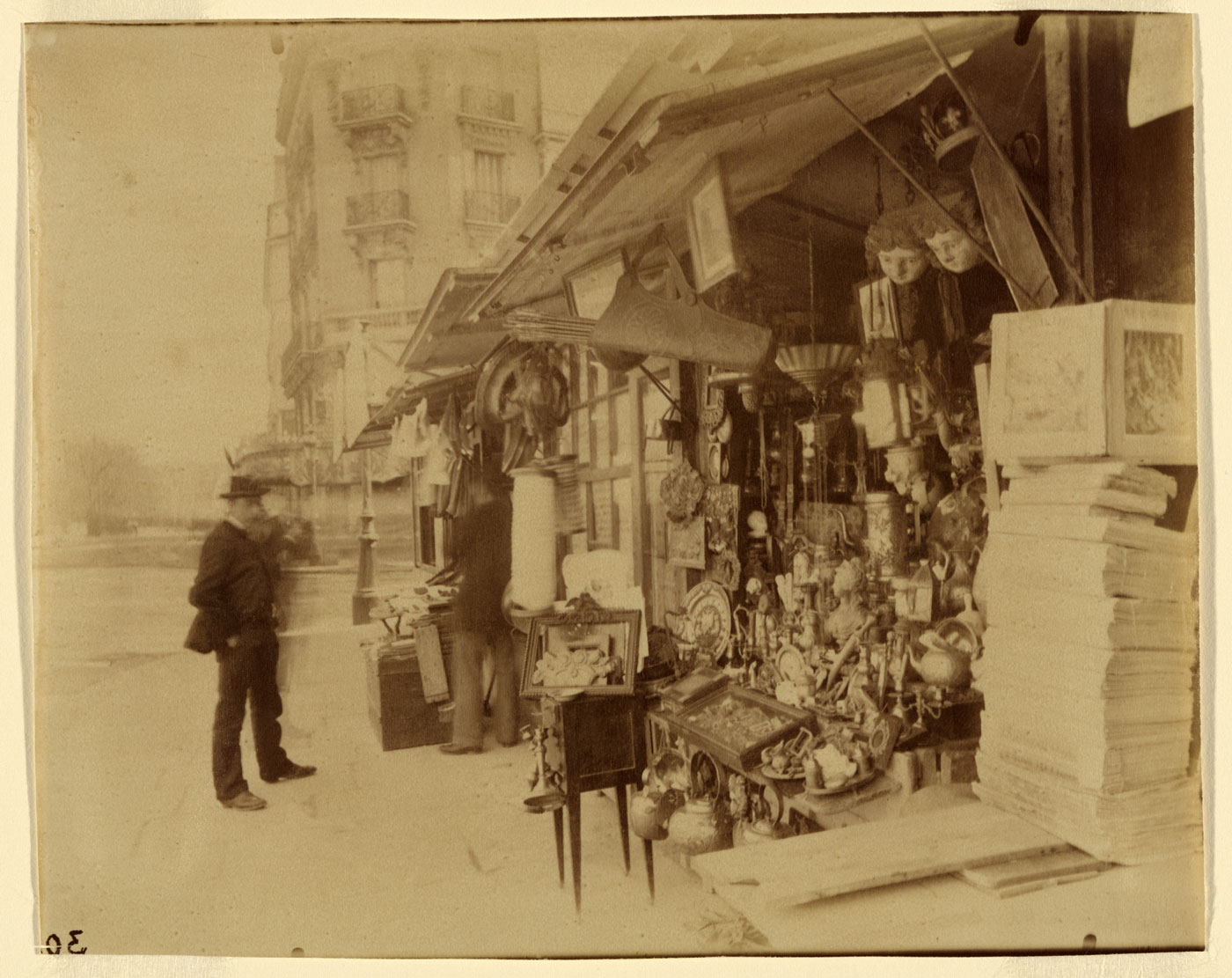
Eugène Atget (France, 1857-1927) 'No title (Brocanteur)' c. 1898-1905 from the exhibition 'Impressions of Paris: Lautrec, Degas, Daumier, Atget' and 'Impressions of Melbourne' at the Monash Gallery of Art, Melbourne, July - Sept, 2015


Eugène Atget (France, 1857-1927)
No title (Brocanteur)
c. 1898-1905
Albumen silver photograph
17.8 x 21.9cm
National Gallery of Australia, Canberra
Purchased 1980


Impressions of Paris: Lautrec, Degas, Daumier, Atget is a particularly dry and uninspiring National Gallery of Australia touring exhibition, which was only enlivened for me by the enlightened presence of 20 or so vintage Eugène Atget photographs, specifically added for this showing at the Monash Gallery of Art, the home of Australian photography.

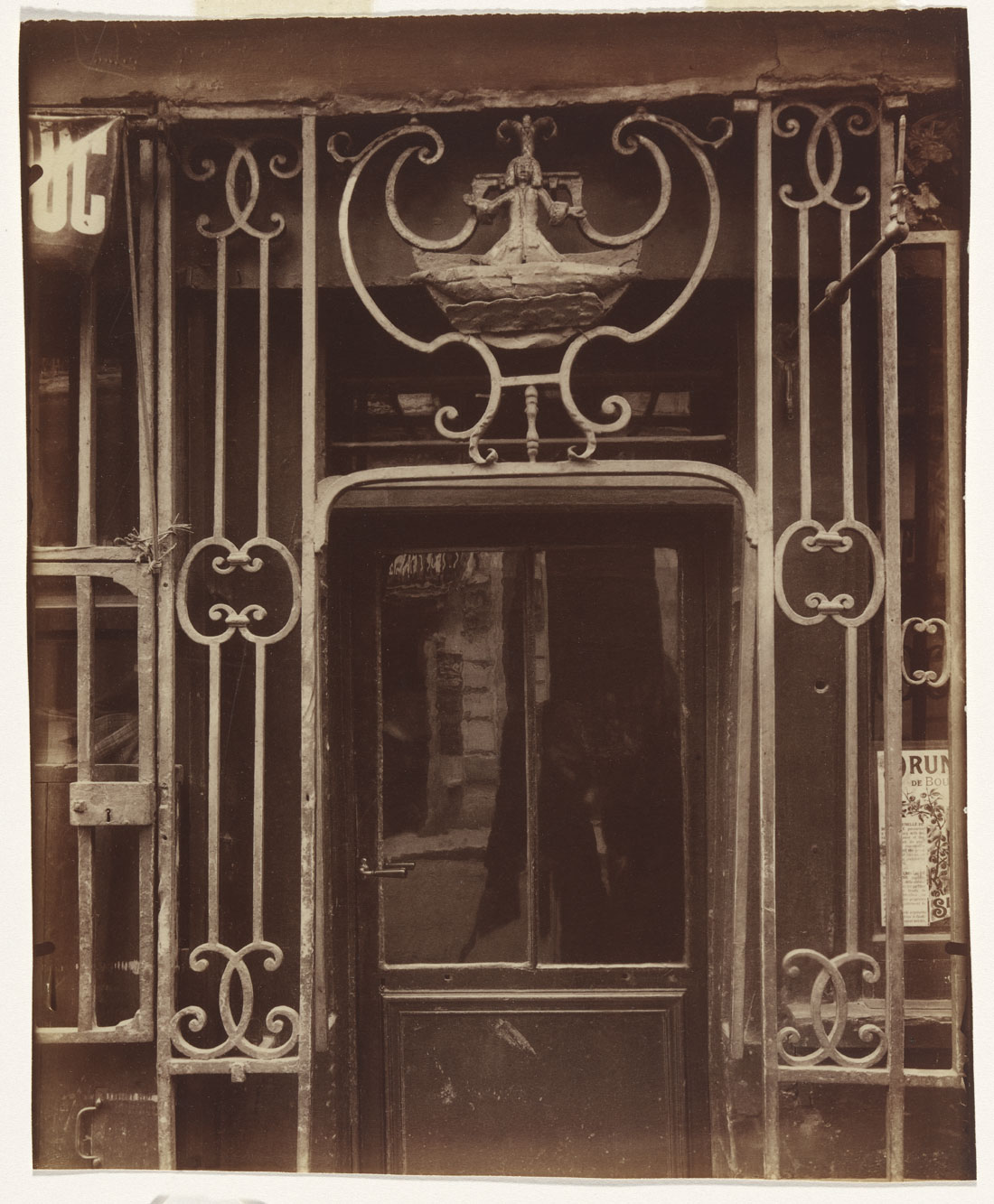
Atget’s photographs have an almost ether/real quality to them in their visual representation and, physically, an ephemeral feel to the quality of the paper – as though the images are about to dissolve into nothing – even as he photographs solid objects such as stairways, doors and door knockers. Observe the photographs Hôtel du Maréchal de Tallard, 78 rue des Archives (c. 1898-1905), A la Grâce de Dieu, 121 rue Montmartre (c. 1900) and Heurtoir, 6 rue du Parc Royal (c. 1901-1914), below, to witness this shimmering phenomenon. It is as if the emulsion of the plate is insufficient to capture the light of life.

In an accompanying exhibition in the smaller gallery, Impressions of Melbourne, photographs by Nicholas Caire, Charles Kerry, Max Dupain, Mark Strizic and Noel Jones investigate the city of Melbourne… but it is the stunning photographs by Atget that make the long drive out to Wheeler’s Hill worth the visit.

Dr Marcus Bunyan


Many thankx to the Monash Gallery of Art for allowing me to publish the photographs in the posting. Please click on the photographs for a larger version of the image.


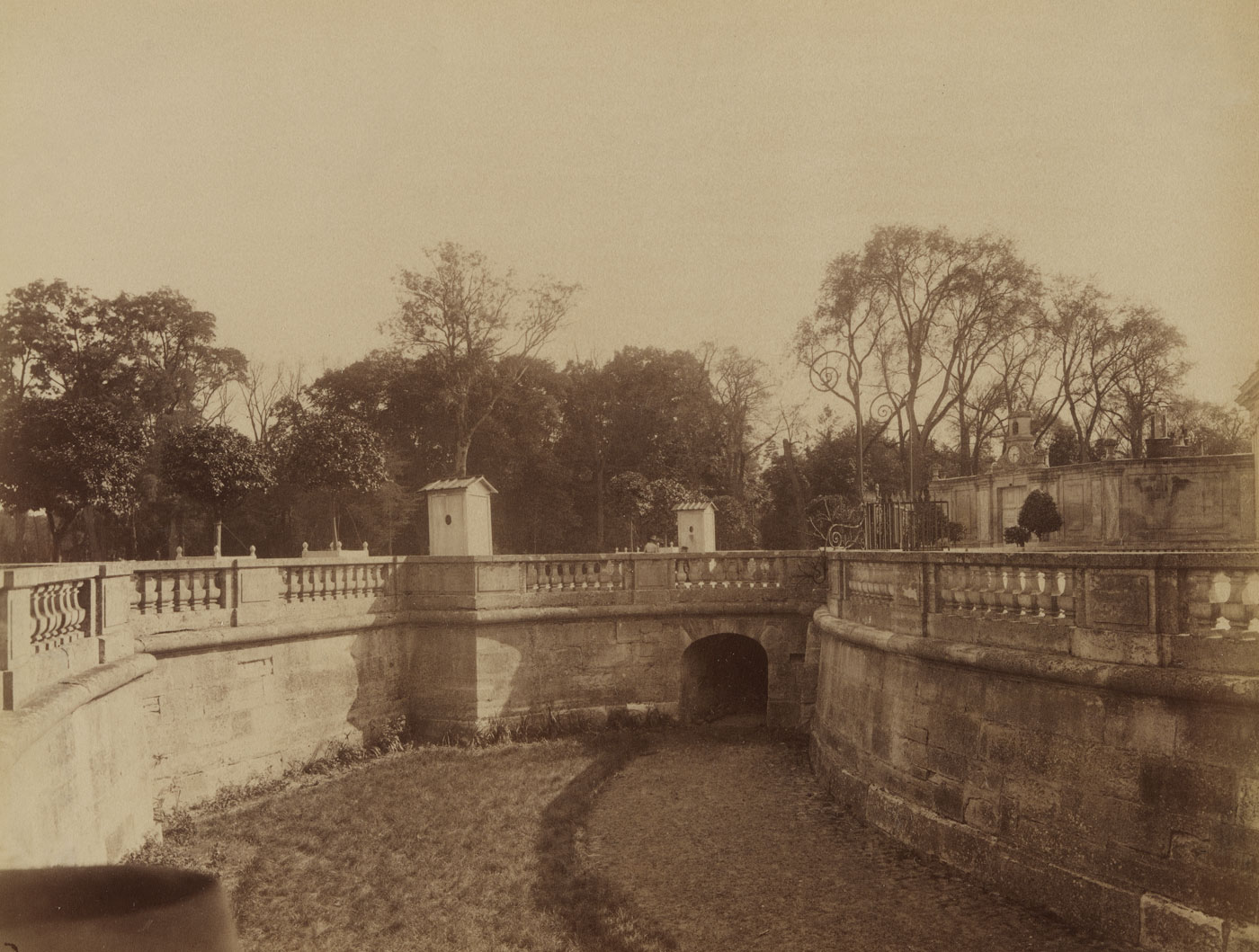
Eugène Atget (France, 1857-1927) 'Versailles, Grand Trianon' c. 1901-1925 from the exhibition 'Impressions of Paris: Lautrec, Degas, Daumier, Atget' and 'Impressions of Melbourne' at the Monash Gallery of Art, Melbourne, July - Sept, 2015


Eugène Atget (France, 1857-1927)
Versailles, Grand Trianon
c. 1901-1925
Gold-toned silver chloride photograph
17.6 x 22cm
National Gallery of Australia, Canberra
Purchased 1980


Eugène Atget (France, 1857-1927) 'Hôtel du Maréchal de Tallard, 78 rue des Archives' c. 1898-1905


Eugène Atget (France, 1857-1927)
Hôtel du Maréchal de Tallard, 78 rue des Archives
c. 1898-1905
Gold-toned silver chloride photograph
22 x 18.1cm
National Gallery of Australia, Canberra
Purchased 1980


Eugène Atget (France, 1857-1927) 'A la Grâce de Dieu, 121 rue Montmartre' c. 1900


Eugène Atget (France 1857-1927)
A la Grâce de Dieu, 121 rue Montmartre
c. 1900
Printing out paper photograph
22 x 17.7cm
National Gallery of Australia, Canberra
Purchased 1984


Eugène Atget (France, 1857-1927) 'Heurtoir, 6 rue du Parc Royal' c. 1901-1914


Eugène Atget (France, 1857-1927)
Heurtoir, 6 rue du Parc Royal
c. 1901-1914
Gold-toned silver chloride photograph
21.9 x 17.8cm
National Gallery of Australia, Canberra
Purchased 1980


Monash Gallery of Art is delighted to present its major international exhibition of 2015, Impressions of Paris: Lautrec, Degas, Daumier, Atget featuring over 120 prints, posters and photographs drawn from the collection of the National Gallery of Australia.

Impressions of Paris: Lautrec, Degas, Daumier, Atget examines the major contribution to French art made by key figures: Honoré-Victorin Daumier (1808-1879), Edgar Degas (1834-1917), Henri de Toulouse-Lautrec (1864-1901) and includes a selection of photographs by Eugène Atget (1857-1927) specially conceived for Monash Gallery of Art.

Newly appointed Gallery Director Kallie Blauhorn states, “I’m thrilled that for my first exhibition at MGA we are able to present a major international show, Impressions of Paris. Residents of Monash and art lovers across Melbourne will experience the extraordinary works by household names, Toulouse Lautrec, Edgar Degas, Honore Daumier and the wonderful photographer Eugène Atget.”

“This is a first for MGA and a true testament to the reputation of the gallery that we can host this important and significant exhibition,” said Blauhorn.

A generation apart, Lautrec, Degas and Daumier were consummate draughtsmen whose innovative compositions and embrace of modern subject matter played a significant role in artistic developments in France over the nineteenth century. Atget, the only specialist photographer among these artists, spent much of his life documenting the streets of Paris as they underwent modernisation. His photographs show us how modern life was expressed in the architectural experience of France, giving us a glimpse of what modernity left behind.

The generation of French artists who followed Daumier in the nineteenth century were inspired by his critical observations, which became an extraordinary reservoir of ideas. Both Degas and then Lautrec were enthusiastic admirers of French caricature, delighting in its animated qualities, stylistic freedoms and contemporary themes. They were particularly enamoured of Daumier’s caricature.

Degas adopted themes of modern French life, the ballet, the race course, the café-concert and the demi-monde and played an important role in the rejection of mythological and historical subjects favoured by the Impressionists. Many of Degas’ ideas on composition and subjects were, in turn, drawn from Daumier. This French satirist was both extraordinarily gifted and prolific, making a name for himself by lampooning the affectations, stupidities and greed of members of the French bourgeois society in caricatures, which Degas avidly collected.

The youngest of the artists, Lautrec, who sadly dies before reaching 37, borrowed themes and compositions from Degas, an artist he much admired and emulated. Images of drinkers at a table, ballet and cabaret scenes and nudes reveal the powerful influence that Degas had on the younger artist, as well as Lautrec’s own considerable originality, particularly as a portrayer of individuals rather than the depiction of types often favoured by Degas.

For the most part, Atget’s pictures of streets, parks, courtyards, buildings and their ornamental motifs record remnants of Old Paris. While there is a nostalgic aspect to these views, for contemporary viewers these pictures were about modern Paris. They recorded and helped make sense of changes to the city as it struggled to cope with modernism. Atget’s views of modern Paris focussed on its intimate places, those spaces of the everyday in which people had always worked, loved and lived.

These four artists captured the spirit of Paris in their prints, posters and photographs. Through the examination of this work, we find clues as to why dramatic changes took place in French art over the nineteenth century. They formed part of other generations of artists who admired Daumier and who adapted the caricaturist’s critical lithographic observations. In this way Daumier’s legacy was a brilliant journalistic record of the modern capital and contributed to an era in France ripe for a new art.

Press release from the MGA website


Eugène Atget: growth and decay in the great city

After an unspectacular career in the theatre, Eugène Atget (1857-1927) began to take photographs of Paris in 1892. By 1897 he had established a successful business photographing the spaces that remained of Old Paris. In all, Atget made over 10,000 images of Paris and its surrounds, each taken with a straightforward approach that laid the basis for much of the documentary photography that followed. Atget’s pictures were immensely popular: he sold thousands of prints, satisfying a strong demand for views of a city undergoing massive social and architectural transformation.

For the most part, Atget’s pictures of streets, parks, courtyards, buildings and their ornamental motifs record remnants of pre-Revolutionary Paris. While there is a nostalgic aspect to these views, for contemporary viewers these pictures were about modern Paris. They recorded and helped make sense of changes to the city as it struggled to cope with modernism. Street traders and other workers are seen selling their wares along old streets and laneways; ancient buildings stand in laneways and courtyards undergoing physical transformation; cafes and shops await bustling crowds. Atget’s views of modern Paris focussed on its intimate places, those spaces of the everyday in which people had always worked, loved and lived.


Impressions of Melbourne

17th July 2015 – 20th September 2015

In response to the photographs by Eugène Atget (1857-1927) included in the National Gallery of Australia’s touring exhibition, Impressions of Paris, this exhibition offers views of Melbourne’s streets, laneways and urban landscape. Drawn from the Monash Gallery of Art, City of Monash Collection, this selection traverses a period from the late nineteenth century to the late twentieth century.

Atget photographed Paris during a time when the French capital was undergoing significant transformation. From the 1850s through to the 1920s, the dark medieval neighbourhoods of the city were demolished to make way for the wide avenues and open public spaces that Paris is known for today. Atget’s ambition was to produce clear and detailed photographs that would document the heritage of Paris before it disappeared. Typically taking his photographs in the early morning when the streets were empty, Atget imbued the city with ghostly nostalgia.

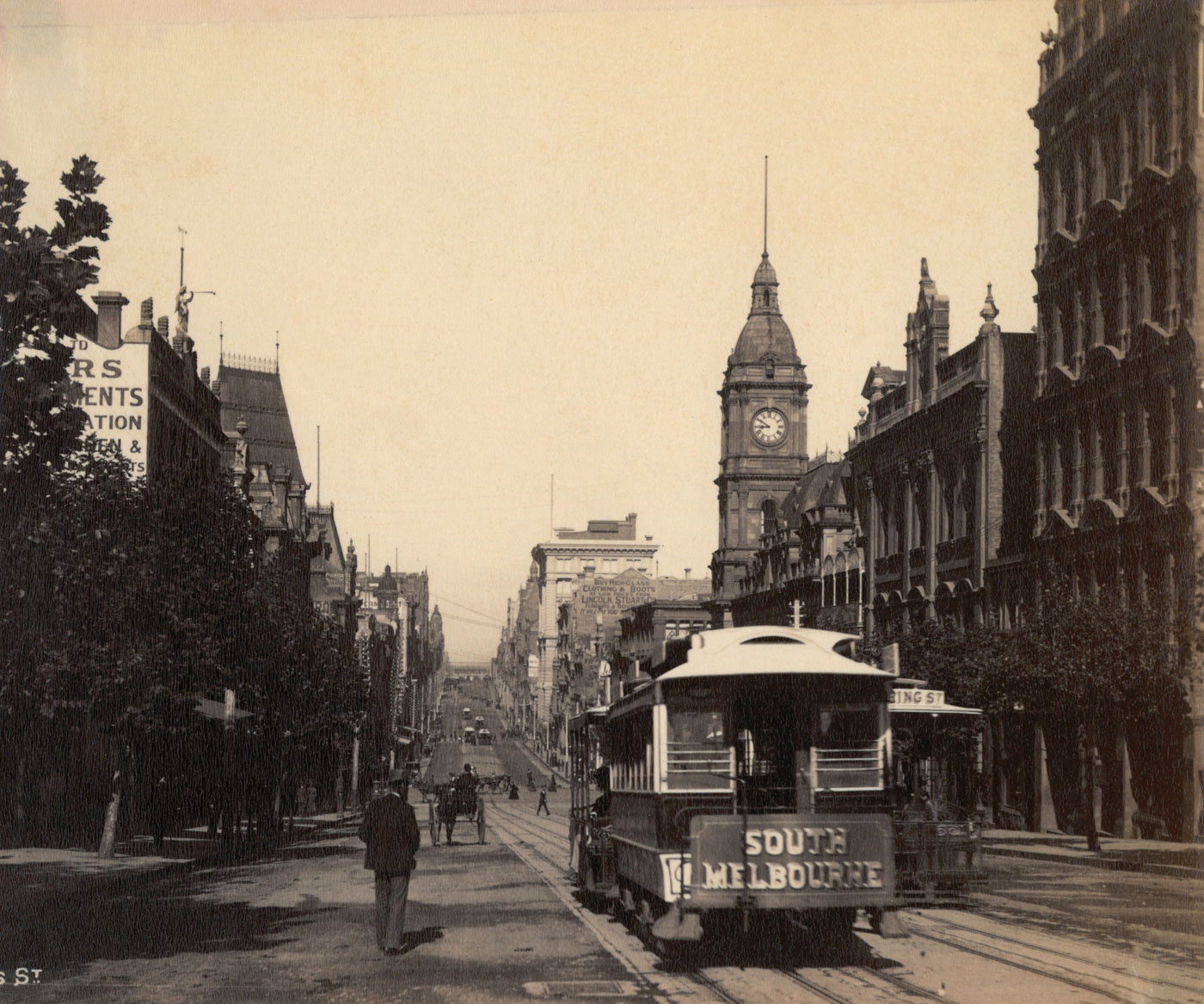
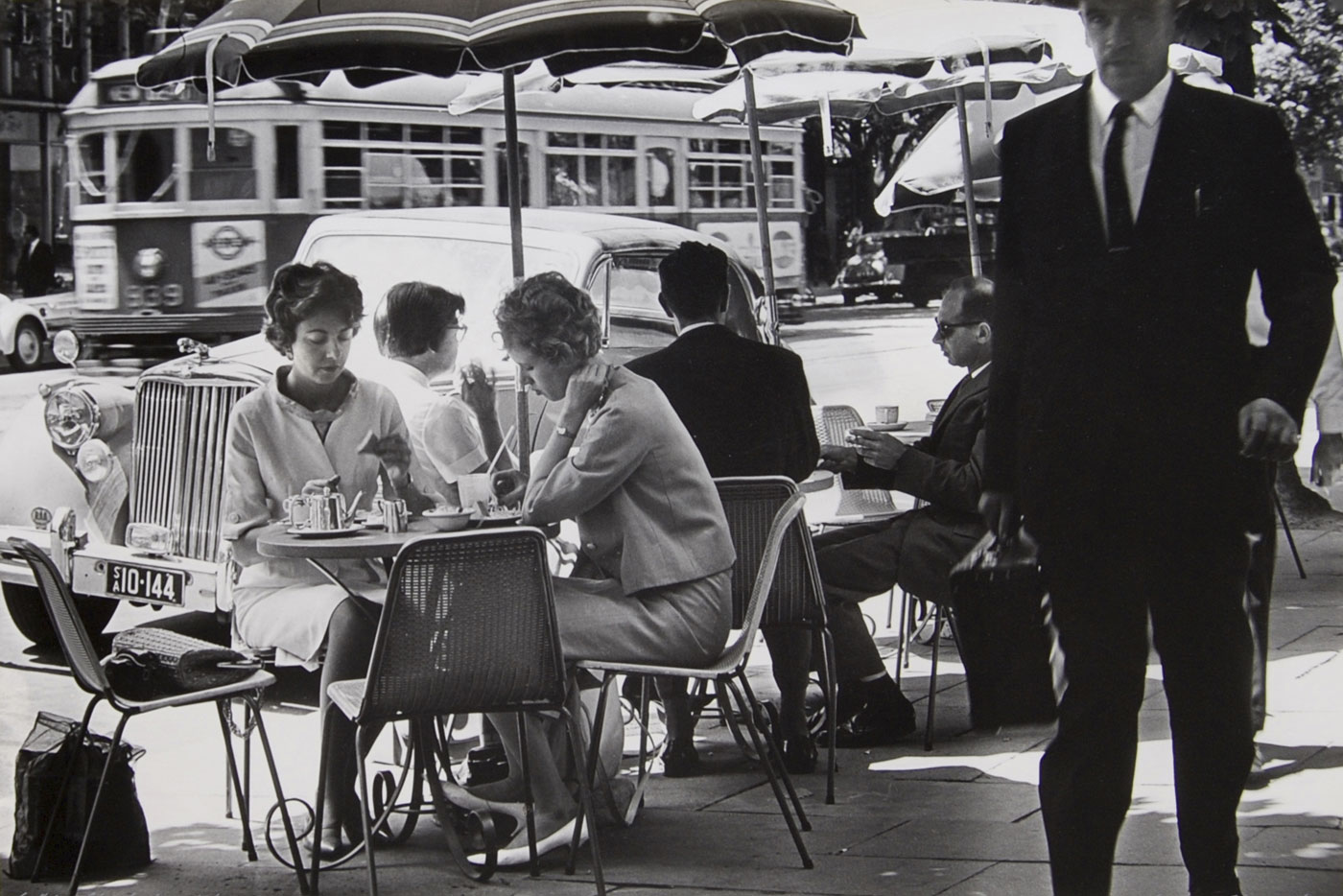
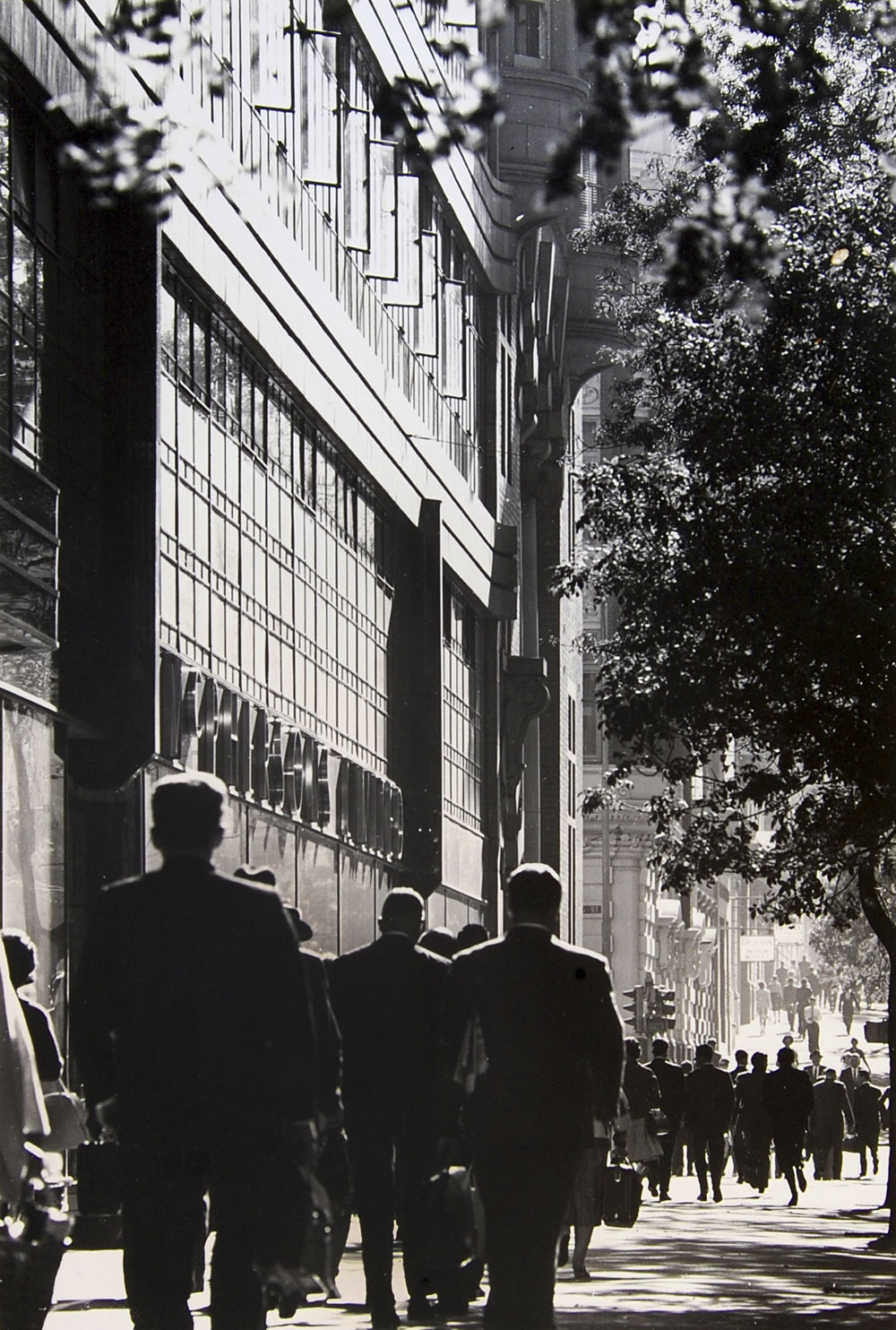
The earliest photographs in Impressions of Melbourne, taken by Nicholas Caire and Charles Kerry in the late nineteenth century, are contemporary to those of Atget. While Atget focused longingly on the past, however, these Australian photographers celebrated the civic accomplishments of modern progress in the colonies. The portrayal of Melbourne as a civilised metropolis, attractive to both immigrants and tourists, persisted through the twentieth century. Max Dupain captured the city as a lively and enterprising place, while Mark Strizic lingered on the shimmering ambience of window shopping and city strolling.

Impressions of Melbourne showcases a range of photographic responses to our urban environment, revealing some of Melbourne’s many moods and highlighting the city as a rich photographic subject. The exhibition includes photographs by Nicholas Caire, Charles Kerry, Max Dupain, Mark Strizic and Noel Jones.

Nicholas Caire

Nicolas Caire was born in Guernsey and arrived in Australia, settling in Adelaide, in 1858. He set up his first photographic studio in Adelaide in 1867. He moved to the Victorian goldmining town of Talbot in 1870 before relocating to Melbourne in 1876. At this time, Melbourne was the largest Australian city.

While Caire is best known for his picturesque landscape photographs of the Victorian countryside, he also produced photographs of major city thoroughfares, public buildings, parks and gardens. These subjects were common amongst photographers in the second half of the nineteenth century, conveying a sense of local pride and achievement. Caire’s photographs were often mounted in albums and accompanied by individual descriptive texts, a format that was popular amongst local and overseas visitors at the time.

Charles Kerry

Charles Kerry grew up in country New South Wales before moving to Sydney at the age of 17 to begin his photographic career. After a failed studio partnership, which left him with a lot of debt, Kerry rebuilt his business and by 1890 found himself running a successful studio that had a monopoly on the popular postcard market. By 1898 Kerry’s studio was the largest in Australia, housed in a three-storey building at 310 George Street, Sydney.

Throughout his career, Kerry photographed a broad range of subjects including social and sporting events, portraits of Indigenous people, city streets as well as the New South Wales countryside. He also spent a year documenting every station homestead in New South Wales. Kerry retired in 1913.


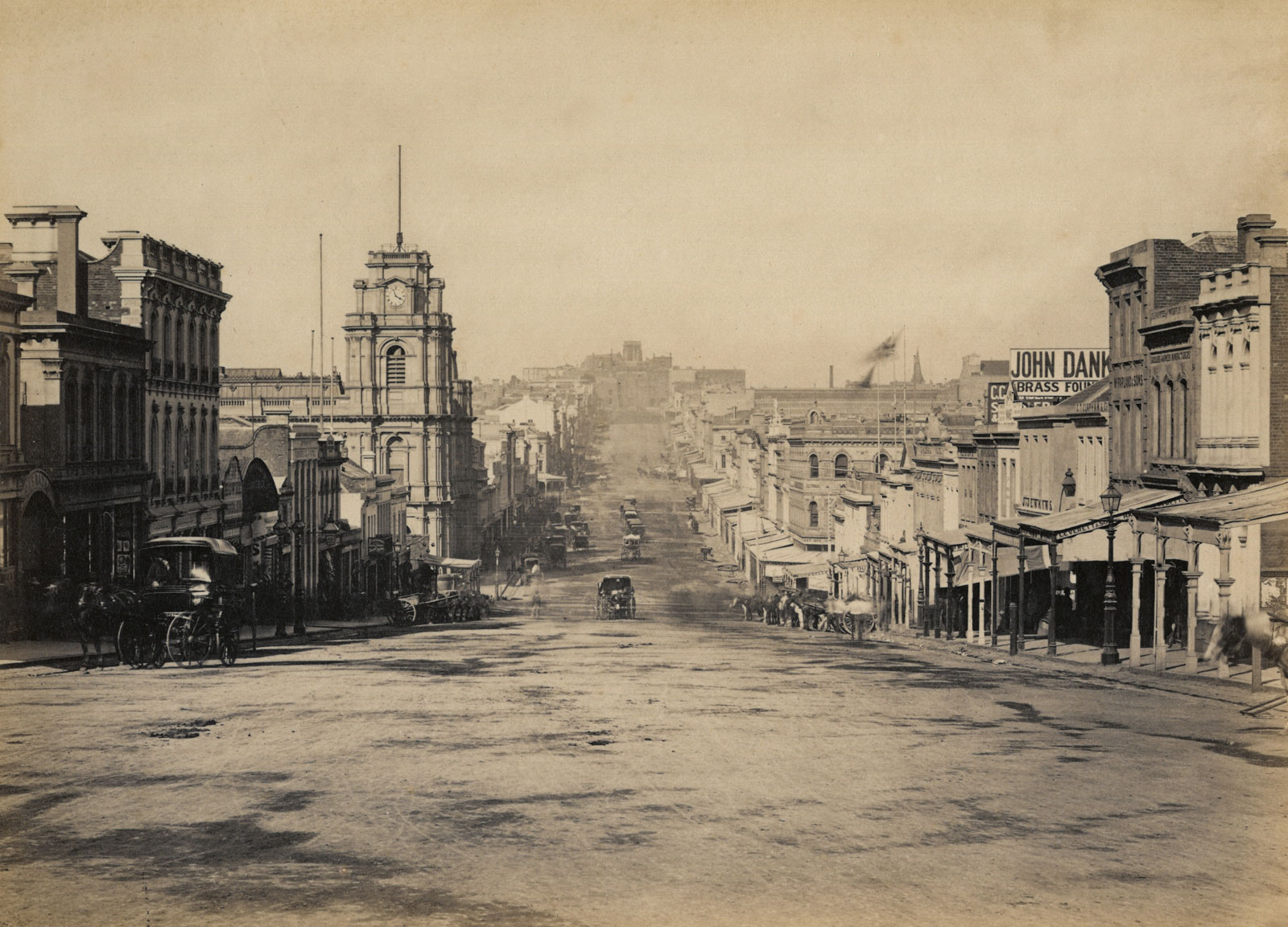
Nicholas Caire (born United Kingdom 1837; arrived Australia 1858; died 1918) 'View of Bourke Street, Melbourne' 1877-1878


Nicholas Caire (born United Kingdom 1837; arrived Australia 1858; died 1918)
View of Bourke Street, Melbourne
1877-1878
From the series Views of Victoria
Albumen print
13.4 x 18.7cm
Monash Gallery of Art, City of Monash Collection acquired 1987


Original album caption: Bourke Street is the principal business thoroughfare in the great City of Melbourne. It is about a mile in length, extending from the Parliament House to the Spencer Street Railway Station. On the left hand side of the picture is the Post Office, and at the extreme end of the street can be seen the Parliament House.


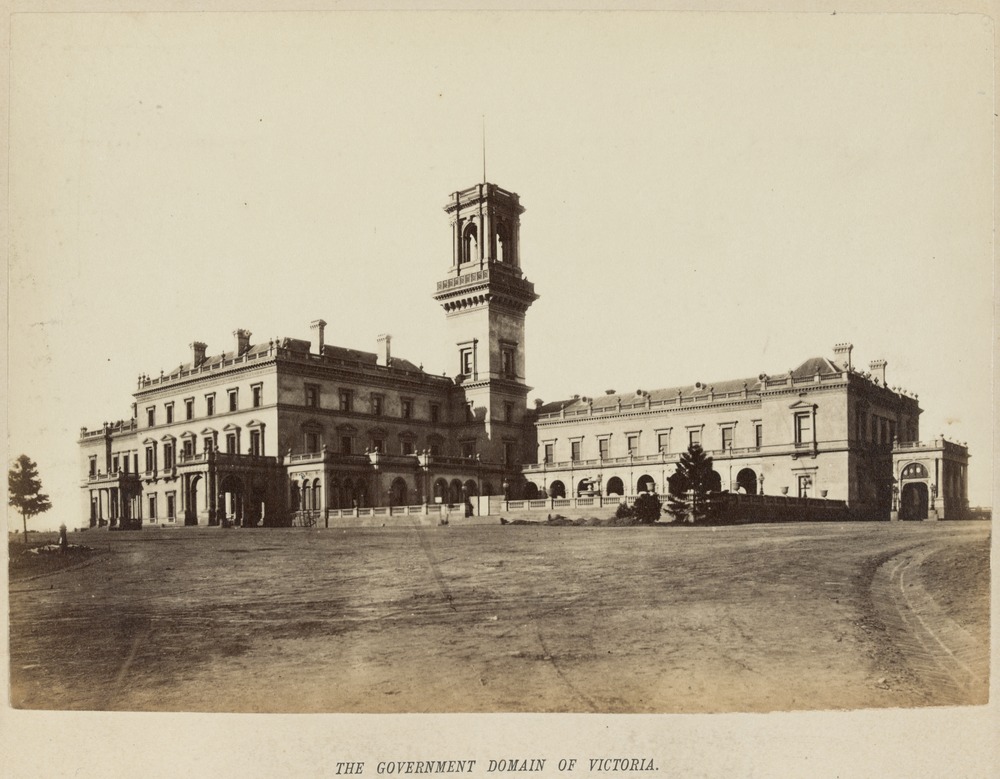
Nicholas Caire (born United Kingdom 1837; arrived Australia 1858; died 1918) 'The Government Domain of Victoria' 1877-1878


Nicholas Caire (born United Kingdom 1837; arrived Australia 1858; died 1918)
The Government Domain of Victoria
1877-1878
From the series The public buildings of Melbourne and suburbs
Albumen print Monash Gallery of Art, City of Monash Collection acquired 1987


Original album caption: The Governor’s Residence is on an eminence near the Botanical Gardens, and occupies one of the best positions around the City of Melbourne. Looking westward from the front of the Domain, a splendid view is obtained of Hobson’s Bay, with the townships of St Kilda, Emerald Hill, Sandridge, and Williamstown on the coast. On the north side can be seen the City of Melbourne, with its busy suburban towns – Hotham, Carlton and Fitzroy. From the rear of the building towards the east, in the distance, the retired towns of Richmond, Hawthorn, and Toorak can be distinguished. The building, as seen in the illustration, was completed in the year 1876. Sir G F Bowen, GCMG, being the Resident Governor at the time.


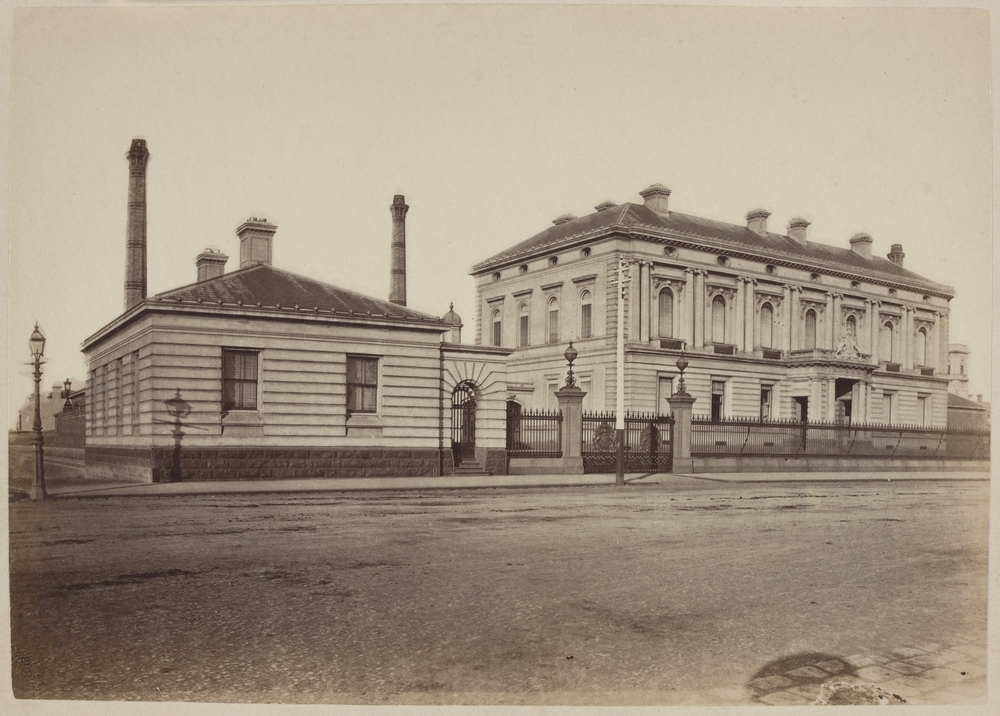
Nicholas Caire (born United Kingdom 1837; arrived Australia 1858; died 1918) 'The Royal Mint, Melbourne' 1877-1878


Nicholas Caire (born United Kingdom 1837; arrived Australia 1858; died 1918)
The Royal Mint, Melbourne
1877-1878
From the series The public buildings of Melbourne and suburbs
Albumen print
Monash Gallery of Art, City of Monash Collection acquired 1987


Original album caption: The Royal Mint of Victoria is situated in the north-easterly part of William Street, West Melbourne. This Government Building is not thrown open to the public for visitation at any time; but an inspection by visitors can be effected on an order from a Member of the Ministry, conditionally that there be no fewer than eight persons at each visitation; one of the number being required to become responsible for the conduct of the party.


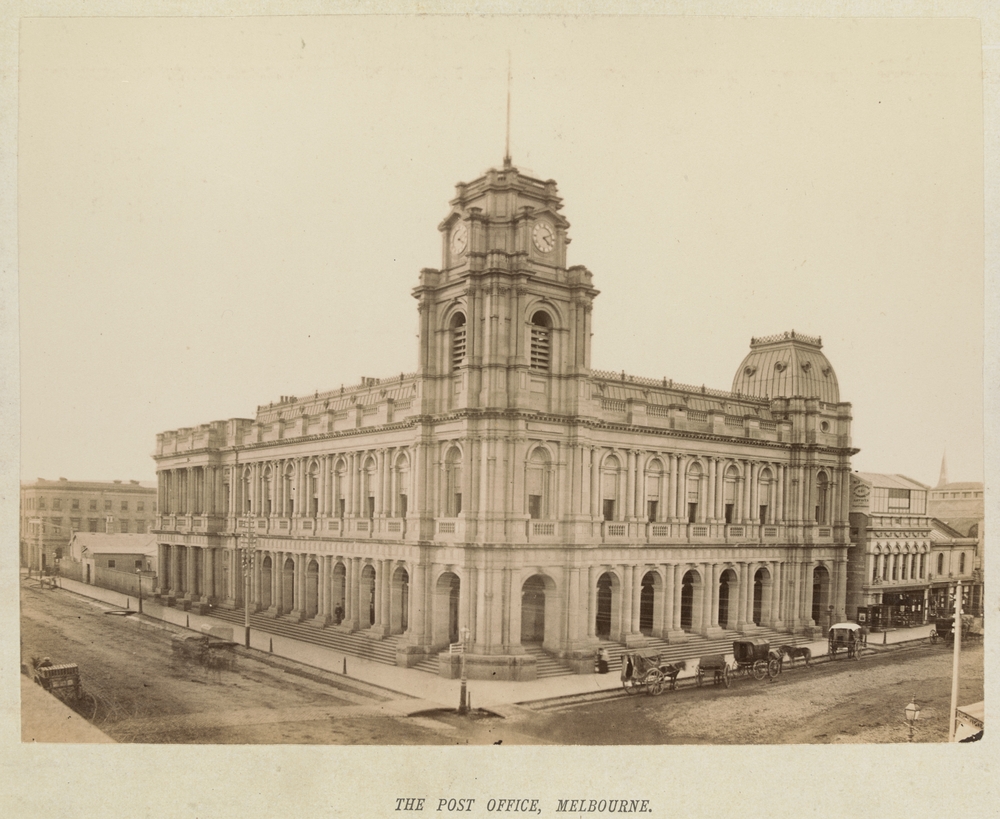
Nicholas Caire (born United Kingdom 1837; arrived Australia 1858; died 1918) 'The Post Office, Melbourne' 1877-1878


Nicholas Caire (born United Kingdom 1837; arrived Australia 1858; died 1918)
The Post Office, Melbourne
1877-1878
From the series The public buildings of Melbourne and suburbs
Albumen print
Monash Gallery of Art, City of Monash Collection acquired 1987


Original album caption: This imposing structure is erected at the junction of Bourke and Elizabeth Streets, which may be considered perhaps the most central position in Melbourne. It is provided with a very long corridor for the posting and delivery of letters, & c. The Telegraph Department, as also the Post Office Savings Bank and Money Order Office, are all conducted in connection with the General Post office, Melbourne, of which the Hon. R Ramsay, MLA, is at present Postmaster-General.


Charles Kerry (Australia, 1858-1928) 'Collins Street, looking south' c. 1890


Charles Kerry (Australia, 1858-1928)
Collins Street, looking south
c. 1890
Albumen print
14.5 x 17.5cm
Monash Gallery of Art, City of Monash Collection acquired 1984


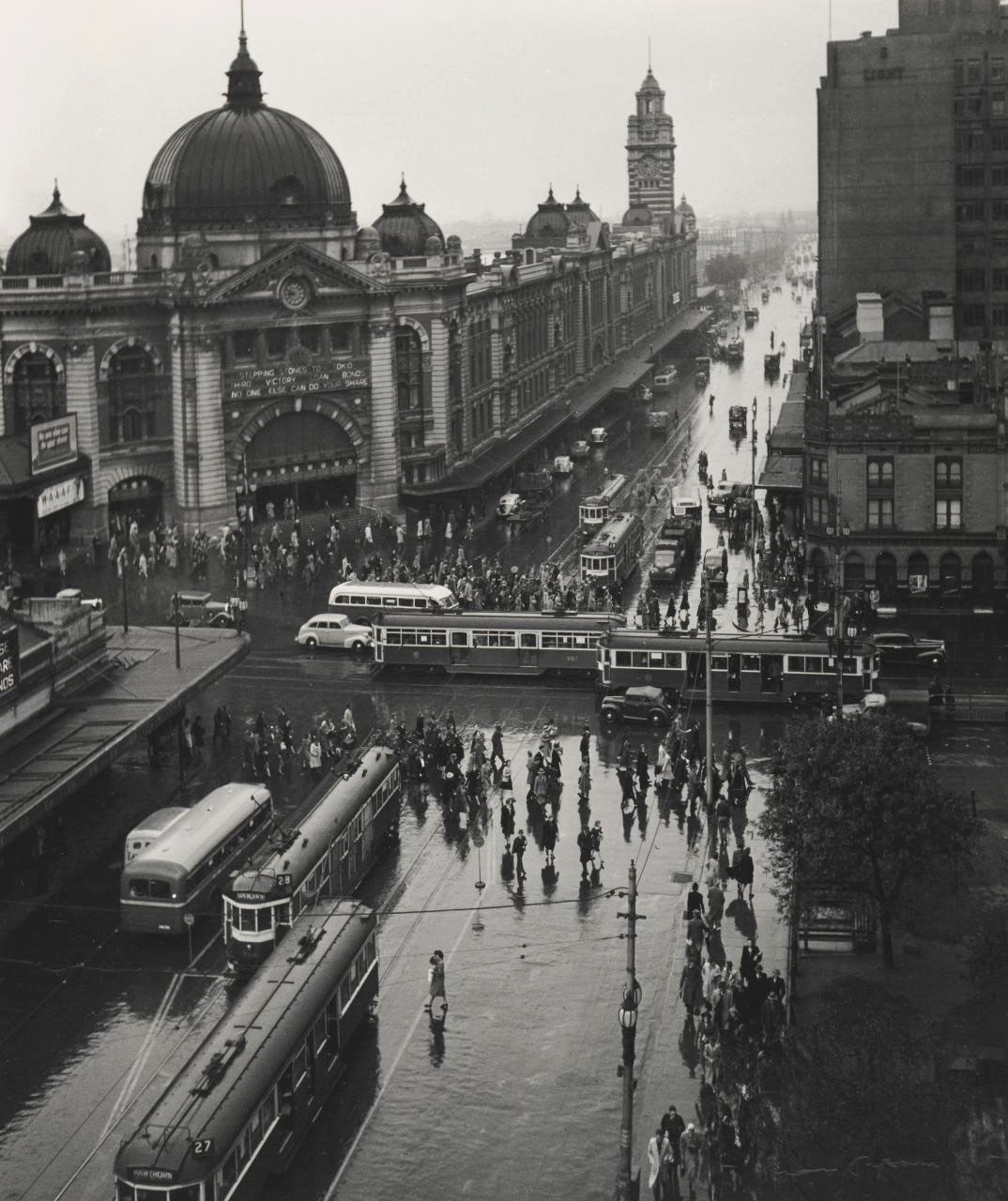
Max Dupain (Australia, 1911-1992) 'Melbourne with rain' 1946


Max Dupain (Australia, 1911-1992)
Melbourne with rain
1946
Gelatin silver print
Monash Gallery of Art, City of Monash Collection acquired 1987


Max Dupain

Max Dupain began his photographic career in 1930 as an apprentice in the studio of Cecil Bostock. In 1934 he established his own studio in Sydney and continued to produce a broad range of commercial work over the course of his life. Dupain was strongly influenced by modernist photographic principles and is renowned for his architectural photography as well as his iconic images of Australian beach culture.

While he primarily worked in Sydney, the photographs exhibited here are among several he took of otherAustralian cities. They highlight his interest in documenting city life as well as his use of light, shadow and aerial perspective. They were taken during the post war period; in the year that Dupain was commissioned by the Department of Information to photograph Australia’s way of life as part of a campaign to increase migration to Australia. This period marked a shift in Dupain’s practice, away from advertising and fashion toward social documentary.


Mark Strizic (born Germany 1928; arrived Australia 1950; died 2012) 'Near 101 Collins Street, Jan 1963' 1963


Mark Strizic (born Germany 1928; arrived Australia 1950; died 2012)
Near 101 Collins Street, Jan 1963
1963
Gelatin silver print
36 x 53.5cm
Monash Gallery of Art, City of Monash Collection
Donated by the Bowness Family through the Australian Government’s Cultural Gifts Program 2008
Reproduction courtesy of the artist


Mark Strizic (born Germany 1928; arrived Australia 1950; died 2012) 'Collins Street at McPherson's building - 1, 1967' 1967


Mark Strizic (born Germany 1928; arrived Australia 1950; died 2012)
Collins Street at McPherson’s building – 1, 1967
1967
Gelatin silver print
53.8 x 36cm
Monash Gallery of Art, City of Monash Collection
Donated by the Bowness Family through the Australian Government’s Cultural Gifts Program 2008
Reproduction courtesy of the artist


Mark Strizic

Mark Strizic was born in Berlin and migrated to Melbourne from Zagreb, Croatia in 1950. Strizic had no formal training in photography, but began taking photographs of Melbourne in the 1950s. He abandoned his studies in physics to become a full-time photographer in 1957, taking up subsequent commissions in architectural, industrial, interior design and portrait photography.

Among Strizic’s most widely recognised images are those he created of Melbourne between 1955 and 1970. Strizic documented the streets of Melbourne, showing many sides of the city, from derelict back alleyways to the grand arcades and buildings of Melbourne’s ‘Paris end’. Strizic’s photographs were produced during a period of dramatic change, a time when Melbourne’s Victorian-era buildings were being replaced by modern architectural developments. The images not only serve to document this change but also provide significant and important records of Melbourne pre-modernisation.


Monash Gallery of Art
860 Ferntree Gully Road, Wheelers Hill
Victoria 3150 Australia
Phone: + 61 3 8544 0500

Opening hours:
Tue – Fri: 10am – 5pm
Sat – Sun: 10pm – 4pm
Mon/public holidays: closed

Monash Gallery of Art website

LIKE ART BLART ON FACEBOOK

Back to top

Exhibition: ‘The view from here: The photographic world of Alfred Elliott 1890-1940’ at the Museum of Brisbane

Exhibition dates: 13 February – 30 August, 2015

Curator: Phil Manning


Alfred Elliott (Australian, 1870-1954) 'Brisbane Botanic Gardens, near the Edward Street entrance' 1895 from the exhibition 'The view from here: The photographic world of Alfred Elliott 1890-1940' at the Museum of Brisbane, Feb - Aug, 2015


Alfred Elliott (Australian, 1870-1954)
Brisbane Botanic Gardens, near the Edward Street entrance
1895
City of Brisbane Collection, Museum of Brisbane


This is more like it… what a find!

There are some fascinating punctum (which denote the wounding, personally touching detail which establishes a direct relationship with the object or person within the image), contained among this recently discovered treasure trove of photographs by Alfred Elliott.

At first, what looks like a real dog is actually a toy sitting in front of Alfred Goldsbrough Elliott, Stanley Terrace, Taringa (1908). And then you notice the hard-nosed stare of the little girl in Dorothy Elliott (1911). She is not a happy camper. Then the scruffy, bare-footed urchin in ‘Welcome to Brisbane’ arch, Queen Street (1895). Or the unhappy woman staring directly into the camera in Grand Arch, Queen Street, visit of the Duke of York (1901), as though her thoughts are being transmitted to us from beyond the grave. And finally, to the two young, blurred children running in front of a white picket fence in Windmill, Wickham Terrace (1895), the smaller of the children noticing the photographer and camera and looking towards both. Just a joy!

And don’t forget, all of these early photographs were taken with a large plate camera (the photographs after 1921 were taken with a film camera and have a totally different feel to them). For an artist to obtain the street photographs and portraits out in the field with this type of camera is superb. Just look at the image Members of the QLD League of Wheelmen, Wellington Point (1897). You can tell the personality of every individual in this image through the clarity, not just of the image but of the thought of the photographer, before he exposed his plate. It is so Australian in its iconography, it could come from nowhere else in the world. This photograph deserves to be up there with one of the seminal images of Australian photography.

Dr Marcus Bunyan


Many thanks to the Museum of Brisbane for allowing me to publish the photographs in the posting. Please click on the photographs for a larger version of the image.
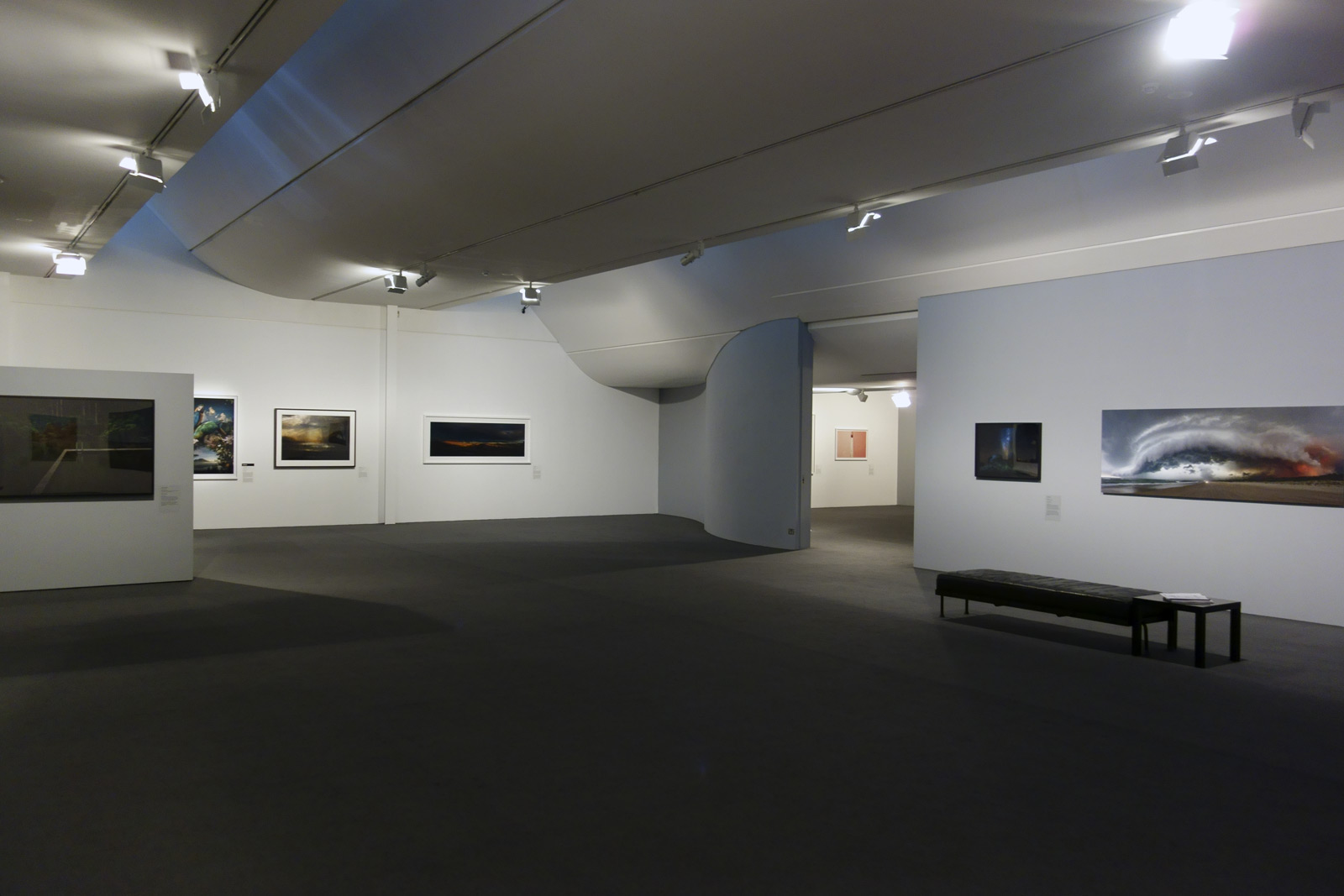


The view from here: The photographic world of Alfred Elliott 1890-1940


Alfred Elliott (Australian, 1870-1954) 'Brisbane, from the Windmill' 1895 from the exhibition 'The view from here: The photographic world of Alfred Elliott 1890-1940' at the Museum of Brisbane, Feb - Aug, 2015


Alfred Elliott (Australian, 1870-1954)
Brisbane, from the Windmill
1895
City of Brisbane Collection, Museum of Brisbane


Alfred Elliott (Australian, 1870-1954) 'Aborigines fishing in the Maroochy River' 1890


Alfred Elliott (Australian, 1870-1954)
Aborigines fishing in the Maroochy River
1890
City of Brisbane Collection, Museum of Brisbane


Alfred Elliott (Australian, 1870-1954) 'Central Railway Station, from Edward Street' 1922


Alfred Elliott (Australian, 1870-1954)
Central Railway Station, from Edward Street
1922
City of Brisbane Collection, Museum of Brisbane


Alfred Elliott (Australian, 1870-1954) ''Citizens' Welcome' arch, Queen Street' 1927


Alfred Elliott (Australian, 1870-1954)
‘Citizens’ Welcome’ arch, Queen Street
1927
City of Brisbane Collection, Museum of Brisbane


Alfred Elliott (Australian, 1870-1954) ''Citizens' Welcome' arch, Queen Street' 1927 (detail)


Alfred Elliott (Australian, 1870-1954)
‘Citizens’ Welcome’ arch, Queen Street (detail)
1927
City of Brisbane Collection, Museum of Brisbane


Museum of Brisbane’s latest exhibition offers an amazing visual portrait of a lost city – Brisbane at the turn of the 20th century – through a rare collection of photographs, all shot by a single resident and left forgotten under an inner-city house for decades. The view from here: The photographic world of Alfred Elliott 1890-1940 showcases the life’s work of the avid Brisbane-based photographer, offering a fascinating chronicle of the places he visited, major events he witnessed and intimate glimpses into his family life.

The historic collection of glass-plate and film negatives remained stored in cigar boxes under a house in Red Hill until they were uncovered in 1983 and acquired by Museum of Brisbane. For the past 30 years ‘The Elliott Collection’ was thought to comprise 285 glass plate negatives, until a neglected cigar box with more than 400 film negatives was uncovered at the Museum’s storage facility last year. This significant discovery has allowed the Museum to further piece together fragments of the passionate amateur photographer’s past. The collection provides a window into both his life and the life of a quickly changing city.

Elliott’s work also captures significant moments in Brisbane’s history, including the Duke and Duchess of York’s visit in 1901 and the farewell of the troops aboard SS Cornwall from Pinkenba in 1899. Museum of Brisbane Director Peter Denham said the collection was an exceptional record of one man’s perspective of Brisbane at a very exciting time.

“These unseen photographs offer a unique view of Brisbane at a significant turning point – the city’s population was booming, grand civic structures were erected and huge social change was occurring,” Mr Denham said. “The interactive elements of The view from here offer visitors the chance to get up close with buildings from our past, as well as investigate the photographic technology from the turn of last century.”

“With the discovery of hundreds of new photos, we have learned a lot about Elliott and his family and were even able to locate his much-loved home in Taringa. It is part of our mission as the city’s museum to uncover new stories and we are thrilled to share these findings with visitors. The exhibition wonderfully captures how much our city has changed and I think it will encourage people to reflect on their own perceptions of Brisbane.” The view from here will run until 30 August 2015.

Press release from the Museum of Brisbane website


Alfred Elliott (Australian, 1870-1954) 'Dorothy Elliott, Amy Lock, Mrs Lock and Elizabeth Ellen Elliott' Nd


Alfred Elliott (Australian, 1870-1954)
Dorothy Elliott, Amy Lock, Mrs Lock and Elizabeth Ellen Elliott
Nd
City of Brisbane Collection, Museum of Brisbane


Alfred Elliott (Australian, 1870-1954) 'Elizabeth Ellen Elliott w the Dillon sisters Mary, Clare, Margo' Nd


Alfred Elliott (Australian, 1870-1954)
Elizabeth Ellen Elliott w the Dillon sisters Mary, Clare, Margo
Nd
City of Brisbane Collection, Museum of Brisbane


Alfred Elliott (Australian, 1870-1954) 'Government House, George Street' 1908


Alfred Elliott (Australian, 1870-1954)
Government House, George Street
1908
City of Brisbane Collection, Museum of Brisbane


Alfred Elliott (Australian, 1870-1954) 'Maroochy' 1890


Alfred Elliott (Australian, 1870-1954)
Maroochy
1890
City of Brisbane Collection, Museum of Brisbane


Alfred Elliott (Australian, 1870-1954) 'Maroochy' 1890 (detail)


Alfred Elliott (Australian, 1870-1954)
Maroochy (detail)
1890
City of Brisbane Collection, Museum of Brisbane


Alfred Elliott (Australian, 1870-1954) 'Members of the QLD League of Wheelmen, Wellington Point' 1897


Alfred Elliott (Australian, 1870-1954)
Members of the QLD League of Wheelmen, Wellington Point
1897
City of Brisbane Collection, Museum of Brisbane


The first shipment of tricycles arrived in Brisbane in 1870 and the first race is reported to have been between a cyclist and a Cobb and Co coach from Brisbane to Sandgate. No official timing was recorded.

The initial Brisbane Bicycle Club meeting was held in 1881 at the Belle Vue Hotel. High wheel bicycles including the Penny Farthing were the only bikes available and novelty Penny Farthing races were held in the Brisbane Botanic Gardens where more riders fell off than stayed on. By 1886 Brisbane had 200 bicycles and 50 of these were used for racing…

The first Queensland championship was held at the Breakfast Creek Sports Ground in 1891 and was won by Lou Isles. Isles also rode long distance, riding from Brisbane to Sydney in 1891 a 700 mile trek which he completed in 7 days. Imported bicycles cost £30 although local bicycles could be bought for two pound ten. Successful Queensland riders of the day included Ben Goodsen, Billy Dowd and Percy Davies.

In 1895 a record of 1 hour 2 minutes and 10 seconds was set by George Stombaco for a 34 kilometre race over rough dirt roads from Brisbane and Cleveland. That same year, The League of Queensland Wheelmen held a Christmas Carnival with over 8000 attendees. Brisbane wasn’t the only town with a club as Maryborough, Townsville, Ipswich and Rockhampton also had successful clubs.

Karen Hind. “Cycling in Queensland.” 18 July 2011 [Online] Cited 19/08/2015.


Alfred Elliott (Australian, 1870-1954) 'Treasury Building, William Street' 1895


Alfred Elliott (Australian, 1870-1954)
Treasury Building, William Street
1895
City of Brisbane Collection, Museum of Brisbane


Alfred Elliott (Australian, 1870-1954) 'Victoria Bridge, decorated for the Duke of York' 1901


Alfred Elliott (Australian, 1870-1954)
Victoria Bridge, decorated for the Duke of York
1901
City of Brisbane Collection, Museum of Brisbane


Alfred Elliott (Australian, 1870-1954) 'Victoria Bridge, decorated for the Duke of York' 1901 (detail)


Alfred Elliott (Australian, 1870-1954)
Victoria Bridge, decorated for the Duke of York (detail)
1901
City of Brisbane Collection, Museum of Brisbane


The images chronicle a broad range of Elliott’s life – from private moments with friends on family trips and picnics at the Glasshouse Mountains to key moments in Brisbane’s history such as the construction of Central Railway Station in 1899 and the visit from the Duke and Duchess of York in 1901. Images were captured in locations including Mt Coot-tha, the city’s Botanic Gardens, Tweeds Heads just south of the border and the Moreton Bay Region – all undertaken by train, bus, boat, car and possibly even by horse and bicycle.

Curator Phil Manning, who discovered the last cigar box, said it was evident from the body of work that Elliott was proud of his city.

“He documented the city by walking the streets and going on travels with his family,” Mr Manning said. “He had a strong connection to the British Empire, that was probably the area he was most drawn to documenting … royal visits and the Queensland troops going off to the Boer War. But he’s also photographed Brisbane’s new buildings and structures such as the bridges that went up following the 1893 flood.”

Elliot’s first photographs were dated 1890 and captured on dry-plate glass negatives, including both single image and stereograph negatives. They were a mixture of amateur and professionally produced plates. Elliot used glass plates until 1921 when it appeared he changed to a camera with film.

Very little was known about Alfred Henrie Elliott. He was born in Paignton in England in 1870 and was the youngest of seven children. His family came to Queensland when he was seven years old, with his father taking up post as principal of Humpybong Primary School in Redcliffe, north of Brisbane. Elliott was known to have worked in Brisbane as a civil servant in a variety of roles. His working life also included jobs as a law clerk, professional shorthand writer and a bank clerk.

Patrick Williams and Maria Hatzakis. “Uncovered glass plates and film negatives capturing 50 years of Brisbane’s history go on display,” on the ABC News website, 10 Feb 2015 [Online] Cited on 19/08/2015.


Alfred Elliott (Australian, 1870-1954) 'Eight hour day procession on Queen Street in Brisbane city' 1893


Alfred Elliott (Australian, 1870-1954)
Eight hour day procession on Queen Street in Brisbane city
1893
City of Brisbane Collection, Museum of Brisbane


Alfred Elliott (Australian, 1870-1954) 'Alfred Goldsbrough Elliott, Stanley Terrace, Taringa' 1908


Alfred Elliott (Australian, 1870-1954)
Alfred Goldsbrough Elliott, Stanley Terrace, Taringa
1908
City of Brisbane Collection, Museum of Brisbane


Alfred Elliott (Australian, 1870-1954) 'Dorothy Elliott' 1911


Alfred Elliott (Australian, 1870-1954)
Dorothy Elliott
1911
City of Brisbane Collection, Museum of Brisbane


Alfred Elliott (Australian, 1870-1954) 'Dorothy Elliott' 1911 (detail)


Alfred Elliott (Australian, 1870-1954)
Dorothy Elliott (detail)
1911
City of Brisbane Collection, Museum of Brisbane


Alfred Elliott (Australian, 1870-1954) 'Grand Arch, Queen Street, visit of the Duke of York' 1901


Alfred Elliott (Australian, 1870-1954)
Grand Arch, Queen Street, visit of the Duke of York
1901
City of Brisbane Collection, Museum of Brisbane


Alfred Elliott (Australian, 1870-1954) 'Grand Arch, Queen Street, visit of the Duke of York' 1901 (detail)


Alfred Elliott (Australian, 1870-1954)
Grand Arch, Queen Street, visit of the Duke of York (detail)
1901
City of Brisbane Collection, Museum of Brisbane


Alfred Elliott (Australian, 1870-1954) 'Picnic party on Brisbane River at Seventeen Mile Rocks' 1898


Alfred Elliott (Australian, 1870-1954)
Picnic party on Brisbane River at Seventeen Mile Rocks
1898
City of Brisbane Collection, Museum of Brisbane


Alfred Elliott (Australian, 1870-1954) 'Picnic party on Brisbane River at Seventeen Mile Rocks' 1898 (detail)


Alfred Elliott (Australian, 1870-1954)
Picnic party on Brisbane River at Seventeen Mile Rocks (detail)
1898
City of Brisbane Collection, Museum of Brisbane


Alfred Elliott (Australian, 1870-1954) 'Queen Street, Brisbane' 1899


Alfred Elliott (Australian, 1870-1954)
Queen Street, Brisbane
1899
City of Brisbane Collection, Museum of Brisbane


Alfred Elliott (Australian, 1870-1954) 'Treasury Building, Queen and William Street' 1901


Alfred Elliott (Australian, 1870-1954)
Treasury Building, Queen and William Street
1901
City of Brisbane Collection, Museum of Brisbane


Alfred Elliott (Australian, 1870-1954) ''Welcome to Brisbane' arch, Queen Street' 1920


Alfred Elliott (Australian, 1870-1954)
‘Welcome to Brisbane’ arch, Queen Street
1920
City of Brisbane Collection, Museum of Brisbane


Alfred Elliott (Australian, 1870-1954) ''Welcome to Brisbane' arch, Queen Street' 1920 (detail)


Alfred Elliott (Australian, 1870-1954)
‘Welcome to Brisbane’ arch, Queen Street (detail)
1920
City of Brisbane Collection, Museum of Brisbane


Alfred Elliott (Australian, 1870-1954) 'Windmill, Wickham Terrace' 1895


Alfred Elliott (Australian, 1870-1954)
Windmill, Wickham Terrace
1895
City of Brisbane Collection, Museum of Brisbane


Alfred Elliott (Australian, 1870-1954) 'Windmill, Wickham Terrace' 1895 (detail)


Alfred Elliott (Australian, 1870-1954)
Windmill, Wickham Terrace (detail)
1895
City of Brisbane Collection, Museum of Brisbane


Alfred Elliott (Australian, 1870-1954) 'Alfred Henry Elliott (1870 - 1954)' 1899


Alfred Elliott (Australian, 1870-1954)
Alfred Henry Elliott (1870-1954)
1899
City of Brisbane Collection, Museum of Brisbane


Alfred Elliott (Australian, 1870-1954) 'Elizabeth Ellen Elliott and Alfred Elliott' 1899


Alfred Elliott (Australian, 1870-1954)
Elizabeth Ellen Elliott and Alfred Elliott
1899
City of Brisbane Collection, Museum of Brisbane


Museum of Brisbane

Museum of Brisbane is located on Level 3, Brisbane City Hall (Adelaide and Ann Street, Brisbane QLD)

Opening hours:
Open 7 days a week, 10am – 5pm

Museum of Brisbane website

LIKE ART BLART ON FACEBOOK

Back to top

Exhibition: ‘Crowd Source’ at the State Library of New South Wales, Sydney

Exhibition dates: 4th April – 23rd August, 2015

Co-curator: Margot Riley


Arthur K. Syer (Australian, d. 1935) 'Argyle Cut, The Rocks' c. 1880s - 1900 from the exhibition 'Crowd Source' at the State Library of New South Wales, Sydney, April - August, 2015


Arthur K. Syer (Australian, d. 1935)
Argyle Cut, The Rocks
c. 1880s-1900
Albumen print
From an album of Sydney street life, harbour and beach scenes, domestic animals
81 photographs in album: 15.2 x 20.4cm or smaller
Mitchell Library, State Library of New South Wales


There is an almost Dickensian mellow dramatic feel to some of these 1880s-1900 albumen photographs by Sydney photographer Arthur K. Syer.

While the photographs offer a unique point of view (low down by the waist) of Victorian era Sydney, you get the feeling that Syer was more interested in the fact that his camera was hidden, and the game he was playing to get these photographs, than in the visual construction of the images themselves.

The best of them are photographs – such as Hawker haggling with customers, with its links to the photography of Atget, and crowd scenes like Men in street, where the different poses of the men and the rising and falling of the six items of headgear – offer a rhythmic consideration and interest that other photographs in the posting lack.

The gem in this group of images is the outstanding Forest Lodge double decker steam tram stopped on Elizabeth Street near Supreme Court N.S.W. Again, it is the attitude and rhythm of the protagonists within the image frame that makes this diorama so engaging. The man at left looks away from us with his back to the camera, while above him a man stands in the tram perpendicular to him, giving a nice play to the space between the tram carriages. Three people in alternating dark and light hats wait patiently for a old biddie to descend from the open door of the tram, the man holding on to the hand rail of the tram ready to pull himself up, just as everyone still does on old trams in Melbourne to this day. Above on the top deck sits a young man staring straight at the camera (without knowing it is there), with his legs crossed in a most unusual and uncomfortable way.

Below him to the right a gent in a bowler hat talks with his wife, cigar stuck in his mouth. His facial outline, lit by the sun, is echoed in the darkness of the interior of the tram by another man with a beard and hat sitting in shadow. In front of this husband and wife is a son with his mother / grandmother – she, clutching her bag in heavy tassel-fringed cloak, protecting herself with umbrella against the sun – he, in long gents morning coat and hat looking very dapper. It must be mid afternoon by the length of the shadows cast by the sun. To the right of this pair is an older, heavy set man with great beard and hat, looking out of the image to the right. His gaze is cut across by a man sitting in the tram, all darkness and outline, beard and hat, looking out onto the scene from the interior. Finally, to ground the foreground of the image, there is a mother and daughter at bottom right of the image, with the small child clutching at the mother’s dress.

The characters in this Dickens play rise and fall from left to right. They wash over you in their happenstance, frozen interaction. It is a superbly constructed image. Interesting as they are in their own vernacular way, it just makes the other images in this posting seem rather, well, prosaic.

Dr Marcus Bunyan


Many thankx to the State Library of New South Wales for allowing me to publish the photographs in the posting. Please click on the photographs for a larger version of the image.
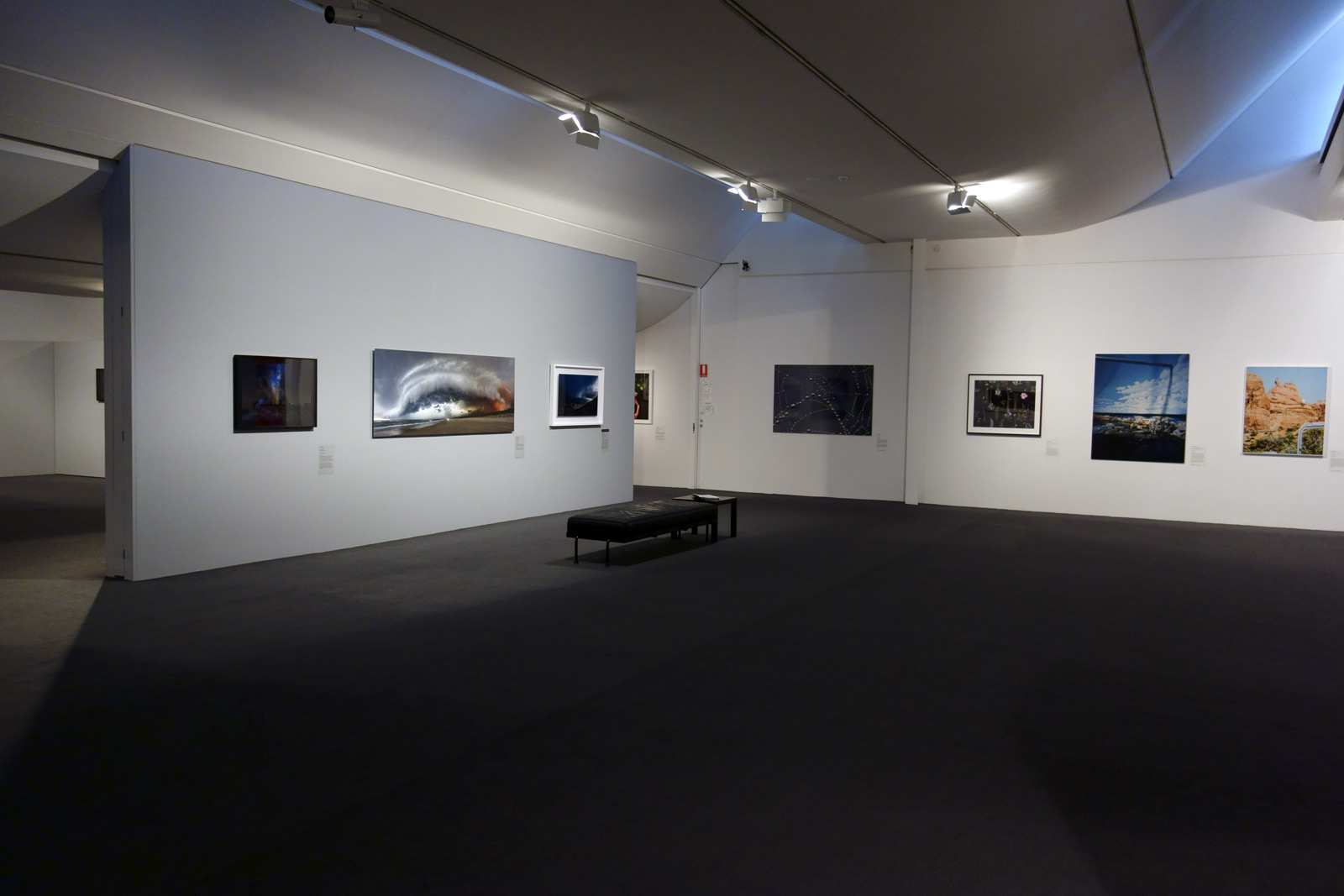


Arthur K. Syer (Australian, d. 1935) 'George Street, The Rocks' c. 1880s - 1900 from the exhibition 'Crowd Source' at the State Library of New South Wales, Sydney, April - August, 2015


Arthur K. Syer (Australian, d. 1935)
George Street, The Rocks
c. 1880s-1900
Albumen print
From an album of Sydney street life, harbour and beach scenes, domestic animals
81 photographs in album: 15.2 x 20.4cm or smaller

Mitchell Library, State Library of New South Wales


Thank you to Philip Cohen for pointing out this is Little Essex Street, looking East towards George Street; this street is no more as the underground railway now comes out at this point.


Arthur K. Syer (Australian, d. 1935) 'George Street, The Rocks' c. 1880s - 1900 (detail)


Arthur K. Syer (Australian, d. 1935)
George Street, The Rocks (detail)
c. 1880s-1900
Albumen print
From an album of Sydney street life, harbour and beach scenes, domestic animals
81 photographs in album: 15.2 x 20.4cm or smaller
Mitchell Library, State Library of New South Wales


Arthur K. Syer (Australian, d. 1935) 'Martin Place near the GPO Colonnade' c. 1880s - 1900


Arthur K. Syer (Australian, d. 1935)
Martin Place near the GPO Colonnade
c. 1880s-1900
Albumen print
From an album of Sydney street life, harbour and beach scenes, domestic animals
81 photographs in album: 15.2 x 20.4cm or smaller
Mitchell Library, State Library of New South Wales


Arthur K. Syer (Australian, d. 1935) 'Devonshire and Chalmers Streets near Central Station' c. 1880s - 1900


Arthur K. Syer (Australian, d. 1935)
Devonshire and Chalmers Streets near Central Station
c. 1880s-1900
Albumen print
From an album of Sydney street life, harbour and beach scenes, domestic animals
81 photographs in album: 15.2 x 20.4cm or smaller
Mitchell Library, State Library of New South Wales


Arthur K. Syer (Australian, d. 1935) Forest Lodge double decker steam tram stopped on Elizabeth Street near Supreme Court N.S.W. c. 1880s - 1900 (detail)


Arthur K. Syer (Australian, d. 1935)
Forest Lodge double decker steam tram stopped on Elizabeth Street near Supreme Court N.S.W.
c. 1880s-1900
Albumen print
From an album of Sydney street life, harbour and beach scenes, domestic animals
81 photographs in album: 15.2 x 20.4cm or smaller
Mitchell Library, State Library of New South Wales


Thank you to Philip Cohen for the following comments:

I’d love to know how you [the Mitchell Library that is] identified this view as being “near Supreme Court”. Does this imply that it is King Street on the left? But the building behind the tram has a window on the corner facade; the Supreme Court building has no such feature; then, the destination is Forest Lodge which implies that the tram is traveling South. The building behind the tram looks more like that one on the corner of Park Street, complete with telegraph pole; see “Trams in Elizabeth Street, Sydney, 1886” on the City of Sydney Archives & History Resources website Len Stone and Vic Solomons Collection Nd [Online] Cited 29/01/202.


Arthur K. Syer (Australian, d. 1935) 'Forest Lodge double decker steam tram stopped on Elizabeth Street near Supreme Court N.S.W.' (detail) c. 1880s - 1900


Arthur K. Syer (Australian, d. 1935)
Forest Lodge double decker steam tram stopped on Elizabeth Street near Supreme Court N.S.W. (detail)
c. 1880s-1900
Albumen print
From an album of Sydney street life, harbour and beach scenes, domestic animals
81 photographs in album: 15.2 x 20.4cm or smaller
Mitchell Library, State Library of New South Wales


Arthur K. Syer (Australian, d. 1935) 'Forest Lodge double decker steam tram stopped on Elizabeth Street near Supreme Court N.S.W.' (detail) c. 1880s - 1900


Arthur K. Syer (Australian, d. 1935)
Forest Lodge double decker steam tram stopped on Elizabeth Street near Supreme Court N.S.W. (detail)
c. 1880s-1900
Albumen print
From an album of Sydney street life, harbour and beach scenes, domestic animals
81 photographs in album: 15.2 x 20.4cm or smaller
Mitchell Library, State Library of New South Wales


Arthur K. Syer (Australian, d. 1935) 'Forest Lodge double decker steam tram stopped on Elizabeth Street near Supreme Court N.S.W.' c. 1880s - 1900 (detail)


Arthur K. Syer (Australian, d. 1935)
Forest Lodge double decker steam tram stopped on Elizabeth Street near Supreme Court N.S.W. (detail)
c. 1880s-1900
Albumen print
From an album of Sydney street life, harbour and beach scenes, domestic animals
81 photographs in album: 15.2 x 20.4cm or smaller
Mitchell Library, State Library of New South Wales


Some of the world’s earliest street photographs, capturing many previously unseen views of Sydney from the 1880s will go on public display for the first time in a new exhibition opening at the State Library of NSW, from Saturday 4 April. Crowd Source presents over 50 rare snapshots of Sydneysiders and Sydney’s bustling streets secretly taken with the world’s first hand‐held camera – branded the ‘Detective Camera’ – by amateur local photographer Arthur Syer.

“Arthur Syer took candid photographs of ordinary people in everyday situations which he supplied to illustrators to use as ‘source material’ to help them create a life-like quality and characters in their drawings,” says exhibition co-curator Margot Riley. “Syer’s distinctive low angle photographs evocatively capture the buzz of 1880s Sydney showing the shoe-shiners and fruit sellers, road workers, transport deliveries and barrow shopping, queues at Circular Quay, children playing, shipping and scenes at the horses races,” said Ms Riley.

Syer crossed into the publishing industry through his artist brother Walter, who introduced him to internationally renowned English cartoonist, Phil May. Invited to Sydney by The Bulletin in 1885, May often used Syer’s images to add authenticity to the backgrounds for his illustrations, for example drawings of people at the racecourse.

When the hand‐held camera was introduced in Australia in the mid‐1880s “it became a craze much like the smart phone or selfie stick of today, with photographs for the first time being able to be taken quickly and unnoticed,” said Ms Riley. The camera resembled “a square case… disguised as a … shoeblack’s box, or even a book. The operator places it upon the ground, or under his arm, the pressure of the pneumatic ball opening or closing the hidden lens at the required moment.” (The Sydney Mail, 2 July 1881).

No skill was required to operate the Detective Camera, signalling the beginning of mass photography. It used dry plate negatives – commercialised by George Eastman of Kodak fame – which were available over the counter at photography shops where negatives could be taken for developing and printing.

“This new technology, which also saw the introduction of other novelties like the ‘vest camera’ and ‘watch camera’, triggered debate around issues of privacy which led to the passing of new privacy laws in America,” says Ms Riley. “Manners and rules around candid photography continue to be a hot topic today.”

The State Library holds over 170 original Arthur Syer photographs – the most extensive collection of early Australian street photography known to exist. With the help of the Flickr community the Library has been able to label many of the images in the collection.

Crowd Source is a free exhibition at the State Library of NSW from 4 April to 23 August 2015. #1880Sydney @statelibrarynsw

Press release from the State Library of New South Wales


Arthur K. Syer (Australian, d. 1935) 'Tram, West Crescent St., North Sydney' c. 1880s - 1900


Arthur K. Syer (Australian, d. 1935)
Tram, West Crescent St., North Sydney
c. 1880s-1900
Albumen print
From an album of Sydney street life, harbour and beach scenes, domestic animals
81 photographs in album: 15.2 x 20.4cm or smaller
Mitchell Library, State Library of New South Wales


Thank you to Philip Cohen for pointing out this is in fact Elizabeth Street, near King Street.


Arthur K. Syer (Australian, d. 1935) 'Tram, West Crescent St., North Sydney' (detail) c. 1880s - 1900


Arthur K. Syer (Australian, d. 1935)
Tram, West Crescent St., North Sydney (detail)
c. 1880s-1900
Albumen print
From an album of Sydney street life, harbour and beach scenes, domestic animals
81 photographs in album: 15.2 x 20.4cm or smaller
Mitchell Library, State Library of New South Wales


Arthur K. Syer (Australian, d. 1935) 'Pyrmont Bridge looking across to City' c. 1880s - 1900


Arthur K. Syer (Australian, d. 1935)
Pyrmont Bridge looking across to City
c. 1880s-1900
Albumen print
From an album of Sydney street life, harbour and beach scenes, domestic animals
81 photographs in album: 15.2 x 20.4cm or smaller
Mitchell Library, State Library of New South Wales


Arthur K. Syer (Australian, d. 1935) 'Circular Quay near First Fleet Park' c. 1880s - 1900


Arthur K. Syer (Australian, d. 1935)
Circular Quay near First Fleet Park
c. 1880s-1900
Albumen print
From an album of Sydney street life, harbour and beach scenes, domestic animals
81 photographs in album: 15.2 x 20.4cm or smaller
Mitchell Library, State Library of New South Wales


Arthur K. Syer (Australian, d. 1935) 'Children crowd around a ladder' c. 1880s - 1900


Arthur K. Syer (Australian, d. 1935)
Children crowd around a ladder
c. 1880s-1900
Albumen print
From an album of Sydney street life, harbour and beach scenes, domestic animals
81 photographs in album: 15.2 x 20.4cm or smaller
Mitchell Library, State Library of New South Wales


Arthur K. Syer (Australian, d. 1935) 'Children crowd around a ladder' (detail) c. 1880s - 1900


Arthur K. Syer (Australian, d. 1935)
Children crowd around a ladder (detail)
c. 1880s-1900
Albumen print
From an album of Sydney street life, harbour and beach scenes, domestic animals
81 photographs in album: 15.2 x 20.4cm or smaller
Mitchell Library, State Library of New South Wales


Arthur K. Syer (Australian, d. 1935) 'Royal Exchange Building in Bridge Street' c. 1880s - 1900


Arthur K. Syer (Australian, d. 1935)
Royal Exchange Building in Bridge Street
c. 1880s-1900
Albumen print
From an album of Sydney street life, harbour and beach scenes, domestic animals
81 photographs in album: 15.2 x 20.4cm or smaller
Mitchell Library, State Library of New South Wales


Arthur K. Syer (Australian, d. 1935) 'Men in street' c. 1880s - 1900


Arthur K. Syer (Australian, d. 1935)
Men in street
c. 1880s-1900
Albumen print
From an album of Sydney street life, harbour and beach scenes, domestic animals
81 photographs in album: 15.2 x 20.4cm or smaller
Mitchell Library, State Library of New South Wales


Arthur K. Syer (Australian, d. 1935) 'Hawker haggling with customers' c. 1880s - 1900


Arthur K. Syer (Australian, d. 1935)
Hawker haggling with customers
c. 1880s-1900
Albumen print
From an album of Sydney street life, harbour and beach scenes, domestic animals
81 photographs in album: 15.2 x 20.4cm or smaller
Mitchell Library, State Library of New South Wales


Arthur K. Syer (Australian, d. 1935) 'Shoe shiner with customer' c. 1880s - 1900


Arthur K. Syer (Australian, d. 1935)
Shoe shiner with customer
c. 1880s-1900
Albumen print
From an album of Sydney street life, harbour and beach scenes, domestic animals
81 photographs in album: 15.2 x 20.4cm or smaller

Mitchell Library, State Library of New South Wales


State Library of New South Wales
Macquarie Street, Sydney
NSW 2000 Australia
Phone: +61 2 9273 1414

Opening hours:
Monday – Friday 9am – 5pm
Saturday – Sunday 10am – 5pm

State Library of New South Wales website

LIKE ART BLART ON FACEBOOK

Back to top

Exhibition: ‘The Sievers Project’ at the Centre for Contemporary Photography (CCP), Fitzroy, Melbourne

Exhibition dates: 13th June – 31st August, 2014

Artists: Jane Brown, Cameron Clarke, Zoë Croggon, Therese Keogh, Phuong Ngo, Meredith Turnbull, Wolfgang Sievers

Curators: Naomi Cass and Kyla McFarlane


Jane Brown (Australian, b. 1967) 'Triptych. The Paper Mill (former Amcor and APM site), Fairfield' 2014 (installation view)


Jane Brown (Australian, b. 1967)
Triptych. The Paper Mill (former Amcor and APM site), Fairfield
2014
3 panels of 9, 6 and 6 selenium toned, fibre-based, gelatin silver prints


Curated by CCP Director Naomi Cass and Kyla McFarlane, this intelligent exhibition features the work of six early career artists who respond in diverse ways to renowned Australian photographer Wolfgang Sievers (1913-2007). It was a joy to see again the large vintage silver gelatin, almost clinically composed photographs by Sievers. The light, tonality and stillness of the images make them seem mythic, modern and monumental.

Each artist offers a unique “take” on Sievers influence on Australian photography and design, including his interest in refugees and human rights issues and the representation of the dignity of labour (although the machine is more often represented in Sievers work with a distinct lack of human presence and the act of work itself).

My personal favourites were Phuong Ngo’s intimate silver gelatin photographs in four groups of sweat shop workers in Vietnam, people on boats coming to Australia, photographs of textile workers in Australia and photographs of his mother. Phuong Ngo’s shared stories of young Vietnamese refugees and the journeys taken by their mothers told through photographs is very moving, but only after you are told what the four bodies of images are about. Positioned in the small Gallery Four it was also difficult to associate this installation with the rest of the exhibition. Initially I thought it was a separate exhibition until the linkages were told, the light dawned, and the connections were made.

While Cameron Clarke’s photographs of Ford factory workers and machinery are meticulously lit and digitally observed, producing a strong body of work, it is Jane Brown’s gridded analogue triptych which steals the show (see photographs above and below). These are superbly rich and textured photographs, beautifully seen and resolved within the shifting mise-en-scène. Brown’s images kinetically flow from one image to another even as they are self contained within a modernist grid. In some instances the artist has used the same photograph within the triptych but cropped in a different manner, which pushes and pulls the viewer into a different perspective on the subject matter. This is highly intelligent art making that observes the self contained nature and monumentality of Sievers work and reworks it, lucidly commenting on the dis/integration of these spaces and industries in the present day.

This series of work is the best sequence of photographs I have seen this year and any institution worthy of their salt should snap up these works for their collection.

Dr Marcus Bunyan


Many thankx to the Director Naomi Cass and the CCP for allowing me to publish the text and photographs in the posting. Please click on the photographs for a larger version of the image. All installation photographs © Marcus Bunyan 2014


Installation photographs of Jane Brown's 'Triptych. The Paper Mill (former Amcor and APM site), Fairfield' 2014 (installation view details) at the exhibition 'The Sievers Project' at the Centre for Contemporary Photography (CCP)

Installation photographs of Jane Brown's 'Triptych. The Paper Mill (former Amcor and APM site), Fairfield' 2014 (installation view details) at the exhibition 'The Sievers Project' at the Centre for Contemporary Photography (CCP)

Installation photographs of Jane Brown's 'Triptych. The Paper Mill (former Amcor and APM site), Fairfield' 2014 (installation view details) at the exhibition 'The Sievers Project' at the Centre for Contemporary Photography (CCP)

Installation photographs of Jane Brown's 'Triptych. The Paper Mill (former Amcor and APM site), Fairfield' 2014 (installation view details) at the exhibition 'The Sievers Project' at the Centre for Contemporary Photography (CCP)


Installation photographs of Jane Brown Triptych. The Paper Mill (former Amcor and APM site), Fairfield 2014 (details) at the exhibition The Sievers Project at the Centre for Contemporary Photography (CCP)


Jane Brown (Australian, b. 1967) 'Staircase. The Paper Mill (former Amcor and APM site), Fairfield, 2014' 2014 from the exhibition 'The Sievers Project' at the Centre for Contemporary Photography (CCP), Fitzroy, Melbourne, June-  August, 2014


Jane Brown (Australian, b. 1967)
Staircase. The Paper Mill (former Amcor and APM site), Fairfield, 2014
2014
Fibre-based, gelatin silver print


Jane Brown (Australian, b. 1967) 'Mining machinery, Line of Lode Miners Memorial Complex, Broken Hill 2014-06-10' 2014 from the exhibition 'The Sievers Project' at the Centre for Contemporary Photography (CCP), Fitzroy, Melbourne, June-  August, 2014


Jane Brown (Australian, b. 1967)
Mining machinery, Line of Lode Miners Memorial Complex, Broken Hill 2014-06-10
2014
Brown toned, fibre-based, gelatin silver print
Courtesy the artist


Installation photograph of Jane Brown's work at the exhibition 'The Sievers Project' at the Centre for Contemporary Photography (CCP)


Installation photograph of Jane Brown’s work at the exhibition The Sievers Project at the Centre for Contemporary Photography (CCP)


Wolfgang Sievers (Australian born Germany, 1913-2007) 'Gears for the Mining Industry, Vickers Ruwolt, Burnley, Victoria, 1967' 1967


Wolfgang Sievers (Australian born Germany, 1913-2007)
Gears for the Mining Industry, Vickers Ruwolt, Burnley, Victoria, 1967
1967
Gelatin silver photograph
49.6 x 39.3cm
National Library of Australia, Wolfgang Sievers Photographic Archive


Wolfgang Sievers (Australian born Germany, 1913-2007) 'Sulphuric Acid Plant Electrolytic Zinc, Risoon, Tasmania, 1959' 1959


Wolfgang Sievers (Australian born Germany, 1913-2007)
Sulphuric Acid Plant Electrolytic Zinc, Risoon, Tasmania, 1959
1959
Gelatin silver photograph


Installation photograph of the work of Meredith Turnbull (foreground) and Zoë Croggon (rear wall) at the exhibition The Sievers Project at the Centre for Contemporary Photography (CCP)


Installation photograph of the work of Meredith Turnbull (foreground) and Zoë Croggon (rear wall) at the exhibition The Sievers Project at the Centre for Contemporary Photography (CCP)


Zoë Croggon (Australian, b. 1989) 'John Holland Constructions, Ginninderra Bridge (after Wolfgang Sievers)' 2014


Zoë Croggon (Australian, b. 1989)
John Holland Constructions, Ginninderra Bridge (after Wolfgang Sievers)
2014
Photocollage
70 cm x 86cm
Courtesy the artist and Daine Singer, Melbourne


Zoë Croggon (Australian, b. 1989) 'Comalco Aluminium Used in the Construction of the National Gallery of Victoria [7] (after Wolfgang Sievers)' 2014


Zoë Croggon (Australian, b. 1989)
Comalco Aluminium Used in the Construction of the National Gallery of Victoria [7] (after Wolfgang Sievers)
2014
Photocollage
Courtesy the artist and Daine Singer, Melbourne


Zoë Croggon (Australian, b. 1989) 'Comalco Aluminium Used in the Construction of the National Gallery of Victoria [18] (after Wolfgang Sievers)' 2014


Zoë Croggon (Australian, b. 1989)
Comalco Aluminium Used in the Construction of the National Gallery of Victoria [18] (after Wolfgang Sievers)
2014
Photocollage
Courtesy the artist and Daine Singer, Melbourne


Zoë Croggon (Australian, b. 1989) 'Westgate Bridge (after Wolfgang Sievers)' 2014


Zoë Croggon (Australian, b. 1989)
Westgate Bridge (after Wolfgang Sievers)
2014
Photocollage
Courtesy the artist and Daine Singer, Melbourne


“Six early career artists, working in photography through to installation, have responded in diverse ways to renowned Australian photographer Wolfgang Sievers (1913-2007), icon of 20th century Australian photography. Sievers’ commercial practice exemplifies mid-century positivism and modernity, and the myth-making role of photography. As a German Jewish immigrant, he had a strong interest in refugees and human rights issues as well as an expressed commitment to representing the dignity of labour. The Sievers Project presents key historical works as a context for engaging the past through the present.

Photographers Jane Brown and Cameron Clarke have followed in his footsteps to industrial clients Sievers photographed and valorised, finding sites that are visually dynamic within industries now in decline. Through her intrepid, research-based practice, Therese Keogh has developed a materially-rich work from the starting point of a single, anomalous photograph Sievers took at the Roman Forum in 1953. Meredith Turnbull draws on his connections with Melbourne’s design community in the 1950s and 60s, including Gerard Herbst and Frederick Romberg. In Sievers’ photographs of industrial sewing machines and their machinists, Phuong Ngo finds shared stories of young Vietnamese refugees and the journeys taken by their mothers. Zoë Croggon positions fragments of Sievers’ iconic architectural photographs against found photographs of the human body in movement.”

Text from the CCP website


Foreword to the catalogue

The Sievers Project follows a number of exhibitions over the last five years where CCP has opened up a vista on contemporary practice by exhibiting early work by living artists such as Bill Henson, Kohei Yoshiyuki and Robert Rooney, as well as historical photography, alongside contemporary work. As a commissioning exhibition we have titled this a ‘project’ to point towards the year-long research period integral to the exhibition, capturing the curatorial gesture of inviting early career artists to engage with the past.

The Sievers Project represents a significant curatorial endeavour for CCP, the tale of which is recounted in the Introduction. It would simply not have taken place were it not for the willingness and generosity of Julian Burnside AO QC to participate, through allowing the artists research access to his Wolfgang Sievers collection and lending work from it for the exhibition, as well as contributing an essay for this catalogue.

I acknowledge the artists for setting out on this project and for returning with thoughtful and excellent work. It has been a pleasure to both engage with and exhibit the work of Jane Brown, Cameron Clarke, Zoë Croggon, Therese Keogh, Phuong Ngo and Meredith Turnbull.

The Sievers Project has been dignified by contributions by a number of experts and I wish to acknowledge Professor Helen Ennis, Australian National University School of Art who has also contributed a catalogue essay; Madeleine Say, Picture Librarian, Eve Sainsbury, Exhibitions Curator and Clare Williamson, Senior Exhibitions Curator, State Library of Victoria; Maggie Finch, Curator of Photography, National Gallery of Victoria and Professor Harriet Edquist and Kaye Ashton, Senior Coordinator, RMIT Design Archives, who all took time to speak about Sievers and share his work with the artists.

Opportunities to commission artists are relatively rare and funding through the inaugural Early Career Artist Commissions Grant from the Australia Council has enabled the project. CCP is pleased to acknowledge this recognition and support. We are delighted that Lovell Chen Architects & Heritage Consultants have provided further critical support to realise the project, for which we are grateful. We see a germane link between Lovell Chen and the premise of The Sievers Project.

The Besen Family Foundation are champions for enabling CCP to produce catalogues for selected exhibitions. I acknowledge the Foundation for their long-standing and generous engagement with CCP. We thank the National Library of Australia for providing permission to reproduce Sievers’ work in this catalogue.

The Sievers Project has provided a welcome opportunity for CCP to engage with colleagues in the fi eld of architecture and we are delighted to acknowledge a partnership with the Robin Boyd Foundation to present public programs. We are grateful to Tony Lee from the Foundation for his interest in the project.

Without doubt CCP’s ability to both present contemporary art well and look after artists is greatly enhanced through the longstanding and generous support of Tint Design and Sofi tel Melbourne on Collins. CCP is pleased to present a parallel exhibition of The Sievers Project at the 2014 Melbourne Art Fair and we thank the Melbourne Art Foundation for enabling CCP to bring the exhibition to broad new audiences. For the Art Fair exhibition we are also indebted to Christine Downer, previous CCP Board member and current supporter, for the loan of a major Sievers work.

The Sievers Project has been ably assisted by Philippa Brumby, curatorial intern. Co-curator Dr Kyla McFarlane and I thank Philippa for her wide-ranging skills over a substantial period of time. Lastly, I acknowledge Kyla for her excellent curatorial work and for the pleasure of collaborating with such a playful, dedicated and steely intellect.

Naomi Cass, Director, CCP


And what about his Legacy?

A response to this necessarily combines elements of certitude and speculation. Sievers himself was totally committed to ensuring his legacy as a photographer. He spent years meticulously cataloguing and documenting his work and was assiduous in placing as much of it as he could in major photography collections around the country – art galleries and libraries. The bulk of his archive, a staggering 65,000 negatives and prints, was acquired by the National Library where it has been digitised and is available online to users in perpetuity. But there is another aspect to his preoccupation with legacy that has troubled me over the years – his desire to control the readings of his work, to ensure that he ‘owned’ the contextualisation and interpretation of it. As I see it, some of the framing narratives he constructed were retrospective and are misleading because they are not borne out by the evidence, that is, by the photographs themselves. This is especially apparent in his insistence that the relationship between ‘man and machine’ was central to his industrial photography. In my assessment of his enormous archive, images that extol this interaction are actually relatively few in number. They are outweighed by thousands and thousands of other industrial scenes in which the worker is locked into the dreary, repetitive tasks associated with mass production, or is not present at all having been displaced by machines that are far more efficient than humans will ever be. In other words, the bulk of Sievers’ own photographs contradict his central tenet of the dignity of labour in the modern machine era. The most important aspect of his legacy is undoubtedly his photographs and the astonishingly vast, high quality body of architectural and industrial work he produced between 1938 and the early 1970s. My view is that his black and white photography is the best although he did not agree with me, arguing that his colour photography, with its expressive and dramatic qualities, was equally fine. For me, it is his black and white images that are visionary, their precision, clarity and drama embodying the belief in progress that underpinned modernity. I would also suggest Sievers’ legacy isn’t confined to his photography. As a man he cared deeply about the world and wanted it to be better. He was closely involved in the restoration of Karl Friedrich Schinkel’s buildings in Berlin in the 1990s and in the re-evaluation of his own father’s reputation (Professor Johannes Sievers was an expert on Schinkel and had used his young son’s photographs in his books on the architect in the 1930s). Wolfgang donated his photographs to fund-raising campaigns for human rights and remained a passionate antiwar activist until his death.

What would he have thought about this project?

I suspect that he would have been thrilled to know that his contribution to Australian life and photography is the touchstone for the six photographers involved in the project and that his work continues to be appreciated.

Professor Helen Ennis is Director of the Centre for Art History and Art Theory at ANU School of Art, Canberra.


Installation photographs of the exhibition 'The Sievers Project' at the Centre for Contemporary Photography (CCP)

Installation photographs of the exhibition 'The Sievers Project' at the Centre for Contemporary Photography (CCP)

Installation photographs of the exhibition 'The Sievers Project' at the Centre for Contemporary Photography (CCP)

Installation photographs of the exhibition 'The Sievers Project' at the Centre for Contemporary Photography (CCP)

Installation photographs of the exhibition 'The Sievers Project' at the Centre for Contemporary Photography (CCP)


Installation photographs of the exhibition The Sievers Project at the Centre for Contemporary Photography (CCP)


Installation photograph of the work of Therese Keogh (detail) in the exhibition 'The Sievers Project' at the Centre for Contemporary Photography (CCP)


Installation photograph of the work of Therese Keogh (detail) in the exhibition The Sievers Project at the Centre for Contemporary Photography (CCP)


Installation photograph of the work of Meredith Turnbull (detail) in the exhibition 'The Sievers Project' at the Centre for Contemporary Photography (CCP)


Installation photograph of the work of Meredith Turnbull (detail) in the exhibition The Sievers Project at the Centre for Contemporary Photography (CCP)


Therese Keogh. 'In the Forum Romanum (after Sievers)' 2013 (installation view)


Therese Keogh
In the Forum Romanum (after Sievers) (installation view)
2013
Graphite on paper
Courtesy the artist


Cameron Clarke. 'Loui Nedeski, Ford Motor Company, Geelong' 2014


Cameron Clarke
Loui Nedeski, Ford Motor Company, Geelong
2014
Archival inkjet print
50 x 63cm
Courtesy the artist


Cameron Clarke. 'Küsters Washer, Bruck Textiles, Wangaratta' 2014


Cameron Clarke
Küsters Washer, Bruck Textiles, Wangaratta (detail)
2014
Archival inkjet print


Cameron Clarke. 'Theis Dye Jets, Bruck Textiles, Wangaratta' 2014


Cameron Clarke
Theis Dye Jets, Bruck Textiles, Wangaratta (detail)
2014
Archival inkjet print


Phuong Ngo (Australian, b. 1983) 'Untitled' 2014


Phuong Ngo (Australian, b. 1983)
Untitled
2014
from the Mother Vietnam series
Inkjet print
Courtesy the artist


Centre for Contemporary Photography

No permanent exhibition space at the moment

Centre for Contemporary Photography website

LIKE ART BLART ON FACEBOOK

Back to top

Opening speech: ‘John Cato Retrospective’ and book launch at the Ballarat International Foto Biennale by Dr Marcus Bunyan

Exhibition dates: 17th August – 15th September 2013

Opening: 17th August 2013


Installation photograph of the exhibition 'John Cato Retrospective' at the Mining Exchange, Ballarat


Installation photograph of the exhibition John Cato Retrospective at the Mining Exchange, Ballarat
Photograph by Marcus Bunyan
© Marcus Bunyan, John Cato family and Ballarat International Foto Biennale


It was an emotional time on Saturday afternoon as I opened the  John Cato Retrospective. I hope I did John and Dawn, their family and everyone proud. I burst into tears after the speech… I got a lovely email from Senga Peckham today which was very much appreciated:


“Dear Marcus

Thank you so much for your excellent speech on Saturday. It was strong, heartfelt and beautiful.

Up there with the microphone you were probably not aware of the sentiment in the space. Many tears were shed. The grand daughters were so happy to be there. They were near me during your talk and extremely emotional. Many others were too. It was more of a wake really than an exhibition opening and book launch. Some people had travelled a long way and everyone wanted to be there. The warmth and tenderness was palpable and will be remembered for a long time.

Thank you for being such a major part of it and for putting your heart into each word.

Senga Peckham”


Many thankx to BIFB for asking me to officially open the John Cato Retrospective and to launch the new book.

Photographers David Callow and Andrew Chapman’s video tribute to John Cato (18 mins 39 secs) can be viewed on Vimeo (Password is Cato).

Read my chapter in the John Cato Retrospective book.


John Cato Retrospective opening speech

It is a great pleasure to be here today to officially open the John Cato Retrospective and to launch a book that will have a major contribution to a continuing assessment of John’s work and is also an honouring, a mark of respect and admiration. These brief words are not about the many sides of John and all his aspects and careers – for that you will have to look elsewhere – but they are a short introduction to the personal and wider cultural need for John’s work.

My friendship with John and Dawn goes back to when I was studying photography at RMIT University in the early 1990s. John became a mentor when I held my first three solo photography exhibitions at the Photographers’ Gallery in Punt Road between 1991 and 1994. After I had finished my Phd in 2001, I co-curated a retrospective of his work at the very same gallery.

Many a weekend my partner and I travelled down to Carrum to see John and Dawn for lunch and afternoon tea, to talk about the things that matter in life – music, literature, art, love, loss – and to talk about my latest prints. They were the most glorious couple with such wonderful energy and they were so generous with their friendship and advice. John could smell bullshit a mile away and he would tell you, but he would also encourage you to look deeper into yourself and the world for the answers you were seeking. As James McArdle said to me recently, “He was a teacher determined to seek out the aptitudes and endowments of each student who came before him; his teaching and mentorship involved a deep empathy with each student’s approach. He was almost clairvoyant in being able to very quickly identify one’s strengths and it was on those he would concentrate, unafraid to express criticism; but only in terms of how a certain fault might detract from a certain strength.”1

And I will add, all of this with a warmth and affection that opened up a pathway to his insights.

John had strength of character in spades, always backed up by the vivacious Dawn. Imagine having a successful commercial career in Melbourne in the 1960s and giving it all away – to become an artist, a photographic artist at that! Imagine the courage it would have taken, in that time and place, to abandon all that had been successful in your life and follow another path, a path full of doubt and self-discovery, a journey that ultimately enabled him to help others through his teaching. As another friend of mine said to me recently, “In 1970 where did you go to see a fine art photograph on exhibition in a non-institutional gallery in Melbourne? The only place was the doorway to the John Cato / Athol Shmith / Paul Barr studio in Collins Street. You would never know which of the three photographers would have a print placed in that doorway.”


According to Helen Ennis there has always been a distaste for self-reflective and contemplative modes of thinking in Australia, and photography has overwhelmingly been about ‘things’, “including actions and events, which have a concrete reality and a verifiable, independent existence… For most of the twentieth century inward-looking approaches, whether symbolist, surrealist or abstract, never really took hold.”2

John’s work is different. He was a groundbreaking artist. He was one of the first Australian photographers to create musical tone-poems – not traditional photo-essays as for magazines, but spiritual expositions about Self. In his internal meditation upon subject matter his concern was for the ‘felt’ landscape. He sought to express his relationship with the earth, air and water, aware of the contradictions in contemporary settler relations with the land. His photographs are not about the ‘when’ or ‘where’ but about a feeling in relation to the land, the spirit and the universe.

In this sense (that the photograph is always written by the photographer), these are photographs of the mind as much as they are of the landscape. John exposes himself as much as the landscape he is photographing. This is his spirit in relation to the land, to the cosmos, even. Like Monet’s paintings of water lilies these photographs are a “small dreaming” of his spirit with a section of the land and not necessarily, as in Aboriginal art, a dreaming and connection to the whole land. His photographs are photographs of the imagination as much as they are of place, rid of ego and become just the world. He created visions that placed the individual in harmony with the earth and in the process became not just a citizen of Australia but also a citizen of the world.

In this transformative act the artist not only awakens the reasoning mind but more importantly the soul. This is what John’s work does; it awakens the soul. His Alcheringa, his dreaming (for that is what Alcheringa means), was to pursue poetic truth in the world and it is his “gift” to us, to those that remain looking at his work. John commented that he would rather have questions than answers – I’m sure he would want to say that, and he would want to believe it – but it is my feeling that very deep down he was searching for the more beautiful answer – rather than just the beautiful question.

A very good friend of mine asked me recently whether I thought that John Cato was a great photographer. I have been thinking about that question ever since and my answer is this: he was a great photographer, one of Australia’s greatest, a great teacher and together with the sparkly-eyed Dawn, a wonderful human being. One measure of a photographer’s greatness is the amount of time he is prepared to spend helping others, and John spent a lot of time imparting his hard-earned wisdom.

As an artist, John has for too long been ignored by notable institutions that cannot accept the wonder in his work. There is an inexplicable coolness toward John and guardedness when talking about his work, as though people are afraid of saying anything about it at all. Well, let me say it for them: John’s work is magnificent. It is to the great credit of the people who have organised this exhibition and the publication of this book that finally, John might start to get the recognition he so strongly deserves.

John Cato unquestionably deserves a place in the pantheon of significant and influential Australian photographers for he is right up there with the very best of them. May the cosmos bless him.

© Dr Marcus Bunyan
August 2013


Footnotes

1/ James McArdle email to the author 28th July 2013

2/ Ennis, Helen. “Introduction,” in Ennis, Helen. Photography and Australia. London: Reaktion Books, 2007, p. 9.


Installation photograph of the exhibition 'John Cato Retrospective' at the Mining Exchange, Ballarat

Installation photograph of the exhibition 'John Cato Retrospective' at the Mining Exchange, Ballarat

Installation photograph of the exhibition 'John Cato Retrospective' at the Mining Exchange, Ballarat

Installation photograph of the exhibition 'John Cato Retrospective' at the Mining Exchange, Ballarat

Installation photograph of the exhibition 'John Cato Retrospective' at the Mining Exchange, Ballarat


Installation photographs of John Cato Retrospective at the Mining Exchange, Ballarat
Photographs by Marcus Bunyan
© Marcus Bunyan, John Cato family and Ballarat International Foto Biennale


John Cato book cover


John Cato Retrospective book cover

Read my chapter in the book


Please click on the photographs for a larger version of the image.


Ballarat International Foto Biennale
12 Lydiard St North, Ballarat 3350

Ballarat International Foto Biennale website

LIKE ART BLART ON FACEBOOK

Back to top

Review: ‘As far as I know’ by Katrin Koenning and Jessie Boylan at The Colour Factory Gallery, Fitzroy, Melbourne

Exhibition dates: 4th July – 27th July 2013


Jessie Boylan (Australian, b. 1986) 'Clunes (Cottage)' 2013


Jessie Boylan (Australian, b. 1986)
Clunes (Cottage)
2013
From the series Fourteen Ounces
Hahnemuhle Photo Rag
80cm x 60cm
Edition 10 +2AP


“… the work itself – which describes various traces of industry and built history amid the expanses of rural and outback Australia – is of a much subtler cadence. These works are more a collection of scattered traces and silent armatures that sit within the vastness of the Australian landscape… While Koenning’s spacious works picture the rusted tractors and empty gain silos of dried-out farming communities and desert towns, Boylan’s images of Victorian forests and mining country have a more claustrophobic feel. In each case. the stories and traces prove elusive and assumed. It is a powerful allegory for Australia… As far as I know whispers of tacit, embedded history – of small echoes amid a vast land.”


Dan Rule “In the Galleries,” in The Saturday Age, July 13, 2013, p. 7.


There are some interesting visual elements to this exhibition by Katrin Koenning and Jessie Boylan at The Colour Factory Gallery but ultimately these elements do not add up to a satisfying whole.

Boylan’s images are well seen and the artist makes the environment within the pictorial plane seem much bigger than the space the photograph occupies, almost cinematic in their scope. However, the artist relies too heavily on the single tree or structure to hold the centre of the image, whilst placing the horizon line all to regularly half way up the image (see the 1, 2, 3, 4, and yes 5 images below). Even in the dense bush scenes there is a horizon line in the middle of the image, mentally blocking the viewer from any imaginative engagement with the landscape.

Koenning’s photographs evidence the bleached sunlight of rural Australia with visual elegance, but the artist is much cleverer when she is handling a number of elements within the picture plane (for example, see her series Transit), instead of being out of her environment and then simplifying the pictorial structure. I have seen so many of this type of photograph. They picture the traces of settlement as the detritus of an ailing economy – of a failed negotiation with the land – through a “Tom Roberts” moment. Surely there is more life, more to life in rural Australia than single trees (is there a theme emerging here?), desolate spaces and people in the mid-foreground with their back to the painter / photographer, staring off into the distance. They might have a presence but there are no possible futures intimated here.

But what really puts the nail in the coffin of this exhibition is the quality of the digital printing.

Boylan’s photographs are over saturated in the flesh while Koenning’s photographs are so pale and wane, even in the reproductions, that the print does not HOLD the image. It is one thing to capture the harsh light of rural Australia but when you are printing this light, you must have a STRUCTURE, some base upon which that light can sit in the print. These photographs fail in this regard. It says something when you look at the DL invite to the exhibition and there is the picture of the swimming pool radiant in blue, and then you look at that same photograph in the exhibition which is a pale imitation of the invite. I just wonder what happened in the printing process?

When artist’s used to print their own work in the darkroom they only had themselves to blame for poor printing. Today, photographers are reliant on their relationship with the printer at the digital photo lab, unless they are able to afford thousands of dollars to set up a printing space themselves. To find a good printer and build up a relationship with that person, a person who understands what the artist is trying to achieve in the look and feel of a body of work, takes time and patience. Unfortunately, that chemistry and magic has not happened in this exhibition.

And by the way, none of the photographs in this exhibition were printed at The Colour Factory, just to make that quite clear!

For me, these photographs are not allegories, pictures that can be interpreted to reveal a hidden meaning for what little meaning they have is far to obvious. They are taciturn photographs, reticent, silent of more interesting truths – images that have little new to say which makes me want to look at them less.

Dr Marcus Bunyan


Many thankx to The Colour Factory Gallery for allowing me to publish the photographs in the posting. Please click on the photographs for a larger version of the image.


Jessie Boylan (Australian, b. 1986) 'Clunes (Tree)' 2013


Jessie Boylan (Australian, b. 1986)
Clunes (Tree)
2013
From the series Fourteen Ounces
Hahnemuhle Photo Rag
80cm x 60cm
Edition 10 +2AP


Jessie Boylan (Australian, b. 1986) 'Hepburns Clunes Rd' 2013


Jessie Boylan (Australian, b. 1986)
Hepburns Clunes Rd
2013
From the series Fourteen Ounces
Hahnemuhle Photo Rag
80cm x 60cm
Edition 10 +2AP


Jessie Boylan (Australian, b. 1986) 'Mistletoe Mine #2' 2013


Jessie Boylan (Australian, b. 1986)
Mistletoe Mine #2
2013
From the series Fourteen Ounces
Hahnemuhle Photo Rag
80cm x 60cm
Edition 10 +2AP


Jessie Boylan (Australian, b. 1986) 'Amelia Mine #1' 2013


Jessie Boylan (Australian, b. 1986)
Amelia Mine #1
2013
From the series Fourteen Ounces
Hahnemuhle Photo Rag
80cm x 60cm
Edition 10 +2AP


As far as I know…

“Places don’t just have histories – they also have a presence and possible futures” ~ Daniel Palmer

There are limits to what we can know about a place. Its history and memory, somewhat elusive, are always something slightly out of reach. Influenced by individual experience and expectation, understanding and connection to place will always be personal, and what we bring to a place determines how we see it.

Drawing from two different bodies of work, As far as I know is a story of people and place in regional and rural Australia, tracing remnants left behind by the industrial boom. Almost frozen, these traces of past hover in the land, seemingly waiting to be reused and reworked. As far as I know explores passages of time in manufactured, remembered and imaginary Australian landscapes. Contesting the division between the realm of memory and experience, the images study dynamics of landscape, and what this landscape means to us.

Press release from The Colour Factory Gallery website


Katrin Koenning (Australian born Germany, b. 1978) 'Camp Detail #1, Fowlers Bay' 2013


Katrin Koenning (Australian born Germany, b. 1978)
Camp Detail #1, Fowlers Bay
2013
From the series Loraine and the Illusion of Illoura
Pigment print
80cm x 80cm
Edition 5 +2AP


Katrin Koenning (Australian born Germany, b. 1978) 'Campsite, Coorong National Park' 2013


Katrin Koenning (Australian born Germany, b. 1978)
Campsite, Coorong National Park
2013
From the series Loraine and the Illusion of Illoura
Pigment print
80cm x 80cm
Edition 5 +2AP


Katrin Koenning (Australian born Germany, b. 1978) 'Grain Silo, Loch' 2013


Katrin Koenning (Australian born Germany, b. 1978)
Grain Silo, Loch
2013
From the series Loraine and the Illusion of Illoura
Pigment print
80cm x 80cm
Edition 5 +2AP


Katrin Koenning (Australian born Germany, b. 1978) '15 Port Augusta Bathers' 2013


Katrin Koenning (Australian born Germany, b. 1978)
15 Port Augusta Bathers
2013
From the series Loraine and the Illusion of Illoura
Pigment print
80cm x 80cm
Edition 5 +2AP


Katrin Koenning (Australian born Germany, b. 1978) 'Boy #2, Port Augusta Jetty' 2013


Katrin Koenning (Australian born Germany, b. 1978)
Boy #2, Port Augusta Jetty
2013
From the series Loraine and the Illusion of Illoura
Pigment print
80cm x 80cm
Edition 5 +2AP


Katrin Koenning (Australian born Germany, b. 1978) 'Port Victoria Main Street' 2013


Katrin Koenning (Australian born Germany, b. 1978)
Port Victoria Main Street
2013
From the series Loraine and the Illusion of Illoura
Pigment print
80cm x 80cm
Edition 5 +2AP


Katrin Koenning (Australian born Germany, b. 1978) 'Pool #2, Whyalla Foreshore Motel' 2013


Katrin Koenning (Australian born Germany, b. 1978)
Pool #2, Whyalla Foreshore Motel
2013
From the series Loraine and the Illusion of Illoura
Pigment print
80cm x 80cm
Edition 5 +2AP


The Colour Factory Gallery
409-429 Gore Street
Fitzroy, Victoria 3056
Phone: +61 3 9419 8756

Closed for refurbishment.

Katrin Koenning website

Jessie Boylan website

Colour Factory Gallery website

LIKE ART BLART ON FACEBOOK

Back to top

Text: ‘Un/settling Aboriginality’ Dr Marcus Bunyan / Exhibition: ‘Brook Andrew: 52 Portraits’ at Tolarno Gallery, Melbourne

Exhibition dates: 15th June – 20th July 2013


Many thankx to Tolarno Gallery for allowing me to publish the photographs in the posting. Please click on the photographs for a larger version of the image.

Download the text Un/settling Aboriginality (1.1Mb pdf)


Un/settling Aboriginality

Dr Marcus Bunyan

Abstract

This text investigates the concepts of postcolonialism / neo-colonialism and argues that Australia is a neo-colonial rather than a postcolonial country. It examines the work of two Australian artists in order to understand how their work is linked to the concept of neo-colonialism and ideas of contemporary Aboriginal identity, Otherness, localism and internationalism.

Keywords

postcolonialism, postcolonial, art, neo-colonialism, Australian art, Australian artists, Aboriginal photography, hybridism, localism, internationalism, Otherness, Australian identity, Brook Andrew, Ricky Maynard, Helen Ennis.


Australia and postcolonialism / neo-colonialism

Defining the concept of postcolonialism is difficult. “To begin with, “post-colonial” is used as a temporal marker referring to the period after official decolonisation,”1 but it also refers to a general theory that Ania Loomba et al. call “the shifting and often interrelated forms of dominance and resistance; about the constitution of the colonial archive; about the interdependent play of race and class; about the significance of gender and sexuality; about the complex forms in which subjectivities are experienced and collectivities mobilized; about representation itself; and about the ethnographic translation of cultures.”2

“Postcolonial theory formulates its critique around the social histories, cultural differences and political discrimination that are practised and normalised by colonial and imperial machineries… Postcolonial critique can be defined as a dialectical discourse which broadly marks the historical facts of decolonisation. It allows people emerging from socio-political and economic domination to reclaim their sovereignty; it gives them a negotiating space for equity.”3

While colonialism and imperialism is about territory, possession, domination and power,4 postcolonialism is concerned with the history of colonialism, the psychology of racial representation and the frame of representation of the ‘Other’. It addresses the ongoing effects of colonialism and imperialism even after the colonial period has ended.
“Past and present inform each other, each implies the other and… each co-exists with the other.”5 Even after colonialism has supposedly ended there will always be remains that flow into the next period. What is important is not so much the past itself but its bearing upon cultural attitudes of the present and how the uneven relationships of the past are remembered differently.6 While the aims of postcolonialism are transformative, its objectives involve a wide-ranging political project – to reorient ethical norms, turn power structures upside down and investigate “the interrelated histories of violence, domination, inequality and injustice”7 and develop a tradition of resistance to the praxis of hegemony.

McCarthy and Dimitriadis posit three important motifs in postcolonial art.8 Briefly, they can be summarised as follows:

1/ A vigorous challenge to hegemonic forms of representation in Western models of classical realism and technologies of truth in which the eye of the Third World is turned on the West and challenges the ruling narrating subject through multiple perspectives and points of view.

2/ A rewriting of the narrative of modernity through a joining together of the binaries ‘centre’ and ‘periphery’, ‘developed’ and ‘underdeveloped’, and ‘civilised’ and ‘primitive’. “Culture, for these [postcolonial] artists, is a crucible of encounter, a crucible of hybridity in which all of cultural form is marked by twinness of subject and other.”9

3/ A critical reflexivity and thoughtfulness as elements of an artistic practice of freedom. This practice looks upon traditions with dispassion, one in which all preconceived visions and discourses are disrupted, a practice in which transformative possibilities are not given but have to worked for in often unpredictable and counter-intuitive ways.


According to Robert Young the paradigm of postcolonialism is to “locate the hidden rhizomes of colonialism’s historical reach, of what remains invisible, unseen, silent or unspoken” to examine “the continuing projection of past conflicts into the experience of the present, the insistent persistence of the afterimages of historical memory that drive the desire to transform the present.”10 This involves an investigation into a dialectic of visibility and invisibility where subjugated peoples were present but absent under the eye of the coloniser through a refusal of those in power to see who or what was there. “Postcolonialsm, in its original impulse, was concerned to make visible areas, nations, cultures of the world which were notionally acknowledged, technically there, but which in significant other senses were not there…”11 In other words, to acknowledge the idea of the ‘Other’ as a self determined entity if such an other should ever exist because, as Young affirms, “Tolerance requires that there be no “other,” that others should not be othered. We could say that there can be others, but there should be no othering of “the other.”12

The “Other” itself is a product of racial theory but Young suggests that “the question is not how to come to know “the other,” but for majority groups to stop othering minorities altogether, at which point minorities will be able to represent themselves as they are, in their specific forms of difference, rather than as they are othered.”13 Unfortunately, with regard to breaking down the divisiveness of the same-other split, “As soon as you have employed the very category of “the other” with respect to other peoples or societies, you are imprisoned in the framework of your own predetermining conceptualisation, perpetuating its form of exclusion.”14 Hence, as soon as the dominant force names the “other” as a paradigm of society, you perpetuate its existence as an object of postcolonial desire. This politics of recognition can only be validated by the other if the other choses to name him or herself in order to “describe a situation of historical discrimination which requires challenge, change and transformation… Othering was a colonial strategy of exclusion: for the postcolonial, there are only other human beings.”15

Important questions need to be asked about the contextual framework of postcolonialism as it is linked to race, culture, gender, settler and native: “When does a settler become coloniser, colonised and postcolonial? When does a race cease to be an oppressive agent and become a wealth of cultural diversities of a postcolonial setting? Or in the human history of migrations, when does the settler become native, indigenous, a primary citizen? And lastly, when does the native become truly postcolonial?”16


This last question is pertinent with regard to Australian culture and identity. It can be argued that Australia is not a postcolonial but a neo-colonial country. Imperialism as a concept and colonialism as a practice are still active in a new form. This new form is neo-colonialism. Rukundwa and van Aarde observe that, “Neo-colonialism is another form of imperialism where industrialised powers interfere politically and economically in the affairs of post-independent nations. For Cabral (in McCulloch 1983: 120-121), neo-colonialism is “an outgrowth of classical colonialism.” Young (2001: 44-52) refers to neo-colonialism as “the last stage of imperialism” in which a postcolonial country is unable to deal with the economic domination that continues after the country gained independence. Altbach (1995: 452-56) regards neo-colonialism as “partly planned policy” and a “continuation of the old practices”.”17

Australia is not a post-independent nation but an analogy can be made. The Australian government still interferes with the running of Aboriginal communities through the NT Intervention or, as it is more correctly known, Northern Territory National Emergency Response Act 2007. Under the Stronger Futures legislation that recently passed through the senate, this intervention has been extended by another 10 years. “Its flagship policies are increased government engagement, income management, stabilisation, mainstreaming, and the catch cries “closing the gap” and “real jobs”.”18 As in colonial times the government has control of a subjugated people, their lives, income, health and general wellbeing, instead of partnering and supporting Aboriginal organisations and communities to take control of their futures.19

Further, Australia is still a colony, the Queen of England is still the Queen of Australia; Britannia remains in the guise of the “Commonwealth.” Racism, an insidious element of the colonial White Australia Policy (which only ended in 1973), is ever prevalent beneath the surface of Australian society. Witness the recent racial vilification of Sydney AFL (Aussie Rules!) player Adam Goodes by a teenager20 and the inexcusable racial vilification by Collingwood president Eddie McGuire when he said that Goodes could be used to promote the musical King Kong.21

“The dialectics of liberation from colonialism, whether political, economic, or cultural, demand that both the colonizer and the colonized liberate themselves at the same time.”22 This has not happened in Australia. The West’s continuing political, economic and cultural world domination has “lead to a neo-colonial situation, mistakenly called post-coloniality, which does not recognize the liberated other as a historical subject (in sociological theory, a historical subject is someone thought capable of taking an active role in shaping events) – as part of the historical transforming processes of modernity.”23 As has been shown above, Aboriginal communities are still thought incapable of taking an active role in shaping and administering their own communities. The result of this continuation of old practices is that Australia can be seen as a neo-colonial, not postcolonial, country.

Kathryn Trees asks, “Does post-colonial suggest colonialism has passed? For whom is it ‘post’? Surely not for Australian Aboriginal people at least, when land rights, social justice, respect and equal opportunity for most does not exist because of the internalised racism of many Australians. In countries such as Australia where Aboriginal sovereignty, in forms appropriate to Aboriginal people, is not legally recognised, post-colonialism is not merely a fiction, but a linguistic manoeuvre on the part of some ‘white’ theorists who find this a comfortable zone that precludes the necessity for political action.”24


Two Australian artists, two different approaches

There are no dots or cross-hatching in the work of Ricky Maynard or Brook Andrew; no reference to some arcane Dreaming, for their work is contemporary art that addresses issues of identity and empowerment in different ways. Unlike remote Indigenous art that artist Richard Bell has labelled ‘Ooga Booga Art’ (arguing that it is based upon a false notion of tradition that casts Indigenous people as the exotic other, produced under the white, primitivist gaze),25 the work of these two artists is temporally complex (conflating past, present and future) and proposes that identity is created at the intersection of historically shifting subject positions, which destabilises any claim to an ‘authentic’ identity position and brings into question the very label ‘Aboriginal’ art and ‘Aboriginality’. By labelling an artist ‘Aboriginal’ or ‘gay’ for example, do you limit the subject matter that those artists can legitimately talk about, or do you just call them artists?

As Stephanie Radok has speculated, “surely as long as we call it Aboriginal art we are defining it ethnically and foregrounding its connection to a particular culture, separating it from other art and seeing it as a gift, a ‘present’ from another ethnography.”26 Be that as it may, artists can work from within a culture, a system, in order to critique the past in new ways: “The collective efforts of contemporary artists… do not reflect an escapist return to the past but a desire to think about what the past might now mean in new, creative ways.”27

Ways that un/settle Aboriginality through un/settling photography, in this case.


Since the 1980s photographers addressing Indigenous issues have posed an alternative reality or viewpoint that, “articulates the concept of time as a continuum where the past, present and future co-exist in a dynamic form. This perspective has an overtly political dimension, making the past not only visible but also unforgettable.”28 The perspective proposes different strategies to deliberately unsettle white history so that “the future is as open as the past, and both are written in tandem.”29

Artists Ricky Maynard and Brook Andrew both critique neo-colonialism from inside the Western gallery system using a relationship of interdependence (Aboriginal/colonial) to find their place in the world, to help understand who they are and, ex post facto, to make a living from their art. They both offer an examination of place, space and identity construction through what I call ‘the industry of difference’.

Ricky Maynard works with a large format camera and analogue, black and white photography in the Western documentary tradition to record traditional narratives of Tasmanian Aboriginal people in order to undermine the myth that they were all wiped off the face of the planet by colonisation. Through his photography he re-identifies the narratives of a subjugated and supposedly exterminated people, narratives that are thousands of years old, narratives that challenge a process of Othering or exclusion and which give voice to the oppressed.

Portrait of a Distant Land is done through the genre of documentary in a way that offers authenticity and honest image making in the process. It has to deal with all those ethical questions of creating visual history, the tools to tell it with and how we reclaim our own identity and history from the way we tell our own stories. It comes from the extension of the way the colonial camera happened way back in the 19th century and how it misrepresented Aboriginal people. The Government anthropologists and photographers were setting up to photograph the dying race. Of course it simply wasn’t true. That was a way that colonial people wanted to record their history. You see those earlier colonial and stereotypical images of Aboriginal people in historic archives, their photographic recordings were acts of invasion and subjugation used for their own purpose.”30


Ricky Maynard (Australian, b. 1953) 'Coming Home' 2005


Ricky Maynard (Australian, b. 1953)
Coming Home
2005
from Portrait of a Distant Land
Gelatin silver print
34 x 52cm, edition of 10 + 3 AP


“I can remember coming here as a boy in old wooden boats to be taught by my grandparents and my parents.

I’ll be 57 this year and I have missed only one year when my daughter Leanne was born. Mutton birding is my life. To me it’s a gathering of our fella’s where we sit and yarn we remember and we honour all of those birders who have gone before us. Sometimes I just stand and look out across these beautiful islands remembering my people and I know I’m home. It makes me proud to be a strong Tasmanian black man.

This is something that they can never take away from me.”

Murray Mansell Big Dog Island, Bass Strait, 2005 31


Ricky Maynard (Australian, b. 1953) 'Vansittart Island, Bass Strait, Tasmania' 2005


Ricky Maynard (Australian, b. 1953)
Vansittart Island, Bass Strait, Tasmania
2005
from Portrait of a Distant Land
Gelatin silver print
34 x 52cm, edition of 10 + 3 AP


“As late as 1910 men came digging on Vansittart and Tin Kettle Islands looking for skeletons here. We moved them where none will find them, at the dead of night my people removed the bodies of our grandmothers and took them to other islands, we planted shamrocks over the disturbed earth, so the last resting place of those girls who once had slithered over the rocks for seals will remain a secret forever.”

Old George Maynard 1975 32


Ricky Maynard (Australian, b. 1953) 'The Healing Garden, Wybalenna, Flinders Island, Tasmania' 2005


Ricky Maynard (Australian, b. 1953)
The Healing Garden, Wybalenna, Flinders Island, Tasmania
2005
from Portrait of a Distant Land
Gelatin silver print
34 x 52cm, edition of 10 + 3 AP


“It’s pretty important you know, the land, it doesn’t matter how small, it’s something, just a little sacred site, that’s Wybalenna. There was a massacre there, sad things there, but we try not to go over that. Where the bad was we can always make it good.”

Aunty Ida West 1995 Flinders Island, Tasmania 33


Maynard’s photographs are sites of contestation, specific, recognisable sites redolent with contested history. They are at once both local (specific) and global (addressing issues that affect all subjugated people and their stories, histories). Through his art practice Maynard journeys from the periphery to the centre to become a fully recognised historical subject, one that can take an active role in shaping events on a global platform, a human being that aims to create what he describes as “a true visual account of life now.”34 But, as Ian McLean has noted of the work of Derrida on the idea of repression, what returns in such narratives is not an authentic, original Aboriginality but the trace of an economy of repression: “Hence the return of the silenced nothing called Aboriginal as the being and truth of the place, is not the turn-around it might seem, because it does not reinstate an original Aboriginality, but reiterates the discourses of colonialism.”35

Sad and poignant soliloquies they may be, but in these ‘true’ visual accounts it is the trace of repression represented through Western technology (the camera, the photograph) and language (English is used to describe the narratives, see above) that is evidenced in these critiques of neo-colonialism (a reiteration of the discourses of colonialism) – not just an authentic lost and reclaimed Aboriginality – for these photographs are hybrid discourses that are both local/global, European/Indigenous.

In his art practice Brook Andrew pursues a more conceptual mutli-disciplinary approach, one that successfully mines the colonial photographic archive to interrogate the colonial power narrative of subjugation, genocide, disenfranchisement through a deconstructive discourse, one that echoes with the repetitions of coloniality and evidences the fragments of racism through the status of appearances. “Through his persistent confrontation with the historical legacy of physiognomia in our public Imaginary”36 in video, neon, sculpture, craniology, old photography, old postcards, music, books, ethnography and anthropology, Andrew re-images and reconceptualises the colonial archive. His latest body of work 52 Portraits (Tolarno Galleries 15 June – 20 July 2013), is “a play on Gerhard Richter’s 48 Portraits projects, which lifted images of influential Western men from the pages of encyclopaedias, 52 Portraits shifts the gaze to the ubiquitous and exotic other.”37 The colonial portraits are screen-printed in black onto silver-coated canvases giving them an ‘other’ worldly, alien effect (as of precious metal), which disrupts the surface and identity of the original photographs. Variously, the unnamed portraits taken from his personal collection of old colonial postcards re-present unknown people from the Congo, Africa, Argentina, Ivory Coast, Brazil, Algeria, Australia, South America, etc… the images incredibly beautiful in their silvered, slivered reality (as of the time freeze of the camera), replete with fissures and fractures inherent in the printing process. Accompanying the series is an installation titled Vox: Beyond Tasmania (2013), a Wunderkammer containing a skeleton and colonial artefacts, the case with attached wooden trumpet (reminding me appropriately of His Master’s Voice) that focuses the gaze upon an anonymous skull, an unknowable life from the past. In the catalogue essay for the exhibition, Ian Anderson observes, “His view is global – and even though my response is highly local – I too see the resonances of a global cultural process that re-ordered much of humanity through the perspective of colonizing peoples.”38

While this may be true, it is only true for the limited number of people that will see the exhibition – usually white, well-educated people, “The realities of the commercial art world are such that it is chiefly the white upper crust that will see these works. Make of that what you will.”39 Through a lumping together of all minority people – as though multiple, local indigeneties can be spoken for through a single global indigeneity – Andrew seems to want to speak for all anonymous Indigenous people from around the world through his ‘industry of difference’. Like colonialism, this speaking is again for the privileged few, as only they get to see these transformed images, in which only those with money can afford to buy into his critique.

Personally, I believe that Andrew’s constant remapping and re-presentation of the colonial archive in body after body of work, this constant picking at the scab of history, offers no positive outcomes for the future. It is all too easy for an artist to be critical; it takes a lot more imagination for an artist to create positive images for a better future.


Conclusion

By the mid-eighties black and indigenous subjectivities were no longer transgressive and the ‘black man’s’ burden’ had shifted from being a figure of oblivion to that of a minority voice.40 Black subjectivities as minority identities use the language of difference to envisage zones of liberation in which marginality is a site of transformation. But, as Ian McLean asks, “Have these post or anti-colonial identities repulsed the return of coloniality?”41 In the fight against neo-colonialism he suggests not, when the role of minority discourses “are simultaneously marginalised and occupy an important place in majority texts.”42 Periphery becomes centre becomes periphery again. “Minority artists are not left alone on the periphery of dominant discourse. Indeed, they are required to be representatives of, or speak for, a particular marginalised community; and because of this, their speech is severely circumscribed. They bear a ‘burden of representation’.”43 McLean goes on to suggest the burden of representation placed on Aboriginal artists is one that cannot be escaped. The category ‘Aboriginal’ is too over determined. Aboriginal artists, like gay artists addressing homosexuality, can only address issues of race, identity and place.44

“Aboriginal artists must address issues of race, and all on the stage of an identity politics. Black artists, it seems, can perform only if they perform blackness. Reduced to gestures of revolt, they only reinforce the scene of repression played out in majority discourses of identity and otherness. Allowed to enter the field of majority language as divergent and hence transgressive discourses which police as much as they subvert the boundaries of this field, they work to extend certain boundaries necessary to Western identity formations, but which its traditions have repressed. In other words, minority discourses are complicit with majority texts.”45

As social constructs (the heart of the political terrain of imperial worlds) have been interrogated by artists, this has led to the supposed dissolution of conceptual binaries such as European Self / Indigenous Other, superior / inferior, centre / periphery.46 The critique of neo-colonialism mobilises a new, unstable conceptual framework, one that unsettles both imperialist structures of domination and a sense of an original Aboriginality. Counter-colonial perspectives might critique neo-colonial power through disruptive inhabitations of colonialist constructs (such as the photograph and the colonial photographic archive) but they do so through a nostalgic reworking and adaptation of the past in the present (through stories that are eons old in the case of Ricky Maynard or through appropriation of the colonial photographic archive in the case of Brook Andrew). Minority discourses un/settle Aboriginality in ways not intended by either Ricky Maynard or Brook Andrew, by reinforcing the boundaries of the repressed ‘Other’ through a Western photographic interrogation of age-old stories and the colonial photographic archive.

Both Maynard and Andrew picture identities that are reductively marshalled under the sign of minority discourse, a discourse that re-presents a field of representation in a particularly singular way (addressed to a privileged few). The viewer is not caught between positions, between voices, as both artists express an Aboriginal (not Australian) subjectivity, one that reinforces a black subjectivity and oppression by naming Aboriginal as ‘Other’ (here I am not proposing “assimilation” far from it, but inclusion through difference, much as gay people are now just members of society not deviants and outsiders).

Finally, what interests me further is how minority voices can picture the future not by looking at the past or by presenting some notion of a unitary representation (local / global) of identity, but by how they can interrogate and image the subject positions, political processes, cultural articulation and critical perspectives of neo-colonialism in order that these systems become the very preconditions to decolonisation.

Dr Marcus Bunyan
July 2013

Word count: 3,453 excluding image titles and captions.


Endnotes

1/ Abraham, Susan. “What Does Mumbai Have to Do with Rome? Postcolonial Perspectives on Globalization and Theology,” in Theological Studies 69, 2008, pp. 376-93 cited in Kenzo, Mabiala Justin-Robert. What Is Postcolonialism and Why Does It Matter: An African Perspective. Nd [Online] Cited 13/06/2013. No longer available online

2/ Loomba, Ania et al. “Beyond What? An Introduction,” in Loomba, Ania et al. (ed.,). Postcolonial Studies and Beyond. Durham, N.C.: Duke University, 2005, pp. 1-38

3/ Rukundwa, Lazare S and van Aarde, Andries G. “The formation of postcolonial theory,” in HTS Teologiese Studies / Theological Studies 63(3), 2007, p. 1174

4/ “Neither imperialism nor colonialism is a simple act of accumulation and acquisition. Both are supported and perhaps even impelled by impressive ideological formations that include notions that certain territories and people require and beseech domination, as well as forms of knowledge affiliated with domination: the vocabulary of classic nineteenth-century imperial cultural is plentiful with such words and concepts as ‘inferior’ or ‘subject races’, ‘subordinate people’, ‘dependency’, ‘expansion’, and ‘authority’.”
Said, Edward. “Overlapping Territories, Intertwined Histories,” in Said, Edward. Culture and Imperialism. London: Chatto and Windus, 1993, p. 8

5/ Ibid., p. 2

6/ Ibid., p. 19

7/ Young, Robert J.C. “Postcolonial Remains,” in New Literary History Vol. 43. No. 1. Winter 2012, p. 20

8/ See McCarthy, Cameron and Dimitriadis, Greg. “The Work of Art in the Postcolonial Imagination,” in Discourse: Studies in the Cultural Politics of Education 21(1), 2000, p. 61

9/ Ibid., p. 61

10/ Young, Op. cit., p. 21

11/ Young, Ibid., p. 23

12/ “Critical analysis of subjection to the demeaning experience of being othered by a dominant group has been a long-standing focus for postcolonial studies, initiated by Frantz Fanon in his Black Skin, White Masks (1952).”
Young, Robert J.C. “Postcolonial Remains,” in New Literary History Vol. 43. No. 1. Winter 2012, p. 36

13/ Ibid., p. 37

14/ Ibid., p. 38

15/ Ibid., p. 39

16/ Rukundwa, Op cit., p. 1173

17/ Ibid., p. 1173

18/ Anon. “The 30-year cycle: Indigenous policy and the tide of public opinion” on The Conversation website 06/06/2012 [Online] Cited 16/06/2013

19/ Karvelas, Patricia. “Senate approves Aboriginal intervention by 10 years,” on The Australian website June 29, 2012 [Online] Cited 16/06/2013. No longer available online

20/ ABC/AAP. “AFL: Adam Goodes racially abused while leading Sydney to Indigenous Round win over Collingwood Sat May 25, 2013” on the ABC News website [Online] Cited 15/06/2013

21/ Anon. “Eddie McGuire, Adam Goodes and ‘apes’: a landmark moment in Australian race relations,” on The Conversation website, 31 May 2013 [Online] Cited 15/06/2013

22/ Araeen, Rasheed. “The artist as a post-colonial subject and this individual’s journey towards ‘the centre’,” in King, Catherine. View of Difference. Different Views of Art. Yale University Press, 1999, p. 232

23/ Ibid.,

24/ Trees, Kathryn. “Postcolonialism: Yet Another Colonial Strategy?” in Span, Vol. 1, No. 36, 1993, pp. 264-265 quoted in Heiss, Anita. “Post-Colonial-NOT!” in Dhuuluu Yala (To Talk Straight): Publishing Aboriginal Writing in Australia. Canberra: Aboriginal Studies Press, 2003, pp. 43-46

25/ Skerritt, Henry F. “Drawing NOW: Jus’ Drawn'” in Art Guide Australia, September/ October 2010, pp. 34-35 [Online] Cited 17/06/2013.

26/ Ibid.,

27/ Ennis, Helen. “The Presence of the Past,” in Ennis, Helen. Photography and Australia. London: Reaktion Books, 2007, p. 141

28/ Ibid., p. 135

29/ Ibid., “Black to Blak,” p. 45

30/ Maynard, Ricky quoted in Perkins, Hetti. Art + Soul. Melbourne: The Miegunyah Press, Melbourne University Publishing, 2010, p. 85

31/ Mansell, Murray quoted on the Stills Gallery website [Online] Cited 22/06/2013

32/ Maynard, George quoted on the Stills Gallery website [Online] Cited 22/06/2013

33/ West, Ida quoted on the Stills Gallery website [Online] Cited 22/06/2013

34/ Maynard, Ricky. “The Craft of Documentary Photography,” in Phillips, Sandra. Racism, Representation and Photography. Sydney, 1994, p. 115 quoted in Ennis, Helen. Photography and Australia. London: Reaktion Books, 2007, p. 106

35/ McLean, Ian. “Post colonial: return to sender” 1998 paper delivered as the Hancock lecture at the University of Sydney on 11/11/1998 as part of the annual conference of the Australian Academy of Humanities which had as its theme: ‘First Peoples Second Chance Australia In Between Cultures’

36/ Papastergiadis, Nikos. “Brook Andrew: Counterpoints and Harmonics.” Catalogue essay for Brook Andrew’s exhibition 52 Portraits at Tolarno Galleries, Melbourne, June 2013

37/ Rule, Dan. “Brook Andrew: 52 Portraits,” in Arts & Entertainment, Lifestyle, in The Saturday Age newspaper, June 29th 2013, p. 5

38/ Anderson, Pangkarner Ian. “Re-Assembling the trophies and curios of Colonialism & the Silent Terror.” Catalogue essay for Brook Andrew’s exhibition 52 Portraits at Tolarno Galleries, Melbourne, June 2013

39/ Rule, Dan. Op. cit.,

40/ McLean, Ian. “Post colonial: return to sender” 1998

41/ Ibid.,

42/ Ibid.,

43/ Ibid.,

44/ “Whether they like it or not, they [Aboriginal artists] bear a burden of representation. This burden is triply inscribed. First, they can only enter the field of representation or art as a disruptive force. Second, their speaking position is rigidly circumscribed: they are made to speak as representatives of a particular, that is, Aboriginal community. Third, this speaking is today made an essential component of the main game, the formation of Australian identity – what Philip Batty called ‘Australia’s desire to know itself through Aboriginal culture’.”
McLean, Ian. “Post colonial: return to sender” 1998

45/ Ibid.,

46/ Jacobs observes, “As the work on the nexus of power and identity within the imperial process has been elaborated, so many of the conceptual binaries that were seen as fundamental to its architecture of power have been problematised. Binary couplets like core / periphery, inside / outside. Self / Other, First World / Third World, North / South have given way to tropes such as hybridity, diaspora, creolisation, transculturation, border.”
Jacobs, J. M. “(Post)colonial spaces,” Chapter 2 in Edge of Empire. London: Routledge, 1996, p. 13


Bibliography

Anderson, Pangkarner Ian. “Re-Assembling the trophies and curios of Colonialism & the Silent Terror.” Catalogue essay for Brook Andrew’s exhibition 52 Portraits at Tolarno Galleries, Melbourne, June 2013

Araeen, Rasheed. “The artist as a post-colonial subject and this individual’s journey towards ‘the centre’,” in King, Catherine. View of Difference. Different Views of Art. Yale University Press, 1999, p. 232

ABC/AAP. “AFL: Adam Goodes racially abused while leading Sydney to Indigenous Round win over Collingwood Sat May 25, 2013” on the ABC News website [Online] Cited 15/06/2013.

Abraham, Susan. “What Does Mumbai Have to Do with Rome? Postcolonial Perspectives on Globalization and Theology,” in Theological Studies 69, 2008, pp. 376-93 cited in Kenzo, Mabiala Justin-Robert. What Is Postcolonialism and Why Does It Matter: An African Perspective. Nd [Online] Cited 13/06/2013

Anon. “Eddie McGuire, Adam Goodes and ‘apes’: a landmark moment in Australian race relations,” on The Conversation website, 31 May 2013 [Online] Cited 15/06/2013

Anon. “The 30-year cycle: Indigenous policy and the tide of public opinion,” on The Conversation website 06/06/2012 [Online] Cited 16/06/2013

Ennis, Helen. “The Presence of the Past,” in Ennis, Helen. Photography and Australia. London: Reaktion Books, 2007, p. 141

Heiss, Anita. “Post-Colonial-NOT!” in Dhuuluu Yala (To Talk Straight): Publishing Aboriginal Writing in Australia. Canberra: Aboriginal Studies Press, 2003, pp. 43-46

Jacobs, J. M. “(Post)colonial spaces,” Chapter 2 in Edge of Empire. London: Routledge, 1996, p. 13

Karvelas, Patricia. “Senate approves Aboriginal intervention by 10 years,” on The Australian website June 29, 2012 [Online] Cited 16/06/2013

Kenzo, Mabiala Justin-Robert. What Is Postcolonialism and Why Does It Matter: An African Perspective. Nd [Online] Cited 13/06/2013.

King, Catherine. View of Difference. Different Views of Art. Yale University Press, 1999

Loomba, Ania et al. “Beyond What? An Introduction,” in Loomba, Ania et al. (ed.,). Postcolonial Studies and Beyond. Durham, N.C.: Duke University, 2005, pp. 1-38

Maynard, Ricky. “The Craft of Documentary Photography,” in Phillips, Sandra. Racism, Representation and Photography. Sydney, 1994, p.115 quoted in Ennis, Helen. Photography and Australia. London: Reaktion Books, 2007, p. 106

McCarthy, Cameron and Dimitriadis, Greg. “The Work of Art in the Postcolonial Imagination,” in Discourse: Studies in the Cultural Politics of Education 21(1), 2000, p. 61

McLean, Ian. “Post colonial: return to sender” 1998 paper delivered as the Hancock lecture at the University of Sydney on 11/11/1998 as part of the annual conference of the Australian Academy of Humanities which had as its theme: ‘First Peoples Second Chance Australia In Between Cultures’

Papastergiadis, Nikos. “Brook Andrew: Counterpoints and Harmonics.” Catalogue essay for Brook Andrew’s exhibition 52 Portraits at Tolarno Galleries, Melbourne, June 2013

Perkins, Hetti. Art + Soul. Melbourne: The Miegunyah Press, Melbourne University Publishing, 2010, p. 85

Phillips, Sandra. Racism, Representation and Photography. Sydney, 1994, p. 115

Rukundwa, Lazare S and van Aarde, Andries G. “The formation of postcolonial theory” in HTS Teologiese Studies/Theological Studies 63(3), 2007, p. 1174

Rule, Dan. “Brook Andrew: 52 Portraits,” in Arts & Entertainment, Lifestyle, in The Saturday Age newspaper, June 29th 2013, p. 5

Said, Edward. “Overlapping Territories, Intertwined Histories,” in Said, Edward. Culture and imperialism. London: Chatto and Windus, 1993, p. 8

Skerritt, Henry F. “Drawing NOW: Jus’ Drawn'” in Art Guide Australia, September/ October 2010, pp. 34-35 [Online] Cited 17/06/2013

Trees, Kathryn. “Postcolonialism: Yet Another Colonial Strategy?” in Span, Vol. 1, No. 36, 1993, pp. 264-265 quoted in Heiss, Anita. “Post-Colonial-NOT!” in Dhuuluu Yala (To Talk Straight): Publishing Aboriginal Writing in Australia. Canberra: Aboriginal Studies Press, 2003, pp. 43-46

Young, Robert J.C. “Postcolonial Remains,” in New Literary History Vol. 43. No. 1. Winter 2012, p. 20


Brook Andrew (Australian, b. 1970) 'Portrait 19 (Manitoba, Canada)' 2013


Brook Andrew (Australian, b. 1970)
Portrait 19 (Manitoba, Canada)
2013
Mixed media on Belgian linen
70 x 55 x 5cm
Edition of 3 + 2 AP
Real photo postcard
Title: An Old Savage of Manitoba


Brook Andrew (Australian, b. 1970) 'Portrait 9 (Arab)' 2013


Brook Andrew (Australian, b. 1970)
Portrait 9 (Arab)
2013
Mixed media on Belgian linen
70 x 55 x 5cm
Edition of 3 + 2 AP
Real photo postcard
Title: Danseuse arabe
Publisher: Photo Garrigues Tunis – 2008
Inscribed on front: Tunis 20/8/04


Brook Andrew (Australian, b. 1970) 'Portrait 7 (Australia)' 2013


Brook Andrew (Australian, b. 1970)
Portrait 7 (Australia)
2013
Mixed media on Belgian linen
70 x 55 x 5cm
Edition of 3 + 2 AP
Title: “An Australian Wild Flower”
Pub. Kerry & Co., Sydney One Penny Stamp with post mark on image side of card. No Address.


Brook Andrew (Australian, b. 1970) 'Portrait 40 (Unknown)' 2013


Brook Andrew (Australian, b. 1970)
Portrait 40 (Unknown)
2013
Mixed media on Belgian linen
70 x 55 x 5cm
Edition of 3 + 2 AP
Title: “Typical Ricksha Boys.”
R.111. Copyright Pub. Sapsco Real Photo, Pox 5792, Johannesburg
Pencil Mark €5


Brook Andrew (Australian, b. 1970) 'Portrait 44 (Syria)' 2013


Brook Andrew (Australian, b. 1970)
Portrait 44 (Syria)
2013
Mixed media on Belgian linen
70 x 55 x 5cm Edition of 3 + 2 AP
Real photo postcard
Title: Derviches tourneurs á Damas
Printed on verso: Turquie, Union Postal Universelle, Carte postale


Brook Andrew (Australian, b. 1970) 'Vox: Beyond Tasmania' 2013

Brook Andrew (Australian, b. 1970) 'Vox: Beyond Tasmania' 2013

Brook Andrew (Australian, b. 1970) 'Vox: Beyond Tasmania' 2013

Brook Andrew (Australian, b. 1970) 'Vox: Beyond Tasmania' 2013 (detail)

Brook Andrew (Australian, b. 1970) 'Vox: Beyond Tasmania' 2013 (detail)

Brook Andrew (Australian, b. 1970) 'Vox: Beyond Tasmania' 2013 (detail)


Brook Andrew (Australian, b. 1970)
Vox: Beyond Tasmania (full piece and detail shots)
2013
Timber, glass and mixed media
267 x 370 x 271cm


Brook Andrew’s newest exhibition is a blockbuster comprising 52 portraits, all mixed media and all measuring 70 x 55 x 5cm. The portraits are of unknown people from Africa, Argentina, Ivory Coast, Syria, Sudan, Japan, Australia … They are based on 19th century postcards which Brook Andrew has collected over many years. These postcards were originally made for an international market interested in travel.

‘Colonial photographers made a trade in photographic images, which were on sold as postcards and souvenirs,’ writes Professor Ian Anderson in Re-assembling the trophies and curios of Colonialism & the Silent Terror. According to Brook Andrew, ‘names were not recorded when Indigenous peoples were photographed for ethnographic and curio purposes. The history and identity of these people remain absent.  In rare instances, some families might know an ancestor from a postcard.’

The exhibition takes it title from a book of drawings by Anatomist Richard Berry: TRANSACTIONS of the ROYAL SOCIETY OF VICTORIA. Published in 1909, Volume V of this rare book contains FIFTY-TWO TASMANIA CRANIA – tracings of 52 Tasmanian Aboriginal skulls that were at the time mainly in private collections.

‘These skulls,’ says Brook Andrew, ‘represented a pan-international practice of collecting Aboriginal skulls as trophies, a practice dependent on theories of Aboriginal people being part of the most primitive race of the world, hence a dying species. This theory activated many collections and grave robbing simultaneously.’

In 52 Portraits Brook Andrew delves into hidden histories such as the ‘dark art of body-snatching’ and continues his fascination with the meaning of appearances. ‘He zooms in on the head and torso of young men and women,’ says Nikos Papastergiadis. ‘Brook Andrew’s exhibition, takes us to another intersection where politics and aesthetics run in and over each other.’

The original images embody the colonial fantasies of innocence and backwardness, as well as more aggressive, but tacit expression of the wish to express uninhibited sexual availability. Brook Andrew aims to confront both the lascivious fascination that dominated the earlier consumption of these images and prudish aversions and repressive gaze that informs our more recent and much more ‘politically correct’ vision. His images make the viewer consider the meaning of these bodies and his focus also directs a critical reflection on the assumptions that frame the status of these images.

The centre piece of the exhibition is a kind of Wunderkammer containing all manner of ‘curiosities’ including a skull, drawings of skulls, a partial skeleton, photographs, diaries, glass slides, a stone axe and Wiradjuri shield. Titled Vox: Beyond Tasmania, the Wunderkammer/Gramophone plays out stories of Indigenous peoples.

In the interplay between the 52 Portraits and Vox: Beyond Tasmania, Brook Andrew aims to stir and open our hearts with his powerful 21st century ‘memorial’.

Press release from the Tolarno Galleries website


Tolarno Galleries
Level 4
104 Exhibition Street
Melbourne VIC 3000
Australia
Phone: 61 3 9654 6000

Opening hours:
Tuesday – Friday 10am – 5pm
Saturday 1pm – 4pm

Tolarno Galleries website

LIKE ART BLART ON FACEBOOK

Back to top

Exhibition: ‘Sophia Szilagyi: water studies’ at Beaver Galleries, Canberra

Exhibition dates: 23rd May – 11th June 2013


Sophia Szilagyi (Australian, b. 1973) 'night waves I' 2013


Sophia Szilagyi (Australian, b. 1973)
night waves I
2013
Pigment print on archival rag paper
Edition 2 of 15
29 x 29cm


“It is intangible, incalculable, a thing to be felt, not comprehended – a music of the eyes, a melody of the heart…”


John Ruskin, art critic


“Once, Turner had himself lashed to the mast of a ship for several hours, during a furious storm, so that he could later paint the storm. Obviously, it was not the storm itself that Turner intended to paint. What he intended to paint was a representation of the storm. One’s language is frequently imprecise in that manner, I have discovered.”

David Markson, Wittgenstein’s Mistress


How appropriate that these stunning water studies by artist Sophia Szilagyi should be exhibited in Canberra as the blockbuster J. M. W. Turner exhibition Turner from the Tate: The Making of a Master opens at the National Gallery of Australia.

I love everything thing about these works: the compacted and layered sense of space (the eye of the printmaker brought to bare in the construction of the images rather than the eye of the photographer), the lack of a traditional vanishing point that allows the viewer to be immersed in the prints, the tonality, the texture and immediacy of the images. Szilagyi pushes the work to the limits and, amid the swirling masses of light and colour, a powerful mood is evoked.1 These towering, raging canvases portray the gathering force of the sea, its immediacy and energy; its danger, wonder and sublime beauty. They are as much landscapes of the mind and the imagination as of the sea. Turner, lashed to  a mast during a furious storm so that he could later paint a representation of the storm, would surely have been proud of these meditations upon nature/life. Bravura. Bravo.

Dr Marcus Bunyan


1/ See Grishin, Sasha. “Genius shows his true colours,” in The Age newspaper, Saturday, June 1, 2013, p. 2.


Many thankx to Beaver Galleries for allowing me to publish the photographs in the posting. Please click on the photographs for a larger version of the image.


“Light shimmers, darkness settles, the sea opens its arms to swallow up the sky. Sophia Szilagyi’s imagery evokes the natural world and imbues it with an emotional resonance through the artist’s skilful manipulation of diametrically opposed elements. Light abuts dark, the dense almost claustrophobic space in some works contrast with open seas and vast skies that imply the infinite in others. Imagery is constructed through digital printmaking techniques, layered to create textural complexities, while capturing the oscillations in mood and atmosphere that mirror the ebb and flow of human emotions. Fear, wonder, and danger exist in these images that capture the beauty and grandeur found in the physical world, while also charting an internal topography.”


Marguerite Brown


Sophia Szilagyi (Australian, b. 1973) 'stormy seas (after Courbet)' 2013


Sophia Szilagyi (Australian, b. 1973)
stormy seas (after Courbet)
2013
Pigment print on archival rag paper
Edition 2 of 15
30 x 35cm


Sophia Szilagyi (Australian, b. 1973) 'wave' 2013


Sophia Szilagyi (Australian, b. 1973)
wave
2013
Pigment print on archival rag paper
Edition 9 of 20
49.5 x 57cm


Sophia Szilagyi (Australian, b. 1973) 'breaking' 2013


Sophia Szilagyi (Australian, b. 1973)
breaking
2013
Pigment print on archival rag paper
Edition 4 of 10
96 x 122cm


Sophia Szilagyi is a printmaker who uses digital printmaking to create scenes of re-interpreted memory and experience. In her multi-layered compositions, Sophia explores the relationship between fiction and non-fiction, challenging our perceptions of reality and the effects of physical sensation and emotional response on memory. Sophia’s artistic process begins with an impression of a certain painting, personal photograph or experience. Images from a variety of sources are combined and overlapped so that the general interpretation of her work is a patchwork of real and imagined experiences. Sophia achieves this seamless layering by using digital technology, giving her the freedom to manipulate the imagery to create the desired mood and expression. The completed works are printed on archival rag paper as this highly absorbent surface enhances the softness and dreamlike quality of her imagery. In this current exhibition, Sophia draws her inspiration from the sea and coast, exploring the dualities of intersections between light and dark, earth and ocean. Through her prints, Sophia seeks to capture a sense of wonder, fear, beauty and, sometimes, danger that exists in both nature and the imagination.

Sophia Szilagyi graduated with First Class Honours from the School of Art and Culture at RMIT in 2000. Since graduating, Sophia has held a number of solo shows as well as participating in many group exhibitions across Australia. Her work has been selected in numerous print awards including the Fremantle Print Prize (2007) and the Banyule Award for Works on Paper (2011, 2009 and 2007). In 2005, Sophia was commissioned to complete a work for the Print Council of Australia and her work is represented in collections including the Burnie Regional Art Museum, La Trobe Regional Art Gallery, Wagga Wagga Art Gallery, Queensland University of Technology and State Library of Victoria.

Press release from Beaver Galleries


Sophia Szilagyi (Australian, b. 1973) 'light sea' 2013


Sophia Szilagyi (Australian, b. 1973)
light sea
2013
Pigment print on archival rag paper
Edition 1 of 15


Sophia Szilagyi (Australian, b. 1973) 'dark sea' 2013


Sophia Szilagyi (Australian, b. 1973)
dark sea
2013
Pigment print on archival rag paper
Edition 1 of 15
22 x 22 cm


Sophia Szilagyi (Australian, b. 1973) 'ocean view I' 2013


Sophia Szilagyi (Australian, b. 1973)
ocean view I
2013
Pigment print on archival rag paper
Edition 1 of 5
76 x 77cm


Sophia Szilagyi (Australian, b. 1973) 'ocean view II' 2013


Sophia Szilagyi (Australian, b. 1973)
ocean view II
2013
Pigment print on archival rag paper
Edition 4 of 5
78 x 74cm


Sophia Szilagyi (Australian, b. 1973) 'settling' 2013


Sophia Szilagyi (Australian, b. 1973)
settling
2013
Pigment print on archival rag paper
Edition 2 of 10
80 x 70cm


Beaver Galleries
81 Denison Street
Deakin, Canberra
ACT 2600, Australia
Phone: 02 6282 5294

Opening hours
Tuesday – Saturday 10am – 5pm

Beaver Galleries website

LIKE ART BLART ON FACEBOOK

Back to top