Curators: Jeff L. Rosenheim, Joyce Frank Menschel Curator in Charge of the Department of Photographs. Virginia McBride, Research Associate in the Department of Photographs, provided assistance.
Unknown Maker Woman Wearing a Tignon c. 1850 Daguerreotype with applied colour Case (open): 3 1/8 × 7 1/4 in. (8 × 18.4cm) The Metropolitan Museum of Art, William L. Schaeffer Collection Promised Gift of Jennifer and Philip Maritz, in celebration of the Museum’s 150th Anniversary
It’s just nice to be able to post on this eclectic exhibition – to see the installation photographs with vitrines full of the wonders of the age, outdoors, indoors, objects, people, landscapes, daguerreotypes, ambrotypes, tintypes, salted paper prints, albumen silver prints, cyanotypes, platinum prints, and gelatin silver prints, cartes de visite, stereographs, and cabinet cards.
Can you imagine having your photograph taken for the first time?
Entering the photographers studio, com(posing) yourself in front of the camera and the process and performance of doing that, even as the photographer composed you on the glass plate in the camera. A double composition, the constituent parts making the whole, a dance between the sitter, the camera and the photographer.
And there you are, exposed in camera, the latent image revealed by vapour, a talismanic object radiating your spirit.
Dr Marcus Bunyan
Many thankx to The Metropolitan Museum of Art for allowing me to publish the photographs in the posting. Please click on the photographs for a larger version of the image.
Installation views of the exhibition The New Art: American Photography, 1839-1910 at The Metropolitan Museum of Art, New York, April – July, 2025
This exhibition presents a bold new history of American photography from the medium’s birth in 1839 to the first decade of the 20th century. Drawn from The Met’s William L. Schaeffer Collection, major works by lauded artists such as Josiah Johnson Hawes, John Moran, Carleton Watkins, and Alice Austen are shown in dialogue with extraordinary photographs by obscure or unknown practitioners made in small towns and cities from coast to coast. Featuring a range of formats, from daguerreotypes and cartes de visite to stereographs and cyanotypes, the show explores the dramatic change in the nation’s sense of itself that was driven by the immediate success of photography as a cultural, commercial, artistic, and psychological preoccupation. In 1835, even before the nearly simultaneous announcement of the invention of the new art in Paris and London, the American philosopher essayist Ralph Waldo Emerson noted with remarkable vision: “Our Age is Ocular.”
Text from The Metropolitan Museum of Art website
Installation views of the exhibition The New Art: American Photography, 1839-1910 at The Metropolitan Museum of Art, New York, April – July, 2025
The New Art: American Photography, 1839-1910 will feature more than 250 photographs drawn from the Museum’s William L. Schaeffer Collection
This spring, The Metropolitan Museum of Art will present an adventurous new history of American photography from the medium’s birth in 1839 to the first decade of the 20th century. Drawn from the Museum’s William L. Schaeffer Collection – a magnificent recent promised gift to The Met by trustee Philip Maritz and his wife Jennifer – major works by lauded artists such as Josiah Johnson Hawes, John Moran, Carleton E. Watkins, and Alice Austen, will be presented in dialogue with extraordinary photographs by obscure or unknown practitioners made in small towns and cities from coast to coast. The exhibition’s many photographs by little-studied makers, early practitioners, and intrepid amateurs have been selected to reveal the artists’ ingenuity, aesthetic ambition, and lasting achievement. In some 275 photographs – most never before seen – The New Art: American Photography, 1839-1910 explores the nation’s shifting sense of self, driven by the immediate success of photography as a cultural, commercial, artistic, and psychological preoccupation. The presentation will be on view from April 11 through July 20, 2025.
“Through an impressive array of 19th- and early 20th-century images that capture the complexities of a nation in the midst of profound transformation, this exhibition offers something new even for those well-versed in the history of photography,” said Max Hollein, The Met’s Marina Kellen French Director and Chief Executive Officer. “Thanks to the generosity of Jenny and Flip Maritz, we can study and celebrate these formerly hidden treasures by hundreds of both known and unknown makers finally ready for their close-ups. Our hope is to give these works their rightful place in the ever-expanding history of the medium.”
Jeff L. Rosenheim, Joyce Frank Menschel Curator in Charge of the Department of Photographs, added, “The camera and its myriad democratic products – rivals to the greatest literature of the era – are clearly the origin of modern communication and global image-sharing today. If we want to forge a deeper appreciation of contemporary art and the role of the camera in the lives of today’s picture makers, we must recognise and respect the stunning visual power and authenticity of early American photography.”
Carefully assembled over the last 50 years by the Connecticut collector and private dealer William L. Schaeffer, the collection includes splendid photographs in superb condition from every stage of the medium’s early technical development: daguerreotypes, ambrotypes, tintypes, salted paper prints, albumen silver prints, cyanotypes, platinum prints, and gelatin silver prints. The exhibition also features an extensive display of three types of card-mounted photographs – cartes de visite, stereographs, and cabinet cards – each wildly popular in the mid- to late 19th century. When seen through binocular viewers, all the stereographs in the show will be visible in three dimensions.
This is not the first exhibition at The Met to feature photographs drawn from the famous collection of 19th-century photographs amassed by Schaeffer. In 2013, the Museum included more than a dozen Civil War views in Photography and the American Civil War. These are now part of the Museum’s collection through the direct support of another Museum trustee, Joyce Frank Menschel. The gifts by the Maritzes to The Met, as well as those by Joyce Menschel, mark a pinnacle in the institution’s ongoing effort to build the finest holdings of 19th-century American photography in the nation.
Exhibition Overview
In 1839, the invention of photography transformed the world. In December of that year, when the first daguerreotypes were exhibited in New York, former mayor Philip Hone marvelled in his diary at what he described as “one of the wonders of modern times,” adding that “like other miracles, one may almost be excused for disbelieving it without seeing the very process by which it is created.”
The daguerreotype’s remarkable ability to hold permanently an unimaginably detailed likeness on its surface – an image heretofore only seen fleetingly in a mirror – seemed in equal measure unbelievable and perfectly real, darkly mysterious yet scientifically verifiable, a shadowy fiction and yet a beautiful truth. The supernatural quality of the new art was noted by many around the world. As one reviewer, writing for a Baltimore weekly in January 1840, admitted, “We can find no language to express the charm of these pictures painted by no mortal hand.”
Photography arrived almost simultaneously with the steam locomotive, the steam ship, and the electric telegraph – all inventions that dramatically shortened the distances between people and places and forever changed the way civilisations communicate. The medium developed during the age of the type-crazy broadside, the morning and the evening newspaper, and the illustrated weekly. It was also the time of the birth of mercantile libraries (previously only the wealthy had access to books and libraries), and, not surprisingly, of eye strain. The era saw the medical specialisation in the study of eye maladies and the development of optometry and ophthalmology. In 1835, just before the concurrent announcement of the invention of the new art in Paris and London, the American philosopher and essayist Ralph Waldo Emerson noted in his private journal: “Our age is ocular.”
Organised primarily by picture format across three galleries, The New Art illustrates what photography looked like for the average working citizen as well as those at the top of the economic scale. Exhibition visitors can see the clothes individuals wore at work and home, their attitudes to the camera singly and in groups, their ways of sitting or standing or touching, and how they honoured their children and respected their ailing and recently deceased family members. They can look at newly constructed storefronts, see how farmers worked their fields, and measure where new towns met the wilderness. They can observe the near total devastation of Native American communities, especially those living in the Plains, and confront the vicious cruelty of slavery and the influential role of the camera in the Civil War, still the crucible of American history.
In daguerreotypes, tintypes, and paper prints, viewers can also begin to see and comprehend how African Americans during the Civil War, throughout the Reconstruction era, and leading into the 20th century slowly began to replace negative stereotypes with positive self-images. This effort was explicitly nurtured by Frederick Douglass, who had long advocated visits to photography studios. In his nearly constant lecturing circuit across the country, he argued persuasively that no one could be truly free until each individual could sit for and possess their own photographic likeness. In The New Art, men and women of color definitively hold the camera’s attention and the viewer’s as well.
Seen together in The New Art, the subjects in these photographs are not just sitters molded by a camera operator, but the cocreators of their own portraits. One can see this clearly in their eyes and in their many small, seductive gestures. Confronting a photograph that left an artist’s studio more than 150 years ago can be a humbling experience. The magic of photography brings one face to face with the past, and the present is never more vital than it is in these early pictures. That is the medium’s essence, its beauty, and its pathos.
Cameras
The exhibition will also showcase a small selection of 19th-century American cameras to further immerse visitors in the photography process. These have been kindly lent to The Met by Eric Taubman and the Penumbra Foundation.
Press release from The Metropolitan Museum of Art
Unknown Maker (American) Young Man with Rooster 1850s Daguerreotype with applied color Case (open): 3 5/8 × 6 1/4 in. (9.2 × 15.9cm) The Metropolitan Museum of Art, William L. Schaeffer Collection Promised Gift of Jennifer and Philip Maritz, in celebration of the Museum’s 150th Anniversary
Josiah Johnson Hawes (American, 1808-1901) Winter on the Common, Boston early 1850s Salted paper print from glass negative 7 5/16 × 9 5/16 in. (18.5 × 23.7cm) The Metropolitan Museum of Art William L. Schaeffer Collection Promised Gift of Jennifer and Philip Maritz, in celebration of the Museum’s 150th Anniversary
Unknown Maker Studio Photographer at Work c. 1855 Salted paper print from glass negative 5 1/8 × 3 13/16 in. (13 × 9.7cm) The Metropolitan Museum of Art, William L. Schaeffer Collection Promised Gift of Jennifer and Philip Maritz, in celebration of the Museum’s 150th Anniversary
Unknown Maker (American) Laundress with Washtub 1860s Ambrotype with applied colour Case: 4 1/8 x 3 1/4 in. (4.2 x 3.2cm) The Metropolitan Museum of Art, William L. Schaeffer Collection Promised Gift of Jennifer and Philip Maritz, in celebration of the Museum’s 150th Anniversary
Unknown Maker (American) Actor Playing Hamlet, Holding a Skull 1860s Tintype with applied colour Case: 6 1/4 × 4 15/16 in. (15.8 × 12.6cm) The Metropolitan Museum of Art, William L. Schaeffer Collection Promised Gift of Jennifer and Philip Maritz, in celebration of the Museum’s 150th Anniversary
John Moran (American born England, 1821-1903) Showing Weather Among the Alleghenies 1861-1862 Albumen silver print from glass negative 4 3/4 × 3 5/8 in. (12.1 × 9.2cm) The Metropolitan Museum of Art, William L. Schaeffer Collection Promised Gift of Jennifer and Philip Maritz, in celebration of the Museum’s 150th Anniversary
Unknown Maker Roller Skate and Boot 1860s Albumen silver print from glass negative Mount: 4 1/8 × 2 7/16 in. (10.5 × 6.2cm) The Metropolitan Museum of Art, William L. Schaeffer Collection Promised Gift of Jennifer and Philip Maritz, in celebration of the Museum’s 150th Anniversary
Unknown Maker (American) Published by E. & H. T. Anthony (American, 1862-1880s) Specimens of New York Bill Posting, No. 897 from the series “Anthony’s Stereoscopic Views” 1863 Albumen silver print from glass negative Mount: 3 1/4 × 6 3/4 in. (8.3 × 17.1 cm) The Metropolitan Museum of Art, William L. Schaeffer Collection Promised Gift of Jennifer and Philip Maritz, in celebration of the Museum’s 150th Anniversary
Carleton E. Watkins (American, 1829-1916) View on the Columbia River, from the O.R.R., Cascades, No. 1286 from the series “Pacific Coast” 1867 Albumen silver prints from glass negatives Mount: 3 1/4 × 6 3/4 in. (8.2 × 17.1cm) The Metropolitan Museum of Art, William L. Schaeffer Collection Promised Gift of Jennifer and Philip Maritz, in celebration of the Museum’s 150th Anniversary
Albert Cone Townsend (American, 1827-1914) A Politician 1865-1867 Albumen silver print from glass negative Mount: 4 × 2 7/16 in. (10.1 × 6.2cm) The Metropolitan Museum of Art, William L. Schaeffer Collection Promised Gift of Jennifer and Philip Maritz, in celebration of the Museum’s 150th Anniversary
The New Art: American Photography, 1839-1910
Introductory panel
The world changed dramatically in September 1839 when photography was introduced to the public and quickly emerged as one of the wonders of modern times. Its invention marks the dawn of our own media-obsessed age in ways that become clear when we explore in depth the special language of daguerreotypes, tintypes, cartes de visite, stereographs, and other early photographic processes and formats.
This exhibition presents an adventurous new history of American photography from the medium’s beginnings to the first decade of the twentieth century. Major works by established artists are shown in dialogue with superb, never-before-seen photographs by obscure or unknown practitioners working in large urban centres and small towns across the expanding country. Tracing technological advancements and the development of picture formats, The New Art charts the remarkable change in the nation’s sense of itself that was driven by the phenomenal success of photography as a cultural, commercial, and artistic preoccupation.
All the works of art on view are drawn from an extraordinary promised gift to The Met of more than seven hundred rare photographs offered by Jennifer and Philip Maritz in celebration of the Museum’s 150th anniversary in 2020. The donors acquired the collection from William L. Schaeffer, a renowned Connecticut private photography dealer who had quietly built it over the last half century.
Daguerreotypes
The daguerreotype is a photographic image formed on the surface of a silver-plated sheet of copper fumed with iodine. Exposed in a wood box camera and developed with hot mercury vapours, each daguerreotype is unique. Invented in France by Louis-Jacques-Mandé Daguerre and announced to the world in August 1839, it was the dominant form of photography in the U.S. for twenty years, until around 1860. The daguerreotype’s ability to permanently hold a detailed image – before then seen only fleetingly in a mirror – was astonishing. The shimmering result seemed in equal measure unbelievable and perfectly real, darkly mysterious yet scientifically verifiable, a shadowy fiction and a beautiful truth. In the U.S. the daguerreotype provided an opportunity for self-representation to many strata of society that were previously excluded from the realm of portraiture.
Ambrotypes
The ambrotype is similar in its process to the daguerreotype, but it uses a sheet of glass rather than copper as the image support. Popular in the U.S. from 1854 to 1870, the technique – invented in England but named by an American – was the predictable next development of photography. Although less visually alluring, it had marked advantages over the daguerreotype: it was cheaper to produce, it was easier to see (without glare) in most lighting conditions, and it eliminated the lateral reversal of the image characteristic of the earlier process. This was especially helpful with certain patrons who were annoyed, for example, by a jacket buttoning backward or a wedding ring appearing on the incorrect hand.
Tintypes
The tintype is a distinctively American style of photograph. Patented in February 1856 by Hamilton Lamphere Smith, the technique was inexpensive and relatively easy to master. It appealed as much to enterprising itinerant picture makers, who traveled to rural communities and made outdoor portraits and views, as it did to artists operating brick-and-mortar galleries. Rather than a coating of silver emulsion on copper (the daguerreotype) or glass (the ambrotype), the tintype’s support is a common sheet of blackened iron. Despite its misleading name, which was not in use until 1863, there is no tin present in a tintype. The process was wildly popular in the U.S. until the end of the nineteenth century.
Paper-print Photographs
From 1839 until the start of the Civil War in 1861, most photographs were made on metal (daguerreotypes and tintypes) or glass (ambrotypes). Beginning in the late 1850s, however, paper was widely adopted as the physical support for photographs. This gallery primarily features paper-print photographs and albums that date from 1850 to 1910. They are known by a variety of names that reflect changes in materiality and date of production: salted paper prints, generally made from paper negatives; albumen silver prints, made from glass negatives; and gelatin silver and platinum prints, made from glass or flexible film negatives. In this era, two formats of card-mounted paper-print photographs enjoyed remarkable success: the small carte-de-visite portrait and the stereographic view.
Cartes de Visite
The carte de visite – commonly known as a “cdv” – is a small photograph, usually an albumen silver print made from a glass negative, affixed to a 4-by-2½-inch stiff paper card. Invented in France in the mid-1850s as a portrait medium, it was the world’s first mass-produced and mass-consumed type of photographic collectible. Most photographers marked the mounts with their gallery names as a means of self-promotion and what today we would call brand-building. Ubiquitous in the U.S. from just before 1860 to 1880, the democratic, Victorian-age novelty was wildly popular with the public. “Cartomania,” as the phenomenon was known, is worthy of attention today as a resonant precursor to our own obsession with sharing images of celebrities and ourselves via social media.
Cabinet Cards
A cabinet card is essentially an oversize carte de visite. In vogue for three decades in the U.S. beginning around 1870, the 6 1/2-by-4 1/2-inch card-mounted photograph offered picture makers significantly more space and freedom to compose their visual narratives. After the deadly seriousness of the Civil War, cabinet cards frequently fulfilled a growing appetite for light-hearted diversion. They often feature elaborate props and accessories, exotic backdrops, and, as the century progressed, increasingly playful indoor and outdoor scenes.
Stereographs
Introduced in the late 1850s and prevalent into the twentieth century, the stereograph was not only a culturally significant invention but also a commercial boon to American photographers. When viewed through a device known as a stereoscope (or stereopticon), a pair of photographs of the same subject – made from two slightly different points of view – are perceived in the brain as a single, seemingly three-dimensional image. The dazzling binocular effect created an immersive experience, offering inexpensive armchair travel and a window on the world to millions of Americans.
Cyanotypes
Invented in 1842 by the British scientist John Herschel, a cyanotype is a naturally blue photograph made with iron salts. Early on, most cyanotypes took the form of nature studies made without a camera by placing botanical specimens (or other objects) directly in contact with sensitised paper and then exposing the composition in the sun. In the 1870s architects and engineers began using the process to duplicate their drawings, resulting in what are generally known as “blueprints.” Both economical and easily developed, the cyanotype reemerged in the late 1880s as a favourite choice of professional photographers and amateurs alike. It was often selected for large municipal documentary projects such as those seen here.
Intro and Section Wall Texts from The Metropolitan Museum of Art
Unknown Maker (American) Railroad Worker (?) with Wye Level c. 1870 Tintype with applied color Case (open): 6 5/16 × 10 3/8 in. (16 × 26.4cm) The Metropolitan Museum of Art, William L. Schaeffer Collection Promised Gift of Jennifer and Philip Maritz, in celebration of the Museum’s 150th Anniversary
Unknown Maker (American) Musician 1870s Tintype, with lock of hair and cut paper Case (open): 2 × 3 1/2 in. (5.1 × 8.9cm) The Metropolitan Museum of Art, William L. Schaeffer Collection Promised Gift of Jennifer and Philip Maritz, in celebration of the Museum’s 150th Anniversary
Golder & Robinson (American, active 1870s) Comic Novelty Portrait 1870s Tintype with applied colour 4 × 2 7/16 in. (10.1 × 6.2cm) The Metropolitan Museum of Art, William L. Schaeffer Collection Promised Gift of Jennifer and Philip Maritz, in celebration of the Museum’s 150th Anniversary
Wenderoth, Taylor & Brown (American, active 1864-1871) The Gallery of Arts & Manufacturers of Philadelphia 1871 Albumen silver prints from glass negative Open: 13 3/4 x 19 in. (34.9 x 48.3cm) The Metropolitan Museum of Art, William L. Schaeffer Collection Promised Gift of Jennifer and Philip Maritz, in celebration of the Museum’s 150th Anniversary
Anna K. Weaver (American, 1847/48-1913) Welcome 1874 Albumen silver print from glass negative 10 7/8 x 17 1/2 in. (27.8 x 44.5cm) The Metropolitan Museum of Art, William L. Schaeffer Collection Promised Gift of Jennifer and Philip Maritz, in celebration of the Museum’s 150th Anniversary
Chauncey L. Moore (American, died 1895) Young Man Laying on Roof 1880s-1890s Albumen silver print Mount: 4 1/4 × 6 1/2 in. (10.8 × 16.5cm) The Metropolitan Museum of Art, William L. Schaeffer Collection Promised Gift of Jennifer and Philip Maritz, in celebration of the Museum’s 150th Anniversary
Alice Austen (American, 1866-1952) Group on Petria, Lake Mahopac August 9, 1888 Albumen silver print from glass negative 6 × 8 1/8 in. (15.2 × 20.7cm) The Metropolitan Museum of Art, William L. Schaeffer Collection Promised Gift of Jennifer and Philip Maritz, in celebration of the Museum’s 150th Anniversary
Unknown Maker (American) Schoolmaster Hill Tobogganing, Franklin Park, Roxbury, Massachusetts 1905 Cyanotype 7 × 9 1/4 in. (17.8 × 23.5cm) The Metropolitan Museum of Art, William L. Schaeffer Collection Promised Gift of Jennifer and Philip Maritz, in celebration of the Museum’s 150th Anniversary
The Metropolitan Museum of Art 1000 Fifth Avenue at 82nd Street New York, New York 10028-0198 Phone: 212-535-7710
‘Remember Me. Postmortems from the M. G. Jacob Collection’ and ‘Through Light. The First 20 Years of Photography in the Photo Library Collections’
Postmortem curators: Monica Leoni, Elisabeth Sciarretta with Laura Gasparini and Michael G. Jacob
Attraverso la luce curators: Monica Leoni, Elisabeth Sciarretta with Laura Gasparini
Sleeping beauty
“When I am dead and in my grave
And all my bones are rotten.
When this you see remember me
Lest I should be forgotten.”
This is the first posting on Art Blart on the phenomenon of postmortem photography for exhibitions on this subject are few and far between.
Any photograph is a “little death” which “refers to the concept of “la petite mort” or “the little death,” a French idiom and euphemism for the momentary loss of consciousness or breath, often associated with orgasm, but also used to describe the act of freezing a moment in time through photography. This concept suggests that photography, by capturing a specific moment, essentially stops time and thus, in a way, creates a small, contained death of that moment.” (Google AI Overview)
All photographs (and especially postmortem photography where the deceased are memorialised through images) can be seen as “memento mori”, a Latin phrase meaning “remember you must die,” reminding us that of the impermanence of life – for photographs “capture a moment in time, forever preserving a fleeting instant and highlighting the passage of time and the inevitability of death.” (Google AI Overview)
As Susan Sontag observed, “All photographs are memento mori. To take a photograph is to participate in another person’s (or thing’s) mortality, vulnerability, mutability.” (On Photography)
Victorians were faced with the vicissitudes of fortune, and death at any age was a common occurrence due to illness with no antibiotics available to treat the many lethal diseases. They became stoic in the face of the impermanence of life, stoic in the face of death and through photography, sought to record into permanence the likenesses of the departed (the beloved), so that they could remember and honour them. Photographs thus became symbols of mortality which encouraged reflection on the meaning and fleetingness of life…
But unlike a photographic self-portrait, where a human looks at their image (in which they are dead) which reminds them about their physical death in the future, an anterior future of which death is the stake (and the prick of discovery of this equivalence)1 – in postmortem photography the little death and the actual death are as one for the anterior future can never be viewed by the subject of the photograph (they are dead), a separation only revived in the heart and mind of another.
Through postmortem photography the deceased live in an interstitial space, forever brought back to life in the eyes of the viewer as we reawaken and reactivate their spirit in the world. I was once here and I am again. Remember me.
Thus the euphemism “sleeping” is appropriate (sleeping beauty awakened once more with a kiss), as the viewer transcends time bringing past dead back into living world – where past, present and future coalesce into single point in time – their death and our death connected through the gaze and the knowledge of our discontinuity. Eons contracted into an eternal moment.2
In this expanded-specific moment in time, through an awareness of our own dis/continuity, what we are doing is talking about something that is remarkable. We are moving towards a language that defines the human condition…
Dr Marcus Bunyan
1/ Roland Barthes, Camera Lucida (La Chambre claire), Section 39, 1980
2/ Marcus Bunyan. “This is not my favourite photograph,” part of What makes a great photograph? at the Centre for Contemporary Photography (CCP), Fitzroy, Wednesday 5th December 2012 [Online] Cited 27/06/2025
Many thankx to the Biblioteca Panizzi and Michael G. Jacob for allowing me to publish the photographs in the posting. Please click on the photographs for a larger version of the image.
Unknown photographer (American) A sleeping man c. 1846 Daguerreotype Title given by the collector
Unknown photographer (American) A sleeping man (detail) c. 1846 Daguerreotype Title given by the collector
Ricordati di me
Una esposizione dedicata alla collezione di Michael G. Jacob, alla riscoperta della fotografia “post mortem”: la realizzazione di immagini commemorative di familiari defunti per genitori, amici e parenti era un aspetto significativo del lavoro quotidiano di molti studi fotografici vittoriani.
An exhibition dedicated to the collection of Michael G. Jacob, to the rediscovery of “post mortem” photography: the creation of commemorative images of deceased family members for parents, friends and relatives was a significant aspect of the daily work of many Victorian photographic studios.
Text translated by Google Translate from the Biblioteca Panizzi website
Unknown photographer (American) A sleeping girl c. 1846 Daguerreotype Title given by the collector
Unknown photographer (American) A woman with long fingernails, bured teeth & cut flowers c. 1846 Daguerreotype Title given by the collector
Unknown photographer (American) A woman with long fingernails, bured teeth & cut flowers (detail) c. 1846 Daguerreotype Title given by the collector
Unknown photographer (American) Young girl holding a daguerrotype c. 1846 Daguerreotype Title given by the collector
L’esposizione dedicata alla collezione di Michael G. Jacob alla riscoperta della fotografia “post mortem” nell’epoca vittoriana, ha l’intento di illustrare il legame di affezione e rispetto di quella cultura che indusse i vivi a ricordare i propri defunti, analizzando come, dopo gli anni Quaranta del XIX secolo, la fotografia sia diventata centrale anche nel modo di sentire e vivere il lutto.
La pratica di raffigurare il volto del defunto è antichissima e la fotografia si innesta in questa tradizione, modificando il modo di vivere e comunicare il lutto. Come tutte le tradizioni più o meno radicate, anche nella colta ed evoluta Europa le esequie e il lutto seguono consuetudini e usanze che si sono perdute o modificate nel tempo. Il galateo del lutto, in epoca vittoriana, è uno degli aspetti per noi meno comprensibili ma più affascinanti, i cui codici, nel tempo, sono andati perduti o si sono radicalmente trasformati.
I rituali funebri, così come venivano concepiti dai vittoriani, si manifestavano in comportamenti, abbigliamento e usanze che spesso appaiono eccessivi per la sensibilità moderna e hanno oggi bisogno di essere decodificati per comprenderne la vasta iconografia. L’antropologia e la sociologia ci hanno spiegato quali reazioni emotive e formali l’essere umano ha avuto nel corso del tempo di fronte alla morte e al corpo dei defunti, indotte dalla cultura a cui apparteniamo, mentre la fotografia contribuisce sostanzialmente a documentare questa cultura del lutto.
The exhibition dedicated to the Michael G. Jacob collection and the rediscovery of “post mortem” photography in the Victorian era, aims to illustrate the bond of affection and respect of that culture that induced the living to remember their dead, analysing how, after the 1840s, photography also became central to the way of feeling and experiencing mourning.
The practice of depicting the face of the deceased is very ancient and photography is grafted onto this tradition, modifying the way of experiencing and communicating mourning. Like all more or less rooted traditions, even in cultured and evolved Europe, funerals and mourning follow customs and habits that have been lost or modified over time. The etiquette of mourning, in the Victorian era, is one of the aspects that is least comprehensible to us but most fascinating, whose codes, over time, have been lost or have radically transformed.
Funeral rituals, as conceived by the Victorians, manifested themselves in behaviors, clothing and customs that often seem excessive for modern sensibilities and today need to be decoded to understand their vast iconography. Anthropology and sociology have explained to us what emotional and formal reactions human beings have had over time in front of death and the body of the deceased, induced by the culture to which we belong, while photography contributes substantially to documenting this culture of mourning.
Text translated by Google Translate from the Biblioteca Panizzi website
Unknown photographer (American) A mother, daughter and dead infant c. 1848 Daguerreotype retouched in colour Title given by the collector
Unknown photographer (American) A family group 1853 Daguerreotype Date in handwritten characters on the lower edge of the daguerreotype: “July 15 1853” Title given by the collector
Unknown photographer (American) A family group (detail) 1853 Daguerreotype Date in handwritten characters on the lower edge of the daguerreotype: “July 15 1853” Title given by the collector
Unknown photographer (American) Sleeping baby c. 1860 Ambrotype Title given by the collector
Unknown photographer (American) Sleeping baby (detail) c. 1860 Ambrotype Title given by the collector
Unknown photographer (American) A Sleeping child c. 1860 Ferrotype Title given by the collector
Attraverso la luce
In occasione di Fotografia Europea, la Biblioteca Panizzi propone una mostra dedicata ai primi 20 anni della fotografia nelle collezioni della Fototeca attraverso l’esposizione di fotografie su carta salata, albumine, e dagherrotipi, tra cui la prestigiosa collezione di Michael G. Jacob.
On the occasion of Fotografia Europea, the Panizzi Library presents an exhibition dedicated to the first 20 years of photography in the collections of the Photo Library through the display of photographs on salted paper, albumen, and daguerreotypes, including the prestigious collection of Michael G. Jacob.
Text translated by Google Translate from the Biblioteca Panizzi website
John Brown Portrait of a Young Man c. 1848 3 Daguerreotypes
John Brown Portrait of a Young Man c. 1848 Daguerreotype
La mostra presenta un percorso attraverso rari esempi di fotografie su carta salata e numerosi dagherrotipi, ambrotipi, ferrotipi e album delle collezioni della Fototeca della Bibliotecca Panizzi. Una narrazione, quindi, che ci portera indietro nel tempo, agli anni pionieristici della sperimentazione sceintifica attraverso la luce, la chimica e la trasformazione di materiali quali l’argento, per arrivare ali’arte del ritratto e del paesaggio e giungere a quel’oggetto di culto che e stata la fotografia delle origini.
The exhibition presents a journey through rare examples of photographs on salted paper and numerous daguerreotypes, ambrotypes, ferrotypes and albums from the collections of the Photo Library of the Panizzi Library. A narrative, therefore, that will take us back in time, to the pioneering years of scientific experimentation through light, chemistry and the transformation of materials such as silver, to arrive at the art of portraiture and landscape and reach that cult object that was the photography of the origins.
Text translated by Google Translate from the Biblioteca Panizzi website
Unknown photographer (American) Dead child in his mother’s arms c. 1850 Daguerreotype
Unknown photographer (American) Girl holding a flower c. 1850 Daguerreotype
Unknown photographer (American) Freckled girl with daguerreotype c. 1850 Daguerreotype retouched in colour
Unknown photographer (American) Tinted woman c. 1850 Daguerreotype retouched in colour
Unknown photographer (American) Portrait of mother with child c. 1850 Daguerreotype
La magia della luce è stata per secoli oggetto di importanti studi scientifici, ma ha affascinato anche e soprattutto il mondo dell’arte, oltre che la cultura popolare. La fotografia, attraverso i vari procedimenti storici, si inserisce in questo capitolo della storia visuale, intrecciandosi con arte, scienza e tecnologia, unite alla passione comune per la nascita di un nuovo e accattivante linguaggio. La mostra presenta un percorso attraverso gli esemplari che appartengono alla collezione di Michael G. Jacob, ultima acquisita grazie alla generosa donazione di questo importante collezionista e studioso, insieme a rari esempi di fotografie su carta salata e numerosi dagherrotipi, ambrotipi, ferrotipi e album delle collezioni della Fototeca della Biblioteca Panizzi. Una narrazione, quindi, che ci porterà indietro nel tempo, agli anni pionieristici della sperimentazione scientifica attraverso la luce, la chimica e la trasformazione di materiali quali l’argento, per arrivare all’arte del ritratto e del paesaggio e giungere a quell’oggetto di culto che è stata la fotografia delle origini.
The magic of light has been the subject of important scientific studies for centuries, but it has also fascinated the world of art, as well as popular culture. Photography, through its various historical processes, fits into this chapter of visual history, intertwining with art, science and technology, combined with a shared passion for the birth of a new and captivating language. The exhibition presents a journey through the specimens that belong to the collection of Michael G. Jacob, the last acquired thanks to the generous donation of this important collector and scholar, together with rare examples of photographs on salted paper and numerous daguerreotypes, ambrotypes, ferrotypes and albums from the collections of the Photo Library of the Panizzi Library. A narrative, therefore, that will take us back in time, to the pioneering years of scientific experimentation through light, chemistry and the transformation of materials such as silver, to arrive at the art of portraiture and landscape and reach that cult object that was early photography.
Text translated by Google Translate from the Biblioteca Panizzi website
Unknown photographer (American) Coach in park c. 1860 Ambrotype
Unknown photographer (American) Portrait of women c. 1860 Ferrotype
Unknown photographer (American) Double vignette friends c. 1860 Ferrotype
Unknown photographer (American) Well dressed lady c. 1880 Ambrotype
Biblioteca Panizzi Via Luigi Carlo Farini, 3, 42121 Reggio Emilia RE, Italy
Curators: Dennis Bell, founder of the Bob Mizer Foundation, and De Kwok, Head of Public Programming
*PLEASE NOTE: THIS POSTING CONTAINS ART PHOTOGRAPHS OF MALE NUDITY – IF YOU DO NOT LIKE PLEASE DO NOT LOOK, FAIR WARNING HAS BEEN GIVEN*
George Dureau (American, 1930-2014) Untitled Nd Vintage silver gelatin print
Celebrations of the Human Spirit
~ Honesty
~ ~ Integrity
~ ~ ~ Dignity
~ ~ ~ ~ Vulnerability
~ ~ ~ ~ ~ Respect
~ ~ ~ ~ ~ ~ Love
~ ~ ~ ~ ~ ~ ~ Friendship
~ ~ ~ ~ ~ ~ ~ ~ Sexuality
~ ~ ~ ~ ~ ~ ~ ~ ~ Strength
~ ~ ~ ~ ~ ~ ~ ~ ~ ~ Beauty
~ ~ ~ ~ ~ ~ ~ ~ ~ ~ ~ Form
~ ~ ~ ~ ~ ~ ~ ~ ~ ~ ~ ~ Humanism
~ ~ ~ ~ ~ ~ ~ ~ ~ ~ ~ ~ ~ Identity
~ ~ ~ ~ ~ ~ ~ ~ ~ ~ ~ ~ ~ ~ Personality
~ ~ ~ ~ ~ ~ ~ ~ ~ ~ ~ ~ ~ ~ ~ Presence
~ ~ ~ ~ ~ ~ ~ ~ ~ ~ ~ ~ ~ ~ ~ ~ Intimacy
~ ~ ~ ~ ~ ~ ~ ~ ~ ~ ~ ~ ~ ~ ~ ~ ~ Nude
~ ~ ~ ~ ~ ~ ~ ~ ~ ~ ~ ~ ~ ~ ~ ~ ~ ~ Empathy
~ ~ ~ ~ ~ ~ ~ ~ ~ ~ ~ ~ ~ ~ ~ ~ ~ ~ ~ Revelation
~ ~ ~ ~ ~ ~ ~ ~ ~ ~ ~ ~ ~ ~ ~ ~ ~ ~ ~ ~ Spirit
~ ~ ~ ~ ~ ~ ~ ~ ~ ~ ~ ~ ~ ~ ~ ~ ~ ~ ~ ~ ~ Truth
I’ve been wanting to do a posting on the magnificent New Orleans photographer George Dureau’s work for a long while but because there are so few exhibitions of his photographs I have never had the opportunity – until now.
It’s a great pity that his work is not as recognised as that of his contemporaries, Peter Hujar and Robert Mapplethorpe. Indeed, you can still pick up an original Dureau in the secondhand art market for around $500 whereas Mapplethorpe’s photographs run into the many thousands.
His photographs are not romantic, certainly not sentimental. He was fascinated by the people he photographed, their truth. These are the stories he conceptualised, posed, lit and photographed, stories that emerged from his imagination, that revealed surprising things about his subjects.
Unlike the clinical formalism of Mapplethorpe, Dureau worked with a poetry that was always present. Indeed, there is something so eloquent and sincere about his photographs for in them the artist draws (Dureau was also a painter) the mysteries of the soul of his subjects.
Dureau’s response to the world and the photographs that emanate from that engagement are humanist in the best sense of the word, revealing his subjects in a direct way that emphasises an individual’s dignity, worth and capacity for self-realisation.
Thus, I feel his photographs are a celebration not just of the human form but more importantly, of the human spirit.
Dr Marcus Bunyan
Many thankx to Dennis Bell, Corbin Crable and the Bob Mizer Foundation for allowing me to publish the photographs in the posting. Please click on the photographs for a larger version of the image.
“I live a warm, involved humanist sort of life. There are lots of people passing through it. I have exciting experiences and learn things about people. They always go into my art. I cannot have an experience and it not go into my art.”
George Dureau
John H. Lawrence, HNOC emeritus director of museum programs and himself a fine-art photographer, said Dureau’s portraits reveal a tangible intimacy between photographer and subject.
“George respected the people he asked to sit for him,” said Lawrence. “I don’t say that from a knowledge, just from what the photographs show. The direct stare into the camera, it may have been at George’s direction. Even with the gaze directed in that fashion, you don’t get the kind of quality you see in these portraits unless there is a mutual respect between the photographer and the subject. There is a vibe there that is based on these two people having respect for each other as the photograph is made.”
John H. Lawrence quoted in Dave Walker. “The Intimate Eye of George Dureau,” on The Historic New Orleans Collection website, December 31, 2021 [Online] Cited 20/06/2025
This exhibition presents 25 evocative black-and-white portraits by George Dureau, capturing the resilience and vulnerability of his subjects – from athletes to marginalised individuals – against the vibrant cultural backdrop of New Orleans, where beauty and humanity converge in transformative ways.
Installation view of the exhibition Beyond Symmetry: George Dureau’s Celebrations of the Human Form at the Bob Mizer Foundation, San Francisco showing Dureau’s photograph Craig Blanchette, 1992
Installation views of the exhibition Beyond Symmetry: George Dureau’s Celebrations of the Human Form at the Bob Mizer Foundation, San Francisco showing Dureau’s photograph John Slate, Nd
Installation view of the exhibition Beyond Symmetry: George Dureau’s Celebrations of the Human Form at the Bob Mizer Foundation, San Francisco
Installation views of the exhibition Beyond Symmetry: George Dureau’s Celebrations of the Human Form at the Bob Mizer Foundation, San Francisco
The Bob Mizer Foundation proudly presents Beyond Symmetry: George Dureau’s Celebrations of the Human Form, an exhibition showcasing 25 evocative black-and-white portraits by the acclaimed New Orleans artist George Dureau. This compelling collection captures the resilience, vulnerability, and individuality of Dureau’s subjects, spanning athletes, performers, and marginalised individuals.
Dureau’s photography transcends traditional portraiture, blending classical composition with the rich cultural spirit of New Orleans. His intimate works explore themes of identity and dignity, transforming vulnerabilities into powerful symbols of humanity’s resilience. The photographs invite viewers to reimagine beauty as inclusive, diverse, and multifaceted.
“George Dureau’s work is a testament to his unique ability to celebrate the human form while challenging societal norms,” says Den Bell, founder of the Bob Mizer Foundation. “His portraits honour the individuality of his subjects while weaving in the vibrancy of New Orleans, making his work timeless and deeply impactful.”
“Dureau photographed people with kindness and sympathy,” added Mizer Foundation’s Head of Programming, De Kwok, “It has been said that his subject matter became a member of his extended family and you can clearly see that in the way his camera lovingly captured them.”
The exhibition will be on view from March 6 to June 28, 2025, at the Bob Mizer Foundation’s Main Gallery. An opening reception will be held on March 6 from 6.00 pm – 8.30 pm, providing an opportunity to explore the works and celebrate Dureau’s extraordinary legacy.
About George Dureau
A celebrated figure in the art world, George Dureau (1930-2014) was renowned for his black-and-white photography and classical paintings. Rooted in the rich cultural heritage of New Orleans, Dureau’s art challenges conventions and highlights the resilience of the human spirit. His work has been exhibited internationally and continues to inspire audiences with its profound emotional depth and technical mastery.
Text from the Bob Mizer Foundation website
George Dureau (American, 1930-2014) Wilbert with Hook Nd Vintage silver gelatin print 20 x 16 inches
This exhibition highlights the remarkable artistry of George Dureau through 25 compelling black-and-white portraits that showcase his unique vision. Created during the 1970s and 1980s, these photographs transcend traditional boundaries, blending classical composition with an unflinching exploration of the human experience. Dureau’s subjects – athletes, performers, friends, and individuals often marginalised by society – are elevated to iconic status through his lens.
The images reveal a profound empathy and an unshakable belief in the inherent dignity of every individual. With a studio rooted in the vibrant cultural milieu of New Orleans, Dureau captured not only the physical form but also the spirit of his subjects, transforming their vulnerabilities into striking symbols of resilience and humanity. His work redefines beauty as inclusive and multifaceted, challenging societal norms and inviting reflection on identity, strength, and community.
This exhibition Beyond Symmetry: George Dureau’s Celebrations of the Human Form presents 25 photographs by one of New Orleans’ most celebrated artists. Dureau’s black-and-white portraits, taken primarily during the 1970s and 1980s, capture the raw beauty, strength, and vulnerability of his subjects. Known for his classical approach and profound empathy, Dureau’s work invites us to confront traditional notions of beauty, body, and identity while celebrating the richness of the human experience.
George Dureau’s intimate portraits are both timeless and grounded in the rich cultural tapestry of New Orleans. His subjects include athletes, performers, friends, and marginalised individuals – including amputees and people with disabilities – rendered with dignity and compassion. Through his lens, Dureau elevates these figures to monumental status, echoing the grandeur of classical sculpture and Renaissance painting. His compositions emphasize the interplay of light and shadow, underscoring the sculptural quality of the human form.
One cannot discuss Dureau’s photography without acknowledging his connection to the city of New Orleans. His studio in the French Quarter became a space of artistic exploration, where he cultivated a dynamic and diverse community. This exhibition captures the spirit of that time and place, highlighting the distinct cultural influences that informed his work. The city’s unique blend of European, African, and Creole traditions provided a fertile ground for Dureau’s creativity, inspiring him to blend the classical and contemporary, the local and the universal.
Dureau’s photographs are celebrated not only for their technical mastery but also for their emotional depth. His subjects often meet the camera’s gaze directly, creating a sense of intimacy and trust. This rapport between artist and subject is palpable, revealing layers of vulnerability and strength. By choosing subjects who were often overlooked or marginalised, Dureau challenges societal norms and compels viewers to reconsider preconceived notions of worth and beauty.
This exhibition also explores the parallels between Dureau’s work and that of his contemporary, Robert Mapplethorpe. While the two artists shared a fascination with the human form and the dramatic use of black-and-white photography, their approaches diverged in significant ways. Dureau’s images are imbued with warmth and humanity that reflect his deep connection to his subjects. Unlike Mapplethorpe, who often sought a polished and idealised aesthetic, Dureau embraced imperfection and individuality, resulting in portraits that are as soulful as they are striking.
Among the works on display are several of Dureau’s most iconic images. Craig Blanchette, 1992 (above) captures a young man with a disarming gaze, his body framed in chiaroscuro that highlights his muscular form and absence of legs. The image challenges the viewer to see beyond the physical difference, emphasising Craig’s confidence and vitality. Similarly, Roosevelt Singleton features a subject with dwarfism, his ethereal presence heightened by the soft, diffused light. These works exemplify Dureau’s ability to transform the ordinary into the extraordinary, presenting his subjects as both individuals and archetypes.
Dureau’s artistry extends beyond the purely visual. His photographs resonate with themes of resilience, identity, and community. They ask us to confront the complexities of human existence and to celebrate the diversity of the human condition. By placing marginalised individuals at the forefront of his work, Dureau not only elevates their stories but also reflects the universal truths of vulnerability and strength that connect us all.
This exhibition offers viewers the opportunity to engage with Dureau’s legacy in a deeply personal way. Each photograph serves as a testament to the power of art to reveal the unseen, to challenge the status quo, and to inspire empathy. Through his lens, Dureau reminds us that every individual – regardless of their physical appearance or societal status – possesses inherent dignity and beauty.
The 31 photographs selected for this show represent the breadth and depth of Dureau’s oeuvre. From tender portraits of friends to bold explorations of the male nude, the images on display capture the full spectrum of his artistic vision. Each piece is a study in contrasts: light and shadow, strength and vulnerability, individuality and universality. Together, they form a cohesive narrative that celebrates the complexity of the human experience.
George Dureau’s work has left an indelible mark on the world of photography and beyond. His ability to see and celebrate the humanity in every subject has cemented his place as a true visionary. This exhibition, Beyond Symmetry: George Dureau’s Celebrations of the Human Form, invites you to step into his world – a world where beauty is redefined, where differences are celebrated, and where the human spirit shines through in every frame.
As you explore these images, consider the stories they tell and the questions they pose. How do we define beauty? What does it mean to see and be seen? And how can art challenge us to look beyond the surface and connect with the essence of another human being? In celebrating the life and work of George Dureau, we celebrate the power of art to transform, to inspire, and to unite us all.
While I haven’t physically seen this exhibition – according to Rijksmuseum “the Netherlands’ first major survey exhibition of American photography… the first comprehensive survey of American photography in Europe … reflect[ing] the rich and multifaceted history of photography in the United States. The exhibition presents the country as seen through the eyes of American photographers, and shows how the medium has permeated every aspect of our lives: in art, news, advertising and everyday life” – you can glean a lot about an exhibition from the installation photographs.
The feeling I get from the installation photographs is of a particularly meagre offering – gallery halls with minimal photographs, huge empty spaces (just look at the installation photograph Curio box made of cigarette packets with portraits of roommates, late 1960s below) – and to then consider this is supposed to be “the first comprehensive survey of American photography in Europe” and reflect the large photographic holdings of the Rijksmuseum. Really? You wouldn’t really know it from looking at “the show”.
Perhaps the problem stems from the rationale of the exhibition:
“There is no hierarchy to the selection. A sequence of rooms present numerous fields – portraiture, landscape, advertising work, art photography – like chapters in a novel. “We tried to find surprising images and things we’ve never seen before,” says Boom. The result is a broad mix, shaped with co-curator Hans Rooseboom, of anonymous photography, commercial work, news coverage, medical prints and propaganda, presented in tandem with masterpieces such as Robert Frank’s enigmatic picture of a woman watching a New Jersey parade in 1955, her face partially obscured by an unfurled Stars and Stripes.”1 (see below)
The phrase “a broad mix” says it all: a mishmash of anonymous photography, commercial work, fine art photography, the political power of photography, photographs on racism, war, etc., … taking on too much in one exhibition (the American landscape is largely absent from the walls), proclaiming to be a comprehensive survey of American photography. An impossible task.
“The exhibition has deliberately departed from a “top 100” approach, Rooseboom [one of the curators] adds, stating “that would have been too easy”.”2
Easy to say (and move away from) but not easy to do…
What I feel is lacking in this subjective selection (all exhibitions are subjective) is the focused “energy” present in American photography radiating from the wall – the energy that documents and imagines the growth of a nation and the passion of the artists that capture that energy.
Where is, for example, the passion of Sally Mann’s photographs of the American South, the New York buildings of Berenice Abbott, George Dureau’s portraits of friends and amputees in New Orleans, the narrative stories of Duane Michals or the darkness / otherness that has always been present from the very start in American photography (for example Ralph Eugene Meatyard). In the selection in the posting, the photographs of Robert Frank (a foreigner, whose photographs of America were reviled when they were first published) and Nan Goldin (photographs of counter culture America) come closest to this alternate perspective, both outsiders from the main stream point of view.
Thus, while there are some interesting photographs in the exhibition it’s all too ho hum for me, perhaps a “vapour” of something almost brought into consciousness.
Many thankx to the Rijksmuseum for allowing me to publish the photographs in the posting. Please click on the photographs for a larger version of the image.
Installation view of the exhibition American Photography at Rijksmuseum, Amsterdam showing at right photographs by Robert Frank (below) Photo: Rijksmuseum/Olivier Middendorp
Robert Frank (Swiss, 1924-2019) City fathers – Hoboken, New Jersey 1955 Gelatin silver print
Robert Frank (Swiss, 1924-2019) Parade – Hoboken, New Jersey 1955 Gelatin silver print
Robert Frank (Swiss, 1924-2019) U.S. 91, Leaving Blackfoot, Idaho 1956 Gelatin silver print
Robert Frank (Swiss, 1924-2019) New York City 1955 Gelatin silver print
Rijksmuseum moves you to The American Dream. To the real American. To unexpected recognition. The Rijksmuseum is staging the Netherlands’ first major survey exhibition of American photography.
The more than 200 works on display in American Photography reflect the rich and multifaceted history of photography in the United States. The exhibition presents the country as seen through the eyes of American photographers, and shows how the medium has permeated every aspect of our lives: in art, news, advertising and everyday life.
Over the past decades the Rijksmuseum has been assembling a collection of American photographic work. This is the first time we are exhibiting photographs from the collection, alongside loaned works from American, Dutch and other European collections. This show includes iconic photographs by the likes of Sally Mann, Robert Frank, Lisette Model, Nan Goldin, Richard Avedon, Andy Warhol, Paul Strand, Diane Arbus and James Van Der Zee, as well as surprising images by unknown and anonymous photographers.
Text from the Rijksmuseum website
Installation view of the exhibition American Photography at Rijksmuseum, Amsterdam showing in the bottom image at left, Sally Mann’s Jessie #34 (2004, below); at second left, Chuck Close’s Phil [Photo Maquette of Philip Glass] (1969, below); and at third right, László Moholy-Nagy’s Parking lot in Chicago, 1938 (1938, below) Photo: Rijksmuseum/Olivier Middendorp
Sally Mann (American, b. 1951) Jessie #34 2004 Gelatin Silver enlargement print from 8 x 10 in. collodion wet-plate negative, with Soluvar matte varnish mixed with diatomaceous earth
László Moholy-Nagy (Hungarian, 1895-1946) Parking lot in Chicago, 1938 1938 Gelatin silver photograph 23.8 × 33.8cm
Installation view of the exhibition American Photography at Rijksmuseum, Amsterdam showing the work of Nan Goldin from The Ballad of Sexual Dependency (below) Photo: Rijksmuseum/Olivier Middendorp
Nan Goldin (American, b. 1953) Cookie with Me After Being Hit at the SPE Conference, Baltimore, MD, 1986 1986
Nan Goldin (American, b. 1953) Cookie and Vittorio’s Wedding: The Ring, NYC, 1986 1986
Nan Goldin (American, b. 1953) Cookie in the Bathroom at Hawaii 5.0, NYC, 1986 1986
The Rijksmuseum presents the first comprehensive survey of American photography in Europe. With more than 200 works spanning three centuries, American Photography will be an exploration of the rich and multifaceted history of photography in the United States, showing how the medium has permeated every aspect of our lives: in art, news, advertising and everyday life.
Over the past decade, the Rijksmuseum has built an extensive collection of American Photography. This exhibition is the first ever presentation of Rijksmuseum’s collection, which will be shown together with loans from over 30 collections in the United States, the Netherlands and other European countries. Works by icons including Sally Mann, Robert Frank, Lisette Model, Nan Goldin, Richard Avedon, Andy Warhol, Paul Strand, Diane Arbus and James Van Der Zee will be on view alongside eye-opening photographs by unknown and anonymous photographers.
The exhibition is possible by Rijksmuseum’s major partnership with Baker McKenzie. American Photography runs from 7 February to 9 June 2025. Concurrently with American Photography, Carrie Mae Weems’s 2021 series Painting the Town will be on show in the Rijksmuseum’s photography gallery.
American Photography will give picture of the country through the eyes of American photographers, showing the country in all its complexity. The exhibition takes themes such as the American dream, landscapes and portraiture to trace how photographers increasingly reflected on changes and events in their country. A major topic of the show is photography’s evolution as an art form, from 19th-century daguerreotypes of frost flowers on a window to the work of Paul Strand, Charles Sheeler, Sally Mann, Irving Penn, Dawoud Bey and Sarah Sense. Another important theme is how photography has grown to be a part of everyday life, which is demonstrated by family portraits, advertisements, postcards, gramophone record covers and more.
Press release from Rijksmuseum
Installation view of the exhibition American Photography at Rijksmuseum, Amsterdam showing in the bottom photograph at right, Jocelyn Lee’s Julia in Greenery (2005, below) Photo: Rijksmuseum/Olivier Middendorp
Jocelyn Lee (American, b. 1962) Julia in Greenery 2005 Archival Pigment Print 20 × 24 in | 50.8 × 61cm
Installation view of the exhibition American Photography at Rijksmuseum, Amsterdam showing in the display case, Curio box made of cigarette packets with portraits of roommates, late 1960s (below) Photo: Rijksmuseum/Olivier Middendorp
Curio box made of cigarette packets with portraits of roommates, late 1960s Wood, handwoven cigarette packets, gelatin silver prints 140 x 110 x 195 mm Collection of Daile Kaplan, Pop Photographica, New York Photo: Andy Romer Photography, New York
Installation view of the exhibition American Photography at Rijksmuseum, Amsterdam showing at left, Diane Arbus’ A young man in curlers at home on West 20th St., N.Y.C. 1966 (1966, below); and at second left, Ming Smith’s America Seen Through Stars and Stripes, New York City (1976, below) Photo: Rijksmuseum/Olivier Middendorp
Diane Arbus (American, 1923-1971) A young man in curlers at home on West 20th St., N.Y.C. 1966 1966 Gelatin silver print
Ming Smith (American, b. 1951) America Seen Through Stars and Stripes, New York City 1976 Gelatin silver print 318 x 470 mm Virginia Museum of Fine Arts, Richmond (VA) Adolph D. and Wiliams C. Williams Fund
In the post-war years, mass immigration to the US brought new ways of thinking. the US took over from Europe as a cultural trendsetter, and photography was eventually accepted as an art form. Playful approaches to photography emerged, moving beyond documenting people and places to provoking emotion and inviting deep questions. Ming Smith’s America Seen Through Stars and Stripes (1976), created on the bicentenary of the Declaration of Independence, turns again to the flag inviting America to reflect on its history. By placing a figure in mirrored sunglasses in front of a shop window, she creates a disorientating mesh of reflective surfaces. The grid structure suggests incarceration but – in combination with the round glasses and the stars on the flag – also creates an abstract composition reminiscent of modern art. “She’s a careful observer, playing with all these layers in the image,” says Boom.
Smith explores the artistic potential of photography, experimenting with double-exposure, shutter speed and collage. In one version of this image, she paints on bold red stripes, altering this snapshot of the US with marks that resemble blood or flames. Smith’s work builds on the civil rights movement that preceded it and features activists such as James Baldwin and Alvin Ailey. She was the first woman to join the African-American photography collective the Kamoinge Workshop and the first black woman to have her work acquired by the Museum of Modern Art (MoMA). Yet her demographic was largely overlooked by the art world. “I worked to capture black culture, the richness, the love. That was my incentive,” she told the Financial Times in 2019. “It wasn’t like I was going to make money from it, or fame – not even love, because there were no shows.”
Henry Fitz Jnr (American, 1808-1863) Self-portrait 1840 Daguerreotype Smithsonian National Museum of American History, Washington (DC)
In 1840, using a self-made copper plate, Henry Fitz Jnr produced one of the world’s first selfies, his eyes gently closed to prevent any blinking from spoiling the result. In creating this striking blue image, he was doing more than record his appearance; he was also documenting America’s first essays into an art form that would tell its story in radical new ways.
Thomas Martin Easterly (American, 1809-1882) Chief Keokuk (Watchful Fox) 1847 Daguerreotype Missouri History Museum
Anonymous photographer View of a wooden house or barn with a man and a woman in front c. 1870-1875 Tintype 164 x 215 mm Rijksmuseum, Amsterdam
A 19th-Century tintype (an image made on a sheet of metal) featuring a man and woman in front of a rustic barn is a case in point. The image was probably sold on the spot by a travelling tin typist “for a modest price”, explains Rooseboom. “Many people had just arrived and were living in the countryside, no big city nearby, so this was the only possibility of having your portrait taken.” The man stands proud, looking at the camera, but the woman’s head is bowed and she is looking away. “Sometimes you can sense that people were simply not used to being photographed,” says Rooseboom. “Nowadays, we’ve seen in magazines and movies how to pose elegantly.” This may be the only time in their whole life that they would be photographed, and the result, adds Boom, “would hang on the wall of the house where they lived forever”.
Detroit Photographic Company Home of Rip Van Nd Rijksmuseum, Amsterdam
Bertha E. Jaques (American, 1863-1941) Tree – in Governor Gleghorn’s Place Honolulu 1908 Cyanotype 248 x 152 mm Rijksmuseum, Amsterdam, purchased with the support of Baker McKenzie
Walker Evans (American, 1903-1975) (photographer) (mentioned on object) A free country? This is America … Keep it Free! Nd Sheldon-Claire Company
United News Company (publisher) 12,000 Employees of the Ford Motor Company, Detroit, Mich. 1913 Postcard, relief halftone and colour lithography 88 × 137 mm Rijksmuseum, Amsterdam
… a 1913 postcard featuring 12,000 employees of the Ford Motor Company in Detroit may have been the “most expensive picture that was ever taken”, quipped a newspaper at the time, as the factory had to shut down for two hours to assemble the staff. The image, the company boasted, was “the largest specially posed group picture ever made” and illustrates a turning point where industry saw the value in investing large sums in promotional photography. Taken in the year when Ford introduced America’s first moving assembly line and the US had become the world’s largest economy, the photograph also depicts the mass production that would shape the country.
The image’s reappearance in Ford marketing also made it an early example of photoshopping. While the same tinted faces swarmed in the foreground, the number of employees cited in the caption increased exponentially, and a building to the left was cropped out in one version and acquired extra floors in another. “Apparently, many photographers and their publishers had no qualms about abandoning their medium’s potential for realism,” write Boom and Rooseboom in the exhibition catalogue.
Schadde Brothers Studio Display, sample or trade catalogue photograph for sweet manufacturer Brandle & Smith Co., c. 1915 Gelatin silver print with applied colour 288 x 240 mm Rijksmuseum, Amsterdam
Charles Sheeler (American, 1883-1965) Nude #3 1918-1919 Gelatin silver print 127 × 171 mm Museum of Fine Arts, Boston
… the New York portrait photographer James Van Der Zee was also embellishing his work, drawing jewellery on to his subjects and retouching their faces to erase dark lines and wrinkles. “I put my heart and soul into them and tried to see that every picture was better looking than the person,” he said. As a black photographer working from his Harlem studio at the height of the Harlem Renaissance, his work records a period when black migrants fleeing the segregationist South were forging a new life for themselves in the urban North. For the first time, African Americans and other minority groups could be photographed by someone inside their community, and represented in a way that uplifted them. Van Der Zee’s Portrait of an Unknown Man (1938), for example, is carefully posed to suggest confidence. The outfit is elegant and the buttonhole daisy adds a dandyish flourish. It’s an image that reflects the aspirations and upward mobility of African-American people and the pride Van Der Zee had in his culture.
Hy Hirsh (American, 1911-1961) Untitled (abstraction) c. 1950 Chromogenic print, 251 x 200 mm Rijksmuseum, Amsterdam Purchased with the support of Baker McKenzie
Anonymous photographer Family Standing beside their Car c. 1957-1960 Chromogenic print (Kodak Instamatic) 76 x 76 mm Rijksmuseum, Amsterdam
It is the Chinese-American community that is the focus of the work of Irene Poon, who grew up in San Francisco’s Chinatown, where her parents, first-generation immigrants from Guanghzou, ran a herbalist store. A 1965 image features Poon’s sister Virginia in a local sweet shop, crowded out by Hershey’s and Nestlé bars. The letters “Nest” peep out from the densely packed shelves, reinforcing a sense that she is enclosed by this mass of graphic lettering. Beside her head a “Look” bar competes for attention, hinting at that other ever-expanding role for American photography: advertising − a sector in which the US was a forerunner. “Many of the 20th-Century artists started in advertising. It’s part of art history,” Boom says. “This whole field already existed, and the arts, and photography as an art form, draws from it.”
Hulleah Tsinhnahjinnie (American, b. 1954) This is not a commercial, this is my homeland 1998 Platinum lambda print 476 x 609 mm Courtesy of the artist
The political power of photography is also seen in the work of Native American (Seminole-Muscogee-Navajo) photographer Hulleah Tsinhnahjinnie who uses the camera to correct misconceptions about Indigenous populations and to offer an alternative viewpoint on US history. “No longer is the camera held by an outsider looking in, the camera is held with brown hands opening familiar worlds,” she writes in a 1993 essay. “We document ourselves with a humanising eye, we create new visions with ease, and we can turn the camera and show how we see you.”
Tsinhnahjinnie’s captioning of a touristic image of Monument Valley, Arizona with This is not a commercial, this is my homeland highlights the commodification of American land, and uses what she calls “photographic sovereignty” to take us back to the very beginning and reclaim and retell the story of America. In combination with works such as Bryan Schutmaat’s Tonopah, Nevada (2012), which documents mining’s effect on the landscape of the American West, images like Tsinhnahjinnie’s tell a story of a beautiful land that means different things to different people: financial gain, security or a sacred space.
Bryan Schutmaat (American, b. 1983) Tonopah, Nevada 2012 Inkjet print 1017 x 1277 mm (printed 2021) Rijksmuseum, Amsterdam Purchased with the support of Baker McKenzie
I have posted twice before on Art Blart on Dawoud Bey’s An American Project exhibition – once when it was at the High Museum of Art (November 2020 – March 2021) and then the Whitney Museum of American Art (April – October, 2021)
I waxed lyrical about his photographs which I greatly admire.
“From formal to informal portraiture, through conceptual “bodies”, Bey’s work visualises Black American history in the present moment, not by using the trope of reusing colonial photographs or memorabilia, but by presenting afresh the history of injustice enacted on a people and a culture, picturing their ongoing pain and disenfranchisement – in the here and now – through powerful and deeply political photographs…
From his early street photographs through the later large format Polaroid work and on to the conceptual series, Bey’s photographs have an engaging directness and candour to them. There are no photographic or subjective histrionics here, just immensely rich social documentary photographs that speak truth to subject. The subjects stare directly at the camera and reveal themselves with a poignant honesty.”
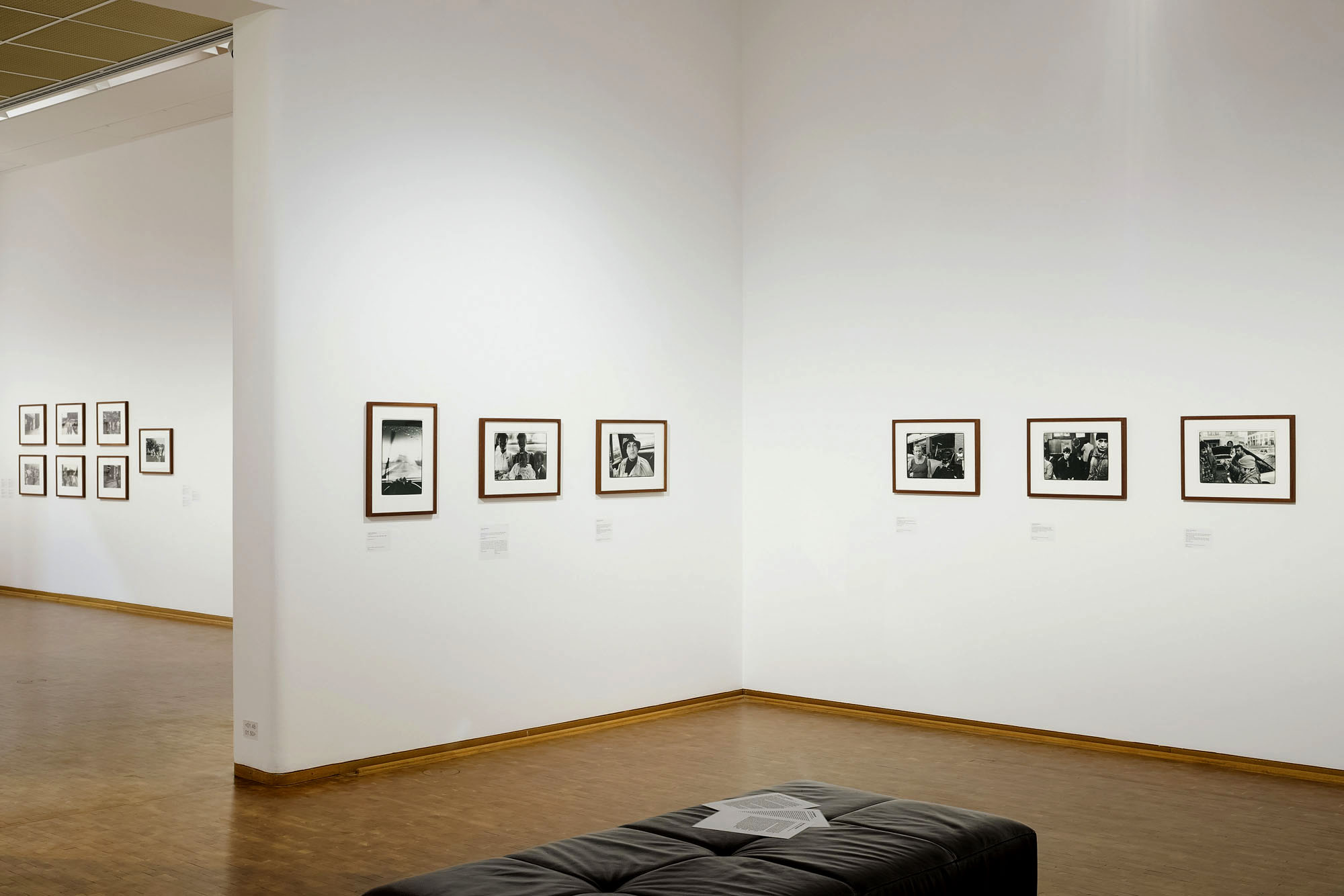
If you look at the installation photographs of both postings you will notice the small-scale prints of his notable black and white large-format (4 × 5-inch) camera and Polaroid Type 55 film photographs. But in this exhibition, Dawoud Bey: Street Portraits at the Denver Art Museum, Bey has used the large format negatives “to make large-scale, highly detailed prints that could be enlarged to create monumental portraits.”
To my eye and mind, these monumental portraits simply don’t work … on many levels.
Firstly, the size seems totally inappropriate as a form of theatre (for that is what Bey is making them at this size) and as a photographic document to the honest representation of these people – to me, completely at odds with the spirit of the subject being captured.
Secondly – and remembering that I have not seen the exhibition or walked through it but I am using the numerous installation photographs as my guide – there seems to be little flow to the images, installed as they are cheek by jowl, on the line, with no groupings or spacing, facing off against each other, face after face – with seemingly no understanding by curator or artist of Minor White’s idea of ice/fire, or the space between, the frisson that is generated between two or more images, in conversation, in sequence. Even the lines of sight between exhibition spaces leave little to be discovered afresh.
I have never understood this need for “monumentalism” in contemporary photography especially when the work does not need it and the energy of the work does not support it.
The advent of digital printing and large scale printers have enabled the production of gigantic contemporary photographs. “Large-scale photography challenges traditional notions of what constitutes a photograph and can be seen as a way to engage with the history of painting and cinema… Large-scale photography allows artists to explore the relationship between the overall composition and the individual details within the image. This can create a sense of both macro and micro, where the viewer can zoom in and out to appreciate different aspects of the image… Large-scale photography is used by many artists to explore themes related to identity, technology, consumerism, and environmental issues. The size of the prints can be a way to amplify these themes and create a more impactful visual statement. Large-scale photographs are well-suited for exhibition spaces where they can be displayed in a way that maximizes their impact. The large size of the prints can also create a sense of awe and wonder for the viewer.” (Generative AI on Google)
“In the 1990s, the group most commonly associated with large-scale photography, and in many ways responsible for the worldwide popularity of the technique, were the students of Bernd and Hilla Becher at the Kunstakademie Düsseldorf, including Thomas Struth, Andreas Gursky, Candida Höfer, and Thomas Ruff.” (Artsy website) With the work of artist’s such as Jeff Wall or Gregory Crewdson we become immersed in their cinematically constructed, staged fantasy worlds through the sheer scale of the photographs. With the gigantic portraits of Thomas Ruff it is not so much about the individual persona in the photograph as their every pore, a scientific examination of the surface micro death contained within every image.
Of course, I understand the desire for large photographs in creating a sense of immersion and exploring themes related to scale, power, identity and the human experience … but I don’t necessarily agree with the conditions of their becoming, nor do I think scale necessarily works for every photographic image. A photograph can be printed so that it has many sizes where it “speaks” to you and the viewer, but not every size works. I vividly remember seeing the exhibition Richard Avedon People at The Ian Potter Museum of Art, Melbourne in 2015 and observing that Avedon’s reaction to the ever expanding size of postmodern “gigantic” photography were floor to ceiling photographs, vertiginous overblown edifices which fell as flat as a tack.
I get the same feeling here.
Impact not intimacy, (visually) overwhelming not (visually) engaging.
Fundamentally, these “monumental” photographs by Dawoud Bey are no longer “street portraits” for they lack the intimacy and intensity of that style, becoming something rather less … beguiling, in the process.
Dr Marcus Bunyan
Many thankx to the Denver Art Museum for allowing me to publish the photographs in the posting. Please click on the photographs for a larger version of the image.
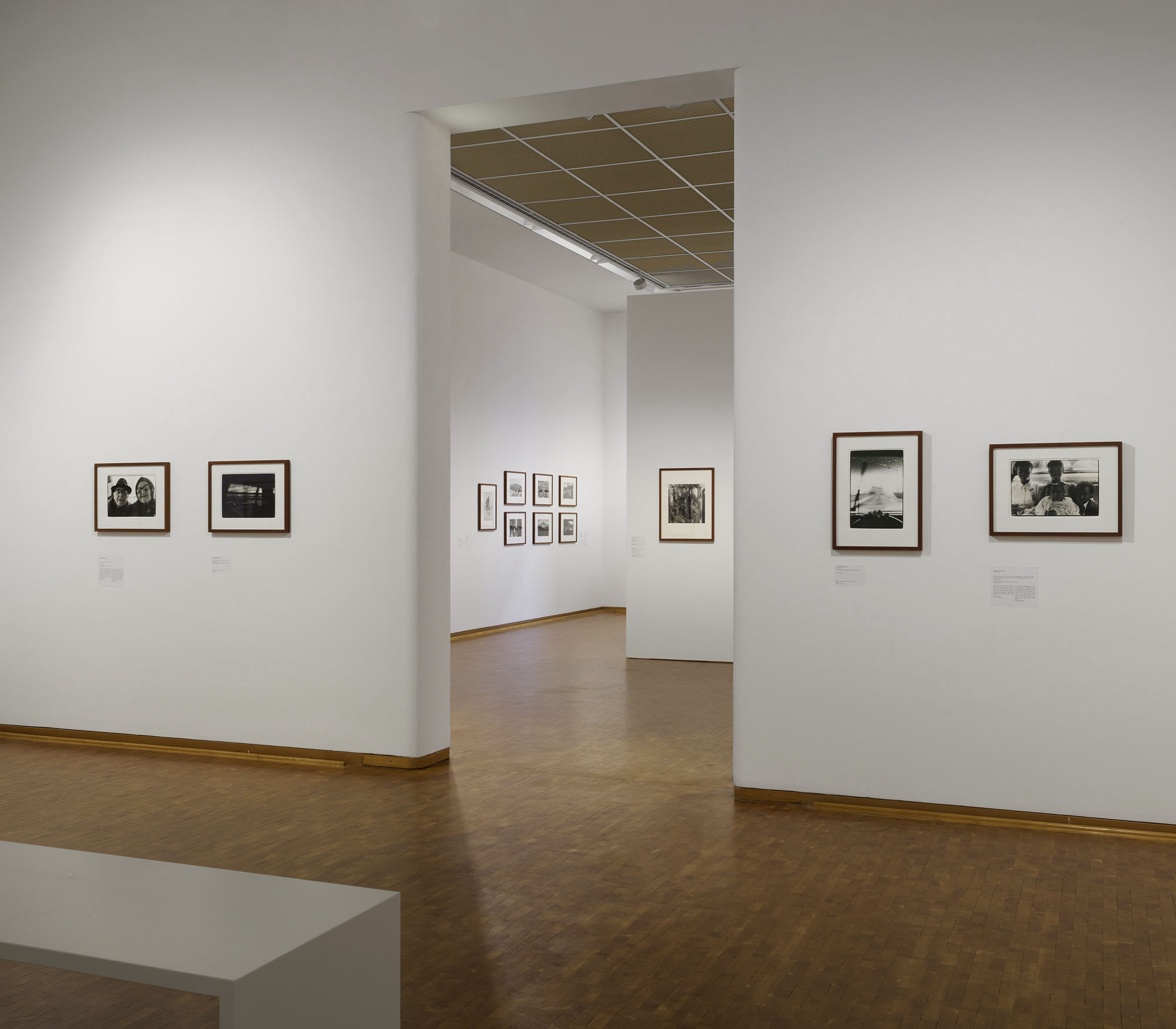
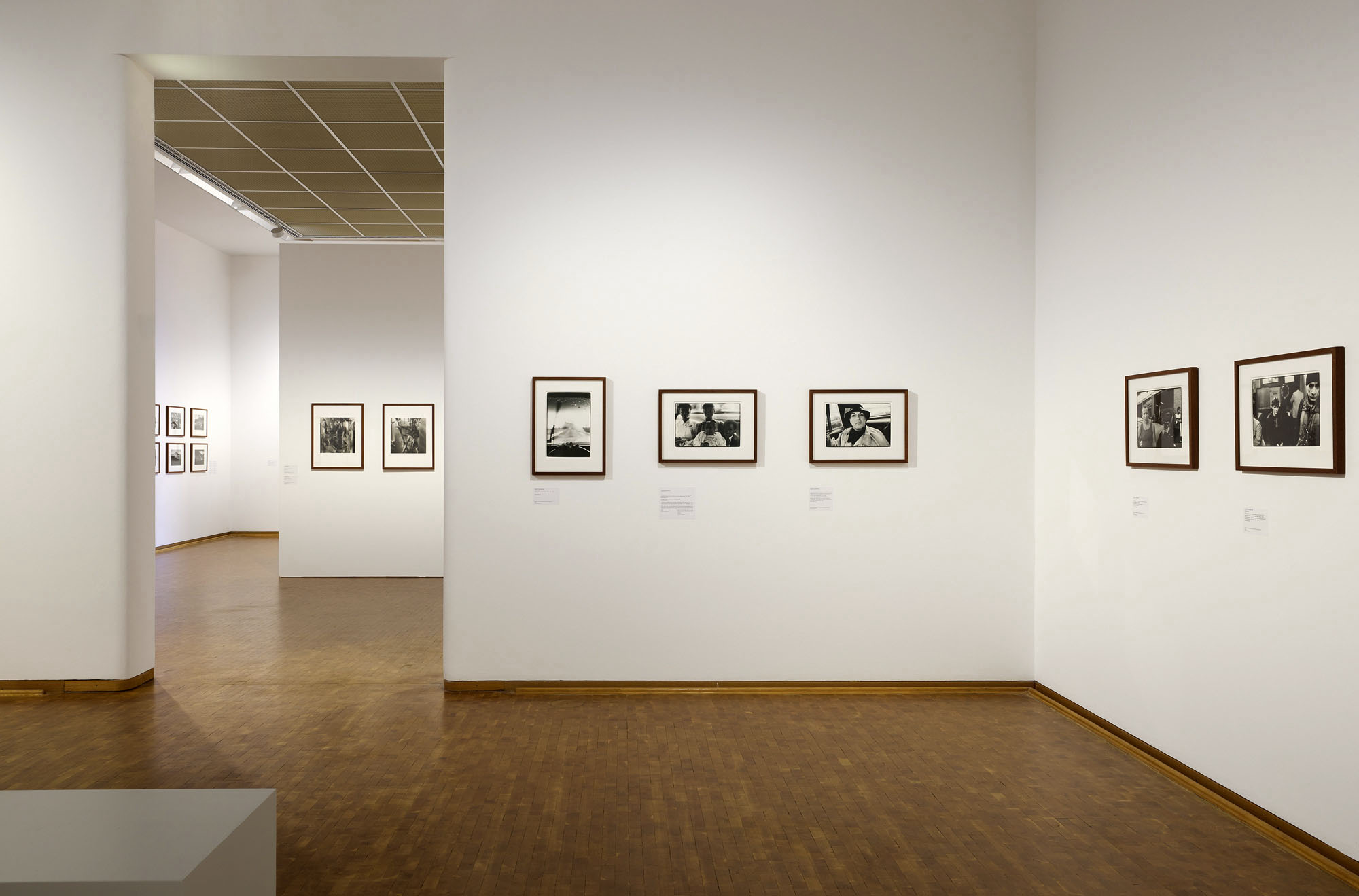
Installation views of the exhibition Dawoud Bey: Street Portraits at the Denver Art Museum
From 1988 to 1991, Dawoud Bey (American, born 1953) photographed African Americans in the streets of various American cities. He asked a cross section of these communities to pose for him, creating a space of self-presentation and performance in their urban environments. Bey used a large format tripod-mounted camera and a unique positive/negative Polaroid film that created both an instant print and a reusable negative. As part of every encounter, Bey gave each person the small black-and-white print as a way of reciprocating and returning something to the people who allowed him to make their portraits. The resulting photographs reveal the Black subjects in their psychological complexity, presenting themselves openly and intimately to the camera, the viewer, and the world.
Installation views of the exhibition Dawoud Bey: Street Portraits at the Denver Art Museum
Dawoud Bey: Street Portraits is the first standalone museum show to explore a transformational phase of the celebrated photographer and 2017 MacArthur Fellow Dawoud Bey’s work. The show features 37 portraits he made between 1988 and 1991, when he collaborated with Black Americans of all ages whom he met on the streets of various American cities. He asked a cross section of people in these communities to pose for him, creating a space of self-presentation and performance in their urban environments.
Bey used a large format tripod-mounted camera and a unique positive/negative Polaroid film that created both an instant print and a reusable negative. Bey considers photography an ethical practice that requires collaboration with his subjects. As part of every encounter, he gave each person a small black-and-white Polaroid print as a way of reciprocating and returning something to the people who allowed him to make their portrait.
Street Portraits is organised by the community the photographs were made in: Brooklyn; Washington, D.C.; Rochester; Amityville; and Harlem. Bey defies racial stereotypes by encouraging Black people to present themselves openly and intimately to the camera, the viewer, and the world.
The Denver Art Museum (DAM) is proud to present Dawoud Bey: Street Portraits, featuring 37 portraits by celebrated photographer and 2017 MacArthur Fellow Dawoud Bey (American, born 1953).
From 1988 to 1991, Bey collaborated with Black Americans of all ages whom he met on the streets of various American cities. He asked a cross section of people in these communities to pose for him, creating a space of self-presentation and performance in their urban environments.
“We’re pleased to present the first standalone museum show of this important work,” said Eric Paddock, Curator of Photography for DAM. “Dawoud Bey’s Street Portraits mark a turning point where the deliberate, closely observed portraits he had been making with a handheld camera began to contain what he has called ‘the kind of lush physical description’ he wanted his pictures to convey – and that is a consistent part of all the work he has made since. The slower process of working with a camera on a tripod invited collaboration between the artist and his subjects, making each picture both an experiment and a discovery.”
Bey used a large format tripod-mounted camera and a unique positive/negative Polaroid film that created both an instant print and a reusable negative. Bey considers photography an ethical practice that requires collaboration between the artist and his subjects. As part of every encounter, he gave each person a small black-and-white Polaroid print as a way of reciprocating and returning something to the people who allowed him to make their portrait.
The exhibition is organised by the community the photographs were taken in: Brooklyn; Washington, D.C.; Rochester; Amityville; and Harlem. Defying racial stereotypes, the resulting photographs reveal the Black subjects in all of their psychologically rich complexity, presenting themselves openly and intimately to the camera, the viewer, and the world.
Curator: Clément Chéroux, Director of the Fondation Henri Cartier-Bresson (FHCB), Paris, in collaboration with the Weegee Archive at the International Center of Photography (ICP), New York
Installation view of the exhibition Weegee: Society of the Spectacle at the International Center of Photography, New York
I have so many current photography exhibitions that there will be mid-week postings for the next two weeks.
I have posted on this exhibition before when it was presented at the Foundation Henri Cartier-Bresson, Paris, January – May 2024 (“To see ourselves as others see us”) and Fundación MAPFRE, Madrid, September 2024 – January 2025 (“Self Seen”) – with a slightly different title but the same exhibition – but it is always interesting to imbibe the creativity and culture photography of Weegee’s work.
While there are the famous photographs as seen in previous postings, there are also new photographs to examine, one’s that you hardly ever see: for example [Clothing salesman, Easter Sunday, Harlem, New York] (c. 1940, below); [Mrs. Bernice Lythcott and son looking through window shattered by rock-throwing hoodlums, Harlem, New York] (October 18, 1943, below); the infrared photograph [Lovers at the movies, New York] (c. 1943, below); Ladies keep their money in their stockings… (1944, below); and Night… a black velvet curtain has dropped over the white sky… (March 2, 1944, below) – all taken during the Second World War.
Dr Marcus Bunyan
Many thankx to the ICP for allowing me to publish the photographs in the posting. Please click on the photographs for a larger version of the image.
The career of photographer Weegee (born Arthur Fellig, 1899-1968) is often divided into two distinct phases, one gritty, the other glamorous. Celebrated for his sensationalist images of crime scenes, fires, car crashes, and the onlookers who witnessed these harrowing events across New York City in the 1930s and ’40s, Weegee also spent time in his career documenting the joyful crowds, premieres, and celebrities of Hollywood. His documentary images on both coasts gave way to experimental portraits late in his life, which were distorted using a kaleidoscope and other tricks from his technical toolbox. Weegee: Society of the Spectacle aims to reconcile these two sides of Weegee through an investigation of his focus, throughout his career, on a critique of 20th century popular culture and its insatiable appetite for spectacle.
Weegee: Society of the Spectacle is curated by Clément Chéroux, Director of the Fondation Henri Cartier-Bresson (FHCB), Paris, in collaboration with the Weegee Archive at the International Center of Photography (ICP), New York. The exhibition opens at ICP after a run at the FHCB and the Fundación MAPFRE, Madrid. The exhibition will be accompanied by the publication Weegee: Society of the Spectacle (Thames & Hudson).
Text from the ICP website
Installation views of the exhibition Weegee: Society of the Spectacle at the International Center of Photography, New York
The International Center of Photography (ICP) is pleased to announce Weegee: Society of the Spectacle, an exhibition presented in partnership with Fondation Henri Cartier-Bresson, Paris and curated by Clément Chéroux, Director of the Fondation Henri Cartier-Bresson.
This exhibition revisits Weegee’s bold, boundary-pushing perspective and celebrates his pioneering role in documenting spectacle, from crime and tragedy on New York City’s streets to distorted portraits of iconic Hollywood celebrities. The exhibition will be accompanied by a new publication created by the Fondation and Thames & Hudson that explores the impact of Weegee’s art and his critical view of urban spectacle. ICP is excited to present the new English-language edition of this important study of Weegee’s work.
Weegee: Society of the Spectacle marks the sixth major presentation of Weegee’s work at ICP and the first since it relocated to Manhattan’s Lower East Side neighbourhood, the very same one that Weegee transformed into an urban stage in his photographs. The exhibition arrives at a time when his commentary on the blurred lines between reality and performance and news and entertainment feel newly relevant and urgent in the age of smartphones and viral media where every individual has become both a voyeur and a consumer of spectacle.
Drawn largely from ICP’s Weegee collection, itself comprised of his entire studio archive and also the most comprehensive holdings of the photographer’s work in the world, Weegee: Society of the Spectacle is a re-examination of the photographer’s visual commentary on the society of his time, connecting his early career documenting New York City streets to his later work in Hollywood’s glamorised world of celebrity and working with experimental image distortions. Long regarded as two distinct periods in his career, the works in Weegee: Society of the Spectacle challenge this division by underscoring how Weegee’s exploration of spectacle persisted across different contexts – from crime scenes and fires to red carpet premieres. Weegee’s masterful depiction of the ‘society of spectators’ captures both the unfiltered, everyday urban experience and the glossy allure of fame.
“While he may never have imagined the centrality of images to contemporary life, Weegee’s provocative and prescient perspective on urban life forces us to reflect on how we now exist simultaneously as both consumers and the consumed,” Elisabeth Sherman, Senior Curator and Director of Exhibitions and Collections at ICP, said. “In an age where technology and constant image sharing shape our reality, Weegee’s work challenges us to reconsider the camera’s role not only as a witness but as an active participant in the creation of spectacle.”
Clément Chéroux, Director at Fondation Henri Cartier-Bresson, stated, “Weegee’s works highlight his ability to capture life’s extremes, from high society to the underworld. Often working at night, Weegee’s images of crime, fire and urban unrest reveal the harsh realities of 1930s and 1940s New York. His later shift to Hollywood did not distance him from this focus on spectacle but rather amplified his satirical approach, as he created playful distortions of celebrities that critiqued the American obsession with fame.”
The exhibition will highlight three recurring themes in Weegee’s work. The Spectacle of the News focuses on his nighttime photos of crime scenes, car accidents and fires, where the onlookers are as important as the events themselves. The Society of Spectators shows Weegee’s lens turned towards the people on the fringes of the main action – from high-society parties to street scenes – emphasising that spectatorship is part of the spectacle. Hollywood Distortions highlights Weegee’s later years, which saw him experiment with techniques that satirised Hollywood stars and the world of celebrity through exaggerated photo-caricatures, offering a pointed critique of the culture of fame.
The publication accompanying the exhibition, Weegee: Society of the Spectacle, further explores these themes, presenting essays by leading photography scholars including Clément Chéroux, Isabelle Bonnet, David Campany and Cynthia Young alongside rare archival material that deepens the viewer’s understanding of Weegee’s complex legacy. The book, published by Fondation Henri Cartier-Bresson and Thames & Hudson, will be available for purchase at ICP’s bookstore and through select retailers.
Grant Mudford (Australian, b. 1944) El Paso, Texas 1976 Vintage gelatin silver print 16 x 20 inches Joseph Bellows Gallery
Let There Be Light
For so long I have wanted to do a posting on the Australian photographer Grant Mudford (b. 1944) and finally the time is here. Mudford has lived in the United States of America since his final move to the Los Angeles area in mid-1977 but I still think of him as Australian.
Between 1974-1977 he undertook an intensive program of travel and work in the United States before his final move. In 1977 he had major exhibitions at the Australian Centre for Photography, Sydney; The Photographers’ Gallery, London; and Light Gallery, New York and is represented in major collections such as The J. Paul Getty Museum, Los Angeles; Los Angeles County Museum of Art, Los Angeles; International Museum of Photography, George Eastman House; and the National Gallery of Australia, Canberra which holds sixty six of his photographs in their collection.
Mudford’s mature style – capturing in beautiful, minimalist black and white photographs the essence and reality of the built landscape envisioned without people, usually working with common, generally uncelebrated subject-matter – emerged at a time that was parallel to that of the groundbreaking exhibition of contemporary landscape photography New Topographics: Photographs of a Man-Altered Landscape held at the George Eastman House’s International Museum of Photography, October 1975 – February 1976.
This important exhibition proposed a new way of looking at the American landscape, a concept that was historically grounded in the Neue Sachlichkeit (New Objectivity) – new order – movement of Germany in the 1920s, developed further and most importantly by the German artists Bernd and Hiller Becher in the late 1960s – early 1970s.
The New Topographics photographers (including the Bechers) “documented built and natural landscapes in America, often capturing the tension between natural scenery and the mundane structures of post-war America: parking lots, suburban homes, crumbling coal mines. The photographs, stark and documentary, are often devoid of human presence. William Jenkins [curator of the New Topographics exhibition] described the images as “neutral” in style, “reduced to an essentially topographic state, conveying substantial amounts of visual information but eschewing entirely the aspects of beauty, emotion, and opinion”.1
As I have argued elsewhere I believe that the photographs of the Bechers and alike are just as much about the beauty of the subject as they are their topographic state.
“Despite protestations to the contrary (appeals to the objectivity of the image, eschewing entirely the aspects of beauty, emotion and opinion; the rigorous frontality of the individual images giving them the simplicity of diagrams, while their density of detail offers encyclopaedic richness) these are subjective images for all their objective desire. The paradox is the more a photographer strives for objectivity, the more ego drops away, the more the work becomes their own: subjective, beautiful, emotive.”2
At least Mudford is honest enough to own up to desiring beauty. “I am deeply interested in the relationship between man-made structures and the landscape,” says Mudford. “Photography allows me to capture that intersection, where design meets nature, light, and texture. I strive to create images that reflect both beauty and complexity.” (Text from the Joseph Bellows website)
Evidence of the development of his later mature style can be seen in photographs taken in Australia such as Jenolan (1972, below) and Woolloomooloo (Stop sign) (1973, below) which already contain a minimalist, paired back, topographic yet beautiful aesthetic. But it was his move to Los Angeles, and above all the LIGHT and TEXTURE of the new world, that seem to have brought forth the best within this artist.
While, as Foucault observes, texts “are caught up in a system of references to … other texts, other sentences: it is a node within a network … Its unity is variable and relative”3 – in other words there is a close relationship between the work of Mudford and the New Topographics movement – his work is very much his own.
There is a crispiness, frontality and seeming simplicity to Mudford’s photographs and yet also almost a painterly aspect, that belies the complexity of these well resolved and beautiful images. He captures “the emotional resonance of a moment, whether it be the play of light on a building’s surface or the dynamic contrasts found in nature.” (Text from the Joseph Bellows website) And unlike the huge photographs of Dawoud Bey in an upcoming posting – which seem to me completely at odds with the spirit of the subject being captured – Mudford’s 16 x 20 inches photographs allow the viewer to focus on the images inherent qualities of beauty, nature, light and texture.
Finally, it is beyond me why Grant Mudford has not received greater recognition in the country of his birth. Forget that he has lived for years in the United States of America, Mudford is a magnificent photographer par excellence and his worldwide achievement should be celebrated at a national level. Perhaps it is time that a gallery such as the National Gallery of Australia or the Museum of Australian Photography should put on a major retrospective of this artist’s work… before it is too late!
We are loosing too many great photographers from this era already.
Dr Marcus Bunyan
1/ New Topographics: Photographs of a Man-Altered Landscape was a groundbreaking exhibition of contemporary landscape photography held at the George Eastman House’s International Museum of Photography (Rochester, New York) from October 1975 to February 1976. The show, curated by William Jenkins, had a lasting impact on aesthetic and conceptual approaches to American landscape photography. The New Topographics photographers, including Robert Adams, Lewis Baltz, Bernd and Hilla Becher, Frank Gohlke, Nicholas Nixon, and Stephen Shore, documented built and natural landscapes in America, often capturing the tension between natural scenery and the mundane structures of post-war America: parking lots, suburban homes, crumbling coal mines. The photographs, stark and documentary, are often devoid of human presence. Jenkins described the images as “neutral” in style, “reduced to an essentially topographic state, conveying substantial amounts of visual information but eschewing entirely the aspects of beauty, emotion, and opinion”.
3/ Foucault, Michel. The Order of Things: An Archeology of the Human Sciences.New York: Vintage, 1973 quoted in Thumlert, Kurt. Intervisuality, Visual Culture, and Education. [Online] Cited 10/08/2006. www.forkbeds.com/visual-pedagogy.htm (link no longer active)
Many thankx to Joseph Bellows Gallery for allowing me to publish the photographs in the posting. Please click on the photographs for a larger version of the image.
“Photographs reveal unexpected mysteries within the familiarities of our existence. We over familiarise ourselves with our surroundings and after become unaware and insensitive to the forces of the essence or reality before us. It is that essence or reality which I strive to photograph.”
Grant Mudford quoted in Graham Howe (ed.,). New Photography Australia. Paddington, N.S.W.: Australian Centre for Photography, 1974, p. 8
“I think it is incredibly difficult to define a building with photographs. Space and spatial relationships within and around a building are not fully experienced from photographs. The photograph imposes its own sense of these relationships, which to me are abstract representations having little to do with architecture or reality. So what I am interested in are the photographic manifestations of what buildings and structures can present when specifically scrutinised as a photograph. To extend this transformation, I prefer to work with common, generally uncelebrated subject-matter”
Grant Mudford in Archetype Magazine Spring 1981 quoted in Reimund Zunde. Photography: An Approach For Secondary Schools. Education Department of Victoria, Curriculum Services Unite, in association with the Secondary Art/Craft Standing Committee, 1982
Grant Mudford (Australian, b. 1944) Jenolan 1972 Gelatin silver print 34.5 h x 38.8 w cm National Gallery of Australia Gift of the artist, 1985
Grant Mudford (Australian, b. 1944) Woolloomooloo (Stop sign) 1973 Gelatin silver print 34.5 h x 38.4 w cm National Gallery of Australia Gift of the artist, 1985
Grant Mudford (Australian, b. 1944) Houston, Texas 1975 Gelatin silver print 33.8 h x 49.8 w cm National Gallery of Australia Gift of the Phillip Morris Arts Grant 1982
Graham Howe (ed.,). New Photography Australia. Paddington, N.S.W.: Australian Centre for Photography, 1974, p. 8.
Reimund Zunde. Photography: An Approach For Secondary Schools. Education Department of Victoria, Curriculum Services Unite, in association with the Secondary Art/Craft Standing Committee, 1982
Renowned photographer Grant Mudford had made his mark in the art world with a distinctive vision, capturing anonymous structures with a profound sense of space, light, texture and form. With a career spanning several decades, Mudford’s work remains a testament to his unique ability to meld the art of photography with the subtle intricacies of design, nature, and human influence.
Mudford’s photographic style is known for its dramatic compositions and meticulous attention to detail. Whether focusing on the clean lines of modern architecture or the rugged textures of natural landscapes, his work consistently transcends traditional photographic boundaries. His images invite viewers to engage with the built environment and the natural world in new and thought-provoking ways.
His work has been described by Keith Davis in An American Century of Photography as “an appreciation for both the alienations and incongruities of the urban landscape.”
“I am deeply interested in the relationship between man-made structures and the landscape,” says Mudford. “Photography allows me to capture that intersection, where design meets nature, light, and texture. I strive to create images that reflect both beauty and complexity.”
Mudford’s approach to photography is marked by his commitment to capturing the emotional resonance of a moment, whether it be the play of light on a building’s surface or the dynamic contrasts found in nature. His work not only documents his subjects but also engages viewers in a deeper conversation about the spaces they inhabit.
Mudford’s photographs have been exhibited internationally in solo and group exhibitions since the mid 1970’s; beginning this history with a solo show at the notable Light Gallery. His photographs are in numerous private and public collections, including the Los Angeles County Museum of Art, the J. Paul Getty Museum, the Museum of Modern Art, the George Eastman House, the Nelson-Atkins Museum, and the National Museum of American Art. In 2014, Mudford received the Julius Shulman Institute Excellence in Photography Award. His photographs have been featured in publications such as Architectural Digest, The New York Times, and Artforum, solidifying his place as one of the most respected photographers of his generation.
Grant Mudford’s photography is more than just an aesthetic experience; it is an invitation to reconsider how we perceive the world around us. His lens captures what is often overlooked – the powerful simplicity of everyday structures and the quiet majesty of the natural world. Through his work, Mudford encourages viewers to find beauty in both the grand and the subtle, offering a fresh perspective on the environments we encounter.
Text from the Joseph Bellows Gallery website
Grant Mudford (Australian, b. 1944) Los Angeles, CA 1977 Vintage gelatin silver print 16 x 20 inches
Grant Mudford (Australian, b. 1944) Los Angeles, CA 1976 Vintage gelatin silver print 16 x 20 inches
Grant Mudford (Australian, b. 1944) Irvine, CA 1976 Vintage gelatin silver print 16 x 20 inches
Grant Mudford (Australian, b. 1944) Los Angeles, CA 1976 Vintage gelatin silver print 16 x 20 inches
Grant Mudford (Australian, b. 1944) Los Angeles, CA 1977 Vintage gelatin silver print 16 x 20 inches
Grant Mudford
b. 1944
Grant Mudford (b. 1944) is a Sydney-born, Los Angeles-based photographer renowned for his large-format, abstract depictions of the urban landscape and built environment. Mudford developed an interest in photography as a child, and turned the laundry into a darkroom at the age of ten. For several years in his teens he photographed children on Santa Claus’ lap at Christmas. After studying architecture at the University of NSW for two years from 1964-1964, he chose to focus on photography, opening his own studio. In the 1960s and early 1970s he photographed for a range of advertising, fashion and theatre clients, as well as working as a cinematographer on short films. Mudford held his first solo show at Bonython Gallery in Sydney in 1972 and shortly after received funding from the Australia Council for the Arts, enabling him to travel throughout the USA and Mexico between 1975 and 1977. He then settled in Los Angeles, where he worked for various American and international publications including Harper’s Bazaar, Esquire, Architectural Digest, Vanity Fair, the LA Times and the New York Times. The Museum of Contemporary Art in Los Angeles commissioned him as photographer for the exhibition and book, Louis I. Kahn: In the Realm of Architecture (1991). Mudford’s work is in many American and international collections including the Museum of Modern Art, the J. Paul Getty Museum and Los Angeles County Museum of Art, Art Gallery of NSW and National Gallery of Australia.
So many words, so much verbiage about the work of American artist Saul Leiter (1923-2013).
I’d rather not add to that noise.
It is well to reinforce the meaning of an image with text but it is not necessary.
Just be aware …. of the beauty of the image and your feelings towards it.
Lucidly, appreciate the integrity of the image.
Nothing more but certainly nothing less.
Dr Marcus Bunyan
PS. It’s wonderful to see the earlier black and white work, breadcrumb trail of the colour work to come.
Many thankx to Foam for allowing me to publish the photographs in the posting. Please click on the photographs for a larger version of the image.
“Photographs are often treated as important moments, but really they are fragments and souvenirs of an unfinished world.”
Saul Leiter
“I may be old-fashioned. But I believe there is such a thing as a search for beauty – a delight in the nice things in the world. And I don’t think one should have to apologise for it.”
Saul Leiter, In No Great Hurry, 2013
“His photos feel – as Akiko Atake puts it – like “quiet stolen glimpses”; moments plucked from the everyday and preserved in the eye of Leiter’s camera.”
“I’ve always felt a closeness to Japan in Leiter’s work; the photographs in the snow; the women under their umbrellas; the improbable perspectives and revolutionary compositions reminiscent of Japanese woodblocks, ukiyo-e; the presence of the seasons and the verticality of the compositions evoking Japanese scroll paintings, kakajiku; the beauty he found in cracks and broken surfaces, in the unfinished, the worn out, the imperfect – the endurance of the elements and the effects of time. There is a “mono no aware”* beauty to his photographs, in the color work especially – an acute awareness of the beauty of the transient, of the ephemeral, which might explain, in part, their magical and poetic essence.”
“Leiter was destined to become a rabbi like his father, but moved to New York to be a painter, then choosing photography – which appalled his father. Beginning in 1948, Leiter using an Argus C3 camera, then a Leica and a Rolleiflex
In the 2012 documentary, In No Great Hurry, Saul Leiter said: “There are the things that are out in the open, and there are the things that are hidden, and life has more to do, the real world has more to do with what is hidden.” These tender and graceful depictions of “the things that are hidden” – images that Leiter rarely showed – retain their essential mystery, defying interpretation.”
* mono no aware = a Japanese concept that describes a poignant awareness of the transient nature of existence, a sensitivity to the beauty of things that are fleeting, and a gentle sadness at their passing
Leiter’s love of beauty, Bonnard, Japan, Buddhism, Ukiyo-e prints, Japanese scroll paintings, “ma” (space), kyūdō, haiku.
“The unorthodox and seemingly disproportionate compositions… the emphasis on shapes; the presence of calligraphy; unusual viewpoints and perspectives, everyday subject matter; the ubiquity of women; and a fondness for the ordinary and the ephemeral”
~ Leiter’s complex and impressionistic photographs are as much about evoking an atmosphere as nailing the decisive moment.
~ Leiter was a keen observer as life unfolded before him, somehow finding a way to reliably pluck a sublime split-second out of a mundane moment. ‘I like to take things that are very common and to find something in them,’ he once said.
~ Photographs are often considered important moments, but according to Leiter they are tiny fragments of an unfinished world. Such is his own world: little fragments of images juxtaposed and conjoined, amassing and forming vast, ever-expanding fields.
~ He photographed that which obstructs, hides, encloses, and thus reveals new depths of reality.
~ Everything is a matter of balance, exactitude and humility in the works of this man, who nonetheless accorded great importance to imperfection.
Foam is proud to present a major retrospective exhibition of the celebrated American artist Saul Leiter (1923-2013). Leiter is seen as one of the most important photographers of the 1950’s in the United States and a pioneer of colour photography. This exhibition brings together over 200 works, consisting of photography, both black-and-white and colour, as well as his abstract paintings. His eclectic oeuvre reveals a practice using shadow, light, and reflections to craft layered compositions.
About the artist
Saul Leiter (1923-2013) began painting and photographing in his teenage years, gaining an early recognition for his paintings. After moving to New York in 1946, he turned to photography as a profession while continuing to paint. His abstract forms and groundbreaking compositions possess a painterly quality that distinguishes them from the works of other photographers of that era. His work significantly contributed to the emergence of what is now known as the New York School of photography.
In 1957, he began working for major publications like Esquire and Harper’s Bazaar, balancing his commercial success with his personal passion for street photography in his Manhattan neighbourhood. Leiter’s groundbreaking work in colour photography gained widespread acclaim with the release of his first book, Early Colour (2006). By the time of his death in 2013, Leiter had achieved international recognition, with his work featured in numerous museum exhibitions and publications worldwide.
Text from the Foam website
Installation views of the exhibition Saul Leiter – An Unfinished World at Foam, Amsterdam
Saul Leiter remained dedicated to painting throughout his career, producing many gouaches (opaque watercolours), which were essential to his artistic expression. While most of his works are abstract, with large areas of colour, some feature playful lines that suggest landscapes or figures. His expressive use of colour is distinctive, often favouring muted tones like soft violets, mauves, and faded ochres or yellows. Although Leiter is best known for his photography, his paintings reflect a similarly poetic and intimate vision of the world.
Text from the Foam Facebook page
Installation view of the exhibition Saul Leiter – An Unfinished World at Foam, Amsterdam showing Leiter’s photograph The Pull (c. 1960, below)
Leiter was a keen observer as life unfolded before him, somehow finding a way to reliably pluck a sublime split-second out of a mundane moment. ‘I like to take things that are very common and to find something in them,’ he once said.
Installation view of the exhibition Saul Leiter – An Unfinished World at Foam, Amsterdam showing Leiter’s photograph
Foam is proud to present a major retrospective exhibition of the celebrated American artist Saul Leiter (1923-2013). Leiter is seen as one of the most important photographers of the 1950’s in the United States, and a pioneer of colour photography. This exhibition brings together over 200 works, consisting of photography, both black-and-white and colour, as well as his abstract paintings. His eclectic oeuvre reveals a practice using shadow, light, and reflections to craft layered compositions. For nearly sixty years, Leiter photographed daily, capturing everyday moments of New York City life. With various techniques and mediums, and the use of telephoto lenses, Leiter would enhance the painterly quality of his images and transform seemingly mundane street scenes into visual poetry. New York, a symbol of modernity in the 1950s, became the backdrop for Leiter’s aesthetic discoveries.
By shooting in the rain and snow, and using windows and other reflective surfaces, he created abstract images. A red umbrella, a green traffic light, or the yellow flash of a passing taxi add an unexpected play of colour to his photographs. In the 1940s and 1950s, Leiter was virtually the only non-commercial photographer to work in colour. The use of aged or damaged film allowed him to include surprising compositions with shifts in light and colour. Once lost to obscurity, his work was rediscovered in the mid 2010s for its ground-breaking role in the emergence of colour photography.
Leiter was a self-taught photographer whose strong sense of curiosity made him a lifelong student. He maintained his experimental and spontaneous approach throughout his career, which is evident in both his street photography and fashion work.
Upon his death in 2013, Leiter left behind a remarkable collection of approximately 15,000 black-and-white prints, at least 40,000 colour slides, a similar number of black-and-white negatives and over 4000 paintings, only a handful of which have been seen publicly. The exhibition An Unfinished World offers visitors the chance to admire the endless poetry of Saul Leiter’s artistic practice through his paintings, photography and unique view on the world around him.
“This ambidextrous painter and photographer recognised no limits. If, in the silence of his studio, his movement inscribed on paper imperceptible little rhythmic abbreviations, like an everyday exercise, his gaze penetrated the tumult of the city, challenging what draws the eye and scrutinising what is not seen.”
“If only we give them just a little more attention, these voices also tell us that the images are fragments containing enigmas, and that they journey through time and endure, intact, despite the darkness that may prevail in the world.”
“For nearly sixty years, Leiter photographed daily, capturing everyday moments of New York City life. With various techniques and mediums, and the use of telephoto lenses, Leiter would enhance the painterly quality of his images and transform seemingly mundane street scenes into visual poetry. New York, a symbol of modernity in the 1950s, became the backdrop for Leiter’s aesthetic discoveries. By shooting in the rain and snow, and using windows and other reflective surfaces, he created abstract images. A red umbrella, a green traffic light, or the yellow flash of a passing taxi add an unexpected play of color to his photographs. In the 1940s and 1950s, Leiter was virtually the only non-commercial photographer to work in color. The use of aged or damaged film allowed him to include surprising compositions with shifts in light and color.”
Curators: Hujar’s biographer John Douglas Millar, Hujar’s close friend the artist and master printer Gary Schneider, with Raven Row’s director Alex Sainsbury
And then there is Peter Hujar (American, 1934-1987).
Using contextless backgrounds and simple settings, Hujar’s non-judgmental portraits of friends and lovers rely on the slight twist of the head, the drop of a shadow, the photographer’s look and subjects pose, performance, that curves and bends reality into a presence that is magnetic, magical, eternal.
Hujar’s direct, intimate photographs, suggestive of both love and loss, proffer a mirror to strength and determination / to friendship / to love. His pictures gather, together, a feeling for the freedom of people and places, that essence of being true to yourself (getting to the bone as Harrison Adams puts it). A direct connection between the photographer and subject captured by the camera revealed to the world.
You might have guessed I am in love with his photographs.
Thus, it is a great delight to post on this exhibition at Raven Row in London which looks to be an absolute delight, Hujar’s photographs simply and beautifully presented in the space.
His images reveal themselves over time, expounding his love of life and his intimate and free engagement with the world around him.
That is Hujar’s music, his signature.
Dr Marcus Bunyan
1/ Harrison Adams. Photography in the First Person: Robert Mapplethorpe, Peter Hujar, Nan Goldin and Sally Mann (Dissertation). Yale University, 2018 quoted on the “Peter Hujar” Wikipedia page Nd [Online] Cited 14/03/2025
Further postings on this incredible artist on Art Blart can be found at
Many thankx to Raven Row for allowing me to publish the photographs in the posting. Please click on the photographs for a larger version of the image.
One aspect of this intimate quality was Hujar’s ability to connect with his sitters. One of his models was quoted after an unsuccessful session as saying:
“We couldn’t ‘reveal’. As an actor you have to reveal. And Hujar’s big thing was that you had to reveal. I know that now, but I didn’t know it at the time. In other words, blistering, blazing honesty directed towards the lens. No pissing about. No posing. No putting anything on. No camping around. Just flat, real who-you-are…You must strip down all the nonsense until you get to the bone. That’s what Peter wanted and that was his great, great talent and skill.”
This is the first exhibition to take on the full breadth of Peter Hujar’s later photography. Hujar was a central figure in the downtown scene of 1970s and early 80s New York, but at his death in 1987 from AIDS-related pneumonia his work was largely unknown to a broader art world. Now it is widely admired for its austere elegance and emotional charge. Hujar’s principal concern was with forms of portraiture – of his friends and denizens of the downtown scene, whom he encountered on the street, shot in his apartment studio or sought out backstage. He also turned his attention to animals, whom he photographed with particular empathy, as well as to architectural, landscape and street photography.
Eyes Open in the Dark concentrates on his later work, when his emergence from a debilitating depression in 1976 brought about a new expansiveness. The exhibition also reveals the darkening tone of his photography in the early 1980s, as the AIDS crisis devastated his community, and his work entered into dialogue with the younger artist David Wojnarowicz. Peter Hujar – Eyes Open in the Dark is curated by Hujar’s biographer John Douglas Millar, and Hujar’s close friend, the artist and master printer Gary Schneider, with Raven Row’s director Alex Sainsbury. As well as lifetime prints it will include prints of little-known works specially prepared by Gary Schneider, working closely with the artist’s Estate.
Stephen Lloyd Varble (American, 1946-1984) was a notorious American performance artist, playwright, and fashion designer in lower Manhattan during the 1970s. His work challenged mainstream conceptions of gender and exposed the materialism of the established, institutionalised world.
This is the first exhibition to take on the full breadth of Peter Hujar’s later photography. Hujar was a central figure in the downtown scene of 1970s and early 80s New York, but at his death in 1987 from AIDS-related pneumonia his work was largely unknown to a broader art world. Now it is widely admired for its austere elegance and emotional charge.
Hujar’s principal concern was with forms of portraiture – of his friends and denizens of the downtown scene, whom he encountered on the street, shot in his apartment studio or sought out backstage. He also turned his attention to animals, whom he photographed with particular empathy, as well as to architectural, landscape and street photography. Eyes Open in the Dark concentrates on his later work, when his emergence from a debilitating depression in 1976 brought about a new expansiveness. The exhibition also reveals the darkening tone of his photography in the early 1980s, as the AIDS crisis devastated his community, and his work entered into dialogue with the younger artist David Wojnarowicz.
Peter Hujar – Eyes Open in the Dark is curated by Hujar’s biographer John Douglas Millar, and Hujar’s close friend, the artist and master printer Gary Schneider, with Raven Row’s director Alex Sainsbury. As well as lifetime prints it will include prints of little-known works specially prepared by Gary Schneider, working closely with the artist’s Estate.
The exhibition is free to attend and open Wednesday to Sunday, 11am to 6pm, no booking required. Please note that some images in this exhibition feature explicit sexual content.
David Wojnarowicz (American, 1954-1992) Untitled 1989 From Sex Series (for Marion Scemama) 1988-1989 Gelatin silver print
One of Wojnarowicz’s most remarkable pieces here is the “Sex Series (for Marion Scemama),” a miracle of technical prowess and visual intensity. Wojnarowicz began it in 1988, a year after the photographer Peter Hujar, his close friend and former lover, died of AIDS. These photomontages combine stock photographs with circular insets salvaged from Hujar’s porn collection [among other insets of, for example, police, medical, money, religion and life], which he’d thrown away after his diagnosis.
Much of Wojnarowicz’s work is about sex in an age of death. During the AIDS crisis, sexual activity, particularly that of gay men, was demonized. Resisting the dogma and censorship of the Right’s conservatism and the Left’s moralism alike, the “Sex Series” vibrates with anxious and desirous energy, a mood amplified by the eerie reversal of the printing process, in which light and dark have been inverted to create a near negative.
Exhibition dates: 6th October, 2024 – 6th April, 2025
Curator: Andrea Nelson, associate curator in the department of photographs, National Gallery of Art
Martha Rosler (American, b. 1943) Cleaning the Drapes 1967-1972, printed 2007 From the series House Beautiful: Bringing the War Home Inkjet print Image: 44.2 x 60.4cm (17 3/8 x 23 3/4 in.) National Gallery of Art Gift of the Collectors Committee and Pepita Milmore Memorial Fund
Martha Rosler originally distributed photocopies from this series, House Beautiful: Bringing the War Home, as flyers at anti – Vietnam War demonstrations. She made the original photomontages by combining gritty news photographs of fighting in Vietnam with homerelated advertisements culled from glossy women’s magazines. Here Rosler paired a woman cleaning patterned drapes with two tired soldiers smoking amid rocks and sandbags. The woman’s vacuum wand points to and echoes the soldiers’ rifles. The jolting collision of war imagery and affluent domestic space gives visual form to the description of the conflict as “the living room war” – so called because it appeared on television news nightly.
Wall text from the exhibition
“Ce n’est pas une pipe mais de la photographie, sous toutes ses formes variables et multivalentes”
René Magritte’s 1929 painting Ceci n’est pas une pipe is also known as La Trahison des images … The Treachery of Images.
Treachery – the betrayal of trust – is an apposite word in relation to photography of the 1970s. Finally, once and for all, documentary photography in America broke free of the West Coast fine art photography tradition of mainly white male artists and the “aura” of the fine art print (Walter Benjamin). Photography betrayed the trust placed in the authenticity of the image and its link to the “truth” of reality represented in the photograph to become a medium of variability, in concept, execution and outcome. Photography became whatever you wanted it to be.
Documentary photography and its link to the reality of the referent – its assumed representation of a truth that existed in reality – began to be subsumed into the whole of photography, just part of a conceptual, art, performative, staged, street, cameraless, documentary, fashion, photojournalist, activist, amoebic (from the Greek ἀμοιβή amoibe, meaning “change”), and viral (Paul Virilio) medium.
Photography had always been a medium of communication but now became multi-perspectival – whether that be imaginings of the mind relayed through photographs, conceptual ideas about the world and how we interact with it created and staged through photographs, or new colour photography that challenged the orthodoxy of fine art black and white West Coast American photography.
As Anne-Marie Willis observes on the On This Date In Photography website, “any curator who would challenge the orthodox Beaumont Newhall-style photo history limited to images that are distinctively photographic, aesthetic, and “Straight” … would open a Pandora’s box full of photographs pervasive across so many fields, of such limitless subject matters, and crossing so many disciplines that their histories in photography would be obscured.”1
This is the alleged treachery of multi-perspectival photography, the betraying of photographic histories that stretched back to the beginnings of the medium… but it had to be done for photography to fully open itself up to the imaginings of the human and the media flows of the world. “It was a time when photography challenged the art photography norm: photography should not, could not be restricted to what was considered ‘art’.”2
Thus, it is a great joy to see photographs from this stimulating exhibition, photographs that challenge the established “norm” of what photography should be. But what is surprising to me when looking at the complete list of photographs in this exhibition is the important artists who changed the face of photography in the 1970s who are not represented at all or only have one or two images on show:
Gordon Parks 0 Garry Winogrand 1 Lee Friedlander 2 Diane Arbus 1 Robert Mapplethorpe 0 Robert Heinecken 0 Richard Avedon 0 Andy Warhol 1 Polaroid Cindy Sherman 0 Barbara Kruger 0 Nan Goldin 1 Stephen Shore 1
Diane Arbus, who was instrumental in changing portrait photography at the time, only has one photograph in the exhibition; Barbara Kruger and Robert Heinecken, both “para-photographers” whose work stood “beside” or “beyond” traditional ideas associated with photography have none; Stephen Shore who, along with William Eggleston, was responsible for making colour photography acceptable in art photography has only one photograph.
But most surprisingly of all, Cindy Sherman whose Untitled Film Stills were made predominantly between 1977-1980 and who casts herself as clichés or feminine types, becoming both the artist and subject in the work … is not there at all. Her loss, her evisceration, and the absence of “arguably one of the most significant bodies of work made in the twentieth century and thoroughly canonized by art historians, curators, and critics,”3 is unfathomable.
Dr Marcus Bunyan
1/ Anne-Marie Willis quoted in Dr James McArdle. “DECEMBER 14: CONTEXT,” on the On This Date In Photography website 15/12/2019 [Online] Cited 26/02/2025
2/ Ibid.,
3/ Exhibition Catalogue, New York, Museum of Modern Art, Cindy Sherman, 2012, p. 18 quoted in the “Untitled Film Stills” page on the Wikipedia website
Many thankx to the National Gallery of Art for allowing me to publish the photographs in the posting. Please click on the photographs for a larger version of the image.
Martha Rosler (American, b. 1943) Roadside Ambush 1967-1972, printed 2007 Inkjet print Image/sheet: 50.8 x 61cm (20 x 24 in.) National Gallery of Art Gift of the Artist and Mitchell-Innes and Nash
Rosler originally distributed photocopies of House Beautiful: Bringing the War Home at anti–Vietnam War demonstrations. “I saw House Beautiful not as art,” she later reflected. “I wanted it to be agitational.” The artist created the original photomontages, from which these collages are derived, by combining news photographs of scorched battlefields in Vietnam with glossy advertisements for US homes, layering images of soldiers within cut-out silhouettes of men from polo-shirt advertisements; and splicing pictures of soldiers’ burials with those of military marches. By tying the destruction abroad to untroubled affluence at home, Rosler gave visual form to the description of the conflict as “the living-room war” – so called because it was the first war to be televised.
The exhibition The ’70s Lens: Reimagining Documentary Photography examines how new approaches to documentary photography that emerged during the 1970s reflected a radical shift in American life – and in the medium itself.
The 1970s was a decade of uncertainty in the US – soaring inflation, energy crises, the Watergate scandal, and protests about pressing social issues – and the profound upheaval that rocked the country formed the backdrop for a revolution in documentary photography. Now on view at @ngadc, The ’70s Lens: Reimagining Documentary Photography explores this compelling and contested moment of reinvention when the genre’s association with objectivity and truthfulness came into question. Featuring works from over eighty artists, the exhibition delves into how the camera was used to examine life in the US from a diverse range of perspectives, and in doing so, transformed the practice of documentary photography.
The ’70s Lens: A Conversation with Anthony Hernandez
Artist Anthony Hernandez discusses 50 years of work with curator Andrea Nelson on October 24, 2024. The conversation celebrates the exhibition The ’70s Lens: Reimagining Documentary Photography (October 2024 – April 2025).
Anthony Hernandez (b. 1947, Los Angeles, California) has crafted a richly varied oeuvre, ranging from a distinctive style of black-and-white street photography to colour photographs of abstracted details of his surroundings. Much of Hernandez’s work focuses on his native Los Angeles, revealing a unique insight into the people and landscape of the much-pictured city. Hernandez is a recipient of a Guggenheim Fellowship (2018), the Rome Prize (1999) and has been named a United States Artists Fellow (2009).
Eggleston is celebrated for his use of colour photography, which he began experimenting with in the late 1960s. Eggleston’s 1976 exhibition Colour Photographs, held at the Museum of Modern Art, New York, is considered a pivotal moment in the development of colour photography as a contemporary art form and widely credited with increasing recognition of the medium.
Since first picking up a camera in 1957, Eggleston has photographed his family, friends and the people that he encountered in his everyday life, particularly in his native Memphis. Eggleston is said to find the beauty in the everyday and his work has inspired many present day photographers, artists and filmmakers, including Martin Parr, Sofia Coppola, David Lynch and Juergen Teller.
Anthony Friedkin (American, b. 1949) Young Man, Troupers Hall, Hollywood 1969 From the series The Gay Essay Gelatin silver print National Portrait Gallery Gift of Mary and Dan Solomon
In 1969, Anthony Friedkin was only 19 years old when he set out to document the queer communities of San Francisco and Los Angeles. The resulting project, The Gay Essay, is an expressive and nuanced portrait. Friedkin charts various facets of the culture, from street life and protests to parades and drag performances.
Friedkin’s photographs record the beginnings of the gay liberation movement in California. With a respectful intimacy he pictures individuals living true to themselves while defying prevailing social norms.
Wall text from the exhibition
Mel Bochner (American, 1940-2025) Misunderstandings (A Theory of Photography) (details) 1970 10 offset lithographs on notecards and envelope Sheet (each): 12.7 x 20.32cm (5 x 8 in.) National Gallery of Art, Gift of Mary and Dan Solomon
When Mel Bochner started documenting his works of sculpture with a camera, he realised that his practice had “become about photography without [my] wanting it to.” He studied the history of the medium and found conflicting ideas about what photography is or should be. By illustrating these “misunderstandings” with quotes from notable figures and sources, Bochner underscored the gap between a photograph itself and what it purports to represent. He even fabricated three of the quotations, further playing on photography’s tenuous relationship to truth. The photograph of the artist’s hand and forearm is also a misunderstanding: it is much smaller than the actual body part it depicts. It also appears to be a negative of a Polaroid photograph, but Polaroids exist only as positive prints.
Wall text from the exhibition
Mel Bochner was a key figure in the Conceptual Art movement of the 1960s and 70s. Bochner was part of a group of artists who challenged the traditional notion of art as a physical object to be admired for its aesthetic qualities and instead sought to explore the ideas and concepts behind the object, often using language and text as their medium.
Bochner’s early works were influenced by his interest in mathematics and logic, which he applied to create intricate geometric patterns. As his practice evolved, he incorporated language and words into his artwork, exploring the relationship between language, thought, and perception.
Anthony Barboza (American, b. 1944) New York City 1970s Gelatin silver print Image/sheet: 23.7 × 16.1cm (9 5/16 × 6 1/4 in.) National Gallery of Art Pepita Milmore Memorial Fund
Anthony Barboza’s photography has been integral in shaping the image of Black America. A founding member of the Kamoinge Workshop, a group of Black photographers formed in New York in 1963, Barboza went on to establish a thriving commercial and personal practice focused largely on Black subjects. His affirmative representations of African Americans in daily life – like this photograph of two ultra-stylish men standing in front of a hotel coffee shop in midtown Manhattan – contributed to an empowering narrative for the Black community in the face of inequality and adversity. Describing his approach to making pictures on the street, Barboza commented, “”The photograph finds you, you don’t find the photograph.”
Wall text from the exhibition
Anthony Barboza (American, b. 1944) New York City 1970s Gelatin silver print Image: 23.7 × 15.9cm (9 5/16 × 6 1/4 in.) National Gallery of Art Pepita Milmore Memorial Fund
Lee Friedlander (American, b. 1934) Hillcrest, New York 1970 Gelatin silver print Image: 20.3 x 30.5cm (8 x 12 in.) National Gallery of Art Patrons’ Permanent Fund
The fracturing of the image plane, where multiple, diverse realities are represented within one photograph, deconstructing the reality of fine art photography. ~ Marcus
Lee Friedlander’s layered compositions wittily observe connections between American life and commerce. In this dizzying photograph, Friedlander captures himself, at center, in a sideview mirror while at a filling station. In the reflection behind him we see a strip mall with the stores’ signs reversed. Near and far vie for attention and parts of the composition are blocked from our view.
The photograph with a World War I memorial similarly features vertical elements that break up the composition into separate frames. At left, the memorial’s soldier with rifle – who appears to be on guard – goes completely unnoticed as pedestrians make their way along a street full of storefronts.
Wall text from the exhibition
Kenneth Josephson (American, b. 1932) Wyoming 1971 From the History of Photography series Gelatin silver print Image: 22.8 x 14.1cm (9 x 5 9/16 in.) National Gallery of Art Patrons’ Permanent Fund
Kenneth Josephson’s conceptual photography experiments with playful illusion to explore and question his medium. Josephson was a graduate among the first generation of photography candidates from the Illinois Institute of Design. A student of such masters as Aaron Siskind, Harry Callahan, and Minor White, Josephson went on to teach for 35 years at the Art Institute of Chicago, where he routinely taught the “Introduction to Photography” course as it inspired him to continue experimentation.
“This photograph of a photograph held in space causes the viewer to question assumptions about truthful representation according to size and scale; it also draws attention to the principle that photographic reality is constructed through an artist’s ideas and choices. The subject of the photograph is photography itself, and the ways that life is documented, manipulated, trivialised, and celebrated with photographs.”
Lewis Baltz (American, 1945-2014) Tract House #4 1971 From the portfolio The Tract Houses Gelatin silver print Image/sheet: 14.5 × 22.5cm (5 11/16 × 8 7/8 in.) National Gallery of Art Corcoran Collection (Gift of the artist)
Lewis Baltz’s The Tract Houses captures the austere geometry of the shoddily built homes that sprang up in California’s suburban landscape beginning in the mid-1940s. Straight-edge architectural details, positioned strictly parallel to the picture plane, recall the reductive forms of minimalist art. Entire, recently constructed houses appear forlorn. None of the pictures include shadows, clouds, or people. Baltz’s series is a powerful critique of the transformation of the American landscape into an unending terrain of anonymous architecture. At the same time, the exquisitely rendered tones and textured surfaces emphasise the subtle beauty to be found in this bleak environment.
Wall text from the exhibition
With his iconic, minimalist photographs of suburban landscape, Lewis Baltz was at the forefront of a revolutionary shift in the medium of photography. Baltzs work exemplifies the ways in which photography started to loose the bonds of its isolation within its own segregated history and aesthetics and began to take its place among other media. In the late 1960s and early 1970s Baltz became fascinated by the stark, man-made landscape rolling over Californias then still-agrarian terrain. His earliest portfolio, The Tract Houses (1971), and his preliminary forays into a minimal aesthetic, The Prototype Works (1967-1976), illuminate his drive to capture the reality of a sprawling Western ecology gone wild.
Diane Arbus (American, 1923-1971) A young man and his girlfriend with hot dogs in the park 1971 Gelatin silver print Image: 37.7 x 36.5cm (14 13/16 x 14 3/8 in.) National Gallery of Art, Corcoran Collection Gift of Stephen G. Stein
Diane Arbus prowled New York’s public spaces looking for humor and strangeness in the everyday. Here a young couple walks in Central Park, wearing similar clothes, hairstyles, and dejected expressions. Arbus’s carefully composed but disorienting photograph – the subjects are in crisp focus while the background is blurred – compels us to look anew at the familiar. Is this couple unhappy in love or expressing the uncertainty of the times? Arbus made this photograph the year she died. Her influence on documentary photography would continue through the decade.
Wall text from the exhibition
Eleanor Antin (American, b. 1935) Philip Steinmetz (American, 1944-2013) (photographer) 100 Boots (details) 1971-1973 51 halftone prints (postcards) image/sheet (each): 11.5 x 17.75cm (4 1/2 x 7 in.) National Gallery of Art Pepita Milmore Memorial Fund
In this epic visual narrative, black rubber boots stand in for a fictional hero traveling from California to New York City. Eleanor Antin created temporary installations with the boots, had them photographed (by Philip Steinmetz), and made 51 postcards, copies of which she mailed to approximately 1,000 people and institutions involved in the arts. The journey starts at a Bank of America and ends at Central Park – after a visit to the Museum of Modern Art, where the boots and a set of postcards and photographs were later exhibited. Using the postal service, Antin bypassed the traditional gallery system, which had long overlooked women artists. While many of these scenes are humorous, the empty army boots also recall the Vietnam War and the soldiers who did not come home.
Wall text from the exhibition
100 Boots, 1971-1973
For her 51-piece instalment 100 Boots Eleonor Antin positioned one hundred ordinary black rubber boots on various locations all over Southern California and consequently in New York City. She took photos, printed them on postcards and assembled a mailing list of about a thousand names – mainly artists, writers, critics, galleries, universities and museums – who received the various postcards over a period of two and a half years between 1971 and 1973. The first card, 100 Boots Facing the Sea, was mailed on the Ides of March, 1971, unannounced and without further comment. A few weeks later it was followed by 100 Boots on the Way to Church and three weeks thereafter by the next one.
In a total of 51 photographs, Eleanor Antin documented the travels of the 100 Boots, her so called “hero” – from a beach close to San Diego to a church, to a bank, to the supermarket, trespassing, under the bridge, to a saloon and on their travels eastward. Finally, on May 15th, 1973 100 Boots arrived at the Museum of Modern Art in New York. By this time, 100 Boots had long become an epic visual narrative and a picaresque work of conceptual art.
Henry Wessel (American, 1942-2018) Walapai, Arizona 1971 Gelatin silver print Image: 26.51 x 39.85cm (10 7/16 x 15 11/16 in.) National Gallery of Art Gift of Mary and Dan Solomon and Patrons’ Permanent Fund
In 1975 New Topographics: Photographs of a Man-Altered Landscape opens at the International Museum of Photography in Rochester, N.Y. It includes photographs by Robert Adams, Lewis Baltz, Bernd and Hilla Becher, Joe Deal, Frank Gohlke, Nicholas Nixon, John Schott, Stephen Shore, and Henry Wessel Jr.
“Henry Wessel began taking photographs while majoring in psychology at Pennsylvania State University in the mid-1960s. Travel throughout the United States in subsequent years led him to direct his gaze increasingly to details of human interaction with the natural and man-made environment. Wessel’s move to the West Coast in the early 1970s inspired him to incorporate light and climate into his work. His inclusion in the seminal exhibition New Topographics: Photographs of a Man-Altered Landscape, organised in 1975 by the George Eastman House in Rochester, New York, solidified his reputation as a keen observer of the American topography.”
Text from Pacific Standard Time at the Getty
John Simmons (American, b. 1950) Will on Chevy, Nashville, Tennessee 1971, printed 2024 Gelatin silver print Image: 30.48 x 20.32cm (12 x 8 in.) National Gallery of Art Alfred H. Moses and Fern M. Schad Fund
A fashionably dressed older man crosses the street with his umbrella. A young woman turns to look at the camera while holding hands with a man in uniform. These were people John Simmons encountered while studying art at Fisk University in Nashville. Raised on Chicago’s South Side, Simmons had first published photographs as a teenager in the African American newspaper Chicago Defender. Refuting white-centered media’s failure to show positive imagery of the Black experience, Simmons has focused on people enjoying everyday life.
“I always feel like my subject and I were meant to share that moment together,” he has said. “So many of the pictures I take, it was like our paths were meant to cross.”
Wall text from the exhibition
Simmons began his career at 15 as a photographer for the oldest African American-owned newspaper, The Chicago Daily Defender in 1965. Over his decades long career, he’s photographed icons of the Civil Rights Movement, turbulent protests and demonstrations, famed musicians and poignant intimate moments of everyday life. “I’m glad to see photographs I took back in my teens are still relevant today,” he says.
Helen Levitt frequently made photographs of children on the streets of New York City, exploring their relationships to the urban setting as they played, imagined, and discovered together. After decades of working in black and white, Levitt became an early advocate of color documentary photography. Color allowed her to tell a fuller story of everyday life. Here, the green of the boy’s T-shirt is echoed in the poster and frame behind him. “I thought my photographs would be closer to reality if I got the color of the streets,” she said. “Black and white is an abstraction.”
Wall text from the exhibition
Bill Owens (American, b. 1938) Ronald Reagan 1972 From the series Suburbia Gelatin silver print Image: 16.4 x 21.6cm (6 7/16 x 8 1/2 in.) National Gallery of Art Patrons’ Permanent Fund
Over the course of a year, Bill Owens made photographs of the housing developments that had recently sprung up outside of Oakland and San Francisco. With an eye to humor, he captured the apparent conformity and materialism of the new suburbs. Here, a home is decorated for Christmas. At center, Nativity figures sit atop a television console showing an old film featuring Ronald Reagan, who had been a movie actor before becoming a politician. Owens also respected the liberation that many suburbanites felt, as well as their determination to build better lives. In his book Suburbia (1972), he included quotations from his subjects describing the opportunities and challenges they faced in their new environments.
Wall text from the exhibition
Owens began his photographic career in the late 1960s as a staff photographer for a local newspaper in Livermore, California. During this period, he began his most noteworthy project, “Suburbia,” which would become a major body of work in American documentary photography.
“Suburbia” was published as a book in 1973, featuring Owens’ images and conversations with suburban dwellers. The project’s goal was to investigate the goals, aspirations, and inconsistencies of suburbia life, offering a critical yet sympathetic study of the American Dream.
Owens’ images depicted scenes of backyard barbecues, family gatherings, children at play, and the myriad rituals and social interactions that constituted suburban areas. He highlighted both the humor and the underlying intricacies of suburban life through his good observation and direct attitude.
What distinguished Owens’ work was his ability to see past the surface and capture the soul of his subjects. His images conveyed a sense of realism by portraying suburbanites in their natural settings and enabling their tales to flow through genuine moments captured in time.
Owens’ art struck a chord with a large audience because it highlighted a huge societal transition in America during the 1970s. Owens’ images challenged the idealized image of suburban life by exposing the hardships, wants, and inconsistencies inherent in the pursuit of the American Dream.
Anonymous. “Bill Owens,” on the Photo.com website Nd [Online] Cited 06/20/2025
See how documentary photography transformed during the 1970s.
The 1970s was a decade of uncertainty in the United States. Americans witnessed soaring inflation, energy crises, and the Watergate scandal, as well as protests about pressing issues such as the Vietnam War, women’s rights, gay liberation, and the environment. The country’s profound upheaval formed the backdrop for a revolution in documentary photography. Activism and a growing awareness and acceptance of diversity opened the field to underrepresented voices. At the same time, artistic experimentation fueled the reimagining of what documentary photographs could look like.
Featuring some 100 works by more than 80 artists, The ’70s Lens examines how photographers reinvented documentary practice during this radical shift in American life. Mikki Ferrill and Frank Espada used the camera to create complex portraits of their communities. Tseng Kwong Chi and Susan Hiller demonstrated photography’s role in the development of performance and conceptual art. With pictures of suburban sprawl, artists like Lewis Baltz and Joe Deal challenged popular ideas of nature as pristine. And Michael Jang and Joanne Leonard made interior views that examine the social landscape of domestic spaces.
The questions these artists explored – about photography’s ethics, truth, and power – continue to be considered today.
Text from the National Gallery of Art
Lee Friedlander (American, b. 1934) Doughboy. Stamford, Connecticut 1973 Gelatin silver print Image: 17.8 x 27cm (7 x 10 5/8 in.) National Gallery of Art Robert B. Menschel Fund
William Eggleston has said that he has “a democratic way of looking around,” where nothing is more important or less important. For him, everyday subjects are not boring but instead offer visual richness. Here, that richness has a pronounced edge. Eggleston directed his lens up to a red ceiling with a single bare lightbulb at center. We glimpse only the top of a doorframe and a fragment of an explicit poster. The saturated, bloodlike color that dominates the composition is shocking, even menacing. It also challenged Eggleston technically as he developed his skills with dye imbibition printing. Commonly known as dye transfer, the process was labor intensive but allowed for customisation and a wide range of colours and tones.
Viewers of a certain age will recognize this setting as the parking lot of a Howard Johnson’s restaurant. HoJos, as they were nicknamed, were once ubiquitous along America’s highways. The cheery saturated colors belie the scene’s subject: a couple having a bad travel day. A man in suit and tie works under the hood of a beat-up Chevy Impala. His partner, wearing a pale pink skirt and top, arms crossed, appears frustrated. The cars zooming by seem to mock their immobility. Part of Mitch Epstein’s Recreation series, which documented Americans engaging in leisure activities, the photograph today evokes melancholy and nostalgia. Explaining his early turn to colour film, the artist said, “The world is in color, so why not photograph in color?”
Wall text from the exhibition
I started to work in colour, which was a radical, and some thought foolish, move in 1973. Colour photography was not yet a medium for serious photography – it was used almost exclusively for slick advertising and illustration. Within a month of shooting in colour, though, I wanted to do nothing else…
As I developed, I learned that a photograph is other than the thing itself photographed, and this freed me to think about how I could use photography to fictional effect, even while my pictures were drawn from the real world…
Photography remains a tool with which I form and sharpen my response to the world around me. Anything and everything is photographable in an infinite number of ways. That excites me.
Mitch Epstein in Lewis Blackwell. PhotoWisdom: Master Photographers on Their Art quoted quoted in “Mitch Epstein – Meet The Master Photographer,” on the Milkbooks website Nd [Online] Cited 06/02/2025
Adams’ photographic vision is extra ordinary and I cannot fault his individual photographs. I become engrossed in them. I breathe their atmosphere. He has a resolution, both in terms of large format aesthetic, the aesthetic of beauty and of using materials, light and composition… that seems exactly right. He possesses that superlative skill of few great photographers, and by that I mean: sometimes he has true compassion** / parallel to a religious compassion, but not based on something higher / just perfect human. In some of his photographs (such as East from Flagstaff Mountain, Boulder County, Colorado 1975) he possesses real forgiveness, in others there is the perfection of cruel, the perfection of de/composition.
** achieved by Arbus, Atget and sometimes by Clift, Gowin.
And then, each image holds small clues vital to the overall conversation that is the accumulation of his work and it is in their collective accumulation of meaning that Adams’ photographs grow and build to shatter not just the American silence on environmental issues, but the deafening silence of the whole industrialised world. In their holistic nature, Adams’ body of work becomes punctum and because of this his work produces other “things”, things as great as anything the French literary theorist, essayist, philosopher, critic, and semiotician Roland Barthes wrote about. As in Barthes’ seminal work Camera Lucida, Adams’ work reminds us that the “photograph is evidence of ‘what has ceased to be’. Instead of making reality solid, it reminds us of the world’s ever changing nature.”1
Marcus Bunyan. “The quiet of the great beyond,” on the exhibition American Silence: The Photographs of Robert Adams at the National Gallery of Art, Washington, May – October 2022 on Art Blart: art and cultural memory archive website, September 25, 2022 [Online] Cited 06/02/2025
1/ Anonymous. “Roland Barthes,” on the Wikipedia website Nd [Online] Cited 23/09/2022
Michael Jang (American, b. 1951) Study Hall 1973 Gelatin silver print 15.5 × 23.5cm (6 1/8 × 9 1/4 in.) National Gallery of Art Charina Endowment Fund
In Study Hall, Michael Jang’s extended family sits together on a couch reading comics and a television guide, a messy tray of Kraft Teez Dip and potato chips on the table in front of them. The covers of the decidedly not studious publications block their faces, becoming stand-ins for their portraits. In Aunts and Uncles (nearby), relatives are caught joking around while posing for an official family portrait in silly sunglasses.
Jang’s humorous photographs of his Chinese American family and the trappings of their suburban lives offer a refreshing take on the often staid genre of family portraiture. They also debunk the 1970s stereotype – think The Brady Bunch – that the “all-American” family could only be white.
Wall text from the exhibition
In his series The Jangs, Michael Jang photographed family at home. His humorous photographs of their suburban lives expanded the concept of the “all-American” family – the Chinese American Jangs didn’t look like The Brady Bunch.
In Study Hall, Jang’s cousins and aunt sit together on a couch reading comics and a television guide, a messy tray of potato chips and dip on the table in front of them. The covers of decidedly not studious publications block their faces, becoming stand-ins for their portraits.
Jang’s delightful series was almost entirely forgotten. The photographs, which he had first made while a student, sat in a box in the artist’s house for decades while he established a career as a commercial photographer.
In the 2000s, Jang reconsidered this series and shared it with museums, which began adding the photographs to their collections. His photographs took on a new light in the wake of a rise of anti-Asian hate during the COVID-19 pandemic. In 2021, Jang wheat pasted images from The Jangs on buildings in San Francisco’s Chinatown.
Susan Meiselas (American, b. 1948) Lena on the Bally Box, Essex Junction, Vermont 1973 Gelatin silver print Image: 22 x 32.5cm (8 11/16 x 12 13/16 in.) National Gallery of Art Anonymous Gift in honor of Sarah Greenough and Andrea Nelson
The final and most essential selection in this posting – Susan Meiselas’ 1972-1975 Carnival Strippers series – goes behind the “front” to document the lives of women who performed striptease for small-town carnivals in New England, Pennsylvania and South Carolina. “Meiselas’ frank description of these women brought a hidden world to public attention, and explored the complex role the carnival played in their lives: mobility, money and liberation, but also undeniable objectification and exploitation. Produced during the early years of the women’s movement, Carnival Strippers reflects the struggle for identity and self-esteem that characterised a complex era of change.” (Booktopia)
Intense, intimate and revealing, the series proves that we can think we know something (the phenomenal) and yet photography reveals how strange and different each world is – whether that be in trying to understand the mind of the artist and what they intended in a constructed photograph or, in this case, having an impression of someone else’s life, a life we can perceive (through the “presence” of the photograph) but never truly know (the noumenal).
Susan Meiselas (American, b. 1948) Tentful of Marks, Tunbridge, Vermont 1974 Gelatin silver print Image: 19.7 x 29.4cm (7 3/4 x 11 9/16 in.) National Gallery of Art, Corcoran Collection Museum Purchase, Photography Acquisition Fund
In Tentful of Marks, Susan Meiselas trains her camera from backstage on the legs and high heels of a carnival dancer. The all-male audience – the “marks” of the title – are in sharp focus, and they crowd around the small stage, lustfully gawking up at her. Meiselas spent three summers documenting women who performed striptease at small-town carnivals in New England, Pennsylvania, and South Carolina. In addition to making photographs, she recorded audiotapesof conversations with the dancers, giving them agency to describe their experience. Meiselas saw her project as a collaboration. Merging listening and looking, it expanded perspectives on a largely invisible and – from the dancers’ perspective – misunderstood world.
Wall text from the exhibition
Installation view of the exhibition The ’70s Lens: Reimagining Documentary Photography at the National Gallery of Art, Washington showing at left, Milton Rogovin’s photograph Jimmy Webster with His Father, Verne (1973, below); and at right, Jimmy Webster (1985)
Milton Rogovin (American, 1909-2011) Jimmy Webster with His Father, Verne 1973 Gelatin silver print Image: 17.4 x 15.5cm (6 7/8 x 6 1/8 in.) National Gallery of Art Gift of Pierre Cremieux and Denise Jarvinen
Verne Webster, sitting on his front stoop, looks guardedly at the camera while sheltering his toddler son Jimmy in a protective embrace. This is an early work from Milton Rogovin’s 30-year series documenting Buffalo’s Lower West Side. The project focused on a six-block neighbourhood that was among Buffalo’s most diverse and most impoverished. Rogovin asked permission to photograph his subjects, let them choose their poses and settings, and gave them free prints. He returned every decade or so to photograph the same individuals. A nearby picture shows Jimmy 12 years later. Looking back at Rogovin’s photographs in 2003, Jimmy Webster said, “Whenever you look at his photographs, you just see people for who they are.”
Wall text from the exhibition
John Baldessari (American, 1931-2020) Throwing three balls in the air to get a straight line: (best of thirty-six attempts) 1973 Colour offset photolithographs National Gallery of Art Library David K. E. Bruce Fund
West Coast conceptual art has a whimsical air. Artists such as John Baldessari and Ed Ruscha created scenarios that lampoon both the pretense of “high art” and the self-seriousness of conceptual art, particularly as the latter was developing in New York. Beneath the humor, however, their works spoke to more substantive issues like artistic failure and social mores. In 1973 Baldessari photographed his 36 attempts to throw three balls in the air to form a straight line. He never succeeded but included his 12 best attempts in a portfolio.
Wall text from the exhibition
Henry Wessel (American, 1942-2018) Utah 1974 gelatin silver print Image: 26.5 x 39.7cm (10 7/16 x 15 5/8 in.) National Gallery of Art Patrons’ Permanent Fund
Stephen Shore (American, b. 1947) Holden Street July 13, 1974 Chromogenic print Image: 20.5 x 25.4cm (8 1/16 x 10 in.) National Gallery of Art Diana and Mallory Walker Fund
Stephen Shore’s photograph may appear casual, but it is carefully constructed. The vertical of the lamppost draws our attention to the shadowed foreground. Buildings and sidewalks on each side act as perspective lines that meet in the brighter background. Shore was exploring how three-dimensional space is rendered in two dimensions, particularly in a colour photograph. He was also examining where a once-powerful New England industrial town abruptly ended and the verdant countryside began. The lack of people, saturated colours, and clarity of detail – made possible by using a large-format 8 × 10 camera – give the picture an air of timelessness but also hyperreality.
Wall text from the exhibition
Thomas Barrow (American, 1938-2024) Dart 1974, printed 1994 From the series Cancellations Gelatin silver print 23.9 × 34.6cm (9 7/16 × 13 5/8 in.) National Gallery of Art Randi and Bob Fisher Fund
In Dart, Thomas Barrow photographed a huge arrow that appears to have plunged from the threatening clouds above into a parking lot shared by Snappy Photos, a Goodwill drop-off bin, and a K-Mart. The work is part of his series Cancellations, documenting the suburban sprawl overtaking much of the United States. Barrow “cancelled” his images before printing by slashing the negatives with an icepick. (“Cancelling” refers to the practice of defacing a printing plate or negative to ensure no more official prints can he made from it.) This action calls attention to the photograph’s surface and its materiality, which in turn emphasise the choices Barrow made in its production.
Wall text from the exhibition
Thomas F. Barrow is an artist working with photography more than he is a photographer… For Barrow, the ideas are what matter, not the material they are realized with.
Barrow’s Cancellations series is an early expression of this artistic philosophy. Created between 1973-1981, it began when Barrow moved from Rochester, New York to Albuquerque, New Mexico to teach at UNM. Like many photographers of this era (Lewis Baltz, Frank Gohlke, Robert Adams) Barrow was struck by the transformation underway with the (sub)urbanization of the Western landscape. However, he was inspired to do more than document with his camera; he wanted to challenge his viewers while subverting some fundamental truths of photography. Inspired by a cancelled Marcel Duchamp etching (a process where the etching plate is defaced to indicate that no more official prints may be made), he began defacing his negatives with an ice pick and hole punch, “cancelling” them before making the images.
Almost 40 years later, it’s still unclear whether Barrow is canceling the photograph or the scene in the picture. He is certainly calling attention to the matrix that produced the photograph, an unheard of practice at the time and still rare today. By defacing his negatives, he has created photographs that are as much about the physical image as they are about the subject in the photograph.
David Ondrik. “Cancellations by Thomas Barrow,” in Fraction Magazine Issue 49 on the Fraction Magazine website Nd [Online] Cited 07/02/2025
Blythe Bohnen (American, 1940-2022) Self-Portrait: Triangular Motion, Small 1974 From the series Self-Portraits: Studies in Motion Gelatin silver prints National Gallery of Art Gift of Herbert and Paula Molner
Most self-portraits offer some idea of the artist’s physical appearance and perhaps psychological state. The focus of Blythe Bohnen’s intentionally distorted self-portraits, however, is altogether different. Bohnen was interested in the physical element of artmaking – specifically, the role of her body’s movements or gestures in the creative process. Photographs usually capture an instant, but Bohnen instead used exposures of several seconds and the precise, predetermined gestures identified in her titles to distill the essence of motion. The portraits, blurry and disorienting, become more of a performance in time, condensed into a single image.
For the works in his series Altered Landscape, John Pfahl playfully juxtaposed the organic and natural with the manipulated and constructed. In this picture, he placed six oranges on a path in the woods. Typically, if the fruits were all the same size they would appear to grow smaller the farther from the camera they were located. Here, however, the artist has reversed that expectation, with the smallest orange sitting nearest the camera and the largest in place at the top of the picture. Through his staging, Pfahl makes the viewer aware of how a camera, by recording three-dimensional space onto a two-dimensional surface, actually produces a distorted view.
Wall text from the exhibition
In 1981, Peter C. Bunnell observes in his Introduction to James Alinder’s book Altered Landscapes: The Photographs of John Pfahl, “Our momentary, fragmented and captured vision of disorder and emotion has been replaced by a cool rendering of purposefulness as if to accord another dimension of positivism to the moving force of contemporary human awareness. Pfahl’s work is an attack on the problems of space and, ultimately, existence from a rational point of view.”
Forty years later, these photographs seem not so much rational, or picturesque, as spiritual. The human construction touches the earth lightly, almost reverentially. As Pfahl notes, utmost care is taken not to alter the actual subject in a way he would consider harmful to his positivist respect for nature. In this delicate footprint, these photographs are very prescient of the dangers of our own Anthropocene – of climate change, of raging bushfires, drought, flood and bio-exinction. We are literally destroying this planet and its creatures. Bunnell states, “Pfahl’s imagery is a sure manifestation of the belief that society can produce an art suitable to its nature and, in this case, a specific kind of photographic presence that expresses current societal values.”
Unfortunately, it’s all too late. The lesson has not been learned.
Marcus Bunyan on the exhibition John Pfahl Altered Landscapes at Joseph Bellows Gallery, La Jolla, California, November – December 2019
Anthony Hernandez (American, b. 1947) Washington, DC #11 1975 Gelatin silver print Image: 18.1 × 27.31cm (7 1/8 × 10 3/4 in.) National Gallery of Art Corcoran Collection (Museum Purchase)
Anthony Hernandez cleverly uses the crook of a woman’s raised arm to frame a fruit seller on the street behind her. A Los Angeles – based photographer, Hernandez was invited to Washington, DC, in 1975 to participate in The Nation’s Capital in Photographs, a bicentennial documentary project organized by the Corcoran Gallery of Art. Ignoring the city’s monuments, Hernandez captured life in commercial downtown areas where the architecture and people on the street defined the landscape. This sparsely populated composition evokes urban alienation. Neither figure seems aware of the other, and both look small against the austere modern building and grate-covered sidewalk that fill the background.
Wall text from the exhibition
Anthony Hernandez’s 1970s photographs of urban inhabitants are often focused on odd-looking people staring right at the camera. His subjects often appear surprised and slightly perturbed, as if caught unaware in private moments of thought or conversation.
Following two years of study at East Los Angeles College and two years of service in the United States Army as a medic in the Vietnam War, Hernandez took up photography in earnest around 1970. He walked the streets of his native Los Angeles, observing its inhabitants. In order to work quickly and intuitively, he would pre-focus the camera and then wait for subjects to come into the zone of focus – only briefly bringing the camera to his eye as he walked past them. He repeated this strategy in other cities, including London, Madrid, Saigon, and Washington, D.C.
Joanne Leonard (American, b. 1940) Memo Center with Wall Plaque c. 1975 Gelatin silver print Image: 33.3 × 43.1cm (13 1/8 × 16 15/16 in.) National Gallery of Art Gift of the Artist in honor of her daughter, Julia Marjorie Leonard
Dotted curtains, a flowered light switch plate, and a humorous wall plaque add a personal touch to this carefully framed picture of a so-called memo center – an area near a wall phone where notes could be jotted down that was popular in 1970s homes. A practitioner of what she called “intimate documentary,” feminist artist Joanne Leonard recorded familiar but often overlooked domestic spaces traditionally associated with women. She explained, “Through my work as an artist I’ve discovered that the realms of the personal and the public are rarely as separate as I once imagined.”
Wall text from the exhibition
In the 1970s Leonard began examining how domestic spaces are transformed through the presence of technology by photographing the interiors of her neighbours’ homes in West Oakland, California, later moving on to other locations. She captured personal objects in bedrooms and found repetition in the common appliances present in kitchen after kitchen. She also documented the proliferation of “memo centers” – areas where notes could be jotted down near the location of a telephone, which at this time was still tethered in place by a cord.
Museum of Modern Art (MoMA) Gallery label from 2022
Joanne Leonard (American, b. 1940) Lupe’s Kitchen Window, San Leandro, California c. 1975 Gelatin silver print Image: 41.8 x 43.1cm (16 7/16 x 16 15/16 in.) National Gallery of Art Gift of the Artist in honor of her daughter, Julia Marjorie Leonard
Peter Hujar (American, 1934-1987) Susan Sontag 1975 Gelatin silver print Image: 37.15 x 37.15cm (14 5/8 x 14 5/8 in.) National Gallery of Art Stephen G. Stein Employee Benefit Trust
Robert Cumming (American, 1943-2021) 67-Degree Body Arc Off Circle Center 1975, printed 2022 Inkjet print Image: 148.59 x 185.42cm (58 1/2 x 73 in.) National Gallery of Art Gift of David Knaus
Sometimes Cumming used his own body as an eccentric subject, as in “67-degree body arc off circle center” from 1975. Shown in profile with his hips thrust forward, his torso arched back and his neck and head awkwardly aligned with the angle of his legs, he’s a mathematical or scientific demonstration whose geometry turns the graceful rationality of Leonardo da Vinci’s “Vitruvian Man” on its ear. The title’s geometric forms drawn around his body on the surface of the photograph might have been made with an oversized pen-nib, into which the hand on Cumming’s hip is discreetly hidden.
The artist’s photograph, like a drawing, is an artifice.
His work as a painter, sculptor and performance artist informed his distinctive, often witty approach to images made with a camera, which Cumming began to explore in 1969 and continued for more than a decade. Artists as diverse as Eve Sonneman, Jan Groover, Lew Thomas, Judy Fiskin and Lewis Baltz were blurring traditional boundaries in different but Conceptually cogent ways. Photography would never be the same.
Francesca Woodman (American, 1958-1981) House #3 c. 1975-1976, printed 1997-2004 Gelatin silver print Image: 16.1 x 16.3cm (6 5/16 x 6 7/16 in.) National Gallery of Art Gift of the Heather and Tony Podesta Collection
At the far end of a decrepit room, the phantom-like figure of the photographer appears to be merging with, or emerging from, the wall. In contrast to the sharply rendered interior, she is an ethereal blur whose face can barely be made out. Both the creator and subject of most of her work, Francesca Woodman staged dreamlike performances that explore self-portraiture, the female body, and architectural space. Although sometimes carefully planned, they more often represented her spontaneous, imaginative responses to an environment. Woodman made this photograph in an abandoned house in Providence when she was in her late teens.
Wall text from the exhibition
The 1970s was a decade of uncertainty in the United States. Americans witnessed soaring inflation, energy crises, and the Watergate scandal, as well as protests about the Vietnam War, women’s rights, gay liberation, and the environment. The profound upheaval that rocked the country formed the backdrop for a revolution in documentary photography. Activism and growing support of multiculturalism opened the field to underrepresented voices, while artistic experimentation fuelled the reimagining of what documentary photographs could look like.
The ’70s Lens: Reimagining Documentary Photography examines this compelling and contested moment of reinvention when documentary photography’s automatic association with objectivity and truthfulness came into question. The photographs on view record subjects, communities, and landscapes previously overlooked and expand the boundaries of the genre. During this turbulent decade, documentary practice became more deeply entwined with fine art, while conceptual and performance artists used the medium to preserve their ideas and record their actions. An openness to individual expression and a turn from black and white to color film further transformed a field previously celebrated for accurately representing the world and its social ills.
Drawn primarily from the National Gallery’s collection and featuring some 100 photographs by more than 80 artists, The ’70s Lens is on view from October 6, 2024, through April 6, 2025, in the West Building.
“The profound upheaval in American life during the 1970s inspired artists to question the objective nature of documentary photography,” said Kaywin Feldman, director of the National Gallery. “The extraordinary photographs on view in this exhibition explore their diverse and compelling responses, revealing relevant connections to today’s thinking about community and who gets to represent it, as well as broader concepts including photographic truth, equity, and environmental responsibility.”
The Exhibition
Organised thematically, The ’70s Lens: Reimagining Documentary Photography examines how the many documentary approaches that emerged during the 1970s reflected a radical shift in American life – and in photography itself.
Seeing Community
Spurred by the civil rights movement and a growing recognition of the rich ethnic and cultural diversity within the United States, photographers – especially from the Black, Latinx, and LGBTQ+ communities – reclaimed documentary practice to represent the fullness of their lives. Responding to a history of misrepresentation by outsiders, Anthony Barboza, Frank Espada, Mikki Ferrill, Nan Goldin, Jeanne Moutoussamy-Ashe, John Simmons, among others, focused their cameras on close-knit neighborhoods, often their own, building trusting relationships with the people they photographed. These artists worked collaboratively with their subjects to challenge preconceived notions of their communities.
Experimental Forms
Influenced by the groundbreaking photographs made by Roy DeCarava and Robert Frank beginning in the 1950s, a new generation of documentary photographers used the camera to visualise the world and their place in it. By combining clear-eyed observation with individual expression, artists such as Jim Goldberg, Sophie Rivera, and Shawn Walker revealed the complexity of the human condition from a more personal perspective. Others, such as Diane Arbus, Lee Friedlander, Anthony Hernandez, and Garry Winogrand, focused their attention on the irony and ambivalence rooted in American culture of the time, depicting everyday life with a psychological frankness. Together their revitalization of portraiture and street photography merged documentary practice with fine-art photography.
Conceptual Documents
Documentary photography became central to the practice of many conceptual artists in the 1970s. For them, the idea behind a work was more important than the finished object. John Baldessari, Thomas Barrow, and Robert Cumming interrogated the conventions of photography’s widely assumed objectivity and truthfulness by highlighting the difference between photographic appearance and reality. Others, like Susan Hiller and Dennis Oppenheim, used the camera to record their creative process, often integrating photographs with texts to address larger social issues about gender and the environment.
Performance and the Camera
Documentary photography was also integral to performance-based art during the 1970s. Many artists used the medium to record their otherwise ephemeral actions – including those who made performances specifically for the camera. This photographic documentation became a new form of art inseparable from the overall conception of the performance. Senga Nengudi in collaboration with Maren Hassinger explored the elasticity of the body through choreographed actions. Ana Mendieta and Francesca Woodman examined their identities through interventions in the environment, while Tseng Kwong Chi, Marcia Resnick, and David Wojnarowicz staged journeys and constructed histories that pushed the boundaries between truth and fiction.
Life in Color
The art world’s embrace of color film in the 1970s transformed documentary photography. Commercial color processes had existed for more than 50 years, but serious documentary photography was strictly associated with black-and-white prints. Color photography’s status changed gradually over the decade, and especially in the wake of an exhibition of William Eggleston’s mundane but incisive photographs at the Museum of Modern Art in 1976. Pictures of everyday life made in color by William Christenberry, Mitch Epstein, Richard Misrach, and John Valadez held an immediacy that fascinated viewers and offered a new framework for reflecting on contemporary life.
Alternative Landscapes
The 1970s witnessed a radical shift in how landscapes were understood and photographed. Robert Adams, Lewis Baltz, and Joe Deal challenged popular ideas of nature as pristine and timeless with pictures of environmental destruction and suburban sprawl. From grain elevators to roadside motels, Frank Gohlke and John Schott focused on structures that form the built environment, revealing how humans have shaped their surroundings. The artists in this section documented with an austere eye, and at times subversive wit, a rampant consumer culture and the damage done in the name of progress.
Intimate Documentary
Many photographers in the 1970s turned their cameras on themselves and close family members to analyze the social landscape of domestic spaces. Often informed by second-wave feminism, they prioritized interiors and life at home as topics for artistic examination. Joanne Leonard has described her narrative-rich scenes of everyday life as “intimate documentary,” while Bill Owens observed the rise of suburbia as both a place and a mentality. Concerned that documentary photography was losing its activist force, Martha Rosler and Eleanor Antin engaged with politics – especially the home front during the Vietnam War – more directly.
Sunil Gupta documented the emergence of a gay public space in New York’s Greenwich Village during the 1970s. The India-born Gupta had arrived from his adopted home in Montreal in 1976 to study business, but quickly decided instead to fine-tune his photographic skills. Energized by the overtly gay environment – a result, in part, of LGBTQ+ demonstrations in 1969 known as the Stonewall uprising – he started photographing people on the streets. Not impartial, Gupta was enthralled by those he encountered, including two stylishly dressed men who seem to acknowledge Gupta’s camera. In the Christopher Street series, Gupta recorded the then extraordinary act of being openly gay – a practice both political and deeply personal.
Still moved by this project, the artist has recently started making large-scale prints from his original negatives.
Wall text from the exhibition
This series was shot in New York in 1976 when I spent a year studying photography with Lisette Model in the New School… I spent my weekends cruising with my camera, it was the heady days after Stonewall and before AIDS when we were young and busy creating a gay public space such as hadn’t really been seen before.
Ana Mendieta (Cuban-American, 1948-1985) Untitled 1977-1978 From the Silueta Series Gelatin silver print Image: 33.8 x 49.5cm (13 5/16 x 19 1/2 in.) National Gallery of Art Gift of the Collectors Committee
In her Silueta Series, Cuban American artist Ana Mendieta used the outline of her body to carve and shape silhouettes into the land. Informed by her interest in Afro-Cuban ritual, her fusion of performance and earthworks explored spiritual connections between nature and the female body. Mendieta’s exile with her family from Communist Cuba to the United States in the 1960s left her with a deep sense of loss. She remarked, “I have no motherland; I feel a need to join with the earth.” Photography was crucial in documenting these ephemeral pieces, preserving them before they were lost to the elements. Hauntingly beautiful, the pictures enable Mendieta’s practice to be both transitory and enduring.
Wall text from the exhibition
Larry Fink (American, 1941-2023) Studio 54, New York City May 1977 From the series Social Graces Gelatin silver print 37.2 × 38cm (14 5/8 × 14 15/16 in.) National Gallery of Art Gift of Tony Podesta Collection, Washington, DC
In the photography of Lynne Cohen, you won’t see a single person. But you’ll find their traces everywhere. Her images feel haunted by people, as if the action has just ended or has yet to begin. Despite their absence, however, people are the true subject of the artist’s gaze. Former Gallery curator Ann Thomas explained in her essay for the 2001 National Gallery of Canada exhibition No Man’s Land: The Photography of Lynne Cohen: “While her photographs do not include human beings, they are on occasion more revealing about human behaviour than any group portrait.”
From her earliest photographs in 1971 to her final works before her death in 2014, Cohen made deadpan images of interior spaces, training her lens on the everyday peculiarities of living rooms, offices, banquet halls, social clubs, learning centres, salons, laboratories and shooting ranges. Her signature style used flat lighting, deep focus and symmetrical compositions to lend her works what she termed “a cool, dispassionate edge.” The works can be funny, sinister, maddening, familiar, bizarre and often surreal.
Although in later years Cohen would make prints large enough to envelope the viewer – introducing colour and shifting her choice of subject from domestic interiors and clubhouses to more restricted environments, such as military installations – her conceptual mission never wavered from the start. Her photography investigates how setting makes a simulation of experience, how reality is more engineered than we may care to recognize and how the spaces we design also design us in turn.
Chris Hampton. “Lynne Cohen: Art Surrounds Us,” on the National Gallery of Canada website November 22, 2024 [Online] Cite 07/02/2025
Joanne Leonard (American, b. 1940) Dining Area and Patterned Wallpaper, Blake Street, Berkeley, California c. 1977 Gelatin silver print Image: 18 x 17.7cm (7 1/16 x 6 15/16 in.) National Gallery of Art Gift of the Artist in honor of her daughter, Julia Marjorie Leonard
David Wojnarowicz (American, 1954-1992) Arthur Rimbaud in New York (Diner) 1978-1979 Gelatin silver print Image: 17.15 x 24.13cm (6 3/4 x 9 1/2 in.) National Gallery of Art Gift of Funds from Heather Muir Johnson
“Transition is always a relief. Destination means death to me. If I could figure out a way to remain forever in transition, in the disconnected and unfamiliar, I could remain in a state of perpetual freedom.”
~ David Wojnarowicz , Close to the Knives: A Memoir of Disintegration
David Wojnarowicz made a series of pictures featuring friends donning a homemade mask of the 19th-century French poet Arthur Rimbaud. Staged at sites around New York that were significant to the photographer, the surrogate self-portraits explore parallels between Wojnarowicz and Rimbaud – both gay artists who rebelled against the social mores of their times. The historical figure with its unchanging expression appears alone or apart from others, a man eerily out of time. The series also documents many of the then vibrant spaces of gay life shortly before the AIDS epidemic ravaged the city’s gay community. Wojnarowicz died from AIDS-related complications at the age of 37.
Wall text from the exhibition
Sophie Rivera (American, 1938-2021) Untitled 1978 Gelatin silver print Image/sheet: 25.4 x 25.4cm (10 x 10 in.) National Gallery of Art Estate of Martin Hurwitz
Bathed in light against a dark background, each sitter in Sophie Rivera’s portrait series of fellow New Yorkers of Puerto Rican descent, known as Nuyoricans, addresses the viewer directly. To find her subjects, Rivera asked passersby in her Harlem neighborhood if theywere Puerto Rican. If so, she invited them to her home to have their pictures taken. The mutual trust between artist and subject is reflected in the sitters’ grace and dignity.
Rivera, who defined herself as “an artist, Latino, and feminist,” sought to make Nuyoricans part of the distinguished history of American portrait photography. As she noted, “I have attempted to integrate my cultural heritage into an artistic continuum.”
Wall text from the exhibition
Rivera’s monumental portraits of Puerto Ricans in New York (or Nuyoricans) counteract the stereotypes that have circulated in the mass media. The artist found her subjects by asking passersby outside her building if they were Puerto Ricans. If they said yes, she invited them to her studio and photographed them against a dark background. Rivera’s subjects remain anonymous but never powerless. Her direct photographs allow the unassuming individuality of everyday people to speak for itself.
Our America: The Latino Presence in American Art, 2013
Multidisciplinary artist John Valadez has long been committed to depicting the lived experiences of Chicanx Angelenos like himself. Using the camera to record the world around him, Valadez first made photographs principally as source material for his drawings and paintings. In 1978 he exchanged black and white for colour film and made a series of powerful full-length portraits. His subjects included people he knew, such as the stylish young couple dressed for a birthday party, as well as people he encountered on the street, like the two men sporting identical clothes. Valadez’s aim, he said, was to capture people who weren’t being seen – by doing so, he has become a key chronicler of Chicanx identity.
Tseng Kwong Chi leaps into the air in front of the Brooklyn Bridge, mimicking the joy of a first time visitor to New York. This work is from Tseng’s series East Meets West, which was inspired in part by the thaw in Chinese – United States relations following President Nixon’s visit to Beijing in 1972. A performance artist and photographer, Tseng made self-portraits as his adopted persona, Ambiguous Ambassador, at popular spots across the country. Assuming the guise of a Chinese official, Tseng – wearing what is now called a Mao suit – mischievously exposed cultural biases and notions of “the other” in American society. He made his selfies with a shutter release cable, which is visible in his right hand.
Wall text from the exhibition
Tseng Kwong Chi, known as Joseph Tseng prior to his professional career (Chinese: 曾廣智; c. 1950 – March 10, 1990), was a Hong Kong-born American photographer who was active in the East Village art scene in the 1980s.
Tseng was part of a circle of artists in the 1980s New York art scene including Keith Haring, Kenny Scharf, and Cindy Sherman. Tseng’s most famous body of work is his self-portrait series, East Meets West, also called the “Expeditionary Series”. In the series, Tseng dressed in what he called his “Mao suit” and sunglasses (dubbed a “wickedly surrealistic persona” by the New York Times), and photographed himself situated, often emotionlessly, in front of iconic tourist sites. These included the Statue of Liberty, Cape Canaveral, Disney Land, Notre Dame de Paris, and the World Trade Center. Tseng also took tens of thousands of photographs of New York graffiti artist Keith Haring throughout the 1980s working on murals, installations and the subway. In 1984, his photographs were shown with Haring’s work at the opening of the Semaphore Gallery’s East Village location in a show titled “Art in Transit”. Tseng photographed the first Concorde landing at Kennedy International Airport, from the tarmac. According to his sister, Tseng drew artistic influence from Brassai and Cartier-Bresson.
In these images Tseng inhabits a persona he referred to as the “Ambiguous Ambassador.” Wearing a Mao suit (the grey uniform associated with the Chinese Communist Party) and mirrored sunglasses, he poses next to landmarks and monuments, many of them emblems of American national identity. Like the Untitled Film Stills of Cindy Sherman – also produced in the late 1970s – East Meets West is a groundbreaking photographic work that illuminates the changeable and socially constructed nature of identity. It is also a rare piece of conceptual art to specifically reflect on the racialised experiences of Asian people in the United States. …
A gay man, Tseng was well-aware of the signifying power of dress, gesture, and posture. His donning of the Mao suit can be understood as racial camp – a playful, self-protective manoeuvre that did not prevent Tseng from being misinterpreted but did allow him to take control of the manner of the misreading. To those who perceived the levity with which Tseng wore the suit, something was revealed about his ironic sensibility. The dissonance of his appearance – the fact that the suit looked both “natural” and “unnatural” on him was not effaced but highlighted, at least to the knowing beholder. But when people were unable to see past type, the misconception did not come at the cost of Tseng’s psychic humiliation.
Tseng went on to create roughly 150 images comprising East Meets West. His performance of “Chineseness” in these photographs reveals his acute awareness of the stereotypes of Euro-American Orientalism. His blank, robotic demeanour in images such as Disneyland, California invite stock associations of the Chinese as “Yellow Peril,” and the repetition of this pose in numerous photographs would seem to tap into White America’s century-long dread of being overrun by Asian immigrants. In other images, Tseng’s stylishness and humor come through – some of the earliest photographs picture him coolly strolling the boardwalk and beaches of the popular gay vacation spot of Provincetown, Massachusetts, appearing more like a character from a French New Wave film than a visitor from the People’s Republic of China. The shutter release Tseng plainly grasps in many pictures reminds us that he is the author of these varied depicted realities; that, even as he presents himself to the Orientalist gaze, he is in command of the means of representation. Given that racial identities circulate and perpetuate via staged images – and that European American assumptions have traditionally driven those images – this is a significant gesture.
The Gullah Geechee – enslaved people who labored on the Sea Island plantations, and their descendants – built communities all along the eastern coast of the US, from North Carolina to Florida…
From 1977 to 1982, Moutoussamy-Ashe visited Daufuskie, building relationships with the Gullah Geechee people and snapshotting rare pictures of their quotidian life. Born in Chicago, Illinois, the photographer had just returned from a six-month independent study in west Africa before she traveled to the island. At the time of her initial visit, there were only 80 permanent residents left on Daufuskie, a drastic drop from the thousands of Gullah people who had once resided there. Today, just 3% of the island’s population is Black.
Moutoussamy-Ashe’s series of monochrome images include candids of weddings, stills of a church gathering and everyday portraits of the island, showing a way of life that is treasured and fast fading.
Like many historic Black alcoves, Daufuskie has been altered by decades of gentrification. After the American civil war, many Gullah people who were already on Daufuskie made the island their permanent home once the plantation owners had left. They cultivated the land and preserved their rich culture and language, an English-based creole. But development, unfair zoning practices and other challenges have caused a sharp decrease in the Black population on the island.
Moutoussamy-Ashe’s photos offer a more private understanding of Black folks in Daufuskie, one not defined by white developers who have turned Daufuskie into a destination for tourists. The area is a placid haven in Moutoussamy-Ashe’s images. Jake and his Boat Arriving on Daufuskie’s Shore, Daufuskie Island, SC, for instance, features a man paddling a boat across a rippling river. Swooping trees frame either side of the man, who peacefully rows the vessel. The landscape looks expansive, with the scenery appearing to go on for miles. Such scenes of stillness would become rare as residents were largely driven out by the encroachment of others.
Between 1977 and 1981, Jeanne Moutoussamy-Ashe made extended visits to Daufuskie Island in South Carolina. The island’s relative isolation from the mainland allowed its inhabitants, who descended directly from enslaved people, to keep their distinct Gullah language and culture. Moutoussamy Ashe’s landscapes, still lifes, and portraits convey a holistic impression of the community. She captured residents’ dignity and joy – as in this photograph of a bride in fuzzy slippers, sharing a laugh with her maid of honor – but she also recorded their uncertainty in the face of development. Daufuskie’s permanent Gullah population had dwindled to 85 residents by the time Moutoussamy-Ashe published her photographs as a book in 1982.
“I see myself as a fine-arts photographer with a documentary foundation,” Shawn Walker has explained. “I look for the truth within the image, the multi-layers of existence and the ironies in our everyday lives.” Walker grounded his photographic practice in the Harlem community where he was born and raised. He joined the Kamoinge Workshop and learned from a collective of Black photographers. Inspired by Ralph Ellison’s novel Invisible Man (1952), Walker created a series of self-portraits that reveal only his silhouette. Here, the photographer pictures his reflection in a window while looking directly at us: “I look into the intersections of dark and light, into the shadows that grow the seeds of existence.”
Wall text from the exhibition
Jim Goldberg (American, b. 1953) Vickie Figueroa 1981 Gelatin silver print Image/sheet: 35.4 x 27.6cm (13 15/16 x 10 7/8 in.) National Gallery of Art Corcoran Collection, Gift of the Artist
“My dream was to become a schoolteacher. Mrs. Stone is rich. I have talents but not opportunity. I am used to standing behind Mrs. Stone. I have been a servant for 40 years. Vickie Figueroa.”
Jim Goldberg (American, b. 1953) Clyde Norbert 1978 From the series Rich and Poor Gelatin silver print Corcoran Collection Gift of the Artist, 1994
Framed against a tall window, Clyde Norbert appears slight, flanked by his modest but carefully ordered possessions. The caption in Norbert’s own words speaks to his contrasting bold ambition: “I am going to build an empire.” In his series Rich and Poor, Jim Goldberg made portraits of both wealthy and marginalised San Franciscans where they lived. He radically shifted the relationship between photographer and subject by asking the people he photographed to respond to his pictures by writing directly on them. He believed this collaboration, which he referred to as “total documentation,” “would bring an added dimension, a deeper truth” than a photograph alone.
Wall text from the exhibition
The ’70s Lens: Reimagining Documentary Photography poster
National Gallery of Art National Mall between 3rd and 7th Streets Constitution Avenue NW, Washington
You must be logged in to post a comment.