Text: “Re-Pressentation” chapter from Marcus Bunyan’s PhD research ‘Pressing the Flesh: Sex, Body Image and the Gay Male’, RMIT University, Melbourne, 2001

November 2023


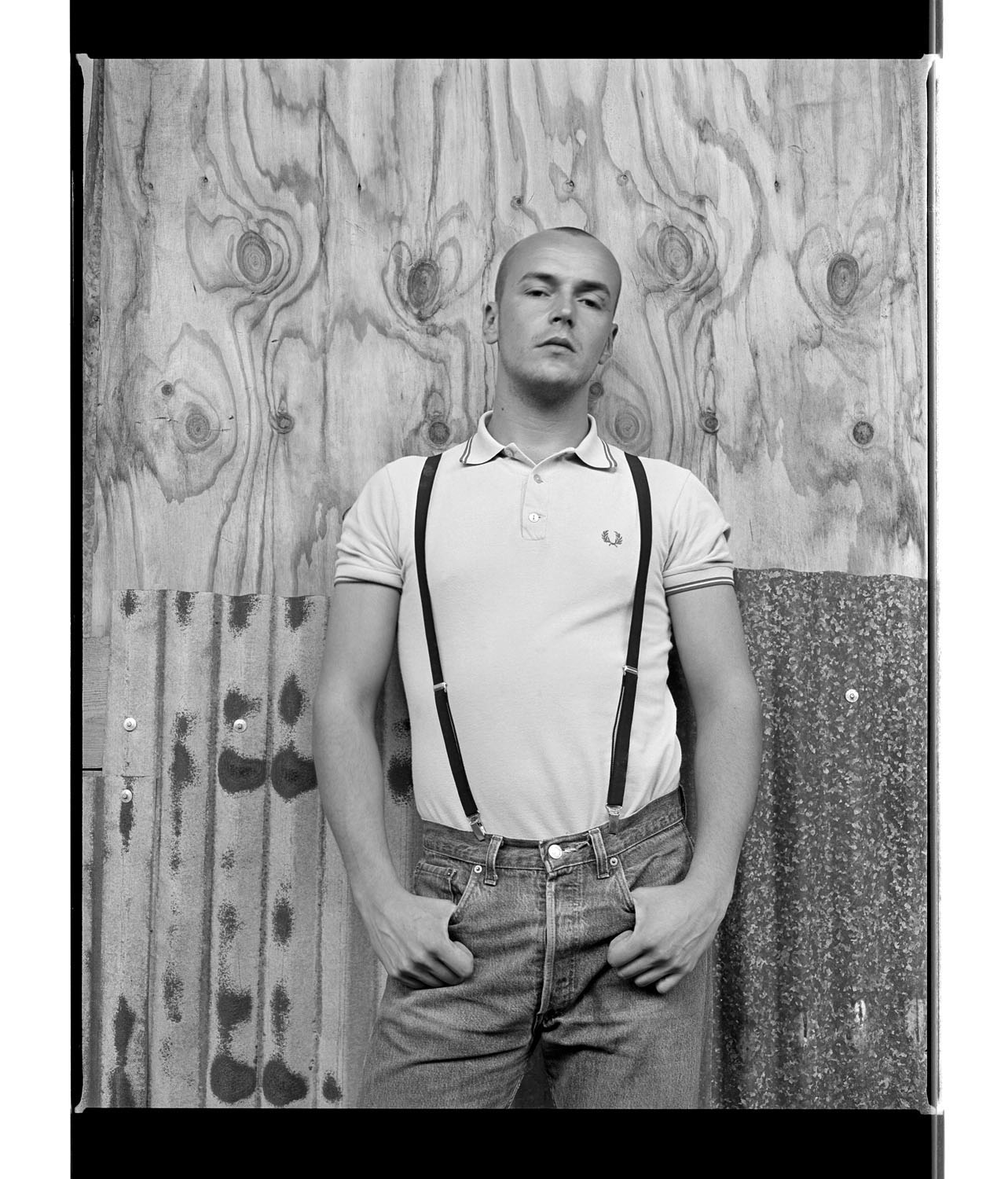
Marcus Bunyan (Australian born England, b. 1958) '"My Body (But I Do Not Own It) – Not the Governments Nor the Churches." Self portrait as gay skinhead' 1992


Marcus Bunyan (Australian born England, b. 1958)
“My Body (But I Do Not Own It) – Not the Governments Nor the Churches.” Self portrait as gay skinhead
1992
Silver gelatin photograph

The title of this photograph is taken from graffiti seen in Newtown, Sydney, Australia, where my scarification was done. In the image you can see that I have just had tribal scarification (cutting causing scarring) to my arm the previous night. I suggest body modifications such as tattooing, branding or scarring confronts the keeper of the body with a journey of exploration into the Self, a continuing ‘rite of passage’ through life. It is my body but I am just the keeper of it for a short period of time and I experience my body through touch, intimacy and an understanding of its interactions with my-Self and others. The title also reveals an ironic challenge to the dominant notions of traditional heterosexual skinhead identity: gay men have appropriated the skinhead image subverting it’s social identity construction because of their sexuality whilst still desiring the fantasy because of its masculinity. While this fantasy may reinforce the lust for the power of patriarchy through the use of a hyper-masculine image, the image of two gay skins walking down the street arm in arm challenges and subverts the ‘normal’ ideology and social identity of the skinhead image as racist, fascist and heterosexual.


Since the demise of my old website, my PhD research Pressing the Flesh: Sex, Body Image and the Gay Male (RMIT University, Melbourne, 2001) has no longer been available online.

I have now republished the fourth of twelve chapters, “Re-Pressentation”, so that it is available to read. More chapters will be added as I get time. I hope the text is of some interest. Other chapters include Historical Pressings (examines the history of photographic images of the male body) and Bench Press (investigates the development of gym culture, its ‘masculinity’, ‘lifestyle’, and the images used to represent it); and In Press (investigates the photographic representation of the muscular male body in the (sometimes gay) media and gay male pornography. In the title of the chapter I use the word ‘press’ to infer a link to the media.

Dr Marcus Bunyan November 2023


“Re-Pressentation” chapter from Marcus Bunyan’s PhD research ‘Pressing the Flesh: Sex, Body Image and the Gay Male’, RMIT University, Melbourne, 2001

Through plain language English (not academic speak) the text of this chapter investigates alternative ways of imag(in)ing the male body and the issues surrounding the re-pressentation of different body images for gay men. The title is a play on the word representation, an alternative way of re-pressing and re-pressenting the body in different non-stereotypical forms.


Keywords

male body, representation of the male body, male body image, gay men, alternative male body image, body image and self-esteem, masculinity, body images facades and fantasies, imaging the gay male body, gay male body


Sections

1/ The power of masculinity
2/ Body image and self-esteem
3/ High and low self-esteem
4/ Sex and self-esteem
5/ Love and respect
6/ Increasing self-esteem and happiness
7/ Body images, facades and fantasies
8/ Getting older
9/ Imaging the gay male body
10/ Re-Pressing, responsibility and respect
11/ Re-imag(in)ing the male body
12/ Conclusion

Word count: 12,048


The power of masculinity


“Awareness of the Cult of Masculinity‘s power and pull helps to loosen its grip on us. Awareness allows us to look at masculinity as something in large part that is constructed within our culture … But we must stop allowing masculinity to define who we are: We must reject the use of terms like “straight-acting” in describing ourselves and others, prevailing those among us whom we deem as more “masculine,” and thus more “straight.” We must understand that what was considered our preferred “sexual type” was in all likelihood actually formed soon after we entered the gay ghettos and saw what the Cult of Masculinity deemed as “hot.” We can each remember a time when we liked older men or thinner men or heavier men or men whose bodies didn’t fit so rigidly to the standard, men whose bodies weren’t the first or only thing we noticed.”


Michelangelo Signorile.1


To be made aware of the power of masculinity allows us the possibility of challenging that power. If we have the will and determination to do so! As we have seen in the In Press chapter it is still all too easy for the dominant hegemonic group within a subculture or society to impose and identify what a ‘valuable’ body should look like. This is achieved mainly through physical and pictorial appearance. As Michelangelo Signorile says in the above quotation, what gay men find desirable today is probably a behaviour that was formed soon after they entered the gay ghetto and saw what was termed a “hot” body. My research suggests that body-type desirability in gay men may be learned from an exposure to the images and bodies of men at a relatively early age.

These images may be found in at the beach, playing sports, reading magazines and looking at TV and pornography to name but a few. In some cases I found that the desirability for a particular type of body was altered after the gay man came out and was exposed to the imagery and body idealism present within the gay community, causing a narrowing in the range of body-types that person found desirable. This narrowing of desirability may cause anxiety and insecurity amongst gay men as they seek a partner who ‘fits’ their ideal body-type and try to match this ‘ideal’ themselves. They may feel inferior about their own body, causing a dis-ease within themselves and in their relations with others. Body image may then affect levels of self-esteem.

I suggest that the ‘Cult of Masculinity’ doesn’t necessarily attract young gay men after they first come out. Personally I believe that it is only after a period of experimentation (perhaps with androgyny, ‘campness’ or being a twink for for example, that may last some years) that gay men then start looking more closely at the development of their bodies. After the first flush of being ‘out’ and going to the clubs is over they start to want to attract a different type of man, a more masculine man, and feel they have to have the body to do so. I think gay men can then become complicit in their addiction to and desire of, the ‘ideal’ gay male hyper-masculine body. This addiction is not so much learnt in childhood but observed and stored in adolescence and the early days of being on the scene until it later finds full expression as gay men grow up.

With the emergence of the gay man onto the ‘scene’ he is exposed to the intense rituals of male body worship which are focused on one particular type of body. The images and rituals of body beautification are presented to gay men who, as free agents, are responsible for their developing addiction. As I noted in the In Press chapter, we cannot blame our addictions solely on the media or consumerism for, in reality, these images are an expression of our identity and our desires. In an interview with counsellor Barry Taylor2 I asked how he thought gay identity was formed:

BT: Perceptions are important – your perception of what you think it is to be gay is based on stereotypes – drag, dirty men in park, Commercial Road, Mardi Gras, TV, paedophilia, etc., … There is a wide range of stereotypes to draw from/engage with.

MAB: Before you ‘come out’ you don’t have ‘the look’. Gay people take on board the images of the gay community very quickly after ‘coming out’. Are there social pressures to conform to this style?

BT: Your desire to belong to the group is strong. What you have given up to come and belong to the group (eg. family, security, love) is great.
Is there something about natural beauty that leads people to it. What is it that appeals to us? The nature of the appeal of beauty.

MAB: Does it just have to be the facade though. I am interested in the inner self. How do people relate to this image. How do you get across to gay people a positive, alternative self image that says self is enough?

BT: That’s a maturity thing. When you are young and come out onto the scene you take on the image of the gay body. It happens in a short space of time. And so about 22, I start asking more questions – What’s my inner self. I see an uptake of people that come to counselling between 22-26 because there must be more to life than parties. Vulnerability – lots of depression at this time. In the gay community we can put off this 22-26 period indefinitely and continue partying (exterior image) which leads to alcohol and substance abuse and no inner development under the facade.


Gay men are attracted to identity images and styles that are seen as perpetually powerful, successful identity images within the gay community. One such style is known as the ‘Party Boy’, which is based on social affluence, looks and body image appearance, a style which is, as Damien Ridge notes below, highly restrictive. Not all gay men have the physical attributes, money, time and social contacts to attain this style, and the relentless pursuit of it can leave undeveloped the inner Self because of substance abuse, partying and the need to focus constant attention on the facade. I examine the issue of building identity & self-esteem based on appearance & body image on the following page.

“Styles such as the ‘Party Boy’, promoted on the scene and in the gay media, are highly restrictive. As with women exposed to ‘supermodels’ promoted by the fashion industry, few men have the social resources, appearances and body type to fully emulate the ‘Party Boy’. In an environment that prioritises style, this inadequacy readily taps into informants’ insecurities. The inability to fit in with dominant gay middle-class styles works to isolate and alienate young men regardless of class or ethnicity. Informants report they need to constantly work on their styles, such as their weight and physiques, to gain and maintain access to valued social networks, sex, and relationships.”3


Marcus Bunyan (Australian born England, b. 1958) 'I Do Dick, Glenn, Darlinghurst, Sydney' 1992


Marcus Bunyan (Australian born England, b. 1958)
I Do Dick, Glenn, Darlinghurst, Sydney
1992
Silver gelatin photograph

The title is taken from the graffiti seen at the right of Glenn


Body image and self-esteem


“Appearance is not a very stable or permanent basis for self-esteem. Not everyone agrees about who is attractive, so even the best-looking are bound to receive mixed reviews. Furthermore, no matter how attractive people are, there will always be times when they do not feel attractive – when suffering from a cold or when they get old. We can always find flaws in ourselves. Objective observers may tell us we are cute and adorable, but we are likely to mutter, “Sure, except for my nose.” Finally, no matter how good-looking a person is, there will always be others who seem better looking. Many of the best looking people compare themselves with someone better-looking, someone younger, and conclude they are not good enough.”


Elaine Hatfield and Susan Sprecher4


May I suggest that self-esteem is an evaluation, either positively or negatively, of self worth. It is based on global (or overall) self-esteem and local self- esteem (such as body image) – conditions that positively or negatively affect each other. Self-esteem is formed by reflected appraisal (what you think other people think of you) and social comparison (comparing yourself with others) and is improved by achieving things within different spheres of your life. Positive self-esteem can lead to a condition of happiness with all aspects of the self. It is the ability to value and love yourself not in an ego way (look at me I’m beautiful, I’m gorgeous) but in a way that accepts all faults and grievances and values them as part of an overall identity.

Lou Benson thinks that self-esteem, “Is a quiet confidence in one’s own worth regardless of any shortcomings or deficiencies. Fromm describes it as the ability to love oneself, not by falsifying a version of the self, but by acceptance of what one really is.”5

Erich Fromm says that self-esteem is essential if we are to love ourselves as well as others. He continues, “The affirmation of one’s own life, happiness, growth, freedom, is rooted in one’s capacity to love, ie., in care, respect, responsibility, and knowledge. If an individual is able to love productively he loves himself too; if he can only love others he cannot love at all.”6

Here Fromm is arguing for a love of the self that is not narcissistic, but based on a true ‘care’ for the self. I think that many gay men suffer from an inability to truly love themselves in this sense. They seek completion of their self in an image of themselves (narcissism) and in the image of others (voyeurism). This is where body image impacts on levels of self-esteem. Researchers such as Leonard Wankel7 have found that body image is related to self-esteem. Crockett and Peterson8 have also found that in adolescence physical attractiveness is one of the key domains that affect a person’s judgement of their self-esteem. My research also suggests that how a gay man feels about his own and his partner’s body image can be a factor in the decision to have sex without a condom. Gay men place greater emphasis on physical attractiveness than heterosexual men and it continues to be a priority throughout their lives.

Appearance is vital in the association between self-esteem and body image (because it is present in every visible social interaction, including sexual relations, that takes place between human beings), but as Elaine Hatfield and Susan Sprecher have noted in the quotation above, appearance is not a very permanent or stable basis for self-esteem. Still, it would seem that many gay men seek higher self-esteem by altering their appearance, believing it (higher SE) can be attained by changing their bodies. This is like building a house on sand – eventually the house is washed away as the foundations are built on unstable ground; we all get older and loose our looks and there is always someone that is better looking than ourselves.

Through behaviours formed in the crucible of the gay beauty ritual some gay men come to believe that the only way to raise their self-esteem is to pump their bodies at the gym in order to be able to compete against other gay men. But having a good body image does not necessarily mean that you will also have good self-esteem.
 

Marcus Bunyan (Australian, b. 1958) 'Glenn, Darlinghurst, Sydney' 1992


Marcus Bunyan (Australian, b. 1958)
Glenn, Darlinghurst, Sydney
1992
Silver gelatin photograph


High and low self-esteem

According to Hatfield and Sprecher, “People with low self-esteem are often afraid they will be rejected. They fear stepping out of line and being different. They seek social approval. Shy teenagers, unsure of themselves, find it very difficult to date a person who friends find unappealing. High self-esteem individuals, on the other hand, are not so desperate for social approval. They can afford to date someone much less attractive than they are.”9

Fundamentally I believe that these observations are flawed.

I agree that people with low self esteem are often afraid of rejection. But do they seek social approval? Perhaps not. For example, if an unattractive person was given the chance of having sex with his body image ideal only by having sex without a condom he would not be seeking social approval for his actions. His actions would be contrary to societies moral and ethical taboo against unsafe sex. On the other hand high self-esteem individuals are equally if not more desperate for social approval so that they can keep their self-esteem high. They usually date someone who is as beautiful and as built, tanned, and toned as they are! Its like looking in a mirror – they see a reflection of their own perfection in their partner and they have to show this possession off to other people to reinforce their high self-esteem; if they fear loosing him they could have sex without a condom to try to keep him.

From the evidence of my research data I suggest that people with different levels of self-esteem are equally likely to have sex without a condom.

People with low self-esteem might have unsafe sex because they think that they won’t get the man they desire otherwise. People with high self-esteem could have unsafe sex because they feel invincible and that their stunning partner couldn’t possibly be infected with the HIV / AIDS virus. People with a built body image but low self-esteem might seek validation of themselves and their body through the adoration of another and then fuck this other person unsafely. There are so many different contexts and no hard and fast rules.

Having a great body does not necessarily mean we feel good about ourselves as appearance is not everything; overall self-esteem is based on a whole heap of other factors, as well as body image, that affect our lives. Conversely, if we feel good about our overall self this can help us feel good about our body and I think that an acceptance of Self does not come through appearance alone, but is possible only through the integration of all parts of the Self into a balanced holistic whole. Of course, self-esteem, body image and sex without a condom are very complex issues and I realise that body image is not the only criteria in assessing the likelihood of unsafe sexual practices taking place.


Sex and self-esteem


“The myth of the ‘Cult of Masculinity’ … is that validation and self- worth are achieved through physical adoration. The cult encourages single gay men to believe they can achieve self-worth through sex, and it encourages men in relationships to believe that they can boost self-esteem by having sex outside the relationship.”


Michelangelo Signorile10


Much like money, photographs of muscular male bodies have ‘value’ without the owner of the body ever being present. This is because society knows the semiotic language in which they (the bodies and the photographs) speak and what their social value and power is. The same thing could be said for muscular bodies in real life; even though you can see and desire the bodies in question and you know their social value and the power of their image you can’t touch unless given permission. And usually permission is given only to those that match up to the same ‘ideals’ so that sex then becomes a validation of Self, of the person’s own existence. As Michelangelo Signorile has said (in the quotation above), this encourages gay men to believe they can increase their self worth through sex (trophy collecting), especially by having sex with someone who comes close to the ‘ideal’ either inside or outside of a relationship.

Having sex with someone is exciting and fun but it is not an understanding of the whole person. Personally I have used sex with gay men as a form of handshake, getting to know what they were like, an introduction as to whether we were compatible sexually yes, but also whether we got along on a social and intellectual level. That I could get along with him, that I wanted him around, that we liked doing things together and that we wanted to help each other along the way. Sex for me has always been used as a tool in this manner – to make friendships and relationships with other gay men. To have great sex, to have some fun but also to find out what makes them tick.

I believe that there are many gay men that use sex to increase their self worth but I also suggest that quite a few gay men use sex in the way I do, as a way of getting to know other men.11 They are looking for something or someone. Not just an addiction to pleasure, an increasing of self worth through sex but a search for a deeper connection. But paradoxically gay men seem scared of this connection, fearful of the exposure and revealing of Self to others that this intimacy brings. For gay men who are supposed to be more sensitive to the feminine side of their masculinity, I find that many gay men are afraid of touching, holding and intimacy.

(The hero in our society is usually ‘masculine’, with a well defined and muscular body such as Tarzan or Superman, the Man of Steel. Heterosexual iconography portrays him as powerful, masterly, and virile. Gay men have adopted this stereotype in opposition to the effeminate ‘camp’ pansy stereotype still present today. I suggest that gay men adopt this ‘masculine’ stereotype in order to be seen as ‘real’ men. In adopting this symbolic facade, the mask like iconography may create a paradox between the desire for, and fear of, intimacy and closeness. This fear may form a taboo against intimacy and closeness and the troubling revelations that these conditions can bring.)


Marcus Bunyan. 'Fred and Andrew smoking in Paris' 1992


Marcus Bunyan (Australian born England, b. 1958)
Fred and Andrew Smoking a Joint in Paris
1992
Silver gelatin photograph


Love and respect


“One of the most essential factors in the respect for others concerns their uniqueness and individuality. Love in this sense becomes the recognition and affirmation of the uniqueness of the other. It is not the loss of the self or the subservience of one’s self to another, but the recognition of the many individual qualities that make up the particular individual and the acceptance of their existence. The lover even respects those qualities of the other with which he is not always in accord.”


Lou Benson13


According to Lou Benson love is a respect for the uniqueness and individuality of your partner even if you don’t agree with him on some issues. I believe he is right. It is not the loss of the Self in an-other nor the completion of the Self in an-other (your partner is one’s ‘other half’ as though you are completing your- self in another), it is love through an understanding of the true representation of Self and other and the development of a happiness within and through that journey. But one doesn’t have to be in love to put this understanding into practice. In everyday life the relationships and interactions that we form can be informed by our respect for others, whatever they look like, whoever they are. We are ‘aware‘ of our situation, of our own and other’s ego projections, and this awareness can help us in the acceptance of ourselves and others. Through exploration and respect for the Self we can make our lives happier.


Increasing self-esteem and happiness

Good self-esteem involves the acceptance of all facets of our identity. It is the integration of all strands of our personality into a unified whole. If we visualise, are aware of what we do at any given time; if we are aware of the process of, say, the creativity of cooking a meal, we enjoy the experience as much as the outcome. It is not just the final product but the journey itself that gives us satisfaction. This process is called ‘self-actualization’,14 and I think it can help us to attain higher self-esteem. We fulfil our potential both in the journey and in the outcome and this can make us happier. Instead of pinning after something we cannot have, we accept what we have to work with and get on with it! We enjoy the experience instead of whingeing about it all the time.

“Another important area in which self-actualizing people differ from others is in their non-judgemental acceptance of themselves. Maslow says that they seem to have a lack of overriding guilt and crippling shame and also to be free of the anxieties that usually accompany these feelings. They can accept their own human nature in the stoic style, with all its shortcomings, with all its discrepancies from the ideal image without feeling real concern (Maslow 1970). Such feeling of comfort and acceptance with the self are extremely important in terms of laying down a tone that underlies a person’s whole existence.” (My bold).

~ Lou Benson15


I feel that the above quotation is very important for gay men who have been persecuted, may feel guilt and shame at being homosexual, hate their bodies, and who may have given up the security and love of family and friends to ‘come out’ as a gay man. They hopefully learn to accept their own human nature with all its discrepancies from the ‘ideal’ image. This acceptance of Self helps to improve overall self-esteem and provides the basis for a state of happiness within the Self. Interest in change should be encouraged. Instead of sitting in the middle of a comfort zone we can put some faith in ourselves and our ability to challenge cultural and personal stereotypes.


Marcus Bunyan (Australian born England, b. 1958) 'Jeff standing on his Chrysler, Studley Park, Melbourne, Victoria, 1992' 1992


Marcus Bunyan (Australian born England, b. 1958)
Jeff standing on his Chrysler, Studley Park, Melbourne, Victoria, 1992
1992
Silver gelatin photograph


Body images, facades and fantasies


“There are these guys, hot guys with, I mean, the really chiselled bodies, who I used to look at in awe, who wouldn’t give me the time of day,” recalls David … “I didn’t exist to them. I wasn’t a person. I’d try to strike up a conversation at the bar, and they’d just turn away, in a mean way – treated me like shit. Now, here it is four years later, and I’m all built up, got my forty-two-inch chest and my big biceps, and now these guys are all over me – they can’t get enough of me. And, well, I have to say it does make me feel powerful. I’ve conquered them. That is a feeling of power.”


Michelangelo Signorile16


Has David really conquered them or has he been defeated by the very ‘disciplinary system’ (the power of the muscular body) that was excluding him in the first place? If you can’t beat ’em, join ’em so to speak. That feeling of power that he now feels he has; does he now ignore other people who used to look like he did; does he treat them the same way he was treated; does he treat them like shit as well?

I don’t think that David has conquered them at all.

I suggest he has just capitulated and joined the dominant body image ideology within gay society. Is this power giving him a false sense of self-esteem? Possibly. For in the end he is relying on his body, one part of himself which with wither and age anyway, to uphold his self-esteem. Without the body he was always wanting to belong. Now he has the body he belongs to what?

Perhaps he belongs to a powerful hierarchical ‘disciplinary system’ that controls the desires of other gay men through the symbolic image of the muscular mesomorphic body image. I asked Barry Taylor17 about body image, the fantasy of the ‘ideal’, self-esteem and learning to accept the self:

BT: Because of metabolism, some people will never have the body beautiful and this ALMOST BECOMES A GRIEF to them. THE CRUCIAL POINT THEN BECOMES HOW CAN I BE SATISFIED IN MY-SELF? Then it becomes who am I, and about my self-acceptance.

MAB: How do you change images of the male body to broaden their appeal?

BT: Its difficult. You are dealing with fantasy and the erotic, transcending the mundane of everyday life…

MAB: And so this body beautiful image becomes the fantasy?

BT: Yes, it is the fantasy.

MAB: How can you change that image to become different fantasies not just one?

BT: This would be a long term process of cultural change. One way would be to present images that are normative but are also sexy … Another way would be a broader cultural change in which we are encouraging a greater sense of self-awareness and depth, [NOT self-reflexivity] so that people can be more accepting of those kind of differences – that we feel good about those kind of different relationships. I can construct and feel sexy in bigness, hairy legs, being thin … The last thing would be to build resilience in our lives and this happens by experiencing success and achievement in our lives (and this builds self-esteem).

How do I measure success and achievement?

If I measure success and achievement by getting the body beautiful …

MAB: And belonging to the ‘A team’ …

BT: … then I am going to be constantly disappointed. But if I say this is Barry Taylor and I am happy with who I am, I am happy in my work or whatever, I’m not only successful, but I also have MEANING and am CONTENTED with that.

MAB: I think it is very good to challenge the self, challenge the path you are taking in life, but also for that path to have meaning and for you to be contented in what you are doing.

BT: To be comfortable in going through that process. The other thing is that people around you affirm that path, and affirm and celebrate what we do. Once you find a group of like-minded people that are affirming and nurturing of me, then growth often occurs.

MAB: For the older gay man who hasn’t developed that inner sense of self, and the body sags and its all gone, how do they cope?

BT: Vulnerable thing. The new priest, as it were, is the therapist. Not only because people have problems to deal with, but because they are on a spiritual journey.

The construction, social reproduction and representation of meaning in image identity is critical.


Indeed, Barry Taylor sees the last part of ‘coming out’ as an integration of sexuality into the identity of the whole self. This process may not take place until the gay men is well into his thirties, when they are on a spiritual journey. Unfortunately, as Barry Taylor comments later in the interview (see below), many gay men put off this journey by constantly immersing themselves in the ‘Party Boy’ image and living behind a facade.

In an age when I believe there is a shifting down of the time frame of the development of not just homosexual men but all human beings, I suggest it is important that we do not hide behind facades and have the courage to face adversity and encourage our diversity. We can help maintain high self-esteem by promoting the positive side of our identities and abilities without hiding behind masks.

We must not be afraid to fantasise about bodies that are different from the stereotype. I like scars, broken noses, bow legs and slim boys! I find these things very, very sexy but some people are amazed that I do. They think it strange, but attractiveness rather than ‘beauty’ depends upon a deeper understanding in the eye of the beholder; someone may be considered a great beauty in a ‘collective’ sense but I believe attractiveness is of a more personal, individual consideration.

For example, I don’t think that work alone would make many gay men fancy a ‘weary’, world worn face and many would find such a face unattractive. But many gay men still have fantasies about ‘straight-acting’ men such as plumbers and labourers! To be told through social stereotyping that something is beautiful is not the same as making up our own mind that we find a person attractive.

Lakoff and Scherr have pointed out,

We must learn to separate our judgements about beauty from our learned expectations, that is, our social stereotypes. We must close the gap between what we really find beautiful, and what we think we find beautiful because we have been told to think that way … We must learn, somehow, to accept a wider range of physical attributes as potentially ‘beautiful’.”18 (My bold).


We form our self-esteem partially through the appraisal of those around us. If we can encourage gay men to appreciate a wider range of body-types as fantasies, then perhaps more gay men would not feel the need to conform to the dominant ideal of the muscular mesomorphic body and this could lead to higher levels of self-esteem in gay men who do not ‘fit’ this ideal.


Marcus Bunyan (Australian, b. 1958) 'Fred and Andrew, Sherbrooke Forest, Victoria' 1992


Marcus Bunyan (Australian, b. 1958)
Fred and Andrew, Sherbrooke Forest
1992
Gelatin silver print


Getting older

As gay men get older (from their mid-twenties onwards) they may perhaps begin to contemplate the rituals of life in a more understanding and accepting way (although the ageism evidenced in online gay cruising sites is particularly evident). Their seems to be a general expansion of the body-types that gay men find desirable at this time. Perhaps this expansion is due to several factors:

1. Sexual attractions may change and become more diverse the older we get.

2. As we get older (into our thirties), we may become less fussy in our choice of sexual partners due to the availability of sex with prospective partners that ‘fit’ our ideal body-types.

3. We may become more aware of every-body having something to offer and that what is presented is just an image – that we must get past the image / facade to look inside.


Extracts from research project interviews

Can you tell me what was your ideal body type:

a) When you were first attracted to men 14-17: About the same body shape as himself – tall, slender, petite.

b) When you had your first sexual experiences with men. 17-20: It changed into a bit more muscular. Anthony had moved to the city by this time and he had just started going to gay clubs, around the age of 17-18. Saw his first gay porn around the age of 20. Anthony was looking at older guys with bigger, more developed bodies. Anthony wanted a body like that himself because he was very thin.

c) Now 32: Like stocky guys now, depends on what sexual experience he is after. So the body influences the sexual experience. He has a greater appreciation of different body-types now. Range of desire is broader. Still smooth: 0-10% hairy chest only.

Interview with Anthony, Australian, 32, 5’10”, 69kg. Melbourne. 23/09/1998.

Can you tell me what was your ideal body type:

a) When you were first attracted to men: A proper man or what he defined then as a proper man. Straight acting, slightly butch type. This was before coming out. About 16 saw Tv experience on Channel 4 – homosexual virtual sex , voyeurism, rubbing of naked bodies and simulated fucking. They were gym fit, stereotypical gay bodies. First idea of a gay body was this kind of body. His idea of the ideal body type was formed quite early on before coming out.

b) When you had your first sexual experiences with men: Basically the same.

c) Now 23: It has changed now. He doesn’t look at stereotypes as much now and looks at the individual person instead. He tends to notice them more if they have shaved heads. Is this just another stereotype though? Its personal taste and depends on who the individual is – what chemistry is happening. More confident about his body now after starting going to the gym. Promised himself to get a “better” body – brings other rewards – more attention, more looks from people, gives him more self-esteem. Works on different areas – is quite aware of mental, spiritual areas and feels body is just part of an overall package.

Phil feels that if he wanted sex any time he could go out and get it (the sauna or sex venue) and this would not be based so much on body image. Does not use his body to go out and get sex. He has lower self-esteem in regards to positioning his body in an order of desirability – he feels that there are more people higher up the body chain with better bodies than him. How does that make him feel? He shuts himself off to this when cruising. On the street it does not matter as he has higher self-esteem there.

Interview with Phil, English, 23, about 5’10”, 73kg, robotics technician, middle class. Melbourne. 13/09/1997.

MB: Interesting that in situations of cruising and the street that levels of body image self-esteem change – possibly because in one situation Phil reveals his body image, has less control and is more vulnerable to the judging gaze of others. In the other he is clothed and the revealing of his body can be escaped from. The element of an ‘order of desirability’ is much more pronounced in an unclothed cruising environment.

Can you tell me what was your ideal body type:

a) When you were first attracted to men 13-19: Large and ripply. Because he is small he was attracted to the security of larger men. Particularly muscles, smooth people. Pre-anything in gay mags – going down beach seeing other men.

b) When you had your first sexual experiences with men 19-20: Difficult to attract men – sheltered because he liked that muscular stereotype and could not have it. So he was on his own, so when he was approached he tried to make friends instead of solely looking at the body. That worked OK.

c) Now 23: It has changed a lot – he now likes all manner of shapes and sizes. Growing up and accepting other people for who and what they are. Now he is much happier in his self and this helps!

Interview with Marcus, Australian, 23, 5’4″, 65kg, worker – storeman/packer, waiter, middle-class. Lives country Victoria area. 28/09/1997.

Can you tell me what was your ideal body type:

a) When you were first attracted to men: Definitely muscular Adonis look – bulging everything, smooth. Formed that through a natural liking for this kind of body – influenced by seeing these images in news media and TV programmes such as OUT (gay and lesbian programme on SBS) and gay magazines. Bombarded by this image.

b) When you had your first sexual experiences with men (came out at 18): Very much the same.

c) Now 22: Hairy men are quite attractive now – explains this through experiencing them. Attraction with hairier men because they were more masculine. Still muscular – an appreciation of the image. He has become more perceptive towards peoples individuality in body-image composition. Very rarely do people fit into the media image ideal that they sell us. It is not important that they do – is it important for them?

Interview with Michael, Australian, 22, 5’10”, 83kg, clerk, working-middle class. Melbourne. 05/10/1997.

Can you tell me what was your ideal body type:

a) When you were first attracted to men 12-26: Usually the blond hair, blue eyes and slim muscular thing – good legs, good arse. Not attracted to body hair. Never attracted to really tall men – went for the balanced, proportionate look in respect to height.

b) When you had your first sexual experiences with men 26-30: Gavin’s first sexual experience was 2 men in a car in a car park in St. Kilda. The blue-eyed blond was supplemented when he started to look at gay porn videos – hairy chests, the Mediterranean look, interested in the construction worker, working men (‘straight-acting’ fantasy). The images in the porn videos and mags influenced the bodies he liked. Even started to look at family albums and noticed how handsome relatives were in their earlier years.

c) Now 34: Gavin’s idea of “gorgeous” is really wide – but whether he goes further depends upon their personality, intelligence, sensitivity, honesty, punctuality, inner soul stuff. Guys who exercise their inner spirituality in some way. He finds it difficult to relate to people who spend lots of time at the gym and on the facades. His appreciation of different body-types has increased a lot – in combination with inner work.

Interview with Gavin, Australian, 34, 6′, 70kg, middle-class. Melbourne. 03/11/1997.


For some gay men this expansion is a very positive growth experience. Other gay men do not undertake it at all, forever mired in the never ending circuit of drugs, body, lifestyle and party scene until well into their mid-thirties to early forties.

Barry Taylor had important things to say about this age group:

BT: The next big group is 35 onwards – who by now may have developed a major alcohol and drug problem.

In their 40’s, they desire the body beautiful and try to buy young boys, go to the sauna and can’t pick up. They suicide because of loneliness – because the gay community doesn’t provide any other model for them (other than the body beautiful). No place for them to meet and be part of.

MAB: I always wanted a big body. I have struggled with that for years. Now, at 39, how does the gay community support men in mid-life? In the last 6 months acceptance is starting to come that I am no longer young in body, but still young at heart!

BT: This happens because you start to synthesise yourself. This is the last stage of coming out, I believe. This is Barry Taylor who works in the area of suicide, who likes classical music, has a sense of the spiritual self and is also gay. So the area of sexuality is only one part of who I am. I am not reliant on going to gay places all the time. If I’m still in the PRIDE stage, so long as your young and fit into the image, on and on it goes. BUT – if a relationship fails, you loose your job, or have some insight of who you really are, that’s when suicide can happen. They crack or they do something about it.

MAB: Is this mid-life crisis happening younger these days?

BT: Yes, I’m seeing some suicidal people at 14-15 who have had enough of life, are wearied out. At 22-26 people are looking for more choices. The first group used to be in their 20’s but are now in their teens.

MAB: Ages have not compacted but have shifted down.

BT: Yes, people are finding a void and are looking for a spiritual self earlier.In the past it has been mainstream religion but now they are searching for something different in the void of boredom – because mainstream religion has not been a factor in their lives.

MAB: The adverts that appear in Blue, XY, Large magazines – they perpetuate the myth of the beautiful body.

BT: Yes, that’s right. Gay life is like school or adolescence. If you are invited to a group party, they have the power, they are popular, the select ‘in’ crowd.”


Jez Smith. 'Antigay' 1997


Jez Smith (Australian)
Antigay
Nd
in Blue Magazine. Sydney: Studio Magazines, April 1997, p. 23.

“There’s a new gay sentiment sweeping the globe and it’s perpetrators are homos themselves. They don’t object to what we are – just what we’ve become.”


Imaging the gay male body


“The gay scene is a market and both sellers and buyers have become used to the coinage of appeal and neither can change it without losing out. The way the compulsive cruisers present themselves is geared to the way the buyers choose: looking no further than skin deep, ignoring what might or what might not be underneath … The majority of gays are placing their cosmetic selves, not their real selves, on the line.”


R. Houston19


An article in April 1997 Blue Magazine titled “McQueer” examined the impact of the commercialisation of ‘gay’. In a short but interesting article David Taylor looked at a book called ‘Anti-Gay’ edited by Mark Simpson, first published in 1996. This book, through essays by social commentators from different parts of the world, examines the development of a backlash against the attitudes and ideologies of the commercial gay scene.

In the article The Divine David observes that, “Anti-gay is a reaction by the people to their dissatisfaction with a lot of the imagery used in the gay media that centres around total body obsession, and the idea that being gay is some sort of lifestyle that has to be pandered to (and is quite expensive). Being gay has become a commercial thing which doesn’t seem to have anything to do with civil rights or people feeling comfortable with their sexuality. ‘Gay’ has resulted in something which is quite soulless.”

Paul Burston also explains that, “When I say I’m anti-gay, it doesn’t mean that I hate all of the things that the gay scene is. What I’m saying is that I hate a lot of the mindset that comes attached to that – it’s the herding instinct I hate. And there is no reason why people should feel they can’t still take part in the scene, so long as they think for themselves.”

Here is the crux of the argument. To think for oneself. To be aware.

Because it is not enough to blame the media or the ‘scene’, it is important to think for oneself and be aware of the pressures, addictions and imagery that interacting with the commercial gay scene may involve. As an alternative to the commercial gay scene quite a few alternative clubs like Kooky and Home in Sydney and Queer & Alternative in Melbourne have sprung up over the last 5 years to cater for gay people disillusioned with the usual scene pubs and clubs.

‘Blue’ choose to illustrate the “McQueer” article with the image above by Jez Smith. While interesting the image is difficult to read. The body, in it’s deconstruction, becomes dehumanised and has virtually no identity at all. The image seems to be saying that by being anti-gay your body is not worthy of being a fantasy for other gay men. Compare this with other images appearing in the same and later issues of ‘Blue’ with the interchangeability and replaceability of the muscular, smooth, white Adonis that usually grace the pages of the magazine.

As informative social comment the article pays lip service to alternative points of view, to alternative discursive structures and images within society that do not have space to express themselves, but is just a token gesture on the part of the publisher whose magazine constantly reinforces underlying social values and stereotypes in regards to male body image representations.

A different approach has been taken by the Body Shop. The first issue of it’s magazine Full Voice20 looks at the body and self-esteem. Of course, the Body Shop promotes it’s own philosophy and ‘natural’ product within this magazine – it’s a commercial money making enterprise otherwise they wouldn’t be in business – but the magazine does not pull any punches. Below is an image from the magazine; it shows how a ‘natural’ looking Barbie model would appear and comments on how many women really do look like supermodels.
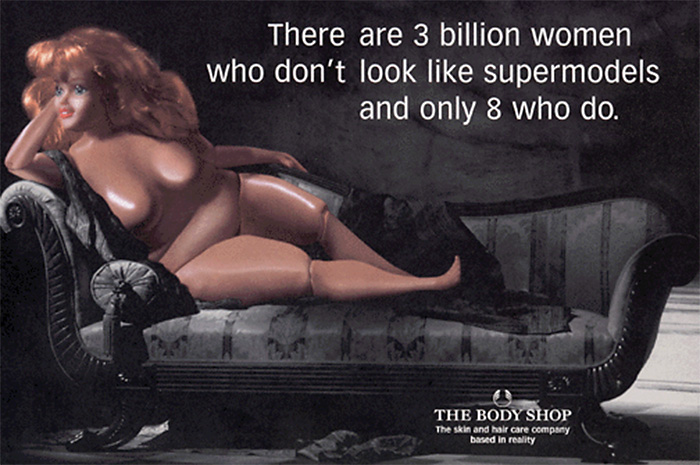
 

Anonymous photographer. 'Untitled' 1997


Anonymous photographer
Untitled
1997
Body Shop advertisement in Roddick, Anita (ed.,). Full Voice Issue One. Australia: Adidem Pty. Ltd., 1997


The magazine asks what self-esteem is? It replies:

“SELF RESPECT
SELF AUTHORITY
DIGNITY
PRIDE
AWARENESS
CALMNESS
THE PURSUIT OF DREAMS
A SENSE OF ACHIEVEMENT
A TWINKLE IN THE EYE
THE LIVING OF LIFE”

The magazine contains articles for women on such issues as ‘ideal’ body image versus ‘real’ body image, 10 social symptoms of high and low self-esteem, fat versus thin, how to create a beauty advert called “Want to Know a Secret?” (which is a real laugh), and what is beauty? It concludes with these lines:

“Somewhere in time, society lost the plot. We decided how a person looked was more important that who that person was. When that time was, no-one knows. But we can remember the time we started to put it right.”


The Body Shop should be applauded for their effort. We must acknowledge, though, that people will be attracted to other people through an appearance that engages with their sexual fantasies. This only becomes a problem when sexual attraction through physical appearance turns to discrimination against other people who don’t match their ‘ideal’ look. In an important observation, Greg Blanchford has noted of the sexual objectification of gay men occurring in casual encounters that,

“People in these situations will not be attracted to someone unless they are attracted by some external feature that fulfils some sexual fantasy. It follows that there must be an emphasis on surface or cosmetic characteristics. And because the criteria of selection can be highly specific, one is, in turn, concerned to present an image of oneself that will attract others. Therefore appearance, dress, manner and body build are very important.”21


Of course these elements are important but unfortunately, in our society, not everyone can have a fabulous body build, appearance or dress and the way we treat attractive as opposed to unattractive people is not always equal and fair. Our reaction to the individual shapes the way that their self-esteem may develop and may affect their relationship with the world. If you keep telling an unattractive person that they are unattractive they will eventually begin to believe this themselves. This is called a ‘self-fulfilling prophecy‘. The individual becomes a victim of our discrimination and eventually perpetuates this damaging discrimination upon themselves.

XY Magazine, a publication aimed principally at gay youth, ran a Body Issue in April 1997. Under the title “Perfect Bound,” William Mann talked to social commentators Michelangelo Signorile, Michael Bronski and Victor D’Lugin amongst others. In a thought provoking article Mann asks,

“How many gay kids are … struggling through identity issues like being skinny, or socially awkward or whatever? What does the image of the pumped-up pretty white boy – plastered all over our magazines, our advertising, our literature, and our erotica – say to the non-white or skinny gay kid, looking to find a place in a community that seems to have no place for people who look like him?”22


Pages from 'XY Magazine' 1997


Anonymous photographers
Untitled
Nd
Pages from back issues featured in XY Magazine No. 7. California: XY Publishing. April/May 1997


What indeed – what does it say to them? Does the image make them feel inadequate? Does it alienate them not just from themselves but also from the gay community, a community to which they aspire to belong?

Here, I am not saying you can’t find muscular bodies desirable as long as you understand the possible consequences for other gay men who do not possess such a body. As Michael Bronski notes in the same article, “The minute someone points out something where we should be more culturally sensitive, there’s this cry of political correctness. People see it as an attack on them, a loss for them. But nobody’s saying you can’t find Marky Mark and his kind attractive.”

Indeed nobody is, including myself. I am the first to admire a good, muscular body and always wanted one myself. But I am aware of the problems and alienation from self that such a desire can cause. Under the heading NO PECS, NO SEX Mann goes on to say that this kind of body is not always available for sex and the more that we find this kind of body attractive the less sex we will have. “And when we do [have sex], its always the same, and we miss many kinds of pleasure.” Mann asks Michael Bronski about this point and, talking about the body of the buffed, white, muscular male he replies, “The image is so clean and ultimately non-threatening that it doesn’t allow for us to explore our sexuality, to see what the limits of our fantasies might be.”

Michelangelo Signorile observes that,

“Looking out at the hordes of shirtless, pumped-up men, each virtually indistinguishable from the next, it dawned on me just how much pressure is put on young gay men as they enter the gay community – more than ever before. It’s true that there have always been paradigms in the gay world, but it seemed in the past there were more choices, more leeway about what was considered a gay stud. Today only one very precise body type is acceptable – one that very few gay men have or can achieve. …

We need to empower people who don’t feel attractive. I’m not saying that for vast numbers of people the club and party scene is not fun, is not great. But those who don’t fit in need to see other images. Lots of people don’t see themselves in what they see of gay culture. The range of what’s attractive needs to be expanded, not because it’s a good thing we should do, but because the range really is broader.””23
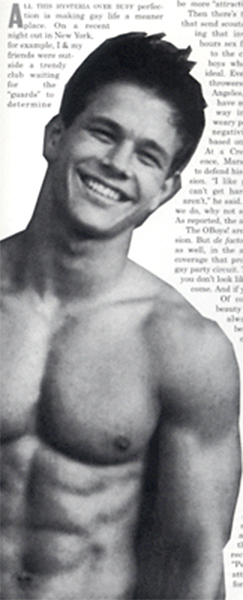
 

Anonymous photographer. 'Marky Mark' Nd


Anonymous photographer
Marky Mark
Nd
in XY Magazine No.7. April/May 1997, p. 27

“Marky Mark on 60 foot high Calvin Klein advertising board: icon of beauty, or body fascism?


Finally, the conclusions reached by the article are that:

1. We should try and empower people who don’t feel attractive.
2. We should offer different images to people who feel they don’t fit in.
3. We should broaden the range of what can be seen as attractive.
4. We have limited our own sexual freedom by this hierarchy of beauty.

Then we look at the images that run in the same issue of XY Magazine, a magazine which is marketed and primarily sells to young gay men.

Advertisements for back issues include images that illustrate articles such as ‘Confessions of a Jock-Lover’, or ‘Palm Springs DOA: I Survived the White Party’, (see above images) which feature stunning, rippled torsos. The White Party is a Circuit party in America held to raise money for HIV / AIDS research where there are lots of gorgeous built men all running around having sex and taking drugs – the contrast between the built body and the AIDS body full of sad irony. Then there is the fashion shoot titled ‘Straight acting’. Yes, the models are from different ethnic backgrounds (no racial discrimination here!), but they are all smooth and built (see image below).

These photographs and many more like them feature in the monthly issues of XY magazine, a mag aimed at gay youth. I believe it is constructive that such issues are being debated but, as with the ‘Blue’ article, it is just a token offering that does very little to change omnipresent omnipotent social ideals.


Bradford Noble. 'Untitled' Nd


Bradford Noble
Untitled
Nd
Images from ‘Straight Acting’ Clothes feature, XY Magazine No. 7. California: XY Publishing. April/May 1997, pp. 45-49.


Spiros Politis. 'Untitled' Nd


Spiros Politis
Untitled
Nd
in Todd, Matthew. “In the Eye of the Beholder,” in Mattera, Adam (ed.,). Attitude Vol. 1 No. 66. London: Northern and Shell PLC, October 1999, pp. 56-57.

Left to right: Phil 49, engineer; Andy 21, student; Jon 21, student; Josh 25, escort; Jody 21, aerobics instructor.


Another article that attempts to address issues of beauty, body image and self-esteem in gay men appeared in the October 1999 issue of the London based Attitude magazine. Titled “In the Eye of the Beholder,” journalist Matthew Todd asks rather inane questions about the representation of bodies and the ‘scene’ of four ‘ordinary’ and one ‘perfect’ gay men (see image above). It is interesting to observe that these ‘ordinary’ gay men, while noting that gay magazines “ram it down your throat that ‘You should look like this!'” (Andy) offer no possible alternatives that they think would work to break the dominance of the visual stereotype of the muscular mesomorphic body image.

Although articles such as this do raise awareness of some of the issues concerned with self-esteem and body image, they also confirm the authority of visual ‘fantasy’ images that allows magazines (such as Attitude) to justify the continued publication of white, smooth, muscular ‘Party Boys’ as the epitome of what a gay man should look like by confirming that this image is what the consumer wants to see. This observation is confirmed by presenting a selection of the male body images that appear in articles, not advertisements, in the same issue of Attitude magazine.

Escapism and fantasy (linked to anti-authority and the feminine) are thus grounded in the authority and fixity of the sign of the muscular mesomorphic body image through desire for and “attraction to good looks,” through the watching of the objective eye, and through a nostalgia for the paradise of the perfect body. The authority and meaning of this sign is upheld “through the interpretative acts of members of a sign community,” particularly when the meaning and power of the sign is reinforced and dominant within the gay community. This can be contrasted with a partially seeing objective eye which offers an appreciation of ‘truth’ (subjective, objective, fluid and non-final) through imperfection, diversity, and an acknowledgement of difference. I correlate this non-finality with the quotation by Wendy Chapkis that I use as a summation at the end of the Re-Pressentation chapter.
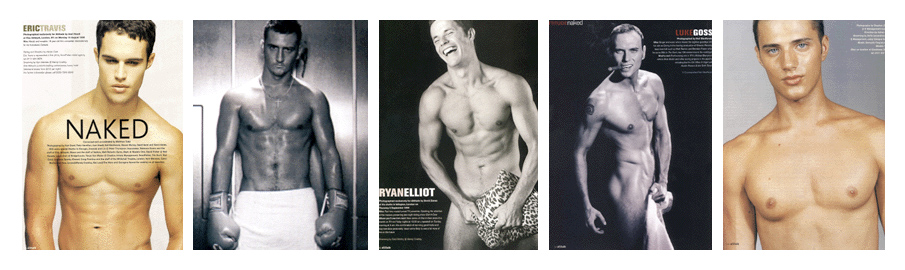
 

'Attitude Magazine' 1999


Axel Hoedt
Eric Travis
Nd
in Todd, Matthew. “”Naked,” in Mattera, Adam (ed.,). Attitude Vol. 1 No. 66. London: Northern and Shell PLC, October 1999, p. 38.

Axel Hoedt
Will Mellor
Nd
in Todd, Matthew. “”Naked,” in Mattera, Adam (ed.,). Attitude Vol. 1 No. 66. London: Northern and Shell PLC, October 1999, p. 48.

David Zanes
Ryan Elliot
Nd
in Todd, Matthew. “”Naked,” in Mattera, Adam (ed.,). Attitude Vol. 1 No. 66. London: Northern and Shell PLC, October 1999, p. 50.

Neil MacKenzie
Luke Goss
Nd
in Todd, Matthew. “”Naked,” in Mattera, Adam (ed.,). Attitude Vol. 1 No. 66. London: Northern and Shell PLC, October 1999, p. 54.

Stephan Ziehan
Sam Fragiacomo
Nd
in Clark, Adrian and Day, Luke. “Essentials: Grooming,” in Mattera, Adam (ed.,). Attitude Vol. 1 No. 66. London: Northern and Shell PLC, October 1999, p. 104.


I love how all the penises are covered up with towels or cushions and I note that traditional symbols of masculinity are also well represented – the cigar and the boxing gloves for example. Eric Tavis also happens to be a wrestler as well as a model. Also, notice how all bodies are smooth, white, muscular and look like they could have been pressed from the same mould.

For gay men in contemporary society the maintenance of a healthy social body has become a moral concern, for supposedly anybody can make their frame-work a ‘work of art’ and attain that longed for paradise of the ‘perfect’ body, the body as a sign of virility and traditional masculinity. You only have to exercise and build that lean, hard look, have your tummy tucked or face reconstructed, take those steroids to make your body into a sculpture …

Your body could be a work of art if only you would let it …


Anonymous photographer. Make your body a work of art' 1998


Anonymous photographer
Make your body a work of art
‘Body Sculpture’ brochure
1998


Marcus Bunyan (Australian, b. 1958) 'Andy in the flat, Punt Road, South Yarra' 1991-1992


Marcus Bunyan (Australian, b. 1958)
Andy in the flat, Punt Road, South Yarra
1991-1992
Gelatin silver print


Re-Pressing, responsibility and respect

Bodies and images of the body signify their meaning through representation. How can we re-press the representation of the male body so that we can offer alternative images to gay men that will act as fantasies for them? According to John Tagg25 we must demonstrate that the meaning of already dominant images within a society can be negated and rendered incoherent. Tagg says there are 2 ways of doing this:

1. “We must search for other signifying conventions, other orders of meaning already present in the culture (through conflict of classes, ideologies and forms of control) that are denied a semiotic space to express themselves.” (Semiotics is the study of signs)

2. “We must abandon the above search for other forms of meaning in bodies and body images and adopt images that refuse any meaning at all – bodies and images of them cannot be read or possessed and therefore may come to mean nothing. In other words the image does not signify anything, much like the early non-sexual androgynous ‘figure’ of the gay liberation movement. The figure had no ascertainable gender, even though the body was still actively sexual.”


Personally I think that the second option would be very difficult to achieve on a broad social level.

Body images are understood through ‘conditions of understanding’, in other words how their meaning is understood is through a collective knowledge of the history of context, place and the language that those images speak in. Images are the main source of sensual stimulation in contemporary society and their language is learnt from an early age.

To culturally deny this language would be a very difficult thing to achieve. The first option has a greater possibility of success: that we can open up spaces for images that have previously been denied the room to speak for themselves. This is especially true in regard to the dominance of images of the muscular mesomorph within gay society. We must try and propose different body image types as fantasies for gay men and give them the space within the community to express themselves!

The image below is a good example of allowing other orders of meaning already present within images in our culture to speak for themselves. The photograph below is another form of re-pressentation of the male body image that usually finds no representative space within the context of gay media. These kind of images do offer themselves as alternative fantasy images for gay men but are often denied the space to express themselves and therefore reach a larger audience of gay men. Here I am, accept me for who I am.


Anonymous photographer. 'Untitled' 1998


Anonymous photographer
Untitled
1998
Image from a personal gay web page


An understanding of re-pressentation is the responsibility of every gay man. It is an ability to be able to respond (which is what responsibility means) to his own needs and the needs of others in a voluntary, altruistic and non-discriminatory way. It implies a care and concern for others as well as for the self. This is a hope, a dream if you like, but a good dream all the same. I suggest that, above all, responsibility for the acceptance of difference in others requires an understanding and respect towards yourself.

As Erich Fromm has said more eloquently than I can ever say,

“Respect is not fear and awe, it denotes, in accordance with the root of the word (respicere = to look at), the ability to see a person as he is, to be aware of his unique individuality. Respect means the concern that the other person should grow and unfold as he is. Respect, thus, implies the absence of exploitation … It is clear respect is possible only if I have achieved independence; if I can stand and walk without needing crutches, without having to dominate and exploit anyone else. Respect exists only on the basis of freedom … To respect a person is not possible without knowing him; care and responsibility would be blind if they were not guided by knowledge. Knowledge would be empty if it were not motivated by concern. There are many layers of knowledge; the knowledge which is an aspect of love is one which does not stay at the periphery, but penetrates to the core. It is possible only when I can transcend the concern for myself and see the other person in his own terms.”26 (My bold)


I think this is a fantastic way to view our relationship with the world.

Respect, responsibility, care, and concern are key words in this positive relationship with ourselves and with others, which I believe will increase self-esteem by surrounding both with good energy. I realise that this may be very difficult to put into practice all of the time but if we could try then I believe the world can become a healthier, more balanced place.


Marcus Bunyan. 'Self-portrait in Punk Jacket' 1991-1992 from the series 'Self-portraits and nudes' 1991-1992 Marcus Bunyan. ‘Self-portrait in Punk Jacket’ 1991-1992 from the series ‘Self-portraits and nudes’ 1991-1992


Marcus Bunyan (Australian born England, b. 1958)
Self-portrait in Punk Jacket
1991-1992
From the series Self-portraits and nudes 1991-1992
Gelatin silver print


Re-imag(in)ing the male body


“Modern man is alienated from himself, from his fellow men, and from nature. He has been transformed into a commodity, experiences his life forces as an investment which must bring him the maximum profit obtainable under existing market conditions. Human relations are essentially those of alienated automatons, each basing his security on staying close to the herd, and not being different in thought, feeling or action. While everybody tries to be as close as possible to the rest, everybody remains utterly alone, pervaded by the deep sense of insecurity, anxiety and guilt which always results when human separateness cannot be overcome …” (My bold)


Erich Fromm27


Marcus Bunyan (Australian, born England 1958) 'Untitled' 1995-96 From the series 'Sleep/Wound'


Marcus Bunyan (Australian born England, b. 1958)
Untitled
1995
From the series Sleep/Wound
Gelatin silver print

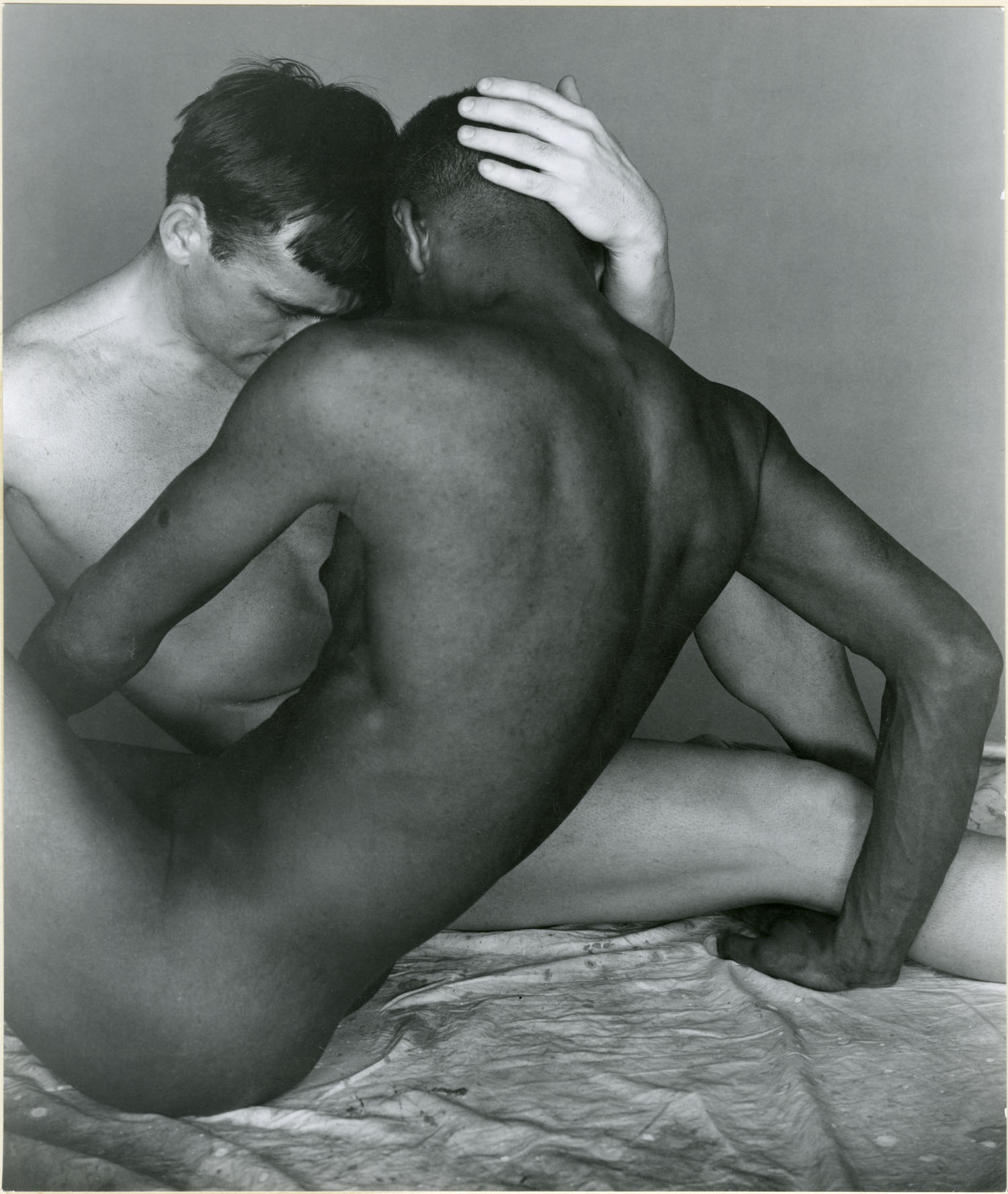
In the series of photographs I try to explore the gay male body not from the usual viewpoint of desire but from the viewpoint of intimacy, touch, affection and love. The infrared images are the positions of sleep of myself and my partner. If people find them erotic then that is their reading of the photographs. They are not meant to be. They explore an area of imagery of the male body which I think has been totally overlooked – male2male intimacy. An early example of this intimacy is a photograph by Minor White (below). Few have really developed this theme further. This is an imagery not as reliant on the posing, hard bodied, clench fisted, body as phallus orientated iconography so prevalent in contemporary male society. It is an example of imagery that has yet to find a semiotic space to express itself.


We seek to belong to a society that values coherence and conformity whilst promoting ‘individuality’. Staying close to the herd; not being different in thought, feeling or action; assuming masks; the replaceability and interchangeability of bodies. These are all conditions of this supposed ‘individuality’ in contemporary society, a society that is really afraid of any expression of difference and diversity. The gay community, long priding itself on valuing diversity, is equally guilty of this charge. Gay becomes a ‘performativity’,28 a repetition of rituals which does result in a loss of individuality, the subsuming of the individual into the ‘team’.

“The idea of being one’s self is often expressed as “doing one’s own thing.” We can say that one is being himself when he is doing (or thinking) what he really wants to do (or think). When, however, one is acting in a way that is intended to appeal to others or to a code of behaviour that does not come naturally to him, he is not “doing his own thing” at all. He is, in fact, “doing someone else’s thing.”29


A gay man may not really be ‘doing his own thing’ as he would like to think, but ‘doing someone else’s thing’, doing what every-body else is doing. This conformity is enforced by gay men themselves. Not society but individual will, the will to be part of the ‘team’; to seamlessly belong. Erich Fromm has said this is union by conformity. “In contemporary capitalistic society the meaning of equality has been transformed. By equality one refers to the equality of automatons; of men who have lost their individuality. Equality today means ‘sameness’, rather than ‘oneness’.”30

Of course, we are all convinced that we follow our own desires but in the gay community we see how these desires can be shaped to fit in with a standardised ‘ideal’ in regards to male body image, in order to become ‘the same’. I believe that gay men must try to negate and transcend the power inherently embodied in stereotypical representations of male body images. Says Chris Schilling,

“If our embodied experiences negate dominant conceptions of gender roles, for example, there is the basis for the creation or support of alternative views about men and women … It is important to note that not all bodies are changed in accordance with dominant images of masculinity and femininity, and there is much individuals can do to develop their bodies in different directions.”30 (My italics)


Minor White (American, 1908-1976) 'Ernest Stones and Robert Bright (San Francisco)' 1949


Minor White (American, 1908-1976)
Ernest Stones and Robert Bright (San Francisco)
1949
Gelatin silver print
in Bunnell, Peter. Minor White: The Eye That Shapes. Bulfinch Press, 1989, Figure 32


Negative No. 2342I. ‘Ernest Stones and Robert Bright’. 1949. 6″ x 6″ contact print (?)

One of my favourite Minor White photographs. Same men as above but lighter skin tones. Richness – tonality in shirts is amazing. Much more contrast than the reproduction, Plate 32 in Bunnell, Peter. Minor White: The Eye That Shapes. Boston: Bulfinch Press/Princeton University, 1989. Much more clarity than the reproduction, Plate 62 in Ellenzweig, Allen. The Homoerotic Photograph. New York: Columbia University Press, 1992, p. 111.

The presence of the hand on the shoulder is incredible. Such an intimate image between two men!

Bunyan, Marcus. “Research notes on photographs from the Minor White Archive,” Princeton University, New Jersey, 06/08/1999.


Marcus Bunyan (Australian, born England 1958) 'Untitled' 1995-1996 From the series 'Sleep/Wound'


Marcus Bunyan (Australian born England, b. 1958)
Untitled
1995
From the series Sleep/Wound
Gelatin silver print


Through our lived experience, our history of body, it’s context and it’s language, it is possible to support and encourage alternative ways that gay men can look at their own and other men’s bodies. As Michelangelo Signorile said it is possible to remember a time when we liked different types of bodies; we can promote an acceptance of different fantasies in regards to gender role representation that help support alternative views of masculinity, that help create a multiplicity of desires, because we have all previously desired different types of bodies.

As Naomi Wolf in her seminal book The Beauty Myth notes, “The shape and weight and texture and feel of bodies is crucial to pleasure but the appealing body will not be identical … The world of attraction grows blander and colder as everyone, first women and soon men, begin to look alike.”31

As gay men our personal experience of the feel of male bodies is crucial to an acceptance of difference. In the fluctuation of body image and identity boundaries through the interaction of bodies in sex, gay men may begin to explore the possibility of new forms of pleasure. But it would seem to me that gay men, instead of inventing new pleasures, constantly repeat and reiterate an old limiting pleasure, the desire for stereotypical muscular body image ideals. In the desire for intimacy, connection and possession of a man that has the signifier of the ‘ideal’ muscular mesomorphic body image, gay men may have multiple intimate sexual encounters that do not reinvent pleasure but repeatedly seek to confirm existing ‘ideals’ of social reproduction. This is not a multiplicity of pleasures expressed through a desire for different forms, but the expression of a singular, monocular pleasure that validates the social worth of one body-type.

The multiplicity of casual sexual encounters might open a gay man up to new experiences but these experiences are based on a desire for the fixed form of a solid, stable, secure, traditional masculine body. This is not a dissolution of boundaries to reinvent new pleasures but the reinforcement of traditional patriarchal masculine stereotypes that promotes discrimination against gay men who do not possess this kind of body. In revealing themselves in intimate casual sexual encounters by having unsafe sex with a muscular body image ‘ideal’ gay men may be exploring the diversity and difference of man sex in liberating but possibly dangerous ways, ways born out of desperation and desire to possess the body image ‘ideal’ that may be evidenced through a nihilistic lack of care, concern and responsibility for the inner Self and a lack of respect for others.

Expanding on a quotation by Kenneth Dutton I observe that: “The feminist struggle to overcome stereotypical images and open-up to women a range of options as to the roles they may wish to play, free of the male-imposed constraints of traditional socio-sexual expectation, is yet to find its masculine counterpart”31 in the body images of the male within the gay community.

Overcoming stereotypical images means first overcoming the hype of the hyper-masculine body. Strength in itself is not power but this type of muscular body is increasingly seen as powerful within the gay community. For some gay men a desire for the power of patriarchy is evidenced in their desire for these ‘ripped’ bodies with their ‘shredded’ muscle (both, ironically, terms of disembodiment and therefore dehumanisation) as proof that they are ‘real’ masculine men. The supposed irony present in gay male sex and sexuality, of one man fucking another man to disrupt the ‘norms’ of hegemonic masculinity has, I believe, disappeared in a reaffirmation of traditional forms of masculine identity.

The power of beauty is no longer the power of the effete, the weak, the hidden, but the power of the muscularly visible. Judgements made by gay men on other gay men depend to a significant degree on the representation of this power through the possession of the form of the muscular body, the desire for it’s hardness and strength dictated by the collective desire of a gay male sexual orientation. Gay men must be made more aware that this collective desire is based on traditional forms of hegemonic masculinity replete with the discriminations that this identity construction entails. Learning from past histories and experiences we must try to stop such conditions being repeated so that discrimination does not exist in future identities.


Marcus Bunyan (Australian, born England 1958) 'Untitled' 1995-1996 From the series 'Sleep/Wound'


Marcus Bunyan (Australian born England, b. 1958)
Untitled
1995
From the series Sleep/Wound
Gelatin silver print


We must work to expand the underlying societal attitude of what is seen as the desirable ‘look’ of the gay male body in order to open up different body-types as fantasies for gay men. It is gay men’s (re)actions in regards to bodies of all types that is important. We must encourage a personal self-acceptance that increases self-esteem through achievement. This may include going to the gym to develop your body but this activity should be undertaken with an awareness of all the issues involved in such a quest. As Michael East comments,

“At the end of the day, we as men have to do what the women have had to do to cope with body image pressure for the last 50 years: ie., accept ourselves as we are. Ultimately, no matter how big our muscles are, how cool an exterior we can project, or how mental, agile or superior we pretend we are, we too are human, and must set our own bench marks, and not use others. At the end of the day, it comes down to how you feel about your body. No matter what size or shape you’re in, if you are cool about it – that is of primary importance.”33 (My italics and bold).


He goes on to suggest several strategies that help promote an acceptance of body image:

1/ “Make a deal with yourself that you are going to stop giving yourself a hard time about it. With a clear head and less subjective approach to the situation you’ll be better equipped to take stock of what the real issues are, and these could have nothing to do with your body at all.

2/ Clear out the junk – negative thoughts about yourself, the world, what you’re doing with your life [basically self-actualization]. This also includes associates that subtly or otherwise give you a hard time about your body shape/size.

3/ If your house or private space is furnished with nothing but multitudes of images of semi naked men with great bods, why not take them down for a while to give yourself a more neutral space to take stock?

4/ Focus on other aspects of yourself. Unless you’ve convinced yourself that you are a complete loser, list all the good things that you have done with your life, an all the good things about you that people compliment you on.” [Increasing self-esteem through achievement]


I think that the last point is vitally important. Body image is part of an overall self-esteem package and feeling better about yourself overall will help you feel better about your body. Conversely, feeling better about your body by getting in shape, going to the gym for the right reasons, can help improve your overall self-esteem. Self-esteem is built through the acceptance and achievement of an integrated identity, valuing all parts of the self. Its no good going to the gym and getting a great body if you haven’t sorted out other issues in your life because you’ll still think that you look like crap anyway! Then you’ll want bigger muscles and an even better body thinking this will improve your self-esteem and be the solution to your problems34 ….


Conclusion

I will conclude this chapter with an eloquent quotation by Wendy Chapkis and a few comments from myself. I believe that this quotation is a fitting summation to this chapter and perhaps to the whole research project. It most closely expresses and reflects – through the spiritually succinct words of someone I admire – ideas and thoughts on the subject matter that have evolved as this research project has developed to fruition.

“The politics of appearance inextricably bound up with the structures of social, political and economic inequality … Fighting pressure to conform, attempting to hold one’s own against the commercial and cultural images of the acceptable is a crucial first act of resistance. The attempt to pass and blend in actually hides us from those we most resemble. We end up robbing each other of authentic reflections of ourselves. Instead, imperfectly visible behind a fashion of conformity, we fear to meet each others’ eyes … Real diversity can only become a source of strength if we learn to acknowledge it rather than disguise it. Only then can we recognize each other as different and therefore exciting, imperfect and as such enough.”35 (My italics)


Our difference and diversity is our strength as gay people.
We must not crush our difference through discrimination.
We must not hide our diversity behind masks.
We must resist commercial and cultural images of the acceptable.

Yes we are imperfect and what an exciting perfection it is!


Dr Marcus Bunyan 2001


Footnotes

1/ Signorile, Michelangelo. Life Outside: The Signorile Report on Gay Men: Sex, Drugs, Muscles, and the Passages of Life. New York: HarperCollins Publishers, 1997, pp. 298-299.

2/ Interview with Taylor, Barry. Melbourne. 01/07/1997. Manager of the Victorian State Youth Suicide Prevention Programme 1996 and now working with gay people on mental health issues.

3/ Ridge, Damien. “Queer Connections: Community, ‘the Scene’ and an Epidemic,” in Journal of Contemporary Ethnography June 1996, pp. 15-16.

4/ Hatfield, Elaine and Sprecher, Susan. Mirror, Mirror: The Importance of Looks in Everyday Life. Albany: State University of New York Press, 1986, p. 313.

5/ Benson, Lou. Images, Heroes and Self-Perceptions. New Jersey: Prentice-Hall, 1974, p. 30.

6/ Fromm, Erich. The Art of Loving. London: Allen and Unwin, 1957, quoted in Benson, Lou. Images, Heroes and Self-Perceptions. New Jersey: Prentice-Hall, 1974, p. 30.

7/ “… body attractiveness is so highly valued that it has the single most important impact on many individuals feelings of physical self-worth. Physical self-worth affects self-esteem.”

Wankel, Leonard. “Self-Esteem and Body Image: The Research File: information for professionals from the Canadian Fitness and Lifestyle Research Institute,” in Canadian Medical Association Journal 153 (5). September 1st, 1995, p. 607.

See also Berscheid, E., Hatfield (Walster), E. and Bohrnstedt, G. “The Happy American Body: A Survey Report,” in Psychology Today 7. 1973, pp. 119-131.

8/ “Low self-esteem is associated with depression and may contribute to suicidal behaviour (Rutter, 1986) … throughout adolescence, self-esteem appears to be affected by young people’s judgements of their competence in certain valued domains (Harter, 1990). Domains identified as important include physical attractiveness, acceptance by peers, and, to a lesser extent, academic competence, athletic ability, and conduct.”

Crockett, L. and Peterson, A. “Adolescent Development: Health Risks and Opportunities,” in Millstein, S. and Peterson, A. and Nightingale, E. (eds.,). Promoting the Health of Adolescents. Oxford: Oxford University Press, 1993, p. 19.

Rutter, M. “The Developmental Psychopathology of Depression: Issues and Perspectives,” in Rutter, M. and Izard, C. and Read, P. (eds.,). Depression in Young People: Developmental and Clinical Perspectives. New York: Guilford, 1986.

Harter, S. “Self and Identity Development,” in Feldman, S.S. and Elliott, G.R. (eds.,). At the Threshold: The Developing Adolescent. Cambridge, MA: Harvard University Press, 1990.

9/ Hatfield and Sprecher, 1986, Op cit. p. 123.

10/ Signorile, 1997, Op cit. pp. 226-227.

11/ “For gay men, sex, the most powerful implement of attachment and arousal, is also an agent of communion, replacing an often hostile family and even shaping politics.”

Goldstein, Richard. “Heartsick: Fear and Loving in the Gay Community,” in The Village Voice June 28th, 1983, quoted in Watney, Simon. “The Rhetoric of AIDS,” in Wallis, Brian (ed.,). Blasted Allegories. Cambridge, Mass: The MIT Press, 1987, p. 165.

12/ “We have noted earlier that the hero in our society is often depicted as a loner, a man without ties. This encourages people to wear the mask of the loner while inside their need for community remains unfulfilled. There results a kind of taboo on closeness and affiliation in our overt behaviour, while unconsciously the longing continues to cause us great distress.”

Benson, 1974, Op cit p. 397.

13/ Benson, 1974, Op cit p. 397.

14/ MB: Self-actualization is concerned not just with end product, but in the actual experience of the process itself, whether it is baking a cake, playing the piano, going to the gym, or having sex. We can both enjoy the actual process and the outcome FOR WHAT THEY ARE, not what we would like them to be.

“[An] important area in which self-actualizing people differ from others is in their non judgmental acceptance of themselves … They can accept their own human nature in the stoic style, with all its shortcomings, with all its discrepancies from the ideal image without feeling real concern. Such feeling of comfort and acceptance with the self are extremely important in terms of laying down a tone that underlies a person’s whole existence.”

Benson, 1974, Op cit p. 356-357.

15/ Maslow, A. Motivation and Personality. New York: Harper & Row, 1970 cited in Benson, 1974, Op cit pp. 356-357.

16/ Signorile, 1997, Op cit. pp. 267-268.

17/ Interview with Taylor, Barry. Melbourne. 01/07/1997. Manager of the Victorian State Youth Suicide Prevention Programme 1996 and now working with gay people on mental health issues.

18/ Lakoff, Robin and Scherr, Raquel. Face Value: The Politics of Beauty. Boston: Routledge and Kegan Paul, 1984, p. 284.

19/ Houston, R. “The Way We Wear,” in Gay News Vol. 131. 1978, p. 14, quoted in Blachford, Gregg. “Male Dominance and the Gay World,” in Plummer, Kenneth (ed.,). The Making of the Modern Homosexual. London: Hutchinson, 1981, p. 191.

20/ Roddick, Anita (ed.,). “The Body and Self Esteem,” in Full Voice Issue One. Australia: Adidem Pty. Ltd., 1997.

21/ Blachford, Gregg. “Male Dominance and the Gay World,” in Plummer, Kenneth (ed.,). The Making of the Modern Homosexual. London: Hutchinson, 1981, p. 191.

22/ Mann, William J. “Perfect Bound,” in XY Magazine No.7. California: XY Publishing, April/May 1997, pp. 26-28.

23/Michelangelo Signorile quoted in Mann, 1997, Op cit pp. 26-28.

24/ “It is not through any intrinsic quality of the sign but rather through the interpretative acts of members of a sign community that the sign comes to have meaning. Hence the transmutability of all signs, their capacity to serve as signified and signifier, independent of their physical properties.”

Stewart, Susan. On Longing: Narratives of the Miniature, the Gigantic, the Souvenir, the Collection. Durham: Duke University Press, 1993, p. 32.

25/ Tagg, John. The Burden of Representation: Essays on Photographies and Histories. Basingstoke: Macmillan, 1988, pp. 101-102.

26/ Fromm, Erich. The Art of Loving. London: Allen and Unwin, 1957, pp. 28-29.

27/ Ibid., pp. 28-29.

28/ “I would suggest that ‘performativity’ cannot be understood outside of a process of iterability, a regularized and constrained repetition of norms. And this repetition is not performed by a subject; this repetition is what enables a subject and constitutes the temporal condition for the subject. This iterability implies that “performance” is not a singular “act” or event, but a ritualized production, a ritual reiterated under and through constraint, under and through the force of prohibition and taboo, with the threat of ostracism and even death controlling and compelling the shape of the production, but not, I will insist, determining it fully in advance.”

Butler, Judith. Bodies That Matter. New York: Routledge, 1993, pp. 94-95.

“The validation of gay bodies in sex becomes, in Judith Butler’s terms, both ‘citational’ and ‘performative’, where gay men quote their own ‘norms’ of desirability and performance in order not to be named ‘other’, in order to belong and be seen as the ‘same’. And in seeing yourself as a ‘real’ man, I think this ‘performativity’ and ‘citationality’ may have become hidden from view in the deception of gay men seeing themselves as the same. If you do not match up to these ‘normalities’ of interaction then I wonder how much real emotional involvement there is, especially when the negotiation skills of some gay men are not as developed as Gary Dowsett would like to think. Producing sexually proficient men in sexually vital bodies is no longer a hands on task within the gay community, but rather the emotionally uninvolving experience of sexual jurisprudence, a sighting of the law of sexual performance that is not seen as such by gay men.”

Bunyan, Marcus. ‘Sex and Sensibility: Gay Eth(n)ics into the New Millennium’ paper presented at HID3, Proceedings of the 3rd National Lesbian, Gay, Transgender and Bisexual Health Conference, Adelaide, South Australia, 1999

29/ Benson, 1974, Op cit pp. 4-5.

30/ Fromm, 1957 Op cit p. 19.

31/ Wolf, Naomi. The Beauty Myth. London: Vintage, 1991, pp. 176-177.

32/ Dutton, Kenneth. The Perfectible Body. London: Cassell, 1995, p. 373.

33/ East, Michael. “Mirror, Mirror … Exploring men’s body image,” in McLean, Max (ed.,). Melbourne Star Observer Issue 494. Body & Soul. Melbourne: Satellite Media, 29th October 1999, p. 12.

34/ “”I want to be physical perfection in the eyes(most important) of gay men – totally physically appealing, like the ultimate. The perfect tits and butt, bulbous biceps. I want to achieve symmetry, big and in proportion. I would look like the cover of an HX [Homo Xtra, a New York bar giveaway known for its covers of hot men] – lean, sculpted, muscular, virile, a stallion, a guy that would make your mouth water. I want to know what it’s like to walk down the street and have everyone look at you, absolutely everyone. I want to know what it’s like to really feel like an object.” What does he believe all of this will do for him? “Honestly, and I’m embarrassed to say it, but I’m hoping it will boost my self-esteem,” he admits. “I don’t know how to boost my self-esteem now. My feeling is, ‘Get a great body and people will admire you. Get a great body and everything will be okay’ … It’s this belief that if I can just get the perfect body, then I wouldn’t be insecure.””

Signorile, Michelangelo. Life Outside: The Signorile Report on Gay Men: Sex, Drugs, Muscles, and the Passages of Life. New York: HarperCollins Publishers, 1997, p. 4.

35/ Chapkis, Wendy. Beauty Secrets: Women and the Politics of Appearance. Boston: South End Press, 1986, p. 175.


LIKE ART BLART ON FACEBOOK

Back to top

Text: “Bench Press” chapter from Marcus Bunyan’s PhD research ‘Pressing the Flesh: Sex, Body Image and the Gay Male’, RMIT University, Melbourne, 2001

November 2022


Eugen Sandow (German, 1867-1925) 'Instructions for the use of Sandow's spring grip dumb-bells' Between 1900 and 1909 (detail)


Eugen Sandow (German, 1867-1925)
Instructions for the use of Sandow’s spring grip dumb-bells (detail)
Between 1900 and 1909
(23 pages): illustrations; 18 cm
National Library of Australia, Canberra viewed 10 November 2022


Since the demise of my old website, my PhD research Pressing the Flesh: Sex, Body Image and the Gay Male (RMIT University, Melbourne, 2001) has no longer been available online.

I have now republished the second of twelve chapters, “Bench Press”, so that it is available to read. More chapters will be added as I get time. I hope the text is of some interest. Other chapters include Historical Pressings which examines the history of photographic images of the male body, including the male body as desired by gay men, and the portrayal in photography of the gay male body; In Press which investigates the photographic representation of the muscular male body in the (sometimes gay) media and gay male pornography; and Re-pressentation which alternative investigates ways of imag(in)ing the male body and the issues surrounding the re-pressentation of different body images for gay men.

Dr Marcus Bunyan November 2022


“Bench Press” chapter from Marcus Bunyan’s PhD research Pressing the Flesh: Sex, Body Image and the Gay Male RMIT University, Melbourne, 2001

Through plain language English (not academic speak) the text of this chapter investigates the development of gym culture, its ‘masculinity’1, ‘lifestyle’, and the images used to represent it. The text also examines the positive and negative effects of this culture on the individual and collective lives and bodies of gay men.

NB. This chapter should be read in conjunction with the Historical Pressings and Re-Pressentation chapters for a fuller overview of the development of the muscular male body. This chapter also contains descriptions of sexual activity.


Keywords

The Cult of Muscularity, male bodies, queer bodies, bodybuilding, gym culture, masculinity, images of masculinity, development of gym culture, gay men and gym culture, muscular mesomorph, gay lifestyle, self-esteem, body-esteem, Polite Porn, phallic armoured body, desire, HIV/AIDS, photography and the body, before/after photographs, gay desire

Sections

1/ The Cult of Muscularity
2/ The Body and the Social Environment
3/ Science, Photography and the Body
4/ Before / after photographs
5/ Power and the Muscular Body
6/ The Phallic Armoured Body
7/ Muscle Gods, Hot Jocks, and Gay Desire
8/ The Muscular Male Body: Positive and Negative Effects

Word count 7,036

Please note: all photographs are used under “fair use” conditions for the purposes of eduction and research.


Bench Press

The Cult of Muscularity


“… muscularity is a key term in appraising men’s bodies … this comes from men themselves. Muscularity is the sign of power – natural, achieved, phallic.”


Richard Dyer 2


Eugen Sandow (German, 1867-1925) 'Instructions for the use of Sandow's spring grip dumb-bells' Between 1900 and 1909 (detail)


Eugen Sandow (German, 1867-1925)
Instructions for the use of Sandow’s spring grip dumb-bells (detail)
Between 1900 and 1909
(23 pages): illustrations; 18 cm
National Library of Australia, Canberra viewed 10 November 2022


‘The Cult of Muscularity’ was formed in the last decade of the 19th century and the early decades of the 20th century in a reaction to the perceived effeminisation of heterosexual masculinity. Sporting and war heroes became national icons. Muscle proved the ‘masculinity’ of men, fit for power, fit to dominate women and less powerful men. The ‘ideal’ of the perfect masculine body can be linked to a concern for the position and power of men in an industrialised world.3

The position of the active, heroic hetero-male was under attack from the passivity of industrialisation, from the expansion of women’s rights and their ability to become breadwinners, and through the naming of deviant sexualities that were seen as a threat to the stability of society. By naming deviant sexualities they became visible to the general public for the fist time, creating apprehension in the minds of men gazing upon the bodies of other men lest they be thought of as ‘pansies’. (Remember that it was in this decade the trials of Oscar Wilde had taken place in England after he was accused of being a sodomite by The Marquis of Queensbury. It is perhaps no coincidence that the rules that governed boxing, a very masculine sport in which a man could become a popular hero, were named after his accuser. By all accounts he was a brute of a man who despised and beat his son Lord Alfred Douglas and sought revenge on his partner, Oscar Wilde, for their sexual adventures).

Muscles became the sign of heterosexual power, prowess, and virility. A man had control over his body and his physical world. His appearance affected how he interacted with this world, how he saw himself, and was seen by others, and how closely he matched the male physical ‘ideal’ impacted on his own levels of self-esteem. The gymnasium became a meeting point for exercise, for health, for male bonding, and to show off your undoubted ‘masculinity’.


Anonymous photographer. 'Untitled [Gym group possibly German/Prussian]' c. 1890-1910


Anonymous photographer
Untitled [Gym group possibly German/Prussian]
c. 1890-1910
Silver gelatin photograph
Courtesy: Marcus Bunyan


Ultimately, going to the gym has more to do with fitting a certain ‘ideal’ image of ‘masculinity’, that of the muscular mesomorph, than it has to do with getting fit. Aerobic activity such as swimming or running are much more effective ways of getting fit. But what gym work does much better than aerobic activity is that it builds muscle mass. And for a man that wants to be recognised for his physical presence, having more muscle is the epitome of the ‘ideal’.

In a patriarchal society, in other words in a society where men have power over women and other men, to have a masculine body was / is seen as the opposite of being feminine or gay – it emphasises the difference between the position of men and women / gays in society. They are seen as inferior whilst a mesomorphic body confirms ‘real’ men in positions of power over others. No wonder homosexuals found muscular working class men (‘rough trade’) so enticing a sexual fantasy in the early part of this century, and still do to this day.

Still, in being named by the majority limp-wristed ‘nancies’ and by accepting that label now historically ourselves, we forget that not all gay men were pansies with effeminate mannerisms, even in those times.

In contemporary society the division between straight and gay ‘masculine’ bodies has diminished. At dance parties it is now difficult to tell which is the gay body and which is the straight. In seeking acceptance and assimilation into the general society gay men have moulded their bodies on the ‘ideal’ of the muscular mesomorphic model. Both gay and straight men are likely to be striving after the same muscular mesomorphic ideal so much so that they may both become homogenised into a non-feminine, paradoxical asexual masculinity, where very little sexuality exudes from any-body at all!


Siegmund Klein – 'Strength & Health' (March 1933) Vol. 1 No. 4


Siegmund Klein – Strength & Health (March 1933) Vol. 1 No. 4


The Body and the Social Environment

The development of ‘The Cult of Muscularity’ may also have parallels in other social environments which were evolving at the turn of the century. For example, I think that the construction of the muscular mesomorphic body can be linked to the appearance of the first skyscrapers in cities in the United States of America. Skyscrapers were a way increasing visibility and surface area within the limited space of a crowded city. One of the benefits of owning a skyscraper like the Chrysler Building in New York, with its increased surface area, was that it got the company noticed. The same can be said of the muscular body. Living and interacting in the city, the body itself is inscribed by social interaction with its environment, its systems of regulation and its memories and historicities (his-tor-i-city, ‘tor’ being a large hill or formation of rocks).

Like a skyscraper, the muscular body has more surface area, is more visible, attracts more attention to its owner and is more admired. The owner of this body is desired because of his external appearance which may give him a feeling of superiority and power over others. However, this body image may also lead to low self-esteem and heightened body dissatisfaction in the owner (causing anxiety and insecurity in his identity) as he constantly strives to maintain and enhance his body to fulfil expectations he has of himself.

Of course, body image is never a static concept as the power of muscular images of the male body resides in their perceived value as a commodity. This value is re-enforced through social moral values, through fluid personal interactions, and through the desire of self and others for this type of body image; it is a hierarchical system of valuation. It relies on what type of body is seen as socially desirable and ‘beautiful’ in a collective sense, even though physical attractiveness is very much a personal choice.

In the four photographs from the 1930s (below) we can see a range of ethnic men portrayed, all seeking the attainment of what was, for them, the perfection of the muscular human form. Indian, Chinese, Black American and Phillipino are all represented. Compare this to today’s cast of body types from a gay muscle fitness video (soft core pornography video aimed squarely at the gay market) and you can see how the broad inclusion of different ethnic types has been tailored to the demographics of its particular buying public (‘masculine’ white gay male).

Today what is desirable in a masculine body seems to be even more limited in its stereotyping than was the case in the 1930s. Then, at least, there was a diversified range of ethnicity. Now, within the ‘lifestyle’ health and fitness magazines, the paradigm for the desirable male body is predominantly the tanned, toned, muscular white male. Thankfully, professional buff, body-builders do still come in all colours!


Anonymous photographer. 'Anselus T. Del Rosario' c. 1930


Anonymous photographer
Anselus T. Del Rosario
c. 1930
in Berry, Mark. Physical Improvement. Vol. II. Philadelphia: Milo Publishing Company, 1930, p. 78
Courtesy: Marcus Bunyan

“There is something unusual about the back of this young Phillipino, Anselus T. Del Rosario. The pose is rather original and offers suggestion to others.”


Anonymous photographers. 'Three bodybuilders' c. 1930


(left to right)

Anonymous photographer
Cheah Chin Poh
c. 1930
in Berry, Mark. Physical Improvement. Vol. II. Philadelphia: Milo Publishing Company, 1930, p. 261
Courtesy: Marcus Bunyan

Anonymous photographer
Prof. C. C. Shah
c. 1930
in Berry, Mark. Physical Improvement. Vol. II. Philadelphia: Milo Publishing Company, 1930, p. 261
Courtesy: Marcus Bunyan

Anonymous photographer
Wesley Williams
c. 1930
in Berry, Mark. Physical Improvement. Vol. II. Philadelphia: Milo Publishing Company, 1930, p. 154
Courtesy: Marcus Bunyan


Science, Photography and the Body

In the Victorian and Edwardian eras the knowledge of science, such as the science of physical fitness for example, allowed the body to become an object that was subject to technical expertise. Physical fitness was taken up by governments and their armies to enforce standards of fitness for recruits, the medical examination ensuring suitability for service and the fitness regime ensuring that all bodies were interchangeable and replaceable in the event of death on the battlefield. The body became a site of intervention; it became malleable and plastic, subject to the demands of the self and State. This trend continues at an unabated pace today especially within the personal sphere; in the ‘miracles’ of steroid enhancement, plastic surgery, implants and liposuction all there to help you attain the ‘perfect’ body. Now ALL bodies can start to look alike, interchangeable one with another.

Photography, also a relatively new science in that era (photography is both an art and a science), confirmed the ‘truth’ of the power of the muscular body through documentary evidence. The camera acted to legitimise the concerns of men over their body image through relationship of power to the practice of representation. Surveillance of the self became a major factor in the construction of your social identity. Through photographs you could judge for yourself whether you measured up to the ‘ideals’ put forward as valuable by society. Therefore images of muscular mesomorphs can and do affect the self-esteem of individuals through a powerful semiotic system that is embedded in the idealised body factually re-presented in a photograph.

This power is validated because people know the key to interpret the coded ‘sign’ language through which photographs, and indeed all images, speak. In neglecting to acknowledge alternative significations present within this semiotically coded power structure there is the opportunity for one dominant image to be chosen selectively over other types of less ‘valuable’ body images, eventually leading to the possible loss of the key to decode the desirability of ‘other’ body images.

The problem with dominant images that promote the masculinity and power of the muscular mesomorphic body is that they portray one supposed objective truth which is impossible, for there can be can many changing ‘truths’ (viewed from many subjective and objective positions).4 Personally, I believe we should see things not solely as they are from an objective point of view and not purely from an appeal to an “actively struggled for” subjectivity (as argued for by David Smail), but perhaps emerging from a knowledge of the fluid nature of truth, an ever changing combination of many variable truths. Being true to ourselves does not require a one-eyed point of view for we must try to see things from many different points of view to appreciate that there are many shifting, non-final subjective, objective and variable ‘truths’ in life.

Images can be a fabrication just as easily as they are supposed to speak the language of an objective ‘truth’. For example, in the 1870s Dr. Barnardo had photographs taken that showed rough, dirty, and dishevelled children arriving at his homes, and then paired them with photographs of the same children bright as a new pin, happy and working in the homes afterwards. These photographs were used to sell the story of children saved from poverty and oppression and happy in the homes; they appeared on cards which were sold to raise money to support the work of these homes. Dr. Barnardo was taken to court when one such pair of photographs was found to be a fabrication, an ‘artistic fiction’.5

Photographs can be used not only as a tool of observation but as a commodity, to advertise, support and sell the existence of a regime of power that controls the body, in the case of Dr. Barnardo the body of the child. In this way the body of the child becomes a commodity too.


Before / after photographs

Anonymous photographer. 'M. J. Poncela' c. 1930


Anonymous photographer
M. J. Poncela
c. 1930
in Berry, Mark. Physical Improvement. Vol. II. Philadelphia: Milo Publishing Company, 1930, p. 211
Courtesy: Marcus Bunyan


Anonymous photographer. 'George Renzi, Jr.' c. 1930


Anonymous photographer
George Renzi, Jr.
c. 1930
in Berry, Mark. Physical Improvement. Vol. II. Philadelphia: Milo Publishing Company, 1930, p. 210
Courtesy: Marcus Bunyan


Anonymous photographer. 'Untitled' c. 1952


Anonymous photographer
Untitled
c. 1952
‘Before photo/after photo, 35 day Johnson bodybuilding program advertisement’, in Rader, Peary (ed.,). Iron Man. Vol. 12. Dec-Feb. 1952, No. 4. Alliance, Nebraska: Iron Man Publishing Co., 1952, pp. 26-27.
Courtesy: Marcus Bunyan


Anonymous photographer. 'The New Theory of Evolution (Unretouched photographs taken over a period of less than 12 weeks)' 1998


Anonymous photographer
The New Theory of Evolution (Unretouched photographs taken over a period of less than 12 weeks)
1998
Experimental and Applied Sciences advertisement, 1998, in Low, Cheh N. (ed.,). Exercise for Men Only. New York: Chelo Publishing, December 1998, pp. 2-3.


The same process of commodification of the body can be seen in the ‘Before and After’ photographs from the 1930’s. The science of physical fitness has always sold product to go with its ideals and the use of before and after photos echoes those of Dr. Barnardo. Here I am looking at my own weak and puny body and then looking at these photographs and advertisements that are telling me: ‘You can have a bigger, better body in only (substitute x amount of time) days or weeks!’ You can attain the perfect male body. But it will cost you. In time, in money, in sacrifices, perhaps in failure. But you desire that body don’t you, you want that body, you want to belong!

The photographs from the 1930s show examples of bodily improvement over a period of one year, a reasonable amount of time given the improvement shown. As the century progressed however, the claims for products became more outlandish and photography was used to bolster these claims. In the 1952 photographs above for example, the photograph is used to authenticate the models physical improvement in just 35 days! Note, however, that in the second photograph the model is standing closer to the camera than in the first one, he has a tan which makes him look healthier, is oiled up, and his hair is bigger to give him more physical presence. He is also engaging the gaze of the viewer, returning his look, which in itself is a more challenging, defiant act.

Nothing much has changed in advertising claims from the 1950s until today. In the unretouched sequence of photographs (above) from 1998 (for a leading supplier of sports nutritional supplements), we are asked to believe a new, super-fast “Theory of Evolution” exists, all achieved in less than 12 weeks.

I am not suggesting for one minute that these photographs actually lie. But they do restructure the ‘truth’. Firstly, the model does not have an ‘ordinary’ body to start with. You only have to look at the legs and arms in all four photographs to realise that this man is probably a bodybuilder who is out of condition and training. In the first photograph he is stooped, unkempt, unshaven, hairy, flat-footed & slovenly. Much the same as the photographs of children arriving at the Dr. Barnardo’s homes in the 1870s. Funny about that. As the sequence progresses he becomes happier, taller, more ‘pumped’ and ‘cut’ till he positively shines like burnished steel, his muscles glowing as he strides on the balls of his feet into the future. His fists become clenched to emphasise his bulging muscles and his manliness.

Hey, its a ‘lifestyle’ thing. Muscular men look after their bodies, have no moral disorders and are happier and more successful!


Anonymous photographer. 'Bill Good executing Stretching Exercise course' c. 1930 and 'Bill Good executing Free Motion exercises' c. 1930


(left and right)

Anonymous photographer
Bill Good executing Stretching Exercise course
c. 1930
in Berry, Mark. Physical Improvement. Vol. I. Philadelphia: Milo Publishing Company, 1930, p. 143
Courtesy: Marcus Bunyan

Anonymous photographer
Bill Good executing Free Motion exercises
c. 1930
in Berry, Mark. Physical Improvement. Vol. I. Philadelphia: Milo Publishing Company, 1930, p. 127
Courtesy: Marcus Bunyan


Power and the Muscular Body

Increasingly, the body was not only able to exercise on its way to muscularity it was also able to exercise the ritual semiotic language of the hyper-masculine body as power over the social body in general. A sociology of the body was constructed based on the interaction with history, memory and context. Men sought to transform their body and the social body through the structures and rituals of power, naming deviants such as homosexuals as ‘other’ and therefore reducing them to an inferior status. It is not surprising that homosexual men are attracted to this power. For a long time they have been subject to persecution & derision, and saw themselves as inferior. Now, with the adoption of hyper-masculine bodies as the epitome of gay male image, gay men seek to be ‘real’ men perhaps even more than straight men. Unfortunately this may reinforce traditional patriarchal stereotypes within the gay community, a community that is supposed to pride itself on equality and diversity. The very things that homosexuals have long fought against, oppression and discrimination, may be confirmed in the exercising of power by the muscular ‘ideal’ within the gay community.

In the conformation of the power of the muscular body I suggest that gay men may have adopted a mask to cover their own insecurities in order to seek acceptance for themselves into the gay and general population. This mask has become more than just a facade for some gay men, it has become their reality. The owner of a body that measures up to the ideal may seek acceptance of him- self in the perfection of his own reflection. What he sees in this reflection is, perhaps, not his ‘true’ self but a mask that is put on, a pre-formed surface that reflects the values of the society from which it emanates, perhaps a surface that is only skin deep inscribed by his social enculturation and assimilation. Once put on this mask is very difficult to take off; how many times do we see the words “straight acting” in newspaper advertisements in the gay press describing what is sexually offered and wanted, as though being str8-acting enables our gay masculinity and makes us ‘real’ men? I believe it is no longer an ironic act for gay men to try and fulfil the straight hyper-masculine ideal, not a ‘camp’ ironic comment as it used to be, but a deadly serious endeavour. This has important repercussions for the psyche of all gay men and I discuss these repercussions later in this chapter and also in the (S)ex-press chapter.

As can be seen from the photographs within this text, there has been a development of the complete ‘look’ of the body over the last century. Beautiful muscles compliment a beautiful ‘lifestyle’6 and an equally beautiful tan. Appearance and the power of that appearance is now of the essence. The appearance of this ideal ‘lifestyle’ is available to everyone of us, regardless of social status or age, how rich or poor we are as gay men – yeah, right!


Raymond Vino. 'Steve Downs' 1998


Raymond Vino
Steve Downs
1998
in Low, Cheh N. (ed.,). Exercise for Men Only. New York: Chelo Publishing, December 1998, p. 103.


Bob Jones (American) 'Short Mens Class', 'Untitled', 'Untitled' 1952


(top to bottom)

Bob Jones (American)
Short Mens Class
Untitled
Untitled
1952
in Rader, Peary (ed.,). Iron Man. Vol. 12. Dec-Feb. 1952, No. 4. Alliance, Nebraska: Iron Man Publishing Co., 1952, p. 8
Courtesy: Marcus Bunyan


Now aren’t there some good looking men amongst this lot! I wonder how many of them were gay? Not an effeminate man to be seen here, you can bet your life. These are all ‘real’ he-men: strong, masculine and ruggedly virile examples of manhood. There is still a range of ethnicities present in these 1950s photographs, from Brazilians to Afro-Americans & men of Asian origin but there is not a hairy man amongst them. They probably shaved for the event, a very feminine thing for a man to do! These photographs also serve to illustrate another point: that although body shape might be slightly different when compared to each other, overall the bodies seem to form a homogenised whole, forms which seem to have been pressed from the same mould (‘template man’).


We observe the billboards with the fashionable ‘lifestyle’ Calvin Klein underwear ads, featuring some truly amazing bodies. We desire these bodies in all their airbrushed glory, ‘simulations’ of an ideal world where bodies are perfect, not all sorts of shapes and sizes as in the real world.

We lust after the perfect idealisation of the muscular body and the projected power that this ‘ideal’ body image and its lifestyle proposes. This perfection is never obtainable, of course, because we can always have bigger muscles, a better tan, more fashionable clothes, etc. … The ‘ideal’ is like a carrot on a stick, always just beyond our reach, like an ever receding dream.


Anonymous. 'Untitled [Posing straps]' 1952


Anonymous
Untitled [Posing straps]
1952
Athletic Model Guild advertisement, in Rader, Peary (ed.,). Iron Man. Vol. 12. Dec-Feb. 1952, No. 4. Alliance, Nebraska: Iron Man Publishing Co., 1952, p. 50.
Courtesy: Marcus Bunyan


The Phallic Armoured Body

In much of the imagery of the muscular male the body becomes a substitute for the undisclosed and hidden power of the penis. The body becomes a huge phallus, hard and rigid, strong, erect, and powerful. The muscular body acts as a phallic symbol, surrounding itself with an implied sexual mystique, the physical embodiment of the male phallic power. But the penis can never live up to these expectations.7 After all the penis is just an appendage of limp flesh and looks faintly ridiculous most of the time!

Thus, the muscular body becomes a form of dominance display; hard, bulging muscles embodying the mystical potency and virility implied in its phallic construction. Gay men are attracted to the fantasy of a powerful phallus. They too want to be powerful. In some sections of the gay community (especially the ‘Muscle Marys’ as they are known) the muscular body is seen as the epitome of physical attractiveness. This body type has a powerful image, as much for the supposed power of its hidden penis as anything else. A big body can stand as a metaphor for the power of a big dick, something which some gay men seem obsessed with. Muscular gay men are often derided by other gay men by saying that ‘he must have a big body because he can’t have a big dick’, or if a gay man is obviously on steroids then his balls, ‘will have shrivelled up like walnuts and he will have no sex drive’.

I wonder whether this a truth or are some gay men just jealous?

The body as phallus has also become an armoured body, supposedly able to protect its occupant from the anxieties and stress of modern life. This body allows the occupant to control his environment through his body, not allowing any transgressive pleasures / messy secretions / intimacy / love to interject into his controlled armoured existence – no a(r)mour, no love. The body surface becomes an impervious barrier, all orifices closed to seepage across its boundaries. Hard, shiny and smooth nothing can penetrate this perfect projectile. This is especially significant with the onset of the HIV/AIDS virus. A big body was and is perhaps still seen as a healthy body, muscles becoming a sign and symbol of health within the gay community.

“Burn off more than you can chew” (below) is a contemporary advertisement that I believe illustrates the linkage between the phallic smooth, white muscular mesomorphic body and product. Advertising helps encourage the body to become a consumer of the product and postulates the body as a perfect product for consumption itself, at one and the same time. The model with the 6-pak looks longingly at the phallic, erect, penis shaped bar (a ‘bar’ in gay slang is a stiff cock), eats the bar to burn fat, to become ‘ripped’, so other men can gaze at and desire the perfection of his body as a product they wish to consume themselves by having sex with him. His body, his (chocolate) bar becomes a metaphor for the mythological power of his bulging (just) hidden penis.


Iron Man

1950s bodybuilders


(left to right)

Douglas (photographer)
“Vic Seipke of the N.E.YMCA of Detroit. Height 5’9″. 186 pounds, neck 18, chest 48, arm 17, waist 29, thigh 25, calf 16, ankle 9 and a half. Won Mr. Michigan, 3rd in Mr. Mid-America 7th in Mr. America.”
1952
in Rader, Peary (ed.,). Iron Man. Vol. 12. Dec-Feb. 1952, No. 4. Alliance, Nebraska: Iron Man Publishing Co., 1952, p. 23.
Courtesy: Marcus Bunyan

Anonymous photographer. “Bill Pearl, another pupil of the Stern gym is 21 and at a height of 5’9″ weighs 209, with a 17″ neck, 47″ chest, 32″ waist, 18″ arm, 8″ wrist, 25 and a half thigh and 16″ calf.”
1952,
in Rader, Peary (ed.,). Iron Man. Vol. 12. Dec-Feb. 1952, No. 4. Alliance, Nebraska: Iron Man Publishing Co., 1952, p. 22.
Courtesy: Marcus Bunyan

Bob Jones (photographer). “Jim Park, Mr. World”
1952, in Rader, Peary (ed.,). Iron Man. Vol. 12. Dec-Feb. 1952, No. 4. Alliance, Nebraska: Iron Man Publishing Co., 1952, p. 7.
Courtesy: Marcus Bunyan

Fritshe (photographer)
“Mike Barrilli, a pupil of Fritshe, won the Jr. Mr. Atlantic title in 1950. At 20 years of age he is 5’6″ tall and weighs 160 pounds of perfectly proportioned muscle.”
1952
in Rader, Peary (ed.,). Iron Man. Vol. 12. Dec-Feb. 1952, No. 4. Alliance, Nebraska: Iron Man Publishing Co., 1952, p. 21.
Courtesy: Marcus Bunyan


Anonymous photographer/designer. "Burn off more than you can chew" c. 1999


Anonymous photographer/designer
“Burn off more than you can chew”
c. 1999
Aussie Bodies advertisement in Clifton, Paul and Gennari, Isabelle (eds.,). Midsumma Festival 2000 guide. Melbourne: Midsumma Festival, 1999.


Body Builders


(left to right)

Carl Hensel
Untitled
Nd
in Dutton, Kenneth. The Perfectible Body. London: Cassell, 1995, p. 193

Anonymous photographer
Bob Paris
Nd
in Dutton, Kenneth. The Perfectible Body. London: Cassell, 1995, p. 248


Muscle Gods, Hot Jocks, and Gay Desire

“It was my dream to get a body … I would see all of those guys with their muscles and I wanted to be one of them … It’s not even like I want to really even hang out with the muscle gods, I mean, after I do get into bed with one, it usually is a letdown. Beyond the sex, which is sometimes really dull, I’m usually saying to myself, why did you obsess over getting this guy? We never have anything in common. They’re usually so involved in their bodies – and it really is an all-consuming project to be a muscle god, and work out, like, all the time – that they don’t have any interests beyond talking about the gym and the scene. But that’s the thing about it. It’s the private club, the world of the muscle gods, and you don’t want to be excluded from it …”


Mark, 44 year-old New Yorker quoted in Signorile, Michelangelo. Life Outside. New York: HarperCollins Publishers, 1997, p. 168.


In the relationship between gay men and going to the gym to muscle up a sense of belonging to the group is an important factor. Often having been persecuted in early life gay men want to belong to a team, and if belonging to the team that is seen as the most desirable means getting a bigger body then so be it, they will do anything to get that body. Gay men can become muscle gods too!

In the above photograph by Carl Hensel we can see one of these muscle gods, his body pumped up like a hooded cobra about to strike. The importance of his genital area is reduced thanks to the smallness of his posing pouch. In serious bodybuilding reducing the eroticism of the body is important in containing the possibility of homoerotic attraction when men view other men’s bodies. The supposed lack of homoeroticism in bodybuilding is upset when one of the fold, for example Bob Paris (above right), openly declares himself to be gay.

Men do lust after and desire other men’s bodies in any context.

This desire has been commodified in contemporary muscular male imagery. The ‘hot jock’ stereotype has been legitimised as a site of lust and desire. The advertisement below comes from a magazine entitled Exercise for Men Only, a publication aimed primarily at ‘lifestyle’ straight and gay men. These images are not aimed at women. They reveal, as the ad says, “Every shape of their Stunning, Young, Muscular Bodies,” and appeal to men who admire, come along and “feel the heat” of these types of physique. This is soft porn of the entire body a la 1990s style, clothed in the justification of beautiful, artistic cinematography much as the photographers of the 1950s used the devise of association with classical ‘ideals’ to justify the publication of their images. Note how in this advertisement all the bodies conform to the stereotypical ‘ideal’ of the muscular, buff, tanned, white male.

To a great extent this ‘ideal’ has been promulgated and propagated by the imagery used in American gay porn videos since the early 1980s. The imagery of Muscleforce (below) is a good example, linking as it does muscle and power within an eroticism of homosexual lust and desire.

(For more detailed information about the development of the imagery of gay pornography in the media please visit the gay male pornography section in the In-Press chapter).


The Muscular Male Body: Positive and Negative Effects

“Given their poor reception in the outside world, men who are physically weak understandably experience low self-confidence. What’s surprising is that their mirror opposites – the hunks and superjocks – often suffer from the same problem.”

Barry Glasner8


Looking at the positive side of developing a muscular body we find several benefits. Increased fitness is healthy and the gym provides a raised awareness of the bodies capabilities. The sense of belonging to a socially powerful group of people that comes with being part of a team may increase your self-esteem; your self-esteem may also be improved through the admiration of others for your body. More sexual intercourse may also occur because your body-type is seen as more desirable by men. James Hatzi from Colts Gym in Melbourne, Australia, sees no negative aspects to the pressure exerted on gay men to get a muscular body:

“They’ve got to eat right to look that way, they’ve got to exercise. So all the things they are doing are positive. If they build themselves up and look good, they’re always going to have a positive outlook. I can see only positive effects of people wanting to improve themselves.”9


Anonymous photographer. 'Muscle Heatwave' Vista Video advertisement, c. 1998


Anonymous photographer
Muscle Heatwave
Vista Video advertisement, c. 1998
in Low, Cheh N. (ed.,). Exercise for Men Only. New York: Chelo Publishing, December 1998, p. 47.


Join Eight Muscular Young Fitness Stars in this Steamy Sequel to “Muscles in Paradise”
Exciting Sequences and Remarkable Photography reveal every shape of their Stunning, Young, Muscular Bodies
Come Along… Live the Adventure and Feel the Heat!
(Includes Beautiful Artistic Cinematography of the ENTIRE Male body)


Anonymous photographer. 'Muscleforce' c. 1996


Anonymous photographer
Muscleforce
c. 1996
Cover of Fox Studios pornography video


My research suggests that there are positive effects, such as higher levels of self-esteem (but not necessarily), more confidence in themselves, greater fitness and management of health, and the ability to have sex with more desirable partners. But there are also many negative effects which James Hatzi does not mention. Perhaps because he runs a gym?

Dr. Lina Ricciardelli, researcher on body image and eating disorders in The School of Psychology at Deakin University, Melbourne, conducted a study that found that gay men had the second highest level of body dissatisfaction after heterosexual women.10 Further, Arthur Blouin and Gary Goldfield have noted that,

“A relationship among self-esteem, proneness to depression, and body dissatisfaction has been reported among both males and females … Among males, body image concerns appear to be greatest for those who are below average weight for height with serious negative effects on self-esteem and social adjustment. As a result, it has been suggested that men who see themselves as underweight may pursue bodybuilding, male hormones, and steroids in order to attain an exaggerated “hypermesomorphic” look.”11


But becoming a bodybuilder does not alleviate these problems and indeed probably exacerbates them. Blouin and Goldfield go on to comment that,

“In addition to the body image dissatisfaction and abnormal eating practices exhibited in bodybuilders, bodybuilders reported perfectionism, feelings of ineffectiveness, low interoceptive awareness, and low self-esteem.”11


So much for James Hatzi not seeing any negative effects in bodybuilding!

One of the most important studies on the muscular mesomorphic body has been undertaken by Marc Mishkind, Linda Rodin, Lisa Silberstein and Ruth Striegel-Moore. They found that a majority of all men preferred the mesomorphic shape body over the ectomorphic (thin) or endomorphic (fat). Within the mesomorphic category most men preferred the hypermesomorphic or muscular mesomorphic body. They found that men have a greater degree of body satisfaction when their body shape fits this ‘ideal’. When there is a gap between their actual and ‘ideal’ body types, and the greater this gap, the lower their self-esteem. They observed that,

“The discrepancy between self and ideal is problematic only when men believe that those closest to the ideal reap certain benefits not available to those further away. Research strongly suggests that this is true, both because physical appearance is so important generally in our society and because of the specific benefits that accrue to mesomorphic men.”12


This is particularly true within the gay community, where attraction and sex are based primarily on physical appearance and the muscular mesomorphic shape is seen as the ‘ideal’. Indeed, Mishkind et al found that gay men, who place increased importance on aspects such as body build, grooming, dress and handsomeness,

“Expressed greater dissatisfaction with body build, waist, biceps, arms and stomach. Gay men also indicated a greater discrepancy between their actual and ideal body shapes than did “straight” men and showed higher scores on measures of eating disregulation and food and weight preoccupation.”12


(For a longer extract from the paper by Mishkind et al please see Appendix A after the footnotes)


In this research project I have taken this obsession with possessing the ideal muscular body in the gay community into largely unexplored territory. As can be seen from two of the interviews that I have conducted (See Story 4 and Story 5 in the Personal Press chapter) gay men are placing themselves at greater risk of contraction of the HIV/AIDS virus because of their need to possess the body of the ‘ideal’. This may mean taking risks such as having sex without a condom in order to achieve their desires.

Personally I suffered from an acute lack of self-esteem in respect to my body image; I went to gym for years wanting a bigger body, desiring this kind of body for myself and in others. I could never achieve what I wanted and this made me really depressed; it undermined my self-esteem. But I learnt to live with the body I had and came to enjoy its familiarity. Now as I get older the youth and beauty thing is passing and I am no longer ‘forever young’. This is a difficult time for gay men and a lot (of gay men) enter counselling after the age of 35 to cope with this situation. Magazines with covers, articles and quotations like the one below, using the imagery of young men when advertising an issue on anti-ageing, don’t help either. You might not be this young but you can drool over (t)his aspect of youth that WE ALL strive to maintain.


Martin Ryter. 'Untitled' Nd in Exercise for Men Only 1998


Martin Ryter
Untitled
Nd
in Low, Cheh N. (ed.,). Exercise for Men Only. New York: Chelo Publishing, December 1998, Cover


“Talk about anti-ageing – our cover model looks as if he just graduated high school. The important thing to remember is that Martin Ryter’s cover shot reflects the aspects of youth that we all strive to maintain. You may not always look quite this young, but there is no reason why you can’t look your best at any age.”

100 anti-ageing tips.
Special Longevity/Anti-Ageing Issue.
Age-Defying Shoulder Regimen for men Over 35
(as though all our shoulders fall apart after 35!)
Human Growth Hormone: Nature’s Fountain of Youth.
Total Body Training Builds Muscle after 40.
Power Chest Routine Halts the March of Time.


Nothing halts the march of time I’m afraid. What you have to get used to is accepting the fact, accepting that your body is getting older and changing, and you move on from there. Using a model that, as they say, looks as if he has just graduated high school is promoting the ‘ideal’ of the eternal youth. Gay men are obsessed by youth and beauty, and this magazine panders to their insecurities, telling them that they can beat the march of time, remaining ever youthful and desirable. This is a fallacy much as the strong muscular body is a deceptive phallacy, a hard armoured body that signifies the supposed sexual mystique of the phallus and the omnipotence of the hidden penis.

Another tool ‘Polite Porn’13 magazines such as ‘Exercise For Men Only’use are the poses of the models. ‘Shredded, ageless abs in just 6 weeks’ scream the headlines and there is the model with his hands wandering seductively down to his genital region via his unbuttoned trousers – the suggestiveness of the pose has nothing to do with abs at all and everything to do with sex.


Atomic Studio/Mark Howland. 'Untitled' Nd in Exercise for Men Only 1998


Atomic Studio/Mark Howland
Untitled
Nd
in Low, Cheh N. (ed.,). Exercise for Men Only. New York: Chelo Publishing, December 1998, p. 36


J. Neu. 'Untitled' Nd in Exercise for Men Only 1998


J. Neu
Untitled
Nd
in Low, Cheh N. (ed.,). Exercise for Men Only. New York: Chelo Publishing, December 1998, p. 20.


Many of the poses in these magazines come straight out of pornography magazines and videos. Arms raised behind head to reveal the erotic under- arm area, genitals pressing against skimpy Lycra outfits so the outline of the cock can be seen, as in the example above. This has to be one of my favourite photographs from this issue, probably close to my ideal body-type (his height, smoothness, size of his arms, magnificent abs, lats, pecs, his button nose and his blue eyes). What would I do to have sex with him?

The body in all its glory becomes both an active and a passive site of desire. In the Prevail Sport advertisement (below) from the same issue of Exercise for Men Only, we can see the gaze of the model at top left actively challenging the desiring gaze of the viewer. At bottom left the hard body as phallus compliments the outlines of the erect penis in the underwear, hinting at its hidden power. At middle left and right the body becomes a passive masturbatory landscape for the viewer as the model is seemingly asleep, allowing the viewer to caress the body with his eyes without fear of rejection. The crotch and arse become the focus of this desire.

(For more information on the gaze please go to the Eye-Pressure chapter)


Anonymous photographer. 'Untitled' Nd in Exercise for Men Only 1998


Anonymous photographer
Untitled
Nd
Prevail Sport underwear advertisement
in Low, Cheh N. (ed.,). Exercise for Men Only. New York: Chelo Publishing, December 1998, p. 15


It is very difficult not to take binary positions in regard to the positive and negative contributions of gym culture to the gay community throughout the Western world. Nothing in the world is ever solely black / white, straight / gay, masculine / feminine, but many shades of grey in-between. There are both positive and negative effects that emanate from gym culture and the desire of many gay men to attain a muscular mesomorphic body but on balance I believe that gym culture and its ‘lifestyle’ are quite exclusive and elitist. I would suggest that if you are going to try and attain the body that you desire then the best way to go about it is to fully understand the implications of your decision to try and attain that body before you start, and the reasons that lie behind your decision.

Brian Pronger has observed that,

“The ‘new gay man’ … is the man who has developed his body to reflect his desires and therefore his understanding of himself.”14


I disagree with this statement.

Contrary to what Brain Pronger proposes I suggest that the ‘new gay man’ who has developed his body has not necessarily developed a greater understanding of himself compared to any other gay man. I propose that what gay men are attracted to is a reflection, and it is only a reflection, a mirror image of how they would like to see themselves; this is not a greater understanding of themselves and having a developed body does not necessarily lead to a greater understanding of the Self. The (self)reflection of a person’s desires through the development of their body may indeed tell them (and you) something about their desires (for a similar body?), but I suggest that this desire has, in many cases, been directed by external forces; by society, reflected appraisal, social comparison and rituals of learned behaviour for example.

In some instances developing the body can be seen as a cure all by gay men to the problems that beset them – insecurities, fear of rejection, and the lack of love, intimacy and connection with other men to name just a few. Unfortunately the development of a muscular mesomorphic body may mask these problems behind a hard, armoured facade where no one can see what is going on, least of all the person that lives in the body. I believe that this is not encouraging or developing a greater understanding of the Self but is perhaps just the self gratification of personal desires enacted through the (self)reflexivity of a perfect image.

Is it not ironic that in a community that prides itself on diversity, the reliance of that community on one type of physical ideal of attractiveness mirrors the discrimination that so many gay men have suffered over the years at the hands of heterosexuals. The muscular mesomorphic stereotype, much as the stereotyping of gay men as effeminate in the past, does not serve the gay community well. It just provides a reinforcement of traditional ‘masculinity’ and its values in the form of the muscular mesomorphic body. I suggest that this type of body has become the outward sign of a patriarchal homosexuality, the dominance of some gay men over other gay men through a desirable visible symbology.

Dr Marcus Bunyan
2001


Footnotes

1/ Throughout my PhD and project notes (including the development of interview questions, the analysis of data, and the development of evolving theory), I have used the quotation below as the basis for my definition of the term ‘masculinity’.

“The category of “masculinity” should be seen as always ambivalent, always complicated, always dependent on the exigencies [meaning: necessary conditions and requirements] of personal and institutional power … [masculinity is] an interplay of emotional and intellectual factors – an interplay that directly implicates women as well as men, and is mediated by other social factors, including race, sexuality, nationality, and class … Far from being just about men, the idea of masculinity engages, inflects, and shapes everyone.”

Berger, Maurice, Wallis, Brian and Watson, Simon (eds.,). Constructing Masculinity. New York: Routledge, 1995, pp. 3-7. Introduction.

2/ Dyer, Richard. Only Entertainment. London: Routledge, 1992, p. 114, quoted in Stratton, Jon. The Desirable Body. Manchester: Manchester University Press, 1996, p. 195.

3/ See Gorn, Elliott. The Manly Art. London: Robson Books, 1986.

4/ “Where objective knowing is passive, subjective knowing is active – rather than giving allegiance to a set of methodological rules which are designed to deliver up truth through some kind of automatic process [in this case the image], the subjective knower takes a personal risk in entering into the meaning of the phenomena to be known…

Those who have some time for the validity of subjective experience but intellectual qualms about any kind of ‘truth’ which is not ‘objective’, are apt to solve their problem by appealing to some kind of relativity. For example, it might be felt that we all have our own versions of the truth about which we must tolerantly agree to differ. While in some ways this kind of approach represents an advance on the brute domination of ‘objective truth’, it in fact undercuts and betrays the reality of the world given to our subjectivity. Subjective truth has to be actively struggled for: we need the courage to differ until we can agree.

Though the truth is not just a matter of personal perspective, neither is it fixed and certain, objectively ‘out there’ and independent of human knowing. ‘The truth’ changes according to, among other things, developments and alterations in our values and understandings … the ‘non-finality’ of truth is not to be confused with a simple relativity of ‘truths’.”

Smail, David. Illusion and Reality: The Meaning of Anxiety. London: J.M. Dent & Sons, 1984, pp. 152-153.

5/ See Tagg, John. The Burden of Representation: Essays on Photographies and Histories. Basingstoke: Macmillan, 1988, p. 85.

6/ ‘Lifestyle’ was a term conceived by the Viennese psychiatrist Alfred Adler in the 1920s in order to describe the attitudes that inform a person’s experience of life. By the 1960s style, fashion and consumerism had overlaid its original meaning and now a ‘lifestyle’ is perhaps a style of life based on your ability to have, compete and move in valued social circles. It has become a combination of both materialism and psychiatry. Much as ‘homosexuality’ was medically named as a deviancy in the 1870s in order to control that deviancy through treatment and regulation, ‘lifestyle’ has links to the medical profession which names its [lifestyles that is] effects on the identity of the self.

“Lifestyle refers to a relatively integrated set of practices chosen by an individual in order to give material form to a particular narrative of self-identity. The more tradition loses its ability to provide people with a secure and stable sense of self, the more individuals have to negotiate lifestyle choices, and attach importance to these choices.”

Schilling, Chris. The Body and Social Theory. London: Sage Publications, 1993, pp. 181-183.

7/ “The penis can never live up to the mystique implied by the phallus. Hence the excessive, even hysterical quality of so much male imagery. The clenched fists, the bulging muscles, the hardened jaws, the proliferation of phallic symbols – they are all straining after what can hardly ever be achieved, the embodiment of the phallic physique.” (My italics).

Dyer, R. Only Entertainment. London: Routledge, 1992, p. 116, quoted in Stratton, Jon. The Desirable Body. Manchester: Manchester University Press, 1996, p. 195.

8/ Glassner, Barry. Bodies – Why We Look the Way We Do (And How We Feel About It). New York: G.P. Puttnam, 1988, p. 122.

9/ Hatzi, James, quoted in Cho, Natasha. “The Mirror Has Two Faces,” in Melbourne Star Observer. Melbourne: Bluestone Media, 6th June, 1997, p. 9.

10/ Riccciardelli, Lina, commenting on her study in Cho, Natasha. “The Mirror Has Two Faces,” in Melbourne Star Observer. Melbourne: Bluestone Media, 6th June, 1997, p. 9.

11/ Blouin, Arthur and Goldfield, Gary. “Body Image and Steroid Use in Male Bodybuilders,” in International Journal of Eating Disorders Vol. 18. No. 2. John Wiley and Sons Inc., 1995, pp. 160-164.

12/ Mishkind, Marc, Rodin, Linda, Silberstein, Lisa and Striegel-Moore, Ruth. “The Embodiment of Masculinity: Cultural, Psychological and Behavioural Dimensions,” in Kimmel, M. (ed.,). Changing Men: New Directions in Research on Men and Masculinity. Newbury Park, CA: Sage Publications, 1987, pp. 37-47.

13/ McKee, Alan. “Polite Porn,” in Brother Sister. Melbourne. 18th May, 1995, p. 13.

14/ Pronger, Brain. The Arena Of Masculinity: Sport, Homosexuality, and the Meaning of Sex. New York: St. Martin’s Press, 1990.


Appendix A

Extract from Mishkind, Marc, Rodin, Linda, Silberstein, Lisa and Striegel-Moore, Ruth. “The Embodiment of Masculinity: Cultural, Psychological and Behavioural Dimensions,” in Kimmel, M. (ed.,). Changing Men: New Directions in Research on Men and Masculinity. Newbury Park, CA: Sage Publications, 1987, pp. 37-47.


How Men Feel About Their Bodies

One index of men’s bodily concern is their degree of satisfaction with their physical appearance … Studies suggest that men carry with them images of both their own body and also their ideal body, and that these two images are non identical … Dissatisfaction [amongst men] is not general and diffuse but highly specific and differentiated. Men consistently express their greatest dissatisfaction toward chest, weight and waist … Given that men experience significant body dissatisfaction because they see themselves as deviating from the ideal, it becomes crucial to determine the ideal male body type. When asked about physique preferences, the overwhelming majority of males report that they would prefer to be mesomorphic (ie., of well-proportioned, average build) as opposed to ectomorphic (thin) or endomorphic (fat).

This preference is expressed by boys as young as 5 and 6 (R. Lerner and E. Gellert. “Body Build Identifications, Preference, and Aversion in Children,” in Developmental Psychology 1. 1969, pp. 456-462; and R. Lerner and C. Schroeder. “Physique Identification, Preference and Aversion in Kindergarten Children,” in Developmental Psychology 5. 1971, p. 538) and also by college-age men (L. A. Tucker. “Relationship between perceived somatotype and body cathexis of college males,” in Psychological Reports 50. 1982, pp. 983-989). Within the mesomorphic category, a majority select what we shall refer to as the hypermesomorphic or muscular mesomorphic body as preferred (Tucker, 1982). This physique is the “muscle-man”-type body characterized by well-developed chest and arm muscles and wide shoulders tapering down to a narrow waist. Men indicate greater body satisfaction to the extent that their self- reported (Tucker, 1982) or actual (S. Jourard and P. Secord. “Body Size and Body Cathexis,” in Journal of Consulting Psychology 18. 1954, p. 184; and A. Sugerman and F. Haronian. “Body Type and Sophistication of Body Concept,” in Journal of Personality 32. 1964, pp. 380-394) body shape resembles this ideal.

That many men feel bodily dissatisfaction because they do not resemble the mesomorphic or hypermesomorphic ideal might not in itself be particularly distressing. The discrepancy between self an ideal is problematic only when men believe that those closest to the ideal reap certain benefits not available to those further away. Research strongly suggests that this is true, both because physical appearance is so important generally in our society and because of the specific benefits that accrue to mesomorphic men.

Mesomorphy and Masculinity

We believe that the muscular mesomorph is the ideal because it is intimately tied to cultural views of masculinity and the male sex role, which prescribes that men be powerful, strong, efficacious – even domineering and destructive. The embodiment of masculinity, the muscular mesomorph is seen as more efficacious, experiencing greater mastery and control over the environment, and feeling more invulnerable … and men consider physical attractiveness virtually equivalent to physical potency (R. M. Lerner, J. B. Orlos and J. R. Knapp. “Physical attractiveness, physical effectiveness, and self-concept in late adolescents,” in Adolescence 11. 1976, pp. 313-326). Hence they experience an intimate relationship between body image and potency – that is, masculinity – with the muscular mesomorph representing the masculine ideal. A man who fails to resemble the body ideal is, by implication, failing to live up to sex-role norms, and may thus experience the consequences of violating such norms.


MARCUS: This is very interesting in regards to the relationship between gay men and the ‘ideal’ body image of the muscular mesomorph. I believe that gay men have a very strong relationship between body image and potency. The hard, armoured, muscular body can be seen as a huge phallus, a metaphor for the power of the hidden penis. From my own experience I know that most gay men have a thing about penis size (“he was hung like a cashew,” meaning he had a very small cock, or “he was hung like a donkey,” meaning he had a very large cock are common phrases) and some are real ‘size queens’. When the penis is hidden the external form of the body becomes a conduit for its power. Perhaps this is one of the reasons why gay men desire the muscular mesomorphic body so much, because of the perceived relationship between potency, the hidden size of the cock and the hard body. I do not agree with Mishkind et al that potency equates solely to masculinity. I think that potency is about a sexual virility and desire that is independent from, but connected to, masculinity. Masculinity is not just about men, it is about history, identity, women, society, culture, behaviour and many more perspectives. To equate potency with masculinity without qualifying that masculinity operates from multiple perspectives and in many diverse areas is I think a mistake.


A Man’s Body And His Sense Of Self

Studies have revealed consistently a significant correlation between men’s body satisfaction and self-esteem, the average correlation of these studies being around 0.5. Although some studies have found a stronger relationship between body-esteem and self-esteem for women than for men (R. M. Lerner, S. A. Karabenick and J. L. Stuart. “Relations among physical attractiveness, body attitudes, and self concept in male and female college students,” in Journal of Psychology 85. 1973, pp. 119-129; and P. F. Secord and S. M. Jourard. “The appraisal of body cathexis: Body cathexis and the self,” in Journal of Consulting Psychology 17. 1953, pp. 343-347), others have found comparable or even greater relationships between body satisfaction and measures of self-esteem, anxiety, and depression for men than for women (S. Franzoi and S. Shields. “The Body Esteem Scale: Multidimensional Structure and Sex Differences in a College Population,” in Journal of Personality Assessment 48. 1984, pp. 173-178; and B. Goldberg and C. Folkins. “Relationship of Body-Image to Negative Emotional Attitudes,” in Perceptual and Motor Skills 39. 1974, pp. 1053-1054). How a man feels about himself is thus tied closely to how he feels about his body. It remains for researchers to examine the relative importance of body image to a man’s sense of self when compared to other variables such as career achievement, but the data already available suggest that feeling about body play a significant role in self-esteem.

Efforts To Decrease The Gap Between Actual And Ideal Body Shape

We have seen that a great number of men acknowledge a gap between their actual and ideal body types, and that the greater this gap, the lower their self-esteem. As a result, men feel motivated to close this gap. This often depends upon which parts of the body are the foci of dissatisfaction. In a large-scale factor-analytic study, Franzoi and Shields (1984) found three primary dimensions along which men’s bodily satisfaction and dissatisfaction occur …


MARCUS: According to Mishkind et al basically:

1/ physical attractiveness (face);
2/
upper body strength (muscles); and
3/ physical conditioning (fitness)


Given that the physical effects of endurance workouts may be less readily visible than the effects of bodybuilding, we surmise that men who want to be recognized for their physical masculinity are more likely to opt for muscle building as their form of physical exercise … A man who strives to bridge the self-denial gap will experience a heightened attentiveness to and focus on his body. This may render his standards more perfectionist (and hence more out of reach) and enhance his perceptions of his shortcomings. Both his limitations and the gap itself can become increasingly salient. To the extent that he feels he falls short, he will experience the shame of failure. He may also feel ashamed at being so focused on his body, presumably because this has been associated traditionally with the female sex-role type …

Thus far we have focused only on the negative consequences of trying to attain the masculine body ideal. There a powerfully positive consequences. The more a man experiences himself as closing the self-ideal gap – for example, through exercising – the more positive he will feel toward body and self … (My italics). The more a man works toward attaining his body ideal and the closer he perceives himself to approximating it, the greater his sense of self-efficacy.

Subcultures Of High Bodily Concern

The increased cultural attention given to the male body and the increasing demands placed on men to achieve the mesomorphic build push men further along the continuum of bodily concern. Men are likely experiencing more body dissatisfaction, preoccupation with weight, and concern with their physical attractiveness and body shape now than they did even two decades ago … we might expect that subgroups of men that place relatively greater emphasis on physical appearance would be at greater risk or excessive weight control behaviours and even eating disorders.

An illustrative group is the gay male subculture, which places an elevated importance on all aspects of a man’s physical self – body build, grooming, dress, handsomeness (S. Kleinberg. Alienated Affections: Being Gay in America. New York: St. Martin’s, 1980; and R. Lakoff and R. Scherr. Face Value: The Politics of Beauty. Boston: Routledge & Kegan Paul, 1984). We predicted that gay men would be at a heightened risk of body dissatisfaction and for eating disorders. In a sample of heterosexual and homosexual college men, gay men expressed greater dissatisfaction with body build, waist, biceps, arms, and stomach. Gay men also indicated a greater discrepancy between their actual and ideal body shapes than did “straight” men and showed higher scores on measures of eating disregulation and food and weight preoccupation. If the increased focus on appearance continues for men in general, such concerns and eating disorders may begin to increase among all men. (My italics).

Conclusions

The body plays a central role in men’s self-esteem, and men are striving in growing numbers to achieve the male body image. This may have a profound impact on their psychological and physical health. We suspect that the causes and consequences of bodily concern reviewed here represent a growing cultural trend, attributable to increased emphasis on self-determination of health and the ambiguity of current male and female sex roles. (My italics).


Mishkind, Marc, Rodin, Linda, Silberstein, Lisa and Striegel-Moore, Ruth. “The Embodiment of Masculinity: Cultural, Psychological and Behavioural Dimensions,” in Kimmel, M. (ed.,). Changing Men: New Directions in Research on Men and Masculinity. Newbury Park, CA: Sage Publications, 1987, pp. 37-47.


LIKE ART BLART ON FACEBOOK

Back to top

Text: ‘Transgressive Topographies, Subversive Photographies, Cultural Policies’ Dr Marcus Bunyan

October 2013


Upsetting the court of public opinion…

A very interesting article, Covering their arts by John Elder (Sydney Morning Herald, October 13, 2013), examined the controversy over Bill Henson’s images of children sparked an age of censorship that is still spooking artists and galleries in Australia. At the end of the article Chris McAuliffe, ex-director of the Ian Potter Museum of Art, states that “There’s an assumption that the avant-garde tradition is a natural law as opposed to a constructed space.”

Almost everything (from the landscape to identity) is a constructed space, but that does not mean that the avant-garde cannot be deliberately transgressive, subversive, and break taboos. Artists should make art without fear nor favour, without looking over the shoulder worrying about the court of public opinion. McAuliffe’s statement may be logical but it certainly isn’t pro artist’s standing up to critique things that they see wrong in the world or expose different points of view that challenge traditional hegemonies.

While artists may not stand outside the law, if they believe in something strongly enough to challenge the status quo they must have the courage of their convictions… and just go for it.

The essay below, written in October 2010 and revised in September 2012 and published here for the first time, examines similar topics, investigating the use of photography as subversive image of reality. Download the full paper (2Mb pdf)


Transgressive Topographies, Subversive Photographies, Cultural Policies

Dr Marcus Bunyan

September 2012

Abstract

This research paper investigates the use of photography as subversive image of reality. The paper seeks to understand how photography has been used to destabilise notions of identity, body and place in order to upset normative mores and sensibilities. The paper asks what rules are in place to govern these transgressive potentialities in local, national and international arts policy and argues that prohibitions on the display of such transgressive acts are difficult to enforce.

Keywords

Topography, photography, mapping, transgression, identity, space, time, body, place, arts policy, culture, obscenity, blasphemy, defamation, nudity, shock art, transgressive art, law, censorship, free speech, morality, subversion, freedom of speech, Social Conservatism, taboo, Other.


“Through their power, institutions (such as the Arts Council of Australia) produce rituals of truth and we as artists can and must challenge this perceived truth through the use of transgressive texuality. This texuality “can become a mode of agential resistance capable of fragmenting and releasing the subject, and thereby producing a zone of invisibility where knowledge/power is no longer able ‘find its target’.”44

Only through resistance can transgressive art, including subversive photography, challenge the status quo of a conservative worldview.”


Dr Marcus Bunyan September 2012


Thomas J. Nevin (Australian, 1842-1923) 'Hugh Cowan, aged 62 yrs' 1878


Thomas J. Nevin (Australian, 1842-1923)
Hugh Cowan, aged 62 yrs
1878
Detail of criminal register, Sheriff’s Office, Hobart Gaol to 1890, page 120, GD6719 TAHO
Used for literary criticism under fair use, fair dealing


Thomas J. Nevin produced large numbers of stereographs and cartes within his commercial practice, and prisoner ID photographs on government contract and in civil service. He was one of the first photographers to work with the police in Australia, along with Charles Nettleton (Victoria) and Frazer Crawford (South Australia). His Tasmanian prisoner vignettes (“mugshots”) are the earliest to survive in public collections.

Found guilty of wilful murder in early April 1878, Hugh Cowan’s sentence of death by hanging was commuted to life imprisonment. The negative was taken and printed in the oblong format in late April 1878, and was pasted to the prisoner’s revised criminal sheet after commutation, held at the Hobart Gaol, per notes appearing on the sheet. More information can be found on the “Two mugshots of convict Hugh COHEN or Cowen / Cowan 1878” page on the Thomas J. Nevin: Tasmanian Photographer blog, Wednesday, September 11, 2013.


Andre-Adolphe Eugene Disderi (French, 1819-1889) 'Communards in Their Coffins' c. 1871


Andre-Adolphe Eugene Disderi (French, 1819-1889)
Communards in Their Coffins
c. 1871
Used for literary criticism under fair use, fair dealing


Francis Galton (British, 1822-1911) 'Composite portraits of Advanced Disease' 1883


Francis Galton (British, 1822-1911)
Composite portraits of Advanced Disease
1883
From Inquiries into Human Faculty and its Development 1883
Used for literary criticism under fair use, fair dealing


Anonymous photographer. 'Crowds lined up to visit Entartete Kunst (Degenerate Art), Schulausstellungsgebaude, Hamburg' November - December 1938


Anonymous photographer
Crowds lined up to visit Entartete Kunst (Degenerate Art), Schulausstellungsgebaude, Hamburg
November – December 1938
Used for literary criticism under fair use, fair dealing


Anonymous photographer. 'Entartete Kunst (Degenerate Art) exhibition' 1936


Anonymous photographer
Entartete Kunst (Degenerate Art) exhibition
1936
Used for literary criticism under fair use, fair dealing


Introduction


“The artist is also the mainstay of a whole social milieu – called a “scene” – which allows him to exist and which he keeps alive. A very special ecosystem: agents, press attachés, art directors, marketing agents, critics, collectors, patrons, art gallery managers, cultural mediators, consumers… birds of prey sponge off artists in the joyous horror of showbiz. A scene with its codes, norms, outcasts, favourites, ministry, exploiters and exploited, profiteers and admirers. A scene which has the monopoly on good taste, exerting aesthetic terrorism upon all that which is not profitable, or upon all that which doesn’t come from a very specific mentality within which subversion must only be superficial, of course at the risk of subverting. A milieu which is named Culture. Each regime has its official art just as each regime has its Entartete Kuntz (‘Degenerate art’).”1


Throughout its history photography has been used to record and document the world that surrounds us, producing an image of a verifiable truth that visually maps identity, body and place. This is the topography of the essay title: literally, the photographic mapping of the world, whether it be the mapping of the Earth, the mapping of the body or the visualisation of identities as distinct from one person to another, one nation or ethnic group to another. At the very beginning of the history of photography the first photographs astounded viewers by showing the world that surrounded them. This ability of photography to map a visual truth was used in the mid-Victorian period by the law to document the faces of criminals (such as in the “mugshot” by Tasmanian photographer Thomas J. Nevin, above): “Photography became a modern tool of criminal investigation in the late nineteenth century, allowing police to identify repeat offenders,”2 and through the pseudo-science of physiognomy to identify born criminals solely from photographs of their faces (see the “composite” photograph Francis Galton, above), this topography used by the Nazis in their particular form of eugenics.3 In the Victorian era photography was also used by science to document medical conditions4 and by governments to document civil unrest (such as the death of the Communards in Paris, above).5

Paradoxically, photography always lies for the photograph only depicts one version of reality, one version of a truth depending on what the camera is pointed at, what it excludes, who is pointing the camera and for what reasons, the context of the event or person being photographed (which is fluid from moment to moment) and the place and reason for displaying the photograph. In other words all photographs are, by the very nature, transgressive because they have only one visual perspective, only one line of sight – they exclude as much as they document and this exclusion can be seen as a volition (a choice of the photographer) and a violation of a visual ordering of the world (in the sense of the taxonomy of the subject, an upsetting of the normal order or hierarchy of the subject).6 Of course this line of sight may be interpreted in many ways and photography problematises the notion of a definitive reading of the image due to different contexts and the “possibilities of dislocation in time and space.”7 As Brian Wallis has observed, “The notion of an autonomous image is a fiction”8 as the photograph can be displaced from its original context and assimilated into other contexts where they can be exploited to various ends. In a sense this is also a form of autonomy because a photograph can be assimilated into an infinite number of contexts. “This de and re-contextualisation is itself transgressive of any “integrity” the photograph itself may have as a contextualised artefact.”9 As John Schwartz has insightfully noted, “[Photographs] carry important social consequences and that the facts they transmit in visual form must be understood in social space and real time,”10 “facts” that are constructions of reality that are interpreted differently by each viewer in each context of viewing.

Early examples of the break down of the indexical nature of photography (the link between referent and photograph as a form of ‘truth’) – the subversion of the order of photography – are the Victorian photographs of children at the Dr Barnados’ homes (in this case to support the authority of an institution, not to undermine it as in the case of subverting cultural hegemony – see next section). “In the 1870s Dr. Barnardo had photographs taken that showed rough, dirty, and dishevelled children arriving at his homes, and then paired them with photographs of the same children bright as a new pin, happy and working in the homes afterwards. These photographs were used to sell the story of children saved from poverty and oppression and happy in the homes; they appeared on cards which were sold to raise money to support the work of these homes. Dr. Barnardo was taken to court when one such pair of photographs was found to be a fabrication, an ‘artistic fiction’.”11

Here the photographs offered one interpretation of the image (that of the happy child) that supports the authority of Dr Barnardo, the power of his institution in the pantheon of cultural forces. The power of truth that is vested in these photographs is validated because people know the key to interpret the coded ‘sign’ language, the semiotic language through which photographs, and indeed all images, speak. But these photographs only portray one supposed form of ‘truth’ as viewed from one perspective, not the many subjective and objective truths viewed from many positions. Conversely, two examples can be cited of the use of photography to undermine dominant hegemonic cultural power – one while being officially accepted because of references to classical Greek antiquity, the other seemingly innocuous photographic documentary reportage of the genetic makeup of the German people being rejected as subversive by the Nazis because it did not represent their view of what the idealised Aryan race should look like.

Baron von Gloeden’s photographs of nude Sicilian ephebes (males between boy and man) in the late 19th and early 20th century were legitimised by the use of classically inspired props such as statues, columns, vases and togas. “The photographs were collected by some people for their chaste and idyllic nature but for others, such as homosexual men, there is a subtext of latent homo-eroticism present in the positioning and presentation of the youthful male body. The imagery of the penis and the male rump can be seen as totally innocent, but to homosexual men desire can be aroused by the depiction of such erogenous zones within these photographs.”12 Such photographs were distributed through what was known as the “postcard trade” that reached its zenith between the years 1900-1925.13

August Sander’s 1929 photo-book Face of Our Time (part of a larger unpublished project to be called Menschen des 20. Jahrhunderts (People of the Twentieth Century) “included sixty portraits representing a broad cross-section of German classes, generations, and professions. Shot in an un-retouched documentary style and arranged by social groups, the portraits reflected Sander’s desire to categorise society according to social and professional types in an era when class, gender, and social boundaries had become increasingly indistinguishable.”14 Liberal critics such as Walter Benjamin and photographer Walker Evans hailed Sander as a master photographer and a documenter of human types but with the rise of National Socialism in the mid-1930s “the Reichskulturkammer ordered the destruction of Face of Our Time‘s printing plates and all remaining published copies. Various explanations for this action have been offered. Most cast Sander in the flattering role of an outspoken resistor to the regime … While it is certainly plausible that the book’s destruction was a kind of punishment for the photographer’s “subversive” activities, it is more likely that the members of the new regime disagreed with Sander’s inclusion of Jews, communists, and the unemployed.”15 After this time his work and personal life were greatly curtailed under the Nazi regime. In an excellent article by Rose-Carol Washton Long recently, the author argues that Sander’s ‘The Persecuted’ and ‘Political Prisoners’ portfolios from People of the Twentieth Century counter the characterisation that his work was politically neutral.16


Wilhelm von Gloeden (German, 1856-1931) 'Two Male Youths Holding Palm Fronds' c. 1885-1905


Wilhelm von Gloeden (German, 1856-1931)
Two Male Youths Holding Palm Fronds
c. 1885-1905
Albumen silver
233mm (9.17 in) x 175mm (6.89 in)
The J. Paul Getty Museum
This work is in the public domain


Wilhelm von Gloeden (German, 1856-1931) 'Bacchanal' c. 1890s


Wilhelm von Gloeden (German, 1856-1931)
Bacchanal
c. 1890s
Catalogue number: 135 (or 74)
Gaetano Saglimbeni, Album Taormina, Flaccovio 2001, p. 18
This work is in the public domain


August Sander (German, 1876-1964) 'Unemployed Man in Winter Coat, Hat in Hand' 1920


August Sander (German, 1876-1964)
Unemployed Man in Winter Coat, Hat in Hand
1920
Silver gelatin photograph mounted on paper
Used for literary criticism under fair use, fair dealing


August Sander (German, 1876-1964) 'Victim of Persecution' 1938, printed 1990


August Sander (German, 1876-1964)
Victim of Persecution
1938, printed 1990
Photograph, gelatin silver print on paper
ARTIST ROOMS Tate and National Galleries of Scotland
Lent by Anthony d’Offay 2010
© Die Photographische Sammlung/SK Stiftung Kultur – August Sander Archiv, Cologne; DACS, London, 2013
Used for literary criticism under fair use, fair dealing


August Sander (German, 1876-1964) 'Victim of Persecution' c. 1938


August Sander (German, 1876-1964)
Victim of Persecution
c. 1938
ARTIST ROOMS Tate and National Galleries of Scotland
Lent by Anthony d’Offay 2010
© Die Photographische Sammlung/SK Stiftung Kultur – August Sander Archiv, Cologne; DACS, London, 2013
Used for literary criticism under fair use, fair dealing


August Sander (German, 1876-1964) 'Political Prisoner [Erich Sander]' 1943, printed 1990


August Sander (German, 1876-1964)
Political Prisoner [Erich Sander]
1943, printed 1990
Photograph, gelatin silver print on paper
ARTIST ROOMS Tate and National Galleries of Scotland
Lent by Anthony d’Offay 2010
© Die Photographische Sammlung/SK Stiftung Kultur – August Sander Archiv, Cologne; DACS, London, 2013
Used for literary criticism under fair use, fair dealing


The conditions of photography leave open spaces of interpretation and transgression, in-between spaces that allow artists to subvert the normative mapping of reality. While the term ‘transgressive art’ may have only been coined in the 1980s it is my belief that photography has, to some extent, always been transgressive because of the conditions of photography: its contexts and half-truths. Photography has always opened up to artists the possibility of offering the viewer images open to interpretation, where the constructed personal narratives of the viewer are mediated through mappings of identity, body and place that challenge how the viewer sees the world and the belief systems that sustain that view. Here photography can subvert, can undertake a more surreptitious eroding of the basis of belief in the status quo. Photography can address the idea of subjective and objective truths, were there is never a single truth but many truths, many different perspectives and lines of sight, never one definitive ‘correct’ interpretation. As David Smail rightly notes of subjective and objective truths,

“Where objective knowing is passive, subjective knowing is active – rather than giving allegiance to a set of methodological rules which are designed to deliver up truth through some kind of automatic process [in this case the image], the subjective knower takes a personal risk in entering into the meaning of the phenomena to be known… Those who have some time for the validity of subjective experience but intellectual qualms about any kind of ‘truth’ which is not ‘objective’, are apt to solve their problem by appealing to some kind of relativity. For example, it might be felt that we all have our own versions of the truth about which we must tolerantly agree to differ. While in some ways this kind of approach represents an advance on the brute domination of ‘objective truth’, it in fact undercuts and betrays the reality of the world given to our subjectivity. Subjective truth has to be actively struggled for: we need the courage to differ until we can agree. Though the truth is not just a matter of personal perspective, neither is it fixed and certain, objectively ‘out there’ and independent of human knowing. ‘The truth’ changes according to, among other things, developments and alterations in our values and understandings… the ‘non-finality’ of truth is not to be confused with a simple relativity of ‘truths’.”17

The truth changes due to alterations of our values and understandings; “truth” is perhaps even constructed by our values and understandings. What an important statement this is with regard to the potential subversive nature of photography.


The Subversion of Cultural Hegemony: Cultural Policy, Photography and Problems of Interpretation

Some of the most common themes that transgressive art may address are the power of institutions (such as governments), the portrayal of sex as art (which may address the notion of when is pornography art and not obscenity),18 issues of faith, religion and belief, of nationalism, war, of death, of gender, of drug use, of culturally suppressed minorities, ‘Others’ that have been socially excluded (see definition of ‘Other’ above). Conversely, art that lies (another form of transgression) can be used to uphold institutions that wish to reinforce the perception of their social position through the verification of truth in reality. An example of this are photographs which purport to tell the ‘truth’ about an event but are in fact constructions of reality, emphasising the link between the referent and the photograph that is the basis of photography while subverting it (through faking it, through manipulation of the image) to the benefit of the ruling social class.19

Transgressive art that subverts cultural hegemony (the philosophical and sociological concept whereby a culturally-diverse society can be ruled or dominated by one of its social classes)20 by upsetting predominant cultural forces such as patriarchy,21 individualism (which promotes individual moral choice),22 family values,23 and resisting social norms24 (institutions, practices, beliefs) that impose universal (if sometimes hidden) public moral25 and ethical26 values, has, seemingly, free rein in terms of local and centralised art policy in Australia because the responsibility for the outcomes of transgression rests in the hands of the artists and the galleries that display this art. This is in itself a cultural policy statement, a statement by abrogation rather than action. The statement below on the Australia Council for the Arts website, the Australian Government’s arts funding and advisory body is, believe it or not, the only statement giving advice to artists about defamation and obscenity laws in Australia. The website then refers artists to the Arts Law Centre of Australia Online for more information, of which there is very little, about issues such as defamation, obscenity, blasphemy, sedition and the morals and ethics of producing and exhibiting art that challenges dominant cultural stereotypes, images and beliefs.

“Defamation and obscenity laws in Australia can be very tough and vary substantially from state to state. If you have any doubts discuss them with others and try and assess the level of risk involved. Unfortunately, these are highly subjective areas and obscenity laws are driven by current community standards that are constantly shifting. Defaming someone in Australia can be a very serious offence. Don’t think that just because your project is small it won’t be noticed. Sometimes controversy can bring a project to public attention. (Not that that’s necessarily a bad thing!) And just because your project is small, this does not protect you from potential prosecution in the courts. Although not advised, if you do take risks in these areas make sure your project team are all equally aware of them and all in favour of doing so.”27

While challenging the dominant paradigm (through the use of shock art28 for example) might raise the profile of the artist and gallery concerned, the risks can be high. Even when artistic work is seemingly innocuous (for example the media and family values furore over the work of Australian artist Bill Henson29 that eventually led the Australia Council for the Arts to issue protocols for working with children in art,)30 – forces opposed to the relaxing of social and political morals and ethics (such as governments, religious authorities and family groups) can ramp up public sentiment against provocative and, what is in their opinion, licentious art (art that lacks moral discipline) because they believe that it is art that is not “in the public interest” or is considered offensive to a “common sense of decency.” The ideology of social conservatism31 is ever present in our society but this ideology is never fixed and is forever changing; the same can be said of what is deemed to be transgressive as the above quotation by the Australia Council notes. For example George Platt Lynes photographs of homosexual men associating together taken in the 1940s were never shown in his lifetime in a gallery for fear of the moral backlash  and the damage this would cause his career as a fashion photographer in America. Some of these photographs now reside in The Kinsey Institute (see my research into these images on my PhD website).32 Today these photographs would not even raise a whisper of condemnation such is their chaste imagery.33

.
During my research I have been unable to find a definition of the theoretical role of arts policy in dealing with transgression in art. Perhaps this is acceptable for surely the purpose of an arts policy is primarily to facilitate artistic activity of any variety, whether is be transgressive or not, as long as that artistic activity challenges people to look at the world in a new light. The various effects, or impacts, of the arts and artistic activities can include, “social impacts, social effects, value, benefits, participation, social cohesion, social capital, social exclusion or inclusion, community development, quality of life, and well-being. There are two main discernable approaches in this research. Some tackle the issues ‘top-down’, by exploring the social impacts of the arts, where ‘social’ means non-economic impacts, or impacts that relate to social policies. Others, and in the USA in particular, approach effects from the ‘bottom up’, by exploring individual motivations for and experiences of arts participation, and evaluating the impacts of particular arts programs.”34

Personally I believe that the purpose of a cultural arts policy is to promote open artistic inquiry into topics that challenge the notion of self and the formation of national and personal identity. Whether this inquiry fits in with the socio-political imperative of nation building or the economic rationalism of arts as a cultural industry and how censorship and free speech fit in with this economic modelling is an interesting topic for research. Berys Gaut questions what role, if any, “ought the state to play in the regulation and promotion of art? The spectre of censorship has cast a long shadow over the debate … And wherever charges of film’s and popular music’s ethically corrupting tendencies are heard, calls for censorship or self-restraint are generally not far behind. Such a position is in a way the converse side of the humanistic tradition’s espousal of state subsidies for art, because of art’s purported powers to enhance the enjoyment of life and promote the spread of civilisation.”35

In terms of art and ethics the immoralist approach, “has as its most enduring motivation the idea of art as transgression. It acknowledges that ethical merits or demerits of works do condition their aesthetic value.”36 Often the definition of the ethical merits or demerits of an artwork come down to the contextualisation of the work of art: who is looking and from what perspective. “When you look at the history of censorship, it becomes clear that what is regarded as obscene in one era is often regarded as culturally valuable in another. Whether something is pornography or art, in other words, depends a lot on who’s looking, and the cultural and historical viewing point from which they’re looking.”37

The ideal political system of arts policy is an arms length policy free from political interference; the reality may be something entirely different for bureaucracy may seek to control an artist’s freedom of expression through censorship and control of economic stimulus while preserving bureaucracy itself as a self-referential self-reproducing system:

“The balance of power between the different systems of rationalities in a given society in a given historical is decisive for which forms of rationality will be dominating. For example, the rationality of the economic market forces, the political media and bureaucracies, the intrinsic values of the aesthetic rationality and of the anthropological conceptualisation of culture are all different rationalities in play in the cultural field … in a broader sense cultural policy, however, is also about the clash of ideas, institutional struggles and power relations in the production, dissemination and reception of arts and symbolic meaning in society.

In democratic societies governed by law, cultural policy according to this argumentation is the outcome of the debate about which values (forms of recognition) are considered important for the individuals and collectives a given society. Is it the instrumental rationality of the economic and political medias or the communicative rationality of art and culture, which shall be dominating in society?”38


This is an ongoing debate. In the United States of America grants from the National Endowment for the Arts (NEA) to artists including Robert Mapplethorpe and Andres Serrano led to the culture wars of the 1990s. Their work was described as indecent and in 1998 the Supreme Court determined that the statute mandating the NEA to consider “general standards of decency and respect for the diverse beliefs and values of the American public” in awarding grants was constitutional.39 In Australia there was the furore over the presentation of the photograph “Piss Christ” by Andres Serrano at the National Gallery of Victoria in 1997 that led to it’s attack by a vandal and the closing of the exhibition of which it was a part, as well as other incidents of cultural vandalism.40 In consideration of these culture wars, it would be an interesting research project to analyse the grants received by artists from the Australia Council for the Arts and Arts Victoria, for example, to see how many artists receive grants for transgressive art projects. My belief would be that, while the ideal is for the “arms length” principle of art funding, very few transgressive art projects that challenge the norm of cultural sensibilities and mores in Australia would achieve a level of funding. Australia is at heart a very conservative country and arts funding policies, while not specifically stating this, still support the status quo and their self-referential position within this system of power and control.


George Platt Lynes (American, 1907-1955) 'Tex Smutley and Buddy Stanley [no title (two sleeping boys)]' 1941


George Platt Lynes (American, 1907-1955)
Tex Smutley and Buddy Stanley [no title (two sleeping boys)]
1941
Gelatin silver photograph
19.2 x 24.4cm
Collection of the National Gallery of Australia
Used for literary criticism under fair use, fair dealing


George Platt Lynes (American, 1907-1955) 'Untitled' date unknown (probably early 1950s)


George Platt Lynes (American, 1907-1955)
Untitled
Date unknown (probably early 1950s)
Vintage gelatin silver print
9 x 7 1/2 in. (22.9 x 19.1cm)
Collection of Steven Kasher Gallery
Used for literary criticism under fair use, fair dealing


Robert Mapplethorpe (American, 1946-1989) 'Joe' 1978


Robert Mapplethorpe (American, 1946-1989)
Joe
1978
Silver gelatin photograph
© Robert Mapplethorpe Foundation
Used for literary criticism under fair use, fair dealing


Robert Mapplethorpe (American, 1946-1989) 'Brian Ridley and Lyle Heeter' 1979


Robert Mapplethorpe (American, 1946-1989)
Brian Ridley and Lyle Heeter
1979
Silver gelatin photograph
© Robert Mapplethorpe Foundation
Used for literary criticism under fair use, fair dealing


Mapplethorpe’s photos of gay and leather subcultures were at the center of a controversy over NEA funding at the end of the ’80s. Sen. Jesse Helms proposed banning grants for any work treating “homoerotic” or “sado-masochistic” themes. When Helms showed the photos to his colleagues, he asked “all the pages and all the ladies to leave the floor.”


Bill Henson (Australian, b. 1955) 'Untitled #8' 2007/08


Bill Henson (Australian, b. 1955)
Untitled #8
2007/08
Type C photograph
127 × 180cm
Edition of 5 + 2 A/Ps
© Bill Henson/Roslyn Oxley9 Gallery
Used for literary criticism under fair use, fair dealing


Andres Serrano (American, b. 1950) 'Immersion (Piss Christ)' 1987


Andres Serrano (American, b. 1950)
Immersion (Piss Christ)
1987
Cibachrome print
60 x 40 in.
© Andres Serrano
Used for literary criticism under fair use, fair dealing


Conclusion

“Policy in Australia aspires to achieve a high-level of consistency – if not to say universality – and so struggles with concepts as amorphous as mores, norms or sensibilities.”41 Hence there is no local or centralised public arts policy with regard to photography, or any art form, that transgresses and violates basic mores and sensibilities, usually associated with social conservatism. Implementing national guidelines for transgressive art would be impossible because of the number of artists producing work, the number of galleries showing that work, the number of exhibitions that take place every week throughout Australia (including artist and gallery online web presences) and the commensurate task of enforcing and policing such guidelines. These guidelines would also be impossible to establish due to a lack of agreement in the definition of what transgressive art is for the meaning of transgressive art, or any art for that matter, depends on who is looking, at what time and place, from what perspective and in what context. Photography opens up to artists the possibility of offering the viewer personal narratives and constructions of worlds that they have never seen before, transgressive text(ur)al mappings of identity, body and place that challenge how the viewer sees the world and the belief systems that sustain that view and that is at it should be. Art should challenge human beings to be more open, to see further up the road without the fear of a cultural arts policy or any institutional policy for that matter dictating what can or cannot be said.

Brain Long has suggested that arts policy is primarily to facilitate artistic activity and questions of public morality are best left to the legal system with its juries, judges, checks and balances42 but I believe that this position is only partially correct. I believe that it is not just the legal system but the hidden agendas of committees that decide grants and the hypocritical workings of the institutions that enforce a prejudiced world view that govern censorship and free speech in Australia. Freedom of expression in Australia is not just governed by the laws of defamation, obscenity and blasphemy that vary from state to state but by hidden disciplinary forces, systems of control that seek to create a reality of their own making.

“To reiterate the point, it should be clear that when Foucault examines power he is not just examining a negative force operating through a series of prohibitions… We must cease once and for all to describe the effects of power in negative terms – as exclusion, censorship, concealment, eradication. In fact, power produces. It produces reality. It produces domains of objects, institutions of language, rituals of truth.”43

Through their power, institutions (such as the Arts Council of Australia) produce rituals of truth and we as artists can and must challenge this perceived truth through the use of transgressive texuality. This texuality “can become a mode of agential resistance capable of fragmenting and releasing the subject, and thereby producing a zone of invisibility where knowledge/power is no longer able ‘find its target’.”44

Only through resistance can transgressive art, including subversive photography, challenge the status quo of a conservative worldview.

Dr Marcus Bunyan
September 2013

Word count: 3,933


Glossary of terms

Transgressive art refers to art forms that aim to transgress; ie. to outrage or violate basic mores and sensibilities. The term transgressive was first used by American filmmaker Nick Zedd and his Cinema of Transgression in 1985.45

Subversion refers to an attempt to overthrow the established order of a society, its structures of power, authority, exploitation, servitude, and hierarchy… The term has taken over from ‘sedition’ as the name for illicit rebellion, though the connotations of the two words are rather different, sedition suggesting overt attacks on institutions, subversion something much more surreptitious, such as eroding the basis of belief in the status quo or setting people against each other.46.

Blasphemy is irreverence toward holy personages, religious artefacts, customs, and beliefs.47 The Commonwealth of Australia does not recognise blasphemy as an offence although someone who is offended by someone else’s attitude toward religion or toward one religion can seek redress under legislation which prohibits hate speech.48.

Defamation – also called calumny, vilification, slander (for transitory statements), and libel (for written, broadcast, or otherwise published words) – is the communication of a statement that makes a claim, expressly stated or implied to be factual, that may give an individual, business, product, group, government, or nation a negative image. In common law jurisdictions, slander refers to a malicious, false and defamatory spoken statement or report, while libel refers to any other form of communication such as written words or images… Defamation laws may come into tension with freedom of speech, leading to censorship.49

An obscenity is any statement or act which strongly offends the prevalent morality of the time, is a profanity, or is otherwise taboo, indecent, abhorrent, or disgusting, or is especially inauspicious. The term is also applied to an object that incorporates such a statement or displays such an act. In a legal context, the term obscenity is most often used to describe expressions (words, images, actions) of an explicitly sexual nature.50

Freedom of speech is the freedom to speak freely without censorship or limitation, or both. The synonymous term freedom of expression is sometimes used to indicate not only freedom of verbal speech but any act of seeking, receiving and imparting information or ideas, regardless of the medium used. In practice, the right to freedom of speech is not absolute in any country and the right is commonly subject to limitations, such as on “hate speech”… Freedom of speech is understood as a multi-faceted right that includes not only the right to express, or disseminate, information and ideas, but three further distinct aspects:

~ the right to seek information and ideas
~ the right to receive information and ideas
~ the right to impart information and ideas51

Censorship is the suppression of speech or other communication which may be considered objectionable, harmful, sensitive, or inconvenient to the general body of people as determined by a government, media outlet, or other controlling body.

~ Moral censorship is the removal of materials that are obscene or otherwise considered morally questionable52

taboo is a strong social prohibition (or ban) relating to any area of human activity or social custom that is sacred and forbidden based on moral judgment and sometimes even religious beliefs. Breaking the taboo is usually considered objectionable or abhorrent by society… Some taboo activities or customs are prohibited under law and transgressions may lead to severe penalties… Although critics and/or dissenters may oppose taboos, they are put into place to avoid disrespect to any given authority, be it legal, moral and/or religious.53

Topography as the study of place, distinguished… by focusing not on the physical shape of the surface, but on all details that distinguish a place. It includes both textual and graphic descriptions… New Topography, [is] a movement in photographic art in which the landscape is depicted complete with the alterations of humans54 … New Topographics: Photographs of a Man-Altered Landscape was an exhibition that epitomised a key moment in American landscape photography at the International Museum of Photography at the George Eastman House in January 1975.55

Morality is a sense of behavioural conduct that differentiates intentions, decisions, and actions between those that are good (or right) and bad (or wrong)… Morality has two principal meanings:

~ In its “descriptive” sense, morality refers to personal or cultural values, codes of conduct or social mores that distinguish between right and wrong in the human society. Describing morality in this way is not making a claim about what is objectively right or wrong, but only referring to what is considered right or wrong by people
~ In its “normative” sense, morality refers directly to what is right and wrong, regardless of what specific individuals think… It is often challenged by a moral skepticism, in which the unchanging existence of a rigid, universal, objective moral “truth” is rejected…”56

Other: A person’s definition of the ‘Other’ is part of what defines or even constitutes the self and other phenomena and cultural units. It has been used in social science to understand the processes by which societies and groups exclude ‘Others’ whom they want to subordinate or who do not fit into their society… Othering is imperative to national identities, where practices of admittance and segregation can form and sustain boundaries and national character. Othering helps distinguish between home and away, the uncertain or certain. It often involves the demonisation and dehumanisation of groups, which further justifies attempts to civilise and exploit these ‘inferior’ others.
De Beauvoir calls the Other the minority, the least favoured one and often a woman, when compared to a man… Edward Said applied the feminist notion of the Other to colonised peoples.57


Endnotes

1/ Anon. “Escapism has its price, The artist has his income,” on Non Fides website. [Online] Cited 28/09/2012. No longer available online
2/ Editors note in Lombroso, Cesare, Gibson, Mary and Rafter, Nicole Hahn. “Photographs of Born Criminals,” chapter in Criminal man. Durham: Duke University Press, 2006, p. 203
3/ See Maxwell, Anne. Picture Imperfect: Photography and Eugenics, 1870-1940. Sussex Academic Press, 2010
“The book looks at eugenics from the standpoint of its most significant cultural data – racial-type photography, investigating the techniques, media forms, and styles of photography used by eugenicists, and relating these to their racial theories and their social policies and goals. It demonstrates how the visual archive was crucially constitutive of eugenic racial science because it helped make many of its concepts appear both intuitive as well as scientifically legitimate.”
4/ See Mifflin, Jeffrey. “Visual Archives in Perspective: Enlarging on Historical Medical Photographs,” in The American Archivist Vol. 70, No. 1 Spring/Summer 2007, pp. 32-69 [Online] 17/09/2012.
5/ See Anon. “Andre Adolphe Eugene Disderi: Dead Communards,” on History of Art: History of Photography website [Online] Cited 17/09/2012. www.all-art.org/history658_photography13-8.html
6/ Anon. “Taxonomy,” on Wikipedia website. [Online] Cited 17/09/2012. en.wikipedia.org/wiki/Taxonomy
7/ Mifflin, Jeffrey p. 35
8/ Wallis, Brian. “Black Bodies, White Science,” in American Art 9 (Summer 1995), p. 40 quoted in Mifflin, Jeffrey p. 35. He goes on to explain that photographs that once circulated out of family albums, desk drawers, etc., have often been “displaced” to the “unifying context of the art museum.”
9/ Long, Brian. Notes on marking of short transgressive essay. 31/10/2010
10/ Schwartz, Joan M. “Negotiating the Visual Turn: New Perspectives on Images and Archives,” in American Archivist 67 (Spring/Summer 2004), p. 110 quoted in Mifflin, Jeffrey p. 35
11/ Bunyan, Marcus. “Science, Body and Photography,” in Bench Press chapter of Pressing the Flesh: Sex, Body Image and the Gay Male. Melbourne: RMIT University, 2001 [Online] Cited 17/09/2013. No longer available online
See also Tagg, John. The Burden of Representation: Essays on Photographies and Histories. Basingstoke: Macmillan, 1988, p. 85
12/ Bunyan, Marcus. “Baron von Gloeden,” in ‘Historical Pressings’ chapter of Pressing the Flesh: Sex, Body Image and the Gay Male. Melbourne: RMIT University, 2001 [Online] Cited 02/09/2012.
13/ Smalls, James. The homoerotic photography of Carl Van Vechten: public face, private thoughts. Philadeplhia: Temple University Press, 2006, p.32
14/ Rittelmann, Leesa. “Facing Off: Photography, Physiognomy, and National Identity in the Modern German Photobook,” in Radical History Review Issue 106 (Winter 2010), p. 148
15/ Ibid., p. 155
16/ Long, Rose-Carol Washton. “August Sander’s Portraits of Persecuted Jews,” on the Tate website, 4 April 2013 [Online] Cited 26/10/2013. https://www.tate.org.uk/research/tate-papers/19/august-sanders-portraits-of-persecuted-jews
17/ Smail, David. Illusion and Reality: The Meaning of Anxiety. London: J.M. Dent & Sons, 1984, pp. 152-153
18/ Manchester, Colin. “Obscenity, Pornography and Art,” on Media & Arts Law Review website [Online] Cited 21/09/2012.
19/ Hall, Alan. “Famous Hitler photograph declared a fake,” on The Age newspaper website. October 20th, 2010 [Online] Cited 21/09/2012. www.theage.com.au/world/famous-hitler-photograph-declared-a-fake-20101019-16sfv.html
“A historian claims the Nazi Party doctored a photo to drum up support. Allan Hall reports from Berlin.
It is one of the most iconic photographs of all time, the image that showed a monster-in-waiting clamouring with his countrymen for glory in the war meant to end all wars. Adolf Hitler waving his straw boater with the masses in Munich the day before Germany declared war on France in August 1914 is world famous… and now declared to be a fake.

A prominent historian in Germany says the Nazi Party doctored the image shortly before a pivotal election to show the Führer was a patriot. Gerd Krumeich, recognised as Germany’s greatest authority on World War I, says he has spent years studying the photo and has come to the conclusion that the man who took it – Heinrich Hoffmann – was also the man who doctored it. The photograph first appeared on the pages of the German Illustrated Observer on March 12, 1932 – the day before the crucial election of the German president.

“Adolf Hitler, the German patriot is seen in the middle of the crowd. He stands with blazing eyes – Adolf Hitler,” was the breathless caption. Professor Krumeich found different versions of Hitler as he appeared in the Odeonsplatz photo in the Hoffmann archive held by the Bavarian state. He told a German newspaper:

“The lock of hair over his forehead in some looked different. Furthermore, I searched in archives of the same rally and looked at numerous different photos from different angles at the spot where Hitler was supposed to have been. And I cannot find Hitler in any of them. It is my judgement that the photo is a falsification.”

Professor Krumeich’s doubt caused curators at the groundbreaking new exhibition in Berlin about the cult of Hitler to insert a notice by the photo saying they could not verify its authenticity.”
20/ Anon. “Cultural Hegemony,” on Wikipedia website. [Online] Cited 22/09/2012. en.wikipedia.org/wiki/Cultural_hegemony. See the work of Antonio Gramsci and his theory of cultural hegemony.
21/ Anon. “Patriarchy,” on Wikipedia website. [Online] Cited 22/09/2012. en.wikipedia.org/wiki/Patriarchy
22/ Anon. “Individualism,” on Wikipedia website. [Online] Cited 22/09/2012. en.wikipedia.org/wiki/Individualism
23/ Anon. “Family values,” on Wikipedia website. [Online] Cited 22/09/2012. en.wikipedia.org/wiki/Family_values
“Family values are political and social beliefs that hold the nuclear family to be the essential ethical and moral unit of society.”
24/ Anon. “Norm (sociology),” on Wikipedia website. [Online] Cited 22/09/2012. en.wikipedia.org/wiki/Norm_(sociology)
“Social norms are the behaviours and cues within a society or group. This sociological term has been defined as “the rules that a group uses for appropriate and inappropriate values, beliefs, attitudes and behaviours. These rules may be explicit or implicit. Failure to follow the rules can result in severe punishments, including exclusion from the group.””
25/ See Anon. “Morality,” on Wikipedia website. [Online] Cited 22/09/2012. en.wikipedia.org/wiki/Morality
26/ See Anon. “Ethics,” on Wikipedia website. [Online] Cited 22/09/2012. en.wikipedia.org/wiki/Ethics
27/ Anon. “Part Four: More Legal Issues in Creative Projects,” in How2Where2. Australia Council for the Arts website [Online] Cited 17/09/2012.
28/ See Anon. “Shock art,” on Wikipedia website. [Online] Cited 22/09/2012. en.wikipedia.org/wiki/Shock_art
29/ Anon. “More harm in sport than nudes: Henson,” on 9 News website. Posted 02/08/2010. [Online] Cited 22/10/2010. No longer available.
See also AAP. “Stars back controversial photographer Bill Henson,” on News.com.au website. Posted 27/05/2008. [Online] Cited 22/09/2012. No longer available online. A good summary of the events can be found at the Slackbastard blog with attendant links to newspaper articles. Anon. “Bill Henson: Art or pornography?” on Slackbastard blog. Posted 25/08/2010. [Online] Cited 22/09/2012. slackbastard.anarchobase.com/?p=1174
More recently see Hunt, Nigel. “Bill Henson pulls controversial exhibition at Art Gallery after call from detective to Jay Weatherill,” on The Advertiser website September 18, 2013 [Online] Cited 22/10/2013.
www.adelaidenow.com.au/entertainment/arts/bill-henson-pulls-controversial-exhibition-at-art-gallery-after-call-from-detective-to-jay-weatherill/news-story/e34f5e45bdd4b8d3aac9bc7cc0edf0b6
30/ Australia Council for the Arts. “Protocols for working with children in art,” on the Australia Council for the Arts website. [Online] Cited 22/09/2012.
31/ See Anon. “Social Conservatism,” on Wikipedia website. [Online] Cited 22/09/2012.
en.wikipedia.org/wiki/Social_conservatism
“Social conservatism is a political or moral ideology that believes government and/or society have a role in encouraging or enforcing what they consider traditional values or behaviours… Social conservatives in many countries generally: favor the pro-life position in the abortion controversy; oppose all forms of and wish to ban embryonic stem cell research; oppose both Eugenics (inheritable genetic modification) and human enhancement (Transhumanism) while supporting Bioconservatism; support a traditional definition of marriage as being one man and one woman; view the nuclear family model as society’s foundational unit; oppose expansion of civil marriage and child adoption rights to couples in same-sex relationships; promote public morality and traditional family values; oppose secularism and privatisation of religious belief; support the prohibition of drugs, prostitution, premarital sex, non-marital sex and euthanasia; and support the censorship of pornography and what they consider to be obscenity or indecency.”
32/ Bunyan, Marcus. “Research notes on George Platt Lynes Photographs from the Collection at the Kinsey Institute, Bloomington, Indiana,” in Pressing the Flesh: Sex, Body Image and the Gay Male. Melbourne: RMIT University, 2001 [Online] Cited 02/09/2012. No longer available online
33/ “It seems hard to believe now, in 2009, that many of these images were once considered vulgar and obscene, and a violation of common decency. Even more difficult to wrap our heads around is the fact that people went to jail for merely possessing them, rather than producing them. One thinks of the noted critic Newton Arvin, a professor at Smith College, and lover of Truman Capote’s, who was disgraced when a collection of relatively innocent physique photography was found in his apartment. Today he’d be on Charlie Rose talking about the joys of the art form. We’ve come a long way. But perhaps not far enough. I’m not able to post some of the more explicit images from this book here on my blog without risking its being banished to the adult section of Google’s blog services.”
Peters, Brook. “Renaissance Men,” on An Open Book blog, June 19th 2009. [Online] Cited 05/11/2010. No longer available online
34/ International Federation of Arts Councils and Culture Agencies (IFACCA). “Statistical Indicators for Arts Policy,” on the IFACCA website, Sydney, 2005, p. 7 [Online] Cited 05/11/2010. No longer available
35/ Gaut, Berys. Art, emotion and ethics. Oxford: Oxford University Press, Chapter 1 The Long Debate, 2007, p. 7
36/ Ibid., p. 11
37/ Anon. “Is it art or is it porn?” in The Australian. February 23rd 2008 [Online] Cited 07/09/2012.
38/ Duelund, Peter. “The rationalities of cultural policy: Approach to a critical model of analysing cultural policy,” in Nordic Cultural Institute Papers 2005 [Online] Cited 05/09/2012.
39/ Johnson, Denise. “Politics,” on Slide Projector website [Online] Cited 05/11/2010. No longer available
40/ Gilchrist, Kate. “God does not live in Victoria,” on ‘Does Blasphemy Exist?’ web page of the Arts Law Centre of Australia Online website [Online] Cited 06/10/2010. No longer available
41/ Long, Brian. Notes on marking of short transgressive essay. 31/10/2010
42/ Long, Brian. Notes on marking of short transgressive essay. 31/10/2010
43/ Tagg, John. The Burden of Representation: Essays on Photographies and Histories. Basingstoke: Macmillan, 1988, p. 87
44/ Hayles, Katherine. How We Became Posthuman: Virtual Bodies in Cybernetics, Literature, and Informatics. Chicago: University of Chicago Press, 1999, pp. 30-33
45/ Anon. “Transgressive Art,” on Wikipedia website. [Online] Cited 11/09/2012. en.wikipedia.org/wiki/Transgressive_art
46/ Anon. “Subversion,” on Wikipedia website. [Online] Cited 11/09/2012. /en.wikipedia.org/wiki/Subversion
47/ Anon. “Blasphemy,” on Wikipedia website. [Online] Cited 11/09/2012. en.wikipedia.org/wiki/Blasphemy
48/ Anon. “Blasphemy law in Australia,” on Wikipedia website. [Online] Cited 11/09/2012.
en.wikipedia.org/wiki/Blasphemy_law_in_Australia
49/ Anon. “Defamation,” on Wikipedia website. [Online] Cited 11/09/2012. en.wikipedia.org/wiki/Defamation
50/ Anon. “Obscenity,” on Wikipedia website. [Online] Cited 11/09/2012. en.wikipedia.org/wiki/Obscenity
51/ Anon. “Freedom of Speech,” on Wikipedia website. [Online] Cited 11/09/2012.
en.wikipedia.org/wiki/Freedom_of_speech
52/ Anon. “Censorship,” on Wikipedia website. [Online] Cited 11/09/2012. en.wikipedia.org/wiki/Censorship
53/ Anon. “Taboo,” on Wikipedia website. [Online] Cited 11/09/2012. en.wikipedia.org/wiki/Taboo
54/ Anon. “Topography (disambiguation),” on Wikipedia website. [Online] Cited 11/09/2012.
en.wikipedia.org/wiki/Topography_(disambiguation)
55/ Anon. “New Topographics,” on Wikipedia website. [Online] Cited 11/09/2012.
en.wikipedia.org/wiki/New_Topography
56/ Anon. “Morality,” on Wikipedia website. [Online] Cited 11/09/2012. en.wikipedia.org/wiki/Morality
57/ Anon. “Other,” on Wikipedia website. [Online] Cited 11/09/2012. en.wikipedia.org/wiki/Other


LIKE ART BLART ON FACBEOOK

Back to top

Exhibition: ‘Herb Ritts: Beauty and Celebrity’ at Oklahoma City Museum of Art, Oklahoma City

Exhibition dates: 9th May – 28th July 2013


Herb Ritts (American, 1952-2002) 'Fred with Tires - Bodyshop Series, Hollywood' 1984


Herb Ritts (American, 1952-2002)
Fred with Tires – Bodyshop Series, Hollywood
1984
Gelatin silver print
24 x 20 in. (60.9 x 50.8cm)
Gift of Herb Ritts. Museum of Fine Arts, Boston
© Herb Ritts Foundation


I admit that I went through a stage of disliking Herb Ritts photographs – no longer!

In contemplation, his formal aestheticism confirms a serene beauty – spare, refined, erotic.

Dr Marcus Bunyan


Fred with Tires became the archetypal photograph of the male body in the 1980s and made the world-wide reputation of its commercial photographer, Herb Ritts. Gay men flocked to buy it, myself included. I was drawn by the powerful, perfectly sculpted body, the butchness of his job, the dirty trousers, the boots and the body placed within a social context. At the time I realised that the image of this man was a constructed fantasy, ie. not the ‘real’ thing, and this feeling of having been deceived has grown ever since. His hair is teased up and beautifully styled, the grease is applied to his body just so, his body twisted to just the right degree to accentuate the muscles of the stomach and around the pelvis. You can just imagine the stylist standing off camera ready to readjust the hair if necessary, the assistants with their reflectors playing more light onto the body. This/he is the seduction of a marketable homoeroticsm, the selling of an image as sex, almost camp in its overt appeal to gay archetypal stereotypes.

Herb Ritts, whether in his commercial work or in his personal images such as those of the gay bodybuilders Bob Paris and Rod Jackson, has helped increase the acceptance of the openly homoerotic photograph in a wider sphere but this has been possible only with an increased acceptance of homosexual visibility within the general population. 
Openly gay bodies such as that of Australian rugby league star Ian Roberts or American diver Greg Luganis can become heroes and role models to young gay men coming out of the closet for the first time, visible evidence that gay men are everywhere in every walk of life. This is fantastic because young gay men do need gay role models to look up to but the bodies they possess only conform to the one type, that of the muscular mesomorph and this reinforces the ideal of a traditional masculinity. Yes, the guy in the shower next to you might be a poofter, might be queer for heavens sake, but my God what a body he’s got!”

Marcus Bunyan. “Historical Pressings,” from Pressing the Flesh: Sex, Body Image and the Gay Male (Phd thesis) 2001


Many thankx to Oklahoma City Museum of Art for allowing me to publish the photographs in the posting. Please click on the photographs for a larger version of the image.


Herb Ritts (American, 1952-2002) 'Djimon with Octopus, Hollywood' 1989


Herb Ritts (American, 1952-2002)
Djimon with Octopus, Hollywood
1989
Gelatin silver print
44.5 x 38.7cm (17 1/2 x 15 1/4 in.)
© Herb Ritts Foundation


Herb Ritts (American, 1952-2002) 'Tony with shadow, Los Angeles' 1988


Herb Ritts (American, 1952-2002)
Tony with shadow, Los Angeles
1988
Gelatin silver print
© Herb Ritts Foundation


Herb Ritts (American, 1952-2002) 'Jackie Joyner-Kersee, Point Dume' 1987


Herb Ritts (American, 1952-2002)
Jackie Joyner-Kersee, Point Dume
1987
Gelatin silver print
31.9 x 25.4cm (12 9/16 x 10 in.)
Gift of Herb Ritts. Museum of Fine Arts, Boston
© Herb Ritts Foundation


Herb Ritts (American, 1952-2002) 'Versace Dress, Back View, El Mirage' 1990


Herb Ritts (American, 1952-2002)
Versace Dress, Back View, El Mirage
1990
Gelatin silver print
137.2 x 109.2cm (54 x 43 in.)
Gift of Herb Ritts. Museum of Fine Arts, Boston
© Herb Ritts Foundation


The American photographer Herb Ritts produced a body of work in the 1980s and 1990s that seems to embody the outdoor lifestyle and glamour of the southern California beautiful set. This photograph, taken at El Mirage Dry Lake in California, appeared on the cover of Italian designer Gianni Versace’s September 1990 catalogue and incorporates a formalism and contemporary sensuality characteristic of Ritts’s aesthetic. Ritts’s photograph appeals through its boldly contrasting lights and darks.


Herb Ritts (American, 1952-2002) 'Versace Veiled Dress, El Mirage' 1990


Herb Ritts (American, 1952-2002)
Versace Veiled Dress, El Mirage
1990
55.8 x 44.6cm (21 15/16 x 17 9/16 in.)
Gift of Herb Ritts. Museum of Fine Arts, Boston
© Herb Ritts Foundation


Herb Ritts (American, 1952-2002) 'Now and Zen 1, El Mirage' 1999


Herb Ritts (American, 1952-2002)
Now and Zen 1, El Mirage
1999
Gelatin silver print
© Herb Ritts Foundation


Herb Ritts: Beauty and Celebrity will be on view at the Oklahoma City Museum of Art from May 9 through July 28, 2013. Organised by the Museum of Fine Arts, Boston with the support of the Herb Ritts Foundation and the Oklahoma City Museum of Art, this exhibition will feature over eighty large-scale black-and-white photographs by acclaimed photographer, Herb Ritts (American, 1952-2002). Ranging in scale from intimate portraits to ten foot murals, the exhibition will highlight the diversity of the artist’s work. Known for his innovative approach to fashion, intimate portraiture of celebrities, and the classical treatment of the nude, Ritts emerged in the 1980s to become one of the most successful celebrity and fashion photographers of the late twentieth century and an important part of the history of American photography.

Herb Ritts grew up in Los Angeles and maintained his studio in Hollywood. A self-taught photographer, Ritts first began taking photographs in the late 1970s after studying economics at Bard College. The intimate publicity images that he made of Richard Gere were among his first serious portraits and helped to launch his career. Throughout the 1980s and 1990s, Ritts built his reputation as a leading celebrity portraitist and fashion photographer, contributing regularly to publications such as GQ, Mademoiselle, Vogue, and Vanity Fair. From 1988, he also made music videos and commercials for which he won numerous awards.

The photographs included in the exhibition represent some of Herb Ritts’s most iconic works which incorporate the natural light of the California sun while emphasising shapes, unusual juxtapositions, and the beauty of the human form. Ritts celebrates nature and the human body in evoking the tactile appeal of surface textures of grains of sand, veiled fabric, drying mud, and cascading water seen in Waterfall 4 (1988), Backflip (1987), and Woman in Sea (1988). Fashion photographs on view include such as Versace Veiled Dress, El Mirage (1990), Stephanie, Cindy, Christy, Tatjana, Naomi, Hollywood (1989), and Djimon with Octopus (1989). Examples of celebrity portraiture include Richard Gere, Jack Nicholson, Madonna, Elizabeth Taylor, Johnny Depp, Bruce Springsteen, Drew Barrymore, David Bowie, Matthew McConaughey, and Mick Jagger. Also included in the exhibition are poetic and eternal images in Ritts’s Africa series, taken in 1993 when he traveled to East Africa, and examples from the rare Corps et Ames (1999) series of photographs, portraying dancers in motion.

This exhibition – drawn from the photography collection at the Museum of Fine Arts, Boston, and the Herb Ritts Foundation – present Herb Ritts’ style and the range of his career.

Press release from the Oklahoma City Museum of Art website


Herb Ritts (American, 1952-2002) 'Male Nude with Bubble, Los Angeles' 1987


Herb Ritts (American, 1952-2002)
Male Nude with Bubble, Los Angeles
1987
Gelatin silver print
© Herb Ritts Foundation


Herb Ritts (American, 1952-2002) 'Wrapped Torso, Los Angeles' 1989


Herb Ritts (American, 1952-2002)
Wrapped Torso, Los Angeles
1989
Platinum print
46.4 x 38.4cm (18 1/4 x 15 1/8 in.)
Gift of Herb Ritts. Museum of Fine Arts, Boston
© Herb Ritts Foundation


Herb Ritts (American, 1952-2002) 'Backflip, Paradise Cove' 1987


Herb Ritts (American, 1952-2002)
Backflip, Paradise Cove
1987
Gelatin silver print
90 x 70 in. (228.6 x 177.8cm)
© Herb Ritts Foundation


Herb Ritts (American, 1952-2002) 'Corp et Âmes - 14, Los Angeles' 1999


Herb Ritts (American, 1952-2002)
Corp et Âmes – 14, Los Angeles
1999
Gelatin silver print
14 x 11 in. (35.5 x 27.9cm)
© Herb Ritts Foundation


Herb Ritts (American, 1952-2002) 'Chrissy Turlington, Versace 3, Milan' 1991


Herb Ritts (American, 1952-2002)
Chrissy Turlington, Versace 3, Milan
1991
Gelatin silver print
© Herb Ritts Foundation


Herb Ritts (American, 1952-2002) 'Madonna (True Blue Profile), Hollywood' 1986


Herb Ritts (American, 1952-2002)
Madonna (True Blue Profile), Hollywood
1986
Gelatin silver print
24 x 20 in. (60.9 x 50.8cm)
Gift of Herb Ritts Foundation. Museum of Fine Arts, Boston
© Herb Ritts Foundation


Herb Ritts (American, 1952-2002) 'Matthew McConaughey, Palmdale' 1996


Herb Ritts (American, 1952-2002)
Matthew McConaughey, Palmdale
1996
Gelatin silver print
24 x 20 in. (60.9 x 50.8cm)
Gift of Herb Ritts Foundation. Museum of Fine Arts, Boston
© Herb Ritts Foundation


Herb Ritts (American, 1952-2002) 'Loriki with Spear, Africa' 1993


Herb Ritts (American, 1952-2002)
Loriki with Spear, Africa
1993
Gelatin silver print
45 x 41 in. (114.3 x 104.1cm)
© Herb Ritts Foundation


Herb Ritts (American, 1952-2002) 'Tony Ward' 1986


Herb Ritts (American, 1952-2002)
Tony Ward
1986
Gelatin silver print
© Herb Ritts Foundation


Herb Ritts (American, 1952-2002) 'Waterfall IV, Hollywood' 1988


Herb Ritts (American, 1952-2002)
Waterfall IV, Hollywood
1988
Platinum print
20 x 16 in. (50.8 x 40.64cm)
© Herb Ritts Foundation


Herb Ritts (American, 1952-2002) 'Woman in Sea, Hawaii' 1988


Herb Ritts (American, 1952-2002)
Woman in Sea, Hawaii
1988
Gelatin silver print
24 x 20 in. (60.9 x 50.8cm)
Gift of Herb Ritts. Museum of Fine Arts, Boston
© Herb Ritts Foundation


Herb Ritts (American, 1952-2002) 'Bill T. Jones VI, Los Angeles' 1995


Herb Ritts (American, 1952-2002)
Bill T. Jones VI, Los Angeles
1995
Gelatin silver print
© Herb Ritts Foundation


Herb Ritts (American, 1952-2002) 'Man with Chain, Los Angeles' 1985


Herb Ritts (American, 1952-2002)
Man with Chain, Los Angeles
1985
Gelatin silver print
47.8 x 38.4 cm (18 13/16 x 15 1/8 in.)
Gift of Herb Ritts. Museum of Fine Arts, Boston
© Herb Ritts Foundation


Oklahoma City Museum of Art
415 Couch Drive
Oklahoma City, OK 73102

Opening hours:
Tuesday – Saturday: 10am – 5pm
Sunday: noon – 5pm
Closed: Mondays and Major Holidays

Oklahoma City Museum of Art website

LIKE ART BLART ON FACEBOOK

Back to top

Exhibition: ‘Bob Mizer: ARTIFACTS’ at Invisible-Exports, New York / Research into photographs of men at the Kinsey Institute, Bloomington, Indiana 1999

Exhibition dates: 14th December 2012 – 27th January 2013

** Warning this posting contains male nudity **


Bob Mizer (American, 1922-1992) 'Rick Gordon, rooftop studio, Los Angeles' 1972


Bob Mizer (American, 1922-1992)
Rick Gordon, rooftop studio, Los Angeles
1972
Vintage color transparency
Cibachrome print
10.5 x 10.5 inches
Edition of 5
Printed in 2012


There are some appealing but relatively tame photographs from one of the doyens of male physique photography from the 1950s-1970s in this posting. More interesting to me are the photographs that never get published or shown in a gallery. While visiting The Kinsey Institute in Bloomington, Indiana as part of my PhD research Pressing the Flesh: Sex, Body Image and the Gay Male in 2001 I made a list of all the physique photographers present in their collection, as well as annotated notes on the photographs of Baron von Gloeden, George Platt Lynes, male homosexual catalogue photographs, male homosexual photographs and male2male sex photographs. Unfortunately almost nothing of this amazing collection of photographs at The Kinsey has ever been published, mainly I suspect due to the prudish nature of American society.

The physique photographers include artists such as Russ Warner, Al Urban, Lon of New York (who began their careers in the late 1930’s), Bob Mizer (started Athletic Model Guild (AMG) in 1945 and later, on his own, Physique Pictorial), Charles Renslow (started Kris studio in 1954), Bruce of Los Angeles, Douglas: Detroit, Dick Falcon, Melan, Karl Eller and Physique Culture and Early Homosexual Magazines.

Bob Mizer set up AMG in 1945 to photograph male bodybuilders and it is now the oldest male model photography studio in the United States of America. All models in the photographs that I studied were well built, smooth, toned. Lots of outdoor shots! Models are usually quite young (18-22 approx.) Tiny waists and v shaped. For example Image No. 51820. 3 studio portraits of one smooth boy featuring twisted back, arms and torso to great effect. Total V shape. Lots of erotic wrestling photographs from AMG as well.

Although not showing nudes in publications such as Physique Pictorial, private photographs by Bob Mizer heavily feature nudity. Wide use made of projected backdrops – abstracts, leaves, mountains, ships, classical Roman ruins. 4″ x 5″ prints are much better than the 8″ x 10″ enlargements. The Annotations on back of both size images tell of the models jobs and sexual orientation and what they will or will not do sexually if known. It is interesting to note that these annotations are usually the only thing that places the physical bodies in a social context. The studio shots really have no context while the outdoor shots have slightly more context. The annotations helps define the social and sexual structures within which the models circulated.

What surprised me the most in The Kinsey Institute collection were the black and white and colour photographs of the beefcake models with erect penis and having full on male2male sex out in the open. These photographs are never seen, never published or exhibited but these prurient texts provide an important touchstone when trying to understand the more sexually and aesthetically passive work. It is a pity that the viewer cannot make an informed decision on the development of an artist’s oeuvre without im/morality raising its ugly head.

PLEASE SEE THE NOTES FROM MY RESEARCH AT THE KINSEY INSTITUTE BELOW IN THE POSTING.

Dr Marcus Bunyan


Many thankx to Invisible Exports for allowing me to publish the photographs in the posting.


Bob Mizer (American, 1922-1992) 'John Benninghoff' 1991


Bob Mizer (American, 1922-1992)
John Benninghoff
1991
Vintage color transparency
Cibachrome print
7 x 10.5 inches
Edition of 5
Printed 2012


Bob Mizer (American, 1922-1992) 'Unknown, Los Angeles' 1972


Bob Mizer (American, 1922-1992)
Unknown, Los Angeles
1972
Vintage color transparency
Cibachrome print
10.5 x 10.5 inches
Edition of 5
Printed in 2012


Bob Mizer (American, 1922-1992) Production still from "Boy Factory", 1969


Bob Mizer (American, 1922-1992)
Production still from “Boy Factory”
1969
Vintage large-format black and white negative
Silver gelatin print
16 x 20 inches
Edition of 3
Printed in 2012


Most widely known as a photographer-filmmaker, independent publisher, and midcentury iconoclast, Bob Mizer (1922-1992) was an erotic auteur and a lyrical chronicler of the pre-Stonewall demimonde. In his meticulously staged idiosyncratic private work, Mizer revealed himself as a conscientious artist of intimacy and depth, a visionary stylist of the male-on-male gaze as it was refracted through a culture suffused with masculine iconography, which yet stymied and redirected the vectors of desire. The objects and photographs here show Mizer to be the progenitor of a new kind of devotional work that honours the kaleidoscopic typology of desire in the final stages of the underground era, while approaching it simultaneously as an improvised and mesmerising ethnography.

Mizer founded the Athletic Model Guild studio in 1945 when American censorship laws permitted women, but not men, to be photographed partially nude, so long as the result was “artistic” in nature. In 1947 he was wrongly accused of having sex with a minor and subsequently served a year-long prison sentence at a desert work camp in Saugus, California. But his career was catapulted into infamy in 1954 when he was convicted of the unlawful distribution of obscene material through the US mail. The material in question was a series of black and white photographs, taken by Mizer, of young bodybuilders wearing what were known as posing straps – a precursor to the G-string.

Upon his release from prison, he continued working undeterred, founding the groundbreaking magazine Physique Pictorial in 1951, which also debuted the work of artists such as Tom of Finland, Quaintance and many others. Models included future Andy Warhol superstar Joe Dallesandro, actors Glenn Corbett, Alan Ladd, Susan Hayward, Victor Mature, and actor-politician Arnold Schwarzenegger.

Throughout his long career he produced a dizzying array of intimate and idiosyncratic imagery, some flattened of explicit content but bathed nevertheless in an unmistakable erotic glow – tributes to the varieties of desire. Although Mizer’s studio was successful, his influence on artists ranging from David Hockney (who moved from England to California in part to seek out Mizer), Robert Mapplethorpe, Francis Bacon, Jack Smith, Andy Warhol and many others is only now beginning to be more widely appreciated.

The works collected in Bob Mizer: ARTIFACTS include a rare selection of staged tableux, images of California subcultures and an intimate collection of objects from various private sessions – preserved by Mizer along with photographs, films, videos and an ever-expanding catalog of props which over time evolved into a haphazard private museum and a natural history of American desire.

Press release from the Invisible-Exports website


Bob Mizer (American, 1922-1992) 'Jim Carroll, Los Angeles' c. 1951


Bob Mizer (American, 1922-1992)
Jim Carroll, Los Angeles
c. 1951
Vintage large-format black and white negative
Silver gelatin print
10.5 x 8.4 inches
Edition of 5
Printed in 2012


Bob Mizer (American, 1922-1992) 'Bill Holland, Los Angeles' c. 1951


Bob Mizer (American, 1922-1992)
Bill Holland, Los Angeles
c. 1951
Vintage large-format black and white negative
Silver gelatin print
10.5 x 8.4 inches
Edition of 5
Printed in 2012


Bob Mizer (American, 1922-1992) 'Beau Rouge, Los Angeles' c. 1954


Bob Mizer (American, 1922-1992)
Beau Rouge, Los Angeles
c. 1954
Vintage large-format black and white negative
Silver gelatin print
10.5 x 8.4 inches
Edition of 5
Printed in 2012


Research at the Kinsey Institute, Bloomington, Indiana

16/08/1999 – 19/08/1999

This research was undertaken as part of my Phd research Pressing the Flesh: Sex, Body Image and the Gay Male at RMIT University, Melbourne.

~ Male homosexual catalogue photographs from the Collection at The Kinsey Institute
~ George Platt Lynes photographs from the Collection at The Kinsey Institute
~ M2M sex photographs from the Collection at The Kinsey Institute
~ Notes on physique culture photographs and magazines from the Collection at The Kinsey Institute
~ Baron von Gloeden photographs from the Collection at The Kinsey Institute


Male homosexual catalogue photographs from the Collection at The Kinsey Institute

Image No. 543-280. Frontier Club, San Diego, California.
**Mr. America – Plus** Frontier #11. Catalogues and ads, December 1967
Image No. 543-281. Frontier Club, San Diego, California.
**Mr. America – Plus** Frontier #5. Catalogues and ads, December 1967

Proof sheet photographs cut up and taped down onto card and the rephotographed. #11 features a solo young man, naked except boots and hat, posing with whip. #5 features natural boys in shorts, shirts, wrestling, one punching the other’s stomach, holding each other just wearing underwear. Really cute, natural bodies and photographs. Some posing by photographer. Lighting obviously just by table lamps or lights, very amateur, but all the more intriguing and interesting for that.

Image No. 2667-9. Anonymous. Nd Acquired 1951

Image No. 2669 is a duplicate of No. 2667. 8″ x 10″ sheet of proofs 6 side by 6 high, each proof oblong in shape. Originally folded in four and now flattened out.

2 men, possibly 3 (hard to tell from small proofs), in the country by a river/pond, diving, fishing, posing, lifting weights, rocks, rowing boats together, archery, playing tennis, wrestling, running. Sunbaking side by side, one back down, the other stomach down on a rock by the river, great bodies – some of the most beautiful physique photographs, if not THE best in the whole collection. Need to have negatives made and printed! 2 men have great bodies, smooth, built, and great poses and rapport with each other. Strong sunlight. They have painted on posing pouches, so originally they must have been nude photographs. American. Social setting and context is interesting – theirs or a friends country property? (tennis courts, lake, etc., …) enabled the privacy needed to photograph them like this, so from a moneyed social class.

Image No. 2864-5. Anonymous. Nd 1950s? Chicago Police Dept., Acquired 05/1961

Image No. 2864. 12 models on a 3″ wide x 4″ high page.
Image No. 2865. 4 models on a 2″ wide x 4″ high page.

Rare physique photographs of nude men with erections. Some are shot using double flash or lights in a house (skirting board visible). A couple on an unmade bed and others in a studio setting with nothing behind. Most models are smiling! Same photographer in both proof sheets as curtain behind bed features in both sheets. Also numbered sequentially 1-12 for first sheet, 13-16 for second sheet.


George Platt Lynes photographs from the Collection at The Kinsey Institute

It is interesting to note that most of the photographs list the names of the models used but I am unable to print them here due to an agreement between GPL and Dr. Kinsey as to their secrecy. Also most of the photographs have annotations in code on the back of them giving details of age, sexual proclivities of models and what they are prepared to do and where they were found. This information gives a vital social context to GPL’s nude photographs of men and positions them within the moral and ethical framework of the era in which they were made. I hope that one day this information, along with the names of the models, can be made available to the public to give them a greater insight into the development of GPL’s personal aesthetic as well as the development of the visible erotic desire of the male body by and for other men during the 1940s-1950s.

Untitled Nude. 1944

Photograph of a well built older (about 25?) nude man reclining on a bench with a high back. Lit by one spot on body forming heavy shadows with the backdrop lit to form outline of body against it. Head is tilted back so face not visible, left arm flung out. man is smooth, toned and quite hunky. Hairy legs with one knee in air. This is a very passive pose and the genitalia are hidden in deep shadow as though afraid to be revealed. Despair/sex/anonymity?

See Kinsey Institute and Crump, James. George Platt Lynes: Photographs From the Kinsey Institute. Boston: Bulfinch Press, 1993, Plate 16.

Some earlier nudes especially portrait of Reginald Beane, 1938, have a very Man Ray quality too them. See Kinsey Institute and Crump, James. George Platt Lynes: Photographs From the Kinsey Institute. Boston: Bulfinch Press, 1993, Plate 47.

Untitled Nude. 1953

Black man lying on a white mattress in a horizontal position, the top of mattress showing creases in the sheet covering it. Photographed from slightly higher than the prone body, horizontal print. This photograph is an exercise in tonal scale and lighting / textures. Beautiful light on body. The image is divided into different planes and spaces.

See Kinsey Institute and Crump, James. George Platt Lynes: Photographs From the Kinsey Institute. Boston: Bulfinch Press, 1993, Plate 57.

Male Nude Hanging. 1940

Close up of fuller length photograph of 1940 Crucifixion showing agony on face, shaved armpits(!) and pubes, legs, ropes cutting into wrists. Beautiful cool brown / grey tonality to print. Lighting is from two sides as can be seen by the shadows formed on the body and the backdrop. Quite a feminine image I feel, with the heavy eyebrows, very smooth ephebe body and the lean of the torso. Print is more tonal than the reproduction in the book.

See Kinsey Institute and Crump, James. George Platt Lynes: Photographs From the Kinsey Institute. Boston: Bulfinch Press, 1993, Plate 75.

Untitled Nude. 1955

Tanned older (25?) nude man with hanging big cut dick standing in front of graffiti wall. Head back and eyes closed, not engaging with the camera. Tan line of shorts very visible. Beautiful smooth body, and lovely skin tones in print.

Untitled Nude. 1952

This photograph has much more life than the reproduction in the book. Every hair on his chest GLOWS. The grey of the print is more intense and the print darker overall. The arm of the left hand side of the print is not so blown out and the hands have more of a feeling of suspension to them.

See Kinsey Institute and Crump, James. George Platt Lynes: Photographs From the Kinsey Institute. Boston: Bulfinch Press, 1993, Plate 41.

Male Nude. 1951

Paper negative? Smooth, young man lying on his back, breathing in, thin waist, arm behind head, looking straight into camera. Backdrop lit by two spots to outline body. Horizontal print with lots of negative space above body. Those eyes really get you and the tufts of pubic hair really stand out in the original photograph. Outline shape is amazing and the reproduction does not do it justice. Real presence. One of the most moving prints yet. It is a privilege to see it!

See Kinsey Institute and Crump, James. George Platt Lynes: Photographs From the Kinsey Institute. Boston: Bulfinch Press, 1993, Plate 72.

Untitled Nude. 1954

Young man on left hand side of photograph wearing necklace, ring on right hand, tattoo of rose on right forearm, rocker haircut, looking down and away from camera. Darker figure. Another smooth, youthful male form behind opaque screen has hand reaching for first figure, touching him with left hand. Lighter figure with tattoo on left hand bicep. Print is mid to light grey in its tonality. Very homoerotic.

Untitled Nude. 1952

Beautiful photograph of a nude young male sitting on a work bench table in a derelict building, 2 windows behind him to either side. His body is very smooth and he has a cut dick. His arms are out behind him on table to support his body which is leaning back. One leg is hanging over edge of table whilst the front leg is raised with knee in the air with the foot resting on the edge of the work bench. The background is lit from the left and the figure is lit from behind and above – great lighting.

Strong use of chiaroscuro and opposite way lighting in later photographs. There are several photographs of men in unmade beds, genitalia showing or face down showing butts off.

Untitled Nude. 1946

One such photograph shows 2 boys lying in single unmade beds next too each other. The second young man is way out of focus in the background. These are not studio shots any of these. They are much more personal. In this photograph the erect, stiff, nodular end post of the bed is like a metaphor for an erect penis, the opposite side of flaccid one of the young man on the bed nearest the camera. The young man has his one hand on his stomach and the other behind his head, eyes closed, as though he is asleep. Flash or strong lights? Definitely flash.

Untitled Nude. 1953

Same backdrop but different pose from Plate 61 in Kinsey Institute and Crump, James. George Platt Lynes: Photographs From the Kinsey Institute. Boston: Bulfinch Press, 1993. Here one of the men has his hand under his chin, arm resting on folded knee, looking down at prone body which is face down beside him. Young man face down has cute butt with tan line. Beautiful tonal print, especially skin tones.

Image No. 141. Untitled Nude. 1942. Acquired GPL 1950

Beautifully toned photograph of a young man kneeling on a mattress with feet hanging over its edge. Backdrop is lit to give outline and form to shoulders / head and fade into darkness above. His balls hang down between his legs and you can see every hair on them. Young man has a cute butt. Photograph is very erotic, very suggestive of anal penetration, and very about form as well.

Image No. 144. Untitled Nude. 1953. Acquired GPL 07/1955

Strong image always quoted as an example of GPL’s more direct way of photographing the male nude in the last years of his life. Male is solid, imposing, lit from above, heavy set, powerful, massive. Eyes are almost totally in shadow. Later photos have more chiaroscuro possibly, more use of contrasting light (especially down lit or up lit figures) but are they more direct? Yes. Models look straight into camera.

See Plate 59 in Ellenzweig, Allen. The Homoerotic Photograph. New York: Columbia University Press, 1992, p. 103.

Image No. 153. Untitled Nude. 1953. Acquired GPL 07/1955

Really strong image of older man sitting on edge of bench, cropped mid thigh and under mouth. Image shows hairy chest, arms, legs, cut dick and great definition of abdominals. Tan line visible, skin tones in print are just above mid grey. Really good shadows on stomach, under pecs. Lit from above, softbox?

Image No. 186-194. Untitled Nudes. 1951. Acquired GPL 09/1954

Whole series of studio shots of male butt and arsehole in different positions. Quite explicit. Some close-up, others full body shots with legs in the air. Not his best work but interesting for its era. Very sexually anal or anally sexual! As in GPL’s work, very about form as well. In one photograph a guy spreads his cheeks while bending over from the waist, in another photograph he spreads his cheeks while standing slightly bent forward.

These are the most explicit of GPL’s images in the collection that I saw, though perhaps not the most successful or interesting photographically. 8″ x 10″ contact print.

See Kinsey Institute and Crump, James. George Platt Lynes: Photographs From the Kinsey Institute. Boston: Bulfinch Press, 1993, Plate 78 for an image from this series.

It is interesting to note that George Platt Lynes photographed his own erect penis as early as 1929, although this photograph is not present in The Kinsey Institute Collection and belongs to The Collection of Anatole Pohorilenko (See Crump, James. “Iconography of Desire: George Platt Lynes and Gay Male Visual Culture in Postwar New York,” in Kinsey Institute and Crump, James. George Platt Lynes: Photographs From the Kinsey Institute. Boston: Bulfinch Press, 1993, p.151, Footnote 19).

I also did not see the photograph titled “Erection, c. 1952,” (See Figure 29 on page 255 of the Hard copy of the Project notes; Crump, James. “Iconography of Desire: George Platt Lynes and Gay Male Visual Culture in Postwar New York,” in Kinsey Institute and Crump, James. George Platt Lynes: Photographs From the Kinsey Institute. Boston: Bulfinch Press, 1993, p.153), while at The Kinsey Institute which illustrates this article. This is the most sexually explicit photograph of GPL’s that I have ever seen but there is no accreditation listed for this photograph in a book which is subtitled ‘Photographs From The Kinsey Institute’. Is this photograph part of The Kinsey Collection and if it is, why didn’t I see it when I was researching there?

Image No. 457. Untitled Nude. 1955

Man on an unmade bed staring into camera. Tattoo of ‘Chuck’ on upper left arm bicep / shoulder. Older man with tan line and cute butt. Behind is a dark, dark background of a bedroom with a Venetian blind over a window, plant just visible in front of it, bookcase in back right of photo, down light from table lamp highlighting books on side table. Printed down background to make it darker? Man stares straight into camera with a penetrating gaze – presence, engagement, defiance! After sex? Before sex? with GPL? Photograph is blurred so slow shutter speed and tungsten lighting. The white highlights of sheet nearest camera are almost blown out by lighting. Very personal and beautiful photograph placing the male body in bedroom available for sex with another male.

See Plate 50 in Ellenzweig, Allen. The Homoerotic Photograph. New York: Columbia University Press, 1992, p. 93.

Image No. 481. Untitled Nude. 1941. Acquired GPL 10/05/1950

Two young men stretched out, intertwined legs and arms, very sensual pose. Horizontal print. Lots of darker negative space above the bodies. Backdrop lit to highlight body outline – usual GPL trademark.

Image No. 482.Untitled Nude. 1941. Acquired GPL 10/05/1950

2 smooth young men, ephebes, about 19 years old, one cut off at the waist, leaning backwards and resting on others stomach. Both have blond hair and the young man at front has his right hand resting on his chest, eyes closed. Rear figure has his head turned away from the camera.

See Plate 52 in Ellenzweig, Allen. The Homoerotic Photograph. New York: Columbia University Press, 1992, p. 95.

One of the best images in the collection. Very evangelical and homoerotic at the same time.

Image No. 483. ‘Charles ‘Tex’ Smutney, Charles ‘Buddy’ Stanley and Bradbury Ball’. 1941. Acquired GPL 10/05/1950

Studio shot of 3 smooth, nude young men in various positions on an unmade mattress bed sitting on GPL’s studio floor. All three young men are intertwined with a white sheet covering some of the bodies and faces. Dark chair in background has clothes lying on it. Lit from above left. Skin tones in print are just above mid grey. According to Leddick, David. Naked Men: Pioneering Male Nudes 1935-1955. New York: Universe Publishing, 1997, p. 21, the names of the models are as above and come from a series of 30 photographs of three boys undressing and lying on a bed together. Image No. 483 and 484 come from the same series as the reproduced photograph.

Image No. 484. ‘Charles ‘Tex’ Smutney, Charles ‘Buddy’ Stanley and Bradbury Ball’. 1941. Acquired GPL 10/05/1950

Different pose from above. No genitalia visible. No touching each other. Darker print than above. Beautiful tone of print.


M2M sex photographs from the Collection at The Kinsey Institute

Image No. 54106-7. M. Koch – O. Reith. ‘Der Act’. Acquired 1946

Early (1880-1910?) male nude photographs used as models for other artists. 2 older males together supporting the pediment of a Roman column, themselves taking the place of the column. In Image No. 54107 they have their arms around each other. Just natural male bodies, smooth, moustaches, uncut.

Image No. 54112. Anonymous photographer. Nd Acquired Chicago Police Dept. 05/1961

VERY RARE location shot of male nudes at baths(?) White nude male laying down, with black man doing handstand on his shins, back to the viewer. In the background is another nude black man, partially visible. Hanging up on pegs behind him are 5 singlets and 1 pair of underwear. Small photograph 2” wide by 4” high. Significant in that the photograph appears to be at the baths, shows interracial nudity and M/M contact.

One of the most significant photographs in the whole collection in my opinion. The sexologists of the era did not collect photographs of gay men and their bodies in social contexts, preferring instead to concentrate on photographs of M/M bodies engaged in sexual acts or physique photographs taken in the studio which generally do not have any context in relationship to the outside world. I know they did not have much of a choice in the material offered to them but surely there must have been photographs of gay men in the park, at the beach lying next too each other. In contemporary research we would embed such photographs within broader situational contexts and theoretical analyses.

Image No. 543-280. Frontier Club, San Diego, California.
**Mr. America – Plus** Frontier #11. Catalogues and ads, December 1967
Image No. 543-281. Frontier Club, San Diego, California.
**Mr. America – Plus** Frontier #5. Catalogues and ads, December 1967

Proof sheet photographs cut up and taped down onto card and the rephotographed. #11 features a solo young man, naked except boots and hat, posing with whip. #5 features natural boys in shorts, shirts, wrestling, one punching the other’s stomach, holding each other just wearing underwear. Really cute, natural bodies and photographs. Some posing by photographer. Lighting obviously just by table lamps or lights, very amateur, but all the more intriguing and interesting for that.

Image No. 55201. Anonymous. Nd Acquired Edina Minneapolis Police Dept., 01/1962

Small photograph 2″ wide x 3″ high. Interior. Male nude with hips thrust to one side, right leg splayed outwards, smooth, uncut, holding cane in left hand and top hat on his head at a rakish angle with right hand. Backdrop probably a Japanese fabric of bamboo canes. Very effeminate photograph of a young nude man in a bedroom possible (?) – very personal.

Image No. 55202. Anonymous. Nd Acquired Chicago Police Dept., 05/1961

Nude man in gaiters (1920s-1940s?), uncut, watch on left hand, drinking from small silver cup which hides mouth. Right hand holds half smoked cigarette. Body has no shape about it at all – really strange. In the background is a standard lamp, skirting board and striped wallpaper. Flash or lamp lit. Personal / private photograph.

Image No. 55203. Anonymous. Nd Acquired Chicago Police Dept., 05/1961

Young man, nude, uncut, flattened against interior wall covered with Arabic scene of horses, men and tigers above skirting board and wooden floor. Possibly 1930s. He has a tattoo on right forearm and the most amazing tan line from wearing shorts and singlet. His body has no shape to it at all, he has thin arms and is about 20-22 years old. Really unusual to see such a tan line, possibly from a bathing suit. With the background, I would say it positions this man socially in the upper classes and is interesting for its social contextualisation of the male body.

Image No. 55259. Anonymous. Nd Acquired Chicago 1940

Photograph one and a half inches square of male nude approx. 25-28 years old, smoking a cigarette, in slip on shoes, standing in front of what looks like army tents with trestle tables inside them. Body is natural, no real shape, smooth, man is smiling.

Image No. 55260. Anonymous. Nd Acquired Chicago Police Dept., 05/1961. 385971

Male nude with dark hair, three quarters side profile standing in lounge room. Very Diane Arbus. Table lamp with big shade and 2 tiered side table. Vinyl chair behind. Print on wall is nearly completely hidden, curtain to top right hand side with wood grain wall as well. Beautiful man, serene, calm, relaxed in his own body – ONE OF THE BEST PHOTOGRAPHS. Flash was used as heavy shadow of man outline falls on the wall behind. Body is smooth, hunky but not a bodybuilder. Cut dick. Hands by side. Nice face, smiling, looking at camera.

Really like this photograph as the man is comfortable in showing off his body in front of the camera yet not really posing or puffing himself up. He and his body are aware but relaxed and just so.

Image No. 55042. Anonymous. Nd Acquired O.W. 05/1954

Small photograph 2″ wide x 3″ high of young nude man sitting in car facing out of the open passenger side door with his trousers down below his knees. Left hand is resting on knee and the right hand is pinned against the seat by the weight of his own body. Uncut dick. Curly dark hair, eyes closed. Car has stick shift left hand drive (American) probably early 1950s. Body is smooth, boyish and young man is about 17-19 years old.

Just before or after sex? Intimacy? Photograph positions the body in an era and specific situation. Was he about to be sucked off? Was he being forced into pulling his pants down and being photographed? I don’t think so from the closed eyes and position of the body within the car. Lover is the photographer?

Image No. 55087. Anonymous. Nd Acquired McG. NYC 1946

Photograph approx. 7″ wide by 5″ high. Smooth young man, about 18, eyes closed, wavy hair, leaning back on one hand on sandy beach. Right hand leg rests on lower of 2 wooden steps. Right hand rests on knee of right leg. Cut dick. Smiling. Lake in background with 3 sailing boats on it, one with sail up and 2 people in it. Pair of shoes sits on second step.

Beautiful photograph – intimacy, again possibly a lover has taken this photo, and it has some context to it – shoreline and people sailing boats in the background, steps leading to holiday shack? Young man is beautiful, happy and at ease in his surroundings, his company and in his own body.

Image No. 54768-54779. Anonymous. Nd Figure Set 41. 1960s(?)

All photographs 3″ wide x 4″ high. 2 nude men, about 25-30 years old, in bedroom, mirror on front of wardrobe, flowers in vase on dressing table, bed, flower patterned wallpaper, window behind dressing table. One man is hairy and cut, the other smooth and uncut. They are using a measuring tape (in inches) to measure each others necks, arms, chests, waists and calves in this series of photographs. Both men are smiling at each other and at other people off camera and are totally unaffected by the cameras presence in one respect whilst posing for it in another. Flash used. In some of the photographs the smooth man has his hand on the others head (for balance?) No, probably lovers.

Great series of photographs, very natural using built bodies in a bedroom setting (their own?), measuring and showing off the results of their bodybuilding. The images are quite a laugh and they are obviously comfortable and having a good time too! Much less formal than the usual physique photograph and show an intimacy between the two models, plus a context for that intimacy, the bedroom.

Image No. 41601. Anonymous. 1935+-. Acquired 1948

Annotation: Swedish boy named Gustav(?) Young man in trousers, white shirt, hair parted down middle, holds a Gladstone bag. He is smiling. House in background with women pulling kid along which is blurred in middle distance. Slim, natural body especially arms.

Image No. 41602. Anonymous. 1935+-. Acquired 1948

Annotation: Took him to baths in Germany. Same young man as above now in a one piece bathing suit, hair wet, slicked back. SLIM, beautiful boy. He is sitting on sand. People lying on beach in background including another boy who is out of focus.

Image No. 41602. Anonymous. 1935+-. Acquired 1948

Annotation: Met in Navarin Masquerade, 1932. Same young man lying on towel on beach, Gladstone bag behind him. Very smooth young man, very Horst P. Horst model. Wearing a one piece bathing suit pulled down to his waist.

Good set of 3 photographs because it shows this young gay man in a variety of different settings posing for the photographer who he obviously knows from the annotations. Relaxed in his body and his surroundings. Perhaps they are on holiday together?

Image No. 41607/41610. Anonymous. c. 1946. San Francisco. Acquired 1958

4 guys in various uniforms, table in front of them filled with alcohol. Hands on each others crutches. Second photograph has friends with Navy coats on coming in door. Like stills from a film?

Image No. 41612. ‘Ray Baker’. c. 1946. Acquired 1950

Annotation: Donny 16-17 years. Bob 25 years. Donny seated, nude, socks on, reading a bit of paper. Bob, standing, hand on Donny’s inner thigh, bent over reading bit of paper as well. Donny is very slim ephebe, beautiful, smooth. Bob is older, hairy chest. Look like a married couple. Very good image.

Image No. 41614. Set of CK. 1950s. Acquired 1953

2 young men nude in shower, back shot with bums.

Image No. 41615. Set of CK. 1950s

Acquired 1953. Same young men, frontal shots in shower, very smooth, not built bodies.

Image No. 44224. Anonymous. 1928-1935. Acquired 1961

2 men sitting on a couch, naked , one with arms crossed looking into camera, smiling, tapestry on wall behind. Older men – 30s? Not young men which is unusual in these muscular mesomorphic photographs. They sit side by side, feet touching, knees touching. Everyday bodies. Good for its openness and body-images.

Image No. 44228. Anonymous. 1935+. Acquired 1947

Beautiful image. 2 slim young men, one seated, one standing by a pond.

Image No. 44263. Anonymous. 1940s?

Good photograph of 2 older men, hairy, naked, with their arms around each other. No erections. Smiling at camera.

Image No. 44426. Anonymous. n.d. 1950s?

2 young men in bathing trunks, standing, hugging each other on a beach, sea behind. Very good photograph.

Image No. 44526/44532. Anonymous. n.d. 1960s?

2 nude young men, one with arm around others shoulder with the guy on left looking warily at the camera. Natural bodies. Small 2″ square print. Image No. 44532 has them seated, laughing and is a much better photograph, less self conscious.


Notes on physique culture photographs and magazines from the Collection at The Kinsey Institute

This section includes my research notes on the physique culture photographs held in the collection at the Kinsey Institute by the photographers listed below. It also includes a description of early homosexual magazines held by the Kinsey Institute.

1/ Bruce of Los Angeles: Project notes pages 343-345
2/ Detroit: Douglas: Project notes page 346
3/ Dick Falcon: Project notes pages 346-347
4/ Melan: Project notes page 347
5/ Bob Mizer/AMG: Project notes page 348
6/ Karl Eller: Project notes pages 348-349
7/ Anonymous: Project notes page 349
8/ Al Urban: Project notes page 350
9/ Bob Mizer/Physique Pictorial: Project notes pages 350-352
10/ Physique culture & early homosexual magazines: Project notes pages 353-354


1. Bruce of Los Angeles

Image No. 52001. Bruce of Los Angeles. 1942-1950. Acquired 1950

Grey backdrop. Young man, nude, about 19, with curly wavy blond hair leaning back with arms behind back. Smooth, toned body with tattoo of owl. Good dick sticking straight out with big fat erection. Young man is looking into camera. Diffused (soft box?) lighting. Doesn’t hide his face to hide his identity – quite open towards camera.

Image No. 52002. Bruce of Los Angeles. 1942-1950. Acquired 1950

Same young man/backdrop. Radio and curtain to right. Carpet floor. Interior of house so shoot not done in the studio. Dressed in sailors uniform with white cap on. Big hands, crossed and clasping each in front of him. Slight shadow on backdrop.

Image No. 52003. Bruce of Los Angeles. 1942-1950. Acquired 1950

Same young man/backdrop, nude, reading a newspaper while being sucked off by an older man dressed in white shirt with cufflinks, stripped trousers, black socks. Young man wears only socks and lace up shoes, watch on left arm, bracelet on right arm. Must be tungsten lighting because boys upper body is slightly blurred.

Image No. 52004. Bruce of Los Angeles. 1942-1950. Acquired 1950

Same young man, backdrop. Frontal pose, with hands behind back. Limp, cut dick. Staring straight into camera. Tattoo of hearts and word ‘mom’ visible of left bicep. Wearing black socks and shoes.

Unusual in that this series shows erections and sexual activity within a specific context and environment (the home) and between an older and younger man.

Also unusual is that these photographs are by a physique photographer, obviously not for publication but for private consumption. These are the only photographs that I found during research at The Kinsey Institute that were explicitly sexual in nature taken by a physique photographer.

Image No. 52005. Bruce of Los Angeles. Acquired 1966

Young man, dark hair, wearing white posing pouch leaning against tree, one arm behind him holding tree, other raised behind his head. Long grass around. Good arms, chest, stomach development. Must have been nearly midday as the shadow of his head is cast onto neck and upper chest. Eyes are closed and looking down, leaving body open for inspection / adoration without challenge of return gaze. Matt surface to print.

Image No. 52006. Bruce of Los Angeles. Acquired 1950

Annotation: Tom Matthews, 24 years old. Older man, dark hair. Big pecs, arms, tanned, hairy arms and chest, looking down and away from camera. Nude, limp cut dick. Sitting on a pedestal which is on a raffia mat. Metal chain wrapped around both wrists which are crossed. Lighting seems to be from 2 sources – high right and mid-left. Unusual in that this physique photograph shows an older, hairy man who is nude.

Image No. 52010. Bruce of Los Angeles. 1948

Numbered 7-12. 6 small (1.5” wide by 2” high) photographs of older (22-25?) muscleman posing outside near a stream with mountains in the background. Mounted on one piece of card. He wears white posing pouch and has BIG arms, chest, back. Real bodybuilder. Tattoo on right bicep.

Image No. 52011. Bruce of Los Angeles. 1948

Numbered 13-16. Same guy as above now posing with an older blond well built man in 3 photographs mounted on one piece of card. Both posing in bathing trunks using fencing swords as props! Both very big men, arms, chest, lats, etc. …

Image No. 52012. Bruce of Los Angeles. 1948

Numbered 17-20. Blond man from above series posing alone but still with fencing sword. Again 3 photographs mounted on one piece of card. Same location used for all 3 series. I think these photographs dispelled the myth that I had built up that all of Bruce of Los Angeles photography was studio based.

Image No. 52017-20. Bruce of Los Angeles. 1950

Annotation: Lewis Tan, 21 years old and Tom Matthews, 24 years old. Taken outdoors, full sunlight / shadow, mountains in background. Wrestling photographs using same raffia mat used in Image No. 52006. Quite erotic. Posed but usually only arms grasping each other. Not full body contact. Developed bodies, masculine, biceps straining, wearing posing pouches.

Image No. 52021-23. Bruce of Los Angeles. 1950?

Annotation: Bert Elliot (stud), 20 years old and Hector De Hoyos, 19 years old. Wrestling, beautiful action shots taken in sand dunes. Both are cute, have dark hair, smooth, tanned bodies and are wearing posing pouches. 8″ x 10″ prints. More full body to body contact in these photographs.

Image No. 52029. Bruce of Los Angeles. 1950

Annotation: Bulldog Football Team. All Married. 3 naked men with dark hair drying themselves after a shower. Bench with cigar a towel on foreground. Location shot using flash. Naturally hairy bigger bodies. Good photograph a la Diane Arbus mould.

Image No. 52062. Bruce of Los Angeles. 1950

Annotation: Dick Fowler 17 years old. Nude, slim body, dark hair with cut dick standing on a beach in front of a water fountain. Typical ephebe. Pylons in background. Strange photograph.


2. Douglas: Detroit

Image No. 52068. Douglas photographer. Detroit. 1946

Annotation: Guy, age 28, Persian descent, Ht 5’10”, Wt 165, skilled factory operator. Hair over whole chest and abdomen shaved off. Posing in nude with trees in background. Triumphant pose with clenched fists.

Interesting to note that body hair has been shaved off before photo shoot. Douglas seems to have photographed a lot of Polish models from the images with annotations that I have seen. His photographs seem to hark back to the more stylised 1930s era.


3. Dick Falcon

Image No. 52202. Models of Dick Falcon. Columbus, Ohio. NYC 1949

2 blond (one slightly darker than the other) haired young men with smooth bodies, washboard abs, limp cut dicks. One young man is standing in water, one sitting on a log. 8″ x 10″ print.

Image No. 52206. Models of Dick Falcon. Columbus, Ohio. NYC 1949

Same young men as in Image No. 52202. Looking away from camera, smooth, washboard abs, limp cut dicks standing in front of a fallen tree. Holding hands – not fully clasped hands but just resting there. Very sensitive photograph. They feel like lovers to me. Small photograph approx. 3″ wide x 4″ high. Very contrasty image. What definition the right hand boy has!! Long and lanky, slim and not big, really toned ephebe.

Image No. 52218. Models of Dick Falcon. Columbus, Ohio. NYC 1949

Same young men as in Image No. 52202-6. Lighter blond haired young man is balanced on one shoulder of other young man.

Image No. 52229. Models of Dick Falcon. Columbus, Ohio. NYC 1949

Same young men as in Image No. 52202-6. Lighter blond haired young man balanced on other man who is on all fours. Blond young man smiling with one arm raised in the air, looking at camera. Other boy looking away. Natural bodies, outdoors.

Strange set of photographs reminds me of later Diane Arbus photographs of nudist camp. Most of this photographers studio work harks back to a more stylised classical romantic tradition.


4. Melan

Image No. 52276. Melan. Numbered 298-306. NYC 1940

Proof sheet of young man at waterfall wearing black posing pouch. One of the best bodies I’ve ever seen photographs of. Tall, beautiful face, abs for days, chest not that big, good arms. Great poses outdoors, sensitive – like to see enlargements! One lying on a rock in a crucifix position. One where he is sitting on edge of rock with feet in water – WOW! Not massively big but what a body and the small size of the images makes them all the more intriguing.

Image No. 54643. Anonymous. Nd (possibly Melan). NYC 1946

5″ x 7″ print off proof sheet above that I said was the most beautiful body that I’d ever seen! Bad print, bottom half of print loosing its tonality, fogging out. Still a magnificent body, really long legs, amazing stomach. By a waterfall, arms outstretched, cut dick. My attribution.


5. Bob Mizer / Athletic Model Guild

Bob Mizer set up AMG in 1945 to photograph male bodybuilders and it is now the oldest male model photography studio in the United States of America. All models in the photographs that I studied were well built, smooth, toned. Lots of outdoor shots! Models are usually quite young (18-22 approx.) Tiny waists and v shaped. For example Image No. 51820. 3 studio portraits of one smooth boy featuring twisted back, arms and torso to great effect. Total v shape. Lots of erotic wrestling photographs from AMG as well.


6. Karl Eller

Image No. 51844. Karl Eller. 1949

Annotation: Ex-German. Unusual shot of male lying on stomach in sunlight/shadow with flowers in hair. Small photograph 5″ wide x 3″ high. Screen behind. Quite sensitive. More an art photograph that just a physique study?

Image No. 51846. Karl Eller. 1949

Same young man, standing, back/side on, head turned so looking into camera. Private reflection/moments. Maybe the photographers lover? Flowers in hair reminder of Fred Holland Day’s Dionysian photographs of ephebes.

Image No. 51848. Karl Eller. 1949

Same young man looking to left, fontal nude. 2 screens behind, one covered with flowered wallpaper (dark), the other with a leaf design wallpaper (light).

Image No. 51850. Karl Eller. 1949

Same young man in a reverie. Much more intimate than usual physique photography.

Image No. 51852. Karl Eller. 1949

Same young man in same positioning as Image No. 51848 but hand to mouth in a pensive mood.

Image No. 51853. Karl Eller. 1949

Same young man by an open window, nude, uncut dick, sunlight falling on chest, flowers in hair. Head turned away from sun so in shadow. Looking down and not into camera. Must be about 18-20 years old.

This series is using the romantic ideal of the young ephebe. It is much more intimate than the usual physique photography images and I wonder what it is doing in this section of the archive?

Present in The Kinsey Institute collection were a lot more nude photographs than were published. Really, most physique photographers used stock standard poses across the board. An exception to this rule was one of the most interesting series of photographs in the collection. It was taken by anonymous photographer and is described below.


7. Anonymous

Image No. 51901-20. Anonymous. n.d. Donated by RES. Acquired 1952-1953

Fantastic series of studio photographs of several different bodies – some are built bodies and some are not. Black background, beautiful skin tones.

Difference: Close up of different body parts. Butts, chests, arms, cut off heads, arms/legs, just sections … in anticipation of Robert Mapplethorpe’s deconstruction of the body in his nudes. Did he see some of these? Interesting thought! Very art shots of buttocks, torsos. Very tonal like Edward Weston’s nudes or Steiglitz in some of his nudes of Georgia O’Keefe. Image No. 51912 shows close up of veins in arms and hair in armpit. 8″ x 10″ prints.

WOW! for the whole series.


8. Al Urban

Much more studio set shots than outdoors. Use of black background or white background. Mainly nudes in The Kinsey Institute collection. There is an occasional black nude (Image No. 53145 from 1949). Most prints are 8″ x 10″ but some, like Image No. 53145, are 3″ x 7″ approx.

Image No. 53247-8. Al Urban. 04/01/1949

Two dark haired young men, 17 and 18, posing nude, both cut. Both have all over tans, arms on hips, looking at each other, laughing kinda – both bodies ‘ripped’ and toned like you wouldn’t believe! Arms, pecs, 8 pak washboard stomachs, skinny legs. Not big built like a muscular mesomorph or bodybuilder but young men, toned and cut. Amazing definition.


9. Bob Mizer / Physique Pictorial

Image No. 52505-9. Bob Mizer. 1954

Annotation: Used by DA to show intent to exh pvt RCT. Both 4″ x 5″ contacts and 8″ x 10″ enlargements. Series of 12 photographs confiscated by police and used in the 1954 court case by the District Attorney to show intent to exhibit partially erect. What happened in court case? Obviously the charge of exhibiting partially erect did not stick but Mizer lost then won on the obscenity of the male rump: “Not long after the first issues of Physique Pictorial began appearing on the newsstands, the magazine drew the published comment of the columnist Paul Coates of the now defunct L.A. Mirror. Vice officers raided the AMG studio and a case was taken to court which Mizer lost. But the decision of an Appellate Court overturned the earlier ruling and declared that “the male rump is not necessarily obscene.””

Siebernand, P. The Beginnings of Gay Cinema in Los Angeles: The Industry and The Audience. Ann Harbor, Michigan: Xerox Microfilms International, 1975, pp. 44-45.

Although not showing nudes in publications such as Physique Pictorial, private photographs by Bob Mizer heavily feature nudity. Wide use made of projected backdrops – abstracts, leaves, mountains, ships, classical Roman ruins. 4″ x 5″ prints are much better than 8″ x 10″ enlargements. Annotations on back of both size images tell of models jobs and sexual orientation and what they will or will not do sexually if known. Interesting in that these annotations are usually the only thing that places the physical bodies in a social context. Studio shots really have no context. Outdoor shots have slightly more. Commentary helps define social and sexual structures of models.

Image No. 52514. Bob Mizer. 1948

Annotation: Charles Brant, 20 years old. Tried suicide because wife refused to take him back. 4″ x 5″ contact. Tiled floor (dark), white drapes both sides. Dark fabric backdrop. Ephebe body, smooth, looking right and up and out of frame. Hands held palm upwards and curled fingers, elbows slightly out from sides. Like he’d just cut his arms, or pleading. Did the photographer pose this in an imitation of an attempted suicide? Strong shadow behind – tungsten or flash? Disturbing photograph.

Image No. 52740. Bob Mizer. 07/01/1952

Great photograph of 3 bodybuilders at a contest. Left hand man seated looking off camera. Middle figure seated looking at figure behind both of them walking out of frame carrying huge trophy. Figure behind smirking at his prize!! To the right and back of photograph is a throne which is really symbolic. 4″ x 5″ contact.

Beautiful. One of the few less posed and more fluid photographs in the collection, shot on location.

Image No. 523-8. Bob Mizer. 28/10/1951

Later photographs such as this have more overt homosexual overtones. Backdrop of projected Italian style waterfront (steps, canvas umbrellas). 2 smooth men, one older, one younger, posing pouches, one held down by the other wearing a sailors cap. Pinned by wrists. Younger man underneath has head turned towards camera, eyes closed in a submissive attitude, very passive. Man on top looking down at his face. Has power over him.

Image No. 523-9. Bob Mizer. 28/10/1951

Same men, looking at each other, smiling, sitting side by side. Young man underneath in last photo has his arm around his “buddy,” both wearing sailors hats. At least 2-3 or possibly 4 lighting sources in this shot because of the shadows at different angles – strong and fill lighting.

Image No. 523-10. Bob Mizer. 28/10/1951

Younger man underneath now face down being hog-tied with the other guy kneeling on his back but upright, showing off his body, over him whilst using rope to tie him up. Good tonality to print, probably 4″ x 5″ contact? Older guy much bigger than younger guy.

Image No. 523-139. Bob Mizer. 27/09/1951

Image of bodybuilder in white trunks looking down about too lift weights. Guy crouched down over weights on tiled floor. Huge negative black space around him.

Image No. 523-140. Bob Mizer. 28/10/1951

Muscular mesomorph. Big legs, arms, chest, smile, everything!! Posing in black trunks with arms in S shape, fists clenched. Big negative black space around him.

Like the idea of using this large expanse of negative space above models in my own work. Some of his nude and posing pouch models have dirty feet. Walking around outside or on dirty studio floors.

Image No. 523-431. Bob Mizer. 28/10/1951

Two young men with dark hair in posing pouches walking along a train track, one on each rail, holding hands/supporting each other across the tracks. Tanned, built, abs, lats, lovers? Mountains and hills in the background.


10. Physique Culture and Early Homosexual Magazines

A. Tomorrow’s Man. Irving Johnson Health, 1952.

B. Body Beautiful. Montreal: Weider Publishing, 1955.

C. Adonis. Montreal: Weider Publishing, 1955.

D. Your Physique. Vol. 1, No. 1. Montreal: Joe Weider, August, 1940.

The first issue is really crude. Headings are hand done and filled in like kids graffiti. Typed content is on A4 pages. Hand drawings also. Only the cover uses magazine paper and it has a photograph printed on it. Cost 15c. The second issue is in a smaller format but is printed all on magazine paper and properly printed. Much more professional. Later editions are back to A4 size.

E. Vim – for Vigorous Living. Vol. 1, No. 1. Chicago: Victory Printing and Publishing Co., May 1954.

Small magazine about 5″ wide x 7″ high.

F. The Greyhuff Review. 1st Edition. Minneapolis, Minn: Directory Services Inc., 1965.

Homosexual magazine. Pictures of lithe, nude young men, articles, cartoons, social comment. “What is Obscenity?” “Discovery: Can a Young Man in a Small Country Town Find Happiness in the Great Big City?” “Is Punishment the Answer? Is There an Effective Way to Eliminate Homosexuality?” “The Public is Watching.”

2nd Edition.
Quotation: “The beginning of wisdom is the realization that there are other points of view than my own. Understanding those points of view is the next step. The final test of wisdom is understanding why those points of view are held.”

G. Der Neue Ring. No.1. Hamburg/Amsterdam: Gerhard Presha, November 1957.

Homosexual magazine.

H. Butch. Issue No. 1. Minneapolis, Minn: DSI Sales, 1965.

Homosexual magazine. Small 5″ wide x 9″ high ‘art’ magazine including nude posing.

I. Der Kries. No.1. Zurich: No Publisher, January, 1952.

Homosexual magazine. Typical photographs of the era in this magazine. No frontal nudity even up to the later 1965 editions. Lithe young men, drawings and articles, including one on the Kinsey Report in the first edition (pp. 6-7).

Some of the photographs in Der Kries of young European men are similar to German naturist movement photographs (Oct, Nov, Dec 1949 – Cat. No. 52423, May, June 1949 – Cat. No. 52452 showing 5 nude boys outdoors throwing medicine ball in the air with their arms upraised).

Also some photographs are similar to von Gloeden’s Italian peasants (July 1952 – Cat. No. 52424, August 1960 – Cat. No. 52425, all 4 photographs in May, Oct 1956 – Cat. No. 52426). The 1949 photographs are possibly taken from earlier German magazines anyway? Discus, javelin, archer and shot putter images. Mainly nudes. George Platt Lynes contributed to the magazine under the pseudonym Roberto Rolf.


Baron von Gloeden photographs from the Collection at The Kinsey Institute

Young peasant boys, all with uncut dicks, pose (unpretentiously some of them) for the camera. Innocence lost to the Baron, to the camera? Most models ages range from 11-18 years old. There are a couple o f portraits of older men with moustaches in the collection. Usually his photographs are full length portraits against walls using steps, props (swords, tiger skins, fish, hats, togas, flowers, vases). He doesn’t rely on classical props as much as I thought he would – just the form of the body with perhaps a ribbon in the hair, for example. Some are incredibly beautiful photographs and have a distinct presence. Catalogue No.’s 79 and 80 are two particularly good photographs I think. Relatively long exposures can be seen in the movement of dogs and trees in prints.

Catalogue No. 18. #9744. Nd

One of my favourites is not a full length composition but a seated boy cropped mid thigh, legs and body turned slightly to the right, staring straight into the camera. The body within the frame takes up a much greater space within the image than in the other photographs. The young mans hair is amazing.

Catalogue No. 129. ANG #60. Nd

2 nude young men, 14 years old, in country landscape, grasses, mountains in far distance. Both have uncut dicks, one is lighter skinned, the other darker. Lighter skinned one has an arm around the other boy. Darker skinned boy is holding lighter skinned boys other hand and affectionately looking at him What an intimate photograph!! What was he thinking! The darker skinned lad looking at the other boy. Catalogue No. 165 is a cropped version of the above print.

Catalogue No. 167. Nd

Magnificent. 2 naked young men reclining on a tiger skins in a courtyard surrounded by flowering plants. Both have rough hands and feet. In bottom left of print you can see the shadow of photographer and camera(?) This has been retouched to try and remove this.

The 100 or so von Gloeden’s are stunning, mainly 8″ x 10″ prints – contact prints?


Bob Mizer (American, 1922-1992) 'Unknown, Handstand, Santa Monica' 1945


Bob Mizer (American, 1922-1992)
Unknown, Handstand, Santa Monica
1945
Vintage large-format black and white negative
Silver gelatin print
10.5 x 8.4 inches
Edition of 5
Printed in 2012


Bob Mizer (American, 1922-1992) 'Unknown Woman Lifting, Santa Monica' c. 1951


Bob Mizer (American, 1922-1992)
Unknown Woman Lifting, Santa Monica
c. 1951
Vintage large-format black and white negative
Silver gelatin print
10.5 x 8.4 inches
Edition of 5
Printed in 2012


Bob Mizer (American, 1922-1992) 'Unknown Woman, Los Angeles' c 1951


Bob Mizer (American, 1922-1992)
Unknown Woman, Los Angeles
c. 1951
Vintage large-format black and white negatives
Silver gelatin print
10.5 x 8.4 inches
Edition of 5
Printed in 2012


Bob Mizer (American, 1922-1992) 'Unknown on Platform, Santa Monica' c. 1945


Bob Mizer (American, 1922-1992)
Unknown on Platform, Santa Monica
c. 1945
Vintage large-format black and white negative
Silver gelatin print
10.5 x 8.4 inches
Edition of 5
Printed in 2012


Invisible-Exports

INVISIBLE-EXPORTS is on semi-permanent hiatus.

Invisible-Exports website

LIKE ART BLART ON FACEBOOK

Back to top