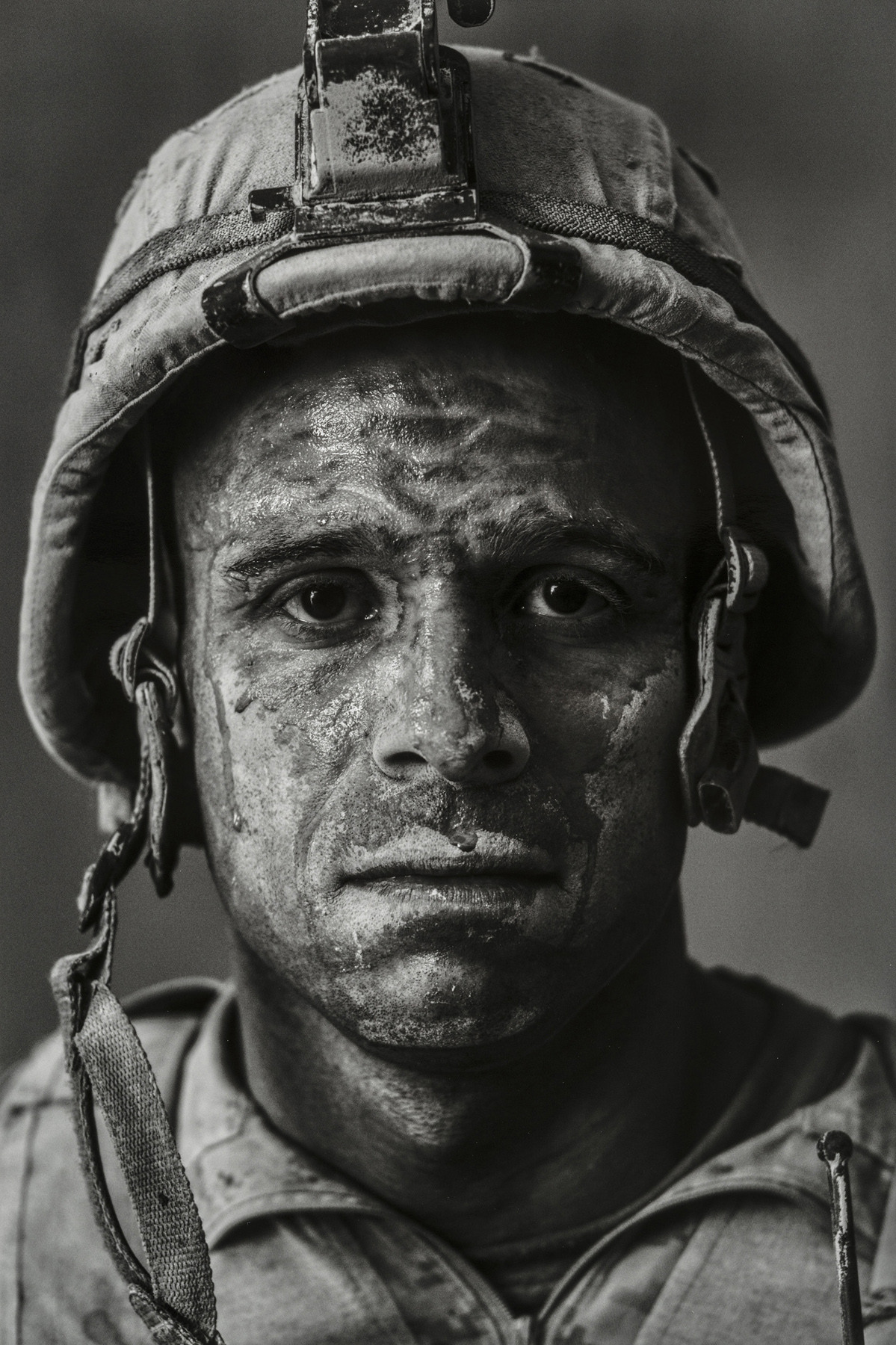
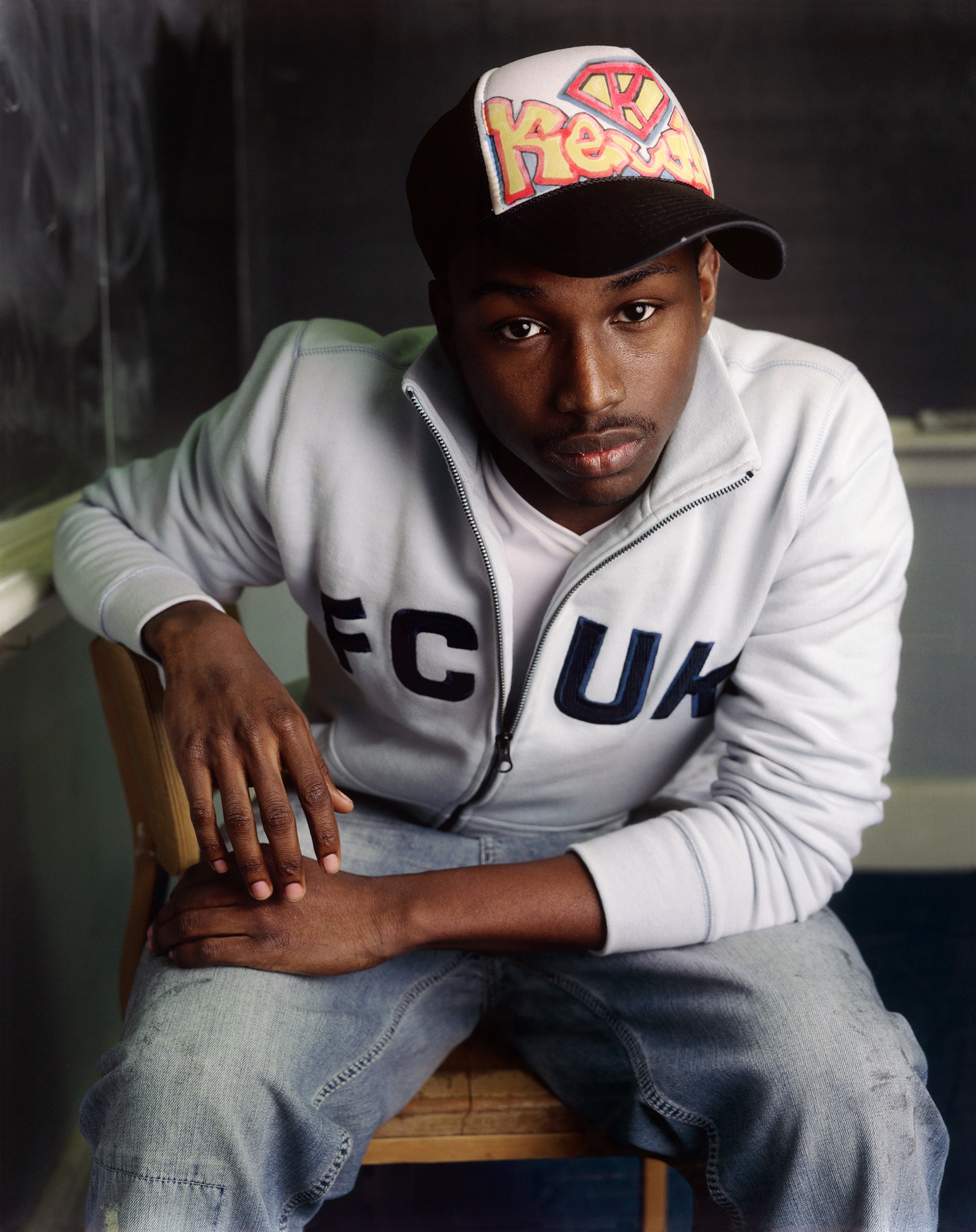
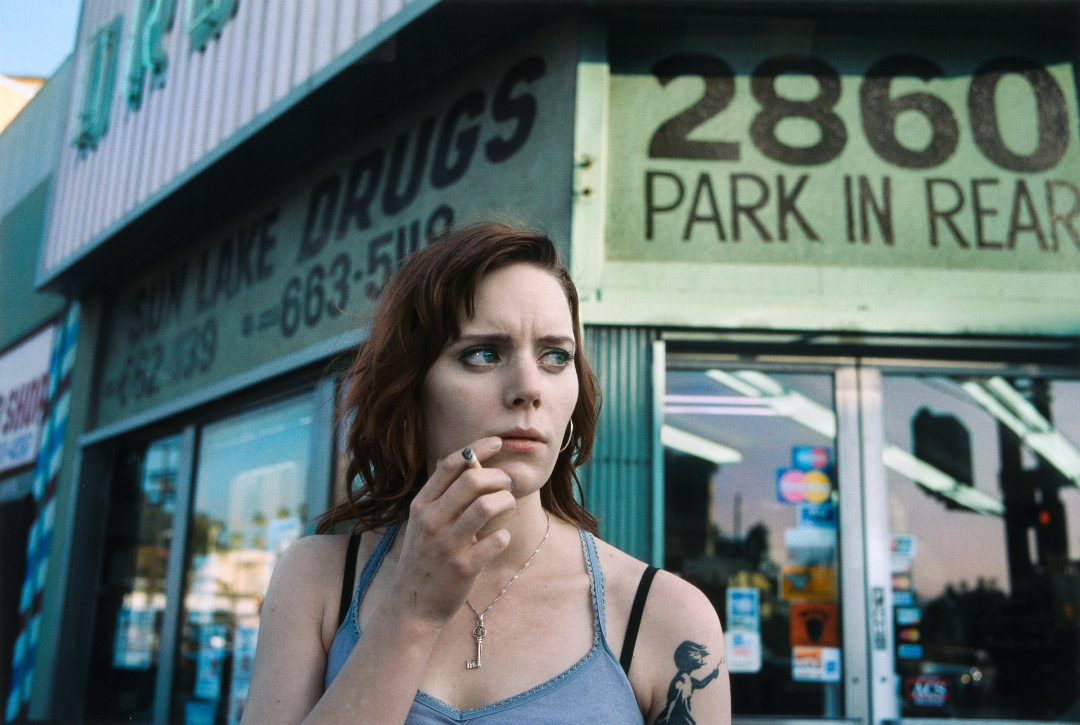
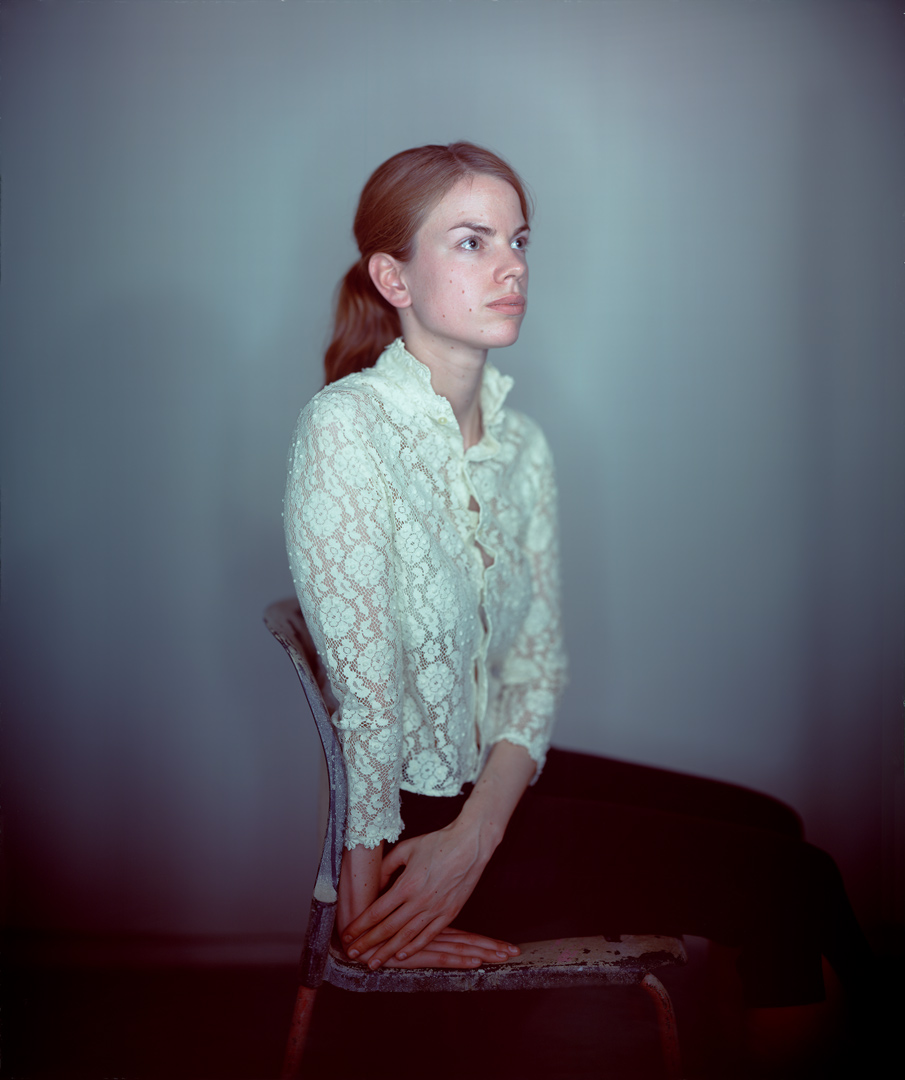
Exhibition: ‘Beneath the Surface: Mining and American Photography’ at the National Gallery of Art, Washington

“While the photographs in this posting portray the cultures and communities associated with mining, the industries, towns and cities, the people and the landscapes what they don’t account for is the ongoing physical, psychological and emotional scars that the results of mining leave behind.” Dr Marcus Bunyan

Exhibition dates: 23rd May – 23rd August, 2026

C0-curators: Diane Waggoner, curator of photographs at the National Gallery of Art and Kristen Gaylord, Herzfeld Curator of Photography and Media Arts at Milwaukee Art Museum
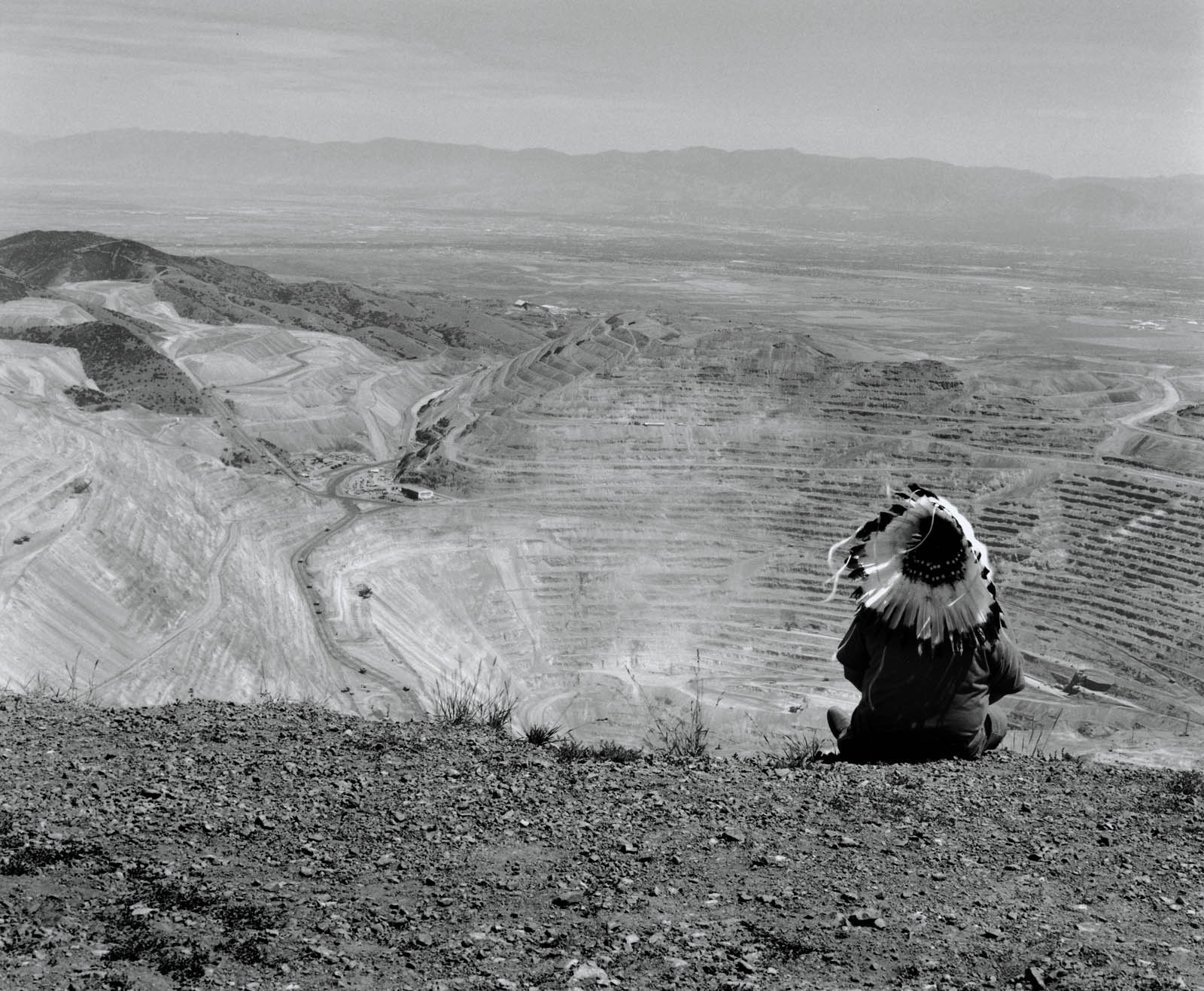
 

Zig Jackson, Rising Buffalo (Mandan, Hidatsa, Arikara) (b. 1957) 'Indian Man at Kennecott Copper Mine, Tooele, Utah' 2004


Zig Jackson, Rising Buffalo (Mandan, Hidatsa, Arikara) (b. 1957)
Indian Man at Kennecott Copper Mine, Tooele, Utah
2004
Gelatin silver print
Image: 33.0 x 40.6cm (13 x 16 in.)
Sheet: 40.6 x 50.8cm (16 x 20 in.)
San Francisco Museum of Modern Art
Accessions Committee purchase, by exchange, through a gift of Michael D. Abrams
© Zig Jackson
Photo: Tenari Tuatagaloa


The rape of the earth

Mining helps improve our lives in so many ways and yet the harm it causes the planet, the severe environmental degradation, indigenous dispossession and systemic violence associated with resource extraction is undeniable.

The phrase “the rape of the earth” “characterises the literal carving up of the landscape. Large-scale operations – such as open-cut mining – strip topsoil, destroy ecosystems, pollute water tables, and leave irreversible physical scars on the terrain. Indigenous groups, such as the Sámi feminists against mining in Sábme, use the phrase to describe how mining fractures the sacred, interdependent web of connection between land, humans, and nonhuman lifeworlds.” (Google AI)

The interdependent web of connection between land, humans and nonhuman lifeworlds running beneath the surface, hidden from view, that life force of the world and the cosmos that is so violently ruptured in the mining process.

While the photographs in this posting portray the cultures and communities associated with mining, the industries, towns and cities, the people and the landscapes what they don’t account for is the ongoing physical, psychological and emotional scars that the results of mining leave behind. Scars that riddle the earth’s surface as much as they do the minds of the people that love this planet as a holistic entity. You only have to look at Zig Jackson, Rising Buffalo’s photograph Indian Man at Kennecott Copper Mine, Tooele, Utah (2004, above) to understand what I mean.

When it’s all too late only then will we have realised what we have lost.

Dr Marcus Bunyan

.
Many thankx to the National Gallery of Art, Washington for allowing me to publish the photographs in the posting. Please click on the photographs for a larger version of the image.
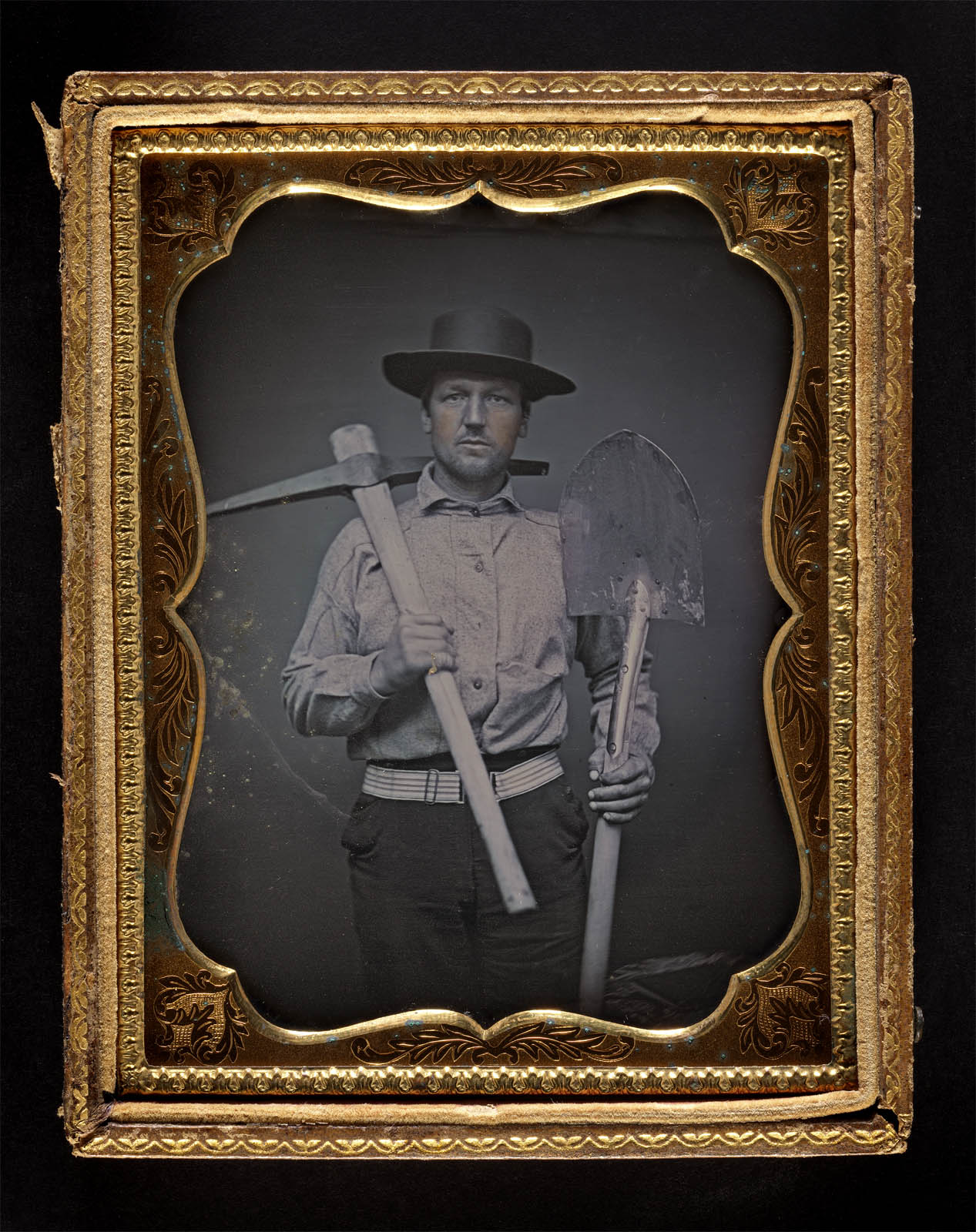


Unknown photographer (American) 'Portrait of a California gold miner with pick and shovel' c. 1855


Unknown photographer (American)
Portrait of a California gold miner with pick and shovel
c. 1855
Quarter-plate daguerreotype
Plate (quarter): 4 1/4 x 3 1/4 in. (10.8 x 8.26cm)
Case (tray): 4 11/16 x 3 5/8 x 3/8 in. (11.91 x 9.22 x 0.97cm)
The Nelson-Atkins Museum of Art, Kansas City, Missouri
Gift of the Hall Family Foundation


Environmental impacts of mining  

The environmental impacts of mining are significant. Establishing mining sites requires an enormous amount of construction, which often causes deforestation and loss of wildlife habitats and biodiversity.  

Surface mines, which require the use of explosives and heavy machinery to expose materials near the earth’s surface, cause massive canyon-sized holes in the land and lead to soil erosion and degradation around surrounding areas. Mountaintop removal mining, a method of coal mining, uses explosives to blast the entire top of a mountain.

Surface mines create a huge amount of waste materials. Mines release harmful substances into the air and water, and can cause serious health issues if inhaled or consumed. Mines also release acidic water, which can kill marine life and make freshwater unsuitable for drinking. Underground mining produces fewer waste materials than surface mines, but they are risky for mine workers. 

The mining industry emits carbon via transportation and energy use, and produces fossil fuels – the largest source of carbon emissions in the world.  

Even after mines are decommissioned, they continue to impact the environment. Acid mine drainage occurs after mines have been abandoned, and results in heavy metals entering water systems and harming the plants, animals and humans that consume it.

Social impacts of mining  

Mining can create employment opportunities, boost economies and provide investment for local development projects. However, mining operations that don’t respect human rights or protect the environment can cause significant harm to surrounding communities.

Anonymous. “Resource wealth, poverty, and environmental impact in mining,” on the Oxfam Australia website, 1 July 2025 [Online] Cited 18/08/2026
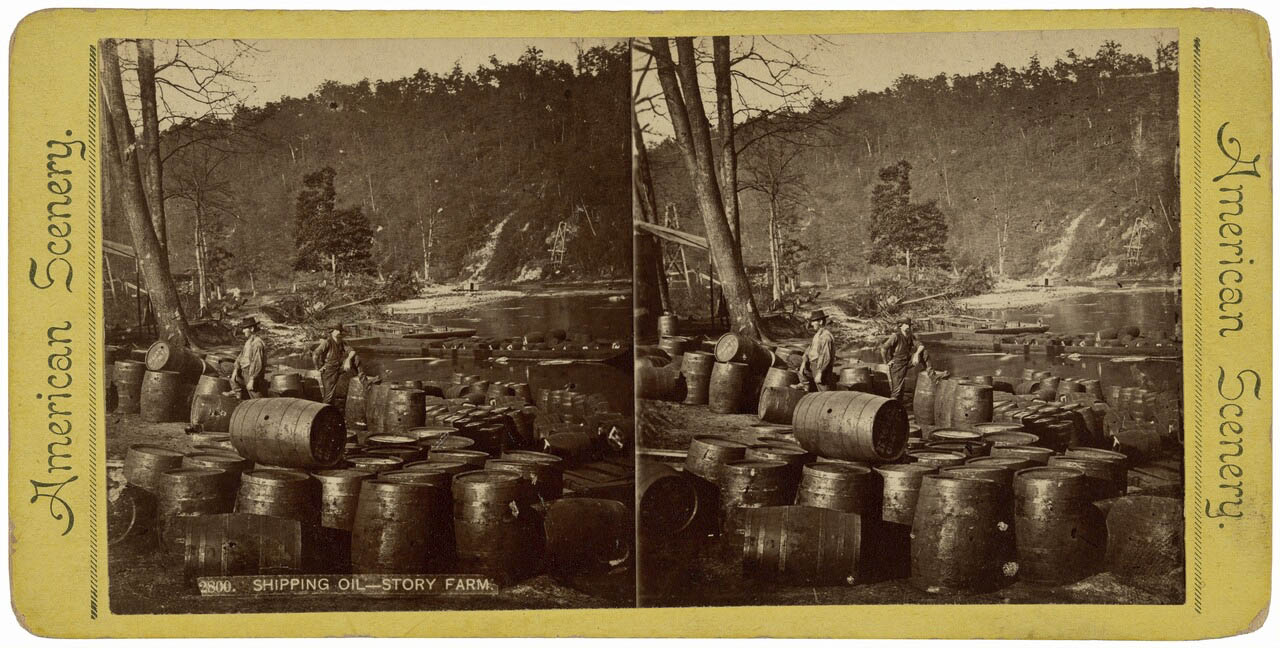
  

American 19th Century. 'Shipping Oil - Story Farm' 1860s-1870s


American 19th Century
Shipping Oil – Story Farm
1860s-1870s
Stereoscopic albumen silver print
Image/sheet: 7.94 × 14.92cm (3 1/8 × 5 7/8 in.)
Mount: 8.73 × 17.46cm (3 7/16 × 6 7/8 in.)
National Gallery of Art, Washington
Gift of Mary and Dan Solomon
Public domain
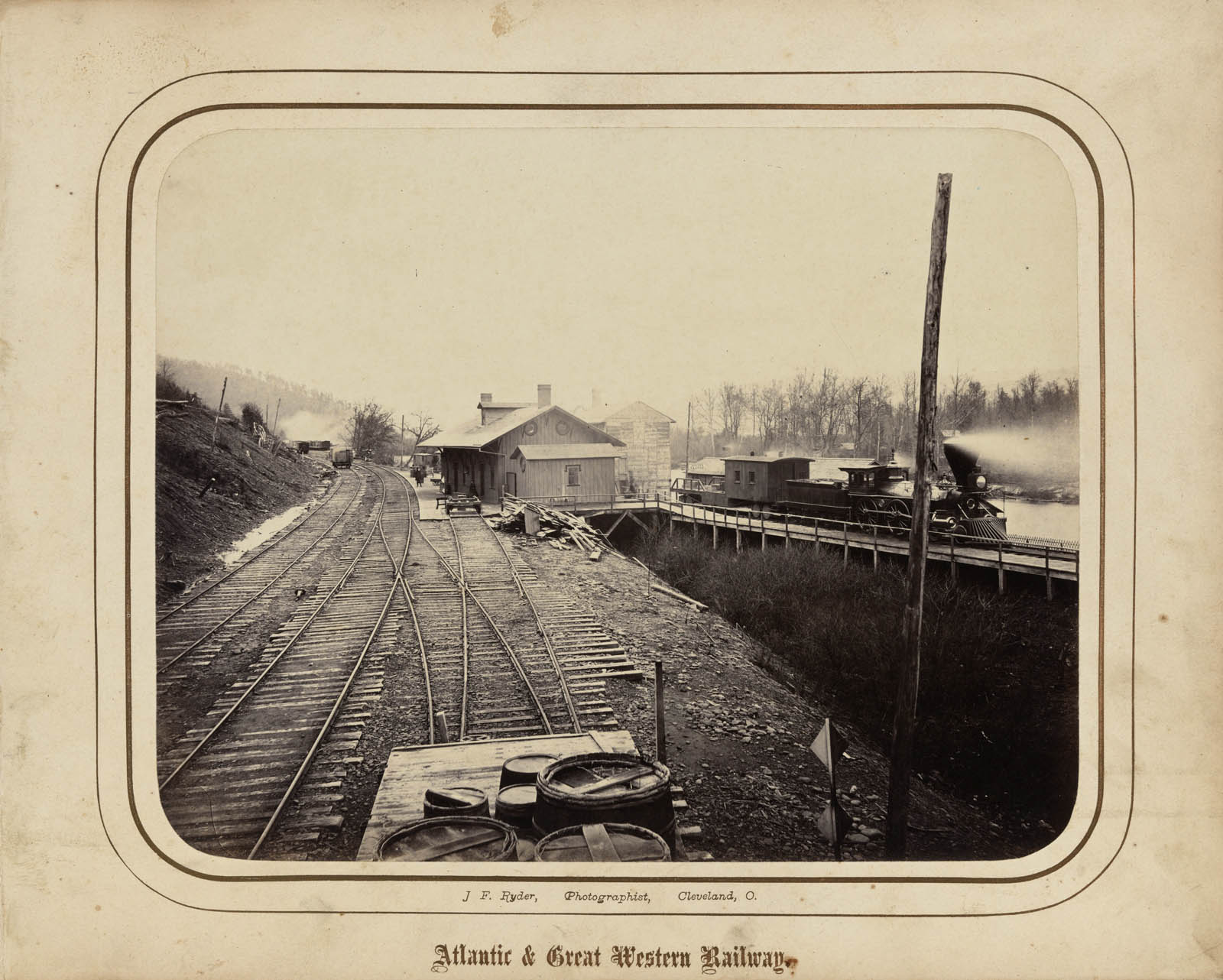
  

James F. Ryder (American, 1826-1904) 'Atlantic & Great Western Railway' 1862


James F. Ryder (American, 1826-1904)
Atlantic & Great Western Railway
1862
Albumen print
Image/sheet: 18.8 x 23.7cm (7 3/8 x 9 5/16 in.)
Mount: 25.3 x 32.4cm (9 15/16 x 12 3/4 in.)
Mat: 14 x 18 in.
National Gallery of Art, Washington
Alfred H. Moses and Fern M. Schad Fund
Public domain
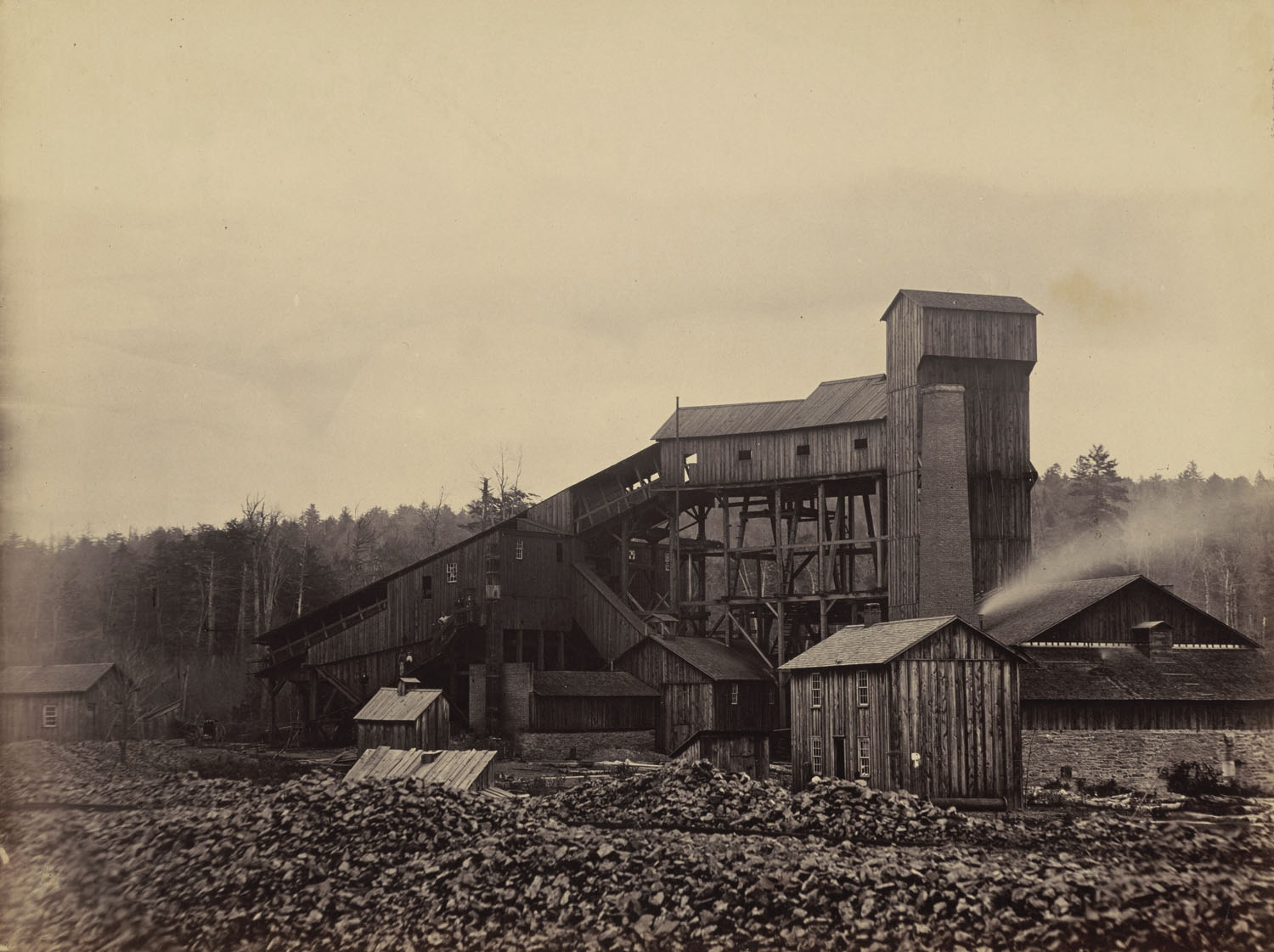
 

Thomas H. Johnson (American, b. 1821 - d. ?) 'Gibson's Breaker, Rushdale, Del. & Hudson Canal Co.,' c. 1863-1865


Thomas H. Johnson (American, b. 1821 – d. ?)
Gibson’s Breaker, Rushdale, Del. & Hudson Canal Co.,
c. 1863-1865
Albumen print
Image/sheet: 30.7 x 41cm (12 1/16 x 16 1/8 in.)
Mount: 44.3 x 53cm (17 7/16 x 20 7/8 in.)
Mat: 20 x 26 in.
National Gallery of Art, Washington
Alfred H. Moses and Fern M. Schad Fund
Public domain
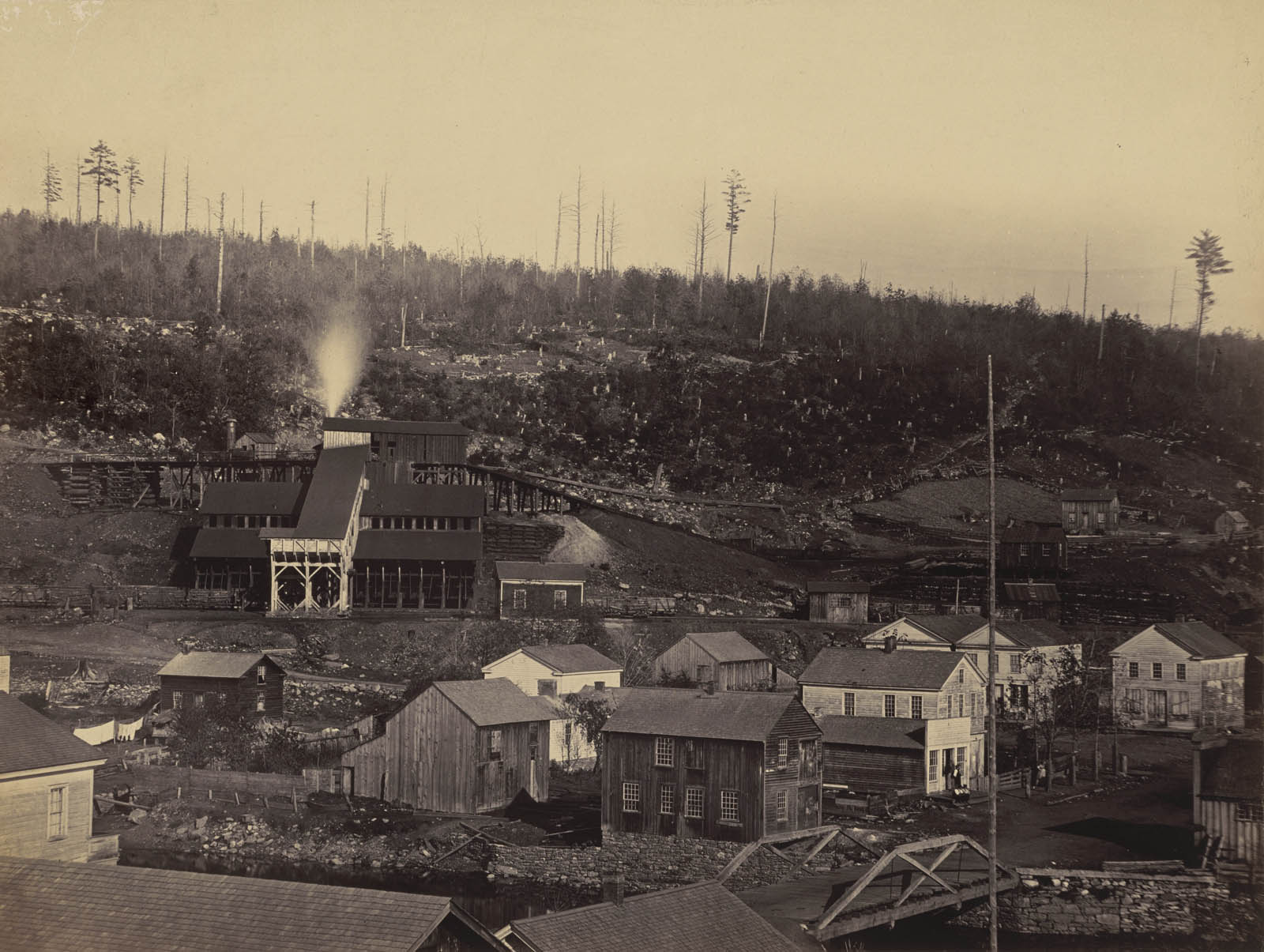
 

Thomas H. Johnson (American, b. 1821 - d. ?) 'Birdsey Breaker, Rushdale, Del. & Hudson Canal Co.,' 1863-1865


Thomas H. Johnson (American, b. 1821 – d. ?)
Birdsey Breaker, Archbald, Del. & Hudson Canal Co.,
1863-1865
Albumen print
Image/sheet: 30.6 x 40.8cm (12 1/16 x 16 1/16 in.)
Mount: 45.4 x 55.6cm (17 7/8 x 21 7/8 in.)
Mat: 20 x 26 in.
National Gallery of Art, Washington, Alfred H. Moses and Fern M. Schad Fund
Public domain
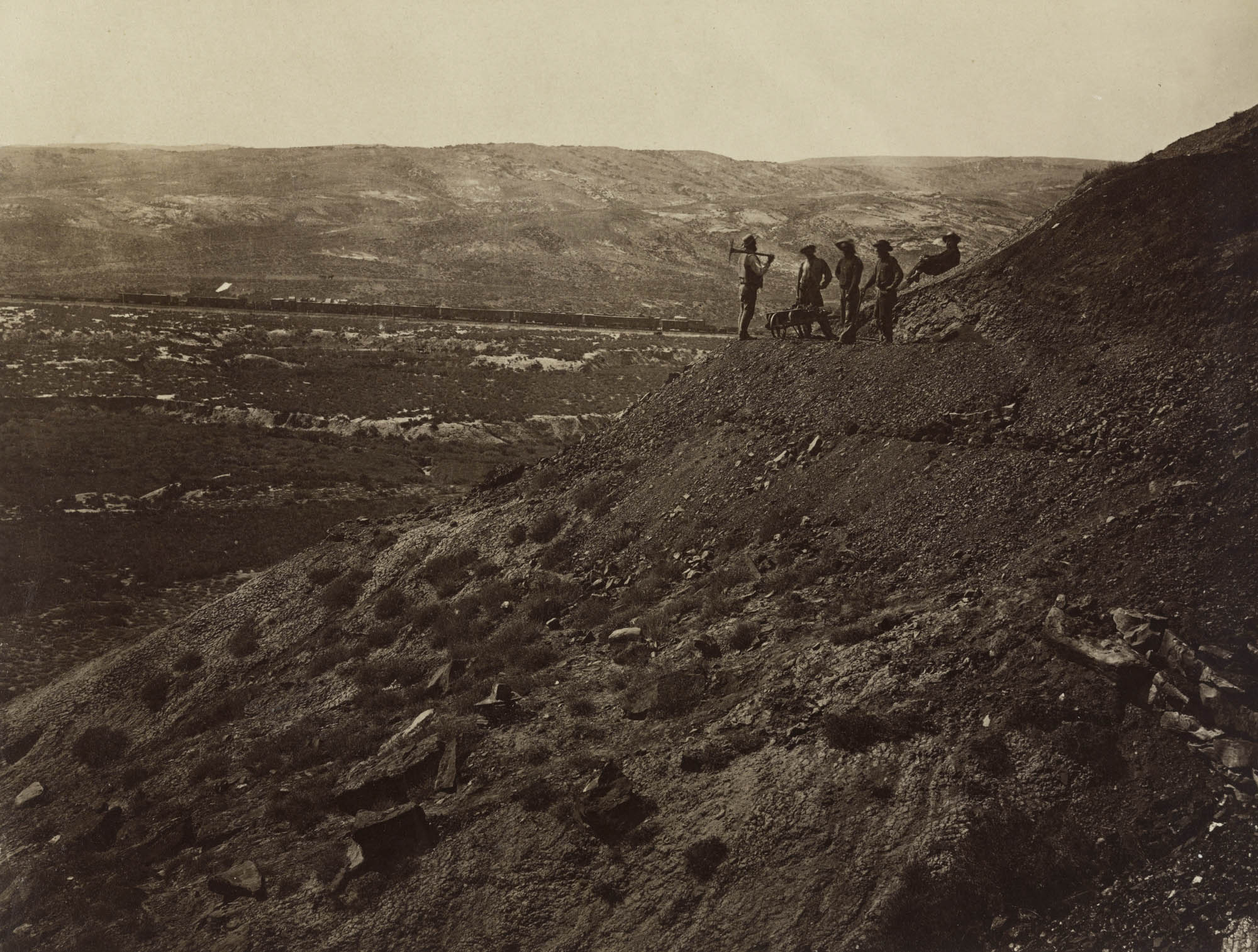
  

Andrew Joseph Russell (American, 1829-1902) 'Valley of Bitter Creek from Coal Mine' 1867-1869


Andrew Joseph Russell (American, 1829-1902)
Valley of Bitter Creek from Coal Mine
1867-1869
Albumen silver print
22.86 x 29.53cm (9 x 11 5/8 in.)
The Museum of Modern Art, New York
Gift of Union Pacific Railroad Company
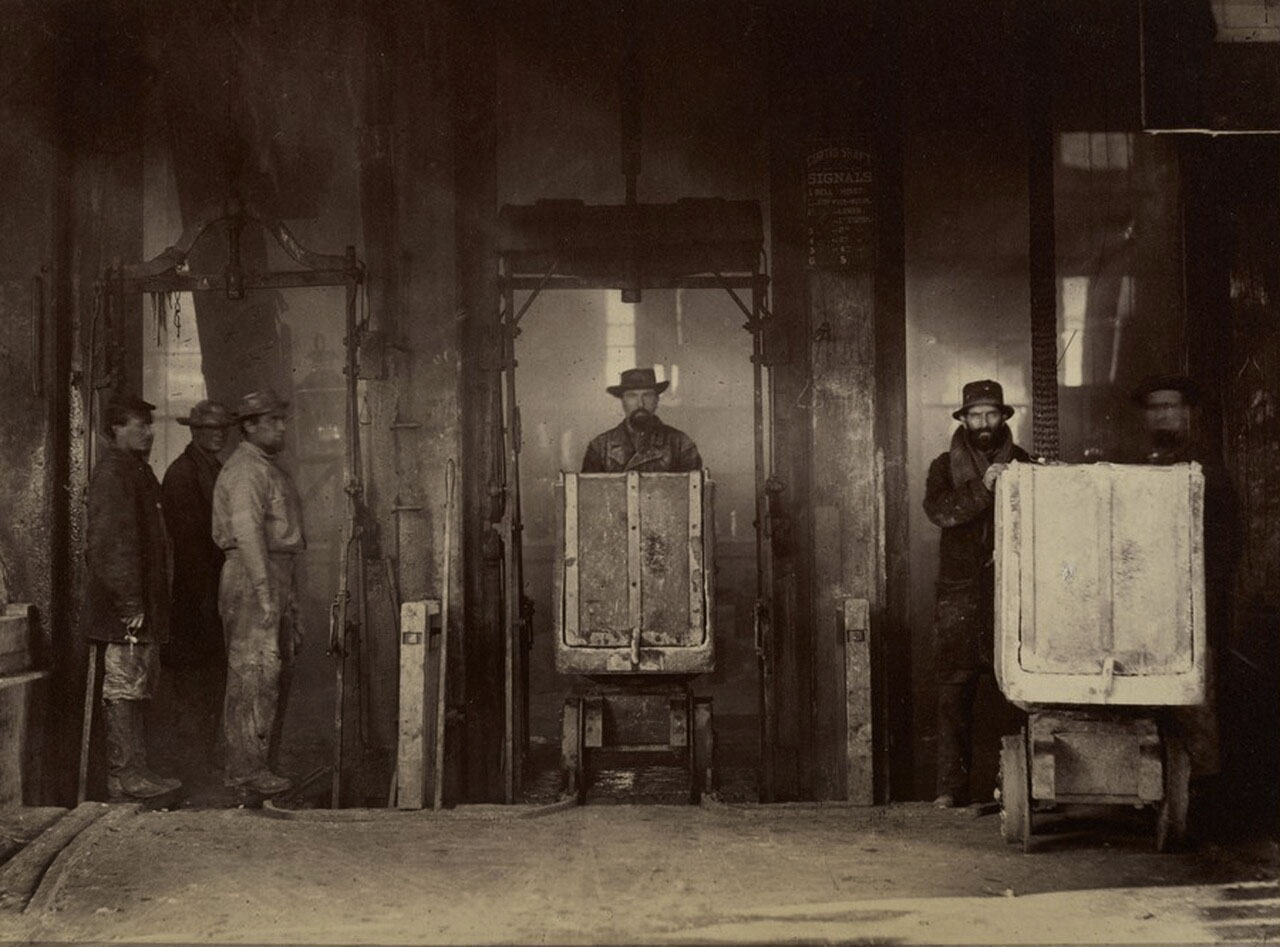
 

Timothy H. O'Sullivan (American born Ireland, 1840-1882) 'Savage Mine, Curtis Shaft, Virginia City, Nevada' 1868


Timothy H. O’Sullivan (American born Ireland, 1840-1882)
Savage Mine, Curtis Shaft, Virginia City, Nevada
1868
albumen silver print
Image: 14.45 x 19.53cm (5 11/16 x 7 11/16 in.)
Sheet: 19.53 x 26.83cm (7 11/16 x 10 9/16 in.)
Mount: 31.75 x 37.78cm (12 1/2 x 14 7/8 in.)
Amon Carter Museum of American Art, Fort Worth, Texas


Timothy O’Sullivan photographed men preparing to descend 900 feet into the mine.
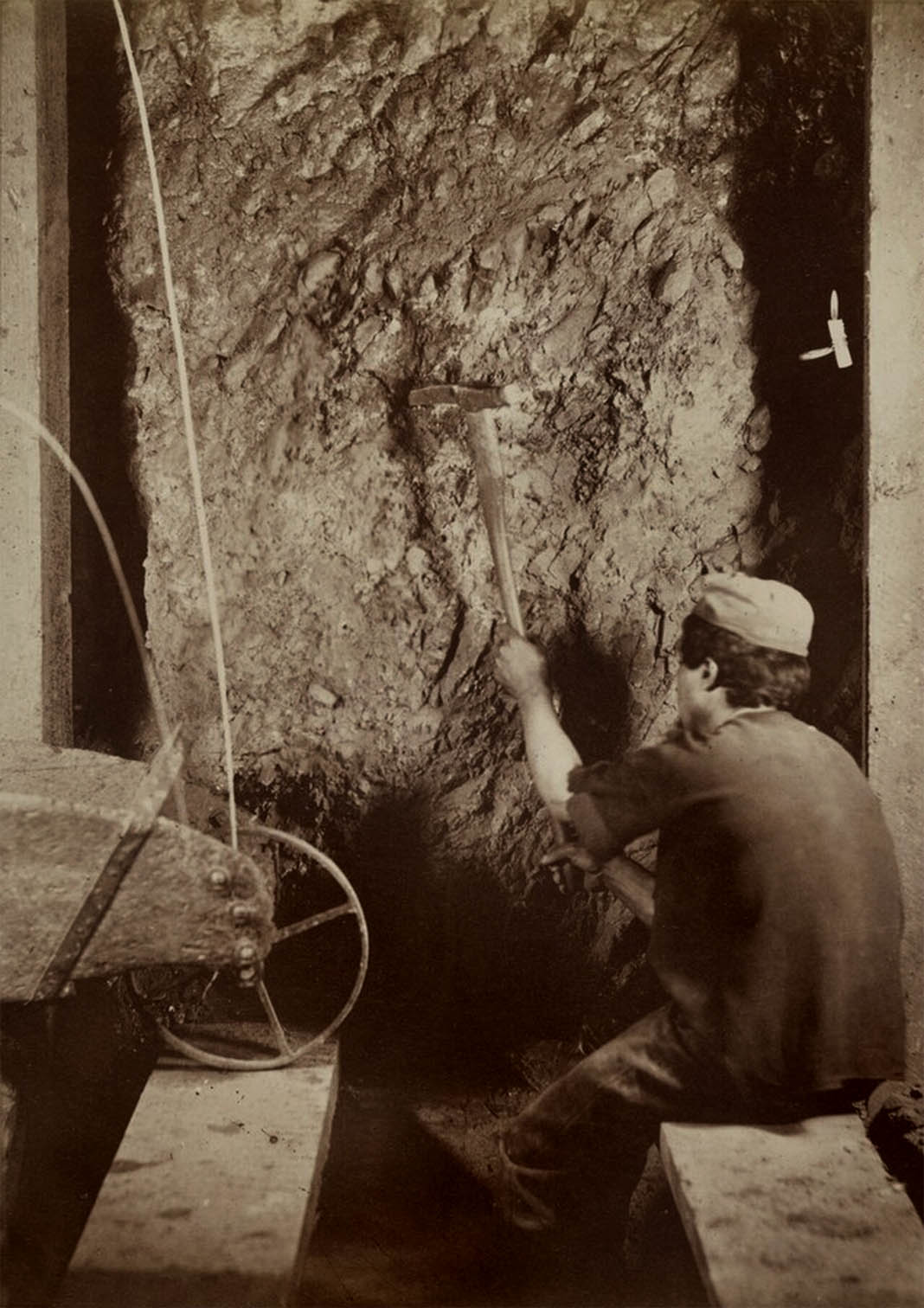
 

Timothy H. O'Sullivan (American born Ireland, 1840-1882) 'Comstock Mine, Virginia City, Nevada 1868 Comstock Mine, Virginia City, Nevada' 1868


Timothy H. O’Sullivan (American born Ireland, 1840-1882)
Comstock Mine, Virginia City, Nevada
1868
Albumen print
Image: 18.89 x 13.49cm (7 7/16 x 5 5/16 in.)
Sheet: 18.26 x 26.99cm (7 3/16 x 10 5/8 in.)
Mount: 31.59 x 37.31cm (12 7/16 x 14 11/16 in.)
Amon Carter Museum of American Art, Fort Worth, Texas


O’Sullivan used a magnesium flash to illuminate a miner wielding an axe underground.
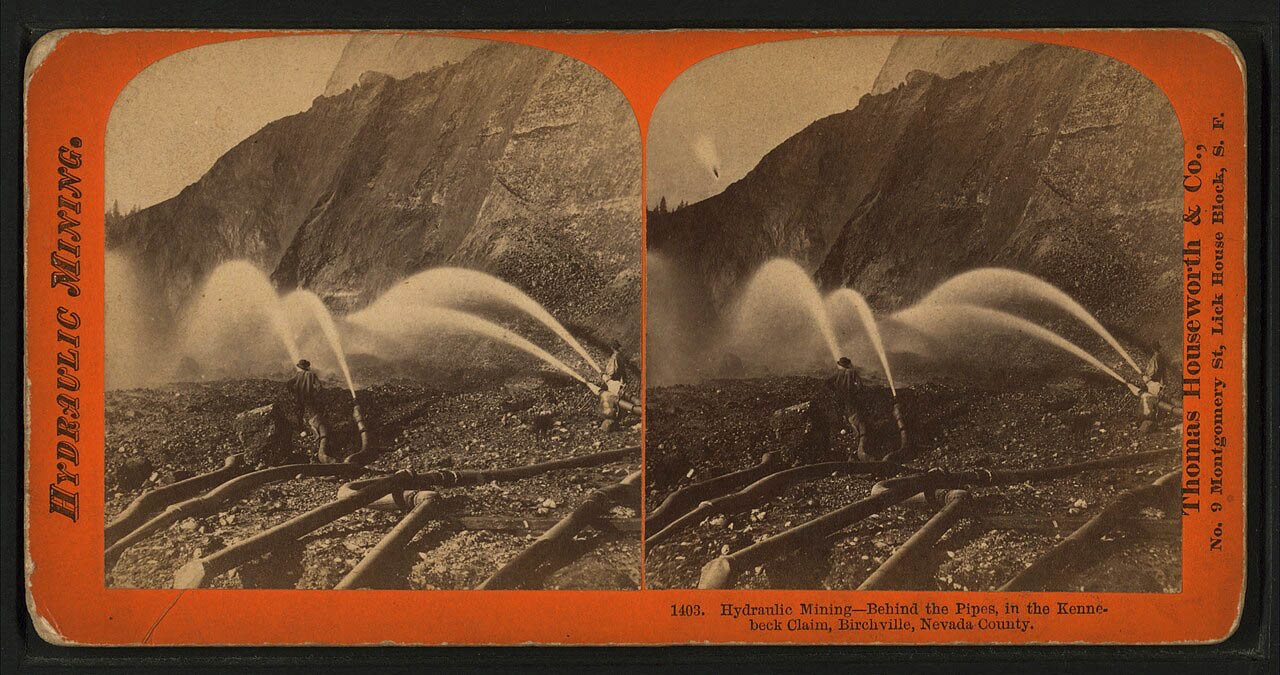
 

Thomas Houseworth (American, 1828-1916) 'Hydraulic Mining - Behind the Pipes, in the Kennebunk Claim, Birchville, Nevada County' c. 1868-1869


Thomas Houseworth (American, 1828-1916)
Hydraulic Mining – Behind the Pipes, in the Kennebunk Claim, Birchville, Nevada County
c. 1868-1869
Stereoscopic albumen prints
Image: 7.9 x 20.6cm (3 1/8 x 8 1/8 in.)
Sheet: 8.9 x 17.5cm (3 1/2 x 6 7/8 in.)
Wikipedia Commons Public domain


B.F. Childs (American, 1841-1921) 'New York, Iron Mine [Michigan]' c. 1871-1876


B.F. Childs (American, 1841-1921)
New York, Iron Mine [Michigan]
c. 1871-1876
Stereoscopic albumen print
Image: 7.9 x 15.9cm (3 1/8 x 6 1/4 in.)
Sheet: 8.7 x 17.5cm (3 7/16 x 6 7/8 in.)
Collection of Leonard A. Walle


Brainard F. Childs photographed a man outside an iron mine in Michigan. He’s dwarfed by its dark and cavernous entrance.

Brainard Fermont Childs (1841-1921) was an American 19th-century photographer best known for his studio portraits and stereoviews documenting the Great Lakes region, particularly Michigan’s Upper Peninsula.

Operating the Child’s Art Gallery in Marquette, Michigan, he captured extensive regional landscapes, scenes of early mining and shipping on Lake Superior, and local Ojibwe life. Today, many of his surviving albumen prints and glass-plate negatives are preserved in historical collections, including the British Museum.

Google AI
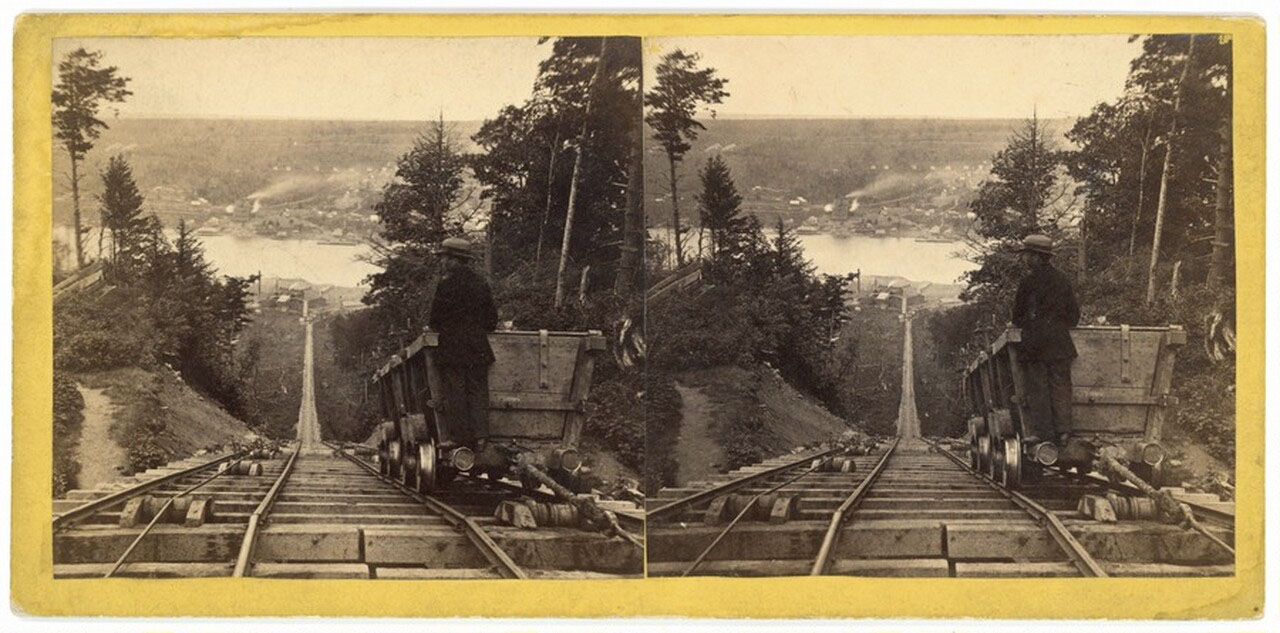
 

B.F. Childs (American, 1841-1921) 'Down the Franklin Tramroad' c. 1867-1868


B.F. Childs (American, 1841-1921)
Down the Franklin Tramroad
c. 1867-1868
Stereoscopic albumen prints
Image: 7.5 x 16.2cm (2 15/16 x 6 3/8 in.)
Sheet: 8.3 x 17.2cm (3 1/4 x 6 3/4 in.)
Collection of Leonard A. Walle


Dependent on precious metals from its inception, photography has always been intertwined with the natural resources that are fundamental to modern industrialised life. Beneath the Surface: Mining and American Photography is the first exhibition to exclusively examine how photographers from the mid-19th century to today have powerfully captured the effects of resource extraction on the land and communities of the United States. Featuring some 150 photographs that span 185 years, this exhibition focuses especially on the subterranean removal of the minerals and fossil fuels that power this country’s economy and industry. Together, these works demonstrate how photographers have drawn on changing technology and unique visual strategies to rise to the challenge of picturing these colossal industries.

Made for a variety of purposes, ranging from commercial boosterism and celebration of technical advancement to social documentation and community activism, the pictures in the exhibition shed light on how photography has revealed the costs of extraction and who benefits from its success. Divided into six broad, chronological sections that contextualise the complex history of photography and extraction, from daguerreotypes of the Gold Rush to large-scale, immersive photographs made in the last decade, Beneath the Surface highlights how artists have used photography to explore the relationship between extraction, society, and the environment.

This exhibition is curated by Diane Waggoner, curator of photographs, National Gallery of Art, and Kristen Gaylord, Herzfeld Curator of Photography and Media Arts, Milwaukee Art Museum.

The exhibition is organised by the National Gallery of Art, in collaboration with the Milwaukee Art Museum and the Amon Carter Museum of American Art.

Text from the National Gallery of Art website


Carleton E. Watkins (American, 1829-1916) 'Malakoff Diggins, North Bloomfield, Nevada County [California]' 1871


Carleton E. Watkins (American, 1829-1916)
Malakoff Diggins, North Bloomfield, Nevada County [California]
1871
Albumen print
Image: 41.59 x 54.61cm (16 3/8 x 21 1/2 in.)
Mount: 55.88 x 71.12cm (22 x 28 in.)
Amon Carter Museum of American Art, Fort Worth, Texas
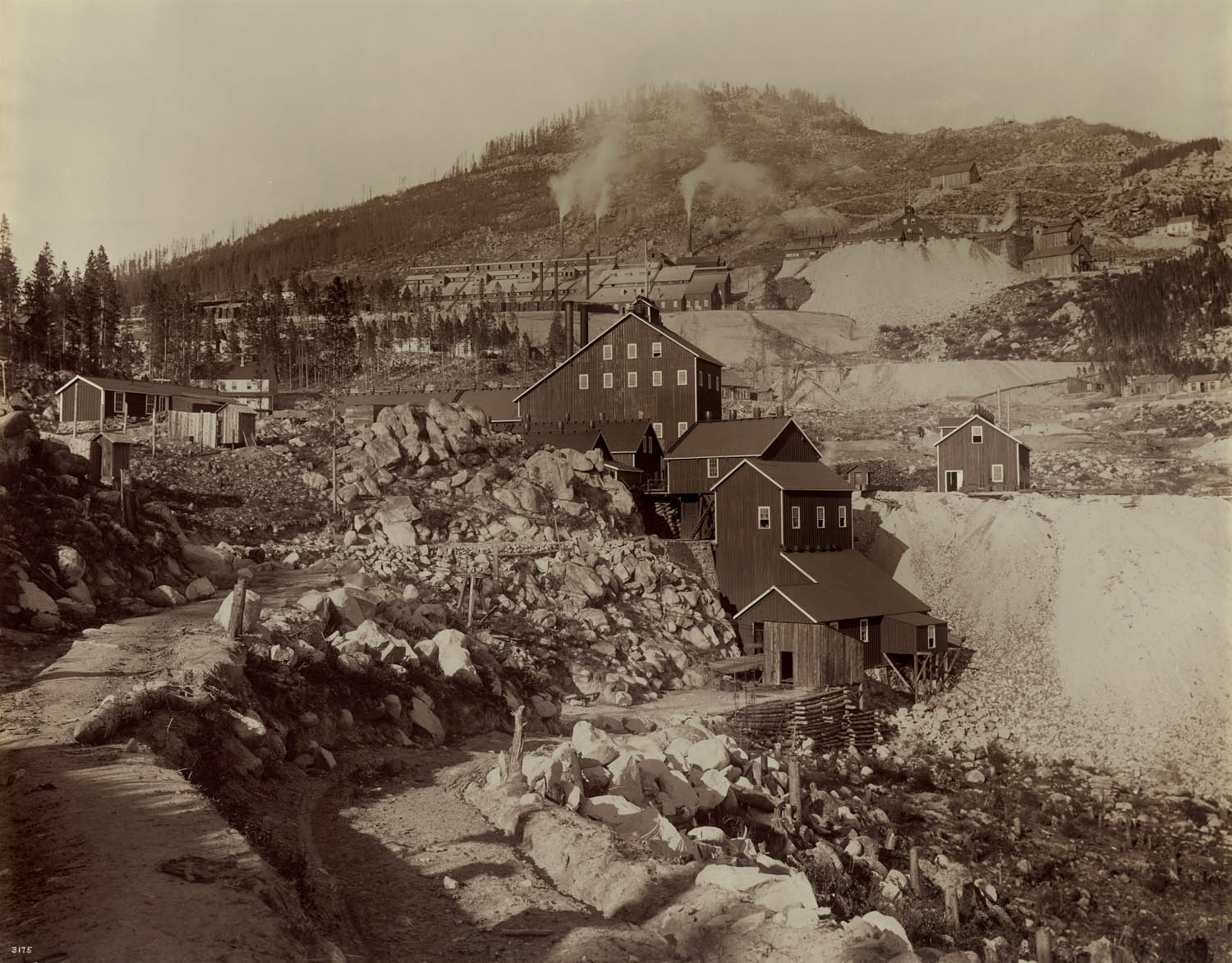
 

F. Jay Haynes (American, 1853-1921) 'Granite Silver Mine, Montana' c. 1880


F. Jay Haynes (American, 1853-1921)
Granite Silver Mine, Montana
c. 1880
Albumen print
Image: 42.7 x 54.5cm (16 13/16 x 21 7/16 in.)
Sheet: 43 x 54.9cm (16 15/16 x 21 5/8 in.)
Mat: 22 x 28 in.
National Gallery of Art, Washington
Gift of the UBS Art Collection
Public domain


Originally a studio photographer from the North Dakota Territory, Haynes spent most of his career documenting in pictures the development of the western territories. Commissioned in 1876 to make views along the route of the Northern Pacific Railroad, he traveled through the West until 1905, working in a railroad car equipped as both gallery and darkroom. Besides photographing spectacular views of natural scenery, Haynes produced an extensive record of the modification of the landscape by raliroad and industry.

On an 1881 trip to the newly created Yellowstone Park, via the new line of his railroad company employer, Haynes decided to pursue a commercial concession as park photographer. In 1884 he opened a studio and photography gallery in Yellowstone, selling to tourists prints of the park’s natural wonders, such as the Lone Star Geyser Cone. For more than thirty years Haynes served as the official photographer of Yellowstone National Park. 

Merry A. Foresta American Photographs: The First Century (Washington, D.C.: National Museum of American Art with the Smithsonian Institution Press, 1996) on the Smithsonian American Art Museum website Nd [Online] Cited 21/07/2026. Used under fair use conditions for the purposes of education and research
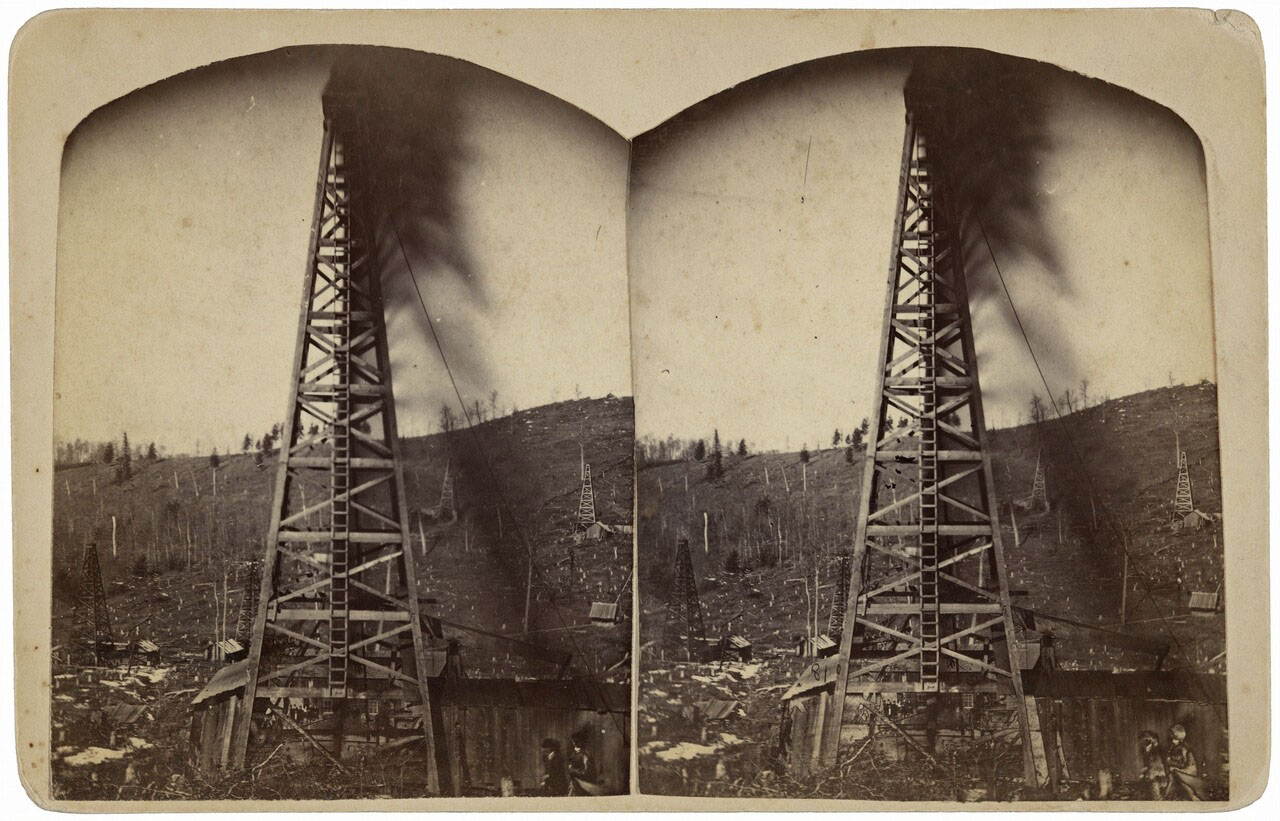
 

West & Waddell (American, Bradford, Pennsylvania, active 1880s) 'Flowing Well' 1880s


West & Waddell (American, Bradford, Pennsylvania, active 1880s)
Flowing Well
1880s
Stereoscopic albumen silver prints
National Gallery of Art, Washington
Gift of Mary and Dan Solomon
Public domain


Photographs of oil derricks document the rush that followed the discovery of oil in Pennsylvania in 1859.
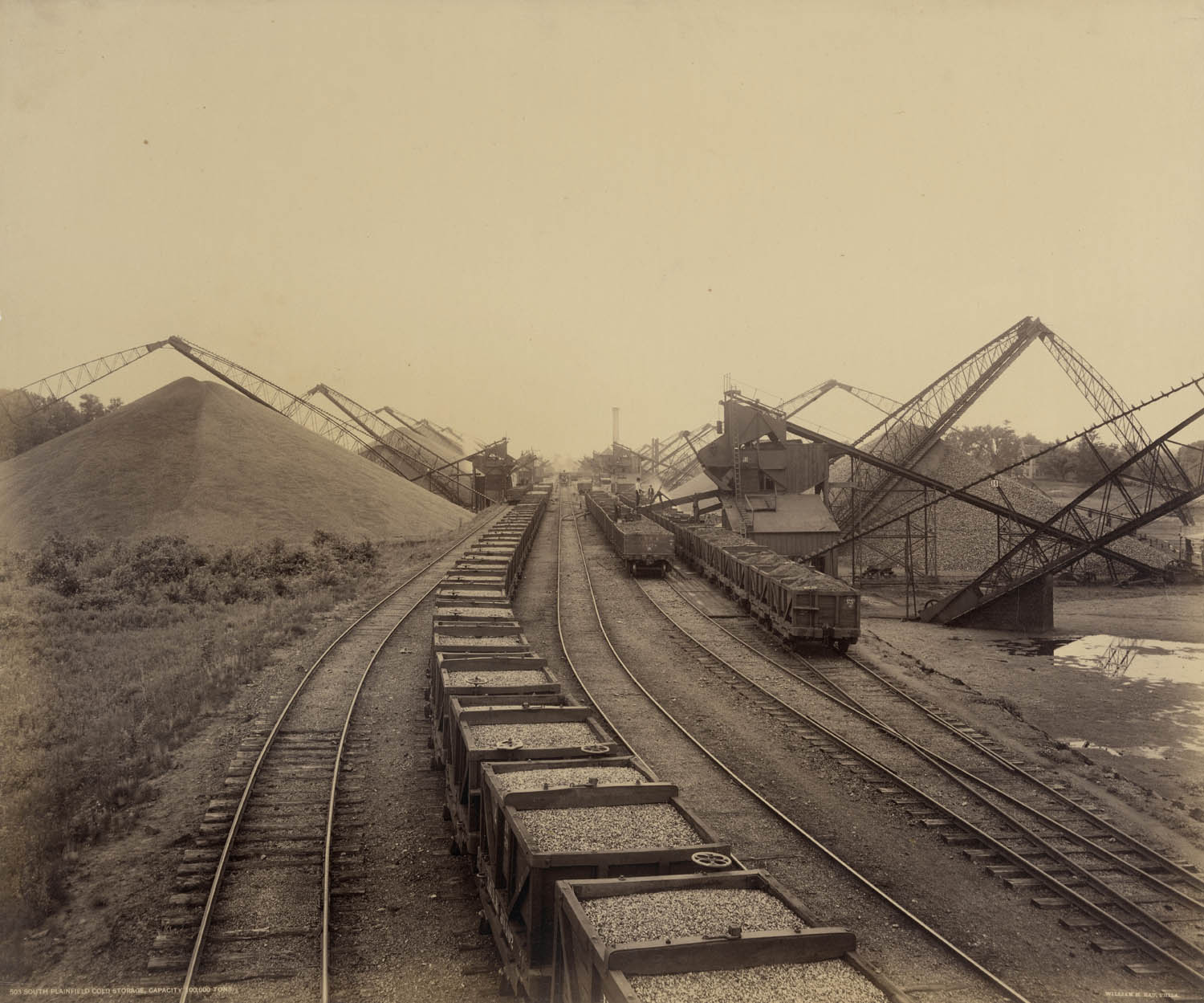
 

William H. Rau (American, 1855-1920) 'South Plainfield Coal Storage, capacity 100,000 tons' c. 1890


William H. Rau (American, 1855-1920)
South Plainfield Coal Storage, capacity 100,000 tons
c. 1890
Albumen print
Image: 43.5 x 52.1cm (17 1/8 x 20 1/2 in.)
Collection of Paul Sack
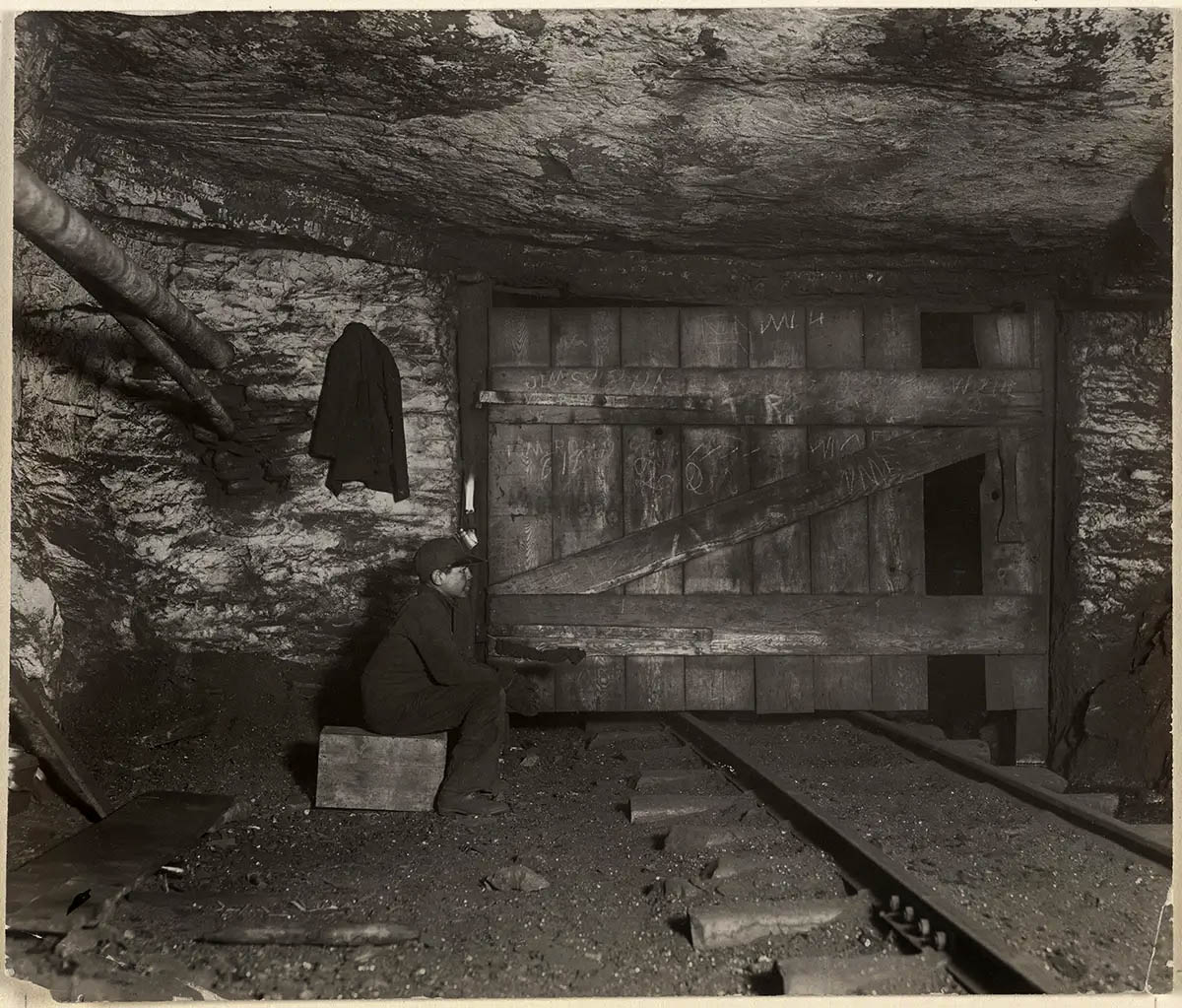
 

Lewis Wickes Hine (American, 1874-1940) '"A lonely job." Willie Bryden, a nipper, 13 yrs old, Pittston, Pa.,' 1911


Lewis Wickes Hine (American, 1874-1940)
“A lonely job.” Willie Bryden, a nipper, 13 yrs old, Pittston, Pa.,
1911
Gelatin silver print
Image: 11.43 x 13.49cm (4 1/2 x 5 5/16 in.)
Milwaukee Art Museum
Gift of Robert Mann



Frank J. Schlueter (American, 1874-1972)
Goose Creek, Tex. oil field
1917
Gelatin silver print, panorama
Sheet: 19.6 x 150.3cm (7 11/16 x 59 3/16 in.)
Prints & Photographs Division, Library of Congress, Washington D.C.
Public domain


Schlueter photographed the quickly growing Houston region in the first half of the twentieth century, retiring in 1964. Schlueter’s work was used by early oil producers in the region to document and promote their work


The National Gallery of Art presents Beneath the Surface: Mining and American Photography, the first exhibition to exclusively examine the relationship between resource extraction and American photography throughout its history. Spanning nearly 200 years, the exhibition examines how photographers have approached the challenge of capturing the significant but often hidden processes and impacts of the extraction of minerals, coal, and fossil fuels and its associated industries.

Featuring 150 photographs by more than 100 artists, including Richard Avedon, Walker Evans, Lewis Hine, LaToya Ruby Frazier, Dorothea Lange, David Maisel, Gordon Parks, Mitch Epstein, Carleton Watkins, Will Wilson, and more, Beneath the Surface reveals how generations of photographers have utilised evolving technologies and distinctive visual strategies to document the industries that power and shape modern life. Beneath the Surface will be on view at the National Gallery of Art from May 23 to August 23, 2026, before travelling to the Milwaukee Art Museum in Wisconsin and the Amon Carter Museum of American Art in Fort Worth, Texas.

“As a defining visual medium of our modern age, photography is an essential tool to capture and communicate our shared history,” said Kaywin Feldman, director of the National Gallery of Art. “Beneath the Surface brings together a dynamic range of works to shed light on the medium’s intersections with a shaping force in American history and industry.”

The featured works, many of which are drawn from the National Gallery’s significant photography collection, span early daguerreotypes from the time of the California Gold Rush in the mid-1800s to pictures of rapid industrialisation in the 20th century and contemporary photographs produced at an immense scale. This expansive selection traces the layered history of extraction and how artists have used photography as a lens through which to communicate the industry’s relationship with society and the natural world.

“Photography itself is dependent on precious metals for its very existence, from the light sensitivity of silver in early processes to the copper of contemporary digital-camera batteries. At the same time, it has been the principal visual medium employed to depict extractive industries, evolving alongside the expansion of mining on an industrial scale since the 19th century,” said Diane Waggoner, co-curator of the exhibition and curator of photographs at the National Gallery of Art. “Beneath the Surface unites photographs made for a variety of purposes, from explicitly promotional and commercial uses to documentation efforts and socially engaged activism, shedding light on both the rewards and costs of resource extraction.”

The exhibition orients visitors with an introductory gallery displaying contemporary work, foregrounding themes relevant to the current moment and providing a critical framework for understanding the six broad, chronological sections that follow. Viewers will encounter works not only by historical photographers recognised for their work in capturing mining, drilling, and industrial subjects, such as Carleton Watkins, Margaret Bourke-White, Marion Post Wolcott, and Bernd and Hilla Becher, but also by less expected practitioners Florence Kemmler, Alma Lavenson, and Mary Morris. The exhibition includes works by contemporary photographers Edward Burtynsky, Binh Danh, Terry Evans, Victoria Sambunaris, and Cara Romero, among others.

“For almost two centuries photographers have played a central role in public understanding of resource extraction, drawing on a succession of technologies and strategies to capture activities that enable modern life but resist portrayal,” said Kristen Gaylord, co-curator of the exhibition and Herzfeld Curator of Photography and Media Arts at Milwaukee Art Museum. “This exhibition demonstrates how, time and again, photographers have creatively pushed against the medium’s boundaries in a quest to impart the enormity of the country’s extractive activities and their effects.”

Beneath the Surface centres on the challenges artists face in capturing the colossal scale of extraction and its far-reaching impacts on communities and the environment. It also reveals the inventive strategies they have employed to depict this subject. The works on view reflect the full breadth of the medium, spanning landscapes, portraits of workers and panoramas of affected communities, photobooks, aerial imagery, analog and digital collage, camera-less photography, historical processes, narrative and performance work, and pictures that otherwise harness photography to communicate the scope of these industries.

Press release from the National Gallery of Art
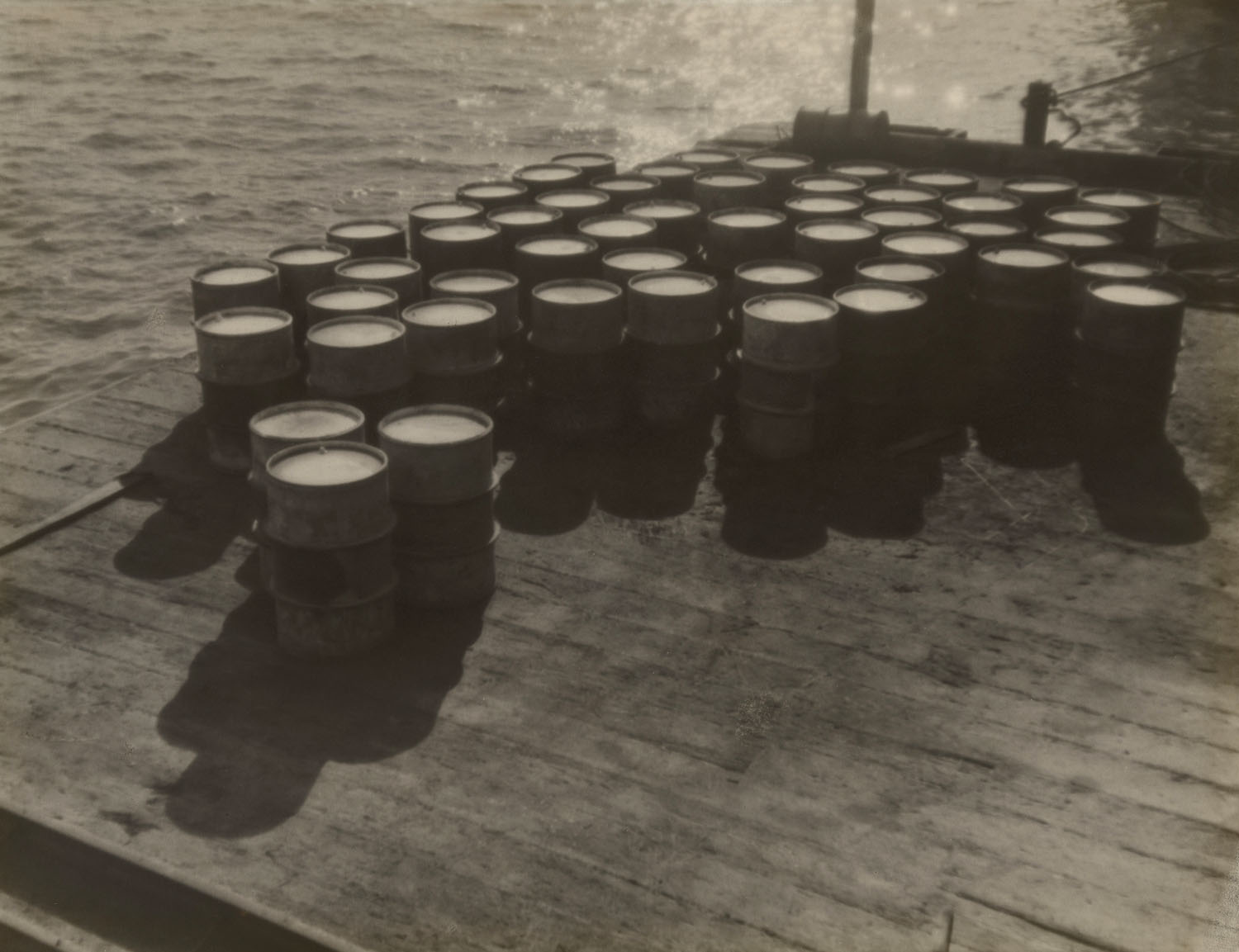
 

Florence Kemmler (American, 1900-1972) 'Oil Drums' c. 1929


Florence Kemmler (American, 1900-1972)
Oil Drums
c. 1929
Chlorobromide print
Image: 26.67 x 34.61cm (10 1/2 x 13 5/8 in.)
Mat: 18 x 22 in.
National Gallery of Art, Washington
Alfred H. Moses and Fern M. Schad Fund


The husband-and-wife team of Roland E. Schneider (1884-1934), and Florence B. Kemmler (1900-1972), were internationally exhibited salon photographers whose beautifully rendered works straddle both Pictorialist and modernist sensibilities. The San Diego couple worked together using the same 3 1/4 x 4 1/4 Graflex cameras and identical printing and mounting techniques. Nearly all their photographs were contact printed on warm, brownish black-toned chlorobromide papers.

Text from the Joseph Bellow Gallery website
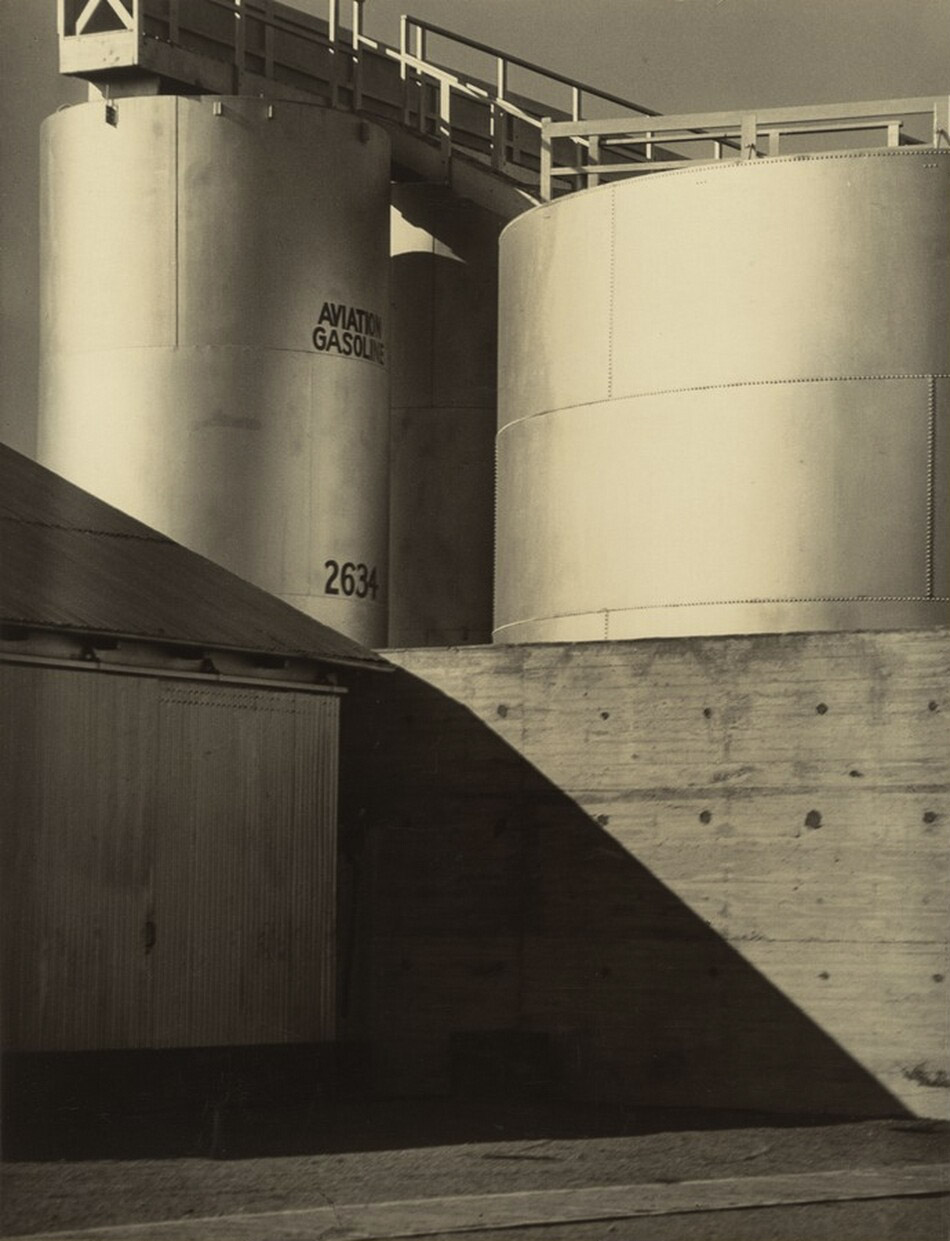
 

Alma Lavenson (American, 1897-1989) 'Tanks, Standard Oil Company' 1931


Alma Lavenson (American, 1897-1989)
Tanks, Standard Oil Company
1931
Gelatin silver print
Sheet (trimmed to image): 24 x 18.4cm (9 7/16 x 7 1/4 in.)
Mat: 20 x 16 in.
National Gallery of Art, Washington
The Marvin Breckinridge Patterson Fund for Photography


In 1930 she was introduced to Adams, Cunningham and Weston by art collector Albert Bender. Bender also wrote Lavenson a letter of introduction to give to Edward Weston. Two years later she was invited to participate in the famous Group f/64 show at the M.H. de Young Memorial Museum, although there is some uncertainty about whether she should actually be called a “member” of Group f/64, given her association with Pictorialism. The announcement for the show at the de Young Museum listed seven photographers in Group f/64 and said “From time to time various other photographers will be asked to display their work with Group f/64. Those invited for the first showing are: Preston Holder, Consuelo Kanaga, Alma Lavenson, Brett Weston.” However, in 1934 the group posted a notice in Camera Craft magazine that said “The F:64 group includes in its membership such well known names as Edward Weston, Ansel Adams, Willard Van Dyke, John Paul Edwards, Imogene [sic] Cunningham, Consuela [sic] Kanaga and several others.” Lavenson was not mentioned by name in that notice, but her name is always listed as being associated with the group because of her place in the first exhibition. She was included in an exhibition of photography “by members and associates of Group f.64” held at Gallery 210, Lucas Hall, University of Missouri, St. Louis, Apr. 3-30, 1978.

Text from the Wikipedia website
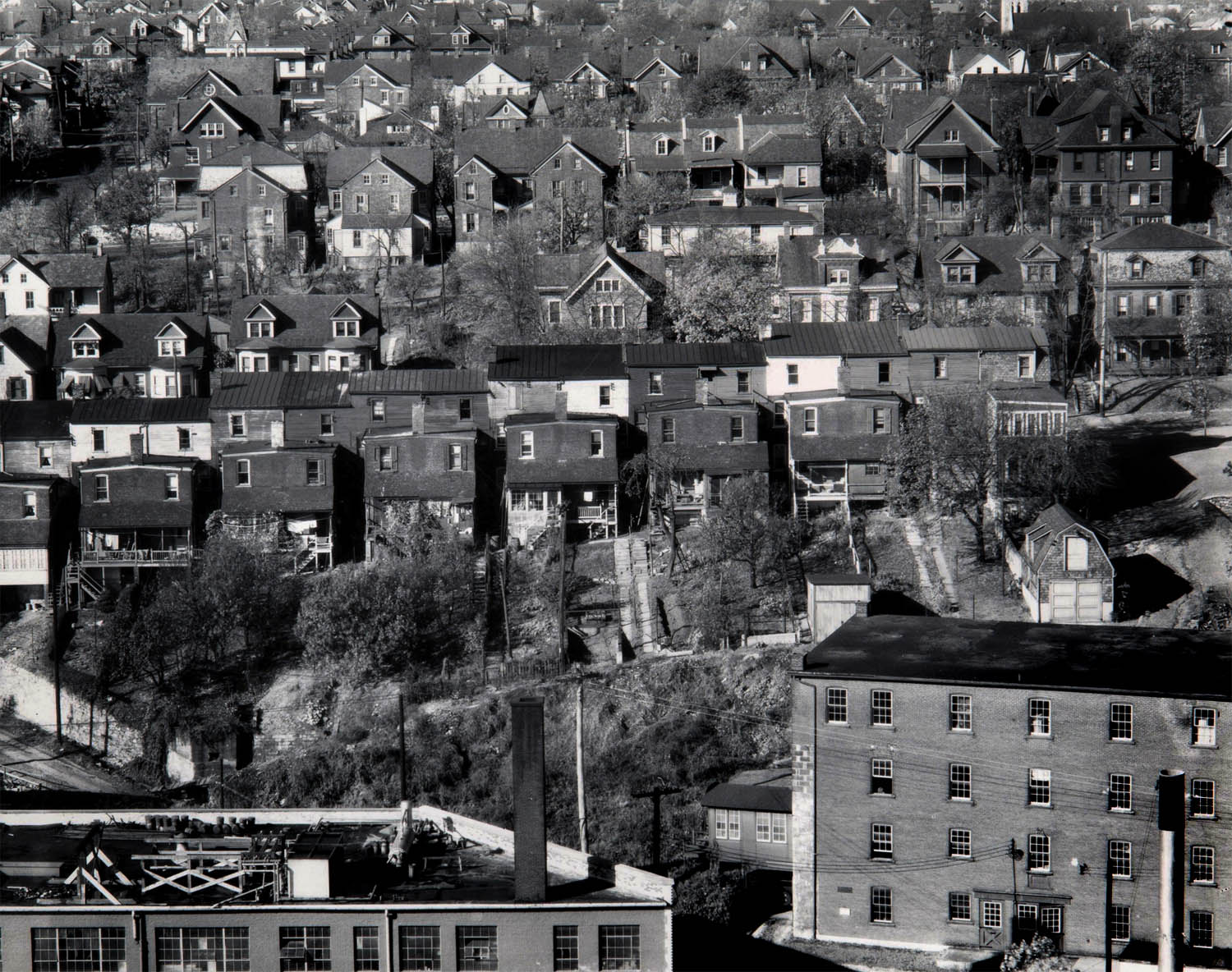
 

Walker Evans (American, 1903-1975) 'Bethlehem, Pennsylvania' 1936


Walker Evans (American, 1903-1975)
Bethlehem, Pennsylvania
1936
Gelatin silver print mounted on paperboard
Sheet (trimmed to image): 19 x 23.8cm (7 1/2 x 9 3/8 in.)
Support: 45.7 x 37.6cm (18 x 14 13/16 in.)
Mat: 16 x 20 in.
National Gallery of Art, Washington
Gift of Mary and David Robinson


In 1936, Walker Evans captured several iconic photographs in Bethlehem, Pennsylvania, during his landmark documentary work for the Resettlement Administration and Farm Security Administration. His lens famously depicted the stark juxtapositions of the city’s industrial boom, highlighting steel mills looming over residential neighbourhoods and graveyards, as well as scenes of local auto graveyards.
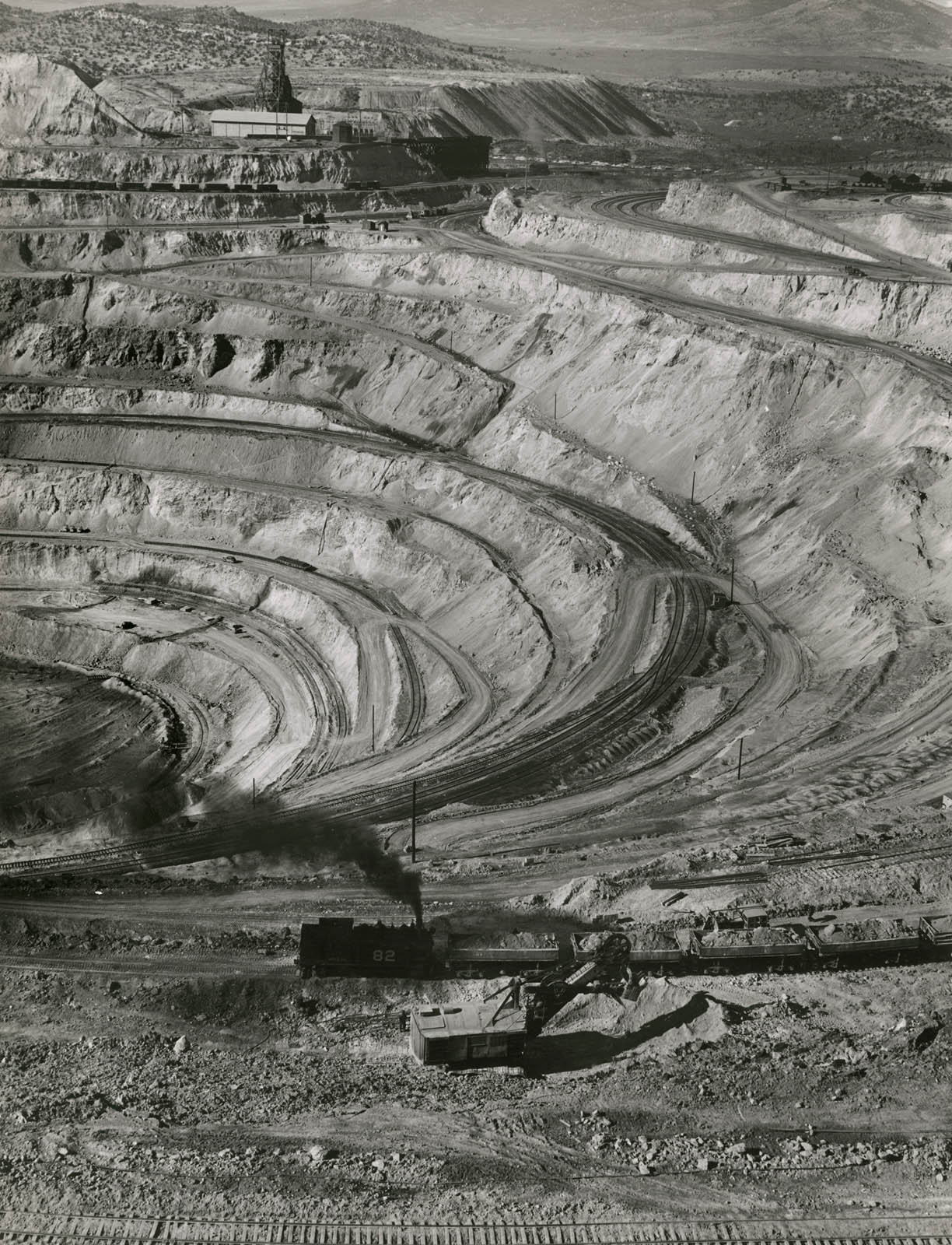
 

Arthur Rothstein (American, 1915-1985) 'Copper Pit, Ruth, Nevada' 1940


Arthur Rothstein (American, 1915-1985)
Copper Pit, Ruth, Nevada
1940
Gelatin silver print
Image: 24.13 x 18.73cm (9 1/2 x 7 3/8 in.)
Sheet: 25.4 x 20.32cm (10 x 8 in.)
Mat: 50.8 x 40.64cm (20 x 16 in.)
Black Dog Collection


Born in New York City in 1915, Arthur Rothstein showed an early interest in photography. While studying at Columbia University, he met economics instructor Roy Stryker, who would later establish the photographic section of the Resettlement Administration (later the Farm Security Administration) in Washington, DC. Appreciating Rothstein’s technical proficiency and enthusiasm for photography, Stryker hired him in 1935 as the first staff photographer for the FSA. Praised for the directness and immediacy of his imagery, Rothstein produced notable photographic series on farming communities in the Midwestern Dust Bowl. After leaving the FSA in 1940, Rothstein took a position as photographer for Look magazine; he remained there until 1971, ultimately serving as the magazine’s director of photography.

Text from the International Center of Photography website
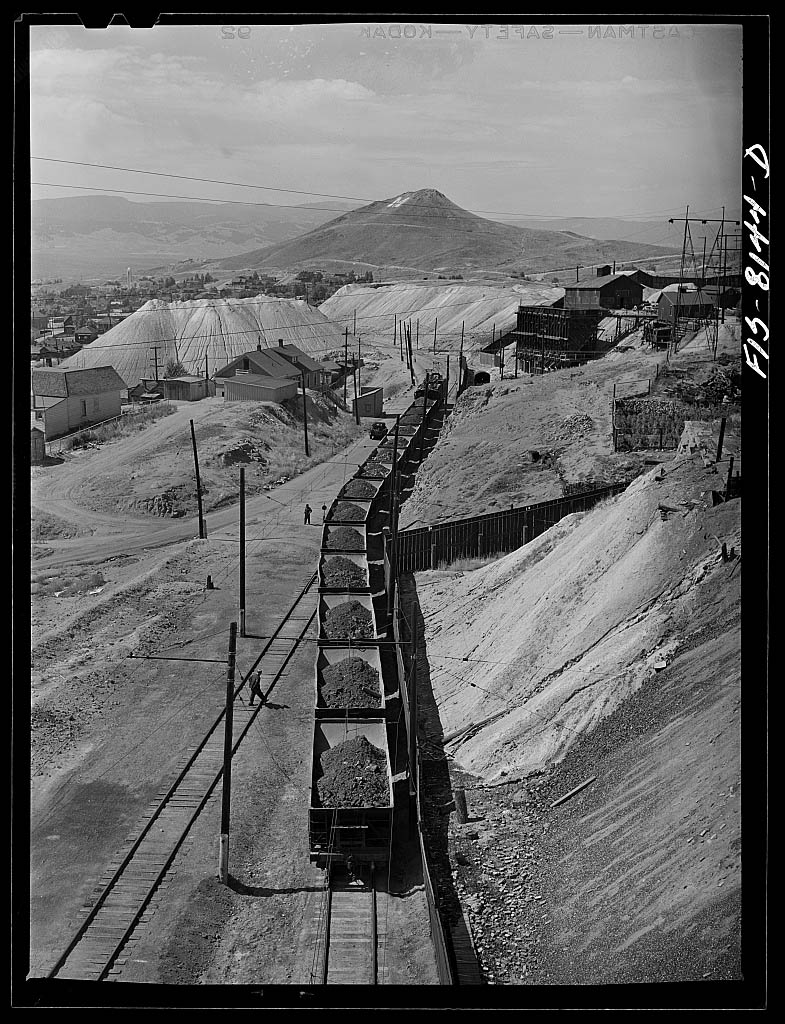
 

Russell Lee (American, 1903-1986) 'Butte, Montana. Anaconda Copper Mining Company. Train of fifty-ton cars of copper ore leaving mines at Butte for smelter at Anaconda Montana' 1942


Russell Lee (American, 1903-1986)
Butte, Montana. Anaconda Copper Mining Company. Train of fifty-ton cars of copper ore leaving mines at Butte for smelter at Anaconda Montana
1942
Gelatin silver print
Mount: 29.21 x 24.29cm (11 1/2 x 9 9/16 in.)
Prints & Photographs Division, Library of Congress, Washington D.C.
Public domain
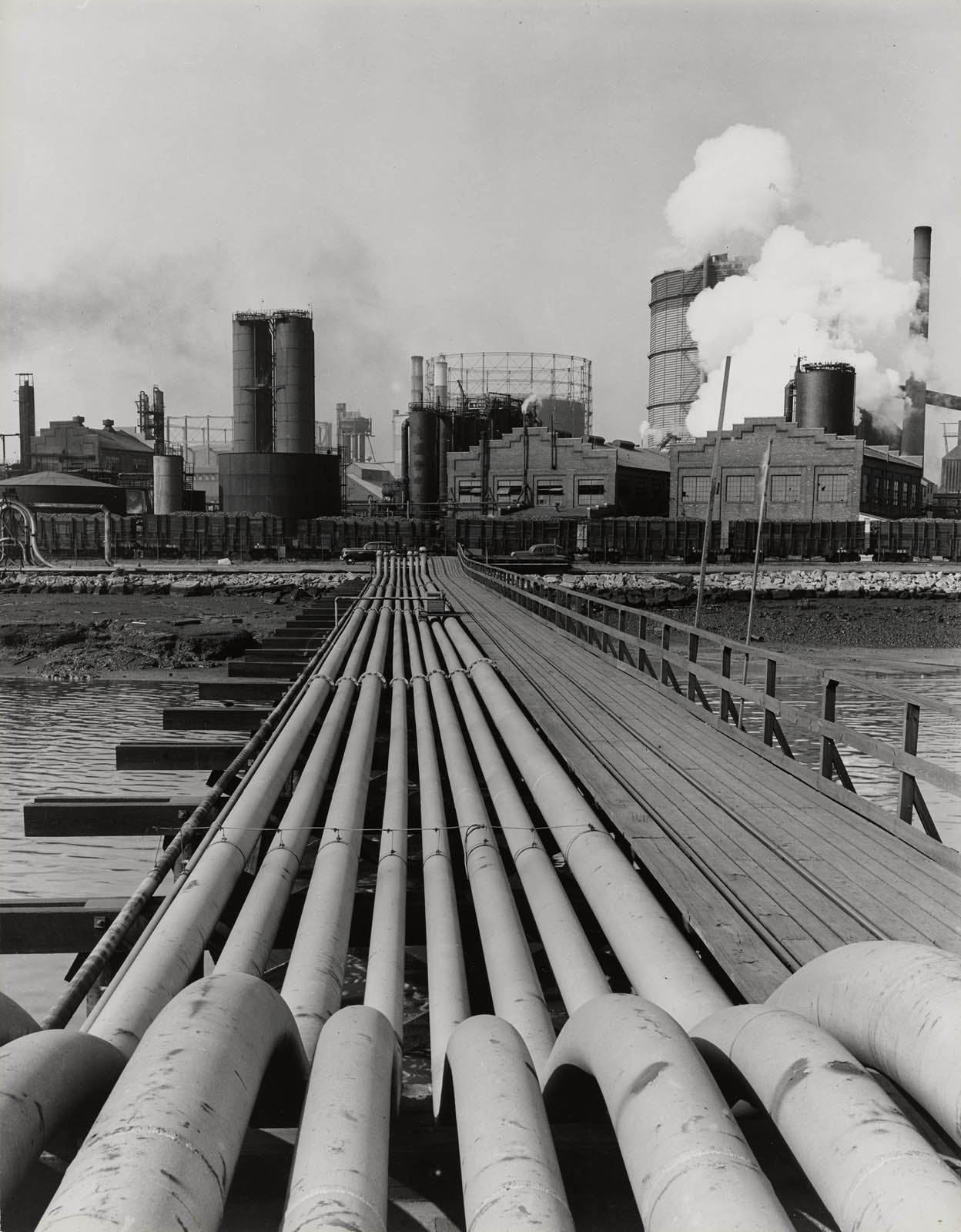
 

Gordon Parks (American, 1912-2006) 'Crude oil, fuel oil, gas oil, range oil and gasoline pipelines leading from the waterfront to the Everett Refinery. Everett, Massachusetts, May 1944' c. 1944


Gordon Parks (American, 1912-2006)
Crude oil, fuel oil, gas oil, range oil and gasoline pipelines leading from the waterfront to the Everett Refinery. Everett, Massachusetts, May 1944
c. 1944
Gelatin silver print
Sheet: 35.9 x 27.8cm (14 1/8 x 10 15/16 in.)
Photography Collection, Miriam and Ira D. Wallach Division of Art, Prints and Photographs, The New York Public Library, Astor, Lenox and Tilden Foundations
Courtesy of Exxon Mobil Corporation
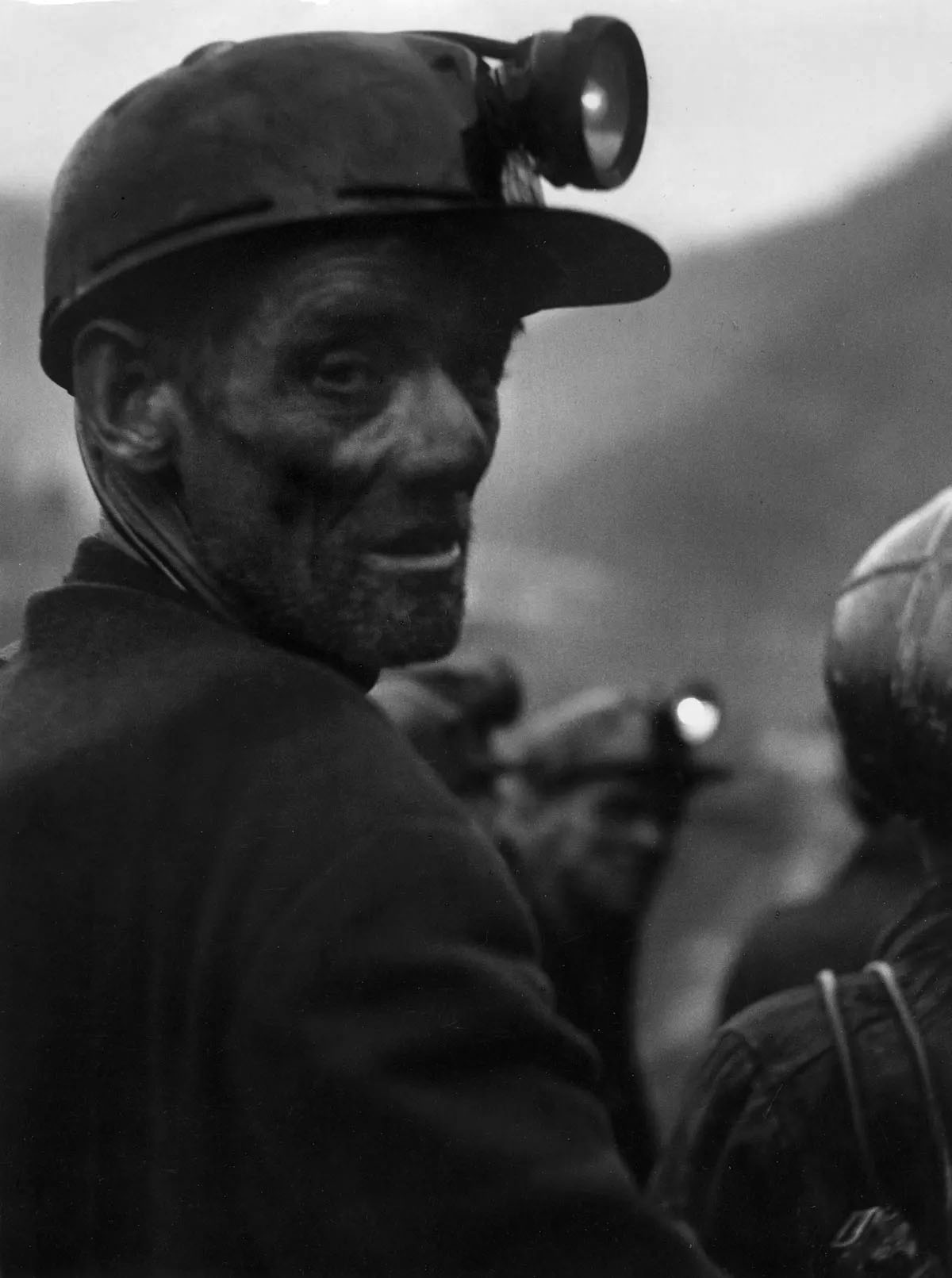
 

Fons Ianelli (American, 1917-1988) 'Jim Faye returning from the mines, Harlan County, Appalachia' 1946


Fons Ianelli (American, 1917-1988)
Jim Faye returning from the mines, Harlan County, Appalachia
1946
Gelatin silver print
Black Dog Collection
Courtesy Steven Kasher Gallery
© Fons Ianelli
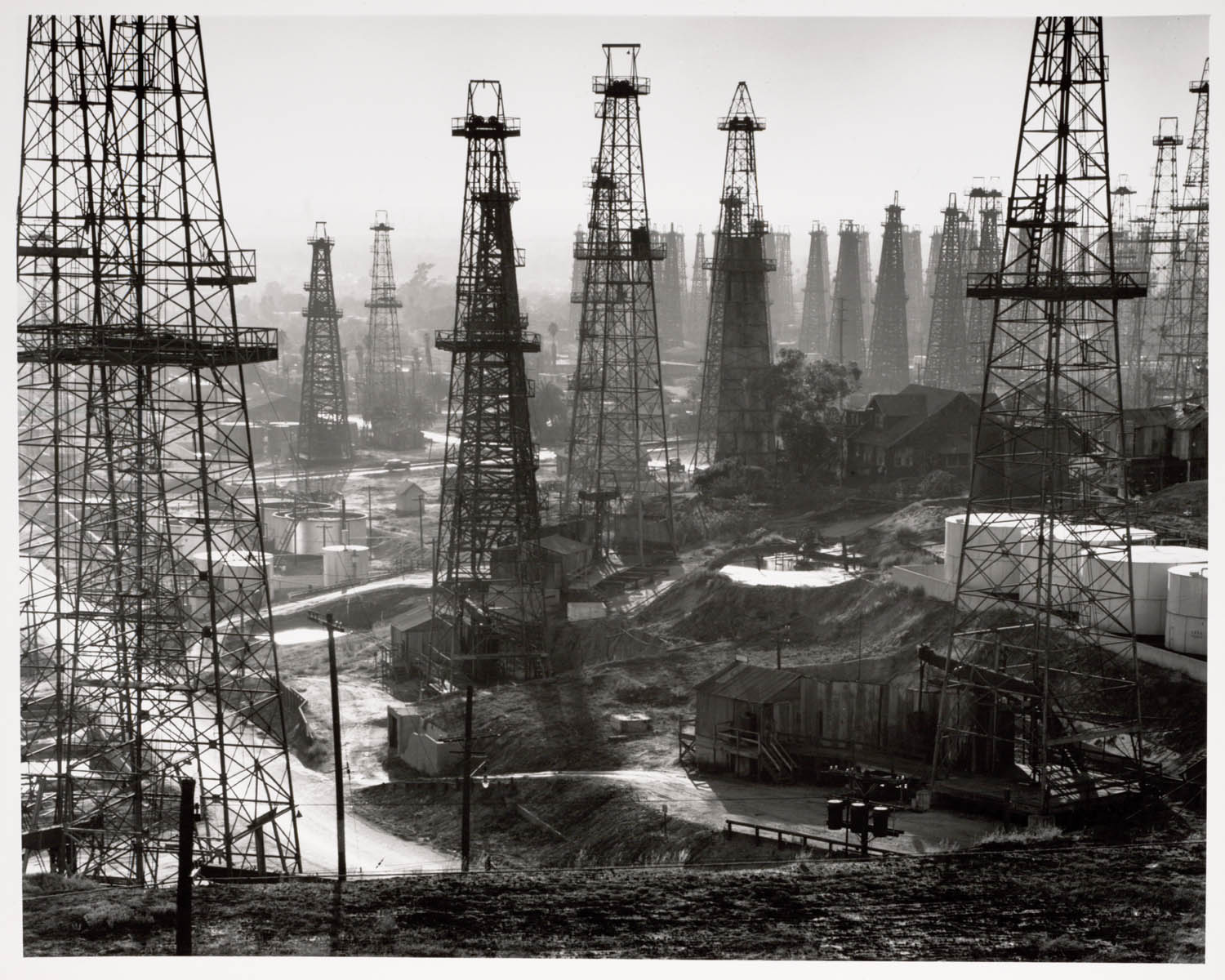
 

Andreas Feininger (American, 1906-1999) 'Oil Derricks on Signal Hall, California' 1948


Andreas Feininger (American, 1906-1999)
Oil Derricks on Signal Hall, California
1948
Gelatin silver print
Image: 20.32 x 25.08cm (8 x 9 7/8 in.)
San Francisco Museum of Modern Art, Gift of the Feininger Family
© Estate of Andreas Feininger
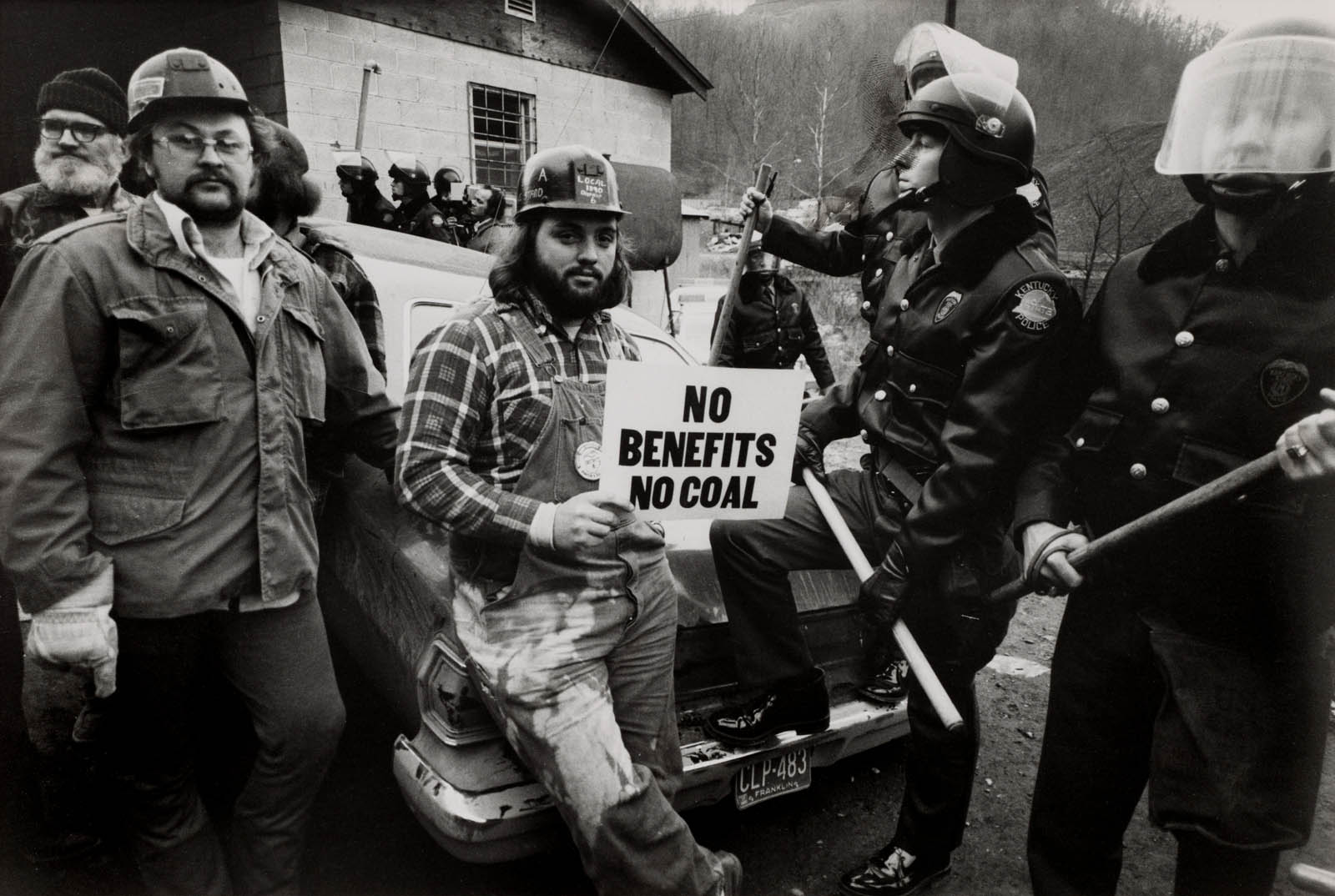
 

Arthur Grace (American, b. 1947) 'Coal Miners' Strike, Kelley's Creek Hollow, West Virginia' December 1977


Arthur Grace (American, b. 1947)
Coal Miners’ Strike, Kelley’s Creek Hollow, West Virginia
December 1977
Gelatin silver print
The J. Paul Getty Museum, Los Angeles
© Arthur Grace
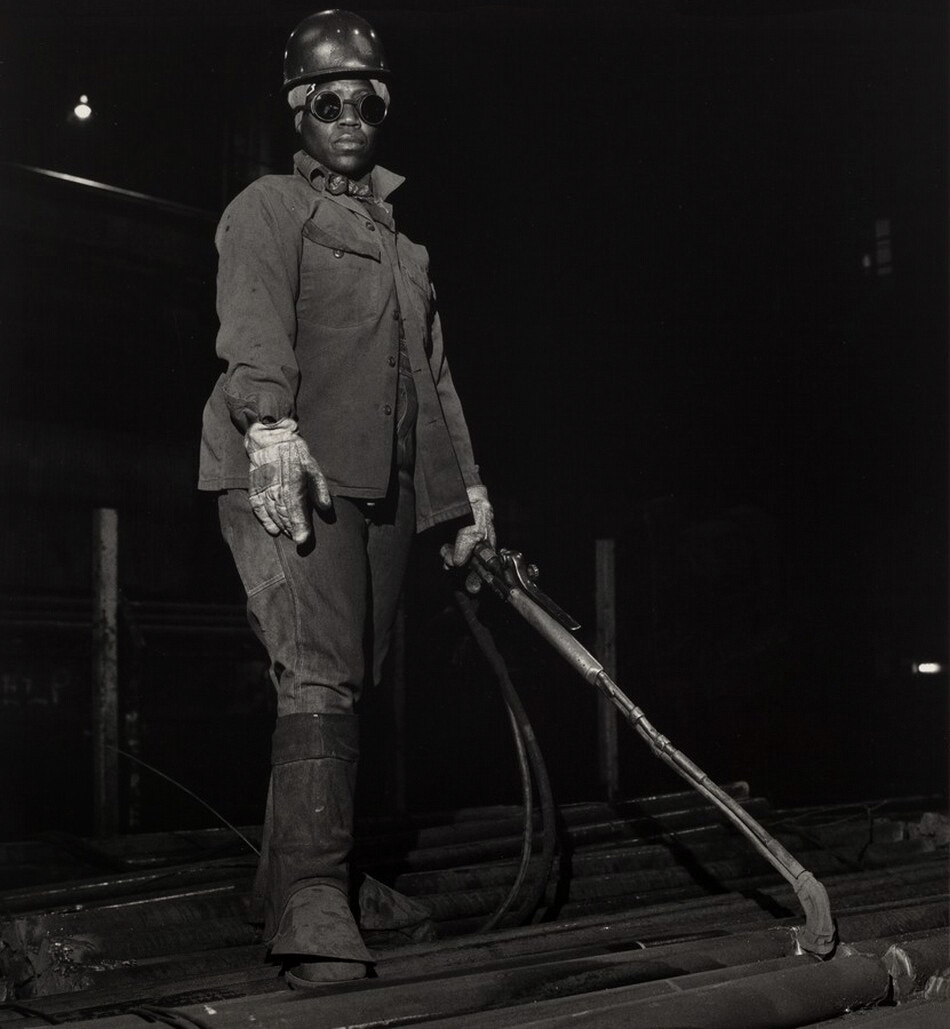
 

Milton Rogovin (American, 1909-2011) 'Doris McKinney, Republic Steel' 1978-1979


Milton Rogovin (American, 1909-2011)
Doris McKinney, Republic Steel
1978-1979
Gelatin silver print
Image: 18.3 x 17cm (7 3/16 x 6 11/16 in.)
Sheet: 25.3 x 20.3cm (9 15/16 x 8 in.)
Mat: 14 x 16 in.
National Gallery of Art, Washington
Gift of Pierre Cremieux and Denise Jarvinen
© 2025, the Estate of Milton Rogovin
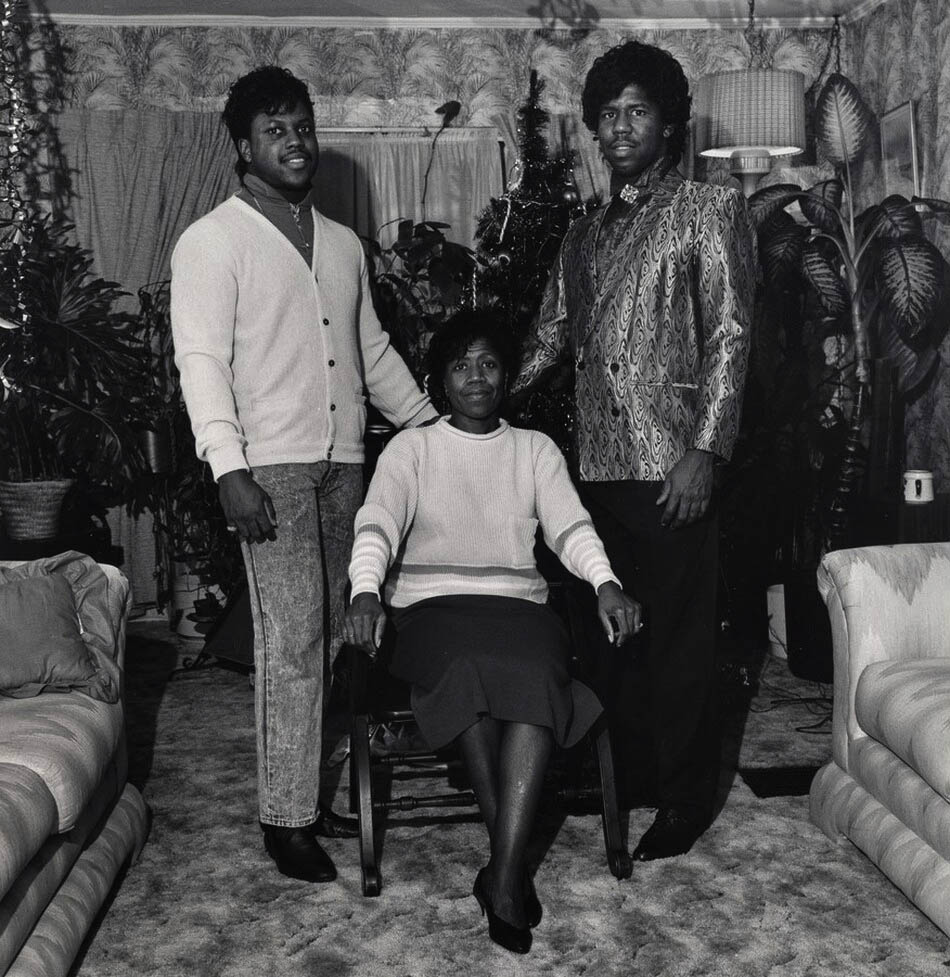
 

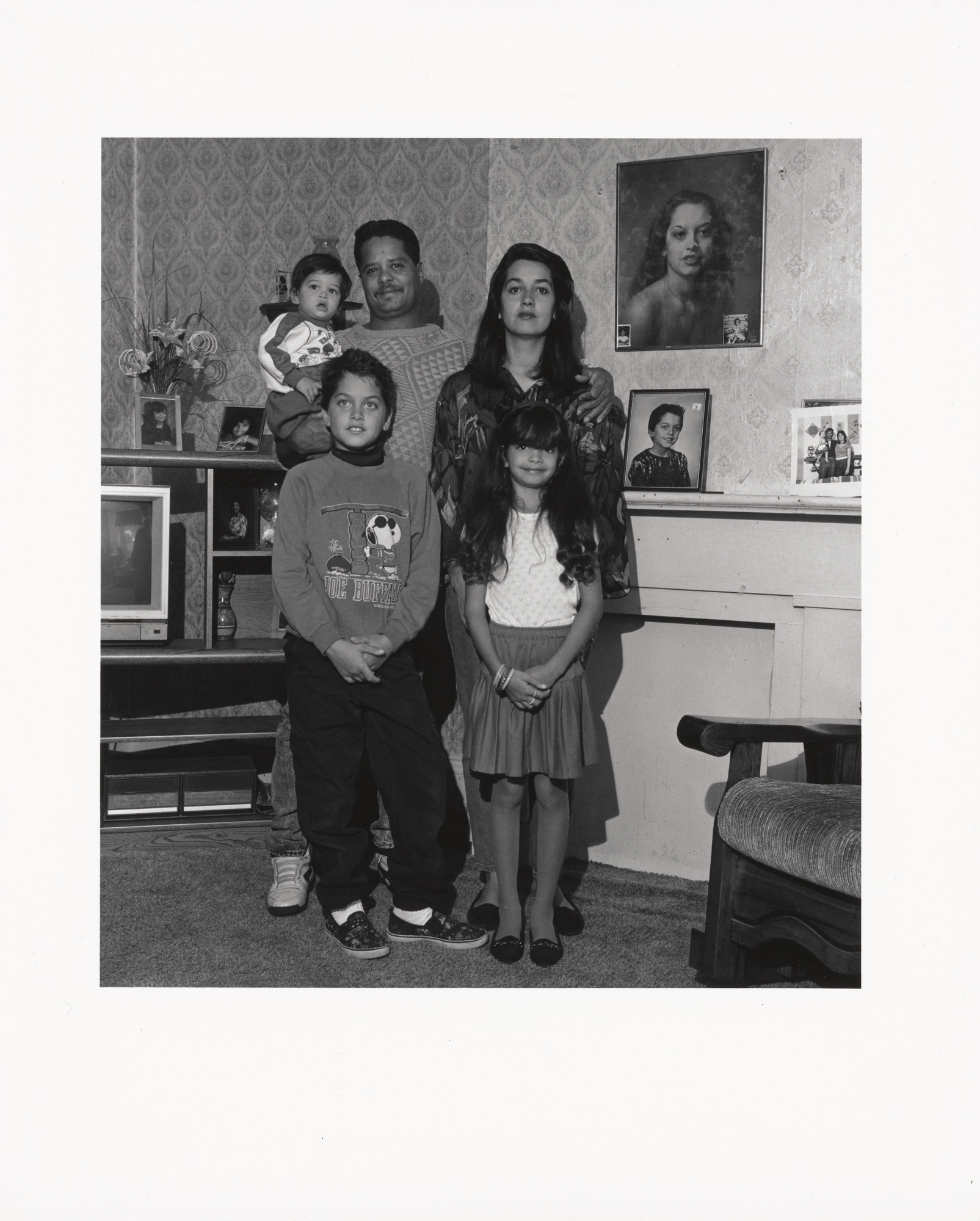
Milton Rogovin (American, 1909-2011) 'Doris McKinney with Her Two Sons, Republic Steel' 1987


Milton Rogovin (American, 1909-2011)
Doris McKinney with Her Two Sons, Republic Steel
1987
Gelatin silver print
Image: 18.1 x 17.7cm (7 1/8 x 6 15/16 in.)
Sheet: 25.2 x 20.3cm (9 15/16 x 8 in.)
Mat: 14 x 16 in.
National Gallery of Art, Washington
Gift of Pierre Cremieux and Denise Jarvinen
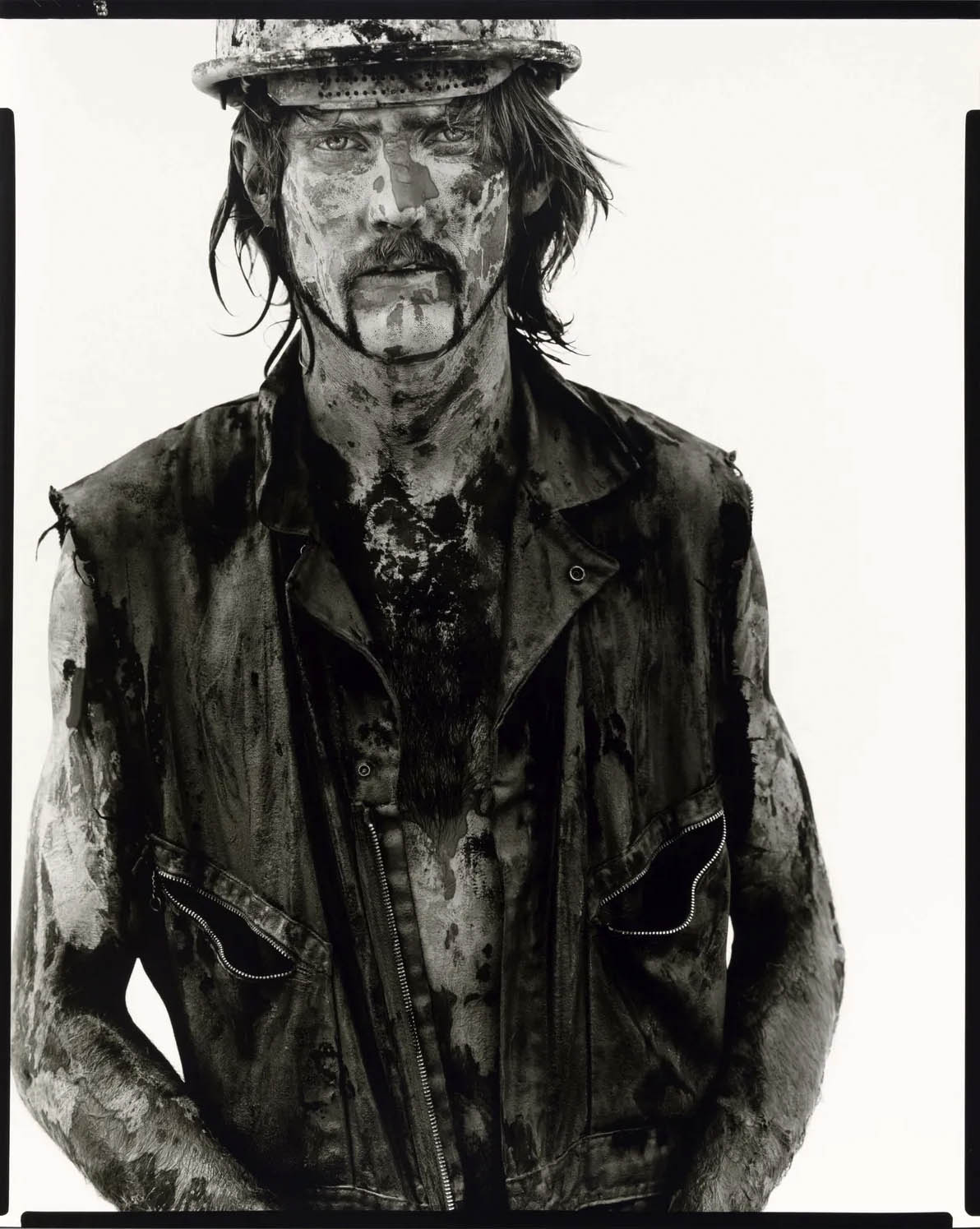
 

Richard Avedon (American, 1923-2004) 'Tom Stroud, oil field worker, Velma, Oklahoma, 6/12/80' 1980


Richard Avedon (American, 1923-2004)
Tom Stroud, oil field worker, Velma, Oklahoma, 6/12/80
1980
Gelatin silver print
Amon Carter Museum of American Art, Fort Worth, Texas
© The Richard Avedon Foundation
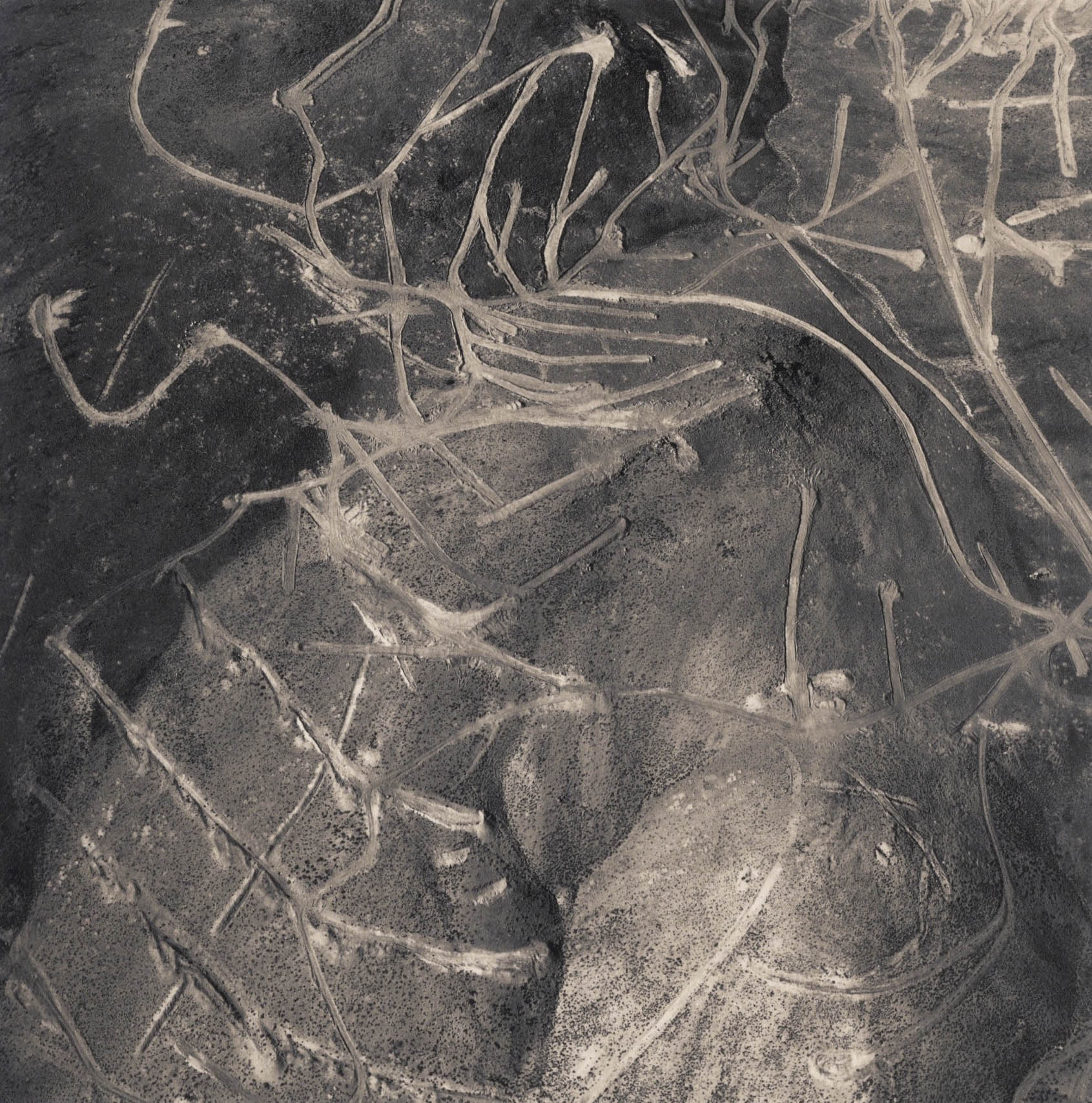
 

Emmet Gowin (American, b. 1941) 'Mining Exploration near Carson City, Nevada' 1988


Emmet Gowin (American, b. 1941)
Mining Exploration near Carson City, Nevada
1988
Gelatin silver print
Image: 24.5 x 25cm (9 5/8 x 9 13/16 in.)
Sheet: 27.7 x 35.5cm (10 7/8 x 14 in.)
Mat: 16 x 18 in.
National Gallery of Art, Washington, Gift of Jane P. Watkins


Photographing American Mining and Energy

Elizabeth Fortune

For nearly two centuries, American photography and the mining of valuable natural resources have been deeply intertwined. 

Introduced in 1839, photography premiered less than a decade before successive metal mining booms transformed the landscape and demographics of the American West. Emerging extractive industries hired photographers to promote their operations and attract investors and workers.

Since photography’s inception, artists have used a range of techniques and formats to depict resource extraction like coal mining and oil drilling, which often occurs in remote locations, sometimes underground. Their aims and attitudes range from enthusiastic boosterism to impassioned critique. Together, these photographers’ works unearth and make visible the history of industrial mining and its continued impact on our everyday lives and the American landscape.

Daguerreotypes

After the 1848 discovery of gold at Sutter’s Mill in California, hundreds of thousands of aspiring miners flocked to the West Coast. Posed with tools of his trade, this miner was one of many who sat for a daguerreotype to memorialise their quest for precious metals.

The mining of silver, copper, and mercury was essential for the creation of daguerreotypes: the process produces a unique image on a highly polished silver-coated copper plate.

Stereographs

Photographers took advantage of the stereograph to make immersive scenes of resource extraction. A popular photographic format from the mid-1850s to the early 1900s, the stereograph features two pictures of the same subject taken about 2 1/2 inches apart, roughly the distance between our eyes. When seen through a stereoscope viewer, the two pictures appear to combine into a three-dimensional image (the equivalent of early 3D glasses).

Photographers were dispatched across the country and American territories to document places of interest. Sites of resource extraction were a particular draw. The discovery and mining of oil, gold, silver, and other materials excited many with the promise of prosperity and beckoned fortune seekers to these burgeoning industries.

Commissions and Surveys

Mining companies, as well as related businesses like railroads, commissioned early photographers to document industrial infrastructure as a way to mark technological advancements and to attract investors.

The Delaware and Hudson Railroad and Canal Company hired Thomas H. Johnson to photograph the expansion of their coal mining operations in northeastern Pennsylvania These “breakers” broke coal into fragments and sorted them by size.

Government-sponsored surveys presented other opportunities for nineteenth-century photographers to travel across the country and document mining sites. While on a geological survey in 1868, Timothy O’Sullivan photographed silver mining at the Comstock Lode in Nevada. There, he produced some of the first subterranean photographs. 

Panoramas

The enormous scale demanded by resource extraction calls for a grand mode of representation. The panorama, derived from the Greek words for “complete” and “view,” is an ideal format. Its size and breadth can accommodate the vastness of industrial enterprises.

Frank Schlueter’s 1917 panoramic photograph, taken at Goose Creek, Texas, captures men and horses working alongside huge oil derricks, some so tall they extend beyond the picture frame. In 1901, oil was discovered at Spindletop along the Gulf Coast of Texas, which ushered in the modern petroleum industry and the Texas oil boom. Seeking business as a photographer, Schlueter opened a nearby studio and began accepting commissions for pictures of oil fields.

A century later, Indigenous photographer Lewis deSoto (Cahuilla) used the panoramic format to show power generation in California. Here, a picturesque coastline is dotted with palm trees and people enjoying the sunny Southern California day. In the distance rises the Encina Power Station, which permanently closed in 2018. The panorama’s wide vista reveals the looming presence of industry in even the most scenic of places.

The title refers to Carlsbad, the current name of the city where the beach is located, and Payómkawichum, the name Native Americans of the area call themselves. deSoto invokes the Indigenous name to link industrial power generation with the ancestral power imbued in the land.

Modernist Forms

Modernist photographers, with their interest in abstract shapes and daring camera angles, found a fitting subject in the sharp geometric forms of industrial facilities and machinery.

In the late 1920s, Margaret Bourke-White spent several months photographing inside the Otis Steel Company in Cleveland, Ohio. She called the evenings spent at the factory “a photographic paradise.” Bourke-White’s picture of glowing molten metal celebrates what she deemed the “beauty waiting to be discovered” at the plant.

In 1944, Gordon Parks joined a group of photographers hired by Standard Oil New Jersey to promote the company’s role in supporting the war effort. In Parks’s dynamic composition, orderly rows of cylindrical pipes converge at the horizon line, carrying oil to the Everett Finery in Massachusetts. Plumes of white steam hover over the refinery, suggesting a constant churn of manpower and machinery.

Aerial Views

Adopting a bird’s-eye view has allowed photographers to record the extent of resource extraction and the way it has marked our landscape. Photographers can also bypass access restrictions to industrial sites by flying overhead with a plane or drone. From the sky, a paradox emerges: although we can see more from a distance, the elevation skews scale and at times heightens the aesthetic appeal of earthbound places. 

Taken from a helicopter, Emmet Gowin’s picture of a mining exploration near Carson City, Nevada, reveals an elaborate pattern of topographical scars. Gowin acknowledged the distorting effect of viewing industrial sites from the sky, remarking, “From the air it seemed like everything I was seeing was miraculous.”

Photographer Will Wilson (Diné) used a drone to capture this aerial view of pearl and copper hued remediation ponds that hold residual waste from uranium mining. Located in northwest New Mexico on the lands of the Navajo Nation, Church Rock Mill is the site of the largest radioactive spill in American history. The radioactive waste poses risks to nearby communities and ecosystems. By surveilling the remediation ponds from above, Wilson calls attention to these hazardous sites.

Portraits

Pictures of laborers in extractive industries spotlight those who power our nation. Sometimes operating in high-risk environments, these workers feed important supply chains. Portrait photographers foreground the humanity of their subjects and individualise the massive workforce supporting our industrial economy.

From 1979 to 1985, Richard Avedon traveled across 17 American states to photograph working-class Americans for his portrait project In the American West. Coal miners and oil field workers were among his most frequent subjects. Avedon is known for his portraits of celebrities and politicians, but here he elevates each worker to a vaunted status.

Tom Stroud, an oil field worker from Velma, Oklahoma, stands before Avedon’s signature white backdrop and looks directly at the camera. His skin, clothing, and helmet are splotched with mud and oil (Avedon preferred to photograph subjects at the end of their shifts). The portrait’s large size – about five feet tall by four feet wide – gives monumental status to Stroud and his labor.

Large-Scale Color Photographs

At first glance, the tidy yards, pristine garden shed, and welcoming patio furniture form an idyllic suburban scene. But in the distance, massive smokestacks and a cooling tower overtake the hazy gray sky.

Mitch Epstein’s mammoth picture records the looming presence of the Amos Coal Power Plant in Raymond City, West Virginia. The exceptional size (62 x 80 inches) of Epstein’s composition places us within a serene neighbourhood dominated by the coal industry. Its monumental scale confronts us with the immensity of extractive operations and the impact these industries have on the lands and people of the United States.

Text from the National Gallery of Art website


In the Library: Photobooks and American Energy

This presentation draws from the National Gallery of Art Library collections. It looks at how artists use photobooks to reveal the impact of the energy industry on the American landscape and people.

In conjunction with Beneath the Surface: Mining and American Photography, the National Gallery of Art Library presents an installation of 25 books and 2 zines examining how photographers use photobooks to document the impact of energy extraction, production, and circulation on the American landscape and its communities.

The books and zines on view illustrate complex narratives about how America is powered today, revealing the visual strategies and design decisions contemporary photographers use to contextualise and share their work. In the library reading room adjacent to the exhibition area, additional photobooks are available for visitors to browse.

Books offer a different experience than seeing images on a wall or your social media feed. Complex stories are told when photos join text, other printed elements, and even the book binding. Come explore a wide-ranging selection of photobooks by contemporary photographers – then handle more examples in our reading room.

Curated by Yuri Long, special collections librarian at the National Gallery, this installation is on view from May 25 through August 21, 2026, in the East Building Library Atrium from 11.00 am to 4.30 pm, Monday through Friday, except federal holidays.

Text from the National Gallery of Art website
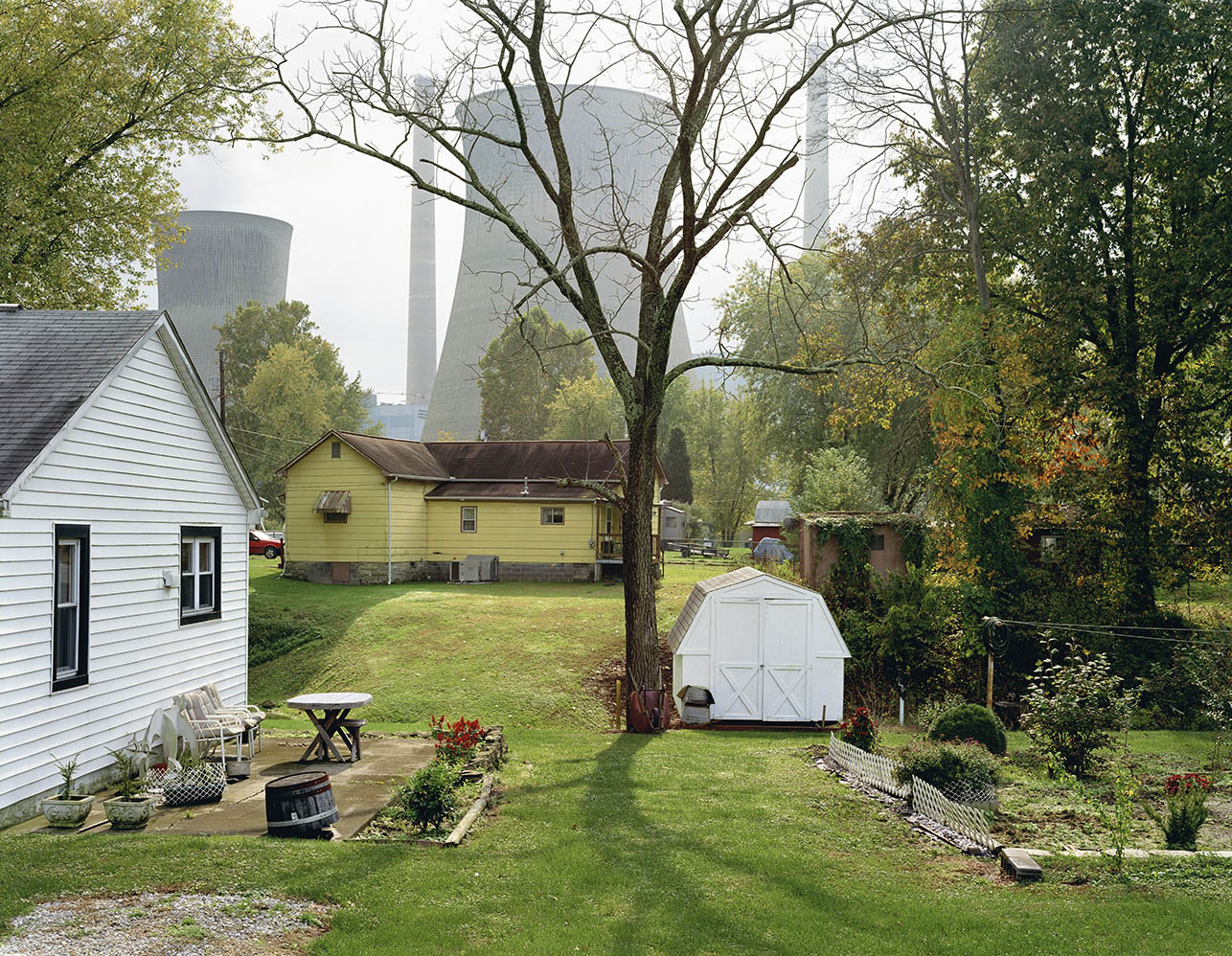
 

Mitch Epstein (American, b. 1952) 'Amos Coal Power Plant, Raymond City, West Virginia 2004' 2004, printed 2025


Mitch Epstein (American, b. 1952)
Amos Coal Power Plant, Raymond City, West Virginia 2004
2004, printed 2025
Inkjet print
Image/sheet: 157.48 x 203.2cm (62 x 80 in.)
Framed: 160.02 x 207.01 x 6.35cm (63 x 81 1/2 x 2 1/2 in.)
National Gallery of Art, Washington
Gift of the artist
© Mitch Epstein
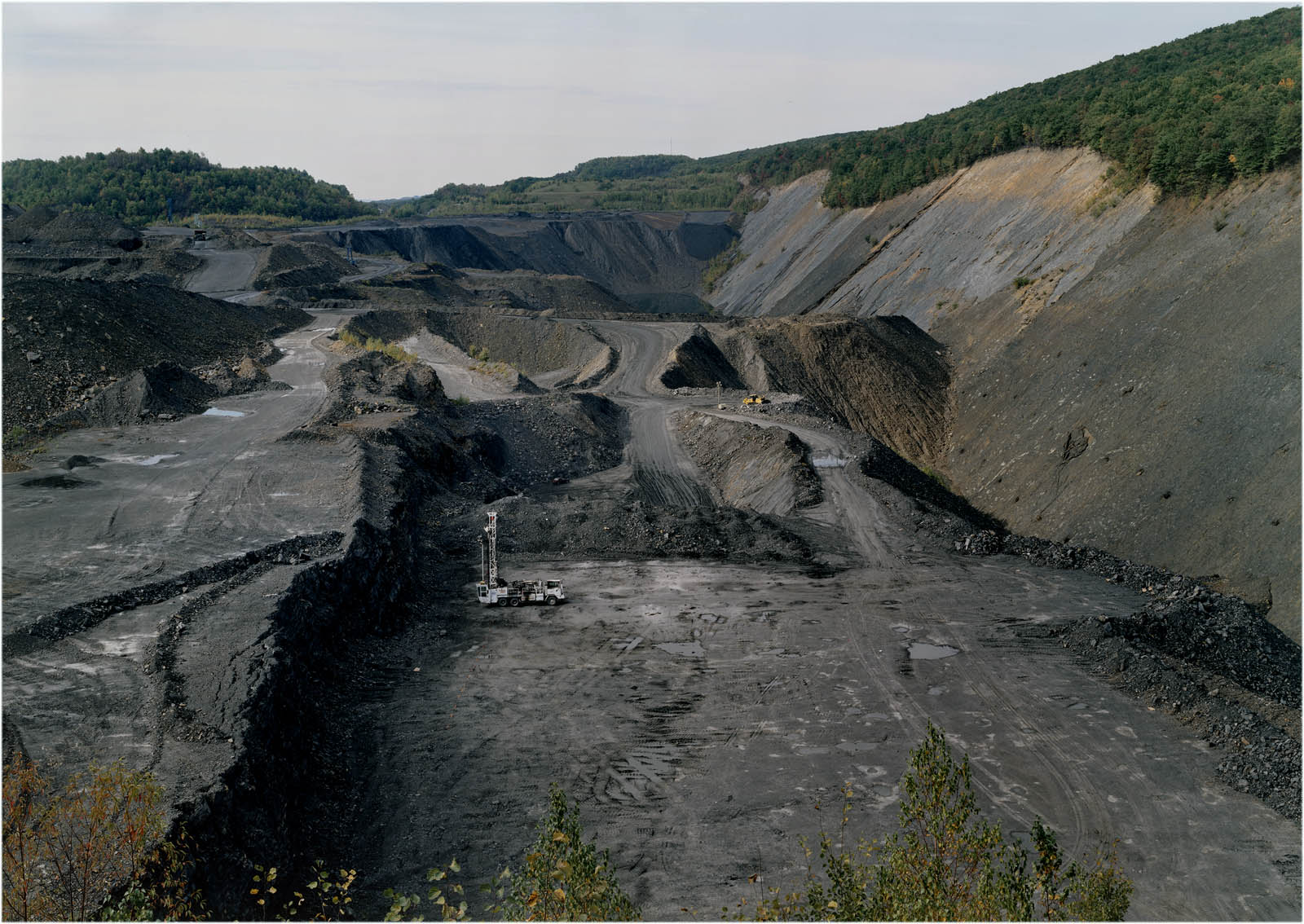
 

Victoria Sambunaris (American, b. 1964) 'Untitled (Coaldale, Pennsylvania)' 2007


Victoria Sambunaris (American, b. 1964)
Untitled (Coaldale, Pennsylvania)
2007
Chromogenic print
Overall: 99.06 x 139.7cm (39 x 55 in.)
Mat: 41 x 57 in. (approx.)
National Gallery of Art, Washington
Gift of Lannan Foundation
© Victoria Sambunaris and Yancey Richardson Gallery
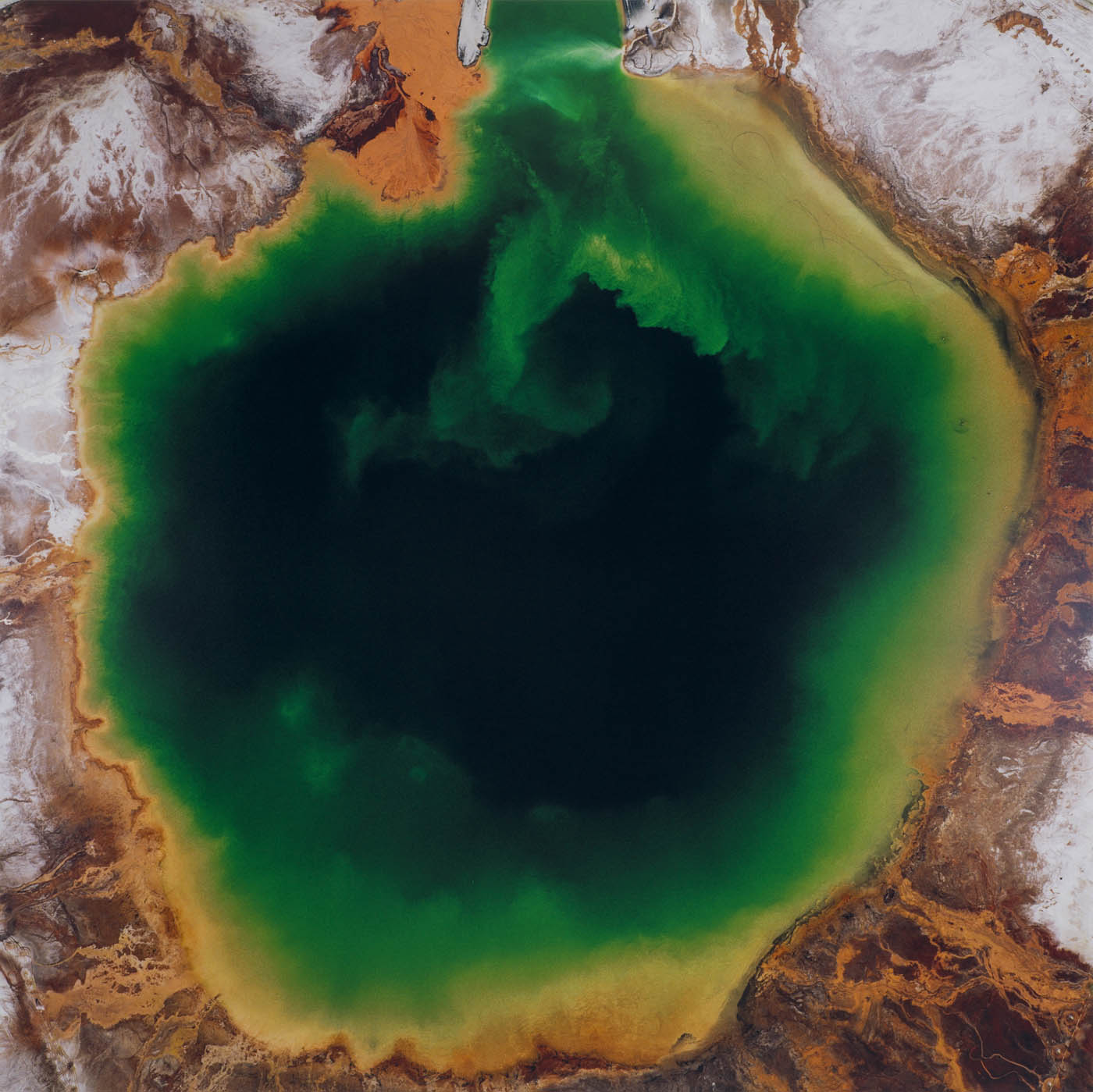
 

David Maisel (American, b. 1961) 'American Mine, Carlin, Nevada 1' 2007, printed 2024


David Maisel (American, b. 1961)
American Mine, Carlin, Nevada 1
2007, printed 2024
Inkjet print
Collection of Amy and Tony D’Orazio
© David Maisel. All rights reserved
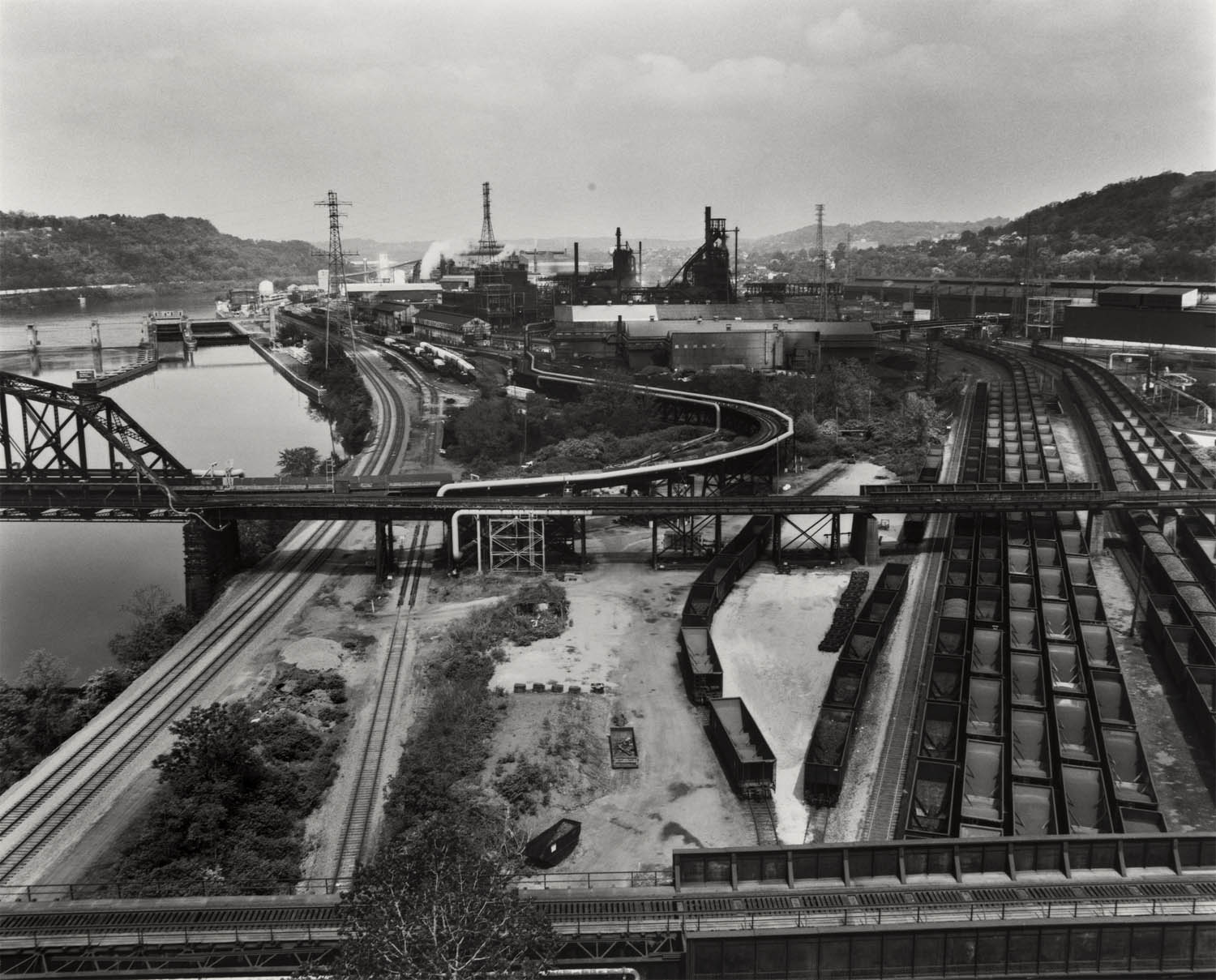
 

LaToya Ruby Frazier (American, b. 1982) 'U.S.S. Edgar Thomson Steel Works & Monongahela' 2013


LaToya Ruby Frazier (American, b. 1982)
U.S.S. Edgar Thomson Steel Works & Monongahela
2013
Gelatin silver print
Image/sheet: 121.29 x 151.77cm (47 3/4 x 59 3/4 in.)
Framed: 123.83 x 154.31 x 4.45cm (48 3/4 x 60 3/4 x 1 3/4 in.)
National Gallery of Art, Washington
Alfred H. Moses and Fern M. Schad Fund
© LaToya Ruby Frazier
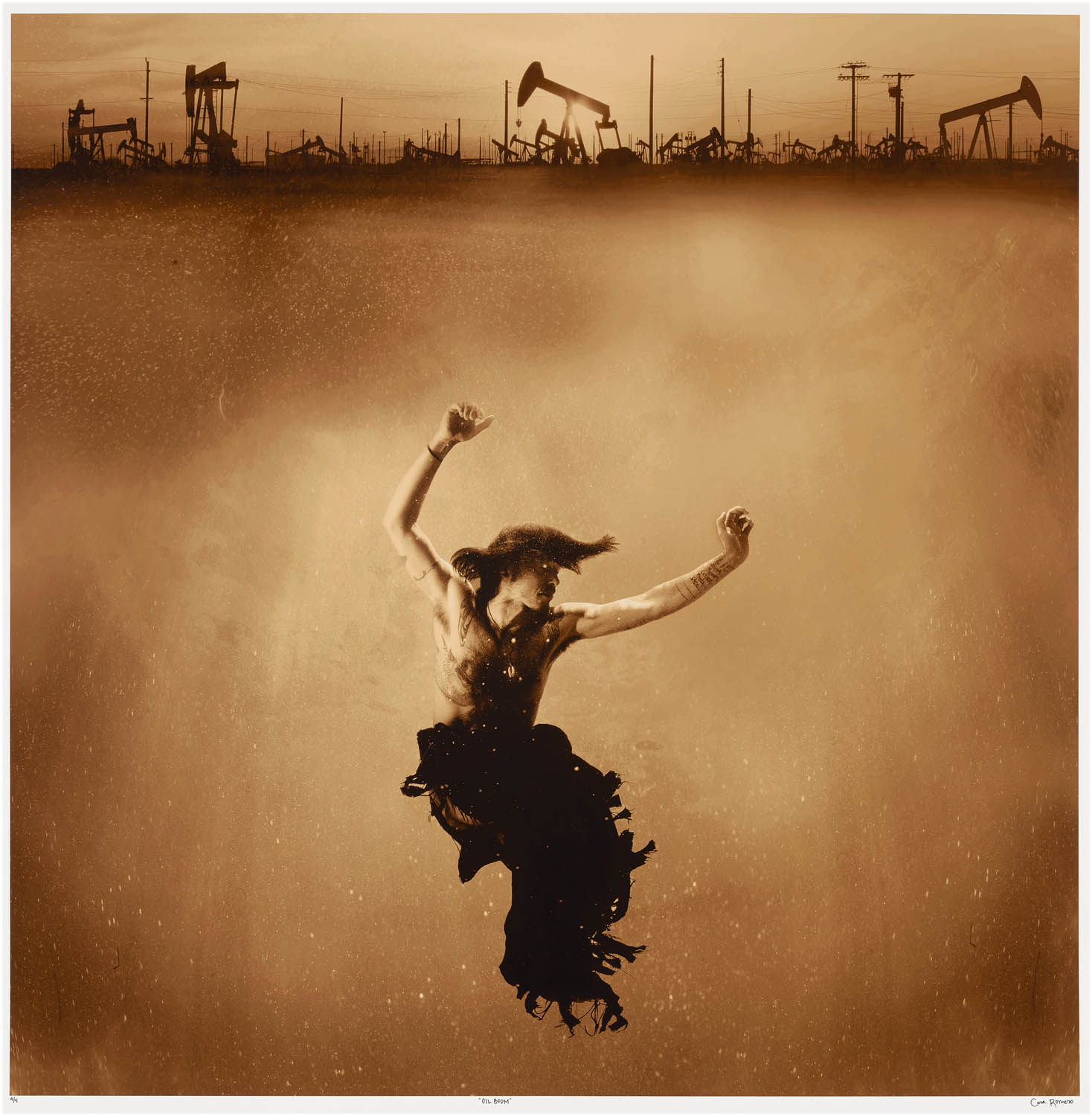
 

Cara Romero (Chemehuevi, b. 1977) 'Oil Boom' 2015, printed 2023


Cara Romero (Chemehuevi, b. 1977)
Oil Boom
2015, printed 2023
From the series Water Memories
inkjet print
Image: 101.6 x 100.33cm (40 x 39 1/2 in.)
Sheet: 111.76 x 110.49cm (44 x 43 1/2 in.)
National Gallery of Art, Washington
Gift of Funds from Renée Harbers Liddell
© Cara Romero. All rights reserved
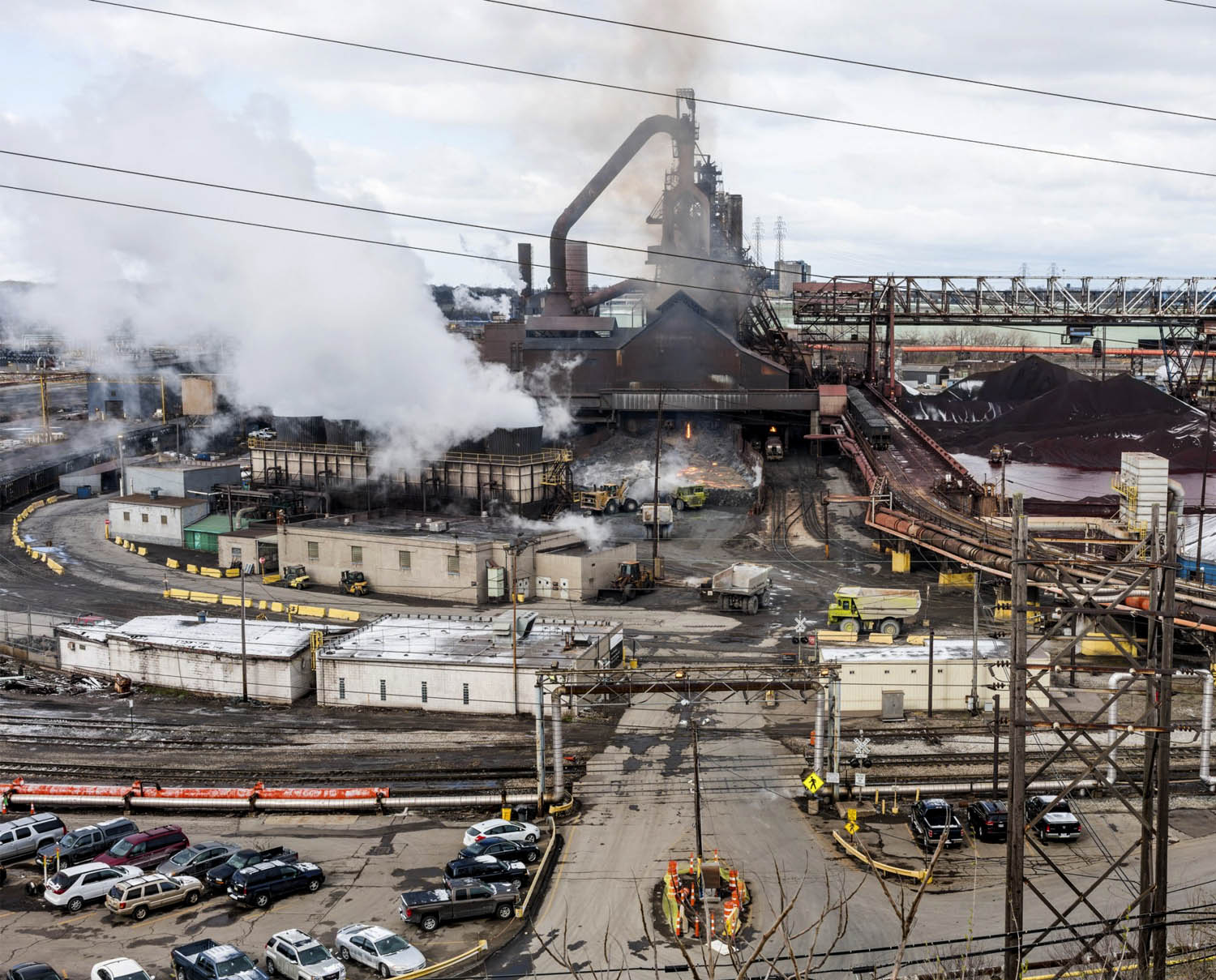
 

Andrew Borowiec (American, b. 1956) 'Blast Furnace, Cleveland' 2016


Andrew Borowiec (American, b. 1956)
Blast Furnace, Cleveland
2016
Inkjet print
Image: 67.95 x 101.6cm (26 3/4 x 40 in.)
Sheet: 80.01 x 111.76cm (31 1/2 x 44 in.)
Mat: 32 3/4 x 46 in.
National Gallery of Art, Washington, Charina Endowment Fund
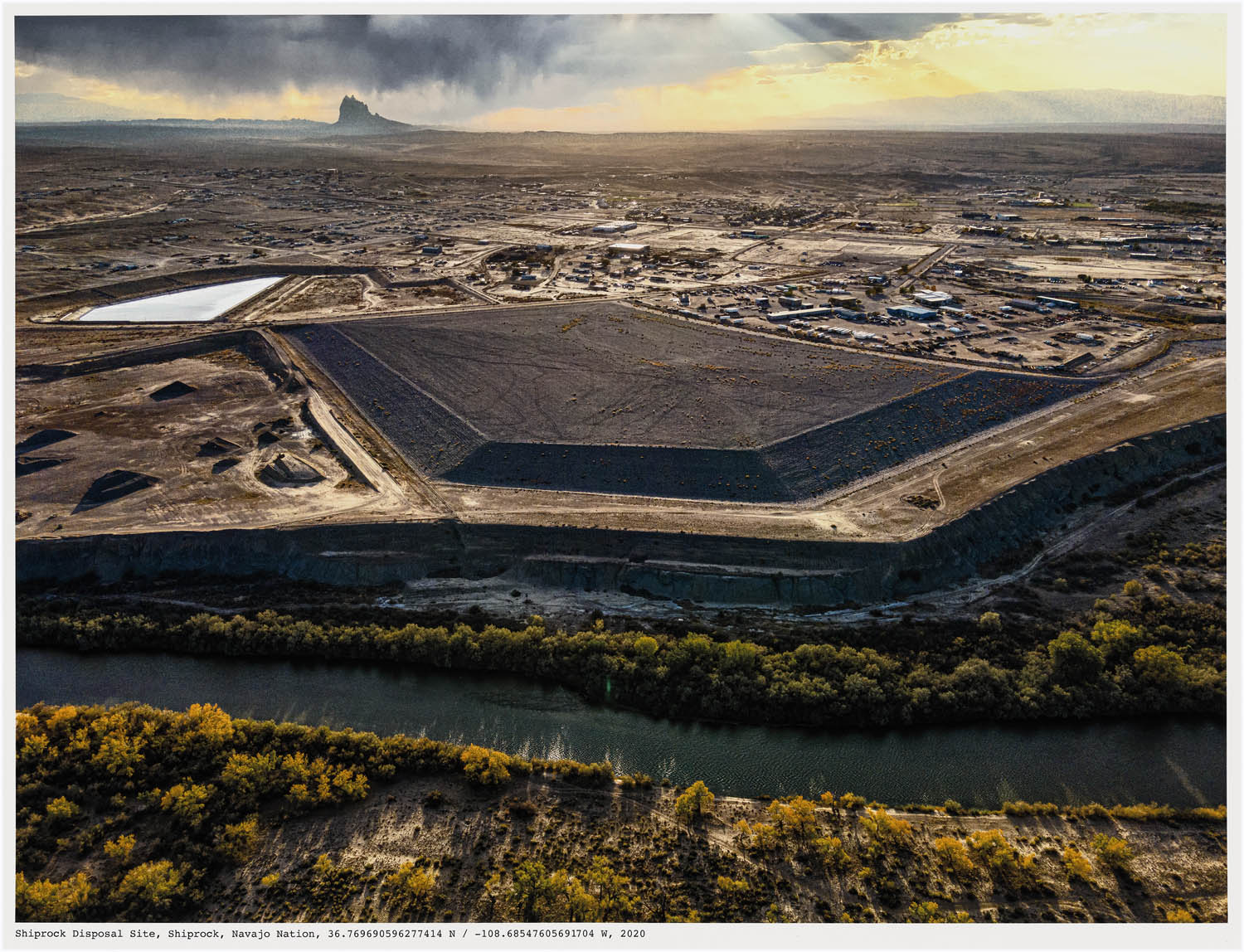
 

Will Wilson (Diné) (b. 1969) 'Shiprock Disposal Site, Shiprock, Navajo Nation, 36. 769690596277414 N / -108. 68547605691704 W' 2020


Will Wilson (Diné) (b. 1969)
Shiprock Disposal Site, Shiprock, Navajo Nation, 36. 769690596277414 N / -108. 68547605691704 W
2020
Inkjet print
Image: 60.96 x 121.92cm (24 x 48 in.)
Sheet: 94.62 x 109.22cm (37 1/4 x 43 in.)
Back mat: 35 15/16 x 43 1/2 in.
National Gallery of Art, Washington
Charina Endowment Fund in memory of Robert B. Menschel
Courtesy of the artist and www.dineconnect.org


National Gallery of Art
National Mall between 3rd and 7th Streets
Constitution Avenue NW, Washington

Opening hours:
Daily 10am – 5pm

National Gallery of Art website

LIKE ART BLART ON FACEBOOK

Back to top

Exhibition: ‘Once. Again. Photographs in Series’ at the J. Paul Getty Museum, Getty Center, Los Angeles

Exhibition dates: 9th July – 10th November, 2019

Curator: Mazie Harris


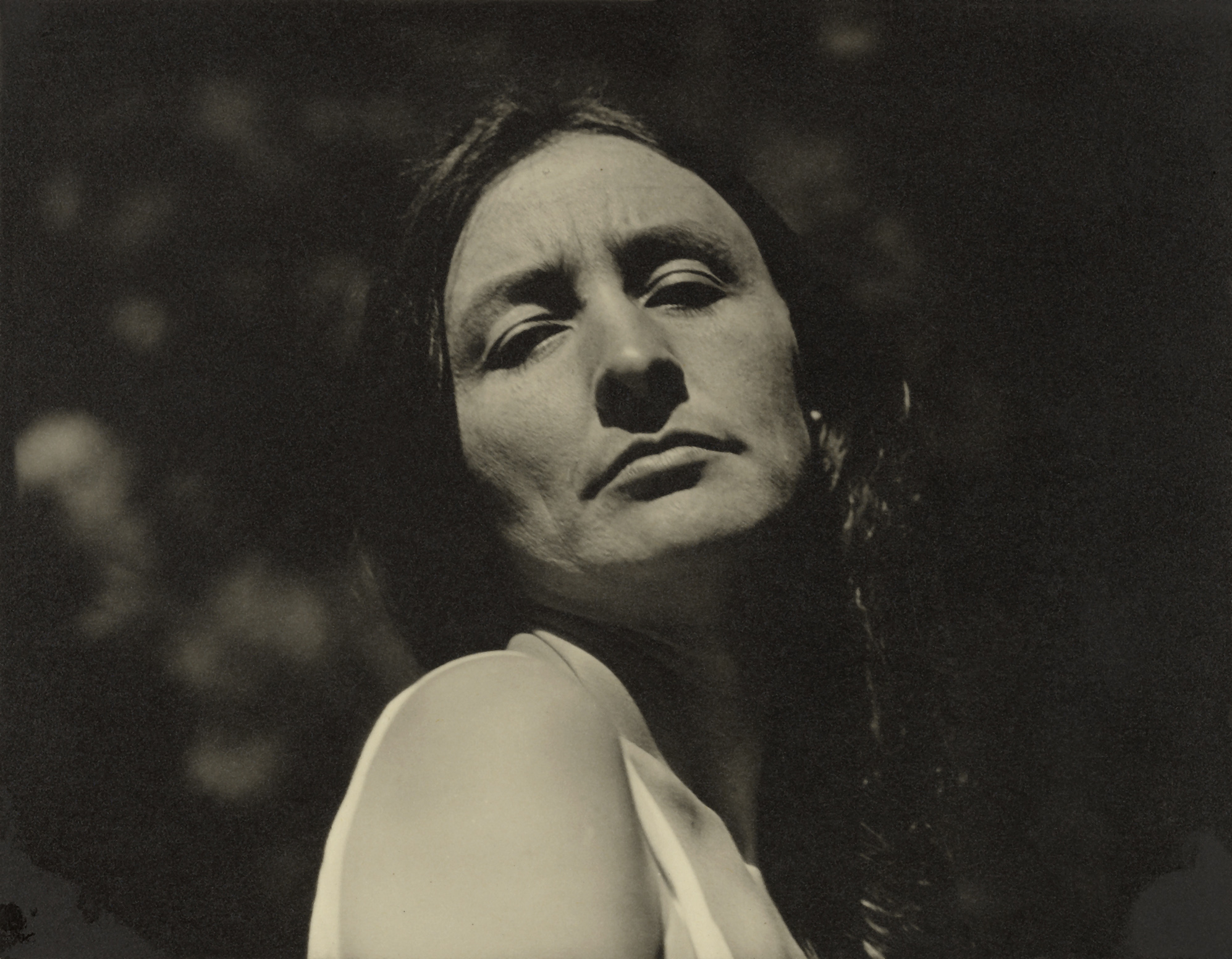
Alfred Stieglitz (American, 1864-1946) 'Georgia O'Keeffe: A Portrait' 1918 from the exhibition 'Once. Again. Photographs in Series' at the J. Paul Getty Museum, Getty Center, Los Angeles, July - Nov, 2019


Alfred Stieglitz (American, 1864-1946)
Georgia O’Keeffe: A Portrait
1918
Gelatin silver print
Image: 11.4 × 8.6cm (4 1/2 × 3 3/8 in.)
The J. Paul Getty Museum, Los Angeles


Some fabulous photographs in series in this posting, which document transformations in landscapes or intimate portraits of people at different times in their lives… and some challenging ones as well. My favourite photographs in series are not represented: Duane Michals narrative fairytales; Cindy Sherman’s Untitled Film Stills; and Nicholas Nixon’s The Brown Sisters.

Dr Marcus Bunyan


Many thanks to the J. Paul Getty Museum for allowing me to publish the photographs in the posting. Please click on the photographs for a larger version of the image.


Photographers often record change through images in series, registering transformations in the world around them. Artists featured in the exhibition photographed faces and places over minutes, months, or years. Historical and contemporary photographs prompt reflection on the ways the passage of time impacts how we see people and spaces.


Alfred Stieglitz (American, 1864-1946) 'Georgia O'Keeffe: A Portrait' 1923


Alfred Stieglitz (American, 1864-1946)
Georgia O’Keeffe: A Portrait
1923
Gelatin silver print
Image: 8.9 × 11.7cm (3 1/2 × 4 5/8 in.)
The J. Paul Getty Museum, Los Angeles


Alfred Stieglitz (American, 1864-1946) 'Georgia O'Keeffe: A Portrait' 1933


Alfred Stieglitz (American, 1864-1946)
Georgia O’Keeffe: A Portrait
1933
Gelatin silver print
Image: 8.9 × 11.4cm (3 1/2 × 4 1/2 in.)
The J. Paul Getty Museum, Los Angeles


Artists have long used cameras to record change, documenting transformations in landscapes or intimate portraits of people at different times in their lives. Once. Again. Photographs in Series, on view July 9 – November 10, 2019 at the J. Paul Getty Museum, Getty Center, features historical and contemporary artists who have revisited people and places to make extended photographic series, prompting reflection on the impact of the passage of time – on photographers as well as their subjects.

The exhibition, drawn primarily from the collection of the Getty Museum, takes its cue from artist Gordon Parks’ trips to Brazil over several decades to document the life of Flávio da Silva. Parks’ photographs are on view in Gordon Parks: The Flávio Story, installed in the adjacent galleries of the Center for Photographs.

Photographing friends and family is a familiar pastime for many, and the exhibition includes the work of several artists who made masterful portraits of loved ones over the course of many years. Alfred Stieglitz photographed artist Georgia O’Keeffe frequently during their tumultuous 30 year relationship, and the photographs on view expose shifts in their rapport as well as changes in Stieglitz’s photographic style over time. Series by Harry Callahan of his wife Eleanor, Paul Strand of his wife, artist Rebecca Salsbury, and Julia Margaret Cameron of her niece Julia Jackson similarly offer fascinating reflections on the changes in relationships over time.

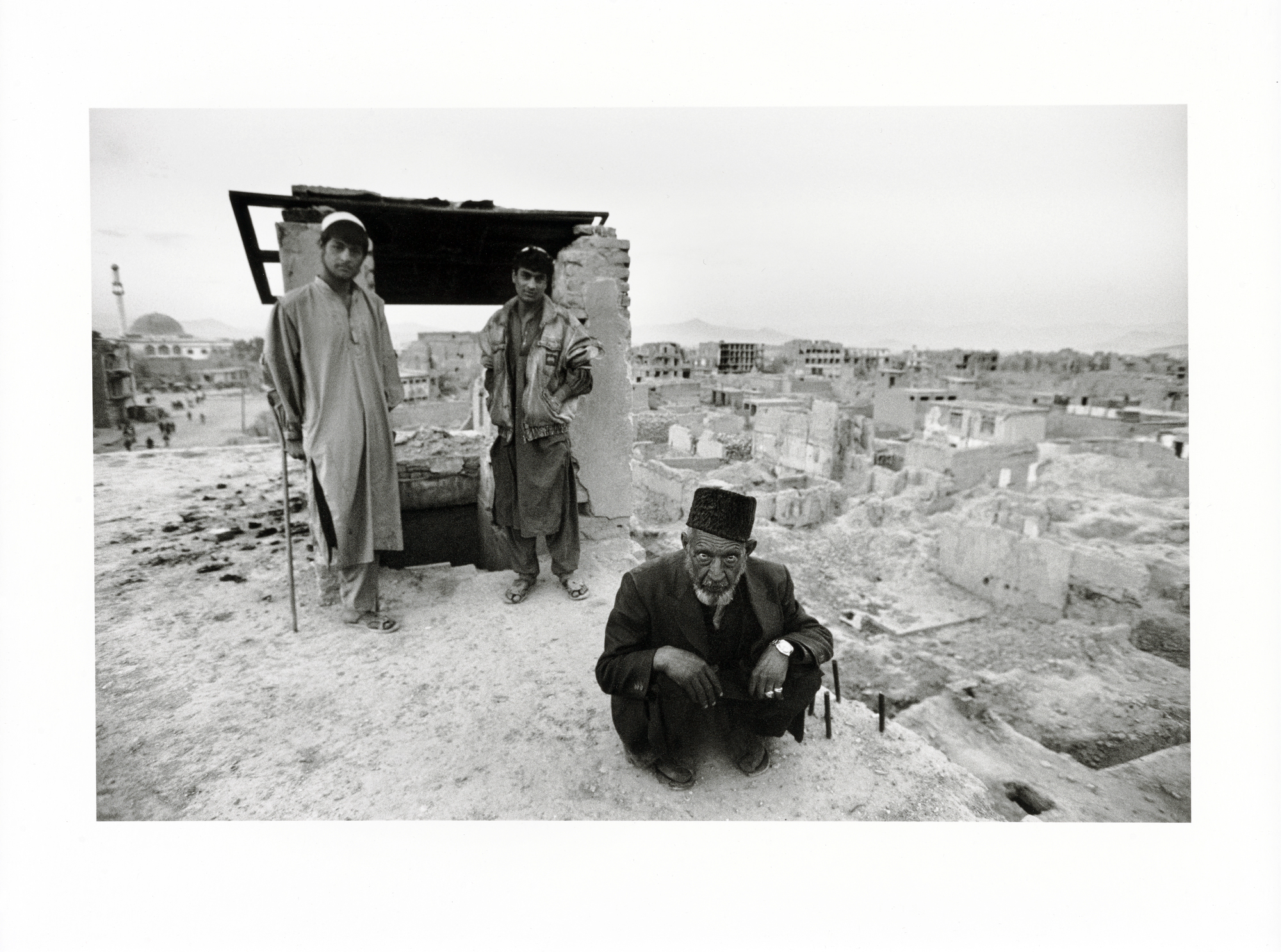
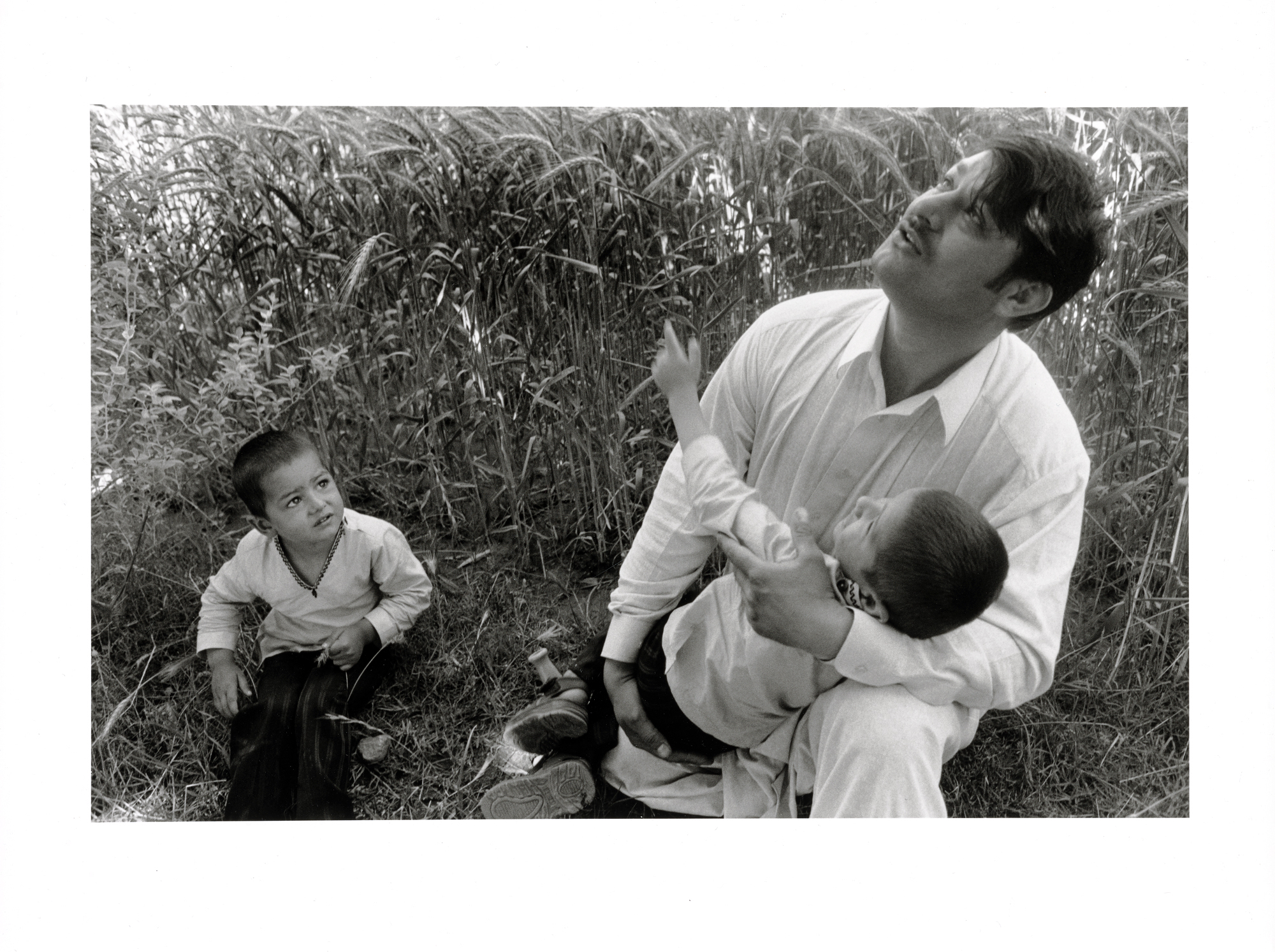
The exhibition also includes compelling contemporary portraits, including photojournalist Seamus Murphy’s record of the physical and emotional toll inflicted upon a family living in Afghanistan under rule of the Taliban, and Donna Ferrato’s documentation of a woman who fled an abusive relationship. Both series register the struggles as well as triumphs.

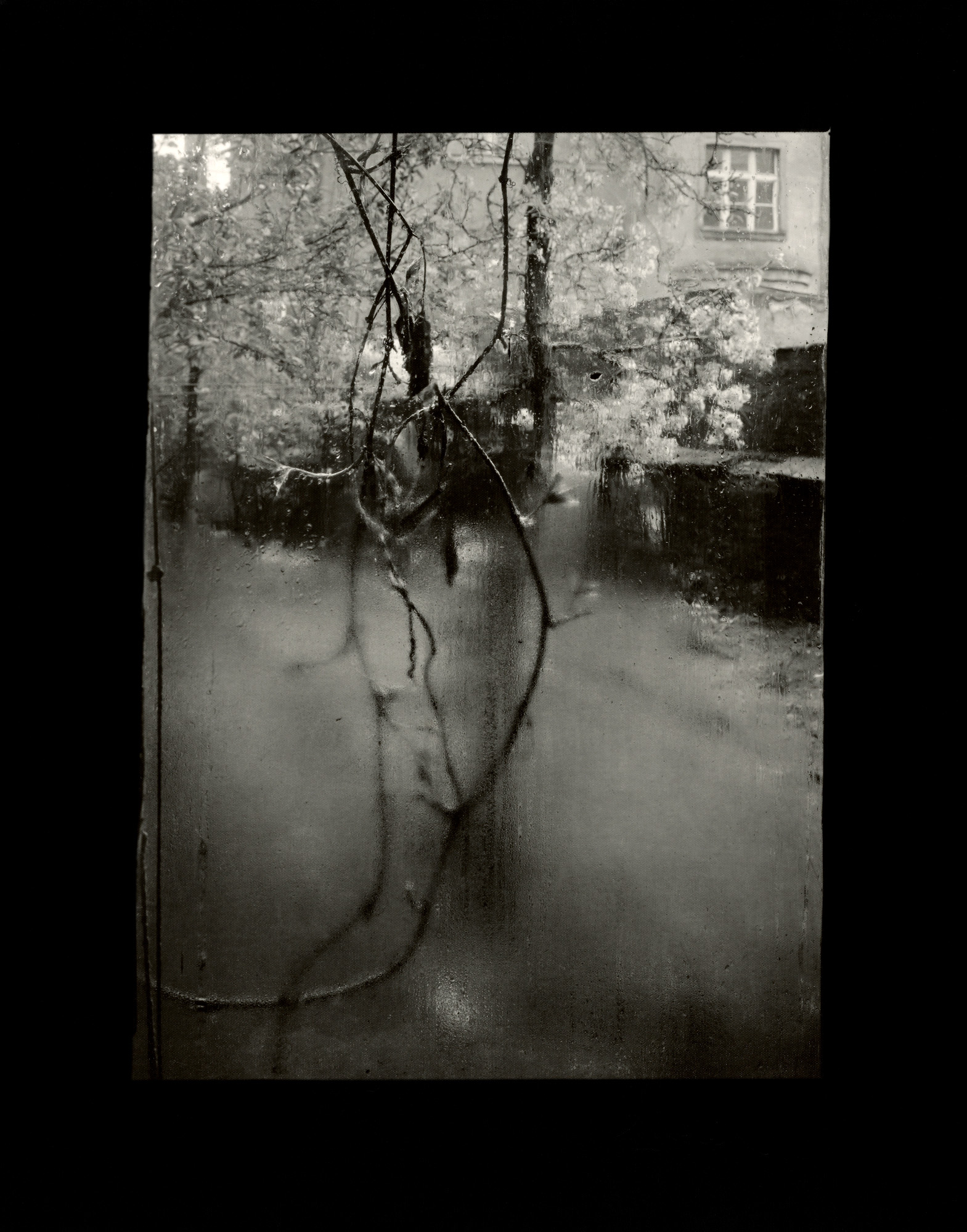
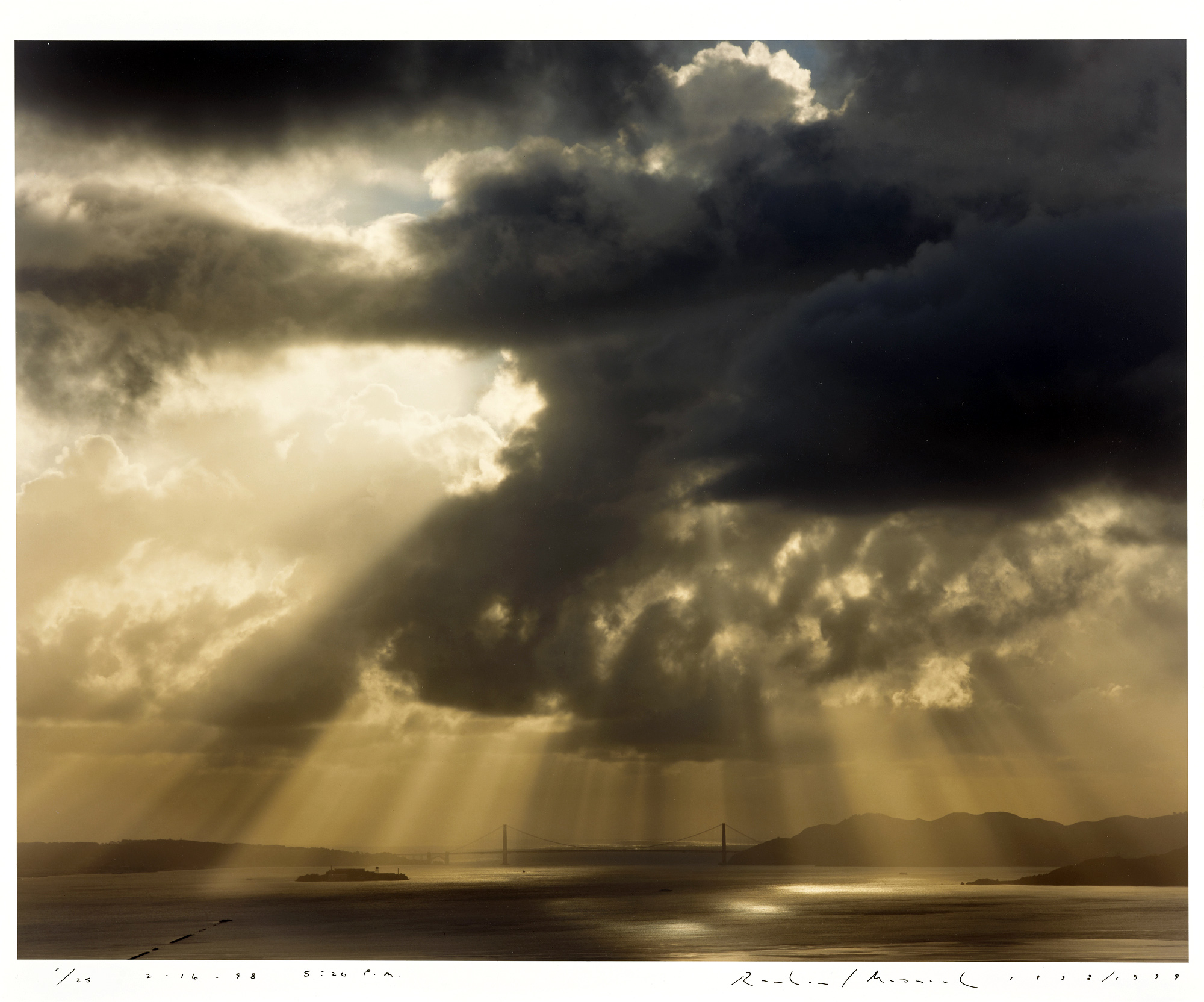
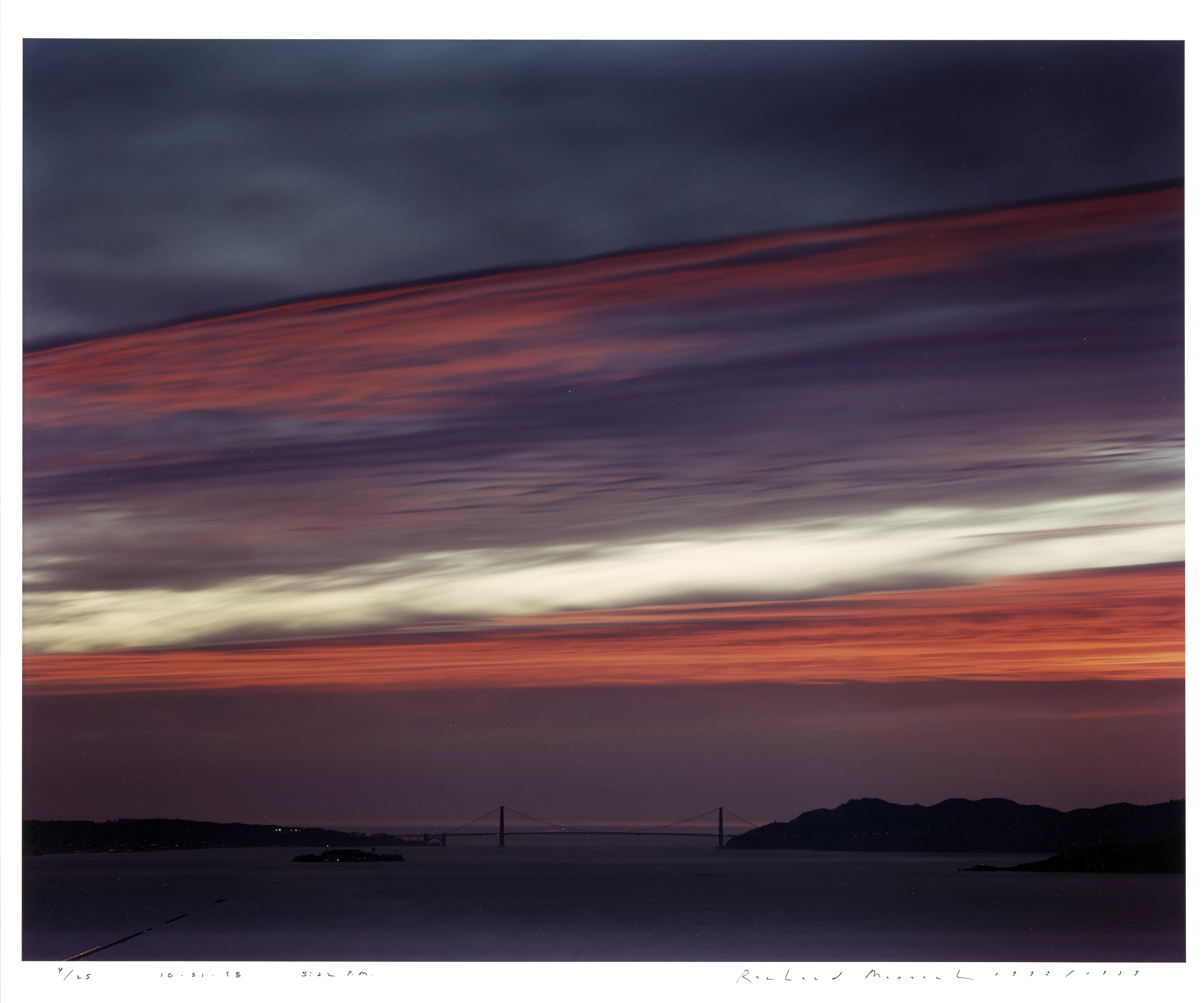
A number of artists in the exhibition document seasonal and man-made changes in the landscape. In a 1953 series by William A. Garnett, aerial photography is used to capture a walnut grove before and after the trees were felled to make way for a housing development. The startling perspective of Garnett’s images came to play an important role in the burgeoning environmental movement. Richard Misrach used his move to a new home in the hills above Berkeley, California, as an opportunity to take hundreds of photographs of the astonishing range of colours and atmospheric conditions surrounding the Golden Gate Bridge at sunset each evening. Several of his richly saturated sunset images are featured in the exhibition. Works by Roni Horn, Jem Southam, and Josef Sudek also trace changes in the natural world, to both political and poetic effect.

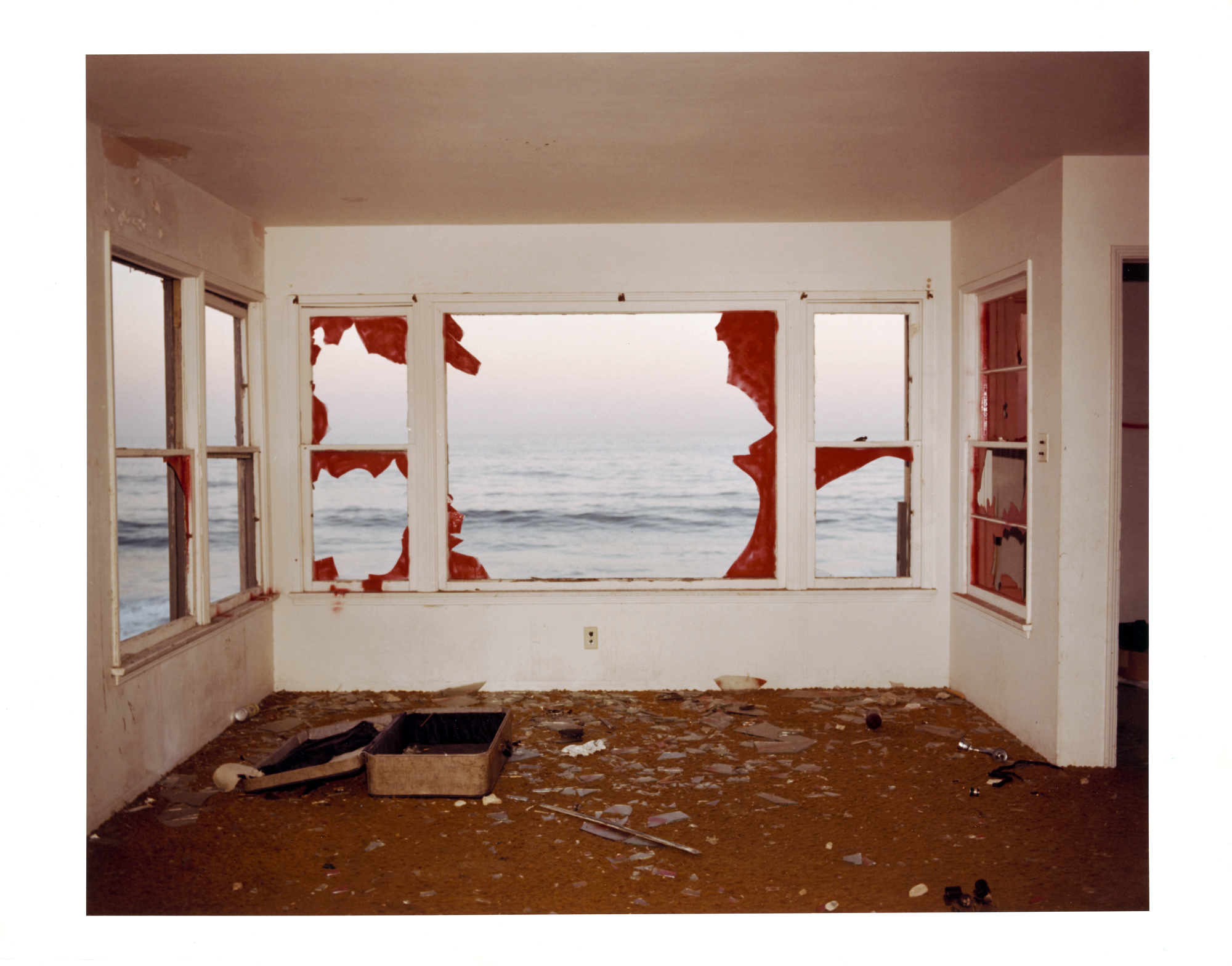
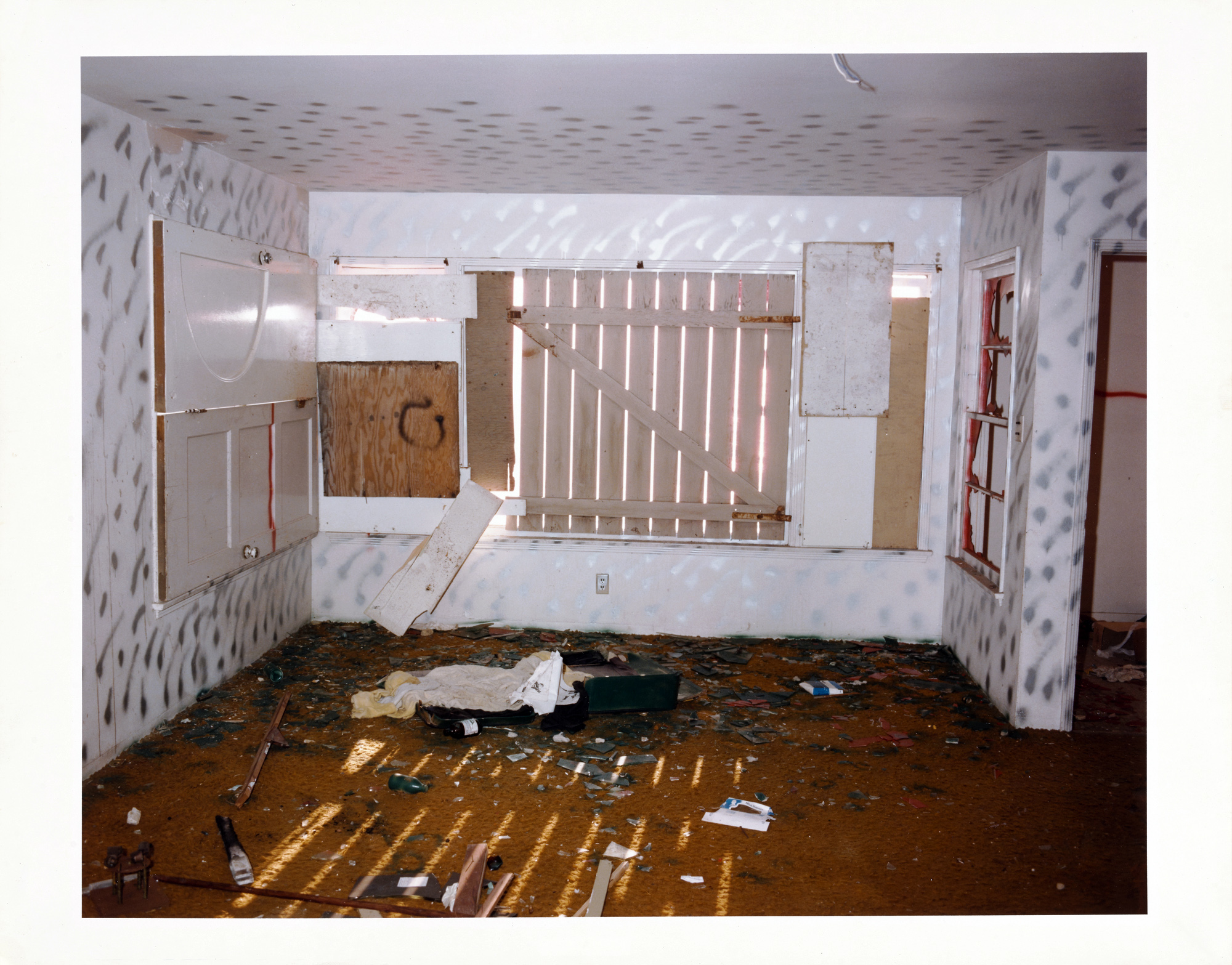
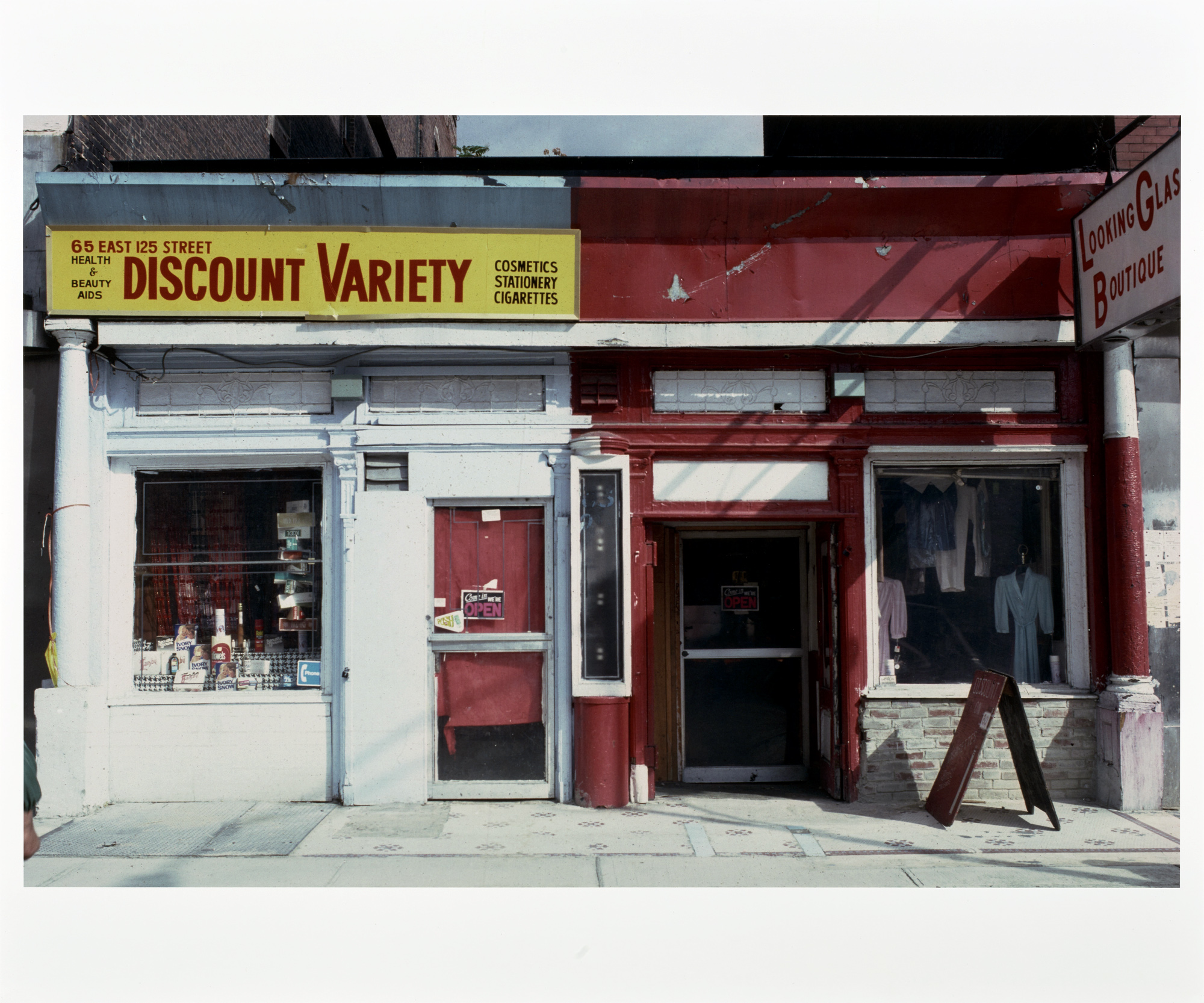
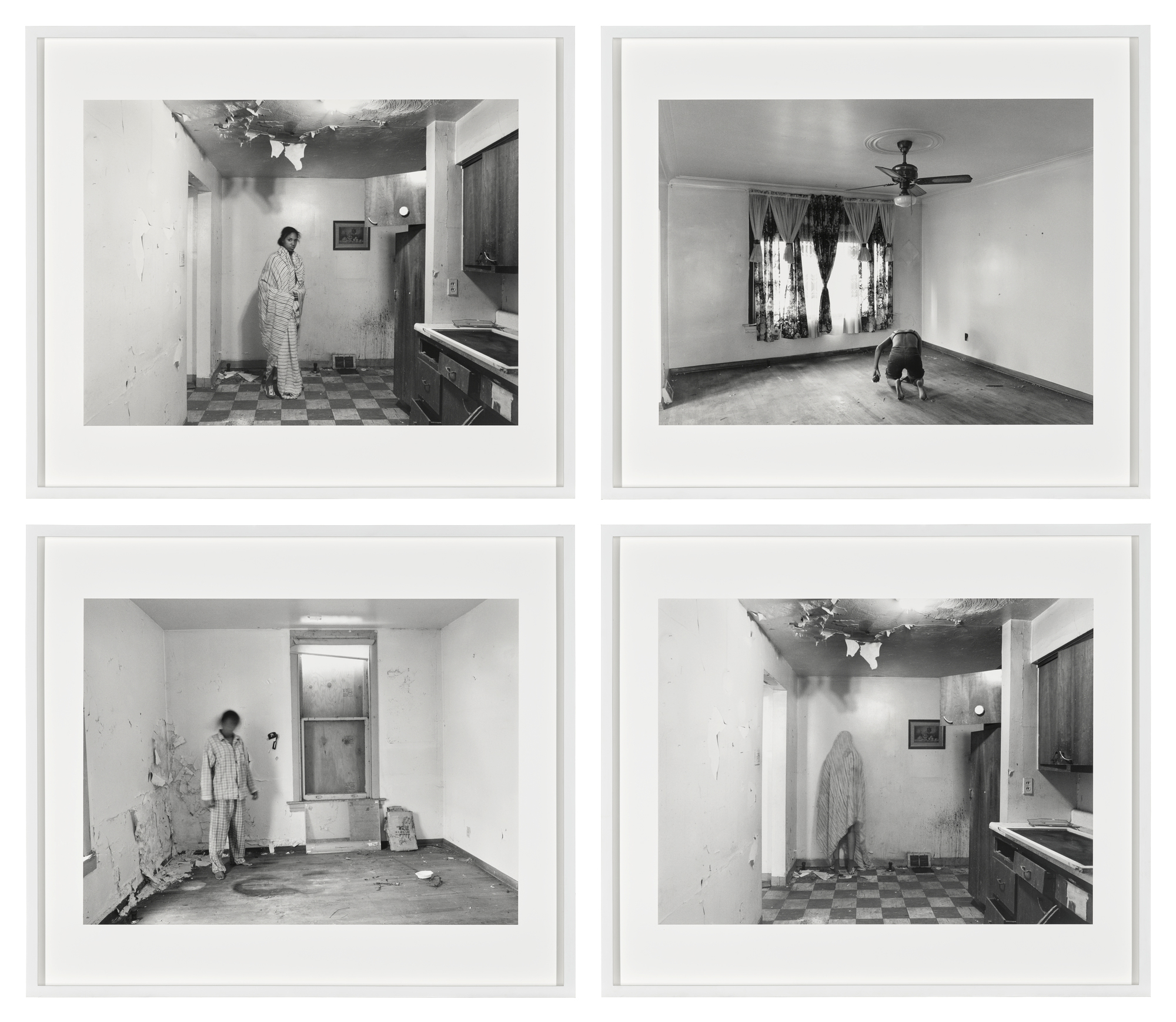
Transformations in the built environment also reveal the profound effects of the passage of time. LaToya Ruby Frazier documented the painful process of clearing the rooms of her family home in a series of self-portraits in which she cloaked herself in the familiar belongings of her loved ones. In order to spotlight socioeconomic changes in American neighbourhoods, Camilo José Vergara photographed the dramatic transformation of a single Harlem storefront over 40 years, as it changed hands, changed facades, and split into two establishments. Other artists in the exhibition, including John Divola and William Christenberry, chronicle the disintegration of architecture over time, creating evocative meditations on deterioration.

“‘Once again’ is a phrase repeated in a poem by William Wordsworth,” says Mazie Harris, assistant curator of photographs at the Getty Museum and curator of the exhibition. “He was fascinated by the powerful feeling that arises when revisiting a familiar place. He’s experiencing his surroundings in real time and yet is constantly aware of his memories of being there before. The photographers in this exhibition conjure that same sensation. They offer us the opportunity to see people and places afresh, even as we track the powerful changes wrought by time.”

Once. Again. Photographs in Series, is on view July 9-November 10, 2019 at the J. Paul Getty Museum, Getty Center. The exhibition is curated by Mazie Harris, assistant curator of photographs at the Getty Museum.

Press release from the J. Paul Getty Museum website [Online] Cited 11/08/2019


Josef Sudek (Czech, 1896-1976) 'The Window of My Studio' 1940-1954


Josef Sudek (Czech, 1896-1976)
The Window of My Studio
1940-1954
Gelatin silver print
Image: 22.1 × 14.1cm (8 11/16 × 5 9/16 in.)
The J. Paul Getty Museum, Los Angeles
© I&G Fárová Heirs


Josef Sudek (Czech, 1896-1976) 'The Window of My Studio' 1940-1954


Josef Sudek (Czech, 1896-1976)
The Window of My Studio
1940-1954
Gelatin silver print
Image: 17.1 × 10.3cm (6 3/4 × 4 1/16 in.)
The J. Paul Getty Museum, Los Angeles
© I&G Fárová Heirs


Josef Sudek (Czech, 1896-1976) 'The Window of My Studio' 1940-1954


Josef Sudek (Czech, 1896-1976)
The Window of My Studio
1940-1954
Gelatin silver print
Image: 23.5 × 16.5cm (9 1/4 × 6 1/2 in.)
The J. Paul Getty Museum, Los Angeles
© I&G Fárová Heirs


William A. Garnett (American, 1916-2006) 'Walnut Grove Standing' March 21, 1953


William A. Garnett (American, 1916-2006)
Walnut Grove Standing
March 21, 1953
Gelatin silver print
Image: 34.3 × 26.7cm (13 1/2 × 10 1/2 in.)
The J. Paul Getty Museum, Los Angeles
© Estate of William A. Garnett


William A. Garnett (American, 1916-2006) 'Walnut Grove Bulldozed' March 21, 1953


William A. Garnett (American, 1916-2006)
Walnut Grove Bulldozed
March 21, 1953
Gelatin silver print
Image: 26.5 × 34.3cm (10 7/16 × 13 1/2 in.)
The J. Paul Getty Museum, Los Angeles
© Estate of William A. Garnett


William A. Garnett (American, 1916-2006) 'Walnut Grove Uprooted by Bulldozers' March 22, 1953


William A. Garnett (American, 1916-2006)
Walnut Grove Uprooted by Bulldozers
March 22, 1953
Gelatin silver print
Image (trimmed to mount): 34.1 × 26.5cm (13 7/16 × 10 7/16 in.)
The J. Paul Getty Museum, Los Angeles
© Estate of William A. Garnett


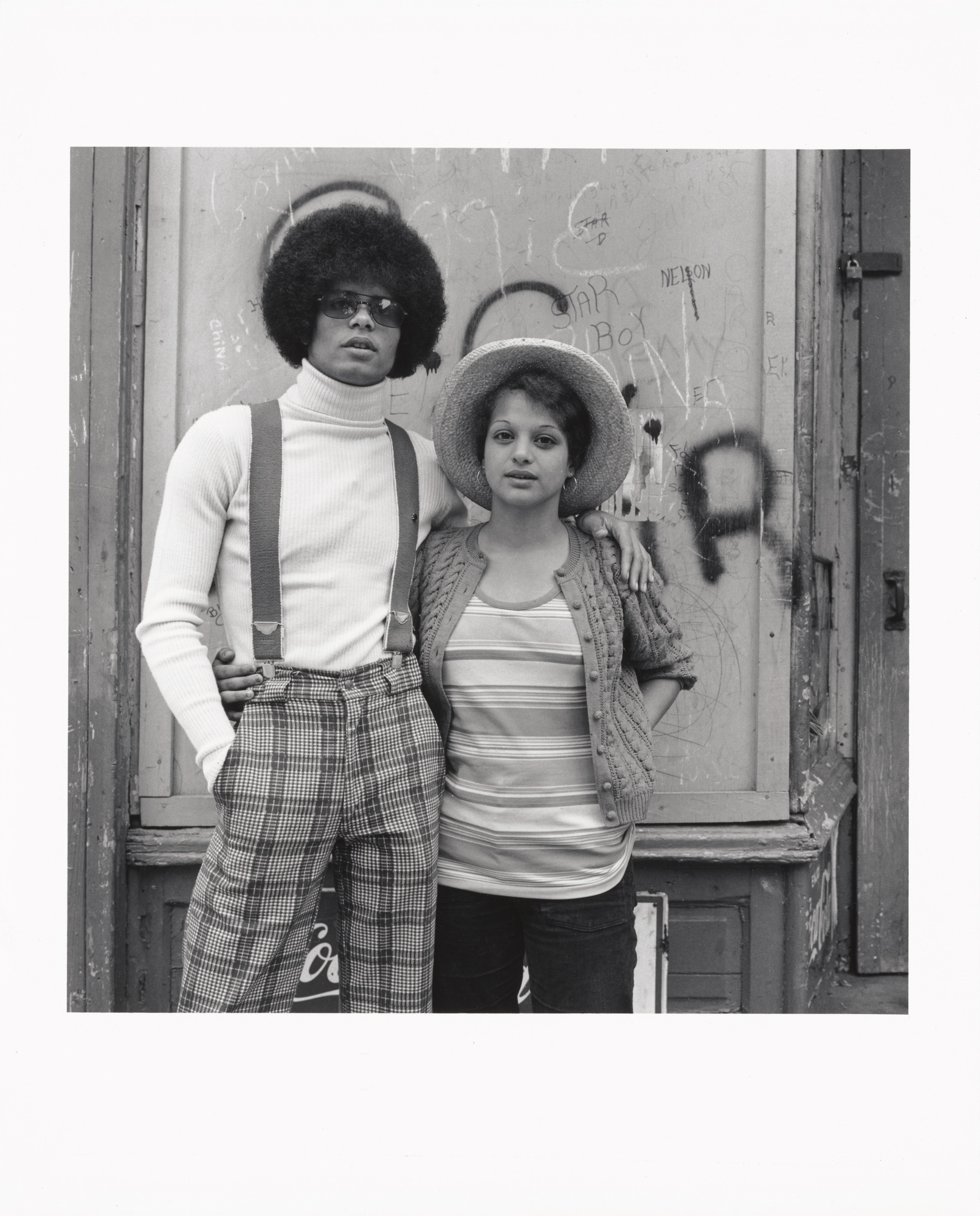
Milton Rogovin (American, 1909-2011) 'Michael and Pam' 1973


Milton Rogovin (American, 1909-2011)
Michael and Pam
1973
Gelatin silver print
Image: 17.9 × 17.4cm (7 1/16 × 6 7/8 in.)
The J. Paul Getty Museum, Los Angeles
© Milton Rogovin


Milton Rogovin (American, 1909-2011) 'Michael and Pam' 1973


Milton Rogovin (American, 1909-2011)
Michael and Pam
1973
Gelatin silver print
Image: 17.9 × 17.4cm (7 1/16 × 6 7/8 in.)
The J. Paul Getty Museum, Los Angeles
© Milton Rogovin


Milton Rogovin (American, 1909-2011) 'Michael and Pam' 1973


Milton Rogovin (American, 1909-2011)
Michael and Pam
1973
Gelatin silver print
Image: 17.9 × 17.4cm (7 1/16 × 6 7/8 in.)
The J. Paul Getty Museum, Los Angeles
© Milton Rogovin


Milton Rogovin (American, 1909-2011) 'Yvonne and Daughter Sonya' 1974


Milton Rogovin (American, 1909-2011)
Yvonne and Daughter Sonya
1974
Gelatin silver print
Image: 18 × 17.3cm (7 1/16 × 6 13/16 in.)
The J. Paul Getty Museum, Los Angeles
© Milton Rogovin


Milton Rogovin (American, 1909-2011) 'Yvonne and Daughter Sonya' 1974


Milton Rogovin (American, 1909-2011)
Yvonne and Daughter Sonya
1974
Gelatin silver print
Image: 17.2 × 17.2cm (6 3/4 × 6 3/4 in.)
The J. Paul Getty Museum, Los Angeles
© Milton Rogovin


Milton Rogovin (American, 1909-2011) 'Yvonne and Daughter Sonya' 1974


Milton Rogovin (American, 1909-2011)
Yvonne and Daughter Sonya
1974
Gelatin silver print
Image: 18.1 × 16.8cm (7 1/8 × 6 5/8 in.)
The J. Paul Getty Museum, Los Angeles
© Milton Rogovin


John Divola (American, born 1949) 'Zuma' 1977


John Divola (American, b. 1949)
Zuma
1977
Chromogenic print
Image: 24.7 × 30.4cm (9 3/4 × 11 15/16 in.)
The J. Paul Getty Museum, Los Angeles
Gift of the Wilson Centre for Photography
© John Divola


John Divola (American, born 1949) 'Zuma' 1977


John Divola (American, b. 1949)
Zuma
1977
Chromogenic print
Image: 24.8 × 30.6cm (9 3/4 × 12 1/16 in.)
The J. Paul Getty Museum, Los Angeles
Gift of the Wilson Centre for Photography
© John Divola


John Divola (American, born 1949) 'Zuma' 1977


John Divola (American, b. 1949)
Zuma
1977
Chromogenic print
Image: 24.7 × 30.5cm (9 3/4 × 12 in.)
The J. Paul Getty Museum, Los Angeles
Gift of the Wilson Centre for Photography
© John Divola


John Divola (American, born 1949) 'Zuma' 1977


John Divola (American, b. 1949)
Zuma
1977
Chromogenic print
Image: 24.8 × 30.6cm (9 3/4 × 12 1/16 in.)
The J. Paul Getty Museum, Los Angeles
Gift of the Wilson Centre for Photography
© John Divola


Camilo José Vergara (American, born Chile, 1944) '65 East 125th Street, Harlem' December 1977


Camilo José Vergara (American born Chile, b. 1944)
65 East 125th Street, Harlem
December 1977
Chromogenic print
Image: 38.7 × 58.4cm (15 1/4 × 23 in.)
The J. Paul Getty Museum, Los Angeles
Gift of Bruce Berman and Lea Russo
© Camilo José Vergara


Camilo José Vergara (American, born Chile, 1944) '65 East 125th Street, Harlem' October 1980


Camilo José Vergara (American born Chile, b. 1944)
65 East 125th Street, Harlem
October 1980
Chromogenic print
Image: 37.8 × 58.5cm (14 7/8 × 23 1/16 in.)
The J. Paul Getty Museum, Los Angeles
Gift of Bruce Berman and Lea Russo
© Camilo José Vergara


Camilo José Vergara (American, born Chile, 1944) '65 East 125th Street, Harlem' October 1981


Camilo José Vergara (American born Chile, b. 1944)
65 East 125th Street, Harlem
October 1981
Chromogenic print
Image: 38.7 × 58.4cm (15 1/4 × 23 in.)
The J. Paul Getty Museum, Los Angeles
Gift of Bruce Berman and Lea Russo
© Camilo José Vergara


Seamus Murphy (Irish, b. 1959) 'Kabul: November 1994' 1994, print 2015


Seamus Murphy (Irish, b. 1959)
Kabul: November 1994
1994, print 2015
Gelatin silver print
Image: 22.6 × 34.2cm (8 7/8 × 13 7/16 in.)
The J. Paul Getty Museum, Los Angeles
Gift of David Knaus
© Seamus Murphy


Seamus Murphy (Irish, b. 1959) 'Ba Deli Family, Kabul: November 1996' 1996, print 2015


Seamus Murphy (Irish, b. 1959)
Ba Deli Family, Kabul: November 1996
1996, print 2015
Gelatin silver print
Image: 22.4 × 34.5cm (8 13/16 × 13 9/16 in.)
The J. Paul Getty Museum, Los Angeles
Gift of David Knaus
© Seamus Murphy


Seamus Murphy (Irish, b. 1959) 'Gulbahar, Kapisa Province: June 2003' 2003, print 2015


Seamus Murphy (Irish, b. 1959)
Gulbahar, Kapisa Province: June 2003
2003, print 2015
Gelatin silver print
Image: 34.6 × 22.6cm (13 5/8 × 8 7/8 in.)
The J. Paul Getty Museum, Los Angeles
Gift of David Knaus
© Seamus Murphy


Seamus Murphy (Irish, b. 1959) 'Gulbahar, Kapisa Province: May 2009' 2009, print 2015


Seamus Murphy (Irish, b. 1959)
Gulbahar, Kapisa Province: May 2009
2009, print 2015
Gelatin silver print
Image: 22.5 × 34.4cm (8 7/8 × 13 9/16 in.)
The J. Paul Getty Museum, Los Angeles
Gift of David Knaus
© Seamus Murphy


Seamus Murphy (Irish, b. 1959) 'Kabul: July 2010' 2010, print 2015


Seamus Murphy (Irish, b. 1959)
Kabul: July 2010
2010, print 2015
Gelatin silver print
Image: 22.6 × 34.7cm (8 7/8 × 13 11/16 in.)
The J. Paul Getty Museum, Los Angeles
Gift of David Knaus
© Seamus Murphy


Seamus Murphy (Irish, b. 1959) 'Kabul: July 2010' 2010, print 2015


Seamus Murphy (Irish, b. 1959)
Kabul: July 2010
2010, print 2015
Gelatin silver print
Image: 22.6 × 34.7cm (8 7/8 × 13 11/16 in.)
The J. Paul Getty Museum, Los Angeles
Gift of David Knaus
© Seamus Murphy


Richard Misrach (American, b. 1949) '10.29.97, 4:35 PM' 1997, print 1999


Richard Misrach (American, b. 1949)
10.29.97, 4:35 PM
1997, print 1999
Chromogenic print
Image: 45.8 × 59cm (18 1/16 × 23 1/4 in.)
The J. Paul Getty Museum, Los Angeles
Gift of Daniel Greenberg and Susan Steinhauser
© Richard Misrach, courtesy Fraenkel Gallery, San Francisco, Pace/ MacGill Gallery, New York and Marc Selwyn Fine Art, Los Angeles


Richard Misrach (American, b. 1949) '2.21.98, 4:45 PM' 1998, print 2016


Richard Misrach (American, b. 1949)
2.21.98, 4:45 PM
1998, print 2016
Chromogenic print
Image: 152.4 × 188cm (60 × 74 in.)
The J. Paul Getty Museum, Los Angeles
Gift of Sharyn and Bruce Charnas
© Richard Misrach, courtesy Fraenkel Gallery, San Francisco, Pace/MacGill Gallery, New York and Marc Selwyn Fine Art, Los Angeles


Richard Misrach (American, b. 1949) '2.16.98, 5:20 PM' 1998, print 1999


Richard Misrach (American, b. 1949)
2.16.98, 5:20 PM
1998, print 1999
Chromogenic print
Image: 46.2 × 58.9cm (18 3/16 × 23 3/16 in.)
The J. Paul Getty Museum, Los Angeles
Gift of Daniel Greenberg and Susan Steinhauser
© Richard Misrach, courtesy Fraenkel Gallery, San Francisco, Pace/ MacGill Gallery, New York and Marc Selwyn Fine Art, Los Angeles


Richard Misrach (American, b. 1949) '10.31.98, 5:22 PM' 1998, print 1999


Richard Misrach (American, b. 1949)
10.31.98, 5:22 PM
1998, print 1999
Chromogenic print
Image: 46.3 × 58.9cm (18 1/4 × 23 3/16 in.)
The J. Paul Getty Museum, Los Angeles
Gift of Daniel Greenberg and Susan Steinhauser
© Richard Misrach, courtesy Fraenkel Gallery, San Francisco, Pace/ MacGill Gallery, New York and Marc Selwyn Fine Art, Los Angeles


LaToya Ruby Frazier (American, b. 1982) 'Four photographs' 2010


LaToya Ruby Frazier (American, b. 1982)
Clockwise from top left: Wrapped in Gramps’ Blanket, 2010; In Grandma Ruby’s Velour Bottoms, 2010; Covered in Gramps’ Blanket, 2010; In Gramps’ Pajamas, 2010
Gelatin silver prints
Image (each): 43.5 × 58.4cm (17 1/8 × 23 in.)
The J. Paul Getty Museum, Los Angeles
Purchased with funds provided by the Photographs Council
© LaToya Ruby Frazier


Jem Southam (British, b. 1950) 'December 1996'


Jem Southam (British, b. 1950)
December 1996
1996
Chromogenic print
68.6 × 85.7cm (27 × 33 3/4 in.)
Gift of The Michael G. and C. Jane Wilson 2007 Trust
© Jem Southam


Jem Southam (British, b. 1950) 'March 1998'


Jem Southam (British, b. 1950)
March 1998
1998
Chromogenic print
68.6 × 85.7cm (27 × 33 3/4 in.)
Gift of The Michael G. and C. Jane Wilson 2007 Trust
© Jem Southam


Jem Southam (British, b. 1950) 'January 2000'


Jem Southam (British, b. 1950)
January 2000
2000
Chromogenic print
68.6 × 85.7cm (27 × 33 3/4 in.)
Gift of The Michael G. and C. Jane Wilson 2007 Trust
© Jem Southam


Donna Ferrato (American, b. 1949) 'Sarah Augusta' 2012


Donna Ferrato (American, b. 1949)
Sarah Augusta
2012
Pigment print
28.6 × 50.8cm (11 1/4 × 20 in.)
Gift of The Kevin & Delia Willsey Collection
© Donna Ferrato


Donna Ferrato (American, b. 1949) 'Sarah Augusta Learning Self Defense' 2013


Donna Ferrato (American, b. 1949)
Sarah Augusta Learning Self Defense
2013
Pigment print
33.9 × 50.9cm (13 3/8 × 20 1/16 in.)
Gift of The Kevin & Delia Willsey Collection
© Donna Ferrato


Donna Ferrato (American, b. 1949) 'Sarah after a Court Hearing' 2014


Donna Ferrato (American, b. 1949)
Sarah after a Court Hearing
2014
Pigment print
33.9 × 50.8cm (13 3/8 × 20 in.)
Gift of The Kevin & Delia Willsey Collection
© Donna Ferrato


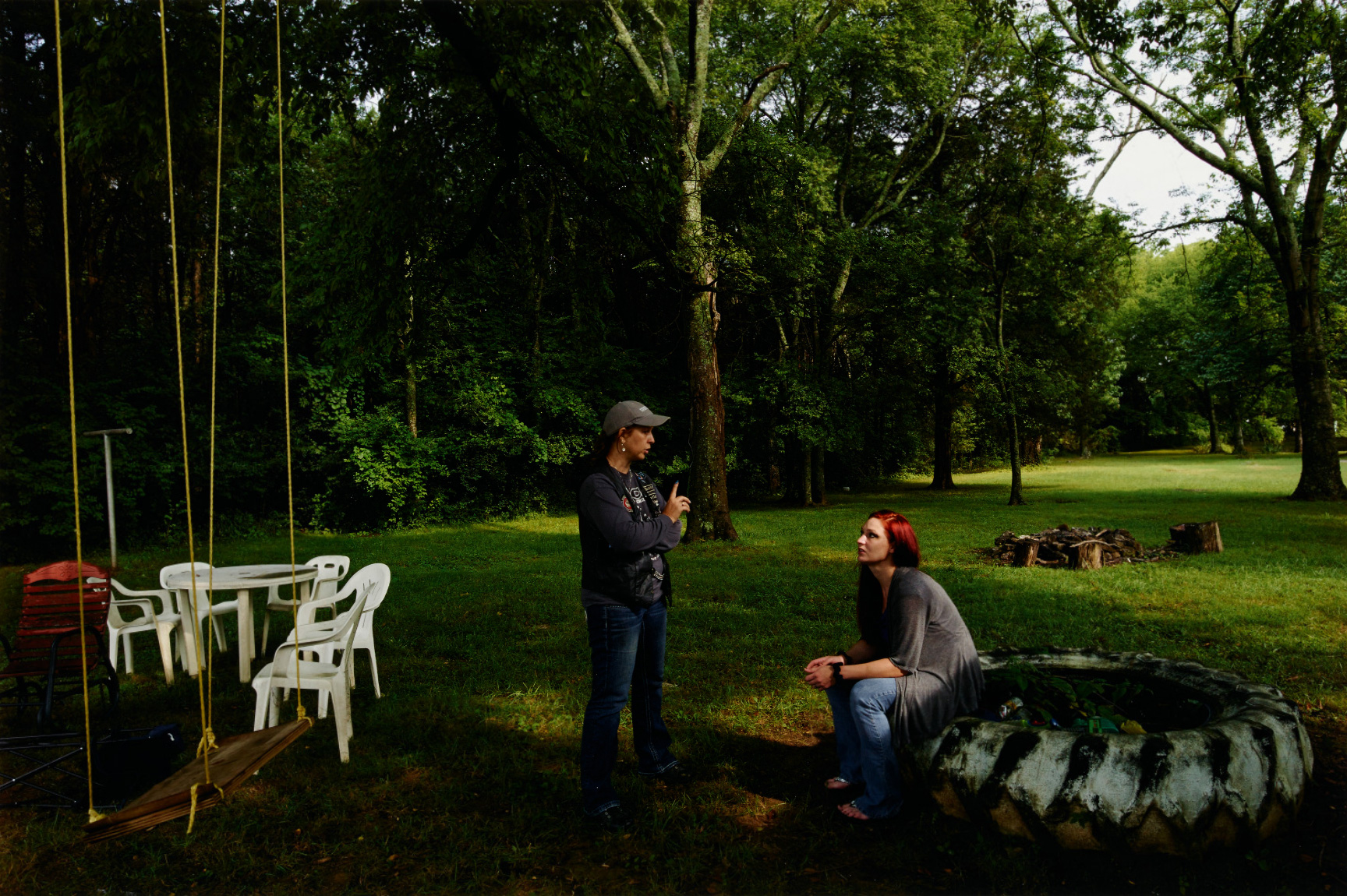
Donna Ferrato (American, b. 1949) 'Sarah and a member of B.A.C.A. discussing a strategy to protect the boys' 2014


Donna Ferrato (American, b. 1949)
Sarah and a member of B.A.C.A. discussing a strategy to protect the boys
2014
Pigment print
33.9 × 50.8cm (13 3/8 × 20 in.)
Gift of The Kevin & Delia Willsey Collection
© Donna Ferrato


Donna Ferrato (American, b. 1949) 'Sarah' 2013


Donna Ferrato (American, b. 1949)
Sarah
2013
Pigment print
50.8 x 33.9cm (20 in. x 13 3/8)
Gift of The Kevin & Delia Willsey Collection
© Donna Ferrato


The J. Paul Getty Museum
1200 Getty Center Drive
Los Angeles, California 90049

Opening hours:
Daily 10am – 5.30pm

The J. Paul Getty Museum website

LIKE ART BLACK ON FACEBOOK

Back to top

Exhibition: ‘(un)expected families’ at the Museum of Fine Arts, Boston

Exhibition dates: 9th December, 2017 – 17th June, 2018

Curator: Karen Haas


Christopher Churchill (American, b. 1977) 'Hutterite Classroom, Gildford, MT' 2005 from the exhibition '(un)expected families' at the Museum of Fine Arts, Boston, Dec 2017 - June 2018


Christopher Churchill (American, b. 1977)
Hutterite Classroom, Gildford, MT
2005
Gelatin silver print
Gift of Elisa Fredrickson / Museum of Fine Arts, Boston
Photograph: © Museum of Fine Arts, Boston


Expected families

It’s hard to get a sense of this exhibition from the media images, therefore difficult to make any constructive comment on the strength of the exhibition.

Apparently,

“The exhibition’s gallery feels very domestic. Groups of photos hang on the walls – different sizes, colours, formats and frames – like you’d see in a living room or hallway. MFA curator Karen Haas confirms that evocation is absolutely intentional.

“Photographers from the very beginning have been fascinated by the way that the camera could capture images of loved ones, freeze them in time,” she says. “They form sort of reliquaries of memory, and these sorts of relationships to the objects – that idea of the photograph as a talisman-like object I think has been somewhat forgotten in our contemporary world.” …

Haas’ goal in creating this show is to illustrate how broad and diverse family configurations can be – without defining them. “The families that we’re born into, generational families,” she describes, “but also romantic unions, couples and chosen families – families we have chosen for ourselves.” And that includes the military and the church, Haas says. “I think the family is such a basic social construct – so basic to so many of our lives – that I hope that these kinds of images will really resonate with people.”1


Outsider family, insider family, single parent family, nuclear family, extended family, reconstituted family, childless family, gay family, step family, “family has always taken diverse forms: affluent and destitute, cohesive and fractured, expected and unexpected. Taken together, the photographs challenge visitors to consider what family means to them.”

But what is most important is this:

“There is no right or wrong answer when it comes to what is the best type of family structure. As long as a family is filled with love and support for one another, it tends to be successful and thrive. Families need to do what is best for each other and themselves, and that can be achieved in almost any unit.”2


Families all have secrets, no matter how perfect they may seem to the outside world. Whether it be domestic violence behind closed doors or skeletons in the closet there is always more than meets the eye. And that’s where these photographs of families fail in their representation of the family. That, and the title of the exhibition – (un)expected families – because in the 21st century, nothing should be unexpected.

By adding emphasis to the (un), the title merely propagates a form of discrimination, of outsider as different and therefore worthy of abuse because of that very difference.

Expected families: we are all human beings and therefore anything is to be expected.

Dr Marcus Bunyan


1/ Andrea Shea. “Portraits At The MFA Question What Family Looks Like,” on the Wbur website December 20, 2017 [Online] Cited 16/02/2022

2/ Michelle Blessing. “Types of Family Structures,” on the Love to Know website Nd [Online] Cited 16/02/2022


Many thankx to the Museum of Fine Arts Boston for allowing me to publish the photographs in the posting. Please click on the photographs for a larger version of the image.


Lewis W. Hine (American, 1874-1940) 'Home Workers, New York' 1915 from the exhibition '(un)expected families' at the Museum of Fine Arts, Boston, Dec 2017 - June 2018


Lewis W. Hine (American, 1874-1940)
Home Workers, New York
1915
Lewis W. Hine/Museum of Fine Arts, Boston


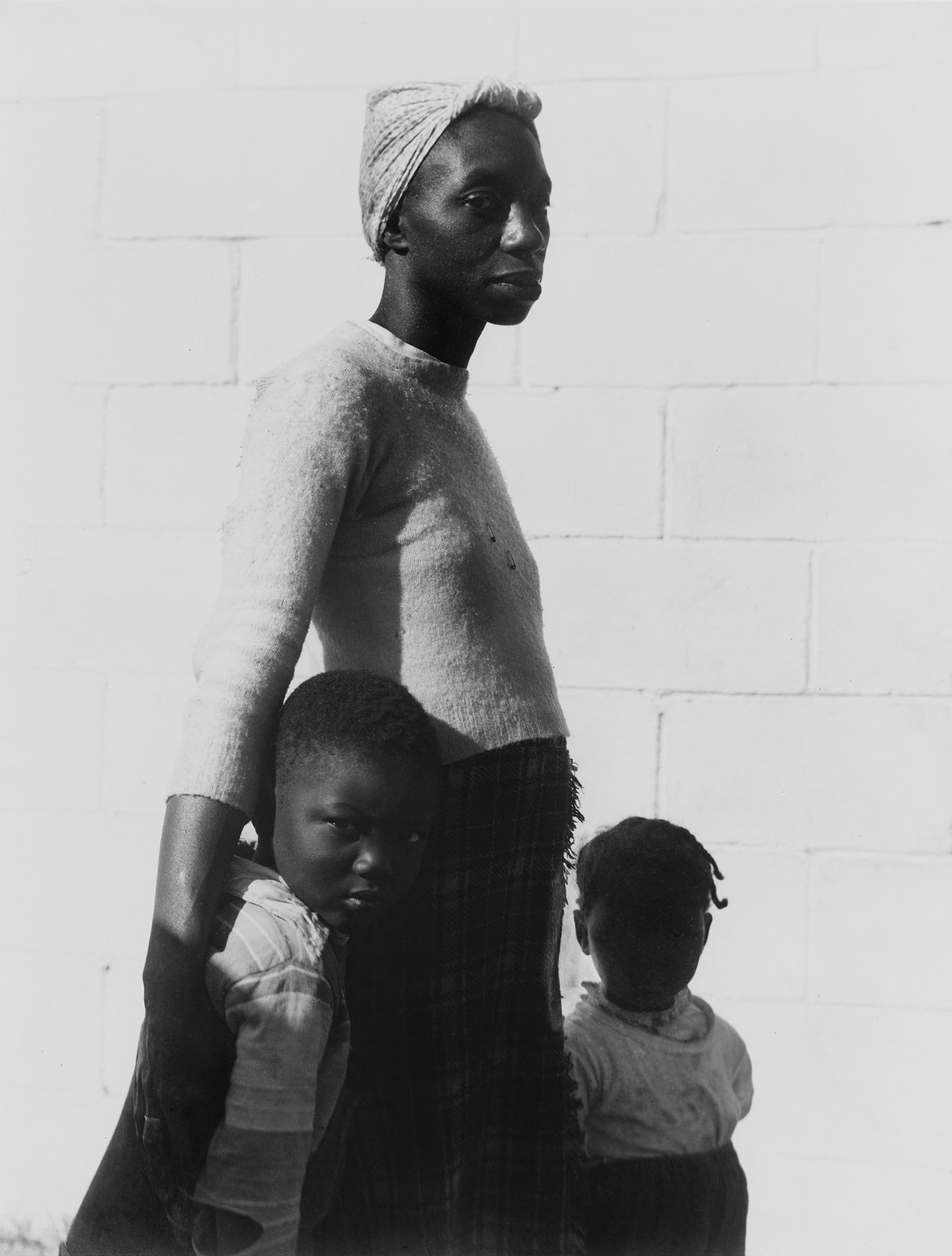
Dorothea Lange (American, 1895-1965) 'Migrant family, Texas' 1936


Dorothea Lange (American, 1895-1965)
Migrant family, Texas
1936
Gelatin silver print
Sophie M. Friedman Fun
Dorothea Lange/Museum of Fine Arts, Boston
Photograph: © Museum of Fine Arts, Boston


Bringing together more than 80 pictures taken by American photographers from the 19th century to today, (un)expected families explores the definition of the American family – from the families we are born into to the ones we have chosen for ourselves. The works on view depict a wide range of relationships, including multiple generations, romantic unions, and alternative family structures.

Using archival, vernacular, and fine art photographs, (un)expected families offers a variety of perspectives on the American family, from Dorothea Lange’s depiction of a migrant family at the time of the Dust Bowl to Louie Palu’s portraits of US Marines fighting in Afghanistan. The exhibition illustrates that the family has always taken diverse forms: affluent and destitute, cohesive and fractured, expected and unexpected. Taken together, the photographs challenge visitors to consider what family means to them.

(un)expected families features celebrated practitioners like Nan Goldin, Carrie Mae Weems, LaToya Ruby Frazier, and Harry Callahan, as well as a number of renowned Boston-area artists, such as David Hilliard, Nicholas Nixon, Abe Morell, and Sage Sohier.

Text from the Museum of Fine Arts, Boston website


Louis Faurer (American, 1916-2001) 'Ritz Bar, New York' 1947-1948


Louis Faurer (American, 1916-2001)
Ritz Bar, New York
1947-1948
Estate of Louis Faurer/Museum of Fine Arts, Boston


Duane Michals (American, 1932-2026) 'When he was young, he could not imagine being old. And now that he is old, he cannot imagine ever having been young' 1979


Duane Michals (American, 1932-2026)
When he was young, he could not imagine being old. And now that he is old, he cannot imagine ever having been young
1979
Gelatin silver print
Duane Michals, courtesy of the DC Moore Gallery, New York, and Osmos, New York


Nicholas Nixon (American, b. 1947) 'Yazoo City, Mississippi' 1979


Nicholas Nixon (American, b. 1947)
Yazoo City, Mississippi
1979
Gelatin silver contact print
Museum purchase with funds donated by the National Endowment for the Arts and Richard L. Menschel, Bela T. Kalman, Judge and Mrs. Matthew Brown, Mildred S. Lee, and Barbara M. Marshall
© Nicholas Nixon, Courtesy Fraenkel Gallery, San Francisco
Photograph: © Museum of Fine Arts, Boston


Nan Goldin (American, b. 1953) 'Jimmy Paulette and Tabboo! in the bathroom, New York' 1991


Nan Goldin (American, b. 1953)
Jimmy Paulette and Tabboo! in the bathroom, New York
1991
Cibachrome print
Horace W. Goldsmith Foundation Fund for Photography
© Nan Goldin
Photograph: © Museum of Fine Arts, Boston


“I used to think that I could never lose anyone if I photographed them enough. But in fact my pictures show me just how much I’ve lost.” ~ Nan Goldin


Tina Barney (American, b. 1945) 'Thanksgiving' 1992


Tina Barney (American, b. 1945)
Thanksgiving
1992
Chromogenic print
Contemporary Curator’s Fund, including funds donated by Barbara and Thomas Lee
Tina Barney/Museum of Fine Arts, Boston
© Tina Barney
Photograph: © Museum of Fine Arts, Boston


Sage Sohier (American, b. 1954) 'Mum in her bathtub, Washington, D.C.' 2002


Sage Sohier (American, b. 1954)
Mum in her bathtub, Washington, D.C.
2002
Inkjet print
Living New England Artists Purchase Fund, created by the Stephen and Sybil Stone Foundation
Courtesy Museum of Fine Arts, Boston


Nicholas Nixon (American, b. 1947) 'Tammy Hindle' 2006


Nicholas Nixon (American, b. 1947)
Tammy Hindle
2006
Digital inkjet print
Gift of James N. Krebs
© Nicholas Nixon, Courtesy Fraenkel Gallery, San Francisco
Photograph: © Museum of Fine Arts, Boston


Julie Mack (American, b. 1982) 'Self-portrait (Julie) with family in SUV, Michigan' 2007


Julie Mack (American, b. 1982)
Self-portrait (Julie) with family in SUV, Michigan
2007
Chromogenic print
James N. Krebs Purchase Fund for 21st Century Photography
© Julie Mack. Courtesy Laurence Miller Gallery, New York
Photograph: © Museum of Fine Arts, Boston


David Hilliard  (America, b. 1964) 'Rock Bottom' 2008


David Hilliard  (America, b. 1964)
Rock Bottom
2008
Panorama Construction


Rock Bottom features, in the left panel, a close up sharp focus portrait of Hilliard’s father standing in a lake, with a severe and harsh facial expression, yet vulnerably placing his hands on his chest between his two sailor swallow’s tattoos. In the right panel, Hilliard himself appears somewhat further from the camera. With a gentler facial expression, the photographer contrasts with his tense patriarchal figure, but features a similar hairy chest and matching tattoos  –  giving the viewer a hint on the subject’s father-son relationship. The middle panel is exclusive for environmental portraiture and the creation of meaning in the composition: a sunny day at the lake, where the blue skies and soft clouds perfectly reflect on the water and separate the subject matters. The real meaning of the juxtaposition relies on the knowledge of Hilliard’s personal life and the presence of the middle panel: although the father accept his son’s homosexuality, the issue has clearly been a source of tension between them, creating both emotional and physical distance between the subject matters. Represented by the central panel, a stunning view divides the two generations both visually and metaphorically, symbolising the idea of emotional distance in an atypical form.

Like most of Hilliard’s photographs, Rock Bottom exposes how physical distance is often manipulated to represent emotional distance. The presence of the middle panel, exclusively dedicated to environmental portraiture and the emphasis on the importance of our surroundings, also suggests the emotional distance between the subjects. The lack of elements and presence of great depth of field of the center panel insinuates that, regardless of the level of intimacy between the subject matters  – distance is always palpable.

Marina Pedrosa. “David Hilliard: Building Meaning Through Composition,” on the medium website [Online] Cited 22/08/2018. No longer available online


Julie Blackmon (American, b. 1966) 'Baby Toss' 2009


Julie Blackmon (American, b. 1966)
Baby Toss
2009
Elizabeth and Michael Marcus
Courtesy, Museum of Fine Arts, Boston
Photograph: © Museum of Fine Arts, Boston


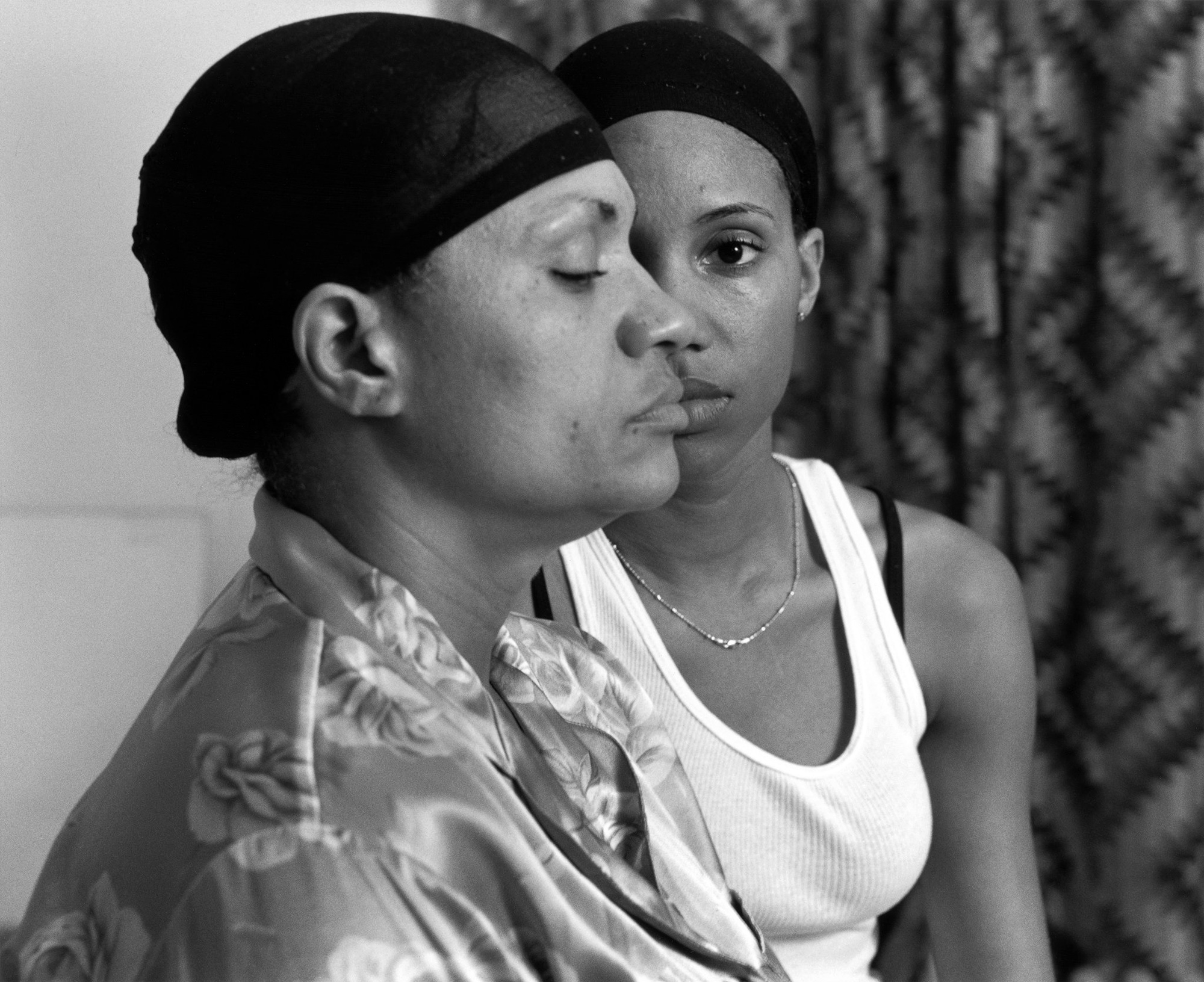
LaToya Ruby Frazier (American, b. 1982) 'Mom' 2008


LaToya Ruby Frazier (American, b. 1982)
Mom
2008
Gelatin silver print
From “The Notion of Family” (Aperture, 2014)
Photograph: © Museum of Fine Arts, Boston


Caleb Cole (American, b. 1981) 'The Big Sister' 2012


Caleb Cole (American, b. 1981)
The Big Sister
2012
From the series Odd One Out (2010-Present)
Archival pigment print
49 × 68cm (19 5/16 × 26 3/4 in.)
Museum purchase with funds donated by James N. Krebs


Bringing together more than 80 pictures taken by photographers from the 19th century to today, (un)expected families at the Museum of Fine Arts, Boston (MFA), explores the definition of the American family – from the families we’re born into to the ones we’ve chosen. The photographs in the exhibition, on view from December 9, 2017 through June 17, 2018, depict a wide range of relationships – multiple generations, romantic unions and alternative family structures – whether connected by DNA, shared life experiences, common interests or even a social media network. Encompassing both carefully staged portraits and serendipitous snapshots, the selection of vernacular, documentary and fine art photographs in (un)expected families illustrates that the concept of family has long taken many forms – a subject that has fascinated photographers since the invention of the camera – and challenges visitors to consider what family means to them. Drawn primarily from the MFA’s holdings, the exhibition includes photographs by celebrated artists such as Nan Goldin, Gordon Parks, Nicholas Nixon, Sally Mann, Diane Arbus, Tina Barney, Emmet Gowin and Bruce Davidson. Loans from private collections include Victorian-era “hidden mother” photographs of children and turn-of-the-century portraits of women in intimate relationships sometimes referred to as “Boston marriages.” Additionally, (un)expected families highlights many New England photographers whose work centers on familial relationships, debuting eight photographs – acquired specifically for the exhibition – by Zoe Perry-Wood, Arno Rafael Minkkinen, Amber Tourlentes, Caleb Cole, Tanja Hollander, David Hilliard and Jeannie Simms. An interactive component of (un)expected families invites visitors to share thoughts about their own families on response cards. A selection will be displayed in the gallery on a rotating basis, and all will be archived as part of the permanent exhibition record. Additionally, a free family guide engages children with close looking and drawing activities. The exhibition is generously supported by an anonymous donor.

“Almost as soon as exposure times became short enough to make portraiture feasible, photographers have been drawn to capture likenesses of loved ones. Perhaps that power to freeze a moment in time is what explains why family photographs are so often described as the first thing one would save from a burning building,” said Karen Haas, Lane Curator of Photographs. “I find it particularly fascinating that there seems to be a growing interest among contemporary photographers to focus on families in their work – even as with the rise of smartphones and social media, our own personal pictures are increasingly relegated to the ether, rarely experienced as tangible objects.”

The images presented in (un)expected families span 150 years. Among the oldest pictures are photographs of “hidden mothers” (1860s-1870s), depicting infants in the laps of concealed adults – a trick to keep the children still during long sittings or exposures. The mothers or nursemaids were draped with scarves or blankets, or hidden behind furniture or painted backdrops. Similarly, the contemporary photograph Nayla, Ted, Alexandra, Nick, March 30, 1995 (1995) by Cambridge-based Elsa Dorfman (born 1937) focuses solely on the children. While names of the parents are among those handwritten on the bottom of the large-scale Polaroid, only their legs are visible in the composition. Another contemporary photograph juxtaposed with the Victorian-era “hidden mothers,” which were made during a period of high infant mortality rates, is Tammy Hindle (2006) by Nicholas Nixon (born 1947). Part of Nixon’s series documenting a family’s heartbreaking loss of a child, the image shows the mother, Tammy, carrying a portrait of the baby, Claire, to the funeral service, their bodies appearing to magically merge in the reflection within the picture frame.

Father-and-son relationships are explored in images by Dawoud Bey (born 1953), Duane Michals (born 1932) and Jim Goldberg (born 1953), all of which incorporate texts that amplify the moving and often painful stories behind the images, as well as recently acquired photographs by David Hilliard (born 1964) and Arno Rafael Minkkinen (born 1945). Hilliard’s triptych Rock Bottom (2008) is one of an extended series of panoramic photographs that trace the shifting narrative of the gay artist’s complicated relationship with his father. The beautifully choreographed self-portrait visually links the two men, unmistakably related to each other and sporting identical swallow tattoos, across a serene expanse of lake. Minkkinen’s 31-12-86, Self-Portrait with Daniel, Andover (1986), recently gifted to the MFA by the artist, is one of a little-known series of portraits that he took of his son Daniel as the boy grew and matured from infancy to adolescence. The photograph shows Daniel sitting on a bed, bathed in raking light and looking directly at his father’s large-format camera. With his head hidden from view, Minkkinen’s outstretched arms perfectly echo the curve of the headboard and create a haunting embrace that speaks to a parent’s deep-seated desire to encircle and protect a child.

Seventeen photographs representing multiple generations of a family are arranged in a salon-style hang, ranging from intimate depictions of parents with children, such as Baby Toss (2009) by Julie Blackmon (born 1966); to pairs of siblings, such as Twins at WDIA, Memphis (about 1948) by Ernest C. Withers (1922–2007); to a 1925 panorama capturing an extended family reunion encompassing about 200 people. The display also features recently acquired photographs by Sage Sohier (born 1954) and Jeannie Simms (born 1967). Sohier’s Mum in her bathtub, D.C. (2002) is from an extended series devoted to her mother, a former fashion model who had posed for Richard Avedon and Irving Penn in the 1940s. Simms’ Arnie, Susan & Elijah, Jamaica Plain, MA (2015) is from a series documenting the lives of couples married in Cambridge after Massachusetts became the first U.S. state to issue same-sex marriage licenses on May 17, 2004.

Recently acquired works by Amber Tourlentes (born 1970), Zoe Perry-Wood (born 1959) and Jess Dugan (born 1986) also document the experience of LGBTQ couples, families and individuals. Tourlentes has regularly made LGBTQ family portraits on the Town Hall stage in Provincetown, Massachusetts, during its annual Family Week, sometimes revisiting the same subjects over the course of several years. Perry-Wood has spent the last decade photographing another annual event, the Boston Alliance of Gay and Lesbian Youth (BAGLY) Prom, which offers a safe and celebratory occasion for young couples – an alternative to more traditional high-school proms. Allowing her subjects to pose in front of the camera in a studio-like setting, as seen in José and Luis (2015), Perry-Wood helps to give them a sense of personal agency and collective pride at a pivotal moment in their lives. Unlike Tourlentes and Perry-Wood, Dugan photographs her subjects – friends within the LGBTQ community – in natural light and the privacy of their own living spaces, exploring issues of gender, identity and social connection through large-format portraits such as Devotion, from the series Every Breath We Drew (2012).

With the invention of the small and affordable Kodak camera in the late 19th century, followed by the instant camera in the 1940s, many Americans no longer felt the need to visit formal portrait studios in order to record their personal lives. Among the casual snapshots featured in (un)expected families are Polaroids of Caroline Kennedy and her cousin Tina Radziwill, taken by Andy Warhol (1928-1987) in the summer of 1972 and exhibited at the MFA for the first time. The artist – along with filmmaker Jonas Mekas and photographer Peter Beard – was hired by Jacqueline Kennedy Onassis to teach the children filmmaking and photography. Also on view are an album of photographs commemorating a fraternity at Baker University in Kansas (1910s) and six snapshots depicting “Boston marriages” (1920s-1930s) – a turn-of-the-century term used to describe two women living together without the support of a man – romantic relationships in some cases and simply platonic partnerships in others.

Several groupings in the exhibition are centered on places of family life. Working roughly 50 years apart, one on New York’s Lower East Side and the other in Harlem, Lewis Hine (1874-1940) and Bruce Davidson (born 1933) both found the kitchen table an ideal site for their documentary photographs of tenement families in New York City. The groundbreaking Kitchen Table series (1990) by Carrie Mae Weems (born 1953) – featuring the photographer herself as the central figure, alongside lovers, children and friends – speaks to all those who have loved, quarrelled and come together around a communal table. Similarly, Tina Barney (born 1945) often acts as both guide and participant in her photographs – including Thanksgiving (1992) – which portray complex family moments in the wealthy East Coast social scene that she grew up in. In another selection of photographs by Julie Mack (born 1982), Mary Ellen Mark (1940-2015) and Dorothea Lange (1895-1965), the car is shown as a setting for a contemporary family self-portrait, a shelter for a homeless family in Los Angeles, and a vehicle for escape for migrant farm workers and their families during the Dust Bowl.

Alongside biologically related families and romantic unions, the exhibition highlights bonds among close-knit communities – “chosen families” – often documented by photographers embedded within the groups. Louie Palu (born 1968) spent several years covering the conflict in Afghanistan, producing portraits of U.S. Marines that capture the terrible toll of war etched on their faces and reflected in their eyes. Danny Lyon (born 1942) was a student at the University of Chicago when he first befriended members of the Chicago Outlaws, a notorious motorcycle club. For a number of years, he documented the individual gang members, their families and friends, as well as races, meetings, social gatherings, rides throughout the Midwest and even their funerals. Nan Goldin (born 1953) uses her camera as a form of diary to record the lives of friends, whom she considers a surrogate family. In Jimmy Paulette and Tabboo! in the bathroom, NYC (1991), Goldin represents two drag queens in New York City’s East Village, working in her characteristically direct, snapshot-like style. For the artist, who has lost many in her circle to HIV-AIDS, such images form tangible records of powerful human connections in fragile times.

Ethel Shariff in Chicago (1963) by Gordon Parks (1912-2006) and Hutterite Classroom, Gilford, MT (2005) by Christopher Churchill (born 1977) are among the photographs depicting religious communities. Ethel Shariff, the eldest daughter of longtime Nation of Islam head Elijah Mohammed, stands at the apex of Parks’ group portrait, surrounded by fellow members of the organisation’s women’s corps. Churchill’s photograph is from a series of pictures on the theme of American faith – a project he undertook in the years just after 9/11. Traveling across the country, he visited various sacred landscapes, places of worship and religious communities including the Hutterites, a branch of the Anabaptists who trace their beginnings back to the Protestant Reformation. For Churchill, the series became an exploration into the very basic human need to be connected to something greater than ourselves. Similarly, Tanja Hollander (born 1972) traveled all over the world – across the U.S. and Europe, but also as far away as Kuala Lumpur and New Zealand – for five years, tracking down all of her hundreds of Facebook friends and making portraits of them set in their own homes. Shot with an iPhone or a simple point-and-shoot camera, these intimate pictures – two of which were acquired for the exhibition – present a fascinating commentary on the role of social media and interpersonal relationships in the 21st century.

Additional highlights of (un)expected families include photographs in a variety of formats. Caleb Cole (born 1981) is a local photographer particularly fascinated by the dynamics of family photographs found at estate sales and flea markets in which one of the subjects – in contrast to the rest of the smiling faces – appears especially sad or downcast. Cole digitally alters these vernacular images to isolate the single, lonely figure, all the while maintaining the shapes of the remaining sitters so that the “odd one out” is set off against the blank, white expanse of the group. In The Big Sister (2012), a recent acquisition, a young girl whose parents have just introduced her to a new baby looks dejectedly off into space as if desperately wishing she could return to her former status as an only child. Digital projections from the series To Majority Minority (2014-2015) by Annu Palakunnathu Matthew (born 1964) are also based on found snapshots, sourced from photo albums of immigrant families that have come to the U.S. from all over the world. Working with the owners of these albums, Matthew digitises the images and then recreates the figures and their poses using contemporary family members in place of the original sitters. By presenting them as projections that seamlessly flow from one generation into another, the artist measures the passage of time through the faces of subsequent generations, and the accompanying texts tell stories inspired by the treasured photographs of their ancestors.

Press release from Museum of Fine Arts, Boston


Photographer unknown (American) 'Untitled [Hidden Mother]' c. 1860s-1870s


Photographer unknown (American)
Untitled (Hidden Mother)
c. 1860s-1870s
Hand-coloured tintype
Collection of Lee Marks and John C. DePrez, Jr., Shelbyville, Indiana
Museum of Fine Arts, Boston
Photograph: © Museum of Fine Arts, Boston


Elaine Mayes (American, b. 1936) 'Group Portrait, Haight-Ashbury, San Francisco' c. 1970


Elaine Mayes (American, b. 1936)
Group Portrait, Haight-Ashbury, San Francisco
c. 1970
Elaine Mayes/Museum of Fine Arts, Boston


Ernest C. Withers (American, 1922–2007) 'Twins at WDIA, Memphis' about 1948


Ernest C. Withers (American, 1922-2007)
Twins at WDIA, Memphis
about 1948
Gelatin silver print
Sophie M. Friedman Fund / Museum of Fine Arts, Boston
Photograph: © Museum of Fine Arts, Boston


Consuelo Kanaga (American, 1894-1978) 'She is a Tree of Life to Them' 1950


Consuelo Kanaga (American, 1894-1978)
She is a Tree of Life to Them
1950
Gelatin silver print
Lucy Dalbiac Luard Fund
Consuelo Kanaga/Museum of Fine Arts, Boston
Photograph: © Museum of Fine Arts, Boston


Gordon Parks (American, 1912-2006) 'Ethel Shariff in Chicago' 1963


Gordon Parks (American, 1912-2006)
Ethel Shariff in Chicago
1963
Gelatin silver print
Gift of Gus and Arlette Kayafas in honor of Karen E. Haas / Museum of Fine Arts, Boston
Photograph: © Museum of Fine Arts, Boston


Roswell Angier (American, b. 1940) 'Mr. and Mrs. Steve Mills, Pilgrim Theatre, Boston' 1973


Roswell Angier (American, b. 1940)
Mr. and Mrs. Steve Mills, Pilgrim Theatre, Boston
1973
Gelatin silver print
Polaroid Foundation Purchase Fund, reproduced with permission / Museum of Fine Arts, Boston
Photograph: © Museum of Fine Arts, Boston


Jock Sturges (American, b. 1947) 'Misty Dawn and Alisa, Northern California' 1989


Jock Sturges (American, b. 1947)
Misty Dawn and Alisa, Northern California
1989
Gelatin silver print
Gift of Elizabeth Lea
© Jock Sturges
Photograph: © Museum of Fine Arts, Boston


Milton Rogovin (American, 1909–2011) 'Felix and his Wife, Buffalo' 1992


Milton Rogovin (American, 1909-2011)
Felix and his Wife, Buffalo
1992
From the series Lower West Side Revisited
Gelatin silver print
Gift of Denise Jarvinen and Pierre Cremieux
© Milton Rogovin, Copyright 1952-2002 / Museum of Fine Arts, Boston
Photograph: © Museum of Fine Arts, Boston


Louie Palu (Canadian, b. 1968) 'U.S. Marine Gysgt. Carlos "OJ" Orjuela, age 31. Garmsir, Helmand, Afghanistan' 2008


Louie Palu (Canadian, b. 1968)
U.S. Marine Gysgt. Carlos “OJ” Orjuela, age 31. Garmsir, Helmand, Afghanistan
2008
Inkjet print
Museum purchase with funds donated in honour of Linda and Alex Beavers
Louie Palu/Museum of Fine Arts, Boston
Photograph: © Museum of Fine Arts, Boston


And then there’s Louie Palu’s black and white portraits of Marines. These are some of the few single-person portraits among images of families or groups. Paired with a group photo, there is an initial sense of loneliness. But isolate the image and it’s a different story.

“In the military, you arrive alone and leave the military alone but live on a battlefield as part of a close group of people who will do everything to support you and are willing to risk their life to save yours,” he said. “When you are a soldier, your comrades can define a life-changing experience not a single member of your biological family will ever understand. When you come home, your mother, father, wife, brothers, sisters and children can never connect to that experience like your comrades can. When you are in a group, you are strong, and when you are alone, you are not.”

Text from Rena Silverman. “In Search of the American Family,” on the New York Times website Nov. 20, 2017 [Online] Cited 16/02/2022


Andy Warhol (American, 1928-1987) 'Red Book: Tina Radziwill and Caroline Kennedy, Montauk' 1972


Andy Warhol (American, 1928-1987)
Red Book: Tina Radziwill and Caroline Kennedy, Montauk
1972
Polaroid photograph
Sheet: 10.8 x 8.6cm (4 1/4 x 3 3/8 in.)
Gift of The Andy Warhol Foundation for the Visual Arts
© The Andy Warhol Foundation for the Visual Arts, Inc. / Artists Rights Society (ARS), New York, NY


Elsa Dorfman (American, b. 1937) 'Nayla, Ted, Alexandra, Nick, March 30, 1995' 1995


Elsa Dorfman (American, 1937-2020)
Nayla, Ted, Alexandra, Nick, March 30, 1995
1995
Polaroid polacolor
Gift of Elsa Dorfman in memory of Dorothy Glaser
© Elsa Dorfman, 2013, all rights reserved / Museum of Fine Arts, Boston
Photograph: © Museum of Fine Arts, Boston


Elsa Dorfman (American, 1837-2020)

Elsa Dorfman (April 26, 1937 – May 30, 2020) was an American portrait photographer. She worked in Cambridge, Massachusetts, and was known for her use of a large-format instant Polaroid camera. …

Dorfman’s principal published work, originally published in 1974, was Elsa’s Housebook – A Woman’s Photojournal, a photographic record of family and friends who visited her in Cambridge when she lived there during the late 1960s and early 1970s. Many well known people, especially literary figures associated with the Beat generation, are prominent in the book, including Lawrence Ferlinghetti, Allen Ginsberg, Peter Orlovsky, Gary Snyder, Gregory Corso, and Robert Creeley, in addition to people who would become notable in other fields, such as radical feminist Andrea Dworkin, and civil rights lawyer Harvey Silverglate (who would become Dorfman’s husband). She also photographed staples of the Boston rock scene such as Jonathan Richman, frontman of The Modern Lovers, and Steven Tyler of Aerosmith.

In 1995, she collaborated with graphic artist Marc A. Sawyer to illustrate the booklet 40 Ways to Fight the Fight Against AIDS. She photographed people, both with and without AIDS, each engaged in one of forty activities that might help AIDS victims in their daily life. The photographs were exhibited 1995 at the Lotus Development Corporation in Cambridge, in Provincetown and New York City. The artist donated the costs of producing the photographs for this project.

Dorfman co-starred in the documentary No Hair Day (1999).

She was known for her use of the Polaroid 20 by 24 inch camera (one of only six in existence), from which she created large prints. She photographed famous writers, poets, and musicians including Bob Dylan and Allen Ginsberg. Due to bankruptcy, the Polaroid Corporation entirely ceased production of its unique instant film products in 2008. Dorfman stocked up with a year’s supply of her camera’s last available 20 by 24 instant film.

Text from the Wikipedia website


Dawoud Bey (American, b. 1953) 'Kevin' 2005


Dawoud Bey (American, b. 1953)
Kevin
2005
From the series Class Pictures
Chromogenic print
Museum purchase with funds donated by the Friends of Photography and The Heritage Fund for a Diverse Collection
© Dawoud Bey
Photograph: © Museum of Fine Arts, Boston


Dawoud Bey (b. 1953) is a photographer known for his colour portraits of various subjects, perhaps most notably teenagers. This 2005 photograph is of a teen named Kevin and is from Bey’s series Class Pictures, which is a study of high school students across the country


Jess T. Dugan (American, b. 1986) 'Devotion' 2012


Jess T. Dugan (American, b. 1986)
Devotion
2012
From the series Every Breath We Drew
Jess T. Dugan/Museum of Fine Arts, Boston
© Jess T. Dugan


Tanja Hollander (American, b. 1972) 'Brittany Marcoux and Brian McGuire, Swansea, Massachusetts' 2012


Tanja Hollander (American, b. 1972)
Brittany Marcoux and Brian McGuire, Swansea, Massachusetts
2012
Inkjet print
Museum purchase with funds donated by James N. Krebs
Courtesy, Museum of Fine Arts, Boston
© Tanja Hollander


Annu Palakunnathu Matthew (British, b. 1964)
To Majority Minority – Thuan
2014-2015


The word immigrant conjures up families passing through Ellis Island or young men climbing across the southwest border fence. The United States of America of yesterday, filled with immigrants of European descent is giving way to a new multi-coloured and multicultural America. By 2050 “minority” populations in the U.S. will become the majority of the population. In this new multi-coloured America, we need to reframe our understanding of our newest immigrants in terms of their cultures, religions and stories.

In this project, I explore the generational transition from immigrant to native within families, starting with portrait photographs from these immigrant’s albums. These old photographs reflect where they have come from, revealing family histories and shared stories of immigration. The final portrait animation helps us empathise with these new Americans beyond the stereotype of the family at Ellis Island or the presumed terrorist.


Museum of Fine Arts, Boston
Avenue of the Arts
465 Huntington Avenue
Boston, Massachusetts

Opening hours:
Saturday – Monday, Wednesday 10am – 5pm
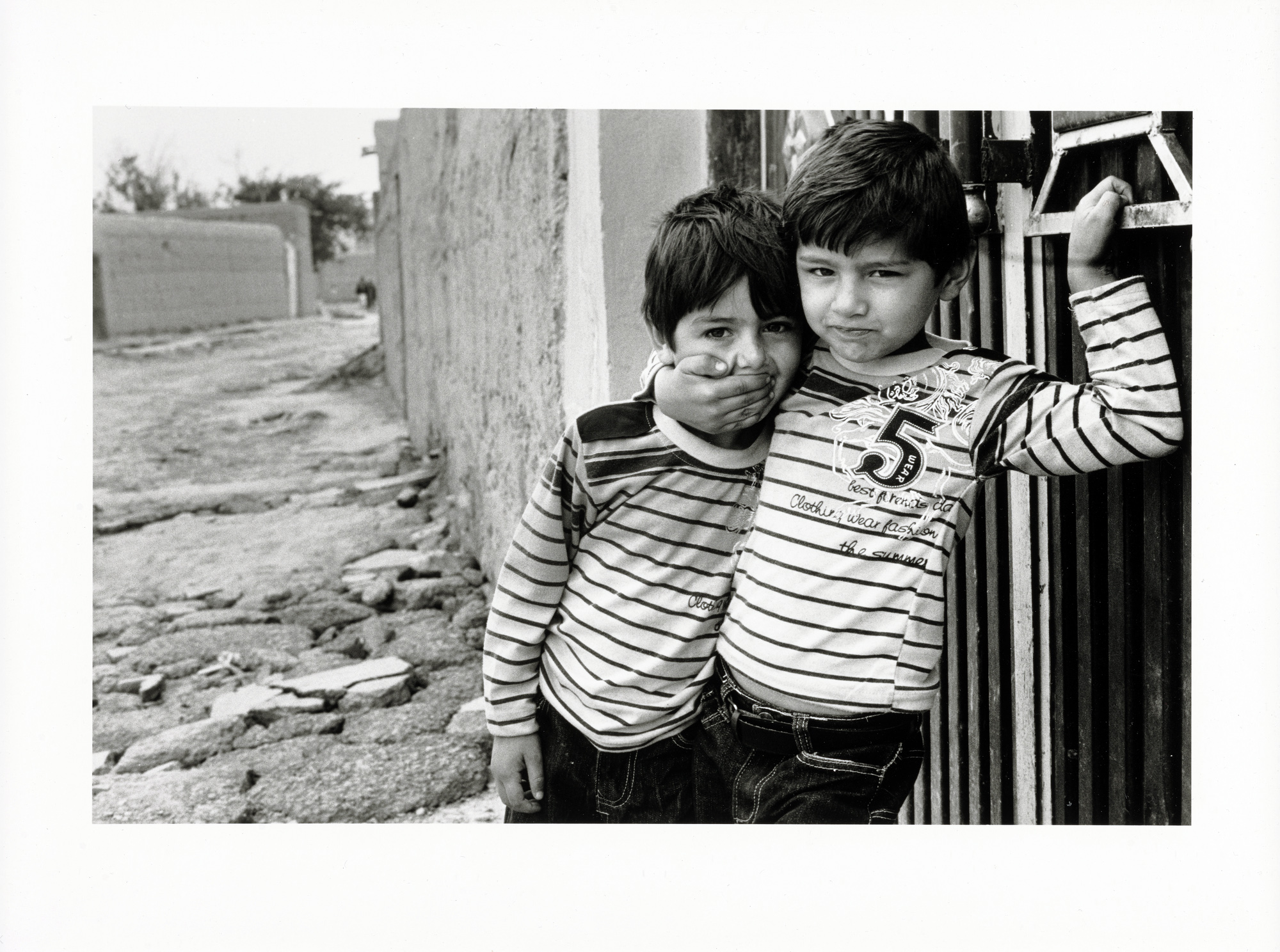
Thursday – Friday 10am – 10pm
Closed Tuesdays

Museum of Fine Arts, Boston website

LIKE ART BLART ON FACEBOOK

Back to top

Text: ‘Facile, Facies, Facticity’ by Dr Marcus Bunyan; Exhibition: ‘About Face: Contemporary Portraiture’ at the Nelson-Atkins Museum of Art, Kansas City

Exhibition dates: 9th August, 2013 – 19th January, 2014

Co-curators: April M. Watson and Jane L. Aspinwall, Associate Curators of Photography at the Nelson-Atkins Museum of Art


Rachel Herman (American) 'Hannah and Tim' 2007 from the exhibition 'About Face: Contemporary Portraiture' at the Nelson-Atkins Museum of Art, Kansas City, August 2013 - January 2014


Rachel Herman (American)
Hannah and Tim
2007
Inkjet print (printed 2012)
Gift of the Hall Family Foundation


Facile, Facies, Facticity


“The structure of presentation – point-of-view and frame – is intimately implicated in the reproduction of ideology (the ‘frame of mind’ of our ‘points-of-view’). More than any other textual system, the photograph presents itself as ‘an offer you can’t refuse’.”


Victor Burgin 1


Facies simultaneously signifies the singular air of a face, the particularity of its aspect, as well as the genre or species under which this aspect should be subsumed. The facies would thus be a face fixed to a synthetic combination of the universal and the singular: the visage fixed to the regime of representation, in a Helgian sense.

Why the face? – Because in the face the corporeal surface makes visible something of the movements of the soul, ideally. This also holds for the Cartesian science of the expression of the passions, and perhaps also explains why, from the outset, psychiatric photography took the form of an art of the portrait.”


Georges Didi-Huberman 2


How shallow contemporary portrait photography has become when compared to the sensual portraits of Julia Margaret Cameron, the grittiness of Gordon Parks or the in your face style of Diane Arbus. I think the word facile (from Latin facilis ‘easy’, from facers ‘do, make’) with its link to the etymologically similar word ‘face’ (Old Latin facies) is a good way to describe most of the photographs in this posting. These simplistic, nihilistic portraits, with their contextless backgrounds and head on frontally (also the name of an insipid Australian portrait photography prize), are all too common in contemporary portraiture. People with dead pan expressions stare at the camera, stare off camera. The photographs offer little insight and small engagement for the viewer. If these photographs are representative of the current ‘frame of mind’ of our ‘points-of-view’ vis a vis the construction of identity then the human race is in deep shit indeed. As we accept an offer that we can’t refuse – the reflexivity of selfies, an idealised or passive image of ourselves reflected back through the camera lens º we uncritically accept the mirror image, substituting passive receptivity for active (critical) reading. We no longer define and engage critically with something we might call ‘photographic discourse’:

“A discourse can be defined as an arena of information exchange, that is, as a system of relations between parties engaged in communicative activity. In a very important sense the notion of discourse is a notion of limits. That is, the overall discourse relation could be regarded as a limiting function, one that establishes a bounded arena of shared expectations as to meaning. It is this limiting function that determines the very possibility of meaning. To raise the issue of limits, of the closure affected from within any given discourse situation, is to situate oneself outside, in a fundamentally metacritical relation, to the criticism sanctioned by the logic of the discourse…

A discourse, then, can be defined in rather formal terms as the set of relations governing the rhetoric of related utterances. The discourse is, in the most general sense, the context of the utterance, the conditions that constrain and support its meaning, that determine its semantic target.”3

These photographs have few conditions that support their meaning. The context of their utterances is constrained by their own efficacy and passivity. Paul Virilio, speaking of contemporary images, describes them as ‘viral’. He suggests that they communicate by contamination, by infection. In our ‘media’ or ‘information’ society we now have a ‘pure seeing’; a seeing without knowing.4 A seeing without knowing… quite appropriate for these faceless images, images that contaminate how we observe humans living in the world. Of course, one can be involved in logical criticism of the discourse from within but that still gives the discourse power. By situating yourself outside the conditions that constrain the discourse, you can criticise from a different perspective, “seeing something new” as an active, temporal protension of seeing. “Such is the fundamental instability of the pleasure of seeing, of Schaulust, between memory and threat.”5 We may glance, instead of staring (as the subject of these portraits blankly stare back) – the glance becoming a blow of the eye, the acting-out of seeing.6

Here is a possible way forward for contemporary photographic portraiture: a description of the states of the body and the air of the face through a subtle and constant art of the recovering of surfaces, an inquiry that always seeks depth – conceptual depth – in the filmy fabric or stratum of the cameras imaging of the constructed subject. In other words an inquiry into the source, the etiology and logic of the subjects own being – through the glance, not the passive gaze. Even as the object of knowledge is photographically detained for observation, fixed to objectivity, that knowledge can slip away from itself into what Georges Didi-Huberman calls the paradox of photographic resemblance.7

“Thus photography is ultimately an uncertain technique (see Barthes. Camera Lucida. p. 18), changeable and ill-famed, too. Photography stages bodies: changeability. And at one moment or another, subtly, it belies them (invents them), submitting them instead to figurative extortion. As figuration, photography always poses the enigma of the “recumbence of the intelligible body,” even as it lends itself to some understanding of this enigma, and even as this understanding is suffocated…

And when one comes to pose oneself, before a photograph, paradoxical questions: whom does this photographed face resemble? Exactly whose face is being photographed? In the end, doesn’t a photograph resemble just anyone? Well, one cannot, for all that, simply push resemblance aside like a poorly posed problem. Rather, one points a finger at Resembling as an unstable, vain, and phantasmatic temporal motion. One interrogates the drama of imaginary evidence.

For “to resemble,” or Resembling, is the name for a major concern about time in the visible. This is precisely what exposes all photographic evidence to anxiety, and beyond it, to staging, compromises, twisted meanings, and simulacra. And this is how photography circumvents itself – in its own sacrilege. It blasphemes it own evidence because evidence is diabolical. It ruins evidence, from a theater.”8

Only through slippage may we stumble upon the uncertainty of the soul in the uncertainty of the photographic technique. Only through the facticity of the face, the “thrownness” – Heidegger’s Geworfen, which denotes the arbitrary or inscrutable nature of Dasein, being there or presence, that connects the past with the present, just as photographs do – of the individual rendered in the lines of the human face can we engage with the intractable conditions of human existence. Not a bland resemblance-filled anxiety (the hair covering the face, the face in suburban ephemera, the compressed face pressed up against the condensation-filled window), but an unstable signification that has been passionately re(as)sembled in the anxiety of photographic evidence. Only then can contemporary portrait photography make visible something of the movements of the soul, ideally.


“Into this world we’re thrown /
Like a dog without a bone”
(Jim Morrison, Riders on the Storm, 1971)

 
Dr Marcus Bunyan


Endnotes

1/ Burgin, Victor (ed.,). Thinking Photography. Basingstoke: Macmillan, 1982, p. 146
2/ Didi-Huberman, Georges. Invention of Hysteria: Charcot and the Photographic Iconography of the Salpetriere (trans. Alisa Hartz). Cambridge, Mass.: MIT Press, 2003, p. 49
3/ Burgin, pp. 84-85
4/ Virilio, Paul. “The Work of Art in the Electronic Age,” in Block No. 14, Autumn, 1988, pp. 4-7 quoted in McGrath, Roberta. “Medical Police,” in Ten.8 No. 14, 1984 quoted in Watney, Simon and Gupta, Sunil. “The Rhetoric of AIDS,” in Boffin, Tessa and Gupta, Sunil (eds.,). Ecstatic Antibodies: Resisting the AIDS Mythology. London: Rivers Osram Press, 1990, p. 143
5/ Didi-Huberman, op. cit., pp. 27-28
6/ Ibid., “Coup d’oeil, signifying “glance,” literally means the “blow of an eye.” Here as elsewhere, Didi-Huberman draws on the notion of the glance as a blow. He also works with the various meanings of trait, including trait, line, draught, and shaft of an arrow” – Translator
7/ Didi-Huberman, op. cit., p. 59
8/ Didi-Huberman, op. cit., p. 65


Many thankx to The Nelson-Atkins Museum of Art for allowing me to publish the photographs in the posting. Please click on the photographs for a larger version of the image.


Anna Shteynshleyger (Russian, b. 1977) 'City of Destiny (Covered)' 2007 from the exhibition 'About Face: Contemporary Portraiture' at the Nelson-Atkins Museum of Art, Kansas City, August 2013 - January 2014


Anna Shteynshleyger (Russian, b. 1977)
City of Destiny (Covered)
2007
Inkjet print
Gift of the Hall Family Foundation


Lise Sarfati (French, b. 1958) 'Emily, 2860 Sunset Blvd.' 2012


Lise Sarfati (French, b. 1958)
Emily, 2860 Sunset Blvd.
2012
Chromogenic print
Gift of the Hall Family Foundation


Alec Soth (American, b. 1969) 'Mother and daughter, St. Paul, Minnesota, 1999' 1999


Alec Soth (American, b. 1969)
Mother and daughter, St. Paul, Minnesota, 1999
1999


LaToya Ruby Frazier (American, b. 1982) 'Momme' 2008


LaToya Ruby Frazier (American, b. 1982)
Momme
2008
Gelatin silver print
Gift of the Hall Family Foundation


This exhibition will explore the breadth and global diversity of contemporary photographic portraiture since 2000, highlighting recent acquisitions to the museum’s permanent collection.

About Face will include works by twenty-nine artists from the United States, England, Canada, France, Germany, Russia, Japan, Iran and South Africa. Though each of these photographers approaches portrait-making differently, certain thematic threads resonate throughout the show, including questions of racial, cultural, ethnic, class and gender identity; the relationship between individuals and typologies; the way photographic processes themselves inform meaning; the relevance of historical precedents to contemporary practice; and the impact of media stereotypes on self-presentation. Considered collectively, the works in About Face offer a provocative and engaging forum for considering the question: how do we define portraiture today?

The project will present two distinct, simultaneous exhibitions: About Face, our in-gallery exhibition at the Nelson-Atkins, and Making Pictures of People, a digital exhibition presented online for web-based audiences worldwide. Visitors will be able to access the Flak Photo exhibition via touch screens in the gallery and on mobile devices outside the museum. The goal of our collaboration is twofold: to celebrate the complementary experiences of engaging with photographs as objects and as images, and to connect museum visitors in Kansas City with an international community deeply engaged in thinking about portraiture and contemporary photographic practice.

“Contemporary photographers approach portraiture from multiple perspectives, and this show reflects that diversity,” said April M. Watson, who co-curated this exhibition with Jane L. Aspinwall (both are Associate Curators of Photography). “Some portraits emphasise the construction of identity through race, gender and class, while others question the relationship between individuality and typology, or the impact of the media on self-presentation. At the core is the relationship between the photographer and his or her subject, and how that interaction translates in the final portrait.” Adds Aspinwall: “Some of these photographers use antiquated processes such as the daguerreotype and tintype to make portraits of contemporary subjects. These historical resonances add an interesting dimension to the show.

Press release from the  Nelson-Atkins Museum of Art website


Richard Learoyd (English, b. 1966) 'Erika' 2007


Richard Learoyd (English, b. 1966)
Erika
2007
Ilfachrome print
Gift of the Hall Family Foundation in honour of the 75th anniversary of The Nelson-Atkins Museum of Art


Jocelyn Lee (American born Italy, b. 1962) 'Untitled (Julia and Greenery)' 2005


Jocelyn Lee (American born Italy, b. 1962)
Untitled (Julia and Greenery)
2005
Chromogenic print
Gift of the Hall Family Foundation


Jim Goldberg (American, b. 1953) 'Prized Possession, Democratic Republic of Congo' 2008


Jim Goldberg (American, b. 1953)
Prized Possession, Democratic Republic of Congo
2008
Gelatin silver print
Gift of the Hall Family Foundation


Vanessa Winship (British, b. 1960) 'Hakkari 8' 2007-2008


Vanessa Winship (British, b. 1960)
Hakkari 8
2007-2008
Inkjet print (printed 2008)
Gift of the Hall Family Foundation


Pieter Hugo (South African, b. 1976) 'Annebelle Schreuders (1)' 2012


Pieter Hugo (South African, b. 1976)
Annebelle Schreuders (1)
2012
Inkjet print
Gift of the Hall Family Foundation


Sage Sohier (American, b. 1954) '12-Year Old Boy with His Father' 2009


Sage Sohier (American, b. 1954)
12-Year Old Boy with His Father
2009
Inkjet print
Gift of the Hall Family Foundation


Michael Wolf (American, b. 1954) 'Tokyo Compression #18' 2010


Michael Wolf (American, b. 1954)
Tokyo Compression #18
2010
Inkjet print
Gift of the Hall Family Foundation


Tomoko Sawada (Japanese, b. 1977) 'Recruit/BLACK' 2006


Tomoko Sawada (Japanese, b. 1977)
Recruit/BLACK
2006
Chromogenic print
Purchase: acquired through the generosity of the Photography Society


The Nelson-Atkins Museum of Art
4525 Oak Street
Kansas City, MO 64111

Opening hours:
Thursday – Monday 10am – 5pm
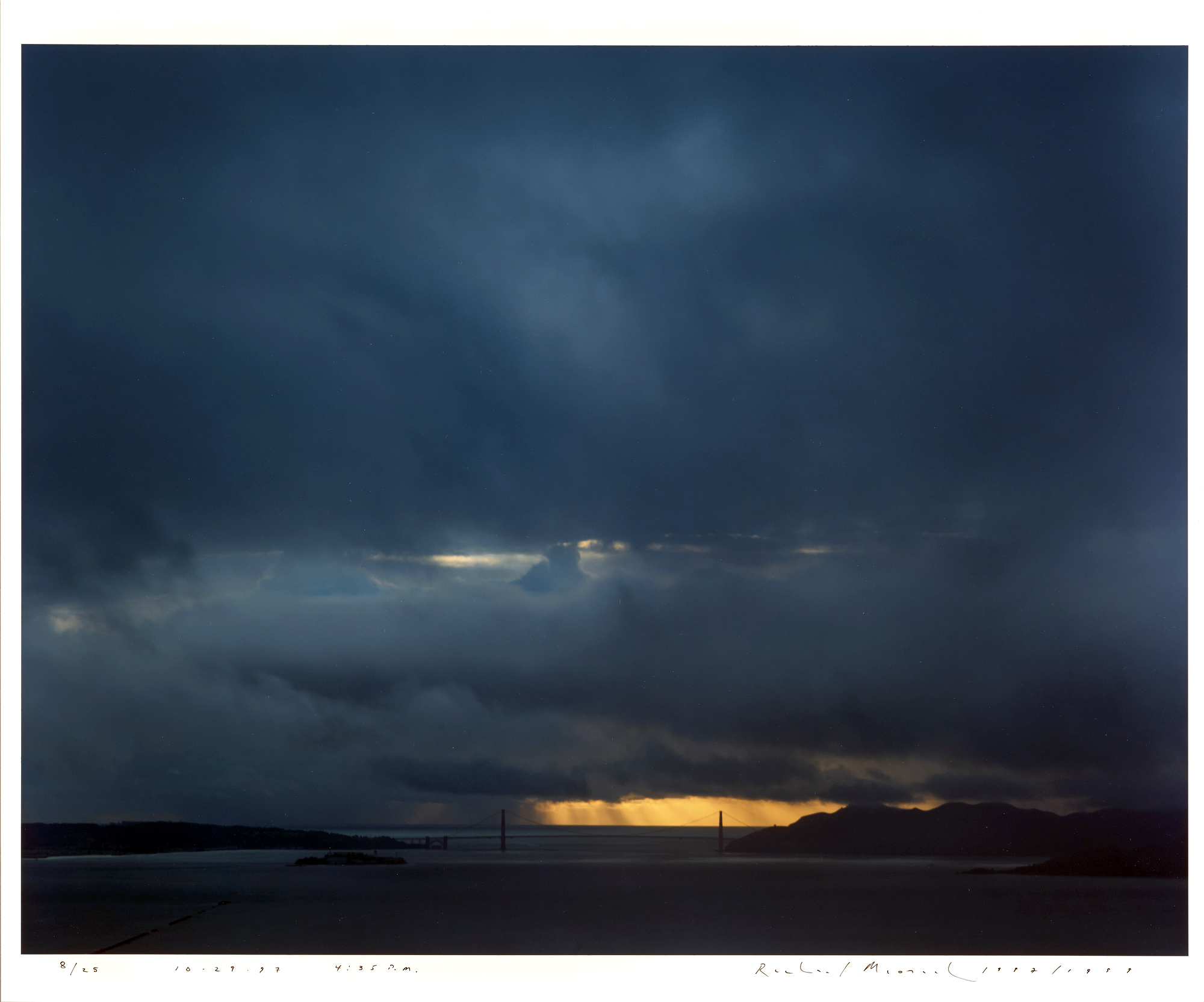
Closed Tuesdays and Wednesdays

The Nelson-Atkins Museum of Art website
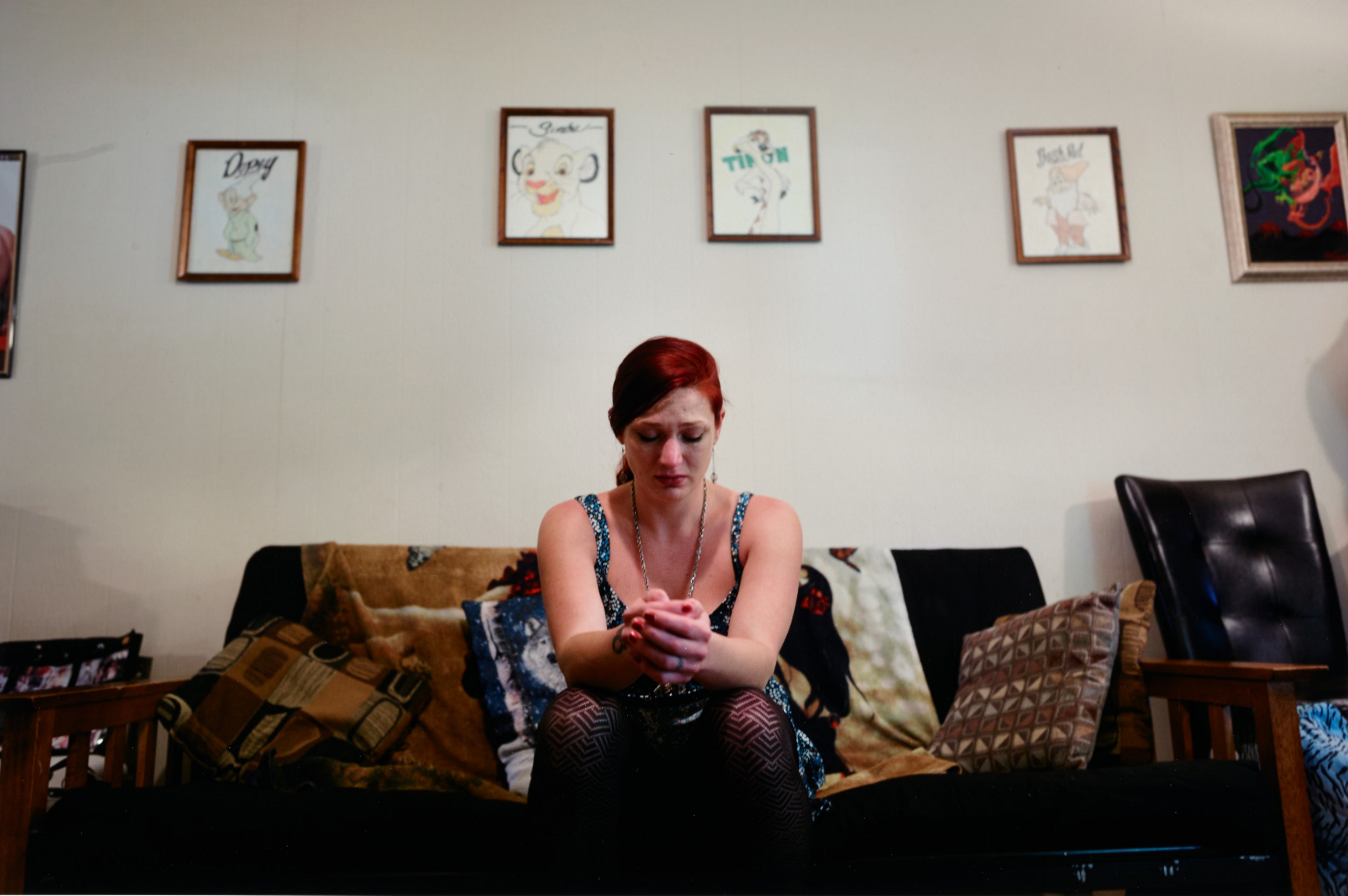
LIKE ART BLART ON FACEBOOK

Back to top