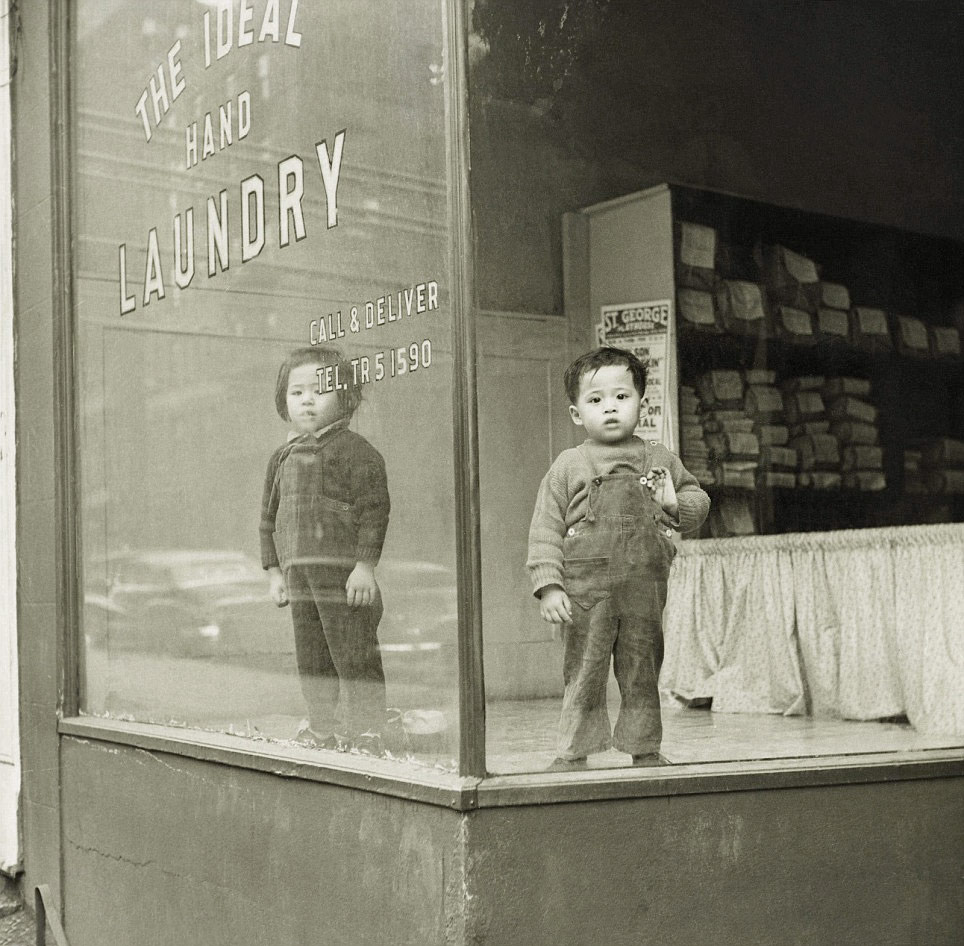
Photographs: Aaron Siskind ‘Harlem Photographs’ 1932-1940

“This is where I think that Siskind was less than happy with the results of his documentary photographs – that they weren’t giving him what he wanted out of his art: that interface of the image and imagination.” Dr Marcus Bunyan

July 2026


Aaron Siskind (American, 1902-1991) 'Boys in Empty Tenement' c. 1935


Aaron Siskind (American, 1902-1991)
Boys in Empty Tenement
c. 1935
Gelatin silver print


Image and imagination

I always find it fascinating to view the first few years of an artist’s journey, the golden path they take, for it more than likely informs all that is to come.

In the greatest abstract expressionist photographer the world has known, Aaron Siskind (American, 1902-1991), his starting point was as a straight documentary photographer, a member of the New York Photo League, a “left-leaning documentary collective, which prioritised using photography to advocate for social change.”

Using a large format camera and tripod Siskind, for his photo project Harlem Document, captured “the vibrancy, harsh realities, and daily life of the Black community in Harlem” – images which had their roots in American social documentary photography of the period and photographers such as Jacob Riis, Lewis Hine, Walker Evans, Dorothea Lange, Gordon Parks and the photographers of the Farm Security Administration (FSA) government program (1935-1944) which documented the struggles of rural Americans during the Great Depression.

As I have written in a 2023 text titled “Transcending reality”, “To my mind American photographers of the 1930s took photographs not only to document but also to honor what was greater and more interesting than they were. Not as a melding of reality-dream … but as an exploration of what is possible through the interface of the image and imagination, the interface as Ansel Adams put it “between the reality of the world and the reality of yourself”.”

This is where I think that Siskind was less than happy with the results of his documentary photographs – that they weren’t giving him what he wanted out of his art: that interface of the image and imagination.

“In working from the documentary approach, I had always tried to find what kind of meaning you could get in a picture of that kind, and was beginning to feel that I was not getting it. I felt I wasn’t getting anything really personal, really powerful and special…. My documentary pictures were very quiet and very formal.”1

Moving into the 1940s Siskind began experimenting with more abstract compositions (with their link to Abstract Expressionist painting). Evidence of this reorientation in his image making can already be seen in some of the documentary photographs in this posting. For example, the photographs Facades (1938, below) and Harlem (1938, below) both propose the flattening of the photographic surface with an interest in the geometry and abstraction of form – circle, oblong, square, diagonal, curve, line – within the pictorial plane, but with an attendant emphasis on light, texture and tone.

“Though he did not create the lines, shapes, rhythms and patterns in his images, he nonetheless expressed the lyricism of their relationships by harmoniously arriving at the perfect composition. And though his abstract photographs possessed undeniable content, he subverted that content by offering new interpretive possibilities based on the feelings the images conveyed.”2

Image and imagination.

Thus, Siskind was intelligent enough, was aware and informed enough, of his feelings towards the world and the cultural developments around him to approach a crossroads in his development as an artist, to recognise, that is the key word, to recognise the path he needed, he wanted to take.

And so we are forever grateful to have his abstract expressionist photographs that his spirit guided him towards, photographs that may also light our own path.

Dr Marcus Bunyan

PS. I have added relevant information on Siskind’s art practice, theatres, and ballrooms where possible and I have also included an extract from Gordon Parks’ forward to Siskind’s book Harlem Document.


1/ Jaromir Stephany unpublished interview with Aaron Siskind, February 1963. This interview is in the private papers of Jaormir Stephany quoted in Marcia Battle. “Harlem: A Document,” in Harlem Document: Photographs 1932-1940. Washington and London: Smithsonian Institution Press, 1990, pp. 4-6

2/ Phillip Barcio. “How Aaron Siskind Found Abstraction On The Streets,” on the Ideelart website, Feb 15, 2017 [Online] Cited 17/07/2026


Please click on the photographs for a larger version of the image.


“Photography has tremendous social value. Upon the photographer rests the responsibility and duty of recording a true image of the world as it is today. Moreover, he must not only show us how we live, but indicate the logical development of our lives.”


Photo Notes, newsletter of the Photo League, August 1938


Aaron Siskind’s photographs from 1935-1940 form the core of the Harlem Document, a landmark sociological and visual study commissioned by the New York Photo League. Siskind headed the Feature Group of this radical, left-leaning documentary collective, which prioritised using photography to advocate for social change. The images capture the vibrancy, harsh realities, and daily life of the Black community in Harlem during the Great Depression.

Google AI
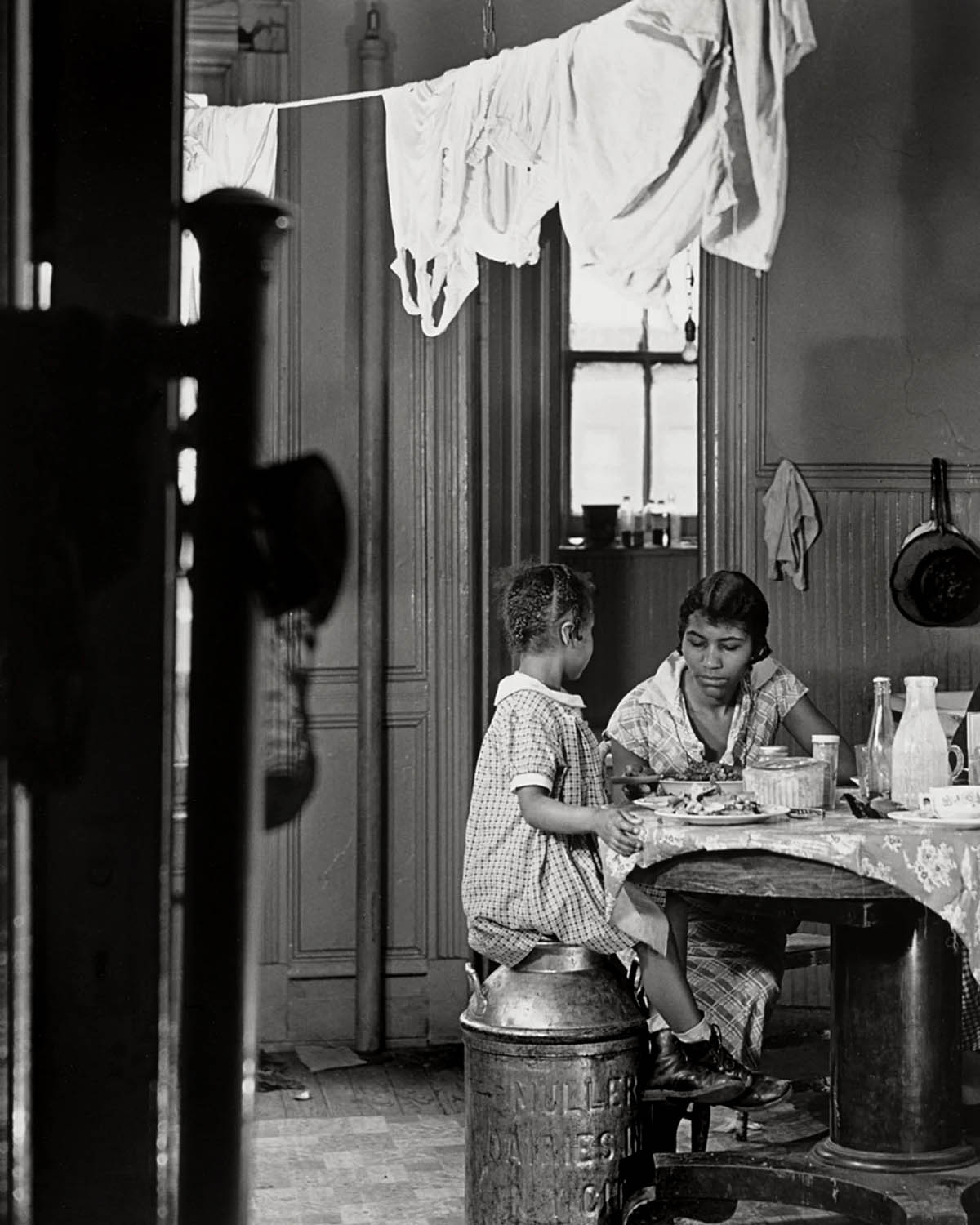
 

Aaron Siskind (American, 1902-1991) 'Kitchen Scene' 1937


Aaron Siskind (American, 1902-1991)
Kitchen Scene
1937
Gelatin silver print


From 1937 to 1944, Siskind took pictures in and around Harlem – of its businesses, domestic interiors, religious and social organisations, and nightlife. He did so as a member of the New York Photo League – a documentary photography collective with roots in radical leftist politics – and in collaboration with journalist and sociologist Michael Carter and other photographers as part of a cultural study of Harlem. In 1981 fifty-two of Siskind’s images were published in the book Harlem Document: Photographs 1932-1940 alongside first-person interviews conducted in the late 1930s by writers employed by the Federal Writers Project, including novelist and essayist Ralph Ellison.

MoMA Gallery label from 2024
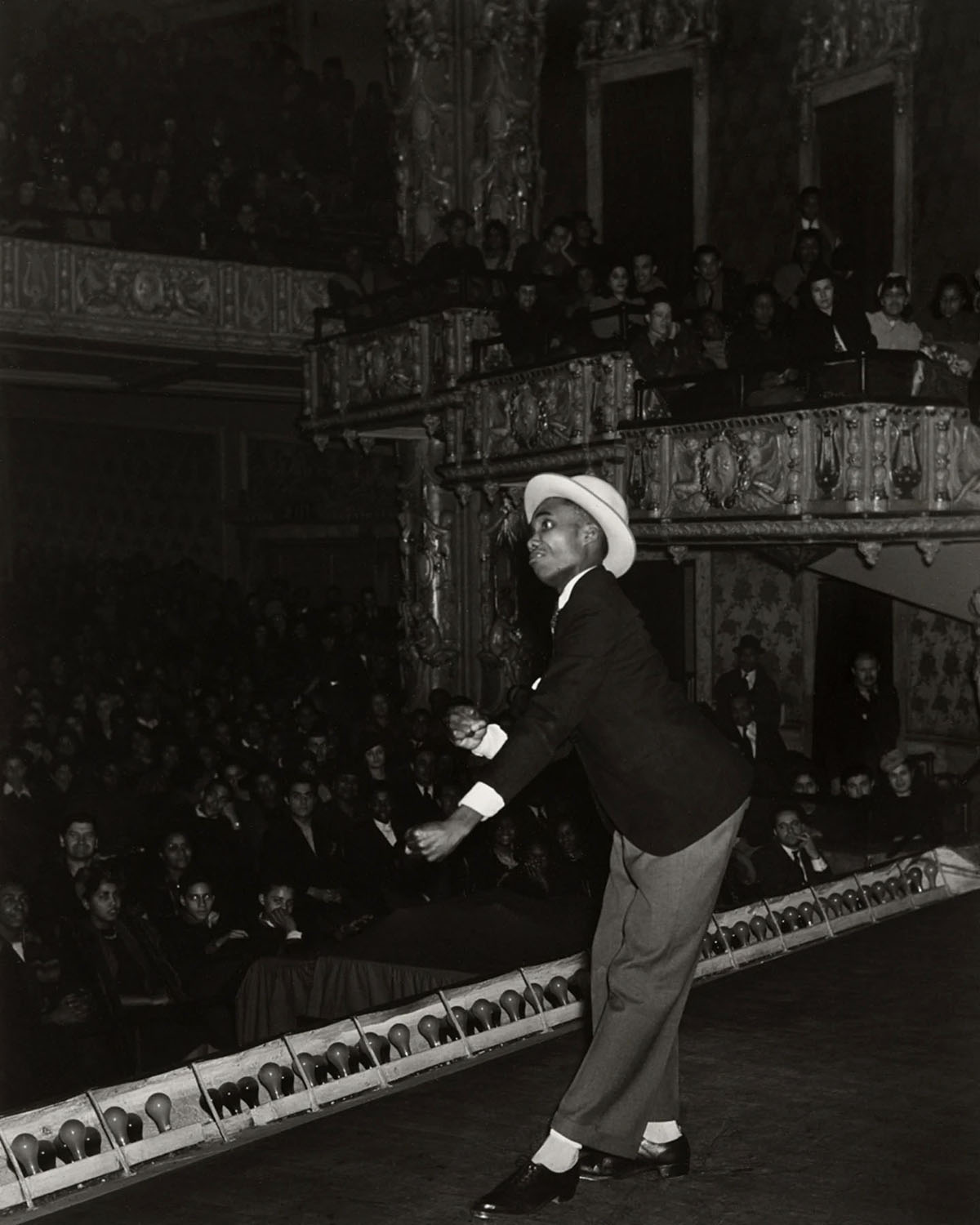
 

Aaron Siskind (American, 1902-1991) 'Apollo Theatre' 1937


Aaron Siskind (American, 1902-1991)
Apollo Theater
1937
Gelatin silver print


Apollo Theater

Since opening its doors in 1914 and introducing the first Amateur Night contests in 1934, The Apollo has played a major role in the emergence of jazz, swing, bebop, R&B, gospel, blues, and soul – all quintessentially American music genres. Ella Fitzgerald, Sarah Vaughan, Billie Holiday, Sammy Davis Jr., James Brown, Gladys Knight, Luther Vandross, D’Angelo, Lauryn Hill, and countless others began their road to stardom on the Apollo stage. Today, The Apollo is a respected nonprofit presenting concerts, theatrical and dance performances, film screenings, educational programs, and community outreach programs.

The neoclassical theater known today as The Apollo’s Historic Theater was designed by George Keister and first owned by Sidney Cohen. In 1914, Benjamin Hurtig and Harry Seamon obtained a thirty-year lease on the newly constructed theater, calling it Hurtig and Seamon’s New Burlesque Theater. Like many American theaters during this time, African-Americans were not allowed to attend as patrons or to perform.

In 1933, Fiorello La Guardia, who would later become New York City’s Mayor, began a campaign against burlesque, and Hurtig & Seamon’s was one of many theaters that would close down. Cohen reopened the building as the 125th Street Apollo Theatre in 1934 with his partner, Morris Sussman, serving as manager. Cohen and Sussman changed the format of the shows from burlesque to variety revues and redirected their marketing attention to the growing African-American community in Harlem.

Frank Schiffman and Leo Brecher took over The Apollo in 1935. The Schiffman and Brecher families would operate the Theater until the late 1970s. The Apollo reopened briefly in 1978 under new management then closed again in November 1979. In 1981, it was purchased by Percy Sutton, a prominent lawyer, politician, media and technology executive, and a group of private investors. Under Sutton’s ownership, the Theater was equipped with a recording and television studio.

Text from the Apollo Theater website. Used under fair use conditions for the purposes of education and research
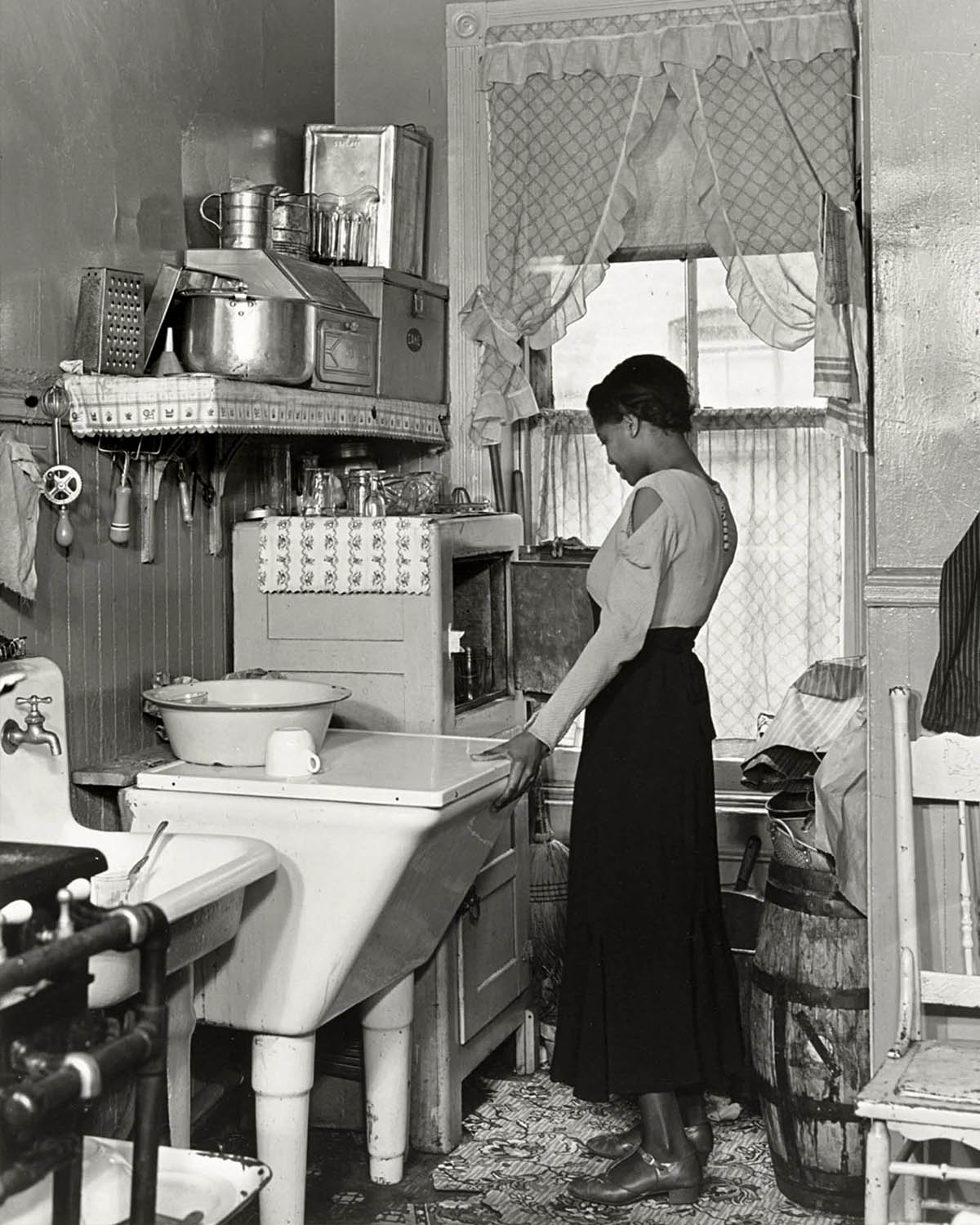
 

Aaron Siskind (American, 1902-1991) 'Lady In Kitchen' 1937


Aaron Siskind (American, 1902-1991)
Lady In Kitchen
1937
Gelatin silver print


Aaron Siskind’s artistic trajectory parallels broader shifts within mid-20th-century American photography. In the 1930s he cut his teeth as a documentary photographer affiliated with the Workers Film and Photo League, an artists’ cooperative that strove to advance progressive political causes. The following decade saw him turn away from studies of society. For the remainder of his career, he created still lifes that aimed to articulate interior states through near-abstract visual fields. Of this dramatic shift in his practice, the artist said, “For some reason or other there was in me the desire to see the world clean and fresh and alive.”1

Siskind’s documentary work was carefully planned and researched in advance. He honed this approach at the Film and Photo League, which he joined in 1933, only three years after receiving his first camera as a honeymoon gift. Among this community of photographers and filmmakers – many of them, like Siskind, the New York-born children of Jewish immigrants – he found technical guidance and critical feedback. When the League’s photographers broke from its filmmakers to establish the standalone Photo League in 1936, Siskind helped form its Feature Group, a unit dedicated to creating photo essays like those appearing in LIFE magazine and being produced by the Farm Security Administration. Collaborative at its core, the Feature Group prioritised the free exchange of ideas: each project began with a discussion of how to approach photographing its subject and ended with the group assessing their effort collectively. “We discovered a relationship between the clarity of one’s thought and feeling and the clarity of picture-making,” Siskind recalled of these formative dialogues.2

Of the many projects the Feature Group completed during Siskind’s four years of leadership, its most extended and ambitious was Harlem Document. This expansive cultural study of Harlem, undertaken between 1937 and 1940 in close consultation with the sociologist Michael Carter, originally aimed to produce a photographically illustrated book authored by Carter. Although the publication never materialised, Siskind’s photographs for Harlem Document indicate the project’s ambitious scope, depicting street life, domestic interiors, and gathering spots ranging from churches to dance halls to theaters.

Samuel Allen, Curatorial Assistant, The Robert B. Menschel Department of Photography, 2025 on the MoMA website [Online] Cited 14/07/2026. Used under fair use conditions for the purposes of education and research

1/ Aaron Siskind, “The Drama of Objects,” Minicam Photography 8, no. 9 (June 1945), 23. 

2/ Aaron Siskind, “The Feature Group,” Photo Notes (June-July 1940), 7. 


Aaron Siskind (American, 1902-1991) 'Lafayette Theatre' 1937


Aaron Siskind (American, 1902-1991)
Lafayette Theatre
1937
Gelatin silver print


Lafayette Theatre

The Lafayette Theatre (1912–1951), known locally as “the House Beautiful”, was one of the most famous theaters in the Harlem neighbourhood of Manhattan in New York City. It was an entertainment venue located at 132nd Street and 7th Avenue. The first major theatre in New York to desegregate, in its early history the theatre was home to the African American repertory theatre company the Lafayette Players. This group was originally founded by Anita Bush as Anita Bush Stock Company in 1914 and became a part of the Lafayette Theatre in 1916 when the theatre bought the stock company. The Lafayette Players was a successful company from the 1910s through the 1930s; after which the company floundered. In 1951 the theatre closed and was sold to the Williams Institutional Christian Methodist Episcopal Church. The structure was demolished in 2013.

Text from the Wikipedia website
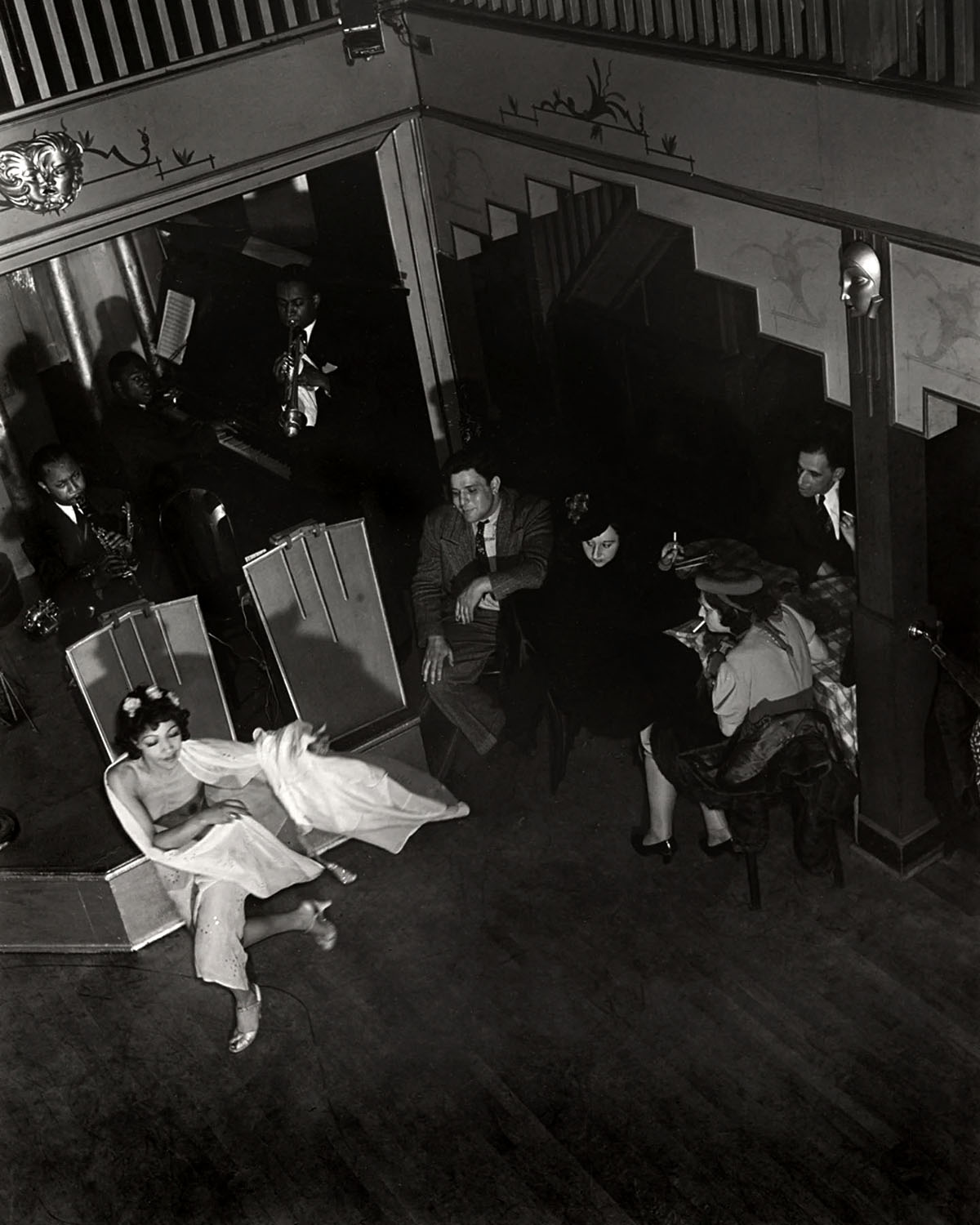
 

Aaron Siskind (American, 1902-1991) 'Night Club I' 1937


Aaron Siskind (American, 1902-1991)
Night Club I
1937
Gelatin silver print
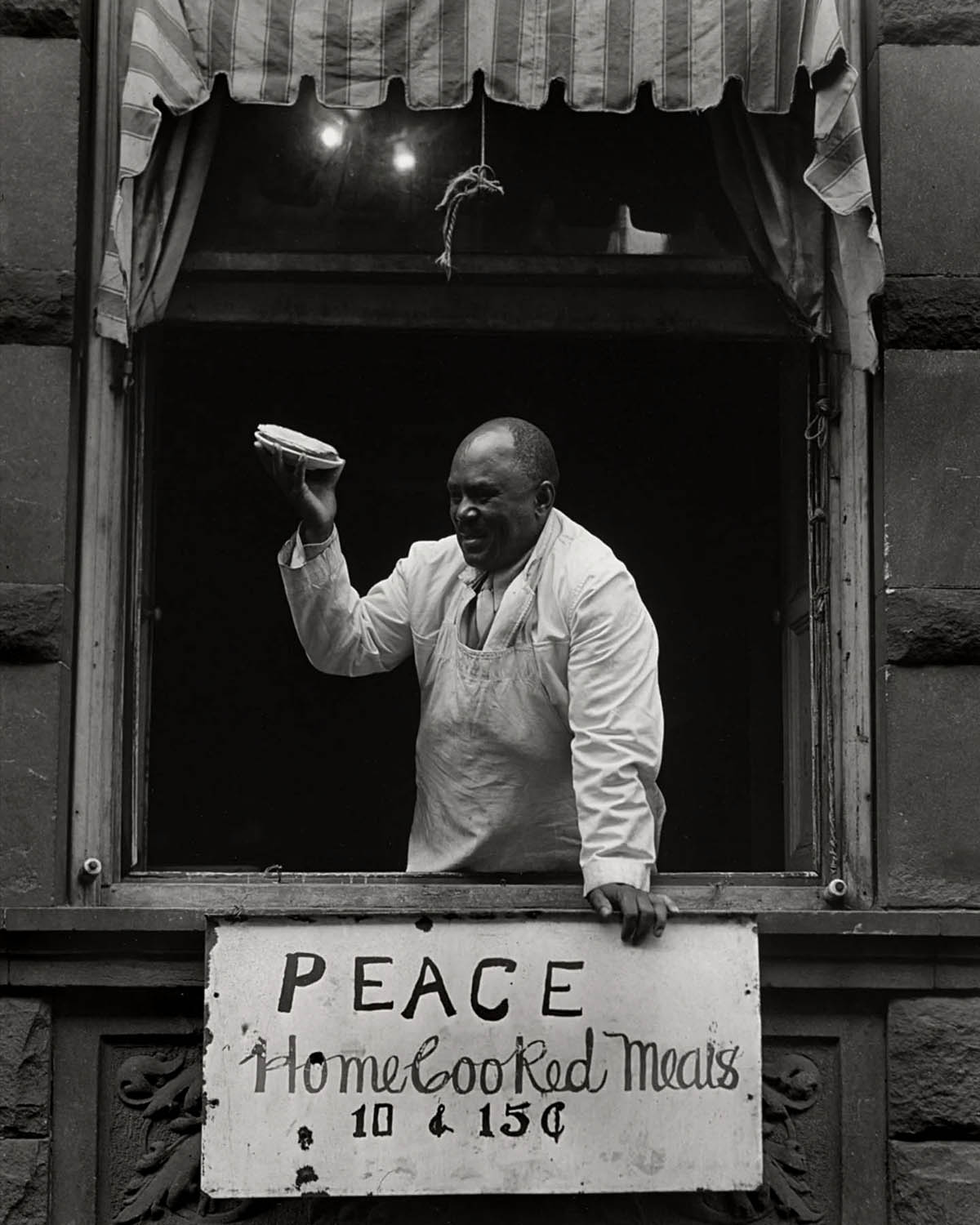
 

Aaron Siskind (American, 1902-1991) 'Peace Meals' 1937


Aaron Siskind (American, 1902-1991)
Peace Meals
1937
Gelatin silver print


Aaron Siskind’s Harlem document, a mirror of my own past, speaks explicitly for itself. It is an ongoing memory of black people living in crowded kitchenettes; suffering the loneliness of rented bedrooms; prating in leftover churches, and grasping a patch of happiness whenever and wherever they could find it. It is a nostalgic look at a kind of past that threatens to hang around Harlem for a long time to come – to doom it to further frustration and unrest. Those same tenements that once imprisoned me are still there, refusing to crumble, holding other restless black boys for sentence without trial.

I remember swarms of slow-moving people, moving close together up on Lenox Avenue – past child shacks, rib joints, funeral parlours and storefront churches- knowing one another but seldom bothering to speak. A city of blackness crammed inside a white city where, when you walked our the door, you became a stranger. …

Harlem has meant a lot of things to a lot of people. For me, in those days, it meant hunger, cultural devastation, unrequited longing and disillusionment. To others it was the swinging, exciting capitol of the entire Black world, the exotic Mecca of melting music, good times and dancing feet. Yet, for some, it was a sanctuary where loftier dreams were fostered; where now and then some of those dreams were realised, but where mostly they were hopelessly spent. To just about everyone who has worked in the vital processes of its survival, whose life has been textured by its tradition, Harlem is a place that won’t give up. Wobbly now under the impact of the past decades, its history mirror those problems its mother country once endured.

Extract from Gordon Parks. “Foreword,” in Harlem Document: Photographs 1932-1940. Washington and London: Smithsonian Institution Press, 1990. Used under fair use conditions for the purposes of education and research
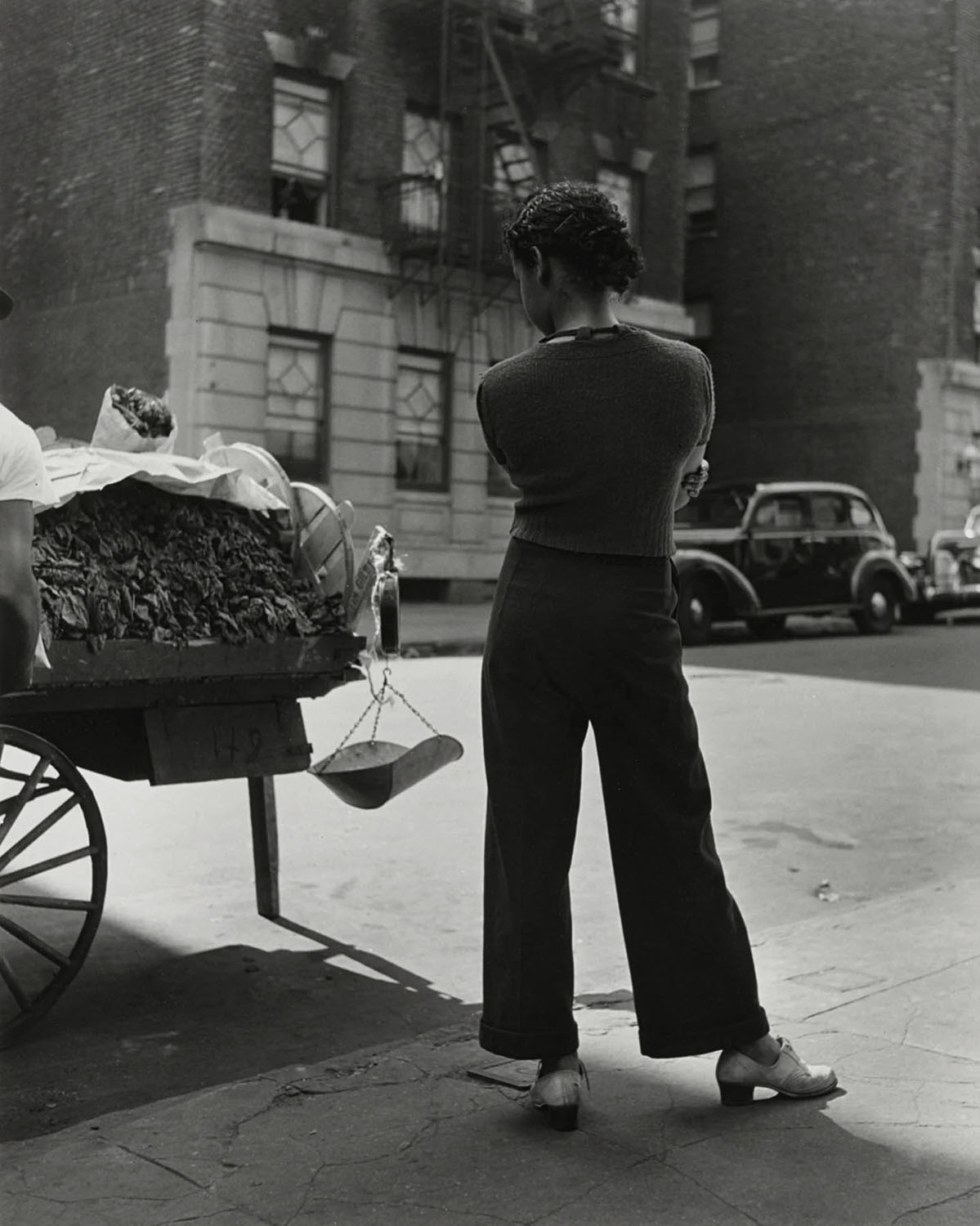
 

Aaron Siskind (American, 1902-1991) 'Street Scene' 1937


Aaron Siskind (American, 1902-1991)
Street Scene
1937
Gelatin silver print
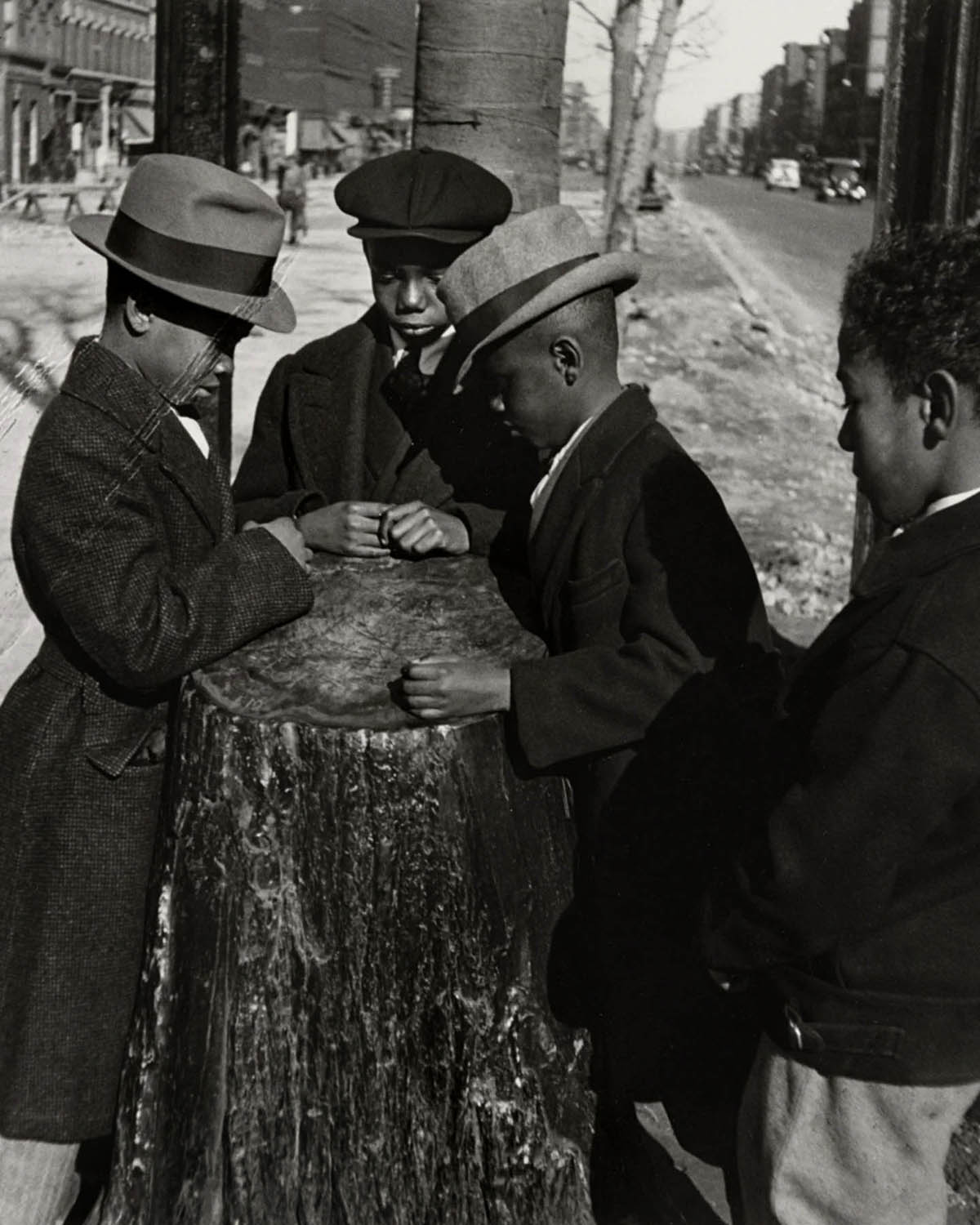
 

Aaron Siskind (American, 1902-1991) 'Wishing Tree' 1937


Aaron Siskind (American, 1902-1991)
Wishing Tree
1937
Gelatin silver print
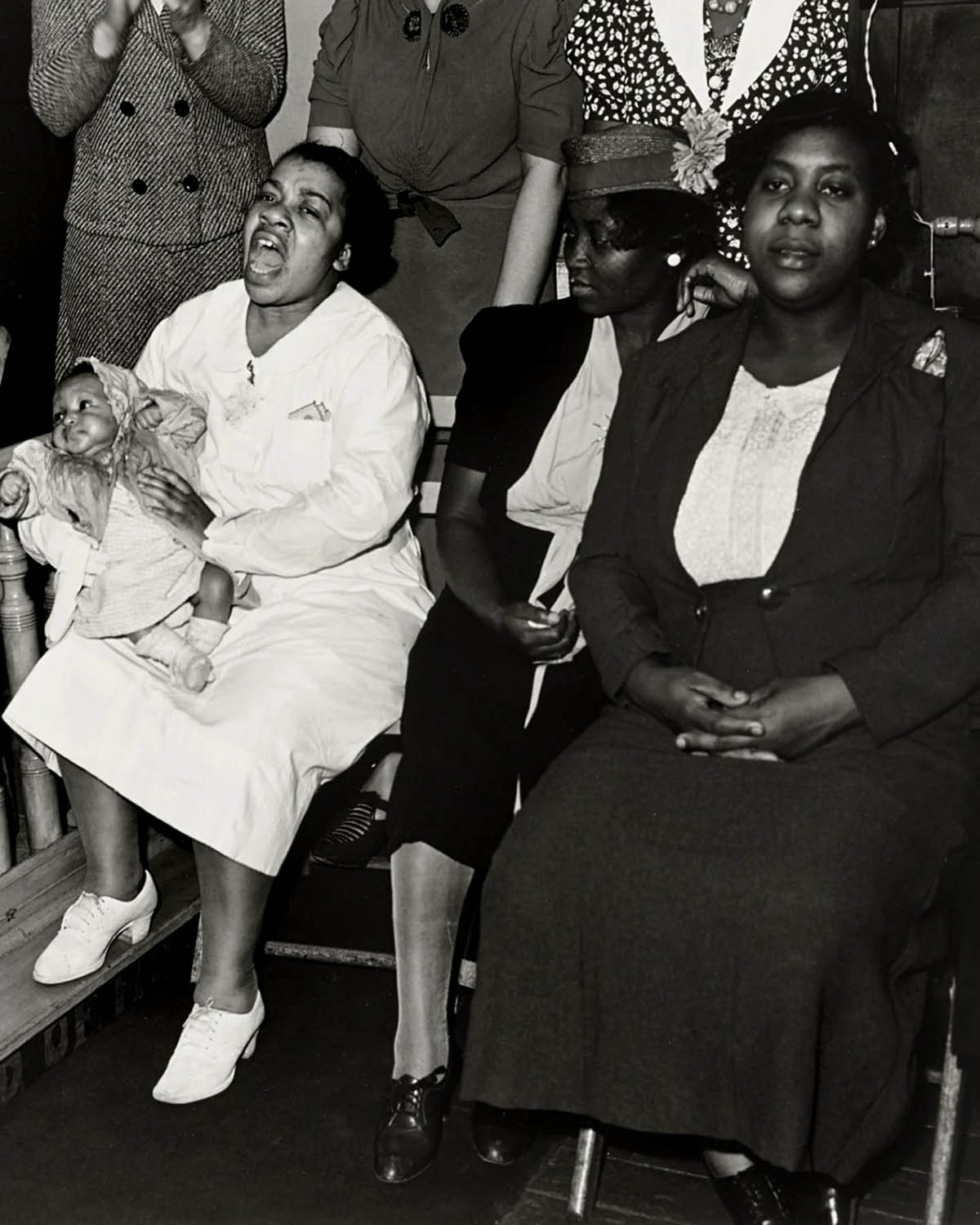
 

Aaron Siskind (American, 1902-1991) 'Church Interior' 1938


Aaron Siskind (American, 1902-1991)
Church Interior
1938
Gelatin silver print
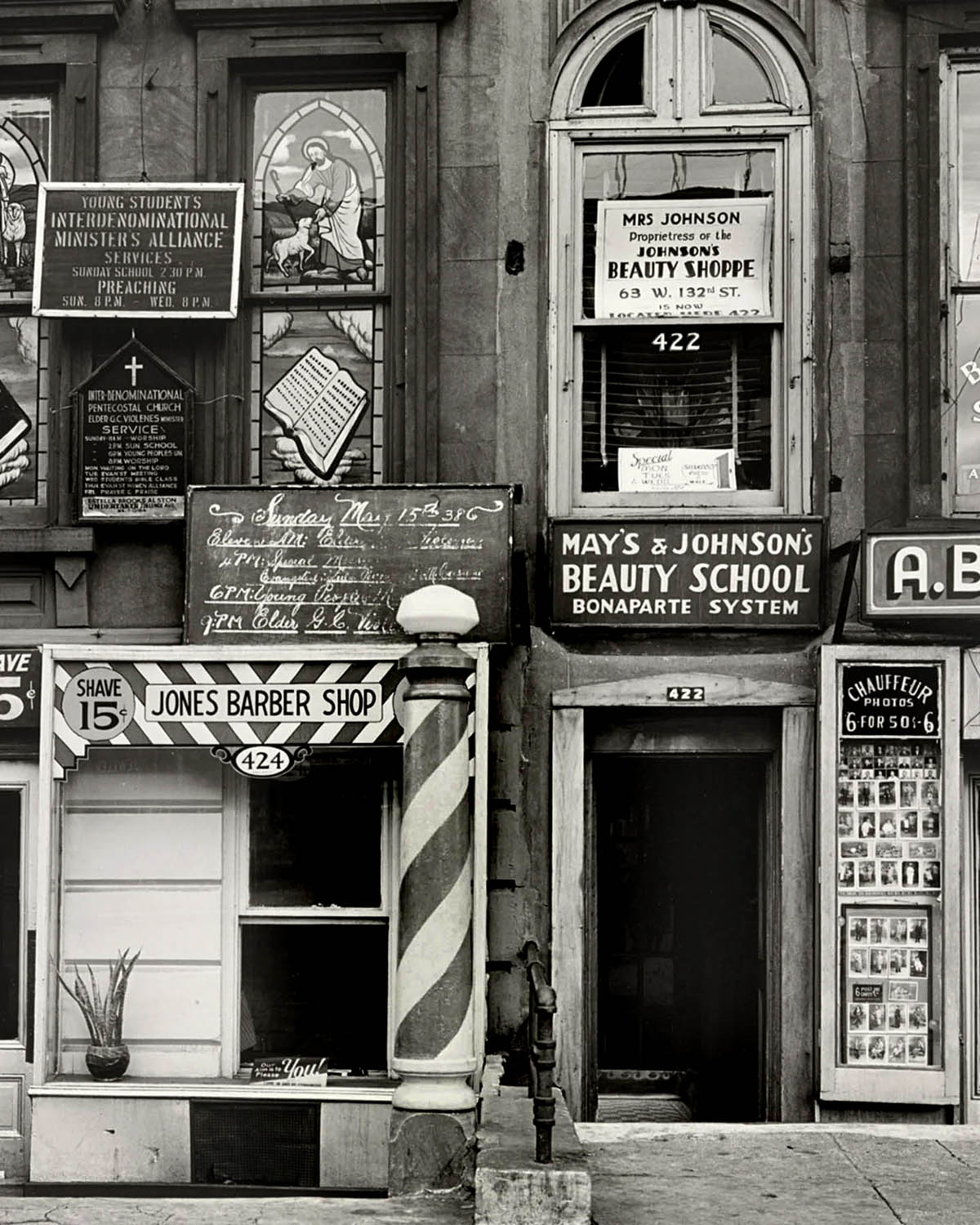
 

Aaron Siskind (American, 1902-1991) 'Facades' 1938


Aaron Siskind (American, 1902-1991)
Facades
1938
Gelatin silver print
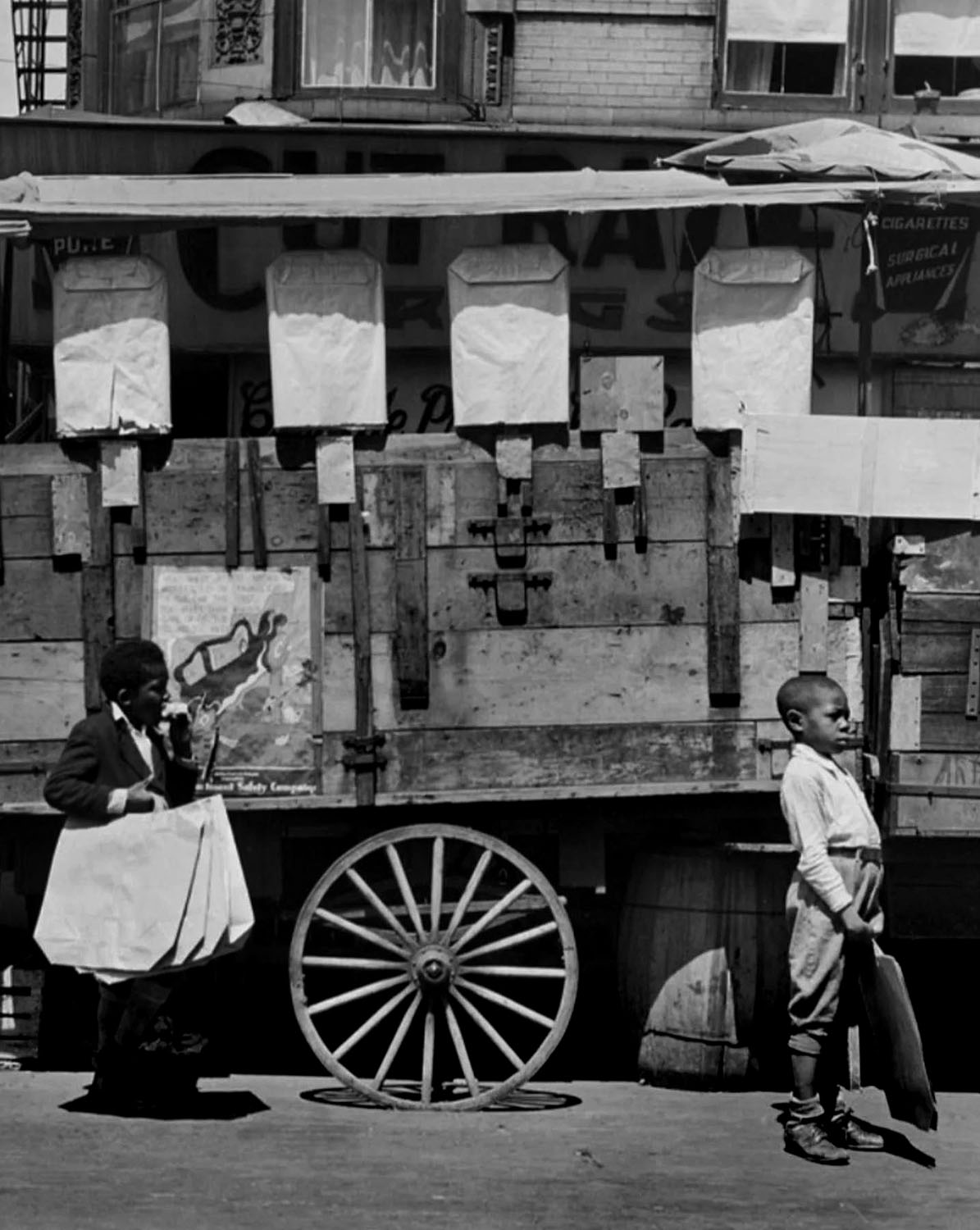
 

Aaron Siskind (American, 1902-1991) 'Harlem' 1938


Aaron Siskind (American, 1902-1991)
Harlem
1938
Gelatin silver print


Aaron Siskind’s interest in photography developed after his experiences with both music and poetry when he was an English teacher in the New York public school system. His early pictures were said to have been attempts at transferring musical and poetic concepts into images.2 Later, as a young adult, Siskind did everything from making political speeches on soapboxes in Manhattan to becoming a member of the Junior Young People’s Socialist League (YPSL).3

A friend gave Siskind his first camera in 1930. He soon discovered his attraction for the instrument, and almost simultaneously he discovered and joined the Photo league. At the League he found people who shared his political and social concerns and who were capable and willing to discuss technical information about photography. Many of the members were children of Jewish immigrants and most, like Siskind, were well educated. Their exhibited images documented illiteracy, discrimination, and poverty and called for social reforms on behalf of the working classes. Before joining the League, Siskind had already photographed some of the poverty-stricken areas of Manhattan and was searching for reaction and criticism to these pictures. …

As a photographer Siskind explored symbols and metaphors to create a visual relationship that balanced aesthetic concerns with social documents. Throughout his career the contrast of subject and symbol have dominated. …

With his work in Harlem Siskind’s style may have been changing. “In working from the documentary approach, I had always tried to find what kind of meaning you could get in a picture of that kind, and was beginning to feel that I was not getting it. I felt I wasn’t getting anything really personal, really powerful and special…. My documentary picture were very quiet and very formal.”4

Extract from Marcia Battle. “Harlem: A Document,” in Harlem Document: Photographs 1932-1940. Washington and London: Smithsonian Institution Press, 1990, pp. 4-6. Used under fair use conditions for the purposes of education and research

2/ Carl Chiarenza, Aaron Siskind: Pleasures and Terrors (Little, Brown and Co.,), 6.

3/ Carl Chiarenza, “Form and Content in the Early Work of Aaron Siskind,” The Massachusetts Review 19:4 (Winter 1978): 810.

4/ Jaromir Stephany unpublished interview with Aaron Siskind, February 1963. This interview is in the private papers of Jaormir Stephany.
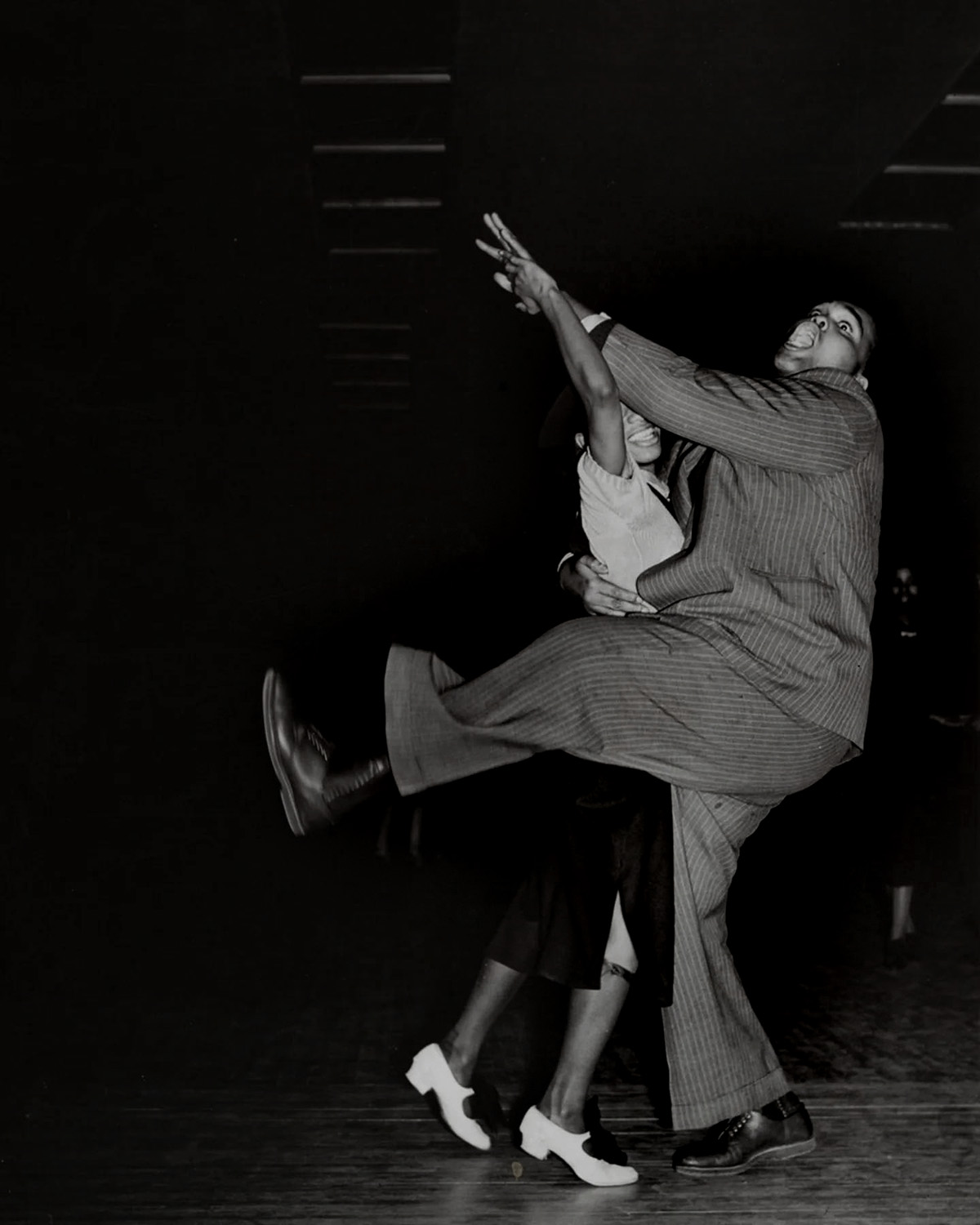
  

Aaron Siskind (American, 1902-1991) 'Savoy Dancers' 1938


Aaron Siskind (American, 1902-1991)
Savoy Dancers
1938
Gelatin silver print


Savoy Dancers

The “Savoy Dancers” refer to the pioneering African American dancers who developed the Lindy Hop and other swing dances at the legendary Savoy Ballroom in Harlem, New York. Open from 1926 to 1958, the integrated ballroom housed iconic performers like Frankie Manning and Norma Miller who defined the “home of happy feet”.

These legendary dancers revolutionised social dancing by bringing athleticism, airborne aerials, and improvisational jazz styling to the Lindy Hop. Their legacy continues to thrive through modern swing dance communities and archival footage preserved in documentaries like The Spirit Moves.

About the Savoy Ballroom

From 1926 to 1958, the Savoy Ballroom stood at 596 Lenox Avenue as one of the first racially integrated public spaces in the United States. Its 10,000-square-foot, spring-loaded dance floor welcomed thousands nightly and launched a global dance phenomenon. The Savoy hosted legendary artists including Chick Webb, Duke Ellington, Ella Fitzgerald, and Count Basie, cementing its place at the heart of Harlem’s cultural history.
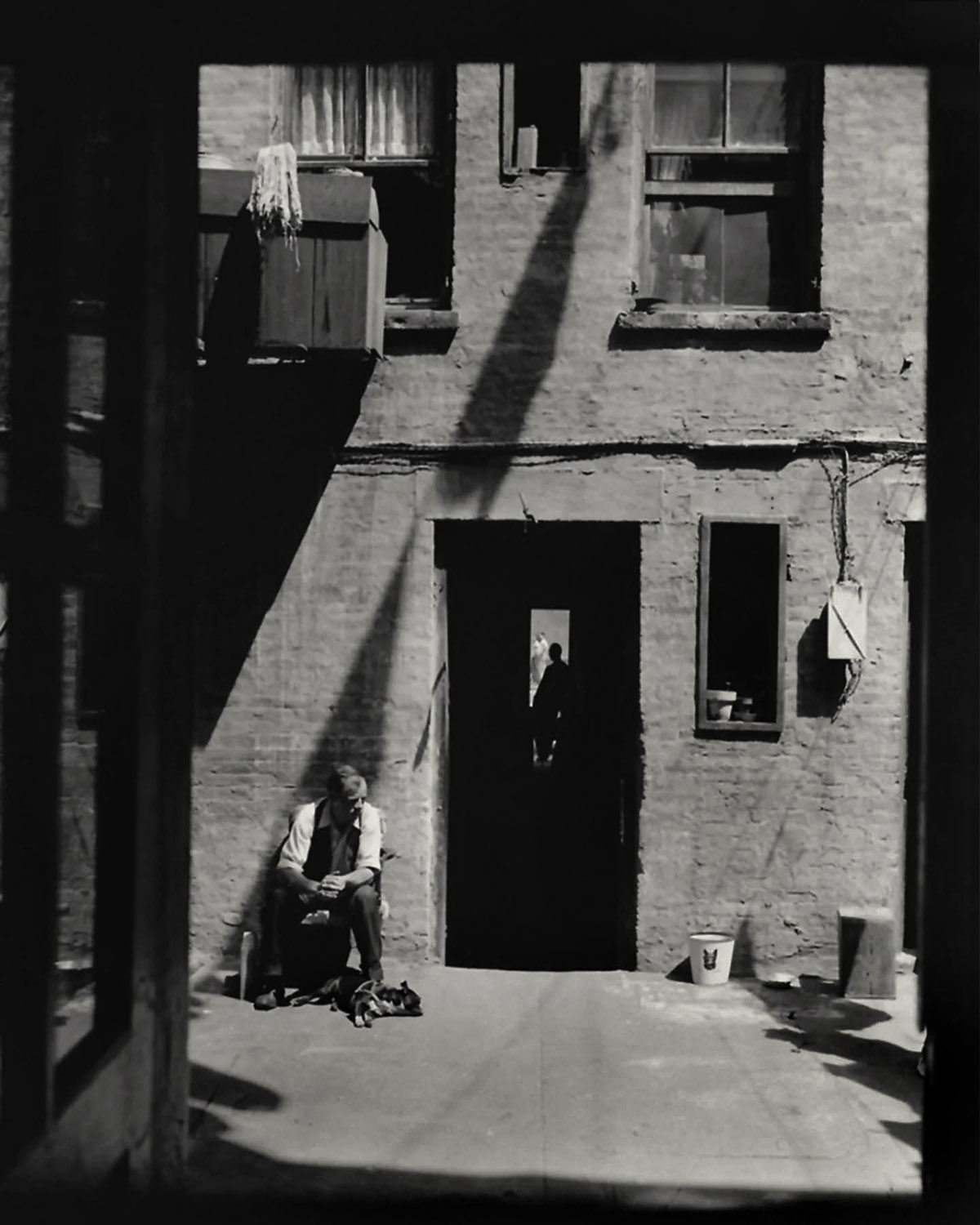
 

Aaron Siskind (American, 1902-1991) 'St. Joseph's House - The Catholic Worker Movement' c. 1939


Aaron Siskind (American, 1902-1991)
St. Joseph’s House – The Catholic Worker Movement
c. 1939
Gelatin silver print
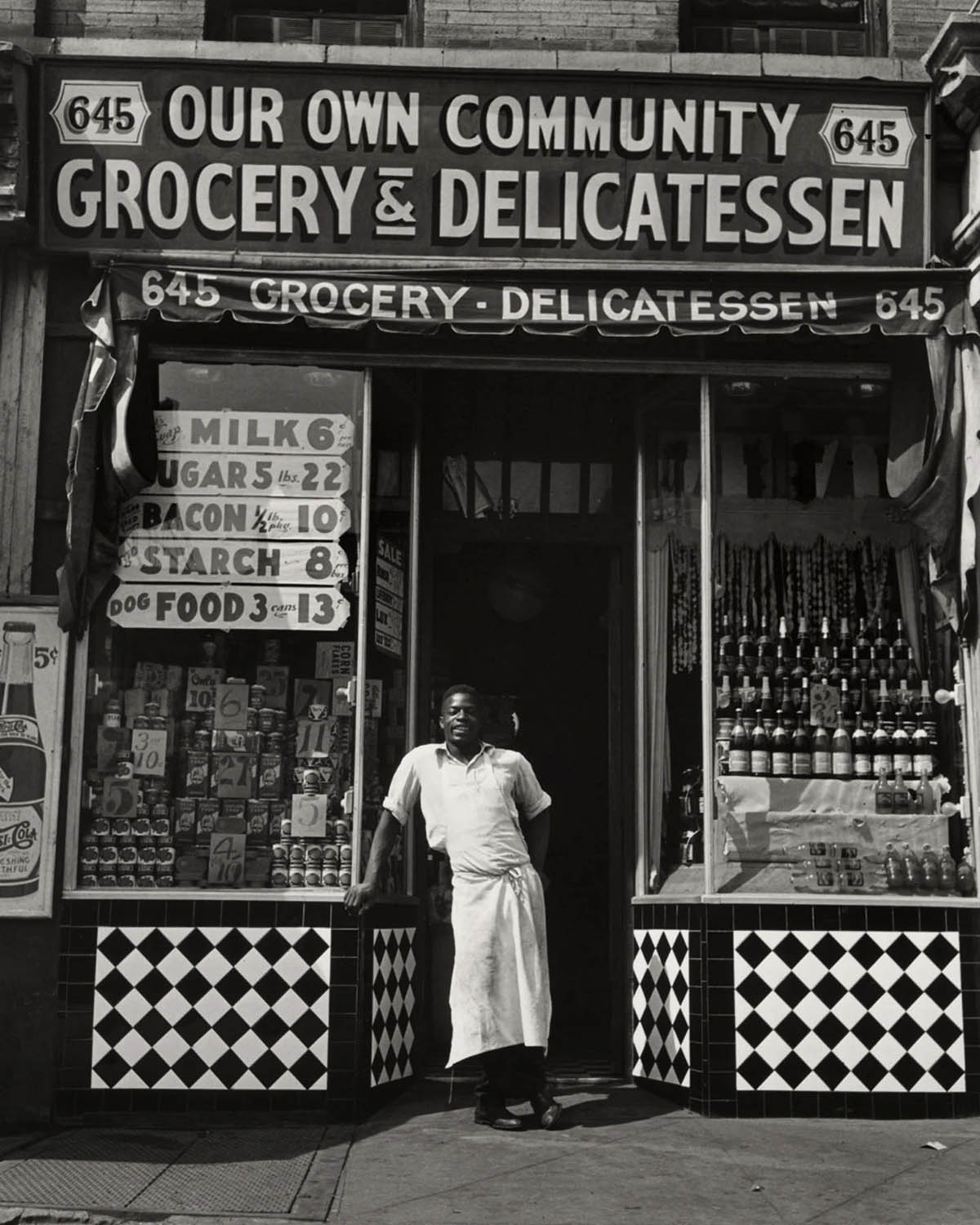
 

Aaron Siskind (American, 1902-1991) 'Grocery Store' 1940


Aaron Siskind (American, 1902-1991)
Grocery Store
1940
Gelatin silver print
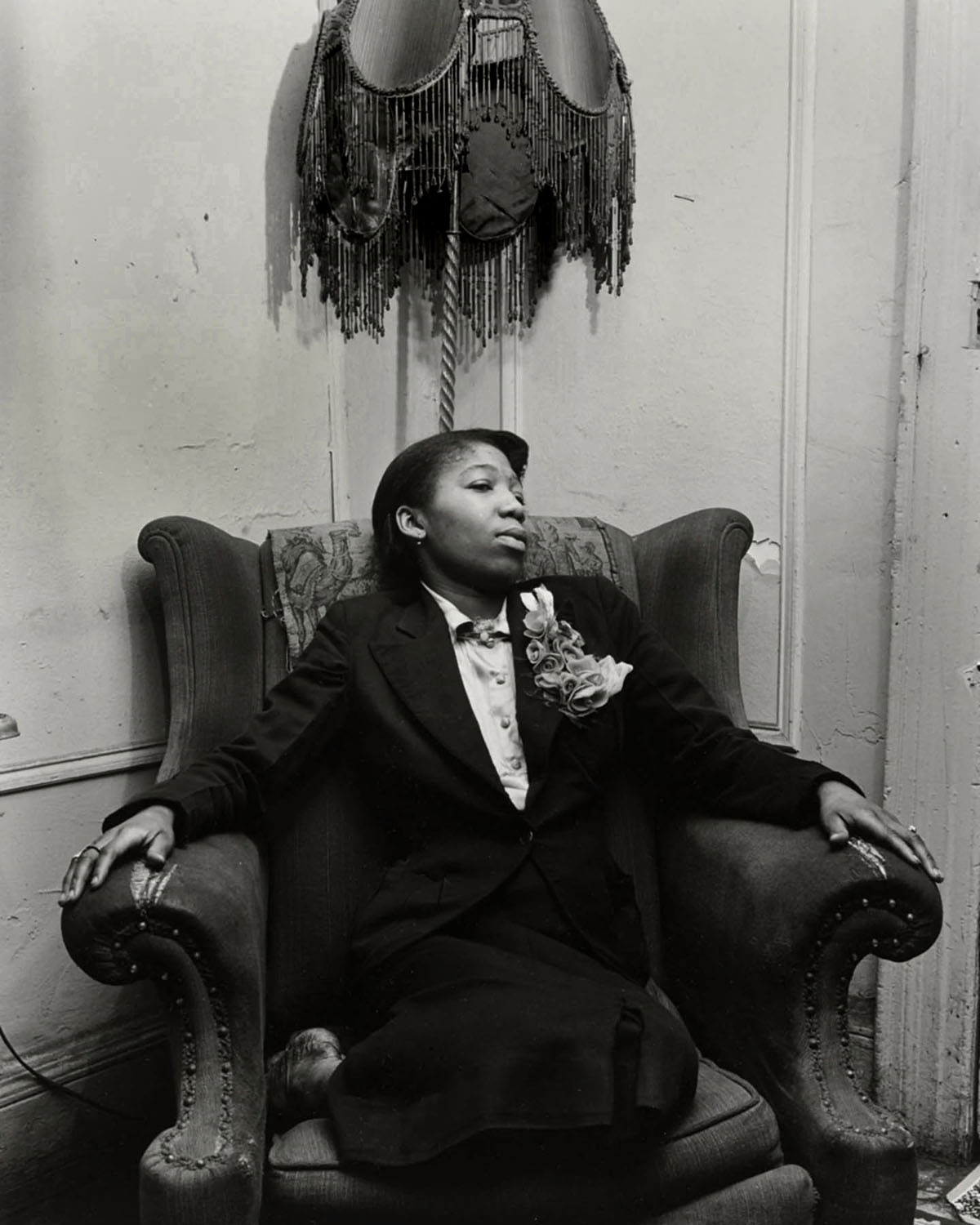
 

Aaron Siskind (American, 1902-1991) 'Lady and Lamp' 1940


Aaron Siskind (American, 1902-1991)
Lady and Lamp
1940
Gelatin silver print
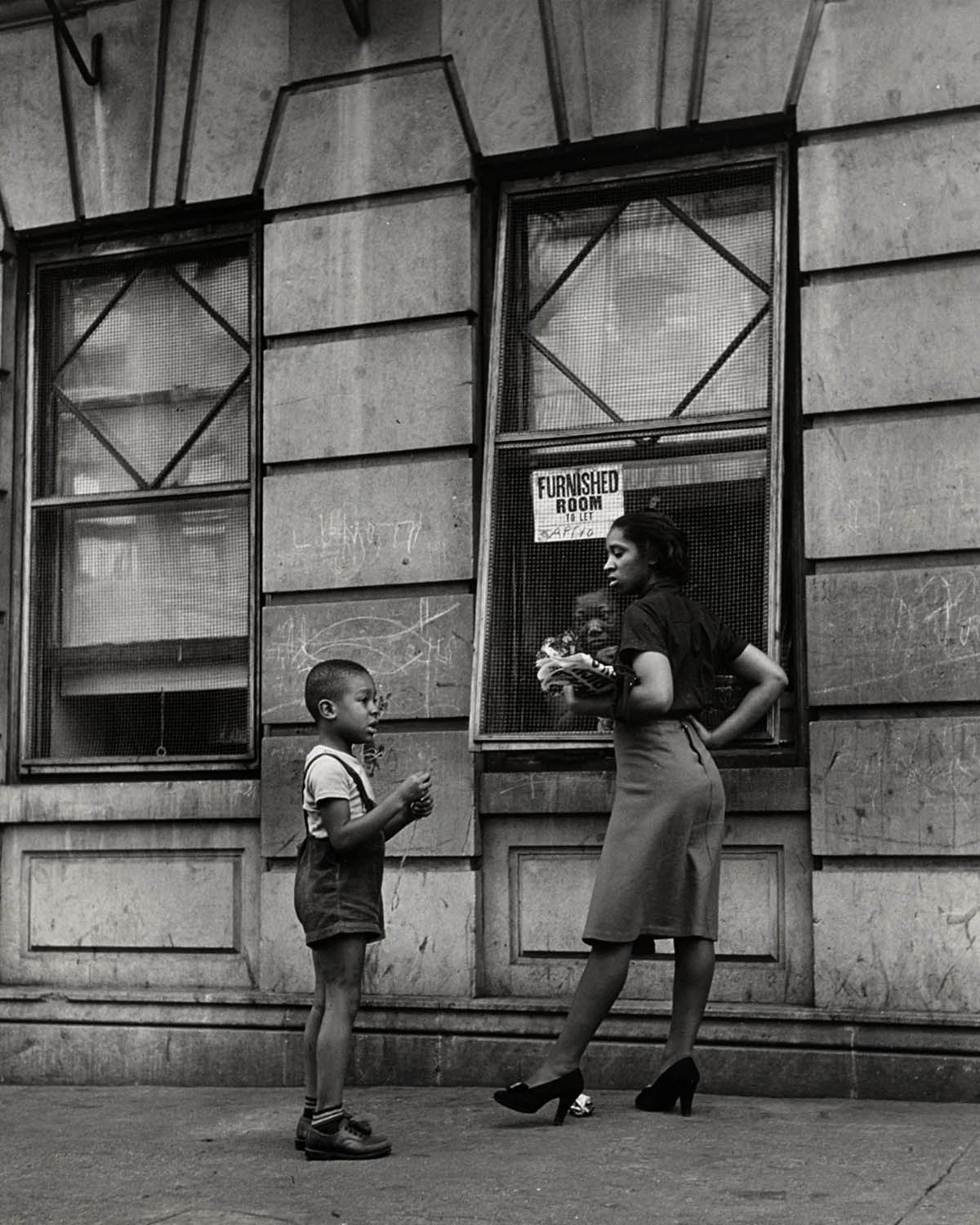
 

Aaron Siskind (American, 1902-1991) 'Street Scene' 1940


Aaron Siskind (American, 1902-1991)
Street Scene
1940
Gelatin silver print
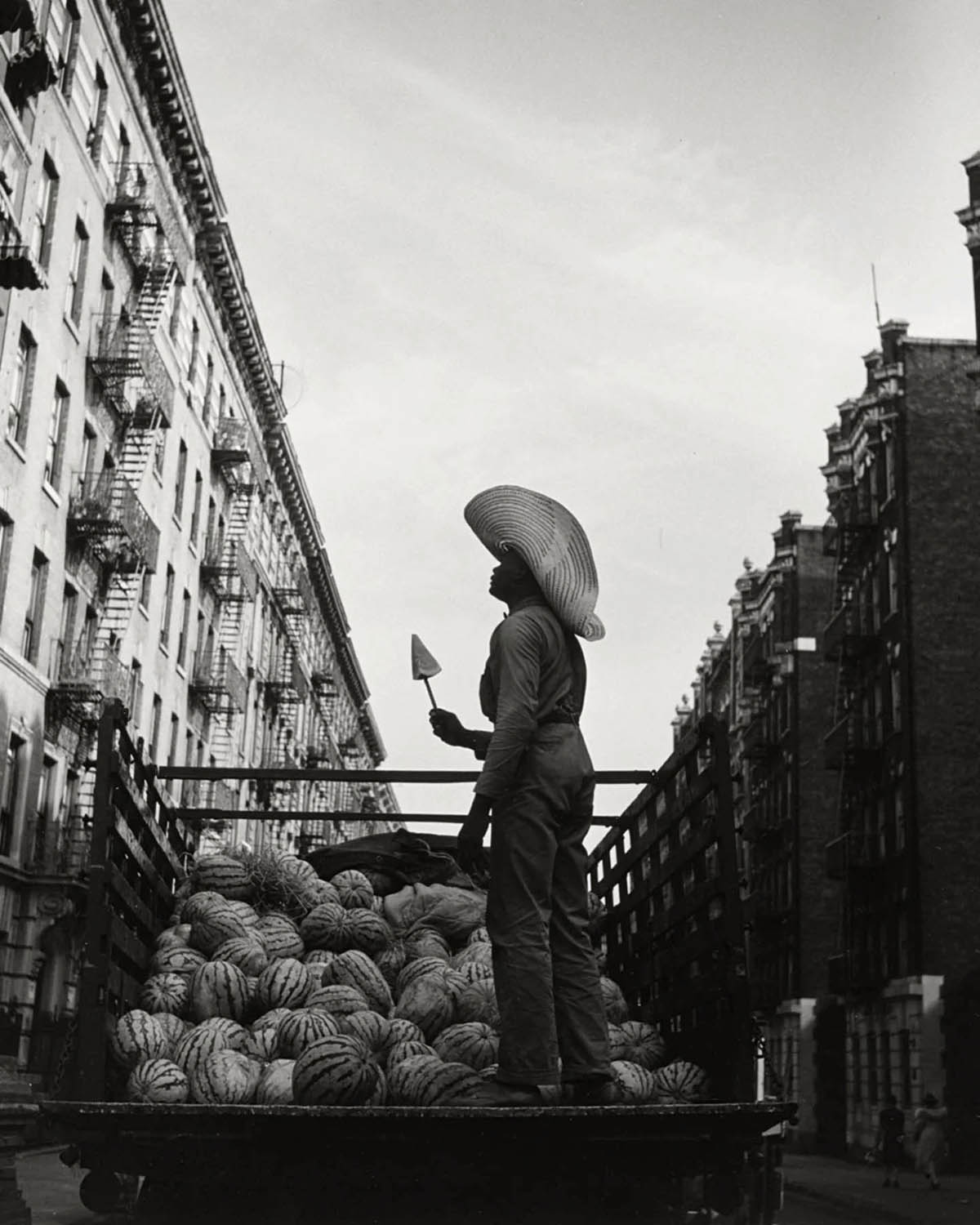
 

Aaron Siskind (American, 1902-1991) 'Watermelon Man' 1940


Aaron Siskind (American, 1902-1991)
Watermelon Man
1940
Gelatin silver print


LIKE ART BLART ON FACEBOOK

Back to top

Exhibition: ‘The Radical Camera: New York’s Photo League, 1936-1951’ at The Norton Museum of Art, West Palm Beach, Florida

Exhibition dates: 14th March – 16th June, 2013

Curators: Mason Klein, Curator of Fine Arts at The Jewish Museum and Catherine Evans, the William and Sarah Ross Soter Curator of Photography of the Columbus Museum of Art


Alexander Alland (Ukranian-American, 1902-1989, born Sevastopol, Ukraine) 'Untitled (Brooklyn Bridge)' 1938 from the exhibition 'The Radical Camera: New York's Photo League, 1936-1951' at The Norton Museum of Art, West Palm Beach, Florida, March - June, 2013


Alexander Alland (Ukranian-American, 1902-1989, born Sevastopol, Ukraine)
Untitled (Brooklyn Bridge)
1938
Gelatin silver print
The Jewish Museum, New York
Purchase: William and Jane Schloss Family Foundation Fund


Conscience of the brave

Bradley Manning.
A slight, bespectacled, intelligent gay man.
A man who has the courage of his convictions.
He revealed truth at the heart of the world’s largest “democracy.”

There is something insidious about the American nation. Not its citizens, not its place, but its government. This government has perpetrated evil in the name of its people. Think of Iraq and Afghanistan, invasions in the name of freedom, the support of puppet governments, the assassinations, the military advisors on the ground, the profits made.

The torture. The deaths.

Bradley Manning revealed all of this because he has a mighty moral compass. He knows right from wrong. He was not afraid to expose the hypocrisy that for many years has beaten, unfettered, in the breast of a nation. The home of the brave and the free is sadly under attack from within. In the name of its people.

And why is this text relevant to this posting?

So often in the history of America, dissension is shut down because of some imagined menace, from within or without. Here another group of people (photographers documenting American social conditions) were persecuted for standing up for social causes, for the freedom to expose injustice where it lives. The paranoia of patriotism.

As Harold Pinter has so pithily observed,

“The crimes of the United States have been systematic, constant, vicious, remorseless, but very few people have actually talked about them. You have to hand it to America. It has exercised a quite clinical manipulation of power worldwide while masquerading as a force for universal good. It’s a brilliant, even witty, highly successful act of hypnosis.”

Except the hypnotist is a deranged psychopath, a divided split personality arraigning god, greed and guns. Out of one, many sins.

Dr Marcus Bunyan


Many thankx to The Norton Museum of Art for allowing me to publish the photographs in the posting. Please click on the photographs for a larger version of the image.


“When the persecution of an individual who has exposed an evil is pursued so ruthlessly and yet the evil itself is studiedly ignored, all of us know that there is something very wrong with the way that our society is conducting itself. And if we do not protest in the strongest terms about what is being done in our name, then we become complicit.”


Alan Moore


“The US has shown remarkable energy in its pursuit of alleged whistleblowers. Has it investigated the deaths of those innocent civilians with the same vigour? With any vigour whatsoever? And which would you consider a crime? To conceal the deaths of innocent civilians, or to reveal them? I know what my answer would be.”


Les Barker


“To suggest that lives were put in danger by the release of the WikiLeaks documents is the most cynical of statements. Lives were put in danger the night we invaded the sovereign nation of Iraq, an act that had nothing to do with what the Bradley Mannings of this country signed up for: to defend our people from attack. It was a war based on a complete lie and lives were not only put in danger, hundreds of thousands of them were exterminated. For those who organised this massacre to point a finger at Bradley Manning is the ultimate example of Orwellian hypocrisy.”


Michael Moore


“Private Manning is the world’s pre-eminent prisoner of conscience, having remained true to the Nuremberg principle that every soldier has the right to ‘a moral choice.’ His suffering mocks the notion of the land of the free.”


John Pilger


Louis Stettner (American, 1922-2016) 'Coming to America' c. 1951 from the exhibition 'The Radical Camera: New York's Photo League, 1936-1951' at The Norton Museum of Art, West Palm Beach, Florida, March - June, 2013


Louis Stettner (American, 1922-2016)
Coming  to America
c. 1951
Gelatin silver print The Jewish Museum, New York
Purchase: Photography Acquisitions Committee Fund


Louis Stettner (American, 1922-2016)

Louis Stettner (November 7, 1922 – October 13, 2016) was an American photographer of the 20th century whose work included streetscapes, portraits and architectural images of New York and Paris. His work has been highly regarded because of its humanity and capturing the life and reality of the people and streets. Starting in 1947, Stettner photographed the changes in the people, culture, and architecture of both cities. He continued to photograph New York and Paris up until his death. …

Back from the war Stettner joined the Photo League in New York. Stettner visited Paris in 1946 and in 1947 moved there. From 1947 to 1949 he studied at the “Institut des Hautes Études Cinématographiques” in Paris and received a Bachelor of Arts in Photography & Cinema. He went back and forth between New York and Paris for almost two decades and finally settled permanently in Saint-Ouen, near Paris, in 1990. Stettner still frequently returned to New York.

Stettner’s professional work in Paris began with capturing life in the post-war recovery. He captured the everyday lives of his subjects. In the tradition of the Photo League, he wanted to investigate the bonds that connect people to one another. In 1947 he was asked by the same Photo League to organise an exhibition of French photographers in New York. He gathered the works of some of the greatest photographers of the era, including Doisneau, Brassaï, Boubat, Izis, and Ronis. The show was a big success and was largely reviewed in the annual issue of U.S. Camera. Stettner had begun a series of regular meetings with Brassaï who was a great mentor and had significant influence on his work. In 1949, Stettner had his first exhibition at the “Salon des Indépendants” at the Bibliothèque Nationale, Paris.

In 1951 his work was included in the famous Subjektive Fotografie exhibition in Germany. During the 1950s he free-lanced for Time, Life, Fortune, and Du (Germany). While in Paris he reconnected with Paul Strand, who had also left New York because of the political intolerance of the McCarthy era – Strand had been a founder of the Photo League that would be blacklisted and then banned during those years.

In the 1970s Stettner spent more time in New York City, where he taught at Brooklyn College, Queens College, and Cooper Union.

Text from the Wikipedia website


Erika Stone (born 1924, Frankfurt, Germany) 'Lower Eastside Facade' 1947


Erika Stone (German, b. 1924)
Lower Eastside Facade
1947
Gelatin silver print
Columbus Museum of Art, Ohio, Photo League Collection
Museum purchase with funds provided by Elizabeth M. Ross, the Derby Fund,
John S. and Catherine Chapin Kobacker, and the Friends of the Photo League


Stone’s adroit cropping of this image emphasises the coy upward gaze of the woman in the advertisement, away from the laundry line (emblem of poverty), and suggests the social mobility of the postwar era.


Erika Stone’s documentary photographs reflect her long, active career as a photo journalist and magazine photographer. In the 40’s, Stone was a member of the legendary Photo League, an organisation of photo documentarians which she feels most influenced her approach to her personal photographic work. It was during the years as a League member that she developed her interest in documenting people and at the age of seventeen, produced her Bowery series.

Although she considers herself mostly self-taught, she studied at the New School of Social Research with Bereniece Abbott and George Tice.

Stone was a stringer for both Time and Der Spiegel magazines and worked as a general photojournalist until 1960. After the birth of her two sons, she made photographing children and family her specialty. Her photographs have been and are widely published in magazines and textbooks around the world.

Anonymous. “Erika Stone,” on the American Photography Archives Group website Nd [Online] Cited 13/07/2024. Used under fair use conditions for the purposes of education and research


Marvin E. Newman (American, 1927-2023) 'Halloween, South Side' 1951


Marvin E. Newman (American, 1927-2023)
Halloween, South Side
1951
Gelatin silver print
The Jewish Museum, New York
Purchase: Photography Acquisitions Committee Fund


Marvin Newman

Born in New York; Newman attended Brooklyn College, where he studied sculpture with Burgoyne Diller and photography with Walter Rosenblum. Following Rosenblum’s suggestion, he joined the Photo League in 1948, taking classes with John Ebstel. The Photo League, founded in 1936, blazed a trail for serious photographers for 15 years, providing a forum for ideas, cheap darkroom space, and the vision of using the art of picture taking to change the world. Newman then attended the Institute of Design, Chicago (1949-52), where, after studying with Harry Callahan and Aaron Siskind, he received one of the first MS degrees in photography (1952).

During this time, Newman won national contests, including one sponsored by American Photography (1950) and another by Time, Inc. (1951). His work appeared in the Always a Young Stranger exhibition at the Museum of Modern Art, New York, and in a one-man show at Roy De Carava’s A Photographer’s Gallery (1956). Well-known as a photojournalist, Newman has been a major contributor to Sports Illustrated since its inception (1953), as well as to Life, Look, Newsweek, and Smithsonian magazines. In addition, he has been the national president of the American Society of Magazine Photographers, authored or coauthored eight books on photography, and received the Art Director’s Gold Medal for Editorial Photography.


Ida Wyman (American, 1926-2019) 'Spaghetti 25 Cents, New York' 1945


Ida Wyman (American, 1926-2019)
Spaghetti 25 Cents, New York
1945
Gelatin silver print
The Jewish Museum, New York
Purchase: Photography Acquisitions Committee Fund


This Italian restaurant was near the offices of Acme Newspictures, where Wyman became the company’s first female photo printer in 1943. After the war she lost her job at the agency. The “Ladies Invited” sign on the window is a reminder of a time when unescorted women were not always welcome in public dining establishments.

Ida Wyman

When I began working in the 1940s, few women were doing magazine photography in a field that was almost exclusively male. As I progressed from box camera to Speed Graphic (my first professional camera), and then to a Rolleiflex, I stopped thinking about the mechanics of film speed, f-stops, shutter speed, and began focusing on subject matter that interested me. What interested me so much were ordinary people and their everyday activities. Early on, I had documented children’s games and unusual architectural details in my Bronx neighbourhood. I decided to expand, to go elsewhere, taking the subway to Harlem, Chinatown, and lower Manhattan, exploring those neighbourhoods and looking for photos.

I became a member of the Photo League in 1946. I considered myself a documentary photographer and the League’s philosophy of honest photography appealed to me. I also began to understand the power of photos to help improve the social order by showing the conditions under which many people lived and worked. Even after leaving the League the following year, I continued to emphasise visual and social realities in my straightforward photographs.

Beginning with my earliest photos seeing New York City with my feet, and in whatever part of the country I was in, I continued my own walkabout, learning the area, engaging my subject, listening, and respecting their dignity. This continued to be my approach when taking photos. My photographs depicted daily life in America’s modern metropolitan centres, including Chicago and Los Angeles as well as New York.


Aaron Siskind (American, 1903-1991) 'The Wishing Tree' 1937


Aaron Siskind (American, 1903-1991)
The Wishing Tree
1937, printed later
From Harlem Document, 1936-40
Gelatin silver print
The Jewish Museum, New York
Purchase: Lillian Gordon Bequest


Harlem’s legendary Wishing Tree, bringer of good fortune, was once a tall elm that stood outside a theatre at 132nd Street and Seventh Avenue. When it was cut down in 1934 Bill “Bojangles” Robinson, the celebrated tap dancer, moved the stump to a nearby block and planted a new Tree of Hope beside it to assume wish granting duties. A piece of the original trunk is preserved in the Apollo Theatre on 125th Street, where performers still touch it for luck before going onstage.


Sonia Handelman Meyer (American, 1920-2022) 'Hebrew Immigration Aid Society' c. 1946


Sonia Handelman Meyer (American, 1920-2022)
Hebrew Immigration Aid Society
c. 1946
Gelatin silver print
The Jewish Museum, New York
Purchase: Mimi and Barry J. Alperin in memory of Max Alperin


The efforts of the New York­ based Hebrew Immigration Aid Society (HIAS) to rescue European Jews during the war were severely hampered by US immigration laws. After the war it aided in the resettlement of some 150,000 displaced persons, including, presumably, these three, whom Handelman Meyer has chosen to photograph in close-­up. She conveys both their common suffering and their individuality, emphasising differences in body language and dress.

Sonia Handelman Meyer

I first heard of the Photo League from Lou Stoumen in Puerto Rico in 1942. I was working for the U.S. Army Signal Corps and Lou was preparing to join Yank Magazine. When I returned to New York City, I walked up the rickety stairs to League Headquarters and took a beginners class with Johnny Ebstel. I bought a used Rolleicord for a precious $100, and dared to go out on the city streets to photograph the life around me. Soon the guys began to come back from the war and the heady life of Photo League workshops, exhibits, lectures, photo hunts, and committee assignments intensified. I took eye-heart-soul opening workshops with Sid Grossman, worked as the paid (!) secretary for a year or so, and worked on the Lewis Hine Committee under Marynn Ausubel.

I photographed in Spanish Harlem, Greenwich Village, midtown Manhattan, at the Hebrew Immigration Aid Society, at an anti-lynching rally in Madison Square Park, at a Jehovah’s Witness convention in Yankee Stadium, and on Coney Island. Mostly, I photographed children and reflections of my city – rough-edged, tender, and very beautiful in its diversity. Some of this work was shown in the major 1949 exhibition, This is the Photo League.

The heartbreaking end of the League coincided with a huge change in my personal life. I got married and my husband began to go to college and we were out of NY for a while. And then the biggest change: our own family arrived and the joys of our son, and later our daughter, absorbed my time. Prints and negatives were stashed away in boxes and I lost track of all the old friends at the League. After so many years of being in the shadows, you can imagine my pleasure, at 90+ years of age, to have my photographs out of their boxes and onto walls where they can be seen, thought about, and enjoyed – and perhaps again take their place in the history of the Photo League.


Arthur Leipzig (American, 1918-2014) 'Chalk Games, Prospect Place, Brooklyn' 1950


Arthur Leipzig (American, 1918-2014)
Chalk Games, Prospect Place, Brooklyn
1950
Gelatin silver print
The Jewish Museum, New York
Purchase: Rictavia Schiff Bequest


Arnold Eagle (Hungarian-American, 1909-1992) 'Chatham Square Platform, New York City' c. 1939


Arnold Eagle (Hungarian-American, 1909-1992)
Chatham Square Platform, New York City
c. 1939
Silver gelatin print


Joe Schwartz (American, 1913-2013) 'Slums Must Go! May Day Parade, New York' c. 1936


Joe Schwartz (American, 1913-2013)
Slums Must Go! May Day Parade, New York
c. 1936
Gelatin silver print
Columbus Museum of Art, Ohio, Photo League Collection
Museum Purchase with funds provided by Elizabeth M. Ross, the Derby Fund, John S. and Catherine Chapin Kobacker, and the Friends of the Photo League


Morris Huberland (Polish-American, 1909-2003 born Warsaw, Poland) 'Union Square, New York' c. 1942


Morris Huberland (Polish-American, 1909-2003 born Warsaw, Poland)
Union Square, New York
c. 1942
Gelatin silver print
The Jewish Museum, New York
Purchase: Mimi and Barry J. Alperin Fund


The Norton Museum of Art’s newest special exhibition, The Radical Camera: New York’s Photo League, 1936-1951, is a formidable survey of the League’s history, and its artistic, cultural, social, and political significance. Opening March 14 and on view through June 16, 2013, this striking exhibition includes nearly 150 vintage photographs from Photo League collections at the Columbus Museum of Art, Ohio, and The Jewish Museum in New York City.

The exhibition is organised by Mason Klein, Curator of Fine Arts at The Jewish Museum and Catherine Evans, the William and Sarah Ross Soter Curator of Photography of the Columbus Museum of Art. It premiered in at The Jewish Museum in 2011 to rave reviews. The New York Times called The Radical Camera a “stirring show,” and the New York Photo Review hailed it as “nothing short of splendid.” The New Yorker named the exhibition one of the top 10 photography exhibitions of 2011. The Norton is the final venue on the exhibition’s tour.

The exhibition explores the fascinating blend of aesthetics and social activism at the heart of the Photo League. League members were known for capturing sharply revealing, compelling moments from everyday life. The League focused on New York City and its vibrant streets – a shoeshine boy, a brass band on a bustling corner, a crowded beach at Coney Island. Many of the images are beautiful, yet harbour strong social commentary on issues of class, race, and opportunity. The organisation’s members included some of the most noted photographers of the mid-20th century – W. Eugene Smith, Weegee (Arthur Fellig), Lisette Model, Berenice Abbott and Aaron Siskind, to name a few.

In 1936, a group of young, idealistic photographers, most of them Jewish, first-generation Americans, formed an organisation in Manhattan called the Photo League. Their solidarity centred on a belief in the expressive power of the documentary photograph, and on a progressive alliance in the 1930s of socialist ideas and art. (The Photo League also helped validate photography as a fine art, presenting student work and guest exhibitions by established photographers.) The Radical Camera presents the development of the documentary photograph during a tumultuous period that spanned the New Deal reforms of the Depression, World War II, and the Cold War. Offering classes, mounting exhibitions, and fostering community, members of the Photo League focused on social reform and the power of the photograph to motivate change. At the height of their influence, their membership included the most important photographers of their day including Berenice Abbot, Aaron Siskind, Barbara Morgan, Sid Grossman, Weegee (Arthur Fellig), and Lisette Model. Featuring more than 175 works by these artists as well as many more Photo League members, The Radical Camera traces the organisation’s interests, attitudes toward photography, and impact during its 15-year lifespan.

The innovative contributions of the Photo League during its 15-year existence (1936-1951) were significant. As it grew, the League mirrored monumental shifts in the world starting with the Depression, through World War II, and ending with the Red Scare. Born of the worker’s movement, the Photo League was an organisation of young, idealistic, first-generation American photographers, most of them Jewish, who believed in documentary photography as an expressive medium and powerful tool for exposing social problems. It was also a school with teachers such as Sid Grossman, who encouraged students to take their cameras to the streets and discover the meaning of their work as well as their relationship to it. The League had a darkroom for printing, published an acclaimed newsletter called Photo Notes, offered exhibition space, and was a place to socialise.

The Photo League helped validate photography as a fine art, presenting student work and guest exhibitions by established photographers such as Eugène Atget, Henri Cartier-Bresson, and Edward Weston, among others. These affecting black and white photographs show life as it was lived mostly on the streets, sidewalks and subways of New York. Joy and playfulness as well as poverty and hardship are in evidence. In addition to their urban focus, “Leaguers” photographed rural America, and during World War II, took their cameras to Latin America and Europe. The exhibition also addresses the active participation of women who found rare access and recognition at the League. The Radical Camera presents the League within a critical, historical context. Developments in photojournalism were catalysing a new information era in which photo essays were appearing for the first time in magazines such as Life and Look. As time went on, its social documentary roots evolved toward a more experimental approach, laying the foundation for the next generation of street photographers.

In 1947, the League came under the pall of McCarthyism and was blacklisted for its alleged involvement with the Communist Party. Ironically, the Photo League had just begun a national campaign to broaden its base as a “Center for American Photography.” Despite the support of Ansel Adams, Beaumont and Nancy Newhall, Paul Strand, and many other national figures, this vision of a national photography centre could not overcome the Red Scare. As paranoia and fear spread, the Photo League was forced to disband in 1951. The Radical Camera: New York’s Photo League, 1936-1951 has been organised by The Jewish Museum, New York, and the Columbus Museum of Art, Ohio. Major support was provided by the Phillip and Edith Leonian Foundation, the National Endowment for the Arts, and Limited Brands Foundation.”

Press release from The Norton Museum of Art website


Sy Kattelson (American, 1923-2018) 'Untitled (Subway Car)' 1949


Sy Kattelson (American, 1923-2018)
Untitled (Subway Car)
1949
Gelatin silver print
The Jewish Museum, New York
Purchase: The Paul Strand Trust for the benefit of Virginia Stevens Gift


Jerome Liebling (American, 1924-2011) 'Butterfly Boy, New York' 1949


Jerome Liebling (American, 1924-2011)
Butterfly Boy, New York
1949
Gelatin silver print
The Jewish Museum, New York, Purchase: Mimi and Barry J. Alperin Fund
© Estate of Jerome Liebling


Lee Sievan (American, 1907-1990) 'Salvation Army Lassie in Front of a Woolworth Store' c. 1940


Lee Sievan (American, 1907-1990)
Salvation Army Lassie in Front of a Woolworth Store
c. 1940
Gelatin silver print
The Jewish Museum, New York
Purchase: Horace W. Goldsmith Foundation Fund


This is a classic photograph. Look at the triangle that forms the central part of the image, from the girl at left looking with disdain at the matriarch singing then down to the look on the organ players face. Notice the girl at right covering her ears so she cannot hear the racket. Imagine the legs of the organ player going up and down, pumping air into the organ; and finally observe the shadow of a man’s face captured by reflection in the shop window as he walks past the scene. Magic.


Rosalie Gwathmey (American, 1908-2001) 'Shout Freedom, Charlotte, North Carolina' c. 1948


Rosalie Gwathmey (American, 1908-2001)
Shout Freedom, Charlotte, North Carolina
c. 1948
Gelatin silver print
The Jewish Museum, New York
Purchase: Gay Block and Malka Drucker Fund of the Houston Jewish Community Foundation


Weegee (Arthur Fellig) (American born Ukraine, 1899-1968) 'Max Is Rushing in the Bagels to a Restaurant on Second Avenue for the Morning Trade' c. 1940


Weegee (Arthur Fellig) (American born Ukraine, 1899-1968)
Max Is Rushing in the Bagels to a Restaurant on Second Avenue for the Morning Trade
c. 1940
Gelatin silver print
The Jewish Museum, New York
Purchase: Joan B. and Richard L. Barovick Family Foundation and Bunny and Jim Weinberg Gifts


Bernard Cole (English, 1911-1992, born London, England) 'Shoemaker’s Lunch' 1944


Bernard Cole (English, 1911-1992, born London, England)
Shoemaker’s Lunch
1944
Gelatin silver print
The Jewish Museum, New York,
Purchase: The Paul Strand Trust for the benefit of Virginia Stevens Gift


Rebecca Lepkoff (American, 1916-2014) 'Broken Window on South Street, New York' 1948


Rebecca Lepkoff (American, 1916-2014)
Broken Window on South Street, New York
1948
Gelatin silver print
The Jewish Museum, New York
Purchase: Esther Leah Ritz Bequest


Arthur Leipzig (American, 1918-2014) 'Ideal Laundry' 1946


Arthur Leipzig (American, 1918-2014)
Ideal Laundry
1946
Gelatin silver print
The Jewish Museum, New York
Purchase: Esther Leah Ritz Bequest


Consuelo Kanaga (American, 1894-1978) 'Untitled (Tenements, New York)' c. 1937


Consuelo Kanaga (American, 1894-1978)
Untitled (Tenements, New York)
c. 1937
Gelatin silver print
The Jewish Museum, New York
Purchase: The Paul Strand Trust for the benefit of Virginia Stevens Gift


Leftist political activism was a strong element in Kanaga’s work, beginning with her photographs of a labor strike in San Francisco in 1934. She provided photographs for progressive publications such as New Masses, Labor Defender, and Sunday Worker. Underlying this formal study of tenement laundry lines (a common motif in League imagery) is Kanaga’s empathy for the living conditions of the working class.


Ruth Orkin (American, 1921-1985) 'Boy Jumping into Hudson River' 1948


Ruth Orkin (American, 1921-1985)
Boy Jumping into Hudson River
1948
Gelatin silver print The Jewish Museum, New York
Purchase: Horace W. Goldsmith Foundation Fund


Sol Prom (Solomon Fabricant) (American, 1906-1989) 'Untitled (Dancing School)' 1938


Sol Prom (Solomon Fabricant) (American, 1906-1989)
Untitled (Dancing School)
1938
From Harlem Document, 1936-40
Gelatin silver print
The Jewish Museum, New York
Purchase: Horace W. Goldsmith Foundation Fund


Mary Bruce opened a dancing school in Harlem in 1937. For fifty years she taught ballet and tap, giving free lessons to those who could not afford them. Her illustrious pupils included Katherine Dunham, Nat King Cole, Ruby Dee, and Marlon Brando.


The Norton Museum of Art
1451 S. Olive Avenue
West Palm Beach, FL 33401
Phone: (561) 832-5196

Opening hours:
Thursday – Tuesday 10am – 5pm
Closed Wednesdays

Norton Museum of Art website

LIKE ART BLART ON FACEBOOK

Back to top