Exhibition: ‘Arresting Beauty: Julia Margaret Cameron’ at the Milwaukee Art Museum

Exhibition dates: 3rd May – 28th July, 2024


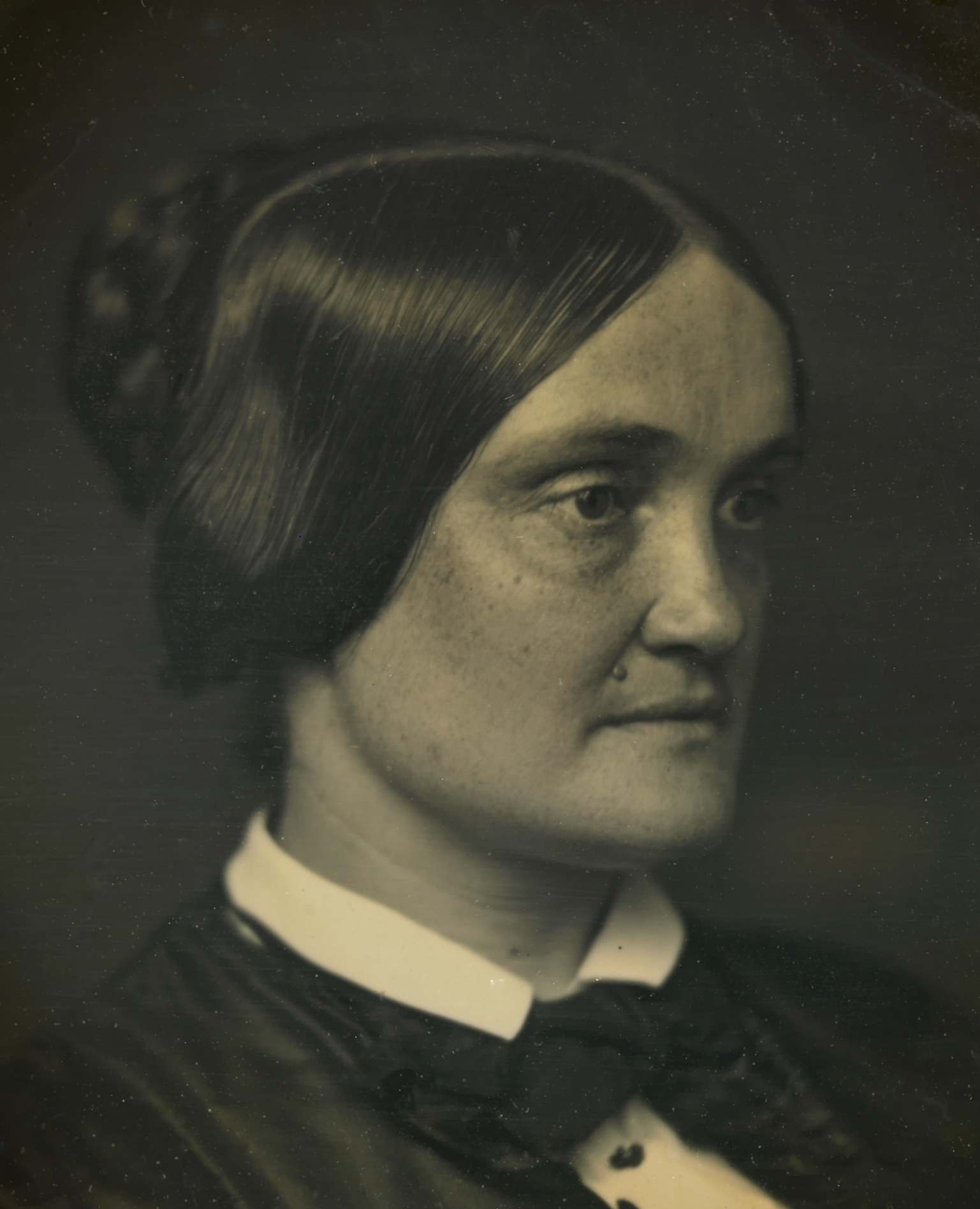
Julia Margaret Cameron (British born India, 1815-1879) 'Annie' 1864


Julia Margaret Cameron (British born India, 1815-1879)
Annie
1864
Albumen print
25.5cm x 21.3cm
© The Royal Photographic Society Collection at the V&A, acquired with the generous assistance of the National Lottery Heritage Fund and Art Fund


Julia Margaret Cameron made this portrait of Annie Philpot, the daughter of a family staying on the Isle of Wight, within a month of receiving her first camera. She inscribed some prints of it ‘My first success’. She later recounted, ‘I was in a transport of delight. I ran all over the house to search for gifts for the child. I felt as if she entirely had made the picture.’

Text from the V&A website


“Nothing is scared but beauty.”1


Since the establishment of Art Blart in November 2008, Julia Margaret Cameron appears in a select and esteemed group of photographic artists who each have over 6 postings in the archive: Eugène Atget, William Eggleston, Walker Evans, Robert Frank, Dorothea Lange, Robert Mapplethorpe, László Moholy-Nagy and August Sander.

I am always ecstatic when I see Cameron’s work. Nobody has ever taken portraits like JMC before or since.

As I have written on JMC in earlier exhibitions:

“When you think about it, here is one the world’s top ten photographers of all time – a woman, taking photographs within the first twenty five years of the birth of commercial photography, using rudimentary technology and chemicals – whose photographs are still up there with the greatest ever taken. Still recognisable as her own and no one else’s after all these years. That is a staggering achievement – and tells you something about the talent, tenacity and perspicacity of the women… that she possessed and illuminated such a penetrating discernment – a clarity of vision and intellect which provides a deep understanding and insight into the human condition.”2

“As with any genius (a person who possesses exceptional intellectual or creative power) who goes against the grain, full recognition did not come until later. But when it does arrive, it is undeniable. As soon as you see a JMC photograph… you know it is by her, it could be by no one else. Her “signature” – closely framed portraits and illustrative allegories based on religious and literary works; far-away looks, soft focus and lighting, low depth of field; strong men (“great thro’ genius”) and beautiful, sensual, heroic women (“great thro’ love”) – is her genius.

There is something so magical about how JMC can frame a face, emerging from darkness, side profile, filling the frame, top lit. Soft out of focus hair with one point of focus in the image. Beautiful light. Just the most sensitive capturing of a human being, I don’t know what it is… a glimpse into another world, a ghostly world of the spirit, the soul of the living seen before they are dead.

Love and emotion. Beauty, beautiful, beatified.”3

Dr Marcus Bunyan


1/ “The line runs from Winckelmann’s Thoughts on the Imitation of Greek Works of Art in Painting and Sculpture, first published in 1755, to the end of the 19th century and beyond; see Walter Pater’s “Winckelmann,” written in 1867 and published in The Renaissance.
Margaret Walters. “The Classical Nude,” in Margaret Walters. The Nude Male: A New Perspective. New York & London: Paddington Press, 1978, p. 34. Footnote 2.

2/ Marcus Bunyan on the exhibition Julia Margaret Cameron: from the Victoria and Albert Museum, London at the Art Gallery of New South Wales (AGNSW), Sydney on Art Blart 24th October 2015

3/ Marcus Bunyan on the exhibition Victorian Giants: The Birth of Art Photography at the National Portrait Gallery, London on Art Blart 13th May 2018

Julia Margaret Cameron exhibitions on Art Blart

~ Exhibition: ‘Francesca Woodman and Julia Margaret Cameron: Portraits to Dream In’ at the National Portrait Gallery, London, March – June 2024
~ Exhibition: ‘Victorian Giants: The Birth of Art Photography’ at the National Portrait Gallery, London Part 1, March – May 2018
~ Exhibition: ‘Julia Margaret Cameron’ at the Victoria and Albert Museum, London, November 2015 – February 2016
~ Exhibition: ‘Julia Margaret Cameron: from the Victoria and Albert Museum, London’ at the Art Gallery of New South Wales (AGNSW), Sydney Part 2, August – October 2015
~ Exhibition: ‘Julia Margaret Cameron: from the Victoria and Albert Museum, London’ at the Art Gallery of New South Wales (AGNSW), Sydney Part 1, August – October 2015
~ Exhibition: ‘Julia Margaret Cameron’ at The Metropolitan Museum of Art, New York, August 2013 – January 2014


Many thankx to the Milwaukee Art Museum for allowing me to publish the photographs in the posting. Please click on the photographs for a larger version of the image.


“I longed to arrest all beauty that came before me, and at length the longing has been satisfied.”


Julia Margaret Cameron


One of the most influential photographers in the medium’s history, Julia Margaret Cameron made portraits of transcendent beauty in close-up, soft-focus photographs. Arresting Beauty: Julia Margaret Cameron – a major traveling exhibition the Milwaukee Art Museum partnered with the Victoria and Albert Museum, London, to bring to the Midwest – highlights the renowned photographer’s pioneering style.

Cameron (English b. India, 1815-1879) received her first camera at the age of 48, making her career even more impressive for its brevity. Her portraits depict family and friends; contemporary scientists, scholars, and artists; and scenes staging allegorical, biblical, historical, and literary stories. For over a decade, she produced thousands of photographs and built a career, selling and exhibiting her work internationally. Her distinct style set her apart, and her legacy positions her as an artist who broke ground for future photographers.

The Museum’s unique presentation of this celebratory exhibition features more than 90 objects and includes works of art from its collection to provide historical context for the art that influenced, and was influenced by, Cameron.

A V&A Exhibition – Touring the World

Text from the Milwaukee Art Museum website
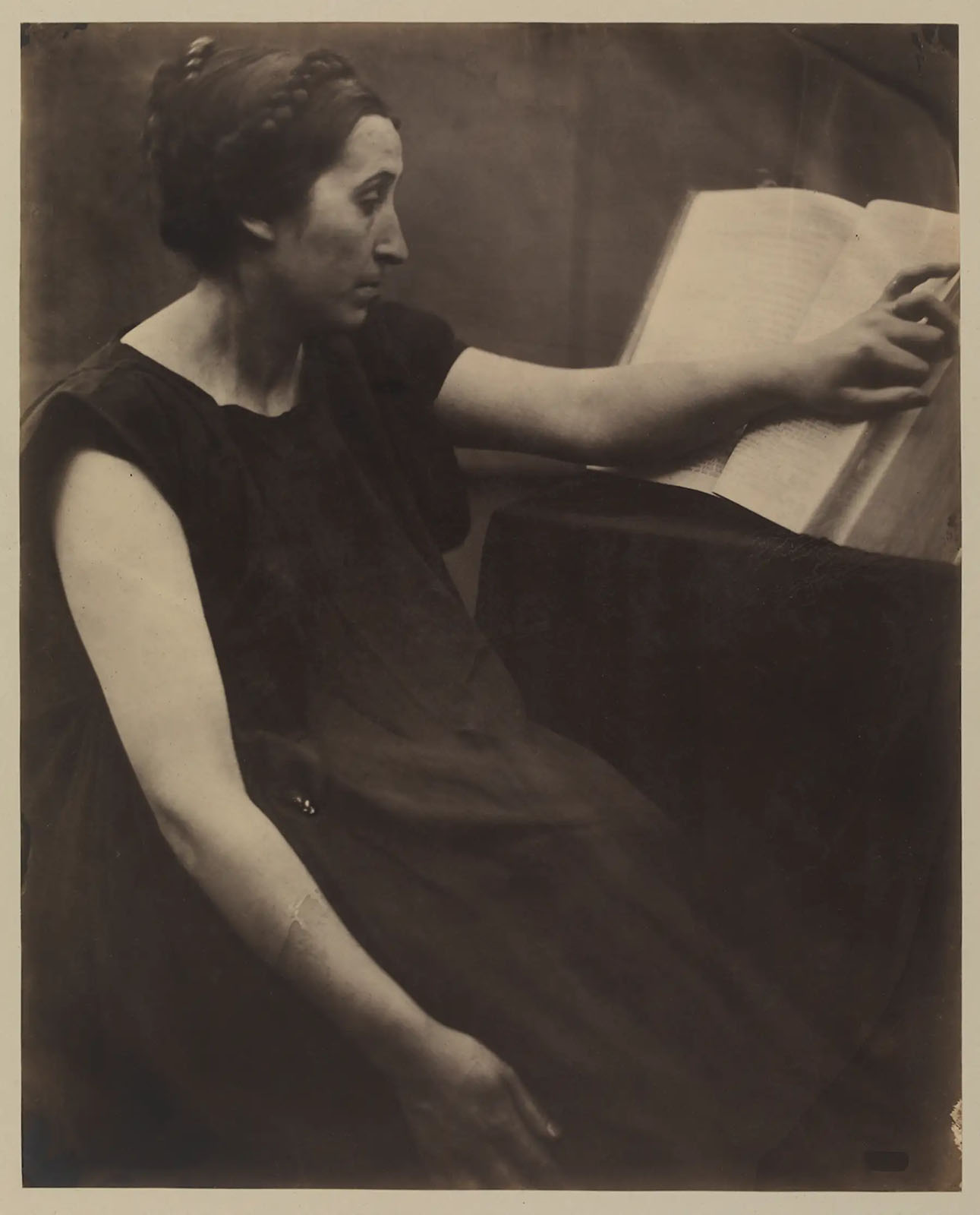
 

Julia Margaret Cameron (British born India, 1815-1879) 'A Sibyl after the manner of Michelangelo' 1864


Julia Margaret Cameron (British born India, 1815-1879)
A Sibyl after the manner of Michelangelo
1864
Albumen print
28.5cm x 22.5cm
© The Royal Photographic Society Collection at the V&A, acquired with the generous assistance of the National Lottery Heritage Fund and Art Fund


Just as she modelled her Madonna photographs on Renaissance art, Julia Margaret Cameron looked to painting and sculpture as inspiration for her allegorical and narrative subjects. Some works are photographic interpretations of specific paintings by artists such as Raphael and Michelangelo. Others aspired more generally to create ‘Pictorial Effect’.

This depiction of a sibyl, a prophetess from classical mythology, is based on Michelangelo’s fresco of the Erythraean Sibyl on the ceiling of the Sistine Chapel in Rome (1508-1510). The model’s braided hair, bare arms and profile pose with a large book are all copied from Michelangelo’s version. Cameron’s good friend and neighbour Tennyson had prints of the Sistine Chapel frescoes decorating his home.

Cameron’s friend and mentor, the painter G.F. Watts, wrote to Cameron, ‘Please do not send me valuable mounted copies … send me any … defective unmounted impressions, I shall be able to judge just as well & shall be just as much charmed with success & shall not feel that I am taking money from you.’ This photograph is one of approximately 67 in the V&A’s collection that was recently discovered to have belonged to him. Many are unique, which suggests that Cameron was not fully satisfied with them. Some may seem ‘defective’ but others are enhanced by their flaws. All of them contribute to our understanding of Cameron’s working process and the photographs that did meet her standards.

Text from the V&A website
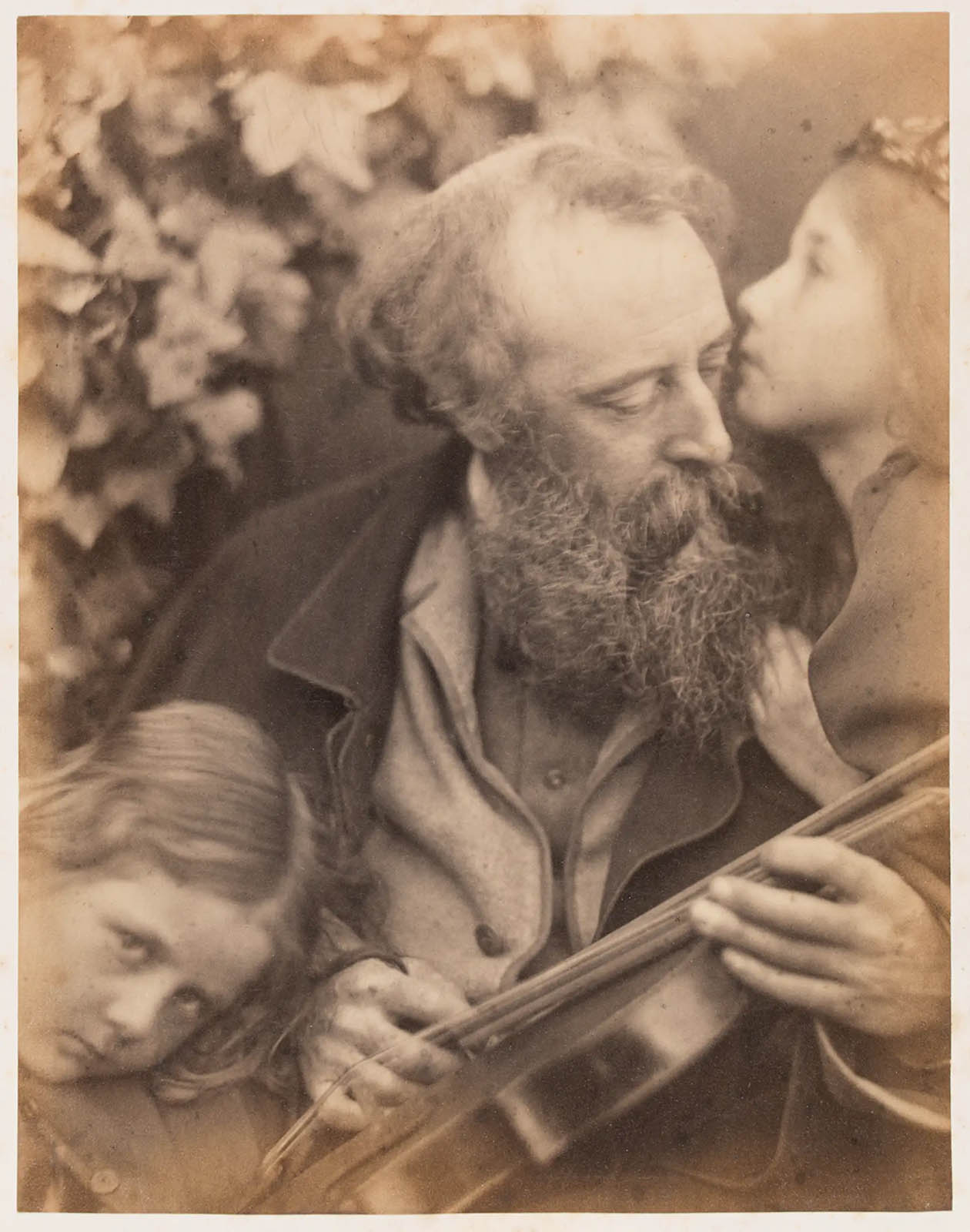
 

Julia Margaret Cameron (British born India, 1815-1879) 'The Whisper of the Muse' 1865


Julia Margaret Cameron (British born India, 1815-1879)
The Whisper of the Muse
1865
Albumen print
25.5cm x 21.3cm
© The Royal Photographic Society Collection at the V&A, acquired with the generous assistance of the National Lottery Heritage Fund and Art Fund


Julia Margaret Cameron looked to painting and sculpture as inspiration for her allegorical and narrative subjects. Some works are photographic interpretations of specific paintings by artists such as Raphael and Michelangelo. Others aspired more generally to create ‘Pictorial Effect’.

Cameron’s harshest critics attacked her for using the supposedly truthful medium of photography to depict imaginary subject matter. Some suggested that at best her photographs could serve as studies for painters. The South Kensington Museum mainly acquired ‘Madonnas’ and ‘Fancy Subjects’, and exhibited them as pictures in their own right.

Cameron considered her close friend, the painter and sculptor G. F. Watts, to be her chief artistic advisor. She wrote of this period, ‘Mr. Watts gave me such encouragement that I felt as if I had wings to fly with.’ Here she transforms him into a musician, perhaps to symbolise the arts in general, rather than showing him specifically as a painter. Kate Keown, the girl on the right, whispers inspiration.

Text from the V&A website
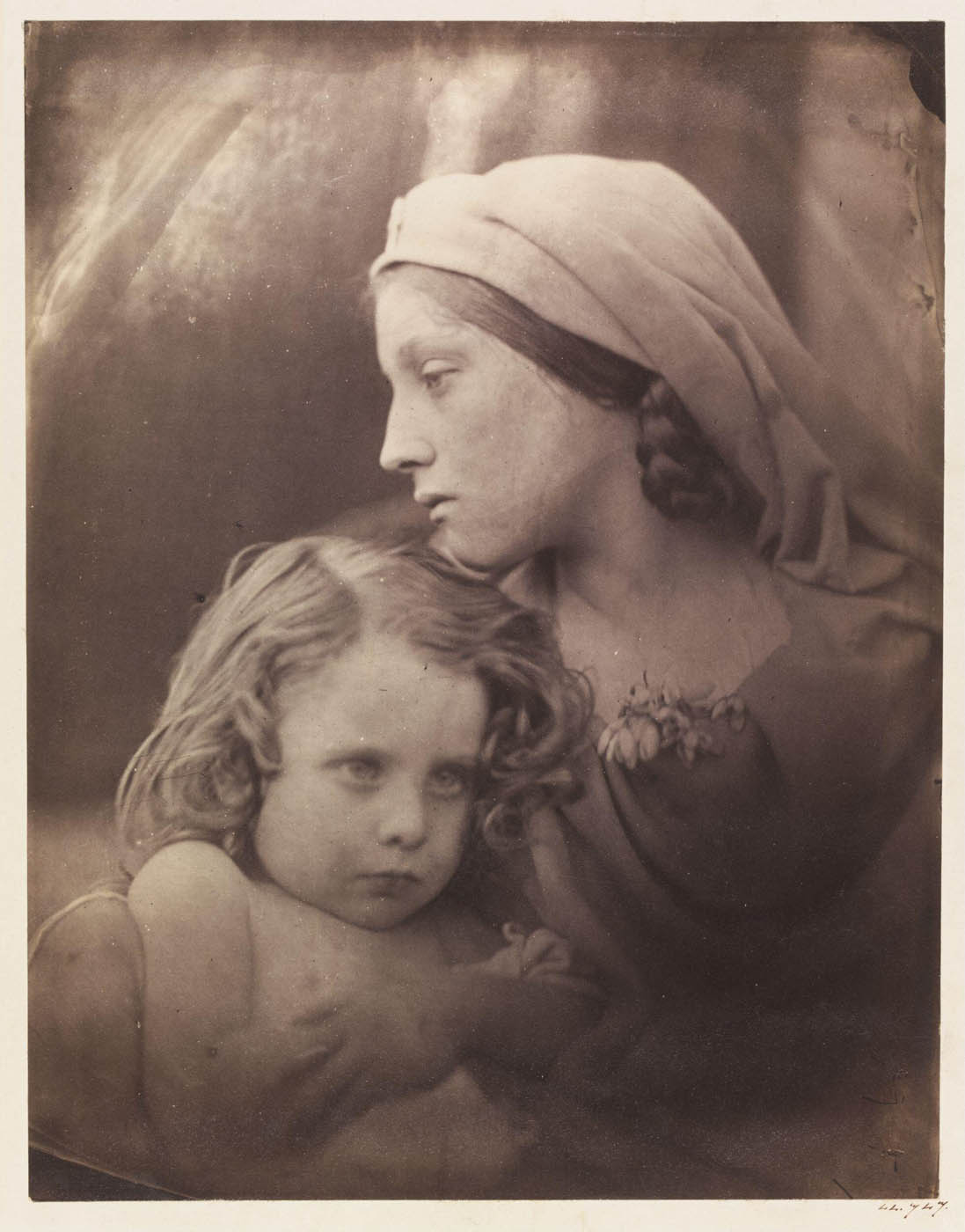
 

Julia Margaret Cameron (British born India, 1815-1879) 'La Madonna Aspettante' 1865


Julia Margaret Cameron (British born India, 1815-1879)
La Madonna Aspettante
1865
Albumen print from wet collodion negative
25.5 x 21.3cm
© The Royal Photographic Society Collection at the V&A, acquired with the generous assistance of the National Lottery Heritage Fund and Art Fund


Many of the photographs purchased by the South Kensington Museum (now the Victoria and Albert Museum) from Julia Margaret Cameron were ‘Madonna Groups’ depicting the Virgin Mary and the infant Christ. Her housemaid Mary Hillier posed as the Virgin Mary so often she became known locally as ‘Mary Madonna’.

Like many of her contemporaries, Cameron was a devout Christian. As a mother of six, the motif of the Madonna and child held particular significance for her. In aspiring to make ‘High Art’, Cameron aimed to make photographs that could be uplifting and morally instructive.

Text from the V&A website
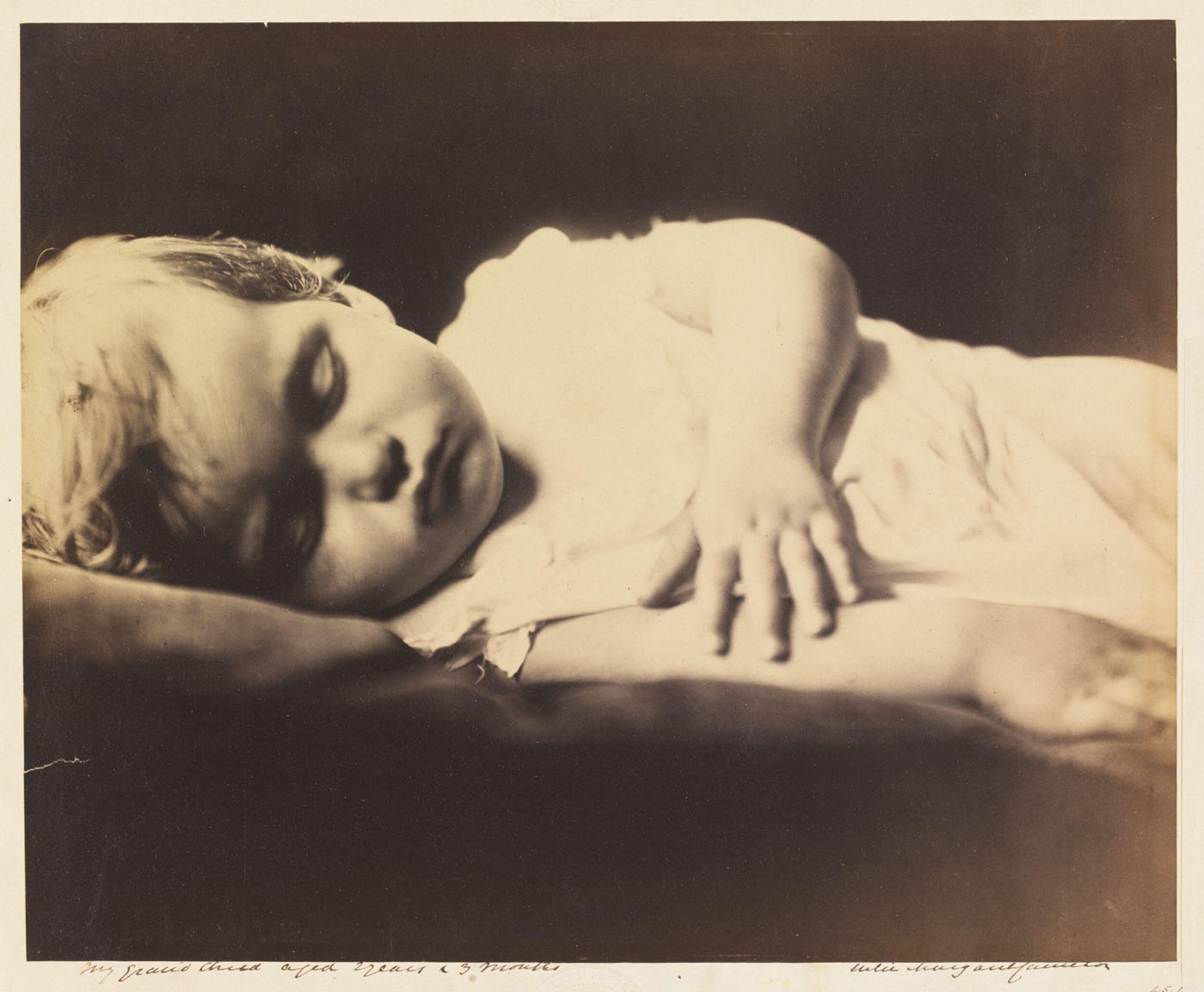
 

Julia Margaret Cameron (British, 1815-1879) 'My grand child aged 2 years & three months' 1865


Julia Margaret Cameron (British, 1815-1879)
My grand child aged 2 years & three months
1865
Albumen print from wet collodion negative
25.5 x 21.3cm
© The Royal Photographic Society Collection at the V&A, acquired with the generous assistance of the National Lottery Heritage Fund and Art Fund


Julia Margaret Cameron’s earliest photographic subjects were family and friends, many of whom were eminent literary figures. These early portraits reveal how she experimented with dramatic lighting and close-up compositions, features that would become her signature style.

Cameron made numerous studies of her grandson, both as himself and in the guise of the Christ child. He features in eight of the photographs the South Kensington Museum acquired in 1865.

Text from the V&A website


Julia Margaret Cameron (British, 1815-1879) 'The Mountain Nymph, Sweet Liberty' June 1866


Julia Margaret Cameron (British born India, 1815-1879)
The Mountain Nymph Sweet Liberty
1866
Albumen print
25.5cm x 21.3cm
© The Royal Photographic Society Collection at the V&A, acquired with the generous assistance of the National Lottery Heritage Fund and Art Fund


Julia Margaret Cameron (British born India, 1815-1879) 'Christabel' 1866


Julia Margaret Cameron (British born India, 1815-1879)
Christabel
1866
Albumen print from wet collodion negative
25.5 x 21.3cm
© The Royal Photographic Society Collection at the V&A, acquired with the generous assistance of the National Lottery Heritage Fund and Art Fund


In the poem by Samuel Taylor Coleridge, Christabel is a virtuous maiden who is put under a spell by an evil sorceress. Cameron wrote of photographs such as this, ‘When coming to something which, to my eye, was very beautiful, I stopped there instead of screwing on the lens to the more definite focus which all other photographers insist upon’.

Text from the V&A website
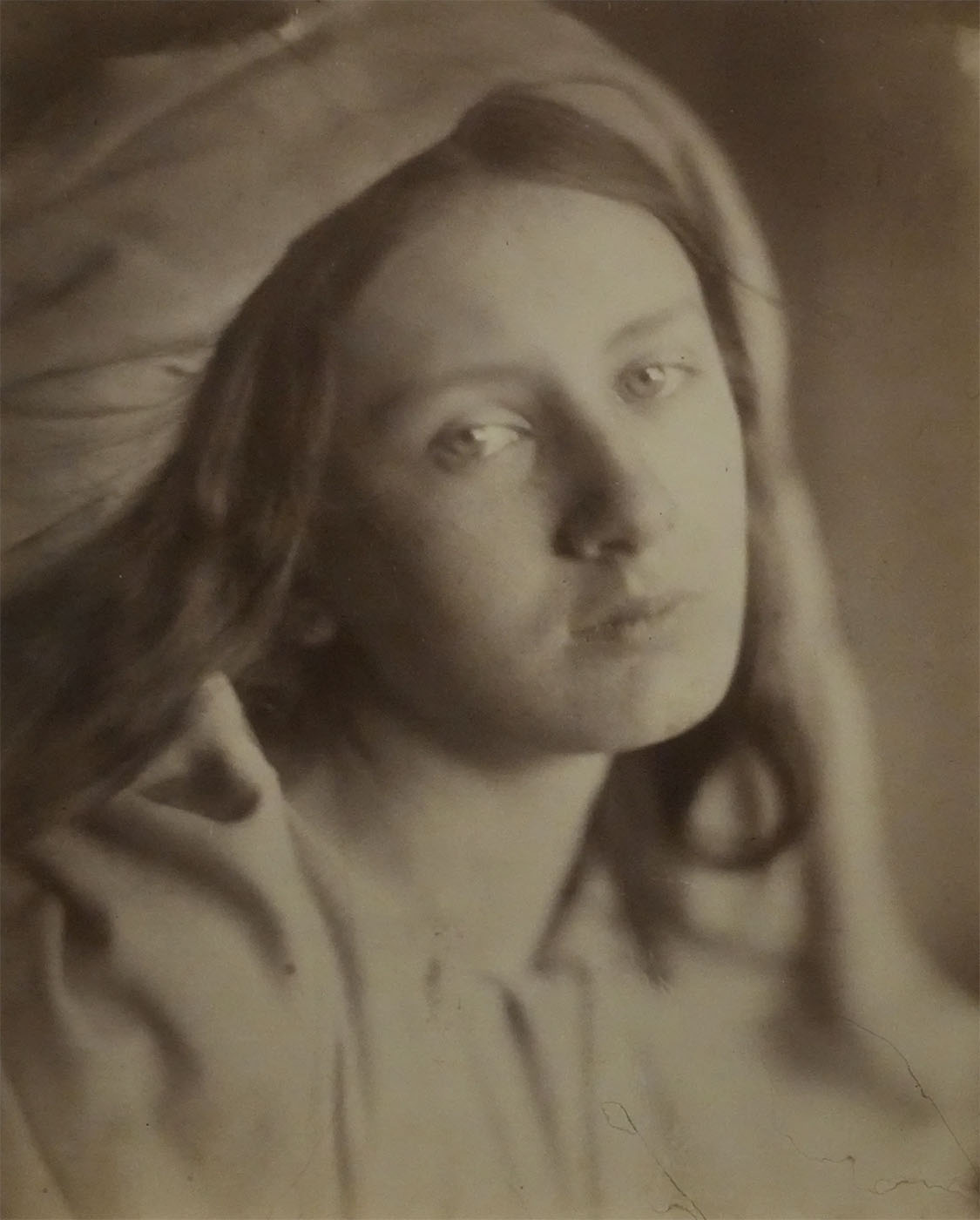
 

Julia Margaret Cameron (British born India, 1815-1879) 'Beatrice' March 1866


Julia Margaret Cameron (British born India, 1815-1879)
Beatrice
March 1866
Albumen print from wet collodion negative
35.3 x 28.1cm
© The Royal Photographic Society Collection at the V&A, acquired with the generous assistance of the National Lottery Heritage Fund and Art Fund


In late 1865, Julia Margaret Cameron began using a larger camera. It held a 15 x 12 inch glass negative, rather than the 12 x 10 inch negative of her first camera. Early the next year she wrote to Henry Cole with great enthusiasm – but little modesty – about the new turn she had taken in her work.

Cameron initiated a series of large-scale, closeup heads that fulfilled her photographic vision. She saw them as a rejection of ‘mere conventional topographic photography – map-making and skeleton rendering of feature and form’ in favour of a less precise but more emotionally penetrating form of portraiture. Cameron also continued to make narrative and allegorical tableaux, which were larger and bolder than her previous efforts.

Cameron based the model’s pose, drapery and sad expression on a painting attributed to Guido Reni that was famous at the time. The subject is the 16th-century Italian noblewoman Beatrice Cenci, executed for arranging the murder of her abusive father. One review admired Cameron’s soft rendering of ‘the pensive sweetness of the expression of the original picture’ while another mocked her for claiming to have photographed a historical figure ‘from the life’.

Text from the V&A website
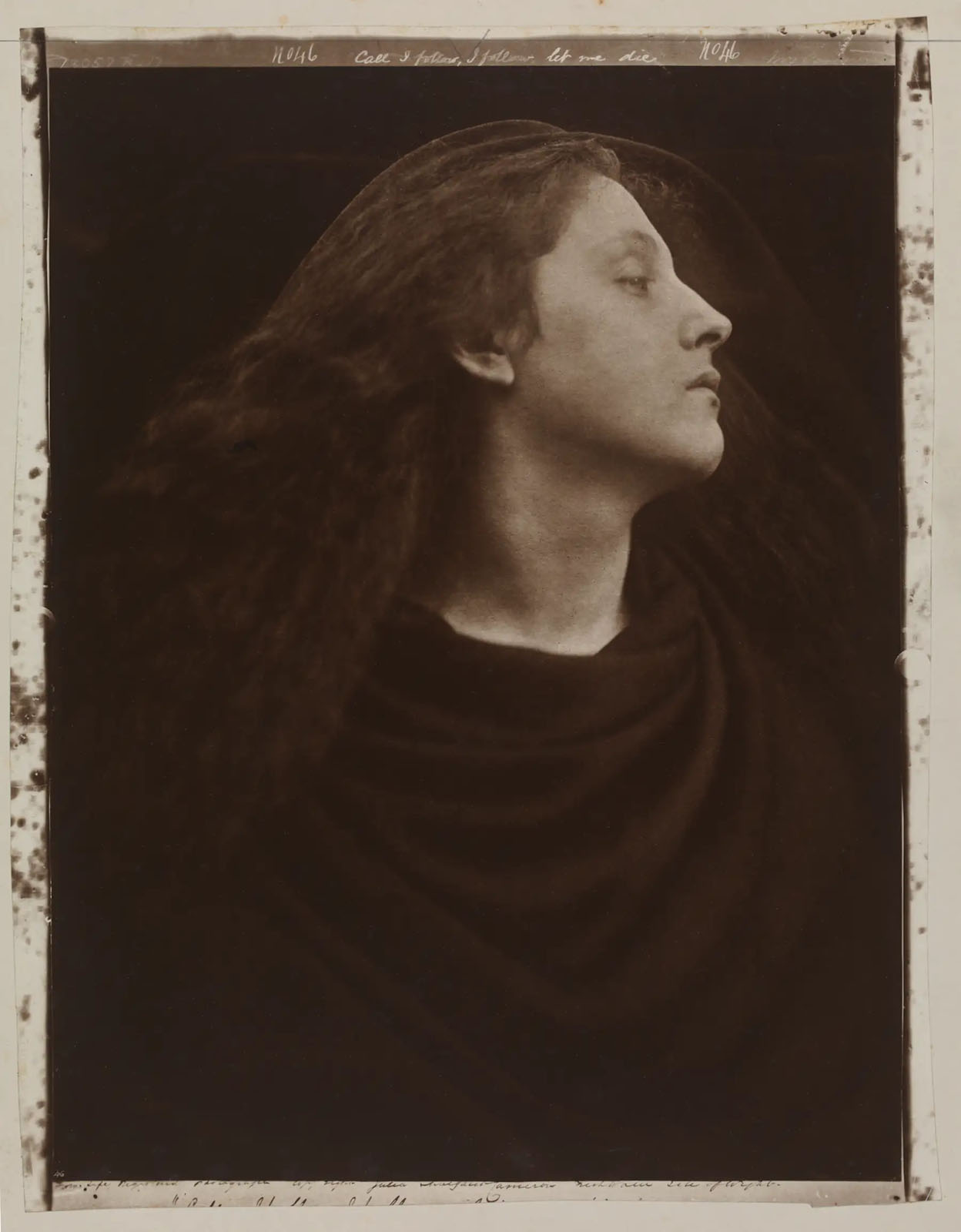
 

Julia Margaret Cameron (British born India, 1815-1879) 'Call I Follow, I Follow, Let Me Die' 1867


Julia Margaret Cameron (British born India, 1815-1879)
Call I Follow, I Follow, Let Me Die
1867
Carbon print
35.1cm x 26.7cm
© The Royal Photographic Society Collection at the V&A, acquired with the generous assistance of the National Lottery Heritage Fund and Art Fund


In late 1865, Julia Margaret Cameron began using a larger camera. It held a 15 x 12 inch glass negative, rather than the 12 x 10 inch negative of her first camera. Early the next year she wrote to Henry Cole with great enthusiasm – but little modesty – about the new turn she had taken in her work.

Cameron initiated a series of large-scale, closeup heads that fulfilled her photographic vision. She saw them as a rejection of ‘mere conventional topographic photography – map-making and skeleton rendering of feature and form’ in favour of a less precise but more emotionally penetrating form of portraiture. Cameron also continued to make narrative and allegorical tableaux, which were larger and bolder than her previous efforts.

In this image, Cameron concentrates upon the head of her maid Mary Hillier by using a darkened background and draping her in simple dark cloth. The lack of surrounding detail or context obscures references to narrative, identity or historical context. The flowing hair, lightly parted lips and exposed neck suggest sensuality. The title, taken from a line in the poem ‘Lancelot and Elaine’ from Alfred Tennyson’s ‘Idylls of the King’, transforms the subject into a tragic heroine.

Text from the V&A website
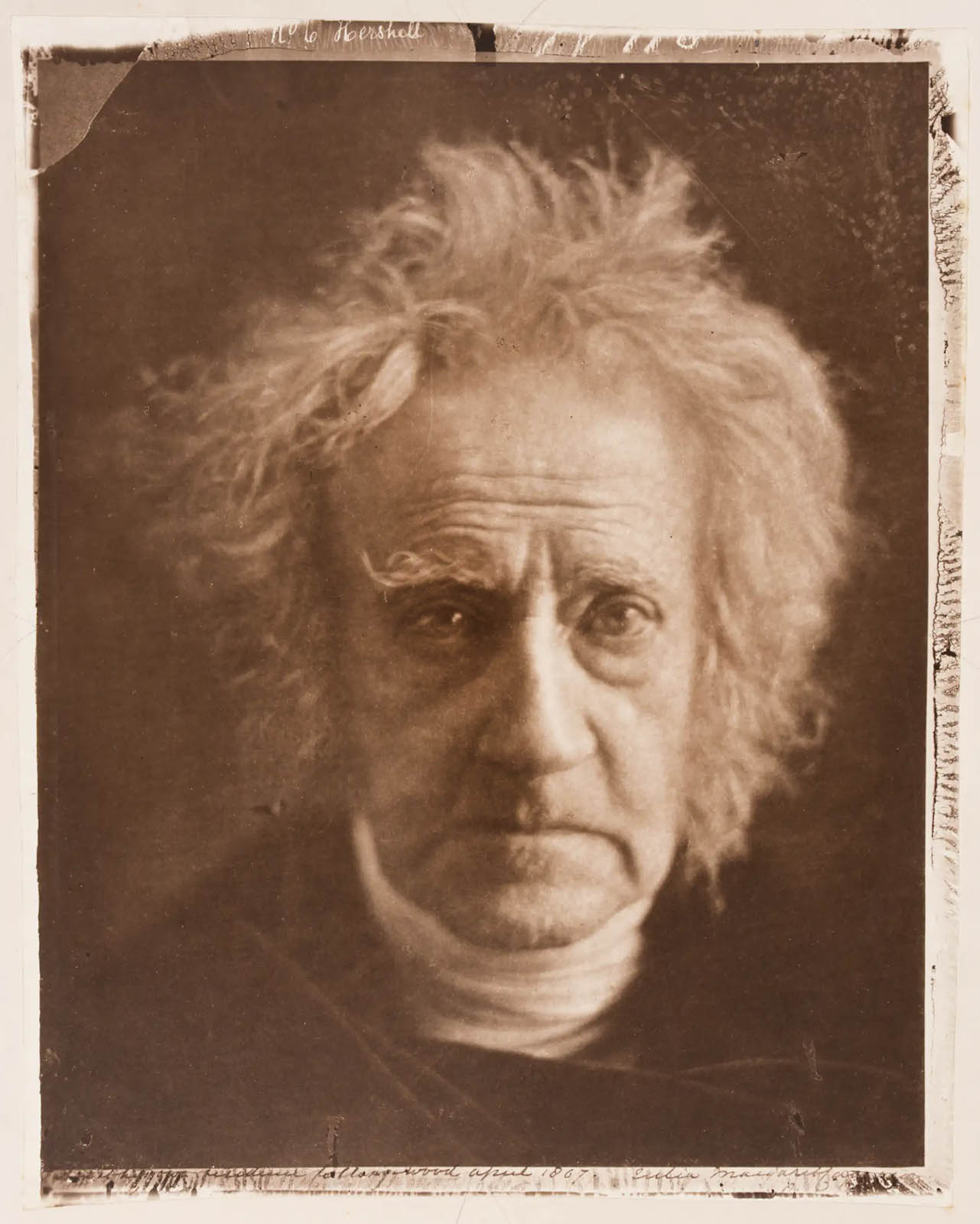
 

Julia Margaret Cameron (British born India, 1815-1879) 'Sir John Herschel' 1867


Julia Margaret Cameron (British born India, 1815-1879)
Sir John Herschel
1867
Albumen print
25.5cm x 21.3cm
© The Royal Photographic Society Collection at the V&A, acquired with the generous assistance of the National Lottery Heritage Fund and Art Fund


When Julia Margaret Cameron photographed her intellectual heroes, such as Tennyson, her aim was to record ‘the greatness of the inner as well as the features of the outer man’. Another motive was to earn money from prints, since her family’s finances were precarious. Within her first year as a photographer she began exhibiting and selling through the London gallery Colnaghi’s. She used autographs to increase the value of some portraits.

In March 1868 Cameron used two rooms at the South Kensington Museum as a portrait studio. Her letter of thanks makes clear her commercial aspirations, mentioning photographs she had sold and asking for help securing more sitters, including, she wrote hopefully, any ‘Royal sitters you may obtain for me’.

Sir John Herschel was an eminent scientist who made important contributions to astronomy and photography. Cameron wrote of this sitting, ‘When I have such men before my camera my whole soul has endeavoured to do its duty towards them in recording faithfully the greatness of the inner as well as the features of the outer man. The photograph thus taken has been almost the embodiment of a prayer.’

Text from the V&A website


Milwaukee Art Museum Presents Major Exhibition of Renowned Photographer Julia Margaret Cameron’s Pioneering Portraits

The only Midwestern presentation of the internationally touring exhibition Arresting Beauty: Julia Margaret Cameron showcases the 19th-century artist’s explorations of transcendent beauty through portraiture.

The Milwaukee Art Museum partners with the Victoria and Albert Museum, London, to present Arresting Beauty: Julia Margaret Cameron, an exhibition illuminating the transcendent beauty of the renowned photographer’s pioneering style. Featuring more than 90 works, including photographs, paintings, and archival objects, the exhibition will be on view May 3 – July 28, 2024, in the Museum’s Herzfeld Center for Photography and Media Arts.

“We are honoured to bring this significant selection of Julia Margaret Cameron’s photographs from the V&A’s collection to the Milwaukee Art Museum,” said Marcelle Polednik, PhD, Donna and Donald Baumgartner Director. “As the only Midwest venue for Arresting Beauty, our visitors will have a unique opportunity to view these rare and groundbreaking prints that will likely not be brought back together again in our generation.”

Julia Margaret Cameron (English born India, 1815-1879) is distinguished as one of the most innovative and influential photographers in the medium’s history. In 1863, at 48 years old, she received her first camera as a gift from one of her children. Cameron refined her artistic practice, creating a distinct style that set her apart from other photographers: close-up, soft-focus portraits often with scratches and smudges she thought enhanced the images’ beauty. Though her style was criticised and considered aesthetically radical for her time, Cameron’s legacy positions her as an artist who broke ground for future photographers. For over a decade, she made photographs from her home in Freshwater on the Isle of Wight and her studio at the South Kensington Museum (now the V&A) in London. She is best known for sensitive, spiritual portraits of her contemporaries and scenes staging allegorical, biblical, historical, and literary stories. Sitters for Cameron’s photographs include Charles Darwin and Alfred Tennyson, as well as her family members, friends, neighbours, and domestic workers.

“Julia Margaret Cameron found beauty in the everyday – both in the people around her and in the photographic ‘mistakes’ she made,” said Kristen Gaylord, Herzfeld Curator of Photography and Media Arts at the Milwaukee Art Museum. “Her artistic pursuit of such beauty left an enduring impact on the field, and I’m thrilled we can bring this major internationally touring exhibition to our community.”

Arresting Beauty travels from Jeu de Paume, Paris, to the Milwaukee Art Museum and comprises three sections: Cameron’s early photography experiments, her portraits of her contemporaries, and her allegorical compositions and artistic tableaux.

Exhibition highlights include:

~ Annie, 1864, a portrait of Cameron’s neighbour, deemed by the artist as her “first success”;
~ The Whisper of the Muse, 1865, an early allegorical photograph featuring artist George Watts as a musician with two local girls as muses;
~ John Frederick William Herschel, 1867, a striking portrait of the prominent scientist and photographic inventor who was a friend of Cameron’s;
~ The Rosebud Garden of Girls, 1868, a composition featuring five women surrounded by flowers, its title inspired by a line from one of Alfred Tennyson’s poems.

Accompanying Cameron’s prints are archival treasures, such as rarely exhibited, handwritten pages from her influential memoir Annals of My Glass House; her camera lens; and a photograph of Cameron taken by her son, Henry Herschel Hay Cameron. To provide historical context for the art that influenced, and was influenced by, Cameron, the Milwaukee Art Museum will present pieces from its collection alongside those from the V&A, including its own photograph by Julia Margaret Cameron, three paintings from its European collection, and three prints never before exhibited.

Arresting Beauty: Julia Margaret Cameron was organised by Lisa Springer, Curator of Photography Touring Exhibitions, and Marta Weiss, Senior Curator of Photography, Victoria and Albert Museum, London. The Milwaukee Art Museum presentation was organised by Kristen Gaylord, Herzfeld Curator of Photography and Media Arts.

Press release from the Milwaukee Art Museum


Julia Margaret Cameron (British born India, 1815-1879) 'The Rosebud Garden of Girls' 1868


Julia Margaret Cameron (British born India, 1815-1879)
The Rosebud Garden of Girls
1868
Albumen print
25.5cm x 21.3cm
© The Royal Photographic Society Collection at the V&A, acquired with the generous assistance of the National Lottery Heritage Fund and Art Fund
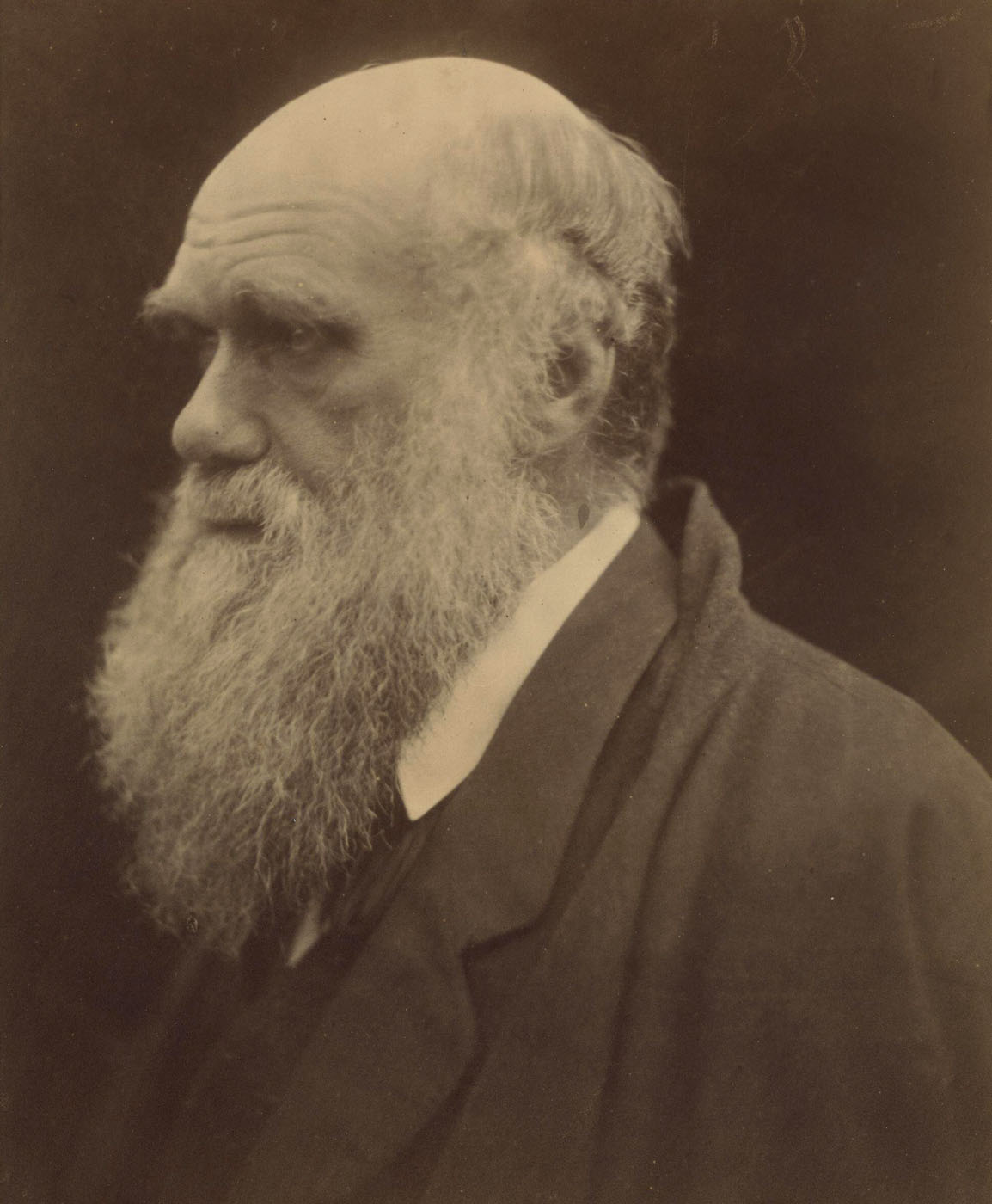
 

Julia Margaret Cameron (British born India, 1815-1879) 'Charles Darwin' 1868 (photographed), 1875 (printed)


Julia Margaret Cameron (British born India, 1815-1879)
Charles Darwin
1868 (photographed), 1875 (printed)
Albumen print from wet collodion negative
25.5 x 21.3cm
© The Royal Photographic Society Collection at the V&A, acquired with the generous assistance of the National Lottery Heritage Fund and Art Fund


When Julia Margaret Cameron photographed her intellectual heroes such as Alfred Tennyson, Sir John Herschel and Henry Taylor, her aim was to record ‘the greatness of the inner as well as the features of the outer man.’ Another motive was to earn money from prints of the photographs, since her family’s finances were precarious. Within her first year as a photographer she began exhibiting and selling through the London gallery Colnaghi’s. She used autographs to increase the value of some portraits.

The naturalist Charles Darwin and his family rented a cottage on the Isle of Wight from the Camerons in the summer of 1868. By 27 July, Colnaghi’s was advertising, ‘We are glad to observe her gallery of great men enriched by a very fine portrait of Charles Darwin’. Due to the sitter’s celebrity, Cameron later had this portrait reprinted as a more stable carbon print.

Text from the V&A website
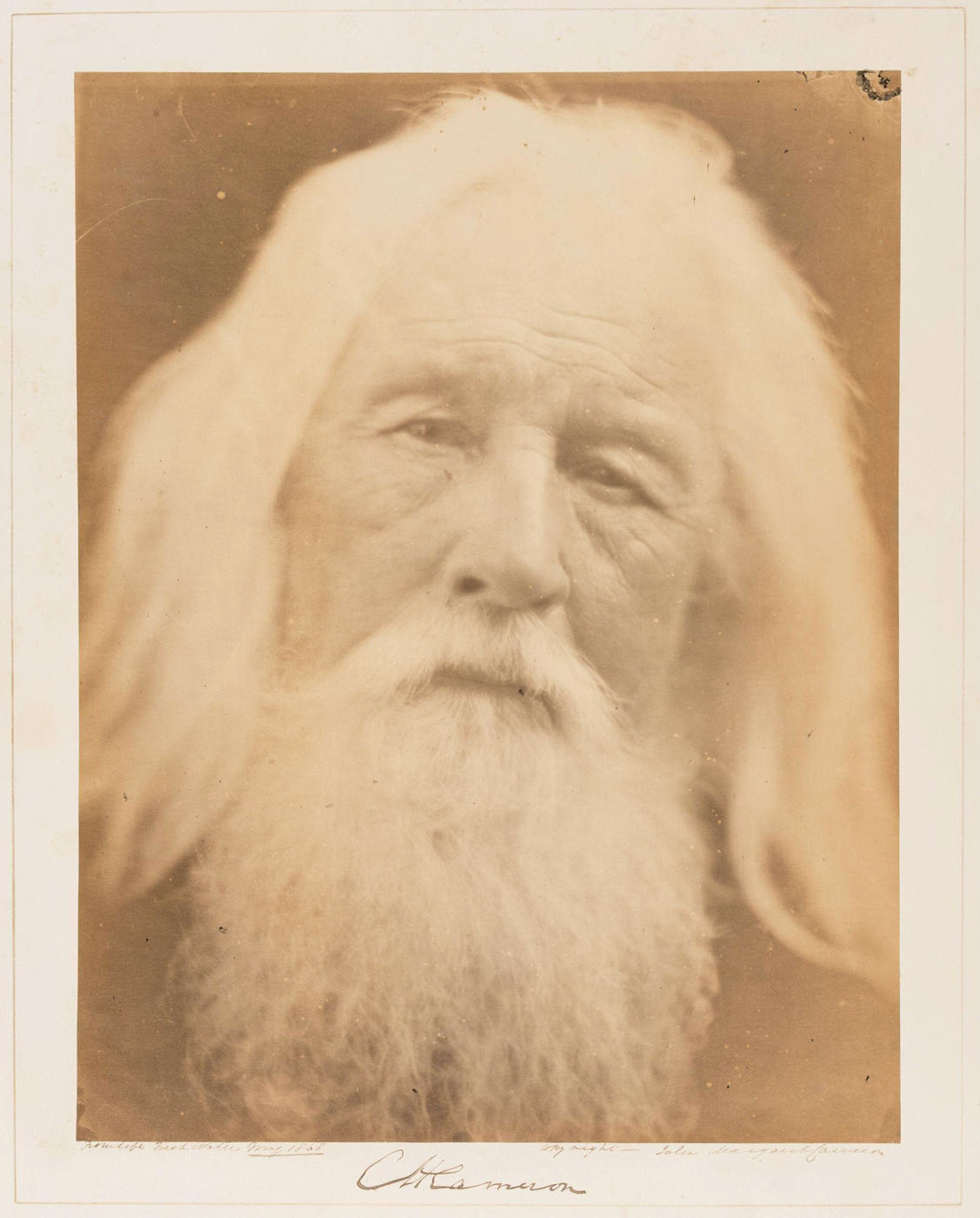
 

Julia Margaret Cameron (British born India, 1815-1879) 'Charles Hay Cameron' May 1868


Julia Margaret Cameron (British born India, 1815-1879)
Charles Hay Cameron
May 1868
Albumen print from wet collodion negative
25.5 x 21.3cm
© The Royal Photographic Society Collection at the V&A, acquired with the generous assistance of the National Lottery Heritage Fund and Art Fund


Her husband, Charles Hay Cameron, a retired reformer of Indian law and education, frequently posed for Cameron. Cameron’s husband, Charles, was two decades older than Julia.

Text from the V&A website
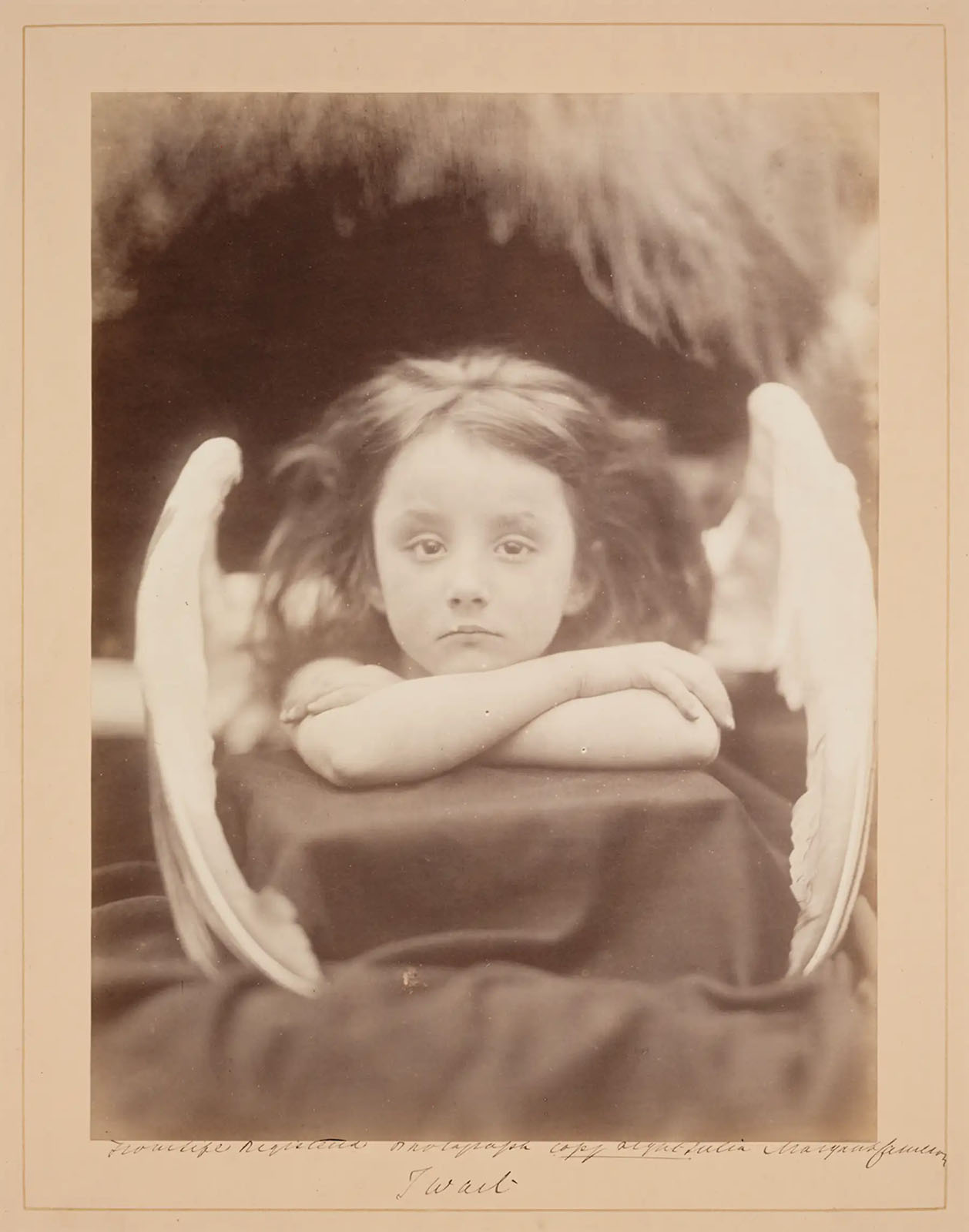
 

Julia Margaret Cameron (British born India, 1815-1879) 'I Wait' 1872


Julia Margaret Cameron (British born India, 1815-1879)
I Wait
1872
Albumen print
25.5cm x 21.3cm
© The Royal Photographic Society Collection at the V&A, acquired with the generous assistance of the National Lottery Heritage Fund and Art Fund


Julia Margaret Cameron (British born India, 1815-1879) 'St. Agnes' 1872


Julia Margaret Cameron (British born India, 1815-1879)
St. Agnes
1872
Albumen print
© The Royal Photographic Society Collection at the V&A, acquired with the generous assistance of the National Lottery Heritage Fund and Art Fund


Julia Margaret Cameron (British born India, 1815-1879) 'Mary Hillier' 1873


Julia Margaret Cameron (British born India, 1815-1879)
Mary Hillier
1873
Albumen print
25.5cm x 21.3cm
© The Royal Photographic Society Collection at the V&A, acquired with the generous assistance of the National Lottery Heritage Fund and Art Fund


In this image, Cameron concentrates upon the head of her maid Mary Hillier by using a darkened background and draping her in simple dark cloth. The lack of surrounding detail or context obscures references to narrative, identity or historical context. The flowing hair, lightly parted lips and exposed neck suggest sensuality.

Text from the V&A website


Julia Margaret Cameron (British born India, 1815-1879) 'A Group of Kalutara Peasants' 1878


Julia Margaret Cameron (British born India, 1815-1879)
A Group of Kalutara Peasants
1878
Albumen print
25.5cm x 21.3cm
© The Royal Photographic Society Collection at the V&A, acquired with the generous assistance of the National Lottery Heritage Fund and Art Fund


Milwaukee Art Museum
700 N Art Museum Dr, Milwaukee,
WI 53202, United States

Opening hours:
Monday – Tuesday: Closed
Wednesday: 10am – 5pm
Thursday: 10am – 8pm
Friday – Sunday: 10am – 5pm
Milwaukee Art Museum website

LIKE ART BLART ON FACEBOOK

Back to top

Exhibition: ‘Siam: Through the Lens of John Thomson (1865-66)’ at the Russell-Cotes Art Gallery and Museum, Bournemouth, England

Exhibition dates: 21st October 2023 – 14th April 2024


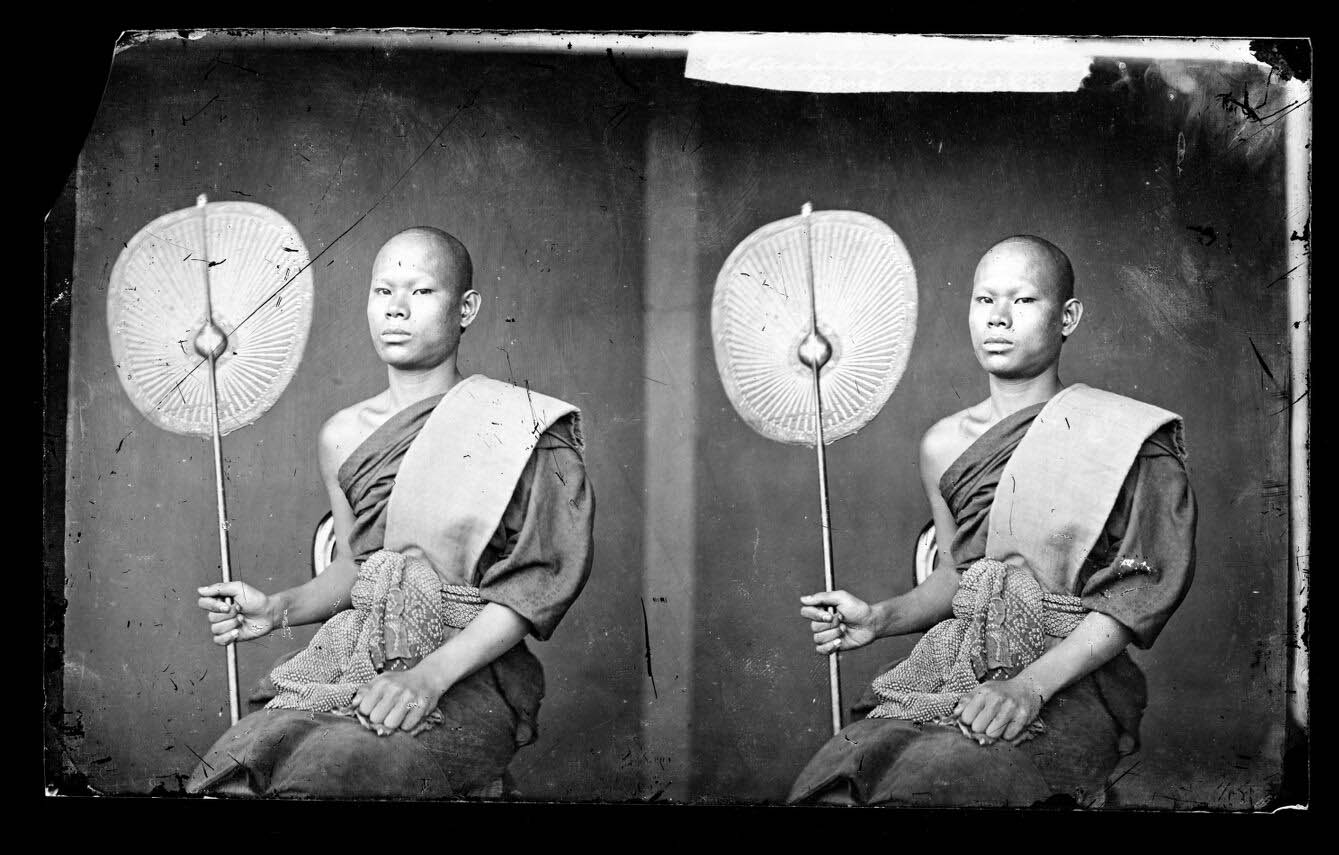
John Thomson (Scottish, 1837-1921) 'A Siamese monk holding a fan' 1865


John Thomson (Scottish, 1837-1921)
A Siamese monk holding a fan
1865
Photograph from a glass photonegative, wet collodion
Public domain


A bridge between past and present

An Easter Monday posting.

Magnificent large format photographs of the landscape and people of Siam (now Thailand), just two decades after the invention of photography. The photographs give “us a glimpse into some characteristics of people and places of Siam in the 1860s.”

In the portrait photographs the engagement revealed by the photographer of the subject with the camera lens is masterful. To elicit this response from people unused to posing in front of a large, bulky camera shows how the photographer must have been empathetic to his subjects and put them at their ease with the process of having their photograph taken.

The subjects are not apprehensive of the camera. The images show them directly: composed, reserved, non-declamatory and possessing a powerful presence. The exchange between subject and photographer evidences a direct line of communication with the sitter.

The eyes of A Siamese boy (1865, below) drill into mine and I feel a profound engagement with his questioning gaze. I am pierced by his gaze … which forces me to confront my own identity, and mortality.

As a viewer of these human beings all these decades later (a bridge between past and present), it’s as if I could reach out and touch their humanity. Their soul.

Dr Marcus Bunyan


Many thankx to the Russell-Cotes Art Gallery and Museum for allowing me to publish the photographs in the posting. Please click on the photographs for a larger version of the image.


In the mid-19th century, John Thomson arrived in Siam with a fairly new invention of those days photography….

Step back in time and immerse yourself in the wonders of 19th-century Southeast Asia as seen through the lens of the intrepid adventurer and photographer, John Thomson. The Russell-Cotes Art Gallery & Museum is proud to present an enchanting new exhibition Siam: Through the Lens of John Thomson on display from 21 October 2023 to 14 April 2024, inviting visitors to embark on a captivating journey through time and space. This extraordinary showcase offers a unique glimpse into the captivating landscapes, diverse cultures, and fascinating history of Southeast Asia.

A British photographer with an exceptional eye for detail, Thomson embarked on a groundbreaking journey to Siam during the late Victorian era, with a fairly new invention in those days: photography, capturing scenes that had been scarcely witnessed before in the Western world. Throughout his remarkable career, Thomson ventured into uncharted territories and documented the exotic beauty and cultural richness of Thailand and Cambodia in stunning detail. Featuring dramatic images developed from negatives preserved in London’s Wellcome Collection, this exhibition introduces the sights and people of nineteenth-century Thailand and Cambodia as witnessed by Thomson first hand. In this new exhibition, visitors to the Russell-Cotes Art Gallery & Museum will have the privilege of witnessing many meticulously preserved photographs taken by Thomson during his travels, carefully curated to provide an insightful narrative of his exploration. Each image tells a story of its own, serving as a bridge between the past and the present, enabling visitors to forge a deeper connection with the cultures and history of Thailand and Cambodia.

Text from the Russell-Cotes Art Gallery and Museum website


Siam Through the Lens of John Thomson, 1865-66: In-Focus audio tour with Jo O’Rourke when the exhibition was at Chester Beatty

This exhibition gives us a glimpse into some characteristics of people and places of Siam in the 1860s. We are guided through a wonderful collection of images taken with great sensitivity by one of the pioneers of photojournalism John Thomson (1837-1921).


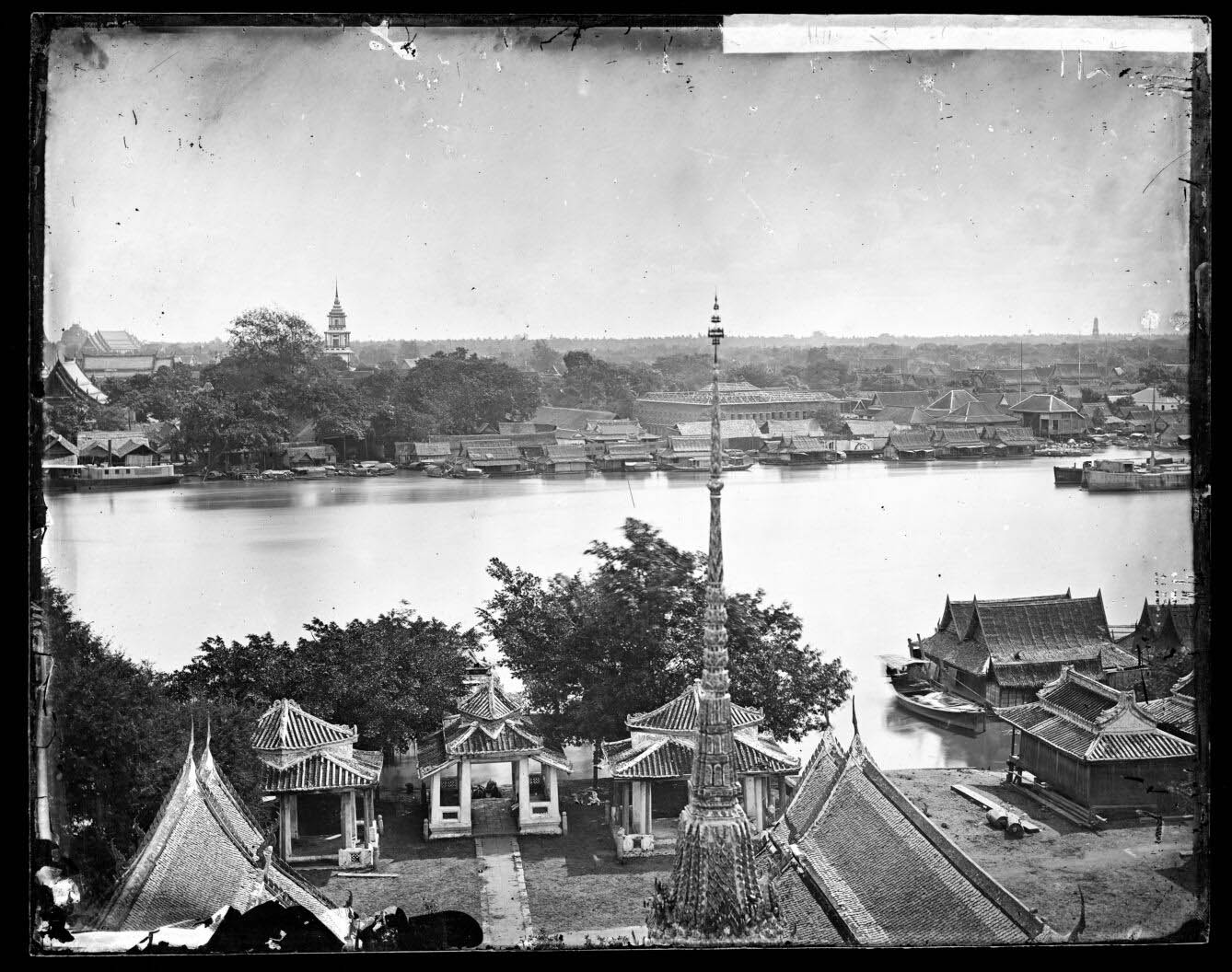
John Thomson (Scottish, 1837-1921) 'The Chao Phraya River and Rattanakosin Island from the Prang of Wat Arun' 1865

John Thomson (Scottish, 1837-1921) 'The Chao Phraya River as seen from the main spire of Wat Arun' 1855-1866

John Thomson (Scottish, 1837-1921) 'The Chao Phraya River and Rattanakosin Island from the Prang of Wat Arun' 1865


John Thomson (Scottish, 1837-1921)
The Chao Phraya River and Rattanakosin Island from the Prang of Wat Arun
1865
Panorama of three photographs from a glass photonegatives, wet collodion
Public domain


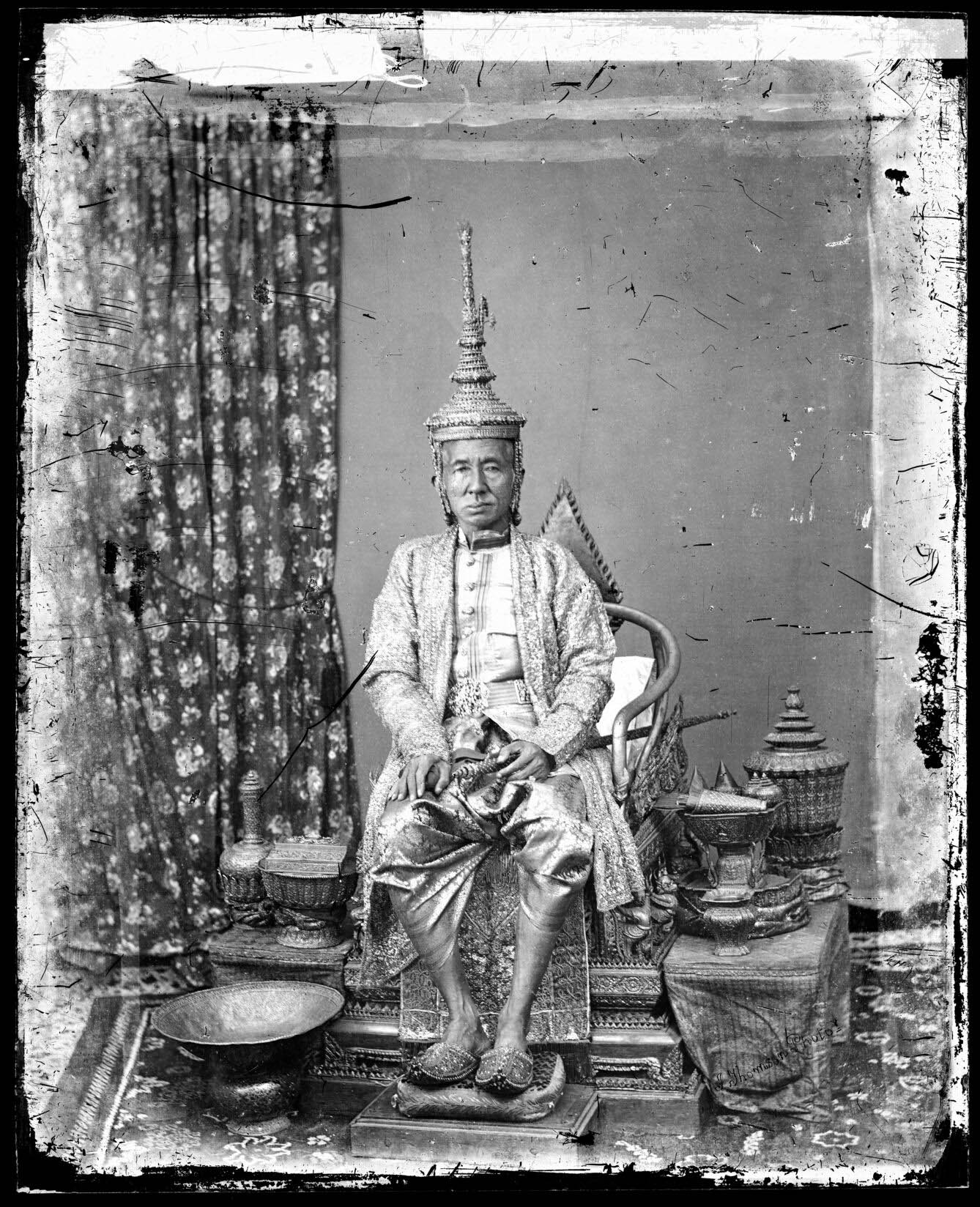
John Thomson (Scottish, 1837-1921) 'King Mongkut (King Rama IV) in the uniform of a French Field Marshall' 1865


John Thomson (Scottish, 1837-1921)
King Mongkut (King Rama IV) in the uniform of a French Field Marshall
1865
Photograph from a glass photonegative, wet collodion
Public domain


“A shrill blast of horns heralded the approach of the King and caused us hastily to descend into the court,” Thomson wrote of the occasion. “His Majesty entered through a massive gateway, and I must confess that I felt much impressed by his appearance, as I had never been in the presence of an anointed sovereign before. He stood about five feet eight inches, and his figure was erect and commanding; but an expression of severe gravity was settled on his somewhat haggard face. His dress was a robe of spotless white, which reached right down to his feet; his head was bare.

“All was prepared beneath a space in the court when, just as I was about to take the photograph, His Majesty changed his mind, and without a word to anyone, passed suddenly out of sight. We patiently waited, and at length the King reappeared, dressed this time in a sort of French Field Marshal’s uniform. The portrait was a great success, and His Majesty afterwards sat in his court robes, requesting me to place him where and how I pleased.”

In the photo of the King in the field marshal’s regalia, he wears the sash of the Legion d’honneur and the Star First Class presented to him on behalf of Emperor Napoleon III by the admiral of the French fleet in Indochina. On a side able rests a small telescope, reflecting the king’s interest in astronomy and its Western means of study.

Anonymous. “How the world first saw Siam,” on The Nation website Thursday January 22nd, 2015 [Online] Cited 14/03/2024


John Thomson (Scottish, 1837-1921) 'King Mongkut (King Rama IV) in state attire' 1865


John Thomson (Scottish, 1837-1921)
King Mongkut (King Rama IV) in state attire
1865
Photograph from a glass photonegative, wet collodion
Public domain


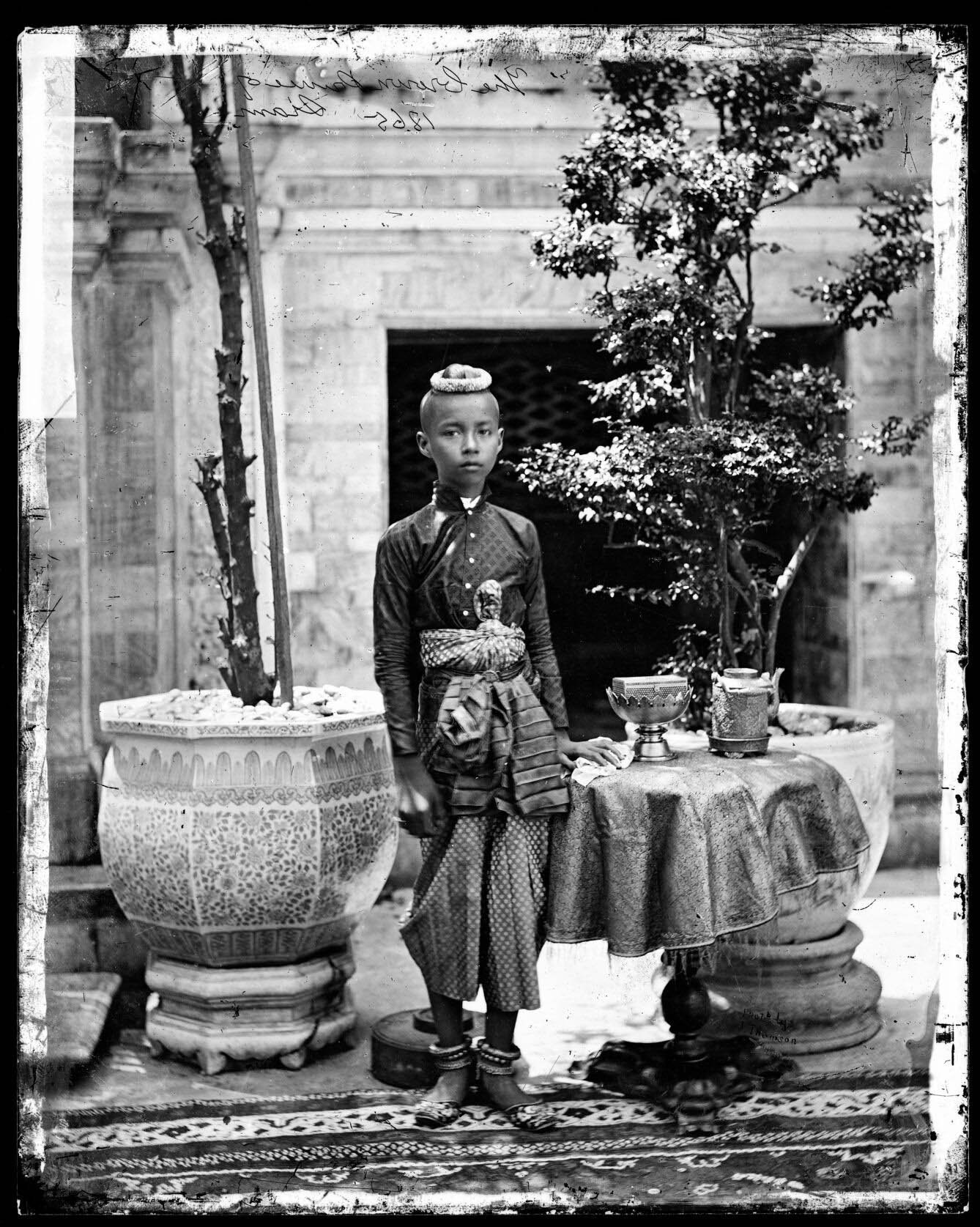
John Thomson (Scottish, 1837-1921) 'Prince Chulalongkorn' 1865


John Thomson (Scottish, 1837-1921)
Prince Chulalongkorn
1865
Photograph from a glass photonegative, wet collodion
Public domain


Prince Chulalongkorn, subsequently King Chulalongkorn (1853-1910), aged 12 years, wearing a top-knot, fine traditional Thai clothes and jewellery. Standing in a courtyard of the Grand Palace, Bangkok, between an ornamental table and an urn.


John Thomson (Scottish, 1837-1921) 'Royal Barge Anantanakkharat / A Royal Barge Procession marks the Buddhist Kathin festival on Oct. 14, 1865' 1865


John Thomson (Scottish, 1837-1921)
Royal Barge Anantanakkharat / A Royal Barge Procession marks the Buddhist Kathin festival on Oct. 14, 1865
1865
Photograph from a glass photonegative, wet collodion
Public domain


John Thomson (Scottish, 1837-1921) 'Offering lunch to Buddhist monks' 1865-1866


John Thomson (Scottish, 1837-1921)
Offering lunch to Buddhist monks
1865-1866
Photograph from a glass photonegative, wet collodion
Public domain


John Thomson (Scottish, 1837-1921) 'Khon and Lakhon troupe' 1865-1866


John Thomson (Scottish, 1837-1921)
Khon and Lakhon troupe
1865-1866
Photograph from a glass photonegative, wet collodion
Public domain


John Thomson (Scottish, 1837-1921) 'A white elephant belonging to King Mongkut' 1865-1866


John Thomson (Scottish, 1837-1921)
A white elephant belonging to King Mongkut
1865-1866
Photograph from a glass photonegative, wet collodion
Public domain


John Thomson (Scottish, 1837-1921) 'Siam (Thailand)' 1865


John Thomson (Scottish, 1837-1921)
Siam (Thailand)
1865
Photograph from a glass photonegative, wet collodion
Public domain


John Thomson (Scottish, 1837-1921) 'A Siamese boy' 1865


John Thomson (Scottish, 1837-1921)
A Siamese boy
1865
Photograph from a glass photonegative, wet collodion
Public domain


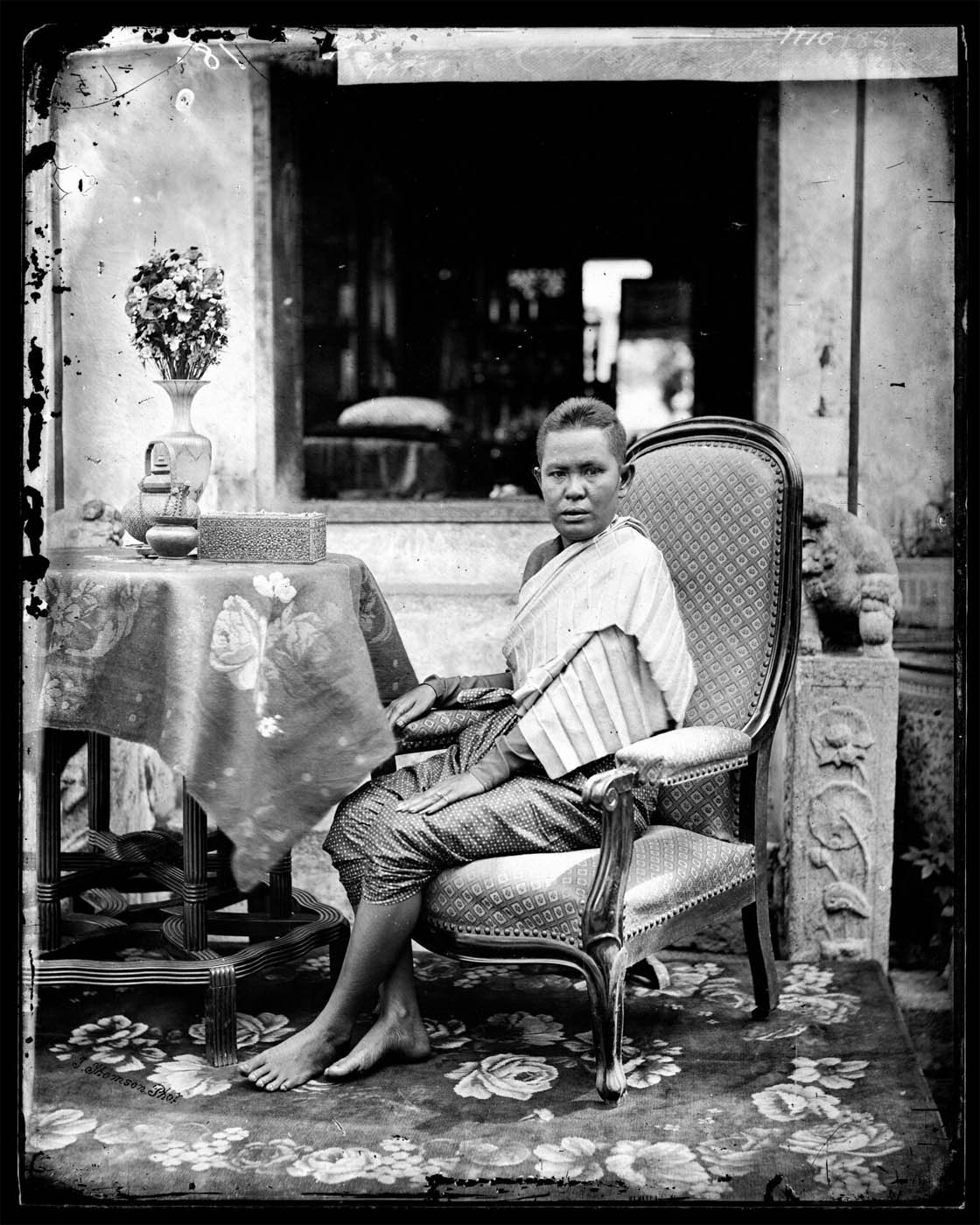
John Thomson (Scottish, 1837-1921) 'Portrait of a princess with her maidservant (possibly a daughter of Prince Nilarat, Prince of Alongkot Kitpreecha)' 1865


John Thomson (Scottish, 1837-1921)
Portrait of a princess with her maidservant (possibly a daughter of Prince Nilarat, Prince of Alongkot Kitpreecha)
1865
Photograph from a glass photonegative, wet collodion
Public domain


Step back in time and immerse yourself in the wonders of 19th-century Southeast Asia as seen through the lens of the intrepid adventurer and photographer, John Thomson. The Russell-Cotes Art Gallery & Museum is proud to present an enchanting new exhibition Siam: Through the Lens of John Thomson on display from 21 October 2023 to 14 April 2024, inviting visitors to embark on a captivating journey through time and space. This extraordinary showcase offers a unique glimpse into the captivating landscapes, diverse cultures, and fascinating history of Southeast Asia, as captured by the illustrious Scottish Victorian photographer, John Thomson.

A Scottish photographer with an exceptional eye for detail, Thomson embarked on a groundbreaking journey to Siam during the late Victorian era, with a fairly new invention in those days: photography, capturing scenes that had been scarcely witnessed before in the Western world. Throughout his remarkable career, Thomson ventured into uncharted territories and documented the exotic beauty and cultural richness of Thailand and Cambodia in stunning detail. His evocative photographs offer an invaluable historical record and a testament to his artistic sensibility and his photographic vision marks him out as one of history’s most important travel photographers.

The founders of the Russell-Cotes Art Gallery and Museum, Merton and Annie Russell-Cotes travelled extensively in their lifetime, bringing back crates full of ‘objets d’art’,as Merton described them in his memoirs. These were to fill almost every room of the house alongside Merton’s vast art collection and, in some cases, inspired the Russell-Cotes to alter and adapt rooms to a particular theme. As they visited almost every continent during their grand worldwide tours, it is only fitting that this exhibition works in collaboration with the vast collections from around the world on display at the Russell-Cotes Art Gallery and Museum today. Annie and Merton witnessed similar scenes to John Thomson, but chose to collect objects, rather than images.

Featuring dramatic images developed from negatives preserved in London’s Wellcome Collection, this exhibition introduces the sights and people of nineteenth-century Thailand and Cambodia as witnessed by Thomson first hand. In this new exhibition, visitors to the Russell-Cotes Art Gallery & Museum will have the privilege of witnessing many meticulously preserved photographs taken by Thomson during his travels, carefully curated to provide an insightful narrative of his exploration. Each image tells a story of its own, serving as a bridge between the past and the present, enabling visitors to forge a deeper connection with the cultures and history of Thailand and Cambodia.

The photographs on display encompass a diverse range of subjects, including awe-inspiring temples, architectural marvels, picturesque landscapes, and enchanting portraits of everyday life, ceremonies royalty, tradition, and customs. Each photograph serves as a testament to Thomson’s skill as a storyteller, highlighting the allurement of these distant lands. Thomson also received special permission to visit Angkor Wat (then under Siam’s control), becoming the first to photograph its famous ruins.

He used the wet-collodion process as his method for taking photographs, so called because an exposure was made onto a glass negative. His process had to be carried out in complete darkness, requiring a portable darkroom tent and a large amount of equipment. He travelled around Siam with many crates of glass negatives and bottles of potentially harmful chemicals, which was remarkable considering the difficult terrain and unfamiliar regions he often visited. Despite these challenges, Thomson was able to capture the natural beauty of the land as well as the daily lives of the people he encountered. His style has been described as “photo-journalistic,” a term which acknowledges his ability to capture authentic and natural moments through his photography.

In addition to the captivating photographs, the exhibition will also feature informative panels, present day photographs and an exciting calendar of insightful talks and workshops. Visitors will have the opportunity to engage with historical context of the time and gain insights into Thomson’s wet collodion photography methods and techniques to understand the cultural significance of his work in Southeast Asia and the world of photography.

Press release from Russell-Cotes Art Gallery and Museum


John Thomson (Scottish, 1837-1921) 'Phra Chom Klao Bridge, Phetchaburi River' 1865-1866


John Thomson (Scottish, 1837-1921)
Phra Chom Klao Bridge, Phetchaburi River
1865-1866


The Phra Chom Klao bridge over the Phetchaburi river.


John Thomson (Scottish, 1837-1921) 'The wife of the Prime Minister (Kralahom) of Siam' 1865


John Thomson (Scottish, 1837-1921)
The wife of the Prime Minister (Kralahom) of Siam
1865
Photograph from a glass photonegative, wet collodion
Public domain


John Thomson (Scottish, 1837-1921) 'Siamese boatman' 1865


John Thomson (Scottish, 1837-1921)
Siamese boatman
1865
Photograph from a glass photonegative, wet collodion
Public domain


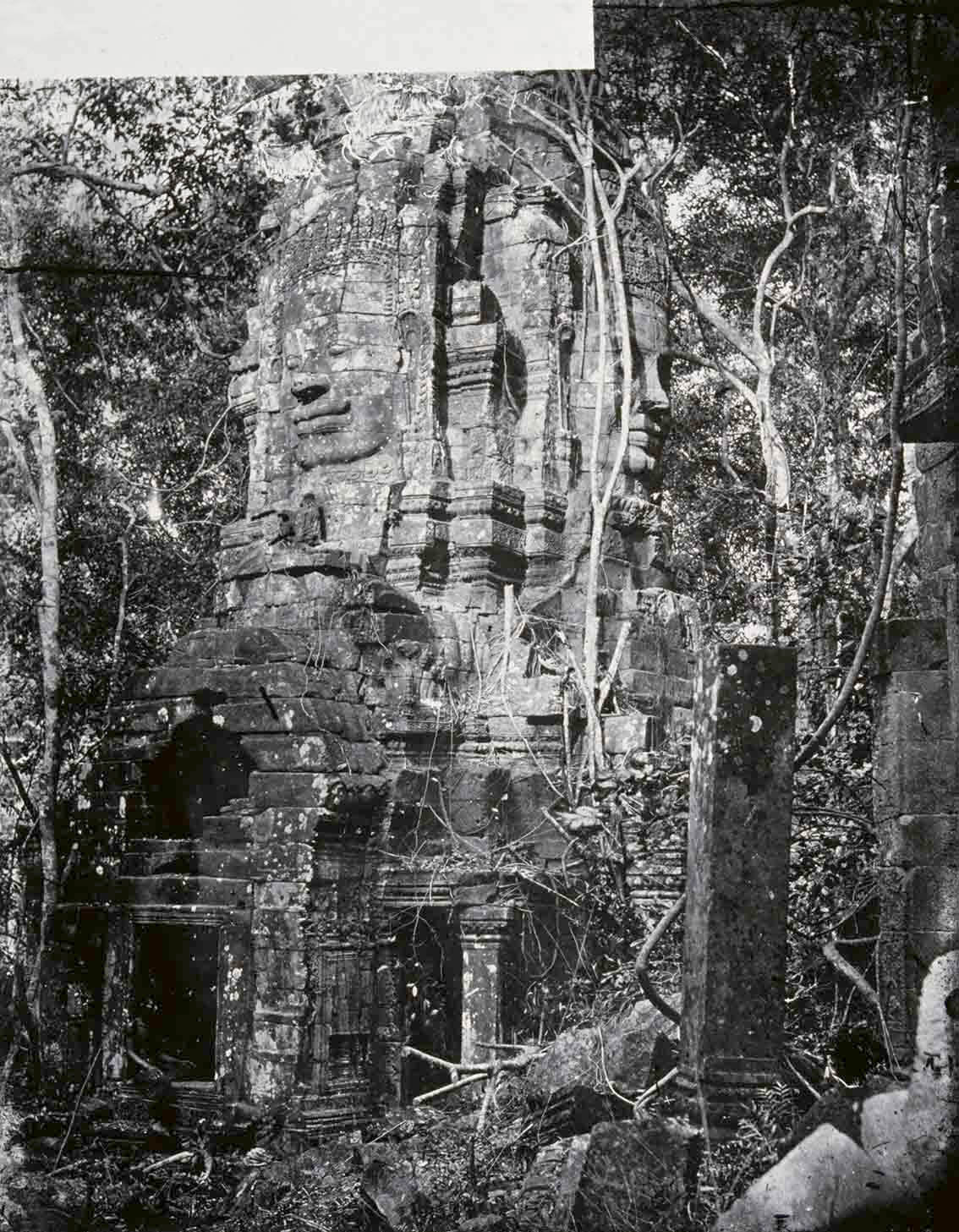
John Thomson (Scottish, 1837-1921) 'Face-towers of the Bayon temple, Angkor Wat' 1866


John Thomson (Scottish, 1837-1921)
Face-towers of the Bayon temple, Angkor Wat
1866
Photograph from a glass photonegative, wet collodion
Public domain


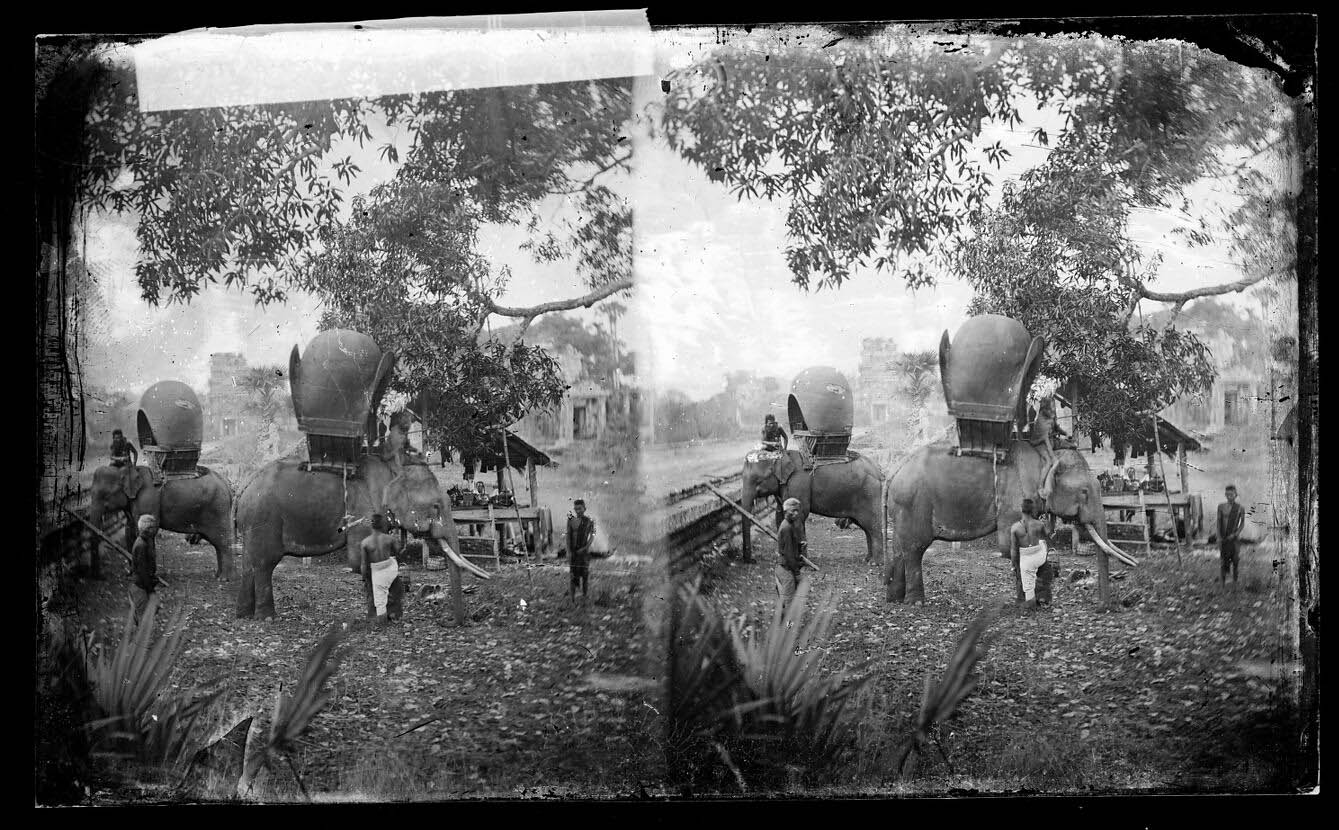
John Thomson (Scottish, 1837-1921) 'Elephants outside Angkor Wat' 1866


John Thomson (Scottish, 1837-1921)
Elephants outside Angkor Wat
1866
Photograph from a glass photonegative, wet collodion
Public domain


John Thomson (Scottish, 1837-1921) 'The western Gopura, Angkor Wat' 1866


John Thomson (Scottish, 1837-1921)
The western Gopura, Angkor Wat
1866
Photograph from a glass photonegative, wet collodion
Public domain


'Siam: Through the Lens of John Thomson (1865-66)' poster


Siam: Through the Lens of John Thomson (1865-66) poster


Russell-Cotes Art Gallery & Museum
East Cliff Promenade, Bournemouth, BH1 3AA

Opening hours:
Tuesdays – Sundays and Bank Holiday
Mondays, 10am – 5pm
Russell-Cotes Art Gallery & Museum website

LIKE ART BLART ON FACEBOOK

Back to top

Exhibition: ‘Daguerreotypes: Five Decades of Collecting’ at the Smithsonian National Portrait Gallery, Washington, DC

Exhibition dates: 15th June, 2018 – 2nd June, 2019

 Curator: Ann Shumard, Senior Curator of Photographs at the Smithsonian National Portrait Gallery, Washington, DC


Bishop & Gray Studio (American, active c. 1843) 'Dr. Rufus Priest' c. 1843 from the exhibition 'Daguerreotypes: Five Decades of Collecting' at the Smithsonian National Portrait Gallery, Washington, DC, June 2018 - June 2019


Bishop & Gray Studio (American, active c. 1843)
Dr. Rufus Priest
c. 1843
Sixth-plate daguerreotype
8.3cm x 7cm (3 1/4″ x 2 3/4″)
National Portrait Gallery, Smithsonian Institution; gift of David Becker


What strong faces these people have, especially in the three-quarter or slightly oblique profile view with the subject not staring at the camera.

There is something incredibly powerful about these one off, cased mausoleum portraits that today’s throwaway representations struggle to match. As Montgomery P. Simons opines, “The delicacy, durability and wonderful minutiae of the daguerreotype has never been approached by any of the improved pictures recently introduced.” The contemporary Philadelphia daguerreotypist Marcus Aurelius Root paid them this praise: “Their style, indeed, is peculiar to themselves; presenting beautiful effects of light and shade, and giving depth and roundness together with a wonderful softness or mellowness. These traits have achieved for them a high reputation with all true artists and connoisseurs.” Indeed, their jewel-like aura seems to emanate from within.

I have added bibliographic details about the sitters and the photographers where possible to the posting, as well as artwork – paintings, illustrations, writing, postcards and drawings – and enlarged details of the daguerreotypes. Pictured are the great and good of the land. Surgeon, cardinal, poet, artist, actress, entrepreneur, president, social reformer, general, commodore, nurse and advocate for the mentally ill with minimal acknowledgement of Native American people (Seneca Chief Governor Blacksnake). This “man of rare intellectual and moral power” died on a reservation in December 1859.

Dr Marcus Bunyan


Many thankx to the Smithsonian National Portrait Gallery for allowing me to publish the photographs in the posting. Please click on the photographs for a larger version of the image.


Marcus Aurelius Root (American, 1808-1888) 'Thomas Buchanan Read' (March 12, 1822-May 11, 1872) c. 1850 from the exhibition 'Daguerreotypes: Five Decades of Collecting' at the Smithsonian National Portrait Gallery, Washington, DC, June 2018 - June 2019


Marcus Aurelius Root (American, 1808-1888)
Thomas Buchanan Read (March 12, 1822 – May 11, 1872)
c. 1850
Half-plate daguerreotype
National Portrait Gallery, Smithsonian Institution; gift of Miss Eunice Chambers


Thomas Buchanan Read (American, 1822-1872)

Thomas Buchanan Read (March 12, 1822 – May 11, 1872), was an American poet and portrait painter. Read was born in Corner Ketch, a hamlet close to Downingtown, in Chester County, Pennsylvania on March 12, 1822.

Beside painting, Read wrote a prose romance, The Pilgrims of the Great St. Bernard, and several books of poetry, including The New Pastoral, The House by the Sea, Sylvia, and A Summer Story. Some of the shorter pieces included in these, e.g., Sheridan’s Ride, Drifting, The Angler, The Oath, and The Closing Scene, have great merit. Read was briefly associated with the Pre-Raphaelite Brotherhood. His greatest artistic popularity took place in Florence. Among portraits he painted were Abraham Lincoln, Henry Wadsworth Longfellow, Alfred Tennyson, Elizabeth Barrett Browning, Robert Browning and William Henry Harrison. Read died from injuries sustained in a carriage accident, which weakened him and led him to contract pneumonia while on shipboard returning to America.

Text from the Wikipedia website

Marcus Aurelius Root (American, 1808-1888)

Marcus Aurelius Root (1808-1888) was a writing teacher and photographer. He was born in Granville, Ohio and died in Philadelphia, Pennsylvania.

On 20 June 1846, he bought John Jabez Edwin Mayall’s Chestnut Street photography studio that was in the same building as Root’s residence in Philadelphia, Pennsylvania. Root had success as a daguerreotypist working with his brother, Samuel Root. The Root Brothers had a gallery in New York City from 1849 to 1857. Marcus Aurelius Root authored an important book on photography entitled The Camera and the Pencil.


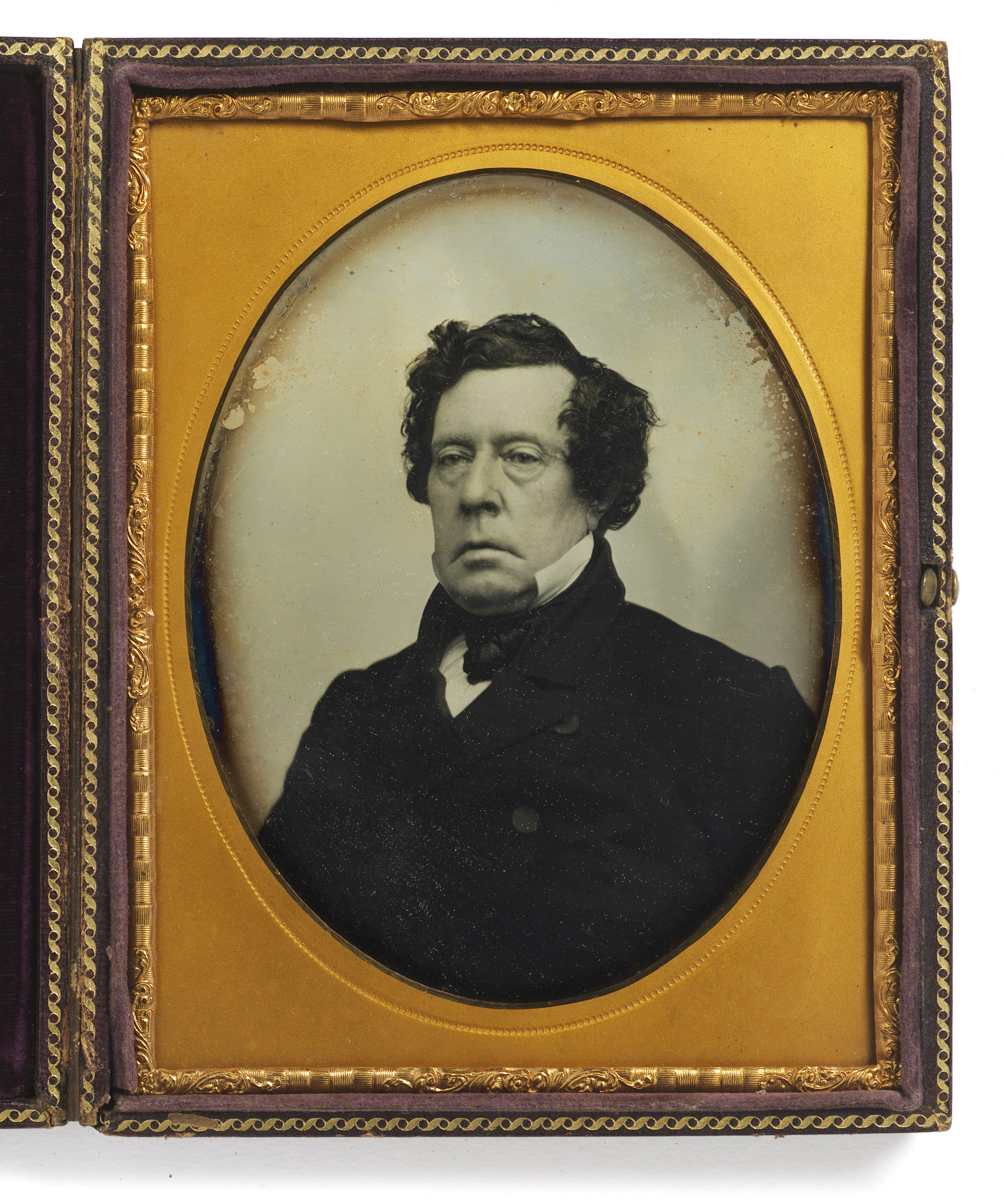
Beckers and Piard (American) 'Matthew Calbraith Perry' (April 10, 1794-March 4, 1858) c. 1855


Beckers and Piard (American)
Alexander Beckers (American born Germany, 1815-1905, active 1842-1869)
Victor Piard (American born France, 1825-1901)
Matthew Calbraith Perry (April 10, 1794 – March 4, 1858)
c. 1855
Half-plate daguerreotype
National Portrait Gallery, Smithsonian Institution


Alexander Beckers (American born German, 1815-1905)

Alexander Beckers first saw a daguerreotype in Philadelphia, and subsequently went to work there for photographer Frederick David Langenheim in 1843. The following year he moved to New York, where he is credited with the first whole-plate daguerreotypes made in that city. Within months Beckers opened the Langenheim & Beckers studio in New York, which became Beckers & Piard in 1849. In 1857 he patented a revolving stereograph viewer and shortly thereafter sold his daguerreotype business in order to concentrate his attention on the manufacture of stereograph viewers.

Anonymous text. “Alexander Beckers,” on the J. Paul Getty Museum website [Online] Cited 15/03/2022

Matthew Calbraith Perry (American, 1794-1858)

Matthew Calbraith Perry (April 10, 1794 – March 4, 1858) was a Commodore of the United States Navy who commanded ships in several wars, including the War of 1812 and the Mexican-American War (1846-1848). He played a leading role in the opening of Japan to the West with the Convention of Kanagawa in 1854.

Perry was interested in the education of naval officers, and assisted in the development of an apprentice system that helped establish the curriculum at the United States Naval Academy. With the advent of the steam engine, he became a leading advocate of modernising the U.S. Navy and came to be considered “The Father of the Steam Navy” in the United States.

Text from the Wikipedia website


[Several] daguerreotypes of Matthew Calbraith Perry (1794-1858) [were] made in New York City, in the months following Commodore Perry’s triumphant return from Japan in January of 1855. The seminal achievement of his long naval career, Perry’s shrewd and persistent negotiations with Japan opened that isolated nation to the West for the first time in its history.

[These] portraits can be dated to 1855-1856, based on the date of Perry’s return to the United States and the years the Beckers & Piard studio operated at 264 Broadway. A variant, more conventional, portrait from this same sitting, previously unattributed, exists in three identical half-plates, one in the National Portrait Gallery (above), one in the New-York Historical Society, and one sold at Swann Galleries, New York, in 1988 (Sale 1468, Lot 186). In addition, there is a half-plate profile study of Perry in the U. S. Naval Academy Museum in Annapolis, also made by Beckers & Piard, that was the model for a commemorative medal struck in Perry’s honour in 1856; and a half-plate seated portrait of Perry in his full uniform and regalia, also owned by the New-York Historical Society.

The portraits can be dated to 1855 or 1856 based upon Perry’s arrival in New York, from Japan, in 1855, and by the address of the daguerreotypists stamped on the portrait’s mat. Alexander Beckers and Victor Piard were active at 264 Broadway, the address on the mat, from 1853 to 1856. At some point in 1856, the studio moved across the street to 261 Broadway. This portrait would, therefore, have to have been made in 1855 or 1856.

Anonymous text. “Catalogue note,” on the Sotheby’s website 2012 [Online] Cited 28/11/2018.


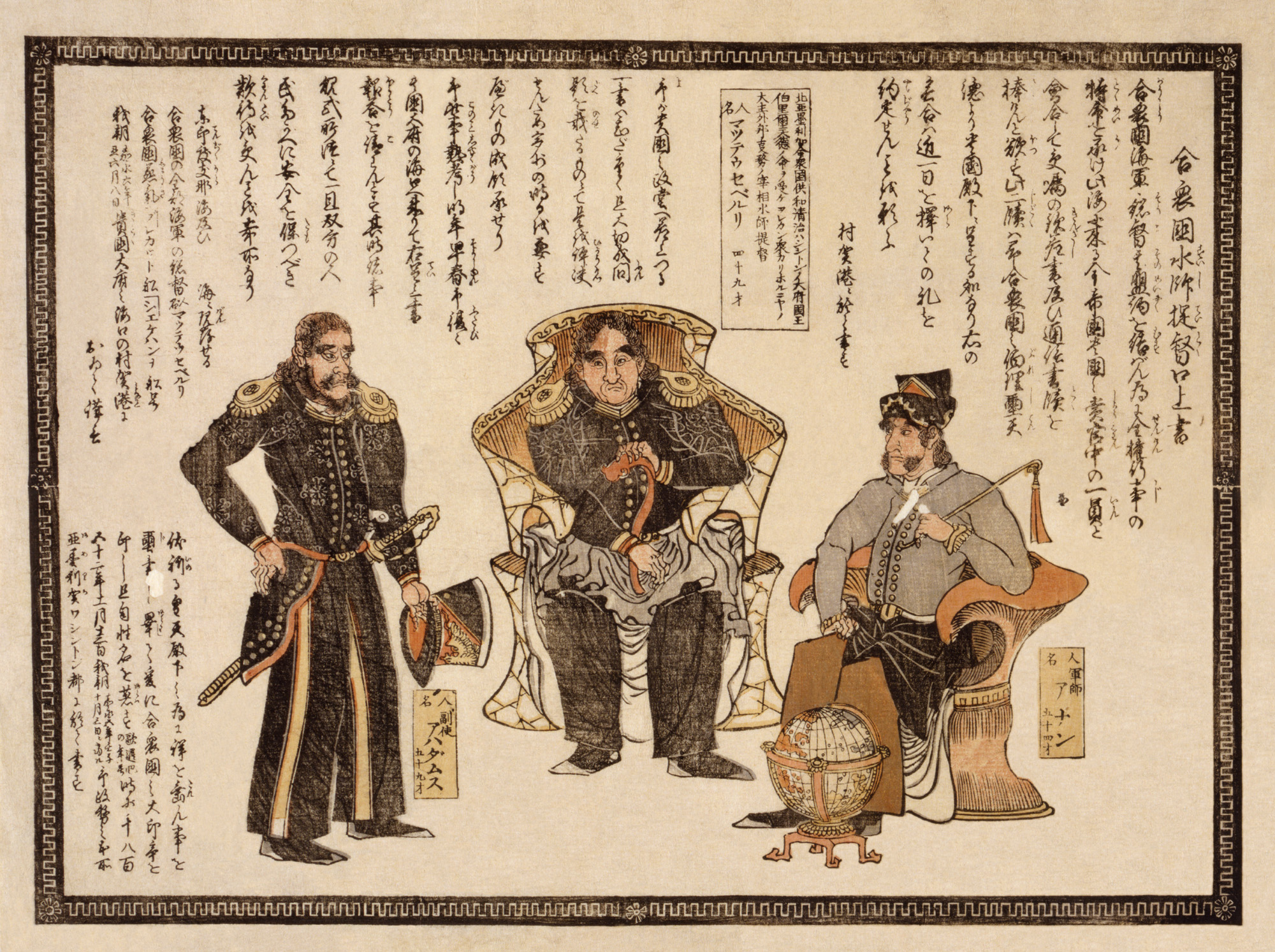
Unknown artist (Japanese) 'Gasshukoku suishi teitoku kōjōgaki (Oral statement by the American Navy admiral)' c. 1854


Unknown artist (Japanese)
Gasshukoku suishi teitoku kōjōgaki (Oral statement by the American Navy admiral)
c. 1854
Library of Congress
Public domain


A Japanese print showing three men, believed to be Commander Anan, age 54; Perry, age 49; and Captain Henry Adams, age 59, who opened up Japan to the west. The text being read may be President Fillmore’s letter to Emperor of Japan. This is a somewhat extensive restoration, meant to keep focus on the artwork, instead of the damage.


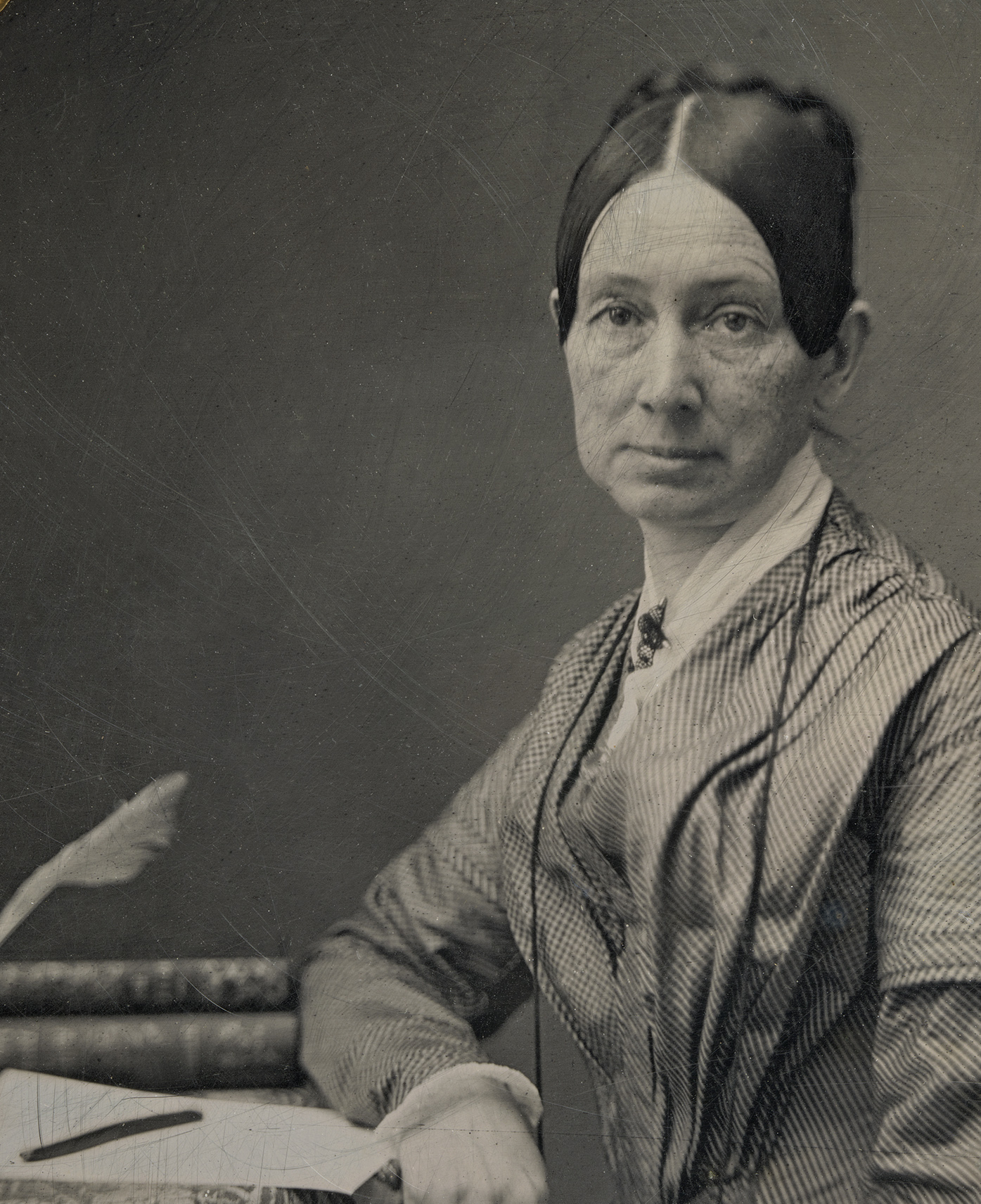
Unidentified artist (American) 'Dorothea Lynde Dix' c. 1849


Unidentified artist (American)
Dorothea Lynde Dix
c. 1849
Half-plate daguerreotype
National Portrait Gallery, Smithsonian Institution


Dorothea Lynde Dix (American, 1802-1887)

Dorothea Lynde Dix (April 4, 1802 – July 17, 1887) was an American advocate on behalf of the indigent mentally ill who, through a vigorous and sustained program of lobbying state legislatures and the United States Congress, created the first generation of American mental asylums. During the Civil War, she served as a Superintendent of Army Nurses. (Wikipedia)

What a human being… read her full Wikipedia entry. A champion of the poor and mentally ill, Dix and her nurses cared for the wounded from both sides of the American Civil War.


Unidentified artist (American) 'Dorothea Lynde Dix' c. 1849 (detail)


Unidentified artist (American)
Dorothea Lynde Dix (detail)
c. 1849
Half-plate daguerreotype
National Portrait Gallery, Smithsonian Institution


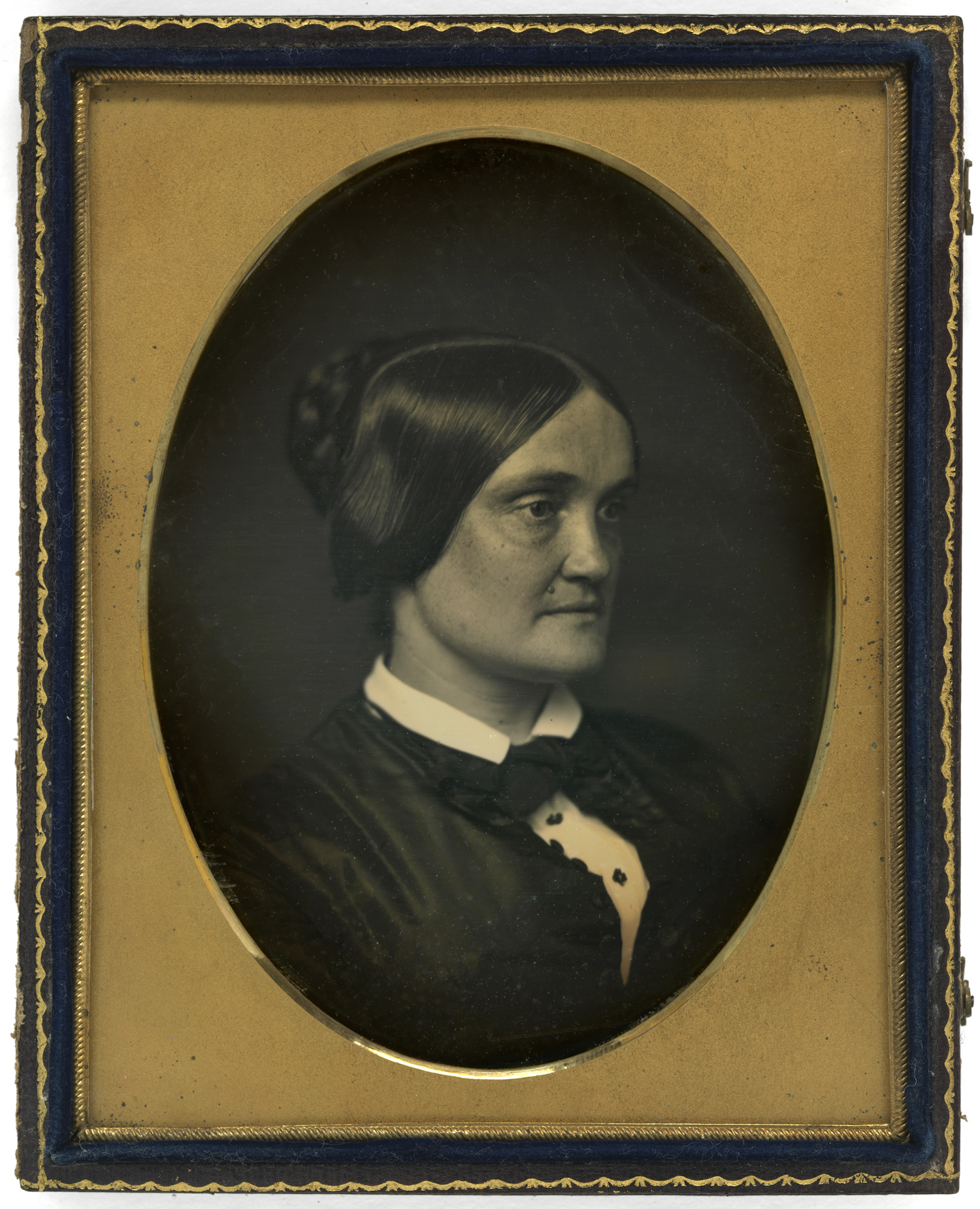
Unidentified artist (American) 'Charlotte Cushman' c. 1850


Unidentified artist (American)
Charlotte Cushman
c. 1850
Half-plate daguerreotype
National Portrait Gallery, Smithsonian Institution


Charlotte Saunders Cushman (July 23, 1816 – February 18, 1876) was an American stage actress. Her voice was noted for its full contralto register, and she was able to play both male and female parts. She lived intermittently in Rome, in an expatriate colony of prominent artists and sculptors, some of whom became part of her tempestuous private life.


Unidentified artist (American) 'Charlotte Cushman' c. 1850 (detail)


Unidentified artist (American)
Charlotte Cushman (detail)
c. 1850
Half-plate daguerreotype
National Portrait Gallery, Smithsonian Institution


Mathew Brady (1822-1896) 'Charlotte Saunders Cushman' between 1855 and 1865


Mathew Brady (American, 1822-1896)
Charlotte Saunders Cushman
between 1855 and 1865
Wet collodion glass negative
Library of Congress Prints and Photographs Division. Brady-Handy Photograph Collection
Public domain


Library of Congress description: “Charlotte Cushman as Meg Merriles”


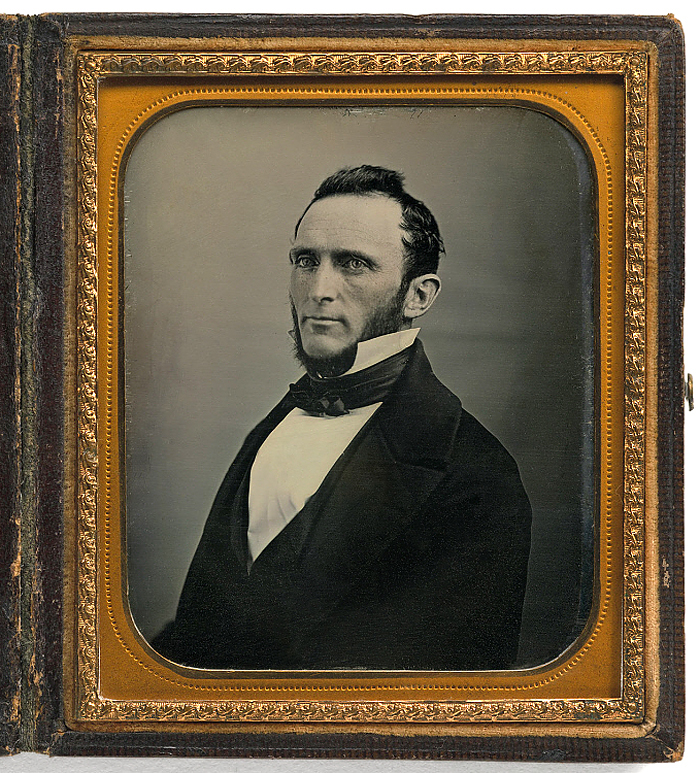
Henry B. Hull (American, active c. 1855) 'Stonewall Jackson' (Thomas Jonathan Jackson, 21 Jan 1824-10 May 1863) 1855


Henry B. Hull (American, active c. 1855)
Stonewall Jackson (Thomas Jonathan Jackson, 21 Jan 1824 – 10 May 1863)
1855
Sixth-plate daguerreotype
Image: 8.4 x 7.2cm (3 5/16 x 2 13/16″)
Case Open: 9.4 x 16.5 x 1.1cm (3 11/16 x 6 1/2 x 7/16″)
National Portrait Gallery, Smithsonian Institution


Born Clarksburg, West Virginia

When future Confederate general Stonewall Jackson sat for this likeness in 1855, his emergence as one of the South’s most brilliant military tacticians lay six years away. A West Point graduate, Jackson had served with distinction in the Mexican American War, earning more citations for valour than any other American officer. He joined Virginia Military Institute as a professor of artillery tactics and natural philosophy in 1851, and later commanded the corps of VMI cadets that guarded the gallows at John Brown’s execution. Jackson had this daguerreotype made as a memento for his aunt and uncle while visiting them in the summer of 1855.

Text from the Smithsonian National Portrait Gallery website


Unidentified artist (American) 'Robert Dale Owen' c. 1847


Unidentified artist (American)
Robert Dale Owen
c. 1847
Sixth-plate daguerreotype
National Portrait Gallery, Smithsonian Institution; gift of Andrew Oliver


Robert Owen Dale (American, 1801-1877)

Robert Dale Owen (November 7, 1801 – June 24, 1877) was a Scottish-born social reformer who immigrated to the United States in 1825, became a U.S. citizen, and was active in Indiana politics as member of the Democratic Party in the Indiana House of Representatives (1835-1839 and 1851-1853) and represented Indiana in the U.S. House of Representatives (1843-1847). As a member of Congress, Owen successfully pushed through the bill that established Smithsonian Institution and served on the Institution’s first Board of Regents. Owen also served as a delegate to the Indiana Constitutional Convention in 1850 and was appointed as U.S. chargé d’affaires (1853-1858) to Naples.

Owen was a knowledgeable exponent of the socialist doctrines of his father, Robert Owen, and managed the day-to-day operation of New Harmony, Indiana, the socialistic utopian community he helped establish with his father in 1825. Throughout his adult life, Robert Dale Owen wrote and published numerous pamphlets, speeches, books, and articles that described his personal and political views, including his belief in spiritualism. Owen co-edited the New-Harmony Gazette with Frances Wright in the late 1820s in Indiana and the Free Enquirer in the 1830s in New York City. Owen was an advocate of married women’s property and divorce rights, secured inclusion of an article in the Indiana Constitution of 1851 that provided tax-supported funding for a uniform system of free public schools, and established the position of Indiana Superintendent of Public Instruction. Owen is also noted for a series of open letters he wrote in 1862 that favoured the abolition of slavery and supported general emancipation, as well as a suggestion that the federal government should provide assistance to freedmen.

Text from the Wikipedia website


Unidentified artist (American) 'Robert Dale Owen' c. 1847 (detail)


Unidentified artist (American)
Robert Dale Owen (detail)
c. 1847
Sixth-plate daguerreotype
National Portrait Gallery, Smithsonian Institution; gift of Andrew Oliver


Southworth & Hawes (American, active 1843-1862) 'Franklin Pierce' (23 Nov 1804-8 Oct 1869) c. 1852


Southworth & Hawes (American, active 1843-1862)
Albert Sands Southworth (12 Mar 1811 – 3 Mar 1894)
Josiah Johnson Hawes (20 Feb 1808 – 7 Aug 1901)
Franklin Pierce (23 Nov 1804 – 8 Oct 1869)
c. 1852
Quarter-plate daguerreotype
Image: 8.8 x 6.8cm (3 7/16 x 2 11/16″)
Case Closed: 11.9 x 9.4cm (4 11/16 x 3 11/16″)
Case Open: 11.9 x 18.7 x 1.2cm (4 11/16 x 7 3/8 x 1/2″)
National Portrait Gallery, Smithsonian Institution


Franklin Pierce (American, 1804-1869)

Franklin Pierce (November 23, 1804 – October 8, 1869) was the 14th President of the United States (1853-1857), a northern Democrat who saw the abolitionist movement as a fundamental threat to the unity of the nation. He alienated anti-slavery groups by championing and signing the Kansas-Nebraska Act and enforcing the Fugitive Slave Act; yet he failed to stem conflict between North and South, setting the stage for Southern secession and the American Civil War.

Pierce was born in New Hampshire, and served in the U.S. House of Representatives and the Senate until he resigned from the Senate in 1842. His private law practice in New Hampshire was a success, and he was appointed U.S. Attorney for his state in 1845. He took part in the Mexican-American War as a brigadier general in the Army. He was seen by Democrats as a compromise candidate uniting northern and southern interests and was nominated as the party’s candidate for president on the 49th ballot at the 1852 Democratic National Convention. He and running mate William R. King easily defeated the Whig Party ticket of Winfield Scott and William A. Graham in the 1852 presidential election.

Text from the Wikipedia website


Southworth & Hawes (American, active 1843-1862)

Southworth & Hawes was an early photographic firm in Boston, 1843-1863. Its partners, Albert Sands Southworth (1811-1894) and Josiah Johnson Hawes (1808-1901), have been hailed as the first great American masters of photography, whose work elevated photographic portraits to the level of fine art. Their images are prominent in every major book and collection of early American photography.

Southworth & Hawes worked almost exclusively in the daguerreotype process. Working in the 8 1/2 x 6 1/2 inch whole plate format, their images are brilliant, mirror-like, and finely detailed. Writing in the Photographic and Fine Art Journal, August 1855, the contemporary Philadelphia daguerreotypist Marcus Aurelius Root paid them this praise: “Their style, indeed, is peculiar to themselves; presenting beautiful effects of light and shade, and giving depth and roundness together with a wonderful softness or mellowness. These traits have achieved for them a high reputation with all true artists and connoisseurs.” He further noted that the firm had devoted their time chiefly to daguerreotypes, with little attention to photography on paper. …

During their 20 years of collaboration, Southworth & Hawes catered to Boston society and the famous. Their advertisements drew a distinction between the appropriate styles for personal versus public portraiture. “A likeness for an intimate acquaintance or one’s own family should be marked by that amiability and cheerfulness, so appropriate to the social circle and the home fireside. Those for the public, of official dignitaries and celebrated characters admit of more firmness, sternness and soberness.” Among their sitters were Louisa May Alcott, Lyman Beecher, Benjamin Butler, William Ellery Channing, Rufus Choate, Cassius Marcellus Clay, Charlotte Cushman, Richard Henry Dana, Jr., Dorothea Dix, Ralph Waldo Emerson, Edward Everett, William Lloyd Garrison, Grace Greenwood, Oliver Wendell Holmes, Sam Houston, Thomas Starr King, Louis Kossuth, Jenny Lind, Henry Wadsworth Longfellow, Horace Mann, Donald McKay, Lola Montez, George Peabody, William H. Prescott, Lemuel Shaw, Harriet Beecher Stowe, Charles Sumner, Daniel Webster, John Greenleaf Whittier, and Robert C. Winthrop.

Text from the Wikipedia website


Unidentified artist (American) 'Brady's New Daguerreotype Saloon, New York Jun 11, 1853'


Unidentified artist (American)
Brady’s New Daguerreotype Saloon, New York
Jun 11, 1853
Wood engraving on paper
36.6 × 24cm (14 7/16 × 9 7/16″)
National Portrait Gallery, Smithsonian Institution


During the 1850s, Manhattan continued to extend north, and Mathew Brady followed suit with the opening of a new gallery, elegantly furnished, at number 359 Broadway. On June 11, 1853, the New York newspaper Illustrated News published a view of the interior of the gallery with the following comment: “The reception room is furnished with richness and artistic taste. Adorning its walls an extensive collection of daguerreotypes of remarkable figures, excellently executed, which is well worth a visit by anyone who wishes to contemplate American and European celebrities. Residents and foreigners alike will enjoy observing the great progress of the art exhibited here, and we convey to Mr. Brady our cordial wishes for success in his new venture.”

Text from the Smithsonian National Portrait Gallery website


Mathew B. Brady (American, 1823? - 15 Jan 1896) 'Thomas Cole' (1 Feb 1801 - 11 Feb 1848) c. 1845


Mathew B. Brady (American, 1823? – 15 Jan 1896)
Thomas Cole (1 Feb 1801 – 11 Feb 1848)
c. 1845
Half-plate daguerreotype on silver-coated copper plate
Plate: 13.7 x 10.2cm (5 3/8 x 4″)
Case Open: 15.8 × 24.4 × 1cm (6 1/4 × 9 5/8 × 3/8″)
Case Closed: 15.8 × 12.3 × 2.7cm (6 1/4 × 4 13/16 × 1 1/16″)
National Portrait Gallery, Smithsonian Institution; gift of Edith Cole Silberstein


Born Bolton-le-Moors, Lancashire, England

Artist Thomas Cole was a founding member of the Hudson River School of American painting, which sought to capture the sublime grandeur of the nation’s natural landscape. Believing that the best art also conveyed a moral lesson, Cole achieved his greatest fame with two series of allegorical paintings entitled The Course of Empire (1836) and The Voyage of Life (1841).

From the outset of his career, Mathew Brady courted major artists and welcomed the opportunity to daguerreotype them. This portrait is one of two known copies Brady made of his original daguerreotype of Cole, which is now in the collection of the Library of Congress.

Text from the Smithsonian National Portrait Gallery website


The Course of Empire is a series of five paintings created by Thomas Cole in the years 1833-1836. It is notable in part for reflecting popular American sentiments of the times, when many saw pastoralism as the ideal phase of human civilisation, fearing that empire would lead to gluttony and inevitable decay. The theme of cycles is one that Cole returned to frequently, such as in his The Voyage of Life series. The Course of Empire comprises the following works: The Course of Empire – The Savage State; The Arcadian or Pastoral State; The Consummation of Empire; Destruction; and Desolation. All the paintings are 39.5 inches by 63.5 inches (100cm by 161cm) except The Consummation of Empire which is 51″ by 76″ (130cm by 193cm).

The series of paintings depicts the growth and fall of an imaginary city, situated on the lower end of a river valley, near its meeting with a bay of the sea. The valley is distinctly identifiable in each of the paintings, in part because of an unusual landmark: a large boulder is situated atop a crag overlooking the valley. Some critics believe this is meant to contrast the immutability of the earth with the transience of man.

Text from the Wikipedia website


Thomas Cole (American, 1801-1848) 'The Savage State' 1834


Thomas Cole (American, 1801-1848)
The Savage State
1834
From The Course of Empire
Oil on canvas
Height: 39.5 in (100.3cm)
Width: 63.5 in (161.2cm)
New-York Historical Society


Thomas Cole (American, 1801-1848) 'The Consummation of Empire' 1836


Thomas Cole (American, 1801-1848)
The Consummation of Empire
1836
From The Course of the Empire
Oil on canvas
Height: 51 in (129.5cm)
Width: 76 in (193cm)
New-York Historical Society


The Voyage of Life is a series of paintings created by Thomas Cole in 1842, representing an allegory of the four stages of human life: childhood, youth, manhood, and old age. The paintings depict a voyager who travels in a boat on a river through the mid-19th-century American wilderness. In each painting the voyager rides the boat on the River of Life accompanied by a guardian angel. The landscape, each reflecting one of the four seasons of the year, plays a major role in conveying the story. With each instalment the boat’s direction of travel is reversed from the previous picture. In childhood, the infant glides from a dark cave into a rich, green landscape. As a youth, the boy takes control of the boat and aims for a shining castle in the sky. In manhood, the adult relies on prayer and religious faith to sustain him through rough waters and a threatening landscape. Finally, the man becomes old and the angel guides him to heaven across the waters of eternity.

Cole’s renowned four-part series traces the journey of an archetypal hero along the “River of Life.” Confidently assuming control of his destiny and oblivious to the dangers that await him, the voyager boldly strives to reach an aerial castle, emblematic of the daydreams of “Youth” and its aspirations for glory and fame. As the traveler approaches his goal, the ever more turbulent stream deviates from its course and relentlessly carries him toward the next picture in the series, where nature’s fury, evil demons, and self-doubt will threaten his very existence. Only prayer, Cole suggests, can save the voyager from a dark and tragic fate.

From the innocence of childhood, to the flush of youthful overconfidence, through the trials and tribulations of middle age, to the hero’s triumphant salvation, The Voyage of Life seems intrinsically linked to the Christian doctrine of death and resurrection. Cole’s intrepid voyager also may be read as a personification of America, itself at an adolescent stage of development. The artist may have been issuing a dire warning to those caught up in the feverish quest for Manifest Destiny: that unbridled westward expansion and industrialisation would have tragic consequences for both man and the land itself.

Text from the Wikipedia website


Thomas Cole (American, 1801-1848) 'The Voyage of Life: Youth' 1842


Thomas Cole (American, 1801-1848)
The Voyage of Life: Youth
1842
Oil on canvas
134 × 194cm (53 in × 76 in)
National Gallery of Art


Thomas Cole (American, 1801-1848) 'The Voyage of Life: Manhood' 1842


Thomas Cole (American, 1801-1848)
The Voyage of Life: Manhood
1842
Oil on canvas
132.8 × 198.1cm (52.3 in × 78.0 in)
National Gallery of Art


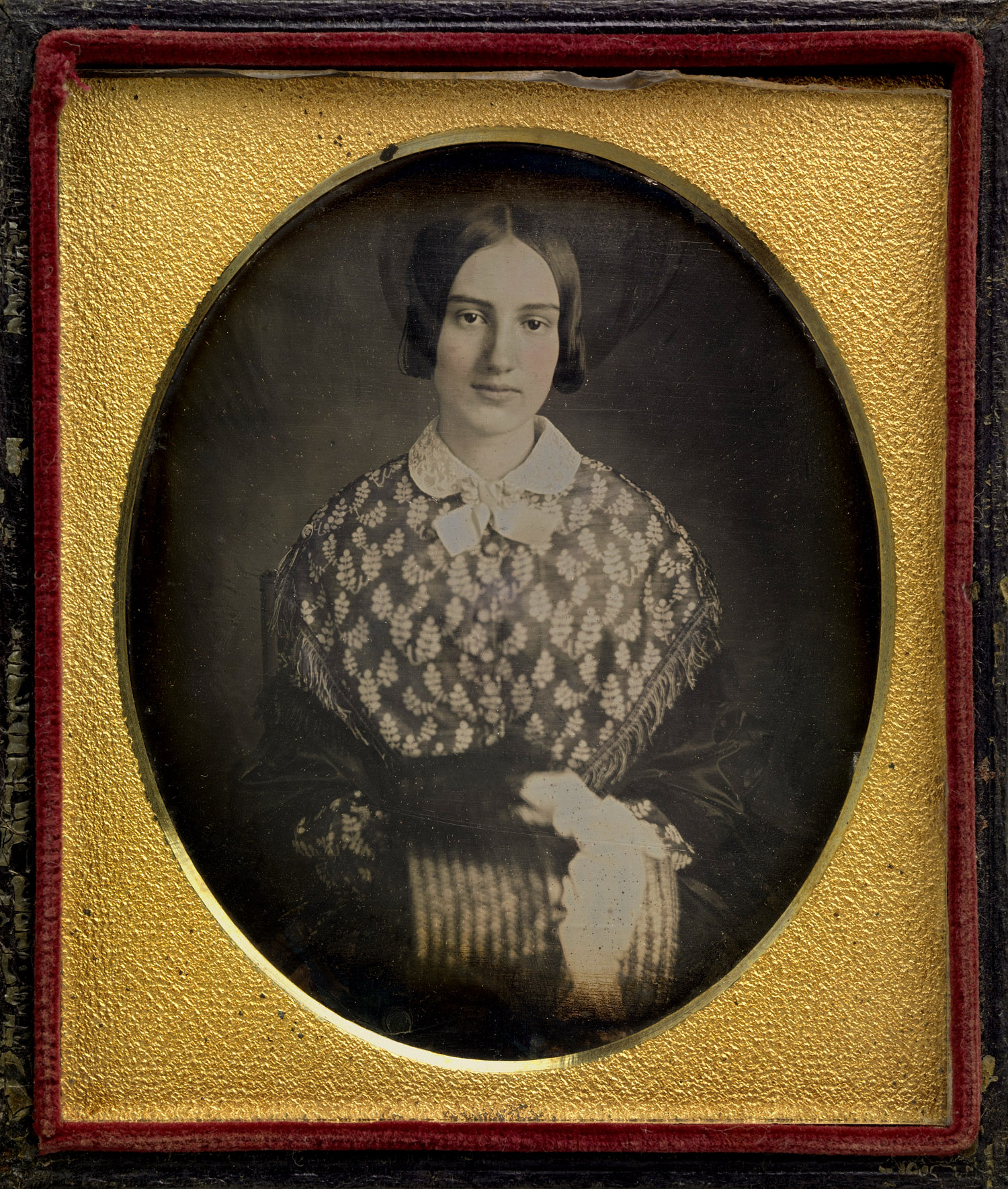
Unidentified artist (American) 'Julia Catherine Seymour Conkling' 1848


Unidentified artist (American)
Julia Catherine Seymour Conkling
1848
Sixth-plate daguerreotype
Plate: 8.2 x 6.8cm (3 1/4″ x 2 11/16″)
National Portrait Gallery, Smithsonian Institution


In addition to being the wife of Senator Roscoe Conkling, Julia Seymour was the sister of New York Governor and 1868 Democratic presidential nominee Horatio Seymour. In 1893 Julia Conkling founded the Oneida Chapter of the Daughters of the American Revolution, the fourth chapter formed after the 1890 founding of the national D.A.R.


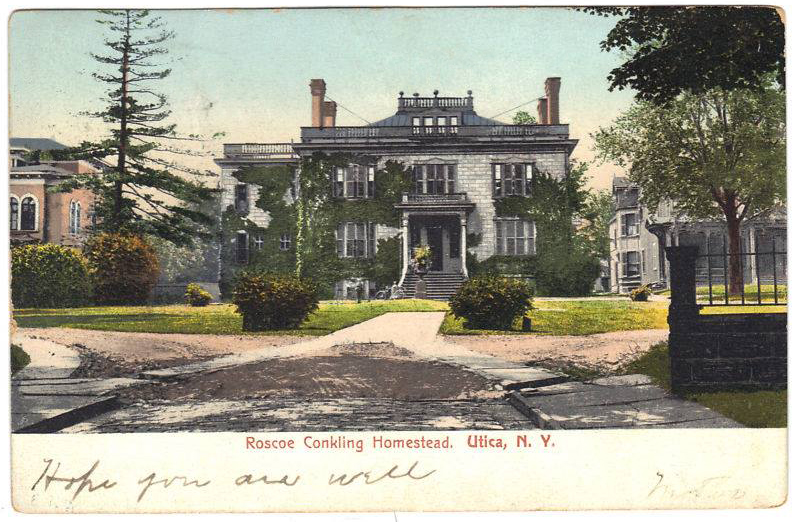
A linen postcard of Conkling House, #3 Rutger Park, Rutger Street, Utica NY


A linen postcard of Conkling House, #3 Rutger Park, Rutger Street, Utica NY (The Landmarks Society of Greater Utica)


The first commercially viable form of photography, daguerreotypes brought portraiture within reach of average Americans in the mid-1800s. Today, they are an essential part of the museum’s collection. Daguerreotypes: Five Decades of Collecting celebrates the Portrait Gallery’s tradition of collecting with this intimate exhibition of 13 small-scale, one-of-a-kind portraits of early American influencers. The exhibition opens June 15 and will be on display on the museum’s first floor through June 2, 2019.

The presentation, organised by Ann Shumard, senior curator of photographs, celebrates the museum’s golden anniversary and highlights its extraordinary collection. With more than 23,000 objects, the Portrait Gallery holds some of the most important photographic portraits, including prized glass-plate negatives by Mathew Brady and the acclaimed 2017 acquisition of an 1843 daguerreotype likeness of President John Quincy Adams by artist Philip Haas, on permanent view in the museum’s America’s Presidents gallery.

The Portrait Gallery’s first photographic acquisition was a daguerreotype, which arrived as a gift in 1965 – three years before the museum opened its doors to the public. The image was a portrait by Marcus Aurelius Root of poet, painter and sculptor Thomas Buchanan Read, whose equestrian portrait of Union army general Philip Sheridan is on exhibit in the museum’s Civil War galleries.

When an Act of Congress established the National Portrait Gallery in 1962, the new museum was not initially authorised to collect photographs. An exception was made to accommodate gifts to its Support Collection. This enabled the Portrait Gallery to accept several significant daguerreotype portraits before 1976, when its charter was amended to allow for the acquisition of photographs. The museum’s collection now includes more than 150 daguerreotypes representing individuals as diverse in their achievements as showman P.T. Barnum, Seneca Nation leader Blacksnake, actress Charlotte Cushman, humanitarian Dorothea Dix, surgeon Thomas D. Mütter, U.S. Navy Commodore Matthew C. Perry and writer Henry David Thoreau.

“These daguerreotypes are remarkable artefacts from the dawn of American photography,” Shumard said. “Each is truly, as Oliver Wendell Holmes Sr. said, a ‘mirror with a memory.'”

A daguerreotype is a one-of-a-kind, direct-positive image produced on a sensitised plate of silver-clad copper. The process was introduced by French artist Louis-Jacques-Mandé Daguerre, but American practitioners were the ones who recognised the daguerreotype’s potential as a portrait medium. Through technical innovations, they transformed it from an experimental process into a commercially viable one within months of its introduction in August 1839. For nearly 20 years, the daguerreotype flourished in the United States as Americans flocked to studios in communities large and small to pose for their portraits.

Press release from the Smithsonian National Portrait Gallery


Alfred R. Waud (Alfred Rudolph) (American, 1828-1891) 'Kennesaw's Bombardment, 64' June 27, 1864


Alfred R. Waud (Alfred Rudolph) (American, 1828-1891)
Kennesaw’s Bombardment, 64
June 27, 1864
Drawing on light gray paper: pencil, Chinese white, and black ink wash
Digitised from original
Library of Congress
Public domain


Jeremiah Gurney (American, 1812-1895) 'Alfred R. Waud' c. 1852


Jeremiah Gurney (American, 17 October 1812 – 21 April 1895)
Alfred R. Waud
c. 1852
Half-plate daguerreotype
National Portrait Gallery, Smithsonian Institution


Alfred Rudolph Waud (wōd) (October 2, 1828 – April 6, 1891) was an American artist and illustrator, born in London, England. He is most notable for the sketches he made as an artist correspondent during the American Civil War.

 Jeremiah Gurney (American, 1812-1895)

Jeremiah Gurney (October 17, 1812 – April 21, 1895), was an American daguerreotype photographer operating in New York.

Gurney worked in the jewellery trade in Little Falls, New York, but soon moved his business to New York City and shortly after turned to photography, having been instructed and inspired by Samuel Morse. He was one of the pioneering practitioners of the daguerreotype process, opening the first American photo gallery at 189 Broadway in 1840, and charging $5 for a portrait.

He created remarkably detailed portraits, using to the full the remarkable tonal rendition of the process. He selected his clients from New York’s society elite, calling them “Distinguished Persons of the Age” and eschewing the political and entertainment figures favoured by his rival, Mathew Brady. The quality of Gurney’s portraits soon ensconced him as the finest daguerreotypist in Gotham.

Gurney’s photographic skills received numerous accolades, including a write-up in the Scientific American of 5 December 1846. The New York Illustrated News, in an 1853 article, wrote that his establishment at 349 Broadway “consisted of nine spacious rooms, devoted exclusively to this art.” In the 1840s Gurney showed his images at numerous exhibitions such as the American Institute Fair and later at the Crystal Palace in London, achieving international renown. His business flourished and in 1858 he built a three-story white marble studio at 707 Broadway to house his pictures, and it was the first building built for the sole purpose of photography in the United States.

Gurney played a leading role in the training of the first wave of pioneering photographers such as Mathew Brady, who made a name for himself as a civil war photographer. Brady had been employed as a journeyman making jewellery cases for E. Anthony & Co., and also made display cases for Gurney’s daguerreotypes. One of the things Gurney is best known for is having taken the only known photograph of Abraham Lincoln in death.

Text from the Wikipedia website


Jeremiah Gurney (American, 1812-1895) 'Alfred R. Waud' c. 1852 (detail)


Jeremiah Gurney (American, 17 October 1812 – 21 April 1895)
Alfred R. Waud (detail)
c. 1852
Half-plate daguerreotype
National Portrait Gallery, Smithsonian Institution


Leslie & Hooper (engravers) 'Gurney's Daguerreian Saloon at 349 Broadway, NYC' 12 November, 1853


Leslie & Hooper (engravers)
Gurney’s Daguerreian Saloon at 349 Broadway, NYC
12 November, 1853
From Frank Leslie’s Illustrated Newspaper
Public domain


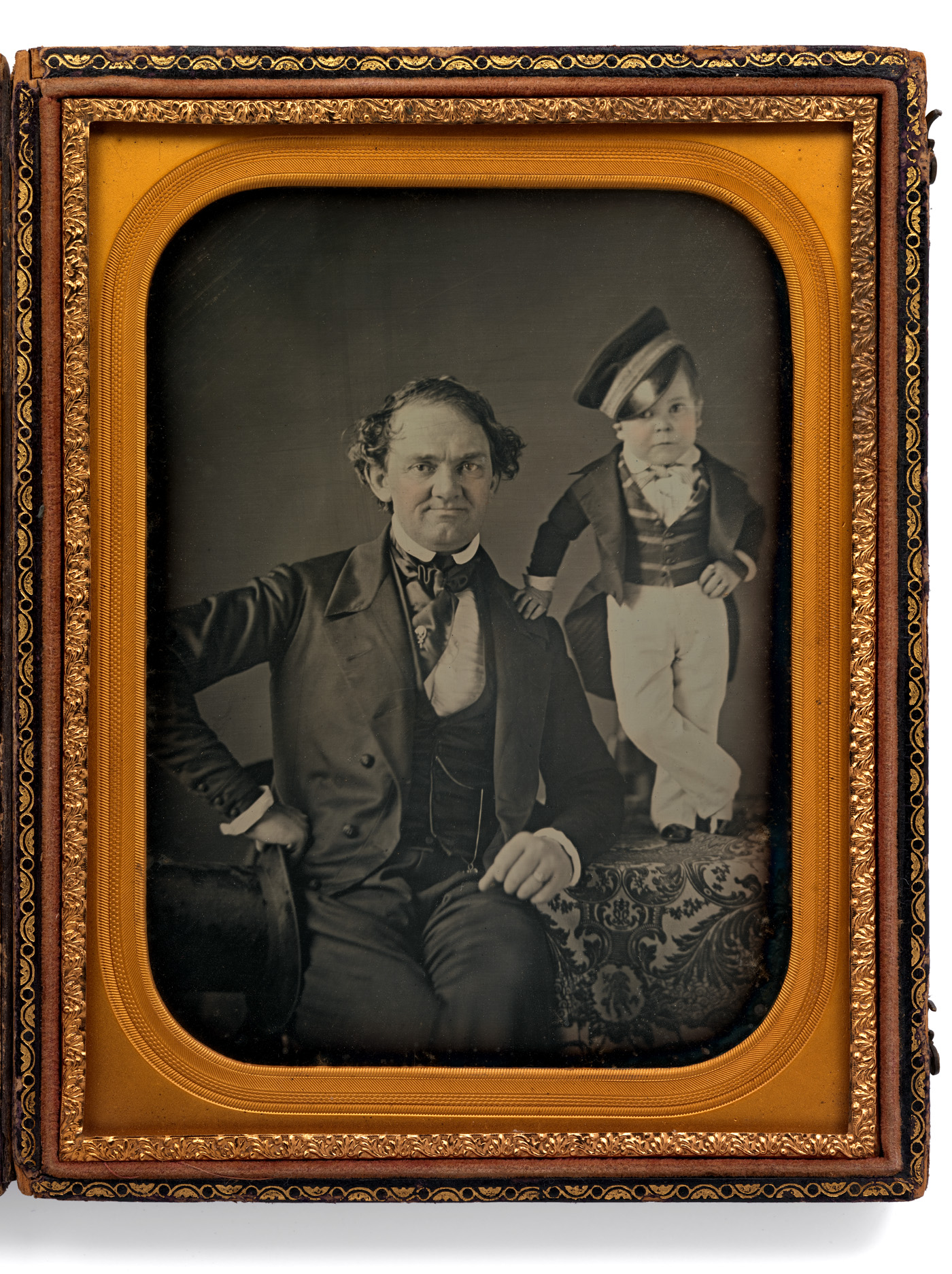
Samuel Root and Marcus Aurelius Root. 'P.T. Barnum and General Tom Thumb' c. 1850


Samuel Root and Marcus Aurelius Root (American)
Samuel Root (American, c. 1820-1889)
Marcus Aurelius Root 
(American, 1808-1888)
P.T. Barnum and General Tom Thumb
c. 1850
Half-plate daguerreotype
National Portrait Gallery, Smithsonian Institution


Samuel Root (American, c. 1820-1889)
Marcus Aurelius Root (American, 1808-1888)

Samuel Root, was born circa 1820. Marcus spent his childhood in Ohio and briefly attended Ohio University before contracting pleurisy forced him to drop out. After working briefly as a portrait artist, Marcus began teaching penmanship at the encouragement of painter Thomas Sully, and opened his own school in Philadelphia in 1835. During this period, he wrote several books on penmanship, including Philosophical Theory and Practice of Penmanship (1842).

Marcus Root‘s interest in daguerreian art began when Louis Daguerre’s process was introduced in Philadelphia in 1839. He studied under famed daguerreian Robert Cornelius. For him, daguerreotype was more than just a new art form; it was an expression of nationalist ideals. After opening a series of galleries in various locations, he returned to Philadelphia, where he was joined by his younger brother Samuel, to whom he taught the daguerreian art. Together, the siblings opened a gallery at 363 Broadway in New York City in 1849, which Samuel managed. Marcus eventually sold his interest in the gallery to Josiah W. Thompson so that he could concentrate on the Philadelphia gallery.

By the 1850s, Marcus Root had become one of America’s most respected daguerreians, and Samuel Root’s artistry was also receiving national attention. He completed the first daguerreotype of Swedish opera singer Jenny Lind and such prominent political officials as Henry Clay and George M. Dallas. When major daguerreotype dealer Edward Anthony held the first national photographic contest, Samuel Root received the second prize, a pair of goblets.

After selling the Philadelphia gallery in 1856, Marcus Root heavily invested in the Mount Vernon Hotel in Cape May, New Jersey. However, shortly thereafter, the uninsured structure was destroyed in a fire. His misfortunes continued when he was seriously injured in a train accident while preparing for a New York City gallery opening. His one leg was crushed, and despite undergoing a lengthy and arduous recovery, Marcus Root remained crippled for the rest of his life. Samuel Root was also enduring his share of hardship. His first wife died, leaving him with a young son. He married Harriet Furman in 1856, and the couple settled in Dubuque, Iowa, where Samuel opened a gallery at 166 Main Street. He became a respected member of the community, and published several photographic texts on Dubuque, including Views of Dubuque and Stereoscopic Views of Dubuque and Surrounding Scenery.

During his long recovery, Marcus Root worked on an exhaustive history of American photography, which was later published as The Camera and the Pencil; Or the Heliographic Art. He was well enough to exhibit his daguerreotype portraits of famous people at the 1876 Centennial Celebration, but a serious fall from a streetcar in 1885 ended his active life, which was spent in relative seclusion until his death on April 12, 1888 at the age of 79. Samuel Root was not one to let adversity get him down, and after a hailstorm destroyed his gallery’s skylight, he photographed and sold the four-inch hailstones. He sold his Dubuque gallery on May 27, 1887, and while on a visit to his sister-in-law in New York, Samuel Root died suddenly of a cerebral haemorrhage on March 11, 1889. The Root brothers were two of America’s earliest and most commercially successful photographic pioneers.

Anonymous text. “Marcus and Samuel Root,” on the Historic Camera website 07/11/2013 [Online] Cited 15/03/2022

 Charles Sherwood Stratton “General Tom Thumb” (American, 1838-1883)

Charles Sherwood Stratton (January 4, 1838 – July 15, 1883), better known by his stage name “General Tom Thumb”, was a dwarf who achieved great fame as a performer under circus pioneer P.T. Barnum. …

Phineas T. Barnum, a distant relative (half fifth cousin, twice removed), heard about Stratton and after contacting his parents, taught the boy how to sing, dance, mime, and impersonate famous people. Barnum also went into business with Stratton’s father, who died in 1855. Stratton made his first tour of America at the age of five, with routines that included impersonating characters such as Cupid and Napoleon Bonaparte as well as singing, dancing and comical banter with another performer who acted as a straight man. It was a huge success and the tour expanded.

A year later, Barnum took young Stratton on a tour of Europe, making him an international celebrity. Stratton appeared twice before Victoria of the United Kingdom of Great Britain and Ireland. He also met the three-year-old Prince of Wales, who would become King Edward VII. In 1845, he triumphed at the Théâtre du Vaudeville (France) in the play Le petit Poucet of Dumanoir and Clairville. The tour was a huge success, with crowds mobbing him wherever he went. After his three-year tour in Europe, Stratton began his rise to stardom in the United States. Stratton’s fame grew at an astonishing rate, and his popularity and celebrity surpassed that of any actor within his lifetime. …

Stratton’s first performances in New York marked a turning point in the history of freak show entertainment. Prior to Stratton’s debut, the presentation of ‘human curiosities’ for the purpose of entertainment was deemed dishonourable and seen as an unpleasing carnival attraction. However, after viewers were introduced to Stratton and performances, he was able to change the perception people held toward freak shows. Stratton’s lively and entertaining performances made these types of carnival shows one of the most favoured forms of theatrical entertainment in the United States.

Text from the Wikipedia website


Southworth & Hawes (American, active 1843-1862) 'Jonas Chickering' 1853


Southworth & Hawes (American, active 1843-1862)
Albert Sands Southworth (12 Mar 1811 – 3 Mar 1894)
Josiah Johnson Hawes (20 Feb 1808 – 7 Aug 1901)
Jonas Chickering (April 5, 1798 – December 8, 1853)
1853
Whole-plate daguerreotype
National Portrait Gallery, Smithsonian Institution


Jonas Chickering (April 5, 1798 – December 8, 1853) was a piano manufacturer in Boston, Massachusetts.


Southworth & Hawes (American, active 1843-1862) 'Gaetano Bedini' 1853


Southworth & Hawes (American, active 1843-1862)
Albert Sands Southworth
(12 Mar 1811 – 3 Mar 1894)
Josiah Johnson Hawes
(20 Feb 1808 – 7 Aug 1901)
Gaetano Bedini
1853
Whole-plate daguerreotype
National Portrait Gallery, Smithsonian Institution


Gaetano Bedini (Italian, 1806-1864)

Gaetano Bedini (15 May 1806 – 6 September 1864) was an Italian ecclesiastic, Cardinal and diplomat of the Catholic Church.

On 15 March 1852 he was named titular Archbishop of Thebes, and, three days after, Apostolic Nuncio in Brazil. Once he received the archiepiscopal order on 4 July 1852 from cardinal Luigi Lambruschini, he decided to leave for Brazil, but he could not enter the country because of a plague epidemic, so he went to the United States. He was the first Papal Nuncio in the United States.

He arrived in New York on 30 June 1853. He became the target of attacks by non-Catholics because of his role in overthrowing the Anti-Papal Roman Republic in 1849, and his visit triggered the Cincinnati Riot of 1853 in which several hundred men marched in protest against his visit.

While travelling, Bedini met the president of the United States, Franklin Pierce, to whom he delivered a letter from the Pope, and the American Secretary of State, William L. Marcy. He ordained some new bishops, amongst whom were James Roosevelt Bayley, archbishop of the Archdiocese of Newark, John Loughlin, bishop of the Diocese of Brooklyn, and Louis De Goesbriand, bishop of the Diocese of Burlington. After visiting New York, Pittsburgh, Louisville, Baltimore and Philadelphia, he returned to Rome from New Orleans in January 1854.

Text from the Wikipedia website


F. C. Flint (American) 'Blacksnake' c. 1850


F. C. Flint (American)
Seneca Chief Governor Blacksnake
c. 1850
Quarter-plate daguerreotype
National Portrait Gallery, Smithsonian Institution


Governor Blacksnake (Tah-won-ne-ahs, born c. 1737-1760 – died 1859)

Tah-won-ne-ahs or Thaonawyuthe “The Nephew” (born between 1737 and 1760, died 1859), known in English as either Governor Blacksnake or Chainbreaker, was a Seneca war chief and leader. Along with other Iroquois war chiefs (most notably Mohawk leader Joseph Brant), he led warriors to fight on the side of the British during the American Revolutionary War from 1777 to 1783. He was prominent for his role at the Battle of Oriskany, in which the Loyalist and allied forces ambushed a force of rebels (now called Patriots). After the war he supported his maternal uncle Handsome Lake, as a prominent religious leader. Governor Blacksnake allied with the United States in the War of 1812 and later encouraged some accommodation to European-American settlers, allowing missionaries and teachers on the Seneca reservation.

Importantly, he also led a successful postwar struggle in New York in the 1850s after white men illegally bought reservation land. He helped gain a New York State Appeals Court ruling in 1861 that restored the Oil Springs Reservation to the Seneca. …

Blacksnake died on the Allegany Reservation in Cattaraugus County, New York in late December 1859. He is remembered by the Seneca Nation as “a man of rare intellectual and moral power.”

Text from the Wikipedia website


Montgomery P. Simons (American, 1817-1877, active Philadelphia, Pennsylvania 1840s-1870s) Dr. 'Thomas Dent Mutter' 1846


Montgomery P. Simons (American, 1817-1877, active Philadelphia, Pennsylvania 1840s-1870s)
Dr. Thomas Dent Mutter (1811-1858)
1846
Half-plate daguerreotype
National Portrait Gallery, Smithsonian Institution; purchased through the Marc Pachter Acquisitions Fund, Jon and Lillian Lovelace; partial gift of Stanley B. Burns, MD and The Burns Archive


Thomas Dent Mutter (American, 1811-1858)

Born in Richmond Virginia in 1811, Thomas Dent Mutter lost his brother, mother, father, and guardian grandmother to illness by the time he was seven. As a sickly orphan, Mutter developed an interest in medicine, enrolling in the University of Pennsylvania medical school at age 17.

Then as now, Philadelphia was the leading city in the nation for medical education. Founded in 1765, Mutter’s alma mater was the first hospital and medical school in North America. Today, Penn is one of five med schools in the city educating nearly 20% of all doctors in America. Visitors to Philadelphia can still see the stately Pennsylvania Hospital building at 8th and Spruce streets.

After graduating from Penn, young Mutter followed the path of many American doctors of the time and continued his education among the surgeons of Paris, France. There he learnt the innovative techniques of les operations plastiques (plastic surgery): cosmetic procedures to repair skin and tissue damaged by burns, tumors, or congenital defects.

In Paris, Mutter obtained an item since seen by thousands of museum-goers: a wax head-cast of a “horned” lady, a young woman with a thick brown protrusion extending from her forehead to below her chin. It was the first of many wax models, skeletons, and preserved body parts he would collect over the next few decades.

On returning to Philadelphia, Mütter (as he now styled himself, adding an umlaut to appear more European) became a prominent plastic surgeon. He was soon named chair of surgery at Jefferson Medical College, the city’s second-oldest medical school (now Thomas Jefferson University). There, he used his growing collection of one-of-a-kind medical specimens as a teaching tool to demonstrate the varied maladies which could affect the human body. “He wanted a well-rounded collection,” says Robert Hicks, director of the Mütter Museum. “One that reflected what a physician might see in practice.”

At Jefferson, Mütter built a reputation as a flamboyant and popular lecturer, a precocious young doctor at the forefront of a wave of new surgical techniques. He was an early adopter of anaesthesia and sterilisation, developments which made operations significantly less painful and risky. Tickets to his public surgeries were a hot commodity, and aspiring students praised his teaching skills and the specimens from his growing collection, which he wove into his lectures “so as to impress yet not confuse,” as he wrote at the time.

The later years of Mütter’s life were plagued by illness, including painful attacks of gout – a swelling of the joints often caused by poor nutrition – which made it impossible for the doctor to perform surgeries. Seeing that his days were numbered, the physician sought a permanent home for his extensive holdings of pathological specimens, waxworks, and diagrams so that they would be useful to future generations of doctors.

Extract from Christopher Munden. “A Weird History: Dr. Thomas Dent Mütter and his peculiar museum,” on the Phindie website May 23, 2016 [Online] Cited 01 November 2018


Montgomery P. Simons (American, 1817-1877) 'Photography in a nut shell' 1858

Montgomery P. Simons (American, 1817-1877) 'Photography in a nut shell' 1858

Montgomery P. Simons (American, 1817-1877) 'Photography in a nut shell' 1858


Montgomery P. Simons (American, 1817-1877)
Photography in a nut shell; or, The experience of an artist in photography, on paper, glass and silver : with illustrations
1858
King & Baird, printer


Benjamin D. Maxham (American, 1821-1899, active 1848-1858) 'Henry David Thoreau' 1856

Benjamin D. Maxham (American, 1821-1899, active 1848-1858) 'Henry David Thoreau' (July 12, 1817-May 6, 1862) 1856


Benjamin D. Maxham (American, 1821-1899, active 1848-1858)
Henry David Thoreau (July 12, 1817 – May 6, 1862)
1856
Ninth-plate daguerreotype
Height: 63mm (2.48 in)
Width: 47mm (1.85 in)
National Portrait Gallery, Smithsonian Institution; gift of anonymous donor


Calvin R. Greene was a Thoreau “disciple” who lived in Rochester, Michigan, and who first began corresponding with Thoreau in January 1856. When Greene asked for a photographic image of the author, Thoreau initially replied: “You may rely on it that you have the best of me in my books, and that I am not worth seeing personally – the stuttering, blundering, clodhopper that I am.” Yet Greene repeated his request and sent money for the sitting. Thoreau must have kept this commitment to his fan in the back of his mind for the next several months. On June 18, 1856, during a trip to Worcester, Massachusetts, Henry Thoreau visited the Daguerrean Palace of Benjamin D. Maxham at 16 Huntington Street and had three daguerreotypes taken for fifty cents each. He gave two of the prints to his Worcester friends and hosts, H.G.O. Blake and Theophilius Brown. The third he sent to Calvin Greene in Michigan. “While in Worcester this week I obtained the accompanying daguerreotype – which my friends think is pretty good – though better looking than I,” Thoreau wrote.

Text from the Wikipedia website


Benjamin D. Maxham (American, 1821-1899, active 1848-1858) 'Henry David Thoreau' 1856 (detail)


Benjamin D. Maxham (American, 1821-1899, active 1848-1858)
Henry David Thoreau (July 12, 1817 – May 6, 1862) (detail, restored)
1856
Ninth-plate daguerreotype
National Portrait Gallery, Smithsonian Institution; gift of anonymous donor


Henry David Thoreau (American, 1817-1862)

Henry David Thoreau (July 12, 1817 – May 6, 1862) was an American essayist, poet, philosopher, abolitionist, naturalist, tax resister, development critic, surveyor, and historian. A leading transcendentalist, Thoreau is best known for his book Walden, a reflection upon simple living in natural surroundings, and his essay “Civil Disobedience” (originally published as “Resistance to Civil Government”), an argument for disobedience to an unjust state.

Thoreau’s books, articles, essays, journals, and poetry amount to more than 20 volumes. Among his lasting contributions are his writings on natural history and philosophy, in which he anticipated the methods and findings of ecology and environmental history, two sources of modern-day environmentalism. His literary style interweaves close observation of nature, personal experience, pointed rhetoric, symbolic meanings, and historical lore, while displaying a poetic sensibility, philosophical austerity, and Yankee attention to practical detail. He was also deeply interested in the idea of survival in the face of hostile elements, historical change, and natural decay; at the same time he advocated abandoning waste and illusion in order to discover life’s true essential needs.

He was a lifelong abolitionist, delivering lectures that attacked the Fugitive Slave Law while praising the writings of Wendell Phillips and defending the abolitionist John Brown. Thoreau’s philosophy of civil disobedience later influenced the political thoughts and actions of such notable figures as Leo Tolstoy, Mahatma Gandhi, and Martin Luther King Jr.

Thoreau is sometimes referred to as an anarchist. Though “Civil Disobedience” seems to call for improving rather than abolishing government – “I ask for, not at once no government, but at once a better government” – the direction of this improvement contrarily points toward anarchism: “‘That government is best which governs not at all;’ and when men are prepared for it, that will be the kind of government which they will have.”

Transcendentalism

A core belief of transcendentalism is in the inherent goodness of people and nature. Adherents believe that society and its institutions have corrupted the purity of the individual, and they have faith that people are at their best when truly “self-reliant” and independent.

Transcendentalism emphasises subjective intuition over objective empiricism. Adherents believe that individuals are capable of generating completely original insights with little attention and deference to past masters.

Text from the Wikipedia website


Unidentified artist (American) 'The Daguerreotypist' 1849


Unidentified artist (American)
The Daguerreotypist
1849
Wood engraving on paper
National Portrait Gallery, Smithsonian Institution


Smithsonian National Portrait Gallery
8th and F Sts NW
Washington, DC 20001

Opening hours:
11.30am – 7.00pm daily

Smithsonian National Portrait Gallery website

LIKE ART BLART ON FACEBOOK

Back to top

Exhibition: ‘Real/Ideal: Photography in France, 1847-1860’ at the J. Paul Getty Museum, Getty Center, Los Angeles

Exhibition dates: 30th August – 27th November, 2016

Curator: Karen Hellman, assistant curator of photographs at the J. Paul Getty Museum


Gustave Le Gray (French, 1820-1884) 'Pavillon Mollien Pavilion, the Louvre, Paris' 1859 from the exhibition 'Real/Ideal: Photography in France, 1847-1860' at the J. Paul Getty Museum, Getty Center, Los Angeles, Aug - Nov, 2016


Gustave Le Gray (French, 1820-1884)
Pavillon Mollien Pavilion, the Louvre, Paris
1859
Albumen silver print from a glass negative
36.7 x 47.9cm (14 7/16 x 18 7/8 in.)
The J. Paul Getty Museum, Los Angeles


The best fun I had was putting together Nadar’s Self-Portrait (c. 1855, below) with Henri Le Secq’s North Transept, Chartres Cathedral (Negative 1852; print 1870s, below). The relationship of the hands between the two prints is just delicious. I also love the waxed paper negative and salted paper prints: such a feeling of ephemerality can be obtained in the final image even though the photographs are rendering solid objects. According to my friend Ellie Young of Gold Street Studios who is an expert in early photographic processes, salted paper prints (and their relative, the Calotype) can be as light as a feather or as strong and solid as an albumen print. “Salt prints from Calotype negatives exhibit an expressive softness of tone much prized by early photographers.” With their use of chiaroscuro (from chiaro ‘clear, bright’ – from Latin clarus + oscuro ‘dark, obscure’ – from Latin obscurus), Gustave Le Gray’s seascapes, for which he is widely known and admired, are masterful.

Dr Marcus Bunyan


Many thankx to the J. Paul Getty Museum for allowing me to publish the photographs in the posting. Please click on the photographs for a larger version of the image.


Édouard Baldus (French born Germany, 1813-1889) 'Amphitheater, Nîmes' 1850s from the exhibition 'Real/Ideal: Photography in France, 1847-1860' at the J. Paul Getty Museum, Getty Center, Los Angeles, Aug - Nov, 2016


Édouard Baldus (French born Germany, 1813-1889)
Amphitheater, Nîmes
1850s
Albumen silver print from a paper negative
33.3 x 43.3cm (13 1/8 x 17 1/16 in.)
The J. Paul Getty Museum, Los Angeles


Calotypes and Waxed Paper Negatives

“The Calotype proper is a negative image (along with its offshoot the waxed paper negative), although its positive counterpart, the salted paper print, is the more common form in which it is encountered. Calotypes are made by brushing the best quality drawing or writing paper with a solution of silver nitrate, drying the paper, and then immersing it in a solution of potassium iodide to form a light-sensitive layer of silver iodide. Immediately before use the surface it treated with ‘gallo-nitrate of silver’ (a mixture of silver nitrate solution and gallic acid) to act as an accelerator. Exposure in a camera, where the paper must be held in a dark slide, produces a latent (invisible) image which is developed by washing in gallo-nitrate of silver, fixed in hypo and thoroughly washed. The translucency of Calotypes can be improved by waxing, and a positive can be made by repeating the original process or by ‘printing out’ the image in much the same way as making a Photogenic Drawing. When toned, in, for instance, gold chloride solution (to give it a purpleish tone), a positive produced in this way is known as a ‘salted paper print’.

With the exception perhaps of the waxed paper process, which was invented in 1851 by Gustave Le Gray (1820-1882) and extended the life of paper negatives into the 1870s, the first generation processes – the Daguerreotype, Photogenic Drawing and Calotype – were all extinct by the end of the 1850s, having given way to their own offspring: the wet collodion glass negative and the albumen print.”

Anonymous. “Calotypes,” on the University of Oxford Museum of the History of Science website [Online] Cited 11/11/2016. No longer available online

Salted Paper Print

Once a paper negative had been secured, any number of positive prints could be created by contact printing. Preparation involved soaking good quality paper in a sodium chloride solution (table salt) and then brushing it with a solution of silver nitrate to produce light-sensitive silver chloride. Exposure of the sensitised paper to sunlight, in contact with a negative held in a frame, resulted in the emergence of a visible image without subsequent development. This ‘printed-out’ image was then fixed and toned. Salt prints, unless subsequently coated, have a characteristically matt appearance, with the image embedded in the paper. Although lacking the sharpness of detail associated with the daguerreotype, salt prints from Calotype negatives exhibit an expressive softness of tone much prized by early photographers. This portrait of the Rev. Julius Wood is one of a large series taken by Hill and Adamson to serve as references for a group portrait of the founders of the Free Church of Scotland that Hill had been commissioned to paint. These portraits, with other scenes and views, were later issued in a small ‘edition’ of 12 known copies, entitled One Hundred Calotype Sketches.

Wet collodion negative

Frederick Scott Archer’s wet collodion process, announced in 1851, became the standard photographic negative process for both amateurs and professionals from the mid-1850s until the early 1880s. The glass negative, with its structureless film, fine grain and clear whites proved immediately popular and within a decade had superseded both the daguerreotype and the calotype processes. To prepare the negative for exposure, a sheet of glass was coated with a solution of iodised collodion (a syrupy liquid composed of soluble gun-cotton, ether and alcohol) and then made light-sensitive by immersion in a bath of silver nitrate. Known as a wet process because the glass negative required sensitising, exposing and processing while the chemicals were still damp, it required considerable manipulative skill, but produced a negative of unsurpassed sharpness and a broad tonal range. This view, on a 10 x 12 inch glass plate, is one of a large collection of photographs of architectural subjects commissioned from Lyon by the Madras and Bombay Governments in the late 1860s.

Albumen Print

The albumen print, announced by the French photographer and publisher Louis-Désiré Blanquard-Évrard in 1850, was the most widespread print medium in use between the mid-1850s and the 1890s. While the printing process was chemically similar to the salt print, the albumen print is generally distinguishable by the glossy sheen imparted by a preliminary sizing of the paper with albumen (egg white) and salt. This sealing of the paper created a surface layer on which the silver image was formed, and made possible much greater density, contrast and sharpness in the final image than had been possible with the plain salted paper print. After the albumen coating had been applied, the paper was made light sensitive by the addition of silver nitrate, and printed in contact with the negative. The fixed print could then be toned to create a wide variety of colours, ranging from purple-black to a rich chocolate brown. Although it continued to be used well into the twentieth century, its popularity declined after the mid-1890s, in favour of a variety of manufactured papers. This print is one of a series of studies of objects in the Royal Armoury at Madrid made around 1866 and is notable for its finely-controlled lighting and rich toning. The blacking-out of the background in this image isolates and increases the dramatic impact of the objects.

Anonymous. “Historic Photographs: Historic Processes,” on the British Library website [Online] Cited 11/11/2016


Henri Le Secq (French, 1818-1882) 'Tower of the Kings at Reims Cathedral' Negative, 1851-1853; print, 1853


Henri Le Secq (French, 1818-1882)
Tower of the Kings at Reims Cathedral
Negative, 1851-1853; print, 1853
Salted paper print from a paper negative
35.1 x 25.9cm (13 13/16 x 10 3/16 in.)
The J. Paul Getty Museum, Los Angeles


Édouard Baldus (French born Germany, 1813-1889) 'Tour Saint-Jacques, Paris' 1852-1853


Édouard Baldus (French born Germany, 1813-1889)
Tour Saint-Jacques, Paris
1852-1853
Salted paper print from a paper negative
42.9 x 34cm (16 7/8 x 13 3/8 in.)
The J. Paul Getty Museum, Los Angeles


Henri Le Secq (French, 1818-1882) 'Small Dwelling in Mushroom Cave' 1851


Henri Le Secq (French, 1818-1882)
Small Dwelling in Mushroom Cave
1851
Salted paper print from a paper negative
35.1 x 22.7cm (13 13/16 x 8 15/16 in.)
The J. Paul Getty Museum, Los Angeles


Gustave Le Gray (French, 1820-1884) Auguste Mestral (French, 1812-1884) 'West Facade of the Cathedral of Saint-Gatien, Tours' 1851


Gustave Le Gray (French, 1820-1884)
Auguste Mestral (French, 1812-1884)
West Facade of the Cathedral of Saint-Gatien, Tours
1851
Waxed paper negative
34.2 x 25.2cm (13 7/16 x 9 15/16 in.)
Lent by the Ministère de la Culture et de la Communication (France), Médiathèque de l’architecture et du patrimoine
© RMN-Grand Palais / Art Resource, NY


Charles Nègre (French, 1820-1880) 'Notre-Dame, Paris' c. 1853


Charles Nègre (French, 1820-1880) 'Notre-Dame, Paris' c. 1853


Charles Nègre (French, 1820-1880)
Notre-Dame, Paris
c. 1853
Waxed paper negative
33.6 x 24cm (13 1/4 x 9 7/16 in.)
The J. Paul Getty Museum, Los Angeles


Charles Nègre (French, 1820-1880) 'Tarascon' 1852


Charles Nègre (French, 1820-1880)
Tarascon
1852
Waxed paper negative with selectively applied pigment
23.7 x 33.2cm (9 5/16 x 13 1/16 in.)
The J. Paul Getty Museum, Los Angeles


Charles Nègre (French, 1820-1880) 'Tarascon' 1852


Charles Nègre (French, 1820-1880)
Tarascon
c. 1852
Albumen silver print from paper negative


In the shadow of the political revolutions of 1848, an artistic revolution was also brewing in France within the young medium of photography. An unprecedented period of creativity and discovery among photographers emerged between the first French announcement of a paper negative process in 1847 and more mechanical processes for photographs in the 1860s, sparking debates about photography’s prospects in the divergent fields of art and science.

Organised around the Getty Museum’s rich holdings of early French photography and supplemented with important international loans, Real/Ideal: Photography in France, 1847-1860, on view August 30-November 27, 2016 at the J. Paul Getty Museum, Getty Center, highlights the work of four pioneering French photographers – Édouard Baldus (1813-1889), Gustave Le Gray (1820-1884), Henri Le Secq (1818-1882), and Charles Nègre (1820-1880) – alongside other artists who championed the paper and glass negative and contended with photography’s unprecedented “realism.”

“This exhibition tells a pivotal story about a short period – some 12 years – in the early history of photography; one that the Getty is uniquely positioned to tell given our extensive holdings of nineteenth-century French photographs,” explains Timothy Potts, director of the J. Paul Getty Museum. “It is also an opportunity to showcase – for the first time – an important, recent acquisition of paper negatives from the collection of Jay McDonald. The exhibition sheds light on the freedom that early photographers enjoyed as they explored new means for developing images, and as they balanced the ‘real’ recording of the world as it is with the ‘ideal’, creative possibilities of the medium.”

The Paper Negative and Possibilities

The first paper negatives, created by William Henry Fox Talbot in England in the 1830s, first inspired French photographers in the early 1840s. In 1847, a cloth manufacturer named Louis Désiré Blanquart-Evrard (1802-1872) published a method of improving the paper negative, a process which created a more refined positive image. Due to the political turmoil of 1848, his discovery went unnoticed by the French government, which had long favoured the hyper-real quality of the silver-plated daguerreotype invented by Louis Daguerre (French, 1787-1851) in 1839.

Without a national mandate or commercial viability, French photographers using the paper negative enjoyed a brief period of freedom and experimentation between 1847 and 1860. Gustave Le Gray’s innovation of the “waxed paper negative,” which involved the addition of a layer of wax before the negative was sensitised with photo chemistry, was particularly vital, rendering the negative more translucent and portable. Rare waxed paper negatives by these photographers from the Getty Museum’s collection and from the Médiathèque de l’architecture et du patrimoine and the Musée D’Orsay in Paris will be on view. The exhibition will also include a view of Montmartre from “barrière de Clichy,” a photographic school and studio that Le Gray founded in 1849, as well as other early prints from paper negatives by Hippolyte Bayard, Henri-Victor Regnault, and Humbert de Molard.

The Rise of Realism

Originally trained as painters, Baldus, Le Gray, Le Secq, and Nègre saw the creative potential of photography and became its greatest champions. They were founding members of the Société héliographique, the first professional group devoted to photography, which published an important journal, La lumière. Experimentation in photography coincided with an increasing interest in “realism” – a word first used by critics in reference to paintings exhibited by Gustave Courbet (French, 1819-1877) at the 1849 Salon des Beaux-Arts. Artists and writers were increasingly rejecting academic, idealist subjects for everyday ones, and vanguard photographers similarly turned their attention towards the common individual, the worker, and the everyday scene. Nègre’s staged genre scenes of figures posed on the streets of Paris demonstrate how photography could interweave the “real” and “ideal.” Additionally, in Baldus’s documentation of the southern French seaside town of Bandol the idealised landscape is abandoned for a more realistic view, including the rugged foreground and industrial elements that lead back to a recently-constructed railroad bridge far in the distance.

Commissions, Demolitions, and Renovations

The new photographers of the period increased their profile through commissioned work for the French government. The Mission héliographique, which formed in 1851, hired five photographers (Baldus, Le Gray, Le Secq, Auguste Mestral, and Hippolyte Bayard) to travel across France and record hundreds of significant historical monuments before they were transformed through restoration under the government of Napoléon III. Nègre also pursued a six-month project to document the Midi region of France. The exhibition features examples from these projects, including images of Reims Cathedral, Chateau of Chenonceaux, and St. Gabriel près Arles.

Upon returning from their respective photographic missions, Baldus, Le Secq, Le Gray, and Nègre turned their attention to documenting the transformations – through demolition and restoration – of Parisian monuments, including the Cathedral of Notre Dame, the Hotel de Ville, the Louvre Museum, the Place du Carrousel, and the Tour Saint-Jacques, images of which are also on view in the exhibition.

“Baldus and Nègre, who were friends as well as competitors, took a subject like the same cloister of Saint-Trophime in Arles and photographed it in different ways,” says Karen Hellman assistant curator of photographs at the J. Paul Getty Museum and curator of the exhibition. “Nègre captured a narrow, vertical section of the colonnade, while Baldus carefully joined ten negatives to create a more all-encompassing view of the space.”

The Rise of Commercial Photography

The administration of Napoléon III and its free-market policies led to an explosion of commercial activity in photography, which was becoming increasingly industrialised and commonplace. The use of the paper negative fell out of favour and was gradually replaced by the sharper and more sensitive glass plate negative. The Getty’s exhibition thus presents a rare insight into a brief yet important moment in the history of photography that was shaped by these four pioneering photographers.

Real/Ideal: Photography in France 1847-1860 is on view August 30-November 27, 2016 at the J. Paul Getty Museum, Getty Center. The exhibition is curated by Karen Hellman, assistant curator of photographs at the J. Paul Getty Museum. An accompanying publication, Real/Ideal: Photography in Mid-Nineteenth-Century France will be available, with essays by Sylvie Aubenas, Anne de Mondenard, Paul-Louis Roubert, Sarah Freeman and Karen Hellman. Also on view in the Center for Photographs will be Richard Learoyd: In the Studio, curated by Arpad Kovacs, assistant curator of photographs at the J. Paul Getty Museum.

Press release from the J. Paul Getty Museum


Gustave Le Gray (French, 1820-1884) 'Seascape with a Ship Leaving Port' 1857


Gustave Le Gray (French, 1820-1884)
Seascape with a Ship Leaving Port
1857
Albumen silver print from a glass negative
31.3 x 40.3cm (12 5/16 x 15 7/8 in.)
The J. Paul Getty Museum, Los Angeles


Édouard Baldus (French born Germany, 1813-1889) 'Cloister of Saint-Trophime, Arles' c. 1861


Édouard Baldus (French born Germany, 1813-1889)
Cloister of Saint-Trophime, Arles
c. 1861
Albumen silver print from a glass negative
33.7 x 42.9cm (13 1/4 x 16 7/8 in.)
The J. Paul Getty Museum, Los Angeles


Henri Le Secq (French, 1818-1882) 'Statue of Christ at Reims Cathedral' Negative 1851; print 1870s


Henri Le Secq (French, 1818-1882)
Statue of Christ at Reims Cathedral
Negative 1851; print 1870s
Photolithograph
35 x 24.8cm (13 3/4 x 9 3/4 in.)
The J. Paul Getty Museum, Los Angeles


Charles Nègre (French, 1820-1880) 'Organ Grinder at 21, Quai de Bourbon, Paris' c. 1853


Charles Nègre (French, 1820-1880)
Organ Grinder at 21, Quai de Bourbon, Paris
c. 1853
Salted paper print from a paper negative
10 x 8.3cm (3 15/16 x 3 1/4 in.)
The J. Paul Getty Museum, Los Angeles


Charles Nègre (French, 1820-1880) 'Aisle of the Cloister of Saint-Trophime, Arles' c. 1852


Charles Nègre (French, 1820-1880)
Aisle of the Cloister of Saint-Trophime, Arles
c. 1852
Salted paper print from a paper negative
32.4 x 23.2cm (12 3/4 x 9 1/8 in.)
The J. Paul Getty Museum, Los Angeles


Henri Le Secq (French, 1818-1882) 'South Porch, Central Portal, Chartres Cathedral' 1852


Henri Le Secq (French, 1818-1882)
South Porch, Central Portal, Chartres Cathedral
1852
Waxed paper negative
34 x 24cm (13 3/8 x 9 7/16 in.)
The J. Paul Getty Museum, Los Angeles


Édouard Baldus (French, born Germany, 1813-1889) 'Viaduct, La Voulte-sur-Rhône' c. 1861


Édouard Baldus (French born Germany, 1813-1889)
Viaduct, La Voulte-sur-Rhône
c. 1861
Albumen silver print from a glass negative, from the album Chemins de Fer de Paris à Lyon et à la Méditerranée
31 x 42.7cm (12 3/16 x 16 13/16 in.)
The J. Paul Getty Museum, Los Angeles


Nadar [Gaspard Félix Tournachon] (French, 1820-1910) 'Self-Portrait' c. 1855


Nadar (Gaspard Félix Tournachon) (French, 1820-1910)
Self-Portrait
c. 1855
Salted paper print from a glass negative
20.5 x 17cm (8 1/16 x 6 11/16 in.)
The J. Paul Getty Museum, Los Angeles


Henri Le Secq (French, 1818-1882) 'North Transept, Chartres Cathedral' Negative 1852; print 1870s


Henri Le Secq (French, 1818-1882)
North Transept, Chartres Cathedral
Negative 1852; print 1870s
Photolithograph
33.3 x 22.9cm (13 1/8 x 9 in.)
The J. Paul Getty Museum, Los Angeles


Nadar [Gaspard Félix Tournachon] (French, 1820-1910) 'Jean-François Philibert Berthelier, Actor' 1856-1859


Nadar (Gaspard Félix Tournachon) (French, 1820-1910)
Jean-François Philibert Berthelier, Actor
1856-1859
Salted paper print from a glass negative
24.2 x 18.9cm (9 1/2 x 7 7/16 in.)
The J. Paul Getty Museum, Los Angeles


Nadar [Gaspard Félix Tournachon] (French, 1820-1910) 'George Sand (Amandine-Aurore-Lucile Dupin), Writer' c. 1865


Nadar (Gaspard Félix Tournachon) (French, 1820-1910)
George Sand (Amandine-Aurore-Lucile Dupin), Writer
c. 1865
Albumen silver print from a glass negative
24.1 x 18.3 cm (9 1/2 x 7 1/4 in.)
The J. Paul Getty Museum, Los Angeles


Jean-Louis-Marie-Eugène Durieu (French, 1800-1874) Possibly with Eugène Delacroix (French, 1798-1863) 'Draped Model' c. 1854


Jean-Louis-Marie-Eugène Durieu (French, 1800-1874)
Possibly with Eugène Delacroix (French, 1798-1863)
Draped Model
c. 1854
Albumen silver print
18.6 x 13cm (7 5/16 x 5 1/8 in.)
The J. Paul Getty Museum, Los Angeles


Gustave Le Gray (French, 1820-1884) 'The Sun at Its Zenith, Normandy' 1856


Gustave Le Gray (French, 1820-1884)
The Sun at Its Zenith, Normandy
1856
Albumen silver print from a glass negative
32.5 x 41.6cm (12 13/16 x 16 3/8 in.)
The J. Paul Getty Museum, Los Angeles


The J. Paul Getty Museum
1200 Getty Center Drive
Los Angeles, California 90049

Opening hours:
Daily 10am – 5pm

The J. Paul Getty Museum website

LIKE ART BLART ON FACEBOOK

Back to top

Exhibition: ‘Salt and Silver: Early Photography 1840-1860’ at Tate Britain, London

Exhibition dates: 25th February – 7th June 2015

Curators: Carol Jacobi, Curator, British Art 1850-1915, Tate Britain, Simon Baker, Curator, Photography and International Art, Tate, and Hannah Lyons, Assistant Curator, 1850-1915, Tate


'Salt and Silver' exhibition at Tate Britain


“Salt prints are the very first photographs on paper that still exist today. Made in the first twenty years of photography, they are the results of esoteric knowledge and skill. Individual, sometimes unpredictable, and ultimately magical, the chemical capacity to ‘fix a shadow’ on light sensitive paper, coated in silver salts, was believed to be a kind of alchemy, where nature drew its own picture.”


These salted paper prints, one of the earliest forms of photography, are astonishing. The delicacy and nuance of shade and feeling; possessing a soft, luxurious aesthetic that is astounding today… but just imagine looking at these images at the time they were taken. The shock, the recognition, the delight and the romance of seeing aspects of your life and the world around you, near and far, drawn in light – having a physical presence in the photographs before your eyes. The aura of the original, the photograph AS referent – unlike contemporary media saturated society where the image IS reality, endlessly repeated, divorced from the world in which we live.

The posting has taken a long time to put together, from researching the birth and death dates of the artists (not supplied), to finding illustrative texts and biographies of each artist (some translated from the French). But the real joy in assembling this posting is when I sequence the images. How much pleasure does it give to be able to sequence Auguste Salzmann’s Terra Cotta Statuettes from Camiros, Rhodes followed by three Newhaven fishermen rogues (you wouldn’t want to meet them on a dark night!), and then the totally different feel of Fenton’s Group of Croat Chiefs. Follow this up with one of the most stunning photographs of the posting, Roger Fenton’s portrait Captain Mottram Andrews, 28th Regiment (1st Staffordshire) Regiment of Foot of 1855 and you have a magnificent, almost revelatory, quaternity/eternity.

Dr Marcus Bunyan


Many thankx to Tate Britain for allowing me to publish the photographs in the posting. Please click on the photographs for a larger version of the image.


Calvert Jones. 'The Fruit Sellers' c. 1843


Calvert Jones (Welsh, December 4, 1804 – November 7, 1877)
The Fruit Sellers
c. 1843
Photograph, salted paper print from a paper negative


David Hill and Robert Adamson. 'Five Newhaven fisherwomen' c. 1844


David Hill (Scottish, 1802-1870) and Robert Adamson (Scottish, 1821-1848)
Five Newhaven fisherwomen

c. 1844
Photograph, salted paper print from a paper negative


David Hill and Robert Adamson. 'The Gowan [Margaret and Mary Cavendish]' c. 1843-1848


David Hill (Scottish, 1802-1870) and Robert Adamson (Scottish, 1821-1848)
The Gowan [Margaret and Mary Cavendish]
c. 1843-1844
Photograph, salted paper print from a paper negative


Salt and Silver: Early Photography 1840-1860 is the first major exhibition in Britain devoted to salt prints, the earliest form of paper photography. The exhibition features some of the rarest and best early photographs in the world, depicting daily activities and historic moments of the mid 19th century. The ninety photographs on display are among the few fragile salt prints that survive and are seldom shown in public. Salt and Silver: Early Photography 1840-1860 opens at Tate Britain on 25 February 2015.

In the 1840s and 50s, the salt print technique introduced a revolutionary new way of creating photographs on paper. It was invented in Britain and spread across the globe through the work of British and international photographers – artists, scientists, adventurers and entrepreneurs of their day. They captured historic moments and places with an immediacy not previously seen, from William Henry Fox Talbot’s images of a modern Paris street and Nelson’s Column under construction, to Linnaeus Tripe’s dramatic views of Puthu Mundapum, India and Auguste Salzmann’s uncanny studies of statues in Greece.

In portraiture, the faces of beloved children, celebrities, rich and poor were recorded as photographers sought to catch the human presence. Highlights include Fox Talbot’s shy and haunting photograph of his daughter Ela in 1842 to Nadar’s images of sophisticated Parisians and Roger Fenton’s shell-shocked soldiers in the Crimean war.

William Henry Fox Talbot unveiled this ground-breaking new process in 1839. He made the world’s first photographic prints by soaking paper in silver iodide salts to register a negative image which, when photographed again, created permanent paper positives. These hand-made photographs ranged in colour from sepia to violet, mulberry, terracotta, silver-grey, and charcoal-black and often had details drawn on like the swishing tail of a horse. Still lifes, portraits, landscapes and scenes of modern life were transformed into luxurious, soft, chiaroscuro images. The bold contrasts between light and dark in the images turned sooty shadows into solid shapes. Bold contrasts between light and dark turned shadows into abstract shapes and movement was often captured as a misty blur. The camera drew attention to previously overlooked details, such as the personal outline of trees and expressive textures of fabric.

In the exciting Victorian age of modern invention and innovation, the phenomenon of salt prints was quickly replaced by new photographic processes. The exhibition shows how, for a short but significant time, the British invention of salt prints swept the world and created a new visual experience.

Salt and Silver: Early Photography 1840 – 1860 is organised in collaboration with the Wilson Centre for photography. It is curated by Carol Jacobi, Curator, British Art 1850-1915, Tate Britain, Simon Baker, Curator, Photography and International Art, Tate, and Hannah Lyons, Assistant Curator, 1850-1915, Tate. ‘Salt and Silver’ – Early Photography 1840-1860 is published by Mack to coincide with the exhibition and will be accompanied by a programme of talks and events in the gallery.

Press release from the Tate website


William Fox Talbot. 'Scene in a Paris Street' 1843


William Henry Fox Talbot (British, 11 February 1800 – 17 September 1877)
Scene in a Paris Street
1843
Photograph, salted paper print from a paper negative


By 1841, Talbot had dramatically reduced, from many minutes to just seconds, the exposure time needed to produce a negative, and on a trip to Paris to publicise his new calotype process he took a picture from his hotel room window, an instinctive piece of photojournalism. The buildings opposite are rendered in precise and exquisite detail, the black and white stripes of the shutters neat alternations of light and shade. In contrast to the solidity of the buildings are the carriages waiting on the street below; the wheels, immobile, are seen in perfect clarity, while the skittish horses are no more than ghostly blurs.

Florence Hallett. “Salt and Silver, Tate Britain: Early photographs that brim with the spirit of experimentation,” on The Arts Desk website, Wednesday, 25 February 2015 [Online] Cited 03/06/2015.


William Henry Fox Talbot. 'Nelson’s Column Under Construction, Trafalgar Square' 1844


William Henry Fox Talbot (British, 11 February 1800 – 17 September 1877)
Nelson’s Column Under Construction, Trafalgar Square
1844
Salted paper print from a glass plate negative


William Henry Fox Talbot. 'Nelson's Column Under Construction, Trafalgar Square' 1844


William Henry Fox Talbot (British, 11 February 1800 – 17 September 1877)
Nelson’s Column Under Construction, Trafalgar Square
1844
Salted paper print from a glass plate negative


This is the first exhibition in Britain devoted to salted paper prints, one of the earliest forms of photography. A uniquely British invention, unveiled by William Henry Fox Talbot in 1839, salt prints spread across the globe, creating a new visual language of the modern moment. This revolutionary technique transformed subjects from still lifes, portraits, landscapes and scenes of daily life into images with their own specific aesthetic: a soft, luxurious effect particular to this photographic process. The few salt prints that survive are seldom seen due to their fragility, and so this exhibition, a collaboration with the Wilson Centre for Photography, is a singular opportunity to see the rarest and best early photographs of this type in the world.

“The technique went as follows: coat paper with a silver nitrate solution and expose it to light, thus producing a faint silver image. He later realised if you apply salt to the paper first and then spread on the silver nitrate solution the resulting image is much sharper. His resulting photos, ranging in colour from sepia to violet, mulberry, terracotta, silver-grey, and charcoal-black, were shadowy and soft, yet able to pick up on details that previously went overlooked – details like the texture of a horse’s fur, or the delicate silhouette of a tree.”

Priscilla Frank. “The First Paper Photographs Were Made With Salt, And They Look Like This,” on the Huffington Post website 03/06/2015 [Online] Cited 03/06/2015.


William Henry Fox Talbot. 'Cloisters, Lacock Abbey' 1843


William Henry Fox Talbot (British, 11 February 1800 – 17 September 1877)
Cloisters, Lacock Abbey
1843


William Henry Fox Talbot (11 February 1800 – 17 September 1877)

William Henry Fox Talbot (11 February 1800 – 17 September 1877) was a British scientist, inventor and photography pioneer who invented the salted paper and calotype processes, precursors to photographic processes of the later 19th and 20th centuries. Talbot was also a noted photographer who made major contributions to the development of photography as an artistic medium. He published The Pencil of Nature (1844), which was illustrated with original prints from some of his calotype negatives. His work in the 1840s on photo-mechanical reproduction led to the creation of the photoglyphic engraving process, the precursor to photogravure. Talbot is also remembered as the holder of a patent which, some say, affected the early development of commercial photography in Britain. Additionally, he made some important early photographs of Oxford, Paris, Reading, and York.


William Henry Fox Talbot. 'Study of China' 1844


William Henry Fox Talbot (British, 11 February 1800 – 17 September 1877)
Study of China
1844
© Wilson Centre for Photography


William Henry Fox Talbot. 'Plaster Bust of Patroclus' before February 1846


William Henry Fox Talbot (British, 11 February 1800 – 17 September 1877)
Plaster Bust of Patroclus
before February 1846
© Wilson Centre for Photography


John Beasly Greene. 'El Assasif, Porte de Granit Rose, No 2, Thébes' 1854


John Beasly Greene (French-American, 1832-1856)
El Assasif, Porte de Granit Rose, No 2, Thébes
1854
Salted paper print from a waxed plate negative


John Beasly Greene (French-American, 1832-1856)

A French-born archeologist based in Paris and a student of photographer Gustave Le Gray, John Beasly Greene became a founding member of the Société Française de Photographie and belonged to two societies devoted to Eastern studies. Greene became the first practicing archaeologist to use photography, although he was careful to keep separate files for his documentary images and his more artistic landscapes.

In 1853 at the age of nineteen, Greene embarked on an expedition to Egypt and Nubia to photograph the land and document the monuments and their inscriptions. Upon his return, Louis Désiré Blanquart-Evrard published an album of ninety-four of these photographs. Greene returned to Egypt the following year to photograph and to excavate at Medinet-Habu in Upper Egypt, the site of the mortuary temple built by Ramses III. In 1855 he published his photographs of the excavation there. The following year, Greene died in Egypt, perhaps of tuberculosis, and his negatives were given to his friend, fellow Egyptologist and photographer Théodule Devéria.

Text from the Getty Museum website


James Robertson and Felice Beato. 'Pyramids at Giza' 1857


James Robertson (British, 1813-1888) and Felice Beato (Italian-British, 1832 – 29 January 1909)
Pyramids at Giza
1857
Photograph, salted paper print from a glass plate negative


James Robertson (British, 1813-1888)

James Robertson (1813-1888) was an English photographer and gem and coin engraver who worked in the Mediterranean region, the Crimea and possibly India. He was one of the first war photographers.

Robertson was born in Middlesex in 1813. He trained as an engraver under Wyon (probably William Wyon) and in 1843 he began work as an “engraver and die-stamper” at the Imperial Ottoman Mint in Constantinople. It is believed that Robertson became interested in photography while in the Ottoman Empire in the 1840s.

In 1853 he began photographing with British photographer Felice Beato and the two formed a partnership called Robertson & Beato either in that year or in 1854 when Robertson opened a photographic studio in Pera, Constantinople. Robertson and Beato were joined by Beato’s brother, Antonio on photographic expeditions to Malta in 1854 or 1856 and to Greece and Jerusalem in 1857. A number of the firm’s photographs produced in the 1850s are signed Robertson, Beato and Co. and it is believed that “and Co.” refers to Antonio.

In late 1854 or early 1855 Robertson married the Beato brothers’ sister, Leonilda Maria Matilda Beato. They had three daughters, Catherine Grace (born in 1856), Edith Marcon Vergence (born in 1859) and Helen Beatruc (born in 1861). In 1855 Robertson and Felice Beato travelled to Balaklava, Crimea where they took over reportage of the Crimean War from Roger Fenton. They photographed the fall of Sevastopol in September 1855. Some sources have suggested that in 1857 both Robertson and Felice Beato went to India to photograph the aftermath of the Indian Rebellion, but it is more probable that Beato travelled there alone. Around this time Robertson did photograph in Palestine, Syria, Malta, and Cairo with either or both of the Beato brothers.

In 1860, after Felice Beato left for China to photograph the Second Opium War and Antonio Beato went to Egypt, Robertson briefly teamed up with Charles Shepherd back in Constantinople. The firm of Robertson & Beato was dissolved in 1867, having produced images – including remarkable multiple-print panoramas – of Malta, Greece, Turkey, Damascus, Jerusalem, Egypt, the Crimea and India. Robertson possibly gave up photography in the 1860s; he returned to work as an engraver at the Imperial Ottoman Mint until his retirement in 1881. In that year he left for Yokohama, Japan, arriving in January 1882. He died there in April 1888.

Text from the Wikipedia website


James Robertson. 'Base of the Obelisk of Theodosius, Constantinople' 1855


James Robertson (British, 1813-1888)
Base of the Obelisk of Theodosius, Constantinople
1855
Salted paper print from a glass plate negative


Exhibition of intriguing images that charts the birth of photography

Another week, another photography show about death. It’s not officially about death, mind you; it’s officially about the years 1840 to 1860, when photographers made their images on paper sensitised with silver salts. The process was quickly superseded, but the pictures created this way have a beautiful artistic softness and subtlety of tone, quite apart from the fact that every single new photograph that succeeded represented a huge leap forward in the development of the medium. You see these early practitioners start to grasp the scope of what might be possible. Their subjects change, from ivy-covered walls and carefully posed family groups to more exotic landscapes and subjects: Egypt, India, the poor, war.

By the time you get to Roger Fenton’s portrait Captain Lord Balgonie, Grenadier Guards of 1855 you have an inkling of how photography is changing how we understand life, for ever. Balgonie is 23. He looks 50. His face is harrowed by his service in the Crimean War, his eyes bagged with fatigue, fear and what the future may hold. He survived the conflict, but was broken by it, dying at home two years after this picture was taken. That is yet to come: for now, he is alive.

This sense of destiny bound within a picture created in a moment is what is new about photography, and you start to see it everywhere, not just in the images of war. It’s in William Henry Fox Talbot’s The Great Elm at Lacock: a huge tree against a mottled sky, battered by storms. It’s in John Beasly Greene’s near-abstract images of Egyptian statuary, chipped, cracked, alien. And it’s in the portraits of Newhaven fisherwomen by DO Hill and Robert Adamson (their cry was ‘It’s not fish, it’s men’s lives’). In a world where death is always imminent, photography arrives as the perfect way to preserve life, and the perfect way to leave your mark, however fleeting.

Chris Waywell. “Salt and Silver: Early Photography 1840-1860,” on the Time Out London website 22 July 2015 [Online] Cited 18/12/2022


Eugene Piot. 'Le Parthénon de l'Acropole d'Athens' 1852


Eugene Piot (French, 1812-1890)
Le Parthénon de l’Acropole d’Athens
1852
Photograph, salted paper print from a paper negative
© Wilson Centre for Photography


Eugène Piot was a French journalist, art critic, art collector and photographer. His pen name was Nemo. Piot was born in Paris.


Paul Marés. 'Ox cart in Brittany' c. 1857


Paul Marés (French)
Ox cart in Brittany
c. 1857
Photograph, salted paper print from a paper negative


One of the most beautiful photographs in this exhibition is Paul Marès Ox Cart, Brittany, c. 1857. At first it seems a picturesque scene of bucolic tranquillity, the abandoned cart an exquisite study in light and tone. But on the cottage wall are painted two white crosses, a warning – apparently even as recently as the 19th century – to passers-by that the household was afflicted by some deadly disease. Photography’s ability to indiscriminately aestheticise is a dilemma that has continued to present itself ever since, especially in the fields of reportage and war photography.

Florence Hallett. “Salt and Silver, Tate Britain: Early photographs that brim with the spirit of experimentation,” on The Arts Desk website, Wednesday, 25 February 2015 [Online] Cited 03/06/2015.


Jean-Baptiste Frénet. 'Horse and Groom' 1855


Jean-Baptiste Frénet (French – Lyon, 31 January 1814 – Charly, 12 August 1889)
Horse and Groom
1855
Salted paper print from a glass plate negative
© Wilson Centre for Photography


Around 1850 Frénet meets in Lyon personalities involved in the nascent photography, and he has to discover this technique to reproduce the frescoes he painted in Ainay. Curious, he is passionate about this new medium that offers him a respite space in the setbacks he suffers with his painting.

Frénet applies the stereotyped views taken of the time involving heavy stagings and is one of the first to practice the instant, the familiar and intimate subject. Five years before Nadar he produces psychological portraits and engages in close-up. He sees photography as an art, the opinion which has emerged in the first issue of the magazine La Lumière (The Light), text of the young and ephemeral gravure company founded in 1851. Frénet open a professional practice photography in 1866 and 1867 in Lyon. Unknown to the general public, his photographic work was discovered in 2000 at the sale of his photographic collection, many parts were purchased by the Musée d’Orsay.

Translated from the French Wikipedia website


Edouard Denis Baldus (French, 1813-1889) 'The Floods of 1856, Brotteaux Quarter of Lyon' 1856


Edouard Denis Baldus (French, 1813-1889)
The Floods of 1856, Brotteaux Quarter of Lyon
1856
Photograph, salted paper print from a waxed paper negative
© Wilson Centre for Photography


In June 1856, in the midst of his work at the Louvre, Baldus set out on a brief assignment, equally without precedent in photography, that was in many ways its opposite: to photograph the destruction caused by torrential rains and overflowing rivers in Lyon, Avignon, and Tarascon. From a world of magnificent man-made construction, he set out for territory devastated by natural disaster; from the task of re-creating the whole of a building in a catalogue of its thousand parts, he turned to the challenge of evoking a thousand individual stories in a handful of transcendent images. Baldus created a moving record of the flood without explicitly depicting the human suffering left in its wake. The “poor people, tears in their eyes, scavenging to find the objects most indispensable to their daily needs,” described by the local Courier de Lyon, are all but absent from his photographs of the hard-hit Brotteaux quarter of Lyon, as if the destruction had been of biblical proportions, leaving behind only remnants of a destroyed civilization.

Daniel, Malcolm. “Édouard Baldus (1813-1889),” in Heilbrunn Timeline of Art History. New York: The Metropolitan Museum of Art, 2000 [Online] Cited 16/12/2022


Auguste Salzmann. 'Terra Cotta Statuettes from Camiros, Rhodes' 1863


Auguste Salzmann (French, born April 14, 1824 in Ribeauvillé (Alsace) and died February 24, 1872 in Paris)
Terra Cotta Statuettes from Camiros, Rhodes
1863
© Wilson Centre for Photography


Auguste Salzmann (French, 1824-1872) painter, photographer and archaeologist who pioneered the use of photography in the recording of historic sites. He excavated archaeological material in Rhodes in collaboration with Alfred Biliotti.


David Hill and Robert Adamson. 'Newhaven fishermen' c. 1845


David Hill (Scottish, 1802-1870) and Robert Adamson (Scottish, 1821-1848)
Newhaven fishermen
c. 1845
Photograph, salted paper print from a paper negative
© Wilson Centre for Photography


Roger Fenton. 'Cossack Bay, Balaclava' 1855


Roger Fenton (British, 28 March 1819 – 8 August 1869)
Cossack Bay, Balaclava
1855


It is likely that in autumn 1854, as the Crimean War grabbed the attention of the British public, that some powerful friends and patrons – among them Prince Albert and Duke of Newcastle, secretary of state for war – urged Fenton to go the Crimea to record the happenings. He set off aboard HMS Hecla in February, landed at Balaklava on 8 March and remained there until 22 June. The resulting photographs may have been intended to offset the general unpopularity of the war among the British people, and to counteract the occasionally critical reporting of correspondent William Howard Russell of The Times. The photographs were to be converted into woodblocks and published in the less critical Illustrated London News. Fenton took Marcus Sparling as his photographic assistant, a servant known as William and a large horse-drawn van of equipment…

Despite summer high temperatures, breaking several ribs in a fall, suffering from cholera and also becoming depressed at the carnage he witnessed at Sebastopol, in all Fenton managed to make over 350 usable large format negatives. An exhibition of 312 prints was soon on show in London and at various places across the nation in the months that followed. Fenton also showed them to Queen Victoria and Prince Albert and also to Emperor Napoleon III in Paris. Nevertheless, sales were not as good as expected.

Text from the Wikipedia website


Roger Fenton. 'Group of Croat Chiefs' 1855


Roger Fenton (British, 28 March 1819 – 8 August 1869)
Group of Croat Chiefs
1855
Salted paper print from a glass plate negative


Roger Fenton. 'Captain Mottram Andrews, 28th Regiment (1st Staffordshire) Regiment of Foot' 1855


Roger Fenton (British, 28 March 1819 – 8 August 1869)
Captain Mottram Andrews, 28th Regiment (1st Staffordshire) Regiment of Foot
1855
Salted paper print from a glass plate negative
© Wilson Centre for Photography


Roger Fenton. 'Cantiniére' 1855


Roger Fenton (British, 28 March 1819 – 8 August 1869)
Cantiniére
1855
Salted paper print from a glass plate negative
© Wilson Centre for Photography


A woman who carries a canteen for soldiers; a vivandière.


Roger Fenton. 'Captain Lord Balgonie, Grenadier Guards' 1855


Roger Fenton (British, 28 March 1819 – 8 August 1869)
Captain Lord Balgonie, Grenadier Guards
1855
Photograph, salted paper print from a paper negative


Roger Fenton. 'Captain Lord Balgonie, Grenadier Guards' 1855


Roger Fenton (British, 28 March 1819 – 8 August 1869)
Captain Lord Balgonie, Grenadier Guards
1855
Photograph, salted paper print from a paper negative


If I had to choose a figure it would be the Franco-American, archaeological photographer John Beasly Greene. His career was short and dangerous, he died at 24, but he challenged the trend towards clarity that dominated his field. Instead, he used the limits of the medium – burn-out, shadow, halation and the beautiful grainy texture of the print itself – to explore the poetic ambiguity of Egyptian sites.

This revolutionary photographic process transformed subjects, still lifes, portraits, landscapes and scenes of daily life into images. It brings it’s own luxurious aesthetic, soft textures, matt appearance and deep rich red tones, the variations seen throughout this exhibition is fascinating to observe. It’s also an incredible opportunity to view the original prints in an exhibition format, which has never been done before on a scale like this before.

The process starts with dipping writing paper in a solution of common salt, then partly drying it, coating it with silver nitrate, then drying it again, before applying further coats of silver nitrate, William Henry Fox Talbot pioneered what became known as the salt print and the world’s first photographic print! The specifically soft and luxurious aesthetic became an icon of modern visual language.

The few salt prints that survive are rarely seen due to their fragility. This exhibition is extremely important to recognise this historical process as well as a fantastic opportunity to see the rarest and best up close of early photographs of this type in the world.

Anon. “Salt and Silver: Early Photography 1840-1860,” on the Films not dead website [Online] Cited 03/06/2015. No longer available online.


Félix Nadar. 'Mariette' c. 1855


Félix Nadar (Gaspard Félix Tournachon) (French, 6 April 1820 – 23 March 1910)
Mariette
c. 1855
Photograph, salted paper print from a glass plate negative
© Wilson Centre for Photography


Tournachon’s nickname, Nadar, derived from youthful slang, but became his professional signature and the name by which he is best known today. Poor but talented, Nadar began by scratching out a living as a freelance writer and caricaturist. His writings and illustrations made him famous before he began to photograph. His keenly honed camera eye came from his successful career as a satirical cartoonist, in which the identifying characteristic of a subject was reduced to a single distinct facet; that skill proved effective in capturing the personality of his photographic subjects.

Nadar opened his first photography studio in 1854, but he only practiced for six years. He focused on the psychological elements of photography, aiming to reveal the moral personalities of his sitters rather than make attractive portraits. Bust- or half-length poses, solid backdrops, dramatic lighting, fine sculpturing, and concentration on the face were trademarks of his studio. His use of eight-by-ten-inch glass-plate negatives, which were significantly larger than the popular sizes of daguerreotypes, accentuated those effects.

At one point, a commentator said, “[a]ll the outstanding figures of [the] era – literary, artistic, dramatic, political, intellectual – have filed through his studio.” In most instances these subjects were Nadar’s friends and acquaintances. His curiosity led him beyond the studio into such uncharted locales as the catacombs, which he was one of the first persons to photograph using artificial light.

Text from the Getty Museum website. For more information on this artist please see the MoMA website.


Lodoisch Crette Romet. 'A Lesson of Gustave Le Gray in His Studio' 1854


Lodoisch Crette Romet (1823-1872)
A Lesson of Gustave Le Gray in His Studio [Antoine-Emile Plassan]
1850-1853
24.2 x 17.7cm
Photograph, salted paper print from a paper negative


Jean-Baptiste Frénet. 'Women and girls with a doll' c. 1855


Jean-Baptiste Frénet (French – Lyon, 31 January 1814 – Charly, 12 August 1889)
Women and girls with a doll
c. 1855
© Wilson Centre for Photography


John S. Johnston. 'One of Dr Kane’s Men [possibly William Morton]' c. 1857


John S. Johnston (American, c. 1839 – December 17, 1899)
One of Dr Kane’s Men [possibly William Morton]
c. 1857


John S. Johnston was a late 19th-century maritime and landscape photographer. He is known for his photographs of racing yachts and New York City landmarks and cityscapes. Very little is known about his life. He was evidently born in Britain in the late 1830s, and was active in the New York City area in the late 1880s and 1890s. He died in 1899.


William Morton

“Belief in the Open Polar Sea theory subsided until the mid-1800s, when Elisha Kent Kane set forth on a number of expeditions north with hopes of finding this theorised body of water. On an 1850s expedition organised by Kane, explorer William Morton, believing he discovered the Open Polar Sea, described a body of water containing

“Not a speck of ice… As far as I could discern, the sea was open… The wind was due N(orth) – enough to make white caps, and the surf broke in on the rocks in regular breakers.”


Morton, however, did not find the Open Polar Sea – he found a small oasis of water. Morton’s quote is likely tinged with a desire to raise the spirits of his boss, Kane, who saw the Polar Sea as a possible utopia, an area brimming with life amidst a harsh arctic world.”

Keith Veronese. “The Open Polar Sea, a balmy aquatic Eden at the North Pole?” on the Gizmodo website 4/20/12 [Online] Cited 03/06/2015.


David Hill and Robert Adamson. 'Thought to be Elizabeth Rigby' c. 1844


David Hill (Scottish, 1802-1870) and Robert Adamson (Scottish, 1821-1848)
Thought to be Elizabeth Rigby
c. 1844
Photograph, salted paper print from a paper negative


Jean-Baptiste Frenet. 'Thought to be a Mother and Son' c. 1855


Jean-Baptiste Frénet (French – Lyon, 31 January 1814 – Charly, 12 August 1889)
Thought to be a Mother and Son
c. 1855
Photograph, salted paper print from a collodion negative transferred from glass to paper support


William Fox Talbot. 'The Photographer's Daughter, Ela Theresa Talbot' 1843-1844


William Henry Fox Talbot (British, 11 February 1800 – 17 September 1877)
The Photographer’s Daughter, Ela Theresa Talbot
1843-1844


Roger Fenton. 'Portrait of a Woman' c. 1854


Roger Fenton (British, 28 March 1819 – 8 August 1869)
Portrait of a Woman
c. 1854
Photograph, salted paper print from a glass plate negative


John Wheeley Gough. 'Gutch Abbey Ruins' c. 1858


John Wheeley Gough (British, 1809-1862)
Gutch Abbey Ruins
c. 1858
© Wilson Centre for Photography


John Wheeley Gough (British, 1809-1862)

John Wheeley Gough Gutch (1809-1862) was a British surgeon and editor. He was also a keen amateur naturalist and geologist, and a pioneer photographer.

In 1851, Dr. Gutch gave up his medical practice to become a messenger for Queen Victoria, and he began photographing the many cities he visited on his diplomatic missions. During a trip to Constantinople, he became seriously ill, resulting in permanent partial paralysis that ended his public service career. While undergoing experimental treatments in Malvern, England, Dr. Gutch again turned to photography as a cure for his melancholy. His works were exhibited throughout London and Edinburgh from 1856-1861, and he became a frequent contributor to the Photographic Notes publication. Dr. Gutch’s camera of choice was Frederick Scott Archer’s wet-plate camera because he liked the convenience of developing glass negatives within the camera, which eliminated the need for a darkroom. However, the camera proved too cumbersome for him to handle, and had to be manipulated by one of his photographic assistants. His photographs were printed on salt-treated paper and were placed into albums he painstakingly decorated with photographic collages.

Dr. Gutch’s “picturesque” photographic style was influenced by artist William Gilpin. Unlike his mid-nineteenth century British contemporaries who recorded urban expansion, he preferred focusing on ancient buildings, rock formations, archaeological ruins, and tree-lined streams. In 1857, an assignment for Photographic Notes took him to Scotland, northern Wales, and the English Lake District, where he photographed the lush settings, but not always to his satisfaction. Two years’ later, he aspired to photograph and document the more than 500 churches in Gloucestershire, a daunting and quite expensive task. He fitted his camera with a Ross Petzval wide-angle lens and managed to photograph more than 200 churches before illness forced him to abandon the ambitious project. Fifty-three-year-old John Wheeley Gough Gutch died in London on April 30, 1862.

Anonymous text. “John Wheeley Gough Gutch,” on the Historic Camera website Nd [Online] Cited 03/06/2015.


William Fox Talbot. 'The Great Elm at Lacock' 1843-1845


William Henry Fox Talbot (British, 11 February 1800 – 17 September 1877)
The Great Elm at Lacock
1843-1845
Photograph, salted paper print from a paper negative
© Wilson Centre for Photography


Tate Britain
Millbank, London SW1P 4RG
United Kingdom
Phone: +44 20 7887 8888

Opening hours:
10.00am – 18.00pm daily

Tate Britain website

LIKE ART BLART ON FACEBOOK

Back to top

Video: ‘Marcus Bunyan – what makes a great photograph?’ at the Centre for Contemporary Photography, Melbourne

Event date: Wednesday 5th December 2012


Dr Marcus Bunyan. 'What makes a great photograph?' at CCP, December 2012


Marcus Bunyan
What makes a great photograph?
2012


Marcus Bunyan, artist and curator of Art Blart, examines one of his favourite photographs – Alexander Gardner’s photograph of one of the plotters to assassinate Abraham Lincoln, Lewis Paine, who was captured by the camera months before his execution in April 1865 – and asks what makes this a great photograph.

The video is a little underwhelming but it was done for free for the CCP.

It doesn’t show the 12 images that I used to illustrate the talk and you can see me pressing the buttons on the computer to present them. Unfortunately, this ruins the structure of the speech.

However, you can see the photographs that I used by Alexander Gardner below.

Click on the picture to view the video or go to the Vimeo website.

Read the transcription of the talk ‘Marcus Bunyan – what makes a great photograph?’ with the images.

Marcus


Many thankx to the Director of the CCP, Naomi Cass, for asking me to speak at the event. Other presenters: Serena Bentley, Helen Frajman, Natalie King, Tin & Ed, Tom Mosby and John Warwicker.


Alexander Gardner (American, 1821-1882) 'Lewis Paine' 26th April, 1865 'Lewis Paine' 26th April 1865


Alexander Gardner (American born Scotland, 1821-1882)
Lewis Paine
26th April 1865
Albumen silver print from a Collodion glass plate negative


Alexander Gardner (American, 1821-1882) 'Lewis Paine' 26th April, 1865


Alexander Gardner (American, 1821-1882)
Three photographs of Lewis Paine
26th April, 1865
Albumen silver prints from a Collodion glass plate negative


Alexander Gardner (American born Scotland, 1821-1882) 'Lewis Paine' April 1865 (detail)


Alexander Gardner (American born Scotland, 1821-1882)
Lewis Paine (detail)
26th April 1865
Albumen silver print from a Collodion glass plate negative


Alexander Gardner (American born Scotland, 1821-1882) 'Lewis Paine' April 1865 (detail)


Alexander Gardner (American born Scotland, 1821-1882)
Lewis Paine (detail)
26th April 1865
Albumen silver print from a Collodion glass plate negative


Alexander Gardner (American born Scotland, 1821-1882) 'Lewis Paine' April 1865 (detail)


Alexander Gardner (American born Scotland, 1821-1882)
Lewis Paine (detail)
26th April 1865
Albumen silver print from a Collodion glass plate negative


Hot Dead Guys: Lewis Powell


Noel Cordle
Hot Dead Guys: Lewis Powell
Posted on September 5th, 2010
Mere Musings blog [Online] Cited 01/12/2012. No longer available online


Descriptions of Lewis from "The Life, Crime and Capture"


Descriptions of Lewis from “The Life, Crime and Capture”


Alexander Gardner (American born Scotland, 1821-1882) 'Lewis Paine' April 1865 (detail)

Alexander Gardner (American born Scotland, 1821-1882) 'Lewis Paine' April 1865 (detail)


Alexander Gardner (American born Scotland, 1821-1882)
Lewis Paine (detail)
26th April 1865
Albumen silver print from a Collodion glass plate negative


Roland Barthes (French, 1915-1980) 'Camera Lucida (La Chambre claire)' 1980


Roland Barthes (French, 1915-1980)
Camera Lucida (La Chambre claire)
1980


Alexander Gardner (American born Scotland, 1821-1882) 'Lewis Paine' April 1865 (detail)


Alexander Gardner (American born Scotland, 1821-1882)
Lewis Paine (detail)
26th April 1865
Albumen silver print from a Collodion glass plate negative


Alexander Gardner (American born Scotland, 1821-1882) 'Lewis Paine' April 1865 (detail)


Alexander Gardner (American born Scotland, 1821-1882)
Lewis Paine (detail)
26th April 1865
Albumen silver print from a Collodion glass plate negative


CCP website

LIKE ART BLART ON FACEBOOK

Back to top