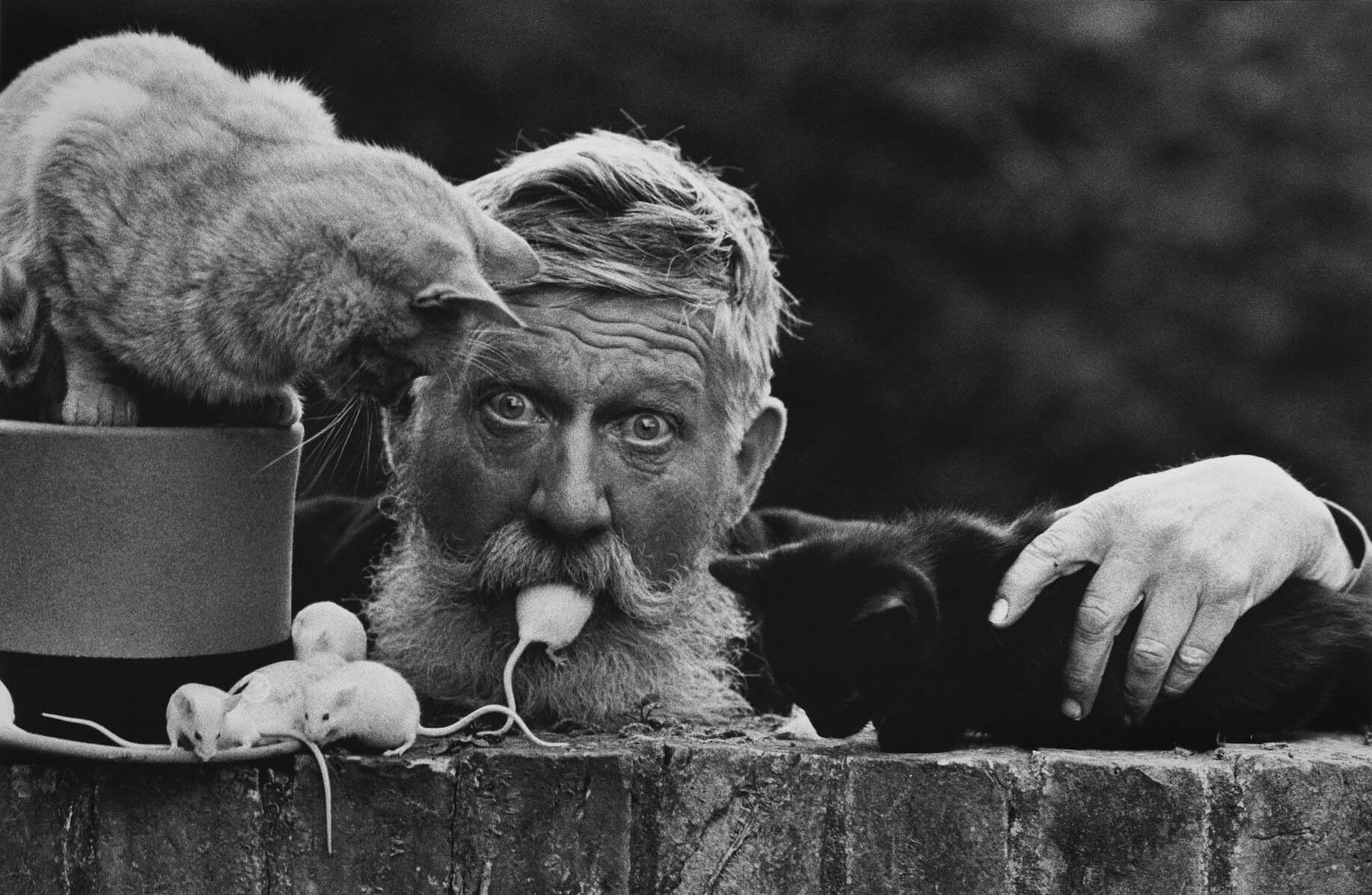
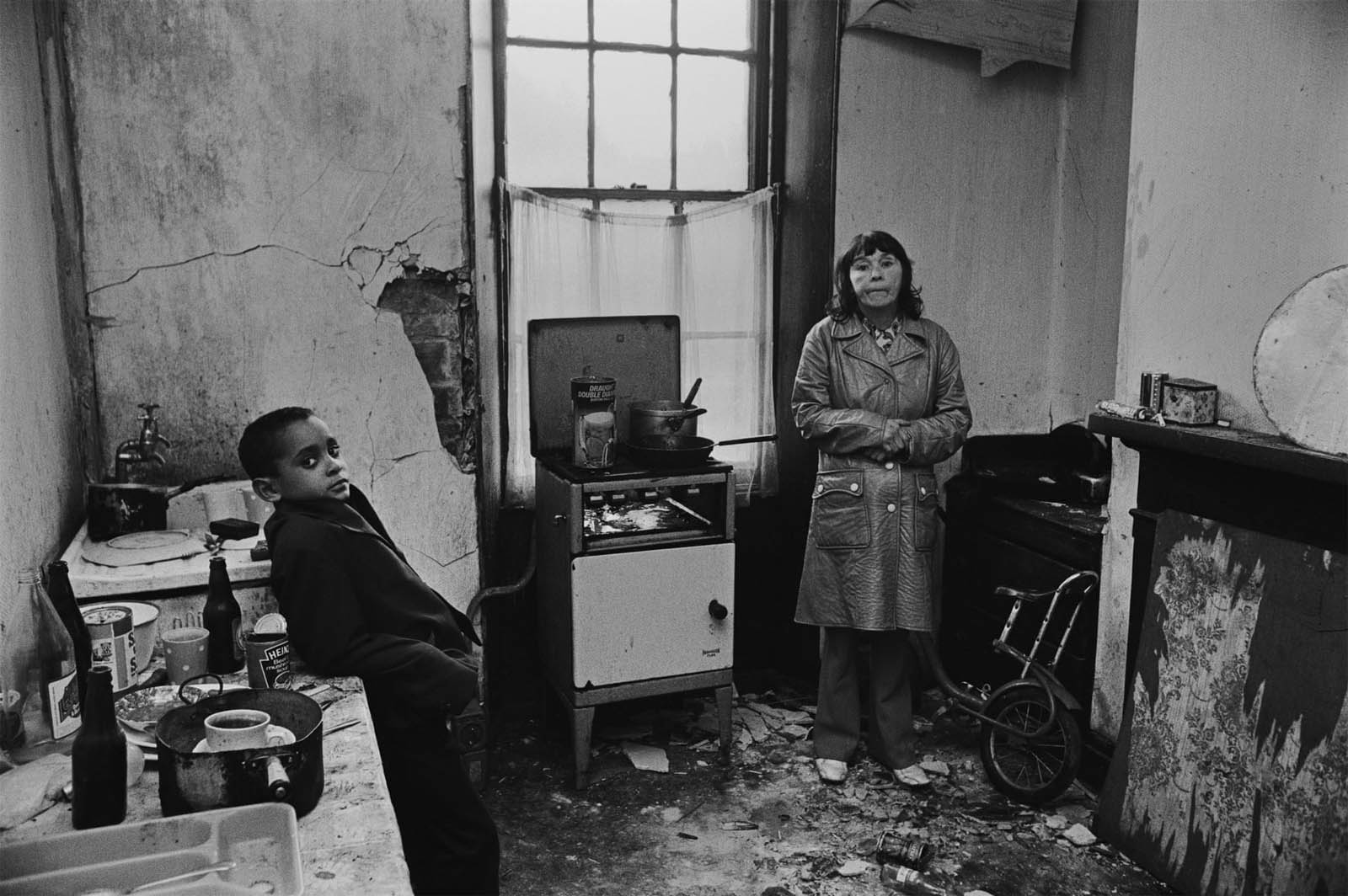
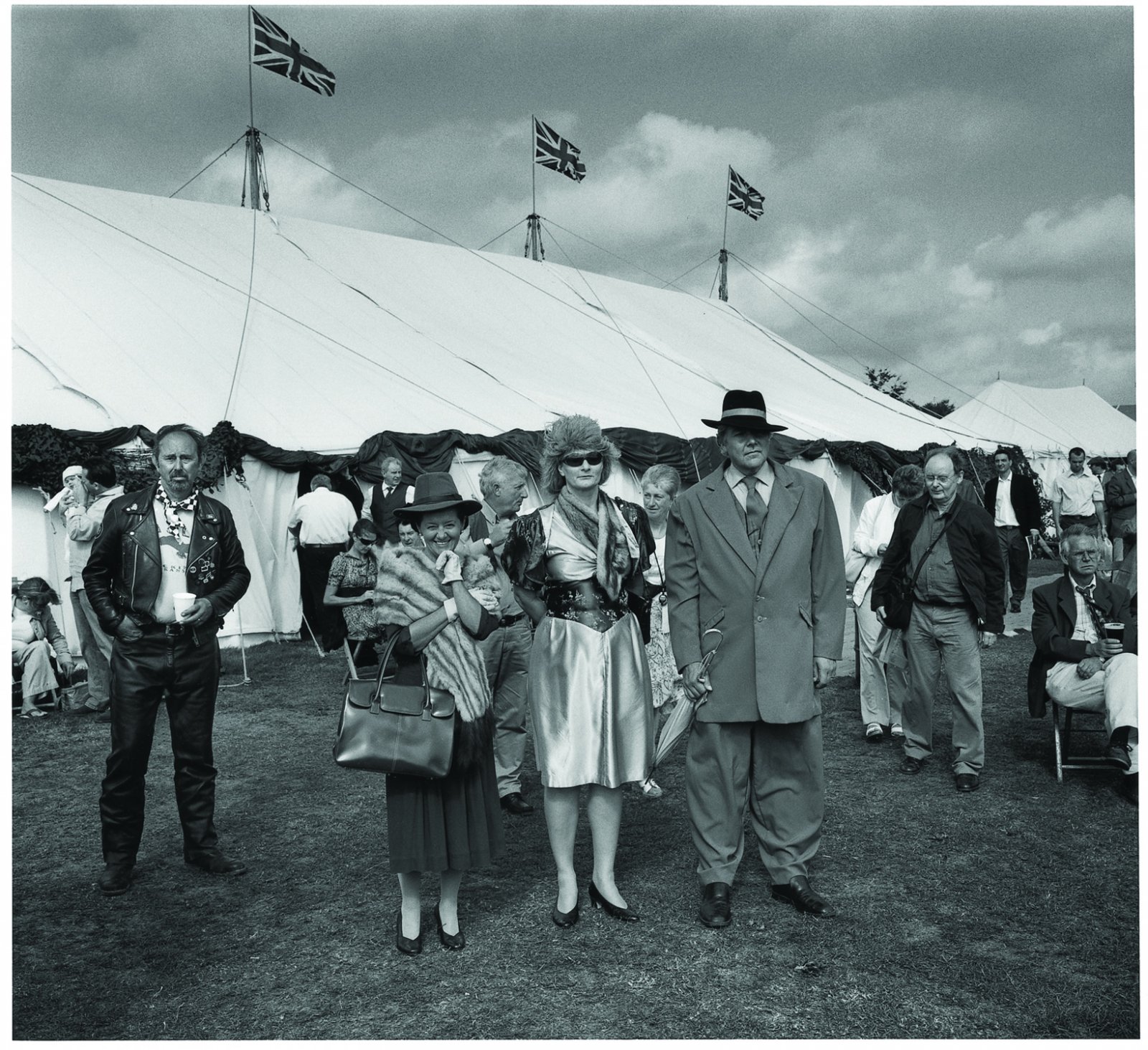
Exhibition: ‘The 80s: Photographing Britain’ at Tate Britain, London

Exhibition dates: 21st November, 2024 – 5th May, 2025

Curators: Yasufumi Nakamori, former Senior Curator of International Art (Photography) Tate Modern, Helen Little, Curator, British Art, Tate Britain and Jasmine Chohan, Assistant Curator, Contemporary British Art, Tate Britain with additional curatorial support from Bilal Akkouche, Assistant Curator, International Art, Tate Modern; Sade Sarumi, Curatorial Assistant, Contemporary British Art, Tate Britain and Bethany Husband, Exhibitions Assistant, Tate Britain

List of artists: Keith Arnatt; Zarina Bhimji; Derek Bishton; Sutapa Biswas; Tessa Boffin; Marc Boothe; Victor Burgin; Vanley Burke; Pogus Caesar; Thomas Joshua Cooper; John Davies; Poulomi Desai; Al-An deSouza; Willie Doherty; Jason Evans; Rotimi Fani-Kayode; Anna Fox; Simon Foxton; Armet Francis; Peter Fraser; Melanie Friend; Paul Graham; Ken Grant; Joy Gregory; Sunil Gupta; John Harris; Lyle Ashton Harris; David Hoffman; Brian Homer; Colin Jones; Mumtaz Karimjee; Roshini Kempadoo; Peter Kennard; Chris Killip; Karen Knorr; Sirkka-Liisa Konttinen; Grace Lau; Dave Lewis; Markéta Luskačová; David Mansell; Jenny Matthews; Don McCullin; Roy Mehta; Peter Mitchell; Dennis Morris; Maggie Murray; Tish Murtha; Joanne O’Brien; Zak Ové; Martin Parr; Ingrid Pollard; Brenda Prince; Samena Rana; John Reardon; Paul Reas; Olivier Richon; Suzanne Roden; Franklyn Rodgers; Paul Seawright; Syd Shelton; Jem Southam; Jo Spence; John Sturrock; Maud Sulter; Homer Sykes; Mitra Tabrizian; Wolfgang Tillmans; Paul Trevor; Maxine Walker; Albert Watson; Tom Wood; Ajamu X.


Jason Evans (Welsh, b. 1968) and Simon Foxton (British, b. 1961) 'Untitled' 1991 From the series 'Strictly' from the exhibition 'The 80s: Photographing Britain' at Tate Britain, London, Nov 2024 - May 2025


Jason Evans (Welsh, b. 1968) and Simon Foxton (British, b. 1961)
Untitled
1991
From the series Strictly
Tate
© Jason Evans


A humungous posting that, much like the exhibition itself, cannot do justice to the photographs and issues of an entire decade – the flow on effects of which are still being felt today.

From distant Australia and having not seen the exhibition myself, I cannot do justice – now there is an apposite word for the decade – to the flow of the exhibition, the many included or neglected artists involved or not, the bodies of work displayed or their commentary on the many disparate, competing and complex political, economic and social cataclysms (def: a sudden violent political or social upheaval) of the decade: including but not limited to, race, gender, identity, representation, activism, neoliberalism, Thatcher, The Miners’ Strike, Clause 28, HIV/AIDS, feminism, racism, class, patriarchy, money, greed, hedonism, humanism, subcultures, unemployment, strikes, poverty, luxury, consumer culture, war (Falklands) and riots, for example the Brixton riots of 1981.

I lived those years in the UK before emigrating to Australia in 1986. What I remember is the terrible weather, the cold and the damp, the vile Thatcher, and the poor quality of living. I lived in Stockwell (or Saint Ockwell as we used to call it) near Brixton in the early 80s before moving to Shepherd’s Bush were all the Mods gathered on their scooters on the roundabout as part of the mod revival.

I worked at a fish and chip restaurant called Geales just off Notting Hill Gate working double shifts, 10.30 – 3pm, 5.30 – 12, five days a week. The restaurant served fish and chips with French champagne and wines. The mostly gay floor staff were paid a pittance but we earnt our money off the tips we received from the celebrities that inhabited the place, people such as Bill Connolly, John Cleese, Divine and Kenny Everett. They loved us gay boys.

We worked hard and partied harder, often going out from Friday night to Sunday night to the clubs with a rest day on Monday. We were young. We ran from place to place living at a hundred miles an hour, not realising the ruts in London are very deep and you were spending as much as you made just to pay the rent, to eat at dive cafe (I lived on Mars bars, fish and chips, braised heart, mashed potatoes and bullet peas to name a few and I was as thin as a rake), and to go out partying, to have fun, visiting the alternative clubs in Kings Cross, Vauxhall, Brixton and the East End.

And then there was the spectre of HIV/AIDS raising its ugly head. I had my first HIV test in 1983. I had my blood taken and I went back 2 weeks later for the result. I sat outside the doctor’s room and if they called you in and said you had it, you were dead. To look death in the face at 25. The was no treatment. I survived but many of my friends, both here and in Australia, didn’t. We partied harder.


There are so many perspectives on the 80s that it is an impossible task for one exhibition to cover all of the issues. Reviews have noted that the exhibition is “a meandering look at pomp, protest” (Guardian); “exhaustive and exhausting… [the exhibition] makes for a dogged viewing experience that confuses as much as it enlightens” (Guardian); “a sense of fatigue and depletion as it went on and on … it could have been more engaging, more pleasurable” (1000 Words); and “the critical reception of the show has been rather lukewarm” (The Brooklyn Rail).

Most writer’s observe that the exhibition illuminates the way photography shifts “from monochrome to colour, from photojournalism to a more detached style of documentary” featuring “constructed, studio-based and appropriationist work.” The exhibition distils “the curatorial thrust of this sprawling exhibition, which, as its subtitle suggests, is more about photography’s often conceptually based responses to the 1980s than the turbulent nature of the decade itself.”1

Further, Bartolomeo Sala observes that the meandering view of the 1980s is consistent with the curatorial approach to the exhibition, “that is, to present eighties Britain not as a ossified relic but rather a container of multitudes, a country animated by competing, clashing energies and defying coherent description in a way that feels very reminiscent of today. A neoliberal hellhole, a nightmare of petit bourgeois conformity and cheapness, and at the same time an increasingly tolerant, multicultural, and open society, which finds its motor and pride in diversity and the endless project of self-fashioning.”2

Forty plus years on we are still paying the price for Thatcher’s neoliberal hellhole, with the loss of community, and the lack of compassion and empathy for others. I often think it was a more vibrant, more alive time in the 1980s despite all of its inherent problems. While we may have become a more tolerant, multicultural society, fascism and the right, disenfranchisement and loss of rights lurk ever closer to the surface. While we have pride we also have arrogance and self-aggrandisement, self-entitlement. While then we seemingly had freedom and love we now have surveillance and control. In some ways then I disagree with today being a more “open” society.

What social documentary and conceptual photography pictured so strongly and conscientiously in 1980s Britain was the vibrant madness of the age. The passions and the prejudices. Half your luck that you go and see this exhibition in London, that you have a chance to breathe in these photographs, for in Australia the chance of seeing such an exhibition of photographs from the 1980s by a state or national gallery would be zero.

I wouldn’t complain too much!

Dr Marcus Bunyan


1/ Sean O’Hagan. “The 80s: Photographing Britain review – in your face and to the barricades,” on The Guardian website, Sun 24 Nov 2024 [Online] Cited 02/05/2025

2/ Bartolomeo Sala. “The 80s: Photographing Britain,” on The Brooklyn Rail website March 2025 [Online] Cited 03/04/2025


Many thankx to Tate Britain for allowing me to publish the photographs in the posting. Please click on the photographs for a larger version of the image.


Installation view of the exhibition 'The 80s: Photographing Britain' at Tate Britain, London showing at left, the work of Jason Evans and Simon Foxton from the series 'Strictly' 1991; and at centre left top, Wolfgang Tillmans' 'Love (Hands in Air)' 1989


Installation view of the exhibition The 80s: Photographing Britain at Tate Britain, London showing at left, the work of Jason Evans and Simon Foxton from the series Strictly 1991 (below); and at centre left top, Wolfgang Tillmans’ Love (Hands in Air) 1989 (below)
Courtesy of Tate Britain


Installation view of the exhibition 'The 80s: Photographing Britain' at Tate Britain, London showing at rear, photographs from Maud Sulter's series 'Zabat' 1989


Installation view of the exhibition The 80s: Photographing Britain at Tate Britain, London showing at rear, photographs from Maud Sulter’s series Zabat 1989
Courtesy of Tate Britain


Maud Sulter produced the Zabat series for Rochdale Art Gallery in 1989, the 150th anniversary of the invention of photography. It was a direct response to the lack of a black presence at other celebratory events and exhibitions. Here we see the conventions of Victorian portrait photography under the command of a black woman photographer. The backdrop, props and pose are all retained but the image is transformed with African clothes, non-European objects and, most importantly, by the resolute black woman at its centre.

The title ‘Zabat’ also signifies Maud Sulter’s call for a repositioning of black women in the history of photography: the word describes an ancient ritual dance performed by women on occasions of power.

Text from the V&A website
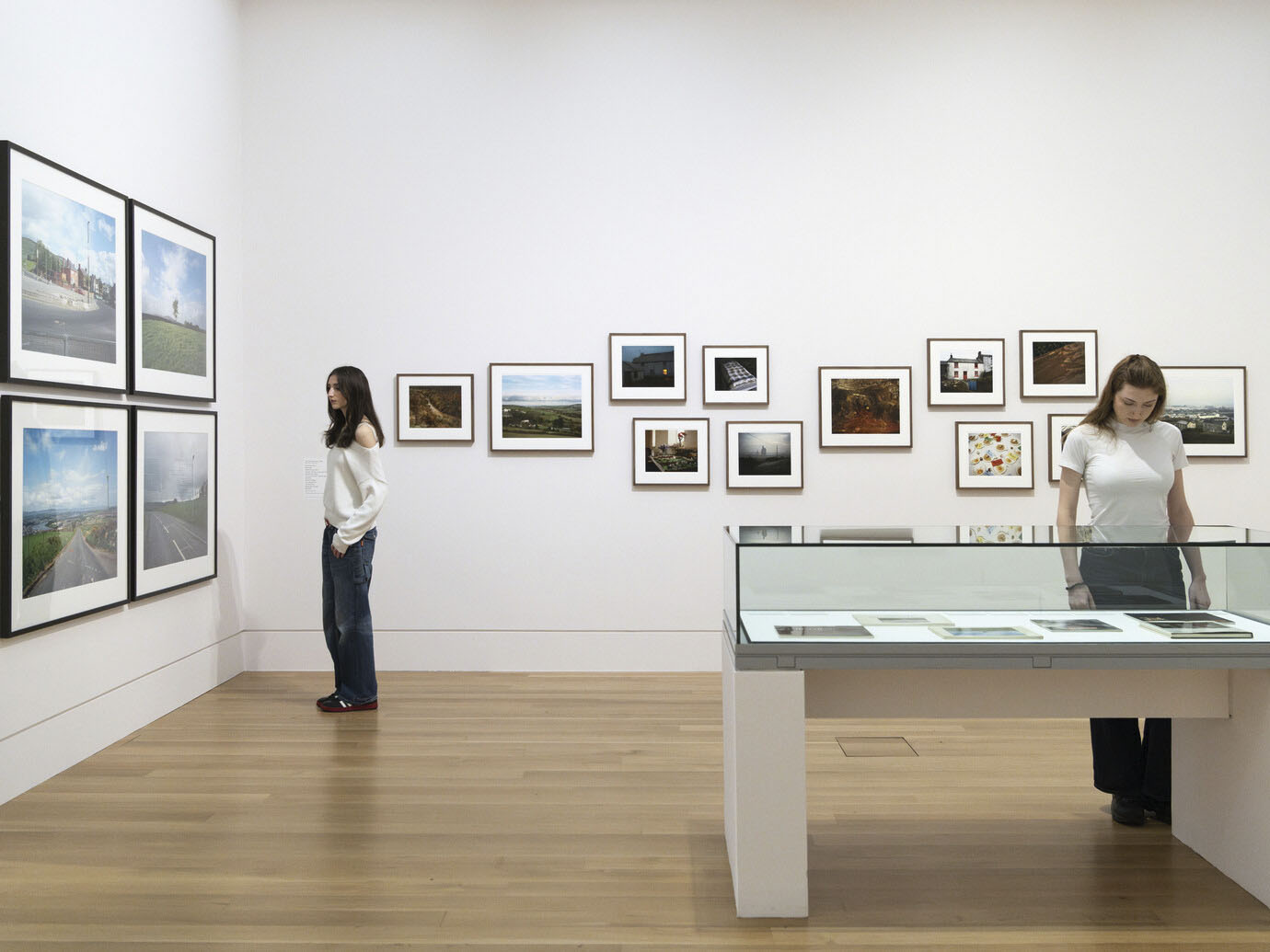
 

Installation view of the exhibition 'The 80s: Photographing Britain' at Tate Britain, London showing at left the work of Paul Graham


Installation view of the exhibition The 80s: Photographing Britain at Tate Britain, London showing at left the work of Paul Graham
Courtesy of Tate Britain


Installation view of the exhibition 'The 80s: Photographing Britain' at Tate Britain, London


Installation view of the exhibition The 80s: Photographing Britain at Tate Britain, London
Courtesy of Tate Britain


Wolfgang Tillmans (German, b. 1968) 'Love (Hands in Air)' 1989


Wolfgang Tillmans (German, b. 1968)
Love (Hands in Air)
1989


“Depending on where you stood in terms of race, gender, or class, the 1980s would seem a time of unprecedented economic expansion, an era defined by the triumph of consumerism and a particularly brass form of hedonism, or else an era of widening disparities, rising unemployment, and generalized economic crisis; a time defined by the booming of the housing market or the return of homelessness; a time of general disaffection and disillusionment toward the prospects of organized politics or an era defined by political activism and struggle, often hyperlocal in nature, as well as successive waves of discontent that at different points rocked the nation. …

In general, the critical reception of the show has been rather lukewarm. Many broadsheet commentators have lamented the meandering nature of the exhibition, while one critic noted the programmatic downplaying of the decade’s heavy-hitters. (Don McCullin and Chris Killip get a handful of photographs each, while virtuoso of political photomontage Peter Kennard is relegated to display cases.) Such assessments feel a little unfair and condescending to the excellent artists who do get a good showing, and in any case this curatorial approach is consistent with the intention of the exhibition – that is, to present eighties Britain not as a ossified relic but rather a container of multitudes, a country animated by competing, clashing energies and defying coherent description in a way that feels very reminiscent of today. A neoliberal hellhole, a nightmare of petit bourgeois conformity and cheapness, and at the same time an increasingly tolerant, multicultural, and open society, which finds its motor and pride in diversity and the endless project of self-fashioning.”


Bartolomeo Sala. “The 80s: Photographing Britain,” on The Brooklyn Rail website March 2025 [Online] Cited 03/04/2025


Derek Bishton, Brian Homer and John Reardon. 'Ting A Ling, Handsworth Self Portraits project' 1979 from the exhibition 'The 80s: Photographing Britain' at Tate Britain, London, Nov 2024 - May 2025


Derek Bishton, Brian Homer and John Reardon
Ting A Ling, Handsworth Self Portraits project
1979
© Derek Bishton, Brian Homer & John Reardon


Syd Shelton (British, b. 1947) 'Skinheads, Petticoat Lane, East London' 1979, printed 2012


Syd Shelton (British, b. 1947)
Skinheads, Petticoat Lane, East London
1979, printed 2012
Gelatin silver print on paper
417 x 281 mm
Tate
Gift Eric and Louise Franck London Collection 2016


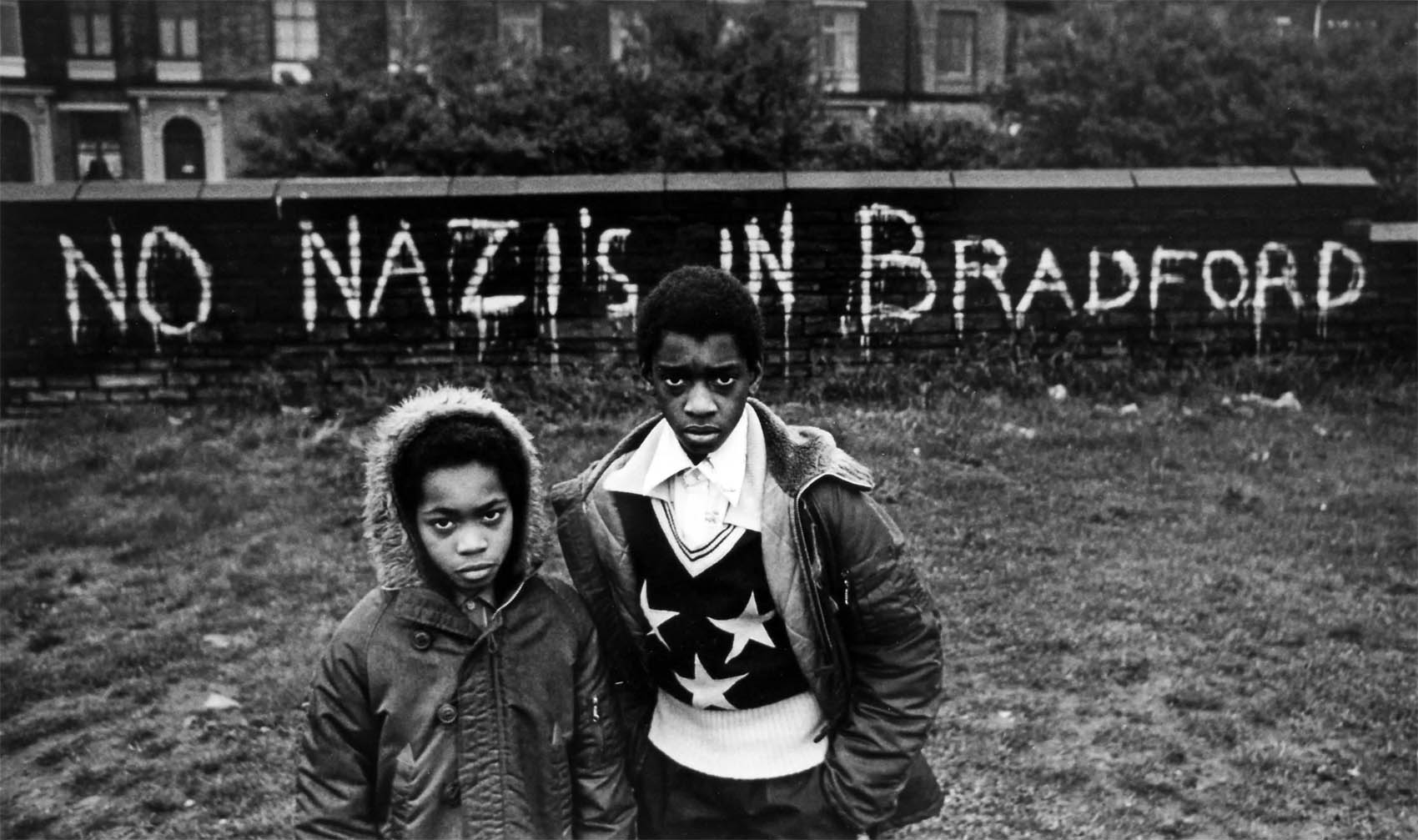
Skinheads, known for their shaved heads and heavy boots, emerged as a working-class subculture in the 1960s. Initially non-political, some became associated with extreme nationalism. Others took an anti-racist position aligned with two-tone, a musical movement blending Jamaican ska and British punk. One of Syd Shelton’s photographs shows two members of Skins Against the Nazis proudly displaying a Rock Against Racism badge. The other was taken after an argument about racism. ‘I saw the guy at the front clenching his fists’, notes Shelton, ‘so I took the shot, said thanks and legged it as fast as I could.’

Wall text from the exhibition


Syd Shelton (British, b. 1947) 'Anti-racist Skinheads, Hackney, London' 1979, printed 2012


Syd Shelton (British, b. 1947)
Anti-racist Skinheads, Hackney, London
1979, printed 2012
Gelatin silver print on paper
417 x 282 mm
Tate
Gift Eric and Louise Franck London Collection 2016


In 1977, 500 National Front (NF) members attempted to march through Lewisham, an area in southeast London with a significant Black population. Thousands ignored a police blockade to hold a peaceful counter-demonstration that led to the NF abandoning their march. Protestors clashed with police and were met by riot shields, baton charges and mounted officers. The events became known as the Battle of Lewisham. Shelton’s photographs contrast the chaos of the streets with the resolve of the protestors. ‘Politics was one of the reasons that I became a photographer’, notes Shelton, ‘the idea of the objective photographer is nonsense.’

Wall text from the exhibition


Syd Shelton (British, b. 1947) 'Darcus Howe addressing the anti-racist demonstrators, Lewisham, 13 August 1977' Dated 1977, printed 2020 from the exhibition 'The 80s: Photographing Britain' at Tate Britain, London, Nov 2024 - May 2025


Syd Shelton (British, b. 1947)
Darcus Howe addressing the anti-racist demonstrators, Lewisham, 13 August 1977
Dated 1977, printed 2020
Tate
Presented by the artist 2021
© Syd Shelton


Explore one of the UK’s most critical decades, the 1980s. This exhibition traces the work of a diverse community of photographers, collectives and publications – creating radical responses to the turbulent Thatcher years. Set against the backdrop of race uprisings, the miner strikes, section 28, the AIDS pandemic and gentrification – be inspired by stories of protest and change.

At the time, photography was used as a tool for social change, political activism, and artistic and photographic experiments. See powerful images that gave voice and visibility to underrepresented groups in society. This includes work depicting the Black arts movement, queer experience, South Asian diaspora and the representation of women in photography.

This exhibition examines how photography collectives and publications highlighted these often-unseen stories, featured in innovative photography journals such as Ten.8 and Cameraworks. It will also look at the development of Autograph ABP, Half Moon Photography Workshop, and Hackney Flashers.

Visitors will go behind the lens to trace the remarkable transformation of photography in Britain and its impact on art and the world.

Text from the Tate Britain website


The 80s: Photographing Britain

David Preshaah and Helen Little curator of The 80s: Photographing Britain at Tate Britian discuss the show running 21st November, 2024 – 5th May, 2025. See powerful images that gave voice and visibility to underrepresented groups in society. This includes work depicting the Black arts movement, queer experience, South Asian diaspora and the representation of women in photography
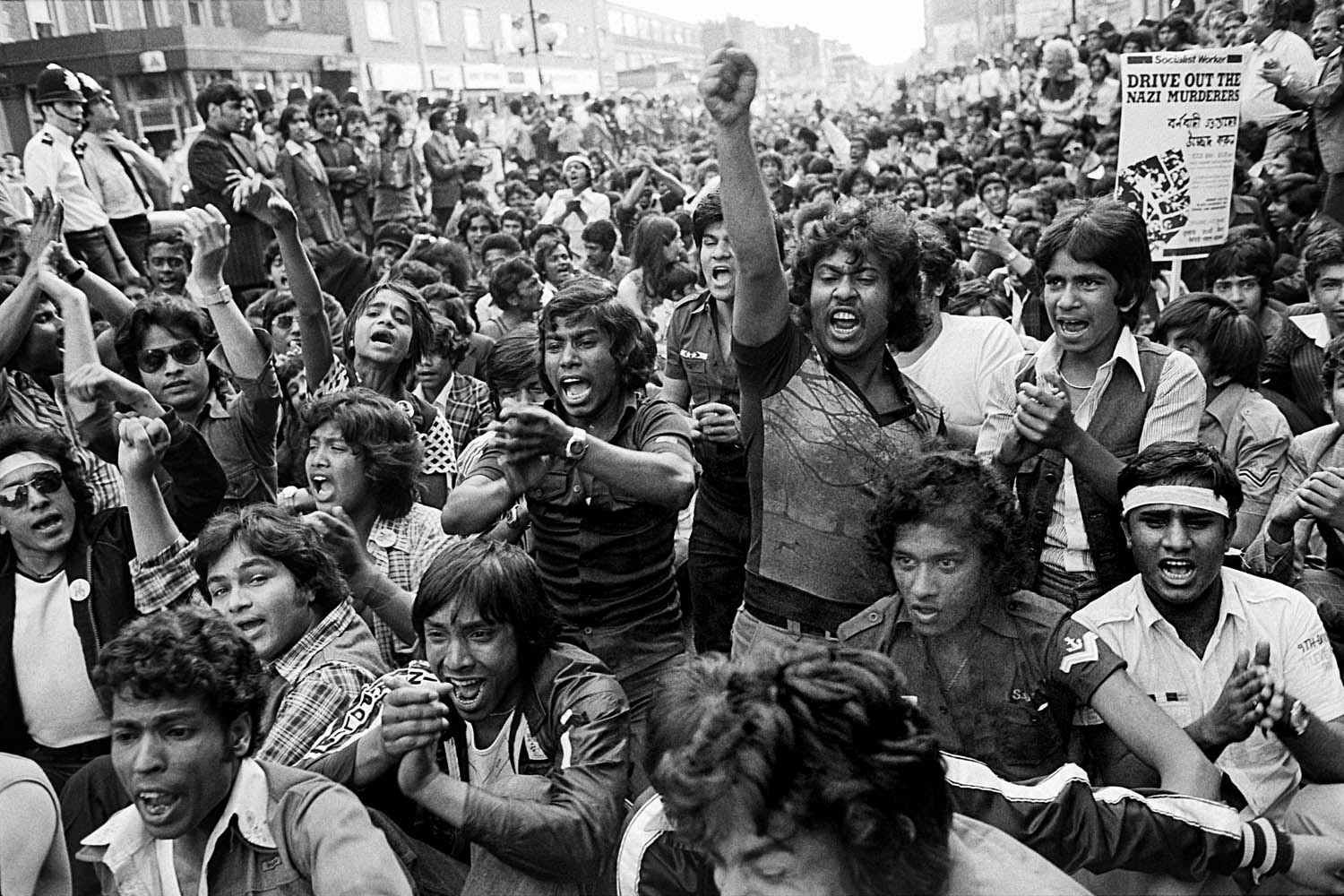
 

Paul Trevor (British, b. 1947) 'Outside police station, Bethnal Green Road, London E2, 17 July 1978. Sit down protest' 1978


Paul Trevor (British, b. 1947)
Outside police station, Bethnal Green Road, London E2, 17 July 1978. Sit down protest
1978

Paul Trevor © 2023


On 4 May 1978, Altab Ali, a 24-year-old Bangladeshi textile worker, was murdered in a racially motivated attack. During police interviews, the three teenagers responsible casually described the regularity of their racist violence. The Bangladeshi community in east London mobilised in response. 7,000 people marched from Bethnal Green’s Brick Lane to Downing Street, following a vehicle carrying Ali’s coffin. Protestors rallied in Hyde Park chanting, ‘Who killed Altab Ali? Racism, racism!’

Paul Trevor was a member of Half Moon Photography Workshop and helped produce Camerawork magazine. He contributed to an issue on the 1978 Battle of Lewisham in southeast London. While photographing the violent clashes between police and anti-fascist protestors, Trevor recalls, ‘A woman – appealing for help – shouted at me in desperation “What are you taking pictures for?” Good question, impossible to answer in that melee.’ The special issue of Camerawork, ‘What are you taking pictures for?’ was devoted to that question.

Wall text from the exhibition


Don McCullin (British, b. 1935) 'Jean, Whitechapel, London' Late 1970s


Don McCullin (British, b. 1935)
Jean, Whitechapel, London
Late 1970s
Gelatin silver print
Tate
Gift Eric and Louise Franck London Collection 2011


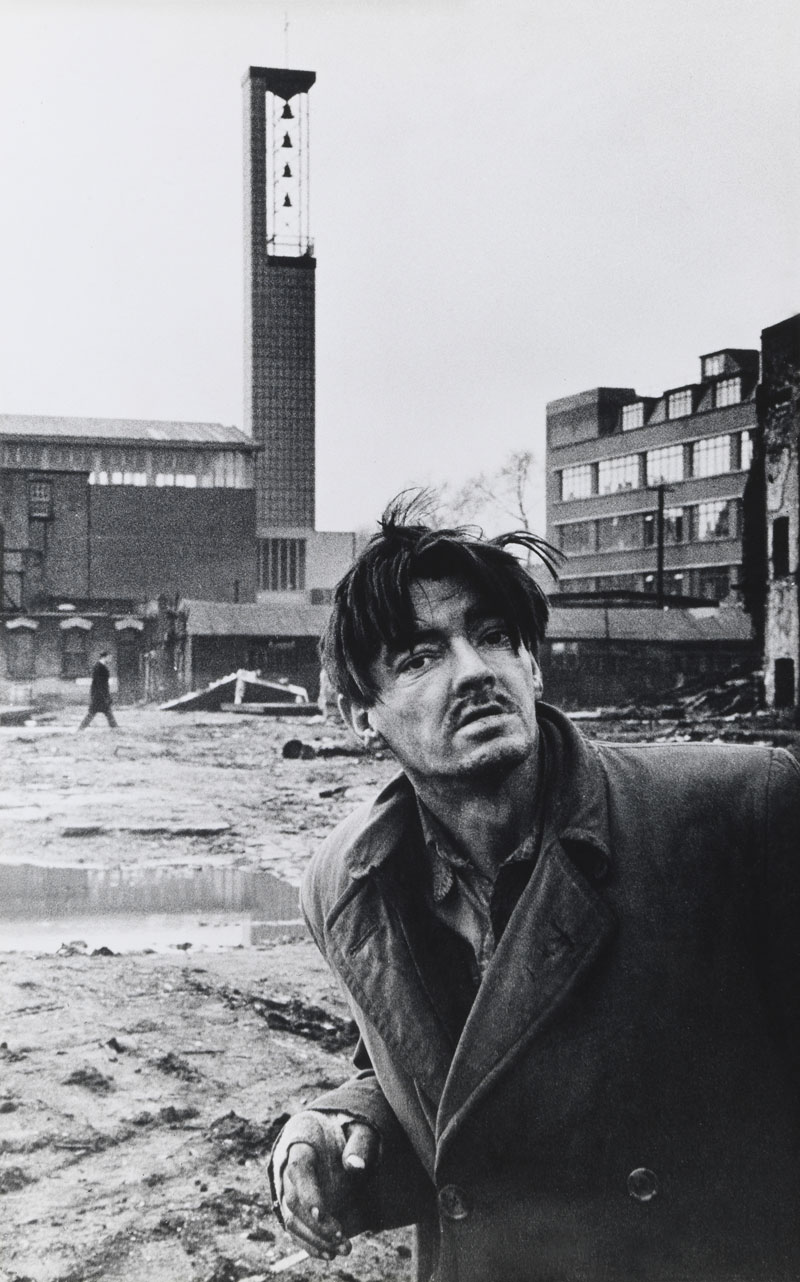
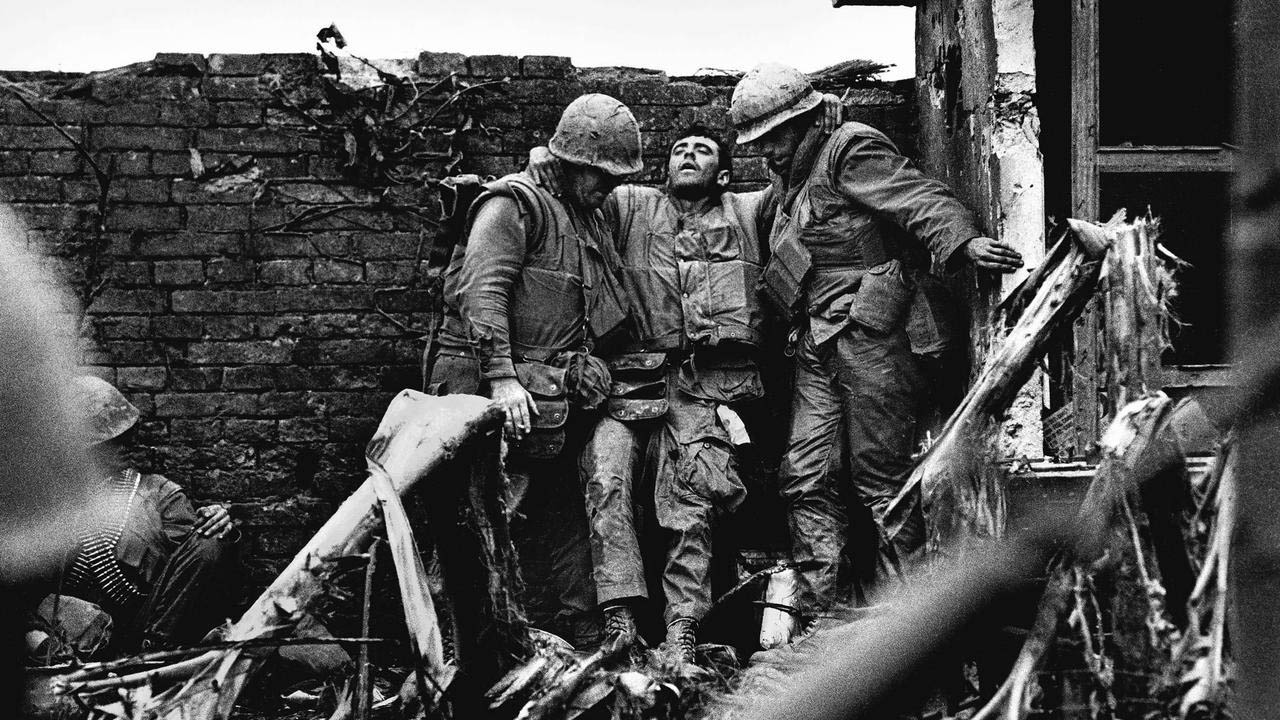
Photojournalist and war photographer Don McCullin spent nearly twenty years photographing people living on the streets of Aldgate and Whitechapel in east London. He documented people living at the edge of the city’s wealthy financial centre. In the late 1970s, unprofitable psychiatric institutions in the area had begun to close, leaving many residents homeless. These photographs of Jean show how closely McCullin worked with the people he photographed. Of his British social documentary work, McCullin notes: ‘Many people send me letters in England saying “I want to be a war photographer”, and I say, go out into the community you live in. There’s wars going on out there, you don’t have to go halfway around the world.’

Wall text from the exhibition


This autumn, Tate Britain will present The 80s: Photographing Britain, a landmark survey which will consider the decade as a pivotal moment for the medium of photography. Bringing together nearly 350 images and archive materials from the period, the exhibition will explore how photographers used the camera to respond to the seismic social, political, and economic shifts around them. Through their lenses, the show will consider how the medium became a tool for social representation, cultural celebration and artistic expression throughout this significant and highly creative period for photography.

This exhibition will be the largest to survey photography’s development in the UK in the 1980s to date. Featuring over 70 lens-based artists and collectives, it will spotlight a generation who engaged with new ideas of photographic practice, from well-known names to those whose work is increasingly being recognised, including Maud Sulter, Mumtaz Karimjee and Mitra Tabrizian. It will feature images taken across the UK, from John Davies’ post-industrial Welsh landscape to Tish Murtha’s portraits of youth unemployment in Newcastle. Important developments will be explored, from technical advancements in colour photography to the impact of cultural theory by scholars like Stuart Hall and Victor Burgin, and influential publications like Ten.8 and Camerawork in which new debates about photography emerged.

The 80s will introduce Thatcher’s Britain through documentary photography illustrating some of the tumultuous political events of the decade. History will be brought to life with powerful images of the miners’ strikes by John Harris and Brenda Prince; anti-racism demonstrations by Syd Shelton and Paul Trevor; images of Greenham Common by Format Photographers and projects responding to the conflict in Northern Ireland by Willie Doherty and Paul Seawright. Photography recording a changing Britain and its widening disparities will also be presented through Anna Fox’s images of corporate excess, Paul Graham’s observations of social security offices, and Martin Parr’s absurdist depictions of Middle England, displayed alongside Markéta Luskačová and Don McCullin’s portraits of London’s disappearing East End and Chris Killip’s transient ‘sea-coalers’ in Northumberland.

A series of thematic displays will explore how photography became a compelling tool for representation. For Roy Mehta and Vanley Burke, who portray their multicultural communities, photography offers a voice to the people around them, whilst John Reardon, Derek Bishton and Brian Homer’s Handsworth Self Portrait Project 1979, gives a community a joyous space to express themselves. Many Black and South Asian photographers use portraiture to overcome marginalisation against a backdrop of discrimination. The exhibition will spotlight lens-based artists including Roshini Kempadoo, Sutapa Biswas and Al-An deSouza who experiment with images to think about diasporic identities, and the likes of Joy Gregory and Maxine Walker who employ self-portraiture to celebrate ideas of Black beauty and femininity.

Against the backdrop of Section 28 and the AIDS epidemic, photographers also employ the camera to assert the presence and visibility of the LGBTQ+ community. Tessa Boffin subversively reimagines literary characters as lesbians, whilst Sunil Gupta’s ‘Pretended’ Family Relationships 1988, juxtaposes portraits of queer couples with the legislative wording of Section 28. For some, their work reclaims sex-positivity during a period of fear. The exhibition will spotlight photographers Ajamu X, Lyle Ashton Harris and Rotimi Fani-Kayode who each centre Black queer experiences and contest stereotypes through powerful nude studies and intimate portraits. It will also reveal how photographers from outside the queer community including Grace Lau were invited to portray them. Known for documenting fetishist sub-cultures, Lau’s series Him and Her at Home 1986 and Series Interiors 1986, tenderly records this underground community defiantly continuing to exist.

The exhibition will close with a series of works that celebrate countercultural movements throughout the 80s, such as Ingrid Pollard and Franklyn Rodgers’s energetic documentation of underground performances and club culture. The show will spotlight the emergence of i-D magazine and its impact on a new generation of photographers like Wolfgang Tillmans and Jason Evans, who with stylist Simon Foxton pioneer a cutting-edge style of fashion photography inspired by this alternative and exciting wave of youth culture, reflective of a new vision of Britain at the dawn of the 1990s.

Press release from Tate Britain
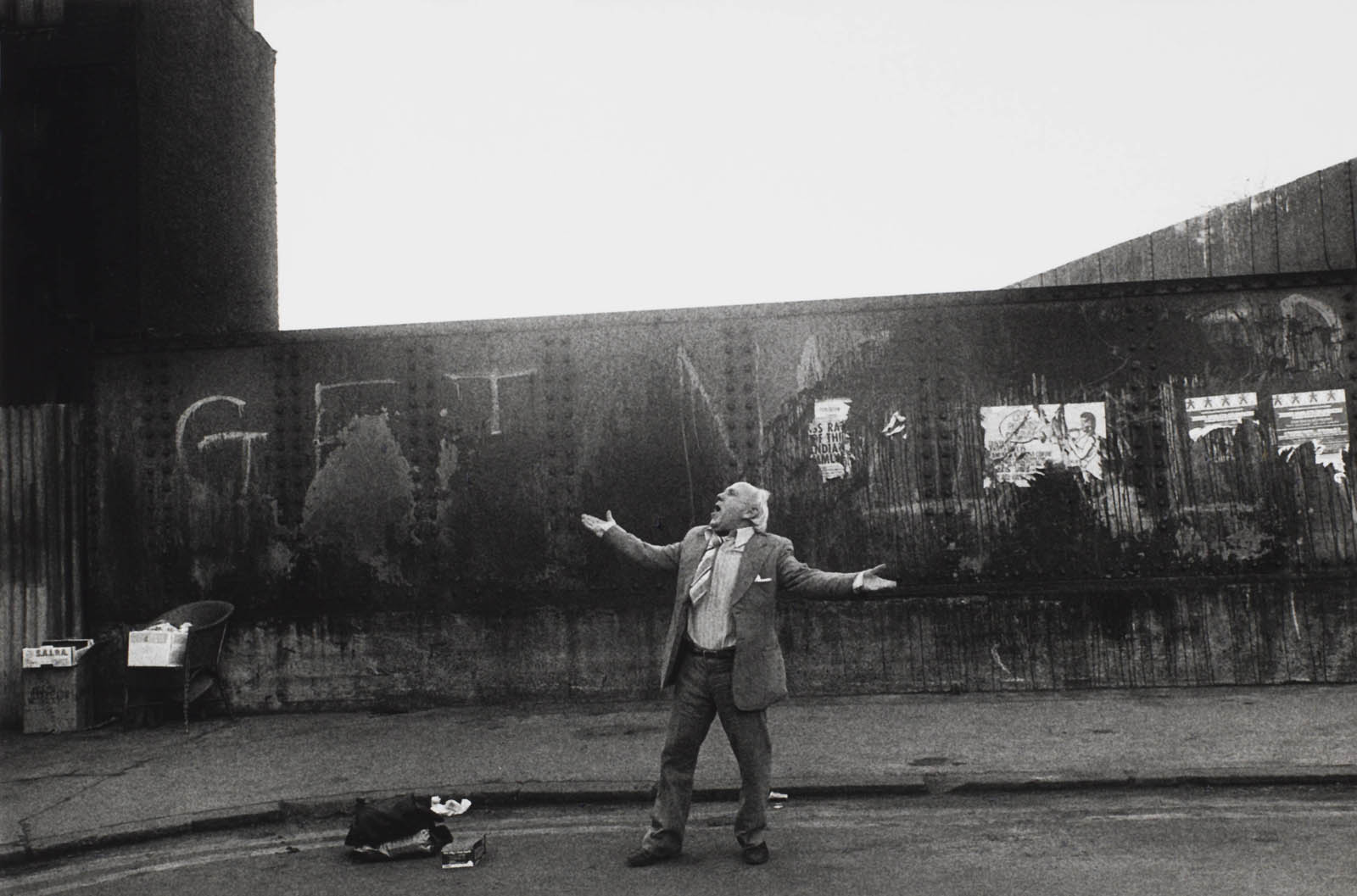
 

Markéta Luskačová (Czech, b. 1944) 'Man singing on Brick Lane, London' 1982


Markéta Luskačová (Czech, b. 1944)
Man singing on Brick Lane, London
1982
Gelatin silver print
Tate
© Markéta Luskačová


Markéta Luskačová’s London Street Musicians series includes photographs taken between 1975 and 1990. They document the lives of street musicians performing at London markets. Her photographs reveal the humanity and resilience of these often-solitary musicians. ‘The street musicians themselves were often quite lonely men, yet their music lessened the loneliness of the street, the people in it and my own loneliness’, she recalls. For Luskačová, photography is ‘a tool for trying to understand life … to remember the people and things that I photograph. I want them to be remembered.’

Wall text from the exhibition


Chris Killip (Manx, 1946-2020) ''Critch' and Sean' 1982


Chris Killip (Manx, 1946-2020)
‘Critch’ and Sean
1982
Tate
© Chris Killip


Chris Killip first visited the seacoaling community at Lynemouth Beach in Northumberland in 1976. ‘The beach beneath me was full of activity with horses and carts backed into the sea’, Killip recalls. ‘Men were standing in the sea next to the carts, using small wire nets attached to poles to fish out the coal from the water beneath them. The place confounded time.’ In 1982, Killip started photographing the community, living alongside them from 1983 to 1984. ‘I wasn’t getting close enough, so I bought a caravan and moved into the place and that made a very big difference.’

Killip used a large format plate camera to capture his subjects. ‘It’s not a casual thing’, he notes. ‘I think it works to your advantage. They know this is going to live after this moment. It’s not ephemeral.’

Wall text from the exhibition


Jo Spence (British, 1934-1992) and Terry Dennett (British, 1938-2018)
'Remodelling Photo History: Revisualization' 1981-1982


Jo Spence (British, 1934-1992) and Terry Dennett (British, 1938-2018)
Remodelling Photo History: Revisualization
1981-1982
Tate
Presented by Tate Patrons 2014
© The Jo Spence Memorial Archive


These images are from Remodelling Photo History, a collaboration between Jo Spence and Terry Dennett. The work was originally published as a sequence of 13 photographs in which Spence and Dennett both act as photographer and photographic subject. The series was devised as a critique of standard histories of photography and particularly the depiction of women in art. It employs a practice Spence called ‘photo-theatre’. Each photograph emphasises its staging and construction in order to challenge and ‘make strange’ the assumed ‘naturalism’ of photography. Spence commented ‘it is obvious that a vast amount of work still needs to be done on the so-called history of photography, and on the practices, institutions and apparatuses of photography itself, and the function they have had in constructing and encouraging particular ways of viewing and telling about the world.’

Wall text from the exhibition


Joy Gregory (British, b. 1969) 'Magenta Dress with Pink Tulips' 1984


Joy Gregory (British, b. 1969)
Magenta Dress with Pink Tulips
1984
Courtesy of the artist
© Joy Gregory. All rights reserved, DACS


Joy Gregory’s early interest in colour photography began as student at Manchester Polytechnic. The university was known for its emphasis on the technical and chemical aspects of photography. Gregory’s education taught her the craft of commercial photography but she set out to use these skills like a painter. Her early experiments informed an ongoing interest in stillness, space and light. This series of colour transparencies presents models and still lifes in a painted studio interior. By using multiple exposures and layering images, Gregory suggests a spectral presence in the works. Her focus on the painterly qualities of colour and light here are typical of her practice. She employs languages of beauty and seduction in small textured prints that invite close inspection.

Wall text from the exhibition


John Harris (British, b. 1958) 'Mounted Policeman attacking Lesley Boulton at the Battle of Orgreave'
1984, printed 2024


John Harris (British, b. 1958)
Mounted Policeman attacking Lesley Boulton at the Battle of Orgreave
1984, printed 2024


John Harris’s photographs from the 1984 Battle of Orgreave challenged government portrayals of miners as aggressors. In 1984, the National Union of Miners identified Orgreave coking plant in South Yorkshire as a key site for picketing. From May to June, strikers attempting to disrupt deliveries were met by growing police presence. Tensions came to a head on 22 June when an estimated 6,000 officers clashed with pickets. One of Harris’s images captures Lesley Boulton cowering beneath the truncheon of a mounted officer. It became an emblem of the strike, appearing on badges, banners and posters.

Wall text from the exhibition


Paul Graham (British, b. 1956) 'Union Jack Flag in Tree, Country Tyrone' 1985


Paul Graham (British, b. 1956)
Union Jack Flag in Tree, Country Tyrone
1985
C-print on paper
Tate
Presented by Tate Members 2007
© Paul Graham


From 1984 to 1986, Paul Graham documented Northern Irish locations featured in news reports of the Troubles. During his first visit, Graham was stopped by a British military patrol suspicious of his camera. As they left, he took a shot with his camera hanging from his neck. The photograph became a ‘gateway’ for Graham’s Troubled Land series. He felt his other images of rioting, murals and destruction, ‘weakly echoed what I saw in the newspapers. This one image did not’. ‘There were people walking to shops and driving cars – simply going about their day, but then there was a soldier in full camouflage, running across the roundabout.’ For Graham, the image ‘reintegrated the conflict into the landscape … it was a conflict photograph masquerading as a landscape photograph.’

Wall text from the exhibition


Pogus Caesar (British born St. Kitts, b. 1953) 'Handsworth Riots: Birmingham, United Kingdom September' 1985, printed 2020


Pogus Caesar (British born St. Kitts, b. 1953)
Handsworth Riots: Birmingham, United Kingdom
September 1985, printed 2020
Gelatin silver print
Martin Parr Foundation Collection


These photographs capture two days of uprisings in Handsworth, Birmingham, following the arrest of a Black man over a parking violation and a police raid on a pub on the Lozells Road. The photographer, Handsworth resident Pogus Caesar, notes: ‘Where possible it was vital to document.’ He explains: ‘The media has a way of portraying these type of events, I needed to document my truth.’ Caesar’s insider perspective allowed him to capture a range of images, such as artist John Akomfrah reading a sensationalist newspaper account of the two days of violence between the police and local communities.

Wall text from the exhibition


Melanie Friend (British, b. 1957)
'Greenham Common, 14 December 1985' 1985, reprinted 2023


Melanie Friend (British, b. 1957)
Greenham Common, 14 December 1985
1985, reprinted 2023
© Melanie Friend, Format Photographers Archive, Bishopsgate Institute


Exhibition guide

The 80s: Photographing Britain explores a critical decade for photography in the UK. It highlights the work of artists who were radically reconsidering the possibilities of the medium and its role in society.

The exhibition traces developments in photographic art from 1976 to 1993. It follows artists working against a backdrop of high unemployment, industrial action and civil rights activism. Many were part of local photographic communities that developed around key photography schools and collectives. Yet, through innovative publications and independent galleries, they reached national and international audiences.

The artists included in the exhibition expanded photographic practice in Britain. They often collaborated, shared ideas and debated theory. Some were inspired by the activism of the period’s protest movements, using their cameras to provide new ways of looking at society. Others embraced technical developments to push the boundaries of fine art photography. Their work highlights the medium’s range, from landscapes to self-portraiture, and social documentary to conceptual photography.

The 80s: Photographing Britain invites us to reflect on photography’s political and artistic potential. It acknowledges that the diversity of contemporary photographic practice is indebted to the groundbreaking photographers of the 1980s.

Room 1

Documenting the decade

This room documents a period of significant social and political upheaval in the UK. It features protests, uprisings and acts of violence photographed through an activist lens. These photographers challenged dominant narratives and amplified marginalised voices. Some photographed their own communities, giving them access an outsider might not be granted. Others, free from the violence and oppression their subjects faced, turned to photography as an act of solidarity.

The exhibition begins in 1976, the year Jayaben Desai walked out of Grunwick Film Processing Laboratories in London, starting a two-year strike for the right to union representation. The Grunwick dispute typifies the events explored in this room. It was led by an activist whose intersecting identities were the root of her cause. When thousands took to the streets in solidarity it revealed the power of collective action. But it is also an example of failed industrial action, hardline policing and racist media coverage.

In 1979, following months of industrial disputes during the so-called ‘Winter of Discontent’, James Callaghan’s Labour government lost the general election. When Conservative prime minister Margaret Thatcher took office, she promised to reverse the country’s ‘decline’. The answer, she argued, was free markets, traditional values and British nationalism. Her political philosophy became known as Thatcherism. It helped UK financial markets thrive but led to growing class division and inequalities.

Within this context, socially engaged photographers joined the fight for change. They documented protests and the hardline police tactics designed to silence them. Their images reveal a range of documentary practices and photography’s ability to uncover events that might otherwise remain hidden.

Anti-racist movements

The 1948 British Nationality Act allowed everyone born in Britain or its Empire to become a ‘Citizen of the United Kingdom and Colonies’. The act encouraged people from Britain’s current and former colonies to move to the UK to address labour shortages, help facilitate post-war reconstruction and build the welfare state. Yet, on arrival, citizens of colour faced hostility and racial discrimination. It marked the beginning of decades of racist rhetoric, rioting and civil rights activism.

In 1968, Conservative MP Enoch Powell delivered his ‘Rivers of Blood’ speech in Birmingham, criticising immigration and emboldening the far-right. That same year, writer Obi Egbuna founded the British Black Panthers to defend Black communities against racism and discrimination. By the mid-1970s, the far-right, anti-immigration National Front was England’s fourth largest political party. They capitalised on the perception that white workers were losing jobs to immigrants rather than government failures to address unemployment levels. Their far-right ideology was opposed by anti-fascist and anti-racist campaign groups whose members vastly outnumbered the National Front. Throughout the 1980s, high-profile uprisings in Bristol, Leeds, London, Manchester, Liverpool and Birmingham revealed the strength of anti-racist feeling across the country.

The Miners’ Strike

Following the First World War, there were 1 million miners in the UK. By the beginning of the 1980s, there were 200,000. In March 1984, the National Coal Board announced plans to close 20 collieries, putting 20,000 jobs at risk. The National Union of Mineworkers, led by Arthur Scargill, responded with a series of year-long strikes. Observed across England, Scotland and Wales, the strikes were a national issue.

Determined to disable labour movements across the UK, Margaret Thatcher took steps to break the miners’ union and limit their power. The government stockpiled coal, mobilised police forces, brought legal challenges, and made media statements heavily criticising the union and striking workers.

Journalists challenged the government’s portrayal of miners as aggressors and agitators. Photographers helped evidence instances of excessive and often unprovoked violence by law enforcement. But the government’s plans to take down miners, one of the strongest unionised workforces in the country, had worked. On 3 March 1985, after 362 days, the National Union of Mineworkers accepted defeat. Union members voted to end the strike. The strike put industrial issues and workers’ rights on the national agenda and had a profound impact on the politics of the period.

Brenda Prince was a member of Format Photographers Agency. Started by Maggie Murray and Val Wilmer in 1983, Format was set up as an agency for women. Prince joined in 1984. ‘We were all documentary photographers’, Prince notes. ‘We would work on our own stories and my miners’ strike images came out of that.’ ‘The miners’ strike gave me the opportunity to document working class people who were really struggling to keep their jobs and keep their communities alive’, Prince explains. She spent eighteen months in Nottinghamshire’s mining communities. Her works highlight the vital role women played in sustaining the strike.

(For more information on the miners’ strike please see the posting on the exhibition ONE YEAR! Photographs from the Miners Strike 1984-85 at Four Corners, London, Sept – October, 2024)

Greenham Common

On 5 September 1981, a group of women marched from Cardiff to the Royal Air Force base at Greenham Common in Berkshire. The site was common land, loaned to the US Air Force by the British Government during the Second World War and never returned. The group called themselves Women for Life on Earth. They were challenging the decision to house 96 nuclear missiles at the site. On arrival, they delivered a letter to the base commander stating: ‘We fear for the future of all our children and for the future of the living world which is the basis of all life.’ When their request for a debate was ignored, they set up camp. Others joined and the site became a women-only space.

Over the next 19 years, Greenham Common Women’s Peace Camp became a site of protest and home to thousands of women. Some stayed for months, others for years, and many visited multiple times. Greenham women saw their anti-nuclear position as a feminist one. They used their identities as mothers and carers to fight for the protection of future generations and inspired protest movements across the world.

In 1987, Soviet President Mikhail Gorbachev and US President Ronald Reagan signed a treaty which paved the way for the removal of cruise missiles from Greenham. Gorbachev has since paid tribute to the role ‘Greenham women and peace movements’ played in this historic agreement. By 1992, all missiles sited at Greenham had been removed and the US Air Force had left the base. The Peace Camp remained until 2000 as a protest against nuclear weapons.

Format Photographers Agency (1983-2003), featuring Maggie Murray, Melanie Friend, Brenda Prince and Jenny Matthews, played a crucial role in documenting social movements. Their photographs of the Greenham Common Women’s Peace Camp capture this landmark protest against nuclear missiles. They record the activism, daily life and personal stories of the women involved, highlighting their strength and creativity. They also reveal contrast between the women’s camp and their non-violent resistance and the militarised environment they were protesting.

The Gay Rights Movement

In 1967, the Sexual Offences Act partially decriminalised sexual acts between two men. It was the result of decades of campaigning but the act did nothing to address the discrimination LGBTQ+ communities faced. In 1970, the first meeting of the Gay Liberation Front took place. They wrote a manifesto outlining how gay people were oppressed and mapped out a route to liberation through activism and consciousness-raising. In the 1980s, the Gay Rights movement continued to grow. Queer communities came together in opposition to homophobia fuelled by Conservative ‘family values’ campaigns and fear of the HIV/ AIDS epidemic.

The first cases of Gay-Related Immune Deficiency (GRID) in the UK were identified in 1981. In 1982, GRID was renamed Acquired Immune Deficiency Syndrome (AIDS) and Britain saw its first deaths from the disease. By 1987, AIDS was a worldwide epidemic, with around 1,000 recorded cases in the UK. The public focus was largely on gay men, who were being infected in much greater numbers, fuelling anti-gay rhetoric in politics and the press.

In 1988, the government passed Section (formerly Clause) 28 of the Local Government Act. The legislation stated local authorities ‘shall not intentionally promote homosexuality’ or ‘promote the teaching in any maintained school of the acceptability of homosexuality as a pretended family relationship’. Section 28 forced many LGBT groups to disband and saw literature depicting gay life removed from schools and libraries. But it also galvanised the Gay Rights movement. People took to the streets in a series of marches and protests, and set up organisations to lobby for change.

Poll Tax

The community charge, commonly known as the ‘poll tax’, was introduced by Margaret Thatcher’s Conservative government in 1989 in Scotland, and 1990 in England and Wales. This flat-rate tax on every adult replaced previous taxation based on property value. The tax was accused of benefitting the rich and unfairly targeting the poor.

The national anti-poll tax movement began on the streets of Glasgow and led to a series of anti-poll tax actions across the UK. Many demonstrations saw clashes between police and protestors, and resulted in rioting. The fallout from the tax triggered leadership challenges against the prime minister and, in 1990, Thatcher resigned. In 1991, following vehement national opposition, John Major’s Conservative government announced the poll tax would be replaced by council tax.

The Troubles

The Troubles was a 30-year conflict in Northern Ireland between Protestant Ulster loyalists, who believe Northern Ireland should remain part of the United Kingdom, and Catholic Irish republicans, who believe in an independent united Ireland. The roots of the conflict date back to the twelfth century, when English settlers displaced Irish landholders and colonised areas of Ireland. In the seventeenth century, in an attempt strengthen British rule over the Catholic population, Britain moved protestants from Scotland and England to the north of Ireland. This caused sectarian divisions that continue to this day.

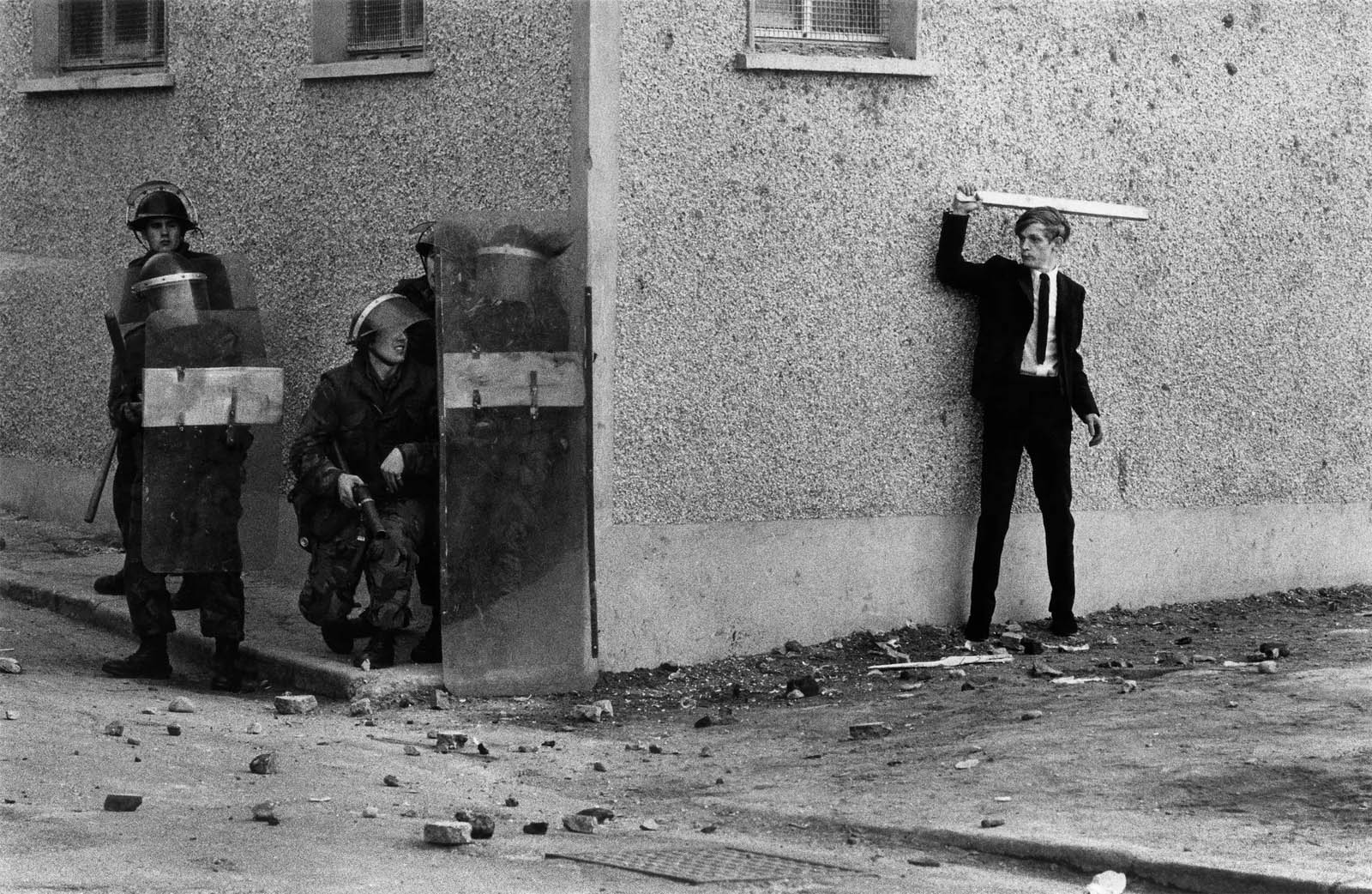
During the 1920 Irish War of Independence against British rule, a treaty was signed dividing the island into two self-governing areas. The majority Catholic counties, primarily in the south, formed the Irish Free State. The six majority Protestant counties in the north became a region of the United Kingdom. Catholics living in Northern Ireland faced discrimination and police harassment and, in the late 1960s, they organised civil rights marches challenging their treatment. Activists were met by counter-demonstrators and violent suppression by the almost exclusively Protestant police force. Riots ensued and the Troubles began. In 1969, the British Army was deployed to restore order in the region, but instead violence escalated. Paramilitary organisations on both sides took up arms and employed guerrilla tactics. More than 3,500 people had been killed by the time the Good Friday Agreement was signed in 1998, ending 30 years of violence.

Room 2

The cost of living

These photographs spotlight UK class dynamics in the 1980s. Images of social security waiting rooms and people living on the streets, sit alongside office workers, Conservative Party functions and gallery private views.

Margaret Thatcher believed, ‘whatever your background, you have a chance to climb to the top’. She presented social mobility as the reward for those who worked hard enough. The government encouraged people to become part of the property-owning middle classes. The 1980 Housing Act gave 5 million council house tenants the right to buy at discounted prices. But Thatcherism also advocated for limited government controls, privatisation of industry, low taxes and free markets. Conservative economic philosophy made the wealthiest in society richer. While young urban professional ‘yuppies’ in financial centres thrived, the gap between classes increased.

In the 1970s, a global economic recession and increased mechanisation had led to deindustrialisation. By the 1980s, working-class communities centred around heavy industries were greatly affected. Specialised machines replaced workers and manufacturing moved to countries where wages were lower. The government introduced legislation to limit the influence of trade unions and allow employers to sack striking workers. Thousands were left unemployed. The foundations of working-class identity were being eroded while the prospect of middle-class affluence remained out of reach for many.

The photographers in this room produced work that highlights these class dynamics. Some revealed the human stories behind the policies and statistics, others helped cement stereotypes.

Room 3

Landscape

The photographs in this room highlight different political and social narratives embedded in the landscape of the British Isles. They reveal the impact of human endeavour on the land and the effect of the land and its borders on people.

While these photographs depict a particular part of the world, they also explore how landscapes are constructed in our imaginations. As artist Jem Southam notes, ‘When we look at a photograph of a landscape, we’re looking as much at a projection of the cultural, social, historical, literary connections we have with that place, as we are with an actual physical landscape.’ Southam describes his work as ‘a description of a culture, and of a place, but also an investigation of how we carry imagery in our minds’.

Some of the featured photographers drew on the history of British landscape painting to produce nostalgic images of sublime natural vistas. Others parodied or subverted the romantic notion of a green and pleasant land, revealing British landscapes as sites of decay, conflict, deindustrialisation and racism. Several artists produced photographs that immerse us in their chosen scenes, treating industrial ruins with the same careful attention as natural phenomena. Those working with large format cameras and slow exposure times gave their chosen scenes a painterly quality. Others utilised photography’s ability to record the everyday. They embraced a medium some didn’t consider high art to capture landscapes many didn’t consider worthy of documenting.

Room 4

Image and text

Conceptual art prioritises the idea (or concept) behind an artwork. The photographs in this room focus on photography’s ability to carry ideas. They challenge the notion of the photograph as a window on the world and use text to complicate the medium’s relationship with reality.

Artist and academic, Victor Burgin wrote that our most common encounters with photographs – in advertisements, newspapers and magazines – are all mediated by text. Informed by semiotics, the study of signs and symbols, Burgin highlighted our reliance on existing systems of codes and social meanings to ‘read’ photographs. By making work that combines image and text he was ‘turning away from concerns inherited from “art” and towards everyday life and its languages, which are invariably composed of image/text relations’. Burgin used image and text to ‘dismantle existing communication codes’ and ‘generate new pictures of the world.’

Burgin’s art and ideas influenced the photographers in this room, several of whom he taught. They used text borrowed from literature, film, parliamentary speeches and journalism to expose hidden meanings, heighten emotion and confuse. The resulting artworks expanded contemporary photographic practice while offering new ways of viewing the world.

Room 5

Remodelling history

The personal and intimate photographs of Jo Spence and Maud Sulter remodel the history of representation. Their artworks and writings challenge photography’s sexist and colonial past, and its relationship to class politics. Rather than using the camera to stereotype, categorise, objectify or commodify, they used it to reclaim agency.

For both artists, their collaborative approach to image-making was key to the politics of their practice. Sulter and Spence worked closely with other artists and their subjects. Through collaboration, they discovered new ways of seeing and being seen.

For Spence, this meant ‘putting myself in the picture’. She recognised the power of having control over her representation and, together with artist Rosy Martin, developed photo-therapy. Spence noted: ‘I began to use the camera to explore links that I had never approached before, links between myself, my identity, the body, history and memory’. Known for her unflinching gaze and use of satire, Spence challenged social expectations. She questioned common visual representations of beauty, health and womanhood, as well as women’s place in society.

Sulter’s photography explores absence and presence. She was interested in the ways that ‘Black women’s experience and Black women’s contribution to culture is so often erased and marginalised’. Whether rephotographing personal family photographs or producing portraits, Sulter ‘put Black women back in the centre of the frame – both literally within the photographic image, but also within the cultural institutions where our work operates’. Sulter saw her practice as a contribution to ‘archival permanence’. As she noted: ‘Survival is visibility.’

Room 6

Reflections on the Black experience

This room examines the influence of Reflections of the Black Experience, which opened at Brixton Art Gallery in south London in 1986. The exhibition was organised by the Greater London Council’s Race Equality Unit. It invited artists ‘from a diversity of cultural/political backgrounds’ to collectively ‘challenge the existing and inadequate visual histories of the black experience’. In the 1980s, the term ‘political blackness’ was used as an organising tool to encourage people of colour to come together in the fight against racism. Reviews noted the range of practices on display and that the exhibition set ‘a new agenda where black people can begin to trace a history of representation of ourselves by ourselves’. Yet they also warned: ‘If seen as definitive representations / reflections in photographic imagery the exhibition becomes very limited.’

D-MAX: A Photographic Exhibition was a response to this possible containment of Black photographic practice. Three of the photographers featured had exhibited work in Reflections of the Black Experience. The exhibition opened at Watershed in Bristol in 1987 and toured to the Photographers’ Gallery in London and Chapter Arts Centre in Cardiff. It attempted to free Black photographers from the burden of representation and the restrictions of documentary practice.

Both exhibitions played an important role in the development of the Association of Black Photographers, now Autograph ABP. Established in 1988, its mission was to advocate for the inclusion of historically marginalised photographic practices. Working from a small office in Brixton, the agency delivered an ambitious programme of exhibitions, publications and events. Autograph ABP developed alternative models of producing and sharing photography without defining Black photographic practice or the Black experience.

Although the focus of Reflections of the Black Experience was on young photographers, the exhibition also included a tribute to Armet Francis, who was already well-established. Francis’s photographs focus on the areas of Notting Hill and Brent in west London, documenting the lives of people in the African and Caribbean diasporas. His images capture elements of everyday life, like school and church, as well as shining a light on Black community activism. Francis provided a crucial early articulation of Black identity and political presence in British photography.

Room 7

Self-portraiture

Whether putting themselves in the frame or handing the shutter release to their subjects, the photographers in this room understood the importance of people of colour having control over their image.

In the nineteenth century, photography was a valuable tool for colonial powers. Ethnographic images of Indigenous Peoples and landscapes were distributed through postcards and magazines. They ‘othered’ subjects and created racist stereotypes that legitimised the mission of empire. The photographs on display here challenge this colonial gaze. They present nuanced, multi-dimensional representations of Black and Asian British selfhood.

These artists used different photographic and post-production techniques to complicate the idea of representation and identity. The diversity of their images enhances our understanding of what it means to capture the ‘self’. By adding text, highlighting objects and layering images through projection and photomontage, they remind us that identity isn’t a fixed entity.

Three of the photographers shown here took part in Autoportraits, Autograph ABP’s first exhibition, held at Camerawork in east London in 1990. The exhibition took self-portraiture as its theme. Cultural theorist, Stuart Hall, wrote an essay for the catalogue. In ‘Black Narcissus’, he defended the use of ‘self-images’ by contemporary Black photographers. Far from ‘a narcissistic retreat to the safe zone of an already constituted “self”‘, Hall notes that self-portraiture presents a ‘strategy … of putting the self-image, as it were, for the first time, “in the frame”, on the line, up for grabs. This is a significant move in the politics and strategies of black representation.’

Room 8

Community

The photographs in this room are contributions to a people’s history. They focus on communities whose stories were often absent from the visual arts of the period. To tell these stories with integrity, photographers attempted to document communities from within. Some formed collectives, brought together by shared interests and common goals. They encouraged photographers to move to live alongside their subjects and to build relationships with local people to better represent them. Others documented their own lives and those of their local communities. Their images challenged prevailing narratives and aimed to bring about social change.

Here, photographs of everyday life are presented through a different lens. By the 1970s, most people expected to be photographed in colour, using roll film in point-and-shoot cameras. By producing black-and-white prints, these photographers appear to reference fine art and documentary practice. They invite us to view their subjects as part of the history of photography.

These photographers recorded different social pressures: inadequate housing, disproportionate unemployment, aggressive policing and stereotypical framing in the media. They also highlighted the joy, pride and humour within these communities. By working with their subjects and photographing their own experiences, they produced works that provide insight, build connections and encourage empathy.

Room 9

Colour

These photographers challenged the expectation that ‘art’ photography had to be black and white. At a time when the market for colour photography was still young, they subverted and appropriated colour’s associations with the commercial worlds of fashion and snapshot photography. They used burgeoning colour technologies to create a new visual language that became emblematic of the period. Their images offered new ways of seeing British life and culture.

Britain’s first exhibition of photography taken on colour film was Peter Mitchell’s 1979 show at Impressions Gallery in York. By this time, colour had almost entirely replaced black-and-white film in amateur photography. But many professional photographers were looking for greater nuance than the saturated results of commercially available film stock.

Across the decade, small technical leaps allowed for greater creativity in colour image-making. Kodachrome, the first commercially available colour negative film, was the most commonly used of the period. It provided rich and naturalistic colours, remarkable contrast and extraordinary sharpness. New papers such as Cibachrome II allowed artists to produce high-quality colour prints with greater permanence. Around 1984, Fuji introduced a new colour negative film offering even punchier, brighter saturation. Used with new cameras such as the Plaubel Makina 67 and daytime flash, photographers could produce detailed images in vivid colour.

Photographers exploited these technical advances. They used the camera like a painter, highlighted the garish excesses of consumer society and invented new forms of documentary. By December 1985, Creative Camera journal had announced ‘from today, black and white is dead’.

Room 10

Black Bodyscapes

The photographs of Rotimi Fani-KayodeAjamu X and Lyle Ashton Harris explore masculinity, sexuality and Blackness. Their staged portraits highlight the artists’ technical skills while challenging essentialist ideas of identity.

Fani-Kayode was described by Ajamu X as ‘the most visible, out, Black, queer photographer’ of the 1980s. His photographs interrogate a perceived tension between his heritage, spirituality and gay identity. Fani-Kayode commented: ‘On three counts I am an outsider: in terms of sexuality; in terms of geographical and cultural dislocation; and in the sense of not having become the sort of respectably married professional my parents might have hoped for.’ For Fani-Kayode the position of ‘outsider’ produced ‘a sense of freedom’ that he felt opened up ‘areas of creative enquiry which might otherwise have remained forbidden’.

Ajamu X’s desire to document ‘the whole of Black queer Britain’ has been dubbed ‘Pleasure Activism’. ‘There is a reluctance to talk about sex and pleasure’, he notes. ‘To me, the act of pleasure has to … be part of the conversation around making work.’ For Ajamu X, the materiality of his photography is as important as his subject. ‘I still get excited by the magic alchemy of being in the darkroom’, he reflects. ‘Process is key to my practice – in some cases, much more than the photographic image itself.’

Harris, a US photographer, was included in Autograph ABP’s first exhibition, 1990’s Autoportraits. He describes his photographs as a celebration of ‘Black beauty and sensuality’. Harris notes: ‘I think it’s important to understand that my work is not so much about trying to unpack identity as it is about relationally exploring my positionality to what has gone before and to what is unfolding in our present day lives, as a way to imagine a future to come.’

Room 11

Celebrating subculture

By the end of the decade, previous distinctions between commercial and art photography had begun to break down. Launched in 1980, popular magazines like The Face and i-D brought together fashion, art and advertising. They employed cutting-edge photographers to capture the youth movements that set trends and defined contemporary culture.

Many of the photographs in this final room of the exhibition document subcultures. They feature young people resisting dominant values and beliefs, and challenging the policies and rhetoric that informed them. Section 28 of the Local Government Act was one such policy. Passed in 1988, it prohibited local authorities from ‘promoting homosexuality’. Schools and libraries banned literature, plays and films referencing same-sex relationships and arts organisations faced censorship. Yet, in the face of discrimination, gay and lesbian communities mobilised. The government had put queer culture in the spotlight and, with great courage, many gay and lesbian photographers produced work that changed public discourse.

These artists embraced a range of photographic practices. They combined street photography with saturated colour to challenge stereotypes. They produced highly staged portraits exploring social justice issues, and they captured underground club scenes using the principles of community photography.

The photographs in this room offered a new vision of the UK. One that is both politically engaged and celebratory. They highlight the importance of self-expression, give agency to the photographic subject and make overlooked perspectives visible. Across style, format and subject, these artists asserted photography’s role in society: to document, interrogate and celebrate.

Text from the Tate Britain exhibition guide


Martin Parr (British, 1952-2025) 'New Brighton, England, 1983-85' From the series 'The Last Resort'


Martin Parr (British, 1952-2025)
New Brighton, England, 1983-85
From the series The Last Resort
1983-1985
C-type print
© Martin Parr / Magnum Photos


Martin Parr took his first colour photographs as a student at Manchester Polytechnic in 1971 and has worked exclusively in colour since 1982. These photographs are from his series The Last Resort. They document the Merseyside seaside resort of New Brighton at a time of economic decline. The series features Parr’s characteristic use of daytime flash and saturated colour to produce satirical images exploring leisure and consumption. Parr was ‘interested in showing how British society is decaying; how this once great society is falling apart.’ Of the series’ reception, Parr notes, ‘People thought it was exploitation, you know – middle-class guy photographing a working-class community, that sort of stuff. The thing is, it was shown first in Liverpool and no one batted an eyelid … middle-class people [in London] don’t know what the north of England’s like.’

Wall text from the exhibition
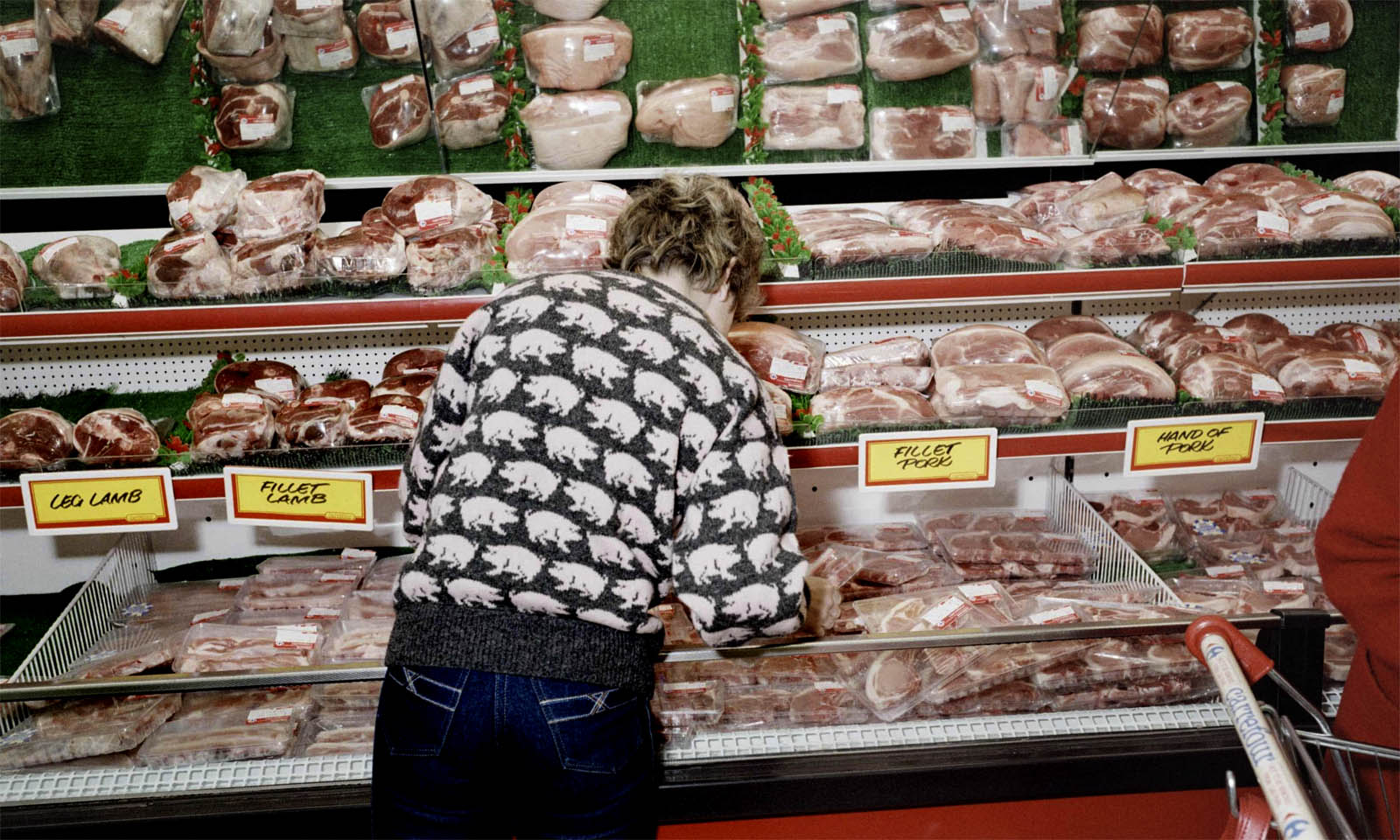
 

Paul Reas (British, b. 1955) 'Hand of Pork, Caerphilly, South Wales' 1985-1988


Paul Reas (British, b. 1955)
Hand of Pork, Caerphilly, South Wales
1985-1988
C-print on paper
© Paul Reas/Martin Parr Foundation


“Deregulation of the banking system meant credit was easy to come by and consumer spending rose fast. Shopping malls were the new cathedrals of consumption and retail parks with supermarkets and furniture stores the parish churches. Shopping became leisure”

~ Paul Reas


Inspired by the use of colour in advertising, Paul Reas dedicated his first series of colour photographs to the post- industrial consumer boom in the UK in the 1980s. These works, taken with a medium-format camera and a large flashgun, present everyday scenes at US-style retail parks, supermarkets and the new housing estates fast becoming a feature of British towns and villages. Reas’s images consider the impact of these ‘new cathedrals of consumption’. Reas has described how Margaret Thatcher’s belief in a free-market economy and individualism moved British society from a ‘we’ to a ‘me’ mentality. As he explains: ‘Although I was photographing people, I never really think about my photographs as being totally about people. They’re about the systems that we’re all subjected to.’

Wall text from the exhibition
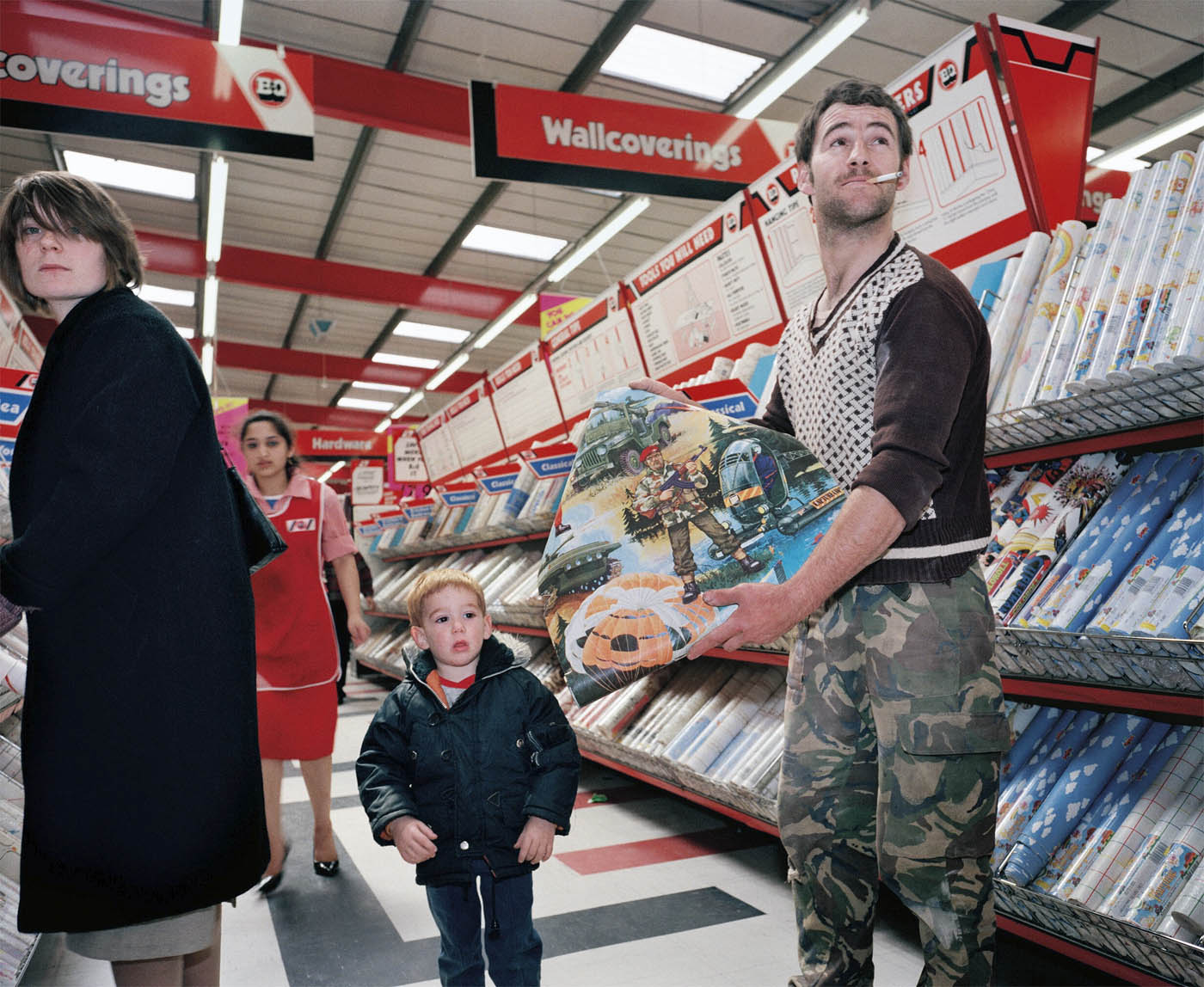
 

Paul Reas (British, b. 1955) 'Army Wallpaper, B&Q Store, Newport South Wales' c. 1987


Paul Reas (British, b. 1955)
Army Wallpaper, B&Q Store, Newport South Wales
c. 1987
C-print on paper
© Paul Reas/Martin Parr Foundation
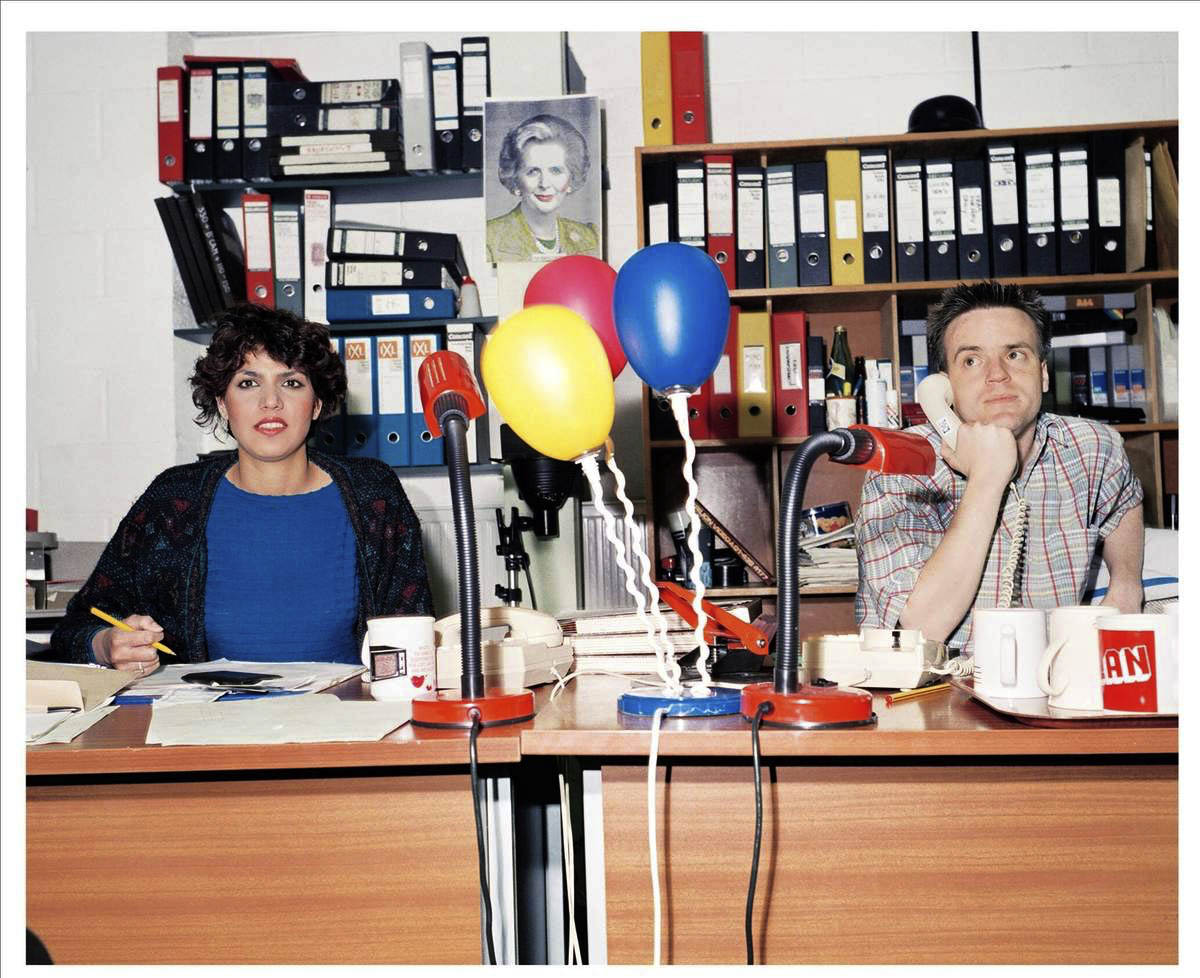
 

Anna Fox (British, b. 1961) 'Independent Video Production Company' 1988 from the series 'Work Stations'


Anna Fox (British, b. 1961)
Independent Video Production Company
1988
From the series Work Stations
The Hyman Collection
Courtesy of the Centre for British Photography
© Anna Fox


“Thatcher was a powermonger and her favourite phrase, ‘there is no such thing as society, just individuals’ saw the end of a culture of community support and a rise in the pursuit of wealth for individuals – primarily white men. Compared to now, things in some ways were more straightforward, and as artists we knew what we were making work about – there was a positive sense that we could change things; we criticised society with hope fueling us…

I made two key bodies of work in this period, including Work Stations – a study of London office life with found texts, creating satirical commentary on a very conservative Britain. I was interested in how consumerism was sweeping the floor with us and how money ruled. There were hardly any documentary images made of office life, it wasn’t considered a valid subject and this interested me. All documentary images change as time passes – design and style become more fascinating as they age – and I am so pleased these images have stayed in people’s imagination. They are a significant record of a particular time and they bring up a lot of memories of what it was like to live and work in it.”

Zoe Whitfield. “The story of 80s Britain, as seen by 7 notable photographers,” on the Dazed website, November 22, 2024 [Online] Cited 03/04/2025


Anna Fox (British, b. 1961) 'Salesperson, Cafe, the City' 1988


Anna Fox (British, b. 1961)
Salesperson, Cafe, the City
1988
From the series Work Stations
Inkjet print on paper
The Hyman Collection
Courtesy of the Centre for British Photography
© Anna Fox


In her Work Stations series, Anna Fox captures London office life in the late 1980s. ‘I was attracted to it because it’s such an ordinary subject and hardly anyone had ever photographed office life’, she says. The photographs combine colour, on-camera flash and snapshot style compositions to create hard shadows and emphasise the immediacy of each scene. The unusual framing and off-kilter camera angles give them a spontaneous and humorous feel. Fox repurposed text from business articles and magazines to loosely pair with each image in the series. They reveal the intense competition, stress and absurdities of corporate culture in Thatcher-era Britain.

Wall text from the exhibition
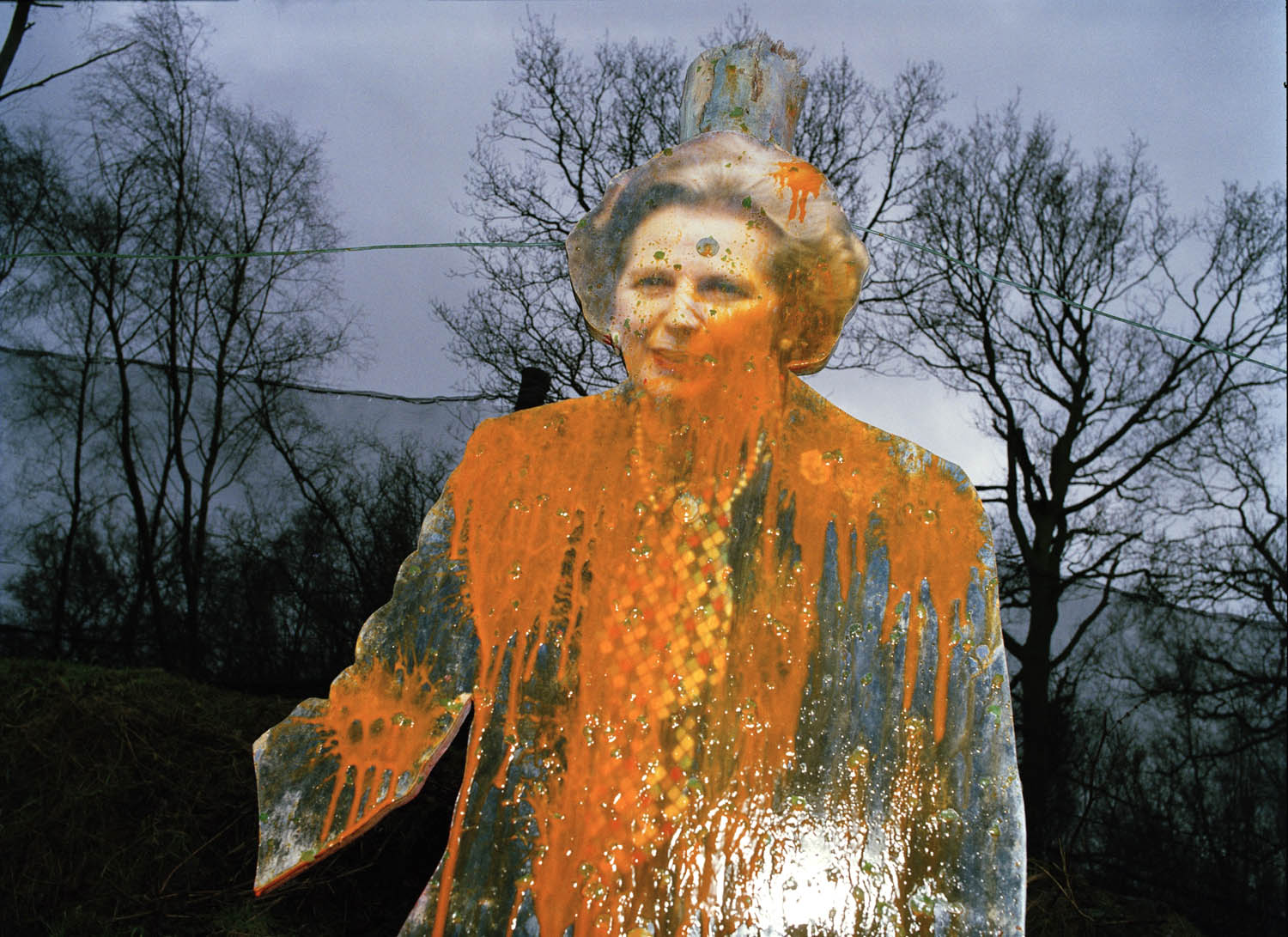
 

Anna Fox (British, b. 1961) 'Friendly Fire, target (Margaret Thatcher) / Margaret Thatcher Target' 1989


Anna Fox (British, b. 1961)
Friendly Fire, target (Margaret Thatcher) / Margaret Thatcher Target
1989
Inkjet print on paper
The Hyman Collection
Courtesy of the Centre for British Photography
© Anna Fox


While working on her 1987-1988 series Work Stations exploring office life, Anna Fox came across the phenomenon of paintballing. Learning that corporate sales teams often took part in outdoor paintball games to encourage team spirit and competitiveness, she wanted to capture these ‘weekend wargames’ in action. In her series Friendly Fire, Fox plays the role of war photographer just as the participants play at being soldiers. This image depicts a paint-splattered cardboard cutout of Margaret Thatcher used for target practice. Taken in the aftermath of the Falklands War, Fox’s work explores the connections and contrasts between these sites of simulated conflict and the experiences of military personnel.

Wall text from the exhibition


Grace Lau (British-Chinese, b. 1939)
'Interiors series' 1986


Grace Lau (British-Chinese, b. 1939)
Interiors series
1986
Colour transparency
Lent by the artist
© Grace Lau 1986


Grace Lau employs colour to explore fetish subcultures from a feminist perspective. This series was produced following an invitation to document a London cross-dressing community. Lau’s portraits are often set in private, domestic spaces where fantasies and alternative lifestyles could be acted out more openly. As the artist explains: ‘When I started making portraits of cross-dressers, many projected their alter-identities with such joyous style that I felt black-and-white could not do justice to their vibrant characters. Colour seemed to express their proud desire to project subliminal identities and these images with their saturated, bright colours, reflect my subjects’ multi-layered personalities; their bright red lipstick, glamorous dresses and jewellery blazing into life in colour transparency film.’

Wall text from the exhibition


Brenda Prince (British, b. 1950)
'Anti-Clause 28 demo in Whitehall, London' 9 June 1988


Brenda Prince (British, b. 1950)
Anti-Clause 28 demo in Whitehall, London
9 June 1988
Format Photographers Archive, Bishopsgate Institute
© Brenda Price


Did the 80s really last from 1976-94? This exhibition thinks it did – resulting in a show replete with gems, but in need of a tight edit…

The exhibition starts out along thematic lines. The opening room is dedicated to protest, from the Grunwick strike led by British/South Asian workers in Brent, through clashes between pickets and the police at the Orgreave coking plant, and marches opposing the homophobic Section 28 legislation. In a gallery dedicated to money and the growing divide between haves and have-nots, Paul Graham’s grimly atmospheric pictures of DHSS waiting rooms face off against Martin Parr’s snarky snaps of garden parties and gallery openings. In the next section, the lens is turned on the landscape, and the transformations wrought both by industry and its removal. …

The closing section Celebrating Subcultures bypasses those usually associated with the 1980s (punks, goths, rude boys, new age travellers) but includes an entire wall of 1990s photographs by Wolfgang Tillmans, most of which were shot in Germany and Greece…

The art world of the 1980s speaks strongly to our own, in particular, the shared interest in identity and representation. In short supply here is the punky irreverence of an era in which taking the piss was practically a national hobby.

Hettie Judah. “The 80s: Photographing Britain review – a meandering look at pomp, protest – and pork,” on The Guardian website Wed 20 Nov 2024 [Online] Cited 02/05/2025


For all that, I left this show feeling slightly beleaguered by the overload of images and attendant theory. The foregrounding of emerging visual strategies, from activist reportage to nascent conceptualism to identity-driven self-portraiture, is brave but often bewildering rather than enlightening. The final room, Celebrating Subculture, is a case in point, being a cursory nod to a decade that saw the emergence of the style-conscious youth culture that echoes through fashion, music and indeed everyday life until this day.

If your image of the 80s is predicated on memories of The Face magazine, or the blossoming of extravagant tribal subcultures such as goths and New Romantics in clubs such as the Batcave and Blitz, you may be as baffled as I was not to encounter a single image by the likes of Juergen Teller, Nigel Shafran or Derek Ridgers. Instead, there are four street portraits of stylish young men by Jason Evans and a recreation of Wolfgang Tillmans’s first photo installation, which mainly comprises images first published in i-D magazine. A portrait of the 80s, then, but one that at times seems determinedly out of focus.

Sean O’Hagan. “The 80s: Photographing Britain review – in your face and to the barricades,” on The Guardian website, Sun 24 Nov 2024 [Online] Cited 02/05/2025


Roy Mehta (British, b. 1968) From the series 'Revival, London' 1989-1993


Roy Mehta (British, b. 1968)
From the series Revival, London
1989-1993
C-print on paper
Courtesy of the artist and LA


Roy Mehta’s Revival, London, series focusses on Caribbean and Irish communities in Brent northwest London, where he lived in the 1980s. Much of Mehta’s practice engages with the complexity of identity and belonging.

Mehta invites us ‘to share in the atmosphere of the subject’s internal world by illustrating the gentle essence of our shared humanity through images of empathy, faith and tenderness’. He notes: ‘I wanted the work to depict compassion and solidarity, along with reflections of the everyday. I felt these were absent from some mainstream representations of diasporic identities at that time in the 1980s.’

Wall text from the exhibition
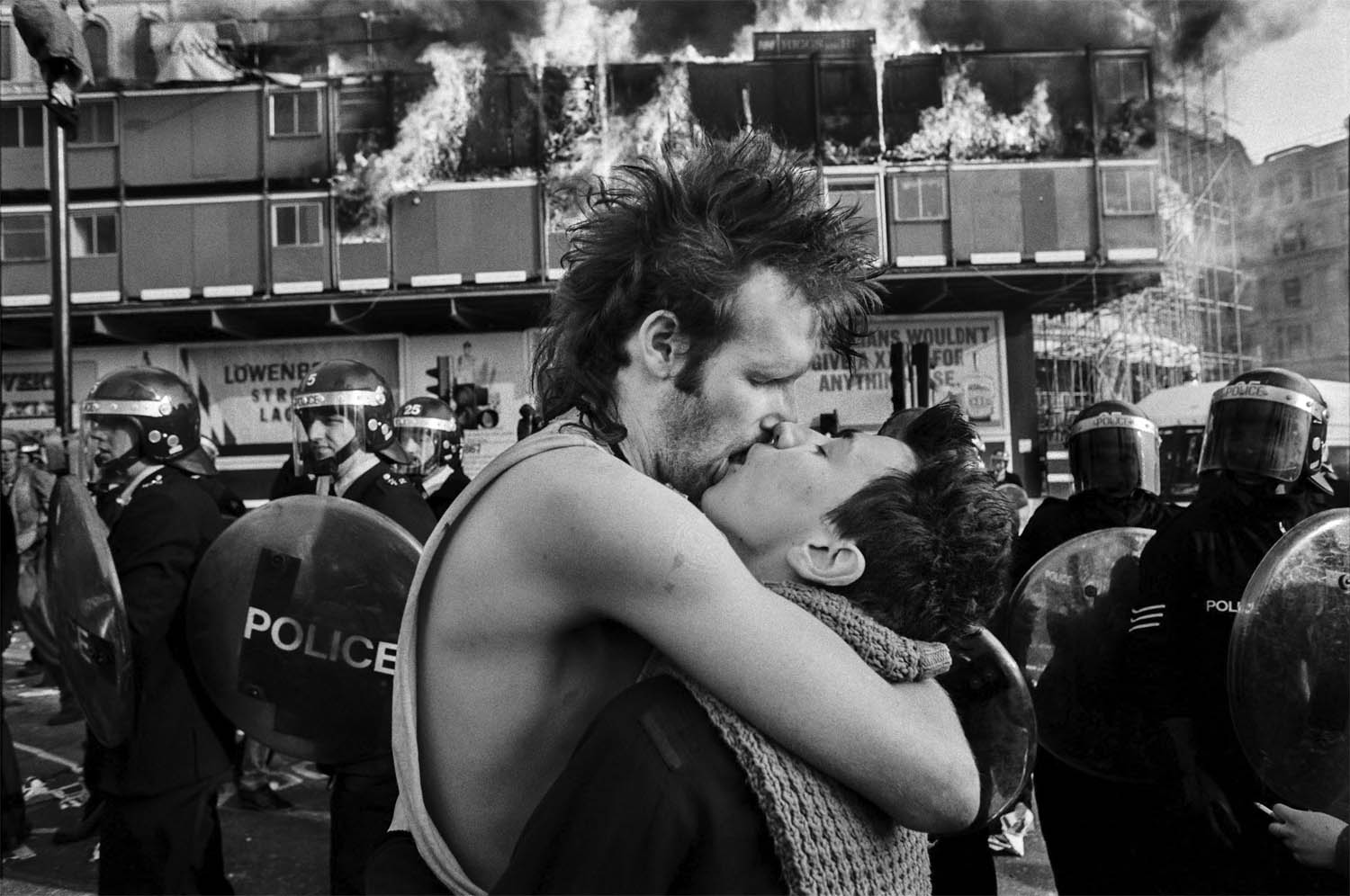
 

David Hoffman (British) 'Nidge & Laurence Kissing, taken at a poll tax protest in London' 1990


David Hoffman (British)
Nidge & Laurence Kissing, taken at a poll tax protest in London
1990
© David Hoffman
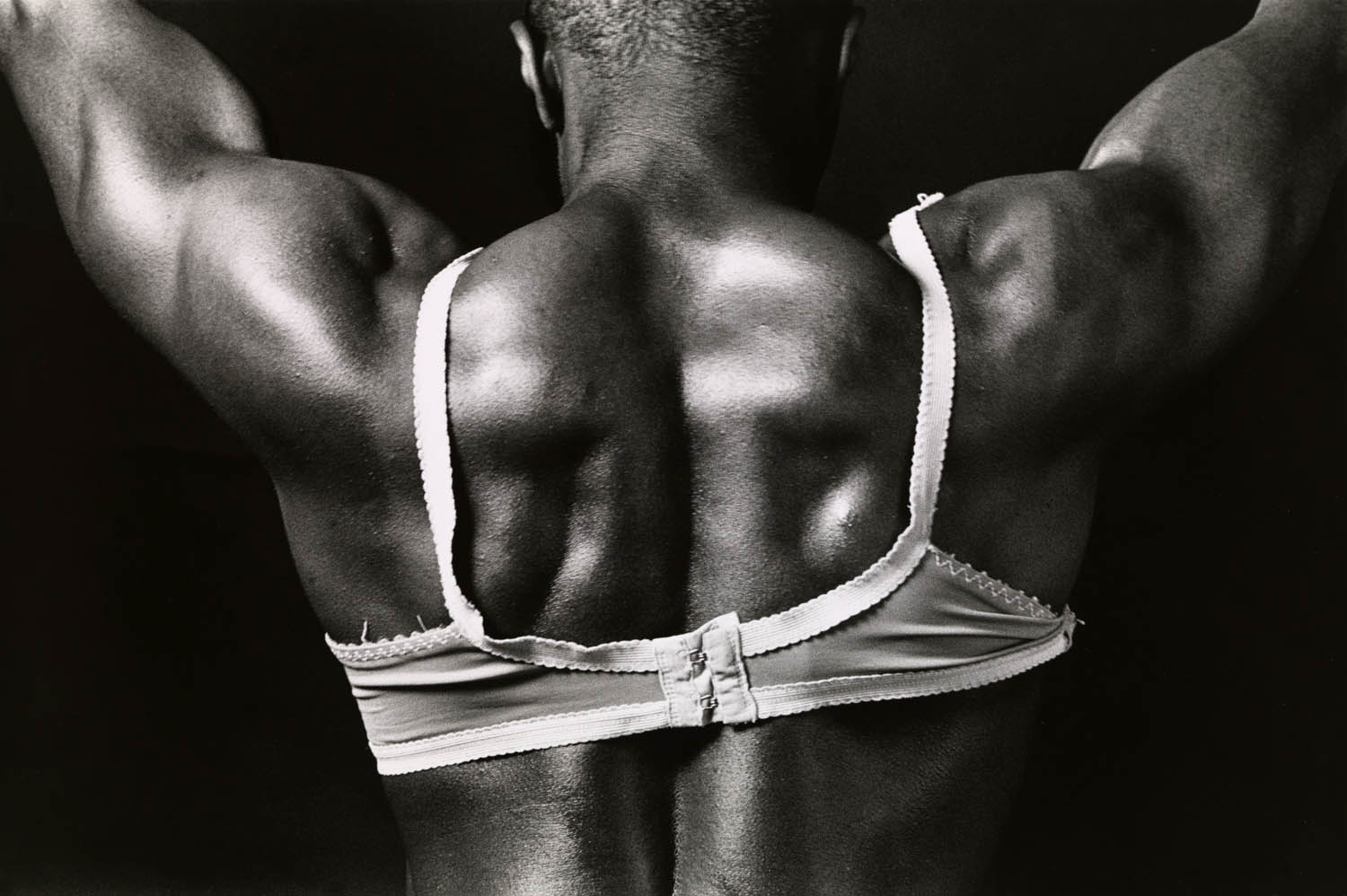
 

Ajamu X (British, b. 1963) 'Body Builder in Bra' 1990


Ajamu X (British, b. 1963)
Body Builder in Bra
1990
Gelatin silver print on paper
Tate
Presented by Tate Members 2020


When asked about the photoshoot for this image, Ajamu said: ‘we went to the local market here in Brixton, bought a bra and played around with it. This was one of the first shots.’ This spontaneity is contrasted with the carefully framed close-up of the sitter’s back. Bodybuilding has long been an area of interest for Ajamu. Although it represents ‘an archetypal image of the male body’, he describes how his practice is ‘a consistent attempt to subvert, re-think, play with these limited modes of representations around particular bodies in a multi-dimensional way.’

Wall text from the exhibition


Jason Evans (Welsh, b. 1968) and Simon Foxton (British, b. 1961) 'Untitled' 1991 From the series 'Strictly'


Jason Evans (Welsh, b. 1968) and Simon Foxton (British, b. 1961)
Untitled
1991
From the series Strictly
Tate
© Jason Evans


“This work was made in collaboration with Simon Foxton. It takes the head-to-toe ‘straight up’ documentary approach to street style as a point of departure, however they’re entirely constructed. We saw fashion photography as a political space where we could create something that pushed back at the media stereotypes of young Black men. This is a Trojan horse exercise, intended to disrupt the white supremacist media project. For many, it may be hard to imagine how racist the UK felt then, which, especially with hindsight, makes today’s politics all the harder to witness.”

Zoe Whitfield. “The story of 80s Britain, as seen by 7 notable photographers,” on the Dazed website, November 22, 2024 [Online] Cited 03/04/2025


Al-An deSouza (Kenyan, b. 1958) 'Junglee, Indian Aphorisms series'
1992/2024


Al-An deSouza (Kenyan, b. 1958)
Junglee, Indian Aphorisms series
1992/2024
Courtesy Al-An deSouza and Talwar Gallery, New York and New Delhi


In Indian Aphorisms, Al-An deSouza combines self-portraits with introspective reflections. Through the series, the artist attempts to reclaim and redefine their identity. Each work portrays the tension between public perception and private reality, illustrating the ways in which personal identity is continually negotiated and reshaped. DeSouza’s photographs reveal their struggle to separate reality from yearning and imagining. ‘I don’t know which of my memories are my own remembrance, which are tales whispered to me secretly as I lay in my bed, or which are ghostly after images, effigies petrified between the tissue leaves of photo albums’, the artist explains.

Wall text from the exhibition


'The 80s: Photographing Britain' book cover


Related publications

The 80s: Photographing Britain

Edited by Yasufumi Nakamori, Helen Little and Jasmine Chohan

Featuring contributions by Bilal Akkouche, Geoffrey Batchen, Derek Bishton, Jasmine Chohan, Taous Dahmani, Helen Little, Yasufumi Nakamori, Mark Sealy, Noni Stacey

Published November 2024, hardback £40

Available on the Amazon website


Tate Britain
Millbank, London
SW1P 4RG

Open daily 10.00 – 18.00

Tate Britain website

LIKE ART BLART ON FACEBOOK

Back to top

Exhibition: ‘Conflict, Time, Photography’ at Tate Modern, London

Exhibition dates: 26th November, 2014 – 15th March, 2015

Artists: Jules Andrieu, Pierre Antony-Thouret, Nobuyoshi Araki, George Barnard, Adam Broomberg and Oliver Chanarin, Luc Delahaye, Ken Domon, Roger Fenton, Ernst Friedrich, Jim Goldberg, Toshio Fukada, Kenji Ishiguro, Kikuji Kawada, An-My Lê, Jerzy Lewczyński, Emeric Lhuisset, Agata Madejska, Diana Matar, Eiichi Matsumoto, Chloe Dewe Mathews, Don McCullin, Susan Meiselas, Kenzo Nakajima, Simon Norfolk, João Penalva, Richard Peter, Walid Raad, Jo Ratcliffe, Sophie Ristelhueber, Julian Rosefeldt, Hrair Sarkissian, Michael Schmidt, Ursula Schulz-Dornburg, Indre Šerpytyte, Stephen Shore, Harry Shunk and János Kender, Taryn Simon, Shomei Tomatsu, Hiromi Tsuchida, Marc Vaux, Paul Virilio, Nick Waplington, Jane and Louise Wilson, and Sasaki Yuichiro.

Curators: Simon Baker, Curator Photography and International Art, Shoair Mavlian, Assistant Curator, and Professor David Alan Mellor, University of Sussex


Roger Fenton (British, 1819-1869) 'The Valley of the Shadow of Death' 1855 from the exhibition 'Conflict, Time, Photography' at Tate Modern, London, November 2014 - March 2015


Roger Fenton (British, 1819-1869)
The Valley of the Shadow of Death
1855


Another fascinating exhibition. The concept, that of vanishing time, a vanquishing of time – inspired by Kurt Vonnegut’s 1969 novel Slaughterhouse-Five and the Japanese photographer Kikuji Kawada’s 1965 photobook The Map – is simply inspired. Although the images are not war photography per se, they are about the lasting psychological effects of war imaged on a variable time scale.

While the images allow increasing passages of time between events and the photographs that reflect on them – “made moments after the events they depict, then those made days after, then months, years and so on” – there settles in the pit of the stomach some unremitting melancholy, some unholy dread as to the brutal facticity and inhumanness of war. The work which “pictures” the memory of the events that took place, like a visual ode of remembrance, are made all the more powerful for their transcendence – of time, of death and the immediate detritus of war.

Dr Marcus Bunyan


Many thankx to the Tate Modern for allowing me to publish the photographs in the posting. Please click on the photographs for a larger version of the image.


“… taking its cue from Vonnegut, ‘Conflict, Time, Photography’ is arranged differently, following instead the increasing passages of time between events and the photographs that reflect on them. There are groups of works made moments after the events they depict, then those made days after, then months, years and so on – 10, 20, 50, right up to 100 years later.”


Simon Baker


Shomei Tomatsu (Japanese, 1930-2012) 'Atomic Bomb Damage – Wristwatch Stopped at 11-02, August 9. 1945, Nagasaki' 1961 from the exhibition 'Conflict, Time, Photography' at Tate Modern, London, November 2014 - March 2015


Shomei Tomatsu (Japanese, 1930-2012)
Atomic Bomb Damage – Wristwatch Stopped at 11.02, August 9, 1945, Nagasaki
1961
Gelatin silver print on paper
253 x 251mm
Tokyo Metropolitan Museum of Photography, Tokyo


Shomei Tomatsu (Japanese, 1930-2012) 'Steel Helmet with Skull Bone Fused by Atomic Bomb, Nagasaki' 1963


Shomei Tomatsu (Japanese, 1930-2012)
Steel Helmet with Skull Bone Fused by Atomic Bomb, Nagasaki
1963
Gelatin silver print on paper
226 x 303mm
Tokyo Metropolitan Museum of Photography, Tokyo


Shomei Tomatsu (Japanese, 1930-2012) 'Melted bottle' Nagasaki, 1961


Shomei Tomatsu (Japanese, 1930-2012)
Melted bottle
Nagasaki, 1961
from the series Nagasaki 11:02
Silver Gelatin print
20 x 21cm
© Shomei Tomatsu


“From the seconds after a bomb is detonated to a former scene of battle years after a war has ended, this moving exhibition focuses on the passing of time, tracing a diverse and poignant journey through over 150 years of conflict around the world, since the invention of photography.

In an innovative move, the works are ordered according to how long after the event they were created from moments, days and weeks to decades later. Photographs taken seven months after the fire bombing of Dresden are shown alongside those taken seven months after the end of the First Gulf War. Images made in Vietnam 25 years after the fall of Saigon are shown alongside those made in Nakasaki 25 years after the atomic bomb. The result is the chance to make never-before-made connections while viewing the legacy of war as artists and photographers have captured it in retrospect…

The exhibition is staged to coincide with the 2014 centenary and concludes with new and recent projects by British, German, Polish and Syrian photographers which reflect on the First World War a century after it began.”

Text from the Tate Modern website


“The original idea for the Tate Modern exhibition Conflict, Time, Photography came from a coincidence between two books that have captivated and inspired me for many years: Kurt Vonnegut‘s classic 1969 novel Slaughterhouse-Five and the Japanese photographer Kikuji Kawada’s 1965 photobook The Map. Both look back to hugely significant and controversial incidents from the Second World War from similar distances.

Vonnegut was a prisoner of war in Dresden when what he called ‘possibly the world’s most beautiful city’ was destroyed by incendiary bombs, and struggled to write his war book for almost 25 years. Kawada was a young photographer working in post-war Hiroshima when he began to take the strange photographs of the scarred, stained ceiling of the A-bomb Dome – the only building to survive the explosion – that he would eventually publish on August 6 1965, 20 years to the day since the atomic bomb was dropped on the city.

It may seem odd that these great works of art and literature took so long to emerge from the aftermath of the events they concern. But many of the most complex and considered accounts of conflict have taken their time. To Vonnegut’s painfully slow response to the war, for example, we might add Joseph Heller’s brilliantly satirical Catch-22, published in 1961, and, even more significantly, JG Ballard’s memorial masterpiece Empire of the Sun, which did not see the light of day until 1984.

And today, in 2014, 100 years since the start of the First World War, it seems more important than ever not only to understand the nature and long-term effects of conflict, but also the process of looking back at the past…”

Extract from Simon Baker. “War photography: what happens after the conflict?” on The Telegraph website, 7th November 2014 [Online] Cited 09/02/2015. Used under fair use conditions for the purposed of education and research


An-My Lê (Vietnamese-American, b. 1960) 'Untitled, Hanoi' 1994-1998


An-My Lê (Vietnamese-American, b. 1960)
Untitled, Hanoi
1994-1998
Gelatin silver print on paper
508 x 609mm
Courtesy the artist and Murray Guy, New York


Jane Wilson (British, b. 1967) Louise Wilson (British, b. 1967) 'Urville' 2006


Jane Wilson (British, b. 1967)
Louise Wilson (British, b. 1967)
Urville
2006
Gelatin silver print, mounted onto aluminium
1800 x 1800mm
Tate
Purchased 2011


Jane Wilson (British, b. 1967) Louise Wilson (British, b. 1967) 'Azeville' 2006


Jane Wilson (British, b. 1967)
Louise Wilson (British, b. 1967)
Azeville
2006
Gelatin silver print, mounted onto aluminium
1800 x 2900mm
Tate
Purchased 2011


Jo Ractliffe (South African, b. 1961) 'As Terras do fim do Mundo' Nd


Jo Ractliffe (South African, b. 1961)
As Terras do fim do Mundo (The Lands of the End of the World)
2009-2010
Courtesy Mark McCain collection


“At first glance, Jo Ractliffe’s black-and-white shots of sun-baked African landscapes look random and bland: rocks, dirt, scrubby trees; some handwritten signs but no people. Only when reading the titles – “Mass Grave at Cassinga,” “Minefield Near Mupa” – do you learn where the people are, or once were, and the pictures snap into expressive focus.

Ms. Ractliffe, who lives in Johannesburg, took the photographs in 2009 and 2010 in Angola on visits to now-deserted places that were important to that country’s protracted civil war and to the intertwined struggle of neighbouring Namibia to gain independence from South Africa’s apartheid rule. South Africa played an active role in both conflicts, giving military support to insurgents who resisted Angola’s leftist government, and hunting down Namibian rebels who sought safety within Angola’s borders.

It’s through this historical lens that Ms. Ractliffe views landscape: as morally neutral terrain rendered uninhabitable by terrible facts from the past – the grave of hundreds of Namibia refugees, most of them children, killed in an air raid; the unknown numbers of land mines buried in Angola’s soil. Some are now decades old but can still detonate, so the killing goes on.”

Holland Cotter. “Jo Ratcliffe: ‘As Terras do Fim do Mundo (The Lands of the End of the World)’,” on The New York Times website May 26, 2011 [Online] Cited 12/07/2021. Used under fair use conditions for the purposed of education and research


Kikuji Kawada (Japanese, b. 1933) 'Hinomaru, Japanese National Flag' from the series 'The Map' 1965


Kikuji Kawada (Japanese, b. 1933)
Hinomaru, Japanese National Flag
1965
From the series The Map
Gelatin silver print
279 x 355mm
© Kikuji Kawada, courtesy the artist and Photo Gallery International, Tokyo


Kikuji Kawada (Japanese, b. 1933) 'Lucky Strike' 1962


Kikuji Kawada (Japanese, b. 1933)
Lucky Strike
1962
From the series The Map
© Kikuji Kawada, courtesy the artist and Photo Gallery International, Tokyo


Kikuji Kawada (Japanese, b. 1933) 'The A-Bomb Memorial Dome and Ohta River' Hiroshima 1960-1965


Kikuji Kawada (Japanese, b. 1933)
The A-Bomb Memorial Dome and Ohta River from the series The Map
Hiroshima 1960-1965
Gelatin silver print
© Kikuji Kawada


Points of memory: Kikuji Kawada

My first published photo book, The Map, took me five years to complete, beginning in 1960. In late 1961 a solo show with work from the series was held at Fuji Photo Salon in Tokyo, organised in three parts.

The first featured a ruined castle that was blown up intentionally by the Japanese army during the Second World War. The second comprised photographs taken a decade after the atomic bomb exploded in Hiroshima. They showed the stains and flaking ceilings of the Atomic Bomb Dome, the only structure left standing at the heart of the detonation zone. The third part concerned Tokyo during the period of economic recovery: images of advertising, scrap iron, the trampled national flag and emblems of the American Forces such as Lucky Strike and Coca-Cola, all twisted together, their order shuffled again and again. Some appeared as a montage to be presented as a metaphor. I dare not say the meaning of it.

These works led me to attempt to create this photographic book, using the notion of the map as a clue to the future and to question the whereabouts of my spirit. Discarded memorial photographs, a farewell note, kamikaze pilots – the illusions of various maps that emerge are to me like a discussion with the devil. The stains are situated as a key image of the series by drawing a future stratum and sealing the history, the nationality, the fear and anxiety of destruction and prosperity. It was almost a metaphor for the growth and the fall.

On the back of the black cover box are written rhyming words that are almost impossible to read. The front cover shows that the words are about to burn out. Inside, the pages are laid out as hinged double fold-out spreads. The repetition of the act of opening and closing makes the images appear and disappear. I wanted to have a book design as a new object and something that goes beyond the contents. With the rich and chaotic nature of monochrome, it might be that I tried to find my early style within the illusion of reality by abstracting the phenomenon. As an observer, I would like to keep forcing myself into the future, never losing the sense of danger which emerges in the conflicts of daily life. I wish to harmonise my old distorted maps with the heartbeat of this exhibition at Tate Modern, twisting across the bridges of the centuries through conflicting space and time.

Kikuji Kawada is a photographer based in Tokyo.

Kikuji Kawada. “Points of memory: Kikuji Kawada: Conflict, Time, Photography,” on the Tate Modern website 3 December 2014 [Online] Cited 12/07/2021. Used under fair use conditions for the purposed of education and research


Richard Peter (German, 1895-1977) 'Dresden After Allied Raids Germany' 1945


Richard Peter (German, 1895-1977)
Dresden After Allied Raids Germany
1945
© SLUB Dresden / Deutsche Fotothek / Richard Peter, sen.


Toshio Fukada (Japanese, 1928-2009) 'The Mushroom Cloud - Less than twenty minutes after the explosion (4)' 1945


Toshio Fukada (Japanese, 1928-2009)
The Mushroom Cloud – Less than twenty minutes after the explosion (4)
1945
Tokyo Metropolitan Museum of Photography
© The estate of Toshio Fukada, courtesy Hiroshima Peace Memorial Museum


Jerzy Lewczyński (Polish, 1924-2014) 'Wolf's Lair / Adolf Hitler's War Headquarters' 1960


Jerzy Lewczyński (Polish, 1924-2014)
Wolf’s Lair / Adolf Hitler’s War Headquarters
1960
© Jerzy Lewczyński


Don McCullin (British, b. 1935) 'Shell Shocked US Marine, Vietnam, The Battle of Hue' 1968


Don McCullin (British, b. 1935)
Shell Shocked US Marine, Vietnam, The Battle of Hue
1968, printed 2013
© Don McCullin


Ursula Schulz-Dornburg (German, b. 1938) 'Kurchatov – Architecture of a Nuclear Test Site Kazakhstan. Opytnoe Pole' 2012


Ursula Schulz-Dornburg (German, b. 1938)
Kurchatov – Architecture of a Nuclear Test Site Kazakhstan. Opytnoe Pole
2012
Courtesy of the artist’s studio
© Ursula Schultz-Domburg


Conflict, Time, Photography brings together photographers who have looked back at moments of conflict, from the seconds after a bomb is detonated to 100 years after a war has ended. Staged to coincide with the centenary of the First World War, this major group exhibition offers an alternative to familiar notions of war reportage and photojournalism, instead focusing on the passing of time and the unique ways that artists have used the camera to reflect on past events.

Conflicts from around the world and across the modern era are depicted, revealing the impact of war days, weeks, months and years after the fact. The works are ordered according to how long after the event they were created: images taken weeks after the end of the American Civil War are hung alongside those taken weeks after the atomic bombs fell on Japan in 1945. Photographs from Nicaragua taken 25 years after the revolution are grouped with those taken in Vietnam 25 years after the fall of Saigon. The exhibition concludes with new and recent projects by British, German, Polish and Syrian photographers which reflect on the First World War a century after it began.

The broad range of work reflects the many different ways in which conflict impacts on people’s lives. The immediate trauma of war can be seen in the eyes of Don McCullin’s Shell-shocked US Marine 1968, while the destruction of buildings and landscapes is documented by Pierre Antony-Thouret’s Reims After the War (published in 1927) and Simon Norfolk’s Afghanistan: Chronotopia 2001-2002. Other photographers explore the human cost of conflict, from Stephen Shore’s account of displaced Jewish survivors of the Second World War in the Ukraine, to Taryn Simon’s meticulously researched portraits of those descended from victims of the Srebrenica massacre.

Different conflicts also reappear from multiple points in time throughout the exhibition, whether as rarely-seen historical images or recent photographic installations. The Second World War for example is addressed in Jerzy Lewczyński’s 1960 photographs of the Wolf’s Lair / Adolf Hitler’s War Headquarters, Shomei Tomatsu’s images of objects found in Nagasaki, Kikuji Kawada’s epic project The Map made in Hiroshima in the 1960s, Michael Schmidt’s Berlin streetscapes from 1980, and Nick Waplington’s 1993 close-ups of cell walls from a Prisoner of War camp in Wales.

As part of Conflict, Time, Photography, a special room within the exhibition has been guest-curated by the Archive of Modern Conflict. Drawing on their unique and fascinating private collection, the Archive presents a range of photographs, documents and other material to provide an alternative view of war and memory.

Conflict, Time, Photography is curated at Tate Modern by Simon Baker, Curator of Photography and International Art, with Shoair Mavlian, Assistant Curator, and Professor David Mellor, University of Sussex. It is organised by Tate Modern in association with the Museum Folkwang, Essen and the Staatliche Kunstsammlungen, Dresden, where it will tour in spring and summer 2015 respectively. The exhibition is also accompanied by a fully-illustrated catalogue from Tate Publishing and a programme of talks, events and film screenings at Tate Modern.

Press release from the Tate Modern website


Simon Norfolk
 (British born Nigeria, b. 1963) 'Bullet-scarred apartment building' 2003


Simon Norfolk
 (British born Nigeria, b. 1963)
Bullet-scarred apartment building and shops in the Karte Char district of Kabul. This area saw fighting between Hikmetyar and Rabbani and then between Rabbani and the Hazaras
2003
© Simon Norfolk


Susan Meiselas (American, b. 1948) 'Managua, July 2004' from the series 'Reframing History'


Susan Meiselas (American, b. 1948)
Managua, July 2004
2004
From the series Reframing History


“Cuesto del Plomo,” hillside outside Managua, a well-known site of many assassinations carried out by the National Guard. People searched here daily for missing persons. July 1978, from the series, “Reframing History,” Managua, July 2004

In July 2004, for the 25th anniversary of the overthrow of Somoza, Susan returned to Nicaragua with nineteen mural-sized images of her photographs from 1978-1979, collaborating with local communities to create sites for collective memory. The project, “Reframing History,” placed murals on public walls and in open spaces in the towns, at the sites where the photographs were originally made.


Reframing History: Excerpt, Bus (2004)


Nick Waplington (British, b. 1965) 'Untitled' from the series 'We Live as We Dream, Alone' 1993


Nick Waplington (British, b. 1965)
Untitled
1993
From the series We Live as We Dream, Alone


Nick Waplington (British, b. 1965) 'Untitled' from the series 'We Live as We Dream, Alone' 1993


Nick Waplington (British, b. 1965)
Untitled
1993
From the series We Live as We Dream, Alone


Nick Waplington’s deeply moving and once controversial photographs of the cells of Barry Island prison, where Nazi SS Officers were held prisoner before the Nuremburg trials, were taken in 1993, almost 50 years after the prisoners had embellished the cell walls with Germanic slogans and drawings of pin-up girls and Bavarian landscapes will be displayed. The half-century that elapsed between the photographs and the creation of their subject is grim testament to the enduring legacy of conflict…

“In 1992 I was commissioned to make work by the Neue galerie in Graz, Austria and the theme was war or “krieg” as it is in German. Graz is on the border with Yugoslavia and there was war in Yugoslavia at the time. I think they were hoping that I would make something to do with the war that was taking place between Croatia and Serbia and Bosnia. I did go to the war; you went to Zagreb and got a UN pass and went in to the war zone. It was very interesting to be taken into the war zone but ultimately I got back to England and I decided – to the annoyance of the gallery – that I was thinking about Austria instead. At the time, the president of Austria, Kurt Waldheim, had been exposed as a member of the SS and had been informing Yugoslavia during the war [World War Two] and the Austrians were very unconcerned about this. I thought I’d much prefer to make work that had the Austrians confronting their Nazi past rather than about the current conflict. I knew about the prison in Barry Island in South Wales where the SS were held before they were sent to Nuremberg for the trial and I started taking a series of photographs in the prison. It was lucky that I did because it was demolished the following year by the MOD. It’s gone now. When I got there, I saw the prisoners had been drawing on the walls. They’re mossy and crumbling but you can see Germanic lettering and Bavarian landscapes and women with 1940s haircuts. They are evocative and powerful given the emotive history. “

Extract from Elliot Watson. “Nick Waplington: Conflict, Rim, Photography,” on the Hunger TV website, 26th November 2014 [Online] Cited 09/02/2015. No longer available online. Used under fair use conditions for the purposed of education and research


Sophie Ristelhueber (French, b. 1949) 'Fait #25' 1992


Sophie Ristelhueber (French, b. 1949)
Fait #25
1992
71 photographs, gelatin silver prints mounted on aluminium
Object, each: 1000 x 1240 x 50mm
National Gallery of Canada, Ottawa. Purchased 2013


Sophie Ristelhueber (French, b. 1949) 'Fait #44' 1992


Sophie Ristelhueber (French, b. 1949)
Fait #44
1992
71 photographs, gelatin silver prints mounted on aluminium
Object, each: 1000 x 1240 x 50mm
National Gallery of Canada, Ottawa. Purchased 2013


Sophie Ristelhueber (French, b. 1949) 'Fait #46' 1992


Sophie Ristelhueber (French, b. 1949)
Fait #46
1992
71 photographs, gelatin silver prints mounted on aluminium
Object, each: 1000 x 1240 x 50mm
National Gallery of Canada, Ottawa. Purchased 2013


Luc Delahaye (French, b. 1962) 'US Bombing on Taliban Positions' 2001


Luc Delahaye (French, b. 1962)
US Bombing on Taliban Positions
2001
C-print
238.6 x 112.2cm
Courtesy Luc Delahaye and Galerie Nathalie Obadia, Paris/Bruxelles


Chloe Dewe Mathews (British, b. 1982) 'Vebranden-Molen, West-Vlaanderen' 2013


Chloe Dewe Mathews (British, b. 1982)
Vebranden-Molen, West-Vlaanderen
2013
Soldat Ahmed ben Mohammed el Yadjizy
Soldat Ali ben Ahmed ben Frej ben Khelil
Soldat Hassen ben Ali ben Guerra el Amolani
Soldat Mohammed Ould Mohammed ben Ahmed
17:00 / 15.12.1914
From the series Shot at Dawn
© Chloe Dewe Mathews


Chloe Dewe Mathews (British, b. 1982) 'Former Abattoir, Mazingarbe, Nord-Pas-de-Calais' 2013


Chloe Dewe Mathews (British, b. 1982)
Former Abattoir, Mazingarbe, Nord-Pas-de-Calais
2013
Eleven British soldiers were executed here between 1915-1918
From the series Shot at Dawn
© Chloe Dewe Mathews


Seeing what can’t be seen

“This is a challenge still faced by photographers today. Two years ago, the British documentary photographer Chloe Dewe Mathews set about creating a series of her own responding to the World War One. Called Shot at Dawn, it expresses her shock upon discovering that during the conflict around a thousand British, French and Belgian troops were condemned for cowardice or desertion before being executed the following morning by firing squads consisting of comrades from their own battalions. “I never knew this happened,” she tells me. “Until quite recently, no one really talked about it, because the subject was so contentious and taboo.”

Researching her series, Dewe Mathews worked closely with academics to locate the forgotten places along the western front where these unfortunate combatants had been shot. She then travelled to each spot and set up her camera there at dawn, recording whatever could be seen a century after the executions had taken place.

The results are eerie and elegiac – otherwise unremarkable, empty landscapes infused with a powerful sense of mourning, outrage and loss.”

Extract from Alastair Sooke. “Beyond boots and guns: A new look at the horrors of war,” on BBC Culture website, 11 November 2014 [Online] Cited 09/02/2015. Used under fair use conditions for the purposed of education and research

For more information please see the excellent article by Sean O’Hagan. “Chloe Dewe Mathews’s Shot at Dawn: a moving photographic memorial” on The Guardian website [Online] Cited 09/02/2015


Chloe Dewe Mathews (British, b. 1982) 'Six Farm, Loker, West-Vlaanderen' 2013


Chloe Dewe Mathews (British, b. 1982)
Six Farm, Loker, West-Vlaanderen
2013
Private Joseph Byers
Private Andrew Evans
Time unknown / 6.2.1915
Private George E. Collins
07:30 / 15.2.1915
© Chloe Dewe Mathews


Stephen Shore (American, b. 1947) 'Tzylia Bederman, Bucha, Ukraine, July 18, 2012'


Stephen Shore (American, b. 1947)
Tzylia Bederman, Bucha, Ukraine, July 18, 2012
2012
Courtesy of Stephen Shore


Pierre Anthony-Thouret (French, 1861-1926) 'Plate I' 1927 from 'Reims after the war'


Pierre Anthony-Thouret (French, 1861-1926)
Plate I
1927
from Reims after the war. The mutilated cathedral. The devastated city.
Private collection, London


The limits of realism

“So how can photographers respond to conflict if not by employing strategies commonly found in photojournalism about war? One alternative approach is to focus less on documenting the heat of battle and more on remembrance – something that feels relevant this year, which marks the centenary of the start of the World War One.

Some of the most moving evocations of the Great War were captured by commercial photographers who arrived in northeast France in the wake of the conflict, when people began travelling to the region in order to see for themselves the extent of the devastation of local villages, towns, and cities. There was enormous appetite for images recording the destruction, available in the form of cheap guidebooks and postcards.

“This is one of the first episodes of mass tourism in the history of the world,” explains [curator Simon] Baker. “There were 300 million postcards sent from the western front, for instance by people visiting the places where their relatives had died. And the photographers had to make these incredible compromises: making photographs of places that weren’t there anymore.”

In the case of Craonne, which was entirely obliterated by artillery, the village had to be rebuilt on a nearby site, while the ruins of the original settlement were abandoned to nature. As a result, the only way for photographers to identify Craonne was by providing a caption.

“The idea of photographing absence became really important,” says Baker. “War is about destruction, removing things, disappearance. A really interesting photographic language about disappearance in conflict emerged and it is extremely powerful. How does one record something that is gone?””

Extract from Alastair Sooke. “Beyond boots and guns: A new look at the horrors of war,” on BBC Culture website, 11 November 2014 [Online] Cited 09/02/2015. Used under fair use conditions for the purposed of education and research


Pierre Anthony-Thouret (French, 1861-1926) 'Plate XXXVIII' 1927


Pierre Anthony-Thouret (French, 1861-1926)
Plate XXXVIII
1927
from Reims after the war. The mutilated cathedral. The devastated city.
Private collection, London


Tate Modern
Bankside
London SE1 9TG
United Kingdom

Opening hours:
Daily 10am – 6pm

Tate Modern website

LIKE ART BLART ON FACEBOOK

Back to top

Exhibition: ‘Blow-Up: Antonioni’s Film Classic and Photography’ at the Albertina, Vienna

Exhibition dates: 30th April – 17th August 2014


Arthur Evans (British, 1908-1994) 'David Hemmings in "Blow Up" (directed by Michelangelo Antonioni)' 1966


Arthur Evans (British, 1908-1994)
David Hemmings in “Blow Up” (directed by Michelangelo Antonioni)
1966
Film still
Courtesy Philippe Garner
© Neue Visionen Filmverleih GmbH/Turner Entertainment Co. – A Warner Bros Entertainment Company. All rights reserved.


The act of looking and the gaze through the eye of a photographer’s camera are the central motifs of Blow-Up.

“Don McCullin created the iconographic photographs that in the film are blown up by Thomas to discover something about the alleged crime. However, the blow-ups only offer ambivalent proof as they become more and more blurred and abstract by the continuous enlarging. Even photography that supposedly represents reality like no other form of media cannot help in shedding any light on the mysterious events in the park. Pictorial reality – thus Antonioni’s conclusion – is only ever constructed by the medium itself.” (Press release)

Then, look at Don Mcullin’s photograph British Butcher, East London (c. 1965, below). The Union Jack hat, the knife being sharpened and the contrast of the image. Savage. Not home grown but “Home killed”. Pictorial reality constructed by the medium but not just by the medium – but also by the aesthetic choices and the imagination of the photographer.

Dr Marcus Bunyan


Many thankx to the Albertina for allowing me to publish the photographs in the posting. Please click on the photographs for a larger version of the image.


Arthur Evans (British, 1908-1994) 'David Hemmings in "Blow Up" (directed by Michelangelo Antonioni)' 1966


Arthur Evans (British, 1908-1994)
David Hemmings in “Blow Up” (directed by Michelangelo Antonioni)
1966
Film still
Private collection Vienna
Courtesy: New Visions Film Distribution GmbH


Arthur Evans (British, 1908-1994) 'David Hemmings in "Blow Up" (directed by Michelangelo Antonioni)' 1966


Arthur Evans (British, 1908-1994)
David Hemmings in “Blow Up” (directed by Michelangelo Antonioni)
1966
Film still
Private collection Vienna
Courtesy: New Visions Film Distribution GmbH


Arthur Evans (British, 1908-1994) 'David Hemmings in "Blow Up" (directed by Michelangelo Antonioni)' 1966


Arthur Evans (British, 1908-1994)
David Hemmings in “Blow Up” (directed by Michelangelo Antonioni)
1966
Film still
Private collection Vienna
Courtesy: New Visions Film Distribution GmbH


Anonymous. 'Promotional image for "Blow-Up"' 1966


Anonymous
Promotional image for “Blow-Up”
1966
Courtesy Philippe Garner
© New Visions Film Distribution GmbH / Turner Entertainment Co. – A Warner Bros. Entertainment Company. All rights reserved.


The cult film Blow-Up by Michelangelo Antonioni (1966) occupies a central position in the history of film as well as that of art and photography. No other film has shown and sounded out the diverse areas of photography in such a differentiated way. Shot in London, this film, which tells the story of a fashion photographer who happens to photograph a murder in a park, has become a classic. Its relevance and the unabated fascination it evokes are partially due to the remarkable range of themes it deals with. While Antonioni’s description of the social and artistic environment of his protagonist in 1960’s London can be understood as a visual document of the Swinging Sixties, the eponymous photographic blow-ups meticulously examined by the photographer to find something out about an alleged crime prompted a theoretical discourse on the representation and ambiguity of pictures from the first showing of the film. Both themes, the historical outline as well as the media reflexions, concern the main focus of the film: photography.

For the first time the exhibition in the Albertina presents in several chapters the diverse and differentiated connections between film and photography, thus allowing a trenchant profile of the photographic trends of the 1960s.

Photography in Blow-Up

The photographic range of Blow-Up is highly diversified and ranges from fashion photography and social reportage to abstract photography. Film stills are shown next to works that can actually be seen in Blow-Up, as well as pictures that illuminate the cultural and artistic frame of the film production, London in the Swinging Sixties.

The meaning of photography for the film Blow-Up is most apparent when Antonioni uses it to characterise his main character Thomas. Played by David Hemmings, the protagonist is not only a fashion photographer, but is also working on an illustrated book with photographs of social reportage. In order to depict both the main figure and its two areas of work in an authentic way, Antonioni is guided by real photographers of the time; before starting to shoot the film he meticulously researched the work as well as environment of the British fashion (photography) scene.

In the course of his preparations Antonioni sent out questionnaires to fashion photographers and visited them in their studios. Thus the main character is modelled after various photographers like David Bailey, John Cowan and Don McCullin; some of them Antonioni asked to cooperate on his film. He also integrated their works, for example Don McCullin’s reportage photographs that the protagonist browses through in the film, or fashion photographs by John Cowan that in the film can be seen in the protagonist’s studio.

In addition Don McCullin created the iconographic photographs that in the film are blown up by Thomas to discover something about the alleged crime. However, the blow-ups only offer ambivalent proof as they become more and more blurred and abstract by the continuous enlarging. Even photography that supposedly represents reality like no other form of media cannot help in shedding any light on the mysterious events in the park. Pictorial reality – thus Antonioni’s conclusion – is only ever constructed by the medium itself.

Antonioni used the photographs seen in the film for media-theoretical reflections and thus set stills and moving pictures in a differentiated context. This complex connection between film and photography is made very clear by the film stills that were created for Blow-Up. These still photographs are based on an elaborate process whereby the photographer has certain scenes re-enacted for the photo camera thus transforming the film from moving images into something static. The manifold references of Blow-Up are once more condensed into photographs in the film stills, as the pictures reflect the real context of fashion photography in 1960’s London through the depiction of the photographer, of well-known fashion models and the use of clothes to match.

Artistic references

The photographic references in Blow-Up are also set in relation to other art forms. This contextualisation is essential for Antonioni’s understanding of photography. Antonioni was, unlike most other film directors, committed to the applied arts which he showed already in 1964 with his film Deserto Rosso, its abstract compositions based on Mark Rothko’s paintings. In Blow-Up an artistic reference of this nature becomes apparent in the character of the protagonist’s neighbour, an abstract painter named Bill, who is modelled on British artist Ian Stephenson. Also the oil paintings in the film were created by Ian Stephenson. They show abstract motifs that in the film are compared with the stylistically related ‘blow-ups’.

The Swinging Sixties

Michelangelo Antonioni filmed Blow-Up at the height of the Swinging Sixties, the social and artistic trends of which are rendered in the film. The agitation of youth culture so characteristic of this time í and not least of all initiated by the Beatles í is shown as well as its trendsetting figures. Thus a concert by the British band The Yardbirds, with Jimmy Page, the subsequent founder of Led Zeppelin, served as a filming location. The scene of the infamous Pot-Party in the film was shot in the apartment of the art and antique dealer Christopher Gibbs, who shaped the fashion look of the Swinging Sixties.

British art of the 1960s was also essential for Antonioni as it anticipated many of those abstract tendencies that set the tone for Blow-Up. There was, for instance, the pop art artist Richard Hamilton who created blow-ups from ordinary postcards, thus reducing motifs to dots. Or Nigel Henderson, a member of the Independent Group, who had already produced photos in the 1950s, in which he pointed out their material qualities by creasing them and using special procedures for the negatives.

As much as Antonioni’s work is rooted in the 1960s, it is nevertheless a timeless classic that is still relevant for today’s art. This becomes apparent in the exhibition by means of selectively chosen contemporary works that refer to Blow-Up. Particularly the filmic outline on the representation of images and their ambiguity serves as the artistic basis for the creations of various contemporary photographers. Blow-Up has lost none of its relevance for art since its creation in 1966.

Press release from the Albertina website


Don McCullin (British, b. 1935) 'Thomas' blow-ups from the Park' 1966


Don McCullin (British, b. 1935)
Thomas’ blow-ups from the Park
1966
Courtesy Philippe Garner
© New Visions Film Distribution GmbH / Turner Entertainment Co. – A Warner Bros. Entertainment Company. All rights reserved.


Don McCullin (British, b. 1935) 'Thomas' blow-ups from the Park' 1966


Don McCullin (British, b. 1935)
Thomas’ blow-ups from the Park
1966
Courtesy Philippe Garner
© New Visions Film Distribution GmbH / Turner Entertainment Co. – A Warner Bros. Entertainment Company. All rights reserved.


Patrick Hunt. 'David Bailey on the set of G.G. Passion' 1966


Patrick Hunt
David Bailey on the set of G.G. Passion
1966
Courtesy Philippe Garner


Arthur Evans (British, 1908-1994) 'Veruschka von Lehndorff with David Hemmings in "Blow Up" (directed by Michelangelo Antonioni)' 1966


Arthur Evans (British, 1908-1994)
Veruschka von Lehndorff with David Hemmings in “Blow Up” (directed by Michelangelo Antonioni)
1966
Film still
Private collection Vienna
Courtesy: New Visions Film Distribution GmbH


David Bailey (British, b. 1938) 'Brian Epstein (Box of Pin-Ups)' 1965


David Bailey (British, b. 1938)
Brian Epstein (Box of Pin-Ups)
1965
V & A Images / Victoria and Albert Museum
© David Bailey


Shezad Dawood (British, b. 1974) 'Make it big (Blow-Up)' 2002/2003


Shezad Dawood (British, b. 1974)
Make it big (Blow-Up)
2002/2003
Film still
Courtesy of the artist and Paradise Row, London


Richard Hamilton (British, 1922-2011) 'Swinging London III' 1972


Richard Hamilton (British, 1922-2011)
Swinging London III
1972
Kunstmuseum Winterthur
© Swiss Institute for Art Research, Zurich, Jean-Pierre Kuhn purchase in 1997


Exhibition texts

Shot in London in 1966, Michelangelo Antonioni’s masterpiece Blow-Up confronts its audience with the manifold genres of photography and their different social references with a precision like no other feature film. The director involved some of the most interesting photographers of the day in the production of the film. The photojournalist Don McCullin was on set as were the fashion photographers John Cowan and David Montgomery as well as the paparazzo Tazio Secchiaroli. They served as models for Antonioni’s protagonist, took photographs for Blow-Up, and, not least, made their work available to the filmmaker.

Set against the social and artistic backdrop of London’s Swinging Sixties, Blow-Up tells us about a fashion photographer by the name of Thomas (David Hemmings) who secretly photographs two lovers in a park. He later enlarges these pictures and believes that he has coincidentally documented a murder. The blow-ups reveal a man lurking in the trees with a gun and, as Thomas supposes, a corpse. Fashion shootings and Thomas’s work on a book with reportage photographs featuring homeless people in London provide two further strands of reference in the film.

Presenting these contexts in five thematic sections, the exhibition in the Albertina offers a pointed cross-section of tendencies in the photography of the 1960s. The show not only explores the photo-historical circumstances under which Blow-Up was made but also presents real works of art Antonioni integrated into his film, as well as photographs he commissioned for the story. The visual translation of the film into stills constitutes another important field thematised in the exhibition. A selection of more recent works of art highlights the timelessness of Antonioni’s film.

Making film stills

Making film stills involves a complex production process in the course of which scenes of a film are specially reenacted in front of the still photographer’s camera. The difficulties the photographer is faced with result from the difference between film and photography as media. He has to transform the contents of a medium that renders movements and sequences of events in time into a photograph that freezes them in a single static moment.

Arthur Evans’s stills for Blow-Up go far beyond the genre’s traditional function of promoting a film. Evans created series of pictures which allow us to reconstruct certain sequences of movement and depict scenes not shown in the film. Hence his stills for Blow-Up are meta-pictures that shed light on the film from another perspective.

Voyeurism

The act of looking and the gaze through the eye of a photographer’s camera are the central motifs of Blow-Up, which becomes particularly evident in the famous scene in the park. This part of the film depicts the dynamics resulting from a camera focusing on persons and capturing them in a picture. Antonioni presents his protagonist as a paparazzo and voyeur secretly photographing people in the tradition of Alfred Hitchcock’s Rear Window (1954). Hidden behind shrubs, trees, and a fence, he watches a pair of lovers. The camera serves as an instrument for peeping through the keyhole, as it were. The dialogic dimension between photographer and model is revealed when the woman (Vanessa Redgrave) spots the photographer. She defends herself against Thomas’s invasive gaze, bites his hand, and runs away. The aesthetic of Thomas’s photographs shot in the park corresponds to the situation of their taking. The pictures are imbued with the instantaneousness and spontaneity deriving from the photographers wish to wrest a single picture from a dynamic context in a fraction of a second.

It is no coincidence that the photographer Tazio Secchiaroli was present on set in the very hours this scene was shot. Secchiaroli was an Italian paparazzo who had been after the suspects in a still unresolved murder case, the Montesi scandal, with his camera. Made against the background of this political scandal, Federico Fellini’s film La dolce vita (1960) features pushy photo reporters modelled after Secchiaroli.

Blow-Ups

The blow-ups of Thomas’s photographs shot in the park are the most famous pictures featured in Antonioni’s film. The filmmaker entrusted the renowned photojournalist Don McCullin with taking them. Following Antonioni’s instructions, McCullin had to position himself in the same places as Thomas in the film to reproduce his perspectives. He also used the same Nikon F camera the protagonist works with in Blow-Up. In order to ensure that the process of taking the pictures we see in the film corresponds with the photographer’s results, McCullin advised the actor David Hemmings on how to proceed. The actor learned how to handle the 35-mm camera correctly and was instructed about the body language connected with using it.

Fashion photography

The metropolis of London was the center of a new kind of fashion photography in the 1960s – a renown inseparably bound up with three names to this day: David Bailey, Terence Donovan, and Brian Duffy, also known as Black Trinity. Relying on 35-mm cameras, which had hitherto mainly been used for reportage photographs and ensured a supposedly spontaneous and dynamic pictorial language, these three photographers staged their models in unusual places outside their studios.

In preparing his film, Antonioni had meticulously researched the photographer’s living and working conditions by means of a several-page questionnaire in which he even inquired into their love relationships and eating habits. It was David Bailey who served as a model for the protagonist of Blow-Up. For his dynamic body language in the fashion shootings, for instance, Thomas took the cue from him. The style of clothes Thomas wears is indebted to that of the British fashion photographer John Cowan. Cowan made his studio available to Antonioni for the studio shots and acted as the filmmaker’s adviser. The photographs seen on the studio wall in Blow-Up are fashion photographs by Cowan which Antonioni chose for the film.

David Montgomery

David Montgomery is a US-American fashion photographer living in London. Before shooting his film, Antonioni visited him in his studio to watch him working with Veruschka, Jill Kennington, and Peggy Moffitt – the models he would subsequently cast for Blow-Up. David Montgomery has a cameo appearance in the beginning of the film: we see him taking pictures of the model Donyale Luna on Hoxton Market in London’s East End. When this scene was shot, he actually made the fashion photographs featuring Luna which he pretends to take in the film. Since Montgomery was no actor by his own account, he had to really take pictures in order to be able to play the scene in a convincing manner.

Arthur Evan’s fashion photographs

Arthur Evans, the still photographer, depicted the models appearing in Blow-Up in groups and in individual portraits. These pictures taken on set are very unusual for a still photographer, because they do not show scenes of the film, but are independently staged fashion photographs. The models’ costumes were designed by Jocelyn Rickards, the hats were made by James Wedge. Evans translated the linear patterns characteristic of both designers into graphic compositions in his photos.

Social reportage

Michelangelo Antonioni characterises his film’s protagonist also as a social reportage photographer who, for a book project on London he is working on, secretly takes pictures in a homeless shelter. A scene of the film has Thomas showing his publisher a dummy of the volume. The portraits in it were made by the photojournalist Don McCullin; their originals are presented in the exhibition for the very first time.

The pictures were taken in London’s East End in the early 1960s, when the area was notorious for its residents’ poverty, miserable housing conditions, and racial unrest. The photographer provides a cross-section of its inhabitants whom he mainly characterises through their occupation. The two-fold orientation of the film’s protagonist as fashion and reportage photographer is based on fact, as illustrated by both David Bailey and David Montgomery. The stylistic boundaries between the two genres blur in their works. The strategy of picturing models in urban surroundings with a 35-mm camera, for example, is clearly rooted in reportage photography.

Swinging London: Art and Life

Michelangelo Antonioni filmed Blow-Up in the heyday of London’s Swinging Sixties whose social and artistic trends are depicted in the film. He captured the youth culture and its agitation so characteristic of these years – which was not least triggered by the Beatles – as well as the protagonists of the scene. One location he chose was a concert of the Yardbirds, a British band counting Jimmy Page, who would found Led Zeppelin, among its players. The famous pot-party in Blow-Up was shot in the art and antique dealer Christopher Gibbs’ flat, who determined the fashion look of the Swinging Sixties to a remarkable degree.

The British art of the 1960s was also very important to Antonioni, as it already anticipated many of the abstract tendencies informing Blow-Up. The Pop artist Richard Hamilton, for example, used to enlarge everyday picture postcards, reducing their motifs to an abstract dot matrix. Nigel Henderson, a member of the Independent Group, had already emphasised the material qualities of his photos in the 1950s by folding his prints and employing negative techniques. Antonioni integrated works by British artists: for example a picture by Peter Sedgley, a representative of Op art, and oil paintings by Ian Stephenson into his film.

Ian Stephenson

Antonioni’s understanding of photography was informed by painting í an influence that becomes manifest in the character of the protagonist’s neighbour, in Blow-Up a painter named Bill. Antonioni compares the neighbour’s abstract paintings with the photographer’s blow-ups. When Thomas and his neighbour talk about the paintings, Bill maintains that he does not see much in them while painting them and only finds meaning in them later on. This form of reception tallies with Thomas’s attempt to determine the meaning of his similarly abstract enlargements.

The character of the painter is based on the British artist Ian Stephenson. Antonioni visited the artist in his studio before he started shooting Blow-Up. He watched the painter at work and selected the paintings he wanted to use in the film.

Blow-Up

The photographs central to Antonioniés film are the blow-ups of the pictures which the protagonist has taken in the park and which he examines meticulously. The enlargements reveal a man with a pistol lurking in the trees and a mass in the grass, which Thomas interprets as a lifeless body. To make the presumed corpse more visible Thomas enlarges the photograph again and again until it shows nothing but its grain and materiality, despite the photographs inherent relation to reality.

Antonioni uses the blow-ups to question the representation of reality by media and their specific modes of perception. He interlinks these considerations with the film. The final scene of Blow-Up shows Thomas coming upon a group of mimes playing an imaginary game of tennis. When the (invisible) ball lands behind the fence, Thomas joins in the mimes’ game, picks up the ball from the lawn and throws it back to the players. A camera pan traces the trajectory of the invisible ball. In evoking the ball without showing it, Antonioni confronts us with the most radical abstraction: the motif is not rendered as an abstract or blurry form like in the enlargements, but is altogether absent. The media-theoretical implications of Blow-Up are still the subject of conceptual photographs today. Like Antonioni, the Italian Ugo Mulas and the American Allan McCollum, for example, question photography’s relation to reality in their blow-ups.

Le montagne incantate

The nucleus for the blow-ups in the film is to be found in a series of artworks titled Le montagne incantate (The Enchanted Mountains), which Antonioni started working on in the mid-1950s. The filmmaker photographically enlarged his small-format abstract watercolours, making the material qualities of the paper and the application of the paint visible. Consequentially, Antonioni recommended the use of a magnifying glass – as used by the protagonist in Blow-Up – as the ideal instrument for viewing these pictures.

Text from the Albertina website


Brian Duffy (English, 1933-2010) 'Jane Birkin' 1960s


Brian Duffy (English, 1933-2010)
Jane Birkin
1960s
© Brian Duffy Archive


Eric Swayne (British, 1932-2007) 'Grace and Telma, Italian Vogue, 1966' 1966


Eric Swayne (British, 1932-2007)
Grace and Telma, Italian Vogue, 1966
1966
Courtesy Tom Swayne
© Eric Swayne


Terence Donovan (English, 1936-1996) 'The Secrets of an Agent' 1961


Terence Donovan (English, 1936-1996)
The Secrets of an Agent
1961
© Terence Donovan Archive


Ian Stephenson (English, 1934-2000) 'Still Life Abstraction D1' 1957


Ian Stephenson (English, 1934-2000)
Still Life Abstraction D1
1957
© Kate Stephenson, widow of Ian Stephenson


Jill Kennington (British, b. 1943) "Blow-Up" 1966


Jill Kennington (British, b. 1943)
“Blow-Up”
1966
© New Visions Film Distribution GmbH / Turner Entertainment Co. – A Warner Bros. Entertainment Company. All rights reserved.


Don McCullin (British, b. 1935) 'Down-and-out begging for help, Aldgate, 1963' 1963


Don McCullin (British, b. 1935)
Down-and-out begging for help, Aldgate, 1963
1963
© Don McCullin, courtesy Hamiltons Gallery, London


Don McCullin (British, b. 1935) 'British Butcher, East London' c. 1965


Don McCullin (British, b. 1935)
British Butcher, East London
c. 1965
© Don McCullin Courtesy Hamiltons Gallery, London


Terry O'Neill (British, 1938-2019) 'David Bailey photographing Moyra Swan' 1965


Terry O’Neill (British, 1938-2019)
David Bailey photographing Moyra Swan
1965
© Terry O’Neill – Courtesy Philippe Garner


Tazio Secchiaroli (Italian, 1925-1998) 'David Hemmings and Veruschka von Lehndorff in "Blow-Up" (directed by Michelangelo Antonioni)' 1966


Tazio Secchiaroli (Italian, 1925-1998)
David Hemmings and Veruschka von Lehndorff in “Blow-Up” (directed by Michelangelo Antonioni)
1966
Filmstill
Source: BFI stills
© New Visions Film Distribution GmbH / Turner Entertainment Co. – A Warner Bros. Entertainment Company. All rights reserved.


David Montgomery (American, b. 1937) 'Donyale Luna on the set of "Blow-Up"' 1966


David Montgomery (American, b. 1937)
Donyale Luna on the set of “Blow-Up”
1966
© David Montgomery


Albertina
Albertinaplatz 1
1010 Vienna, Austria
Phone: +43 (0)1 534 83-0

Opening hours:
Daily 10am – 6pm
Wednesday and Friday 10am – 9pm

Albertina website

LIKE ART BLART ON FACEBOOK

Back to top

Exhibition: ‘Don McCullin: A Retrospective’ at the National Gallery of Canada, Ottawa

Exhibition dates: 1st February – 14th April 2013


Don McCullin (British, b. 1935) 'Catholic youth escaping a CS gas assault in the Bogside, Londonderry, Northern Ireland' 1971


Don McCullin (British, b. 1935)
Catholic youth escaping a CS gas assault in the Bogside, Londonderry, Northern Ireland
1971
Gelatin silver print
© Don McCullin / Contact Press Images


“Photography for me is not looking, it’s feeling. If you can’t feel what you’re looking at, then you’re never going to get others to feel anything when they look at your pictures”

“You do not go away from here without carrying a huge burden, if you are a decent human being and you have a conscience.”

“I photograph the humble, the anonymous, who are spontaneous and mirror all of us.”


Don McCullin, Sleeping With Ghosts: A Life’s Work in Photography


Many thankx to the National Gallery of Canada for allowing me to publish the photographs in the posting. Please click on the photographs for a larger version of the image.


Don McCullin (British, b. 1935) 'American soldiers, Checkpoint Charlie, West Berlin' August 1961


Don McCullin (British, b. 1935)
American soldiers, Checkpoint Charlie, West Berlin
August 1961
Gelatin silver print
© Don McCullin / Contact Press Images


Don McCullin (British, b. 1935) 'American Troops Looking across the Wall, Berlin' 1961


Don McCullin (British, b. 1935)
American Troops Looking across the Wall, Berlin
1961
Gelatin silver print
© Don McCullin / Contact Press Images


Don McCullin (British, b. 1935) 'Protester, Cuban missile crisis, Whitehall, London' 1962


Don McCullin (British, b. 1935)
Protester, Cuban missile crisis, Whitehall, London
1962
Gelatin silver print
© Don McCullin / Contact Press Images


Don McCullin (British, b. 1935) 'Turkish defender leaving the side-entrance of a cinema, Limassol, Cyprus' 1964


Don McCullin (British, b. 1935)
Turkish defender leaving the side-entrance of a cinema, Limassol, Cyprus
1964
Gelatin silver print
© Don McCullin / Contact Press Images


Don McCullin (British, b. 1935) 'Turkish woman mourning the death of her husband killed by Greek forces during the Civil War, Limassol, Cyprus' 1964


Don McCullin (British, b. 1935)
Turkish woman mourning the death of her husband killed by Greek forces during the Civil War, Limassol, Cyprus
1964
Gelatin silver print
© Don McCullin / Contact Press Images


Don McCullin (British, b. 1935) 'Fishermen playing during their lunch break, Scarborough, Yorkshire' 1967


Don McCullin (British, b. 1935)
Fishermen playing during their lunch break, Scarborough, Yorkshire
1967
Gelatin silver print
© Don McCullin / Contact Press Images


Don McCullin (British, b. 1935) 'US marine throwing grenade, Tet Offensive, Hué, South Vietnam' February 1968


Don McCullin (British, b. 1935)
US marine throwing grenade, Tet Offensive, Hué, South Vietnam
February 1968
Gelatin silver print
© Don McCullin / Contact Press Images


Don McCullin (British, b. 1935) 'U.S. Marines with wounded soldier, the Citadel, Hue' 1968


Don McCullin (British, b. 1935)
U.S. Marines with wounded soldier, the Citadel, Hue
1968
Gelatin silver print
35.7 x 54.7cm
© Don McCullin / Contact Press Images


Don McCullin (British, b. 1935) 'The Bogside, Northern Ireland, Londonderry' 1971


Don McCullin (British, b. 1935)
The Bogside, Northern Ireland, Londonderry
1971
Gelatin silver print
© Don McCullin / Contact Press Images


Don McCullin (British, b. 1935) 'Two local boys in Bradford / No Nazis in Bradford, England' 1972


Don McCullin (British, b. 1935)
Two local boys in Bradford / No Nazis in Bradford, England
1972
Gelatin silver print
© Don McCullin / Contact Press Images


For the first time ever, the National Gallery of Canada is organising an monographic exhibition dedicated to the work of a contemporary British photographer. Don McCullin: A Retrospective features a collection of 134 exceptional black-and-white photographs taken by McCullin, an unflinching photojournalist best known for his coverage of the world’s most dangerous conflict zones. His photographs have been published in major newspapers and magazines, including The Observer, The Sunday Times and The Daily Telegraph. McCullin has also created an important body of social documentary work and a series of lyrical landscapes in his native Britain. Several of these photographs are included in the exhibition, which will be on display until April 14, 2013 in the NGC’s Prints, Drawings and Photographs Galleries. “McCullin’s photographs belong in an art gallery because they consistently bring clarity and compositional grace to their compelling subject matter. These pictures are both hard to look at and hard not to,” said NGC director and CEO Marc Mayer.

Don McCullin: A Retrospective highlights works from all of McCullin’s major series: portraits of the poor and the homeless in London and northern England (1950s to 1980s); the construction of the Berlin Wall (1961); war and famine in Cyprus, the Congo, Biafra, Vietnam, Bangladesh, Cambodia, Lebanon and Northern Ireland (1964-1982); peoples of Southeast Asia and Africa (1988-2004); and landscapes in Somerset, England, and northern France (1970-2011). In this exhibition, the artist’s journey from working class England to the killing fields and to the landscape of Arthurian myth reveals his searing outrage and profound compassion. Also included are magazines and newspapers relating to past assignments.

McCullin covered war zones on four continents, primarily from the 1960s to the 1980s. His photographs from the battlefields belong to a tradition of war art practiced by Francisco de Goya, Otto Dix and photographer Robert Capa, artists who, like himself, sought to communicate in images the horrors of human conflict. Particularly compelling for their narrative depth, sombre lighting and powerful composition, McCullin’s photographs convey the intensity and intimacy of his human encounters. His landscapes, although also dark and brooding, speak to his desire to distance himself from the subject of human suffering.

Although, McCullin did travel to Syria recently for The Times on one final war assignment (these photographs are not included in the exhibition), his exposure to the worst human atrocities took such a toll on him that he more or less retreated from conflict zones beginning in the 1980s. McCullin does not like being called a war photographer. Nor does he think of himself as an artist, but rather as a photojournalist, or simply, a photographer. In her insightful essay in the exhibition catalogue, Sobey Curatorial Assistant Katherine Stauble writes of the war photographs: “Likely (these images) were not meant to hang on a gallery wall, but rather, to communicate information, to reveal truths and to mobilise action. Now that McCullin has escaped the battlefield and for the past twenty years has been focusing his lens on landscape and still life, one might expect the artist moniker to sit more comfortably with him.”

Press release from the National Gallery of Canada website


Don McCullin (British, b. 1935) 'The Guvnors, Finsbury Park, London' 1958


Don McCullin (British, b. 1935)
The Guvnors, Finsbury Park, London
1958
Gelatin silver print
© Don McCullin / Contact Press Images


Don McCullin (British, b. 1935) 'At a café in Finsbury Park, London' 1958


Don McCullin (British, b. 1935)
At a café in Finsbury Park, London
1958
Gelatin silver print
© Don McCullin / Contact Press Images
Photo © NGC


Don McCullin (British, b. 1935) 'Old Vietnamese man, Tet Offensive, Hué, South Vietnam' February 1968


Don McCullin (British, b. 1935)
Old Vietnamese man, Tet Offensive, Hué, South Vietnam
February 1968
Gelatin silver print
© Don McCullin / Contact Press Images


Don McCullin (British, b. 1935) 'Homeless Irishman, Aldgate, East End, London' 1970


Don McCullin (British, b. 1935)
Homeless Irishman, Aldgate, East End, London
1970
Gelatin silver print
© Don McCullin / Contact Press Images


Don McCullin (British, b. 1935) 'Jean, a homeless woman, Aldgate, East End, London' 1984, printed c. 1985


Don McCullin (British, b. 1935)
Jean, a homeless woman, Aldgate, East End, London
1984, printed c. 1985
Gelatin silver print
© Don McCullin / Contact Press Images


Don McCullin (British, b. 1935) 'Along the Ganges during the Sonepur Mela festival, Bihar, India' 1993


Don McCullin (British, b. 1935)
Along the Ganges during the Sonepur Mela festival, Bihar, India
1993
Platinum print
Gelatin silver print
© Don McCullin / Contact Press Images


National Gallery of Canada
380 Sussex Dr  Ottawa
ON K1N 9N4, Canada
Phone: +1 613-990-1985

Opening hours:
Tuesday – Sunday 10am – 5pm
Closed Mondays

National Gallery of Canada website

LIKE ART BLART ON FACEBOOK

Back to top

Exhibition: ‘WAR/PHOTOGRAPHY: Images of Armed Conflict and Its Aftermath’ at the Museum of Fine Arts, Houston, Part 1

Exhibition dates: 11th November 2012 – 3rd February 2013

Curators: Anne Tucker, Natalie Zelt and Will Michels


Roger Fenton (British, 1819-1869) 'The Valley of the Shadow of Death' 1855


Roger Fenton (British, 1819-1869)
The Valley of the Shadow of Death
1855


This is the biggest posting on one exhibition that I have ever undertaken on Art Blart!

As befits the gravity of the subject matter this posting is so humongous that I have had to split it into 4 separate postings. This is how to research and stage a contemporary photography exhibition that fully explores its theme (NGV please note!). The curators reviewed more than one million photographs in 17 countries, locating pictures in archives, military libraries, museums, private collections, historical societies and news agencies; in the personal files of photographers and service personnel; and at two annual photojournalism festivals producing an exhibition that features 26 sections (an inspired and thoughtful selection) that includes nearly 500 objects that illuminate all aspects of WAR/PHOTOGRAPHY.

I have spent hours researching and finding photographs on the Internet to support the posting. It has been a great learning experience and my admiration for photographers of all types has increased. I have discovered the photographs and stories of new image makers that I did not know and some hidden treasures along the way. I hope you enjoy this monster posting on a subject matter that should be consigned to the history books of human evolution.

**Please be aware that there are graphic photographs in all of these postings.** Part 2Part 3Part 4

Dr Marcus Bunyan


Many thankx to the Museum of Fine Arts, Houston for allowing me to publish some of the photographs in the posting. Please click on the photographs for a larger version of the image.


On November 11, 2012, the Museum of Fine Arts, Houston, debuts an unprecedented exhibition exploring the experience of war through the eyes of photographers. WAR / PHOTOGRAPHY: Images of Armed Conflict and Its Aftermath features nearly 500 objects, including photographs, books, magazines, albums and photographic equipment. The photographs were made by more than 280 photographers, from 28 nations, who have covered conflict on six continents over 165 years, from the Mexican-American War of 1846 through present-day conflicts. The exhibition takes a critical look at the relationship between war and photography, exploring what types of photographs are, and are not, made, and by whom and for whom. Rather than a chronological survey of wartime photographs or a survey of “greatest hits,” the exhibition presents types of photographs repeatedly made during the many phases of war – regardless of the size or cause of the conflict, the photographers’ or subjects’ culture or the era in which the pictures were recorded. The images in the exhibition are organised according to the progression of war: from the acts that instigate armed conflict, to “the fight,” to victory and defeat, and images that memorialise a war, its combatants and its victims. Both iconic images and previously unknown images are on view, taken by military photographers, commercial photographers (portrait and photojournalist), amateurs and artists.

“‘WAR/PHOTOGRAPHY’ promises to be another pioneering exhibition, following other landmark MFAH photography exhibitions such as ‘Czech Modernism: 1900-1945’ (1989) and ‘The History of Japanese Photography’ (2003),” said Gary Tinterow, MFAH director. “Anne Tucker, along with her co-curators, Natalie Zelt and Will Michels, has spent a decade preparing this unprecedented exploration of the complex and profound relationship between war and photography.” “Photographs serve the public as a collective memory of the experience of war, yet most presentations that deal with the material are organised chronologically,” commented Tucker. “We believe ‘WAR / PHOTOGRAPHY’ is unique in its scope, exploring conflict and its consequences across the globe and over time, analysing this complex and unrelenting phenomenon.”

The earliest work in the exhibition is from 1847, taken from the first photographed conflict: the Mexican-American War. Other early examples include photographs from the Crimean War, such as Roger Fenton’s iconic The Valley of the Shadow of Death (1855) and Felice Beato’s photograph of the devastated interior of Fort Taku in China during the Second Opium War (1860). Among the most recent images is a 2008 photograph of the Battle Company of the 173rd Airborne Brigade in the remote Korengal Valley of Eastern Afghanistan by Tim Hetherington, who was killed in April 2011 while covering the civil war in Libya. Also represented with two photographs in the exhibition is Chris Hondros, who was killed with Hetherington. While the exhibition is organised according to the phases of war, portraits of servicemen, military and political leaders and civilians are a consistent presence throughout, including Yousuf Karsh’s classic 1941 image of Winston Churchill, and the Marlboro Marine (2004), taken by embedded Los Angeles Times photographer Luis Sinco of soldier James Blake Miller after an assault in Fallujah, Iraq. Sinco’s image was published worldwide on the cover of 150 publications and became a 2005 Pulitzer Prize finalist.

The exhibition was initiated in 2002, when the MFAH acquired what is purported to be the first print made from Joe Rosenthal’s negative of Old Glory Goes Up on Mount Suribachi, Iwo Jima (1945). From this initial acquisition, the curators decided to organise an exhibition that would focus on war photography as a genre. During the evolution of the project, the museum acquired more than a third of the prints in the exhibition. The curators reviewed more than one million photographs in 17 countries, locating pictures in archives, military libraries, museums, private collections, historical societies and news agencies; in the personal files of photographers and service personnel; and at two annual photojournalism festivals: World Press Photo (Amsterdam) and Visa pour l’Image (Perpignan, France). The curators based their appraisals on the clarity of the photographers’ observation and capacity to make memorable and striking pictures that have lasting relevance. The pictures were recorded by some of the most celebrated conflict photographers, as well as by many who remain anonymous. Almost every photographic process is included, ranging from daguerreotypes to inkjet prints, digital captures and cell-phone shots.

Press release from the Museum of Fine Arts, Houston


Yousuf Karsh (Armenian-Canadian, 1908-2002) 'Winston Churchill' 1941


Yousuf Karsh (Armenian-Canadian, 1908-2002)
Winston Churchill
1941
Gelatin silver print


WAR/PHOTOGRAPHY: Images of Armed Conflict and Its Aftermath is organised into 26 sections, which unfold in the sequence that typifies the stages of war, from the advent of conflict through the fight, aftermath and remembrance. Each section showcases images appropriate to that category while cutting across cultures, time and place. Outside of this chronological approach are focused galleries for “Media Coverage and Dissemination” (with an emphasis on technology); “Iwo Jima” (a case study); and “Photographic Essays” (excerpts from two landmark photojournalism essays, by Larry Burrows and Todd Heisler).

Media Coverage and Dissemination

1. Media Coverage and Dissemination provides an overview of how technology has profoundly affected the ways that pictures from the front reach the public: from Roger Fenton and his horse-drawn photography van (commissioned by the British government to document the Crimean War), to Joe Rosenthal’s 1940s Anniversary Speed Graphic (4 x 5) camera, to pictures taken with the Hipstamatic app of an iPhone by photojournalist Michael Christopher Brown in Egypt during the protests and clashes of the Arab Spring. (22 images / objects)


Roger Fenton (English, 1819-1869) 'The artist's van [Marcus Sparling, full-length portrait, seated on Roger Fenton's photographic van]' 1855


Roger Fenton (British, 1819-1869)
The artist’s van [Marcus Sparling, full-length portrait, seated on Roger Fenton’s photographic van]
1855
Salted paper print
17.5 × 16.5cm
Library of Congress, Prints & Photographs Division


Manufactured by Graflex, active 1912-1973. 'Anniversary Speed Graphic (4 x 5), "Scott S. Wigle camera" (First American-made D-Day picture)' c. 1940


Manufactured by Graflex, active 1912-1973
Anniversary Speed Graphic (4 x 5), “Scott S. Wigle camera” (First American-made D-Day picture)
c. 1940
Camera
Collection of George Eastman House (Gift of Graflex, Inc.)


An Advent of War

2. The photographs in An Advent of War depict the catalytic events of war. These moments of instigation are rarely captured, as photographers are not always present at the initial attack or provocation. Photographs that Robert Clark took on the morning of September 11, 2001, and the aerial view of torpedoes approaching Battleship Row during the Pearl Harbor attack, taken by an unknown Japanese airman on December 7, 1941, both convey with clarity the concept of war’s advent. (11 images).


Unknown photographer (Japanese) 'War in Hawaiian Water. Japanese Torpedoes Attack Battleship Row, Pearl Harbor' December 7, 1941


Unknown photographer (Japanese)
War in Hawaiian Water. Japanese Torpedoes Attack Battleship Row, Pearl Harbor
December 7, 1941
Gelatin silver print
The Museum of Fine Arts, Houston, gift of Will Michels


Recruitment & Embarkation

3. Recruitment & Embarkation shows mobilisation: the movement toward the front. Mikhail Trakhman captures a Russian mother kissing her son goodbye in Kolkhoz farmer M. Nikolaïeva bids her son Ivan goodbye before he joins the partisans (1942), while a 1916 photograph by Josiah Barnes, known as the “Embarkation Photographer,” shows an archetypal moment: young Australian soldiers waving goodbye from a ship as they depart their home country to fight in World War I. (7 images)


Josiah Barnes (Australian, 1858-1921) 'Embarkation of HMAT Ajana, Melbourne' July 8, 1916


Josiah Barnes (Australian, 1858-1921)
Embarkation of HMAT Ajana, Melbourne
July 8, 1916
Gelatin silver print (printed 2012)
On loan from the Australian War Memorial


Known as “the embarkation photographer”, the Kew, Melbourne photographer Josiah Barnes took an interest in photographing Australian troopships as they departed for war from Melbourne. He had two sons, “Norm and Victor, who left for war in 1916 (both returned to Australia after their service),” which may have fuelled his interest.


Mikhail Trakhman (Russian, 1918-1976) 'Kolkhoz farmer M. Nikolaïeva bids her son Ivan goodbye before he joins the partisans' 1942


Mikhail Trakhman (Russian, 1918-1976)
Kolkhoz farmer M. Nikolaïeva bids her son Ivan goodbye before he joins the partisans
1942
Gelatin silver print


A kolkhoz was a form of collective farm in the Soviet Union which, alongside sovkhoz (state farm), formed the main components of the socialised farm sector which emerged after the October Revolution of 1917 as an antithesis to feudalism, aristocratic landlords, serfdom and individual farming.

Mikhail Trakhman

Mikhail Trakhman was born in Moscow in 1918. After graduating from school, he began working at the newsreel studio and at the same time studying for courses in the field of assistant operator. From 1938 he became the photo reporter of the Uchitelskaya Gazeta, and in 1939 he was drafted into the army and participated in the Soviet-Finnish war. During the Great Patriotic War, Mikhail Trakhman worked as a press photographer for the Soviet Information Bureau. His main instrument was the famous “Leica” camera, but often military weapons fell into his hands. He shot in besieged Leningrad, in Pskov and in Belarus, participated in the liberation of Poland and Hungary. The most famous are his photographs from the partisan series taken in the rear of the German troops. In his diaries, he wrote: “I take a lot of things, although I know that 80% of the shot will go to the basket, but I need to shoot it, since such things happen once in a lifetime.” Thanks to these photos, he entered the history of war reporting. Mikhail Trakhman was awarded the Order of the Red Star and the medal “For the Defense of Leningrad” and “Partisan Medal”, which he especially valued.

Anonymous. “Mikhail Trakhman,” on the Lumiere Brothers Gallery website [Online] Cited 06/09/2020


Training

4. Training explores photographs of soldiers in boot camp or more-advanced phases of instruction and exercise. World War II Royal Navy officers gather around a desk to study different types of aircraft in a photograph by Sir Cecil Beaton. Also included is the iconic Vietnam-era photograph of a U.S. Marine drill sergeant reprimanding a recruit in South Carolina, from Thomas Hoepker’s series US Marine Corps boot camp, 1970. In one photograph, shot by a Japanese soldier and published in 1938 by Look magazine, Japanese soldiers use living Chinese prisoners in bayonet practice. (13 images) 


Thomas Hoepker (German, 1936-2024) 'A US Marine drill sergeant delivers a severe reprimand to a recruit, Parris Island, South Carolina' 1970


Thomas Hoepker (German, 1936-2024)
A US Marine drill sergeant delivers a severe reprimand to a recruit, Parris Island, South Carolina
1970
From the series US Marine Corps boot camp, 1970
Inkjet print
Thomas Hoepker / Magnum Photos
© Thomas Hoepker / Magnum Photos


Daily Routine

5. Daily Routine features moments of boredom, routine and playfulness. A member of the U.S. Army Signal Corps wears a gas mask as he peels onions. A 1942 photograph by Sir Cecil Beaton catches the off-guard expression of a Royal Navy man at a sewing machine, mending a signal flag. (13 images)


Anonymous photographer. 'Soldiers trying out their gas masks in every possible way. Putting the respirator to good use while peeling onions. 40th Division, Camp Kearny, San Diego, California' 1918


Anonymous photographer
Soldiers trying out their gas masks in every possible way. Putting the respirator to good use while peeling onions. 40th Division, Camp Kearny, San Diego, California
1918
National Archives and Records Administration


Cecil Beaton (English, 1904-1980) 'A Royal Navy sailor on board HMS Alcantara uses a portable sewing machine to repair a signal flag during a voyage to Sierra Leone' March 1942


Cecil Beaton (English, 1904-1980)
A Royal Navy sailor on board HMS Alcantara uses a portable sewing machine to repair a signal flag during a voyage to Sierra Leone
March 1942
Gelatin silver print, printed 2012
The Museum of Fine Arts, Houston
Gift of the Phillip and Edith Leonian Foundation
© The Imperial War Museums (neg. #CBM 1049)


HMS Alcantara

HMS Alcatara was an RML passenger liner of 22,209 tons and 19 knots launched in 1926, and taken up by the Royal Navy for conversion to an armed merchant cruiser to counter the threat posed by German surface raiders against shipping. When Jim Hingston joined her as an ordinary seaman at Freetown she was still largely in merchant dress, with wood panelling throughout. Much to the regret of her crew this was removed during their stay at Simonstown – the wisdom of that was apparent to them only too soon.

There were some 53 such ships in all, poorly armed, in Alcantara‘s case with eight 6 inch and two 3 inch guns, the former having a range of some 14,200 yards (13,000 metres). Such armament could not be much more than defensive, the intention being that the AMCs should radio the position of the German ship and not only give merchant shipping a chance to escape but delay the commerce raider long enough to allow regular RN warships to get to the scene.

Alcantara‘s opponent, the Thor, was laid down in 1938 as a freighter of 9,200 tons displacement and a speed of 18 knots, but commissioned as a commerce raider on 14 March 1940. Though she had only 6 150 mm guns they had a much greater range, at 20,000 yards, than Alcantara and other British AMCs. She also carried a scout floatplane. During the engagement with Alcantara on 28 July 1940 the Thor inflicted significant damage but the Alcantara successfully closed, and after being hit the Thor withdrew in order to avoid the risk of being crippled or being forced to abort her mission. In later encounters with AMCs the Thor severely damaged the Carnarvon Castle and sank Voltaire.

HMS Alcantara later had her 6 in armament upgraded and was equipped with a seaplane, but as the threat of surface raiders receded she was converted to her more natural role of troopship in 1943.


Reconnaissance, Resistance and Sabotage

6. Images of Reconnaissance, Resistance and Sabotage are scarce by nature, as they reveal spies in the act and could be used against those depicted or their families. A U.S. soldier on night watch sits atop a mountain in Afghanistan, wrapped in a blanket and peering into night-vision equipment, in a photograph by Adam Ferguson. A photograph by T. E. Lawrence (known as Lawrence of Arabia) documents the bombing of the Hejaz Railway during the Arab Revolt. Cas Oorthuys’ photograph Under German Occupation (Dutch Worker’s Front), Amsterdam (c. 1940-1945), taken with a camera hidden in his jacket, shows the back of a fellow countryman who is helping to conceal the photographer, with German troops in the distance. Also included is Arkady Shaikhet’s 1942 photograph Partisan Girl depicting Olga Mekheda, who was renowned for her ability to get through German roadblocks – even while pregnant. (10 images)


T.E. Lawrence. 'Untitled [A Tulip bomb explodes on the railway Hejaz Railway, near Deraa, Hejaz, Ottoman Empire]' 1918


T.E. Lawrence (British, 1888-1935)
Untitled [A Tulip bomb explodes on the railway Hejaz Railway, near Deraa, Hejaz, Ottoman Empire]
1918
Collection of the MFA Houston


Cas Oorthuys (Dutch, 1908-1975) 'Under German Occupation (Dutch Worker's Front), Amsterdam' c. 1940-1945


Cas Oorthuys (Dutch, 1908-1975)
Under German Occupation (Dutch Worker’s Front), Amsterdam
c. 1940-1945
Gelatin silver print
13 7/8 × 11 5/8 in. (35.2 × 29.5cm)
Museum of Fine Arts, Houston
Museum purchase funded by Anne Wilkes Tucker in honor of the 50th wedding anniversary of Max and Isabell Smith Herzstein


Adam Ferguson (Australian, b. 1978) 'September 4, Tangi valley, Wardak province, Afghanistan, a soldier of the U.S. Army 10th Mountain Division was attentively monitoring a highway' September 4, 2009


Adam Ferguson (Australian, b. 1978)
September 4, Tangi valley, Wardak province, Afghanistan, a soldier of the U.S. Army 10th Mountain Division was  attentively monitoring a highway
September 4, 2009


“To me, this picture epitomises the abstract idea of the ‘enemy’ that exists within the U.S. led war in Afghanistan: a young infantryman watches a road with a long-range acquisition sight surveying for insurgents planting Improvised Explosive Devices. U.S. Army Infantrymen rarely knowingly come face to face with their enemy, combat is fleeting and fought like cat and mouse, and the most decisive blows are determined by intelligence gathering, and then delivered through technology that maintains a safe distance, just like a video game.”

~ Adam Ferguson


Arkady Shaikhet (Russian, 1898-1959) 'Partisan Girl' 1942


Arkady Shaikhet (Russian, 1898-1959)
Partisan Girl
1942
Gelatin silver print
The Museum of Fine Arts, Houston, gift of Marion Mundy
© Arkady Shaikhet Estate, Moscow, courtesy Nailya Alexander Gallery, NYC


Patrol & Troop Movement

7. Patrol & Troop Movement conveys the mass movements of peoples and personnel by land, sea and air, from the movement of troops and supplies to patrols by all five divisions of military service: Army, Navy, Marine Corps, Coast Guard and Air Force. Combat patrols are detachments of forces sent into hostile terrain for a range of missions, and they – as well as the photographers accompanying them – face considerable danger. João Silva’s three sequenced frames show, through his eyes, the tilted earth just after he was felled by an IED while on patrol in Afghanistan in 2010; he lost both legs in the incident. A tranquil, 1917 image by Australian James Frank Hurley depicts silhouetted soldiers walking in a line, their reflections captured in a body of water. A 1943 photograph by American Warrant Photographer Jess W. January USCGR shows members of the U.S. Coast Guard observing a depth-charge explosion hitting a German submarine that stalked their convoy. (14 images)

.

João Silva (South African born Portugal, b. 1966) 'Soldiers of Charlie Company, 1st Battalion, 66th Armored Regiment, 4th Infantry Division react to photographer Joao Silva stepping on a mine in the Arghandab district of Kandahar Province, Afghanistan, on Oct. 23, 2010'


João Silva (South African born Portugal, b. 1966)
Soldiers of Charlie Company, 1st Battalion, 66th Armored Regiment, 4th Infantry Division react to photographer Joao Silva stepping on a mine in the Arghandab district of Kandahar Province, Afghanistan, on Oct. 23, 2010, in a three-photo combination. For American troops in heavily-mined Afghan villages, steering clear of improvised explosive devices is the most difficult task
October 23, 2010
© João Silva / The New York Times via Redux


Frank Hurley (Australian, 1885-1962) 'Supporting troops of the 1st Australian Division walking on a duckboard track' 1917


Frank Hurley (Australian, 1885-1962)
Supporting troops of the 1st Australian Division walking on a duckboard track
1917


Warrant Photographer Jess W. January USCGR, American USCG. 'Cutter Spencer destroys Nazi sub' April 17, 1943


Warrant Photographer Jess W. January USCGR, American
USCG Cutter Spencer destroys Nazi sub
April 17, 1943
Gelatin silver print
The Museum of Fine Arts, Houston


The Wait

8. The Wait depicts a common situation of wartime. Susan Meiselas captures a tense moment during a 1978 street fight in Nicaragua, when muchachos with Molotov cocktails line up in an alleyway, ready to initiate an attack on the National Guard. Robert Capa shows two female French ambulance drivers in Italy during World War II, leaning against their vehicle, knitting, as they wait to be called. (8 images)


Robert Capa (American-Hungarian, 1913-1954) 'Drivers from the French ambulance corps near the front, waiting to be called' Italy, 1944


Robert Capa (American-Hungarian, 1913-1954)
Drivers from the French ambulance corps near the front, waiting to be called
Italy, 1944
Original album – Italy. Cassino Campaign. W.W.II.
© 2001 By Cornell Capa, Agentur Magnum


Susan Meiselas (American, b. 1948) 'Muchachos Await Counter Attack by The National Guard, Matagalpa, Nicaragua' 1978


Susan Meiselas (American, b. 1948)
Muchachos Await Counter Attack by The National Guard, Matagalpa, Nicaragua
1978
Chromogenic print (printed 2006)
The Museum of Fine Arts, Houston, museum purchase with funds provided by Photo Forum 2006
© Susan Meiselas / Magnum Photos


The Fight

9. The Fight is one of the most extensive sections in the exhibition. Dmitri Baltermants shot Attack – Eastern Front WWII (cover image of the exhibition catalogue) in 1941 from the trench, as men charged over him. Sky Over Sevastopol (1944), by Evgeny Khaldey, is an aerial photograph of planes on their way to a bombing raid of the strategically important naval point. Joe Rosenthal’s Over the Top – American Troops Move onto the Beach at Iwo Jima (1945) pictures infantrymen emerging from the protection of their landing craft into enemy fire. Staged photographs, presented as authentic documents, tend to proliferate during wartime, and several examples are included here. In 1942 the Public Relations Department of the War issued an assignment to photographers to create “representative” images of combat in North Africa for more dynamic images; official British photographer Len Chetwyn staged an Australian officer leading the charging line in the battle of El Alamein, using smoke in the background from the cookhouse to create a lively image. (21 images)


Len Chetwyn (English, 1909-1980) 'Australians approached the strong point, ready to rush in from different sides' November 3, 1942


Len Chetwyn (English, 1909-1980)
Australians approached the strong point, ready to rush in from different sides
November 3, 1942
Silver gelatin photograph


Joe Rosenthal (American, 1911-2006) 'Over the Top – American Troops Move onto the Beach at Iwo Jima' 1945

Joe Rosenthal (American, 1911-2006) 'Over the Top - American Troops Move onto the Beach at Iwo Jima' February 19, 1945


Joe Rosenthal (American, 1911-2006)
Over the Top – American Troops Move onto the Beach at Iwo Jima
February 19, 1945 (printed February 23, 1945)
Gelatin silver print with applied ink
The Museum of Fine Arts, Houston, gift of Richard S. and Dodie Otey Jackson in honor of Ira J. Jackson, M.D., and his service in the Pacific Theater during World War II
© AP / Wide World Photos


Dmitri Baltermants (Russian, 1912-1990) 'Attack – Eastern Front WWII' 1941


Dmitri Baltermants (Russian, 1912-1990)
Attack – Eastern Front WWII
1941
Silver gelatin photograph


The Wait and Rescue

10. The Wait and Rescue bookend The Fight. Among the photographs in Rescue are Ambush of the 173rd AB, South Vietnam (1965), by Tim Page, showing soldiers immediately combing through a battleground to assist the wounded; American Lt. Wayne Miller’s image of a wounded gunner being lifted from the turret of a torpedo bomber; and Life magazine photographer W. Eugene Smith’s 1944 photograph of an American soldier rescuing a dying Japanese infant. Smith wrote about that moment, stating “hands trained for killing gently… extricated the infant” to be transported to medical care. (8 images) 


Lt. Wayne Miller. 'Crewmen lifting Kenneth Bratton out of turret of TBF on the USS SARATOGA after raid on Rabaul' November 1943


Lt. Wayne Miller (American, 1918-2013)
Crewmen lifting Kenneth Bratton out of turret of TBF on the USS SARATOGA after raid on Rabaul
November 1943
Silver gelatin photograph


More information: Kenneth C. Bratton – Mississippi (WWII vet). He was born in Pontotoc, MS, December 17, 1918. He passed away April 15, 1982. Lt. Bratton won a purple heart for his bravery during the attack on Rabaul November 11, 1943.


Wayne Forest Miller (September 19, 1918 – May 22, 2013) was an American photographer known for his series of photographs The Way of Life of the Northern Negro. Active as a photographer from 1942 until 1975, he was a contributor to Magnum Photos beginning in 1958. …

War photographer

Miller then served as a lieutenant in the U.S. Navy where he was assigned to Edward Steichen’s World War II Naval Aviation Photographic Unit. He was among the first Western photographers to document the destruction at Hiroshima.

Text from the Wikipedia website


The Grumman TBF Avenger (designated TBM for aircraft manufactured by General Motors) is an American World War II-era torpedo bomber developed initially for the United States Navy and Marine Corps, and eventually used by several air and naval aviation services around the world.

The Avenger entered U.S. service in 1942, and first saw action during the Battle of Midway. Despite the loss of five of the six Avengers on its combat debut, it survived in service to become the most effective and widely-used torpedo bomber of World War II, sharing credit for sinking the super-battleships Yamato and Musashi (the only ships of that type sunk exclusively by American aircraft while under way) and being credited for sinking 30 submarines. Greatly modified after the war, it remained in use until the 1960s.

Text from the Wikipedia website


W. Eugene Smith (American, 1918-1978) 'Dying Infant Found by American Soldiers in Saipan' June 1944


W. Eugene Smith (American, 1918-1978)
Dying Infant Found by American Soldiers in Saipan
June 1944
Gelatin silver print
The Museum of Fine Arts, Houston, gift of Will Michels in honor of Anne Wilkes Tucker
© Estate of W. Eugene Smith / Black Star


Aftermath

11. Aftermath, with four subsections, features photographs taken after the battle has ended. “Death” on the battlefield is one of the earliest types of war images: Felice Beato photographed the dead in the interior of Fort Taku in the Second Opium War (1860). George Strock’s Dead GIs on Buna Beach, New Guinea (1943), which ran in Life magazine with personal details about the casualties, was the first published photograph from any conflict of American dead in World War II. In 1966, Associated Press photographer Henri Huet documented an American paratrooper, who was killed in action, being raised to an evacuation helicopter. Incinerated Iraqi, Gulf War, Iraq, taken by Kenneth Jarecke, was published in Europe, but the American Associated Press editors withheld it in the United States. “Shell Shock and Exhaustion” shows impenetrable exhaustion after battle. In Don McCullin’s Shell-shocked soldier awaiting transportation away from the front line, Hué, Vietnam (1968), the man looks forward with the “thousand-yard stare.” Robert Attebury photographed Marines so exhausted after a 2005 battle in Iraq that lasted 17 hours that they fell asleep where they had been standing, amid the rubble of a destroyed building. “Grief and Battlefield Burial” were taken at the site of the conflict, including David Turnley’s 1991 picture of a weeping soldier who has just learned that the remains in a nearby body bag are those of a close friend. “Destruction of Property” shows collateral damage from war. Christophe Agou, for instance, photographed the smouldering steel remains of the twin towers of the World Trade Center in 2001. (39 images)


George Strock (American, 1911-1977) 'Dead GIs on Buna Beach, New Guinea' January 1943


George Strock (American, 1911-1977)
Dead GIs on Buna Beach, New Guinea
January 1943
© George Strock / LIFE


Henri Huet (French, 1927-1971) 'The body of an American paratrooper killed in action in the jungle near the Cambodian border is raised up to an evacuation helicopter, Vietnam' 1966


Henri Huet (French, 1927-1971)
The body of an American paratrooper killed in action in the jungle near the Cambodian border is raised up to an evacuation helicopter, Vietnam
1966
Gelatin silver print (printed 2004)
The Museum of Fine Arts, Houston, museum purchase
© AP / Wide World Photos


Kenneth Jarecke (American, b. 1963) 'Gulf War: Incinerated Iraqi soldier in personnel carrier'
Nasiriyah, Iraq, March 1991


Kenneth Jarecke (American, b. 1963)
Gulf War: Incinerated Iraqi soldier in personnel carrier
Nasiriyah, Iraq, March 1991


Felice Beato (Italian-British, 1832-1909) 'Angle of North Taku Fort at which the French entered' August 21-22, 1860


Felice Beato (Italian-British, 1832-1909)
Angle of North Taku Fort at which the French entered
August 21-22, 1860


Don McCullin (British, b. 1935) 'Shell-shocked US soldier awaiting transportation away from the front line' Hue, Vietnam, 1968


Don McCullin (British, b. 1935)
Shell-shocked US soldier awaiting transportation away from the front line
Hue, Vietnam, 1968
© Don McCullin


David Turnley (American, b. 1955) 'American Soldier Grieving for Comrade' Iraq, 1991


David Turnley (American, b. 1955)
American Soldier Grieving for Comrade
Iraq, 1991


Ken Kozakiewicz (left) breaks down in an evacuation helicopter after hearing that his friend, the driver of his Bradley Fighting Vehicle, was killed in a “friendly fire” incident that he himself survived. Michael Tsangarakis (centre) suffers severe burns from ammunition rounds that blew up inside the vehicle during the incident. All of the soldiers were exposed to depleted uranium as a result of the explosion. They and the body of the dead man are on their way to a MASH (Mobile Army Surgical Hospital).


Prisoners of War (Civilian and Military)/Interrogation

12. Prisoners of War (Civilian and Military)/Interrogation is a frequently photographed subject because such pictures can be made outside an area of conflict. Moreover, the people in control often documented their prisoners as a show of power. The photographs in this section include the official recording of a prisoner of war before his execution by the Khmer Rouge, taken by Nhem Ein. (14 images)


Nhem Ein (Cambodian, b. 1959) 'Untitled (prisoner #389 of the Khmer Rouge; man)' 1975-79


Nhem Ein (Cambodian, b. 1959)
Untitled (prisoner #389 of the Khmer Rouge; man)
1975-1979
Gelatin silver print (printed 1994)
Courtesy of Museum of Modern Art
Arthur M. Bullowa Fund and Geraldine Murphy Fund
Digital image © The Museum of Modern Art / Licensed by SCALA Art Resource, NY. Used with permission of Photo Archive Group


Iwo Jima

13. Iwo Jima is a case study within the exhibition that presents the complete thematic narrative in photographs from a specific battle. Included in this section is the inspiration for the exhibition: Joe Rosenthal’s iconic, Pulitzer Prize-winning Old Glory Goes Up on Mount Suribachi, Iwo Jima, a photograph he took as an Associated Press photographer in World War II showing U.S. Marines and one Navy medic raising the American flag on the remote Pacific island. (25 images)


Joe Rosenthal (American, 1911-2006) 'Old Glory Goes Up on Mount Suribachi, Iwo Jima' February 23, 1945


Joe Rosenthal (American, 1911-2006)
Old Glory Goes Up on Mount Suribachi, Iwo Jima
February 23, 1945
Gelatin silver print
The Museum of Fine Arts, Houston, The Manfred Heiting Collection, gift of the Kevin and Lesley Lilly Family
© AP / Wide World Photos


Exhibition posting continued in Part 2…


Museum of Fine Arts, Houston
1001 Bissonnet Street
Houston, TX 77005

Opening hours:
Wednesday 11am – 5pm
Thursday 11am – 9pm
Friday, Saturday 11am – 6pm
Sunday 12.30 – 6pm
Closed Monday and Tuesday

Museum of Fine Arts, Boston website

LIKE ART BLART ON FACEBOOK

Back to top

Exhibition: ‘Don McCullin – In England’ at the National Media Museum, Bradford

Exhibition dates: 8th May – 27th September, 2009


Don McCullin (British, b. 1935) 'Ladies' Day, Royal Ascot' 2006 from the exhibition 'Don McCullin – In England' at the National Media Museum, Bradford, May - Sept, 2009


Don McCullin (British, b. 1935)
Ladies’ Day, Royal Ascot
2006
Gelatin silver print
© Don McCullin


A passionate and personal view of England by one of our greatest living photographers, In England reflected on England from the 1950s to the present day. For half a decade McCullin recorded images of England, highlighting issues surrounding wealth, race, class and social justice. This was the first ever exhibition dedicated exclusively to this aspect of his work.

The images, taken mainly from two books – Homecoming (1979) and In England (2007) – are often imbued with their social or political context. Several exhibited photographs were taken during McCullin’s trips to Bradford and around his own home city, London, as well as Liverpool and the North East. The exhibition also included McCullin’s first ever published photograph, The Guv’nors.

Dr Marcus Bunyan


Many thankx to the National Media Museum for allowing me to publish the photographs in the posting. Please click on the photographs for a larger version of the image.


Don McCullin (British, b. 1935) 'Early morning, Steel Foundry, West Hartlepool, County Durham, U.K.' 1963 from the exhibition 'Don McCullin – In England' at the National Media Museum, Bradford, May - Sept, 2009


Don McCullin (British, b. 1935)
Early morning, Steel Foundry, West Hartlepool, County Durham, U.K.
1963
Gelatin silver print
© Don McCullin


Don McCullin (British, b. 1935) 'Kids on Bradford estate' c. 1970s from the exhibition 'Don McCullin – In England' at the National Media Museum, Bradford, May - Sept, 2009


Don McCullin (British, b. 1935)
Kids on Bradford estate
c. 1970s
Gelatin silver print
© Don McCullin


Don McCullin (British, b. 1935) 'Bradford, early 1970s' c. 1970s


Don McCullin (British, b. 1935)
Bradford, early 1970s
c. 1970s
Gelatin silver print
© Don McCullin


Don McCullin (British, b. 1935) 'Blackpool, early 1970s' c. 1970s


Don McCullin (British, b. 1935)
Blackpool, early 1970s
c. 1970s
Gelatin silver print
© Don McCullin


A passionate and personal view of Britain by one of our greatest living photographers is being showcased in a major free-to-enter exhibition at the National Media Museum from 8 May – 27 September 2009.

Don McCullin – In England reflects on Britain from the 1950s to the present day. For half a decade McCullin, in addition to travelling the world photographing war ravaged countries to great acclaim, has been recording England and highlighting issues surrounding wealth, race, class and social justice.

The National Media Museum is hosting the first ever exhibition dedicated exclusively to this aspect of his work. Curator Colin Harding said: “Although Don is probably best known for his war photography, he is not purely a war photographer and does not class himself as such. However, many of the 70 black and white images displayed in this new show are clearly influenced by his experiences abroad. Don’s vision of England is not a pretty one. He photographed what he saw and what he saw was often harsh – poverty, unemployment, discrimination, but he always photographs with passion and empathy.”

Many of the images have a political or social context and are taken extensively from two books – Homecoming (1979) and In England (2007); coincidentally published in the same years Margaret Thatcher came to power and Tony Blair left power respectively. Some of the images will be publicly displayed for the first time.

Don McCullin – In England gives audiences the chance to see his first ever published photograph – of The Guv’nors, a 1950s gang from his neighbourhood around Finsbury Park, London. The picture appeared in The Observer newspaper after a policeman was murdered by one of the gang members.

Several exhibited photographs were taken during McCullin’s trips to Bradford (the National Media Museum’s home city) and around his own home city, London, as well as Liverpool and the North East. Other aspects of English life are featured – a series of landscapes, including a study of Hadrian’s Wall taken earlier this year, a 1968 shoot with The Beatles, and trips to the seaside and Royal Ascot.

To complement the exhibition a new area will be produced on the Museum’s website offering exclusive video interviews, images, further information, and links to other relevant websites.

Text from the National Media Museum website Nd [Online] Cited 12/09/2009 no longer available online

National Media Museum Don McCullin exhibition archive web page.


Photographer Don McCullin on his early years
In 2009 Don McCullin spoke to us about his early years as part of his In England exhibition at the museum.


Don McCullin (British, b. 1935) 'Windsor Baths, Bradford, early 1970s' c. 1970s


Don McCullin (British, b. 1935)
Windsor Baths, Bradford, early 1970s
c. 1970s
Gelatin silver print
© Don McCullin


Don McCullin (British, b. 1935) 'Mayfair, London' 1965


Don McCullin (British, b. 1935)
Mayfair, London
1965
Gelatin silver print
© Don McCullin


Don McCullin. 'Towards an Iron Age hill fort, Somerset' 1991


Don McCullin (British, b. 1935)
Towards an Iron Age hill fort, Somerset
1991
Gelatin silver print
© Don McCullin


Don McCullin (British, b. 1935) 'The Guv'nors, Finsbury Park, London' 1958


Don McCullin (British, b. 1935)
The Guv’nors, Finsbury Park, London
1958
Gelatin silver print
© Don McCullin


Don McCullin (British, b. 1935) 'Snowy, Cambridge, early 1970s' c. 1970s


Don McCullin (British, b. 1935)
Snowy, Cambridge, early 1970s
c. 1970s
Gelatin silver print
© Don McCullin


According to McCullin, a postcard of this photograph sold ‘like hotcakes’ in Australia. McCullin found Snowy, the man in the portrait, standing by the side of the road with an ice-cream barrow in Cambridge, in the early 1970s. He pulled the mouse out of his pocket and put it into his mouth as McCullin took pictures.


Don McCullin (British, b. 1935) 'Mother and son, Bradford' 1978


Don McCullin (British, b. 1935)
Mother and son, Bradford
1978
Gelatin silver print
© Don McCullin


Don McCullin (British, b. 1935)
Festival of Speed, Goodwood, Sussex
2006
Gelatin silver print
© Don McCullin


National Media Museum
Bradford, West Yorkshire, BD1 1NQ

Opening hours:
Wednesday – Sunday
 10am – 5pm

National Media Museum website

LIKE ART BLART ON FACEBOOK

Back to top