Exhibition dates: 23rd January – 4th September, 2015
*PLEASE NOTE THIS POSTING CONTAINS ART PHOTOGRAPHS OF HUMAN EROTIC ACTIVITY AND NUDITY – IF YOU DO NOT LIKE PLEASE DO NOT LOOK, FAIR WARNING HAS BEEN GIVEN*
Unknown photographer Female nude 1850s Daguerreotype in case
Part 2 of this special posting of photographs from the Kinsey Institute for Research in Sex, Gender, and Reproduction.
I especially like the allusion to Romanticism and class in Bijoux 118 (catalog card) (below) through the picture on the wall behind the copulating couple; and the allusion to the landscape and the sublime in Man performing analinctus on another man (1885-1900, below) through the painted studio backdrop. The sheer pleasure on the faces of some of the people in these photographs, such as in Clothed man kneeling behind a nude woman (1884-1886, below) is a joy to behold.
Many thankx for the Kinsey Institute for allowing me to publish the photographs in the posting. Please click on the photographs for a larger version of the image.
The Kinsey Institute research collection contains thousands of examples of erotic imagery produced over centuries by artists around the world. When the new technology of photography was announced in France in 1839, it was not long before it became the most popular medium for depictions of the nude figure, as well as erotic imagery. The first photographic process to be widely used was the daguerreotype, which produced a unique image. With the invention of other processes that used negatives to make multiple prints, the mass production of erotic photographs became possible. Hold That Pose features daguerreotypes, tintypes, albumen and gelatin silver prints, stereocards, and other examples of photographic processes that were used by professional photographers in the 19th century to produce and distribute erotic material.
W.H. Gilbert Tate (London, England) Portrait of an actress c. 1870 Albumen print (carte de visite)
Cartes de visite and cabinet cards
Mass produced on cheap paper or cardstock, actress cards served as cartes de visite – photographic cards left as messages – and as collectible portraits of popular stars of the theatre in London and Paris. One could purchase larger photographs, known as cabinet cards, from the photography studio or the pocket-sized cartes de visite. In an era when women were expected to stay at home, living quiet lives as wives and mothers, actresses were seen as having turned their backs on their ‘God given duty’ to be devoted homemakers. Though looked down upon socially, some actresses achieved fame and notoriety, through their work on stage as well as their lives outside the theatre.
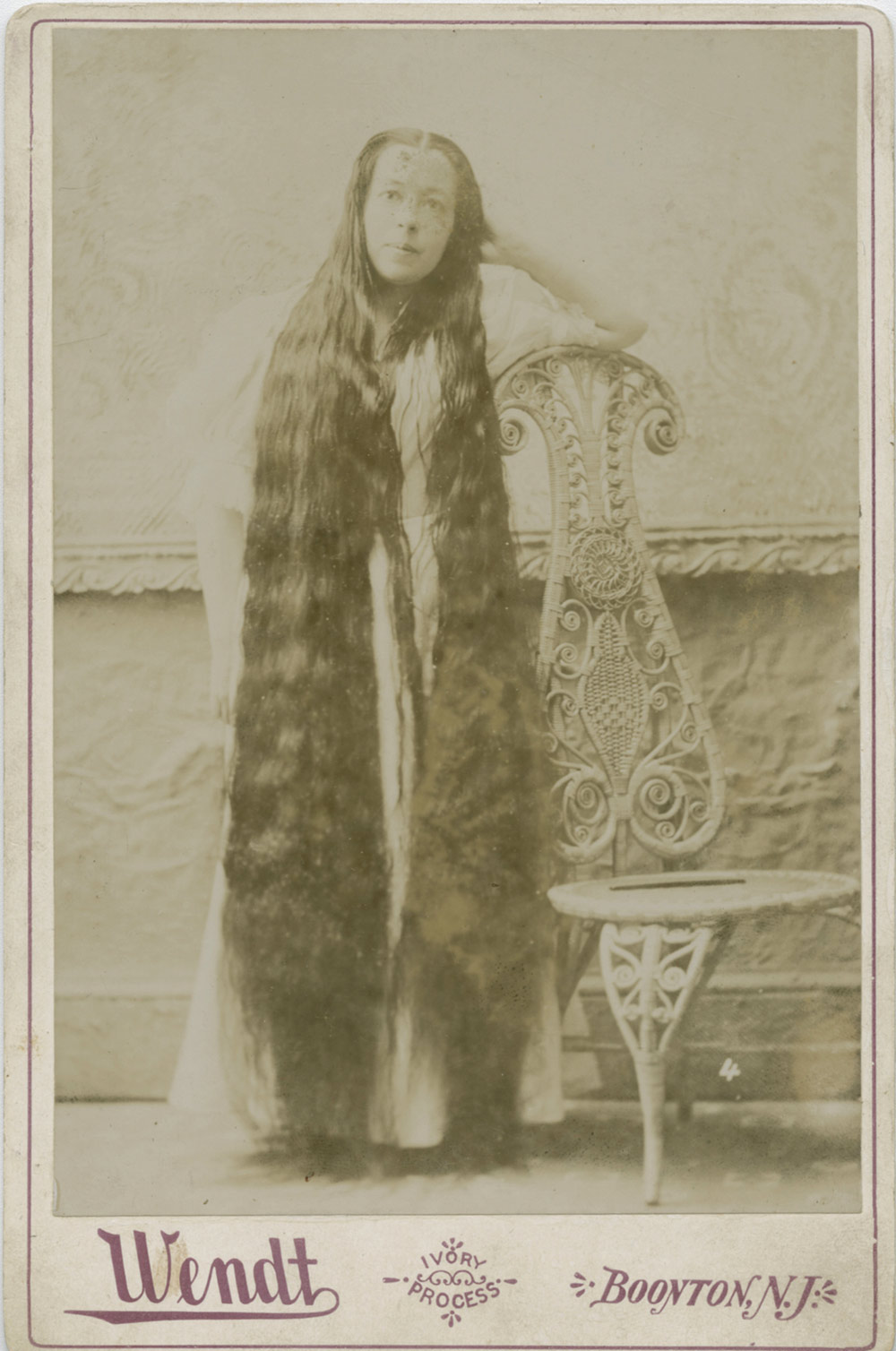
Wendt Studio (New Jersey, United States) Helen Mathews, Length of hair 6 feet 4 inches 19th century Albumen print mounted on cabinet card
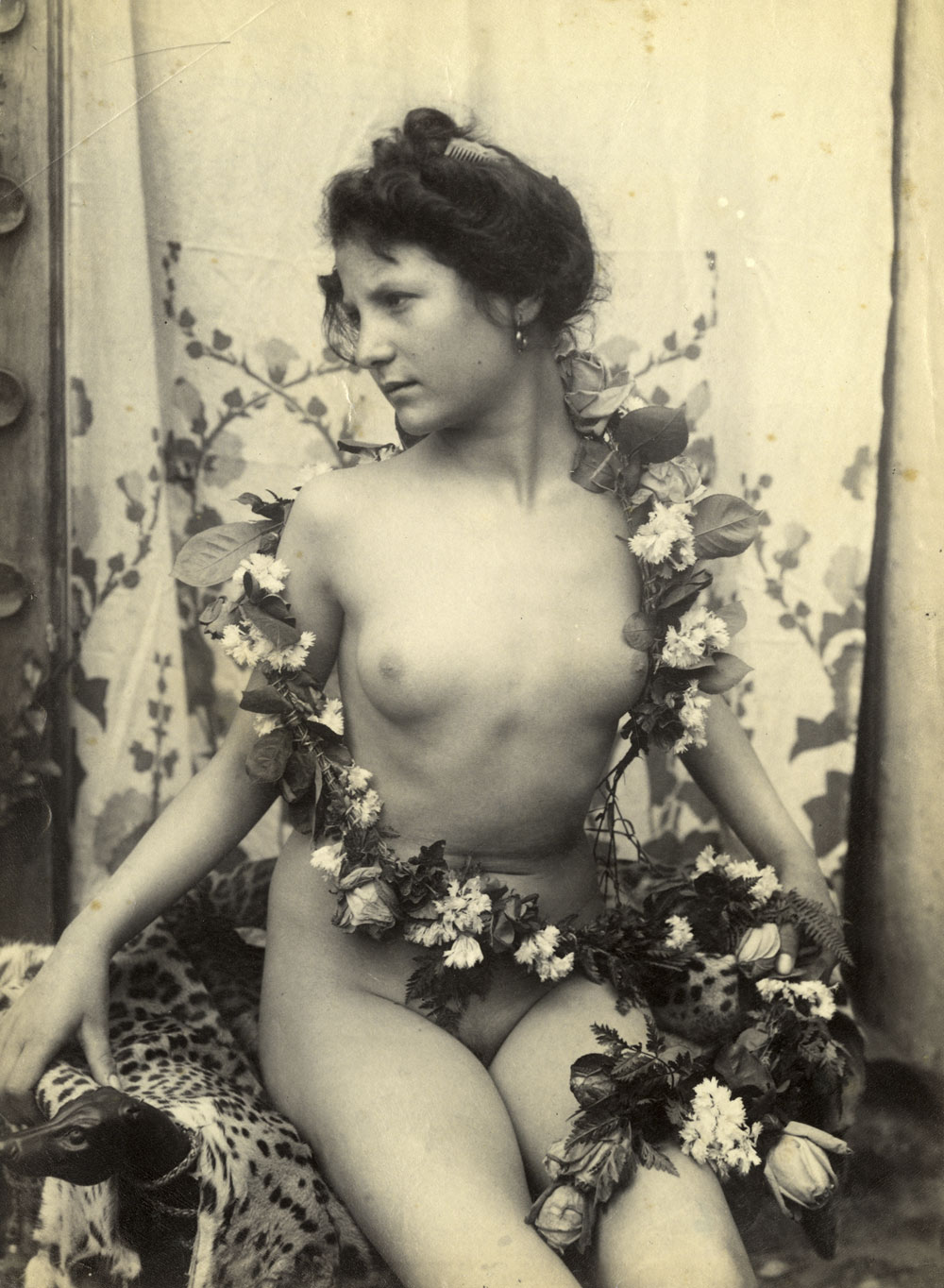
Guglielmo Plüschow (Wilhelm von Plüschow, Germany 1852-1930) Female nude Italy, c. 1890 Albumen print
Exhibition dates: 7th October, 2014 – 12th April, 2015
Curator: Carol Jacobi with Dr Brian May and Denis Pellerin
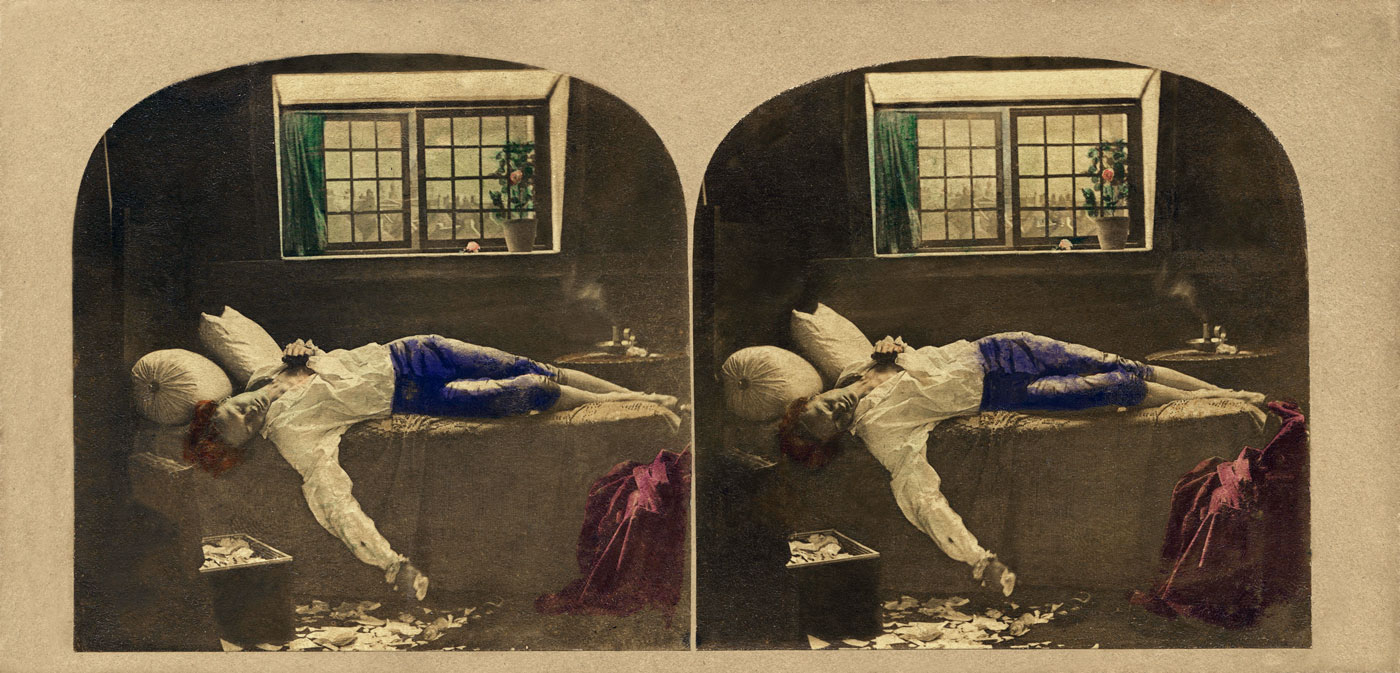
James Robinson (Ireland, 1850s-1870s) The Death of Chatterton 1859 Two photographs, hand-tinted albumen prints on paper mounted on card Collection Dr Brian May
I have always been fascinated by early three-dimensional photography, inexpensive stereograph pictures. To me, they are an early form of VR. You bring a machine to your eyes, focus and wham, your in another world – just like wearing an enveloping VR headset. Here are the Pyramids, or the Venice canals, right in front of you. The pictures separate fore, mid and background so there is real depth to the tableaux, like sitting in an iMax cinema and watching old New York come to life. The photographs seem to reach out to you, not just the scene being brought to life, but the transcendence of time as well. This is how these things looked all those years ago in Technicolor 3D. Even now, there is nothing quite like looking through a stereoscope viewer.
In this exhibition we see that, not only did photographers copy famous paintings, but new innovation and mis en scene techniques in photography also inspired painters. “Stereographic techniques of arranging real figures in compositions that were at once carefully composed and naturally spontaneous were particularly pertinent to Pre-Raphaelite painters, who observed and used friends and acquaintances as models in inventive and expressive new poses.”
Both mediums had their advantages: the artistic possibilities of the precocious technology of photography allowed the mind of the viewer “to feel its way into the very depths of the picture” and produce “a surprise such as no painting ever produced.” The photographs added a charm and depth never dreamt of by the original artists, the painters. While “the light and colour [of the photographs] appear crude in comparison with the painting … the stereoscope records ‘every stick, straw, scratch’ in a manner that the painting cannot.” The painters colour harmonies are infinitely more nuanced than the hand-tinted photograph and the brushwork asserts the painter’s individual touch.
But, as curator Carol Jacobi’s erudite essay “Tate Painting and the Art of Stereoscopic Photography,” (which is well worth the time to read) observes, one medium did not defer to the other but played off each other, working in different form in the service of realism. As Jacobi observes, “The problems and possibilities of realism… underpinned the dialogue between painters and stereographers.” For example, “Robinson’s The Death of Chatterton illustrates the way this uncanny quality [the ability to record reality in detail] distinguishes the stereograph from even the immaculate Pre-Raphaelite style of Wallis’s painting of the same subject.” Jacobi also notes that, “Unlike painting, stereographs exclude things outside the frame. When the eyes come close to the stereoscope lenses and manage to bring the image into focus they experience the sudden sensation of being in the picture… Stereography was a new art. Gaudin’s stereograph can be seen exploring its distinctive characteristics, the actuality of figures and its immersive three-dimensionality, to bring the Pre-Raphaelite painter’s composition to life in new ways.” You only have to look at Alfred Silvester’s The Road, the Rail, the Turf, the Settling Day (The Turf) (detail, below) to understand what Jacobi is proposing.
The actuality and presence of figures and contexts. This is why this form of photography retains its undoubted fascination.
Dr Marcus Bunyan
Many thankx to Tate Britain for allowing me to publish the photographs in the posting. Please click on the photographs for a larger version of the image. My apologies for some of the small images in the posting, that was all I could get!
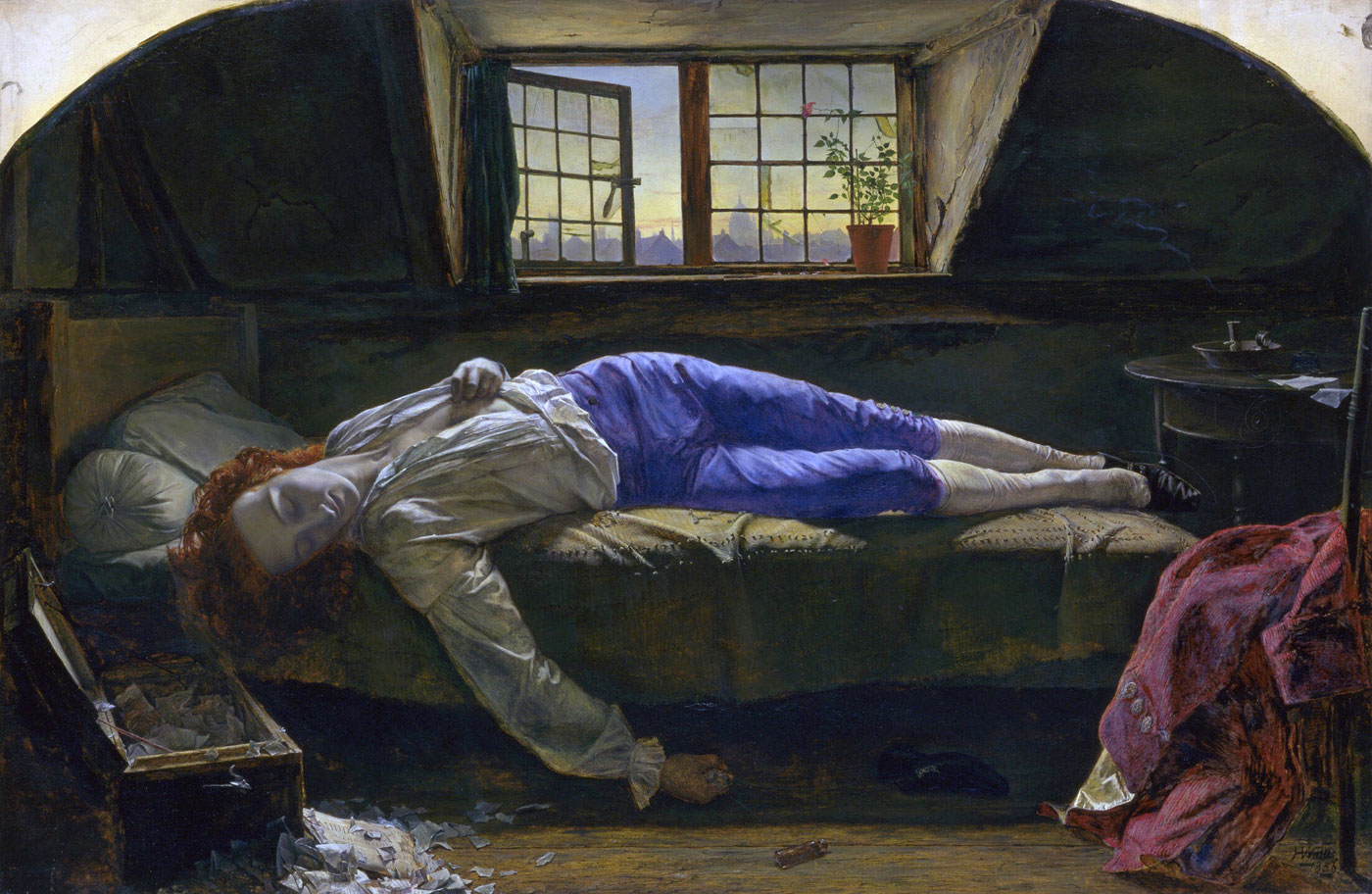
Henry Wallis (British, 1830-1916) The Death of Chatterton 1856 Oil paint on canvas 622 x 933mm Tate Bequeathed by Charles Gent Clement 1899
‘Poor man’s picture gallery’: Victorian Art and Stereoscopic Photography is the first display in a major British art gallery devoted to early three-dimensional photography. These ingenious but inexpensive stereograph pictures were a nineteenth century craze, circulating world-wide in tens of thousands and more. Pioneers of the art form were quick to challenge fine art itself. Celebrated canvases of the age, such as Henry Wallis’s Chatterton and William Powell Frith’s Derby Day, were recreated in real depth.
This display brings twelve of Tate’s Victorian and Pre-Raphaelite works face to face with a rare collection of their three-dimensional doubles assembled by Brian May. Viewers can finally appreciate the interpretations that the photographers explored and the ways they brought the paintings to life. This display has been curated by Carol Jacobi with Dr Brian May and Denis Pellerin. The Poor Man’s Picture Gallery: Stereoscopy versus Paintings in the Victorian Era by Dr Brian May and Denis Pellerin is published 20 October 2014 by the London Stereoscopic Company.
Text from the Tate Britain website
“Holmes’s 1859 article confirms that, in its earliest moment, stereography was thought of in relation to realist painting. “The first effect of looking at a good photograph through the stereoscope is a surprise such as no painting ever produced,” he declared, “the mind feels its way into the very depths of the picture.” He provides a sophisticated understanding of the artistic possibilities of the precocious technology, at the date at which the stereographs on display at Tate Britain were made, but it is the stereographs themselves which bear this out.”
“Many artists, such as Leonardo da Vinci, understood that the world appears to us in three dimensions because our two eyes see from two slightly different angles (look at your hand with one eye covered, then the other eye covered, and you will see it move and alter slightly). Our mind combines these two views to perceive depth. Leonardo concluded that even the most realistic painting, being just one view, can only be experienced in two dimensions.
Nearly 350 years later, in London, the Victorian scientist Charles Wheatstone (1802-1875) took up the challenge. In 1838, he showed that a pair of two-dimensional pictures represented from slightly different viewpoints, brought together in his ‘stereoscope’, could appear three-dimensional. William Fox Talbot announced his technique of print photography a few months later and soon photographs were being taken in pairs for this purpose. Within a decade special cameras and viewers were invented; stereoscopes and stereographs were soon available worldwide. In 1859, Oliver Wendell Holmes’s essay The Stereoscope and the Stereograph celebrated the invention:
The two eyes see different pictures of the same thing, for the obvious reason that they look from points two or three inches apart. By means of these two different views of an object, the mind, as it were, feels round it and gets an idea of its solidity. We clasp an object with our eyes, as with our arms, or with our hands.
Stereographs sold for a few shillings and people of all classes collected them for education and for pleasure. Small hand-held stereoscopes allowed them to gaze on faraway countries, mechanical inventions, comic incidents, beauty spots, zoological or botanical specimens or celebrity weddings, in the comfort of their homes. Three-dimensional images of famous sculptures were especially successful and Dr Brian May’s and Denis Pellerin’s new book, The Poor Man’s Picture Gallery: Stereoscopy versus Paintings in the Victorian Era (2014) has drawn attention to stereo photographers’ engagement with famous paintings of the age. Tate Britain’s display of some of the stereographs in Brian May’s collection creates a dialogue between these and celebrated Tate works, six of which are discussed here. It also introduces the photographers who, with rapidity and invention, took up this new medium.
The phrase ‘poor man’s picture gallery’, borrowed from print-making, appeared in The Times newspaper in 1858 in an article speculating on making stereographs of ‘our most remarkable pictures’. The writer did not think of these as mere imitations: “So solid and apparently real”, they would have “added a charm never dreamt of by their producers”, the original artists. Interestingly, the writer was discussing attempts to make stereographs from the paintings themselves because, he or she regretted, that such elaborate compositions could never be recreated in real life; “No exertion could gather together the characters with the requisite expression and all the adjuncts of suitable scenery… and retain them still until they were fixed by the camera’. This assertion was incorrect.”
James Robinson (Ireland, 1850s-1870s) The Death of Chatterton (detail) 1859 Two photographs, hand-tinted albumen prints on paper mounted on card Collection Dr Brian May
One of the most famous paintings of Victorian times was Chatterton, 1856 (Tate) by the young Pre-Raphaelite-style artist, Henry Wallis (1830-1916). Again, the tale of the suicide of the poor poet, Thomas Chatterton, exposed as a fraud for faking medieval histories and poems to get by, had broad appeal. Chatterton was also an 18th-century figure, but Wallis set his picture in a bare attic overlooking the City of London which evoked the urban poverty of his own age. The picture toured the British Isles and hundreds of thousands flocked to pay a shilling to view it. One of these was James Robinson, who saw the painting when it was in Dublin. He immediately conceived a stereographic series of Chatterton’s life. Unfortunately Robinson started with Wallis’s scene (The Death of Chatterton, 1859). Within days of its publication, legal procedures began, claiming his picture threatened the income of the printmaker who had the lucrative copyright to publish engravings of the painting. The ensuing court battles were the first notorious copyright cases. Robinson lost, but strangely, in 1861, Birmingham photographer Michael Burr published variations of Death of Chatterton with no problems. No other photographer was ever prosecuted for staging a stereoscopic picture after a painting and the market continued to thrive…
Robinson’s The Death of Chatterton illustrates the way this uncanny quality [the ability to record reality in detail] distinguishes the stereograph from even the immaculate Pre-Raphaelite style of Wallis’s painting of the same subject. The stereograph represented a young man in 18th-century costume on a bed. The backdrop was painted, but the chest, discarded coat and candle were real. Again, the light and colour appear crude in comparison with the painting but the stereoscope records ‘every stick, straw, scratch’ in a manner that the painting cannot. The torn paper pieces, animated by their three-dimensionality, trace the poet’s recent agitation, while the candle smoke, representing his extinguished life, is different in each photograph due to their being taken at separate moments. The haphazard creases of the bed sheet are more suggestive of restless movement, now stilled, than Wallis’s elegant drapery. Even the individuality of the boy adds potency to his death.
Extract from the essay by Carol Jacobi. “Tate Painting and the Art of Stereoscopic Photography,” on the Tate website 17th October, 2014 [Online] Cited 14/02/2015. Used under fair use conditions for the purposes of education and research
Michael Burr (British, 1826-1912) Hearts are Trumps 1866 Hand coloured albumen prints on stereo card Collection Dr Brian May
Michael Burr (British, 1826-1912) Hearts are Trumps (details) 1866 Hand coloured albumen prints on stereo card Collection Dr Brian May
Stereographic techniques of arranging real figures in compositions that were at once carefully composed and naturally spontaneous were particularly pertinent to Pre-Raphaelite painters, who observed and used friends and acquaintances as models in inventive and expressive new poses. Michael Burr was skilled at intimate scenes; The Death of Chatterton was typical of his use of an unusually shallow, portrait-like space. In 1866, Burr’s Hearts are Trumps (above) photographed three women in modern dress. They interact casually around a card table, and one regards us directly, but they are at the same time artfully positioned equally close the picture plane. This created a natural effect while keeping them the same length from the camera to avoid the distortions that a lens gives to near objects at different distances. Six years on, Sir John Everett Millais adapted the stereograph’s composition in his own Hearts are Trumps (1872, Tate, below). He might have incorporated its informal effect to challenge accusations that had recently appeared in the press that he could not represent modern beauties in contemporary fashion. The life-like size of Millais’s image fills the field of vision with the same impact that the encompassing scene presents in the stereoscope…
Millais’s Hearts are Trumps may have nodded to the alternative stereographic art form, but it did not defer to it. His colour harmonies are infinitely more nuanced than Burr’s hand-tinted photograph. The brushwork whips up extra vivacity and asserts the painter’s individual touch. Nonetheless, Oliver Wendell Holmes argued that stereography had its own artistic possibilities:
The very things which an artist would leave out, or render imperfectly, the photograph takes infinite care with; there will be incidental truths which interest us more than the central object of the picture… every stick, straw, scratch… look at the lady’s hands. You will very probably find the young countess is a maid-of-all-work.
Extract from the essay by Carol Jacobi. “Tate Painting and the Art of Stereoscopic Photography,” on the Tate website 17th October, 2014 [Online] Cited 14/02/2015. Used under fair use conditions for the purposes of education and research
Sir John Everett Millais, Bt (English, 1829-1896) Hearts are Trumps 1872 Oil on canvas 1657 x 2197mm Tate Presented by the Trustees of the Chantrey Bequest 1945
In its style, which recalls the works of the eighteenth-century painter Sir Joshua Reynolds, and in its flattering depiction of the fashionable sitters, this picture expresses a gentle and nostalgic vision of family life. Elizabeth, Diana and Mary, daughters of Walter Armstrong of Scotland and London, were in their twenties when Millais painted them. Mary holds most of the trumps and looks towards the viewer. Delicately, the card game hints at sisterly competition in husband-finding.
William Powell Frith (English, 1819-1909) Dolly Varden c. 1842-1849 Oil on wood 273 x 216 mm Tate. Bequeathed by Mrs E.J. Thwaites 1955
The delightfully fluttery Dolly Varden is a character in Charles Dickens’ novel Barnaby Rudge, published in 1841. Its action is set in the London of the 1780s. Dickens describes Dolly, daughter of a worthy locksmith, as “the very pink and pattern of good looks, in a smart little cherry coloured mantle.” This work, apart from drawing on a well-known novel of the day, also owes much to a strong nineteenth-century tradition of ‘fancy portraits’ – where likenesses of pretty and anonymous young women would be graced by the names of characters from literature.
Frederic Jones (British, active 1861-1868) Dolly Varden 1858 Albumen prints on paper mounted on card Collection Dr Brian May
The problems and possibilities of realism were fundamental to 19th-century science and literature as well as the arts. It underpinned the dialogue between painters and stereographers. Even painted subjects from history and literature represented by stereographers appear to have been chosen for their familiar, everyday aspects. This shared realism reflected and therefore appealed to 19th-century audiences and was essential to the medium’s success. In 1854 The London Stereoscopic Company was set up on Oxford Street to sell stereographs and stereoscopes. Its first catalogue (1856) advertised scenes as ‘Miscellaneous Subjects of the “Wilkie” character’, referring to the most famous genre painter of the day, Sir David Wilkie. Wilkie’s younger rival, William Powell Frith (1819-1909), and Welsh photographer Frederic Jones (1827 – date not known), a manager of the London Stereographic Company, recreated one of his most popular paintings, Dolly Varden. Frith’s composition was taken in turn from Charles Dickens’s (1812-1870) classic realist novel Barnaby Rudge (1841). It drew on the popularity of the author and book, and was intended to reach a similarly broad audience in the form of engraved prints. Although Dickens’s story was set in the 18th-century, the episode Frith chose, in which Dolly came across a man when she was alone in the woods and laughed bravely, appealed to modern preoccupations with women’s vulnerability and independence. Both Frith’s and Jones’s pictures placed the viewer in the position of the approaching man, but only Jones’s three-dimensional Dolly offered the spectator the opportunity to “clasp an object with our eyes, as with our arms, or with our hands,” as Holmes put it, as her predator does in the book. Fortunately, Dolly eventually eluded his attentions.
Extract from the essay by Carol Jacobi. “Tate Painting and the Art of Stereoscopic Photography,” on the Tate website 17th October, 2014 [Online] Cited 14/02/2015. Used under fair use conditions for the purposes of education and research
William Collins (English, 1788-1847) Happy as a King (replica) c. 1836 Oil paint on canvas 711 x 914mm Tate Presented by Robert Vernon 1847
Michael Burr (British, 1826-1912) Happy as a King 1865 Hand coloured albumen prints on stereo card Collection Dr Brian May
Michael Burr (British, 1826-1912) Happy as a King (detail) 1865 Hand coloured albumen prints on stereo card Collection Dr Brian May
Astronomer and Queen‘s guitarist, Dr Brian May has lent a rare collection of Victorian stereographic photographs to Tate Britain. They are featured in ‘Poor man’s picture gallery’: Victorian Art and Stereoscopic Photography until 12 April 2015. This is the first display in a major British art gallery devoted to the nineteenth-century craze of three-dimensional photography, known as stereographs, and open up this neglected area of British art.
In the 1850s and 1860s pioneer photographers staged real men, women and children in tableaux based on famous paintings of the day, in order to bring them to life as three-dimensional scenes. Henry Wallis’ Chatterton 1856, William Powell Frith’s Derby Day 1857 and John Everett Millais’ The Order of Release 1746 are among twelve of Tate’s famous Victorian and Pre-Raphaelite paintings to be shown with their 3D hand-coloured photographic equivalents.
Stereographs comprise two photographs of the same scene taken from fractionally different viewpoints. When these are mounted side by side and viewed through a stereoscope, the viewer sees just one three-dimensional image. Stereographs were inexpensive, and in the 1850s and 1860s they circulated world-wide in their tens of thousands. Many Victorians became familiar with well-known paintings through their stereoscopic counterparts which became known as a ‘Poor Man’s Picture Gallery’. The photographs were regarded by many as fairly disposable, making them hard to track down today.
The display introduces important figures in stereoscopic photography such as Alexis Gaudin and Michael Burr, and shows how some of their innovations also inspired painters. Burr’s stereograph Hearts are Trumps 1866 anticipated John Everett Millais’ voluptuous painting with the same title six years later, and James Elliott’s Derby Day, One Week after the Derby 1858, pre-empted Robert Martineau’s renowned oil painting of family ruin, The Last Day in the Old Home 1862.
Dr Brian May, said: “We’re thrilled that for the very first time Stereographs are now on view at Tate. In this unique display they can be viewed in their full 3-D splendour alongside the beautiful Victorian narrative paintings to which they relate. We’re grateful to Tate Britain, and hope to inspire a new love of stereoscopy in the 21st Century.”
Carol Jacobi, Curator, British Art, 1850-1915, Tate Britain said: “This display allows us to consider the works in Tate’s collection in a new light. We are delighted to be collaborating with Dr Brian May, who has built this collection over 40 years, and with Denis Pellerin, who has researched the connections.”
The photographs exhibited in this display at Tate Britain are kindly lent by Dr Brian May. This display has been curated by Carol Jacobi with Dr Brian May and Denis Pellerin. The book The Poor Man’s Picture Gallery: Stereoscopy versus Paintings in the Victorian Era by Dr Brian May and Denis Pellerin is published by the London Stereoscopic Company on 20 October 2014.
Press release from Tate Britain
Charles Robert Leslie (English, 1794-1859) A Scene from Tristram Shandy (‘Uncle Toby and the Widow Wadman’) 1829-1830, exhibited 1831 Oil paint on canvas 813 x 559mm Tate Presented by Robert Vernon 1847
Anonymous photographer Uncle Toby Nd Albumen prints on paper mounted on card Collection Dr Brian May
Sir John Everett Millais, Bt (English, 1829-1896) The Order of Release 1746 1852-1853 Oil on canvas 1029 x 737mm Tate Presented by Sir Henry Tate 1898
In 1855, the French photographer Alexis Gaudin (1816-1894) saw the Scottish scene from the Jacobite Rebellion, The Order of Release, 1746 by John Everett Millais(1829-1896), at the first Exposition Universelle in Paris. A woman carrying a sleeping child comforts her wounded husband, a defeated rebel, while handing an order for his release to a gaoler. Shortly afterwards, Gaudin made a stereograph, the rare surviving examples of which bear no title, which posed a young woman, child and two men in the same attitudes (Untitled, after Millais, The Order of Release, c. 1855).
Millais’s subject may have appealed to the Frenchman because of its theme of revolution (the Jacobites had been supported by France) and he may have hoped to capitalise on the painting’s popular success. It is notable too, however, that the picture is an example of Pre-Raphaelite realism, not just in appearance, but in the emotions expressed in pose and expression. Millais’s figures were, moreover, renowned as portraits of real people. Pre-Raphaelite painting was a challenge to photography, which Gaudin took up.
Gaudin’s stereograph was not a copy of Millais’s composition; it was a response to it. His image combined a backdrop painted in the conventional way behind the figures with real furniture and a door jutting out in front. Such round and rectangular geometric objects became common in stereographs because they created clear three-dimensional shapes. Like Millais, Gaudin used real models. They express the sternness, despair and stoicism of the gaoler, soldier and wife. The child’s bare legs and feet and head dropping on the mother’s shoulder indicate that s/he is sleeping, innocent of the tense exchange. The dog is probably an example of taxidermy as a real one is unlikely to have stayed still while the photograph, which would have been exposed over several seconds, was taken. Since they were taken and developed, the pictures have been hand-coloured.
Differences between the painting and the stereograph adapted Millais’s image to the new medium and new ideas. The gaoler could be resting the hand holding the order against the rebel’s shoulder to avoid moving and blurring the image, or Gaudin may have liked the juxtaposition of the document of release with the window indicating the outside world. The little dog is less romanticised than Millais’s loyal, silky specimen. It would have been recognisable at the time as a typical British terrier breed, a working dog similar to Bullseye, familiar from Phiz’s illustrations to Dickens’s Oliver Twist (1837). This proletarian touch is compounded by the dog’s apparent interest in the empty food bowl.
Gaudin’s image could conjure reality in ways not available to Millais. Unlike painting, stereographs exclude things outside the frame. When the eyes come close to the stereoscope lenses and manage to bring the image into focus they experience the sudden sensation of being in the picture. Even the tiny scale of the scenes imitates the scale at which distant objects are experienced in life (to get a sense of this, look at a person on the other side of the room and holding your hand near your eye line up your forefinger with their head and your thumb with their feet). This characteristic provided Gaudin with a different way to explore Millais’s theme of imprisonment. The painter created an enclosed feeling for the viewer with a claustrophobic shadowy shallow space. The stereographer used a deeper room so that when seen through the viewer the figure, and the viewer, are enclosed within its walls.
Stereography was a new art. Gaudin’s stereograph can be seen exploring its distinctive characteristics, the actuality of figures and its immersive three-dimensionality, to bring the Pre-Raphaelite painter’s composition to life in new ways. This complexity was admired at the time: “It is a mistake to suppose one knows a stereoscopic picture when he has studied it a hundred times,” Holmes advised. Tate Britain’s display provides the opportunity to view originals with and without the stereoscopic viewer, and examine and appreciate their distinctive approach.
Extract from the essay by Carol Jacobi. “Tate Painting and the Art of Stereoscopic Photography,” on the Tate website 17th October, 2014 [Online] Cited 14/02/2015. Used under fair use conditions for the purposes of education and research
Alexis Gaudin (French, 1816-1894) Untitled, after Millais, The Order of Release c. 1855 Two photographs, hand-tinted albumen prints on paper mounted on card Collection Dr Brian May
Alexis Gaudin (French, 1816-1894) Untitled, after Millais, The Order of Release (detail) c. 1855 Two photographs, hand-tinted albumen prints on paper mounted on card Collection Dr Brian May
Philip Hermogenes Calderon (English born France, 1833-1898) Broken Vows 1856 Oil paint on canvas 914 x 679mm Tate Purchased 1947
James Elliott (British, active 1860s) Broken Vows Nd Two photographs, hand-tinted albumen prints on paper mounted on card Collection Dr Brian May
James Elliott (British, active 1860s) Broken Vows (detail) Nd Two photographs, hand-tinted albumen prints on paper mounted on card Collection Dr Brian May
William Powell Frith (English, 1819-1909) The Derby Day 1856-1858 Oil paint on canvas 1016 x 2235mm Tate Bequeathed by Jacob Bell 1859
When The Derby Day was first exhibited at the Royal Academy in 1858, it proved so popular that a rail had to be put up to keep back the crowds. It presents a panorama of modern Victorian life, a previously unknown genre which Frith largely created in his earlier work, Life at the Seaside, Ramsgate Sands of 1854 (Royal Collection). Frith was a firm believer in the spurious sciences of phrenology and social type, which considered people’s characters and social origins were visible in their physical features. Each character in Frith’s picture is depicted to conform to these stereotypes, notably in the range of criminal and low-life types present (see Cowling 1989, Ch.2).
On the basis of an initial sketch, which he made after a visit to Epsom in 1856, Frith was commissioned by Jacob Bell, a chemist and amateur artist, to paint a large 5-6 foot canvas for £1,500. He worked on the project for fifteen months, producing two large sketches in addition to the finished work. He brought the composition together with the aid of drawings and sketches, hiring models to pose for all the main figures. He also commissioned the photographer Robert Howlett to “photograph for him from the roof of a cab as many queer groups of figures as he could” (Journal of the Photographic Society, 15 January 1863). He asked a real jockey called Bundy to pose on a hobbyhorse in his studio for the riders on the right of the picture, and also hired an acrobat and his son, whom he saw performing in a pantomime in Drury Lane. For the remaining figures he called on family and friends, as well as a string of young women sent by Jacob Bell.
Despite a remarkable feat of organisation, the picture remains fairly static, and the figures are more interesting when examined individually. There are three main incidents taking place in the picture. On the far left, next to the Reform Club’s private tent, a group of men in top hats focus on the thimble-rigger with his table, inviting the audience to participate in the game. The man taking a note from his pocket is the trickster’s accomplice. He is tempting the rustic-looking man in a smock, whose wife is trying to restrain him. On the right of this group, another man, with his hands in his pockets, has had his gold watch stolen by the man behind. In the centre of the picture we see the acrobat and his son, who looks longingly over at a sumptuous picnic being laid out by a footman. Behind them are carriages filled with race-goers, including a courtesan on the far right, who is the kept mistress of the foppish-looking character leaning against the carriage. The courtesan is balanced on the far left of the picture by the woman in a dark riding habit, one of a number of high-class prostitutes who daily paraded on horseback in Hyde Park.
Text from the Tate website
Alfred Silvester (British, active 1850s-1860s) The Road, the Rail, the Turf, the Settling Day (The Rail Second Class) 1859 Two photographs, hand-tinted albumen prints on paper mounted on card Collection Dr Brian May
Alfred Silvester (British, active 1850s-1860s) The Road, the Rail, the Turf, the Settling Day (The Rail Second Class) (detail) 1859 Two photographs, hand-tinted albumen prints on paper mounted on card Collection Dr Brian May
Alfred Silvester (British, active 1850s-1860s) The Road, the Rail, the Turf, the Settling Day (The Turf) 1859 Two photographs, hand-tinted albumen prints on paper mounted on card Collection Dr Brian May
Alfred Silvester (British, active 1850s-1860s) The Road, the Rail, the Turf, the Settling Day (The Turf) (detail) 1859 Two photographs, hand-tinted albumen prints on paper mounted on card Collection Dr Brian May
The relationship between photography and painting went two ways. In the mid 1850s, Frith began to use photographs to help him paint elaborate and up-to-date scenes on a very large scale. Lively descriptions of racegoers at Epsom often appeared in popular magazines such as Punch (1949) and Dickens’s Household Words (Epsom, 1852) and between 1856 and 1858 he created a panorama of the crowds, Derby Day (Tate). It caused a sensation. Its quality of reflecting its modern audience is clear from a contemporary comment from the Birmingham Daily Post:
“Frith’s picture will conjure around it as great a crowd of gazers as any to be found even on the most crowded part of the racecourse.”
Stereography had the potential to take the viewer inside the crowd’s jostling and excitement. “The elbow of a figure stands forth so as to make us almost uncomfortable,” as Holmes observed. To this end, the London photographer Alfred Silvester (1831-1886) published two series based on the Epsom Races, National Sports, The Race-course of which there are several variations echoing the different scenes within Frith’s painting, and The Road, the Rail, the Turf, the Settling Day (1859) a series of five. They were the portrait shape required by the stereoscope rather than panoramas like Frith’s painting, but Silvester squeezed in dozens of people. The Turf (below) contained an astonishing 60 gesticulating figures in front of a painted backdrop of more distant crowds. Carriage wheels and cylindrical top hats occupy the foregrounds to enhance the three-dimensional effect.
Silvester expanded Frith’s narrative in time as well as content (moving pictures were still 40 years away). The Road, the Rail, the Turf, the Settling Day began with the exodus from London to Epsom Downs and ended with the settlement of bets. This narrative momentum was complemented by motion within the pictures. In The Road, aristocrats ride in their fine carriages while in The Rail (Second Class) (above) and The Rail (Third Class) the less well-to-do travel on the new railway from London Bridge to Sutton, opened in 1847. The Turf shows three horses (sculpted from papier mâché and rather reminiscent of those in the Elgin Marbles in the British Museum) plunging headlong through the crowd. Further movement is contributed by the people. In each, Silvester orchestrated incessant activity in poses which betray no hint that they were held for several seconds. The Turf is the most spectacular, where all 60 people cheer and gesticulate. In The Rail (Second Class) a man kneels solicitously offering refreshment to a woman who appears to have fainted. Her child and others look on while an older gentleman (whose covered nose suggests he may be suffering from syphilis) shows his disapproval. The action continues into depth; in the background two men fight with bottles and a white top-hatted figure looms troublingly over a young girl.
Such photographs informed and challenged the naturalism of Frith’s painting and influenced others of the period. William Maw Egley’s (1826-1916) Omnibus Life in London (1859, below) depicted the discomforts, intrusions and intrigues of mass transport from a viewpoint within – or just outside – the carriage (an omnibus in this case, introduced 1826) which envelops the observer in a similar manner to Silvester’s The Rail (Second Class).
Extract from the essay by Carol Jacobi. “Tate Painting and the Art of Stereoscopic Photography,” on the Tate website 17th October, 2014 [Online] Cited 14/02/2015. Used under fair use conditions for the purposes of education and research
William Maw Egley (English, 1826-1916) Omnibus Life in London 1859 Oil on canvas 448 x 419mm Tate Bequeathed by Miss J. L. R. Blaker 1947
The painting of modern-life subjects was popularised during the 1850s by such artists as William Frith (1819-1909). Artists deliberately chose subjects such as racetracks, seaside resorts and busy streets where all classes of society could be represented in the one picture. Following this trend, Egley exhibited Omnibus Life in London at the British Institution in 1859. He may have been inspired by the French artist Honoré Daumier’s pictures of the cramped interior of railway carriages, but comparisons can also be drawn with such works as Charles Rossiter’s To Brighton and Back for 3s 6d (Birmingham City Museum and Art Gallery), painted in the same year as Egley’s picture.
The omnibus – a horse-drawn carriage that picked up and deposited people along an established route – was introduced into London on 4 July 1829 and quickly became a popular mode of transport. One observer commented that, “Among the middle classes of London the omnibus stands immediately after air, tea, and flannel, in the list of the necessaries of life… the Londoner cannot get on without it.” (M.E. Purgini in Victorian Days and Ways, London 1936). To achieve as authentic an effect as possible, Egley painted the interior of the omnibus in a coach builder’s yard in Paddington. The view out of the back of the bus is of Westbourne Grove, painted from the chemist’s shop at the corner of Hereford Road where Egley lived. He posed the sitters in a makeshift ‘carriage’ constructed from boxes and planks in his back garden.
Egley painted the scene as if glimpsed through a window and attempted to convey the claustrophobic and cramped conditions that the passengers were forced to endure. The subject permitted him to portray every class of society, from an old country woman, perhaps a family servant, with her piles of baggage, to the city clerk with his cane. The old woman stares sympathetically towards the young mother and her children, who avert their gazes, in a gesture of gentility. The mother was modelled on Egley’s wife and the ringletted daughter was posed for by a twelve-year old girl, Susannah (Blanche) Rix.
Egley worked on the picture for 44 days and sold it to a man called William Jennings for £52 10s. It was described by the Illustrated London News as follows: “a droll interior, the stern and trying incidents of which will be recognised by thousands of weary wayfarers through the streets of London.”
Text from the Tate website
James Elliott The Last Look 1858 Two photographs, hand-tinted albumen prints on paper mounted on card Collection Dr Brian May
Similarly, a series by James Elliott (1833-?) charting the aftermath of the Derby appears to have pre-empted The Last Day in the Old Home 1862 (Tate, below) by Robert Braithwaite Martineau (1826-1869). Elliott’s One Week after the Derby extended Frith’s Derby Day into the future to show an auctioneer assessing the belongings of a family ruined by the races. The Last Look (above) shows them leaving their house. Lot numbers have been attached to the furniture and in the background a servant, who has also lost her home, weeps. A horse print on the floor hints at the husband’s extravagant habits and only the grandmother, wife and daughter look back with regret. The last picture, Sold Up, shows the auction. The doll’s house which the little girl must to leave behind, a miniature replica of her home and her aspirations for the future is placed poignantly in the foreground. These narratives and motifs had been widely used in literature and cartoons since the time of William Hogarth, but Martineau’s image of a middle-class family forced to sell their home is close to Elliott’s The Last Look. Martineau adopted a photographic composition, figures enclosed within a room cluttered with clues to both narrative and depth. A stereograph-style view into another space shows men assessing possessions. Lot numbers are attached to the furniture. Another horse image suggests gambling. Once more, the women show regret while the husband appears unconcerned, cheerily leading his son down the same path.
Extract from the essay by Carol Jacobi. “Tate Painting and the Art of Stereoscopic Photography,” on the Tate website 17th October, 2014 [Online] Cited 14/02/2015. Used under fair use conditions for the purposes of education and research
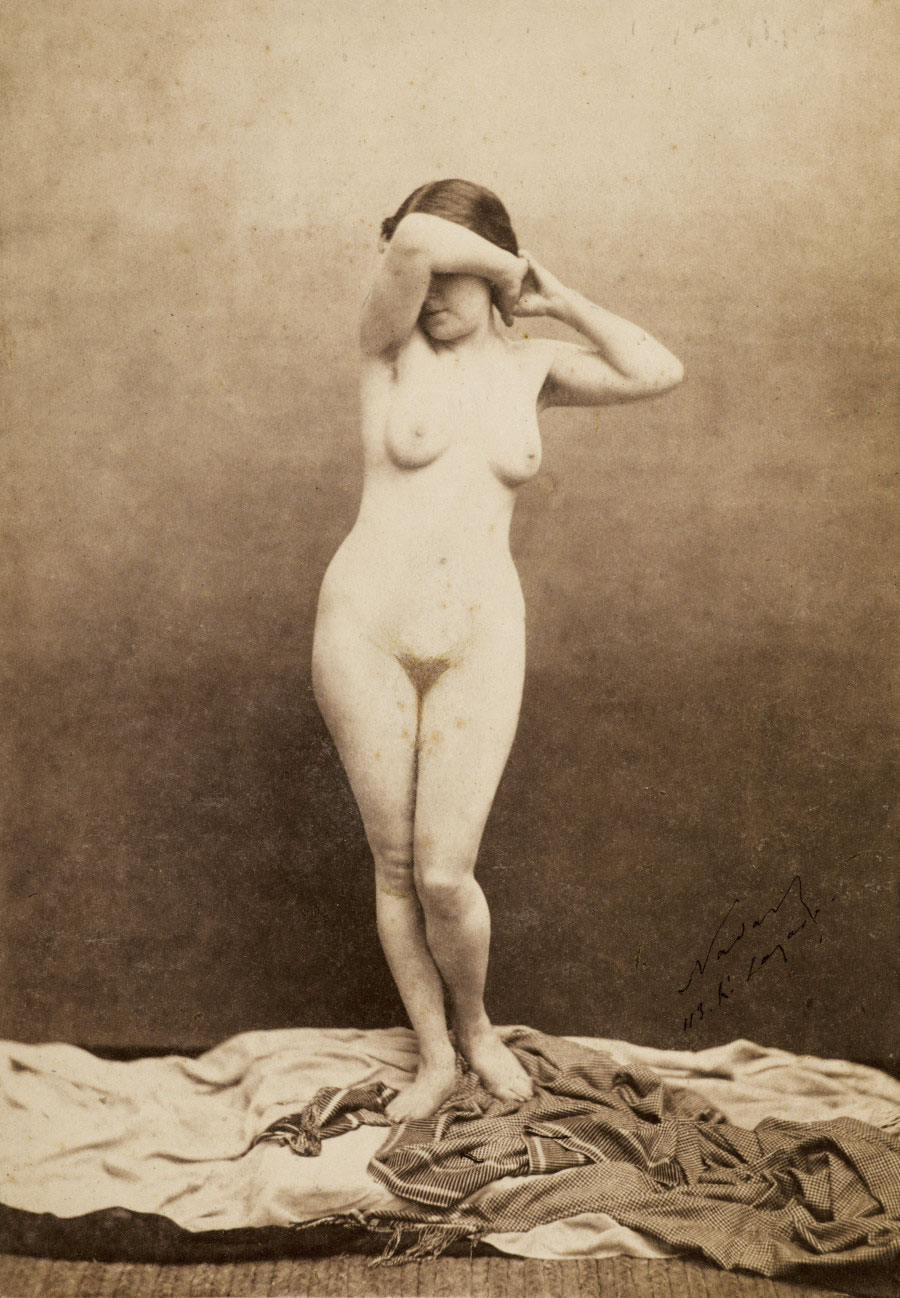
Robert Braithwaite Martineau The Last Day in the Old Home 1862 Oil on canvas 1073 x 1448mm Tate Presented by E.H. Martineau 1896
Tate Britain Millbank, London SW1P 4RG United Kingdom Phone: +44 20 7887 8888
The Prince saw the Parthenon on 30 May, the day before Bedford took this photograph. The group drove there in a carriage at 8am, stopping on the way to see a newly excavated amphitheatre. At the Acropolis, the royal party was joined by the Director of Antiquities who showed them the site. The Prince described the ruins as ‘beautiful’.
The photograph is signed, dated and captioned in the negative, ‘F Bedford Athens 163’, 31 May 1862. See RCIN 2861702 for another print of the same image.
These photographs are absolutely glorious!
Bedford had one advantage… what subject matter to work with. The quality is outstanding and the images really bring these treasures alive. The photographs breathe history, but they also breathe the space and light that surround these great monuments.
It takes special skill as an artist to position the camera in just the right place – to tension the image, to let it breathe, to capture the magic of their continued existence – like Charles Marville and Eugène Atget did with the streets of Old Paris. You can see why Francis Bedford was considered one of the finest landscape photographers in Victorian England.
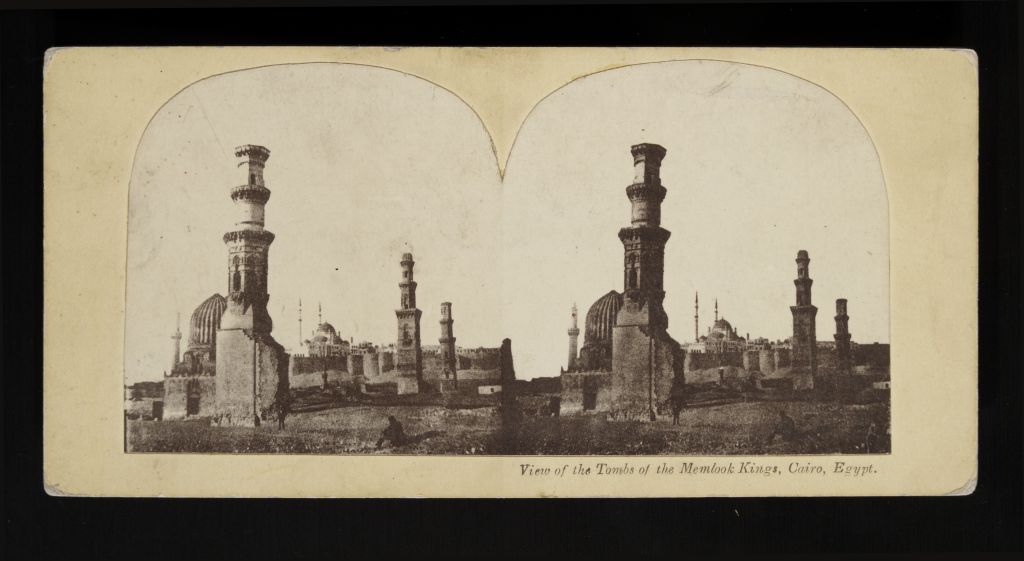
Just look at the space in photographs such as Acropolis and Temple of Jupiter Olympus (31 May 1862, below) and, my favourite, Tombs of the Memlooks at Cairo (25 Mar 1862, below). In the latter, vibrations in the energy of the air and the earth – oscillating at numerous frequencies simultaneously – flow towards the viewer like a sound wave, akin to musical harmonics.
These works veritably sing to you. You only have to look at the stereograph by an anonymous photographer of the same subject to realise what a master photographer like Bedford can achieve.
Please look at these photographs at the large size. They are truly stunning.
Dr Marcus Bunyan
Many thankx to The Queen’s Gallery for allowing me to publish the photographs in the posting. Please click on the photographs for a larger version of the image.
“This exhibition follows the journey taken by the Prince of Wales (later King Edward VII) in 1862, as he undertook a four month tour around the Middle East. Seen through the photographs of Francis Bedford (1815-1894), the first photographer to travel on a royal tour, it explores the cultural and political significance Victorian Britain attached to the region, which was then as complex and contested as it remains today.
The tour took the Prince to Egypt, Palestine and the Holy Land, Syria, Lebanon, Turkey and Greece where he met rulers, politicians and other notable figures, and travelled in a manner not associated with royalty – by horse and camping out in tents. On the royal party’s return to England, Francis Bedford’s work was displayed in what was described as “the most important photographic exhibition that has hitherto been placed before the public.”
The photograph shows marble blocks from the frieze that ran around all four sides of the Parthenon, a temple dedicated to the goddess Athena. The frieze was sculpted probably between 438 and 432 BC. In the early 19th century, Thomas Bruce the 7th Earl of Elgin removed about half of the surviving marble blocks from the Parthenon. In 1816 they ended up in the British Museum. The head of the Prince’s party, Robert Bruce, was the younger son of the 7th Earl. Bedford photographed several of the blocks which remained in Athens.
The photograph is signed, captioned and dated in the negative, ‘F Bedford Athens’, 31 May 1862. See RCIN 2861704 for another print of the same image.
After leaving Constantinople, the royal party sailed to Athens. Their first stop upon arrival was to visit the King and Queen of Greece. They then spent two days sightseeing and shopping before rejoining the Royal Yacht. The Erechtheum, set on the Acropolis, is a Greek temple probably built between 421 and 406 BC. The figures of six maidens (the ‘caryatids’) are used to support the porch.
The photograph is signed, captioned and dated in the negative, ‘F Bedford Athens’, 30 May 1862. See RCIN 2861708 for another print of this image.
The best-known and most-copied examples are those of the six figures of the Caryatid Porch of the Erechtheion on the Acropolis at Athens. One of those original six figures, removed by Lord Elgin in the early 19th century, is now in the British Museum in London. The Acropolis Museum holds the other five figures, which are replaced onsite by replicas. The five originals that are in Athens are now being exhibited in the new Acropolis Museum, on a special balcony that allows visitors to view them from all sides. The pedestal for the Caryatid removed to London remains empty. From 2011 to 2015, they were cleaned by a specially constructed laser beam, which removed accumulated soot and grime without harming the marble’s patina. Each Caryatid was cleaned in place, with a television circuit relaying the spectacle live to museum visitors.
Although of the same height and build, and similarly attired and coiffed, the six Caryatids are not the same: their faces, stance, draping, and hair are carved separately; the three on the left stand on their right foot, while the three on the right stand on their left foot. Their bulky, intricately arranged hairstyles serve the crucial purpose of providing static support to their necks, which would otherwise be the thinnest and structurally weakest part.
The columns in the foreground are part of the remains of the Olympieion, also known as the Temple of Olympic Zeus. This vast temple was dedicated to Zeus, King of the Gods. During the Roman period, it was renowned as the largest temple in Greece. The Acropolis, with the ruins of the Parthenon, can be seen beyond.
The photograph is signed, captioned and dated in the negative, ‘F Bedford Athens’, 31 May 1862. See RCIN 2861698 for another print of this image.
The royal party spent about a day and a half exploring Baalbek. Most of the time was spent in and around this temple. The Prince wrote in his journal that ‘Mr Bedford took some excellent views of it, which will be a great addition to his collection of photographs.’
The photograph is signed, captioned and dated in the negative, ‘F Bedford Baalbec’. The number in the Day & Son series is 111.
The six standing columns are all that remain of the colonnade that ran around the outside of the Temple of Jupiter. The columns are the largest in the world, at a height of 22.9 metres. A legend about the founding of Baalbek stated that a race of giants constructed the buildings.
The photograph is signed, captioned and dated in the negative, ‘F Bedford Baalbec’. It is number 106 in the Day & Son series.
In 334 BC, Alexander The Great conquered Baalbek and the process of Hellenization began. After the death of Alexander the Great, the Ptolemies of Egypt invaded Baalbek and they renamed it to Heliopolis, the City of the Sun. They identified Baal with Zeus and the temple was mentioned as a place of oracular divination. During the Greek era, the court was enlarged and a podium was completed to support a classic temple that was never built.
During the Roman era, Baalbek entered its golden age. In 15 BC, Julius Caesar settled in Baalbek and began the construction of a temple complex consisting of three temples: Jupiter (God of sky and thunder), Bacchus (God of agriculture and wine), and Venus (God of love and beauty). On a nearby hill, the Romans built the temple of Mercury. The construction of the temple complex was completed in several phases over three centuries during the Roman Empire.
Extract from Lauren Zak, “Baalbek: The Unsolved Enigma,” on the Exposing the Truth website, June 23, 2014 [Online] Cited 12/07/2021. Used under fair use conditions for the purposes of education and research
The ‘colossi’ are two statues of the Pharaoh Amenhotep III, standing about 18 m (60 ft) high. They are all that remain of a large mortuary temple to Amenhotep, originally serving as guardians to the entrance of the temple. During the Roman period, one of the statues was believed to ‘sing’ at dawn and thus was linked to the legendary figure of Memnon. As the son of Eos the dawn, he was believed to greet her each morning with a sigh.
The photograph is signed, captioned and dated in the negative. The number in the Day & Son series is 38.
The twin statues depict Amenhotep III (fl. 14th century BC) in a seated position, his hands resting on his knees and his gaze facing eastwards (actually ESE in modern bearings) towards the river. Two shorter figures are carved into the front throne alongside his legs: these are his wife Tiy and mother Mutemwiya. The side panels depict the Nile god Hapy.
The statues are made from blocks of quartzite sandstone which was quarried at el-Gabal el-Ahmar (near modern-day Cairo) and transported 675 km (420 mi) overland to Thebes. (They are too heavy to have been transported upstream on the Nile.) The blocks used by later Roman engineers to reconstruct the northern colossus may have come from Edfu (north of Aswan). Including the stone platforms on which they stand – themselves about 4 m (13 ft) – the colossi reach a towering 18 m (60 ft) in height and weigh an estimated 720 tons each The two figures are about 15 m (50 ft) apart.
Both statues are quite damaged, with the features above the waist virtually unrecognisable. The southern statue is a single piece of stone, but the northern figure has a large extentive crack in the lower half and above the waist consists of 5 tiers of stone. These upper levels consist of a different type of sandstone, and are the result of a later (Roman Empire) reconstruction attempt. It is believed that originally the two statues were identical to each other, although inscriptions and minor art may have varied.
The original function of the Colossi was to stand guard at the entrance to Amenhotep’s memorial temple (or mortuary temple): a massive construct built during the pharaoh’s lifetime, where he was worshipped as a god-on-earth both before and after his departure from this world. In its day, this temple complex was the largest and most opulent in Egypt. Covering a total of 35 hectares (86 acres), even later rivals such as Ramesses II’s Ramesseum or Ramesses III’s Medinet Habu were unable to match it in area; even the Temple of Karnak, as it stood in Amenhotep’s time, was smaller.
The Prince and his companions visited the pyramids on camels, which the Prince described as ‘not at all an unpleasant mode of conveyance’. They viewed the Sphinx just before sunset and decided to set up an encampment below the pyramids where they slept for the night in order to climb the Great Pyramid before sunrise the following day.
The photograph is signed, captioned and dated in the negative, ‘F Bedford Pyramids Gizeh’. The number in the Day & Son series is 14.
In 1862, the 20-year-old Prince of Wales, eldest son of Queen Victoria and Prince Albert (and the future King Edward VII), embarked on a tour of the Middle East, accompanied by the photographer Francis Bedford. The resulting images, produced little more than 20 years after the arrival of photography, were the first-ever visual record of a royal tour.
A new exhibition Cairo to Constantinople: Early Photographs of the Middle East on view at The Queen’s Gallery, Buckingham Palace this Friday reveals the Prince’s journey through Egypt, Palestine and the Holy Land, Syria, Lebanon, Turkey and Greece in over 100 spectacular photographs.
The Prince of Wales’s four-month tour, the first official royal tour of the Middle East, had been carefully planned by his parents to occupy him after university and before he was married. Despite Prince Albert’s sudden death just two months earlier in December 1861, Queen Victoria was determined that her son’s visit should go ahead. The Prince travelled in a manner unassociated with royalty at the time, by horse and camping in tents, and met rulers, politicians and other notable figures throughout his journey. He diligently recorded his travels in a private journal, which is on show for the first time.
Photography of a royal tour was a new concept, inspired in part by Queen Victoria and Prince Albert’s avid interest in the medium. Francis Bedford had already impressed the Queen with his photographs of places associated with Prince Albert’s childhood in Germany, an earlier royal commission. In mid-February 1862, the Photographic News announced that the Prince of Wales was to be accompanied by ‘eight gentlemen only’, including Mr Bedford, on a tour to be undertaken ‘in as private a manner as possible’. The presence of a photographer was “the first public act which illustrates that the heir to England’s throne takes as deep an interest in photography as his late royal father.”
The main purpose of Bedford’s work was to capture historic and sacred landscapes – the young Prince and his companions appear in only three of the 191 surviving photographs. Two of these were taken in Egypt, showing the party in front of the pyramids at Giza and at the Temple of Amun at Karnak, ancient Thebes. In the third, they are having lunch under a fig tree at Capernaum, on the northern shore of the Sea of Galilee. The rest of the photographs reflect a growing public demand for romantic images of biblical sites, Egyptian and Greek ruins, and mosques. By the 1860s leisure travel to the Middle East was increasing, stimulated by major archaeological discoveries in the region. The introduction of steamships to Alexandria in 1840 had cut journey times and made the area more accessible for European pilgrims and tourists.
In his lifetime, Francis Bedford was considered one of the greatest British photographers, and on his return from the Middle East many of his photographs of the royal tour were exhibited to the public in a gallery on New Bond Street. Among those now on display for the first time since then are views of the Colossi of Memnon and of the Temple of Horus at Edfu on the west bank of the Nile, in which Bedford’s portable darkroom can be seen in the shadow of the temple. Bedford would have had to take a large amount of equipment with him, including plates, tripods, lenses, chemicals and a darkroom, as well as the camera itself.
A number of antiquities collected by the Prince also are on display for the first time. They include an ancient Egyptian papyrus inscribed with the Amduat, a funerary text which describes the journey of regeneration of Re, the Egyptian sun god, and pottery vessels from an excavation on the island of Rhodes. Also among the objects is a marble fragment from Syria inscribed From the remains of the Christian Quarter at Damascus, May. 1862. Syria, reflecting the devastation caused by the 1860 conflict between the Christian Maronites and the Druze, when the Christian quarter in Damascus was destroyed. A marble bust of Princess Alexandra, who married the Prince the following year, shows her wearing a brooch set with one of the scarabs acquired by the Prince in Egypt, which is also on display.
Sophie Gordon, Royal Collection Trust, curator of the exhibition, said, “Today royal tours are widely photographed, and the pictures are transmitted instantly around the world. Bedford’s photographs were not seen by the public until over a month after the royal party’s return to England, but his presence on the tour was widely reported in the press. The intense interest in his work at the time shows just how innovative and ground-breaking a move it was to invite Bedford to accompany the tour.”
Writer and broadcaster John McCarthy, who has written the foreword to the exhibition publication, said, “The first thing that strikes me about Bedford’s photographs is how good they are. It is only 20 or 30 years after the invention of the medium, and yet the quality of the images is stunning. They manage to bring alive the places the royal party visited, capturing the majesty and romance of what were then largely unvisited sites. One hundred and fifty years on and the Middle East continues to hold our attention – for the wonderful sites, but also for the political landscape in which they are set.
A group of eight men, with the Prince of Wales (later Edward VII) at the centre and Prince Louis of Hesse standing on the right. The Prince of Wales rests his hand against his face, while an open book is held in front of him.
This photograph was taken at the beginning of the Prince of Wales’s tour to the Middle East. He travelled out by train through Europe, meeting various dignitaries en route. Prince Louis of Hesse (who was to marry the prince’s sister, Princess Alice, in July 1862) met the royal party in Darmstadt on 8 February 1862. The Prince of Wales and Prince Louis were photographed with a number of the party who accompanied the Prince from Windsor. The Prince wrote about the occasion in his journal, ‘before luncheon we went through the ordeal of being photography by Mr. Albert and the result was very successful’.
Edfu is the site of an important temple complex to the falcon-headed god Horus, constructed between 237 and 51 BC. The main gateway, properly known as the First Pylon, is covered in carvings showing the Pharaoh Ptolemy XII defeating his enemies in the presence of the god Horus and goddess Hathor, both of whom appear twice, on either side of the gateway.
The photograph is signed, captioned and dated in the negative, ‘F Bedford Edfou’. The number in the Day & Son series is 23.
Edfu is the site of an important temple complex to the falcon-headed god Horus, constructed between 237 and 51 BC. The main gateway, properly known as the First Pylon, is covered in carvings showing the Pharaoh Ptolemy XII defeating his enemies in the presence of the god Horus and goddess Hathor, both of whom appear twice, on either side of the gateway.
The photograph is signed, captioned and dated in the negative, ‘F Bedford Edfou’. The number in the Day & Son series is 22.
Edfu was one of several temples built during the Ptolemaic period, including Dendera, Esna, Kom Ombo and Philae. Its size reflects the relative prosperity of the time. The present temple, which was begun “on 23 August 237 BC, initially consisted of a pillared hall, two transverse halls, and a barque sanctuary surrounded by chapels.” The building was started during the reign of Ptolemy III and completed in 57 BC under Ptolemy XII. It was built on the site of an earlier, smaller temple also dedicated to Horus, although the previous structure was oriented east-west rather than north-south as in the present site. A ruined pylon lies just to the east of the current temple; inscriptional evidence has been found indicating a building program under the New Kingdom rulers Ramesses I, Seti I and Ramesses II. A naos of Nectanebo II, a relic from an earlier building, is preserved in the inner sanctuary, which stands alone while the temple’s barque sanctuary is surrounded by nine chapels.
The temple of Edfu fell into disuse as a religious monument following Theodosius I’s edict banning non-Christian worship within the Roman Empire in 391. As elsewhere, many of the temple’s carved reliefs were razed by followers of the Christian faith which came to dominate Egypt. The blackened ceiling of the hypostyle hall, visible today, is believed to be the result of arson intended to destroy religious imagery that was then considered pagan.
Over the centuries, the temple became buried to a depth of 12 metres (39 ft) beneath drifting desert sand and layers of river silt deposited by the Nile. Local inhabitants built homes directly over the former temple grounds. Only the upper reaches of the temple pylons were visible by 1798, when the temple was identified by a French expedition. In 1860 Auguste Mariette, a French Egyptologist, began the work of freeing Edfu temple from the sands.
The Temple of Edfu is nearly intact and a very good example of an ancient Egyptian temple. The Temple of Edfu’s archaeological significance and high state of preservation has made it a centre for tourism in Egypt and a frequent stop for the many riverboats that cruise the Nile. In 2005, access to the temple was revamped with the addition of a visitor centre and paved carpark. A sophisticated lighting system was added in late 2006 to allow night visits.
Once the royal party returned to Cairo, Francis Bedford spent some time photographing the sites alone while the Prince undertook a separate programme of events. Bedford visited a number of fine examples of Islamic architecture. Emir Qawsun was one of the most powerful emirs during the 14th century. His tomb and khanqah (a large hall for gatherings for prayer and meditation) were built in 1335-1336.
The photograph is signed, captioned and dated in the negative, ‘F Bedford Cairo’. The number in the Day & Son series is 9.
Anonymous photographer View of the Tombs of the Memlook Kings, Cairo, Egypt Nd 7.75 x 4.2 inches From the collection of Dr Paula Sanders, Rice University
View of Mosque of Mohammed Ali in Cairo, Egypt. Alabaster building seen across square, with 2 tall minarets centre. Single row of columns supporting round arches lining court, left. The mosque was built in the Ottoman style between 1830 and 1848 for the son of the ruler Muhammad Ali Pasha (Mehmet Ali). The Prince of Wales and his party visited the mosque on 3 March 1862. They climbed to the roof to get a view of the town and country, and were able to see the pyramids in the distance. They also visited Mehmet Ali’s tomb within the mosque (he died in 1849).
The photograph is signed, captioned and dated in the negative, ‘F Bedford Cairo’. The number in the Day & Son series is 10.
The Prince spent a few days in Cairo before travelling down the Nile. The royal party were taken to visit the Mosque of Muhammad Ali (r. 1805-1848), who was the founder of the dynasty ruling the country at that time. The Mosque, only completed in 1857, remains today one of the most prominent landmarks in the city.
The photographer, Francis Bedford, wrote in his catalogue of this scene, “This light and elegant edifice has long and justly been celebrated as one of the most beautiful fountains in the mosks of Cairo. As is apparent in the Photograph, it is fast hastening to decay; and it is altogether to be lamented that among the inhabitants of modern Egypt so little provision is made for the repair and preservation of interesting monuments of ancient art.” (Bedford photographic catalogue 1862, pp. 4-5).
The photograph is signed, captioned and dated in the negative, ‘F Bedford Cairo’. The number in the Day & Son series is 11.
The Garden of Gethsemane has always been identified as an olive grove. Here the carefully tended, centuries-old olive trees are easily identified.
The photograph is signed, captioned and dated (incorrectly as 2 March 1862) in the negative, ‘F Bedford Gethsemane’. The number in the Day & Son series is 68.
The Mount of Olives rises to the east of Jerusalem. The walled enclosure to the right contains the site identified as the Garden of Gethsemane. After the Last Supper, Jesus went to the garden where he prayed, accompanied by St Peter, St John and St James the Greater. Jesus was subsequently betrayed by Judas in the garden and arrested.
The photograph is signed, captioned and dated (incorrectly as 2 March 1862) in the negative, ‘F Bedford Jerusalem’. The number in the Day & Son series is 63.
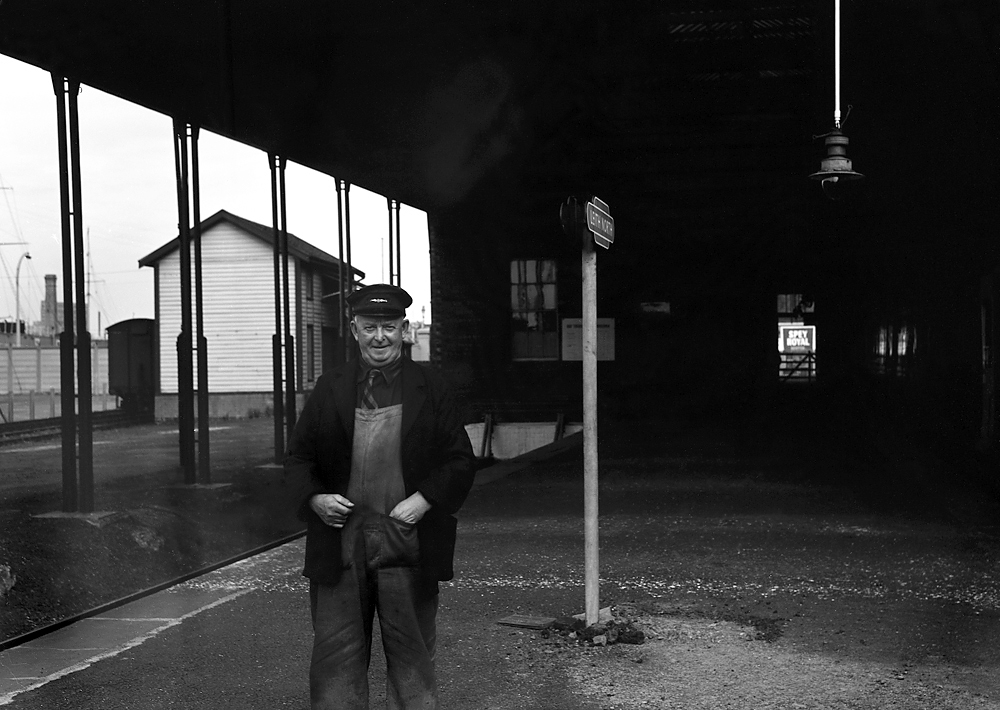
The Islamic shrine was constructed on a site traditionally identified with Solomon’s Temple, which was later replaced with the Second Temple only to be destroyed by the Romans. The Dome of the Rock was constructed between 688 and 691 AD. The ‘rock’ is believed to be the place from where the prophet Muhammad ascended to Heaven in his Night Journey. Other traditions identify the rock as the place where Abraham was asked to sacrifice Isaac.
The photograph is signed, captioned and dated in the negative, ‘F Bedford Jerusalem’. The number in the Day & Son series is 55.
The Royal Yacht reached Jaffa (modern-day Tel Aviv) on 29 March. The following day the royal party set out on horses in the direction of Jerusalem. En route they visited Beit Ur al-Foqa from where they could view the Valley of Ajalon, the site of a famous biblical battle, fought by Joshua, the leader of the Israelites, against the Amorite kings.
The photograph is signed, captioned and dated in the negative, ‘F Bedford Bethoron’. The number in the Day & Son series is 50.
View across rooftops of dilapidated buildings in Damascus. Minarets and dome of Great Mosque visible in distance, left. The ruins were a consequence of the conflict during the 1860 massacres.
The photograph is signed, captioned and dated in the negative, ‘F Bedford Damascus’. The number in the Day & Son series is 95.
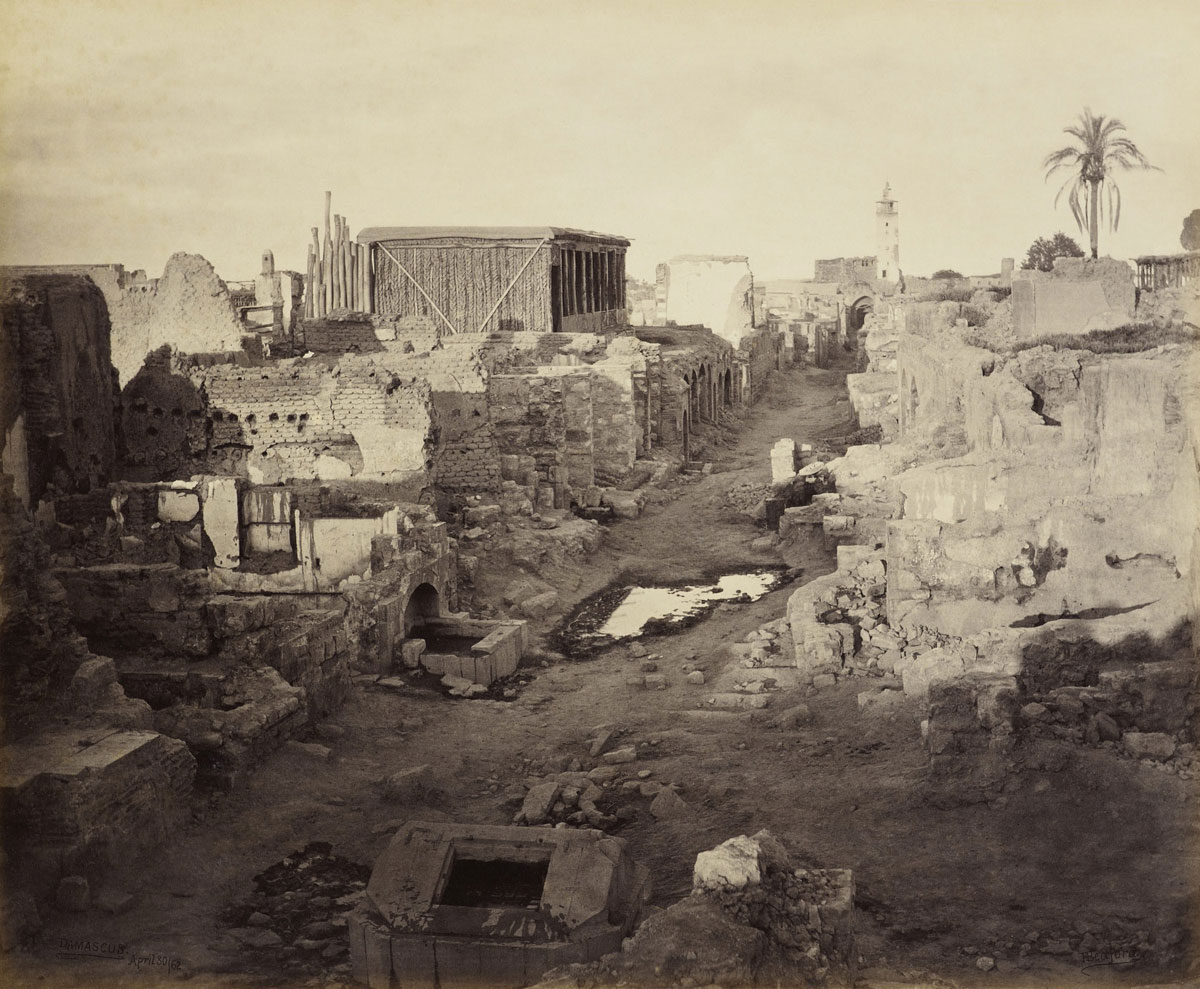
View up Straight Street – narrow lane running between Christian and Jews’ Quarter in Damascus. Buildings either side stand in ruins.
The ‘Street called Straight’ led out of the Christian quarter. Signs of the 1860 conflict are still apparent in the photograph. The street, however, was known as the place where St Paul (formerly Saul) regained his sight and converted to Christianity, having been blinded by holy light three days earlier while travelling on the road to Damascus. The Christian quarter is to the north-east of the street. This reflects a decision made in 636 by Khalid Ibn al-Walid, the Muslim conqueror of Damascus, to retain the orthodox churches in this area and to continue to provide access for the Christians to these buildings.
The photograph is signed, captioned and dated in the negative, ‘F Bedford Damascus’. The number in the Day & Son series is 97.
View of the Galata Tower, in the Galata district of Constantinople [Istanbul]. The tower was built by the Genoese community in 1348 and was known as the ‘Christea Turris’ [Tower of Christ]. Various restoration works have taken place over the years, and the tower now has a conical turret at the top, rather than the two-storey pavilion seen in the photograph. The Prince of Wales makes no mention in his journal of visiting or climbing the tower. It was not far from the arsenal and the Nusretiye Mosque, which he visited on 21 May 1862.
The photograph is signed and captioned in the negative, ‘F Bedford Constantinople’. See RCIN 2861678 for another print of this image.
The Romanesque style tower was built as Christea Turris (Tower of Christ) in 1348 during an expansion of the Genoese colony in Constantinople. Galata Tower was the tallest building in Istanbul at 219 1/2 feet (66.9 m) when it was built in 1348. It was built to replace the old Tower of Galata, an original Byzantine tower named Megalos Pyrgos (English: Great Tower) which controlled the northern end of the massive sea chain that closed the entrance to the Golden Horn. That tower was on a different site and was largely destroyed in 1203, during the Fourth Crusade of 1202-1204.
The upper section of the tower with the conical cap was slightly modified in several restorations during the Ottoman period when it was used as an observation tower for spotting fires. According to the Seyahatname of Ottoman historian and traveller Evliya Çelebi, in circa 1630-1632, Hezarfen Ahmet Çelebi flew as an early intercontinental aviator using artificial wings for gliding from this tower over the Bosphorus to the slopes of Üsküdar on the Anatolian side, nearly six kilometres away. Evliyâ Çelebi also tells of Hezarfen’s brother, Lagari Hasan Çelebi, performing the first flight with a rocket in a conical cage filled with gunpowder in 1633.
Starting from 1717 the Ottomans began to use the tower for spotting fires in the city. In 1794, during the reign of Sultan Selim III, the roof of the tower made of lead and wood, and the stairs were severely damaged by a fire. Another fire damaged the building in 1831, upon which a new restoration work took place.
In 1875, during a storm, the conical roof on the top of the building was destroyed. The tower remained without this conical roof for the rest of the Ottoman period. Many years later, during the restoration works between 1965 and 1967, the conical roof was reconstructed. During this final restoration in the 1960s, the wooden interior of the tower was replaced by a concrete structure and it was commercialised and opened to the public.
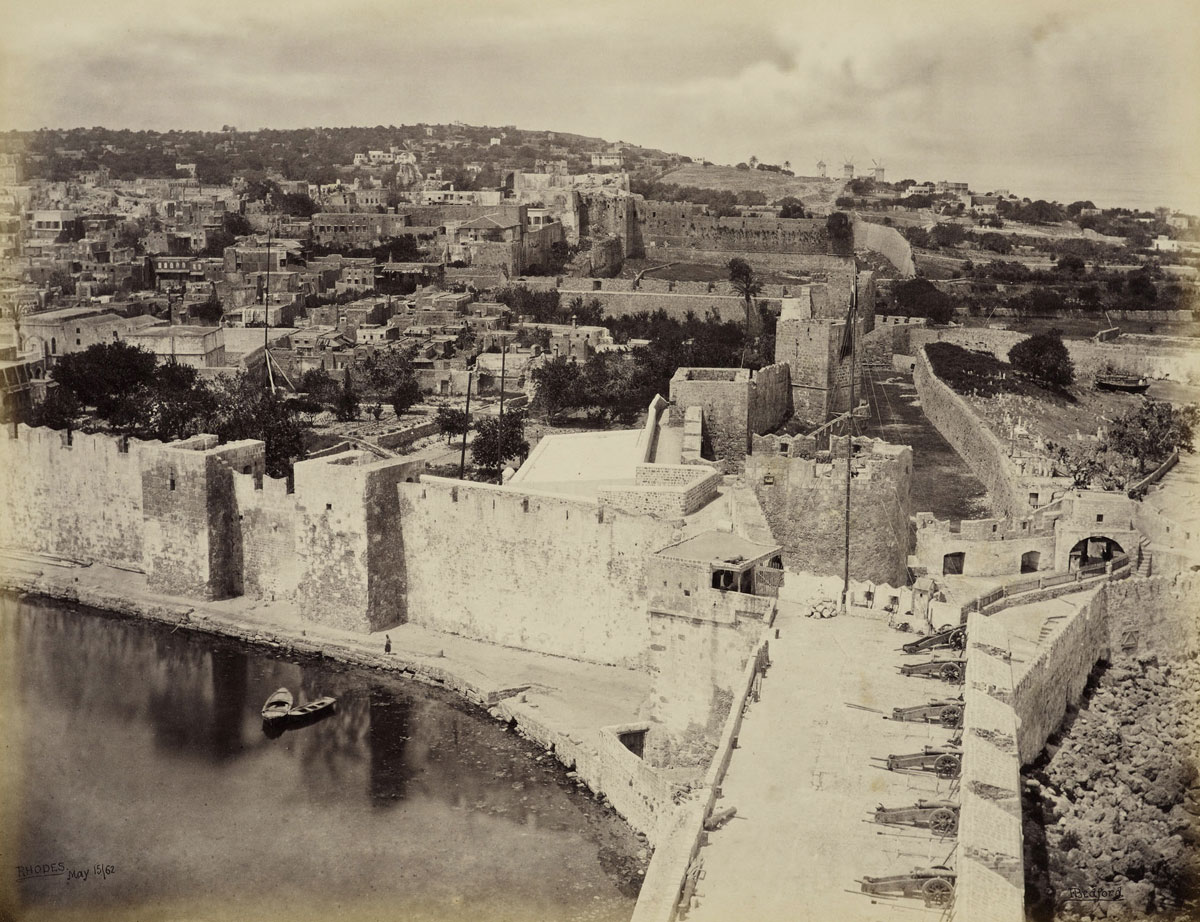
The Colossus of Rhodes, one of the seven wonders of the ancient world, was said to have straddled the entrance to the harbour into Rhodes Town. The Colossus was a statue of the Titan Helios, standing at about 30 m (107 ft) high. It was constructed to commemorate an unsuccessful siege of the island in 305 BC.
The photograph is signed and captioned in the negative, ‘F Bedford Rhodes’.
The Grotto, or ‘Great Cave’, on the small island of Antiparos, has been a tourist attraction for hundreds of years. The Prince of Wales described his visit, “A ride of 45 minutes brought us to the entrance of a large grotto or cave which is 60 fathoms in depth. We descended it by means of rope and rope ladders, and it was by no means an easy job. … There are some very fine stalactites in the cave.”
The photograph is signed and captioned in the negative, ‘F Bedford Antiparos’. See RCIN 2861673 for another print of this image.
Photographic title page from Francis Bedford’s Middle East views of 1862. Includes a copy of Bedford’s view of the ‘Mosque of Omar from the Governor’s House’ in Jerusalem
A carte-de-visite portrait of the Prince of Wales (right) with Prince Louis of Hesse (Grand Duke Ludwig IV). Prince Louis was engaged to marry the Prince’s sister, Princess Alice.
This photograph was taken when the Prince was travelling across Europe in order to meet the royal yacht at Venice, in order to commence his tour of the Middle East. Both princes wear overcoats and hats, and are smoking cigarettes; the Prince of Wales is holding a cane. The Prince later wrote about this occasion in his journal, “Before luncheon we went through the ordeal of being photographed by Mr Albert and the result was very successful” (11 February 1862).
The Queen’s Gallery Buckingham Palace Road, London SW1A 1AA, United Kingdom Phone: +44 20 7766 7300
Opening hours: 10.00 – 17.30 Closed Tuesdays and Wednesdays
Curator: Roger Taylor (Professor Emeritus of Photographic History, De Montfort University). Conceived and organised in collaboration with Sarah Greenough (Senior Curator and Head of the Department of Photographs, National Gallery of Art) and Malcolm Daniel (then at the Museum of Fine Arts, Houston).
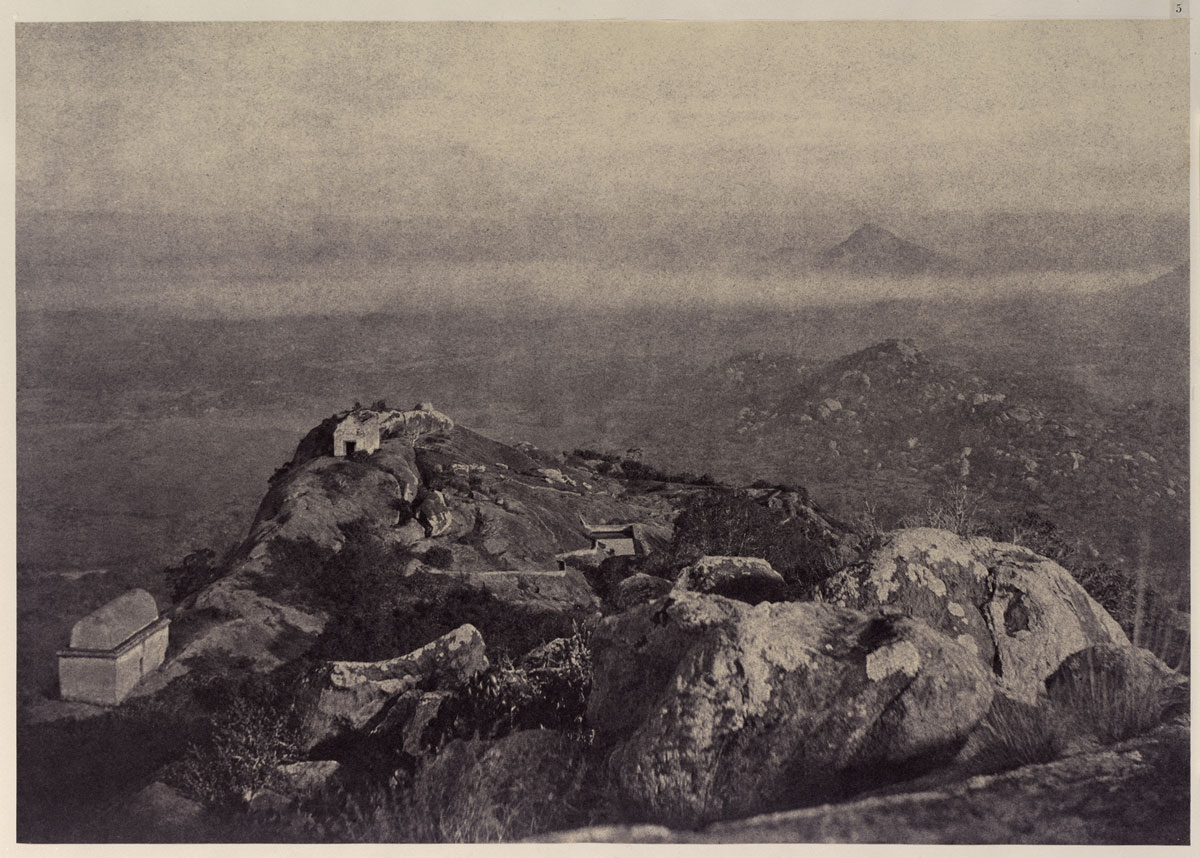
Linnaeus Tripe (British, 1822-1902) Royacottah: View from the Top of the Hill, Looking North-Northwest and by North, December 1857 – January 1858 c. 1857-1858 26 x 35.6cm (10 1/4 x 14 in.) Collection of Charles Isaacs and Carol Nigro
Part two of this wonderful posting, including Tripe’s most famous photograph: Elephant Rock, End View, January – February 1858 (below).
Many thankx to the National Gallery of Art for allowing me to publish the photographs in the posting. Please click on the photographs for a larger version of the image. Most of the text underneath the images is from the British Library website.
Captain Linnaeus Tripe (English, 1822-1902)
From an upper-middle-class family in Devonport, England, Tripe joined the British East India Company in 1839 and was assigned to the 12th Madras Native Infantry. After several years of deployment in India, he returned to England in 1851 and began to explore an interest in photography. In 1853 he joined the Photographic Society of London.
Reflecting his military training as an officer in the British army, Tripe had great technical success in India and Burma, even though the tropical heat and humidity affected photographic chemistry. Yet Tripe’s destiny as a photographer was linked to the fate of the British Empire in India. Despite his professional achievements and technical innovations, rebellions in the late 1850s prompted a new era of oversight and regulations for the recently nationalized East India Company, and the British government took over the administration and rule of India, making it a crown colony. Tripe was forced to close his studio in 1860 because of cost-cutting measures, and he almost completely abandoned photography as a result.
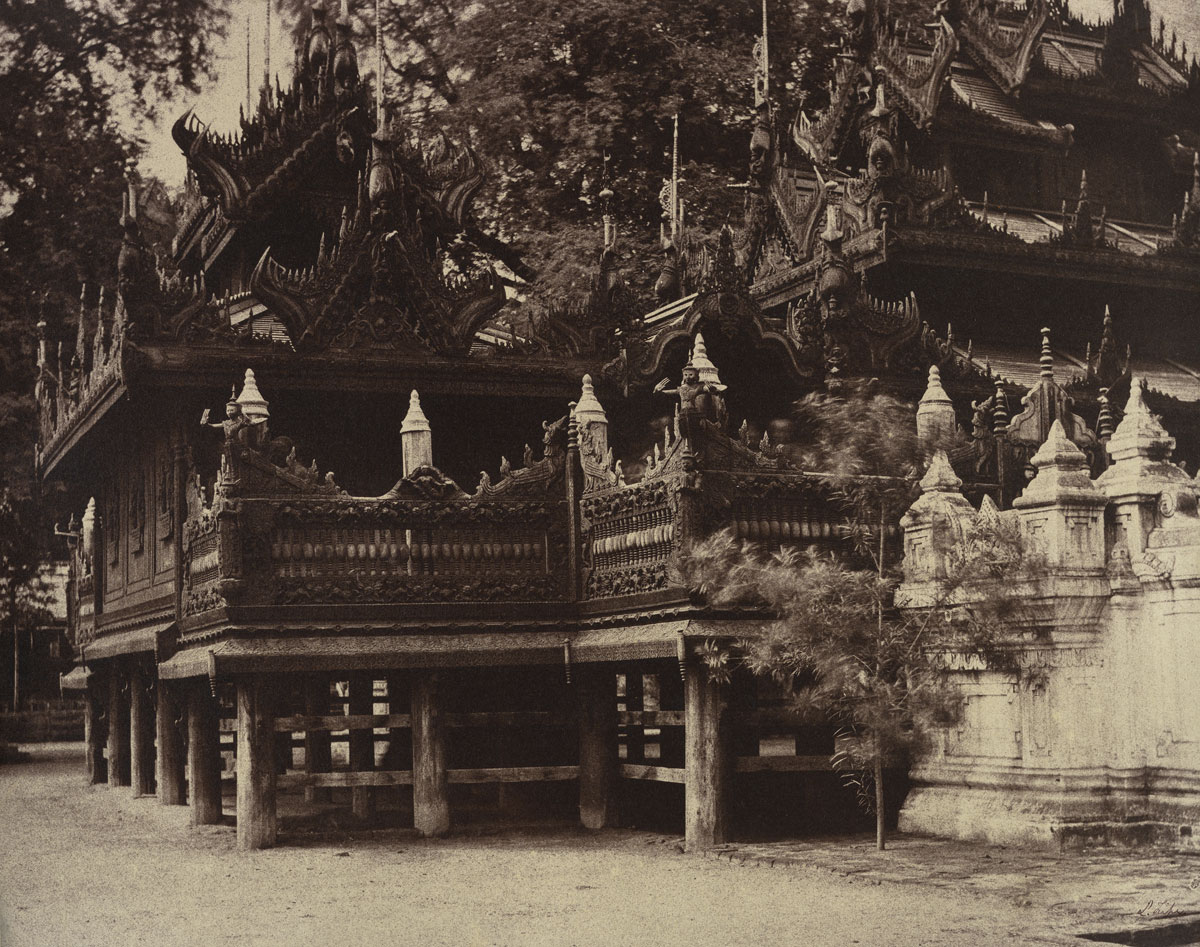
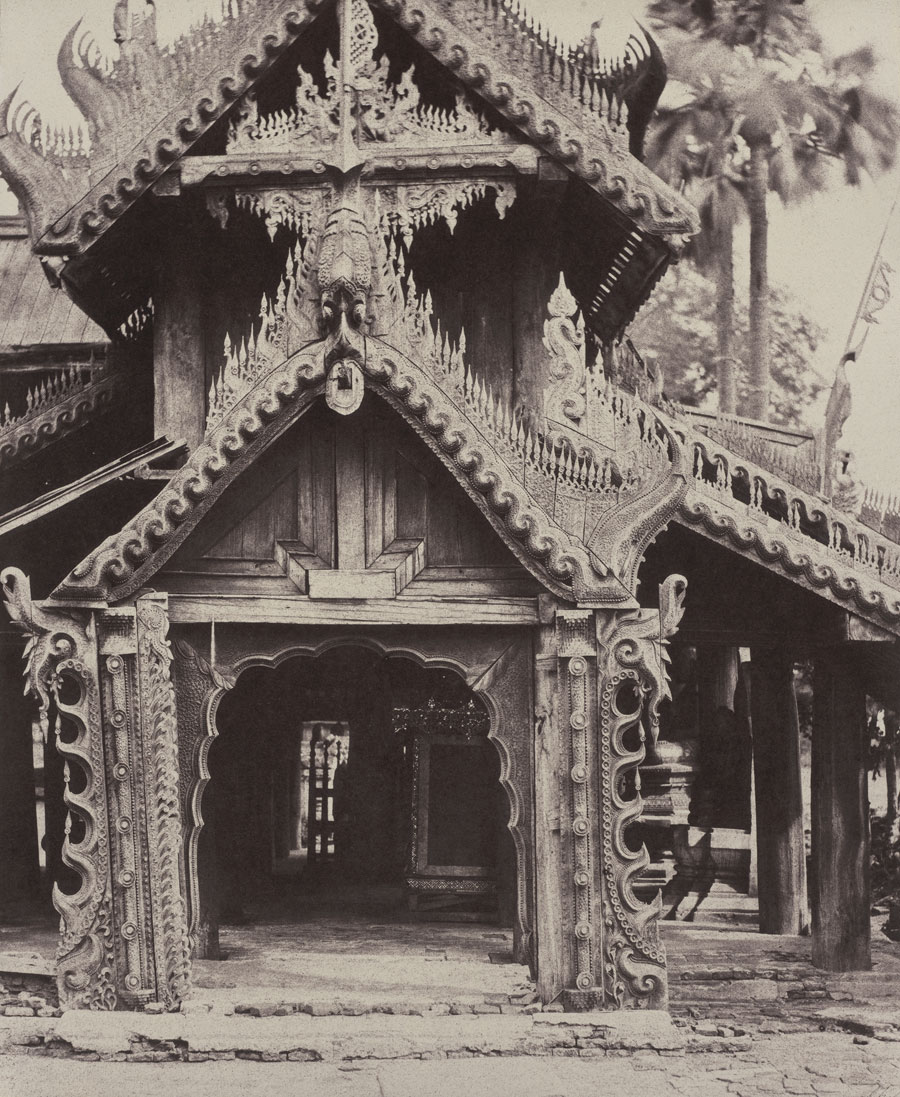
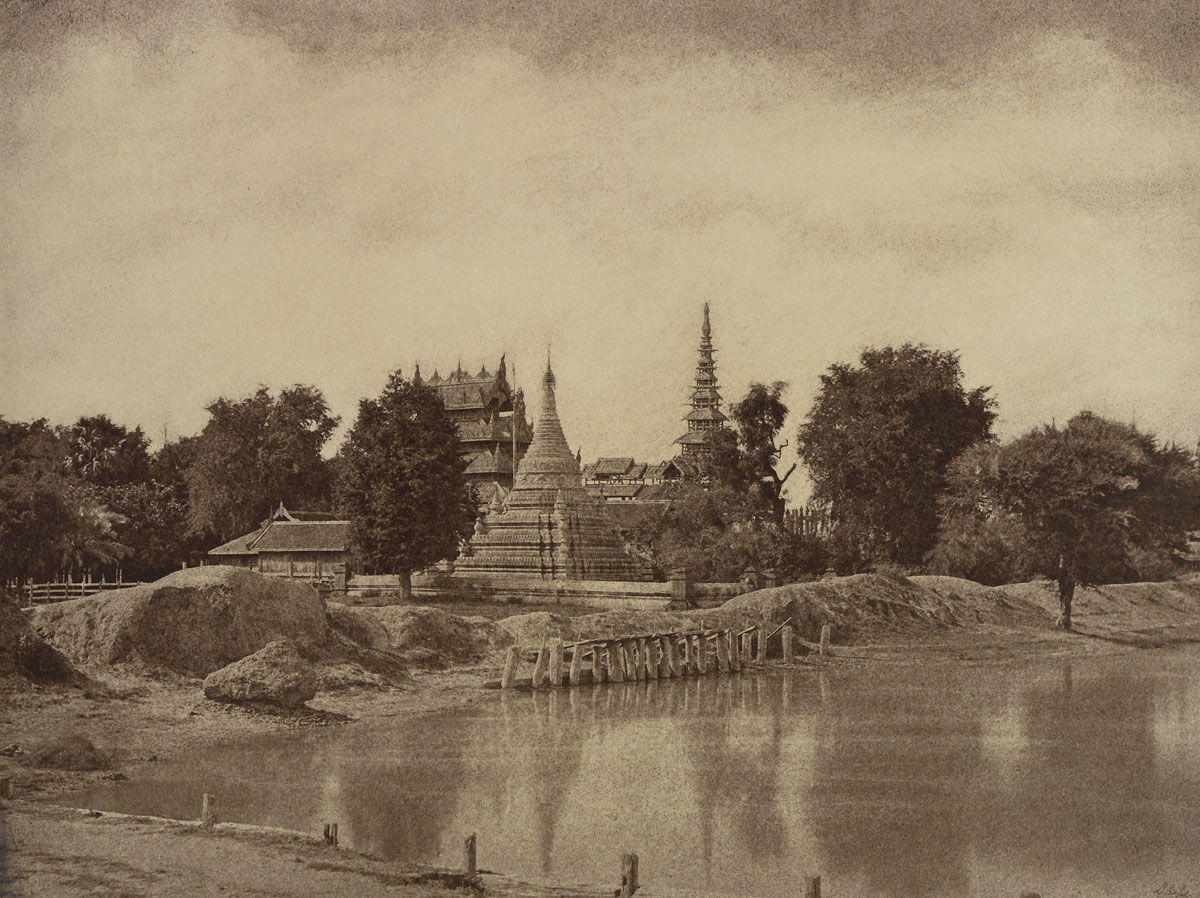
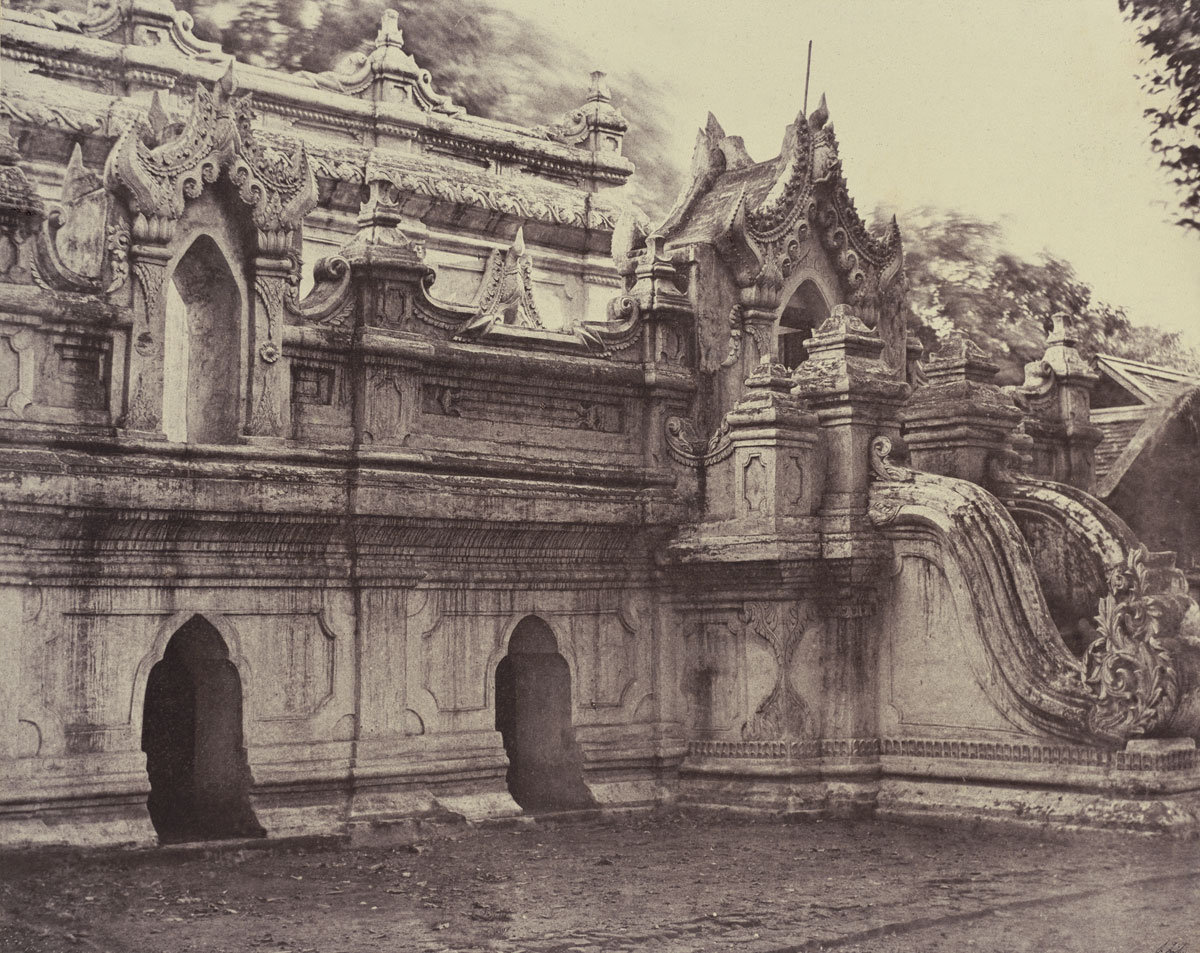
Photograph by Linnaeus Tripe, from a portfolio of 120 prints, with a close view of the wood-carving at the corner of a kyaung (monastery) near where the British delegation was housed at Amarapura in Burma (Myanmar). Tripe wrote of this kyaung, ‘This small monastery, near the Residency, attracted much attention from the richness of its carving and the beauty of its situation’. The Burmese are highly skilled at wood-carving, creating designs of great beauty, intricacy and fluidity.
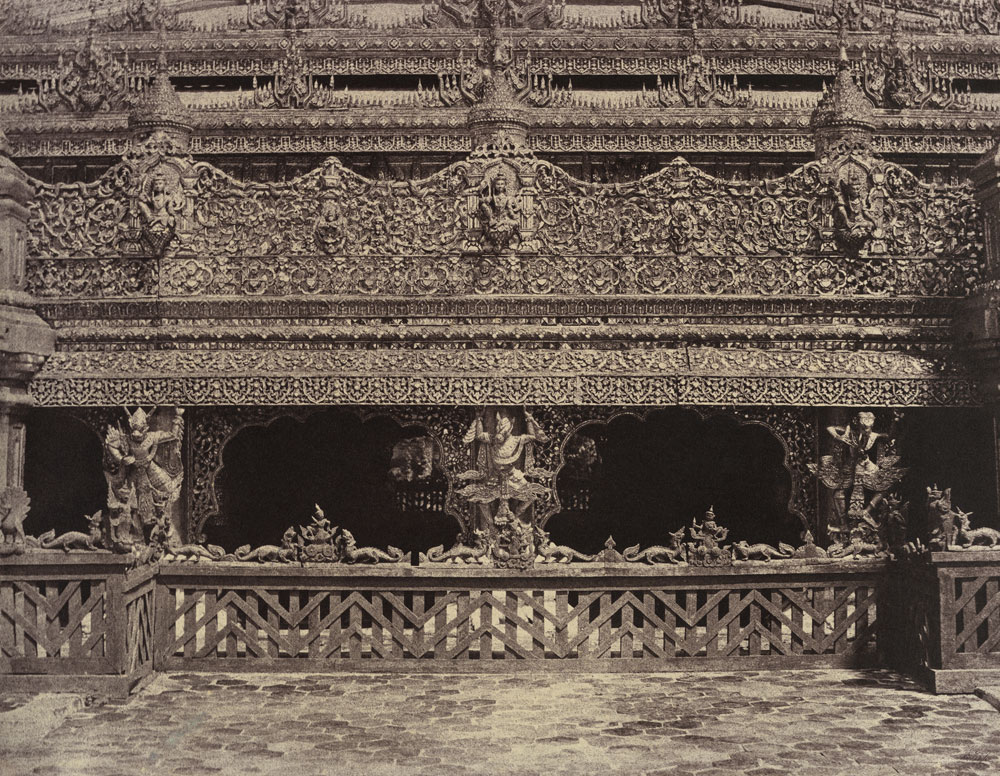
Photograph by Linnaeus Tripe, from a portfolio of 120 prints, with a close-up detail of the wood-carved balcony of a kyaung (monastery) at Amarapura in Burma (Myanmar). Wood-carving is a living tradition in Burma, its artisans are supremely skilled in carving a rich repertoire of motifs from myths and legends and floral patterns into different types of woods. Tripe wrote of this scene, ‘This is open scroll-work, and very beautiful’.
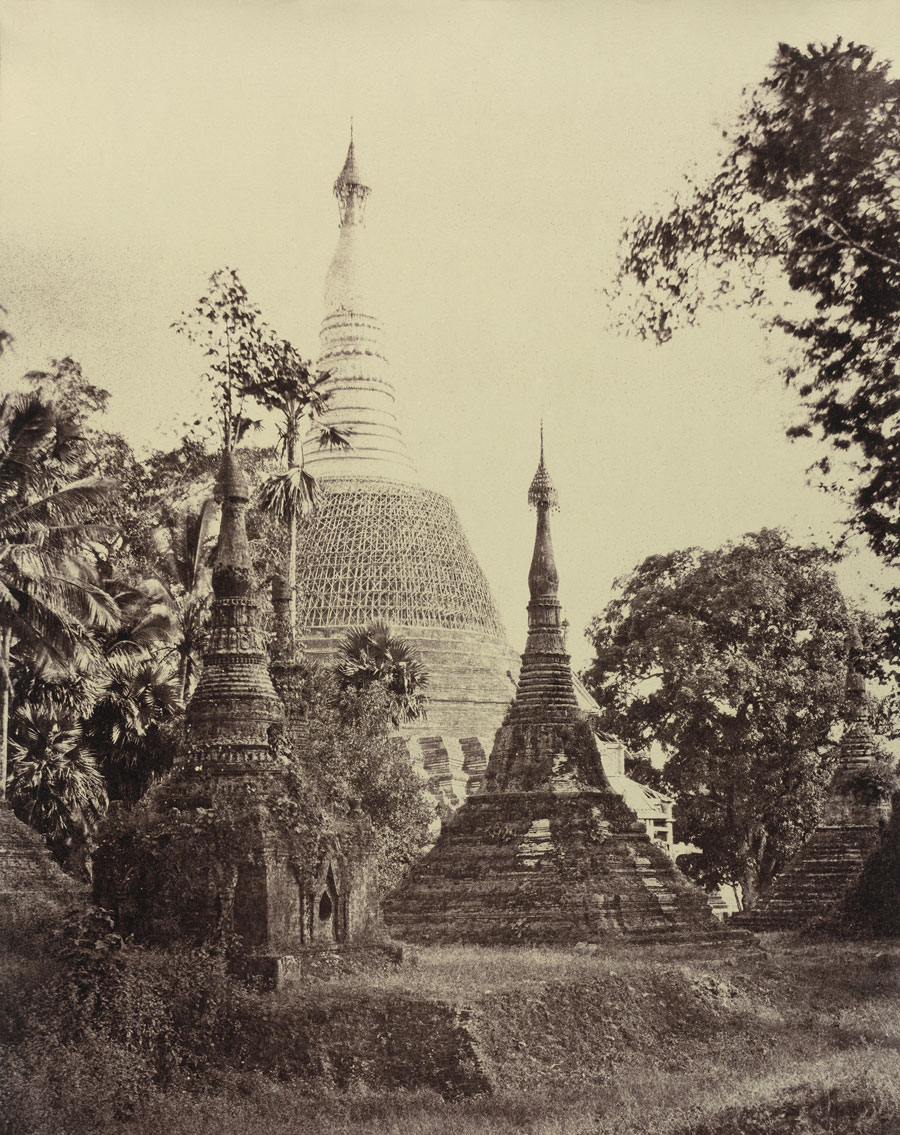
Linnaeus Tripe (British, 1822-1902) Rangoon: Near View of the Shwe Dagon Pagoda, November 1855 1855 34.5 × 27.2cm (13 5/8 × 10 3/4 in.) National Gallery of Art, Washington, Edward J. Lenkin Fund
The Shwedagon Pagoda, officially named Shwedagon Zedi Daw and also known in English as the Great Dagon Pagoda and the Golden Pagoda, is a gilded pagoda and stupa 99 metres (325 ft) in height[citation needed] that is located in Yangon, Burma. The pagoda lies to the west of Kandawgyi Lake, on Singuttara Hill, thus dominating the skyline of the city. It is the most sacred Buddhist pagoda for the Burmese people. According to legend, the Shwedagon Pagoda has existed for more than 2,600 years, making it the oldest historical pagoda in Burma and the world. According to some historians and archaeologists, however, the pagoda was built by the Mon people between the 6th and 10th centuries AD.
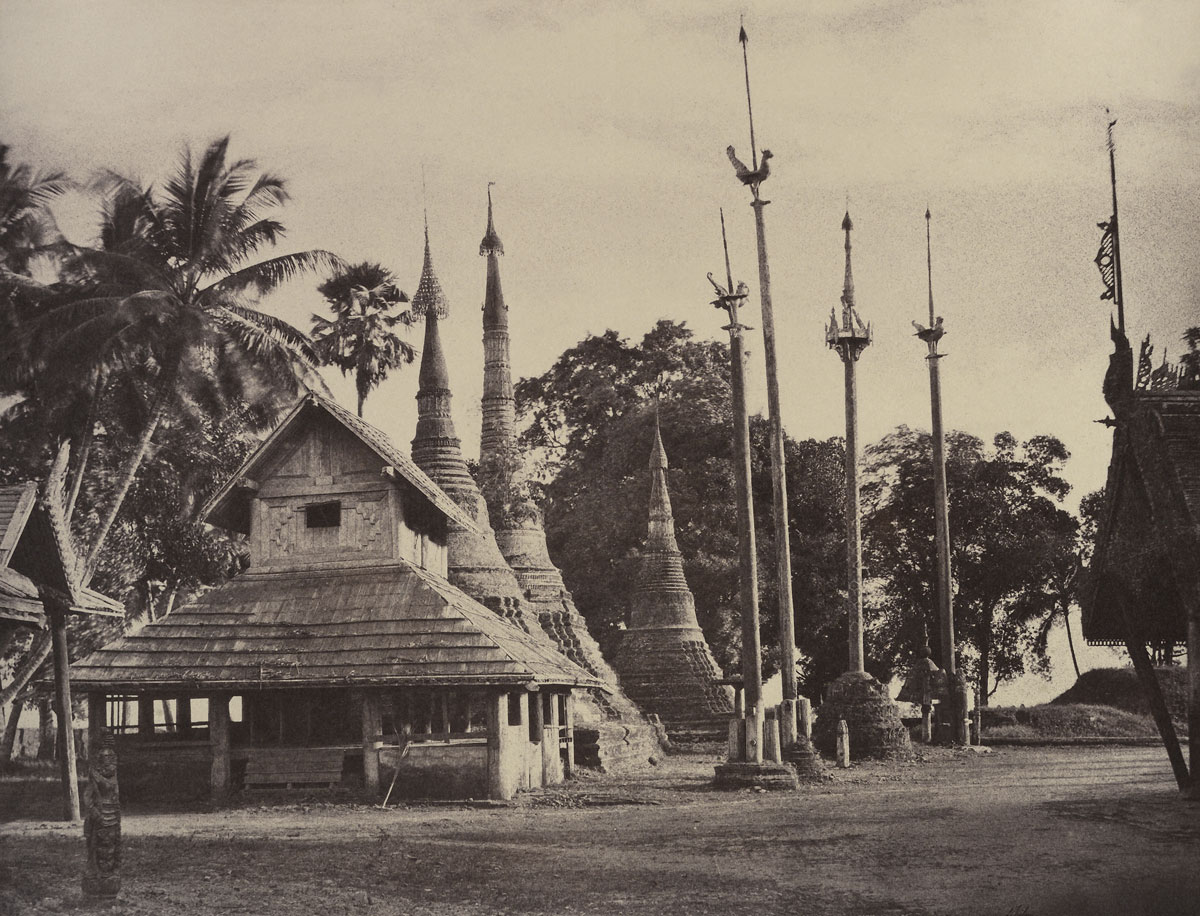
Photograph by Linnaeus Tripe, from a portfolio of 120 prints, with a view of the hinthas or hamsas (mythical birds) atop sacred flagstaffs or dagun-daings of the Shwe Dagon Pagoda at Rangoon (Yangon) in Burma (Myanmar). Linnaeus Tripe wrote, ‘These, painted in bright colours diapered with gold and silver (traces of which still remain) must have had a very gay appearance. Henza [hintha] staves are attached to all pagodas’. The hintha bird (or hamsa in Sanskrit) features in many Jataka tales: the stories which narrate details of the Buddha’s previous lives.
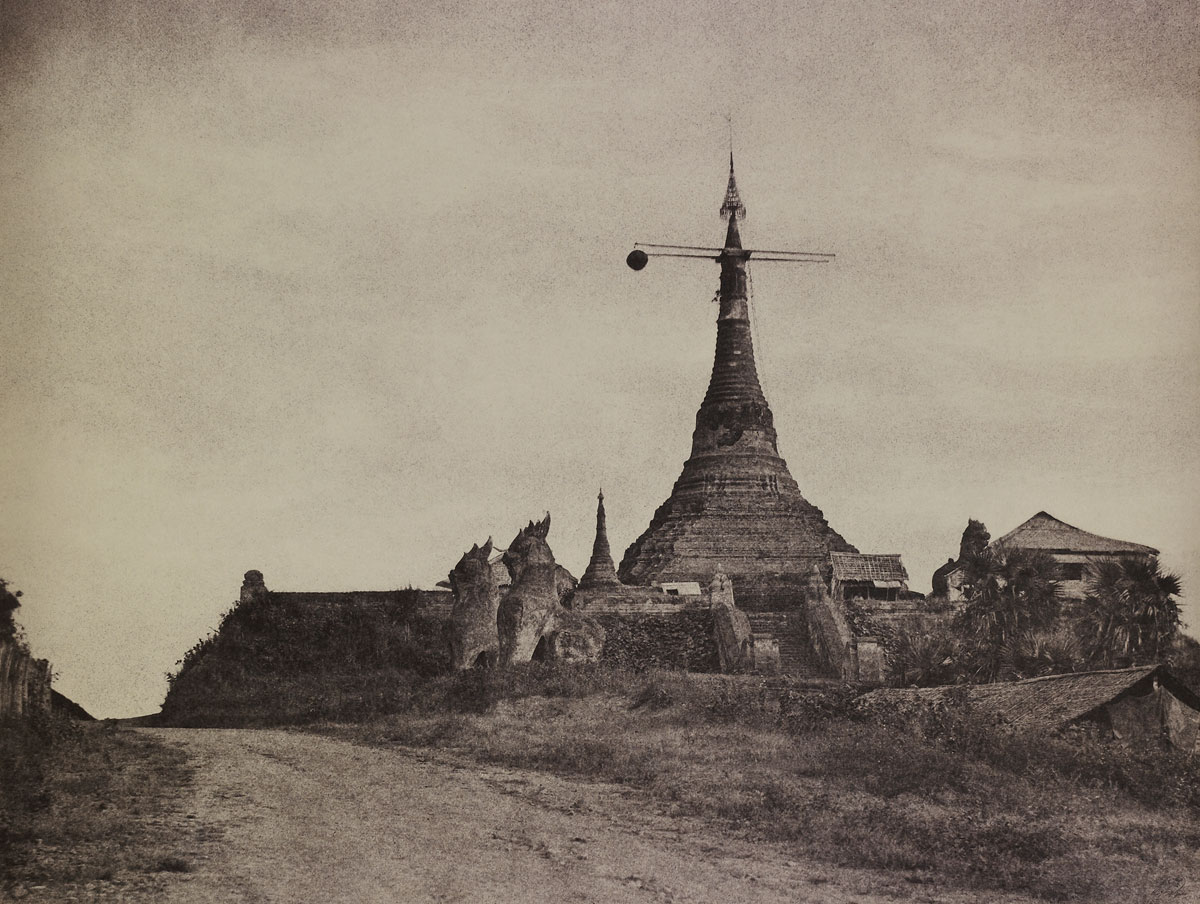
Linnaeus Tripe (British, 1822-1902) Rangoon: Signal Pagoda, November 1855 1855 26 × 34.6cm (10 1/4 × 13 5/8 in.) Private Collection, Courtesy Hans P. Kraus Jr.
Photograph by Linnaeus Tripe, from a portfolio of 120 prints, showing the Signal Pagoda at Rangoon (Yangon) in Burma (Myanmar). In this view of the pagoda the chinthes or leogryphs (Burmese temple guardian figures) can be glimpsed facing the roadway at the entrance. The circular object hanging from a yard at the top of the pagoda is presumably a time ball. Tripe wrote, ‘From this a very extended view of the town and river can be had. It is used as a signal station because of the distance at which a ship coming up the river can be descried. It is also known as Sale’s Pagoda’. The Sale referred to is Sir Robert Henry Sale, who was stationed on the site with a picket during the First Anglo-Burmese War (1824-1826). Sale (1782-1845) was an army officer who had served in India, and then played an active role in the capture of Rangoon as commander of the 13th. At the time of the mission’s visit the administration of the rapidly growing port was not well-developed. The pilot system did not work well, there was no pilot service and pilotage was left to private initiative, there were rival bands of pilots with their own pilot-brigs. They later combined to form the Pilot Club and this club fixed the rate of pilotage by agreement with the owners and captains of the vessels. The signalling station was at the Sale Barracks where the pagoda known as Sale’s Pagoda was used for the purpose and thenceforth began to be called the Signal Pagoda of Rangoon.
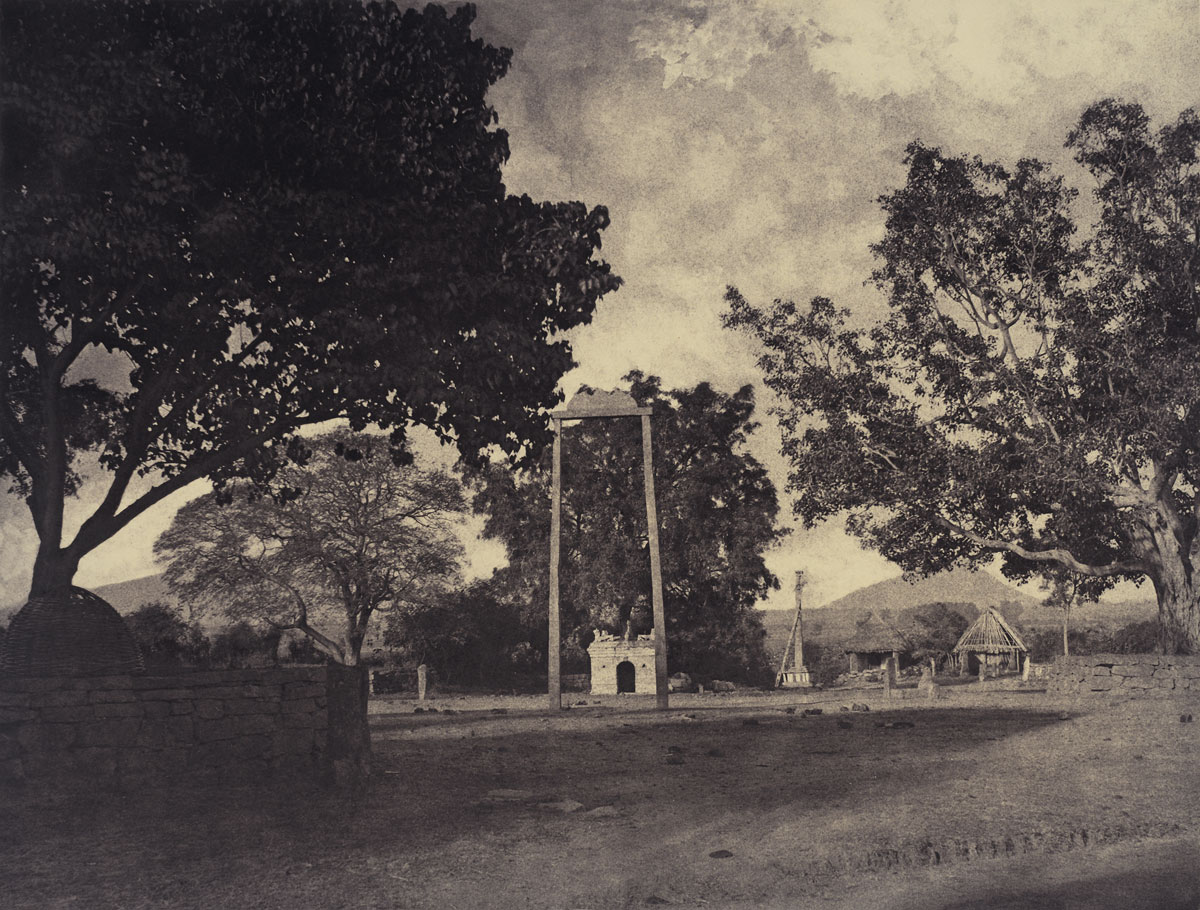
Linnaeus Tripe (British, 1822-1902) Beekinpully: Permaul’s Swing at Mariammah Covil, December 1857 – January 1858 c. 1857-1858 26 × 35.6cm (10 1/4 × 14 in.) Collection of Charles Isaacs and Carol Nigro
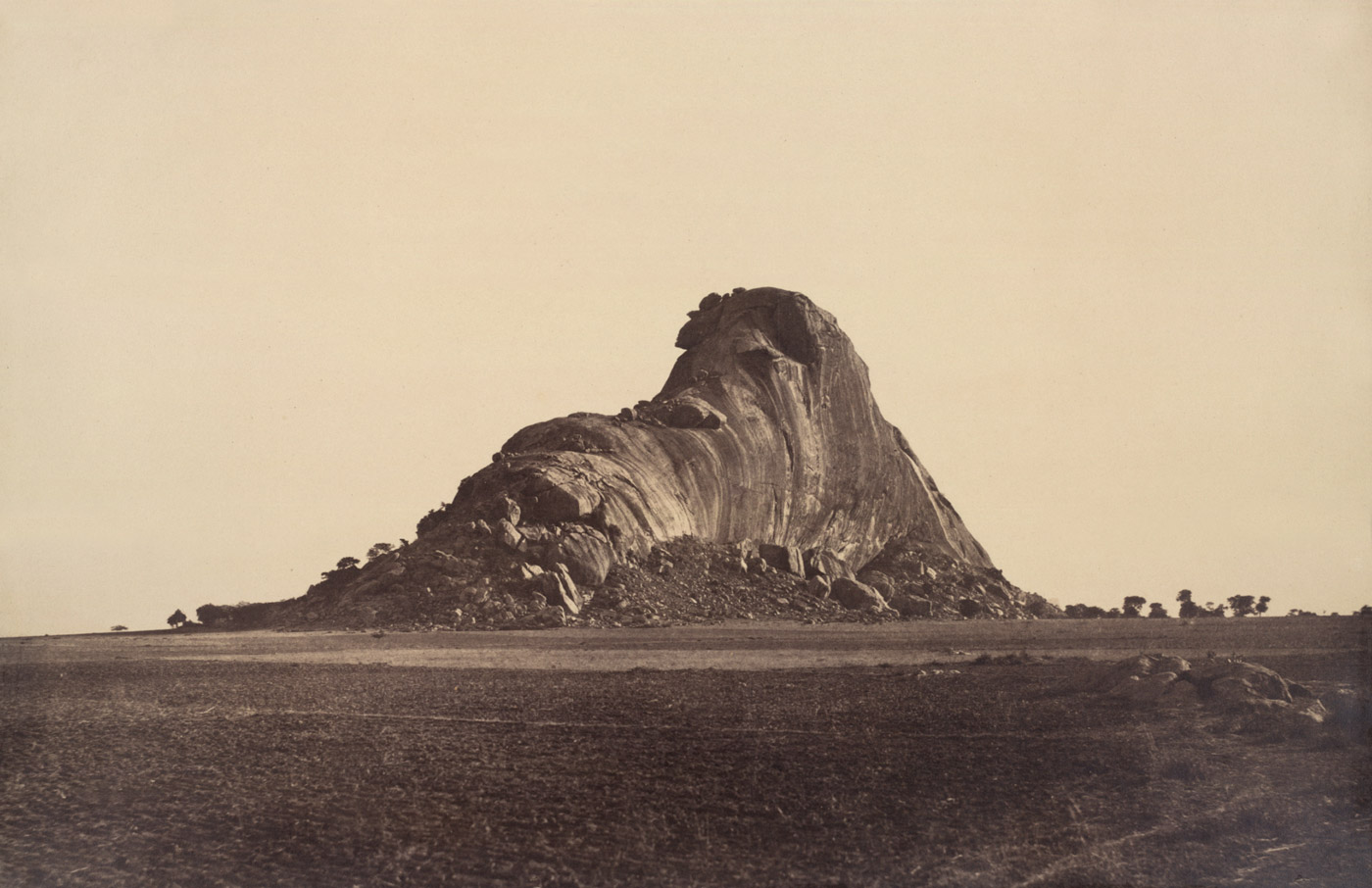
Linnaeus Tripe (British, 1822-1902) Between Chittumputty and Teramboor: Elephant Rock, End View, January – February 1858 1858 23.8 × 36.8cm (9 3/8 × 14 1/2 in.) The British Library, London
This photograph of the Elephant Rock near Madurai in Tamilnadu, is part of a collection entitled Photographic Views in Madurai (Madras, 1858) and was taken by Linnaeus Tripe in 1858. It shows a general view of ‘an enormous mass of granite or sienite situated to the north of the town of Madura, altogether isolated from the neighbouring hills, and when viewed from the S.E. or S.W. bearing a strong resemblance to a couchant elephant, with its trunk extended in front… The rock is about 11/4 miles long; and 250 feet high, measuring to the top of the elephant’s head.’
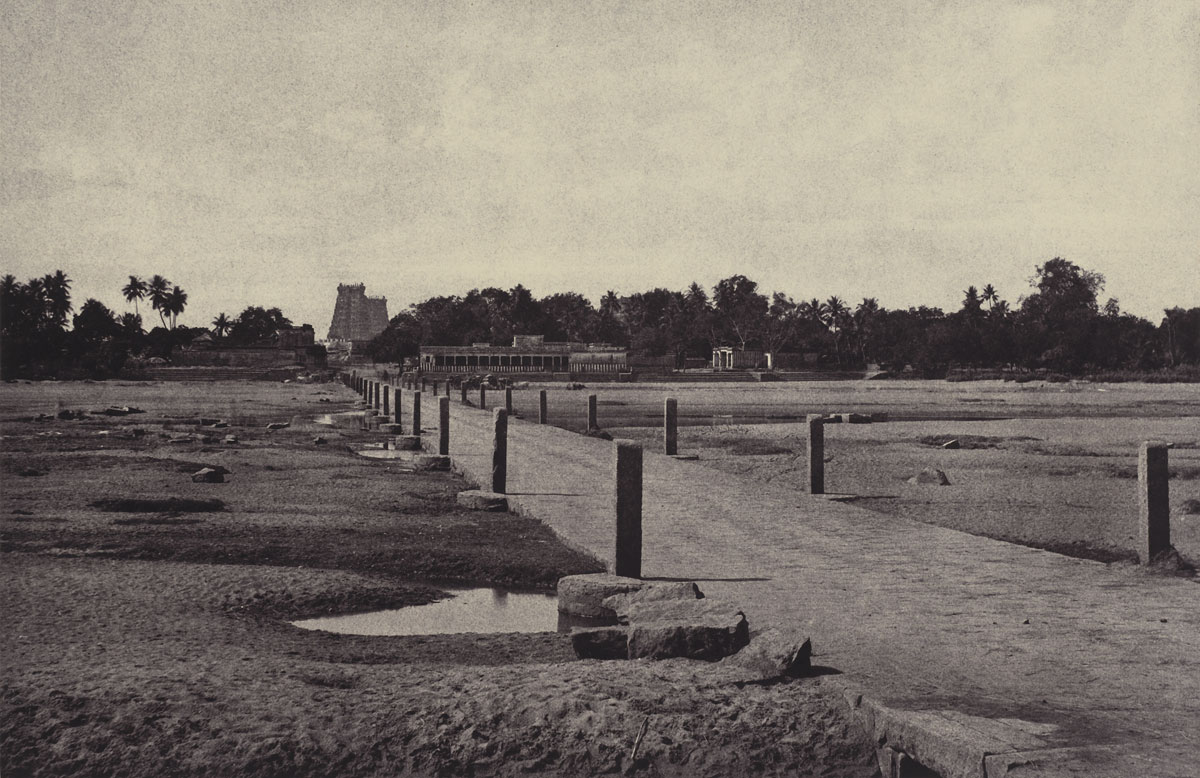
Linnaeus Tripe (British, 1822-1902) Madura: The Vygay River, with Causeway, across to Madura, January – February 1858 1858 23.1 x 35.4cm (9 1/8 x 14 in.) National Gallery of Art, Washington The Carolyn Brody Fund and Horace W. Goldsmith Foundation through Robert and Joyce Menschel
Linnaeus Tripe (British, 1822-1902) Madura: Pillars in the Recessed Portico in the Raya Gopurum, with the Base of One of the Four Sculpted Monoliths, January – February 1858 1858 35.6 × 28.1cm (14 × 11 in.) The British Library, London
This photograph of an architectural detail from the Meenakshi Sundareshvara temple, Madurai, Tamilnadu, is part of a collection entitled ‘Photographic Views in Madurai’ (Madras, 1858) and was taken by Linnaeus Tripe in 1858. The Meenakshi Sundareshvara Temple is dedicated to Shiva and his consort Meenakshi, an ancient local divinity. The construction of this imposing temple-town was made possible by the magnificence of Tirumala Nayak (1623-1659). The rectangular precinct covers 6 hectares and has 11 huge towers and 4 entrance gopurams. Inside this enclosure there are columned mandapas, tanks, shrines and the two temples of Shiva and Meenakshi. East of the temple Tirumala Nayak began the construction of a new gopuram which was never completed. The most remarkable feature are 4 monolithic pillars. This view shows the base of one of the monoliths together with the elaborately carved pillars in the recessed north portico of the Raja Gopuram.
Linnaeus Tripe (British, 1822-1902) Madura: The Blackburn Testimonial, January – February 1858 1858 25.3 × 35.1cm (10 × 13 7/8 in.) The British Library, London
This photograph of the temple jewels of the Meenakshi Sundareshvara temple, Madurai, Tamilnadu, is part of a collection entitled Photographic Views in Madurai (Madras, 1858) and was taken by Linnaeus Tripe in 1858. The Meenakshi Sundareshvara Temple is dedicated to Shiva and his consort Meenakshi, the fish-eyed goddess Parvati. The construction of this imposing temple-town was made possible by the magnificence of Tirumala Nayak (1623-1659). The rectangular precinct covers 6 hectares and has 11 huge towers and 4 entrance gopurams. Inside this enclosure there are columned mandapas, tanks, shrines and the two temples of Shiva and Meenakshi. This is a collection of jewels and ornaments for use on festival occasions, including crowns, necklaces, gold and pearl pieces and naga images.
Linnaeus Tripe (British, 1822-1902) Tanjore: Wrought-Iron Gun on a Cavalier in the Fort, March – April 1858 1858 26.1 × 36.1 cm (10 1/4 × 14 1/4 in.) The British Library, London
The term Cavalier has been adopted from the French as a term in fortification for a work of great height constructed in the interior of a fort, bastion or other defence, so as to fire over the main parapet without interfering with the fire of the latter. A greater volume of fire can thus be obtained, but the great height of the cavalier makes it an easy target for a besieger’s guns.
The Amaravati Sculptures, Amaravati Marbles or the Elliot Marbles are a series of monumental sculptures and inscriptions that once furnished the religious mound known as the Great Stupa at Amaravati. While some artefacts remain in situ, many are scattered in various museums across the world, with the two principal collections held at the Government Museum in Chennai and the British Museum in London.
The figurative sculptures are nearly all in relief, with many of the most crowded scenes illustrating some of the Jataka tales, a large body of literature with complicated and fanciful accounts of the previous lives of the Buddha. The collection in the museum in Chennai (formerly Madras) has a large number of sculptures in relief, which they have classified by four periods of activity starting in the second century BC and stretching to the second century AD. The first period covers the 100 years between 200 and 100 BC, the second period covers 200 years from 100 BC to AD 100, the third covers AD 100 to 150, and the fourth covers 150 to 200. Early interest in the stupa and its sculptures was in part because it was wrongly thought to contain early evidence of Christianity in India.
In 1845, Sir Walter Elliot of the Madras Civil Service explored the area around the stupa and excavated near the west gate of the railing, removing many sculptures to Madras (now Chennai). They were kept outside the local college before being transported to the Madras Museum. At this time India was run by the East India Company and it was to that company that the curator of the museum appealed. The curator Dr Edward Balfour was concerned that the artefacts were deteriorating so in 1853 he started to raise a case for them to be moved. By 1855 he had arranged for both photographs and drawings to be made of the artefacts now called the Elliot Marbles. 75 photographs taken by Captain Linnaeus Tripe are now in the British Library.
“The photographs are of variable quality, and the volume contains a short preface explaining the reasons for this: ‘These photographs were taken by Captain tripe in the months of May and June, after a wearying tour through the Trichinopoly, Madura, and Tanjore Districts, during the preceding four months and a half. Many of the subjects being heavy masses, and therefore not easily to be transported into the open air, were taken as they were lying, in the rooms of the Museum. To enable him to attempt them at all he was obliged to use a dry collodion process, with which he had only recently made acquaintance. He would point to both these circumstances to account for the unsatisfactory pictures he has made of some of the Sculptures. In printing from the above mentioned negatives, their density, though apparently in their favor, increased the liability to yellowness in the lights, so much complained of in toning a print on albumenised paper with gold…'”
Linnaeus Tripe, Photographs of the Elliot Marbles; and other subjects; in the Central Museum Madras (Madras, 1858-59)
National Gallery of Art National Mall between 3rd and 7th Streets Constitution Avenue NW, Washington
Curator: Roger Taylor (Professor Emeritus of Photographic History, De Montfort University). Conceived and organised in collaboration with Sarah Greenough (Senior Curator and Head of the Department of Photographs, National Gallery of Art) and Malcolm Daniel (then at the Museum of Fine Arts, Houston).
Linnaeus Tripe (British, 1822-1902) Gun Wharf – Devonport 1852-1854 23.1 × 33cm (9 1/8 × 13 in.) Wilson Centre for Photography, London
To my mind, Captain Linnaeus Tripe is one of the best of the Victorian photographers.
So early on in the history of photography, for such a short period of time (much like Julia Margaret Cameron in this regard), Tripe’s photographs are so much more than just his foresight in recognising that photography could be an effective tool for conveying information about unknown cultures and regions. As noted, “Tripe’s schooling as a surveyor, where the choice of viewpoint and careful attention to visual details were essential, gave his photographs their distinctive aesthetic rigour.” But it is more than just tools and trade. There is that indefinable magic of a master artist.
You only have to feel the impressive space of the open deck of Quarterdeck of HMS “Impregnable” (1852-1854, below) with that pendulous cross-beam pressing down from on high or understand the light in Pugahm Myo: Distant View of Gauda-palen Pagoda, August 20-24, 1855 (below) – how gorgeous is that image – and observe the subtleties of composition in seemingly unprepossessing vistas like Tsagain Myo: View near the Irrawadi River, August 29-30, 1855 and Tsagain Myo: A Roadway, August 29-30, 1855 (below) to understand what inspiration and insight this man had.
I could look at these images every day of my life and never get bored with them.
Many thankx to the National Gallery of Art for allowing me to publish the photographs in the posting. Please click on the photographs for a larger version of the image. Most of the text underneath the images is from the British Library website
“The dynamic vision Tripe brought to these large, technically complex photographs and the lavish attention he paid to their execution indicate that his aims were artistic as well.”
Linnaeus Tripe (British, 1822-1902) Quarterdeck of HMS “Impregnable” 1852-1854 27 x 34.8cm (10 5/8 x 13 3/4 in.) National Gallery of Art, Washington The Sarah and William L Walton Fund, Diana and Mallory Walker Fund, and The Horace W. Goldsmith Foundation through Robert and Joyce Menschel
Linnaeus Tripe (British, 1822-1902) Ye-nan-gyoung: Tamarind Tree, August 14-16, 1855 1855 26.3 × 34.7cm (10 3/8 × 13 5/8 in.) Courtesy Robert Hershkowitz, Charles Isaacs, Hans P. Kraus Jr.
Photograph by Linnaeus Tripe of a tamarind tree, with a pagoda on the hillside in the background, at Yenangyaung in Burma (Myanmar), from a portfolio of 120 prints. Tripe was the official photographer attached to a British diplomatic mission to King Mindon Min of Burma in 1855. This followed the British annexation of Pegu after the Second Anglo-Burmese War in 1852. Aside from official duties, the mission was instructed to gather information regarding the country and its people. Tripe’s architectural and topographical views are of great documentary importance as they are among the earliest surviving photographs of Burma. Yenangyaung was a town in west-central Myanmar on the Ayeyarwady (Irrawaddy), the centre of the most productive oil-fields in the country. Tamarind is commonly used in Burmese cuisine and the tamarind tree is widespread in Burma. It is also used as raw material in joss-stick production.
Photograph by Linnaeus Tripe with a distant view of the Gawdawpalin temple in the Pagan (Bagan) region of Burma (Myanmar), from a portfolio of 120 prints. With this portfolio of architectural and topographical views, Tripe, an officer from the Madras Infantry, created an early photographic record of Burma. The 1855 British Mission to Burma was instructed to persuade the Burmese king Mindon Min to accept the annexation of Pegu (Lower Burma) following the Anglo-Burmese War of 1852. ICapital of the first kingdom of Burma from the 11th to the 14th century, Pagan is one of the most important archaeological sites in South East Asia, with the remains of over 2000 stupas, temples and monasteries scattered over a 30 km radius. One of the most beautiful and graceful of Pagan’s temples, the Late Period Gawdawpalin or Throne of Obeisance was begun in the reign of Narapatisithu (1174-1211) and completed by Nadaungmya (ruled 1211-1234). Tripe wrote, “Taken from the top of Thapinyu. [That-byin-nu]. The ruins of all shapes and sizes seen in this view, give an idea of the manner in which they are scattered for about eight miles along the river [the Irrawaddy], to a depth of sometimes three miles.”
Photograph by Linnaeus Tripe of the That-byin-nu temple in the Pagan (Bagan) region of Burma (Myanmar), from a portfolio of 120 prints. With this portfolio of architectural and topographical views, Tripe, an officer from the Madras Infantry, created an early photographic record of Burma. The 1855 British Mission to Burma was instructed to persuade the Burmese king Mindon Min to accept the annexation of Pegu (Lower Burma) following the Anglo-Burmese War of 1852. It was also the intention of the British to collect information about the country. They travelled in Burma from August to early November 1855, stopping at various places to allow Linnaeus Tripe, the official photographer, and the mission’s artist, Colesworthy Grant, to perform their duties. Capital of the first kingdom of Burma from the 11th to the 14th century, Pagan is one of the most important archaeological sites in South East Asia, with the remains of over 2000 stupas, temples and monasteries scattered over a 30 km radius. Tripe wrote of the That-byin-nu, “Or ‘the Omniscient’. It is about 230 feet square, and 200 feet high; divided into two stages, each stage into two stories. An arched corridor passes round each stage, with arched doorways opening outwards; opposite those on the ground story are sitting figures of Gautama. In the centre of each side of the lower stage, is a projecting wing with a lofty doorway, opening into a vestibule: this forms a centre porch to the corridor, a colossal seated figure of Gautama facing it. The centre of the building is a solid mass of masonry terminated by a bulging pyramidal spire crowned by a tee. Its date is about 1100 A.D.” The temple is the tallest construction in Pagan, towering to 61 ms. Built by King Alaungsitthu in the middle of the 12th century, its square plan is the most elaborate of the middle period of building in Pagan (c.1120-1170).
Linnaeus Tripe (British, 1822-1902) Tsagain Myo: View near the Irrawadi River, August 29-30, 1855 1855 26.2 × 34.2cm (10 1/4 × 13 1/2 in.) National Gallery of Art, Washington, Stephen G. Stein Fund
Photograph by Linnaeus Tripe of a view at Sagaing in Burma (Myanmar), from a portfolio of 120 prints. The view is on the bank of the Irrawaddy (Ayeyarwady), looking towards a building raised on piles over the water. Tripe wrote in the accompanying letterpress, “The Irrawadi at the time of the freshes, inundates the country from some distance from its banks; the necessity therefore of building on piles, as above seen is very evident.”
Linnaeus Tripe (British, 1822-1902) Tsagain Myo: Ruined Tazoung, August 29-30, 1855 1855 27 × 34.2cm (10 5/8 × 13 1/2 in.) National Gallery of Art, Washington, Stephen G. Stein Fund
Innovative British photographer Captain Linnaeus Tripe (1822-1902) captured some of the earliest photographs of India and Burma (now Myanmar). In the first major traveling exhibition of his work, Captain Linnaeus Tripe: Photographer of India and Burma, 1852-1860– on view at the National Gallery of Art, Washington, from September 21, 2014, through January 4, 2015 – approximately 60 photographs taken between 1854 and 1860 document the dramatic landscapes and the architecture of celebrated religious and secular sites in India and Burma, several of which are now destroyed.
“Tripe occupies a special place in the history of 19th-century photography for his foresight in recognising that photography could be an effective tool for conveying information about unknown cultures and regions,” said Earl A. Powell III, director, National Gallery of Art. “We are delighted to premiere this exhibition for visitors interested in photography, architecture, and history, and we hope that these captivating images provide inspiration to all.”
The exhibition is organised by the National Gallery of Art and The Metropolitan Museum of Art in association with the Victoria and Albert Museum. After Washington, the exhibition will be on view at The Metropolitan Museum of Art, New York, from February 24 through May 25, 2015, and the Victoria and Albert Museum, London, from June 24 through October 11, 2015.
Exhibition highlights
Arranged chronologically, the exhibition traces Tripe’s work from his earliest photographs made in England (1852-1854) during an extended leave from his first deployment in India, to those created on expeditions to the south Indian kingdom of Mysore (1854), to Burma (1855), and again to south India (1857-1858). His primary subjects range from archaeological sites and monuments, ancient and contemporary religious and secular buildings, to geological formations and landscape vistas.
Tripe first took photographs of English dockyards, ships undergoing repairs, and breakwaters – subjects of importance to the military. Photographs such as Quarterdeck of HMS “Impregnable” (1852-1854) distinguish his work from fellow amateurs, who preferred picturesque landscapes and genre scenes.
Tripe returned to India to work for the East India Company during a transitional time in the history of Great Britain, India, and Burma. By 1854 the company was the world’s largest and most powerful commercial enterprise as well as the virtual ruler of India and Burma. Administration of this vast area generated a need for collecting data, maps, surveys, drawings, and eventually photographs. Inspired by his employer’s interests, Tripe made a privately funded expedition to Mysore in south India, where he used his newly mastered photographic skills to document ancient sites and produced such images as Hullabede: Suli Munduppum from the Northeast (1854).
“Tripe’s training as a surveyor, where the choice of viewpoint and careful attention to visual details were essential, was key to the artistic success of his photographs,” said Sarah Greenough, senior curator and head, department of photographs, National Gallery of Art.
In 1855, Tripe and a topographic watercolour artist traveled along with a mission to Burma that sought to secure a peace treaty. During the expedition to Upper Burma, Tripe made more than 200 negatives, which he selected, retouched, printed, and compiled into portfolios, each with 120 original photographs, including Ye-nan-gyoung: Tamarind Tree (1855) and Pugahm Myo: Distant View of Gauda-palen Pagoda (1855).
The mission’s ultimate destination was the royal Burmese city of Amerapoora, where Tripe made nearly 100 negatives. For the presentation portfolio of this expedition, he arranged his photographs as if giving a tour of the city: from the residency compound, past a monumental Gautama – the most popular Burmese representation of the historical Buddha – to the western suburbs. Twenty-six original photographs from his Burma expedition will be on view.
Tripe was appointed photographer to the Madras Presidency in 1856, a British administrative subdivision covering much of southern India. He considered this a great honour and proposed that his work should be the “first attempt at illustrating in a complete and systematic manner the state of a country by means of photography.”
This project secured his status as the first to photograph extensively in south India – documenting the country’s holiest temples to the Hindu gods Shiva and Vishnu as well as efforts at modernisation by the British and the widespread influence of the East India Company. His work in south India generated more than 290 large-format negatives, which he made into nine portfolios, a total of 17,745 prints, 30 of which will be on display.
The exhibition will also showcase Tripe’s 19-foot-long panorama, Tanjore: Great Pagoda, Inscriptions around Bimanum (1858) – the first of its kind in photography – recording the ancient Tamil inscriptions that run around the base of the Brihadishvara Temple at Tanjore in south India. To accomplish this technical marvel, Tripe circled the temple taking 21 separate exposures, which he joined and retouched to create the final composition.
To help visitors appreciate Tripe’s technical achievements, the installation features a final gallery with photographs by a number of Tripe’s contemporaries, explaining the photographic printing and retouching practices that distinguish his work.
Captain Linnaeus Tripe (1822-1902)
From an upper-middle-class family in Devonport, England, Tripe joined the British East India Company in 1839 and was assigned to the 12th Madras Native Infantry. After several years of deployment in India, he returned to England in 1851 and began to explore an interest in photography. In 1853 he joined the Photographic Society of London.
Reflecting his military training as an officer in the British army, Tripe had great technical success in India and Burma, even though the tropical heat and humidity affected photographic chemistry. Yet Tripe’s destiny as a photographer was linked to the fate of the British Empire in India. Despite his professional achievements and technical innovations, rebellions in the late 1850s prompted a new era of oversight and regulations for the recently nationalised East India Company, and the British government took over the administration and rule of India, making it a crown colony. Tripe was forced to close his studio in 1860 because of cost-cutting measures, and he almost completely abandoned photography as a result.
Curators
The exhibition curators are Sarah Greenough, senior curator and head, department of photographs, National Gallery of Art; Malcolm Daniel, curator in charge, department of photography, Museum of Fine Arts, Houston; and Roger Taylor, professor emeritus of photographic history, De Montfort University, Leicester.
Press release from the National Gallery of Art
Linnaeus Tripe (British, 1822-1902) Pugahm Myo: Carved Doorway in Courtyard of Shwe Zeegong Pagoda, August 20-24 or October 23, 1855 1855 32.5 × 26.9cm (12 3/4 × 10 5/8 in.) National Gallery of Art, Washington, Diana and Mallory Walker Fund
Photograph by Linnaeus Tripe of a carved doorway of the Shwezigon temple in the Pagan (Bagan) region of Burma (Myanmar), from a portfolio of 120 prints. Capital of the first kingdom of Burma from the 11th to the 14th century, Pagan is one of the most important archaeological sites in South East Asia, with the remains of over 2000 stupas, temples and monasteries scattered over a 30 km radius. An important place of pilgrimage in Pagan, the Shwezigon’s lower terraces were apparently built by Anawrahta (ruled 1044-1077) and the rest of the edifice was built by Kyanzittha (ruled 1084-1113). Tripe wrote of this picture, “This is in the Court of Shwe Zeegong. It is ruinous and out of the perpendicular, but very interesting, and, being one of many in the same court and all differing, shows how fertile in design the Burmese are.”
Photograph by Linnaeus Tripe of a road at Sagaing in Burma (Myanmar), from a portfolio of 120 prints. Tripe, an officer from the Madras Infantry, was the official photographer attached to a British diplomatic mission to King Mindon Min of Burma in 1855. This followed the British annexation of Pegu after the Second Anglo-Burmese War in 1852. Mandalay in central Burma was the capital of the last Burmese kingdom. Clustered around it on the banks of the Irrawaddy (Ayeyarwady) river are other earlier capitals, such as Ava (Inwa), Amarapura and Sagaing. The latter, 21 kms south-west of Mandalay, is on the opposite bank of the river from Ava and has long been revered as the religious centre of Burma. People come from all over the country to meditate at Sagaing, popularly described as ‘Little Pagan’ since there are hundreds of stupas and monasteries at this site. Founded in 1315 by a Shan chieftain, it was capital for only a few decades before the kings shifted to Ava.
Photograph by Linnaeus Tripe, from a portfolio of 120 prints, showing a view of the wooden bridge at Amarapura in Burma (Myanmar). The bridge spans the seasonal Taungthaman Lake to the south of Amarapura and is 1.5 kms long. Built by a mayor, U Bein, in 1784, it was constructed from teak posts salvaged from the ruined former capital city of Ava (Inwa). Tripe wrote of this view, “Carried over the west limb of the Lake on piles about 7 feet apart with some openings (bridged with loose planks) for the passage through of large boats.”
Linnaeus Tripe (British, 1822-1902) Amerapoora: Colossal Statue of Gautama Close to the North End of the Wooden Bridge, September 1 – October 21, 1855 1855 24.7 x 33.3cm (9 3/4 x 13 1/8 in.) Collection of Charles Isaacs and Carol Nigro
Photograph by Linnaeus Tripe of a statue of the seated Buddha, near the U Bein bridge at Amarapura in Burma (Myanmar). Amarapura was the site of the first British Embassy to Burma in 1795, and played host again to Tripe’s Mission. Tripe wrote of this Buddha surrounded by small pagodas, ‘Its height is about 37 and a half feet above the throne’.
Linnaeus Tripe (British, 1822-1902) Amerapoora: View on the Lake, September 1 – October 21, 1855 1855 22.4 × 34.8cm (8 7/8 × 13 3/4 in.) Courtesy Robert Hershkowitz, Charles Isaacs, Hans P. Kraus Jr.
Photograph by Linnaeus Tripe with a general view looking across Taungthaman Lake to the city of Amarapura in Burma (Myanmar). Amarapura was designed upon a square mandala, or diagram illustrating cosmological ideas. Each of the twelve city gates, three along each wall, was surmounted by a Burmese style pavilion known as a pyat-that. The city was encircled by a moat, inside which the streets were built upon a grid pattern. The photographer wrote of this view, “Taken from the causeway crossing the Toung-deman lake at its eastern extremity. A glimpse of the city is caught on the left.”
Linnaeus Tripe (British, 1822-1902) Amerapoora: Toung-lay-lou-tiy Kyoung, September 1 – October 21, 1855 1855 26.6 × 33.5cm (10 1/2 × 13 1/4 in.) National Gallery of Art, Washington, Stephen G. Stein Fund
Photograph by Linnaeus Tripe of a kyaung (monastery) at Amarapura in Burma (Myanmar). This view shows close-up detail of carved stonework at the entrance to the kyaung. Tripe wrote, “Monasteries are usually built of wood, this is of brick, its style too is uncommon in many of its details.”
National Gallery of Art National Mall between 3rd and 7th Streets Constitution Avenue NW, Washington
This is a great project. The photographs are wonderful. At one time they could have almost been made here in Victoria, Australia.
Archie Foley who found the 500 or so railway related negatives taken by, at this stage, an anonymous British Railways engine driver was quite taken aback to get an email from half way around the world asking for some press images – but this is what this blog does, promote eclectic exhibitions of interesting photography from around the world, no matter how small they are.
I have always loved trains and the photographs of them (including the ones by Winston O. Link). Once I saw the images I think I shed a tear at the beauty of them. Archie informs me that the negatives are a mixture of 127; 6cm square and a larger 6cm x 8cm. There are notes of the cameras the photographer used and his favourite appears to have been an Isolette 11 (see below). However he also used Ikonta; Suprima; Isola and Super Isolette. These cameras have reasonable optical quality (not as good as a Rollei twin lens for example) with the advantage that they have a large negative and can be folded up and put in a jacket pocket, to be taken out when needed.
As a good friend of mine Ian Lobb observed,
“I nearly said 6×8 cm last night – I know its difficult to believe after the event, and the Isolette has the same basic shape as the Voigtlander I suspected. The Voigtlander was like some of the Rolleis and you could put in a metal mask that would allow 6 x 8, 6 x 6, 6 x 4.5 as well the full 6 x 9. I suspect the Voigtlander was a bit upmarket from the Isolette: the Agfa cameras at the time of these pictures were good cameras and (obviously) with German lenses. I don’t know if they had those masks but I am guessing you could do the same with the Isolette. One claim I have seen is that the lenses were more matched to emulsions of the 50’s and were contrasty with later emulsions. I would have to know a lot more to verify that. The pictures look optically good to me. There were some extraordinary European films in 120 stock – I caught the end of them – 12 ISO and wooden spools – and SENSATIONAL tonal scales.
Of all cameras (even 35mm), the drop front cameras like the Isolette had the best connection to the people you were photographing. I don’t mean through the viewfinder – I mean that the viewfinder was just for checking the composition – you really had to do a lot of looking over the camera. Probably the old Stieglitz Graflex was just as communicative. With the bellows extension there would be a scale on the focussing track that would tell you the distance the camera was focussed to – no other way to check!
As a kid I played with Marklin toy trains and they published a book that I still have called “The Marklin Miniature Railway and its Prototype”. It is old and faded now, but there were sections on how to do signalling etc. on your train set so that it matched the real thing etc…”
What interests me most about these stunning images is the use of space by the photographer. These railway photographs with their beautiful but naive space have an almost mythic quality to them. I know a little about photography and from my knowledge I cannot think of anyone else that handles space like this in a photograph (save for perhaps Thomas Struth and the space around the people in his museum photographs or his group portraits of people in Japan, and even then he blocks the exit for the eye behind his tableaux vivant).
I have been racking my brains but these are really unique, especially the square format portrait shots. Look at the first photograph Four men with loco 55210 (below) and notice the expanse of platform and line of the train that leads the eye into the depiction of the four men. The light that falls on them is superlative but notice how the photographer keeps a respectful distance for this is not portrait photography which attempts to capture a fleeting, revealing moment or expression. The photographer places them as though to “encourage contemplation and investigation, inviting the viewer to reflect upon the limits of his or her knowledge of other people.” The eye scans the image for clues, giving the viewer pause to take in the scene: and low and behold what opens up behind the four men is this most magnificent space with the curve of the platform, the girders and the silence of the dark train in the distance.
As in Thomas Struth’s photographs of architectural East Berlin these photographs bring about ‘a move to investigative viewing’ which is also a ‘call to interact’. But these photographs don’t possess the base objectivity of Struth for they are a little too engaging of their space (their antithesis being the photographs by Alec Soth from his series Niagara).
Further evidence of the sophistication of the composition of these images can be found in the two photographs Shotts Iron Work’s Signalbox and Man on platform in front of signal array (below). In the first photograph the man is embedded in the landscape, his weight shifting slightly to his right foot as his shadow falls on the fence beside him, the fence line and train tracks lead the eye into the image and off into an amorphous, infinite distance. Again, in the second photograph the figure is not front and centre but part of an ensemble as the eye is led this time by a massive horizontal plane into the image. He stands on the platform as if on the deck of an aircraft carrier. And then there are the two close up portraits, Jackie Collett at Beattock and A smiling fireman (below) where the photographer has climbed up into the intimate space of the drivers cab and got them to be comfortable enough to reveal themselves to the camera – in that light! – with those backgrounds!
The use of lenses today is proof of how difficult it is to think and feel space while taking a picture. These days everyone has a zoom lens but it is nearly always used by people to fill the frame with the main subject. But with a zoom there are infinite relationships between foreground and background if the photographer is free to move in relation to the main subject… and sometimes we are. Or to put it another way, we are able to control the degree of flattening of space with a zoom lens infinitely. If we have 2 fixed lenses we have 2 controls of space. This anonymous photographer and the German photographer Thomas Struth in particular seem to have the ability to think about this space control, and resolve it in different ways. Sometimes for Struth the quality of the space in the city streets or in a museum announces these places as pictures.
Struth is someone who has an affinity with the railway group photographs for his photographs, like these, resist immediate consumption. They make the viewer pause and think. “Discussing Struth’s work, the critic Richard Sennett has written: ‘We relate to these images as we might appreciate strangers in a crowd; we feel their presence without the need to transgress boundaries by demanding intimacy or revelation … people guard their separateness even as they present themselves directly to us.’ (Sennett p. 94.) Struth’s portraits encourage contemplation and investigation, inviting the viewer to reflect upon the limits of his or her knowledge of other people.”1 And, sotto voce, so do these photographs… The speaker gives the impression of uttering a truth which may surprise and delight.
As Archie has noted in his correspondence with me, the exhibition has been done on a shoestring budget but from small beginnings – and acorns – mighty oaks grow. All power to both Archie Foley and Peter Ross for arranging it. A book and larger exhibition would be a wonderful representation of this work. All I can say is this: that I hope this posting helps that process along for these photographs have a magnificent soul. Simply put, they are great.
Dr Marcus Bunyan
Footnotes
1/ Richard Sennett, Thomas Struth: Strangers and Friends, exhibition catalogue, Institute of Contemporary Art, London 1994 quoted in “Thomas Struth: The Shimada Family, Yamaguchi, Japan 1986” Text summary on the Tate website [Online] Cited 04/11/2014
This exhibition has been compiled from a collection of photo negatives found by Archie Foley in a collector’s fair in Portobello. As he went through the collection he was able to extract 100s of railway related negatives dating from the mid-1950s to the early 1960s that showed that the photographer must have been a British Railways engine driver. A chance meeting and conversation with local photographer and video producer, Peter E. Ross, on a bus going into Edinburgh led to the decision to mount an exhibition of photographs made from selected negatives.
As a colleague the driver/photographer was able to snap drivers, shunters, platelayers, signalmen, cleaners and others at work in locations in and around Edinburgh and, occasionally, a bit further afield. The photographs are a unique behind the scenes record of the men and women who worked on the railway and how it looked before diesel power finally replaced steam in 1968.
This is the first time that the photographs have been on public show and Archie and Peter feel privileged to be able to display, and pay tribute to, the dedication and skill of the, as yet unidentified, photographer. Neither Archie nor Peter is an expert on railways and invite visitors to use the Visitors’ Book to suggest possible locations for photographs where these are not given. Please also suggest amendments if you believe any of the captions are incorrect.
The exhibition is at Portobello Library, Rosefield Avenue from Monday, 20th October to Friday, 7th November.
The two photographs above were obviously taken at the same time as each other (look at the tall trees in the background). I love how the photographer has moved across the tracks from the distance shot onto an oblique angle with the twin arches of the bridge in the background for the closer photograph. You can seen some unevenness in the development of the film in the foreground of both images but no matter, these images give real insight into how this artist was operating, what his thinking was when photographing their behemoths.
Agfa Isolette II (1950-60), showing the characteristic wide raised centre of its top housing. The thick knurled disc on the right (of the picture) is a film-type reminder dial.
Isolette II
The Isolette II (1950-1960) was sold alongside the ‘I’; it is an alternative model offering higher specification than the ‘I’, not a successor to it. The camera was available (for at least some time) with coated 85 mm f/4.5 Agnar or Apotar or 75 mm f/3.5 Solinar lenses; however, most examples seen have the Apotar. McKeown gives a very wide range of shutters (Vario, Pronto, Prontor-S and SV, Compur Rapid and Synchro-Compur). This reflects changes in the specification over the period the camera was made (i.e. not all of these shutters were available at the same time): for example, a user’s manual (of unknown date) only lists the Pronto and Prontor SVS. The range of shutter speeds is therefore variable between examples. Some of the shutters have a delayed action. Most are synchronised (some have switchable M and X-synchronisation). On some examples of the camera, there is a shutter locking lever on the back of the top housing, to provide ‘T’ shutter by locking the release button down, where the shutter itself does not have a ‘T’ setting.
Unlike the Isolette I and all the preceding models, the film advance knob is on the right. The camera still has a swing-out spool-holder on the supply side of the film chamber. There is a double-exposure prevention interlock; this engages after releasing the shutter, and is disengaged by advancing the film. It has a red (locked) or silver (unlocked) indicator in a hole in the top-plate, next to the advance knob. Like the ‘T’ lock, this interlock acts on the body release button, so if the lock engages accidentally, or a double exposure is desired, it is still possible to release the shutter by pressing the linkage on the shutter itself (or with a cable release, on versions of the camera on which the cable attaches directly to the shutter, not the body release; they vary in this respect).
Like the Isolette I, early versions of the II have a disc-type depth-of-field indicator on the left of the top plate. On later cameras this is replaced with a film-type reminder, and the DOF scale, if any, is on the shutter face-plate.
Installation photograph of one half of the exhibition From Steam to Diesel at the Portobello Library, Edinburgh. The other half of the exhibition is off camera to the right.
Exhibition dates: 8th February – 2nd November 2014
The Edward Steichen Photography Galleries, third floor
Curators: Organised by Quentin Bajac, The Joel and Anne Ehrenkranz Chief Curator, with Lucy Gallun, Assistant Curator, Department of Photography
Bruce Nauman (American, b. 1941) Composite Photo of Two Messes on the Studio Floor
1967
Gelatin silver print
40 1/2″ x 10′ 3″ (102.9 x 312.4cm)
Gift of Philip Johnson
Museum of Modern Art Collection
A bumper two part posting on this fascinating, multi-dimensional subject: photographic practices in the studio, which may be a stage, a laboratory, or a playground. The exhibition occupies all MoMA’s six photography galleries, each gallery with its own sub theme, namely, Surveying the Studio, The Studio as Stage, The Studio as Set, A Neutral Space, Virtual Spaces and The Studio, from Laboratory to Playground.
The review of this exhibition “When a Form Is Given Its Room to Play” by Roberta Smith on the New York Times website (6th February 2014) damns with faint praise. The show is a “fabulous yet irritating survey” which “dazzles but often seems slow and repetitive.” Smith then goes on to list the usual suspects: “And so we get professional portraitists, commercial photographers, lovers of still life, darkroom experimenters, artists documenting performances and a few generations of postmodernists, dead and alive, known and not so, exploring the ways and means of the medium. This adds up to plenty to see: around 180 images from the 1850s to the present by some 90 photographers and artists. The usual suspects here range from Julia Margaret Cameron to Thomas Ruff, with Laszlo Moholy-Nagy, Lucas Samaras, John Divola and Barbara Kasten in between.” There are a few less familiar and postmodern artists thrown in for good measure, but all is “dominated by black-and-white images in an age when colour reigns.” The reviewer then rightly notes the paucity of “postmodern photography of the 1980s, much of it made by women, that did a lot to reorient contemporary photo artists to the studio. It is a little startling for an exhibition that includes so many younger artists dealing with the artifice of the photograph (Ms. Belin, for example) to represent the Pictures Generation artists with only Cindy Sherman, James Casebere and (in collaboration with Allan McCollum) Laurie Simmons” before finishing on a positive note (I think!), noting that the curators “had aimed for a satisfying viewing experience, which, these days, is something to be grateful for.”
SOMETHING TO BE GRATEFUL FOR… OH, TO BE SO LUCKY IN AUSTRALIA!
Just to have the opportunity to view an exhibition of this quality, depth and breadth of concept would be an amazing thing. Even a third of the number of photographs (say 60 works) that address this subject at any one of the major institutions around Australia would be fantastic but, of that, there is not a hope in hell.
Think Marcus, think… when was the last major exhibition, I mean LARGE exhibition, at a public institution in Australia that actually addressed specific ISSUES and CONCEPTS in photography (such as this), not just putting on monocular exhibitions about an artists work or exhibitions about a regions photographs? Ah, well… you know, I can’t really remember. Perhaps the American Dreams exhibition at Bendigo Art Gallery, but that was a GENERAL exhibition about 20th century photography with no strong investigative conceptual theme and it was imported from George Eastman House.
Here in Australia, all we can do is look from afar, purchase the catalogue and wonder wistfully what the exhibition actually looks like and what we are missing out on. MoMA sent me just 10 images media images. I have spent hours scouring the Internet for other images to fill the void of knowledge and vision (and then cleaning those sometimes degraded images), so that those of us not privileged enough to be able to visit New York may gain a more comprehensive understanding of what this exhibition, and this multi-faceted dimension of photography, is all about. It’s a pity that our venerable institutions and the photography curators in them seem to have had a paucity of ideas when it comes to expounding interesting critiques of the medium over the last twenty years or so. What a missed opportunity.
Dr Marcus Bunyan
Many thankx to MoMA for allowing me to publish six of the photographs in the posting. The rest of the images were sourced from the Internet. Please click on the photographs for a larger version of the image.
Installation view of the exhibition A World of Its Own: Photographic Practices in the Studio at the Museum of Modern Art (MoMA), New York
Surveying the Studio
Uta Barth (American, b. 1958) Sundial (07.13) 2007
Chromogenic colour prints
each 30 x 28 1/4″ (76.2 x 71.8cm)
The Photography Council Fund
Museum of Modern Art Collection
Geta Brâtescu (Romanian, 1926-2018) The Studio. Invocation of the Drawing (L’Atelier. Invocarea desenului)
1979
Gelatin silver prints with tempera on paper
33 1/16 x 27 9/16″ (84 x 70cm)
Modern Women’s Fund
Museum of Modern Art Collection
Geta Brătescu was a Romanian visual artist with works in drawing, collage, photography, performance, illustration and film. In 2008, Brătescu received an honorary doctorate from the Bucharest National University of Arts for “her outstanding contributions to the development of contemporary Romanian art”. Brătescu was artistic director of literature and art magazine Secolul 21. A major retrospective of her work was held at the National Museum of Art of Romania in December 1999. In 2015 Brătescu’s first UK solo exhibition was held at the Tate Liverpool. In 2017, she was selected to represent Romania at the 57th Venice Biennale.
Man Ray (American, 1890-1976) Laboratory of the Future 1935
Gelatin silver print
9 1/16 x 7″ (23.1 x 17.8cm)
Gift of James Johnson Sweeney
Museum of Modern Art Collection
Charles Sheeler (American, 1883-1965) Cactus and Photographer’s Lamp, New York 1931
Gelatin silver print
9 1/2 x 6 5/8″ (23.5 x 16.6cm)
Gift of Samuel M. Kootz
Museum of Modern Art Collection
Bringing together photographs, films, videos, and works in other mediums, A World of Its Own: Photographic Practices in the Studio examines the ways in which photographers and artists using photography have worked and experimented within the four walls of the studio space, from photography’s inception to today. Featuring both new acquisitions and works from the Museum’s collection that have not been on view in recent years, A World of Its Own includes approximately 180 works, by approximately 90 artists, such as Berenice Abbott, Uta Barth, Zeke Berman, Karl Blossfeldt, Constantin Brancusi, Geta Brătescu, Harry Callahan, Robert Frank, Jan Groover, Barbara Kasten, Man Ray, Bruce Nauman, Paul Outerbridge, Irving Penn, Adrian Piper, Edward Steichen, William Wegman, and Edward Weston.
The exhibition considers the various roles played by the photographer’s studio as an autonomous space; depending on the time period, context, and the individual motivations (commercial, artistic, scientific) and sensibilities of the photographer, the studio may be a stage, a laboratory, or a playground. Organised thematically, the display unfolds in multiple chapters. Throughout the 20th century, artists have explored their studio spaces using photography, from the use of composed theatrical tableaux (in photographs by Julia Margaret Cameron or Cindy Sherman) to neutral, blank backdrops (Richard Avedon, Robert Mapplethorpe); from the construction of architectural sets within the studio space (Francis Bruguière, Thomas Demand) to chemical procedures conducted within the darkroom (Walead Beshty, Christian Marclay); and from precise recordings of time and motion (Eadweard Muybridge, Dr. Harold E. Edgerton) to amateurish or playful experimentation (Roman Signer, Peter Fischli / David Weiss). A World of Its Own offers another history of photography, a photography created within the walls of the studio, and yet as groundbreaking and inventive as its seemingly more extroverted counterpart, street photography.”
Text from the MoMA website
The exhibition is divided into 6 themes each with its own gallery space:
1/ Surveying the Studio
2/ The Studio as Stage
3/ The Studio as Set
4/ A Neutral Space
5/ Virtual Spaces
6/ The Studio, from Laboratory to Playground
The Studio as Stage
Unidentified photographer (French?) Untitled
c. 1855
Albumen silver print from a wet-collodion glass negative
9 3/16 × 6 1/8″ (23.4 × 15.5cm)
Gift of Paul F. Walter
Museum of Modern Art Collection
George Platt Lynes (American, 1907-1955) Untitled 1941
Gelatin silver print
7 5/8 x 9 5/8″ (19.2 x 24.4cm)
Anonymous gift
Museum of Modern Art Collection
Lucas Samaras (American born Greece, 1936-2024) Auto Polaroid 1969-1971
Eighteen black-and-white instant prints (Polapan), with hand-applied ink
Each 3 3/4 x 2 15/16″ (9.5 x 7.4cm)
Overall 14 5/8 x 24″ (37.2 x 61cm)
Gift of Robert and Gayle Greenhill
Museum of Modern Art Collection
Working in the digital realm long before it was associated with fine art, Samaras pioneered radical new modes of image making throughout his storied career, pushing and redefining the boundaries of portraiture and self-portraiture over the course of seven decades. Centering on the body and the psyche, Samaras’s autobiographical work across photography, painting, installation, assemblage, drawing, textile, and sculpture often meditates on the malleable, shapeshifting nature of selfhood. “I like remaking myself in photography,” the artist once said. …
In the late 1960s, Samaras began working with a Polaroid 360 camera, creating his iconic Auto Polaroids by altering hundreds of images, mostly self-portraits, with applications of ink by his own hand. In 1973, using a Polaroid SX-70, he took this collagist approach further by manipulating the wet emulsion of the film with a stylus or his fingertip before the chemicals set. The resulting distortions in his Photo-Transformations series took on abstract, otherworldly effects, which he would continue exploring amid the rise of other image making technologies in the following decades.
Lucas Samaras (American, 1936-2024) Auto Polaroid (details) 1969-1971
Eighteen black-and-white instant prints (Polapan), with hand-applied ink
Each 3 3/4 x 2 15/16″ (9.5 x 7.4cm)
Overall 14 5/8 x 24″ (37.2 x 61cm)
Gift of Robert and Gayle Greenhill
Museum of Modern Art Collection
Julia Margaret Cameron (British, 1815-1879) Madonna with Children 1864
Albumen silver print
10 1/2 x 8 5/8″ (26.7 x 21.9cm)
Gift of Shirley C. Burden
Museum of Modern Art Collection
Julia Margaret Cameron (British, 1815-1879) Untitled (Mary Ryan?) c. 1867
Albumen silver print
13 3/16 x 11″ (33.5 x 27.9cm)
Gift of Shirley C. Burden
Museum of Modern Art Collection
Nadar (Gaspard-Félix Tournachon) (French, 1820-1910) Adrien Tournachon (French, 1825-1903) Pierrot Surprised 1854-1855
Albumen silver print
11 1/4 x 8 3/16″ (28.6 x 20.8cm)
Suzanne Winsberg Collection. Gift of Suzanne Winsberg
Museum of Modern Art Collection
Maurice Tabard (French, 1897-1984) Untitled 1929
Gelatin silver print
6 9/16 x 6 1/2″ (16.7 x 16.5cm)
Gift of Robert Shapazian
Museum of Modern Art Collection
Edward Steichen (American born Luxembourg, 1879-1973) Anna May Wong 1930
Gelatin silver print
16 9/16 x 13 7/16″ (42.1 x 34.1cm)
Gift of the artist
Museum of Modern Art Collection
“Taking people away from their natural circumstances and putting them into the studio in front of a camera did not simply isolate them, it transformed them. Sometimes the change was subtle; sometimes it was great enough to be almost shocking. But always there was transformation.”
~ Irving Penn 1974
Cindy Sherman (American, b. 1954) Untitled #131 1983
Chromogenic colour print
35 x 16 1/2″ (89 x 41.9cm)
Joel and Anne Ehrenkranz Fund
Museum of Modern Art Collection
The Studio as Set
Barbara Kasten (American, b. 1936) Construct I-F 1979
Colour instant print (Polaroid Polacolor)
9 1/2 x 7 1/2″ (24.0 x 19.0cm)
Acquired through the generosity of Wendy Larsen
Museum of Modern Art Collection
Barbara Kasten (American, b. 1936) Construct NYC 17 1984
Silver dye bleach print
29 3/8 x 37 1/16″ (74.7 x 94.1cm)
Gift of Foster Goldstrom
Museum of Modern Art Collection
James Casebere (American, b. 1953) Subdivision with Spotlight 1982
Gelatin silver print
14 13/16 x 18 15/16″ (37.6 x 48.1cm)
Purchase
Museum of Modern Art Collection
Francis Bruguière (American, 1879-1945) Light Abstraction c. 1925
Gelatin silver print
9 15/16 x 7 15/16″ (25.2 x 20.2cm)
Gift of Arnold Newman
Museum of Modern Art Collection
Francis Joseph Bruguière (15 October 1879 – 8 May 1945) was an American photographer.
Francis Bruguière was born in San Francisco, California, to Emile Antoine Bruguière (1849-1900) and Josephine Frederikke (Sather) Bruguière (1845-1915). He was the youngest of four sons born into a wealthy banking family and was privately educated. His brothers were painter and physician Peder Sather Bruguière (1874-1967), Emile Antoine Bruguiere Jr. (1877-1935), and Louis Sather Bruguière (1882-1954), who married wealthy heiress Margaret Post Van Alen. He was also a grandson of banker Peder Sather. His mother died in the 1915 sinking of the British ocean liner SS Arabic by a German submarine.
In 1905, having studied painting in Europe, Bruguière became acquainted with photographer and modern art promoter Alfred Stieglitz (who accepted him as a Fellow of the Photo-secession), and set up a studio in San Francisco, recording in a Pictorialist style images of the city after the earthquake and fire; some of them were reproduced in a book called San Francisco in 1918. He co-curated the photographic exhibition at the 1915 Panama-California Exposition in San Diego, and nine of his photographs were included in The Evanescent City (1916) by George Sterling.
In 1918, following the decline of the family fortune, he moved to New York City where he made his living by photographing for Vanity Fair, Vogue, and Harper’s Bazaar. Soon he was appointed the official photographer of the New York Theatre Guild. In this role he photographed the British stage actress Rosalinde Fuller, who was debuting in What’s in a Name? (1920), and she partnered him for the rest of his life.
Throughout his life, Bruguière experimented with multiple-exposure, solarization (years ahead of Man Ray), original processes, abstracts, photograms, and the response of commercially available film to light of various wavelengths. Until his one-man show at the Art Centre of New York in 1927, he showed this work only to friends. In the mid-1920s, he planned to make a film called The Way, depicting stages in a man’s life, to be played by Sebastian Droste with Rosalinde doing all the female parts. To obtain funding, Bruguière took photographs of projected scenes, but Droste died before filming started; so we are left with only the still pictures.
In 1927 they moved to London, where Bruguière co-created the first British abstract film, Light Rhythms, with Oswell Blakeston. Long thought to have been lost, it has now been recovered. During World War II, he returned to painting.
Jaromír Funke (1 August 1896 – 22 March 1945) was a leading Czech photographer during the 1920s and 1930s.
Funke was recognised for his “photographic games” using mirrors, lights, and insignificant objects, such as plates, bottles, or glasses, to create unique works. In his still life imagery he created abstracts of forms and shadows reminiscent of photograms. His work was regarded as logical, original and expressive in nature. A typical feature of Funke’s work would be the “dynamic diagonal.”
Paul Outerbridge (American, 1896-1958) Images de Deauville 1936
Tri-colour carbro print
15 3/4 x 12 1/4″ (40 x 31.1cm)
Gift of Mrs. Ralph Seward Allen
Museum of Modern Art Collection
Elad Lassry (Israeli, b. 1977) Nailpolish 2009
Chromogenic colour print
14 1/2 x 11 1/2″ (36.8 x 29.2cm)
Fund for the Twenty-First Century
Museum of Modern Art Collection
The Museum of Modern Art 11 West 53 Street
New York, NY 10019 Phone: (212) 708-9400
Opening hours:
10.30am – 5.30pm
Open seven days a week
Christina Bloom (British, 1862-1939) The 1st Life Guards prepare to leave Hyde Park Barracks and head to war, on 15 August 1914. They were destined for the devastating Battle of Mons
1914
Christina Broom/Museum of London
Look at the portrait of Christina Bloom at the bottom of the posting. Now there is a formidable human being. The look in the eyes shows determination and toughness, toughness to survive and succeed in a male dominated world.
Broom taught herself photography at the age of 40 – “to create and sell photographic postcards – a trade which was thriving. At work between 1903 and 1939, she gained exclusive access to leading London events from suffragette processions to King George V’s coronation and became photographer to the Household Brigade, forging a unique relationship with the Guards” – and became the UK’s first female press photographer. She must have had something special … and then you look at her photographs and you realise what: spontaneity, structure, spirit and the rest. Her tableaux vivant in this posting are almost sculptural in their construction, the photographer ordering the elements, posing the people but then evincing from them a warmth and intimacy in their engagement with the camera that is quite remarkable.
In terms of structure you need look no further than The 1st Life Guards prepare to leave Hyde Park Barracks (1914, top photo below) or Captain Greer of the 1st Irish Guards and his machine gun team (Nd, below) to see how Broom arranges her subject matter. In the 1st Life Guards photograph the man standing at left, the man seated on the horse and the man second right stare directly at the camera forming strong triangular sight lines. This triangle is then crossed by the man third from left who gazes out of the picture perpendicular to the camera’s gaze. His gaze is then “crossed” by the soldier standing at right staring away into the distance at 45 degree angle away from the camera. This image is a masterclass in sight lines and positioning, complemented by the intimacy of the gaze of the soldier second from the right staring directly into the camera (see detail), and the women positioned on the staircase in the background. Magic is happening here.
Again, in the second image of the machine gun team the photograph is eloquently and formally constructed – the symmetry of the twin doors and white squares behind echoed by the horseshoe arrangement of the men with the machine guns pointing in opposite directions. The stoic words ‘MACHINE GUN SHED. EAST’ are emblazoned above the men as though to press home their purpose, but upon detailed inspection the character of the men shines through – the stiff upper lip, the wicked sense of humour and the cheeky chappy can all be seen in this otherwise formally posed photograph. Added poignancy comes with the knowledge that every single person in the photograph was killed soon afterwards on the battlefields of the Western Front. Evidence of the stress of the war can be seen in the photograph King George V and Queen Mary host a tea party for wounded soldiers and sailors (1916, below). Gone are the jovial bonhomie smiles and comradeship, to be replaced by bandages and bouquets, and gaunt-looking, wary, young, scared looking soldiers staring out at the camera. Terrific photographs from a skilled and intuitive artist.
Dr Marcus Bunyan
Many thankx to the Museum of London for allowing me to publish the photographs in the posting. Please click on the photographs for a larger version of the image.
Christina Bloom (British, 1862-1939) The 1st Life Guards prepare to leave Hyde Park Barracks and head to war, on 15 August 1914 (detail)
1914
Christina Broom/Museum of London
Christina Bloom (British, 1862-1939) The 3rd Battalion Grenadier Guards prepare for war at the Wimbledon Common training camp in 1914. Lieutenant HRH the Prince of Wales can be seen inspecting the field kitchen, having marched there from Wellington Barracks
1914
Christina Broom/Museum of London
Christina Bloom (British, 1862-1939) The 3rd Battalion Grenadier Guards prepare for war at the Wimbledon Common training camp in 1914 (detail)
1914
Christina Broom/Museum of London
Christina Bloom (British, 1862-1939) Wounded patients from King Edward VII’s Hospital for Officers visit the Royal Mews in 1915. Originally set up after the Boer War by two sisters, the hospital treated injured officers during the First World War at its premises in Grosvenor Gardens
1915
Christina Broom/Museum of London
Christina Bloom (British, 1862-1939) The ‘Bermondsey B’hoys’ from the 2nd Grenadier Guards appear at ease for this informal photograph taken inside their base at Wellington Barracks sometime during 1914 or 1915
c. 1914-1915
Christina Broom/Museum of London
Christina Bloom (British, 1862-1939) The ‘Bermondsey B’hoys’ from the 2nd Grenadier Guards appear at ease for this informal photograph taken inside their base at Wellington Barracks sometime during 1914 or 1915 (detail)
c. 1914-1915
Christina Broom/Museum of London
Today, the Museum of London announces a major new acquisition – the remaining photography collections of Christina Broom – the UK’s first female press photographer. The collection includes wartime photo of Rudyard Kipling’s son, Jack, who tragically died in the Battle of Loos, 1915.
Aged 40, Broom taught herself photography to create and sell photographic postcards – a trade which was thriving. At work between 1903 and 1939, she gained exclusive access to leading London events from suffragette processions to King George V’s coronation and became photographer to the Household Brigade, forging a unique relationship with the Guards.
Museum of London’s Curator of Photographs, Anna Sparham, said: “At over 2,500 photographs strong, this acquisition sees the museum add to its already significant collection of suffragette images by Christina Broom, with scenes documenting key moments of early 20th century London life. It also brings to light Broom’s diverse photographic oeuvre, traversing subjects such as royal celebration and occasion, the Oxford and Cambridge Boat Races, women’s work and predominantly London’s military activities before, during and in the aftermath of war. Whilst Broom’s images exude strength and relevance on their own, for me, it is the photographer’s own fascinating story of determination and entrepreneurialism that makes them truly come alive.”
The collection also includes a snapshot of Jungle Book writer, Rudyard Kipling’s son Jack, taken by Broom in 1915. Jack tragically died in the Battle of Loos later that year.
From Friday 4 April, highlights from this remarkable collection will be on show as part of a new, free display – Christina Broom. In this centenary year of the outbreak of the First World War, the display focuses on Broom’s portrayal of London’s military life. On show is a small, yet poignant selection of stills depicting soldiers in London mobilising for war and leaving for the Western Front. A major exhibition focused on Broom’s life and photography will follow in the near future.”
Press release from the Museum of London
Christina Bloom (British, 1862-1939) Captain Greer of the 1st Irish Guards and his machine gun team group together for this rather formal photograph, just prior to leaving for the war. They were all killed in battle soon afterwards
Nd
Christina Broom/Museum of London
Eric Beresford Greer was the son of Sir Joseph Henry Greer and Olivia Mary Beresford of Grange, Moy. He was born in April 1892 at the Curragh, Co. Kildare. He was raised by his Grandmother Agnes Isabella Greer in Moy, County Tyrone. He was educated at Eton College from 1906-1910 and joined the Irish Guards in 1911. Eric B Greer married Pamela Fitzgerald around 13 Feb 1917. Lieutenant Colonel Eric Beresford Greer was commanding the 2nd Battalion of the Irish Guards when he was killed in action on 31 July 1917. Lieutenant Colonel Eric Beresford Greer was awarded the Military Cross.
His death near the village of Boezinghe on 31st July 1917 is recorded in Rudyard Kipling’s ‘The Irish Guards in the Great War’.
He had been in every battle in which the Guards were engaged since the opening of the war, including the fighting at Cuinchy, when Michael O’Leary performed the valorous deeds which won him, on the recommendation of Colonel Greer, the Victoria Cross. Enthusiastic in everything he took up, he interested himself much in athletics, and was the quarter mile champion of the army, and winner of the Irish Guards Cup each year from the time that he joined the regiment. While at Eton he also distinguished himself at the different sporting fixtures. He was awarded the Military Cross for conspicuous gallantry and devotion to duty in the field and was also mentioned in dispatches. His younger brother, Lieutenant Francis St Leger Greer, M.C., fell in action in February last, having previously been decorated for conspicuous gallant in action. The late Colonel Greer was married a few months ago to the younger daughter of the Honourable Eustace and Mrs Fitzgerald of 2 Manson Place, Queens Gate, London S.W.
Christina Bloom (British, 1862-1939) Captain Greer of the 1st Irish Guards and his machine gun team group together for this rather formal photograph, just prior to leaving for the war (detail)
Nd
Christina Broom/Museum of London
Christina Bloom (British, 1862-1939) Soldiers from the Household Battalion leaving for the Front bid farewell to their families from a platform at Waterloo Station in 1916. Broom made several similar photographs. For many relatives, they served as final mementos
1916
Christina Broom/Museum of London
Christina Bloom (British, 1862-1939) King George V and Queen Mary host a tea party for wounded soldiers and sailors at the Royal Mews in March 1916. The wounded, including many from British colonies, were brought to Buckingham Palace from nine London hospitals
1916
Christina Broom/Museum of London
Jack Kipling suffered from incredibly poor eye-sight, and had to wear very thick glasses to be able to see anything at all. When the First World War broke out in August 1914, Jack (then only aged 17) was desperate to join up. When he tried to volunteer, he was turned down because of his poor vision. He turned to his father for help. Rudyard Kipling pulled strings amongst his military friends and Jack was enlisted as a trainee officer, still under age. (Officers were supposed to be at least 18 years old, in order legally to join up). Tragically, Jack was killed in the Battle of Loos in 1915 at the age of 18. Kipling felt the loss of his son keenly, harbouring a tremendous amount of guilt for the part he played in Jack’s journey to the Western Front.
On the back of the photographic postcard, the words “Rudyard Kipling’s son – centre with glasses” are written in pencil.
Christina Broom/Museum of London
Christina Bloom (British, 1862-1939) A lieutenant from the 1st Life Guards poses for the camera in August 1914. He was later recorded as missing presumed killed during the War. Christina Broom’s stall can be seen in the distance just beneath the clock
1914
Christina Broom/Museum of London
Christina Bloom (British, 1862-1939) A trio of soldiers, including an Irish Guard on the left and a Scots Guard on the right, stand together with their hopeful message
Nd
Christina Broom/Museum of London
Anonymous photographer Portrait of photographer, Christina Broom
Nd
Christina Broom/Museum of London
Exhibition dates: Cecil Beaton at Wilton: 3rd May – 14th September 2014 Cecil Beaton at Home: Ashcombe & Reddish: 23rd May – 19th September 2014
Bright Young Things, Costume Balls And Country House Parties From The Roaring ’20s To The Swinging ’60s An Exhibition Of Cecil Beaton Photographs Designed And Curated By Jasper Conran
Frippery and finery taken by that dandy doyen of chic Cecil Beaton, partying in a highly structured class society that is seemingly oblivious to the approaching horrors of the Second World War (which only adds to the photographs air of insouciance). It must have been so much fun.
The thing is, Beaton was a talented artist who captured it all with total aplomb. To go from the haughty, stylish Georgia Sitwell, Renishaw (1930, below) to the Arcadian beauty of Rex Whistler (1927, below); from the formal organisation of The 15th Earl and Countess of Pembroke dressed for the coronation of George VI (1937, below) to the classic beauty of Princess Natasha Paley (1930s, below); or the structure and stillness of Alice von Hofmannsthal (1937, below) to the vivaciousness and movement of Lady Plunket (Dorothé) and Mr Maurice (1937, below) – takes a consistency of vision and an understanding of craft that few photographers possess.
The photograph of Lady Plunket is particularly astonishing… to see this composition in the twinkling of an eye: the movement, the joy, the flower in the hair, the women with the crossed legs in the background, and just the sheer grace of the couple, he suspended on one foot, she flying through the air. Unforgettable.
Dr Marcus Bunyan
Many thankx to Sotheby’s, Wilton House and The Salisbury Museum for allowing me to publish the photographs in the posting. Please click on the photographs for a larger version of the image.
Edith Maud Olivier MBE (31 December 1872 – 10 May 1948) was an English writer, also noted for acting as hostess to a circle of well-known writers, artists, and composers in her native Wiltshire… Olivier had lived with her father and younger sister Mildred, and it was after Mildred died in 1927 that she started to engage a broader social circle.She formed a profound friendship with Rex Whistlerand acted as a frequent hostess to an elite, artistic, and largely homosexual, social set which included Cecil Beaton, Siegfried Sassoon, William Walton, and Osbert Sitwell.
Her first novel, The Love Child was published in 1927, and was followed by further novels, biographies, including one of Alexander Cruden, and the autobiographical Without Knowing Mr Walkley.
Georgia Doble, the Canadian-born wife of Sacheverell Sitwell, was born in 1906 to a banker of Cornish descent. She met Sitwell at a party in 1924 while participating in the social gaiety of the London season. Georgia was familiar with Sitwell’s Southern Baroque Art and enjoyed his company, but she waited almost a year before accepting his marriage proposals. They were married in Paris on October 12, 1925. Their first son, Reresby, was born in 1927 and his younger brother, Francis, in 1935.
Georgia found it difficult to blend in with the Sitwell family, which had more than the usual share of dynamics. She did her best to play the self-assigned role of muse, but Sitwell was not a social man and Georgia missed the busy whirl of London. She attended many social events without him, which led to a great deal of friction between them. They both had affairs over the years, but remained deeply attached to one another throughout their lives. Georgia died in 1980.
Stephen James Napier Tennant (21 April 1906 – 28 February 1987) was a British aristocrat known for his decadent lifestyle. During the 20s and 30s, Tennant was an important member – the “Brightest”, it is said – of the “Bright Young People.” His friends included Rex Whistler, Cecil Beaton, the Sitwells, Lady Diana Manners and the Mitford girls. He is widely considered to be the model for Cedric Hampton in Nancy Mitford’s novel Love in a Cold Climate; one of the inspirations for Lord Sebastian Flyte in Evelyn Waugh’s Brideshead Revisited, and a model for Hon. Miles Malpractice in some of his other novels.
Sir William Turner Walton OM (29 March 1902 – 8 March 1983) was an English composer. During a sixty-year career, he wrote music in several classical genres and styles, from film scores to opera. His best-known works include Façade, the cantata Belshazzar’s Feast, the Viola Concerto, and the First Symphony.
Zita Jungman‘s accounts of her fellow bright young things of the 1920s stress their high vocal pitch and decibel level – “shrieking”, “screaming”, “howling with laughter”. So it is significant that when, in 1926, Cecil Beaton met Zita, who has died aged 102, in the Gargoyle Club, Soho, he responded to her quietness and understanding. She was, he wrote, a “thoroughly unflashy” original… The antics of the bright young things were relatively innocent: bottle parties, fancy dress balls and pageants, with cocktails and fast cars. The Jungman girls, along with clever Alannah Harper, Eleanor Smith and Loelia Ponsonby, staged treasure hunts, using their connections to arrange a fake edition of the Evening Standard or Hovis loaves baked to order with clues inside.
Enter aspirant photographer Beaton. He had spotted the sisters at a performance of Edith Sitwell’s Facade, and met Zita again in Venice rehearsing for a ball. Alannah Harper modelled for him; Zita followed. He was financially thrilled. “They certainly would get into the papers … so very saleable.” She spent hours before the lens in the Beaton house: “She loved doing her hair in various exotic ways and looked quite beautiful and quite extraordinarily funny. She is a perfect young lady.”
Beaton described the sisters as “a pair of decadent 18th-century angels made of wax” and wrote of Zita: “With her smooth fringes, and rather flat head, like a silky coconut, like a medieval page, and with her swinging gait, she looks very gallant, very princely. But she can, if she wishes, easily become a snake-like beauty, with a mysterious smile and a cold glint in her upward slanting eyes.” Her reaction to the pictures was to “lay back in a chair looking at them for ages, never speaking, just occasionally grunting a grunt of satisfaction”.
Veronica Horwell. “Zita Jungman,” on the Guardian website Friday 3 March 2006 [Online] Cited 07/11/2022
Reginald John “Rex” Whistler (24 June 1905 – 18 July 1944) was a British artist, designer and illustrator.
Reginald John Whistler was born in Britain on 24 June 1905, at Eltham, Kent, the son of Harry and Helen Frances Mary Whistler. In May 1919 he was sent to boarding school at Haileybury, where he showed a precocious talent for art, providing set designs for play productions and giving away sketches to prefects in lieu of “dates” (a punishment at Haileybury, similar to “lines” whereby offenders are required to write out set lists of historical dates).
After Haileybury the young Whistler was accepted at the Royal Academy, but disliked the regime there and was “sacked for incompetence”. He then proceeded to study at the Slade School of Art, where he met Stephen Tennant, soon to become one of his best friends and a model for some of the figures in his works. Through Tennant, he later met the poet Siegfried Sassoon and his wife Hester, to both of whom Whistler became close.
Upon leaving the Slade he burst into a dazzling career as a professional artist. His work encompassed all areas of art and design – from the West End theatre to book illustration (including works by Evelyn Waugh and Walter de la Mare, and perhaps most notably, for Gulliver’s Travels) and mural and trompe-l’oeil painting. Paintings at Port Lympne Mansion (within Port Lympne Wild Animal Park), Plas Newydd, Mottisfont Abbey and Dorneywood among others, show his outstanding talent in this genre. During his time at Plas Newydd he may well have become the lover of the daughter of the 6th Marquess of Anglesey, the owner of the house, who had commissioned him to undertake the decorative scheme. Whistler and Lady Caroline Paget are known to have become very close friends and he painted numerous portraits of her, including a startling nude. Whether this painting was actually posed for or whether it was how Whistler imagined her naked is a matter of debate.
His most noted work during the early part of his career was for the café at the Tate Gallery, completed in 1927 when he was only 22. He was commissioned to produce posters and illustrations for Shell Petroleum and the Radio Times. He also created designs for Wedgwood china based on drawings he made of the Devon village of Clovelly. Whistler’s elegance and wit ensured his success as a portrait artist among the fashionable; he painted many members of London society, including Edith Sitwell,Cecil Beaton and other members of the set to which he belonged that became known as the “Bright Young Things”.His murals for Edwina Mountbatten’s 30-room luxury flat in Brook House, Park Lane, London were later installed by the Mountbattens’ son-in-law, decorator David Hicks, in his own houses.
Whistler’s activities also extended to ballet design. He designed the scenery and costumes for Ninette de Valois and Gavin Gordon’s Hogarth-inspired 1935 ballet The Rake’s Progress.
When war broke out, although he was 35, Whistler was eager to join the army. He was commissioned into the Welsh Guards as Lieutenant 131651. His artistic talent, far from being a stumbling block to his military career, was greatly appreciated and he was able to find time to continue some of his work, including a notable self-portrait in uniform now in the National Army Museum. In 1944 he was sent to France following the D-Day landings.
In July he was with the Guards Armoured Division in Normandy as the invasion force was poised to break out of the salient east of Caen. On the hot and stuffy 18 July his tank, after crossing a railway line, drove over some felled telegraph wires beside the railway, which became entangled in its tracks. He and the crew got out to free the tank from the wire when a German machine gunner opened fire on them, preventing them from getting back into their tank. Whistler dashed across an open space of 60 yards to another tank to instruct its commander, a Sergeant Lewis Sherlock, to return the fire. As he climbed down from Sherlock’s tank a mortar bomb exploded beside him and killed him instantly, throwing him into the air. He was the first fatality suffered by the battalion in the Normandy campaign.
Sotheby’s and Wilton House will pay tribute to the life and work of the photographer, writer and Oscar-winning designer Cecil Beaton (1904-1980) with a new exhibition of photographs from Sotheby’s Cecil Beaton Studio Archive, designed and curated by Jasper Conran. Capturing the spirit of country house parties and costume balls, the exhibition will showcase previously unseen images from one of Britain’s most celebrated photographers, giving a fascinating glimpse into his life and a vivid portrait of a charmed age.
Staged at Wilton House in Wiltshire where Beaton was entertained by his friends the Pembroke family at grand parties and pageants for over 50 years, the exhibition will run between 18th- 21st April and 3rd May – 14th September 2014.
Described as “a worldly Peter Pan” who never aged1, Cecil Beaton – the acclaimed photographer for Vogue and Vanity Fair – was at the forefront of the fashion for costume and pageantry which swept through British society in the 1920s. Immortalised in the Noël Coward song ‘I’ve been to a marvellous party’, “Dear Cecil arrived wearing armour / Some shells and a black feather boa…,” Beaton was renowned for his flair for fancy dress and costumery, later winning Oscars, Academy and Tony awards for his designs. He invited friends from all over the world to legendary parties at his Wiltshire home Ashcombe, where guests arrived “in the knowledge that they were to exchange reality for a complete escape into the realms of fantasy.”2
As fancy dress became a popular feature of country house parties, and costume balls a highlight of the social calendar, Beaton seamlessly integrated his high-society personal life with his professional artistic quest to experiment with photography and fashion. Using the settings of Britain’s grandest country houses as the perfect backdrop, Beaton persuaded his friends to sit for him in their exotic costumes, often designed by him, for these most unconventional of photographs.
This fascinating collection of photographs will be displayed in a new exhibition space, especially renovated for the event at Wilton House. Situated just a few miles from Beaton’s country houses Ashcombe and Reddish, Wilton was the location for costume balls and theatrical events enjoyed and photographed by Beaton for over 50 years. Despite being pushed into a river at the first Ball he attended there in 1927, Beaton later became great friends with the Earls of Pembroke. Over time he photographed and chronicled the lives of three generations of the family in the surroundings of the house which he described as “perhaps the most wonderful piece in all Wiltshire’s heritage of domestic architecture… at every time of year, in all weathers, unfailing in its beauty.”3 On 14th January 1980, just three days before his death, Beaton celebrated his 76th birthday with a lunch party hosted by the family.
The Cecil Beaton Studio Archive
Sotheby’s is the privileged guardian of the Cecil Beaton Studio Archive, a matchless repository of over 100,000 negatives, 9,000 vintage prints and 42 scrapbooks from the celebrated photographer’s personal collection. Cecil Beaton negotiated the transfer of his private archive to Sotheby’s in 1977 in order to preserve its role for future generations. Today, the collection – some of which is still stored in Beaton’s original filing cabinets – is available for use as a picture library, lending images to be reproduced on the printed page and for exhibition worldwide.
Further photographs from the Cecil Beaton Studio Archive will be displayed at Salisbury Museum’s exhibition Cecil Beaton at Home: Ashcombe & Reddish between 23rd May – 19th September 2014. This exhibition will bring together original photographs, artworks and possessions from Cecil Beaton’s two Wiltshire homes, Ashcombe and Reddish which served as retreats, inspirations, and stages for impressive entertaining, to present a fascinating picture of Beaton’s extraordinary life.”
1/ Hugo Vickers, Cecil Beaton: The Authorised Biography, Introduction, p. xxiii
2/ Cecil Beaton, Ashcombe: The Story of a Fifteen-year Lease, p. 33
3/ Cecil Beaton, Ashcombe: The Story of a Fifteen-year Lease, p. 35
Princess Natalia Pavlovna Paley (Наталья Павловна Палей), Countess de Hohenfelsen (December 5, 1905 – December 27, 1981) was a member of the Romanov family. A daughter of Grand Duke Paul Alexandrovich of Russia, she was a first cousin of the last Russian emperor, Nicholas II. After the Russian revolution she emigrated first to France and later to the United States. She became a fashion model, socialite, vendeuse, and briefly pursued a career as a film actress…
Ethereal and glamorous, Princess Natalia would not follow any fashion trend, but would dictate her own. Hats and gloves were her signature. With deep-set gray eyes and pale blond hair, she became a sought after model establishing an image for herself in the Parisian elite becoming a well known socialite. As a model, she appeared in many magazines including Vogue. She was a favourite model for the great photographers of her time: Edward Steichen, Cecil Beaton, Horst P. Horst, Andre Durst and George Hoyningen-Huene.
Beauty, decadence and a damned good party: Cecil Beaton at Salisbury Museum
The not so private world of Cecil Beaton – photographer to the Royals, painter, designer of interiors, stage and costume and secret diarist – seems to have been as opulent as his professional career was varied. If we are to believe his candid diaries, it was a world of decadent parties and languid weekend soirees full of bright young things who caroused at his Wiltshire homes against a backdrop of sumptuous interiors and fabulous gardens.
The first of these private pleasure houses was Ashcombe, which he rented for £50 a year between 1930-1945. It was followed by Reddish, which Beaton purchased in 1945 and lived in until his death in 1980. By all accounts both were splendid residences, and the stream of celebrities and society people who came and went were photographed by Beaton or captured in his notoriously frank scrapbooks and diaries.
And it is these extravagant worlds that can be glimpsed at Salisbury Museum who, with the help of the vast Cecil Beaton Archive at Sotheby’s, are teasing them back to life. A tantalising glimpse into the photographer’s more hidden moments and the celebrity in-crowd of friends and acquaintances he lavishly entertained, the exhibition brings together 183 unique photographs (including 35 vintage prints) exhibited with some of his artworks and personal possessions within recreations of the interiors.
But it’s the cast of players that grabs the attention; bohemian aristocrats, socialites and some of the biggest stars of the stage, screen, fashion and art world form a procession of decadence that stretched across five decades from 1930-1980. Famous faces include Truman Capote, Leslie Caron, David Hockney, Bianca Jagger and Ivor Novello interspersed here with private snaps of his great loves – the Hollywood icon Greta Garbo, with whom he had an affair, and millionaire art collector Peter Watson, with whom (we are told) he didn’t.
But as well as the society faces the exhibition includes images of the photographer’s inspired garden designs at Reddish and his theatrically-styled home interiors at Ashcombe, which he created so he could ‘live in scenery’, inspired by his visit to Hollywood in 1929. Work in progress shots show the making of Beaton’s fantastical ‘Circus Bedroom’ in 1932 with freshly painted murals of a circus clown, a girl on a merry-go-round horse and a jolly fat lady.
The bedroom was apparently created “on a rainy weekend in 1932” by a typically decadent gang of dazzling society types that included artists Rex Whistler, ‘Jack’ von Bismarck, Oliver Messel, Lord Berners, Edith Olivier, Jorg von Reppert Bismarck and of course Beaton himself. Whistler also designed Beaton’s theatrical four-poster ‘carousel’ bed with gilded unicorns, stripey circus-top canopy and barley twist bedposts. Beaton is pictured with Watson amidst this baroque creation. And visitors can experience it for themselves courtesy of a full-scale recreation reconstructed for the very first time since it was broken up in 1945. A fascinating glance into a decadent disappeared world.
Richard Moss. “Beauty, decadence and a damned good party: Cecil Beaton at Salisbury Museum,” on the Culture 24 website 28 May 2014 [Online] Cited 16/06/2021. No longer available online
Dorian Leigh (April 23, 1917 – July 7, 2008), born Dorian Elizabeth Leigh Parker, was an American model and one of the earliest modelling icons of the fashion industry.She is considered one of the first supermodels and was well known in the United States and Europe.
Henry Taylor Lamb MC RA (Adelaide 21 June 1883 – 8 October 1960 Salisbury) was an Australian-born British painter. A follower of Augustus John, Lamb was a founder member of the Camden Town Groupin 1911 and of the London Group in 1913.
Lamb is noted for his unusual portraits, as exemplified by his well-known picture of an elongated Lytton Strachey.He was elected an Associate of the Royal Academy in 1940 and was made a full Member in 1949. He was a Trustee of the National Portrait Gallery from 1942 and of the Tate Gallery from 1944 to 1951.His auction record was set at Christie’s in London in June 2006 when his 1910 Breton Boy oil on panel fetched £60,000.As well as the Imperial War Museum, works by Lamb are held in regional museums throughout Britain, in the British Government Art Collectionand in the National Gallery of Canada, which received the majority of Lambs portraits of Canadian troops at the end of World War Two.
Wilton House Wilton, Salisbury
SP2 0BJ, United Kingdom +44 1722 746714
Opening hours:
Currently closed
The Salisbury Museum
The King’s House,
65 The Close, Salisbury
SP1 2EN Phone: 01722 332151
“Young heart, old soul.” And then the vulnerability in those eyes… that burn right through you.
Such sensitivity, such presence. Glorious. All of them!
Marcus
Many thankx to Fundación Mapfre for allowing me to publish the photographs in the posting. Please click on the photographs for a larger version of the image.
Fundación Mapfre opens its new photography gallery at Paseo de Recoletos 27 with the first retrospective exhibition dedicated to the work of British photographer Vanessa Winship. Curated by Carlos Martín García, the show offers visitors a complete overview of Winship’s work, featuring a broad selection of photographs from all of her series, starting with her initial project in the Balkans and ending with her work in Almería this year, produced by Fundación Mapfre and due to receive its first public showing at this exhibition.
Vanessa Winship (Barton-upon-Humber, United Kingdom, 1960) studied at the Polytechnic of Central London during the 1980s at the time when postmodern theory was beginning to permeate the practice of photography and cultural studies. These ideas are reflected in the artist’s deliberate remove of all potential documentary content from her photography in order to concentrate instead on notions more related to identity, vulnerability and the body. Accordingly, since the 1990s Vanessa Winship has worked in regions which, in the collective imaginary, are associated with the instability and darkness of a recent past and with the volatile nature of borders and identities. Her images, in black and white, challenge the perception of photography’s immovable truth. Meanwhile, the formal choice of black and while reflects a deliberate shift from the photograph as narrative and constitutes, in the words of the artist herself, a “marvellous instrument of abstraction that enables us to move between time and memory.”
Vanessa Winship is one of the most renowned photographers on the contemporary international scene. In 2011 she was the first woman to win the prestigious Henri Cartier-Bresson (HCB) award. Her other distinctions include winning first prize in the Stories category of the World Press Photo awards in 1998 and 2008, the Descubrimientos award at PhotoEspaña in 2010, and the Godfrey Argent Prize in 2008, bestowed by the National Portrait Gallery in London.
A tour of the exhibition
“I lived and worked in the region of the Balkans, Turkey and the Caucasus for more than a decade. My work focuses on the junction between chronicle and fiction, exploring ideas around concepts of borders, land, memory, desire, identity and history. I am interested in the telling of history, and in notions around periphery and edge. For me photography is a process of literacy, a journey of understanding.”
Vanessa Winship
The Vanessa Winship exhibition adopts the form of a chronological journey through each of the series that make up her oeuvre, featuring a selection of 188 photographs.
Between 1999 and 2003 Vanessa Winship traveled through the regions of Albania, Serbia, Kosovo and Athens, coinciding with the armed conflict in the former Yugoslavia and resulting in her series Imagined States and Desires. A Balkan Journey. This project was a fundamental step in defining her photographic vision and in her decision to break with contemporary reportage and the traditional concept of the photojournalist. The images that make up this series mostly center on the tragedy of the exodus of Kosovar Albanian refugees from Serbia to neighbouring countries. They are a collection of snapshots that reflect the volatile nature of borders, ethnic groups and creeds while asserting that identity is not bestowed by territory but is ingrained in individuals, wherever they go. The fragmentary nature of the series, its condensation into micro-stories, lays the foundations for her future practice.
In 2002 Vanessa Winship moved to the Black Sea region and over the next eight years traveled through Turkey, Georgia, Russia, Ukraine, Romania and Bulgaria. Her work in this area gave rise to one of her most renowned series, Black Sea: Between Chronicle and Fiction. In this series, she presents her vision of the area and the residents of the regions around the shores of the Black Sea, which she presents as a natural border – challenging all notions of geopolitical or historically established limits – of the vital space of each nation, and even of the distinction between public and private space. Winship’s work therefore focuses on the aspects that endure beyond the action of politics: collective rituals, modes of transportation, recreational spaces, and the movement of human beings up and down the coastlines.
In Black Sea, portraits of Turkish wrestlers and Ukrainian wedding guests allow Winship to elaborate on her reflections and explore the concepts of sexual differentiation governing societies: on one hand, Turkish wrestling, a direct descendant of Greco-Roman wrestling and an icon of masculinity in the country; on the other, participation in a wedding ceremony as a means of self-presentation in society for young Ukrainian women.
In both of these series, the images are accompanied by brief notes written by the artist, either expressing a single thought or a short description, which create a deliberately incomplete narrative. For Winship, these notes are meant to remind us of the power of text to evoke an image.
Sweet Nothings: Schoolgirls of Eastern Anatolia (2007), produced during her travels through Eastern Europe, is a key project in Vanessa Winship’s evolution as a photographer. It is an almost serial collection of portraits of schoolgirls from the rural area of Eastern Anatolia, a region bordering with Georgia, Armenia, Azerbaijan and Iran where the plurality of ethnic groups is silenced by the proliferation of uniforms, of both schoolchildren and military personnel. On a certain level, the school uniforms recall the tools used by states to classify the population, to “mark” their territory and neutralise the plurality of areas, as in Eastern Anatolia where the ethnic and geographic borders are not as clearly defined as they are on maps. This fact – the presence of uniforms – represents a framework for action, a boundary for the project, and allows Winship to further develop her interest in faces, gestures, and the sense of belonging to a group or community.
Georgia, another region on the shores of the Black Sea, is the setting for the series produced by between 2008 and 2010, in which she mostly focuses on portraits. Georgia. Seeds Carried by the Windis a detailed study of the faces the photographer came across. These are portraits of youths and children, mostly individuals who, when grouped together, appear almost without variation as same-sex pairs. The collection suggests an energetic, survivor country. These images are combined with a series of colored photographs (the only ones in Winship’s entire output) that accompany tombstones in a cemetery. The two collections establish an interesting dialogue between different generations of Georgians and, simultaneously, between the artist herself and the original anonymous photographer. Meanwhile, the landscapes and stones that complete the series evoke a premature death. By combining landscape and portrait as places where the traces of identity, history and present are imprinted, this series is a key project in Winship’s work as it prompts a debate about her practice and the issues posed by the two genres.
In 2011 Vanessa Winship received the prestigious Henri Cartier-Bresson (HCB) photography award. The project for she won the prize led to the series she Dances on Jackson. United States (2011-2012), produced in the United States, a country which she represents as of great uncertainty, where the weight of the recent past is manifested through public works and constructions which are either underused or have fallen into disuse, and where the faces of anonymous individuals and groups reveal their disillusionment with the promises of the American dream. This series also constitutes Winship’s definitive approach to landscape photography, a genre which has gained increasing prominence in her output. Short texts written by the author replace the gradual disappearance of the portrait, operating as narratives of the missing photographs. In she Dances on Jackson. United States the geographic leap to the other side of the Atlantic defines the characters that people Winship’s earlier photography.
Before embarking on her trip to the United States, Winship worked in her home town on the estuary of the Humber river (2010), for which this series is titled. In this project, we again witness the growing preeminence of landscape in her work. This process culminates masterfully in her most recent series, produced in Almería, which represents the reaffirmation of her work as a landscapist and the total absence of the human figure. In January 2014, for the purposes of this exhibition, the artist moved to Almería, a place marked by rootlessness and its border nature and geological diversity, to carry out her latest project. Winship has focused on photographing the geological formations along the coastline of Cabo de Gata and the devastation of the area following the proliferation of intensive agriculture based on greenhouse production. The land of gold, Spaghetti westerns and marble now appears as a land of plastic and, like all other places Winship has photographed, seems to be located in a place suspended in space and time. All of the images in this section of the show reflect the rapid transformation of the region following the introduction of greenhouses, a radical systemic change and altered coexistence brought about by the arrival of communities of immigrants and their access to consumer society customs. Almería, as Winship’s photographs clearly show, continues to be a fragmented landscape in which urban and rural collide and where the “non-place” that is the greenhouse acts as a metaphor for the area’s instability and vulnerability.
Catalogue
The exhibition will be accompanied by a catalogue featuring all the images on display and specially commissioned essays about the work of Vanessa Winship by Neil Ascherson, Stanley Wolukau-Wanambwa and Carlos Martín García. The catalog will also include two excerpts from Campos de Níjar (Níjar Country) and Coto Vedado (Forbidden Territory) by Juan Goytisolo, as well as a biography-timeline, an updated bibliography, and a selection of the texts the photographer uses to complement her series, in the manner of a “travel diary”. To date there are only two monographs on Winship, one devoted to the Black Sea series and one to Sweet Nothings, which means that this catalog will be the first and most incisive historiographical approximation to her entire oeuvre.”
You must be logged in to post a comment.