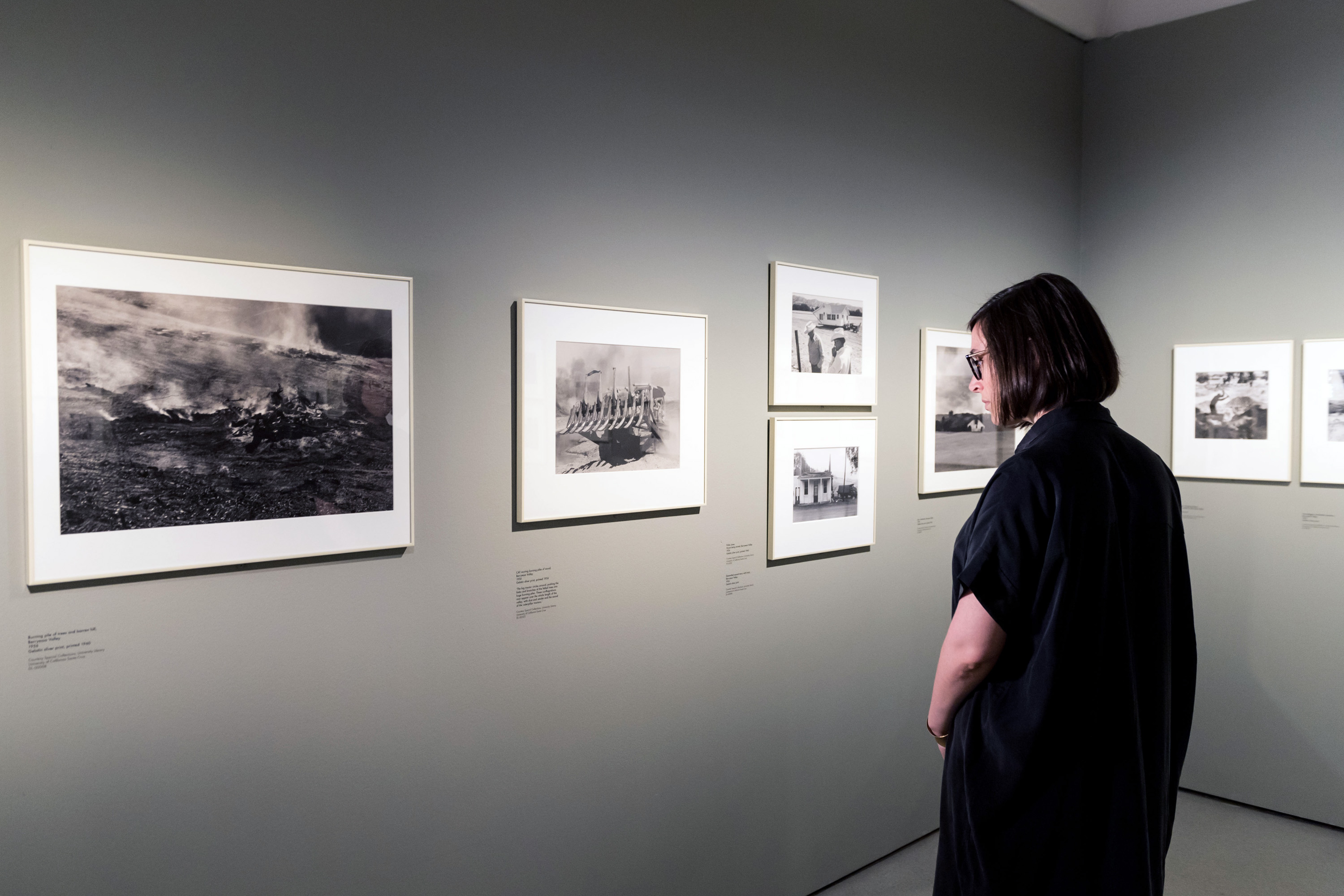
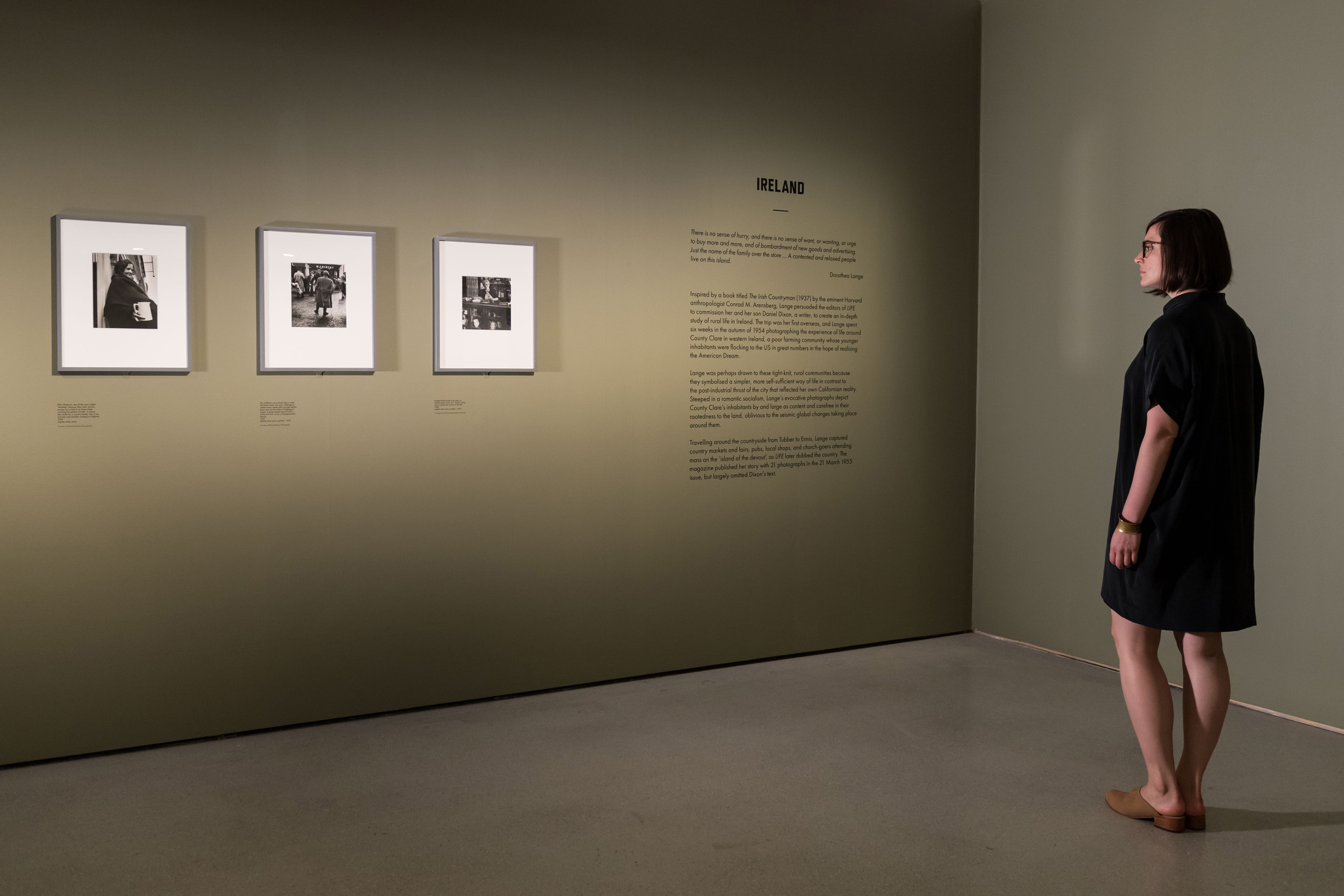
Exhibition: ‘Masculinities: Liberation through Photography’ at the Barbican Art Gallery, London

Exhibition dates: 20th February – 17th May 2020? Coronavirus

Participating artists: Bas Jan Ader, Laurie Anderson, Kenneth Anger, Knut Ã…sdam, Richard Avedon, Aneta Bartos, Richard Billingham, Cassils, Sam Contis, John Coplans, Jeremy Deller, Rienke Dijkstra, George Dureau, Thomas Dworzak, Hans Eijkelboom, Fouad Elkoury, Rotimi Fani-Kayode, Hal Fischer, Samuel Fosso, Anna Fox, Masahisa Fukase, Sunil Gupta, Peter Hujar, Liz Johnson Artur, Isaac Julien, Kiluanji Kia Henda, Karen Knorr, Deana Lawson, Hilary Lloyd, Robert Mapplethrope, Peter Marlow, Ana Mendieta, Anenette Messager, Duane Michals, Tracey Moffat, Andrew Moisey, Richard Mosse, Adi Nes, Catherine Opie, Elle Pérez, Herb Ritts, Kalen Na’il Roach, Collier Schorr, Paul Mpagi Sepuya, Clarie Strand, Michael Subotzky, Larry Sultan, Hank Willis Thomas, Wolfgang Tillmans, Piotr UklaÅ„ski, Andy Warhol, Karlheinz Weinberger, Marianne Wex, David Wojnarowicz, Akram Zaatari.


Sunil Gupta (Indian, b. 1953) 'Untitled #22' 1976 from the exhibition 'Masculinities: Liberation through Photography' at the Barbican Art Gallery, London, Feb - May, 2020


Sunil Gupta (Indian, b. 1953)
Untitled #22
1976
From the series Christopher Street
Courtesy the artist and Hales Gallery
© Sunil Gupta. All Rights Reserved, DACS 2019


“As a writer Berger recognised that experience – whether it be personal, historical or aesthetic – will never conform to theories and systems. To read him today is to accept his failures and detours as a unique willingness to take risks.”


John MacDonald. “John Berger,” in the Sydney Morning Herald, 6 June, 2020


D-Construction: deliberate masculinities in a discontinuous world

Reviewers of this exhibition (see quotations below) have noted the preponderance of images of “traditional masculinity” – defined as “idealised, dominant (and) heterosexual” – and the paucity of images that show men as working, intelligent, sensitive human beings, “that men ever earned a living, cooked a meal or read a book… scarcely anything about the heart or intellect. Men are represented here almost entirely in terms of their bodies, sexuality or supposed type.” I need make no further comment. What I will say is that I believe the title of the exhibition to be a misnomer: a person cannot be “liberated” through photography, for photography is only a tool of a personal liberation. Liberation comes through an internal struggle of acceptance (thence liberation), one that is foremost FELT (for example, the double life one leads before you acknowledge that you are gay; or experiencing discrimination aimed at others and by proxy, yourself) and SEEN (the bashing of a mother as seen by a small child). Photographs picture the outcomes of this struggle for liberation, are a tool of that process not, I would argue, liberation itself.

What I can say is that I believe in masculinities, plural. Fluid, shifting, challenging, loving, working, intimate, spiritual masculinities that challenge normalcy and hegemonic masculinity, which is defined as “a practice that legitimises men’s dominant position in society and justifies the subordination of the common male population and women, and other marginalised ways of being a man.”

What I don’t believe in is masculinities, plural, that seek to fit into this [dis]continuous world (for we are born and then die) through the stability of their outward appearance, conforming to theories and systems – personal, historical or aesthetic – without reference to subversion, small intimacies, the toil of work, love and the passion of sexual bodies. In other words, masculinities that are not afraid to push the boundaries of being and becoming. To take risks, to experience, to feel.

While I was overjoyed at the “YES” vote on gay marriage that took place in December 2017 in Australia because I felt it was a victory for love, and equality… another part of me rejected as anathema the concept of a gay person buying into a historically patriarchal, heterosexual and monogamous institution such as marriage – too honour and obey. This is an untenable concept for a person who wants to be liberated. Coming out as I did in 1975, only 6 short years after the Stonewall Riots, the last thing I EVER wanted to be, was to be the same as a “straight” person. I was different. I fought for my difference and still believe in it.

Of course, in 2020 it’s another world. Today we all mix in together. But there is still something about “masculinities”, which in some varieties, have a sense of privilege and entitlement. Of power and control over others; of violence towards women, trans, other men and anyone who threatens their little ego, who leaves them, or jilts them. Their jealousy, their ego, bruised – they are so insecure, so insular, that they can only see their own world, their own minuscule problems (but massive in their eyes), and enforce their will on others.

My advice to “masculinities’, in fact any human being, is to go out, get yourself informed, experience, accept, and be the person that nobody thinks you can be. Be a human being. Examine your inner self, look at your dark side, your other side, your empathetic side, and try and understand the journey that you are on. Then, and only then, you might begin on that great path of personal enlightenment, that golden path on which there is no turning back.

Below I discuss some of these ideas with my good friend Nicholas Henderson, curator and archivist at the Australian Lesbian and Gay Archives.


Dr Marcus Bunyan


Many thankx to the Barbican Art Gallery for allowing me to publish the photographs in the posting. Please click on the photographs for a larger version of the image.


Masculinities: Liberation through Photography is a major group exhibition that explores how masculinity is experienced, performed, coded and socially constructed as expressed and documented through photography and film from the 1960s to the present day.

Through the medium of film and photography, this major exhibition considers how masculinity has been coded, performed, and socially constructed from the 1960s to the present day. Examining depictions of masculinity from behind the lens, the Barbican brings together the work of over 50 international artists, photographers and filmmakers including Laurie Anderson, Sunil Gupta, Rotimi Fani-Kayode, Isaac Julien and Catherine Opie.

In the wake of #MeToo the image of masculinity has come into sharper focus, with ideas of toxic and fragile masculinity permeating today’s society. This exhibition charts the often complex and sometimes contradictory representations of masculinities, and how they have developed and evolved over time. Touching on themes including power, patriarchy, queer identity, female perceptions of men, hypermasculine stereotypes, tenderness and the family, the exhibition shows how central photography and film have been to the way masculinities are imagined and understood in contemporary culture.


In fact, while there are a few gender-fluid figures here, they’re vastly outnumbered by manifestations of “traditional masculinity” – defined as “idealised, dominant (and) heterosexual”. Lebanese militiamen (in Fouad Elkoury’s perky full-length portraits from 1980), US marines (in Wolfgang Tillmans’ epic montage Soldiers – The Nineties), Taliban fighters, SS generals, Israel Defence Force grunts, footballers, cowboys and bullfighters fairly spring out of the walls from every direction. And what’s evident from the outset isn’t so much their diversity, as a unifying demeanour: a threatening intentness that comes wherever men are asked to perform their masculinity, but also a childlike vulnerability.  …

Masculinity, the viewer is made to feel, criminalises men (Mikhael Subotzky’s images of South African gangsters on morgue slabs); isolates them (Larry Sultan’s poignant image of his elderly father practising his golf swing in his sitting room); renders them stupid (Richard Billingham’s excruciating, but now classic photo essay on his alcoholic father, ‘Ray’s a Laugh’). To be a man, it seems, is to be condemned to endlessly act out archetypal “masculine” behaviour, whether you’re an elderly drunk in a Birmingham high-rise or the elite American students taking part in the shouting competition staged by Irish photographer Richard Mosse.


Mark Hudson. “Does the Barbican’s Masculinities exhibition have important things to say about men?” on the Independent website Friday 21 February 2020 [Online] Cited 03/03/2020


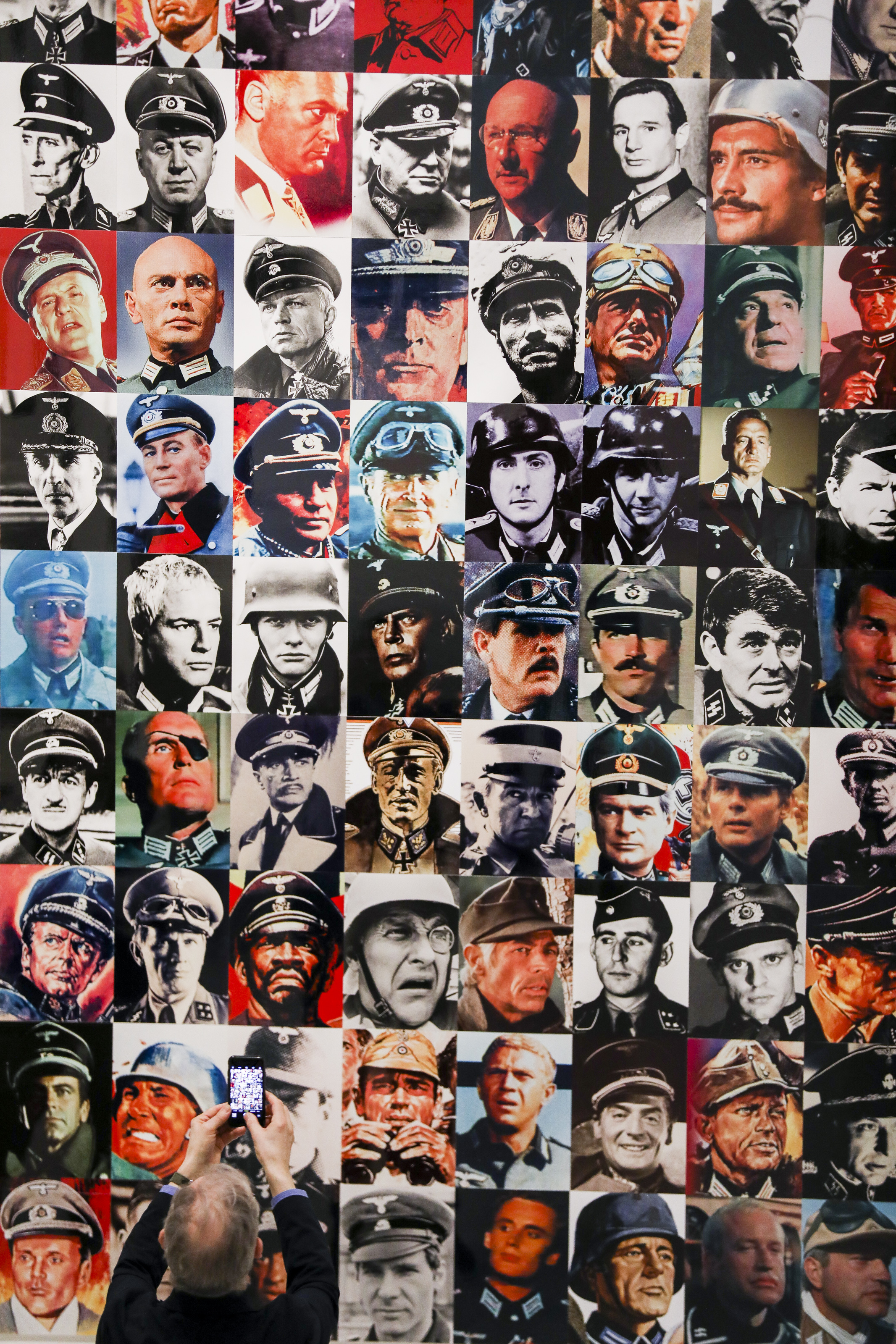
There is not much here about work – unless you count the wall of Hollywood actors playing Nazis. You would never think, from this show, that men ever earned a living, cooked a meal or read a book (though there is a sententious vitrine of ‘Men Only’ magazines). Beyond the exceptions given, there is scarcely anything about the heart or intellect. Men are represented here almost entirely in terms of their bodies, sexuality or supposed type.


Laura Cumming. “Masculinities: Liberation Through Photography review – men as types,” on the Guardian website Sun 23 Feb 2020 [Online] Cited 03/03/2020


“The body can be taken as a reflection of the self because it can and should be treated as something to be worked upon … in order to produce it as a commodity. Overweight, slovenliness and even unfashionability, for example, are now moral disorders,” notes Don Slater

“The state of the body is seen as a reflection of the state of its owner, who is responsible for it and could refashion it. The body can be taken as a reflection of the self because it can and should be treated as something to be worked upon, and generally worked upon using commodities, for example intensively regulated, self-disciplined, scrutinized through diets, fitness regimes, fashion, self-help books and advice, in order to produce it as a commodity. Overweight, slovenliness, and even unfashionability, for example, are now moral disorders; even acute illnesses such as cancer reflect the inadequacy of the self and indeed of its consumption. One gets ill because one has consumed the wrong (unnatural) things and failed to consume the correct (‘natural’) ones: self, body, goods and environment constitute a system of moral choice.”


Slater, Don. Consumer Culture and Modernity. London: Polity Press, 1997, p. 92.


Installation view of 'Masculinities: Liberation through Photography' at Barbican Art Gallery on February 19, 2020 in London, England showing John Coplans' work 'Self-portrait, Frieze No 2, Four Panels' 1994

Installation view of 'Masculinities: Liberation through Photography' at Barbican Art Gallery on February 19, 2020 in London, England showing John Coplans' work 'Self-portrait, Frieze No 2, Four Panels' 1994


Installation view of Masculinities: Liberation through Photography at Barbican Art Gallery on February 19, 2020 in London, England showing John Coplans’ work Self-portrait, Frieze No 2, Four Panels 1994
Photo: Tristan Fewings/Getty Images for Barbican Art Gallery


John Coplans (British, emigrated America 1960, 1920-2003) 'Self-portrait, Frieze No 2, Four Panels' 1994 from the exhibition 'Masculinities: Liberation through Photography' at the Barbican Art Gallery, London, Feb - May, 2020


John Coplans (British, emigrated America 1960, 1920-2003)
Self-portrait, Frieze No 2, Four Panels
1994
Tate
Presented by the American Fund for the Tate Gallery 2001
Photograph: © John Coplans Trust


Masculinities: Liberation through Photography


Plan of the 'Masculinities: Liberation through Photography' exhibition spaces


Plan of the Masculinities: Liberation through Photography exhibition spaces


Introduction

Masculinities: Liberation through Photography explores the diverse ways masculinity has been experienced, performed, coded and socially constructed in photography and film from the 1960s to the present day.

Simone de Beauvoir’s famous declaration that ‘one is not born a woman, but rather becomes one’ provides a helpful springboard for considering what it means to be a male in today’s world, as well as the place of photography and film in shaping masculinity. What we have thought of as ‘masculine’ has changed considerably throughout history and within different cultures. The traditional social dominance of the male has determined a gender hierarchy which continues to underpin societies around the world.

In Europe and North America, the characteristics and power dynamics of the dominant masculine figure – historically defined by physical size and strength, assertiveness and aggression – though still pervasive today, began to be challenged and transformed in the 1960s. Amid a climate of sexual revolution, struggle for civil rights and raised class consciousness, the growth of the gay rights movement, the period’s counterculture and opposition to the Vietnam War, large sections of society argued for a loosening of the straitjacket of narrow gender definitions.

Set against the backdrop of the #MeToo movement, when manhood is under increasing scrutiny and terms such as ‘toxic’ and ‘fragile’ masculinity fill endless column inches, an investigation of this expansive subject is particularly timely, especially given current global politics characterised by male world leaders shaping their image as ‘strong’ men.

Touching on queer identity, race, power and patriarchy, men as seen by women, stereotypes of dominant masculinity as well as the family, the exhibition presents masculinity in all its myriad forms, rife with contradictions and complexities. Embracing the idea of multiple ‘masculinities’ and rejecting the notion of a singular ‘ideal man’, the exhibition argues for an understanding of masculinity liberated from societal expectations and gender norms.

Room 1-4

Disrupting the Archetype

Over the last six decades, artists have consistently sought to destabilise the narrow definitions of gender that determine our social structures in order to encourage new ways of thinking about identity, gender and sexuality. ‘Disrupting the Archetype’ explores the representation of conventional and at times clichéd masculine subjects such as soldiers, cowboys, athletes, bullfighters, body builders and wrestlers. By reconfiguring the representation of traditional masculinity – loosely defined as an idealised, dominant heterosexual masculinity – the artists presented here challenge our ideas of these hypermasculine stereotypes.

Across different cultures and spaces, the military has been central to the construction of masculine identities – which has been explored through the work of Wolfgang Tillmans (below) and Adi Nes (below) among others, while Collier Schorr (below) and Sam Contis’s powerful works (below) address the dominant and enduring representation of the lone cowboy. Athleticism, often perceived as a proxy for strength which is associated with masculinity, is called into question by Catherine Opie’s and Rineke Dijkstra’s tender portraits (below). The male body, a cornerstone for artists such as John Coplans (above), Robert Mapplethorpe and Cassils (below), is meanwhile exposed as a fleshy canvas, constantly in flux.

Historically, the non-western male body has undergone a complex process of subjectification through the Western gaze – invariably presented as either warlike or sexually charged. Viewed against this context, the work of Fouad Elkoury and Akram Zaatari, as well as the found photographs of Taliban fighters that Thomas Dworzak discovered in Afghanistan (below), can be read as deconstructing the Orientalist gaze.


Installation view of 'Masculinities: Liberation through Photography' at Barbican Art Gallery on February 19, 2020 in London, England showing a detail from Wolfgang Tillmans' epic montage 'Soldiers – The Nineties'


Installation view of Masculinities: Liberation through Photography at Barbican Art Gallery on February 19, 2020 in London, England showing a detail from Wolfgang Tillmans’ epic montage Soldiers – The Nineties
Photo: Tristan Fewings/Getty Images for Barbican Art Gallery


Installation view of 'Masculinities: Liberation through Photography' at Barbican Art Gallery on February 19, 2020 in London, England showing a detail from trans masculine artist Cassils' series 'Time Lapse' 2011


Installation view of Masculinities: Liberation through Photography at Barbican Art Gallery on February 19, 2020 in London, England showing a detail from trans masculine artist Cassils’ series Time Lapse, 2011
Photo: Tristan Fewings/Getty Images for Barbican Art Gallery


Installation view of 'Masculinities: Liberation through Photography' at Barbican Art Gallery on February 19, 2020 in London, England showing at left a detail from trans masculine artist Cassils' series 'Time Lapse' 2011, and at right the work of Rineke Dijkstra


Installation view of Masculinities: Liberation through Photography at Barbican Art Gallery on February 19, 2020 in London, England showing at left a detail from trans masculine artist Cassils’ series Time Lapse, 2011, and at right the work of Rineke Dijkstra
Photo: Tristan Fewings/Getty Images for Barbican Art Gallery


Rineke Dijkstra (Dutch, b. 1959) 'Montemor, Portugal, May 1, 1994' 1994


Rineke Dijkstra (Dutch, b. 1959)
Montemor, Portugal, May 1, 1994
1994
Chromogenic print
90 x 72cm
© Rineke Dijkstra
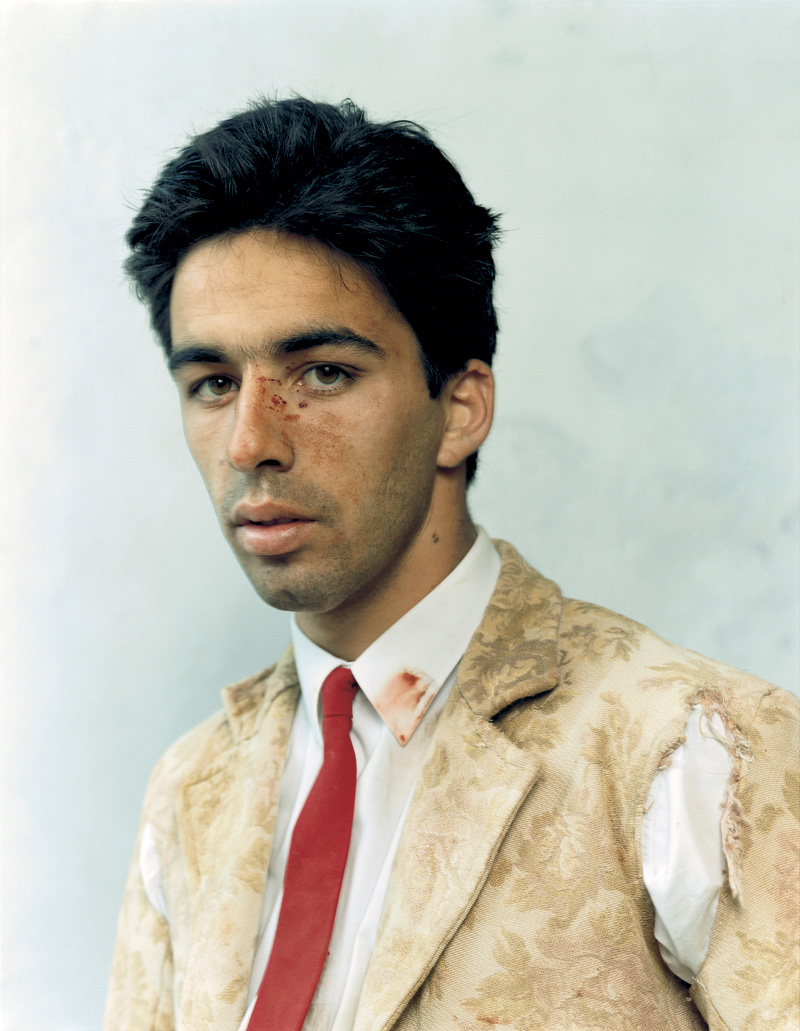
 

Rineke Dijkstra (Dutch, b. 1959) 'Vila Franca de Xira, Portugal, May 8, 1994' 1994


Rineke Dijkstra (Dutch, b. 1959)
Vila Franca de Xira, Portugal, May 8, 1994
1994
Chromogenic print
90 x 72cm
© Rineke Dijkstra


Installation view of 'Masculinities: Liberation through Photography' at Barbican Art Gallery on February 19, 2020 in London, England showing photographs from Adi Nes' series 'Soldiers' 1999


Installation views of Masculinities: Liberation through Photography at Barbican Art Gallery on February 19, 2020 in London, England showing photographs from Adi Nes’ series Soldiers, 1999
Photo: Tristan Fewings/Getty Images for Barbican Art Gallery


Adi Nes (Israeli, b. 1966) 'Untitled' 2000


Adi Nes (Israeli, b. 1966)
Untitled
2000
From the series Soldiers
Courtesy Adi Nes & Praz-Delavallade Paris, Los Angeles


Adi Nes (Israeli, b. 1966) 'Untitled' 1999


Adi Nes (Israeli, b. 1966)
Untitled
1999
From the series Soldiers
Courtesy Adi Nes & Praz-Delavallade Paris, Los Angeles


Adi Nes was born in Kiryat Gat. His parents are Jewish immigrants from Iran. He is openly gay. Nes is notable for series “Soldiers”, in which he mixes masculinity and homoerotic sexuality, depicting Israeli soldiers in a fragile way.

Nes creates cinematic images that reference war, sexuality, life, and death with the kind of stylised polish you might expect from a photographer whose images have appeared in the pages of Vogue Hommes. His partially autobiographical work is deliberate and staged in an attempt to raise questions about sexuality, masculinity and identity in Israeli culture. “The beginning point of my art is who I am,” he says. “Since I’m a man and I’m an Israeli, I deal with issues of identity with ‘Israeli-ness’ and masculinity, but my photographs are multi-layered.”

“The challenge of the photographer is to catch the viewer for more than one second in front of the picture,” says Nes, explaining his provocative images. “If you catch the viewer in front of the picture, it can touch the viewer.”

Anonymous text “Adi Nes on masculinity, sexuality and war,” from the Phaidon website 2012 [Online] Cited 07/03/2020


Thomas Dworzak (Germany, b. 1972) 'Taliban portraits' 2002

Thomas Dworzak (Germany, b. 1972) 'Taliban portraits' 2002


Thomas Dworzak (Germany, b. 1972)
Taliban portraits
2002
Kandahar, Afghanistan


While covering the US invasion of Afghanistan in 2001, Magnum photographer Thomas Dworzak came across a handful of photo studios in Kandahar which despite the Taliban’s ban on photography had been authorised to remain open, for the sole purpose of taking identity photos. Complicating the conventional image of the hypermasculine soldier, the colour portraits Dworzak found in the back rooms of these studios depict Taliban fighters variously posing in front of scenic backdrops, holding hands, using guns or flowers as props or enveloped in a halo of vibrant colours, their eyes heavily made up with black kohl. These stylised photographs directly contradict the public image of the soldier in this overwhelmingly male-dominated patriarchal society.


Sam Contis (American, b. 1982) 'Untitled (Neck)' 2015


Sam Contis (American, b. 1982)
Untitled (Neck)
2015
© Sam Contis


'Masculinities: Liberation through Photography' catalogue cover


Masculinities: Liberation through Photography catalogue cover


Installation view of 'Masculinities: Liberation through Photography' at Barbican Art Gallery on February 19, 2020 in London, England showing photographs from Catherine Opie's series 'High School Football' 2007-2009


Installation view of Masculinities: Liberation through Photography at Barbican Art Gallery on February 19, 2020 in London, England showing photographs from Catherine Opie’s series High School Football, 2007-2009
Photo: Tristan Fewings/Getty Images for Barbican Art Gallery


Catherine Opie (American, b. 1961) 'Stephen' 2009


Catherine Opie (American, b. 1961)
Stephen
2009
From the series High School Football, 2007-2009
Courtesy Regen Projects, Los Angeles, and Thomas Dane Gallery, London
© Catherine Opie


Catherine Opie (American, b. 1961) 'Rusty' 2008


Catherine Opie (American, b. 1961)
Rusty
2008
From the series High School Football, 2007-2009
Courtesy Regen Projects, Los Angeles and Thomas Dane Gallery, London
© Catherine Opie


Catherine Opie (American, b. 1961) 'Football Landscape #17 (Waianae vs. Leilehua, Waianae, HI)' 2009


Catherine Opie (American, b. 1961)
Football Landscape #17 (Waianae vs. Leilehua, Waianae, HI)
2009
From the series High School Football, 2007-2009
Courtesy Regen Projects, Los Angeles, and Thomas Dane Gallery, London
© Catherine Opie


Kenneth Anger (American, b. 1927)
Kustom Kar Kommandos
1965
3 mins 22 secs


Collier Schorr (American, b. 1963) 'Americans #3' 2012


Collier Schorr (American, b. 1963)
Americans #3
2012
© Collier Schorr, courtesy 303 Gallery, New York


Room 5-6

Male Order: Power, Patriarchy and Space

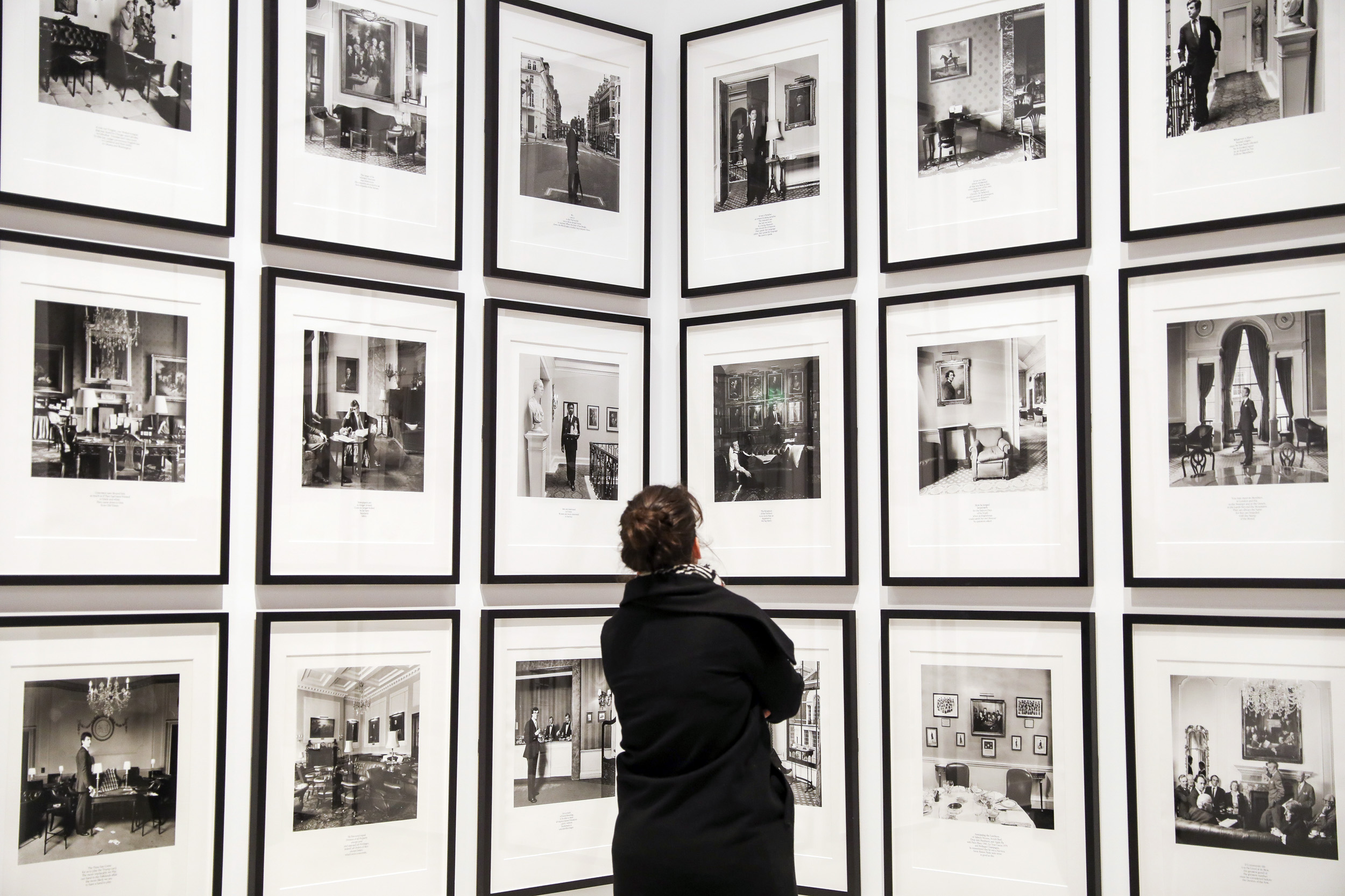
‘Male Order’ invites the viewer to reflect on the construction of male power, gender and class. The artists gathered here have all variously attempted to expose and subvert how certain types of masculine behaviour have created inequalities both between and within gender identities. Two ambitious, multi-part works, Richard Avedon’s The Family, 1976, and Karen Knorr’s Gentlemen, 1981-1983, focus on typically besuited white men who occupy the corridors of power, while foregrounding the historic exclusion not only of women but also of other marginalised masculinities.

Male-only organisations, such as the military, private members’ clubs and college fraternities, have often served as an arena for the performance of ‘toxic’ masculinity, as chronicled in Andrew Moisey’s The American Fraternity: An Illustrated Ritual Manual, 2018. This startling book charts the misdemeanours of fraternity members alongside an indexical image bank of US Presidents, alongside leaders of government and industry who have belonged at one time or another to these fraternities. Richard Mosse’s film, Fraternity, 2007, takes a different tack by painting a portrait of male rage that is both playful and alarming.


Installation view of 'Masculinities: Liberation through Photography' at Barbican Art Gallery on February 19, 2020 in London, England showing photographs from Richard Avedon's series 'The Family' (1976)

Installation view of 'Masculinities: Liberation through Photography' at Barbican Art Gallery on February 19, 2020 in London, England showing photographs from Richard Avedon's series 'The Family' (1976)


Installation view of Masculinities: Liberation through Photography at Barbican Art Gallery on February 19, 2020 in London, England showing photographs from Richard Avedon’s series The Family (1976)
Photo: Tristan Fewings/Getty Images for Barbican Art Gallery


Early  in 1976, with both the post-Watergate political atmosphere and the approaching bicentennial celebration in mind, Rolling Stone asked Richard Avedon to cover the presidential primaries and the campaign trail. Avedon counter-proposed a grander idea – he had always wanted to photograph the men and women he believed to have constituted political, media and corporate elite of the United States.

For the next several months, Avedon traversed the country from migrant grape fields of California to NFL headquarters in Park Avenue and returned with an amazing portfolio of soldiers, spooks, potentates, and ambassadors that was too late for the bicentennial but published in Rolling Stone’s Oct. 21, 1976, just in time for the November elections.

Sixty-nine black-and-white portraits … were in Avedon’s signature style – formal, intimate, bold, and minimalistic. Appearing in them are President Ford and his three immediate successors – Carter, Reagan, and Bush. Other familiars of the American polity such as Kennedys and Rockefellers are here, and as are giants who held up the nation’s Fourth Pillar during that challenging decade: A. M. Rosenthal of the New York Times who decided to publish the Pentagon Papers, and Katharine Graham who led Woodward and Bernstein at Washington Post.

Alex Selwyn-Holmes. “The Family, 1976; Richard Avedon” on the Iconphotos website May 18, 2012 [Online] Cited 03/03/2020


Installation view of 'Masculinities: Liberation through Photography' at Barbican Art Gallery on February 19, 2020 in London, England showing at left photographs from Karen Knorr's series 'Gentlemen' 1981-1983; and at right, Piotr Uklanski's 'Untitled (The Nazis)' 1998, a collage of actors dressed as Nazis

Installation view of 'Masculinities: Liberation through Photography' at Barbican Art Gallery on February 19, 2020 in London, England showing photographs from Karen Knorr's series 'Gentlemen' 1981-1983

Installation view of 'Masculinities: Liberation through Photography' at Barbican Art Gallery on February 19, 2020 in London, England showing photographs from Karen Knorr's series 'Gentlemen' 1981-1983


Installation views of Masculinities: Liberation through Photography at Barbican Art Gallery on February 19, 2020 in London, England showing photographs from Karen Knorr’s series Gentlemen, 1981-1983
Photo: Tristan Fewings/Getty Images for Barbican Art Gallery


Karen Knorr (American, born Germany 1954) 'Newspapers are no longer ironed, Coins no longer boiled So far have Standards fallen' 1981-1983


Karen Knorr (American born Germany, b. 1954)
Newspapers are no longer ironed, Coins no longer boiled So far have Standards fallen
1981-1983
From the series Gentlemen
Tate: Gift Eric and Louise Franck London Collection 2013
© Karen Knorr


Installation view of 'Masculinities: Liberation through Photography' at Barbican Art Gallery on February 19, 2020 in London, England showing Piotr Uklanski's 'Untitled (The Nazis)' 1998, a collage of actors dressed as Nazis, courtesy of Massimo De Carlo

Installation view of 'Masculinities: Liberation through Photography' at Barbican Art Gallery on February 19, 2020 in London, England showing Piotr Uklanski's 'Untitled (The Nazis)' 1998, a collage of actors dressed as Nazis, courtesy of Massimo De Carlo

Installation view of 'Masculinities: Liberation through Photography' at Barbican Art Gallery on February 19, 2020 in London, England showing Piotr Uklanski's 'Untitled (The Nazis)' 1998, a collage of actors dressed as Nazis, courtesy of Massimo De Carlo


Installation view of Masculinities: Liberation through Photography at Barbican Art Gallery on February 19, 2020 in London, England showing Piotr Uklanski’s Untitled (The Nazis), 1998, a collage of actors dressed as Nazis, courtesy of Massimo De Carlo
Photo: Tristan Fewings/Getty Images for Barbican Art Gallery


Room 7-8

Too Close to Home: Family and Fatherhood

Since its invention photography has been a powerful vehicle for the construction and documentation of family narratives. In contrast to the conventions of the traditional family portrait, the artists gathered here deliberately set out to record the ‘messiness’ of life, reflecting on misogyny, violence, sexuality, mortality, intimacy and unfolding family dramas, presenting a more complex and not always comfortable vision of fatherhood and masculinity.

Loss and the ageing male figure are central to the work of both Masahisa Fukase and Larry Sultan (both below). Their respective projects marked a new departure in the way men photographed each other, serving as a commentary on how old age engenders a loss of masculinity. An examination of everyday life, Richard Billingham’s tender yet bleak portraits of his father, as chronicled in Ray’s a Laugh, cast a brutally honest eye on his alcoholic father Ray against a backdrop of social decline (below).

Anna Fox’s disturbing autobiographical work undermines expectations of the traditional family album while revealing the mechanics of paternalistic power. Meanwhile, the father-daughter relationship is brought into sharp focus in Aneta Bartos’s sexually charged series Family Portrait which unsettles traditional family boundaries (below).


Masahisa Fukase (Japan, 1934-2012) 'Masahisa and Sukezo' 1972


Masahisa Fukase (Japan, 1934-2012)
Masahisa and Sukezo
1972
From the series Family, 1971-1990
© Masahisa Fukase Archives


Masahisa Fukase (Japan, 1934-2012) 'Upper row, from left to right: A, a model; Toshiteru, Sukezo, Masahisa. Middle row, from left to right: Akiko, Mitsue, Hisashi Daikoji. Bottom row, from left to right: Gaku, Kyoko, Kanako, and a memorial portrait of Miyako' 1985


Masahisa Fukase (Japan, 1934-2012)
Upper row, from left to right: A, a model; Toshiteru, Sukezo, Masahisa. Middle row, from left to right: Akiko, Mitsue, Hisashi Daikoji. Bottom row, from left to right: Gaku, Kyoko, Kanako, and a memorial portrait of Miyako
1985
From the series Family, 1971-1990
© Masahisa Fukase Archives


Masahisa Fukase (Japan, 1934-2012) 'Masahisa and Sukezo' 1985


Masahisa Fukase (Japan, 1934-2012)
Masahisa and Sukezo
1985
From the series Family, 1971-1990
© Masahisa Fukase Archives


‘A magnificent memorial to paternal love’.


Installation view of 'Masculinities: Liberation through Photography' at Barbican Art Gallery on February 19, 2020 in London, England showing the photographs of Larry Sultan from the series 'Pictures from Home'

Installation view of 'Masculinities: Liberation through Photography' at Barbican Art Gallery on February 19, 2020 in London, England showing the photographs of Larry Sultan from the series 'Pictures from Home'


Installation view of Masculinities: Liberation through Photography at Barbican Art Gallery on February 19, 2020 in London, England showing the photographs of Larry Sultan from the series Pictures from Home
Photo: Tristan Fewings/Getty Images for Barbican Art Gallery


Larry Sultan (American, 1946-2009) 'Dad on Bed' 1984


Larry Sultan (American, 1946-2009)
Dad on Bed
1984
From the series Pictures from Home
Chromogenic print
Courtesy the Estate of Larry Sultan, Yancey Richardson, Casemore Kirkeby, and Galerie Thomas Zander
© Estate of Larry Sultan


Larry Sultan (American, 1946-2009) 'Practicing Golf Swing' 1986


Larry Sultan (American, 1946-2009)
Practicing Golf Swing
1986
From the series Pictures from Home
Chromogenic print
Courtesy the Estate of Larry Sultan, Yancey Richardson, Casemore Kirkeby, and Galerie Thomas Zander
© Estate of Larry Sultan


Installation view of 'Masculinities: Liberation through Photography' at Barbican Art Gallery on February 19, 2020 in London, England showing Richard Billingham's photographs from the series 'Ray's a Laugh'


Installation view of Masculinities: Liberation through Photography at Barbican Art Gallery on February 19, 2020 in London, England showing Richard Billingham’s photographs from the series Ray’s a Laugh
Photo: Tristan Fewings/Getty Images for Barbican Art Gallery

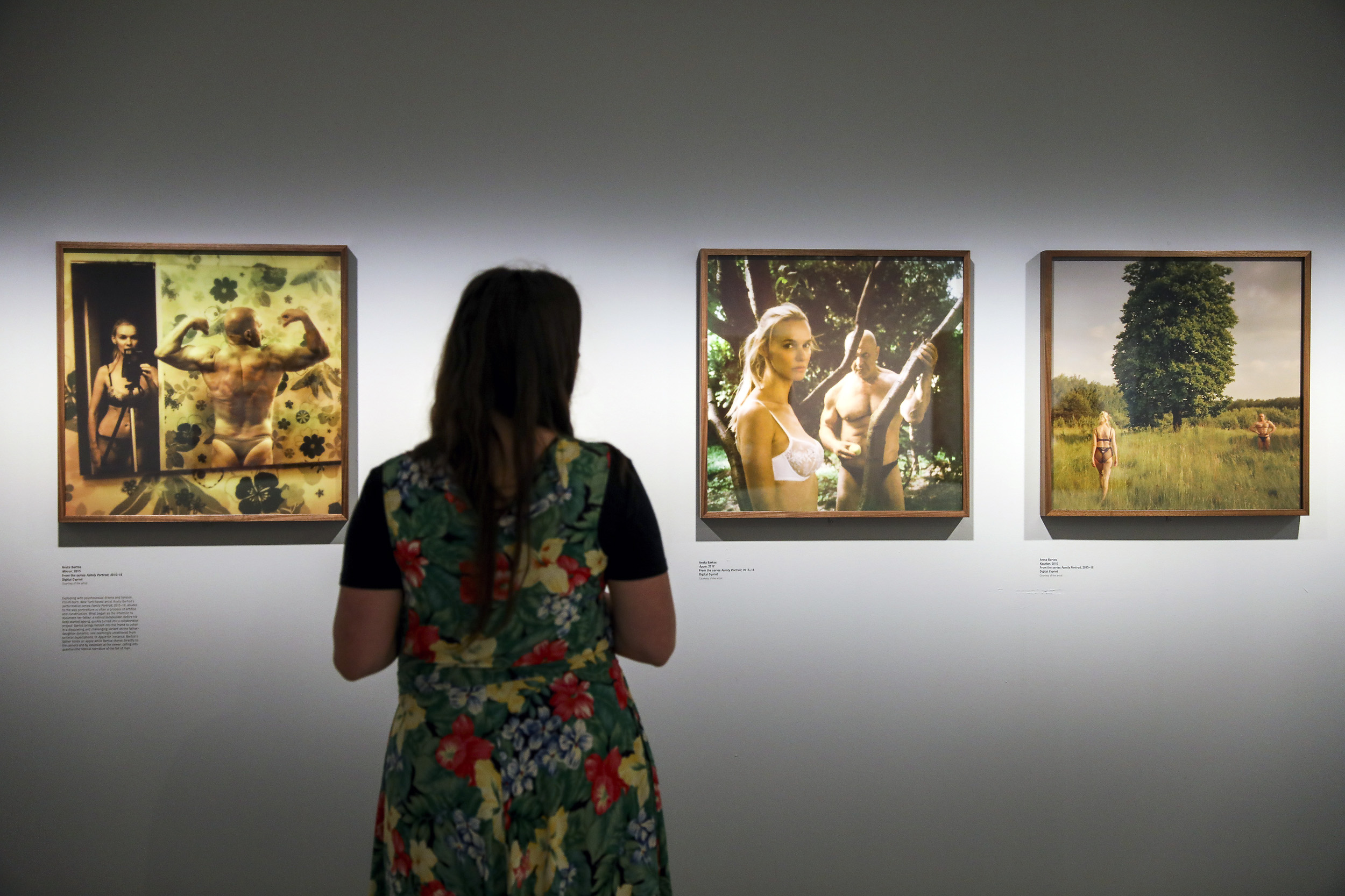
 

Installation view of 'Masculinities: Liberation through Photography' at Barbican Art Gallery on February 19, 2020 in London, England showing the photographs of Aneta Bartos's sexually charged series 'Family Portrait'

Installation view of 'Masculinities: Liberation through Photography' at Barbican Art Gallery on February 19, 2020 in London, England showing the photographs of Aneta Bartos's sexually charged series 'Family Portrait'


Installation view of Masculinities: Liberation through Photography at Barbican Art Gallery on February 19, 2020 in London, England showing the photographs of Aneta Bartos’s sexually charged series Family Portrait
Photo: Tristan Fewings/Getty Images for Barbican Art Gallery


Aneta Bartos (Born Poland, lives New York) 'Mirror' 2015


Aneta Bartos (Born Poland, lives New York)
Mirror
2015
From the series Family Portrait
Archival inkjet print
30 x 30.65 inches


Aneta Bartos (Born Poland, lives New York) 'Apple' 2015


Aneta Bartos (Born Poland, lives New York)
Apple
2015
From the series Family Portrait
Archival inkjet print
30 x 30.65 inches


Since 2013 New York based artist Aneta Bartos has been traveling back to her hometown Tomaszów Mazowiecki, where she was raised by her father as a single parent from the age of eight until fourteen. Then 68 years old, and having spent a lifetime as a competitive body builder, Bartos’ father asked her to take a few shots documenting his physique before it degenerated and inevitably ran its course. The original request of her father inspired Bartos to transform his idea into a long-term project called Dad. A few summers later Dad developed into a new series of portraits, titled Family Portrait, exploring the complex dynamics between father and daughter.

Text from the Antwerp Art website [Online] Cited 01/03/2020


“The pastoral setting is a romanticised portal to Bartos’s past. Her father’s poses are often heroic; at times the pictures are playful and flirty, almost seductive. Seen together, they display the sadness of a man who knows he is ageing, with the subtext of his waning sexuality. They are bittersweet, images of time passing and memories being preserved.”

Elisabeth Biondi quoted on the Postmasters website 2017 [Online] Cited 01/03/2020


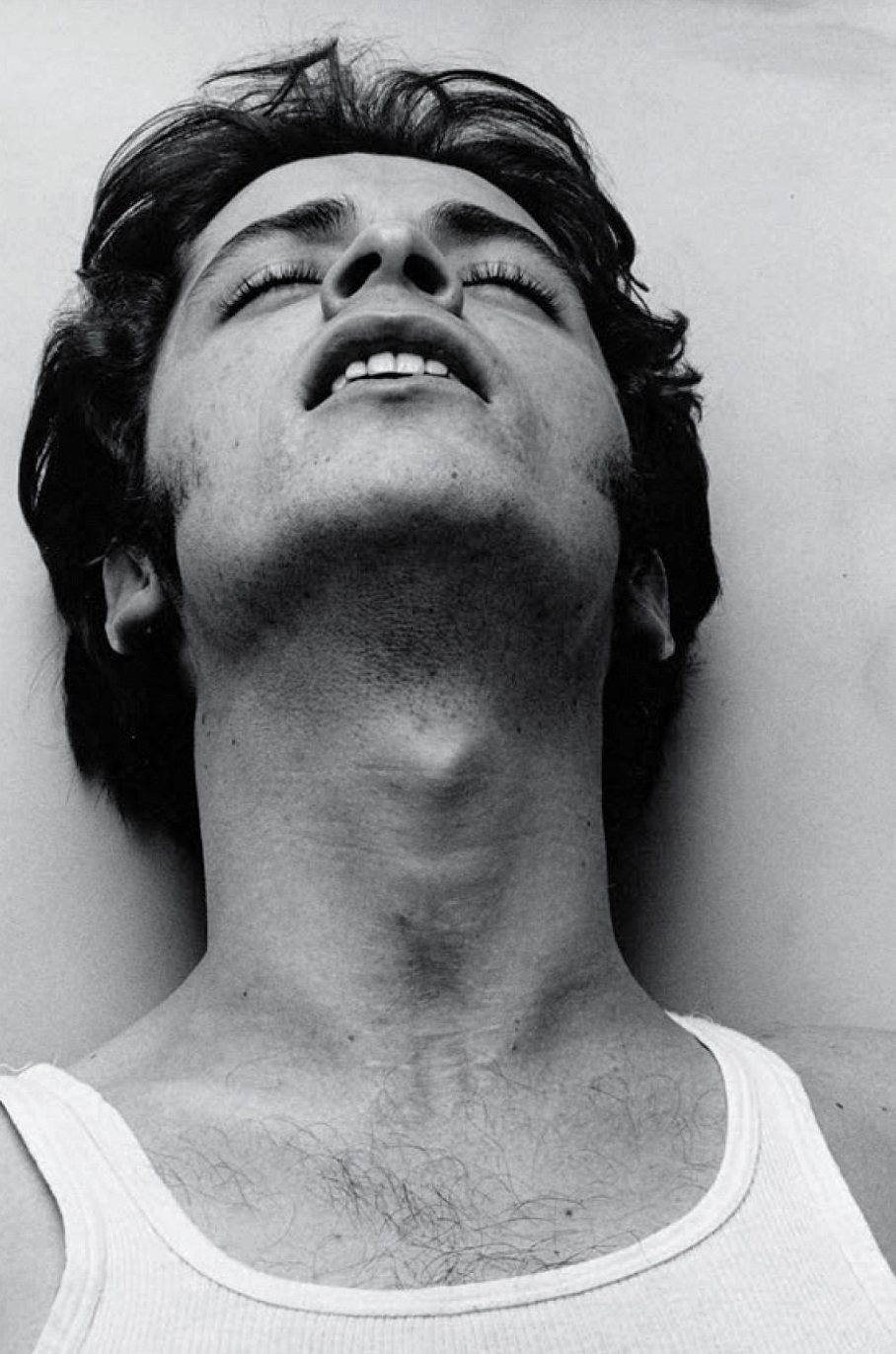
Installation view of 'Masculinities: Liberation through Photography' at Barbican Art Gallery on February 19, 2020 in London, England showing photographs from Peter Hujar's series 'Orgasmic Man' 1969

Installation view of 'Masculinities: Liberation through Photography' at Barbican Art Gallery on February 19, 2020 in London, England showing photographs from Peter Hujar's series 'Orgasmic Man' 1969


Installation views of Masculinities: Liberation through Photography at Barbican Art Gallery on February 19, 2020 in London, England showing photographs from Peter Hujar’s series Orgasmic Man 1969 (see below)
Photo: Tristan Fewings/Getty Images for Barbican Art Gallery


Room 9-12

Queer Masculinity

In defiance of the prejudice and legal constraints against homosexuality in Europe, the United States and beyond over the last century, the works presented in ‘Queering Masculinity’ highlight how artists from the 1960s onwards have forged a new politically charged queer aesthetic.

In the 1970s, artists such as Peter Hujar (below), David Wojnarowicz, Sunil Gupta (below) and Hal Fischer (below) photographed gay lifestyles in New York and San Francisco in a bid to claim public visibility and therefore legitimacy at a time when homosexuality was still a criminal offence. Reflecting on their own queer experience and creating sensual bodies of work, artists such as Rotimi Fani-Kayode (below) and Isaac Julien (below) portrayed black gay desire while Catherine Opie’s seminal work Being and Having, 1991 (below), documented members of the dyke, butch and BDSM communities in San Francisco playing with the physical attributes associated with hypermasculinity in order to overturn traditional binary understandings of gender.


Installation view of 'Masculinities: Liberation through Photography' at Barbican Art Gallery on February 19, 2020 in London, England showing photographs by Karlheinz Weinberger


Installation views of Masculinities: Liberation through Photography at Barbican Art Gallery on February 19, 2020 in London, England showing photographs by Karlheinz Weinberger
Photo: Tristan Fewings/Getty Images for Barbican Art Gallery


Karlheinz Weinberger (Swiss, 1921-2006) 'Horseshoe buckle' 1962


Karlheinz Weinberger (Swiss, 1921-2006)
Horseshoe buckle
1962
Courtesy Galerie Esther Woerdehoff
© Karlheinz Weinberger
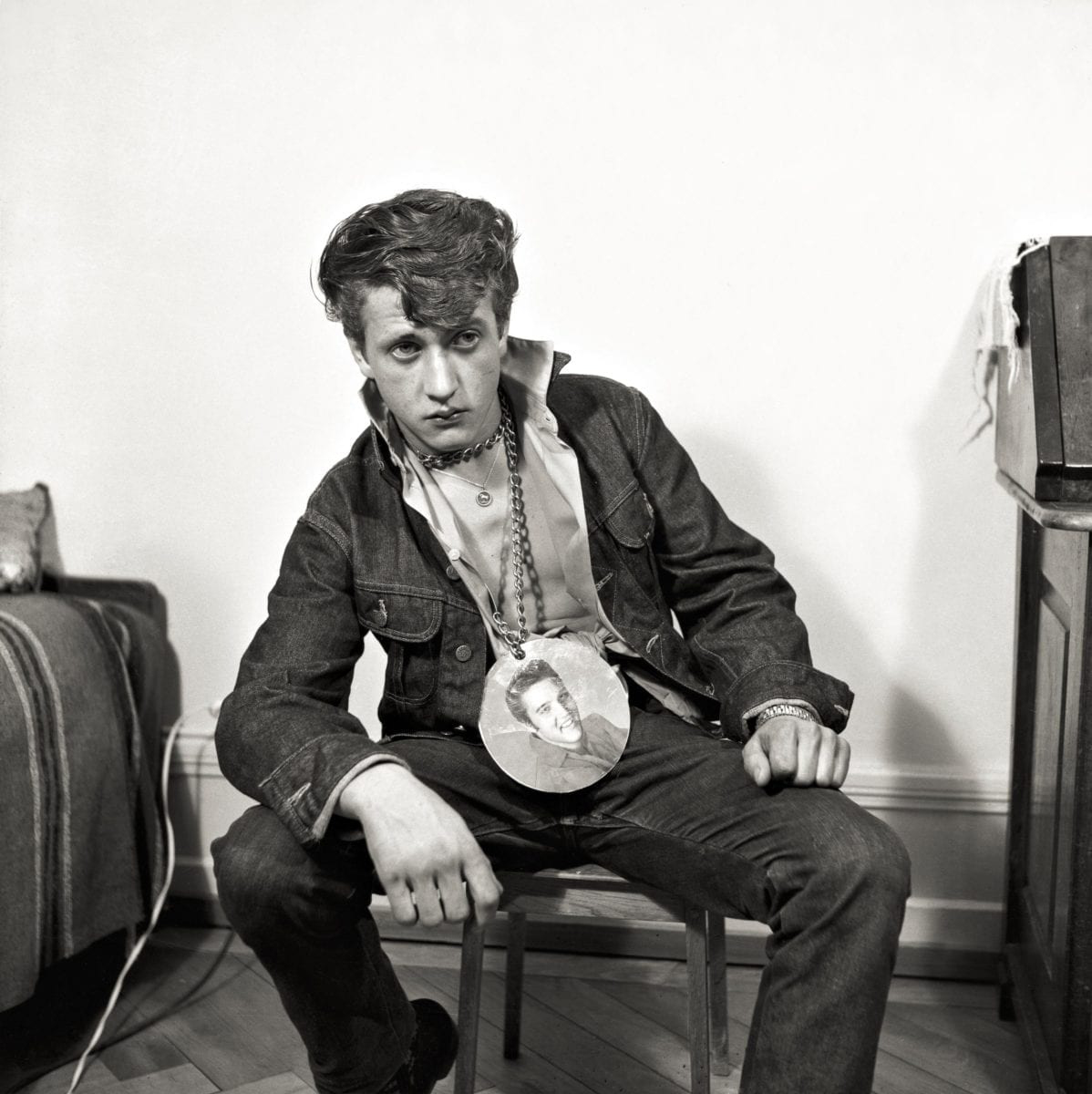
 

Karlheinz Weinberger (Swiss, 1921-2006) 'Sitting boy with elvis necklace in KHW studio, Zurich' 1961


Karlheinz Weinberger (Swiss, 1921-2006)
Sitting Boy with Elvis Necklace in KHW studio, Zurich
1961
Courtesy Galerie Esther Woerdehoff
© Karlheinz Weinberger


Peter Hujar. 'Orgasmic Man' 1969


Peter Hujar (American, 1934-1987)
Orgasmic Man
1969
Gelatin silver print
 

Peter Hujar (American, 1934-1987) 'Orgasmic Man (I)' 1969


Peter Hujar (American, 1934-1987)
Orgasmic Man (I)
1969
Gelatin silver print
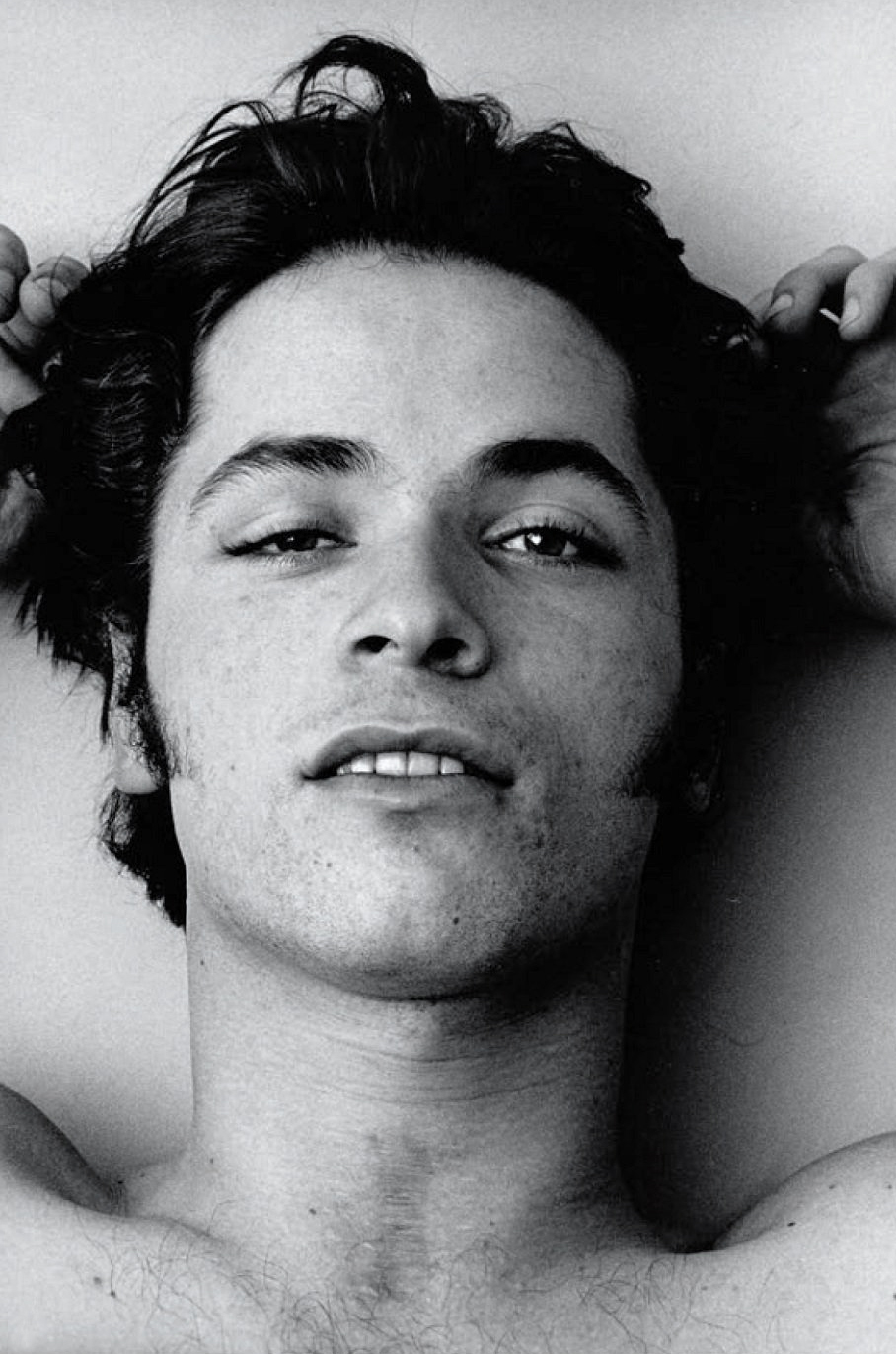
 

Peter Hujar. 'Orgasmic Man (II)' 1969


Peter Hujar (American, 1934-1987)
Orgasmic Man (II)
1969
Gelatin silver print
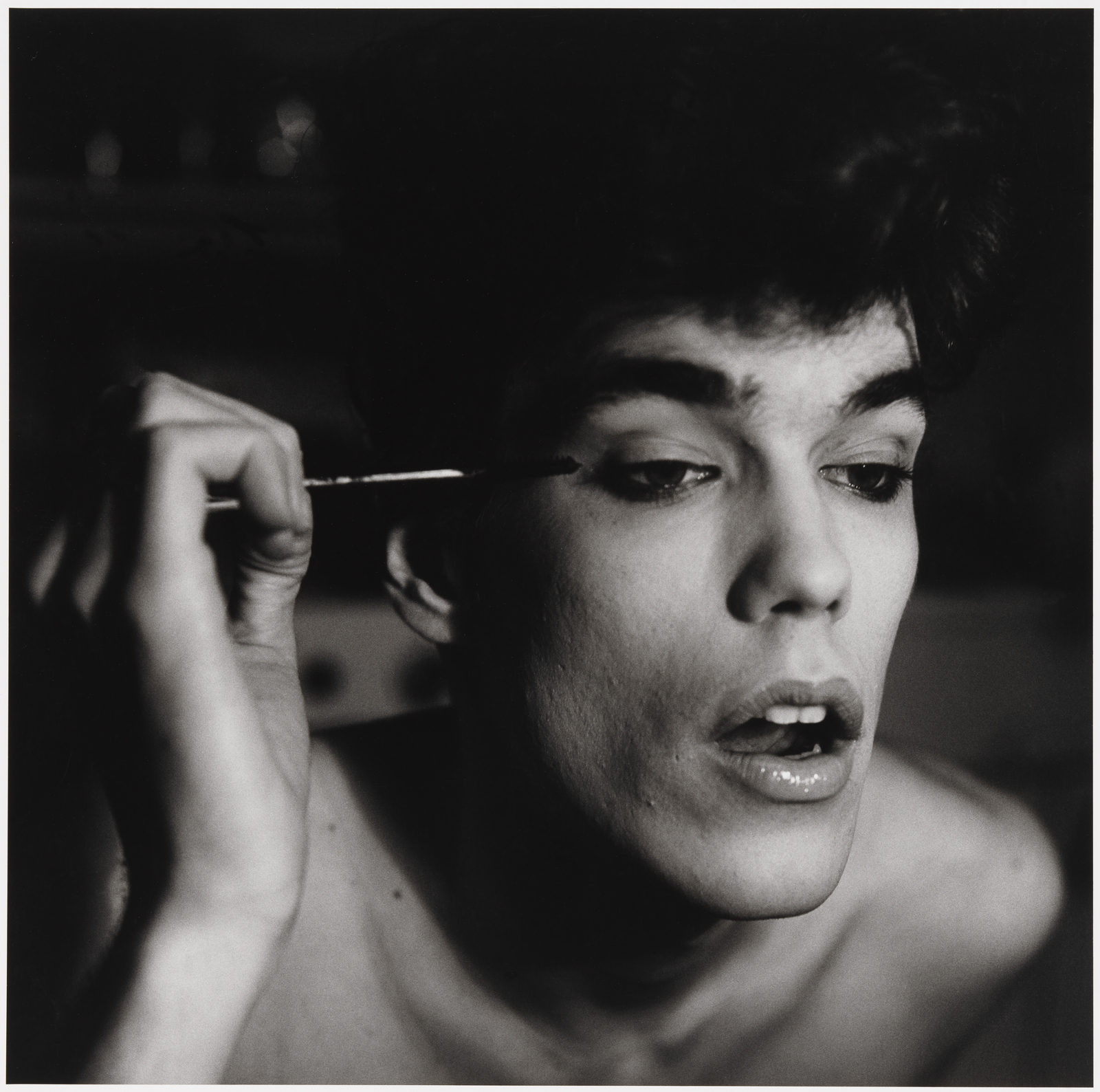
 

Peter Hujar (American, 1934-1987) 'David Brintzenhofe Applying Makeup (II)' 1982


Peter Hujar (American, 1934-1987)
David Brintzenhofe Applying Makeup (II)
1982
Courtesy Pace/MacGill Gallery, New York, and Fraenkel Gallery, San Francisco
© 1987 The Peter Hujar Archive LLC


Installation view of 'Masculinities: Liberation through Photography' at Barbican Art Gallery on February 19, 2020 in London, England showing photographs from Sunil Gupta's series 'Christopher Street' 1976


Installation view of Masculinities: Liberation through Photography at Barbican Art Gallery on February 19, 2020 in London, England showing photographs from Sunil Gupta’s series Christopher Street 1976
Photo: Tristan Fewings/Getty Images for Barbican Art Gallery


Sunil Gupta (Indian, b. 1953) 'Untitled #21' 1976


Sunil Gupta (Indian, b. 1953)
Untitled #21
1976
From the series Christopher Street
Courtesy the artist and Hales Gallery
© Sunil Gupta. All Rights Reserved, DACS 2019


Gupta went on to study under Lisette Model at the New School and take his place among the most accomplished photographers, editors, and curators of his generation, exploring the way identities flower under various sexual, geographical, and historical conditions. But Christopher Street is where it all began. His subjects are engaged in an unprecedented moment in which it seemed possible to build a world of their own. He shows inner lives, barely concealed within the downturned face of a mustachioed man with his hands in his pockets, and outer ones as well, as other men cruise the lens right back, or laugh with each other, unbothered by the stranger with the camera. They were often just engaged in the everyday and extraordinary act of simply existing as gay. In each photograph, Gupta somehow projects a protective and versatile desire: to remember and be remembered at once.

Extract from Jesse Dorris. “Christopher Street Revisited,” on the Aperture website May 30th, 2019 [Online] Cited 29/02/2020


Sunil Gupta (Indian, b. 1953) 'Untitled #56' 1976


Sunil Gupta (Indian, b. 1953)
Untitled #56
1976
From the series Christopher Street
Courtesy the artist and Hales Gallery
© Sunil Gupta. All Rights Reserved, DACS 2019


The 1976 Christopher Street series marks the first set of photographs Gupta made as a practicing artist, using the camera as a tool for open expression. His decision to use black and white film was partly aesthetic, yet also practical, as he was developing the prints in his bathroom. Although he uses a documentarian style, Gupta was by no means an impartial observer behind the camera, he was a participant, enthralled by his subjects.

The series … captures a specific moment in history – a cross section of a thriving community in one of New York’s most dynamic areas – Manhattan’s Christopher Street. Dressed in the latest fashions, moving confidently and relaxing on street corners, their visible presence is a signifier of a specific period of public consciousness. Un-staged and spontaneous, most of the artist’s subjects are unaware of the camera and are simply going about their day. Now, with hindsight, Gupta is struck by the routineness of the images, stating:

‘There is a poignancy they never had at the time… A few years later, the AIDS crisis took hold. The public nature of gay life was forced back into the shadows. Thousands of men died. New York shut down its bathhouses, gay parties became private, and this whole world became hidden again.’

Fusing the public with the personal, the Christopher Street series reflects the openness of the gay liberation movement, as well as Gupta’s own “coming out” as an artist. More than a nostalgic time capsule, the photographs reveal a community that shaped Gupta as a person and cemented his lifelong dedication to portraying people who have been denied a space to be themselves.

Extract from Anonymous. “Sunil Gupta: Christopher Street,” on the Monovisions website 24 May 2019 [Online] Cited 29/02/2020


Hal Fischer (American, b. 1950) 'Handkerchiefs' 1977


Hal Fischer (American, b. 1950)
Handkerchiefs
1977
From the series Gay Semiotics
Gelatin silver print


Hal Fischer (American, b. 1950) 'Street Fashion Jock' 1977


Hal Fischer (American, b. 1950)
Street Fashion Jock
1977
From the series Gay Semiotics
Gelatin silver print


Rotimi Fani-Kayode (Nigerian, 1955-1989) 'Untitled' c. 1985


Rotimi Fani-Kayode (Nigerian, 1955-1989)
Untitled
c. 1985
Courtesy of Autograph, London
© Rotimi Fani-Kayode


Installation view of 'Masculinities: Liberation through Photography' at Barbican Art Gallery on February 19, 2020 in London, England showing at left, photographs from Isaac Julien's series 'After Mazatlàn' 1999/2000


Installation view of Masculinities: Liberation through Photography at Barbican Art Gallery on February 19, 2020 in London, England showing at left, photographs from Isaac Julien’s series After Mazatlàn, 1999/2000
Photo: Tristan Fewings/Getty Images for Barbican Art Gallery


Isaac Julien (British, b. 1960) From 'After Mazatlàn III - VI' 1999/2000


Isaac Julien (British, b. 1960)
From After Mazatlàn III – VI
1999/2000
Colour photogravures
33 x 43.2cm; 13 x 17 in
Courtesy the artist and Victoria Miro, London/Venice
© Isaac Julien


Installation view of 'Masculinities: Liberation through Photography' at Barbican Art Gallery on February 19, 2020 in London, England showing Catherine Opie's series 'Being and Having' 1991


Installation view of Masculinities: Liberation through Photography at Barbican Art Gallery on February 19, 2020 in London, England showing Catherine Opie’s series Being and Having 1991
Photo: Tristan Fewings/Getty Images for Barbican Art Gallery


Catherine Opie (American, b. 1961) 'Bo from "Being and Having"' 1991


Catherine Opie (American, b. 1961)
Bo from “Being and Having”
1991
Collection of Gregory R. Miller and Michael Wiener
© Catherine Opie, Courtesy Regen Projects, Los Angeles; Thomas Dane Gallery, London; and Solomon R. Guggenheim Museum, New York


The exhibition brings together over 300 works by over 50 pioneering international artists, photographers and filmmakers such as Richard Avedon, Peter Hujar, Isaac Julien, Rotimi Fani-Kayode, Robert Mapplethorpe, Annette Messager and Catherine Opie to show how photography and film have been central to the way masculinities are imagined and understood in contemporary culture. The show also highlights lesser-known and younger artists – some of whom have never exhibited in the UK – including Cassils, Sam Contis, George Dureau, Elle Pérez, Paul Mpagi Sepuya, Hank Willis Thomas, Karlheinz Weinberger and Marianne Wex amongst many others. Masculinities: Liberation through Photography is part of the Barbican’s 2020 season, Inside Out, which explores the relationship between our inner lives and creativity.

Jane Alison, Head of Visual Arts, Barbican, said: ‘Masculinities: Liberation through Photography continues our commitment to presenting leading twentieth century figures in the field of photography while also supporting younger contemporary artists working in the medium today. In the wake of the #MeToo movement and the resurgence of feminist and men’s rights activism, traditional notions of masculinity has become a subject of fierce debate. This exhibition could not be more relevant and will certainly spark conversations surrounding our understanding of masculinity.’

With ideas around masculinity undergoing a global crisis and terms such as ‘toxic’ and ‘fragile’ masculinity filling endless column inches, the exhibition surveys the representation of masculinity in all its myriad forms, rife with contradiction and complexity. Presented across six sections by over 50 international artists to explore the expansive nature of the subject, the exhibition touches on themes of queer identity, the black body, power and patriarchy, female perceptions of men, heteronormative hypermasculine stereotypes, fatherhood and family. The works in the show present masculinity as an unfixed performative identity shaped by cultural and social forces.

Seeking to disrupt and destabilise the myths surrounding modern masculinity, highlights include the work of artists who have consistently challenged stereotypical representations of hegemonic masculinity, including Collier Schorr, Adi Nes, Akram Zaatari and Sam Contis, whose series Deep Springs, 2018 draws on the mythology of the American West and the rugged cowboy. Contis spent four years immersed in an all-male liberal arts college north of Death Valley meditating on the intimacy and violence that coexists in male-only spaces. Complicating the conventional image of the fighter, Thomas Dworzak‘s acclaimed series Taliban consists of portraits found in photographic studios in Kandahar following the US invasion of Afghanistan in 2001, these vibrant portraits depict Taliban fighters posing hand in hand in front of painted backdrops, using guns and flowers as props with kohl carefully applied to their eyes. Trans masculine artist Cassils‘ series Time Lapse, 2011, documents the radical transformation of their body through the use of steroids and a rigorous training programme reflecting on ideas of masculinity without men. Elsewhere, artists Jeremy Deller, Robert Mapplethorpe and Rineke Dijkstra dismantle preconceptions of subjects such as the wrestler, the bodybuilder and the athlete and offer an alternative view of these hyper-masculinised stereotypes.

The exhibition examines patriarchy and the unequal power relations between gender, class and race. Karen Knorr‘s series Gentlemen, 1981-83, comprised of 26 black and white photographs taken inside men-only private members’ clubs in central London and accompanied by texts drawn from snatched conversations, parliamentary records and contemporary news reports, invites viewers to reflect on notions of class, race and the exclusion of women from spaces of power during Margaret Thatcher’s premiership. Toxic masculinity is further explored in Andrew Moisey‘s 2018 photobook The American Fraternity: An Illustrated Ritual Manual which weaves together archival photographs of former US Presidents and Supreme Court Justices who all belonged to the fraternity system, alongside images depicting the initiation ceremonies and parties that characterise these male-only organisations.

With the rise of the Gay Liberation Movement through the 1960s followed by the AIDS epidemic in the early 1980s, the exhibition showcases artists such as Peter Hujar and David Wojnarowiz, who increasingly began to disrupt traditional representations of gender and sexuality. Hal Fischer‘s critical photo-text series Gay Semiotics, 1977, classified styles and types of gay men in San Francisco and Sunil Gupta’s street photographs captured the performance of gay public life as played out on New York’s Christopher Street, the site of the 1969 Stonewall Uprising. Other artists exploring the performative aspects of queer identity include Catherine Opie‘s seminal series Being and Having, 1991, showing her close friends in the West Coast’s LGBTQ+ community sporting false moustaches, tattoos and other stereotypical masculine accessories. Elle Pérez‘s luminous and tender photographs explore the representation of gender non-conformity and vulnerability, whilst Paul Mpagi Sepuya‘s fragmented portraits explore the studio as a site of homoerotic desire.

During the 1970s women artists from the second wave feminist movement objectified male sexuality in a bid to subvert and expose the invasive and uncomfortable nature of the male gaze. In the exhibition, Laurie Anderson‘s seminal work Fully Automated Nikon (Object/Objection/Objectivity), 1973, documents the men who cat-called her as she walked through New York’s Lower East Side while Annette Messager‘s series The Approaches, 1972, covertly captures men’s trousered crotches with a long-lens camera. German artist Marianne Wex‘s encyclopaedic project Let’s Take Back Our Space: ‘Female’ and ‘Male’ Body Language as a Result of Patriarchal Structures, 1977, presents a detailed analysis of male and female body language and Australian indigenous artist Tracey Moffatt‘s awkwardly humorous film Heaven, 1997, portrays male surfers changing in and out of their wet suits.

Further highlights include New York based artist Hank Willis Thomas, whose photographic practice examines the complexities of the black male experience; celebrated Japanese photographer Masahisa Fukase‘s The Family, 1971-1989, chronicles the life and death of his family with a particular emphasis on his father; and Kenneth Anger‘s technicolour experimental underground film Kustom Kar Kommandos, 1965, explores the fetishist role of hot rod cars amongst young American men.

Press release from the Barbican Art Gallery
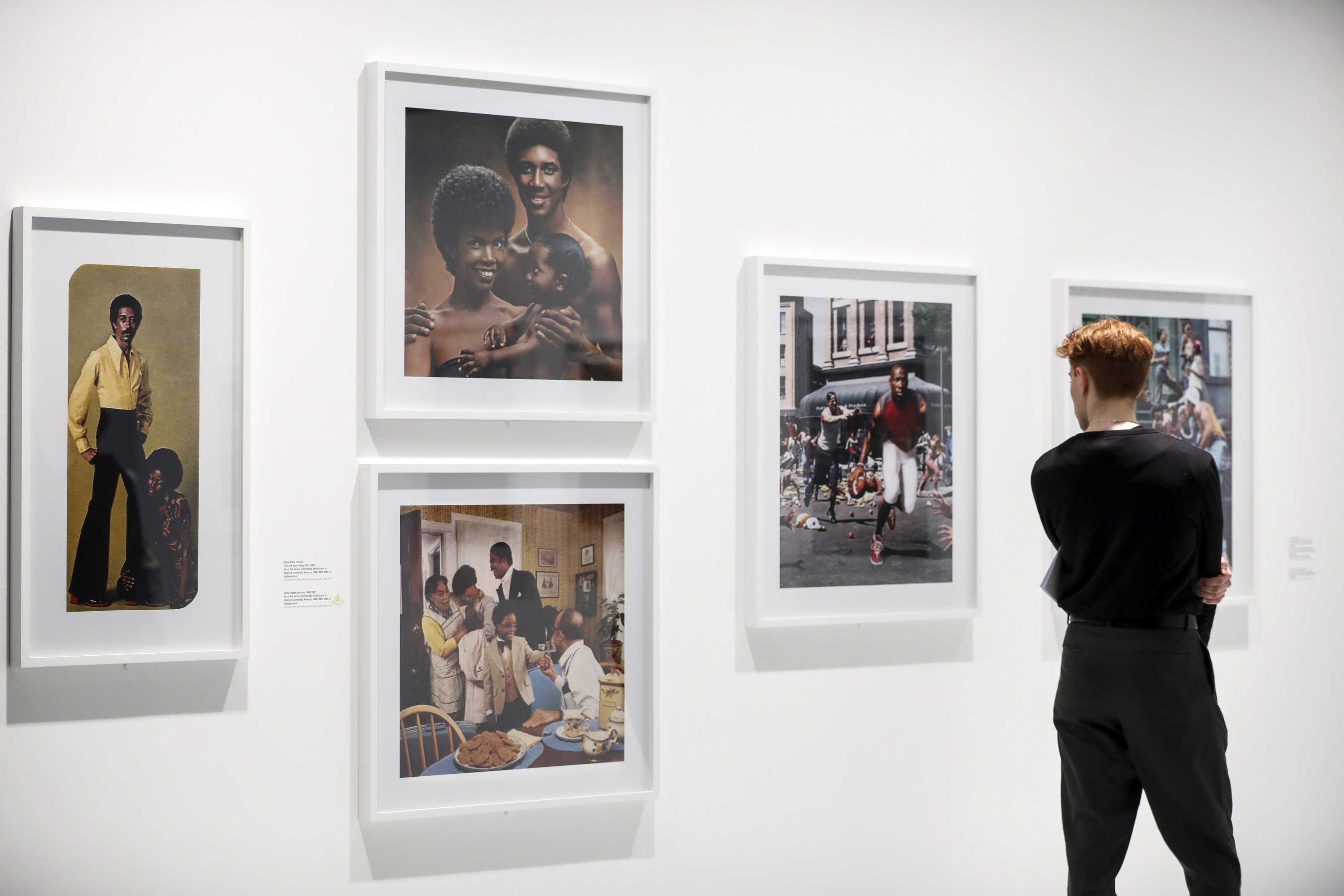
 

Installation view of 'Masculinities: Liberation through Photography' at Barbican Art Gallery on February 19, 2020 in London, England showing Hank Willis Thomas' series 'Unbranded: Reflections in Black by Corporate America 1968-2008' 2005-2008


Installation view of Masculinities: Liberation through Photography at Barbican Art Gallery on February 19, 2020 in London, England showing Hank Willis Thomas’ series Unbranded: Reflections in Black by Corporate America 1968-2008 2005-2008 (below)
Photo: Tristan Fewings/Getty Images for Barbican Art Gallery


Room 13-14

Reclaiming the Black Body

Giving visual form to the complexity of the black male experience, this section foregrounds artists who over the last five decades have consciously subverted expectations of race, gender and the white gaze by reclaiming the power to fashion their own identities.

From Samuel Fosso’s playfully staged self-portraits, taken in his studio, in which he performs to the camera sporting flares and platforms boots or flirtatiously revealing his youthful male physique (below) to Kiluanji Kia Henda’s fictional scenarios in which he adopts the troubled personas of African men of power, the works presented here reflect on how black masculinity challenges the status quo (below).

The representation of black masculinity in the US is born out of a violent history of slavery and prejudice. Unbranded: Reflections in Black by Corporate America 1968-2008 by Hank Willis Thomas (below) draws attention to the ways in which corporate America has commodified the African American male experience while simultaneously perpetuating and reinforcing cultural stereotypes. Similarly, Deana Lawson’s powerful work Sons of Cush, 2016, highlights how the black male figure is often ‘idealised (in their physical beauty) and pathologised by the culture (as symbols of violence or fear)’.


Hank Willis Thomas (American, b. 1976) 'The Johnson Family' 1981/2006


Hank Willis Thomas (American, b. 1976)
The Johnson Family
1981/2006
From the series Unbranded: Reflections in Black by Corporate America 1968-2008
2005-08


Concerned with the literal and figural objectifications of the African American male body, in his complex series Unbranded Hank Willis Thomas redeploys magazine adverts featuring African Americans made between 1968 – a pivotal moment in the struggle for civil rights – and 2008, which witnessed the accession of Barack Obama to the US presidency. By digitally stripping the ads of all text, branding and logos, Thomas draws attention to the ways in which corporate America has commodified the African American experience while simultaneously perpetuating and reinforcing cultural stereotypes.


Hank Willis Thomas (American, b. 1976) 'It's the Real Thing!' 1978/2008


Hank Willis Thomas (American, b. 1976)
It’s the Real Thing!
1978/2008
From the series Unbranded: Reflections in Black by Corporate America 1968-2008
2005-2008


Samuel Fosso (Cameroonian, b. 1962) 'Self-portrait' 1975-1977


Samuel Fosso (Cameroonian, b. 1962)
Self-portrait
1975-1977
From the series 70s lifestyle
Courtesy Jean Marc Patras, Paris
© Samuel Fosso


Installation view of 'Masculinities: Liberation through Photography' at Barbican Art Gallery on February 19, 2020 in London, England showing a photograph from Kiluanji Kia Henda's series 'The Last Journey of the Dictator Mussunda Nzombo Before the Great Extinction Act I'


Installation view of Masculinities: Liberation through Photography at Barbican Art Gallery on February 19, 2020 in London, England showing a photograph from Kiluanji Kia Henda’s series The Last Journey of the Dictator Mussunda Nzombo Before the Great Extinction Act I
Photo: Tristan Fewings/Getty Images for Barbican Art Gallery


Hilary Lloyd (British, b. 1964) 'Colin #2' 1999


Hilary Lloyd (British, b. 1964)
Colin #2
1999
Courtesy Galerie Neu, Berlin; Sadie Coles HQ, London; Greene Naftali, New York
© Hilary Lloyd
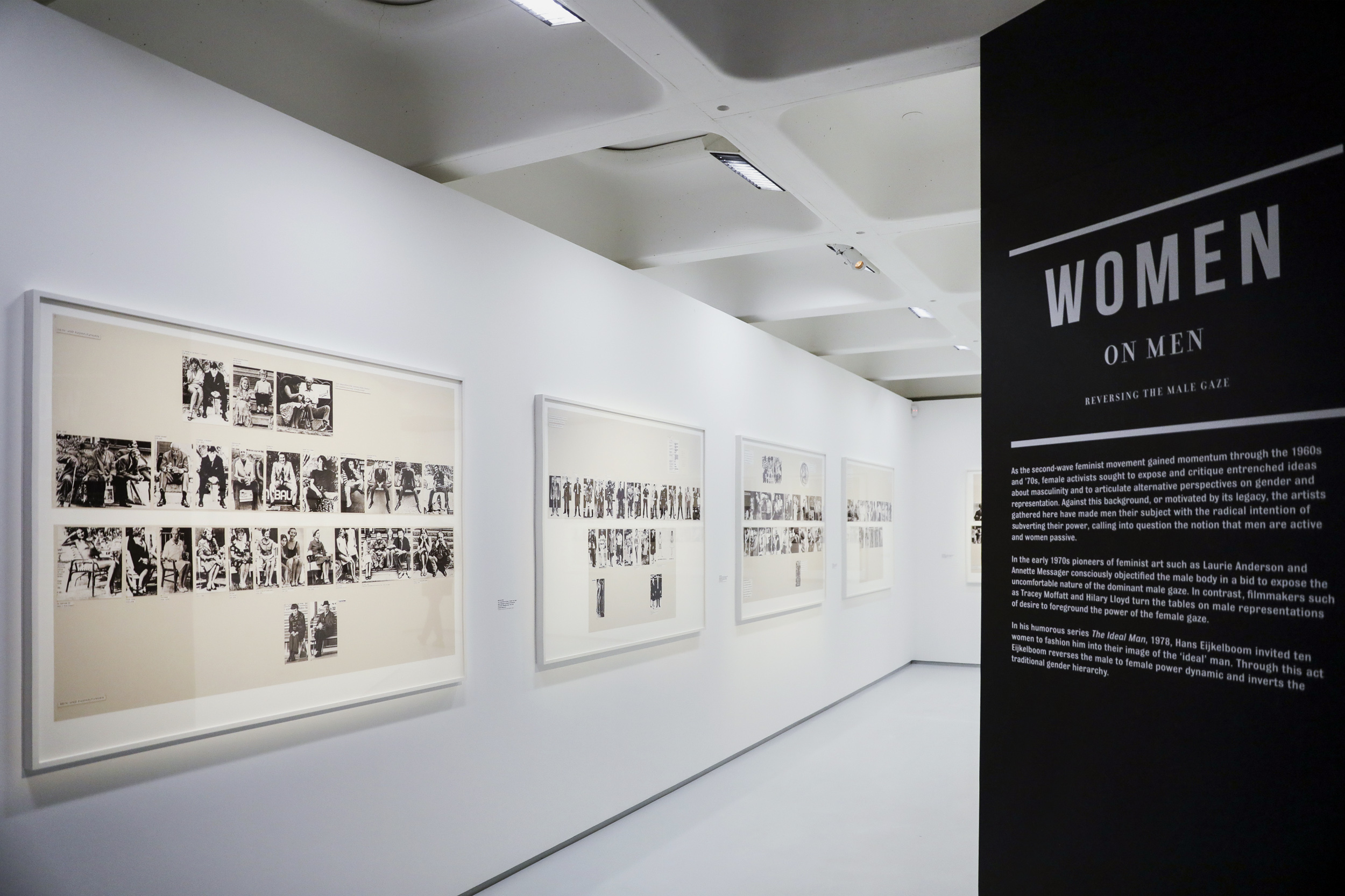
 

Installation view of 'Masculinities: Liberation through Photography' at Barbican Art Gallery on February 19, 2020 in London, England showing part of Marianne Wex's encyclopaedic project 'Let's Take Back Our Space: 'Female' and 'Male' Body Language as a Result of Patriarchal Structures' 1977


Installation view of Masculinities: Liberation through Photography at Barbican Art Gallery on February 19, 2020 in London, England showing part of Marianne Wex’s encyclopaedic project Let’s Take Back Our Space: ‘Female’ and ‘Male’ Body Language as a Result of Patriarchal Structures, 1977
Photo: Tristan Fewings/Getty Images for Barbican Art Gallery


Room 15-16

Women on Men: Reversing the Male Gaze

As the second-wave feminist movement gained momentum through the 1960s and ’70s, female activists sought to expose and critique entrenched ideas about masculinity and to articulate alternative perspectives on gender and representation. Against this background, or motivated by its legacy, the artists gathered here have made men their subject with the radical intention of subverting their power, calling into question the notion that men are active and women passive.

In the early 1970s pioneers of feminist art such as Laurie Anderson (below) and Annette Messager consciously objectified the male body in a bid to expose the uncomfortable nature of the dominant male gaze. In contrast, filmmakers such as Tracey Moffatt (below) and Hilary Lloyd (above) turn the tables on male representations of desire to foreground the power of the female gaze.

In his humorous series The Ideal Man, 1978 (below), Hans Eijkelboom invited ten women to fashion him into their image of the ‘ideal’ man. Through this act Eijkelboom reverses the male to female power dynamic and inverts the traditional gender hierarchy.


Laurie Anderson (American, b. 1947) 'Man with a Cigarette' 1973


Laurie Anderson (American, b. 1947)
Man with a Cigarette
1973
From the series Fully Automated Nikon (Object/Objection/Objectivity)


Laurie Anderson (American, b. 1947) 'Two men in a car' 1973


Laurie Anderson (American, b. 1947)
Two men in a car
1973
From the series Fully Automated Nikon (Object/Objection/Objectivity)


Anderson photographed men who called to her or whistled her on the street.  In her artist statement she writes about one experience,

“As I walked along Houston Street with my fully automated Nikon. I felt armed, ready. I passed a man who muttered ‘Wanna fuck?’ This was standard technique: the female passes and the male strikes at the last possible moment forcing the woman to backtrack if she should dare to object. I wheeled around, furious. ‘Did you say that?’ He looked around surprised, then defiant ‘Yeah, so what the fuck if I did?’ I raised my Nikon, took aim began to focus. His eyes darted back and forth, an undercover cop? CLICK.

As it turned out, most of the men I shot that day had the opposite reaction. When i confronted them, the acted innocent, then offended, like some nasty invisible ventriloquist had ticked them into saying dirty words against their will. By the time I took their pictures they were posing, like taking their picture was the least I could do.”

“I decided to shoot pictures of men who made comments to me on the street. I had always hated this invasion of my privacy and now I had the means of my revenge. As I walked along Houston Street with my fully automated Nikon, I felt armed, ready. I passed a man who muttered ‘Wanna fuck?’ This was standard technique: the female passes and the male strikes at the last possible moment forcing the woman to backtrack if she should dare to object. I wheeled around, furious. ‘Did you say that?’ He looked around surprised, then defiant. ‘Yeah, so what the fuck if I did?’ I raised my Nikon, took aim, began to focus. His eyes darted back and forth, an undercover cop? CLICK.”

Anderson takes the power from her male pursuers, allowing them nothing more than the momentary fear that their depravity has just been captured in a picture.
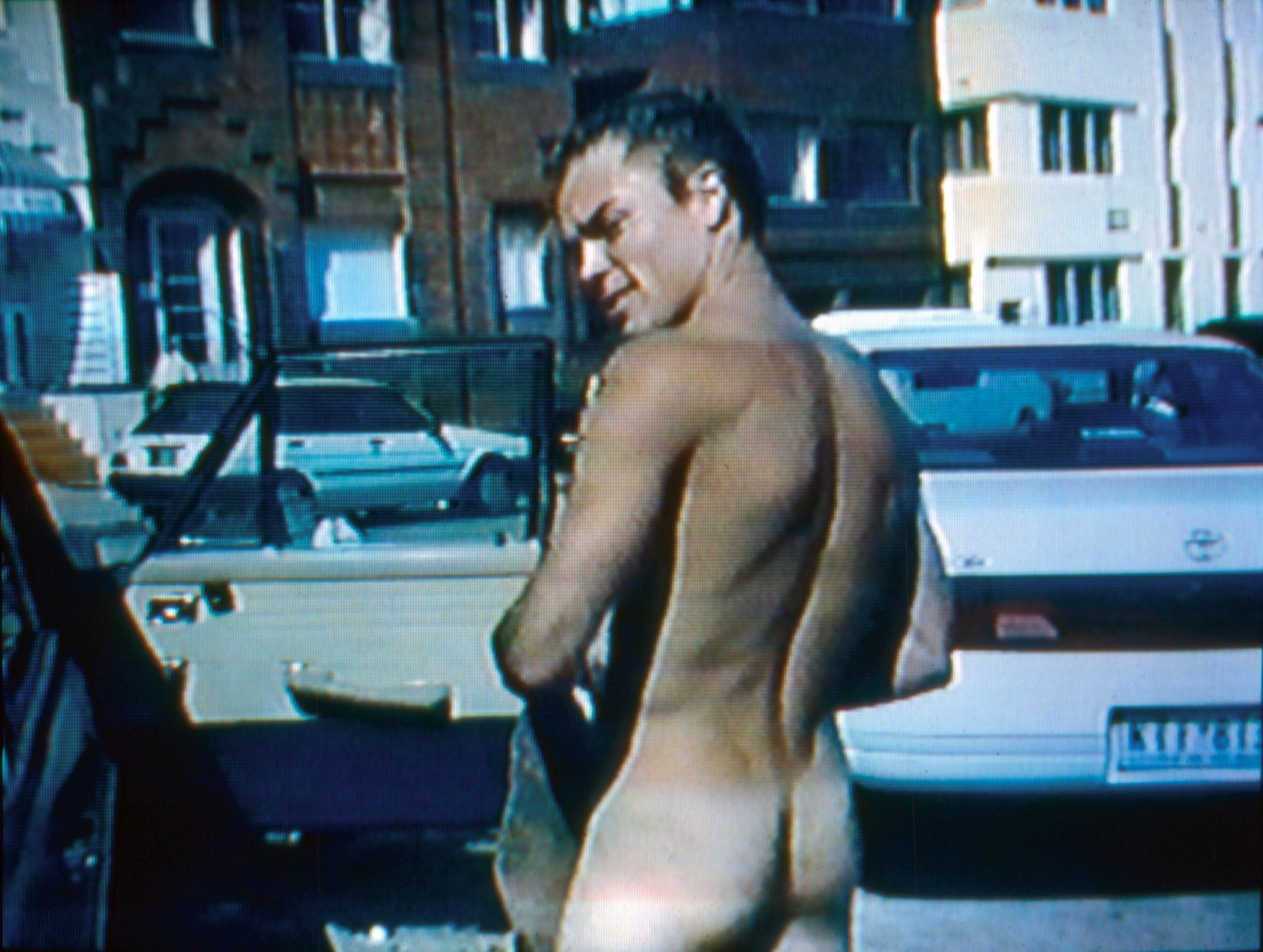
 

Tracey Moffatt (Australian, b. 1960) 'Heaven' (still) 1997


Tracey Moffatt (Australian, b. 1960)
Heaven (still)
1997
Video tape (28 minutes)
© Tracey Moffatt / DACS Courtesy of the artist and Roslyn Oxley9 Gallery, Sydney, Australia


“A playful video that glories in the female gaze and objectification of men. It zeros in on the Australian national sport, surfing, and in particular on several dozen good-looking muscular men changing into or out of their swimming trunks. This ritual is usually conducted in parking lots or on sidewalks, always near cars and sometimes inside them; it usually but not always involves a beach towel wound carefully around the torso. Ms Moffatt begins by shooting her subject unseen from inside a house and gradually moves closer and closer, engaging some in conversations that are never heard. The soundtrack alternates between the ocean surf and the sounds of drumming and chanting, male rituals of another, more authentic Australian culture. By the tape’s end, the artist’s voyeurism has shifted to participation; the camera shows her free hand, the one not holding the camera, darting into view, trying to undo the towel of the last surfer.”

New York Times


Installation view of 'Masculinities: Liberation through Photography' at Barbican Art Gallery on February 19, 2020 in London, England showing part of Hans Eijkelboom's series 'The Ideal Man' 1978


Installation view of Masculinities: Liberation through Photography at Barbican Art Gallery on February 19, 2020 in London, England showing part of Hans Eijkelboom’s series The Ideal Man, 1978


Glossary of Terms by CN Lester

Homosociality: Typically non-romantic and/or non-sexual same-sex relationships and social groupings – may sometimes include elements of homoeroticism, as they are frequently interdependent phenomena.

Normativity: The process by which some groups of people, forms of expression and types of behaviour are classified according to a perceived standard of what is ‘normal’, ‘natural’, desirable and permissible in society. Inevitably, this process designates people, expressions and behaviours that do not fit these norms as abnormal, unnatural, undesirable and impermissible.

Hegemonic Masculinity: ‘Hegemonic’ means ‘ruling’ or ‘commanding’ – hegemonic masculinity, therefore, indicates male dominance and the forms of masculinity occupying and perpetuating this dominant position. The term was coined in the 1980s by the scholar R. W. Connell, drawing on the Marxist philosopher Antonio Gramsci’s notion of cultural hegemony.

Hierarchy: Across many cultures throughout history, and continuing into the present moment throughout large parts of the world, gender functions as a hierarchy: some gender categories and gender expressions are granted higher value and more power than others. Men are often higher up the gender hierarchy than women, but the gender hierarchy is affected by racism, disablism, ageism, transphobia and other factors; in the West, men in their thirties are likely to be considered higher up the gender hierarchy than men in their eighties, for example.

Gender roles: Specific cultural roles defined by the weight of gendered ideas, restrictions and traditions. Men and women are often expected, sometimes forced, to occupy oppositional gender roles: aggressor versus victim, protector versus nurturer and so on. Many gender roles are specific to intersections of race, class, sexuality, religion and disabled status – examples of these types of gender roles can be seen in the stereotypes of the Jezebel or the Dragon Lady.

Patriarchy: Literally ‘the rule of the father’, a patriarchy is a society or structure centred around male dominance and in which women (and those of other genders) are not treated as or considered equal.

Queer: A slur, a term of reclamation and a specific and radical site of community and activism in solidarity with many kinds of difference, and specifically opposed to heteronormativity and cisnormativity. Queer studies and queer theory are important emerging fields of study.

Gender identity: Identity refers to what, who, and how someone or something is, both in the way this is understood as selfhood by an individual, and also the self as it is shaped and positioned by the world. Gender identity can be a surprisingly difficult term to pin down and is perhaps best understood as the stated truth of a person’s gender (or lack of gender), which is in itself the sum of many different factors.

Fetishisation: To turn the subject into a fetish, sexually or otherwise. Fetishisation in terms of gender and desire frequently occurs in conjunction with objectification and power. Men and women of colour are frequently fetishised by white people, in society and in artistic practice, through different stereotypes and limitations. Trans and disabled people are also subject to fetishisation, particularly in bodily terms. Kobena Mercer’s critical essay on Robert Mapplethorpe, ‘Reading Radical Fetishism’,1 and David Henry Hwang’s play and afterword to M. Butterfly (1988) both explore the notion of fetishisation.

1/ Kobena Mercer, ‘Reading Racial Fetishism: The Photographs of Robert Mapplethorpe’, in Emily Apter and William Pietz, eds, Fetishism as Cultural Discourse (Ithaca, NY: Cornell University Press, 1993), pp. 307-29.

Critical race theory: A branch of scholarship emerging from the application of critical theory to the study of law in the 1980s, critical race theory (CRT) is now taken as an approach and theoretical foundation across both academic and popular discourse. CRT names, examines and challenges the social constructions and functions of race and racism. Rejecting the idea of race as a ‘natural’ category, CRT looks instead to the cultural, structural and legal creation and maintenance of difference and oppression. Scholars working in this field include Kimberlé Williams Crenshaw, Eduardo Bonilla-Silva and Patricia Williams.

Me Too movement: ‘#MeToo is a movement that was founded in 2006 to support survivors of sexual violence, in particular black and brown girls, who were in the program that we were running. It has grown since then to include supporting grown people, women, and men, and other survivors, as well as helping people to understand what community action looks like in the fight to end sexual violence’ – Tarana Burke, founder of the Me Too movement.

Male gaze: A term coined by film critic Laura Mulvey, the notion of the male gaze develops Jean-Paul Sartre’s concept of le regard (the gaze) to take into account the power differentials and gender stereotyping inherent in ways of looking within patriarchal, sexist culture. The male gaze refers to how the world – and women in particular – are looked at and presented from a cisgender, straight, frequently white male perspective. In visual art the male gaze can be understood in multiple ways, from the male creator of the work, to men within the work viewing women or the world around them, to the (assumed) male viewer of the work itself. Many women artists have countered the male gaze through deconstruction and through the creation and promotion of works that centre the ‘female gaze’.


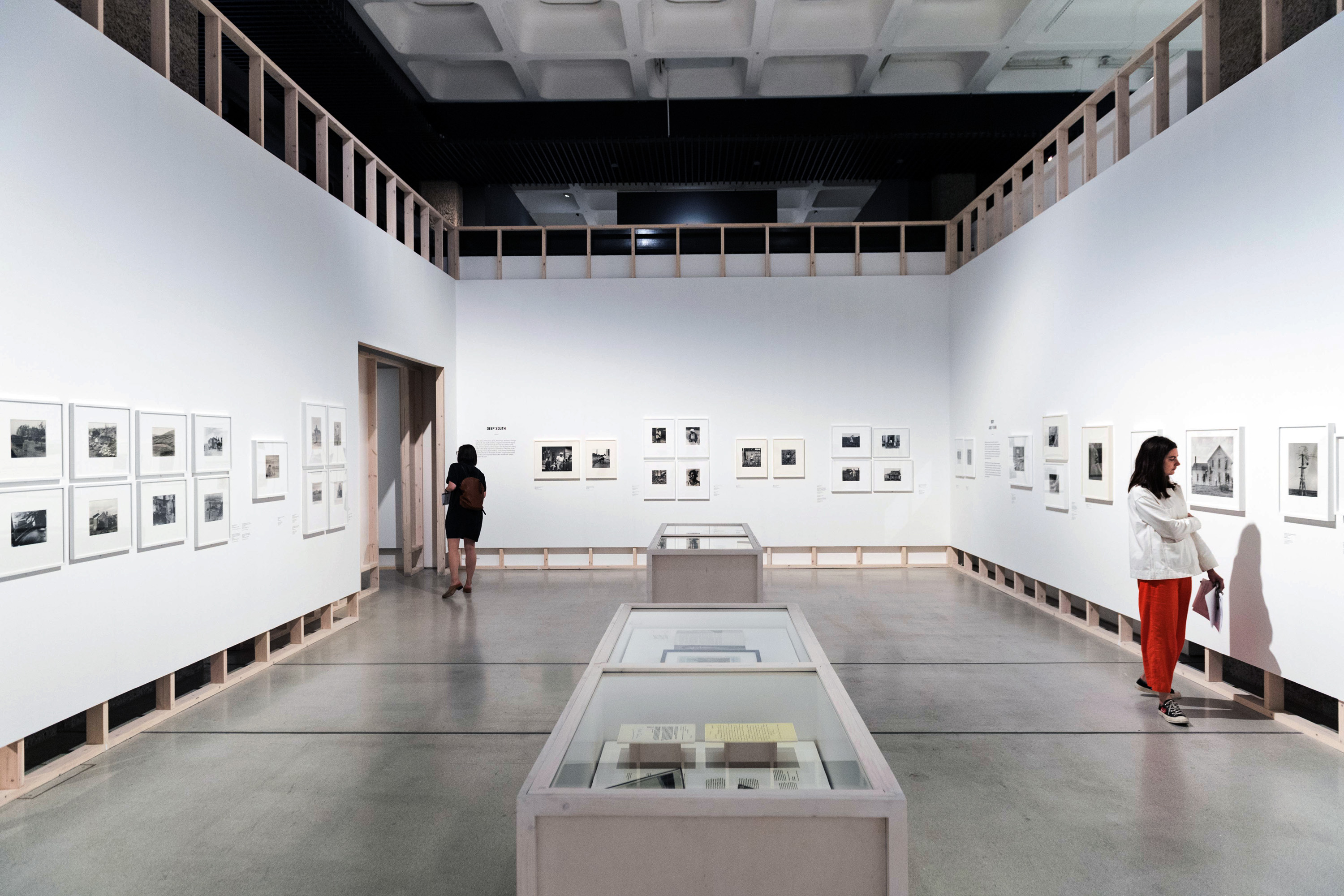
Installation view of 'Masculinities: Liberation through Photography' at Barbican Art Gallery on February 19, 2020 in London, England

Installation view of 'Masculinities: Liberation through Photography' at Barbican Art Gallery on February 19, 2020 in London, England


Installation views of Masculinities: Liberation through Photography at Barbican Art Gallery on February 19, 2020 in London, England
Photo: Tristan Fewings/Getty Images for Barbican Art Gallery


Barbican Art Gallery
Silk Street, London
EC2Y 8DS

Opening hours:
Mon – Tue 12 noon – 6pm
Wed – Fri 12 noon – 9pm
Sat 10am – 9pm
Sun 10am – 6pm

Barbican Art Gallery website

LIKE ART BLART ON FACEBOOK

Back to top

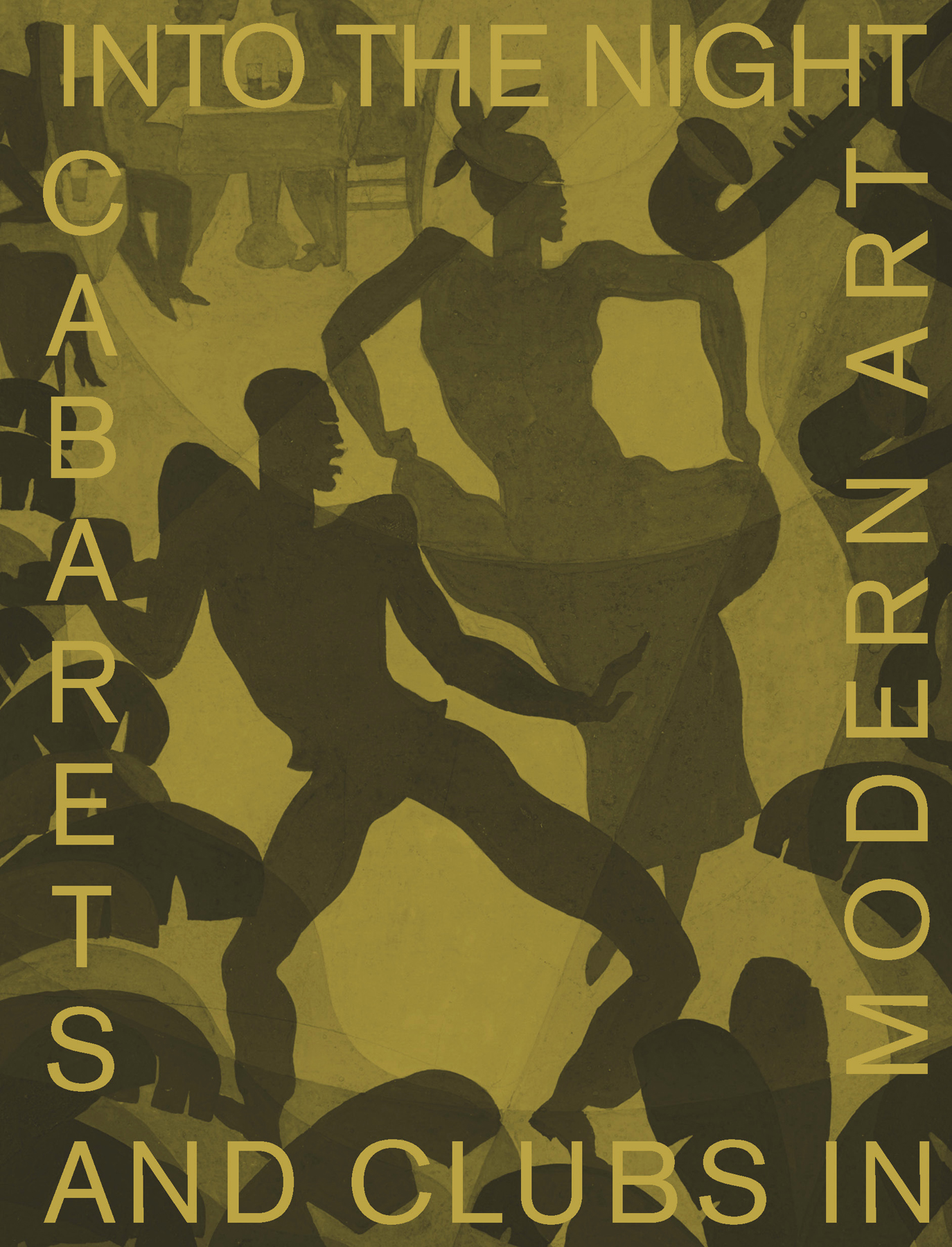
European research tour exhibition: ‘Into the Night: Cabarets and Clubs in Modern Art’ at the Barbican Art Gallery, UK Part 2

Exhibition dates: 4th October, 2019 – 19th January, 2020
Visited October 2019 posted January 2020

Curator: Florence Ostende


Theo van Doesburg (Dutch, 1883-1931) 'The Ciné-bal (cinema-ballroom) at Café L'Aubette, Strasbourg, designed by Theo van Doesburg' 1926-1928 from the exhibition 'Into the Night: Cabarets and Clubs in Modern Art' at the Barbican Art Gallery, Oct 2019 - Jan 2020


Theo van Doesburg (Dutch, 1883-1931)
The Ciné-bal (cinema-ballroom) at Café L’Aubette, Strasbourg, designed by Theo van Doesburg
1926-1928
Image: Collection Het Nieuwe Instituut, donation Van Moorsel, archive (code): DOES, inv.nr AB5252


Part 2 on this exceptional exhibition. Of particular interest here are:

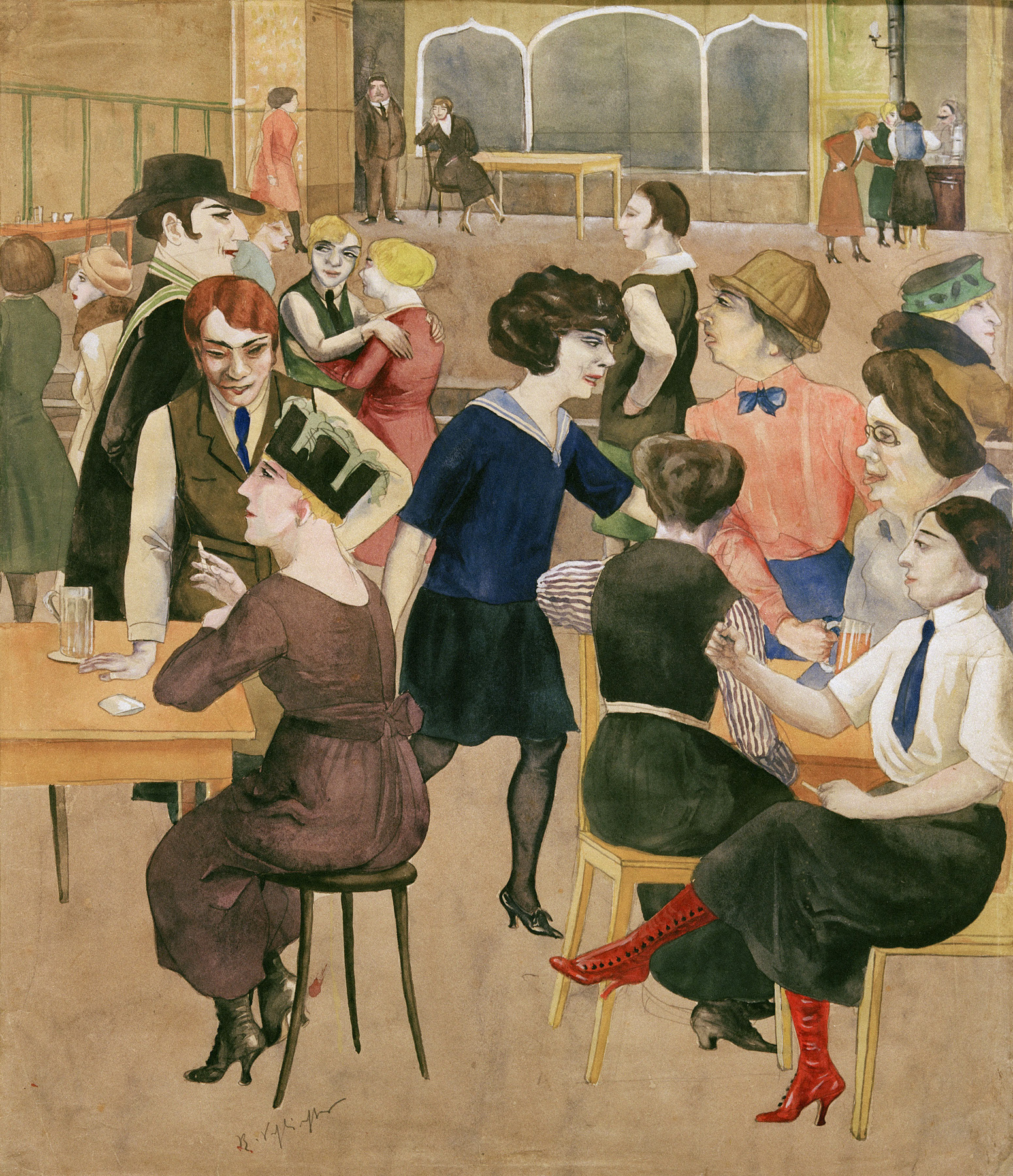
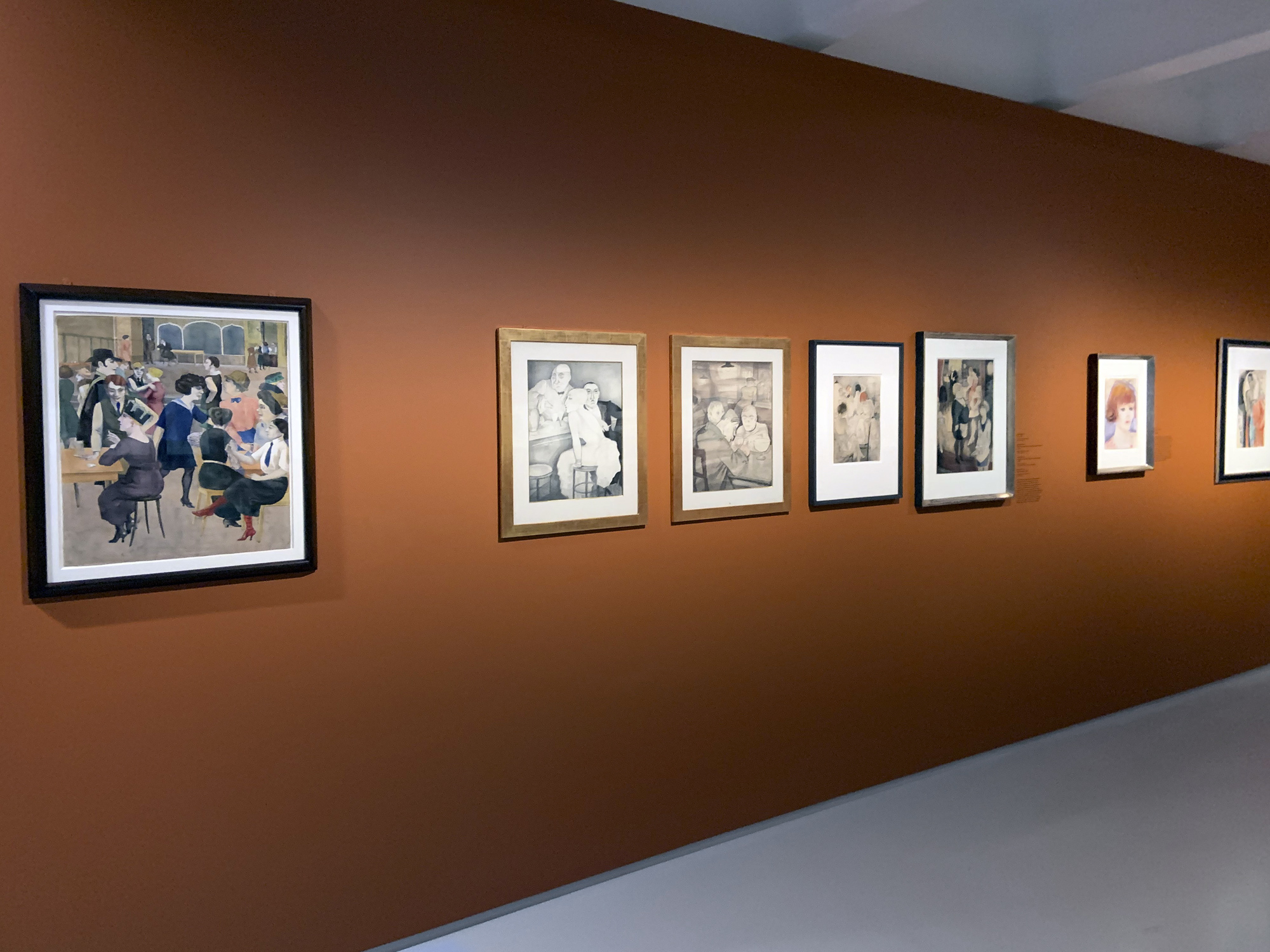
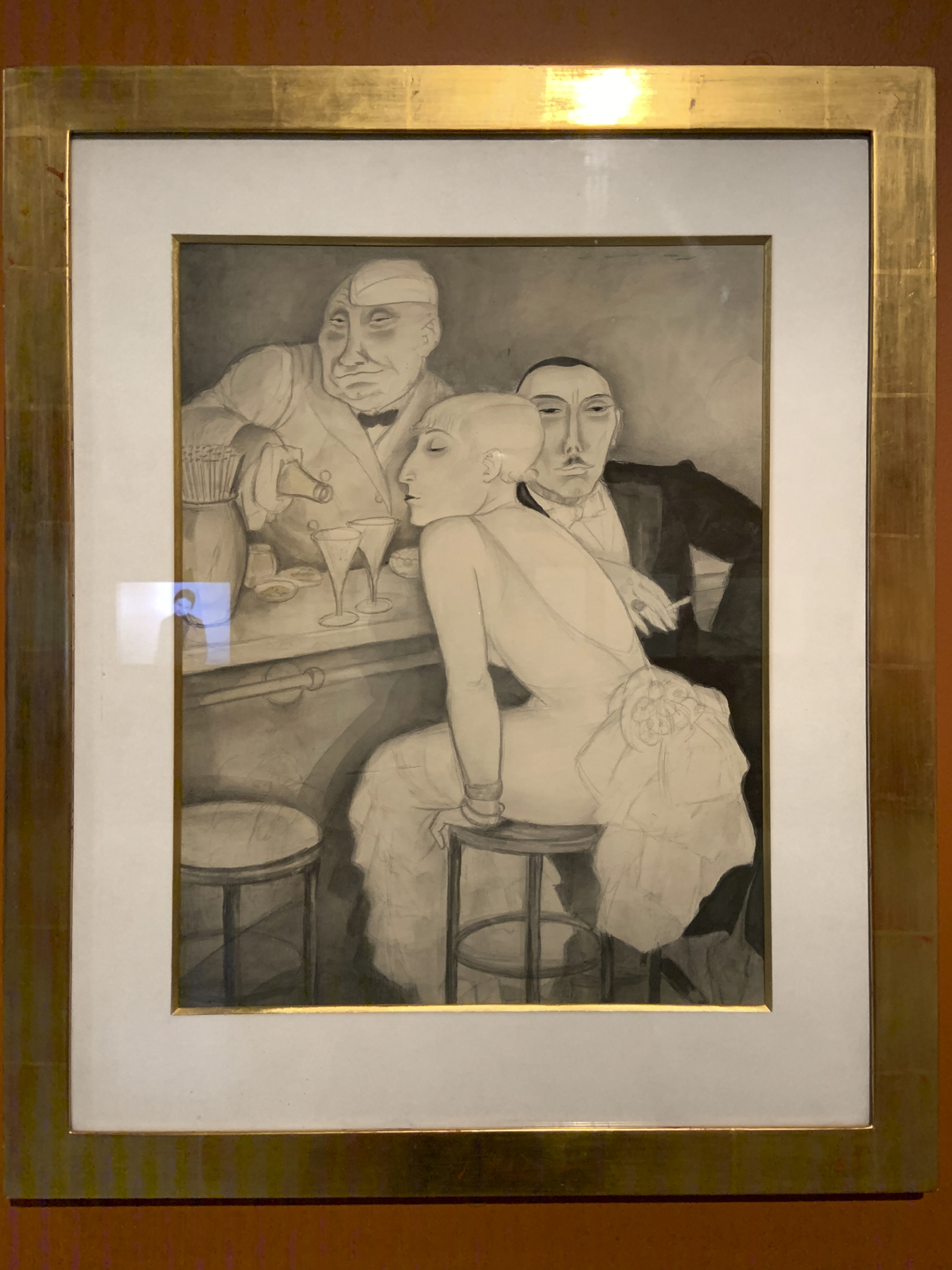
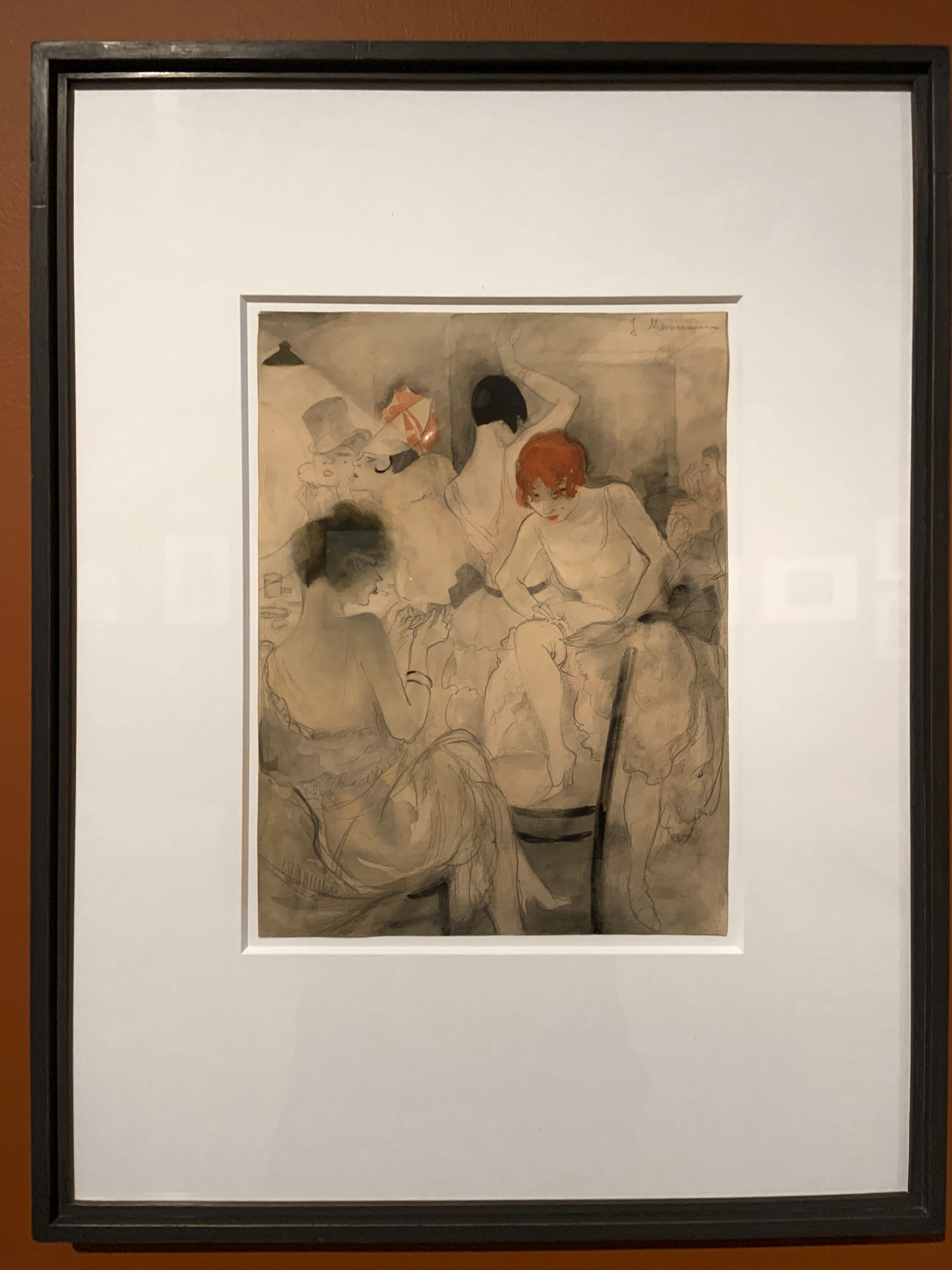
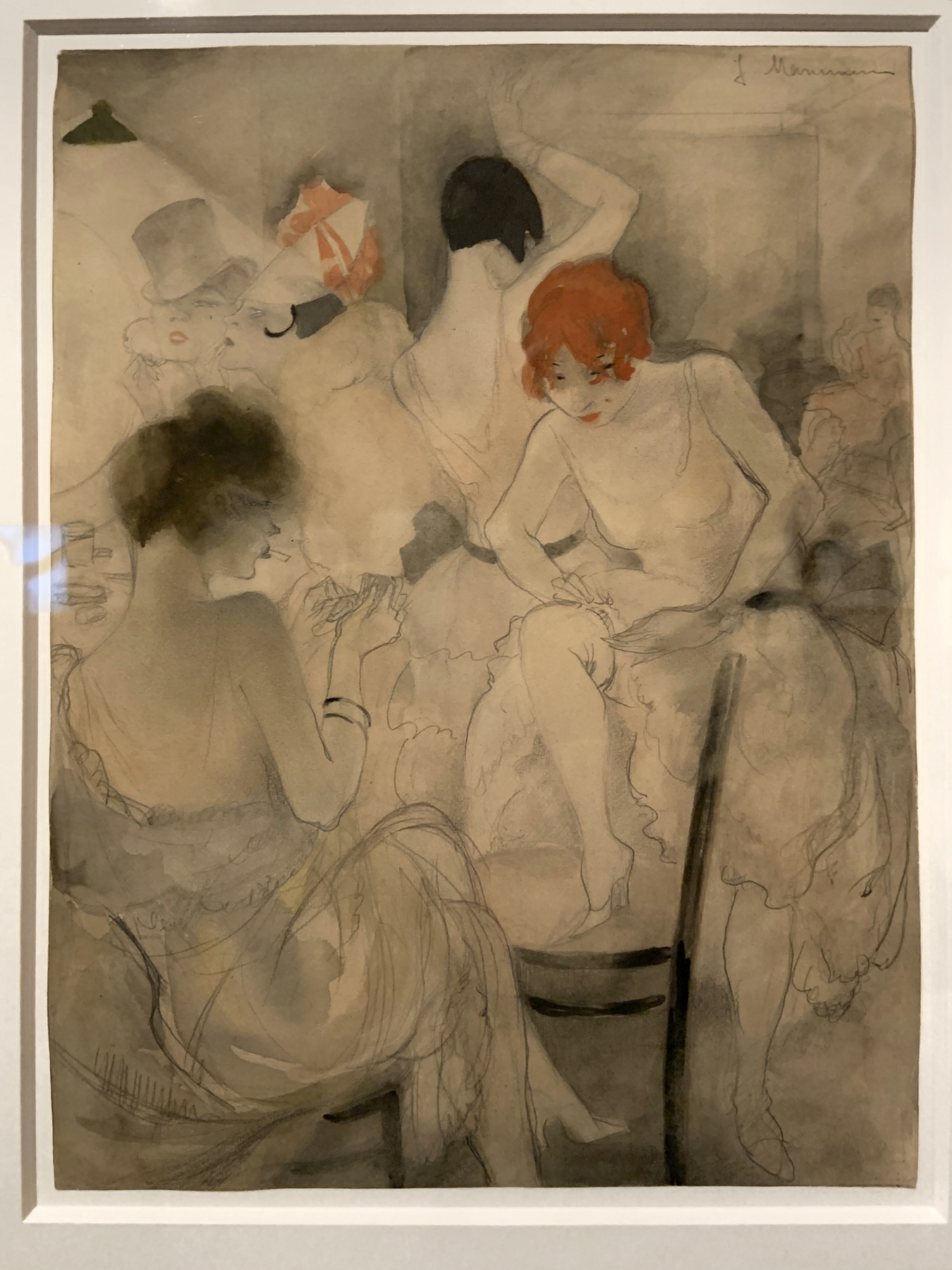
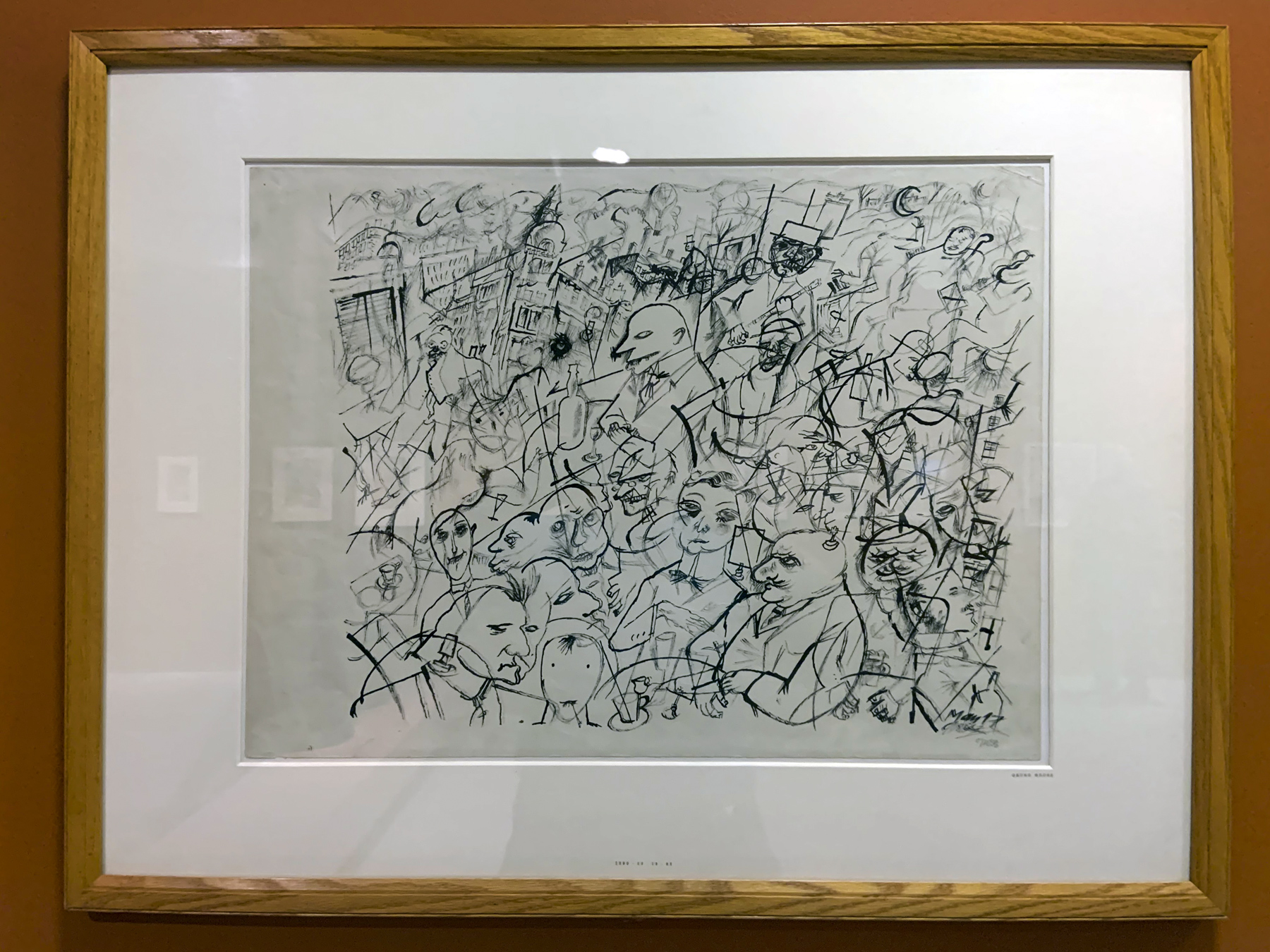
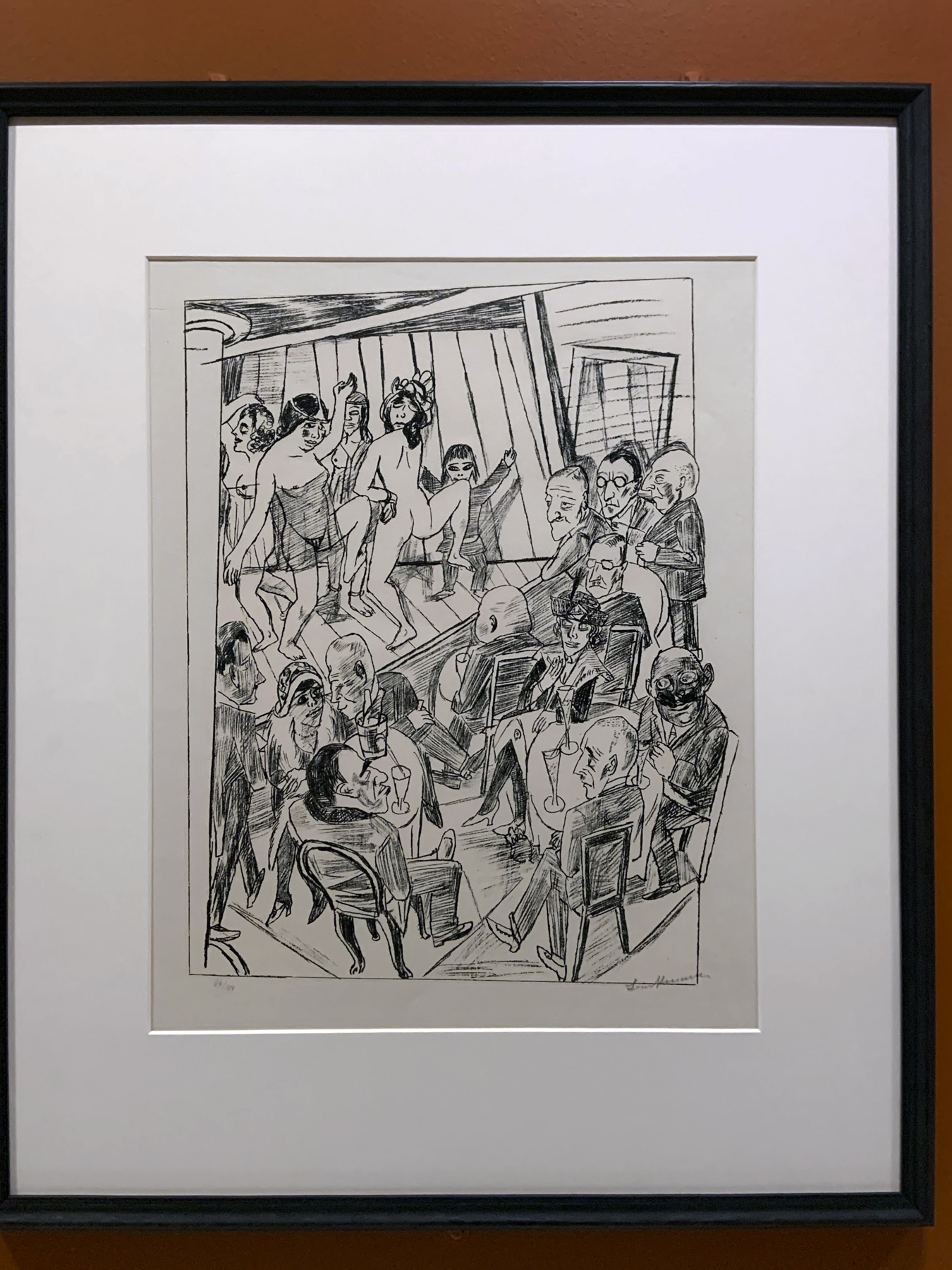
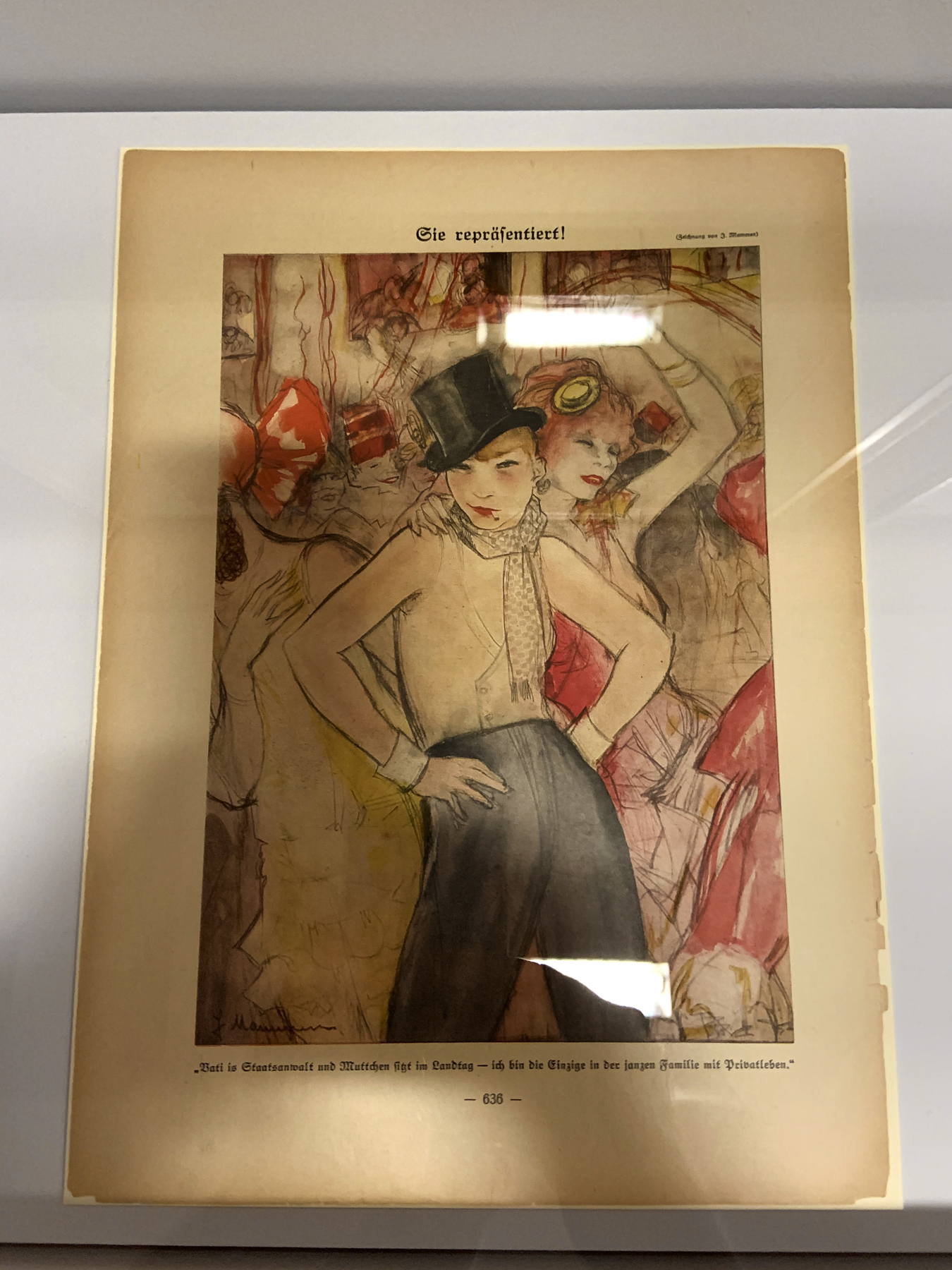
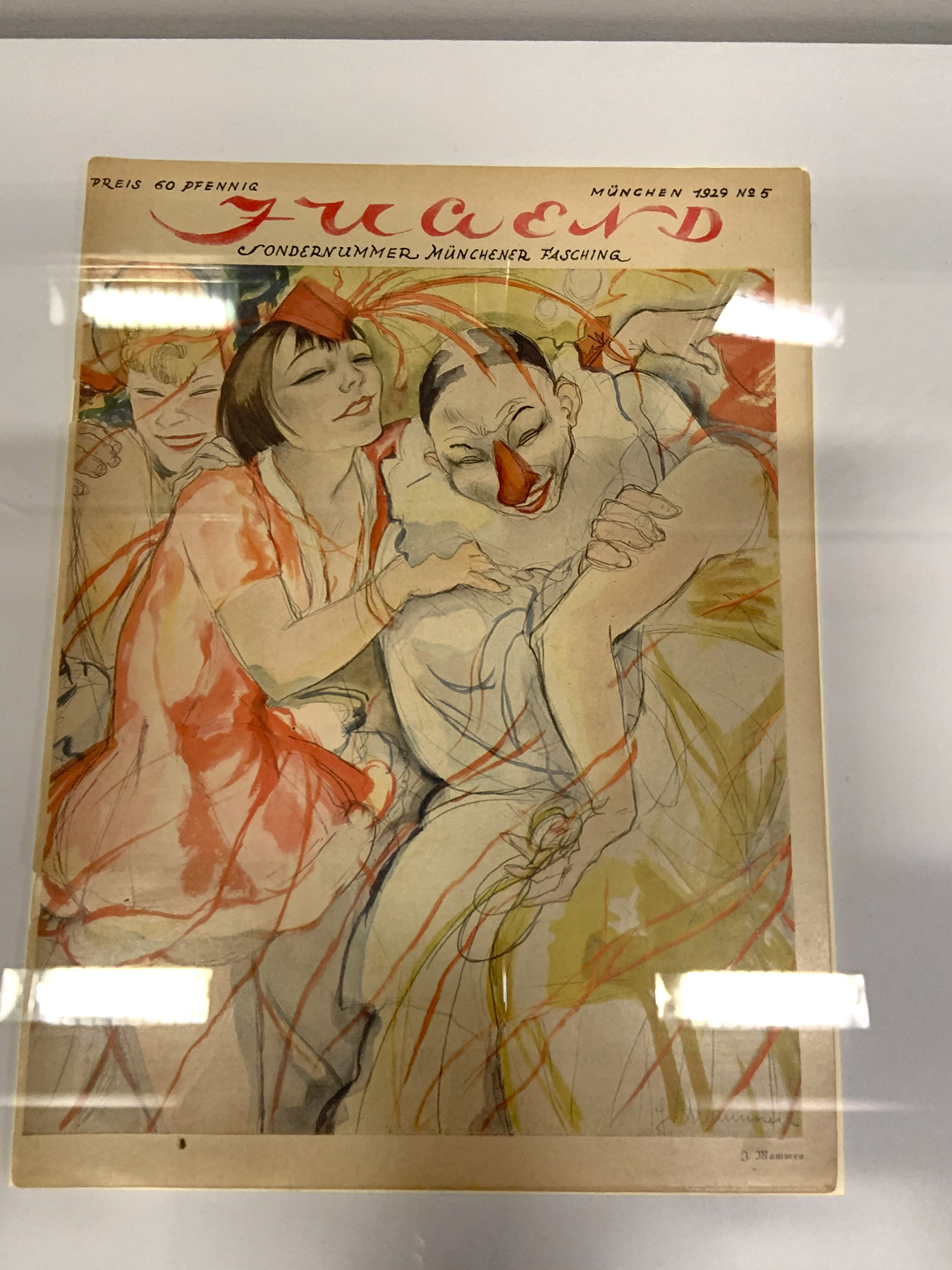
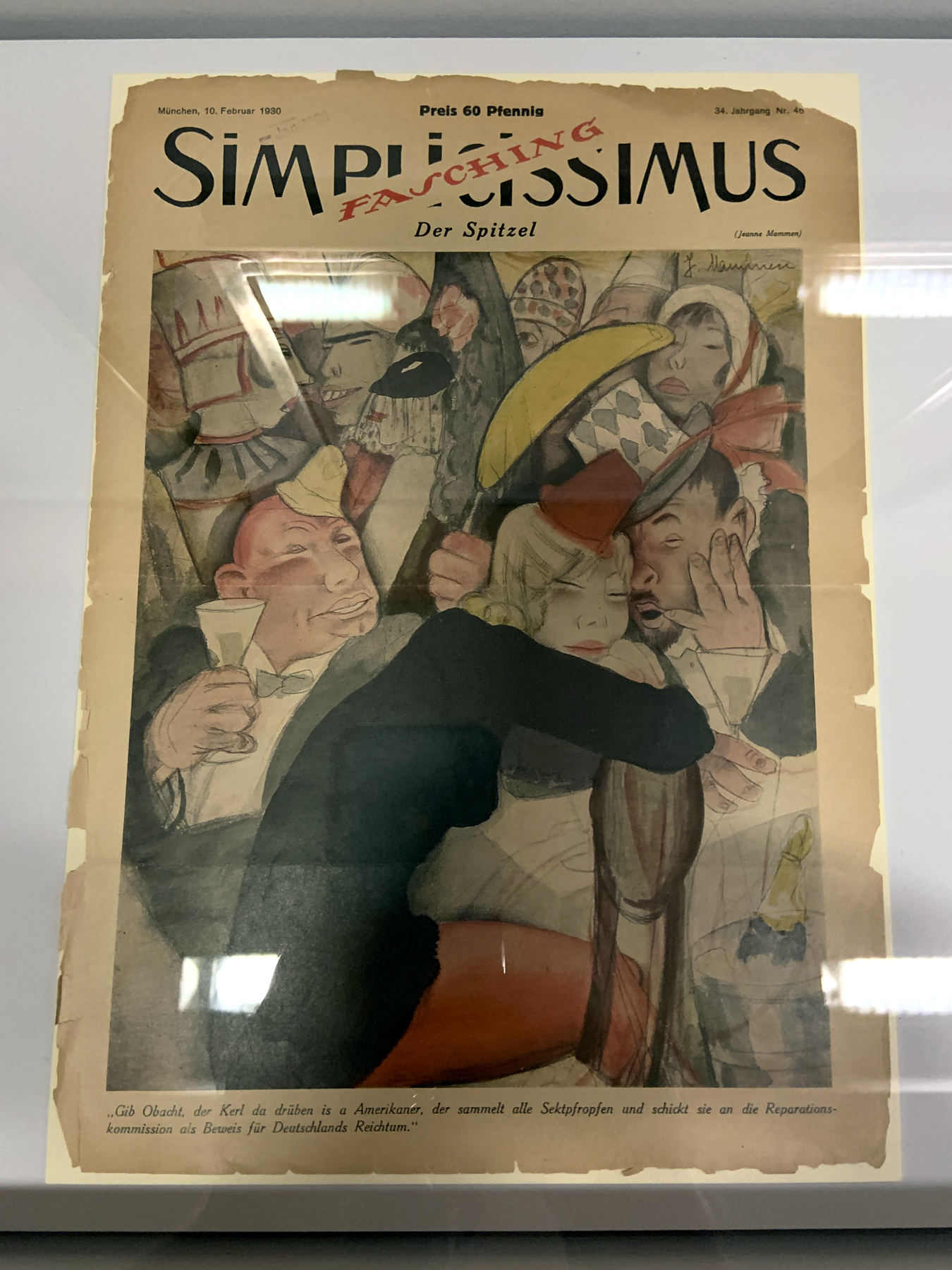
the inspired paintings and drawings by Jeanne Mammen of Berlin nightlife which documents “the changing role of women and offer rare images of queer female desire.” Her work, associated with the New Objectivity and Symbolism movements, is incisive and sympathetic in its observation of difference and “depravity”. Her line is strong and the characterisation, assured;

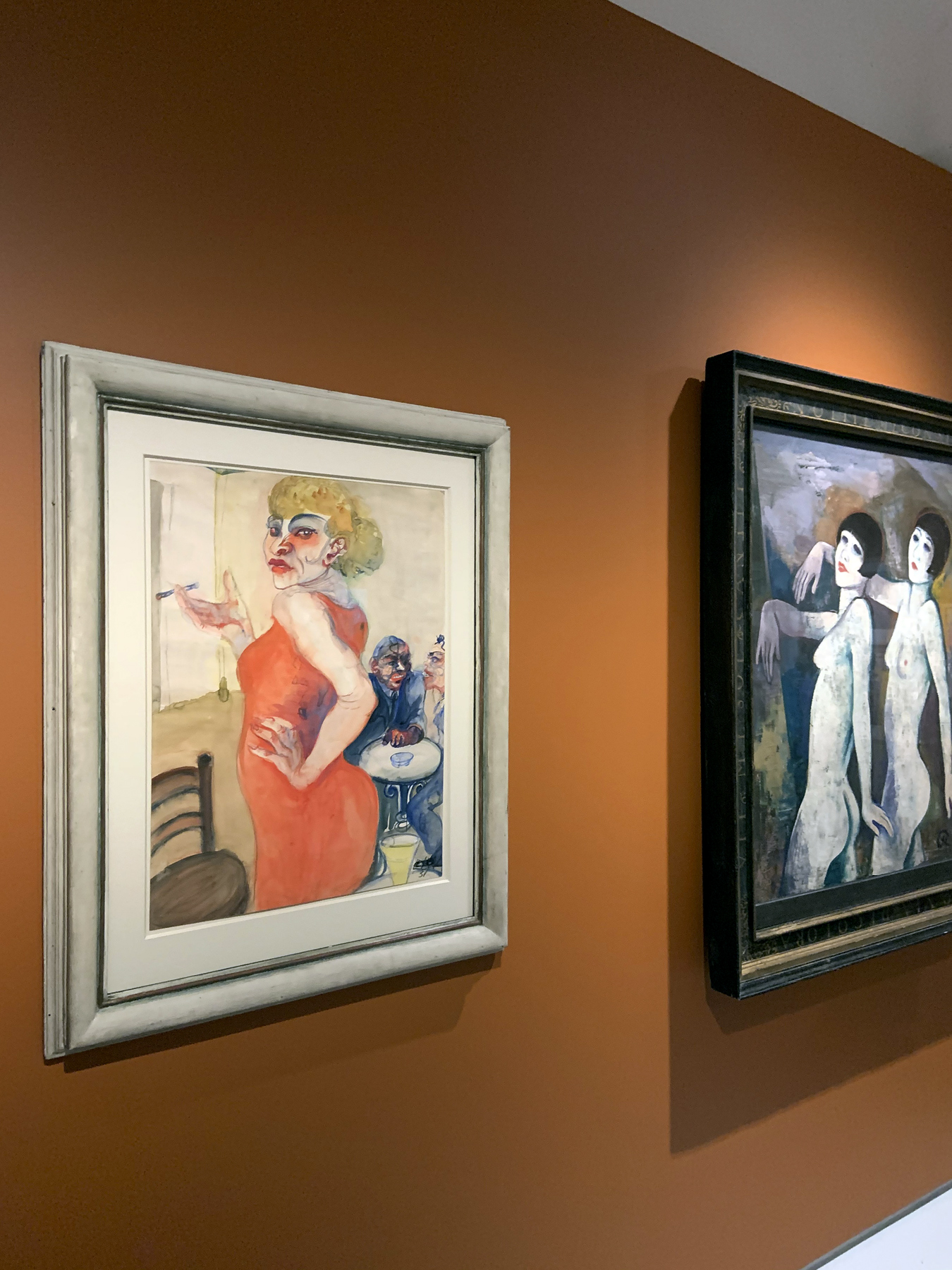
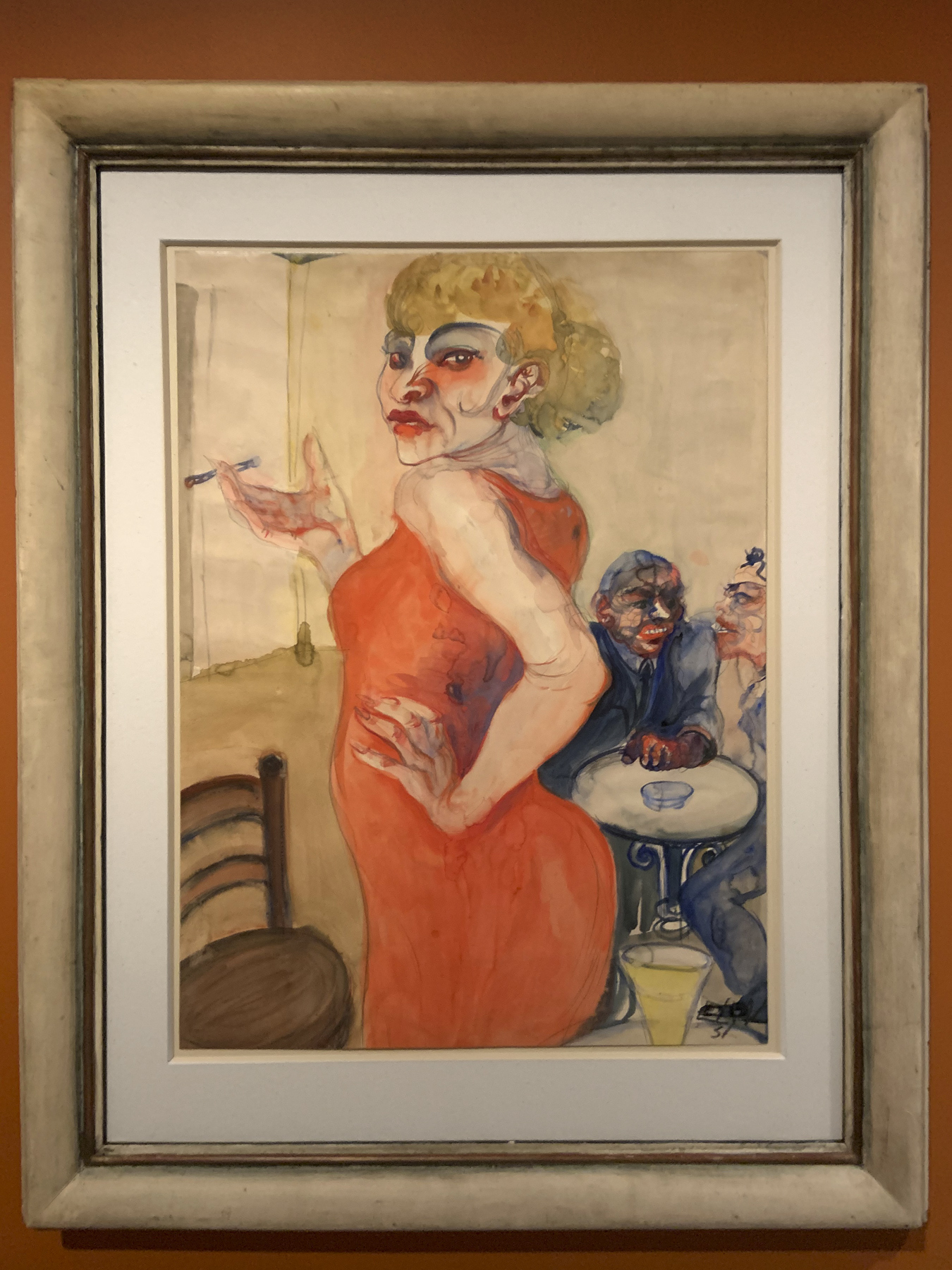
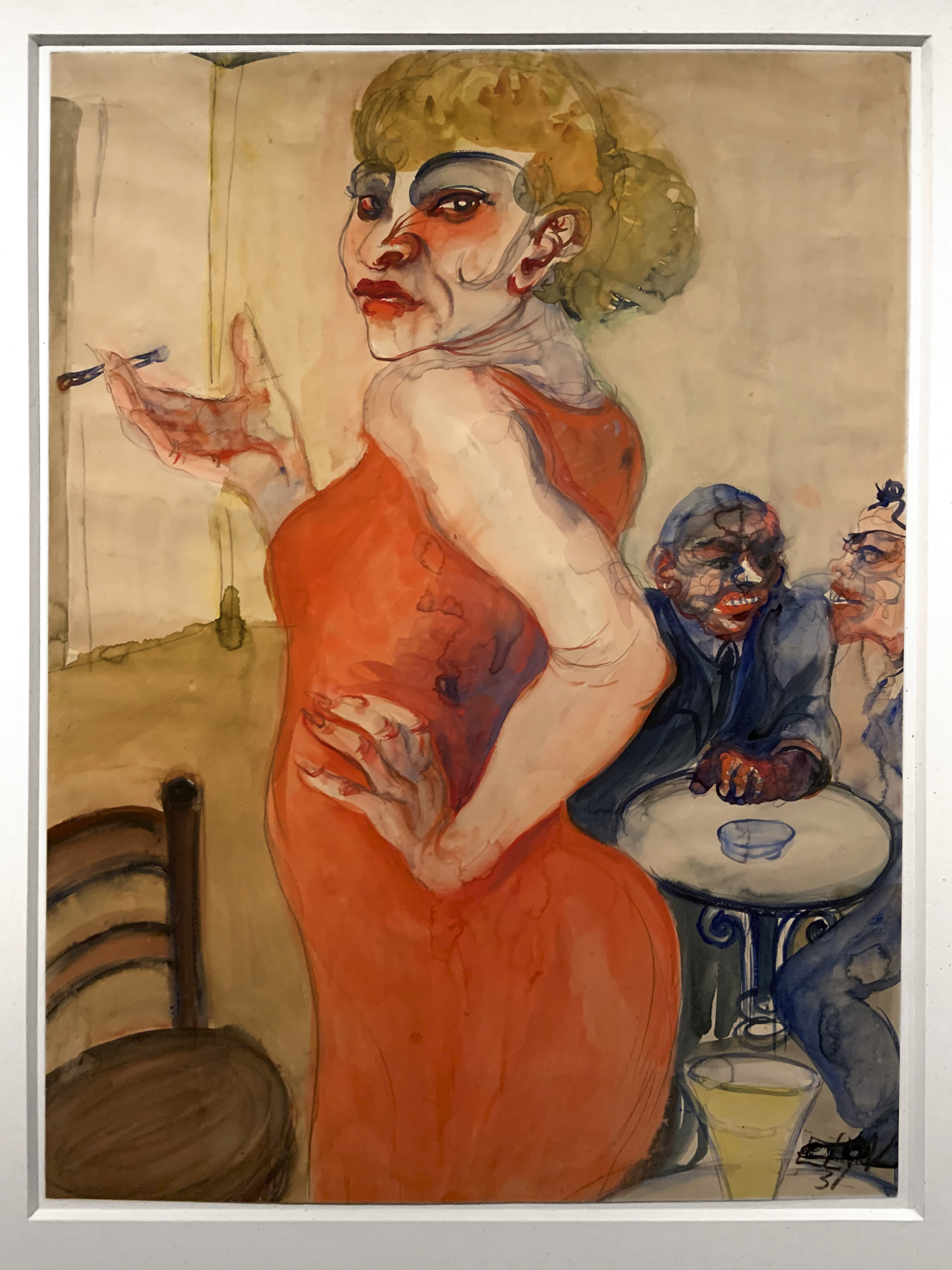
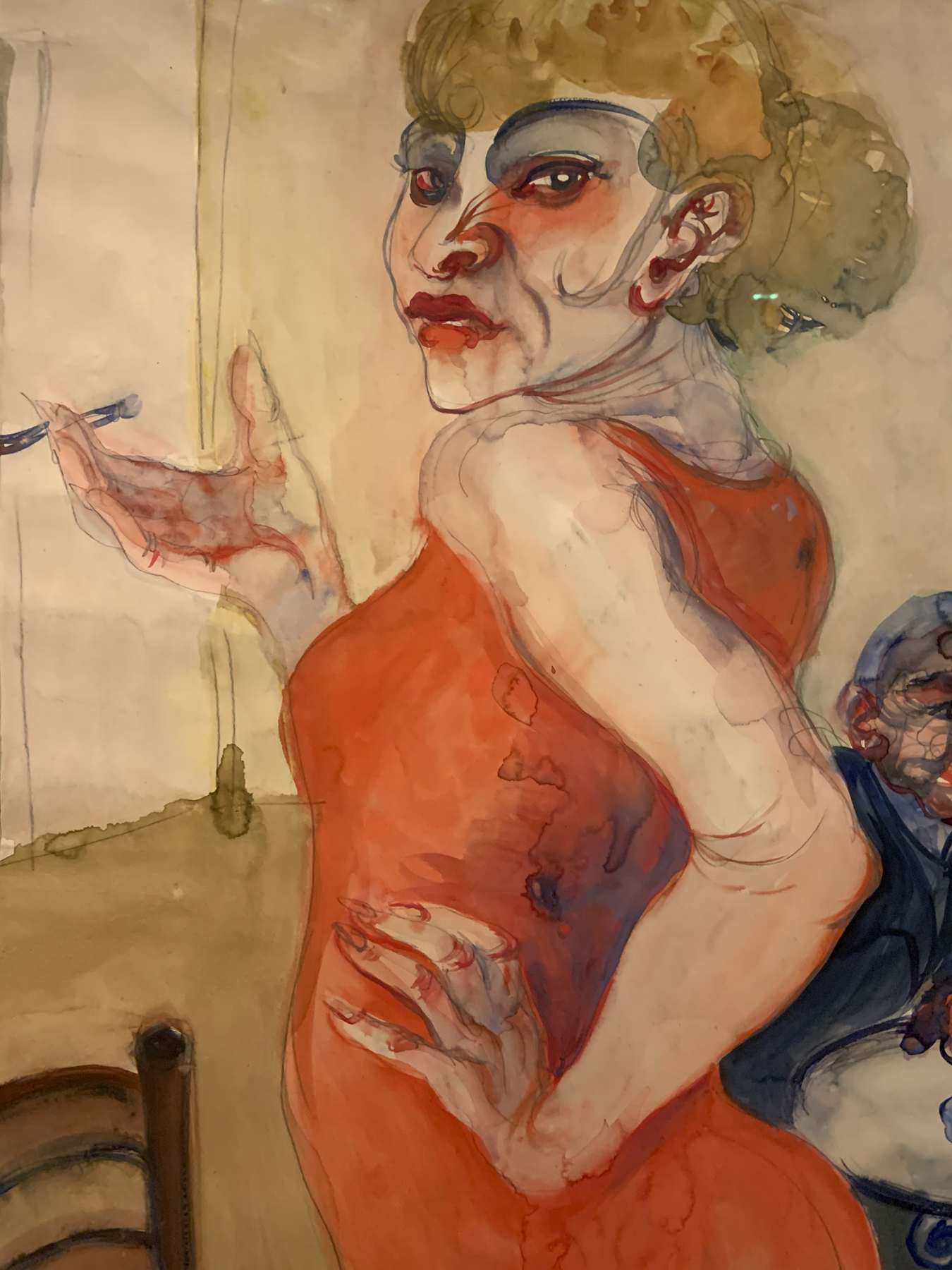
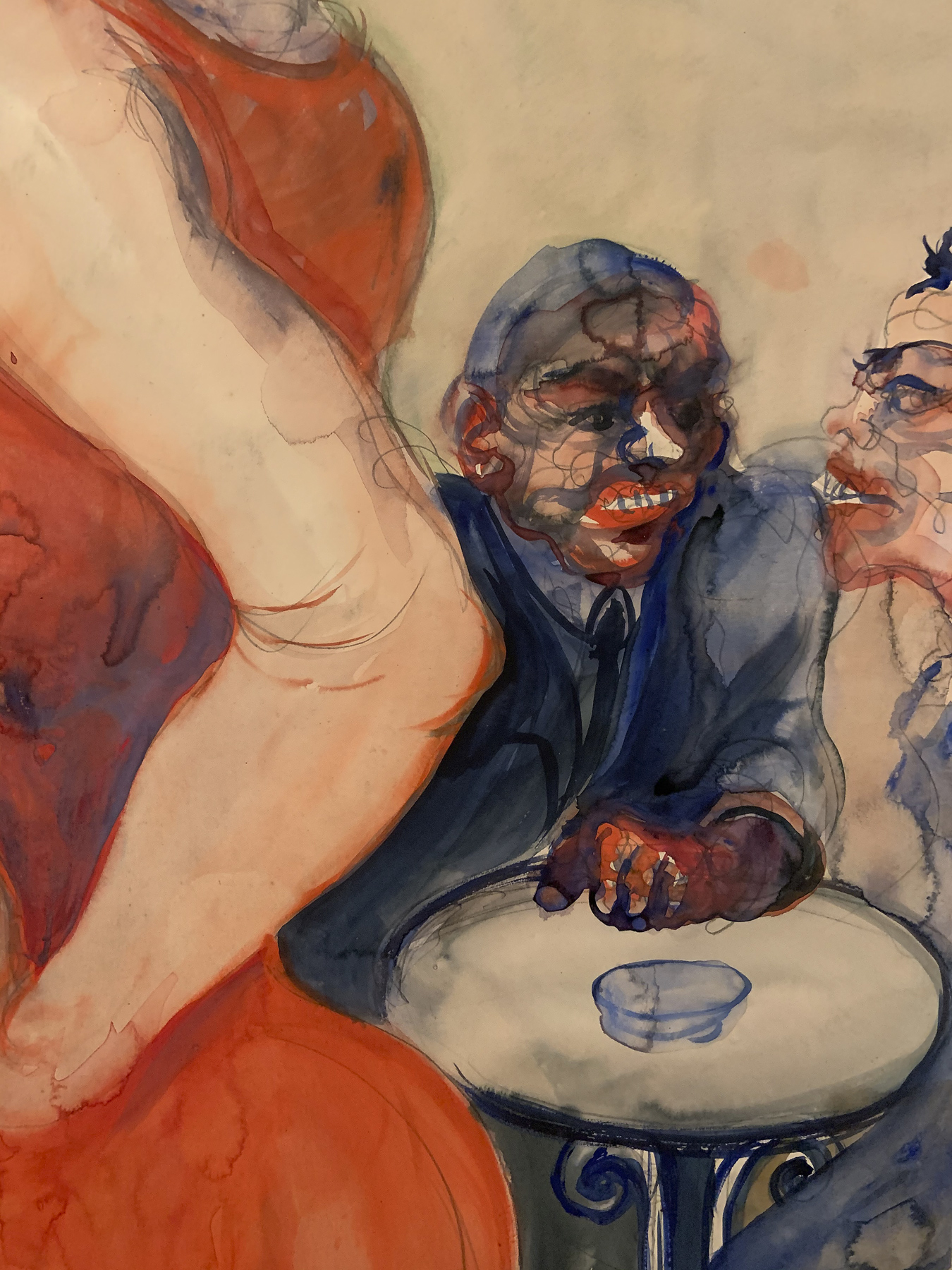
Elfriede Lohse-Wächtler’s “scenes of Hamburg after dark [which] convey a raw sense of possibility through bold line, clashing colour and startling imagery.” The attitude of the hands in the painting Lissy (1931, below) balanced by the simplicity of the chair at left, and the furious line and bleeding, washes of watercolour of the men at the table at right – replete with their protruding, predatory teeth – make this a compelling image.

I think I might have found myself a new art hero.

Dr Marcus Bunyan


Many thankx to the Barbican Art Gallery for allowing me to publish the media photographs in the posting. All installation images are iPhone images © Dr Marcus Bunyan unless otherwise stated. Please click on the photographs for a larger version of the image. See Part 1 of the posting with my comments on the exhibition.


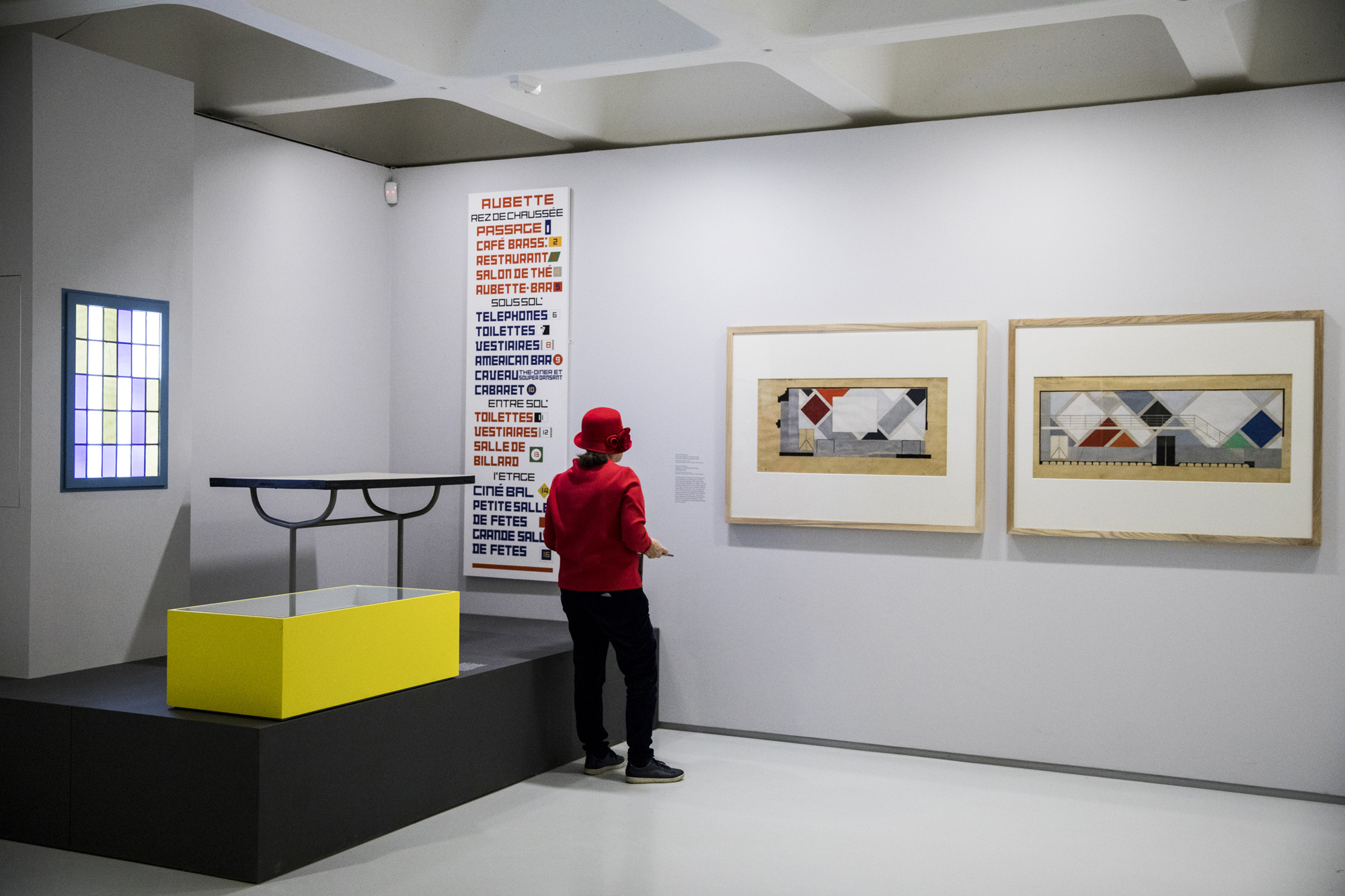
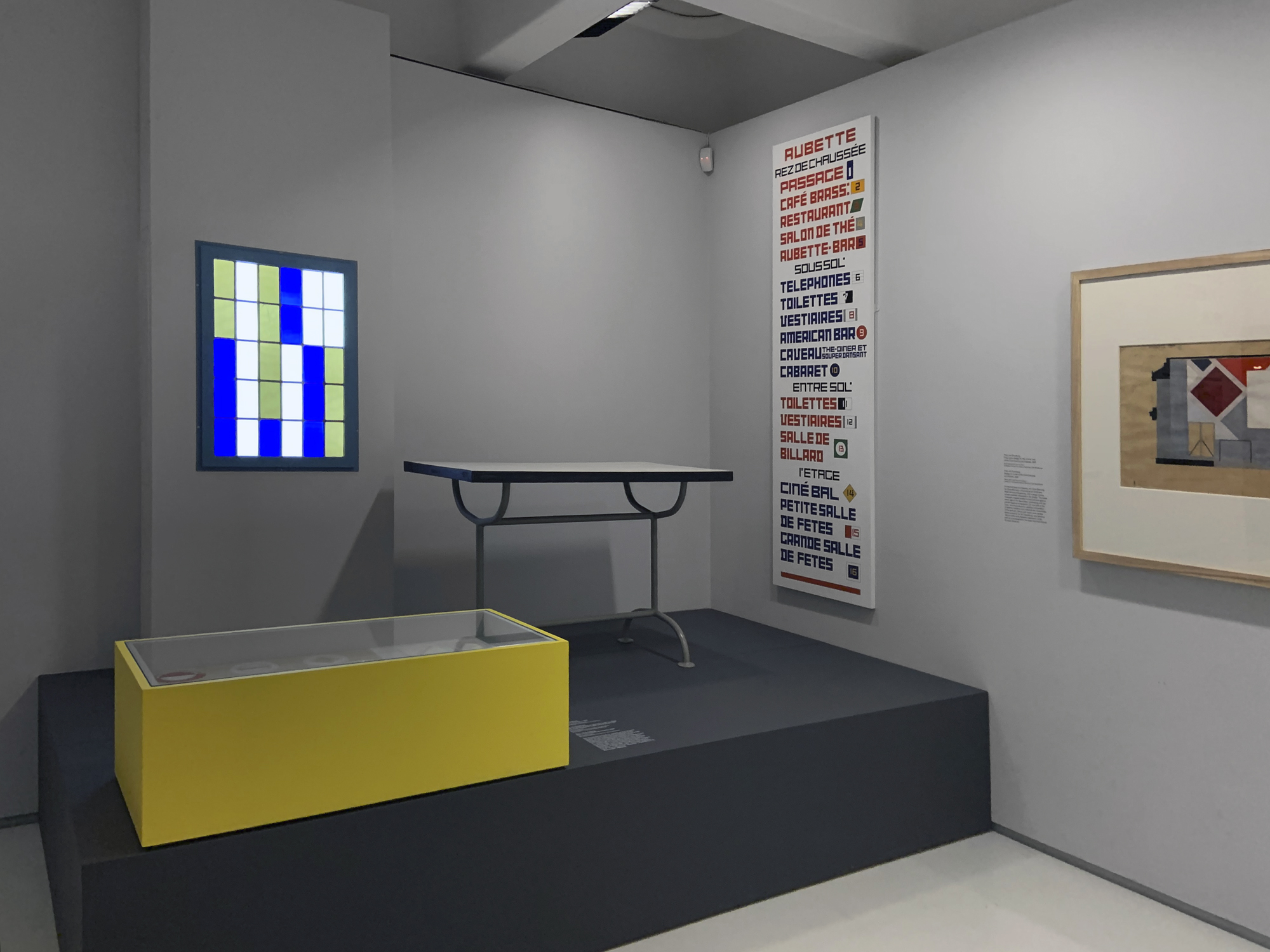
Strasbourg L'Aubette 1928 wall text from the exhibition Theo van Doesburg (Dutch, 1883-1931) 'The Ciné-bal (cinema-ballroom) at Café L'Aubette, Strasbourg, designed by Theo van Doesburg' 1926-1928 from the exhibition 'Into the Night: Cabarets and Clubs in Modern Art' at the Barbican Art Gallery, Oct 2019 - Jan 2020

Strasbourg L'Aubette 1928 wall text Theo van Doesburg (Dutch, 1883-1931) 'The Ciné-bal (cinema-ballroom) at Café L'Aubette, Strasbourg, designed by Theo van Doesburg' 1926-1928 from the exhibition 'Into the Night: Cabarets and Clubs in Modern Art' at the Barbican Art Gallery, Oct 2019 - Jan 2020


Strasbourg: L’Aubette 1928 wall text
Photos: Marcus Bunyan


Installation view of the exhibition 'Into the Night: Cabarets and Clubs in Modern Art' at the Barbican Art Gallery, Oct 2019 - Jan 2020


Into the Night: Cabarets and Clubs in Modern Art
Installation view Barbican Art Gallery 4 October 2019 – 19 January 2020
© Tristan Fewings / Getty Images


Installation view of the exhibition 'Into the Night: Cabarets and Clubs in Modern Art' at the Barbican Art Gallery, Oct 2019 - Jan 2020

Installation view of the exhibition 'Into the Night: Cabarets and Clubs in Modern Art' at the Barbican Art Gallery, Oct 2019 - Jan 2020

Installation view of the exhibition 'Into the Night: Cabarets and Clubs in Modern Art' at the Barbican Art Gallery, Oct 2019 - Jan 2020


Installation views of the exhibition Into the Night: Cabarets and Clubs in Modern Art at the Barbican Art Gallery, London
Photos: Marcus Bunyan


Theo van Doesburg (Dutch, 1883-1931) 'L'Aubette: Projet de composition pour le sol du café-brasserie et du café-restaurant' (L'Aubette: Design for a composition for the floor of the café-brasserie and the café-restaurant) 1927 (installation view)


Theo van Doesburg (Dutch, 1883-1931)
L’Aubette: Projet de composition pour le sol du café-brasserie et du café-restaurant (L’Aubette: Design for a composition for the floor of the café-brasserie and the café-restaurant) (installation view)
1927
Gouache and graphite pencil on tracing paper
Paris, Centre Pompidou – Museé national d’art moderne – Centre de création industrielle
Photo: Marcus Bunyan


Theo van Doesburg (Dutch, 1883-1931) 'L'Aubette: Projet de composition pour le sol du café-brasserie et du café-restaurant' (L'Aubette: Design for a composition for the floor of the café-brasserie and the café-restaurant) 1927 (installation view)


Theo van Doesburg (Dutch, 1883-1931)
L’Aubette: Projet de composition pour le sol du café-brasserie et du café-restaurant (L’Aubette: Design for a composition for the floor of the café-brasserie and the café-restaurant) (installation view)
1927
Gouache and graphite pencil on tracing paper
Paris, Centre Pompidou – Museé national d’art moderne – Centre de création industrielle
Photo: Marcus Bunyan


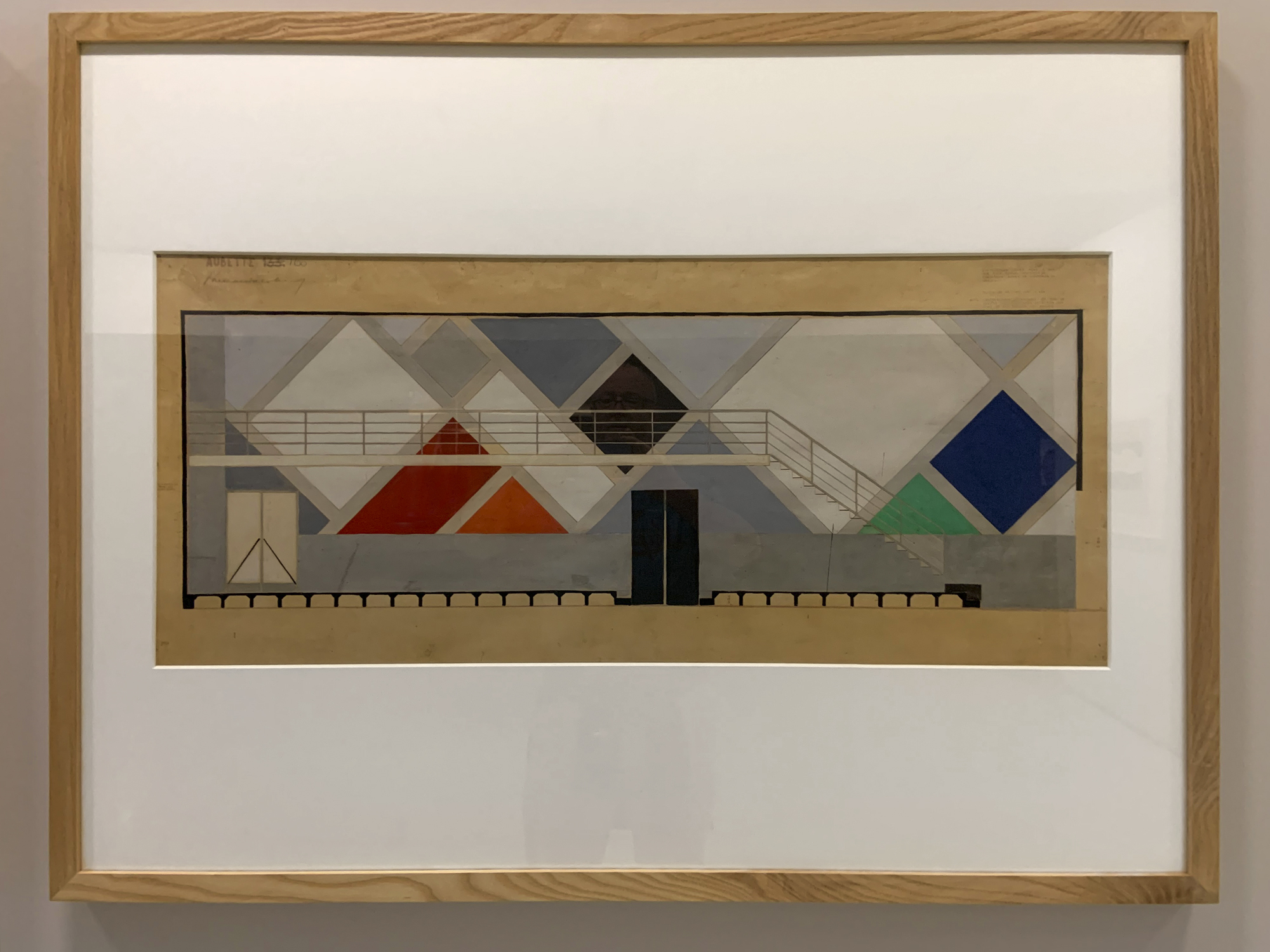
Theo van Doesburg (Dutch, 1883-1931) 'Final colour design for the screen wall of the Ciné-Dancing at L'Aubette' 1927 (installation view)


Theo van Doesburg (Dutch, 1883-1931)
Final colour design for the screen wall of the Ciné-Dancing at L’Aubette (installation view)
1927
East India ink and paint on paper
Collection Het Nieuwe Instituut, Rotterdam. Gift Van Moorsel
Photo: Marcus Bunyan


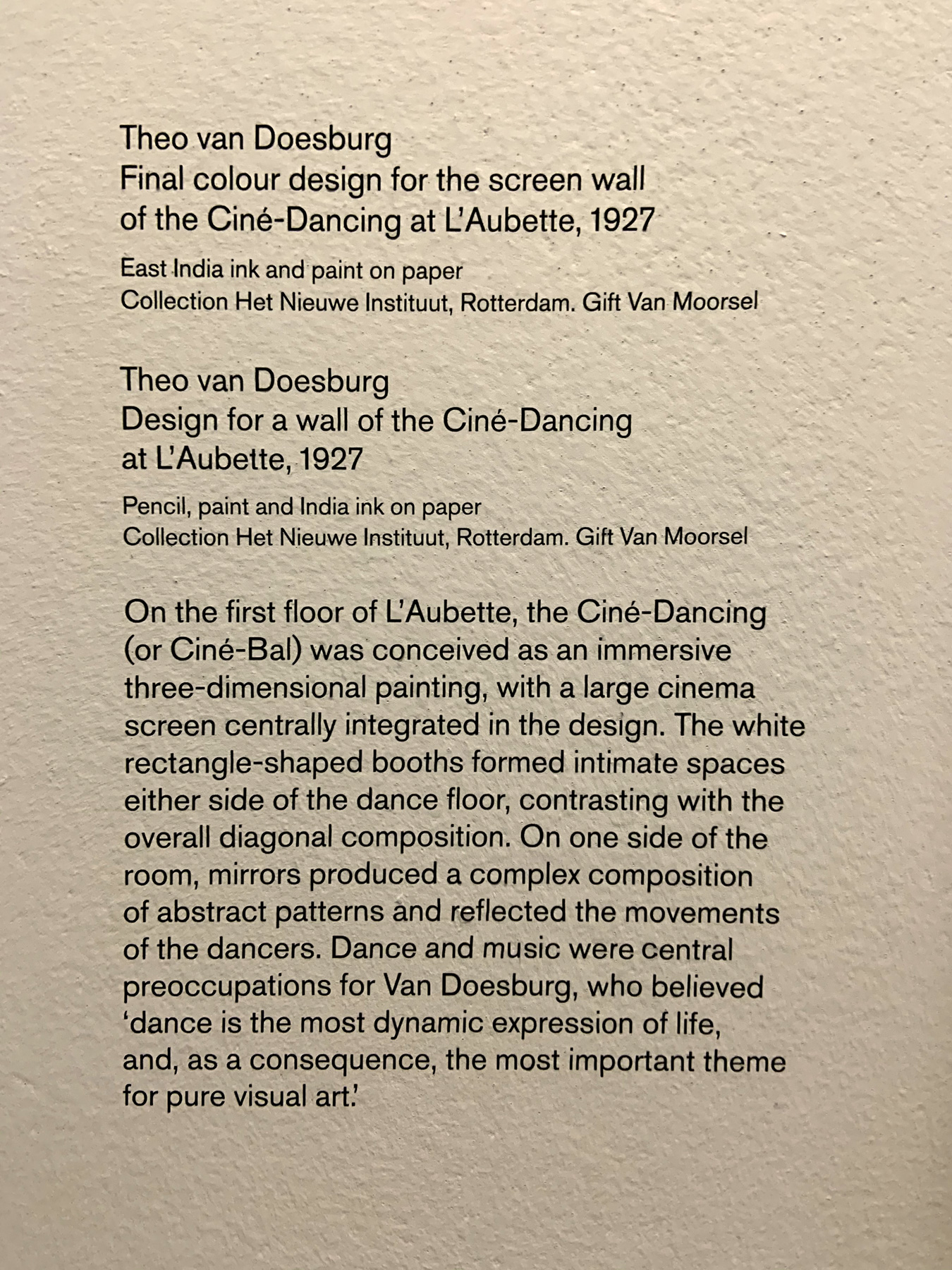
Theo van Doesburg Ciné-Dancing wall text from the exhibition 'Into the Night: Cabarets and Clubs in Modern Art' at the Barbican Art Gallery, Oct 2019 - Jan 2020


Theo van Doesburg Ciné-Dancing wall text
Photo: Marcus Bunyan


Installation view of the exhibition 'Into the Night: Cabarets and Clubs in Modern Art' (downstairs gallery, room recreation)


Into the Night: Cabarets and Clubs in Modern Art (downstairs gallery, room recreation)
Installation view Barbican Art Gallery 4 October 2019 – 19 January 2020
© Tristan Fewings / Getty Images


Downstairs gallery, room recreation


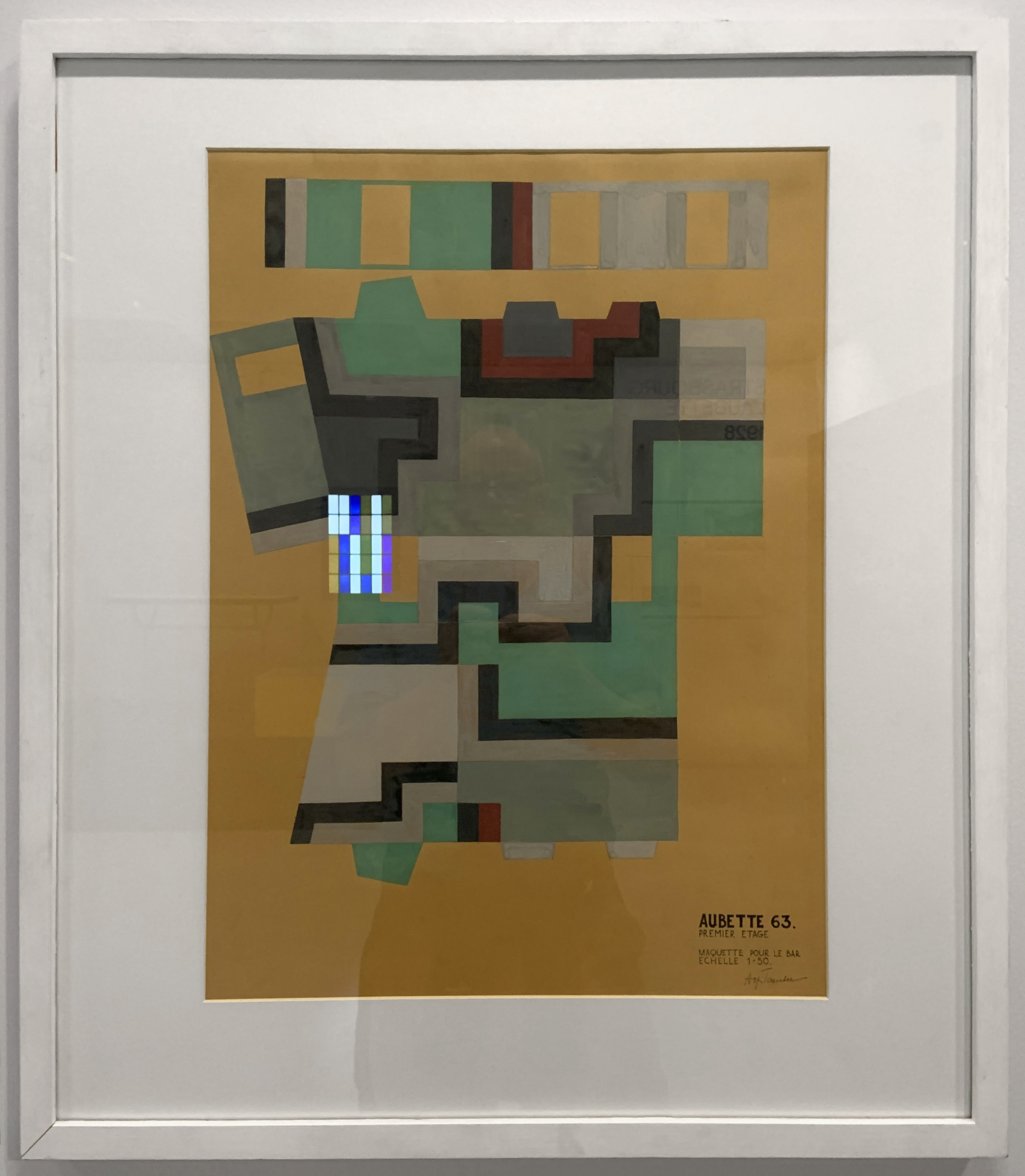
Sophie Taeuber-Arp (Swiss, 1889-1943) 'Aubette 63' 1927 (installation view)


Sophie Taeuber-Arp (Swiss, 1889-1943)
Aubette 63 (installation view)
1927
Gouache on paper
Musée d’Art Moderne et Contemporain de Strasbourg
Photo: Marcus Bunyan


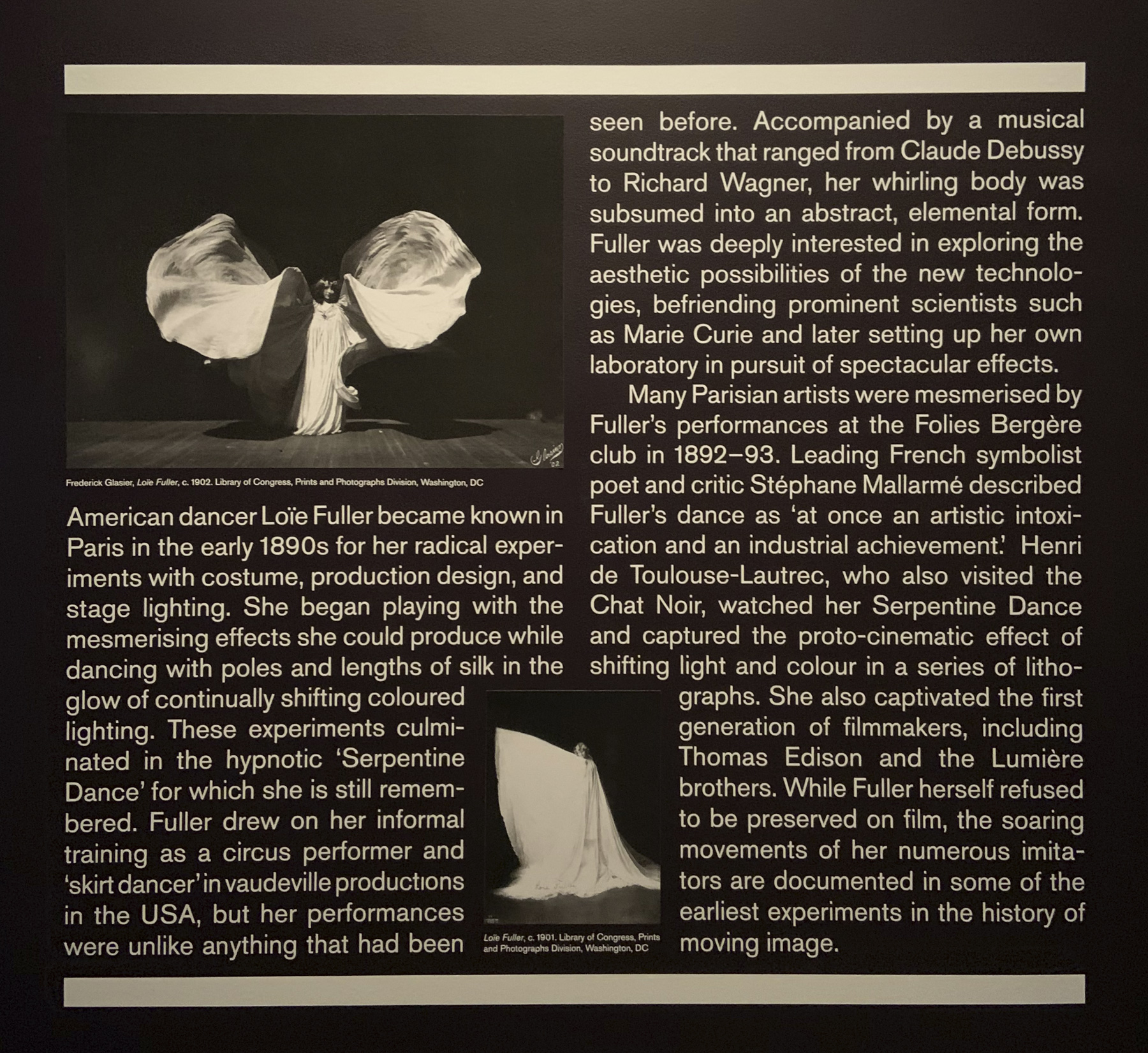
Paris: Loïe Fuller 1890s wall text from the exhibition 'Into the Night: Cabarets and Clubs in Modern Art' at the Barbican Art Gallery, Oct 2019 - Jan 2020

Paris: Loïe Fuller 1890s wall text from the exhibition 'Into the Night: Cabarets and Clubs in Modern Art' at the Barbican Art Gallery, Oct 2019 - Jan 2020


Paris: Loïe Fuller 1890s wall text
Photos: Marcus Bunyan


Unknown photographer (attributed to Falk Studio). 'Loie Fuller' c. 1901


Unknown photographer (attributed to Falk Studio)
Loïe Fuller
c. 1901
Courtesy of the Library of Congress, Prints and Photographs Division, Washington, DC


1895-1908 Loie Fuller’s Serpentine Dance (highlights from the greatest movie pioneers’ films)

Many of the earliest filmmakers chose Loie Fuller’s Serpentine Dance as a subject for one or more films: the Skladanowsky brothers (1895), Dickson and Heise for Edison Manifacturing Company (1895), Dickson for American Mutoscope (1896), Lumière (1896), Demeny (1897), possibly Alice Guy (1899+1900+1902), Méliès (1899), G.A. Smith (1902), De Chomon (1902+1908) and many others.

Loie Fuller was a pioneer of modern dance and of theatrical lighting effects. She developed this dance in 1891 and combined her choreography with silk costumes illuminated by multi-colored lighting of her own design. In several of the Serpentine Dance movies her lighting has been reinterpreted through hand-colored effects. Fuller also had a successful Fire Dance of which elements are often incorporated in filmed Serpentine Dance performances (yet rarelymentioned).

It is unclear whether any performance by Loie Fuller herself has ever been filmed. Possibly all of the featured dancers are imitators, although Segundo de Chomon’s 1902 film title “Loie Fuller” makes a strong claim.

 Text from the YouTube website

Magnificent! Not Loïe Fuller but one of her many imitators. She refused to be captured on film.


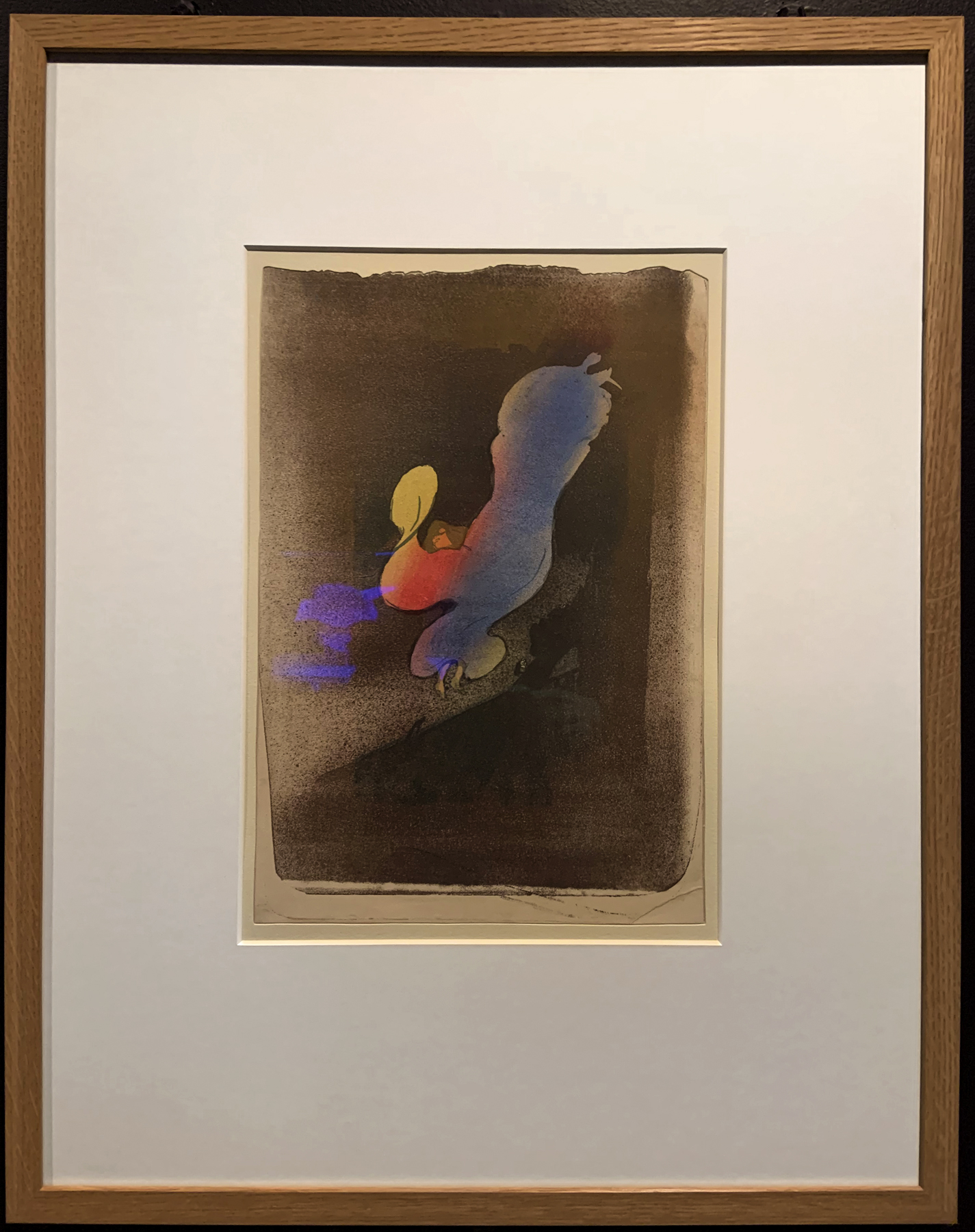
Henri de Toulouse-Lautrec (French, 1864-1901) 'Miss Loïe Fuller' 1893 (installation view)

Henri de Toulouse-Lautrec (French, 1864-1901) 'Miss Loïe Fuller' 1893 (installation view)

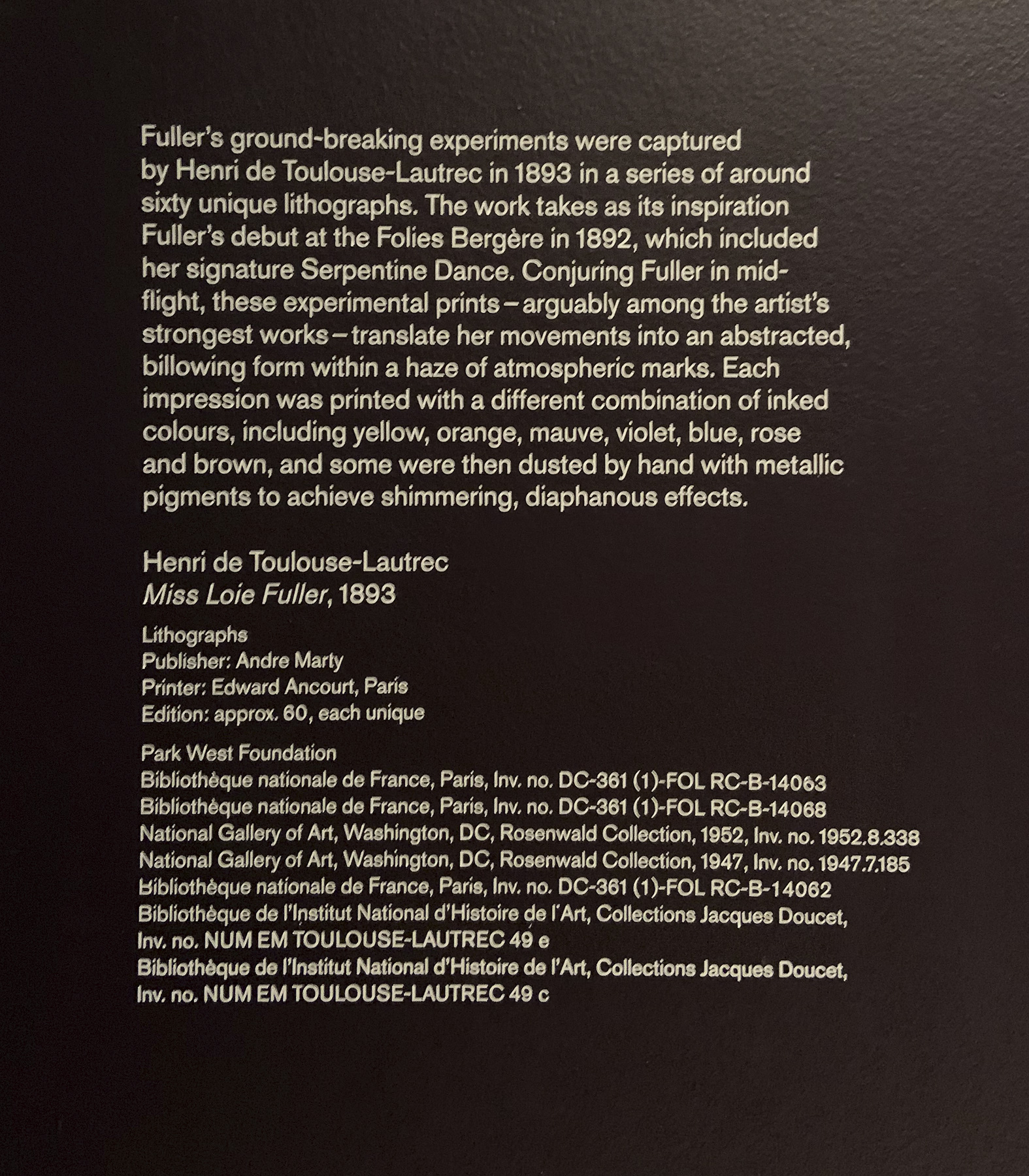
Henri de Toulouse-Lautrec. 'Miss Loïe Fuller' 1893 wall text from the exhibition 'Into the Night: Cabarets and Clubs in Modern Art' at the Barbican Art Gallery, Oct 2019 - Jan 2020


Installation views of the exhibition Into the Night: Cabarets and Clubs in Modern Art at the Barbican Art Gallery, London showing the work of Henri de Toulouse-Lautrec
Photos: Marcus Bunyan


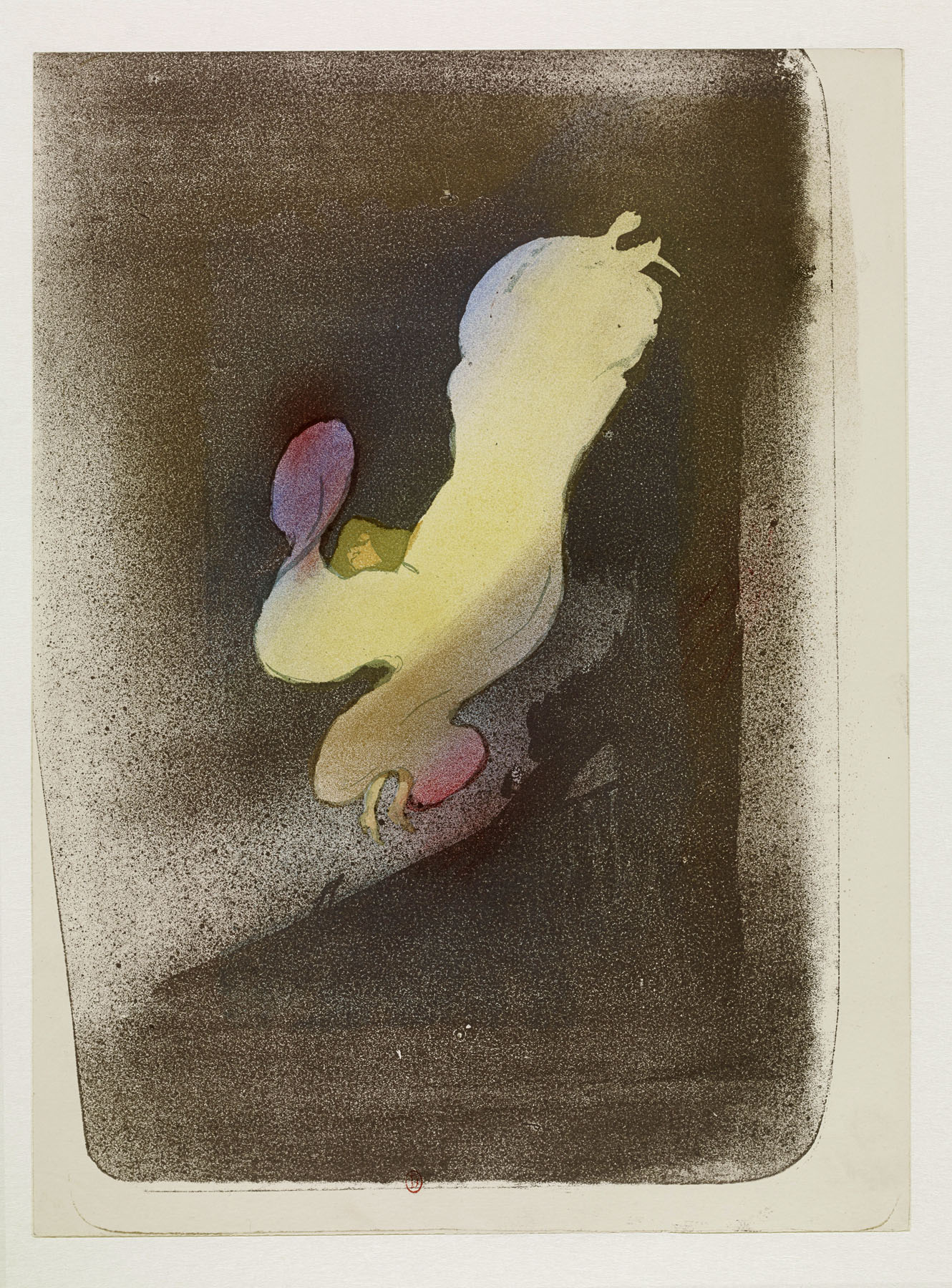
Henri de Toulouse-Lautrec (French, 1864-1901) 'Miss Loïe Fuller' 1893


Henri de Toulouse-Lautrec (French, 1864-1901)
Miss Loïe Fuller
1893
Bibliothèque de l’Institut National d’Histoire de l’Art, Collections Jacques Doucet
Inv. no. NUM EM TOULOUSE-LAUTREC 49 e
Courtesy Bibliothèque de l’Institut National d’Histoire de l’Art, Collections Jacques Doucet


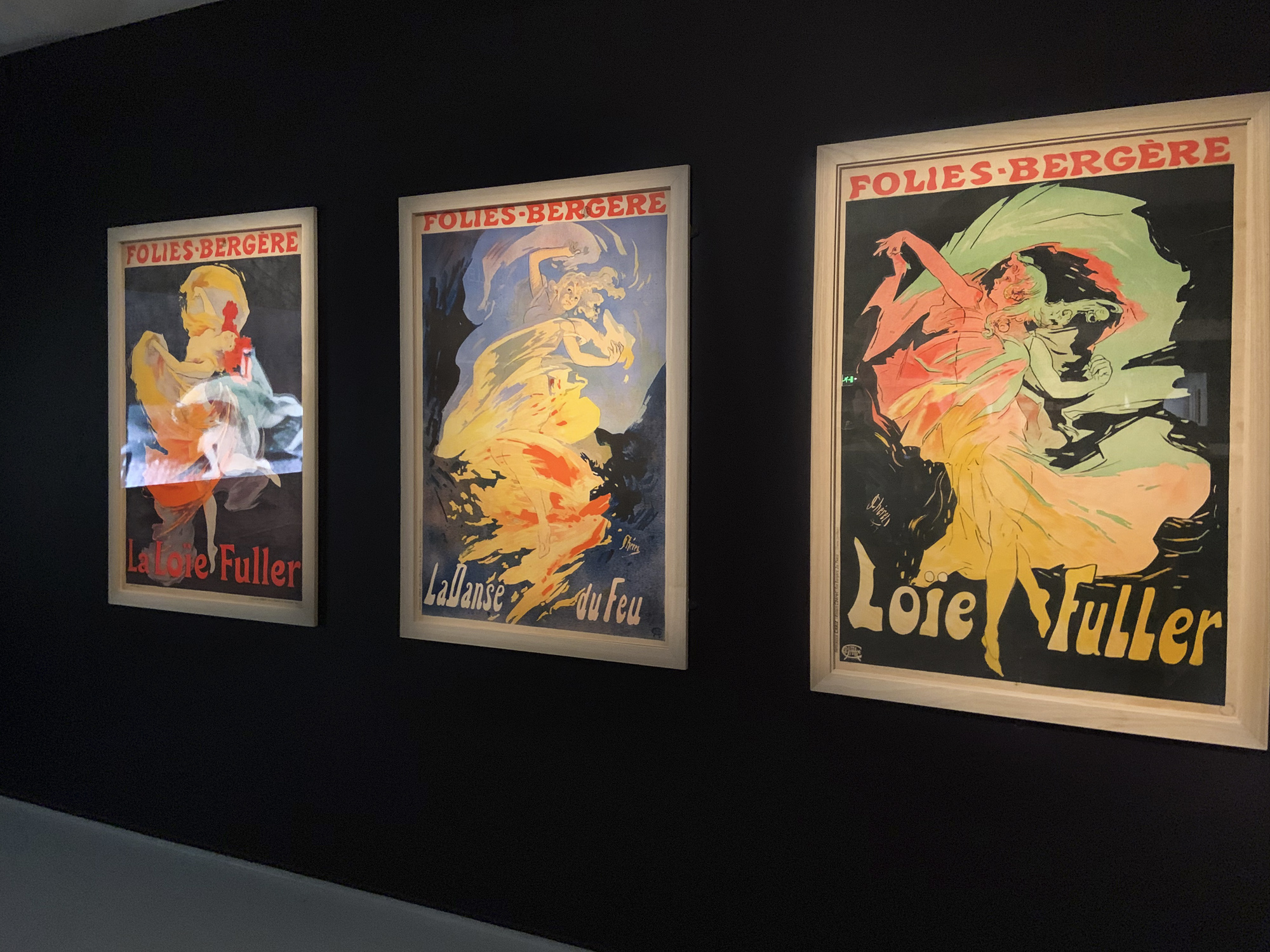
Installation view showing Jules Chéret (French, 1836-1932) 'Folies Bergere La Loie Fuller' lithographs from the exhibition 'Into the Night: Cabarets and Clubs in Modern Art' at the Barbican Art Gallery, Oct 2019 - Jan 2020

Jules Chéret (French, 1836-1932) 'Fioles Bergère, La Loïe Fuller' 1893 (installation view)


Jules Chéret (French, 1836-1932)
Fioles Bergère, La Loïe Fuller (installation view)
1893
Lithograph
Paris, Musée des Arts Décoratifs
Photos: Marcus Bunyan


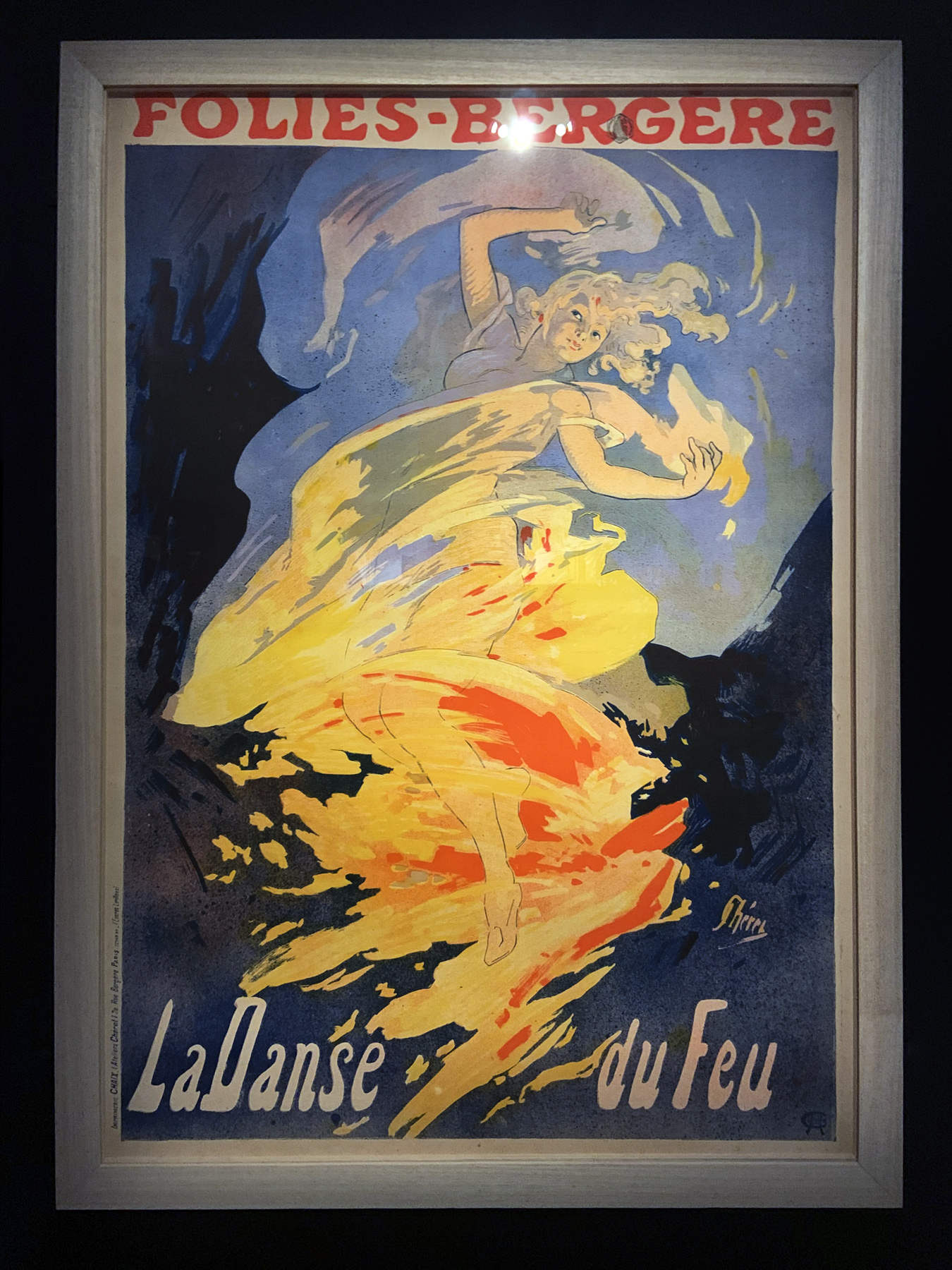
Jules Chéret (French, 1836-1932) 'Folies Bergère, La Danse du Feu' (The Fire Dance) 1897 (installation view)


Jules Chéret (French, 1836-1932)
Folies Bergère, La Danse du Feu (The Fire Dance) (installation view)
1897
Lithograph
Paris, Musée des Arts Décoratifs
Photos: Marcus Bunyan


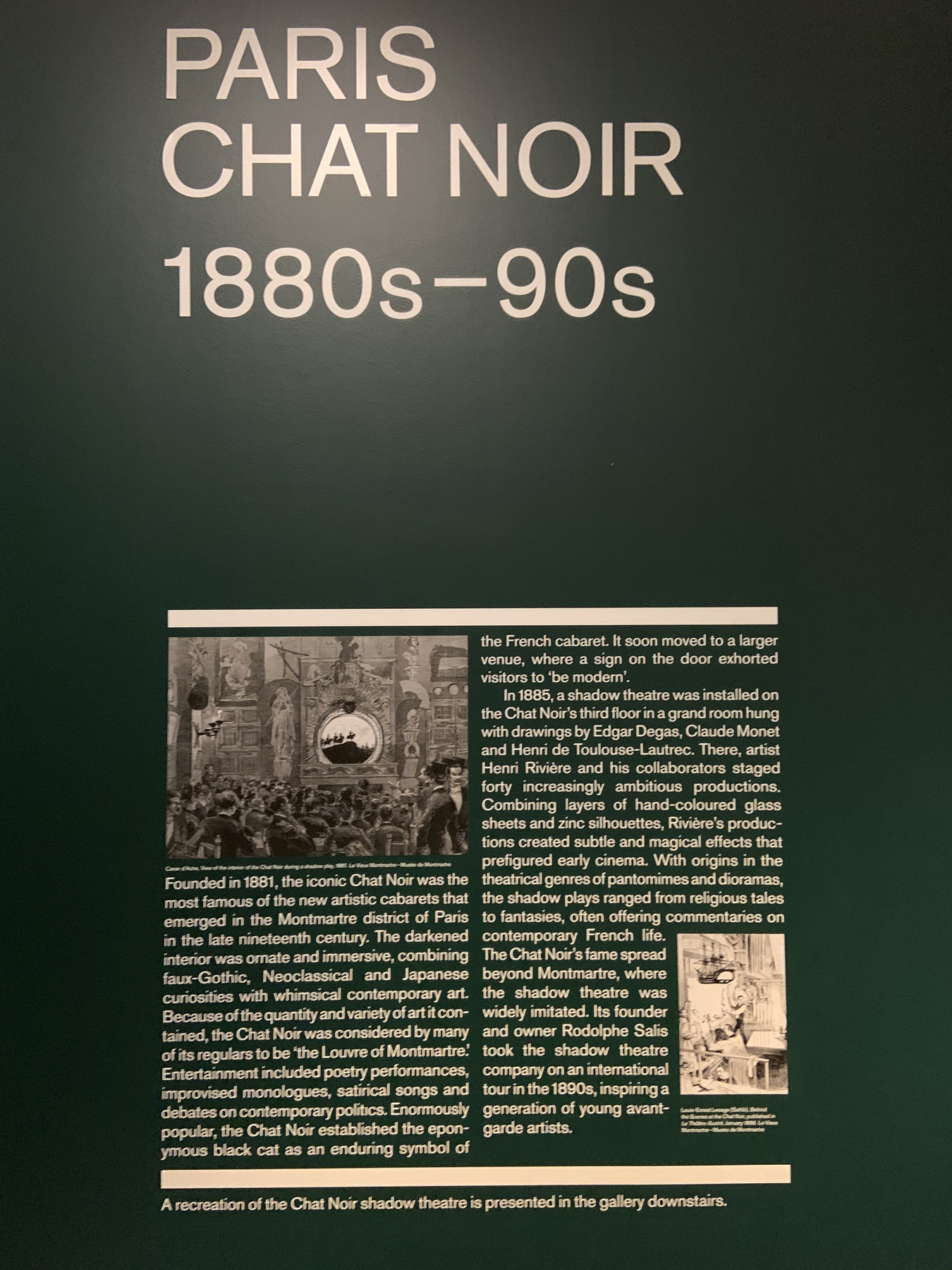
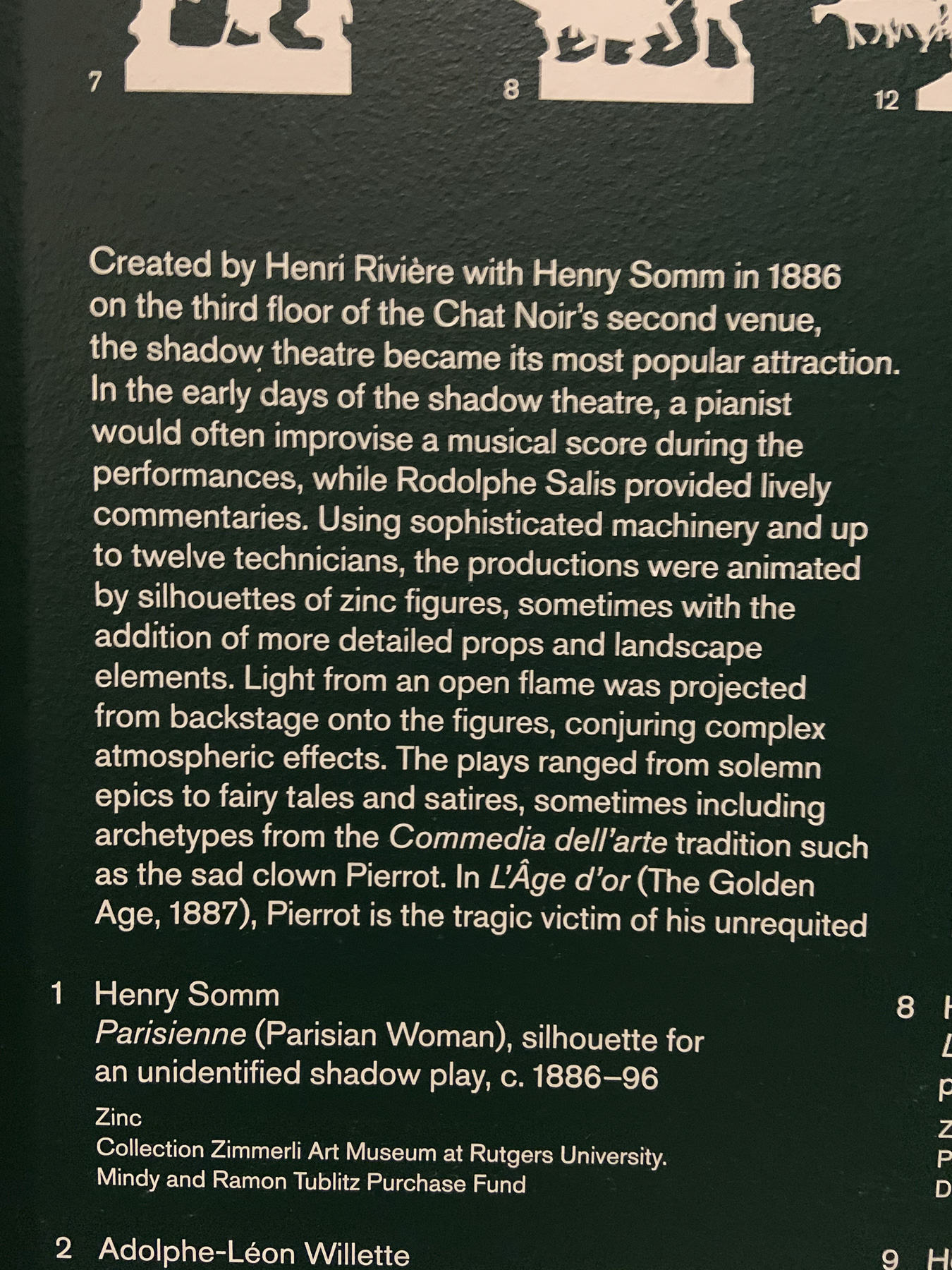
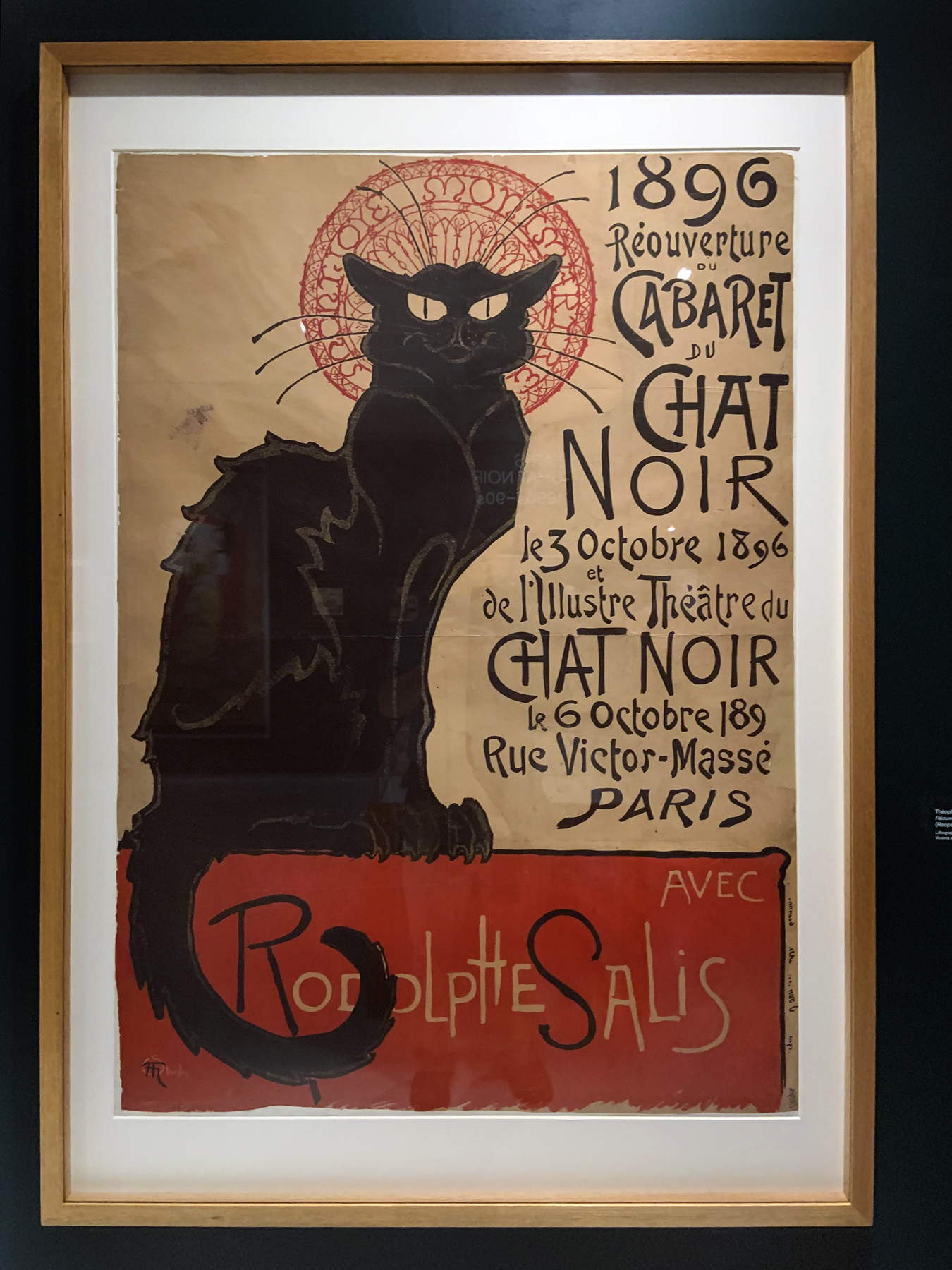
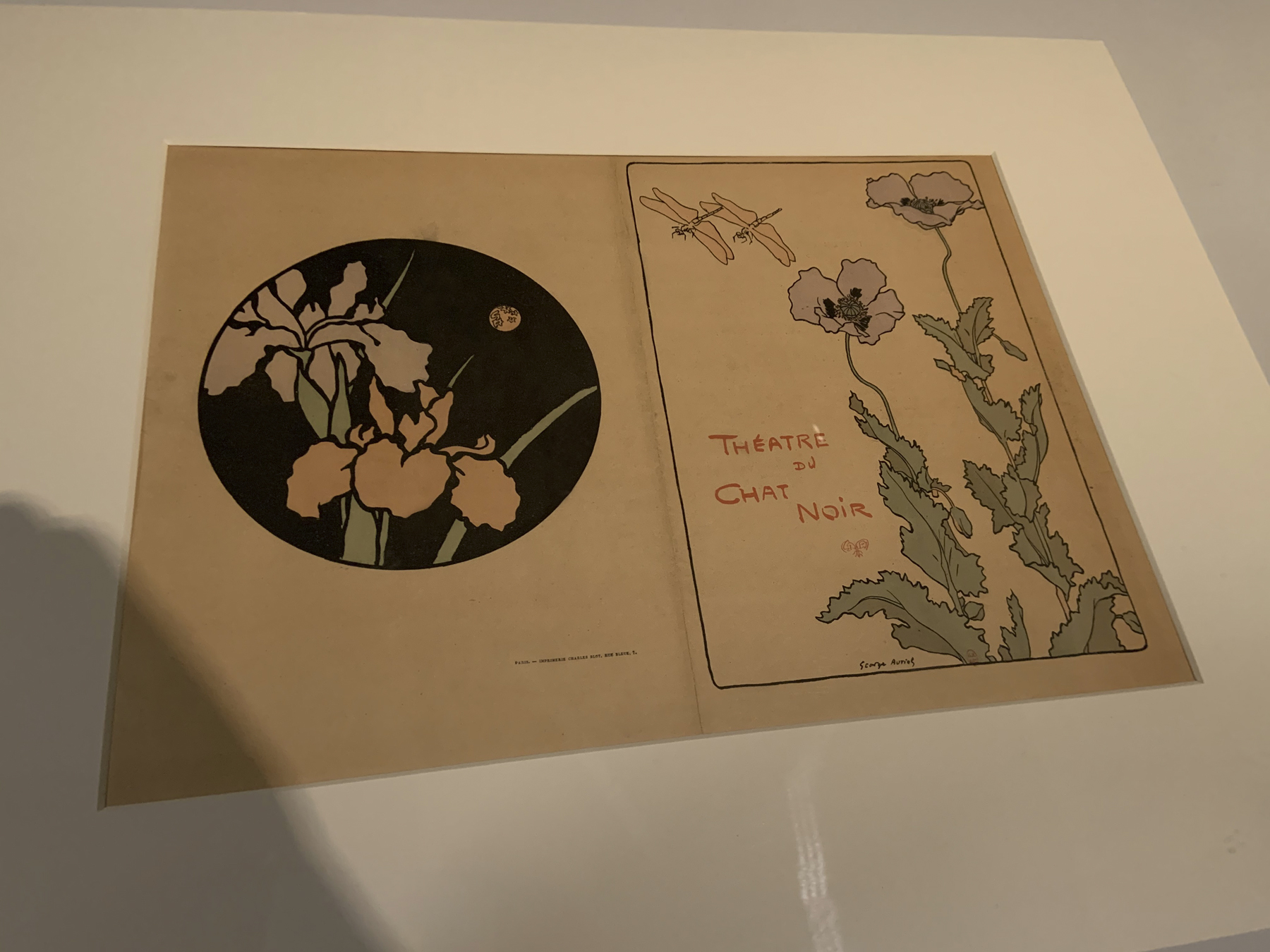
Paris: Chat Noir 1880s-90s wall text from the exhibition 'Into the Night: Cabarets and Clubs in Modern Art' at the Barbican Art Gallery, Oct 2019 - Jan 2020

Paris: Chat Noir 1880s-90s wall text from the exhibition 'Into the Night: Cabarets and Clubs in Modern Art' at the Barbican Art Gallery, Oct 2019 - Jan 2020


Paris: Chat Noir 1880s-90s wall text
Photos: Marcus Bunyan


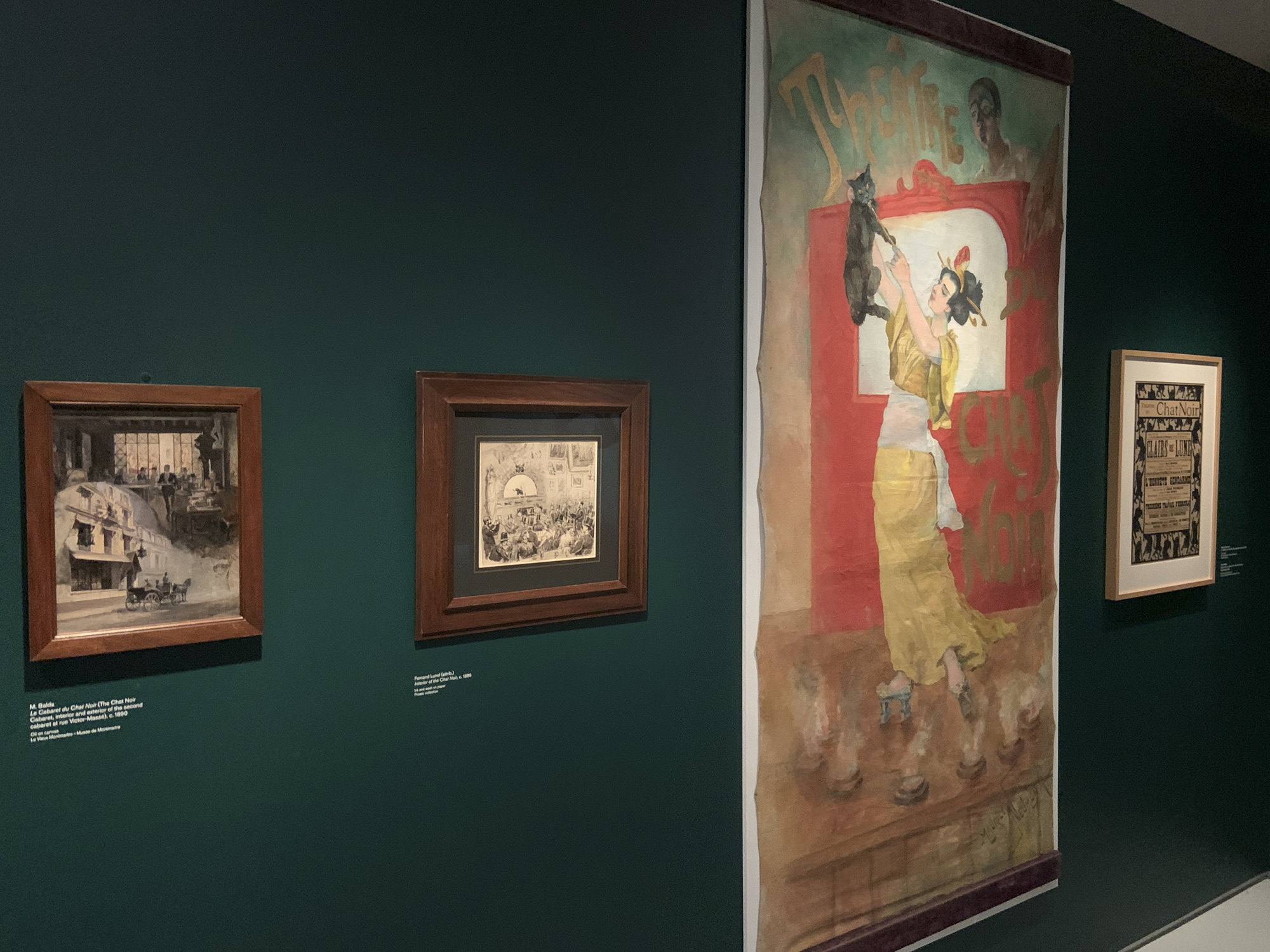
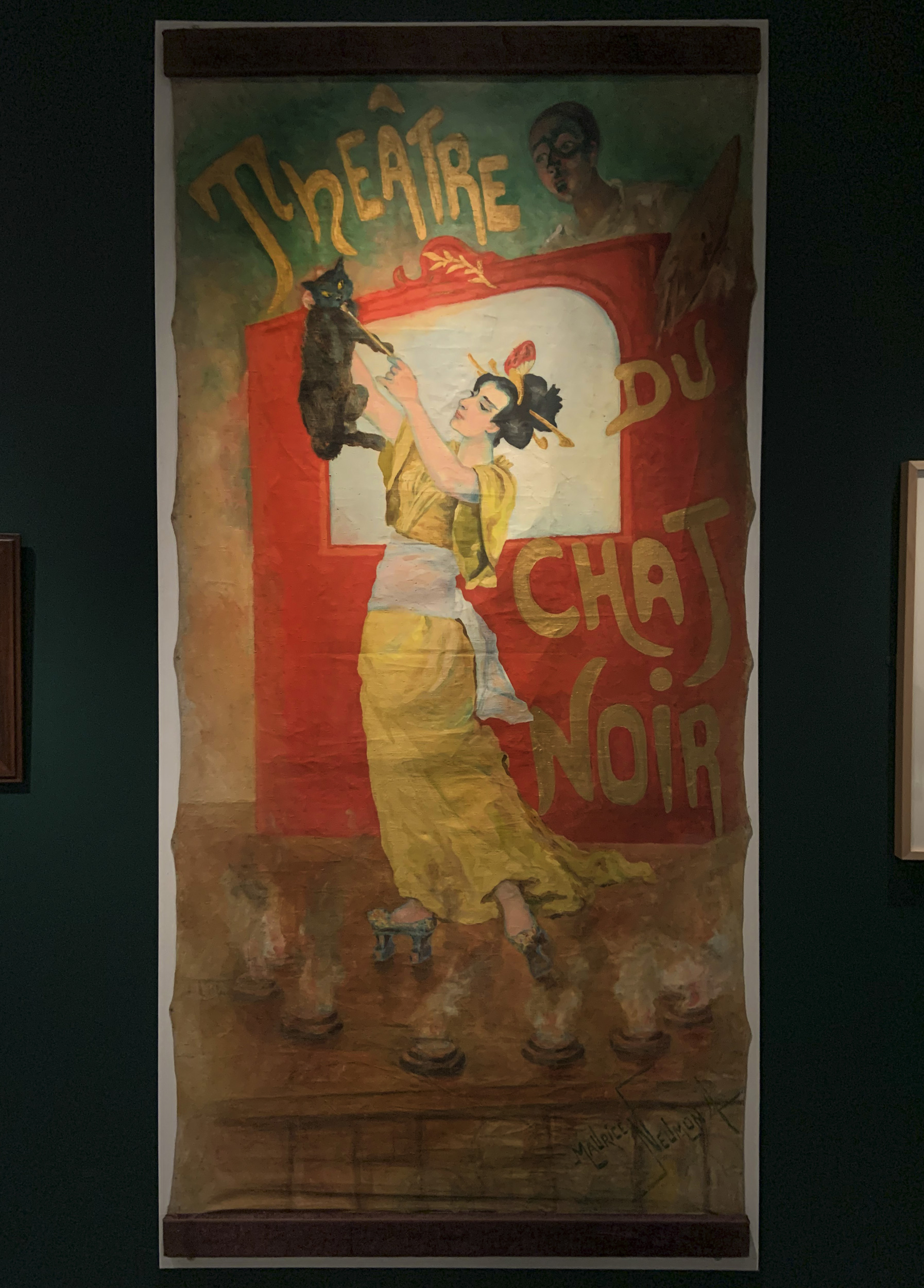
Installation view of the exhibition 'Into the Night: Cabarets and Clubs in Modern Art' at the Barbican Art Gallery, London

Installation view of the exhibition 'Into the Night: Cabarets and Clubs in Modern Art' at the Barbican Art Gallery, London


Installation views of the exhibition Into the Night: Cabarets and Clubs in Modern Art at the Barbican Art Gallery, London
Photos: Marcus Bunyan


Henri Rivière (French, 1864-1951) 'Poster for the performances Clairs de lune by Georges Fragerolle, L'honnête gendarme by Jean Richepin and Le treizième travail d'Hercule by Eugène Courboin (Le Chat Noir, 16 December 1896)' (installation view)


Henri Rivière (French, 1864-1951)
Poster for the performances Clairs de lune by Georges Fragerolle, L’honnête gendarme by Jean Richepin and Le treizième travail d’Hercule by Eugène Courboin (Le Chat Noir, 16 December 1896) (installation view)
Cliché and letterpress printing in black on wove paper on linen
58.7cm x 42.2cm
Van Gogh Museum, Amsterdam
Photo: Marcus Bunyan


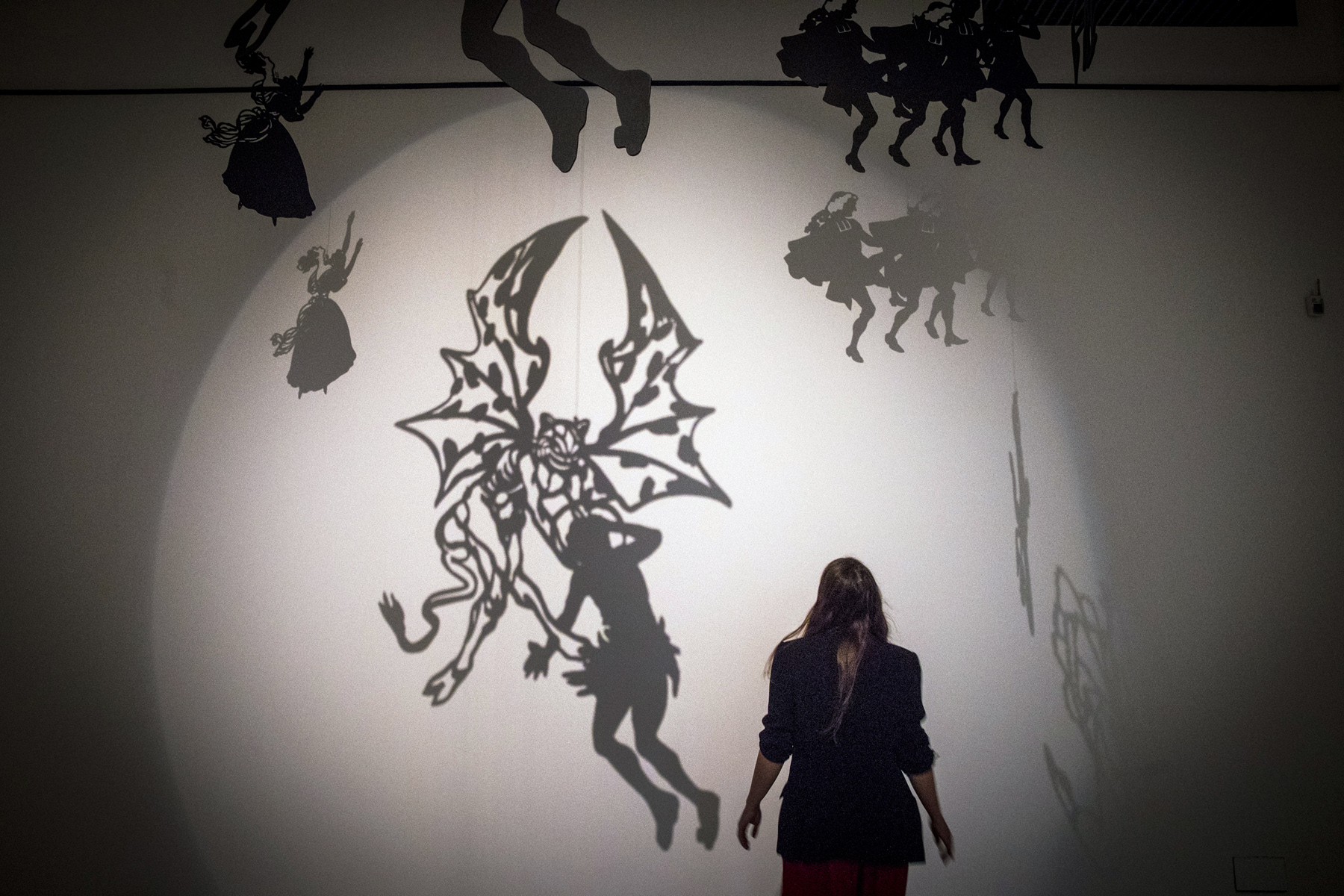
Installation view of the exhibition 'Into the Night: Cabarets and Clubs in Modern Art' at the Barbican Art Gallery, London showing Henri Rivière and Henry Somm's shadow theatre

Installation view of the exhibition 'Into the Night: Cabarets and Clubs in Modern Art' at the Barbican Art Gallery, London showing Henri Rivière and Henry Somm's shadow theatre

Installation view of the exhibition 'Into the Night: Cabarets and Clubs in Modern Art' at the Barbican Art Gallery, London showing Henri Rivière and Henry Somm's shadow theatre

Installation view of the exhibition 'Into the Night: Cabarets and Clubs in Modern Art' at the Barbican Art Gallery, London showing Henri Rivière and Henry Somm's shadow theatre wall text

Installation view of the exhibition 'Into the Night: Cabarets and Clubs in Modern Art' at the Barbican Art Gallery, London showing Henri Rivière and Henry Somm's shadow theatre wall text


Installation views of the exhibition Into the Night: Cabarets and Clubs in Modern Art at the Barbican Art Gallery, London showing Henri Rivière and Henry Somm’s shadow theatre and wall text
Photos: Marcus Bunyan


Installation view of the exhibition 'Into the Night: Cabarets and Clubs in Modern Art' (downstairs gallery, room recreation)

Installation view of the exhibition 'Into the Night: Cabarets and Clubs in Modern Art' (downstairs gallery, room recreation)


Into the Night: Cabarets and Clubs in Modern Art (downstairs gallery, room recreation)
Installation view Barbican Art Gallery 4 October 2019 – 19 January 2020
© Tristan Fewings / Getty Images


Downstairs gallery, room recreation


Adolphe-Leon Wilette (French, 1857-1926) 'La Vierge verte' (The Green Virgin) c. 1881 (installation view)


Adolphe-Leon Wilette (French, 1857-1926)
La Vierge verte (The Green Virgin) (installation view)
c. 1881
Oil on canvas
Collection Zimmerli Art Museum at Rutgers University
Photo: Marcus Bunyan


In this oil study for a stained-glass window exhibited inside the cabaret, the black cat is held aloft in adoration under the full moon, as though part of an occult ceremony. The ‘chat’ noir’ of the cabaret’s title was celebrated throughout its design, symbolising fierce independence as well as night-time frolics. It gazes imperiously at the onlooker from Théophile-Alexandre Steinlen’s famous posters, perches on a crescent moon in Adolphe-Léon Willette’s street sign, and endangers pet goldfish in humorous cartoons.

Wall text from the exhibition


Installation view of the exhibition 'Into the Night: Cabarets and Clubs in Modern Art' at the Barbican Art Gallery, London


Installation view of the exhibition Into the Night: Cabarets and Clubs in Modern Art at the Barbican Art Gallery, London
Photo: Marcus Bunyan


Théophile-Alexandre Steinlen (Swiss-born French, 1859-1923) 'Réouverture du cabaret du Chat Noir' (Reopening of the Chat Noir Cabaret) 1896 (installation view)


Théophile-Alexandre Steinlen (Swiss-born French, 1859-1923)
Réouverture du cabaret du Chat Noir (Reopening of the Chat Noir Cabaret) (installation view)
1896
Lithograph
Victoria and Albert Museum, London
Photo: Marcus Bunyan


Théophile-Alexandre Steinlen (Swiss-born French, 1859-1923) 'Réouverture du cabaret du Chat Noir' (Reopening of the Chat Noir Cabaret) 1896


Théophile-Alexandre Steinlen (Swiss-born French, 1859-1923)
Réouverture du cabaret du Chat Noir (Reopening of the Chat Noir Cabaret)
1896
Victoria and Albert Museum, London
© Victoria and Albert Museum, London


George Auriol (French, 1863-1938) 'Théâtre du Chat Noir (Couverture aux coquelicots)' (Programme for the Chat noir Theatre (Cover with Poppies)) 1890 (installation view)


George Auriol (French, 1863-1938)
Théâtre du Chat Noir (Couverture aux coquelicots) (Programme for the Chat noir Theatre (Cover with Poppies)) (installation view)
1890
Photomechanical print
Bibliothèque nationale de France, Paris
Photo: Marcus Bunyan


Opening 4 October 2019, Into the Night: Cabarets and Clubs in Modern Art explores the social and artistic role of cabarets, cafés and clubs around the world. Spanning the 1880s to the 1960s, the exhibition presents a dynamic and multi-faceted history of artistic production. The first major show staged on this theme, it features both famed and little-known sites of the avant-garde – these creative spaces were incubators of radical thinking, where artists could exchange provocative ideas and create new forms of artistic expression. Into the Night offers an alternative history of modern art that highlights the spirit of experimentation and collaboration between artists, performers, designers, musicians and writers such as Henri de Toulouse-Lautrec, Loïe Fuller, Josef Hoffmann, Giacomo Balla, Theo van Doesburg and Sophie Taeuber-Arp, as well as Josephine Baker, Jeanne Mammen, Aaron Douglas, Jacob Lawrence, Ramón Alva de la Canal and Ibrahim El-Salahi.

Focusing on global locations from New York to Tehran, London, Paris, Mexico City, Berlin, Vienna and Ibadan, Into the Night brings together over 350 works rarely seen in the UK, including paintings, drawings, prints, photographs, films and archival material. Liberated from the confines of social and political norms, many of the sites provided immersive, often visceral experiences, manifesting the ideals of the artists and audiences who founded and frequented them. The exhibition features full-scale recreations of specific spaces, such as the multi-coloured ceramic tiled bar of the Cabaret Fledermaus in Vienna (1907), designed by Josef Hoffmann for the Wiener Werkstätte, and the striking abstract composition of the Ciné-Dancing designed by Theo van Doesburg for L’Aubette in Strasbourg (1926-1928). The exhibition will feature a soundscape created by hrm199, the studio of acclaimed artist Haroon Mirza, specifically commissioned for the show.

Jane Alison, Head of Visual Arts, Barbican, said: “Into the Night casts a spotlight on some of the most electrifying cabarets and clubs of the modern era. Whether a creative haven, intoxicating stage or liberal hangout, all were magnets for artists, designers and performers to come together, collaborate and express themselves freely. Capturing the essence of these global incubators of experimentation and cross-disciplinarity, immersive 1:1 scale interiors will take the visitor on a captivating journey of discovery.”

Into the Night begins in Paris, on the eve of the 20th century, with two thrilling and iconic locations of the avant-garde. The theatrical shadow plays of the Chat Noir in the 1880s are brought to life through original silhouettes and works that decorated the interior of the cabaret, which acted as a forum for satire and debate for figures such as founder Rodolphe Salis, artist Henri Rivière and composer Erik Satie. The captivating serpentine dances of Loïe Fuller staged at the Folies Bergère in the 1890s were trail-blazing experiments in costume, light and movement. Henri de Toulouse-Lautrec captured her performances in his extraordinary series of delicately hand-coloured lithographs, brought together for the exhibition. Visitors will encounter the immersive “Gesamtkunstwerk” (total work of art) design of the Cabaret Fledermaus (1907) in Vienna by the Wiener Werkstätte, where experimental cabaret productions were staged. The exhibition includes original documentation of Oskar Kokoschka’s exuberant puppet theatre and Gertrude Barrison’s expressionist dance.

The Cave of the Golden Calf (1912), an underground haunt in Soho epitomising decadence and hedonism, is evoked through designs for the interior by British artists Spencer Gore and Eric Gill, as well as Wyndham Lewis’s highly stylised programmes for the eclectic performance evenings – advertised at the time as encompassing “the picturesque dances of the South, its fervid melodies, Parisian wit, English humour.” In Zurich, the radical atmosphere of the Cabaret Voltaire (1916) is manifested through absurdist sound poetry and fantastical masks that deconstruct body and language, evoking the anarchic performances by Hugo Ball, Emmy Hennings and Marcel Janco. This is the birthplace of Dada, where humour, chaos and ridicule reign. Two significant clubs in Rome provide insights into the electrifying dynamism of Futurism in Italy in the 1920s. Giacomo Balla’s mesmerising Bal Tic Tac (1921) is summoned by colour-saturated designs for the club’s interior, capturing the swirling movement of dancers. Also on show are drawings and furnishings for Fortunato Depero’s spectacular inferno-inspired Cabaret del Diavolo (1922) which occupied three floors representing heaven, purgatory and hell. Depero’s flamboyant tapestry writhes with dancing demons, expressing the club’s motto “Tutti all’inferno!!! (Everyone to hell!!!)”.

A few years later, a group of artists and writers from the radical movement Estridentismo, including Ramón Alva de la Canal, Manuel Maples Arce and Germán Cueto, began to meet at the Café de Nadie (Nobody’s Café) in Mexico City, responding to volatile Post-Revolutionary change and the urban metropolis. The ¡30-30! group expressed its values by holding a major print exhibition (partially reassembled here) in a travelling circus tent open to all. Meanwhile in Strasbourg, Theo van Doesburg, Hans Arp and Sophie Taeuber-Arp worked together to create the L’Aubette (1926-1928), conceived as the ultimate “deconstruction of architecture”, with bold geometric abstraction as its guiding principle. The vast building housed a cinema-ballroom, bar, tearoom, billiards room, restaurant and more, each designed as immersive environments.

After a period of restraint in Germany during the First World War, the 1920s heralded an era of liberation and the relaxation of censorship laws. Numerous clubs and bars in metropolitan cities, such as Berlin, playing host to heady cabaret revues and daring striptease; the notorious synchronised Tiller Girls are captured in Karl Hofer’s iconic portrait. Major works by often overlooked female artists such as Jeanne Mammen and Elfriede Lohse-Wächtler, as well as George Grosz, Otto Dix and Max Beckmann, capture the pulsating energy of these nightclubs and the alternative lifestyles that flourished within them during the 1920s and 1930s. During the same time in New York, the literary and jazz scenes thrived and co-mingled in the predominantly African American neighbourhood of Harlem, where black identity was re-forged and debated. Paintings and prints by Aaron Douglas and Jacob Lawrence convey the vibrant atmosphere and complex racial and sexual politics of the time, while poetry by Langston Hughes and early cinema featuring Duke Ellington shed light on the rich range of creative expression thriving within the city.

Into the Night also celebrates the lesser known but highly influential Mbari Artists and Writers Club, founded in the early 1960s in Nigeria. Focusing on two of the club’s key locations, in Ibadan and Osogbo, the exhibition explores how they were founded as laboratories for postcolonial artistic practices, providing a platform for a dazzling range of activities – including open-air dance and theatre performances, featuring ground breaking Yoruba operas by Duro Ladipo and Fela Kuti’s Afro-jazz; poetry and literature readings; experimental art workshops; and pioneering exhibitions by African and international artists such as Colette Omogbai, Ibrahim El-Salahi and Uche Okeke. Meanwhile in Tehran, Rasht 29 emerged in1966 as a creative space for avant-garde painters, poets, musicians and filmmakers to freely discuss their practice. Spontaneous performances were celebrated and works by artists like Parviz Tanavoli and Faramarz Pilaram hung in the lounge while a soundtrack including Led Zeppelin and the Beatles played constantly.

The exhibition is curated and organised by Barbican Centre, London, in collaboration with the Belvedere, Vienna.

Press release from the Barbican Art Gallery [Online] Cited 28/12/2019


Berlin: Weimar Nightlife 1920s-30s wall text from the exhibition 'Into the Night: Cabarets and Clubs in Modern Art' at the Barbican Art Gallery, Oct 2019 - Jan 2020

Berlin: Weimar Nightlife 1920s-30s wall text from the exhibition 'Into the Night: Cabarets and Clubs in Modern Art' at the Barbican Art Gallery, Oct 2019 - Jan 2020

Berlin: Weimar Nightlife 1920s-30 wall text from the exhibition 'Into the Night: Cabarets and Clubs in Modern Art' at the Barbican Art Gallery, Oct 2019 - Jan 2020


Berlin: Weimar Nightlife 1920s-30s wall text from the exhibition
Photos: Marcus Bunyan


Rudolf Schlichter (German, 1890-1955) 'Damenkneipe' (Women's Club) c. 1925


Rudolf Schlichter (German, 1890-1955)
Damenkneipe (Women’s Club)
c. 1925
Private collection
© Viola Roehr v. Alvensleben, Munich
Photo: akg-images


Rudolf Schlichter (German, 1890-1955) 'Damenkneipe' (Women's Club) c. 1925 (installation view)


Rudolf Schlichter (German, 1890-1955)
Damenkneipe (Women’s Club) (installation view)
c. 1925
Photo: Marcus Bunyan


Installation view of the exhibition 'Into the Night: Cabarets and Clubs in Modern Art' at the Barbican Art Gallery, London with Rudolf Schlichter's 'Damenkneipe' (Women's Club) c. 1925 at left, followed by work by Jeanne Mammen


Installation view with Rudolf Schlichter’s Damenkneipe (Women’s Club) c. 1925 at left, followed by work by Jeanne Mammen
Photo: Marcus Bunyan


Jeanne Mammen (German, 1890-1976) 'Bar' c. 1930 (installation view)


Jeanne Mammen (German, 1890-1976)
Bar (installation view)
c. 1930
Ömer Koç Collection
Photo: Marcus Bunyan


Jeanne Mammen (German, 1890-1976) 'Bar' c. 1930


Jeanne Mammen (German, 1890-1976)
Bar
c. 1930
Ömer Koç Collection
© DACS, 2019


Jeanne Mammen (German, 1890-1976) 'Bierseidelbetrachtung I' (The Contemplative Drinkers I) c. 1929 (installation view)

Jeanne Mammen (German, 1890-1976) 'Bierseidelbetrachtung I' (The Contemplative Drinkers I) c. 1929 (installation view detail)


Jeanne Mammen (German, 1890-1976)
Bierseidelbetrachtung I (The Contemplative Drinkers I) (installation views)
c. 1929
Watercolour and pencil on paper
Ömer Koç Collection
Photos: Marcus Bunyan


Jeanne Mammen (German, 1890-1976) 'Untitled (Vor dem Auftritt)' (Before the Performance) c. 1928 (installation view)

Jeanne Mammen (German, 1890-1976) 'Untitled (Vor dem Auftritt)' (Before the Performance) c. 1928 (installation view)


Jeanne Mammen (German, 1890-1976)
Untitled (Vor dem Auftritt) (Before the Performance) (installation views)
c. 1928
Jeanne Mammen Foundation at Stadtmuseum Berlin
Photos: Marcus Bunyan


Jeanne Mammen (German, 1890-1976) 'Café Nollendorf' c. 1931 (installation view)


Jeanne Mammen (German, 1890-1976)
Café Nollendorf (installation view)
c. 1931
Watercolour and India ink over pencil
Private collection
Photo: Marcus Bunyan


Jeanne Mammen’s paintings and drawings of Berlin nightlife document the changing role of women and offer rare images of queer female desire. In contrast to the bitingly satirical images characteristic of George Grosz and Max Beckmann, Mammen sympathetically portrays her mostly female figures. Café Nollendorf is one of several by Mammen published in Curt Moreck’s subversive 1931 Guide to ‘Depraved’ Berlin (shown nearby). It illustrates his account of a lesbian club for ‘open-minded’ clientele. Mammen was also a successful commercial artist, recording modern fashions and mores in popular magazines.

Wall text from the exhibition


Otto Dix (German, 1891-1969) 'Anita Berber' 1925 (installation view)


Otto Dix (German, 1891-1969)
Anita Berber (installation view)
1925
Pastel on paper
Private collection
Photo: Marcus Bunyan


Otto Dix met the 26-year-old cabaret dancer and silent film star Anita Berber in DÅ«sseldorf in 1925. Berber was among the most provocative performers of her time, appearing at major Berlin venues like the Wintergarten and the Apollo, as well as the political cabaret Schall und Rauch and the lesbian club Topkeller. In her notorious dance ‘Cocaine’, accompanied by Camille Saint-Saëns’ Valse mignonne (1896), Berber played a sex worker and addict, wearing a leather corset with her breast exposed. Simulating trembles of pain, she dances spasms of hallucination before collapsing on the floor. Despite her theatrical makeup, Dix’s portrait offers a more intimate side of Berber.

Wall text from the exhibition


Installation view of the exhibition 'Into the Night: Cabarets and Clubs in Modern Art' at the Barbican Art Gallery, London showing on the left, the work of Dodo Burgner and on the right, the work of George Grosz


Installation view of the exhibition Into the Night: Cabarets and Clubs in Modern Art at the Barbican Art Gallery, London showing on the left, the work of Dodo Burgner and on the right, the work of George Grosz.
Photo: Marcus Bunyan


Dodo (Dodo Burgner, German, 1927-1933) 'Revue neger (Josephine Baker)' c. 1926 (installation view)


Dodo (Dodo Burgner, German, 1927-1933)
Revue neger (Josephine Baker) (installation view)
c. 1926
Gouache over pencil on cardboard
Collection Krümmer, Hamburg
Photo: Marcus Bunyan


Dodo (Dodo Burgner, German, 1927-1933) 'The Fortune Teller', published in 'ULK' February 1929 (installation view)

Dodo (Dodo Burgner, German, 1927-1933) 'The Fortune Teller', published in 'ULK' February 1929 (installation view)


Dodo (Dodo Burgner, German, 1927-1933)
The Fortune Teller, published in ULK (installation views)
February 1929
Gouache over pencil on cardboard
Collection Krümmer, Hamburg
Photos: Marcus Bunyan


George Grosz (German, 1893-1959) 'Schönheit, dich will ich preisen' (Beauty, Thee Will I Praise) 1923 (installation view)

George Grosz (German, 1893-1959) 'Schönheit, dich will ich preisen' (Beauty, Thee Will I Praise) 1923 (installation view)


George Grosz (German, 1893-1959)
Schönheit, dich will ich preisen (Beauty, Thee Will I Praise) (installation views)
1923
Offset lithograph
Publisher: Malik-Verlag, Berlin
Printer: Kunstanstalt Dr. Selle & Co. A.G. Berlin
Photos: Marcus Bunyan


Installation view of the exhibition 'Into the Night: Cabarets and Clubs in Modern Art' at the Barbican Art Gallery, London


Installation view of the exhibition Into the Night: Cabarets and Clubs in Modern Art at the Barbican Art Gallery, London
Photos: Marcus Bunyan


Installation view of the exhibition 'Into the Night: Cabarets and Clubs in Modern Art' at the Barbican Art Gallery, London showing at left, Elfriede Lohse-Wächtler's 'Ausblick im Nachtlokal' (View of a Nightclub) 1930


Installation view of the exhibition Into the Night: Cabarets and Clubs in Modern Art at the Barbican Art Gallery, London showing at left, Elfriede Lohse-Wächtler’s Ausblick im Nachtlokal (View of a Nightclub) 1930
Photo: Marcus Bunyan


Elfriede Lohse-Wächtler (German, 1899-1940) 'Ausblick im Nachtlokal' (View of a Nightclub) 1930 (installation view)

Elfriede Lohse-Wächtler (German, 1899-1940) 'Ausblick im Nachtlokal' (View of a Nightclub) 1930 (installation view)


Elfriede Lohse-Wächtler (German, 1899-1940)
Ausblick im Nachtlokal (View of a Nightclub) (installation view)
1930
Pastel on paper
Private collection, Berlin
Photos: Marcus Bunyan


Elfriede Lohse-Wächtler 'Ausblick im Nachtlokal' (View of a Nightclub) wall text from the exhibition 'Into the Night: Cabarets and Clubs in Modern Art' at the Barbican Art Gallery, Oct 2019 - Jan 2020


Elfriede Lohse-Wächtler Ausblick im Nachtlokal (View of a Nightclub) wall text
Photo: Marcus Bunyan


Elfriede Lohse-Wächtler (German, 1899-1940) 'Ausblick im Nachtlokal' (View of a Nightclub) 1930


Elfriede Lohse-Wächtler (German, 1899-1940)
Ausblick im Nachtlokal (View of a Nightclub)
1930
Private collection, Berlin


Installation view of the exhibition 'Into the Night: Cabarets and Clubs in Modern Art' at the Barbican Art Gallery, London showing at left, Elfriede Lohse-Wächtler's 'Lissy' (1931) and at right, Karl Hofer's 'Tiller Girls' (before 1927)


Installation view of the exhibition Into the Night: Cabarets and Clubs in Modern Art at the Barbican Art Gallery, London showing at left, showing at left, Elfriede Lohse-Wächtler’s Lissy (1931) and at right, Karl Hofer’s Tiller Girls (before 1927)
Photo: Marcus Bunyan


Elfriede Lohse-Wächtler (German, 1899-1940) 'Lissy' 1931 (installation view)

Elfriede Lohse-Wächtler (German, 1899-1940) 'Lissy' 1931 (installation view)

Elfriede Lohse-Wächtler (German, 1899-1940) 'Lissy' 1931 (installation view)

Elfriede Lohse-Wächtler (German, 1899-1940) 'Lissy' 1931 (installation view detail)


Elfriede Lohse-Wächtler (German, 1899-1940)
Lissy (installation views)
1931
Watercolour and pencil on paper
Private collection. Courtesy Städel Museum, Frankfurt
Photos: Marcus Bunyan


Elfriede Lohse-Wächtler (born Anna Frieda Wächtler; 4 December 1899 – 31 July 1940) was a German painter of the avant-garde whose works were banned as “degenerate art”, and in some cases destroyed, in Nazi Germany. She was murdered in a former psychiatric institution at Sonnenstein castle in Pirna under Action T4, a forced euthanasia program of Nazi Germany. Since 2000, a memorial centre for the T4 program in the house commemorates her life and work in a permanent exhibition.

Life

Elfriede Lohse-Wächtler grew up in a middle-class family, but left at the age of 16 to study at the Royal Arts School Dresden from 1915 to 1918 (fashion, then applied graphics). From 1916 to 1919, she also attended drawing and painting courses at the Dresden Art Academy. She came into contact with the Dresden Secession Group 1919 and became part of the circle of friends around Otto Dix, Otto Griebel, and Conrad Felixmüller. Renting part of the studio of the latter near the Dresden city center she made a living with batiks, postcards and illustrations.

In June 1921, she married the painter and opera singer Kurt Lohse [de], following him to Görlitz in 1922 and in 1925 to Hamburg. The marriage was a difficult one and the couple separated several times in the following years. In 1926, Elfriede Lohse-Wächtler joined the Federation of female Hamburgian artists and art lovers; in 1928. she was able to participate in some exhibitions of the New Objectivity.

In 1929, she suffered a nervous breakdown because of financial and partnership difficulties and was committed to a psychiatric institution in Hamburg-Friedrichsberg. During the two months’ stay she painted the Friedrichsberg heads, a piece of work consisting of about 60 drawings and pastels, mainly portraits of fellow patients. After her recovery and a final separation from Kurt Lohse (in 1926), she had a very creative phase. She painted numerous paintings of Hamburg’s harbor, scenes from the life of workers and prostitutes, and pitiless self-portraits. But despite some exhibitions, sales, and smaller grants, she lived in grinding poverty.

Due to financial problems and increasing social isolation, she returned to her parents’ home in Dresden by midyear 1931. When her mental state worsened her father admitted her to the state mental home at Arnsdorf in 1932. There she was diagnosed with schizophrenia. From 1932 to 1935 she was still creatively active, drawing portraits and creating arts and crafts. After Kurt Lohse divorced her in May 1935 she was incapacitated due to “incurable insanity”.

After refusing to consent to a sterilisation, she was denied the permission to go out of the hospital any more. In December 1935, she underwent a forced surgical sterilisation in the Dresden-Friedrichstadt women’s hospital on the grounds of Nazi eugenicist policies. After this traumatic event she never painted again. In 1940 she was deported to the former psychiatric institution at Pirna-Sonnenstein (located in the Sonnenstein castle in Pirna), where, on 31 July, she was murdered along with the majority of the other residents as part of the Nazi “euthanasia” program, Action T4. The official cause of death was “pneumonia with myocardial insufficiency”. In the years of 1940 and 1941, a total of 13,720 mainly mentally ill or handicapped people were gassed by Nazis in this institution formerly well known for its humanistic traditions.

Text from the Wikipedia website


Installation view of the exhibition 'Into the Night: Cabarets and Clubs in Modern Art' at the Barbican Art Gallery, London showing at left, Karl Hofer's 'Tiller Girls' (before 1927)


Installation view of the exhibition Into the Night: Cabarets and Clubs in Modern Art at the Barbican Art Gallery, London showing at left, Karl Hofer’s Tiller Girls (before 1927)
Photo: Marcus Bunyan


Karl Hofer. 'Tiller Girls' before 1927 (installation view)


Karl Hofer (German, 1878-1955)
Tiller Girls (installation view)
before 1927
Photo: Marcus Bunyan


Karl Hofer (German, 1878-1955) 'Tiller Girls' before 1927


Karl Hofer (German, 1878-1955)
Tiller Girls
before 1927
Kunsthalle Emden – Stiftung Henri und Eske Nannen
© Elke Walford, Fotowerkstatt Hamburg


Installation view of the exhibition 'Into The Night: Cabarets And Clubs In Modern Art' showing at left, Elfriede Lohse-Wächtler's 'Lissy' (1931); and at centre, Karl Hofer's 'Tiller Girls' (before 1927)


Into the Night: Cabarets and Clubs in Modern Art
Installation view Barbican Art Gallery 4 October 2019 – 19 January 2020 showing at left, Elfriede Lohse-Wächtler’s Lissy (1931, above); and at centre, Karl Hofer’s Tiller Girls (before 1927, above)
© Tristan Fewings / Getty Images


Installation view of the exhibition 'Into the Night: Cabarets and Clubs in Modern Art' at the Barbican Art Gallery, London showing at left, Karl Hofer's 'Tiller Girls' (before 1927); and at third from left, Erna Schmidt-Caroll's 'Chansonette' (Singer) (c. 1928)


Installation view of the exhibition Into the Night: Cabarets and Clubs in Modern Art at the Barbican Art Gallery, London showing at left, Karl Hofer’s Tiller Girls (before 1927, above); and at third from left, Erna Schmidt-Caroll’s Chansonette (Singer) (c. 1928, below)
Photo: Marcus Bunyan


Erna Schmidt-Caroll (German, 1896-1964) 'Chansonette' (Singer) c. 1928 (installation view)

Erna Schmidt-Caroll (German, 1896-1964) 'Chansonette' (Singer) c. 1928 (installation view)


Erna Schmidt-Caroll (German, 1896-1964)
Chansonette (Singer) (installation views)
c. 1928
Private collection
© Estate Erna Schmidt-Caroll
Photos: Marcus Bunyan


Erna Schmidt-Caroll (German, 1896-1964) 'Chansonette' (Singer) c. 1928


Erna Schmidt-Caroll (German, 1896-1964)
Chansonette (Singer)
c. 1928
Private collection
© Estate Erna Schmidt-Caroll


Installation view of the exhibition 'Into the Night: Cabarets and Clubs in Modern Art' at the Barbican Art Gallery, London showing the work of George Grosz and Max Beckmann


Installation view of the exhibition Into the Night: Cabarets and Clubs in Modern Art at the Barbican Art Gallery, London showing the work of George Grosz and Max Beckmann
Photo: Marcus Bunyan


George Grosz (German, 1893-1959) 'Menschen in Cáfe' (People in a Cáfe) 1917 (installation view)


George Grosz (German, 1893-1959)
Menschen in Cáfe (People in a Cáfe) (installation view)
1917
Black ink and pen on paper
On loan from the Trustees of the British Museum
Photo: Marcus Bunyan


Max Beckmann (German, 1884-1950) 'Nackttanz' (Striptease), from 'Berliner Reise' (Trip to Berlin) 1922 (installation view)


Max Beckmann (German, 1884-1950)
Nackttanz (Striptease), from Berliner Reise (Trip to Berlin) (installation view)
1922
Lithograph, one from a portfolio of eleven (including cover)
Publisher: J.B. Neumann, Berlin
Photo: Marcus Bunyan


Jeanne Mammen (German, 1890-1976) 'Sie reprasentiert!' (She Represents!), published in 'Simplicissimus' vol. 32, no 47, February 1928


Jeanne Mammen (German, 1890-1976)
Sie reprasentiert! (She Represents!), published in Simplicissimus vol. 32, no 47, February 1928
Printed magazine
Jeanne Mammen Foundation at Stadtmuseum Berlin
Photo: Marcus Bunyan


Jeanne Mammen (German, 1890-1976) 'Maskenball' (Masked Ball), published in 'Jugend' vol. 34, no 5, January 1929


Jeanne Mammen (German, 1890-1976)
Maskenball (Masked Ball), published in Jugend vol. 34, no 5, January 1929
Printed magazine
Jeanne Mammen Foundation at Stadtmuseum Berlin
Photo: Marcus Bunyan


Jeanne Mammen (German, 1890-1976) 'Fasting' (Carnival), published in Simplicissimus vol. 34, no 46, February 1930


Jeanne Mammen (German, 1890-1976)
Fasting (Carnival), published in Simplicissimus vol. 34, no 46, February 1930
Printed magazine
Jeanne Mammen Foundation at Stadtmuseum Berlin
Photo: Marcus Bunyan


Unknown photographer. 'Slide on the Razor', performance as part of the Haller Revue 'Under and Over', Berlin, 1923


Unknown photographer
‘Slide on the Razor’, performance as part of the Haller Revue ‘Under and Over’, Berlin, 1923
Courtesy Feral House


Ibadan & Osogbo Mbari Clubs 1961-66 wall text from the exhibition 'Into the Night: Cabarets and Clubs in Modern Art' at the Barbican Art Gallery, Oct 2019 - Jan 2020

Ibadan & Osogbo Mbari Clubs 1961-66 wall text from the exhibition 'Into the Night: Cabarets and Clubs in Modern Art' at the Barbican Art Gallery, Oct 2019 - Jan 2020

Ibadan & Osogbo Mbari Clubs 1961-66 wall text from the exhibition 'Into the Night: Cabarets and Clubs in Modern Art' at the Barbican Art Gallery, Oct 2019 - Jan 2020


Ibadan & Osogbo Mbari Clubs 1961-66 wall text
Photos: Marcus Bunyan


Installation view of the exhibition 'Into the Night: Cabarets and Clubs in Modern Art' at the Barbican Art Gallery, London showing at left, Twins Seven-Seven 'Devil's Dog' (1964) and at right, Twins Seven-Seven 'THE BEAUTIFUL LADY and THE FULLBODIED GENTLEMAN THAT REDUCED TO HEAD' (1967)


Installation view of the exhibition Into the Night: Cabarets and Clubs in Modern Art at the Barbican Art Gallery, London showing at left, Twins Seven-Seven Devil’s Dog (1964) and at right, Twins Seven-Seven THE BEAUTIFUL LADY and THE FULLBODIED GENTLEMAN THAT REDUCED TO HEAD (1967)
Photo: Marcus Bunyan


Twins Seven-Seven. 'Devil's Dog' (1964) (installation view detail)


Twins Seven-Seven
Devil’s Dog (installation view detail)
1964
Ink, gouache and varnish  on paper
Iwalewahaus, Universitat Bayreuth
Photos: Marcus Bunyan


Twins Seven-Seven. 'THE BEAUTIFUL LADY and THE FULLBODIED GENTLEMAN THAT REDUCED TO HEAD' 1967 (installation view)

Twins Seven-Seven. 'THE BEAUTIFUL LADY and THE FULLBODIED GENTLEMAN THAT REDUCED TO HEAD' 1967  (installation view)


Twins Seven-Seven
THE BEAUTIFUL LADY and THE FULLBODIED GENTLEMAN THAT REDUCED TO HEAD (installation views)
1967
Gouache on paper
Iwalewahaus, Universitat Bayreuth
Photos: Marcus Bunyan


Installation view of the exhibition 'Into the Night: Cabarets and Clubs in Modern Art' at the Barbican Art Gallery, London showing at left, Muraina Oyelami's 'Burial Ground (1967) with Georgina Beier's 'Gelede' (1966) third from right


Installation view of the exhibition Into the Night: Cabarets and Clubs in Modern Art at the Barbican Art Gallery, London showing at left, Muraina Oyelami’s Burial Ground (1967) with Georgina Beier’s Gelede (1966) third from right
Photo: Marcus Bunyan


Muraina Oyelami (Nigerian, b. 1940) 'Burial Ground' 1967 (installation view)

Muraina Oyelami (Nigerian, b. 1940) 'Burial Ground' 1967 (installation view)

Muraina Oyelami (Nigerian, b. 1940) 'Burial Ground' 1967 (installation view detail)


Muraina Oyelami (Nigerian, b. 1940)
Burial Ground (installation views)
1967
Oil on board
Collection of M.K. Wolford
Photos:
Marcus Bunyan


Georgina Beier (British, 1938-2021) 'Gelede' 1966 (installation view)


Georgina Beier (British, 1938-2021)
Gelede (installation view)
1966
Woodcut
Iwalewahaus, Universitat Bayreuth
Photo: Marcus Bunyan


Installation view of the exhibition 'Into the Night: Cabarets and Clubs in Modern Art' at the Barbican Art Gallery, London showing at second left, Valente Malangatana Ngwenya's 'Untitled' (1961)


Installation view of the exhibition Into the Night: Cabarets and Clubs in Modern Art at the Barbican Art Gallery, London showing at second left, Valente Malangatana Ngwenya’s Untitled (1961)
Photo: Marcus Bunyan


Valente Malangatana Ngwenya (Mozambican, 1936-2011) 'Untitled' 1961 (installation view)

Valente Malangatana Ngwenya (Mozambican, 1936-2011) 'Untitled' 1961 (installation view)


Valente Malangatana Ngwenya (Mozambican, 1936-2011)
Untitled (installation views)
1961
Oil on canvas
Iwalewahaus, Universität Bayreuth
Photos: Marcus Bunyan


The programme at the Mbari clubs was highly international: in addition to artists from across Africa, those from Europe, the Caribbean and the UA (particularly African Americans) were often invited to participate. When Mozambican artist Malangatana exhibited in Ibadan in 1962, Uli Beier’s accompanying text described his work as ‘wild and powerful but it is more than that. Far from being repelled by the scenes of horror, we are brought under an irresistible spell. For Malangatana’s work also contains a strong element of human sympathy and suffering and agony… he is full of stories. The artist was closely involved in the struggle against Portuguese rule in Mozambique and many of his works can be seen as allegories of colonial oppression.

Wall text from the exhibition


Colette Omogbai (Nigeria, b. 1942) 'Agony' 1963 (installation view)


Colette Omogbai (Nigeria, b. 1942)
Agony (installation view)
1963
Oil on hardboard
Iwalewahaus, Universität Bayreuth
Photo: Marcus Bunyan


Collete Omogbai held her first solo exhibition at the Mbari club in Ibadan in 1963, while still a student. Deconstructing the body ith saturated colours and jagged shapes, Agony conveys great emotional intensity. Omogbai’s highly expressive forms reflect the modernist ideas advocated in her 1965 manifesto, ‘Man Loves What is “Sweet” and Obvious’, in which she parodied mainstream taste: “‘Give us reality’, Man proclaims, ‘if possible, the reality as real as that of Bouguereau… No touch of black’.” Like many of the works in this section, it was acquired by Mbari founder Ulli Beier and later entered the collection of the University of Bayreuth in Germany.

Wall text from the exhibition


Colette Omogbai (Nigeria, b. 1942) 'Agony' c. 1963


Colette Omogbai (Nigeria, b. 1942)
Agony
c. 1963
Iwalewahaus|DEVA, University of Bayreuth
© Colette Omogbai


Twins Seven-Seven. 'Untitled (Devil's Dog)' 1964 (installation view)

Twins Seven-Seven. 'Untitled (Devil's Dog)' 1964 (installation view detail)


Twins Seven-Seven
Untitled (Devil’s Dog) (installation views)
1964
Iwalewahaus, Universität Bayreuth
Photos: Marcus Bunyan


Twins Seven-Seven 'Devil's Dog' wall text from the exhibition 'Into the Night: Cabarets and Clubs in Modern Art' at the Barbican Art Gallery, Oct 2019 - Jan 2020


Devil’s Dog wall text
Photo: Marcus Bunyan


Twins Seven-Seven. 'Untitled (Devil's Dog)' 1964


Twins Seven-Seven
Untitled (Devil’s Dog)
1964
Iwalewahaus, Universität Bayreuth
© DACS, 2019. Courtesy DEVA|Iwalewahaus, University of Bayreuth and CBCIU, Oshogbo


Interior courtyard of the Mbari Artists' and Writers' Club, Ibadan, with murals by Uche Okeke © Centre for Black Culture and International Understanding (CBCIU), Osogbo, Oshun State, Nigeria / Iwalewahaus, University of Bayreuth, Germany


Interior courtyard of the Mbari Artists’ and Writers’ Club, Ibadan, with murals by Uche Okeke
© Centre for Black Culture and International Understanding (CBCIU), Osogbo, Oshun State, Nigeria / Iwalewahaus, University of Bayreuth, Germany


Installation view of the exhibition 'Into The Night: Cabarets And Clubs In Modern Art'

Installation view of the exhibition 'Into The Night: Cabarets And Clubs In Modern Art'


Into the Night: Cabarets and Clubs in Modern Art
Installation view Barbican Art Gallery 4 October 2019 – 19 January 2020
© Tristan Fewings / Getty Images


Installation view of the exhibition 'Into the Night: Cabarets and Clubs in Modern Art' at the Barbican Art Gallery showing some of the publishing output of the Mbari clubs

Installation view of the exhibition 'Into the Night: Cabarets and Clubs in Modern Art' at the Barbican Art Gallery showing some of the publishing output of the Mbari clubs

Installation view of the exhibition 'Into the Night: Cabarets and Clubs in Modern Art' at the Barbican Art Gallery showing some of the publishing output of the Mbari clubs

Installation view of the exhibition 'Into the Night: Cabarets and Clubs in Modern Art' at the Barbican Art Gallery showing some of the publishing output of the Mbari clubs

Installation view of the exhibition 'Into the Night: Cabarets and Clubs in Modern Art' at the Barbican Art Gallery showing some of the publishing output of the Mbari clubs

Installation view of the exhibition 'Into the Night: Cabarets and Clubs in Modern Art' at the Barbican Art Gallery showing some of the publishing output of the Mbari clubs

Installation view of the exhibition 'Into the Night: Cabarets and Clubs in Modern Art' at the Barbican Art Gallery showing some of the publishing output of the Mbari clubs

Installation view of the exhibition 'Into the Night: Cabarets and Clubs in Modern Art' at the Barbican Art Gallery showing some of the publishing output of the Mbari clubs

Installation view of the exhibition 'Into the Night: Cabarets and Clubs in Modern Art' at the Barbican Art Gallery showing some of the publishing output of the Mbari clubs

Installation view of the exhibition 'Into the Night: Cabarets and Clubs in Modern Art' at the Barbican Art Gallery showing some of the publishing output of the Mbari clubs

Installation view of the exhibition 'Into the Night: Cabarets and Clubs in Modern Art' at the Barbican Art Gallery showing some of the publishing output of the Mbari clubs

Installation view of the exhibition 'Into the Night: Cabarets and Clubs in Modern Art' at the Barbican Art Gallery showing some of the publishing output of the Mbari clubs

Installation view of the exhibition 'Into the Night: Cabarets and Clubs in Modern Art' at the Barbican Art Gallery showing some of the publishing output of the Mbari clubs

Installation view of the exhibition 'Into the Night: Cabarets and Clubs in Modern Art' at the Barbican Art Gallery showing some of the publishing output of the Mbari clubs

Installation view of the exhibition 'Into the Night: Cabarets and Clubs in Modern Art' at the Barbican Art Gallery showing some of the publishing output of the Mbari clubs

Installation view of the exhibition 'Into the Night: Cabarets and Clubs in Modern Art' at the Barbican Art Gallery showing some of the publishing output of the Mbari clubs

Installation view of the exhibition 'Into the Night: Cabarets and Clubs in Modern Art' at the Barbican Art Gallery showing some of the publishing output of the Mbari clubs

Installation view of the exhibition 'Into the Night: Cabarets and Clubs in Modern Art' at the Barbican Art Gallery showing some of the publishing output of the Mbari clubs and wall text

Installation view of the exhibition 'Into the Night: Cabarets and Clubs in Modern Art' at the Barbican Art Gallery showing some of the publishing output of the Mbari clubs and wall text


Installation views of the exhibition Into the Night: Cabarets and Clubs in Modern Art at the Barbican Art Gallery showing some of the publishing output of the Mbari clubs and wall text
Photos: Marcus Bunyan


London Cave of the Golden Calf wall text from the exhibition 'Into the Night: Cabarets and Clubs in Modern Art' at the Barbican Art Gallery, Oct 2019 - Jan 2020

London Cave of the Golden Calf wall text from the exhibition 'Into the Night: Cabarets and Clubs in Modern Art' at the Barbican Art Gallery, Oct 2019 - Jan 2020


London Cave of the Golden Calf wall text
Photos: Marcus Bunyan


Installation view of the exhibition 'Into the Night: Cabarets and Clubs in Modern Art' at the Barbican Art Gallery


Installation view of the exhibition Into the Night: Cabarets and Clubs in Modern Art at the Barbican Art Gallery
Photo: Marcus Bunyan


Spencer Gore (British, 1878-1914) 'Design for Tiger Hunting Mural in the Cabaret Theatre Club' 1912 (installation view)


Spencer Gore (British, 1878-1914)
Design for Tiger Hunting Mural in the Cabaret Theatre Club (installation view)
1912
Oil and pencil on card
Yale Center for British Art, Paul Mellon Fund
Photo: Marcus Bunyan


Spencer Gore (British, 1878-1914) 'Design for Deer Hunting Mural in the Cabaret Theatre Club 1912' (installation view)


Spencer Gore (British, 1878-1914)
Design for Deer Hunting Mural in the Cabaret Theatre Club (installation view)
1912
Oil and chalk on paper
Yale Center for British Art, Paul Mellon Fund
Photo: Marcus Bunyan


None of the original decorations from the Cave of the Golden Calf survive except for Eric Gill’s carved bull calf. Contemporaneous reports, however, describe their collective impact as intense, conveying a hedonistic energy. Gore’s murals depicted an Arcadian hunt, with frisking tigers and deep portrayed in glowing colours. The Times recounted ‘mural decorations representing we should not care to say what precise stage beyond impressionism – they would easily, however, turn into appalling goblins after a little too much supper in the cave’. The artists then at the forefront of modernism in Britain, were dubbed ‘Troglodytes’ or ‘Cave-dwellers’ by the press.

Wall text from the exhibition


Installation view of the exhibition 'Into the Night: Cabarets and Clubs in Modern Art' at the Barbican Art Gallery showing some of the works by Wyndham Lewis


Installation view of the exhibition Into the Night: Cabarets and Clubs in Modern Art at the Barbican Art Gallery showing some of the works by Wyndham Lewis (below)
Photo: Marcus Bunyan


Wyndham Lewis (English, 1882-1957) 'Kermesse' 1912 (installation view)

Wyndham Lewis (English, 1882-1957) 'Kermesse' 1912 (installation view)


Wyndham Lewis (English, 1882-1957)
Kermesse (installation views)
1912
Gouache, watercolour, pen and black ink, black wash and graphite on paper
Yale Center for British Art, Paul Mellon Fund
Photos: Marcus Bunyan


Wyndham Lewis designed the cabaret’s programme and posted as well as some of its interior decorations, which are now lost. His large oil painting, Kermesse (1912), whose dynamic figures evoked a carnival spirit hung on the club’s wall; only this drawing now survives. Along with other British modernist contemporaries, Lewis was fascinated by dance during this period, producing multiple works that may have been inspired by the cabaret’s ‘exotic’ programme.

Wall text


Wyndham Lewis (English, 1882-1957) 'Drop curtain design' 1912 (installation view)

Wyndham Lewis (English, 1882-1957) 'Drop curtain design' 1912 (installation view)


Wyndham Lewis (English, 1882-1957)
Drop curtain design (installation views)
1912
Pencil, black in and watercolour on paper
V&A Theatre and Performance, London
Photos: Marcus Bunyan


Wyndham Lewis (English, 1882-1957) 'Indian Dance' 1912 (installation view)


Wyndham Lewis (English, 1882-1957)
Indian Dance (installation view)
1912
Chalk and watercolour on paper
Tate, Purchased 1955
Photo: Marcus Bunyan


Harlem Jazz Clubs and Cabarets 1920s-40s wall text from the exhibition 'Into the Night: Cabarets and Clubs in Modern Art' at the Barbican Art Gallery, Oct 2019 - Jan 2020

Harlem Jazz Clubs and Cabarets 1920s-40s wall text from the exhibition 'Into the Night: Cabarets and Clubs in Modern Art' at the Barbican Art Gallery, Oct 2019 - Jan 2020

Harlem Jazz Clubs and Cabarets 1920s-40s wall text from the exhibition 'Into the Night: Cabarets and Clubs in Modern Art' at the Barbican Art Gallery, Oct 2019 - Jan 2020


Harlem Jazz Clubs and Cabarets 1920s-1940s wall text
Photos: Marcus Bunyan


Installation view of the exhibition 'Into the Night: Cabarets and Clubs in Modern Art' at the Barbican Art Gallery

Installation view of the exhibition 'Into the Night: Cabarets and Clubs in Modern Art' at the Barbican Art Gallery showing at left, Jacob Lawrence's 'Vaudeville' (1951); at second left, William H, Johnson's 'Jitterbugs (III)' (c. 1941); at second right, William H, Johnson's 'Jitterbugs (II)' (c. 1941); and at right, Edward Burra's 'Savoy Ballroom, Harlem' (1934)


Installation view of the exhibition Into the Night: Cabarets and Clubs in Modern Art at the Barbican Art Gallery showing at left in the bottom image, Jacob Lawrence’s Vaudeville (1951); at second left, William H, Johnson’s Jitterbugs (III) (c. 1941); at second right, William H, Johnson’s Jitterbugs (II) (c. 1941); and at right, Edward Burra’s Savoy Ballroom, Harlem (1934)
Photos: Marcus Bunyan


Jacob Lawrence (American, 1917-2000) 'Vaudeville' 1951 (installation view)

Jacob Lawrence (American, 1917-2000) 'Vaudeville' 1951 (installation view)


Jacob Lawrence (American, 1917-2000)
Vaudeville (installation view)
1951
Egg tempera and pencil on Fibreboard
Hirshhorn Museum and Sculpture Garden
Photos: Marcus Bunyan


in this work, Lawrence pays tribute to his formative experiences watching vaudeville performances at the Apollo Theater as a young man during the Harlem renaissance. He later recalled, ‘I wanted a staccato-type thing – raw, sharp, rough – that’s what I tried to get’. The vibrant composition reveals Lawrence’s virtuoso handling of colour and form. The patterned backdrop comprises circles, triangles and organic forms in myriad colours, interlocking to create a syncopated, rhythmic effect. In contrast to their carnivalesque costumes and the comedic nature of vaudeville, the figure bear sorrowful expressions, perhaps reflecting the ‘melancholy-comic’ mood that contemporary Harlem writer Claude McKay identified as central to the black American experience.

Wall text from the exhibition


William H. Johnson (American, 1901-1970) 'Jitterbugs (III)' c. 1941 (installation view)


William H. Johnson (American, 1901-1970)
Jitterbugs (III) (installation view)
c. 1941
Oil on plywood
Smithsonian American Art Museum
Gift of the Harmon Foundation
Photo: Marcus Bunyan


William H. Johnson (American, 1901-1970) 'Jitterbugs (II)' c. 1941 (installation view)


William H. Johnson (American, 1901-1970)
Jitterbugs (II) (installation view)
c. 1941
Oil on paperboard
Smithsonian American Art Museum
Gift of the Harmon Foundation
Photo: Marcus Bunyan


Edward Burra (English, 1905-1976) 'Savoy Ballroom, Harlem' 1934 (installation view)

Edward Burra (English, 1905-1976) 'Savoy Ballroom, Harlem' 1934 (installation view)


Edward Burra (English, 1905-1976)
Savoy Ballroom, Harlem (installation views)
1934
Gouache and watercolour on paper
Omer Koc Collection
Photos: Marcus Bunyan


Aaron Douglas (American, 1899-1979) 'Dance' c. 1930 (installation view)


Aaron Douglas (American, 1899-1979)
Dance (installation view)
c. 1930
Gouache on illustration board
Collection of Dr Anita White
Photo: Marcus Bunyan


Aaron Douglas (American, 1899-1979) 'Dance' c. 1930


Aaron Douglas (American, 1899-1979)
Dance
c. 1930
© Heirs of Aaron Douglas/VAGA at ARS, NY and DACS, London 2019


Aaron Douglas (American, 1899-1979) 'Untitled (Dancers and Cityscape)' c. 1928 (installation view)

Aaron Douglas (American, 1899-1979) 'Untitled (Dancers and Cityscape)' c. 1928 (installation view)


Aaron Douglas (American, 1899-1979)
Untitled (Dancers and Cityscape) (installation views)
c. 1928
Ink on paper
Private collection
Photos: Marcus Bunyan


Tehran Rasht 29 1966-69 wall text from the exhibition 'Into the Night: Cabarets and Clubs in Modern Art' at the Barbican Art Gallery, Oct 2019 - Jan 2020

Tehran Rasht 29 1966-69 wall text from the exhibition 'Into the Night: Cabarets and Clubs in Modern Art' at the Barbican Art Gallery, Oct 2019 - Jan 2020


Tehran Rasht 29 1966-69 wall text
Photos: Marcus Bunyan


Installation view of the exhibition 'Into the Night: Cabarets and Clubs in Modern Art' at the Barbican Art Gallery showing the Tehran Rasht 29 1966-69 section

Installation view of the exhibition 'Into the Night: Cabarets and Clubs in Modern Art' at the Barbican Art Gallery

Installation view of the exhibition 'Into the Night: Cabarets and Clubs in Modern Art' at the Barbican Art Gallery

Installation view of the exhibition 'Into the Night: Cabarets and Clubs in Modern Art' at the Barbican Art Gallery


Installation views of the exhibition Into the Night: Cabarets and Clubs in Modern Art at the Barbican Art Gallery showing the Tehran Rasht 29 1966-69 section
Photos: Marcus Bunyan


Kamran Diba (Iranian, b. 1937) 'I'm a Clever Waterman' 1966 (installation view)


Kamran Diba (Iranian, b. 1937)
I’m a Clever Waterman (installation view)
1966
Lithograph (reproduction of lost painting)
Collection Kamran Diba
Photo: Marcus Bunyan


I’m a Clever Waterman was first created during a performance by artist and architect Kamran Diba and his contemporaries, which combined movement and live music with live painting. Faramarz Pilaram added the calligraphic text, which includes the work’s enigmatic title and the number 29, reflecting the importance of the Rasht 29 club to their artistic circle. The painting was shown at the bar area at Rasht but was lost during the 1979 Iranian Revolution: only the print survives now.

Wall text from the exhibition


Kamran Diba (Iranian, b. 1937) 'I'm a Clever Waterman' 1966


Kamran Diba (Iranian, b. 1937)
I’m a Clever Waterman
1966
Collection Kamran Diba
© Kamran Diba


Leyl Matine-Daftary (Iranian, 1937-2007) 'Still-life' 1962 (installation view)


Leyl Matine-Daftary (Iranian, 1937-2007)
Still-life (installation view)
1962
Oil on canvas
Mohammed Afkhami Collection
Photo: Marcus Bunyan


Parviz Tanavoli (Iranian, b. 1937) 'Heech and Hands' 1964


Parviz Tanavoli (Iranian, b. 1937)
Heech and Hands
1964
Collection Parviz Tanavoli
© Parviz Tanavoli


Parviz Tanavoli (Iranian, b. 1937) 'Cage, cage, cage' 1966 (repaired 2009) (installation view)


Parviz Tanavoli (Iranian, b. 1937)
Cage, cage, cage (installation view)
1966 (repaired 2009)
Wood, metal, feather, glass, paint and light
Tate
Photo: Marcus Bunyan


Parviz Tanavoli (Iranian, b. 1937) 'Boohoo, boohoo, boohoo, or her, or a gazelle' 1966 (installation view)


Parviz Tanavoli (Iranian, b. 1937)
Boohoo, boohoo, boohoo, or her, or a gazelle (installation view)
1966
Wood, paint, plexiglass and metal
Collection Parviz Tanavoli
Photo: Marcus Bunyan


Throughout the 1960s Iran’s economy was rapidly industrialising. Tanavoli began incorporating found industrial elements into his work, scouring welding shops, blacksmiths, potteries and street vendors for salvage. Boohoo, boohoo, boohoo, or her, or a gazelle, which was shown at Rasht 29, incorporates the decorative grille motif that recurs in the artists work. Playfully juxtaposed with elements from pop culture, the grille alludes to the traditional design of a saqqakhaneh, the sacred commemorative water fountains from which the artistic community took its name.

Wall text from the exhibition


Faramarz Pilaram (Iranian, 1937-1982) 'Untitled (Composition 8)' c. 1960-65 (installation view)


Faramarz Pilaram (Iranian, 1937-1982)
Untitled (Composition 8) (installation view)
c. 1960-1965
Ink, metallic paint and acrylic on paper
Mohammed Afkhami Collection
Photo: Marcus Bunyan


Barbican Art Gallery
Silk Street, London
EC2Y 8DS

Opening hours:
Sat – Wed 10am – 6pm
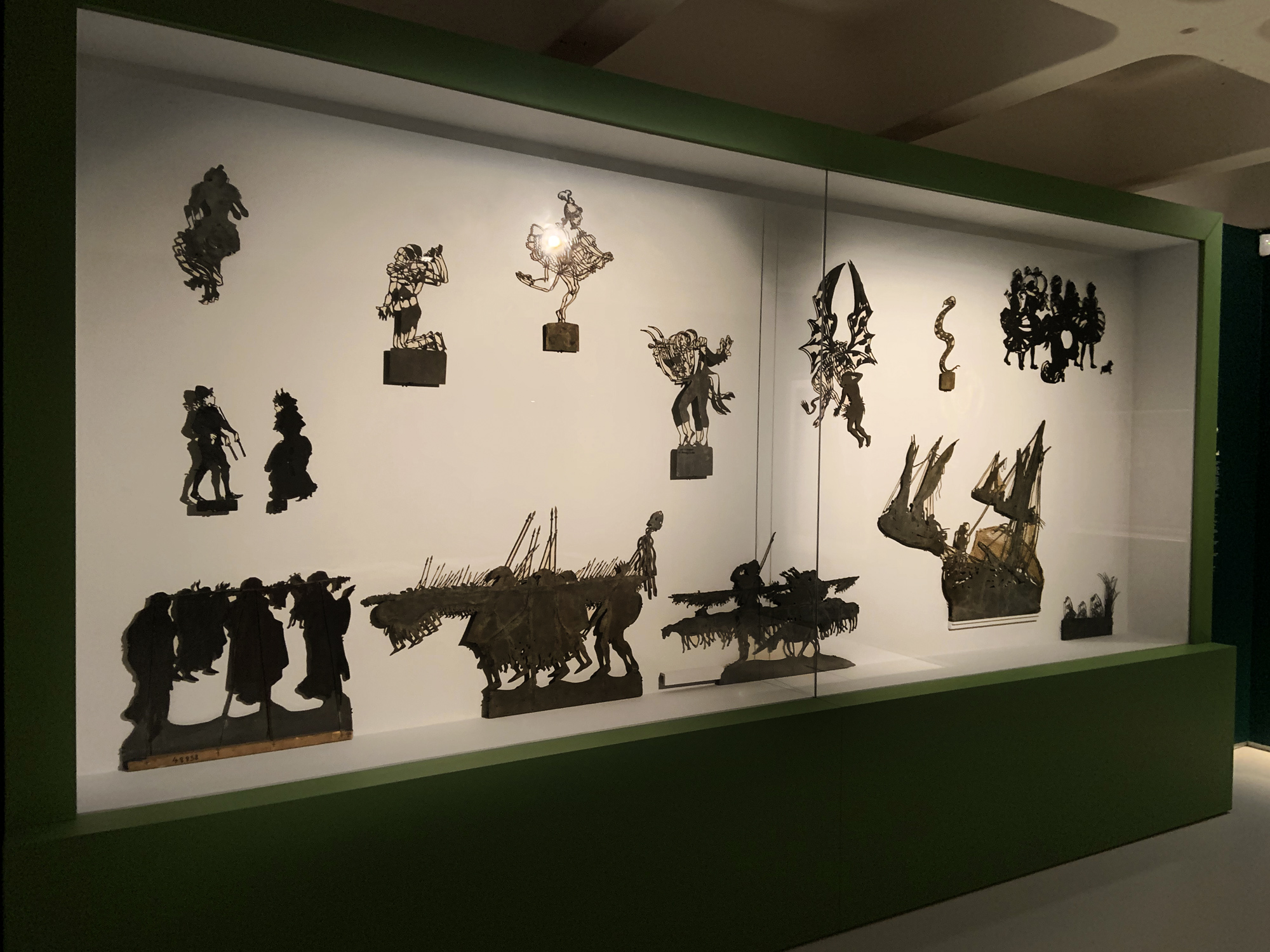
Thu – Fri 10am – 8pm

Barbican Art Gallery website

LIKE ART BLART ON FACEBOOK

Back to top

European research tour exhibition: ‘Into the Night: Cabarets and Clubs in Modern Art’ at the Barbican Art Gallery, UK Part 1

Exhibition dates: 4th October, 2019 – 19th January, 2020
Visited October 2019 posted January 2020

Curator: Florence Ostende


Installation view of the exhibition 'Into the Night: Cabarets and Clubs in Modern Art' at the Barbican Art Gallery, London, October 2019 - January 2019


Installation view of the exhibition Into the Night: Cabarets and Clubs in Modern Art at the Barbican Art Gallery, London
Photo: Marcus Bunyan


I saw this exhibition in London in October, my last on my European research trip.

Having been a clubber since 1975, I was fascinated to see the history of cabarets and clubs in modern art. I remember going to gay clubs such as Scandals in Soho in the 1970s with their Saturday Night Fever lit up glass dance floor – except this one had a revolving glass turntable at its centre; or Adams under the the Leicester Square Odeon (I think it was the Odeon?) with walls padded and buttoned in red velvet, where they played the latest funk and international disco. Sylvester was the first out and out gay disco star, still beloved, who was taken from us by AIDS. And then there was Heaven, at the time of its opening in December 1979 the biggest gay club in Europe, housed in the arches beneath Charing Cross railway station – the site of many a debauched evening of gay disco, then hi-energy, and sex. We could dance for hours on that huge dance floor, under the lasers and neons, only leaving to get water at the bar, just dancing on pure energy, and then cruise the famous tunnels and bars of the club. Fabulous.

Getting back to the exhibition, Into the Night was a tale of two halves, as can be seen in the installation photographs. The upper level gallery at the Barbican was stirring, intoxicating, mesmerising, especially the sections on Vienna and the Cabaret Fledermaus (see below) and Berlin and the Weimar Nightlife 1920s-1930s, always a favourite avant-garde era of mine (see part 2 of the posting). The lower level featured 3 separate rooms, recreations of the bar at the Cabaret Fledermaus; the Ciné-Dancing space of L’Aubette; and the shadow theatre of Chat Noir: interesting to see as a walk through but nothing more – then followed by some sparse sections on London’s Cave of the Golden Calf, Harlem’s Jazz Clubs and Cabarets and Tehran’s Rasht 29 (Part 2 of the posting). It felt to me as though the curators ran out of money / time? objects? and curatorial inspiration for the last sections of the exhibition.

Whatever the case, looking at the exhibition as a whole, this was a fascinating insight into cabaret and club art, architecture and design with gems such as Jeanne Mammen’s glorious watercolour paintings on queer female desire and Lohse-Watchler’s dark scenes of Hamburg nightlife.

The complex breadth of bohemian and artistic culture covered in the exhibition was truly breathtaking.

Dr Marcus Bunyan


Many thankx to the Barbican Art Gallery for allowing me to publish the media photographs in the posting. All installation images are iPhone images © Dr Marcus Bunyan unless otherwise stated. Please click on the photographs for a larger version of the image. See Part 2 of the posting.


Catalogue cover for 'Into the Night: Cabarets and Clubs in Modern Art' at the Barbican Art Gallery, London


Catalogue cover for Into the Night: Cabarets and Clubs in Modern Art at the Barbican Art Gallery, London


Vienna: Cabaret Fledermaus 1907-13 wall text from the exhibition 'Into the Night: Cabarets and Clubs in Modern Art' at the Barbican Art Gallery, London, October 2019 - January 2019

Vienna: Cabaret Fledermaus 1907-13 wall text from the exhibition 'Into the Night: Cabarets and Clubs in Modern Art' at the Barbican Art Gallery, London, October 2019 - January 2019

Vienna: Cabaret Fledermaus 1907-13 wall text from the exhibition 'Into the Night: Cabarets and Clubs in Modern Art' at the Barbican Art Gallery, London, October 2019 - January 2019


Vienna: Cabaret Fledermaus 1907-1913 wall text
Photos: Marcus Bunyan


Josef Hoffmann (Austrian, 1870-1956) 'Weiner Werkstätte Postkarte' (left to right) No. 74 (Interior view of the bar at the Cabaret Fledermaus); No. 75 (Interior view of the bar at the Cabaret Fledermaus); No. 67 (Interior view of the auditorium with stage at the Cabaret Fledermaus) 1907 (installation view)

Josef Hoffmann (Austrian, 1870-1956) 'Weiner Werkstätte Postkarte' (left to right) No. 74 (Interior view of the bar at the Cabaret Fledermaus); No. 75 (Interior view of the bar at the Cabaret Fledermaus); No. 67 (Interior view of the auditorium with stage at the Cabaret Fledermaus) 1907 (installation view)


Josef Hoffmann (Austrian, 1870-1956)
Weiner Werkstätte Postkarte (left to right) (installation views)
No. 74 (Interior view of the bar at the Cabaret Fledermaus);
No. 75 (Interior view of the bar at the Cabaret Fledermaus);
No. 67 (Interior view of the auditorium with stage at the Cabaret Fledermaus)
1907
Lithograph postcards
Collection of Leonard A. Lauder
Photos: Marcus Bunyan


Wall text about the Weiner Werkstätte postcards from the exhibition 'Into the Night: Cabarets and Clubs in Modern Art' at the Barbican Art Gallery, London, October 2019 - January 2019


Wall text about the Weiner Werkstätte postcards
Photo: Marcus Bunyan


Josef Hoffmann (Austrian, 1870-1956) 'Wiener Werkstätte Postkarte No. 74 (Interior view of the bar at the Cabaret Fledermaus)' 1907


Josef Hoffmann (Austrian, 1870-1956)
Wiener Werkstätte Postkarte No. 74 (Interior view of the bar at the Cabaret Fledermaus)
1907
Collection of Leonard A. Lauder


Installation view of the exhibition 'Into The Night: Cabarets And Clubs In Modern Art' showing a recreation of the bar at the Cabaret Fledermaus, originally designed by Josef Hoffmann (1907), 2019

Installation view of the exhibition 'Into The Night: Cabarets And Clubs In Modern Art' showing a recreation of the bar at the Cabaret Fledermaus, originally designed by Josef Hoffmann (1907), 2019

Installation view of the exhibition 'Into The Night: Cabarets And Clubs In Modern Art' showing a recreation of the bar at the Cabaret Fledermaus, originally designed by Josef Hoffmann (1907), 2019


Into the Night: Cabarets and Clubs in Modern Art (downstairs gallery, room recreation)
Installation view Barbican Art Gallery 4 October 2019 – 19 January 2020
Recreation of the bar at the Cabaret Fledermaus, originally designed by Josef Hoffmann (1907), 2019
Conceived by the Barbican Art Gallery and Caruso St John, in collaboration with the University of Applied Arts, Vienna
© Tristan Fewings / Getty Images


Downstairs gallery, room recreation


Josef von Divéky (Hungarian, 1887-1951) 'Poster design for the Cabaret Fledermaus (unrealised)' 1907 (installation view)

Josef von Divéky (Hungarian, 1887-1951) 'Poster design for the Cabaret Fledermaus (unrealised)' 1907 (installation view)


Josef von Divéky (Hungarian, 1887-1951)
Poster design fro the Cabaret Fledermaus (unrealised) (installation views)
1907
Gouache over pencil on paper
University of Applied Arts Vienna, Collection and Archive
Photos: Marcus Bunyan


Carl Otto Czeschka (Austrian, 1878-1960) (design) 'First programme for the Cabaret Fledermaus' (installation view)


Carl Otto Czeschka (Austrian, 1878-1960) (design)
with illustrations by various artists
First programme for the Cabaret Fledermaus (installation view)
1907
Printed book
Publisher: Wiener Werkstate, Vienna
Printer: August Chwala, Vienna
Theatermuseum, Vienna
Photo: Marcus Bunyan


This programme for the opening night at the Cabaret Fledermaus on 19 October 1907 showcases its variety of experimental performances. Carl Otto Czeschka conceived the overarching design for the booklet, while vivid interior illustrations by contributing artists summon the spirit of the evenings activities.


Carl Otto Czeschka (Austrian, 1878-1960) (design) 'First programme for the Cabaret Fledermaus' 1907 (installation view)

Carl Otto Czeschka (Austrian, 1878-1960) (design) 'First programme for the Cabaret Fledermaus' 1907 (installation view)


Carl Otto Czeschka (design)(Austrian, 1878-1960)
with illustrations by various artists
First programme for the Cabaret Fledermaus (installation views)
1907
Printed book
Publisher: Wiener Werkstate, Vienna
Printer: August Chwala, Vienna
Theatermuseum, Vienna
Photos: Marcus Bunyan


Fritz Zeymer’s lyrical drawings capture the movements of Gertrude Barrison, who along with her sisters had become known in Europe and America for her bold, expressive dancing style. At the opening of the cabaret, Barrison performed solo to Edvard Greig’s romantic ‘Morgenstimmung’ (1875) in the ethereal white costume design by Zeymer himself (design shown here).


Carl Otto Czeschka (Austrian, 1878-1960) (design) 'Second programme for the Cabaret Fledermaus' 1907 (installation view)


Carl Otto Czeschka (Austrian, 1878-1960) (design)
with cover design and illustrations by Moriz Jung
Second programme for the Cabaret Fledermaus (installation view)
1907
Printed book
Publisher: Wiener Werkstate, Vienna
Printer: August Chwala, Vienna
Ariel Muzicant Collection, Vienna
Photo: Marcus Bunyan


Le Corbusier (Swiss-French, 1887-1965) 'Plan at 1:100 for the Cabaret Fledermaus' 1907 (installation view)

Le Corbusier (Swiss-French, 1887-1965) 'Plan at 1:100 for the Cabaret Fledermaus' 1907 (installation view)


Le Corbusier (Swiss-French, 1887-1965)
Plan at 1:100 for the Cabaret Fledermaus (installation views)
1907
Graphite pencil, ink and wash on paper
Fondation Le Corbusier, Paris
Photos: Marcus Bunyan


Installation view of the exhibition 'Into the Night: Cabarets and Clubs in Modern Art' at the Barbican Art Gallery

Installation view of the exhibition 'Into the Night: Cabarets and Clubs in Modern Art' at the Barbican Art Gallery. Artefacts in display cabinet include Josef Hoffmann plant pot (1907), pepper mill (1907), vases for the Cabaret Fledermaus (1907) and an ashtray (1907)


Artefacts in display cabinet include Josef Hoffmann plant pot (1907), pepper mill (1907), vases for the Cabaret Fledermaus (1907) and an ashtray (1907) (installation views)
Photos: Marcus Bunyan


Installation view of the exhibition 'Into the Night: Cabarets and Clubs in Modern Art' at the Barbican Art Gallery


Installation views of the exhibition Into the Night: Cabarets and Clubs in Modern Art at the Barbican Art Gallery
Photo: Marcus Bunyan


Installation view of the exhibition 'Into the Night: Cabarets and Clubs in Modern Art' at the Barbican Art Gallery


Into the Night: Cabarets and Clubs in Modern Art
Installation view Barbican Art Gallery 4 October 2019 – 19 January 2020
© Tristan Fewings / Getty Images


Bertold Löffler (Austrian, 1874-1960) 'Poster for the Cabaret Fledermaus' 1907 (installation view)


Bertold Löffler (Austrian, 1874-1960)
Poster for the Cabaret Fledermaus (installation view)
1907
Lithograph
The Albertina Museum, Vienna
Photo: Marcus Bunyan


Bertold Löffler (Austrian, 1874-1960) 'Poster for the Cabaret Fledermaus' 1907


Bertold Löffler (Austrian, 1874-1960)
Poster for the Cabaret Fledermaus
1907
The Albertina Museum, Vienna
© The Albertina Museum, Vienna


Bertold Löffler (Austrian, 1874-1960) 'Poster for a performance by Miss Macara at the Cabaret Fledermaus' 1909 (installation view)


Bertold Löffler (Austrian, 1874-1960)
Poster for a performance by Miss Macara at the Cabaret Fledermaus (installation view)
1909
Lithograph
The Albertina Museum, Vienna
Photo: Marcus Bunyan


Wall text about the poster for a performance by Miss Macara  from the exhibition 'Into the Night: Cabarets and Clubs in Modern Art' at the Barbican Art Gallery, London, October 2019 - January 2019


Wall text about the poster for a performance by Miss Macara
Photo: Marcus Bunyan


Fritz Lang (Austrian-German-American, 1890-1976) 'Poster for the Cabaret Fledermaus' 1911 (installation view)


Fritz Lang (Austrian-German-American, 1890-1976)
Poster for the Cabaret Fledermaus (installation view)
1911
Lithograph
The Albertina Museum, Vienna
Photo: Marcus Bunyan


Josef von Divéky (Hungarian, 1887-1951) 'Design for 'Green Domino'for the Cabaret Fledermaus' 1908 (installation view)

Josef von Divéky (Hungarian, 1887-1951) 'Design for 'Orange Domino'for the Cabaret Fledermaus' 1908 (installation view)

Josef von Divéky (Hungarian, 1887-1951) 'Design for 'Blue Domino'for the Cabaret Fledermaus' 1908


Josef von Divéky (Hungarian, 1887-1951)
Design for ‘Green Domino’, ‘Orange Domino’ and ‘Blue Domino’ for the Cabaret Fledermaus (installation views)
1908
Ink and pencil on paper
MAK – Austrian Museum of Applied Arts, Vienna
Photos: Marcus Bunyan


Installation view of the exhibition 'Into The Night: Cabarets And Clubs In Modern Art' showing the work of Josef von Divéky


Into the Night: Cabarets and Clubs in Modern Art
Installation view Barbican Art Gallery 4 October 2019 – 19 January 2020 showing the work of Josef von Divéky (above)
© Tristan Fewings / Getty Images


Eduard Josef Wimmer-Wisgrill (Austrian, 1882-1961) 'Design for Maskenspiele (Masquerades) (two characters)' 1907


Eduard Josef Wimmer-Wisgrill (Austrian, 1882-1961)
Design for Maskenspiele (Masquerades) (two characters)
1907
MAK – Austrian Museum of Applied Arts, Vienna
© MAK


Opening 4 October 2019, Into the Night: Cabarets and Clubs in Modern Art explores the social and artistic role of cabarets, cafés and clubs around the world. Spanning the 1880s to the 1960s, the exhibition presents a dynamic and multi-faceted history of artistic production. The first major show staged on this theme, it features both famed and little-known sites of the avant-garde – these creative spaces were incubators of radical thinking, where artists could exchange provocative ideas and create new forms of artistic expression. Into the Night offers an alternative history of modern art that highlights the spirit of experimentation and collaboration between artists, performers, designers, musicians and writers such as Henri de Toulouse-Lautrec, Loïe Fuller, Josef Hoffmann, Giacomo Balla, Theo van Doesburg and Sophie Taeuber-Arp, as well as Josephine Baker, Jeanne Mammen, Aaron Douglas, Jacob Lawrence, Ramón Alva de la Canal and Ibrahim El-Salahi.

Focusing on global locations from New York to Tehran, London, Paris, Mexico City, Berlin, Vienna and Ibadan, Into the Night brings together over 350 works rarely seen in the UK, including paintings, drawings, prints, photographs, films and archival material. Liberated from the confines of social and political norms, many of the sites provided immersive, often visceral experiences, manifesting the ideals of the artists and audiences who founded and frequented them. The exhibition features full-scale recreations of specific spaces, such as the multi-coloured ceramic tiled bar of the Cabaret Fledermaus in Vienna (1907), designed by Josef Hoffmann for the Wiener Werkstätte, and the striking abstract composition of the Ciné-Dancing designed by Theo van Doesburg for L’Aubette in Strasbourg (1926-28). The exhibition will feature a soundscape created by hrm199, the studio of acclaimed artist Haroon Mirza, specifically commissioned for the show.

Jane Alison, Head of Visual Arts, Barbican, said: “Into the Night casts a spotlight on some of the most electrifying cabarets and clubs of the modern era. Whether a creative haven, intoxicating stage or liberal hangout, all were magnets for artists, designers and performers to come together, collaborate and express themselves freely. Capturing the essence of these global incubators of experimentation and cross-disciplinarity, immersive 1:1 scale interiors will take the visitor on a captivating journey of discovery.”

Into the Night begins in Paris, on the eve of the 20th century, with two thrilling and iconic locations of the avant-garde. The theatrical shadow plays of the Chat Noir in the 1880s are brought to life through original silhouettes and works that decorated the interior of the cabaret, which acted as a forum for satire and debate for figures such as founder Rodolphe Salis, artist Henri Rivière and composer Erik Satie. The captivating serpentine dances of Loïe Fuller staged at the Folies Bergère in the 1890s were trail-blazing experiments in costume, light and movement. Henri de Toulouse-Lautrec captured her performances in his extraordinary series of delicately hand-coloured lithographs, brought together for the exhibition. Visitors will encounter the immersive “Gesamtkunstwerk” (total work of art) design of the Cabaret Fledermaus (1907) in Vienna by the Wiener Werkstätte, where experimental cabaret productions were staged. The exhibition includes original documentation of Oskar Kokoschka’s exuberant puppet theatre and Gertrude Barrison’s expressionist dance.

The Cave of the Golden Calf (1912), an underground haunt in Soho epitomising decadence and hedonism, is evoked through designs for the interior by British artists Spencer Gore and Eric Gill, as well as Wyndham Lewis’s highly stylised programmes for the eclectic performance evenings – advertised at the time as encompassing “the picturesque dances of the South, its fervid melodies, Parisian wit, English humour.” In Zurich, the radical atmosphere of the Cabaret Voltaire (1916) is manifested through absurdist sound poetry and fantastical masks that deconstruct body and language, evoking the anarchic performances by Hugo Ball, Emmy Hennings and Marcel Janco. This is the birthplace of Dada, where humour, chaos and ridicule reign. Two significant clubs in Rome provide insights into the electrifying dynamism of Futurism in Italy in the 1920s. Giacomo Balla’s mesmerising Bal Tic Tac (1921) is summoned by colour-saturated designs for the club’s interior, capturing the swirling movement of dancers. Also on show are drawings and furnishings for Fortunato Depero’s spectacular inferno-inspired Cabaret del Diavolo (1922) which occupied three floors representing heaven, purgatory and hell. Depero’s flamboyant tapestry writhes with dancing demons, expressing the club’s motto “Tutti all’inferno!!! (Everyone to hell!!!)”.

A few years later, a group of artists and writers from the radical movement Estridentismo, including Ramón Alva de la Canal, Manuel Maples Arce and Germán Cueto, began to meet at the Café de Nadie (Nobody’s Café) in Mexico City, responding to volatile Post-Revolutionary change and the urban metropolis. The ¡30-30! group expressed its values by holding a major print exhibition (partially reassembled here) in a travelling circus tent open to all. Meanwhile in Strasbourg, Theo van Doesburg, Hans Arp and Sophie Taeuber-Arp worked together to create the L’Aubette (1926-28), conceived as the ultimate “deconstruction of architecture”, with bold geometric abstraction as its guiding principle. The vast building housed a cinema-ballroom, bar, tearoom, billiards room, restaurant and more, each designed as immersive environments.

After a period of restraint in Germany during the First World War, the 1920s heralded an era of liberation and the relaxation of censorship laws. Numerous clubs and bars in metropolitan cities, such as Berlin, playing host to heady cabaret revues and daring striptease; the notorious synchronised Tiller Girls are captured in Karl Hofer’s iconic portrait. Major works by often overlooked female artists such as Jeanne Mammen and Elfriede Lohse-Wächtler, as well as George Grosz, Otto Dix and Max Beckmann, capture the pulsating energy of these nightclubs and the alternative lifestyles that flourished within them during the 1920s and 1930s. During the same time in New York, the literary and jazz scenes thrived and co-mingled in the predominantly African American neighbourhood of Harlem, where black identity was re-forged and debated. Paintings and prints by Aaron Douglas and Jacob Lawrence convey the vibrant atmosphere and complex racial and sexual politics of the time, while poetry by Langston Hughes and early cinema featuring Duke Ellington shed light on the rich range of creative expression thriving within the city.

Into the Night also celebrates the lesser known but highly influential Mbari Artists and Writers Club, founded in the early 1960s in Nigeria. Focusing on two of the club’s key locations, in Ibadan and Osogbo, the exhibition explores how they were founded as laboratories for postcolonial artistic practices, providing a platform for a dazzling range of activities – including open-air dance and theatre performances, featuring ground breaking Yoruba operas by Duro Ladipo and Fela Kuti’s Afro-jazz; poetry and literature readings; experimental art workshops; and pioneering exhibitions by African and international artists such as Colette Omogbai, Ibrahim El-Salahi and Uche Okeke. Meanwhile in Tehran, Rasht 29 emerged in1966 as a creative space for avant-garde painters, poets, musicians and filmmakers to freely discuss their practice. Spontaneous performances were celebrated and works by artists like Parviz Tanavoli and Faramarz Pilaram hung in the lounge while a soundtrack including Led Zeppelin and the Beatles played constantly.

The exhibition is curated and organised by Barbican Centre, London, in collaboration with the Belvedere, Vienna.

Press release from the Barbican Art Gallery [Online] Cited 28/12/2019


Rome: Cabaret Del Diavolo 1922 wall text from the exhibition 'Into the Night: Cabarets and Clubs in Modern Art' at the Barbican Art Gallery, London, October 2019 - January 2019

Rome: Cabaret Del Diavolo 1922 wall text from the exhibition 'Into the Night: Cabarets and Clubs in Modern Art' at the Barbican Art Gallery, London, October 2019 - January 2019

Rome: Cabaret Del Diavolo 1922 wall text from the exhibition 'Into the Night: Cabarets and Clubs in Modern Art' at the Barbican Art Gallery, London, October 2019 - January 2019


Rome: Cabaret Del Diavolo 1922 wall text
Photos: Marcus Bunyan


Installation view of the exhibition 'Into the Night: Cabarets and Clubs in Modern Art' at the Barbican Art Gallery showing Fortunato Depero's tapestry 'Diavoletti neri e bianchi. Danza di diavoli' (Black and White Little Devils: Dance of the Devils), 1922

Installation view of the exhibition 'Into the Night: Cabarets and Clubs in Modern Art' at the Barbican Art Gallery

Installation view of the exhibition 'Into the Night: Cabarets and Clubs in Modern Art' at the Barbican Art Gallery

Installation view of the exhibition 'Into the Night: Cabarets and Clubs in Modern Art' at the Barbican Art Gallery

Installation view of the exhibition 'Into the Night: Cabarets and Clubs in Modern Art' at the Barbican Art Gallery showing Fortunato Depero's tapestry 'Diavoletti neri e bianchi. Danza di diavoli' (Black and White Little Devils: Dance of the Devils), 1922

Installation view of the exhibition 'Into the Night: Cabarets and Clubs in Modern Art' at the Barbican Art Gallery showing Fortunato Depero's tapestry 'Diavoletti neri e bianchi. Danza di diavoli' (Black and White Little Devils: Dance of the Devils), 1922

Installation view of the exhibition 'Into the Night: Cabarets and Clubs in Modern Art' at the Barbican Art Gallery

Installation view of the exhibition 'Into the Night: Cabarets and Clubs in Modern Art' at the Barbican Art Gallery showing Fortunato Depero's tapestry 'Diavoletti neri e bianchi. Danza di diavoli' (Black and White Little Devils: Dance of the Devils), 1922


Installation views of the exhibition Into the Night: Cabarets and Clubs in Modern Art at the Barbican Art Gallery showing Fortunato Depero’s tapestry Diavoletti neri e bianchi. Danza di diavoli (Black and White Little Devils: Dance of the Devils), 1922
Photos: Marcus Bunyan


Fortunato Depero wall text from the exhibition 'Into the Night: Cabarets and Clubs in Modern Art' at the Barbican Art Gallery, London, October 2019 - January 2019


Fortunato Depero wall text
Photo: Marcus Bunyan


Installation view of the exhibition 'Into the Night: Cabarets and Clubs in Modern Art' at the Barbican Art Gallery showing at left Fortunato Depero's tapestry 'Diavoletti neri e bianchi. Danza di diavoli' (Black and White Little Devils: Dance of the Devils), 1922


Into the Night: Cabarets and Clubs in Modern Art
Installation view Barbican Art Gallery 4 October 2019 – 19 January 2020 showing at left Fortunato Depero’s tapestry Diavoletti neri e bianchi. Danza di diavoli (Black and White Little Devils: Dance of the Devils), 1922
© Tristan Fewings / Getty Images


Fortunato Depero (Italian, 1892-1960) 'Diavoletti neri e bianchi. Danza di diavoli' (Black and White Little Devils: Dance of the Devils) 1922


Fortunato Depero (Italian, 1892-1960)
Diavoletti neri e bianchi. Danza di diavoli (Black and White Little Devils: Dance of the Devils)
1922
Mart, Museo di arte moderna e contemporanea di Trento e Rovereto / Fondo Depero
© DACS 2019. Archivo Depero, Rovereto. Courtesy Mart – Archivio Fotografico e Mediateca


Rome: Bal Tic Tac 1921 wall text from the exhibition 'Into the Night: Cabarets and Clubs in Modern Art' at the Barbican Art Gallery, London, October 2019 - January 2019

Rome: Bal Tic Tac 1921 wall text from the exhibition 'Into the Night: Cabarets and Clubs in Modern Art' at the Barbican Art Gallery, London, October 2019 - January 2019


Rome: Bal Tic Tac 1921 wall text
Photos: Marcus Bunyan


Giacomo Balla (Italian, 1871-1958) 'Design for the sign and flashing light for the facade of the Bal Tic Tac' 1921 (installation view)

Giacomo Balla (Italian, 1871-1958) 'Design for the sign and flashing light for the facade of the Bal Tic Tac' 1921 (installation view)


Giacomo Balla (Italian, 1871-1958)
Design for the sign and flashing light for the facade of the Bal Tic Tac (installation views)
1921
Photos: Marcus Bunyan


Giacomo Balla wall text from the exhibition 'Into the Night: Cabarets and Clubs in Modern Art' at the Barbican Art Gallery, London, October 2019 - January 2019


Giacomo Balla wall text
Photo: Marcus Bunyan


Giacomo Balla (Italian, 1871-1958) 'Design for the sign and flashing light for the facade of the Bal Tic Tac' 1921


Giacomo Balla (Italian, 1871-1958)
Design for the sign and flashing light for the facade of the Bal Tic Tac
1921
© DACS, 2019. Reproduced by permission of the Fondazione Torino Musei
Photo: Studio Fotografico Gonella 2014


Installation view of the exhibition 'Into the Night: Cabarets and Clubs in Modern Art' at the Barbican Art Gallery

Installation view of the exhibition 'Into the Night: Cabarets and Clubs in Modern Art' at the Barbican Art Gallery


Installation views of the exhibition Into the Night: Cabarets and Clubs in Modern Art at the Barbican Art Gallery
Photos: Marcus Bunyan


Installation view of the exhibition 'Into the Night: Cabarets and Clubs in Modern Art' at the Barbican Art Gallery showing at left, Giacomo Balla's 'Dancer from the Bal Tic Tac' 1921; and at right, Giacomo Balla's 'Design for a light for the Bal Tic Tac' 1921 (installation view)

Giacomo Balla. 'Dancer from the Bal Tic Tac' 1921 (installation view)


Giacomo Balla (Italian, 1871-1958)
Dancer from the Bal Tic Tac (installation views)
1921
Pencil on paper
Biagiotti Cigna Foundation
Photos: Marcus Bunyan


Giacomo Balla (Italian, 1871-1958) 'Design for a light for the Bal Tic Tac' 1921 (installation view)


Giacomo Balla (Italian, 1871-1958)
Design for a light for the Bal Tic Tac (installation view)
1921
Pencil and tempera on paper
Torino, GAM – Galleria Civica d’Arte moderna e Contemporanea, Gabinetto Disegni e Stampe
Photo: Marcus Bunyan


Giacomo Balla wall text from the exhibition 'Into the Night: Cabarets and Clubs in Modern Art' at the Barbican Art Gallery, London, October 2019 - January 2019


Giacomo Balla wall text
Photo: Marcus Bunyan


Installation view of the exhibition 'Into the Night: Cabarets and Clubs in Modern Art' at the Barbican Art Gallery

Installation view of the exhibition 'Into the Night: Cabarets and Clubs in Modern Art' at the Barbican Art Gallery


Installation views of the exhibition Into the Night: Cabarets and Clubs in Modern Art at the Barbican Art Gallery
Photos: Marcus Bunyan


Mexico City: Cafe De Nadie & Carpa Amaro 1920s from the exhibition 'Into the Night: Cabarets and Clubs in Modern Art' at the Barbican Art Gallery, London, October 2019 - January 2019

Mexico City: Cafe De Nadie & Carpa Amaro 1920s from the exhibition 'Into the Night: Cabarets and Clubs in Modern Art' at the Barbican Art Gallery, London, October 2019 - January 2019

Mexico City: Cafe De Nadie & Carpa Amaro 1920s from the exhibition 'Into the Night: Cabarets and Clubs in Modern Art' at the Barbican Art Gallery, London, October 2019 - January 2019


Mexico City: Cafe De Nadie & Carpa Amaro 1920s wall text
Photos: Marcus Bunyan


Installation view of the exhibition 'Into the Night: Cabarets and Clubs in Modern Art' at the Barbican Art Gallery showing a group of Mexican woodcuts 1922-1928

Installation view of the exhibition Into the Night: Cabarets and Clubs in Modern Art at the Barbican Art Gallery

Installation view of the exhibition 'Into the Night: Cabarets and Clubs in Modern Art' at the Barbican Art Gallery showing a group of Mexican woodcuts 1922-1928

Wall text about Mexican woodcuts from the exhibition 'Into the Night: Cabarets and Clubs in Modern Art' at the Barbican Art Gallery, London, October 2019 - January 2019


Installation views of the exhibition Into the Night: Cabarets and Clubs in Modern Art at the Barbican Art Gallery showing a group of Mexican woodcuts 1922-1928
Photos: Marcus Bunyan


Justino Fernandez (Mexican, 1904-1972) 'El corrido' (The Corrido) 1928 (installation view)

Justino Fernandez (Mexican, 1904-1972) 'El corrido' (The Corrido) 1928 (installation view)


Justino Fernandez (Mexican, 1904-1972)
El corrido (The Corrido) (installation views)
1928
Woodcut
Fondo Diaz de León
Colección Andres Blastien, Mexico
Photos: Marcus Bunyan


Justino Fernandez (Mexican, 1904-1972) 'La hora del mando' (Market Time) 1928 (installation view)

Justino Fernandez (Mexican, 1904-1972) 'La hora del mando' (Market Time) 1928 (installation view)


Justino Fernandez (Mexican, 1904-1972)
La hora del mando (Market Time) (installation views)
1928
Woodcut
Fondo Diaz de León
Colección Andres Blastien, Mexico
Photos: Marcus Bunyan


Fernando Leal (Mexican, 1896-1964) 'Danzantes' (Dancers) 1922 (installation view)


Fernando Leal (Mexican, 1896-1964)
Danzantes (Dancers) (installation view)
1922
Woodcut
Fondo Diaz de León
Colección Andres Blastien, Mexico
Photo: Marcus Bunyan


Francisco Diaz de León (Mexican, 1897-1975) 'Retablo' (Altarpiece) 1928 (installation view)

Francisco Diaz de León (Mexican, 1897-1975) 'Retablo' (Altarpiece) 1928 (installation view)


Francisco Diaz de León (Mexican, 1897-1975)
Retablo (Altarpiece)
1928
Woodcut
Fondo Diaz de León
Colección Andres Blastien, Mexico
Photos: Marcus Bunyan


Isabella Villaseñor (Mexican, 1909-1953) 'Autorretrato' (Self-portrait) 1928 (installation view)


Isabella Villaseñor (Mexican, 1909-1953)
Autorretrato (Self-portrait) (installation view)
1928
Woodcut
Colecciones Carlos Monsivais
Museo del Estanquillo
Photo: Marcus Bunyan


Fernando Leal (Mexican, 1896-1964) 'Dance of the Crescent Moon' 1922 (installation view)


Fernando Leal (Mexican, 1896-1964)
Dance of the Crescent Moon (installation view)
1922
Woodcut
Museo Nacional de Arte, INBA
Photo: Marcus Bunyan


Gabriel Fernández Ledesma (Mexican, 1900-1983) 'Cabeza de Lenin' (Head of Lenin) 1927 (installation view)


Gabriel Fernández Ledesma (Mexican, 1900-1983)
Cabeza de Lenin (Head of Lenin) (installation view)
1927
Woodcut
Fondo Diaz de León
Colección Andres Blastien, Mexico
Photo: Marcus Bunyan


Gabriel Fernández Ledesma (Mexican, 1900-1983) 'Tlacuache' (Opposum) c. 1920s


Gabriel Fernández Ledesma (Mexican, 1900-1983)
Tlacuache (Opposum) (installation view)
c. 1920s
Woodcut
Fondo Diaz de León
Colección Andres Blastien, Mexico
Photo: Marcus Bunyan


Gabriel Fernández Ledesma (Mexican, 1900-1983) 'Patos Chinos' (Chinese Ducks) 1928 (installation view)


Gabriel Fernández Ledesma (Mexican, 1900-1983)
Patos Chinos (Chinese Ducks) (installation view)
1928
Woodcut
Fondo Diaz de León
Colección Andres Blastien, Mexico
Photo: Marcus Bunyan


Installation view of the exhibition 'Into the Night: Cabarets and Clubs in Modern Art' at the Barbican Art Gallery showing a group of Mexican woodcuts 1922-1928


Into the Night: Cabarets and Clubs in Modern Art
Installation view Barbican Art Gallery 4 October 2019 – 19 January 2020 showing a group of Mexican woodcuts 1922-1928
© Tristan Fewings / Getty Images


Installation view of the exhibition 'Into the Night: Cabarets and Clubs in Modern Art' at the Barbican Art Gallery showing Germán Cueto's 'Máscara estridentista' (Stridentist Masks), c. 1924

Installation view of the exhibition 'Into the Night: Cabarets and Clubs in Modern Art' at the Barbican Art Gallery showing Germán Cueto's 'Máscara estridentista' (Stridentist Masks), c. 1924

Wall text about Mexican masks from the exhibition 'Into the Night: Cabarets and Clubs in Modern Art' at the Barbican Art Gallery, London, October 2019 - January 2019

Installation view of the exhibition 'Into the Night: Cabarets and Clubs in Modern Art' at the Barbican Art Gallery showing Germán Cueto's 'Máscara estridentista' (Stridentist Masks), c. 1924

Installation view of the exhibition 'Into the Night: Cabarets and Clubs in Modern Art' at the Barbican Art Gallery showing Germán Cueto's 'Máscara estridentista' (Stridentist Masks), c. 1924

Installation view of the exhibition 'Into the Night: Cabarets and Clubs in Modern Art' at the Barbican Art Gallery showing Germán Cueto's 'Máscara estridentista' (Stridentist Masks), c. 1924

Installation view of the exhibition 'Into the Night: Cabarets and Clubs in Modern Art' at the Barbican Art Gallery showing Germán Cueto's 'Máscara estridentista' (Stridentist Masks), c. 1924


Installation view of the exhibition Into the Night: Cabarets and Clubs in Modern Art at the Barbican Art Gallery showing Germán Cueto’s Máscara estridentista (Stridentist Masks), c. 1924
Photos: Marcus Bunyan


Germán Cueto (Mexican, 1893-1975) 'Máscara estridentista' (Stridentist Mask) c. 1924


Germán Cueto (Mexican, 1893-1975)
Máscara estridentista (Stridentist Mask)
c. 1924
Colección Ysabel Galán, México
Photo: Cortesia del Museo Frederico Silva Escultura Contemporeana, San Luis Potosi, Mexico


Installation view of the exhibition Into the Night: Cabarets and Clubs in Modern Art at the Barbican Art Gallery showing Ramón Alva de la Canal's painting 'El Café de Nadie' (Nobody's Café), c. 1970

Installation view of the exhibition Into the Night: Cabarets and Clubs in Modern Art at the Barbican Art Gallery showing Ramón Alva de la Canal's painting 'El Café de Nadie' (Nobody's Café), c. 1970

El Café de Nadie (Nobody's Café) wall text from the exhibition 'Into the Night: Cabarets and Clubs in Modern Art' at the Barbican Art Gallery, London, October 2019 - January 2019


Installation views of the exhibition Into the Night: Cabarets and Clubs in Modern Art at the Barbican Art Gallery showing Ramón Alva de la Canal’s painting El Café de Nadie (Nobody’s Café), c. 1970
Photos: Marcus Bunyan


Installation view of the exhibition Into the Night: Cabarets and Clubs in Modern Art at the Barbican Art Gallery showing Ramón Alva de la Canal's painting 'El Café de Nadie' (Nobody's Café), c. 1970


Into the Night: Cabarets and Clubs in Modern Art
Installation view Barbican Art Gallery 4 October 2019 – 19 January 2020 showing Ramón Alva de la Canal’s painting El Café de Nadie (Nobody’s Café), c. 1970
© Tristan Fewings / Getty Images


Ramón Alva de la Canal (Mexican, 1892-1985) 'El Café de Nadie' (Nobody's Café) c. 1970


Ramón Alva de la Canal (Mexican, 1892-1985)
El Café de Nadie (Nobody’s Café)
c. 1970
© DACS, 2019
Courtesy Private Collection


Installation view of the exhibition 'Into the Night: Cabarets and Clubs in Modern Art' at the Barbican Art Gallery, London showing Mexican printed books 1923-1927

Installation view of the exhibition 'Into the Night: Cabarets and Clubs in Modern Art' at the Barbican Art Gallery, London showing Mexican printed books 1923-1927

Installation view of the exhibition 'Into the Night: Cabarets and Clubs in Modern Art' at the Barbican Art Gallery, London showing Mexican printed books 1923-1927

Installation view of the exhibition 'Into the Night: Cabarets and Clubs in Modern Art' at the Barbican Art Gallery, London showing Mexican printed books 1923-1927

Mexican printed books 1923-1927 wall text from the exhibition 'Into the Night: Cabarets and Clubs in Modern Art' at the Barbican Art Gallery, London, October 2019 - January 2019


Installation views of the exhibition Into the Night: Cabarets and Clubs in Modern Art at the Barbican Art Gallery showing Mexican printed books 1923-1927
Photos: Marcus Bunyan


Installation views of the exhibition 'Into the Night: Cabarets and Clubs in Modern Art' at the Barbican Art Gallery, London

Ramón Alva de la Canal (Mexican, 1892-1985) 'El movimiento estridentista' (The Stridentist Movement) 1926 (installation view)


Ramón Alva de la Canal (Mexican, 1892-1985)
El movimiento estridentista (The Stridentist Movement) (installation views)
1926
Woodcut
Francisco Reyes Palma Collection
Photos: Marcus Bunyan


Ramón Alva de la Canal (Mexican, 1892-1985) 'Manuel Maples Arce en el Café de Nadie' (Manuel Maples Arce in the Café de Nadie) c. 1924 (installation view)


Ramón Alva de la Canal (Mexican, 1892-1985)
Manuel Maples Arce en el Café de Nadie (Manuel Maples Arce in the Café de Nadie) (installation view)
c. 1924
Woodcut
Museo Nacional de Arte, Mexico City
Photos: Marcus Bunyan


Barbican Art Gallery
Silk Street, London
EC2Y 8DS

Opening hours:
Sat – Wed 10am – 6pm
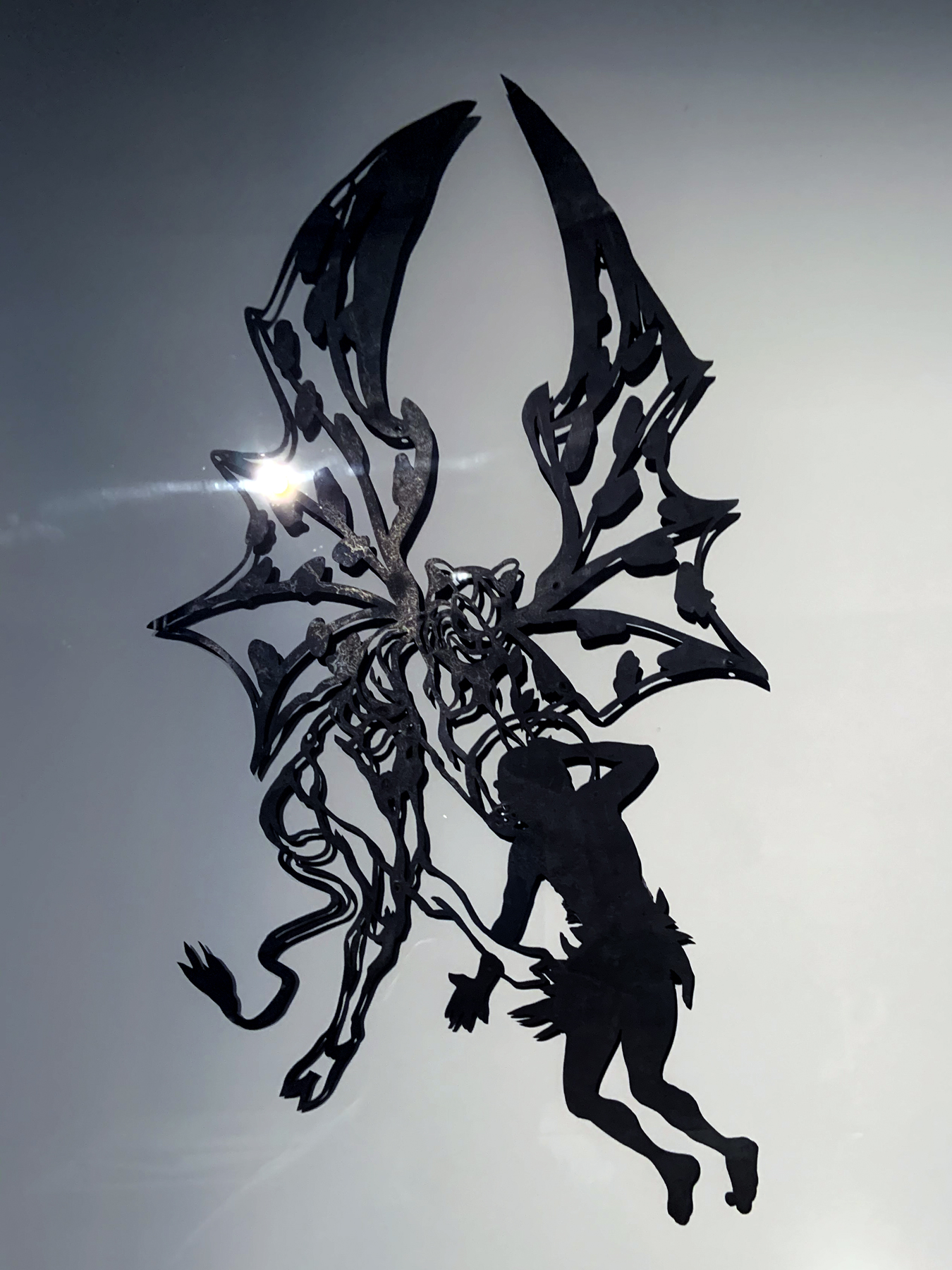
Thu – Fri 10am – 8pm

Barbican Art Gallery website

LIKE ART BLART ON FACEBOOK

Back to top

Exhibition: ‘Lee Krasner: Living Colour’ at the Barbican Art Gallery, London

Exhibition dates: 30th May – 1st September, 2019


Installation view of the exhibition 'Lee Krasner: Living Colour' at the Barbican Art Gallery, London, May - Sept, 2019


Lee Krasner: Living Colour
Installation view at the Barbican Art Gallery
30 May – 1 September 2019
© Tristan Fewings/Getty Images


The augur of passion, the fire of movement, the colour of the embrace!

She used to ask herself, “does it work?”, as every artist should… not seeking affirmation from others but just being focused in her own mind on what she wanted to say, on that inner experience.

She was the equal of men, surpassing most. Krasner is finally getting the accolades she so richly deserves.

Dr Marcus Bunyan


Many thankx to the Barbican Art Gallery for allowing me to publish the art work in the posting. Please click on the photographs for a larger version of the image. The black and white photographs have been digitally cleaned by myself.


Installation view of the exhibition 'Lee Krasner: Living Colour' at the Barbican Art Gallery, London, May - Sept, 2019


Lee Krasner: Living Colour
Installation view at the Barbican Art Gallery
30 May – 1 September 2019
© Tristan Fewings/Getty Images


Lee Krasner (American, 1908-1984) 'Untitled' 1946 from the exhibition 'Lee Krasner: Living Colour' at the Barbican Art Gallery, London, May - Sept, 2019


Lee Krasner (American, 1908-1984)
Untitled
1946
Collection of Bobbi and Walter Zifkin
© The Pollock-Krasner Foundation
Photo: Jonathan Urban


Lee Krasner (American, 1908-1984) 'Abstract No. 2' 1947 from the exhibition 'Lee Krasner: Living Colour' at the Barbican Art Gallery, London, May - Sept, 2019


Lee Krasner (American, 1908-1984)
Abstract No. 2
1947
IVAM Centre, Spain
Courtesy IVAM
© The Pollock-Krasner Foundation


Lee Krasner (American, 1908-1984) 'Mosaic Table' 1947


Lee Krasner (American, 1908-1984)
Mosaic Table
1947
Private Collection
© The Pollock-Krasner Foundation. Courtesy Michael Rosenfeld Gallery LLC, New York


The cold winter on Long Island, where Krasner and Pollock were now living, forced her to work downstairs by the stove, where she made two brilliantly coloured mosaic tables using wagon wheels she found in the barn.


Installation view of the exhibition 'Lee Krasner: Living Colour' at the Barbican Art Gallery, London, May - Sept, 2019 showing 'Composition' 1949 and 'Stop and Go' c. 1949


Lee Krasner: Living Colour
Installation view with Composition 1949 and Stop and Go c. 1949
Barbican Art Gallery 30 May – 1 September 2019
© Tristan Fewings/Getty Images


Installation view of the exhibition 'Lee Krasner: Living Colour' with the work 'Stop and Go' c. 1949


Installation view with Stop and Go c. 1949
Barbican Art Gallery 30 May – 1 September 2019
© Tristan Fewings/Getty Images


Lee Krasner (American, 1908-1984) 'Blue Level' 1955


Lee Krasner (American, 1908-1984)
Blue Level
1955
Private Collection
© The Pollock-Krasner Foundation
Photo: Diego Flores


Lee Krasner (American, 1908-1984) 'Desert Moon' 1955


Lee Krasner (American, 1908-1984)
Desert Moon
1955
Los Angeles County Museum of Art
© The Pollock-Krasner Foundation
© 2018 Digital Image Museum Associates/ LACMA/Art Resource NY/ Scala, Florence


Lee Krasner (American, 1908-1984) 'Bald Eagle' 1955


Lee Krasner (American, 1908-1984)
Bald Eagle
1955
Collection of Audrey Irmas, Los Angeles
© The Pollock-Krasner Foundation
Photo: Jonathan Urban


Installation view of the exhibition 'Lee Krasner: Living Colour' with the works 'Bird Talk' 1955 and 'Bald Eagle' 1955


Lee Krasner: Living Colour
Installation view with Bird Talk 1955 and Bald Eagle 1955
Barbican Art Gallery 30 May – 1 September 2019
© Tristan Fewings/Getty Images


Installation view of the exhibition 'Lee Krasner: Living Colour' showing the work 'Bird Talk' 1955


Lee Krasner: Living Colour
Installation view with Bird Talk 1955
Barbican Art Gallery 30 May – 1 September 2019
© Tristan Fewings/Getty Images


Lee Krasner (American, 1908-1984) 'Prophecy' 1956


Lee Krasner (American, 1908-1984)
Prophecy
1956
Private Collection
© The Pollock-Krasner Foundation
Courtesy Kasmin Gallery, New York
Photo: Christopher Stach


Lee Krasner (American, 1908-1984) 'Embrace' 1956


Lee Krasner (American, 1908-1984)
Embrace
1956
Photograph © The Pollock-Krasner Foundation
Photo: Christopher Stach


After Pollock’s funeral, Krasner almost immediately began work on a series of violently erotic landscapes in shades of grey, black and pink. ‘Painting is not separate from life,’ she said, when asked how she had managed to paint in the midst of grief. ‘It is one. It is like asking – do I want to live? My answer is yes – and I paint.’


Installation view of the exhibition 'Lee Krasner: Living Colour' showing the work 'Embrace' 1956


Lee Krasner: Living Colour
Installation view with Embrace 1956
Barbican Art Gallery 30 May – 1 September 2019
© Tristan Fewings/Getty Images


“I like a canvas to breathe and be alive. Be alive is the point.”

“Painting is a revelation, an act of love… as a painter I can’t experience it any other way.”

“I was a woman, Jewish, a widow, a damn good painter, thank you, and a little too independent…”

“Aesthetically I am very much Lee Krasner. I am undergoing emotional, psychological, and artistic changes but I hold Lee Krasner right through.”

“Painting is not separate from life. It is one. It is like asking – do I want to live? My answer is yes – and I paint.”

“I couldn’t run out and do a one-woman job on the sexist aspects of the art world, continue my painting, and stay in the role I was in as Mrs Pollock… What I considered important was that I was able to work and other things would have to take their turn.”

“Jackson always treated me as an artist… he always acknowledged, was aware of what I was doing… I was a painter before I knew him, and he knew that, and when we were together, I couldn’t have stayed with him one day if he didn’t treat me as a painter.”

“[The Surrealists] treated their women like French poodles, and it sort of rubbed off on the Abstract Expressionists. The exceptions were Bradley Walker Tomlin, Franz Kline, and Jackson Pollock. That might be the end of my listing. The other big boys just didn’t treat me at all. I wasn’t there for them as an artist.”

“I go on the assumption that the artist is a highly sensitive, intellectual and aware human being… It’s a total experience which has to do with the sensitivity of being a painter. The painter’s form of expressing [them]self is through painting.”


Lee Krasner


“… their blossoming was remarkable. In fact “blossoming” is hardly the word, for it suggests a soft, floral, ethereal event, adjectives one would not pick for the tough paintings, often full of barely controlled anger, that she was to produce after 1960… Is there a less “feminine” woman artist of her generation? Probably not.”


Robert Hughes


Installation view of the exhibition 'Lee Krasner: Living Colour' showing the work 'The Eye is the First Circle' 1960


Lee Krasner: Living Colour
Installation view with The Eye is the First Circle 1960
Barbican Art Gallery 30 May – 1 September 2019
© Tristan Fewings/Getty Images


Lee Krasner (American, 1908-1984) 'Polar Stampede' 1960


Lee Krasner (American, 1908-1984)
Polar Stampede
1960
The Doris and Donald Fisher Collection at the San Francisco Museum of Modern Art
© The Pollock-Krasner Foundation
Courtesy Kasmin Gallery, New York


Polar Stampede 1960, one of a series of paintings she made at night during bouts of insomnia and which her friend, the poet Richard Howard, called her ‘Night Journeys’


Lee Krasner (American, 1908-1984) 'The Guardian' 1960


Lee Krasner (American, 1908-1984)
The Guardian
1960
Oil and house paint on canvas
53 1/8 × 58 1/8 in. (134.9 × 147.6cm)
Whitney Museum of American Art
Purchase, with funds from the Uris Brothers Foundation, Inc.


Installation view of the exhibition 'Lee Krasner: Living Colour' showing the work 'Assault on the Solar Plexus' 1961


Lee Krasner: Living Colour
Installation view with Assault on the Solar Plexus 1961
Barbican Art Gallery 30 May – 1 September 2019
© Tristan Fewings/Getty Images


Lee Krasner (American, 1908-1984) 'Through Blue' 1963


Lee Krasner (American, 1908-1984)
Through Blue
1963
Private Collection, New York City
© The Pollock-Krasner Foundation
Photo: Christopher Stach


Installation view of the exhibition 'Lee Krasner: Living Colour' showing the work 'Through Blue' 1963


Lee Krasner: Living Colour
Installation view with Through Blue 1963
Barbican Art Gallery 30 May – 1 September 2019
© Tristan Fewings/Getty Images


Installation view of the exhibition 'Lee Krasner: Living Colour' showing the work 'Another Storm' 1963


Lee Krasner: Living Colour
Installation view with Another Storm 1963
Barbican Art Gallery 30 May – 1 September 2019
© Tristan Fewings/Getty Images


Lee Krasner (American, 1908-1984) 'Another Storm' 1963


Lee Krasner (American, 1908-1984)
Another Storm
1963
Private Collection
© The Pollock-Krasner Foundation
Courtesy Kasmin Gallery, New York


Lee Krasner (American, 1908-1984) 'Icarus' 1964


Lee Krasner (American, 1908-1984)
Icarus
1964
Thomson Family Collection, New York
© The Pollock-Krasner Foundation
Courtesy Kasmin Gallery, New York
Photo: Diego Flores


Installation view of the exhibition 'Lee Krasner: Living Colour' showing the works 'Chrysalis' 1964 and 'Icarus' 1964


Lee Krasner: Living Colour
Installation view with Chrysalis 1964 and Icarus 1964
Barbican Art Gallery 30 May – 1 September 2019
© Tristan Fewings/Getty Images


Installation view of the exhibition 'Lee Krasner: Living Colour' showing the work 'Combat' 1965


Lee Krasner: Living Colour
Installation view with Combat 1965
Barbican Art Gallery 30 May – 1 September 2019
© Tristan Fewings/Getty Images


Lee Krasner (American, 1908-1984) 'Siren' 1966


Lee Krasner (American, 1908-1984)
Siren
1966
Hirshhorn Museum and Sculpture Garden, Smithsonian Institution, Washington D.C.
© The Pollock-Krasner Foundation
Photo: Cathy Carver, Hirshhorn Museum and Sculpture Garden


Lee Krasner (American, 1908-1984) 'Untitled' 1969


Lee Krasner (American, 1908-1984)
Untitled
1969
The Pollock-Krasner Foundation, New York City
© The Pollock-Krasner Foundation
Courtesy Kasmin Gallery, New York


Installation view of the exhibition 'Lee Krasner: Living Colour' showing the work 'Portrait in Green' 1969


Lee Krasner: Living Colour
Installation view with Portrait in Green 1969
Barbican Art Gallery 30 May – 1 September 2019
© Tristan Fewings/Getty Images


Lee Krasner, who died in 1984, at work in her studio in the 60s, painting 'Portrait in Green'


Lee Krasner, who died in 1984, at work in her studio in the 60s, painting Portrait in Green
Photo:
Mark Patiky


Installation view of the exhibition 'Lee Krasner: Living Colour' showing the work 'Palingenesis' 1971


Lee Krasner: Living Colour
Installation view with Palingenesis 1971
Barbican Art Gallery 30 May – 1 September 2019
© Tristan Fewings/Getty Images


Lee Krasner (American, 1908-1984) 'Palingenesis' 1971


Lee Krasner (American, 1908-1984)
Palingenesis
1971
Collection Pollock-Krasner Foundation
© The Pollock-Krasner Foundation
Courtesy Kasmin Gallery, New York


Palingenesis noun Biology: the exact reproduction of ancestral characteristics in ontogenesis (the development of an individual organism or anatomical or behavioural feature from the earliest stage to maturity).

When Krasner showed 12 new paintings at the Marlborough Gallery in New York the critic Robert Hughes described this pink as rapping ‘hotly on the eyeball at 50 paces’.


Installation view of the exhibition 'Lee Krasner: Living Colour' showing the work 'Olympic' 1974


Lee Krasner: Living Colour
Installation view with Olympic 1974
Barbican Art Gallery 30 May – 1 September 2019
© Tristan Fewings/Getty Images


Lee Krasner (American, 1908-1984) 'Imperative' 1976


Lee Krasner (American, 1908-1984)
Imperative
1976
National Gallery of Art, Washington D.C.
© The Pollock-Krasner Foundation
Courtesy National Gallery of Art, Washington D.C


Barbican Art Gallery is pleased to stage the first retrospective in Europe for over 50 years of American artist Lee Krasner (1908-1984). One of the pioneers of Abstract Expressionism, Krasner made work reflecting the feeling of possibility and experiment in New York in the post-war period. Lee Krasner: Living Colour features nearly 100 works – many on show in the UK for the first time – from across her 50-year career, and tells the story of a formidable artist whose importance has often been eclipsed by her marriage to Jackson Pollock.

The exhibition celebrates Krasner’s spirit for invention – including striking early self-portraits; a body of energetic charcoal life drawings; original photographs of her proposed department store window displays, designed during the war effort; and her acclaimed ‘Little Image’ paintings from the 1940s with their tightly controlled geometries. It also features collages comprised of torn-up earlier work and a selection of her most impressive large-scale abstract paintings. This work is accompanied by rare photography and film from the period, in an elegant exhibition design by David Chipperfield Architects.

Jane Alison, Head of Visual Arts, Barbican, said: ‘We are thrilled to be staging Lee Krasner: Living Colour. Despite featuring in museum collections around the world and being one of the few women to have had a solo show at New York’s Museum of Modern Art, in 1984, Krasner has not received the recognition that she deserves in Europe, making this an exciting opportunity for visitors here to experience the sheer impact of her work’.

Krasner was determined to find new ways to capture inner experience. As the playwright Edward Albee commented at her memorial at the Metropolitan Museum of Art, in both her life and her work, ‘… she looked you straight in the eye, and you dared not flinch’. Born in Brooklyn in 1908 in a family recently emigrated from Russia, she chose to attend Washington Irving High School (which at the time was the only school in New York to offer an art course for girls) before going on to study at the National Academy of Design. She was inspired by the opening of MoMA in 1929; joined the Hans Hofmann School of Fine Arts, where she made lifelong friends including renowned designer Ray Eames; was a member of the American Abstract Artists; and became a friend to many leading artists of the day including Willem de Kooning and Franz Kline.

In 1945, Krasner married Jackson Pollock and they moved to Springs, Long Island, borrowing $2000 from collector and dealer Peggy Guggenheim to buy a run-down clapboard farmhouse. Krasner worked in the living room and then an upstairs bedroom – intimate make-shift studio spaces, which are mirrored in the Barbican Art Gallery’s upstairs rooms – while Pollock worked in a converted barn outside. After Pollock’s early death in a car crash in 1956, Krasner made the courageous decision to claim his studio as her own, which allowed her to work for the first time on large, un-stretched canvas tacked to the wall. The result would be the remarkable ‘Umber’ and ‘Primary’ series paintings, in which her exploration of scale, biomorphic form and colour collided into some of her most celebrated work. Examples on show include The Guardian, 1960; Happy Lady, 1963; Icarus, 1964; and Siren, 1966.

Lee Krasner: Living Colour draws from more than 50 international collections: from museums, including the Metropolitan Museum of Art, Los Angeles County Museum of Art, San Francisco Museum of Modern Art, the National Gallery of Washington, the Whitney Museum of American Art, Hirshhorn Museum and Sculpture Garden, Philadelphia Museum of Art, the Jewish Museum and the Museum of Fine Arts Houston, as well as from a large number of private collections. Many works are being exhibited in Europe for the first time, such as the monumental Combat (1965), which is over 4 metres long, and has travelled from the National Gallery of Victoria in Australia.

The exhibition is curated and organised by Barbican Centre, London, in collaboration with Schirn Kunsthalle Frankfurt, Zentrum Paul Klee, Bern and Guggenheim Museum Bilbao.

Press release from the Barbican Art Gallery website [Online] Cited 14 June 2019


Unknown Photographer. 'Lee Krasner and her younger sister, Ruth' c. 1915-1916


Unknown Photographer
Lee Krasner and her younger sister, Ruth
c. 1915-1916


“I was brought up to be independent. I made no economic demands on my parents so in turn they let me be… I was not pressured by them, I was free to study art. It was the best thing that could have happened.”


Lee Krasner


Lee Krasner. 'Self-Portrait' c. 1928


Lee Krasner (American, 1908-1984)
Self-Portrait
c. 1928
The Jewish Museum, New York
© The Pollock-Krasner Foundation
Courtesy the Jewish Museum, New York


Unknown photographer. 'Lee Krasner' c. 1938


Unknown photographer
Lee Krasner
c. 1938
Gelatin silver print


Maurice Berezov (American, 1902-1989) 'Lee Krasner in her New York studio' 1939


Maurice Berezov (American, 1902-1989)
Lee Krasner in her New York studio
1939
Gelatin silver print
© Copyright A.E. Artworks, LLC


Fred Prater. 'Lee Krasner at the WPA Pier, New York City, where she was working on a WPA commission' c. 1940


Fred Prater
Lee Krasner at the WPA Pier, New York City, where she was working on a WPA commission
c. 1940
Gelatin silver print
Lee Krasner Papers, c. 1905-1984
Archives of American Art, Smithsonian Institution


'Lee Krasner photo booth images' Nd


Lee Krasner photo booth images
1940s-1950s?


Wilfred Zogbaum. 'With Jackson Pollock in Springs, London Island' 1949


With Jackson Pollock in Springs, London Island, 1949
Photo: Wilfred Zogbaum


“She would ask me to the studio. One didn’t just go there. One waited for an invitation. But she didn’t talk about her painting. The most distinct thing for her was the question: does it work? That was the big way that she thought. She wasn’t insecure about it. She wasn’t asking my opinion. She was asking herself.

“She had a very strong conviction about herself as a painter. She saw her own worth. She saw herself as equal to the men. She didn’t have the attention Pollock had, but she’d grown inured to that. Lee knew all about brands: she was Mrs Pollock, and sometimes she took advantage of it. But she also had great feeling for him as a painter. He wasn’t an easy person, but she never disparaged him, and he never disparaged her, either. The most powerful attraction between them was their intellectual acknowledgement of each other.”

Krasner’s nephew Jason McCoy quoted in Rachel Cooke. “Reframing Lee Krasner, the artist formerly known as Mrs Pollock,” on The Guardian website Sunday 12 May 2019 [Online] Cited 22 June 2019


Halley Erskine. 'Lee Krasner standing on a ladder in front of 'The Gate' (1959) before it was completed, Springs, July or August 1959' 1959


Halley Erskine
Lee Krasner standing on a ladder in front of ‘The Gate’ (1959) before it was completed, Springs, July or August 1959
1959
Gelatin silver print


Hans Namuth (German, 1915-1990) 'Lee Krasner in her studio in the barn, Springs' 1962


Hans Namuth (German, 1915-1990)
Lee Krasner in her studio in the barn, Springs
1962
Gelatin silver print
Lee Krasner Papers, Archives of American Art, Smithsonian Institution, Washington, D.C.


Irving Penn (American, 1917-2009) 'Lee Krasner, Springs, NY' 1972


Irving Penn (American, 1917-2009)
Lee Krasner, Springs, NY
1972
Gelatin silver print
© The Irving Penn Foundation


Barbican Art Gallery
Barbican Centre
Silk Street, London, EC2Y 8DS

Opening hours:
Sat – Wed 10am – 6pm (last entry 5pm)
Thu – Fri 10am – 8pm (last entry 7pm)
Bank Holidays 12 – 6pm (last entry 5pm)

Barbican Art Gallery website

LIKE ART BLACK ON FACEBOOK

Back to top

Exhibition: ‘Dorothea Lange: Politics of Seeing’ at the Barbican Art Gallery, London

Exhibition dates: 22nd June – 2nd September, 2018


Dorothea Lange (American, 1895-1965) 'Migratory Cotton Picker, Eloy, Arizona' 1940 from the exhibition 'Dorothea Lange: Politics of Seeing' at the Barbican Art Gallery, London, June - Sept, 2018


Dorothea Lange (American, 1895-1965)
Migratory Cotton Picker, Eloy, Arizona
1940
Silver gelatin print
© The Dorothea Lange Collection, the Oakland Museum of California


Damaged, desperate and displaced

I am writing this short text on a laptop in Thailand which keeps jumping lines and misspelling words. The experience is almost as disorienting as the photographs of Dorothea Lange, with their anguished angles and portraits of despair. Her humanist, modernist pictures capture the harsh era of The Great Depression and the 1930s in America, allowing a contemporary audience to imagine what it must have been like to walk along blistering roads with five children, not knowing where your next meal or drink of water is coming from.

Like Lewis Hine and Jacob Riis from an earlier era, Lange’s photographs are about the politics of seeing. They are about human beings in distress and how photography can raise awareness of social injustice and disenfranchisement in the name of cultural change.

Dr Marcus Bunyan

#dorothealange @barbicancentre


Many thankx to the Barbican Art Gallery for allowing me to publish the photographs in the posting. Please click on the photographs for a larger version of the image.


Dorothea Lange (American, 1895-1965) 'Migrant Mother, Nipomo, California' 1936 from the exhibition 'Dorothea Lange: Politics of Seeing' at the Barbican Art Gallery, London, June - Sept, 2018


Dorothea Lange (American, 1895-1965)
Migrant Mother, Nipomo, California
1936
Silver gelatin print
© The Dorothea Lange Collection, the Oakland Museum of California


Dorothea Lange took this photograph in 1936, while employed by the U.S. government’s Farm Security Administration (FSA) program, formed during the Great Depression to raise awareness of and provide aid to impoverished farmers. In Nipomo, California, Lange came across Florence Owens Thompson and her children in a camp filled with field workers whose livelihoods were devastated by the failure of the pea crops. Recalling her encounter with Thompson years later, she said, “I saw and approached the hungry and desperate mother, as if drawn by a magnet. I do not remember how I explained my presence or my camera to her, but I do remember she asked me no questions. I made five exposures, working closer and closer from the same direction.”1 One photograph from that shoot, now known as Migrant Mother, was widely circulated to magazines and newspapers and became a symbol of the plight of migrant farm workers during the Great Depression.

As Lange described Thompson’s situation, “She and her children had been living on frozen vegetables from the field and wild birds the children caught. The pea crop had frozen; there was no work. Yet they could not move on, for she had just sold the tires from the car to buy food.”2 However, Thompson later contested Lange’s account. When a reporter interviewed her in the 1970s, she insisted that she and Lange did not speak to each other, nor did she sell the tires of her car. Thompson said that Lange had either confused her for another farmer or embellished what she had understood of her situation in order to make a better story.

Anonymous text. “Migrant Mother, Nipomo, California,” on the MoMA Learning website Nd [Online] Cited 16/02/2022

1/ Dorothea Lange, “The Assignment I’ll Never Forget,” Popular Photography 46 (February, 1960). Reprinted in Photography, Essays and Images, ed. Beaumont Newhall (New York: The Museum of Modern Art), p. 262-265

2/ Dorothea Lange, paraphrased in Karin Becker Ohm, Dorothea Lange and the Documentary Tradition (Baton Rouge, LA: Louisiana State University Press, 1980), p. 79


Installation view of the exhibition ‘Dorothea Lange: Politics of Seeing’ at the Barbican Art Gallery, London

Installation view of the exhibition ‘Dorothea Lange: Politics of Seeing’ at the Barbican Art Gallery, London showing Dorothea Lange's photograph 'Migrant Mother, Nipomo, California' 1936


Installation views of the exhibition Dorothea Lange: Politics of Seeing at the Barbican Art Gallery, London showing Dorothea Lange’s photograph Migrant Mother, Nipomo, California 1936
Photos: Ian Gavan/Getty Images for Barbican Art Gallery


“I saw and approached the hungry and desperate mother, as if drawn by a magnet. I do not remember how I explained my presence or my camera to her, but I do remember she asked me no questions. I made five exposures, working closer and closer from the same direction. I did not ask her name or her history. She told me her age, that she was thirty-two. She said that they had been living on frozen vegetables from the surrounding fields, and birds that the children killed. She had just sold the tires from her car to buy food. There she sat in that lean- to tent with her children huddled around her, and seemed to know that my pictures might help her, and so she helped me. There was a sort of equality about it.” (From: Popular Photography, Feb. 1960).

The images were made using a Graflex camera. The original negatives are 4 x 5″ film. It is not possible to determine on the basis of the negative numbers (which were assigned later at the Resettlement Administration) the order in which the photographs were taken.

Hanna Soltys, Reference Librarian, Prints & Photographs Division. “Dorothea Lange’s “Migrant Mother” Photographs in the Farm Security Administration Collection” Photographs in the Farm Security Administration Collection,” on The Library of Congress website 1998 February 19, 2019 [Online] Cited 16/02/2022


Florence Owens Thompson: The Story of the “Migrant Mother” 2014

Thompson’s identity was discovered in the late 1970s; in 1978, acting on a tip, Modesto Bee reporter Emmett Corrigan located Thompson at her mobile home in Space 24 of the Modesto Mobile Village and recognised her from the 40-year-old photograph.[10] A letter Thompson wrote was published in The Modesto Bee and the Associated Press distributed a story headlined “Woman Fighting Mad Over Famous Depression Photo.” Florence was quoted as saying “I wish she [Lange] hadn’t taken my picture. I can’t get a penny out of it, she didn’t ask my name. She said she wouldn’t sell the pictures, she said she’d send me a copy. She never did.”

Lange was funded by the federal government when she took the picture, so the image was in the public domain and Lange never directly received any royalties. However, the picture did help make Lange a celebrity and earned her “respect from her colleagues.”

In a 2008 interview with CNN, Thompson’s daughter Katherine McIntosh recalled how her mother was a “very strong lady”, and “the backbone of our family”, she said: “We never had a lot, but she always made sure we had something. She didn’t eat sometimes, but she made sure us children ate. That’s one thing she did do.”

Anonymous text. “Florence Owens Thompson,” on the WikiVisually website Nd [Online] Cited 05/08/2018. No longer available online


Dorothea Lange (American, 1895-1965) 'White Angel Breadline, San Francisco' 1933


Dorothea Lange (American, 1895-1965)
White Angel Breadline, San Francisco
1933
Silver gelatin print
© The Dorothea Lange Collection, the Oakland Museum of California


“There are moments such as these when time stands still and all you do is hold your breath and hope it will wait for you. And you just hope you will have enough time to get it organised in a fraction of a second on that tiny piece of sensitive film. Sometimes you have an inner sense that you have encompassed the thing generally. You know then that you are not taking anything away from anyone: their privacy, their dignity, their wholeness.” ~ Dorothea Lange 1963

Davis K F 1995, The photographs of Dorothea Lange, Hallmark Cards Inc, Missouri p. 20.


White angel breadline, San Francisco is Lange’s first major image that encapsulates both her sense of compassion and ability to structure a photograph according to modernist principles. The diagonals of the fence posts and the massing of hats do not reduce this work to the purely formal – the figure in the front middle of the image acts as a lightening rod for our emotional engagement.

© Art Gallery of New South Wales Photography Collection Handbook, 2007


“I had made some photographs of the state [of] people, in an area of San Francisco which revealed how deep the depression was. It was at that time beginning to cut very deep. This is a long process. It doesn’t happen overnight. Life, for people, begins to crumble on the edges; they don’t realise it…”


Dorothea Lange, interview, 1964


There was a real “White Angel” behind the breadline that served the needy men photographed by Dorothea Lange. She was a widow named Lois Jordan. Mrs. Jordan, who gave herself the name White Angel, established a soup kitchen during the Great Depression to feed those who were unemployed and destitute. Relying solely on donations, she managed to supply meals to more than one million men over a three-year period.

Jordan’s soup kitchen occupied a junk-filled lot in San Francisco located on the Embarcadero near Filbert Street. This area was known as the White Angel Jungle. The Jungle was not far from Lange’s studio. As she began to change direction from portrait to documentary photography, Lange focused her lens on the poignant scenes just beyond her window. White Angel Breadline is the result of her first day’s work to document Depression-era San Francisco. Decades later, Lange recalled: “[White Angel Breadline] is my most famed photograph. I made that on the first day I ever went out in an area where people said, ‘Oh, don’t go there.’ It was the first day that I ever made a photograph on the street.”

Anonymous text. “Dorothea Lange + White Angel Breadline: Meet the master artist through one of her most important works,” on The Kennedy Centre website Nd [Online] Cited 16/02/2022


Dorothea Lange’s Documentary Photographs

Hear Dorothea Lange discuss her photographs and the difficulty of leading a visual life.

Dorothea Lange’s stirring images of migrant farmers and the unemployed have become universally recognised symbols of the Great Depression. Later photographs documenting the internment of Japanese Americans and her travels throughout the world extended her body of work. Watch the video to hear Lange discuss how she began her documentary projects for the Farm Security Administration, and learn how she felt about some of her assignments and subjects.


Dorothea Lange (American, 1895-1965) 'Drought Refugees' c. 1935


Dorothea Lange (American, 1895-1965)
Drought Refugees
c. 1935
Silver gelatin print
© The Dorothea Lange Collection, the Oakland Museum of California


Dorothea Lange (American, 1895-1965) 'Family walking on highway - five children. Started from Idabel, Oklahoma, bound for Krebs, Oklahoma' June 1938


Dorothea Lange (American, 1895-1965)
Family walking on highway – five children. Started from Idabel, Oklahoma, bound for Krebs, Oklahoma
June 1938
Silver gelatin print
Library of Congress


Dorothea Lange (American, 1895-1965) 'Cars on the Road' August 1936


Dorothea Lange (American, 1895-1965)
Cars on the Road
August 1936
Silver gelatin print
Library of Congress


Dorothea Lange (American, 1895-1965) 'Dust Bowl, Grain Elevator, Everett, Texas' June 1938


Dorothea Lange (American, 1895-1965)
Dust Bowl, Grain Elevator, Everett, Texas
June 1938
Silver gelatin print
Library of Congress


This summer, Barbican Art Gallery stages the first ever UK retrospective of one of the most influential female photographers of the 20th century, the American documentary photographer Dorothea Lange (1895-1965). A formidable woman of unparalleled vigour and resilience, the exhibition charts Lange’s outstanding photographic vision from her early studio portraits of San Francisco’s bourgeoisie to her celebrated Farm Security Administration work (1935-1939) that captured the devastating impact of the Great Depression on the American population. Rarely seen photographs of the internment of Japanese-Americans during the Second World War are also presented as well as the later collaborations with fellow photographers Ansel Adams and Pirkle Jones documenting the changing face of the social and physical landscape of 1950s America. Opening 22 June at Barbican Art Gallery, Dorothea Lange: Politics of Seeing is part of the Barbican’s 2018 season, The Art of Change, which explores how the arts respond to, reflect and potentially effect change in the social and political landscape.

Dorothea Lange: Politics of Seeing encompasses over 300 objects from vintage prints and original book publications to ephemera, field notes, letters, and documentary film. Largely chronological, the exhibition presents eight series in Lange’s oeuvre spanning from 1919 to 1957.

Jane Alison, Head of Visual Arts, Barbican, said: “This is an incredible opportunity for our visitors to see the first UK survey of the work of such a significant photographer. Dorothea Lange is undoubtedly one of the great photographers of the twentieth century and the issues raised through her work have powerful resonance with issues we’re facing in society today. Staged alongside contemporary photographer Vanessa Winship as part of The Art of Change, these two shows are unmissable.”

Opening the exhibition are Lange’s little known early portrait photographs taken during her time running a successful portrait studio in San Francisco between 1919 and 1935. Lange was at the heart of San Francisco’s creative community and her studio became a centre in which bohemian and artistic friends gathered after hours, including Edward Weston, Anne Brigman, Alma Lavenson, Imogen Cunningham, and Willard van Dyke. Works from this period include intimate portraits of wealthy West Coast families as well as of Lange’s inner circle, counting amongst others photographer Roi Partridge and painter Maynard Dixon, Lange’s first husband and father of her two sons.

The Great Depression in the early 1930s heralded a shift in her photographic language as she felt increasingly compelled to document the changes visible on the streets of San Francisco. Taking her camera out of the studio, she captured street demonstrations, unemployed workers, and breadline queues. These early explorations of her social documentary work are also on display.

The exhibition charts Lange’s work with the newly established historical division of the Farm Security Administration (FSA), the government agency tasked with the promotion of Roosevelt’s New Deal programme. Alongside Lange, the FSA employed a number of photographers, including Walker Evans, Ben Shahn and Arthur Rothstein, to document living conditions across America during the Great Depression: from urban poverty in San Francisco to tenant farmers driven off the land by dust storms and mechanisation in the states of Oklahoma, Arkansas and Texas; the plight of homeless families on the road in search of better livelihoods in the West; and the tragic conditions of migrant workers and camps across California. Lange used her camera as a political tool to critique themes of injustice, inequality, migration and displacement, and to effect government relief.

Highlights in this section are, among others, a series on sharecroppers in the Deep South that exposes relations of race and power, and the iconic Migrant Mother, a photograph which has become a symbol of the Great Depression, alongside images of vernacular architecture and landscapes, motifs often overlooked within Lange’s oeuvre. Vintage prints in the exhibition are complemented by the display of original publications from the 1930s to foreground the widespread use of Lange’s FSA photographs and her influence on authors including John Steinbeck, whose ground-breaking novel The Grapes of Wrath was informed by Lange’s photographs. Travelling for many months at a time and working in the field, she collaborated extensively with her second husband Paul Schuster Taylor, a prominent social economist and expert in farm labour with whom she published the seminal photo book An American Exodus: A Record of Human Erosion in 1939, also on display in the exhibition.

The exhibition continues with rarely seen photographs of the internment of more than 100,000 American citizens of Japanese descent that Lange produced on commission for the War Relocation Authority following the Japanese attack on the American naval base at Pearl Harbor in 1941. Lange’s critical perspective of this little discussed chapter in US history however meant that her photographs remained unpublished during the war and stored at the National Archives in Washington. It is the first time that this series will be shown comprehensively outside of the US and Canada.

Following her documentation of the Japanese American internment, Lange produced a photographic series of the wartime shipyards of Richmond, California with friend and fellow photographer Ansel Adams (1902-1984). Lange and Adams documented the war effort in the shipyards for Fortune magazine in 1944, recording the explosive increase in population numbers and the endlessly changing shifts of shipyard workers. Capturing the mass recruitment of workers, Lange turned her camera on both female and black workers, for the first time part of the workforce, and their defiance of sexist and racist attitudes.

The exhibition features several of Lange’s post-war series, when she photographed extensively in California. Her series Public Defender (1955-1957) explores the US legal defence system for the poor and disadvantaged through the work of a public defender at the Alameda County Courthouse in Oakland. Death of a Valley (1956-1957), made in collaboration with photographer Pirkle Jones, documents the disappearance of the small rural town of Monticello in California’s Berryessa Valley as a consequence of the damming of the Putah Creek. Capturing the destruction of a landscape and traditional way of life, the photographs testify to Lange’s environmentalist politics and have not been displayed or published since the 1960s.

The exhibition concludes with Lange’s series of Ireland (1954), the first made outside the US. Spending six weeks in County Clare in western Ireland, Lange captured the experience of life in and around the farming town of Ennis in stark and evocative photographs that symbolise Lange’s attraction to the traditional life of rural communities.

An activist, feminist and environmentalist, Lange used her camera as a political tool to critique themes of injustice, inequality, migration and displacement that bear great resonance with today’s world, a prime example of which is her most iconic image the Migrant Mother (1936). Working in urban and rural contexts across America and beyond, she focused her lens on human suffering and hardship to create compassionate and piercing portraits of people as well as place in the hope to forge social and political reform – from the plight of sharecroppers in the Deep South to Dust Bowl refugees trekking along the highways of California in search of better livelihoods.

Dorothea Lange: Politics of Seeing is organised by the Oakland Museum of California. The European presentation has been produced in collaboration with Barbican Art Gallery, London and Jeu de Paume, Paris.

Press release from the Barbican Art Gallery


Installation view of the exhibition ‘Dorothea Lange: Politics of Seeing’ at the Barbican Art Gallery, London

Installation view of the exhibition ‘Dorothea Lange: Politics of Seeing’ at the Barbican Art Gallery, London


Installation views of the exhibition Dorothea Lange: Politics of Seeing at the Barbican Art Gallery, London showing in the bottom image at left, Lange’s Displaced Tennant Farmers, Goodlet, Hardeman Co., Texas 1937. ‘All displaced tenant farmers, the oldest 33. None able to vote because of Texas poll tax. They support an average of four persons each on $22.80 a month’; and at second left, Woman of the High Plains, Texas Panhandle June 1938 (below)
Photos: Ian Gavan/Getty Images for Barbican Art Gallery


Dorothea Lange (American, 1895-1965) 'Woman of the High Plains, Texas Panhandle' June 1938


Dorothea Lange (American, 1895-1965)
Woman of the High Plains, Texas Panhandle
June 1938
Silver gelatin print
© The Dorothea Lange Collection, the Oakland Museum of California
Gift of Paul S. Taylor


Installation view of the exhibition ‘Dorothea Lange: Politics of Seeing’ at the Barbican Art Gallery, London


Installation view of the exhibition Dorothea Lange: Politics of Seeing at the Barbican Art Gallery, London showing at second left top, Lange’s Mexican field labourer at station in Sacramento after 5 day trip from Mexico City. Imported by arrangements between Mexican and US governments to work in sugar beets. 6 October 1942; at second left bottom, Filipino Field Worker, Spring Plowing, Cauliflower Fields, Guadalupe, California. March 1937 (below); and at right, Damaged Child, Shacktown, Elm Grove, Oklahoma. 1936 (below)
Photos: Ian Gavan/Getty Images for Barbican Art Gallery


Dorothea Lange (American, 1895-1965) 'Filipino Field Worker, Spring Plowing, Cauliflower Fields, Guadalupe, California' March 1937


Dorothea Lange (American, 1895-1965)
Filipino Field Worker, Spring Plowing, Cauliflower Fields, Guadalupe, California
March 1937
Silver gelatin print
© The Dorothea Lange Collection, the Oakland Museum of California
Gift of Paul S. Taylor


Dorothea Lange (American, 1895-1965) 'Damaged Child, Shacktown, Elm Grove, Oklahoma' 1936


Dorothea Lange (American, 1895-1965)
Damaged Child, Shacktown, Elm Grove, Oklahoma
1936
© The Dorothea Lange Collection, Oakland Museum of California, City of Oakland
Gift of Paul S. Taylor


Dorothea Lange (American, 1895-1965) 'San Francisco, California. Flag of allegiance pledge at Raphael Weill Public School, Geary and Buchanan Streets' 1942


Dorothea Lange (American, 1895-1965)
San Francisco, California. Flag of allegiance pledge at Raphael Weill Public School, Geary and Buchanan Streets. Children in families of Japanese ancestry were evacuated with their parents and will be housed for the duration in War Relocation Authority centers where facilities will be provided for them to continue their education
1942
Silver gelatin print
Courtesy National Archives, photo no. 210-G-C122


Dorothea Lange (American, 1895-1965) 'Centerville, California. This evacuee stands by her baggage as she waits for evacuation bus' 1942


Dorothea Lange (American, 1895-1965)
Centerville, California. This evacuee stands by her baggage as she waits for evacuation bus. Evacuees of Japanese ancestry will be housed in War Relocation Authority centers for the duration
1942
Silver gelatin print
Courtesy National Archives, photo no. 210-G-C241


Dorothea Lange (American, 1895-1965) 'Manzanar Relocation Center, Manzanar, California. An evacuee is shown in the lath house sorting seedlings for transplanting' 1942


Dorothea Lange (American, 1895-1965)
Manzanar Relocation Center, Manzanar, California. An evacuee is shown in the lath house sorting seedlings for transplanting. These plants are year-old seedlings from the Salinas Experiment Station
1942
Silver gelatin print
Courtesy National Archives, photo no. 210-GC737


Dorothea Lange (American, 1895-1965) 'Manzanar Relocation Center' 1942


Dorothea Lange (American, 1895-1965)
Manzanar Relocation Center, Manzanar, California
July 3, 1942
Silver gelatin print
© The Dorothea Lange Collection, the Oakland Museum of California


Paul S. Taylor (American, 1895-1984) 'Dorothea Lange in Texas on the Plains' c. 1935


Paul S. Taylor (American, 1895-1984)
Dorothea Lange in Texas on the Plains
c. 1935
Silver gelatin print
© The Dorothea Lange Collection, the Oakland Museum of California


Dorothea Lange (American, 1895-1965) 'Sacramento, California. College students of Japanese ancestry' 1942


Dorothea Lange (American, 1895-1965)
Sacramento, California. College students of Japanese ancestry who have been evacuated from Sacramento to the Assembly Center
1942
Silver gelatin print
Courtesy National Archives, photo no. 210-GC471


Installation view of the exhibition ‘Dorothea Lange: Politics of Seeing’ at the Barbican Art Gallery, London

Installation view of the exhibition ‘Dorothea Lange: Politics of Seeing’ at the Barbican Art Gallery, London


Installation views of the exhibition Dorothea Lange: Politics of Seeing at the Barbican Art Gallery, London showing in the bottom image, Lange’s photographs of Japanese Americans
Photos: Ian Gavan/Getty Images for Barbican Art Gallery


Installation view of the exhibition ‘Dorothea Lange: Politics of Seeing’ at the Barbican Art Gallery, London


Installation view of the exhibition Dorothea Lange: Politics of Seeing at the Barbican Art Gallery, London showing Lange’s ‘Shipyards of Richmond’ photographs
Photos: Ian Gavan/Getty Images for Barbican Art Gallery


Boom Town: Shipyards of Richmond

In December 1941 the United States entered the Second World War ushering in a period of economic prosperity triggered by an exponential growth in defence spending. Almost overnight, the city of Richmond, located to the north of Oakland, became one of California’s major shipbuilding hubs producing large merchant vessels used to supply Allied troops.

Lured by the promised of work, the population of the San Francisco Bay Area exploded as men and women flocked to the west in vast numbers, prompting the San Francisco Chronicle to claim that the region was in the grips of a ‘second gold rush’. This huge expansion of population and industry also brought new social pressures as housing and other services were extremely limited. For African American community arriving from the rural South however such shortages were further exacerbated by racial discrimination and segregation.

In collaboration with Ansel Adams (1902-1984), Lange secured a commission from Fortune magazine to document 24-hours in the lives of the shipyard workers. Capturing the ever changing shifts of the round-the-clock shipyard population, Lange focused once again on the substandard living conditions of workers and their families, who were often forced to live in cramped temporary shelters, as well as on the lack of social cohesion.

Drawn to images that transgressed accepted attitudes towards gender and race, Lange settled her lens on African American female welders and stylishly dressed women flaunting their newfound independence and spending power. Creating heroic images of women at work, Lange’s photographs contributed to the archetypal image of ‘Rosie the Riveter’.

Wall text from the exhibition


Installation view of the exhibition ‘Dorothea Lange: Politics of Seeing’ at the Barbican Art Gallery, London

Installation view of the exhibition ‘Dorothea Lange: Politics of Seeing’ at the Barbican Art Gallery, London


Installation views of the exhibition Dorothea Lange: Politics of Seeing at the Barbican Art Gallery, London showing in the bottom image, Lange’s ‘Ireland’ photographs
Photos: Ian Gavan/Getty Images for Barbican Art Gallery


“There is no sense of hurry, and there is no sense of want, or wanting, or urge to buy more and more, and of bombardment of new goods and advertising. Just the name of the family over the store … A contented and relaxed people live on this island.


Dorothea Lange


Ireland

Inspired by a book titled The Irish Countryman (1937) the the eminent anthropologist Conrad M. Arensberg, Lange persuaded the editors of LIFE to commission her and her son Daniel Dixon, a writer, to create an in-depth study of rural life in Ireland. The trip was her first overseas, and Lange spent six weeks in the autumn of 1954 photographing the experience of life around County Clare in western Ireland, a poor farming community whose younger inhabitants were flocking to the US in great numbers in the hope of realising the American Dream.

Lange was perhaps drawn to these tight-knit, rural communities because they symbolised a simpler, more self-sufficient way of life in contrast to the post-industrial thrust of the city that reflected her own Californian reality. Steeped in a romantic socialism, Lange’s evocative photographs depict County Clare’s inhabitants by and large as content and carefree in their rootedness to the land, oblivious to the seismic global changes taking place around them.

Travelling around the countryside from Tubber to Ennis, Lange captured country markets and fairs, pubs, local shops, and church-goers attending mass on the ‘island of the devout’, as LIFE later dubbed the country. The magazine published her story with 21 photographs in the 21 March 1955 issue, but largely omitted Dixon’s text.

Wall text from the exhibition


Barbican Art Gallery
Barbican Centre
Silk Street, London, EC2Y 8DS

Opening hours:
Sat – Wed 10am – 6pm (last entry 5pm)
Thu – Fri 10am – 8pm (last entry 7pm)
Bank Holidays 12 – 6pm (last entry 5pm)

Barbican Art Gallery website

LIKE ART BLART ON FACEBOOK

Back to top